
Editor’s Review: Ford Mustang
For season two, we’re offering an amazing prize for our viewers. How does a trip to the Maldives sound? Pretty awesome, right? The competition is open now, so make sure you tune into WhichCar TV on Channel Ten at 4pm AEDT.
And, if for some reason you can’t (and it had better be a good reason!) then there’s a host of ways to catch up on the show, check out behind-the-scenes stuff and find out more about the cars Aussies want to buy.
For example, our weekly podcast, our Facebook page and our YouTube channel are standing by 24/7, and you’ll be able to check out each ep on Ten Play.
Click here to check out all of our awesome behind-the-scenes content, clips, photo features and more!
WHAT
WhichCar TV episode one
WHEN
4pm Sunday
WHERE
Channel 10
FIND THE HOSTS ON INSTAGRAM
Daniel Gardner (@octanedan)
Emma Notarfrancesco (@emmanotarfrancesco)
Alex Inwood (@clutchkickalx)
Dylan Campbell (@campbellsoops)
MISSED THE SHOW?
When someone comes to you and asks if you’d like to drive a rear-wheel drive car with barely any grip on a skid pan for season 2 of WhichCar TV, you almost immediately say yes. Well, you do if you work for MOTOR Magazine.
That led me to the DECA facility in Shepparton, driving a Lexus RC300 F Sport which, as it turns out didn’t have enough power to slide easily with its normal, grippy tyres. But the tests our video director Sean Lander set up for me meant soon I would have the opposite problem.
If you don’t know, some cars come with a smaller spare tyre for emergencies, essentially the size of a motorcycle tyre. Our thinking was that the car surely wouldn’t handle as well with one of these bad boys taking the place of a full-sized tyre.
Then we thought ‘What would happen if all four tyres were space-savers?’ and, well, the answer is pretty obvious once you’ve seen the segment. Obviously, don’t try this at home.
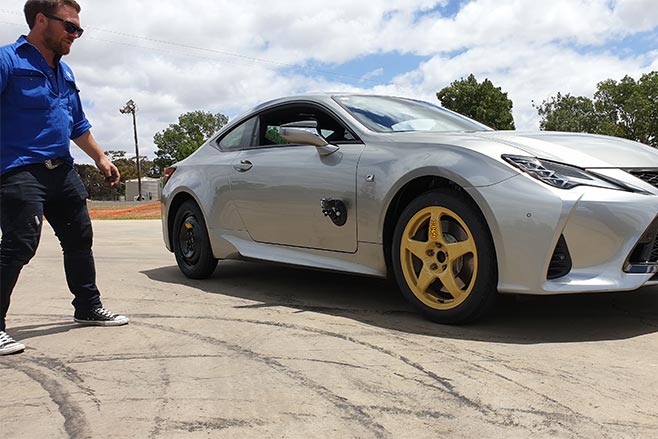
Sean, mate, you sure this is a good idea?
It actually turned out to be hilarious fun being able to send the RC300 into a frenzy of oversteer at will, even though it made actually controlling the car under normal manoeuvres quite a task. It’s not something I’d want to be contending with on a public road.
As I said in the TV segment, it’s worth making a plan to get your original tyre fixed ASAP, as you don’t want to be caught out in an emergency with a space saver on your car. Let alone four of the things.
WATCH THE FULL EPISODE HERE AT TENPLAY
Imagine for a second that you’re heading out the door to jump in your car to head to work, or to drop the kids off to sport practice. You’ve grabbed your keys, bag and phone, grab your helmet from the shelf and head out to start your…
Wait a minute, you say. A helmet?
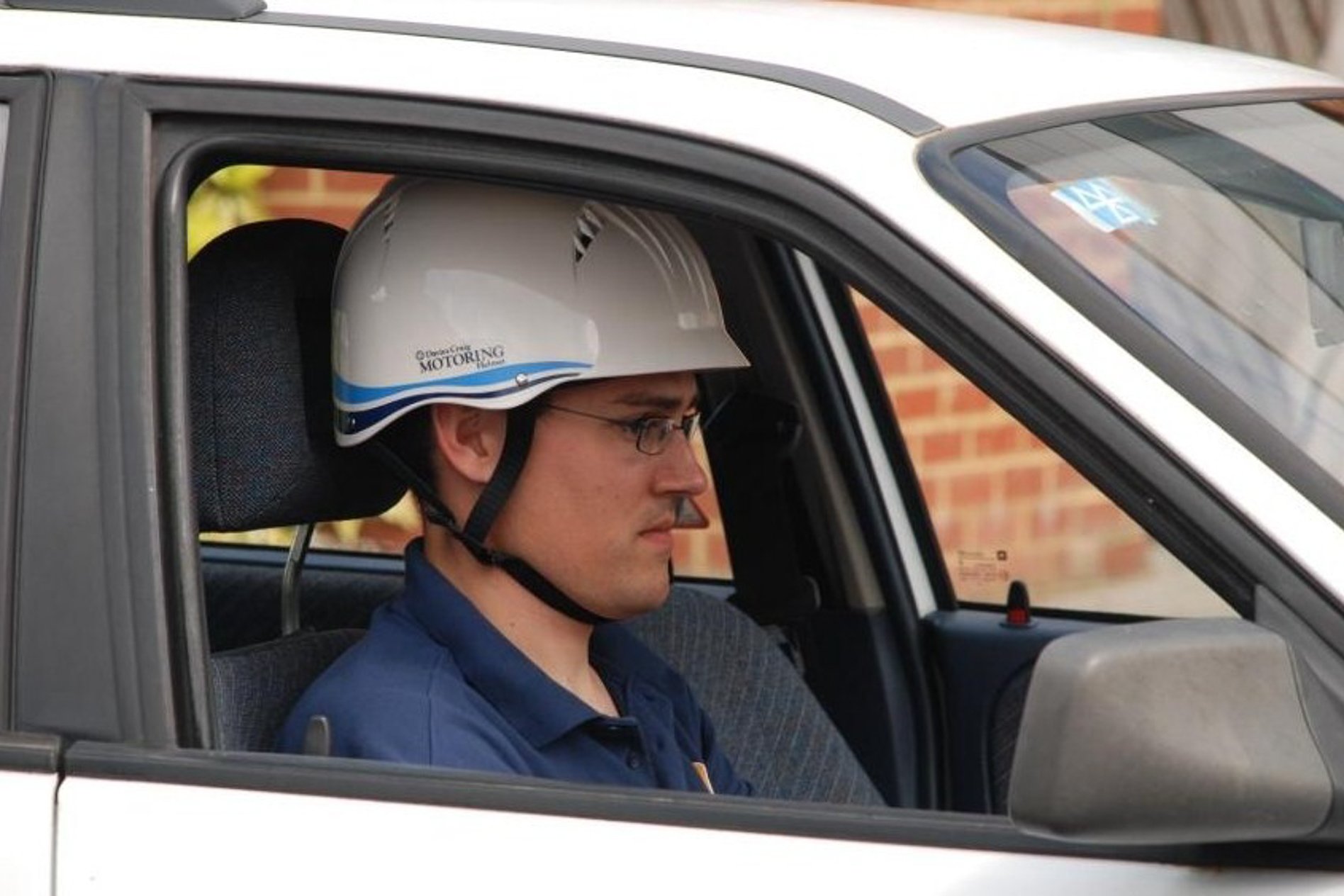
That was the dream of renowned Australian automotive parts company Davies, Craig, which developed and released the Motoring Helmet in the mid-1980s.
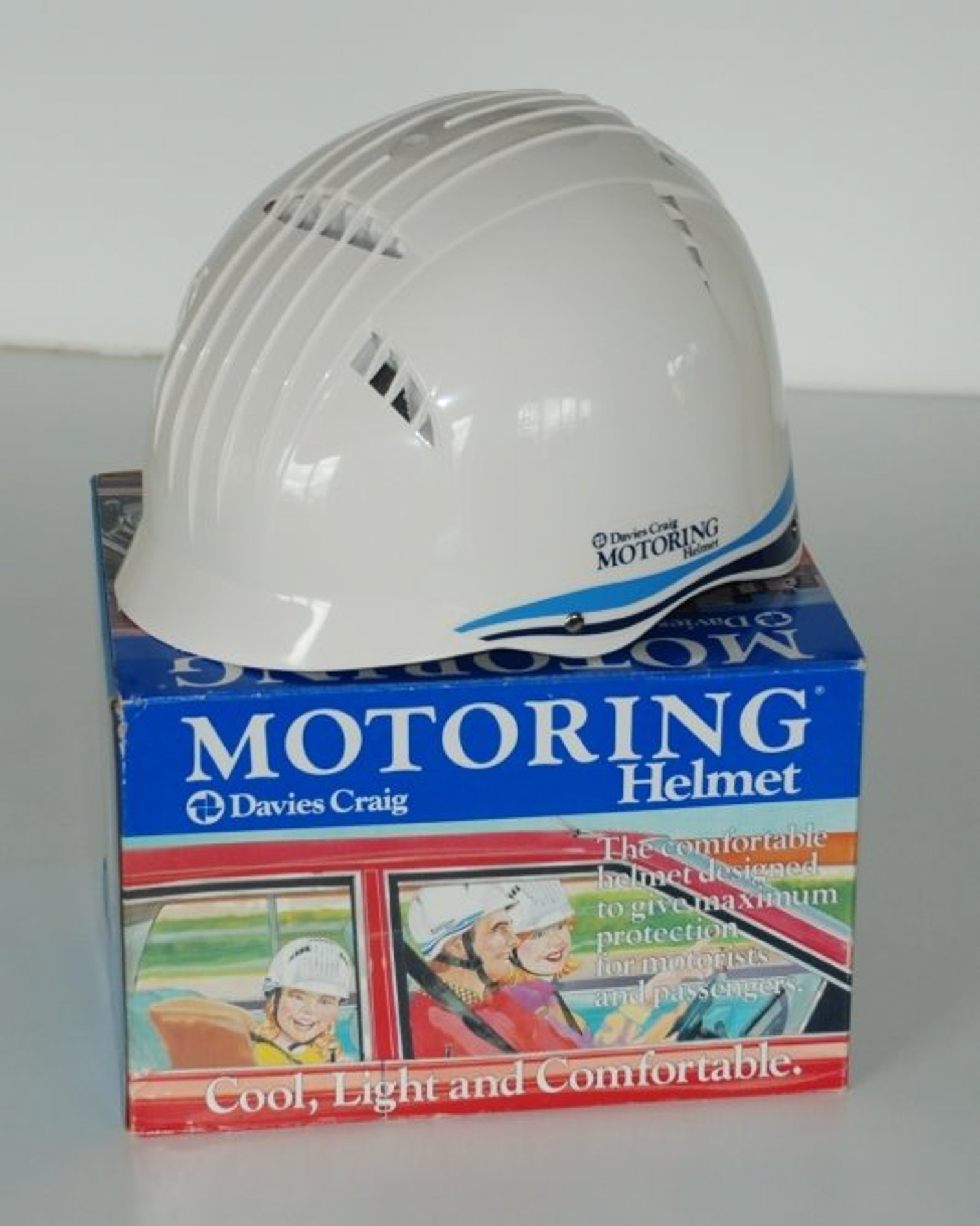
Looking for all the world like the Rosebank Stackhat cycling lid that was born of compulsory bicycling helmets in the early 1990s, the Davies, Craig Motoring helmet is reportedly ‘cool, light and comfortable’, according to the packaging – though in all honesty, the rigid polycarbonate lid looks like none of those things.
“Davies, Craig recommends you wear your Motoring Helmet at all times when motoring but particularly at the following, documented high-risk times,” warn the perculiarly detailed instructions.
- After consuming any alcohol.
- When other drivers are likely to have consumed alcohol especially 4:00PM to 2:00AM Fridays and Saturdays.
- After dark and during twilight.
- In rain or when the roads are wet.
- During long trips when you may become tired.
- Within five kilometres of your home or destination.
- Christmas, Easter and long weekends.
- If you are aged under 25 or over 60.
“Ultimately, motoring helmets will be commonplace, but in the meantime, you will be a leader whilst those who may consider your good sense misplaced, will follow.”
Well… no.
The idea of wearing head protection in a car isn’t necessarily the silliest thing in the world. A study conducted by the Monash University Accident Research Centre in the early part of the 2000s demonstrated that, by wearing a headband made of polycarbonate, head injuries could be reduced by 25 percent, while a band made of a deformable corrugated material increased that to 67 percent.

“Head injuries to car occupants in crashes on Australian roads are a major cause of death and permanent brain damage,” read part of the report. “Preventing impacts to the head and reducing the severity of the head impacts that do occur has the potential to save many lives.”
And of course, the helmet is an integral part of motorsport, as is the use of head and neck restraints, fixed-backed seats and harnesses as part of a complete driver protection system.
The modern vehicle is, of course, now much better equipped to reduce the severity of head injuries than one from the era of the Motoring Helmet – the airbag is the number one method of protecting occupants from both side and front impacts, with side-curtain airbags designed to prevent many of the injuries that the helmet was designed to protect the occupant from.
We love the passion behind the ultimately doomed project and salute the engineers and team at Davies’ Craig for putting the Aussie once at the front of mind.
No contender of Wheels Car of the Year 2020 was as anticipated as the Tesla Model 3.
The hype train around the most-important car in Tesla’s line-up was immense. It promised to democratise electric vehicle ownership, all in a stylish and rapid package.
Well, we can confirm that it delivered, earning its place in the final five with aplomb.
While our independent testing revealed the Model 3 was just a tenth-of-a-second quicker than Porsche’s iconic hero, Judges remarked at how the Tesla’s panoramic view from the cabin made it feel faster from the driver’s seat. Hell, even the base Standard Plus version is impressively quick.
But simply being fast doesn’t make a COTY finalist, what does is impressive and game-changing real-world functionality, along with advanced technology, and a ultra-competitive price.
That’s three big ticks in line with the COTY criteria right there.
Our testing also revealed genuine efficiency in the real-world, and you can’t accuse any of the judges of having a light right foot!
There are four staunch rivals standing in the Model 3’s path to COTY victory, including another electric vehicle in the Mercedes-Benz EQC.
Can the Model 3 do what the Model S before it could not and win the biggest award in Australian motoring? Find out on January 30 when the winner is revealed.
5:47PM, SATURDAY October 12. It’s the day before the Bathurst 1000, and the entire Mount Panorama circuit is subdued with a tense silence.
The peace is shattered by a feral, mechanical howl. It’s Scott McLaughlin at the wheel of his DJR Team Penske Ford Mustang, its 485kW 5.0-litre naturally aspirated race engine screaming like a bombing siren as it’s put to work for the most important solitary lap of the year, tearing down the pit straight with furious intent.
There’s a crackle as the 26-year-old Kiwi bangs down a couple of gears, before propelling himself up the mountain.
The silence returns.
It’s only broken when McLaughlin reappears, precisely 2:03.3783 minutes later. He’s just completed the quickest lap by a Supercar in Mount Panorama history, and the team erupts into suitably joyous celebrations.
Sitting still and silent just behind the pit garage is a bright green Ford Mustang road car, at the head of the line of numerous other Mustangs. A quick glance would have you fooled that there isn’t anything particularly important about this car, but let your eyes linger and telltale signs begin to coalesce into the realisation that this is something much more significant.
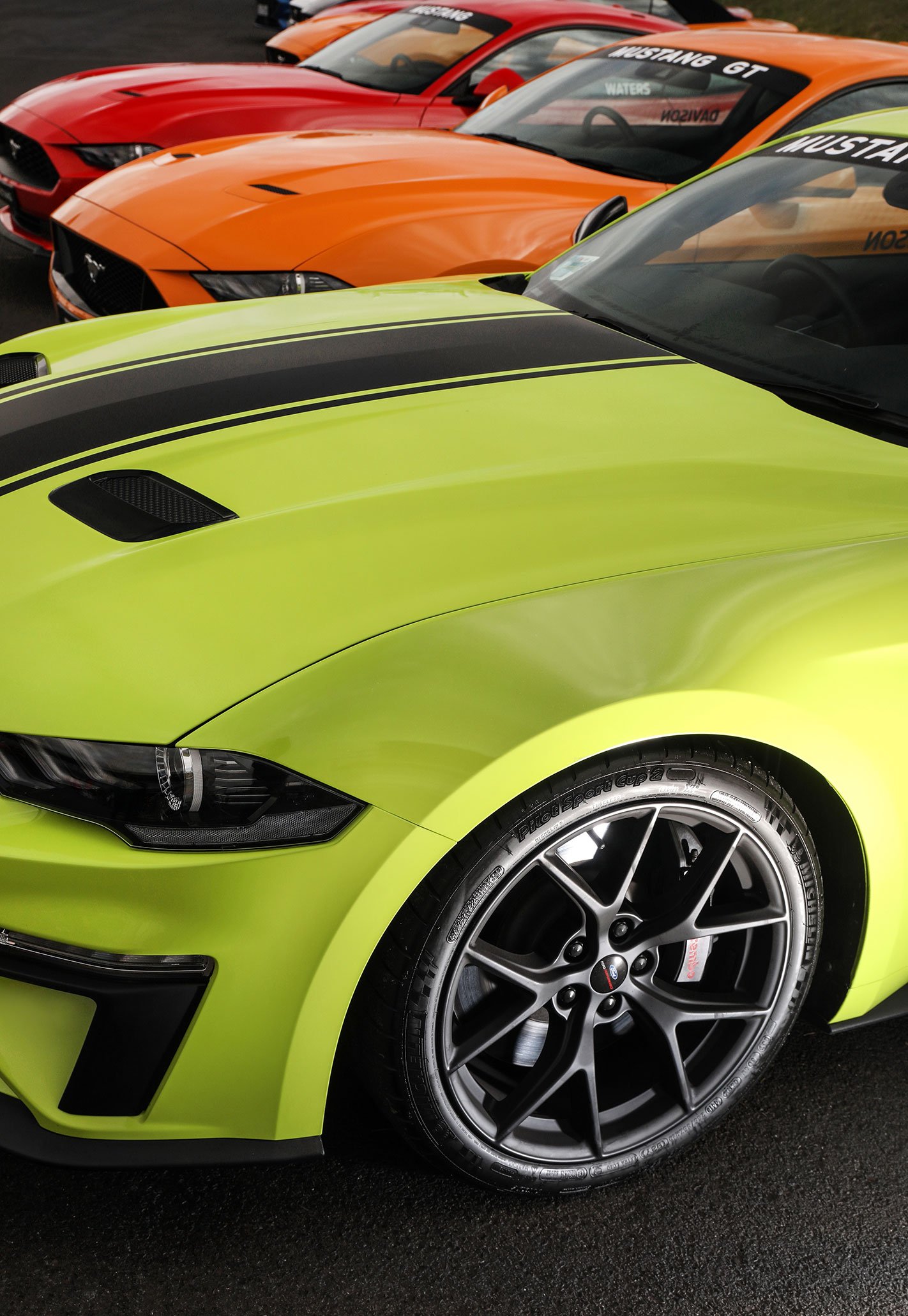
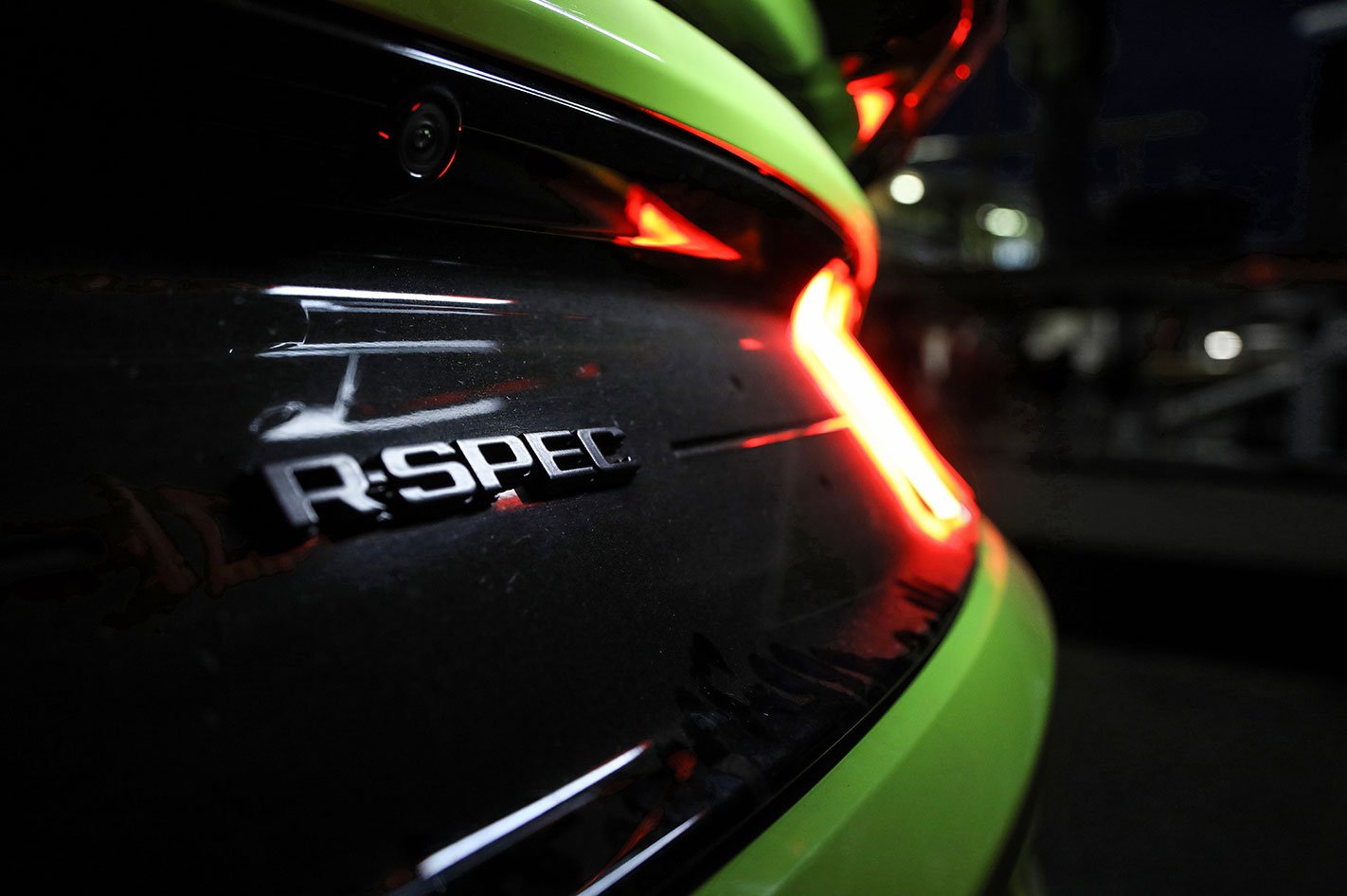
It might be the Ford Performance wheels that first catch your eye, or the matte black decals that give a knowing wink to the old Boss models from the halcyon days of muscle cars. Perhaps you’ll first be drawn to the GT350-esque rear wing, or the slightly more hunkered-down stance.
What you are gazing at is the 2020 Ford Mustang R-Spec, and it’s incredibly exciting for a number of reasons, the main ones being its race-car-shaming 522kW/827Nm outputs, and the fact that it’s assembled at Ford’s Broadmeadows facilities, near where the mighty Falcon was being built just three years ago. Yes, you read that right: the Blue Oval is back to making cars in Australia.
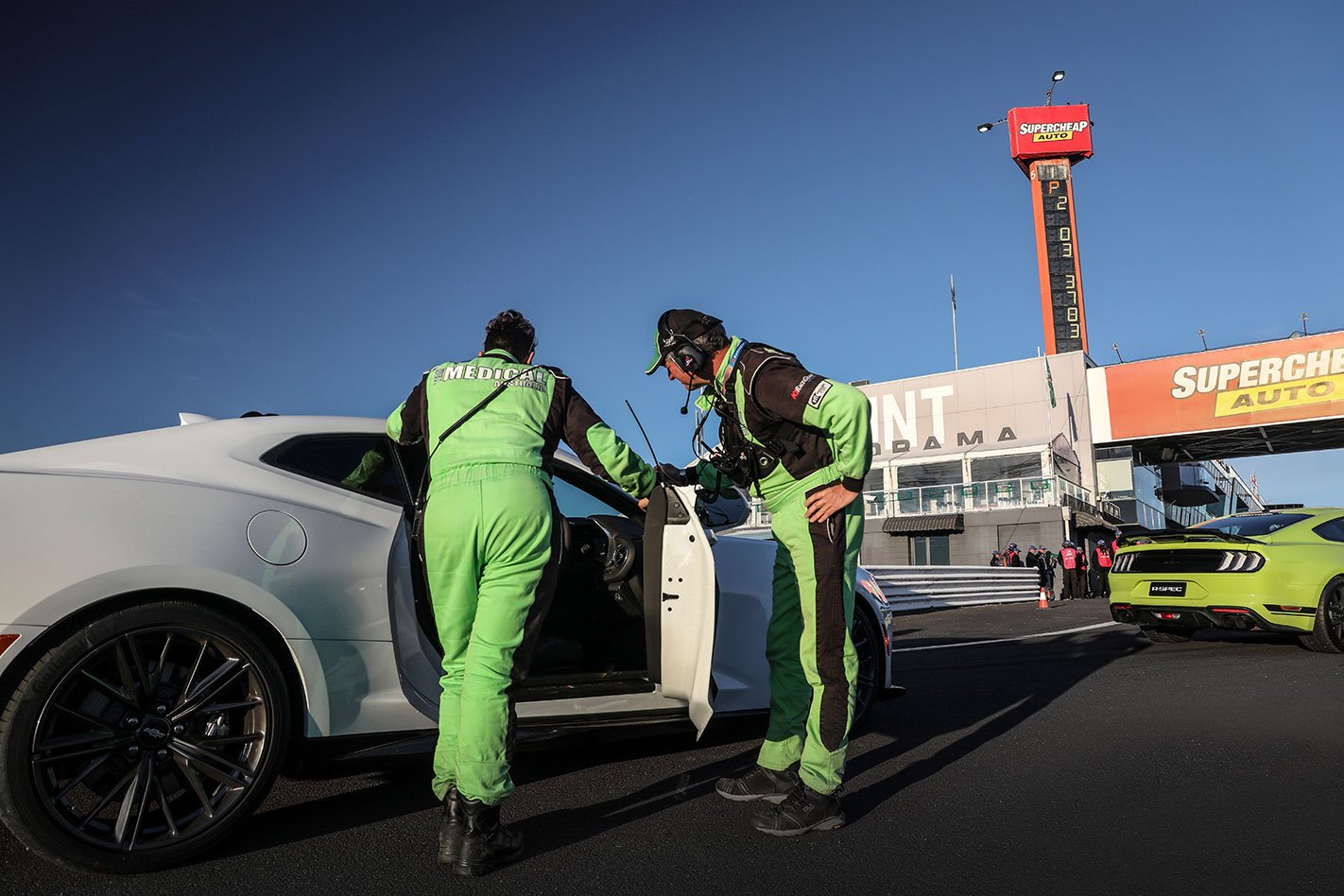
Here at Wheels, we don’t like to let a good opportunity go begging, so we decided to crash this momentous occasion with none other than General Motors’ very own 477kW American invader, the Chevrolet Camaro ZL1, re-engineered and sold in Australia by Holden Special Vehicles.
Our unceremonious arrival at Mount Panorama in a GM product at the exact moment Ford Australia is beating its chest with pride might be frowned upon by more sensitive PR minders, but Ford Australia welcomes us with open arms, fully aware of what both cars represent – the return of Aussie jobs to the performance-car sector.
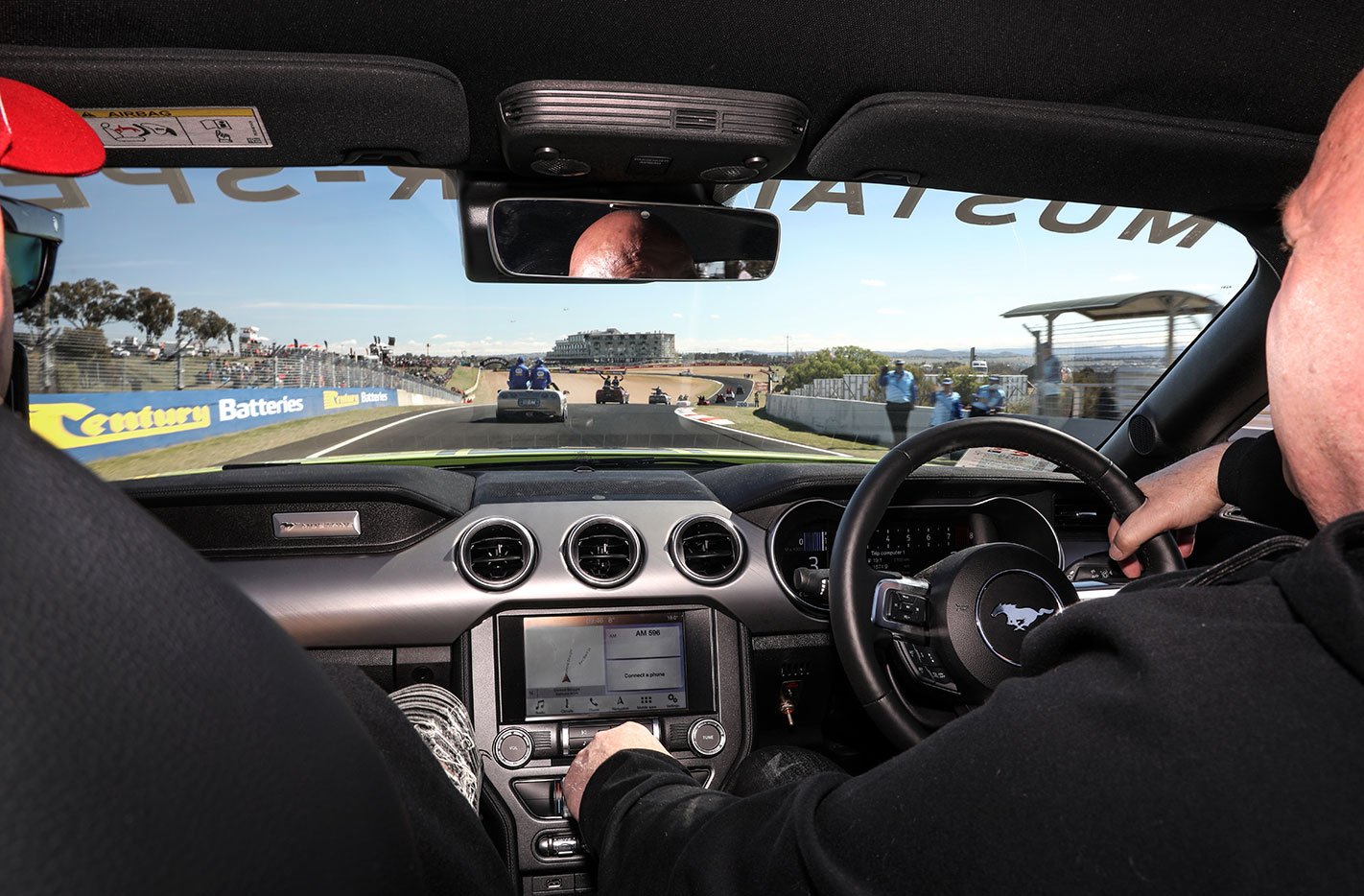
Together, the R-Spec and ZL1 represent close to a megawatt of Australian-fettled supercharged V8 muscle, and what better place to gauge public perception of the pair than Mount Panorama during the biggest motorsport weekend of the year.
Unfortunately for you, dear reader, internal politics at Ford have kept us out of the driver’s seat of the R-Spec for now. The model you see on these pages is a pre-production version, and built from a MY19 Mustang, whereas all R-Specs will eventually be based on the MY20 update. The upshot of this is that the car is chaperoned at all times by a Blue Oval employee. We’ll bring you a full first drive as soon as we can pry the keys from Ford Australia.
ROB HERROD is a physically imposing man from a distance. Standing six foot tall, with a shaved head and broad shoulders, he cuts a daunting figure.
But today, he has a beaming smile, his chest filled with pride, and he happily stops to take selfies with the Blue Oval faithful.
“We’ve been working on this project for pretty much two years now,” Rob tells us. Long associated with fettling Ford products,
he has become the linchpin in the R-Spec project thanks to his close relationship with Ford Performance in the US and Ford Australia locally.
As the largest official distributor of Ford Performance products in the southern hemisphere, Herrod Performance was given the nod to assemble the R-Spec, and ensure that it complied with all ADR regulations. What Rob has created is an absolute performance bargain. Priced at $99,980, the R-Spec offers 183kW and 271Nm of extra grunt over the regular Mustang GT for an additional $37,990 – not bad value for money.
So what do you get for your cash?
A Ford Performance supercharger is key to the extra power. Roush supplies the Eaton R2650 TVS unit that sits atop the third-generation 5.0-litre Coyote V8. The 2.65-litre unit produces 12psi of boost when spun up to 18,000rpm. For comparison, the ZL1’s 477kW/881Nm LT4 6.2-litre V8 is topped by a 1.7-litre Eaton R1740 TVS supercharger which generates 9psi of boost when spinning at 20,000rpm.
Also in the Ford Performance kit is a new lower intake manifold with integrated air-to-liquid intercooler, 87mm electronic throttle bodies, a redesigned air inlet system, and larger fuel rails. The exhaust is also all new from the catalytic converter back, and built by Borla to Herrod’s specifications, with Ford Performance tips. Because a Ford Performance kit is used, all validation and testing needed to ensure the R-Spec met strict OEM standards was completed in the US.

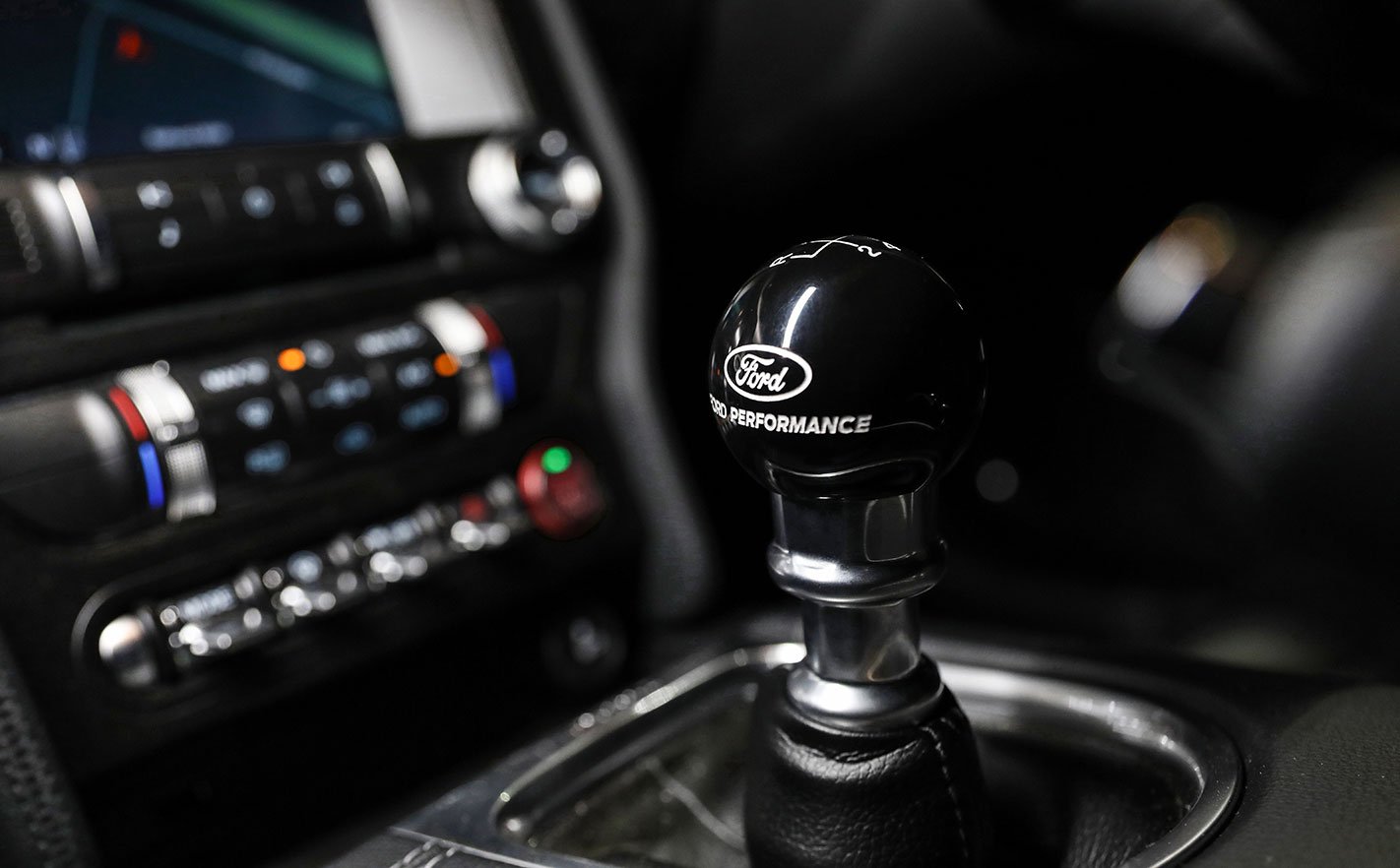
You won’t be able to buy an automatic R-Spec, as all 500 units are fitted with the six-speed manual. Ford claims the gearbox itself didn’t require any modifications to handle all the extra grunt thanks to the MY18 Mustang’s transmission upgrades, which include stronger halfshafts, a twin-plate clutch, and a dual mass flywheel from the Shelby GT350. At each corner are Ford Performance wheels half an inch wider front and rear (9.5 and 10 inches respectively). Rubber retains previous widths of 255mm front and 275mm rear.
The suspension has been tweaked, with the ride dropping by 20mm; spring rates stiffened by 20 percent; and MagneRide dampers recalibrated for the new settings. Larger diameter anti-roll bars (up 5mm at the front; 3mm at the rear) round out the chassis upgrades.
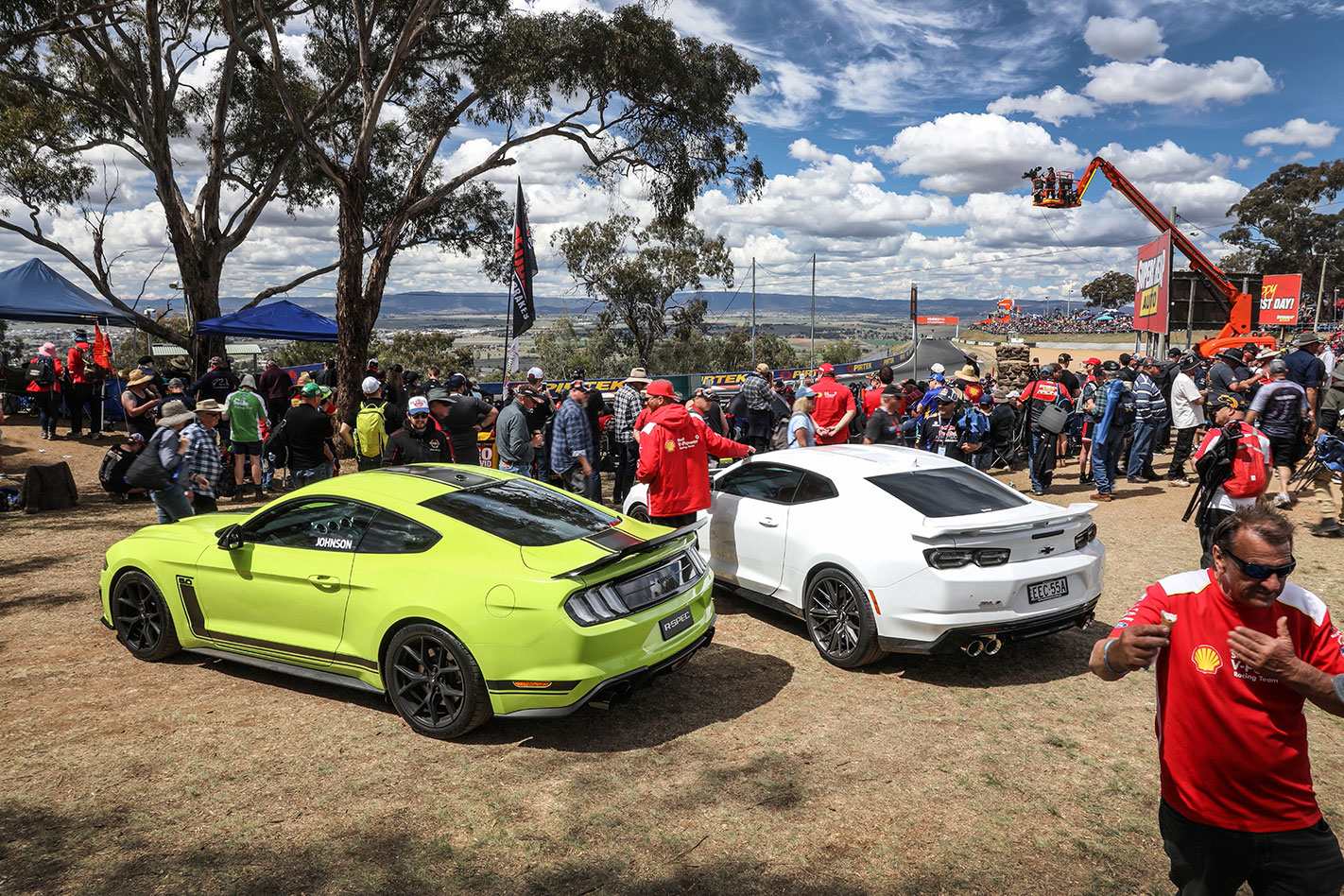
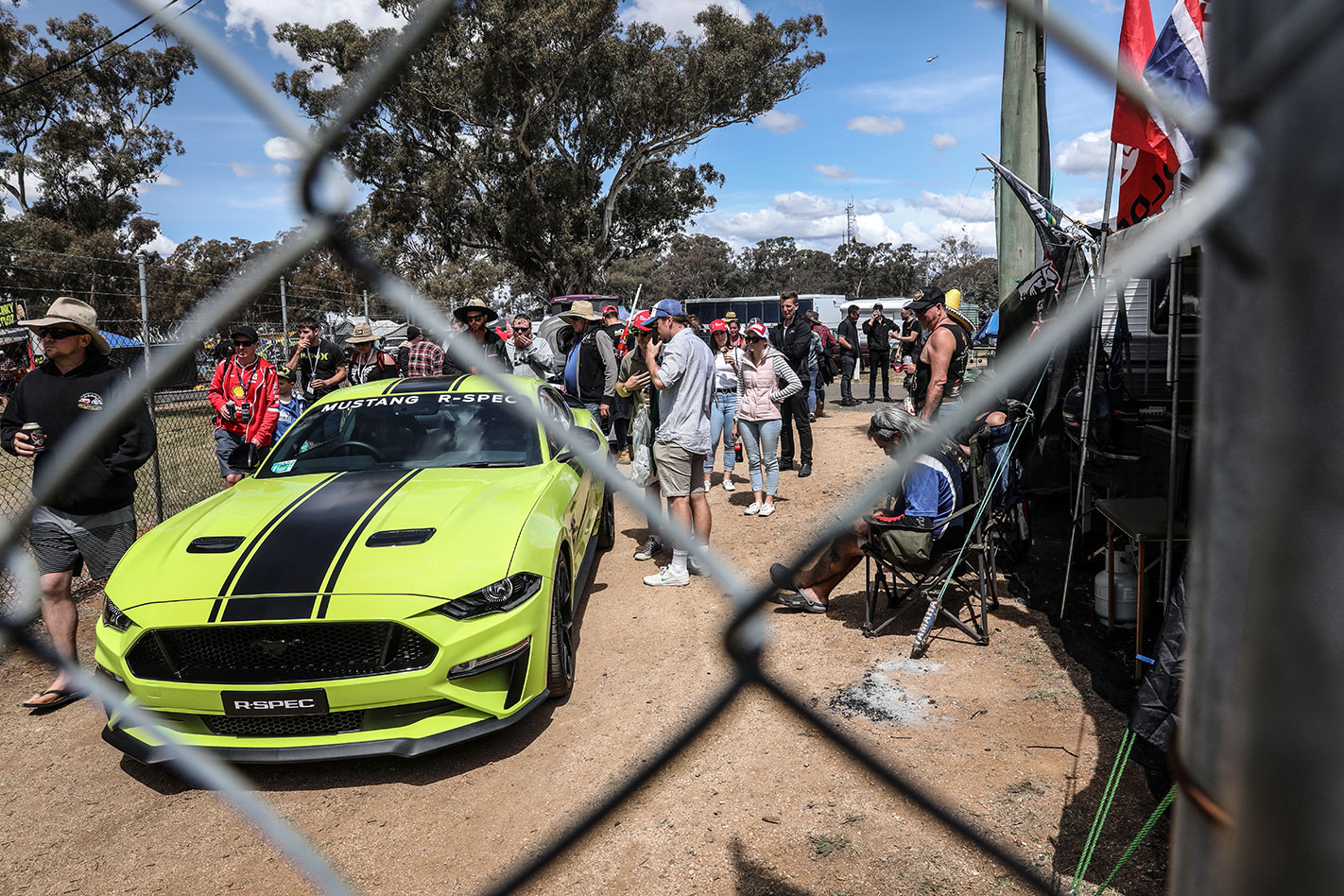
Visually the R-Spec can be identified by the inserts on the front bumper intakes, unique decals, and GT350-style rear wing. The gurney flap you see in the photos was added to give Dick Johnson, or ‘Uncle Dick’ as Rob’s son Chris Herrod calls him, some extra stability during demonstration laps where he nudged 290km/h down Conrod Straight. Stickier Michelin Cup 2 rubber is fitted for the same reason, although the production version will wear the same Michelin Pilot Sport 4 S tyres as a standard Mustang GT.
Herrod Performance is toying with offering an optional ‘Track Pack’ that would include both of the aforementioned modifications, along with extra cooling for the powertrain. This would placate buyers worried by the overheating issues that have plagued automatic Mustang GTs that endure track action.
While this is a new addition to Ford showrooms, the R-Spec badge itself isn’t. FPV sold a GT R-Spec in 2012, and it remains the quickest-accelerating Ford tested by Wheels, with a 4.52-second sprint to 100km/h. With no official acceleration claims coming from Ford, this will be the benchmark figure for the Mustang R-Spec to beat, along with toppling the quickest Aussie-built car, the HSV GTS-R W1, which managed 4.5 seconds.
All up, the R-Spec denotes an exciting new future for both Ford the company in Australia, and the blue-blooded army that have stayed faithful since local production ended. The ZL1 does the same thing for those in The General’s army.
PESSIMISTIC DETRACTORS of both of these cars will point out that they aren’t actually manufactured in Australia – and sure, they aren’t built and engineered from a clean slate on Aussie shores like the Falcon and Commodore – but that’s a negative slant on what should excite any local car enthusiast. These are distinctly Australianised models. The Camaro is only sold as a right-hand-drive model in a single market – ours – and that is all thanks to the engineering prowess of HSV. Similarly, Ford now sells a 5.0-litre supercharged ’Stang from the factory in only one country: Australia.
It’s something not lost on the rabid fans who reside at the top of Mount Panorama for the Bathurst 1000 every October.
“It’s bloody fantastic that Aussie jobs go into these things,” enthuses one punter.
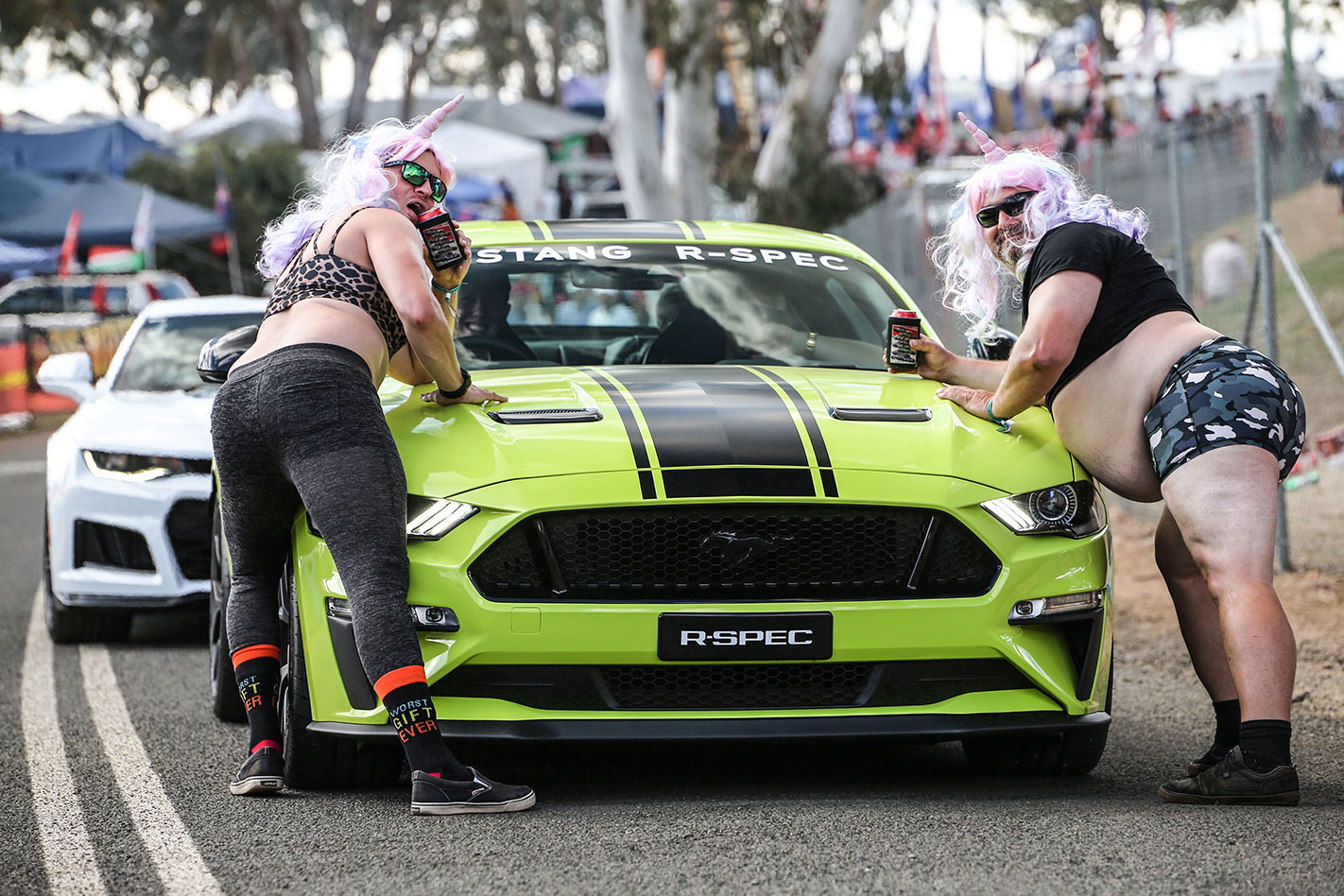
The public reaction is unmistakeable for both vehicles, with racing fans all over The Mountain thrilled at their mere presence. We push our luck and sneak the cars through a gate into the crowd at McPhillamy Park, causing an instant disruption to foot traffic. The two cars are swamped by a crowd of onlookers who pepper us with questions. People pose for photos, and eagerly pore over the exterior details. Requests to pop the bonnet are quickly followed with calls to “give it a rev”. Ford Special Vehicles senior engineer Nathan Medbury happily obliges, taking the R-Spec to redline much to the glee of onlookers, while the 4000rpm soft cut of the automatic ZL1 that we have brought along earns itself a bit of uncharitable ridicule.
Being Bathurst, there are numerous questions about when the Camaro will join the Supercars championship. The short answer is Walkinshaw doesn’t want to ruin the silhouette of its performance hero like Ford did with the Mustang, and has called for the front roll-hoop regulation to be changed to accommodate a lower roofline, meaning a Camaro Supercar won’t happen until 2021 at the earliest.
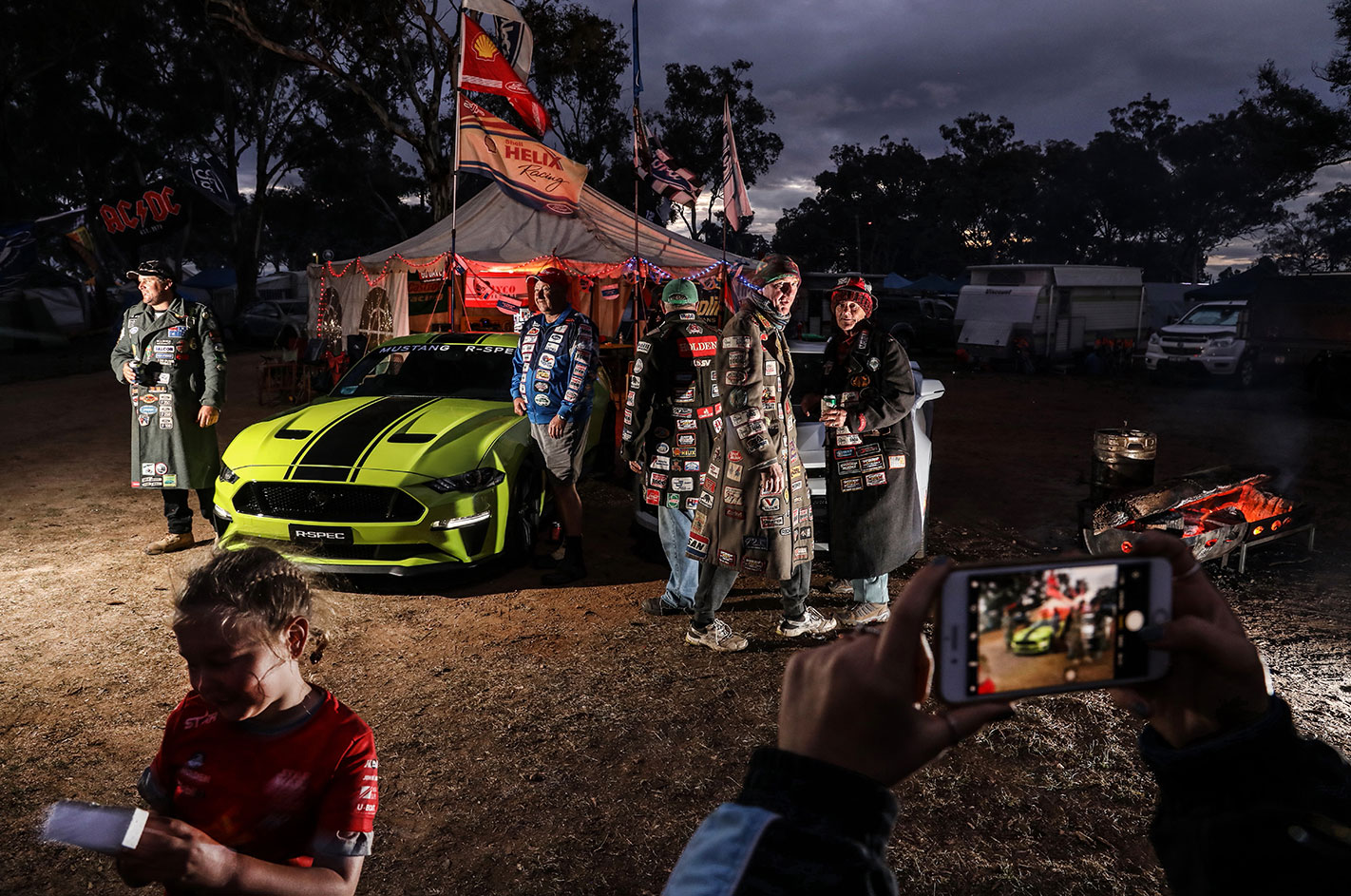
Surprisingly, almost no-one mentions the price difference between the pair (it’s $60,000, if you were wondering). It’s mooted at one camp that most Ford and Holden fans couldn’t afford either of the cars anyway, and even if they could, the price wouldn’t matter. It’s a heart-over-head decision.
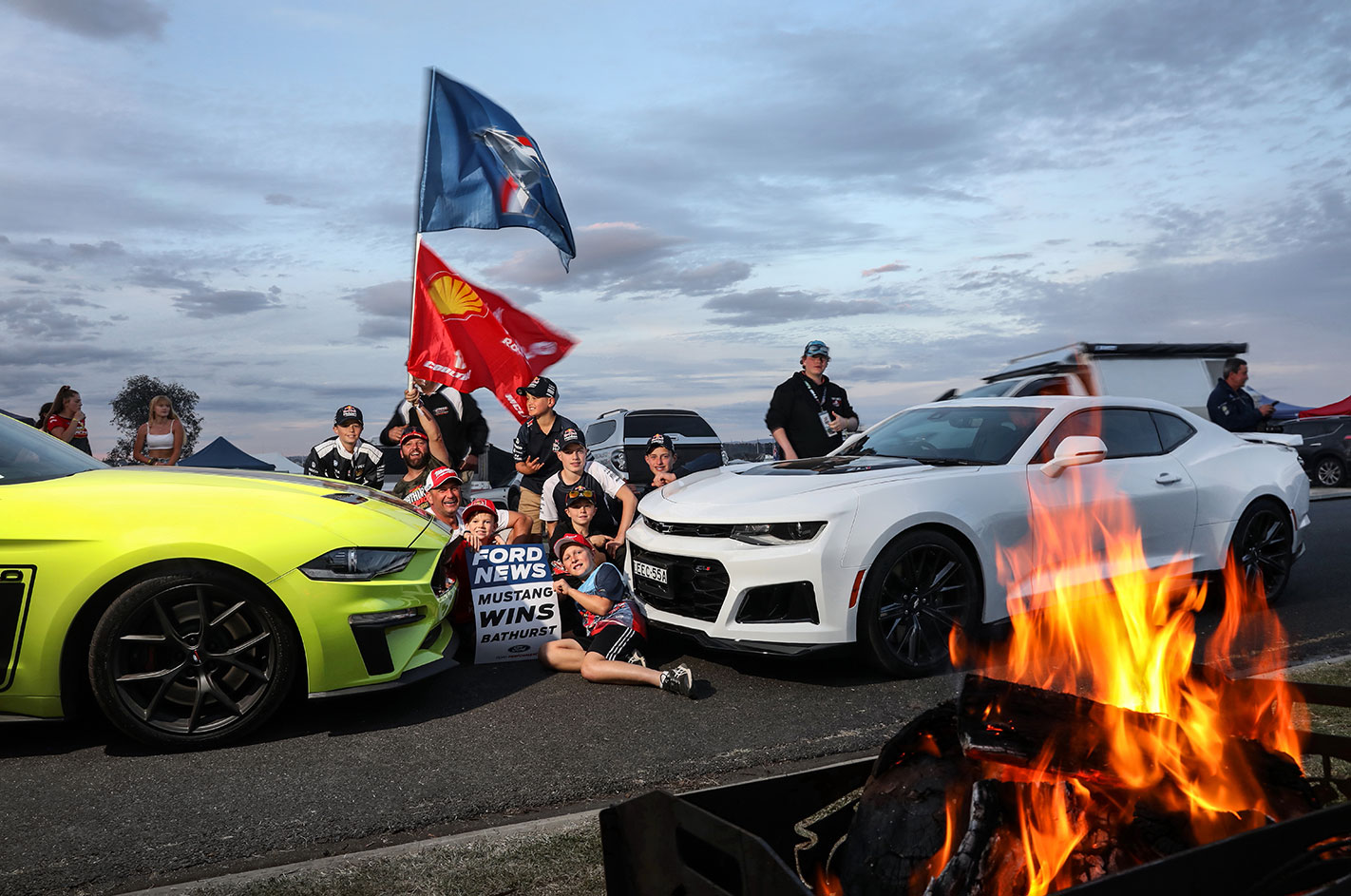
While neither car is torched to a crisp, and we survive a late-night excursion without having beer cans thrown, it’s clear that Red vs Blue tribal lines still exist at Mount Panorama. Verbal heckles are spat with venom as we cross the path of less agnostic camps, while one fan wearing a Ford shirt is quickly labelled a traitor by his mates for admiring the looks of the Camaro. There are some less partisan onlookers, but they’re few and far between. The general consensus when prodded is that the R-Spec is the more impressive performance car, with its superior power and racing heritage, but it’s the Camaro that cuts a more intimidating and visually alluring figure.
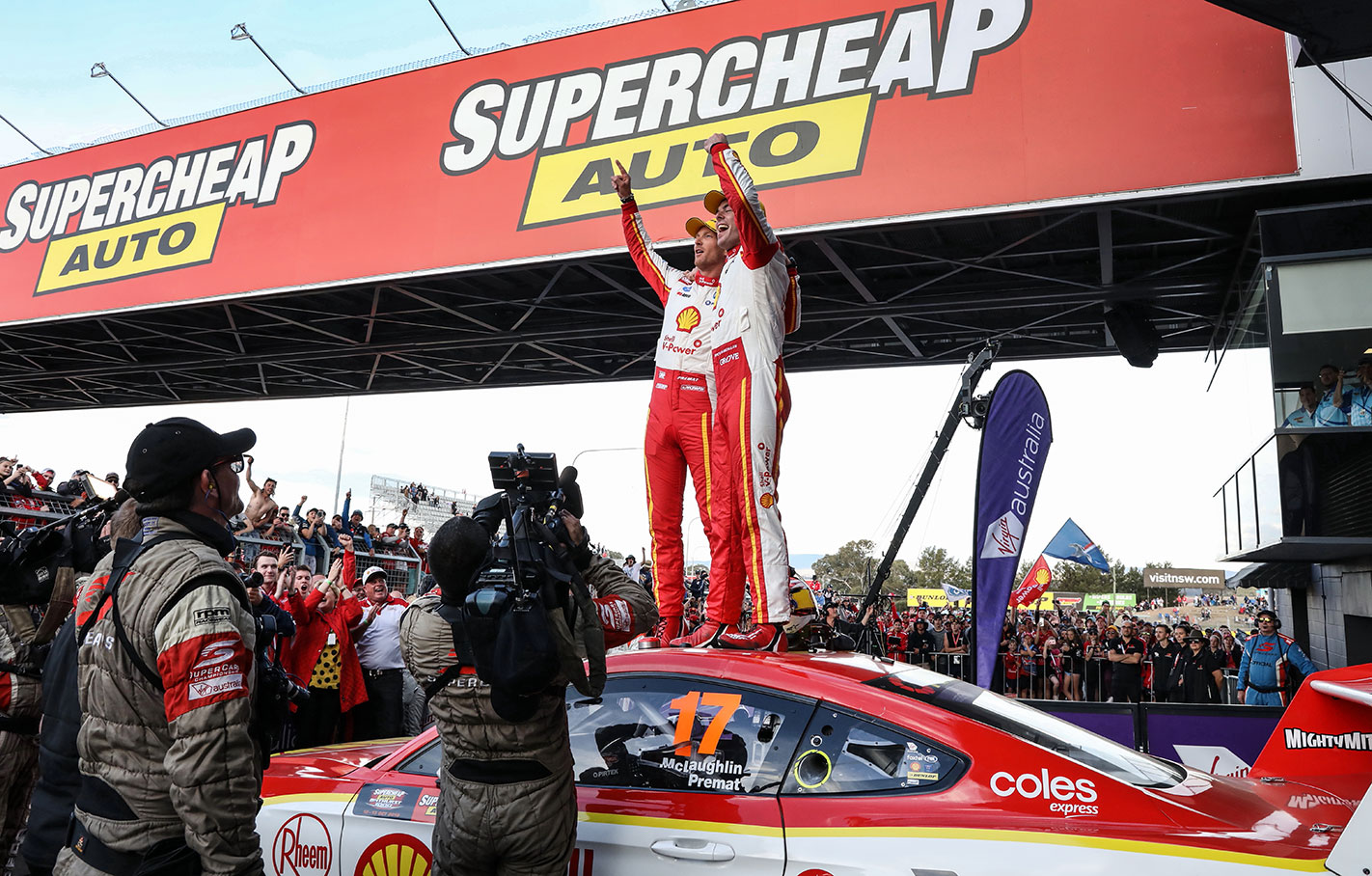
A DAY after Scott McLaughlin sent the record books into a tailspin with his quickest-ever lap, he crosses the line to finish lap 161 of the Bathurst 1000 at the head of the pack. This is his, and the Mustang’s, first victory at the toughest race in Australian motorsport.
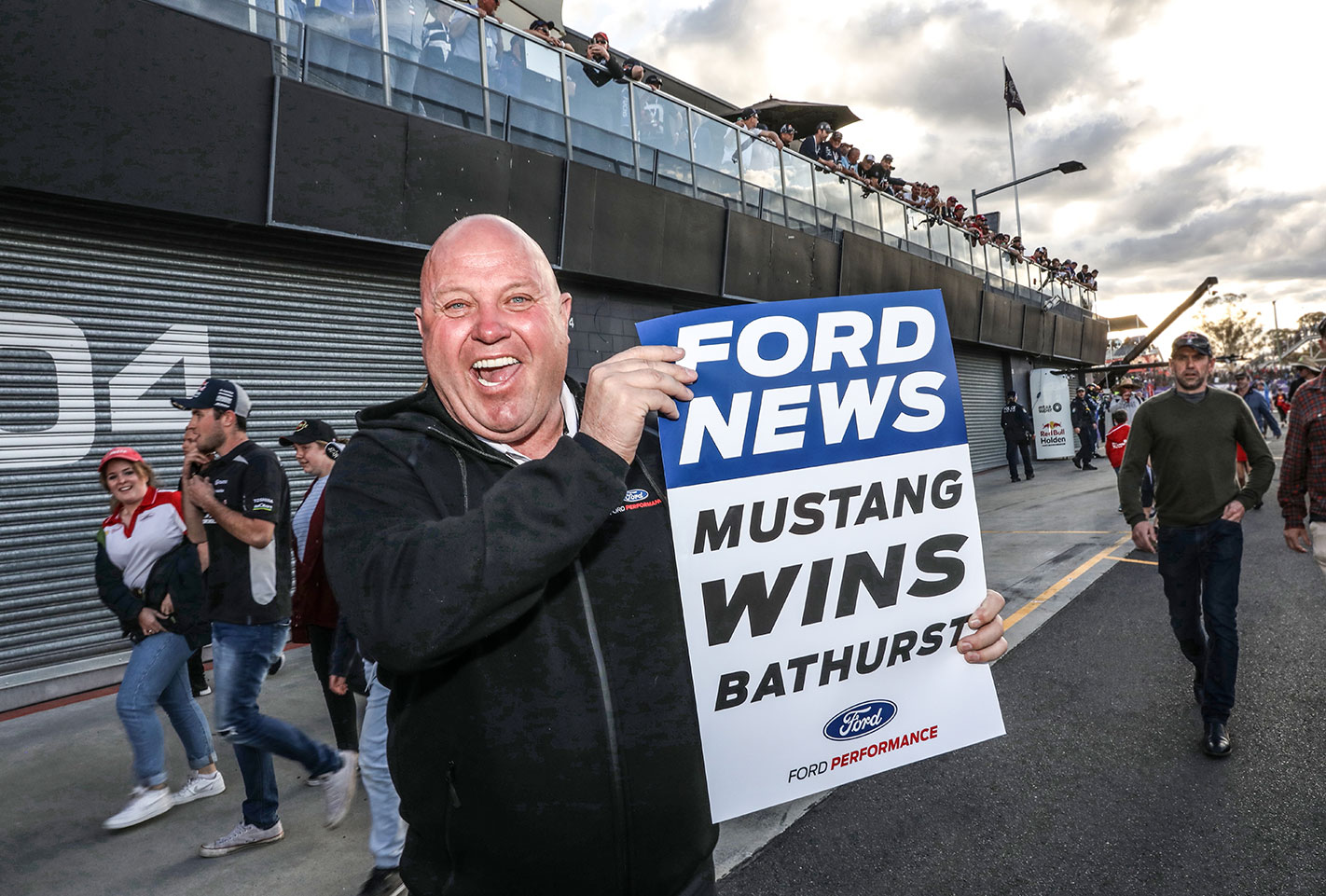
Walking down the pit lane amid the stampeding crowd is Rob Herrod. He holds a poster that reads MUSTANG WINS BATHURST. His eyes fill with tears as emotions swell to crescendo at the end of a tense race.
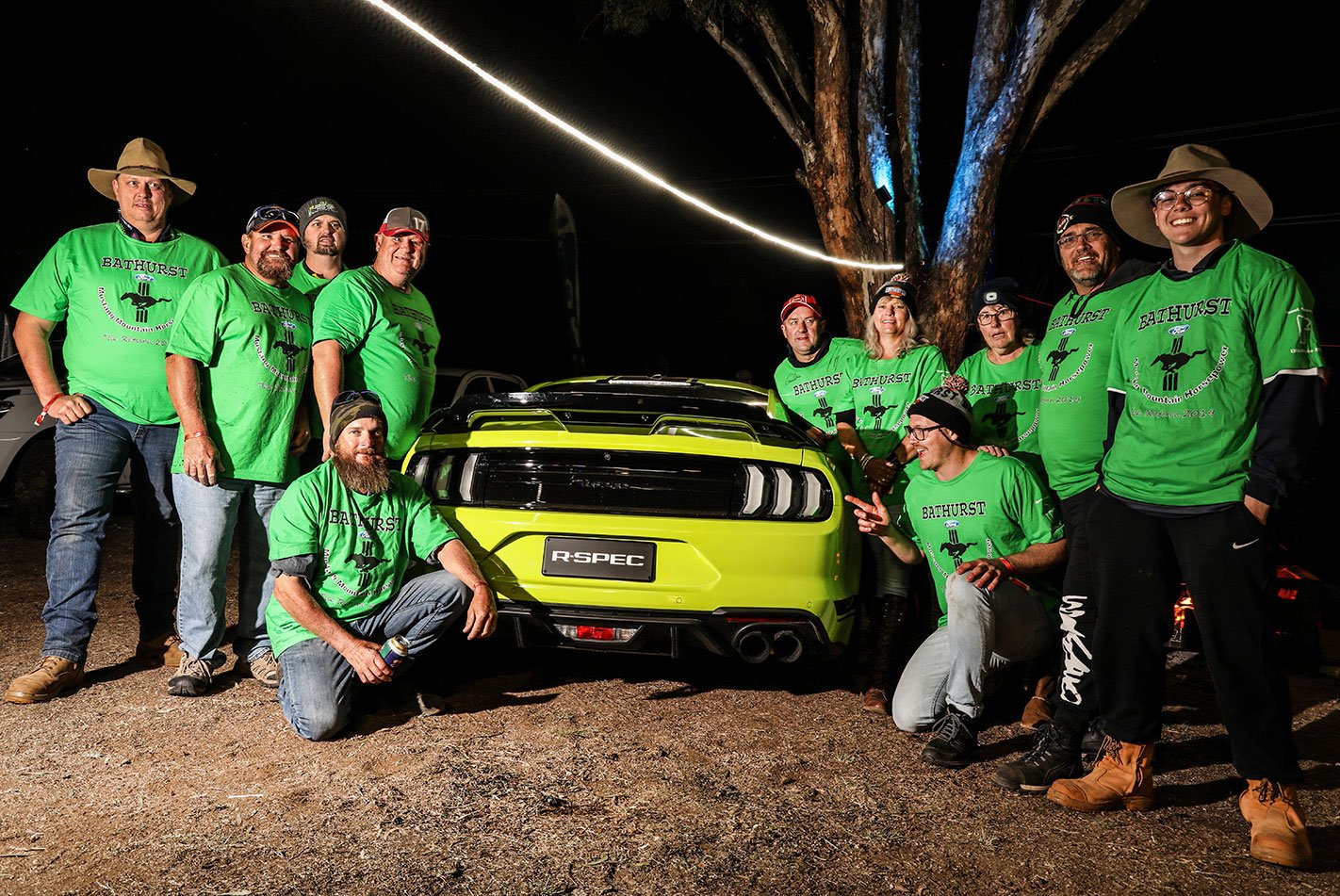
If Ford was looking for a fairytale launch for its R-Spec at the unforgiving Mount Panorama, this was it. As the race weekend concluded, it was estimated roughly half of the car’s 500-unit allocation was accounted for with pre-orders.
Who said ‘win on Sunday, sell on Monday’ was dead?
Welcome to a brand new decade – if you believe, of course, the new decade starts now, and not next year! And as you’ll read MOTOR January 2020’s Pace Notes crystal-ball-gazing feature, it’s looking like a fairly monumental one for the world of performance motoring.
Forgetting the decade for a moment, this year alone is looking insane for new performance models, the pipeline spewing factory hot rods at unabated pace. Sluggish global economy be damned! And rather than list them all out, I thought I’d pick the 10 new performance models coming in 2020 that I’m personally most excited to drive.
10 – MINI John Cooper Works GP
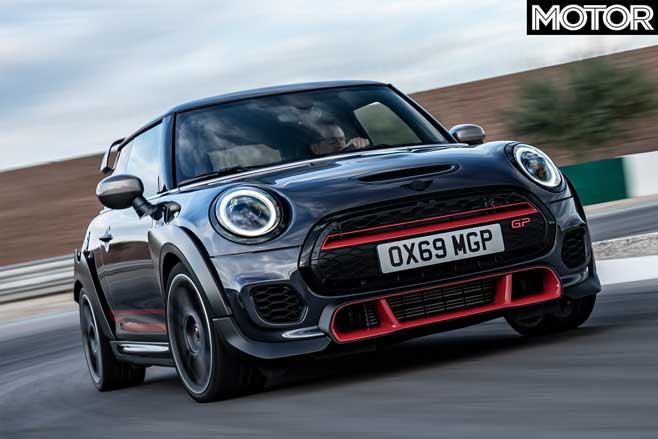
I loved the old R56/R57 MINI, and the JCW GP was that generation MINI at its best and silliest. Sadly, MINI went backwards with the third generation but the new, 225kW Cooper GP promises a return to form. Here’s hoping.
09 – Ford Fiesta ST
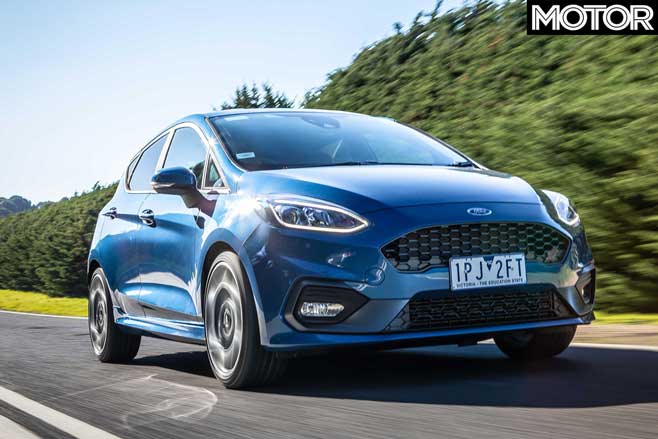
It’s been a long time coming but finally Ford’s feisty bum-dragger has touched down in Australia. I’ve missed the previous ST’s cheekiness – and love the idea of it being combined with a thrummy three-cylinder.
08 – Alpine A110S
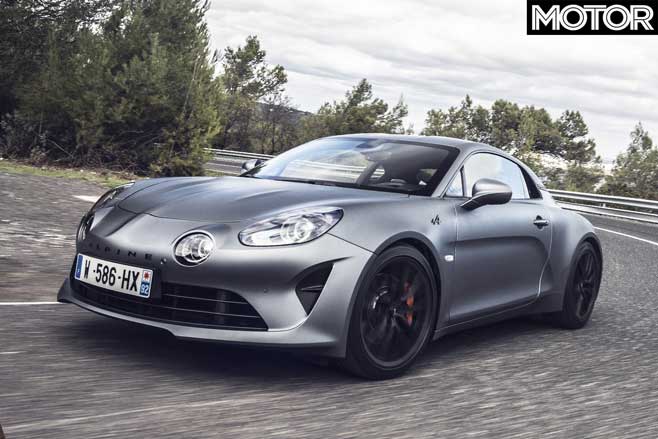
The current Alpine is a breath of fresh air, going totally against the typical just-get-a-Cayman groupthink. The S sounds like the one MOTOR would make – more focused again, sharper, tauter, a bit quicker and louder.
07 – Volkswagen Mk8 Golf GTI
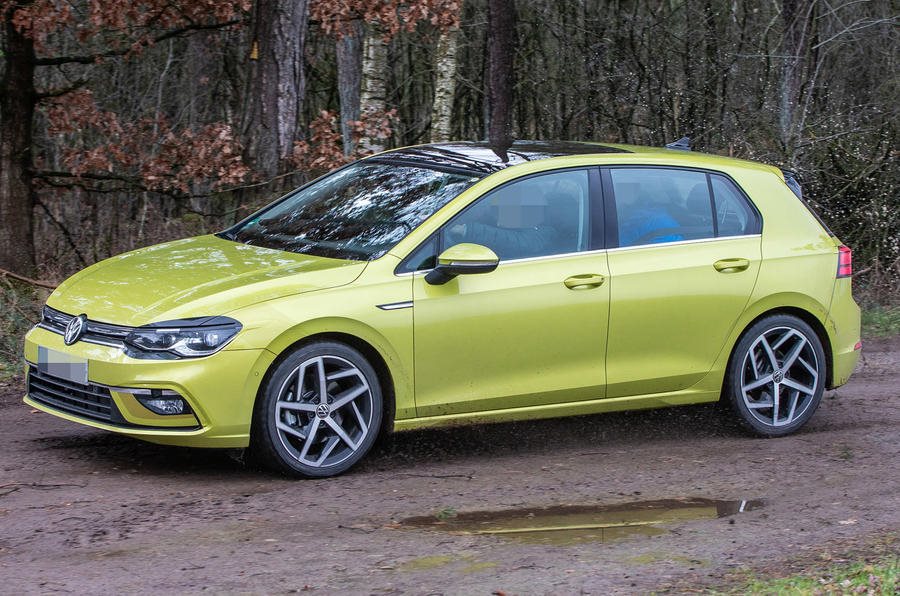
Despite a brand new architecture the benchmark everyday hot hatch is expected to be evolutionary in the way it drives, with a bit more power, smarter handling and a cutting edge interior. Could be – probably will be – the best all-round performance vehicle under $100K.
06 – Chevrolet C8 Corvette
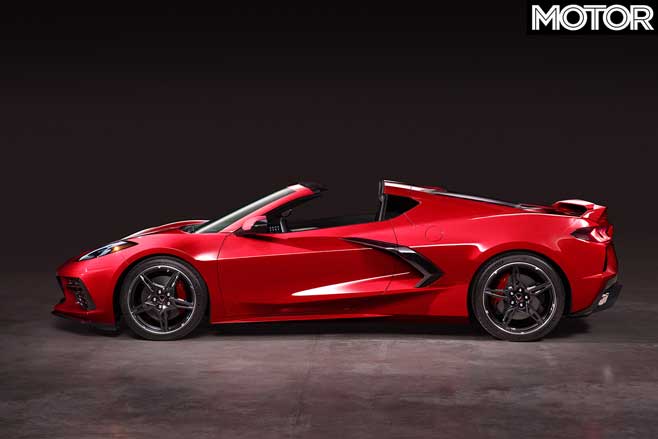
I am a huge fan of GM small block V8s and mid-engine cars so the thought of the two combining – in what is our cover car this issue; read the verdict in the January 2020 issue – makes me slightly giddy. Although there’s a chance we might not drive it locally until next year.
05 – Ford Mustang R-Spec
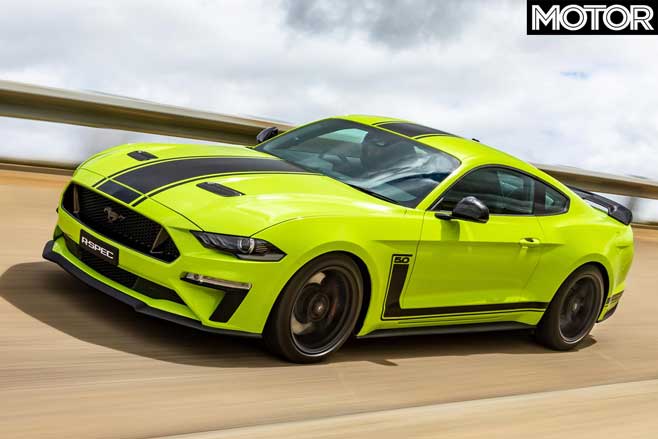
Supercharged 5.0-litre V8, circa 500kW, manual-only, rear-drive, tight diff, tough looks… it’s certainly a time-proven recipe. And with factory reliability.
04 – Mercedes-AMG GT R Black Series
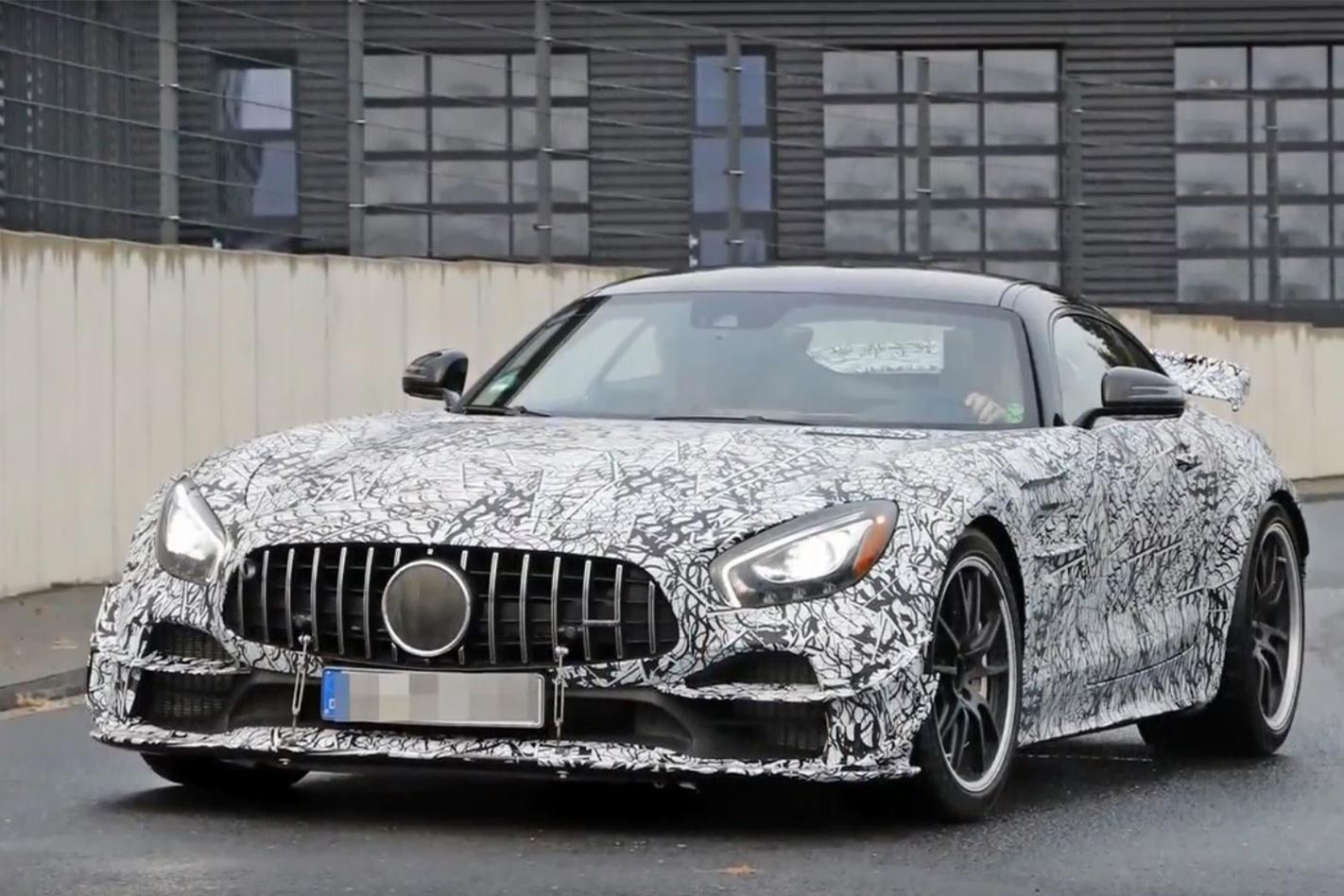
A car that might make a GT2 RS look a bit timid, if what we’re hearing is true. Huge wings and aero; wide, sticky rubber; an almost brand new 4.0-litre twin-turbo V8 exceeding 515kW… AMG boss Tobias Moers says the very-serious-sounding Black Series shares little with the AMG GT R on which it’s based. Yikes.
03 – Porsche 992 911 Turbo
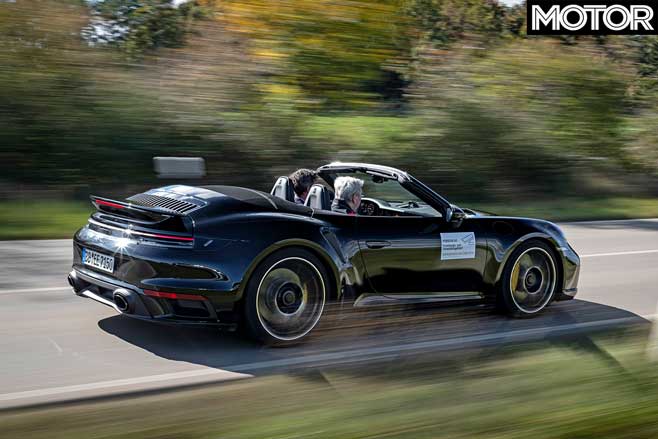
Let’s get one thing straight – the 992 911 is annoyingly good. Like, beyond excellent, and that’s just the Carreras. We’ve not yet seen, let alone driven, a Turbo, GT3 or, god willing, a GT2 RS. That will change this year when we bolt ourselves into the 485kW Turbo. Expectations high.
02 – Audi R8 RWD
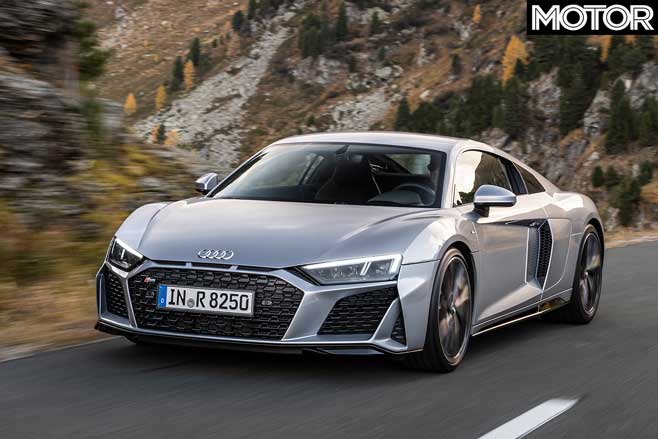
Fitting only rear driveshafts is one of the best decisions Audi (and Lamborghini) ever made. The Huracan LP580-2 and R8 RWS both firmly received the MOTOR stamp of approval, and I don’t care if the new rear-drive R8 RWD has the same power as the ‘old’ RWS, because 397kW is still plenty for one driven axle and frankly the 5.2-litre atmo V10 could make 300kW and I’d still love it.
01 – BMW M2 CS
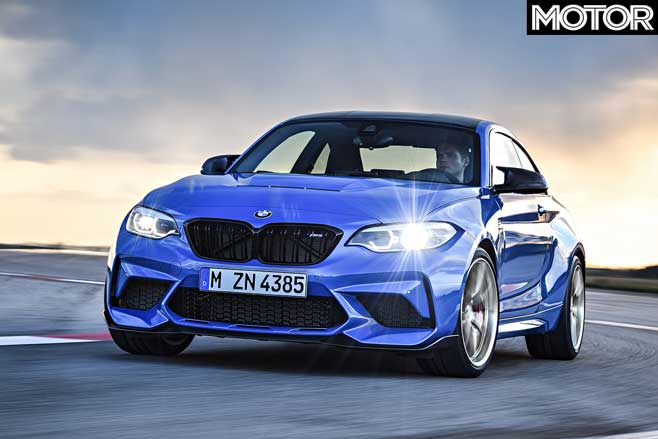
The M2 Competition is a seriously good – and seriously underrated – car. A lighter, more powerful version (with the full 331kW from the M3 Competition) mated to the same beautiful, taut chassis, could make for one of the performance cars of the year, if not the decade.
If you’ve ever been to Japan (or even if you haven’t) you might’ve noticed that the Japanese people are extremely hard workers. Having recently returned from a Christmas/New Year break spent in Tokyo, it’s immediately obvious.
Putting in extended office hours through the week and often well into the weekend is not only commonplace, but it’s also expected. Free time is a precious commodity that’s all-too-finite.
As such, when free time does come around, they certainly know how to make it count. Pass through any late-night district and you’ll find drunken businessmen still wearing suits spilling out into the street, or groups of friends singing along the street still in karaoke spirit.
Even in the modified car scene, there are salarymen sneaking out late at night in their heavily modified Lamborghinis just to hang out and escape the monotony of work life.
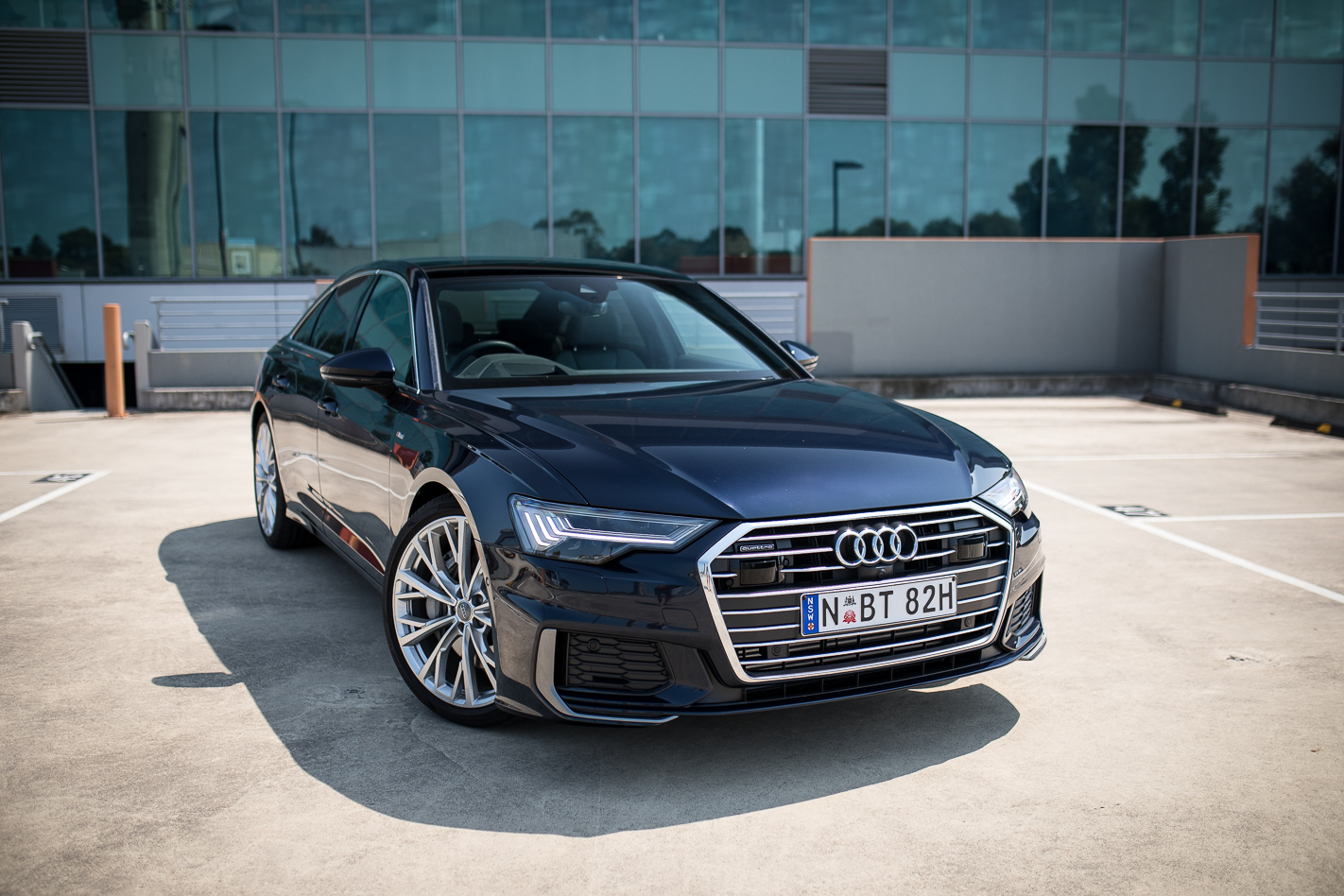
It’s this work-hard, play-hard philosophy that got me thinking about the Audi A6. It’s ostensibly a large business sedan found far more frequently among the city streets that touring the road less travelled.
Considering this, I wondered whether such a well-accomplished daily driver could get down and boogie on a drive down to the Mornington Peninsula.
With the big three German sedans, I could argue that BMW has always had the dynamic edge, Mercedes-Benz possesses the opulent option and Audi has always excelled in technology and interior design space. Those generalisations aren’t as apparent now, but just how far has Audi come?
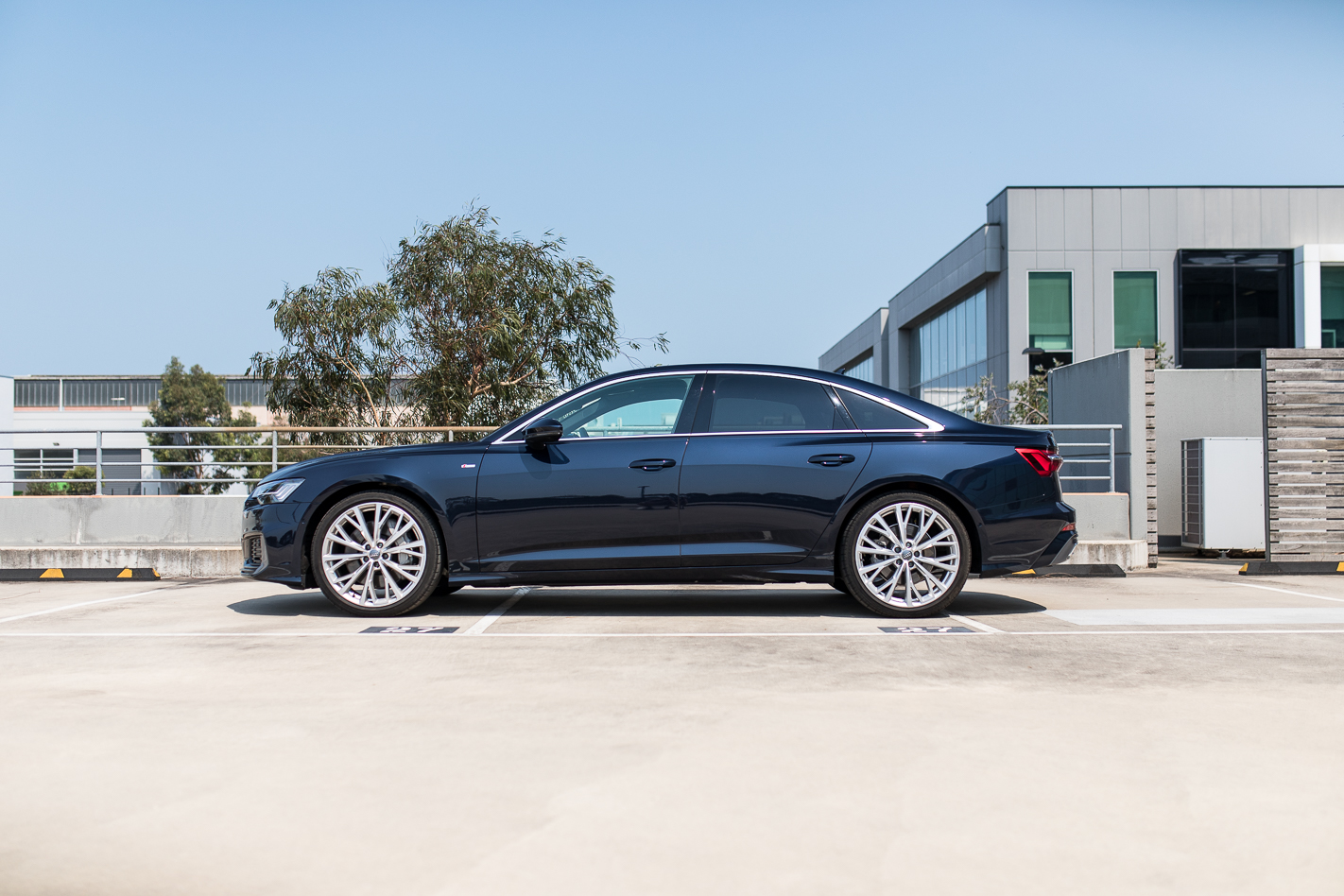
With that in mind, I’ve opted to take Audi’s range-topping A6 55 TFSI away from its familiar city surroundings for a brief jaunt down the coast to see how much fun we can pack into one day.
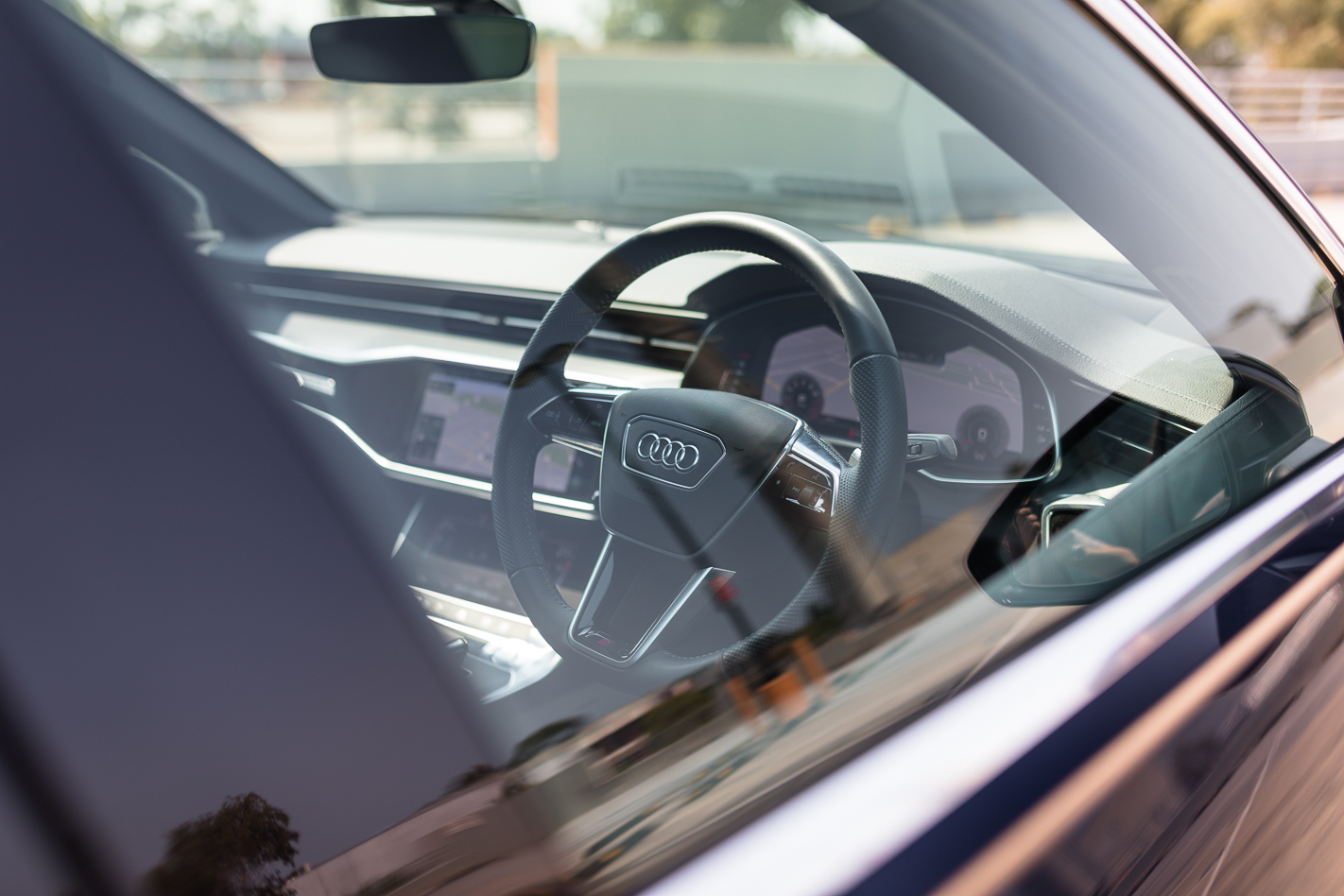
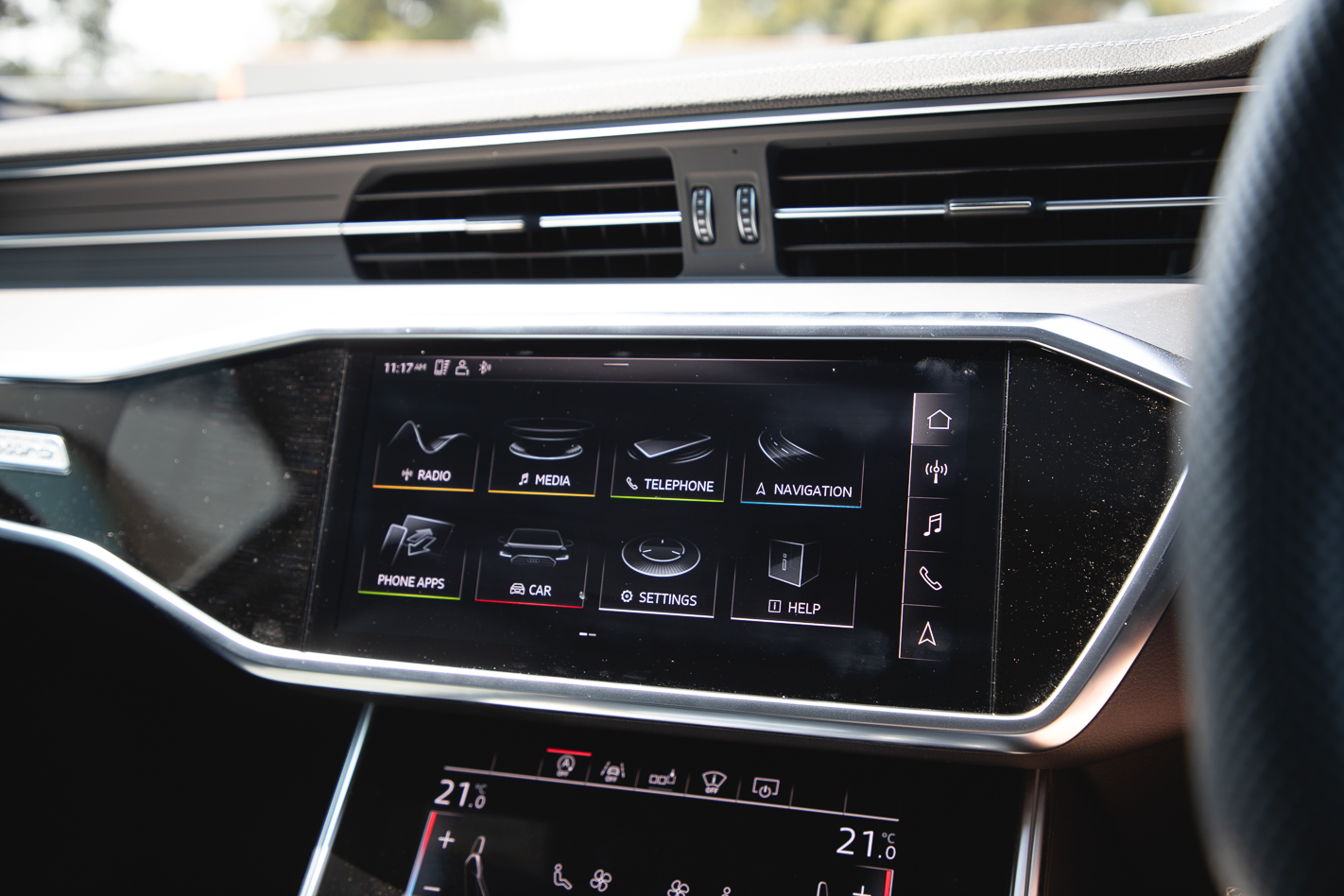
Even before I set off for a drive, it’s clear that the A6 is a joy to hustle about town. The interior, while quite minimalist in design, is comfortable and ergonomic in practice, the $2000 optional air suspension wafts over around-town imperfections imperceptibly and the latest Audi MMI multimedia system is very easy to use.
But the focus was on the extended drive down the coast, so without further mucking around I made a bee-line to the Peninsula link freeway and motored on down at 100km/h.
The freeway is one of the A6’s strong suits, with remarkably quiet wind noise and road noise only perking up slightly once hitting coarse chip bitumen.
Even still, the quiet cabin makes for an awesome sound stage thanks to the Bang and Olufsen 3D sound system which is put to good use for the quick jaunt down the coast.
Despite a number of businesses going back to work, it quickly becomes apparent that school holidays are definitely not over as traffic started to bank up. Every A6 is fitted with an adaptive cruise control system that can queue up in traffic, though, so at least it is easy to endure.
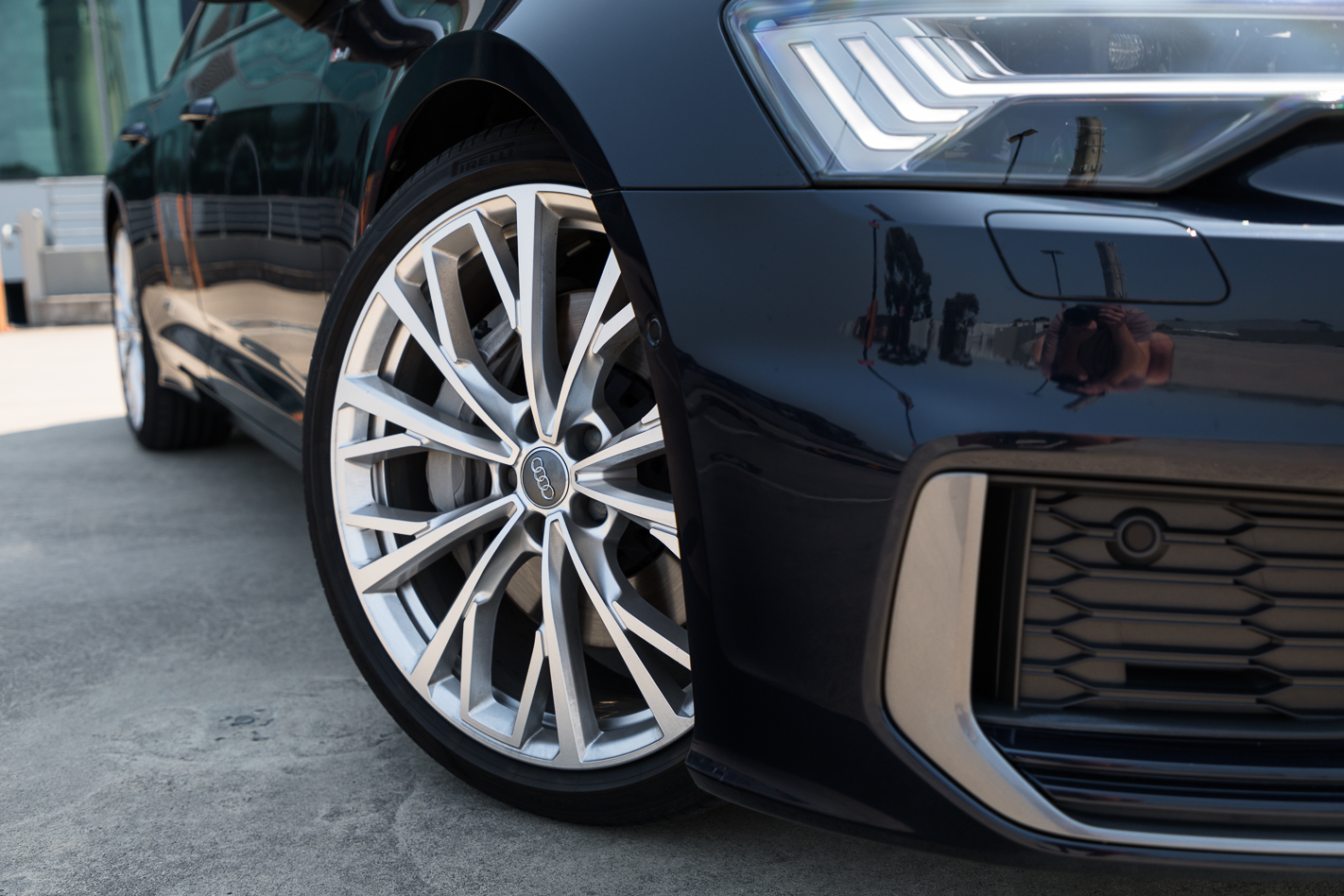
Our A6 55 TFSI comes with the Premium Plus package ($9800) which adds a few goodies like the aforementioned sound system, LED headlights, a sunroof, interior ambient lighting, an S line focused interior and massive 21-inch wheels which look suitably boss (and suspiciously like those on an R8).
Along with a few other items like $2200 Firmament blue metallic paint, $2000 air suspension and a $2500 rear seat comfort package, our car’s $116,000 base price quickly blew out to $132,500 before on-road costs.
Large six-cylinder engines are getting harder and harder to find which – forget the emissions argument for a minute – is a shame. The 3.0-litre turbo petrol V6 under the bonnet produces 250kW and 500Nm with the on-road result being oodles of power for any situation.
It’s especially evident upon overtaking on the freeway, but it also shines on B roads for the simple fact that it has enough torque to get all that weight moving –and moving quickly too.
Before too long it’s time to veer off and get down to business – or leisure, rather. First port of call is a climb to Arthur’s Seat which is busy the whole way up.
Nonetheless, there are chances to experience Dynamic mode which sharpens up the drive experience by firming up the dampening and steering feel. What was a floaty cumbersome drive perks up into a more dialled-in experience that makes the best of a heavy luxurious sedan.
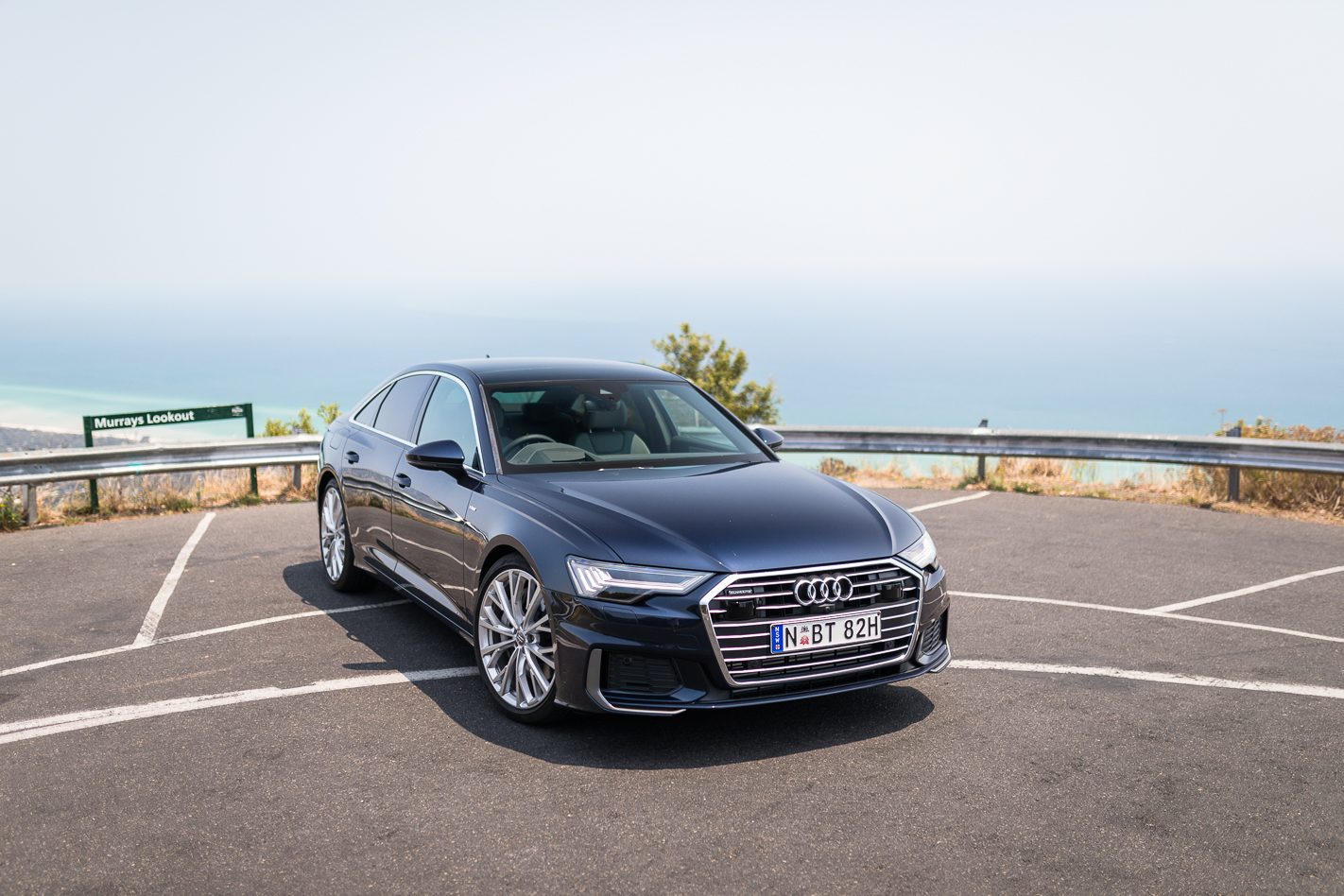
The driving position is bang-on, the steering is well-weighted, albeit not too lively through the bends and there’s assuring traction from the Quattro all-wheel drive system.
Bypassing the full carpark at the top, I stop for a quick photo-op at a lesser-known park behind Arthur’s Seat. One thing that did annoy me was the bizarre door handles that, if you pull as if you’re in a hurry, don’t actually open the door.
They require a much softer relaxed touch to pop the door open and then push to exit, at least from the inside getting out.
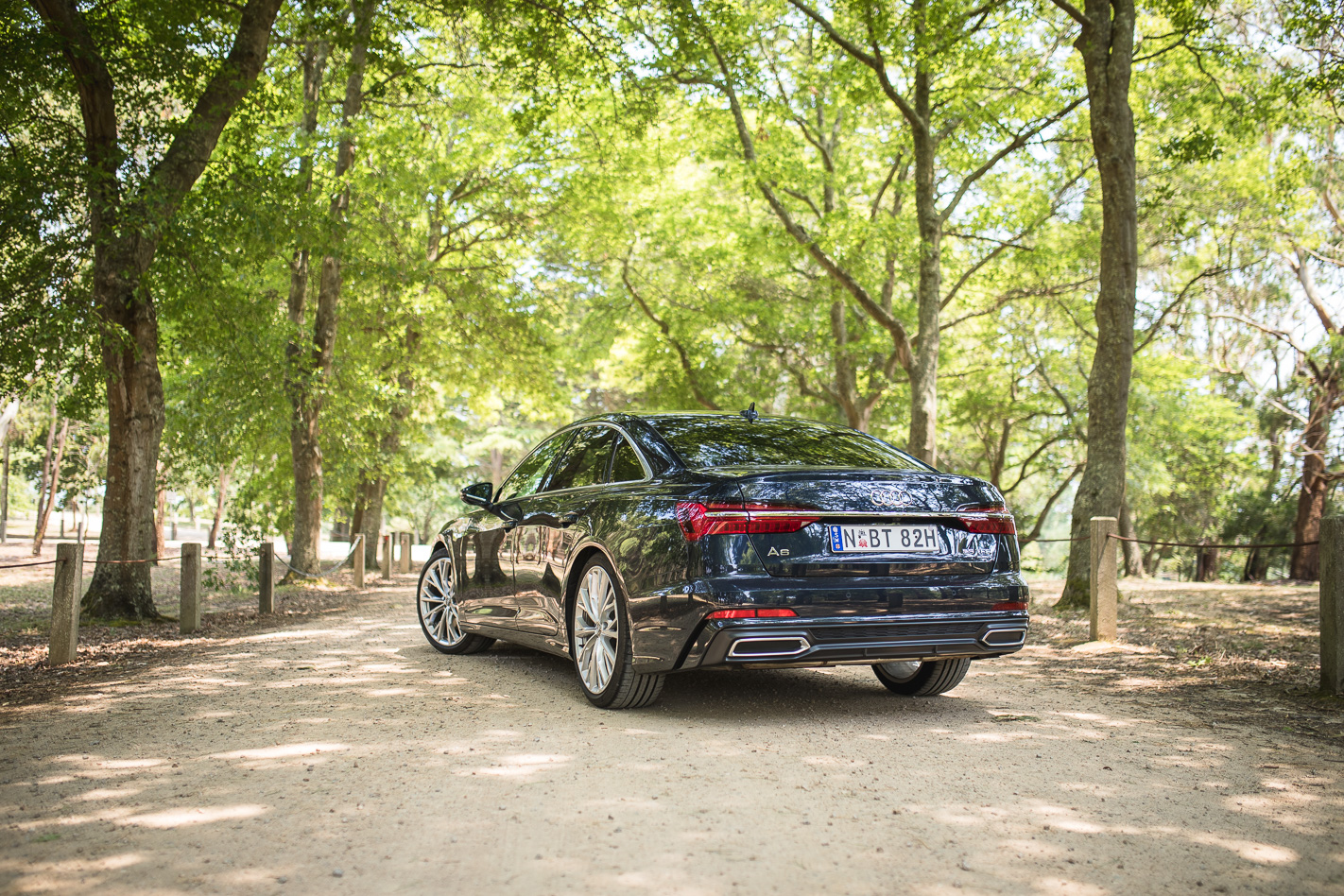
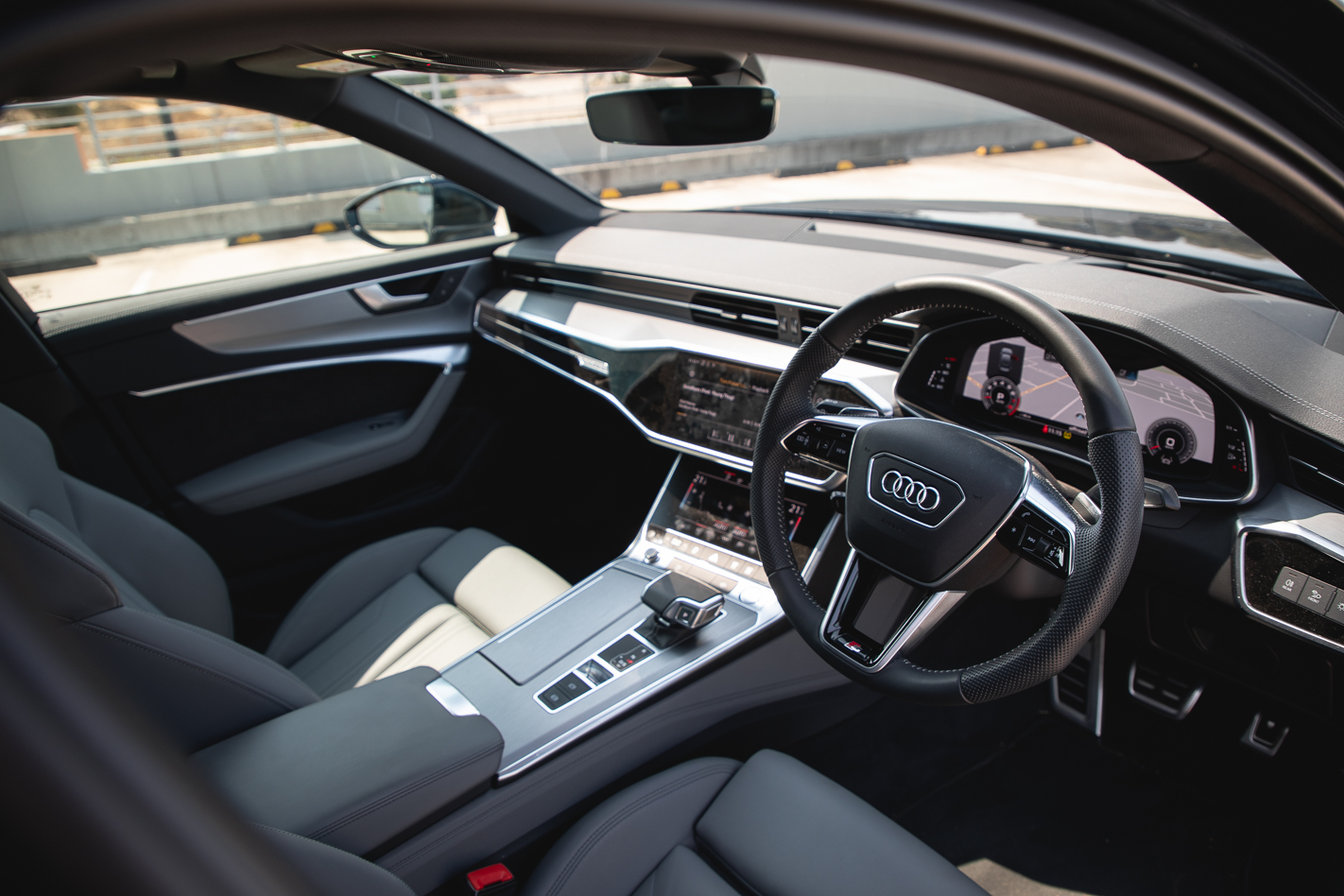
Aside from finicky door handles, the rest of the A6 interior is a lovely place to be. Despite a drab dentist chair grey that our car was upholstered in, the cabin looks modern and is intuitive to use.
Ordinarily, I’d like to see a few more physical buttons to shortcut between menu systems but the central infotainment is quite simple to switch between audio and navigation using big icons for example, and the fully digital instrument cluster is informative for anything from maps to phone functionality.
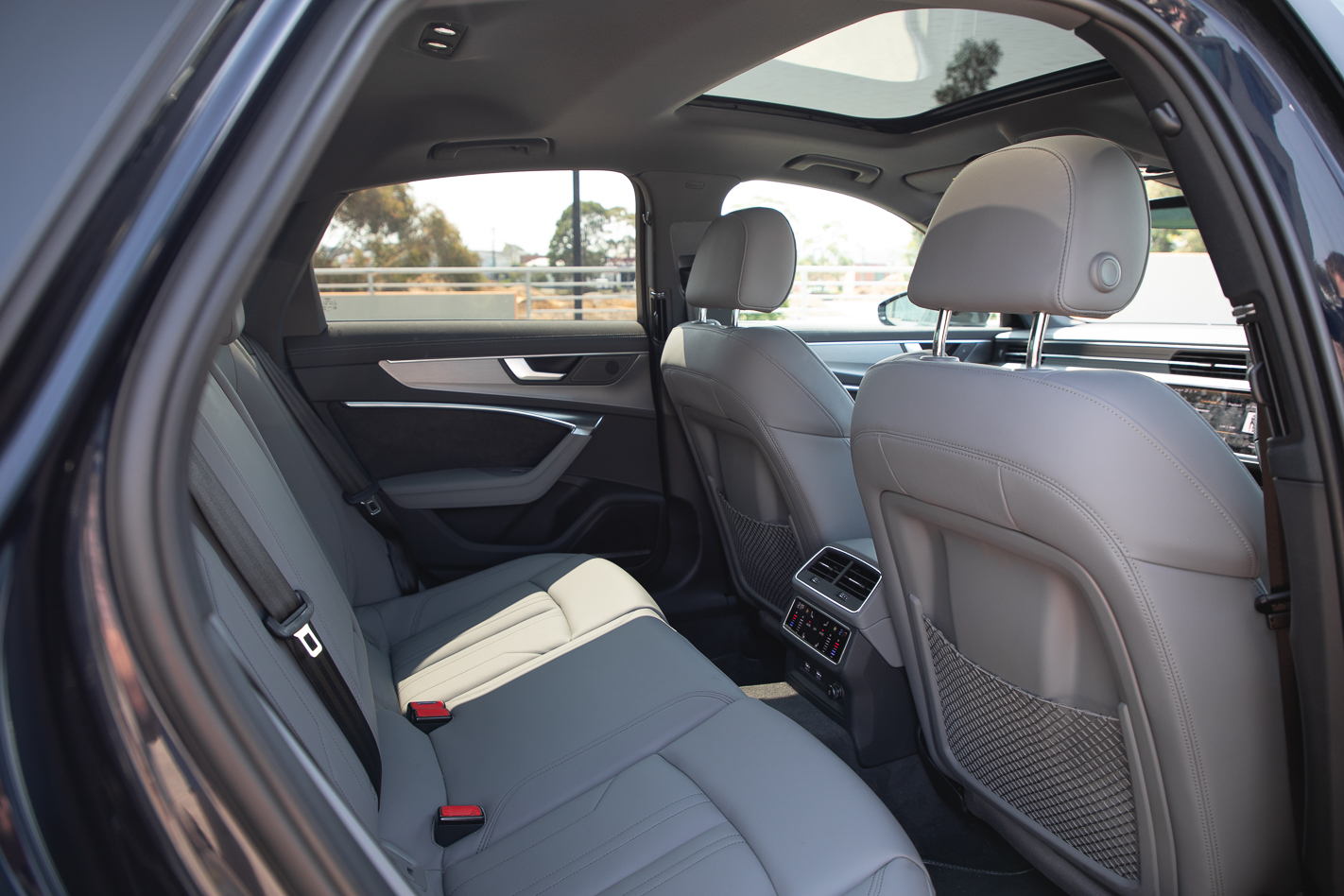
Sedans usually feature commodious space in the second row and this A6 is no different with ample legroom and headroom, and the space itself is accentuated with the rear seat comfort package, which brings climate control and extended upholstery for the door cards and centre armrest.
The boot is massive, too, and its 530-litre capacity could easily swallow multiple overnight bags, the weekly shopping or even a pair of full-size suitcases.
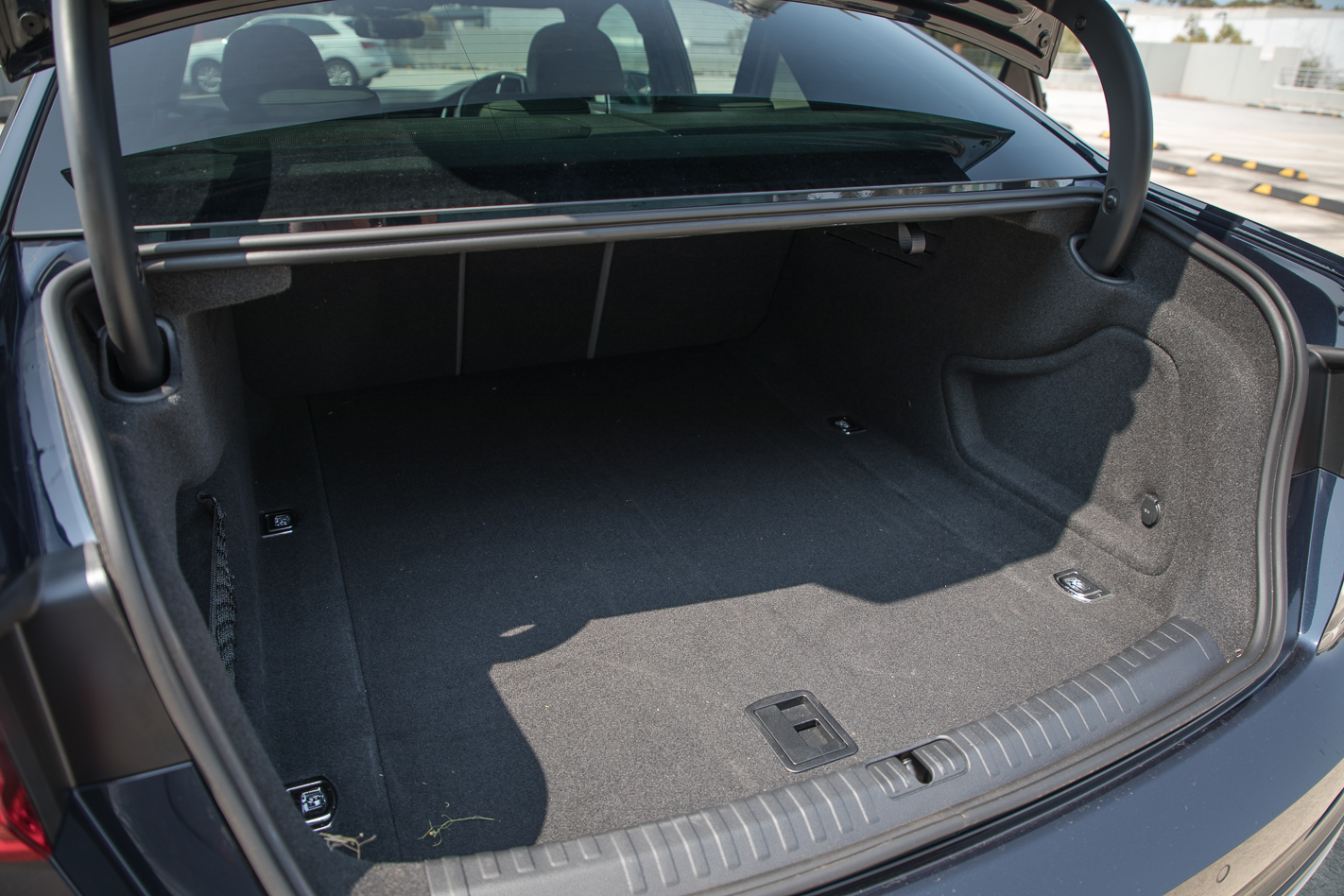
Annoyingly there are few storage options for front-seat passengers, save for a pair of cup holders next to the shifter and a shallow centre console fitted with a wireless phone charger. The door cards aren’t overly useful, either.
Photos done, I venture further inland in search of lunch. The beach gets all the glamour down on the Peninsula, but there’s a whole other landscape hiding behind Arthur’s Seat that’s equally impressive.
Especially in autumn, there are scenic pine trees and greenery overload as you pass by bush and scrub. It’s often much quieter than the front beach and there are wineries galore if you’re so inclined.
After stopping briefly at the Red Hill General Store – it serves up a tasty chicken schnitzel sandwich, by the way – it’s time to turn back to the city.
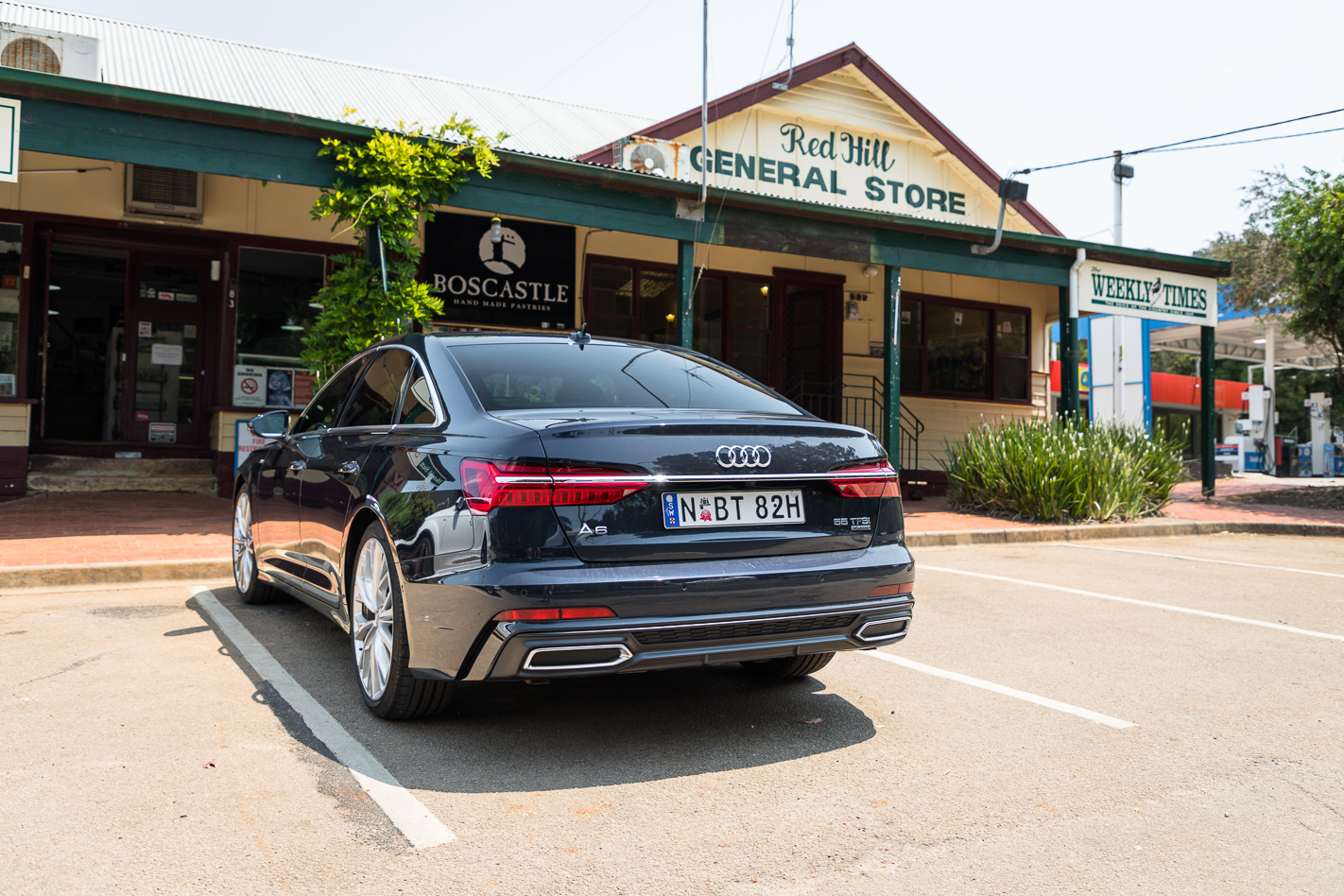
Coming back down to sea level along a downhill gradient illustrates how the new mild-hybrid system works in practice. Stepping off the throttle results in the engine shutting off and switching to the 48-volt system which ensures the car continues to glide along.
We’ve no idea how much it may aid its combined 9.8L/100km fuel consumption figure but the system itself is entirely unobtrusive.
Instead of back-tracking along the freeway, I opt for the scenic route which straddles the beach and provides a nicer view.
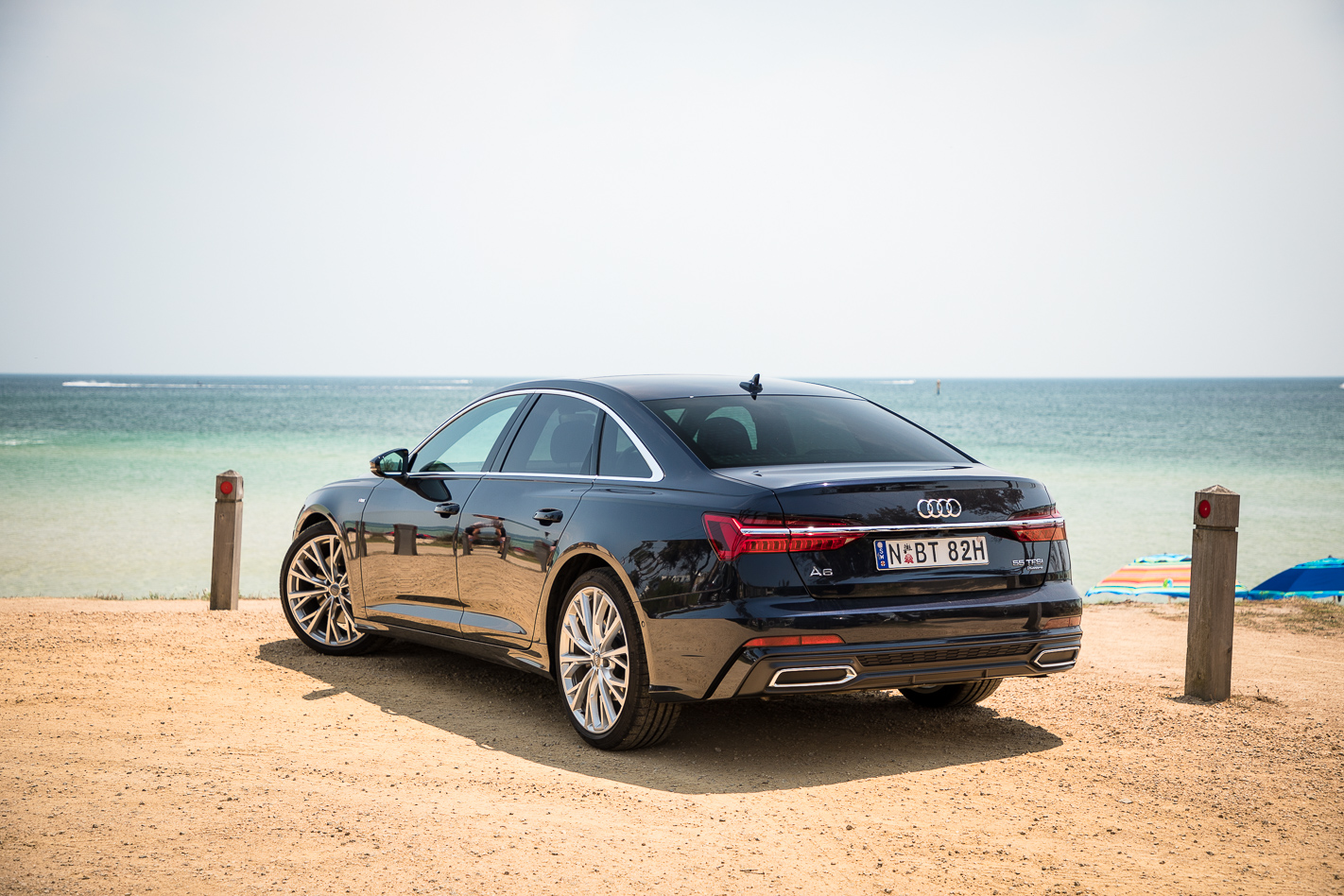
Arriving back in Melbourne the A6 immediately settles back into its comfort zone but as for the past that paints the Audi as a bit of a drab offering when compared against rivals from Mercedes and BMW, there’s no reason not to judge the A6 competitively now.
It nails the work-hard, play-hard ethos as well as any of its competitors, all the while excelling in its primary role as an everyday business sedan.
Electric cars are improving constantly in terms of range, performance and charging time – but there’s still a lot of room for improvement. While the number of hybrid cars is only likely to increase, fully-electric vehicles aren’t quite ready overtake the internal combustion engine.
That’s because most EVs and hybrids rely on electric motors powered by lithium-ion batteries, using the same tech that powers smartphones and laptops. Essentially an evolution on chemical batteries, lithium-ion batteries work well in EVs, but there are better solutions.
The use of a liquid electrolyte in lithium-ion batteries comes with a suite of disadvantages. Capacity and ability to deliver peak charge deteriorates over time and lithium-ion batteries also bleed a lot of heat, requiring weighty cooling systems to be integrated into their design. And thanks to the flammable liquid they contain, lithium-ion batteries can catch fire or even explode if damaged in an accident.
For the last few years, car makers have begun to mention solid state batteries as the next breakthrough EVs, usually quoting insane performance and range at the same time. So, what makes solid-state battery tech so good for EVs, how does it work – or is it just a bunch of vapourware?
What are solid-state batteries?
Bear with us, it’s about to get techy! Simply put, solid-state batteries use a solid electrolyte as opposed to the liquid or polymer gel one found in current lithium-ion batteries, and it can take the form of ceramics, glass, sulphites or solid polymers.
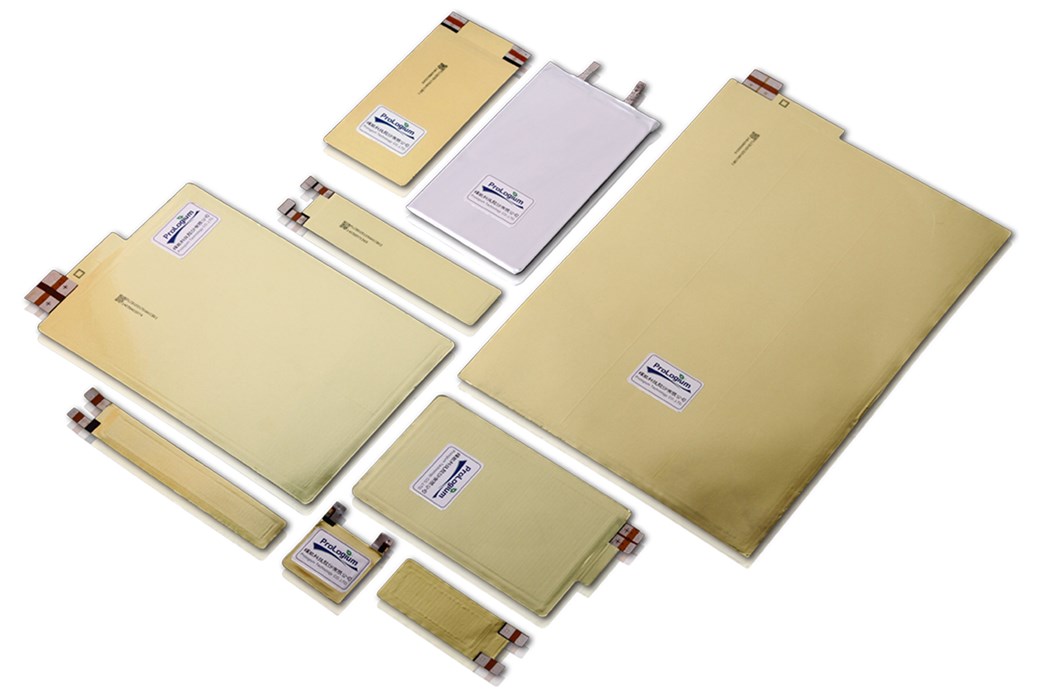
Solid electrolyte aside, solid-state batteries function much like those in lithium-ion batteries, in that they contain electrodes (cathodes and anodes) separated by an electrolyte that allows charged ions to pass through it.
How do solid state batteries work?
Much the same way as a normal battery, if we’re honest. The flow of ions trigger a chemical reaction between the battery’s materials called ‘Redox’ where, when discharging power, oxidation occurs at the anode to create compounds with free electrons, which deliver electric energy, and reduction at the cathode which sees compounds gain electrons and thus store power. When a battery is charged the process is reversed.
Much like lithium-ion batteries, when delivering power in solid-state batteries, aka discharging, positively charged ions travel through the electrolyte from the negative electrode (anode) to the positive one (cathode). This leads to a build up of positive charge in the cathode which attracts electrons from the anode. But as the electrons can’t travel through the electrolyte they have to travel across a circuit and thus deliver power to whatever it’s connected to, say an electric motor.
During charging, the opposite happens with ions flowing to the anode building up a charge that sees electrons pulled to it across a circuit from the cathode. When no more ions will flow to the negative electrode, the battery is considered fully charged.
Solid-state batteries have been around for a while, but are only used for small electronic devices like RFID tags and pacemakers and in their current state are non-rechargeable. As such, work is being done to allow them to power larger devices and be recharged.
What makes solid-state batteries the next big thing?
Thanks to the solid electrolyte having a smaller footprint, solid-state batteries promise some two to ten times the energy density of lithium-ion batteries of the same size. That means more powerful batteries without extra space, or more compact battery packs without compromising on power. That means powerful and longer range electric cars or more compact and lighter EVs. They are also expected to charge faster.
Better efficiency and energy density means solid-state batteries don’t require the cooling and control components that lithium-ion batteries do either, and that means a smaller overall footprint along with more chassis freedom and less weight. It’s little wonder that solid state is most quoted by performance car manufacturers; Bentley sees the technology as its primary way to make electrification work for them.
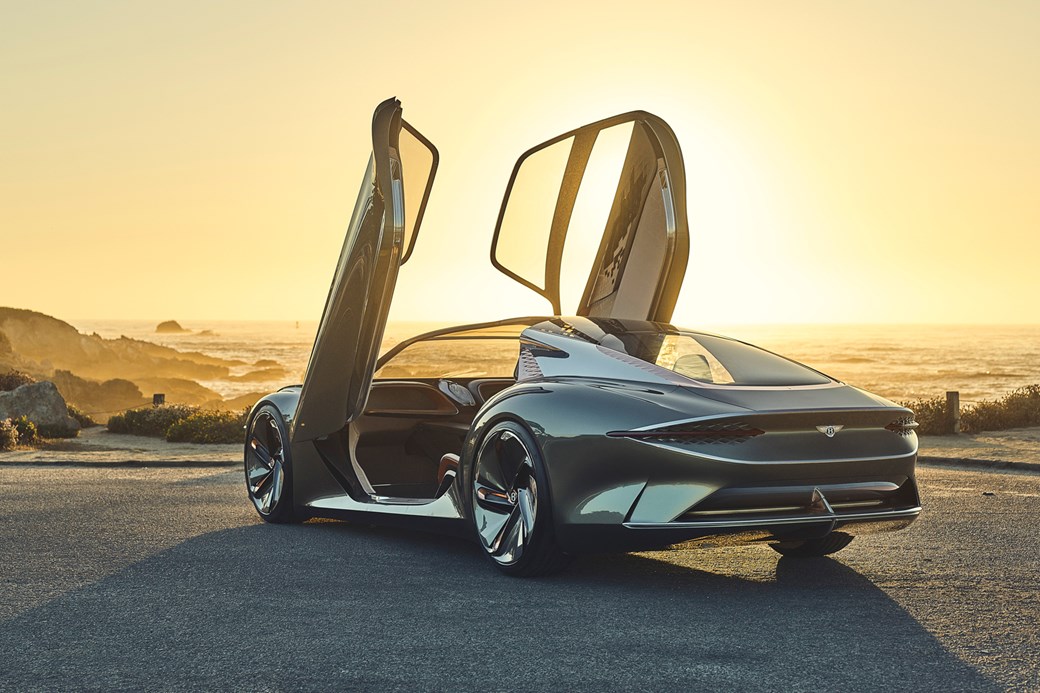
Safety is another advantage solid-state batteries claim to offer. Exothermic reactions in lithium-ion batteries can cause them to get hot, expand and potentially rupture spilling flammable and hazardous liquid electrolyte; in some cases this has caused minor explosions. Having a solid electrolyte effectively bypasses this problem.
Finally, the use of the solid-state electrolyte means the batteries can withstand more discharge and charge cycles than lithium-ion batteries, as they don’t have to suffer electrode corrosion caused by chemicals in the liquid electrolyte or the build up of solid layers in the electrolyte that deteriorates battery life. Solid-state batteries could be re-charged up to seven times more, giving them a potential lifespan of ten years as opposed to the couple of years a lithium-ion battery is expected to effectively last for.
Drawbacks
You might wonder why solid-state batteries aren’t being used in EVs given they seen to be the panacea to the problems in lithium-ion batteries. But the challenge with solid-state batteries is they are very difficult to manufacture at scale.
Not only are they currently too expensive to be pushed out into commercial use, there’s still a lot of work to be done to make them ready for mass market use, notably in EVs.
At the moment, there’s still a need to find the right atomic and chemical composition for a solid electrolyte that has the right ionic conductivity to deliver enough power for an EV motor.
That’s why we prefixed the advantages of solid-state batteries with ‘could’ as they’ve yet to prove themselves out in the real-world in a consumer gadget let alone an electric car.
Getting the solid electrolyte right is particularly important as it’s the precursor to allowing the use of lithium anodes, which can produce more lithium-ions and thereby more energy. A solid-state electrode is thought to be the solution to the problem of damaging needle-like structures called dendrites forming on the anode as it charges.
Charging ahead
Despite these challenges, the allure of solid-state batteries is clearly strong, as Toyota, Honda, and Nissan teamed up to create the Libtec consortium to develop solid-state batteries, with the former supposedly due to reveal a solid-state battery powered car at the Tokyo Olympics this year.
And there are academic institutions, battery makers, and material specialists looking into how solid-state batteries can be developed into next-generation power sources for mass use. There’s no shortage of hype and interest in solid-state batteries.
However, Toyota doesn’t expect to manage mass production of solid-state batteries until the middle of the decade. And other car makers like Volkswagen aren’t expecting to have solid-state batteries ready for car use until at least 2025.
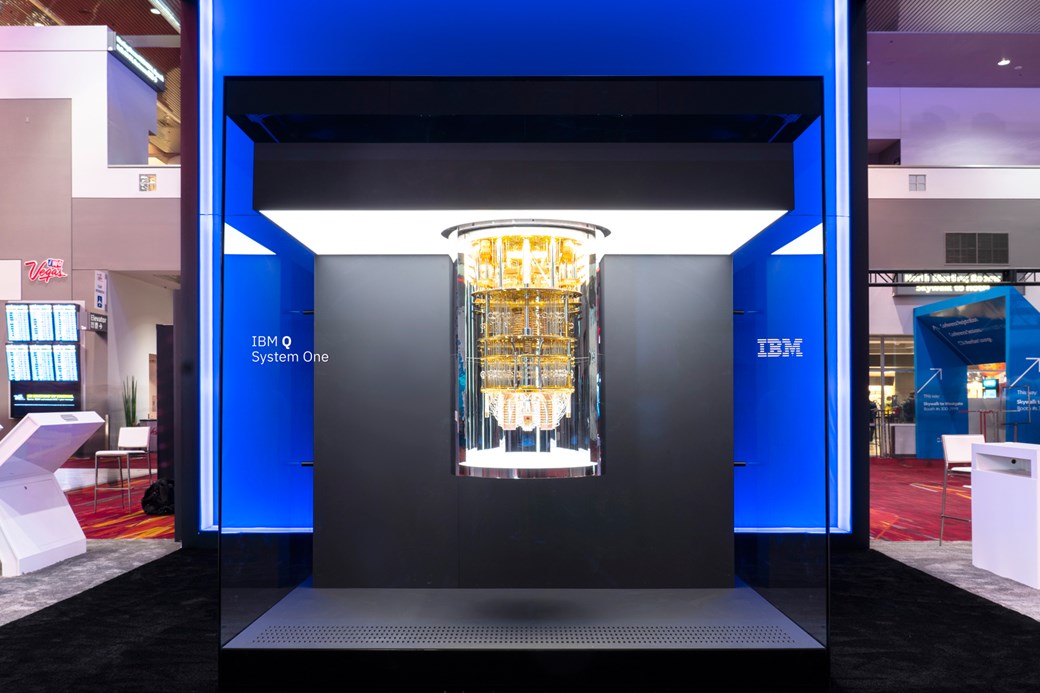
IBM and Daimler are working together to better understand battery technology. ‘We need to find a fundamentally different chemistry to create the batteries of the future,’ Katie Pizzolato, director of applications research at IBM, says. ‘Quantum computing could let us effectively peer inside the batteries chemical reactions, to better understand the materials and reactions that will give the world those better batteries.’
Vacuum and other air-blowing tech maker Dyson had planned to make an electric car powered by solid-state batteries by 2021. But it killed off its car plans last Autumn, though it aims to keep working on the battery tech.
Fisker Inc, the reincarnation of the collapsed Fisker Automotive, previously stated a lofty ambition of having a car that uses solid-state batteries ready for 2020. But at the Consumer Electronics Show this year, it simply showed off the Ocean SUV, which is powered by lithium-ion batteries; there was no word on a solid-state battery setup.
So while there’s a lot of activity around the development of solid-state batteries, it’s quite unlikely you’ll see an EV powered by them on the road any time soon.
A short circuit
As one of the largest lithium-ion battery makers in the world, Panasonic has skin in that battery game. Nevertheless it reckons solid-state batteries are still some ten years away from commercial use.
It does co-own Tesla’s Gigafactory and supplies the batteries for Tesla cars, and it reckons the improvement in EV batteries in the short-term will come from further developing lithium-ion batteries.
Rather than go down the solid-state route, Tesla is working on improving the performance of lithium-ion batteries, with it last year touting new chemistry which could power an EV for more than a million kilometres.
Given the improvements in lithium-ion batteries and the range that can be extracted out from them, as well as how they are already being mass produced, it’s unlikely we’ll see them ousted by solid-state batteries anytime soon.
But solid state batteries do look like the future power source for electric cars, it’s just the road to them might be longer than first thought.
This article originally appeared on carmagazine.co.uk
Of the five finalists for Wheels COTY 2020, the Mercedes-Benz EQC is the dark horse.
Coming into testing, there were high expectations for the Mazda3, Tesla Model 3, Toyota Rav4 and Porsche 911.
If you asked any of the judges what they thought would make the final five before testing started, you’d be hard pressed to have a single nomination for Mercedes-Benz’s first EV.
But here it is, having barged its way into the pointy end of the field with an excellent performance at the first round of testing.
This is an electric vehicle that does away with novelty and gimmicks, and instead gets on with the job of being a damn fine automobile.
Despite its size and heft, the EQC is also deceptively quick; beating Merc’s claimed 0-100km/h time by almost half second during testing.
Judges were mightily impressed with how the EQC rode, praising the suspension and chassis tune.
Comfort and packaging were also highlighted by the judging panel, showcasing the EQC’s ability to offer genuine practicality.
The COTY road loop is a demanding beast, and the judges tackle it with great enthusiasm, yet the EQC’s real-world consumption didn’t falter, holding steadfast throughout testing.
In order to claim the biggest award in Australian motoring, the Mercedes-Benz EQC will have to beat four pre-event favourites. Can it do it, and provide Merc its first COTY in 12 years? All will be revealed at the Australian Motoring Awards on January 30.
Want to know what one of WhichCar’s most heavily-trafficked gaming stories of last year was? It’s the one which confirmed that Need For Speed Heat wouldn’t support the use of racing wheel peripherals at its launch, despite the game’s developers boasting of a fancy new handling model.
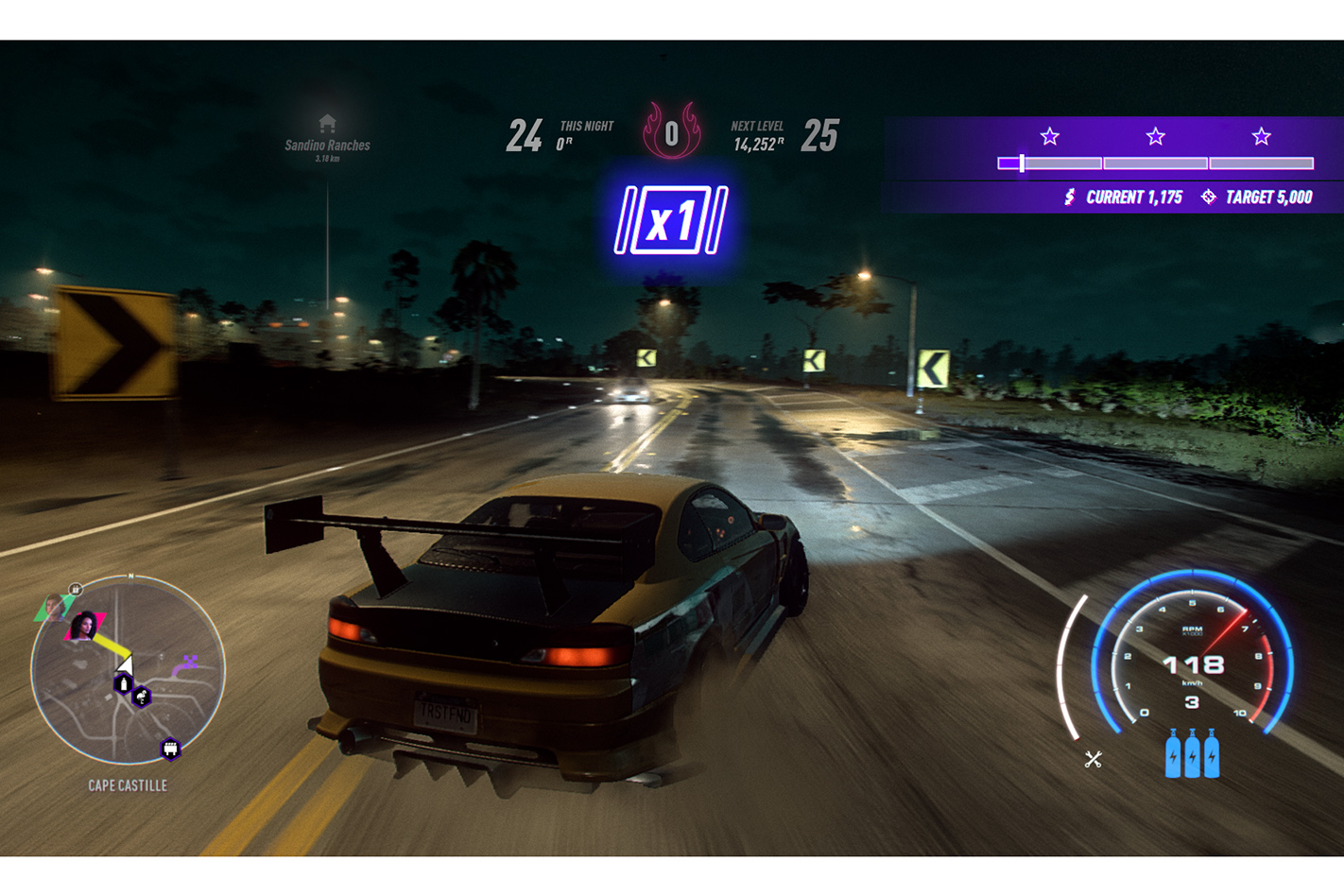
Clearly, plenty of you wanted something a little more sophisticated than the ol’ gamepad.
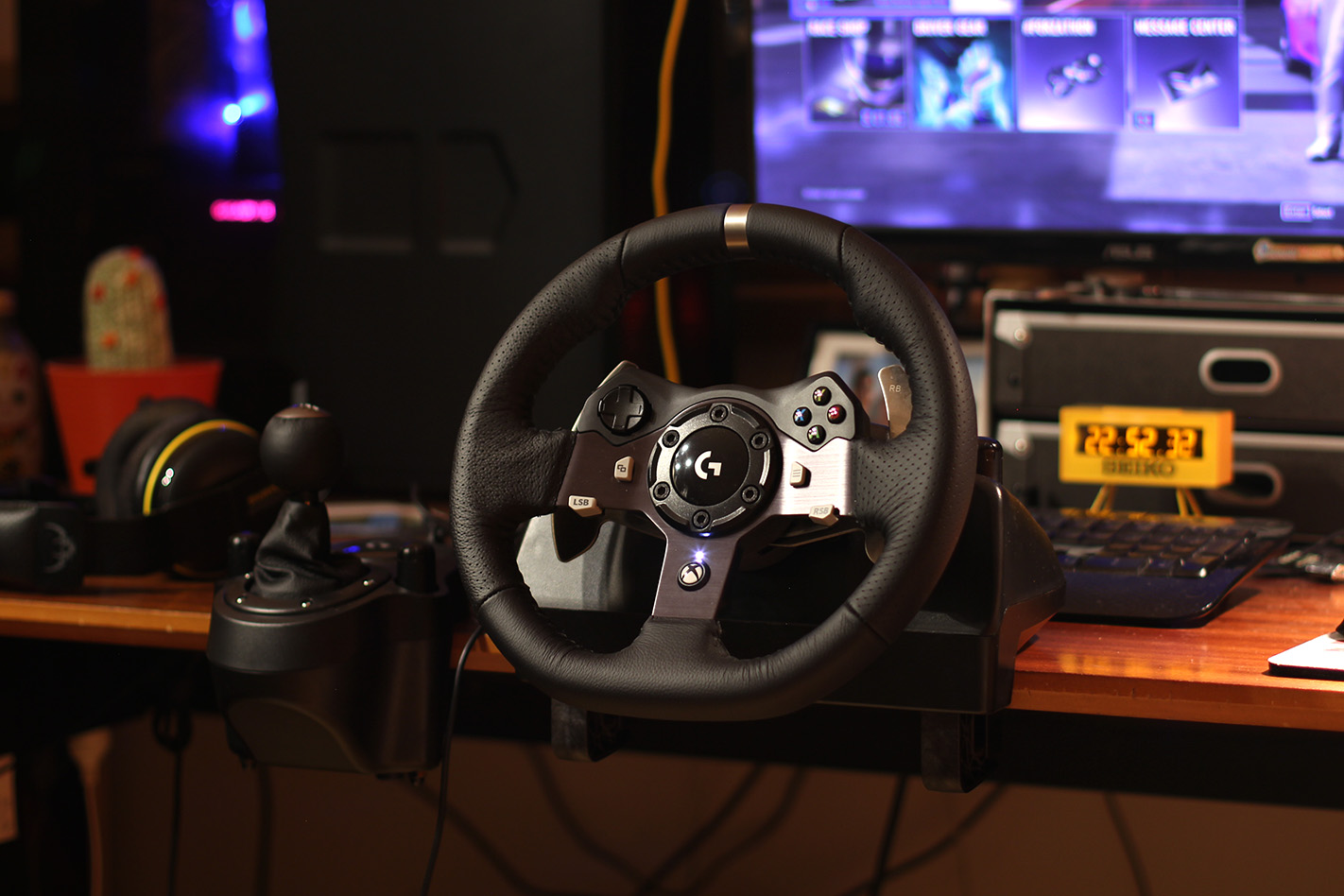
But now a couple of months have passed since the hotly-anticipated latest instalment to the Need For Speed franchise went on sale, and it appears that the volume of inquiries and complaints about Heat’s gamepad-only experience was enough to prompt Electronic Arts to enable the use of wheels. Hooray, right?
The update will roll out at the end of the month, and right now the list of wheels that have been confirmed to work with Heat is fairly small. For Thrustmaster the T300RS, TX, T150 and TMX are compatible, while the Logitech G29/G920 twins and Fanatec CSL Elite round out the list. Others may also work, however EA and Ghost Games have yet to test them.
Need For Speed Heat’s end-of-month update will also bring a few other features. The emote wheel from NFS Payback gets grafted in to make it easier to communicate with other human players in online mode without having to use voice chat, and driving through a fuel station will also reset any cosmetic damage to your paint and graphics, rather than just repairing the mechanicals and removing any dents.
Those driving manually with a gamepad will also find that they can now change gear when in proximity to an event or garage rather than entering said event or garage, which should make for a slightly less frustrating experience.
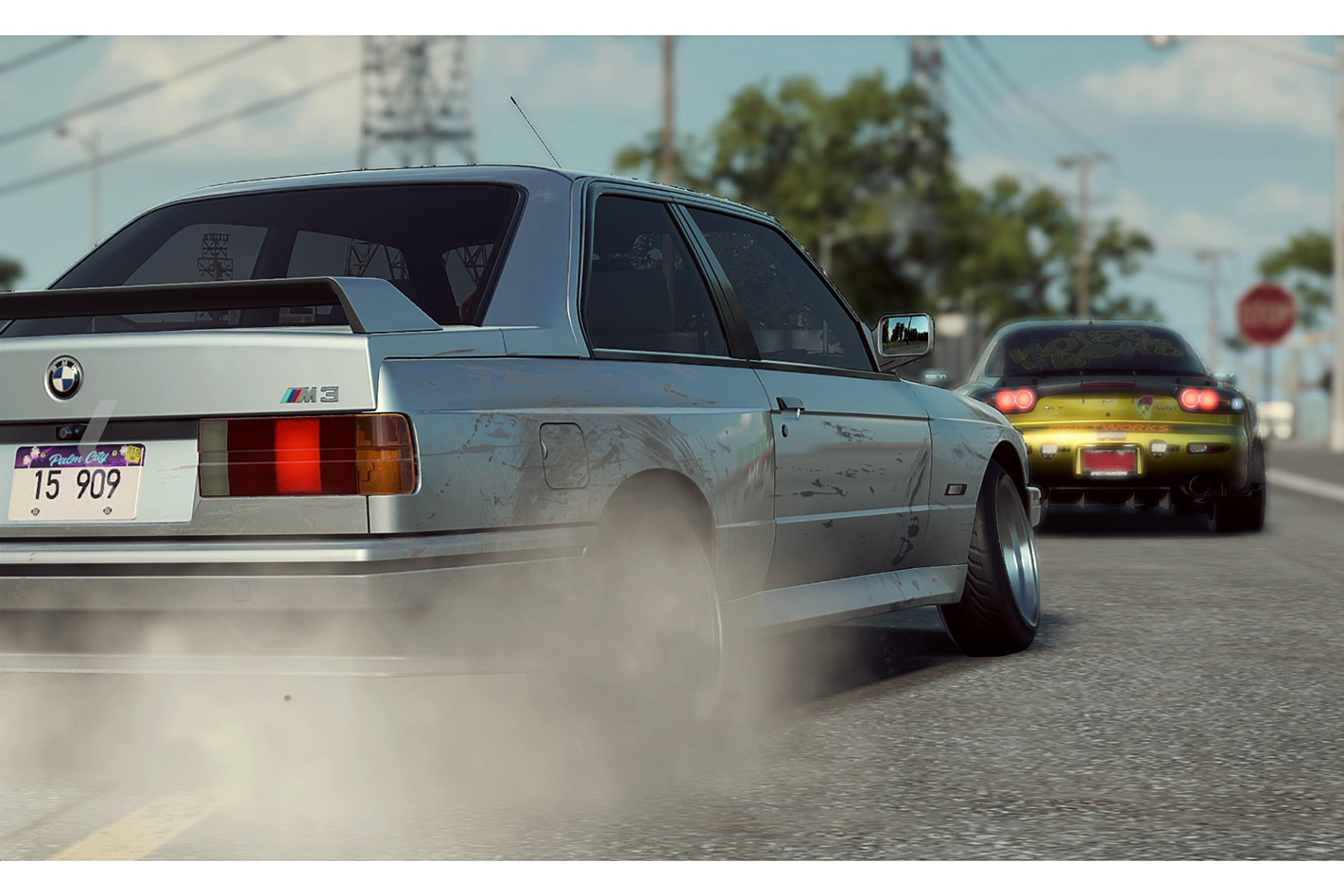
EA will also add their first purchasable perk for Heat (slightly controversial, given everyone hated the loot box mechanics and in-game monetisation of its predecessor, NFS Payback), though it’s in the form of a fairly innocuous map upgrade that reveals all hidden locations for flamingos, fuel stations, graffiti spots, billboards and other activities.
Completionists will probably appreciate it, but regular gamers will likely just be content to find those locations through exploration. It’s not yet clear how much the map upgrade will cost in real-world dollars.
Intriguingly, Electronic Arts also dropped a big hint that an upcoming update will add even more to the Heat experience, finishing their announcement for the January update with this five-word promise: “there will be more cars”. Watch this space.
