
We would not normally begin a review of the latest hot hatchback with a reference to Ferrari, but bear with us.
When Ferrari launches a new car, journalists are ritually subjected to a tableaux of complicated graphs and diagrams. It’s dry but oddly compelling, and reasonable because its chassis electronics have become bewilderingly complex works of art and Ferrari would like us to appreciate that.
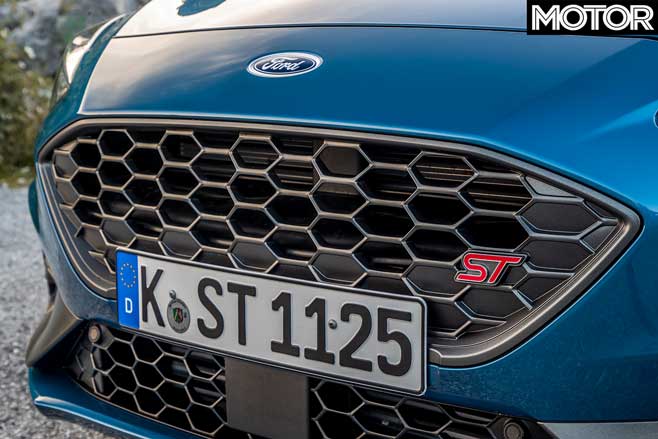
Well, Ford pulled a Ferrari for the fourth-generation Focus ST. Justifiably, too. This is a complicated car, an ocean of binary code away from the last ST, which was launched seven years ago with nothing like the same spread of technologies.
We were presented with graphs that plot torque from the upsized engine against the locking rate for the front axle’s electronic limited-slip differential. The hardware comes from GKN and is controlled via a locking clutch not unlike VW’s ‘XDS+’ system, so while the redline assigned to Track mode (yes, there are now modes) rockets up in a way we’re told would probably help the newcomer lap a quick circuit such as the Nürburgring faster even than the old Focus RS, its Slippery mode is reassuringly gentle.
There’s also brake-based torque vectoring to trim understeer, which not so long ago would have itself been the headline news but is now merely part of the scenery.
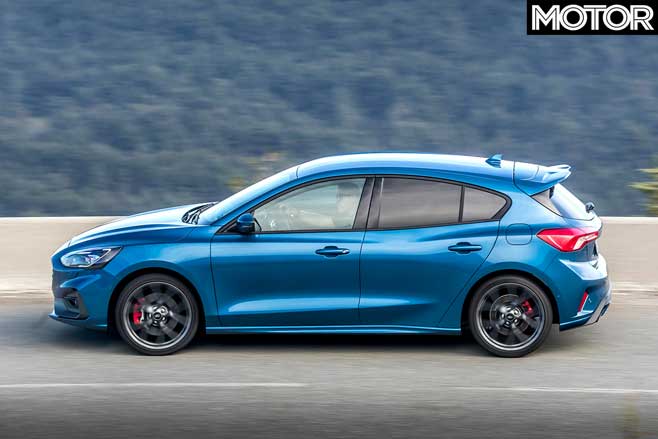
Another graph from the engineers tells us the continuously controlled adaptive dampers, which are reactive to the road surface but respond in just a couple of milliseconds, exert roughly twice as much force in Track as in Normal.
Admittedly, to get access to the full multi-mode functionality, you’ll need the optional Performance pack – otherwise the dampers operate only in a Goldilocks setting between Normal and Sport – and that includes further programs for rev matching, launch control and, goodness gracious, ‘flat’ shifting, for which you needn’t even lift off the accelerator pedal if you’re close enough to the redline.
Deprived of context, you might think we were talking about the latest Porsche 911 Turbo.
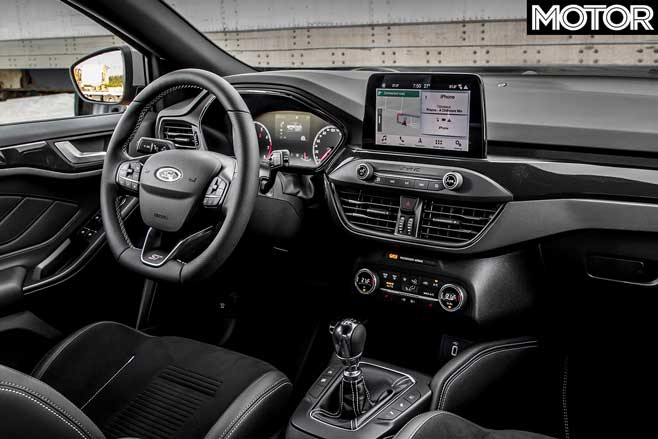
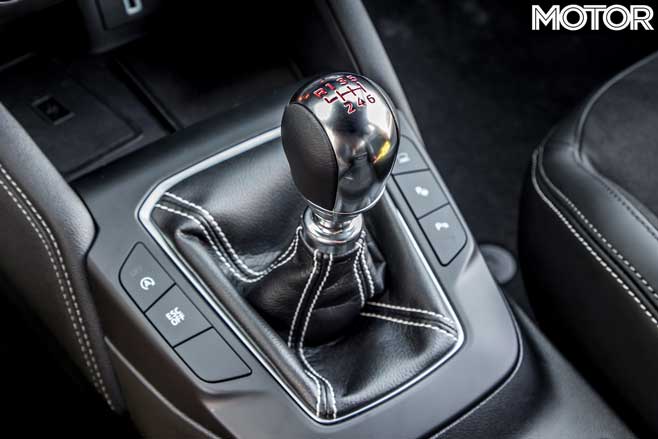
Despite all its tech, though, the front-drive Focus ST remains a familiar device, with a transverse four-cylinder turbo mated to a six-speed manual (or optional seven-speed auto). It has been engineered to be an enjoyable everyday performance car, with track-day potential but excellent road manners.
Does familiar mean predictable? Not in this case.
In an industry obsessed with reducing cubic centimetres, that engine is an overhauled version of the 2.3-litre from the entry-level Mustang and uses a version of the anti-lag system first seen on the Ford GT supercar. The 206kW it develops is competitive if unexceptional, but 420Nm is almost a fifth up on the old 2.0-litre Focus ST and the highest output in this class.
Through the mid-range, Ford says, the ST is quick enough to see off the old Focus RS – with closer gear ratios and so much torque pushing against less weight, that’s certainly plausible – and the sprint to 100km/h is done and dusted in 5.7sec, an improvement of 0.8sec over the previous ST.
Top speed is less important and capped at 250km/h. However, the fact that ST prototypes regularly nudged 275 on the autobahns hints at excellent aerodynamic efficiency, which matters if you care about rolling refinement and fuel economy.
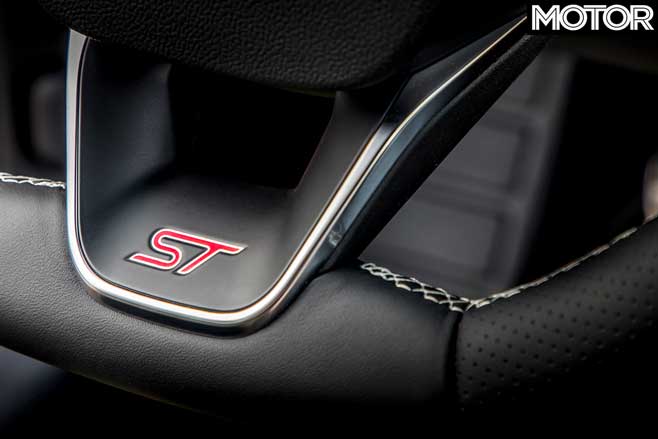
Yet if this car needs to excel in one single area, it’s chassis dynamics. We know the Focus’s lightweight C2 platform provides a basis for stellar handling traits, but the ST sits 10mm closer to the ground and has unique steering knuckles, firmer bushes, new spring and damper units (20/13 per cent stiffer front/rear), thicker anti-roll bars and bigger brakes. During our short test drive, the new ST proves immensely good fun, with a possibly class-leading blend of everyday manners and mischievous handling.
The engine may be a bit ordinary in the Mustang, but exerts its full personality in a humble Focus, spinning with an offbeat heave. With no active exhaust, there’s a generous degree of sound ‘enhancement’ for the cabin that may irk purists, but it’s well judged.
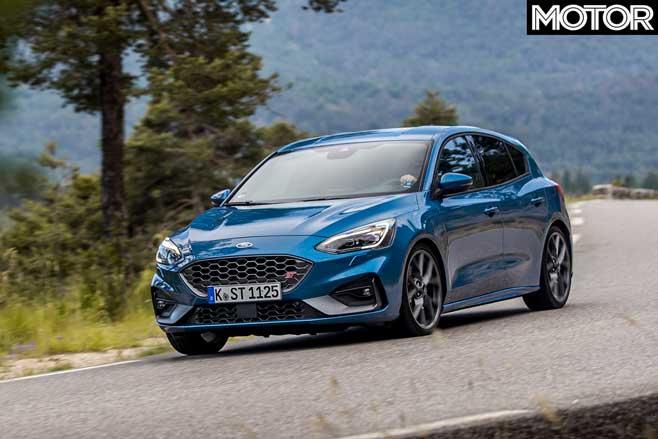
As with many European fast Fords, there’s quite a bit of flywheel effect when you lift off the accelerator, but response is otherwise good, hitting like a sledgehammer from 2500-4500rpm and revving freely to the redline. The powertrain gets a big tick.
At 11.3:1, the steering is very quick and takes some getting used to. In terms of feel, it doesn’t have quite the grit of a Renault Sport Megane or the gloriously natural heft of the Type R, but it’s similarly involving and allows you to explore the Focus ST’s handling, which you’ll want to do often.
Track mode untethers a playful side, but disable the stability control and the ST becomes as wildly flamboyant as you can handle. The grip generated by the front Michelins provides the foundation for controllable lift-off oversteer. On a trailing throttle, you might get some rivals – notably the Hyundai i30 N and the RS Megane – to behave in this way, but none does it so neatly or with such a basic and natural enthusiasm.
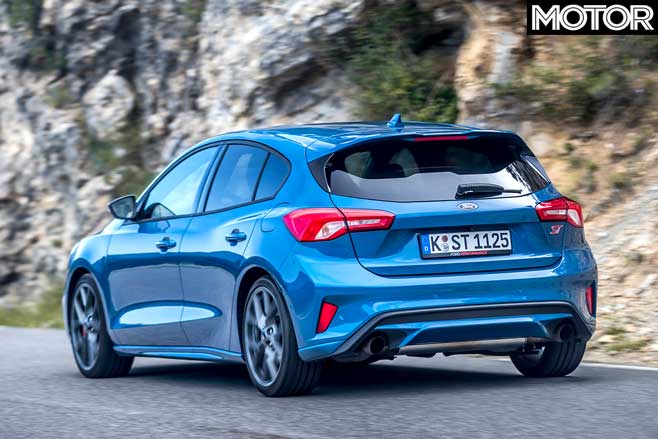
Mid-corner stability is very good, if not quite a match for more hardcore rivals, and body movements are nicely controlled. The Focus does feel a touch too nose-heavy, and through quick direction changes it can seem as though incipient pitch and roll motions will develop into something quite substantial.
It rarely gets that far, the suspension acting forcefully but deftly, and you’re left with a car that fluidly communicates any remaining reserves of grip and balance through its stance and rarely becomes too much of a slave to the physics. In short, it’s good, quick, confidence-inspiring fun, and the new electronic differential is effective and never overbearing.
Ford says the Focus ST was primarily developed for road use but shouldn’t feel out of its depth at the track days many customers frequent.
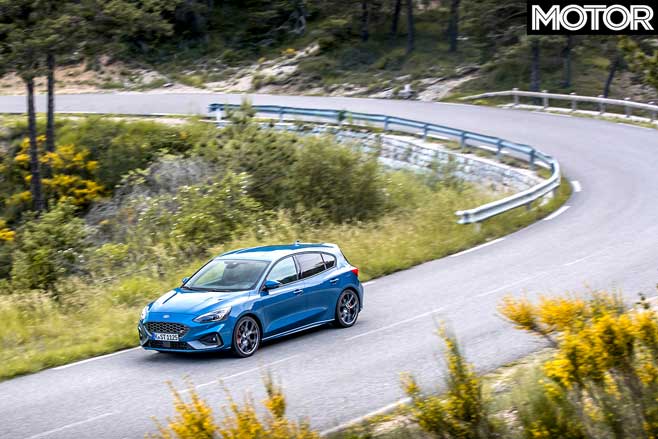
The brakes, with their larger discs, are said to resist fade four times better than the old car and use an electronic booster that adjusts the biting point to keep pedal feel consistent. It also has a ‘torque disturbance reduction’ system that dials out torque-steer by counter-torqueing the steering column when the e-diff gets punchy. Both elements seem decently beneficial.
The engineers admit the Civic Type R develops massive, nailed-down stability and is better suited to track work, but they’ve deliberately plotted a different course. Nimbleness over stability, and useability over lap times. The two cars will inevitably be compared, but they espouse contrasting approaches to the hot-hatch recipe.
Crucially, the Focus ST is an extremely rounded, practical device – a key part of the brief, but one that’s sometimes missed in this category. The boot holds 375 litres, there’s near class-leading passenger space, and backing the dampers off reveals ride quality that’s a match for the Golf GTI.
The new Focus ST might just be the missing piece of the puzzle in a closely fought segment. It isn’t the sharpest-handling hot hatch and perhaps not the easiest to live with, but it blends those conflicting worlds skilfully and with considerable charisma.
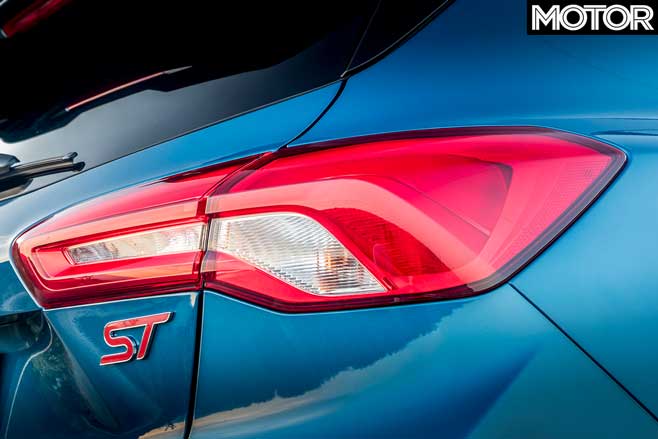
2020 FORD FOCUS ST SPECS Engine: 2261cc inline-4, DOHC, 16v, turbo Power: 206kW @ 5500rpm Torque: 420Nm @ 3000-4000rpm Weight: 1508kg 0-100km/h: 5.7sec (claimed) Price: $44,690
Like: New tech; performance boost; clinically direct steering; blend of road and track manners; Performance pack Dislike: Nose-heavy feel; not the ultimate track star
Rating: 4.5 out of 5 stars
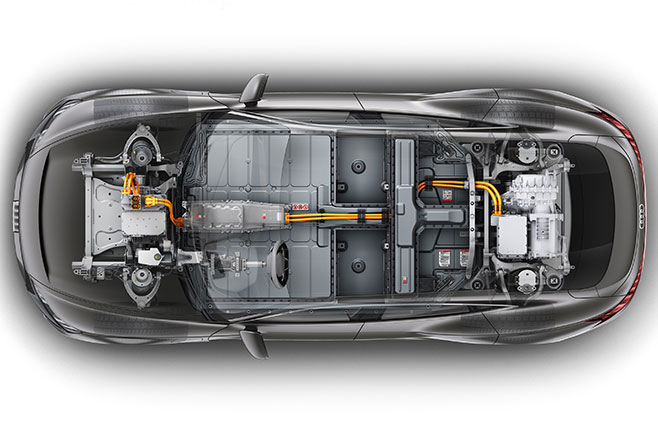
Audi’s e-tron electric vehicle portfolio will be flooded with more driver-focused offerings from 2021, with a new high-performance electric platform under development with Porsche.
Dubbed the Premium Platform Electric, the new performance and luxury focused architecture will underpin a new generation of the company’s EVs, following in the tyre tracks of the e-tron Sportback, which shares its technology with the game-changing Porsche Taycan.
According to Audi design head Marc Lichte, the PPE will form the basis of mid-sized to large models with serious performance potential, while smaller Audi’s will borrow Volkswagen’s MEB electric platform.
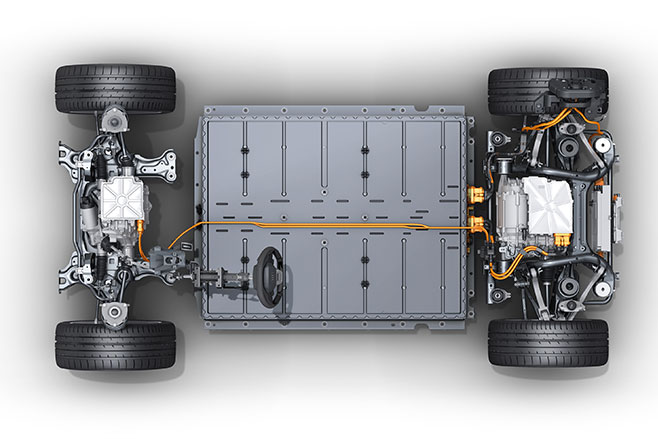
“We are working on PPE – a battery electric platform which we are doing together with Porsche,” he said. “This platform can be scaled from B-segment up to D-segment. Because of this, our battery electric vehicle portfolio will grow very fast in the next two or three years.
“There will be a big family on the MEB platform and PPE will be for the B-segment up to D-segment.”
According to Lichte, MEB will serve a range of more accessible electric Audi models but the PPE venture is necessary to serve Audi’s customers who expect features such as higher speed limits and greater performance.
With higher power-outputs, more athletic ability and greater dynamics, it’s likely a PPE underpinned Audi will pioneer the first electric RS model from the German car maker.
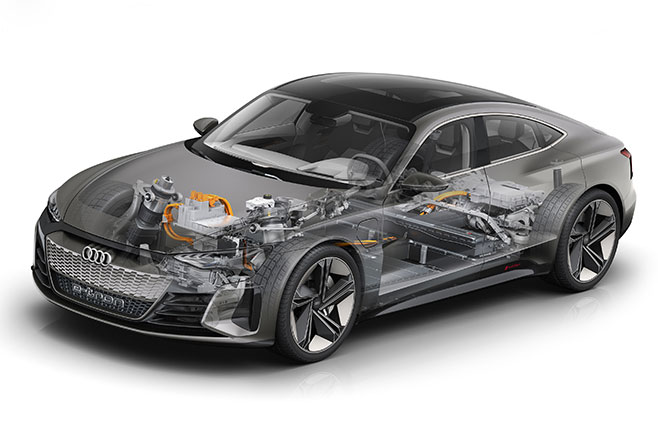
Audi Sport joint managing director Oliver Hoffmann explained that the mild hybrid system found in the latest RS7 and RS6 models is a stepping stone to more electrification followed by plug-in hybrids in the RS family.
“We will launch the next generation of RS also with plug-in hybrid technology.”
While no confirmation could be made for a pure EV RS Audi at this stage, Hoffmann said “there is space for it, yes”.
In the meantime, at least three e-tron models will fill the gap between hybrid and full-fat electric RS models.
“We are launching the e-tron GT the end of next year this car is based on the Porsche Taycan, we developed the car together with Porsche and we are producing it beside the R8. It’s the first fully electric sportscar produced at Audi Sport.”
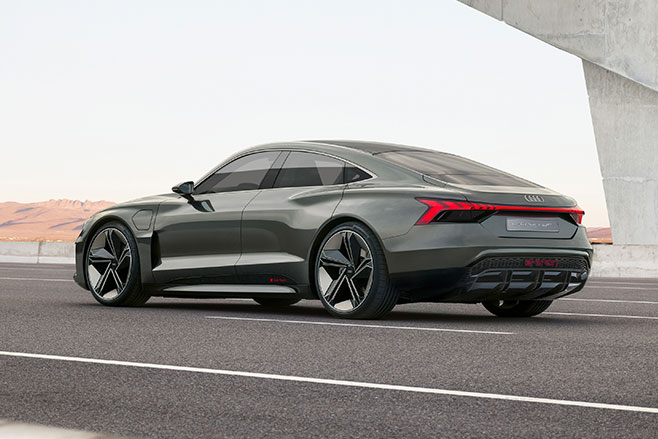
Alongside the GT and Sportback, Hoffmann reconfirmed a Q4 e-tron would form a third pure EV model to bolster the range in the near future.
Audi Sport’s range of S and RS vehicles has forged a reputation for high driver engagement partly thanks to an unapologetic report regardless of the engine configuration or segment. Interestingly though, Lichte revealed that Audi’s future range of high-performance EVs would not make a sound whether it be naturally or synthetically generated.
“You focus more on the performance without any noise so it’s not planned,” he said.
Instead of augmented or synthesized sounds, Lichte said the company was focusing on making its EVs as quiet as possible with advanced aerodynamics.
“Noise is a very important topic because when there is no combustion engine noise you are more sensitive to wind noises. In the e-tron Sportback there is almost no noise up to 130km/h and this creates a completely new kind of driving experience”.
Don’t believe climate change is real? Australia is in the middle of the first month of spring, yet the snowfields are still in full flight and cities like Sydney are shivering through sub-10-degree days.
The snow has even ventured down off the mountains, blanketing two NSW race tracks with a beautiful, yet eerie dump of spring snow.
This is a photo of the front straight of Wakefield Park raceway, about 15 minutes south of the NSW highland town of Goulburn – and believe us when we tell you it’s never looked like this.
The 25-year-old track hosts race meetings most weekends and instructional days through the week…. though not today!
“I’ve never seen anything like it!” exclaimed racing school owner and instructor John Boston, whose company Trackschool Trackdays hosts regular events at the venue. “Doing car recoveries would be interesting!”
Wakefield Park fun fact – those buildings in the background used to be athlete accommodation demountables at the 2000 Sydney Olympics!
The cold front has also hit another track closer to Sydney. The Pheasant Wood circuit at Marulan, an hour north of Goulburn, has been similarly snowed in (below), with picture-postcard scenes a stark contrast to the fresh tarmac circuit.
Operations & Marketing Manager Rhiana Froome is used to the cold, but she too has never seen anything like it. “Yesterday it was 25 degrees C, and today we’re throwing snowballs at each other!” she laughed.
Neither track will operate events today – though it would be perfect weather to test a turbocharged rally car!
Sign up here to get the free weekly WhichCar eNewsletter
FORGIVE the snark but it’s hard to prevent a bit of eye-rolling when Bugatti announces that it’s working on an SUV project. If you thought the Bentley Bentayga or the Rolls-Royce Cullinan represented a couple of steps too far, prepare for maximum gaudy. Stephan Winkelmann wants to be dealt in.
According to Bloomberg, the company is planning to add a second, more affordable, model to its portfolio alongside the Chiron and its countless limited editions. Winkelmann claimed in an interview at the Frankfurt Motor Show that the new car would likely be a four-seat model with the capability for some off-road driving. In other words, an SUV, although Bugatti prefers the term ‘crossover’, having earlier stated that there would be no SUV.
The Bugatti president floated a price tag of around US$1 million (A$1.5 million) and said the company would consider a hybrid drivetrain for anything sub-hypercar. At the same time, he ruled out an electric version of the Chiron, declaring that there was “still a lot of time for internal-combustion engines”.
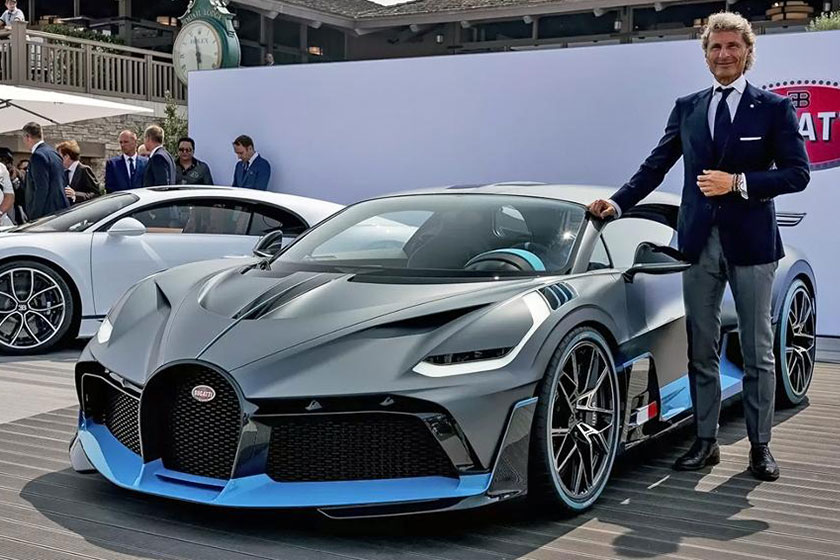
Bugatti is still exploring financing options for the new SUV, Winkelmann admiring “sexy” finance options like the Schuldschein promissory note that Porsche used to partially fund the development and production of the battery-powered Taycan.
The uncertainty affecting the luxury car market doesn’t seem to have put too much of a dent in the hypercar market. All 30 of the Chiron Super Sport 300+ production run found buyers at Frankfurt and Bugatti is confident that it can make the business case for its SUV, which is rumoured to borrow battery tech from Rimac.
If there’s anything that we’ve learned about Winkelmann, it’s that there’s nobody better at parting very wealthy people from very large sums of money. And that he’s the only person I can think of whose trousers wouldn’t upholster his head. The man who developed the Urus while at Lamborghini may have a predictable road map for Bugatti, but only a fool would bet against it working.
Whatever happened to the GT? That’s GT as in glorious and fast touring coupé like the original Ferrari GTO which served as inspiration for McLaren’s latest sports car – the aptly named McLaren GT. Or is it?
In another time, GTs used to be sleek and slick 2+2-seaters with plenty of space in the back for two little horrors but definitely not enough room for their grandparents. A classic GT typically had its engine in the front, the transmission sat somewhere between the axles, and the comparatively cavernous boot would hold four made-to-measure leather suitcases – think Bentley Continental T, Facel Vega HK500, Maserati 5000GT, Ferrari GTC4 or BMW M8 Gran Coupé.
According to McLaren, its GT not only belongs in this elite group of mighty V8-engined maulers, it allegedly even sets new standards in terms of coolness, packaging and vehicle dynamics. But although the Big Mac exceeds the Jaguar XE in overall length, the latest creation from Woking seats only two, which sums up its dilemma and its charm.
McLaren GT lands in Australia, pricing revealed
When they set out to develop a new type of fast, comfortable, light and involving sports car for long journeys, the McLaren product planners did their best to eclipse competitors like the Aston Martin DB11 or the Mercedes-AMG GT R.
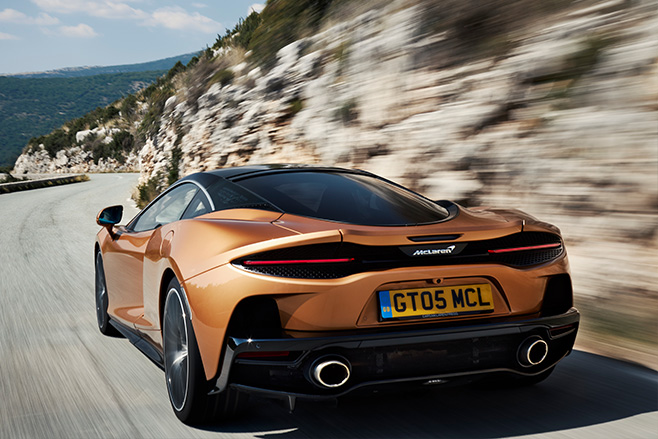
Sexy looks were absolutely essential, and the design team delivered exactly that. Stunning proportions and sensuous contours, a low-flung silhouette sporting a tight-fitting yet airy arc-shaped greenhouse, a ground-hugging stance which peaks at a ducked 1213mm (a 911 is 87mm taller), not to mention the highly efficient aero kit conceived to blend maximum downforce with minimum drag.
What makes the sum of these individual talents truly special is the kerb weight of only 1530kg which undercuts the aforementioned Porsche by 60kg – not bad at all for a fully loaded coupé equipped with fat 20 and 21-inch wheels with matching XXL brakes. Key to the slim and trim physique is of course the modified trademark carbon-fibre core dubbed MonoCell II-T. The T is specific to the GT, and it stands for, well, you know what it stands for.
What it takes to service a McLaren F1
Based on the original MonoCell launched exactly ten years ago, the monocoque still deserves full marks for supreme rigidity and crash performance. On the debit side, the obvious deficits of the once pace-setting architecture are poor space utilisation and insufficient scalability. For a start, the super-heavy doors swing open in an extrovert fashion which requires ample lateral clearance and, ideally, a roofless carport.
The next obstacle to be tamed upon entry is the wide, tall inboard door sill which, together with the unnecessarily bulky transmission tunnel, compromises legroom in the narrow footwell. The GT seats are more comfortable than the usual racing buckets, but tall people could still do with longer runners which would of course instantly collide with the rear firewall. Although carving out two snug-fitting semicircular cocoons for driver and passenger was per se a neat idea, sacrificing cabin space for style was not.
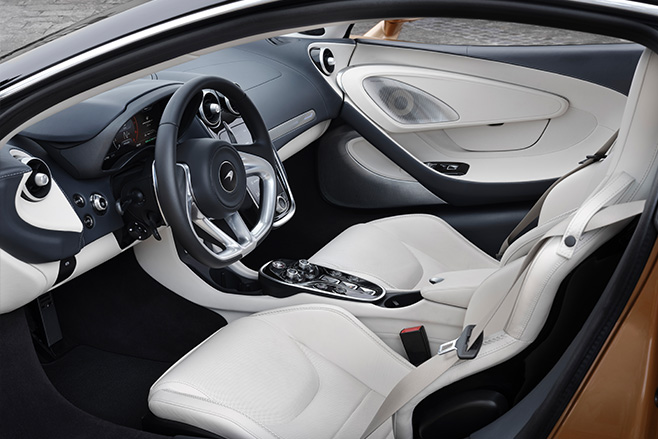
While we’re at it, allow us to add a couple of penalty points for the clumsy concealed seat adjustment, the irritating reflections in the windscreen and the rear window, the absence of a head-up display and the unimproved satnav which still trails real-time traffic by about 300 yards.
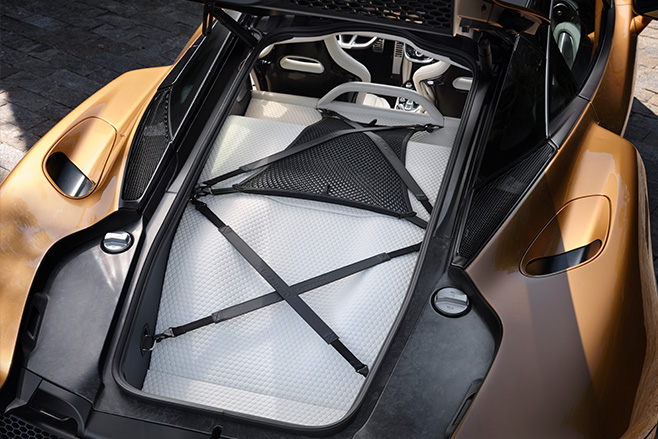
Passenger space may be scant, but the combined luggage space of 570 litres (no typo) easily matches any full-size saloon. The nose cone which holds the usual 150 litres of carry-on case plus coat is complemented by a deckchair-like rear cargo bay capable of accommodating a whopping 420 litres. That’s the good news.
The bad news is that any belongings unfortunate enough to be stowed there are grilled from above through the panoramic top-hinged pop-up backlight while at the same time being fried by the drivetrain underneath. Thanks to some clever space-age insulation material developed by NASA, McLaren promises the contents of this sunbed-cum-oven compartment never to get hotter than 45 degrees Celsius, but my shaving foam disagreed.
In contrast to the size of the boot, the 72 litre tank was not big enough for the taxing five-hour loop on and off the famous Route Napoleon. Instead of the promised 670km range, our test car ran dry after only 377km, averaging a hefty 16.5 L/100km which was nonetheless acceptable in view of an average speed the publisher’s legal advisor did not want to see in print.
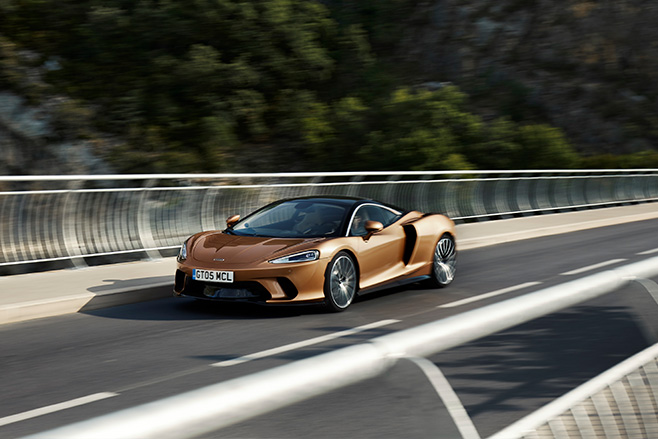
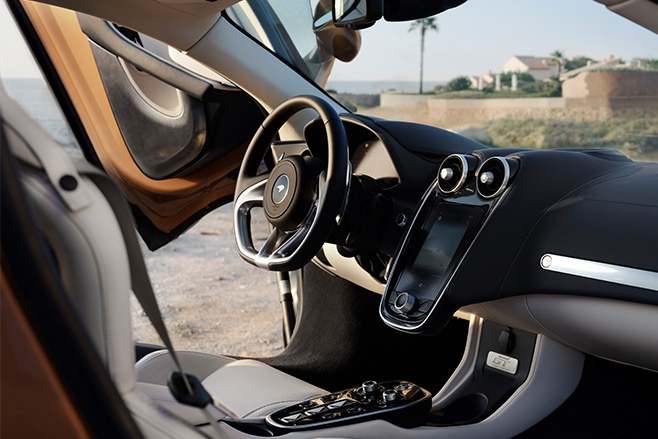
As far as the ergonomic layout is concerned, the GT still uses certain elements of the original MP4-12C. One point in case is the active control knob in the centre stack which needs to be pushed before you can tweak the drivetrain and chassis settings in three steps labelled Comfort, Sport and Track via two separate rotary knobs. The same knobs will deactivate ESP and switch the gearbox action from auto to manual.
As expected, the combination of Comfort and auto is a sleeping pill on wheels which blends low revs and tall ratios to profound frustration. Sport and auto is okay as long as radar traps and heavy traffic prevail, but as soon as the first decent B-road opens up, Track and manual is mandatory to make this car shine. With over 7500rpm to play with, the close-ratio 7-speed DCT does a splendid job whipping the 456kW and 630Nm through the fast-forward action process.
In launch control mode, the McLaren GT will accelerate to 100km/h from a standstill in 3.2sec. A mere 5.8sec later, the coupé goes supersonic at 200km/h. Thanks to the slippery shape and the relatively small frontal area, the top speed works out at a remarkable 327km/h, which is about three and a half times the limit on any French route nationale…
In previous iterations, the obligatory twin-turbo 4.0-litre V8 rarely received compliments for ultra-smooth running characteristics or subdued working noises. In GT configuration, however, the so-called active exhaust mode allows the user to dim the decibel pollution in Comfort and at low revs. In this mode, the two by-pass valves are kept closed for a low-noise engine start and for neighbour-friendly part-throttle manners.
Those who want to be heard loud and clear should select Track and floor the throttle for the ultimate growler effect, or specify the deafening optional sports exhaust which may well fall victim to next year’s much more stringent noise regulations.
When modulating or amplifying the engine’s phonetic portfolio, don’t forget to check out the pedal-to-the-carbon fibre shift action which is superswift in Sport and overboost physical in Track. While upshifts are truly seamless and lightning fast, downshifts need to be executed one by one – keeping the paddle pulled does not have the desired effect. Before you ask, let me tell you that there is no AMG-style drift mode either. The only way to kick out the massive rear end is by deactivating ESP before the momentum strikes like a time-warp avalanche.
Is the McLaren GT really a grand tourer?
The GT is a mildly tail-heavy car which puts 57.5 per cent of its weight behind the shoulder blades of the driver. In contrast to certain rivals, the McLaren cannot be had with AWD or rear-wheel-steering, and the option list does not contain adjustable sway bars either. By and large, driver assistance systems are also conspicuous by their absence.
The prime dynamic innovation are so-called Proactive Dampers masterminded by a new software advertised as Optimal Control Theory. Lurking behind the marketing speak is an evolution of the adjustable multi-stage shock absorbers first installed in the 720S. Neither camera-based nor radar-supported, the system relies on a pack of sensors which tap vehicle movements to read the road and modify the calibration accordingly within two milliseconds. Does it work? Yes and No.
While the ride comfort and the suspension action are commendably pliant even in Sport, the stiff Pirelli P Zero tyres rumble a fair bit at low speed, and at any rate transverse ridges irrespective of height and depth are not the GT’s best friends. A 911 is suppler, the AMG GT R is more uncouth, the McLaren is happy covering the middle ground.
McLaren: history, trivia, and fast facts
Like all mid-engined sports cars, this one needs properly warmed up tyres before it is ready for the real test. While a couple of burnouts duly light up the rear rubbers, the footwear up front takes a lot longer before it eventually clamps like a pro. When push comes to shove, bear in mind that there is no friendly torque split to pull you out of trouble – only tenacious grip, a momentary lift-off weight transfer that might alter the balance, and the united forces of traction and stability control.
Front-end breakaway is sudden in the dry, but with a bit of luck the carriage regains its composure inches later and before the outside wheel hits the kerbside marbles. In the wet – it rained all afternoon during our test – this second chance safety margin is virtually non-existent, and despite all the electronic trickeries there is plenty of drama evolving aft of the tiny rear window once the driver kicks open the floodgates of torque.
The hydraulic steering of the McLaren GT is a haptic delight, a highly accurate line plotter and a confidence-building connector which fuses man and machine. Shame about the orbital turning circle though.
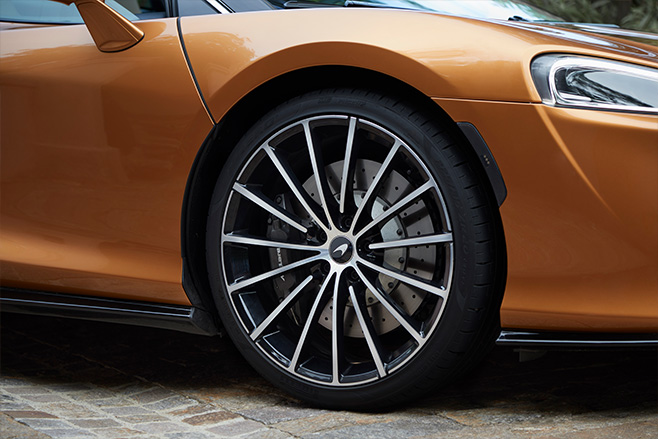
The four shield-size steel discs can decelerate this car in only 32 metres from 100km/h to a full stop. What this impressive number does not relay is the discrepancy between the inherently laid back character of a grand tourer and the inhomogeneous performance of its stopping apparatus. Hammer the pedal like a racer, and everything is fine. But when you drive like most GT owners would, it takes simply too much effort to produce that reassuring initial bite, ambitious deceleration requires seriously fit calf muscles, and in the wet the DMZ between grabbiness and ABS intervention is suspiciously narrow.
McLaren charges a fair 6000 Euro (local pricing is yet to be determined) for carbon ceramic stoppers – it’s money well spent. Other extras worth having include the variable-tint panoramic glass roof and the Practicality Pack featuring front axle lift, rear view camera and parking aids. At AUD$400K, even the base model should be well equipped locally. Having said that, about 70 per cent of the customers speak to the in-house MSO personalisation specialists before completing the deal.
On paper, the GT is a great buy, especially when compared to other McLaren models. It sports the most powerful engine this side of the notably more expensive 720S, it is a touch quicker off the mark than the identically priced 570GT, and it can swallow more cubic inches of stuff than a Volvo V90 estate.
Five cool McLaren 570 GT features
But in more ways than one, the latest addition to the range is neither fish nor fowl. The cabin isn’t sufficiently spacious for a GT that aspires to be best-in-class, the ride could be more composed on rough blacktop and through high-speed twisties, the digital end of the stick has plenty of catching up to do, electrification is nowhere in sight, and when pushed it simply isn’t quite as chuckable, raw and sharp-handling as the brand’s thoroughbred sports cars.
When pitted against its direct rivals, the Ferrari GTC4 Lusso V8 emerges as more practical and more modern overall, the outgoing 911 turbo S is a more pragmatic option, and McLaren’s own 600LT is a more compelling drive.
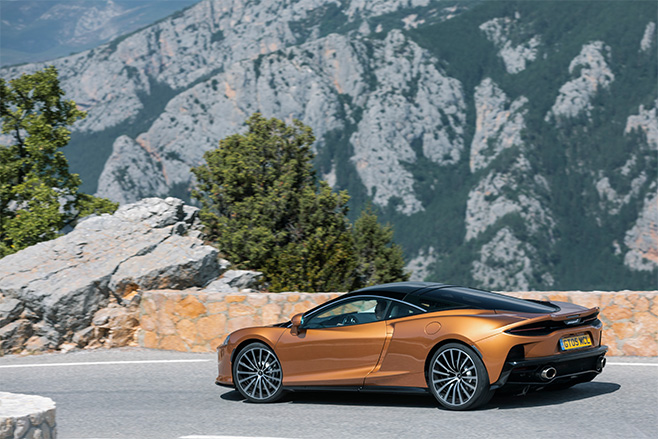
2020 MCLAREN GT SPECS Engine: 3994cc V8, DOHC, 32v, twin-turbo Power: 456kW @ 7500rpm Torque: 630Nm @ 5500rpm Weight: 1530kg 0-100km/h: 3.2sec (claimed) Price: $399,995
Like: Clever engineering; ‘low’ kerb weight; bloody quick; McLaren nails the steering Dislike: Awkward cabin space; old interfaces; cooked shaving cream; is it really a GT?
Rating: 4.5 out of 5 stars
What stands out?
The Holden Astra offers more space and ride comfort than the Astra hatchback. Unlike the hatch, which is built for Europeans by Opel in Poland, the Astra sedan is built in South Korea for comfort-loving drivers in the USA, where it sells as the Chevrolet Cruze. It has a turbocharged engine with plenty of go, and easily connects to your smartphone. The Astra sedan was withdrawn from sale in mid-2019.
What might bug me?
That your daughter’s Astra hatch feels more welcoming inside than your Astra sedan, with more soft surfaces.That you keep turning up the music by accident. There are audio controls on the steering wheel, but they are located behind the spokes where you can’t see them.Wondering why the additional safety provided by automatic emergency braking isn’t available in the sedan like it is with the Astra hatch even as an option.Driving under 80km/h on the space-saver spare tyre until you can fix your full-sized flat.
What body styles are there?
Four-door sedan. (A five-door hatchback has been available since December 2016 and is covered in a separate review. A station wagon joined the Astra range in October 2017).The Astra sedan drives its front wheels, and is classed as a small car, lower priced.
What features do all Astra sedans have?
Automatic transmission as standard.Forward collision alert, forward distance indicator, lane-keeping assistance, and lane departure warning.Cruise control, reversing camera, and rear parking sensors (which help you judge how far the rear bumper is from obstacles).An MP3 compatible sound system with AM/FM radio, Aux and USB inputs, Bluetooth connectivity for audio streaming, voice control, and six speakers.A colour touchscreen (7.0-inch on the less costly Astras) for controlling cabin functions. Support for Apple CarPlay and Android Auto, which lets you plug in a compatible smartphone and display on the touchscreen some of its apps (including mapping). You can then operate the apps from the touchscreen (or by voice).Controls on the steering wheel for the cruise control, the audio system, and your phone.Headlamps that switch on automatically when it’s getting dark, high-beam assist (which automatically dips the headlights when it senses an approaching vehicle), and LED daytime running lamps.Leather wrap steering wheel.Aluminium alloy wheels (which look nicer than steel wheels with plastic hubcaps), and a speed-limited space-saver spare wheel.Hill-start assist, which makes it easier to take off on an uphill slope (by controlling the brakes automatically). Traction control, which prevents you from spinning a front wheel if you try to accelerate hard where it’s slippery.Electronic stability control, which can help you control a skidding car. All new cars must have this feature.Six airbags. (For the placement of airbags, and more on Astra safety systems, please open the Safety section below.)Every Holden Astra carries a five-year, unlimited-kilometre warranty.
Which engine uses least fuel, and why wouldn’t I choose it?
Only one engine is available in an Astra sedan, a 1.4-litre turbocharged four-cylinder petrol.It’s reasonably economical, with official testing (city and country combined) showing about 6.0L/100km.This is a smooth, quiet and strong little engine that propels the Astra very effectively.A six-speed manual transmission is available only with the least costly LS, with a six speed auto an extra cost option. The LS+, LT and LTZ are only available with auto transmission.The auto is a conventional torque-converter type, which offers smooth take-offs around town and satisfyingly swift responses to your demands on the open road.
What key features do I get if I spend more?
Spend more for an Astra sedan LT and you get the LS+ standard features plus 17-inch wheels and a rear lip spoiler, which contribute a sportier look. You can unlock an Astra LT and drive away without removing its smart key from your bag or pocket. Windscreen wipers work automatically when it starts raining.As well, front parking sensors augment those at the rear, and advanced park assist can steer you automatically into a parking spot. The exterior mirrors are heated, to remove frost and misting, and have warning lights to let you know when another vehicle is in your blind spot. Infotainment extras include a larger 8.0-inch touchscreen, digital radio (DAB+), and built-in satellite navigation.Spending more again for an LTZ brings you more luxury, including an electric sunroof, climate control (which lets you set different ventilation temperatures), leather on the seats and the seats and steering wheel can be heated. The wheels grow to 18 inches, and are wrapped in lower profile tyres for marginally sharper steering and a sportier look. Visual differences include chrome interior highlights and chrome window surrounds.
Does any upgrade have a down side?
The bigger 18-inch tyres on the Astra LTZ may cost more to replace. And their wider diameter and sporty lower-profile means they will feel bumpier to drive on than the smaller tyres fitted to the other Astras, because the shallower sidewalls leave less air and rubber between you and the road.You can have white or red paint as standard. The other colours cost extra.
How comfortable is the Astra sedan?
Space is the Astra sedan’s strong suit. It comfortably seats four tall adults, or a family of five and its generous legroom that makes it feel like a medium-sized sedan.The ride is surprisingly smooth, with the suspension set to suit rougher Australian roads.It’s tremendously quiet too. The 1.4-litre turbo engine feels very smooth, and road noise is suppressed very well.The cabin design looks good and everything is thoughtfully laid out including the touchscreen and associated control buttons. Cabin storage includes deep door pockets and a centre console bin, though it could do with more space to place a smartphone in front of the gear shift where the USB sockets are located.On the downside, the Astra sedan’s interior doesn’t quite match the quality of the Astra hatch, with few soft-touch surfaces to break up the hard plastics that make up the dashboard, door cards and centre console.
What about safety in an Astra sedan?
Every Astra comes with six airbags: one each ahead of the driver and front passenger; an airbag outside each front occupant at chest level to protect from side impacts; and side-curtain airbags extending past both seat rows at head level. All Astras also have the mandatory stability control, seatbelt pre-tensioners for front and rear passengers, a reversing camera, rear parking sensors and dusk-sensing auto-on headlights. Every Astra except for the least costly, the Astra LS, has LED daytime running lamps, which help other drivers see you.Every Astra but the LS also has a forward collision alert, which warns you if it detects a collision is likely via an audible alarm and flashing light. (A camera scans the road ahead for obstacles.) The system also tells you how many seconds you are behind the car in front, so that you can maintain a safe braking distance.The camera also monitors road markings, and triggers an alert if you have begun to drift wide of your lane – perhaps through distraction or fatigue. It can also apply a light steering correction, to wake you up and help bring the car back.The more expensive Astra LT and LTZ also come with a blind-spot monitor, which alerts you to a vehicle approaching on your side by shining an amber light located on the wing mirror. If you indicate to change lanes on that side, the light will flash.The Astra Sedan is not equipped with automatic emergency barking.The Australasian New Car Assessment Program (ANCAP) awarded all Astra the sedan variants five stars for safety, its maximum, in May 2017.
I like driving – will I enjoy this car?
The Astra sedan is designed with comfort in mind, and achieves this well with a smooth ride around town and on less refined country roads.That ride comfort comes at the expense of dynamic handling, so, if you like to drive hard around corners, you probably won’t enjoy this as much as you would the Astra hatch.The quiet 1.4 litre engine easily pulls a car-load of people up reasonably steep inclines without much fuss, especially when paired with the six-speed automatic transmission that’s standard on the LS+, LT and LTZ.
How is life in the rear seats?
The Astra sedan comfortably seats two adults or three children. There is plenty of legroom and the seat backrest is tilted at a comfortable angle, which provides a relaxed and reclined posture.Headroom is generous, despite the swept back roof, though side vision is obstructed because of the tapered shape of the rear door window.Folding the centre armrest down reveals a soft armrest with two cupholders.There are no rear air-conditioning vents.
How is the Astra Sedan for carrying stuff?
The boot is about as good as it gets for a small sedan, allowing a total of 445 litres of cargo to be carried with the rear seats up. That is about the same as the boot in a Subaru Impreza sedan, for example, and nearly much as you can squeeze into medium sized car such as a Ford Mondeo and Mazda6.
Where is the Astra sedan made?
The Holden Astra Sedan is made in Gunsan, South Korea
What might I miss that similar cars have?
Autonomous emergency braking, which is increasingly becoming available small on cars, including the Astra hatchback, Toyota Corolla, Hyundai Elantra, Mazda3, Honda Civic, and Subaru Impreza.
I like this car, but I can’t choose which version. Can you help?
Every Astra sedan has the same engine, and feels about the same to drive. So it is just a matter of deciding how much equipment you need.Our reviewers like the Astra LT. It brings you the active safety suite, better infotainment than the less costly Astras, and smart-key entry, for a fair price premium.
Are there plans to update the Astra sedan soon?
The Astra sedan arrived in June 2017, and Holden increased its three-year warranty to five years, for Astra and all other models, on July 1, 2018.Slow sales saw Holden temporarily halt Astra sedan production in early 2019. It became available several months later but without the cheapest version, the manual LS. One the plus side, it’s possible to get some good deals on an Astra sedan.Holden quietly dropped the Astra Sedan from sale during 2019.
The accident rate among young drivers could be slashed if parents were allowed to evaluate their children’s driving via their dashcam footage, new research shows.
The study, commissioned by the UK-based RAC Foundation, showed that dashcams and driving-data black boxes are likely to reduce hoon behaviour among young drivers if they were open to parental scrutiny, in the same way commercial fleet operators monitor their drivers.
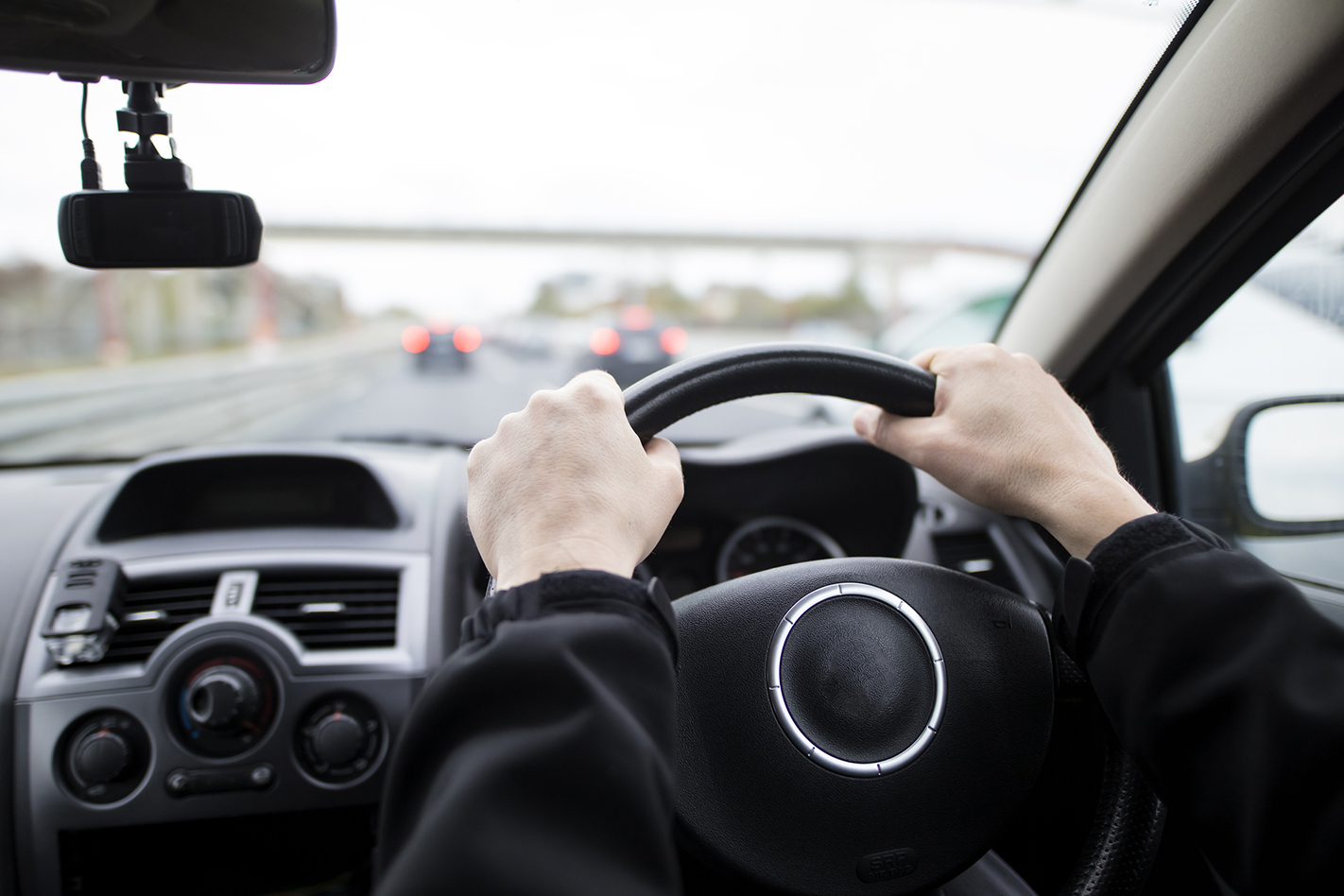
“Whilst teenagers may baulk at the idea of mum and dad effectively supervising their every trip, a constant parental presence, delivered through technology, has been shown to moderate risky behaviour behind the wheel,” said RAC Foundation director Steve Gooding.
“Every parent of a young driver wants their child to drive safely without having to be in the car themselves, but through black box telematics and dashcam technology, virtual supervision can have a big impact.”
The research, led by Dr Bruce Simons-Morton from the Eunice Kennedy Shriver National Institute of Child Health and Human Development in Maryland, USA, also affirmed the success of graduated licence systems as used in Australia that include a minimum learning period, night restrictions and limits on driving with passengers under a certain age.
While certain measures in Australia contributed to a 37.6 percent reduction of road fatalities among the 17-25 age group, Australian Bureau of Statistics figures show it’s still over-represented in road accidents, accounting for a fatality rate of 7.5 per 100,000 young road users in 2018 – well above the 4.6 per 100,000 rate across all age groups.
Would you object to someone scrutinising your driving through technology, or should any method of road toll reduction be embraced regardless?
Imagine if the referee of your favourite footy code suddenly leapt into the middle of a play, grabbed the ball and handed it to the opposing side.
This, according to some of motorsport’s greats, is exactly what happened in Sunday’s Supercars race in Pukekohe, New Zealand, after a safety car intervention simply blew the race apart, pushing some drivers down the order and giving others a free kick.
“Embarrassing really,” said one driver. “Disaster of a day,” said another. “Complete and utter stuff-up,” said a third.
But what actually happened? What caused such a ruction on a day where New Zealand’s wunderkind, Scott McLaughlin, won his 17th race of the season for DJR Team Penske, smashing a 23-year-old-record of wins on a season in the process? Buckle up, because it gets weird.
The Safety Car is called on lap 14…
Erebus driver David Reynolds’ Holden Commodore broke a throttle linkage early in the race, stranding him on the circuit. Race Control dispatched the Ford Mustang Safety Car as Reynolds limped towards pit lane.
Usually, the safety car emerges from the pits in front of the leader, controlling the pace of the field until the hazard has cleared. Only in this case, the hazard – Reynolds – cleared himself. However, the safety car was already out on the circuit, ready to pick up the leader of the race…
…And it picks up the wrong ‘leader’
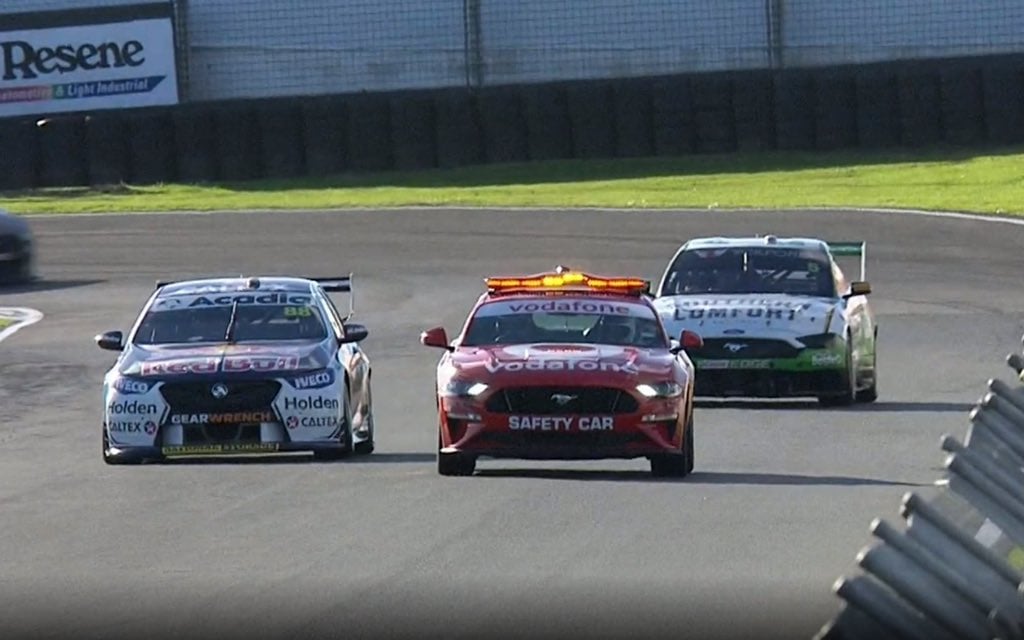
Red Bull Commodore racer Jamie Whincup was the first car to come across the Safety Car on the circuit (above left), despite not actually being in the lead of the race at the time.
In most cases, the safety car crew inside the car would signal for Whincup to move past with safety, allowing the field to cycle past and the real leader to take up station behind.
“That was the situation here. Hold the field, identify the leader, and wave any cars between the car behind the Safety Car and the leader through,” race director Tim Schenken told Supercars broadcaster Fox Sport.
Pukekohe’s short lap time of around one minute and its long pit transit time of 45 seconds didn’t help officials when it came to placing the safety car – but equally, this wasn’t their first rodeo, either.
…Who then broke the rules and passed the Safety Car
Whincup then compounded the situation massively by breaking the cardinal rule of car racing; disobeying the safety car.
His reasoning was – given his prior form at breaking the same rule – odd at best; he simply believed that Race Control had erred by picking him up, but it had been too slow in instructing the safety car to switch on a green light to allow him to pass.
He motored on past despite flashing yellow lights and no signal from within the safety car, assuming the lead of the race once the rest of the field had pitted to take tactical advantage of the delay in proceedings.
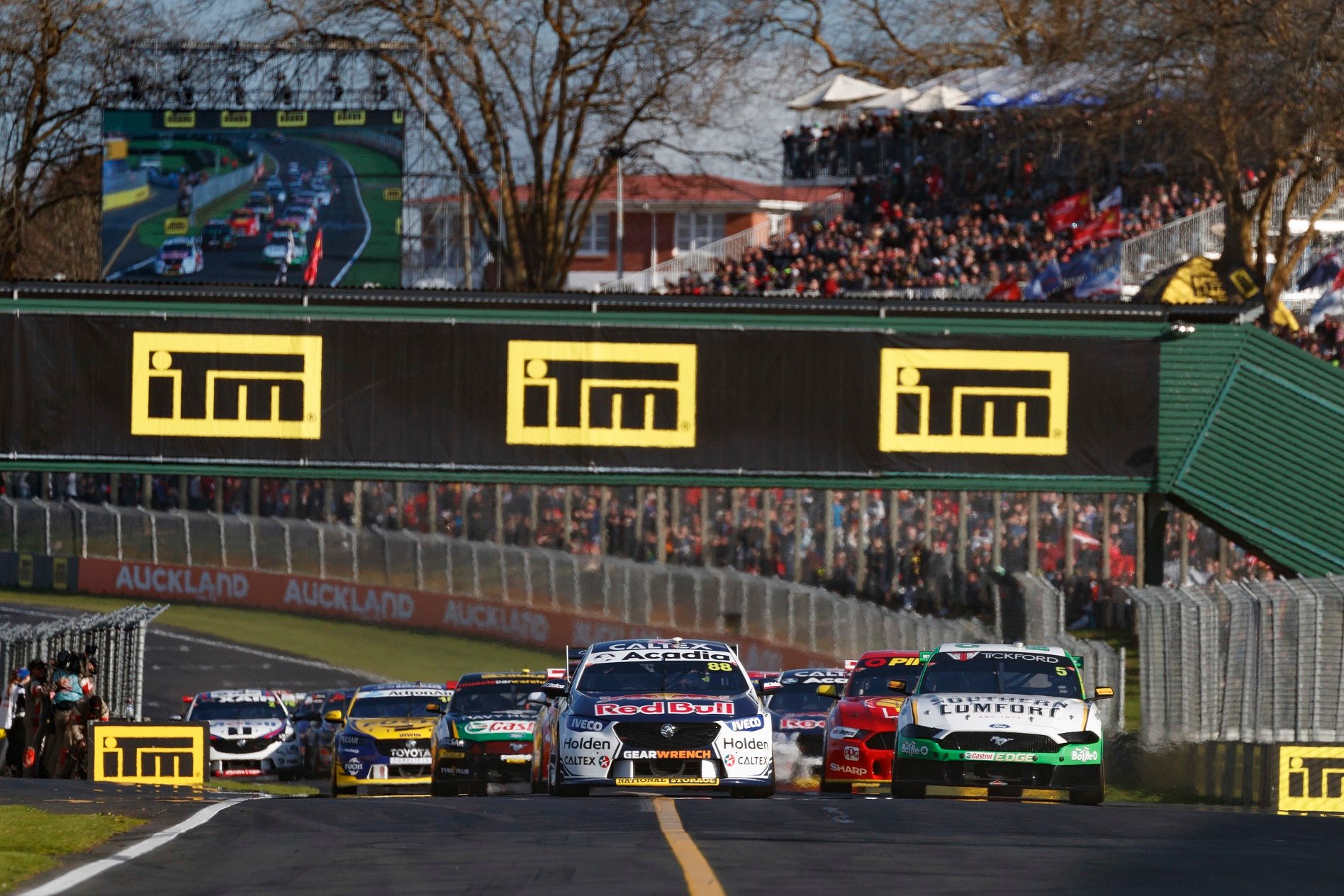
Whincup’s goose, reality, was cooked the second he went past the safety car – as were the respective gooses of the drivers, like Ford Mustang racer Lee Holdsworth (above right), who chose not to break ranks and disobey the safety car.
This meant that those racers were slowed by the safety car, with other racers able to pit and resume racing in unnaturally elevated places.
…But it was now too late to fix it
“By [Whincup] going past the Safety Car, we then lost the opportunity to be able to evaluate the situation in a calm manner, and we needed to avoid the situation where we had half the field a lap down [behind the leader],” said assistant race director David Stuart.
Gone, also, was the opportunity to keep the yellow flags waving and allowing the field to reset itself before setting off again.
Whincup didn’t see it that way. At all.
“They [the safety car] should have had green lights on, I wasn’t the leader of the race,” he fumed afterwards.
“The problem is you’ve got all the drivers, you’ve got everyone here, this is our life, you know, and we’re pushing bloody hard and you’ve got people making decisions that are just cruising back, just having a few glasses of red each night, and rocking up to the track and [their] brain’s not with it.
“They’re not operating at the same level as what the teams are operating at.”
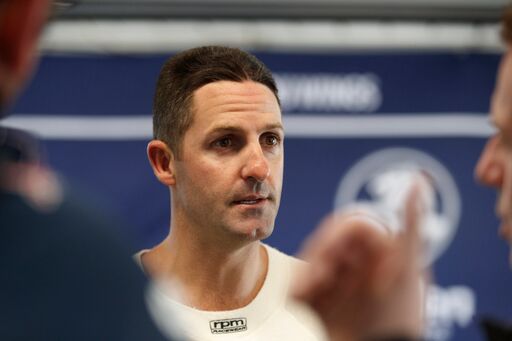
The seven-time champion – who’s pulled this kind of stunt before – claimed he had no choice.
“It was either stay behind and get completely screwed like the FPR (Tickford) guys, or just try to, hopefully… I gave them the opportunity to put the greens [lights] on,” he said.
“I stopped, waited, waited, waited, but they were just all asleep, so I just went through.”
The result was a pit-lane penalty, dropping him from the lead of the race to the tail of the field.
And that’s all she wrote
The bizarre situation arguably gave eventual winner McLaughlin an easier run to victory after a fraught qualifying effort, while Whincup’s teammate Shane van Gisbergen also profited, running second to McLaughlin to give the delighted Kiwi fans a one-two finish.
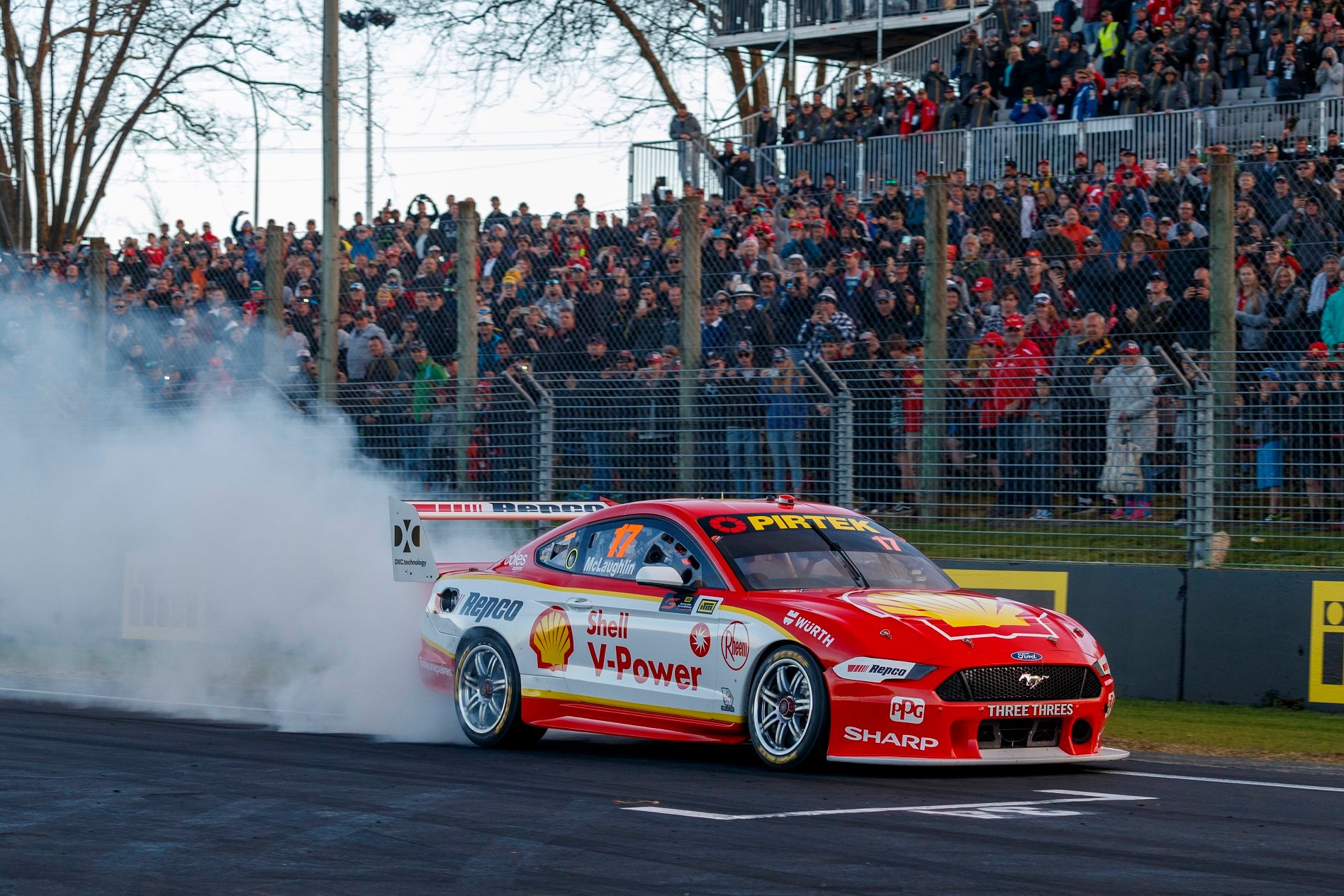
While the celebrations – and the emotions for van Gisbergen earning the coveted Jason Richards perpetual trophy in front of the late racer’s parents, wife and children – were real, the fury and disappointment for the majority of the field were just as raw.
“There are no words for how pissed I am,” said Holdsworth, whose brilliant second-place qualifying result came to naught as he fights to retain his seat for 2020. “Looks like no one’s going to take responsibility for today.”

It was a disappointing and confusing day for the Supercars category and one that’s left racers and fans alike confused and disillusioned. In some ways, the fact that the next race is the Bathurst 1000 is a bonus; our greatest race will wash away some – but not all – of the confusion and fury from a bizarre day in New Zealand.
OKAY, we get it. Most of the oily bits underneath the new Toyota Supra are actually made by BMW. If you’re being harsh, pretty much all of them. Software calibration of the A90 Supra’s engine, transmission, and steering and some changes to bushings and other minor suspension parts are about the extent of Toyota’s involvement.
Jump inside and it’s easier to spot BMW fonts and parts rather than identify Toyota-specific bits of the fascia. This has made a lot of people Very Angry Indeed. What temerity. Imagine paying Hungry Jack’s prices and then being served a three-course Rockpool meal. You’d be furious wouldn’t you?
Personally, I can’t get too aerated about this perceived sense of injustice. Toyota has done a brilliant job in cost-effectively bringing a great-looking rear-drive coupe with a straight-six twin-turbo 3.0-litre to market. If you want the current car to echo its predecessor even more closely then you’re living in the past.
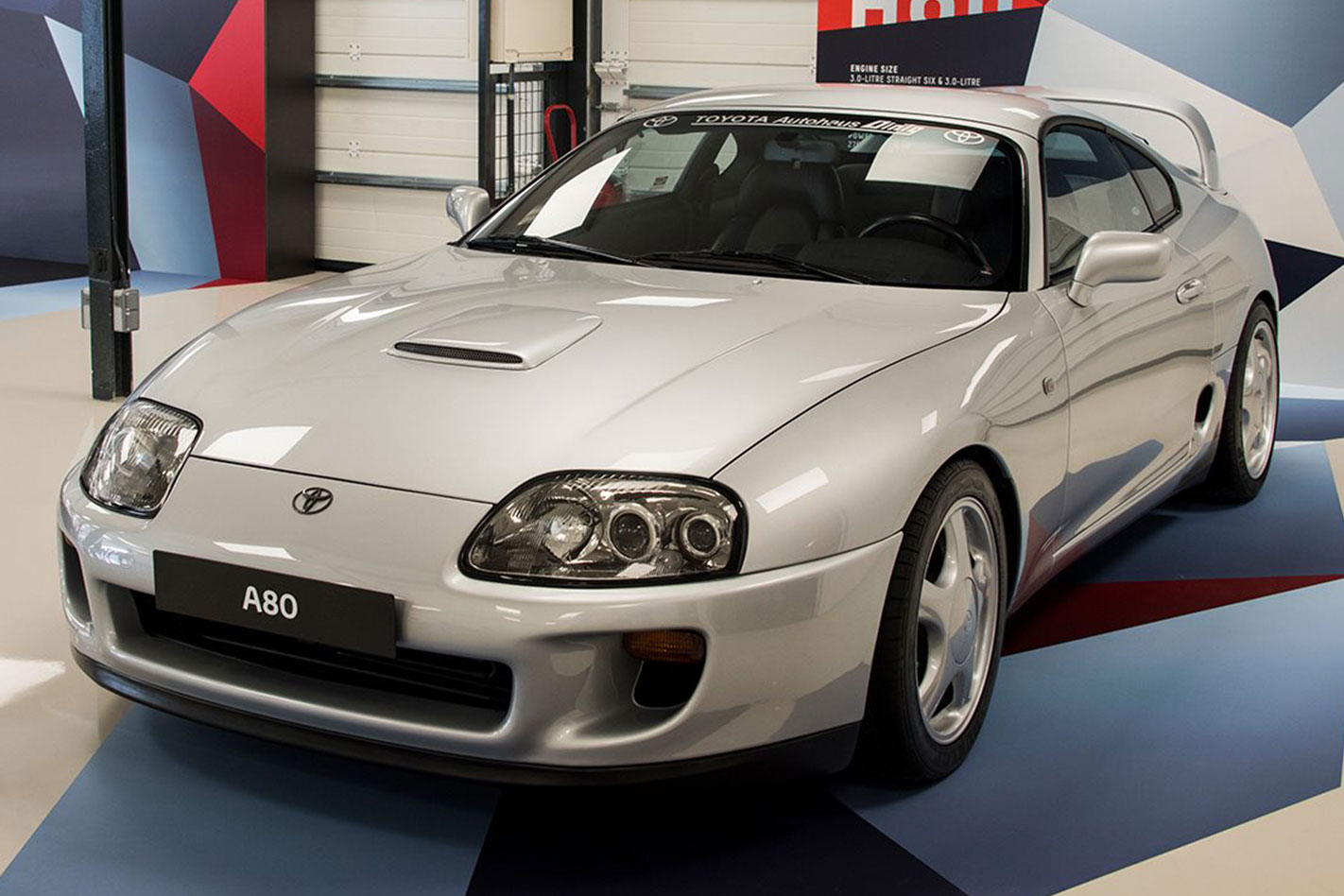
There’s an inconvenient truth that many have ignored here too. The A80 Supra wasn’t that great. I know a tarring and feathering in the comments section is sure to be incoming after that one, but it’s a fact. Wheels put a Supra RZ up against a Lexus SC400 in a March 1996 comparo. The Supra lost, Bob Hall criticising its “Stone Age suspension” and noting that a Mazda RX-7 SP was about as rapid and 50 grand cheaper.
Prior to that, it appeared in another head-to-head, in this case up against an Aston Martin DB7. Roger Bell opined that “heroically dynamic the Supra undoubtedly is. Enchanting it is not. Despite its sensational looks, the Supra is little more than fast transport – coolly efficient, uninvolving.” So it’s zero for two in head-to-head comparison tests. And it’s not just Wheels who struggled to see the appeal. Car and Driver was left perplexed by it. “We wonder whether the new Supra faces an identity crisis. It is fast, but it is not a pure sports car like the RX-7. And it offers neither the styling, the luxury, nor the prestige of the 300ZX,” wrote John Phillips in March ’93.
It was only the bombproof tuning potential of the 2JZ six that burnished the Supra’s legend, tales of Smokey Nagata and the Mid Night Club, hero status in The Fast and the Furious and increasingly rose-tinted memories of the original cemented its legacy. Truth is, a BMW E36 M3 was a better car in virtually every regard.
So now we arrive in 2019 with this strange amalgam of BMW engineering and Toyota styling. Chris Harris gnashed and wailed in a recent Top Gear editorial. “Japanese motor cars have something indescribably appealing about them,” he reckoned. “The sense that they’ve been wrought through a combination of a brain-frazzling rigour that most would find totally pointless and also simultaneously touched by some level of creative madness. Rigorous madness; that’s Japanese sports cars.”
He’s wrong and here’s why. Given what we know about the original Supra, it’s a reasonable assertion to make that the company has no track record of building a class-leading high-performance coupe. Granted, perhaps a company with Toyota’s resources ought to have, but take any manufacturer outside its meat-and-potatoes comfort zone and it often falters. Aston Martin Cygnet? Lamborghini LM002? BMW M1? Lexus LFA? All commercial disasters.
So we have no right to expect the Supra to be a class-leading car had Toyota resourced and developed it themselves. Plans were already in place with BMW for vehicle co-development so it was only natural that the Supra project was floated. We know that Herbert Diess, who was then BMW Group’s member of the board of management for development, repeatedly knocked back Tetsuya Tada’s idea for a Supra collaboration on the grounds of it not making commercial sense.
It was only when Diess moved to Volkswagen and Klaus Fröhlich took over, that a pure sports car development project was given the green light. Chris Harris’s claim that Toyota “should have been shouting louder in the meetings” ignores the nature of the power structure between the two companies. The Japanese company has bigger fish to fry in this collaboration, especially around hydrogen fuel stacks, to risk souring the relationship over a low-return sports coupe.
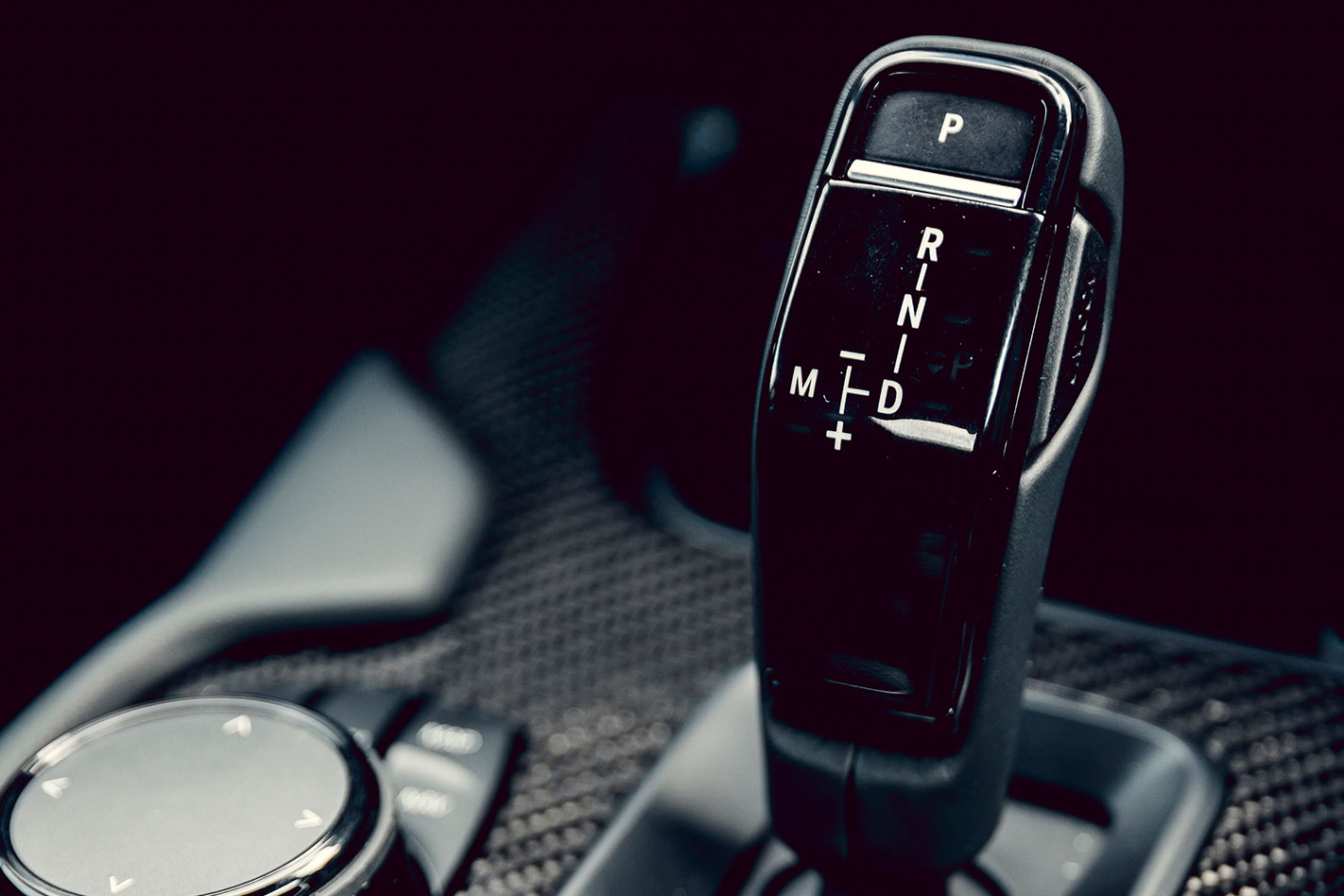
All of this also ignores the fact that the new Supra is an extremely good car. We all know those nerds who fetishise Japanese cars and who’ll look down their nose at the Supra as being too BMW. For every one of them lost to Toyota, the Supra will attract two or three customers exactly because the interior has the polished feel and functionality of a BMW. Its ride and refinement make it a far more versatile proposition than its predecessor, and it’s seriously quick on a challenging road.
Yes, it’s a strange car and if, like us, you’re so immersed in car culture that it can feel a little disorienting, you might not warm to it. But most of its target clientele aren’t. They don’t care for heritage. They were in short trousers when the A80 Supra was in dealerships. All they’ll see is a sharp-looking car with a fantastic powertrain and a quality interior, being sold for an aggressive price. Shout louder in meetings? By buttoning it, I reckon Toyota has played an absolute blinder.
The new Mini JCW Clubman is now the fastest regular production Mini ever, and it’s coming to Australia.
With more power than its predecessor and the advantage of all-wheel drive, the 225kW/450Nm barn-door wagon makes its sprint to 100km/h in just 4.9 seconds, eclipsed only by the limited-run Mini JCW GP (no official time has been released, but it’ll be faster) with which the JCW Clubman shares its powertrain.
Borrowed from the likes of the BMW X2, the engine is paired with an 8-speed Steptronic sports auto gearbox for quick shifts and efficient application of power, but no manual variant is available in JCW spec.
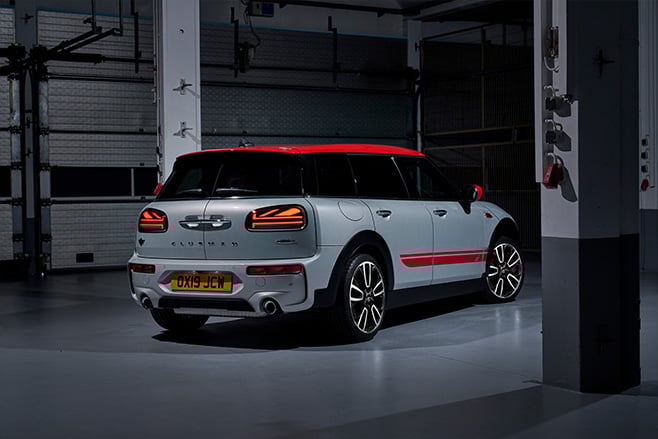
Two levels of the JCW Clubman will be available to Aussie buyers, a ‘full-fat’ version and a ‘race-inspired’ Pure version, in the same vein as some of BMW’s M models.
The higher-spec JCW Clubman, at $62,900 before on-roads, will include 19-inch alloys, sports suspension, electrically adjustable black leather sports seats, and a 12-speaker Harman/Kardon sound system.
The Pure, however, has smaller 18-inch JCW alloys shod with Michelin Pilot Super Sports, plus adaptive dampers, plus extra blacked-out trim on the exterior. The interior is a little less packed with features than the higher spec, but it still has the same infotainment and interior trim – minus the seats.
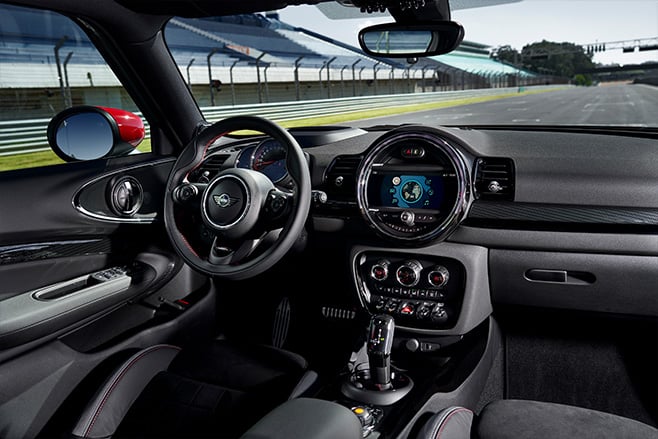
The Pure features microfibre and leather seats instead. Pricing for this version comes in at $57,900 before on-roads.
Mini Australia general manager Brett Waudby says alongside the “firecracker” JCW Clubman, an updated version of the lower ‘S’ spec Clubman with 141kW will arrive in Q4 2020, while the JCW Countryman will also cop the new 225kW engine.
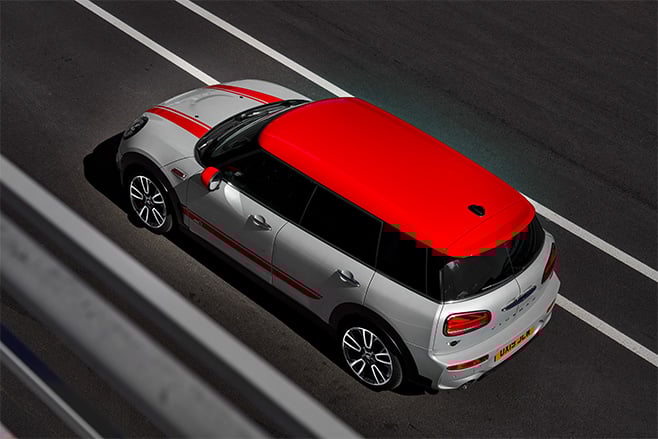
“We are delighted to also offer this impressive engine in the JCW Countryman – which adds a whole new dimension to the way that car drives – while providing key updates to the Cooper S Clubman and upgrading our transmission offerings as part of our ongoing plan to broaden and freshen our line-up for MINI customers.”
The Cooper S Clubman will set buyers back $45,900, available in both 6-speed manual and 8-speed DCT, while the larger, faster JCW Countryman will be a $65,900 offering.
