
The appearance of the Lamborghini Sian is not a surprise. Rumours of a limited-edition supercar-codenamed LB48H – destined for the upcoming Frankfurt Motor Show have been flying around for months.
The fact that the Sian is a hybrid is also not a surprise. Lamborghini has been forthcoming about the need to embrace electrification if it is to keep its monster naturally-aspirated engines alive and it previewed the technology with the Asterion concept in 2014.
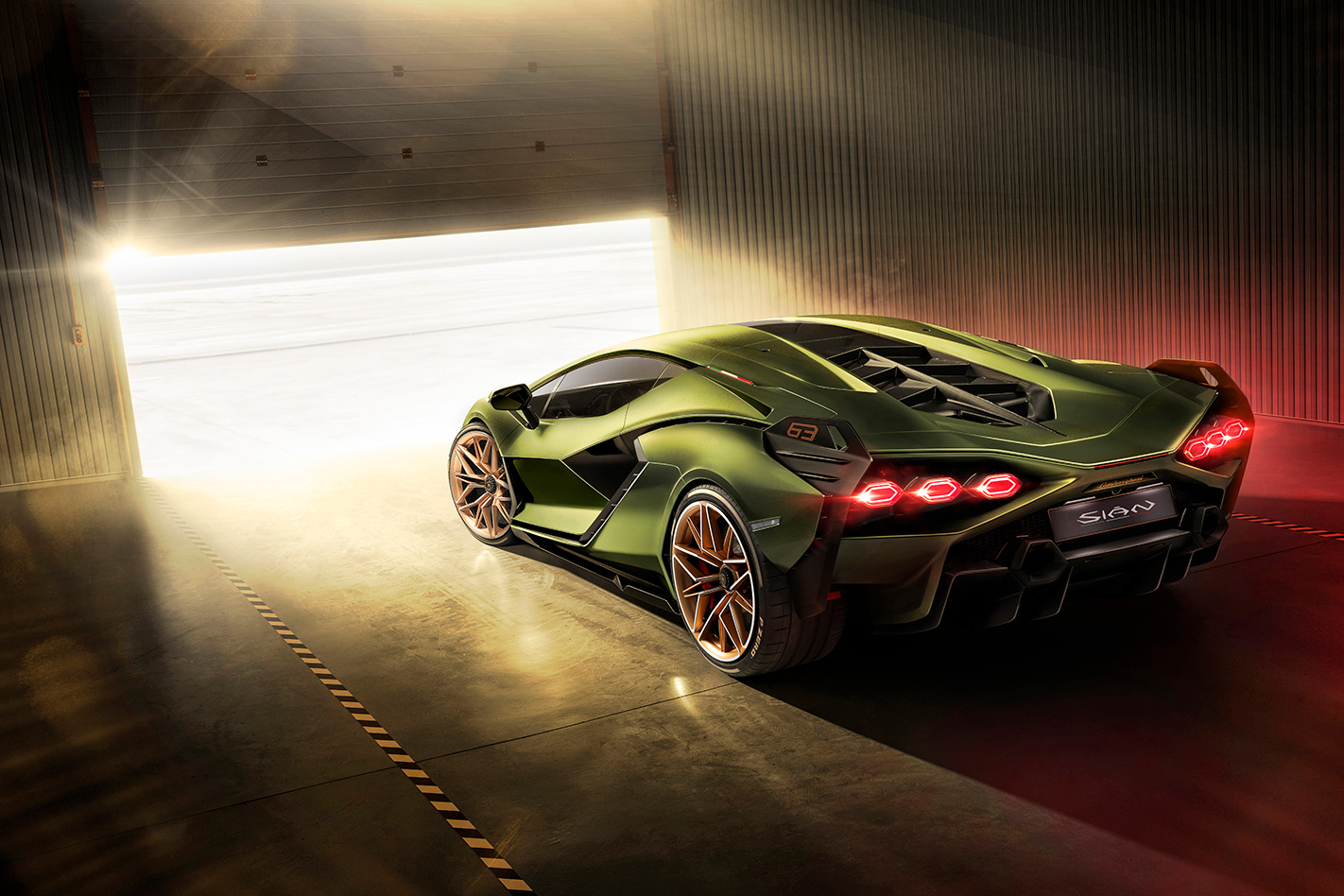
No, the big surprise is how Lamborghini has applied hybrid technology to its flagship supercar, for there is not a battery in sight. Instead of the traditional (heavy) lithium-ion battery, the Sian – roughly translated as flash or lightning – uses a supercapacitor to store and discharge energy.
Lamborghini claims the supercapacitor is three times more powerful than a battery of the same weight and three times lighter than a battery producing the same power.
That said, it doesn’t need to store much power, as the Sian’s only electrification is the use of a 25kW 48-volt electric motor incorporated into the gearbox.
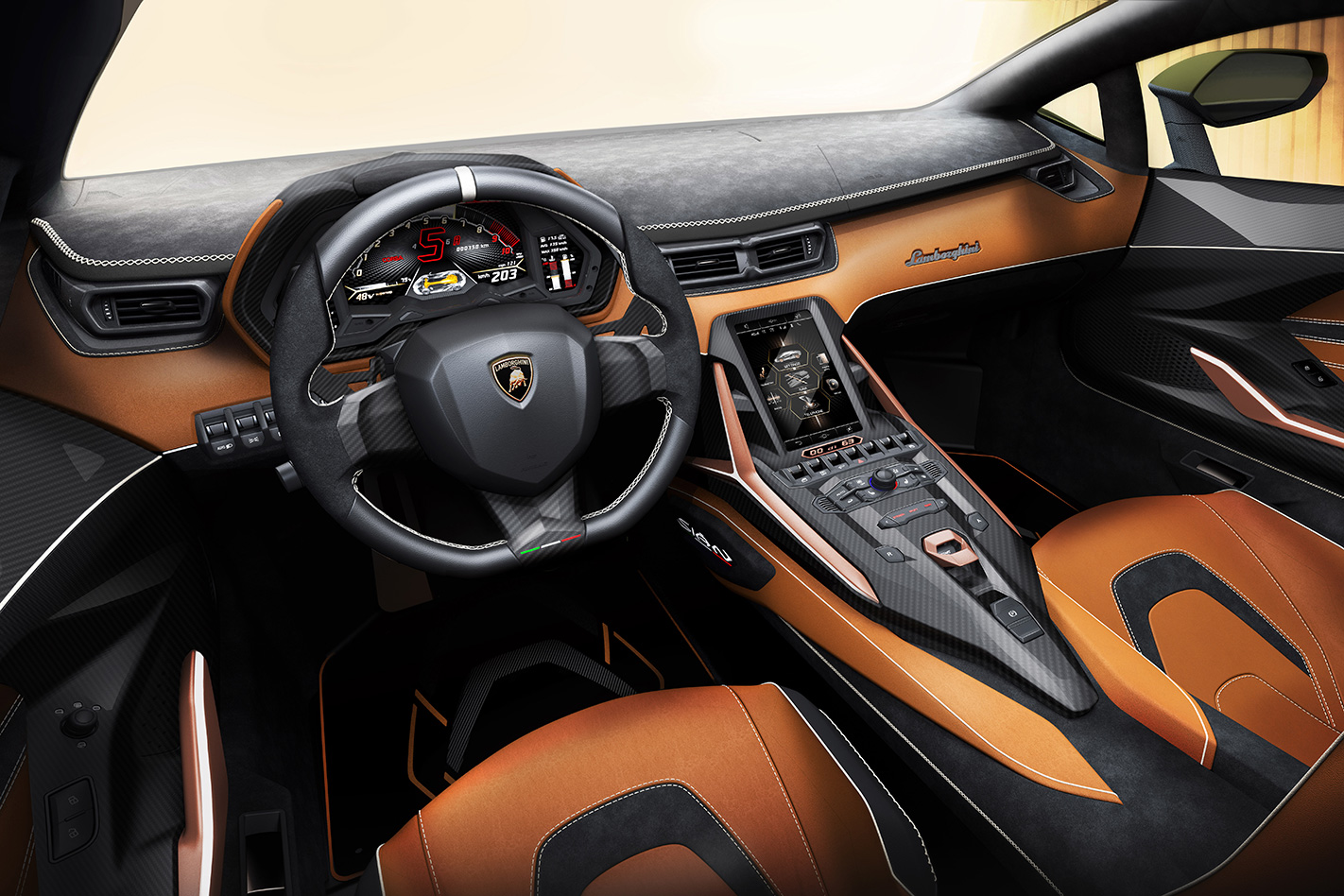
In combination with the 577kW 6.5-litre V12, the total system output is 602kW, resulting in 0-100km/h in 2.8sec and a top speed of 350km/h. The supercapacitor is charged by the regenerative braking system, the energy stored then available as an instant power boost.
Lamborghini says the motor’s true benefit is in low speed in-gear acceleration, improving it by 10-20 per cent over the Aventador SVJ up to 130km/h, at which speed the motor disconnects.
The motor provides other benefits, including taking over reversing duties and providing torque-fill during gearshifts. Lamborghini claims the feeling of “uncomfortable jerking movements” during gearchanges is eliminated, which will be music to the ears of anyone who has ever driven an Aventador.
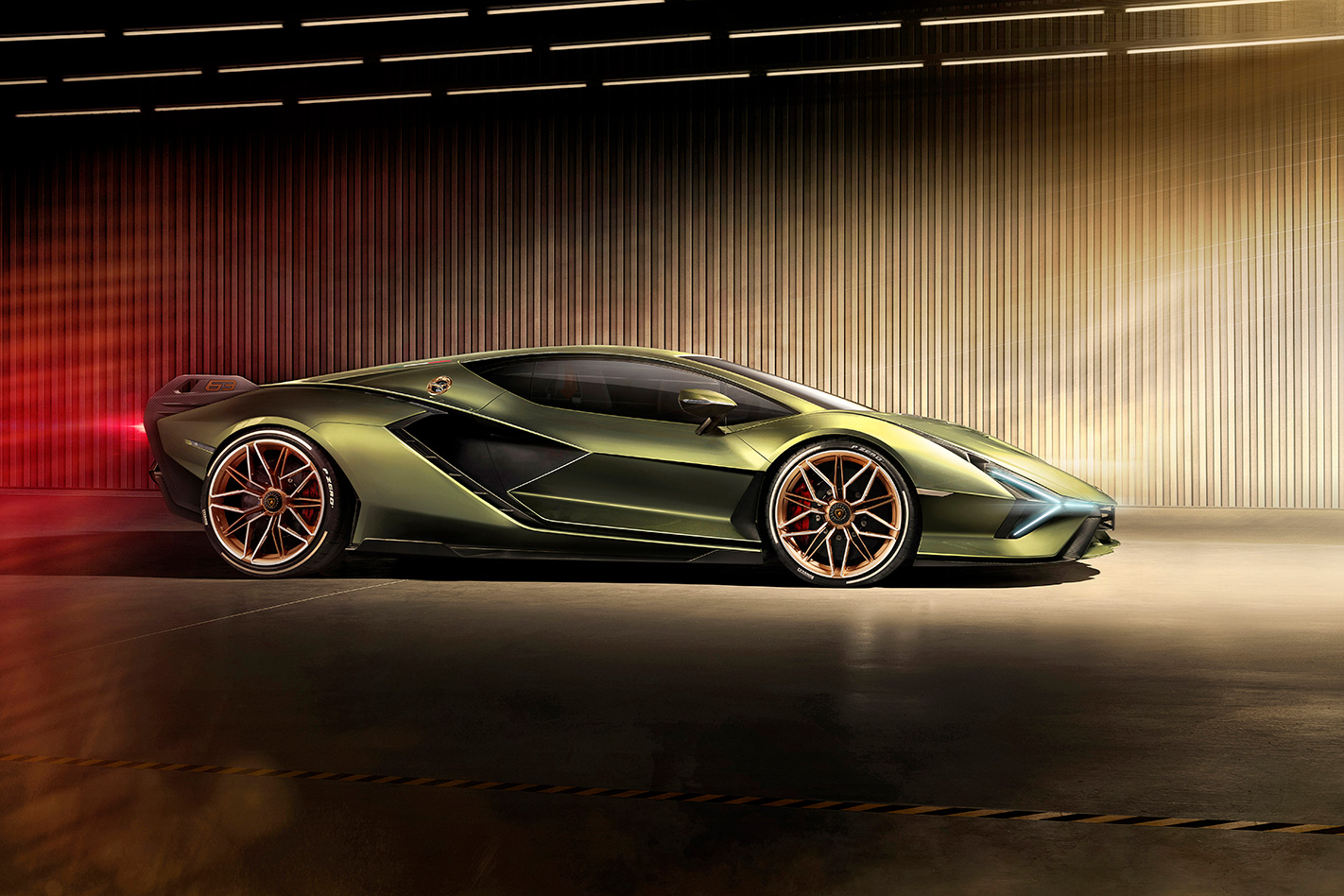
Just 63 Sians will be produced for Lamborghini’s favoured clients, each individually styled through Lamborghini’s Ad Personam personalisation program. No price tag has been attached, but it doesn’t matter because all 63 are spoken for.
The Sian will make its first public debut at next week’s Frankfurt Motor Show.
Nissan has revealed the second-generation Juke in Europe, ushering in a long-due replacement for the company’s defiantly different compact crossover.
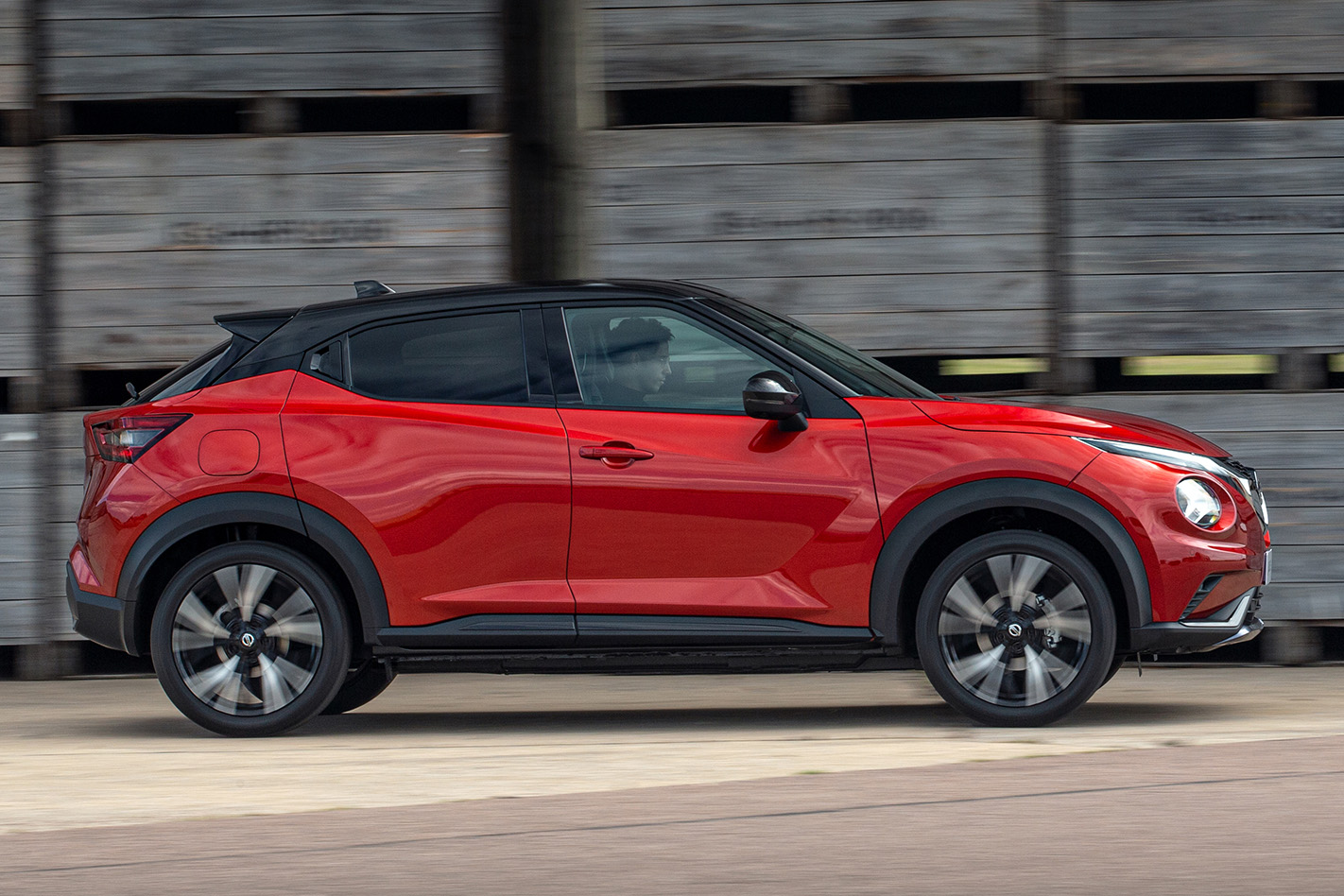
Though all-new, the new Nissan Juke very much apes the original in its general form. The silhouette is still that of a fastbacked hatch, with a sloping roofline and tapering side glass profile that gives it a sportier look than most other small SUVs.
Around the front there’s still a pair of big round headlamp housings with a set of slim eyebrow-like light elements above, though the design is crisper and identifiable by a new Y-shaped lamp graphic within the headlights. Nissan’s V-grille, now a staple on all Nissan’s products bar the Nissan 370Z, is another point of difference between the new Juke and the one it replaces
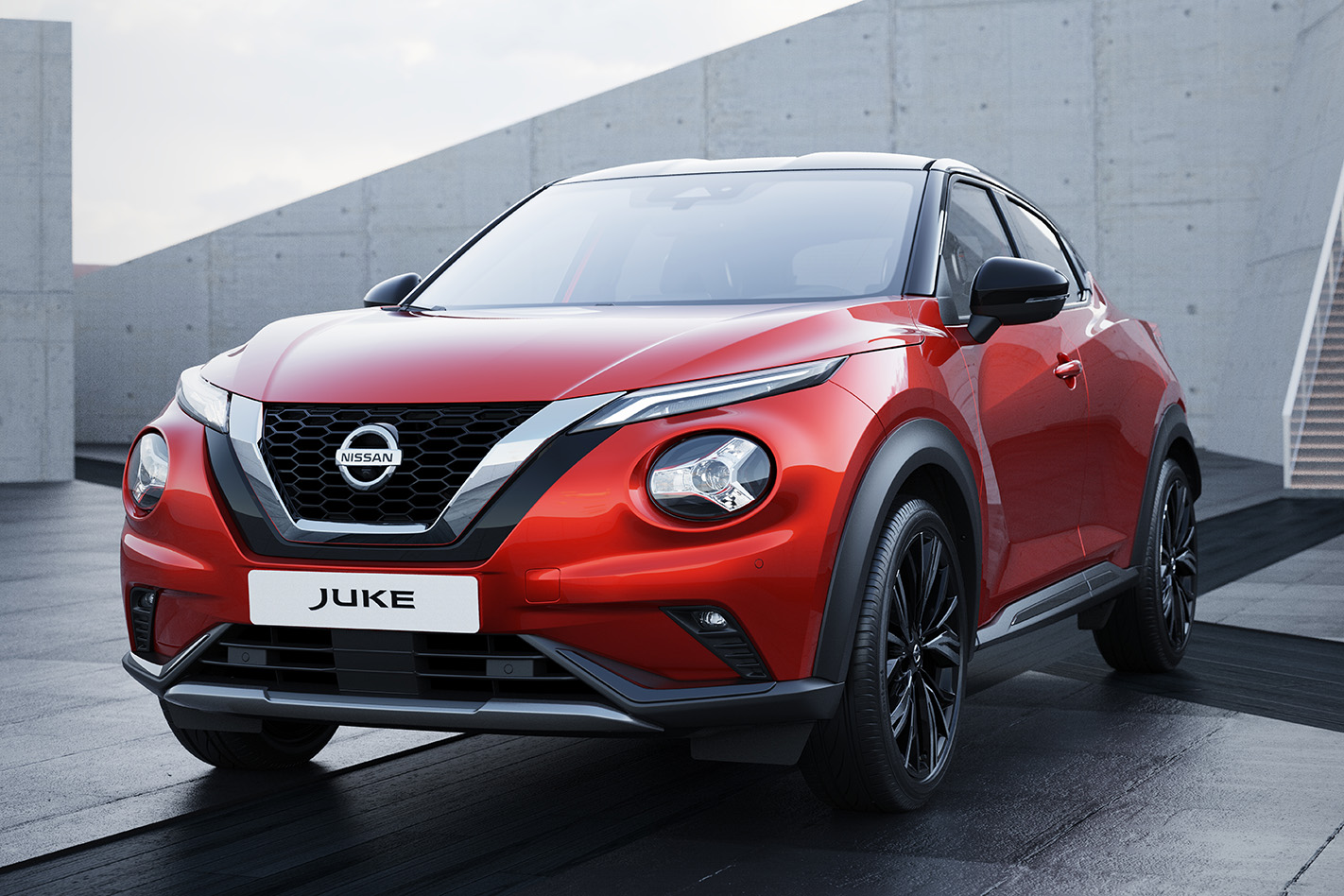
19-inch wheels fill the Juke’s pumped-up wheelarches (though 16- and 17-inch rims will feature on lower-spec models), and with a footprint that’s slightly wider (1800mm) and longer (4210mm) than before, the new Juke promises more cabin space than before – yet weighs 23kg less than its predecessor.
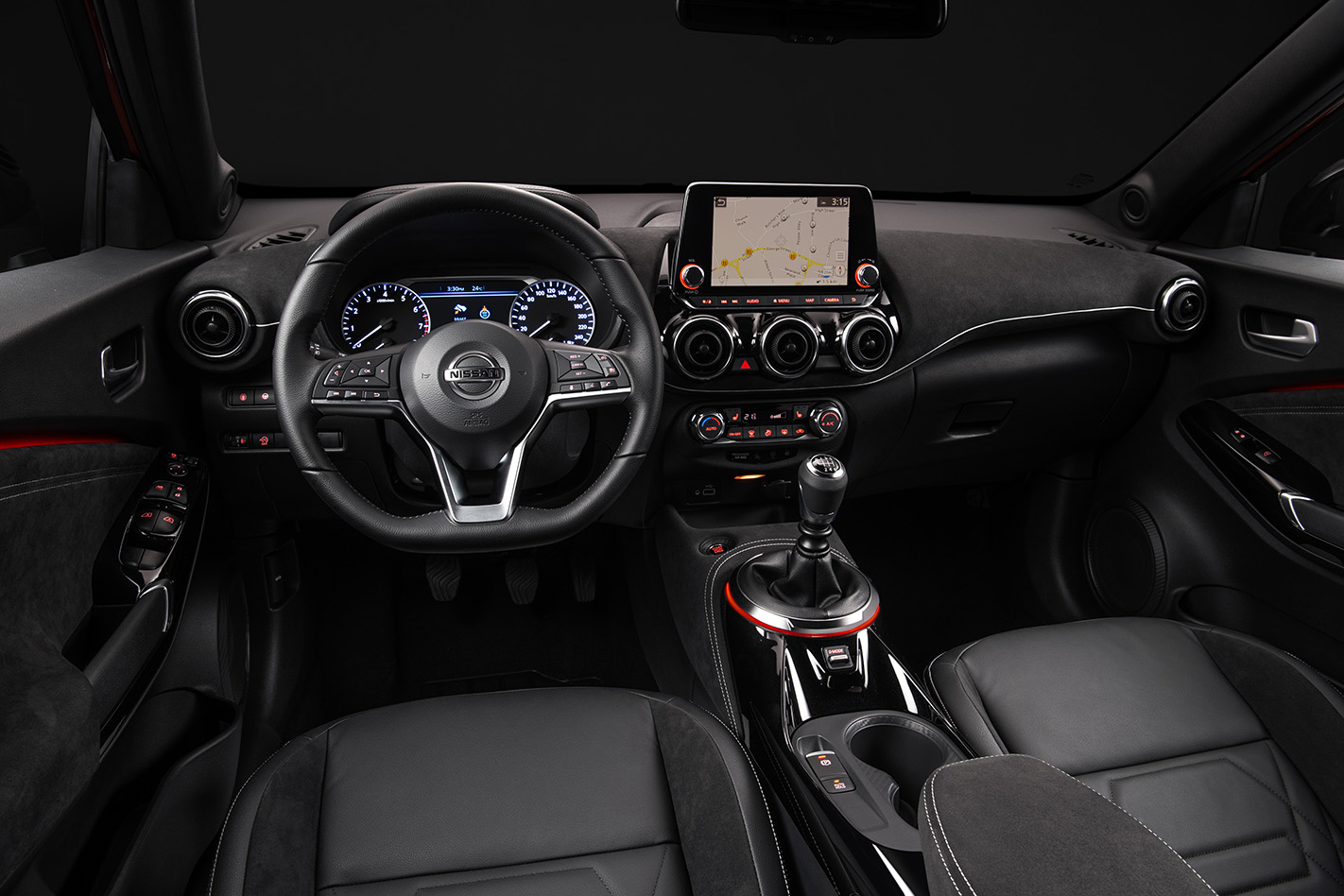
Cabin comfort is boosted by a 58mm increase in rear seat legroom, 11mm more rear headroom and a 422 litre boot capacity that’s 20 percent greater than the first-gen Juke, and siginificantly more capacious than most small hatchbacks. The cabin treatment is also less juvenile than the previous generation, with greater use of soft-touch materials, the introduction of ambient strip lighting and the generous application of microfibre trim on the dash, centre console and door cards.
Local specifications have yet to be locked in, but highlights include Nissan’s Propilot driver assistance tech (active cruise control, active lane keeping, AEB, blind spot monitoring), an 8-inch infotainment touchscreen, Apple Carplay/Android Auto smartphone mirroring, an in-car wifi hotspot, remote monitoring via a smartphone app, and an eight-speaker Bose audio system that houses a set of speakers in each front headrest.
In Europe, the only confirmed powertrain is a turbocharged 1.0-litre three-cylinder petrol, generating a modest 86kW and 200Nm, and driving the front wheels via either a six-speed manual or seven-speed dual-clutch automatic.
The Juke will continue to be built in England, and a European launch date is set for the end of November. Australian market details have yet to be announced.
To most people’s eyes, there’s not too much wrong with the original Aston Martin Vanquish. Introduced back in 2001, it was the brutal flagship that carried over the sleek design detailing of the DB7 V12 Vantage, updated and pumped full of attitude.
It sounded magnificent, but there were some quirks about it. The gearshift was poor, it had a propensity to throw its drive belts off and it first appeared at a time just before infotainment screens were making an appearance in cabins, so the cabin of early cars now feels a little outdated.
Its designer, Ian Callum, needs little in the way of introduction. His resume includes a whole host of stunning Jaguar, Ford, and Aston Martin models, with a whole host of interesting tackle like the Ford RS200, Nissan R390 racer and TWR contracts for Volvo and Mazda. He even worked on the HSV GTS-R.
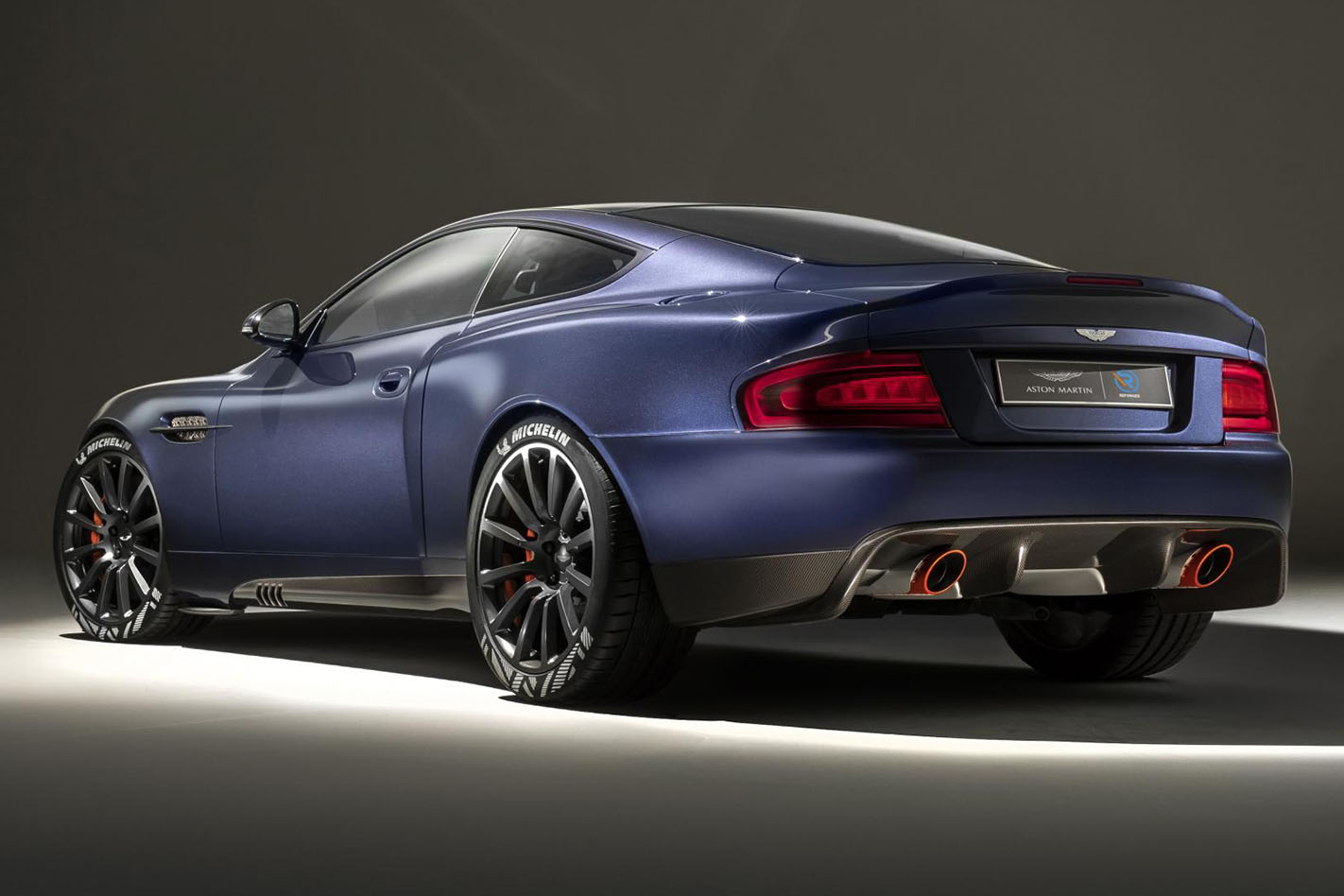
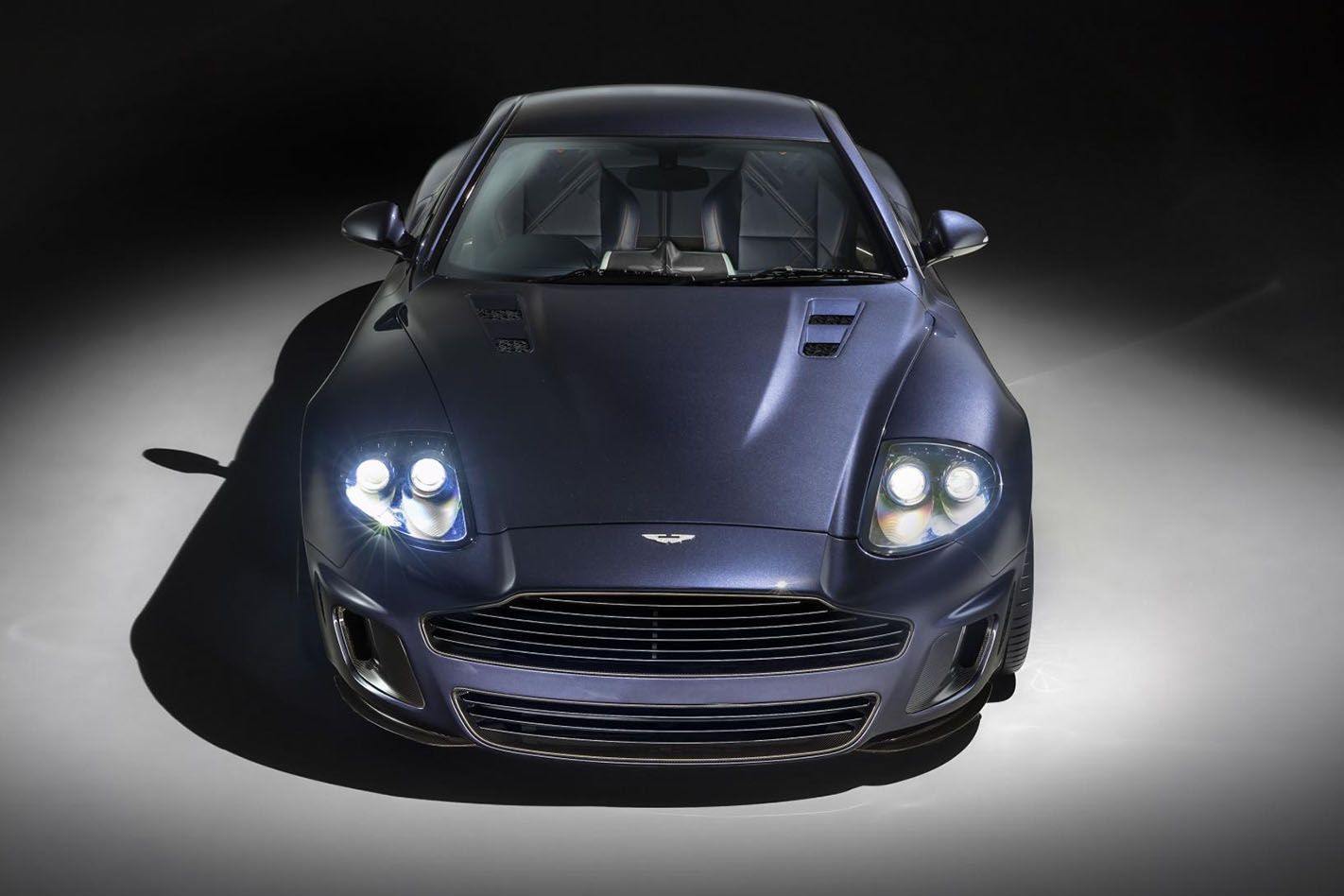
His latest project as part of his new venture, the Callum design group, is to revive the Vanquish, effectively fixing what the 65-year-old Scot viewed as the shortcomings of the original. The Vanquish 25 project won’t come cheap though. Fully endorsed by Aston Martin, the Vanquish 25 is a collaboration between Callum and R-Reforged, a Swiss company affiliated with Aston’s GT3 race team.
If you already have a Vanquish, you can realise some savings. Otherwise, R-Reforged will source a car for you and, with all of the work completed, you pay £550,000 (A$986,300) for one of the limited run of 25 cars.
The suspension has been re-engineered to offer a more supple, contemporary GT feel. Stiffer anti-roll bars, tuned dampers, uprated bushes, custom springs and lower ride height combine to improve ride quality and reduce roll, as well as combining with larger 20” wheels of the original design which now hide massive carbon-ceramic brake discs: 398mm up front and 360mm at the rear. The hubs have also been beefed up to cope with the bigger wheels.
Drivers now feel as if they sit in, rather than on the car, the hip point being lowered and tactility through the steering wheel improved with a thinner rim. The centre console now features an eight-inch display with smartphone mirroring.
The 5.9-litre V12 engine also comes in for some modernising. Software, camshaft and exhaust have been given the remedial attention, boosting power by 45kW from 388 to 433kW. An upgrade to a smoother six-speed torque-converter automatic is available but most owners will probably stick with the Vanquish’s original robotised manual gearbox.
There are also some cosmetic changes.
While it won’t be to everybody’s taste, Callum should have no problem finding 25 customers who loved the look of the old Vanquish, but who want it to feel more like a modern car. If you had a million dollars to spend on a car, would you queue up to be one of this select group or would you direct your money elsewhere? Let us know.
Despite Lamborghini’s attempt at maintaining a veil of secrecy over its upcoming 2019 Frankfurt Motor Show reveal, it was none other than the company’s own “Unica” customer mobile app that has given us the first glimpse of what to expect from the Sant’Agata car maker.
Posted by Instagram user bhp, the hybrid hypercar will be called the Lamborghini Sian, and based on the preview image, the model in question looks likely to be an Aventador-based special, rather than its replacement.
https://www.instagram.com/p/B16OGx1HKm2/
While no technical specifications or performance figures have been quoted, online speculation is rife with rumours that the Sian will employ a hybrid system that will feature the use of the Aventador’s 6.5-litre atmo V12.
Some of the more speculative suggestions even mentions an 22kW electric motor being paired up to the Aventador SVJ’s 566kW V12 to put out a combined output of 800hp or 588kW.
As exciting as it sounds, these speculations run contrary to an earlier report where Lamborghini has mentioned that it has no intent of introducing a limited-edition hybrid model at the 2019 Frankfurt Motor Show.
The company instead have stated that its Aventador replacement will “debut electrification for the brand”.
https://www.instagram.com/p/B16jqQCIJhK/
Considering that the Sian looks more like an Aventador-based limited-edition model rather than a concept, and with the Aventador replacement set to debut in 2022, the Sian might be nothing more than another dressed up limited-edition special to see the Aventador off in its twilight days, much like how the Reventon was to the Murcielago.
Then again, as it is with the plans of many car makers, “Never say never”, and we will only know for sure when the doors open for next week’s 2019 Frankfurt Motor Show.
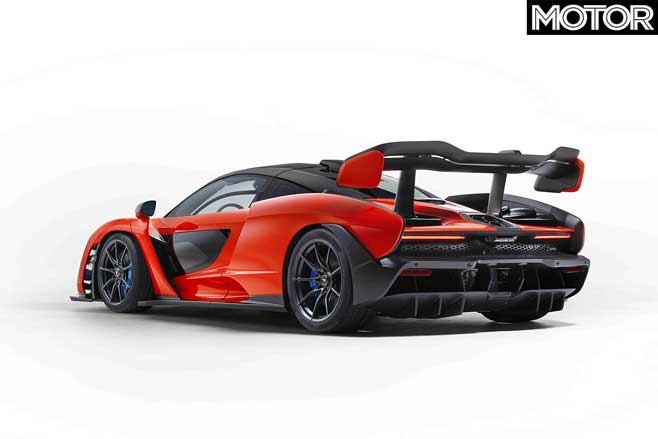
The McLaren Senna is subject to a recall for a fault with the car’s engine harness.
According to the recall, published by the Australian Competition and Consumer Commission (ACCC), “Part of the vehicle’s engine harness may come into contact with the metal link pipe heatshield and chafe, causing damage to wire within the engine harness bundle.”
According to the recall, “If damage occurs to the engine harness wires, the engine may stall, misfire or rupture the exhaust system, possibly causing loss of power and increasing the risk of an accident.”
Australia has an inordinately high proportion of Senna production, with 13 of the limited-to-500 track-focused supercar being sold locally and spotted regularly on Melbourne and Sydney roads.
All affected owners will be contacted and notified of the problem, at which point the nearest McLaren dealership will arrange an inspection and repair the vehicle free of charge. Owners are able to contact McLaren through their local dealer (Melbourne, Sydney, Adelaide and the Gold Coast) or emailing [email protected].
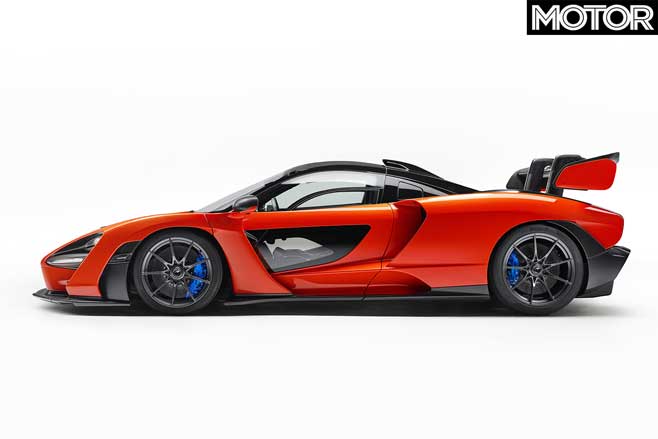
The Senna is the third in McLaren’s Ultimate Series after the F1 and P1 and is one of the most powerful and expensive cars ever sold in Australia, its 4.0-litre twin-turbo V8 producing 588kW/800Nm with an equally impressive price tag of AUD$1.7m before optional extras and on-roads.
The model has had a tough run, with popular YouTuber ‘Salomondrin’ losing his Senna to fire in December 2018 and another Senna, owned by German car collector ‘gercollector’, catching fire during parade laps at the 2019 Austrian Grand Prix while being driven by Gerhard Berger.
There’s no indication that either of these incidents are related to the recall.
An image’s ability to transport us somewhere extraordinary is remarkable. We’ve all felt it, this magical power, this invisible influence, even if you haven’t been fully aware of its effects. Often it’ll manifest itself with a physical symptom, like a low whistle or a slow shake of the head, as you stare and drink in the detail. It’s this reaction, and the ability of an image to make us feel unadulterated wonder, that makes scrolling through Instagram so addictive (I can’t be the only one, surely?).
It’s also a big part of why we buy car magazines.
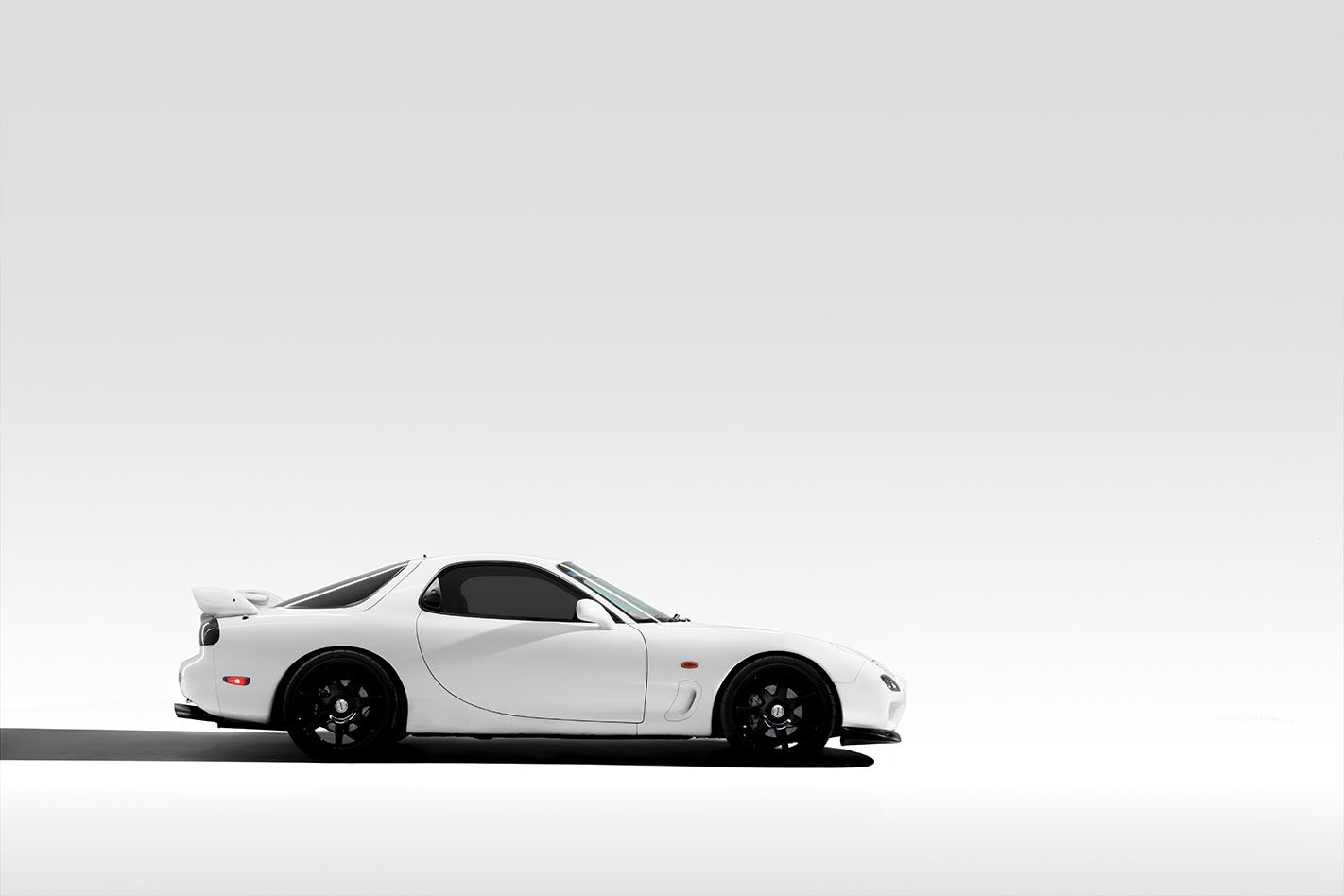
Reviews and hardcore consumer advice might be the backbone of Wheels magazine, but world-class photography has always been just as important. I won’t resort to clichés about what images are worth in words, but you only need to behold a shot of Peter Robinson airborne in a McLaren F1, or to feel the poignancy of an FJ Holden captured at sunset on a dirt road (like the award-winning image that graced the cover of our Holden farewell issue in November 2017), to understand that a picture is capable of delivering something special.

As a medium for firing our imaginations and for indulging a desire to escape, a beautifully crafted magazine offers a tactile experience that’s almost unrivalled. Especially one that’s full of world-class photography, which, dear readers, is precisely what we have created.
On sale now is the first ever ‘Wheels: The Collection’; a brand-new, special edition of your favourite car mag dedicated solely to revelling in beautiful photography. Our ethos sums it up perfectly: Epic cars. Epic locations. Epic images.
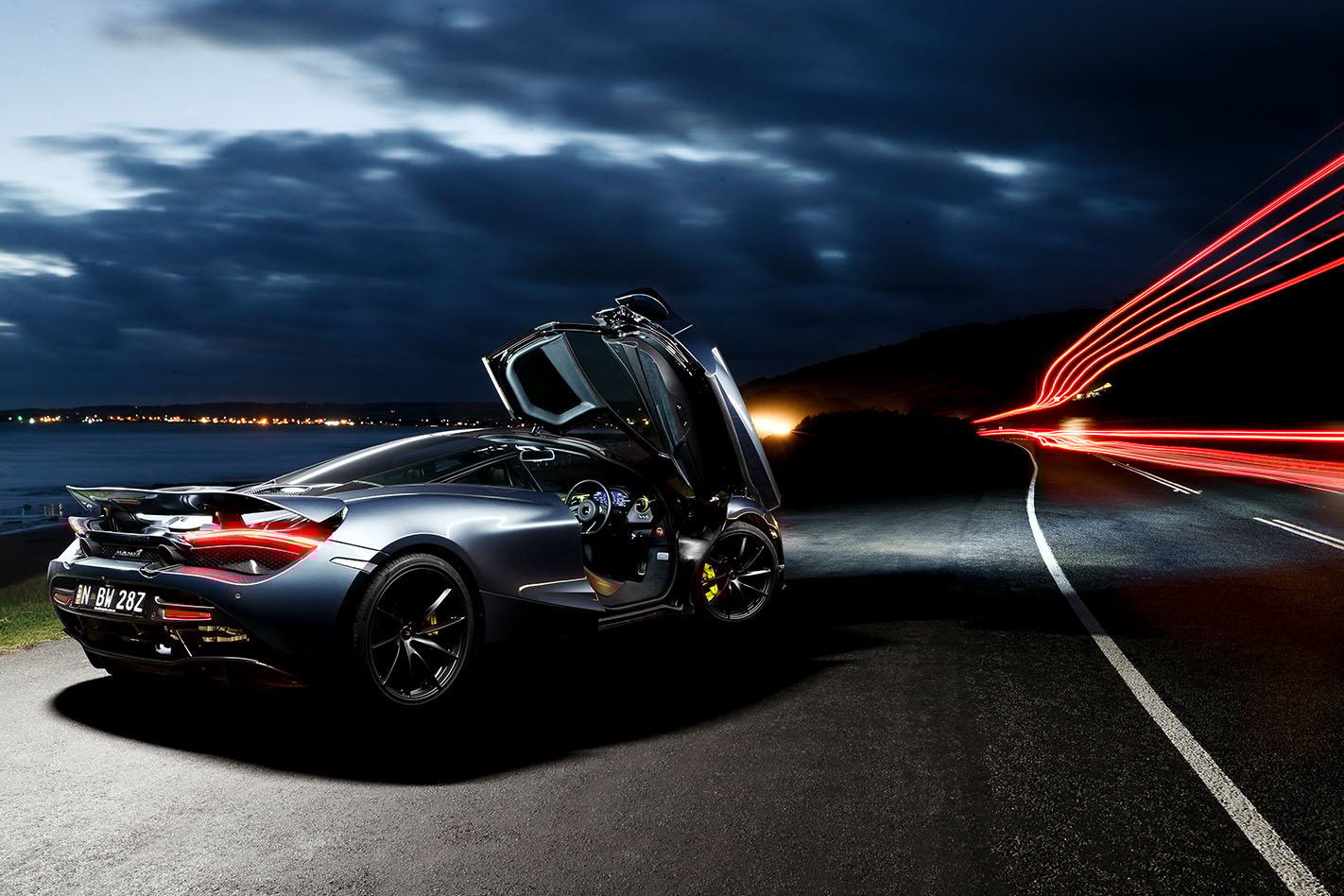
It’s something of a hat-tip to the brilliant people wielding the camera, of course, but the purpose of this magazine runs deeper. Remember that transporting thing I mentioned earlier? Every image that is featured is designed to put you in the frame; to enable your motoring fantasies by capturing the essence of a memorable moment.
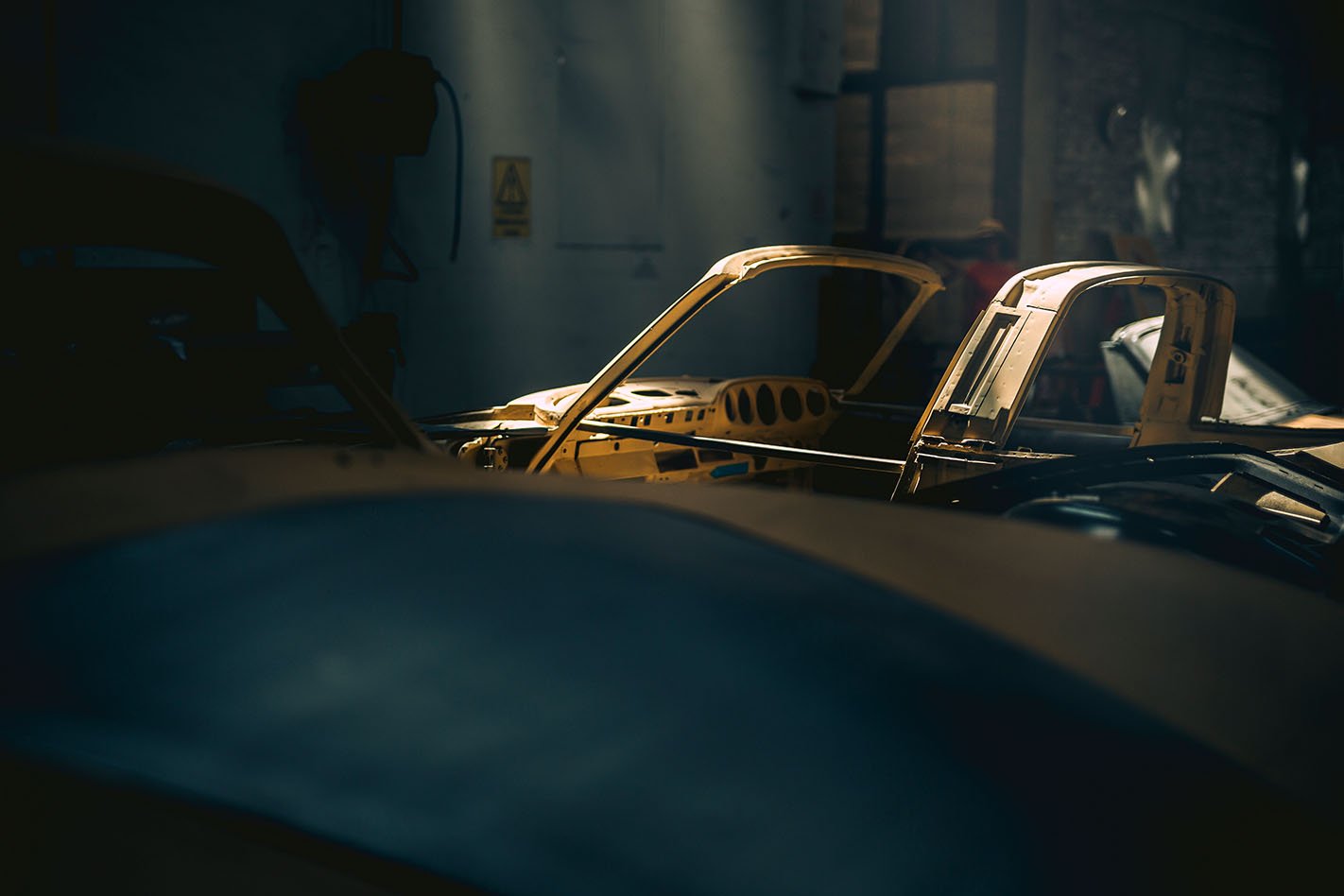
It’s also an acknowledgement that a petrolhead’s love of cars goes beyond how they look and how they go around corners. It’s about how they make us feel. A truly great photograph isn’t only able to capture that great intangible, it’s also able to deliver a sense of atmosphere, speed, occasion, and location.
Over 120 pages you’ll find striking images that do just that, compiled from some of the most remarkable adventures this magazine has embarked upon in its modern era. Every one is infused with that great power of placing you behind the wheel. Make sure to pick up a copy!
Former world champion Jim Clark says it’s the most exciting sport he’s ever tackled. We’ll take his word for it. But if you have any doubts, he recommends a Cortina, lots of nerve, and plane tickets to Italy for you – and your doctor.”
So concludes the astonishing minute-long newsreel about the ‘Salute to Cortina Champions’ of December 1964, when road-going Ford Cortinas were driven down an Olympic bobsleigh track. Fifty-five years on, we’re taking one of Ford’s current stars, the suitably game Ford Fiesta ST, to revisit the site of this historical madness.

Following a night-time handover at Treviso Airport, our eager little three-door ST pounds up the empty Autostrada before climbing deep into the Dolomites to the chic ski resort of Cortina d’Ampezzo, home of the 1956 Winter Olympics and regional epicentre for la dolce vita.
There’s a particular excitement to arriving somewhere scenic in the dark, and we bed down in a hotel beside the town’s landmark bell tower in anticipation of what sunrise will reveal.
And rightly so. The next day, drifting wisps of mist can’t quite hide the huge, broken crags of limestone that cradle the Ampezzo Valley, their haywire structures jutting at all angles, barely softened by January’s snow. It’s an impressive sight.
At the base of the Tofane range on the north edge of town, we meet Gianfranco Rezzadore, president of Bob Club Cortina and former Italian international bobsleigh driver. Our rendezvous is Bob Bar, a tiny wooden shack and local hang-out nestled beside the Eugenio Monti bob track’s finish.

Founded almost a century ago, the course was 1700m long by the 1956 Winter Games, with 16 turns and a 152m vertical drop. Unchanged by 1964, it was just wide enough to accommodate a Ford Cortina.
The track was shortened, narrowed and artificially refrigerated from 1979 (until then, snow and ice were hand-packed) but closed in 2008. There are plans to recommission it should Cortina successfully bid to host the 2026 Winter Olympics in partnership with Milan – they’ll find out soon.
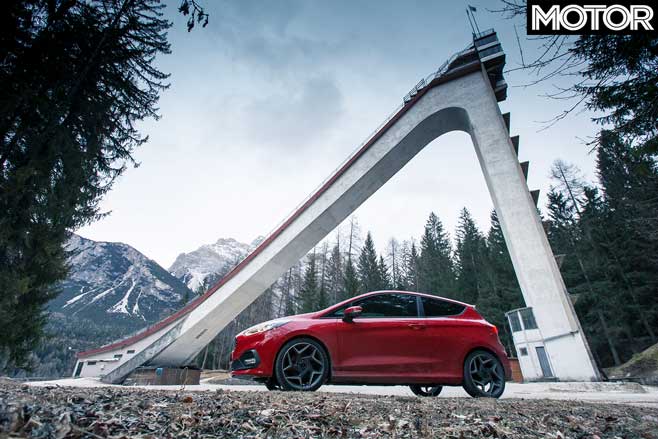
For the moment, the smooth, concrete-lined track lays dormant but largely intact, so we walk its length with Rezzadore, who has piloted 3000 runs down here (not including extra-curricular jaunts aboard a snow shovel).
He says bobs used to hit 130km/h on track, and that centrifugal forces pushed 4g through his spine on the ‘Cristallo’ hairpin: “I used to be taller.” Rezzadore’s sceptical that the Ford Cortinas reached the 80km/h-plus claimed in the newsreel, but the dangers were very real.
Back then, the huge, banked corners – easily twice my height – had no horizontal safety barriers above them. At times, the cars ran almost vertically along what were literally walls of death: sleighs have left this course with fatal consequences, including during the filming of For Your Eyes Only in 1981.
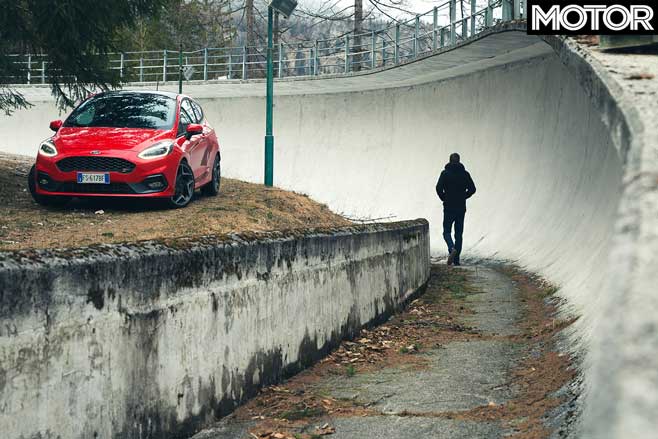
Past the pine straw-strewn lower corners, we amble uphill, where sheet ice crackles beneath our feet along the snaking ‘Labyrinth’ complex and on through yet more vertiginous banked corners. Turning to look back down, it eludes me how anyone – let alone a valuable sporting professional – could have driven an unmodified, carburetted family sedan with woolly steering, rear cart springs and 1960s tyre compounds down here in the snow. Different times indeed.
The route straightens under a bridge and into a clearing that marked the event’s start. This is where group photos were taken, Clark embellishing his race overalls and iconic two-tone lid with a fetching cable-knit sweater, before the cars took to the icy helter-skelter.

With the straights now barely wide enough for a bobsleigh, we’ll enjoy no such mischief – but we have another plan to get our alpine thrills while we’re here. You see, Cortina was a haven for racing drivers long before Clark et al arrived. Most famously, the Coppa d’Oro delle Dolomiti road race was based in the town each July for 10 post-war years along a 304km mountain route. The thought of period sports cars from Alfa Romeo, Lancia, Maserati and Ferrari thrashing between these peaks is spine-tingling.
These days, regularity rallies are the next best thing, and we’re going to trace the best bit of the WinteRace – an annual, snow-bound classic car rally. Its organisers point us towards part of the route that strings together a succession of mountain passes to the west. Soon after dawn the following day, we burble out of town onto a smooth, rising back road towards the first summit at Passo di Giau.

We are immediately met with hairpins – lots of them. Between corners, the Fiesta’s 147kW/290Nm, 1.5-litre blown triple offers ample thrust. Such are the incline, short straights and gearing that I’m mostly riding second, the engine scaling from 2000rpm to 6000rpm and back without complaint nor more than fleeting inductive hesitation. When shifting is required, the short-throw gearbox action is neat and doesn’t mind being rushed.
I don’t really need the sharpened throttle, heightened mapping and bass-drum overrun of Sport mode, and Normal’s lighter steering feels more natural, so I stick with that.
Turn-in is immediate, and while the sub-zero temperature and polished asphalt prevent our Performance Pack-equipped car from grapple-hooking around the corners as it might on a dry country road, the Quaife limited-slip differential at least puts paid to any ungainly front-end scrambling – instead, it gently and progressively runs wide until a throttle lift clips us back into line.
Body control impresses too – at these moderate speeds, long-wave bumps are tidily parried and roll barely registers. The Fiesta feels more RS than ST.

But grit soon starts pinging off the underside, and beyond the treeline hefty snowbanks flank the road and glassy strips of ice leach across it. The banks close in to leave barely a car’s width of blacktop as we nip past a crawling snowplough that’s spewing a frozen white arc down the mountainside. Moments later the road disappears, so it’s steady with the throttle to retain momentum, then a little patch of black lets us add enough speed to crest the summit.
Around here, it’s compulsory to have winter tyres or chains from November to April. Our car comes with the latter, so 2236m above sea level and with frost-tingled fingers (it’s –5.0 degrees Celsius), we’re reading how to attach our ‘Maggi Trak Auto’ snow chains to the front tyres. In a routine that gets swifter as the day progresses, we hook them up and shuffle around to feel them out.
From outside, the chains make the merry jangle of Saint Nick’s sleigh, but in the cabin the constant rumble of graunching snow is underscored by a locomotive clickety-clack. Crucially, however, they provide the purchase the Fiesta needs to claw itself onwards.
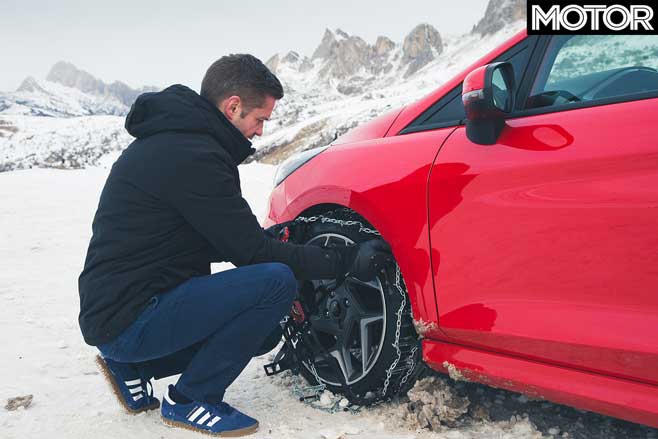
Before pressing on, we take a moment to drink in our location. The pass sits beneath sky-scraping Monte Nuvolau, and I can just see zig-zagging footpaths in the scree that lead climbers to the foot of its perilous vertical faces. On the peak’s far side 339m above us is an eagle’s nest of a wooden hut from 1883 – once a military lookout, it now welcomes climbers.
Our route down is a perfect sequence of hairpins with barely a straight between and, as the snow clears within a few hundred metres, it’s off with the chains and up with the speed. We carve down the mountain, past the first of countless ski areas and along frozen streams, then barely touch the valley floor and start rising again.
We join a wider road with fast sweepers that the Fiesta gobbles up before the tarmac starts to writhe again. Subsident lumps and bumps don’t worry the chassis, while broken, frost-fissured patches of tarmac reveal its firm setup, though without undue resonance.
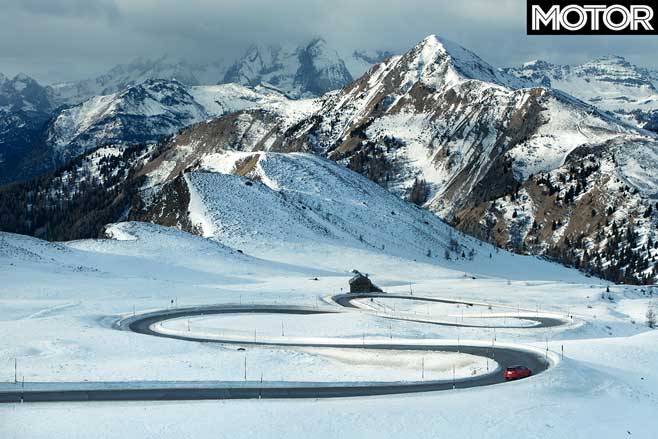
Closing on Passo Pordoi, to our right is the imposing stone ossuary where 8582 German and Austro-Hungarian soldiers rested after battling Italy here during the Great War. Year-round trench warfare on this terrain defies contemplation. The road flits between clear straights and snowbound corners, so it’s on with the chains again, the heavily cambered corners helping press us into the surface as we clamber on up.
It’s blowing a gale as wind funnels through the 2239m summit’s saddle, so we don’t tarry. The snow thins on the descent, so we remove the wheel jewellery for another slalom whose switchbacks and kinks don’t let up for three full miles, plunging from windswept mountainside to sheltered forest.
Trunk-shaped dents in the Armco denote the enduring timber trade; before the early 1900s tourism boom helped forge this road, wood was instead transported by the area’s numerous ice-blue rivers.
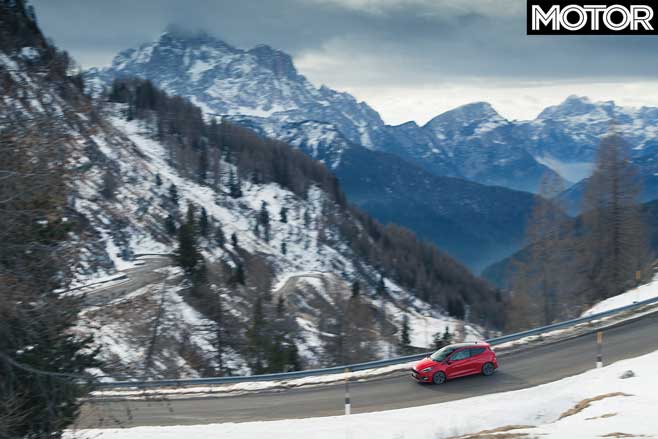
Rising again to Passo Sella (2244m), we pause on a panoramic hairpin so photographer Luc Lacey can capture the jagged skyline beyond. There are no other cars, and there is no sound but for the creaking Armco and a whirling snow devil whispering by. It’s one of those moments to feel small.
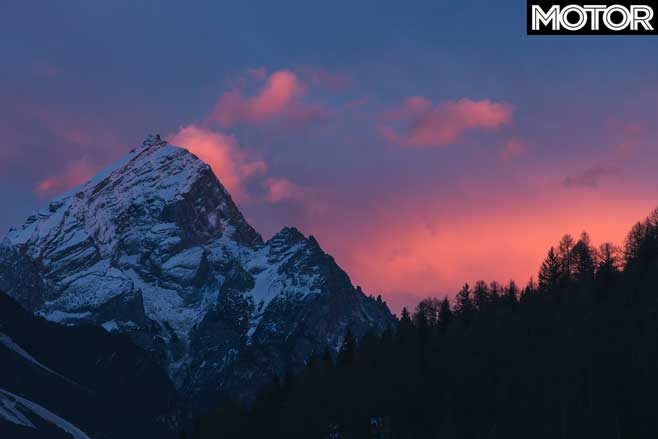
The pass itself is ice-free up and down, then we barrel along the smooth, tree-lined Val Gardena road, skirting bizarre, precarious-looking rock formations so tall and so steep I get dizzy peering up their walls. Winding upwards again, we bounce swiftly between second and third gears before cresting spectacular Passo Gardena at 2115m where, as the sunset turns peaks to molten lava, some well-heeled skiers hitch a helicopter ride down the valley before the weather turns.
No such luxury for us. Even with chains reinstalled, it’s tricky going, the road dipping and diving as much as it twists. Approaching one particularly evil left-hander, the naked rear tyres try to overtake the fronts before a delicate dose of throttle straightens us out.
Once below the snowline, we veer east again under a freezing, clear sky, the crescent moon peeping between peaks as we home in on the welcoming lights of Cortina. It’s been a brilliant drive and, unlike our counterparts from 1964, we’ve kept our borrowed Ford largely horizontal and entirely intact.
Mind you, there is one remaining Olympic bobsleigh track wide enough to drive a car down. Now we just need them to launch the Ford St Moritz.
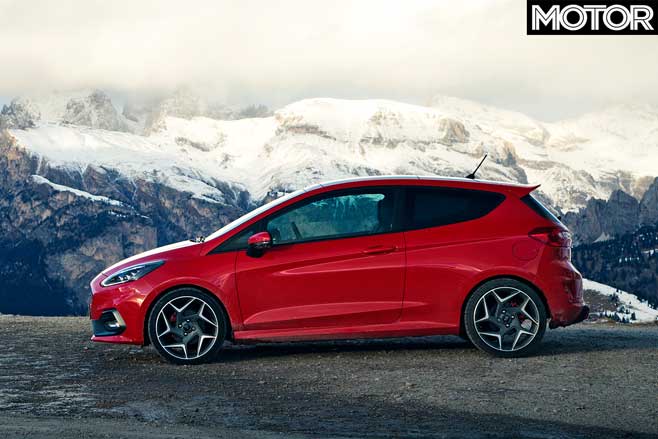
FAST FACTS 2019 Ford Fiesta ST BODY: 3-door, 5-seat hatch DRIVE: front-wheel ENGINE: 1497cc inline-3, DOHC, 12v, turbocharger BORE/STROKE: 84.0 x 90.0mm COMPRESSION: 9.7:1 POWER: 147kW @ 6000rpm TORQUE: 290Nm @ 1600-4000rpm WEIGHT: 1262kg POWER-TO- WEIGHT: 116kW/tonne TRANSMISSION: 6-speed manual SUSPENSION: MacPherson struts, anti-roll bar, twin-tube dampers (f); Twistbeam, coil springs, mono-tube dampers (r) L/W/h: 4068/1735/1469mm WHEELBASE: 2493mm STEERING: electrically assisted rack-and-pinion BRAKES: 278mm ventilated discs, 2-piston calipers (f); 253mm solid discs, single-piston calipers (r) WHEELS: 18.0 x 7.5-inch (f/r) TYRES: Michelin Pilot Super Sport; 205/40 R18 (f/r) PRICE: $31,990 (5-door)
RATING: 4.5 out of 5 stars
The Roads

Our 137km loop headed south-west from Cortina to summit Passo di Giau, then a series of valleys led to Arabba for an early lunch. We then traced around the jagged Sella massif, linking Pordoi, Sella and Gardena passes. The WinteRace route continued north, but we broke east to take Passo Falzarego en route back to Cortina. The full 2019 route is available at www.winterace.it.
Cortina vs Bobsleigh track

The 1964 Salute to Cortina Champions celebrated more than 200 competitive wins in 26 countries for the humble Ford Cortina, launched just two years before. Alongside Jim Clark, the field of 19 drivers included luminaries such as Colin Chapman, John Whitmore, Jack Sears, Vic Elford, Eric Jackson, local Olympic sledder Lino Zanettin and speed polymath Henry Taylor – a British bobsleigh team captain turned Formula One pilot turned Ford works sedan racer.
Their challenge was to navigate an 800m section of the Cortina d’Ampezzo bobsleigh track used for the 1956 Winter Olympics in a collection of two- and four-door Cortinas. The cars came in road-going GT trim, which meant an uprated, 58kW version of the 1498cc Kent four-pot with a Cosworth camshaft and a kerb weight of 864kg – though some baited gravity by driving four-up.
As for the results, a Ford insider reported: “It was never intended to be competitive, but rather a celebration of the Cortina’s successes. However, it quickly developed into a match between the race and rally drivers, with each side doing considerably more runs than originally envisaged. The Cortinas were absolutely bog-standard – with the result that the front suspension struts broke through the top mounts.”
Competitive spirits thus unsated, a snowball fight broke out, during which Clark slipped a disc in his back, causing him to wear a corset for the subsequent South African Grand Prix (which he then won).
A Northern NSW police command is a little hot under the collar after one of its new BMW highway patrol cars was destroyed by fire during a hot pursuit.
It was certainly a hot case; the BMW 530d was completely incinerated by the blaze, which allegedly started after officers parked the turbo-diesel powered patrol car on a grassy verge in the midst of a pursuit near the northern NSW town of Tweed Heads.
Credit: Marg Huxley
The officers had stepped out of the car to lay tyre spikes in order to slow down a fleeing suspect, but witnesses said that the long, dry grass appeared to ignite around the car’s exhaust system.
The police car was well alight within minutes, resisting the officer’s best attempts to arrest the blaze with hand-held extinguishers.
More police car news
- This is what the cop car of the future will look like
- NSW cops order 282km/h patrol cars
- Victorian road toll skyrockets despite police blitz
A typical example of a BMW patrol car costs the NSW taxpayer more than $100,000, once the vehicle has been outfitted for police work.
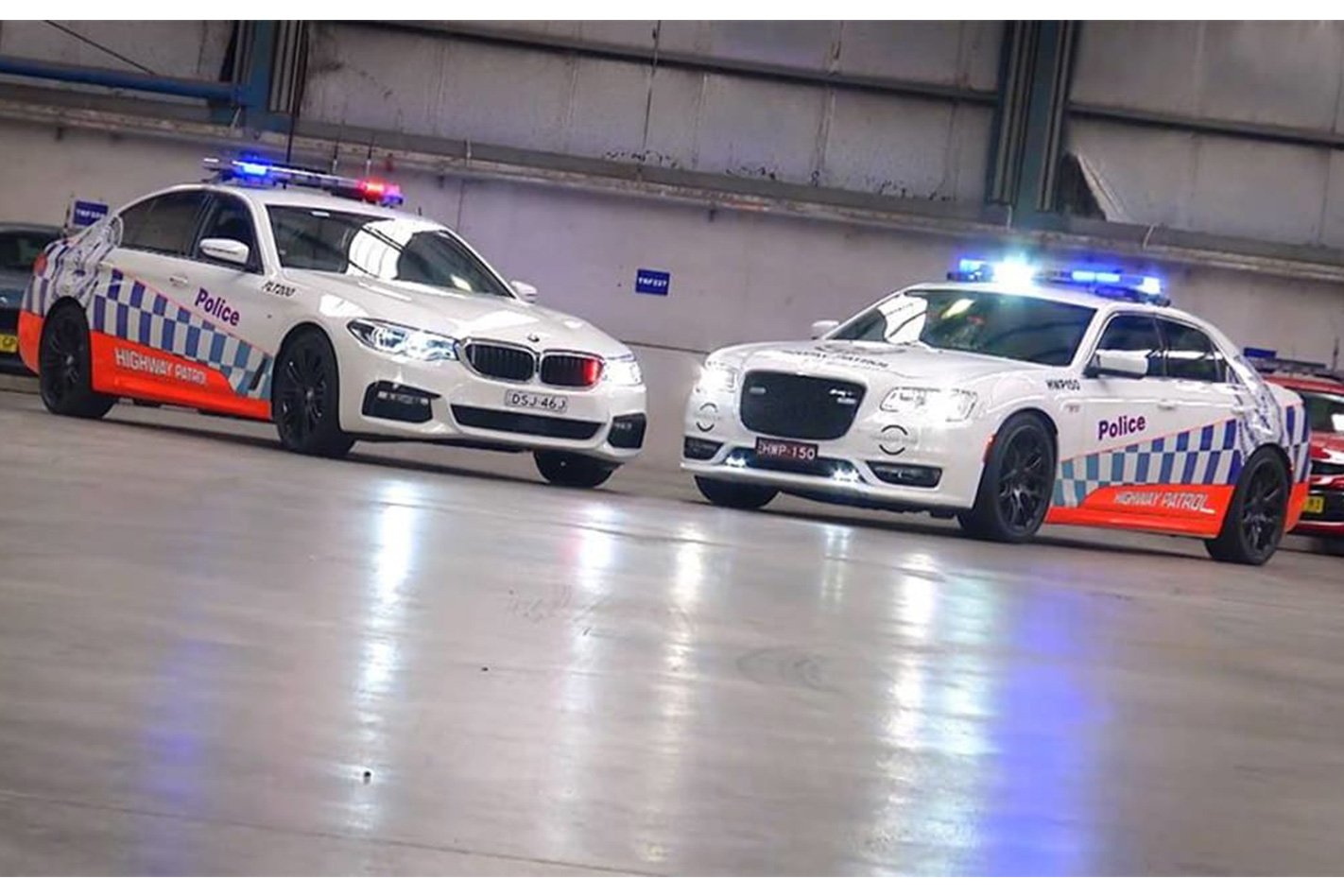
The turbo-diesel BMW is, however, already a firm favourite with NSW highway patrol officers, thanks to its size, speed and fuel economy. Officers have told WhichCar that they can easily get 1000km from a single tank of diesel.
The similarly new Chrysler 300 SRT, however, isn’t as popular with the NSW rank and file, with two officers admitting to averaging between 200 and 250km from a tank of petrol in the Chrysler.
As a result, several commands around NSW are holding onto examples of the V8-powered Holden Commodore, with some approaching 200,000 operational kilometres.
Other states have adopted the Kia Stinger as a highway patrol vehicle, while western NSW commands use Volvo’s XC60 T6 SUV to patrol country roads.
Every car has a blind spot, but not all cars are created equal. Some, by fault of design, have excellent vision, while others have a blind spot so terrifying and hidden that you’ll need to double your visits to the physio.
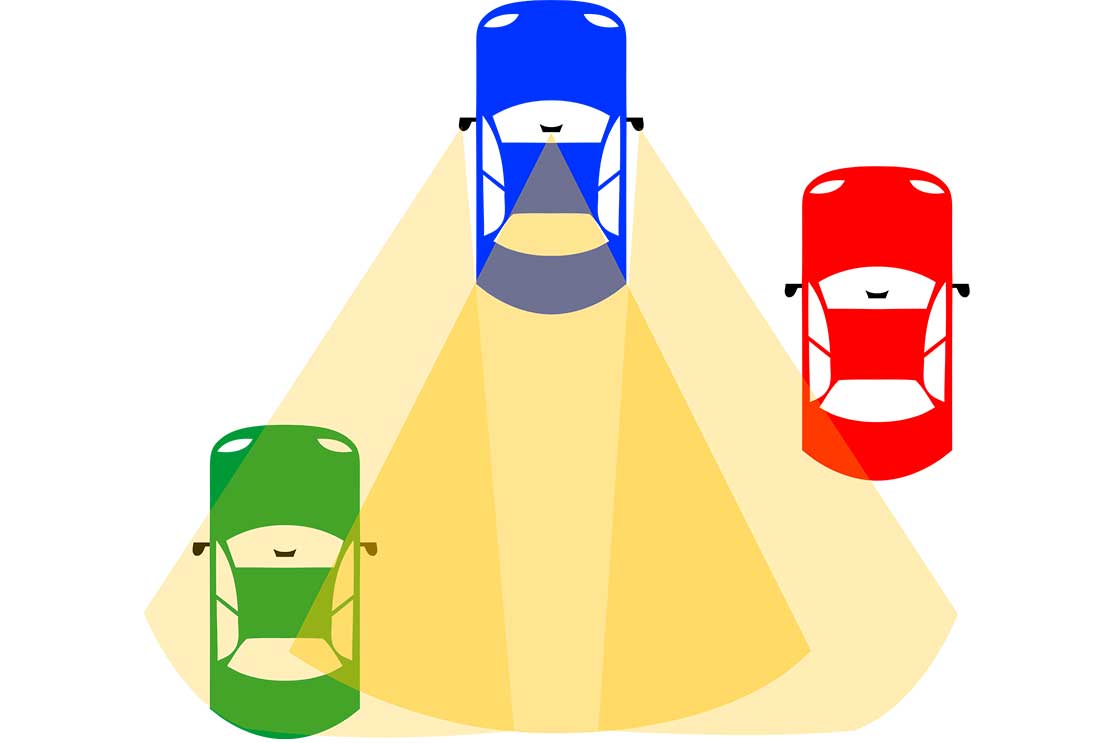
The vehicle’s blind spot is an area of your car that obstructs the driver’s view. There are certain design elements in a car that can cause this including the A-pillar, B-pillar, mirror or even headrests – essentially, anything that reduces visibility is a blind spot and a potential hazard because it limits the driver’s ability to identify objects around the car, like, say, another car.
These days, most new cars offer safety technology that helps reduce blind spot dangers, including blind spot monitoring where your car will beep at you or flash a light if you indicate to change lanes and there’s an object in the area of low visibility.
So too, some cars will even slam on the brakes when reversing if they detect the approach of a car/obstacle from behind.
Checking your rear-view mirror and side-mirrors are important steps in avoiding a collision, and briefly looking over your shoulder will reveal anything hidden in a blind spot. Never assume that it’s clear. It’s an important lesson on the road, and often a point of failure for many in driving tests. Even if your car has sensors, it’s a good idea to check this area – technology isn’t infallible. This is particularly important for first-time drivers and also those entering retirement.
It may take extra time and effort, but the trade-off is definitely worth it when it could potentially save you from a crash. Better to be safe than sorry.
If you’re towing a trailer, caravan, boat or any other large objects, your blind spots can double.
So when should you check your blind spot?
Every time you move the car from stationary or park, you should check your blind spot for other cars, cyclists or pedestrians, and any other obstacles that may be at danger.
Also have a quick look when changing lanes, even if you think it’s clear. Other road users can sneak into your blind spot quickly. Not to mention cyclists or motorbikes who are smaller and often better hidden.
Larger vehicles aside, when you’re taking a left turn, cyclists become the ones to look out for.
Apart from the new safety tech making its way in to cars, there are other things you can do to help identify blind spots.
Extra mirrors that attach to existing door mirrors give you a wider view of the side of your car. Also, setting up your rear-view and side mirrors correctly can reduce the areas around your car with less visibility.
To do this, your rear-view mirror should give you direct view of the road behind you and cover your rear window with a slight bias to the right. Then, use markers in your rear-view mirror to set up your side mirrors. For example, an object on the far right of your rear-view mirror should appear in the far left of your right-side mirror, and it’s reversed for the left side: a marker on the far left of your rear view should appear on the far right of your left-side mirror.
Finally. Official word for Australia on the new Ford Fiesta ST is here. Available now for months overseas, Ford Australia has finally let us in on what we can expect from the cheapest model in the Ford Performance range.
Coming to Australia now in only 5-door guise, the Fiesta ST packs the same 147kW and 290Nm as it does in other markets, from its diminutive 1.5-litre turbocharged 3-cylinder engine. It’s also only available with a 6-speed manual transmission.
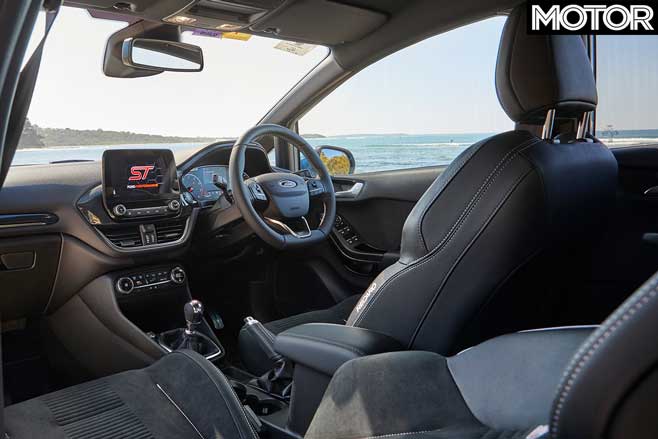
As Australia is accustomed to receiving high-spec cars as standard, the version of the Fiesta ST headed our way will be the ‘ST3’ spec, with the Performance Pack as standard kit.
This means all Aussie Fiesta STs will have a mechanical limited-slip differential and launch control, as well as force-vectoring springs which are designed to improve ride quality without sacrificing dynamic ability.
It’s that level of standard specification (plus the performance that comes with it) that is bound to help the new Fiesta both move the game on from the previous, highly-regarded generation, and also create a level playing field with rivals such as the Volkswagen Polo GTI.
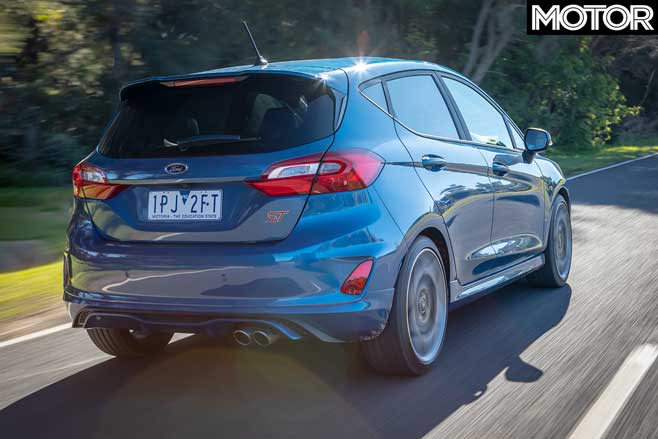
Oh, yes. The Fiesta is taking aim at the VW’s baby on Aussie turf, not only with its performance, but also with its price. The more premium interior and higher-spec car also comes at a higher price than its predecessor.
At $31,990 before on-road costs, the Fiesta is dollar-for-dollar with the Dub GTI, though there are also a couple of extra-cost options on the Fiesta which could make it a $35,140 deal. The panoramic sunroof is a $2500 option, not that the ST needs it.
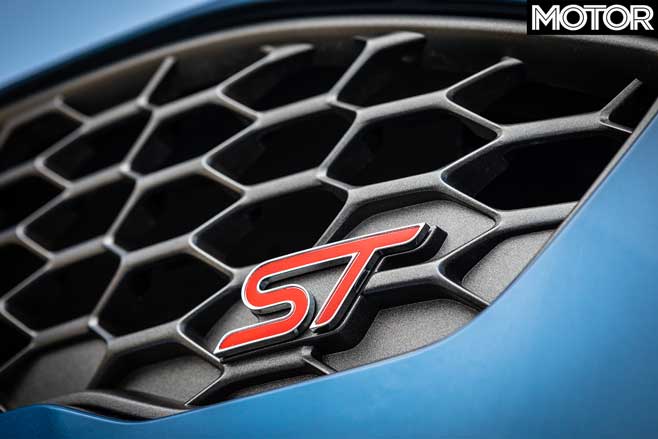
Additionally, the only colours that cost nothing are red and white, as the hero colour of Ford Performance Blue (and Agate Black, Magnetic Grey, plus Moondust Silver) costs an extra $650.
Ford Australia is expecting it to arrive in Q1 2020 for a February/ March launch.
