
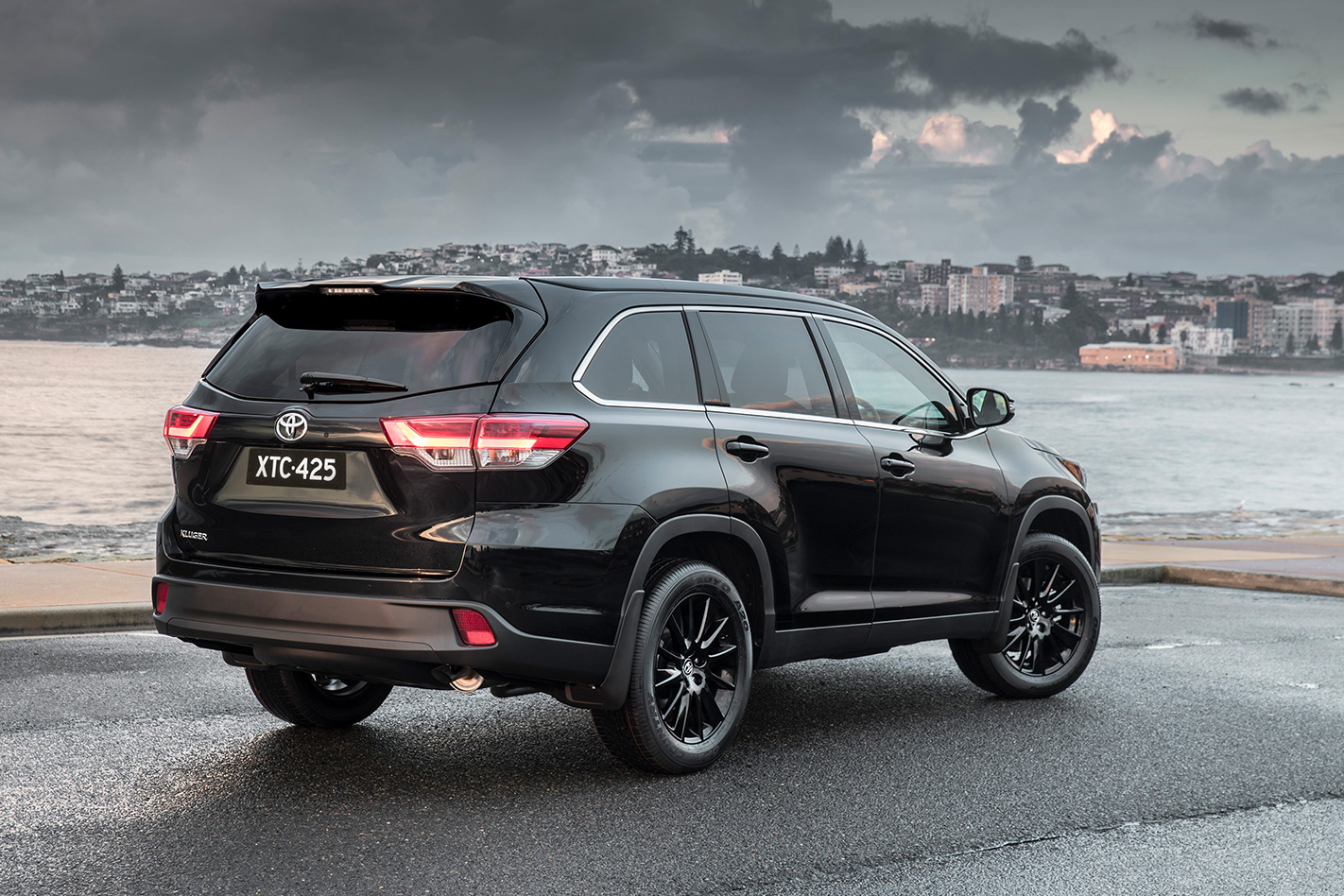
Toyota Australia has today unveiled a special Black Edition Kluger, dressing up its own large SUV with a black-out package so you don’t have to.
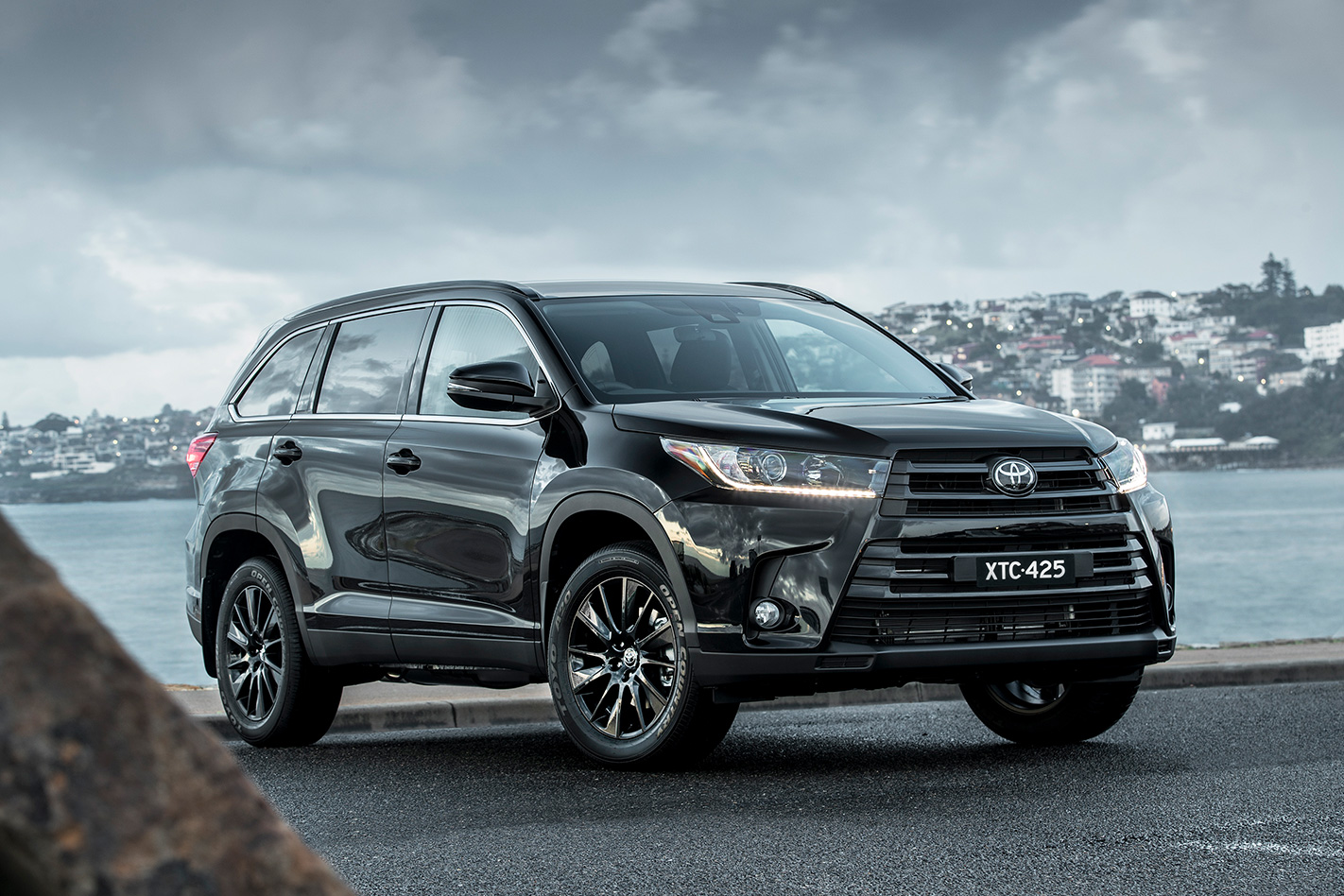
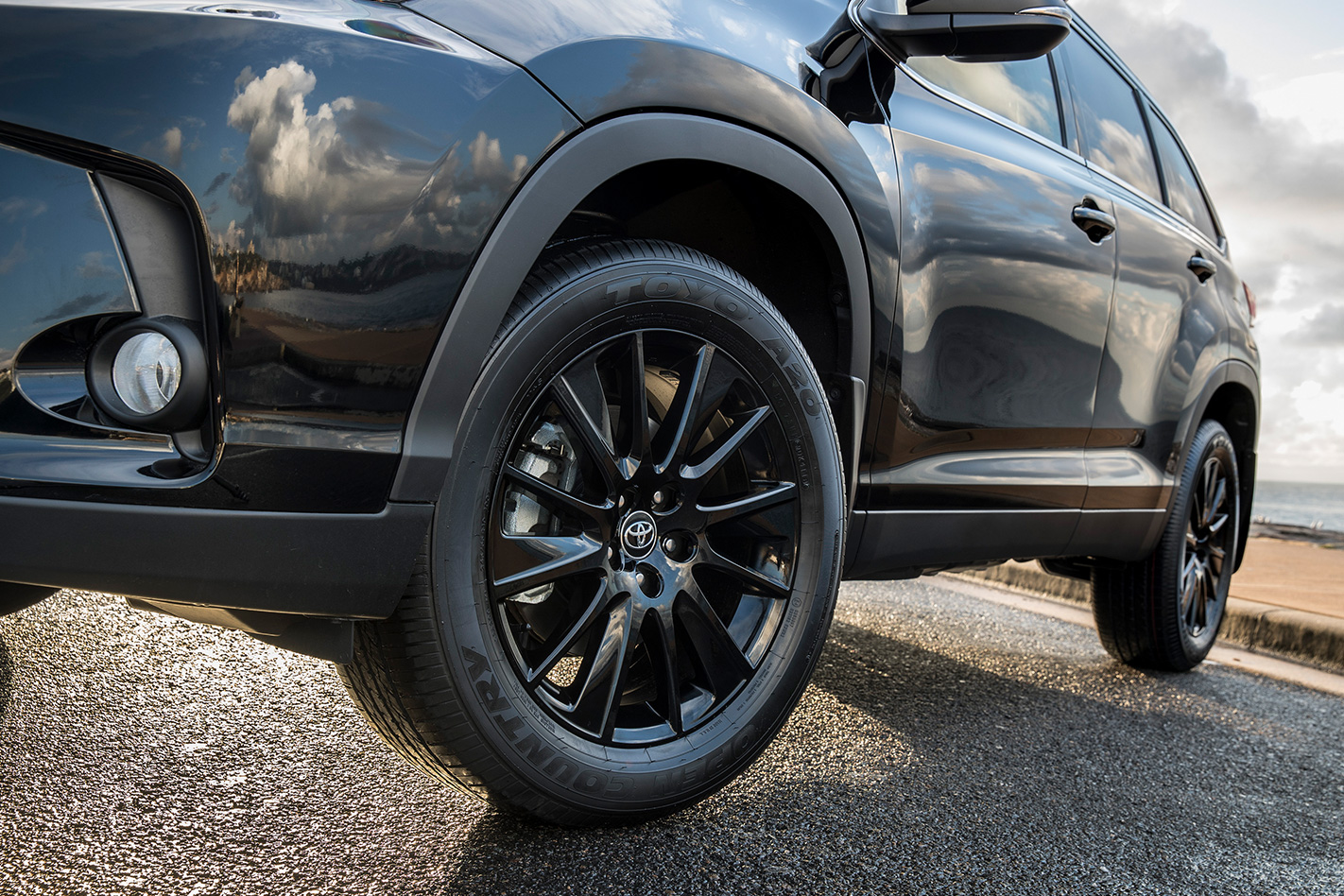
Differing itself to the rest of the Kluger range, the Black Edition is based on the mid-grade GXL and sports a new black grille, a set of gloss black 19-inch wheels in place of the standard 18-inch rims, a body-coloured front bumper and smoked headlights.
Standard equipment for the Kluger includes leather-accented trim, a multimedia system with satellite navigation (but no smartphone connectivity), AEB and lane departure warning.
Available in eight paint colours and two-wheel drive or all-wheel drive, the Black Edition will hit Toyota dealerships at $55,970 (2WD) and $59,970 (AWD) before on-road costs, which is a $1020 price premium over the GXL.
“Toyota Kluger customers now have another opportunity to distinguish themselves beyond the contemporary design synonymous with every Kluger,” said Sean Hanley, the vice president of sales at Toyota Australia.
The Kluger plays in the large SUV space against rivals like the Mazda CX-9, Jeep’s Grand Cherokee and the Kluger’s own blood relative, the LandCruiser Prado.
As with all Toyota Klugers, the Black Edition will be powered by the same 3.5-litre naturally aspirated V6 petrol engine which produces 218kW/350Nm, and it will retain its eight-speed automatic transmission. As such, the GXL’s 9.3 litres/100km fuel economy remains the same.
Other features of the Toyota Kluger include tri-zone climate control, power tailgate with separate pop-out glass hatch, keyless entry, , reverse camera and active cruise control.
Coming close to the end of its life-cycle, this latest special edition is expected to usher out the current generation Kluger, with more information on the next iteration of Australia’s best-selling large SUV expected to be revealed later this year.
I thought GT4 race cars were essentially production cars with roll cages in them. I was wrong.
Just how wrong becomes apparent when the Mercedes-AMG GT4 exits the pits at Sandown Raceway in a cacophony of diff chatter, transmission whine and V8 growl. Not even the GT R road car sounds half as angry as this.
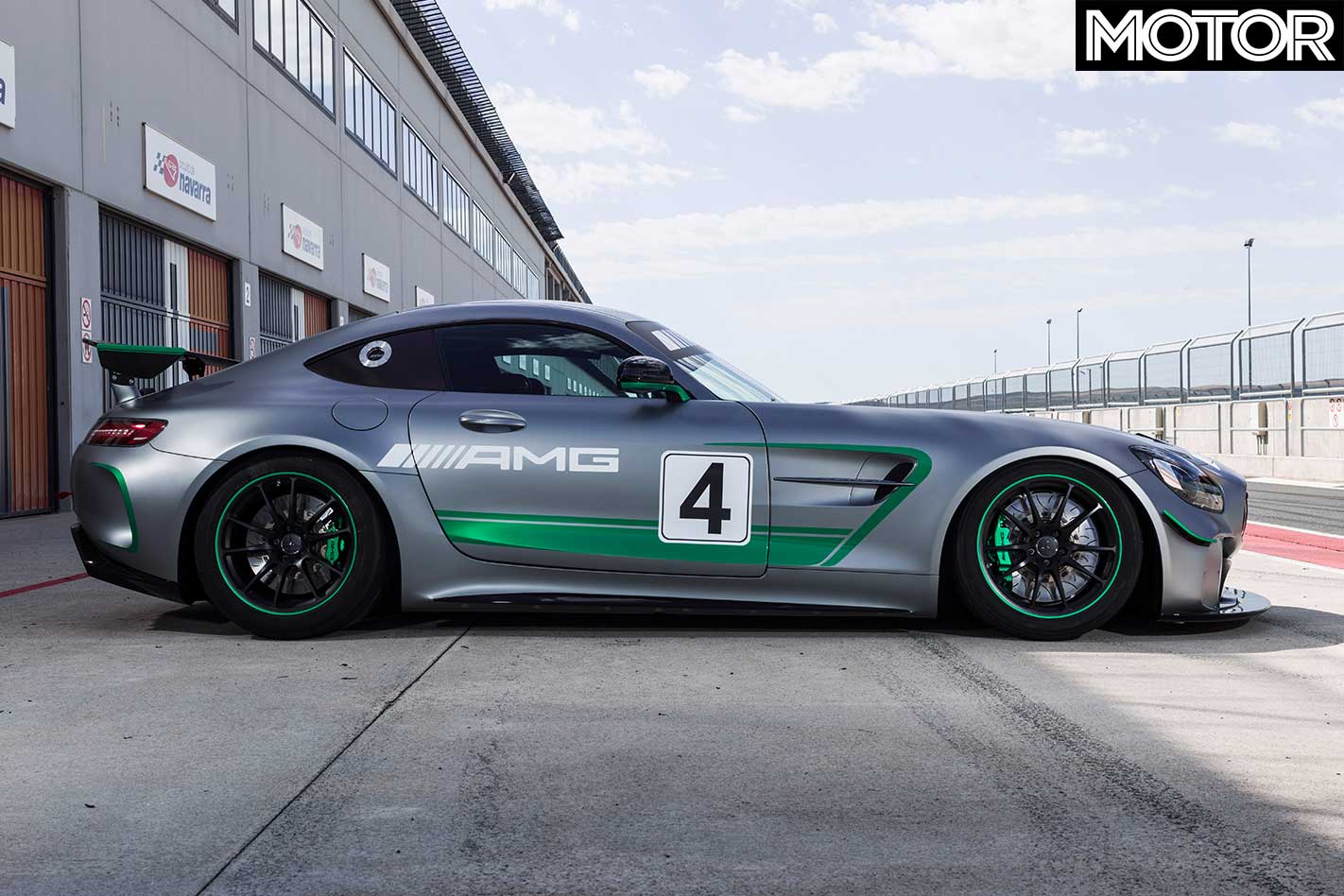
It’s the first day of the 2019 F1 season and Mercedes Australia is throwing a little pre-practice party at Sandown, offering a chance to drive the updated Mercedes-AMG C63 S, sample its fancy new Track Pace app and, as the icing on the cake, go for a spin in the AMG GT4.
As GT3 machinery has become more and more expensive, room as been created underneath for a category that’s more attainable and affordable. Relatively speaking, of course, but for a race version to cost roughly the same as the car on which it’s based is unusual.
It could’ve been cheaper, according to Stefan Wendl, head of Mercedes-AMG Customer Racing, but the decision was made to offer the best possible product rather than attempt to match the price point of some of its competitors.
As such the driver’s safety cell is identical to that in the GT3 car: “It makes no sense to offer a car that is less safe than GT3,” says Wendl. Also carried over from the GT3 is the six-speed paddle-shifted gearbox and the electronics.
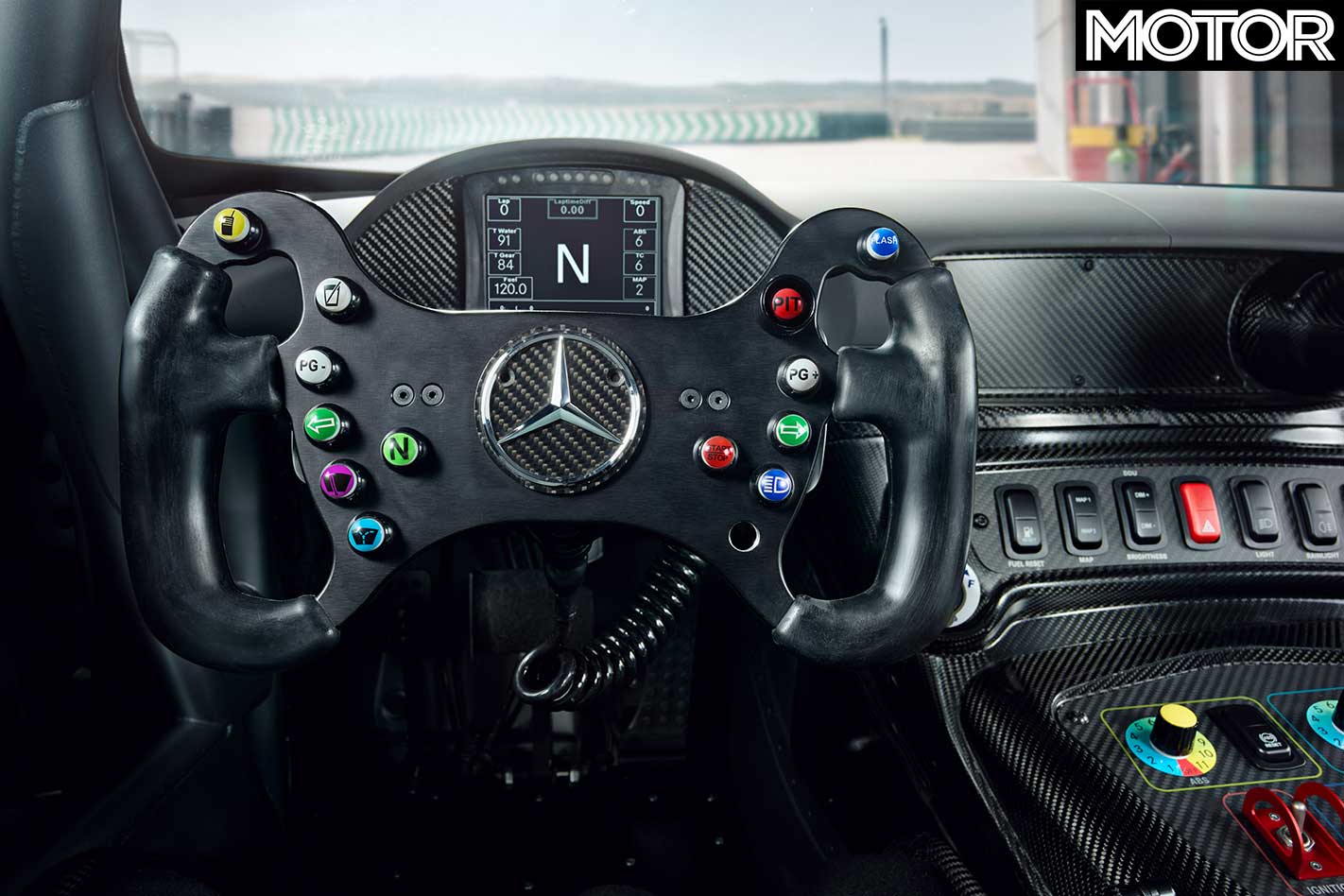
Many of the front panels, such as the bumper and bonnet, are unique to the GT4 due to the extra cooling requirements, but a remarkable number of parts are common to the road car. Smash a door or bend a suspension arm? Simply ring up your local Mercedes dealer and order a replacement.
The true beauty of the GT4 is its maintenance schedule. The majority of the parts are lifed at 18,000km, or 18 consecutive Bathurst 1000s, though the gearbox and propshafts are checked at 12,000km.
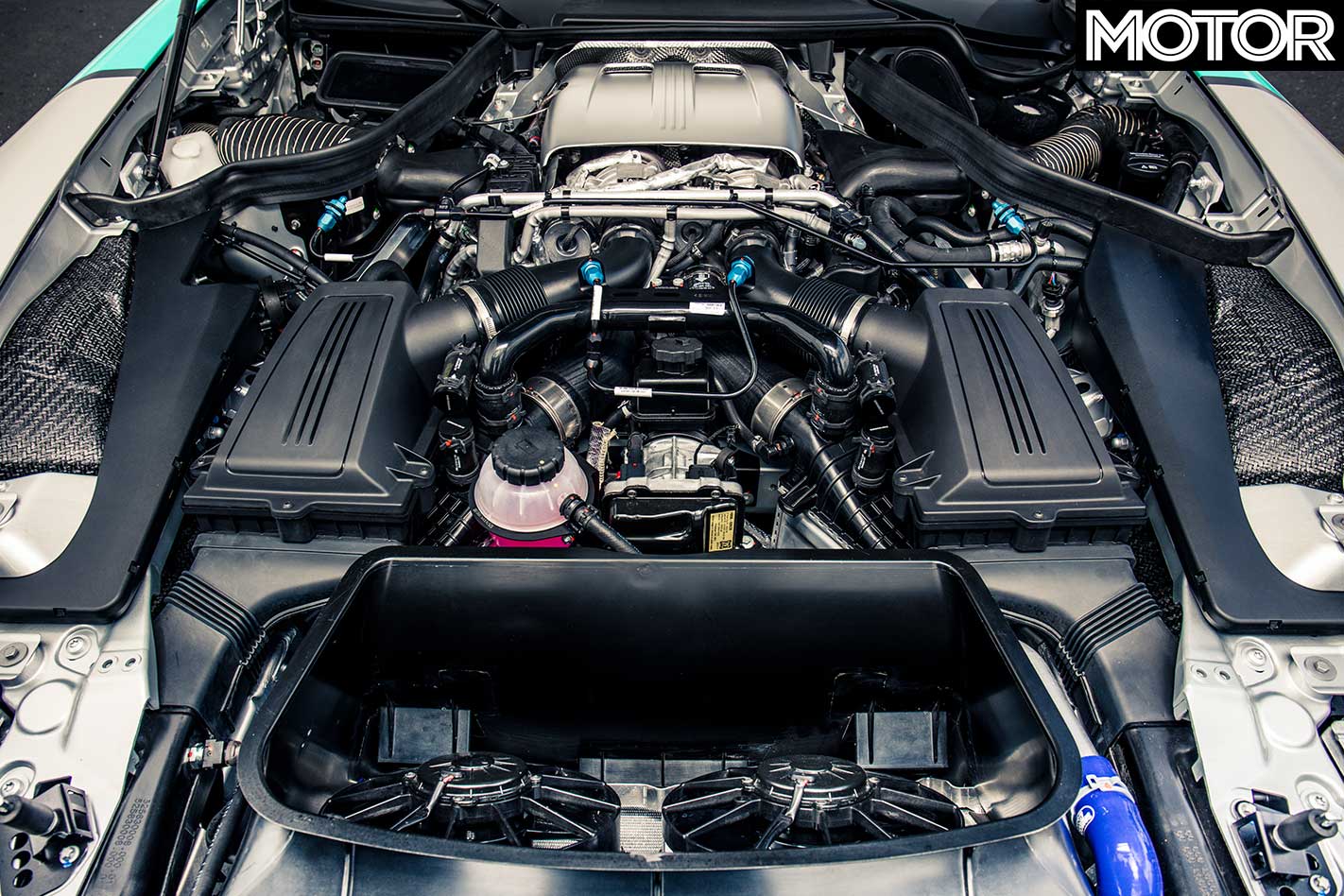
An exception is the engine, which according to Wendl lasts, well, forever: “We tried to destroy an engine on the dyno and we stopped at 50,000km.” Key to this longevity is the fact the race car makes way less power than the road car.
The GT4 rockets out of Sandown’s tight turn four but acceleration down the straight that follows feels less potent than you might expect, the speedo creeping steadily past 200, 205, 210, 215km/h.
In a number of series around the globe the GT4 runs at just 295kW, a whopping 135kW less than the road car. Thanks to its turbo configuration, balance of performance is achieved by adjustable boost maps, with nine to choose from up to around 380kW/600Nm.
Sadly, we can’t tell you what it’s like to drive, but from the passenger seat it’s a very cool piece of kit. It might be closely related to its road-going sibling but the massive slick tyres alone have a transformative effect on the car’s circuit chops.
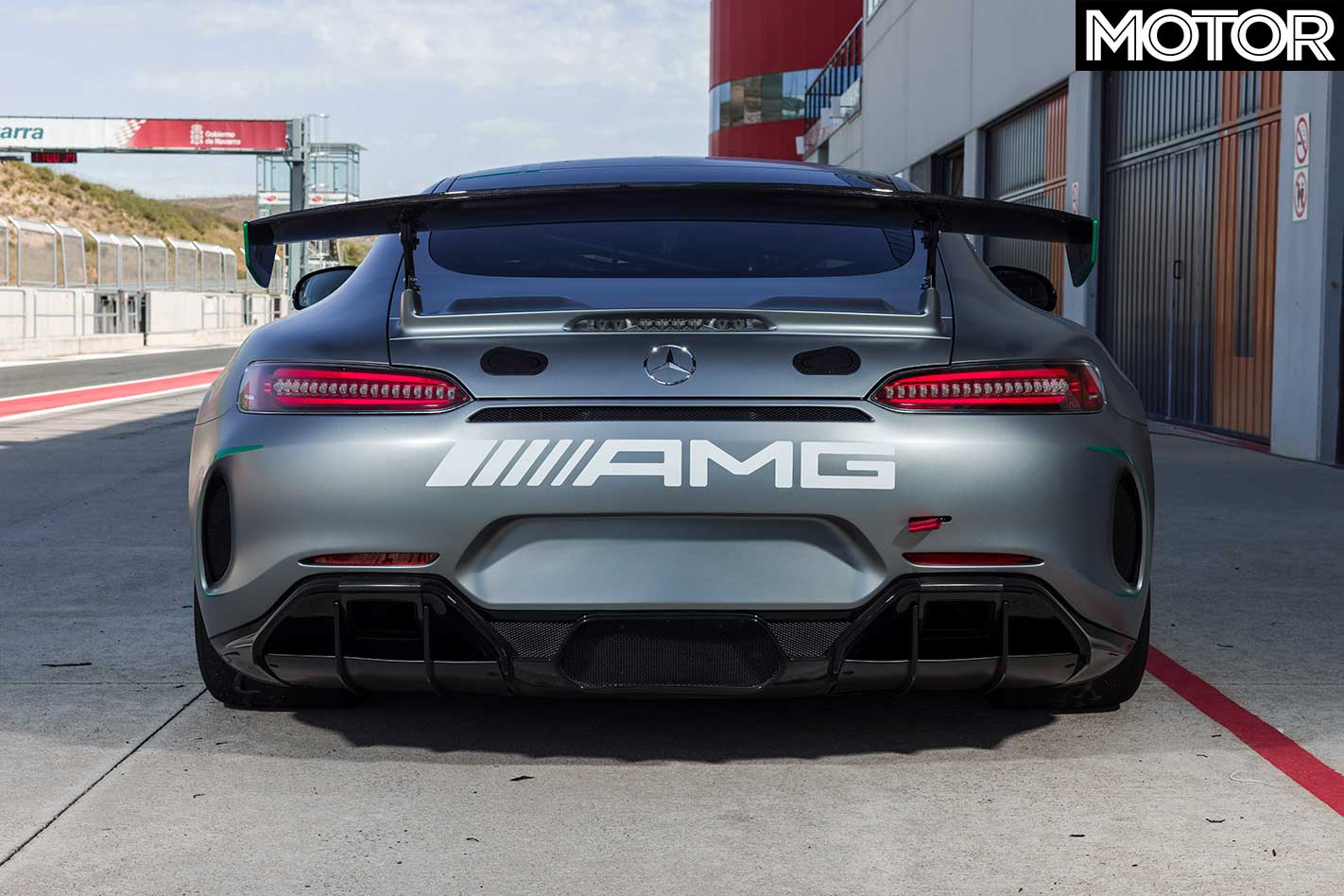
Add in race-spec dampers that have a freakish ability to provide unbelievable body control yet soak up bumps and kerbs and clever electronics – not to mention a handy driver in the shape of Nathan Morcom – and it’s addictive before you even add 25 other cars fighting for the same piece of tarmac.
If you want to dip your toe into the waters of serious racing, or were just considering a GT R to use for track days, you might want to call AMG and sample a GT4 instead.
2019 MERCEDES-AMG GT4 SPECS Engine: 3992cc V8, DIOHC, 32v, twin-turbo Power: 295-380kW (depending on boost) Torque: up to 600Nm Weight: 1390kg 0-100km/h: 3.5sec (estimated) Price: $350,000 (approx.)
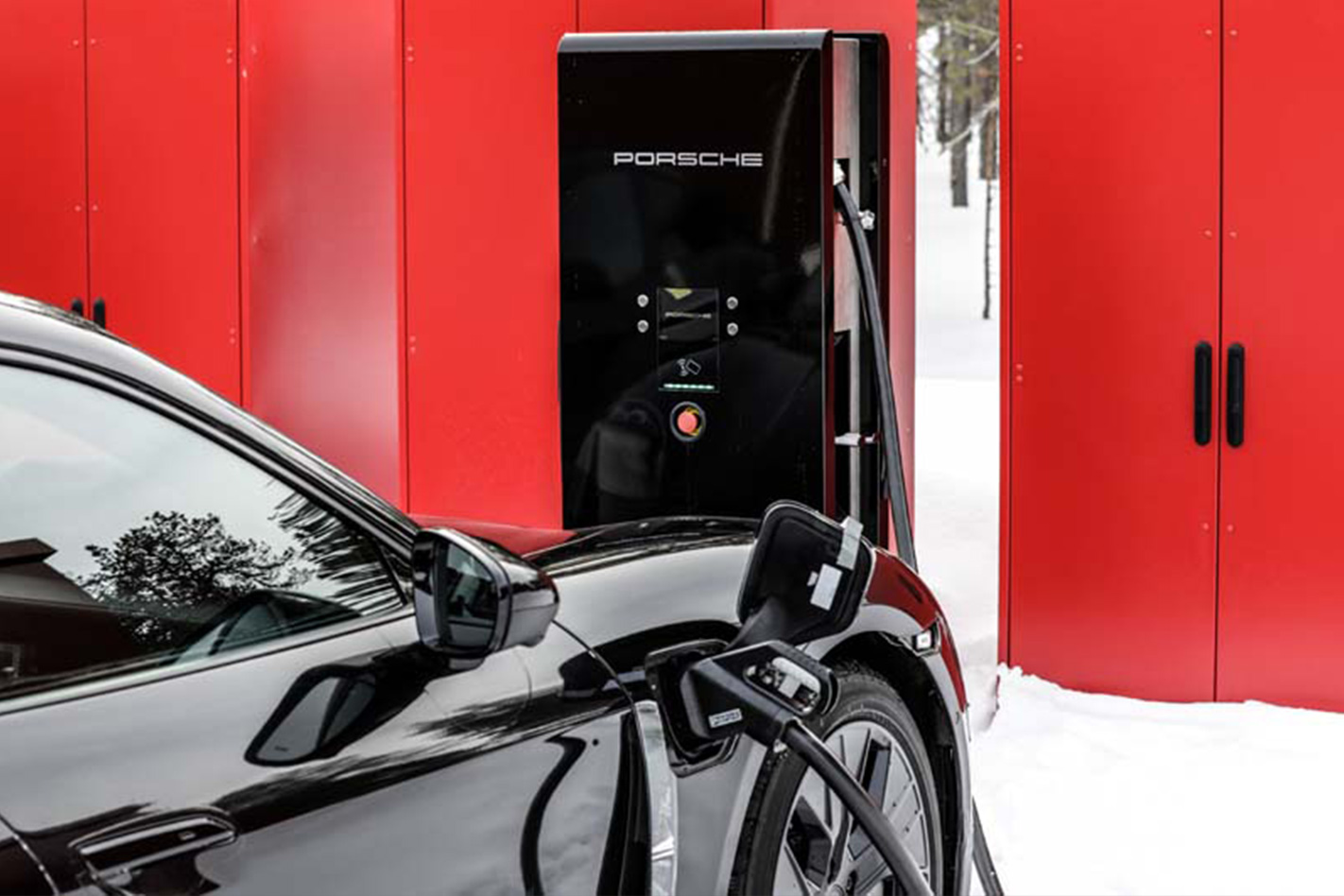
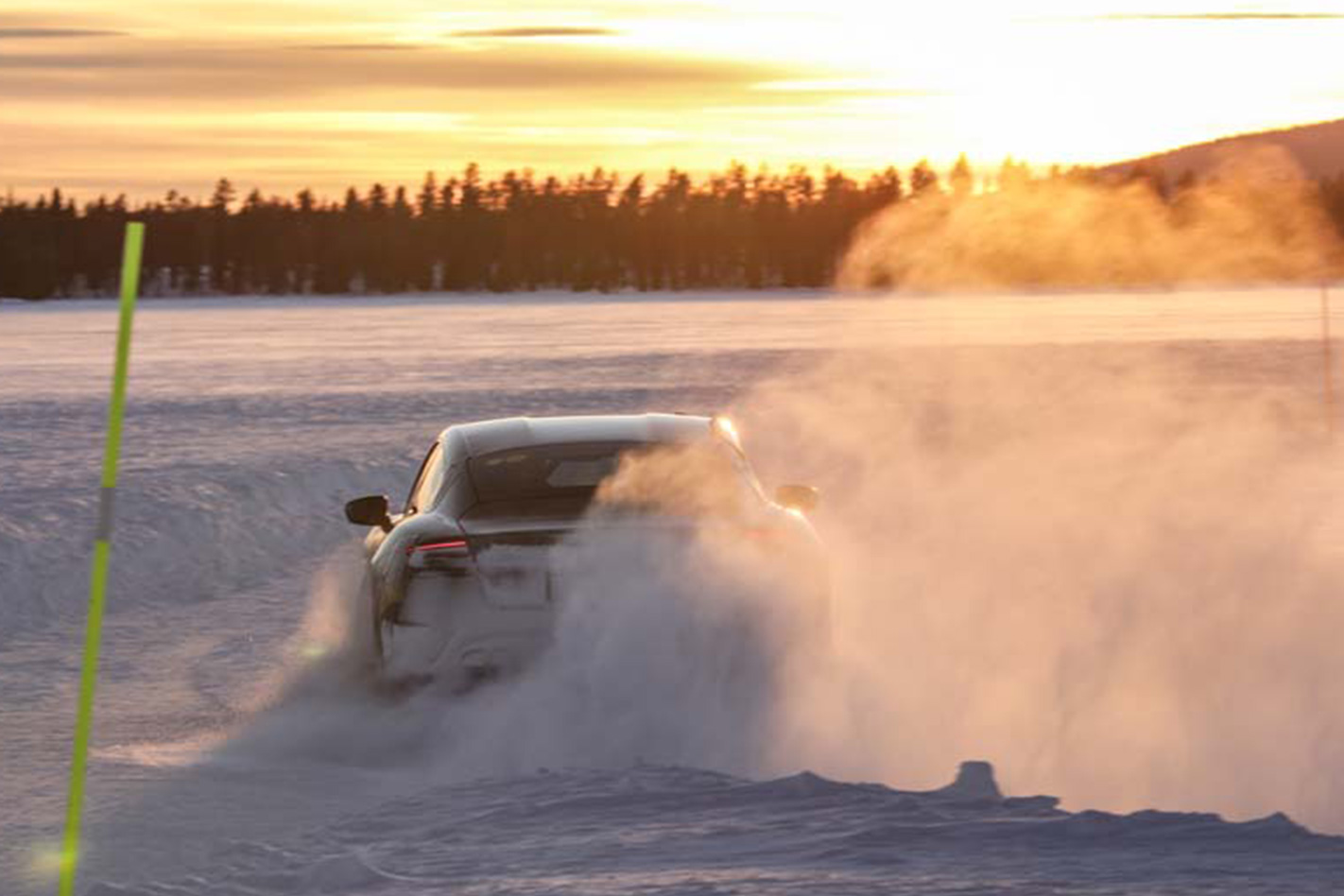
‘So what do you want to do now? We could go and do some doughnuts,’ said the chassis engineer with ill-disguised hope in his voice. Out here in the frozen wastes of northern Sweden it seemed almost obligatory to go and scribe some circles in the snow. Which is how I found myself rotating at impressive speed in a Porsche Taycan, at least until it rumbled what we were up to and started flashing rude messages at its driver. ‘It’s the same in all our four-wheel-drive cars,’ sighed Christian Wolfried, Porsche’s handiest hand on the Taycan programme. If I understand correctly, the front and rear axles have a bit of a pow-wow, figure out they’re being asked to do dramatically different things, rapidly conclude the driver’s a lunatic, and shut the show down.
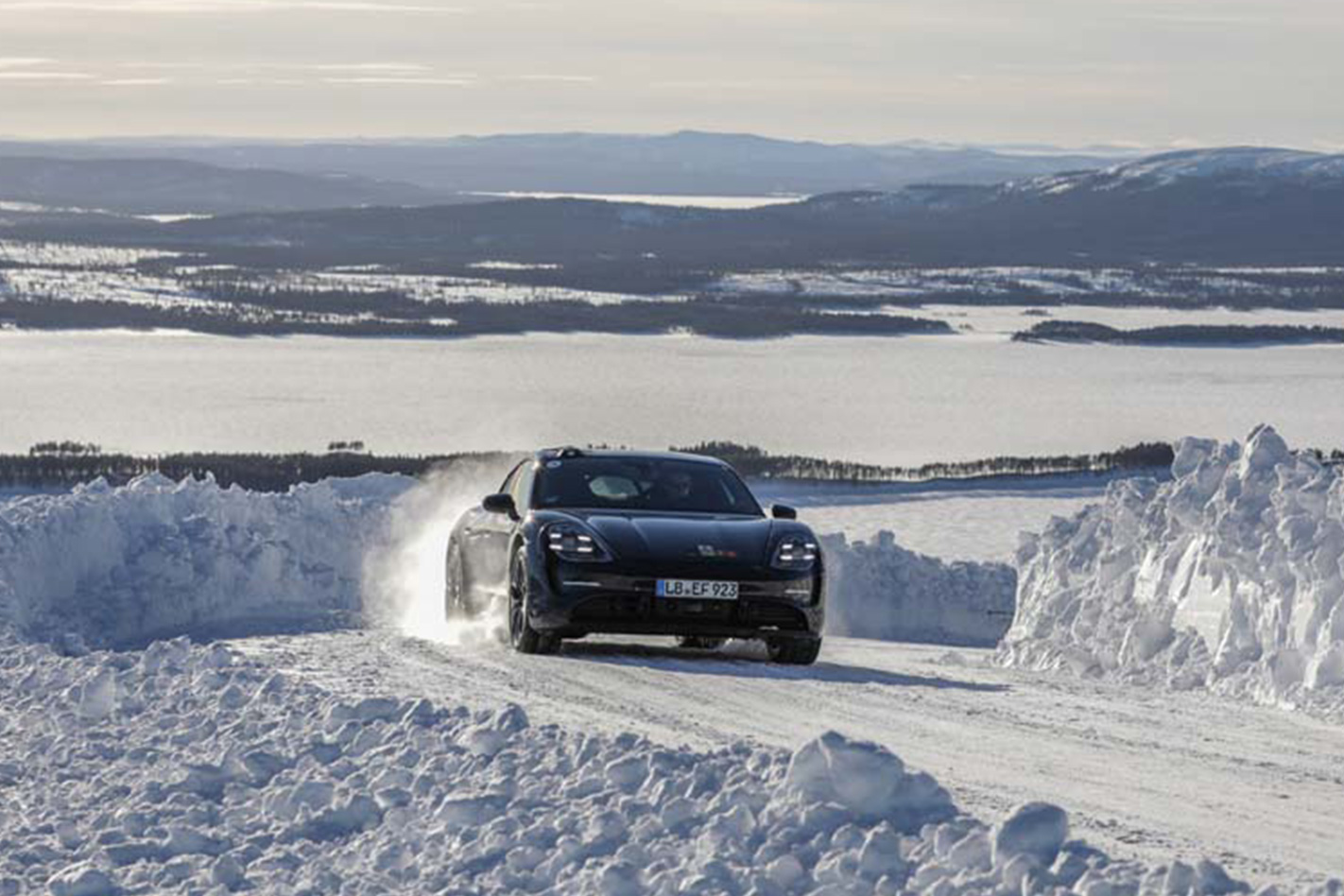
I mention this now because it seems that Porsche’s intention in inviting me to Lapland was to re-iterate the fact that despite the Taycan being powered by electricity alone, it remains above all a Porsche.
Disclaimer: I have not driven the Taycan, I have merely sat next to someone driving the Taycan. Can I tell you that what I felt that day had everything to do with the deftness of its chassis and nothing whatever to do with the evident skills of its driver? Of course not. And even if I could, would I be able to accurately estimate how behaviour on a frozen lake and roads covered with snow translated to what most of you recognise as more conventional conditions? Not with any confidence.
Is the Taycan a proper Porsche?
There is still plenty to be learned and plenty to be said, not least because, by Porsche’s own estimation, the Taycan is its most important new car since the Cayenne transformed the business beyond all recognition in 2002, and quite possibly the 1963 launch of the car that became known only sometime thereafter as the 911.
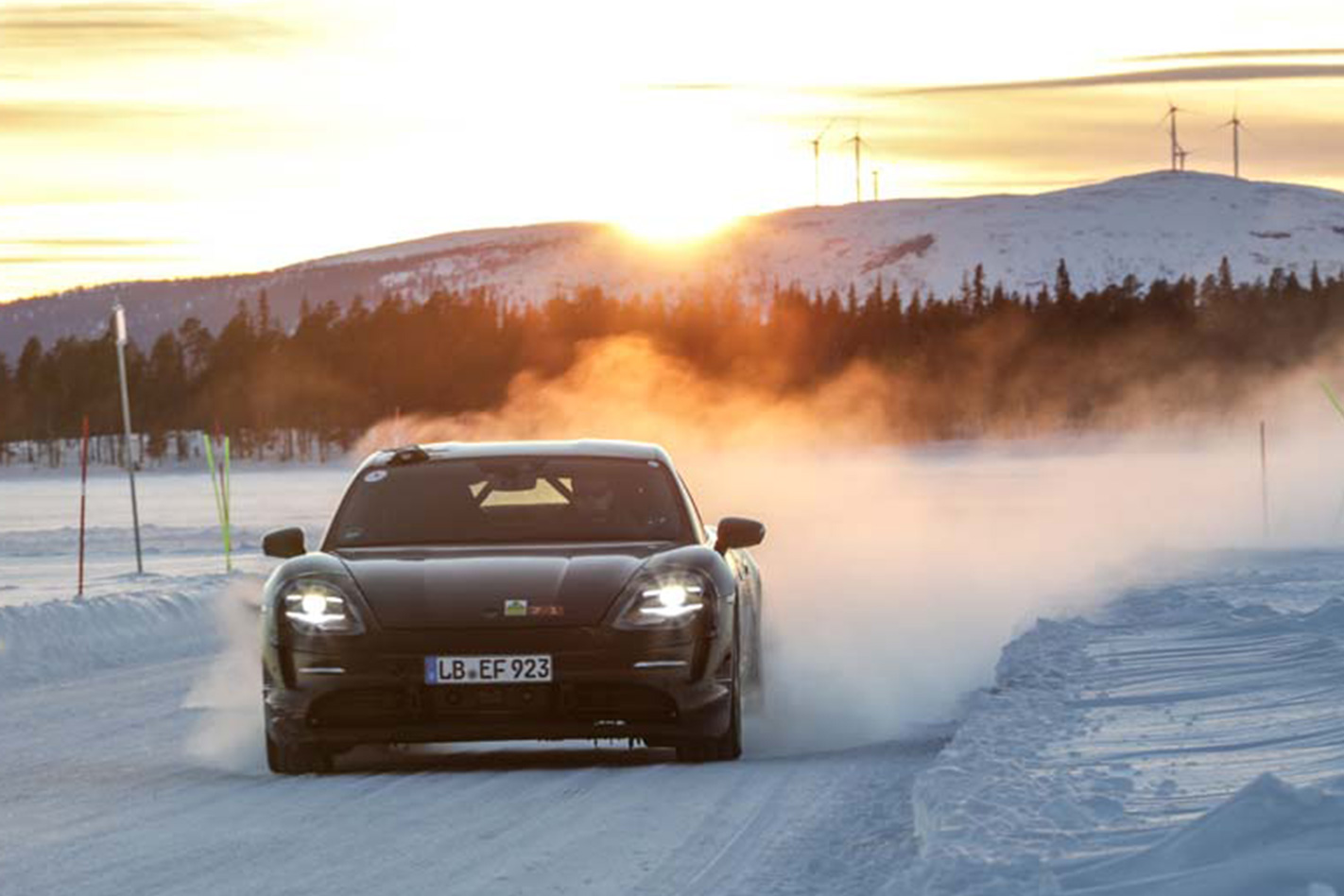
The first surprise is how small the Taycan feels. It’s a four door car, but because you know there’s a more off-road-oriented ‘Cross Turismo’ version coming, you mentally file it somewhere between a Panamera and a Macan. Or at least I did. But that’s not how it feels. No official dimensions have yet been issued, but based on what is known from the Mission E concept from which it is derived, the car is around 4.85 metres long, compared to well over five metres for the Panamera. Its wheelbase is far shorter too – not 911 short, which only needs occasional rear seats and positions its engine outside the wheelbase – but short enough that with four-wheel steering it changes direction with startling alacrity.
Behind the wheel it feels far closer to a 911 than a Panamera. The driving position is low, the centre console rising up commandingly beside you. As a result it is very much a car you sit in like a sports car rather than a family car. And that is entirely deliberate: Porsche knows it has a job on its hands convincing the world that electric cars and sporting cars are not diametrically opposed objectives, and if it can create the ambience of a 911 it will have gone some distance towards nailing that challenge. And even in the disguised prototypes in which I travelled, I can say with certainty that this at least has been achieved.
Sparking a new kind of excitement
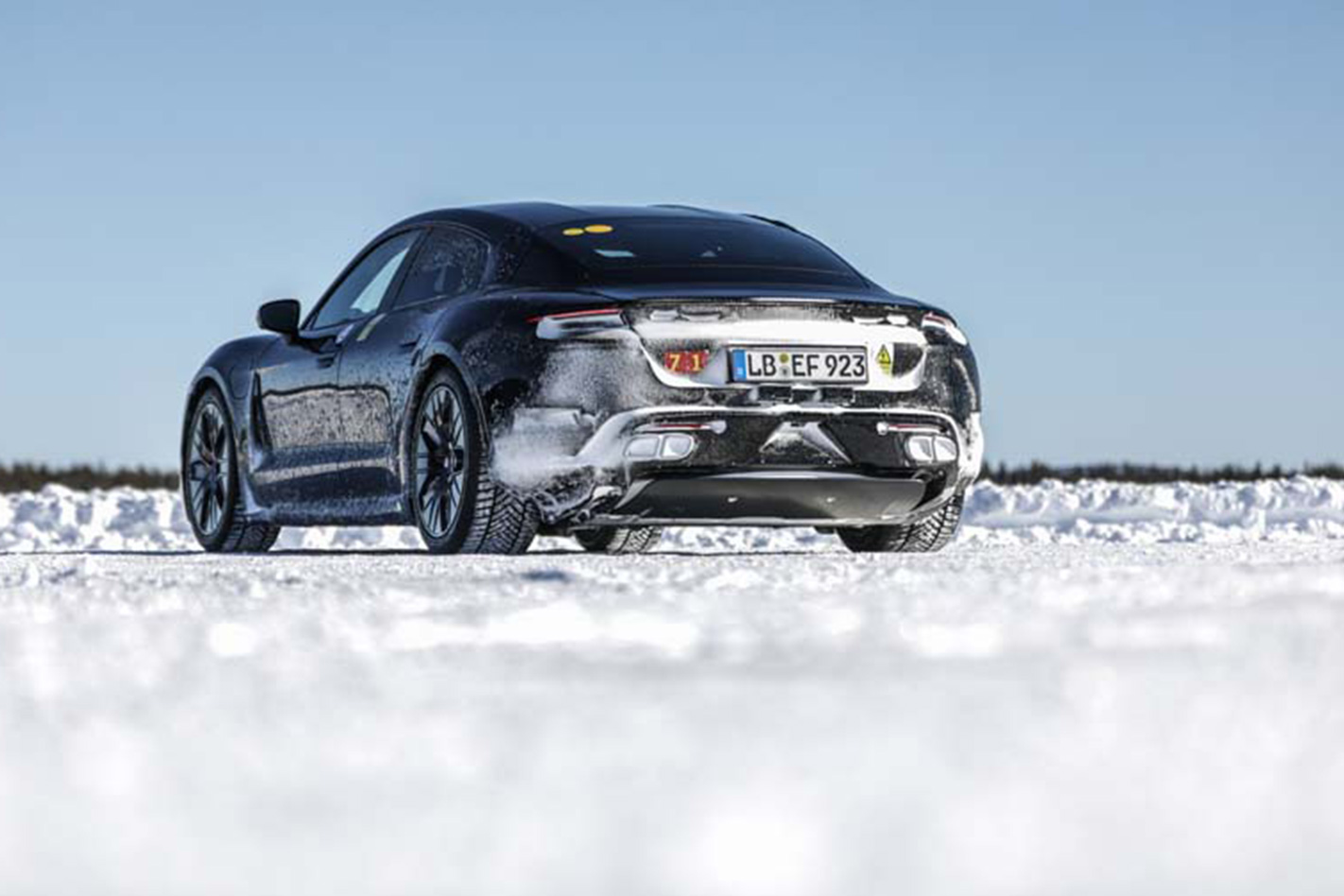
So Christian and I head out into a blizzard. So far as I can see, it’s a complete white-out, as disorienting as flying a light aircraft through cloud, but he pretty much lives up here over the winter and does not let such trifles bother him. A barely discernible track has been cut into the snow so he goes to work, apparently guided by bat-like sonar.
Would you be surprised if I told you the Taycan sounded like it had a cross-plane V8 under the bonnet? Me too. It hasn’t and it doesn’t. Porsche is big on authenticity and it sounds like an electric car because that’s what it is. The strategy will be to engineer out as much of the whines and whirrs of these very early prototypes so that there is minimal noise. It’s ‘the luxury of silence’ as one Porsche person put it to me. I expect we’ll hear rather a lot of that particular sound bite in the near future. Oddly enough, there will be an additional and optional ‘sound pack’ customers can choose.
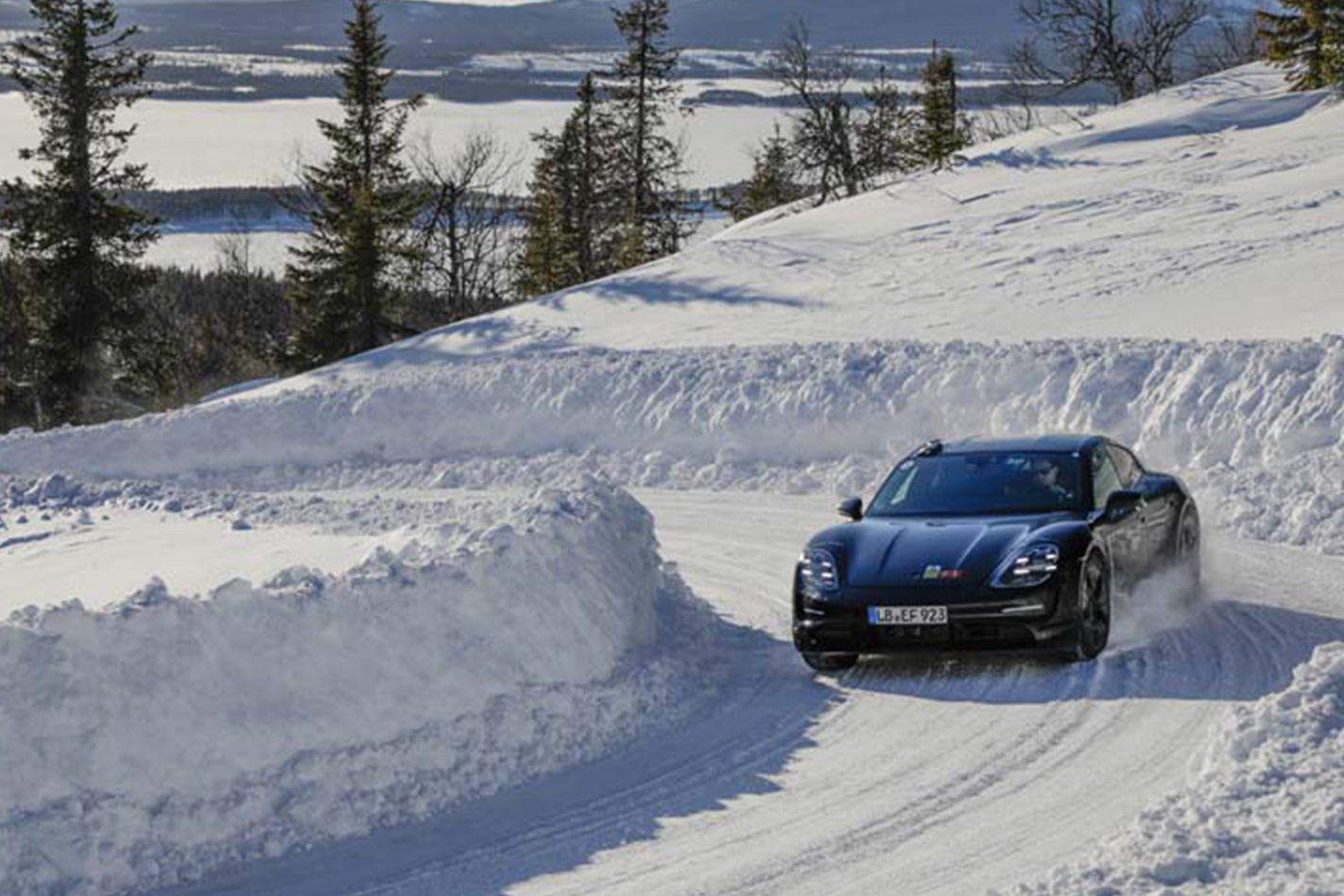
The car I’m in is the top of the range model but the truth is it’s snowed for much of the night and a Fiat Panda 4×4 would probably be able to spin all four wheels on the surface it’s left, so at least half of the over 447kW at Christian’s disposal is superfluous to requirements.
No matter. The car feels spectacularly composed with all its electronic safety equipment turned on. I get him to do a full bore standing start and the car just accelerates away as if on tarmac, and not at all slowly. Put it this way: an original Boxster on dry tarmac would have no chance against this thing on snow. In Sport Plus mode the car maintains the same direction but sashays somewhat as it does. Turn it all off and were he not there to correct it, it would carve a semi-circle very quickly indeed. It’s good to know that even in these increasingly risk-averse times, at Porsche, off, still means off.
Then the track starts to wind. Porsche deliberately keeps it as narrow as possible because the engineers don’t want discrepancies caused by drivers taking different lines. The engineers all keep note of who has to call how often for the Cayenne tow truck to dig them out of the drifts. Christian’s only binned it once all winter; some of his colleagues are in double figures. As speeds rise, the Taycan becomes ever more balletic as my driver delights in showing me the angles it can not only reach, but be easily recovered from. He says because of the way the motors mete out their power and the fact the Taycan has the lowest centre of gravity of any Porsche, it is the easiest to drift out of the entire bunch. And just to make the point, when we reach an enormous circle cut into the ice, he does a few laps at high speed with the nose pointing directly and unwaveringly at the circle’s centre, chatting away as he does.
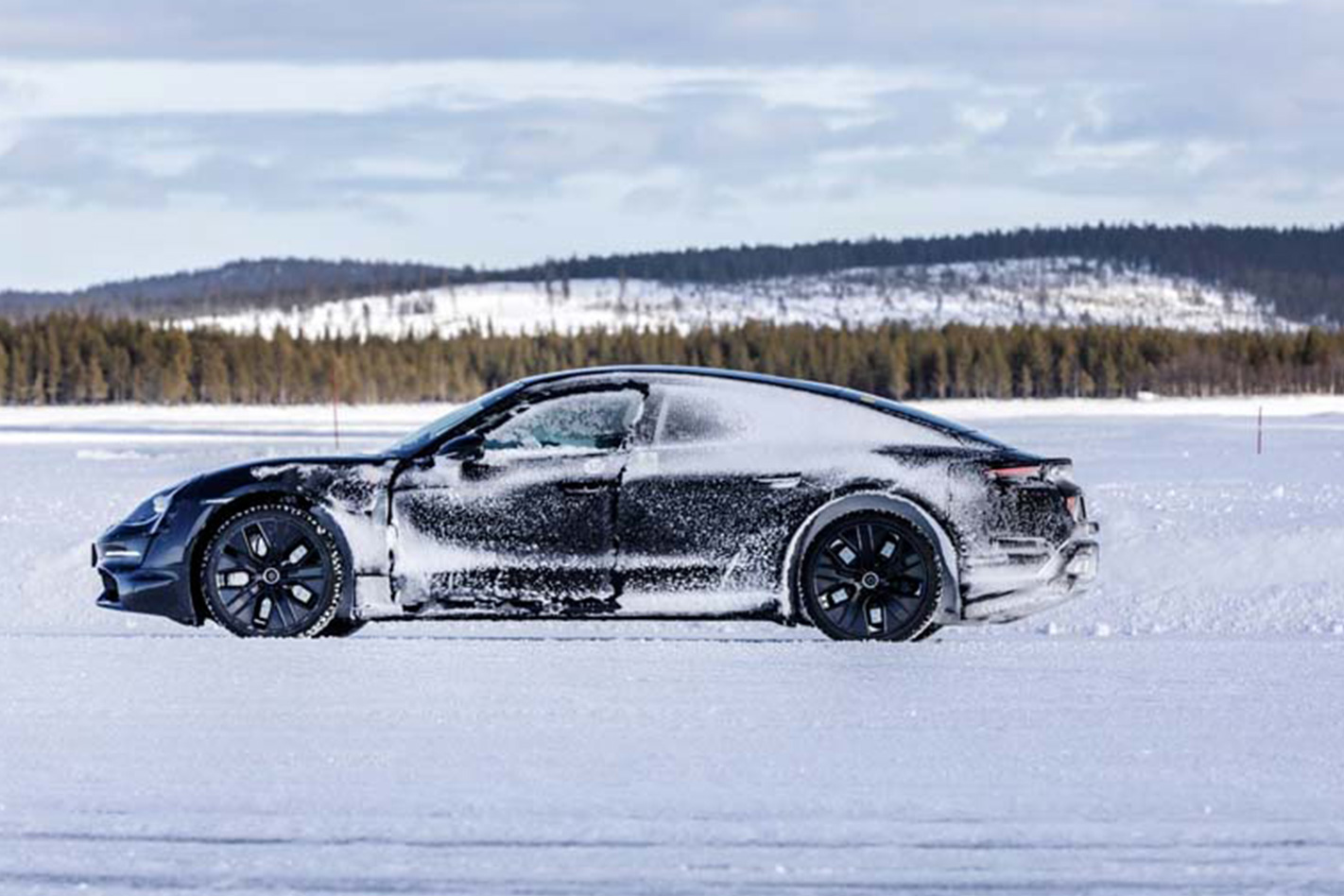
Even so, if the business of getting any kind of impression from a passenger seat is hard, it’s harder still on a frozen and featureless lake where the ice is three-feet thick. So after lunch I head out onto the roads with Bernd Propfe, who is project manager for the whole Taycan platform. While the architecture will be adapted and adopted by Audi for its E-Tron GT (and possibly Bentley for a production version of the EXP12 6e concept car), it is an entirely Porsche-led project.
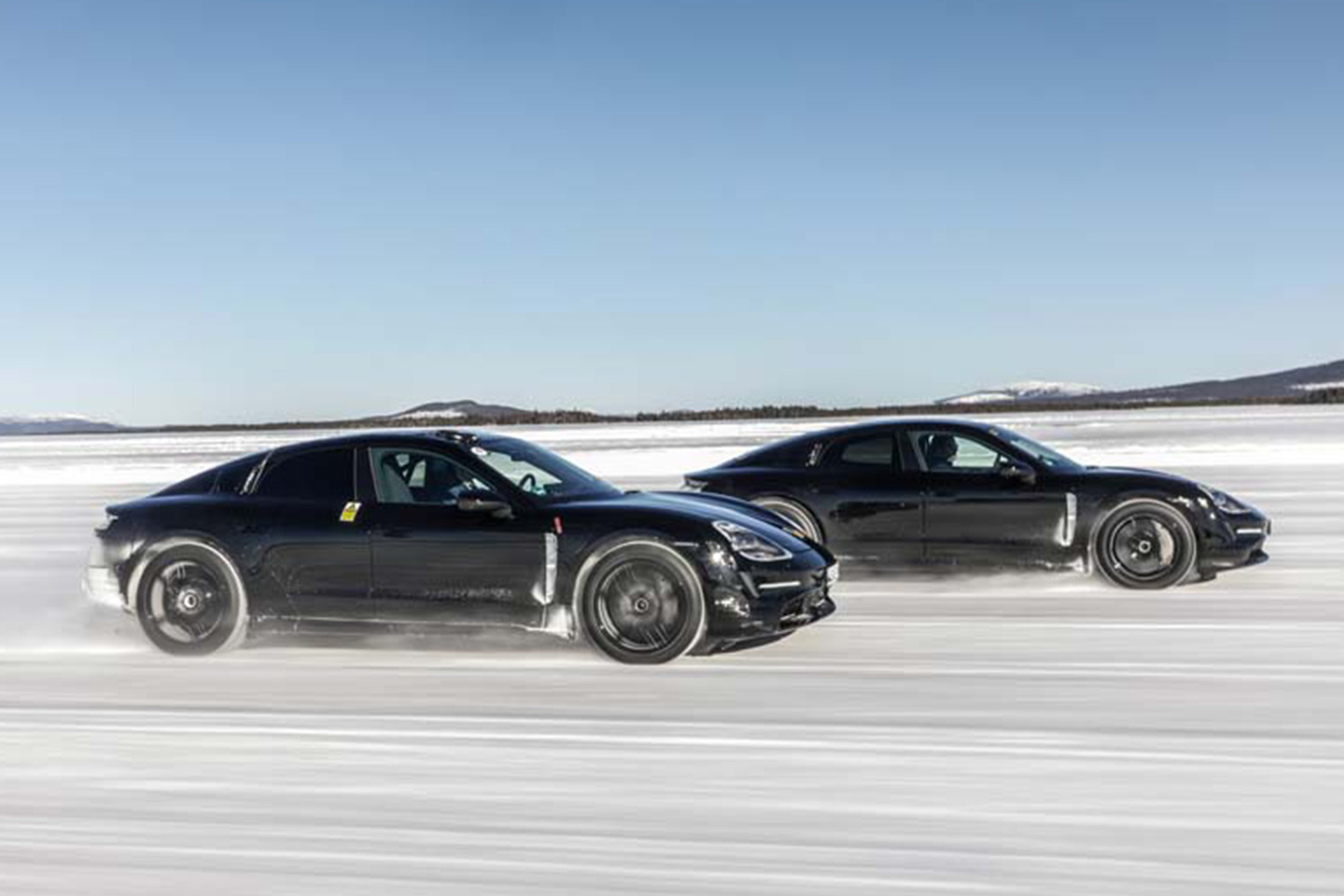
Out here nothing is simulated, the Taycan remains unprovoked by its driver. All the systems stay on. It is entirely possible an elk might wander out onto the road, and they tend not to give way. The surface is compacted snow and ice. It is not a place to mess about.
And yet we go fast: there’s a Taycan ahead and another behind and our convoy is somehow proceeding across this pretty hostile terrain at a pace that is not so much impressive as borderline befuddling. We’re on winter tyres of course, but nothing out of the ordinary and certainly not studded. It’s not just a comfortable way to get about, out here it’s comforting too, because the composure of the car is totally reassuring. If I’d not already done all the work on the lake, I’d have presumed Propfe and his chums had gone mad. Ironically, the only drama comes when we reach a bridge offering the only stretch of dry tarmac for miles around. He knows it’s coming so slows to a crawl before pinning his foot to the floor. And even though there’s well over two tonnes of Taycan to accelerate, it gathers momentum at a rate that suggests the 3.5sec 0-62mph sprint claimed for the Mission E concept that begat the Taycan is now looking very conservative indeed.
Sadly, however, there is not much more I can tell you other than that it will seat four average sized adults in reasonable comfort. If there’s a tall one in the back, though, he or she will likely feel a little short of room. A Panamera is substantially more spacious.
The remaining pieces of the puzzle won’t be slotted into place until September when the Taycan is formally unveiled and drives begin ahead of cars being delivered to owners before the end of the year.
It’s still a Porsche, just not as we know it
So what can I say that is certain? Well, if a huge diesel-powered SUV can credibly call itself a Porsche, so can a compact electric four door coupe like this. It’s smaller than you think and feels even smaller than it is and, so far as I could tell, lighter too. On low grip surfaces it is both agile and tolerant of the most preposterous of provocations.
But it felt also like a car with a proper story to tell, one I’ve only been able to provide in patchy outline here. If it can find that sweet spot where it combines something of the practicality of a Panamera with something the ambience of a 911 and a relevance to the world as it is today, I think Porsche could really be onto something here. It’s a big ask, and I don’t yet know the answer. But the indications seen so far, and they can be no more than that, are good.
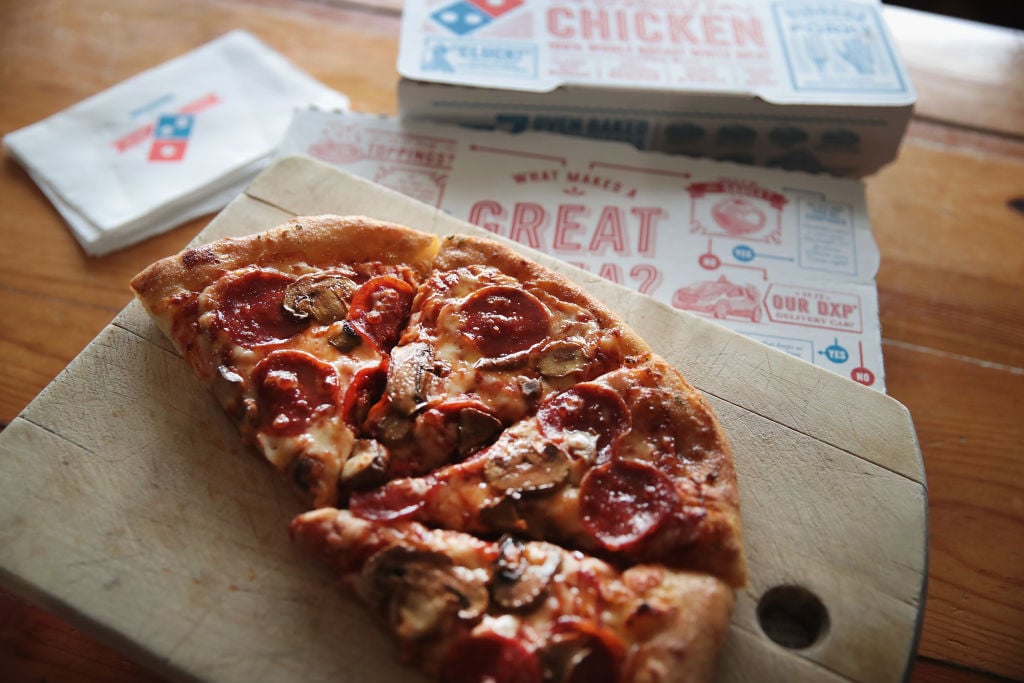
To the unassuming couch potato and LAN party enthusiast, American pizza delivery giant Domino’s is a devastatingly efficient method of delivering delicious fat and carbs directly to your pasty, sun-starved face whenever your blood glucose monitor flashes ‘critical’.
But, in addition to its title as the world’s largest pizza delivery service, the iconic red, white and blue polka dot tile is somewhat of a disruptor, pioneer and philanthropist in the transport world. Or so it would have you believe.
Last year, the company made lots of new friends doing the job that local US councils had been long neglecting by repairing badly potholed neighbourhood roads. The Paving for Pizza program might have appeased local residents, but many saw through the seemingly selfless act as a way to increase delivery efficiency and reduce the number of damaged capricciosas en route.
Before that, Domino’s joined forces with Ford in the quest to develop self-driving technology with an initiative that used zero humans and one blue oval research vehicle to deliver the warm disc of Italian-American joy to your door.
Except it didn’t. As the only flesh involved was the pepperoni topping, the customer had to actually walk out of their house and down the driveway to meet the vehicle and, as most Domino’s enthusiasts require a forklift and a demolished wall to enable the move from one room to another (let along walk out of the house) the idea had limited success.
Back in 2012, the company launched a competition to design the perfect purpose-built pizza delivery vehicle with up to US$50,000 of prize money up for grabs. Inspiring creativity or breeding a new generation of pizza lovers and consumers?
Love or hate the Domino’s promo campaign, it’s definitely working. And it’s at it again. Although this time the left field initiative is less light-hearted publicity stunt and more Google-esque strategically sinister.
Upon first inspection, the AnyWare pizza ordering application seems innocent enough – well, as innocent as any application that makes it easier for you to feed your kids fast food. Among the friendly marketing buzzwords such as “streamlining” and “simple” the press release also reveals the application will be “pre-loaded in cars starting in 2019”.
I don’t know about you, but my car is my sanctuary. A place where I can insulate myself from everything I dislike about the world, and a safe haven from capitalism, commercialisation and excessive advertising.
And in the same way I despise my new phone arriving with an irremovable Facebook application that arrogantly assumes everyone on the planet has subscribed, if I discovered my new car had a Domino’s pizza application permanently wired in, I would be promptly rolling it off the nearest cliff.
I, like many Australians, will decide which brand of car I want, then I’ll spend as much time choosing the model, the variant, the colour and even the shade of stitching on the optional sports steering wheel. Consequently, I am more than capable of deciding which applications I need.
Pre-installing a fast food ordering application implies that I am so hooked on pizza that I simply can’t spare three minutes after taking delivery of my car to do the job myself, or I am incapable of making basic decisions. Both are offensive.
Of course, Domino’s says that’s not true and it is simply allowing users to “save time” but the pizza giant, supporting Xevo Market platform and the collaborating car brands are the real winners.
Domino’s hands over a greasy cheque to the manufacturers and every time you get a little bit peckish its renowned brand is front and centre. How do you feel about a global corporation making coin out of you through something that is likely to be your second largest lifetime investment?
In a twist of final perplexing irony, the AnyWare application is leapfrogging the core part of the service that forged the Domino’s business in the mid-1960s – delivery. Not only are you lining the company’s pocket, you’re going out of your way for the privilege.
LINKS
https://www.whichcar.com.au/news/dominos-adds-topping-to-potholes
https://www.whichcar.com.au/news/pizza-delivery-design-is-hot
https://www.whichcar.com.au/car-news/self-driving-tech-to-learn-by-delivering-pizza
Evolution rather than revolution has been the name of the game with the eighth-generation 2019 Porsche 911.
Yes, the 992 is an all-new car, but think of it more in terms of the shift from 996 to 997, rather than the huge leap that occurred between 997 and 991 or even the marked change that 991.2 represented with the switch to turbocharged engines.
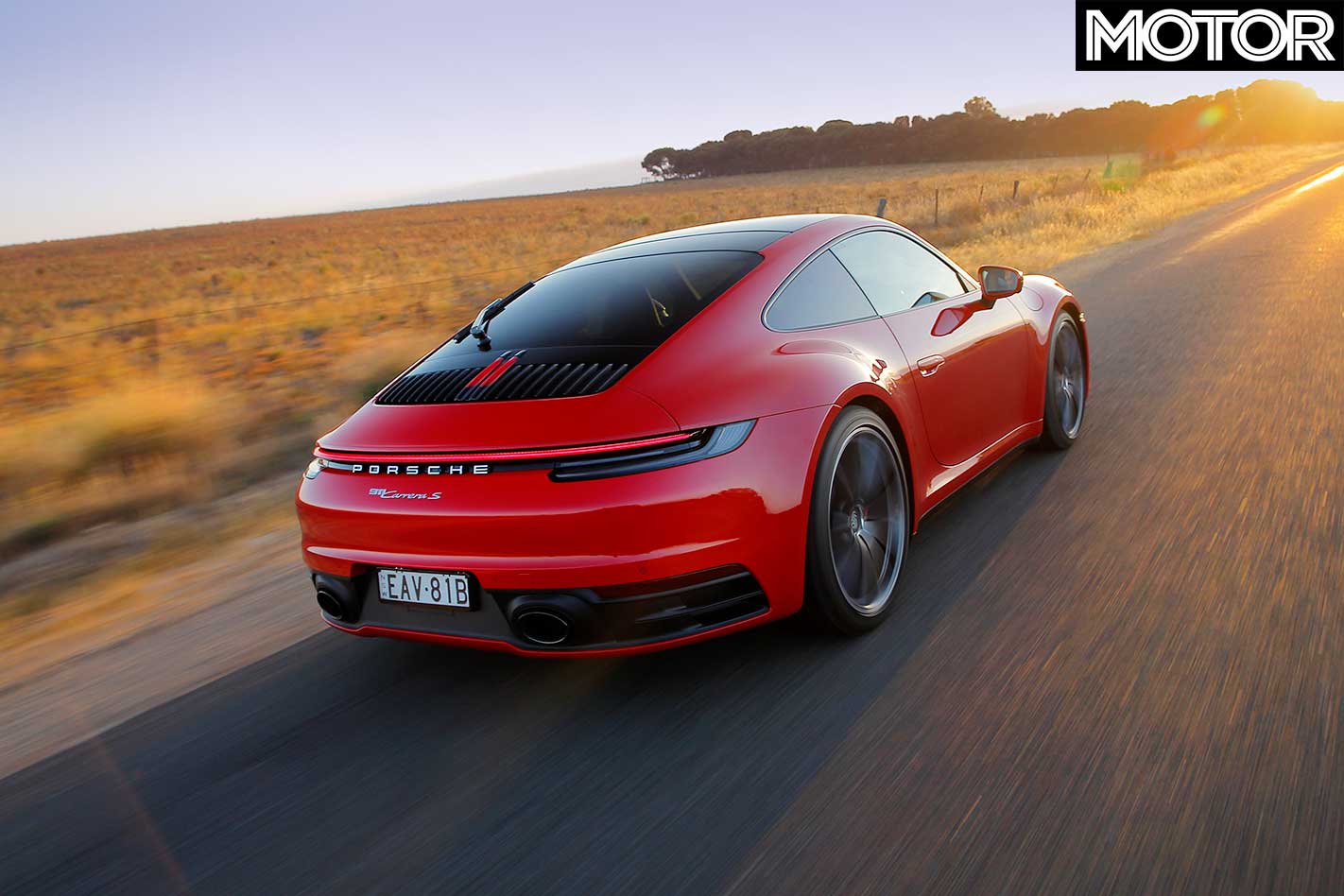
But don’t let the familiar looks and specification fool you, for an enormous amount of engineering has gone into the 992, with virtually no part of the car left untouched.
The bodyshell is longer and much wider, yet a large increase in the amount of aluminium and high-strength steel makes it both lighter and five per cent more torsionally rigid.
All 911s now use the widebody shell previously reserved for all-wheel drive models resulting in an extra 44mm in the rear hips. This is balanced by an extra 45mm up front to give the 992 a seriously fat stance on the road.
On tight, twisty roads you notice the extra girth but not the extra heft. Weight has increased by 55kg but the wider footprint shrugs off the added mass and gives the 992 unbelievable purchase on the road.
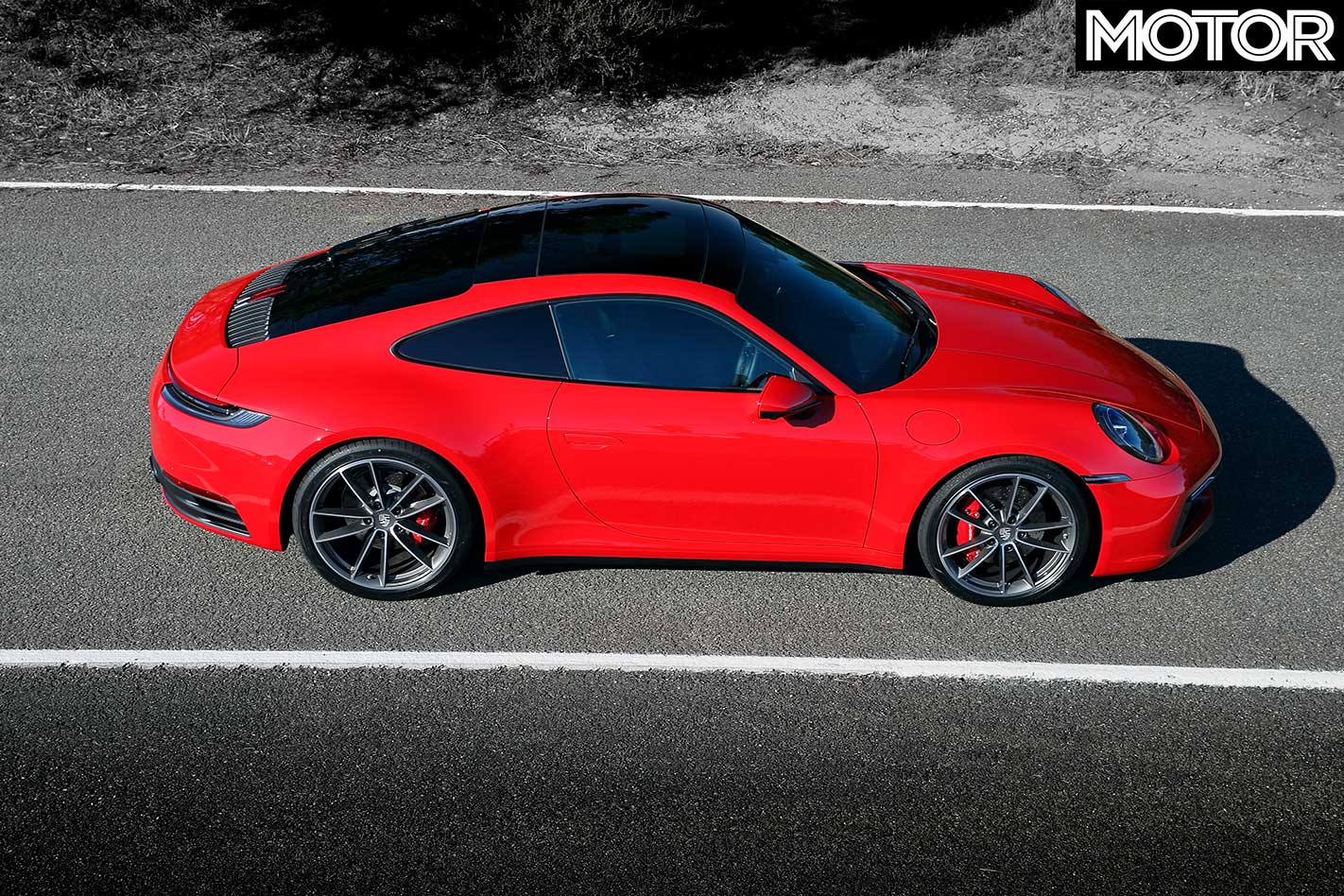
It still feels like a 911. That unique weight distribution requires a certain driving style to extract its best, but the 46mm-wider front track results in almost GT2 RS levels of front bite without sacrificing any of the inherent traction advantage provided by the rear-engined layout.
The steering is quicker, laser accurate and feels to provide a little more communication than the 991.2. Active anti-roll bars and rear-wheel steering are available but even without these gizmos this new 911 carves corners like they’re Christmas turkeys.
Bilstein’s latest-generation dampers provide a much wider operating range and set to soft give the 992 a beautiful pliancy in the way it handles. Selecting Sport removes a lot of this movement but on the road it’s a great sensation to feel the weight move around, not to mention the damper’s added softness gives the 911 a remarkable ride quality given the size of the rims (20-inch front; 21-inch rear).
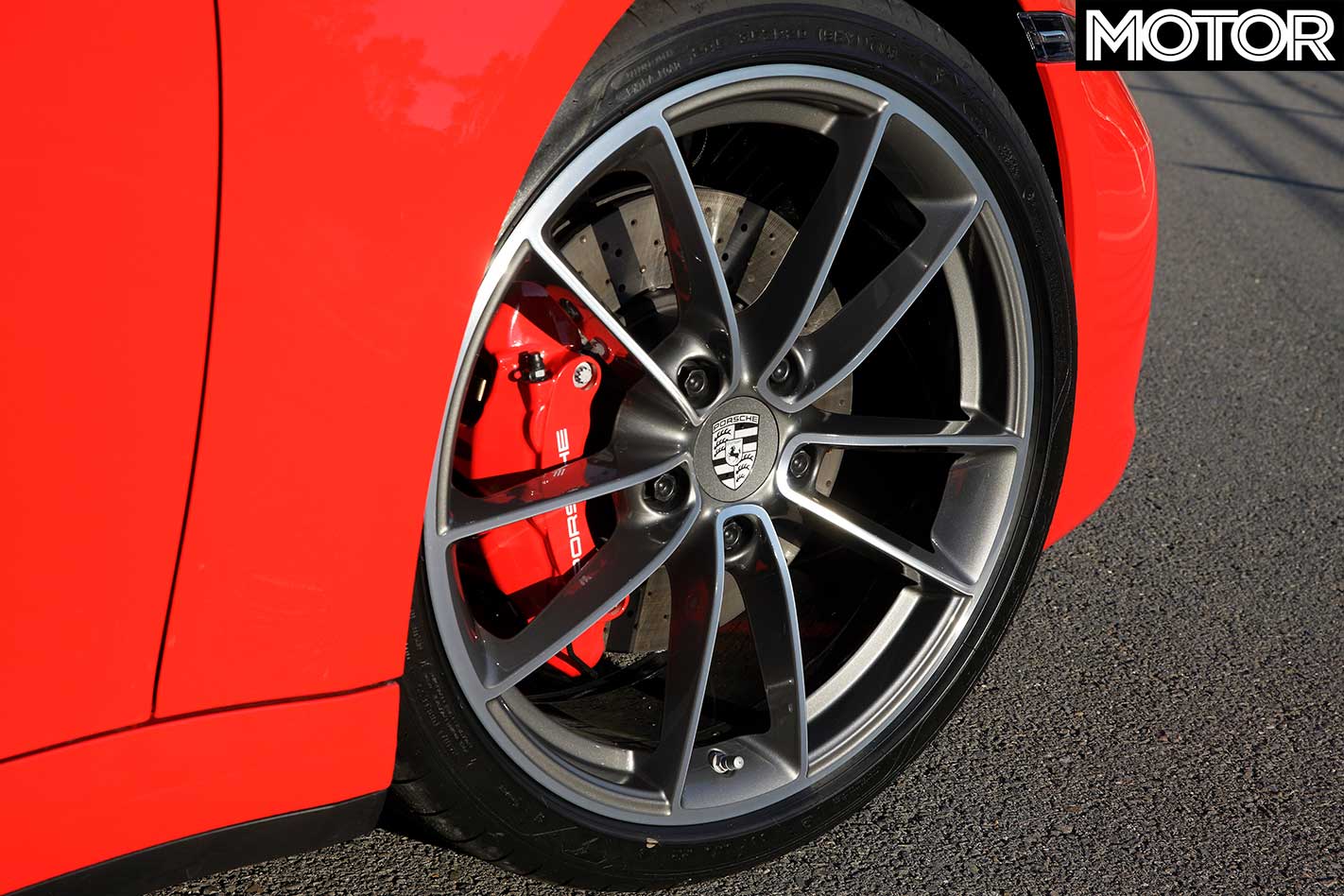
The 3.0-litre twin-turbo flat-six carries over, but everything bar the crankcase has been heavily revised with larger turbochargers, a new intake system, repositioned engine mounts and intercoolers, electronically controlled wastegates and piezo injectors.
The result is 331kW at 6500rpm and 530Nm from 2300-5000rpm, which aren’t spectacular numbers in these crazy times we live in but 0-100km/h in 3.5sec certainly is. This is an outrageously fast car.
Our track sessions were led by 991.2 GT3s which could only just outrun the 992s, but on the road the newer car would almost certainly be quicker courtesy of its broad torque band. Best of all, Porsche has discovered the trick to making its turbo engines sound good, with roars and whistles, pops and crackles emitted for the engine bay.
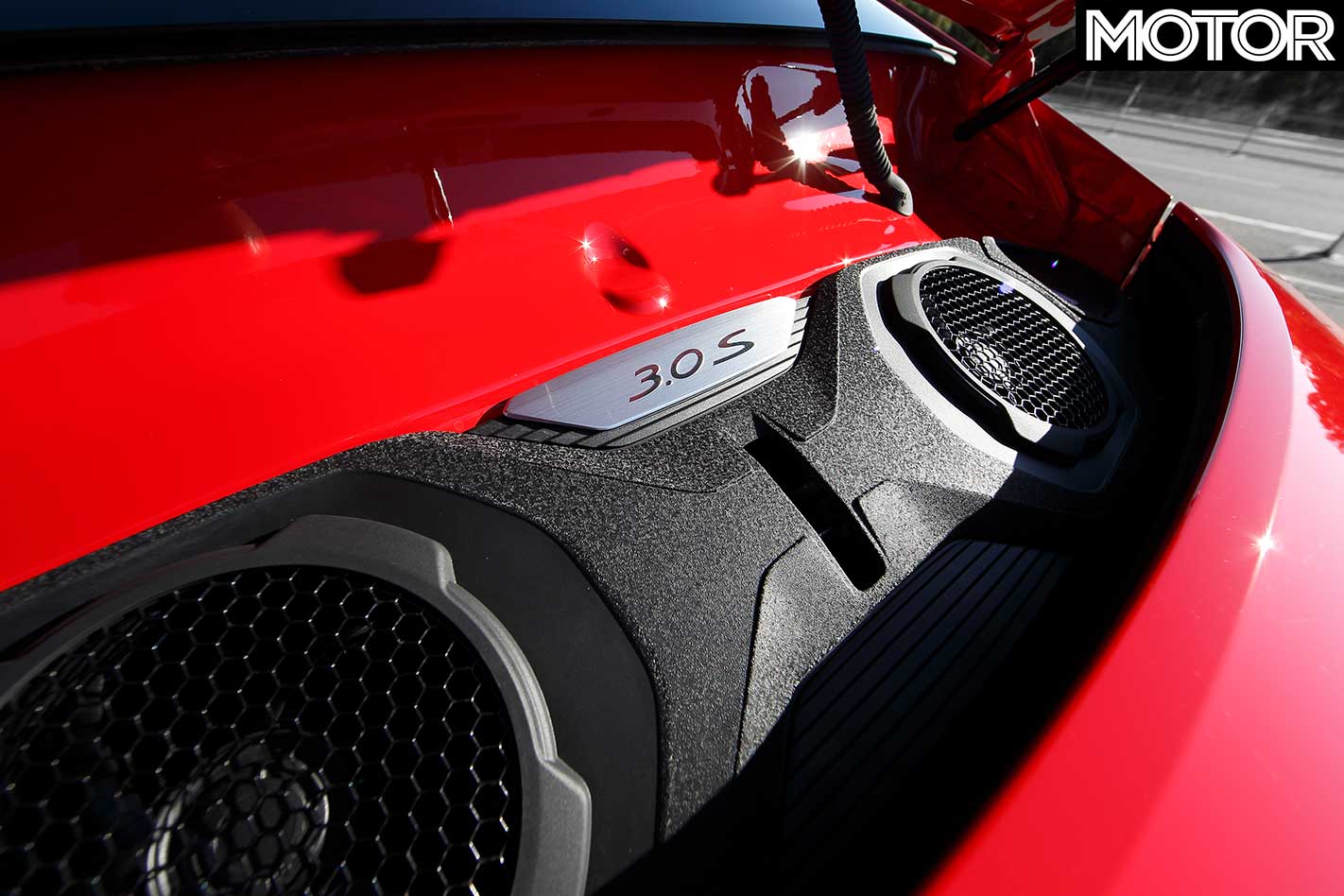
The PDK transmission now houses eight gears (a key contributor to that weight gain) and is as telepathic as ever, while the brakes are virtually unkillable, only beginning to groan after an hour of almost constant abuse on track.
To be honest, though, a lot of this praise also applies to the 991.2 and the improvement in the driving experience is not so pronounced that an upgrade should be automatic, those most owners probably will anyway.
Where the 992 takes big strides forward is the interior. The traditional central analogue tachometer is now flanked by two digital screens that can display all manner of infotainment and vehicle information, while the central touchscreen is a whopping 10.9 inches across.
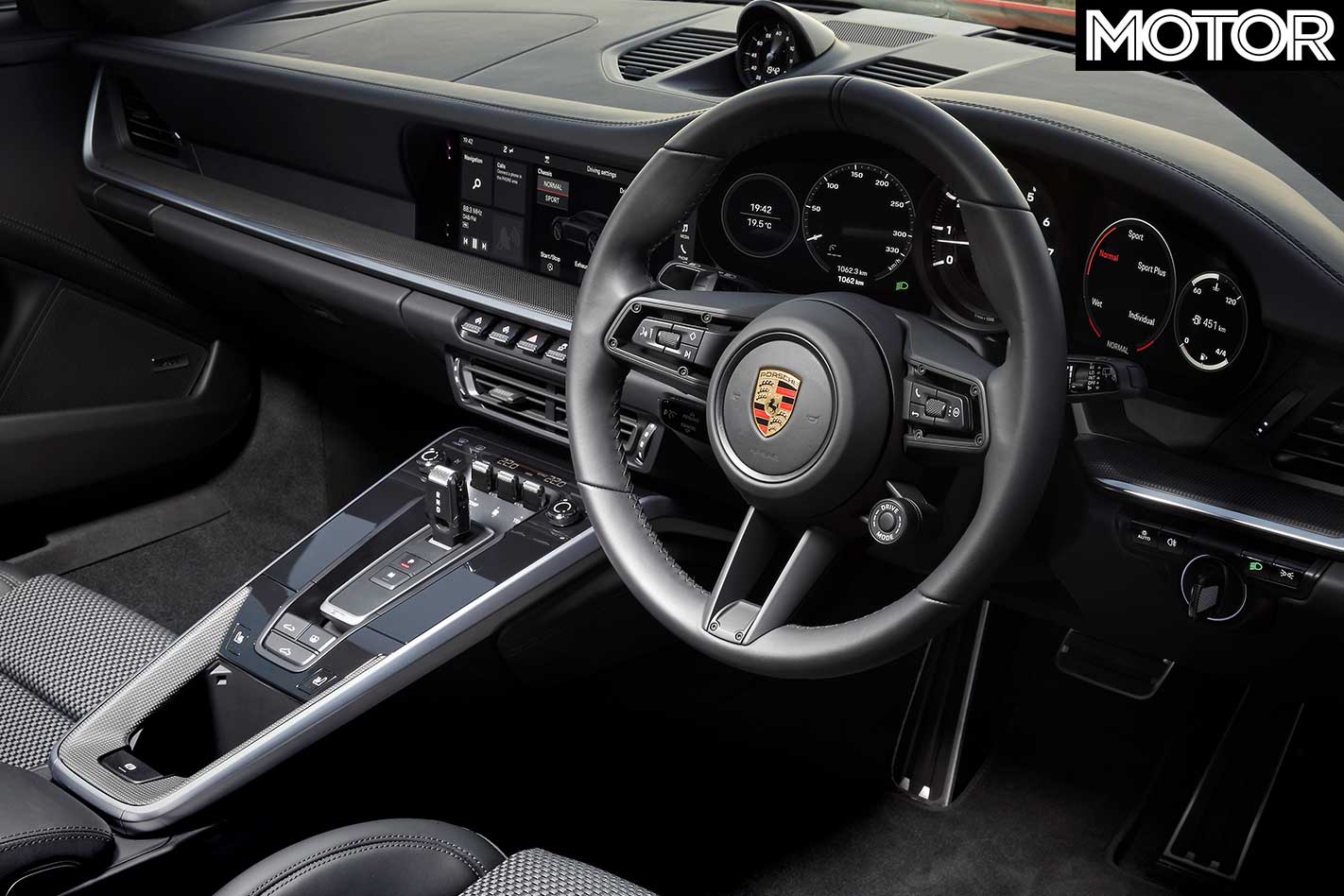
There are some weird touches. A quintet of switches sit below the infotainment screen, which control functions that would be housed on the centre console in the Panamera or Cayenne. In the 911, these panels are blank, making it look like you’ve neglected to tick a bunch of option boxes.
The new gear lever is also a retrograde step, as is the new steering-wheel mounted Drive Mode selector – the old one looked cooler. Speaking of, the new Wet Mode sounds dull but is remarkable in the speed with which it allows you to drive in soaking conditions with minimal risk.
On the face of it, Porsche has done what it needs to in giving the 911 a lift in the areas it most needed it (interior, connectivity, refinement) while polishing its performance capabilities and providing all-important future-proofing – the new eight-speed PDK is hybrid-ready and the new platform has been designed with cubbies for batteries in mind.
It’s difficult not to conclude that Porsche has kept its powder dry until the regulatory environment becomes clearer and it’s apparent just how ‘hybrid’ the 911 needs to become.
Nonetheless, it’s delivered an absolutely breathtaking sports car, which delivers a stunning driving experience yet greater comfort and refinement than ever before.
Vive la evolution.
2019 PORSCHE 911 CARRERA S SPECS Engine: 2981cc flat-6cyl, DOHC, 24v, twin-turbo Power: 331kW @ 6500rpm Torque: 530Nm @ 2300-5000rpm Weight: 1515kg 0-100km/h: 3.5sec (claimed) Price: $265,000
Likes: Outstanding performance; benchmark dynamics; improved comfort Dislikes: Expensive; weight gain; interior quirks
Rating: 5 out of 5 stars
- 2019 Hyundai Sonata revealed in Korea
- Brand new platform makes world debut
- Two petrol engines, eight-speed auto the only gearbox
- Due in Australia later in 2019
More details have been previewed ahead of Hyundai’s four-door, five-seat sedan’s expected Australian launch later this year, including information about its brand new chassis, and a peek at a new potential engine for the Australian spec car.
The Sonata competes against cars like the all-conquering Toyota Camry, as well as the Ford Mondeo, Skoda Octavia and Volkswagen Passat.
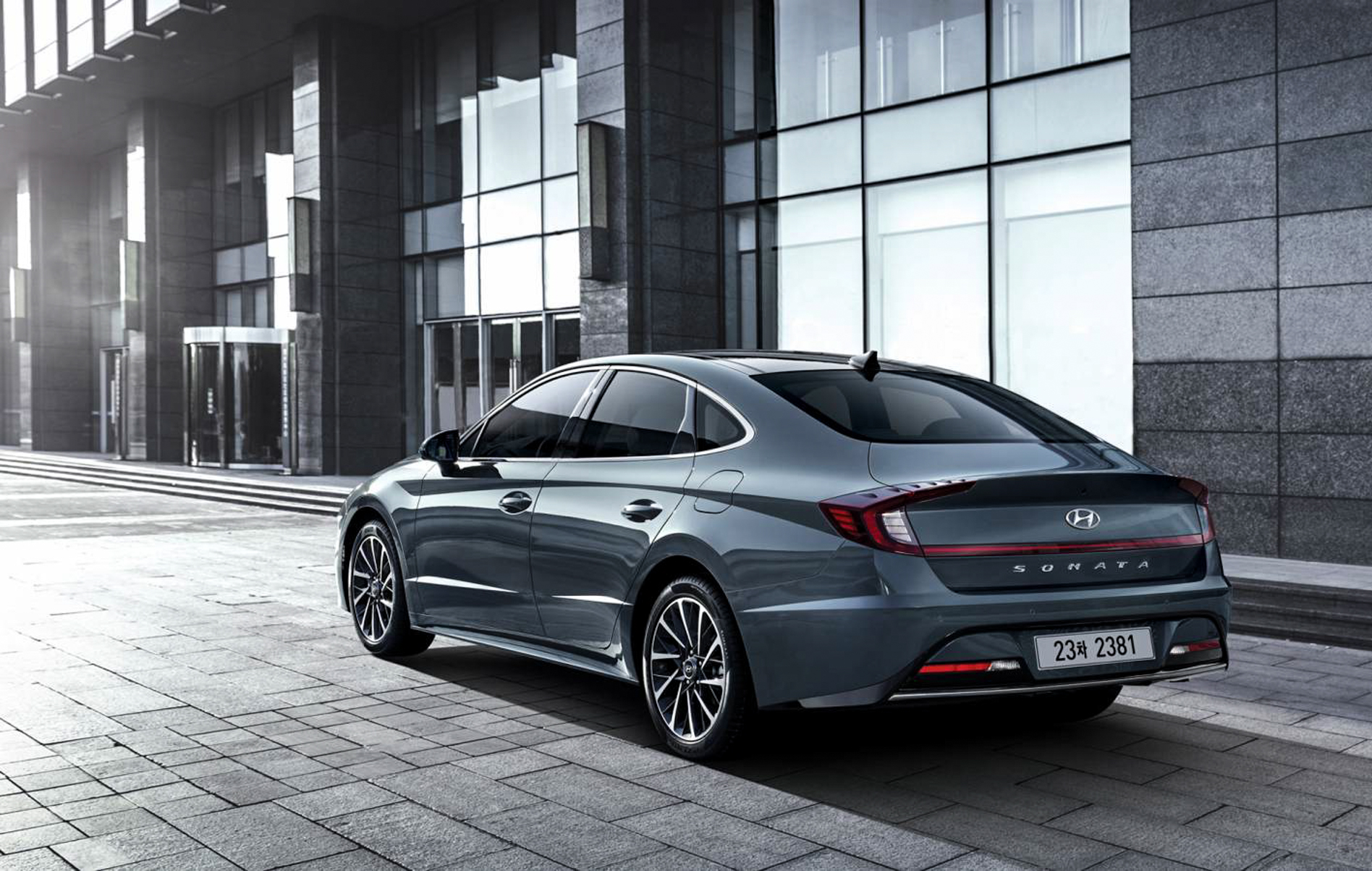
We’ve covered the Sonata’s new sexy looks here, but it’s far more than just a handsome face. Hyundai has upped the ante when it comes to tech specs for the Sonata, which also marks the worldwide debut of a brand new Hyundai platform.
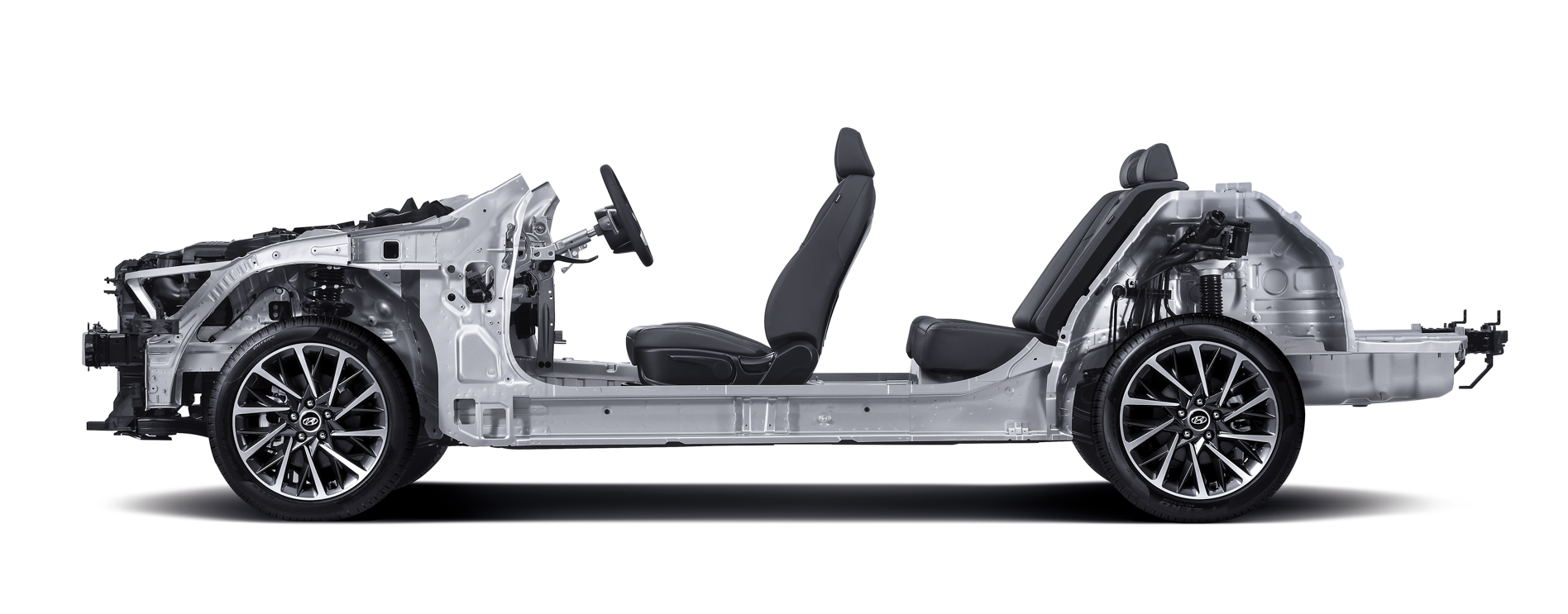
The front overhang is shorter, too, while the roofline is lower and the wheelbase is longer, meaning more room for rear seat passengers and lower seating positions for all occupants.
It’ll use MacPherson struts up front for its suspension and a multi-link arrangement for the rear, and – for overseas markets at least – be able to be fitted with an all-wheel-drive layout. The suspension will also be tuned by Hyundai’s local gurus to better match our roads.
Spec-wise, the Sonata will be built with two engines. The familiar 1.6-litre turbocharged four-cylinder petrol engine that’s used in cars like the i30 and the Tucson will be pushed into service in the Sonata, making a claimed 134kW and 234Nm.
The second engine is a new one; it’s a larger 2.5-litre four-cylinder petrol that doesn’t use a turbo at all. It’s projected to make 142kW and 245Nm. Both engines will be backed by a traditional eight-speed automatic transmission.
While the platform has the ability to run an all-wheel-drive system – it’ll no doubt form the basis of cars like the next generation Tucson SUV – we’d be surprised if an all-paw Sonata is offered in Australia.
On the safety front, the Sonata will feature a phone-operated digital key, which uses Near Field Communication (NFC) technology to open the car and pre-start it (tap-and-go payments use NFC technology). As well, a new head-up display system and vastly updated driver aid technology will, says Hyundai, allow the car to be classed as a Level Two autonomous car.
Lane-centering assist up to 145km/h, exit assist for all four doors, advanced AEB with pedestrian and cyclist detection, reversing collision avoidance, extended blind-spot view monitor and new digital side mirrors are all part of the Sonata’s safety kit.
Staying with the interior, the centre console will feature a 10.3-inch HD multimedia screen, while a 12.3-inch digital dash will also debut. A novel steering wheel design also features in the press images, while some of the Sonata’s controls will remain as centre console-mounted dials, rather than being hidden in the multimedia system.
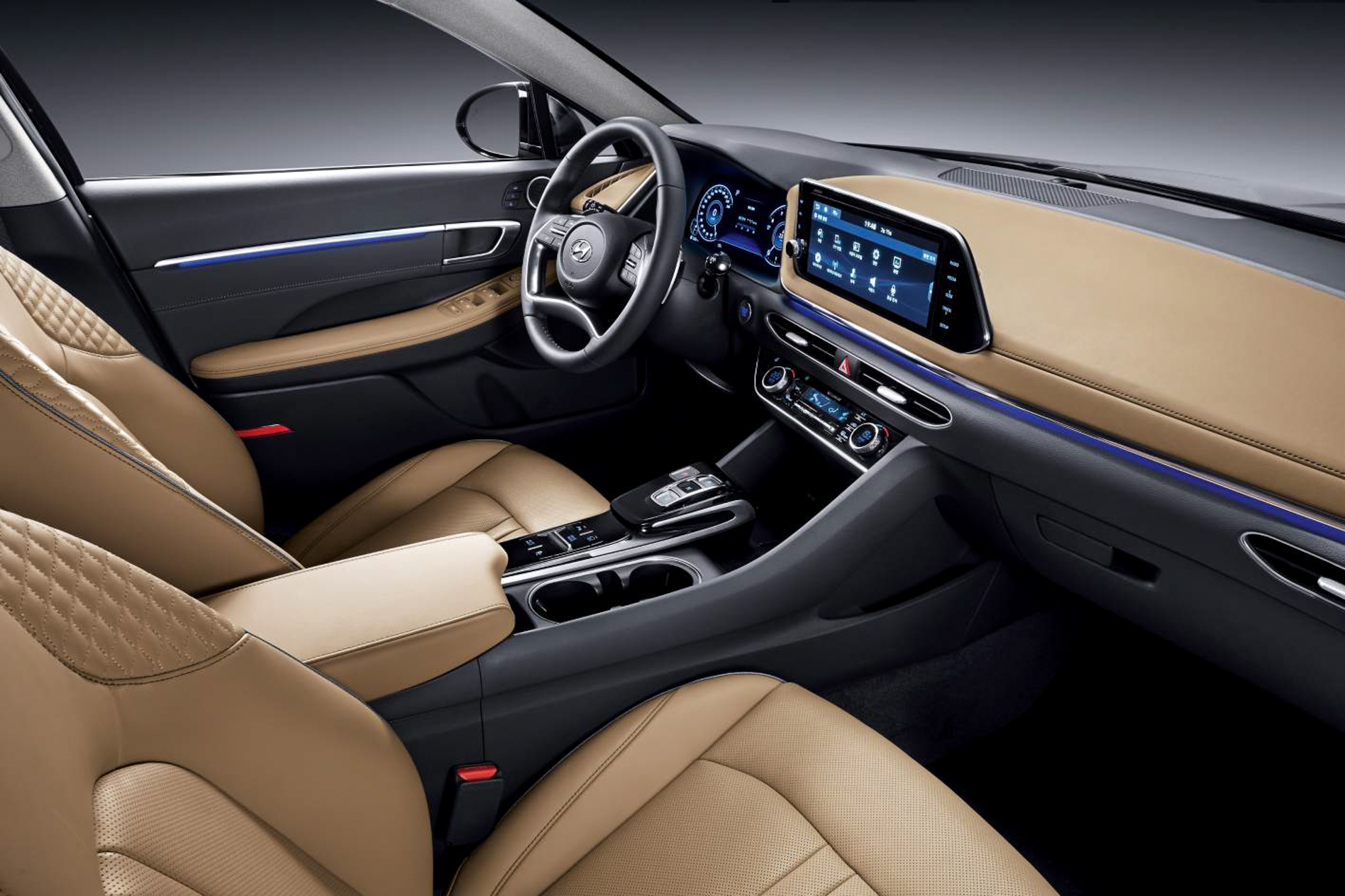
Specs and prices for Australia haven’t been announced yet, and while we’d expect AEB and adaptive cruise control to be standard, other systems may be kept for higher grades or pack upgrades.
What gets sideways, and goes ‘stu-stu-stu’? Why, it’s Daigo Saito’s 2JZ-swapped Toyota GR Supra drift car!
With a 3.3-litre version of the legendary twin-turbo Toyota straight-six motor, Saito’s A90 Supra is producing about 600kW, and took the drift champion just 42 days to build.
And now, finally, we can see it in action… and not on fire. During testing, about a week before the official reveal of the car on film, the 2JZ Supra caught fire and was caught on film by Instagram user @verkeenko.
https://www.instagram.com/p/BvT6ZUshGO1/?utm_source=ig_embed&utm_medium=loading
Fortunately, as the video above show, the car survived and we’re now able to see it in action, with 39-year-old Saito behind the wheel.
…aside from this tweet, which did the rounds during some exhibition testing a few days ago.
The HKS and Monster livery give an indication of the budget and the quality of parts that have gone into this build, but it’s Saito himself who is behind the construction of the first A90 Supra Drift car, via his workshop Fat Five Racing.
It’s through Fat Five that he’s built some of his past cars, including his Lamborghini Murcielago.
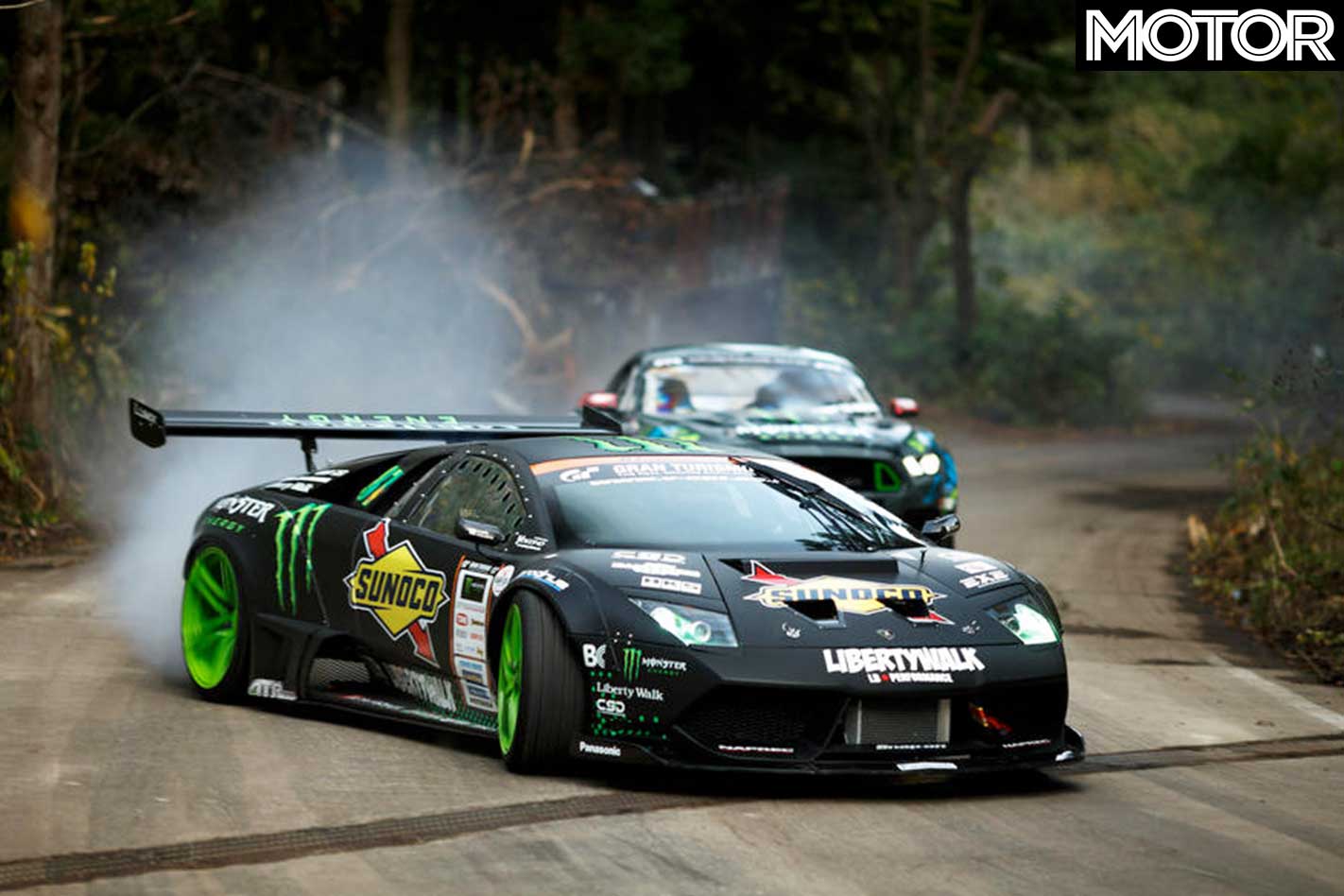
“I’m happy to have turned the new Supra into a drift car for the first time. Building a new car is always enjoyable, but this feels like a return to my initial goal,” Saito says of the Supra.
“Since the wheelbase is short and the body is compact, it’s able to run sharper with more aggressive driving, but able to be controlled easily.”
Daigo Saito will continue to compete with the A90 Supra throughout Japan’s 2019 D1GP season, which kicked off with an all-star shootout last week.
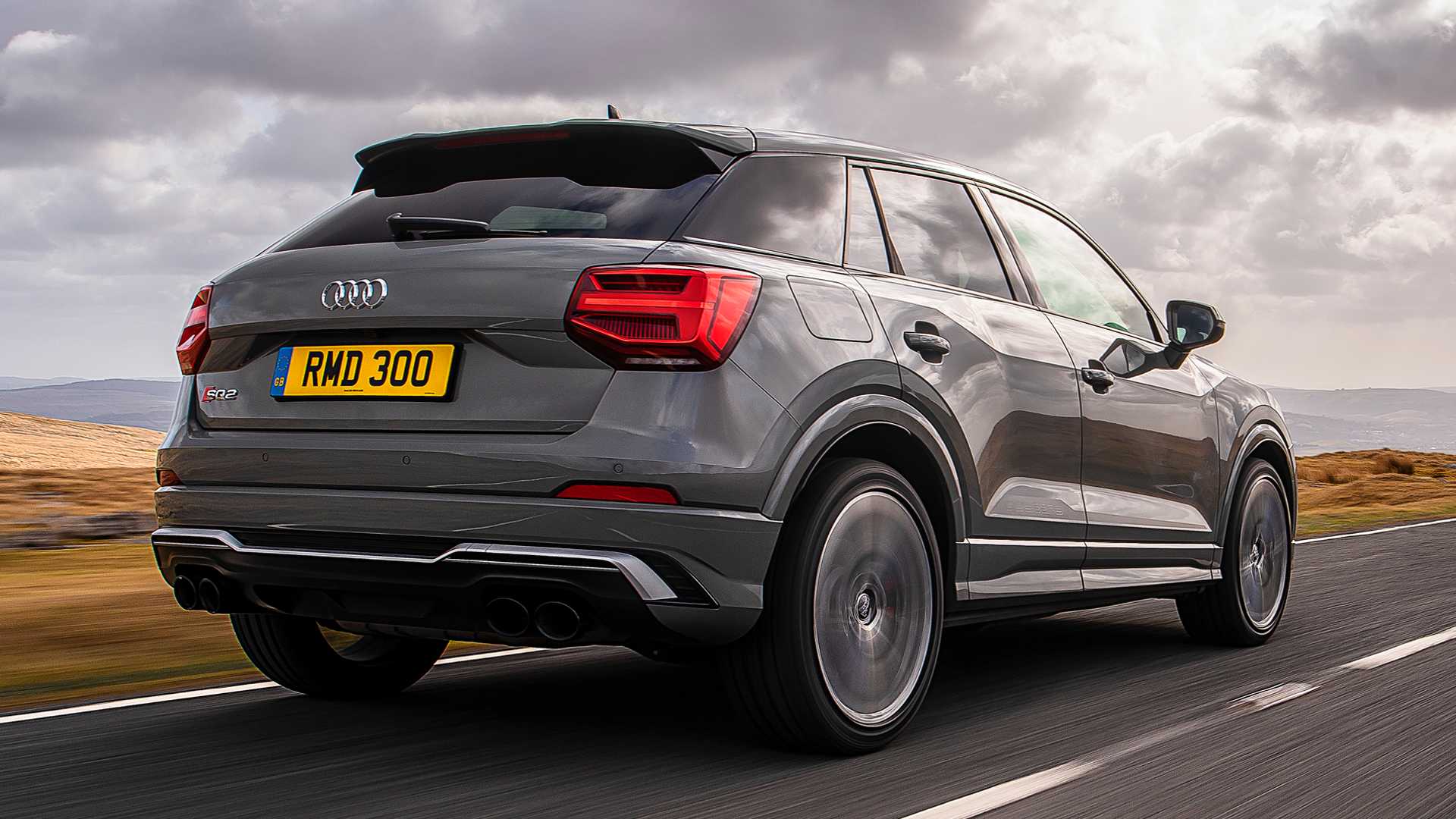
Despite Australian’s love for all things performance, the Audi SQ2 is no certainty of coming down under, thanks to the company’s well-documented dramas with a backlog of emissions testing.
Audi is very keen to get the SQ2 on the ground here, but it admits that a backlog of emissions and efficiency testing work caused by the switch to a test protocol that more closely aligns with the real world – known as the WLTP standard – means that the SQ2 has been pushed back in the queue a bit.
An Audi spokesperson confirmed to WhichCar that the SQ2, previously set for a 2019 debut, may now not touch down in Australia until next year.
This puts Audi behind the curve against cars like the Mercedes-Benz GLA45 AMG and BMW’s incoming X2 M35i, along with Jaguar’s 221kW E-Pace R-Dynamic, which are currently on sale.
Revealed late last year and just launched in overseas markets, the SQ2 is based, of course, on the three-year-old Q2 small SUV, and it joins the RSQ3, SQ5 and the hulking SQ7 in Audi’s go-fast SUV lineup.
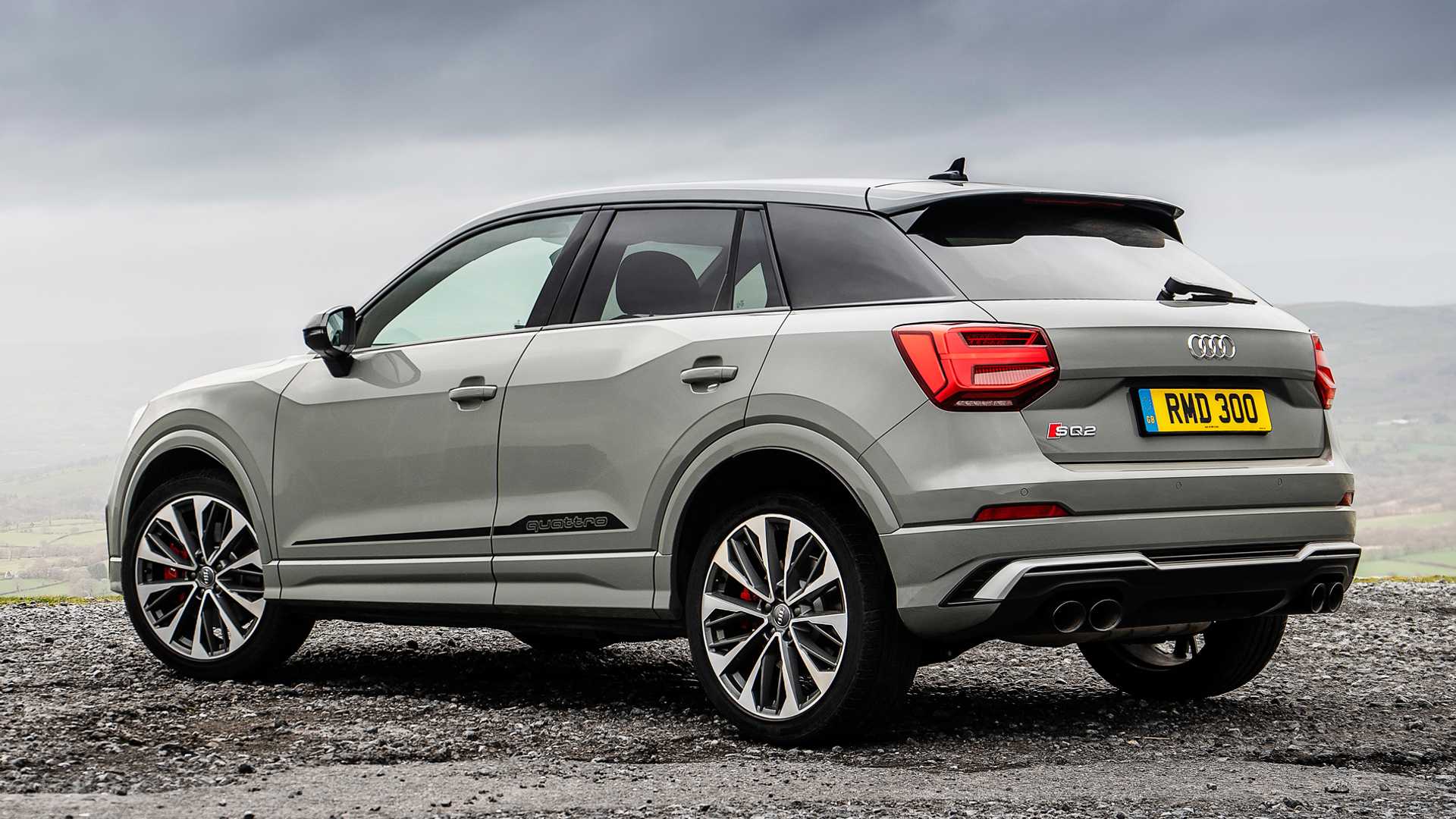
It takes the engine and all-wheel-drivetrain from the S3 hatch, which translates to 220kW of power (in European tune) and 400Nm of torque, matched to a seven-speed dual-clutch transmission that sends power to all four wheels.
In fact, Audi claims that up to 100 percent of the 2.0-litre turbocharged four-cylinder petrol engine’s output can be directed as required to the rear wheels, via a multi-mode drive selector button. It can rip to 100km/h from rest in just 4.8 seconds.
The SQ2 rides on a unique suspension setup that drops the ride height 20mm over the regular Q2 and it wears 18-inch rims as standard, with larger 19-inch rims available via the options sheet. The brakes, too, are larger, with 340mm rotors up front clamped by larger sliding-piston calipers in black. Want red brake calipers? They’re a cost option overseas.
Exterior modifications are surprisingly limited, with a new front bumper with larger grille aperture and wide lower splitter offset by quad exhausts and a larger rear spoiler.
Inside, the interior of the SQ2 is definitely a step forward over the standard Q2, with leather/Alcantara trimmed sports seats a standard addition. There’s also a range of packs that will add things like diamond-stitched Nappa leather trim and anodised red rings for the dash vents. There’s also a sports-spec flat-bottomed steering wheel equipped with shift paddles.
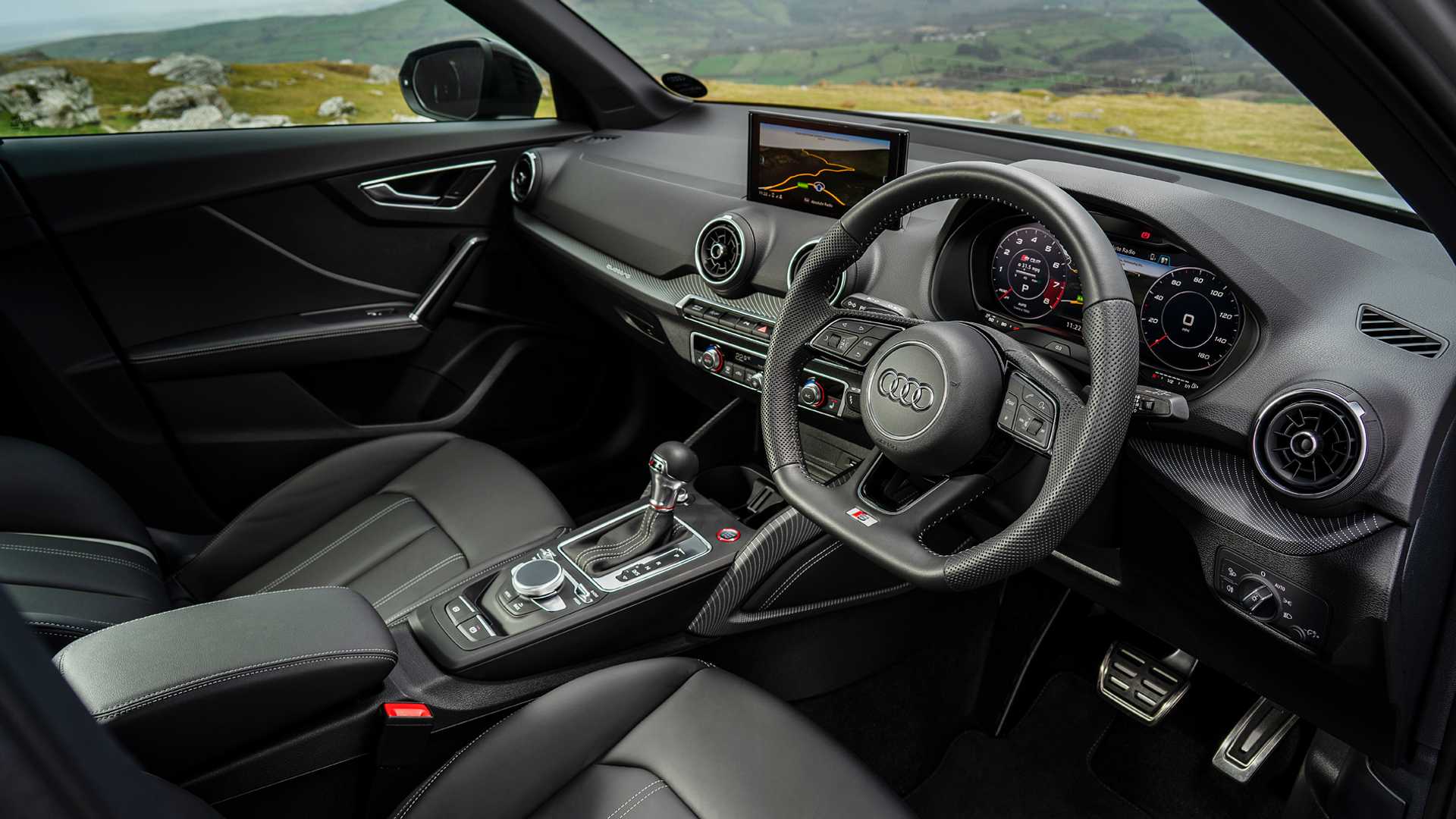
Spec-wise, expect the SQ2 to carry Audi’s MMI multimedia system, run through an 8.3-inch screen, and featuring Apple CarPlay and Android Auto connectivity, a wifi hotspot and satellite navigation.
It’ll come fully equipped with driver safety aids, too, like pedestrian-detecting AEB, lane departure control, park assist, adaptive cruise control with traffic jam assistance and more.
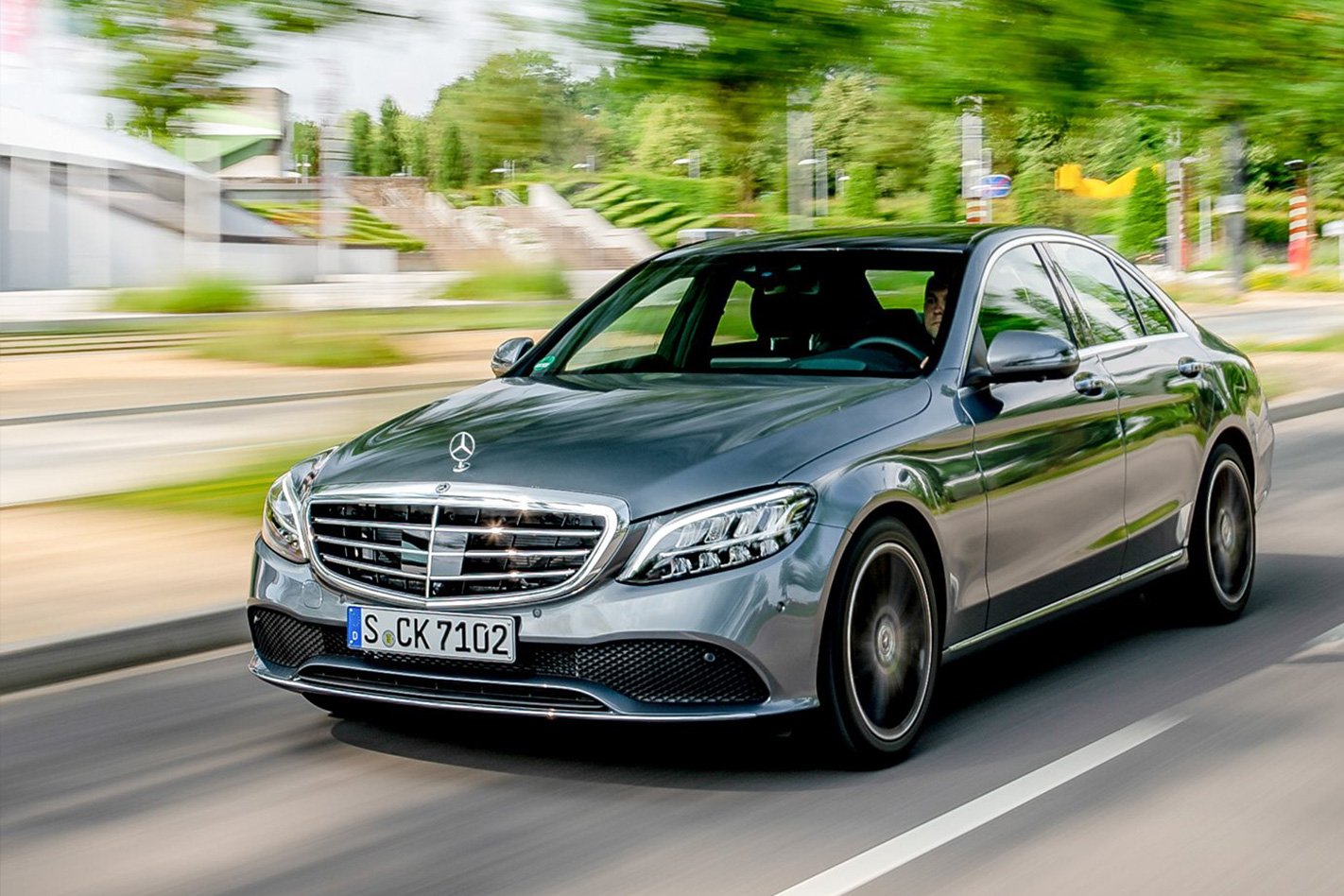
Mercedes-Benz has issued a recall of its C-Class, E-Class and S-Class models due to the potential for a faulty seatbelt sensor to result in the incomplete functioning of the seatbelt restraint system.
The problem lies within the car’s PRE-SAFE seatbelt pretensioner, where it’s possible that the car may mistakenly detect a correctly engaged seatbelt as being not engaged.
Passengers will be aware of the phenomenon by a warning tone and symbol in the instrument cluster, but the concern is that the pretensioner may not engage to pull the passenger tight against the seat in the event of a crash.
Designed to pull the passenger tight in toward the seat when the car detects the occurrence of a crash, if the PRE-SAFE function does not work, the complete effect of the restraint system is not ensured.
Mercedes-Benz is in the process of alerting affected consumers, and will organise a free repair.
This issue affects 341 vehicles sold between the period of 1 August 2018 – 31 January 2019, the full list of VIN signatures can be found here.
Overall Rating

5 0 5
Plus & Minus
WHAT IS THE PORSCHE 911 CARRERA S?
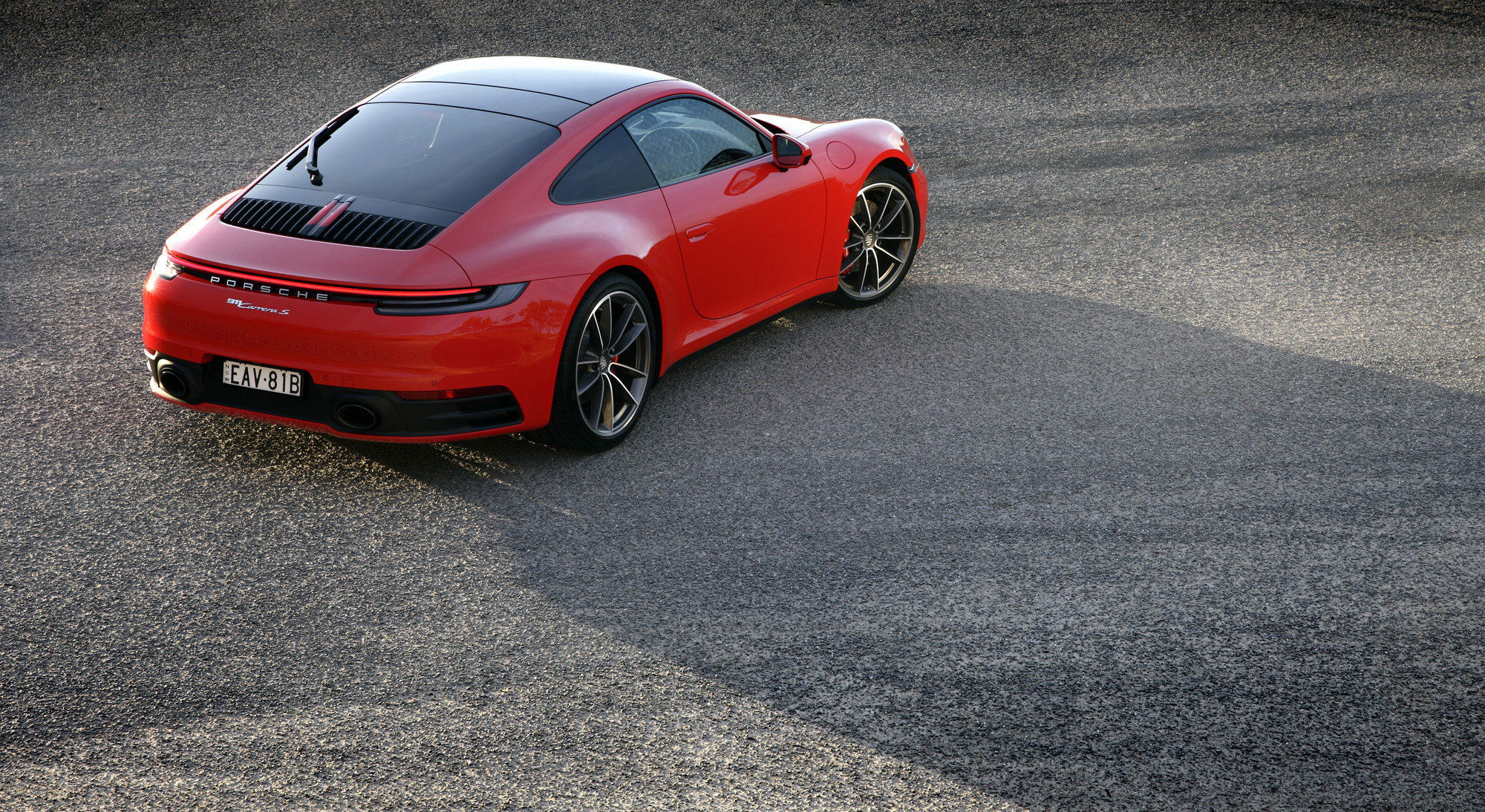
At the moment the Carrera S is the only 992 that Porsche is importing. That’s 331kW and 530Nm of twin-turbo 3.0-litre flat six which, in itself, is a fairly remarkable output, identical in power to the 959 hypercar. Zuffenhausen offers the car in coupe guise – which we’re driving here – or as a Cabriolet. Both come with a new eight-speed PDK twin-clutch transmission, although a seven-speed manual will be offered later. Also on its way is a base Carrera for those who find $265,000 for a Carrera S or $281,100 for a Carrera 4S (the all-wheel drive variant) a bit too rich for their blood.
WHY WE’RE TESTING IT
So much of the 992 is new that there’s no way that we can think of it as a ’991.3’. Body, chassis, suspension, transmission, a lot of the engine, interior – it’s all new.
PORSCHE 911 CARRERA S REVIEW
Typical lazy Porsche. That’s what you were probably thinking when you saw the first press shots of the 992 version of the iconic 911. It didn’t look that different and, to be honest, did it really need to be that different? The 991 developed into a great car, especially in later 991.2 guise (from 2016) and most figured the 992 would be a gentle evolution designed to see the 911 through to a more radical update that included a chassis designed to handle a big battery pack as well as an engine at the back.
That’s what we all thought. Porsche clearly wasn’t listening though.
It has, in many instances, made the most of incremental gains – the odd one percent here and there that add up in totality, but if there’s one area where the car has made a giant leap forward, it’s in ride quality, more of which later.
It’s worth stressing just what a blisteringly rapid car the Carrera S is. The rear-drive car gets to 100km/h in 3.7 seconds, with the 4S managing a quicker 3.6s. Opt for the Sport Chrono pack, which includes active engine mounts, and that figure drops to 3.5s for the Carrera S and 3.4s for the Carrera 4S. That latter figure is quicker than a 997 GT2 RS. It’s as quick around the Nurburgring (7m25S) as a 991 GT3.
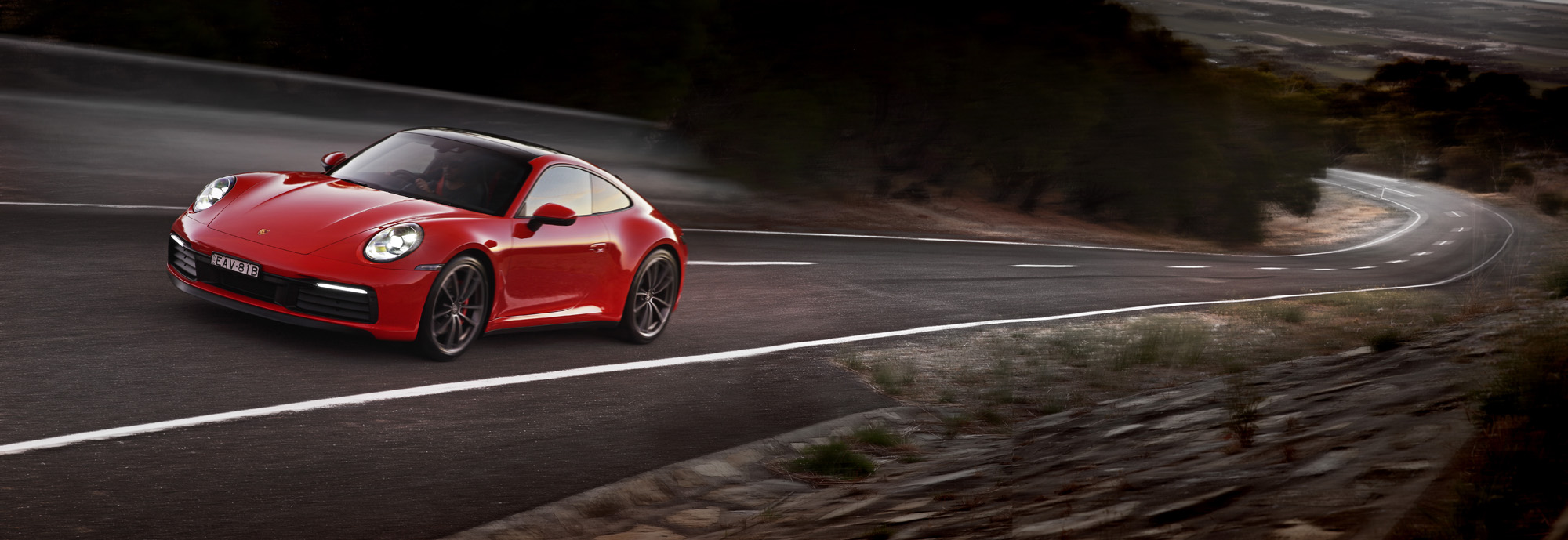
Again, it’s easy to be underwhelmed if you just glance at figures. After all, 331kW is the same as the old Carrera GTS and the weight of the car has crept up. Rear wheel drive cars are now around 85kg heavier than their predecessors. Delve deeper and the engineering behind this car is absolutely intriguing. I hope you don’t mind me exploring a few of these advances in detail before we jump into driving impressions, but it’s worth understanding the philosophy behind the development of this car because it signals a key departure in the evolution of the 911.
Let’s open with the body-in-white, the bones of the car. Where the 991 was comprised of 63 percent steel, the 992 is down to 30 percent high tensile steel. Virtually every body panel you see is aluminium, with boron steel used for areas like the rollover structures. Despite being 20mm longer, 4mm taller and a smidgeon wider than the 991, the body is five percent lighter and a whopping 11 percent lighter than 997, despite all 992 bodies being wide-body shapes with voluptuous Coke-bottle flanks. Buyers apparently want ‘em wide.
Easing out the dimensions slightly, improving crash protection, fitting the eight speed transmission as well as bigger brakes, wheels and tyres have increased overall weight, but it’s a bargain worth making. A lot of weight could come out of these cars if required. All Carrera S models have either a sliding or a glass sunroof and the comfy electrically adjustable seats have to be 50kg heavier than a carbon-shelled bucket seat that’ll go into a future GT3 version.
The engine, you’ll be unsurprised to hear, is still slung out back, but it’s attached to the car in a very different way. Whereas the 991’s lump was narrowly mounted by a pair of bolts to a small subframe, Porsche learned a lesson from the 718 Boxster/Cayman and realised that the wider apart the two mounting points are, the smaller the mechanical advantage the engine can wield as it’s subjected to enormous pitch, roll and tilting forces. Therefore the engine is now mounted further forward and uses the opposing cylinder heads to clamp it in place. The upshot of that is that by controlling the engine’s masses better, ride quality can be softer when required or firmer when necessary.
The block is much the same as before, but virtually everything on the top end of the engine has changed. The valvetrain is particularly intriguing and again, Porsche has borrowed ideas from other cars in its stable. In this case, it’s the 3.6-litre V6 from the Panamera, which utilises the two intake valves asynchronously. One valve opens early and by a tiny amount to induce swirl in the cylinder, the second valve then opens fully, the new piezo injectors (borrowed from diesel engines – seeing the theme?) firing up to five squirts of fuel per cycle into a swirling layer cake of air. At higher engine loads, both valves open fully to tumble big volumes of air more conventionally.
There’s been a fundamental redesign of the turbochargers too. By operating the two bigger turbos in a contra-rotating fashion, the ducting to them can be symmetrical rather than the convoluted route leading off one bank in the 991. That idea came from group hot-in-vee V6s and V8s. Electrically operated wastegates now allow the catalysts to get hot during cold starts more efficiently and are part of an ongoing process of gradually excising hydraulic and vacuum-operated actuations in the car. That’s borrowed from Porsche’s hybrid tech where things often need to move without any engine power at all.
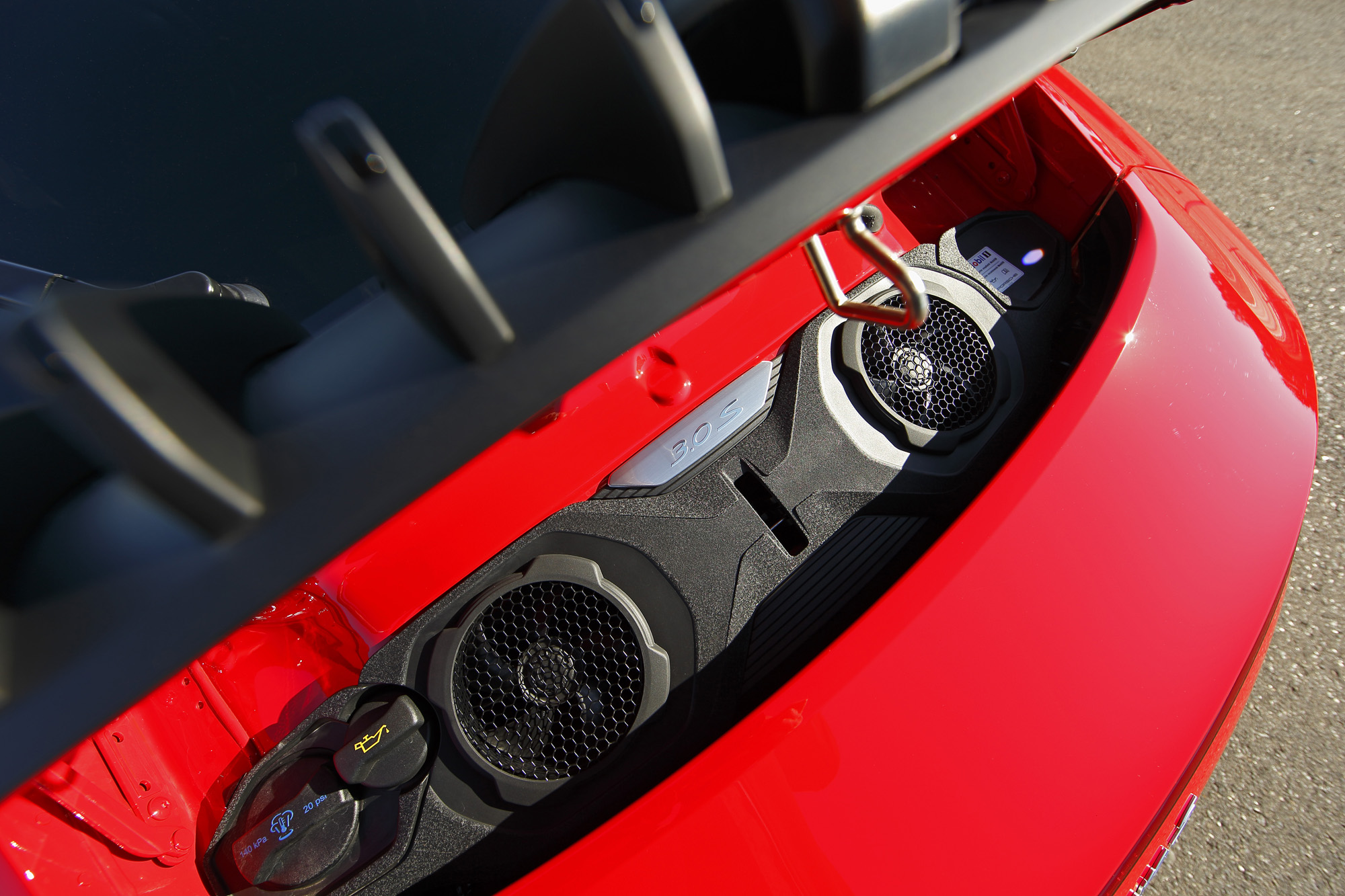
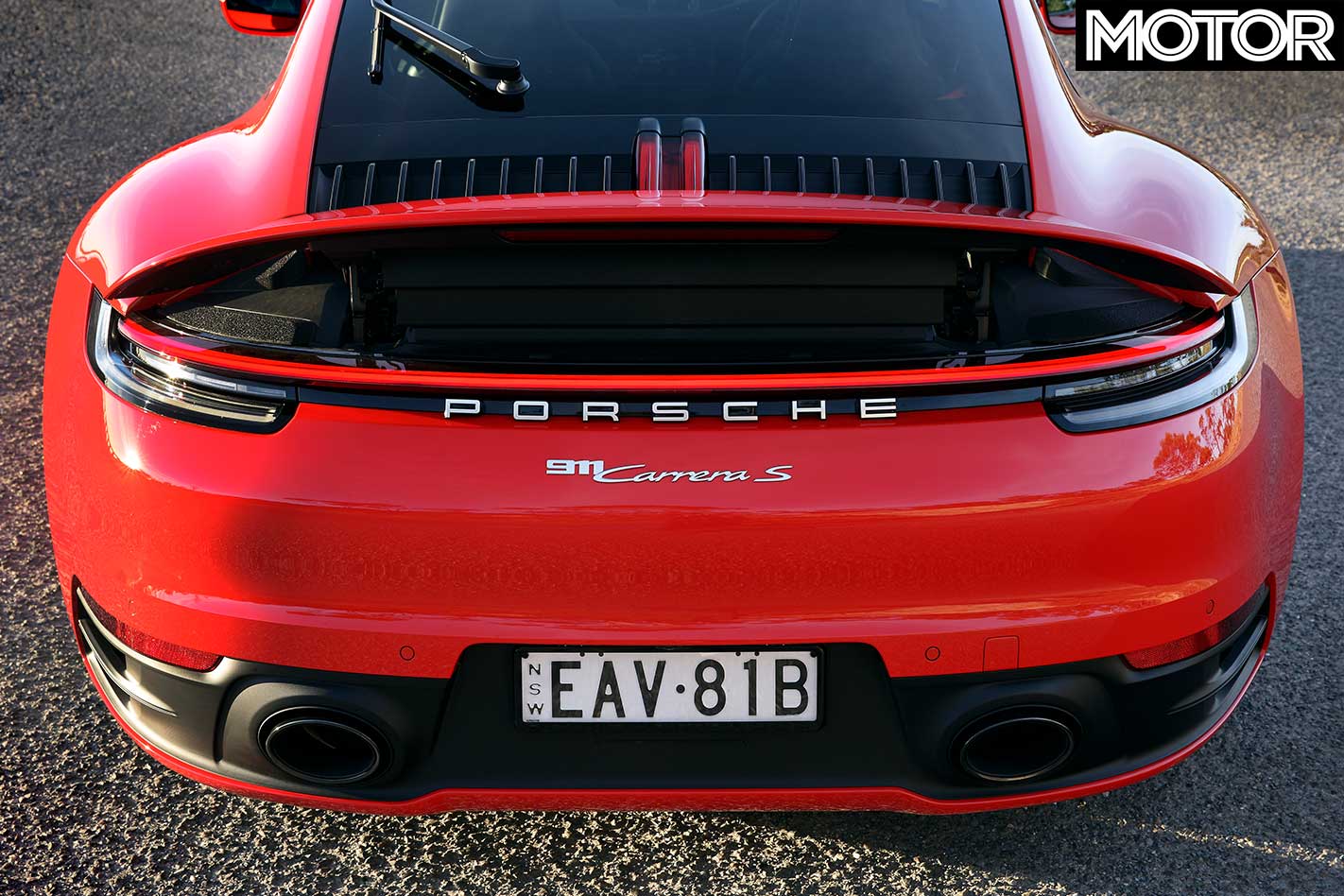
The intercoolers have moved to a more efficient position, right under the rear spoiler. That spoiler can move into three different positions and guide air more effectively to these units. The downside of that is that the air filters are now where the intercoolers were on the 991, namely tucked right down behind the rear bumper bar, so replacing those will require the rear bar to come off. That’s not going to be cheap.
Crash repairs are also going to be hugely expensive on the 992. The body is joined together in ten different ways that include various welds, plate cinching, adhesive bonding, screwing and riveting. That’s up from seven methods for 991 and four for 997. It also means that there’s a challenge in training authorised repair centres to keep on top of these advanced techniques. The 188m of adhesives used for bonding panels, for example, are stronger than the metals themselves and can only be ground out to repair damaged bonded panels. The aluminium rear quarter panel is the body part you really don’t want to bend. It’s huge, and the pressing weighs just 12kg and is fitted to a laser-defined tolerance of 2/100ths of a millimetre. The 992 is likely to be very strong in a crash though. One particularly neat inclusion are steel hooks that jut out from the bottom of the doors that are clasped when the door is locked and prevent the door riding up over the sills in the event of a side impact.
The all-new MMB platform that underpins the 992 will be shared, albeit with a modified rear section, with the next-gen 718 Boxster and Cayman. Hanging off that are some very trick Bilstein DTX dampers on cars equipped with PASM (Porsche Adaptable Suspension Management) – a box you really do need to tick. This drops the car by 10mm to really hunker over its tyres and the dampers offer 40 percent more compliance in compression at the front axle and 32 percent at the rear.
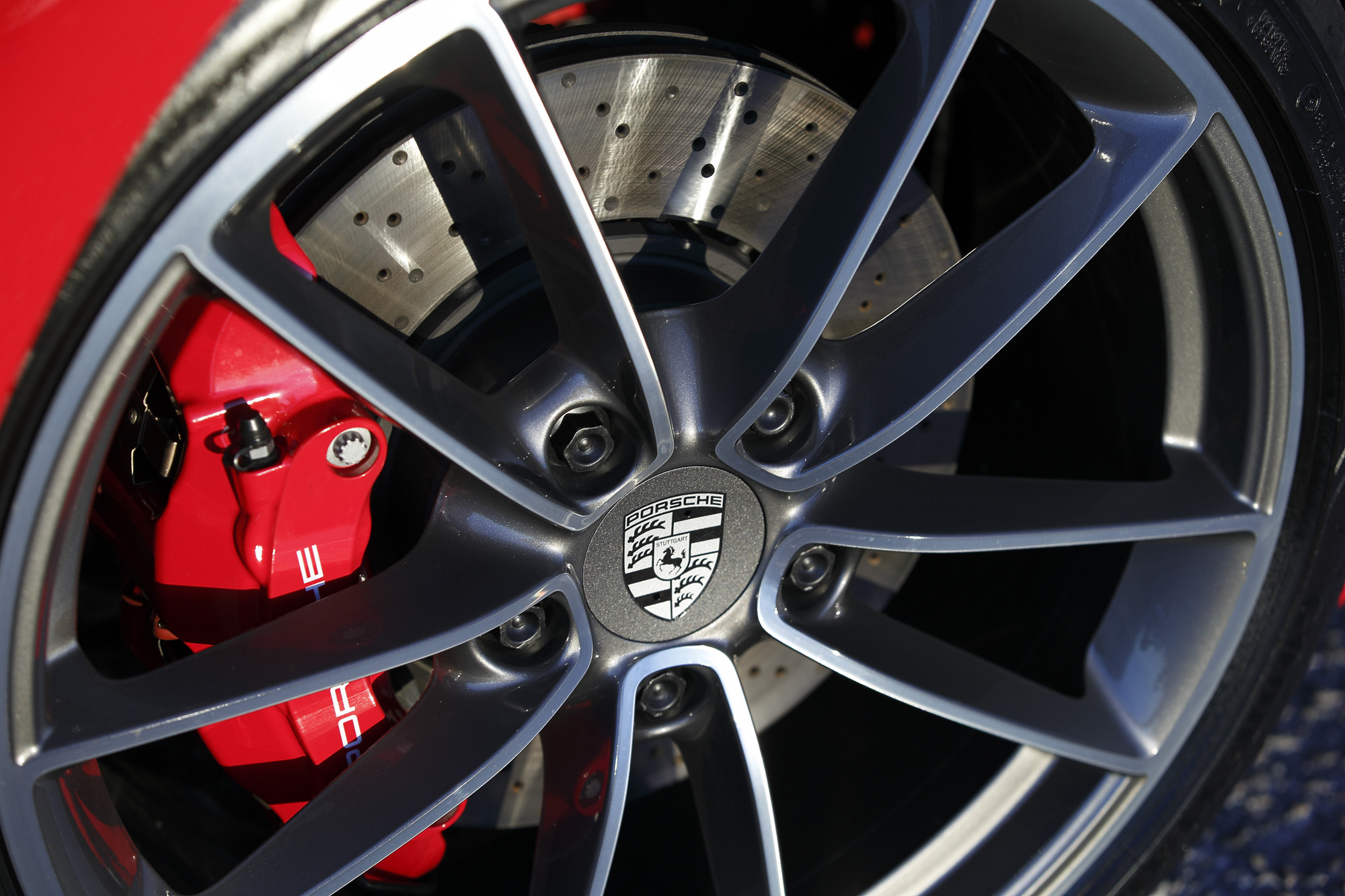
Brakes? They’re still 350mm front and rear, with the rear rotors increased in width. Six piston callipers grab the front discs and four-pot rears do likewise at the back, and the brake booster is now electrically operated, again from Porsche’s hybrid know-how.
The steering is ten percent more direct and rear-axle steering can also be specified, which replaces the lead acid battery with a lithium-ion unit. The transmission features a shorter first gear and longer seventh and eighth overdrive gears, with the top speed reached in sixth. The casing for the transmission includes real estate for an integrated starter generator, effectively offering a 48v mild hybrid option in due course.
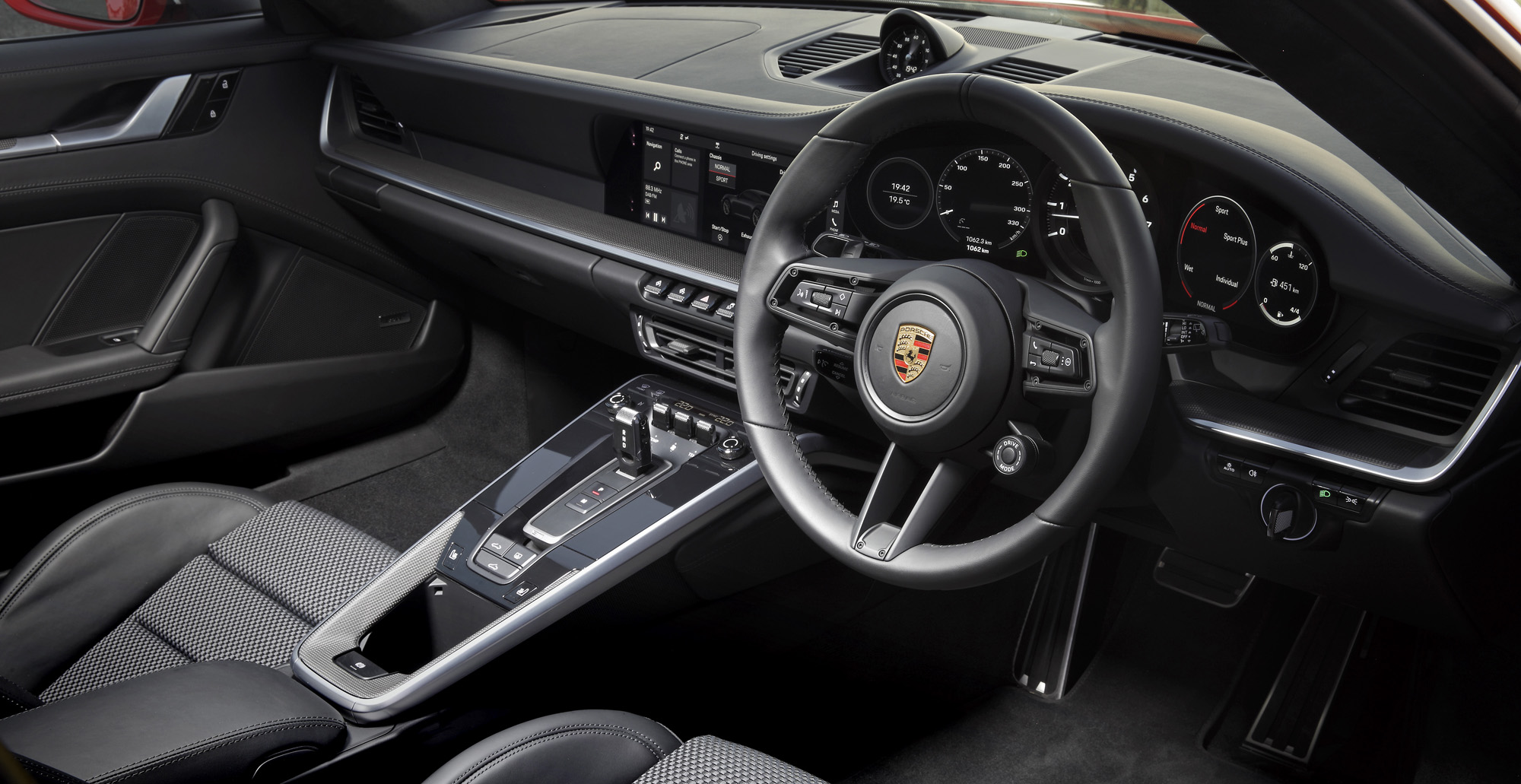
The interior you’ve probably seen and you can doubtless form your own opinion of the aesthetic, but the classic 911 five-clock binnacle remains, the centre one an analogue rev counter flanked on each side by a pair of digital dial faces. The floor of the car has been modified so that the driver can sit lower. This means that despite the car only being 4mm taller than before, there’s another 8mm of headroom. I’m 6’4” and easily fit with a crash helmet on, and that’s in a sunroof car. Remarkable. The frunk has also become more useful with the tool kit not as obtrusively integrated.
Humility isn’t always a quality we’ve come to expect from Porsche, but it’s absolutely fascinating that while the 911 is still the star in its firmament, its engineering team has borrowed stacks of ideas from other wares in the range to better the car.
Prod the knurled metal gear selector into drive, twist the wheel-mounted dial into Sport Plus and we head out on track at The Bend. A revised exhaust and the firmer engine mounts mean that the noise pathways through the car are, let’s say, more direct than the 991 Carrera. The acoustically dampened sound of the turbocharged 991 has given way to a freer breathing 992. It sounds glorious when you open the taps. Not as glorious as the GT3 lead cars guiding us round the circuit, but with a great bass tone overlaid by a breathier more authentically 911 sound. You get some crackles on the overrun too. You’ll love it.
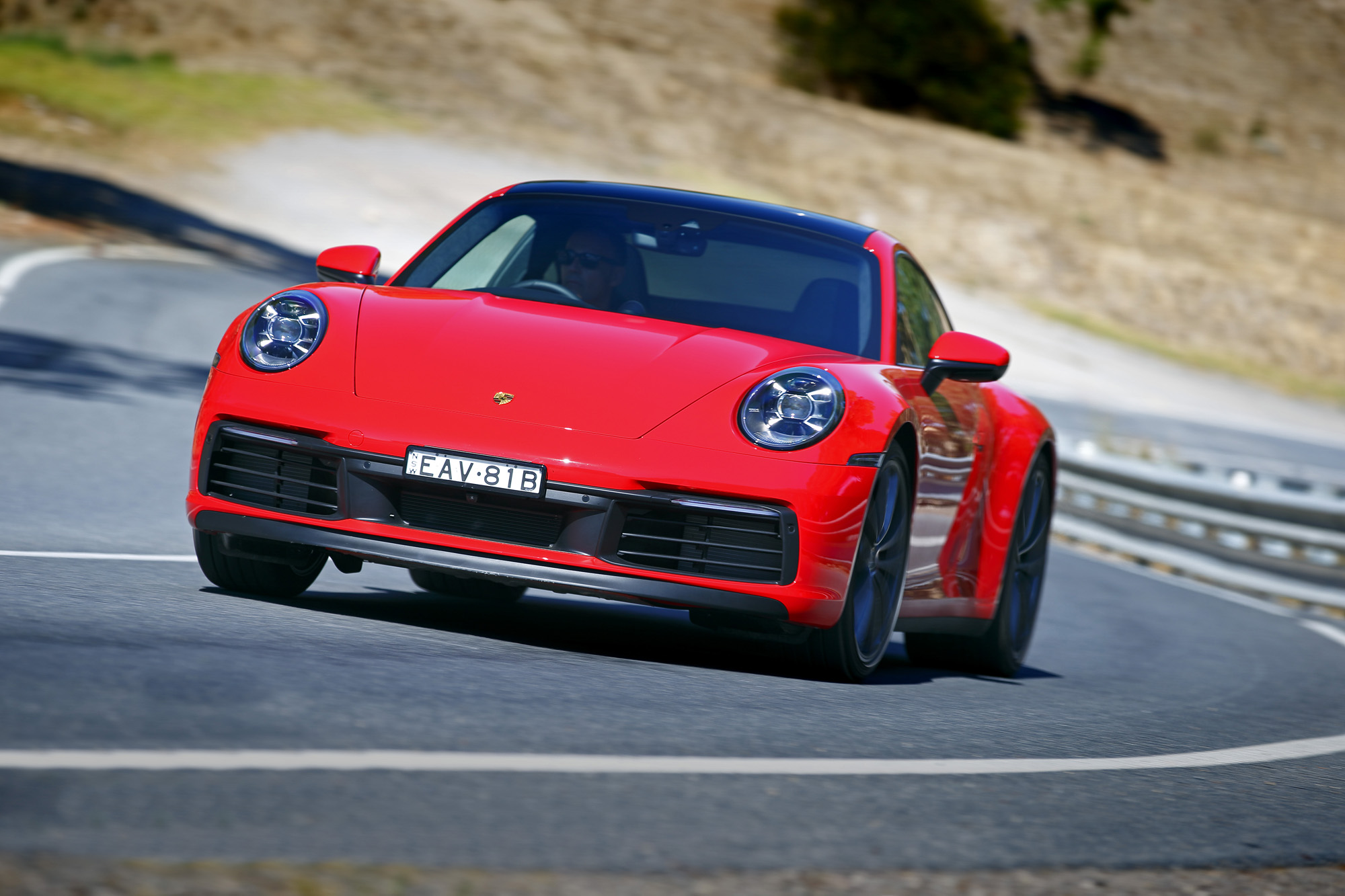
The steering’s sharp without being darty, although I’m not totally convinced of the benefits of the rear steer option. Body control is excellent, although a mid-corner throttle lift still sees the nose duck and bob in time-honoured 911 fashion. The cars at The Bend are all riding on Goodyear Eagle F1 tyres, which is an unusual choice for a 911, but tyre options from Pirelli and – preferably – Michelin are also available. For the first time in a 911, the fitment is staggered, with 20-inch rubber up front and 21s at the back.
Traction is predictably crushing, with the Carrera 4S offering even better purchase out of tight corners. It always sends some traction to the front, but it’s often using more than the 991. A fully electronic multiplate clutch (tech borrowed yet again from hybrids) is linked to an open diff on the front axle, and I reckon the implementation is so unobtrusive that it could well be the pick for demanding drivers. There’s a 50kg weight impost for sending drive to the front axle too, but in bad weather it gives the 992 another level of ability.
That adverse weather ability is also helped by the new Wet Mode function. This uses microphones in the front wheel arch to detect the frequency of water, ice or snow and then dampens a lot of the car’s responses for added traction and yaw stability. The engine’s torque ramping is flattened, the transmission’s shifting strategy is modified, traction and ESC modes are altered, the ABS threshold is lowered, more torque is directed to the front axle, and there’s a reduced degree of locking to the diffs to prevent plough understeer. It’s all very clever and if you can lose directional stability in a 911 with Wet Mode engaged, you’re doing something very special indeed.
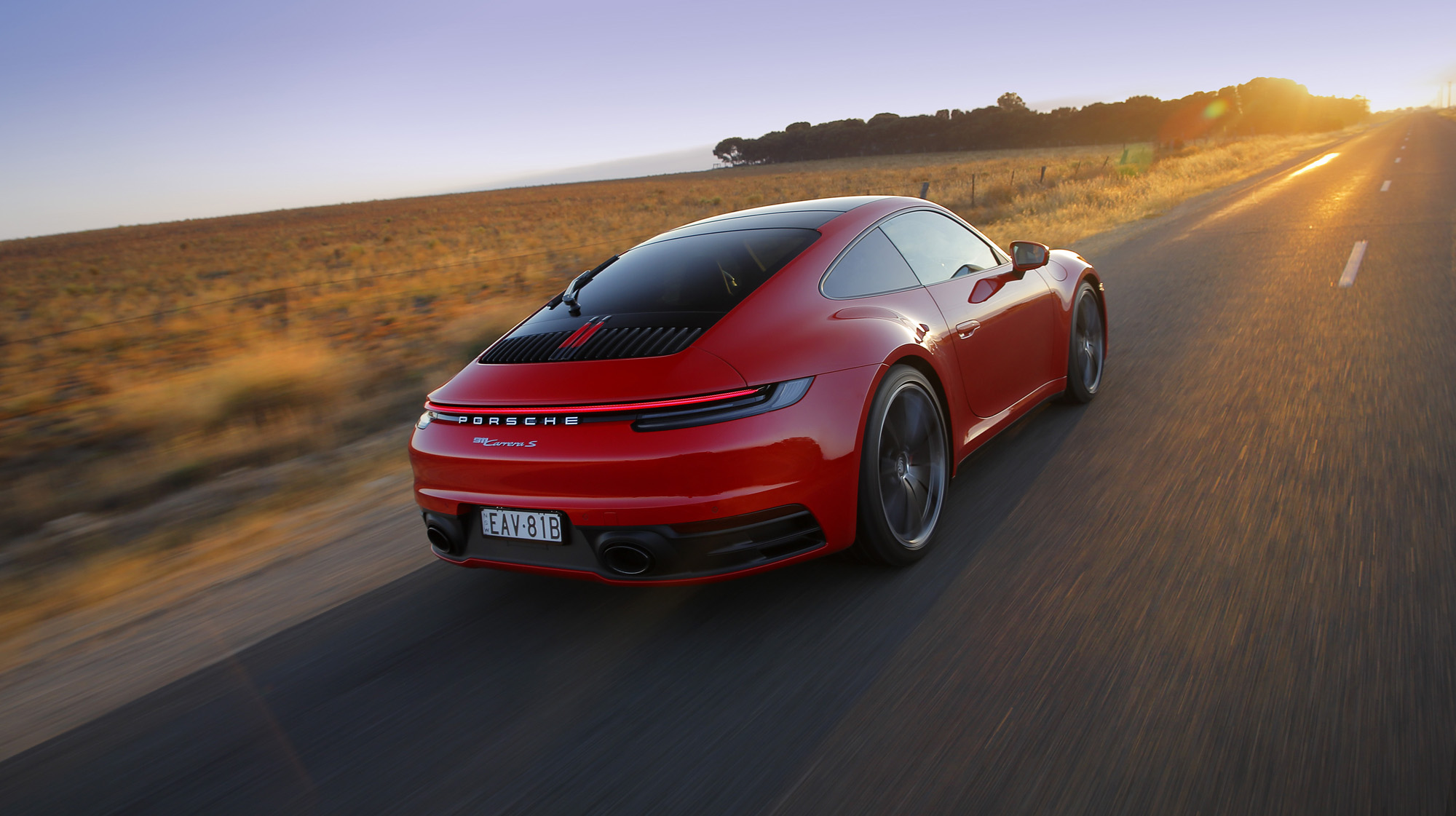
The combination of better steering, improved rear end purchase, bigger tyres, better brakes and improved control of its masses means that the 911 Carrera S offers the driver so many options on track. You can back it into one of the big hairpins on the brakes and the ESC in its looser Sport setting gives you loads of leeway before it decides you’ve run out of talent. Even on a track as huge, wide and, in some places, featureless as The Bend it still feels hugely rapid. On narrow roads, it’s as quick and composed as you’ll ever need a road car to be. About the only flaw in its dynamic makeup is that the extra front overhang means that it can be fairly easy to ground the nose on even innocuous road imperfections.
PORSCHE 911 CARRERA S VS RIVALS
Audi R8, Mercedes AMG GT, Nissan GT-R
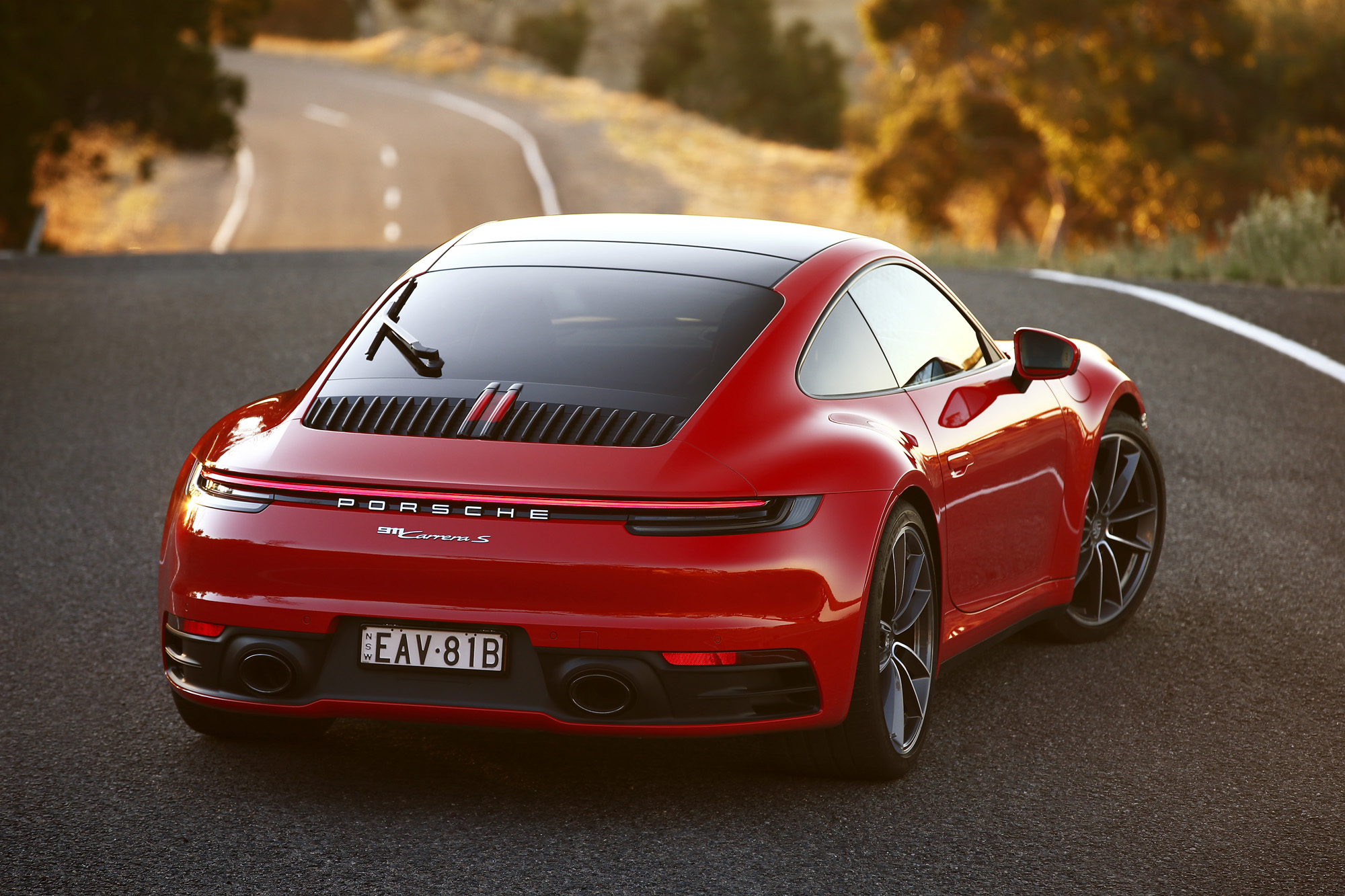
PORSCHE 911 CARRERA S PRICE AND SPECS AUSTRALIA
Model: Porsche 911 Carrera S Engine: 2981cc flat-six bi-turbo, dohc, 24v Max power: 331kW @ 6500rpm Max torque: 530Nm @ 2300-5000rpm Transmission: 8-speed dual-clutch auto, rear-wheel drive Weight: 1515kg 0-100km/h: 3.7 sec (3.5sec w/ Sport Chrono option pack) Economy: 9.5L/100km (combined) Price: $265,000 On sale: Now
