
Jeep has revealed a desire to become the world’s biggest sports utility brand, embracing electrification and introducing two new models at each end of its SUV range.
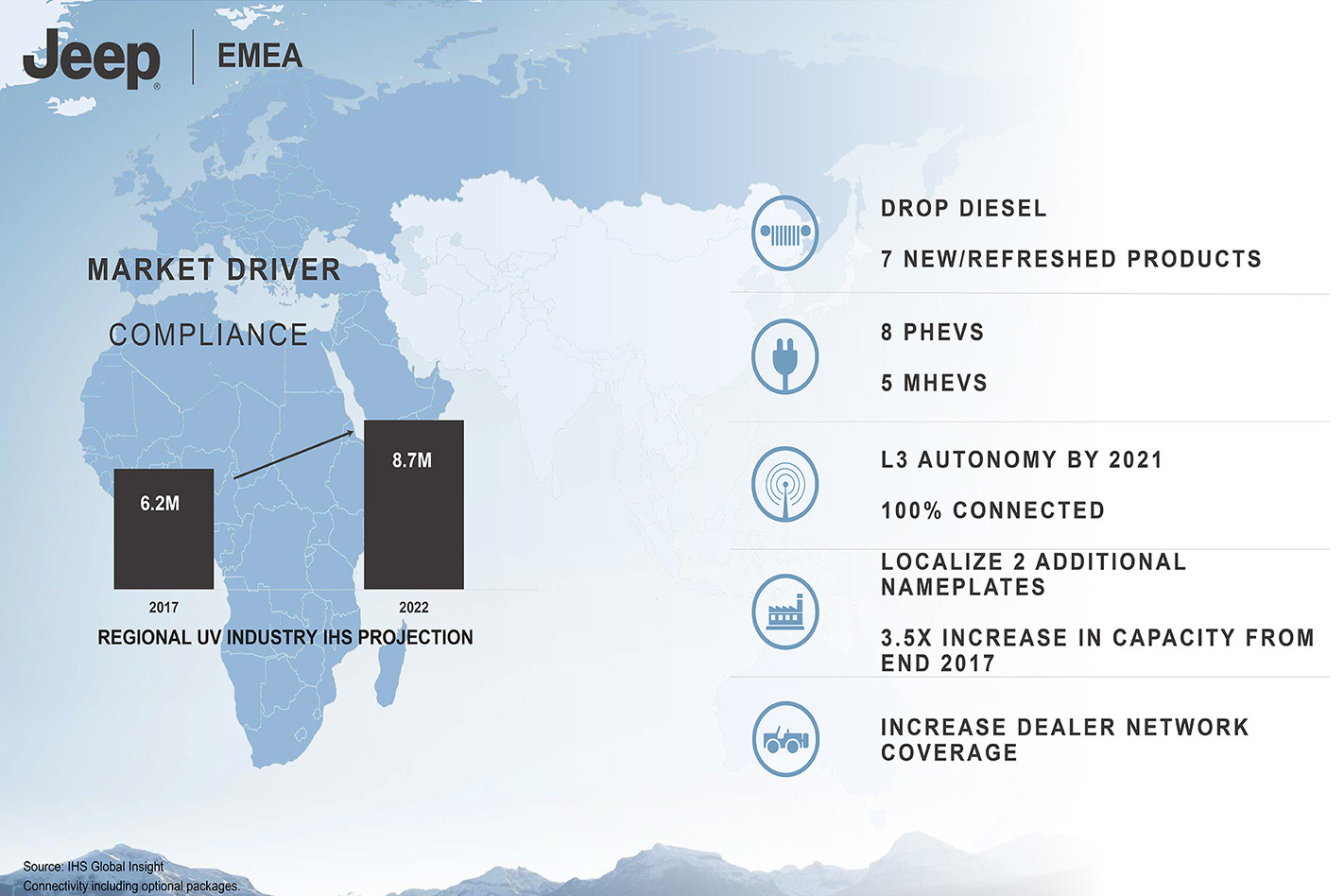
Fiat Chrysler Automobile chief executive Sergio Marchionne revealed the US automaker’s ambitions in an investor briefing at the company’s test track in Balocco, Italy, late last week. In it, he detailed plans for the future of its brands – which also include Abarth, Alfa Romeo, Chrysler, Dodge, Fiat, Lancia, Maserati and Ram – over the next five years.
Despite not rating a mention in FCA’s official company name, Jeep remains one of its key brands, improving its fortunes recently via a rejuvenated range featuring vastly improved versions of established nameplates such as Wrangler and Compass.
The company is set to expand that range, with the already muted new version of the Wagoneer or Grand Wagoneer, and a compact SUV expected to be smaller than the Renegade.
The crossover is expected to be a budget offering aimed at India and China, but if packaged right has the potential to have much wider appeal.
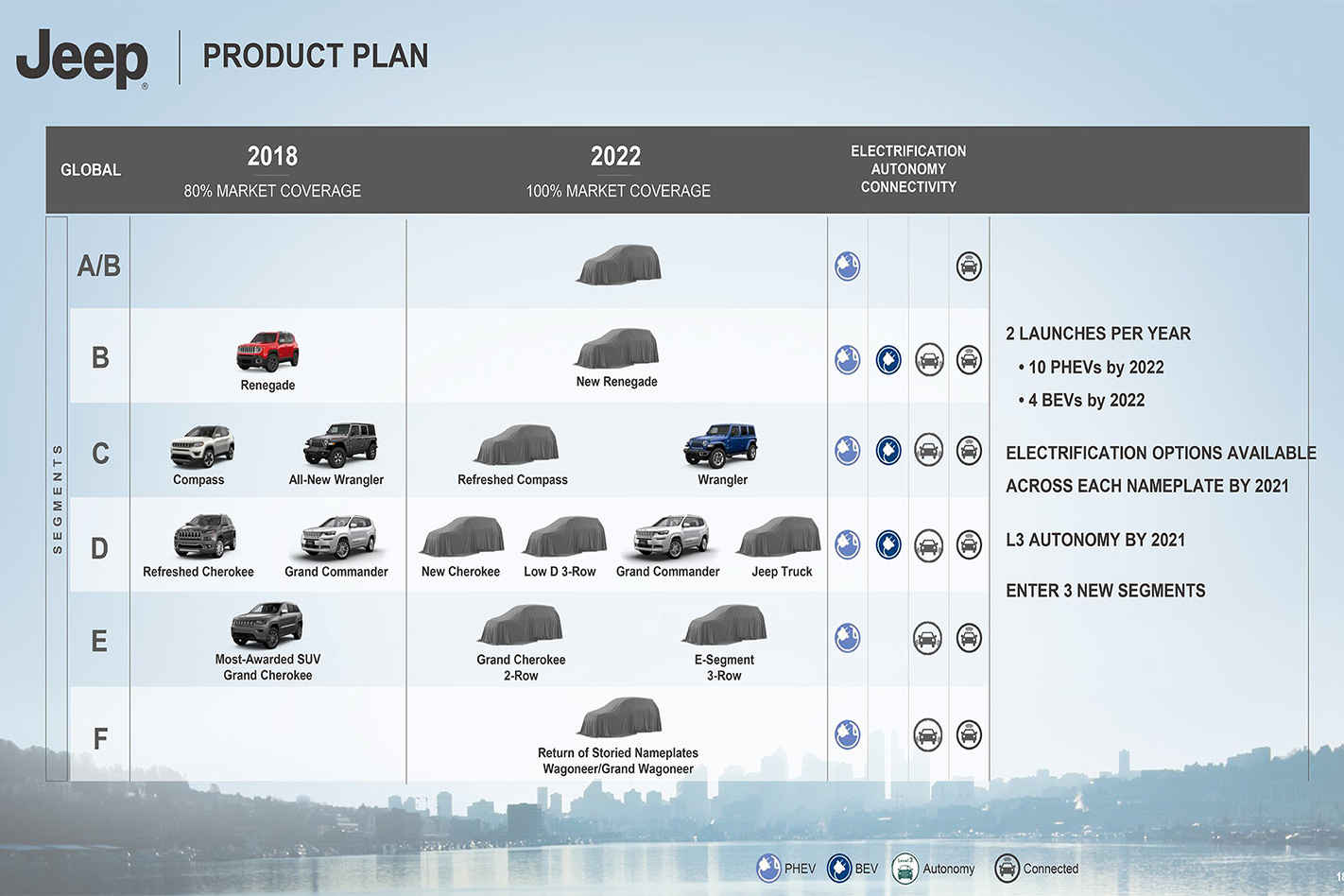
The SUVs will join other new models, including a three-row electric vehicle, a tray-backed version of the Wrangler, a Chinese-market Jeep Commander, the next-generation Renegade, the Cherokee (including a three-row version), and a heavily facelifted Compass.
Jeep boss Mike Manley said the company planned to become the most dominant utility vehicle brand in the world by 2022, with two new model launches a year aimed at takin its global market share to one in five SUVs sold.
These will include 10 plug-in hybrid and four full EV variants across its range by 2022. The move will also coincide with diesel-engined Jeeps being phased out as part of a wider FCA plan.
Jeep is also promising Level 3 autonomy, where the vehicle steers, accelerates and brakes by itself, within four years.
CHRYSLER has been given a stay of execution as the soon-to-retire head of the brand reveals he now wants to evolve the 93-year-old brand into a line of self-driving people movers.
Fiat Chrysler Automobiles chief executive Sergio Marchionne late last week crushed rumours that the badge would soon join other dead US car brands including Pontiac, Hummer and Oldsmobile as he rolled out the company’s latest five-year future product plan to business analysts.
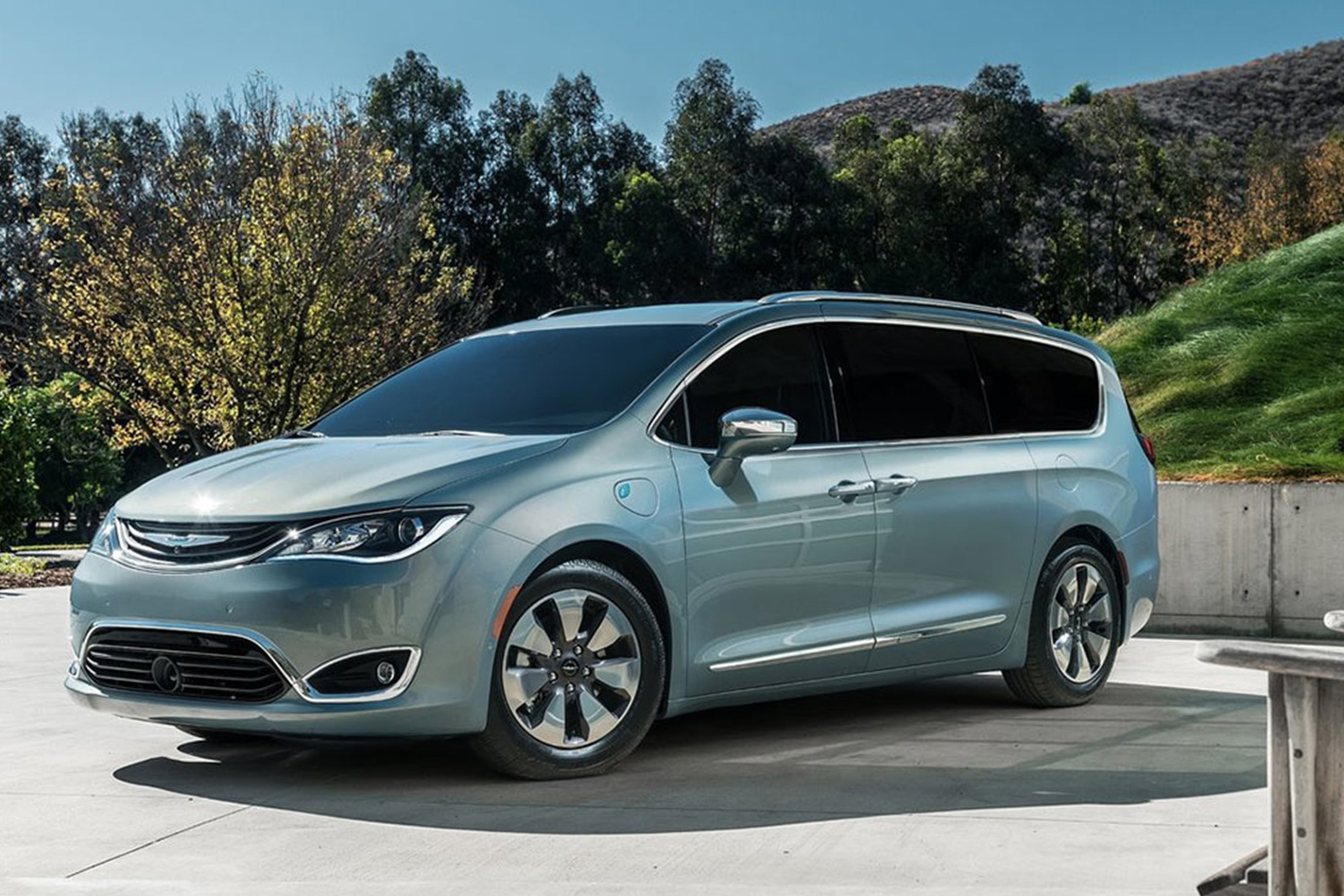
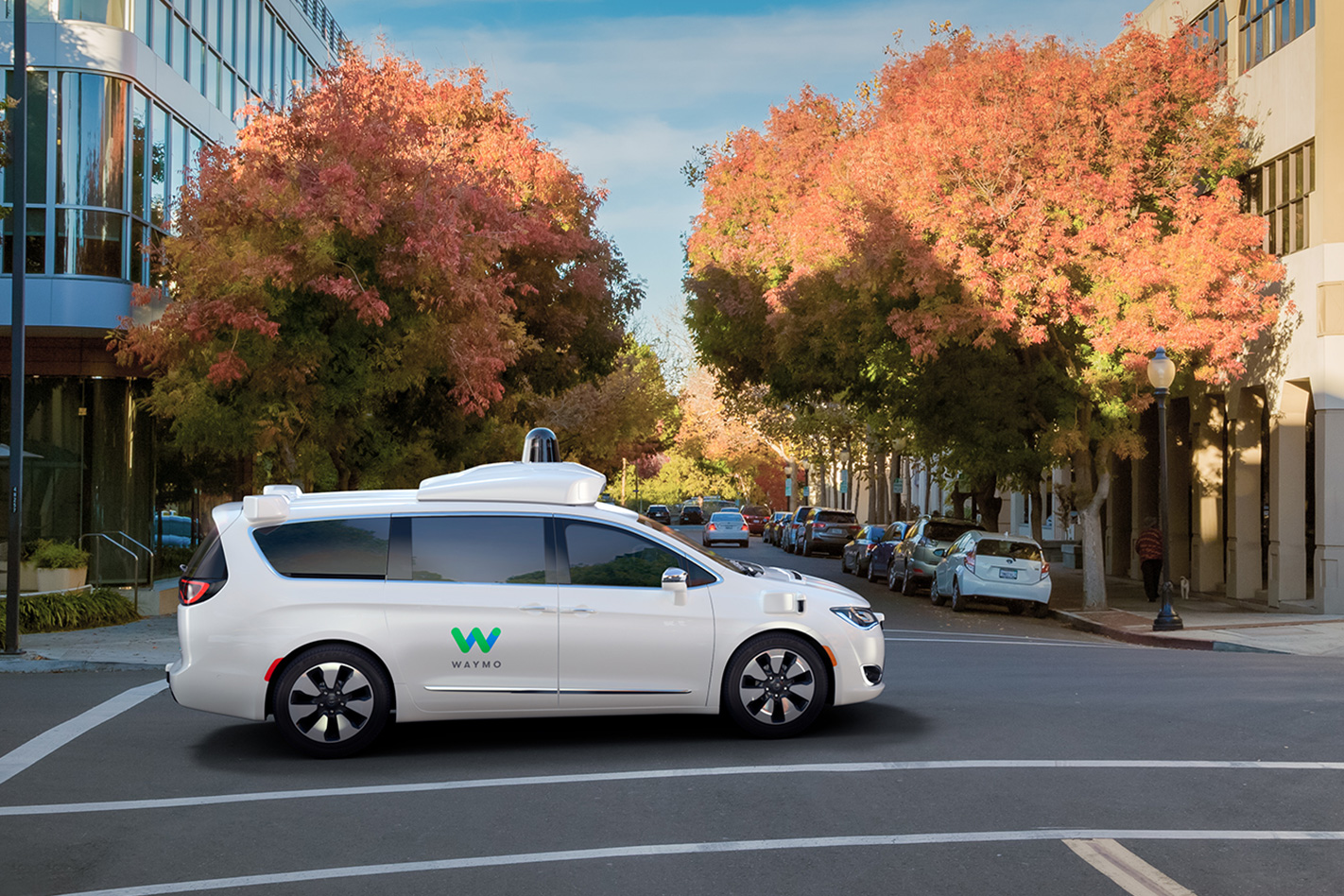
Instead, Marchionne said the company would shift Chrysler’s purpose away from sedans to “minivans”, and an ongoing autonomous tech partnership with Google’s self-driving development arm, Waymo. He also confirmed the prospects of sister brand Dodge, which he said would continue to carry one of FCA’s performance flags.
“Dodge needs to continue the particular space as a performance brand, and we need to continue to build on that core skill,” British automotive website Autocar reported him as saying. “The minivan business space will be filled by Chrysler, filling the mobility solution in the US market.”
Marchionne’s failure to mention Chrysler in the lead-up to last week’s briefing fuelled speculation that the brand’s days were numbered. Marchionne also used the opportunity to explain the reason behind Fiat Chrysler Automobiles’ decision to repositioning Chrysler as a people mover and self-driving tech development resource.
“Those two brands are not in question but they’re local NAFTA (North American Free Trade Agreement) brands, and need to be developed for local market conditions,” he said. “Our view is that 70 percent of the US market is already non-sedan, so to try and build traditional sedans is not helpful.
“Brands like Dodge can play a role there because of their performance heritage,” Marchionne said.
The strategy will bolster Chrysler Pacifica production with another 62,000 headed to join a small number of Pacificas already reporting for robotic duty on the Waymo project. FCA’s longer-term plan is to sell the MPV to the public, fitted out with driverless technology.
According to reports, the press briefing also revealed a third model would join the 300 and Pacifica, but details are under close wraps for now. If the recent revelations are an indication, it’s likely the next model will be either an SUV or a people mover.
BMW’S next-generation Z4 range will be initially topped by a six-cylinder M40i power hero variant that promises at least 265kW, if current tunes of the engine are anything to judge by.
The carmaker confirmed today that the most powerful version of the reborn soft-top roadster — built on a platform that will be shared with the Toyota Supra — will be a six-cylinder version wearing the M40i badge. That turbocharged engine has most recently been announced for the first M-badged version of the X3, in which it generates 265kW from 5500-6500rpm and 500Nm between 1520-4800rpm.
BMW is believed to be just weeks away from launching the BMW X3 M40i in Australia.
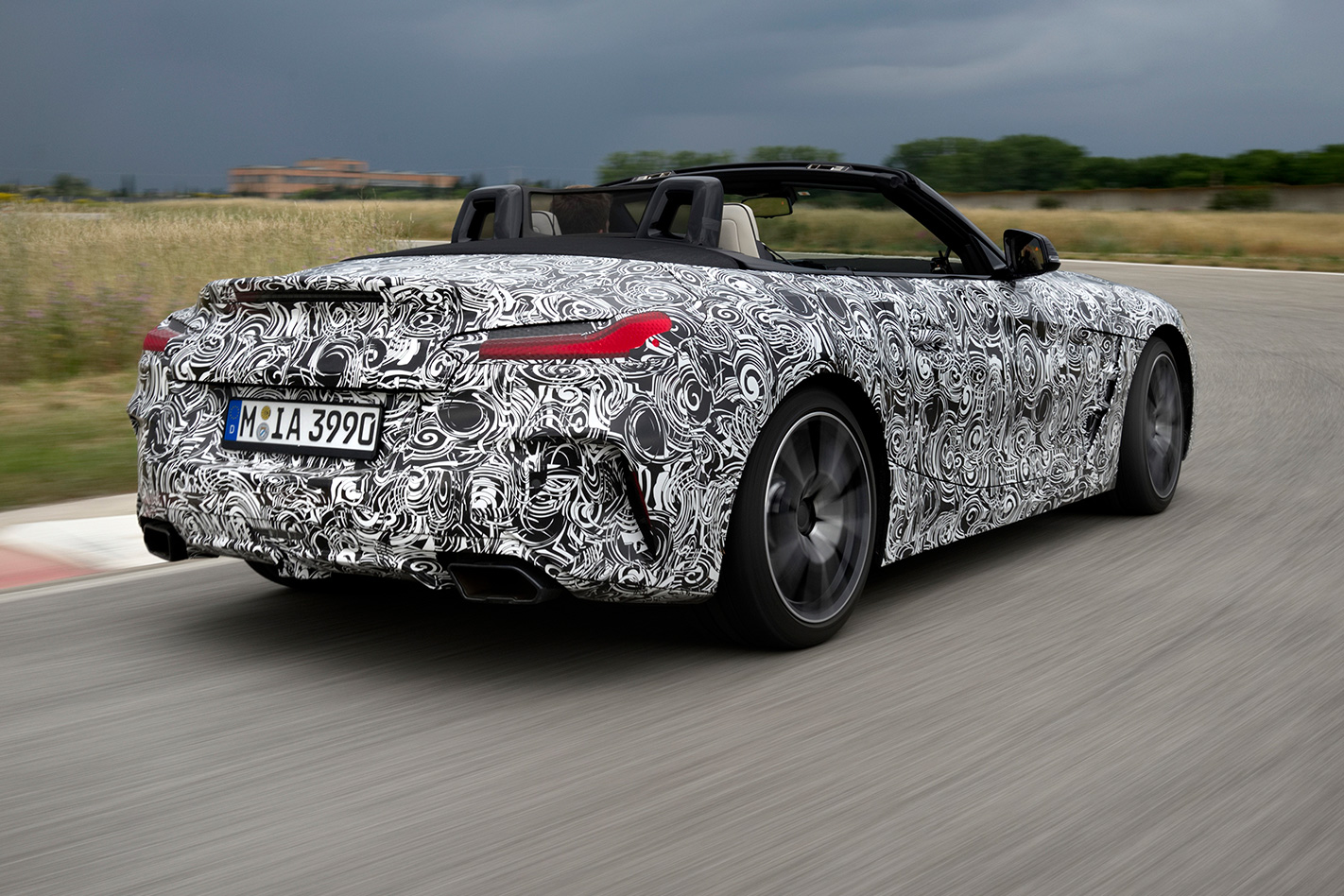
The German luxury brand has teased the Z4 via a heavily disguised pre-production prototype during testing at the group’s test centre at Miramas in the south of France.
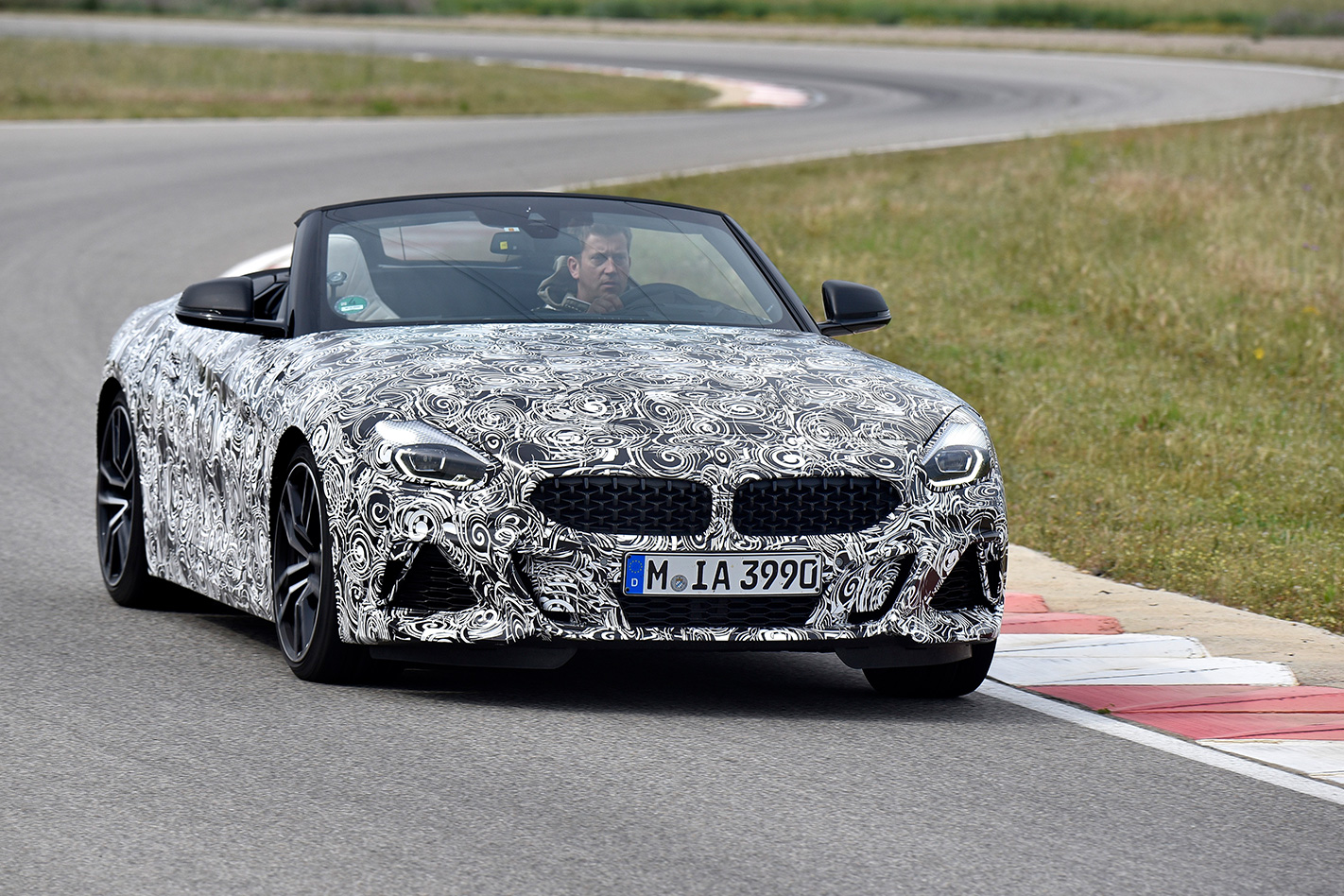
“Trials at the Autodrome de Miramas are focusing on fine-tuning of all drive and suspension systems – the basis for the sporty driving experience offered by the new BMW Z4,” BMW said. “The most intense form of new dynamic roadster performance is embodied by the BMW Z4 M40i.”
The most dynamically focused version of the Z4 will gain what BMW claims is an “extremely powerful in-line six-cylinder engine, a lowered sports suspension with electronically controlled dampers, a newly developed front axle, M light alloy wheels with mixed tyres, an M sports brake system and an electronically controlled lock in the rear axle differential”.
“The vehicle concept of the new BMW Z4 is geared consistently towards agility and driving dynamics,” suspension engineering chief Jos van As said.“The high level of body stiffness and the very rigid suspension attachment provide the perfect basis for a set-up that guarantees the performance qualities of a genuine sports car in terms of steering precision as well as longitudinal and transverse acceleration.”
According to BMW, the second-generation Z4 “will particularly introduce effective enhancements in terms of agile handling, spontaneity and precision when changing direction and accelerating in dynamic style out of bends – without losing out in the comfort disciplines”.
The M Performance-tuned B58 twin-scroll turbocharged in-line six that is expected to power the Z4 M40i has an extra 15kW over the previous version of the roadster to wear the badge, the Z4 M, powered by a normally aspirated S54 3.0-litre straight-six engine lifted from the E46 M3.
Whether the M40i will remain the performance flagship of the Z4 range or if it is due to be upstaged by an even more powerful pure M-variant remains to be confirmed by BMW.
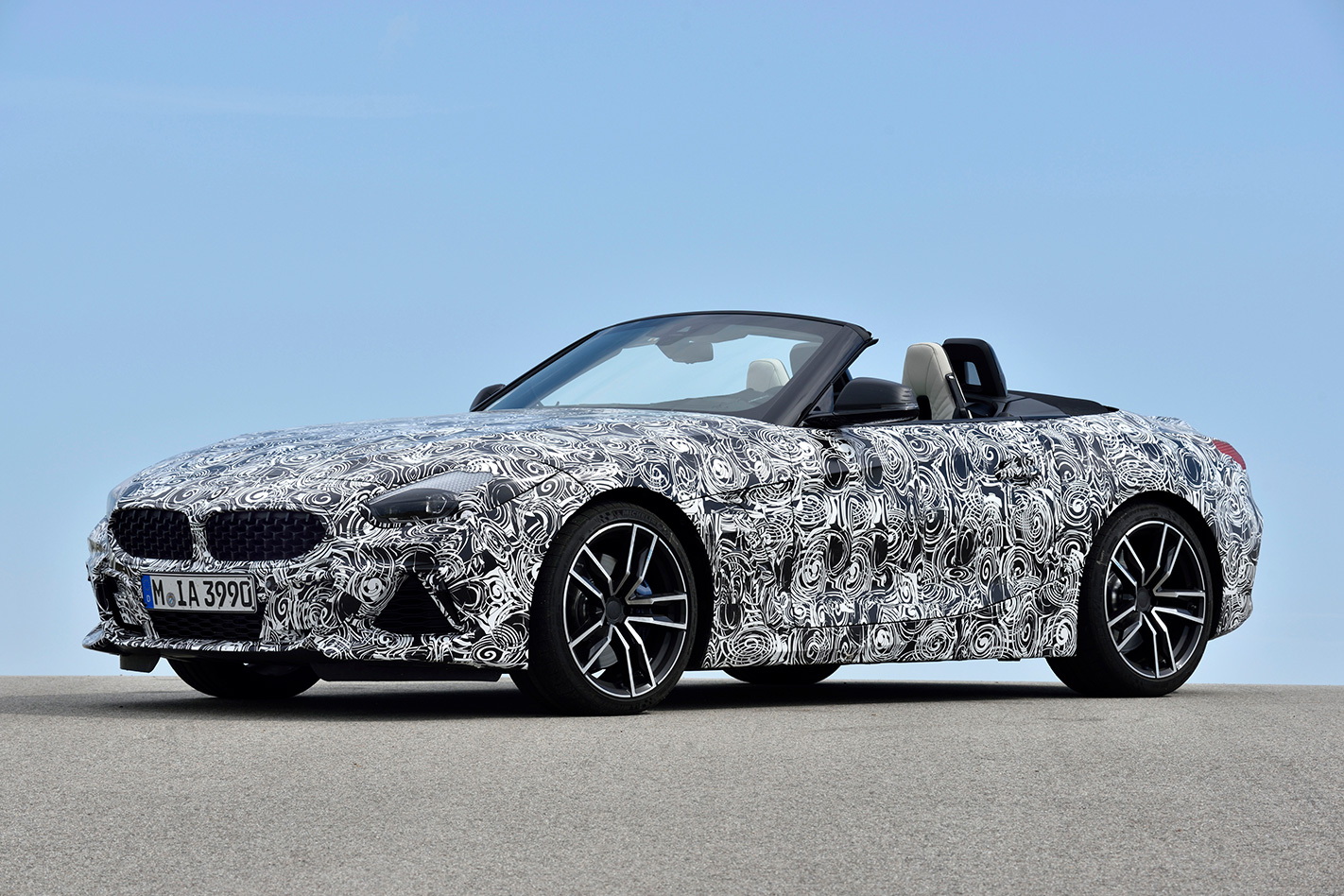
The heavily disguised prototype also gives us clues that the 2019 version of the Z4 will tone down some of the wilder elements flagged in the 2017 Concept Z4 unveiled at Pebble Beach in the US last year.
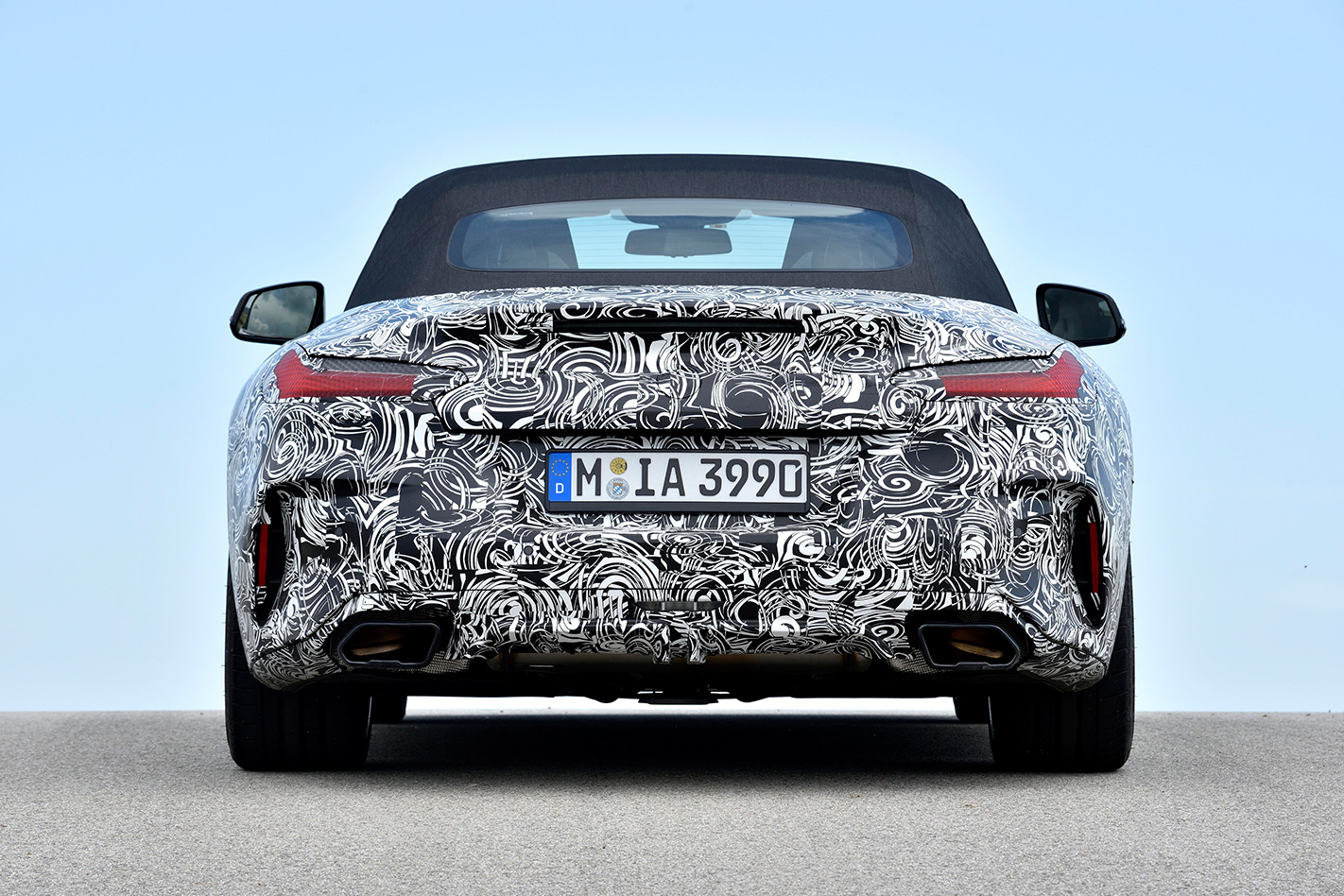
The windscreen adopts a more conventional drop-top construction compared with the minimalist, frameless look of the Pebble Beach car, the slit-like bonnet vents are shelved, and the gaping maw of the air dams at either side of the wide, sharknose-styled grille are toned right down. The buttresses behind the seats are also replaced by conventional rollover hoops.
However, some of the elements remain, such as the swept headlights and what appears to be a clamshell bonnet.
BMW appears to be preparing the Z4 for a full reveal later this year, either at the flagship Paris motor show in October, or at November’s Los Angeles motor show in recognition that the US is likely to be one of the roadster’s most popular markets outside of Europe.
Two seconds to 0-100km/h would appear to be the new benchmark for an electric supercar, after the announcement that the Maserati Alfieri would go ahead as the brand’s new coupe-and-roadster.
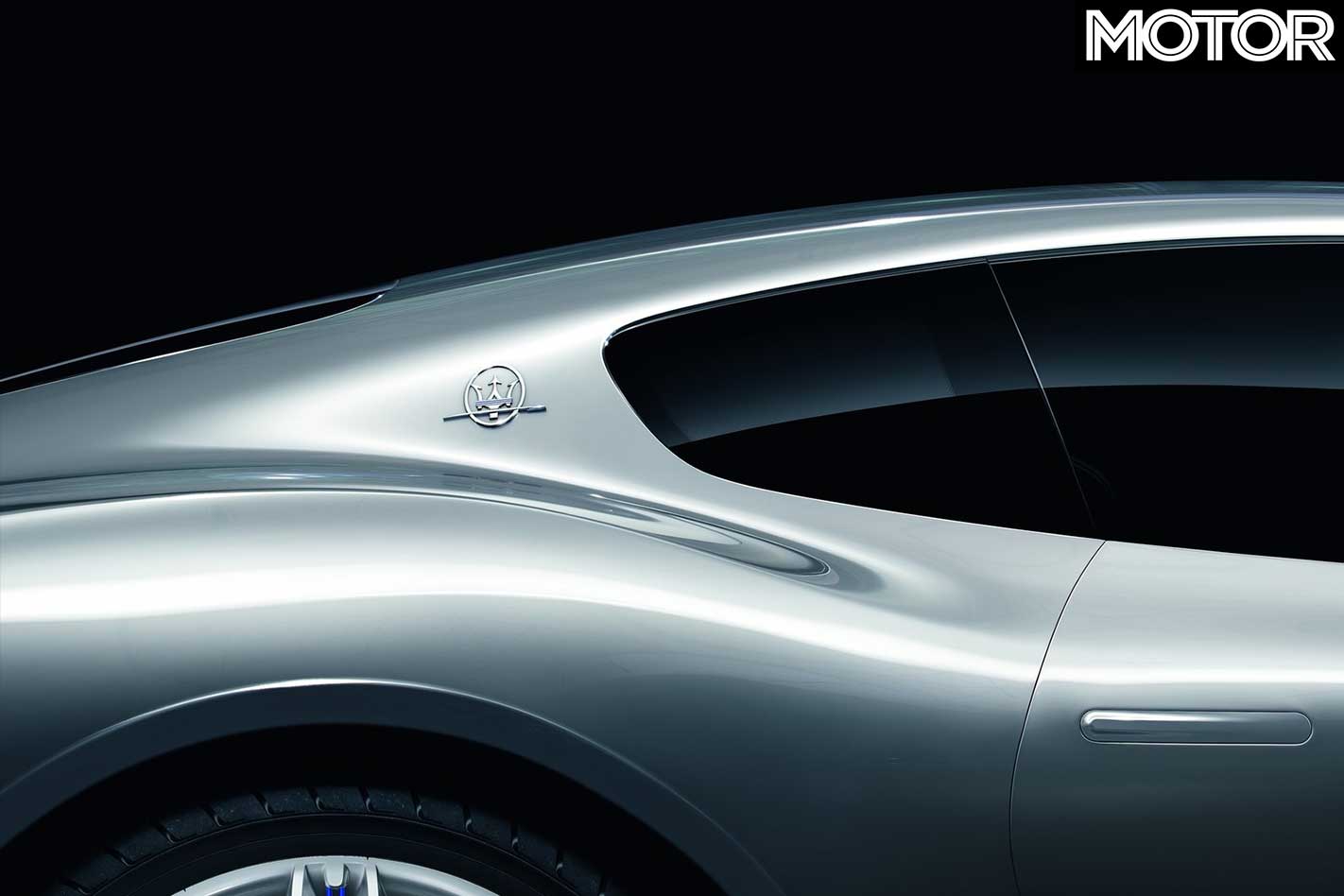
Named for one of the founders of Maserati and the most prominent of three brothers, Alfieri Maserati, the car will, obviously, depart somewhat from the concept version shown in 2014 at the Geneva Motor show.
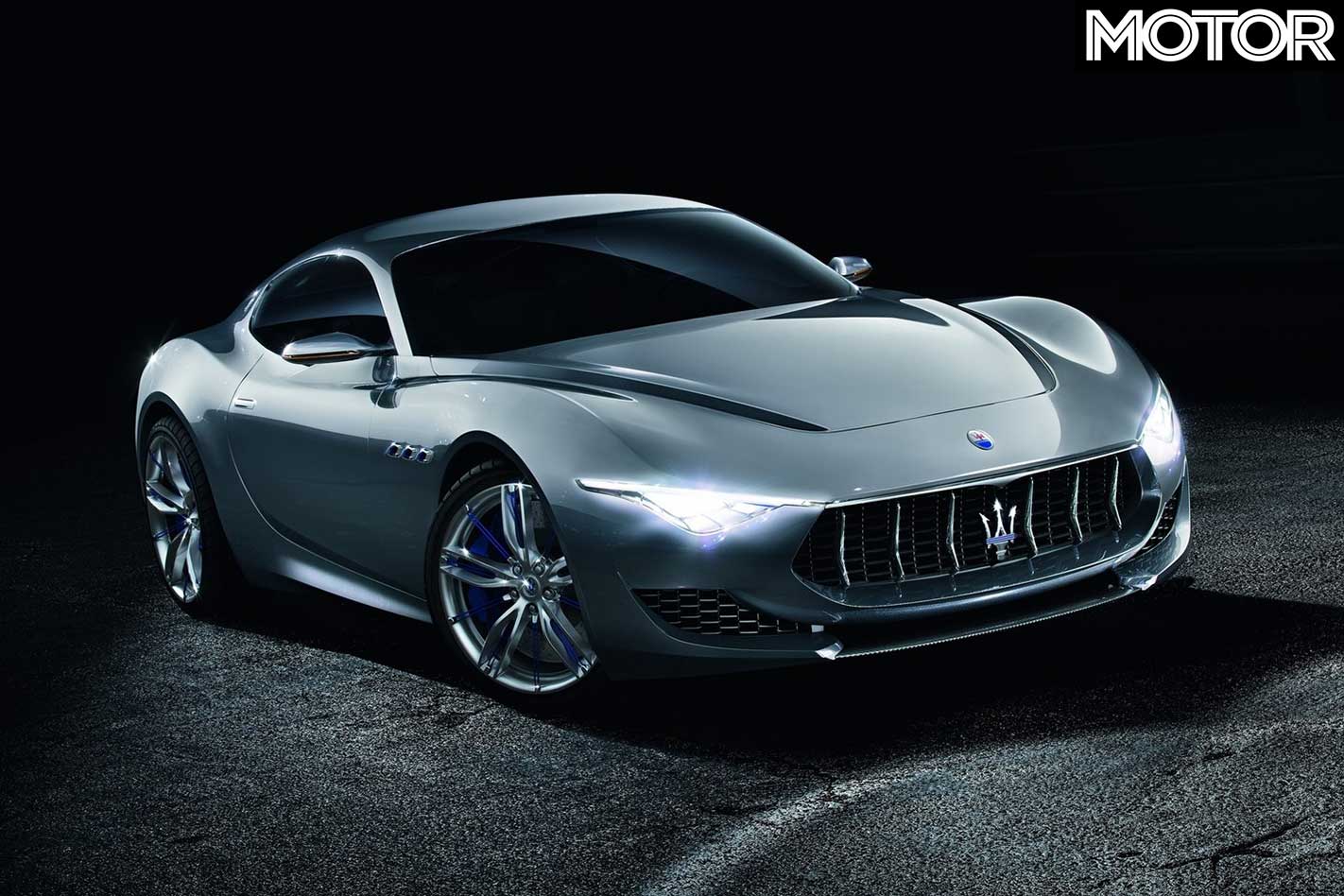
Where the concept would have been powered by a 4.7-litre atmo V8, the Alfieri and its cabrio version will be full electric, as well as being level-3 autonomous.
Maserati expects the Alfieri to be ready for market by 2020. It’ll have to arrive in 2020 if it wants to truly compete with the Tesla Roadster – assuming Tesla delivers on that goal.
Given the Tesla Roadster’s claimed 0-100km/h time is just 2.1 seconds, the approximation of 2.0 seconds for the Maserati Alfieri isn’t ridiculous. Not by comparison, at least.
But the top speed of each reveals a vast gap – either due to the Italian brand’s conservative estimates, or Elon Musk’s grand promises. The Alfieri will, according to Maserati, top out at ‘over 300km/h’ while Tesla says its Roadster is good for 400km/h.
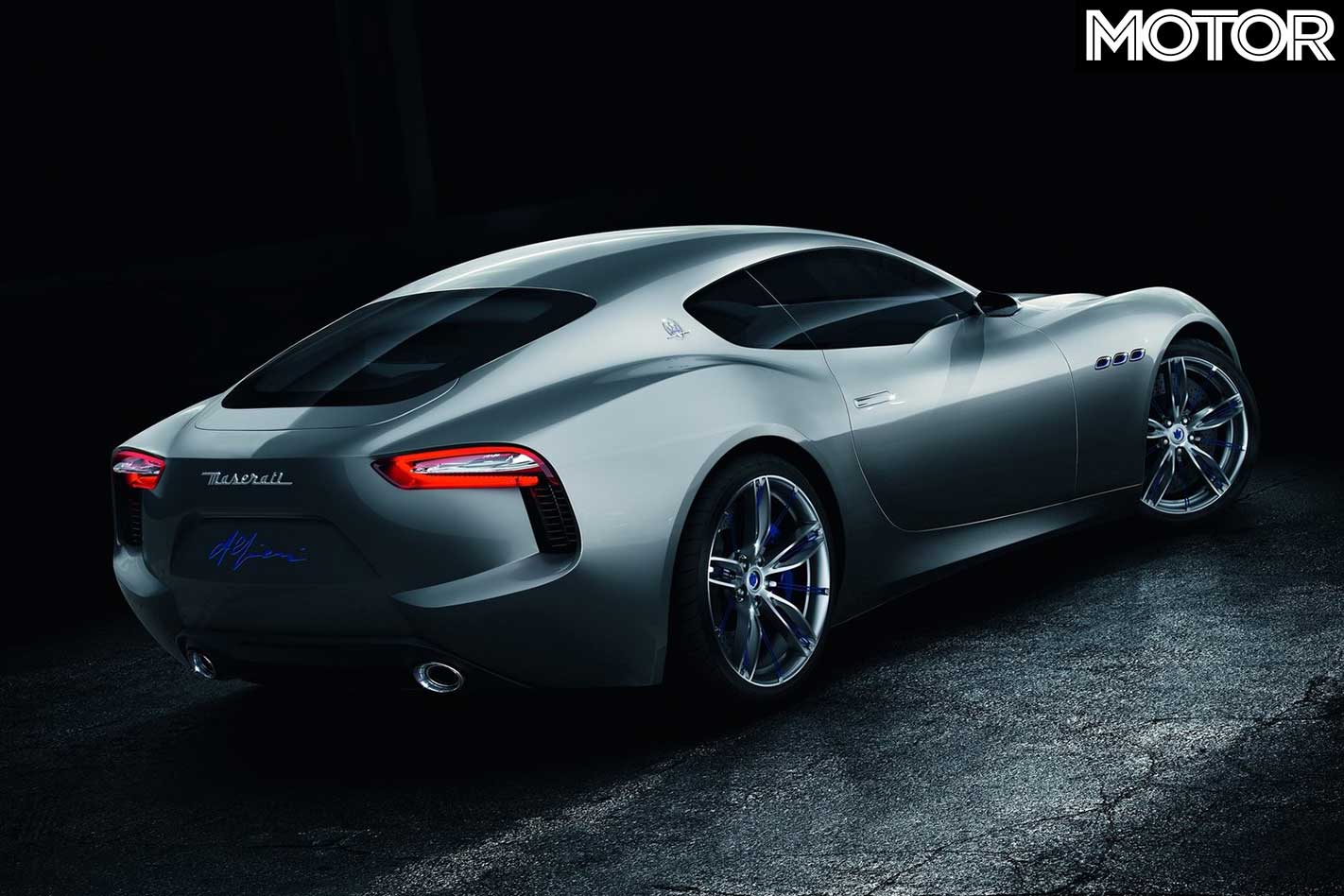
The Alfieri is expected to weigh only 175kg more than it would with an internal combustion engine, and its all-wheel drive system will help it maintain traction.
In addition, Maserati says the Alfieri will be granted active aero and active torque vectoring.
It’s too far away to speculate on pricing, but given Maserati is positioning the Alfieri as a ‘luxury EV coupe’, we’d exact it to be a rare sight on the streets.
The pioneering Jaguar I-Pace will be the first in a long line of battery-powered Jag- and Land Rover-badged vehicles to send their drive to all four, and not just two, wheels, the carmaker says.
While some electric vehicles including the BMW i3, Nissan’s Leaf and early Tesla models have opted for just one driven axle, Jaguar says an EV must have all-wheel drive if it’s serious about performance, dynamics, practicality and efficiency. The I-Pace, the brand’s first battery-powered vehicle and due on sale here in October, uses a motor mounted on each axle to drive all four of the EV’s wheels.
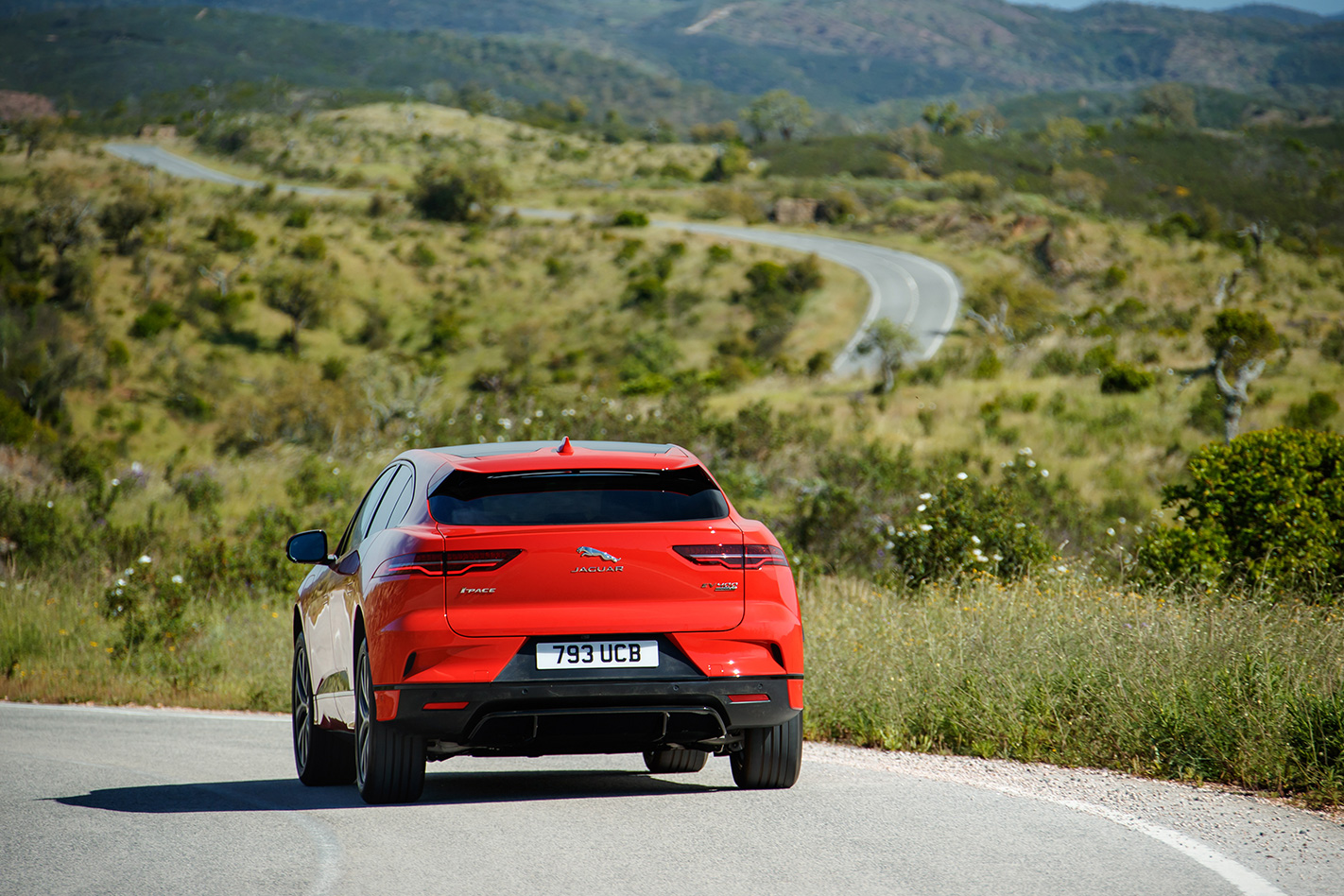
Speaking at the global launch of the SUV-styled I-Pace, Jaguar Land Rover head of vehicle development Wolfgang Zeibart said the answer to building a two-wheel-drive version of the vehicle was “in theory yes, in practice no”, as it made no sense to the company. “If you really want a lame duck then you can do it,” he said.
The newest addition to the leaper-badged line-up brings a healthy 294kW and 696Nm – they’re decent performance car numbers — delivered all four wheels via a pair of electric motors.
According to the veteran electronics engineer, numerous areas of pure electric vehicle performance suffer as a result of just one driven axle, including traction, stability, cabin space, regenerative braking and vehicle handling.
Walking around the I-Pace, Ziebart said the EV’s near three-metre wheelbase, which boosts interior space, was only made possible by the two-motor solution – an advantage the original Tesla Model S could not brag.
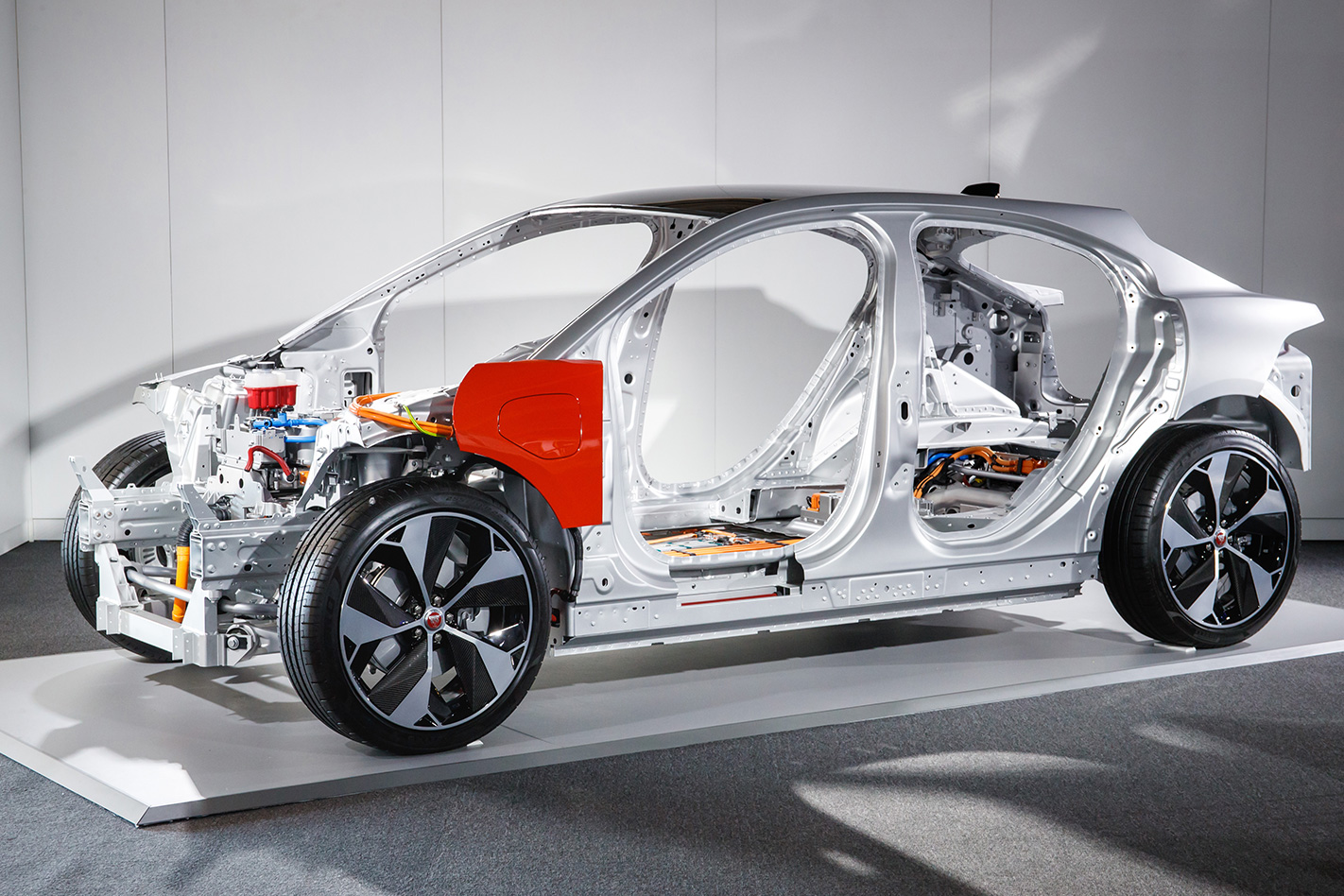
“The Tesla S was a single-motor design initially, and what that means is if you have only one driven axle you cannot put the wheel into this (I-Pace) position,” he said.
“You must move it forward as you need load on the driven axle. When it moves forward you reduce the interior space and the available space for the battery. It’s one compromise after the other and therefore we decided two motors – full stop.”
There were also problems with two-wheel-drive vehicle stability when using the motor to regenerate power. A front-mounted electric motor was more effective as the car’s centre of gravity loaded up the front axle during braking, while a rear-mounted motor was better in terms of driving dynamics and traction. And in either case, single-motor regeneration could cause instability under hard regenerative braking, Ziebart said.
“If you accelerate, the rear motor is the better motor. If you want to recuperate, the front motor is the one. We can recuperate up to 150kW, but if you only do it on the rear axle you are limited to about 60kW.
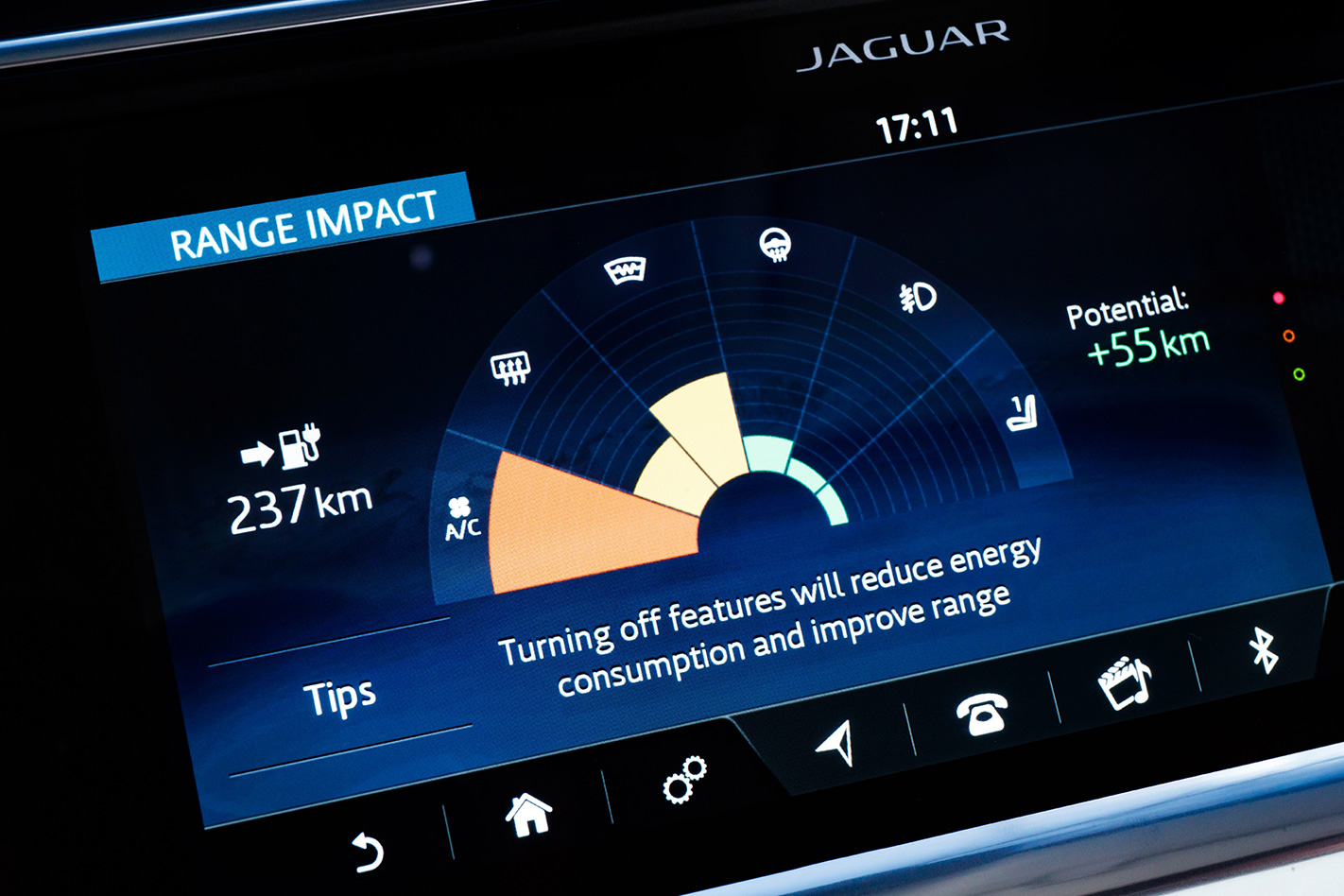
“If you recover (only) from the front, any longitudinal force you apply reduces your available side force. This then makes the car unstable.”
Zeibart declined to reveal what models would follow the compact I-Pace midsized SUV, including what is believed to be an electrified F-Type sportscar replacement due in 2021, but confirmed the I-Pace platform was “absolutely” scaleable for other-sized models, leaving the door open for many more vehicles to join the EV stable.
“Other companies are selling just the same concept as the most scaleable platform on Earth. In reality it’s not as easy as some people might make you think, but it is definitely scaleable.”
The evolution of the Tesla Model S large liftback sedan appears to confirm Jaguar’s principle that all-paw is best. Despite offering a rear-drive option early in its life cycle, all versions of the Model S are now powered using a pair of electric motors.
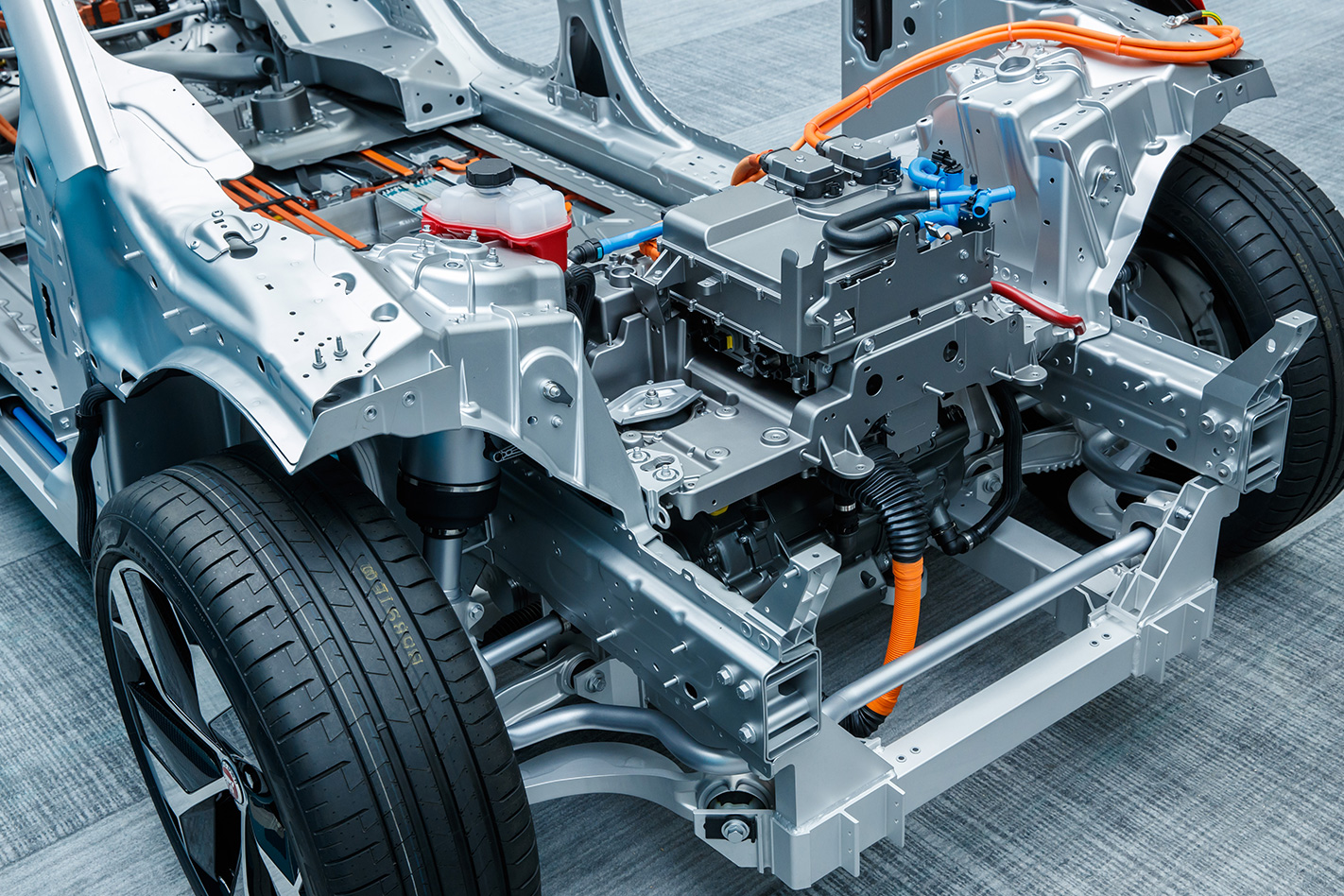
Ziebart said the Jaguar’s construction and engineering was superior to the US startup company’s offerings in other areas as well, including the massive battery that is key to range and performance.
“We can draw instantly 300kW out of that which brings the current up to 1200 amps,” he said. “That’s not a problem.”
“The Tesla has a disadvantage as the battery cooling is so poor,” he said. “They have round cells that are basically cooled by air and then they have a water plate underneath. Here (I-Pace), the cells are standing on a water plate so the cooling is much better.
“What we have seen on the Nurburgring, the Tesla degrades rather quickly whereas this car runs the full lap.”
Tesla refutes Ziebart’s claim that its battery cooling is inferior, but the real EV battle starts this October when Jaguar’s I-Pace arrives on Australian dirt and bumps gloves with the larger but identically priced Model X SUV.
WHAT IS IT?
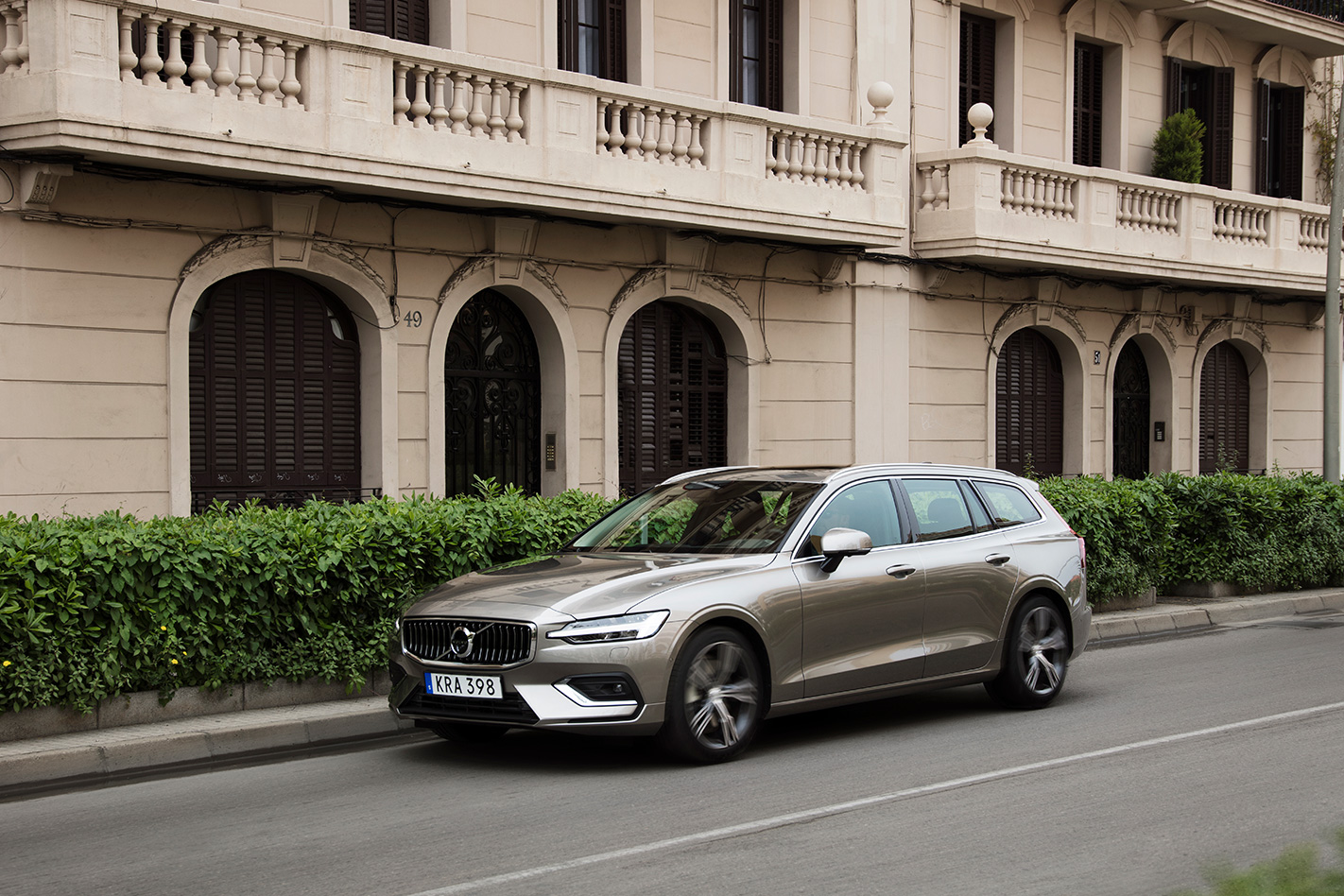
An all-new replacement for Volvo’s mid-size wagon, and the fifth model to be built on the company’s SPA platform.
WHY ARE WE TESTING IT
Given the new V60 shares its platform, drivetrains and similar interior architecture with our reigning Car of the Year, the XC60, we were keen to see how these attributes would translate to a lower riding, technically dynamically superior family wagon.
MAIN RIVALS
Audi A4 Avant, BMW 3 Series Touring, Mercedes-Benz C-Class Estate
THE WHEELS VERDICT
For the pragmatic buyer who knows they’ll never use an SUV’s off-road ability, and isn’t seduced by the more obvious German choices in this segment, the V60 is a welcome alternative. It drives well, cossets its occupants in a beautiful cabin, delivers excellent space for both people and luggage, and seems set to bundle its options sensibly. It’s not the last word in hard-driven dynamic excellence, but this isn’t enough to dull the appeal of its very Swedish sheen.
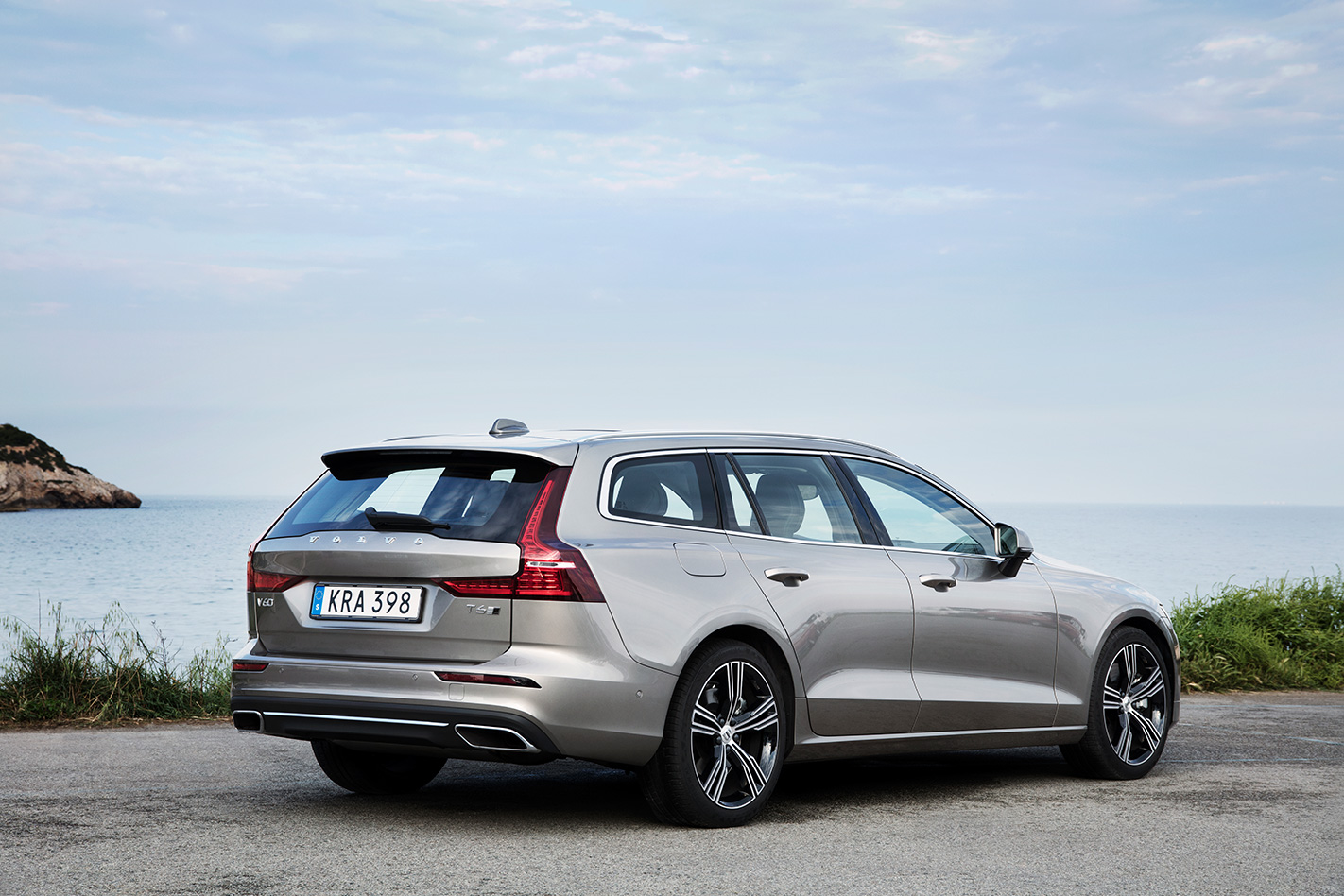
PLUS: Beautifully styled; lush interior; cabin refinement, packaging and cargo space; T6’s engine performance; AWD traction; safety credentials MINUS: Dynamic composure starts to fray when driven hard; unsporting transmission calibration; lack of paddle shifters; unremarkable diesel engine in D4; ride comfort not as plush as its remit might suggest
THE WHEELS REVIEW
On the face of it, Volvo’s all-new V60 should have ultra-high achiever plastered all over its handsome visage. It has Wheels COTY pedigree in the bloodline, after all. Riding on the same SPA platform as our reigning winner, it uses the same drivetrains, similarly lovely interior architecture and features, claims slightly more boot space, and delivers all of this from within a body that takes the centre of gravity from around waist height in the XC60, and drops it closer to your knees.
The other point to consider is that this is a C/D segment contender that pretty much encapsulates everything Volvo stands for. The Swedes have been making roomy, family-friendly wagons since the members of ABBA were in nappies, and actually hit a production peak with the 200 Series than ran for an incredible 19 years (1974-93) and saw over 2.8 million units built. Australians may have turned up their SUV-loving noses, but this is still a heartland segment for Volvo and there’s plenty of scope for solid sales numbers in Europe.
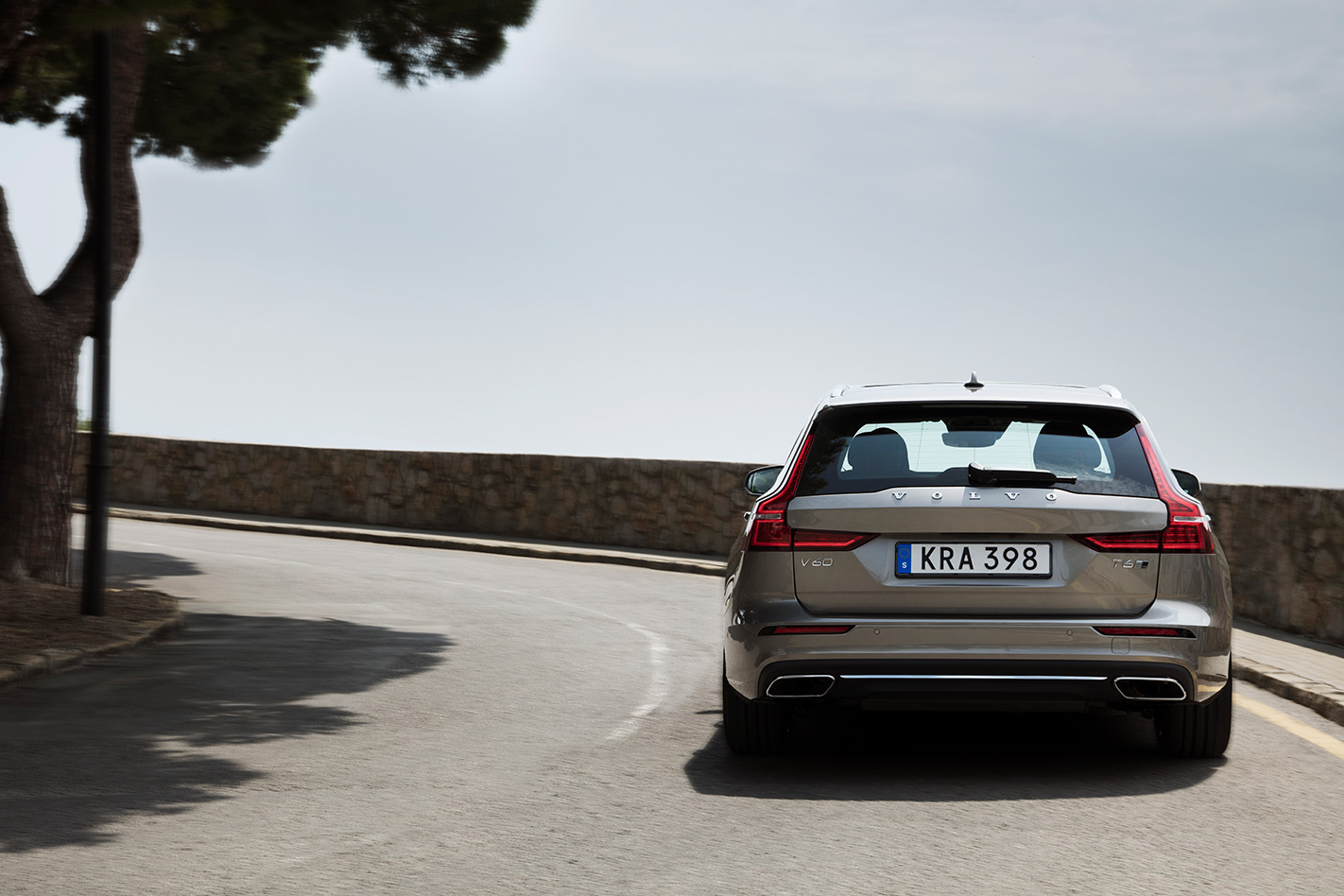
All of which has me scratching my head slightly after a spirited run through a classic driver’s road in the shadow of the spectacular Monserrat mountain range in the Catalonian region of Spain. I’m left wondering if the take-out may be that this is a more compelling vehicle to own and travel in, rather than actually drive hard. Or perhaps the XC60 had more of an open goal in the SUV segment, and the space in which the V60 competes is more mature and better contested.
It’s definitely a lovely thing to visually drink in before the driving even begins. Volvo has used the wheelbase gain (100mm) afforded by the SPA platform to give new V60 far more rakish, low-slung proportions compared to its predecessor. The front overhang is shorter, the rear longer, and the surfacing is beautiful. There’s a distinctiveness to the exterior that takes one part purposeful aggression and mixes it, to my eyes at least, with just the right amount of elegance.
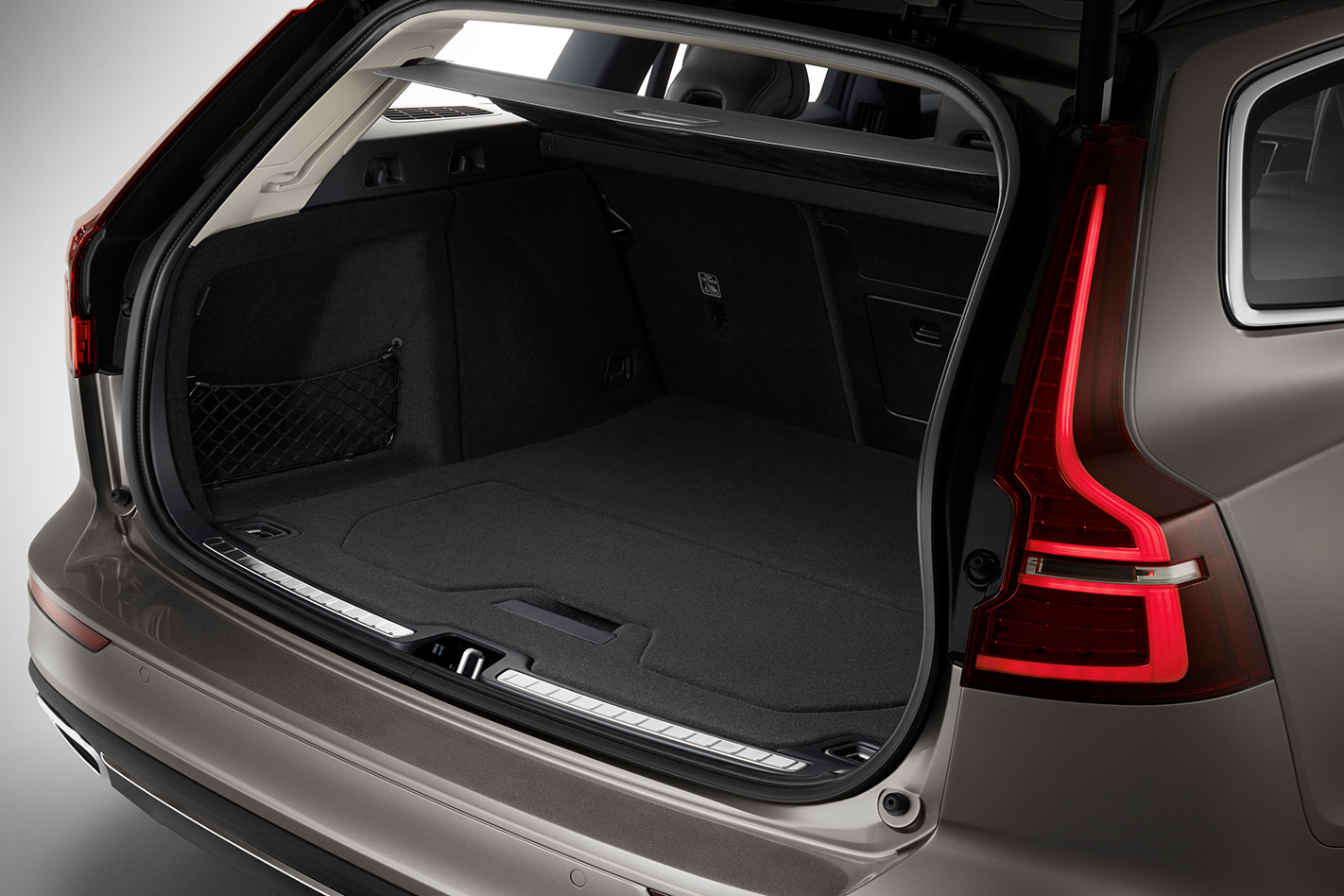
Spend more time around it and the details shine through, like the ‘handle’ section of the so-called Thor’s Hammer headlight design that cuts its way in towards the grille. But from a practical position, the step up in size is not wasted in terms of interior packaging. There’s ample toe and knee room in the back, and enough shoulder and headroom for two adults to not feel cramped. The spec sheet suggests a gain of 99 litres of cargo space compared to the XC60; at 1441 litres with the rear backrests dropped, it claims biggest in class.
If you go sniffing around the boot area to fact-check this, you’ll notice flawless attention to detail, like an integrated luggage partition that hinges from the floor to create a sturdy space to contain a small load, or provide elasticised straps to secure your grocery bags. There’s a sub-floor storage compartment, and all the cars at launch, whether top-spec Inscription or next-level down Momentum, were fitted with powered tailgates and remote releases for the rear seat-backs. If you value well-considered functionality delivered with style, you’re in the right place.
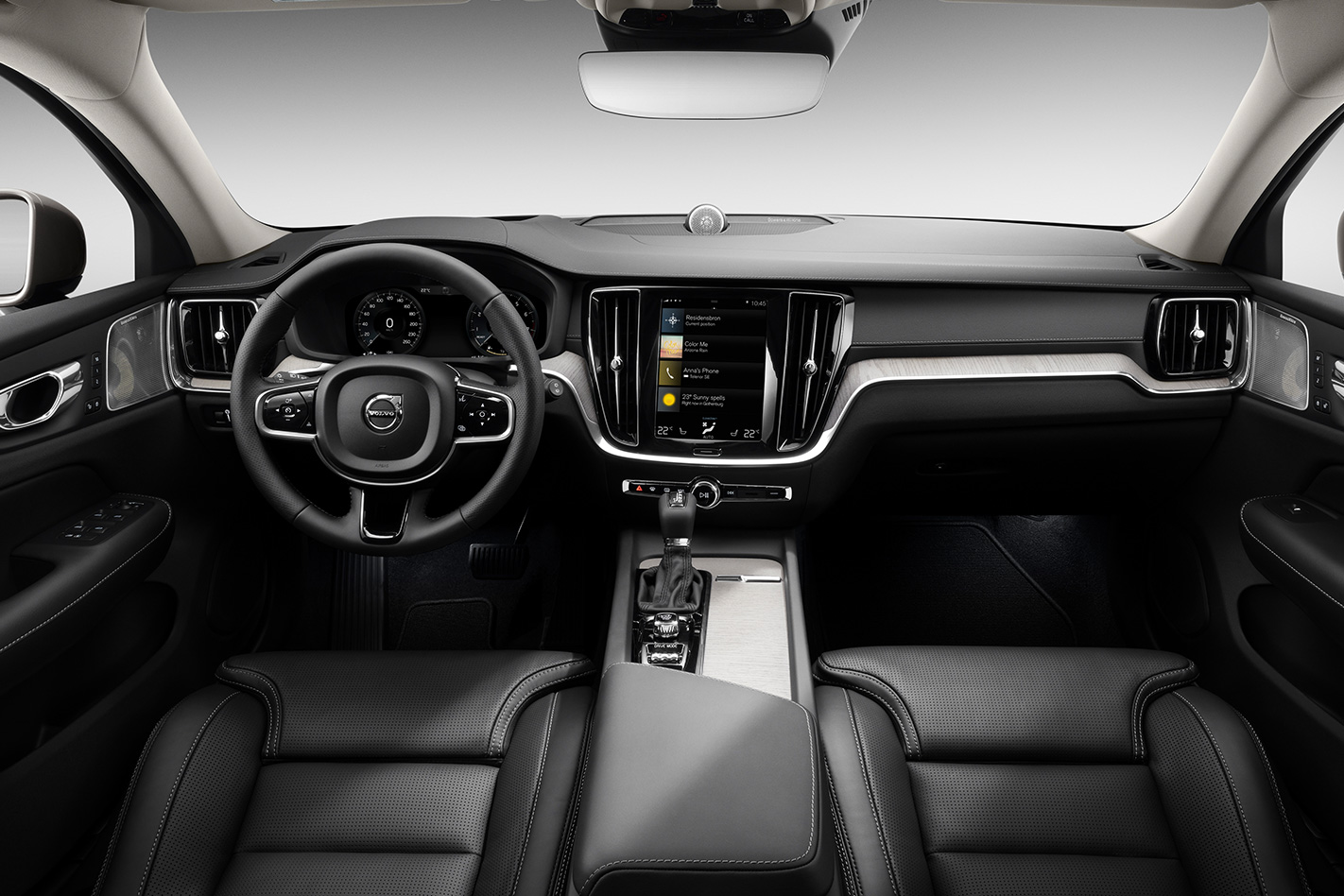
Having said that, true aesthetes are also well looked after. This is a beautiful cabin, as you’d expect from a treatment that doesn’t diverge too much from the fabulous effort in the XC60. The digital instruments are excellent, and the seats are generously proportioned, supportive, and hugely adjustable. The premium Bowers & Wilkins audio, with its perforated aluminium speaker grilles and a flash of sexy yellow Kevlar bass drivers high in the doors, will surely be worth the admission price.
The ultra-flexible driving position allows any body type to snug down to an ideal set-up, and the multimedia is intelligently deigned to minimise button clutter without robbing you of essential hard keys. But more than that is the visual elegance. Audi may have become the unassailable master of Germanic designer cool, but Volvo counters with a distinctively Scandinavian flavour that almost certainly came from a mood-board featuring Zen-like ripple-free ponds and driftwood scattered along pristine shorelines.
The dash top in the upper spec level is a tactile sheen of quality leather that matches perfectly with the restrained use of timber. Even the door trims have a less-is-more simplicity that tends to highlight those speaker grilles, rather than veer towards over-styling. Only the bulky A-pillars get in the way – literally – of a wholly cohesive feel-good experience. Still, you’ll be doing well if you make it home from the dealership without stopping for green tea and a yoga class.
Even the D4-spec diesel (140kW/400Nm), which we sampled first, can barely break the serenity. Okay, it doesn’t deliver an NVH highpoint for this segment, but it is noticeably quieter and less vibey than the 173kW/480Nm twin-turbo diesel unit fitted to the V90 Cross Country I recently ran as a long-termer. The Volvo powertrain experts on hand at the V60’s launch indicated that improved mounting and the lack of drive to the rear wheels (in this particular instance) is part of the reason for the greater smoothness, rather than the lower-output engine being inherently quieter and smoother.
But this isn’t a powertrain capable of stirring the loins of a driving enthusiast. It’s too old-school diesel it its gravelly sonics in urban driving, and quickly runs out of revs and power when you want to properly get cracking. Yet it is torquey enough to trouble the power-down ability of the chassis in front-drive form, bringing tramp and torque steer that feels a bit unbecoming for this segment.
If you want your right foot to be able to send some zaps of satisfaction to your left brain, you’ll definitely want the 2.0-litre supercharged and turbocharged petrol four, making 235kW/400Nm in T6 guise, or for short-hop, electric only running, T6 twin-motor plug-in hybrid. Or if someone else is paying, maybe even the high-output T8 twin-motor. Volvo Australia doesn’t yet have its model line locked down, but at least one of the hybrid variants is essential for the business to deliver on its promise of at least part-electrification across the range by 2020.
The use of both forms of forced induction may seem like an over-complication that’s been ditched by those who tried earlier (hello VW), but there’s no denying its effectiveness here. We talk about modern turbo-petrol engines being lag-free, but few I can think of grunt as hard off the bottom end as this unit. The delivery is at once thrusty and linear, accompanied by an agreeable, if distant, snarl.
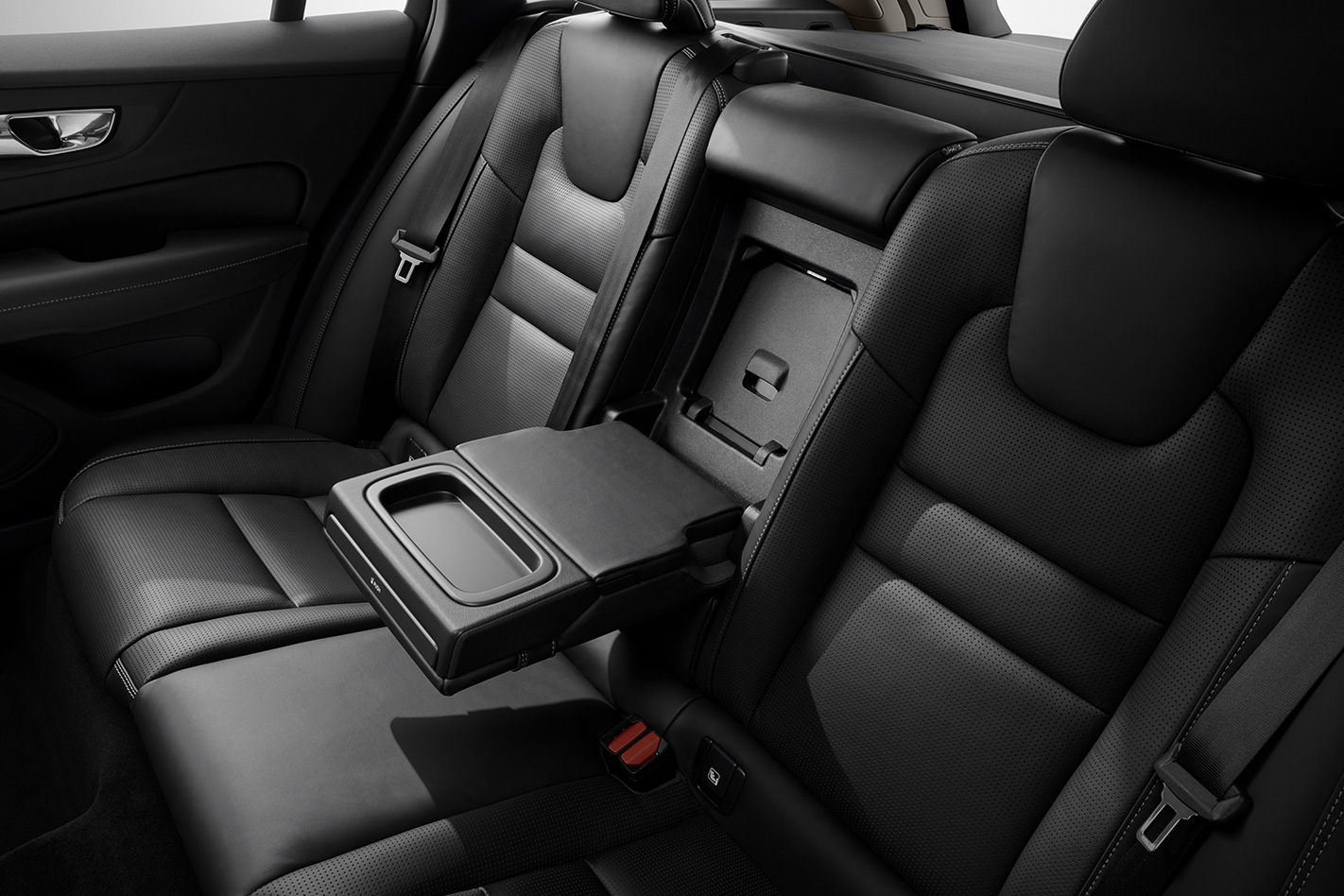
In normal driving, the eight-speed Aisin-sourced auto feels to have its wits about it, though you’ll need Dynamic mode to lift its game the moment you start to drive with a bit more purpose. But even in Dynamic mode, the transmission calibration is on the snoozy side, proving keener than you’d imagine to upshift, and often not feeling at all in tune with your intentions. The lack of steering-wheel paddles means moving the lever over to manual mode is the only way to wrest back control, but this is slighted by the arse-about shift pattern, as well as a slight hesitation to accept a downshift when you’re hard on the brakes into a corner entry.
Even if you can manage to drive around the transmission’s lack of a properly sporting map, you’ll find the rewards diminish as you go in search of greater point-to point pace. The steering has an incisive directness, but little by way of actual road feel. It’s as though there’s been a deliberate strategy to isolate the driver from the surface while retaining a feeling of alertness and response during the turn-in phase. It may be in keeping with the V60’s cruiser character, but some of us will be left craving a more tactile information flow from the contact patches.
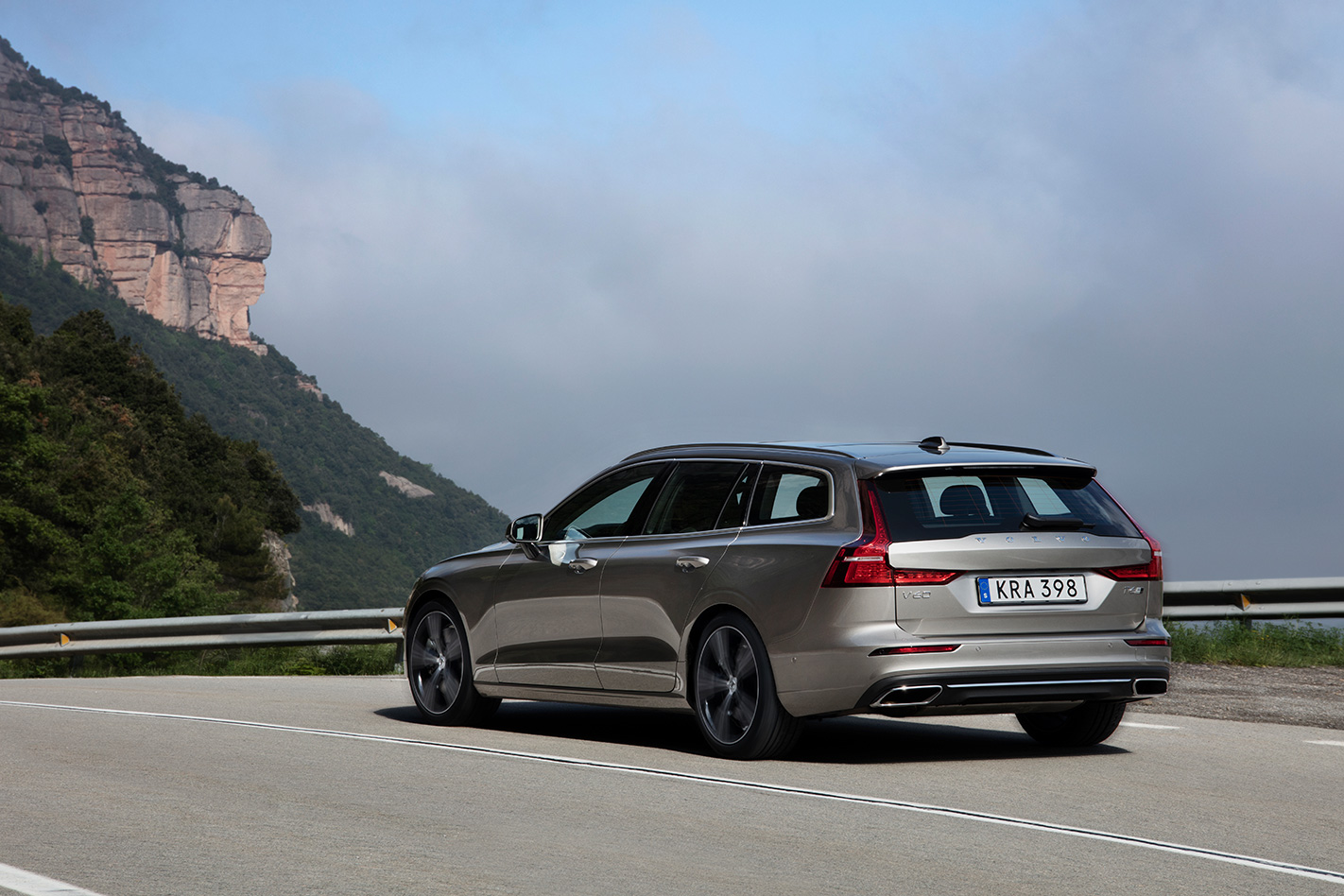
Once you’re at the limits of the grippy Continental rubber (optional 19s on the test cars) the chassis starts to wilt a bit, with slightly uneven understeer and general nose-heaviness becoming apparent if you get ambitious or encounter a quickly tightening radius. We suspect Audi’s A4 Avant and even BMW’s ageing 3 Series Touring will have the measure of the V60 in these conditions.
None of which will be any real reason to overlook the V60, especially if its ride can counter with a loping suppleness on Aussie roads that would be in keeping with the car’s broader character. But ride quality is one area where we don’t have a definitive assessment, as the glassy Spanish roads we drove on were nothing like our blighted bitumen. What few bumps we could find were of the urban-speed variety, where a moderate level of thump and terseness was evident, even on the optional adaptive dampers.
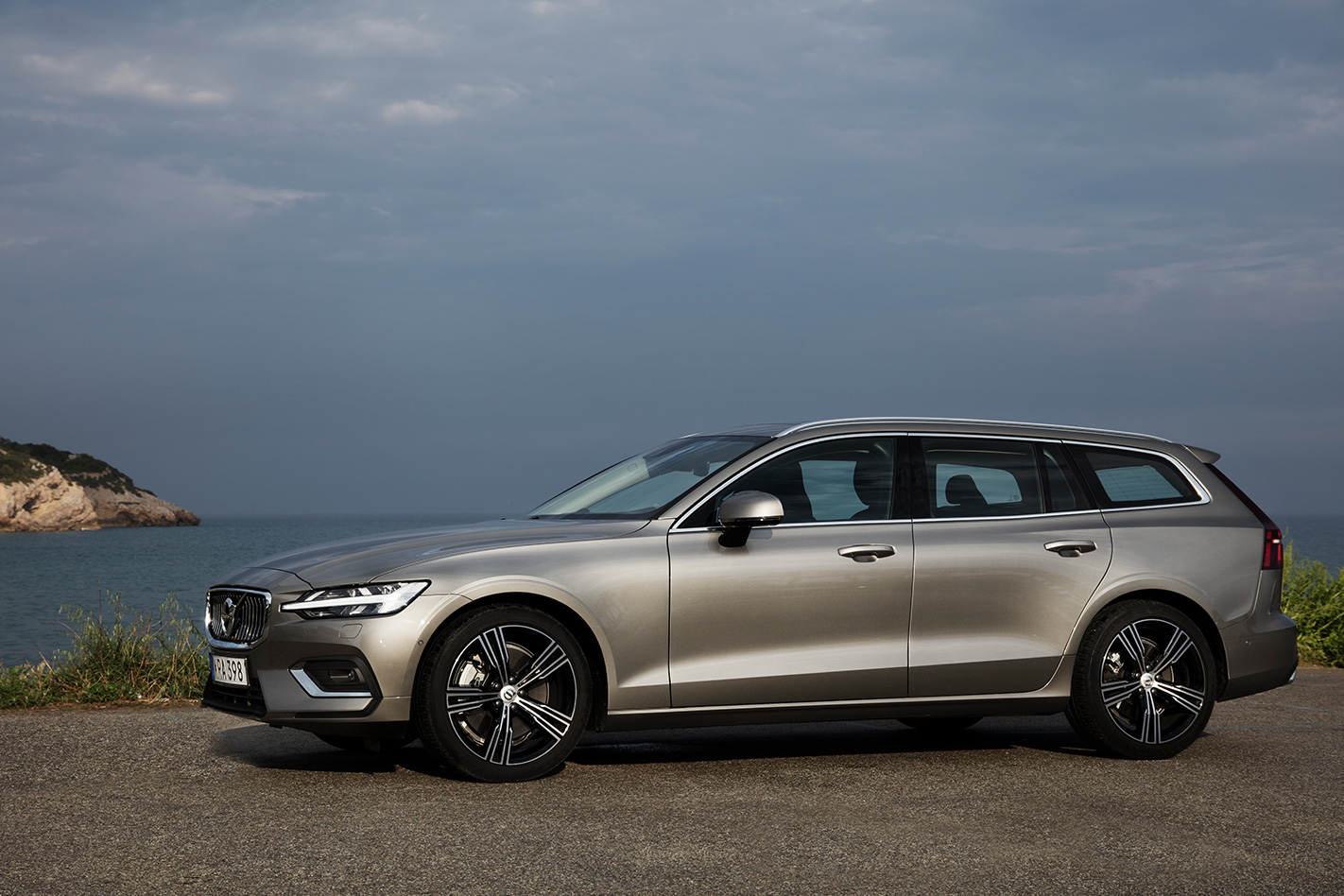
More broadly, it feels as though Volvo has retained the overall attributes of the XC60, rather than parlay them into something that really capitalises on the inherent dynamic advantages of a lower-riding wagon. Which is not necessarily an issue, as there’s so much to like and admire here. The greater challenge, however, will be finding a sufficient number of pragmatic Aussies willing to give up the perceived virtues associated with the now-default setting of SUV ownership. For Volvo, building an XC60 has only increased that kind of hurdle.
VOLVO V60 SPECS
Model: Volvo V60 T6 Engine: 1969cc 4cyl, dohc, 16v, turbo/supercharged Max Power: 235kW @ 6000rpm Max Torque: 400Nm @ 2200-5100rpm Transmission: 8-speed automatic Weight: 1654kg 0-100km/h: 5.8sec (claimed) Fuel economy: 7.6L/100km (EU) Price: $73,000 (estimated) On sale: Q4 2018
WE LIKE Mark Reuss. General Motors’ product development boss, and the former Holden chief while it still made cars in Australia, is a proper car guy. He proved just that at the weekend by binning the Corvette ZR1 pace car at the Detroit IndyCar GP before the race even started.
Given the opportunity to drive a pace car, most executives would have babied the thing around, soaking up adulation while the tyres of the following field went colder than Vladimir Putin’s soul. Reuss instead decided that this was the perfect opportunity to demonstrate the ZR1’s acceleration and active safety equipment, fishtailing it into a wall on the exit of Turn 2 and showering the track in debris and shattered dignity.
Reuss leads the design, engineering, safety, quality, research and development, advanced vehicle technology and program management of General Motors and both he and his passenger, IndyCar official Mark Sandy, were uninjured.
General Motors issued a statement shortly thereafter. “It is unfortunate that this incident happened. Many factors contributed, including weather and track conditions.” – the weather was 21 degrees and dry.
Reuss isn’t the first senior car industry executive to extravagantly mangle their wares. Sergio Marchionne, CEO of Fiat Chrysler Automobiles, rear-ended a Renault in Switzerland and comprehensively demolished a Ferrari 599 back in 2007.
Both these crashes still pale compared to BMW boss Bernd Pischetsrieder’s aerobatics in a McLaren F1 back in 1995. While driving on a Bavarian country road, he managed to put it into a ditch upside down with his wife and friend aboard. After considering hitting him up for negligent driving, Munich prosecutors dropped their investigation in return for a USD$18,200 donation to charity.
Money might well talk, but as Mark Reuss discovered this weekend, concrete walls can be pretty implacable negotiators.
WHAT IS IT?
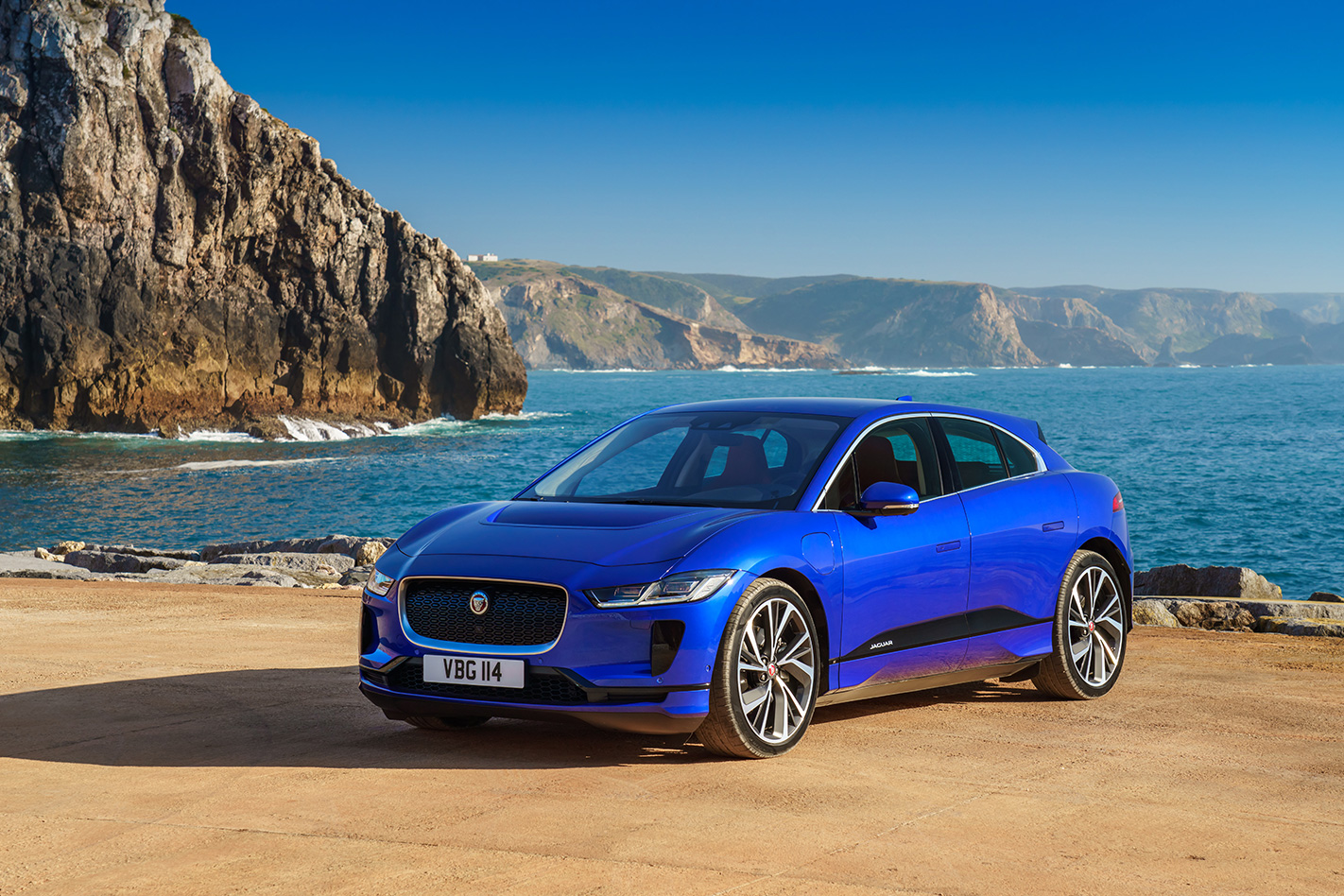
Jaguar’s eagerly anticipated foray into full-electric production vehicles and a clear statement of its future vision. The company is remaining coy on what’s next in the electric fleet, but the I-Pace is the car we’ll look back on and remember as the model that began the charge of electric SUVs from mainstream manufacturers.
WHY WE’RE TESTING IT
To date, technology start-up Tesla has been the dominant force in pure electric vehicles, bringing high-performance, luxurious models to a largely unpopulated market. But as emissions regulations tighten, mainstream manufacturers are joining the party. Electric SUVs from other premium brands will follow, though as the first zero-emissions attempt (with a modicum of off-road ability), Jaguar’s first production EV will act as a barometer for the segment. If the I-Pace recipe is right, Tesla’s days as an EV authority are numbered and the transition to a future of proliferating electric vehicles will look a lot brighter.
MAIN RIVALS
The electric SUV carpark is notably sparse at the moment, with the Tesla Model X the only similar vehicle to the Jaguar, but it’s more of an MPV, with zero off-road pretensions. BMW’s plug-in-hybrid X5 xDrive40e is the only other large SUV offering some electric range (before having to revert to combustion power).
THE WHEELS VERDICT
IT’S highly unlikely a Jaguar I-Pace owner will ever take their car to an intimidating Portuguese racetrack, and it’s probably just as unlikely they’ll wade through water crossings or scale rocky hillsides, but that doesn’t seem to matter. People buy watches that will sink to 10 atmospheres below the surface of the ocean yet the most action they’re likely to see is a spilled latte. Jaguar is trading on the same principle.
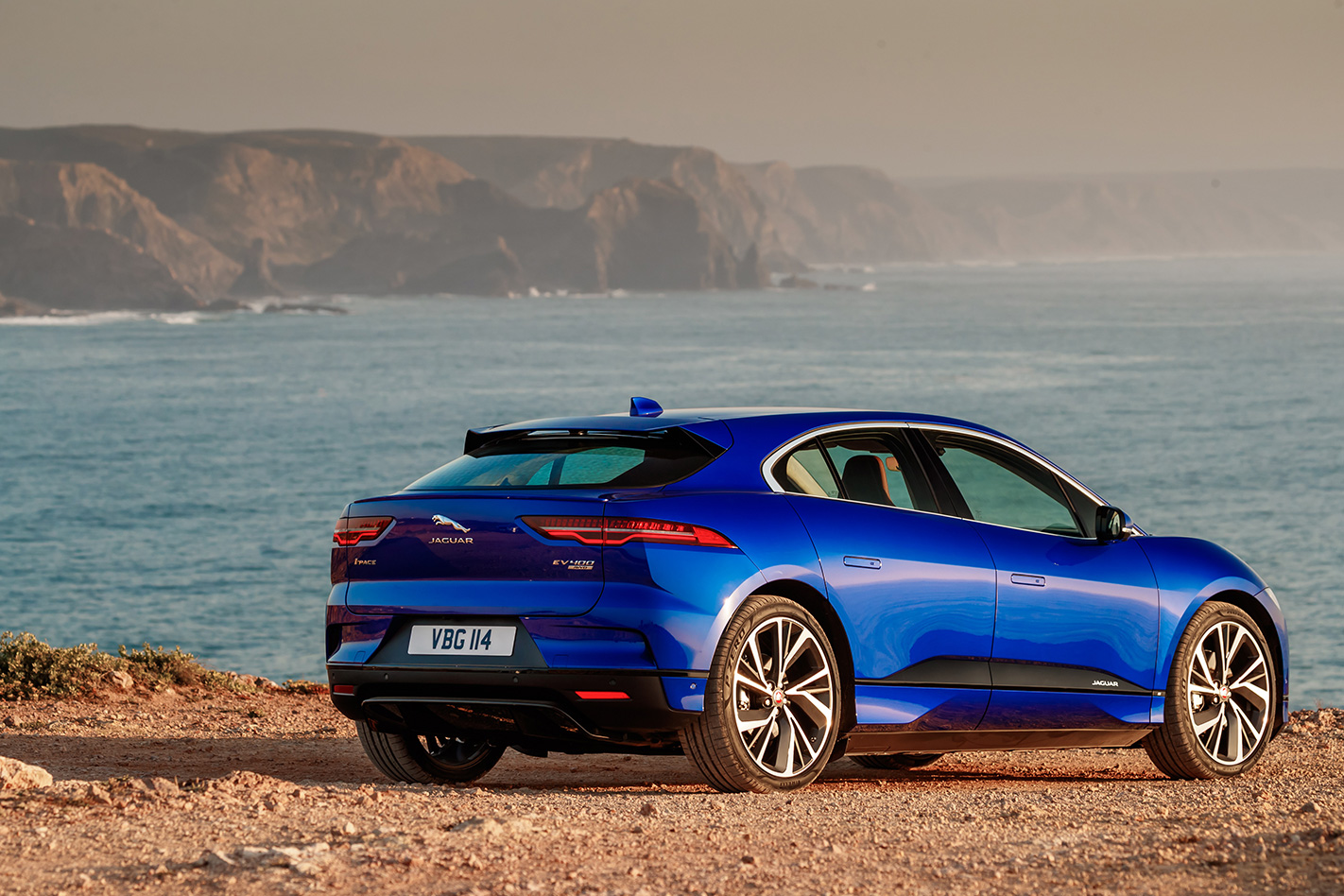
For its international debut, Jaguar made no changes to its regular launch schedule simply because the I-Pace is electric. That’s a huge statement of confidence no other manufacturer has yet been able to equal. Compared with other EVs and even some PHEVs, the I-Pace isn’t a car you have to make allowances for, or tolerate to live with. It’s a car you’re simply going to want.
PLUS: Serious performance and range; surprising dynamics; practical touches; class-leading styling; apparent durability; established brand confidence MINUS: Brakes don’t tolerate punishment; no local purchase incentives
THE WHEELS REVIEW
TARTS, sardines, cobblestones and Ronaldo – just a handful of images that spring to mind when you think of Portugal. But the sliver of azure-fringed earth clinging to Spain’s western flank has another national treasure far more precious than all the custard-loaded pastries in the world. About an hour inland from the pretty town of Faro sits a 4.7km band of blacktop comprised of 15 corners and dizzying elevation changes, proudly branded with the FIA’s stamp of approval. It’s here at the punishing Algarve International Circuit Portimao that Jaguar has chosen to cut the umbilical cord on its foray into full electrification – the I-Pace.
This emissions-free SUV’s arrival doesn’t just mark a significant milestone for the British marque but ignites a whole new battle in unchartered territory, beating Audi, BMW and Mercedes-Benz to the punch. The future-defining I-Pace needs to brace its shield as other mainstream and premium brands progressively introduce their electric SUV contenders, while simultaneously wielding a sabre, proving it has the performance, dependability and class to wear the leaping-cat badge.
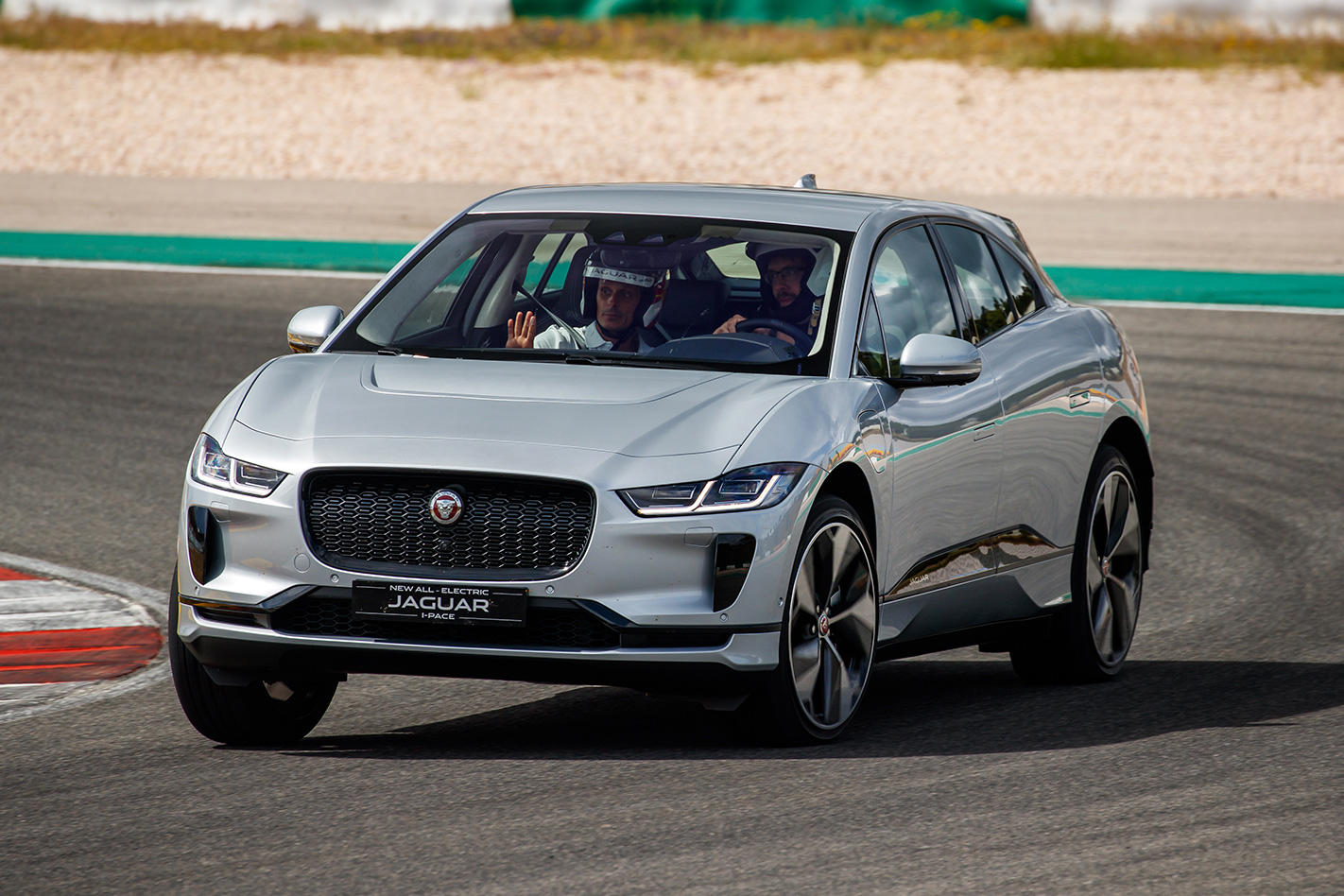
It’s a process that begins at the base of a towering grandstand bathed in gentle European sunshine; rarely has the start line at Portimao had such metaphorical significance. Will Jaguar’s electric SUV be the car that defines the segment, gaining a lucrative head-start over its inevitable rivals, or will it be forever remembered as the EV that struck too early?
Unleashing a fleet of I-Paces at a track as gruelling as Portimao is a deliberate statement of confidence by Jaguar. If Samsung couldn’t prevent a phone from spontaneously combusting when downloading a quiche recipe, how’s the I-Pace supposed to keep its cool when the 90kWh battery is churning out more amps than a Marshall factory? Nearly 1200, if you were wondering.
A few full-bore laps in the I-Pace fails to produce any smoke, or a single warning message on its expansive digital dashboard displays. On the contrary, the I-Pace bites hard into the track with a stoic resolve, and accelerates with unfaltering athleticism, lap after lap.
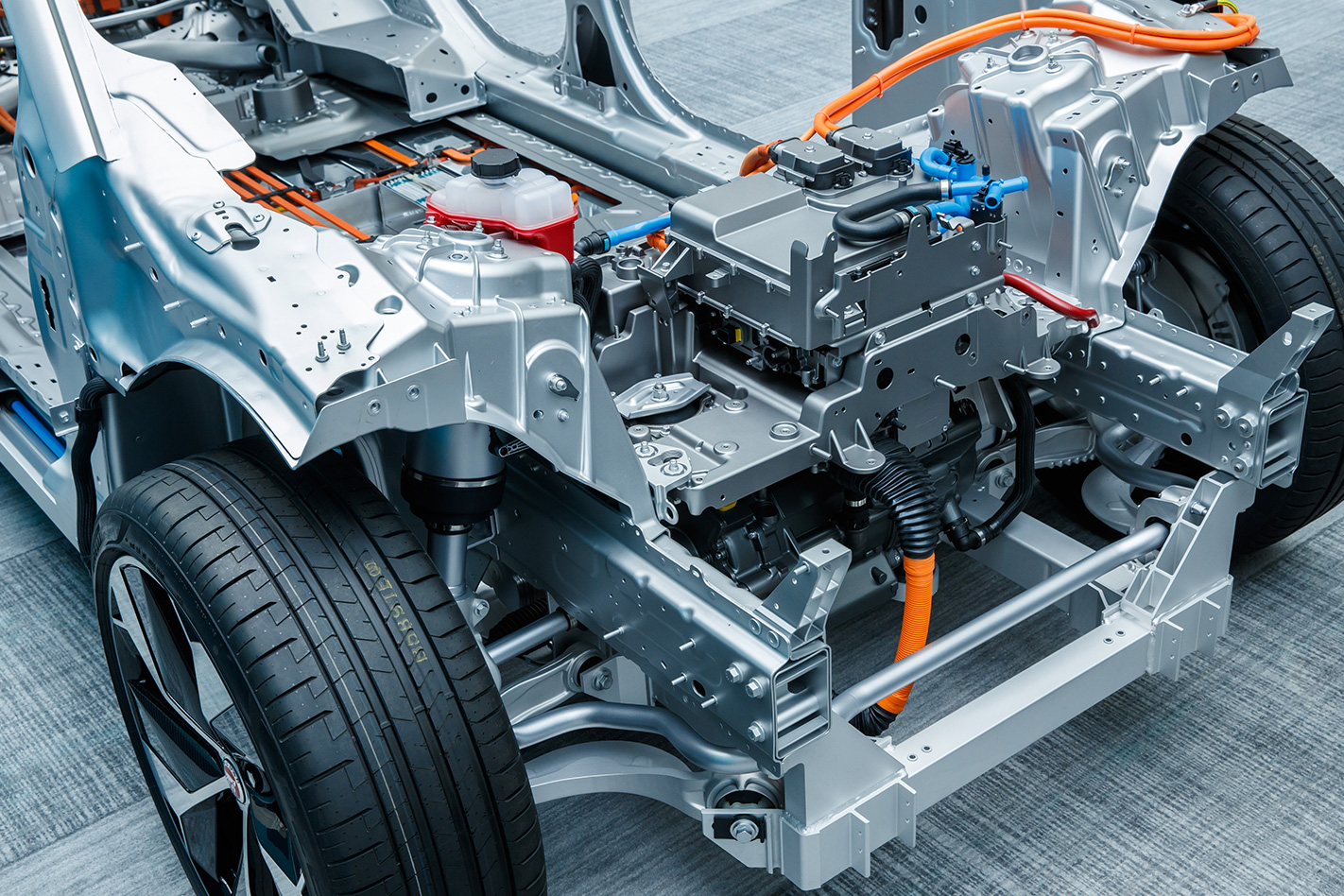
With nearly 2.2 tonnes to haul up, there’s no disguising the Jaguar EV’s considerable kerb weight as its brake pedal lengthens and stopping resistance fades after heavy use, but that’s the only black mark against the I-Pace’s track performance.
With a good chunk of the I-Pace’s weight at floor level where the battery is hidden, its centre of gravity is low, translating to surprising dynamism at Portimao. Front-to-rear balance is excellent and lateral grip feels almost aero-sticky, though it’s more likely the effect of simple mass-over-tyre. In the right hands, the I-Pace is the classic embodiment of the slow-in, fast-out technique, proving capable of lapping this serious circuit with unbelievable energy. At the end of the session, all 16 cars are successfully back in the pits, fans whirring like a panting dog but with no obvious complaints.
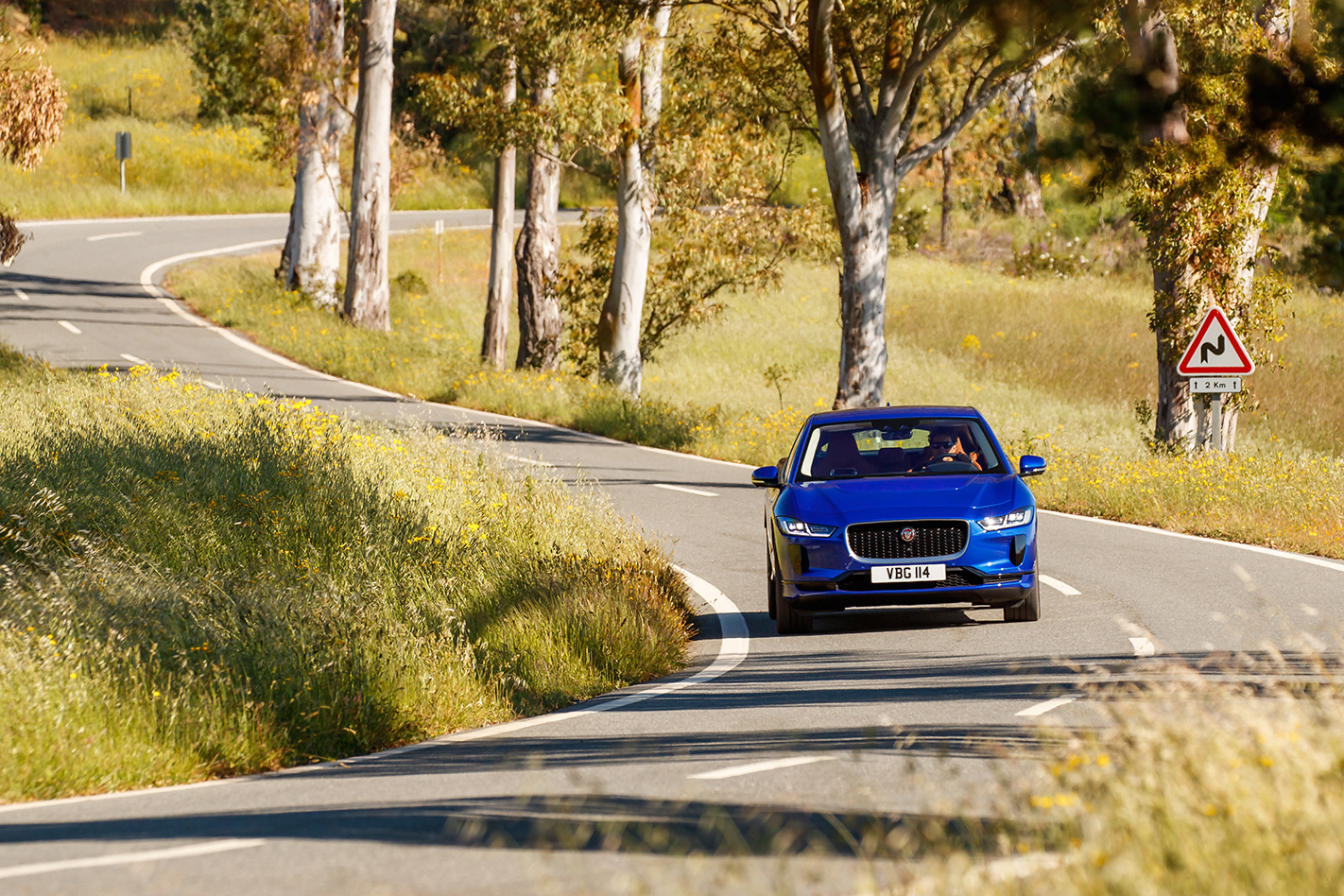
It’s a similar story out on the incredibly diverse roads behind this stunning circuit. The Portuguese really are obsessed with cobblestones, which provide an uncommon test for the I-Pace’s NVH. Yet even on huge 22-inch wheels – standard fitment on the limited-run First Edition model ($159,700) – the I-Pace’s ride is as absorbent as Kleenex.
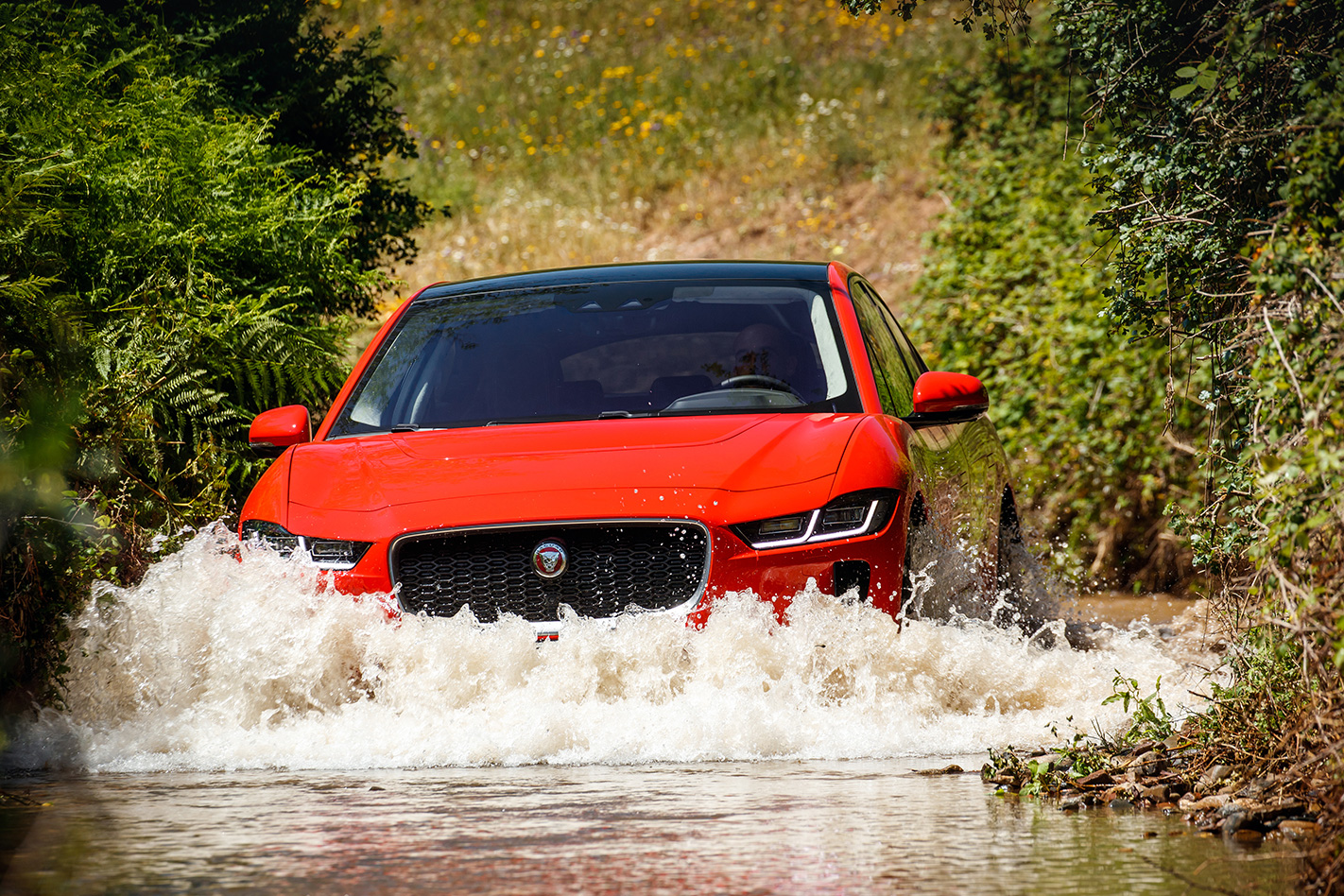
In more remote areas, sudden bomb-holes in the road surface make occupants wince and brace for impact at speed, but even with a rear wheel kicked into the air, the I-Pace’s optional air suspension and clever torque management sort everything out with little effort.
Sweet steering that happily feels related to the excellent XE and XF complements the I-Pace’s stability and grip, while the ability to squeeze on instant torque mid-corner makes Jaguar’s EV fantastically quick. Pin the quiet pedal mid-corner and it will punt you out of bends like you’ve just trodden on its tail. There’s no turbo-lag or downshifting to wait for here.
Lifting the throttle during fast corners nudges the I-Pace into oversteer, which is easily controlled. Conversely, slap-happy steering in tight corners will provoke understeer, yet the I-Pace requires no mental adjustment to get the best from it. This might be an all-electric, two-tonne all-wheel drive but you can man-handle it like any other 4.7m-long high-performance SUV. Thank that wheel-at-corner stance, not just its battery location.
A quick pit stop and yet another custard tart offers a chance to digest the I-Pace’s aesthetics.
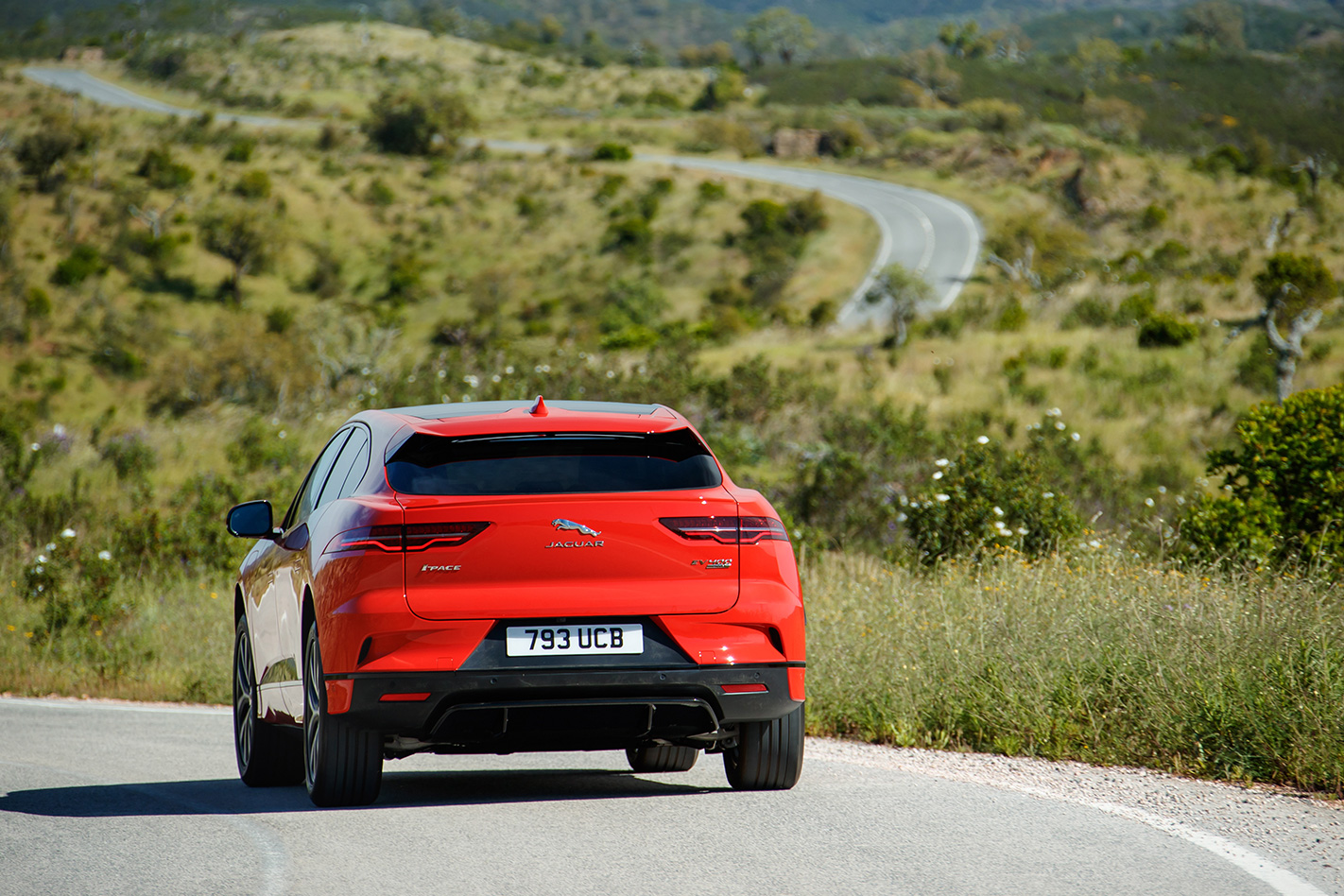
With no engine to accommodate, its short bonnet is as threatening as a snub-nose .38, but unlike a Ruger, the electric Jag has accuracy and range. On a full charge, the Brits claim the I-Pace can cover 480km. An 80-percent charge is possible in 10 hours from a home 7kW wall box, or 40 minutes at a 100kW station.
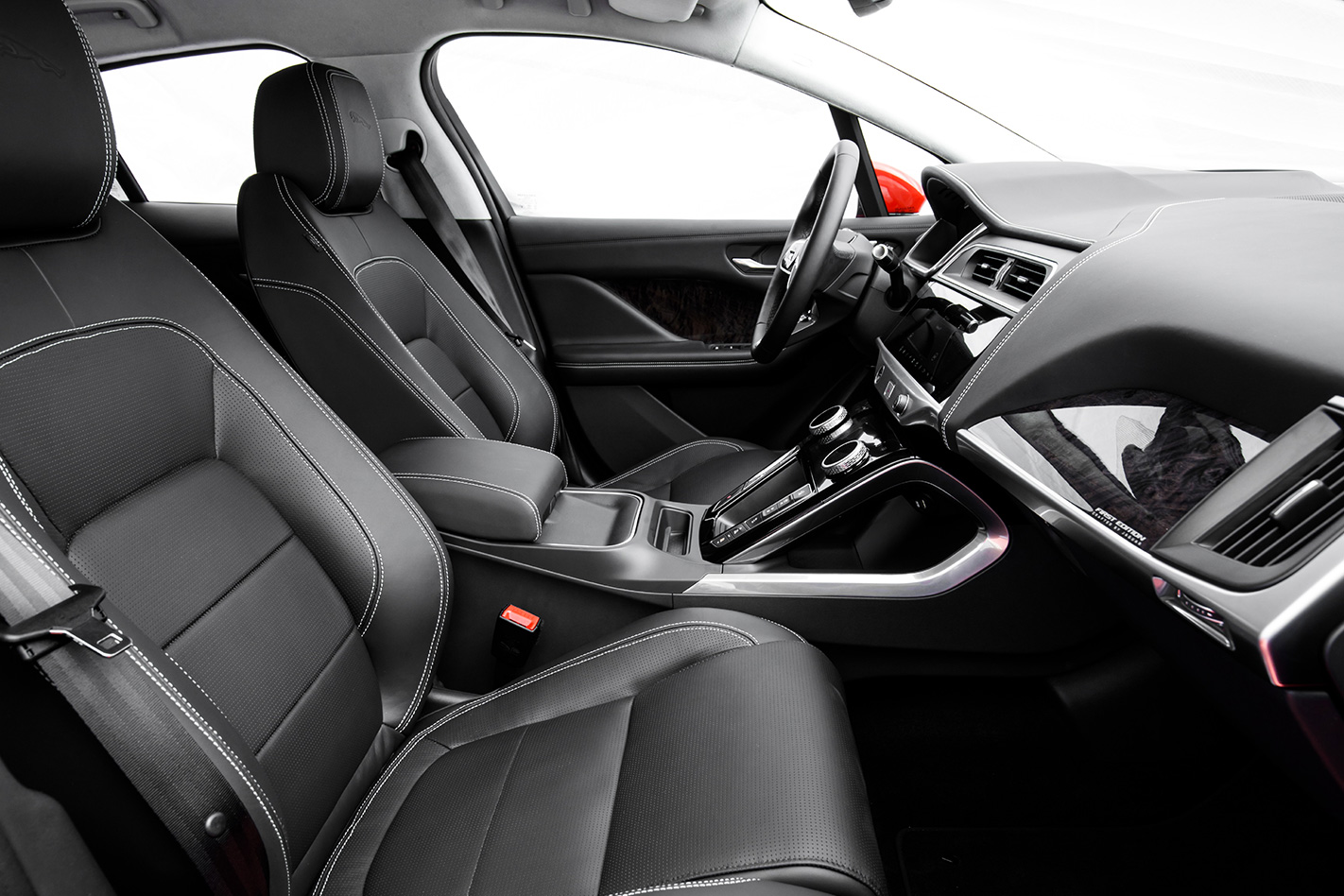
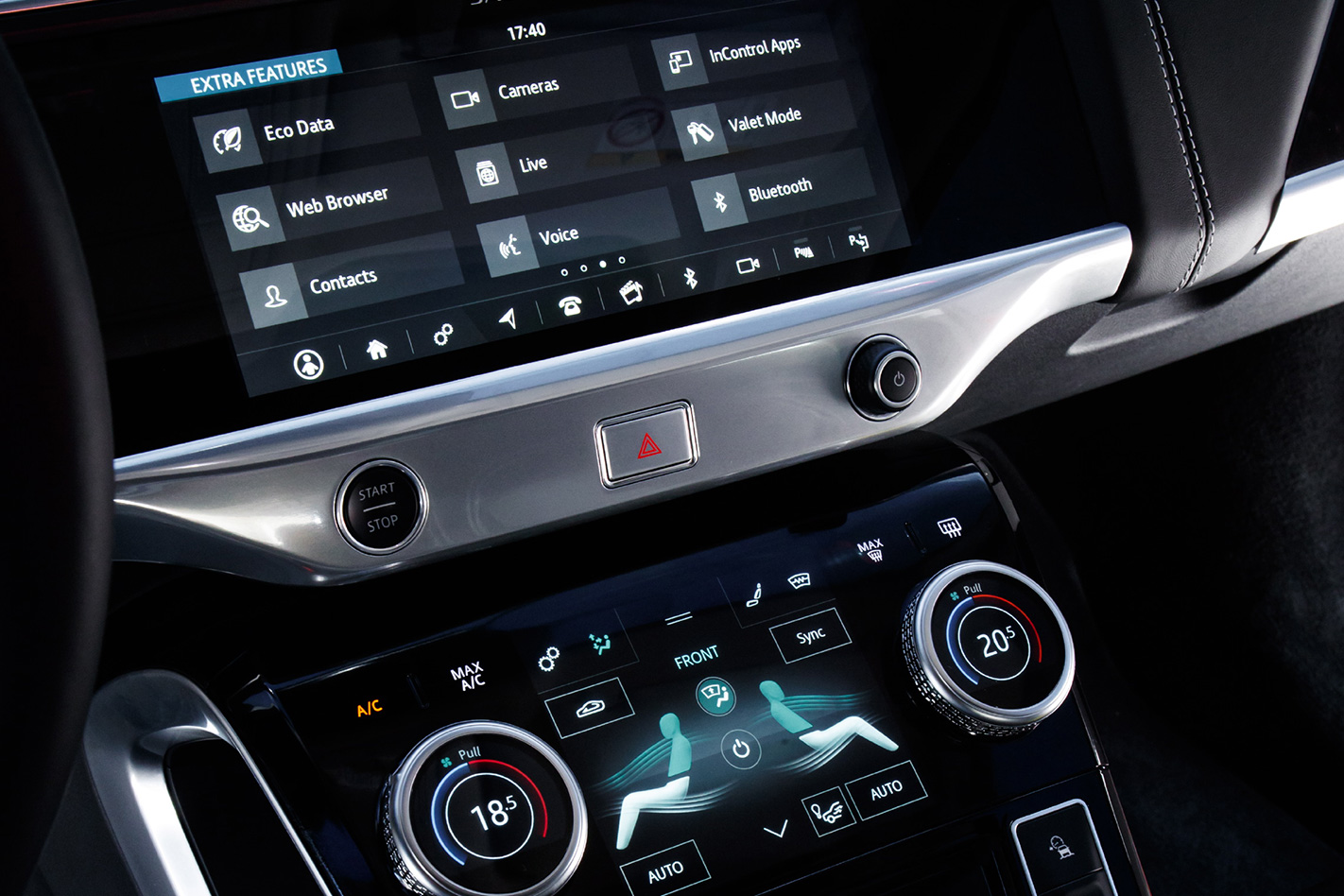
On the inside, the I-Pace’s tech tour de force continues. There’s a digital screen for the instrument cluster, central display, climate-control panel; even the temperature/fan-speed dials are tiny screens. The whole package is wrapped up in more hide than a BDSM party, and a super-stiff body structure made from 94-percent aluminium resists squeaks and rattles caused by twisting on the road. Two adults will also be happy in the second row, with ample room and vision aided partly by a huge (optional) panoramic roof.
As if a scorching track stage and road trip aren’t enough, the drive route takes an interesting turn towards unsurfaced territory. With a quick switch to an off-road setting, the I-Pace fords a water crossing and scales an impossibly steep and rocky hillside, with my presence required only for steering. It’s proof that electricity could be the future for all-terrain mobility too.
At this point, you’ll no doubt be jumping up and down pointing at the larger, identically priced Tesla Model X and regaling its ballistic acceleration, all-wheel-drive system and comparable range because, for now, there isn’t another genotype that gets closer to the I-Pace. But the Jaguar resoundingly pees on the bonfire that the Californian technology start-up lit. Yes, the Model X is faster in a straight line but that’s where its advantages end. Where the Tesla feels cumbersome and remote during fast dynamic driving, the Jaguar is fizzing with feedback.
The I-Pace’s comfortable, practical interior doesn’t need fancy doors to work, and it doesn’t require a specialised charge point to feed its batteries. It’s also undoubtedly handsome. Alongside the striking electric Jaguar, the Model X looks like a slightly embarrassed beluga whale. Tesla has done a commendable job creating its gull-winged brood hauler, but the Jag is clearly the product of a more established ethos.
Indeed, the I-Pace is an amazingly complete car, but timing will be critical in such an unknown segment. As bountiful government incentives entice electric-vehicle buyers in Europe and the US, the Jag’s arrival is spot-on, but in Australia, where alternative energy has few fans in high places, the I-Pace is going to struggle to find an audience when it arrives in October, despite its near-perfect scorecard.
The I-Pace’s local target market is also a complete enigma at this stage, though at least 10 orders have already been placed. Until there are more reasons to buy into the electric-vehicle movement in Australia, Jaguar isn’t going to sell the I-Pace in any real volume here. But this plug-in pioneer sets a precedent that is virtually guaranteed to start a trend.
JAGUAR I-PACE SPECS
Model: Jaguar I-Pace S Engine: 2 x electric motors Max power: 294kW Max torque: 696Nm Transmission: 1-speed epicyclic L/W/H: 4682/2011/1565mm Wheelbase: 2990mm Weight: 2133kg 0-100km/h: 4.8sec (claimed) Price: $119,000 On sale: October
ALFA Romeo’s Giulia-based supercoupe is go. To be called GTV, the four-seater will deliver an electric-boosted 450kW through all four wheels. Alfa’s teaser image shows a sleek, two-door shape.
The legendary Italian brand’s head, Tim Kuniskis, confirmed the rumoured car would go into production during Fiat Chrysler Automobiles’ presentation to investors of its grand, now-to-2022 plan in Italy last Friday. Aside from the name, the GTV wasn’t a complete surprise. But what came next was…
Kuniskis has revealed Alfa Romeo also aims to produce an all-new mid-engine supercar in the same timeframe. The car will resurrect the 8C nameplate.
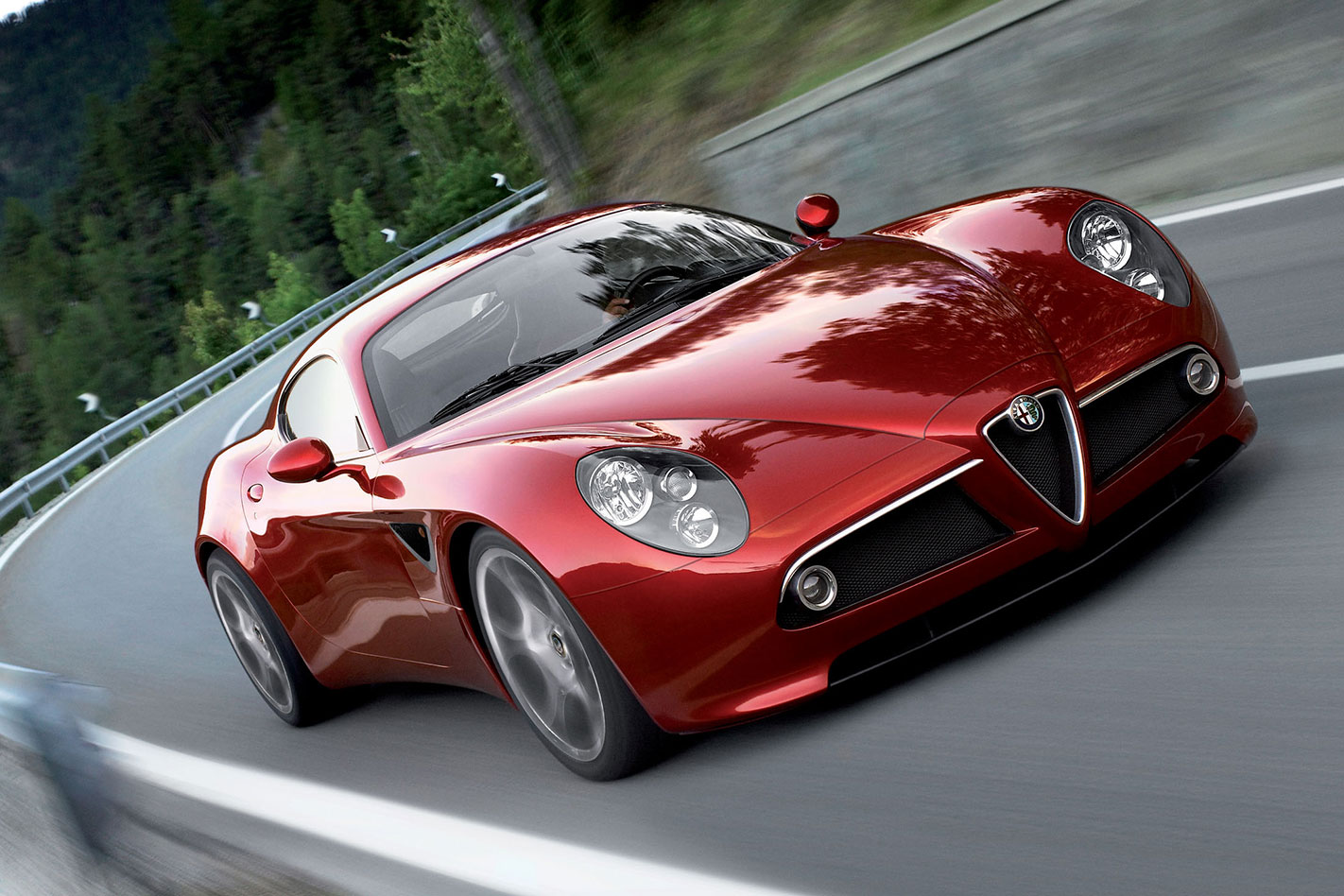
Above: 2006 Alfa Romeo 8c
With a carbonfibre monocoque body and mid-mounted twin-turbo engine, the Alfa looks set to be a McLaren rival. But its electric front axle drive system adds a touch of BMW i8-style tech.
A combined power output of above 500kW is promised for the 8C, along with a sub-3.0 second 0-100km/h time. Kuniskis didn’t specify whether the engine would be a V8 or not, but the car’s name points in that direction.
While there was no mention of launch timing for either car, the GTV project is obviously more advanced than the 8C. The coupe, after all, is based on an existing architecture. The 8C, on the other hand, is a clean-sheet design.
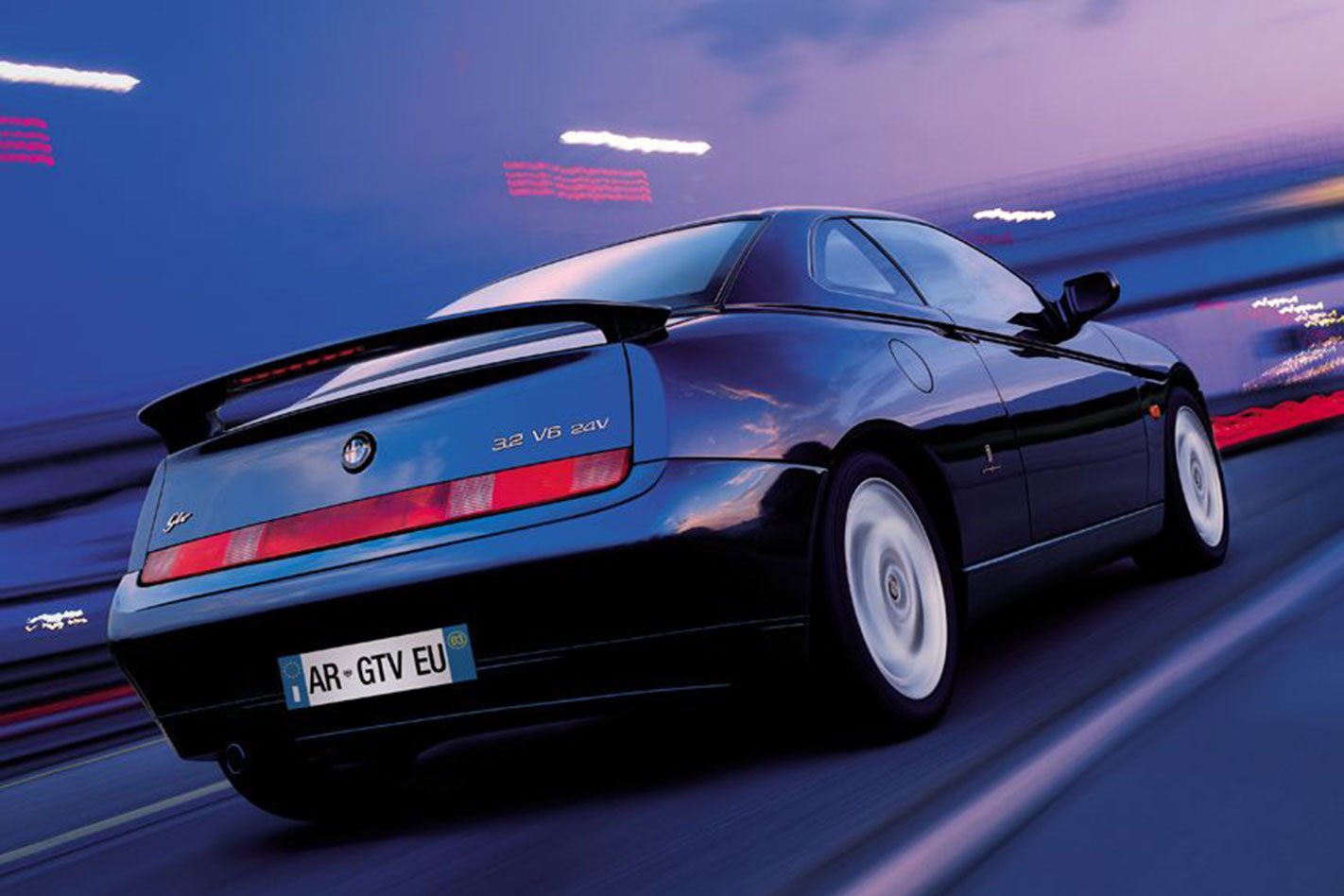
The GTV and 8C will provide the halo for an Alfa Romeo range that will grow over the next five years. The brand aims to add two new SUVs, one smaller than the Stelvio, another larger. Long-wheelbase versions of the Giulia and Stelvio for China, now the world’s biggest premium-brand market, are planned. The Giulietta hatch will be replaced or updated, while the awful Fiat Punto-based Mito will be killed. The flawed 4C Coupe and Spider will also disappear, to make way for the GTV and 8C.
FCA plans to eliminate diesels in its passenger vehicles by 2021, though they will live on in the light commercial vehicles produced by Fiat Professional and Ram. This means all the new Alfas will have petrol engines or plug-in petrol-electric hybrid drivetrains.
Relying heavily on tapping rapid growth in the Chinese market, Alfa is aiming for 400,000 global sales by 2022. Is this believable? After all, four years ago Alfa was saying it would be selling 400,000 cars a year by 2018. The actual number this year will be around 170,000. While a huge increase over the brand’s dismal 62,000 global sales total of 2015, this is miles shy of the target.
FCA head Sergio Marchionne acknowledges that the 2014 objectives were too ambitious, but says Alfa is now on the way to success. “Something of importance was accomplished,” he insists. “Did we do it right? The answer is ‘No’
“At the end of the day the benefit will come. I think it’s already visible…”
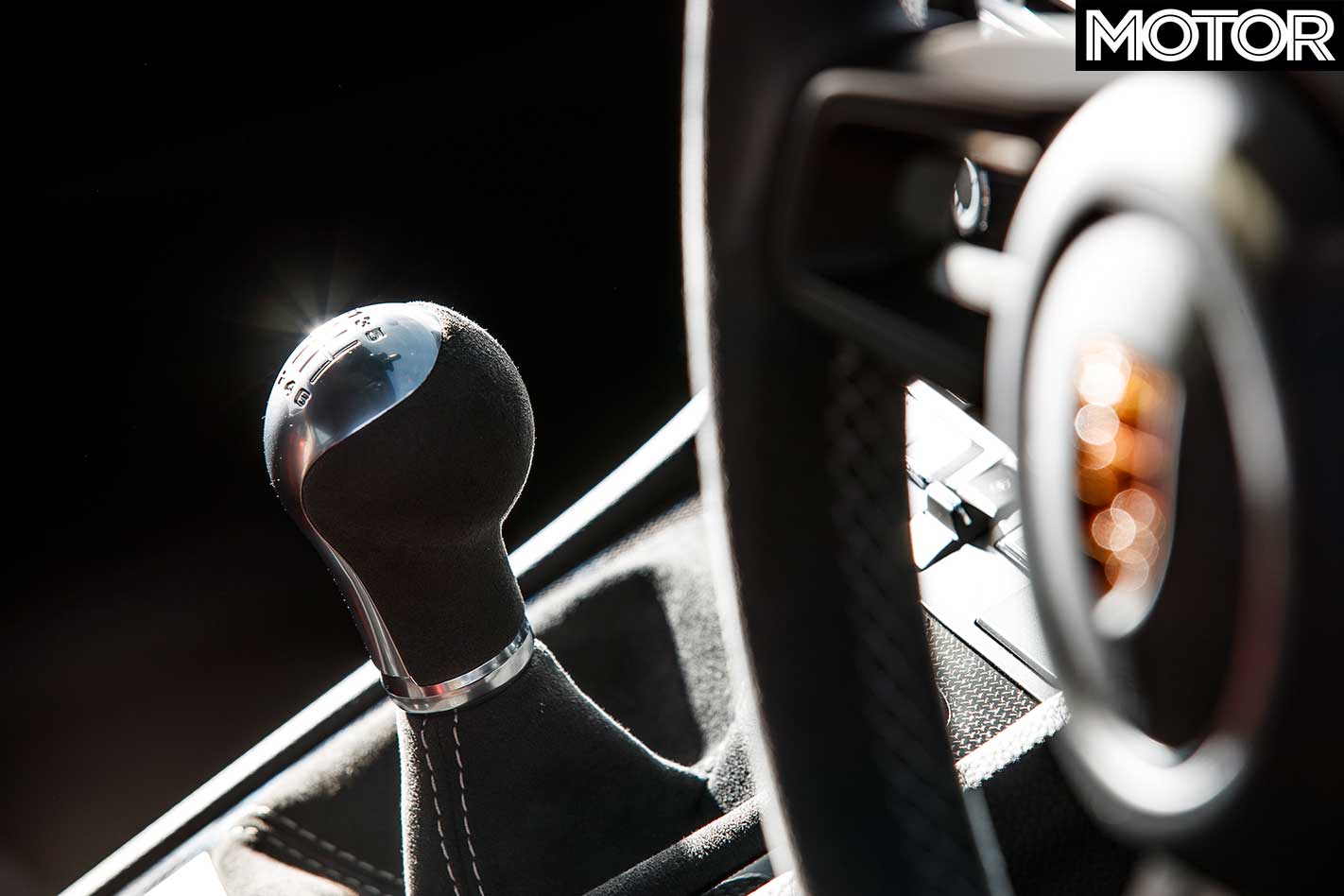
In a world increasingly dominated by dual-clutch and automatic gearboxes, it still feels like the most natural thing in the world to step into a Porsche sports car and instinctively dip your left leg before turning the key. Yes, a key! Purists, welcome to your perfect Porsche.
That crucial third pedal is the reason we’re driving this Guards Red GT3. Porsche didn’t offer the option in the 991-generation GT3, but bowed to the wishes of enthusiasts worldwide and developed a bespoke six-speed manual for the 911 R and 991.2 GT3. However, PDK versions came off the production line first, meaning Editor Campbell’s recent epic alpine drive used only two pedals.
Before we get into the nitty-gritty of what separates manual from PDK, a quick refresher on the common parts. A 4.0-litre flat-six sits aft of the rear axle, producing a sizzling 368kW at 8250rpm and 460Nm at 6000rpm, while maximum engine speed is 9000rpm.
Adaptive dampers are standard, as is rear-wheel steering, while the fronts are operated by a steering rack that quickens from 17.15:1 on-centre to 13.12:1 at its extremes.
The standard braking system uses 380mm rotors at both ends with six-piston front calipers and four-piston rears, while the wheels measure 20 x 9.0-inch front and 20 x 12.0-inch rear wearing 245/35 and 305/30 rubber respectively, in this case Dunlop Sport Maxx Race 2 instead of the more common Michelin Pilot Sport Cup 2.
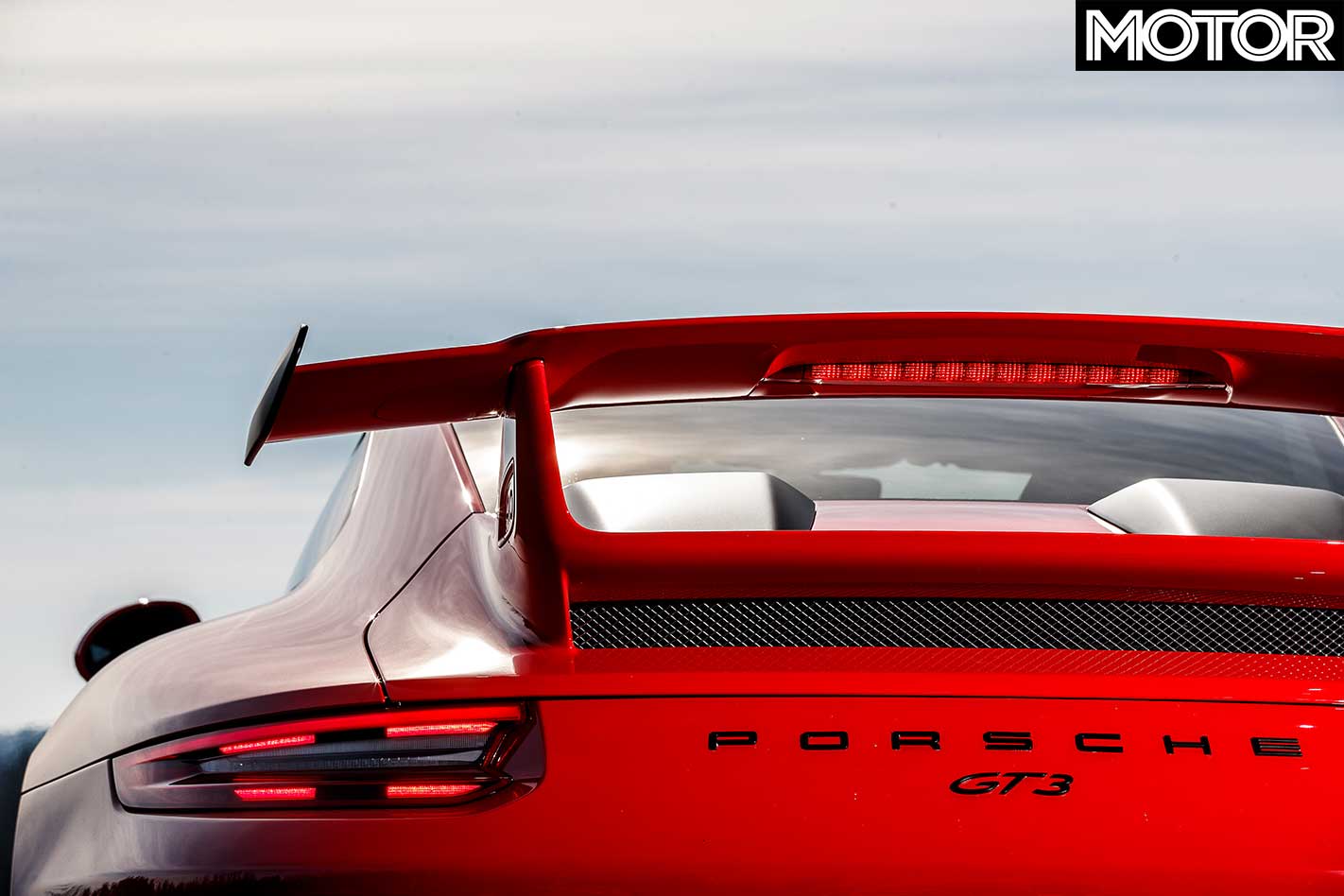
Thanks to revised aerodynamics, the 991.2 GT3 produces 20 per cent more downforce than its predecessor without increasing drag.
Now, the differences. Aside from the obvious, the GT3 manual uses a mechanically-lock limited-slip diff, rather than the PDK’s electronically-controlled unit. It offers 30 per cent locking on traction and 37 per cent on deceleration and incorporates torque vectoring by braking an inside wheel during cornering, however, it lacks the fully variable torque distribution abilities of the PDK’s digitally-enhanced diff.
It doesn’t hurt the GT3’s handling. This car operates at such a high level that even approaching its stratospheric limits requires summoning every ounce of your driving ability. It won’t punish ham-fistedness like fast 911s of yesteryear, but to extract the most from it still requires a specific technique. Use the rear weight bias to your advantage to help rotate the car and aid traction and the GT3 is devastating.
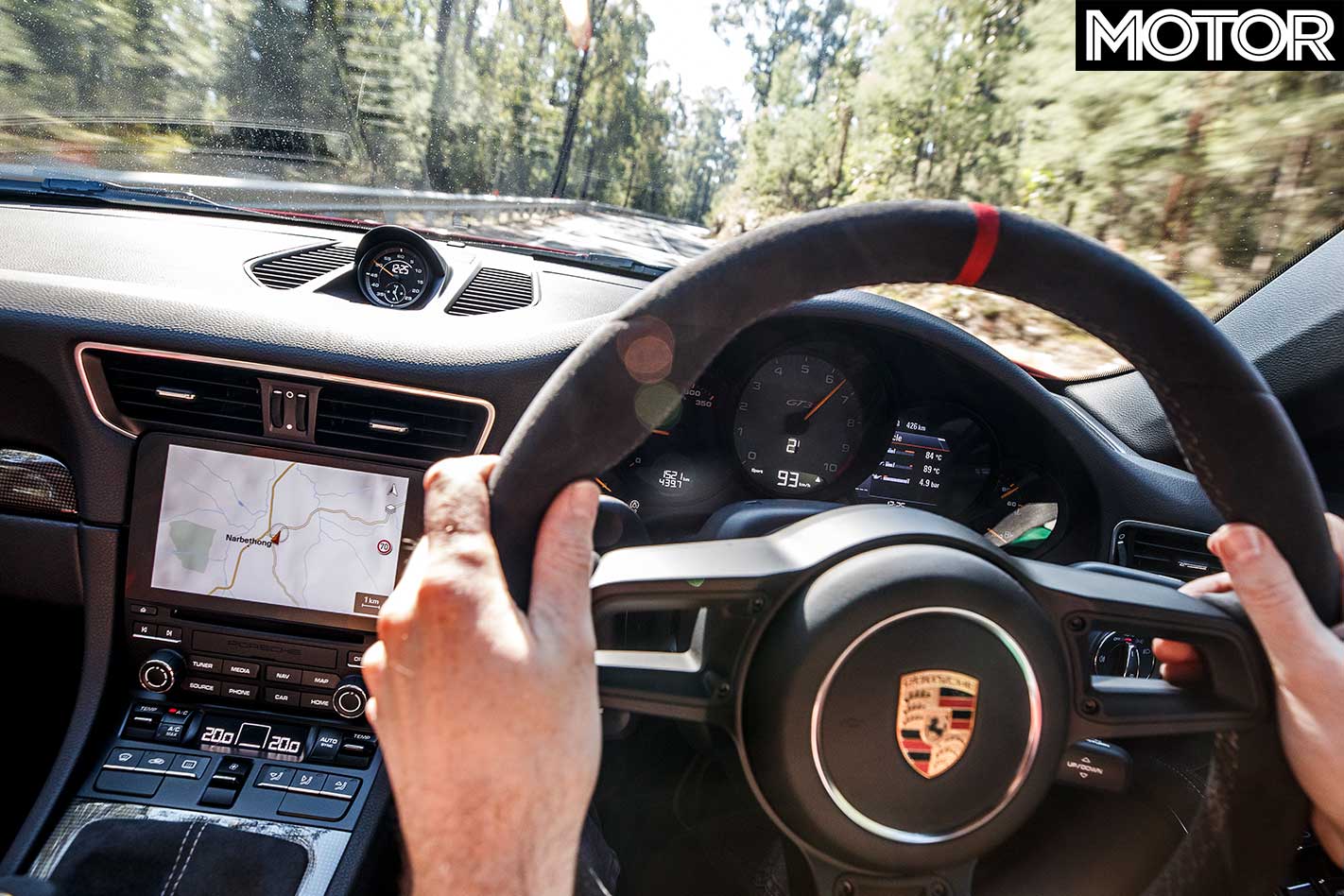
The steering is razor accurate, body control absolute, the brakes unkillable and traction strong enough to take every one of the 368kW, even in first gear. Faster corners are even better, the GT3 squatting comfortably on its outside rear tyre and sucking itself to the tarmac.
Initially, you feel like you’ll never reach the limit of adhesion, but with a bit of provocation and a hint of adverse camber this super-911 reveals it hasn’t abandoned its playful side. Hopefully we’ll have a chance to drive a GT3 on track at some point, as it’s bred to live beyond pit wall.
A circuit is really the only place you can properly extend the monster of an engine. Against the clock the manual gives away 0.5sec to the PDK on the way to 100km/h, but once rolling they’re level pegging.
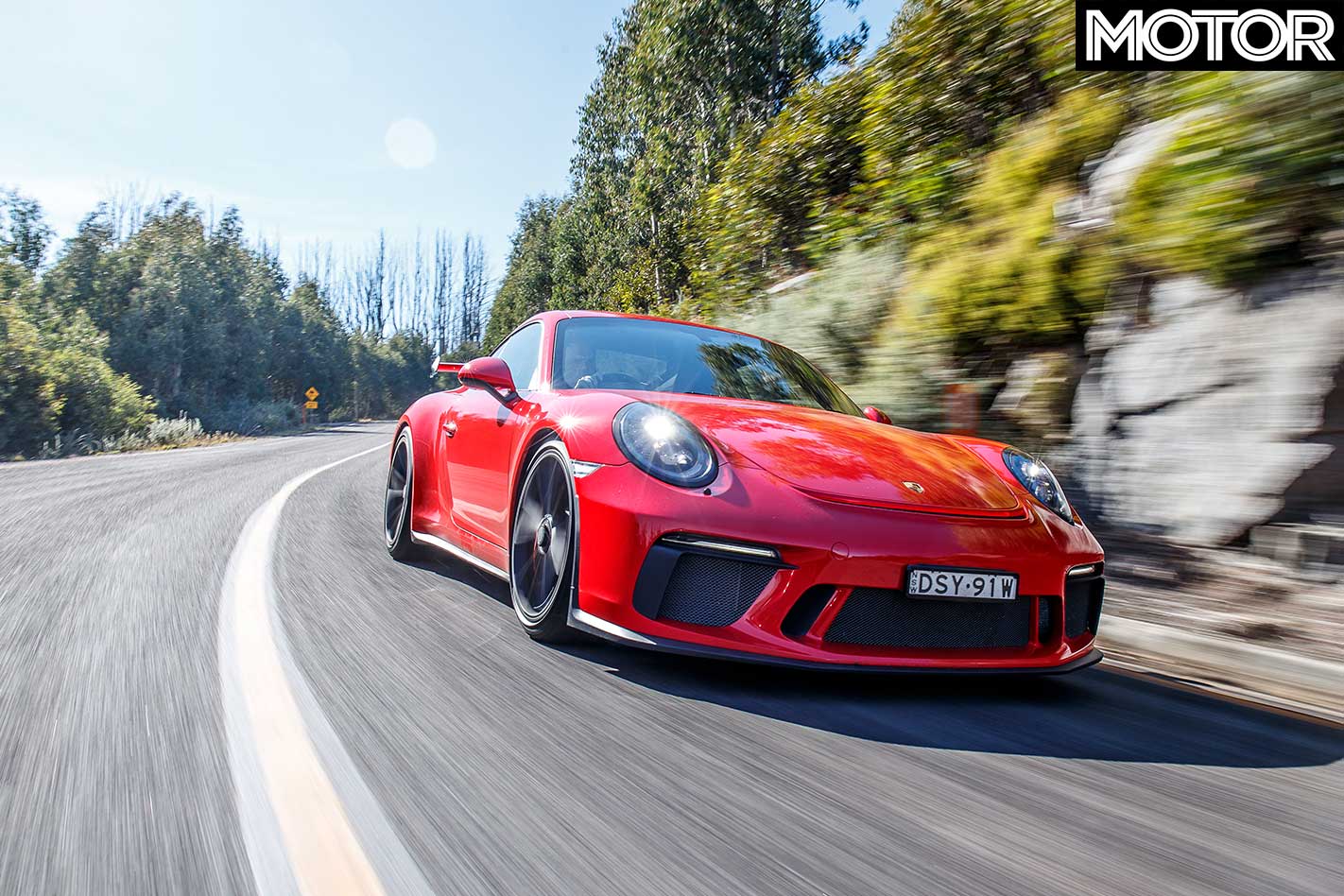
The top-end kick of the 991 3.8 has been eradicated by the fattened mid-range of the 4.0-litre, yet it continues to gather pace as it passes 7000rpm, emitting a mechanical scream on its way to 9000rpm like Jimmy Barnes singing Nessun Dorma.
I’ve never driven a car with such a disdain for speed limits. Turbocharged rivals might be ultimately quicker, but the GT3’s extraordinarily long gearing (first runs to 83km/h, second 131km/h and third 181km/h) and the eagerness with which it encourages you to explore the upper reaches of the tachometer means staying legal requires iron self-control. That the 991.2 GT3 can marry this performance with enough compliance to make it an adequate grand tourer is truly remarkable.
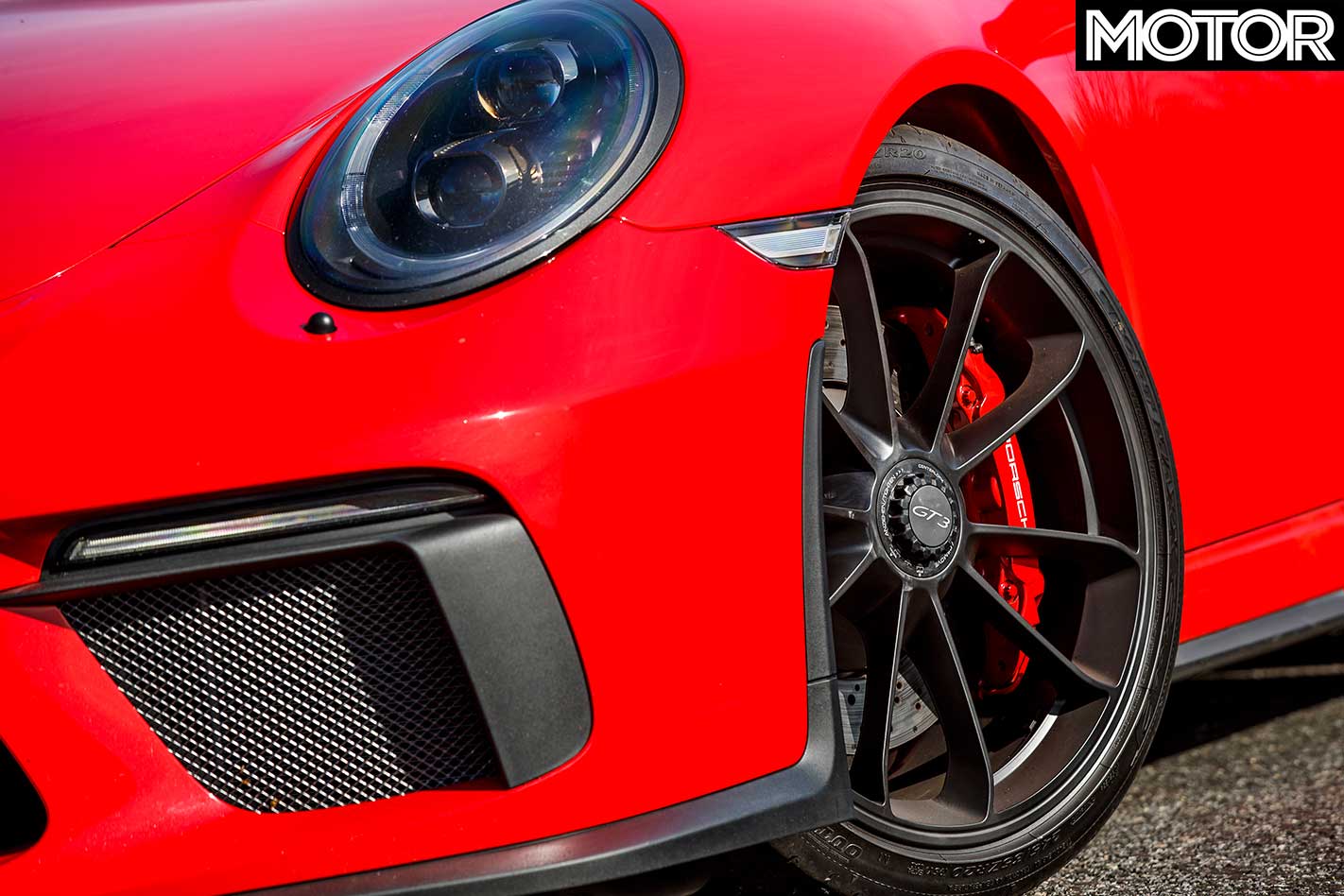
This is one of the greatest performance cars ever built; at times it seems impossible that it could wear number plates and have service intervals longer than 1000km. To find flaw is to nit-pick: a Sports ESP mode would be nice and six-point harnesses are pretty silly in a road car.
Which gearbox to choose? Honestly, it doesn’t really matter; the PDK makes more effective use of the engine, but will never be able to replicate the feeling of a perfectly-judged heel-toe downshift. We’ll have one of each, thanks.
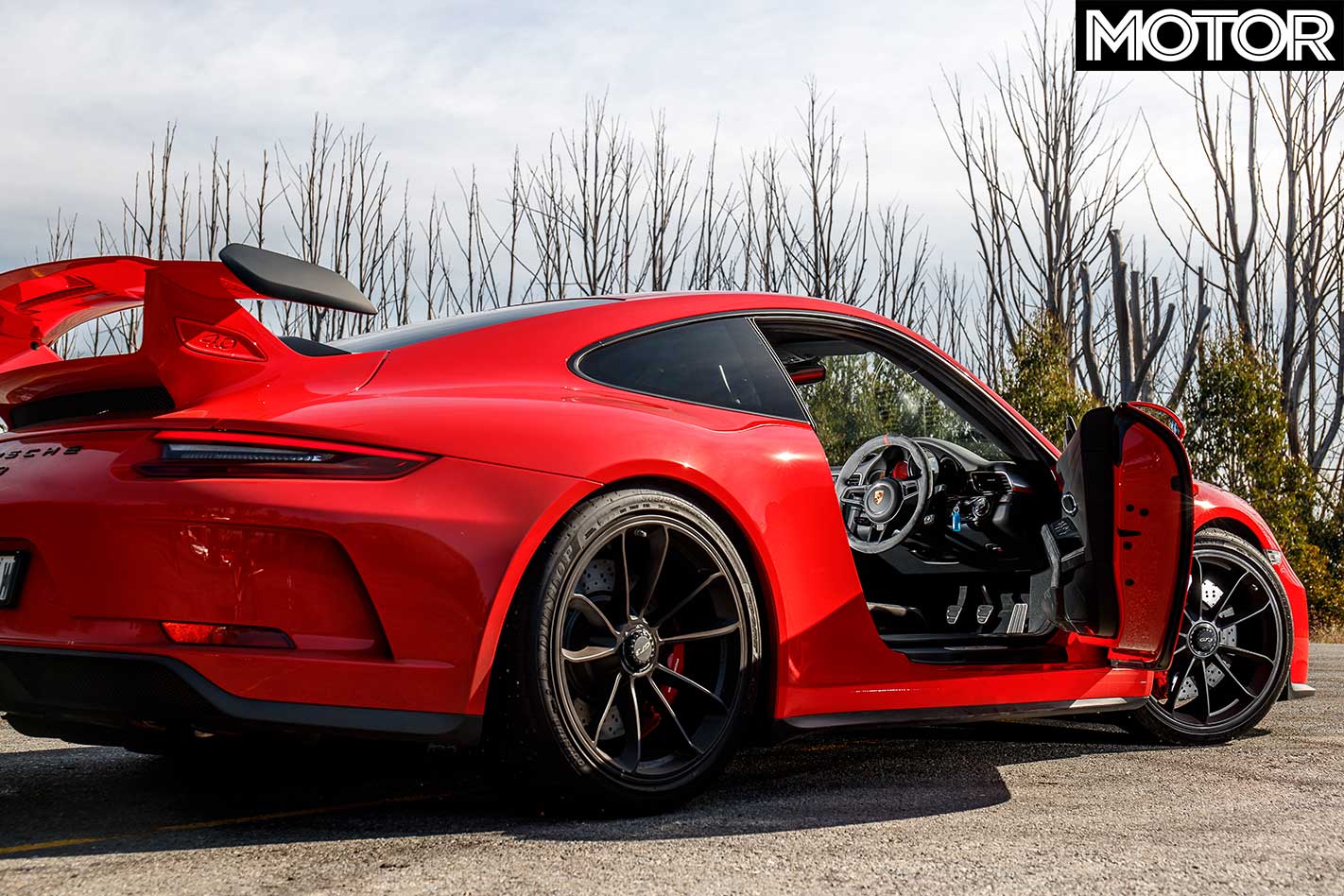
2018 PORSCHE 991.2 911 GT3 MANUAL SPECS: Engine: 3996cc flat-6, DOHC, 24v Power: 368kW @ 8250rpm Torque: 460Nm @ 6000rpm 0-100km/h: 3.9sec (claimed) Weight: 1413kg Price: $326,800 ($358,100 as-tested)
Rating: 5 out of 5 stars Likes: engine; handling; ride; gearbox…basically everything Dislikes: speed limits; didn’t build enough
