
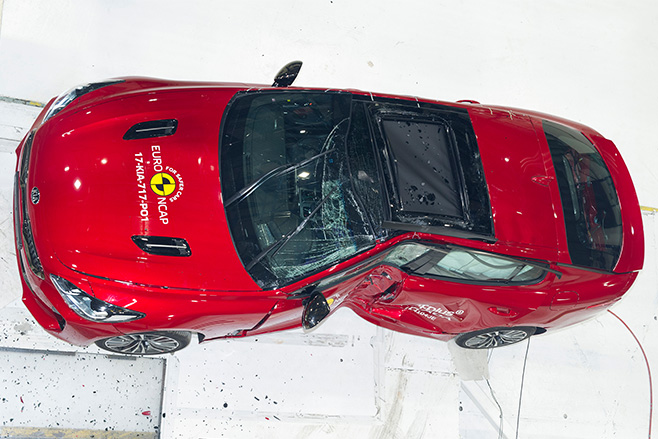
ANCAP has announced a five-star safety rating for the Kia Stinger GT, Stinger GT Line, and Si variants, while only awarding three stars to the base 200S and 330S models.
Though all variants scored well impact protection structurally, it was the lack of impact avoidance technology that led the ‘S’ models to receive three stars.
While the GT, GT Line, and Stinger Si all have autonomous emergency braking and lane-keep assist, as well as rear seat belt pre-tensioners and load limiters, the S variants do not.
ANCAP chief executive James Goodwin says he’s disappointed that ANCAP wasn’t able to award every Stinger variant with a five-star rating.
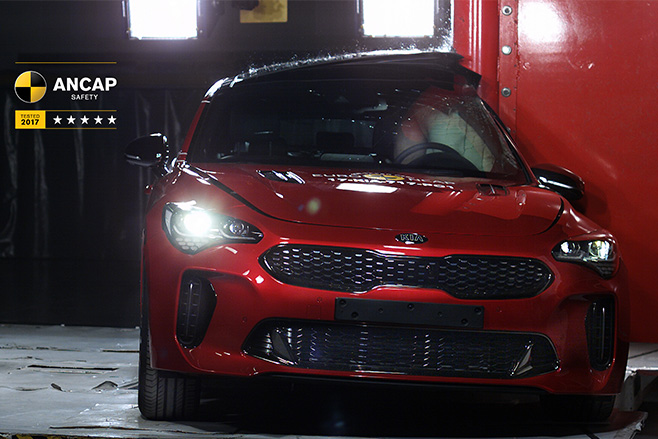
“The Si, GT Line and GT variants marketed in Australia, and all New Zealand Stinger variants are well-equipped and have earnt the maximum 5 star ANCAP safety rating.
“Unfortunately two Stinger variants offered as part of the Australian model line-up – the 200S and 330S – are supplied without the active safety aids provided in other variants and score 3 stars.
He says the lack of these preventative technologies reduce the S variants’ Safety Assist score to 25 per cent.
“Australasian customers should feel let down that important safety features are being left out of the vehicles we’re being supplied.
“We would urge Kia to offer the same safety specification across all variants and all markets to ensure the best safety outcomes.”
MOTOR contacted Kia Australia regarding the ratings, but Kia has “no comment at this point.”
We’re told Kia wishes to examine the results more closely before making a comment on the matter.
FERRARI is preparing a faster, more powerful, track-focused special edition of the 488, and the Italian supercar maker could resurrect an iconic badge to slap on its rump.
A 488 test mule has been spotted in Europe, setting tongues wagging and prompting UK mag Autocar to speculate that it could be released next year as a 488 GTO.
The GTO badge has only been used by Ferrari three times: first on the 250 GTO and 288 GTO – which were both race cars – then on the far more modern 599 GTO.
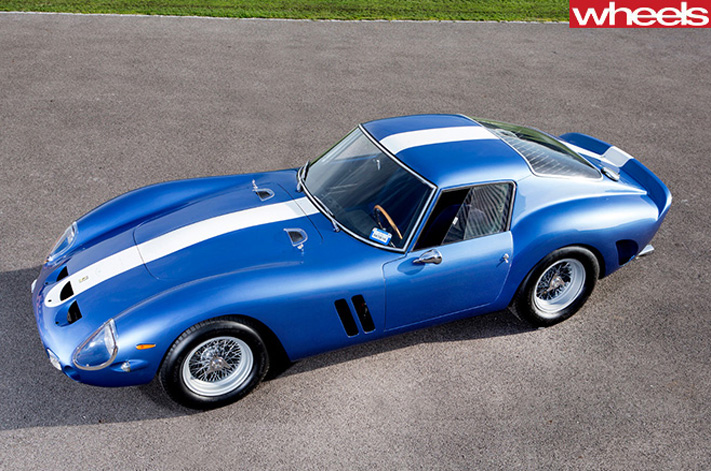
Purists can rest easy with the 488 GTO, though, as the mid-engined supercar that provides the car’s basis already has a pair of GT racing versions competing in the GT3 and GTE categories around the world – plus a Ferrari Challenge one-make race version. However if it becomes a reality, it’s likely the 488 GTO will have more power than each of these track beasts.
If the GTO name isn’t revived for the more focussed 488, it could wear badges similar to its forbears the 360 Challenge Stradale, 430 Scuderia, and 458 Speciale.
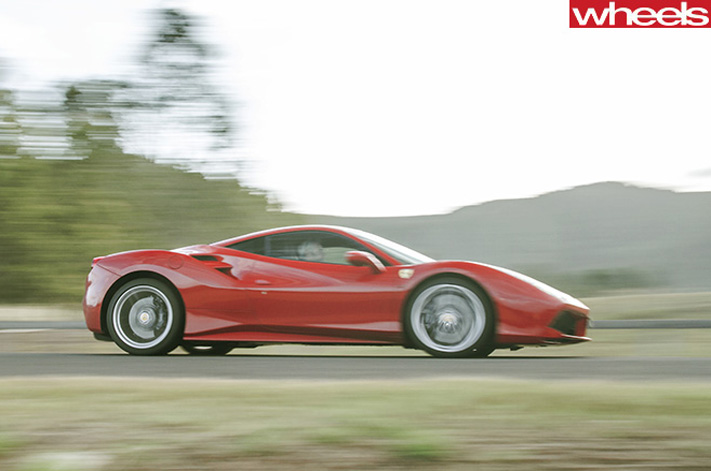
Autocar speculates this could be as much as 521kW and 760Nm. Accompanied by weight saving efforts to get the kerb weight under 1400kg, acceleration to 100km/h could be as quick as 2.7 seconds while the 0-200km/h run could be dispatched in roughly 7.5 secs.
Bigger brakes and more focussed suspension are a given.
Downforce will also need to be increased with the new model, improving on the GTB’s current 325kg at 250km/h. With Ferrari’s engineers having access to the F1 team’s full-size wind tunnel, that shouldn’t be an issue.
How much? Who knows, but as with all ultra-limited Ferarri specials if the factory isn’t already telling you about it, you’ll probably never own one anyway.
CHRYSLER’S V8-powered 300 SRT sedan will be thrown a lifeline from an unlikely source – NSW Police, which is expected to announce in early 2018 it will purchase hundreds of the high performance four-doors for use as highway patrol vehicles.
A source close to the deal has confirmed NSW Police has placed a “substantial” order for the SRT Core, a version of the 300 SRT created for Australia.
Retailing for $65,000, the 300 Core sheds some of the luxury equipment of the regular 300 SRT but maintains the same basic mechanical package, including 20-inch alloy wheels and a 6.4-litre V8 engine making 350kW of power.
The 300 Core has a claimed top speed of 282km/h but is one of the thirstiest sedans on the road, using 13.0 litres per 100km.
The 300 is currently the only car Chrysler sells in Australia, and sales have been dwindling. The NSW Police car order should significantly boost sales.
However, Chrysler Australia is also hoping to take advantage of demand for affordable V8-powered four-doors; previously that market had been left to the Ford Falcon and Holden Commodore, but V8 versions of both have been killed off.
“Contrary to recent reports, Chrysler 300 right-hand drive production will continue,” says Lucy McLellan, Fiat Chrysler Australia director of corporate communications. “Locally, our focus for Chrysler 300 and the SRT variants will be on conquest fleet business in 2018.”
Chrysler is also expected to produce more limited edition models to take advantage of that healthy demand for V8 sedans.
“In Australia, we always look to special editions and buzz models to keep products fresh and interesting in market and will be presenting a number of these for the Jeep brand in 2018.”
As well as the 300 SRT Core, NSW Police is understood to have ordered the $121,600 BMW 530d, a limousine that sheds some of the Chrysler’s speed for luxury equipment, comfort and fuel economy.
NSW Police was unable to supply a comment by the time of publication.
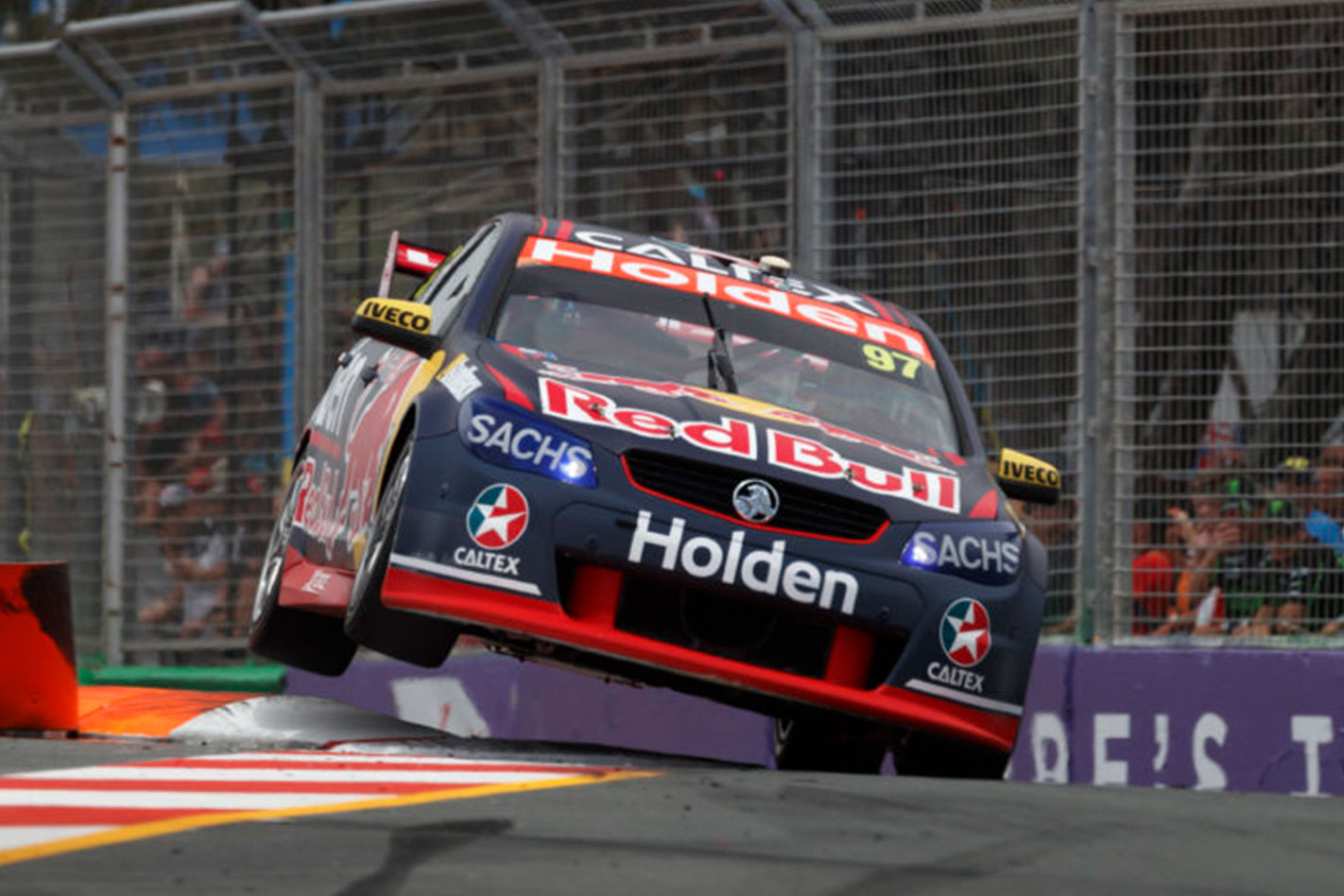
With Matt Campbell unable to join Red Bull Holden Racing Team driver Shane van Gisbergen for 2018’s endurance season, World Endurance Championship winner Earl Bamber is set to race with his fellow Kiwi.
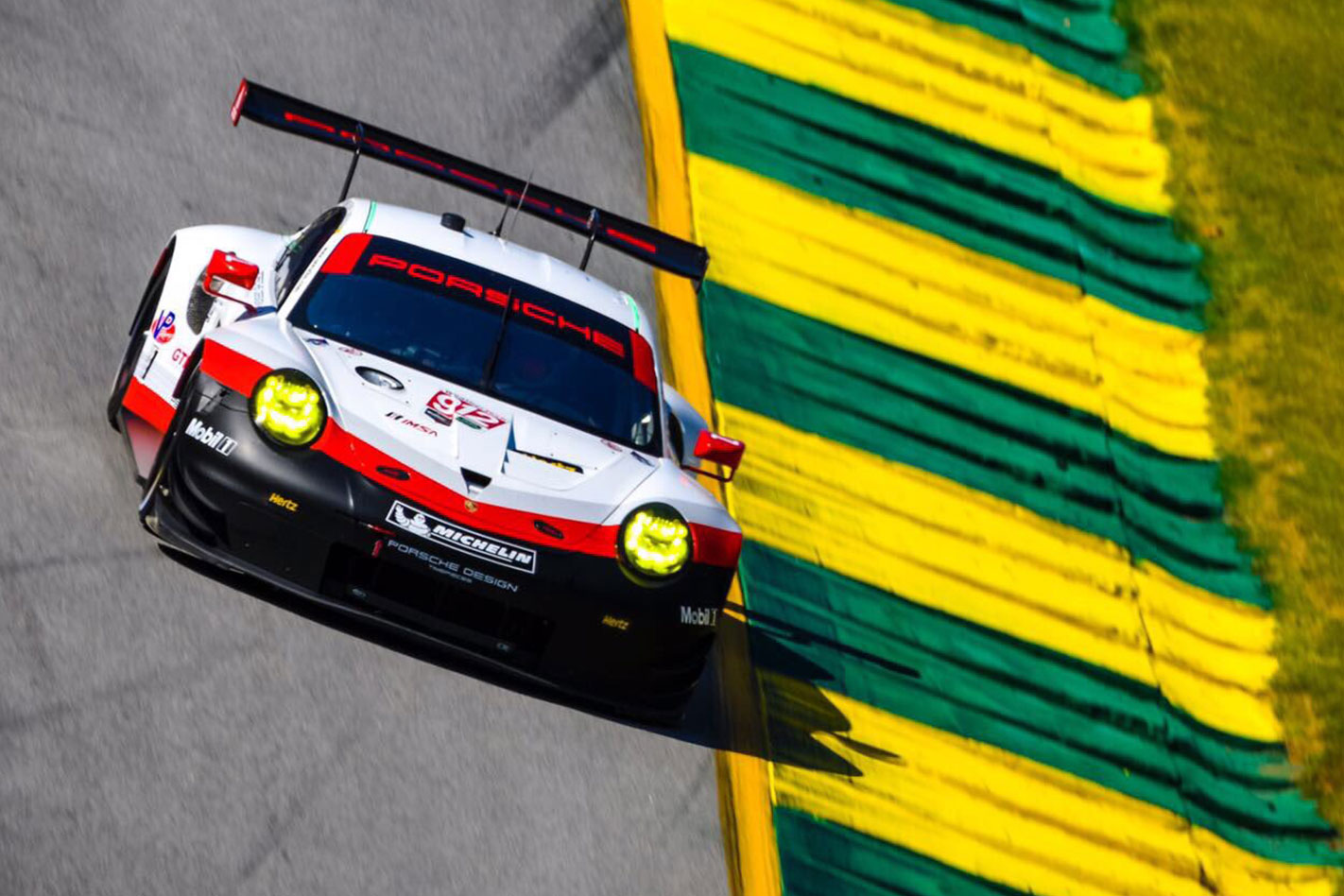
Bamber, who has secured two Le Mans 24-Hour wins in 2015 and 2017 for Porsche, will race with van Gisbergen at Sandown, the Gold Coast and Bathurst during the 2018 season in the number 97 Commodore.
Having driven with the likes of Nico Hülkenberg and Timo Bernhard in the WEC, Bamber will continue to race for Porsche’s GT squad in 2018.
“To be honest, the Bathurst 1000 and going to Australia to do that race as a co-driver has been on my radar for a long time.
“Porsche has known I’ve wanted to do it, and 2018 is the first time where we haven’t had a calendar clash for the past three or four years. So as soon as I saw 2018 could be a possibility, I started to do some research.”
It won’t be the first time Bamber shares a track with van Gisbergen, though in the past it was more of a friendly rivalry than a partnership.
“It is funny to think we raced go-karts against each other as kids back home, Formula Fords … 15 years later we’re together, which is kind of crazy.
“To think me, Shane, Brendon [Hartley; racing for Toro Rosso F1 in 2018], we were all kids in New Zealand that grew up racing karts together, and now we’re all around the world driving these race cars, and Brendon is in F1 next year.
“So yes, surreal. It’s a golden era for Kiwi motorsport at the moment.”
AUSTRALIA’S consumer watchdog has issued a chilling pre-Christmas warning about the increased dangers of Takata “alpha” airbags as another 20,000 vehicles are added to the list of affected vehicles.
The Australian Competition and Consumer Commission has urged drivers to check to see if their vehicle is scooped up in Australia’s largest-ever recall – more than 2.7 million cars dating back more than a decade are affected here, and more than 100 million worldwide – before heading out on a road trip over the summer break.
If it is, the ACCC says park it up and don’t risk driving it over the Christmas period, it warns.
The warning comes as Mitsubishi added another 20,187 recalled cars to the tally, this time the Pajero off-roader built between 2013 and 2017 – and despite the Takata airbags being identified as an issue in Australia from as early as 2015.
The Australian recall includes vehicles from BMW, Chrysler, Dodge, Honda, Ferrari, Jeep, Lexus, Mazda, Mitsubishi, Nissan, Performax, Subaru and Toyota, as well as some specialist vehicle manufacturers, and involves model runs from 2000 to 2015.
However, the ACCC’s campaign is targeting the most dangerous “alpha” airbags, ones fitted to about 43,000 Honda, Toyota, Nissan, BMW, Mazda and Lexus-badged cars sold here between 2001 and 2004. The later “beta” bags, which benefit from an improved manufacturing process, are considered less lethal, although still need replacing at the cost of the car maker.
“We urge drivers of vehicles with alpha airbags installed to immediately book in to have their airbags replaced before driving anywhere over the Christmas holiday period,” ACCC deputy chair Delia Rickard said. “There is a significant and much higher risk of injury or death involved in driving vehicles fitted with these alpha airbags.”
These alpha airbags are the ones that deteriorate over time, and spit out metal fragments when they deploy in a crash, sending sharp bits of shrapnel at the people they are supposed to protect. Worldwide, these airbags have been responsible for a number of serious injuries and deaths, including a serious injury in Australia in April, and more chillingly, a death in July.
“As we approach the festive season, many of us are driving longer distances, so it is vital to act now to avoid a tragedy,” Rickard said. “If you have a car that contains an ‘alpha’ airbag, our advice is to not to drive it until the airbag has been replaced.”
The Federal Government is currently considering if it will issue a compulsory recall notice to force car companies to replace the faulty airbags in their vehicles – with some of the replacement airbags needing to be replaced again as they age.
Australia’s car brands have recalled about 2.2 million of the 2.35 million vehicles affected by the Takata airbags in the last two years. As of July this year, only 850,000 had been rectified.
Honda, with more than 273,000 faulty airbag-equipped vehicles and the brand linked to the only Takata-related death in Australia, has the largest number of recalled cars here. Spokesman Neil McDonald told Wheels that Honda had now completed more than 85 percent of its airbag replacements.
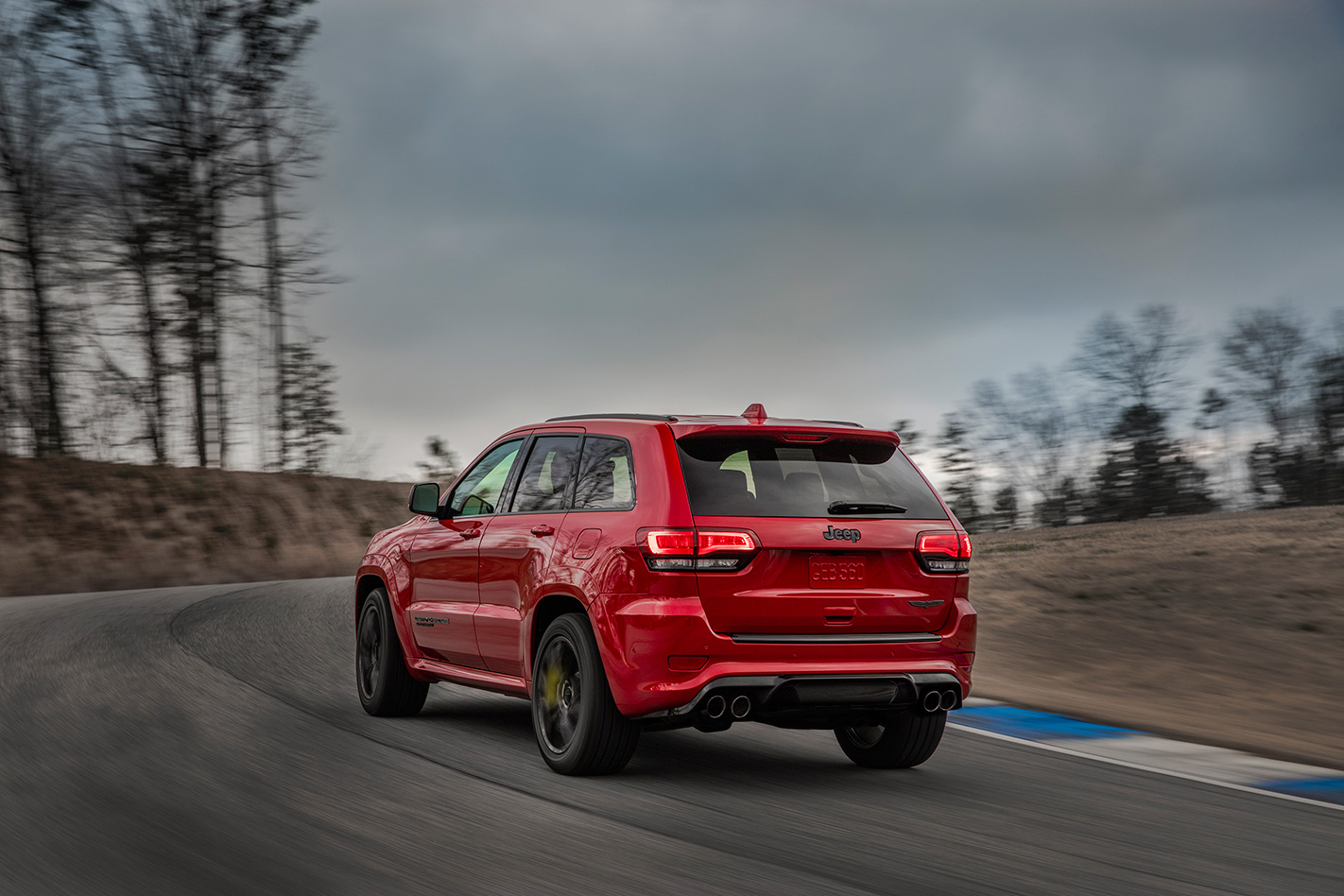
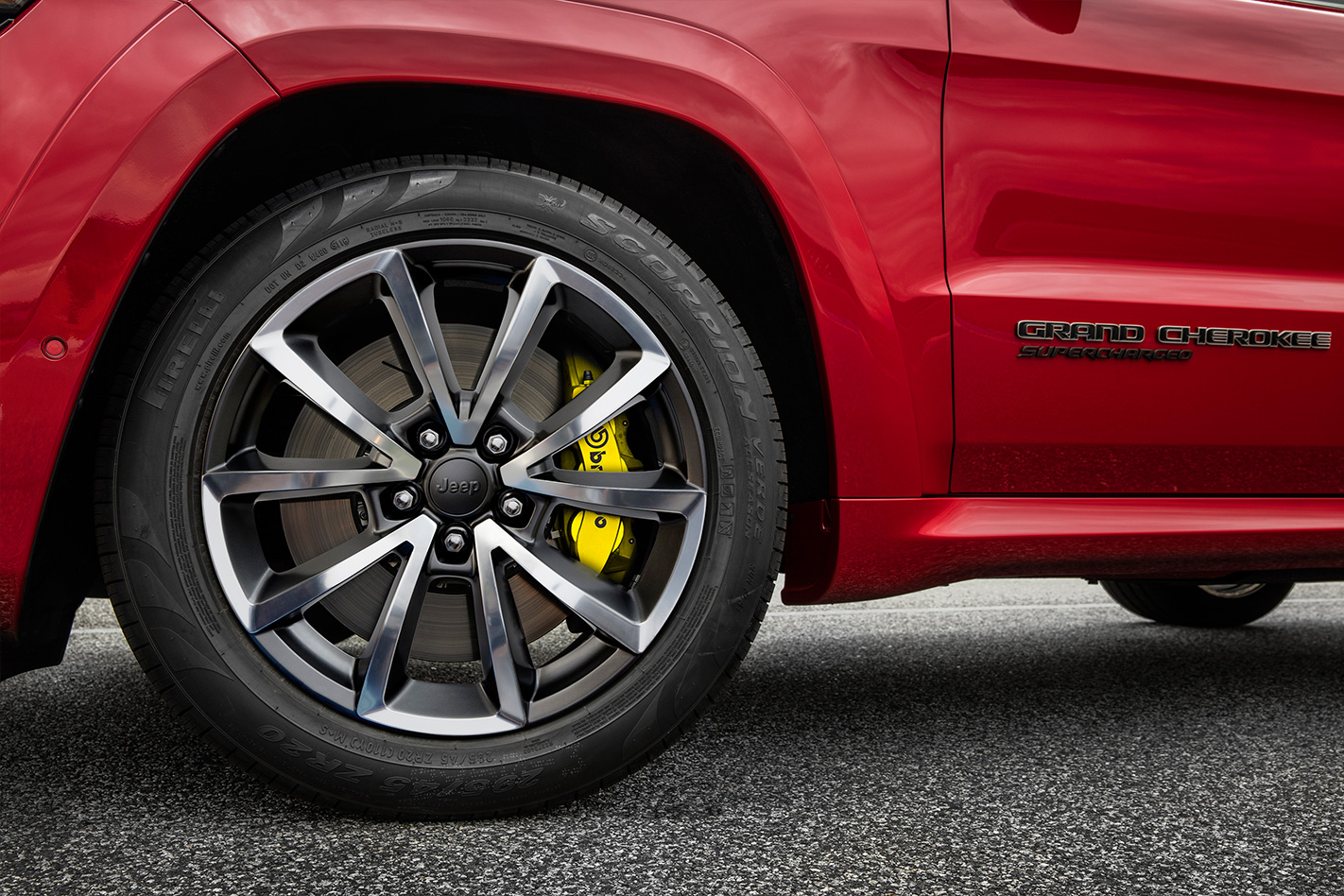
Australian pricing for the 522kW Hellcat-powered Jeep Grand Cherokee Trackhawk has been revealed, as well as local specification for the fastest production Jeep.
At $134,900, it’s almost $45,000 more expensive than the SRT8. But the Trackhawk also has 178kW more, as well as its 868Nm well and truly eclipsing the SRT8’s 624Nm.
The supercharged 6.2-litre Hemi V8 – combined with its 8-speed automatic gearbox – can pull the Trackhawk to 100km/h in a physics-defying 3.7 seconds, and run a quarter-mile in 11.6s.
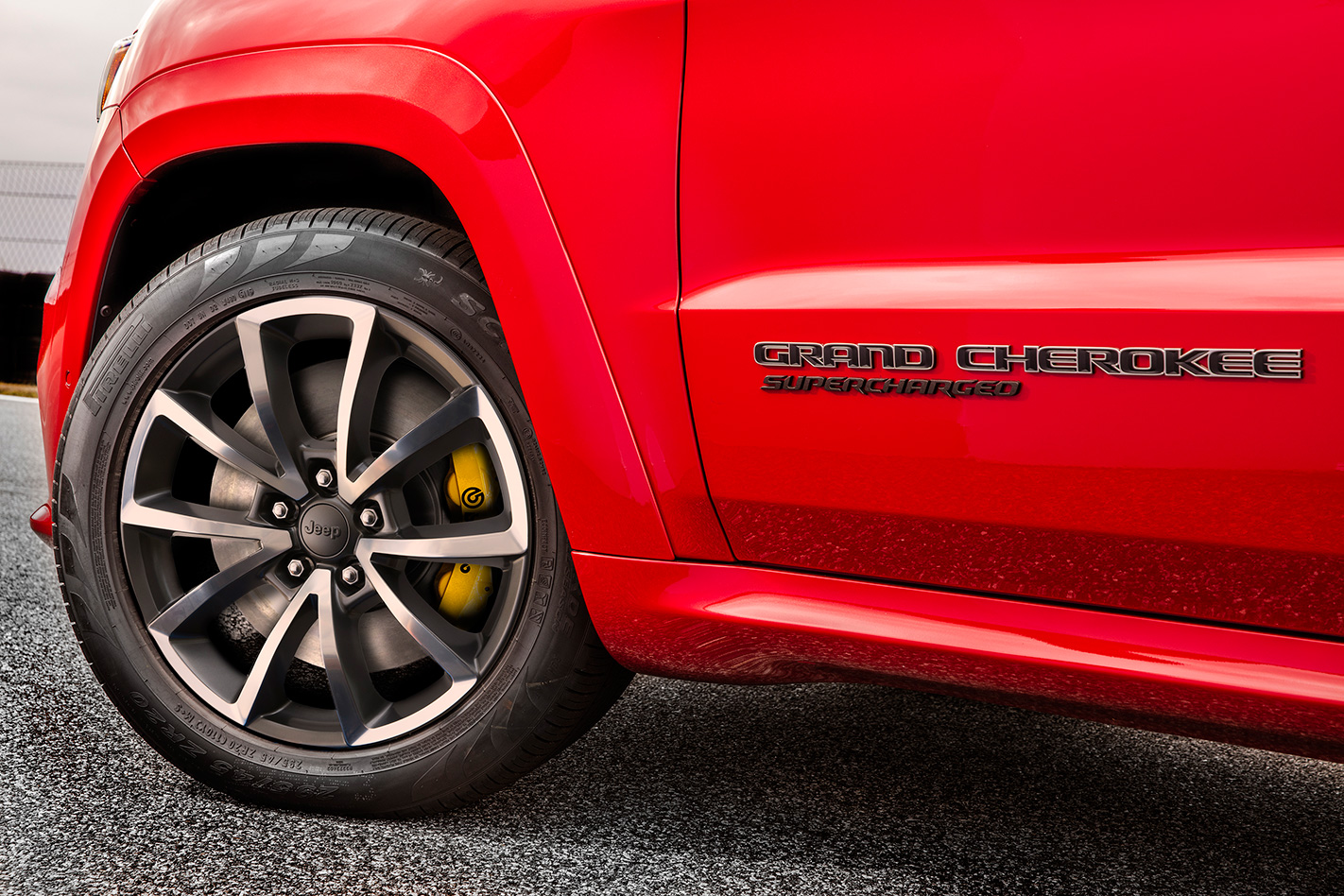
The options and specs listing for Australian Jeeps reveal it comes with Bilstein adaptive dampers, 20-inch alloys, 295/45 Pirelli P Zero tyres, and Brembo brakes which can pull the 2.4-tonne Trackhawk up in just 37m.
“After months of anticipation, I’m elated to announce the Trackhawk has landed,” says Zanlunghi.
“The Grand Cherokee Trackhawk not only sets new standards in the Australian SUV market, but the overall performance car market.
“As soon as we announced that the Trackhawk was destined for Australia, our dealers were inundated with enquiry and started taking orders.”
All 62 Trackhawks which were initially allocated to Australia – a reference to the 6.2-litre engine displacement – have been already spoken for by keen Mopar fans.
However, Jeep says it’s still taking orders for the Trackhawk from customers, meaning more should be on the way.
After a brief hiatus, the Jeep Compass is set to make a return to Australian showrooms with a four-model lineup ranging in price from $28,850 to $44,750.
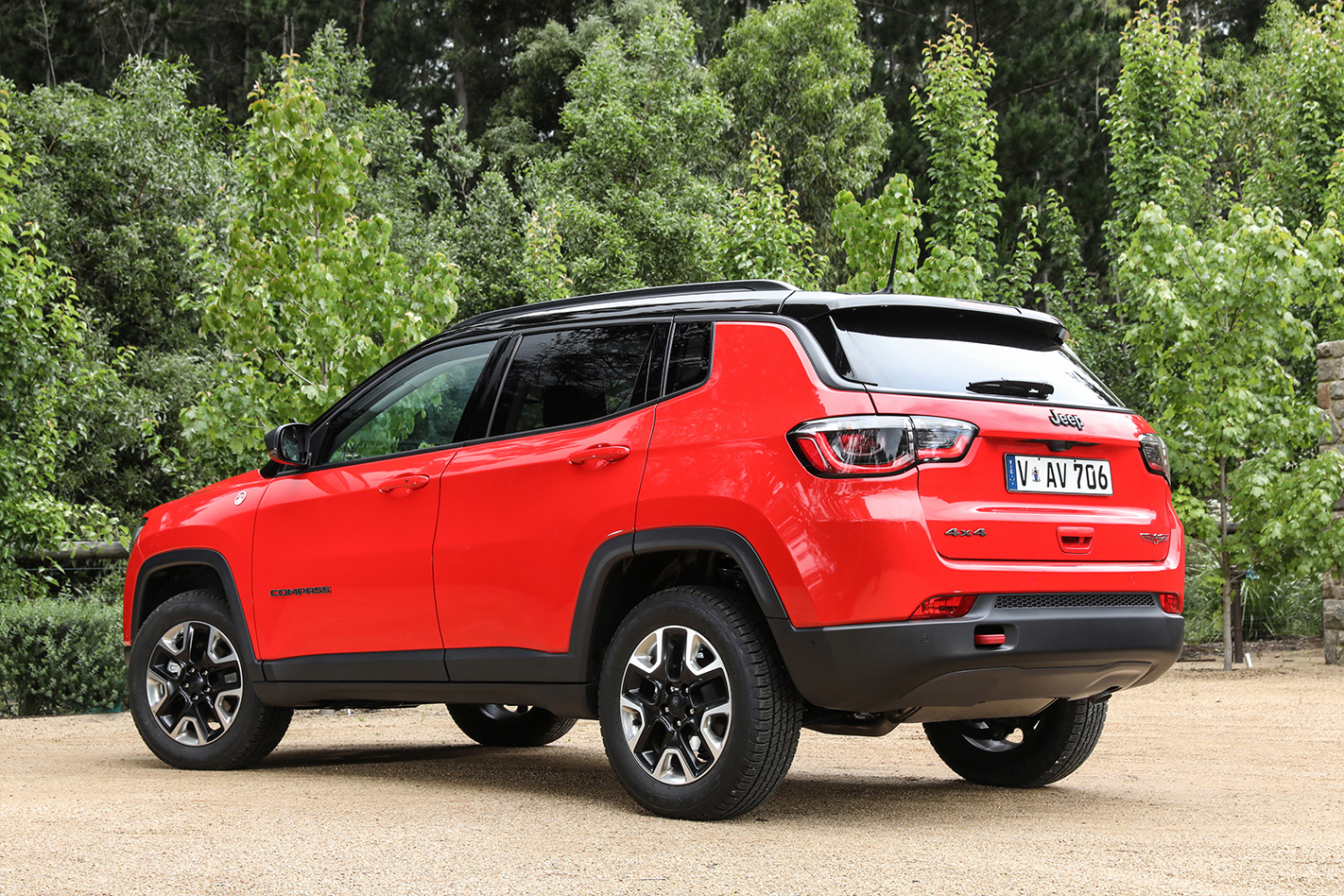
On sale from January 14, the 2018 Jeep Compass is an all-new offering that trades heavily on its butch styling and promise of go-anywhere capability, but also on what Jeep says is compelling value. Indeed, at the low end, the Compass is price competitive with segment stalwarts like the Mazda CX-5, Toyota RAV4 and Hyundai Tucson, while the range-topping Compass Trailhawk undercuts the majority of its Japanese, Korean and European rivals.
It’s also placed uncomfortably close to the compact Jeep Renegade, which sits in a size class lower than the Compass yet wears a starting price of $26,290 and tops out at $40,290. Measuring 4394mm long and 1819mm wide, the Compass sits roughly midway between the Renegade and the mid-sized Jeep Cherokee.
Sourced from India, the 2018 Compass will be available with two engines – a single petrol and a single diesel – three transmission options, front-wheel drive or all-wheel drive and four trim grades.
The petrol is Fiat-Chrysler’s 2.4-litre ‘Tigershark’ naturally-aspirated four-cylinder, which produces 129kW and 229Nm and consumes an average of 7.9L/100km when joined to the six-speed automatic front-wheel drive transmission, 8.6L/100km as a FWD six-speed manual or 9.7L/100km with the all-wheel drive nine-speed automatic drivetrain.
Meanwhile, the diesel-burning option is a 2.0-litre ‘Multijet’ powerplant producing 125kW and 350Nm. Available only on all-wheel drive, nine-speed auto models, the Compass diesel drinks an average of 5.7L/100km on the combined cycle.
Here’s how the model walk-up looks:
Jeep Compass Sport
- 2.4-litre petrol
- Six-speed manual or six-speed auto
- Front-wheel drive
- 17-inch alloys
- Rear parking camera
- 5.0-inch touchscreen display
- Digital radio tuner
- Cloth upholstery, leather-wrapped steering wheel
- 7 airbags
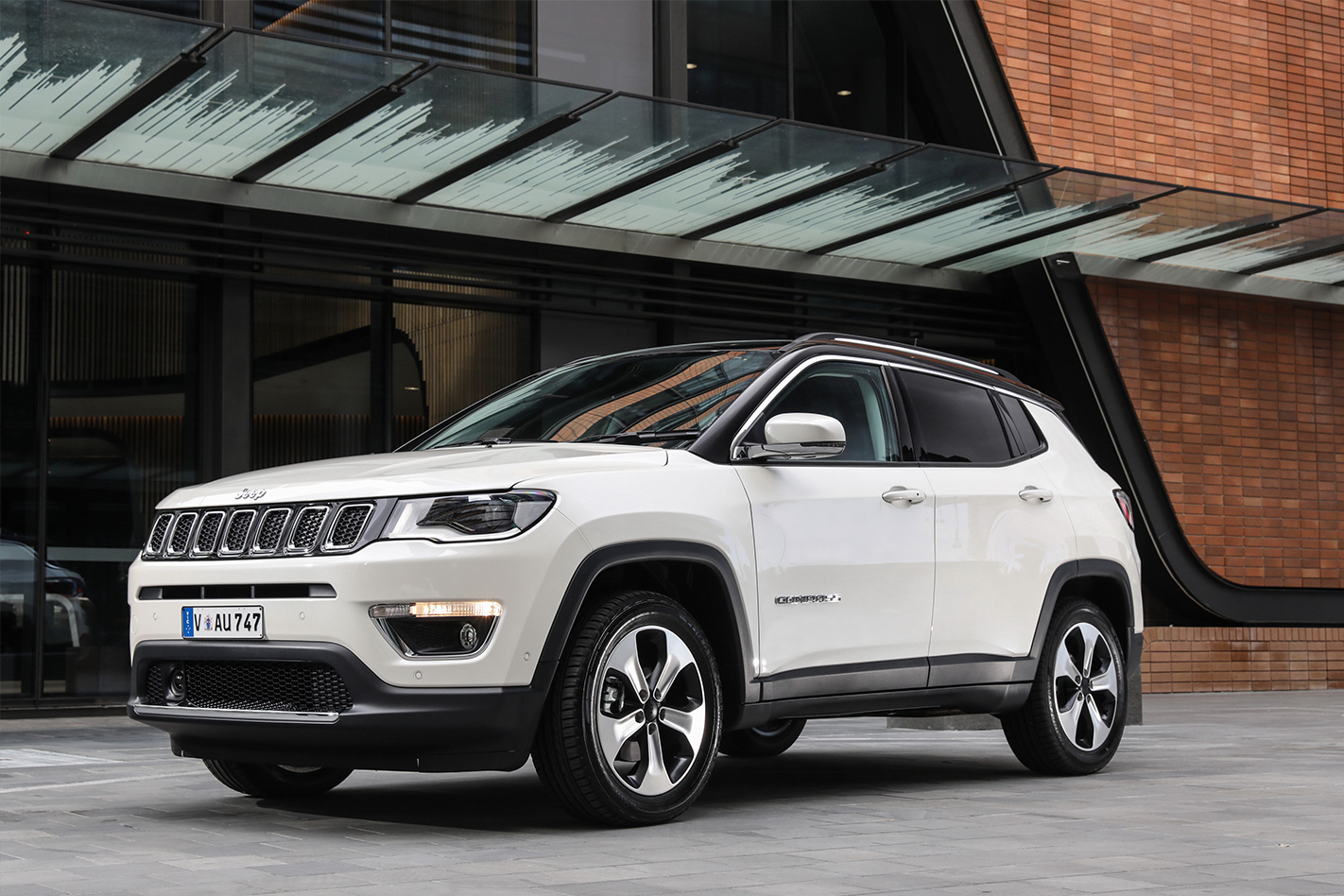
Jeep Compass Longitude (as above, plus)
- Dusk-sensing headlamps,
- Foglamps and cornering lamps
- Rain-sensing wipers
- Forward-folding front passenger seat
- Privacy glass
- Six-speed auto standard
- Optional Premium Audio Package including 8.4-inch touchscreen, sat nav, Android Auto, Apple CarPlay, dual-zone climate control
- All-wheel drive standard
- Nine-speed auto standard
- Option of 2.0L diesel
- Premium Audio Package as standard
- 9-speaker BeatsAudio sound system
- 18-inch alloy wheels
- Bi-xenon headlamps
- LED tail lamps
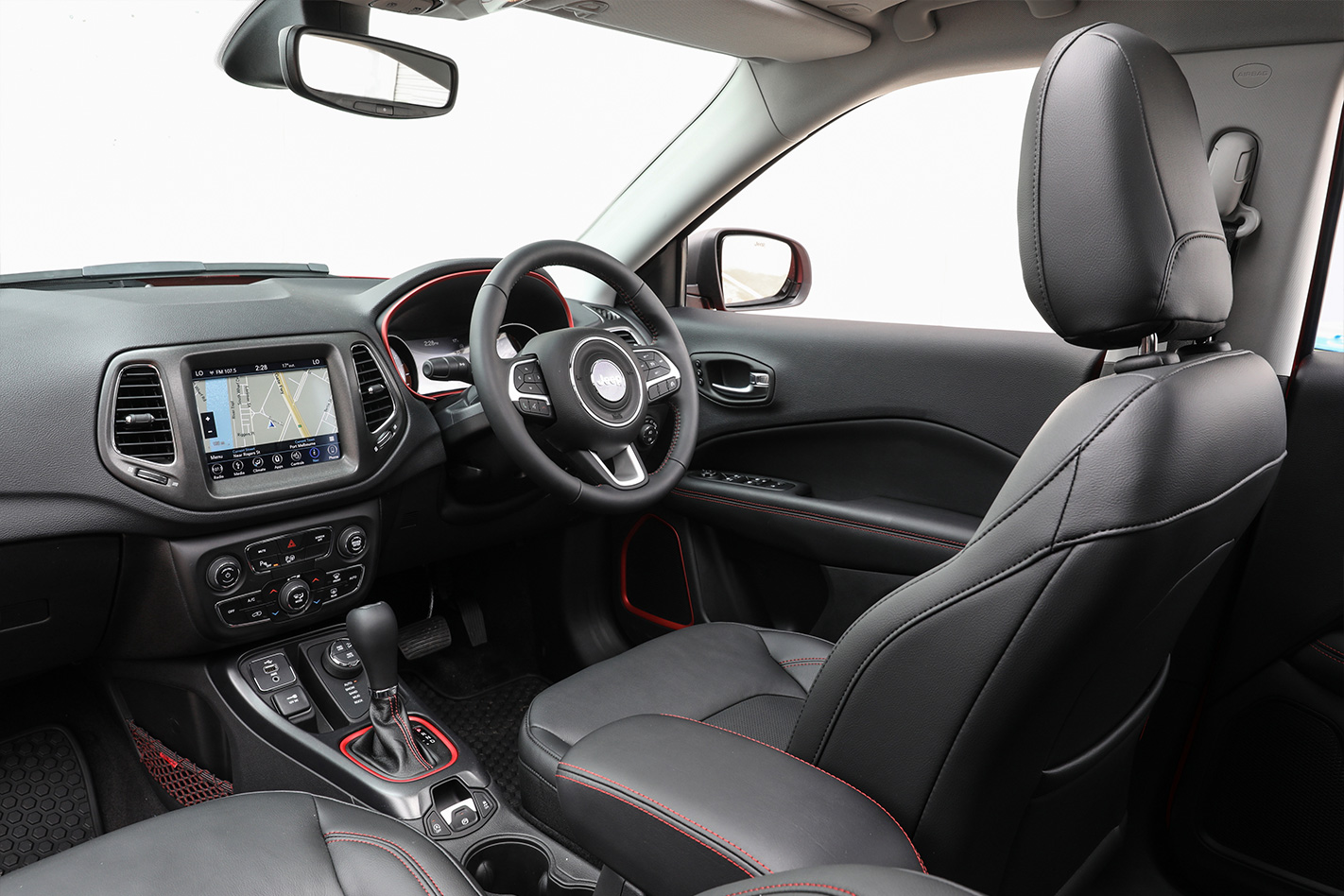
- Leather upholstery
- Heated front seats
- 7-inch colour LCD instrument panel
- Powered front seats
- Optional Advanced Technology package including lane departure warning, forward collision warning, autonomous emergency braking, adaptive cruise control, blind spot monitoring, auto high beam and powered tailgate.
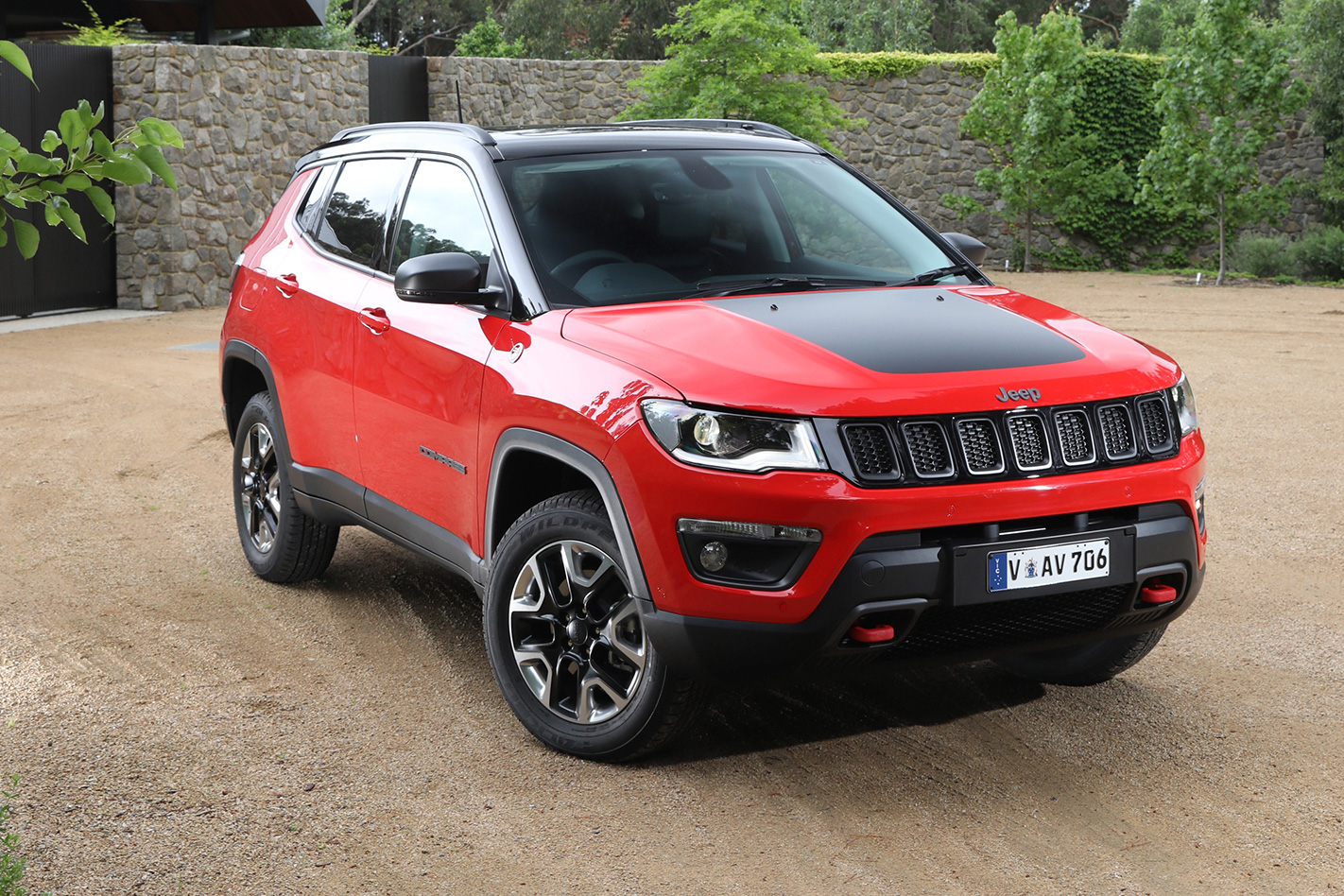
- 2.0L diesel standard
- Jeep Active Drive Low 4×4 system
- Raised suspension
- Underbody skid plates
- Full-size spare
- Black bonnet decal
- Trailhawk front and rear bumpers
- Red tow hooks
Safety-conscious buyers should note that autonomous emergency braking – fast being adopted as standard equipment by many automakers due to its potentially life-saving ability to avoid accidents – is conspicuously absent from the standard specification of every 2018 Jeep Compass.
Only available as an option on the higher-spec Limited and Trailhawk variants, AEB isn’t offered at all on the base-model Sport and Longitude. With competitors like the Mazda CX-5 and Volkswagen Tiguan making that technology standard, its absence on the all-new Compass is worth noting
PRICING
The Jeep Compass goes on sale on January 14 next year, with retail pricing as follows:
– Jeep Compass Sport petrol manual FWD – $28,850
– Jeep Compass Sport petrol automatic FWD – $30,750
– Jeep Compass Longitude petrol automatic FWD – $33,750
– Jeep Compass Limited petrol automatic AWD – $41,250
– Jeep Compass Limited diesel automatic AWD – $43,750
– Jeep Compass Trailhawk diesel automatic AWD – $44,750
WHAT IS IT?
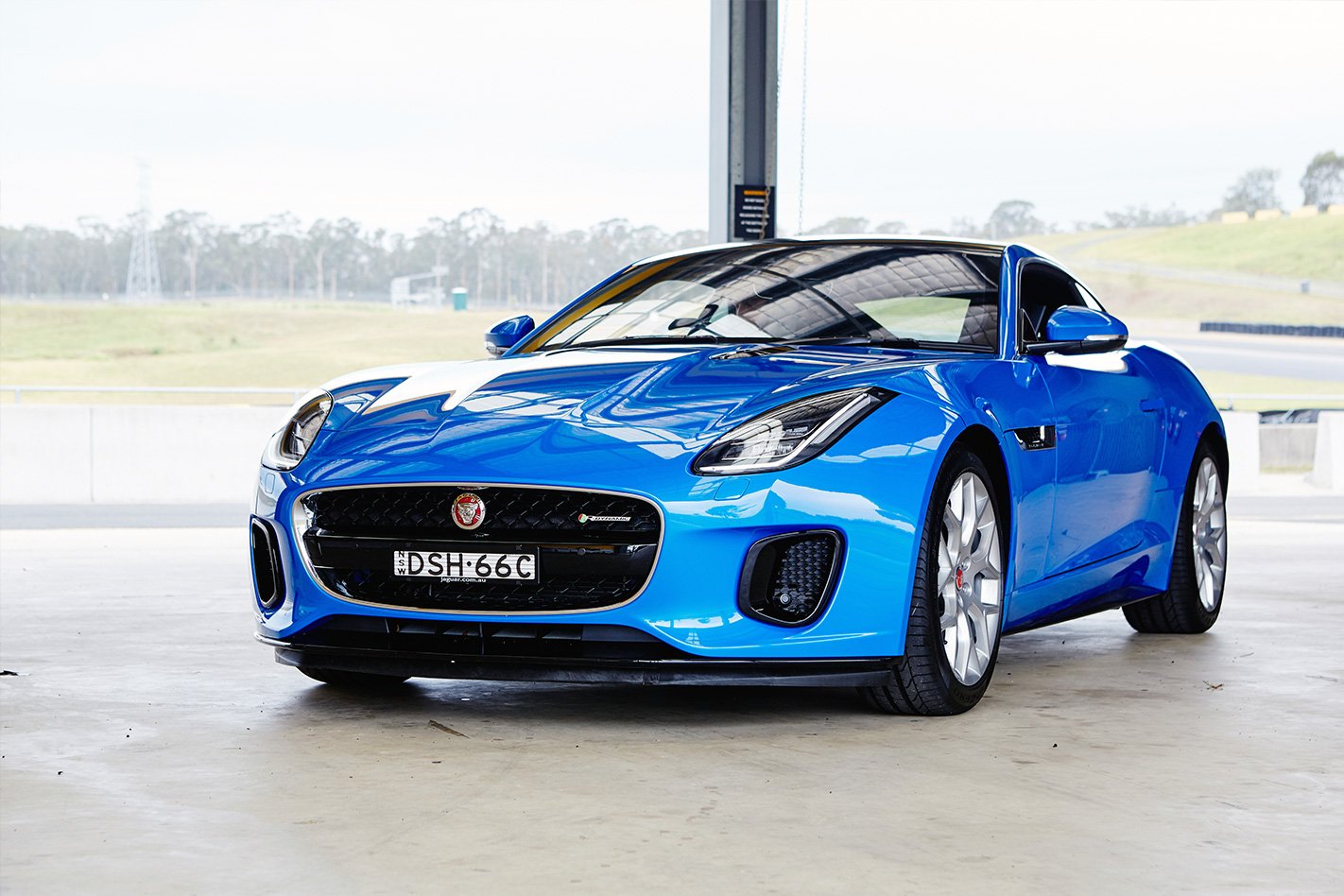
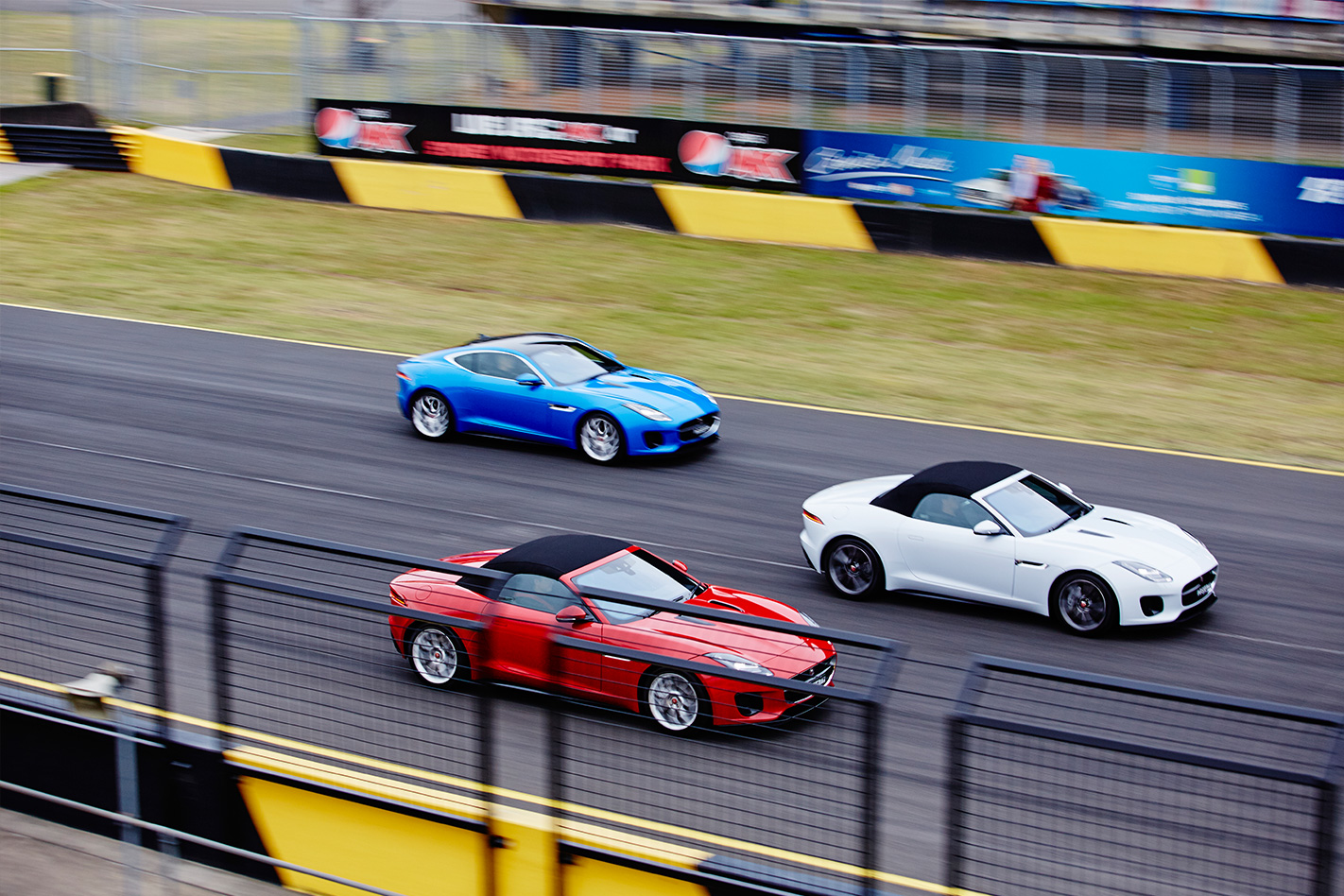
A more affordable entry point to the now 32-strong Jaguar F-Type sportscar line-up, offered in both coupe and convertible body styles.
WHY WE’RE DRIVING IT
Previously the F-Type was available only with supercharged V6 and V8 petrol engines; this new model sees the introduction of 2.0-litre four-cylinder power.
Audi TT S quattro; Porsche Cayman/Boxster; Mercedes-Benz SLC300
VERDICT
A worthy addition to the line-up, albeit with a distinctly different character to the V6 and V8 models. Likable, chuckable, with performance that will be ample for most.
THE WHEELS REVIEW
RATHER than question the legitimacy of Jaguar’s decision to fit a 2.0-litre turbo four-pot to its F-Type, maybe we should instead be asking: “What took you so long?”
Jaguar’s rivals in this segment have embraced turbo fours for about as long as anyone can remember. The Audi TT S, BMW Z4, and Mercedes-Benz SLK and subsequent SLC have always relied on four-pot power to achieve sales volumes. The Jaguar’s two-seater rivals from Porsche, meanwhile, are now 2.0-litre turbo fours exclusively.
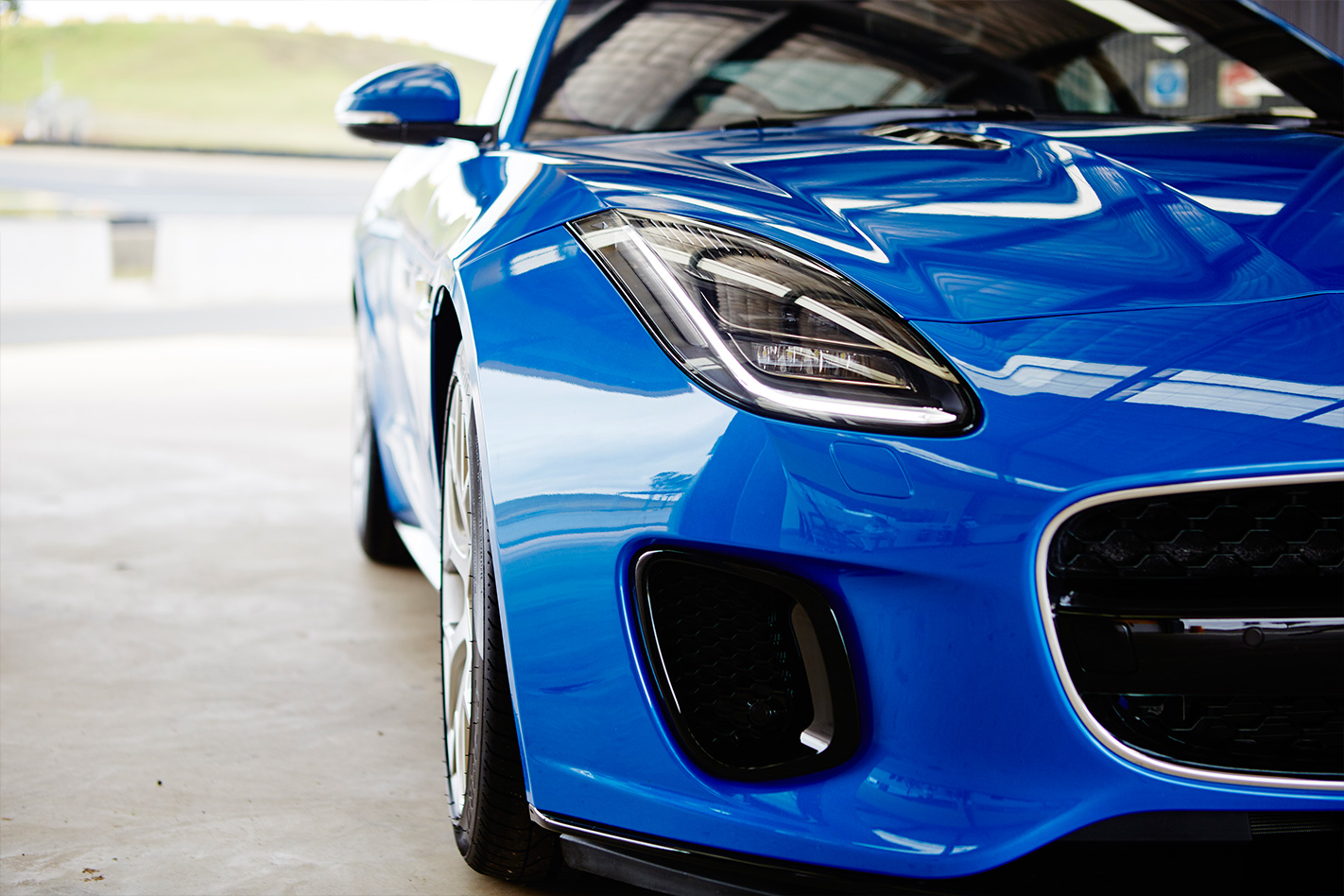
Besides, it’s not as if Jaguar has just slipped in a limp-wristed, barely boosted four to cynically create a hairdresser’s special. Fact is, the Ingenium engine installed here is in a way more muscular state of tune than it appears anywhere else in the British manufacturer’s line-up.

Stands to reason, then, that the claimed 0-100km/h performance only slackens by less than half a second, now 5.7sec. Buyers eyeing the new F-Type entry point may care that it uses a claimed 16 percent less fuel than the 250kW V6, now 7.2L/100km; they’ll almost certainly be interested in the price, which carves around $12K off what was the previous entry point.
Standard equipment includes 18-inch alloy wheels, leather and suede/cloth sports seats, leather-wrapped steering wheel, aluminium trim, climate control, keyless ignition and an 8-inch infotainment touchscreen. Six airbags are standard in the coupe; four in the convertible and autonomous emergency braking is included. There are some notable optional extras though, including a reversing camera, blind spot monitoring and lane keeping assist. LED headlights with DRLs are also on the options list at this level; elsewhere in the range they are now standard.
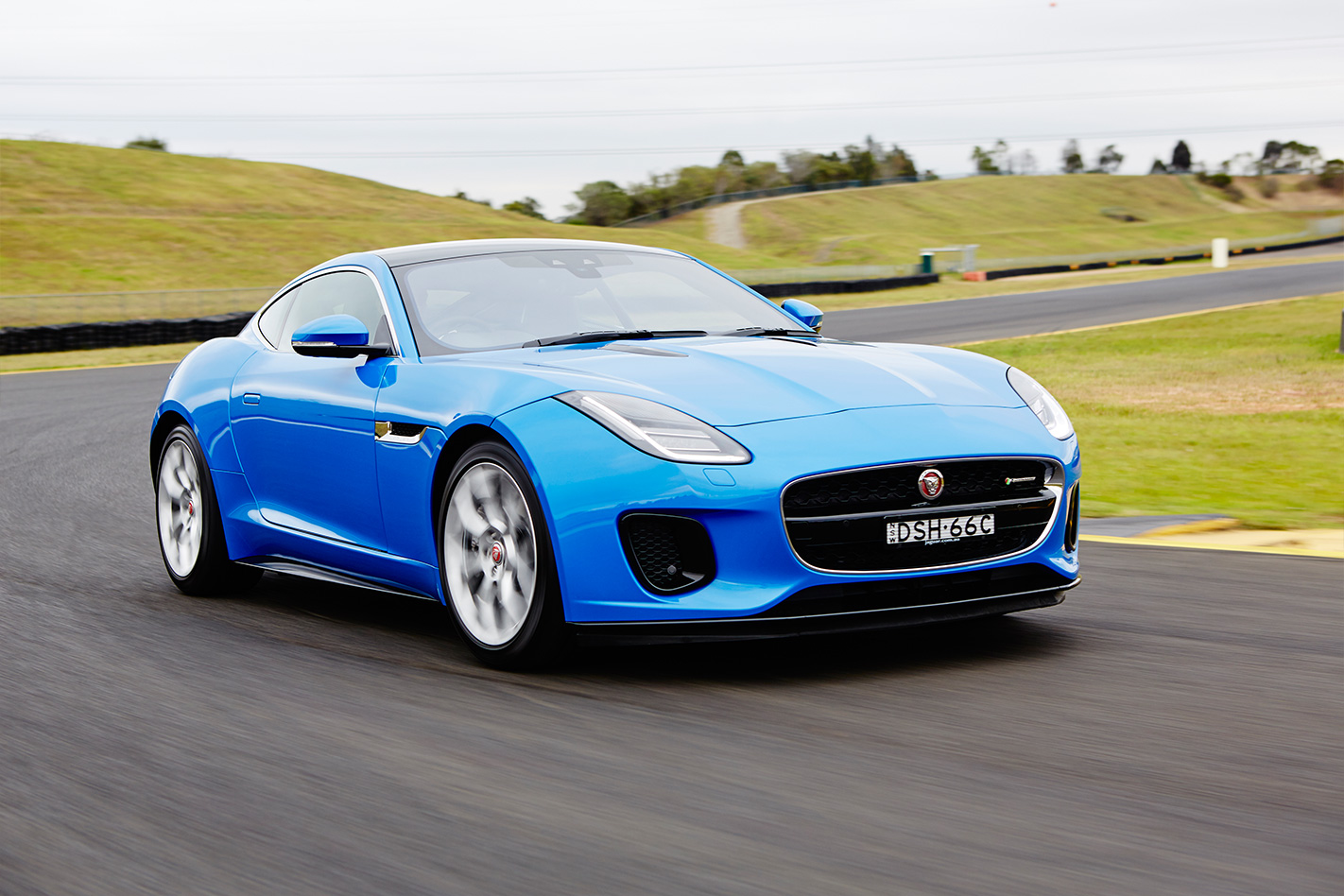
In theory that should bring a small gain in ride compliance; I couldn’t discern a difference without a back-to-back comparison. I’d also wager that the 19-inch rubber fitted to our test cars, as part of the R-Dynamic package (which adds around $7800, and more than half F-Type buyers tend to go for) makes a more perceptible difference to ride. If you prioritise comfort, stick with the standard 18s, but the ride is not harsh or uncomfortable on the bigger rubber.
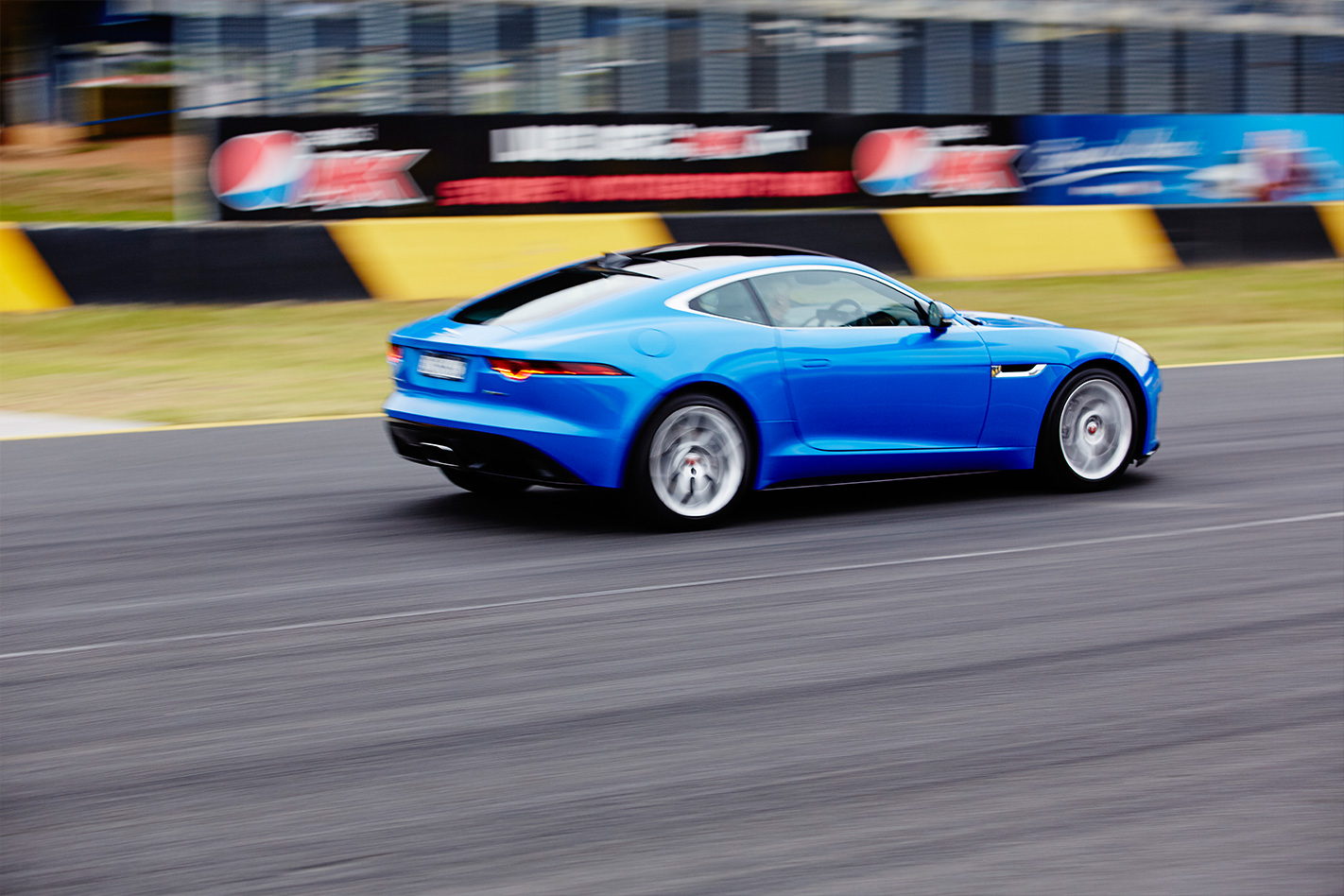
There’s also a final layer of mechanical polish missing from the engine in this installation; not a major criticism, it just comes off as little more industrial than expected when you’re stroking it around in normal driving. Importantly, though, it feels amply torque-rich and lag-free. Given a more free rein, it growls agreeably and salutes a sharp lift-off with a rapid volley of pops that are well intentioned, if a fraction on the contrived side.
SPECS
Model: 2018 Jaguar F-Type 2.0-litre coupe Engine: 1988cc 4cyl, dohc, 24v, turbo Max power: 221kW @ 5500rpm Max torque: 400Nm @ 1500-4000rpm Transmission: 8-speed automatic Weight: 1521kg 0-100km/h: 5.7sec Fuel consumption: 7.2L/100km Price: $107, 012 On sale: Now
JEEP expects Australia to be its second-largest customer globally for the Jeep Grand Cherokee Trackhawk – the off-road brand’s 522kW/868Nm 6.2-litre supercharged Hemi V8-engined performance SUV.
Jeep Australia last night pulled the wraps off what will stand as the third most powerful vehicle sold here, and the most powerful SUV globally. It will burst from 0-100km/h in 3.7 seconds, and wind out all the way to a top speed of 289km/h.
Oh, and did we mention it would cost just $134,900? That’s at the very low end of media speculation over pricing.
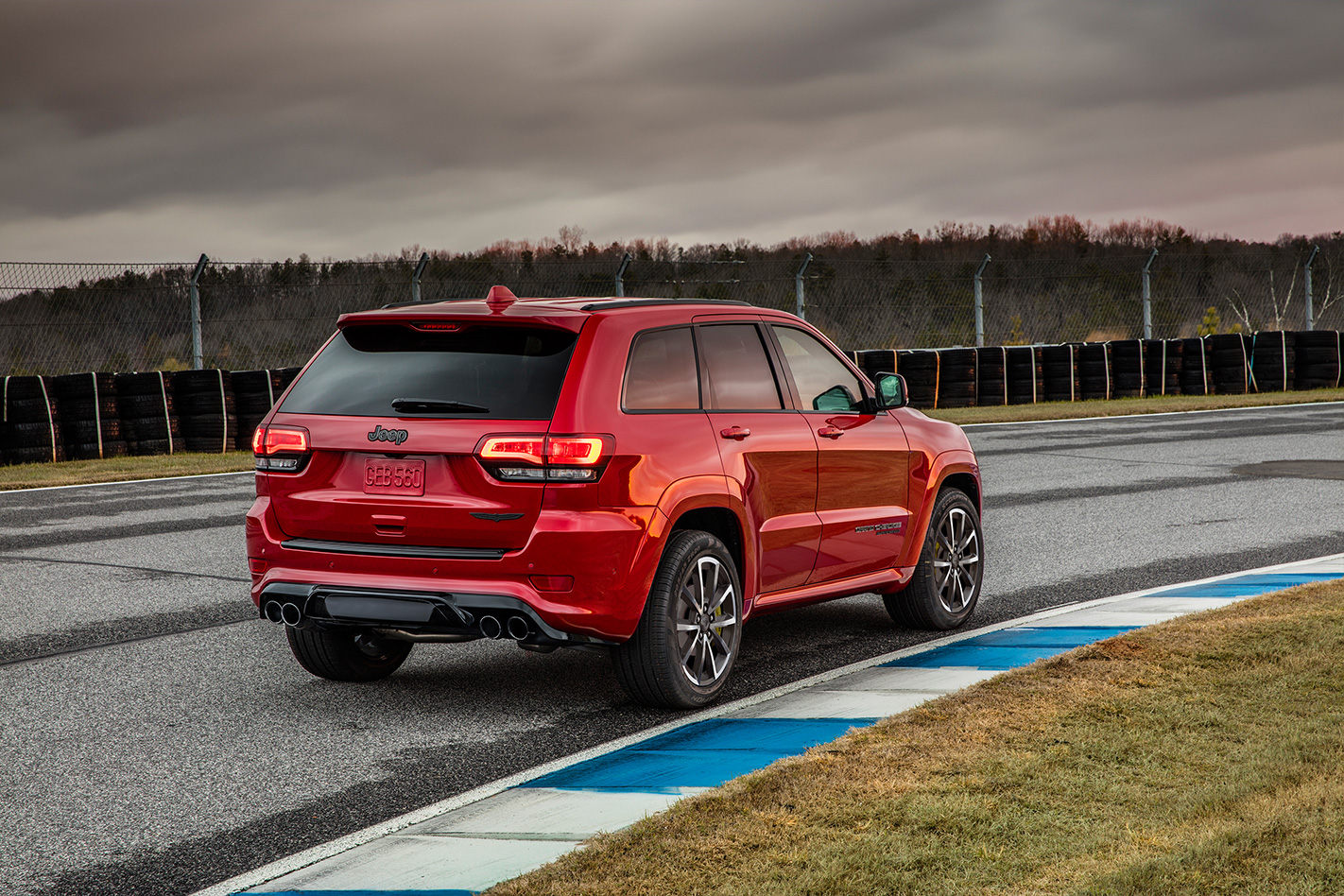
He’s right. Shop around for a sub-4.0 second SUV, and you’re nudging up against a shiny new Lamborghini Urus with its 478kW/850Nm 4.0-litre twin-turbo V8 that can pip the Jeep to 100km/h by 0.1secs. Everything else in the sub-4.0 club – the Mercedes-AMG GLC 63 S and the Alfa Romeo Stelvio QV – strolls to the line by comparison.
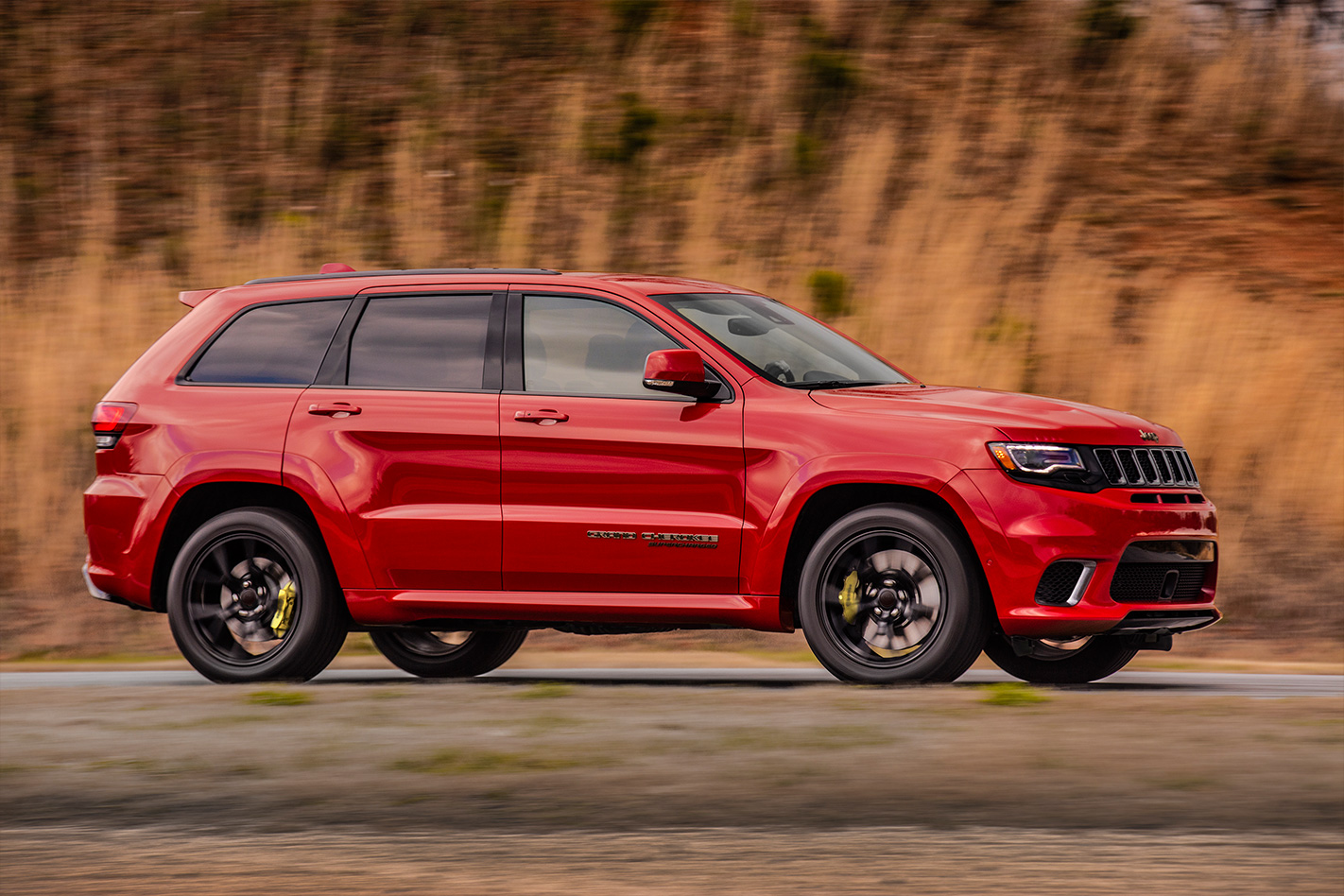
Jeep brand boss Guillaume Drelon told Wheels that the company expected Australia to become the largest market for the Trackhawk outside the US. Asked how many cars that would represent, though, and Drelon wouldn’t commit to a number.
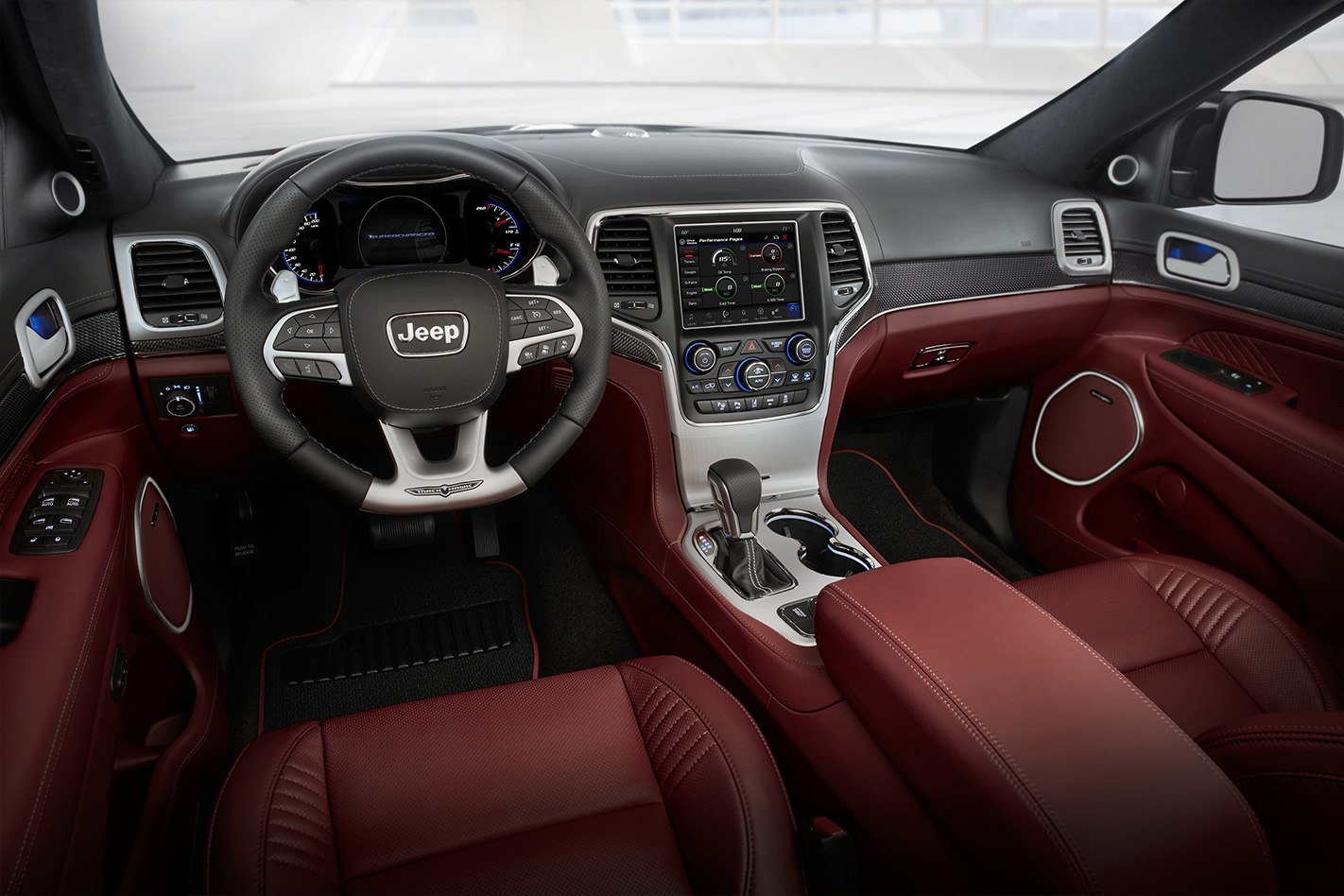
The most powerful production Hemi ever produced sits in front of an eight-speed gearbox sending drive to all four wheels. Look inside the cabin, and instead of what would be the settings for offroad functions in other more all-terrain capable Grand Cherokees, there’s an ominous “track” setting next to a button featuring a drag strip Christmas tree and the word “Launch”.
Yeah, fuel economy. The Jeep Grand Cherokee will officially use 16.8 litres of fuel on the combined cycle for every 100 kilometres it travels. The same amount of fuel will get a Toyota Prius just shy of 500km.
Standard features for Australia include Jeep’s Quadra-Trac on-demand all-wheel-drive system, an electronic limited slip differential down the rear, adaptive dampers, Brembo brakes and a hill hold control to prevent those unwanted roll-back burnouts.
It also supports Apple CarPlay and Android Auto. Although we suspect owners would be listening to a very different tune than what the audio system provides.
THE company that counts Mercedes-Benz as one of its shining jewels is the most profitable car brand in Australia, data released by the Australian Tax Office shows.
The corporate tax watchdog has released a list of the financial results that the top 2000 public and private companies reported in the 2015-16 financial year.
Using a bit of simple maths – taking the taxable income away from the total income, and dividing it by the number of cars sold between July 2015 and June 2016 – yields a number that shows the strengths – or weaknesses – of 16 of the biggest car brands.
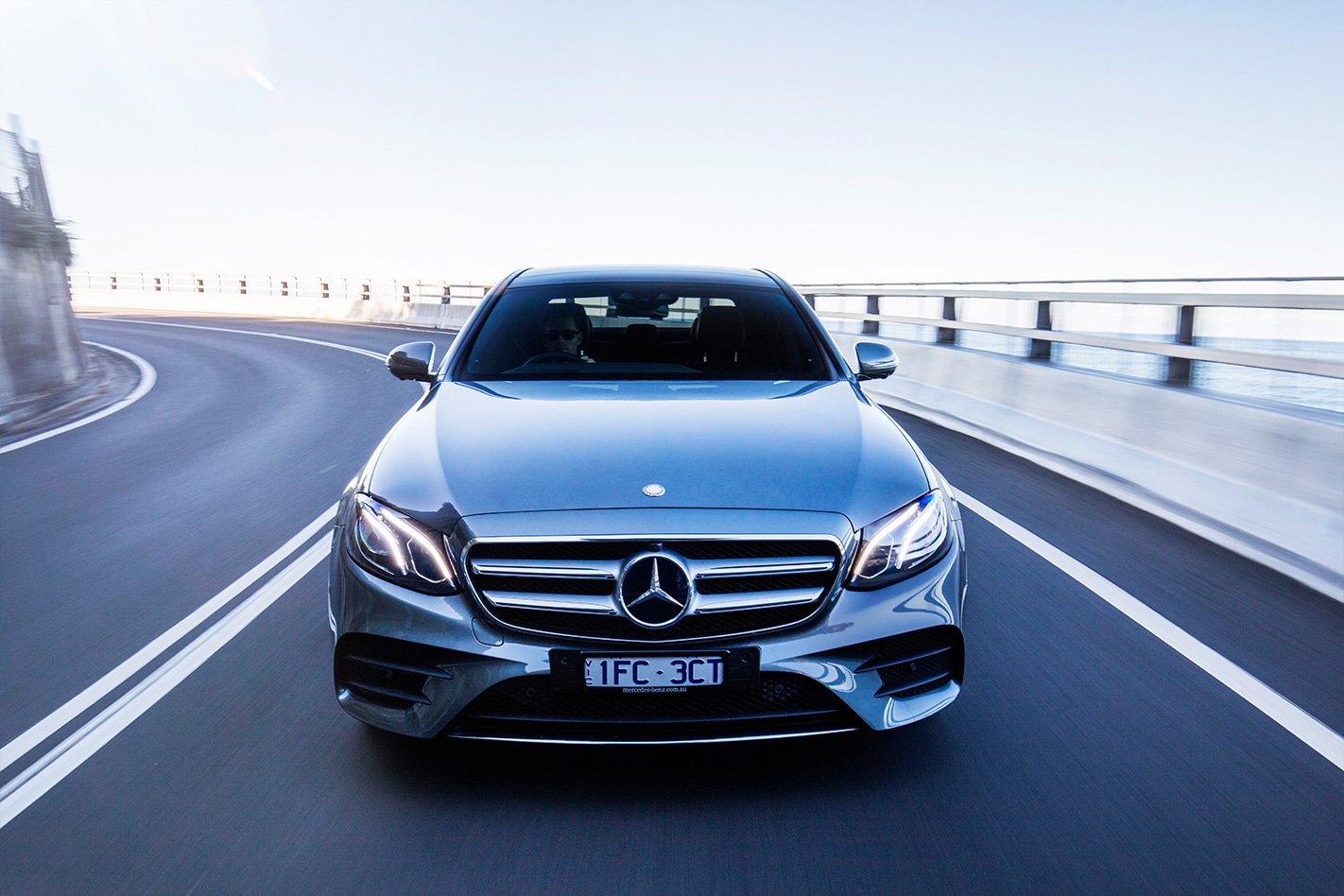
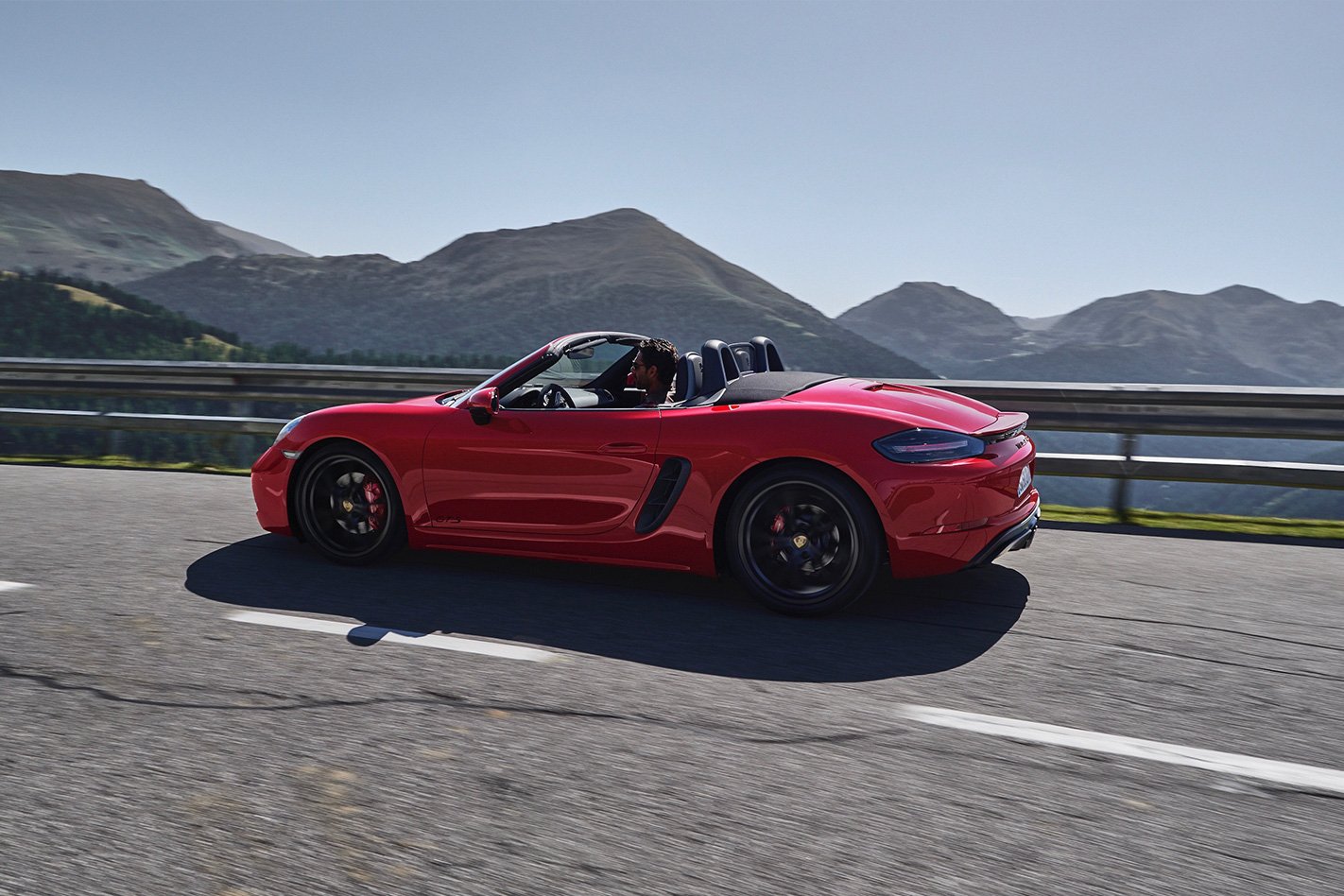
The winner is German brand Daimler, which reported a profit of almost $7300 for every car wearing a Mercedes-Benz badge that it sold here. However it’s worth noting that the wider Daimler group – similar to other car brands that have diversified their businesses in Australia – also sells trucks and buses, commercial vehicles, military vehicles and also offers financial products here. Passenger car and SUV sales may contribute the lion’s share, but they’re not the only contributors to Daimler’s bottom line.
The top three are closely followed by a clutch of mainstream brands – FCA Australia (Alfa Romeo, Chrysler, Dodge and Jeep), the $10 billion-plus market share giant Toyota, and fellow Japanese brand Subaru all earned between $1700-$2000 a sale, the data shows.
Volvo also posted strong numbers despite only attracting just more than 5000 sales for the financial year. Its per-car equivalent earned it $990 each time a new owner rolled out of showrooms.
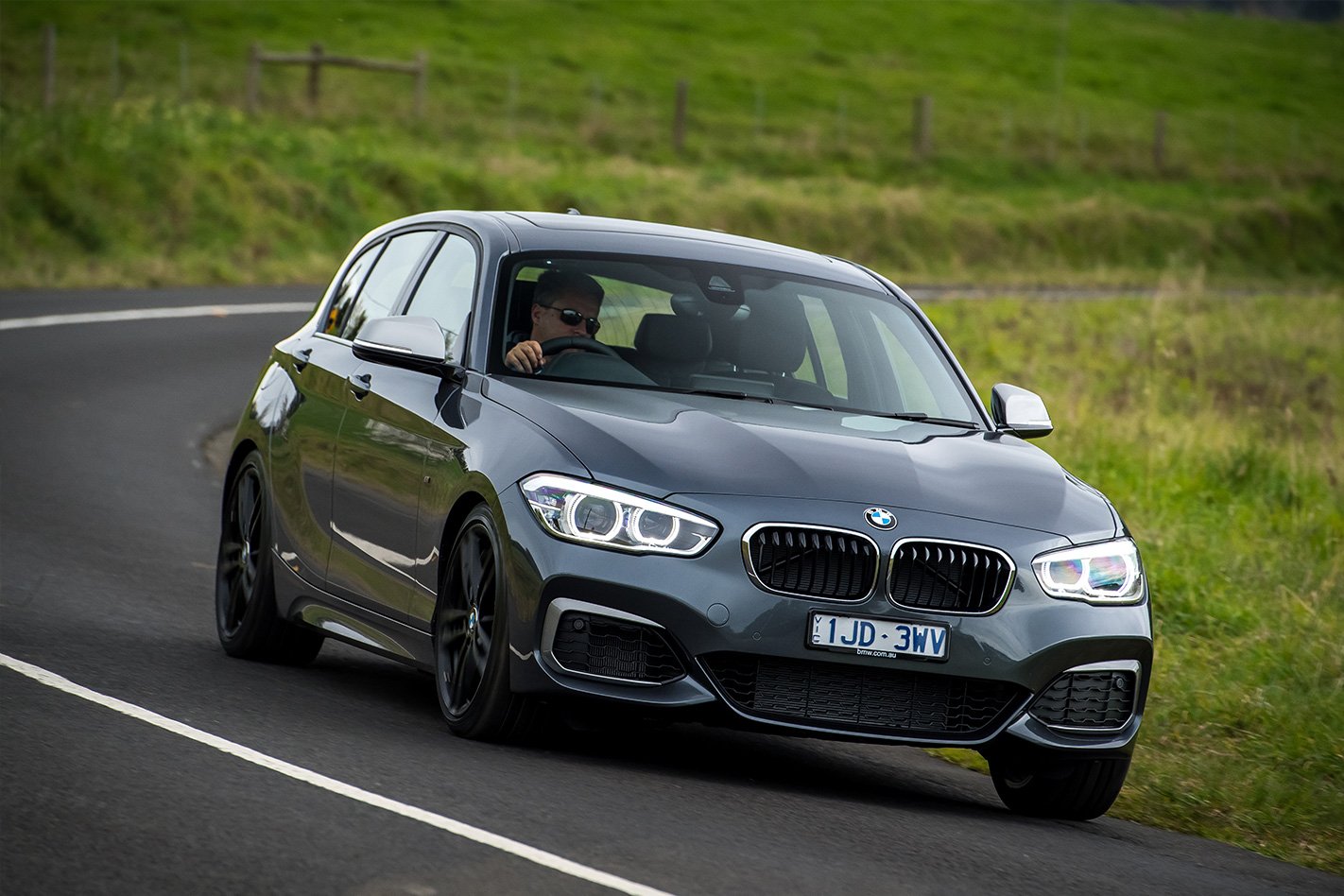
Nissan is worse off, earning only $121 a car despite posting the fourth highest income – $2.7 billion – in our group. It’s in something of a unique position, though, having to support a local manufacturing business that, among other things, casts aluminium covers for inverters fitted to the Nissan Leaf electric car.
And spare a thought for the bottom-dweller, Mitsubishi. It made less than a chicken parmigiana pub meal – just $13.98 – for each car it sold in 2015-16.
NUMBERS GAME: Profitability of Australia’s top 16 car brands FY2015-16*
Brand Income Profit per sale Daimler (Mercedes-Benz) $3,618,401,000 $7277.41 Porsche $623,128,382 $6114.80 BMW $2,460,348,916 $3855.74 FCA Australia $1,344,085,319 $1971.80 Toyota $10,342,138,099 $1874.69 Isuzu Ute $749,970,414 $1846.81 Subaru $1,450,411,099 $1838.98 Volvo $245,087,390 $994.35 Volkswagen $2,123,925,408 $965.18 Kia $833,183,653 $852.33 Audi $1,424,798,175 $765.08 Mazda $2,884,889,150 $700.35 Honda $960,062,001 $455.58 Hyundai $2,257,792,455 $403.25 Nissan $2,704,234,775 $121.33 Mitsubishi $2,135,327,314 $13.98 *Source: Australian Tax Office
