
The Skoda Kodiaq represents new territory for the Czech car brand. It’s never had a vehicle this big before, nor has it had a three-row SUV. Arriving in Australia at a time when SUV sales are surging upward, is the big Czech the right package for Aussie families?
TELL ME ABOUT THIS CAR
The Skoda Kodiaq is available in Australia in a single highly-featured specification, with only one engine – a 132kW/320Nm turbocharged petrol in-line four – available from launch. A diesel is expected to arrive before year’s end, and both engines will send power to the ground through a seven-speed dual clutch automatic and all-wheel drive.
And the range is simple: the sole model available right now costs $42,990, with your choice of three option packages, premium paint, a glass sunroof, and alternative wheel designs.

For a full list of the Kodiaq’s features, check out our range rundown here.
We took a Tech Pack-equipped Kodiaq, loaded it up with friends, and went on a road trip to see how it fared on Australian country roads. Given how new Skoda is to this size of vehicle, the Kodiaq makes a very strong case for itself as an alternative to more established large SUVs.
STRENGTHS
Skoda plays the value game well, and the petrol-powered Kodiaq’s $42,990 retail price makes it a keen deal considering its massive equipment advantage over similarly-priced rivals like the Toyota Kluger, Mazda CX-9, and Nissan Pathfinder.
Standard equipment levels are strong, and it’s unlikely to see many tempted to tick option boxes. Dual-zone climate control, a powered tailgate, LED headlamps, keyless entry and ignition, active cruise control, satellite navigation, smartphone mirroring, autonomous emergency braking – all are standard on every Kodiaq, and are in addition to expected luxuries like auto-down power windows and rain-sensing wipers.
While the third row seats may be fairly confined, there is at least a decent amount of space behind them when they’re raised. Cargo space measures in at 270 litres with all three rows raised, while dropping the third row creates a 560-litre volume with the second row slid all the way to the back. Slide the second row forward, and you get 765 litres of cargo capacity. Drop them altogether, and there’s a huge 2005 litres of carrying capacity in total (see below).

Ride comfort is pretty good. Bar some slight fussiness over small, high-frequency bumps, our Kodiaq tester practically ironed out big highway lumps and bumps with ease. We should note, however, that our Tech Pack equipped car rode on electronically-adjustable dampers, which are able to switch between a sporty and a comfortable tune – the latter obviously being the most agreeable. We can’t yet vouch for the standard, non-adjustable suspension’s tune.
The Kodiaq is loaded with cool and genuinely useful features like flip-out door edge protectors, headrest-mounted tablet holders, a removable boot-mounted LED torch, retractable shopping bag hooks, storage drawers under the front seats, and a twin-glovebox arrangement. All boost the Kodiaq’s everyday liveability score.
Refinement is excellent. The 2.0-litre petrol is a smooth engine and a quiet one when loping along on highways, while wind noise is well-suppressed considering the Kodiaq’s huge frontal area.

WEAKNESSES
Third row seat comfort isn’t amazing, and roughly on par with smaller seven-seaters like the new Honda CR-V and Mitsubishi Outlander. Headroom in the third row is acceptable, but knee and footroom is lacking for anyone that isn’t a small child. Flat seat cushions also impact comfort, meaning the Kodiaq’s sixth and seventh seats are really for occasional use only.
Engine performance isn’t matched to the Kodiaq’s weight, especially when travelling at highway speeds with four adults and their cargo aboard. Transmission kickdown is slow, which means overtaking needs to be planned carefully.

ANY RIVALS I SHOULD CONSIDER?
Given its size, price, and power output, the Kodiaq actually straddles the line between mid-size seven-seaters and proper large three-row SUVs. That means everything from the Honda CR-V and Mitsubishi Outlander to the Nissan Pathfinder, Toyota Kluger, and Mazda CX-9 can be considered as its rivals, with each having their own advantages either in price, comfort, space, equipment or driveability.
Of them, the Outlander is perhaps the weakest rival thanks to its low-quality interior and underwhelming powertrain, not to mention cramped rear seats.
THE race is on to prepare Australia for cars that can almost drive themselves, with separate announcements in both Sydney and Melbourne last week revealing new autonomous technology trials.
The Sydney announcement centred on the State Government leasing a Volvo XC90, a luxury SUV that has several driver assistance systems built into it to help owners more safely navigate city streets.
Meanwhile, in Melbourne, Volvo, BMW and Mercedes-Benz teamed up to officially kick off a two-year trial looking at driver-assist technology to see if the state needs to change any of its on-road infrastructures to better support it.
Details of the Sydney trial are expected to be locked in over the next four weeks.
The Melbourne trial, meanwhile, will initially be limited to a northern stretch of the Transurban-owned CityLink toll road – the city’s busiest stretch of road – before extending to the Monash corridor in the city’s east late this year
The Melbourne trial will also gauge how drivers behind the wheels of conventional cars interact with the increasingly autonomous ones.
“We are building new freeways, but we actually need to set the standards so that in the future, we have the capacity to see driverless vehicles – which the industry expects within five to 10 years – will actually be on our roads,” Victorian Roads and Road Safety Minister Luke Donnellan said.
The early tests will assess how well the current generation of driver assist technology interacts with our roads, down to the visibility of line markings, and how the community interacts.
However, the state hopes to step that up to the cutting edge of automated driving by the time the trial ends.
But rather than allow the spatially aware cars to mix with conventional ones, the trial is likely to limit hands-free driving to certain lanes on only certain sections of the toll road so that drivers of conventional cars can decide if they want to mingle with the assisted driving ones, and not the other way around.
The vehicles will also be clearly marked to show they are very different to the other cars on the road, and there will always be a driver behind the wheel.
The roll-out of a new generation of cars with much higher levels of driver assistance is also front of mind for police. Victoria’s police force has launched its own project team to look into the technology and its legal ramifications.
According to Victoria Police Assistant Commissioner Doug Fryer, this will ask questions such as whether police can remotely disable vehicles to stop car chases, and extract data that the vehicles collect about the driver.
And we’re unlikely to see fewer police cars trawling the roads – Assistant Commissioner Fryer believes there will still be a human factor to highly autonomous cars that will need monitoring.
“There is always going to be bad driver behaviour,” he said.
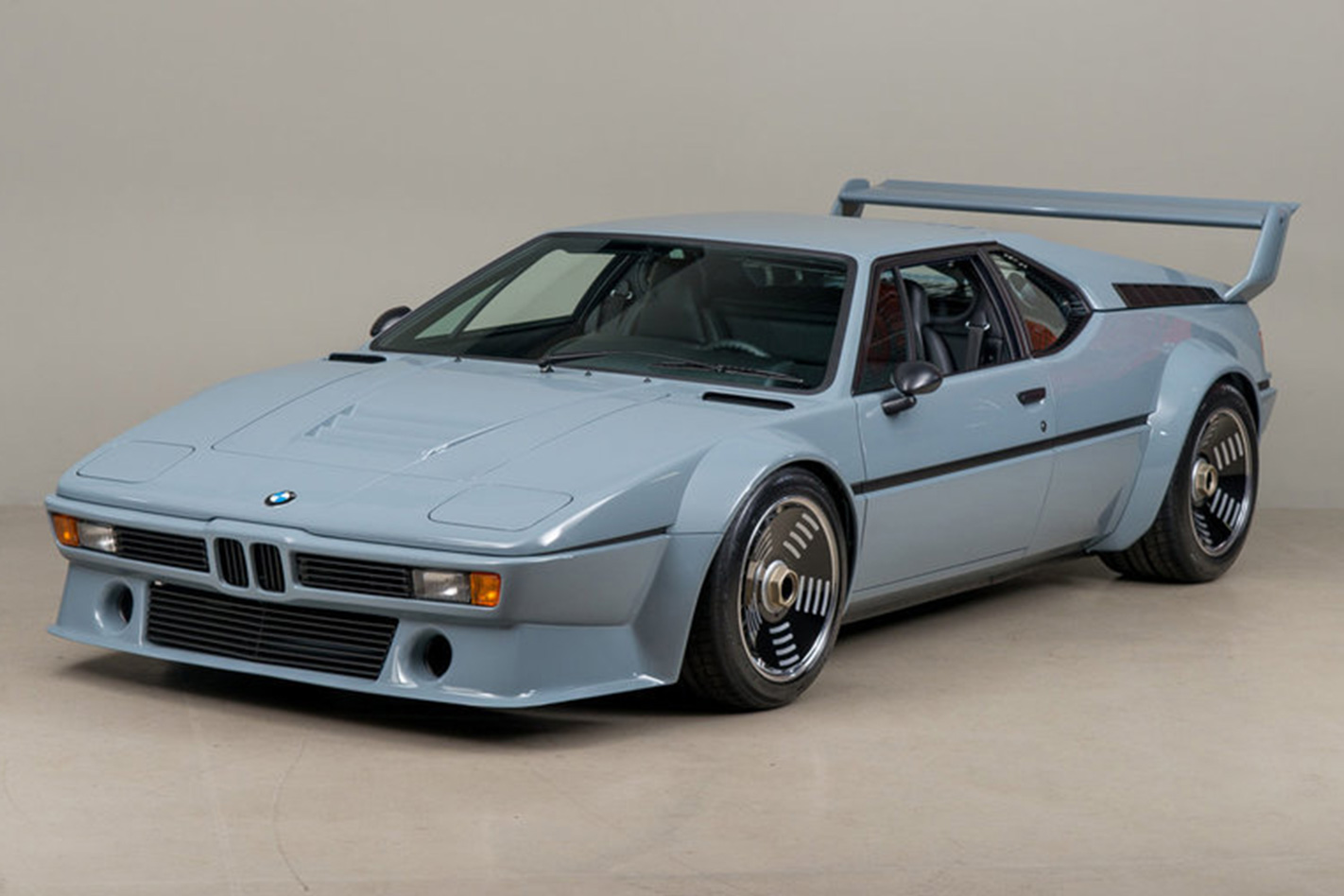
There were very few BMW M1 Procars built… 40, in fact. As they were race cars, none were road-legal. Oh, except this one!
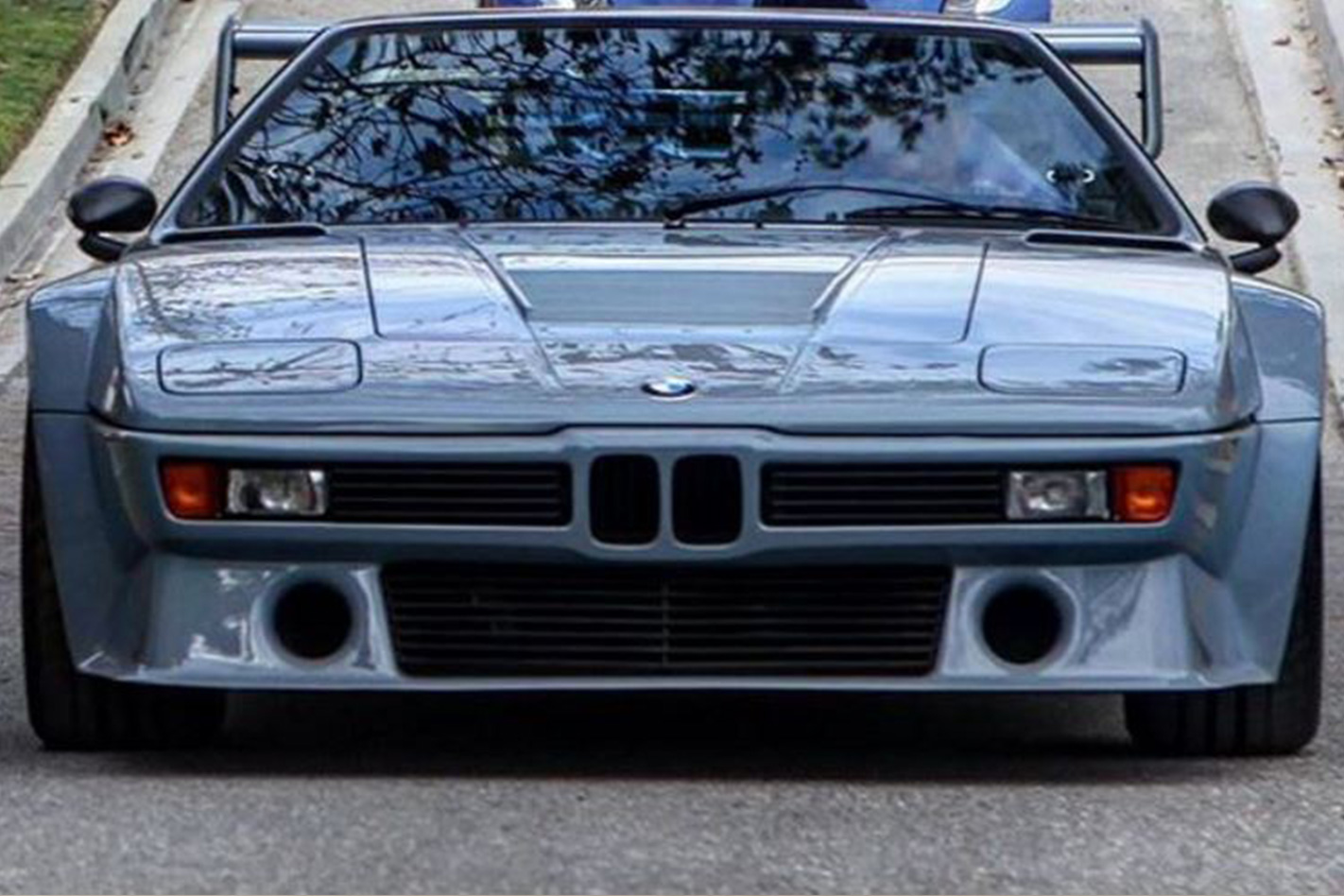
Restored last year by Californian motorsport museum Canepa, this M1 Procar has been altered to be legally driveable on the street.
Before an M1 Procar series revival in 2008, then BMW Motorsport director Mario Theissen said the M1 itself was supposed to be a racecar for the road.
“The M1 was unveiled 30 years ago as the first car created independently by the then BMW Motorsport GmbH. It was a racing car which BMW customers could also drive on the road, a unique project which had to overcome some tricky administrative hurdles before getting off the ground.”
To get people excited about the car, there was to be a real race car, but for that to be eligible homologation had to be met.
“The idea of organising a single-make series was born out of necessity – i.e. the requirements of homologation,” Theissen continued.
“Nobody expected the BMW M1 Procar series to go down quite so well. Just a mention of it today still triggers an enthusiastic reaction.”
And the enthusiasm carries on to this day. The road-going version which was recently sold by its custodians at Canepa is due to be displayed at the McCall Motorworks Revival in Monterey in a couple of days’ time.
Tim Rogers, founder of The Thermal Club where the car’s being displayed, says the people attending the event are exactly the right audience to appreciate the M1 and the club itself.
“We look forward to bringing a piece of racing history and a state-of-the-art virtual tour of our club to this exclusive event,” Rogers says.
“Enthusiasts from around the globe head to Monterey Car Week to celebrate automotive history and enjoy the incredible amenities around the Peninsula.”
If you happen to be in California with a day to spare, go check it out. You probably won’t get another chance!
BMW has briefly teased its all-new G30 M5 in a video tweeted ahead of its official unveiling on August 21.
The 10-second teaser features the new BMW M5 barrelling through the desert, though it doesn’t reveal too much of the car, apart from the lower grille, and a squiz at its front wheel and big yellow brake caliper, but it’s enough to get Beemer fans excited.
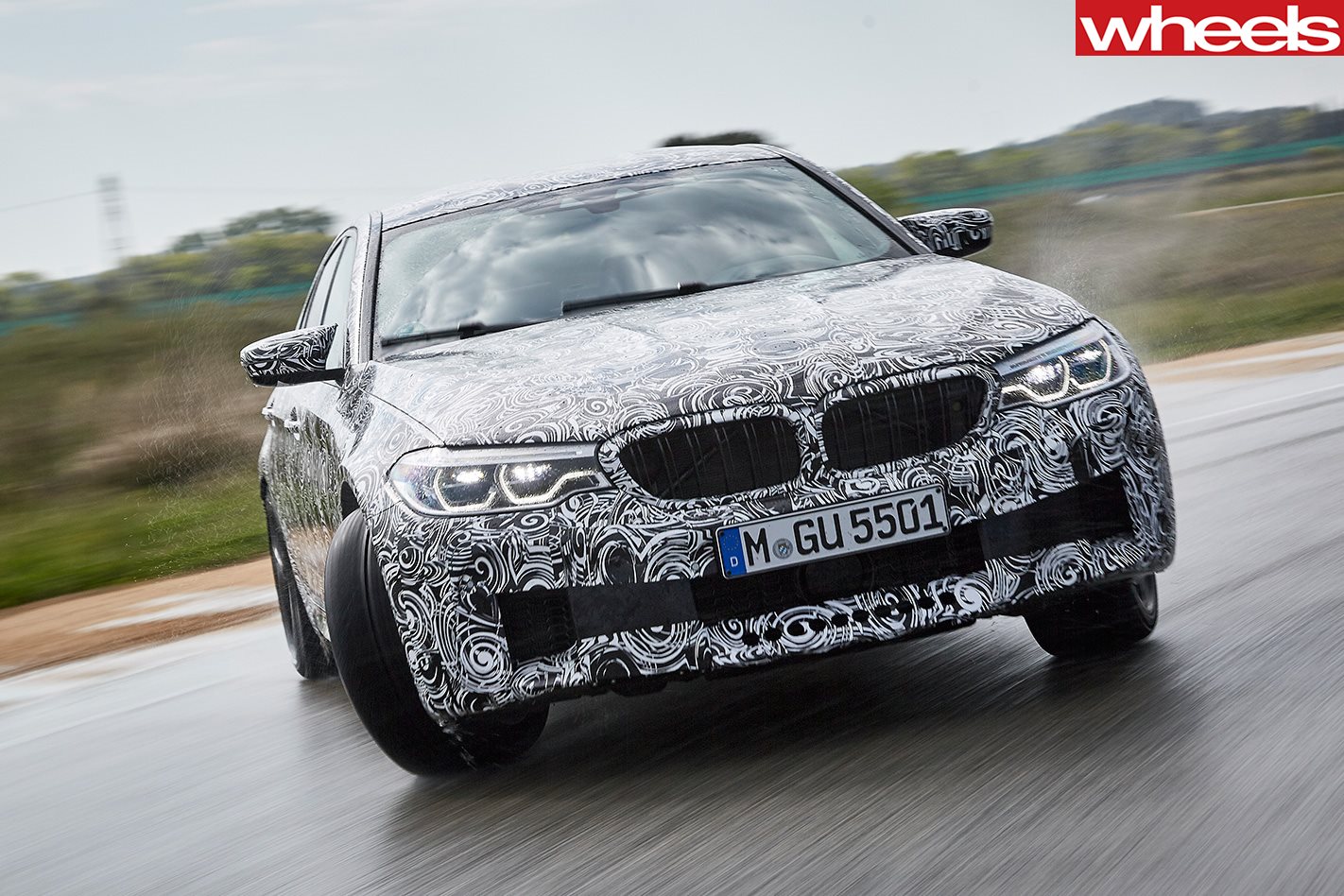
The ballsy engine will be mated to a modified eight-speed Steptronic auto that will drive all four wheels via a specially developed M version of the company’s xDrive all-wheel-drive system. Featuring bespoke software to other similarly-equipped vehicles to optimise performance, the all-paw system will be rear-biased and only send power to the front axle when needed.
The driver will also have a choice of utilising all-wheel or rear-wheel drive with a simple push of a button, which disengages the clutch in the transfer case that would otherwise direct torque to the front axle as required.
Wheels’ John Carey, who tested the M5 prototype earlier this year was impressed by the “great harmony in the way the car’s chassis and drivetrain interact, making it terrifically user-friendly”.
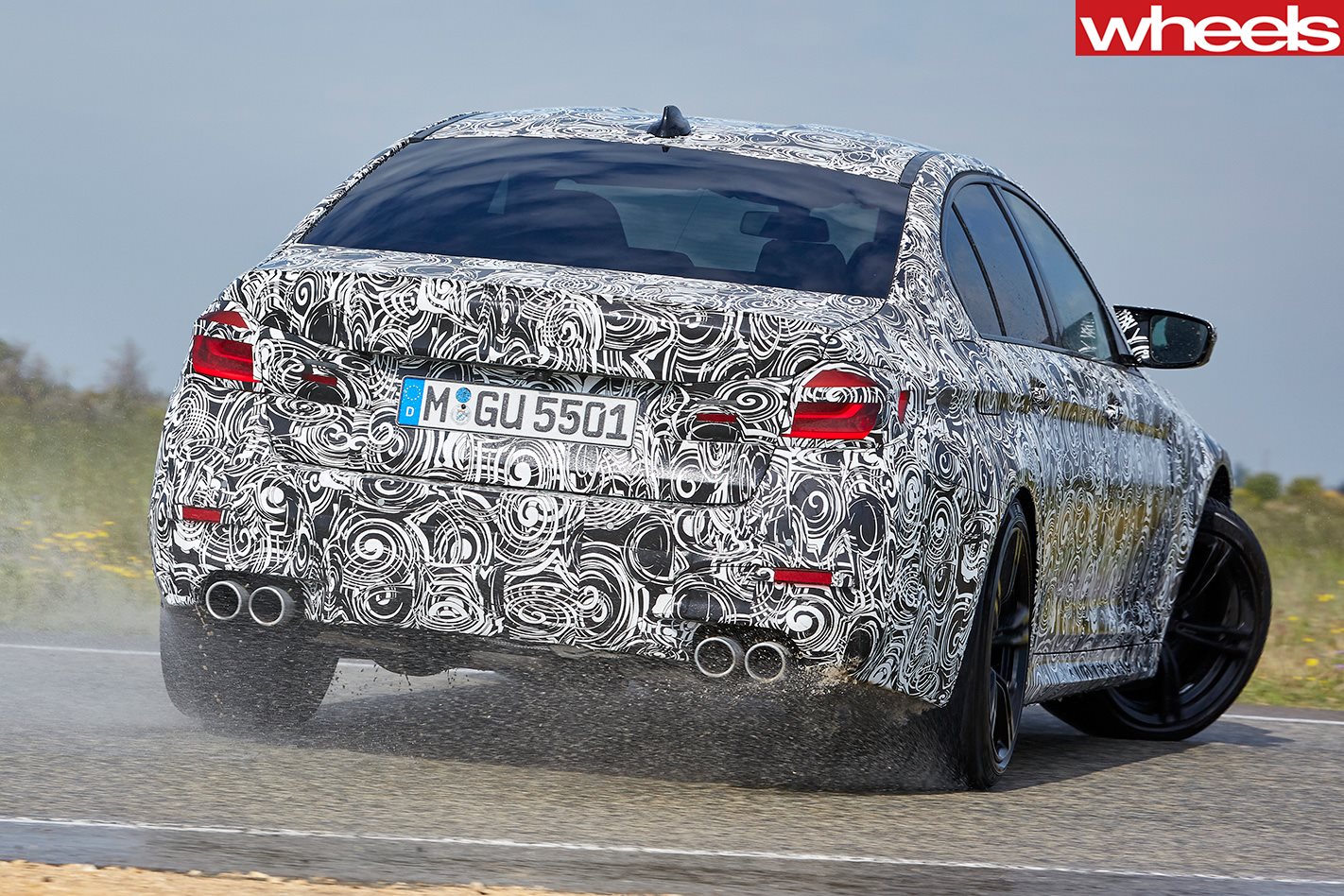
Before then it will make its first public appearance at next month’s Frankfurt Motor Show.
CONSUMER advocacy group, CHOICE, has called for a separate, critical warning for cars fitted with some older Takata airbags, which is already subject to the broader worldwide recall.
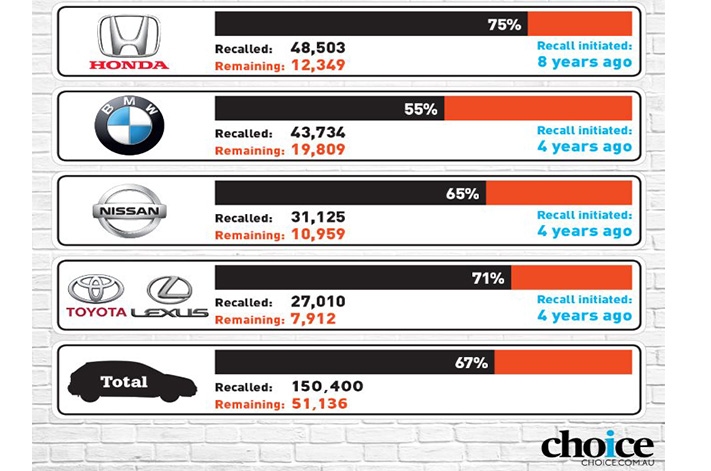
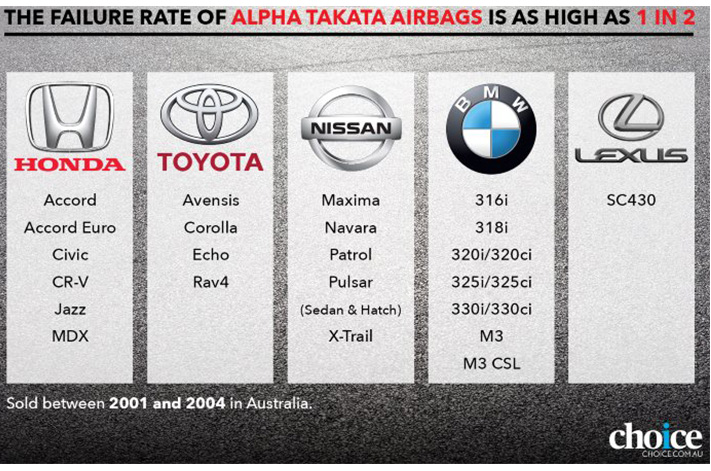
The Takata ‘Alpha’ airbags rupture is found in up to 50 percent of cases and are still fitted to more than 50,000 Australian cars, but CHOICE says car manufacturers are not specifically warning drivers of the affected vehicles about the increased dangers these older-model inflators pose.
A CHOICE investigation has found the Alpha-model airbags in question were fitted to Toyota, Lexus, BMW, Honda, and Nissan models between 2001 and 2004.
The National Highway Traffic Safety Administration (NHTSA) in the US, which has led the worldwide recall of Takata inflators, issued a “critical warning” on Alpha inflators in June 2016, citing they were responsible for eight of the 10 fatalities linked to Takata airbags.
American owners of the affected cars were warned not to drive them until they were fixed, and some carmakers offered free towing to the nearest authorised dealer to get the cars repaired.
However, no such critical warning has been issued in Australia where 51,136 of the 150,400 fitted with Alpha inflators have yet to be returned to address the recall, which was first initiated by Honda back in 2009, and the other affected manufacturers four years later.
The Australian arms of Honda, Toyota, Lexus, BMW, and Nissan provide general information about the Takata airbag recall on their company websites, as does the Federal Government’s Product Safety Australia website.
But CHOICE says this isn’t enough as the sheer scale of the Takata recall has caused confusion, and more needs to be done to alert owners of cars with Alpha inflators of the acute risk and encourage them to take their cars in.
“Honda Australia has always acted on the most accurate and up-to-date Takata information available, and shared this immediately with our customers.” Collins told Wheels.
“The ‘Alpha’ inflator recall is defined by a particular manufacturing defect, and this information has been passed on to our customers. This included warnings about the risk of potential death and injury from the faulty airbags”.
When asked if it supported CHOICE’s call for a separate recall, Nissan Australia said it “aims to bring the swiftest possible resolution to this issue for our customers and is focused on the removal of all recalled airbags”.
“If a Nissan vehicle owner has received a recall notice, or if they are unsure if their vehicle is affected by a Takata airbag inflator recall, they should contact their nearest Authorised Nissan Dealer for the full list of impacted vehicles.”
“Parts are available for every Nissan customer in Australia who has received a recall letter for this matter.”
Toyota says it also has sufficient parts to rectify those vehicles fitted with Alpha inflators, and have endeavoured to notify owners of the urgent need to have their inflator replaced.
A Toyota spokesperson told Wheels the company is “replacing ‘Alpha’ airbags as a priority as these were the first airbags recalled in the Takata airbag safety recall campaigns”.
“In total, out of approximately 27,010 Toyota and Lexus vehicles fitted with Alpha inflators, approximately 19,098 (70 percent) Toyota and Lexus vehicles have had Takata alpha airbags replaced as part of the Takata airbag safety recalls.”
Toyota encourages all affected vehicle owners to check the status of their vehicle on Toyota’s VIN checker or contact their closest Toyota or Lexus dealer immediately.
Wheels has contacted BMW Australia and the Department of Infrastructure and Regional Development for comment.
Cars with ‘Alpha’ Takata airbags installed between 2001-04
- BMW 316i, 318i, 320i/320ci, 325i/325ci, 330i/330ci, M3, M3 CSL
- Honda Accord, Accord Euro, Civic, CR-V, Jazz, MDX
- Lexus SC430
- Nissan Maxima, Navara, Patrol, Pulsar sedan and hatch, X-Trail
- Toyota Avensis, Corolla, Echo, RAV4
It’s kiddies’ maths, but I punch the figures into the calculator twice just to make sure.
This article first published in MOTOR Magazine May 2007.
So, 1100kg divided by 340kW equals – whoa! – 3.23 kilograms per kilowatt! That’s a stunning boast for Elfin Sports Cars’ MS8 Streamliner 50th Anniversary ‘Number One’, and is certain to put the fear of God into the supercar competition.
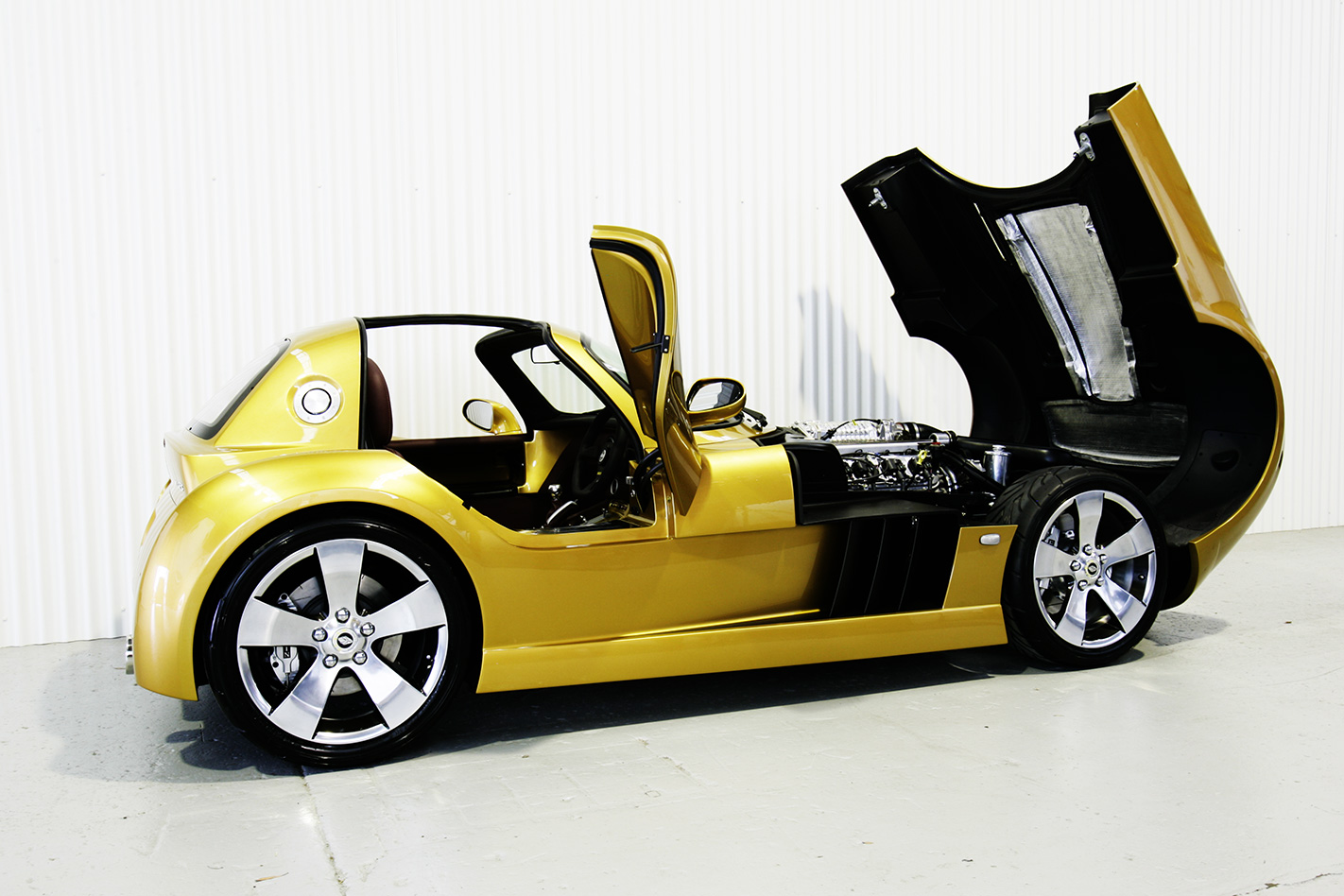
Think globally, and only at motoring’s bleeding edge – Bugatti Veyron, Koenigsegg, Radical, Caterham – will you find a more impressive pound-to-poke ratio.
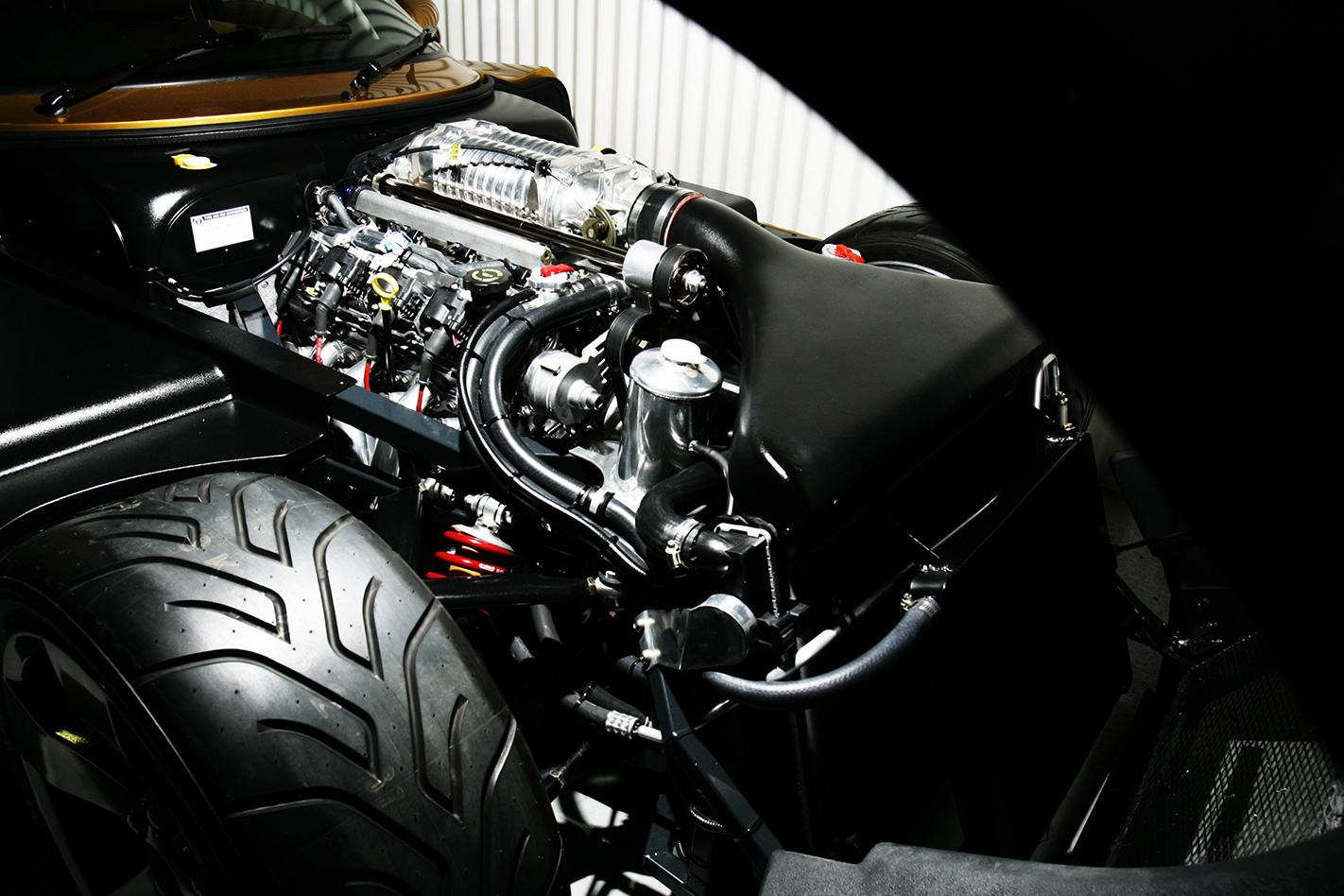
Y’see, this ‘Number One’ is a bit extra special. Elfin is only building five 50th Anniversary examples, and they’re not created equal. Eighty percent of this very limited production is likely share the same shiny, oily bits with the regular MS8 Streamliner, meaning 245kW/465Nm 5.7-litre Chevy LS1 power.
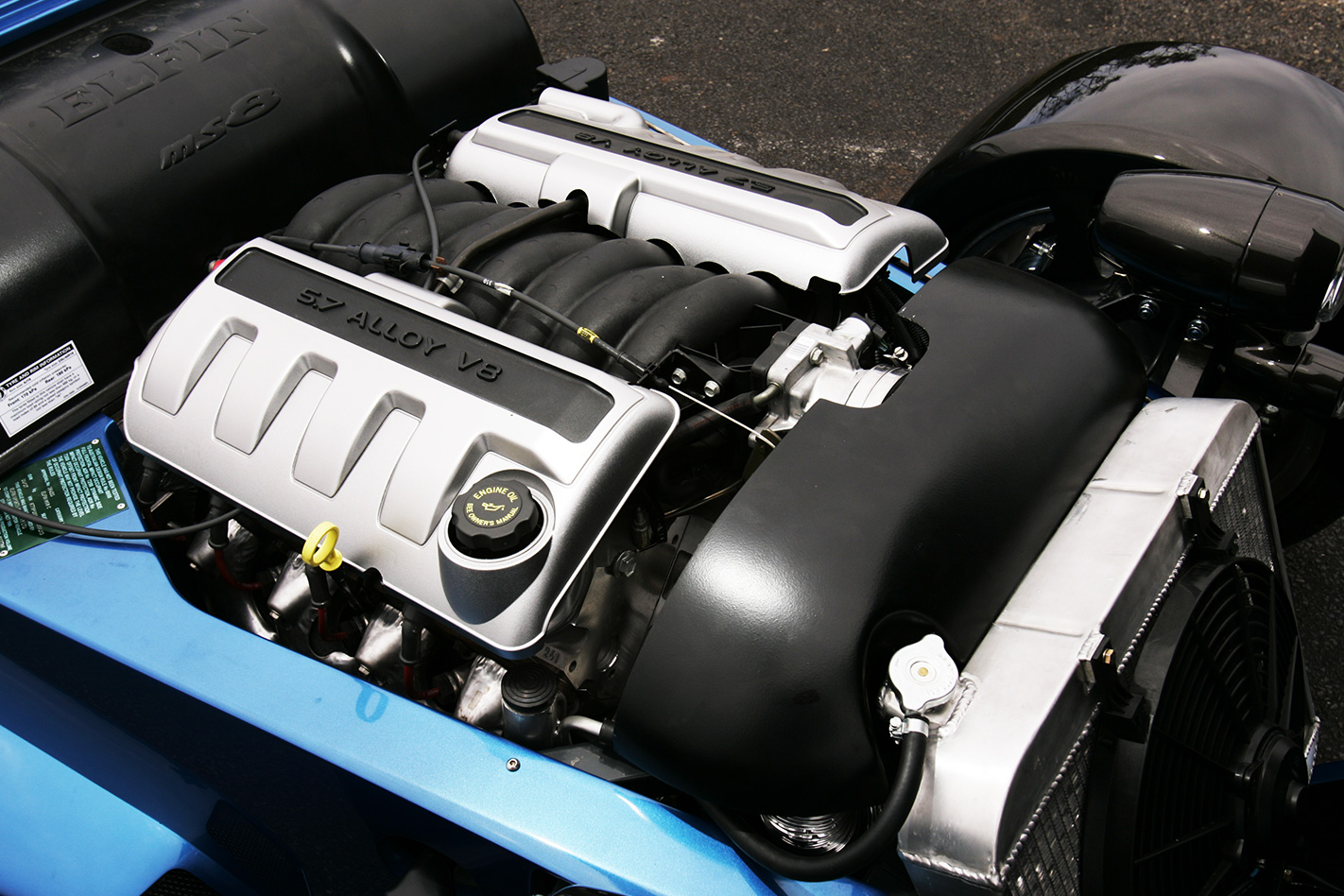
Believe it or not, 340kW at 5600rpm is a fairly lazy state of tune for an LS1, an engine which can safely cope with a more serious power tickle. But would you need it when there’s already a whopping 660Nm on tap to help propel little more than a tonne off the mark, complete with fire, brimstone, and a Ride of the Valkyries soundtrack?
“It’ll nail 100km/h in about three seconds flat,” says ESC CEO Chris Payne.
Uh-huh.
“And it’ll do a 400-metre sprint in 10s.”
Uh-huh. So, can I have the keys, then?
“Nope.”
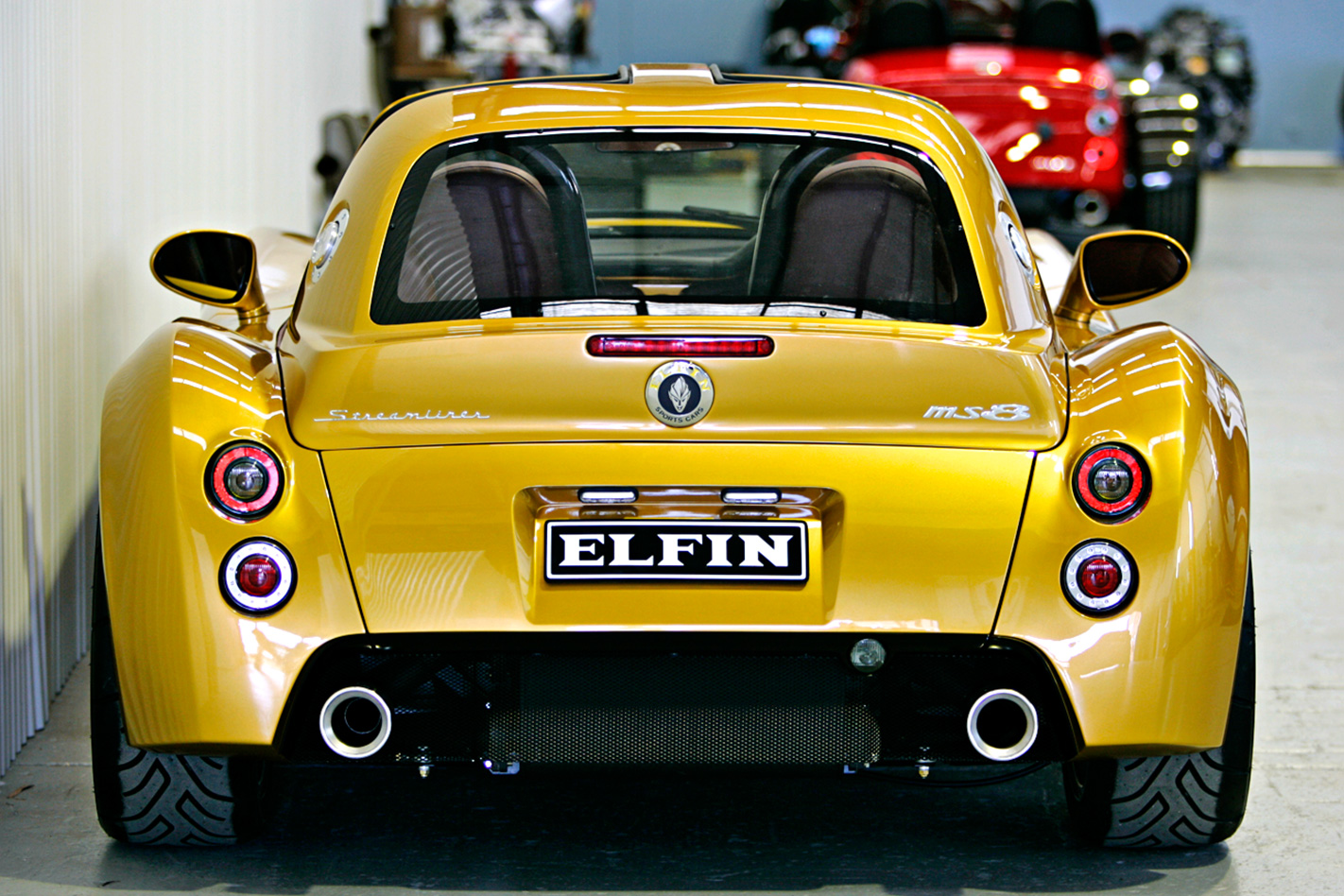
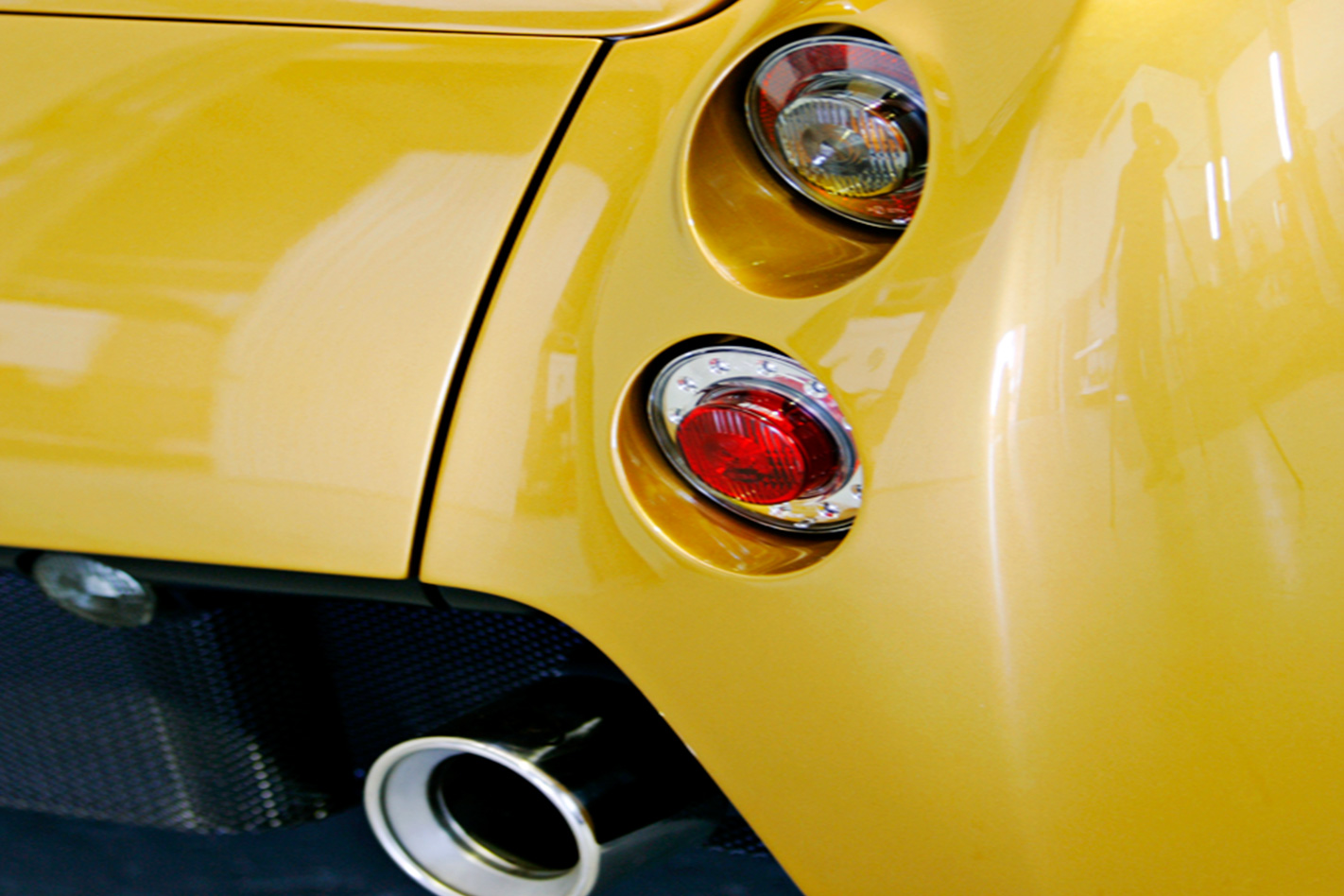
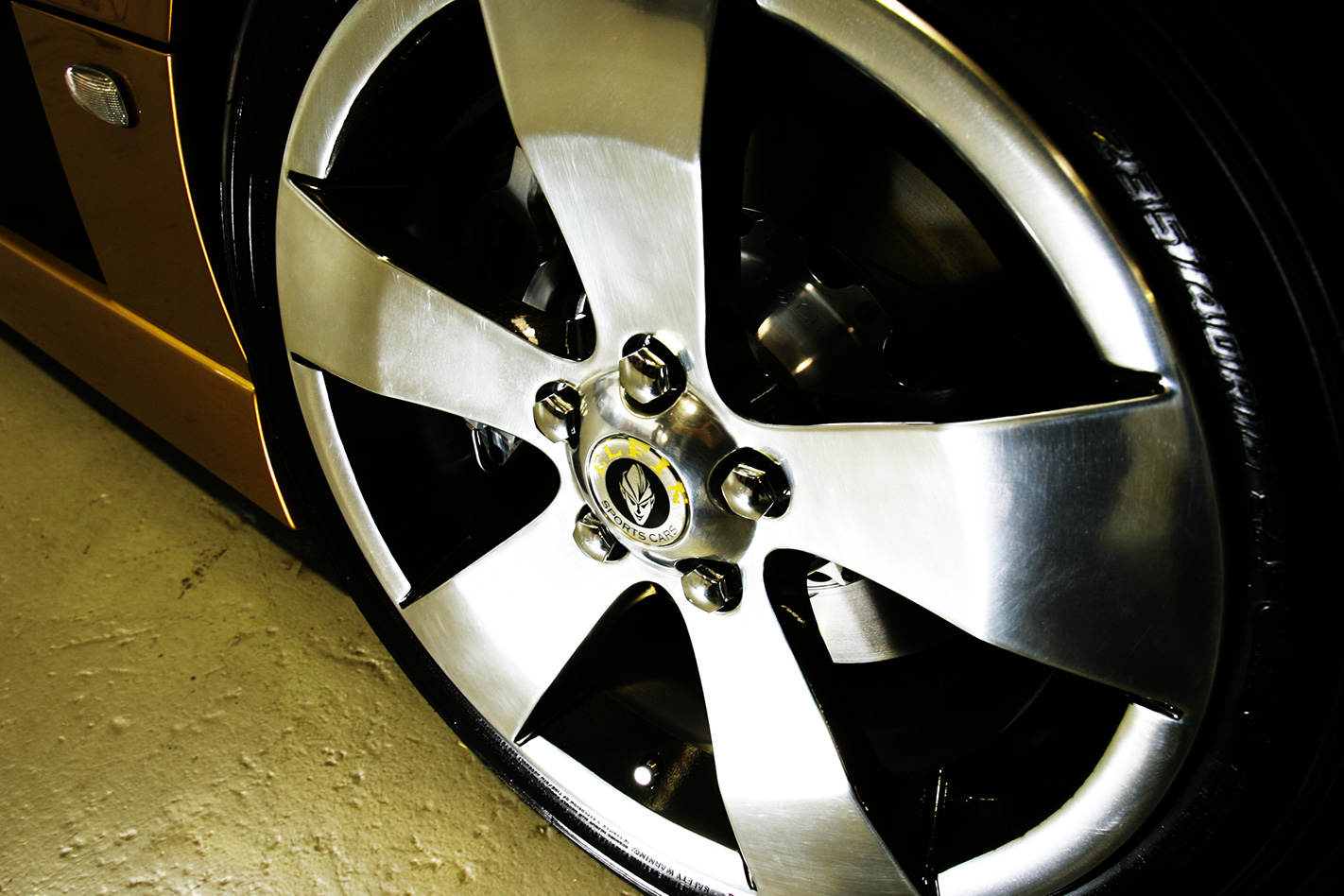
All five Fiddys will come finished in a special ‘Cooper Gold’ hue – so named after Elfin’s founder, Garrie Cooper – and feature unique bonnet spears, and polished 18-inch wheels loaded with semi-slick Advan rubber.
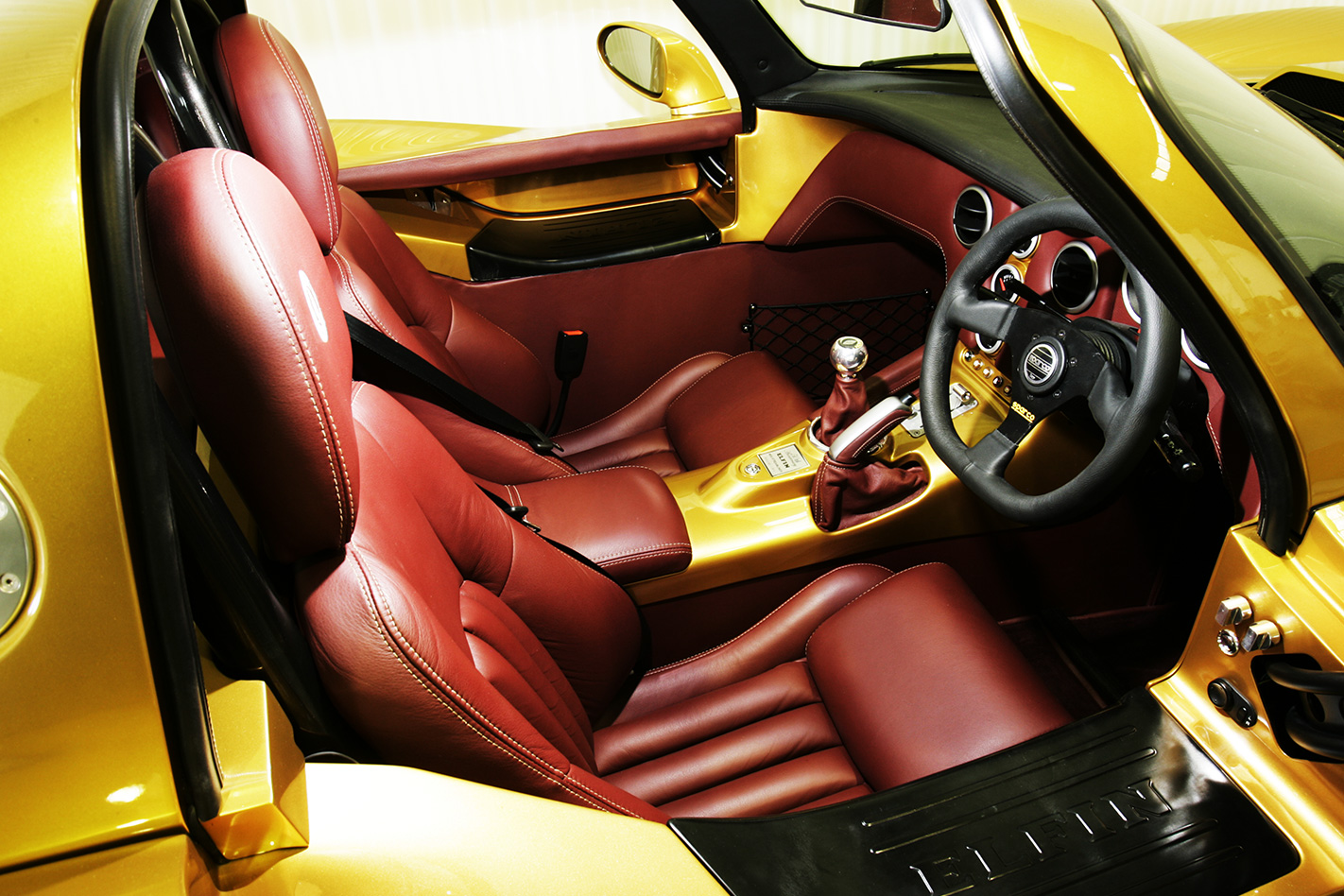
Inside is awash with bright burgundy, including ‘aircraft grade’ leather trim (whatever that is) on the chunky-bolster seats which in production form are far superior in support and comfort over the early prototype design. Add a smattering of polished metal and there’s a sort of retro 1970s Aussie muscle car vibe going on that, with all respect to the potentially offended, would look right at home on an HQ Monaro.
Two hard fabric ‘gurney bubbles’, as Payne calls them, latch to either side of the T-top’s centre spine. No full roof? A virtual impossibility due to Streamliner’s gymnastic requirements for occupant entry and egress.
The roof can be removed via four bolts, and is interchangeable with the topless roadster’s flat deck-lid.
It’s only a mild departure from GM design maestro Mike Simcoe’s original sketches, altered to include a subtle bobtail and flush rear glass (Simcoe’s had recessed glass), which allows clearance for a full FIA-approved roll cage – a minor feature, you’d reckon, but one that was key to green lighting hard-top production, and to Elfin’s future plans for MS8 Streamliner.
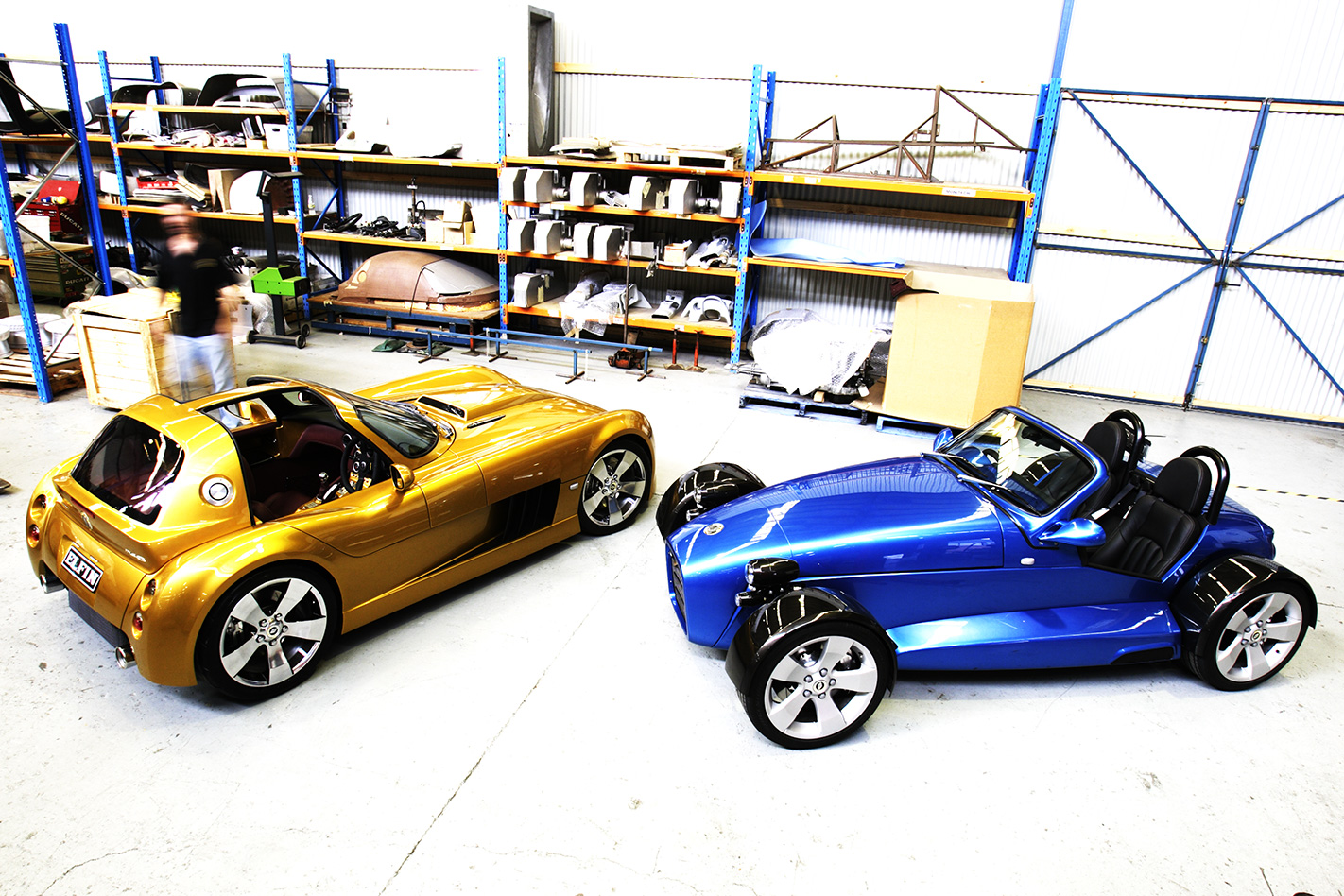
Five decades on, the new MS8 50th comes standard with – surprise, surprise – a hard lid. And room for a cage. No points for guessing why…
“We always intended to take the Streamliner racing,” says long-time ESC technical director, Nick Kovatch. After all, motorsport is the company’s backbone.
“[Motorsport bodies] CAMS and FIA stipulate that you can’t race convertibles or open-tops in production car-based classes,” adds ESC CEO Chris Payne. “With a coupe, now we can.”
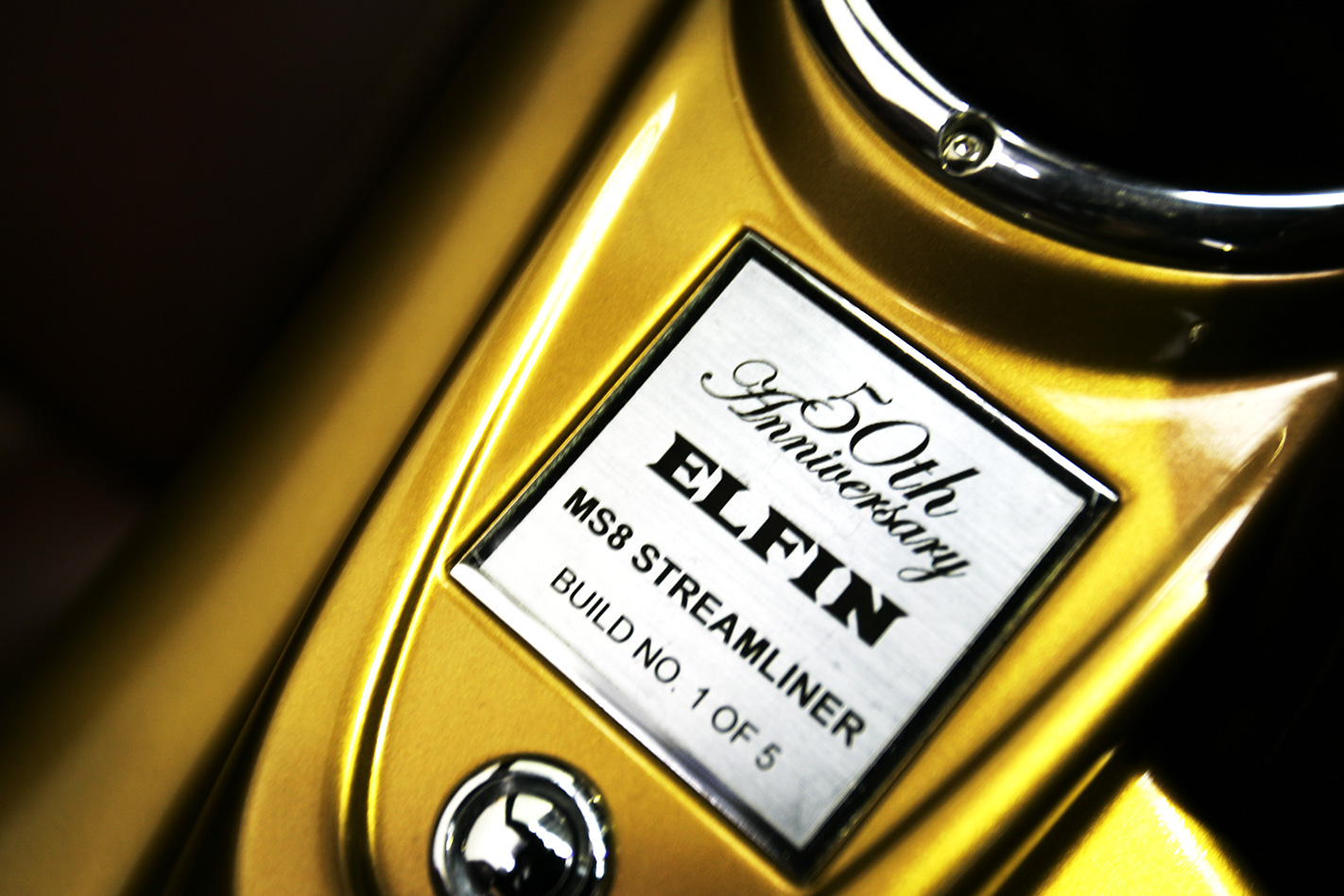
Although the $128,500 anniversary model is the only one to get the coupe lid as standard, the top will be offered as a cost option on base Streamliner models. As will an FIA-approved roll cage. That way any Streamliner owner has the option of racing a car that was intended for hard-core circuit work right from the drawing board.
This is evident in MS8’s design and engineering. Each MS8 begins life as a pile of steel tubing in the Elfin factory, and then hand-crafted from the ground up over a period of three months. The space-frame construction is extremely rigid, and the use of waify GRP (glass reinforced plastic) minimises Streamliner’s weight.
Same goes for the suspension: the chrome-moly aerofoil front and seamless tubular steel rear double A-arms are rose joined to the chassis, with aluminium uprights locating huge six-piston AP Racing calipers at the business end and slightly smaller four-potters in the rear.
1971 Ford Falcon XY GT-HO Phase III: Quick History Lesson
So the core engineering is up to the task of a little blown fettling, and the astonishing performance potential that brings. But… the official line is that Number One, or any supercharged MS8 for that matter, is “for track use only”, and Elfin says that it’s only due to costly ADR approval for such a potentially low volume of road-going versions.
Yes, Elfin will build you one – $140,500 will park Number One in your pit garage – but customers will have to source engineering certification for rego independently.
Of course, it’d be a true blue travesty for a foreigner to lay any claims on what looks to be Australia’s most ballistic production car to date. And I, for one, will happily be the first Aussie to confirm or deny Elfin’s performance claims for a blown Streamliner, and on any decent blacktop between Bahrain and Bristol.
That’s a hint, Robbo…
Hold on to your hats, sports fans.
If the just-released GTI, GTI Performance and R versions of the VW Golf 7.5 weren’t enough, maybe you should adopt the brace position, because there’s plenty more where they came from.
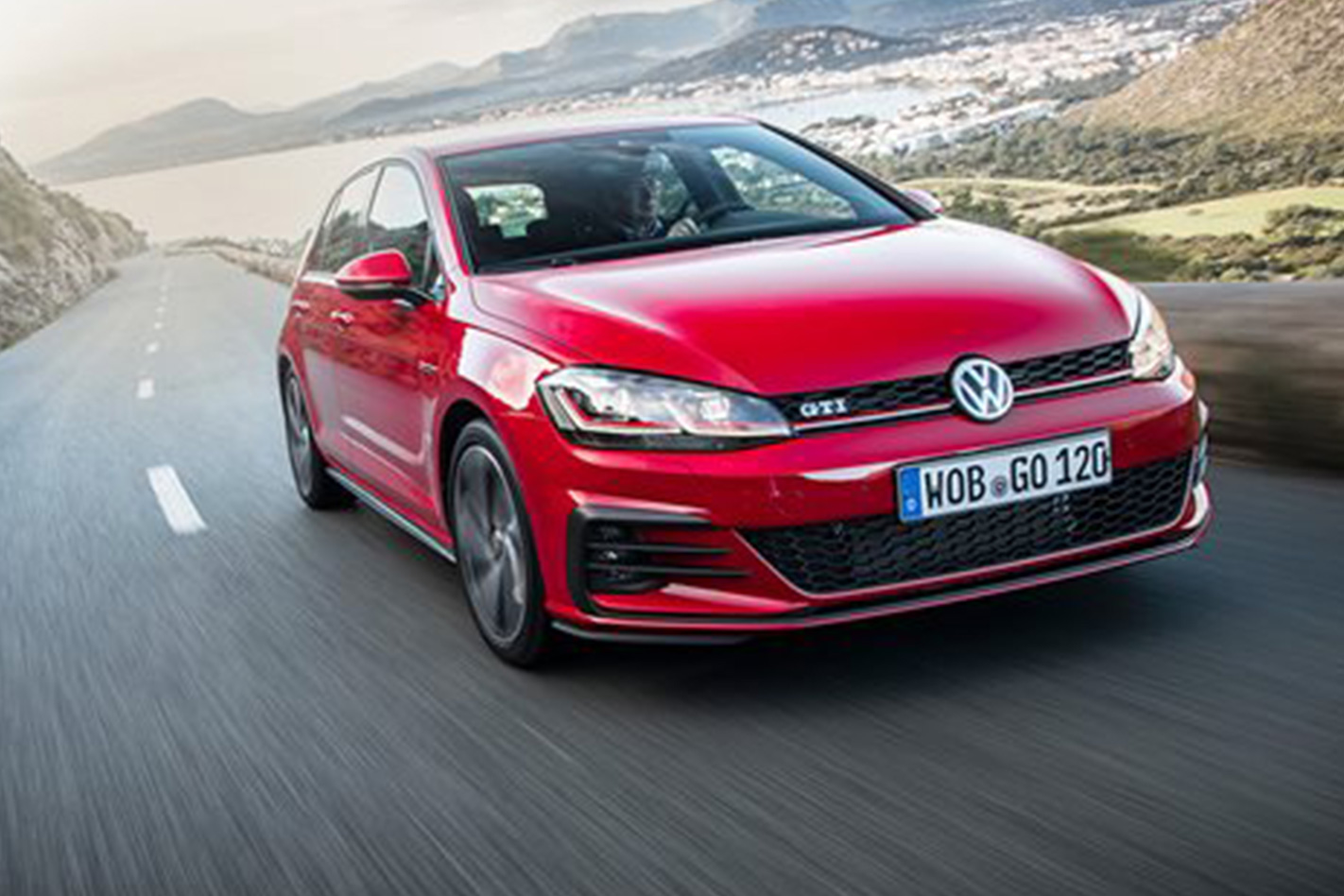
Among them will be a Wolfsburg Edition of the 7.5 Golf R which will be available in five-door or wagon form.
It will share the `normal’ Golf R’s mechanicals and will include stuff like specific 19-inch alloys, Nappa leather trim, a 400-Watt stereo, (real) carbon-fibre mirror caps, the driver-assist package of active cruise and blind-spot monitoring and an optional panoramic sunroof.
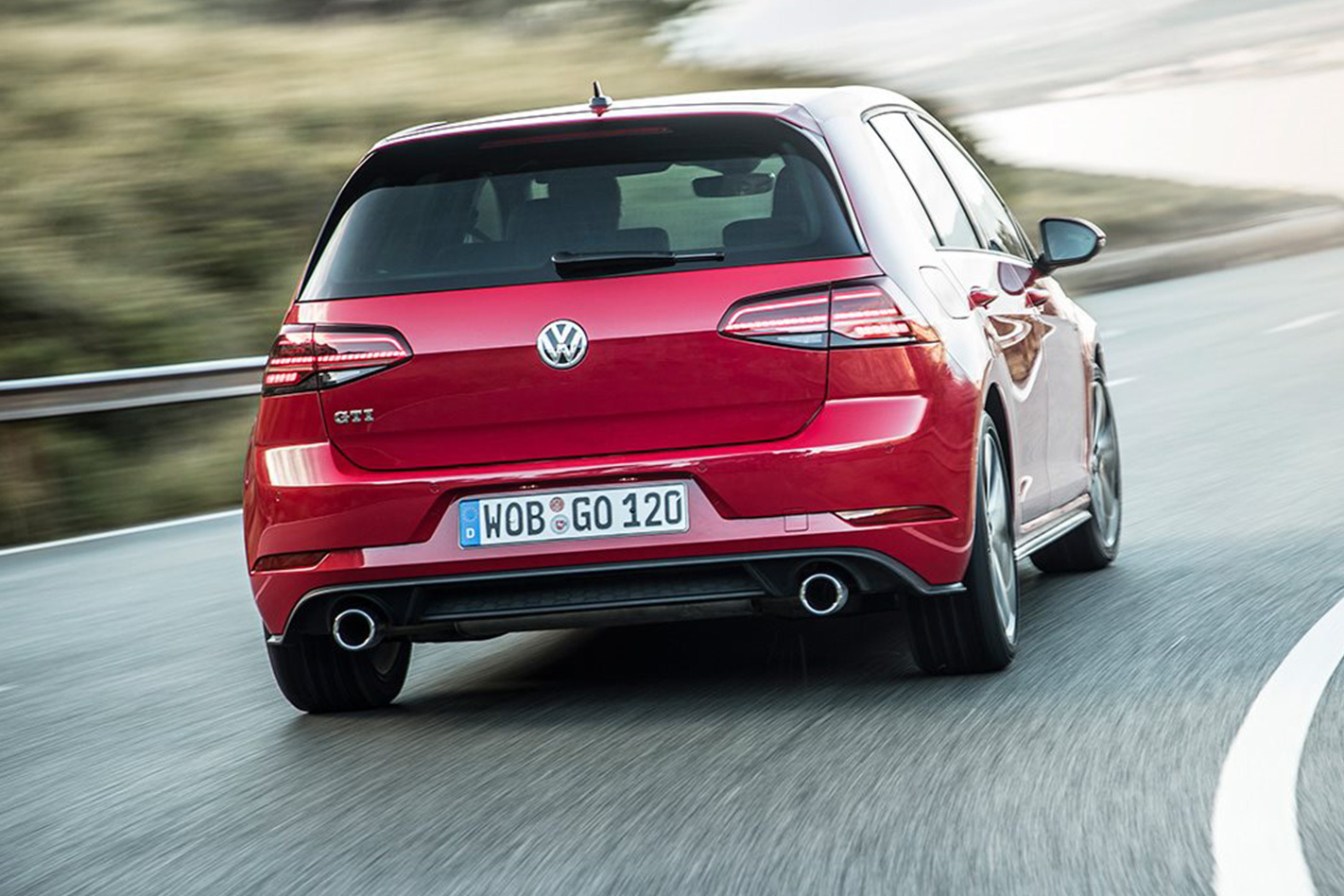
Designed to be a pared-back track-day specialist, the R Grid uses all the Golf R bits and pieces like 4-Motion, 19-inch wheels, 213kW tune of the two-litre turbo motor and the optional seven-speed DSG to arrive at 0-100km/h in a claimed 4.8 seconds. But get this: VW says the Grid will hit the market at a sub-$50K price-point.
If you can wait a bit longer, the new is even better with a Golf R station-wagon permanently joining the line-up from early 2018. But its stablemate for early next year is the one we’re waiting for.
Called the GTI Original, this is another pruned-back model based on the entry-level GTI in manual or DSG form. It’ll be red or white only and three-door only, but with a sticker below $40,000, we can’t wait.
MINI will launch an all-electric concept of its three-door Cooper at the 2017 Frankfurt Motor Show, wrapping the iconic skin around the battery-fuelled gubbins of the BMW i3.
The electric Mini – the first car in parent company BMW’s plans to roll out more conventional forms of its “i”-branded electron-driven range – is believed to preview the version of the hatch that will go on sale in 2019, British automotive publication Autocar said.
The e-Mini is expected to have a range of about 400km, meaning it could get its own spin on the i3’s two-cylinder range extender petrol engine that sits alongside the electric motor, doubling its range. An all-electric version, which will rely solely on a powerpoint, should at least match the i3’s 160km-odd range.

Last year, it also revealed the Mini Vision Next 100, a forward-looking three-door coupe featuring an Apple-like clean interior meant to be a celebration of BMW’s centenary, but also giving a hint of the brand’s future direction. BMW has designed it as a fully automated car with “Cooperizer”, an artificial intelligence system that learns what the driver likes.
This year alone, BMW aims to sell 100,000 electrified vehicles globally via its “i” and “iPerformance” plug-in hybrid sub-brands. It will soon launch a roadster version of the i8 hybrid supercar, and plans to build an all-electric X3 from 2020. By 2021, it will launch the “iNext”, a vehicle that BMW calls the brand’s “new technology spearhead”.
Mini already produces a plug-in version of the Mini Countryman, but the hypermiling SUV-styled four-door is not yet confirmed for Australia, a country that is dragging its heels on the roll-out of public recharging infrastructure.
Autocar said the electric Mini would be built in the car’s spiritual home – Britain – with the electric drivetrain brought across from Germany.
The 2017 Frankfurt Motor Show kicks off from September 12. Read more about what we expect to see here.
TWO special editions of the Volkswagen Golf GTI and Golf R are primed to join the freshly updated Mk 7.5 line-up and slash the cost of entry for both badges.
Dubbed the Golf GTI Original and Golf R Grid, the new variants will drop the starting price of their respective ranges below $40,000 and $50,000.
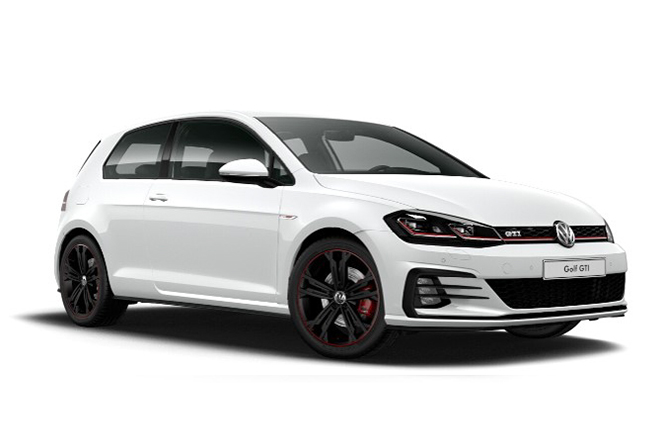
However, VW Australia’s marketing general manager Ben Wilks did confirm both cars would arrive Down Under with fixed equipment levels, meaning buyers would not be able to choose the optional technology and luxury packages available on other performance Golf models.
“It’ll be a locked specification,” he told Wheels. “But there’s an opportunity here, for a simple, pure offering, especially with the three-door GTI Original. We’ve had a lot of feedback from our customers to bring the three-door body style back.
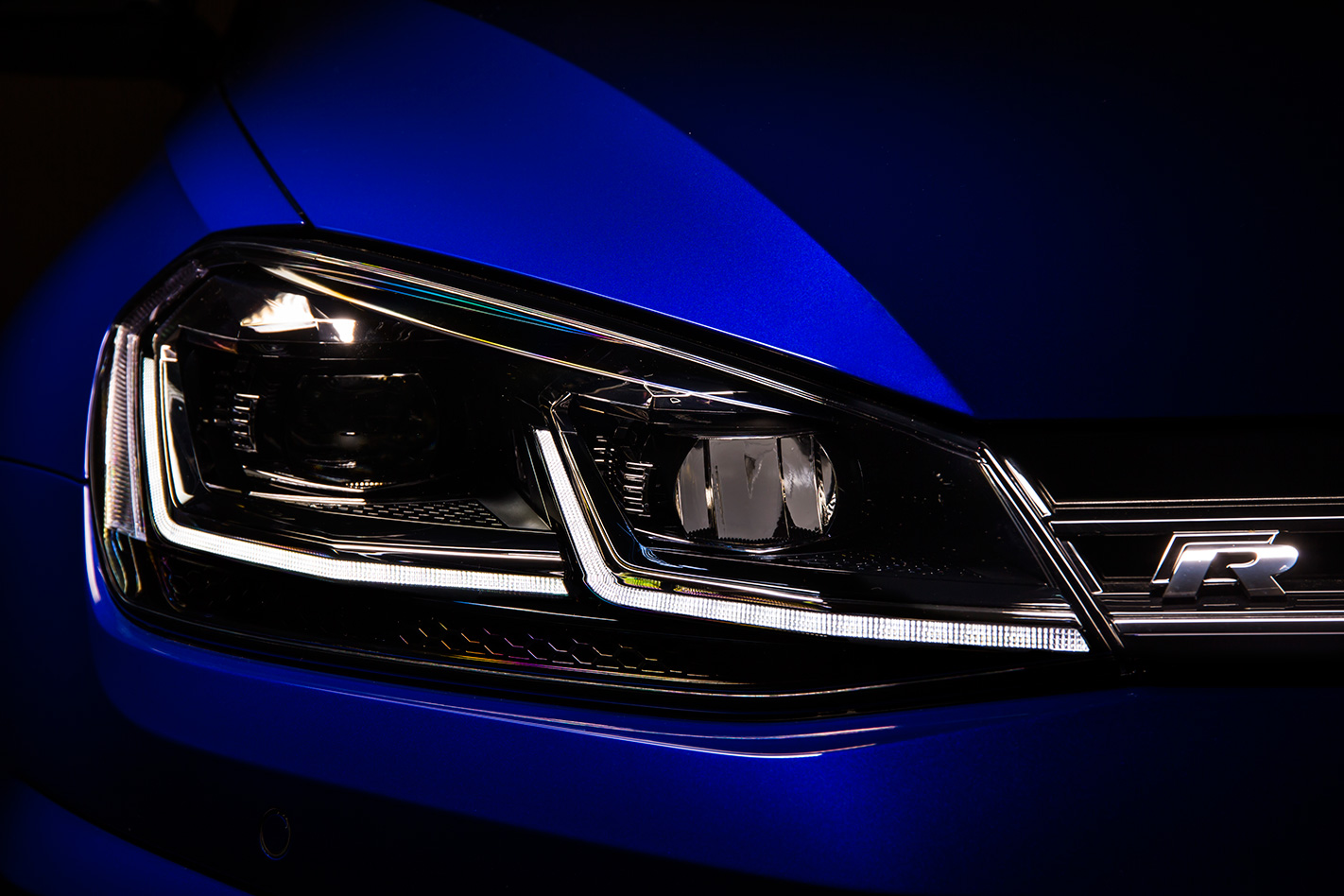
Similar to the limited-run GTI Performance Edition 1, the GTI Original will be sold solely as a three-door hatch while the R Grid will be available as both a five-door hatch and wagon.
Both cars will be available with either a six-speed manual or a DSG dual-clutch automatic (six-speed in the Original, seven-speed in the Grid), though the Grid wagon will be DSG-only.
Engine-wise, both variants will boast the same boosted outputs as the rest of the updated GTI and R range, meaning 169kW/350Nm for the Original and 213kW/380Nm for the Grid.
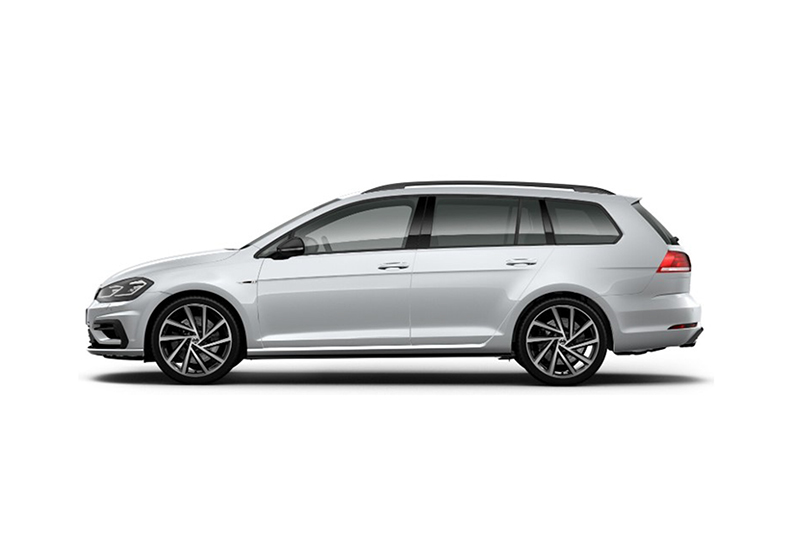
The sub-$50K R Grid is likely to represent a saving of around $3000 compared with the regular R’s $52,990.
As for timing, the Grid variants will start arriving in late 2017, while the GTI Original will land in Australia from early 2018.
The new variants will also see Australia’s Golf Performance range swell to 11 different models, with that number likely to expand again in early 2018 with Wilks confirming VW Oz is seriously considering the Golf GTE plug-in hybrid. A five-door GTI Performance hatchback is also tipped to arrive some time next year.
2017 Volkswagen Golf Performance range
Golf GTI Original manual sub-$40K Golf GTI Original DSG sub-$40K Golf GTI manual $41,490 Golf GTI DSG – $43,990 Golf GTI Performance Edition 1 DSG $47,990 Golf R Grid manual sub-$50K Golf R Grid DSG sub-$50K Golf R manual $52,990 Golf R DSG $55,490 Golf R wagon $57,490 Golf R DSG Wolfsburg $57,990 Golf R wagon Wolfsburg $59,990
Like war, motorsport accelerates and intensifies the lives of young men, and before the modern era it had a similar attrition rate.
You watch the new McLaren documentary knowing that Bruce’s career was compressed into 12 years of Grand Prix racing as a driver, designer, constructor and team manager, five of those with the team that still bears his name. Yet when you see his achievements recounted in this elegant, elegiac film you still wonder how he did it all, and you compare unfavourably your own meagre achievements by the age of 32.
You know how it ends, too. But like the Senna documentary, the intensity with which Bruce lived and raced keeps you engaged with his story until that awful, inevitable moment on the Lavant Straight at Goodwood. Fewer of us have a personal connection with Bruce than with Ayrton; few readers will have seen Bruce race. But this film portrays him with such detail and colour and humanity that I defy you not to choke when it finally happens.
The moment is made more awful by some brilliant sound design in which the roar of the Chevy V8 in his McLaren M8D, which has built gradually to a din, suddenly stops dead, and you see his tyre tracks and that marshall’s post.
I watched the film at Goodwood, which was eerie enough. Behind me sat Amanda McLaren, his daughter, for whom that scene must be unbearable.
There is glamour and humour too.
This was an era when men with combovers could still win Grand Prix (Bruce’s fellow Kiwi and team mate Denny Hulme) and when jet flight was novel and exciting and allowed Bruce and Denny and the others to compete in F1 and Can-Am and endurance events on alternate weekends on either side of the Atlantic.
The film is directed by Australian Roger Donaldson who made The World’s Fastest Indian. Other than finding and editing the period footage, Donaldson’s best moment probably comes with the interviews with Bruce’s team mates who were with him at Goodwood on that day in 1970.
The racing team and road car manufacturer that bear Bruce’s name, and now this film, are all fine ways to remember him.
The measure of a man
In his book From the Cockpit, Bruce famously wrote about the young American Timmy Mayer, who was killed at age 26 while racing, in terms which later seemed prescient: “Who is to say that he had not seen more, done more and learned more in his few years than many people do in a lifetime?”
“To do something well is so worthwhile that to die trying to do it better cannot be foolhardy. It would be a waste of life to do nothing with one’s ability, for I feel that life is measured in achievement, not in years alone.”
