
It’s been eight years since Shelby originally announced the F-150 Super Snake, though back then it was just a concept. Now it’s real.
It’ll be a street-oriented version of the previously developed Shelby F-150, and only 150 of them will be sold, but they’ll each have a supercharged 5.0-litre V8 producing 600kW.
Customers will be able to choose whether they want a two-wheel or four-wheel drive version.
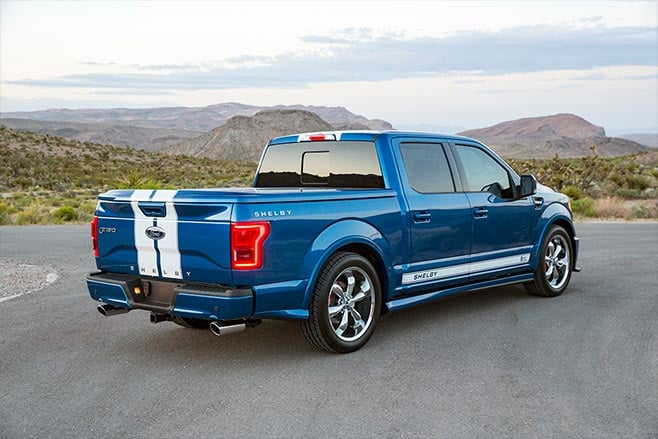
“One of our goals was to offer the truck in limited numbers to preserve exclusivity and potential collectability.”
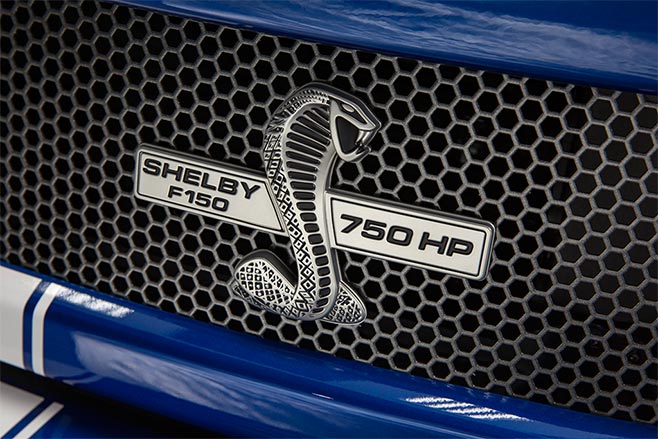
Shelby American vice-president of operations Vince LaViolette says the truck has had handling tweaks to take it a few more levels above the standard Ford F-150.
“Lessons learned building the Ford Mustang-based Shelby Super Snake muscle car and the Shelby F-150 were applied to create this incredible street truck,” LaViolette says.
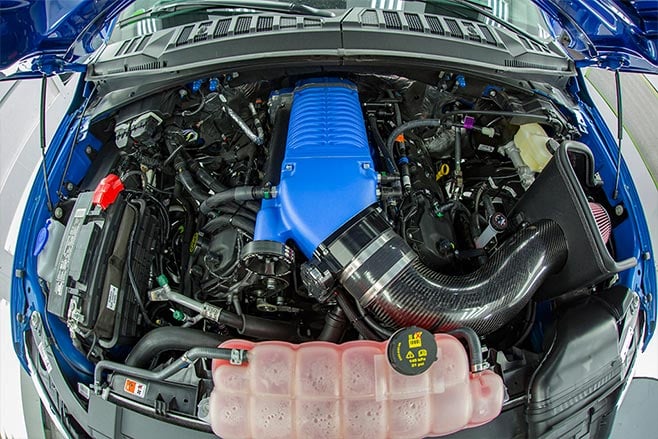
Though it’s only just been released, it wouldn’t surprise us to find out that all 150 examples are spoken for, as happened with Australia’s own W1.
With a price tag of $96,880 USD ($130,000 AUD), good luck getting one over here.
It’s by no means fast, but if it lives up to the promise, the Up GTI should be just under a tonne of fun.
The Volkswagen Up GTI has only been released as a concept so far, but Volkswagen says it will be “launched into the market in early 2018”.
With four more kilowatts than the original MKI GTI, VW says it intends to pay homage to the original GTI with the new Up.
To do this, they included it in the promotional video.
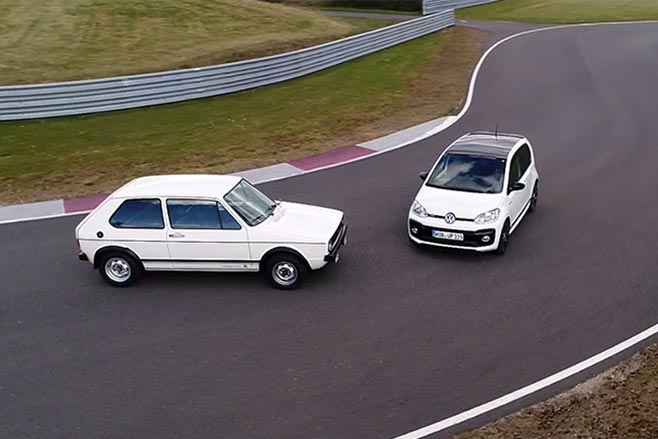
“The new Up GTI continues the creed of the lightweight and no-frills sports car with a compact format – from outside and inside similar in size to the original GTI.”
85kW and 200Nm of torque in a 997kg car might not sound impressive to most, but consider that a modern MX-5 has only 11kW more, weighs 12kg more, but packs 50 fewer newtonmetres.
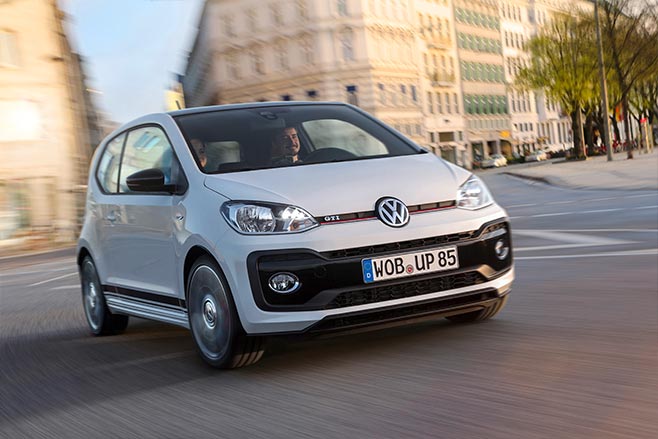
But the greatest appeal of the Up GTI should be its price. With the original VW Up costing around $14K to $15K depending on the number of doors, we expect you’d only need to drop a few more thousand on that to bag an Up GTI.
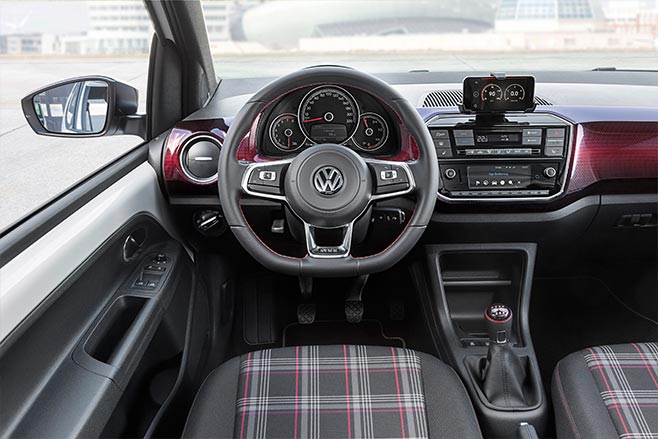
It sounds like a good addition to MOTOR’s annual Bang For Your Bucks…
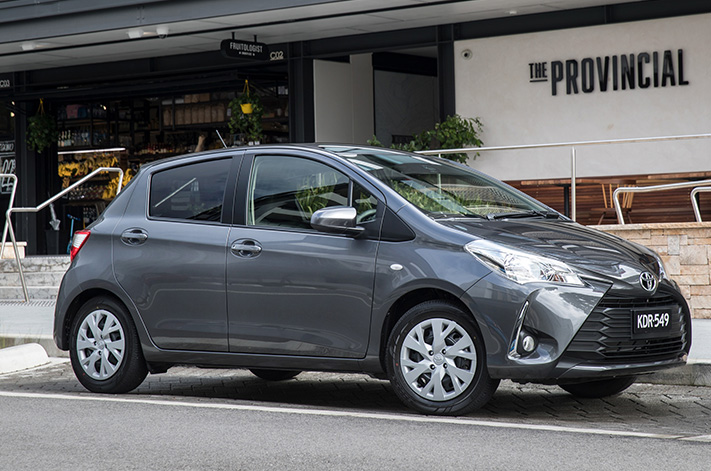
The Toyota Yaris is light and easy to drive and park, and a recent facelift gave the hatchback sharper looks. It has a reputation for reliability and dependably solid retained valued, which makes it a safe buy. Priced from $15,290 the Yaris five-door hatchback is available in three variants with 1.3-litre petrol engine in the entry-level Ascent and 1.5-litre petrol engines in other variants, each coupled to five-speed manual or four-speed automatic transmission. The Toyota Yaris sedan, which did not get the update along the hatchback is no longer available in Toyota showrooms.
Variants
The Yaris is on offer in three variants, the Ascent, SX and range-topping ZR (Compare specs here). Standard equipment across the range includes a 6.1-inch touchscreen, reversing camera, Toyota Safety Sense driver assistance package, with pre-collision safety system with low-speed automatic emergency braking, lane departure alert and automatic high-beam is available as an option in the Ascent and SX while offered as standard in the ZR.
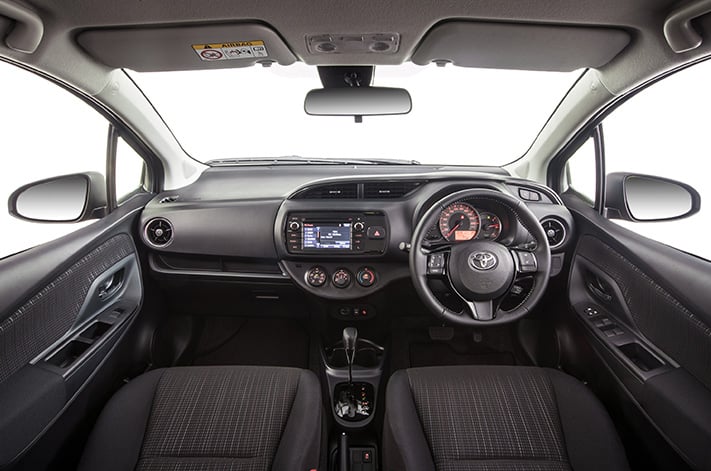
Upgrading from Ascent to SX gets the bigger and better 80kW/141Nm 1.5-litre engine, front fog lamps, rear and second row privacy glass, and a premium steering wheel and gear-shifter.
The ZR is fully optioned inside and out with body spoilers and alloy wheels, LED headlights with an auto-levelling function, satellite navigation, a more premium steering wheel, climate control and sports front seats.
- Ascent hatch, manual – $15,290
- Ascent hatch, auto – $16,490
- SX hatch, manual – $17,330
- SX hatch, auto – $18,490
- ZR hatch, auto – $22,470
Our pick – SX hatch
The second-tier SX hatch is equipped with the 1.5-litre petrol engine in place of the base version Ascent’s 1.3-litre. While it doesn’t have as much bling as the ZR it matches it for driveability and has a manual option.
Options
- Toyota Safety Sense package – $650
- Premium paint – $450
- 15-inch alloy wheels – inquire
Options to consider
The safety package makes a lot of sense if purchasing the SX and still keeps you well below the ZR price even if you choose premium paint. Alloy wheels would also be a nice addition, though be sure to shop around as prices vary between Toyota dealers – we were quoted everywhere from $187 per wheel to $240. Note that if you order alloy wheels before delivery the price of the standard steel wheels won’t be deducted as they already come fitted to the car from the factory.
People-movers have never been considered the most aspirational vehicle type, yet at the end of April 2017 they are the best-performing passenger-car segment in sales – albeit with just two percent growth.
That’s still notable in an Australian new-car market that has slowed overall, and manufacturers will be hoping for a boost from all the end-of-financial-year offers doing the rounds for May and June.
Great bargains await, though WhichCar can also help that equate to great value via sister brand Wheels.
Wheels’ Gold Star Awards scored cars out of 100. Real costs comprising 3-year depreciation and a year’s insurance and fuel expenses accounted for 80 percent of the score, with 10 percent each for servicing costs and warranty.
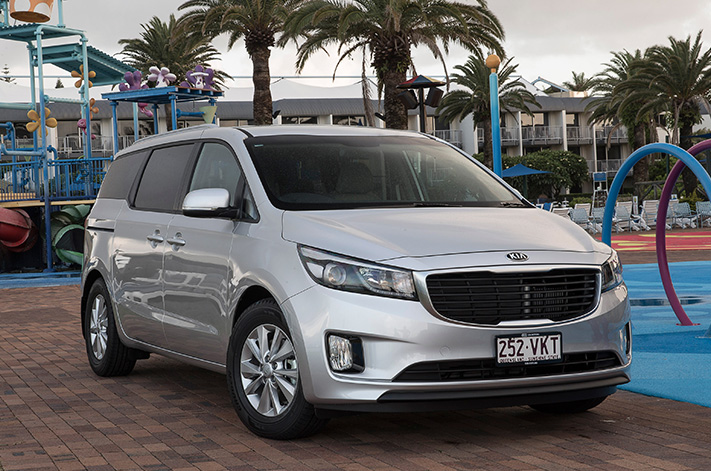
Kia offers two people-movers, and both feature in the medal positions. It’s the less popular Rondo, however, that takes gold rather than the bronzed, segment-dominating Carnival.
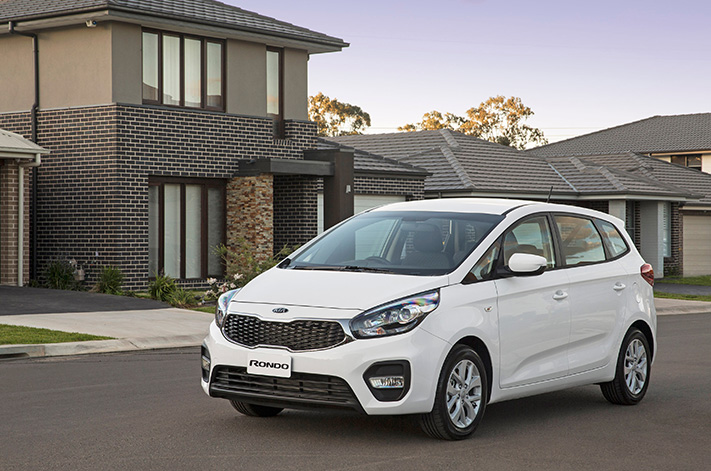
The Rondo Si’s $31,490 RRP is still impressively low for a vehicle offering seven seats, even with the base S starting at $26,990. It’s backed by cheap insurance ($817 for a year) and competitive fuel consumption (7.9L/100km for the petrol motor).
A 48 percent resale value is on the weak side, yet doesn’t prevent the Rondo from being more than $2000 cheaper to own over three years than the Carnival S.
Most of that discrepancy is accounted for by depreciation for the $43,990 base Carnival CRDi, though losses are restricted by a high 59 percent residual. The CRDi also makes more financial sense than the $2500-cheaper S petrol, because its much lower fuel consumption – 7.7 versus 11.6 litres per 100km – compensates in the not-too-long run.
In the middle of this Korean sandwich is France’s Citroen C4 Picasso. Citroen comes closest in the industry to matching Kia’s seven-year warranty – with six. The single-spec, $40,990 Exclusive model is also fuel efficient – officially using 5.6 litres per 100km with its 121kW 1.6-litre turbocharged petrol engine, though with premium unleaded recommended. Its resale value also matches the Carnival’s 59 per cent.
The Citroen and Kias all offer industry-average service intervals of 12 months, each with capped pricing.
Unfortunately, there are no EOFY deals currently offered for either the Kia Rondo, Kia Carnival or Citroen C4 Picasso.
Big families have enjoyed a larger range of vehicle options beyond the traditional people-mover thanks to an increasing number of seven-seater SUVs.
While not necessarily cheaper than some people-movers, they do offer increased ground clearance and, in certain trim grades, all-wheel drive to cater for those who might venture off the bitumen.
And if seven-seater SUVs have been slightly out of your budget, it’s worth checking pricing in May/June – as this is the traditional period when offers are put on the table by dealers as they look to dine on the rewards of reaching end-of-financial-year targets.
Good value is more than just a good price, however, and this WhichCar article focuses on three particular vehicles presenting excellent bang for your buck – courtesy of sister brand Wheels magazine
Wheels’ Gold Star Awards scored cars out of 100. Real costs comprising three-year depreciation and a year’s insurance and fuel expenses accounted for 80 per cent of the score, with 10 per cent each for servicing costs and warranty.
The Kia Sorento Si claimed the top medal despite costing a bit more over three years than its closest competitors here. It’s still relatively cheap to insure ($928 for a year), resale is positive at 54 per cent, and then there’s its industry-leading seven-year warranty.
You could save annual fuel bills by opting for the Si’s alternative 2.2-litre turbo diesel, though while it saves more than two litres of fuel per 100km the savings are negated by the variant’s extra cost. The Si diesel costs $44,490 versus the Si petrol’s $40,990 – and the latter’s engine is also more powerful.
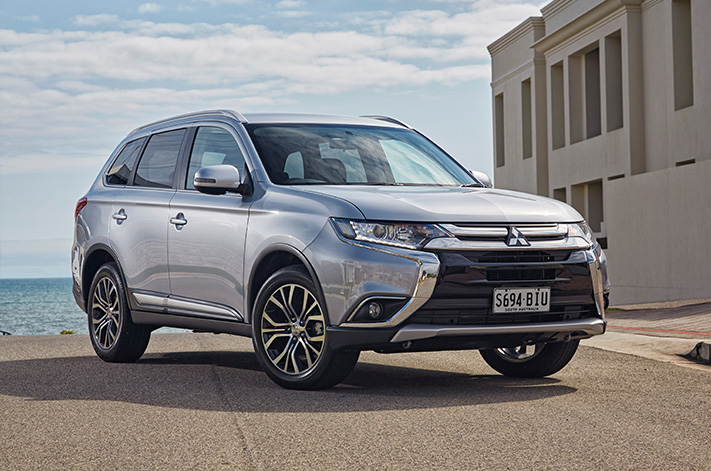
The second-placed Mitsubishi Outlander XLS is now replaced by the LS 4WD model, though it continues to offer all-wheel-drive as the badge indicates – and it’s even cheaper, starting at $33,500. A five-year warranty also remains in place, while fuel consumption is slightly better for the 2.4-litre petrol with CVT auto. Resale is only okay, though, at 50 per cent.
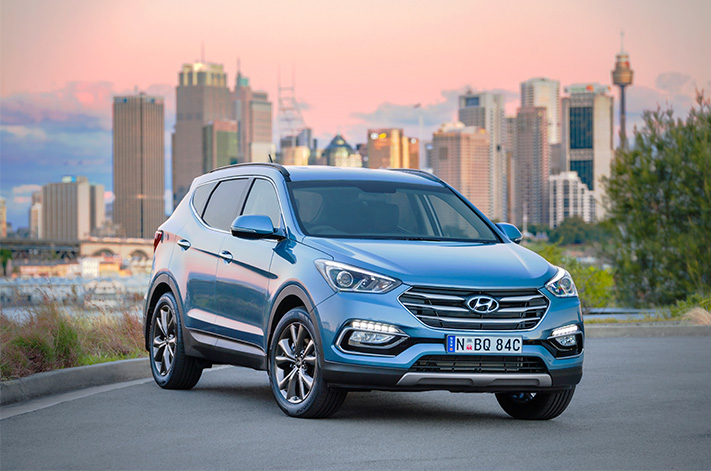
That’s well beaten by the Hyundai Santa Fe Active with its 56 per cent, which is also the cheapest to insure of this trio. The base model Active – all-wheel drive as with all Santa Fes – is slightly dearer to run over three years and only matches the Mitsubishi’s warranty to be two years shy of its Sorento twin’s peace-of-mind set-up.
In EOFY deals, the Kia Sorento Si is being offered as a Limited edition featuring free additions worth $3000 – including leather-trim seats and bigger (18-inch) alloy wheels.
Mitsubishi’s EOFY Sale doesn’t include the Outlander LS 4WD, while Hyundai is offering deals ending 31st May. The Active is available for $40,685 driveaway with five years’ free servicing, or there’s the newer Active X that brings extra features and is currently priced $39,990 driveaway.
Foggy weather seems to hinder most drivers today, but rally drivers have the skills to push through it – even if they can’t see a thing.
As if rallying wasn’t dangerous enough in the ‘80s, this classic footage we found on YouTube shows that it was sometimes far more difficult than we thought.
The video shows a 42-year-old Jimmy McRae and competitors almost flying (and sometimes actually flying) though zero-visibility conditions on the Isle of Man.
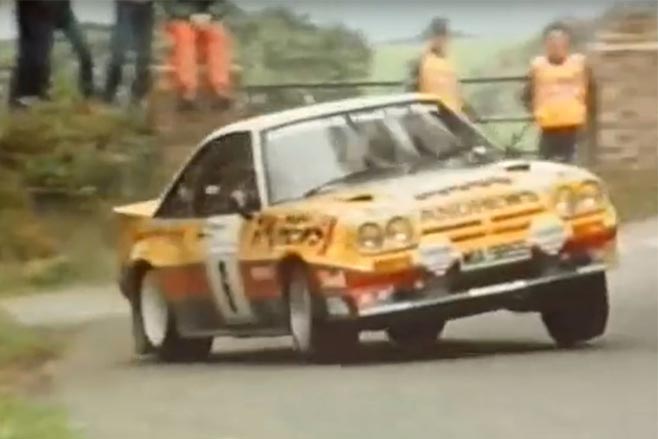
Taking third place on a windy stage in a V8 is already a huge feat, but what’s more is that he even had to stop during the race to have its torque tube repaired. Make your own Rover jokes, please.
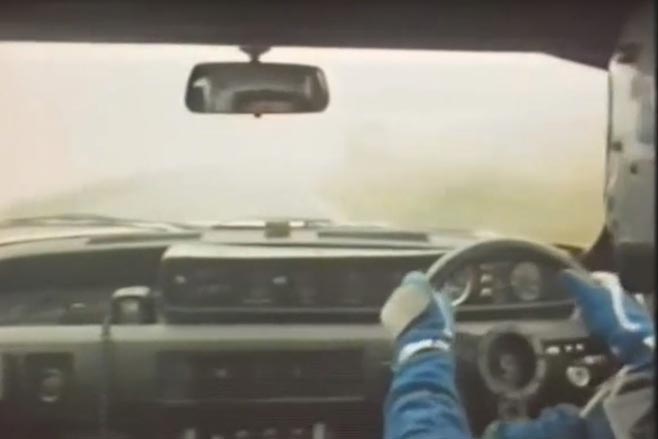
It’s not certain he would have finished in third place had flying Finn Hannu Mikkola (winner of the previous year’s British Rally Championship) not had gearbox problems which put him out of the race.
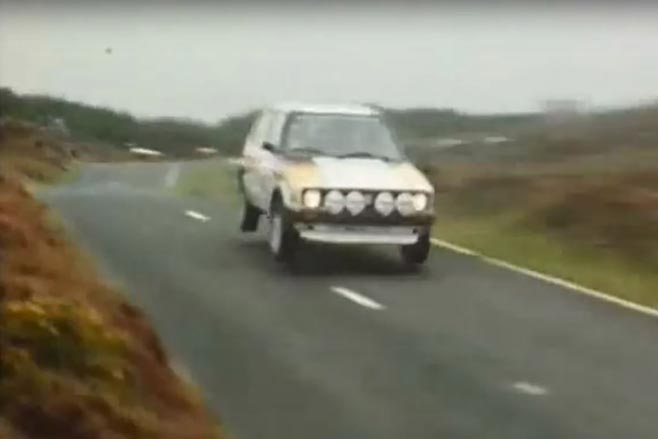
Another fun little insight into the perils of rallying comes immediately after Mikkola’s retirement from the stage, When the voiceover announces another driver’s VW GOLF GTI has hit the ground so hard that it’s injured his back.
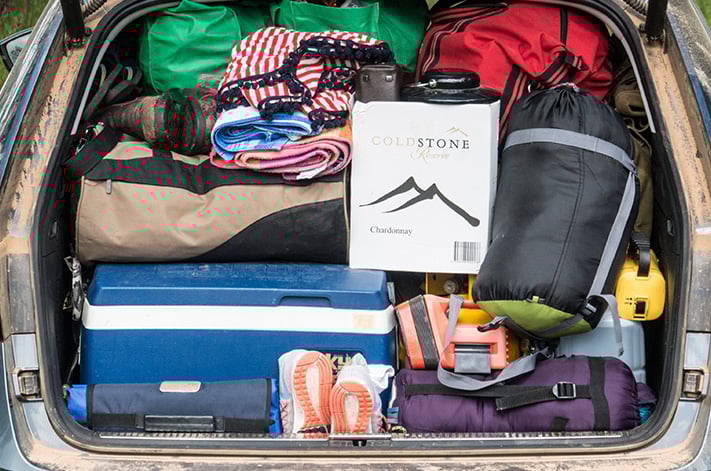
The Tetris-like challenge isn’t half as exciting when its real life and one bad decision can lead to broken goods, blocked views and angry words when your tyres burst and you have to unpack all the contents to reach the spare.
Luckily, after many frustrations, side-of-road tantrums and loading and unloading boots, we’ve got a few tips to help you pack your car safely and (almost) stress-free.
Watch your weight
Unlike Tetris, where you have little control over what blocks are thrown your way, when it comes to packing your car you have total control. Every vehicle has a load capacity, so know what yours is and make sure you don’t overload the car (including passengers). Not only will it create safety issues and affect the handling, but you’ll also use more fuel.
Stick to the bottom for the big stuff
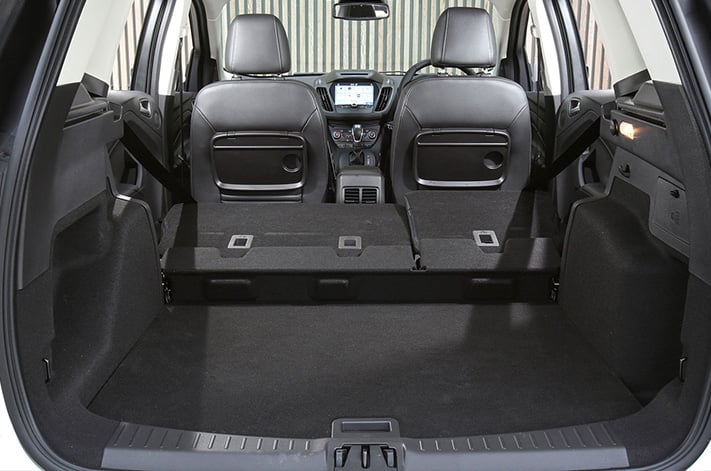
Big and heavy items should be loaded first and try to get them in the middle of the boot to help with weight distribution. It’ll also give you more space to pack lighter items on top.
Avoid creating missiles
Small, loose items can become projectile missiles. Make sure everything is tied down and maybe consider a cargo barrier for wagons, SUVs or even sedans with rear seats folded down, if the car allows for it.
Don’t pile it up
Another safety issue is blocking your rear vision – pretty obvious really. So don’t pile your luggage so high that is obscures your vision.
Allow easy access
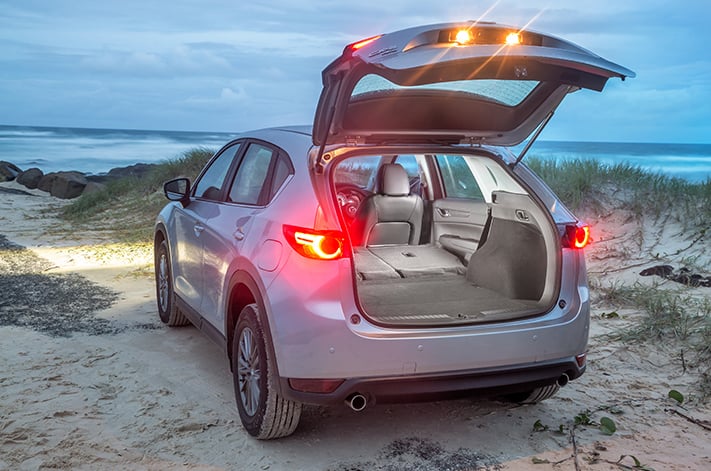
There’s nothing worse than when the kids start screaming for their favourite toy or blanket, and you realise it’s not only packed in the boot, but it’s also right at the back, under a bunch of other stuff. Pulling over to the side of the road to pull out suitcases and bags, just to get to said item is never a good idea and not only is it an inconvenience but also results in a longer-than-necessary tantrum. Pack the things you need access to in a convenient spot – remember side door pockets and under seat spaces too.
Same goes for the spare tyre
You may think that it’ll be unlikely you’ll need to access your spare tyre. But ask any of the families stuck on the side of a freeway, in less-than-ideal weather, unloading the contents of their boot just to reach the spare tyre whether they wish they’d packed more effectively, and you can guarantee they’ll say yes. Things will inevitably be packed on top of the spare tyre, but an try and do it as neatly as possible – use containers or large bags, and try to keep things to a minimum so if you do need to move things out, it’s only one or two items, rather than several.
Keep an eye on your car’s temperature
Loading a car can force it to work a little harder than normal, and cause it to overheat. Keep an eye on the temperature gauge and if you start to suspect your car is under too much pressure, pull over and give it a break.
This is a story about a car that, until relatively recently, simply didn’t exist. Not only did the BMW M8 never make production, the very existence of the singular prototype was denied for 20 years.
Just why BMW was so secretive about the project is unclear, as the number of aborted or stillborn development projects from BMW alone, most of which are well-known, could probably fill this magazine.
Sadly, we’re unlikely ever to find out, as everyone involved in the project – not that there were many – has now left the company. As such, information about the M8 is very difficult to come by.
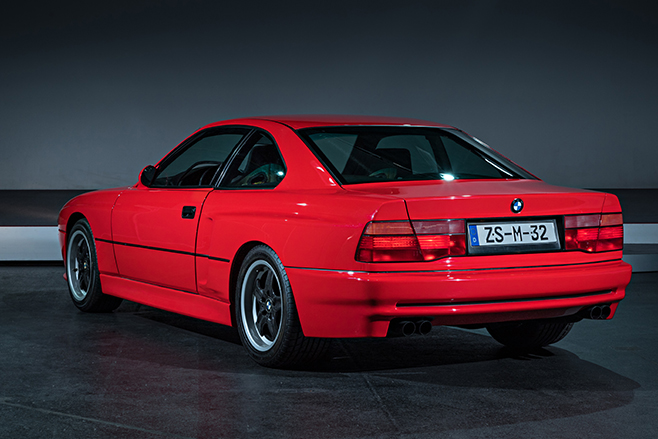
For two decades, it sat forlornly dormant deep within the bowels of BMW until in July 2010 it was shown to a select group of media at the BMW museum. Its only public appearance came two years later at the Legends of the Autobahn show in Carmel, California.
Ironically, the M8’s forgotten status may have ensured its survival. Car companies are notoriously unsentimental; a lucky few development prototypes make their way into museums, however the vast majority end up in the crusher.
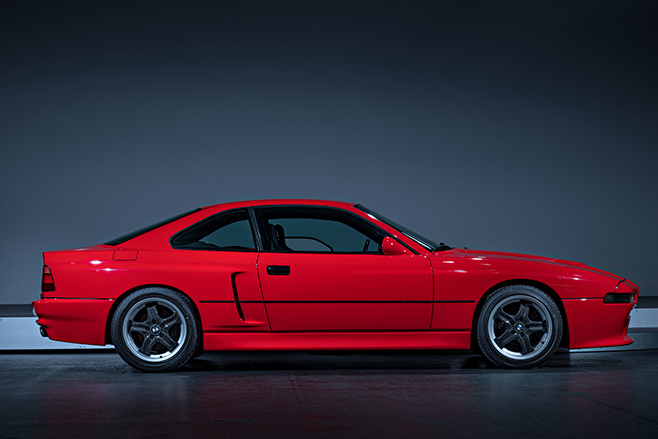
Thankfully, the M8 escaped such an undignified fate, as BMW’s vision of the ultimate V12 grand tourer is a mouth-watering prospect, with performance that would have rewritten established benchmarks in the early 1990s.
The BMW 8 Series was the baby of board member Doctor Wolfgang Reitzle, who oversaw product development for the Munich marque for a decade from 1987. Designed to be the flagship of the BMW range, this high-end luxury performance coupe was developed at enormous expense, said to be DM1.5b (about US$830m in 1989), and allowed BMW to flex its technological muscle.
The svelte body was shaped using then-radical Computer Aided Design (CAD), which combined with wind tunnel testing resulted in a wind-cheating drag coefficient of 0.29.
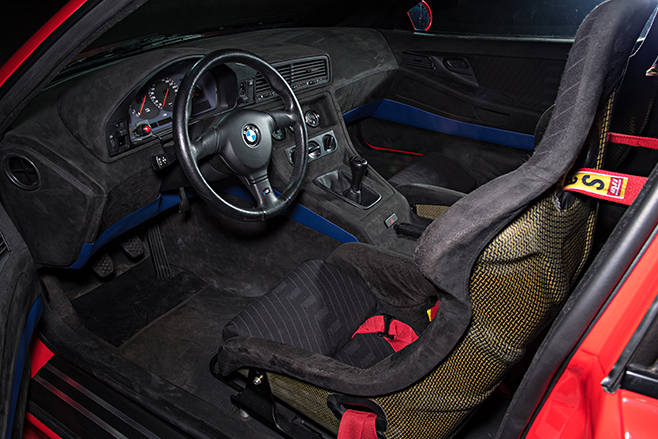
It was one of the first BMWs to use a multi-link rear axle, one of the first cars with an electronically-controlled drive-by-wire throttle, and the very first to mate a V12 engine with a six-speed manual gearbox and use a Computer Area Network (CAN bus), which quickly became the industry standard.
The 8 Series was revealed at the 1989 Frankfurt motor show, however around the same time Reitzle, engineer Karl-Heinz Kalbfell (who would go on to lead Rolls-Royce, Alfa Romeo and Maserati), engine guru Paul Rosche and chassis specialist Gerhard Richter began to investigate the possibility of a very high-performance version of the 8 Series, which could possibly lead to a GT racing program.
Key to the project would be the development of a new V12 engine, much more powerful than the existing 5.0-litre M70B50 V12, which produced only 220kW/450Nm.
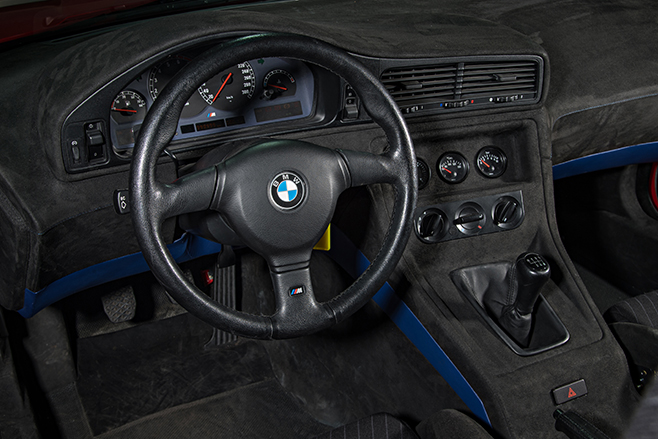
Schulte Vorwick, who worked in BMW Motorsport’s engine department, designed a new 6.1-litre V12, which was essentially two 3.0-litre straight-six engines mated together with a common crankshaft. It was dubbed the ‘S70’, the S prefix identifying it as the work of BMW’s Motorsport division.
In contrast to the M70’s highly oversquare 84 x 75mm bore and stroke dimensions, the double-overhead cam, 48-valve S70 was slightly undersquare with an 86mm bore and 87mm stroke resulting in a capacity of 6064cc.
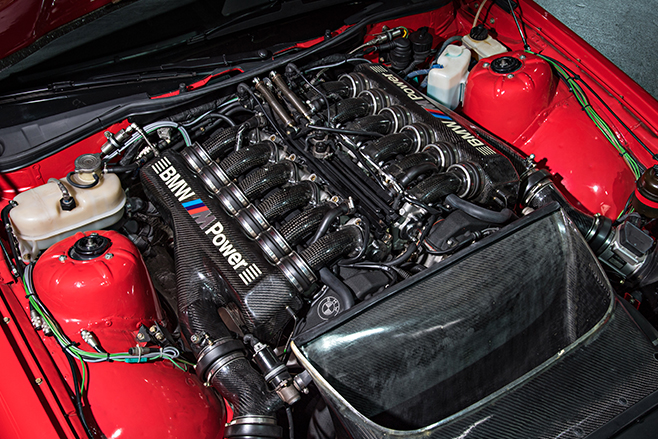
Under the bonnet the M8 is pure pornography. Twin throttle bodies feed massive carbon fibre intake manifolds, which in turn channel air to the 12 individual intake trumpets. Rosche told BMWCAR magazine: “To get good torque characteristics I needed the intake system to be as long as possible, which is why the system is as big and bulky as it is. I had trouble fitting it all under the bonnet!”
Development time was limited, with only a handful of sessions on the dyno completed, but this new 12-cylinder beast still beat out 410kW at 6000rpm and 500Nm at 5000rpm, with 90 per cent of that available from just 2000rpm. Remember, this is a time when a Porsche 928 GT managed 243kW, the most potent Chevrolet Corvette 283kW and even the mighty Ferrari F40 had 351kW.
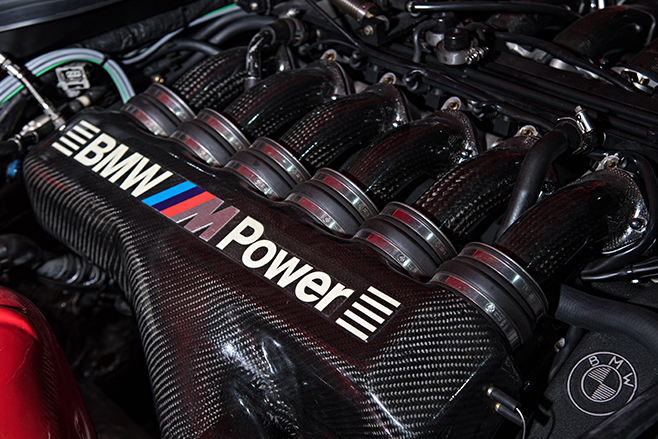
The standard Getrag six-speed manual was deemed up to the task, as was the standard 3.15:1 ratio rear diff, though the latter was modified to allow it to be cooled. A common misconception is that this engine would go on to power the McLaren F1.
A reasonable assumption, given Woking’s ground-breaking supercar also uses a 6.1-litre BMW V12 dubbed S70/2, however the two engines are largely unrelated bar sharing the same bore and stroke dimensions.
With power sorted, attention turned to sorting the 8 Series’ Achilles heel from a sporting standpoint – weight. In 850i guise, it weighed in at a hefty 1790kg, so a diet was high on the M8 development team’s agenda.
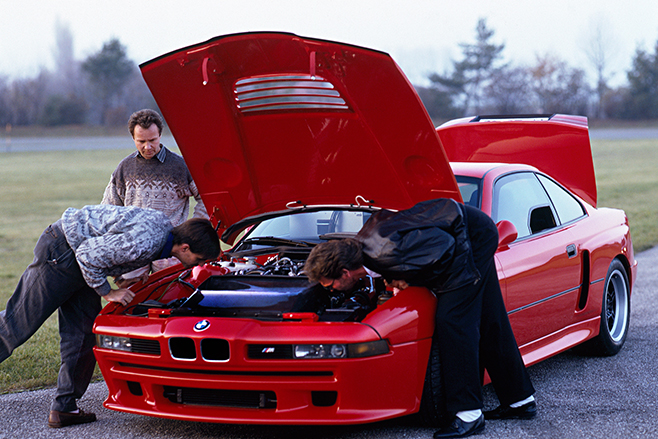
First to go were the rear seats, with the electrically-operated, leather-bound front pews replaced by lightweight Scheel racing buckets, while the pop-up headlights were also thrown in the bin.
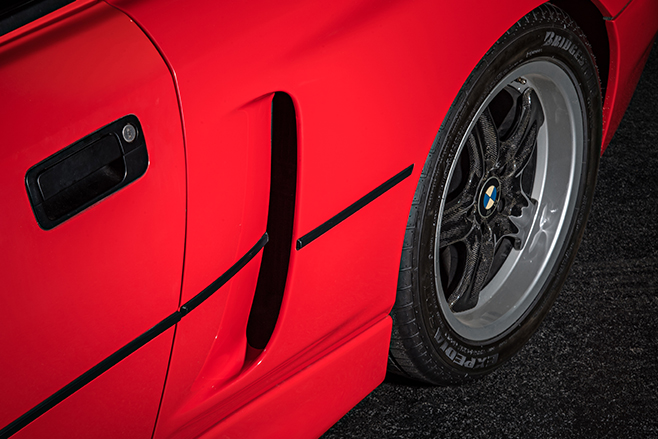
Composite materials were still in their infancy in the automotive industry, but the M8 adopted carbon-kevlar for its dash and wheel centres. The wheels themselves measure 17 x 9.0 inches front and 17 x 10 inches rear, wrapped in relatively modest 235/45 and 285/40 rubber respectively – a current M3 Competition wears bigger boots.
Safe to say sending the rear end sideways would not have been difficult with 410kW on tap. Brakes were standard at the rear, with the fronts beefed up with 305mm discs and four-piston AP Racing calipers.
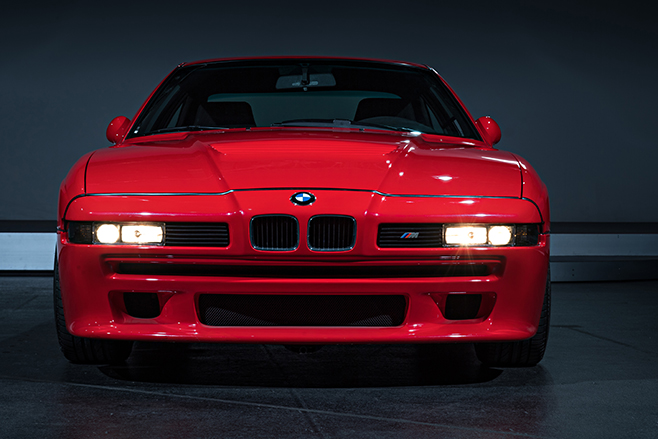
As with the engine program, a tight budget meant chassis development was limited, however the M8 did spend time at the Nurburgring. Official performance figures were also never attempted, however BMW calculated that to hit 300km/h the M8 would require around 335kW, so with 410kW 320km/h or more would have definitely been on the cards.
This would have made it not just the fastest BMW ever made, but one of the world’s fastest production cars full stop, challenging the likes of the Porsche 959 and Ferrari F40.
Despite this potential, wind-tunnel testing revealed the only modification necessary to the aerodynamic 8 Series body was the addition of two side scoops ahead of the rear wheels, the one on the left cooling the engine oil while the one on the right performs the same function for the differential oil.
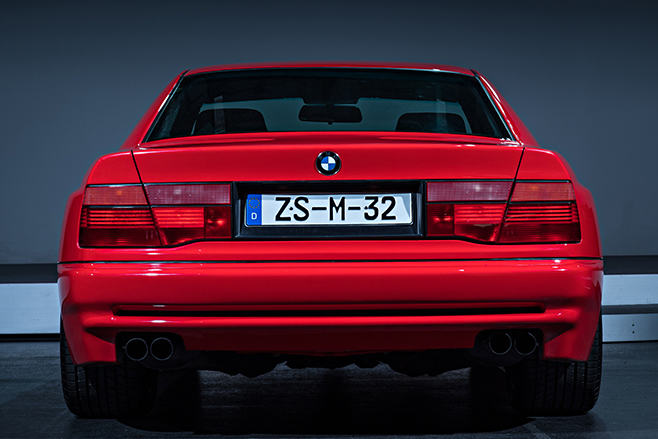
Unfortunately, all work on the M8 was soon to cease. Reitzle and Kalbfell presented the completed prototype to the BMW board in 1990 but they refused to green-light further development. Simply put, the sums didn’t add up. Even with a production run of 1500 cars, the M8’s projected price would have been DM250,000 when a Porsche 911 cost 40 per cent of that.
Not all of the M8 development work went to waste, however. Reitzle and Kalbfell revised their targets and created the 850CSi, which featured sportier suspension, bigger brakes and a 5.6-litre, single-overhead cam, 24-valve version of the S70 V12 (specifically the S70B56) producing 280kW/550Nm. Teamed with the six-speed manual gearbox, with the 250km/h limiter removed the 850CSi could nudge 300km/h.
It righted many of the dynamic shortcomings of the standard 850i, yet its sales figures proved the wisdom of the BMW board’s decision. Only 1510 850CSis were sold over a four-year period from 1992-96, with just three making their way to Australia. In total, 30,603 8 Series were sold between 1989-99, with the vast majority being the 850i.
It’s likely that the market for the M8, like the car itself for so many years, didn’t exist, and it’s a market that BMW has not played in since. The decision to spend almost US$1b to sell just over 30,000 cars has no doubt played a large role in that decision.
But at least BMW is no longer ashamed of its grand touring goliath. Manufacturers are using their heritage fleets increasingly often, so hopefully the M8’s 12 cylinders will one day fire into life once again and give all enthusiasts a glimpse of its promised Ferrari-killing performance.
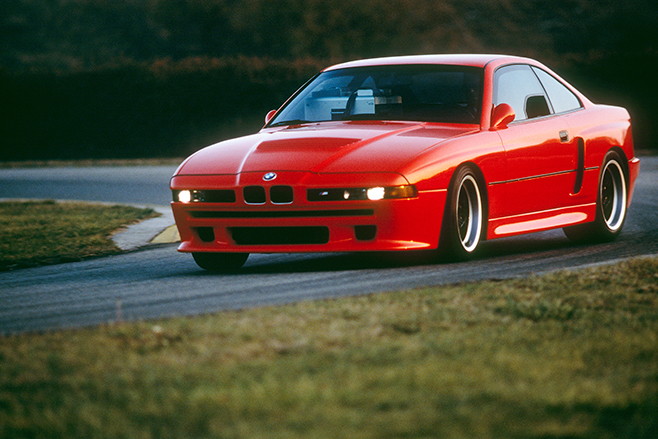
BMW M8 Prototype Specs:
Body: 2-door, 2-seat coupe Drive: rear-wheel Engine: 6061cc V12, DOHC, 48v Bore/Stroke: 86.0 x 87.0mm Power: 410kW @ 6000rpm Torque: 500Nm @ 5000rpm Brakes (f): 305mm ventilated discs, 4-piston calipers Brakes (r): TBC Wheels: 17 x 9.0-inch (f); 17 x 10.0-inch (r) Tyre sizes: 235/45 R17 (f); 285/40 R17 (r) Tyres: Bridgestone Potenza RE050A
BMW is expanding its range of stripped-out, performance-focused and more affordable M-cars with an Australia-specific M3 and M4 Pure.
Priced from $129,900 and $139,900 respectively, they will join the existing, and equivalent, M2 and M5 Pure models in July.
M Power fans will delight at the more accessible price, which undercuts the ‘standard’ M3 and M4 by $10,000 apiece, but the news gets even better. Unlike the M2 and M5 Pure, the new Pure pair gain the power upgrade, chassis and interior of the more pricey Competition variants.
That means the brace of more affordable M-badged siblings get a power upgrade from 317kw to 331kW, reconfigured adaptive M suspension settings with 15 percent stiffer springs, and 19-inch double-spoke alloy wheels in black, although they can be upgraded to the 20-inch version fitted to the Competition.
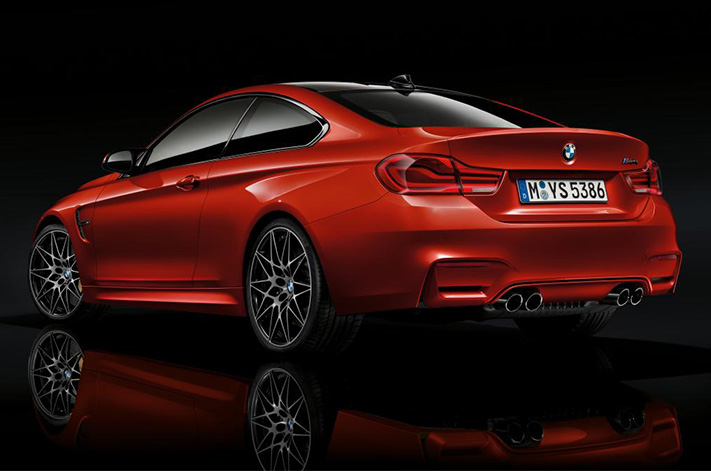
Externally, the Pure is identifiable by gloss black treatment applied to the boot badge, kidney grille, side gills and upgraded sport exhaust, which is also borrowed from the Competition M3 and M4.
When fitted with the standard seven-speed dual-clutch automatic transmission, the M3 and M4 Pure do the zero to 100km/h dash in 4.0 seconds (a tenth faster than the next most expensive option), while the no-cost optional six-speed manual drops that time back to 4.2 seconds.
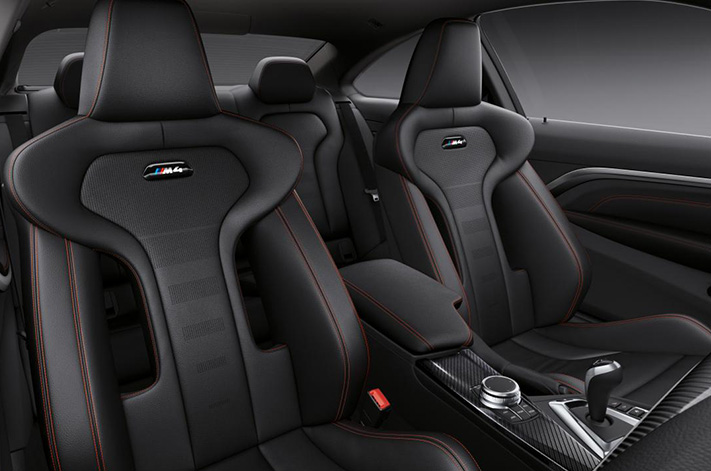
Adaptive LED headlights with main-beam assistance, leather-upholstered instrument cowl, top-spec Harman Kardon stereo, full leather, heated seats and rear roller sunblinds are all relegated to the options list in return for the $10,000 saving.
Like previous Pure packages, the specification of the latest version applied to the M3 and M4 was specifically developed by BMW’s Australian team to appeal to our performance enthusiast drivers and their unique requirements.
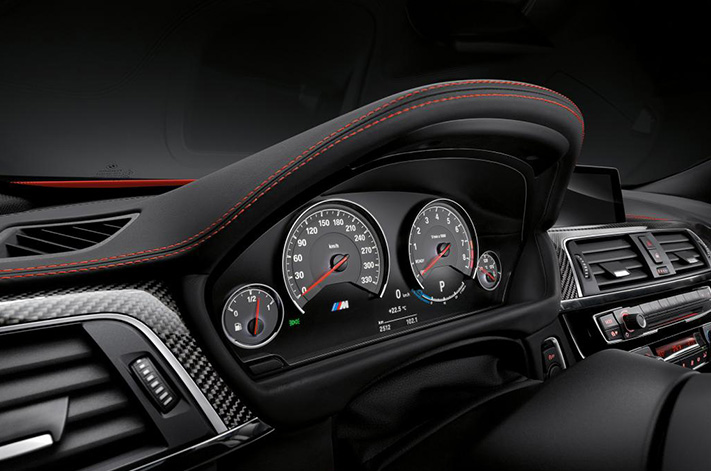
Both the “LCI” – read equipment-adjusted – M3 and M4 also get new illuminated M badges set into the sports seats, adaptive LED headlights, a leather upholstered dash, and electroplated interior details.
A Winton weekend of two very different days
Action track provides thrills and, on Sunday, a Triple Eight revival Dick Johnson may have famously described racing at Winton “like running a marathon around your clothesline”, but the now extended circuit certainly turned on the action at the weekend.
It was a tale of two races over two days – and two very different outcomes.
What is now very obvious is that four drivers – two each from DJR Team Penske and Red Bull HRT – are set for a mega fight for the 2017 Supercars championship.
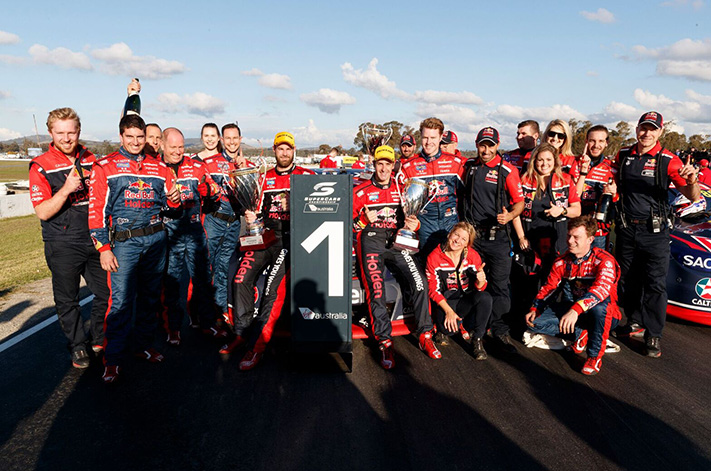
It was a win apiece for the leading two teams across the two days, Scott McLaughlin dominating in a DJR Penske Ford on Saturday and a rebounding defending champ Shane van Gisbergen bursting back to win on Sunday.
All around too, there were some highly entertaining duelling all the way back through the expanded field (boosted by three wild card entries).
Saturday was all about McLaughlin, who took the pole and then effortlessly clinched his third consecutive race win (and sixth for the team).
The DJR Team Penske cars looked supreme even though six-time champ, Red Bull HRT’s Jamie Whincup fought tenaciously to stay ahead of Fabian Coulthard and split the two Ford men.
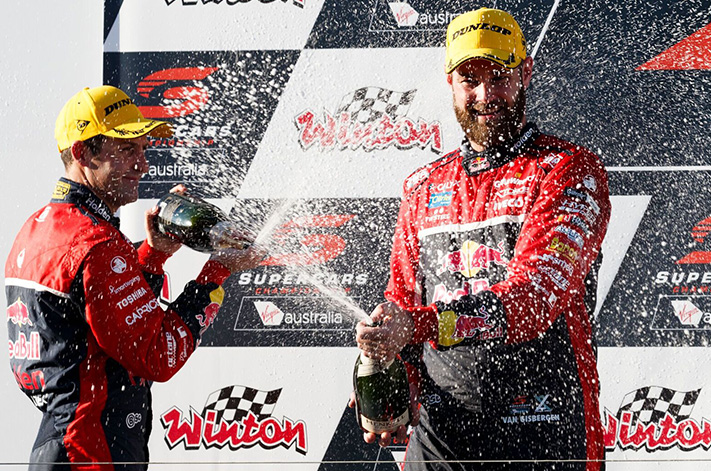
Craig Lowndes turned in a stellar drive to charge from 19th to sixth, ahead of the always racy Garth Tander.
Defending Supercars champion Shane van Gisbergen was a distant eighth after a slow pit stop.
After starting from second, Chaz Mostert’s race ended in just the 13th lap after his Supercheap Auto Ford Falcon experienced transmission failure.
A major talking point was the lurid end to James Courtney’s race on the final lap when the Walkinshaw Holden driver, fighting for 10th, appeared to get a helping hand into the kitty litter from BJR’s Nick Percat. The officials though deemed it a no-blame incident.
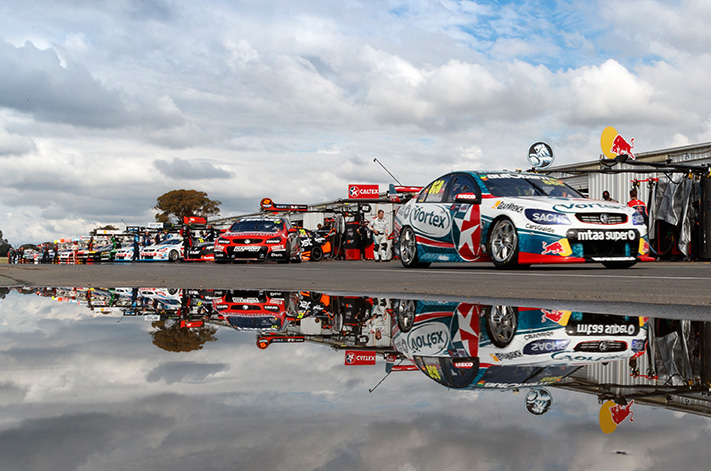
“I’m gutted,” indicated Courtney after yet another bad outcome. “We’ve had a hell of a time here with everything that’s been going on and to have that happen, it’s another kick in the face,” Courtney said post-race.”
Another day brought a change of fortune for some, although McLaughlin continued his stunning qualifying form with another pole ahead of Whincup, van Gisbergen, the impressive Cameron Waters, Coulthard and Davison. Unfathomably, Lowndes was just 26th fastest.
If many were thinking another DJR Team Penske day of dominance loomed, Whincup had other ideas, jumping McLaughlin at the start and after a spirited flurry and some panel rubbing, van Gisbergen joined him up front while the pole man slipped behind Waters.
Whincup continued to lead for much of the race until a safety car intervention compressed the field behind him.
At the restart, Whincup’s car slid wide on a dirty part of the track and van Gisbergen needed no invitation to pounce into the lead followed by Coulthard. Then van Gisbergen strategically organised his team-mate to get back to second, and that’s how they finished. A great bounce back by the Red Bull squad after looking outgunned 24 hours earlier.
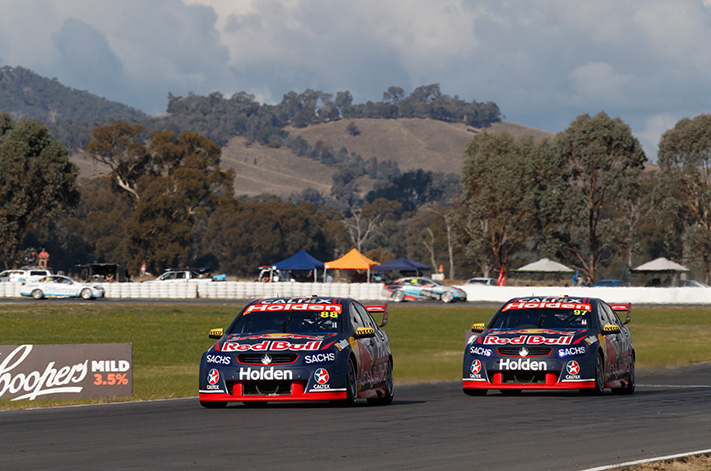
“All I want to do is win a race and just can’t get there.”
Still, it’s now clearly game on in the title fight.
Coulthard finished third from Waters, McLaughlin (who was forced to go old school and use his clutch pedal for much of the 67 laps), Tander and Reynolds.
The points situation is now very tight, with Coulthard just four ahead of Whincup, while McLaughlin is within 28 points of the lead and van Gisbergen only nine points adrift of him.
Ogier takes unpredictable Portugal
Seven drivers took turns to lead The first European gravel fixture of the 2017 World Rally Championship lived up to its promise by producing another fierce fight for victory with just 15.6sec separating winner Sébastien Ogier (M-Sport) and second-placed Thierry Neuville (Hyundai).
Neuville’s team-mate Dani Sordo completed the podium a further 46.1sec behind.
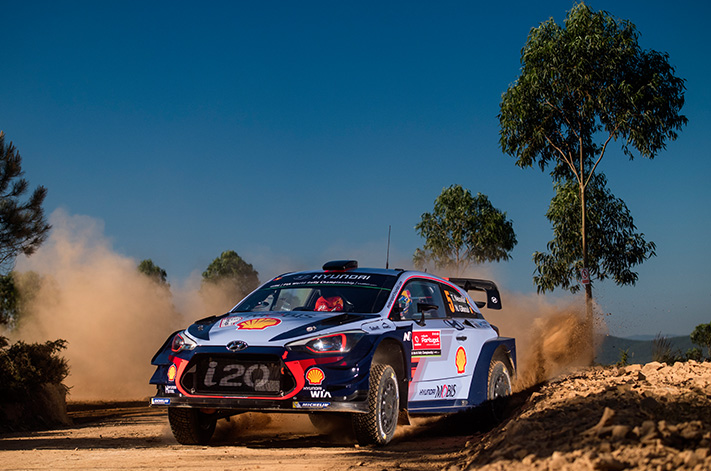
Ogier ended Saturday’s penultimate leg with a 16.8sec advantage over Neuville after leader Ott Tänak’s hopes of a maiden FIA WRC win ended when he swiped a bank in his M Sport Fiesta earlier in the day.
“After the struggle we had in the last round, it’s fantastic to be back on the top step of the podium again,” Ogier said.
“I had a new car in Monte-Carlo and we won. I had a new car here and we won. I’m not sure if the team can afford to give me a new car for every rally!”
Remarkably, Ogier was one of seven different drivers to lead this unpredictable four-day gravel encounter on rough dirt roads in the north of the country, round six of the season.
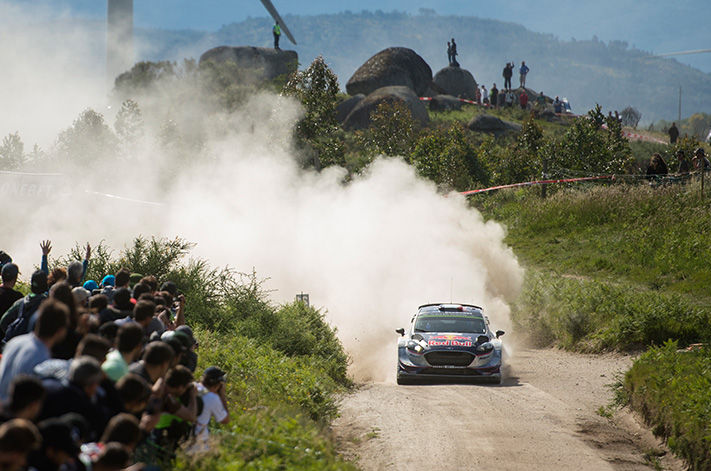
Ogier has increased his FIA World Rally Championship lead to 128 points, from Neuville (106), Jari-Matti Latvala (88) and Ott Tanak (830.
Indy 500: Dixon takes blistering pole
Alonso qualifies fifth; Power ninth While former Formula One driver Sebastien Bourdais’s 2017 Indy 500campaign ended in a frightening crash which put him in hospital, Fernando Alonso is in the 33-car field after a qualifying effort that looks strong enough to give him a shot at winning next Sunday.
Alonso has qualified fifth fastest for his first start at the fabled 2.5-mile Indianapolis Motor Speedway.
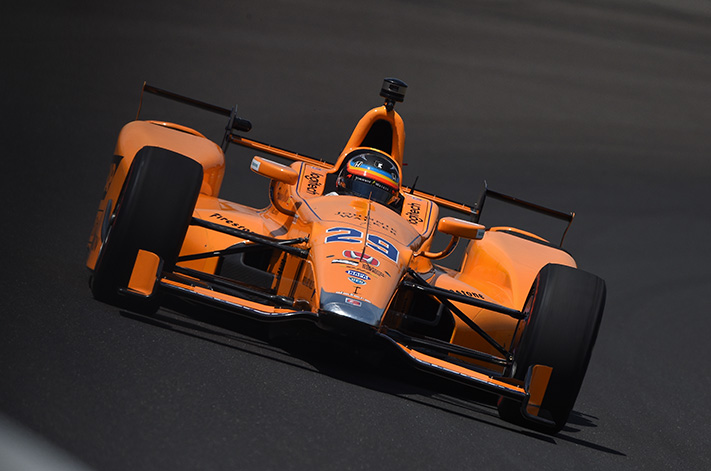
Pole went to New Zealand’s Scott Dixon with an insanely swift run of 232.164mph in a Ganassi Honda. This is the fastest four-lap qualifying average since Arie Luyendyk’s record pole run of 236.986mph in 1996.
Ed Carpenter, the pole winner in 2013 and 2014, and last year’s 500 winner Alexander Rossi will also start on the front row.
Video: Visor Cam injects more thrills to televised motorsport
Aussie Will Power, a last-start IndyCar championship winner, qualified his Team Penske Chev in ninth with an average of 230.200mph.
The 2014 IndyCar champion, Power has never been on pole at the Brickyard although he did qualify second two years ago when he was also second in the race.
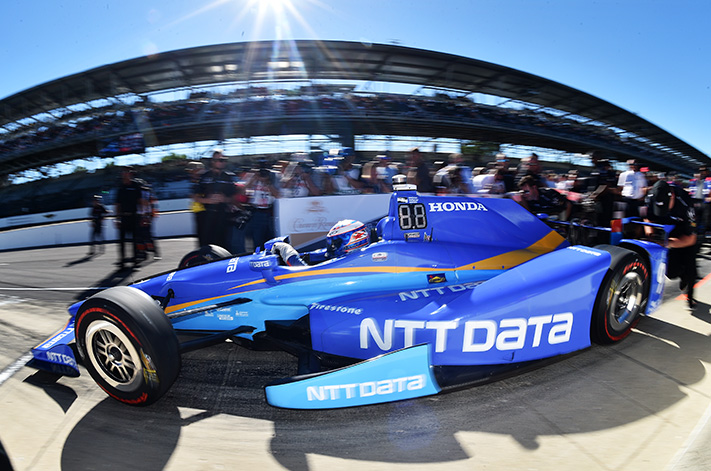
The Frenchman was fastest after the first two laps of his four-lap qualifying run before losing control exiting Turn One and then slamming nose first into the barriers and flipping. Bourdais suffered multiple fractures to his pelvis and a fracture to his right hip. He was lucky to be aboard a modern race car engineered to deal with heavy impacts.
Aussie James Davison will replace Bourdais in the #18 Dale Coyne Racing Honda.
Davison, who is 30, made his IndyCar debut with DCR in 2013 and returned to race with the team at the Indy 500 in 2015. He has been racing sports cars this year.
DCR’s prime car was destroyed in the Bourdais crash but a backup machine is being prepared. It is in full road course configuration and will take some time to convert to oval spec.
Davison will start from the back next Sunday.
French MotoGP: Rossi slides off within sight of the chequer
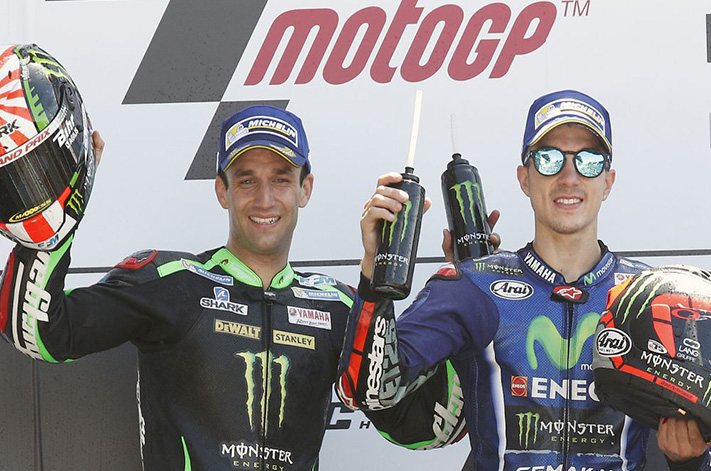
But the talking point was the brutal Jack Miller practice crash Yamaha’s Maverick Vinales took a breathtaking last lap victory in the French MotoGP championship race at Le Mans, with local hero Johann Zarco (also on a Yamaha) claiming a stunning second ahead of Honda’s Dani Pedrosa.
Valentino Rossi had looked set for an epic tyre-managed victory when he grabbed the lead from Vinales with three laps left to run.
Then the 38-year old ran a little wide on the final lap and the Spaniard was back in in the lead. Rossi poured on the pressure during the last half lap but then slipped off just a few corners from the flag.
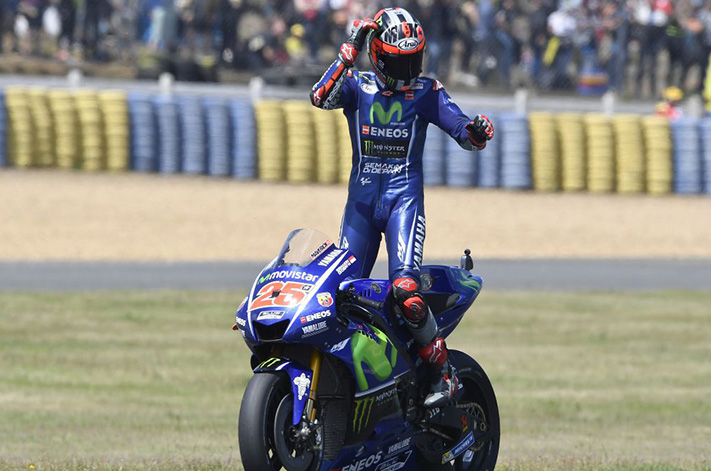
Zarco, one of three Yamaha riders filling the front row, aggressively pushed his way to the front on the opening lap and stayed there until Vinales slipped by.
But Vinales couldn’t shake Zarco, nor Rossi (Yamaha) in a close third or Marc Marquez, in fourth on a Honda.
Marquez crashed out with 11 laps remaining, his world title hopes taking a tumble with him.
Jorge Lorenzo was a lowly sixth for Ducati.
Australia’s Jack Miller, riding with painkillers after his pounding ‘off’ on Saturday, bravely held on to eighth.
The footage of Miller’s scary high-speed shunt at the end of final practice has captured so much attention from the weekend.
Miller, 22, miraculously walked away relatively unscathed after losing control of his Honda and slamming into a barrier surviving a terrifying crash during practice.
The TV vision shows Miller firing out of turn one before the bike reacts badly, the front wheel tucking before it spears towards a barrier, bucking violently across some bumpy outfield before hurtling into the tyre barriers at barely diminished speed.
Miller said afterwards that he let go of the bike when he saw it wasn’t going to stop before it contacted the barrier.
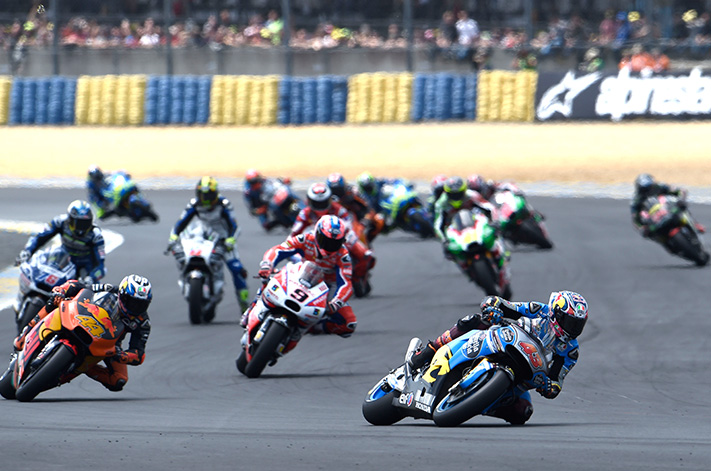
Miller bravely returned to his garage before re-emerging after a medical clearance to qualify 11th on his back-up machine.
Earlier, the Queenslander had topped the timesheets in the opening rainy practice.
Later former world champion Jorge Lorenzo accused Miller of having a cavalier attitude to rider safety.
The Moto3 race was marred by a two major crashes early, one taking out four riders and then a bizarre lap two multiple spill when an estimated 20 in the lead bunch slid on oil and went down.
The Moto2 race was won by Franco Morbidelli while Australia’s Remy Gardner finished 20th as he continues to rebuild his confidence and race fitness after breaking his leg at the Argentine GP several weeks ago.
Big grid for Le Mans 24H
Two Aussies in field of 180 drivers Confirmation of the full 24 Hours of Le Mans entry for June 17-18 shows a field of 60 entrants and 179 drivers (one slot yet to be filled).
Of the 60 cars, 28 are from the FIA World Endurance Championship, the French classic being the third round of the 2017 season and the jewel in the crown of endurance.
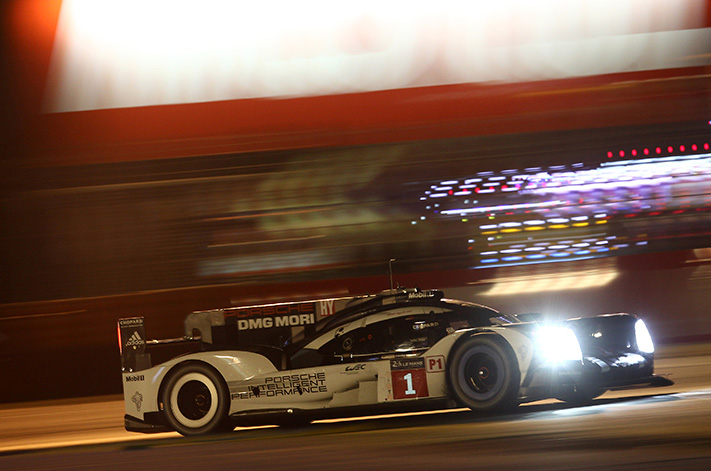
Toyota in particular is on a mission to succeed after is heartbreaking 2016 race, when its lead car failed within minutes of the chequer.
An impressive 25 cars fill out the LMP2 category which features all four different chassis manufacturers.
As usual, the popular LMGTE classes is full of cars and interest, with 29 entries representing the world’s leading luxury brands (and a few ring ins) including Aston Martins, Chev Corvettes, Ferraris, Fords and Porsches.
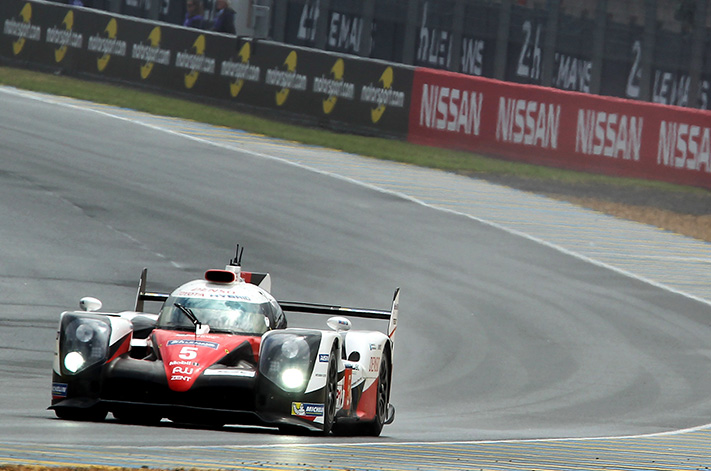
Ryan Briscoe returns with the Ganassi Team USA Ford GT squad in LM GTE Pro, teaming up with New Zealand’s Scott Dixon and Richard Westbrook of Britain.
Graff Racing has named Aussie ex-Formula Renault racer James Allen along with Briton Richard Bradley and young French driver Franck Matelli in the #39 ORECA Gibson LMP2 machine.
