
A third-generation Mercedes-Benz CLS Class prototype has been spotted during cold-climate testing in Scandinavia.
The customary camouflage appears to be masking mostly evolutionary design changes, the most notable being the more pronounced boot lid with straight rear profile, reduced hip line and horizontal tail lights replacing the triangular lenses.
Sharing the same MRA platform as the Mercedes-Benz E-Class sedan, it was widely expected the CLS would be renamed CLE, though insiders at Mercedes have confirmed the CLS badge will remain mostly because the brand is so established.
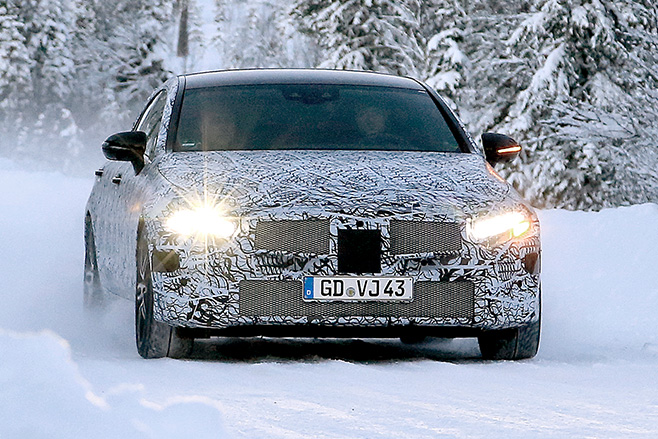
It still has the longer wheelbase than the E Class, which helps accommodate the sloping roofline over the back seats.
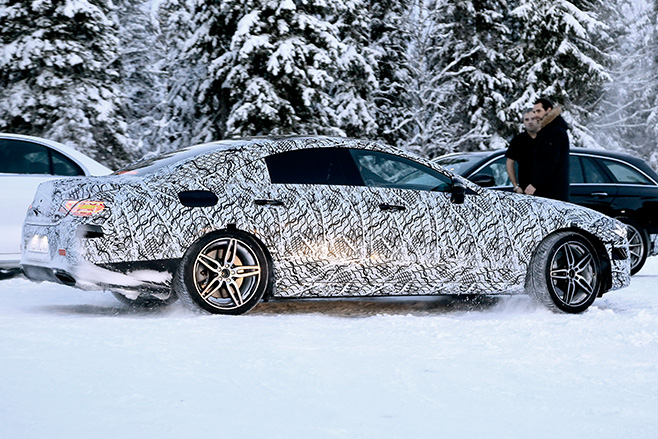
There will still be a V8 AMG version and the E-Class underpinnings means it could accommodate the E350e’s plug-in hybrid powertrain.
Inside, it’s also expected to share the E-Class’s excellent dashboard, with twin 12-inch displays on a single long flat screen.
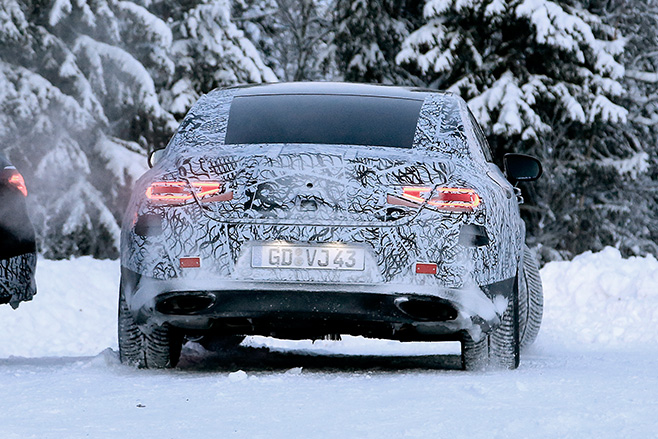
The all-new CLS will be available in Europe from mid-2018 – about a year after the “real” two-door E-class coupe. Expect it to be available here a few months later.
Rivals will include the Audi A7 and RS7 and the BMW 6-Series GT.
UPDATED: Australia’s next Holden Commodore will be French-owned by the time it reaches our shores in early 2018, with Holden parent General Motors confirming the sale of its European carmaker.
GM chairman and chief executive Mary Barra confirmed the French-owned Opel would continue to provide Holden with vehicles under a supply deal negotiated between the carmakers. In the meantime, Opel’s new owners, Citroen and Peugeot parent PSA Group, will convert Opel’s products to Peugeot- and Citroen-based cars as part of the handover.
General Motors confirmed it would offload its Opel/Vauxhall division to French giant PSA raising questions about the future of one third of Holden’s future models, including the Holden Astra and the soon-to-arrive 2018 Commodore. However, the supply of both cars now remains certain for at least the next five years as part of the transformation process.
The €2.2 billion ($3.1 billion) deal will see General Motors sell its six assembly plants, German-based engineering facility at Russelsheim and half of GM Financial’s European operations. It will make PSA Group the second largest manufacturer in Europe.
The announcement comes as Holden is embarking on its most ambitious European-sourced model offensive in its 69-year history as a major strategy of its 2018 and beyond post-manufacturing future.
GM and Holden have previously stressed the importance of sourcing vehicles from Europe given the shift in Australian tastes towards luxury and European models.
Holden released a brief statement confirming the immediate supply of Opel-sourced cars – including the upcoming Commodore, the first one not produced in Australia – claiming “these product programs are not affected at all”.
The statement read: “Holden and Opel have had close ties for many years and delivered fantastic vehicles to Australian customers, including the current all-new Astra and the next-generation Commodore due in 2018. The good news is these product programs are not affected at all. We will continue to work closely with Opel and GM to deliver our vehicle plans with excellence and precision. This includes future, new right-hand-drive SUVs like the Equinox and Acadia that were engineered specifically for right-hand drive markets.”
However, in terms of the impact on Holden and where it sources its vehicles longer terms the announcement raises more questions than it answers.
Will Holden be able to continue using the Astra name, for example? The nameplate was recently reintroduced to replace the shortlived Holden Cruze and form a central plank to Holden’s small car aspirations.
And where, longer term, will future Commodores come from, if Holden decides to continue with it at all?
The statement says Opels will eventually shift away from GM-based products to PSA platforms and architectures.
“Opel/Vauxhall will also continue to benefit from intellectual property licenses from GM until its vehicles progressively convert to PSA platforms over the coming years,” read one section.
However, Peugeot and Citroen have a poor record with export markets such as Australia.
Key to the issues are auto transmissions mated to small or unsuited engines as well as inconsistent model lines. And vehicles are now always set up well for Australian conditions.
Sales of Peugeots and Citroens in Australia are just as poor and have been falling.
The announcement is poorly timed for Holden, too, which is struggling with record low market share – just 6.4 percent in February – and convincing Australians it will continue beyond the October 20, 2017 shutdown of manufacturing.
Holden’s future is already riddled with uncertainty as it deals with surviving without manufacturing that has been the backbone of the brand.
In confirming the deal, Barra said it was about “reshaping our company” and that it “created a new opportunity to enhance the long-term performance of our respective companies”.
Barra said: “We are very pleased that together, GM, our valued colleagues at Opel/Vauxhall and PSA have created a new opportunity to enhance the long-term performance of our respective companies by building on the success of our prior alliance.
“For GM, this represents another major step in the ongoing work that is driving our improved performance and accelerating our momentum. We are reshaping our company and delivering consistent, record results for our owners through disciplined capital allocation to our higher-return investments in our core automotive business and in new technologies that are enabling us to lead the future of personal mobility.”
With Barry Park
It’s a mid-sized mover with a badge that has a reputation for reliability and durability second to none. And the Crew version gives you the option of carrying three extra passengers.
What Stands Out
The HiAce is the last forward control van left on the Australian market. It’s available as a super long wheelbase, as a mini-bus and as a mid-wheelbase van with a choice of a 3.0-litre turbo diesel or the less popular 2.7-litre petrol donk. The 3.0-litre may sound familiar to some Toyota diehards; it’s the same engine that was used in the last gen HiLux and Prado. It’s a pretty agricultural unit.
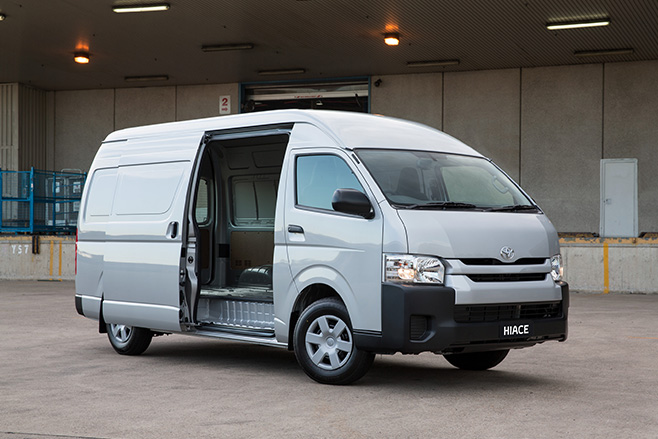
The most popular engine by far is the diesel and it makes 100kW of power and 300Nm of torque. Gear changing duties are taken care of by either a five-speed manual transmission or a four-speed auto. While the gearbox may seem old school it does need to be pointed out that this is a proper auto with a torque converter rather than an automated manual. And power gets to the ground via the rear wheels.
There’s nearly six cubic metres of load space in the back of this van, though less with the rear seat unfolded. Payload is just under a tonne and it will tow 1.4 tonnes as long as you don’t have a load in the back.
What’s Inside
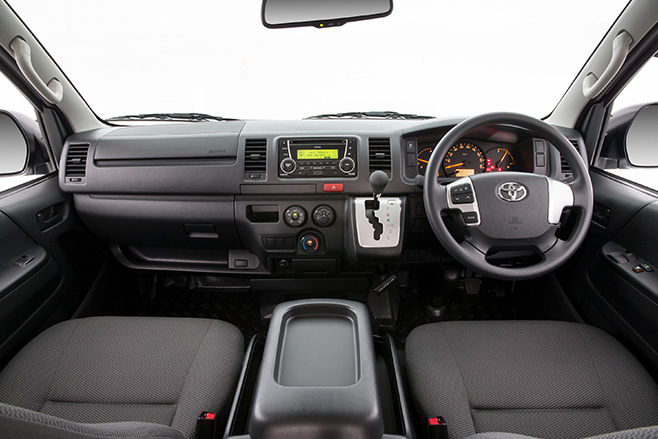
There aren’t a lot of creature comforts happening inside this Toyota. There’s a little storage, a couple of cup holders and acres of drab plastic and vinyl. A very basic Bluetooth enabled stereo and air-conditioning are as luxurious as it gets. I should also mention that it does indeed have power steering.
The rear bench seat folds and rolls to make room for a load if need be. Ventilation is provided by windows in the glazed sliding doors. The forward seating position of the HiAce means that you are sitting on top of the front wheels which makes negotiating speed humps a thoughtful endeavor. It does mean however that it has a pretty good turning circle.
Choosing Yours
If you want a basic box on wheels with a reputation for bulletproof reliability, here’s your van. If you want comfort and up to the minute features, look elsewhere. The Toyota HiAce is a solid dependable workhorse that will cop virtually everything you throw at it.
But it does feel very dated both to sit in and drive. The 3.0-litre diesel engine is a tough engine and both gearbox options are as well. The petrol version lends itself to gas conversions and is popular with the taxi crowd. The diesel though is the choice of couriers and tradies everywhere.
The HiAce gets a three year 100,000km warranty and service intervals are at 10,000km intervals.
Summing Up
In the mid–size van market virtually all of the opposition is superior in terms of performance, refinement and comfort. But the business case for HiAce just keeps on selling it. It doesn’t break, stuff fits in it and it’s drive layout means that it’s pretty nimble in the back streets.
Small businesses continue to buy HiAces based on Toyota’s reputation for not breaking or falling to bits. It’s a rough and tumble workhorse and this Crew version only expands its appeal to those who need a versatile business appliance on wheels.
INFINITI is launching a technologically updated version of its Q50 sports sedan at the Geneva motor show, less than six months after the current model was revealed in Paris.
Going by the single picture of the 2018 Q50, cosmetic changes are limited to the front bumper, particularly around the lower grille which now has a smiling appearance.
According to Infiniti, the ‘refreshed’ look also extends to the interior, though don’t expect too much to be different.
The most significant changes to Infiniti’s most popular model have occurred under the skin where a host of “innovative technologies that empower and support the driver, taking a holistic approach to performance” have been introduced.
These include semi-autonomous technology, which the company has christened ProPILOT and will be the system that all future Infiniti autonomous drive technologies will be based.
Details about its capabilities are still sketchy, however it will include a second-generation of its steer-by-wire Direct Adaptive Steering with more direct steering responses and easier manoeuvrability than the current model.
The unique steering system has been controversial, but Infiniti insists that by skipping the mechanical middle man, the technology will be better suited to fully autonomous driving when that technology becomes available.
Life under the bonnet will remain unchanged powerplants including the 3.5-litre V6-based hybrid and 3.0-litre twin-turbo V6 from the VR powertrain family, in 224kW and 298kW guises, which made the 2017 Ward’s ‘10 Best Engines’ list.
The man behind Toyota’s edgy C-HR is a performance freak, and he wants his compact SUV baby to morph into something properly swift. Is a C-HR GT4 on the way?
HIROYUKI Koba is, in typical Japanese fashion, a fairly unassuming chap. Middle-aged with a neat haircut and wearing a grey suit with a Toyota pin on the lapel, he appears to have emerged from the same cookie cutter as most other Japanese car company execs. Beneath the surface, however, is a man driven by performance.
The latest entry on his curriculum vitae is Chief Engineer for the Toyota C-HR, Toyota’s all-new compact SUV contender that will do its best to challenge the dominant – and similarly style-driven – Mazda CX-3. With just a 1.2-litre turbo with 88kW under the bonnet it’s not what you’d call a firecracker, yet Koba reckons it has significant performance potential.
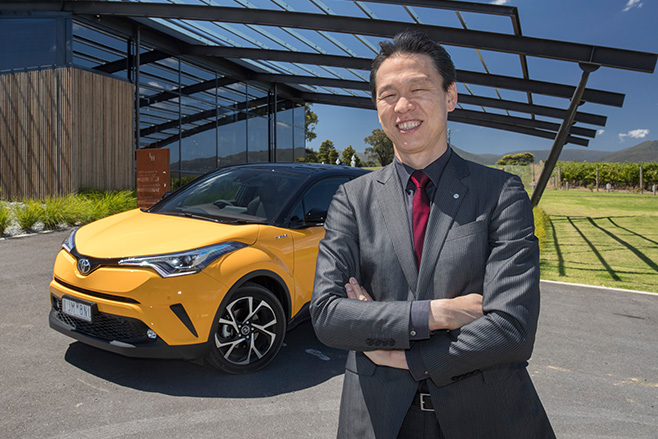
When talk turns to performance cars, Koba’s eyes light up. Behind the grey suit, Koba is a dyed-in-the-wool fast car freak, and he’s eager to preach. In Australia for the first time to help launch the Toyota C-HR, Koba’s visit was just two days long – he had to return to Japan by the weekend to steer his open-cockpit race car in competition at Suzuka.
A 30-year veteran of Toyota, a look at Koba’s resume and nothing really jumps out. His name is against SUVs, hybrids and a workman’s pickup. Money-makers, sure, but not the most exciting metal.
However, waiting for him back home is a last-generation Toyota Supra. Twin-turbo, naturally. In past years he’s also owned two MR2s – a first-gen AW11 and a second-gen SW20 – so the man is no stranger to fast Toyotas.
This passion has clearly rubbed off on the C-HR.
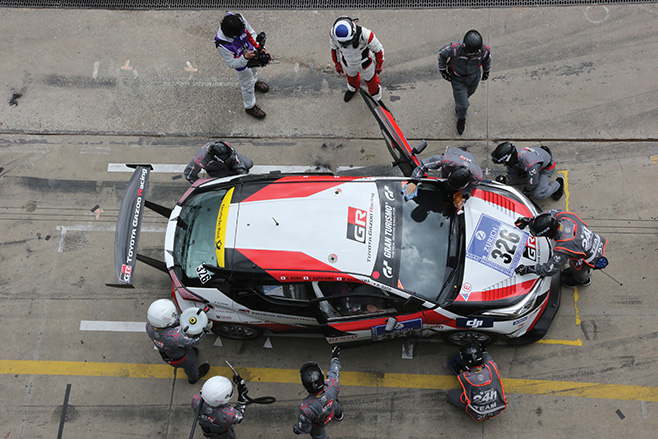
Our first drive showed that besides dull (if authoritative) steering and a sedate powertrain, the C-HR handles sweetly and could, conceivably, be turned into a fairly swift hot hatch. Hustle it hard and you’ll discover excellent suspension and a chassis that’s surprisingly willing to rotate.
Asked by Wheels whether he’d like to put a drivetrain like that offered by the dearly departed Toyota Celica GT4 – a potent two-litre turbo AWD for those with memory issues – Koba perked up. “This kind of car I would love to do,” he said. “It is my dream!”
The bones are good. The TNGA platform – specifically the GA-C sub-architecture – that lies beneath the C-HR’s wild sheetmetal shows great promise in the C-HR.
And Toyota has spent money on things that this kind of car doesn’t necessarily need. Double-wishbone rear suspension instead of a torsion beam, rose joints rather than squishy rubber bushings, a predictive rather than reactive AWD system, downshift rev-matching for the manual – a compact SUV needs none of these features.
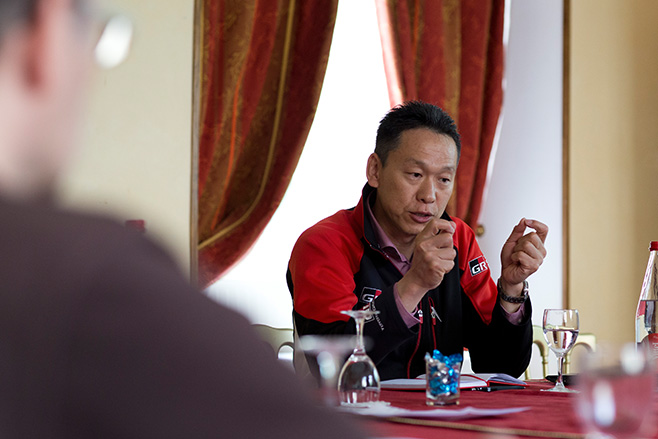
You get the feeling that Koba spent a great deal of time in Toyota City boardrooms arguing for their inclusion, and we’re glad that he emerged victorious – the C-HR is a better car for it. When there’s already a veritable sea of compact SUV rivals – and many more coming – making performance a point of difference is a sound strategy.
But there’s definitely some significant headroom.
Is a fast one coming? Koba is playing coy for now, but having a bona-fide driving fiend at the helm of the project bodes well for the prospects of a C-HR GT4. With buyers migrating to SUVs in ever-increasing volume and Toyota currently lacking a proper hot-hatch in its line-up, a C-HR GT4 would allow the company to capitalise on the former while rectifying the latter, while also blazing a trail with the first mainstream high-performance SUV in the compact category.
If Koba-san gets his way, that is.
GENERAL MOTORS seems to have finally realised that there’s a market for its Camaro outside the USA and is launching two models at the Geneva Motor Show, including a track day concept
The Chevrolet Camaro Track concept looks to be based on the Camaro SS with its 6.2-litre V8 grunt, but features performance gear as found in the track-focused V6 Camaro 1LE
Chevy’s description of the concept is as vague as the picture, though it does describe it as a “track day warrior” that can be used as a daily drive.
Painted in the kind of green hue that seems popular with performance cars at the moment, the Camaro Track concept sits on 20-inch wheels with wider tyres supporting the chassis that’s optimised for fast lap times by being lowered by 30mm.
This will help tame the 333kW and 617Nm of torque produced by the LT1 V8 engine, though it isn’t clear if it’s equipped with selectable driving modes to adapt suspension settings.
Other upgrades over the SS include a front lip spoiler, sporty side sills and more powerful Brembo brakes.
It’s not known if the Camaro Track concept will make it to production or of it’s just a one-off show car to woo European interest.
The Camaro Track concept will join the sixth-generation Camaro range on the Chevrolet stand at Geneva as well as the Corvette Grand Sport and the Chevrolet Corvette Z06.
Chevrolet’s move into Europe would coincide with the expected sale of GM’s European arm Opel to France’s PSA group.
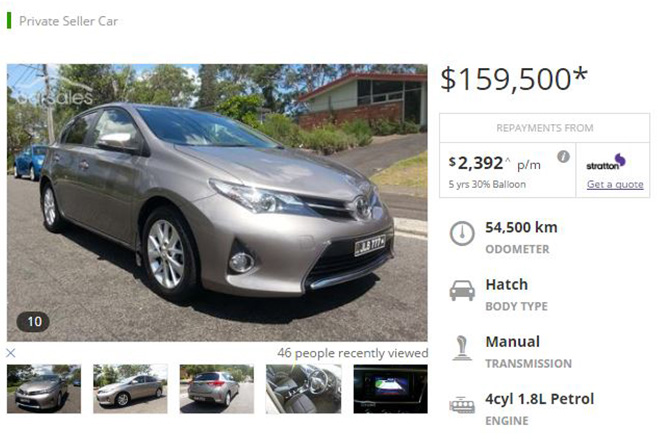
HOW much would you be willing to pay for a 2014 Toyota Corolla Ascent Sport Manual? $14,000?
Well, that’s not nearly enough according to Joel from Thornleigh, who is trying to offload his secondhand Corolla for a frankly insane $159,500.
It has to be said here, that we at Wheels HQ couldn’t believe our eyes when we first saw the ad, and decided to give Joel a call to find out why he is selling the car for such an incredible amount.
While most would just assume that our ambitious seller had confused the selling price and odometer fields, Joel says not so!
“I was trying to get some money for an upcoming wedding,” Joel told Wheels.
“But then all of a sudden within three days I had a dozen different calls all thinking I had done it by mistake and added on an extra zero.
“They all thought they could get a new car for under $10,000, so I thought well if everyone is dividing it by 10, I’ll put it up to $159,000 and see what happens.
“Some generous person out there might be looking for a new car and willing to support my future life and find the ad.”
Joel explained he was happy to hold onto the car for now, and was patiently waiting for a generous benefactor.
“I’d be willing to get over the emotional loss [of selling the car] if someone paid that price,” he laughed.
While we wish Joel well on his endeavour for the same money you could have a BMW M3, Alfa Romeo Giulia QV, Mercedes-AMG C63 S, an Audi RS5, or seven brand-new Corolla Ascent Sport manuals, all with cash to spare.
It may not be the quickest way to sell a secondhand Corolla with 54,500km on the clock, but it may be the most profitable if Joel’s plan works.
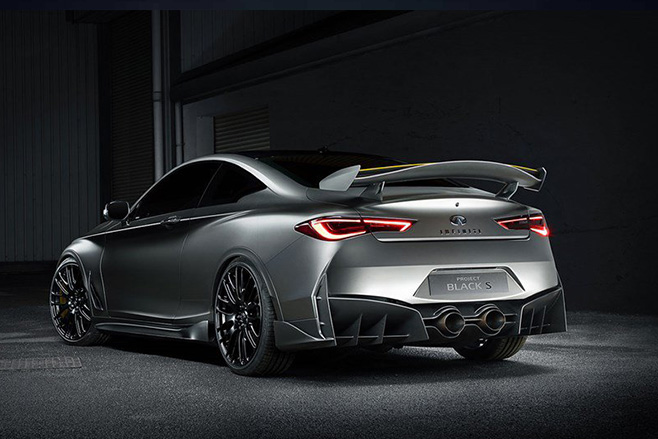
THE Infiniti Project Black S Q60 concept car will pack an F1-style hybrid punch when it is unveiled at this week’s Geneva Motor Show.
The car – from the luxury arm of Japanese carmaker Nissan – is a sign of what a BMW M4 or Mercedes-Benz C63 S Coupe rival could look like.
The car uses the same Nissan GT-R drivetrain developed for Infiniti’s stillborn Q50 Eau Rouge sedan, with the addition of a road-going version of the hybrid Energy Recovery System (ERS) found in Renault’s F1 car.
Infiniti is yet to release details of how the hybrid system works, how it is integrated, or any power outputs. However, the Japanese luxury brand says it is investigating a production version.
“Infiniti is the premium car manufacturer within the Renault-Nissan Alliance, and a technical partner to the Renault Sport Formula One team, so it is natural that we come together to explore the possibility of bringing innovative high-performance technology to our customers,” Infiniti President Roland Krueger said.
“Infiniti has constantly led the way in making innovative new powertrain technology available, and we’re extremely excited by the potential of Project Black S.”
The car is visually aggressive, with a large rear spoiler and diffuser pointing towards extensive aerodynamic work. The twin exhausts give the rear a tough appearance.
A larger bumper enhances sporty styling and flared arches, along with large air intakes and a chin spoiler.
IMAGES of the British-built Honda Civic Type R have leaked online ahead of yet another unveiling of the car – this time wearing its production skin – at this week’s Geneva Motor Show.
Much like the previous-generation Type R that changed little between concept and reality, the car looks very similar to the Type R Prototype unveiled at last year’s Paris Motor Show. From the front, the only noticeable differences include some different treatment around where the number plate screws into the front bumper, and the washer jets for the halogen headlights.
Otherwise, the four-door Type R keeps much of the muscular stance, including the front splitter’s vertical wingtips, as the prototype car.
Down the rear, the high level of visual excitement remains the same, with a triple-tip exhaust (the middle one isn’t red-rimmed, though), seriously plumped guards and one of the biggest rear wings on the market. The blacked-out diffuser rises higher on the production version than for the concept, and we can’t tell if the carbon fibre skirt that clung to the bottom of the prototype have carried over to the production car.
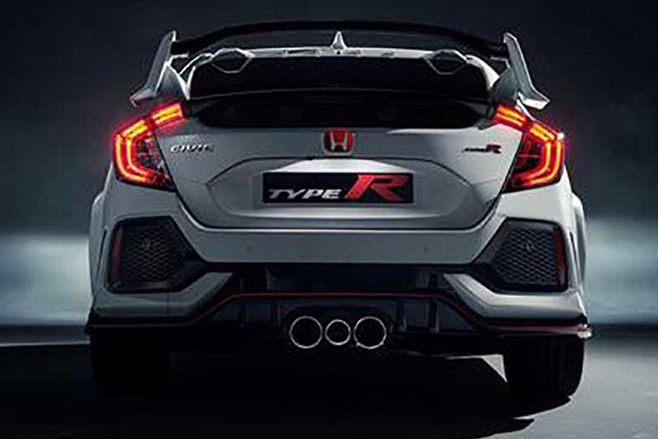
The Lamborghini-style geometric aerodynamic features that featured on the back of the tailgate of the Paris car look as though they have made it through the production approval process, too.
Honda has been tight-lipped about performance stats so far, but the next-gen Civic Type R is expected to continue sending drive exclusively to the front wheels.
Power is expected to come via a tweaked version of the outgoing model’s 228kW/400Nm K20C1 2.0-litre VTEC four-cylinder turbo petrol screamer – peak power arrived at 6500rpm – fitted to a rev-matching six-speed manual gearbox.
The first of the Honda Civic Type Rs are expected to roll off Honda’s Swindon-based production line in the UK by the middle of this year, but with pent-up demand in Europe, it’s likely to be the end of the year before it arrives in Australia.
Honda hasn’t had a performance version of the Honda Civic hatchback on sale since 2011, making its return highly anticipated. While its lack of all-wheel drive rules out an on-road slugfest with the Ford Focus RS/Volkswagen Golf R fighter, it should take the fight up to the VW Golf GTI, Ford Focus ST and the market’s other highly anticipated hot hatch – the Hyundai i30 N.
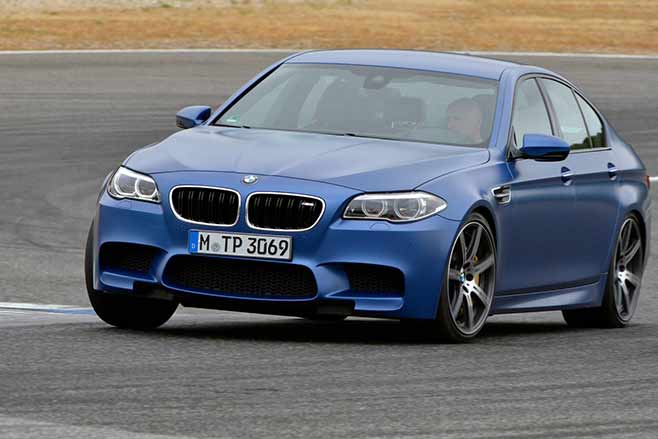
Those wanting to nab a brand new fifth-generation BMW M5 will have to get in quick.
Munich’s powered down the F10 M5’s factory line as it readies its rumoured all-wheel drive monster replacement, leaving availability to sales-yard stock.
This wraps up a six-year journey for the powerful sedan, which debuted in 2011 and hailed from the firm’s factory in Dingolfing.
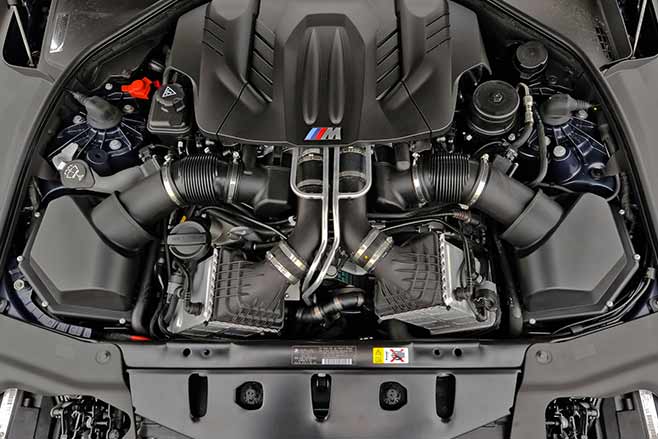
Known internally as the ‘S63 TU’, Munich snuck in a higher redline, bigger compressors and intercoolers for its upgraded V8 which unlocked 412kW and 680Nm.
It was enough power for critics to quickly revere and fear the M5, but buyers were treated to even more when the Competition Package – which added 11kW and sharpened the car’s suspension – was made standard in 2013.
Scarily, BMW loosened its tie on the S63TU and lifted outputs to 441kW/700Nm for a 30th anniversary special edition in 2014. Its limited top-speed bumped up to a lazy 305km/h.
By foregoing expensive interior trim, fancier seats/doors, and Competition Package, it slashed $45K from the regular ask. At $185,000, Australians were treated to a price for the M5 it hadn’t seen since the E39-series atmo V8 model.
As a result demand for BMW’s M5 has remained strong up until this year. BMW moved four M5s in January, or 5 per cent of overall 5 Series sales (80 units), and continued 2016’s trend of average monthly M5 sales.
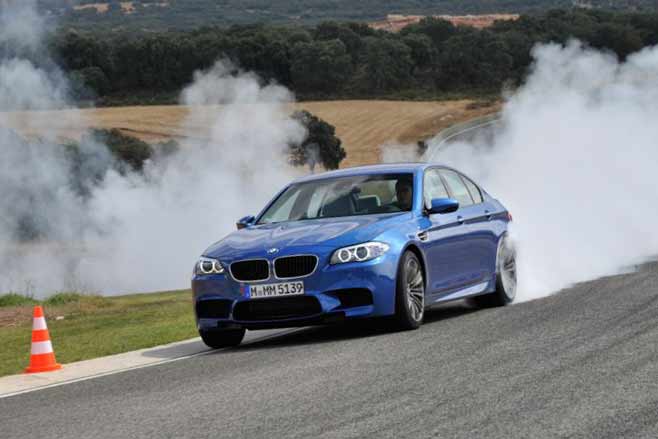
It’ll also return from a serious diet, too, as the latest 5 Series introduces a lighter, tigther chassis. Stay tuned for the Frankfurt motor show this September where full details will be revealed.
