
BMW is partnering with the Scentre Group to install 40 new charging stations for electric vehicles at Westfield shopping centres around the country.
The new charging stations will be installed at 10 different locations across New South Wales, Queensland, and Victoria.
Electric vehicle owners will be able to use the charging stations free of charge (however Tesla owners will miss out due to a different type of plug being used to charge their vehicles).
BMW estimates there are currently around 8000 EVs driving around Australia, with the number expected to rise to 35,000 by 2024.
Tim Roberts, General Manager Leasing, Scentre Group says, “We’re very excited to partner with BMW Group Australia to bring such a comprehensive network of EV charging stations to our customers.
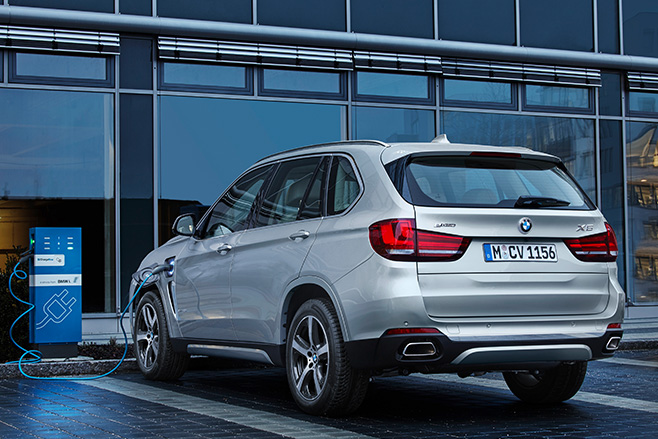
“This is all about convenience for the growing number of EV drivers in our local communities. EV drivers will be able to identify charging station locations in our centres via the ChargePoint app, online or through their BMW navigation system.”
BMW offers a range of plug in hybrid (PHEV) and fully electric vehicles.
Marc Werner, Chief Executive Officer of BMW Group Australia says it was logical for the German manufacturer to invest in a project which will grow Australia’s EV infrastructure.
“The new charging stations at Westfield locations is another way BMW is providing mobility solutions to our customers as BMW i electric vehicles gain momentum in the Australian market,” he Werner.
A lack of charging stations is currently the biggest roadblock to electric vehicles becoming a legitimate choice of car for many Australians. With BMW planning to expand its full EV range in the future (currently the i3 is the only pure electric car they sell). The BMW i8 PHEV sports car, along with PHEV versions of the BMW 3 Series and X5, would also benefit from this infrastructure.
The project is expected to be completed by March 2017, with four stations each located at Westfield Bondi Junction, Chatswood, Miranda, Sydney, Warringah Mall, Carindale, Chermside, Doncaster and Southland.
- The SQ7 has three turbos attached to a 4.0-litre diesel V8. There are two normal turbos, and an electric compressor that spools to 70,000rpm in 0.25 seconds. This is the first road-going car to feature an electric turbo. The technology was first shown in the Audi RS5 TDI concept car in 2014.
- Clever computers can independently turn each turbo on and off depending on how much boost is needed. The whole system outputs 320kW and 900Nm, and full torque is available from as low as 1000rpm.
- Complicated as it is, the powertrain works. This seven-seater can accelerate from zero to 100km/h in 4.9 seconds, which is even quicker than the Audi TTS Roadster.
- Most cars run on a 12-volt electrical system. The SQ7 has 12-volt and 48-volt systems. The higher voltage system has its own battery that sends up to 7kW to the electric turbo and 6kW to the…
- Active sway bars. The SQ7 has an optional Dynamic pack that includes electromechanical roll stabilisation to keep the big SUV near-flat while cornering. When the system is activated the SQ7 has just one degree of body roll for each 1G of lateral load, which is almost as much as normal road tyres can handle before they lose grip.
- The Dynamic pack also adds four-wheel steering. Turning the front and back wheels adds stability at higher speeds and makes low speed manoeuvres easier. The SQ7 with all-wheel steering has a smaller turning circle than the Audi Q3.
- The SQ7 recovers energy for its 48V battery using the brakes and the active sway bar system. There is also a pair of alternators attached to the engine to help charge the two batteries.
- From the outside the SQ7 has a loud, crackling engine note. Inside, that sound is recreated through the rear speakers when the car is in Dynamic mode. A special acoustic canister in the exhaust captures the natural sound, where it’s picked up and piped subtly to the Bang & Olufsen stereo.
- The SQ7 is 5.07m long, 1.97m wide, 1.74m tall and weighs 2330kg.
- Sepang Blue is an Audi paint colour available exclusively on the SQ7.
- Changeable ambient illumination inside the SQ7 has 32 possible interior lighting colours to choose from.
- The SQ7’s adjustable air suspension drops 25mm lower than the lowest point on the regular Q7, and lifts to a higher point when raised all the way up.
- It’s not all about straight line speed. The SQ7 has built-in off-road drive assists and can wade through water up to 500mm in depth. It can tow up to 3500kg.
- Fuel economy is listed at 7.2L/100km, which is impressive for such a heavy and powerful SUV.
TELL ME ABOUT THIS CAR
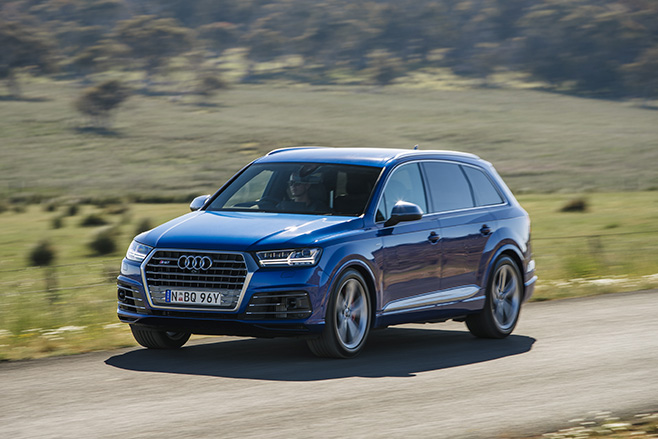
The Audi SQ7 is the fastest version of Audi’s excellent seven-seater Q7 SUV. This is the first time an S version has been offered in the Audi Q7 range, and it features a wide range of technology never before seen in an Audi road car. The SQ7 is available only with a 4.0-litre turbo-diesel V8 engine and is on sale now from $153,616.
STRENGTHS
- Performance. The SQ7’s 4.0-litre V8 has three turbochargers, and makes 320kW and 900Nm. For such a big and heavy car, it’s astonishingly quick, especially when overtaking on the highway. It can accelerate from zero to 100km/h in 4.9 seconds.
- Technology. Several brand new systems have made their road-going debut with the SQ7. First, there’s the electronic compressor, which assists two normal turbochargers to feed pressurised air to the engine. This equipment was previously only found on concept cars. There’s also a 48V electrical subsystem to run the most demanding components and a cutting-edge valvetrain in the engine to give better response and economy.
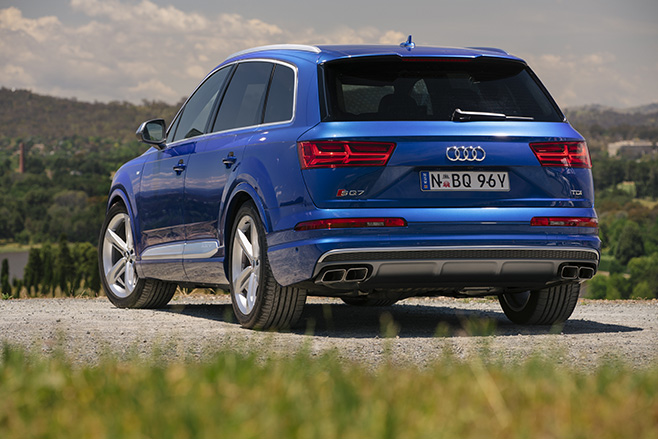
- Control. Audi is famous for Quattro, and the SQ7 takes things even further with an optional Dynamic pack that adds four-wheel steering and electromechanical roll stabilisation, to virtually eliminate any side to side tilting when cornering.
- Refinement. Few cars are as quiet and composed as the SQ7. It is luxuriously serene inside and comfortable over bumps in all drive modes thanks to sophisticated air suspension.
- Economy. Even with its massive power and performance, the SQ7’s diesel engine only uses 7.2L/100km on average.
WEAKNESSES
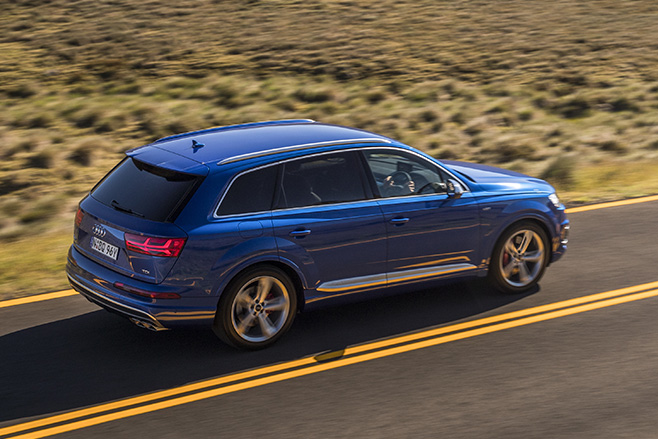
- Price. There is an awful lot of stuff crammed into it, but even at this price the features that really make the SQ7 stand out are optional. It costs an additional $13,500 to buy the Dynamic package, which includes active roll stabilisation, four wheel steering and a limited slip differential.
- Steering. Having so many electronic systems between the driver’s inputs and the car’s actions means there’s some disconnection when pushing hard, particularly in the steering. It’s an extremely sophisticated car, though it’s most comfortable highway cruising, and less comfortable carving corners even though it can do it.
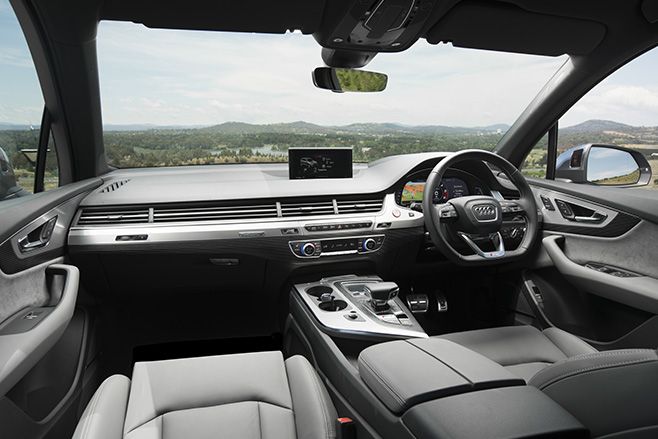
- Sound. V8s make an awesome noise, even this diesel one, but sadly it sounds better outside than inside in the SQ7’s case. There’s a system that activates in Dynamic mode to pump more of the engine note into the cabin, but it’s so well isolated that the real sound is still hard to hear. Sadly, that’s the trade off in a car that is so well insulated and quiet in all other circumstances.
The BMW X5 M50d ($148,855) and Range Rover Sport SDV8 HSE Dynamic ($153,600) are the only other premium, diesel-powered, sports-oriented, seven-seater SUVs available, and both are worth looking at, though neither are quite as refined as the SQ7.
If five seats are enough, the Maserati Levante Sport ($159,990) and Porsche Cayenne S Diesel ($149,000) have diesel grunt and even more badge cred.
Petrol options include the Volvo XC90 T8 R-Design ($122,900) and Mercedes-AMG GLE43 ($133,616) and GLE63S ($190,615), though the Mercs are five-seater only.
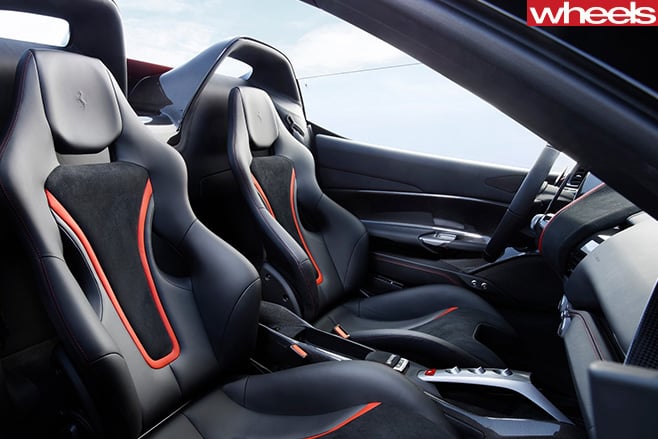
Ferrari has celebrated its 50th anniversary in Japan with a strictly limited edition, highly bespoke Christmas present to its Japanese customers based on the Ferrari 488 Spider.
Just 10 J50s will be available, and, in the spirit of Ferrari’s fuori serie tradition, each one will be tailored specifically to the customer’s requirements.
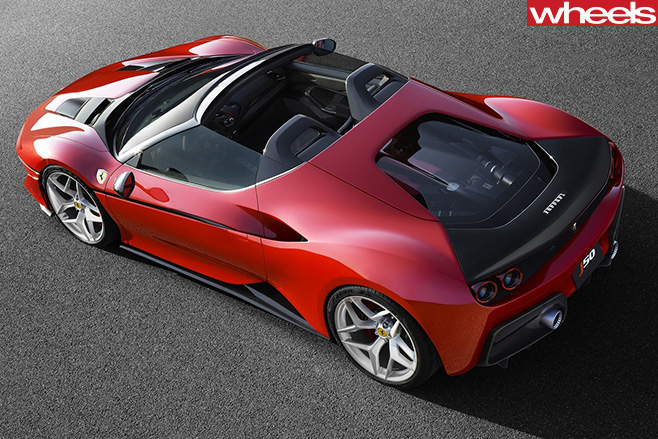
The Marenello team hasn’t held back either, coming up with brand-new bodywork that heralds a radically futuristic design language while including a Targa body style that pays homage to popular models from the 1970s and 1980s.
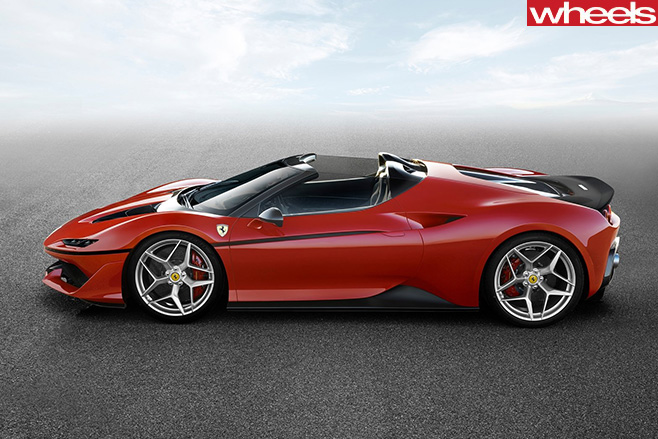
The mid-engined roadster has functional changes design changes over the Ferrari 488 for improved aerodynamics, which included completely redesigning the front bumper, positioning the radiators closer together and lowering the windscreen rake angle to allow more airflow over the airfoil and rear spoiler.
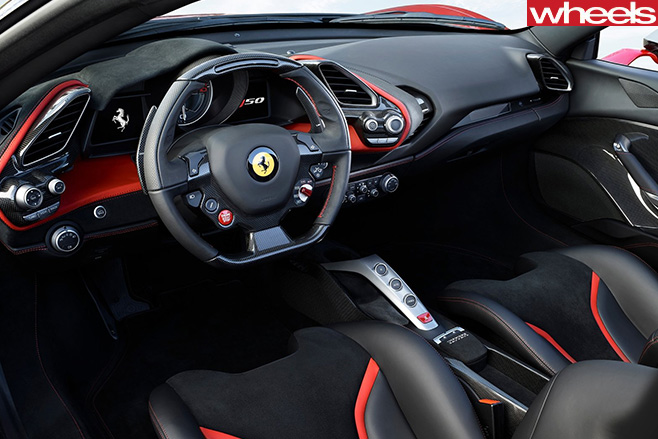
The carbon-fibre hard targa top is divided into two pieces which stow conveniently behind the seats.
Hurtling flat-out through the forest in a state-of-the-art World Rally Car with one of the world’s best drivers is quite an experience.
Try as we might to capture the feeling through words – you can find the story here – inevitably the sights and sounds are best captured through video.
Above is two laps of a high-speed loop in the Coffs Harbour forest alongside Hayden Paddon in the Hyundai i20 WRC, which took place the day after the season-ending Rally Australia. Hopefully it gives you a taste of what was an extremely awesome experience.
Paddon will return to WRC competition with Hyundai in late January, driving the new generation Hyundai i20 WRC along with Thierry Neuville and Dani Sordo.
With the return of Citroen and Toyota to full-time competition and four-time champion Sebastien Ogier switching to Ford, it’s set to be one of the most exciting WRC seasons ever.
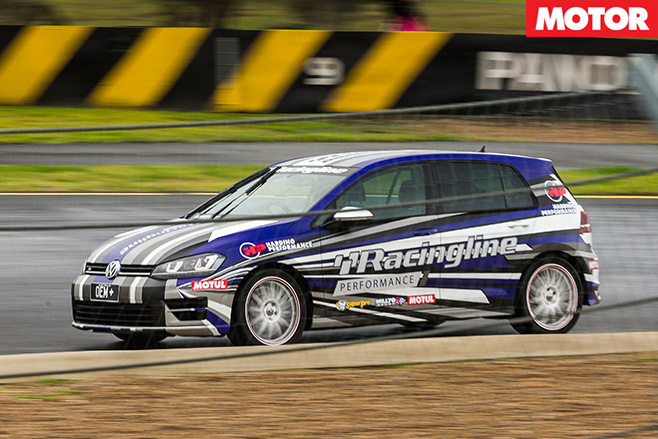
The Harding Performance Golf R has little to prove after snatching the win in less modified form in 2015, but owner Guy Harding has gone all out to give the feisty little German an attitude that scares more than a few of its rivals, and on paper, a podium finish seemed a logical bet.
Hot Tuner 2016 is brought to you by Valvoline SynPower
However, a foreshortened development curve meant that Harding was unable to deliver the potential that exists in the car. Combine that with a gamble on chassis set-up that very nearly backfired big time, and a second place overall for the defending champ was a pretty good escape act.
Harding went to town on the R, tipping more than $30,000 into the car over the past 12 months, but a knee injury and subsequent stay in hospital meant that development time was unavoidably compromised. The large RacingLine Stage 3 turbo kit the team had fitted for the event, for example, couldn’t be properly dyno-tuned in time, forcing them to tame it to a safe level to make it through Hot Tuner.
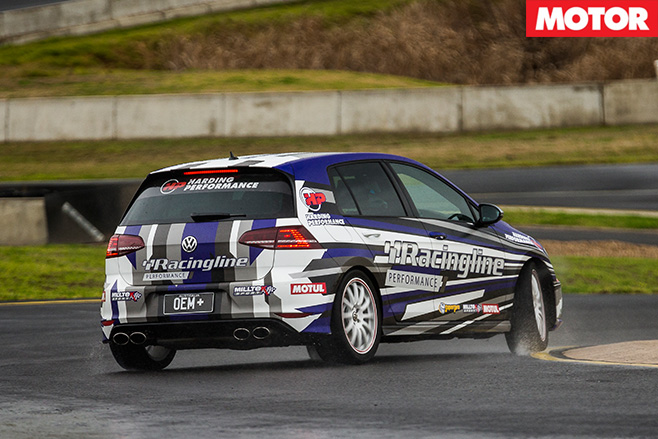
“Unfortunately, we didn’t get a full ‘dry’ dragstrip run, so we didn’t quite hit our full potential there,” Harding noted. Its dyno figure, too, was a mix of our fuel issue and a safety tune, with 235.6awkW pulled on the Hot Tuner dyno. This can be compared to the Harding Performance-supplied Dynapack hub dyno figure of 317.2awkW, obtained on 98RON.
Tony D’Alberto also remarked that the R felt ‘fluffy’ on the gearchange around the track, but “when it gets through that fluff and the power comes in – whoa! It’s aggressive.” His dry lap time was impressive, too, second only to the mighty Hi-Torque GT-R at 1:03.8sec.
The rear end would, moments later, disconnect from the road surface in sympathy, resulting in a Japanese vending machine’s worth of flashing lights from the dash as the traction and stability controls worked miracles to keep us from the track fences. The uprated stoppers were thankfully strong and feelsome underfoot.
Still, the engine felt as tractable and useable as a daily driver; it actually felt like there were two of them side-by-side under the bonnet, such was the mid-range oomph from just two litres and four pots. And this was a soft turbo tune, too. Wow.

The changing conditions, and the inability to back things off for damp running, certainly played against the HP Golf R at Hot Tuner 2016. With the learnings from this year’s mixed-weather event, a final swansong for the fearsome HP Golf R in 2017 will be something to behold.
OVERALL RANKING: 2ND
DISCIPLINE RANKING
2nd | Lap time: 1:03.8sec 3rd | Lap V-Max: 157.52km/h 2nd | Lap V-Max: 104.68km/h 4th | Lap V-Max: 53.65km/h
MICHIGAN, the cradle of the US automotive industry, has done the unthinkable and made it legal to buy and drive cars that don’t even have a steering wheel.
The move comes as the state attempts to reaffirm its position as the hub of automotive manufacturing in the US, even as the focus on autonomous car development shifts to Silicon Valley.
Michigan Governor Rick Snyder says the new regulations will guarantee the state continues to be the centre of local manufacturing in the US.
“Michigan put the world on wheels and now we are leading the way in transforming the auto industry,” he said. “We are becoming the mobility industry, shaped around technology that makes us more aware and safer as we’re driving. By recognizing that and aligning our state’s policies as new technology is developed, we will continue as the leader the rest of the world sees as its biggest competition.”
Michigan joins 15 other US states in allowing testing of autonomous vehicles. Nevada was first in 2011. California, the home of Silicon Valley, will soon take things a step further by allowing vehicles that lack a steering wheel, brake pedal, accelerator or even a driver inside the vehicle to test on public roads.
Ford has laid plans to mass-produce a fully autonomous vehicle by 2021 as part of its Smart Mobility plan. The company’s president and chief executive, Mark Fields, said the new regulations were one of the most important advances in automotive history.
“This is every bit as significant as the introduction of the moving assembly line by Ford 100 years ago,” Fields said. “We are dedicated to offering autonomous vehicles that can improve safety and solve social and environmental challenges for millions of people.”
Ford currently tests its autonomous vehicles in Palo Alto, California. However, Michigan is vying to woo the company to test around the company’s headquarters in Detroit.
University of Michigan transport expert Brandon Schoettle said he remained cautious about the regulations.
“The act of vehicles driving around like this on any public road is unprecedented given the recent introduction of such technology,” he said.
Along with testing regulations, Snyder also enacted laws that will protect mechanics from being sued if an autonomous vehicle was involved in a crash, so long as it was serviced or repaired in accordance with manufacturer specifications.
Volkswagen is another carmaker concerned that Silicon Valley is shaping up to be the new hub of automotive development. Earlier this year it called for Europe to take the lead in developing car technology, saying the valley had “overshadowed” traditional carmakers in recent years.
“We must not leave this playing field to Silicon Valley,” Volkswagen Group chief executive Mueller said earlier this year at an announcement that also revealed the carmaker’s plans to reinvent itself as an electric “mobility solutions” provider.
It has also called on European legislators to set the framework in place to allow driverless cars to take to roads in the region.
Retaining the Holden Commodore badge on an Opel-based large car from Germany perhaps could be a case of déjà vu – after all, the original 1978 VB was heavily based on this German-built Opel Senator up for sale in the UK classifieds this week.
If the decision to keep the nameplate is radical – and it rightly has loyalists up in arms – then so too was the VB Commodore that killed the mighty Kingswood back in the late 1970s. Smaller and Euro-chic, there are parallels here that are impossible to ignore.
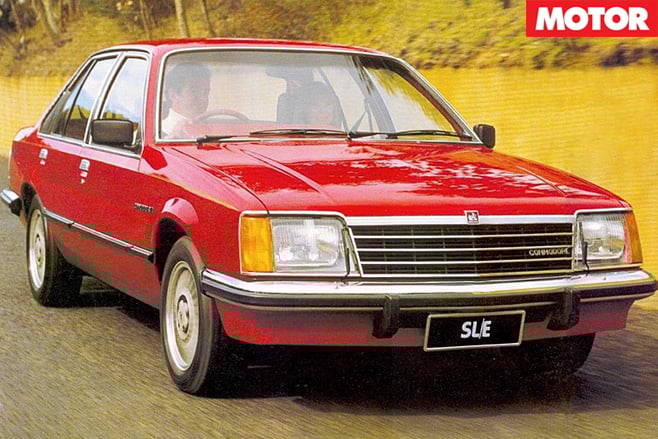
The CD matched our SLE with power steering, power windows and central locking – huge luxury for the 1970s – but the German-built model exclusively scored heated seats. Otherwise the two are the same inside, right down to the door skins, door pulls, window and heater switches, dashboard design and gauges – all but the steering wheel and seats.
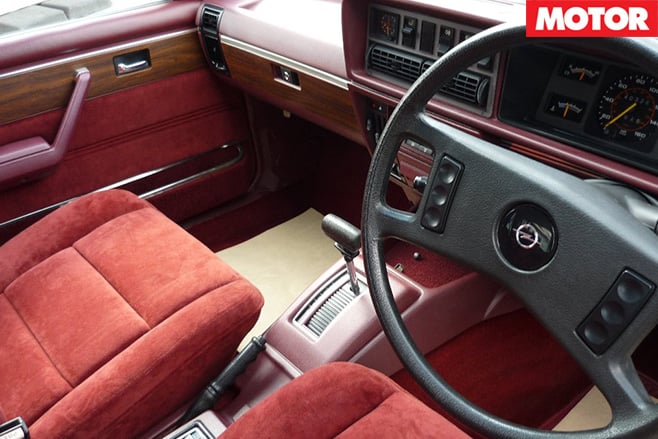
Not that the VB Commodore was just a mirror-imaged Senator outside or under the skin.
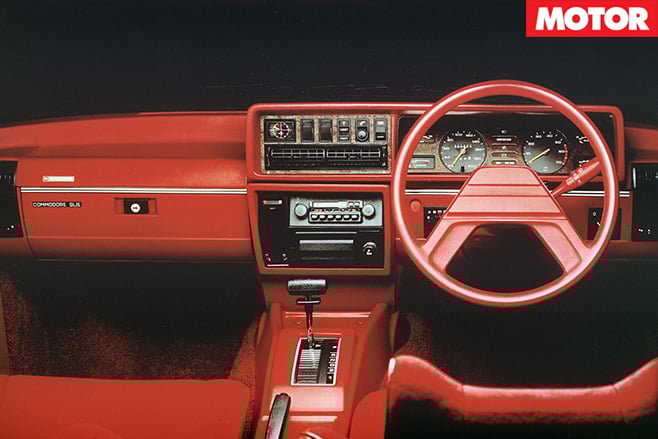
The biggest point to take away is that Holden engineers tested the German version in the Australian outback and it basically fell apart on rough dirt corrugations – one prototype was said to have broken at the firewall.
Holden toughened the Senator and created the Commodore, with the V8 engine the beating heart of our nation’s driving enthusiast culture. The name came good with new fans and Kingswood loyalists alike, and Commodore has outlasted Rekord, Senator and Omega nameplates in Opel’s history. Even the new Insignia hardly has a loyalist pull overseas.
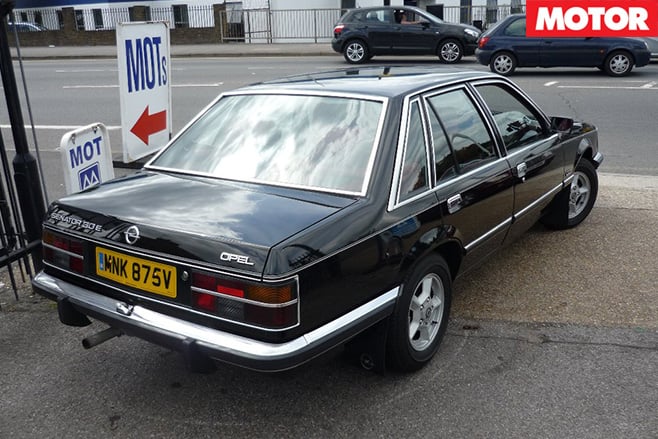
Picture credit: autotrader.co.uk
Engine swaps are commonplace in drifting.
But how would you feel about a BMW E92 M3 fitted with a Nissan donk? If you’re Jake Jones, we’d say pretty good.
The 26-year-old professional drifter from Adelaide sourced one of Nissan’s holiest weapons, a Skyline GT-R’s engine, before slotting it into the two-door coupe.
He then took to Sydney Dragway’s huge carpark to shakedown the ‘RBM3’ in its ready-to-slide state. And a video of the day proves anything goes in the name of smoke, noise, and opposite lock.
Speaking of noise, at the heart of the M3’s shrieking war cry is an RB26 engine. But it’s also been plugged with a Tomei stroker kit that lifts capacity to 2.8-litres.
Underpinned by a dry-sump oil system, the upgraded internals should also help it handle the incredible boost produced by the Precision turbo.
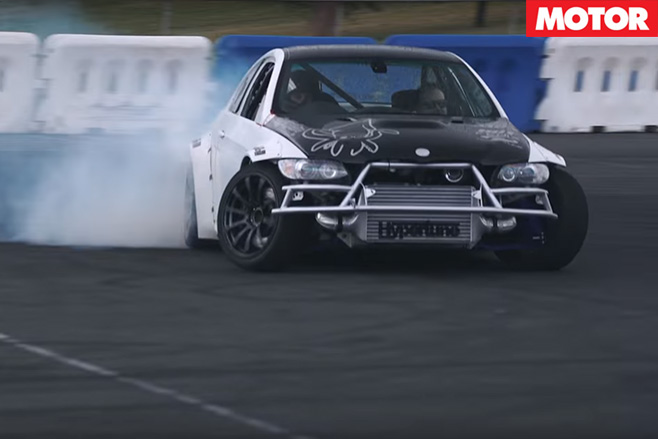
There’s also a five-speed sequential gearbox handling the shift work, and on the outside the M3’s been fitted with a Liberty Walk widebody kit.
Its current state is a far cry from where Jones started. “I bought it two year ago from Queensland as a bare chassis, there was absolutely nothing on the car at all,” he reveals on his YouTube page.
“We haven’t cut any corners on this car and I don’t want to do that. It’s been my life for the last two years.”
Jones missed out on the World Time Attack Challenge this year to debut the car, but now looks set to tackle the “next event” that comes in the new-year.
This one-time cattle-rustling route, Putty Road in the Hunter Valley, delivers the sort of driving mix that demands you harden up.
First published in the June 2013 issue of Wheels magazine, Australia’s most experienced and most trusted car magazine since 1953.
Everyone knows that road-building is an engineering science, right? One requiring careful surveying, lots of tedious compacting, well-planned drainage, skilled surfacing, and, ideally, several champions in fluro vests looking on as one bloke actually does some work.
But occasionally you encounter a road that feels as though it incorporates an element of art with the science of its construction. Sections of the Putty Road, linking Windsor on the banks of the Hawkesbury River in Sydney’s north west, with Singleton, in the Hunter Valley, is that sort of stretch. Here you’ll encounter the sort of artistic sweeps and flamboyant flourishes that feel as though they must surely have been put there for the purpose of pleasure, rather than merely connecting two points on a map.

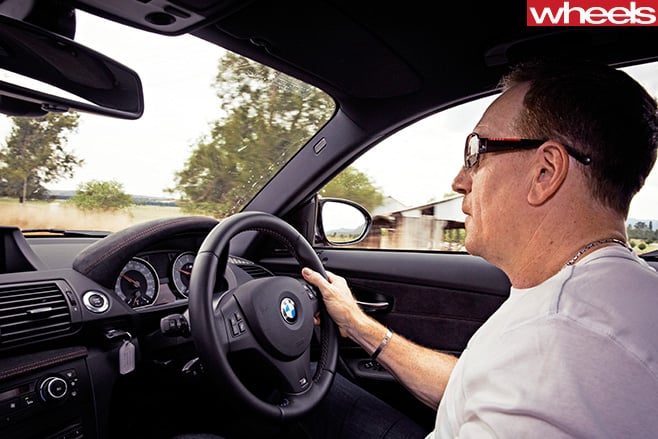
The BMW 1M Coupe gets a start here because it’s now sold out in Oz, and surely destined for cult/collector status. One last fang seemed like the best way to say goodbye. Plus there’s the fact that, just like some of the motorcycle riders you’ll find on the Putty Road, it’s just a little bit unhinged.

The moment you settle into the supportive seat, there’s a rightness to the driving position, pedal weights, shift action and the kransky-fat wheel. Through Windsor, the broad rubber and firm, non-adjustable suspension relays surface reports with thuds and thumps, yet the ride is less jarring than a regular BMW 1 Series on run-flats.

Once through neighbouring Wilberforce, fast sweepers unfurl and your right foot can go down. The twin-turbo six doesn’t have the ultra-hardwired throttle response of an atmo M engine, but it is beautifully smooth, hugely torque-rich and wickedly punchy. The note starts off bass-heavy and full, but quickly transitions to a sonorous, slightly turbo-muted howl. Thing is, the car feels just as quick when short-shifted, rather than wrung out. The 7000rpm redline gives headroom, but there’s no extra power past 5900. A modern M, then, rather than a traditionalist.
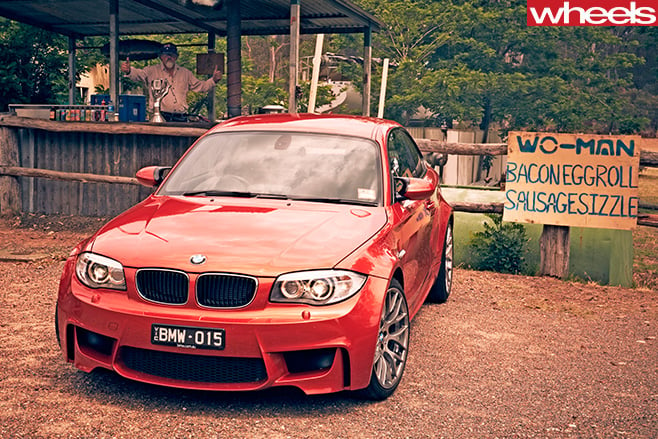
Past Colo Heights is a Putty high point, where it climbs, twists and plunges. The surface is glassy hot-mix; sweetly cambered in your favour. The road wraps around towering escarpments, and huge views of the valley open up around every bend. This section is like a sinuous welcome mat that’s been rolled out to invite you to indulge. It’s tight enough to demand a car that’s compact and agile, with a front-end you can push into a proper dialogue with the surface. Sub $150K, short of a Porsche Boxster or Cayman, the 1M feels pretty close to ideal.
But even in this smooth section of the Putty, the torrent of turbo torque is in a constant battle with the rear Michelins, at least with the ESC in its default setting. Switching it to M-Dynamic mode gives (mostly) enough latitude. Turn it off and the combination of big torque and quick steering demands precise corrections or you risk being slapped right back.

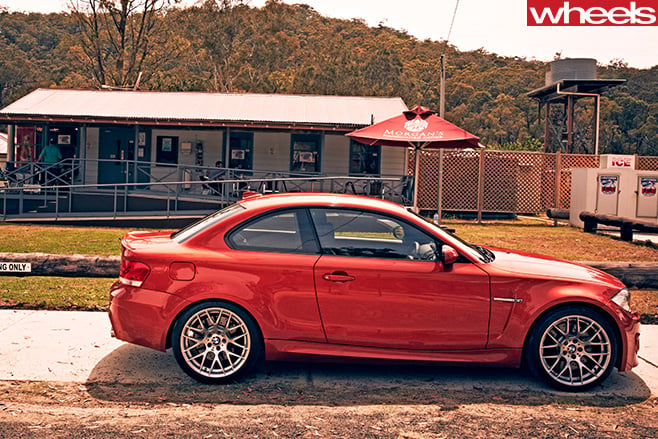
We climb back into the now-baking BMW, drop the windows and give it full noise in the first four gears, purely for quick cabin ventilation. But pulling big speeds brings big risks. If there is an issue with the Putty – and I know I could be castrated for saying this and turned into a biker’s moll – it’s the vast section that scythes between the Garland and Howes Valleys. Here the road is so open and unbending that, unless you’re a nut-bag rider with 120kW between your legs and amphetamines behind the eyes, it’s more a pleasant drive in the country than a steely test of chassis and nerve. Naturally the temptation is there to peg the 1M wide open and hope the local cops are on doughnut duty up in the Hunter; instead we settle for something short of impound velocity and try to ignore the tyre and wind noise. And the exhaust drone.

By the time we emerge out of the long shadows and into Singleton, I’ve got mixed feelings about this car. It’s fast, engaging, and, relative to the BMW M3, semi-affordable. But compared to true M purebreds, it feels more like a beaut parts-bin special than a holistic whole. The 1M coupe may be a ‘spiritual successor’ to the original E30 M3, but the driving experience is way removed from it. Nor does it have enough suppleness in the chassis to deal with everything the snottier parts of the Putty can throw at it. In this car-versus-road battle, call it a win for the road – just.
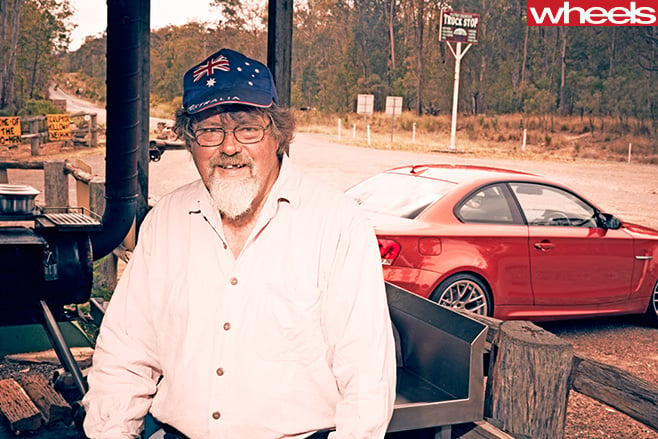
Fuel up before you hit the Putty Rd, because there’s no servo on it before Singleton heading north. There was nearly no eatery, either – the Grey Gum Cafe found itself in a legal stoush with Singleton council over road access into its premises back in late 2011. In a win for common sense and burger lovers, though, owners Kim and John Grace successfully overturned the closure order, and business is booming.
