
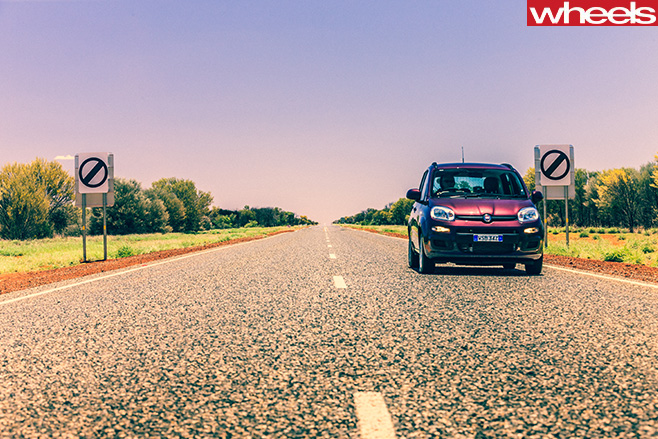
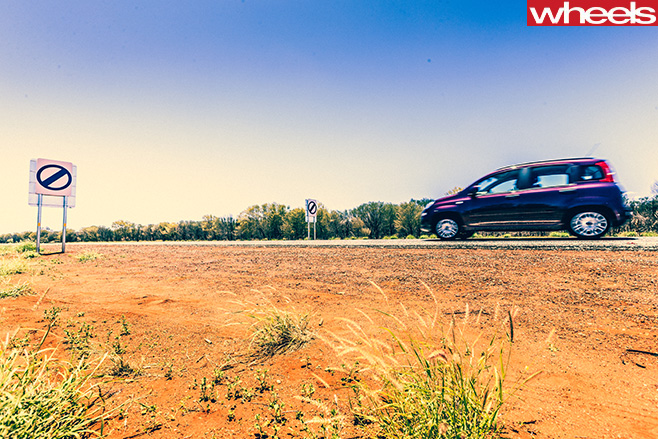
AUSTRALIA’S doctors have called on the Northern Territory government to slam the brakes on its open speed trial, calling the experiment in allowing drivers to set their own speed limit “dangerous policy”.
The Royal Australasian College of Surgeons, the Royal Australasian College of Physicians and the Australasian College of Emergency Medicine all today called for the NT to dump the recently extended trial in the wake of the August 27 election.
ACEM faculty member James Fordyce told Wheels the money spent on expanding and maintaining the open speed limits would be better spent on road infrastructure elsewhere, or dealing with the Northern Territory’s high drug and alcohol use problem (a significant factor in the NT’s road toll).
“It’s sending the wrong public health message – we want to be making roads safer, not increasing risk,” Dr Fordyce said.
“We already have the highest speed limit in Australia at 130km/h, and as speed increases, risk increases because your reaction time doesn’t get faster but the distance your car travels before you react does, and the damage from impact is that much higher,” Dr Fordyce said.
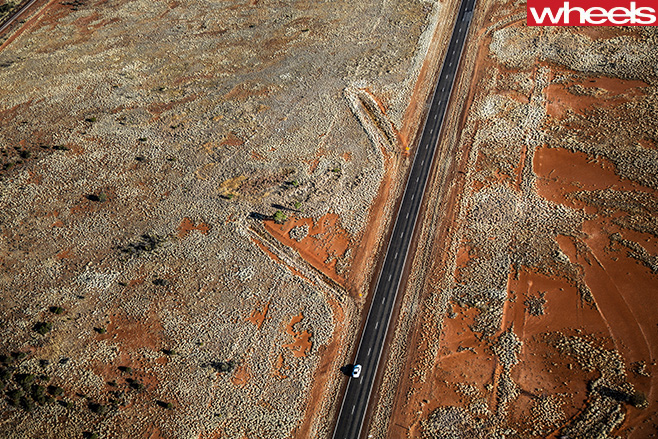
The NT government’s chief minister, Adam Giles, announced earlier this year that the trial had been extended to cover most of the road between Alice Springs in the south, to Tennant Creek in the central part of the territory, largely in response to drivers “acting sensibly”.
The territory’s Transport Minister, Glen Chandler, said he would work towards extending the trial further if the government was returned in the election.
“Occasionally you’re going to get somebody that drives extremely fast, but it [someone driving faster than 130km/h] is usually in a high-performance car who are doing the right thing,” Chandler told Wheels.
“We will continue the roll-out of the open speed limits on the roads that we’ve done up to the point where the science indicates that they are capable of higher speeds than 130.”
Despite the open speed limits, NT police are still able to book drivers for dangerous driving if they consider speeds are unsafe for a combination of factors, including road and weather conditions, the maintenance of the vehicle and experience behind the wheel.
So, what’s a safe speed? According to Dr Fordyce, it is “governed by the conditions of the road, the condition of your vehicle, the environment, what condition the driver is in – there certainly needs to be good driver judgement in determining a speed to travel at”.
“The reason for putting upper limits on speed are to mandate where the community feels driver judgement goes so far, but beyond that it is an unsafe speed,” he said. “Most drivers will make sensible decisions; some won’t.
“There is no sensible reason not to have the same systems in place for this 500km in the NT.”
Likewise, Dr Fordyce says he believes there is no need to increase the speed limit along the Hume Highway, which has much better infrastructure to support higher speed limits than the Northern Territory’s Stuart Highway.
“There’s no need to go faster than 130km/h,” he said.
He admitted, though, that speeding does affects us all, even if it is only via the hip pocket.
“I’ve certainly had speeding fines. I try and avoid speeding,” he said.
“I think driving at 130 is pretty fast, I’ve got a good modern car and I wouldn’t want to drive any faster than 130.”
Bentley was recently forced to take down a YouTube video that depicted a Continental Speed GT maxing out on a closed section of the Stuart Highway following a complaint by the Pedestrian Council of Australia.
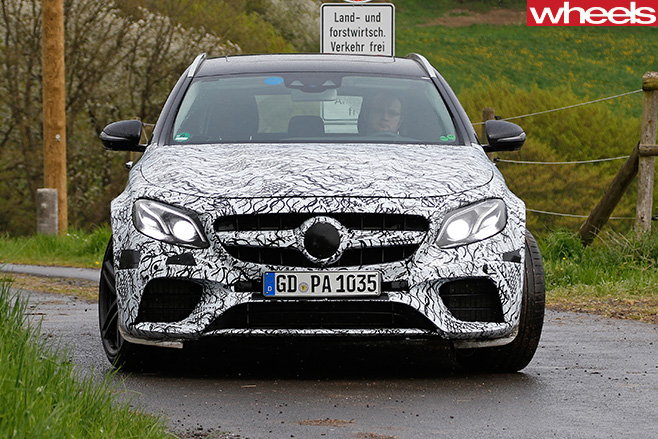
Mercedes-AMG will take a leaf out of the Audi RS6 Avant’s playbook for its next E63 AMG Estate, with the next generation model of Benz’s hard-core family hauler set to grow a massive set… of wheel arches.
Spied by YouTube user WalkoART while conducting public road testing in Europe, the new E63 AMG Estate’s engorged fenders are there to accommodate a set of ultra-wide wheels wrapped in low profile rubber. Viewed from the rear, the stance is low, squat and supremely aggressive – and not too dissimilar to Audi’s famously fast RS6 wagon.
The reason for its girth comes down to its mammoth power output. A leaked Russian dealer document revealed the new E63 S will smash out a stunning 450kW of power and 850Nm of torque – enough to take it to 100km/h from rest in a supercar-like 3.5 seconds.
The “regular” E63 sedan and wagon will generate a slightly less ballistic 420kW and 750Nm, with a 0-100km/h sprint of 3.7 seconds.
All E63 variants will be exclusively all-wheel drive, meaning the rear-driven E63 S currently available in Australia will be the last of its kind.
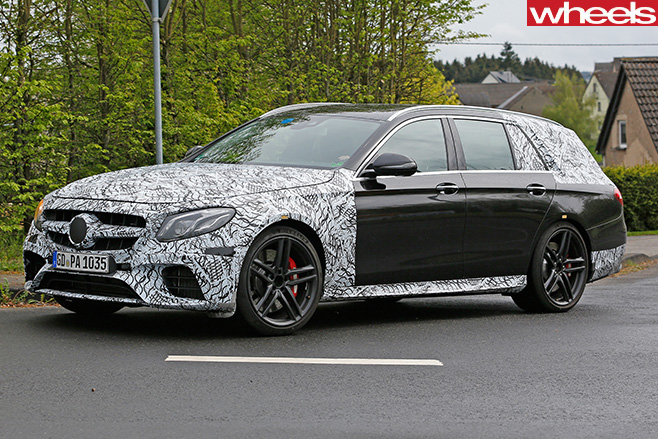
The flares and big wheels are new then, but is it the rumoured E63 Black Series that has car forums buzzing?
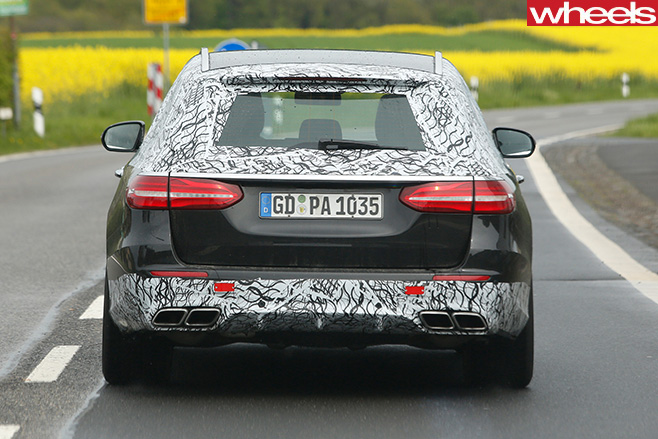
Rather, it looks like this will be what the regular E63 Estate will look like.
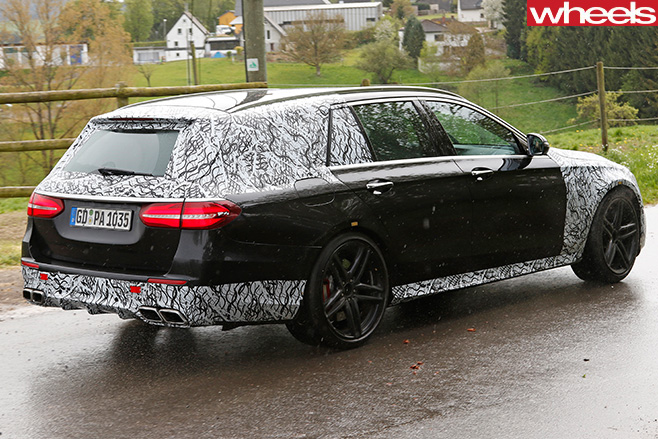
We won’t have long to find out, though. The E63 sedan is slated for a Paris Motor Show debut at start of October, with the Estate expected to make its first appearance not long after. Both are expected to go on sale locally next year.
TELL ME ABOUT THIS CAR
This is the latest update of the fourth generation Forester, which has been a popular mainstay of Subaru’s AWD SUV range since 1997. It has a good reputation for reliability and car-like handling but is no slouch in the dirt. The 2016 facelift includes new-look headlamps, tail-lights and bumpers.
STRENGTHS
- The Subaru Forester 2.5i-L is a step up from the base model 2.0i-L and comes with a good suite of standard features including a 7-inch touchscreen multi-function display, reversing camera, cruise control, LED daytime running lights and dual-zone air-conditioning.
- It’s goes well. The 2.5-litre petrol boxer engine produces 126Kw through the Lineartronic CVT automatic transmission. Unlike the 2.0i-L there is no manual option, though there are paddle shifts if you want to be a little more hands on. It has three driving modes; Intelligent (I) and Sport (S) and X-mode, which combines with the AWD system to increase traction control for when you need to drive slowly along slippery surfaces. It also has an automatic hill descent mode to get you down a tricky slope.
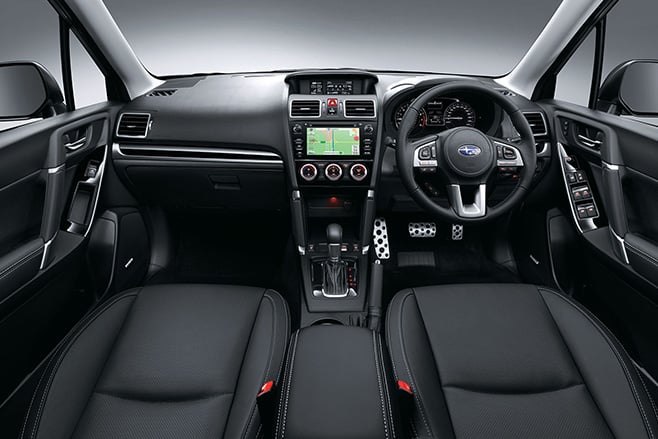
- It handles like a sedan and body roll is minimal despite the raised ground clearance and high roof, thanks to the flat boxer engine.
- Road noise is markedly improved over previous models.
- It’s very spacious despite not being very big on the outside. The back seats have ample legroom and you could wear a top hat while driving for all the headroom. The quality of the interior finishes, including the seat fabric, is evident even in the base models.
- The rear cargo area is good size thanks to the boxy shape, though it’s a little shallow to accommodate the full-size spare tyre under the floor.
- It is a little bland compared to other Subaru models and I think they have gone as far as they can go with the styling of this generation. The raised roof makes it look a little comical while other mods seemed to have happened just for change’s sake without necessarily improving the look. That said Subaru would be careful not to tinker too much with anything that ain’t broke.
The small SUV market is in one of the most hotly contested with almost every manufacturer putting out a competitor. In terms of get-out-of-town ruggedness and pricing, its main rivals would be the Toyota RAV4 and Nissan X-Trail.
MORE: Subaru Forester Range Review MORE: Subaru Forester Specs, Range & Price
What’s this fleet of Cadillacs doing in Melbourne? And do they feature the new 370kW V8?
CADILLAC is in town! The Wheels inbox has flooded with emails after sightings this week of a convoy of left-hand-drive two- and four-door Cadillacs, a Chevrolet-badged Colorado ute, and a Trailblazer SUV cruising the streets of Melbourne.
Several sharp-eyed readers in said they came across the convoy of the lightly disguised cars in eastern Melbourne, which included Cadillac-badged sedans and coupes, and one proclaiming to be a “3.0TT AWD”, according to Garry Nichols.
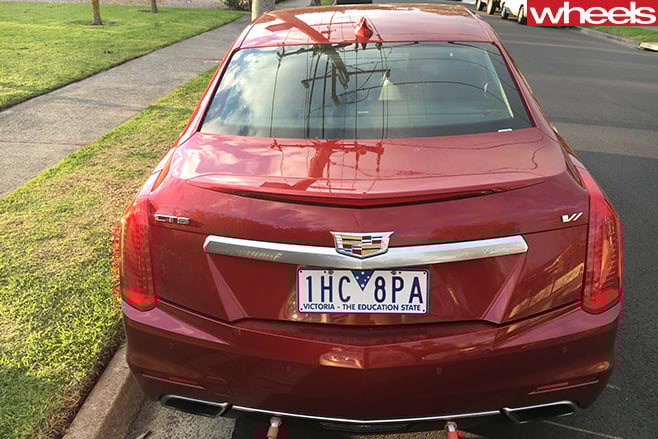
Another reader, Troy Mietus, said he saw five Cadillac-badged cars, including a two-door coupe, as well as the Chevy Colorado.
According to Holden, these cars are a selection of international models its engineers are working on at the Lang Lang proving ground as part of US parent company General Motors’ global workshare program.
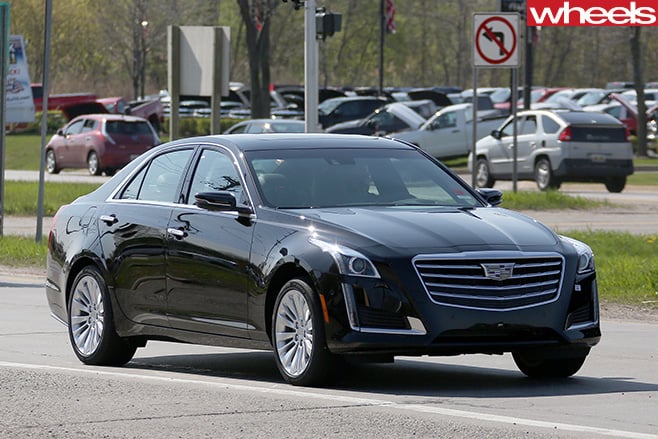
Readers that have had a close-up look at the cars have reported laptops hooked up to the dashboard, suggesting these cars are trialling drivetrains as part of their development program.
Another, Chris, described plugs coming out of the rear bumper of a CTS-V, believed to be linked to emissions testing. This version of the CTS, pictured, shows trapezoidal exhausts on either side of the rear diffuser, unlike other cars we’ve seen wearing a dual exhaust only on one side.
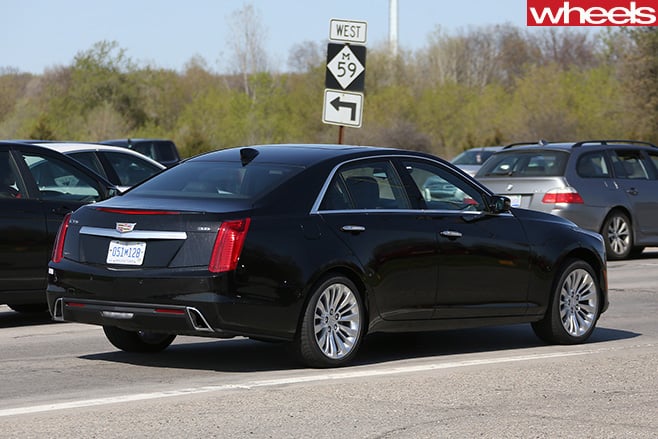
As Wheels reported last year, Holden is expected to add the firebrand CTS-V to Australia as early as next year. The Aussie brand is also expected to bring in a right-hand-drive version of the next-generation Camaro in 2018 and, similar to the 477kW CTS-V, featuring a 338kW version of the 6.2-litre V8 minus the supercharger.
However, a 338kW right-hook version of the Corvette two-seater sports car – which may yet sprout a two-seat mid-engined version – appears to have hit a speed hump after General Motors lost a fight to trademark the iconic twin-flag badge here, all because the Chevy bowtie it uses looks too similar to the heavily protected Red Cross symbol.
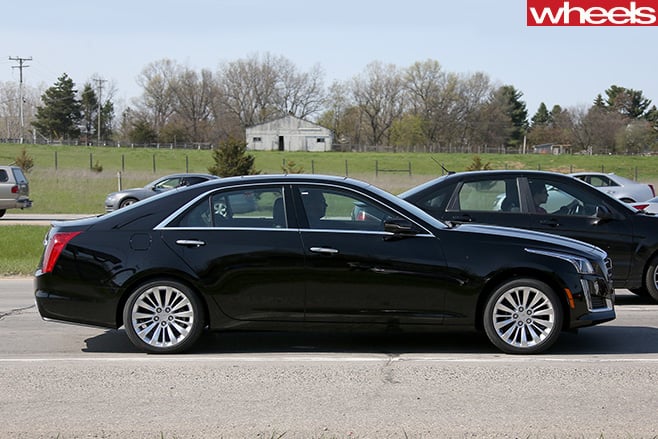
The Cadillac CTS is due for a facelift as part of a mid-life refresh for the range. The cars spied in Melbourne that we’ve seen so far feature the current-generation CT6’s face, suggesting they are running under-bonnet tweaks that will roll out into the updated US models.
According to Holden, the Lang Lang proving ground will continue to support GM’s international projects next year and beyond, “in addition to working with other markets and vehicle home rooms (e.g. Brazil in the case of Colorado) to develop vehicles suited to Australia”.
“This almost always will involve local testing and in some cases will result in vehicle that are unique to Australia (again, example being Colorado),” Flintoft said.
HOW can we already be on the eve of a second-generation Mazda CX-5?
Believe it or not, it has been nearly five years since we clapped our collective eyes on the first post-Ford, SkyActiv-era Mazda model, meaning that a completely redesigned one is just around the corner.
To prove it, here are the first-ever prototype shots, taken in Southern California, wearing the obligatory swirly camo to distract curious bystanders and scoop photographers alike from just how different the new model is to the 2012-vintage outgoing version. That is, not very much at all, actually.
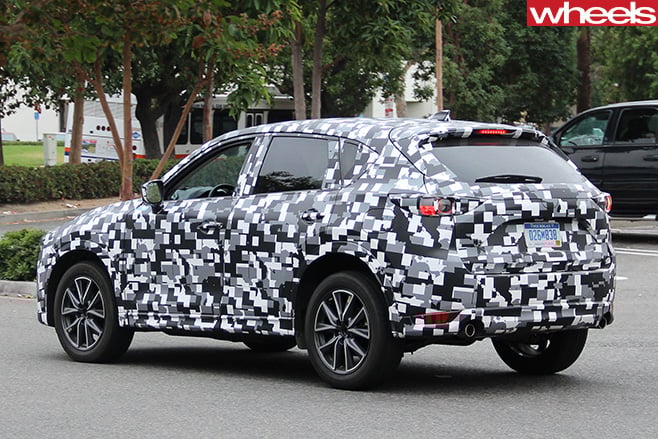
Expected to debut sometime in the first quarter of next year, the second-gen Mazda CX-5 retains the suave high-waisted sporty silhouette that has helped save the Japanese brand from financial oblivion by setting brand sales records worldwide. It appears that the body is a little longer, the glasshouse a bit deeper, and the pillars slightly slimmer for the benefit of better all-round vision, while the blunt nose design seems like a tweaked version of the larger Mazda CX-9’s prominent proboscis.
Speaking of the company’s seven-seater SUV, we understand that the latter’s substantially re-engineered platform – itself based on the existing CX-5, but with thicker sheetmetal and significantly reduced noise and vibration pathways – will underpin the newcomer, addressing the refinement issues that have plagued the series since the beginning.
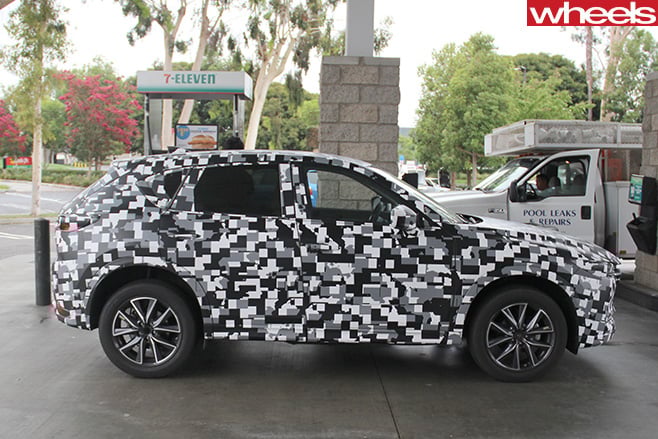
We also have our fingers crossed that the CX-9’s ripping 2.5-litre four-cylinder petrol-turbo powertrain will migrate to the smaller SUV, at least in the more up-spec variants. Did somebody say CX-5 MPS?
Disappointingly, it is more likely that modified versions of the existing 2.0-litre and 2.5-litre atmo SkyActiv-G units with improved efficiency will be employed instead, while the lauded 2.2-litre turbo-diesel SkyActiv-D is also set to return. All will be driving either the front or all four wheels via six-speed transmissions (please don’t drop the manual gearbox, Mazda, pleeeeease!), so no change there either. The GVC G-force Vectoring Control for smoother handling and better traction characteristics is sure to be included.
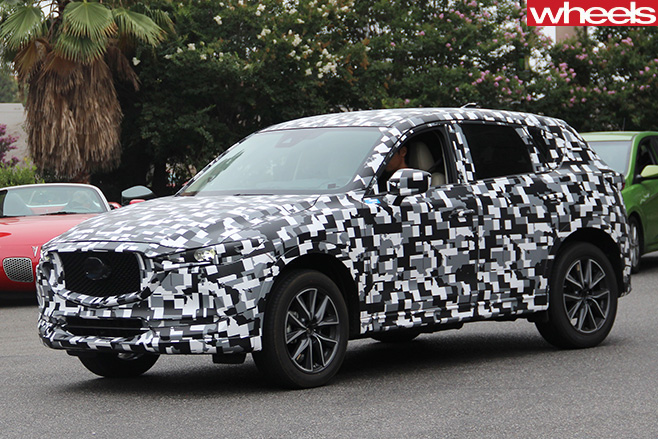
Along with a quieter (and perhaps roomier) cabin, the CX-5 II is also poised to adopt a classier dashboard, gaining the more advanced driver-assist systems such as AEB-R Autonomous Emergency Braking in Reverse technology that debuted in the CX-9. As before, the suspension should comprise of MacPherson struts up front and a multi-link rear.
Unfortunately for Mazda, the Hiroshima-built medium SUV won’t have the limelight to itself for very long when it surfaces in Australia late next year or in early 2018.
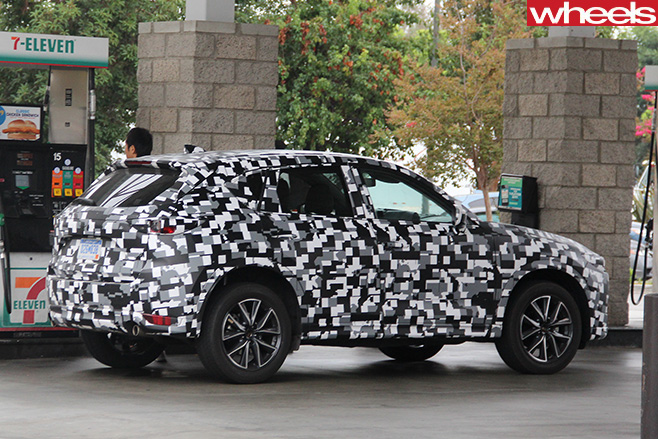
By then the second-gen Renault Koleos and Volkswagen Tiguan will have established a footing in the marketplace, while a raft of other newly redesigned competitors such as the Honda CR-V, Toyota RAV4, Subaru Forester, and Mitsubishi Outlander will also be here to make life difficult. And don’t forget that replacements for the Ford Kuga and unlamented Holden Captiva 5 should also be in the pipeline by then.
So don’t expect CX-5 II pricing to stray too much from the sub-$30,000 ask for the base Maxx 2.0 front-driver, up to and perhaps beyond the mid-$50,000 mark for the full-fat (and hopefully turbo-enhanced) AWD range-toppers.
Right now, the existing KE CX-5 is king of the medium SUV heap, with a smidgen under 20 percent market share, followed by the Toyota RAV4 and Nissan X-Trail with 14.5 and 14.1 percent apiece respectively. Don’t count on either compatriot to let that continue without a fight.
Watch this space.
Have spy pics of your own? We’d love to see them. Just email them to [email protected]
Here it is! The much heralded, the much wanted and the much feared Ford Falcon is with us in all its aesthetic and competitive glory, reports IAN FRASER.
First published in the October 1960 issue of Wheels magazine, Australia’s most experienced and most trusted car magazine since 1953.
The Falcon swoops
THE question on the minds of practically every Australian motorist this month is – “How good is this Ford Falcon?” To find out the answer I went to Ford Australia’s new £11 million Melbourne plant some weeks before the official announcement of the car to test drive the three versions.
Because the cars were new with very few miles and because they had not been announced officially, I was unable to give the full road test. Instead I had to content myself with driving them around the factory’s test track – short, but reasonably complete.
I must admit that my first thought when I saw the Falcon was – this car is too low and I won’t be able to get my six feet into it with comfort. I therefore approached suspiciously, half expecting to have to bend myself double. The surprise was that I slipped in behind the wheel with the ease of an olive dropping into a martini. Had I been wearing a hat I think I could have sat on the front seat without taking it off. There was more than enough headroom back and front and definitely a great deal more space than in many of the so called “full-sized” Detroit-bred cars. Then I had a look to see why. Like some Continental cars, you step down into the Falcon. The monoconstruction shell has deep wells the floor which enable this to be achieved without any serious drawbacks, other than it might be difficult to clean the interior of the car without the aid of a vacuum cleaner. That is hardly a complaint, anyway, since the floor coverings are rubber back and front and easy to remove.
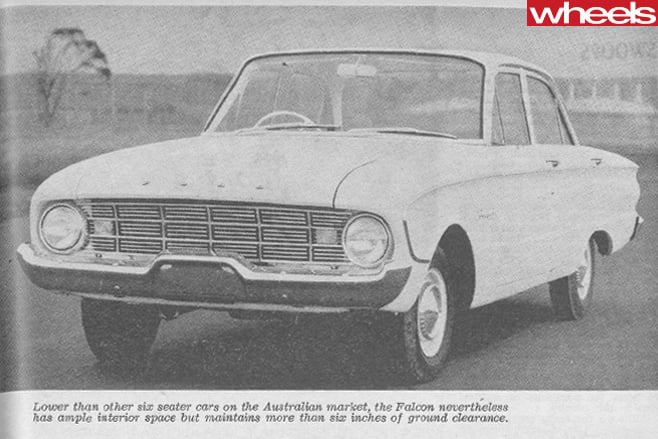
Visibility was particularly good. The wide windscreen gave splendid forward vision through its curved expanse. I note with interest that it is not the wrap around type so much in favour these days but which are also hideously expensive to replace.
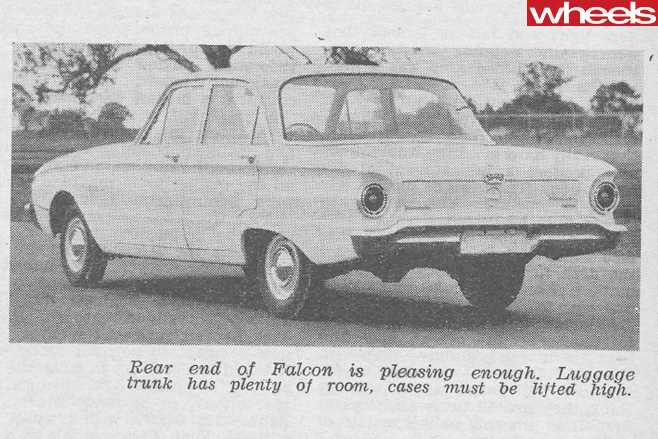
The back window was almost as big as the windscreen and without straining I could see the extremities of the tail – an asset when parking.
The blindspot because of the windscreen pillars was just about normal but the side windows matched the windscreen and rear window for visibility. They wound down with just three complete turns of the handle.
Armrests were fitted to all doors. They also acted as door pulls and were conveniently placed. The door handles and the window winders were just about the toughest and most manly, I have seen in a car since the vintage period. Quite obviously they were meant to be gripped firmly and used.
Most of the instruments are concentrated in front of the driver and there is a row of chrome plugs-for the addition of other controls, such as a heater, windscreen washers and fog lights. All the controls were in easy reach of the driver and simply laid out to avoid confusion.
One thing I did not approve of was the vacuum actuation of the windscreen wipers, although on the car I tried they worked very well with little variation in speed. However, I cannot help but think of vacuum wipers falling down miserably when the engine is beginning to need attention.
The instrument cluster was simple and directly in front of the driver.
The speedo was calibrated in at every five mph. In the same housing and at either side of the speedo were gauges for fuel tank contents and water temperature. Actually, these two dials were just about the strangest instruments I have ever seen in a car. They have a very strong resemblance to an aircraft’s artificial horizon.
It had only two speeds but you have to try very hard to pick exactly where the change occurs. If it stays in adjustment for long periods, then this will be one of the best automatics ever to come to this country. It is obviously the latest style of US auto box and something we are just not used to. This one, named Fordomatic naturally enough1 will do a great deal to boost the popularity of shiftless cars in this country.
Although the brake pedal was not as wide as it is on some automatic cars it was easy to reach with either foot and light enough not to need both together. The go pedal was a long organ-type which permitted plenty of variation in driving positions without the driver feeling · uncomfortable.
I liked the feel of the brakes. They were light and felt as though they were really stopping the car. Although their lining area was a little on the small side at 114.3 square inches, I could not detect any signs of fade in the relatively short time I drove the Falcon, However, I feel sure that really hard motoring would probably produce a fair amount of deterioration.
They were surprisingly light to operate. The handbrake should only be described as a parking brake since it seemed rather feeble and was placed too far under the dash for convenience (the automatic transmission model had a park position, too, by the way).
So much for the interior. A keyswitch starts the engine only if the selector points to neutral. After the engine is running you then move into drive. The test car I tried was idling too fast and the car had the creeps, so it was necessary to hold it on the brake. Once underway the transmission was excellent, as we said before. Naturally there is a hold for low range to aid braking downhill, etc.
Besides being impressed with the transmission (you will not be able to shut me up about it) the engine itself was delightful. Smooth even in such an early stage in its life, the power unit felt willing and able to rev like mad if need be. The bore is 3.5 in and the stroke 2.5 in to give a cubic capacity of 144.3 cu in, or if you like metrics, 2366 cc.
With such a short stroke, long engine life seems assured. At 2500 feet per minute- piston speed the engine would be turning at 6000 rpm – a theoretical engine speed since the maximum power, 90 bhp (gross) comes at a modest 4000 rpm.
A couple of other points I liked were a) the integral intake manifold and cylinder head which, although restricting hotting up, does away with all the sealing problems. b) a special filter arrangement reduces the oil change frequency to every 4000 miles after the initial 1000 miles.
Also on the servicing side are the self locking rocker arm adjusting screws. ·
Chief Falcon engineer at Ford Motor Company (Dearborn, USA), Jack Hooven, realised that to get the new compact to perform really well it would be necessary to make the car as light as possible (2400 pounds was the target), so he made the engine light – just 345.5 lb with flywheel, but without clutch. Compare this with the Ford Six’s 525 lb, yet the Falcon is iron, uses only aluminium pistons. The sturdy crankshaft runs on four main bearings.
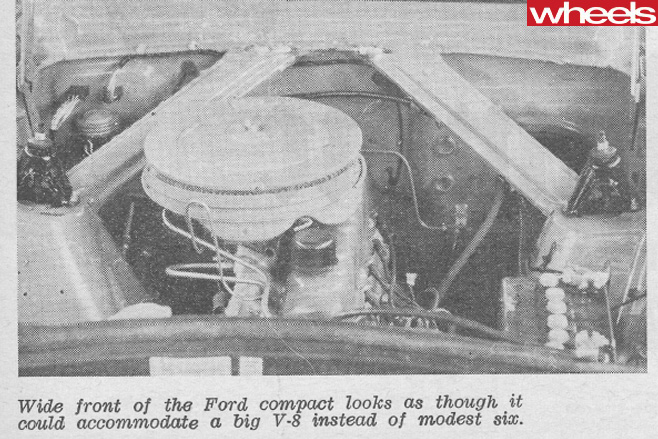
The motor delivers 138lb/ft of torque at 2000 rpm which gives the engine a nice range of flexibility. Peak torque is equal to a shade more than 40 mph in top gear.
With a wheelbase of 109.5 in, the Falcon will turn in a circle of 37.7 feet which is perhaps not as good as could be expected in a car released during 1960. On the other hand it is not so bad as some and an extra foot is not going to make that much difference to anyone. I was disappointed to find that the steering wheel had to be turned almost five times to take the front wheels from one lock to the other. Although I personally consider that this makes the steering too slow, it does give the · terrific advantage of making it very light. Parking and turning at slow speeds are a snack and not even the weakest feminine driver would have to exert herself.
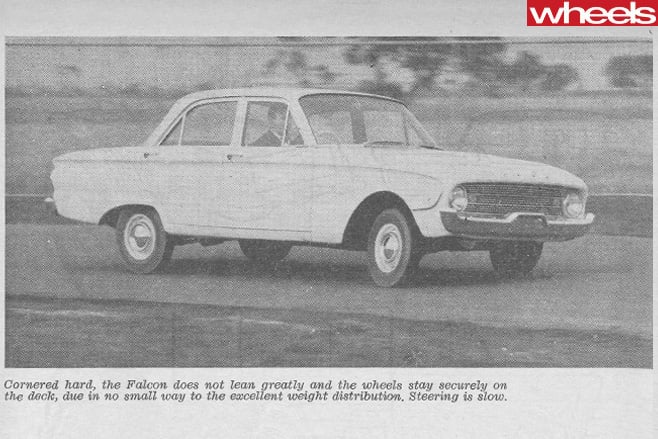
As with the majority of current model cars, the Falcon understeered slightly, but always felt very controllable providing you started winding the wheel in plenty of time leaving the corner. Personally I would like to see the steering box rate altered to reduce the turn to about 3.5 lock to lock, but this would naturally incur a heaviness penalty. I’d although not many people would start throwing the Falcon around in slides if they did I think it may become something of a handful when the understeer finally turns to oversteer and the tail comes around. Even out of moderate corners fairly fast I found myself becoming rather busy getting the wheel unwound. Once again, this may largely be a matter of getting accustomed to the limitations, but I am afraid I must disagree on principle with so many turns.
The Falcon handled well as far as I was able to judge during my brief tryout of the car. It felt well balanced – and was – with 52/4 front and rear weight distribution. Cornered hard, body roll was slight and the tyres were quiet. The suspension behaved very nicely and did not feel soft and loose in spite of the ·excellent bump-damping effect.
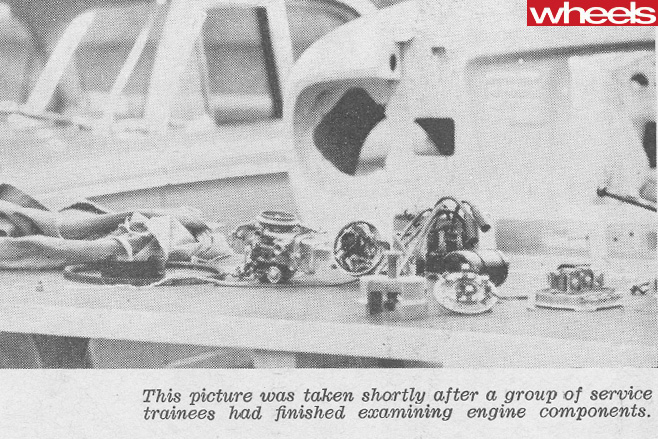
Fully laden with six people, the Falcon sits down noticeably, but does so evenly between front and rear. Unladen, ground clearance is 6 1/4 in.
After trying the Fordomatic version, I then had a short run in the standard version of the car which besides being fitted with a conventional three speed transmission had been stripped of some of the glitter, but nevertheless looked perfectly respectable.
When steering column shifts were popular on US-made cars years ago we came to expect them to be sloppy – something like stirring an uncooked Christmas pudding with a rubber hose. Between then and the introduction of the Falcon something must have really happened in Detroit because the change on the car I drove was one of the best column shifts I have ever encountered. Light to use, its movements from one gear to another were short and dead accurate. Top marks for this!
Naturally since the car was very new I could not wind it out in the cogs, but first felt plenty strong and overseas reports indicate that it will spin to more than 30 mph in this ratio, 60 mph plus in second.
Although capable of revving fairly hard the Falcon was also very flexible in top gear, pulling away quite strongly from 15 mph. The rear axle ratio on the Australian-made Falcon is 3.56 to 1, which makes it a shade lower than the original American specification of 3.10 to 1.
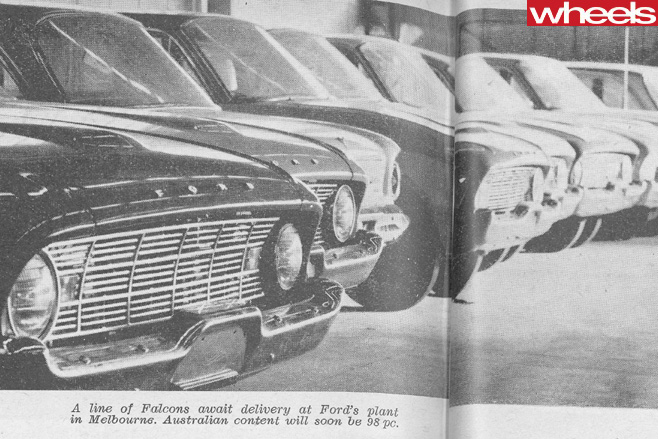
Ford has- great plans for the Falcon. It is meant to challenge the Holden and I think it does just that most effectively. Locally found content of the car will be 95 pc at first, rising to 98 pc as production gets into full swing. An excellent car in practically every respect, this Ford is going to win lots of friends because of its nice feel, ample performance and because, for the first time since 1948 Australians are being offered the type of car they want without it having to be a Holden.
How the two cars compare in specification can be seen in the chart. Actually, they are very similar, although the Holden is inches higher and not as powerful.
The cards are by no means stacked against the Holden since it has a whole list of more desirable features such as higher geared steering, a better turning circle and a slightly shorter overall length.
On the other hand, the Falcon is a car designed for this year, unlike the Holden which is a rehashed version of an already long established model. Just how the public will receive the Falcon we must wait and see, but I think a lot of people are going to be happy.
FALCON VERSUS HOLDEN
HOW THEY COMPARE
| u00a0 | Falcon | Holden |
| Wheelbase | 109.5 in | 105 in |
| Track, front | 4ft 7 in | 4ft 6t in |
| Track, rear | 4ft 6t in | 4ft 6t in |
| Overall length | 15 ft 1 1/4 in | 14ft 8 in |
| Overall width | 5ft 10 in | 5 ft 7 in |
| Overall height | 4ft 6t in | 5 ft 1 in |
| Turning circle | 37 ft 7 in | 36 ft |
| Turns, L to L | 4 3/4 turns | 3.8 turns |
| Brake horsepower | 85 bhp at 4200 rpm | 72 bhp at 4400 rpm |
| Weight, dry | 20 1/2 cwt | 21 cwt |
Everything you need to know about the upcoming Paris Motor show.
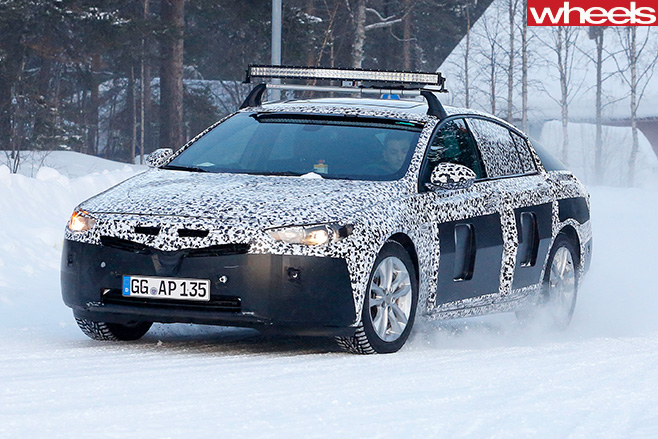
The Paris motor show for 2016 is shaping up to deliver a smorgasbord of hot new metal for car fans to drool over. There are a number of high-profile releases scheduled, including Mercedes-Benz’s all-electric Tesla fighter, and GT C drop-top. The show will also take on a distinctly Aussie flavour this year when we get our up-and-close look at the European-designed hatchback that will become the Holden Commodore from late 2017.
The 2017 Opel Insignia will be one of the main stars of the Paris show, which kicks off in October. Other cars we’re expecting to see include the new Honda Civic hatchback, the Renault Alaskan ute and the next generation Audi Q5.
Here’s a run-down of what we expect to see:
Mercedes-Benz EV and GT C roadster
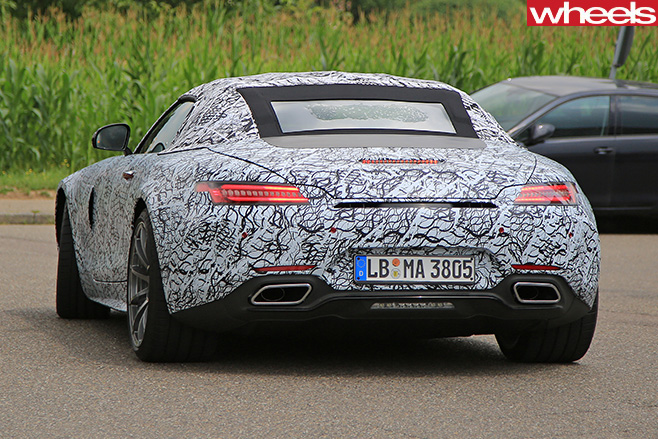
The three-pointed star will also take the covers off the Mercedes-Benz GT C roadster. The drop-top has previously been spied testing, and will add to the GT’s line-up which now includes the regular GT, GT C, GT S, and GT R.
Holden Commodore (Opel Insignia)
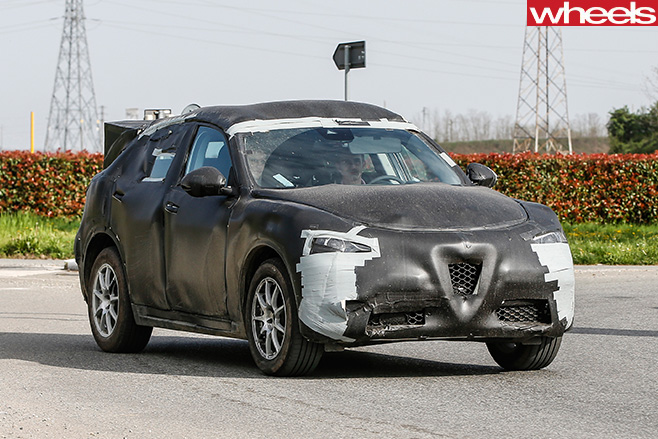
Alfa Romeo Stelvio
Audi Q5
The Audi Q5 is a mid-size SUV that has sold well for the German luxury carmaker. However, it’s starting to become difficult to disguise the car’s age – it is based on a platform launched in 2007. The new Q5, which will take on the BMW X3/X4, Land Rover Evoque and Mercedes-Benz GLC-Class, is still not a confirmed starter in Paris, so we’ll have to wait and see if the new one, built on the Volkswagen Group’s new MLB platform, makes the show. The new Q5 is expected to make a big leap forward, featuring front-wheel-drive models for the first time as well as adopting the part-time front-drive Quattro all-wheel-drive system used in the A4 Allroad.
Citroen C3
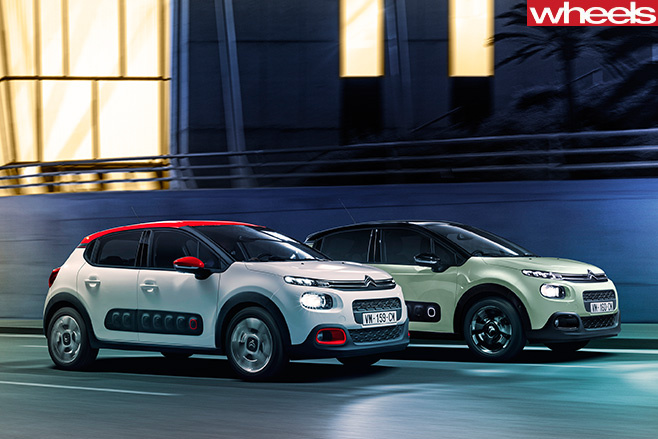
On top of these there will be public debuts for cars that have already been revealed including the Renault Alaskan, Porsche Panamera, Peugeot 3008, LaFerrari Aperta.
You may not be joining the hardcore Lycra brigade just yet. However, if the family’s biking habit is getting serious enough, a bike carrier may be next on the shopping list.
But don’t rush out to buy a tow bar or roof racks just yet – explore all the options available to find the product that best suits both sets of wheels.
TOWBAR-MOUNTED CARRIER
A popular way to carry bikes is on the car’s towbar. Fitting up to four bikes at a time, the ability to mount them on the car without too much lifting is a definite advantage.
Gone are the days of the fixed coathanger bike rack, though the current crop of foldable and lockable versions of this basic carrier are still the cheapest and lightest option. The downside is boot access, which can be a little awkward once all the bikes are in place.
You can buy tiltable or even swing-away racks that allow easy access to the boot for a little more money. These are typically platform-style racks, which not only allow for better boot access but are easier to load and unload.
Up to four bikes can be placed onto a platform extending out from the towball and locking in by their wheels and frame.
Some have light connectors for brake and turn signals which are similar to a trailer, and requiring a trailer plug to operate them. These types of bike carriers extend the car’s length significantly and are bulkier and heavier, though will still fold for storage. They also cost more than the simple racks, some significantly so.
BOOT-MOUNTED CARRIER
No towball? No problem. Another option, particularly for the occasional bike transporter, is a rear or boot-mounted carrier. Fixed to the boot face, up to four bikes can be carried on its racks.
Again, it can be locked to the car, doesn’t require the bikes to be lifted too high and is easily folded and stored.
There are some notable downsides: Access to the boot from the outside is not possible with the bikes mounted, and the rack must fit around the car’s body style as components such as rear spoilers and wipers can impede their use.
The same goes for the contact points of the car. The rack needs to be secured to the boot lid frame, not just the sheet metal, in order to hold the weight of the bikes. Matching up the right carrier to your car, or a professional fitting, is a must.
ROOF CARRIERS
If access to the back is a must, carrying bikes on roof racks may be the best alternative. If you already have roof racks, either built in or fitted, it can also be a good option financially.
You must check out all the alternatives for mounting the bike by the frame, fork or wheel, and what is easiest and best for both the car and the type of bike.
There are systems that enable bikes to be mounted entirely by one person. Others don’t require you to take off the wheels each time, though this depends on your bike type.
Roof racks are only good for one or two bikes so they’re not usually an option for families that drive and ride together.
You also have to think like a truck driver and remember the height of your vehicle has increased significantly. One can’t simply pull into the covered garage with bikes still on top. The same goes for the drive-through Maccas run after all that exercise – though that may not necessarily be a bad thing.
THE countdown has started. It’s now just 56 days to the end of Ford Falcon production on October 7.
We’ve decided to chart the progress of Ford’s oldest continuous running nameplate, in all of its published highs and the lows in Wheels, every single day leading up to the final car running down the Broadmeadows production line.
We’re beginning with the very first XK model released in Australia in September 1960 – a little more than a year after its US debut as the Blue Oval’s take on the Volkswagen Beetle – and will go right up to the latest, and last, Ford Falcon FGX of 2016.
Over the next 56 days, we’ll be checking in with every year, to see how the fledgling Falcon has fared: at the start, as the stylish but ultimately under-developed US compact with severe durability issues that almost saw the series meet an untimely end by the mid 1960s; the so-called “Mustang-bred” XR GT, providing Holden with its first real big fright, and culminating in the fastest production four-door sedan in the world by the time the legendary XY GT HO Phase II version appeared in 1971; and then on the only truly Australian designed family car from the 1972 XA, taking in the 1979 XD, 1988 EA, 1998 AU, and 2008 FG.
We’ll also explore the rollercoaster ride, from the Falcon’s halcyon days of market leadership in the 1980s and – for a brief time – the mid 1990s, to the decline that inevitably led to the end of a true Aussie legend.
With such an extremely varied and chequered history, what better way for Wheels to celebrate, so stay tuned for your daily dose of the life and times of the Ford Falcon, as we look back at 56 years in 56 days.
Range Rover is introducing a new top-spec model to its Australian line-up, in for the form of an all-new model from Special Vehicle Operations (SVO).
The SVAutobiography Dynamic will be powered by a 405kW 5.0-litre supercharged V8, paired with an eight-speed automatic transmission that will take the hulking luxury SUV from 0-100 km/h in 5.4 secs.
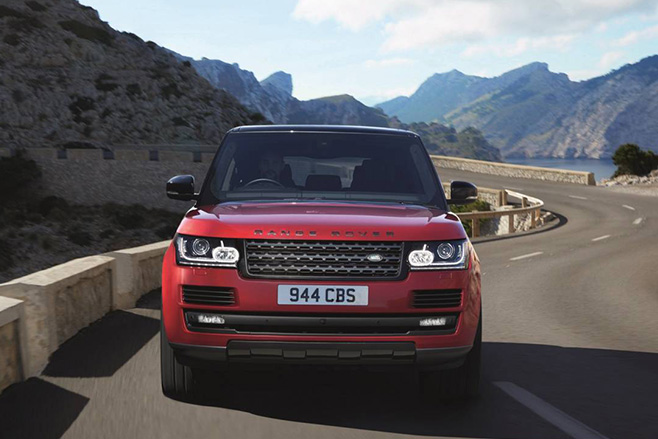
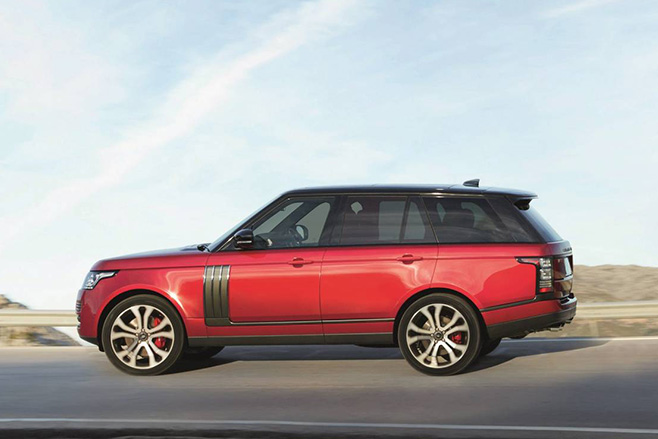
The SVAutobiography Dynamic’s exterior mostly reflects its athletic credentials, with a choice of 21- or 22-inch alloy wheels and big red Brembo brakes, while the bonnet finisher, grille, front bumper accents, tailgate finisher and Range Rover script all finished in Graphite Atlas.
A set of bright chrome quad tailpipes also cap off an exhaust system that’s been optimised to enhance its distinctive V8 note. Underneath, revisions to the suspension links and other hardware see an 8mm reduction in ride height, crisper steering response and greater roll resistance.
Interior luxury includes diamond quilted leather seats with contrast stitching, leather roof lining and black veneer front fascia and door casings.
The SVAutobiography Dynamic will be priced from $316,000 plus on-road costs.
It is expected to be on Australian shores from the start of next year along with the rest of the MY17 Range Rover range, which comes with new technology options.
There’s a new 10-inch dual-view colour touchscreen for the 2017 Range Rover’s infotainment suite that promises tablet-style responsiveness and controllability, but the real party trick is Advanced Tow Assist, which, if you’ve ever looked like a goose trying to back in a trailer, appears an absolute godsend.
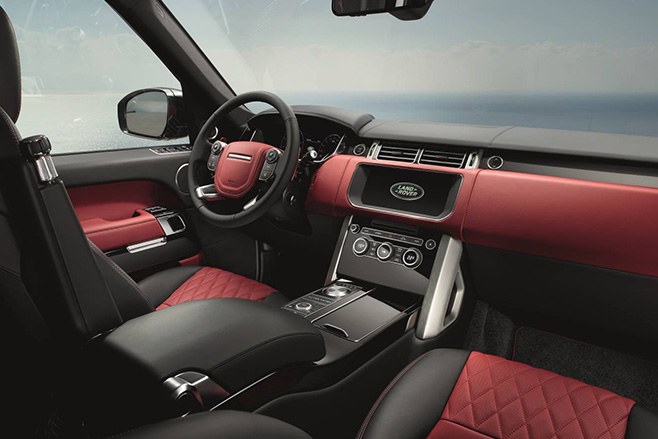
It uses the external cameras to help drivers guide their trailer, boat or horse float, and can even automatically steer the vehicle to follow a path selected by the driver using the touchscreen control dial (rotary shift controller) on the centre console. It also alerts the driver if they are approaching a jack-knife situation.
Other cool kit includes a self-learning sat nav system that recognises frequently-driven routes (such as your morning commute to work) and can recommend alternative routes that might get you to your destination faster. Backseat passengers can also suggest navigation destinations to the driver via their seatback-mounted rear entertainment screens – though the driver is always free to reject them.
New off-road tech includes Low Traction Launch, which is manually selected to reduce wheelspin when accelerating on slippery surfaces. This limits torque applied to the wheels until the vehicle reaches 30km/h.
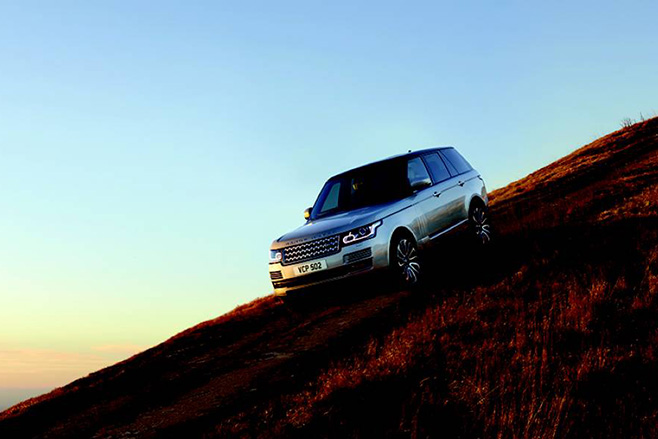
An all-terrain info centre also relays useful information of the vehicle’s status through the infotainment display. Rear park assist, lane departure warning and autonomous emergency braking will also be available across the range
Optional safety tech packs include blind sport warning, reverse traffic detection and a further Drive Pro pack with adaptive cruise control, blind spot assist and intelligent emergency braking.
The MY17 Range Rover range starts at $183,300
