
Aussie James Deane, leader of Honda’s Counter Design Team, on how Japanese culture shapes car design.
Zombies. We’re surrounded by zombies, many of them dressed in sexy-schoolgirl outfits and a disturbing number wearing contact lenses designed to make their eyes look genuinely undead. It’s almost Halloween in Tokyo and the locals, who have a long-held love for American traditions – aside from H-bomb dropping – are mad for it, stalking the world’s busiest streets in gory gangs.
A block further along, though, and you’re in a park so intensely manicured that the grass looks ever so slightly cowardly, as if it’s afraid to grow unkemptly, and no one is speaking louder than a whisper.
This is Japan; equal parts chaos and order, politeness and madness, peace and disquiet.
James Deane, a 53-year-old Australian-born and still Aussie-accented senior designer for Honda who has lived here for 25 years and has a Japanese wife and kids, still shakes his head at the weirdness of it all, but he wouldn’t live anywhere else.
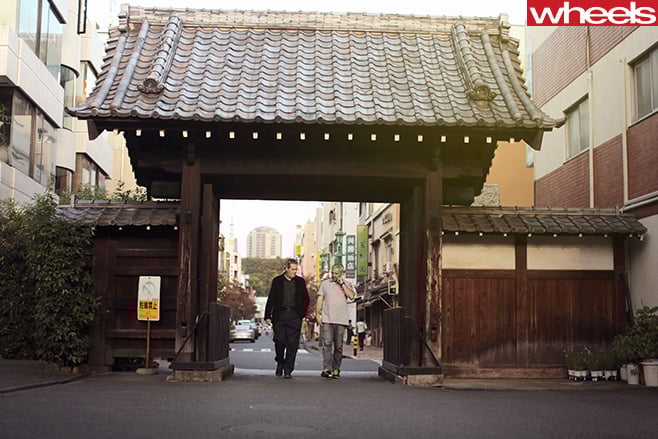
Deane admits that, while he’s only ever experienced car design through a Japanese approach – Honda was his first job out of design college – he’s still not good at boxy cars himself. “I like a bit of styling, a bit of width. I like sports cars. No kid ever drew a minivan on their pencil case.”
However, he defends the lack of imagination of something like a Nissan Cube. “That Cube is perfect for Tokyo because the cultural sense is different here; it fits the environment, the small spaces, the orderly straight lines, it’s all based on the ‘tatami’,” he says.
Tatami mats cover the floors in Japanese houses and are a stiffly regulated rectangle, always precise. Deane calls it “the module for everything they do”.
When talking about room sizes, the Japanese even measure them in tatami – as in ‘a six-mat room’.
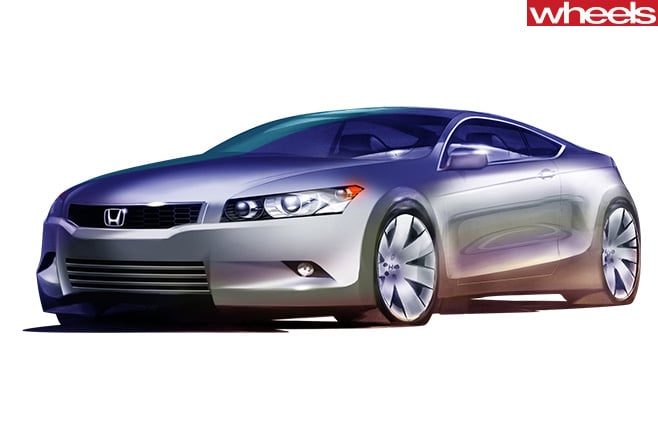
“Cars are very different for different markets, like people-movers. Over here they’re like luxury cars now. The idea is to make them look like a big lounge inside, a big space to live in. Well, a big space in Japanese terms; space is different here.”
That space must have taken some getting used to for Deane, who grew up in the wide, sandy emptiness of a farm near Esperance, WA, playing with trucks and tractors by day and retreating inside to sketch cars when it became too hot.
He says it was the culture shock that appealed to him, that drew him to Japan, and now, as much as he still misses the salty, warm air of home, he loves his adopted city with the passion of a convert.

He’s right about the space, or the lack of it, because it’s one of the things you feel most pressingly as a visitor. Greater Tokyo is officially the most populous place on the planet, home to a staggering 38 million humans. Much of the sizzling energy the place buzzes with is simply the result of all those humans zinging off each other at close quarters.
The Japanese in Tokyo are different, less diffident somehow, than the ones you meet overseas, perhaps because the touristy ones are so constantly baffled by how crap we are at things, the filth we live in and the fact that we can’t make our trains run on time.
Because they are so bemused by the rest of the world, Deane says the Japanese spend an inordinate amount of time, and money, researching what kinds of things we want from car design, and that’s when his job gets fun.

Deane will move to America with some of his designers and a clay modeler, for example, to come up with something like a new Accord. They will live there for a couple of months and craft a model there.
“The Americans want space, but they want emotion as well. They want sexy, not square. They want a high nose, and China likes that too. When you look at the Accord, you have to think about walking down Rodeo Drive and there are all these huge great SUVs, and everything’s so big, so you think, ‘Okay, we’ve got to make a big face to match’. It’s fun, but it’s pretty stressful as well because you have to come back with a proposal.”
Deane’s job, in fact, is generally to challenge other people’s proposals, because he leads what’s called a ‘Counter Design Team’, which sounds combative. “You have the main team, which comes up with what is the safe design, and then we do it a different way. It’s kind of a ‘but what if we did this’ approach, and sometimes we even win, but it’s that exchange of ideas that’s why it takes years to design a car.”

***
STANDING on a street corner surging with politely pushy people and marveling at the fact that someone has gone to the trouble of doing topiary on the tops of every tree in the tiny park across the road – slightly smaller than a double lock-up garage in suburban Australia but neatly raked and primped into perfect bonsai-esque beauty – Deane reveals that the Japanese are also greatly inspired by robots.
Or one robot in particular: Gundam.
“You can see Gundam in so much design here; he’s this strong, machine-like robot flying machine and he kind of represents Japanese design,” Deane explains, with child-like enthusiasm, drawing this toy in the air for me with his hands. “You can see him in cars like the NSX, even the new one. It’s just different to other supercars; it feels compact and it feels tighter, more machine, more like a robot. Like Gundam. The surfaces are very precise, the edges… it’s kind of the opposite of a Porsche, which is flowing and emotional and round. The NSX is more uniquely Japan.”

“I didn’t get to work on the last S2000, but I love it; it’s very round, emotional, but very tight as well, and I’ve worked on the next generation, and that’s the best,” he smiles, broadly. “They’re looking at different layouts and so on; they’re not sure what they want… Well, they are, but I can’t really say. It’s going to be completely different, and it will be that low-cost, affordable sports car that you can actually go and buy. I look at it and think, ‘I could have that, I could afford it’, so it’s a very exciting thing to work on.”
It certainly sounds like his Counter Design Team might be having a few wins with the top-secret new S2000 design, but Deane’s role means that much of his favourite work in the past has never actually graced a public road.
“Your favourites are always the design studies, the ones that don’t get made, unfortunately, because they’re a bit too ‘out there’. The show cars are always fun, too, but in the end the actual production cars are the cool stuff.
“When you see something you’ve done drive past you on the road, when it actually exists in real life, that’s what makes this job. I love it. It’s like having a hobby you get paid for.”
Designer’s favourites
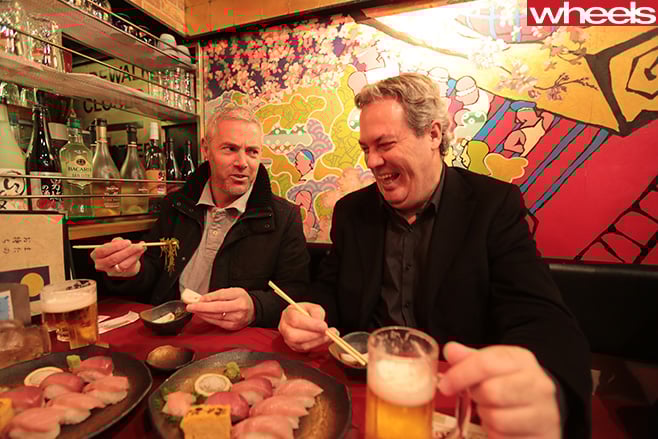
Deane is a fan of the new Jaguar SUV, a surprising critic of some of the Ferrari 458’s details, and an admirer of Aston Martin, but there’s one company that hasn’t even made a car yet for which he reserves his most nerdy awe.
“You look at the Apple design aesthetic – I think all designers do – and you just wish you could do stuff that is that pure of line, that beautiful. But cars aren’t shaped like that; they’re awkward, with their wing mirrors jutting out and so on. That’s why it will be very interesting if Apple actually does make a car. I can’t wait to see it.”
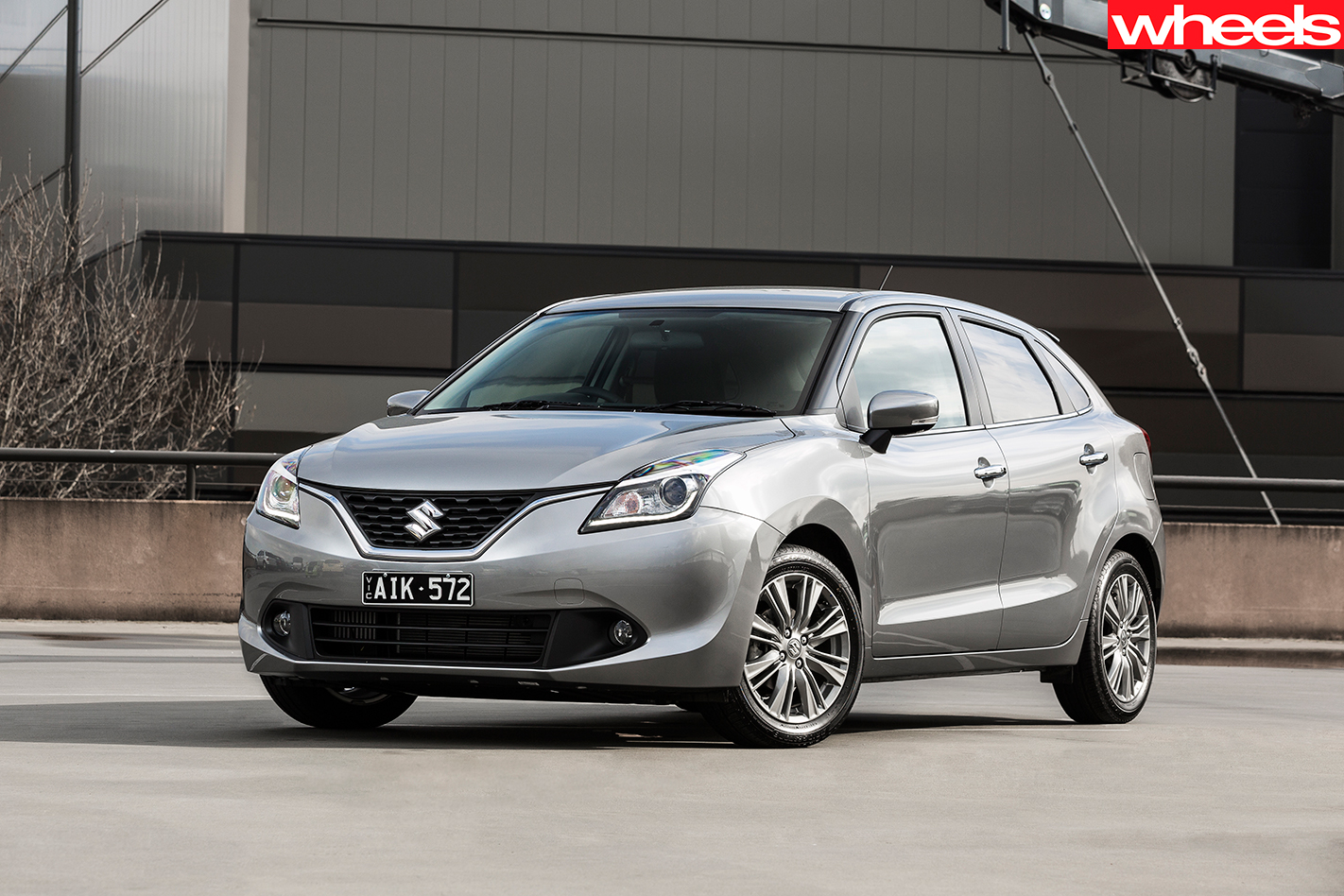
WHAT IS IT? The Baleno is an especially roomy five-door five-seater hatchback with a massive boot and high equipment levels, to lure small car buyers into a more compact and economical alternative. So while it’s nearly as practical as a Corolla, the prices are more closely aligned to that of a Mazda 2’s.
WHY WE’RE TESTING IT After competent Suzukis like the Swift, Vitara, and Celerio, we’re expecting big things from the Baleno – especially as it debuts an all-new chassis as well as fresh engine tech in the three-cylinder turbo petrol. Question marks hang over its Euro NCAP safety ratings, but the Indian-built hatch promises value, performance, and outstanding economy.
MAIN RIVALS Ford Fiesta, Volkswagen Polo, Mazda 2, Skoda Rapid, Hyundai i30, Toyota Corolla, Mazda 3, Ford Focus, Holden Cruze, Kia Cerato, Nissan Pulsar, Honda Jazz
PLUS: Performance, economy, packaging, value, ride comfort, handling MINUS: Safety rating questions, no AEB availability, no manual Boosterjet
THE WHEELS REVIEW SUZUKI’S refusal to build a conventional Toyota Corolla competitor is bordering on belligerence.
A world leader in motorcycles, an SUV pioneer, and a city-runabout superpower, the Japanese brand has never produced a regularly sized small car. Ever. Oddballs like the Liana and SX4 were either too compact or too crossover-ish to cut it.
Suzuki argues that the latest Baleno – from $16,990 driveaway for the GL 1.4 manual, just $1K more for the four-speed auto, and $23K driveaway for the GLX 1.0 turbo six-speed auto – will snare Hyundai i30 buyers anyway because the Indian-built hatch is big where it matters – inside – yet small enough to make a difference – namely to your hip-pocket.
So while overall length and wheelbase are actually shorter than a Mazda 2’s (never mind a 3’s), the numbers reveal C-segment-esque legroom and cargo capacity, thanks to extra girth, wider tracks, cab-forward packaging, and stunted overhangs compared to the supermini from Hiroshima. It’s also around 100kg lighter. Impressive.
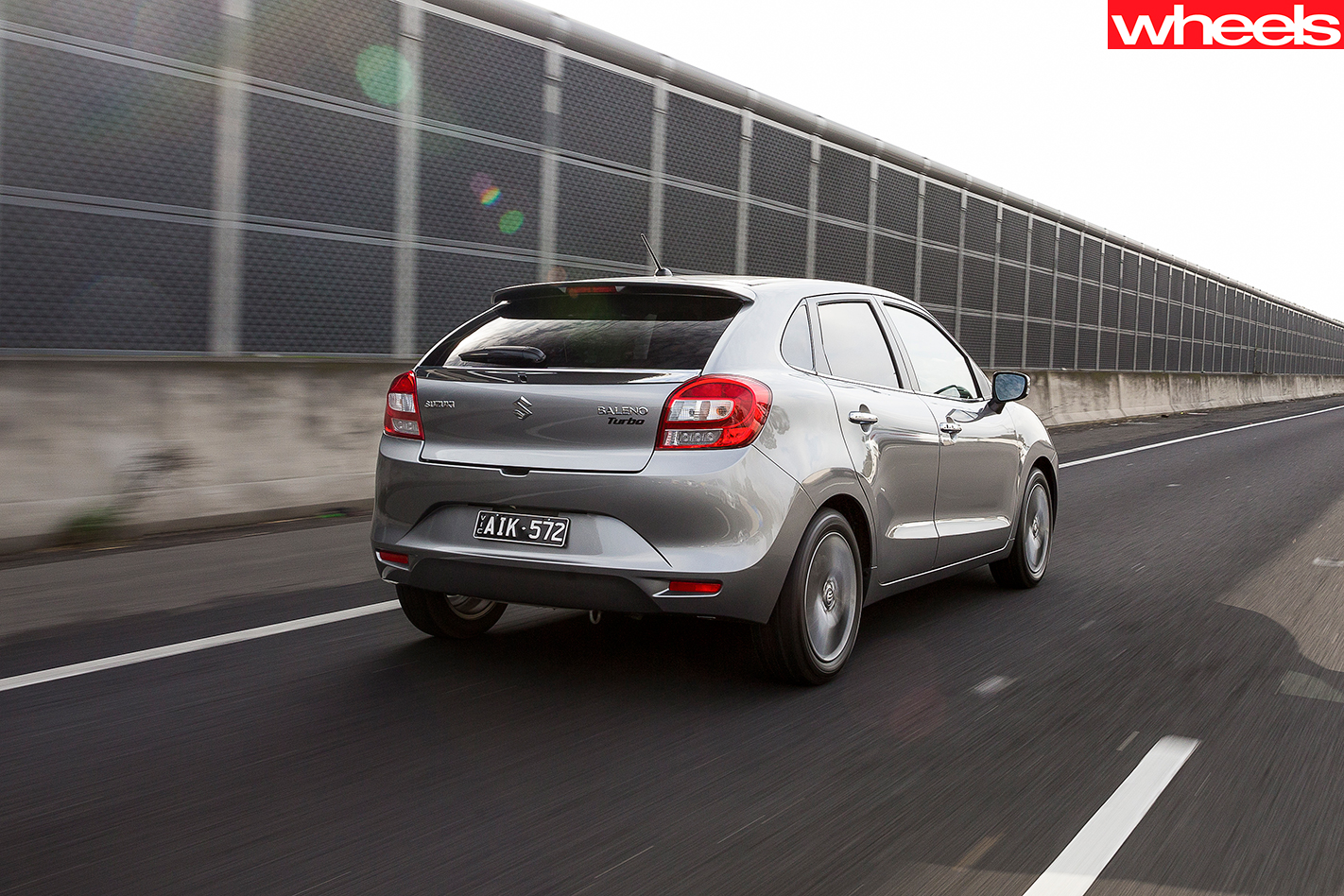
Additionally, the lofty rear seat area offers exceptional room for knees, legs, and feet, though taller scalps may scrape the roof-lining. All outboard seating is supportive despite short cushions, with a well-raked backrest, while the middle position isn’t purgatory. And the boot is deeper than the mess Britain is in right now, due in part to a space-saver spare as well as space-saving torsion beam rear suspension.
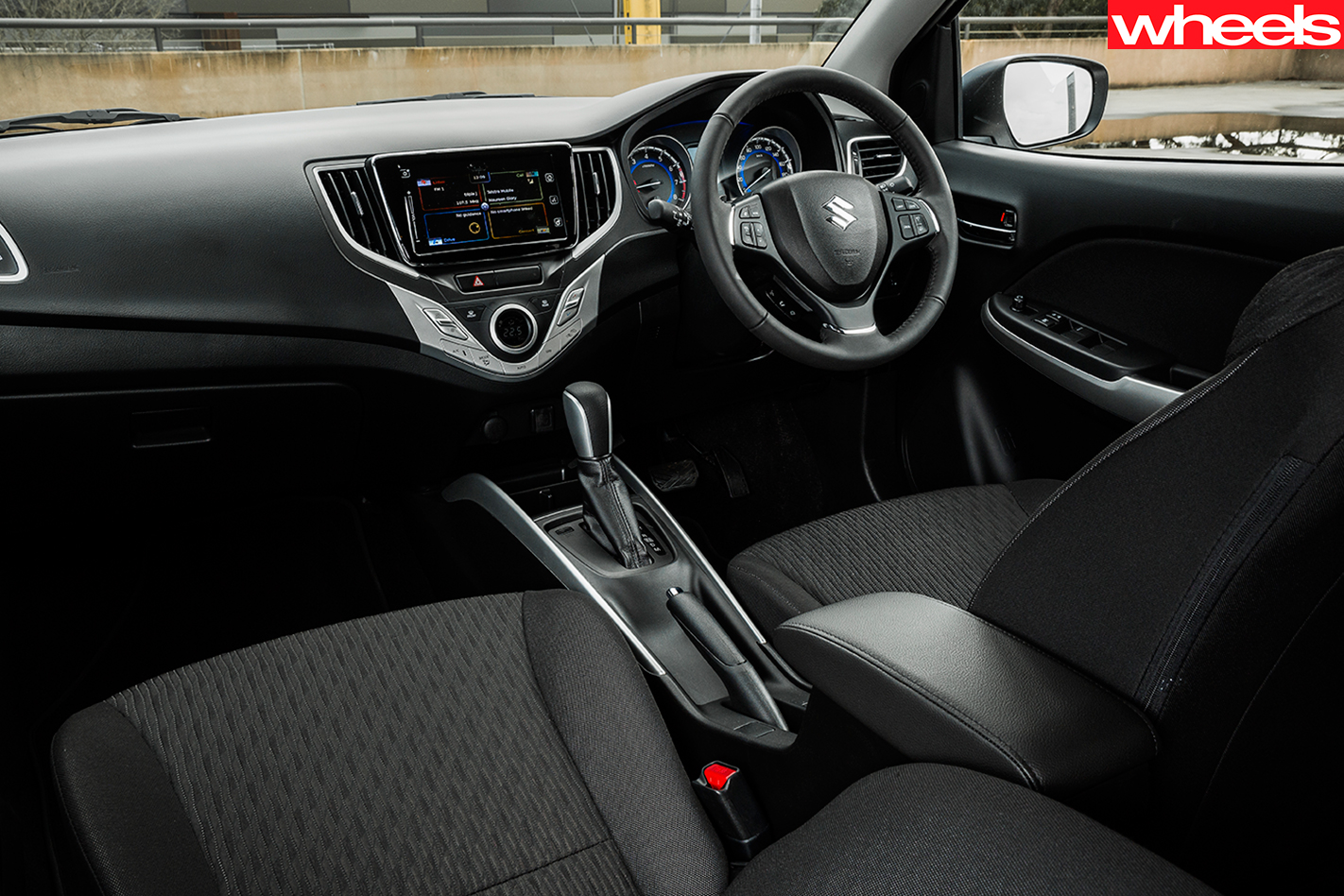
Our Baleno was the GLX, and against better bigger hatches like the Mazda 3, things become complicated. The Suzuki’s overall presentation simply isn’t in the same league, undermined by cheesy ‘90s trip computer graphics, no digital speedo, a clammy plastic steering wheel with fake leather stitching, and charmless cheapo plastics.
Yet the 82kW/160Nm 1.0-litre turbo triple is actually terrific. Aided by an excellent power-to-weight ratio and an intelligently calibrated six-speed torque-converter auto, the so-called Boosterjet is brisk off the mark, pulls quite spiritedly through the rev range, and sounds respectfully refined. Note: it does desire premium unleaded brew.
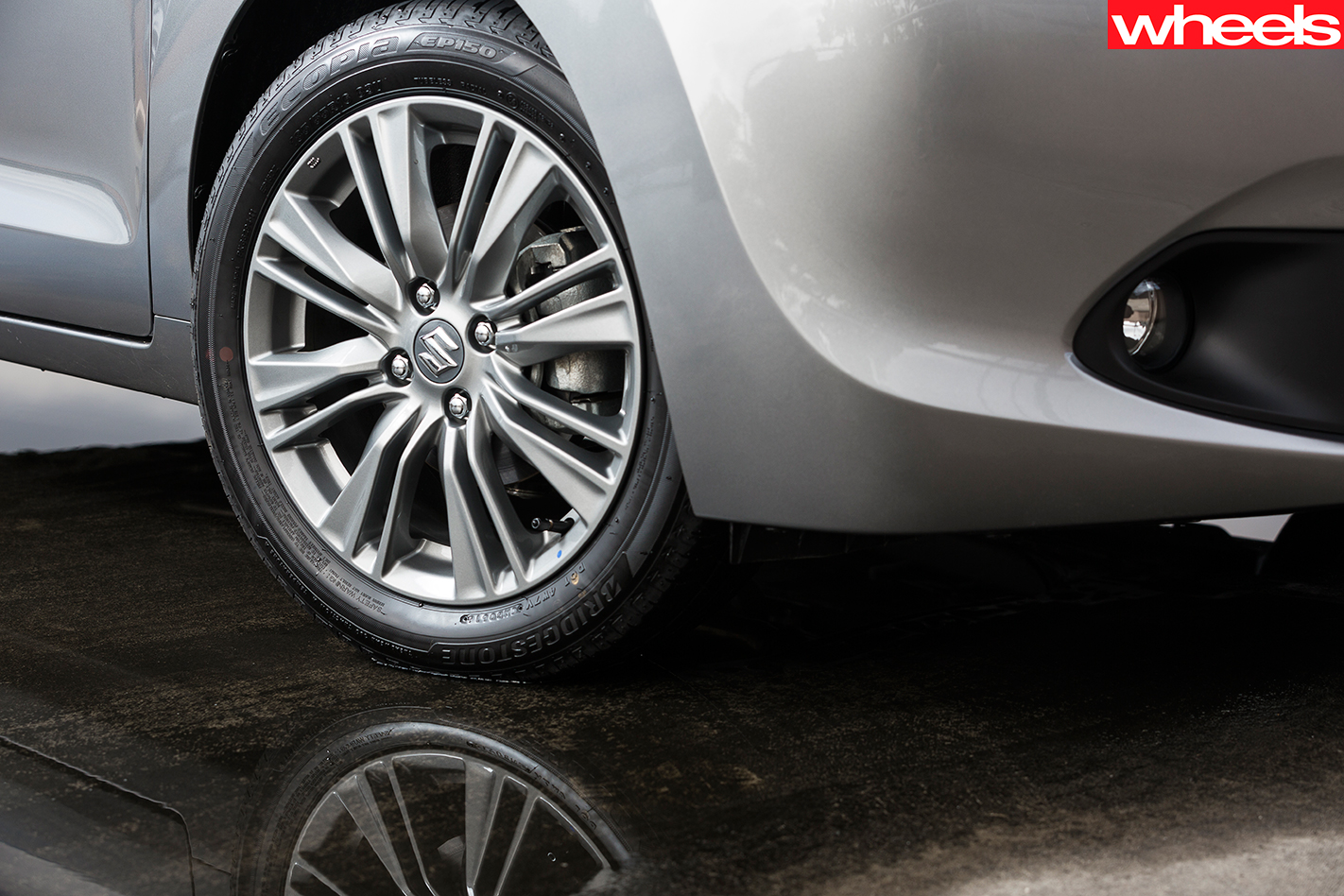
As it stands, however, the Baleno’s steering is far from that, feeling oddly remote and low geared, sometimes requiring two bites of a turn to literally avoid understeering out of a roundabout. Quite the opposite, then, to Suzuki’s other B-segment belter, the nervously sharp Swift.
Clearly, the company has tuned the suspension for comfort instead, resulting in long spring travel (great over speed bumps) and quite cushy dampening. But smaller-frequency rough-stuff compliance isn’t great. Body movement is noticeable over undulations at speed, with the springs occasionally hitting their bump stops – particularly with more than two people on board.
Yet this Euro-honed chassis, fundamentally, feels sorted, with high levels of grip, quite unflappable handling, and steering that’s both planted and kickback-free – though the ESC intervention is annoyingly eager to cut power.
Perhaps Suzuki’s relative inexperience in this segment is showing.
SPECS Model: Suzuki Baleno GLX Turbo Engine: 998cc 3-cyl, dohc, 12v turbo Max power: 82kW @ 55500rpm Max torque: 160Nm @ 1500-4000rpm Transmission: 6-speed auto Weight: 950kg 0-100km/h: 11.0sec Fuel economy: 5.2L/100km Price: $22,900 (driveaway) On sale: Now
EARLIER this year Toyota’s Hilux cracked cumulative sales of half a million vehicles in Australia.
Back in May, when the milestone occurred, the Hilux (4×4 and 4×2 variants) led the year-to-date sales charts in Australia.
Toyota’s executive director of sales and marketing, Tony Cramb, said at the time that the sales results reflected the enviable reputation Hilux has developed for toughness and reliability.
“Hilux is renowned and respected for its ability to thrive in Australia’s harshest conditions, while also providing the space and features expected by a family,” he said.
However, following four months of stunning form, the latest figures released by VFACTS revealed the Hilux has been overtaken by the Hyundai i30 (22,857 v 21,171).
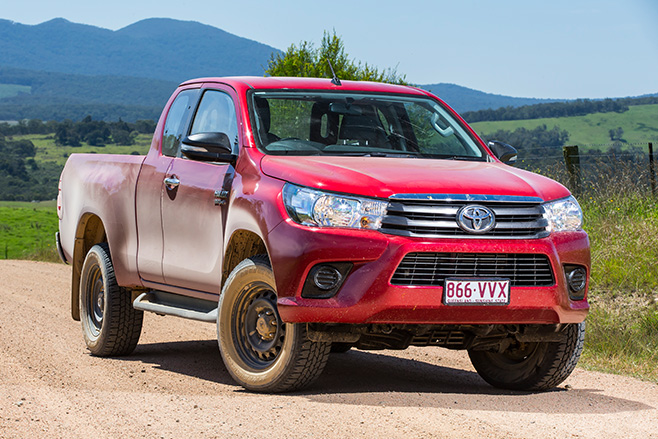
For the time being, though, Toyota’s ever-popular Hilux remains the top-selling 4×4 in the country. According to the VFACTS report, the Hilux 4×4 shifted 3385 units in June for a year-to-date figure of 15,484. But Ford’s Ranger is hot on its heels.
Ford shifted more Rangers than the Hilux in June (3477 v 3385) and is quickly making up ground on the Toyota. In fact, the Ranger is a mere 218 sales behind the Hilux on the overall 4×4 YTD charts.
In saying this, the Hilux is expected to extend its remarkable run of 11 consecutive years as Australia’s best-selling four-wheel drive vehicle. These figures, however, suggest that that’s no certainty beyond 2016.
While the first Hilux 4×2 landed here in 1971, 4×4 models arrived in 1980 and quickly became the top seller. In the past decade, total Hilux sales have averaged more than 39,000 vehicles per year, with 4×4 models accounting for almost two-thirds of total sales.
There are at least 16 different variants in the current range of Hilux 4×4 models.
As the story goes, in 1932 an Australian farmer’s wife wrote to Ford asking for a vehicle that would be equally suitable for going to church on Sundays as it would taking the pigs to market on Monday. Ford customer service clearly went the extra mile back then, because two years later the car-based utility was born.
The ute has changed much since then, with the present-day HSV Maloo GTS being the ultimate evolution of the hybrid work vehicle/passenger car. If you need to expedite a pig or two to your local abattoir – and don’t want to crease your Sunday best while you do it – nothing will get the job done faster.
Except, perhaps, for a Lamborghini Murcielago fitted with a towbar.
That’s right. While some Tweeters and Instagrammers yelled “fake!” at our snap of a trailer-towing Lambo, that very car has been captured again – this time on video thanks to Youtube user Joseph Criniti. All of you doubting Thomases can sit down now.
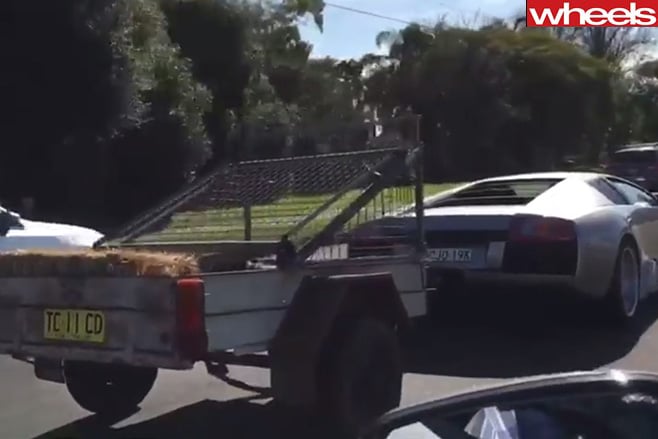
It’s not the most obvious choice in farm transport, but we’ll give him points for thinking outside of the box.
While we’re at it, this video also raises some pretty pertinent questions, such as:
Where does one acquire a towbar for a Murcielago?
Why would they choose a Murcielago as a tow vehicle in the first place?
Why are those goats so docile when the sound of a 426kW V12 is just a metre and a half in front of them?
These are all good questions and while we don’t have the answers, we do have this video.
Enjoy.
There’s a huge spurt in the sales growth of small SUVs, as an increasing number of manufacturers combine the convenient size of a city car with the popular elevated-seating position.
From just a handful of compact SUVs available only a few years ago, there are now more than 25 examples of this vehicle type – forcing the creation of its own official segment in industry VFACTs reports.
The most popular models in this segment are the Mazda CX-3, Mitsubishi ASX and Honda HR-V and if you’re in the market for a small SUV, this guide to their good, and perhaps not-so-good, points.
HONDA HR-V Priced from $24,990 – $34,340
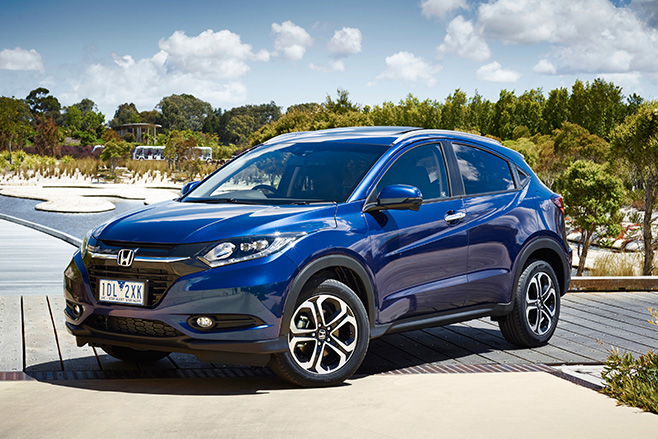
Honda revived its HR-V badge in 2015 for what is the most versatile compact SUV in its segment. Key to the model’s impressive practicality is its clever, multi-fold rear-seat set-up that presents numerous options for fitting variously-sized cargo, as well as people.
With a relatively large boot as well for this class, the HR-V is a genuine family car.
The cabin is well presented overall, and alloy wheels and a reverse-view camera are standard on all models. The main disappointments inside are the slightly flat front seats, and the flimsy, spandex-like cargo cover.
Most key rivals offer a choice of engines, though for now there’s just a single (1.8-litre) petrol engine powering the HR-V. In tandem with a continuously variable transmission (CVT auto), it’s not especially responsive and offers only average performance and efficiency yet still makes this Honda easy to drive.
A 1.6-litre turbo diesel could become available in the not too distant future.
The HR-V offers a comfortable ride and light steering, even if a more dynamic driving experience can be found elsewhere, particularly with the Mazda CX-3 also featured in this comparison.
There’s no all-wheel-drive variant, either, so the HR-V can’t match the capability of its rivals here to cover more slippery surfaces such as gravel tracks.
MAZDA CX-3 Priced from $19,990 – $37,690
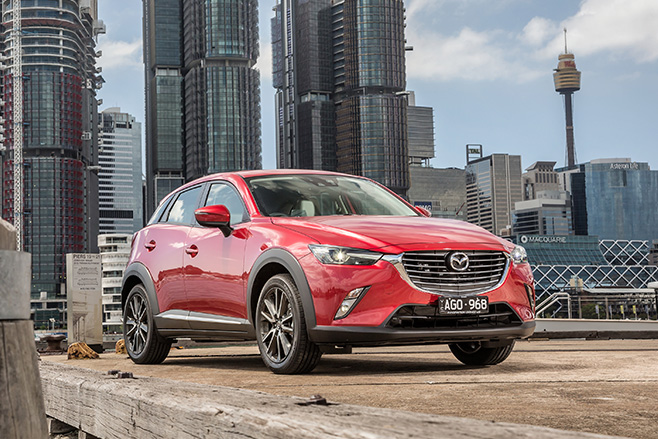
The CX-3 sets the class benchmark for handling, making it a must-test compact SUV for keen drivers. Pick the all-wheel-drive variant over the standard front-wheel-drive model, however, for the crispest steering.
There are two good engine offerings in the 2.0-litre petrol and 1.5-litre turbo diesel, with the former delivering the liveliest (if also noisiest) performance and the latter extending the kilometres you can cover before having to fill up again at the petrol station.
Like its bigger brother, the CX-5, it provides excellent seat comfort and support.
There’s a smart-looking cabin shared with the Mazda 2 on which it is based, and it gets better the further you climb up the trim-grade ladder with additional leather and features.
A $1030 Safety Pack (standard on the most-expensive variant, the AWD Akari) brings rare-for-the-segment active safety aids including autonomous emergency braking, blind spot detection and a system that warns of approaching hazards when reversing out of spaces.
Mazda could be more generous with its base model – the Neo. It lacks both the alloy wheels and reverse-view camera of the entry-level HR-V and ASX, though it’s also priced far more sharply – from $19,990 whereas the Honda and Mitsubishi start from $24,990.
The Mazda is less practical than either of its two rivals here, however. Prams struggle to fit into the small boot, and rear-seat space, while not terrible, is more limited in comparison.
MITSUBISHI ASX Priced from $24,990 – $36,490 (but check for deals)
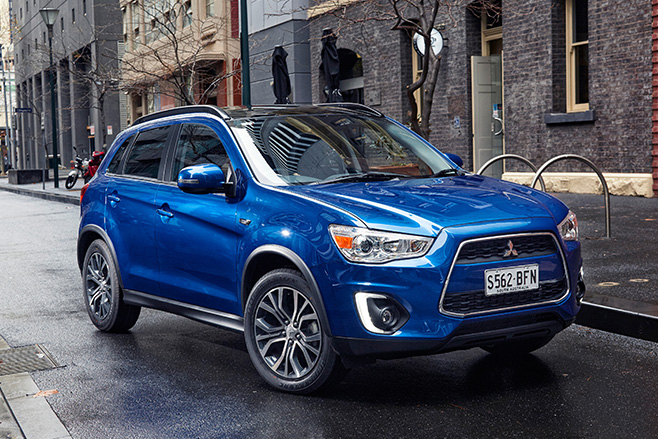
Mitsubishi’s ASX is the oldest model here by some margin yet remains hugely popular – the brand’s biggest-selling model among its passenger car and SUV offerings (and No.2 overall to the Triton ute).
Its appeal is obvious just on paper with the longest warranty here – five years, rather than three – and regular sharp driveaway deals.
While its official $24,990 starting price is higher-than-average, even the base model LS is generously equipped with inclusions such as 18-inch alloy wheels; LED daytime running lights; digital radio; rear air vents; and leather for the steering wheel, gearlever and handbrake.
The ASX also joins the HR-V in offering above-the-norm room inside, including a spacious rear seat and a usefully wide boot. The interior presentation and perception of quality just shows the vehicle’s age when compared with the CX-3 and HR-V interiors.
The ASX is sufficiently composed and grippy on the open road to give the driver confidence, while the suspension copes well with Australia’s patchy country roads. The steering can be jolted by mid-corner bumps, though, and tyre noise can become intrusive at higher speeds.
Buyers have a choice of 2.2-litre turbo diesel or 2.0-litre petrol engines. The petrol takes a bit of time to build up to speed and its fuel economy isn’t helped by a manual gearbox with just five gears (though a CVT auto is optional). The diesel is the pick for pulling power – it has 360Nm of torque compared with the petrol’s 197Nm – and fuel efficiency (5.8 litres per 100km).
Porsche has finally allayed purists’ fears by confirming its 911 range will continue to come with a manual option until at least 2025.
Porsche 911 product director August Achleitner told Wheels the company only recently decided to commit to a manual transmission for the next generation of the legendary sports car due in 2018.
“It’s not so long ago when we decided it, but this is a decision which, let me say, is valid up to at least 2025. So you can be happy for the manual!”
Achleitner says he fought hard to keep the manual gearbox despite only around 10 percent of 911 buyers choosing it over the Porsche Doppelkupplung (PDK) automatic transmission.

“The reasons why they buy a manual in the 911 is coming more from emotion,” he adds, explaining the decision to stick with the manual.
He admits that lobbying by North American Porsche enthusiasts helped save the manual, their cause bolstered by the fact that the US is the biggest market for Porsche sports cars.
“Yes. I had to fight for it, for the manual, but I get a lot of support, especially from the States.”
“For these guys it’s the best combination for a sports car which they have, and it’s in North America where you have the greatest amount of (911) manuals compared to the PDK [transmission].”
One man’s redefined hay-hauling after hitching a trailer to his 2002 Lamborghini Murcielago and taking to Sydney streets.
Captured by bewildered motorists in Liverpool on video, the grey supercar was seen towing a trailer loaded with a hay bale and two goats.
The scene first went viral via a photo shared on social media some months ago. Understandably, though, it was met with widespread suspicion.
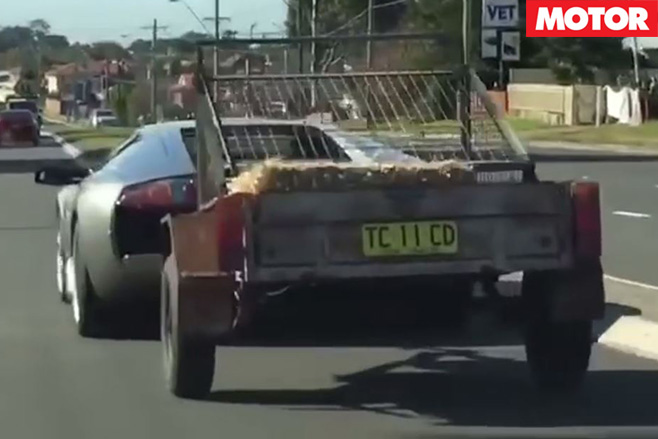
But seeing one of Sant’agata’s bygone supercars roll up its sleeves for this kind of work asks more questions than it answers. Goat-raising, we thought, wouldn’t be popular among Lamborghini owners.
Sceptics can’t argue with this footage, however. And goat skin does make fine leather.
Mercedes-Benz has announced the pricing for its expanded E-Class range, which will include at least two AMG models, a plug-in hybrid and a suite of diesel and petrol engines.
Entry to the range has jumped almost $10,000 to $89,990 for the E200 with its 2.0-litre four-cylinder petrol engine (135kW/300Nm).
Mercedes-Benz justifies the price increase with the extra technology shoehorned into what is a larger car. As well as twin 12.3-inch colour screens and extras such as ambient lighting, the E-Class gets Pilot Drive, which includes advanced auto braking, self-parking and partial self-steering. The safety systems also include advanced obstacle detection – including recognition of kangaroos and the ability to steer around one – and front seat-mounted air cushions that push occupants towards the centre of the car to reduce injuries in a side impact. There’s even technology designed to reduce hearing damage before a crash; it emits a sound that stimulates a muscle in the ear to contract, in turn protecting the ear drum itself.
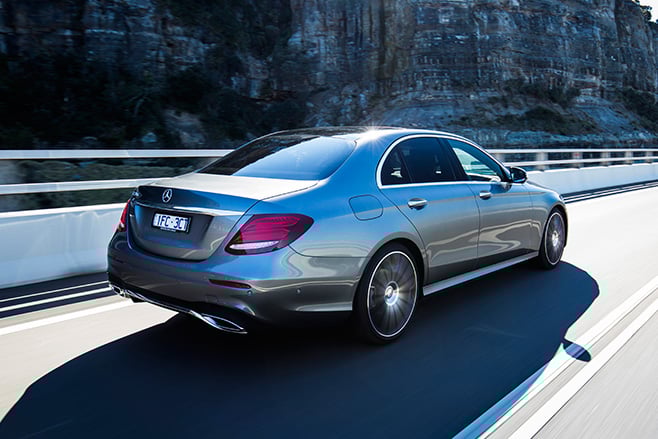
From there it’s a near-$3K jump to the diesel-powered E220d, which gets a new 2.0-litre four-cylinder turbo diesel producing 143kW/400Nm. As with all E-Classes it’s mated to a nine-speed automatic. For $92,900 it gets the same equipment as the E200, including 18-inch wheels; electric front seats; digital radio tuning and radar cruise control. The sales pitch is that the diesel’s 4.1 litres per 100km claimed fuel use is 36 percent better than the 6.4L/100km of the petrol engine.
Next is the $107,900 E300; a car expected to account for a large chunk of E sales. It uses a more powerful version of the same 2.0-litre turbocharged four-cylinder (180kW/370m) in the E200 and brings more equipment, including 20-inch alloys; mutlibeam active LED headlights (they can adjust the beam for the road ahead and block out other traffic); heated front seats and adjustable air suspension.
The only other diesel in the range is the E350d ($134,900), which has a twin-turbo 3.0-litre V6. There’s 190kW and 620Nm as well as extra equipment including a head-up display, panoramic sunroof and more powerful Burmester sound system.
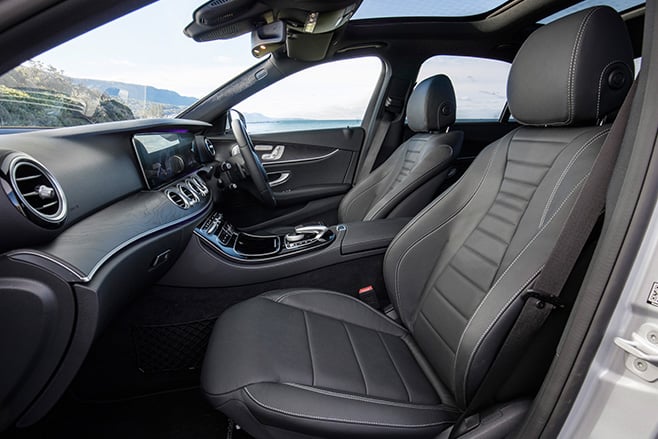
The E400 is the performance hero for now and the first E-Class to be offered with all-wheel drive in Australia (Merc calls it 4Matic). A twin turbo 3.0-litre V6 petrol engine delivers 245kW and 480Nm. The E400 is priced from $139,900 and matches the E350d for equipment.
Mercedes-Benz is planning on offering at least three other engines for the E-Class.
The E350e will get a plug-in hybrid drivetrain. It pairs a regular engine with an electric motor and batteries. The engine powers the car and recharges the batteries.
The E43 AMG will use a twin-turbocharged V6 tuned by the AMG performance division. It gets a sportier exhaust sound as well as more power, for 295kW and 520Nm in total.
The E63 AMG is yet to be revealed but will get a 4.0-litre twin-turbocharged V8 producing more than 400kW of power. It is expected to cost something approaching $250,000.
There are also various packs available, depending on the model.
The Vision Pack, for example, is $4990 and brings the sunroof, Burmester sound system and head-up display.
The AMG Pack adds 20-inch alloys, a body kit and other aesthetic tweaks and air suspension for $6300.
There’s also an Active Comfort Package that brings things such as a heated massaging seats and Air Balance, which includes air ionisation and a fragrance kit.
Still to arrive in the E-Class range are the wagon models as well as the rumoured high riding version of that wagon that’s designed for light-duty off-road work. A direct rival to the Audi A6 Allroad – itself following a similar theme to the Subaru Outback – the E-Class off-roader, is expected in 2017.
Want more? Check out the full Mercedes-Benz range here.
A SYDNEY man’s bid of $92,500 has secured him the first publicly available example of what is the final – and sold-out – run of Ford’s latest Falcon XR8 Sprint, with the majority of proceeds funding research into ways to automate the function of insulin pumps used by Type 1 Diabetics.
Businessman David Pearce revealed he purchased the car for his brother, Mark, who has fought a life-long battle with Cystic Fibrosis, in the hope that the car will lift the 30-year-old’s spirits.
“Mark’s health has been deteriorating rapidly and he now only has 18 percent lung function,” he said.
The XR8 Sprint, which has a retail price of $59,990, will sit alongside another vehicle close to the brothers’ hearts in Mark’s garage, a 1978 Ford Falcon XC. Prompted by both his brother’s illness and catching sight of the 38-year-old car in the nearby Blue Mountains, David set about tracking down the family car almost 20 years after their father sold it.
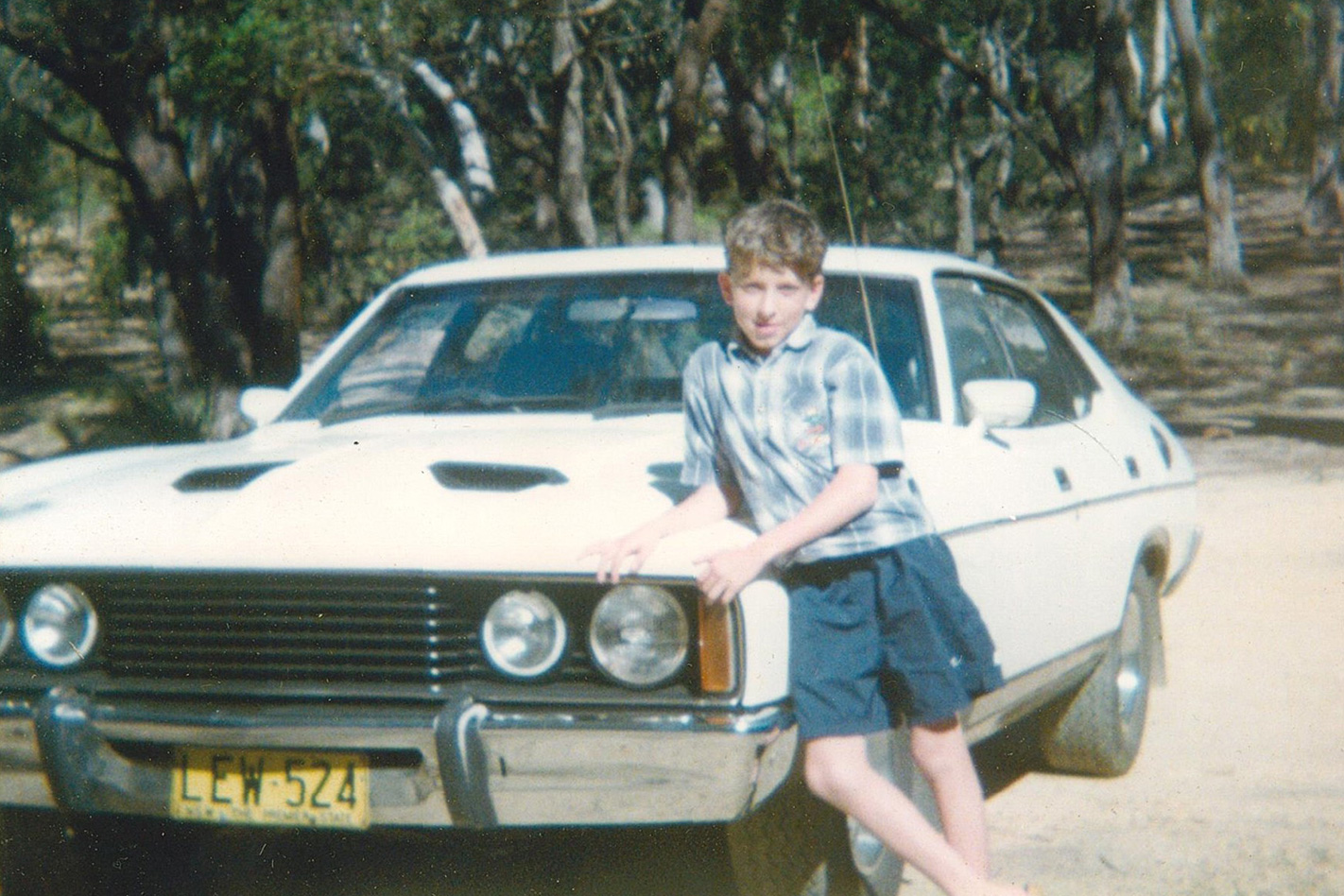
“The Sprint was a must-have to add to our Ford collection which also includes a restored 1978 Falcon XC which was the car my brother learned to drive in,” David continued.
Ford has been a long-time supporter of Type 1 Diabetes research and while insulin pumps currently go a long way in assisting T1D sufferers to manage the disease, the pumps still require regular and manual blood-test inputs, sometimes up to eight times a day.
The Juvenile Diabetes Research Fund raises money for the Artificial Pancreas Project, which aims to find a way to fully automate insulin pumps, closing the loop on insulin delivery in a way that mimics a healthy pancreas.
So far, Ford has contributed more than $55 million to fund JDRF research programs and raise awareness.
ELECTRONIC road signs warning about the perils of driving while playing Pokemon Go have provided Melbourne drivers with some rare peak hour relief, but Victoria’s peak roads body says the warnings are serious.
VicRoads has “Don’t drive and Pokemon” warnings flashing on 39 variable messaging signs at prominent sites across the inner city including Wurundjeri Way; Hoddle Street; Alexandra Parade; Queens Way and freeways.
VicRoads Director Vehicle and Road Use Policy, Robyn Seymour said while she wasn’t aware of any specific local cases of drivers playing the game the organisation was aware of crashes overseas involving the use of the app.
She expressed concern that this was yet another way for drivers to become distracted by their mobile devices.
“We’re aware that Pokemon Go has had lots of interest from the community and there’s lots of people playing the game, which is great,” she said.
“But if you’re playing the game around roads, then you have to be careful. And if you’re a driver, then you can’t play Pokemon Go. It’s illegal to touch a phone [while driving].
Using a mobile phone while driving carries tough penalties in Victoria; if caught, drivers are docked four demerit points and receive a $466 fine.
Victoria Police have also issues warnings about Pokemon Go players on foot crossing streets without paying proper attention to passing traffic.
Such concerns were realised in Sydney when hundreds of Pokemon Go players caused traffic chaos after they converged on a Pokémon hot-spot at a park in the suburb of Rhodes.
Video footage showed drivers trying to drive through crowds of people spilling onto the roadway.
Want more? Sydney is to trial pavement warning lights for ‘petextrians’
