
VOLKSWAGEN has announced it will set aside the cash equivalent of buying everything Australia produces for the next eight years to help pay for its Dieselgate emissions cheats in the US.
The US District Court in California yesterday approved a settlement plan that will make owners in the US eligible for up to $10,000 in cash compensation each – the equivalent of $A13,000 if they decide to keep their car – under the terms of a court-approved settlement over the Dieselgate scandal.
“The goal of the Volkswagen Class Settlement Program is to compensate everyone who owned or leased a Volkswagen or Audi 2.0-litre TDI vehicle on September 18, 2015 (the date the emissions allegations became public), or who now owns an eligible vehicle,” VW said.
“Volkswagen has agreed to create a single funding pool of a maximum of $US10,033,000,000 from which class members will be compensated under the class settlement program.”
By comparison, Australia’s gross domestic product – the value of everything we produce in a year – is currently worth about $1.6 trillion.
There’s also an escape plan written into the settlement details that allows US customers to sell their vehicle back to Volkswagen if they’re not happy with the carmaker’s fix for the emissions cheats, which is yet to be revealed.
Under the terms, owners are not allowed to sell their car until a settlement is made. That may be a while – VW has flagged it will possibly take until May 2018, almost two years from now, for a potential fix for Dieselgate to be locked in.
Volkswagen’s Dieselgate obligations under US law – where the carmaker has broken some very strict emissions regulations with the potential of heavy penalties – are very different to those it has in Australia.
So far, VW Australia has rolled out a fix for about 9000 Volkswagen Amarok trade utes fitted with a twin-turbo version of the 2.0-litre diesel engine.
Most of the fixes will be an update to the engine’s software, but vehicles fitted with a 1.6-litre diesel engine will need a hardware upgrade – the installation of what VW calls a “flow rectifier” – to comply.
It is also yet to announce a fix for the Volkswagen Group’s 3.0-litre V6 diesel, which was also identified as using emissions-cheating software.
The carmaker is currently defending a Federal Court class action brought against it by disaffected Australian owners seeking, among other things, some form of compensation.
“There is no compensation for European customers,” Volkswagen Australia chief executive Michael Bartsch said in a statement.
“The relevant facts and complex legal issues that have played a role in coming to these agreements in the United States are materially different from those in Europe and Australia.
“Volkswagen is committed to resolving the diesel matter for all affected customers around the world quickly and efficiently. We recognise the need to regain their trust and we are doing everything possible to achieve this.”
Volkswagen is facing more Dieselgate costs after last week voluntarily pulling affected vehicles from showrooms in South Korea ahead of fresh legal challenges. Korean courts are expected to decide next week if the carmaker will be allowed to continue to sell affected cars there.
So is it or isn’t it? Mystery surrounds a pair of stolen images of Ford’s Broadmeadows production line that claim to show the final Aussie-made Falcon ute being built.
According to Ford, the last Falcon ute is yet to be built – and for that matter, the last of the line for the Ford Falcon sedan and Ford Territory SUV as well.
So what do these images show? Not even Ford Australia seems to know. In the briefest of brief statements, a spokesman told WhichCar: “…This is not accurate!”
The empty ute shell shown – it is yet to have any parts fitted – has an A4 sheet of paper stuck to it reading “Last Australia Ford ute” along with a serial number. The front bumper also has the word “LAST” written in black marker.
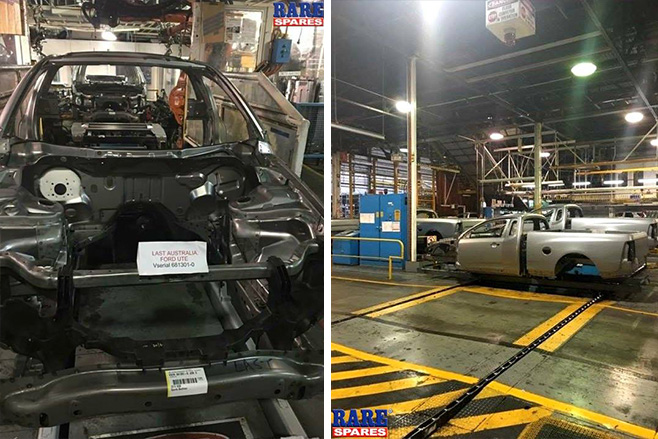
The images, posted on Rare Spares social media late yesterday, also suggest the not-so-final final ute started its trip down the assembly line on July 17, more than three months before Ford Australia shuts the door on almost a century of local manufacturing, and more than half a decade of Falcon production, on October 7.
The post has also provoked a string of angry responses from Ford fans, many of whom feared the company has not given the ute – a concept invented in Australia and exported to the rest of the world – a fitting sign-off.
“Good to see Ford giving it the respect and ceremony it deserves,” Dave Moy wrote, sharing a sentiment expressed in a number of comments pinned to the images. “A little printed bit of paper stuck on the body. Sadly, this is partly why the Falcon is going.”
Ford is yet to announce what it will do with the final Falcon and Territory models that will roll off the Broadmeadows line. It is believed the carmaker has very specific ideas about what will happen with the final cars – once they’re built.
How much can you know about yourself if you’ve never been in a fight, Tyler Durden once pondered. By the same logic, how much can you really know about yourself if you’ve never crashed a car?
Crashing a car sucks. (Accidentally, at least – demolition derbys are kind of awesome.) But until you’ve crashed one, you’ll always be left wondering: how would I respond under that sort of pressure? What would my life look like in flashback? What do airbags taste like?
French tightrope-walking-guy Philippe Petit – the bloke who walked between the World Trade Centre towers – said, “Life should be lived on the edge of life”, which probably sounds less redundant in French.
But for a crazy French ginger, he makes a valid point: motorsport is only thrilling because of the risk of crashing. Adrenaline only comes with the possibility of disaster.
It’s that electric frisson that leaves your palms sweaty, your undercarriage electrified, and your boxer shorts just a little bit brown. If you never overstep the line, you’re not standing close enough to the edge.
Perhaps you pride yourself on your excellent driving record. “I haven’t had a crash in years,” you sniff. But then, all the money you spend on insurance has been for nought.
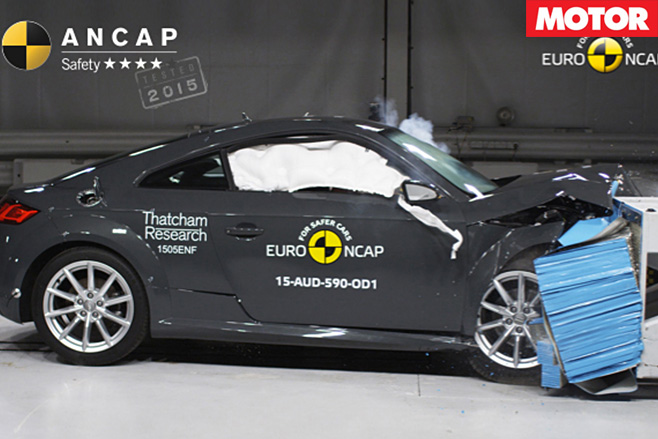
And anyway, crashing cars stimulates the car industry. Nothing encourages you to buy a new car more than writing off your old one. Too late for us, I hear you grumble, but of course it’s not – as brands fight for market share, and dealers get incentivised to undercut each other, the whole industry becomes a bubble which, of course, eventually bursts and companies are forced to merge to survive; and eventually every car on Earth ends up being produced by Geely and made by soldering bits of old Volvos together. Is that what you want? Is it?
It’s partly the auto industry’s fault, with their autonomous braking and lane control assist and whatnot – no wonder people are keeping cars for years and years, instead of absent-mindedly sticking them up the back of a taxi and buying a new one.
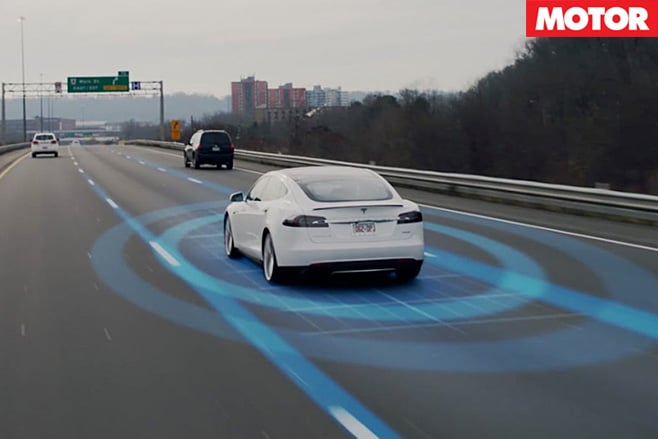
And it’s only getting worse – what with Google and whoever else trying to perfect the autonomous car. And autonomous cars throw up a new slew of crashing conundrums.
Picture this: You’re in your self-driving car on the Great Ocean Road when, out of nowhere, a truck comes around a blind corner on your side of the road, overtaking a peloton of lycra’d masochists.
Should the car be programed to aim for the truck, killing you, or the cyclists, killing them? It’s a legal minefield for car companies to program their cars to kill other people – but who wants to buy a car designed to kill its owner? That’s why crashing cars should be left to the experts: us humans.
Thankfully, the state road authorities are doing their part, with their obsession on speed limits aimed squarely at the lowest common denominator, and then banning competent drivers who dare to drive to the conditions.
The brilliant result is a steady influx of drivers who have very little expected of them, and are capable of precisely that. They’re doing their part. How about you?
Or maybe Tyler Durden is an idiot. That’s possible too.
Without oil, a car’s engine would run for a very short time before it ground to a halt, seized solid.
That’s because the main job of oil in a motor is to lubricate the metal parts and stop them rubbing against each other so hard that they create excess friction (and therefore heat) and weld themselves together, or simply melt. But there’s more to it than that, because engine oil actually has three jobs to do.
Beyond its lubricating task, oil is also responsible for helping to cool an engine. As oil moves around the engine (via a pump, much like your heart pumps blood around your body) heat from all those moving parts is carried away to cooler parts of the engine where the oil itself cools before being pumped back through the engine again.
The third function of oil is to keep the inside of the engine clean. Small bits of metal from worn parts of the engine, dust from the air, contaminants from the fuel and bits of rust and scale from inside the fuel tank are all caught and suspended in the oil and then carried to the oil filter where those nasties are trapped and prevented from another journey through the delicate engine internals.
Clearly, this oil is important stuff and that’s why it’s critical to keep your engine’s oil clean by changing the oil at the appropriate intervals. And don’t forget to change the filter: Why you’d put clean oil through a dirty filter is a dead-set mystery.
What stands out?
The 2012-2016 Honda Civic is a well built small car from a Japanese brand with a superb reliability record. Engines are appealing, with plenty of power. The UK-made hatchback – which was designed for Europe – is a better car in most respects than the Thai-made sedan.This review covers Civics on sale new prior to June 2016. Listed features were current when the car was replaced.
What might bug me?
Fatigue on long trips in the Civic sedan, and especially if you were expecting the high standard Honda has reached in the past for minimising harshness and noise. There are small cars that drive more smoothly and quietly than this at highway speeds, and the Civic hatchback is one of them.Driving under 80km/h on the space-saver spare tyre until you can fix your full-sized flat.
What body styles are there?
Five-door hatchback and four-door sedan.The Civic drives the front wheels, and it is classed as a small car, lower priced.
What features do all versions have?
Air-conditioning, cruise control, power windows, and power-adjustable exterior mirrors. An i-MID (multi-information display) screen.Bluetooth phone and audio connectivity, and audio controls on the steering wheel. A CD/radio audio system that is MP3 and WMA compatible.A steel space-saver spare wheel.Electronic stability control, which can help the driver to control a skidding car. All new cars must have this feature.Six airbags: two directly in front of the driver and front passenger; one alongside each front occupant to protect the upper body; and a curtain airbag along each side protecting the heads of front and rear occupants.In addition, all Civic hatchbacks have wheels made from nicer-looking aluminium alloy rather than steel. Hatchbacks also have climate control air-conditioning (which maintains a set temperature), a leather-trimmed steering wheel and gear lever, and a colour touchscreen audio system that can show your iPhone’s display on the screen. There is also an HDMI port, MP4 movie support, a DVD player and a reversing camera.Hatchbacks also have guided-tube daytime running lights and taillights, which diffuse light along a tube, for a crisp look. There is an adjustable speed limiter, and the exterior mirrors are heated.An Agile Handling Assist system on all hatchbacks subtly improves stability and performance by lightly braking some wheels during cornering. Hatchbacks also have a warning system that alerts the driver if the air pressure in the tyres falls below a safe level, and a hill-start assist system, which operates the brakes automatically to make take-offs on hills easier.Every Honda Civic carries a three-year, 100,000 kilometre warranty.
Which engine uses least fuel, and why wouldn’t I choose it?
The petrol 1.8-litre four cylinder engine uses the least fuel, ranging between 6.4 and 6.8 litres/100km depending on the body style, the gearbox and the equipment level. The Civic VTi-S with the manual gearbox hatch is the most economical version.The 1.8 is an appealing engine with plenty of power by small-car standards and good fuel-efficiency.Honda also offers a 2.0-litre petrol engine, in only a single model: the Civic Sport, which is a sedan. It provides about 10 per cent more urge than the 1.8 petrol and uses about 10 percent more fuel.Honda recommends premium petrol for the hatchbacks, which makes them more expensive to fuel than the sedans, which run on regular petrol.Gearboxes in the sedans are five-speed manual (in the least costly model only) or five-speed auto. The hatches come with a six-speed manual (least-costly model) or five-speed auto (the rest).
What key features do I get if I spend more?
The least costly Civic sedan, the Civic Vi, rolls on 15-inch steel wheels. Stepping up to the Civic VTi sedan brings you nicer looking wheels in an alloy of aluminium. The VTi also has a colour touchscreen audio system, an iPhone mirroring function (your iPhone’s display on the car’s screen), an HDMI port, MP4 movie support, a DVD player and a reversing camera.Moving up to the VTi-S sedan brings smart-key entry, which allows you to unlock the car while the key remains secured in a pocket or handbag. Headlamps turn on automatically when it is dark, and wipers operate automatically when it rains. Air-conditioning maintains a set temperature. The steering wheel is trimmed in leather. Wheels grow to 16 inches and are fitted with wider tyres of a lower profile, which add grip and sharpen steering response.The VTi-L sedan has these features and leather seats, front foglights and rear parking sensors.The most costly sedan, the Civic Sport, comes with the bigger, 2.0-litre petrol engine, 17-inch wheels with yet wider and lower profile tyres, a power-operated sunroof, a power-adjusted driver’s seat, and satellite navigation.In the hatchback, moving up from the lowest-price VTi-S to the VTi-L gets you rain-sensing windscreen wipers, dusk-sensing headlights, foglights, and front and rear parking sensors. There is also dual-zone air-conditioning (which permits a different temperature on either side of the cabin), smart-key entry, power-adjusted lumbar support on the front seats, and 17-inch wheels with wider tyres.The VTi-LN (for Navigation) adds to this satellite navigation, and leather-appointed, heated front seats.
Does any upgrade have a down side?
There is a small reduction in ride comfort as wheels get bigger and the tyres become lower in profile, because there is less air between the wheel and the road. The bigger wheels also increase in the minimum turning circle, because the wider tyres can’t turn left and right quite as far.Choosing a sunroof reduces headroom for occupants in the front.The Civic sedan is available in six colours – flat white, which is standard, and five pearlescent/metallic shades, which cost about $600 extra. The hatch is available in seven colours – three of them flat, available standard, and four pearl/metallic, which attract the same extra charge.
How comfortable is it?
The Honda Civic has supportive seats that are comfortable for drives of up to two hours. The overall ergonomics are good. The standard tilt and reach steering wheel adjustments help the driver find the ideal position, a task made even easier from the eight-way power-adjustable driver’s seat in the Sport model.On poor roads you will feel the bumps more in the sedan than in the Civic hatch, which has a more compliant, more comfortable feel despite its less sophisticated rear suspension.The Hatch also isolates cabin occupants more effectively from tyre noise, road vibration, wind noise and general harshness – it is noticeably superior to the sedan. Compared with other small cars, both models occupy the middle ground here.Plastics and textiles in the Civic were a cut above many Japanese alternatives when this model went on sale, but newer competitors such as the Mazda3 leave them in the middle here also.
What about safety?
The Honda Civic accrues a safety rating of Excellent for every version except the entry-level Vi sedan, which falls to Very Good – partly because it does not have a reversing camera.Hatches score for their speed limiter, flat-tyre warning and hill-start assist, and on better equipped versions for dusk-sensing headlights and rain-sensing wipers.No Civic offers automatic emergency braking.The forward location of the Civic’s A-pillars either side of the windscreen allows good vision for tight corners and roundabouts, increasing primary safety. Door-mounted exterior mirrors help here too.The Australasian New Car Assessment Program (ANCAP) has awarded the Honda Civic sedan and hatch its maximum rating of five stars.
I like driving – will I enjoy this car?
You will enjoy driving the Civic hatch more than the sedan, but for a keen driver there are more appropriate small cars available, such the Ford Focus and Mazda3.Although the sedan has a more sophisticated multi-link rear suspension, which should bring better comfort and handling, the hatch, with its simple torsion-beam suspension, is more fun. Good tuning makes the difference: the hatch feels light on its tyres, with a reassuring sense of balance and grip.Neither Civic offers the driver a brilliant sense of connection with the road, and the suspension can struggle to recover from bigger bumps, letting the body bob briefly.The Civic engines and gearboxes are a positive aspect in the enjoyment of the car. The petrol 1.8-litre engine delivers plenty of power with pleasing enthusiasm and an appealing sound. The easy-to-use five- and six-speed manuals and smart five-speed automatic gearboxes work well with the engines.Gear-shift paddles and the 2.0-litre engine make the Civic Sport the most enjoyable of the sedans.
How is life in the rear seats?
The Civic’s back seat is comfortably cushioned and well angled, and passengers have moderate head and shoulder room.A flat floor means a third rear-seat occupant will have more leg and foot room than in most other small cars, which have a central hump in the floor that adds strength to the body. Honda puts its body reinforcement elsewhere.The Civic hatch has rear air-conditioning vents. This is not the norm in a small car, and it makes the rear seat a more habitable place, especially on longer trips and for children.
How is it for carrying stuff?
The Honda Civic sedan has a generous 440 litres of boot space, which is class-competitive and 40 litres more than the hatch.The hatchback has Honda’s clever rear Magic Seats, which flip and fold to create a flat floor for cargo and maximise space. The hatch offers 1130 litres of cargo volume with its 40/60 seatbacks folded.The Magic seat bases can also be folded upwards, to create space in the rear seat area to carry tall items such as potted plants. Such versatility places the hatchback among the best small cars for carting things around.
Where is it made?
The Honda Civic sedan is manufactured in Thailand, and the Civic hatchback is manufactured in the United Kingdom.
What might I miss that similar cars have?
Turbocharged small cars such as the Volkswagen Golf respond more eagerly to the accelerator pedal, particularly from low speeds.The Mazda3 offers low-speed automatic emergency braking on all models, at least as an option. A sensor detects obstacles in front of the car – typically another car that has slowed suddenly – and a computer applies the brakes if it concludes that a collision is imminent.The Renault Megane and Hyundai i30 offer five-year warranties, and the Kia Cerato is warrantied for seven years.Another small car worth considering is the Subaru Impreza.
I like this car, but I can’t choose which version. Can you help?
The Honda Civic VTi-S hatch is our pick of the line-up.The hatchback is better equipped than the sedan from this base model upwards, and more enjoyable to drive, with a more versatile cargo area. .
Are there plans to update this model soon?
The ninth-generation Civic arrived in Australia in 2012. The sedan was updated in mid-2014, and the hatch was updated in mid-2015.An all-new, 10th generation Honda Civic sedan arrived in June 2016, with a new hatchback to follow before July 2017.
Every year Monterey in California becomes a petrolhead mecca.
Some of the world’s most prestigious automotive events take place all at the same time, including the Monterey Historics race meeting at Laguna Seca, The Quail, A Motorsports Gathering car show and of course the Pebble Beach Concours d’Elegance.
Unsurprisingly, if you’re wanting to sell a high-end car at auction, this week is an excellent time to do so, and as such Mecum Auctions is offering an incredible array of machinery over three days from August 18-20.
Here is just a taste of the hypercar offerings.
2016 Aston Martin Vulcan
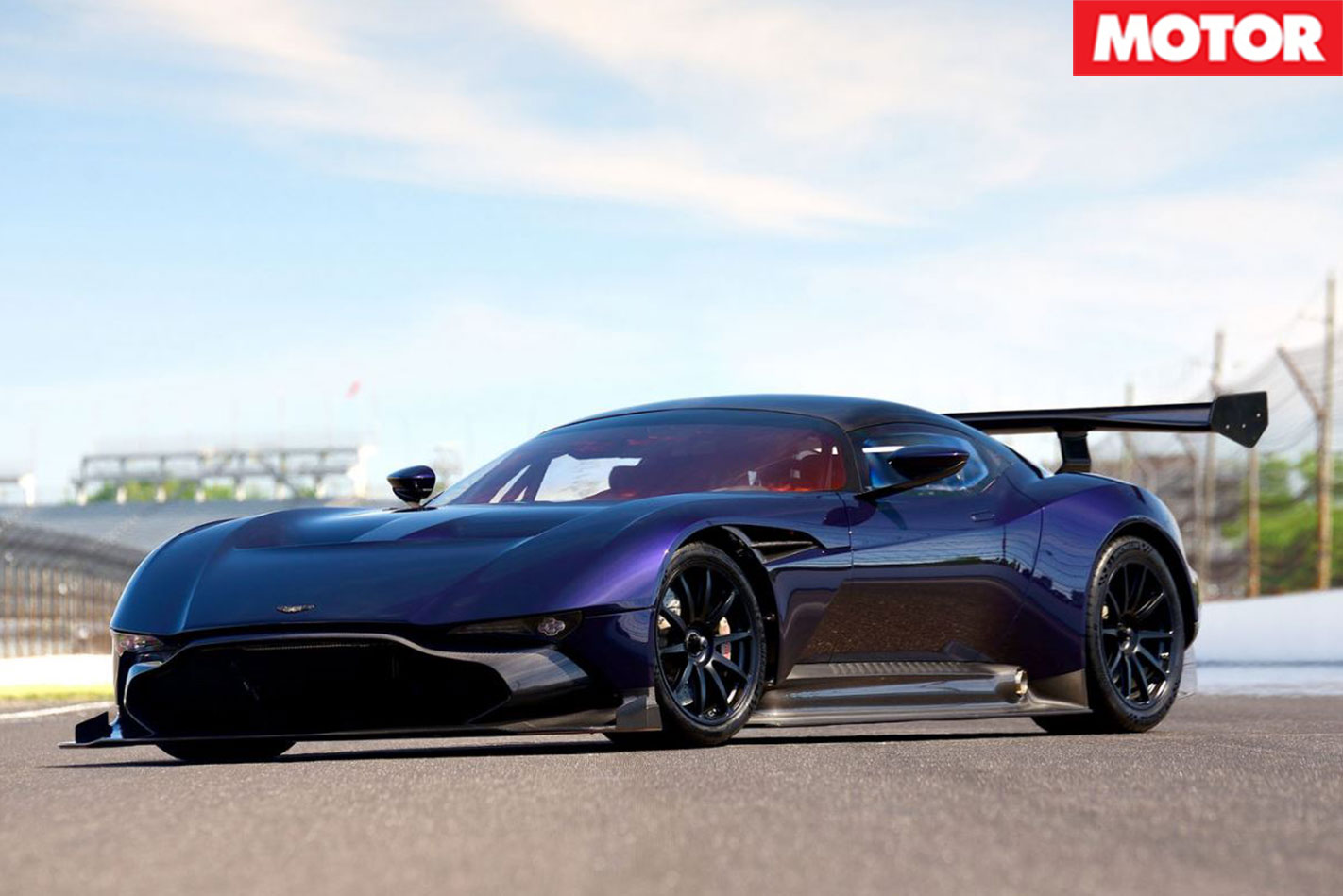
This purple tyre-eater produces a massive 612kW from its 7.0-litre V12, and is estimated to fetch between US$2.3-3.3m.
2014 McLaren P1
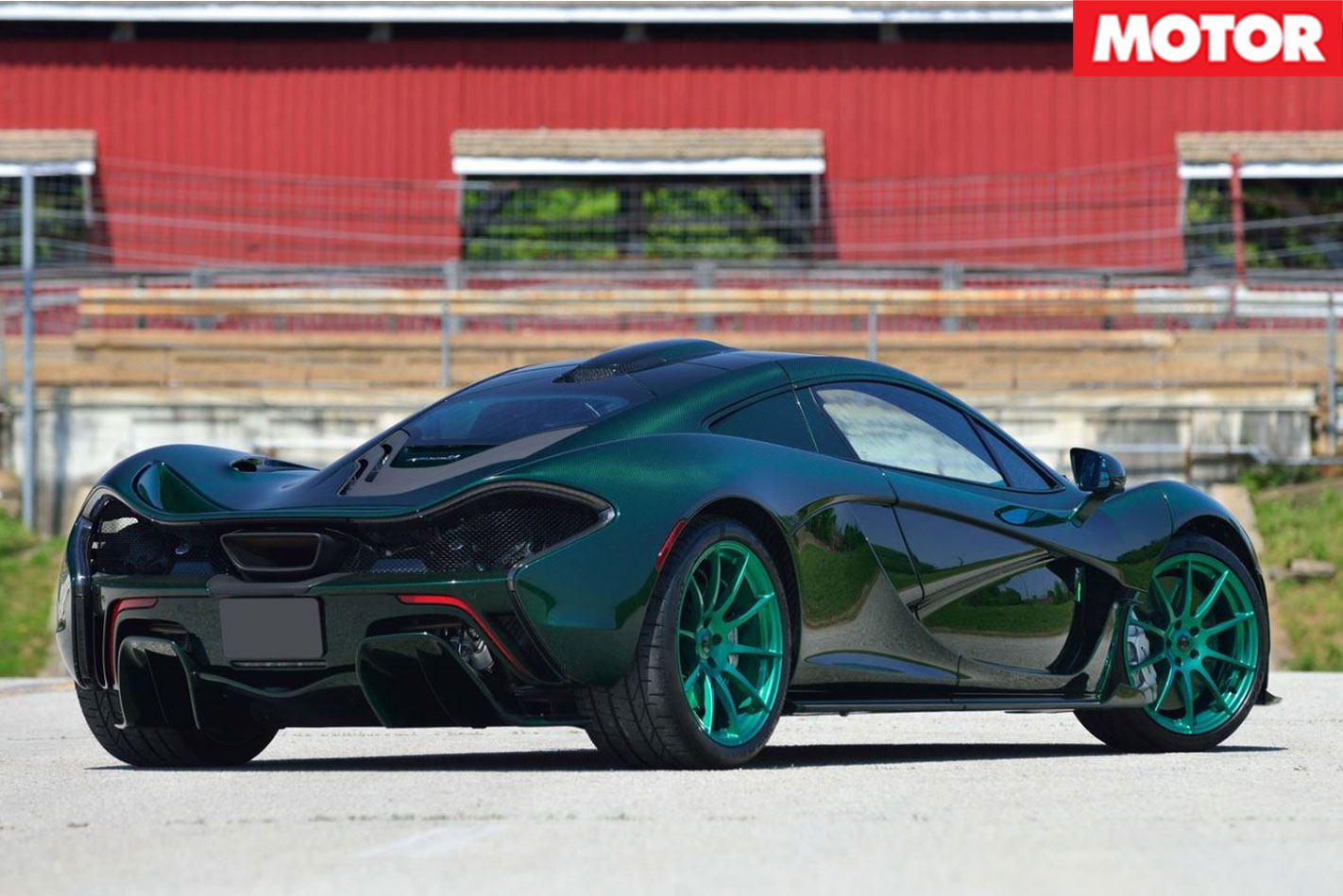
Initially finished with a painted carbon fibre body, this P1 was returned to McLaren and fitted with an exposed carbon fibre body, covered in the distinctive green lacquer. The original body is also included in the sale, which is just as well given the US$2.5-3m estimate.
2006 Bugatti Veyron
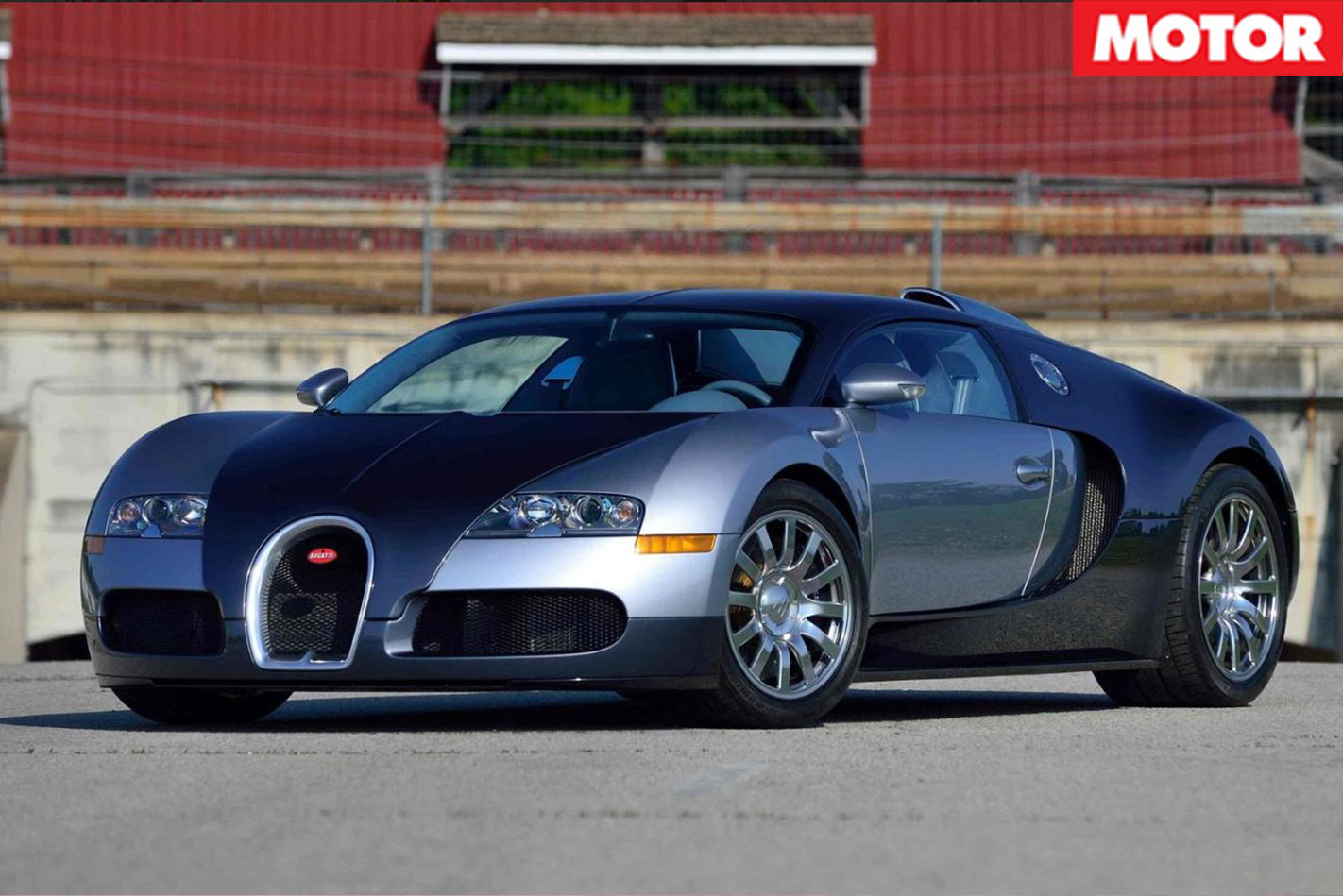
Having covered just 6181km, this Bug is still almost brand new and is expected to fetch between US$1.2-1.5m. Bargain, sort of.
2014 Ferrari LaFerrari
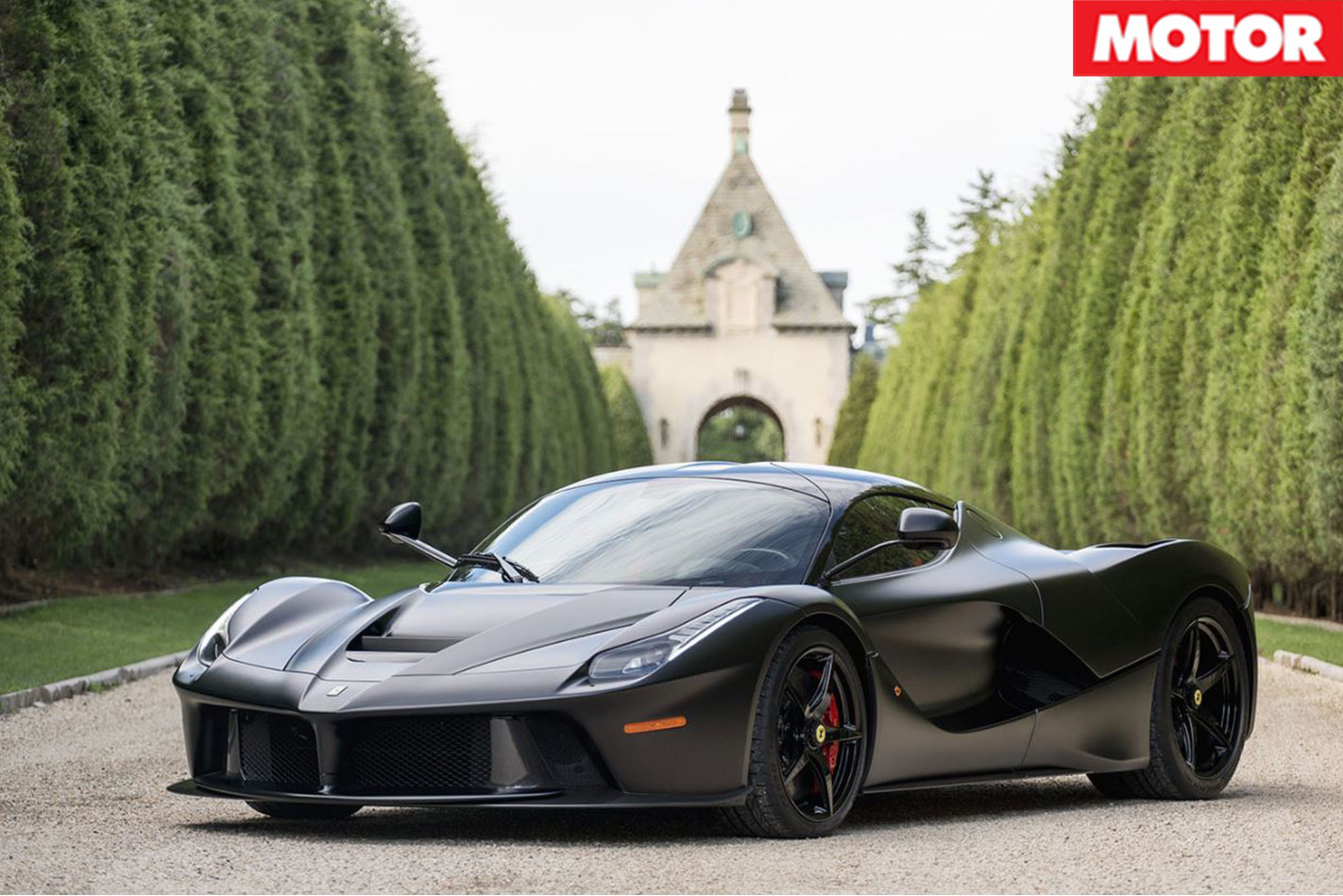
Incredibly, the previous owner covered just 340km in this 708kW monster before deciding to move it on, but you’ll need between US$3.9-4.5m to park it in your garage. One of four black Enzos is also up for auction for between US$2.5-3.5m.
2015 Porsche 918 Spyder
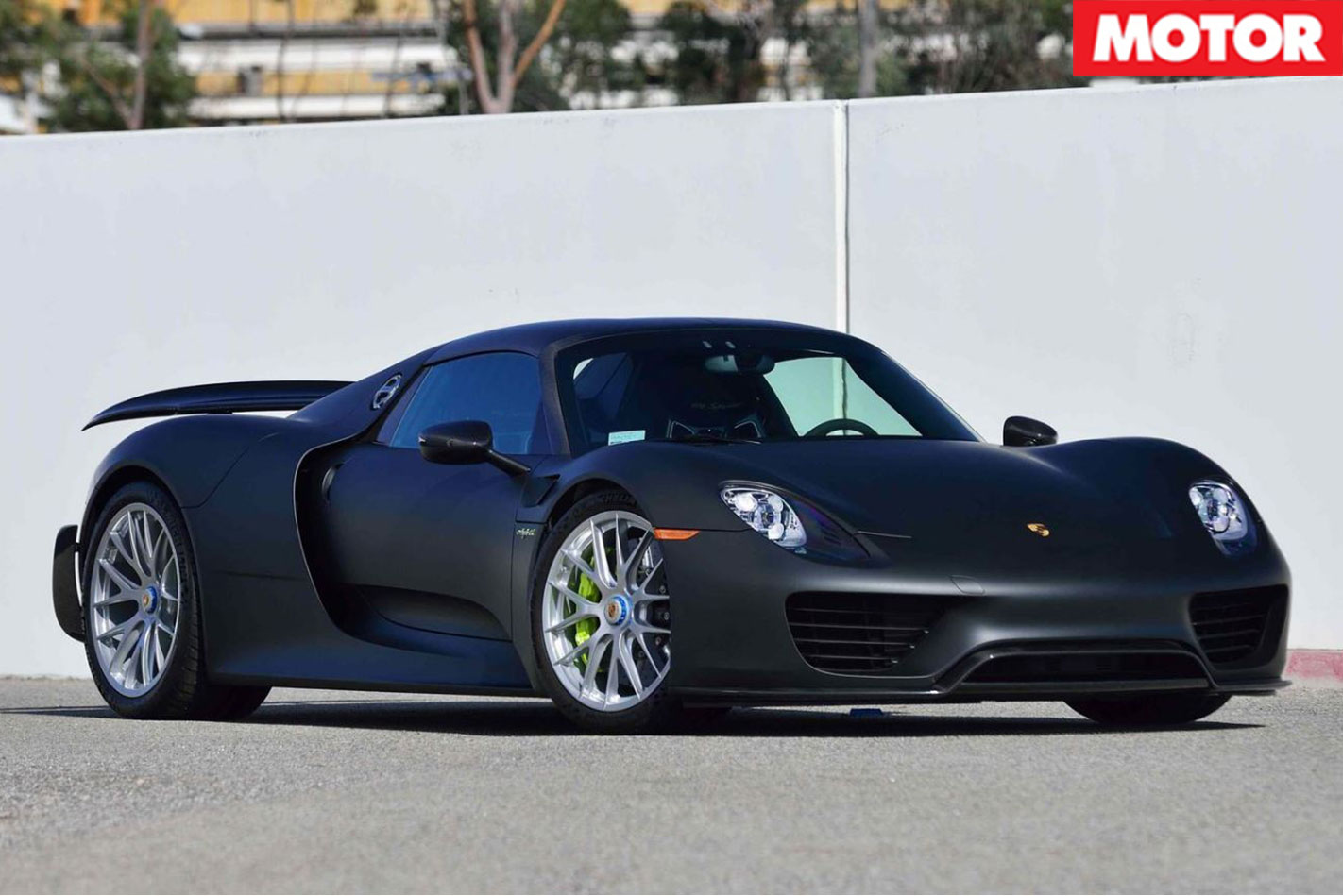
The premium is partly explained by this being the only 918 to leave the factory without paint, a matt black wrap protecting the carbon fibre body instead.
2005 Porsche Carrera GT
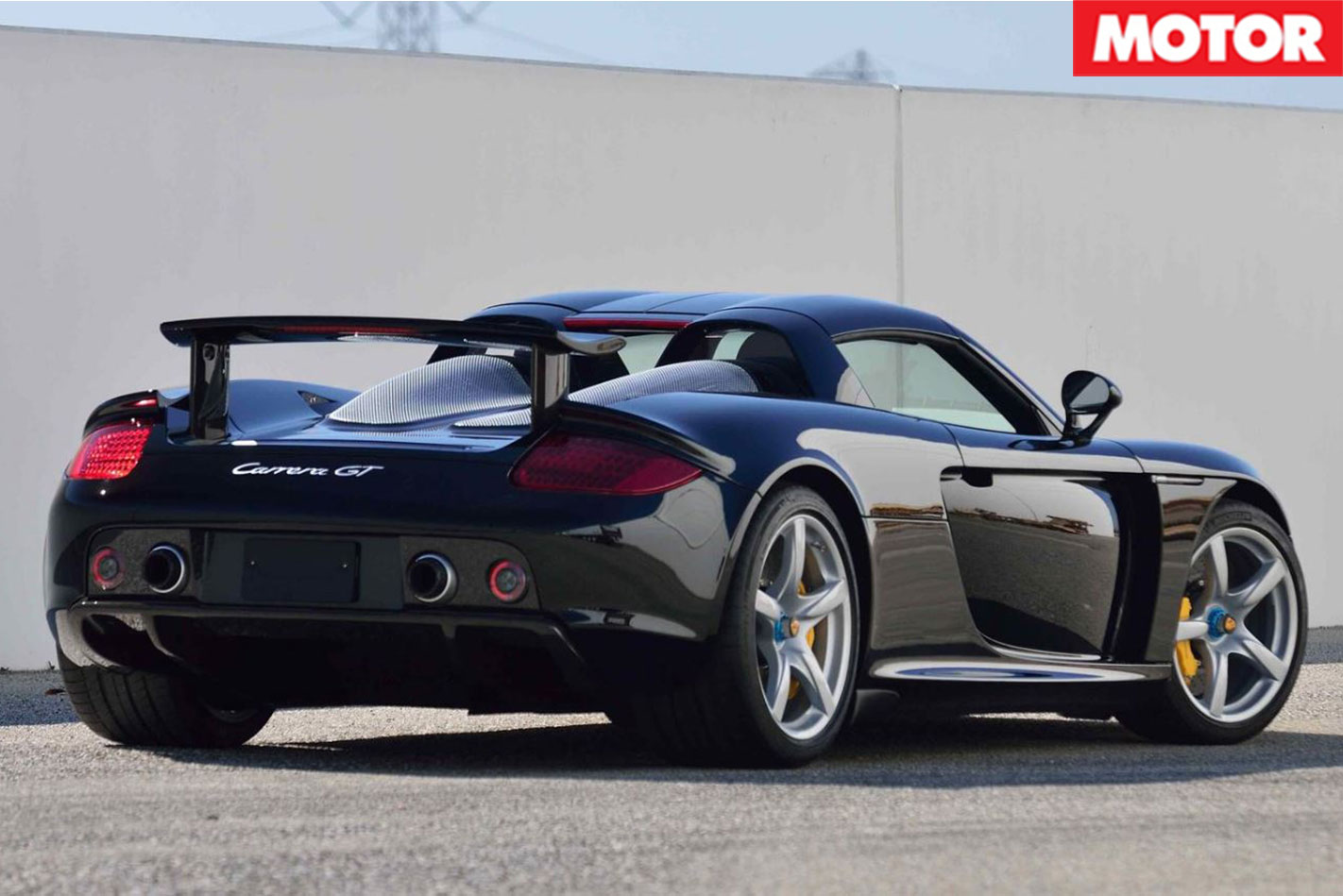
If black isn’t your colour, a pair of silver Carrera GTs are also crossing the block with estimates sitting between $US700-900,000.
Mercedes-McLaren SLR
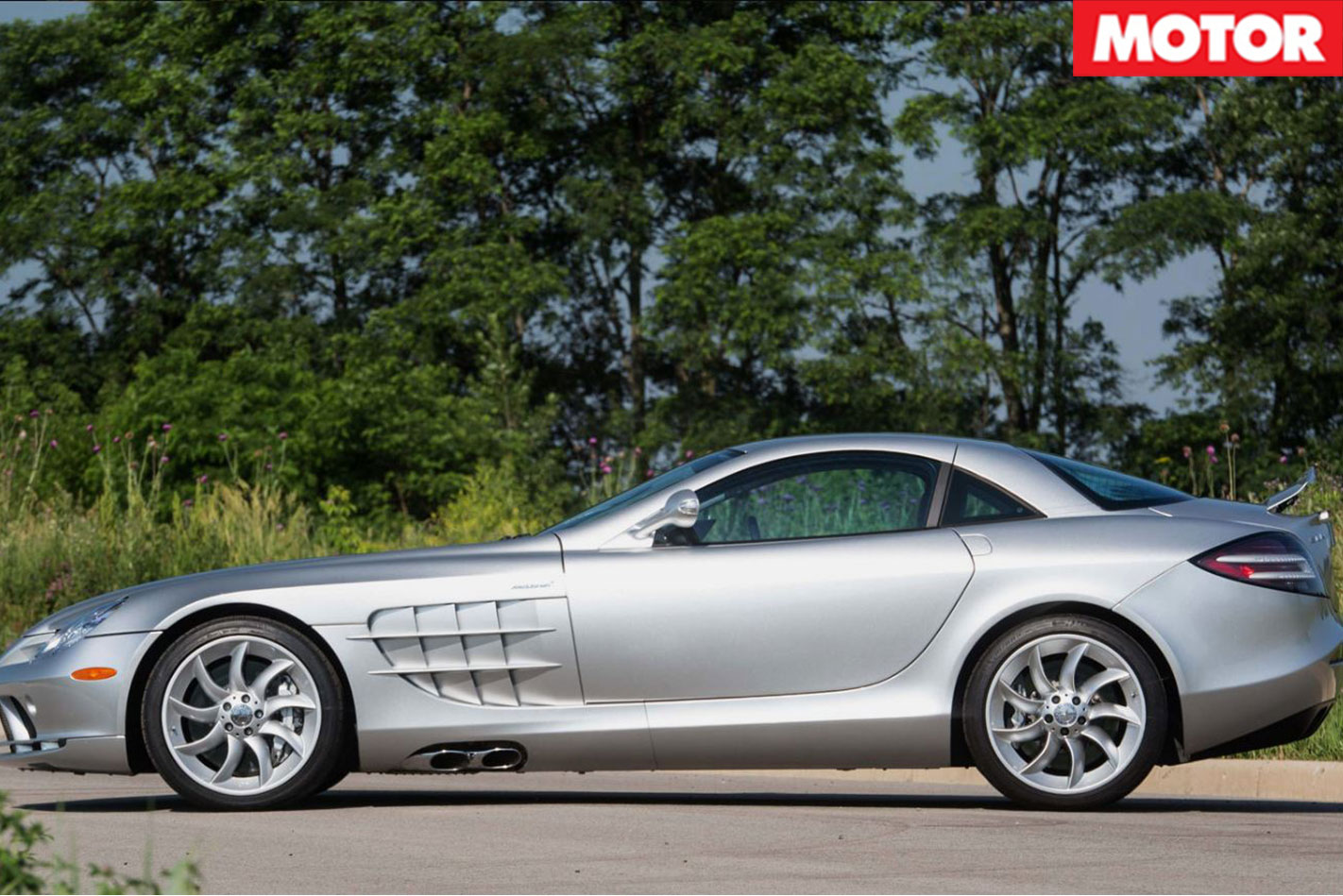
Similar cars are asking much more in Europe, so perhaps this car’s relatively high mileage (34,350km) is a turn-off, but at an expected US$180-225K we’d be very tempted.
This is the moment we’ve been waiting for – HSV’s big-bang banana against Ford’s awesome aubergine! Todd Hallenbeck chows down…
First published in the April 1997 issue of Wheels magazine, Australia’s most experienced and most trusted car magazine since 1953.
Two highway patrolmen at an RBT, one with blowmeter in hand, the other with a clipboard pointed me to the kerb. The GTS-R pulled up behind. Their reaction to the Falcon GT was unexpected if not unbelievable. “Your driver’s license, please,” said one cop while the other circled to the front and squared up looking at the nose. He then penned something down. – “Blow in the white tube until I say OK.
” Blow. .. blow … blow … “OK. Thank you; you can go;’ he said politely. I waited a long second to give him time to phrase the inevitable, obvious question. Here was a man whose job required him by law to be ultra-observant. I don’t doubt that he could spot the gender of a fly at ten paces. He must have spotted the GT’s unique grille, the twin bonnet-vent nostrils, the rear wing, the wheels. The waiting became loitering. How long would it take?
This is it, according to Ford. The big three zero party on wheels, the best Falcon ever built, the GT of GTs! Check the power and acceleration stats, says Ford, and you’ll see that this is the quickest, best handling GT Ford Australia has ever built. History was about to happen as I watched the cops’ reaction to Ford’s masterpiece.
He and partner ignored the GT and walked to the yellow GTS-R. “Your driver’s license, please.” Before Adam Porter could pull his wallet, the same patrolman asked: “So what does it go like? Do you mind if I have a look under the bonnet.”
In other quarters, reaction to the GT has been anything but calm. “It is the worst facelift that’s ever been done in Australia,” said one ex-GM designer. “It’s wrong,” said another. The editor of this magazine said, “The styling, er, grows on you.”
But Marty, a graphic designer, said, “I think it looks cool. It’s so totally different.”
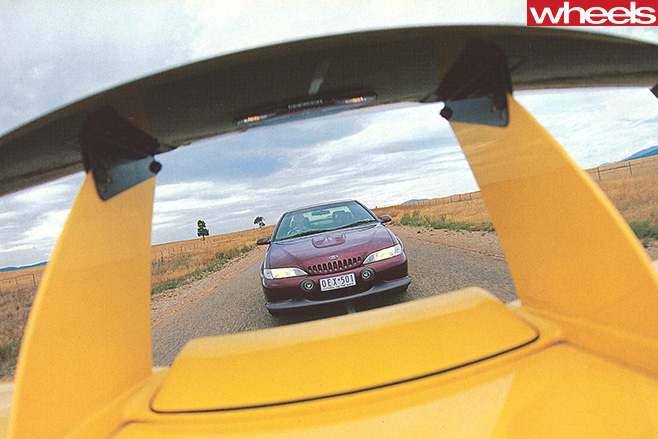
Steve Park, head of design at Ford Australia, walked backwards from the nose and lowered himself to grille height. “You have to give it the 50 metre test,” he said. “We went for a strong down-the-road graphic and when you see the front end in the rearview mirror, it has impact.”
Very true. Nothing fills the mirrors like the front of an Ford Falcon EL GT at optimal distance; however, at a distance greater than the prescribed 50 metres, the dark front end begins to rapidly lose impact and it slowly morphs into a VB Commodore-ish shape.
“It is as aggressive as we could get it,” stressed Park. And the grille? “I have no problems with it being a controversial part of the car.”
Amid the controversial look, there are reminders of the EB GT (designed by Paul Gibson in the UK) in the wheel arch extensions, along the flanks and over the boot.
At the rear, the EL’s wing is bigger than the EB’s but not nearly as big as Park initially drew it. Apart from downsizing the wing, Park needed only to complete a few renderings and one tape drawing before progressing the design to full-sized clay.
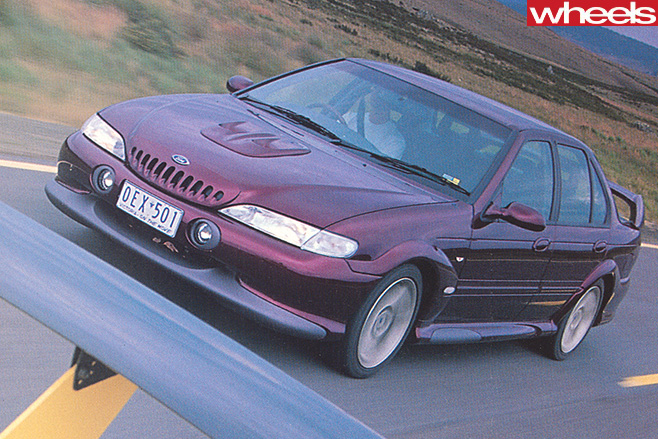
And Tickford paid careful attention to controlling air intake for another reason: cooling the 5.0 litre Windsor. Fresh air enters under the front spoiler’s raised lower lip to pass through the radiator and aircon condenser; and exit through the bonnet vents.
The unique GT two-post wing also serves a performance function. “The wing is an inverted aerofoil section,” says Ford Motorsport Manager Greg Harbutt. “It generates downforce in a similar way to a Group A wing.” Tested in Monash University’s full-sized wind tunnel, the wing decreases lift at the back of the car by 70 percent. The wind tunnel also showed the bonnet vents are optimally placed in a low-pressure area.
It is interesting to note that Ford didn’t use the XR series headlights. Instead, the GT sees through stock Fairmont lamps and, with the addition of two, low-mounted SSW driving lights, the GT throws a wide, intense high beam.
Whether or not you like the grille, there is heritage in much of Park’s design. He purposefully picked up traditional GT cues, such as the driving lights, bonnet vents, and rear wing to reinforce the GT’s performance. A Falcon GT is special; it is more than a warmed XR8, it is a GT. And, says Marsden, “It is a GT in the style of grand touring car. Not a Phase III.”
Tickford boss David Flint interrupts: “There is a market for a balls-out, all-power Falcon, but not a GT.” Flint doesn’t press the point, and Marsden adds that they looked at using a 351 Windsor in the EL GT only to be prevented by the Falcon’s limited underbonnet real estate.
Those that can afford the $69,500 asking price expect comfort, a degree of individuality and a high level of refinement, and the GT doesn’t disappoint. The bucket seats are skinned in charcoal leather with grey suede accents carried across to the door trims and armrests. Both front door trims are marked with a GT badge. Real wood and woodgrain fascia trims offset the leather at the gearknob, steering wheel and along the upper door trims.
A leather/wood Momo steering wheel accommodates airbag and cruise controls. Still within the comfortable surrounds, the GT’s performance edge is not far away, with the speedo face reading to 240km/h (standard Falcon reads to 220).
“Those few numbers cost us a lot,” says Flint.
The $1.5 million development cost (which Flint admits was closer to $2m) went mostly on upgrading the ride and handling, but the bodywork wasn’t cheap and neither was the job of enlivening the hardy old 5.0 litre V8 Windsor.
Producing the required 200kW meant Tickford had to make the 5.0 litre breathe more efficiently. On intake, the mass-produced, cast-alloy manifold was changed for a high-flow mandrel-bent tube manifold accompanied by a 65mm air-mass throttle body and a pair ofGT40 cast-iron heads with 47mm intake (from 45mm standard) and 39mm exhaust valves.
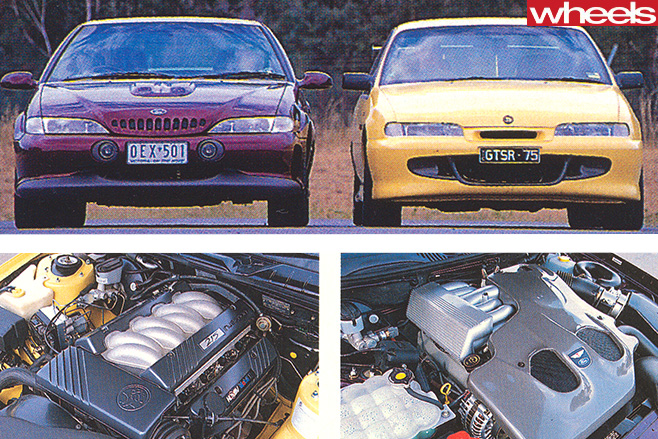
Colour choice is limited to three dark metallics from the Fairmont’s palette: Sparkling Burgundy, Heritage Green and Navy Blue. We’d hoped for gold to commemorate the XR GT and expected black, which was the most popular colour choice on EB GT. Offering the two custom colours would have required Ford to go outside its Falcon colour loop, a option that wasn’t financially viable.
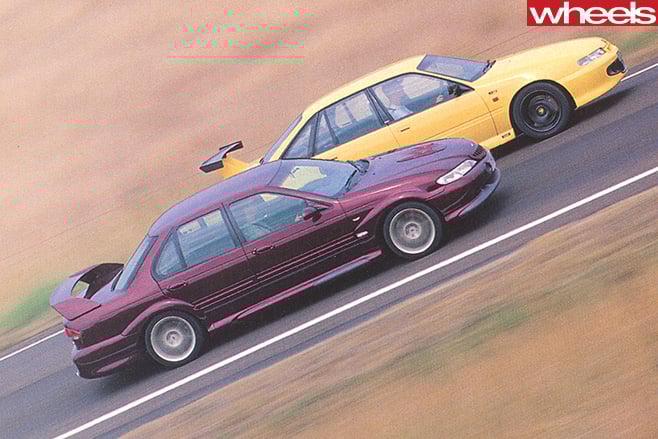
Alongside HSV’s taxi-yellow GTS-R, the GT’s quiet colour lacks impact and falls short of giving the 272 limited-run of EL GTs visual distinction. Looking at the dark metallics, you wouldn’t know the EL GT is a statement of Ford Australia’s performance heritage. It blends with traffic while the GTS-R bounces out of it like a hyperactive B1 or B2.
There are greater differences to compare here.
The GTS-R, based on a Commodore Executive, skimps on the frills and can’t match the GT’s high level of interior trim or refinement. HSV shows its marketing savvy by using existing components and maximising model distinction with colour and performance hardware. The GTS-R’s few body pieces are off-the-shelf GTS/Senator accented with licks of paint and carbon-fibre. In one swoop, the GTS-R’s high-standing Group A wing more effectively delivers hardcore confirmation that it is a performance car than does the GT’s 11 body bits. Also to HSV’s advantage, it doesn’t reinvent the performance car every five years.
Selling 272 GTs is a no-brainer for Ford. “It will sell,” insists marketing and sales manager Roger Clarke. He’s more reserved when asked whether the GT badge will become an annual.
To Tickford, the GT is a new pair of fuzzy dice. “It’s my way of showing my boys’ engineering skills,” says Hint. “Everything on this car has been chosen to perform better than EB GT.” Apples to apples, there’s no contest; so we brought along a banana.
The GTS-R is pure boy racer. No apologies, no excuses, no holds barred. The GTS-R is the quickest and fastest Australian car ever built, according to HSV. HSV’s own figures claim the quarter mile in 14.4sec (equal to Ford’s GT HO Phase III) and a speed needle reading of240km/h+. Feats we’ve never duplicated.
Saturday morning, we ran the Snowy Mountain highway that links Adelong to Tumut to Kiandra to Adaminaby. The road is smooth and fast with long, sweeping, constant radius turns. The road climbs and falls like corrugated tin through Kosciusko National Park. GT country that’s exhilarating to drive and distracting to look at, and perfect for the two torque-heavy V8s. From 5.0 litres, Tickford is claiming 420Nm at 3700rpm on a curve that bends by only 70Nm from 1500rpm to 5250rpm. HSV’s 5.7litre Holden V8 tugs out 507Nm at 3600rpm.
The GTS-R sits the driver low in the cockpit and snugs him in with a proper seat. Without turning a wheel, one complaint echoed by everyone who drove the GTS-R concerned the car’s long-action clutch pedal. It’s stiff but that’s not such a problem as the distance it must be pushed.
The GT props the driver taller in the seat; clutch to brake to throttle placement is spot-on, and pedal action is succinctly matched to the five-speed manual transmission’s action. The GT’s controls work more in harmony with the driver, though the seat could use more rearward travel.
The GT’s ride is firmer, slightly bouncier and less darty. In raw roadholding, it has the upper hand, but the GTS-R plays more confidently on the edge. Slipping a toe over isn’t alarming and is easily controlled with the right foot and 507Nm armed and ready.
The GTS-R ‘s front end is more compliant and less responsive than the GT’s, and when it lets go, it goes gradually and recovers quickly.
The GT does the opposite. It never breaks loose at the front, preferring instead to lean hard on the outside rear tyre. Marsden claims the Yokohama A510 245/40 rubber performs better than European rubber, and allowed chassis/ suspension engineer Steve Hoinville, with input from John Bowe, to hone the GT’s handling.
The GT, exceptionally well balanced and with direct steering response, is the best handling Falcon ever.
We won’t get too gushy with deserving praise without saying the GT feels hundreds of kilos lighter than its 1668kg (1698kg with automatic).
Not only is it as agile as a cat on carpet through turns, it plants hard and firmly pushes off the apex with bags of Newton-metres from the free-revving V8.
Hopefully, Tickford’s modifications will trickle down to XR6/8 series and eventually base-model Falcon. Front springs are 10Nm firmer than XR8’s 69Nm rates, front antiroll bar is 28mm (the largest previously used is 27mm).
Marsden says: “The reasonably stiff front end allowed the [rigid axle] rear to work better.” The one negative is noticeable tyre noise, especially when riding in the rear seat. “Out of all the positives of the Yokohamas, we’re comfortable with that one negative,” says Marsden.
Australian to its big DBA-developed disc brakes and two-spot calipers and its 17×8.5 ROH-designed alloy wheels, the GT is not just an engineering triumph for Tickford. BTR specifically developed a Hydratrak LSD for the rigid axle suspension that transfers 20 percent higher torque loadings than the Hydratrak LSD in the GTS-R’s independent rear.
Kelray worked in pocket with Tickford to tailor-make the GT’s urethane suspension bushes, and BTRE debuts its five-mode adaptive automatic transmission as well as supplying the gears for the manual five-speed gearbox. The only imported bits are engine, tyres, optional sunroof, steering wheel and clutch.
If A to B involves a few turns, the GT outpaces the GTS-R. Toss a detailed road map in the GT’s glovebox because its skills are a terrible thing to waste cruising down some boring freeway.
In a straight line, as hard as we tried, neither equalled the manufacturer’s acceleration claims.
Hot, humid air, a passenger and a full fuel tank were perhaps the reasons.
At best the GTS-R was almost a second off HSV’ s 14.4sec 400 metre time, and the GT never came close to Ford’s claim of6.97sec 0- 100km/h sprint and 15.06sec standing 400 metres. Our quickest, 3500rpm dump-the-clutch pass returned 8.08sec and 15.76sec.
Don’t fret, we have very good insider information that the GT is quickest with 20,000km on the counter. It is a driver’s car, after all.
| u00a0 | FORD FALCON GT | HSV GTS-R | ||||
| PRICE | ||||||
| Basic | $69,000 | $75,000 | ||||
| u00a0 | u00a0 | u00a0 | u00a0 | u00a0 | u00a0 | u00a0 |
| ENGINES | ||||||
| Layout | longitudinal V8. ohv, 16v | longitudinal V8, ohv, 16v | ||||
| Induction | multi-point fuel injection | multi-point fuel injection | ||||
| Capacity (litres) | 4.942 | 5.737 | ||||
| Bore and stroke | 101.6 and 76.2mm | 101.6 and 88.4mm | ||||
| Compression ratio | 9.0:1 | 8.5:1 | ||||
| Maximum power | 200kW at 5700rpm | 230-235kW at 4800rpm | ||||
| Maximum torque | 420Nm at 3700rpm | 507Nm at 3500rpm | ||||
| Redline/cut-out | 5500/6200 | 5500/5700 | ||||
| u00a0 | u00a0 | u00a0 | u00a0 | u00a0 | u00a0 | u00a0 |
| TRANSMISSIONS | ||||||
| Ratios (km/h per 1000rpm) | 5 speed manual | 6 speed automatic | ||||
| First | 2.95(11.2) | 2.66 (12.7) | ||||
| Second | 1.94 (17.1) | 1.78 (19.0) | ||||
| Third | 1.34 (24.7) | 1.30 (26.0) | ||||
| Fourth | 1.00 (33.1) | 1.00 (33.8) | ||||
| Fifth | 0.73 (45.4) | 0.74 (45.7) | ||||
| Sixth | u00a0 | 0.50 (67.7) | ||||
| Differential ration | 3.45 | 3.45 | ||||
| u00a0 | u00a0 | u00a0 | u00a0 | u00a0 | u00a0 | u00a0 |
| SUSPENSION | ||||||
| Front: | short and long arm, coil springs, anti-roll bar | struts, coil springs anti-roll bar | ||||
| Rear: | Walls linkage, coil springs, anti-roll bar | independent, semi-trailing arms, coil springs, anti-roll bar | ||||
| Tyres: | 245/40R17 91 V Yokohama A510-40V | 235/45ZR17 B’stone Expedia S-01 | ||||
| u00a0 | u00a0 | u00a0 | u00a0 | u00a0 | u00a0 | u00a0 |
| BRAKES | ||||||
| Front: | vented discs, ABS | vented discs, ABS | ||||
| Raear: | discs | discs | ||||
| u00a0 | u00a0 | u00a0 | u00a0 | u00a0 | u00a0 | u00a0 |
| STEERING | ||||||
| Steering type | power assisted, rack and pinion | power assisted, rack and pinion | ||||
| Turns lock to lock | 2.8 | 2.7 | ||||
| Turning circle | 11.1m | 11.0m | ||||
| u00a0 | u00a0 | u00a0 | u00a0 | u00a0 | u00a0 | u00a0 |
| VITAL STATISTICS | ||||||
| Wheelbase | 2791mm | 2735mm | ||||
| Front track | 1566mm | 1485mm | ||||
| Rear track | 1547mm | 1485mm | ||||
| Length | 4931mm | 4861mm | ||||
| Width | 1888mm | 1782mm | ||||
| Height | 1394mm | 1420mm | ||||
| Weight | 1668kg | 1620kg | ||||
| Fuel tank | 68 litres | 80 litres | ||||
| u00a0 | u00a0 | u00a0 | u00a0 | u00a0 | u00a0 | u00a0 |
| PERFORMANCE | ||||||
| Speed in gears, km/h at rpm | ||||||
| First gear | 61 at 5500 | 70 at 5500 | ||||
| Second gear | 94 at 5500 | 105 at 5500 | ||||
| Third Gear | 136 at 5500 | 143 at 5500 | ||||
| Fourth gear | 182 at 5500 | 186 at 5500 | ||||
| Fifth gear | 234 at 5150 | 246 at 5400 | ||||
| Sixth gear | u00a0 | 216 at 3300 | ||||
| Standing start, time in seconds | ||||||
| 0-60km/h | 3.8 | 3.3 | ||||
| 0-80km/h | 5.5 | 5.2 | ||||
| 0-100km/h | 8.1 | 7.5 | ||||
| 0-120km/h | 10.9 | 10.1 | ||||
| 0-140km/h | 15 | 13.6 | ||||
| 0-160km/h | 20.1 | 18 | ||||
| 0-400m (km/h) | 15.8 (143.9) | 15.3 (148.6) | ||||
| Overtaking | ||||||
| u00a0 | 3rd | 4th | 5th | 3rd | 4th | 5th |
| 40-70km/h | 4.0 | 5.3 | 8.0 | 3.7 | 4.8 | 7.2 |
| 60-90km/h | 4.0 | 5.2 | 8.0 | 3.5 | 4.8 | 7.3 |
| 80-110km/h | 4.0 | 5.2 | 8.5 | 3.5 | 4.6 | 7.6 |
| 100-130km/h | 4.7 | 5.3 | 10.0 | 4.0 | 4.6 | 8.4 |
| u00a0 | u00a0 | u00a0 | u00a0 | u00a0 | u00a0 | u00a0 |
| FUEL CONSUMPTION | ||||||
| Best | 11.0 L/100km (25.6mpg) | 9.1 L/100km (31.0mpg) | ||||
| Worst | 18.4 L/100km (15.4mpg) | 17.7 L/100km (16.0mpg) | ||||
| Average | 15.3 L/100km (18.5mpg) | 14.9 L/100km (19.0mpg) | ||||
From December this year, P-platers in New South Wales will be banned from using mobile phones in any capacity – which includes hands-free – following various changes to the state’s Graduated Licensing System (GLS) announced by the state’s Roads Minister, Duncan Gay.
As well as no longer being able to use mobile phones, the changes will see the current requirement of passing a Driver Qualification Test before graduating to an unrestricted licence scrapped, while the Hazard Perception Test needs to be passed earlier in the three-step graduated system.
Under the current GLS, the Hazard Perception Test needs to be passed in order to graduate from a P1 (green plates) to a P2 licence (red plates), but under the newly announced scheme – which comes into effect from November next year – learner drivers will need to pass the test before gaining their P1 licence, the first unsupervised licence in the three-tiered system.
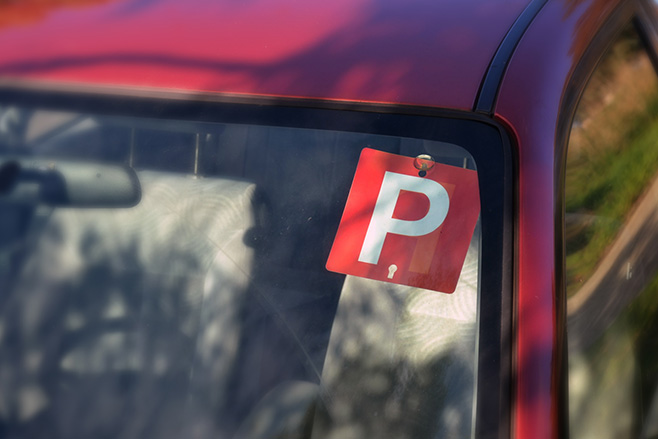
Another change set to be implemented on 1 November, 2017, will see P2 drivers will be forced to wait an extra six months before graduating to an unrestricted licence each time they’re issued with an offence-related fine during their provisional licence period.
The changes relating to mobile phone use will be implemented 11 months earlier than the shake-up to the Mercedes-Benz GLS scheme; a move motivated by a recent spike in young drivers being killed in road accidents.
While the number of young people fatally injured on the state’s roads reportedly dropped during the 10 years to 2014, the annual 2015 figure of 233 has been described as a dramatic rise. So far this year, 21 young people have been killed on New South Wales roads.
“That is more than a rugby team that won’t come home because of accidents which could have been avoided,” Minister Gay said during the announcement.
Norway has earmarked US$25 billion for an ambitious plan to construct the world’s first submerged floating traffic tunnels.
In a bid to reduce travel time on the 1100km stretch between Kristiansand and Trondheim, which currently means seven different ferries to cross the various fjords, the proposed system of floating concrete tubes could reduce the 21-hour journey to just 11.
If given the green light, Sognefjord will be the first of the seven fjords to benefit from the project which will see the installation of two 1219m-long concrete tubes, one for each direction of travel. On the inside, the submerged floating tubes will look the same as any other road tunnel, with two lanes and ventilation systems in place to release exhaust fumes.
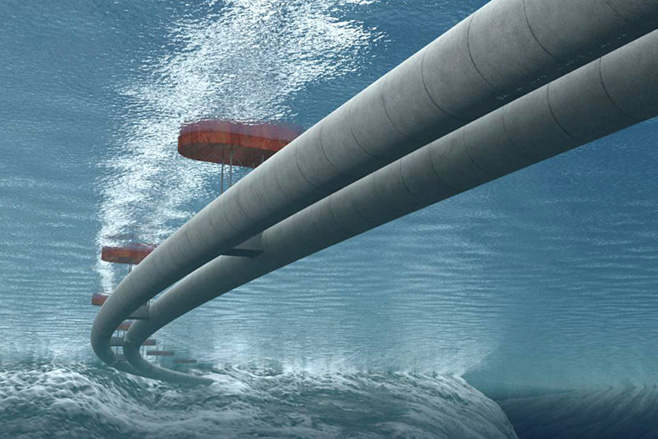
Externally, the tubes will be connected to each other via floating pontoons and, where weather or water-current conditions dictate, tethered to the fjord floor which can be up to 500m below.
The unusually deep and wide bodies of water are the reasons the Norwegian engineers were forced to come up with the idea of the unconventional roadway.
While the idea of a floating traffic tunnel seems futuristic, the theory behind the idea actually dates back to 250 BC. Otherwise known as an Archimedes’ Bridge which, like the ancient Greek mathematician’s principle states, if the weight of the object — in this case the concrete tubes — is less than the weight of the water it displaces, then it will be buoyant.
Using Archimedes’ Principle, how deep the tunnels will be submerged will be determined by the overall weight of the concrete tubes. Reports suggest the tubes will be buoyant approximately 30 metres below the fjord’s surface to accommodate cruise ships and other vehicles using the water.
Can’t get enough? Now read about 12 great structures.
The boss of Jaguar Australia has all but admitted the British brand is ready to add more SUVs to its line-up following the introduction of the Jaguar F-Pace – its first high-riding wagon.
When asked by WhichCar about an expanded range of Jaguar SUVs, Matthew Wiesner said, “If you look at where the trends are and the way other brands are evolving, you would have to think there is much opportunity out there for us to go where the customers are going.”
The acknowledgement suggests the warm reception to F-Pace and the sales energy being generated have changed the thinking inside Jaguar. F-Pace is a shoo-in to become its best-selling model.
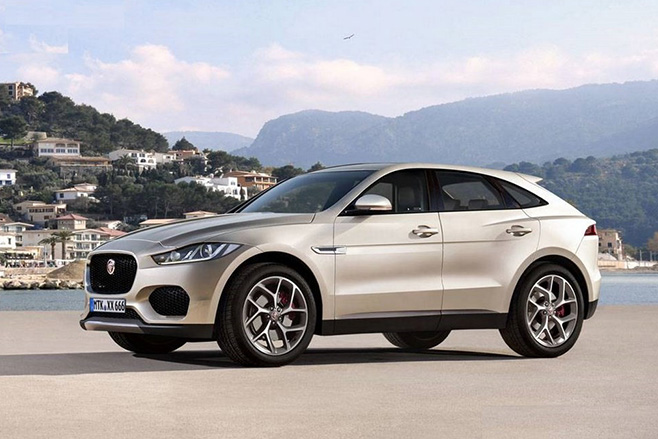
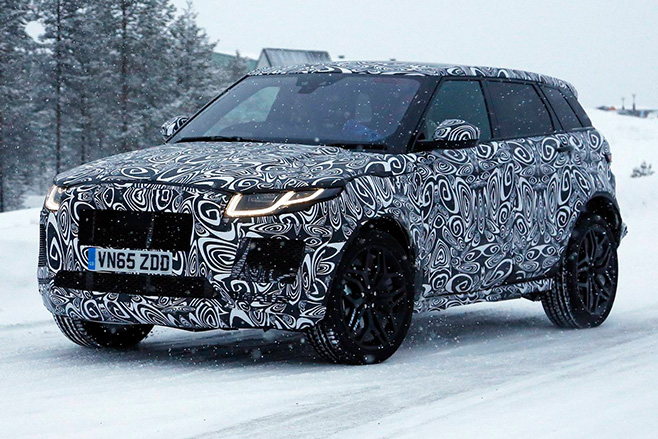
The expected next steps for Jaguar include two new SUV models to sit above and below F-Pace in size and price. Development vehicles representing these new SUVs have been spotted in testing wearing heavy camouflage.
Media outlets have dubbed the as-yet-unannounced models E-Pace and J-Pace for the smaller and larger SUVs respectively. An all-electric SUV called I-Pace has also been speculated.
Jaguar’s head designer, Ian Callum, had previously said one SUV was enough: “It’s not our priority to create a family of SUVs,” he said, following the global reveal of F-Pace last year. “We felt we had to do at least one because the market was there for us to take.”
The transition from Jaguar’s traditional stomping ground of sedans and coupes into the booming SUV segment has forced the brand to reconsider its philosophies.
“This question was being asked for a very long time internally about whether Jaguar should do this, said Wiesner.
“Now that it’s happened and people have seen the outcome has been fantastic it will undoubtedly raise question after question about what’s next based on the opportunity that this will create.”
Locally, it seems a smaller SUV is what the brand wants the most. The compact SUV market is hugely competitive with lots of manufacturers already in that space, though it is also where most new SUV buyers are shopping.
“We’ve got to build cars that customers want. We don’t build products that we think are a nice idea. That’s ultimately what will influence where we go,” said Wiesner.
Wiesner also said the useable space of F-Pace will allow it to compete with bigger alternatives like the BMW X5 and Mercedes-Benz GLE, and that seven-seater SUVs were the domain of Jaguar’s sister brand; Land Rover.
“F-Pace is very much a performance-focused, driver’s SUV and that will be very attractive. This car will have great appeal to those who would have never considered a Jaguar in the past,” said Wiesner.
