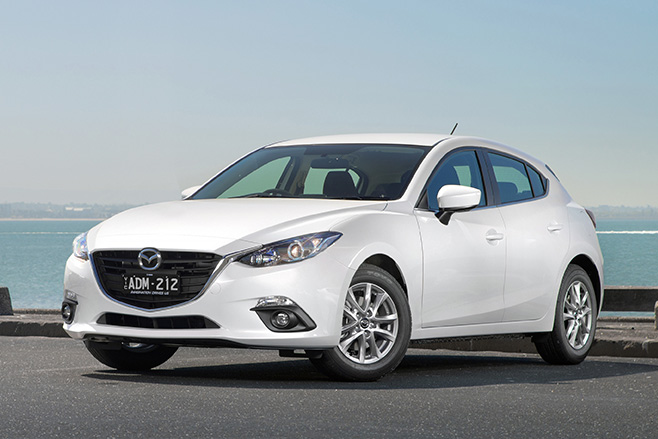
When you think of Peugeot, what springs to mind? French, obviously, stylish design maybe, and probably practical, thanks to cars like the 308 hatchback or 2008 SUV.
Crazy doesn’t necessarily leap to mind, but for about a decade Peugeot had a serious wild side. Here are seven cars that proved Peugeot could push the boundaries.
Peugeot 205 GTI
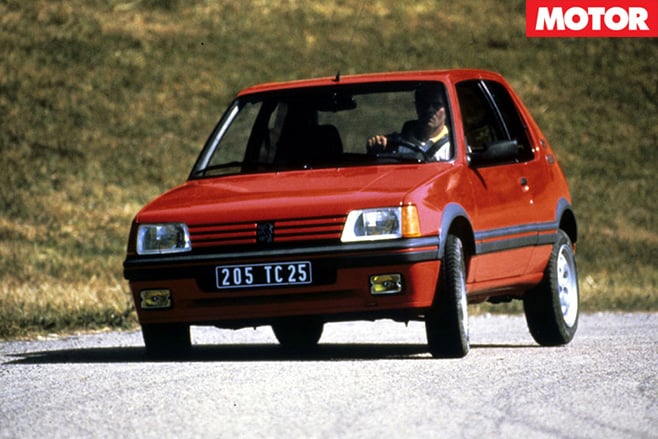
Peugeot 205 T16
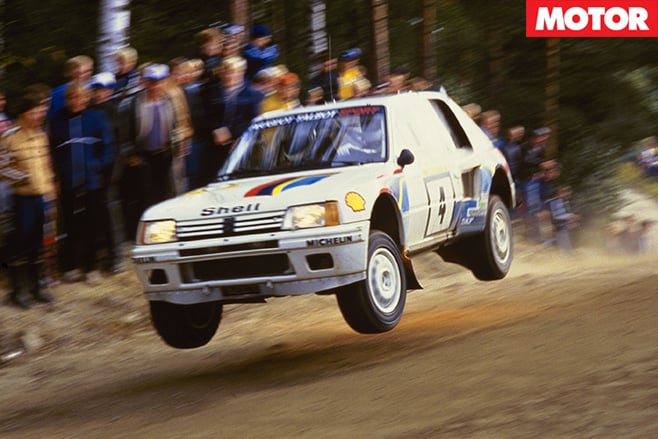
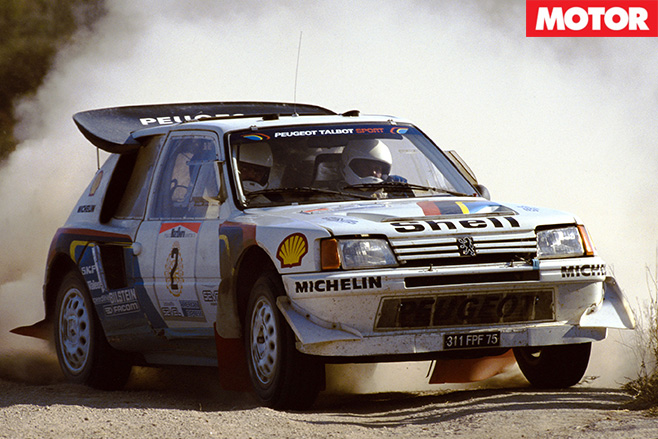
Peugeot Quasar
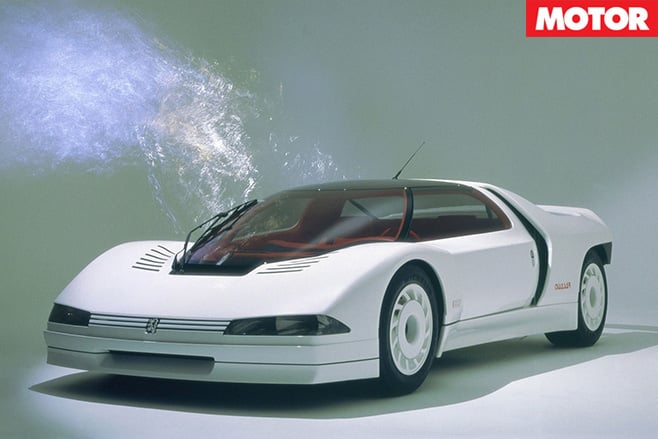
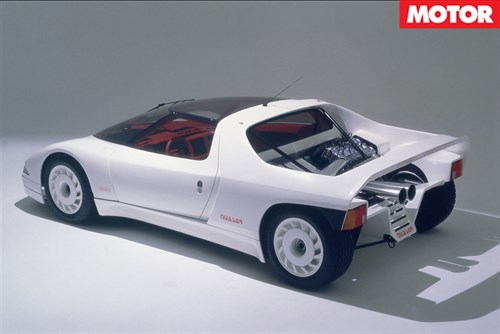
Peugeot Proxima
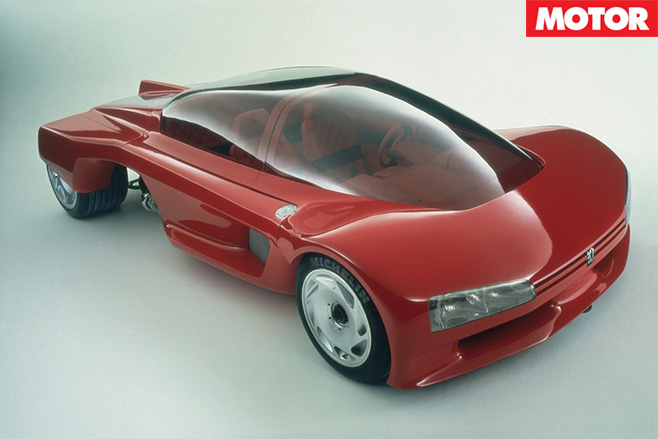

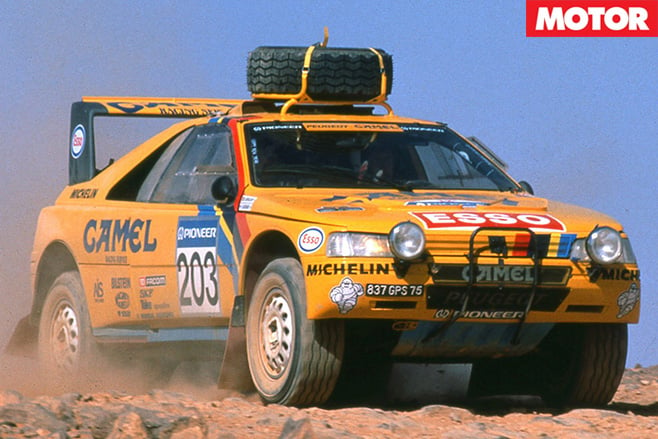
Peugeot 405 T16/Dakar
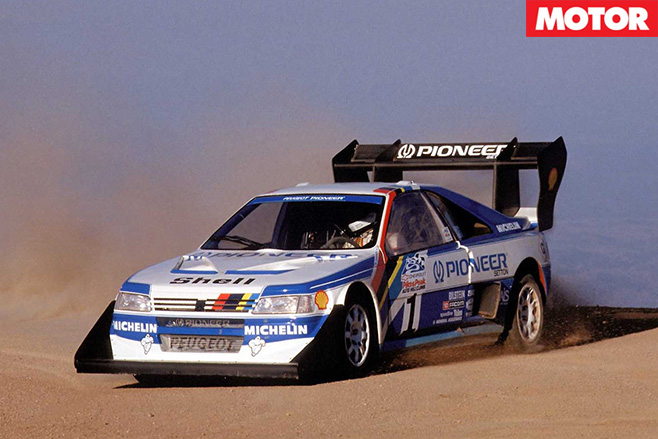
Peugeot Oxia


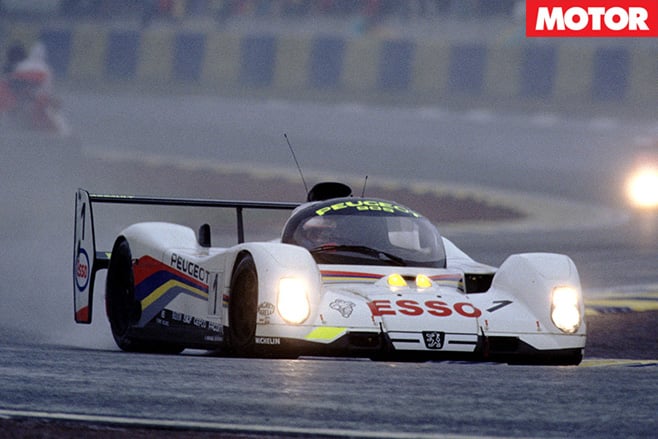
Peugeot 905

Reports are circulating through Europe that JLR and BMW are working on a deal that would see fast versions of Jaguar and Land Rover models powered by a twin-turbocharged 4.0-litre V8.
The move, reported by Automobile magazine, would follow Aston Martin’s decision to adopt turbocharged V8s from Mercedes-Benz’s AMG performance division. It would likely spell the end for JLR’s 5.0-litre supercharged V8, which is employed in the likes of the Jaguar F-Type R and SVR, and the Range Rover Sport SVR.
BMW’s 4.0-litre V8 is said to be a development of its current 4.4-litre version, improving both efficiency and torque.
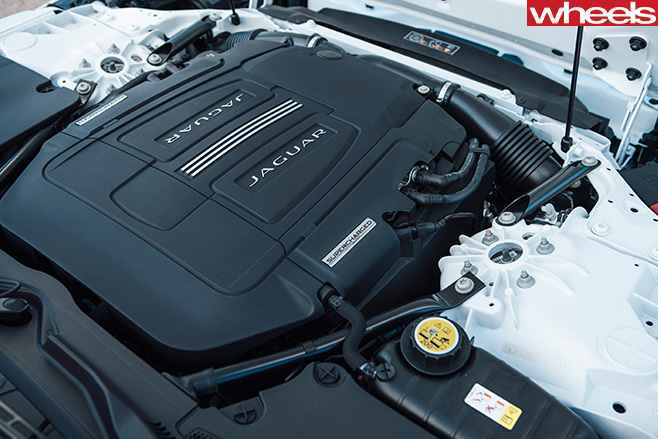
It’s not clear whether BMW would be willing to share a V8 used in a number of its flagship M cars, such as the BMW M6 and X5 M, though the current 4.4-litre twin-turbo version is the only one that can match the 400kW-plus outputs JLR is already offering with its supercharged 5.0-litre.
BMW’s lesser-powered twin-turbo V8 in 50i-badged models produces 330kW.
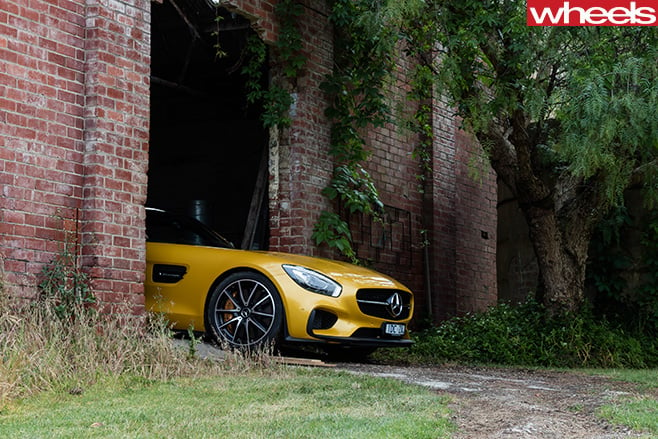
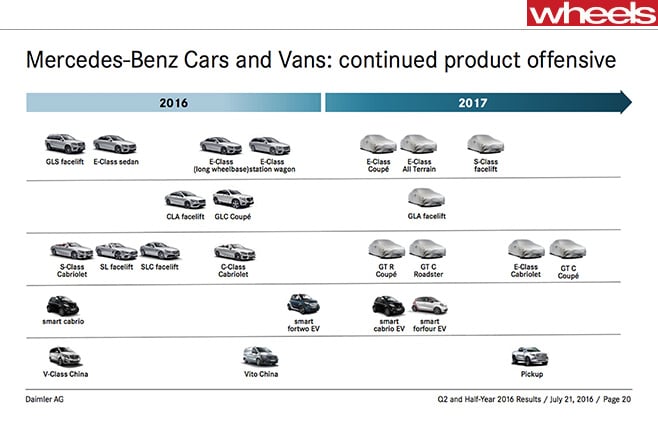
A GT C ROADSTER is among a range of new or updated Benzes to feature in 2017, according to a leaked Mercedes document published on the UK’s Autocar website.
The new GT C is expected to feature a folding fabric roof, just like the model it essentially replaces; the SLS Roadster.
The roadmap document outlines other models for 2017, including the extension of the new-generation Mercedes-Benz E-Class sedan with Cabriolet and Coupe versions – plus a new All Terrain model that is likely to mimic jacked-up passenger cars such as the VW Passat Alltrack and Subaru Outback.
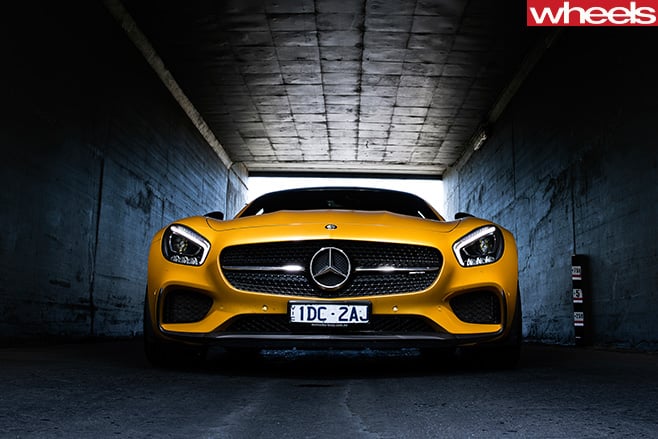
The GT Roadster would become the sixth convertible in Mercedes-Benz’s range, joining the SLK and SL sports cars, and the Cabriolet versions of the Mercedes-Benz C-Class, E-Class and S-Class.
Australians love car-based seven-seater SUVs, and the competition nowadays is fiercer than ever, but which is the best sub-$50,000 petrol-powered offering?
Here we pitch the latest challenger (Mazda CX-9) against the segment bestseller (Toyota Kluger), and our current favourite (Kia Sorento).
1. MAZDA CX-9
In one fell swoop, the all-new, second-generation Mazda CX-9 from Japan raises the bar on a number of key fronts.
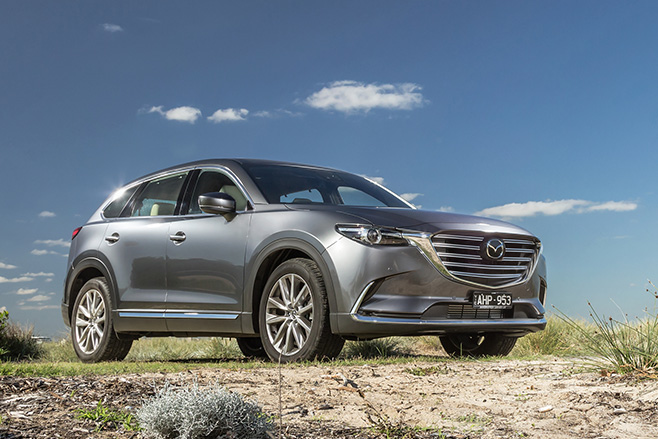
Although designed to look swoopy, it was actually developed from the inside out, with an emphasis on packaging and operational ease, backed up by an excellent driving position, great forward vision, light controls, and refinement.
Vitally, there is sufficient space for seven – as long as the third-row duo are under 175cm – with reasonable luggage space out back to boot. The CX-9 is also the quietest and comfiest riding of the trio.
Another strength is the Mazda’s rousing 2.5-litre four-cylinder turbo powertrain, combining spirited performance with real-world efficiency. That it also steers, handles, and grips the road like a thoroughbred seals the deal.
The negatives? The centre armrest fouls larger drivers’ elbows, and there are no third-row air vents (though it isn’t stuffy).
So the rapid and refined CX-9 is a classy all-rounder, appealing to both the family and the driving enthusiast. This Mazda should be on everybody’s short list.
2. KIA SORENTO
Until recently, Kias were only about style, cheapness, and brilliant aftersales care, but the third-gen Sorento launched in 2015 is so much more.
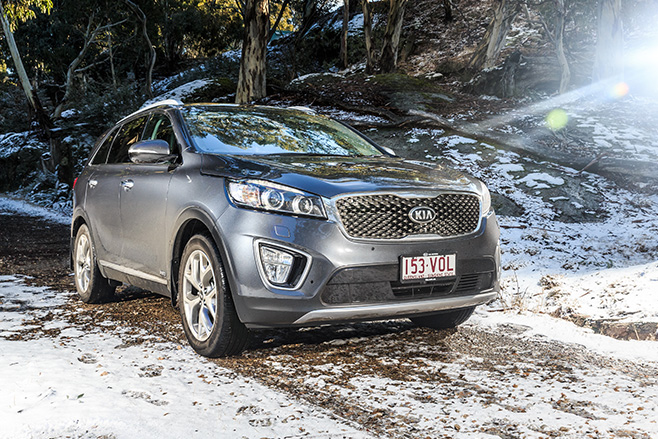
Elegant inside and out, the boxy design opens up a roomy and easy-to-access cabin that majors on simplicity and functionality. The first and second-row passengers are especially well catered for.
However, larger third-row riders might find it tight back there, with odd knees-up seating and hardly any room for feet. And the cargo area is relatively small.
The lazy torque of the Sorento’s 3.3-litre V6 makes it a smooth yet gutsy performer, aided by well-weighted steering and a plush ride. The Kia isn’t too heavy on petrol either, though the sportier Mazda edges ahead for economy. Nor is it as quiet and refined.
Still, factor in an industry-leading seven-year warranty against the others’ three, and the Korean-made Sorento makes for a sensible yet pleasing choice – as long as passengers six and seven aren’t too tall.
Big, brawny, and accommodating, the US-built Kluger’s widespread appeal is very easy to understand. And for the most part, it’s well deserved too.
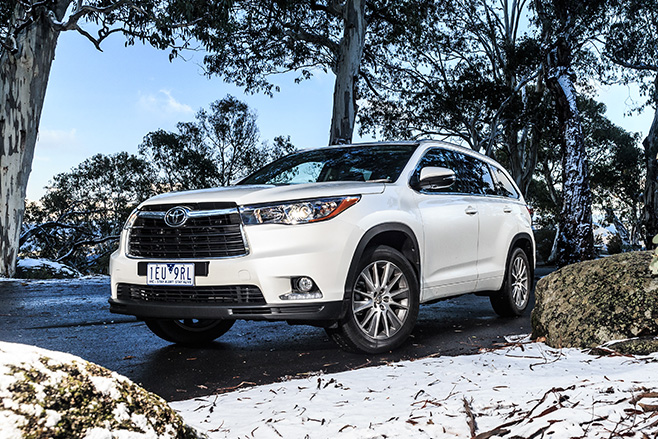
The interior, for starters, is huge, with real thought going into the smart dash layout, broad seating, and passenger access to all amenities. Second and third row entry/egress is first class, vision out is good, ventilation is superb, and everything is easy to reach and use. Plus, the boot area behind is also fairly large.
For sheer outright grunt, Toyota’s torquey 3.5-litre V6 is also a massive drawcard, and isn’t too bad on fuel considering how much mid-range, tow-friendly power is on offer. Additionally, the Kluger is pleasant to steer, safe and secure through corners, and seems planted to the road.
But the ride can feel unsettled and jittery, the seats lack lateral support over longer distances, and it feels quite heavy and cumbersome compared to the athletic, efficient Mazda.
Nevertheless, the Kluger is fantastic for honest and effortless transportation of families.
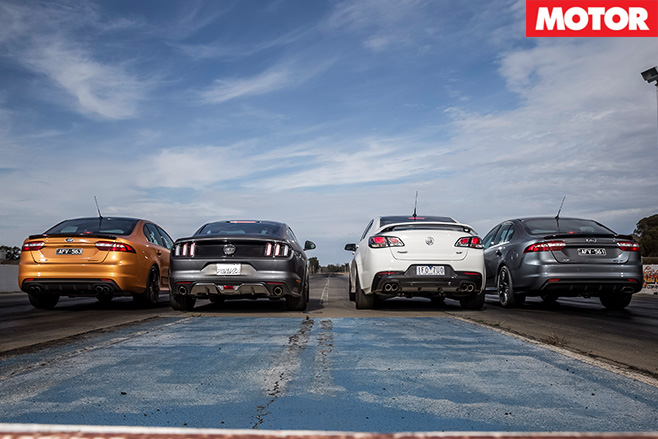
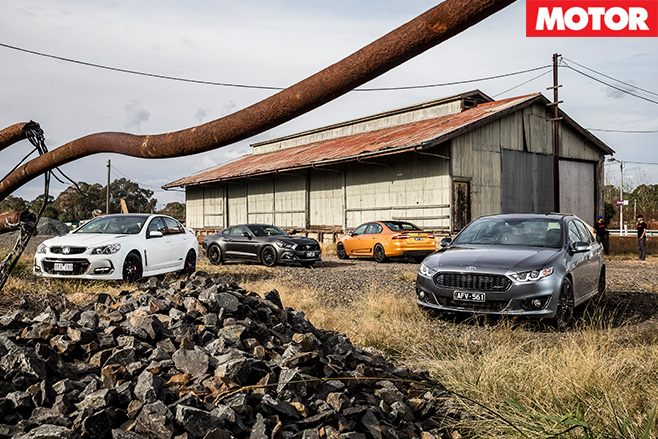
Doesn’t look like a fair fight, does it? I mean, three Fords against a single Holden.
Or what about a single six-banger shaping up to three V8s. Or maybe three cars with nooses around their necks (and the hangman reaching for the lever) versus the one car with a real production future.
Or maybe we should just cut the crap; disregard the dogma, elbow the emotions and can the cultural cringe. And in the process realise that here are four cars with stickers between the mid-$50Ks and $60K that can kick some serious butt, in terms of both straight line grunt and G-force production. And we know you lot have been looking forward to this one…
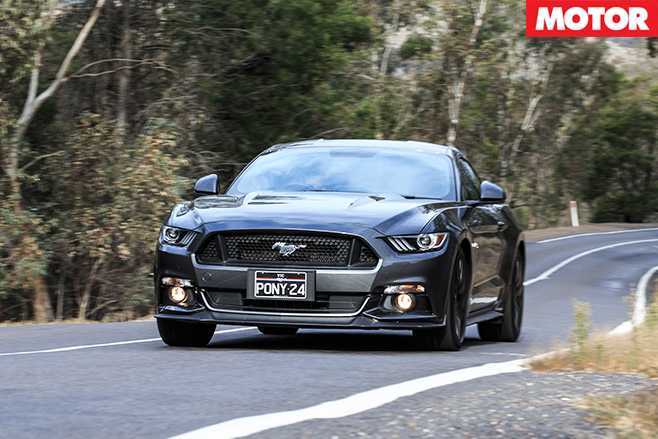
Okay, for a start, the Ford Mustang is the odd man out with just two doors and limited rear seat space. All the others have fairly extreme rear seat dimensions and will cope with the sort of pudgy-arsed teens that I keep seeing in shopping malls, little eyes glued to smart phones. On the other hand, the Stang’s two-door profile and sweeping roofline makes it the looker of this bunch, although you’ve still got to credit the Commodore’s big-car visual balance and the upscale aggression of the Aston-esque snout on the Fords.
But jump straight into the Falcon XR6 Sprint and you can still see where Ford has cut the meter out of this thing. It’s plain and plasticky-looking and even though some bits that were fake-chromed in the previous XR6 are now black, that doesn’t seem to help. In fact…
The Falcon XR8 Sprint is a more of the same but thankfully that daft starter button of the V8 FPV stuff has been flung. But it’s still clearly related to the base Falcon and there’s the same, plasto-clack noise from the gear shifter and the same hard plastics that suggest that new grille cost a lot of development money. The SS?
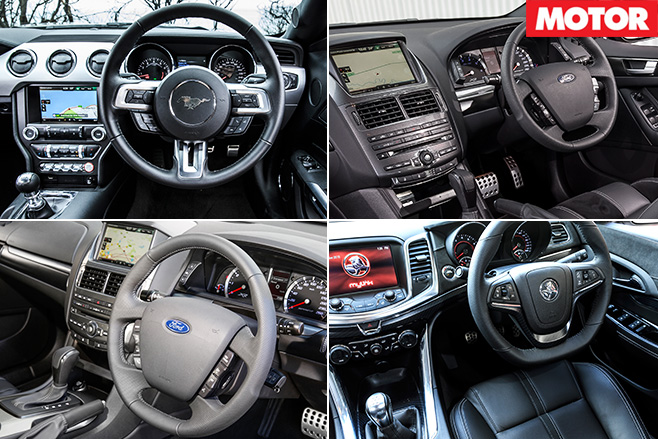
Well, it’s more sumptuous in a way, but it’s also incredibly busy with multiple surfaces and textures and w-a-y too much cod-chrome. But it is the nicest to sit in with the most logical relationship between wheel, pedals and seat, although the Mustang ain’t bad either.
Stone last are the two Aussie Fords which, even with the lower seat of this latest model, still perch you too high relative to the steering column. And the roof. There’s a fairly big equipment gulf, too, with the Fords missing out on safety stuff like blind spot monitoring, although they do get a reversing camera.
But the local Henrys also miss out on some really basic kit, including shift paddles for the automatic gearbox and even something as stone age (these days) as a left footrest. The Commodore SS-V is the real luxo-schmoozer with autonomous emergency braking, blind spot spotto, powered chairs and even a very useful head-up display.
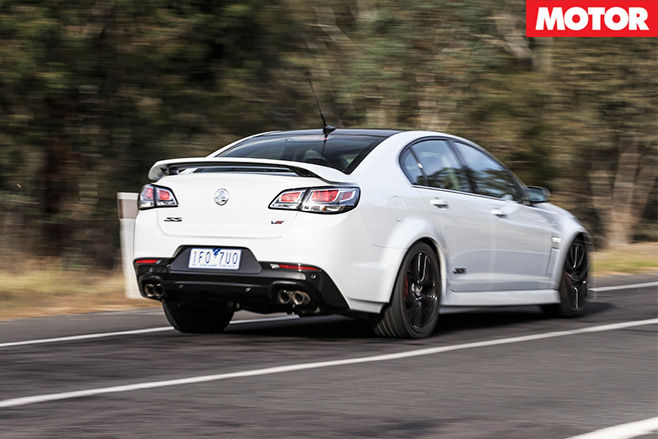
Now, when you look at the spec sheets, you might think there’s a big spread of performance times against the stopwatch. Well, you’d be wrong. It’s not that there’s not variation in outputs, but the fact remains that the biggest hitters had the biggest problems in getting off the line. And as any drag racer will tell you: if it won’t 60-foot, it won’t be quick. Which, more or less, is why all four were within two or three tenths across the 400m.
Looking at the Mustang, with its 306kW against the Commodore’s 304, you can see why the pair was neck-and-neck at the 400m mark, even if a relative lack of grip did play against the Mustang a tad. But thanks to short gearing and a clutch that could be juggled to mask that grip deficit, the GT could still be hustled down the strip in 13.38 seconds with only a slight graunch from first to second to spoil your day.
The SS-V was next and with its relatively soft (stay with us) atmo power delivery and spanking top end rush, it wasn’t the hardest to beat into submission. But forget the launch control; it’s a waste of time and you’ll do better with a keen ear and some right ankle control. It’s also worth mentioning that the rear bags on this car were – ahem – past their prime. In the end, the Commy rattled off a 13.33.
The XR8 Sprint was second quickest with 13.22, despite having five supercharged litres at its disposal. Meaning of course, that the smallest engine, the turbocharged four-litre of the XR6 Sprint was champeen on the day with a 13.12, even though it gives away a full 30kW (when both are overboosting) to the XR8. So what’s going on?
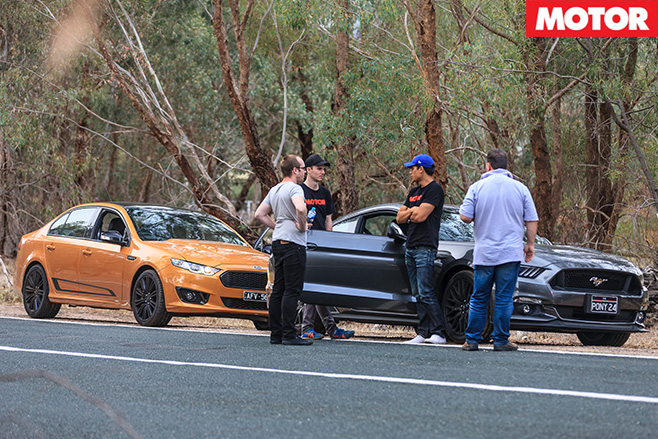
The XR6, meantime, is simply easier to hook up, largely because the power delivery and tiny amount of turbo lag involved gives the rear tyres half a chance to keep up. Or so it seemed. The shot was to stall it up to about 1800rpm and short-shift slightly to make the bulk torque. The specific boost map for each gear in the ZF ‘box also helps here from the seat of the pants.
Now, if you don’t believe us, take a peek at the terminal velocities. You can pretty much always look at a slow time with a high terminal and deduce that the time has been lost in the launch. And that’s why the XR8’s 180.95km/h trap speed suggests it would trump the XR6 (180.39km/h) in grippier circumstances.
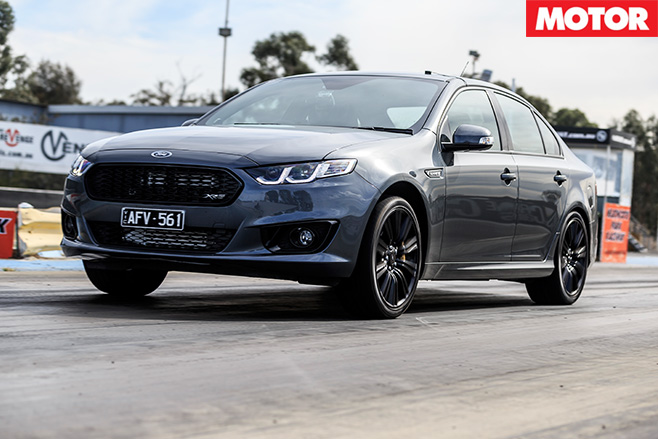
In pretty much any circumstances beyond the dragstrip, this means that both Aussie Fords are noticeably quicker; they get up and haul out of corners quicker, they overtake with more authority and they’re just ballsier all ’round. They’re also way more likely to be phoning up 1300 ESP for a chat. Again, if you don’t believe us, check the 80-120km/h roll-on times: 3.2sec for the Mustang, 3.5 for the Holden and 2.8 for each Sprint which, even though the latter were both autos versus two manuals, tells the tale.
But how fast is fast enough? To be honest, the Mustang feels adequately stompy and more like a six litre than a five, as well as offering up a pretty refined sound and feel. And the SS-V hardly feels like a slacker, either, what with that swelling top-end rush and a rhythm section that leaves the others here for dead.
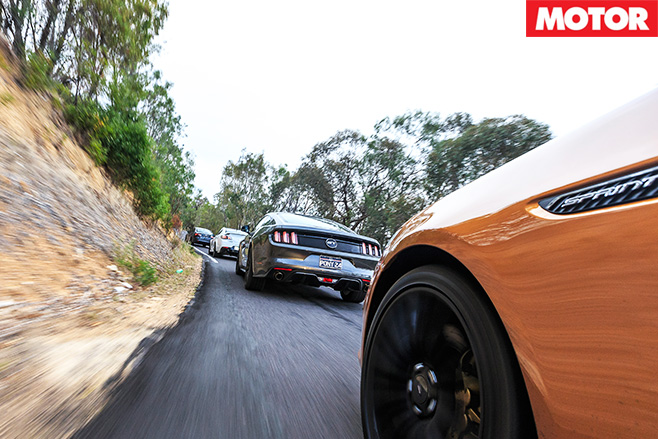
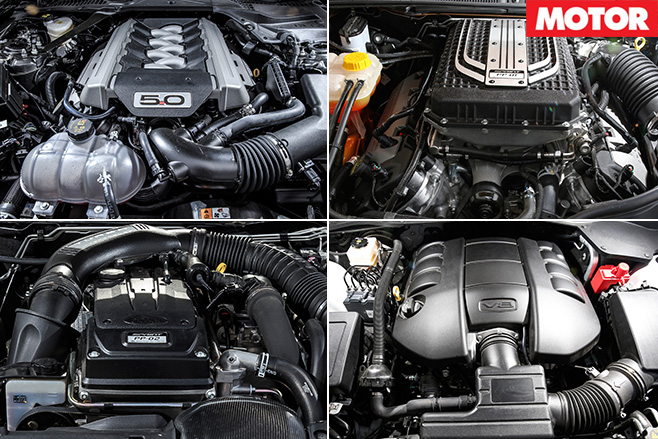
What we’re dealing with here, of course is a potted history of torque. While the GT makes a commendable 530Nm peak, the SS-V can muster a full 570Nm. And while that figure is almost line-ball with the XR8 and XR6 (575 and 576Nm respectively) when Mr Overboost comes a-knockin’, both Falcons suddenly blurt out 650Nm and at much lower revs than the atmo pair. Simples.
Things, however, change when you turn off the straight, smooth bits and head for the patchy, bendy stuff that we call the real world. Suddenly, the Mustang comes alive with steering that is tight and right. Changing the steering setting from Normal or Comfort to Sport only seems to add weight and reduce feedback, so we’d stick with the other settings and let the wheel do some talking. And when you do, the ‘Stang starts to become very easy to place accurately.
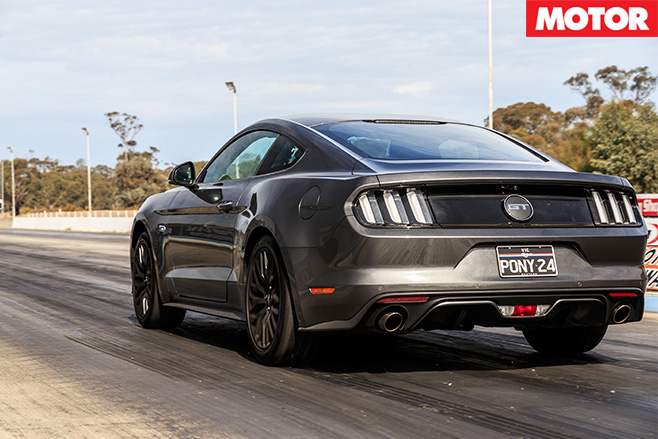
That said, the GT can’t match the Holden for driver involvement. Not only is the SS-V the most natural steerer here, it also soaks up the dross more effectively with a greater degree of suppleness that doesn’t appear to come at the expense of ride or damping control. It simply feels like it would be the easiest car with which to thread the needle.
And even though it’s a big, wide car, it doesn’t feel that way on the road, even at speed. There’s more rear-end compliance, a little more squat and, as a result, more power-down, too. It’s one thing having mucho torque, it’s another thing entirely to be able to paste them Newtons to the deck.
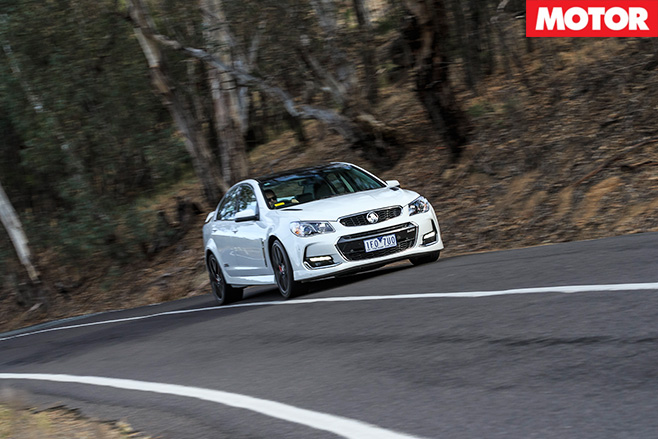
As such, the ride in the XRs is choppier and stiffer and it’s worse in the XR8, the front of which has to cope not only with its own shortcomings, but also the mass (23kg more than the six) of that blown V8. There’s a degree of steering fidelity missing from either Falcon, too, and although they point pretty hard, they don’t inspire the same confidence nor offer the same accuracy.
Braking? Geez, local cars have come a long way, haven’t they? Six-pot fronts and four-pot rears from the house of Brembo adorn the three Aussies, while the big Yank gets six-potters on the front and a single-piston rear combo. If you can make any of them fade, you’re not just being cruel, you’re being clumsy too.
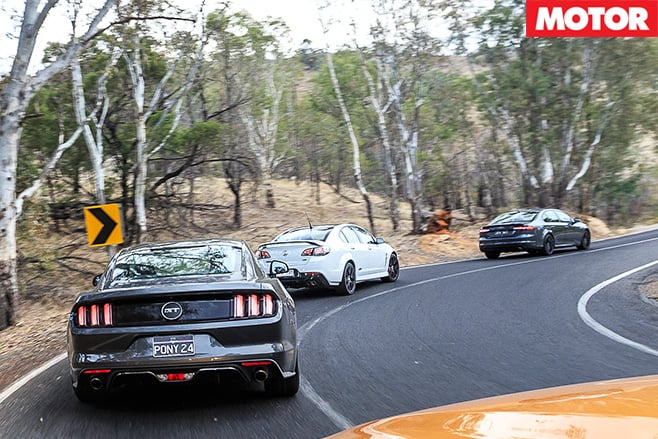
The subject of money proves that these guys all watch each other pretty closely, because on an auto-versus-auto basis, there’s just over seven grand from cheapest to dearest. And we’re only using the automatic versions for comparison because there’s no manual XR6 Sprint on offer.
But even with the slushbox, that car is great value at $54,990, just $500 more than the manual SS-V Redline. Add a self-shifter to that car and you’re looking at $57,690, still short of the $57,490 Ford is asking for the manual Mustang GT. The XR8 Sprint is the priciest at $59,990 with a clutch pedal and $62,190 without.
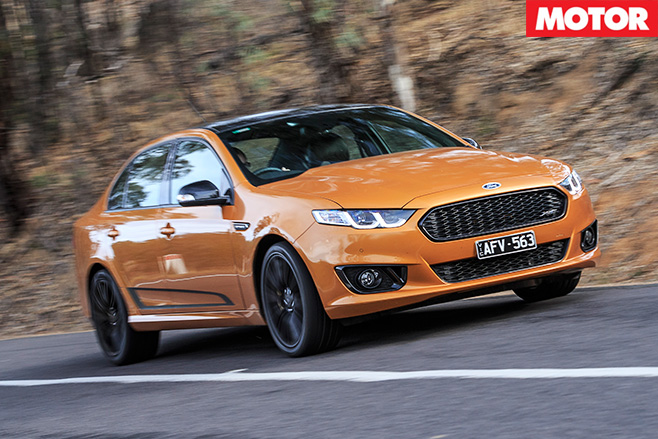
If you’re buying any of these cars (but particularly the Aussie trio) for their collectability status down the line, then you can make up your own mind about which is going to be the keeper. That’s not something we’ve set out to do here. But if you’re after a big car that can pull some dragstrip numbers as well as be an entertaining drive on a proper country road, then the Commodore SS-V comes into its own.
No, it doesn’t have the roll-on stomp of either Falcon and it isn’t as sexy as the Mustang, but it’s almost as quick on the strip thanks to better mechanical grip and it’s less of a handful on your favourite back road. And should the dragstrip suddenly become a racetrack, then our money would be on the SS-V anyway.
The numbers
0-100km/h, 0-400m: all hail the XR6!
| u00a0 | Mustang GT | XR8 Sprint | XR6 Sprint | SS-V Redline |
| 0-10km/h | 0.45 | 0.39 | 0.47 | 0.31 |
| 0-20km/h | 0.95 | 0.82 | 0.89 | 0.84 |
| 0-30km/h | 1.36 | 1.25 | 1.32 | 1.27 |
| 0-40km/h | 1.83 | 1.70 | 1.76 | 1.64 |
| 0-50km/h | 2.27 | 2.15 | 2.19 | 2.13 |
| 0-60km/h | 2.73 | 2.63 | 2.60 | 2.62 |
| 0-70km/h | 3.41 | 3.37 | 3.16 | 3.19 |
| 0-80km/h | 3.90 | 4.00 | 3.78 | 3.80 |
| 0-90km/h | 4.54 | 4.64 | 4.39u00a0 | 4.49u00a0 |
| 0-100km/h | 5.20 | 5.26 | 5.01u00a0 | 5.19u00a0 |
| 0-110km/h | 6.13 | 5.87 | 5.62u00a0 | 5.99u00a0 |
| 0-120km/h | 6.97 | 6.72 | 6.44u00a0 | 6.89u00a0 |
| 0-130km/h | 7.86 | 7.73 | 7.48u00a0 | 7.82u00a0 |
| 0-140km/h | 8.79 | 8.74 | 8.53u00a0 | 8.78u00a0 |
| 0-150km/h | 10.02 | 9.75 | 9.57u00a0 | 10.11u00a0 |
| 0-160km/h | 11.21 | 10.77 | 10.66 | 11.32u00a0 |
| 0-170km/h | 12.47 | 11.83 | 11.82u00a0 | 12.72u00a0 |
| 0-180km/h | 13.84 | 13.10 | 13.07u00a0 | N/Au00a0 |
0-400m | 13.38sec @ 176.61km/h 80-120km/h (3rd-6th) 3.2/4.4/6.4/13.7sec 100-0km/hu00a0 34.8m | 13.22sec @ 180.95km/h | 13.12sec @ 180.39km/h | 13.33sec @ 174.12km/h |
SPEED IN GEARS | 67km/h @ 6600rpm | 69km/h @ 6200rpm | 69km/h @ 6200rpm | 75km/h @ 6600rpm |
2nd | 101km/h @ 6600rpm | 122km/h @ 6200rpm | 122km/h @ 6200rpm | 110km/h @ 6600rpm |
3rd | 146km/h @ 6600rpm | 188km/h @ 6200rpm | 188km/h @ 6200rpm | 152km/h @ 6600rpm |
4th | 187km/h @ 6600rpm | 230km/h @ 5680rpm | 230km/h @ 5680rpm | 227km/h @ 6600rpm |
5th | 246km/h @ 6600rpm | 230km/h @ 4330rpm | 230km/h @ 4330rpm* | 230km/h @ 4750rpm* |
6th | 264km/h @ 4600rpm* | 230km/h @ 3440rpm* | 230km/h @ 3440rpm* | 230km/h @ 3810rpm* |
7th | N/A | N/A | N/A | N/A |
As tested by MOTOR: Heathcote Dragway, 10am, 24 degrees, dry. Driver: Scott Newman. *Manufacturer’s claim
SPECS
| u00a0 | FORD FALCON XR8 SPRINT | FORD MUSTANG GT |
| Body | 4-door, 5-seat sedan | 2-door, 4-seat coupe |
| Drive | rear-wheel | rear-wheel |
| Engine | 4951cc V8, DOHC, 32v, supercharger | 4951cc V8, DOHC, 32v |
| Bore/Stroke | 92.2 x 92.7mmu00a0 | 92.2 x 92.7mm |
| Compression | 9.3:1 | 11.0:1 |
| Power | 345kW @ 5750rpm (400kW on overboost) | 306kW @ 6500rpm |
| Torque | 575Nm @ 2220-6250rpm (650Nm overboost) | 530Nm @ 4350rpm |
| Power/Weight | 184kW/tonne | 176kW/tonne |
| Transmission | 6-speed automatic | 6-speed manual |
| Weight | 1872kg | 1739kg |
| Suspension(F) | A-arms, coil springs, anti-roll baru00a0 | struts, anti-roll bar |
| Suspension(R) | multi-links, coil springs, anti-roll bar | multi-links, anti-roll bar |
| L/W/H | 4950/1868/1493mm | 4784/2080/1381mm |
| Wheelbase | 2838mm | 2720mmu00a0 |
| Tracks | 1583/1598mm (f/r)u00a0 | 1582/1655mm (f/r) |
| Steering | hydraulically-assisted rack-and-pinion | electrically-assisted rack-and-pinion |
| Brakes(F) | 355mm ventilated/drilled discs, 6-piston calipers | 380mm ventilated discs, 6-piston calipers |
| Brakes(R) | 330mm ventilated/drilled discs, 4-piston calipers | 330mm ventilated discs, single-piston calipers |
| Wheels | 19.0 x 8.0-inch (f); 19.0 x 9.0-inch (r) | 19.0 x 9.0-inch (f); 19.0x 9.5-inch (r) |
| Tyre sizes | 245/35 R19 (f); 265/35 R19 (r) | 255/40 R19 (f); 275/40 R19 (r) |
| Tyre | Pirelli P Zero | Pirelli P Zero |
| Price as tested | $62,190u00a0 | $57,490 |
| Pros | Supercharged grunt; fitting farewell to Falconu00a0 | Supermodel looks; great engine; tidy chassis |
| Cons | Not quite as sweet to drive as the XR6 | Could do with a little more bark and bite |
| Star Rating | 4/5 | 4/5 |
| u00a0 | HOLDEN COMMODORE SS-V | FORD FALCON XR6 SPRINT |
| Body | 4-door, 5-seat sedan | 4-door, 5-seat sedan |
| Drive | rear-wheel | rear-wheel |
| Engine | 6162cc V8, OHV, 16v | 3983cc inline-6, DOHC, 24v, turbocharger |
| Bore/Stroke | 103.25 x 92.0mm | 92.3 x 99.3mm |
| Compression | 10.7:1 | 8.76:1 |
| Power | 304kW @ 6000rpm | 325kW @ 6000rpm (370kW on overboost) |
| Torque | 570Nm @ 4400rpm | 576Nm @ 2750rpm (650Nm on overboost) |
| Power/Weight | 170kW/tonne | 179kW/tonne |
| Transmission | 6-speed manual | 6-speed automatic |
| Weight | 1793kg | 1818kg |
| Suspension(F) | struts, coil springs, anti-roll bar | A arms, coil springs, anti-roll bar |
| Suspension(R) | multi-links, coil springs, anti-roll bar | multi-links, coil springs, anti-roll bar |
| L/W/H | 4939/1898/1474mm | 4950/1868/1493mm |
| Wheelbase | 2915mm | 2838mm |
| Tracks | 1593/1590mm (f/r) | 1583/1598mm (f/r) |
| Steering | electrically-assisted rack-and-pinion | hydraulically-assisted rack-and-pinion |
| Brakes(F) | 355mm ventilated discs, 4-piston calipers | 355mm ventilated/drilled discs, 6-piston calipers |
| Brakes(R) | 360mm ventilated discs, single-piston calipers | 330mm ventilated/drilled discs, 4 piston calipers |
| Wheels | 19.0 x 8.5-inch (f); 19.0 x 9.0-inch (r) | 19.0 x 8.0-inch (f); 19.0x 9.0-inch (r) |
| Tyre sizes | 245/40 R19 (f); 275/35 R19 (r) | 235/35 R19 (f); 265/35 R19 (r) |
| Tyre | Bridgestone Potenza RE050A | Pirelli P Zerou00a0 |
| Price as tested | $54,490u00a0 | $54,990 |
| Pros | Awesome engine; top-notch chassis | Probably the best Aussie Ford ever |
| Cons | Interior material mismatch; outgunned at strip | A little more noise would be nice; sold out |
| Star Rating | 4.5/5 | 4/5 |
The GTS-R badge will be returning to Australian roads thanks to HSV. Sister publication Wheels first revealed the story earlier this year, and remains confident the project will go ahead.
Our other sister magazine; Motor, has done some more digging, and is able to confirm what engine will power the fabled GTS-R.
Despite what the rumour mill might suggest, HSV’s freshly imported batch of LS9 engines will not be wedged under the bonnet of the GTS-R. No, instead the Corvette engines will be saved for a more powerful, faster, ‘Final Edition’.
The GTS-R will receive the same LSA platform as the standard GTS (if you can call it that). However, it will be packing more punch thanks to further tweaking from the boffins at HSV.
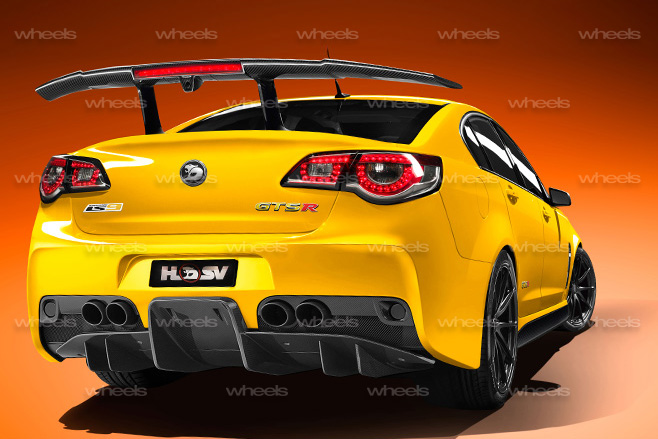
To put that into perspective, the current GTS packs 430kW and 730Nm, which propels it to 100km/h from a standstill in 4.5 seconds.
It is expected the GTS-R’s tweaked LSA will slot between that in the GTS, and the LS9-powered car when it arrives.
The LS9 comes from the previous generation Corvette ZR1, and pushes out 476kW and 820Nm.
It is poised to be placed in the most powerful – and expensive – Australian car ever built.
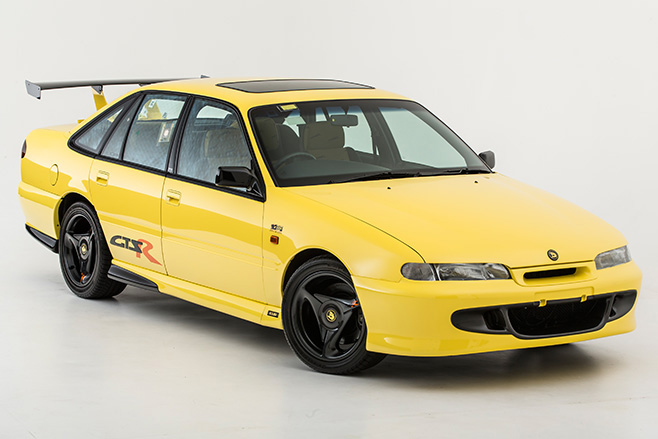
The as-yet unnamed vehicle will be built on the GTS VF platform, but receive new bumpers, aero, and suspension along with the 6.2-litre supercharged engine.
Costs of the ‘Final Edition’ could soar as high as $165,000 thanks to the fact it will be built with two engines.
Holden would first have to install the LSA in the car at Clayton, before it is handed over to HSV, who will shoehorn the LS9 under the bonnet.
The time of Aussie-built V8 brawlers is coming to a close, but they won’t be disappearing without a fight.
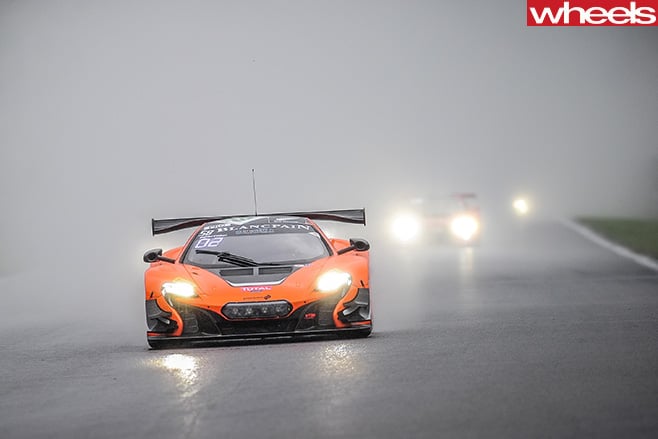
Shane van Gisbergen gets another golden opportunity to showcase his already impressive international driving credentials in next weekend’s the 24 Hours of Spa, the Supercars star spearheading the Garage 59 factory McLaren with an ambitious, yet realistic target of overall victory.
The kiwi joins France’s Come Ledogar and Britain’s Rob Bell in one of three Garage 59 McLaren 650 S GT3s entered in the Belgian endurance classic, which takes place on July 30th.
The best-known Mercedes entry, the AMG Black Falcon GT3, looks a huge threat with Bernd Schneider, Maro Engel and Yelmer Buurman mixing pace with experience in a proven package.
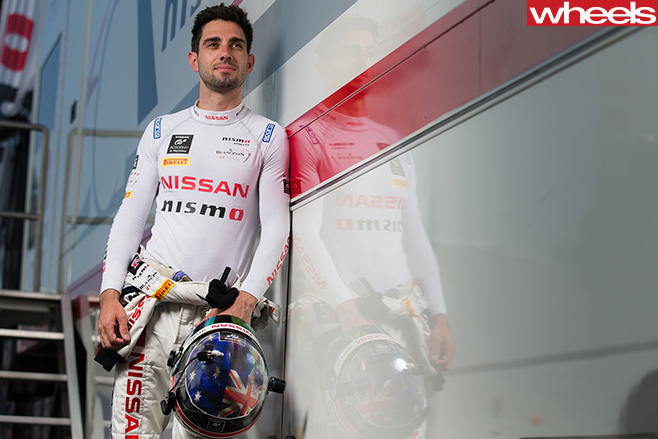
Queenslander Liam Talbot is sharing Ferrari 458 Italia GT3 in the Am class with Italians Marco Zanuttini, and Nicola Cadei, and Russian Vadim Glitin.

Talbot is now a regular on the endurance racing scene in Europe and he heads to Spa on a high following the team’s first victory of the season secured in the previous round in a 1000km race at Paul Ricard.

McLaren’s plans to develop a one-off electric vehicle prototype are progressing, with company CEO Mike Flewitt revealing more details about the – as yet un-named – vehicle.
Speaking at his company’s financial results announcement, Flewitt revealed that McLaren had commenced discussions with a number of electric motor and battery manufacturers, with a view to sealing supply deals.
Flewitt also announced that the prototype will take its cue from an existing McLaren platform. “We’ll build [the EV prototype] into an existing architecture; it may even end up being the 12C architecture initially, maybe with a conventional suspension system, because we want to learn step-by-step.”
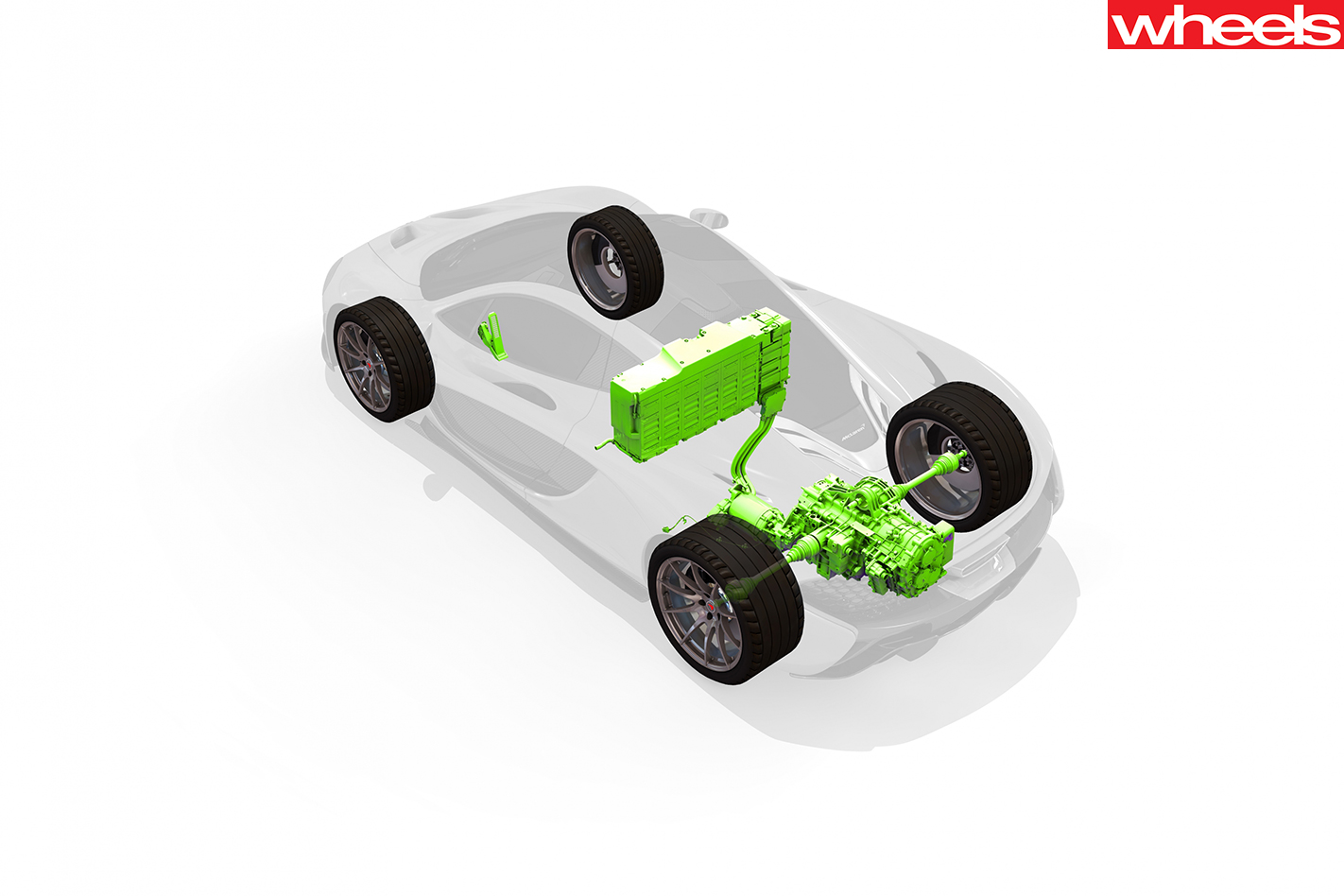
Flewitt was also aware that part of McLaren’s strength was the attraction of its engine noise, and that the significantly quieter electric motors presented engineers with a significant challenge.
“One of things we debate all the time in-house is the noise and vibration,” said Flewitt. “With our cars we tune noise – we don’t just try to obliterate it. If you’ve driven a 650S and a [McLaren] 675LT back-to-back, one of the things that communicates the difference – even at fairly low speed – is a little more vibration that comes through in the 675 from the way the engine is mounted in the car. Little things like that can be very important, but they all vanish when you remove the engine.”
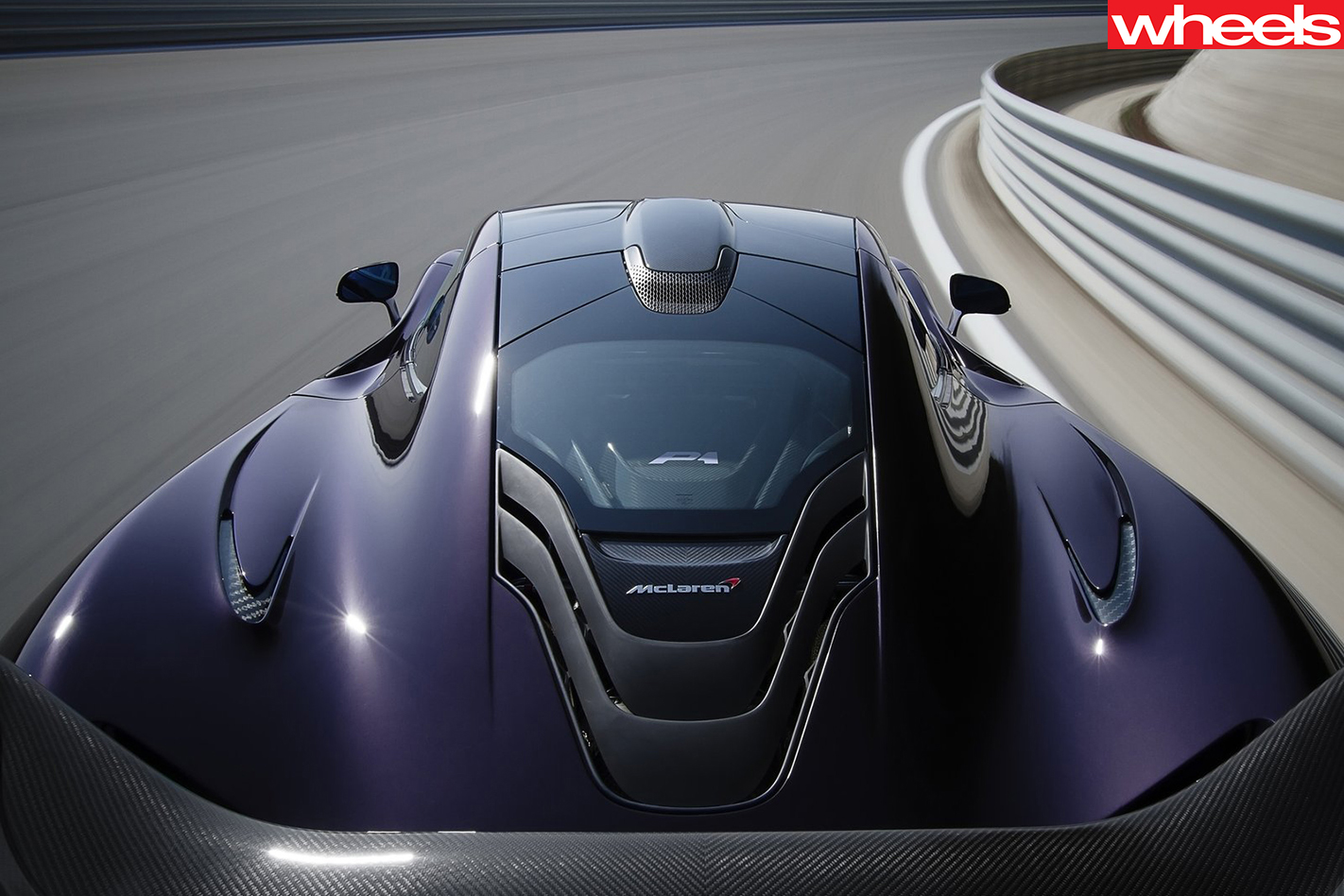
While we’ve previously learned that McLaren is working on smaller powerplants – which we reckon will be a V6 spun from the same architecture as the existing V8 – Flewitt also dropped a chunky hint that new engines will come packaged with a hybrid system. “Yeah, we’ll continue to downsize,” he said. “We’ve got to address emissions because markets are putting ever more pressure on us. We would design something with the capability to integrate hybrid in an efficient way, rather than being a bolt-on system. It’s integrated from day one; that’s the focus.”
McLaren has said that half the models it will produce by 2022 will be hybrids, and the betting is that the new six-cylinder engine is likely to have its first outing in either the mid-term facelifted Sports Series or one of the son-of-650S ‘P14’ variants that will start being launched next year.
Following a successful trial, the Victorian State Government will look to implement an intelligent speed limit management system as part of its $300 million dollar upgrade for the Western Ring Road between Station Road and the Calder Freeway.Designed to reduce congestion, the technology – known as the Adaptive Variable Speed Limit System – anticipates congestion before it happens and alters the posted speed accordingly, to ensure a smoother flow of traffic.In a statement released by Victoria’s Minister for Roads Luke Donnellan, authorities are hoping the system will reduce overall congestion for the 160,000 daily users of the road, but specifically relieve the “pinch-point where traffic has to move from four lanes, down to two,” the statement read.“Drivers can expect to see speed limits change before traffic become heavy, particularly during morning and afternoon peak times.”Minister Donnellan said: “We are applying the world’s best traffic management practices to roads right here in Melbourne.“By being smarter about the way we manage traffic, we can get Victorians home sooner so they can spend more time with their family and friends.”The statement also revealed the results would be closely monitored and evaluated, with a longer-term view of rolling the system out more broadly across the state, if deemed successful.The technology was trialed on Melbourne’s Monash Freeway in collaboration with the Technical University of Crete.WhichCar has contacted the Minister’s office for confirmation of the official launch date and we’ll update you as we find out more. Stay tuned.
Want more? Re-charge your electric car on the go.
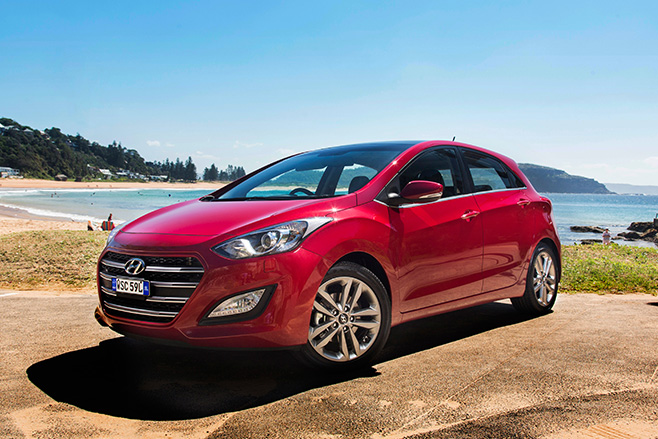
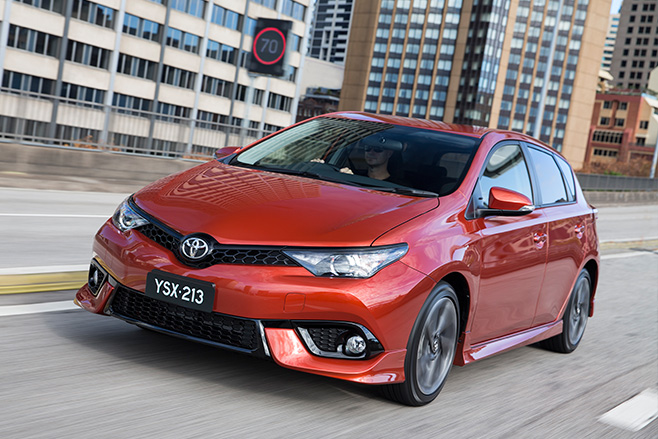
The Hyundai i30, Mazda 3 and Toyota Corolla are not only the best-selling hatchbacks in Australia, they’re also competing to be the country’s most popular model for 2016.
They have already accounted for nearly 64,000 sales between them up to the end of June
If you’re planning to join the bandwagon – or should that be bandhatch? – here’s WhichCar’s quick guide to the pros and cons of each model.
Priced from $20,990 – $34,190 (but check for deals)
The South Korean brand’s small car no longer comes in three-door or wagon form, while its sedan spin-off carries a different nameplate: Elantra. Yet the five-door-hatch-only model is going gangbusters in the sales race, mostly thanks to a generous driveaway deal on its entry-level Active trim grade that has been saving buyers thousands over the normal cost. So the i30 is typically the pick if you’re looking for the sharpest-priced hatch here, while the Hyundai also offers the longest warranty of the group at five years. It also has the biggest boot (381 litres), though it’s not as sporty to drive as either the Corolla or Mazda 3 and lacks tech options.
Priced from $19,790 – $30,990
A new hybrid variant released in mid-2016 means Toyota’s long-living nameplate offers the most fuel-efficient model among this small-car triple act. A petrol engine and electric motor combination produce an official fuel consumption of just 4.1 litres. The drawback is that the Corolla Hybrid is heavier than the regular models; all are powered by a 1.8-litre petrol engine only, and also more expensive – with the exception of the top-spec ZR. Toyota has done a good job of making the 11th generation Corolla a more accomplished driving experience compared with some of its more immediate predecessors. An updated sedan version is due in early 2017, which will be available with a range of active safety tech. Toyota Australia has confirmed the hatch will add the same features to its offerings around the same time.
Priced from $20,490 – $37,040
Our immediate advice is don’t buy a Mazda 3 right now. An updated version lands in August, bringing a raft of upgrades and new features. The 3 already offers one of the widest ranges of tech in the small-car segment, but it will add Traffic Sign Recognition (which helps keep the driver aware of speed limits) and multi-function, adaptive LED headlights. Mazda’s hatch is already the driver’s choice here, though a new G-Vectoring Control system aims to make the 3 flow even better on interesting roads by subtly reducing engine torque when the steering wheel is turned for a corner – to help balance the car for turning into a corner. A 2.5-litre is the pick of two good petrol engines offered. The 3’s boot is far from impractical, though it is the smallest here at 308 litres, while the Mazda’s on-road experience can still be slightly blighted by road noise.