
Lexus has finally force-fed its sporty looking RC coupe, adopting the 2.0-litre turbo four from sister-car the IS sedan. It’s a good match, and makes a poised and graceful daily drive.
WHAT IS IT? The RC200t is the new entry-level version in Lexus’s two-door RC range. It’s the first four-cylinder RC, using the same turbocharged engine introduced in the IS200t sedan. And it’s the most affordable RC yet.
WHY WE’RE DRIVING IT This is our first taste of the 200t in Australia, and it’s tipped to be the volume seller of the three-model line-up, sitting below the V6-powered Lexus RC350 and fire-breathing RC-F V8.
MAIN RIVALS BMW 428i, Mercedes-Benz C250 Coupe, Audi A5 2.0 TFSI quattro
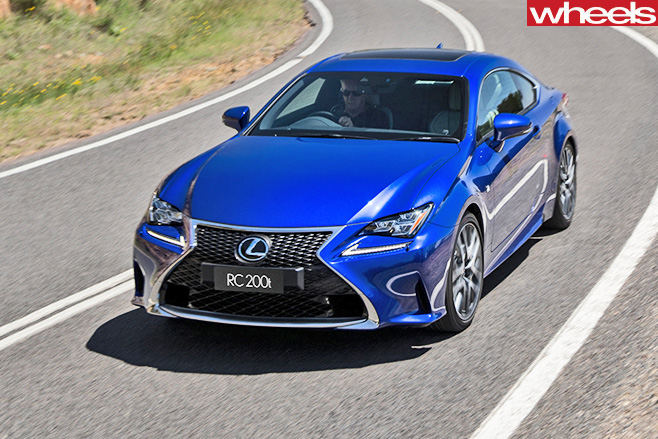
THE WHEELS VERDICT
The RC200t is a smart, well-built and polished coupe. It’s more convincing as an around-town, everyday plush two-door thanks to its ride, equipment levels and fuel efficiency. But if you’re after a sports coupe, it’s uncomfortably close to the V6-powered RC350 in price.
Plus: Unique style, excellent attention to detail, engine and cabin refinement Minus: Only $3k cheaper than V6; heft over IS sedan; lacks rivals’ dynamic sharpness
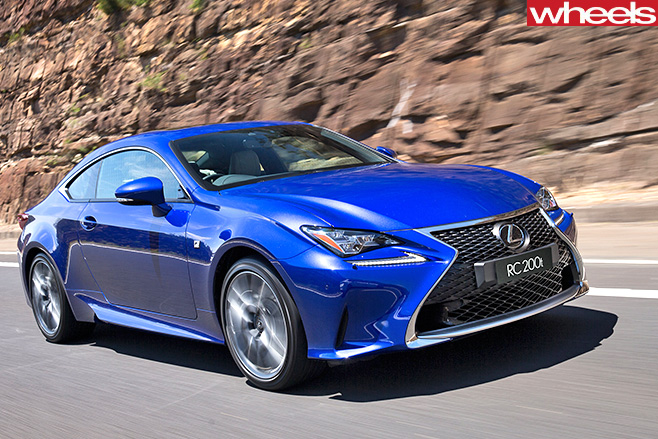
The rear-drive RC200t starts at $64,000 to sit at the same eye-level as the BMW 428i and Mercedes C250 Coupe. Yet it’s only $3000 less than the RC350, which comes with a 225kW 3.5-litre V6. The 200t’s new 2.0-litre turbo-petrol four delivers 180kW/350Nm.
The $3K walk (step, rather) between four-pot and V6 is consistent across all three RC200t variants, which start with the Luxury we’re driving here, then F-Sport and flagship Sports Luxury. There must be something special about the 200t, then.
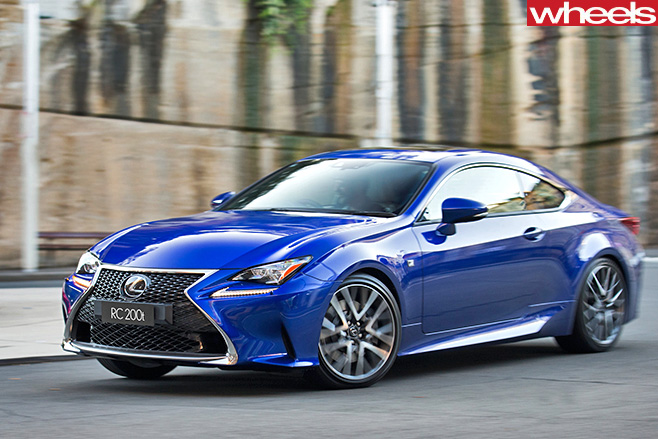
At idle, the four-cylinder is near silent, and there’s no fuss as you accelerate serenely around town. This is where the RC200t is the pick, with better throttle response and refinement than the V6, bolstered by a 7.3L/100km claim (against the 350’s 9.4L/100km). Give the 200t a heavy dose of throttle, and the response is an adequate, obedient march rather than a sporty, aggressive shove, even in the Sport drive mode. The 7.5sec 0-100km/h claim means it’s hardly slow, but nor is the 200t first choice for your local traffic-light derby.
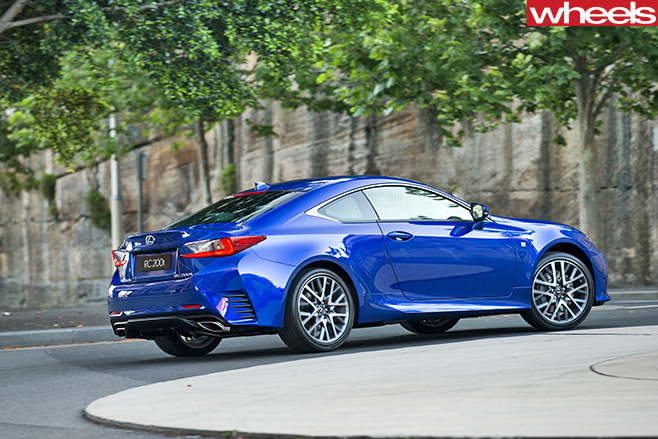
Tackle a bend, and the front-end lacks sharpness and accuracy, with turn-in needing a good chunk of lock before the steering weighs up, the front treads quickly taking over road-holding duties. That said, change of direction is well managed, even if the RC200t picks up every mid-corner undulation and surface change. Its ride is more beneficial around town, where it’s supple and well sorted.
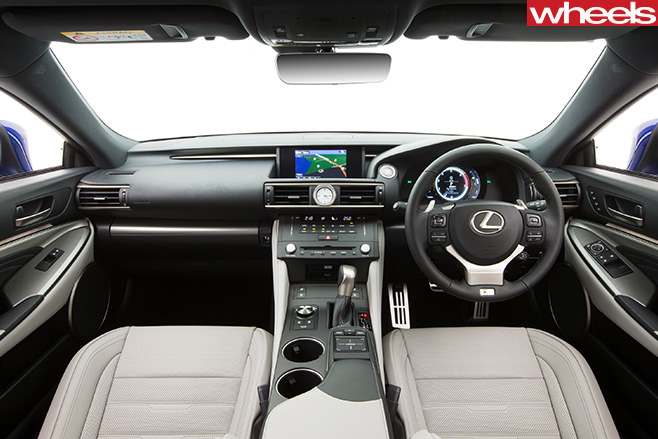
SPOOLIN’ AROUND The 1998cc four-cylinder turbo, codenamed 8AR-FTS, made its Lexus debut in the RAV4-based NX SUV last year. Now, it’s offered in the GS sedan, RC200t and the IS200t. In all, it makes the same 180kW/350Nm and is mated to the BRAND eight-speed auto.
Compare the RC200t directly to its sedan counterpart, the IS200t, and it carries 55kg more weight, somehow uses 0.2L/100km less fuel, and costs $6500 more. It’s expected to be the most popular RC model, making up 40 percent of a predicted 80 sales a month.
SPECS Model: 2016 Lexus RC200t Luxury Engine: 1998cc 4cyl, dohc, 16v, turbo Max power: 180kW @ 5800rpm Max torque: 350Nm @ 1650-4400rpm Transmission: 8-speed automatic, rear-wheel drive Weight: 1675kg 0-100km/h: 7.5sec (claimed) Fuel economy: 7.3L/100km Price: $64,000 On sale: Now
The Mercedes-AMG A45 will become $2200 more expensive when the facelifted model arrives in February – but it won’t be its maker taking that entire surcharge.
Now priced from $77,900 plus on-road costs, the 2.0-litre turbo A45 now boasts boosted outputs of 280kW and 475Nm, rising 15kW/25Nm on the outgoing car.
It’s enough, along with shorter third to seventh gears inside the seven-speed dual-clutcher, to lower the claimed 0-100km/h sprint from 4.6 seconds down to just 4.2sec. No coincidence it passes the Audi RS3’s 4.3sec claim with this update.
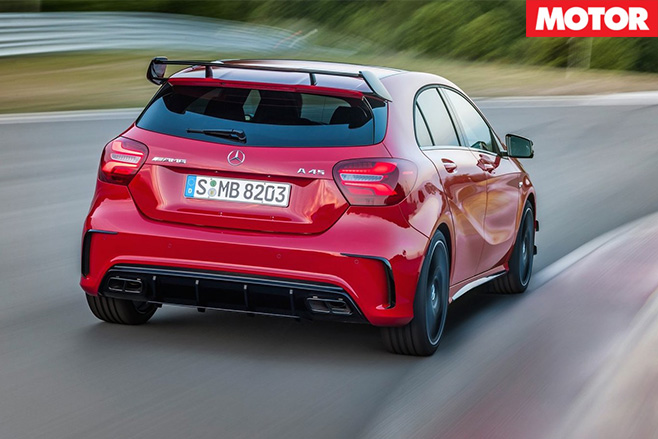
It means the A45 will now be stung by the expensive-car tax.
AMG has also worked to address ride quality criticism of its original hot-hatch by making adaptive suspension standard with the update.
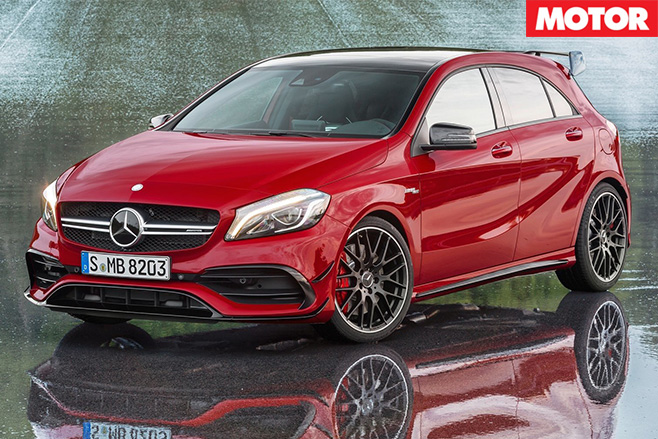
Comfort now decouples the transmission when cruising between 60km/h and 160km/h, for example, as well as hopefully being soft enough for around town cruising. The previous fixed dampers certainly were not
Sport turns off the stop-start system, firms up the suspension and makes the engine sound “more throaty”. And so it goes up from there, though an Individual mode can also bundle your favourite settings, such as loud engine with softer suspension.
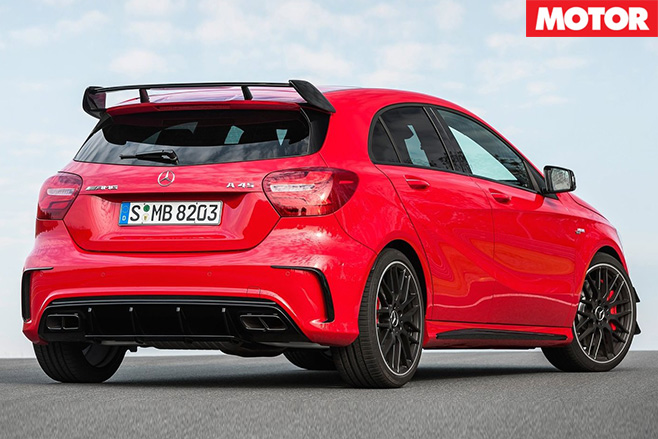
Full specification details of the facelifted A45 will be announced when the vehicle arrives at local Mercedes-AMG dealerships in January.
What stands out?
The Clubman is the biggest, roomiest and most practical Mini you can buy. So if you’ve got kids, or simply need more space, and love the look and quirky character of the Mini brand, this is the Mini for you. It still steers like a go-kart, and the least costly Clubman has a great little engine.
What might bug me?
Getting home if you puncture a tyre – although that won’t be a problem around town. The Mini uses run-flat tyres, which means that if a tyre goes flat you just keep driving. However, you are not supposed to drive faster than 80km/h, nor further than 80km. And there is no spare. If you get a flat while on a drive in the country, you could be in strife.Loading stuff into the boot. The opening is small, and the loading sill shallow. And while you can open the vertically split rear doors by waving your foot below them, this “kick” function (optional on Cooper and standard on Cooper S) is finicky and temperamental.Having to wait for your manual Clubman. An automatic gearbox is standard, so if you want a six-speed manual – as you might in the sportier Cooper S, especially – the dealer will have to order you one.
What body styles are there?
The Clubman is offered solely as a six-door wagon. Yes, six doors, thanks to the Clubman’s vertically split doors at the back, which hark back to the original Clubman Estate built from 1969 until 1982.All seat five and are front-wheel drive. The Clubman is classed as a small car, and straddles the lower and upper price brackets.
What features do all Clubmans have?
Cruise control, a reversing camera, and rear parking sensors. Dual-zone air-conditioning, which allows you to set different temperatures on either side of the cabin. Air-conditioning vents for rear passengers. Windscreen wipers that operate automatically when it rains.A tyre pressure monitoring system, which warns you if a tyre has started to go flat. (This can give you more time to get a puncture seen to.) Wheels made from aluminium alloy (16-inch diameter on the least costly model, the Cooper), which are lighter than steel wheels and look nicer.A six-speaker sound system with Bluetooth and USB connectivity for your smartphone. A 6.5-inch, centrally mounted colour screen.Automatic transmission, as standard equipment. (You can also order a manual gearbox.)Six airbags: two directly in front of the driver and front passenger; one alongside each front occupant to protect the upper body; and a curtain airbag on each side protecting the heads of front occupants.Electronic stability control, which can help you control a skidding car. All new cars must have this feature.A forward collision warning system, which alerts you visibly and audibly if it decides you are about to crash into something.Every Clubman comes with an unlimited kilometre, three-year warranty.
Which engine uses least fuel, and why wouldn’t I choose it?
The turbocharged, 1.5-litre three-cylinder engine in the least costly version, the Clubman Cooper, uses least petrol, consuming 5.4L/100km in both automatic and manual guises on the official test (city and country combined).This is a great little engine, and you always feel like it has plenty of power. The main reason you might not choose it is that you want a more engaging exhaust note, and more power.You get both from the turbocharged, 2.0-litre four-cylinder petrol in the sportier Cooper S. It uses a bit more fuel but is still pretty good: 5.9L/100km in automatic trim, and an extra half-litre as a manual.In addition, while the Cooper’s automatic gearbox has six ratios, the Cooper S auto gearbox has eight – which allows the engine to spend more time in its best working range. Both are conventional autos, rather than the dual-clutch type, so that they’re good around town. The manual box in either case is a six-speeder.
What key features do I get if I spend more?
Paying more for the Cooper S brings you the bigger, more powerful engine and, in standard trim, the eight-speed automatic gearbox. You also get satellite navigation, seats that hold you in place better around corners, and a three-spoke, leather-trimmed steering wheel.The Cooper S also rolls on bigger, 17-inch wheels, shod with tyres of a lower profile (which bring more grip).And you get three driving modes, which let you adjust the accelerator response while you’re driving. A rotary switch at the base of the gear selector allows you to choose Green (for a lazy response and better fuel economy), Sport (for a more energetic response, or Mid (which is in-between).A wide range of option packages is available for both Clubmans, which add styling touches and equipment. Popular packages include Multimedia Pro, which brings a bigger (8.8-inch) multimedia screen, a 12-speaker sound system with digital radio, and a head-up-display, which projects speed and navigation details onto a small screen just above the steering wheel. This helps you keep your eyes on the road.A Driver Assistant Package gets you some camera-based safety systems. One is radar cruise control, which slows you to the speed of a vehicle ahead. Another is automatic emergency braking, which works at city speeds: it will help brake the car if it sees a looming collision before you do. A third is high-beam assist, which dims the headlights automatically if it detects an approaching vehicle at night.Another key option, available on either model for less than $1000, is adaptive dampers. This allows you to adjust from the cabin how the suspension responds to bumps: more stiffly, for improved handling, or more softly, for greater comfort on bumpy roads.
Does any upgrade have a down side?
The downside is mainly how fast the optional equipment packages drive up the cost of the car. Package prices range from a bit more than $2000 to well over $6000. Combining two or three packages can quickly push you to a price point where more choices from other makers become available.The ride is bumpier on the 17-inch wheels and lower-profile tyres of the Cooper S, because there is less cushioning air between the wheels and the road.
How comfortable is the Mini Clubman?
Compared with a regular five-door Mini hatch, the Clubman is 27cm longer, 9cm wider, and has 10cm more space between the front and rear axles. Interior space is generous, with Mini making the most of the larger dimensions.The front seats are comfortable and the entire cabin is roomy, which makes it feel not so … mini. The interior also feels well-made and is full of Mini styling touches. However, some plastics are hard and of poorer quality than plastics in alternatives such as the Audi A3 and Volkswagen Golf.The run-flat tyres deliver a lot of tyre noise on coarse chip roads, and on rough roads the standard suspension feels firm and unsettled. Paying extra for the optional adaptive dampers is money well spent. On smooth roads, however, the Clubman is reasonably quiet inside.The split rear doors inhibit rear visibility, due to the large join in the middle of the rear window.
What about safety in a Clubman?
The Clubman has excellent safety credentials. Standard equipment includes six airbags, stability control, a rear-view camera, rear parking sensors, and a forward-collision warning system that triggers visual and audible alerts if you fail to spot an obstacle.Several safety-focused driver assistant systems are available as options, such as adaptive cruise control, auto-dipping headlamps, and low-speed auto emergency braking.(To see a list of the safety features on any model, open the model from the Cars Covered By This Review dropdown near the top of this page, and look under the features tab. Safety-related features are listed in red.)The Australasian New Car Assessment Program (ANCAP) has not rated the Clubman.
I like driving – will I enjoy this car?
Minis are known for their go-kart-like handling and the new Clubman is no exception. Keen drivers will appreciate the sharp steering, the balanced chassis, and the positive front axle that helps you turn into corners quickly, provides a good amount of grip and inspires confidence.The Clubman’s longer wheelbase helps it feel more composed and stable, when driven hard, than the more skittish Mini five and three-door hatches.The Cooper S is the more engaging of the two Clubman variants, thanks to its rortier 2.0-litre engine, greater grip, and an exhaust note that in Sport mode cracks and pops on overrun.
How is life in the rear seats?
Spacious and comfortable, even if the back seat is not as big as it looks. Mini is stretching the truth in claiming that the rear bench is big enough for three adults. However, two adults and a child will fit easily, thanks to ample knee room even for tall people.The main complaints are insufficient thigh support and no central rear rest (although this can be added as an option).The seat is set high, which improves outward vision. And rear passengers get dedicated air-conditioning vents.
How is it for carrying stuff?
The new Clubman’s boot measures 360 litres, which is on the small side for this class. For comparison a Volkswagen Golf’s boot volume is 380 litres.Folding the Clubman’s 60:40 split rear seats boosts space to 1250 litres. You can option a 40:20:40 split rear seat, which allows you to fold just the centre section if you need to carry long, thin items and passengers at the same time.
Where is the Mini Clubman made?
The Mini Clubman is made in Oxford, England.
What might I miss that similar cars have?
Perhaps a better trimmed cabin. While its interior is quirky and comfortable, some of the Clubman’s cabin materials feel hard and cheap. As a whole, the Clubman’s cabin can’t match the quality, luxurious feel or design execution of the similarly priced Audi A3 and Volkswagen Golf.And even though keen drivers will enjoy the Clubman’s sharp dynamics, particularly in the Cooper S, it’s still not as fun or as engaging as some other performance-focused hatches, such as the Volkswagen Golf GTI.
I like this car, but I can’t choose which version. Can you help?
Drivers seeking the most engaging and sporty experience should opt for the Cooper S Clubman.However, the cheaper Cooper Clubman is arguably the sweeter car. Its three-cylinder engine is strong and more fuel-efficient, and the ride on its smaller 16-inch wheels is more comfortable and supple. To improve the comfort even further, pay the extra for the adaptive dampers. We’d opt for the base Cooper with adaptive dampers.
Are there plans to update the Clubman soon?
No, the Clubman is a new generation vehicle. However, Mini does plan to add variants in 2016. An even more powerful and sportier John Cooper Works version is likely, and Mini Australia is considering the diesel-powered Cooper D Clubman, which is available overseas.
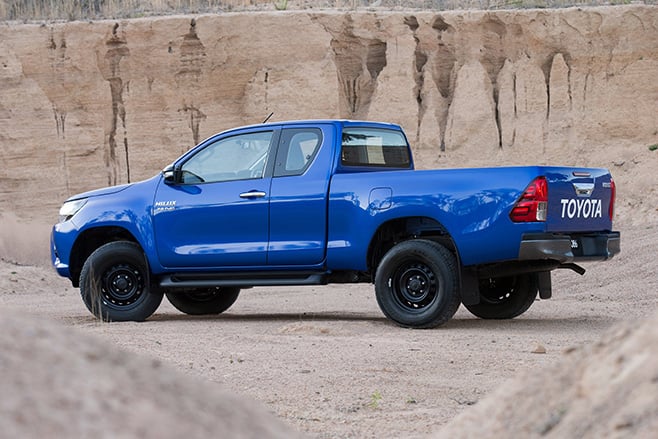
Toyota’s all-new eighth-generation Hilux has been more than six years and one million kilometres in the making. Toyota claims it’s a clean-sheet design that’s tougher yet more efficient, refined and better equipped than the outgoing Hilux that was launched in 2005. As well as the choice of two completely new, more efficient diesel powertrains, the new Hilux boasts an all-new chassis and three all-new cabins.
Fortunately for Toyota, the product-cycle timing in the wider market has also allowed the new Hilux to be benchmarked against the best of its competitors, namely the Volkswagen Amarok and the Ford Ranger, which has no doubt worked to its betterment.
More than 650,000km of the Hilux’s development was undertaken right here in Australia, resulting in locally developed and tested suspension and an underbody protection package for vehicles sold in tough markets like Australia, South Africa, the Middle East, Russia and South America.
The new Hilux comes in 31 variants, 19 are 4×4 models, more than half of which are dual cabs that come in four equipment levels: Workmate, SR, SR5 and SR5+.
POWERTRAINS
The Hilux 4×4 comes with three engines, one of which comes in two states of tune. The smaller of two all-new diesel engines is the 110kW/400Nm 2.4-litre 2GD-FTV, which is offered with both the new six-speed manual and the new six-speed automatic, but only in Workmate models.
The all-new 2.8-litre 1GD-FTV diesel (also just introduced in the Prado) fills out the rest of the range and claims 130kW/450Nm when mated to the six-speed auto and 130kW/420Nm when mated to the six-speed manual.
The largely unloved 175kW/376Nm 4.0-litre petrol V6 is carried over from the previous-generation Hilux, but is only available as a dual-cab automatic.
CHASSIS AND SUSPENSION
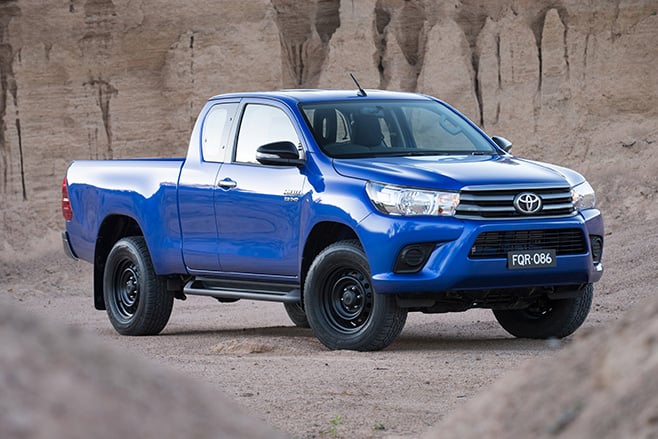
The new Hilux boasts a ladder frame with 20 per cent more torsional stiffness than the outgoing model thanks to 30mm-wider side rails and cross-members. The bodies are stiffer, too, thanks to higher-grade steel and 45 per cent more spot welds, and they’re dropped onto the chassis with more chassis-mounting points.
At the rear the leaf springs are 100mm longer than before and are mounted 50mm farther apart, while bigger-diameter dampers are now mounted forward of the axle. This improves rear-wheel travel by 520mm; a 67mm increase over the old model. At the front the double-wishbone suspension features revised springing, new swaybars and larger-diameter dampers. The new 4×4 Hilux also has more extensive and robust underbody protection.
INSIDE
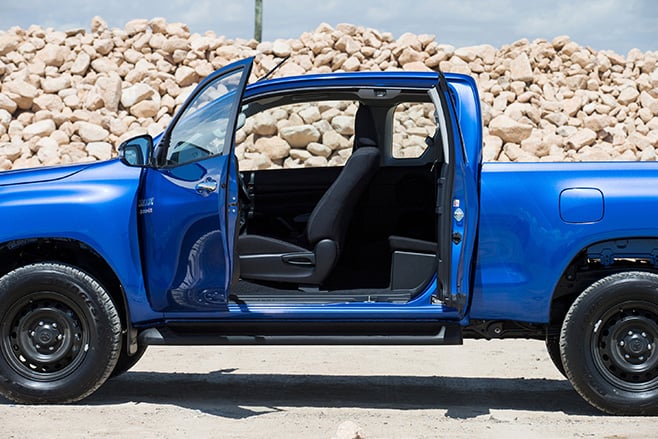
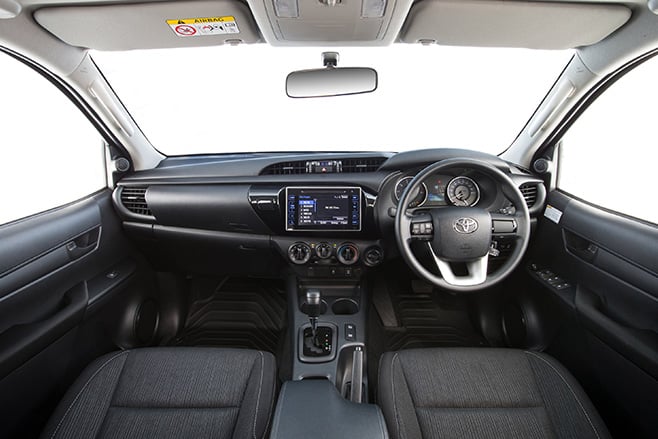
The Hilux’s new cabin isn’t notably larger than that of the outgoing model; although, there is slightly more shoulder and headroom up front and, importantly for driver comfort, all 4×4 models (even single cabs) have tilt and reach steering-wheel adjustments. SR and SR5 models also benefit from seat-height adjustment while the SR5+ gains electric seat adjust.
Rear-seat passengers have a bit more legroom, while the rear seat base in SR and SR5 dual-cabs now splits 60/40 and has a stowable armrest.
The cabin certainly feels more passenger car than commercial vehicle, thanks in part to a tablet-style multi-function touchscreen that dominates the dashboard on all models, including the Workmate.
As expected, the new Hilux has achieved the maximum five-star ANCAP safety rating.
ON THE ROAD
Both diesels sound far more refined and quiet right from start-up. Once underway they have far less diesel rattle and diesel knock than the old 3.0-litre engine. Despite just a 4kW increase in maximum power over the outgoing 3.0-litre, the 2.8 offers far better response and general flexibility, thanks to an extra 90Nm with the auto ’box and 77Nm with the manual.
The 2.8-litre actually feels more willing with the manual gearbox, despite having 30Nm less than the auto ’box.
In SR5 spec the 2.8’s manual gains a mode which softens the shifts by matching the engine revs from one gear to the next and makes the engine all but stall-proof on take off.
In many ways the smaller 2.4-litre diesel is, however, the real surprise as it gives little (or even nothing) away to its bigger brother in most driving situations, even if it ultimately can’t match the pedal-to-the-metal punch of the 2.8.
The 2.4 claims 16kW less than the outgoing 3.0-litre diesel, but has 40Nm more torque in auto form and 57Nm more as a manual; a good indicator of just how efficient these new-generation diesels are.
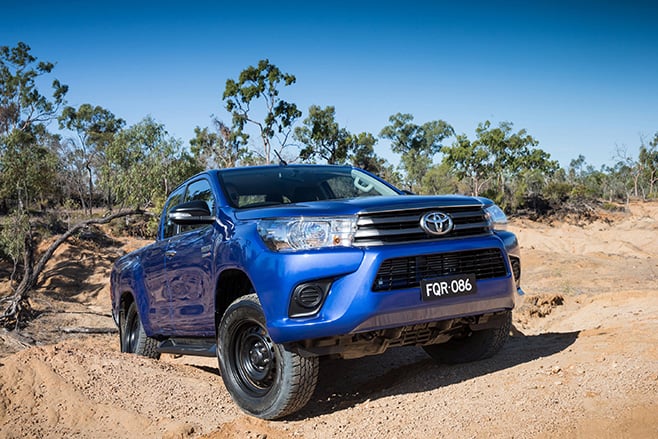
Both diesels mate nicely to the new six-speed auto, which has two overdrive ratios and is a more refined gearbox than the five-speed automatic introduced less than two years ago with the previous-generation Hilux diesel.
The new Hilux also rides and handles better. Even though it still feels like a ute thanks to its load-carrying rear suspension, the overall ride compliance and front-to-rear suspension match is much improved, as is steering feel.
OFF-ROAD
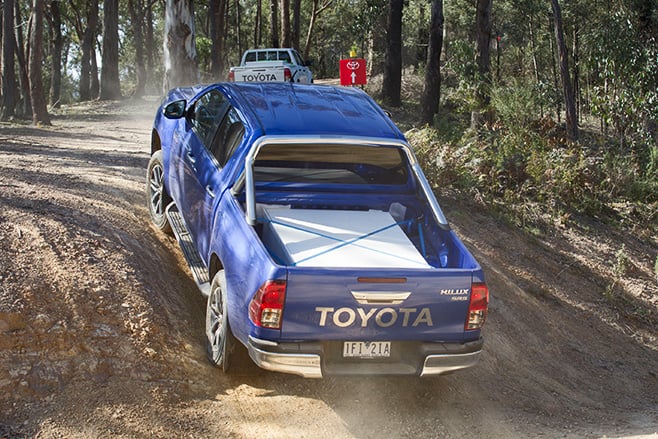
As good as the new Hilux is on-road, the biggest improvements are felt off-road, thanks to the longer rear wheel travel, extra ground clearance and, more significantly, the new A-TRC electronic traction control.
The new A-TRC is more aggressive in limiting wheel spin than the traction control of the previous-generation Hilux, so much so that the rear diff lock, which is now standard on the SR and SR5 models, is almost redundant. When the rear locker is engaged the A-TRC is disabled on the front axle; a move that’s in the interest of driveline durability, according to Toyota.
A-TRC can also be completely switched off in situations (like mud and sand) where momentum is more important than traction.
EQUIPMENT
All Hilux 4x4s come with seven airbags, a reversing camera (accessory for cab-chassis), Bluetooth, tilt-and-reach steering wheel adjustment, cruise control, daytime running lamps, and electronic traction and stability control incorporating trailer-sway control.
Over the Workmate, the SR adds sidesteps, carpets, an up-spec audio, a larger touchscreen, a cooler/heater box, driver’s seat-height adjustment and a rear diff lock.
The SR5 then adds 18-inch alloys (in place of the 17-inch steels of the Workmate and SR), privacy glass, chrome grill and rear step, fogs lights, LED DRLs, a sports bar, auto key/push-button start, climate control, on-road sat-nav, digital radio, and a premium instrument cluster.
SR5 Pick-Ups also have smooth-sided tubs rather than tubs with external tie downs as per the Workmate and SR models. Over and above the SR, the SR5+ then adds leather and electric driver’s seat adjustment.
SUM UP
Given that the outgoing Hilux has been the best-selling vehicle in its class, it’s hard to see how this new Hilux will do anything but build on that success. It looks like the ute might even outsell the best-selling traditional passenger cars. And while some buyers may be concerned about the move to smaller engines, the new diesels, even the 2.4, manage to produce more torque than the old 3.0-litre, without having to rev any harder or rely on higher compression ratios. You can put that down to improved combustion efficiency.
The new Hilux also manages to be more civilised on the road and more capable off-road, and it can tow and carry more, too. We can’t wait to line it up against its competitors.
This article was originally published in 4×4 Australia December 2015.
Click here to read the full range review on the Toyota Hilux.
So, what is it?
According to local Lotus boss Glen Sealey, “The Exige S is a lifestyle choice, and not for everyone.” However, in the same breath he concedes the whole idea of an automatic version of this featherweight missile is to broaden its appeal, mainly to women.
Why should I care?
The Exige S is light, raw and uncompromising; the pay-off being blinding speed and intimate dynamic responses. The auto may tip the scales six kegs heavier than the manual, but its greater driveline efficiency means it’s a tenth quicker from 0-100km/h, and able to record the same lap time around the factory test track back at Hethel HQ.
What’s new about it?
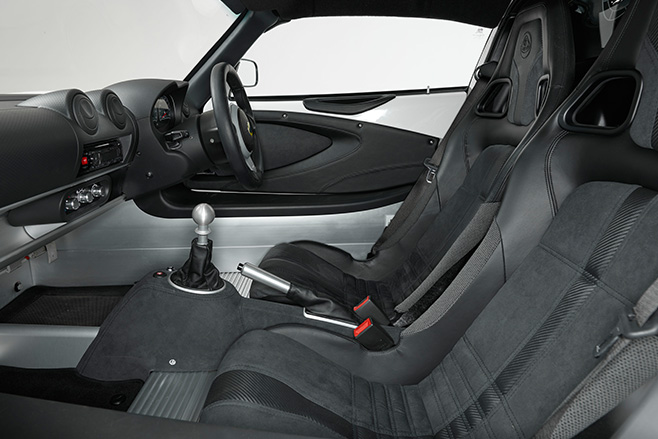
On the outside the auto Exige is identical to its three pedal sibling, but of course the primary addition is the Aisin-supplied (U660e) six-speed torque converter auto transmission, shared with the Toyota Camry, and some Lexus models, although Lotus has fine-tuned its control systems for this more focused application.
Also new is the fact the ‘Race Pack’ option now isn’t, in that the four-mode ‘Dynamic Performance Management’ (DPM) system, including launch control, exhaust bypass valve override, and suspension calibrated to suit the car’s Pirelli P Zero Corsa rubber, is now standard.
That’s all fine, what’s it like to drive fast?
You know that bit about the Exige S not being for everyone? That is so-o-o right. Lotus claims the majority of its Exige owners tip their machine in to some form of motorsport, adding the car can be driven to the track, pound around in anger without much need for attention to brakes or rubber, then trundle home again at the end of the day. Old school.
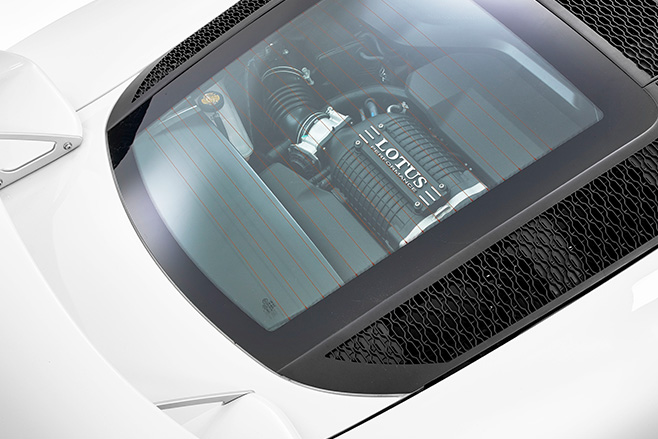
By definition, that means you’re driving a racing car on the road, and it feels like it. Hit the gas, and from around 2000rpm the Toyota-sourced (2GR FE) V6, with twin-screw Harrop supercharger attached, lights up. Peak torque arrives at 4000rpm, and max power coincides with the 7000rpm rev ceiling.
Riding this rocket is a full-on sensory experience, with the engine and exhaust building to a brilliantly harmonious scream. The gearbox isn’t exactly lightning fast, but the car sure as hell is.
The non-assisted steering turns the bitumen into braille, allowing the driver to read every nuance of the road surface through his or her fingertips. Grip, thanks in part to an electronic diff lock, is brilliant and body control is firmly buttoned down.
The downside is shock and vibration, with bump induced rack rattle loosening your grip on the steering wheel at regular intervals in an enthusiastic session.
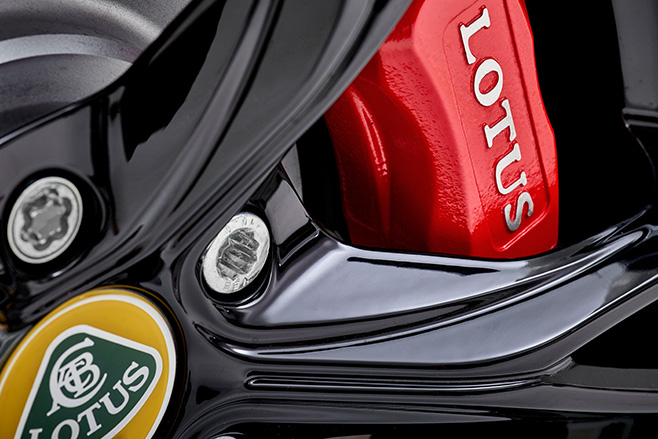
The AP-Racing brakes (there’s that word racing again) are brilliant, with big vented and cross-drilled rotors clamped by four-piston calipers front and rear.
And driving home from the city?
Far from a relaxed commuter, the Exige won’t cut you any slack just because you’ve rolled off the throttle for the trip home. It’s tricky to get in and out of, firm to the point of discomfort, and rear three quarter vision is compromised. What’s more, you’ll hear every rock and twig rebounding up into the chassis. As Lotus says, “This is a car for people who enjoy rawness, and really want to drive their car at all times.”
How much would I have to pay? And is it worth it?
At $137,990, the Exige S auto (in Coupe or Roadster form) is exactly $5k dearer than the manual equivalent. And less is more engineering extends to the standard features list, with a relatively bare bones spec including only a few hints of primo comfort, like central locking, air-con, and four-speaker audio.
Would you take the Lotus Exige S auto or Alfa Romeo 4C?
Both are raw and massively engaging. If your scales tip in favour of the track, it’s the Lotus. But if you’re more of a road warrior, go the Alfa.
Click here to find out more about the Lotus Exige S.
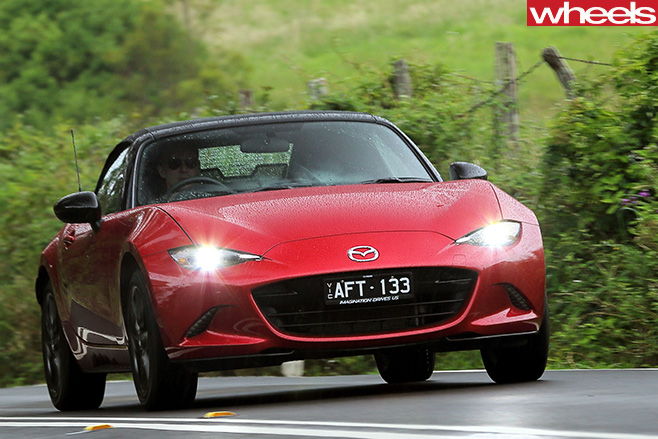
A bigger engine debuts with bigger wheels and tyres on the Mazda MX-5 roadster. So is the 2.0-litre a better drive than the delectable 1.5?
WHAT IS IT? The ‘big-block’ ND MX-5, prompted by size-obsessed Americans who thought 1.5 litres wasn’t enough for their favourite roadster. Rumour has it the Yanks threatened a total MX-5 boycott, leaving Japan no choice but to develop a 2.0-litre version courtesy of the base SkyActiv-G donk from the 3, CX-3 and CX-5.
WHY WE’RE TESTING IT? Supply of the 2.0-litre wasn’t forthcoming when the new MX-5 launched here in early August, hence a delay of almost four months. But if you consider what the 118kW/200Nm 2.0-litre has done for the MX-5’s power-to-weight figure – 114kW per tonne versus 95 for the 1.5-litre version – then it’s a step in the right direction for anyone obsessed with performance.
THE WHEELS VERDICT PLUS: Wonderful chassis; lightweight engineering; stronger, throatier, more tractable engine; larger wheels toughen-up the look MINUS: 2.0-litre gives up 1000rpm sooner than the effervescent 1.5; slightly firmer ride at low speeds; owners will need to stay off the cream buns – the petite MX-5 doesn’t accept all body types
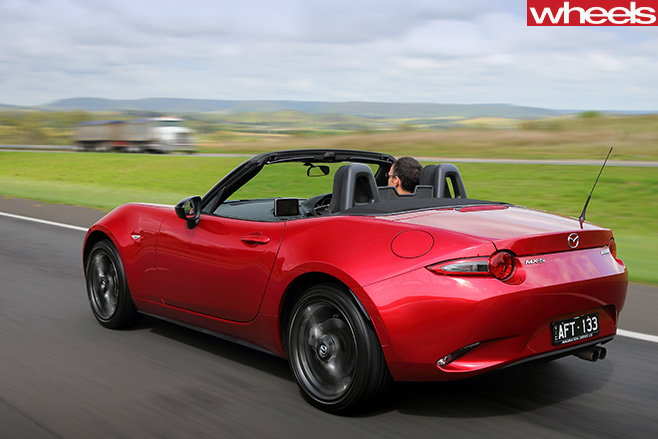
THE WHEELS REVIEW THERE IS something about the new MX-5 that inspires genuine emotion, and we’re not talking the adrenal kind. It’s deeper and warmer than that, almost as if you’re discussing which of your own kids you like more. That’s the level of passion surrounding the MX-5 1.5 versus MX-5 2.0 debate.
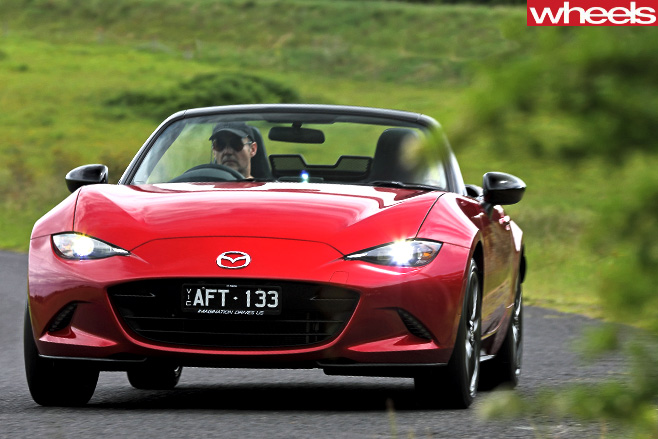
The 2.0-litre MX-5 is rumoured to be a result of the Americans having kicked up a stink about the concept of driving only 1.5 litres. It’s a meatier engine than the 1.5, thanks to a 23 percent power increase and a 33 percent jump in torque – though with almost 34 percent more cubic capacity, we expected more urge. Maybe it’s the abbreviated rev limit – the 2.0-litre hits cut-out right on redline at 6800rpm, whereas the 1.5 will sing past its seven-five red zone to kiss 7750rpm – because we all know revs equal power. Either way, when the 2.0-litre MX-5 reaches its ceiling, there’s a slight feeling of disappointment that it won’t extend just that little bit more.
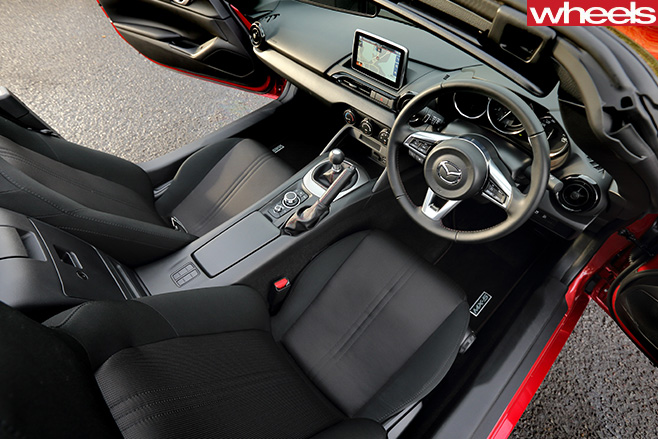
There isn’t that much in it, to be honest. A second from 0-100km/h (7.3sec for the 2.0-litre six-speed manual versus 8.3sec for the 1.5), and 10km/h extra with your foot flat on a German autobahn (214km/h top speed against 204) is what $2500 extra buys you, though that’s at the extreme end of the scale. In reality, the 2.0-litre feels stronger and doesn’t need to be flogged, whereas the 1.5 rewards commitment, both in terms of attaining revs and maintaining momentum.
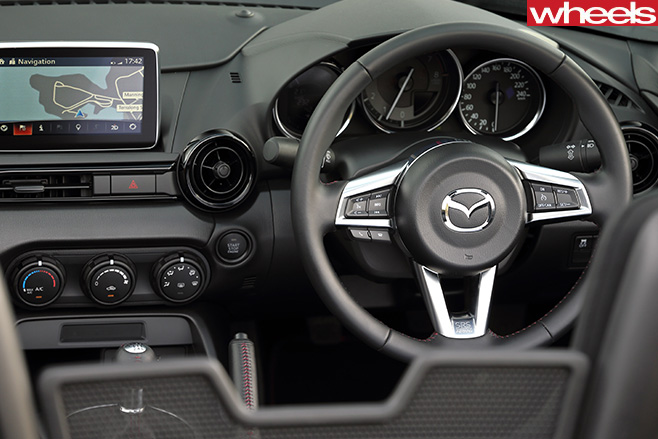
But that’s like arguing over what colour serviettes should garnish a Michelin-star dinner. The MX-5’s main meal is so frigging delicious that every variation is something to savour.
Colour by numbers
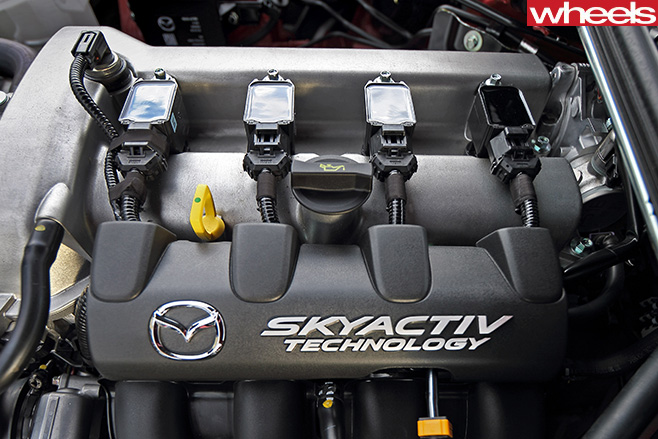
Both engines share a 13.0:1 compression ratio and drink 95 octane juice or higher – an identical tune to European MX-5s. The 2.0-litre is thirstier than the 1.5, but the difference – both on paper and in the real world – is minimal. The 1.5 manual’s combined fuel number is 6.1L/100km against the 2.0 manual’s 6.9.
SPECS Model: Mazda MX-5 2.0-litre Engine: 1998cc 4cyl, dohc, 16v Max power: 118kW @ 6000rpm Max torque: 200Nm @ 4600rpm Transmission: 6-speed manual Weight: 1033kg 0-100km/h: 7.3sec (claimed) Fuel economy: 6.9L/100km Price: $34,490 On sale: Now
Click here to read the full review on the Mazda MX-5.
Hyundai has brought a clutch of driver aids to its popular Santa Fe seven-seat SUV, and retuned the diesel engine.
WHAT IS IT? A gentle facelift of the seven-seat Santa Fe, which brings more equipment, minor revisions to the local suspension tune, and a hefty $2750 price increase for the top-spec Highlander that accounts for almost half of Santa Fe sales.
WHY WE’RE TESTING IT A 59 percent sales increase since the 2012 launch of the current generation Santa Fe confirms Hyundai’s move from a value brand to a broad-based mainstream car maker. Is it worth $10k more than the new Tucson?
MAIN RIVALS Loads of new rivals – Toyota Kluger, Kia Sorento and Nissan Pathfinder – plus one ageing, but still surprisingly competitive, rival in the Ford Territory.
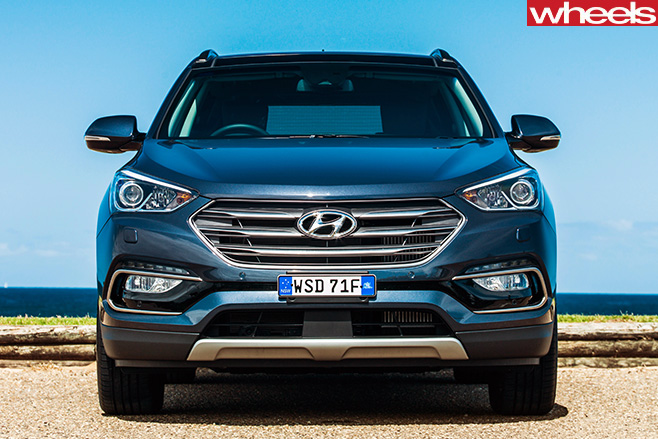
PLUS: refined drivetrain; premium level equipment MINUS: Touch screen difficult to read; steering wheel needs wider adjustment; slow responses for anything electric
THE WHEELS REVIEW HOW MANY people who buy seven-seat SUVs really care how they drive? The family customer’s priorities are elsewhere, centred on safety rather than steering precision. Spaciousness is desired over responsive handling, and fulsome equipment is preferred to spirited performance.
Thing is the Santa Fe fulfils both roles. Not brilliantly, but rather better than you might expect, in a further sign that the Koreans are increasingly building globally competitive vehicles. The facelifted model, intended to bring the styling into line with the new Tucson (to such an extent that it’s hard to tell them apart when viewed in isolation), brings enough improvement to make this a worthwhile update.
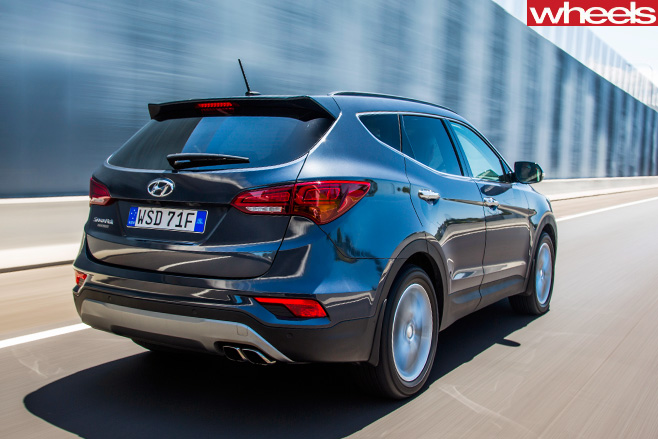
Active safety gets a significant boost on the top Highlander and the upcoming SR (Brembo brakes, black OZ wheels, stiffer springs and dampers, a body kit, but no extra urge from the diesel): auto emergency braking (AEB), an excellent adaptive cruise control, forward collision and blind-spot alerts, and rear cross traffic alert with lane change assist. The existing auto parking function has been expanded to include 90 degree parks, and new exit guidance for parallel spots.
However these added safety features can’t be optioned on the two lesser grades, surely one reason the Highlander sells so well. The base Active remains at $38,490, with the six-speed auto adding $2500, and the diesel drivetrain a further $3000. The diesel auto-only Elite rises by $1500 to $49,990, justified by the inclusion of premium audio and electric driver’s seat adjustment with memory. All Santa Fe variants now get Apple CarPlay and Android Auto smartphone integration, though Hyundai admits they are still waiting for Apple certification.
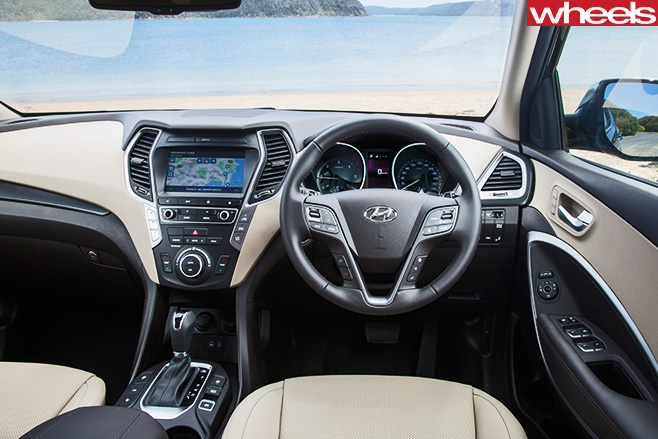
A mild retune of the 2.2-litre direct injection diesel adds an extra 2kW/4Nm, and delivers a 0.4L/100km improvement to the combined fuel consumption figure, now 7.7L/100km. Not bad for a vehicle that tips the scales at 1984kg. The diesel is smooth and refined, though the mass clearly limits performance. The fluent shifting, in-house automatic perfectly suits the character of the car.
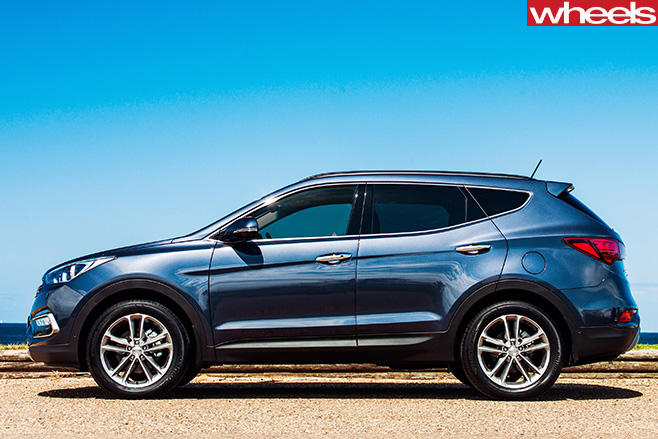
True to its purpose, the Santa Fe ignores any pretensions of sportiness. Better to enjoy the Hyundai’s high quality finish, spacious interior (at least for the first two rows) and premium equipment. However, unless you need two child seats it’s hard not to see the Tucson stealing sales from its bigger sibling.
SPECS Model: Hyundai Santa Fe Highlander CRDi Engine: 2199cc, 4cyl, dohc, 16v, turbodiesel Max power: 147kW @ 3800rpm Max torque: 440Nm @ 1750-2750rpm Transmission: 6-spd auto Kerb weight: 1984kg 0-100km/h: 10.1sec Fuel economy: 7.7l/100km (claim) Price: $55,990 On sale: Now
Click here to read the full range review of the Hyundai Santa Fe.
In the early 1950s when design (as opposed to engineering) was finally being recognised as an intrinsic part of selling cars, a series of extreme concepts changed the thinking on what a car’s shape should be. From an era of protruding tail-lights, acres of chrome and rocket-inspired detailing, to a period of cars that were sleek and flowing, inspired by wind-tunnel testing and the study of aerodynamics. The Alfa Romeo BAT by Carrozzeria Bertone heralded in a new era of car design.
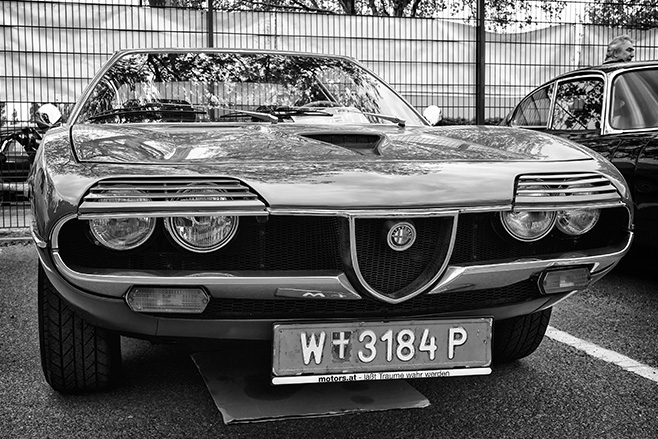
Think of a sports car that screams speed and you’ll probably be picturing a torpedo-shaped bullet drawn by Bertone. The sleek, shark-shaped nose on the 1973 Alfa Montreal? Bertone. That pointy-snout 1971 Lamborghini LP500 prototype that spawned the Countach? Bertone. Even non-car enthusiasts recognise these cars as beautiful, covetable examples of car design.
Bertone was not one designer, though; it was a stable of exceptional designers assembled by impresario and visionary Giuseppe “Nuccio” Bertone. Nuccio founded and nurtured talented designers like Giorgetto Giugiaro, Marcello Gandini and Franco Scaglioni, and backed their uncompromised visions with his quality coachhouse building and vast selection of contacts. Bertone is the oldest Italian design coachhouse and possibly the most universally recognised because of the proliferation of iconic concepts pouring from Nuccio’s protégés.
In 1952, MG concept cars designed by Giorgetto Giugiaro led to a commission from Alfa for the Giulietta Sprint. Alfa had released its first standardised car in the early 1950s, and an Italian journalist wrote that he saw “lots of Romeos but no Giuliettas”, suggesting that the cars looked too masculine. The Bertone Giulietta Sprint, designed by Franco Scaglioni and shown in 1954, was presented as an embodiment of “la dolce vita”, a smaller, faster, slightly louche sports sedan (coupe, as indicated by the “Sprint” label) with elegant proportions and racing credentials.
At the same time, Bertone was releasing the BAT 5, 7 and 9 (designed by Scaglioni for Alfa) with stingray-like aerodynamics to display vehicles with the lowest possible drag co-efficient (BAT stands for “Berlinetta Aerodinamica Tecnica”). The BATs forced designers to consider aerodynamic flow, and the Giulietta became the symbol of Italian GT.
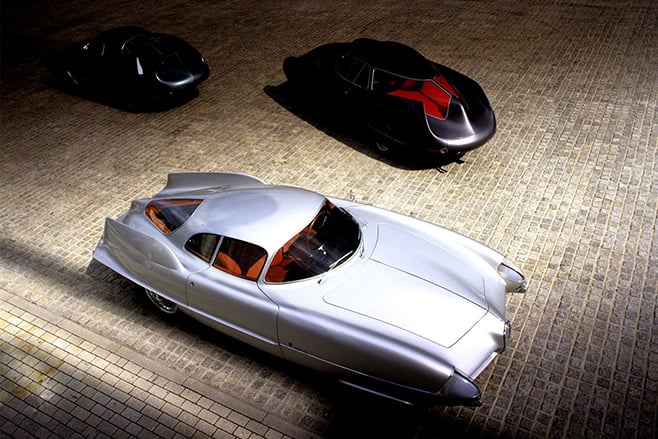
GT stands for Gran Turismo and represents a high performance vehicle – usually a two-door coupe – designed for spirited long-distance driving. Throughout the 1960s Bertone explored this concept with Alfa, Ferrari, BMW, Aston Martin, Fiat and Maserati, developing a signature swooping nose and spare, elegant lines towards the end of the decade. Consider the magnificent Iso Grifo, designed by Giugiaro in 1965 to compete with the Ferrari and Maserati GTs using Corvette and Ford components. Or how about the groundbreaking Lamborghini Miura, which was released a year later?
Innovative, beautiful and class-leading design poured from the doors of Bertone, demonstrating the breadth of talent at the coachhouse and clearly illustrating Nuccio’s master wrangling skills in keeping such high-profile egos under one roof.
The Alfa Montreal and the Fiat Dino coupe (from Gandini and Giugiaro respectively) featured Bertone’s signature long, low arching fenders and seductive fastback silhouettes. The Alfa was raked with shrouded headlights, though, and the Fiat Dino remained elegantly open.
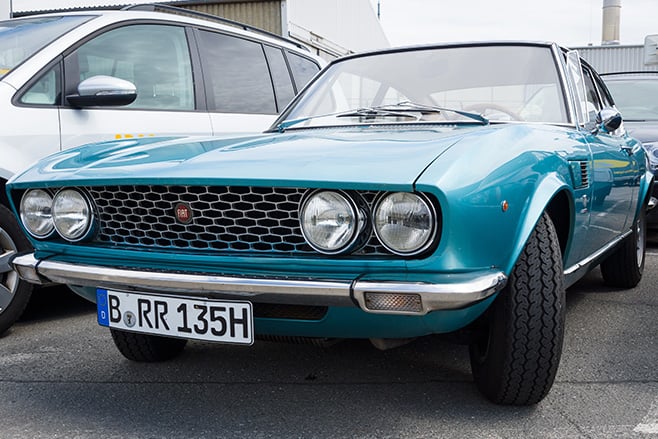
When challenged to show “the ideal car” by the UK Daily Telegraph, Bertone produced the Jaguar Pirana, with its longer swooping bonnet and more bullet-shaped back.
A year later Bertone reinvented its own look with an extreme-wedge form of the Alfa Carabo concept. A mid-mounted engine meant the nose could taper to a point, while louvres wrapped around the headlights for uninterrupted lines. The car also stood less than a metre at its highest point.
Then, just when you thought a car couldn’t get any lower and pointier, Bertone revealed the abstract, futuristic Lancia Stratos Zero; a car with a more abstracted side profile than anything ever seen and so low it could pass below a typical vehicle barrier.
Riding high on the success of this new design language Bertone expanded production and worked with Lamborghini to create epic profiles like the Espada and the Countach; a car often cited by non-car aficionados – as well as car-lovers – as the car they would want to own. The rich and varied output was testimony to Nuccio’s ability to extract the best from his talented designers.
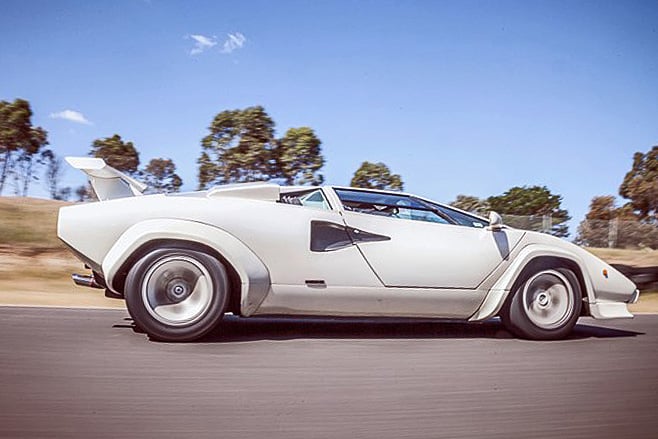
Bertone flourished in the 1950s, 60s and 70s with its work for Alfa Romeo and Lamborghini (and others), but it flailed once its visionary died in 1997. The company rallied when Nuccio’s wife Lilli took over and oversaw the Pandion concept for Alfa, shown at the 2010 Geneva Auto Show.
The designer of the Pandion, Michael Robinson, was the last Design Director at Bertone, and the company went bankrupt in 2014. When asked what happened Robinson replied: “Having turned that page, I can’t afford to be dragged into this valley of tears.”
The closing of Bertone spawned countless retrospectives for a company that had more number one car design hits than any other company.
This one’s for all the naysayers, those that dismiss the new 1.5-litre MX-5 as weak and gutless.
Neither of those things are true, as the ND MX-5 1.5 has proved that thanks to its lithe 1009kg kerb weight, the downsized engine offers more than enough grunt to have a good time.
Still, a little extra power never hurt and now we have just that with the release of the ND MX-5 2.0-litre. As the name suggests, the biggest change is under the bonnet, where a 118kW/200Nm 2.0-litre four replaces the 96kW/150Nm 1.5-litre unit.
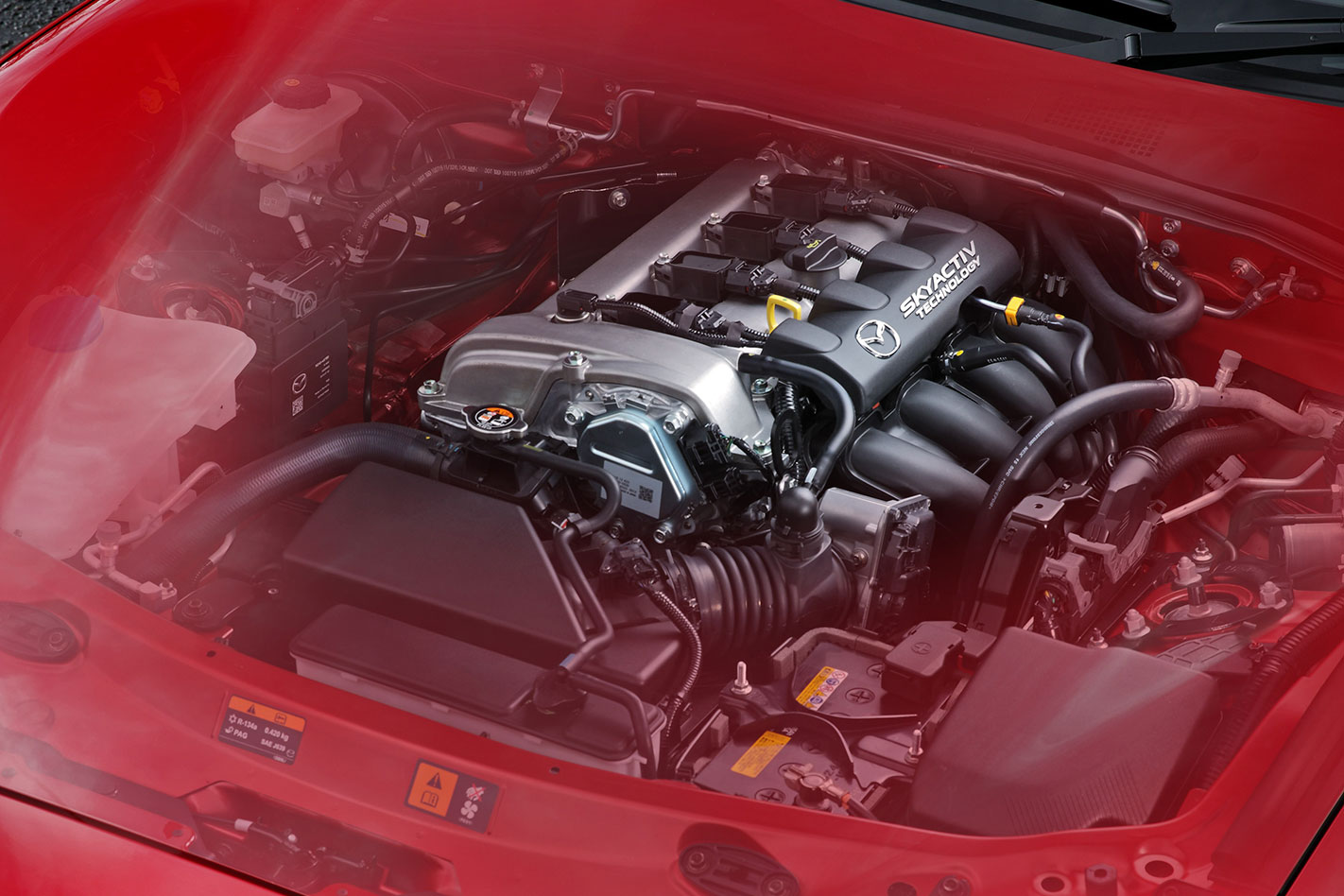
Unfortunately, the engine doesn’t sound great, more of a metallic buzz than a sporty growl, and the 1.5 feels a little more energetic, as well as revving to 7500rpm compared to the 2.0-litre’s 6900rpm.
Still, no-one buys an MX-5 to go drag racing, it’s bought for its handling, and it’s here the two cars diverge somewhat. The 1.5-litre is incredibly soft, which makes it very adjustable and agile, though at the expense of a little precision.
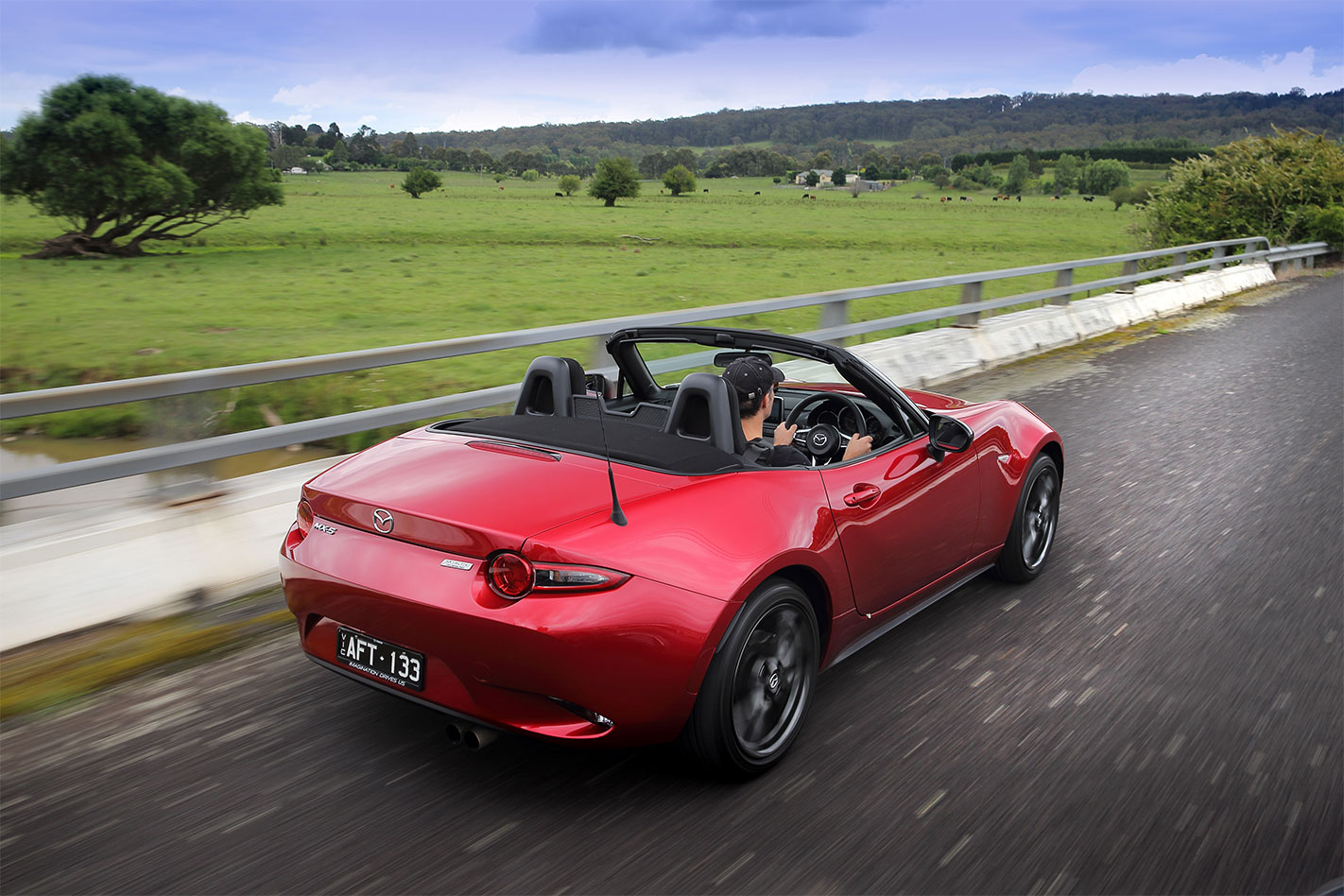
Even with 204/45 17s (as opposed to the 1.5’s 195/50 16s) there’s still not a whole lot of grip, especially in the wet, but it retains its sibling’s brilliantly balanced handling. Enter a corner a little too hot and it’ll understeer, but if you’re aggressive with the throttle it can be made to oversteer slightly, or a lot if it’s raining!
Larger brakes also appear, with 280mm rotors front and rear, and the pedal remains firm even under repeated punishment.
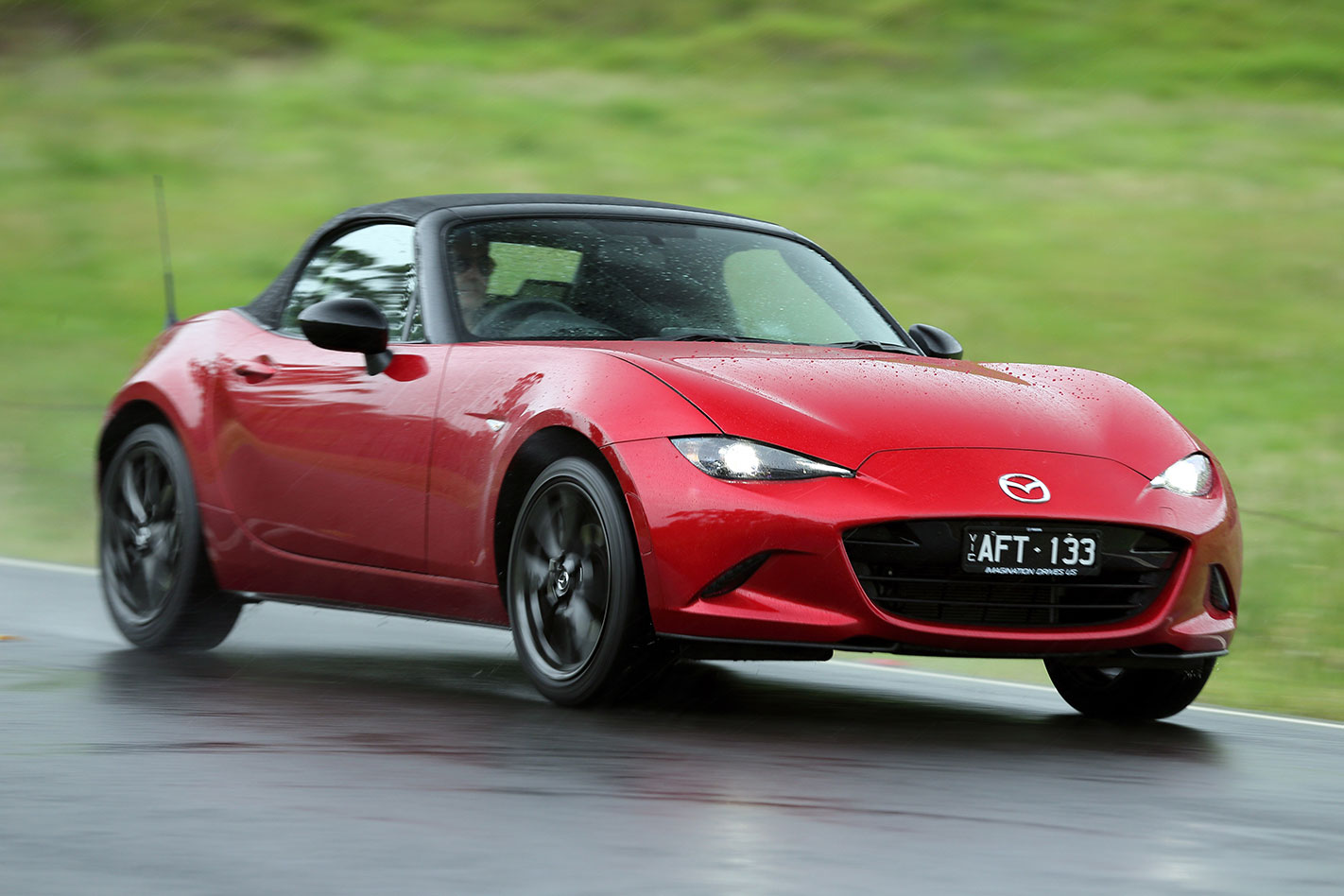
It’s not a deal breaker, but does perhaps swing the MX-5 pendulum back in favour of the 1.5.
Still, Mazda expects the 2.0-litre to take the majority share of sales (if only just) and it’s not difficult to see why when it costs only $2500 extra in standard guise and $1500 for the GT.
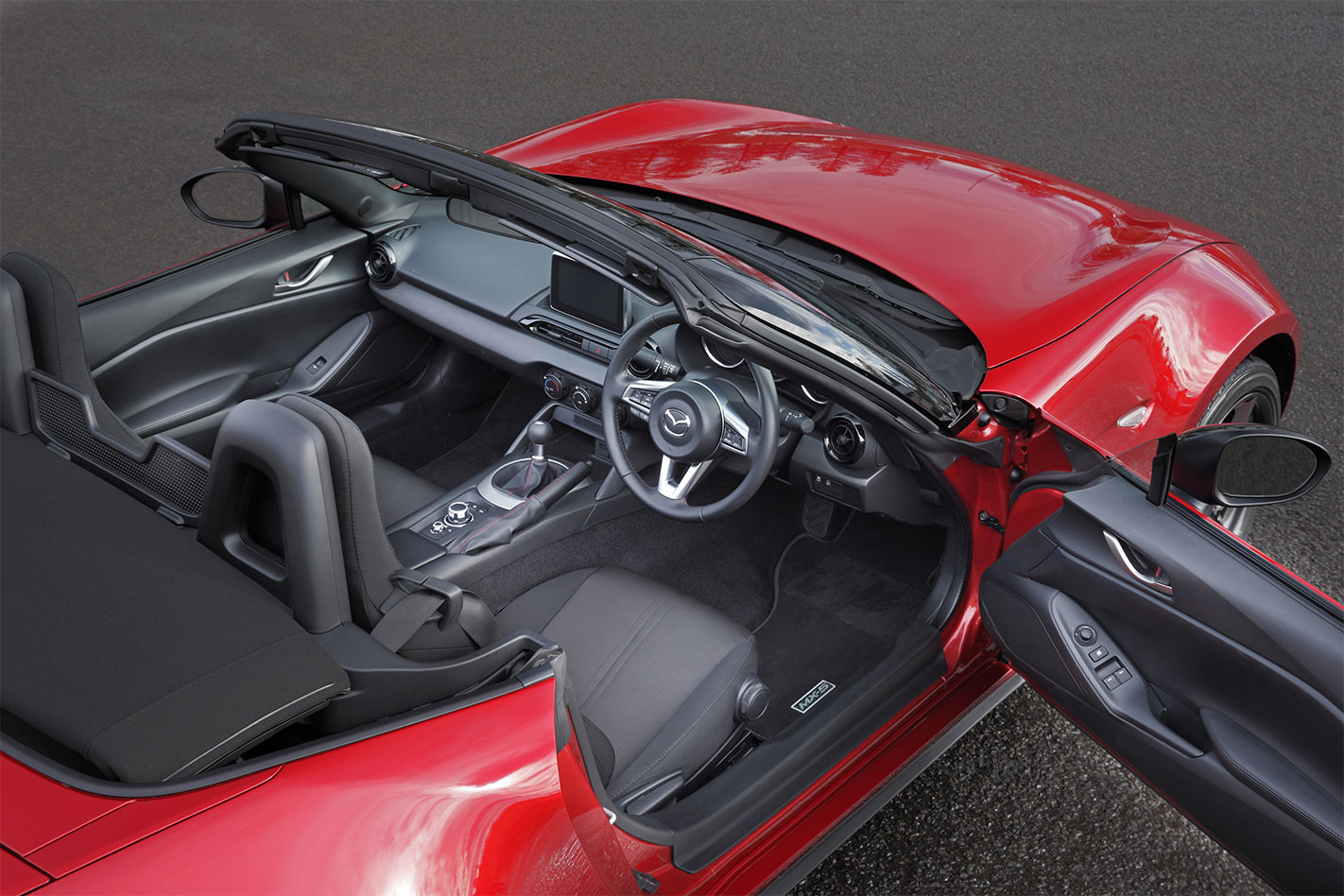
But based on this first drive we’re not entirely sure which ND MX-5 is the better drive. The suspicion is that the 2.0-litre will prove more capable at the outer limit, however the 1.5 will offer more accessible thrills.
The only sure way to find out is book both and take them for a back-to-back test. Stay tuned.
4/5
Specs Engine: 1998c inline-4, DOHC, 16v Power: 118kW @ 6000rpm Torque: 200Nm @ 4600rpm Weight: 1033kg (man.) 0-100km/h: 7.0sec (estimated) Price: $34,490 (man.); $36,490 (auto); $39,550 (GT man.); $41,550 (GT auto)
We can all admit that modern performance cars are as good as they have ever been.
We’ve never had faster, more comfortable or, arguably, as attractive performance cars as what is available to punters off the showroom floor today. It’s easy to point to old cars that nail one out of those three, but all together? Modern cars have them covered (as painful as it is for me to admit as an avowed lover of old tin).
So why would you modify one of these supposedly perfect creatures? Because there is still plenty of compromise and safety margin built into these cars. The engineering underpinning them can support so much more, so why not give them a tweak to unleash a bit more? Why not personalise the cars to stand out from the crowd?
It’s these questions that led MOTOR to kick off the first professional shootout for modified late-model performance cars in Australia back in 2008.
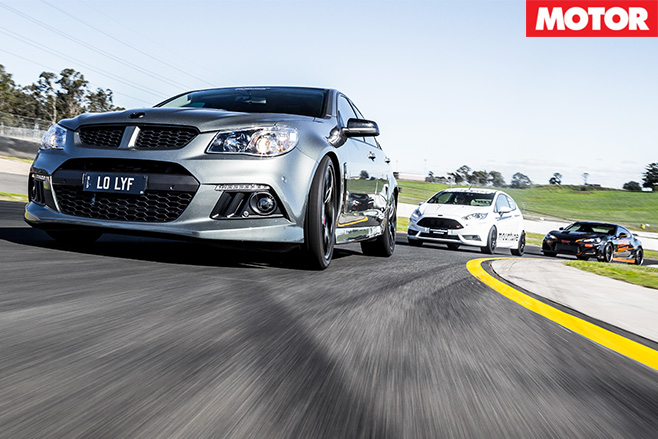
But how do you actually know if Company A’s package will do what it says, or if it’s better than Company B’s pack? This is where Hot Tuner comes into its own, putting professionally-tuned vehicles to the sword with the aim of comparing apples with apples and figuring out if anyone is telling fibs. If anyone is telling porky pies we find out double-quick and haven’t ever shied away from telling the world.
The cars themselves have represented every modifier niche in Oz. We’ve had everything from tiny supermini hatchbacks, bad-arse blown V8s, a Harrop-tuned 458 Ferrari and Tekno Motorsport’s Lamborghini Aventador turn up to run the gauntlet.

Despite only running nine cars this year, the demographics they cover means we have one of the most diverse fields in the event’s history.
We’re putting muscle cars, sports saloons, hot hatches, superminis and turbo JDM drifters together in a pot, stirring vigorously and baking on a high heat until one is crowned winner.
Smack talk between the various tribes who make up the tuner scene in Australia isn’t anything new, but as it’s such a wide church you often wind up with apples being compared to pears or, in some cases, candied bacon.
Running the cars we did this year allows us a unique opportunity to really show where each vehicle shines and why. It also allows us to compare bang-for-your-buck through the use of the BFYB algorithm.
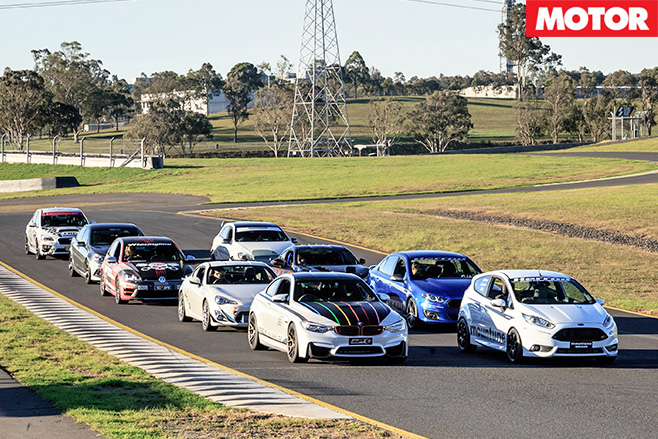
The fact we charged an entry fee to cover the huge costs involved in running the shootout also meant tuners had to commit a long way out. Simply put, a few couldn’t put their money where their mouths were and didn’t sign up for the three-day event in the Harbour City.
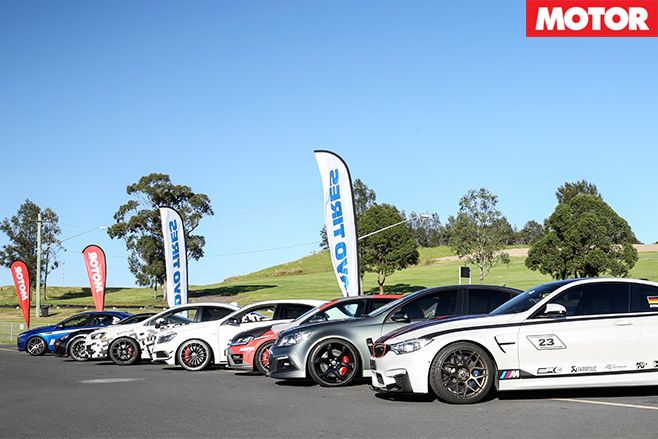
This year we also held all entrants to a minimum level and standard of modifications. In the past it would have been all too easy to turn up with a Bugatti Veyron wearing carbon wrap and stick-on white wall tyres just to take a win, but having relevant cars with mods you guys and gals can relate to is far more important to us. And we make no apologies to the Thursday Night Maccanats crew for saying that we don’t count stickers as a modification.
We’ve also specified all tyres must have a 140 treadwear to count semi-slick R-compound rubber out of the competition. This is a rule directly borrowed from World Time Attack regulations and it’s all about having the vehicles represent what people actually drive on Aussie roads. While some do use them on their street cars, it really isn’t representing an honest street car in our books.
While it isn’t available everywhere, especially in full-freight E85 (most is around E60-E70), many tuners now have options to set their cars up on it and claim huge increases over and above traditional 98RON PULP.
Many of these gains come from being able to wind a lot more ignition timing into the motors, along with healthy boost increases. This assists in improving the boost threshold (response) on turbo cars as well as how aggressive tuners can get on aspirated or supercharged cars – the throttle response can be knife-sharp!
We hand-filled every car when they turned up to scrutineering on Monday night and then sealed the tank to ensure parity. Entrants were given the choice of 98RON PULP or E85, and many chose to show off their gasohol-tuning prowess and opt for the corn juice.
Tuners were also invited to use their own driver on the drag strip. Complaints levelled at the testers and procedures in year’s past encouraged, to put it meekly, MOTOR to throw the doors open for entrants to bring their own hot shoe along and launch the cars they built. However, while the tuners were given the option, nobody chose to take it up and instead left the straight-line testing of their steeds to the experience and natural born speed of Warren Luff.

The 2015 Toyo Tires Hot Tuner Challenge has been a massive effort from all involved, but running Australia’s only professional tuner shootout was never going to be easy. Read on to find out the skinny on who turned up, what they brought and who did what against the clock.
The Strip
We had Luffy test acceleration and braking at Sydney Dragway, literally over the crest of the hill from Sydney Motorsport Park. If you know how heavy a car is and how fast it covers the standing 400m sprint, you can actually extrapolate out how much rear-wheel horsepower it’s making with a surprising degree of accuracy.
We didn’t need to rely on the old Moroso slide calculator as we have a high-tech Vbox full of computer technology and quite a lot of witchcraft. Luffy did three runs in each car, recording the 0-100km/h, 0-400m and then 100-0km/h for each.
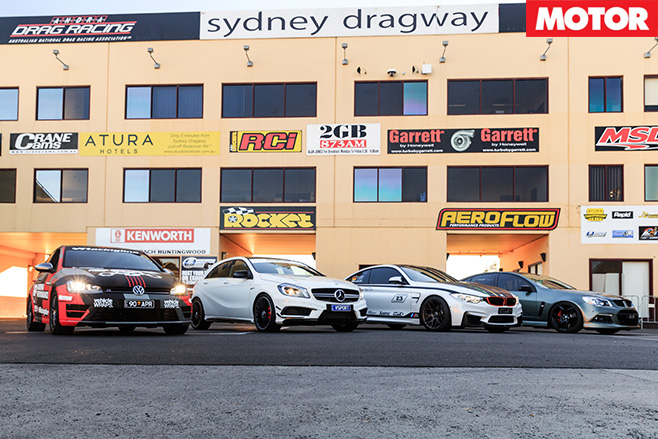
However, they all chose Luffy. They were also allowed to alter their tyre pressures for the drag-strip discipline. This was to allow more grip off the line, due to lower tyre pressures giving more “bag” to the sidewall off the line.
The Fuel
For 2015, a control fuel was used to ensure everyone played fair – either E85 or 98RON was fair game but it had to be hand-cranked out of the Hi-Tec Fuels drums.
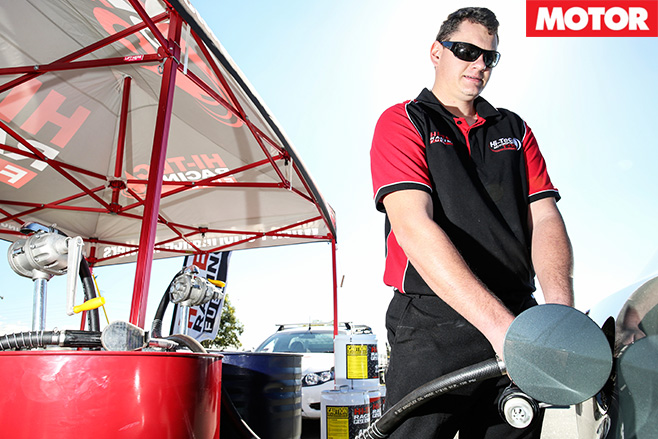
Detonation in these circumstances could be catastrophic to these motors and we’re not in the engine-killing business, so we needed to know the fuel had the required octane for the tuners’ handiwork.
The Dyno
We once again had the boys from Mainline Dyno bring one of their gun chassis dynos along to Hot Tuner so we could record peak power at the wheels for all the entrants.
Mapping out the power curve also gives us an indication as to how the car will drive on the street, showing if the grunt arrives in a few hundred RPM, or climbs in a linear arc.
The difference is that the former will generally drive quite poorly outside its window and then come on in a rush of fury with all the subtlety of motoring journos at an open bar.
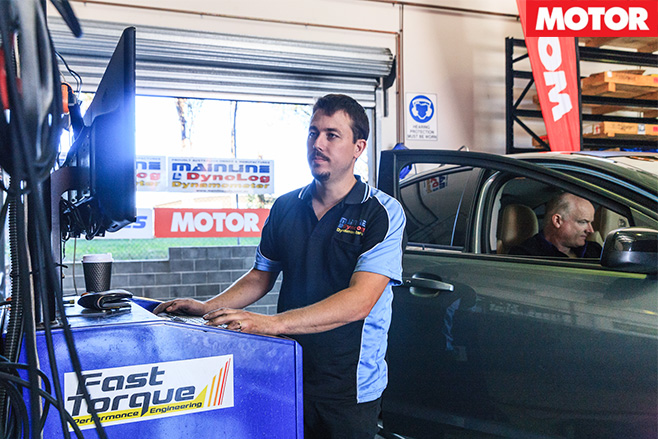
Cars are individually strapped down and run three times, back-to-back, to get the maximum power figure as measured at the wheels.
We once again called upon the blokes at Fast Torque Performance Engineering to house the dyno challenge.
With their location just around the corner from Sydney Motorsport Park, and with plenty of experience running dyno challenges, it made them the perfect guys for the job.
The Track
Performance testing modified cars on public roads isn’t smart, so we reserved a day at Sydney Motorsport Park’s twisting, tumbling South Circuit. We needed to know just how these cars behaved at their limit; and while the larger Grand Prix circuit at SMSP is faster, the tight South Circuit shows up glaring errors in handling set-up or deficiencies in tuning.
The tight, heavily undulating layout pushes tyres and suspension, two areas which can make or break an upgrade package. And it also shows when tuners are relying on a good factory package to hide a lack of their own R&D.
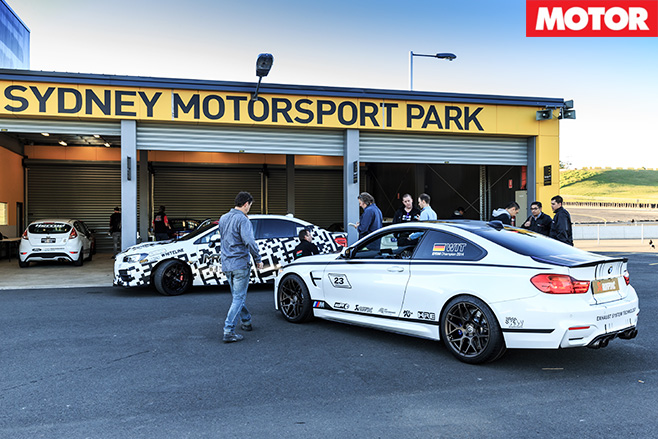
Thankfully, no journalists were harmed in the making of this event, although Morley got a bit of dirt in his eye and Glenn Torrens almost fell off the tyre barrier during a regular bout of over-excitement.
We have to thank Sydney Motorsport Park for allowing us to base the 2015 Toyo Tires Hot Tuner Challenge out of the South Circuit garage, using it as Parc Ferme from Monday night, scrutineering and also the hub for photography for the three days.
The Wheel man
Warren Luff: the man, the myth, the hairdo and smile so bright it can be seen from space.
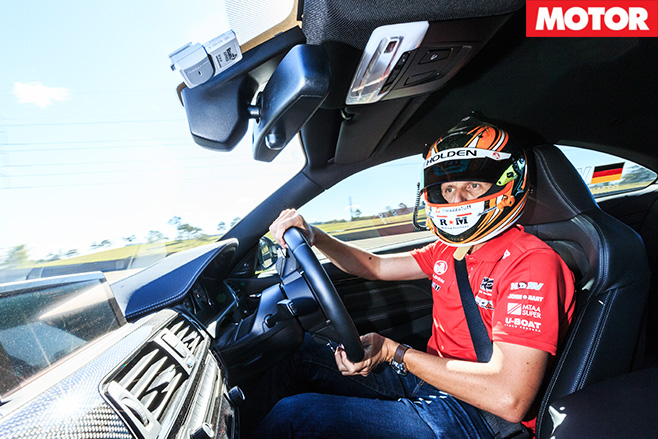
His experience driving fast on road tyres and suspension, and with modern stability control systems, gives him the edge over most other testers, plus with suspiciously little encouragement, he can hang the tail out and blaze fatties like it’s going out of fashion.
Follow Luffy (and his dog Gnocchi) on Facebook, by searching for him, or Twitter – search for @wazzaluff.
Check out the cars that competed at Hot Tuner 2015:
