
A Holden VS Commodore driven to victory in the 1997 Bathurst 1000 by Larry Perkins and Russell Ingall will soon be offered for sale.
The Castrol-backed Number 11 Commodore, chassis PE030RB, is set to be listed by online auction platform Collecting Cars through a sealed bids process opening on 23 February 2026.
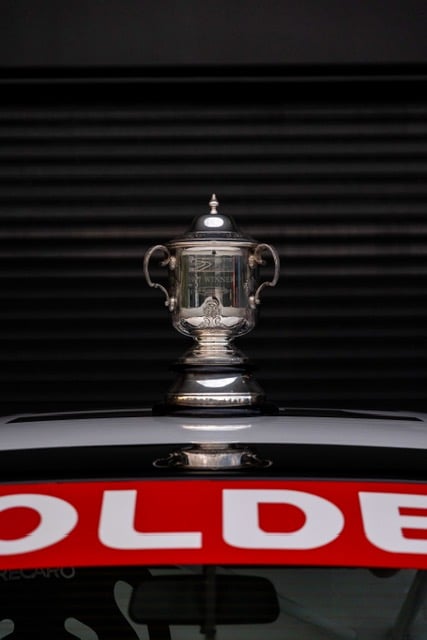
The car won the 1997 Primus 1000 Classic at Mount Panorama, marking Perkins’ sixth and final Bathurst 1000 triumph. The winner’s trophy presented to Perkins and Ingall will be included in the sale.
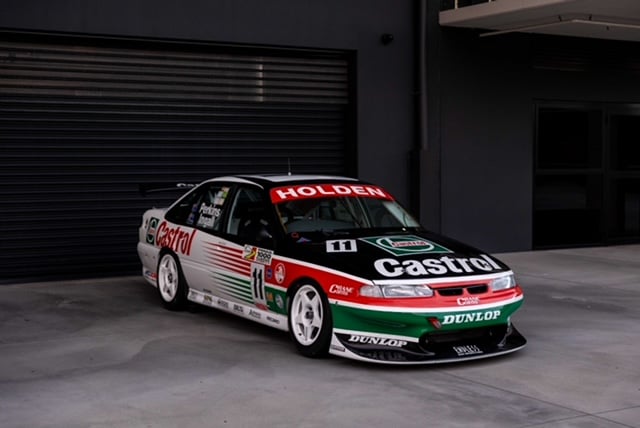
Originally constructed by Perkins Engineering in Moorabbin, Victoria, the Commodore was rebuilt ahead of the Bathurst event following a crash earlier in 1997. The rebuild resulted in the addition of the ‘RB’ suffix to its chassis code. The car competed in the Australian V8 Supercars Championship during the 1997 and 1998 seasons with Perkins’ team.
After its frontline career, PE030RB was sold to privateer driver Barry Morcom and later raced in the V8 Lites series. It has since undergone a full restoration and is presented in its 1997 Bathurst-winning livery. The sale includes an extensive documentation file relating to its competition history and restoration.
Perkins Engineering built 49 V8 Supercars chassis and 198 racing engines between 1985 and 2012. Over that period, the team secured three Bathurst 1000 victories and three Sandown 500 wins. The company now focuses on restoration and parts remanufacturing for cars produced during its operation, overseen by Larry Perkins’ son, Jack Perkins, a former Supercars driver.
Bidding for the Commodore will be conducted privately through Collecting Cars’ Sealed Bids platform. More information here.
Small SUVs are experiencing a growth spurt – just one month in to 2026, sales are 14.4 per cent higher compared with the same period in 2025. But just because they have the word ‘small’ in their classification, it doesn’t mean that they are ill-equipped for the modern Australian family. In fact, some small SUVs are more capable of coping with modern life than their larger competition.
Here’s the WhichCar by Wheels guide to the 10 most practical small SUVs under $40,000:
1. Chery Tiggo 7

Price: From $29,990 driveaway
Boot space: 356 litres (rear seats up); 1672 litres (rear seats folded)
Drivetrains: 1.6-litre turbo-petrol or 1.5-litre turbo plug-in hybrid
It might bridge the small/medium divide but it’s our contention the Chery Tiggo 7 is the most practical small SUV you can buy for under $40,000 (or, given the low $29,990 driveaway price of the entry-level Urban, under $30,000 as well) with a huge 1672 litres of boot space with the rear seats folded. With the rear seats up, there’s still a reasonable 356 litres of space (or a more impressive 626 litres to the roof) and the loading lip is impressively low.
2. Skoda Karoq
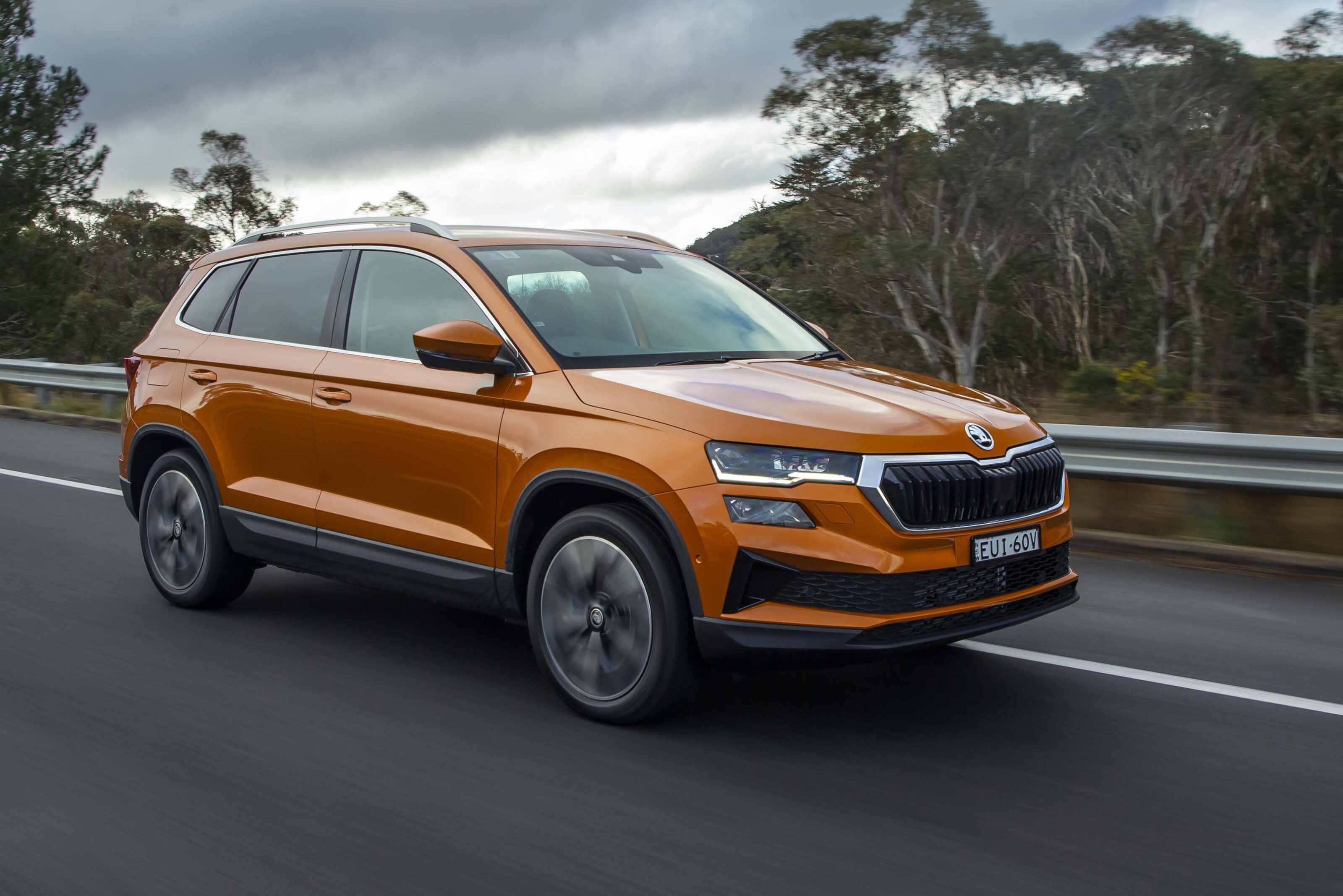
Price: From $40,990 (driveaway)
Boot space: 521 litres (rear seats up); 1630 litres (rear seats folded)
Drivetrains: 1.4-litre or 2.0-litre turbo-petrols
Like the Tiggo 7, the Karoq is classified by the government as a medium SUV, but its dimensions place it in the small category – it’s 70mm shorter in length than a Toyota Corolla Cross which is officially classed as a small SUV. Regardless of what segment it fits into, it’s still very practical. At 521 litres, the Karoq’s boot is the largest here both with the rear seats up and folded, almost the largest as well at a massive 1630 litres. Helping practicality further are the usual Skoda ‘simply clever’ features like netting, a double-sided boot mat and various hooks to hang bags off.
3. Mitsubishi ASX
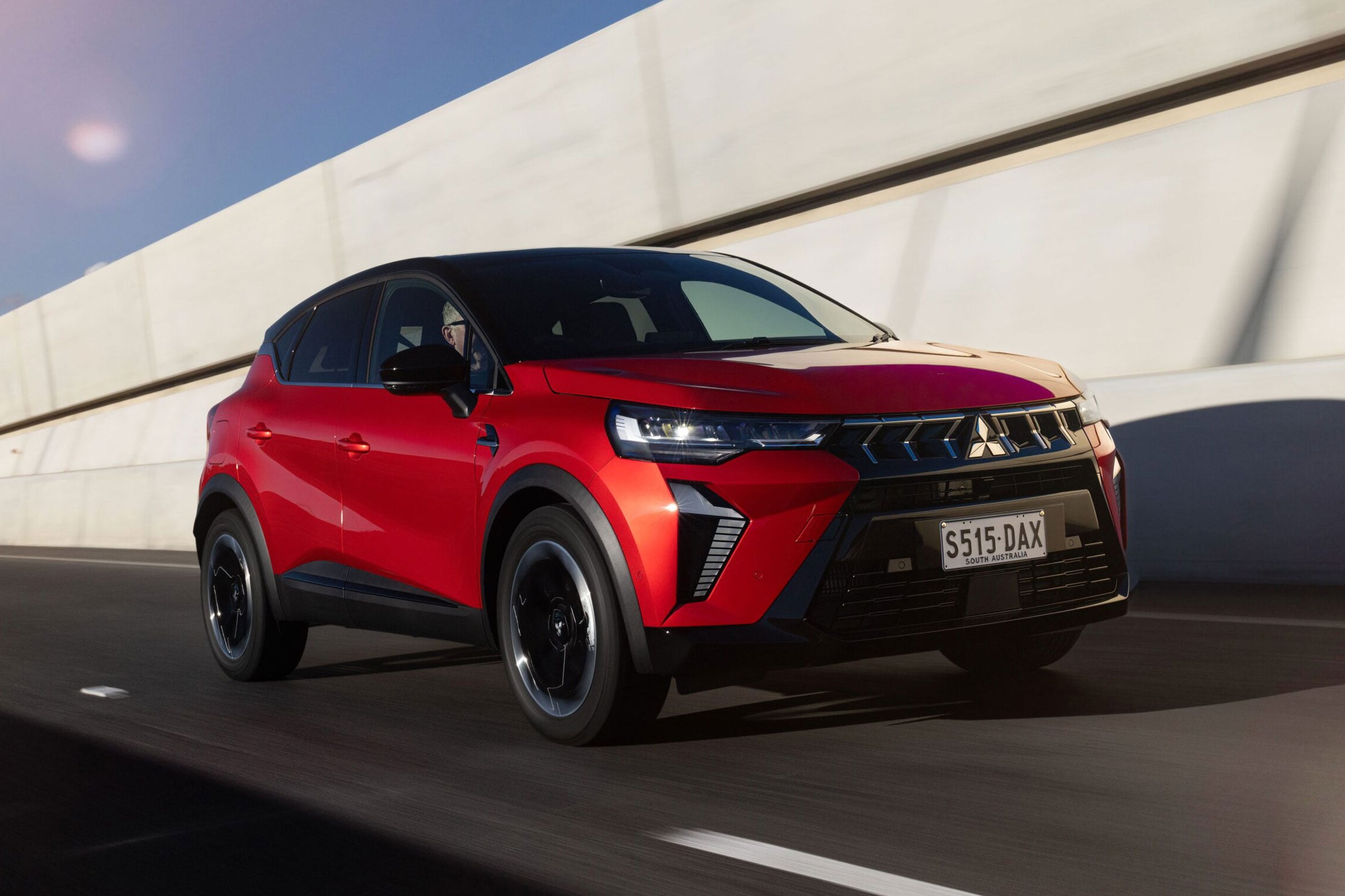
Price: From $37,740 plus on-road costs
Boot space: 484 litres (rear seats up); 1596 litres (rear seats folded)
Drivetrains: 1.3-litre turbo-petrol
It only recently launched in Australia in its second-generation Renault-sourced form, but the Mitsubishi ASX is now the third most practical small SUV under $40,000 in Australia. Offering a healthy 484L space with the seats up and a large 1596L with them folded, the ASX (and its Renault Captur twin) features a dual-level boot floor to hide items securely.
4. Renault Duster
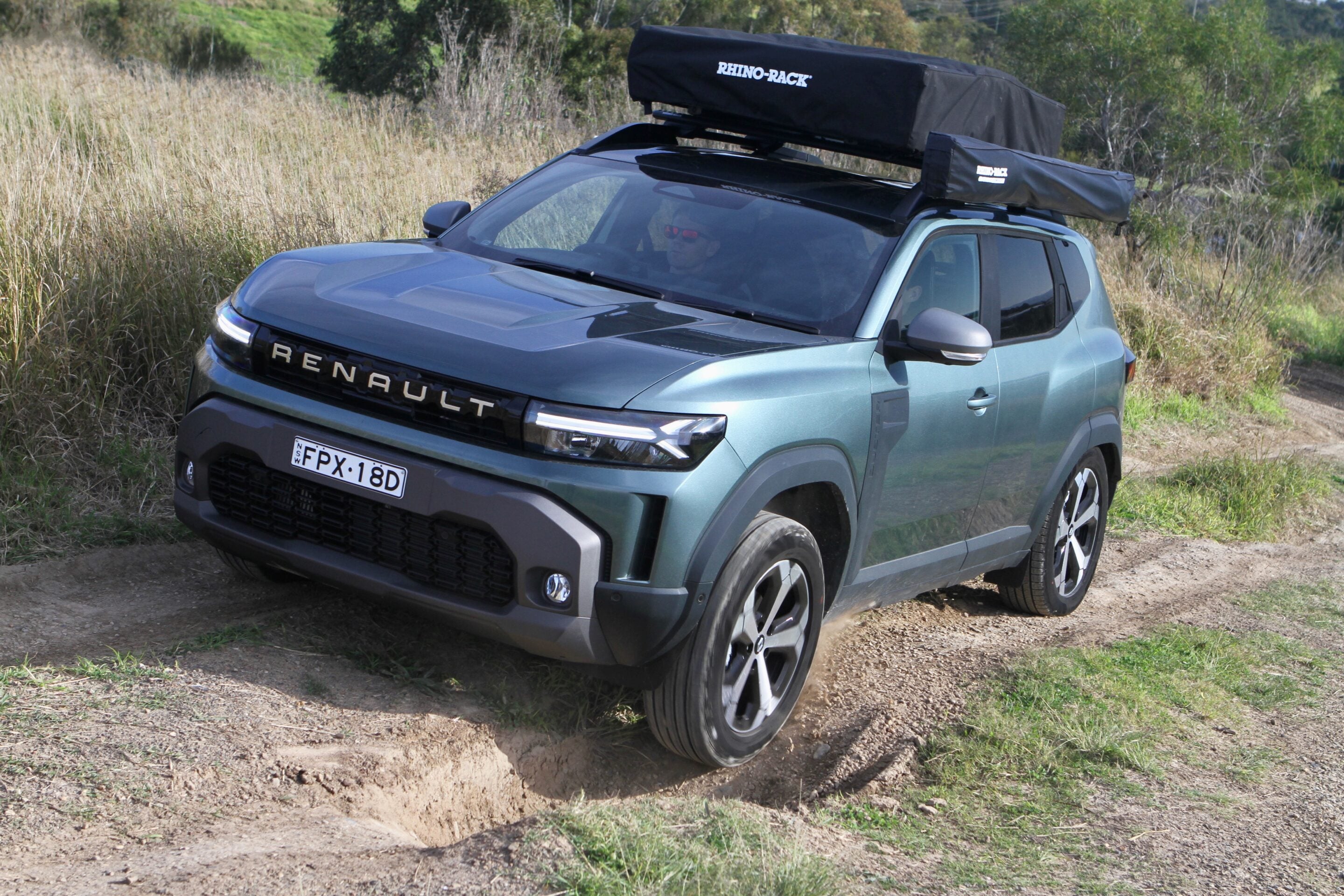
Price: From $31,990 plus on-road costs
Boot space: 472 litres (rear seats up); 1564 litres (rear seats folded)
Drivetrains: 1.2-litre or 1.3-litre turbo-petrols
The Renault Duster – or Dacia, depending on the market – is a legendary car and has sold millions globally since its inception and one of the reasons why is because it’s so practical. With the latest generation, the front-wheel drive version is comfortably more capacious than the all-wheel drive model thanks to the lack of rear differential and offers up to 1564 litres of space with the rear seats folded (AWD: 1424L).
5. Leapmotor B10
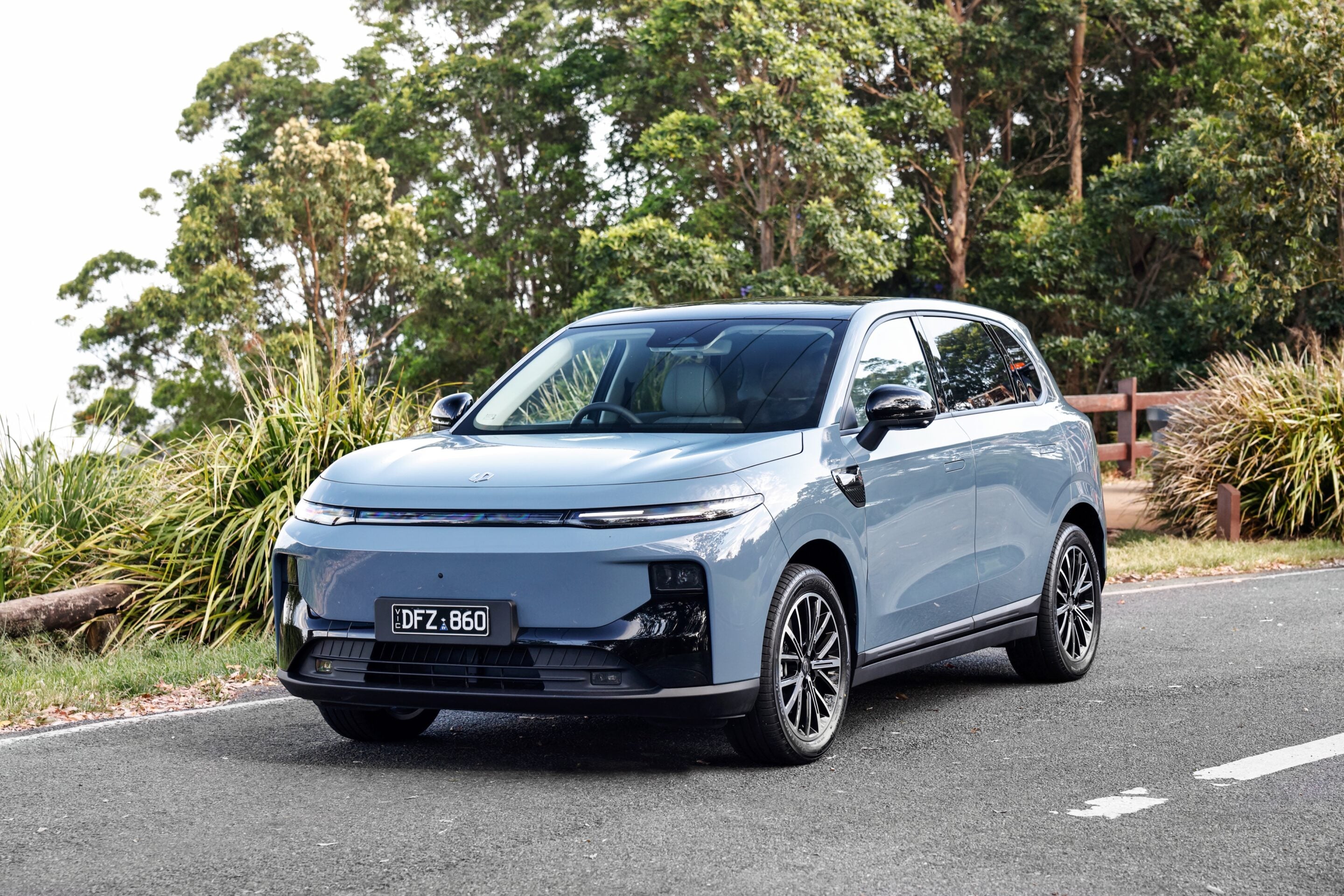
Price: From $37,888 plus on-road costs
Boot space: 490 litres (rear seats up); 1475 litres (rear seats folded), plus a 25-litre front boot
Drivetrains: Single-motor electric
The Leapmotor B10 only recently launched in Australia, but is leaving a mark as a cheap small electric SUV. It offers a low loading height, only a small load lip and a big square boot that opens up to 1475 litres with the rear seats folded flat. Helping further is a 25-litre front boot, which is large enough to store the charging cable and a few bags of shopping.
6. MG ZS
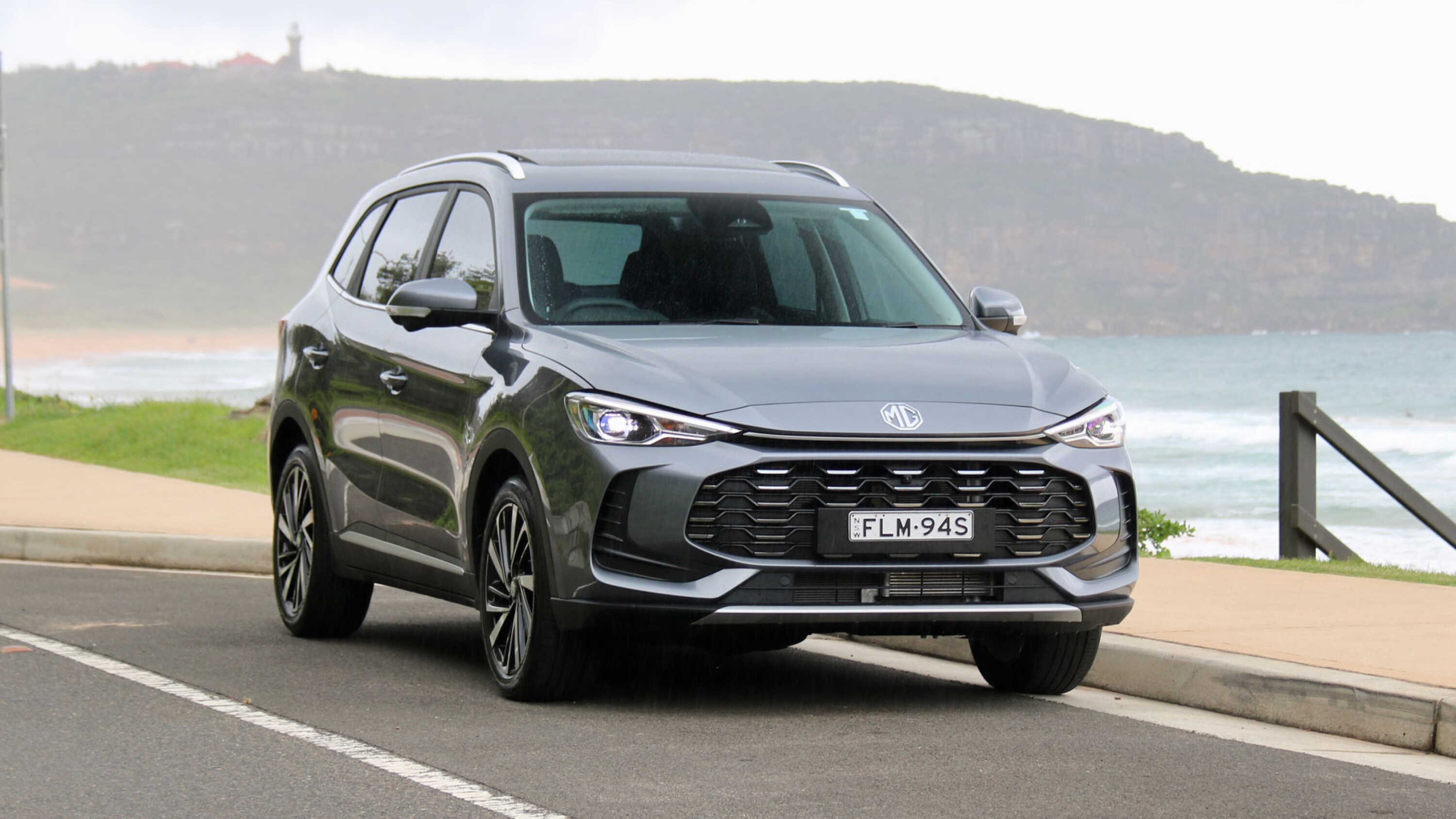
Price: From $22,990 driveaway
Boot space: 443 litres (rear seats up); 1457 litres (rear seats folded)
Drivetrains: 1.5-litre petrol, 1.5-litre turbo-petrol or 1.5-litre hybrid
The second-generation MG ZS has done quite well for its maker. It’s one of our favourite small SUVs around thanks to its value, range of powertrains and practicality. There is 443 litres of space lie behind the rear seats, which increases to a large 1457 litres with them folded. The rear seats don’t fold flat, annoyingly, but it’s still a practical space.
7. MGS5 EV
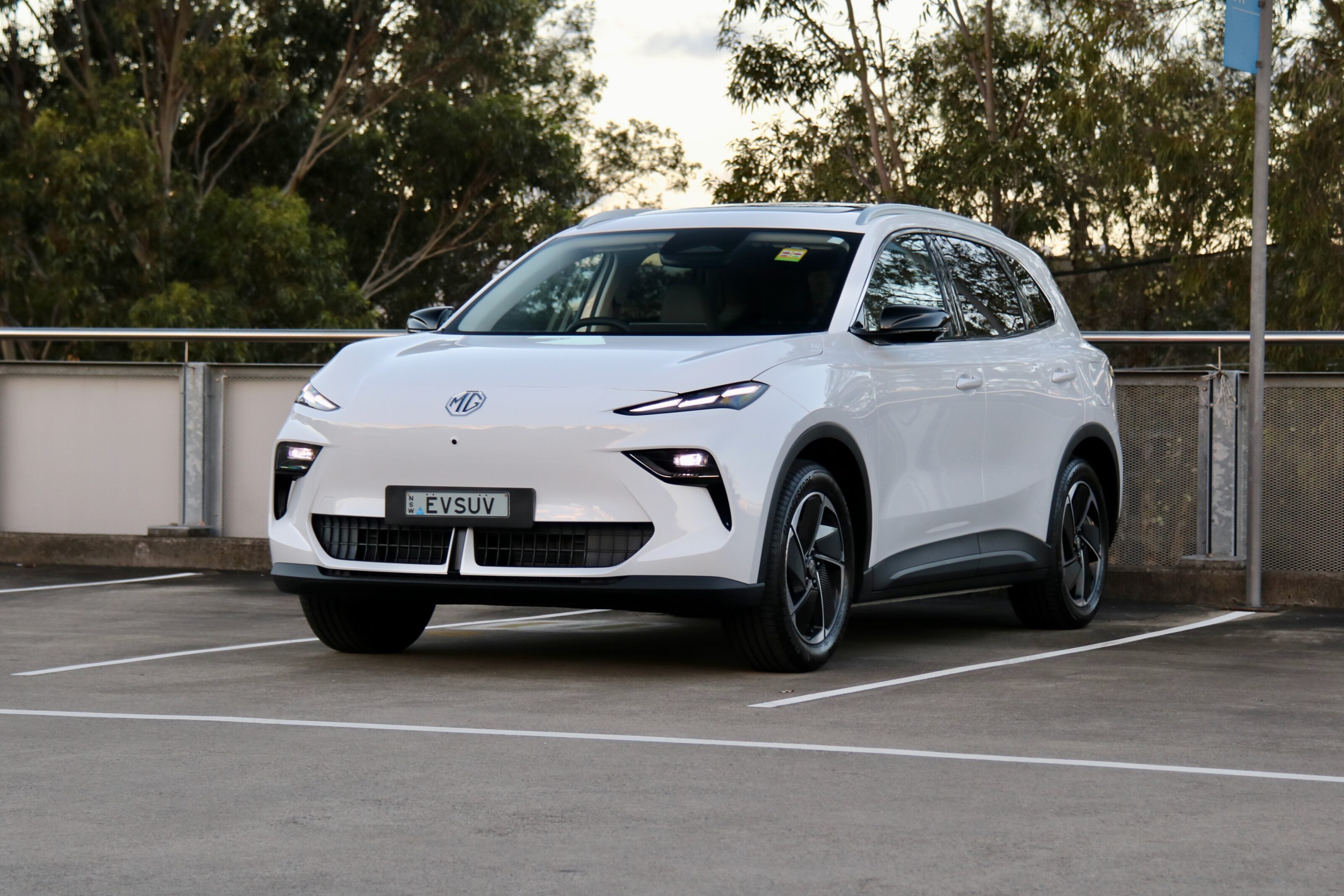
Price: From $40,490 driveaway
Boot space: 453 litres (rear seats up); 1441 litres (rear seats folded)
Drivetrains: Single-motor electric
Sitting just behind its petrol-powered ZS sibling, the MGS5 EV is the brand’s small electric SUV and it actually offers 10 litres’ more space with the rear seats up, but 16 litres less with them folded. Like the ZS, the MGS5 EV’s boot offers a dual-level boot floor to store items securely underneath, perhaps like the charging cable, and the seats fold almost flat to unlock up to 1441 litres of space.
8. Kia Seltos
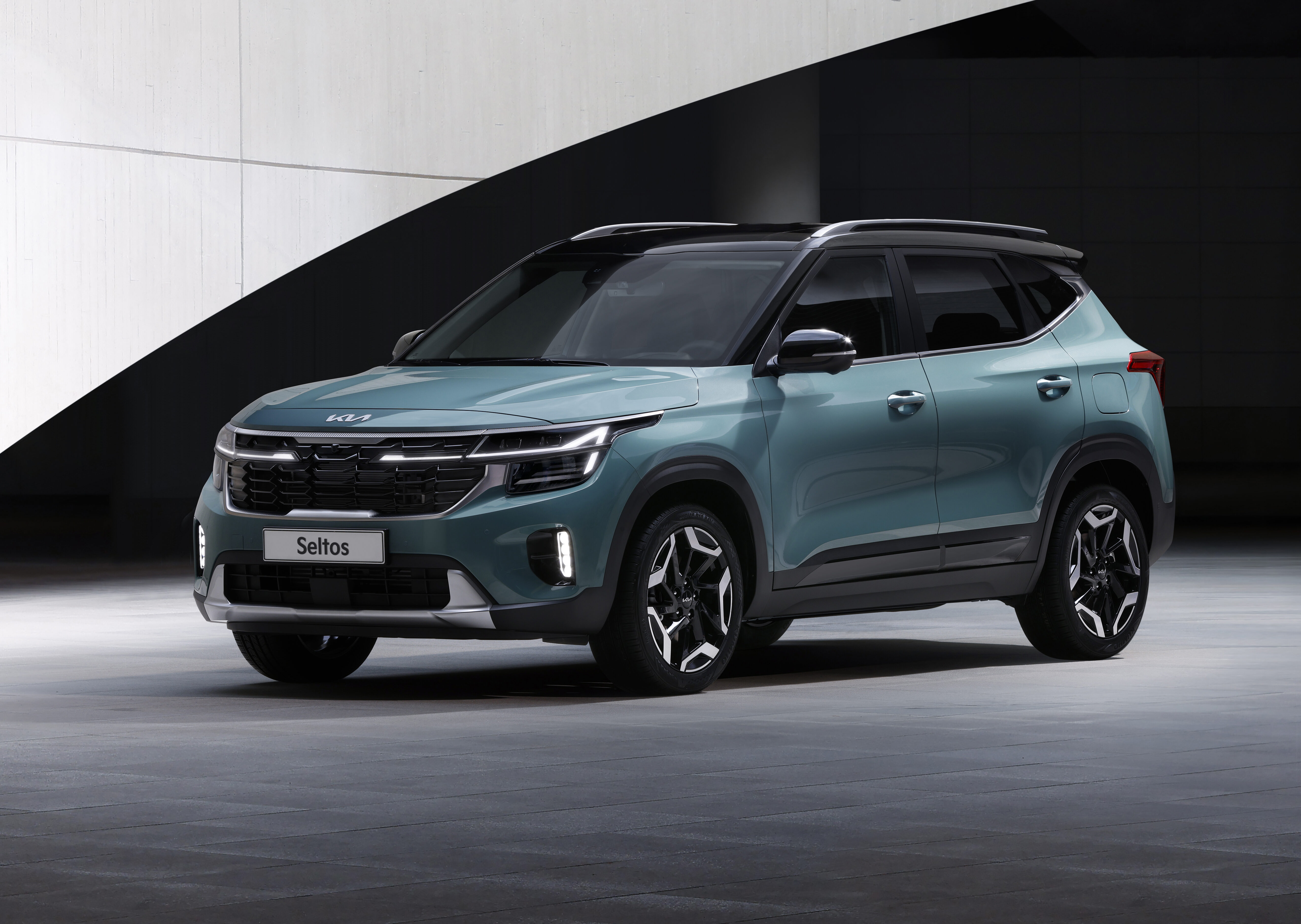
Price: From $31,250 plus on-road costs
Boot space: 468 litres (rear seats up); 1428 litres (rear seats folded)
Drivetrains: 2.0-litre petrol or 1.6-litre turbo-petrol
Although there’s a new one right around the corner, the Kia Seltos is still a great small SUV option and that’s true of its practicality as well. In the entry-level Seltos S lies 468 litres of bootspace with the seats up and 1428 litres with them folded. The rear seats fold almost flat, helping with longer items, and there’s more than enough space for trips to Ikea.
9. Skoda Kamiq
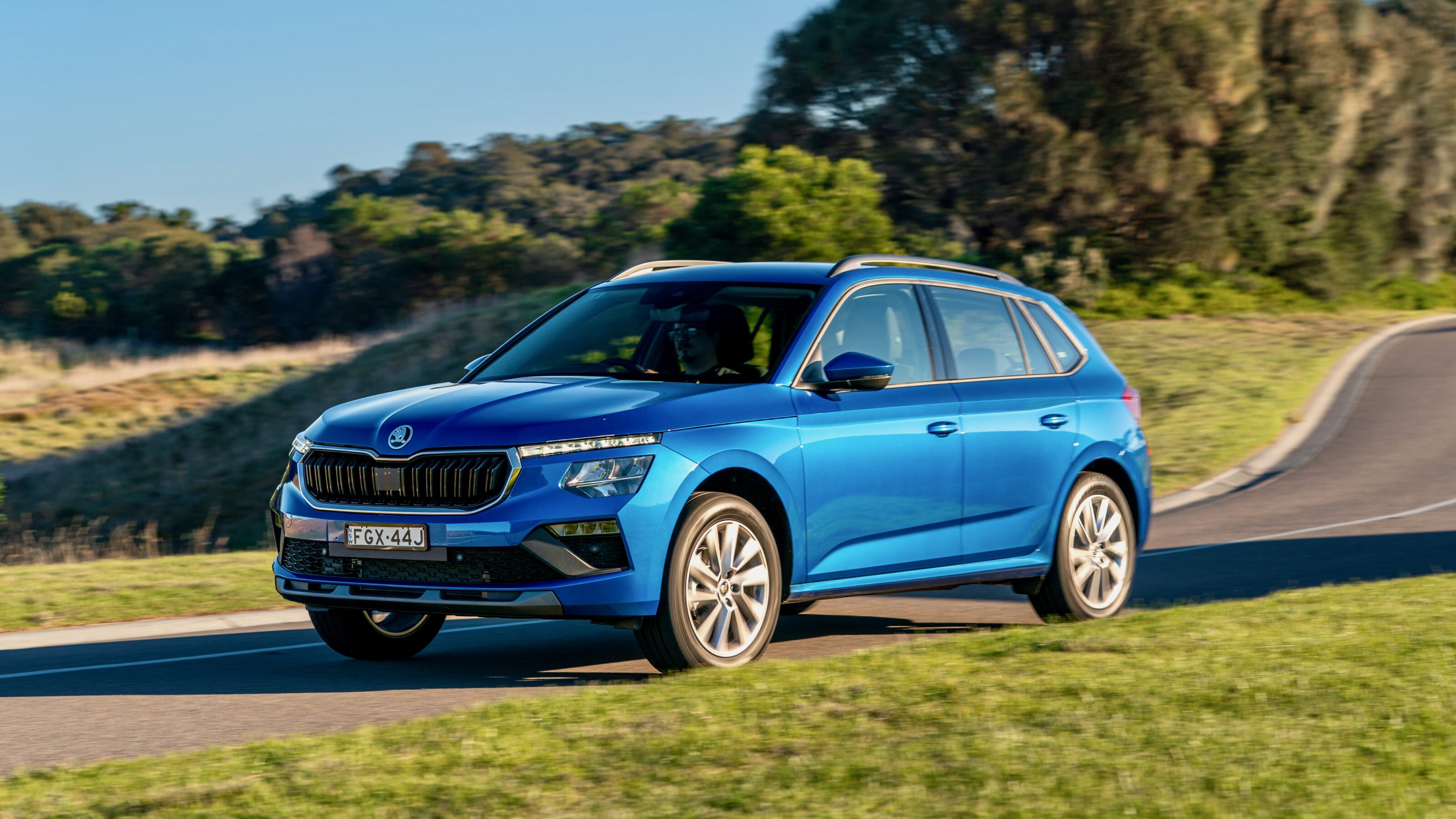
Price: From $29,990 driveaway
Boot space: 400 litres (rear seats up); 1395 litres (rear seats folded)
Drivetrains: 1.0-litre or 1.5-litre turbo-petrols
A Skoda placing on a most practical list is no surprise, especially a second one, but the Kamiq is one of the most capacious small SUVs with up to 1395 litres of boot space with the rear seats folded. As with the slightly larger Karoq, the Kamiq includes handy features like a double-sided boot mat and various hooks and nets to securely hang items from.
10. BYD Atto 3
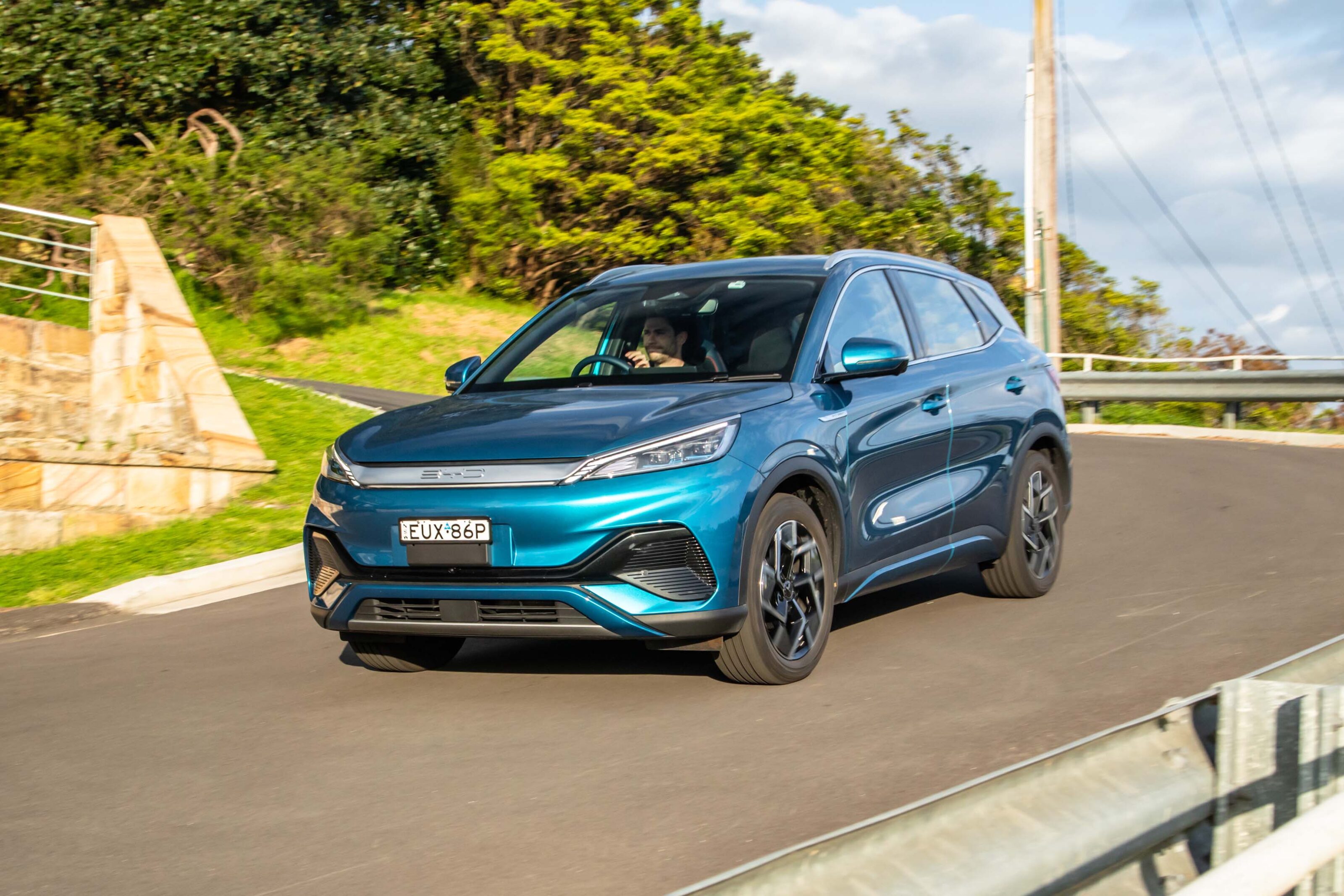
Price: From $39,990 plus on-road costs
Boot space: 440 litres (rear seats up); 1340 litres (rear seats folded)
Drivetrains: Single-motor electric
Rounding out the top 10 most practical small SUVs under $40,000 is the BYD Atto 3, which offers 440 litres of space with the rear seats up and 1340 litres with them folded. The Atto 3’s under-floor and side storage help further, allowing you to store items such as the charging cable out of sight. Here’s a hot tip as well: the incoming Atto 3 Evo facelift will offer 50 litres of more bootspace and a new 101-litre front boot, making it even more practical.
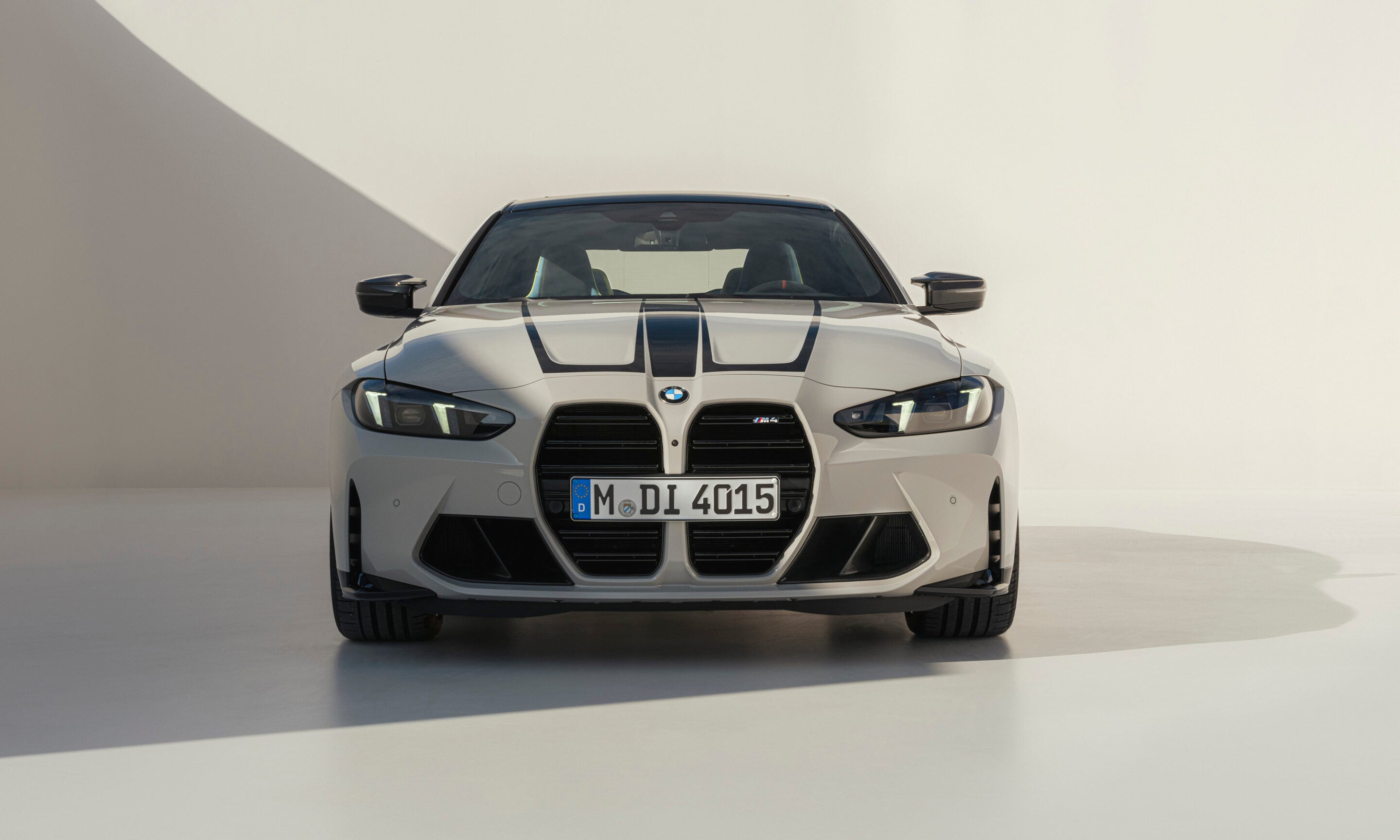
BMW M boss Frank Van Meel has acknowledged the days of M cars with a manual transmission are numbered, citing a performance ceiling as the main reason.
Speaking to assembled Australian media this week, including Whichcar by Wheels, Van Meel said the manual transmission would remain a core part of the brand’s philosophy for as long as possible, but admitted its days may be numbered.
“From an engineering standpoint, the manual doesn’t really make sense because it limits you in torque and also in fuel consumption,” Van Meel said.
“But from an emotional standpoint and customer standpoint, a lot of people still love manuals, so that’s why we kept them, and we intend to keep them as long as possible.”
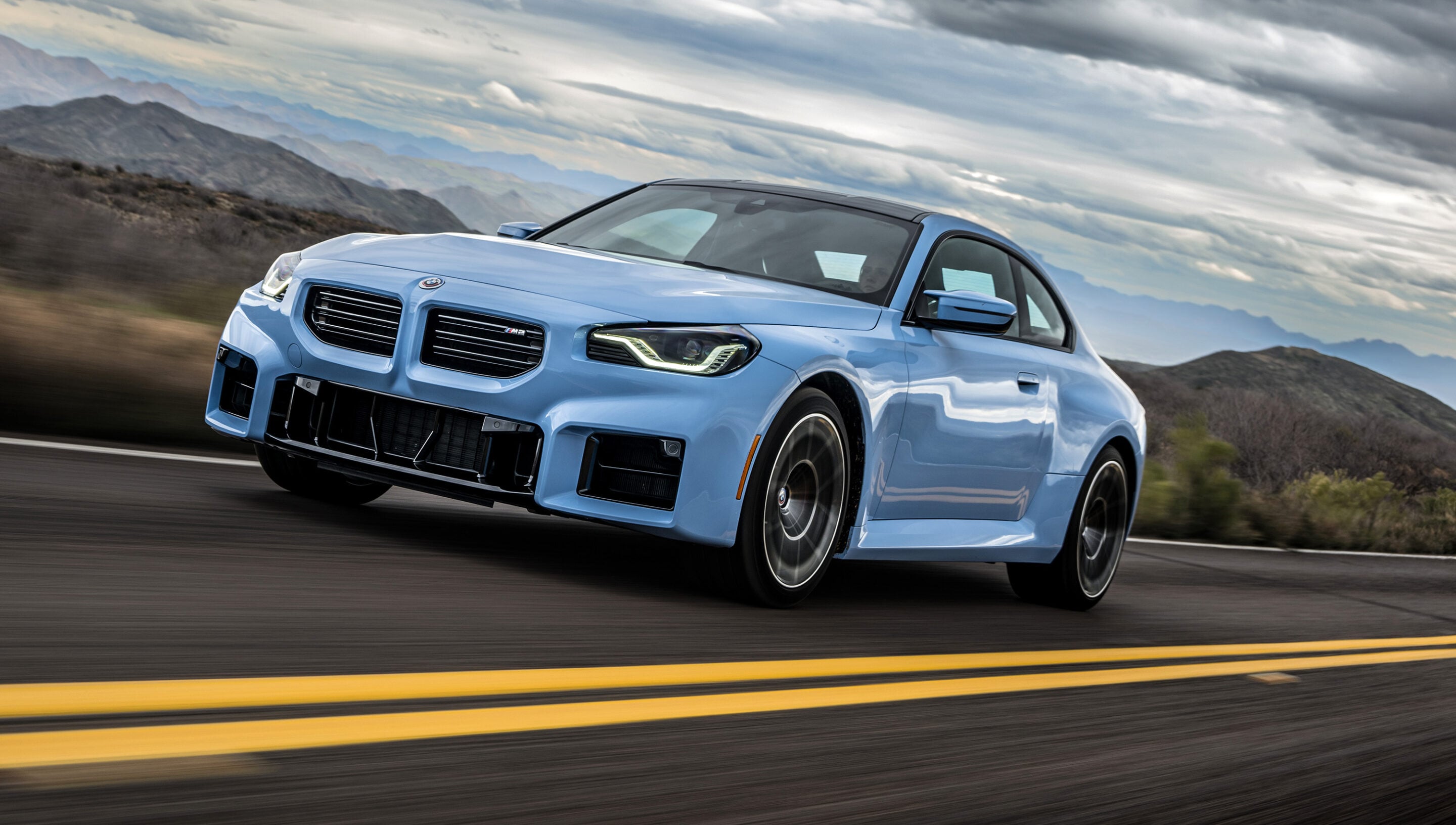
BMW M’s current six-speed manual gearbox – ZF GS6-L55TZ – has a maximum torque rating of just under 600Nm. However, BMW engineers a safety margin, limiting torque to 550Nm for three-pedal M models.
Currently in Australia only regular M2, M3 and M4 models are offered with a manual gearbox. However, the brand’s more performance-focused CS models and their higher torque outputs miss out on the six-speed manual, available only with BMW’s eight-speed ‘Steptronic’ automatic transmission.
But according to Van Meel, the cost of developing a manual gearbox capable of exceeding the self-imposed 550Nm torque limit would prove too prohibitive.
“It’s going to be quite difficult in the future to develop completely new gearboxes because the segment in the market is quite small, and the suppliers are not so keen on doing something like that,” said Van Meel.
“So we’re still happy with the manuals we have and we plan to keep them for the next couple of years, but in future, probably it’s going to be more difficult to keep the manuals alive, especially in the next decade.”
First published in the November 1998 issue of Wheels magazine, Australia’s best car mag since 1953. Subscribe here and gain access to 12 issues for $109 plus online access to every Wheels issue since 1953.
Mate against mate. State against state. Eight against eight.
The Holden versus Ford performance car war has waxed and waned ever since it exploded into life with the classic gold-with-black-stripes XR Falcon GT way back in 1967. Now, on the eve of the 21st century, with the launch of the AU Falcon, it’s about to boil over again.
You want hot? Both Ford and Holden will give it to you in both six-cylinder and V8 form, straight off the showroom floor. And there’s more coming. Holden and HSV are busy finessing the powerful new Generation III V8 for the Series II VT, due next March, and we hear rumours Tickford is playing around with an AU with even more grunt, 18in wheels and better brakes.
Not since the glory days of the Phase Falcons, XU-1 Toranas and GTS Monaros, and the R/T Chargers has Aussie muscle looked so strong.
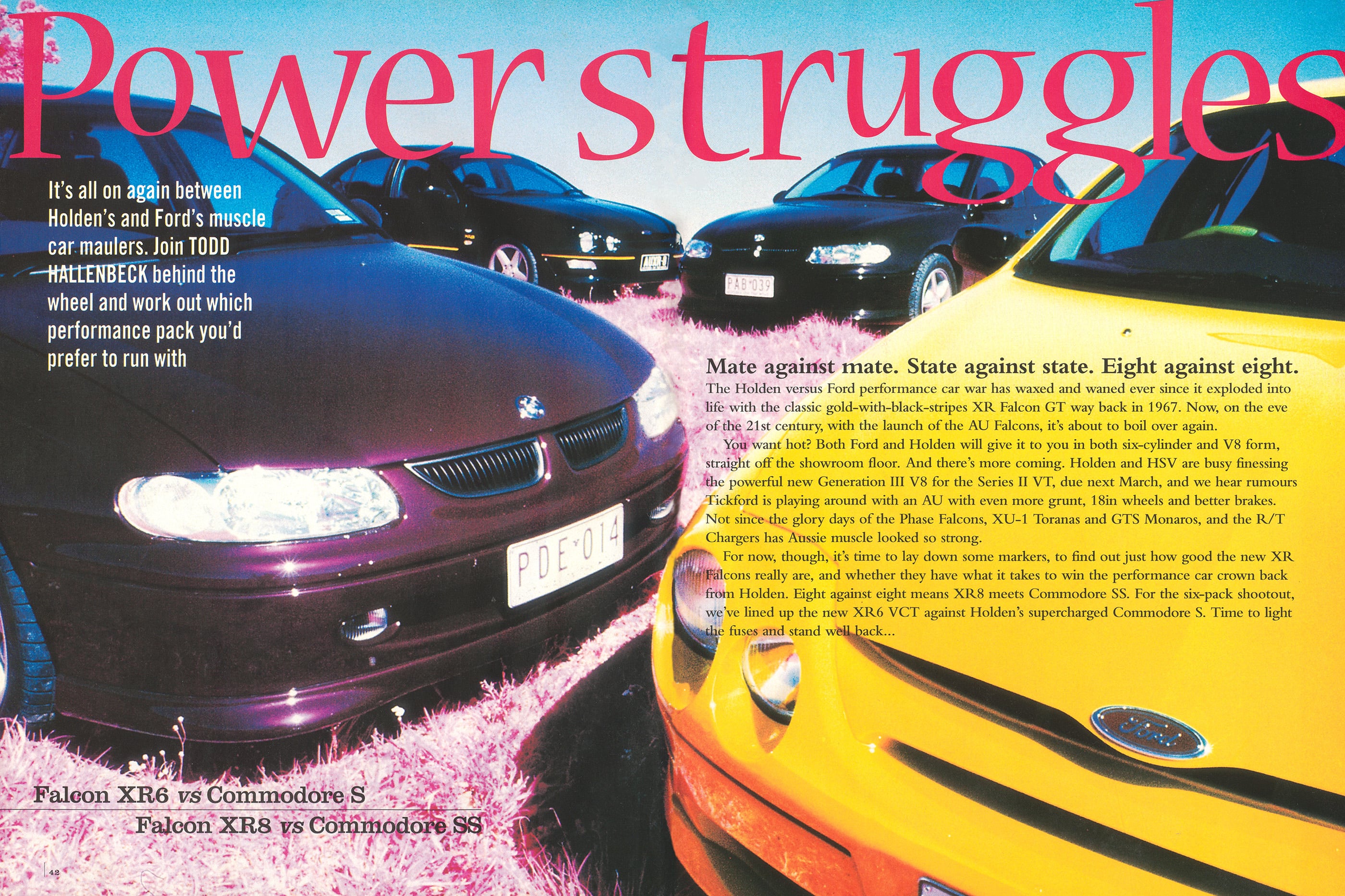
For now, though, it’s time to lay down some markers, to find out just how good the new XR Falcons really are, and whether they have what it takes to win the performance car crown back from Holden. Eight against eight means XR8 meets Commodore SS. For the six-pack shootout, we’ve lined up the new XR6 VCT against Holden’s supercharged Commodore S. Time to light the fuses and stand well back…
Holden Commodore S vs Ford Falcon XR6
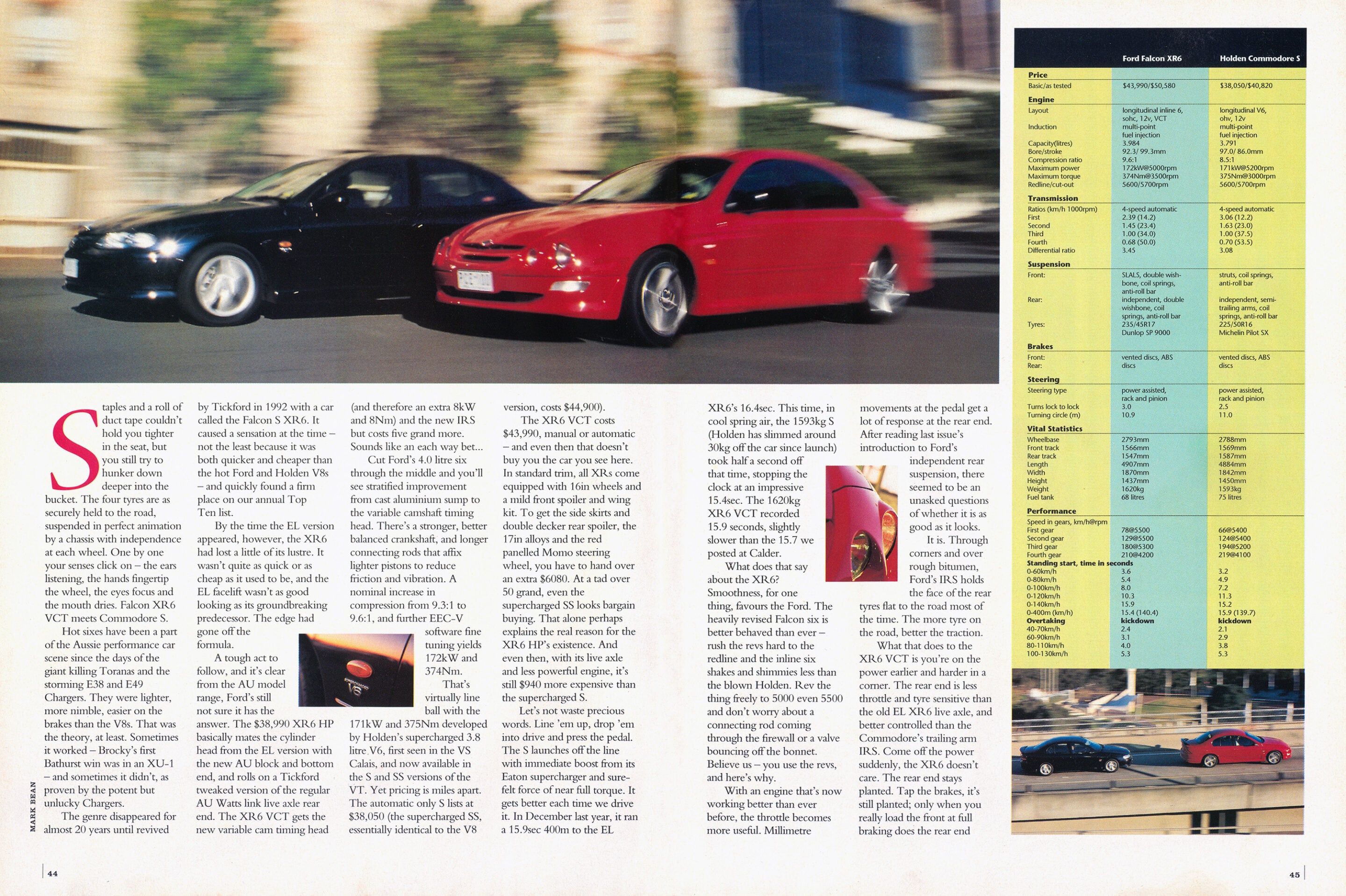
Staples and a roll of duct tape couldn’t hold you tighter in the seat, but you still try to hunker down deeper into the bucket. The four tyres are as securely held to the road, suspended in perfect animation by a chassis with independence at each wheel. One by one your senses click on – the ears listening, the hands fingertip the wheel, the eyes focus and the mouth dries. Falcon XR6 VCT meets Commodore S.
Hot sixes have been a part of the Aussie performance car scene since the days of the giant killing Toranas and the storming E38 and E49 Chargers. They were lighter, more nimble, easier on the brakes than the V8s. That was the theory, at least. Sometimes it worked – Brocky’s first Bathurst win was in an XU-1 – and sometimes it didn’t, as proven by the potent but unlucky Chargers.
The genre disappeared for almost 20 years until revived by Tickford in 1992 with a car called the Falcon S XR6. It caused a sensation at the time – not the least because it was both quicker and cheaper than the hot Ford and Holden V8s – and quickly found a firm place on our annual Top Ten list.
By the time the EL version appeared, however, the XR6 had lost a little of its lustre. It wasn’t quite as quick or as cheap as it used to be, and the EL facelift wasn’t as good looking as its groundbreaking predecessor. The edge had gone off the formula.
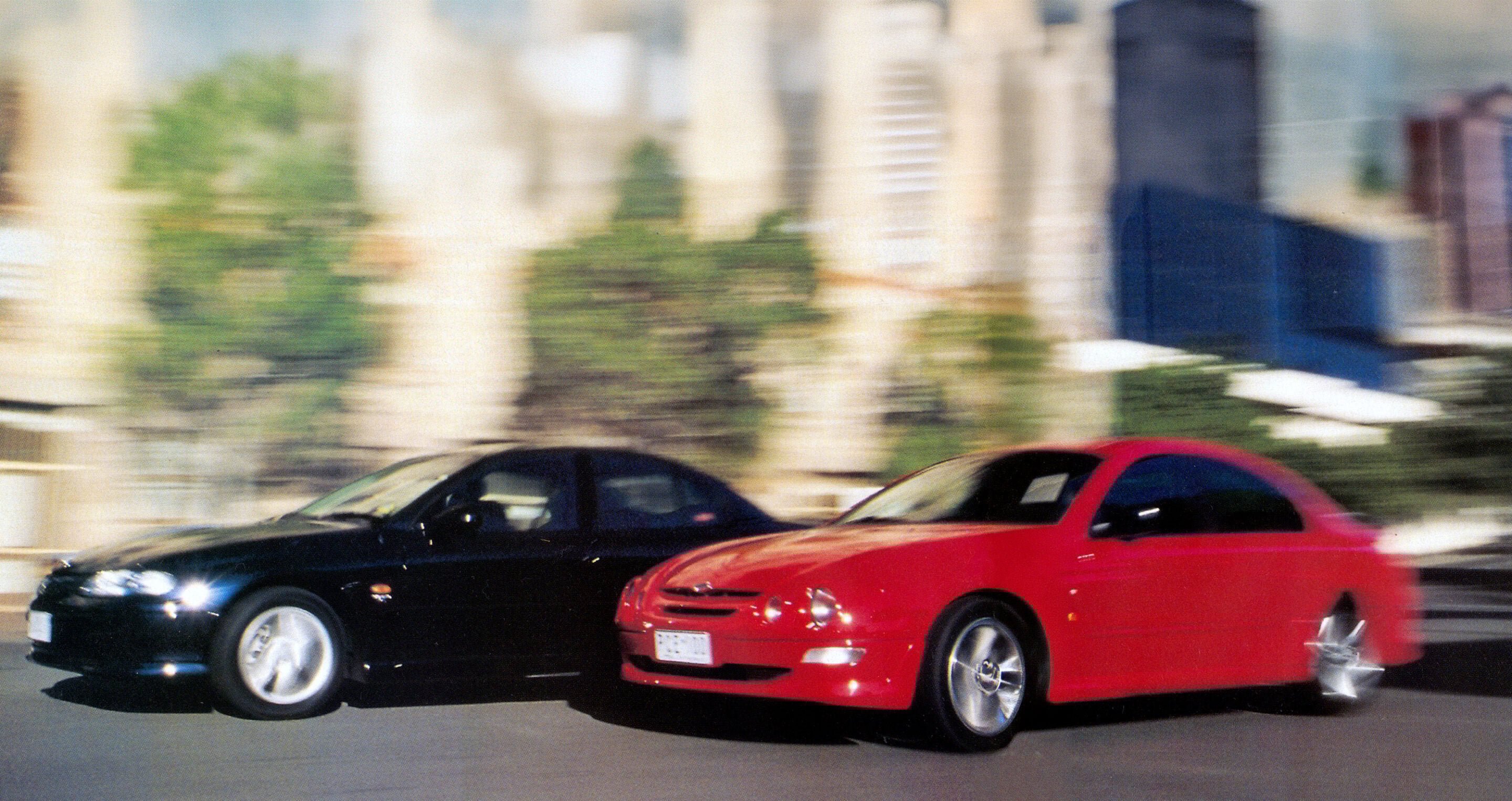
A tough act to follow, and it’s clear from the AU model range, Ford’s still not sure it has the answer. The $38,990 XR6 HP basically mates the cylinder head from the EL version with the new AU block and bottom end, and rolls on a Tickford tweaked version of the regular AU Watts link live axle rear end. The XR6 VCT gets the new variable cam timing head (and therefore an extra 8kW and 8Nm) and the new IRS but costs five grand more. Sounds like an each way bet…
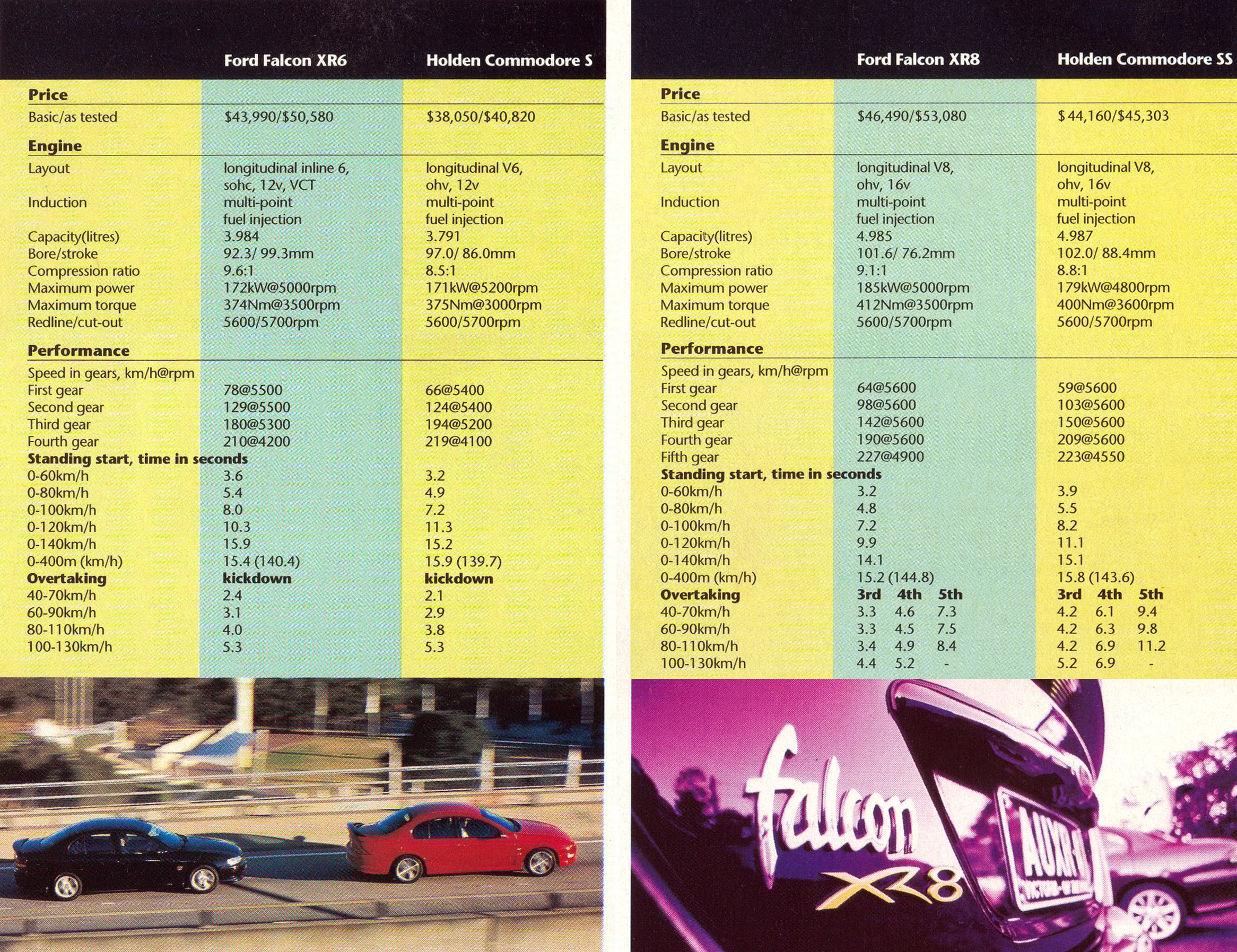
Cut Ford’s 4.0-litre six through the middle and you’ll see stratified improvement from cast aluminium sump to the variable camshaft timing. There’s a stronger, better balanced crankshaft, and longer connecting rods that affix lighter pistons to reduce friction and vibration. A nominal increase in compression from 9.3:1 to 9.6:1, and further EEC-V software fine tuning yields 172kW and 374Nm.
That’s virtually line ball with the 171kW and 375Nm developed by Holden’s supercharged 3.8 litre V6, first seen in the VS Calais, and now available in the S and SS versions of the VT. Yet pricing is miles apart. The automatic only S lists at $38,050 (the supercharged SS, essentially identical to the V8 version, costs $44,900).
The XR6 VCT costs $43,990, manual or automatic – and even then that doesn’t buy you the car you see here. In standard trim, all XRs come equipped with 16in wheels and a mild front spoiler and wing kit. To get the side skirts and double decker rear spoiler, the 17in alloys and the red panelled Momo steering wheel, you have to hand over an extra $6080. At a tad over 50 grand, even the supercharged SS looks bargain buying. That alone perhaps explains the real reason for the XR6 HP’s existence. And even then, with its live axle and less powerful engine, it’s still $940 more expensive than the supercharged S.
Let’s not waste precious words. Line ’em up, drop ’em into drive and press the pedal. The S launches off the line with immediate boost from its Eaton supercharger and sure-felt force of near full torque. It gets better each time we drive it. In December last year, it ran a 15.9sec 400m to the EL XR6’s 16.4sec. This time, in cool spring air, the 1593kg S (Holden has slimmed around 30kg off the car since launch) took half a second off that time, stopping the clock at an impressive 15.4sec. The 1620kg XR6 VCT recorded 15.9 seconds, slightly slower than the 15.7 we posted at Calder.
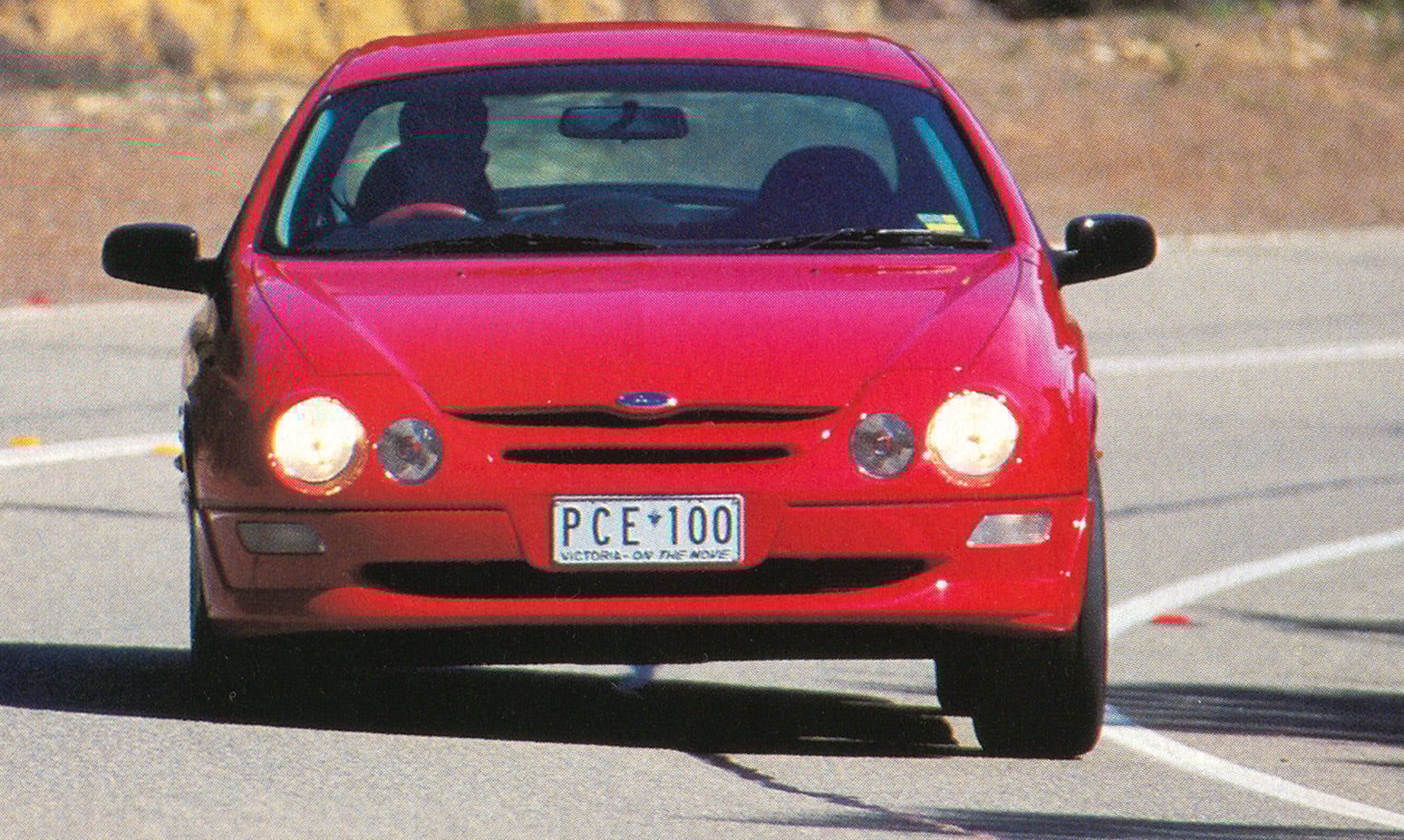
What does that say about the XR6? Smoothness, for one thing, favours the Ford. The heavily revised Falcon six is better behaved than ever – rush the revs hard to the redline and the inline six shakes and shimmies less than the blown Holden. Rev the thing freely to 5000 even 5500 and don’t worry about a connecting rod coming through the firewall or a valve bouncing off the bonnet. Believe us – you use the revs, and here’s why.
With an engine that’s now working better than ever before, the throttle becomes more useful. Millimetre movements at the pedal get a lot of response at the rear end. After reading last issue’s introduction to Ford’s independent rear suspension, there seemed to be an unasked question of whether it is as good as it looks.
It is. Through corners and over rough bitumen, Ford’s IRS holds the face of the rear tyres flat to the road most of the time. The more tyre on the road, better the traction.
What that does to the XR6 VCT is you’re on the power earlier and harder in a corner. The rear end is less throttle and tyre sensitive than the old EL XR6 live axle, and better controlled than the Commodore’s trailing arm IRS. Come off the power suddenly, the XR6 doesn’t care. The rear end stays planted. Tap the brakes, it’s still planted; only when you really load the front at full braking does the rear end begin to feel at all unsettled.
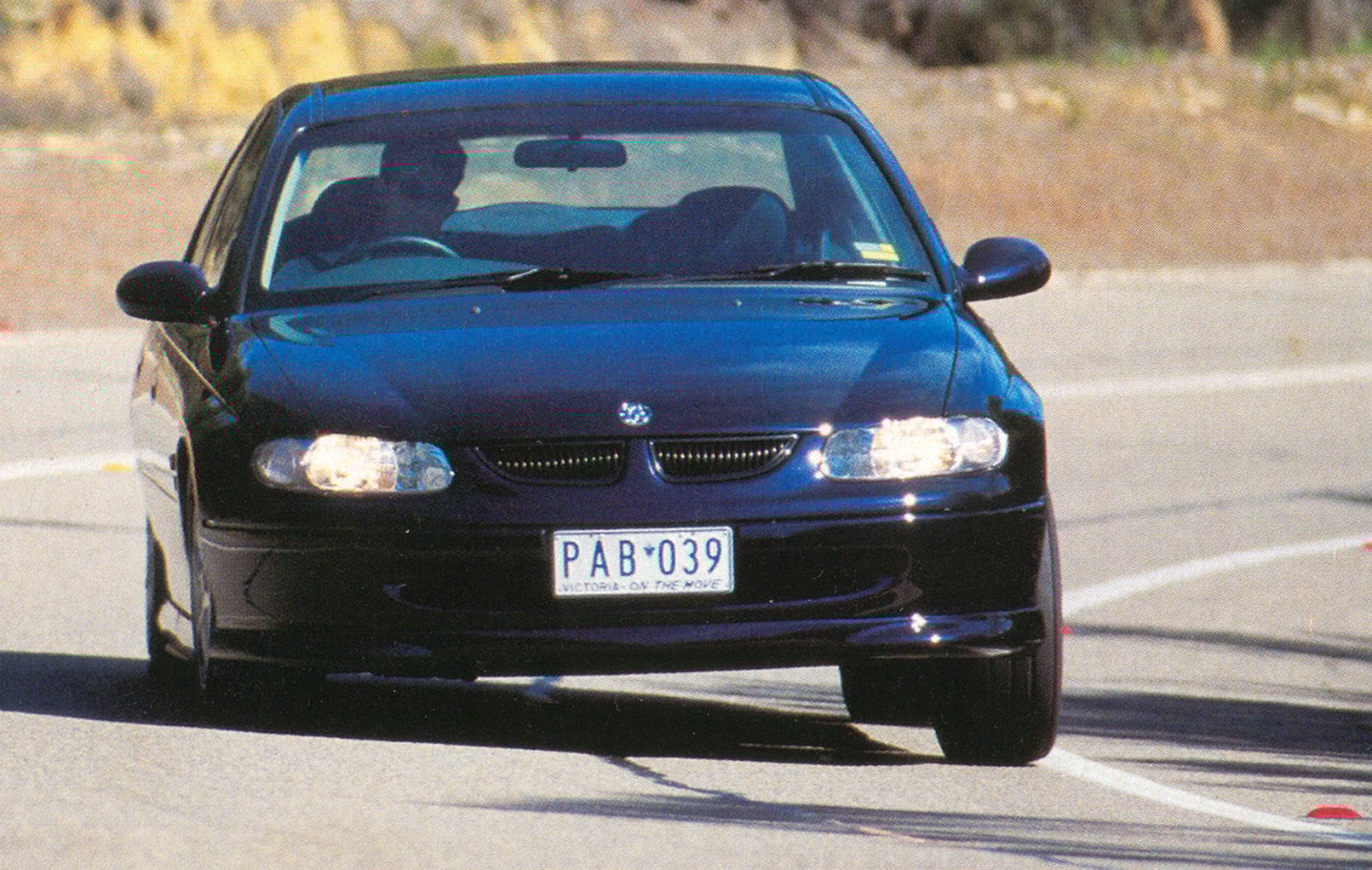
Drive the S into a corner and the rear end pitches, roll steers and bump steers. In the Commodore the rear determines cornering speed. Watch your hands on the steering wheel – in the Commodore they’re chasing the tail with quick jabs to counteract the arse pitching over bumps. In the Falcon, you’re keenly aware of the rear end’s grip because you can now push harder on the front. Your hands are steady.
The XR 6 demands greater steering input only because it has a slower steering rack – three and a frag turns lock to lock where Commodore is half a turn less.
The two cars enter a corner differently. The Falcon likes to be tucked in early and kept tight to the inside. The front will push or understeer long before the rear gets loose or oversteers, so you feed it as much throttle as the front end wants. The Commodore comes in late, turns in sharp as the body begins to roll and its mass leans on the front outside wheel. Once it’s point in, you’re back on the throttle, gentle movements of the slow-action pedal to balance the rear end and always ready to correct it with the steering. The Commodore can be quick through corners, but it’s very driver demanding.
Some of that has to do with the XR6’s bigger optional tyres, 17in 235/45 Dunlop SP Sport, but even on standard 16in 225/50 rubber, the Falcon is the superior handling chassis.
To sum up: The Commodore S is quicker to the corners and the XR6 quicker through them.
Straightforward enough, except for that small matter of the price. The way we see it, Holden, not Ford, now builds the great Aussie performance car bargain.
Ford Falcon XR8 vs Holden Commodore SS
From the moment your gluteus hit the bucket, the XR8 captures you with softer cushions and narrower bolstering. Length in the lower cushions supports longer legs, and finally we have a Falcon that fits big, tall, short and thin.
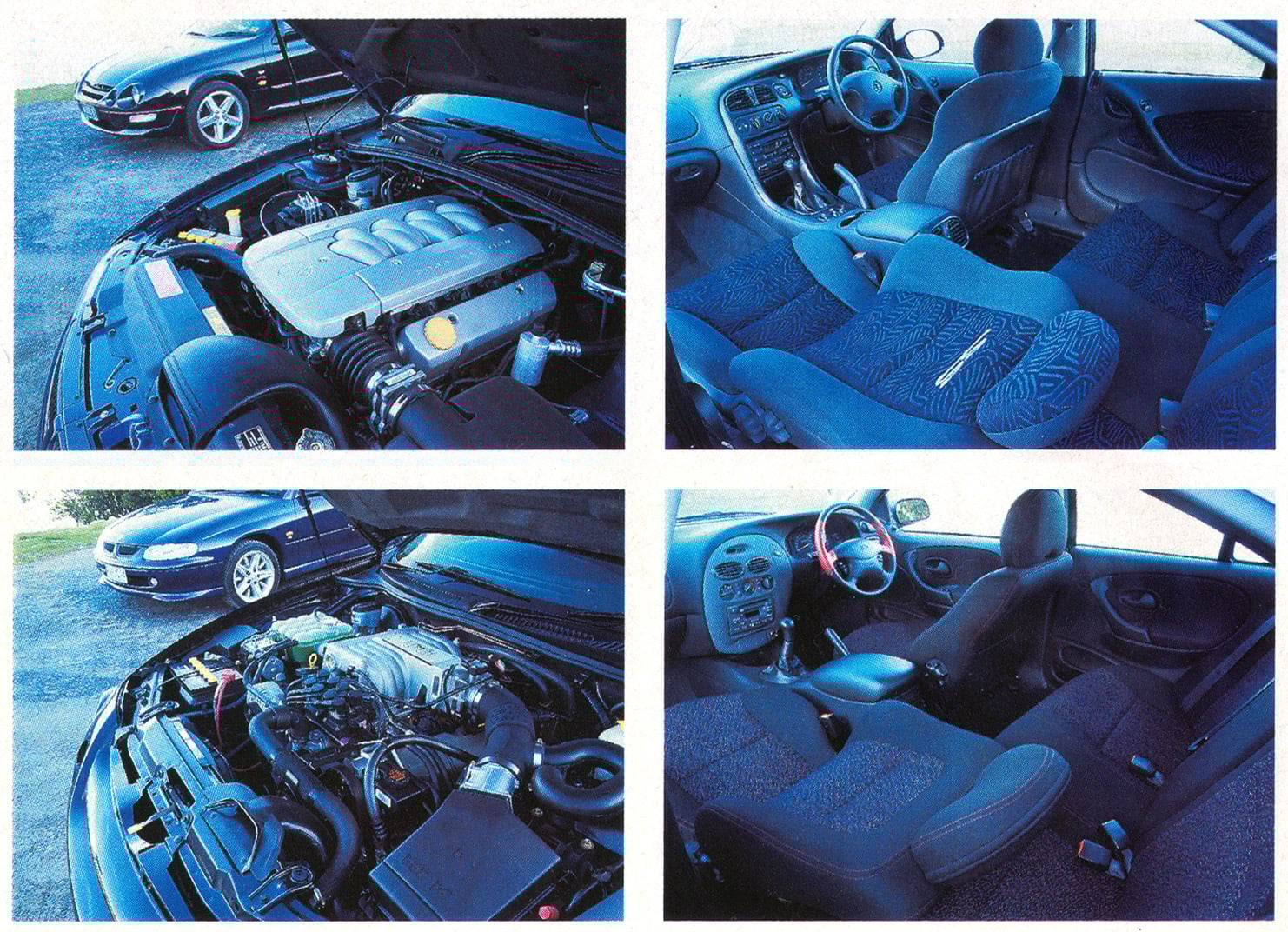
The dash layout in the SS feels better, more like a cockpit the way the dash flows into the centre console, but the XR8 gives the driver more instrument information. The gauges are spread nicely from left to right – oil pressure and amps, 240km/h speedo and 7000rpm tacho, with water temp and fuel on the right. The SS doesn’t offer oil or amp gauges.
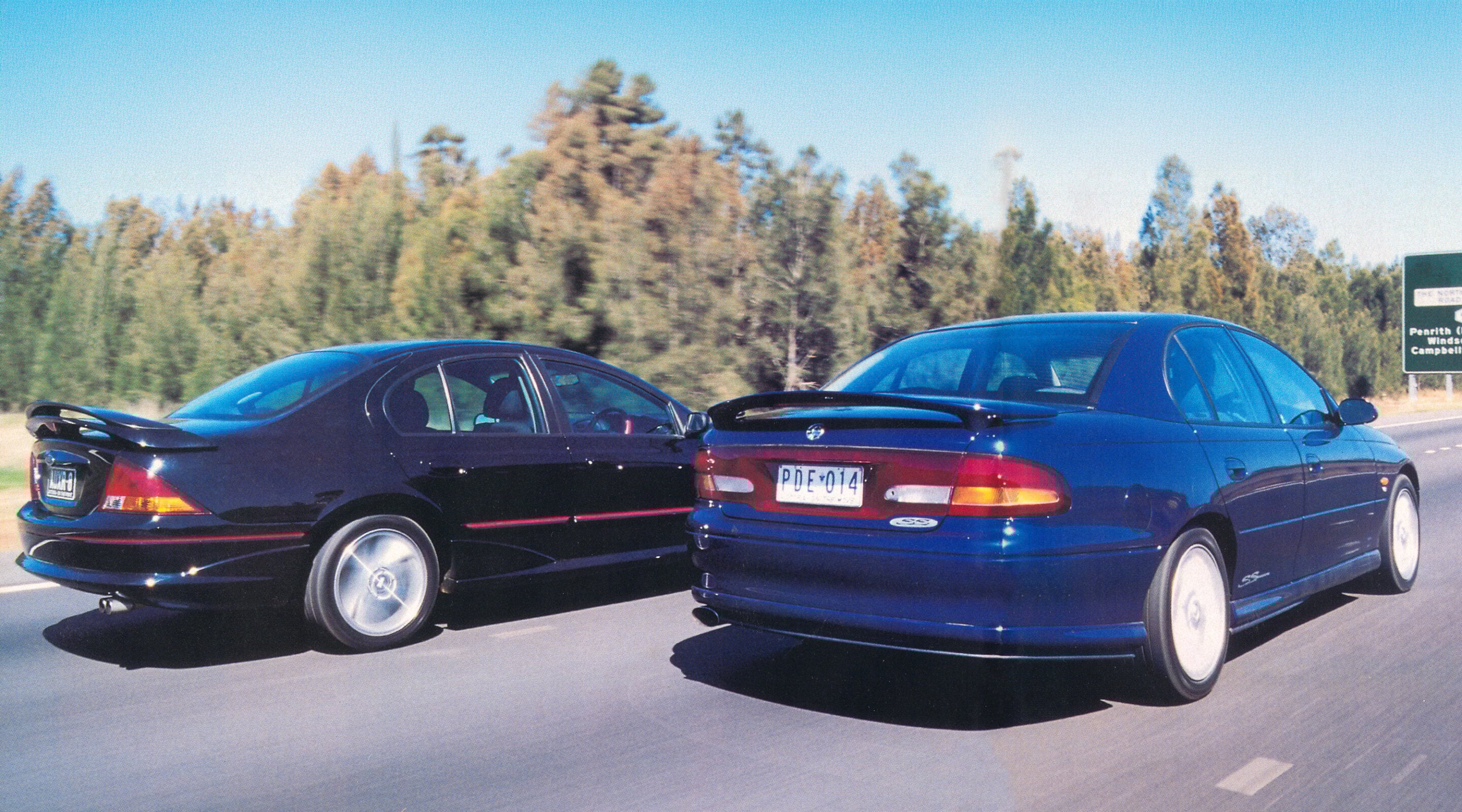
Holden offers few options on the SS V8 manual which creates a Catch 22. At $44,160, not counting the power windows ($910) and metallic paint ($233) fitted to our test car, it is more than six grand dearer than the S and a lot slower, despite a manual five-speed. The problem is the wheezy 179kW 5.0 litre V8 is now past its use-by date. Do yourself a big favour – tick the HSV developed performance option, coded XX3. That essentially buys twin exhausts with extractors and most needed 16kW and 30Nm. But it will cost you an extra $2825.
The XR8 lists at a more competitive $46,490, but that doesn’t buy a 17in wheel and tyre package to match the Holden. For that, you must pay an extra $2450. With the optional body kit and Momo steering wheel added, our test XR8 stopped the cash register ringing at a not insubstantial $53,080.
Still, you do get the necessary bits such as twin exhaust with four-into-one extractors, cone-type limited slip differential, 3.45:1 rear gears and air-conditioning as standard equip.
We’ve driven two, maybe three, sports sedans that are better than the AU XR8: BMW’s M3, the E55 Benz and Jaguar’s storming XJR. The cheapest of these starts at $134,000, and you’ll get enough change out of $200K for the Benz for no more than a week’s holiday in Germany. The HSV GTS is also quicker with brakes that’ll deform facial features. But even that costs nearly 20 grand more…
The XR 8 has a sweet chassis, so totally chuckable and completely benign on the limit that it starts to feel small, almost WRX-ish instead of a big, roomy 1650kg sedan.
The wonders of the IRS are more, well, wonderful. The more power the engine puts through it. Everything we said about the XR6 VCT’s handling applies here, but with 185kW and 412Nm and no hesitation from the five-speed manual gearbox, the predictability and stability at the rear is enormously fun. We can’t be any more technical other than to say the XR8 is a sport bike of a sedan. For the same reason guys on Ducatis tear down a piece of winding road on a sunny Sunday morning, you’ll be there with the XR8.
The SS is slower, doesn’t handle as well, and the LHD biased shift of the Getrag gearbox is awkward. Small details for a V8 owner, perhaps, but the Holden also used on average 3 litres more premium unleaded fuel on every fill. Who says we don’t care about the environment?
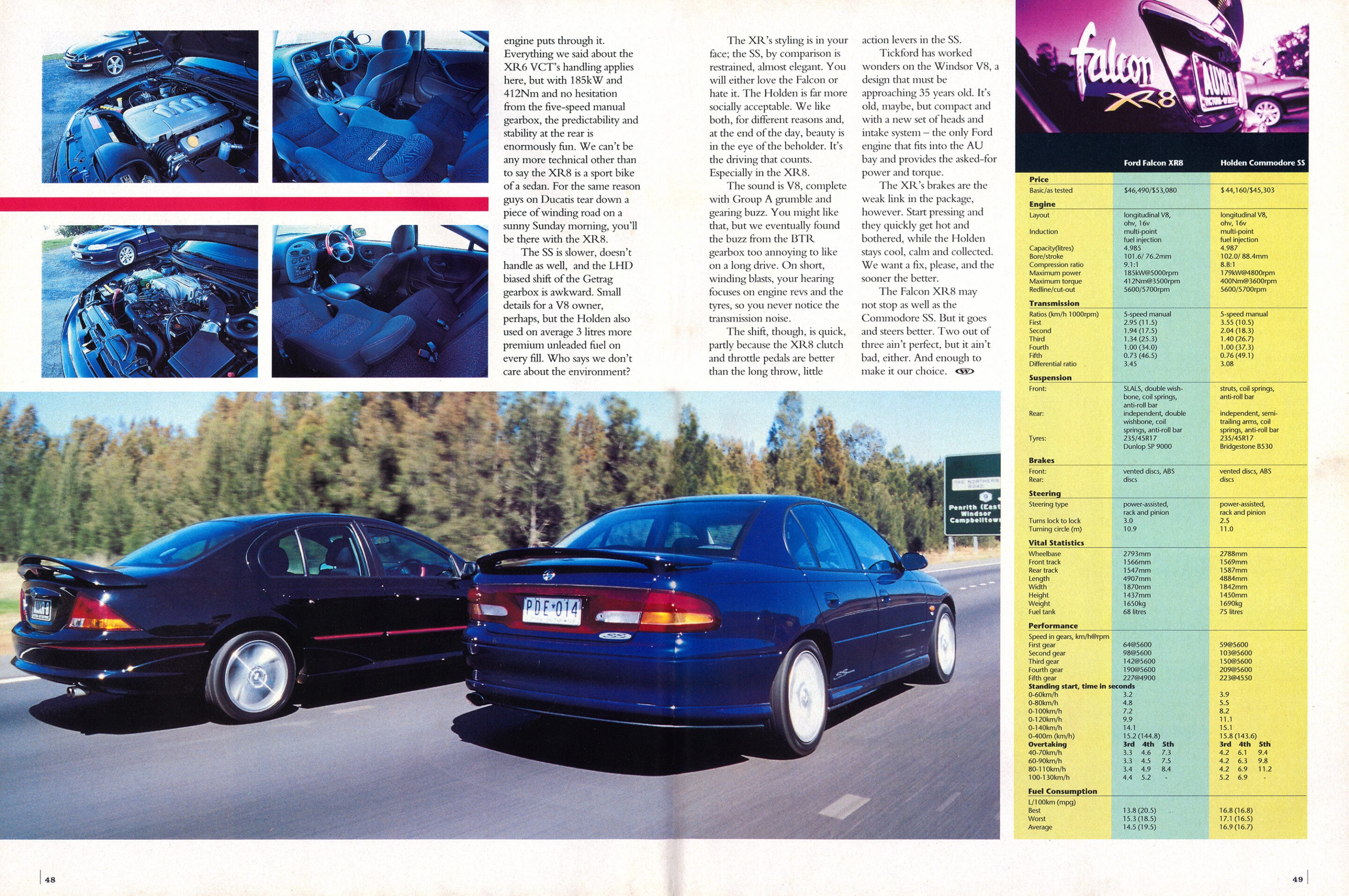
The XR’s styling is in your face; the SS, by comparison is restrained, almost elegant. You will either love the Falcon or hate it. The Holden is far more socially acceptable. We like both, for difterent reasons and, at the end of the day, beauty is in the eye of the beholder. It’s the driving that counts. Especially in the XR8.
The sound is V8, complete with Group A grumble and gearing buzz. You might like that, but we eventually found the buzz from the BTR gearbox too annoying to like on a long drive. On short, winding blasts, your hearing focuses on engine revs and the tyres, so you never notice the transmission noise.
The shift, though, is quick, partly because the XR8 clutch and throttle pedals are better than the long throw, little action levers in the SS.
Tickford has worked wonders on the Windsor V8, a design that must be approaching 35 years old. It’s old, maybe, but compact and with a new set of heads and intake system – the only Ford engine that fits into the AU bay and provides the asked-for power and torque.
The XR’s brakes are the weak link in the package, however. Start pressing and they quickly get hot and bothered, while the Holden stays cool, calm and collected. We want a fix, please, and the sooner the better.
The Falcon XR8 may not stop as well as the Commodore SS. But it goes and steers better. Two out of three ain’t perfect, but it ain’t bad, either. And enough to make it our choice.
The future of the Toyota Supra is secure for at least five years in Australia thanks to Supercars racing. Everything is also pointing to the GR GT, a Toyota GR concept car unveiled last year, as the next racing and showroom spearhead for Brand T.
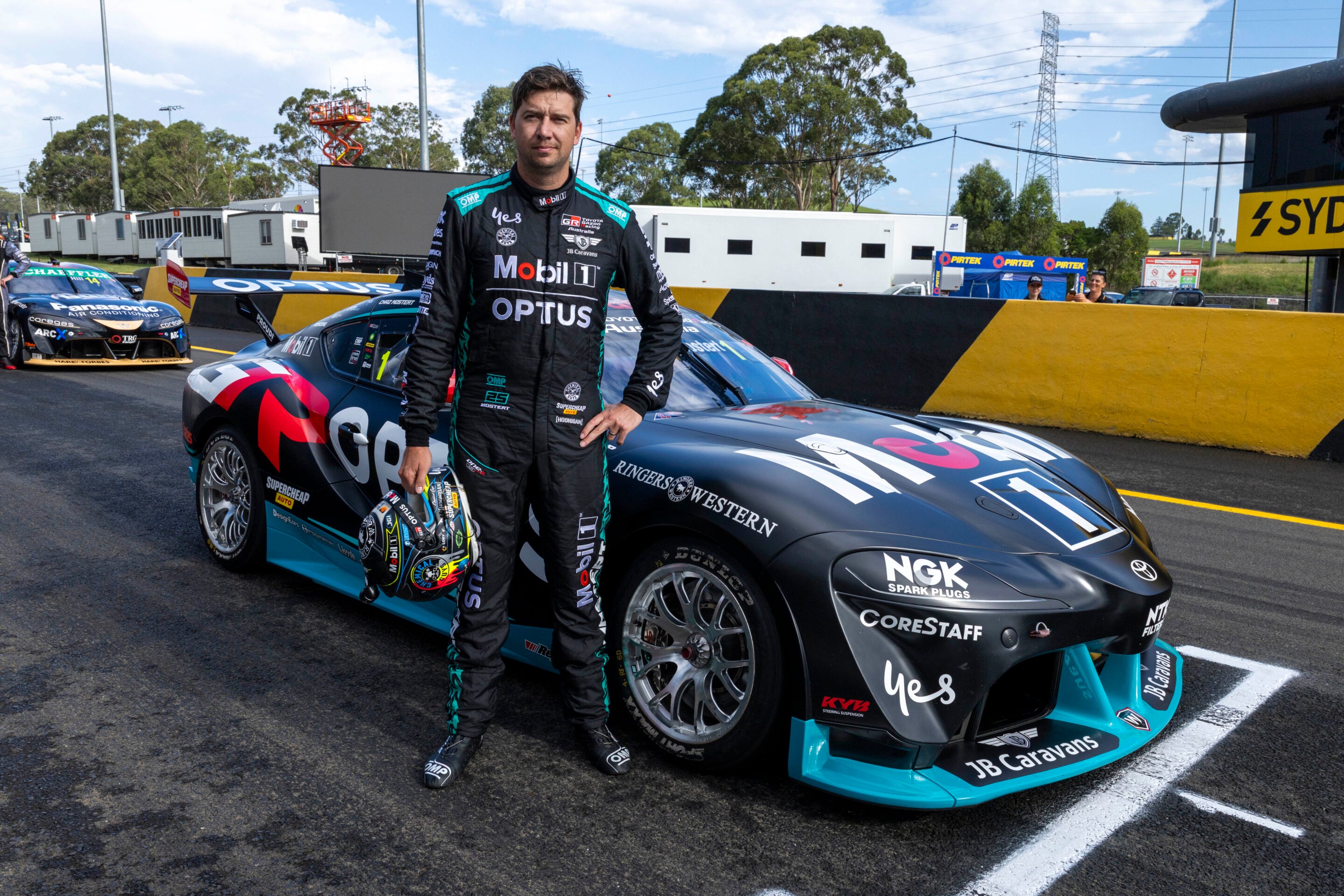
The future news comes as Toyota Australia makes its heavily hyped move into touring car racing with the GR Supra as a rival to the Ford Mustang and Chevrolet Camaro. Sydney Motorsport Park is hosting the five shiny new Supra GR racers, led by the #1 Toyota driven by defending champion Chaz Mostert.
No-one at Toyota Australia – or the teams run by Walkinshaw Racing and Brad Jones Racing – is making predictions about on-track success, but company vice-president John Pappas re-stated Toyota’s long-term commitment that mirrors its involvement in cricket and AFL football.
“This is truly a massive moment for all of us. We don’t do things by halves,” said Pappas. “We don’t enter things to lose. But we don’t want to put out too high expectations.”
That approach extends to the future of the Supra in showrooms, even though everything is pointing directly to a GR GT with Supra badges sometime after 2027.
“That is super exciting. That vehicle. That is going to be unbelievably great for the brand.
“I would love to see that car come to Australia. But we’ve got nothing to announce today,” Pappas said. “Right now we’re focussed on the GR Supra. That’s the vehicle for us for the next five years.”
Those words indicate that the Supra-cars racing program will use the existing body shape for five seasons, even though the last customer cars were delivered in Australia last year.
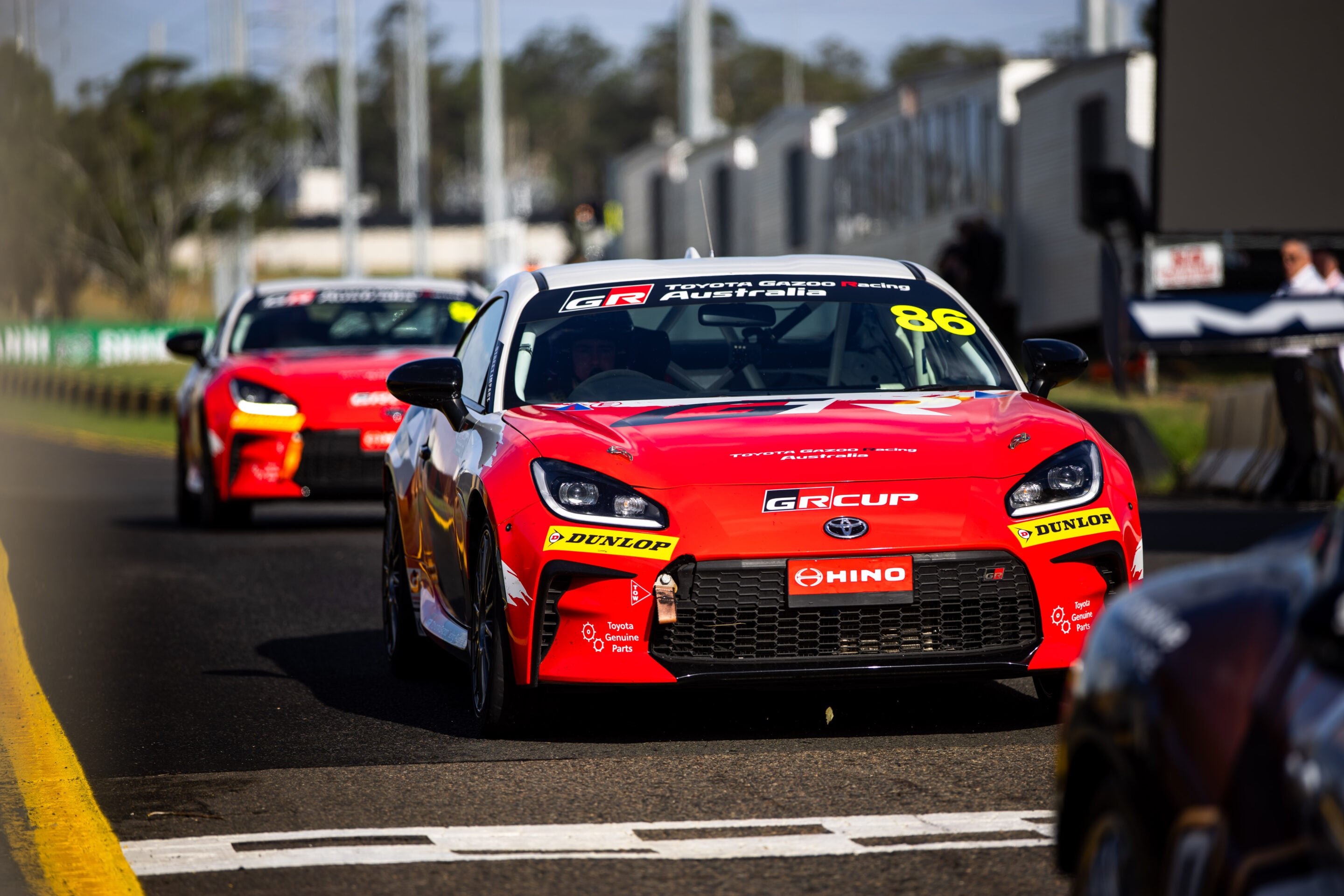
In addition to the Supercars program, Pappas confirmed Toyota’s ongoing support for the GR 86 Cup in circuit racing and a two-car attack on the Australia Rally Championship with the GR Yaris.
“This year will be the biggest year ever for Toyota in Australian motorsport. Participating in motorsport demonstrates Toyota’s passion and commitment to what we do,” Pappas said.
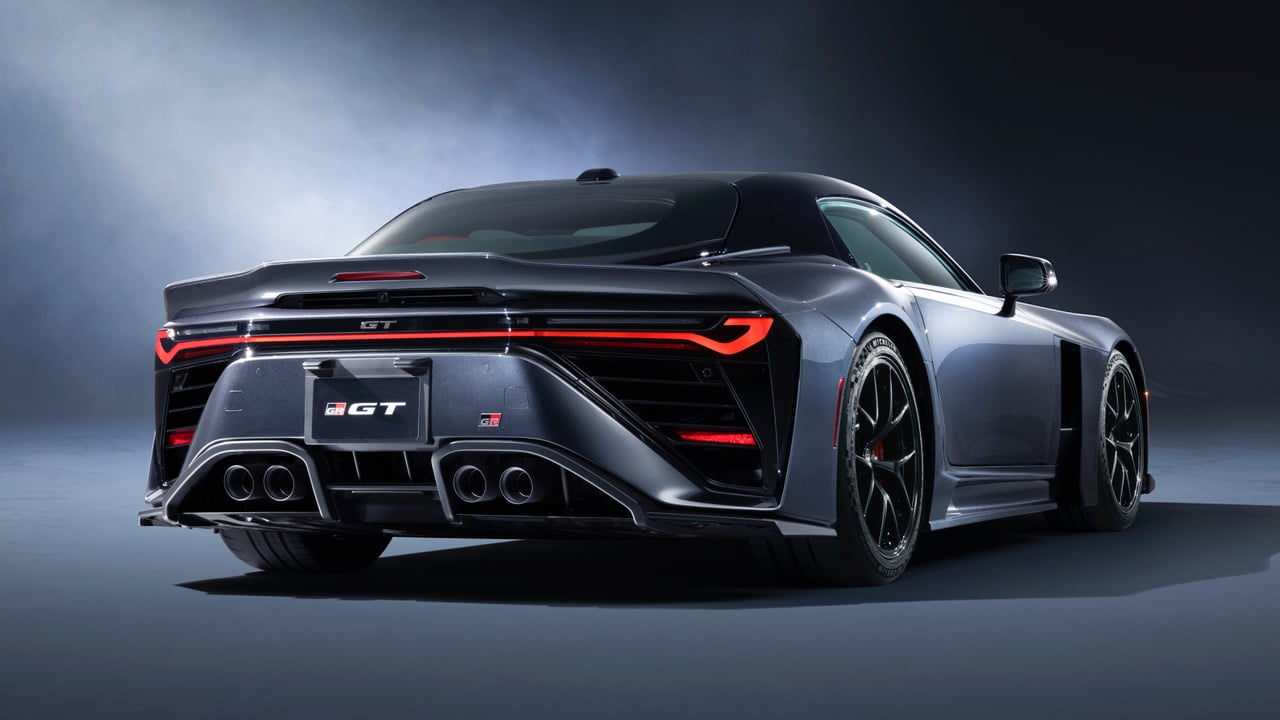
It is also a reflection of Toyota’s work to build a barricade against Chinese import brands, cementing the sales success of the Toyota HiLux favoured by many motorsport fans and its position as number one in showrooms.
“The more we race, the more we learn. For us it’s all about learning,” said Pappas.
Ask the average Aussie in the street what ‘autopilot’ means and the overwhelming majority would respond with an answer based on the concept that we know and understand from the way an airliner works. That is, the pilot can set some controls and effectively get up and leave the flight deck, while the plane flies itself. Now, there’s an element of simplicity to that explanation above, but the basics of it stand in regard to what non-pilots think autopilot really is.
As we know now, that concept doesn’t quite work down here on level ground, and a recent ruling in the state of California has forced Tesla to acknowledge the confusion caused by its naming convention.
As reported today by Car And Driver in the United States, Tesla is changing the name of its driver assistance features after the California Department of Motor Vehicles threatened to take away its dealer licence. The report states that ‘California had previously ruled that the “Autopilot” and “full Self Driving” names misrepresented the systems’ capabilities, violating state law’.
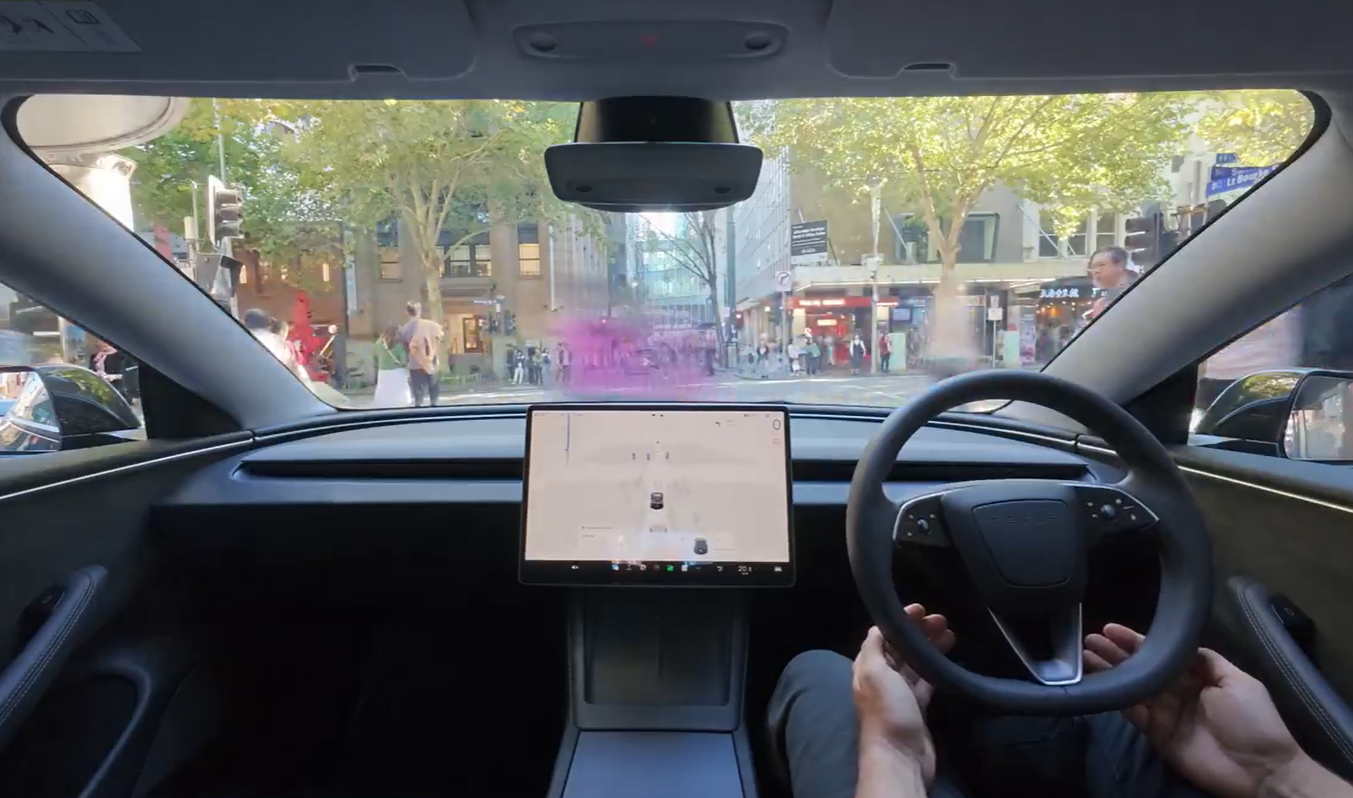
As such, Tesla has decided that ‘Full Self Driving’ will now carry the suffix ‘Supervised’ in all marketing material, while ‘Autopilot’ has been renamed ‘Traffic Aware Cruise Control’. In other words, Tesla has acknowledged that the general public – who buys new cars – is being confused by what the system is and what the system can do.
On one hand, we suspected this would always have to happen, given Tesla’s use of the terms for almost a decade, despite the fact that various levels of human interaction are required in order for the systems to keep working. Even Tesla’s most advanced self-driving system, which is currently Level 2, demands that the driver pay full attention to the road ahead for it to continue to function.
While the ruling pertained specifically to the state of California, Car and Driver reports that Tesla will adopt the new naming convention even outside the west coast state. The outlet reported that ‘Tesla will now refer to the systems by new names, even outside California, and the changes appear to have already taken place on Tesla’s website’.
What’s the range tipping point to attract a sceptical buyer to even look at an electric vehicle? Much of the feedback we see at Wheels suggests it’s 1000km – a range that seemed fanciful even a few years ago – but BYD Australia thinks the answer is a little more nuanced than simply an outright figure.
“Yeah, it’s a good question and I don’t know that the tipping point is to be honest,” BYD Australia Chief Operating Officer Stephen Collins told Wheels. “But what I do know, is that BYD at its core, is very much about battery technology and leading battery technology, so I think range is one part of it, but there are other parts too, like charging time and charging availability.”
As it is in EV manufacturing terms, China is also leading the way in the roll out of serious public charging infrastructure, aimed at making the ownership of an EV as attractive – and easy – as possible.
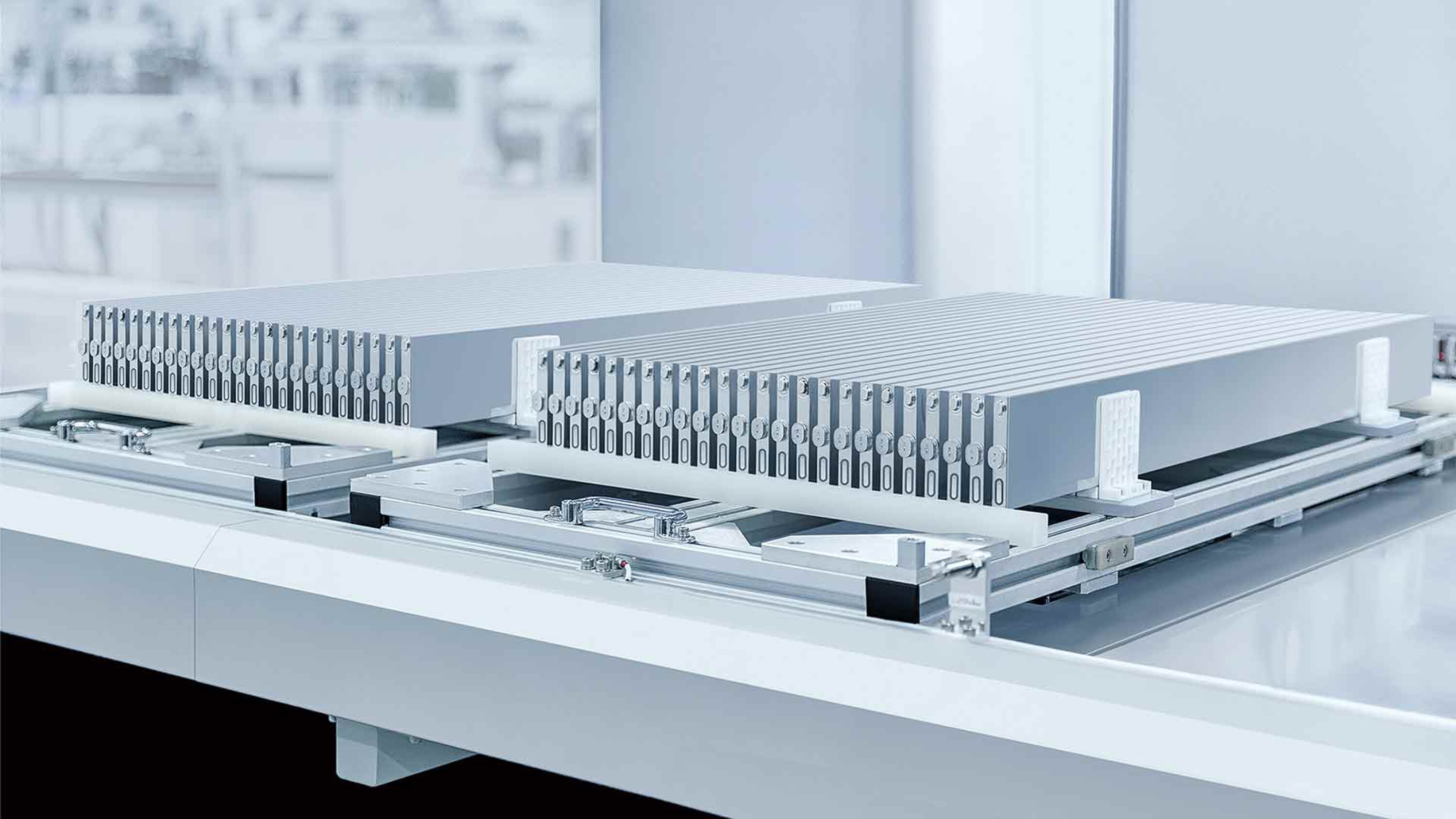
“In China, they’re just rolling out mega chargers, 1000kW, five minute charging capability,” Collins told Wheels. “So I think there are a number of answers to that question that solve some of the issues for some of the people who aren’t fully adopted yet for EVs. So I do think range is one component and like everything it’s going to keep improving as we go.”
Can Collins see a situation, then, where we get the charging infrastructure ‘right’ in this country then, given especially in remote areas or outside metro areas, its the single biggest issue for sceptical buyers in this country?
“Im not sure we’re miles away, I think we’ll get it right, it’s just an evolution,” Collins told Wheels. “We know most people charge at home, so it’s not just about the public charging infrastructure system, it’s also about getting affordable home chargers into houses.”
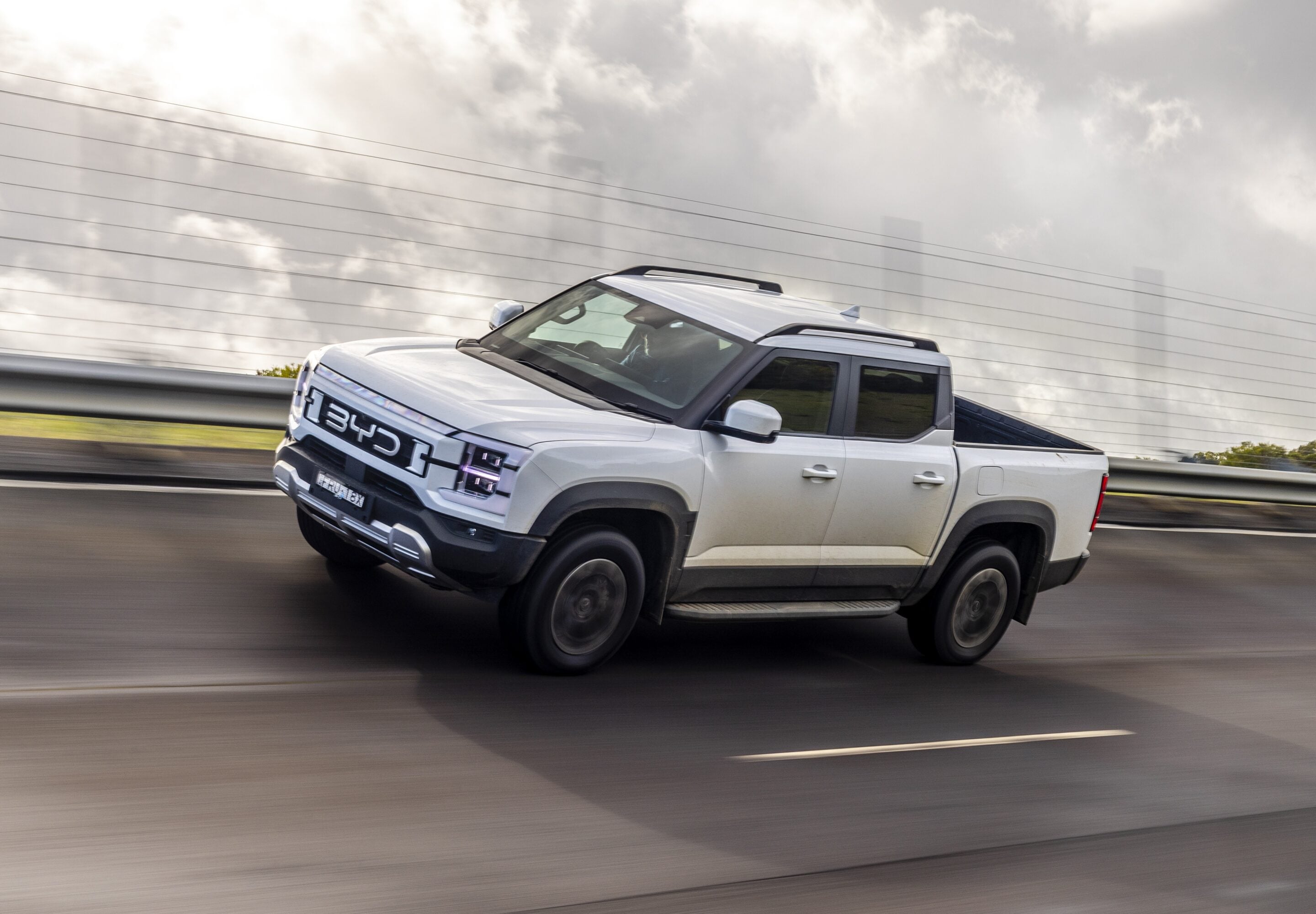
For what it’s worth, Collins says BYD isn’t expecting the government to pay for the infrastructure required to assist the uptake of EVs in Australia.
“I feel strongly there’s a role for the private sector and the public sector to play in that regard, Collins said. “What percentage either one is, I don’t know, but we’re not expecting the government to be paying for all this. We’re committed to provide infrastructure where we can as well and invest in that infrastructure.”
Chinese brand Chery had an absolute belter of a 2025. Its 34,889 sales represented a massive 176.8 per cent increase on 2024’s numbers, and Chery’s Australian product, dealer and sales expansion continued at a rapid rate. One of the successful sales increases for the brand was the Tiggo 8 Pro Max seven-seater SUV, which increased its numbers by 99.6 per cent.
Since its launch almost two years ago, Chery has removed the mid-spec Elite from the Tiggo 8 Pro Max range, leaving just the entry-level Urban and top-spec Ultimate. But it’s also made the range more accessible in pricing as the Urban is currently priced at just $38,990 driveaway. Considering that the cheapest seven-seat variant of the Nissan X-Trail asks $41,140 plus on-road costs (so around $45,000 driveaway, depending on location), the Chery looks like great value for money.
Chery Tiggo 8 Pro Max pricing (driveaway):
| Urban | $38,990 |
|---|---|
| Ultimate | $43,990 |
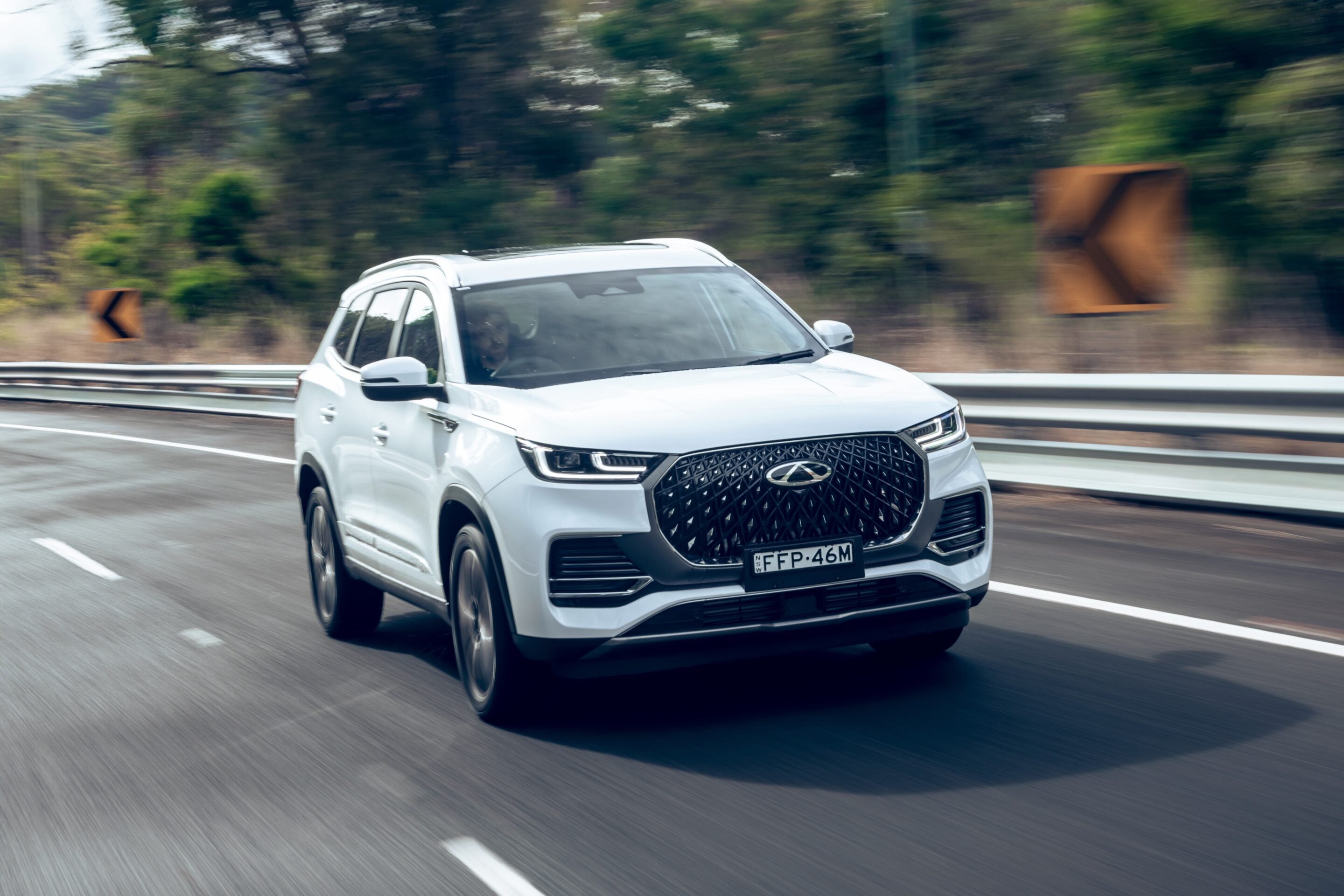
Standard equipment on both the Urban and Ultimate models is strong, with the former including 18-inch wheels, LED exterior lighting, synthetic leather upholstery, heated and ventilated front seats, dual 12.3-inch displays and a full suite of active safety kit. The Ultimate adds features such as larger 19-inch wheels, a panoramic sunroof, an all-wheel drive system, a power tailgate and a 10-speaker Sony sound system. See the full list of equipment here.
What sort of power and fuel economy does the Tiggo 8 Pro offer?
Unlike the seven-seat X-Trail, the Tiggo 8 Pro Max has proper grunt from under the bonnet. Standard across the Tiggo 8 Pro Max range is a 180kW/375Nm 2.0-litre turbo-petrol engine that is mated to a seven-speed dual-clutch transmission. Combined fuel consumption is rated at 8.7L/100km, with claimed CO2 emissions of 200g/km.
It’s a great engine with a raspy note and more than ample performance. Peak torque hits at just 1750rpm and stays until 4000rpm so that most urban driving occurs in that range and you can just ride the torque wave. The only fly in the ointment is the seven-speed dual-clutch transmission, which can stumble and get confused a bit at low speeds, but at higher speeds, it’s excellent.
The Tiggo 8 Pro Max isn’t the thriftiest car in its class, and you’ll be getting around 12L/100km in purely urban driving, but Chery does offer the Tiggo 8 CSH plug-in hybrid with a 95km electric driving range and a total range of around 1200km from a full charge and tank of fuel.
On the road, the Tiggo 8 Pro Max is refined and very comfortable. Even in the Ultimate with its larger 19-inch wheels, the ride quality is excellent and rarely unsettled. Road noise levels are low, and although it can roll around a bit in corners thanks to the soft suspension, in regular everyday driving it’s totally fine.
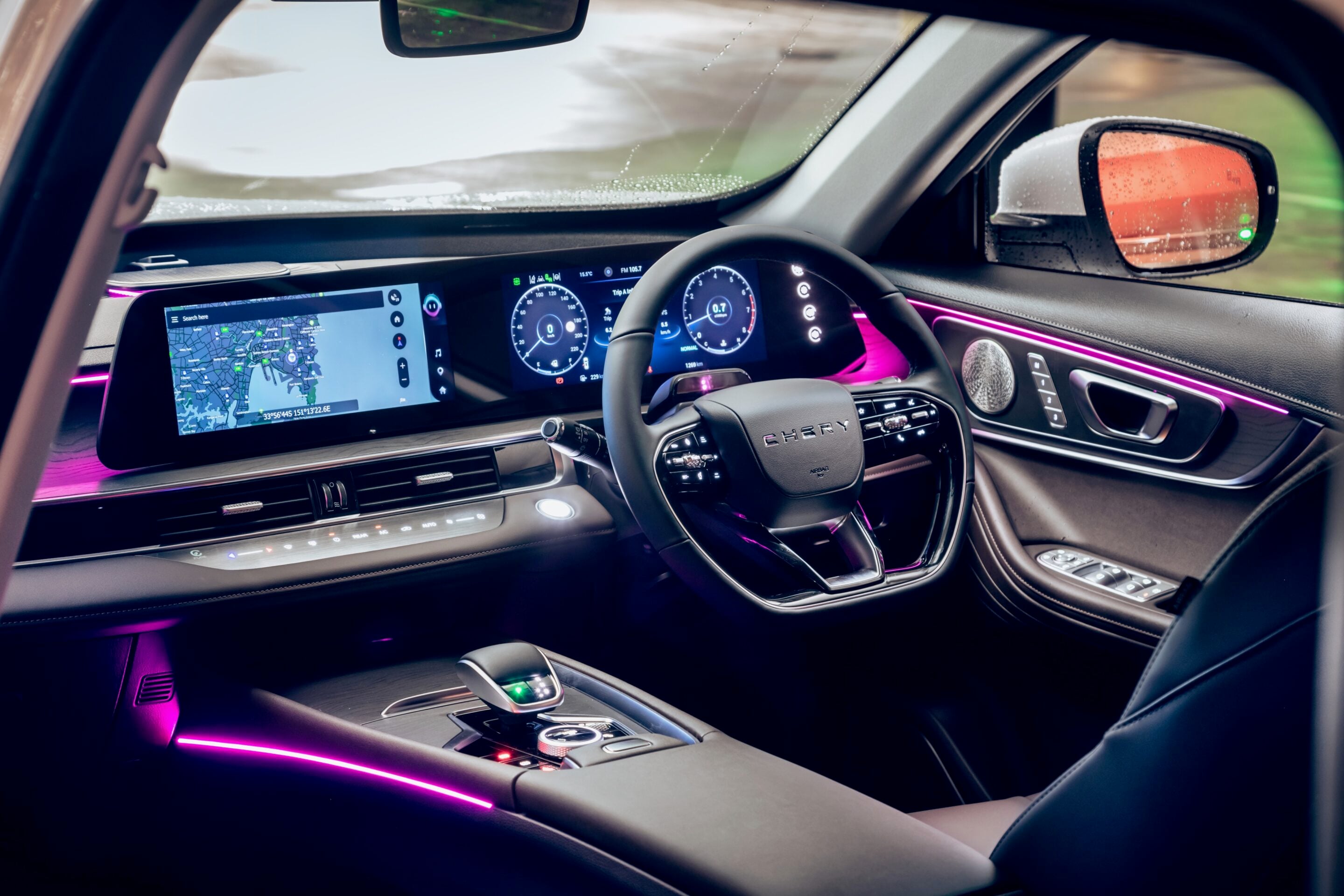
What’s the Tiggo 8 Pro interior like?
But while the driving experience is solid, it’s the cabin that needs to impress buyers as that’s where they’re going to spend their time. Here, it impresses with good quality materials, modern design and useable tech that makes it easy to interact with. Sure, some of the details are a bit chintzy, like the ‘Tiggo’ text above the rear air vents and on the seats, but it’s otherwise quite tasteful.
Centre of the cabin are two 12.3-inch screens that use identical software to other Chery models. While there’s no live functionality, it’s well featured with wireless smartphone mirroring and sat-nav. It’s generally easy to use, though some functionality could be made easier by featuring a home button on the centre console. Otherwise, the physical climate buttons and shortcuts next to the gear lever are useful.
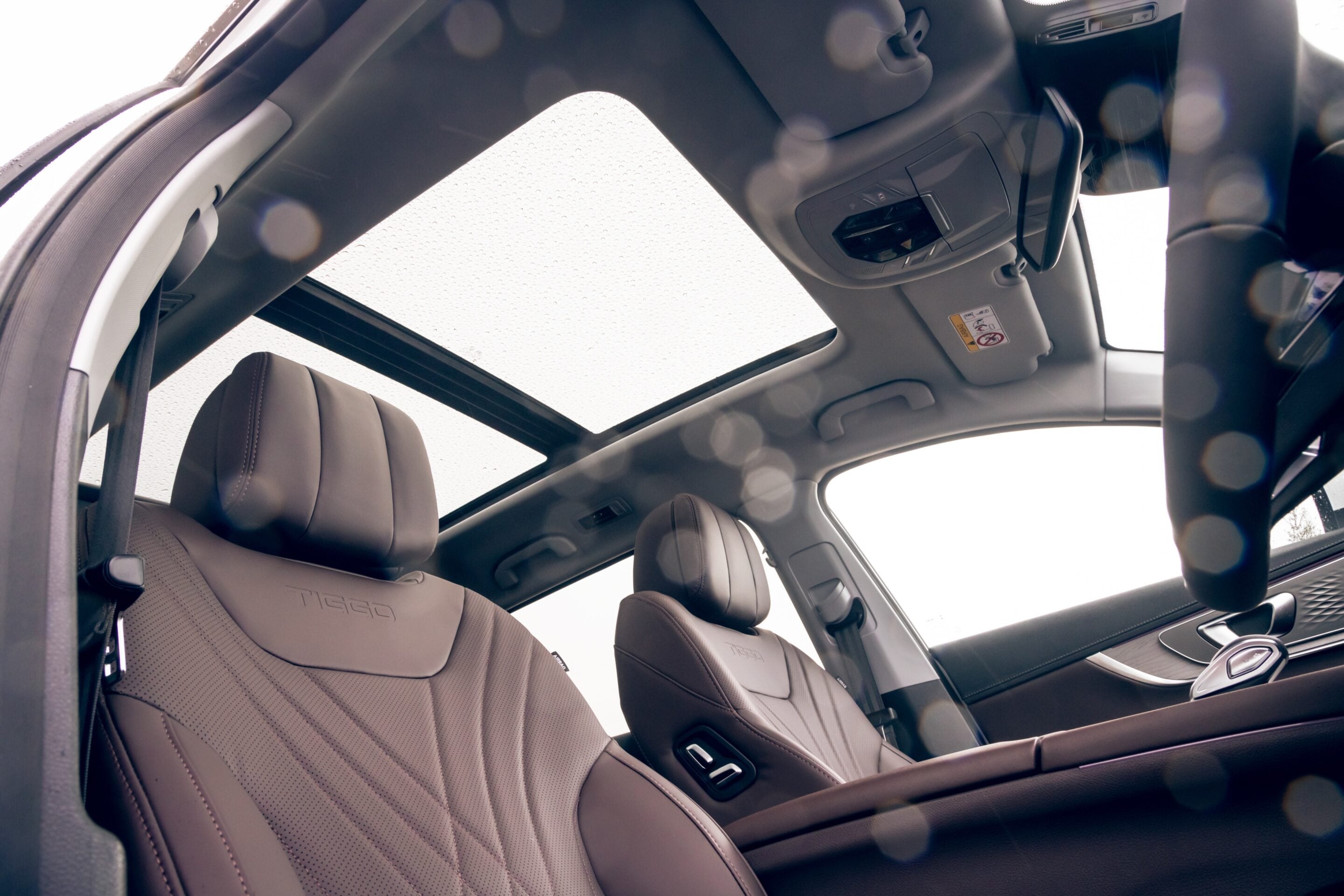
The front cabin also offers big door bins, a large box underneath the centre armrest, a big tray underneath the centre console and big cupholders. Front seat comfort is generally good, though more under-thigh support would be a useful addition.
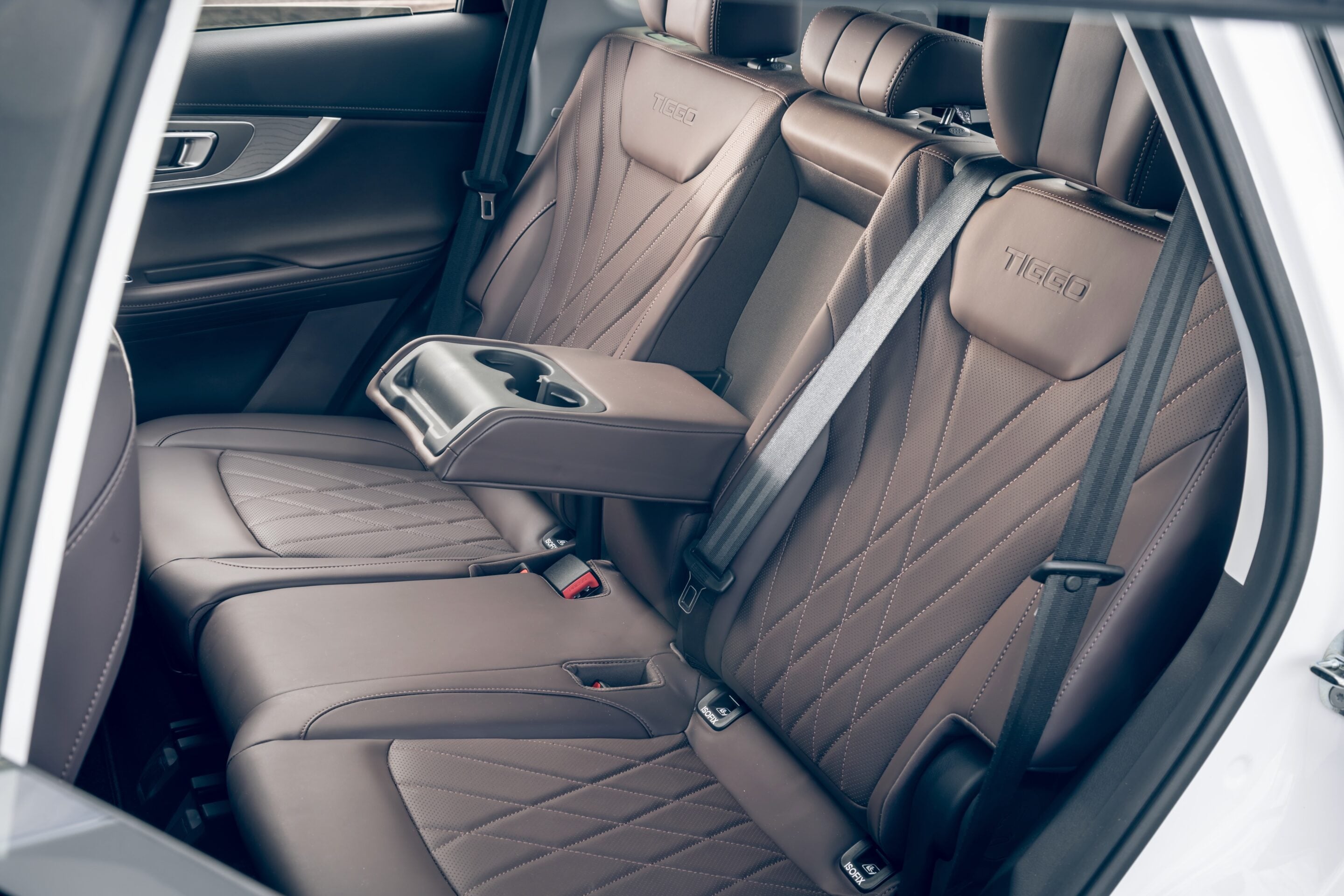
Space in the middle row is plentiful, with ample leg- and headroom, even for taller people. There are also some good amenities on offer, such as air vents, map and door pockets, a central armrest with cupholders and two USB ports. There are also two ISOFIX and three top tether points for child seats, though the action for moving the seats forward to grant access to the third row could be easier.
The third row of the Tiggo 8 Pro Max is definitely tighter than a Santa Fe or CX-80, but larger than the tiny space of the X-Trail with noticeably more headroom on offer. Two kids would be fine there, but adults would struggle. For third row occupants there are air vents and cupholders, plus a fan speed controller in the Ultimate, though no charging ports.
With all rows in use, there is 117 litres of boot space on offer and folding the third row down unlocks 479 litres of space to the seatback (739L to the roof), but Chery doesn’t quote a figure for the second row folded as well. Regardless, it’s a practical and impressive space, especially considering the price.
Warranty and servicing
The Tiggo 8 Pro Max is covered by a seven-year/unlimited km warranty with 12 months of roadside assistance that is extended by 12 months with each service up to seven years in total. The five-year/75,000km service cost for the Tiggo 8 Pro Max is just $1495 ($299 per year).
Final verdict
Should you buy a Chery Tiggo 8 Pro Max? If you’re after a seven-seater SUV and are aware that there are more efficient and more practical rivals… but for more money, absolutely. As we’ve seen on Chery’s other models in Australia, the Tiggo 8 Pro Max offers a lot for the price with a good quality and modern cabin, a gutsy turbo-petrol engine, comfortable driving experience and long list of features.
It’s not the most fuel efficient product, though the CSH plug-in hybrid version exists for those wanting more efficiency. Overall, however, there is plenty of substance behind the headlines and the sub-$40k driveaway pricing for the Tiggo 8 Pro.
Chery Tiggo 8 specifications
| Model | Chery Tiggo 8 Pro |
|---|---|
| Price | From $38,990 driveaway |
| Engine | 2.0-litre turbocharged four-cylinder petrol |
| Peak outputs | 180kW/375Nm |
| Transmission | 7-speed dual-clutch automatic, 2WD or AWD |
| Combined fuel consumption (claim) | 8.7L/100km |
| CO2 emissions | 200g/km |
| Length/width/height/wheelbase | 4720/1860/1705/2710mm |
| Boot | 117L (3rd up to top of seatback)/479L (3rd folded to seatback)/739L (3rd folded to roof) |
| Tare mass | 1731kg |
| Warranty | 7-year unlimited km, 12 months roadside assistance (up to seven years service activated) |
| Five-year service cost | $1495 ($299 per year) |
Tiggo 8 Urban standard features
- 18-inch alloy wheels
- Roof rails
- Dusk-sensing automatic LED exterior lighting
- Rain-sensing automatic wipers
- Keyless entry with push button start and remote start
- Auto-folding mirrors that auto-drop in reverse
- Synthetic leather steering wheel
- Black synthetic leather upholstery
- 10-way electric driver’s seat with memory functionality
- Four-way electric front passenger seat
- Heated and ventilated front seats
- Dual-zone automatic climate control with rear air vents
- N95 air purification
- 12.3-inch digital driver’s display
- 12.3-inch touchscreen
- Satellite navigation
- AM/FM radio
- Wireless and wired Apple CarPlay and Android Auto
- Eight-speaker Sony sound system
- 50W wireless phone charger
- 4x USB ports
- Auto-dimming rear mirror
- Multi-colour cabin ambient lighting
Tiggo 8 safety equipment
- 10 airbags (including front centre, driver’s knee and rear side units)
- Autonomous emergency braking with pedestrian, cyclist and intersection assistance
- Lane keeping assistance with lane departure warning
- Adaptive cruise control with traffic jam assist
- Adaptive lane guidance
- Auto high beam
- Door open warning
- Traffic sign recognition
- Driver attention monitoring
- Blind-spot monitoring with rear cross-traffic alert (including braking)
- Front and rear parking sensors
- 360-degree camera
- Alarm
Ultimate model adds
- 19-inch alloy wheels
- Panoramic sunroof
- Rear privacy glass
- Power tailgate
- All-wheel drive system
- Heated mirrors with puddle lamps
- Illuminated door sills
- Third row air vents with fan speed control
- Remote window operation
- Inbuilt dashcam
- Cargo blind
- 10-speaker Sony sound system
- Illuminated sun visor mirrors
ANCAP has awarded five-star safety ratings to two new SUVs entering the Australian and New Zealand markets – the Denza B8 plug-in hybrid and the all-electric Hyundai Elexio – under its 2023–2025 assessment criteria.
The ratings reflect continued improvements in both occupant protection and active safety systems, with ANCAP noting that both vehicles are equipped with comprehensive autonomous emergency braking (AEB) and lane support technologies as standard.
The Hyundai Elexio Medium SUV achieved strong results across all four key assessment areas. It recorded an Adult Occupant Protection score of 92 per cent and Child Occupant Protection of 87 per cent. Its Vulnerable Road User Protection score reached 83 per cent, while Safety Assist systems were rated at 85 per cent.
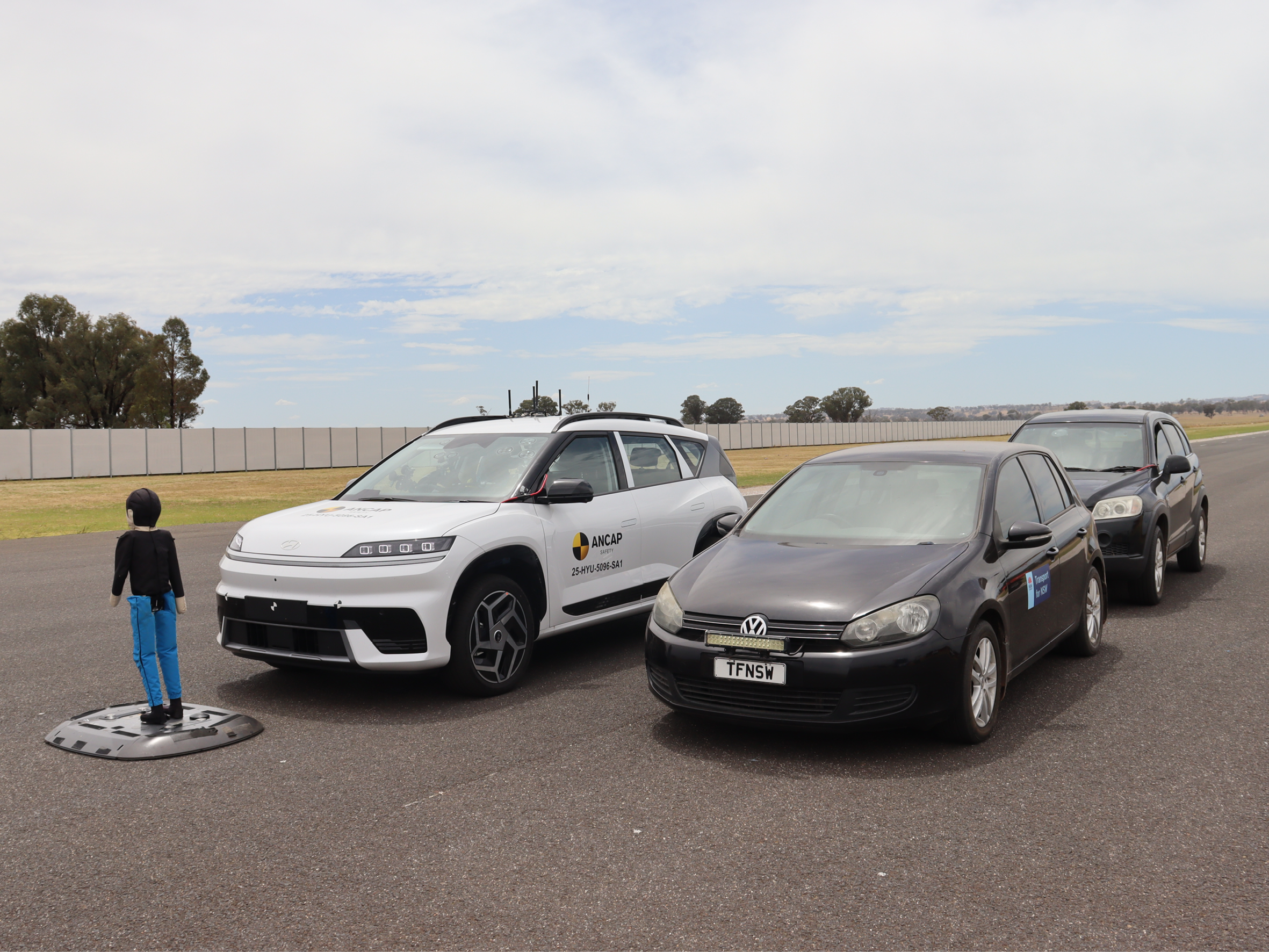
ANCAP said the Elexio performed particularly well in AEB scenarios involving other vehicles, including motorcycles. The rating follows a review of technical evidence and crash data shared with the closely related Kia EV5, with ANCAP confirming that destructive crash test results from the EV5 were applicable to the Elexio.
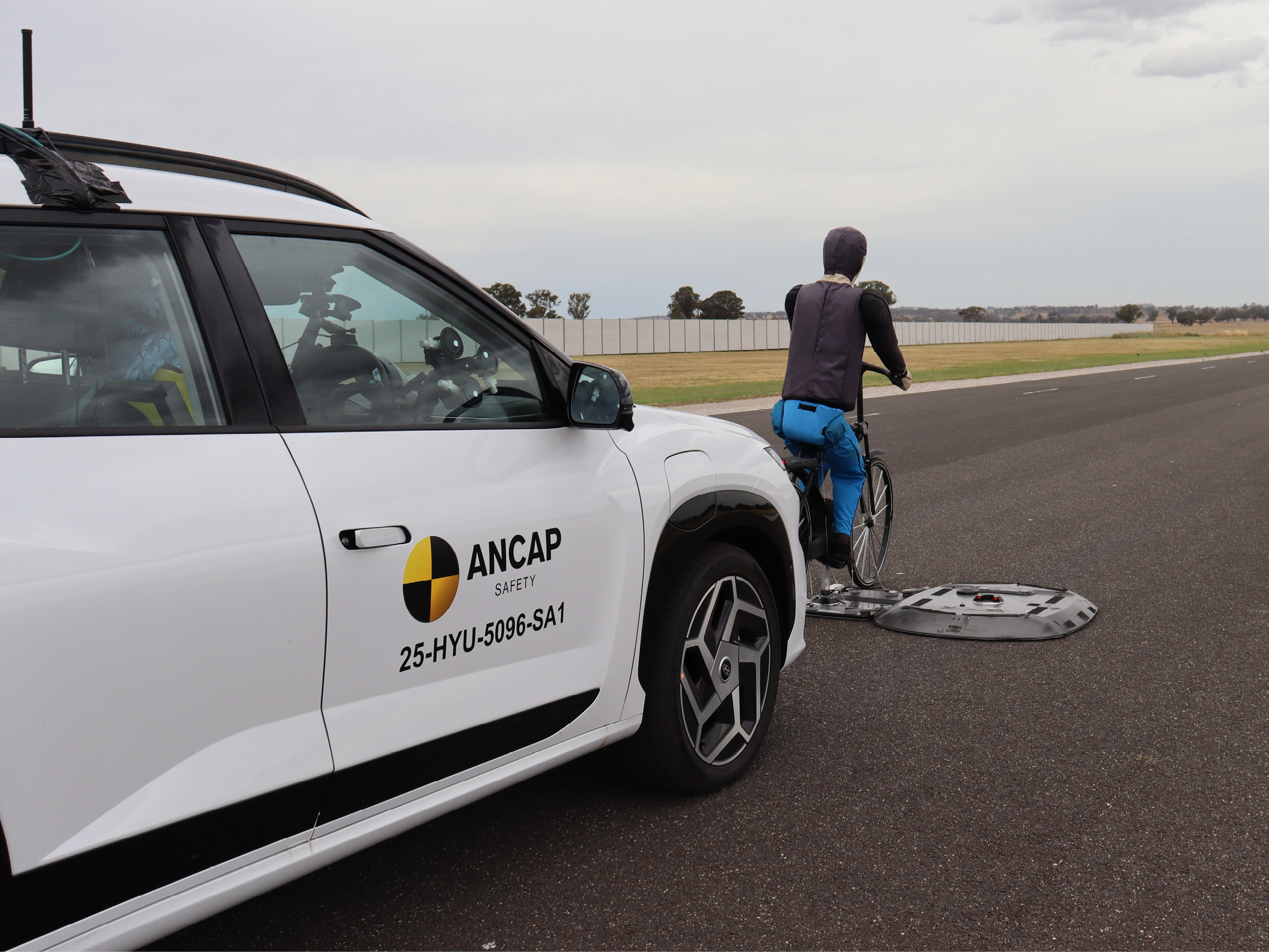
The Denza B8 also secured a five-star result, building on assessment of its related model, the Denza B5, which was rated in late 2025. ANCAP evaluated extensive technical documentation and test data to confirm comparable crash performance between the two vehicles.
The B8 recorded an Adult Occupant Protection score of 87 per cent and Child Occupant Protection of 89 per cent. Vulnerable Road User Protection was assessed at 75 per cent following additional front-end testing to account for design differences, while Safety Assist systems achieved 79 per cent.
ANCAP Chief Executive Officer Carla Hoorweg said buyers increasingly expect strong safety performance regardless of powertrain type.
“These five-star results demonstrate solid occupant protection combined with advanced crash avoidance technology,” she said.
Both ratings apply to all variants of the Denza B8 and Hyundai Elexio currently on sale in Australia and New Zealand, reinforcing the growing availability of high safety standards across electric and hybrid SUVs.
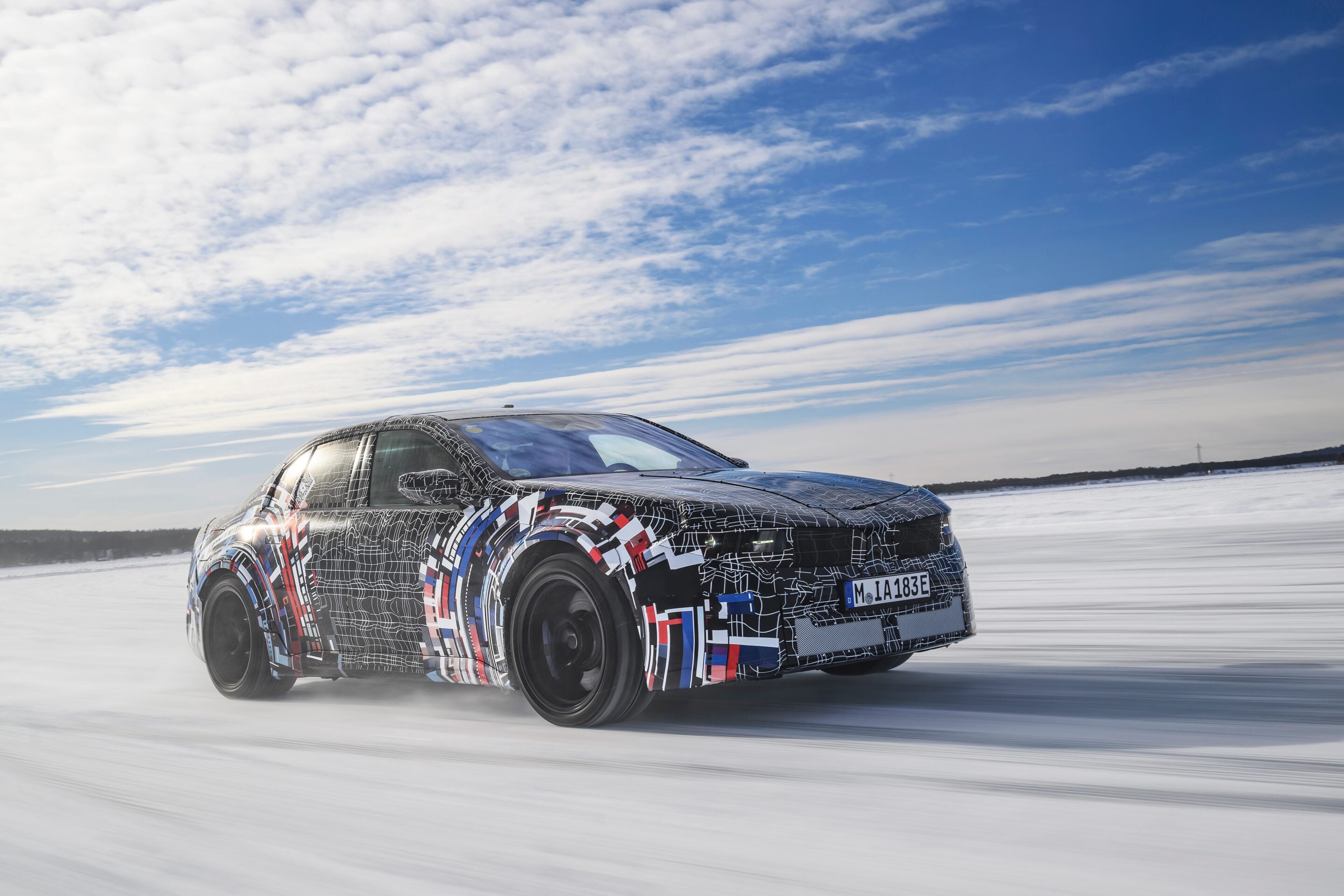
The same electronic fakery used by Hyundai to put personality into its Ioniq 5 N will soon be used by BMW. The Ioniq star car from the South Korean brand uses artificial engine sounds and fake gears to mimic the appeal of high-performance combustion cars, something BMW will adopt for the upcoming battery-electric M3 in 2027.
BMW M admits it needs to take a similar approach for the EV hero car of its Neue Klasse, but rejects any claim of fakery.
“We’re not pretending to be a combustion car. It’s the emotional connection,” the global head of the M division, Frank van Meel, told Wheels during a round-table interview from Germany.
“We are going to have something like emulated gearshifts and sounds, coming from our classic engines. Just to enhance the feeling.“
You can only connect to something you know, or feel comfortable with. The human being is trying to find something it is familiar with. Or to a human being it makes the most sense. In order to be connected to the road, you need to have acoustic feedback.”
Van Meel said it’s this long-term connection to high-performance inputs, from the scream of a combustion engine to the kicks from full-throttle upshifts, which provide enjoyment for fast-car drivers and that M is chasing for the EV M3.
“Can it be cool, can it be engaging, can it be something you want to drive? It’s about emotion,” he said. “I think we’ve got the right answers. We’re trying to take the whole community with us. To be honest, it’s going to be crazy. So I’m looking forward to that.”
He would not give any detail on the engine sound, but said it would not be completely identical to the in-line sixes or V8s from past M3s.
“You can take Star Trek sounds, you can go crazy. We will use the basic sounds of the electric motor, but adapt.”
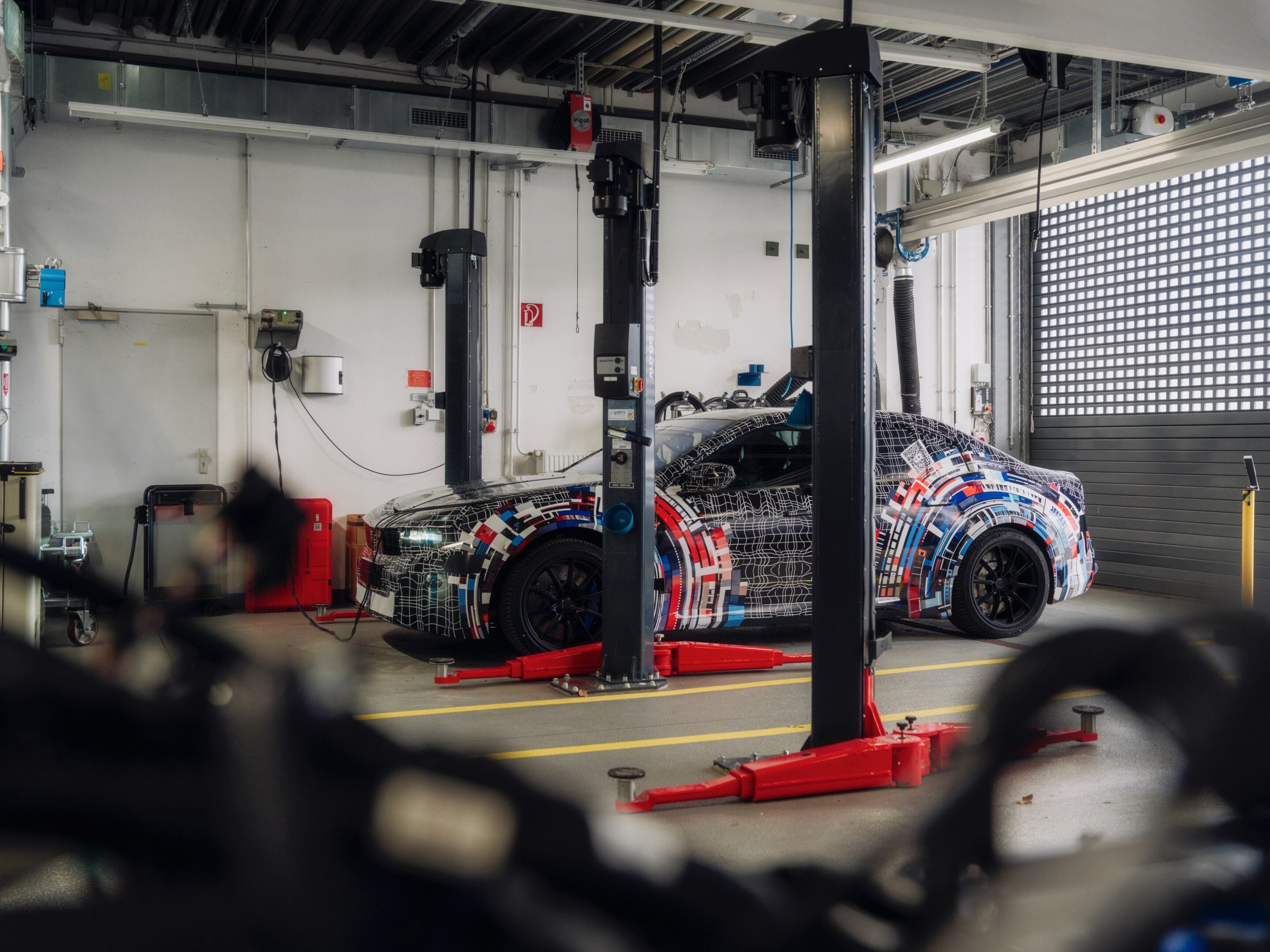
BMW M has already shown its Precision Driving Experience prototype for the M3 EV and van Meel teased a little more detail.
“It’s an open secret we are working with four independent electric motors. It’s the vehicle dynamics that grab you at first. It is a once-in-lifetime chance to do something really great. You will have this crazy car that’s so quick, it’s quicker than anything else.”
But van Meel said BMW M would take a two-road path to the future, bringing EV but retaining combustion power.
“The good news is we have both directions. So we can go on like this. You have to decide which one to take,” he said. “What makes me so positive about the all-electric one is that timing is everything. We are convinced that what we are working on right now is exactly the technology everyone has been waiting for in a high-performance car.
“It’s something to look forward to, no matter if you like electric cars or not. It’s different to everything else available on the market today. We know what we’re doing already.
“We cannot step down. We always have to take the next step. Whether it’s combustion or electric.”
