
Snapshot
- Inspired by Le Mans-winning GT40
- Induction comes from 3.0-litre supercharger
- Hennessy offers Mustang packages up to 745kW
US performance house Hennessey has thrown the covers off its newest Mustang, a 602kW beast dubbed the Legend Edition.
The car’s livery pays homage to Ford’s iconic GT40 – specifically, the Mk2 P/1046, which wore the number two and black stripes when it took victory in 1966’s Le Mans 24 Hour. It was the first American car to win the iconic race (though it was driven by New Zealanders), an event retold in 2019 flick Ford v Ferrari.
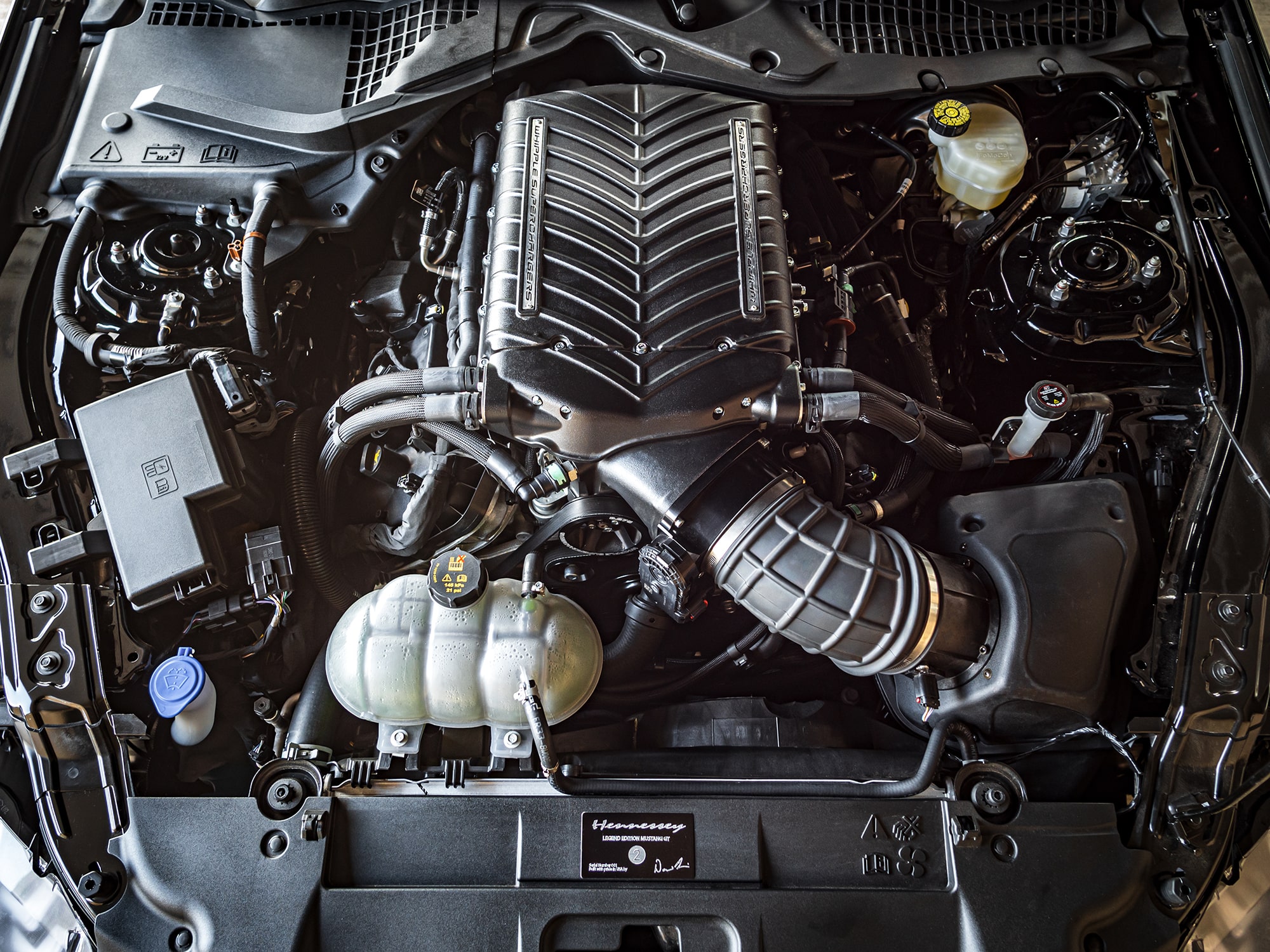
From a mechanical standpoint, the biggest change made by Hennessey is the addition of a 3.0-litre supercharger to the Mustang’s 5.0-litre V8. Supporting modifications include higher-capacity injectors and an up-rated fuel pump, plus a high-flow air intake and Borla stainless exhaust.
According to Hennessey’s website, this pushes the Mustang’s output to 602kW at 7200rpm, producing peak torque of 917Nm at 4500rpm. This equates to a claimed 0-100km/h sprint of 3.3 seconds, and a 10.7 second quarter-mile time at 212km/h. In comparison, the 2021 Shelby GT500 puts out 566kW with its 2.7-litre blower.
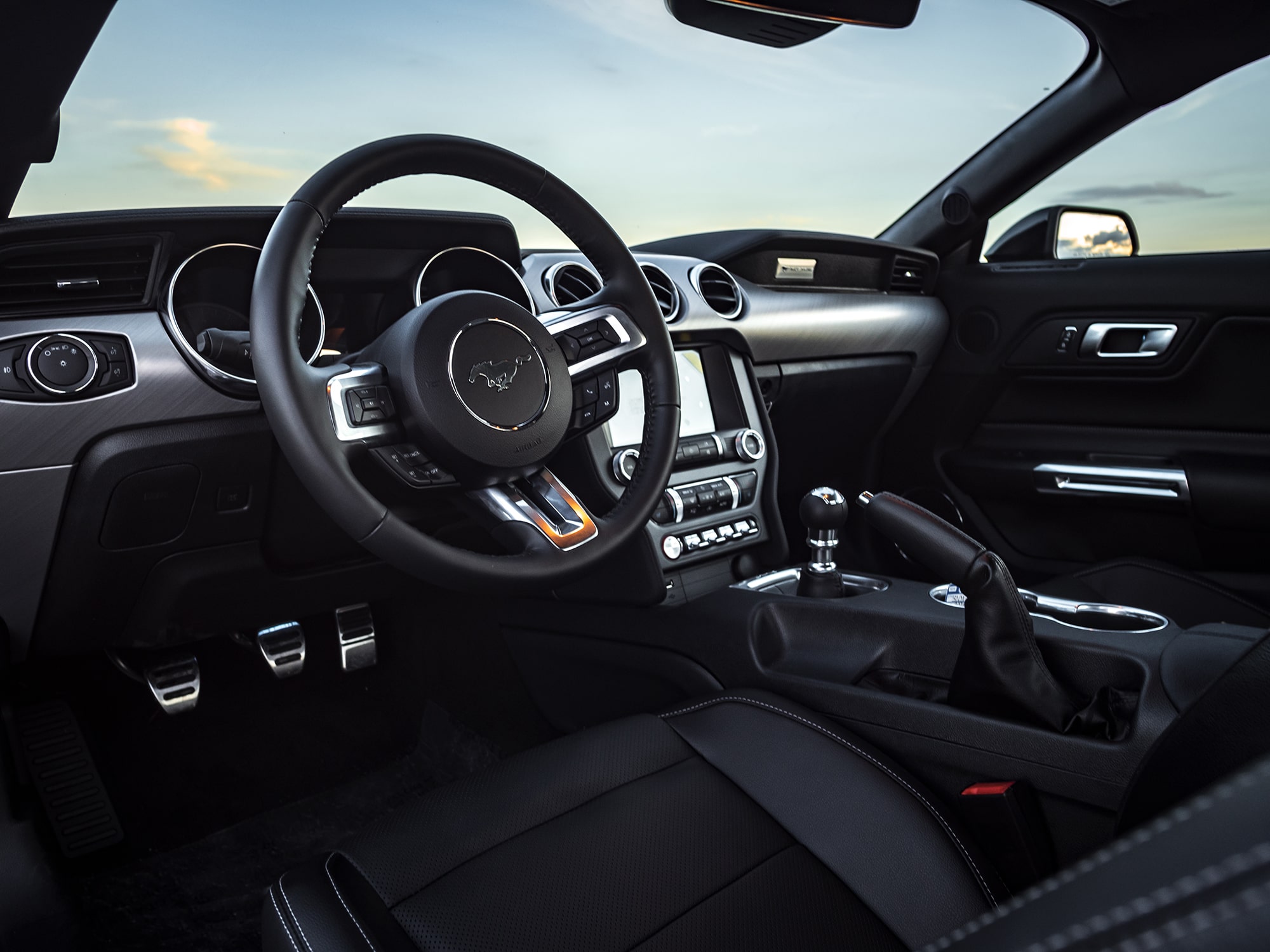
The Mustang runs a six-speed manual transmission, though it’s unclear if an automatic will be offered. Handling is assisted by lowered suspension and six-piston Brembo brakes.
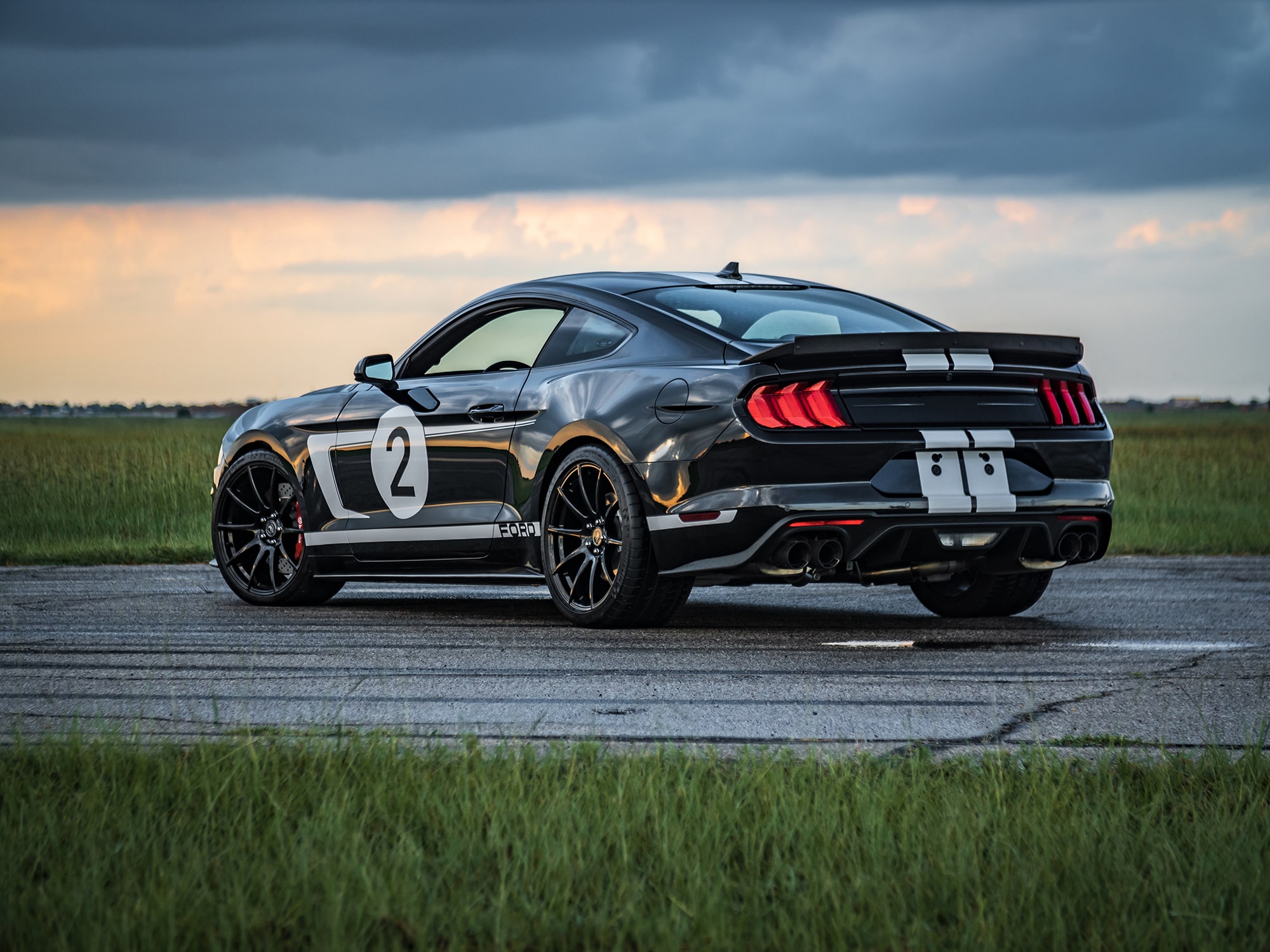
Aside from the retro graphics, external Hennessey touches include a carbon fibre front splitter, side skirts and spoiler, and 20″ alloy wheels. The interior features a serial-numbered dash plaque and Hennessey-embroidered headrests
Just 50 cars will be made available, all of which are backed by a three-year, 36,000-mile (58,000km) warranty.
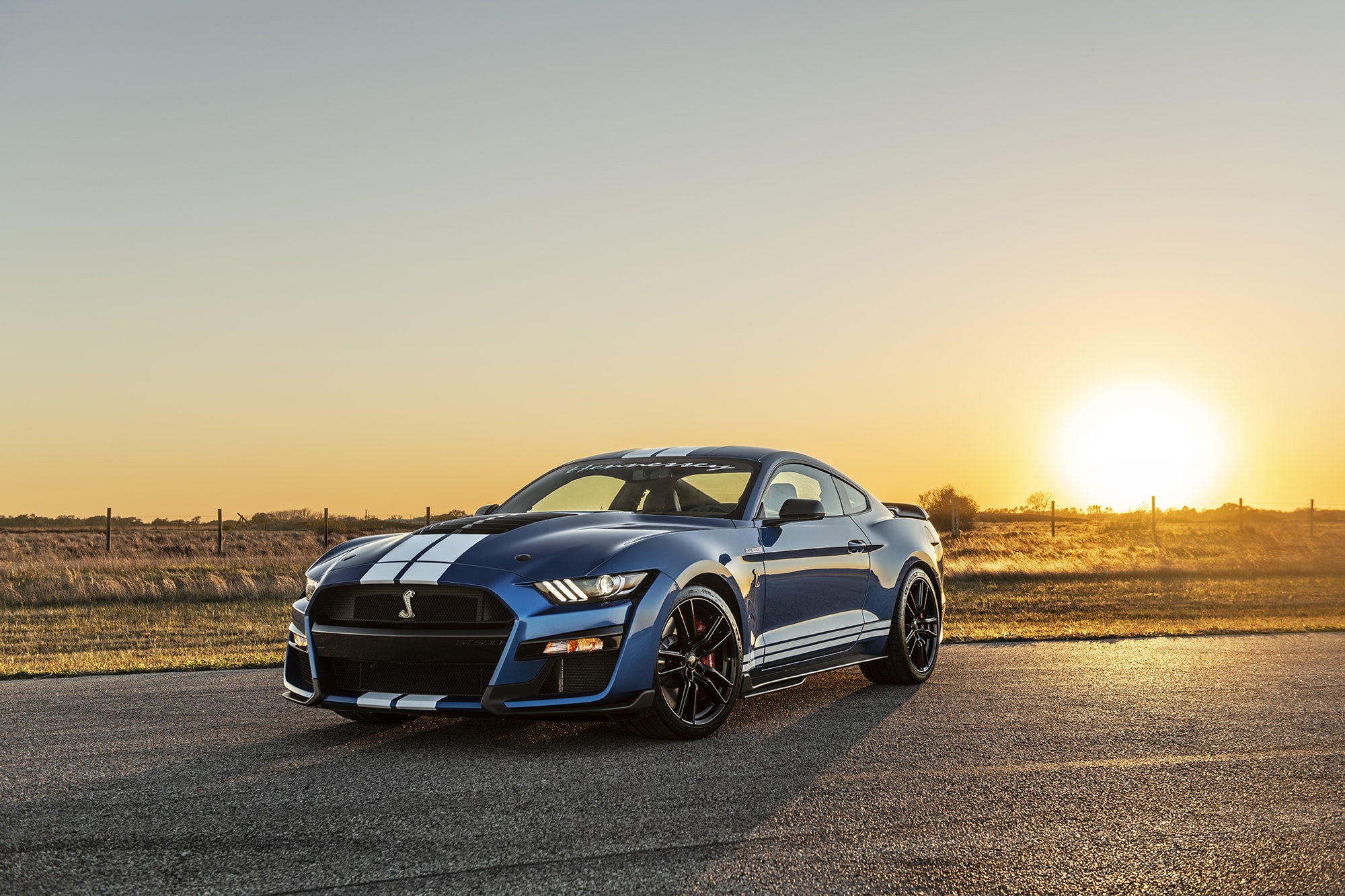
Despite the monstrous output, the Legend Edition is not the highest-horsepower package Hennessey offers for the Mustang. The Hennessey Venom 1000, available for Shelby GT500s, offers 745kW when ran on E85 fuel – with the same three-year warranty.
- Introduction: Thermostat
- Month 2: Star Athlete
- Month 3: Never Lift
- Month 4: Perfect Match
- Month 5: Flavour of the Month
- Month 6: Light, Fantastic [Farewell]
Introduction: Thermostat
Ford’s pocket rocket turns up the heat
The magic of Performance Car Of The Year is that there are no truly bad cars. Any contender present has rightly earned its spot on the shortlist, an achievement in itself.
This was especially apparent with the Ford Fiesta ST, which shocked all in attendance of our week of testing at the end of 2020 with its unmatched fun-per-dollar factor. Indeed, at $32,290, the humble Fiesta was the cheapest car in at this year’s PCOTY, and yet its keys were as hotly contested at the brekky table as those of far more expensive competitors.
While that asking price represents a $6000 increase over the previous generation, you’re getting a whole lot more kit for the money. Overseas, the Fiesta ST comes in three variants, plus an additional optional performance pack, but the Australian model (whose launch was delayed by almost a year as Ford Oz hashed out its packaging) comes fully loaded: heated Recaro seats, Bang & Olufsen sound system, Michelin Pilot 4S tyres, Quaife LSD – the lot!

Overall, it’s a far nicer car and feels much more premium than the outgoing model. The cabin is much more ergonomic thanks in part to a lower seating position, and is a much nicer place to be than the old sixth-generation’s cabin of basic materials and smorgasbord of buttons. You also get keyless entry, an 8.0-inch touchscreen with smartphone mirroring and Ford’s SYNC3 system, plus a heated leather steering wheel, auto headlights; and autonomous emergency braking, blind-spot monitoring, lane keep assist and forward collision warning – all usually a part of an optional safety kit in overseas markets.
Initial impressions are good then.
Hit the starter button, and the throaty 147kW turbocharged three-pot rumbles into life. It has a surprisingly vocal note, certainly not obnoxious or egregious by any means, but it’s there and gives hint to the car’s pugnacious nature. It’s a fairly tractable little unit with a surprisingly wide power band, and peak torque (290Nm) arriving at 4000rpm.
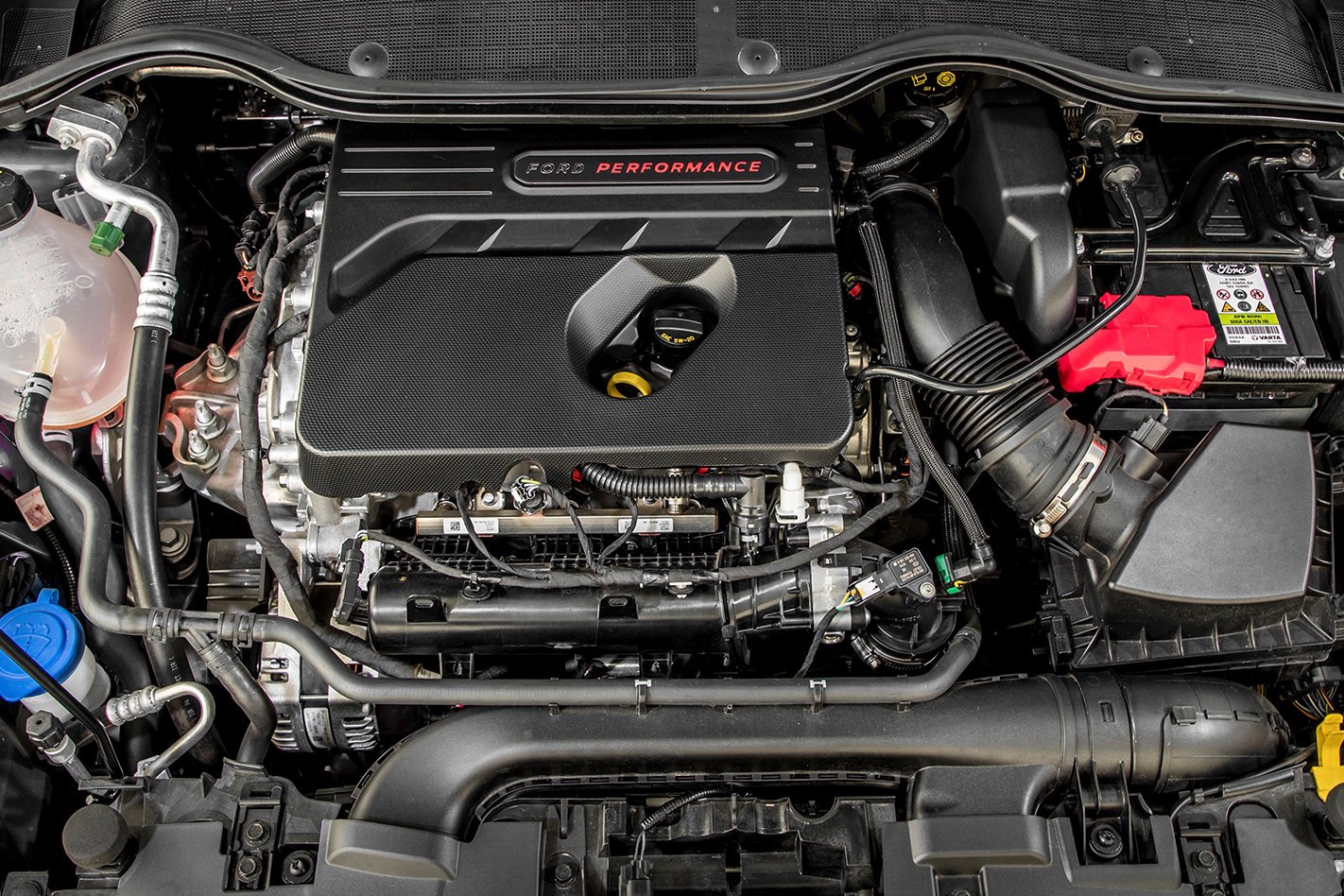
The clutch action has a nice weight to it, and the pedals are well-spaced apart for heel-and-toe shifting – although at low road speeds I’ve found you have to be carrying quite a pace and quite deep in the brake stroke to get a good ‘heel’ in. The shift action is light and direct with a short throw. The gearbox may not be as ‘click-clack’ sharp as, say, a Civic Type R – but beneath a thin layer of slush, you do find clearly defined gates and shouldn’t be missing shifts.
The brakes have a very strong initial bite however, beyond the initial grab, perhaps lack a little feel in trail braking or transient braking circumstances. Initial rebound can be a little harsh on speed bumps or larger pots in the road, however these are more keenly felt by rear passengers. There is an underlying compliance to the ST however, and offers an attractive duality in its ability to simply be a Fiesta when the inner-city speed limits call for it. But when the metro speed limit goes bush, and Melbourne’s grid-like street system turns into tight Victorian mountain hairpins, the feisty Fiesta comes alive.
Steering is very nicely weighted, communicating well through the pleasantly sculpted heated steering wheel, through to a razor sharp and accurate front end. Once you edge towards where you think that threshold of grip and understeer is; more steering angle, more throttle, earlier; you quickly learn that the Fiesta’s mechanical grip levels are significantly beyond what you may have initially thought.
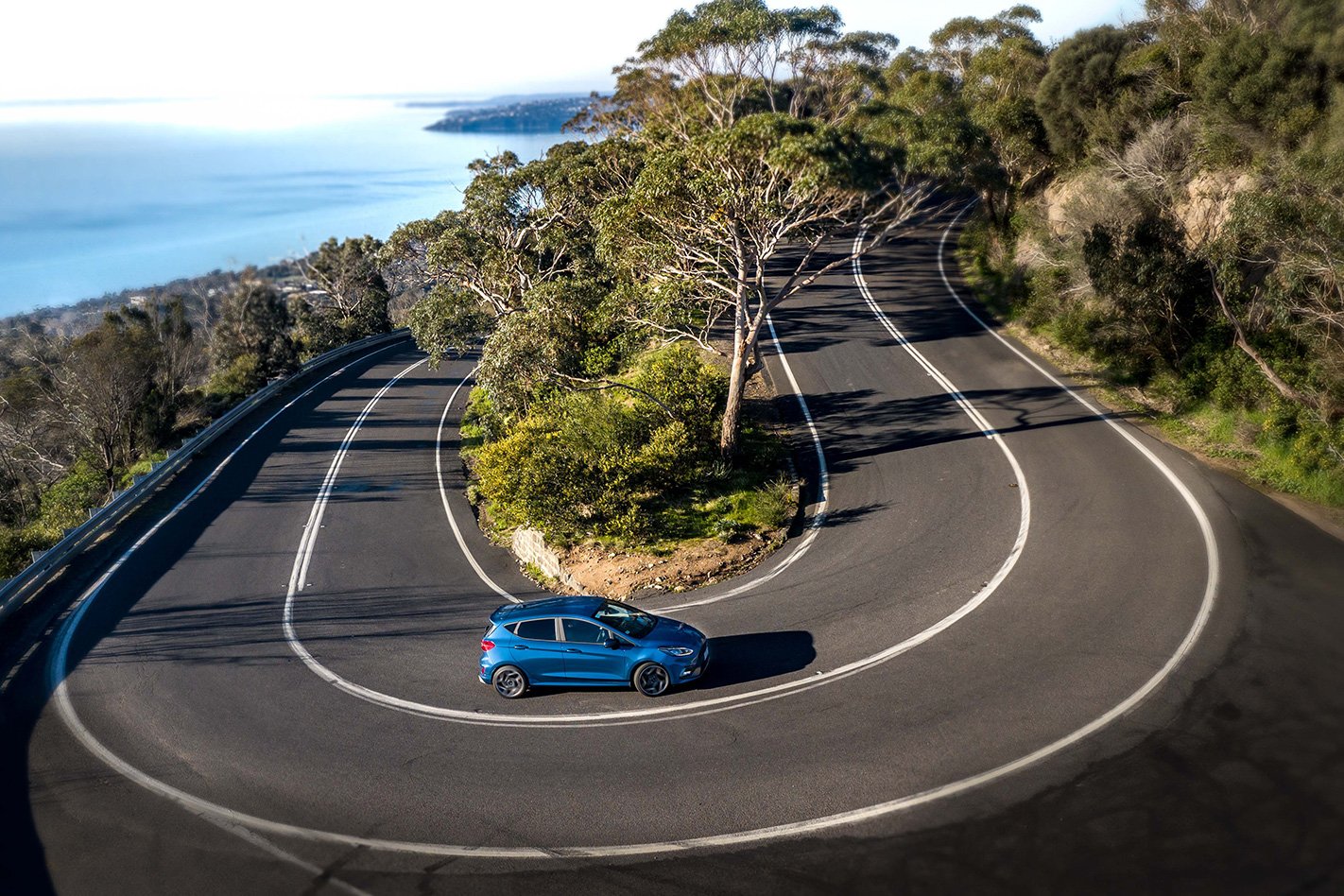
There is some occasional force feedback through the steering if you power on early enough out of a corner as its front paws scramble to pull forward 1217kgs of heated hatch. But on the tightest of twisties, you’d be hard pressed to find a car – at any price point – that would walk away from the Fiesta ST. Editor Enright anecdotally spoke of one PCOTY moment, of having to turn the effort up a bit in an A45 S in order to catch back our resident madman Scott Newman at the wheel of the Fiesta ST.
And even if you do find a car as capable in the bends, it would be harder again to find one more fun.
It’s a supremely impressive hatch that scores tremendously well on first impressions. But the open roads of PCOTY may as well be another world and the harsh reality of getting stuck behind caravans and Friday afternoon traffic on the way home from our week of testing was a sobering return to earth.
Will the Fiesta ST continue to impress as it graduates from a week-long fling to a live-in companion? Thankfully I’ve got the entire hustle and bustle of the holidays to find out! More to come. – AA
Things we love:
1. Fully loaded spec 2. Punchy engine 3. Exhaust note
Things we rue:
1. Harsh rebound 2. Plastic interior 3. Weightless shift
Update 1: star athlete
The heart grows fonder for Ford’s micro fighter
I’m quite precious about cars under my care, so when I see a stranger inspecting the wheels of the Fiesta ST from the window of a cafe across the road, I pay close attention from the far side of my latte.
I’d seen him before too, about 30 minutes earlier, after I’d parked at a mountainous lookout to gather my thoughts. He was on a Honda CBR blasting up and down the twists of tarmac, exhaust popping on lift-off and echoing off the surrounding Victorian landscape.
Now, the sport bike rider had stopped in town for a water break – and the Fiesta ST had seemingly caught his eye.
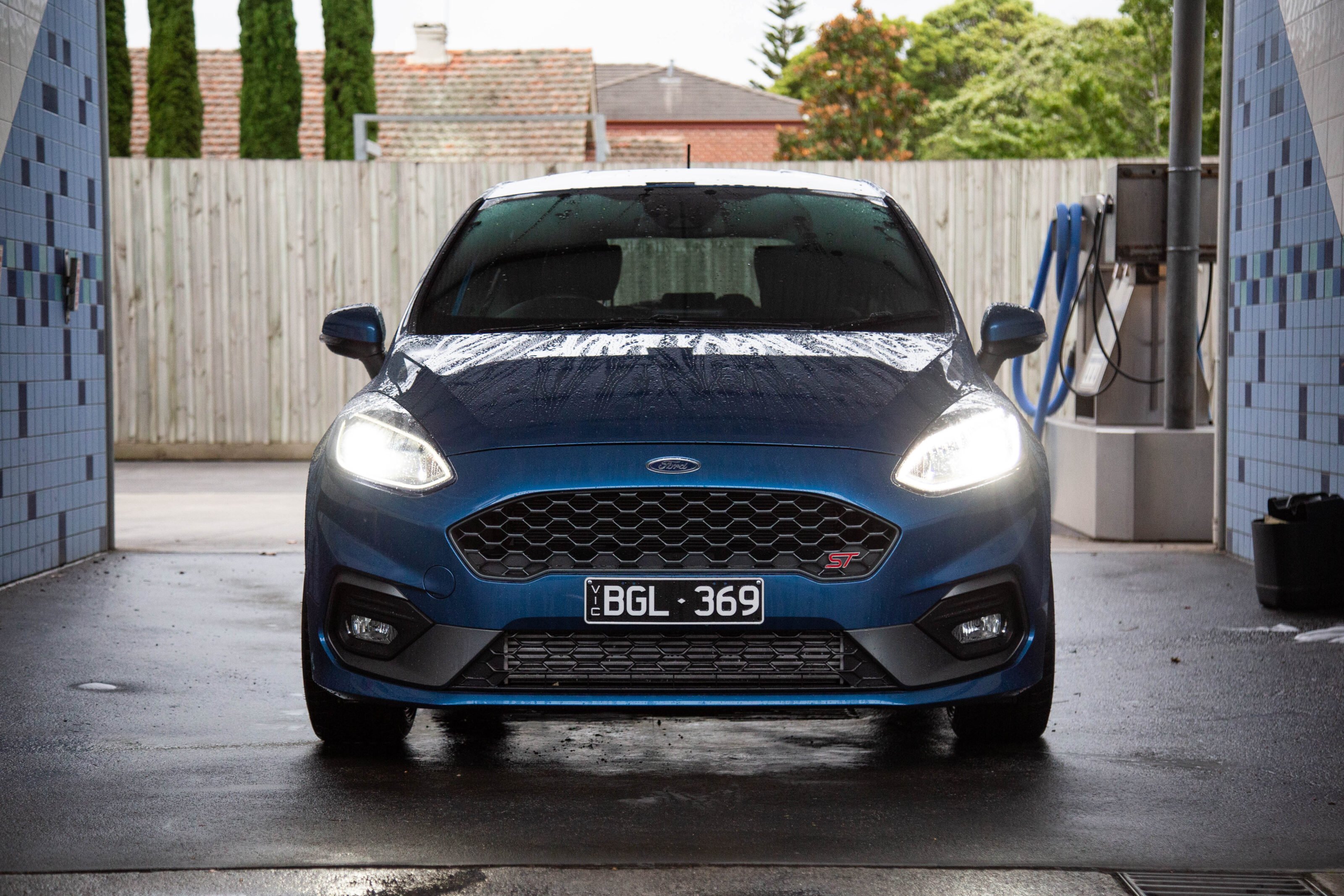
Curiously, he was the first member of the public that’d I’d seen truly take notice of the characterful little hatchback – there’s a subtlety to its exterior which flies under the radar of most motorists.
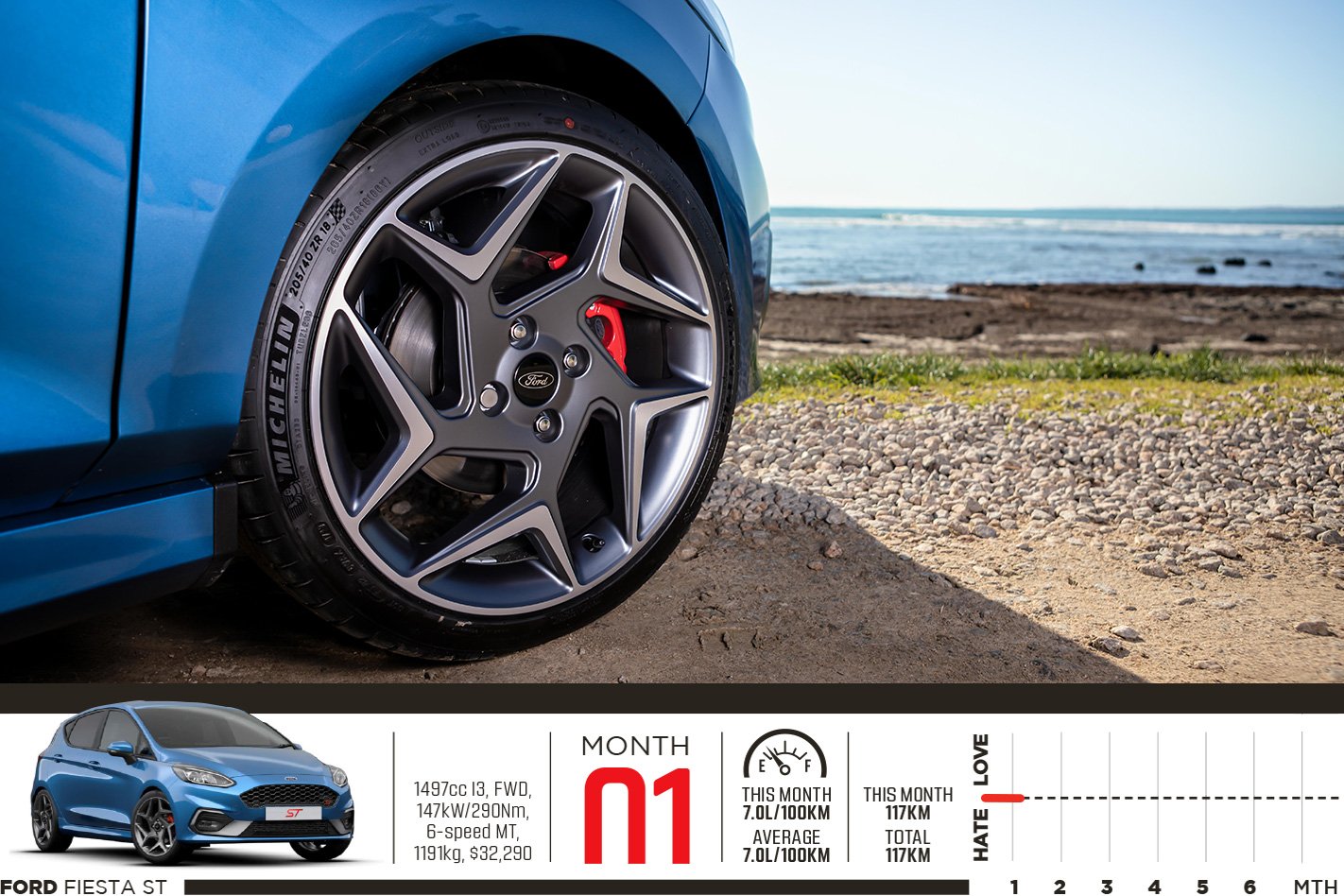
Perhaps it was the big wheels, or the red brakes, but there was clearly some attraction as he circled the front end of the little Fiesta and crouched down to examine the snugly packaged intercooler.
There’s a certain sleeper appeal to the ST, that comes with the bonus satisfaction of earning the metaphorical ‘head nod’ from fellow road-going enthusiasts. Before I could finish my coffee, old mate was back on his bike and off to, no doubt, aim for more apexes.
The sun had begun its descent and I still had a few hours up my sleeve before I had to head home, so I thought it best I do the same.
I slid into the deeply scalloped, heated Recaro seats whilst taking care to avoid the ball-busting bolsters (yes, I’m speaking from experience). I hit the starter button and pointed the nose further north.
The Fiesta ST is a car that gets better with speed, with quick steering weighting up nicely on long flowing corners.
The small hatch will be a revelation for drivers who previously wrestled less talented FWD hot hatches in its mind-bending ability to drastically adjust its line mid corner – either with steering or throttle – whilst maintaining levels of grip far higher than initially imagined.
As the roads tighten, I flick the Fiesta into Sport, which sharpens throttle response dramatically and adds some heft to the fast steering. The exhaust, which is subtly and inoffensively piped into the cabin, gains an even more aggressive bite with addictive crackles rearing their head under sharp lift-off.
In certain conditions, you get the sense the throaty 147kW 1.5-litre three-pot can slightly overpower the front axle, but there is a playfulness to the welterweight warrior. Despite its turbocharged nature and modest displacement, useable torque is very accessible below 4000rpm where peak torque arrives
Braking power is more than ample for the 1217kg mass; although are somewhat lacking some micro adjustable feel under transient and trail-braking circumstances. Durability is a bit of an issue too.
Race Track mode loosens the safety net and further allows the well-balanced Fiesta to rotate, even giving hints of oversteer if you manage the weight transfer in braking, turn-in and lift-off. Leaning into the throttle on early corner exit will often yield significant wheel spin as the punchy powerplant overpowers the 205-section Michelin Pilot Sport 4s. You’ll even be rewarded with a slight chirp from second to third when going flat chat.
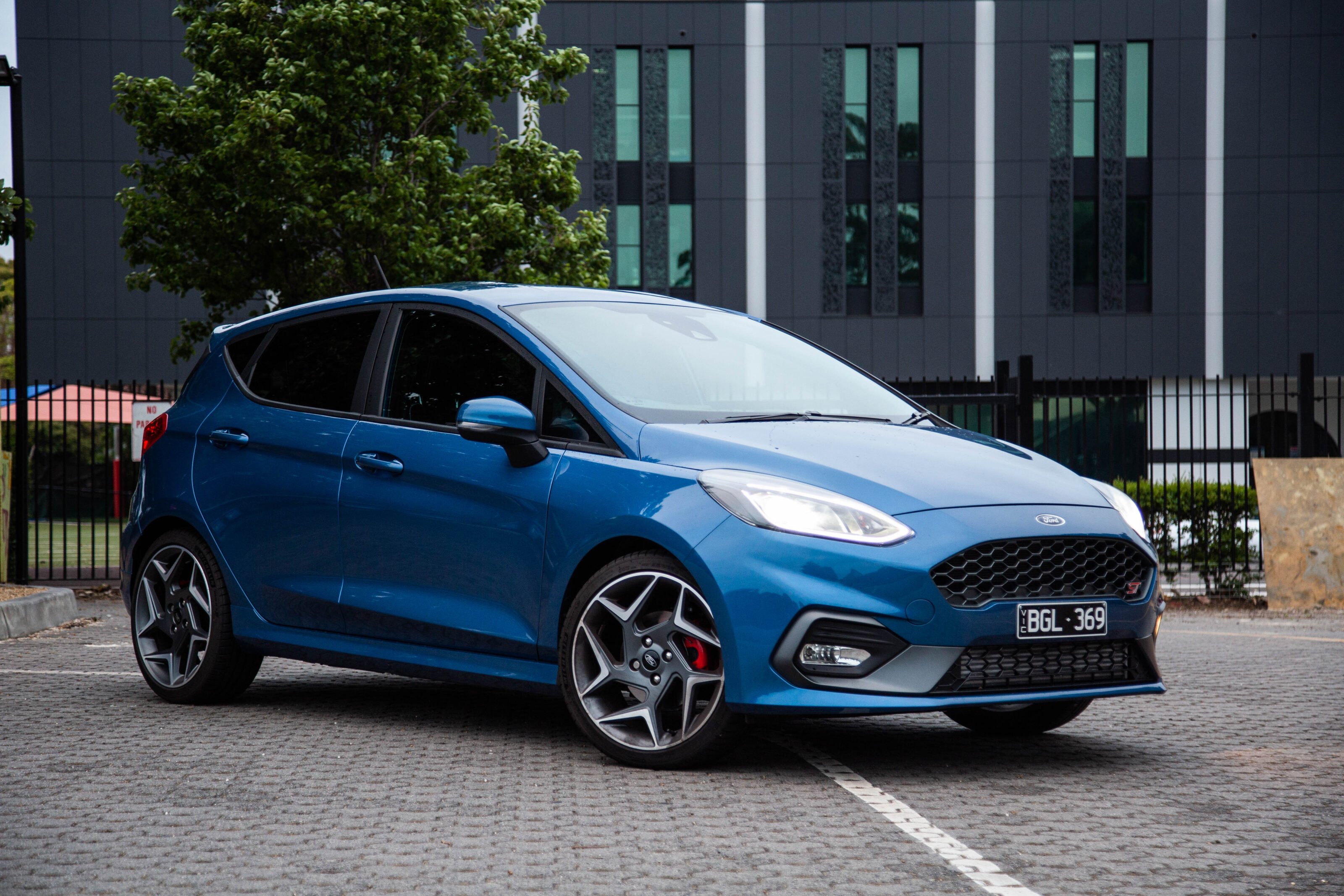
Speaking of shifting, Ford says the Fiesta ST is capable of no-lift flat-shifting, however, my mechanically sympathetic self has yet to try it. Last month, the weightless shift-action was perhaps my one reservation, unexpectedly numb albeit accurate and direct.
After living with the Fiesta some more, I have grown more fond of the shift action, and find it seems to respond better with more rapid changes. Like many facets of the Fiesta ST, things actually grow smoother with speed. The most satisfying is actually fourth to fifth, whereby you simply push gear lever 45 degrees north-east with an open palm, and it effortlessly slots in.
As the road straightens out and proximity to metro Melbourne is signalled by the increasing number of caravans and tourists, I put the drive mode back to Normal and cruise back to town.
Differing drive modes make no adjustment to the damping, which underlies a frequent criticism levelled at the Fiesta ST from colleagues. The ‘always-on’ firm ride, to me however, hasn’t been found to be a detractor as the dynamic payoff is simply that immense. The same cannot be said for other sports oriented competitors at this price point, such as the Kia Cerato GT.
Having said that, your significant other in the passenger seat will care not for any such ‘dynamic payoff’; I tried to use that excuse… but sadly, to no avail.
Just stay in the driver’s seat and you’ll be smiling for miles. – AA
Things we love:
1. Huge fun-factor 2. Sleeper appeal 3. Initial brake power
Things we rue:
1. Sometimes tinny exhaust 2. Always firm ride 3. Front-end feedback through steering
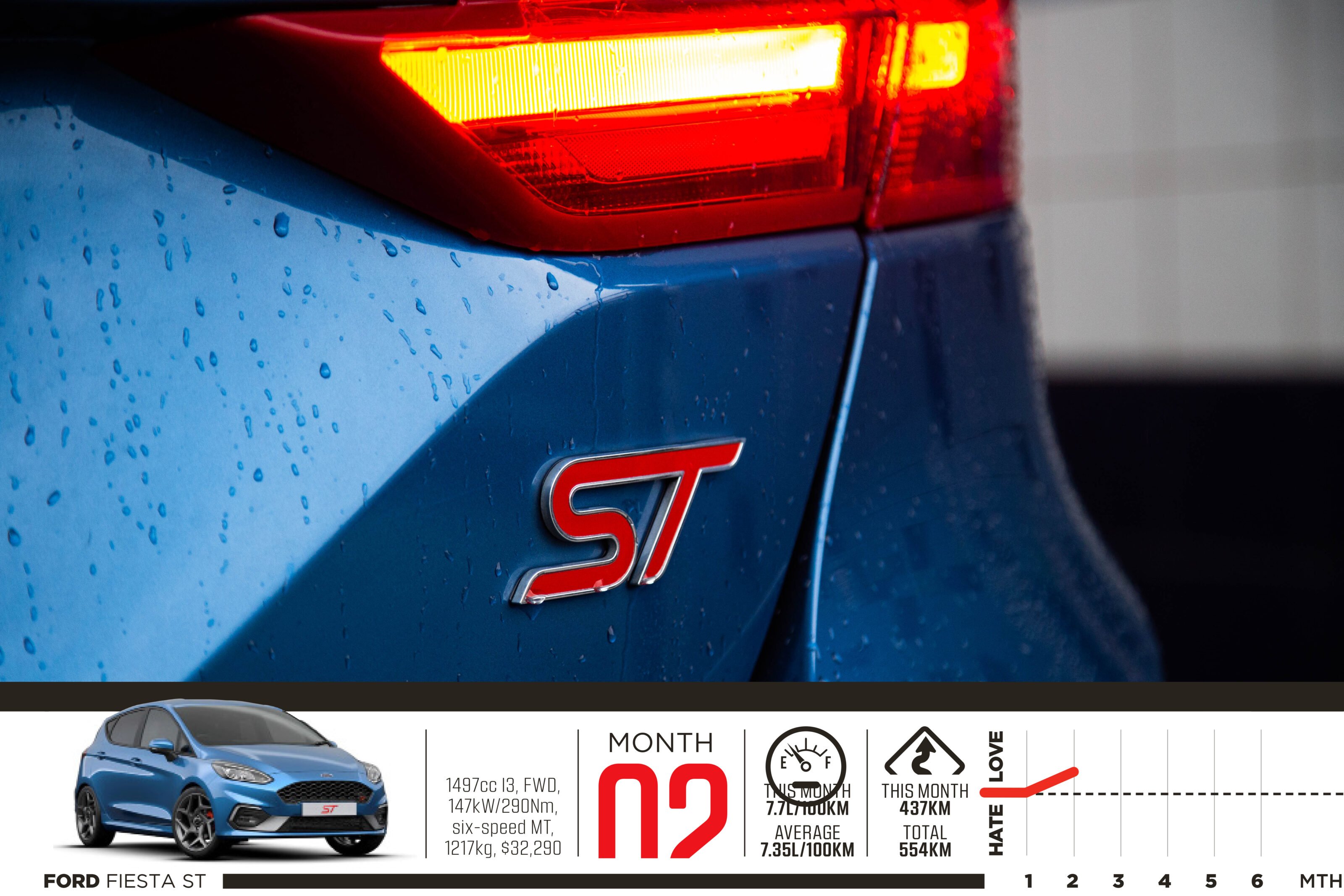
Update 2: Never Lift
Kirby licks the stamp and sends it
Despite what you might think about automotive journalism, it’s not an endless parade of brand new cars that we thrash to within an inch of their life before returning them to a manufacturer leaking coolant and with brakes on fire.
While, yes, our testing process includes enthusiastic driving, and there are some instances where tyres and brakes are tested to their design parameters, we always intend to return press vehicles is the same condition that we picked them up in. As a result, any journalist worth their salt treats press vehicles with a respectful level of mechanical sympathy. That means ripping the handbrake at every roundabout or smashing the redline at every traffic light is a no-go.
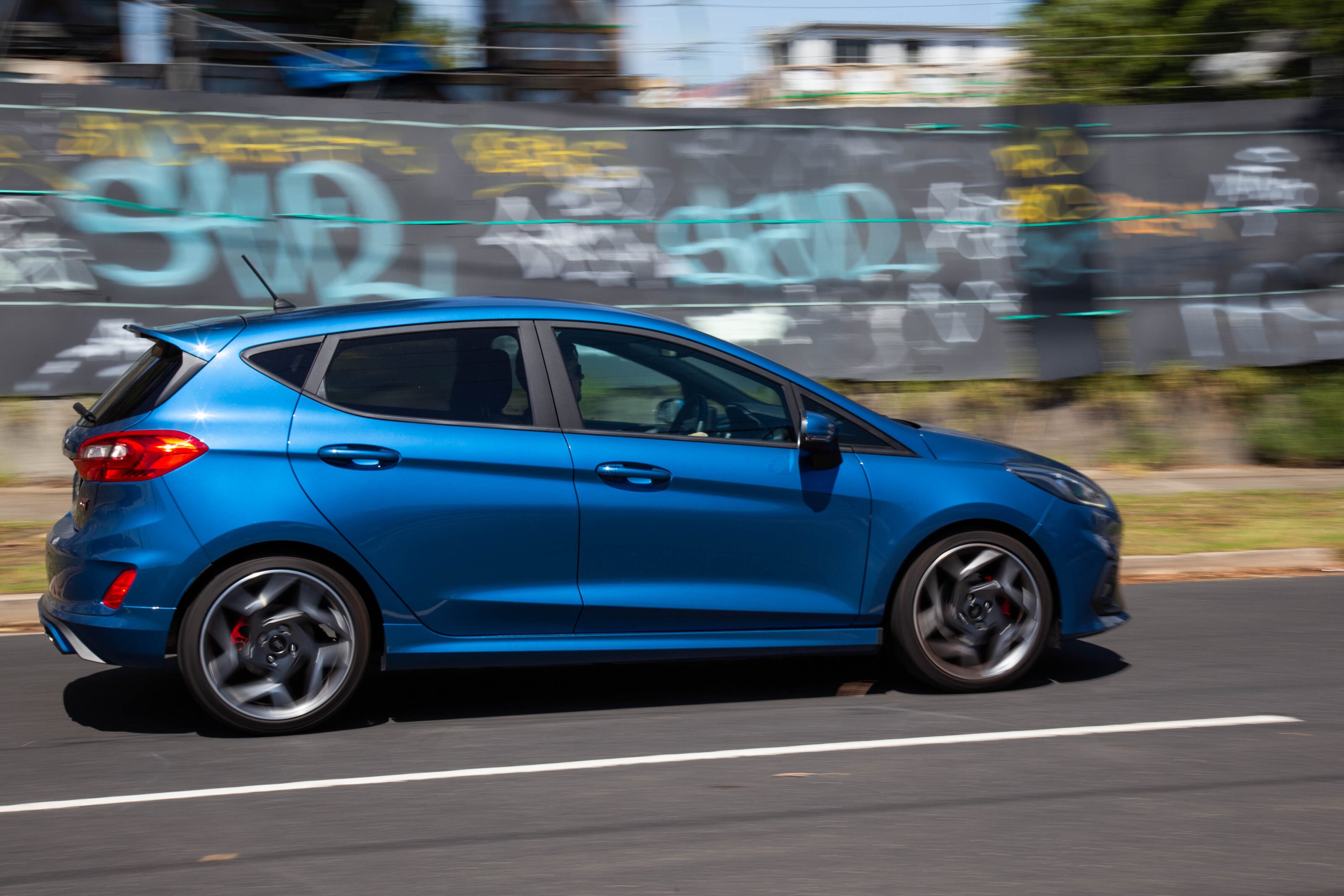
This puts me in a slight conundrum. You see, the Ford Fiesta ST has a feature that is often referred to as No Lift Shift, which does exactly what it says on the tin. Essentially, the system allows you to keep your right foot planted during gear changes, with the engine’s computers holding the revs steady while you engage the clutch and pluck the next ratio.
Attempt this in most other vehicles and the tacho needle will try to snap itself off against the limiter and you’ll be cremating the clutch in no time.
Talking to colleagues only served to make me nervous of the system. The consensus was that the system is effective – brilliantly so – but hard on the drivetrain if you messed it up. As a result, the No Lift Shift function has had me intrigued, but slightly beguiled since sliding into the brilliant Recaro buckets.
My heart is desperately infatuated with the idea, but a brain that is trained to be professionally sympathetic to mechanicals is deeply off-put. “If I don’t test this system I won’t be doing my job,” I told myself. That’ll help me sleep at night, right?
After pushing the sensible bit of my brain to the side, I can report that the system indeed performs as advertised. However, there is a very narrow window within which the function performs as intended; you need to be at max attack, and only engage the clutch in the final 1500rpm before redline. Start shifting too early and it’s no dice, same with if you take too long on the ratio change.
It takes a surprising amount of concentration to override the muscle memory of lifting the throttle during shifts. Even the slightest waver from pressing against the firewall with your right foot and it’ll all come undone. You need to have the accelerator absolutely planted – nothing less than 100 per cent throttle application means the computer won’t hold the revs and you’ll be banging off the redline mid shift like a boy racer try-hard.
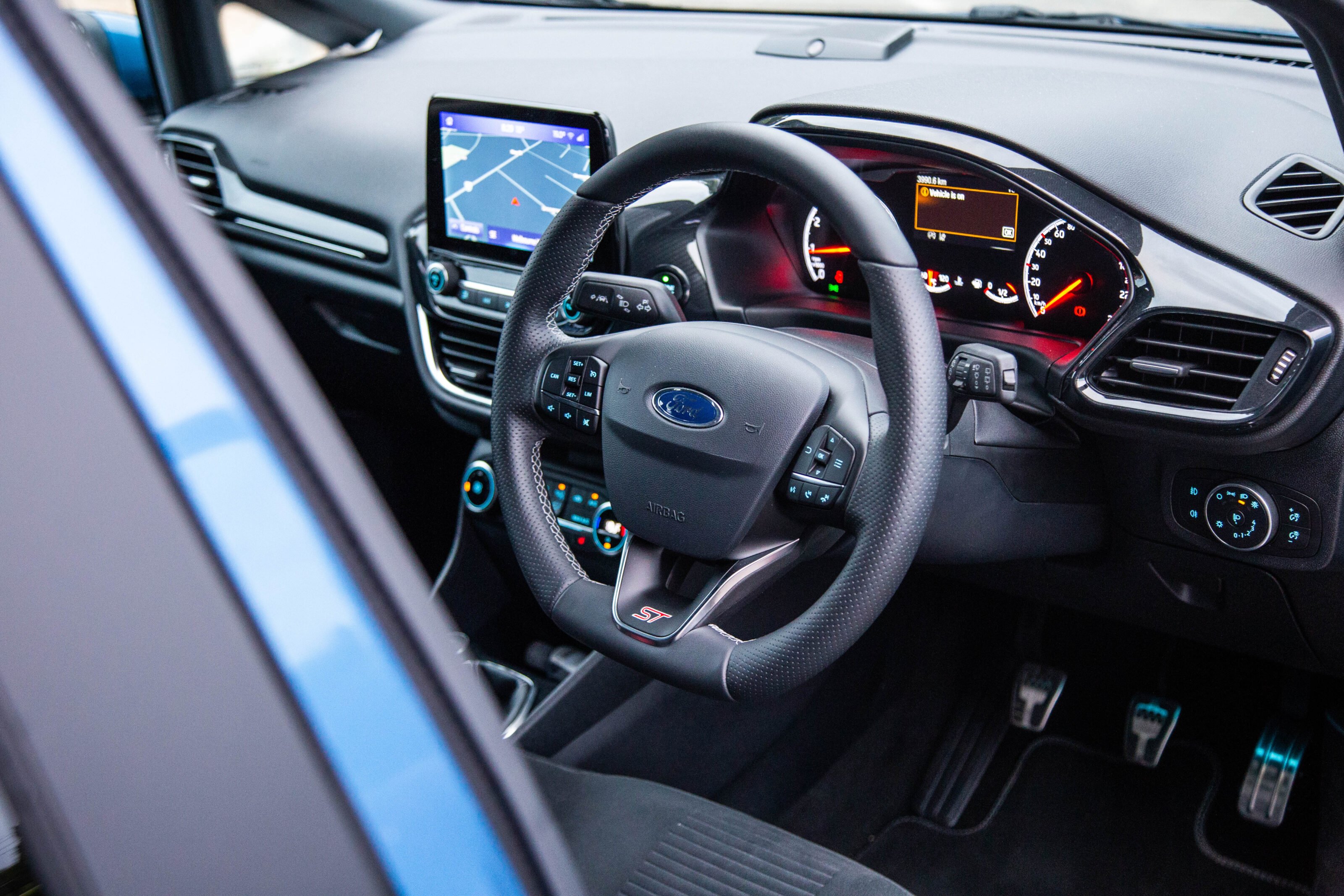
So while regular road use relegates No Lift Shift to a cool thing to tell your mates about at the pub, the Fiesta ST has been superb as a commuter car.
Okay, so the ride isn’t as refined as something like a base Mazda3, but it’s not unbearable, and actually quite amenable in all but the most potholed portions of road. To Ford’s credit they’ve rammed the Fiesta ST with every conceivable feature you’d ever want at this price point. There is an 8.0-inch infotainment screen with smartphone mirroring, heated front seats and steering wheel, dual-zone climate control, wireless phone charging, a ripper 10-speaker Bang & Olufsen sound system, AEB with pedestrian and cyclist detection, and lane-keep assist.
All of these add up to a pleasant everyday experience. We’ve driven cars with six-figure price tags where some of those features are optional, but the Fiesta gives you the lot as part of a compelling $32,290 plus on-roads package. Bang for your buck? Oh hell yeah.
Enough of the love-in, time for the dirty splotches on the Fiesta’s record during the day-to-day grind. First off, the start-stop function is clunky and intrusive. With the Fiesta sitting at an 800-900rpm idle (depending on temperature), the fuel-saving feature is juddery in its execution, making it feel like the car has stalled while sitting stationary at a set of traffic lights.
There’s also a decent amount of rev hang – It’s not enough to ruin the driving experience, but certainly present. The Fiesta ST uses a combination of both port and direct injection, the latter going some way to mitigating the situation. However, the size of the flywheel needed to keep the plucky three-cylinder going somewhat negates that benefit.
And, well, that’s kind of it so far. Two minor gripes that are either avoidable by turning the function off altogether or not really a deal breaker. There must be something else to complain about. Oh dang, I guess I’ll need to go drive it more to try and find out. What a chore. Remember, I’m doing this for you, dear readers. – CK
Things we love:
1. Torque for days 2. Rowing gears 3. Heated seats
Things we rue:
1. Stop-start 2. Bad shifts 3. Throttle hang
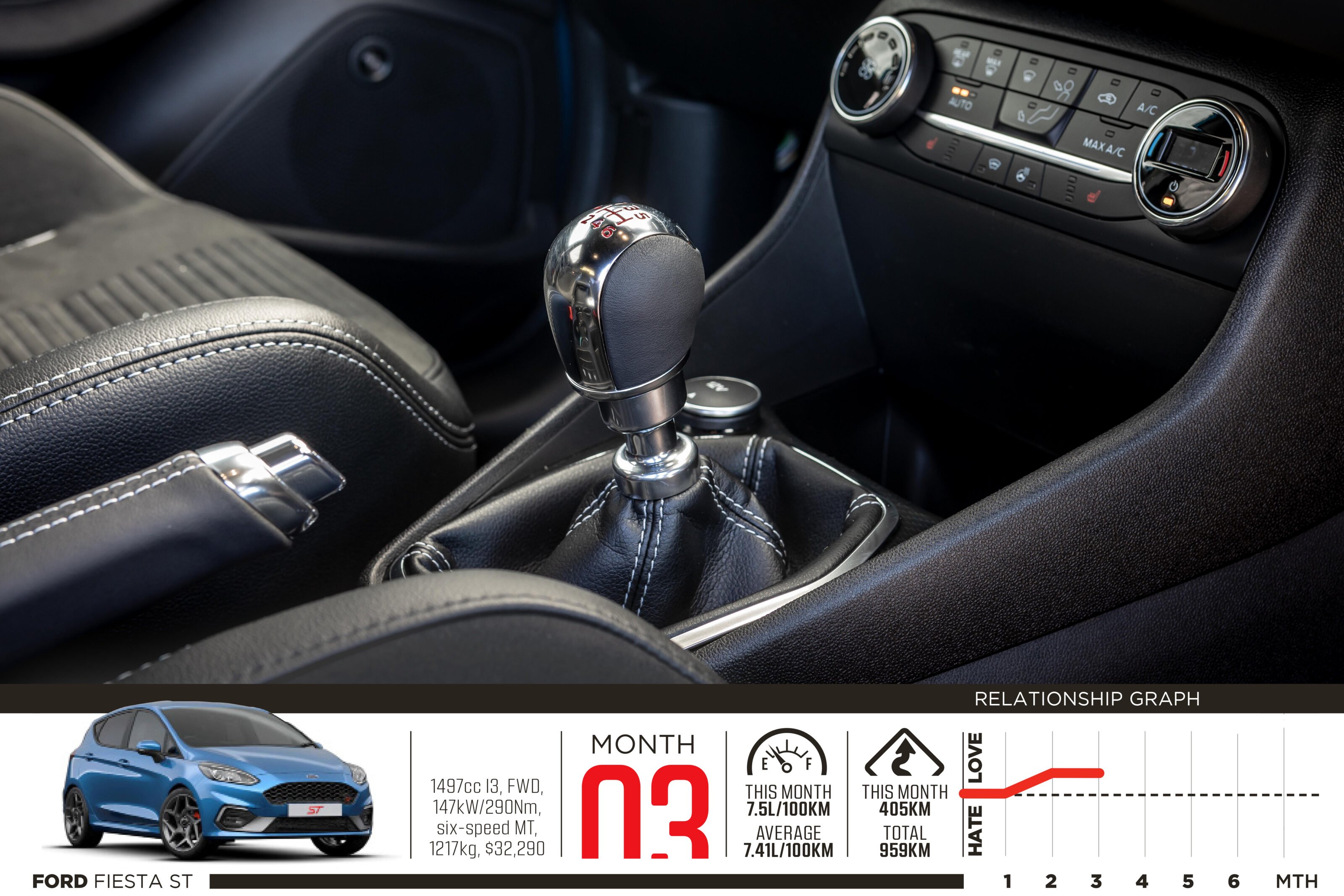
Update 3: Perfect Match
Does a chance reunion recreate the magic?
The problem with giving a car a perfect score is the fact it sets a precedent of perfection. Not to mention the myriad pundits who line up primed to prove you wrong by finding fault – any fault. This has been my experience with the mighty Fiesta ST, a car I awarded a perfect five-out-of-five stars when first reviewing it last year for sister publication Wheels magazine. Scott Newman, too, granted it five stars for this very title.
The feisty five-door has been doing the rounds at MOTOR HQ, so when I got the chance to grab the keys for an extended period with the ST, I thought it a perfect way to see if my affinity remained strong.
However, about 200km north of Melbourne after fighting to escape the clutches of the Friday-night CBD exodus, I wasn’t feeling the love. En route to the Victorian High Country as the sun disappeared, the rather dim headlights frustrated, the firm Recaro seats were badgering my lower back and the excessive road noise was really beginning to grate. The buzzing country town of Bright couldn’t come soon enough.
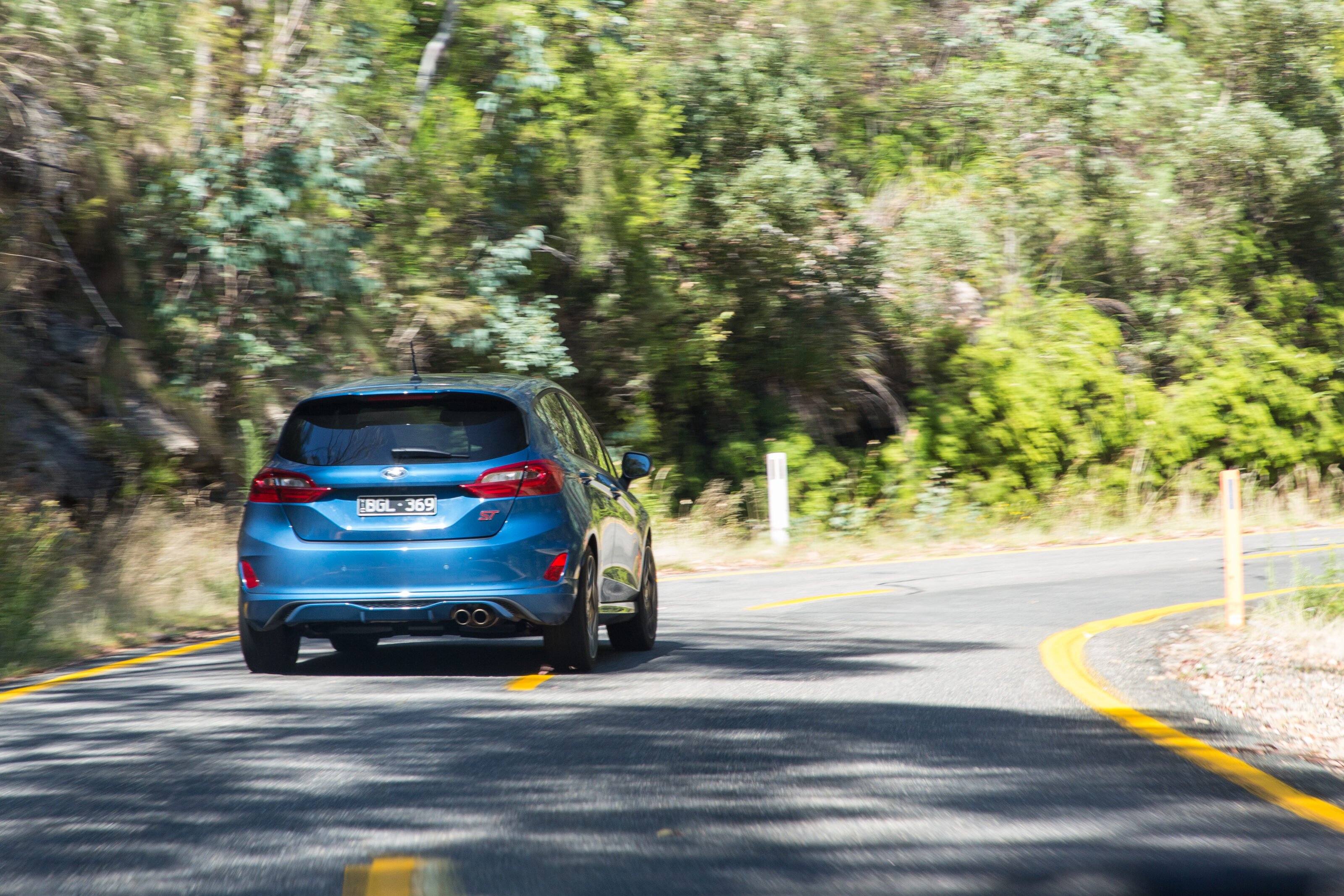
The B&O sound system does its best to overcome the incessant tyre roar generated at highway speeds, but this is the one area where you can tell the ST is created from a humble hatchback base. Yet, in other ways, it’s also to its benefit.
A hot hatch should be practical, too. The Fiesta easily accommodates two well-fed males and their associated paraphernalia for a weekend of driving with the boys. A Toyota Corolla hatch owner would certainly be envious of its 311-litre boot. So in terms of liveability it’s a bitter-sweet reunion, but still a sign that one of its stars is beginning to fade.
That all changes when it’s time to drive – properly. Lockdown blues are a distant memory and a round trip in and out of Bright, encompassing Omeo, Hotham, Falls Creek and Mount Beauty, is ahead of us. The Omeo Highway, passing by the quaint Blue Duck Inn, is a veritable playground for the plucky Fiesta. Although this section is relatively narrow, there’s something liberating about being able to use the entire road in a small car, and the ST’s mechanical Quaife LSD bites into the tarmac with ferocious tenacity.
We’ve spoken ad nauseam about the Fiesta’s dynamic prowess, but on the brilliant Omeo Highway it’s keen to turn in hard, cock an inside rear wheel and then power past the apex at full beans all day long. The ST becomes the bantamweight fighter that refuses to leave the rear-view mirror of more fancied machinery within the five-car convoy.
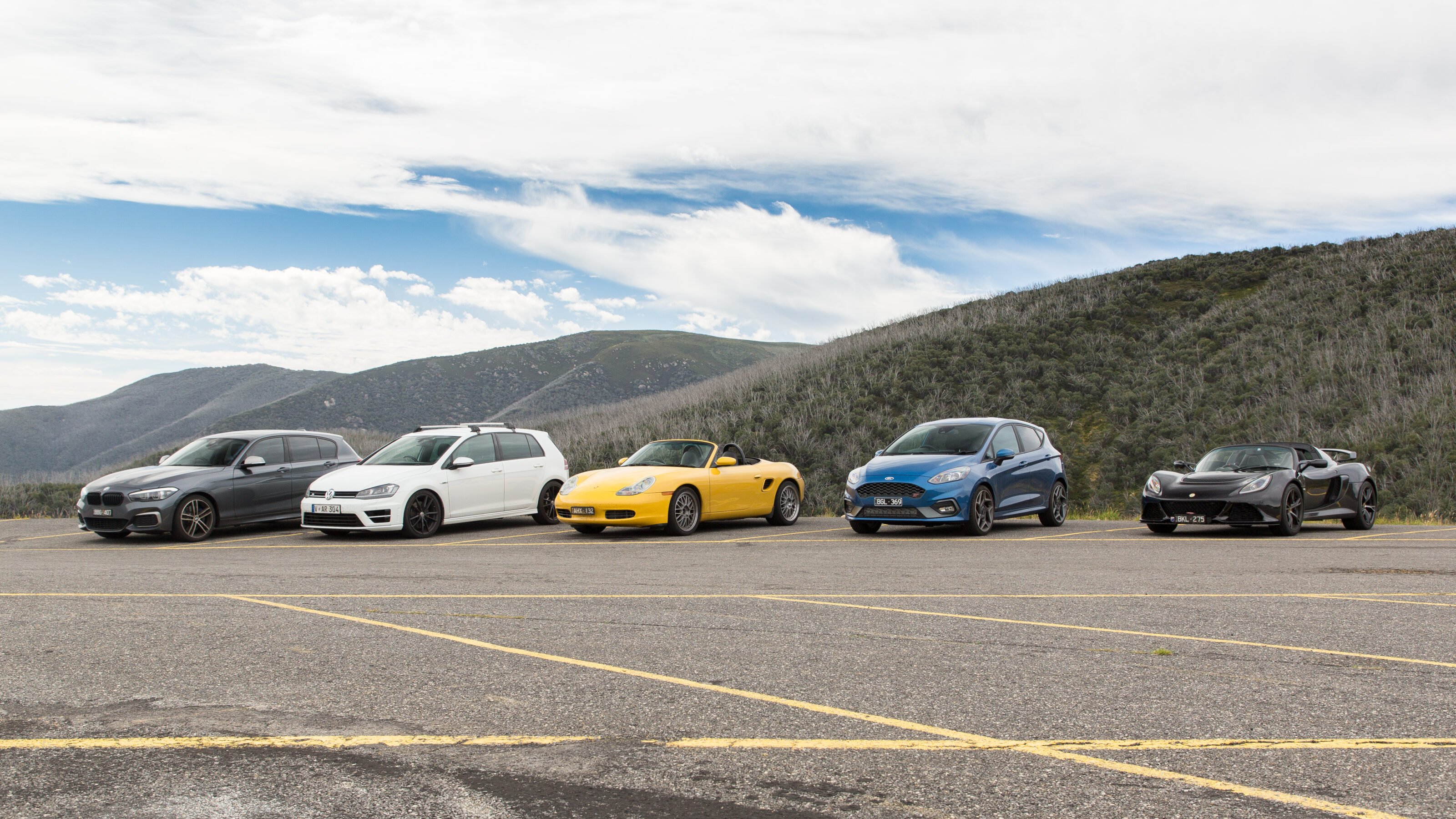
Somewhere near Falls Creek a cheeky bag of M&Ms unleashes its contents throughout the cabin after it could no longer fight the cornering forces generated by the grippy Michelin hoops. The next rest stop involves me getting down on my hands and knees fervently searching for the scattered confectionery, unwilling to admit the 10-second rule had well expired. Damn it.
There is one Achilles heel, five-star status notwithstanding, and it’s the brakes. They’re dinky, something we noted at PCOTY, where the ST outplayed supercars to finish fourth overall. And while the brakes perform better than their dimensions suggest, pounding the middle pedal on a long section of the Omeo Highway did result in a distinct acrid smoke from the pads. Cooling time before parking up is essential, not merely a suggestion.
Surprisingly, it’s not just the bendy bits where the ST excels as the thrummy, muscular three-pot turbo defies its cubic capacity in a straight line, too. However, it drinks, rather than sips, 95-98 RON when you’re on it; a fact proven by the 12.4L/100km it returned completing the 260km loop. That’s almost double the 6.9L/100km it averaged on the Hume Highway to Bright.
Spirited driving done, and going four-up with burgers and beer in the bellies of its passengers, space isn’t really an issue in any pew. And just like a Homer Simpson groove, the heavily bolstered Recaros feel bedded in on the return trip to Melbourne the following day. I’m happy to report that the human-to-car relationship I originally formed last year is still very much intact.
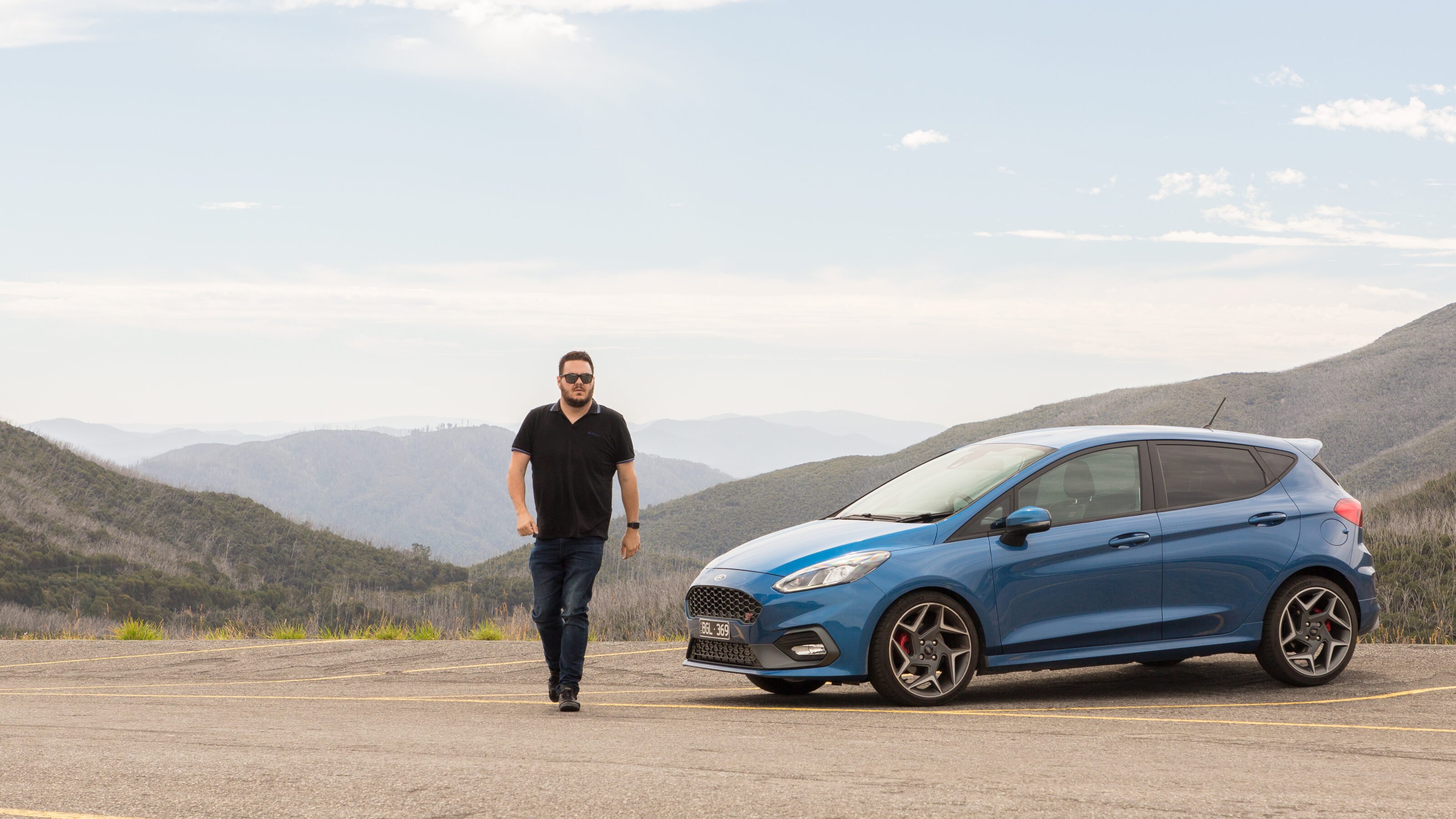
Okay, there are chinks in the armour – maybe a 4.75 rating is more apt if you’re using the Fiesta as a daily. However, for me, the biggest grin-inducing fact about the ST is that it completely dispels the myth that you need to spend big money to receive big thrills. On the roads nestled within and around Victoria’s epic Alpine region, a place any driving enthusiast must explore, I wasn’t left wanting for something more. The pint-sized Fiesta was, in many ways, perfect. Although it owes me a few M&Ms. I fear they’re lost forever. – TG
Things we love:
1. Fun factor 2. Giant-killing pace 3. Practicality
Things we rue:
1. Road noise 2. Firm Recaros 3. Hot brakes

Update 4: Flavour of the Month
A brief sojourn in the more mature Focus puts the Fiesta into perspective
It was a slightly sad sight: ‘my’ Ford Fiesta ST sitting alone and forlorn at the back of the office carpark. I almost felt bad. Bad not because I was stepping into some ludicrously expensive or powerful piece of automotive exotica. I felt bad because I was swapping it for another ST-badged five-door hatchback dipped in Ford Performance Blue.
Yes, that’s right, I was about to spend a week in the Ford Focus ST, a notion akin to ditching a high school crush for her older sister, one or two grades your senior.
That’s because there’s an air of maturity about the larger Focus that the pugnacious little Fiesta doesn’t quite possess.
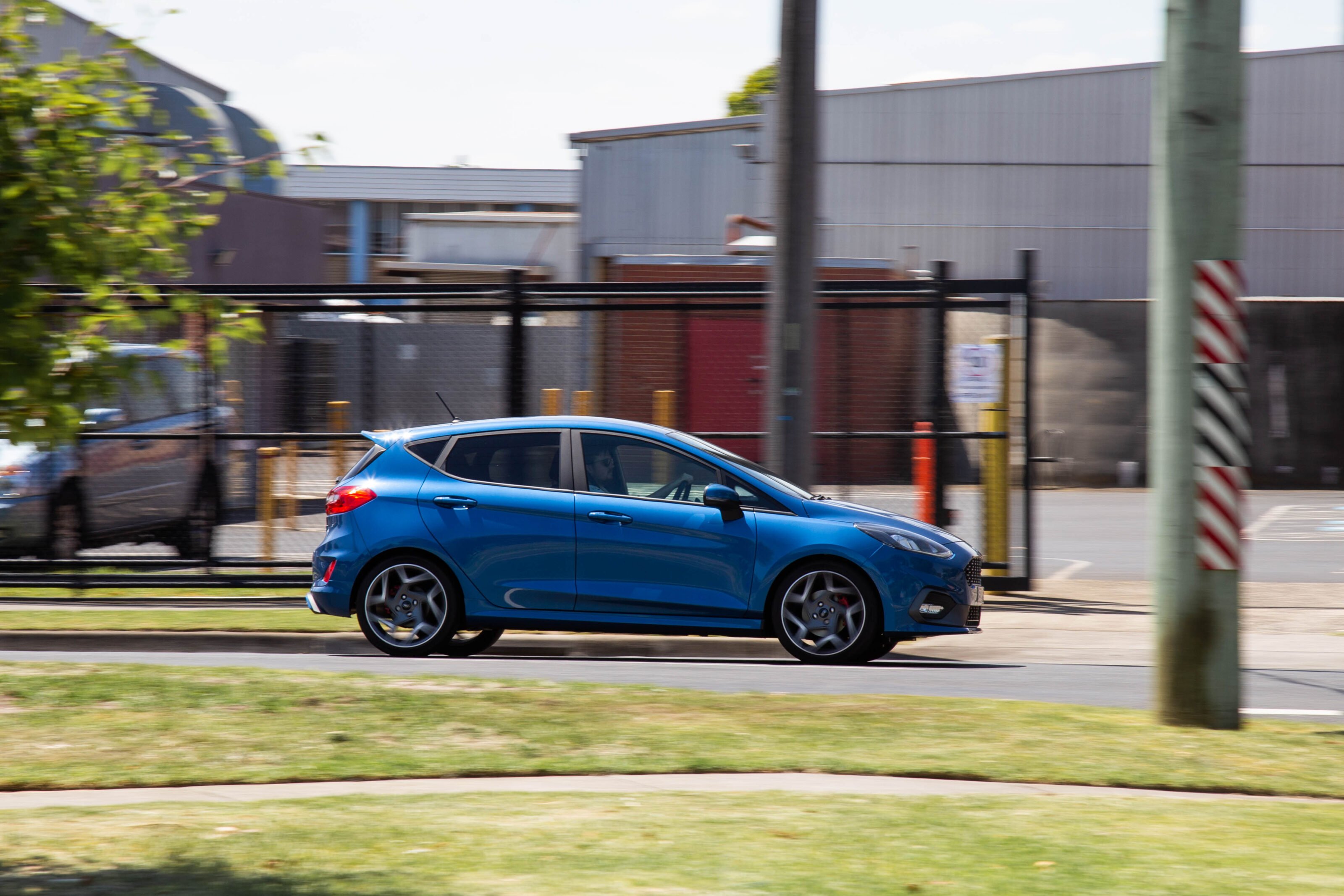
Its spec certainly helped that image, as this one was equipped with the seven-speed automatic gearbox. In the daily commute, this was a welcome change of pace, although the Fiesta’s ability to row gears around suburbia without breaking the speed limit should be a drawcard for the keen enthusiast.
That’s not to say that the Focus is devoid of personality and charm. In many ways, it bears much of the same fighting spirit as its smaller stablemate, but with a wider bandwidth to utilise in a more versatile package.
In comparing the 1.5-litre turbo three-pot of the Fiesta to the Focus’ 2.3-litre turbo four (borrowed and de-tuned from the four-pot Mustang), you’ll see that power peaks higher at 206kW, and earlier at 5500rpm (compared to 147kW at 6000rpm in the ST).
Even though the Focus tips the scales almost 300kgs heavier, it still outguns the Fiesta’s 123kW/tonne, coming to the party with 134kW/tonne (136kW for the manual).
I even like the noise which, like the Fiesta, is electronically symposed through the speakers. The Fiesta’s three-cylinder warble can sound tinny and hollow at times, but the fourth cylinder on the Fiesta fills out the tone and adds another dimension of refinement.
Elsewhere about town, the turbo-four offers the same low-end useable torque as the Fiesta’s deceptively tractable unit. Its bigger footprint irons out a lot of that jostling ride, and it won far more favour with my girlfriend thanks to its damper adjustment between driving modes, compared to the ‘always on’ Fiesta.
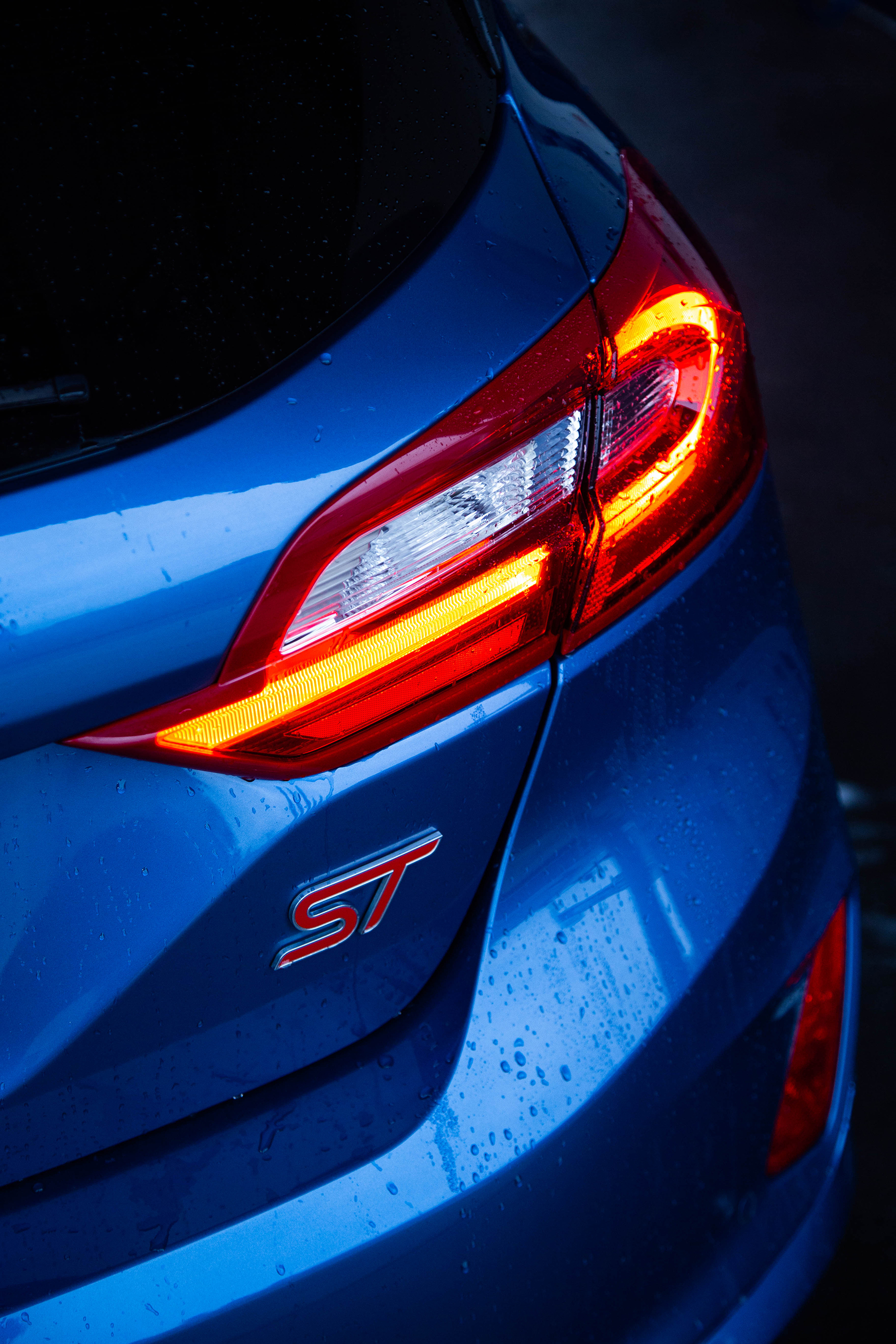
After five days of inner-city commuting I was very much warming to the Focus so, when the weekend rolled around, I found it an opportune time to get up early on a Sunday, to head out to the hills and see if any of that ST-badge magic was lost in translation.
In summary, not much. The Focus had the same amazing front-end feel as the Fiesta, and is very adjustable throughout the corner. Its electronic differential works to great effect and, like the Fiesta, keeps plough understeer at a seemingly impossibly high threshold. Even with the auto, I can’t say I wished for a manual at any point. Would I be having as much or more fun on this road in the Fiesta? Possibly. But by no means was I left wanting in the Focus.
They execute their performance differently; whereas the Fiesta is typified by the experience of wringing its neck right up to redline with its dominant turbocharged rush, the Focus is characterised by its low and mid-range grunt while plateauing off at the top end.
And I find that to be an allegory for these two cars. While, objectively, they’re very similar in a lot of ways, their characters are distinct to each.
The Fiesta is just eager and willing, full of energy like a terrier pup. The Focus is more akin to a Golden Retriever, already a couple of years old. Still eager to play, but a lot more chilled out.

With a $12k disparity in price between the Fiesta ST and the Focus ST, is it fair to say that you’d only pick a Fiesta if you couldn’t afford the Focus? Absolutely not.
There are genuine reasons you’d happily take the Fiesta over the Focus. And at $44,690, the larger Focus is forced to defend its pricing in the face of greats such as Hyundai’s i30 N and VW’s Golf GTI.
The Fiesta ST, conversely, is almost peerless at its price point. Although Hyundai’s impending i20N may have some stern words for the affable warm hatch.
I returned the Focus to Broadmeadows on a Monday, and got back into my Fiesta that night. It felt as familiar as an old friend and, honestly, I didn’t miss the Focus until the next week when I had to slog down the Bass Highway. The Fiesta is a fantastic ball of fun in most circumstances, but an hours-long punt down the highway is not one of them. Perhaps I do miss the Focus sometimes… – AA
Things we love:
- Compact size
- Pop-out door guards
- Big personality
- Highway noise
- Always firm dampers
- Jostling ride
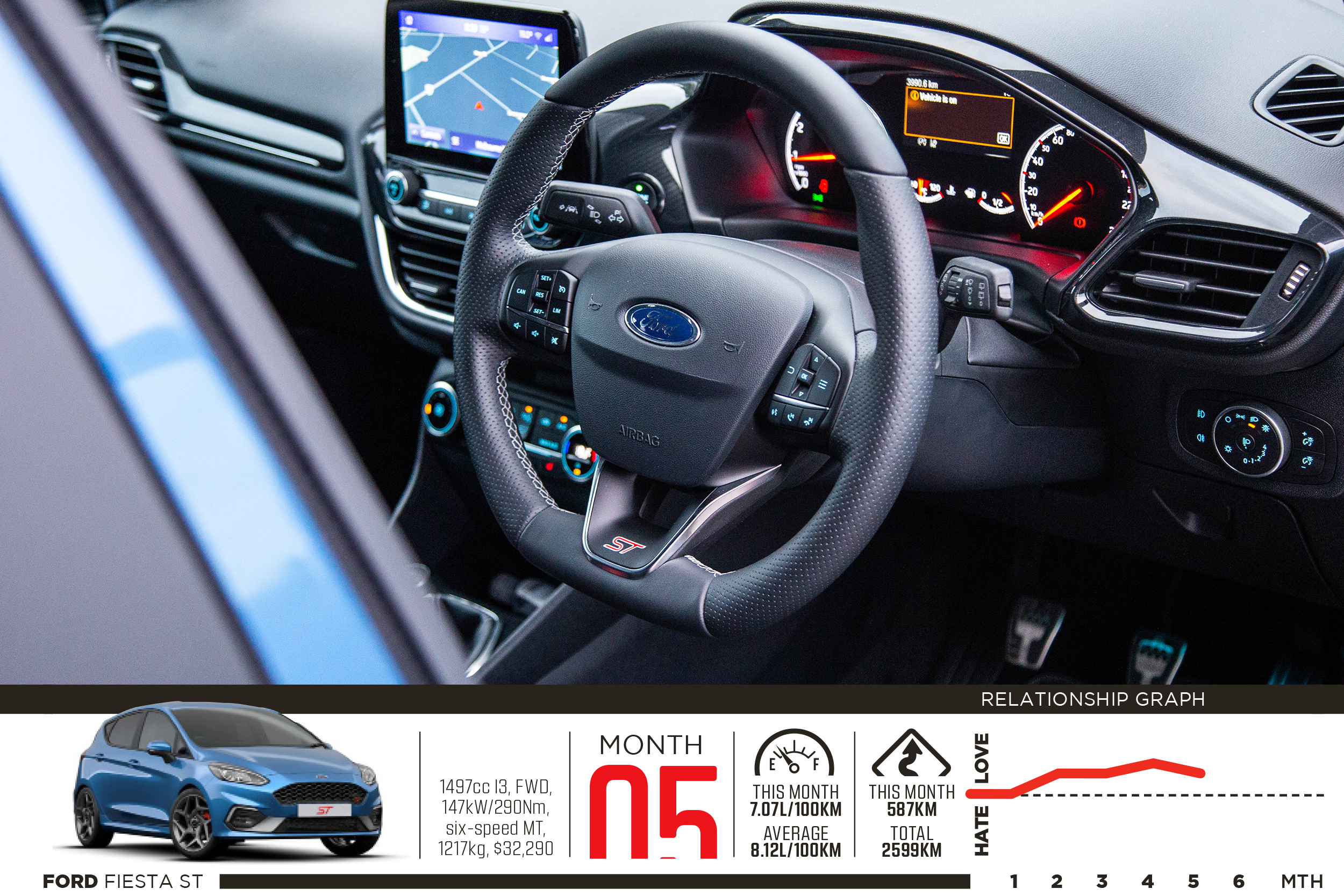
Update 5: Light, Fantastic
Fiesta out! It’s been a blast
It’s check-out time for the Ford Fiesta ST in the MOTOR garage, and while it’s comfortably been the least powerful and least expensive piece of kit through the shed over the past six months – it’s also easily been one of the most beloved.
It certainly entered The Garage on a high, fresh off a fourth place finish at PCOTY 2021 and displacing some heavy-hitters such as the Audi R8 and RS6 Avant, Porsche Cayman 4.0 GTS manual and even Toyota’s GR Yaris in the process.
The question, however, remained whether the tiny terror would lose its lustre when asked to become a true live-in companion in the real world. Spoiler alert: the answer is no.
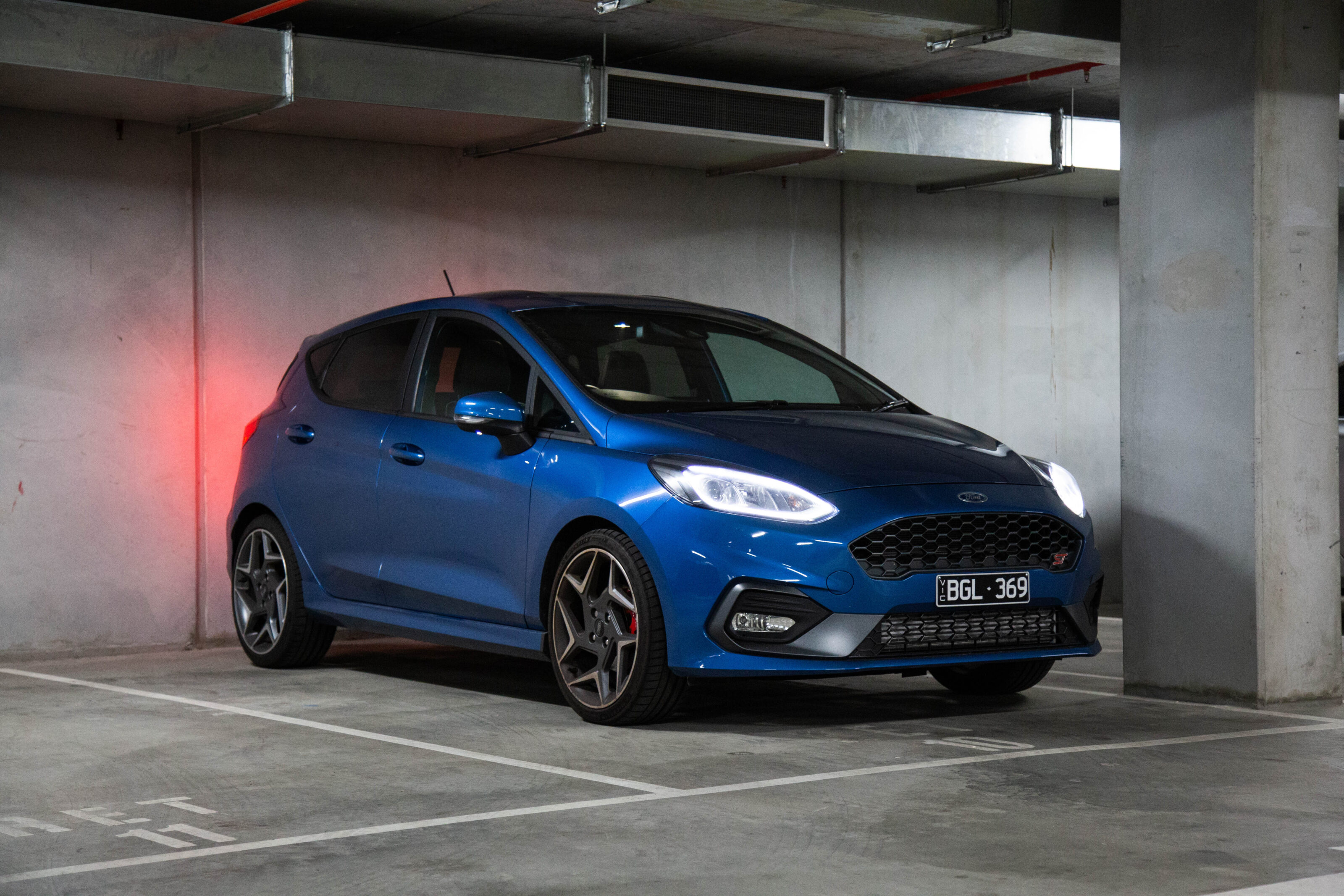
As an urban runabout, you’d struggle to find a better package at this price-point. In fact, at $32,290, the Ford Fiesta ST is the sixth-cheapest car in our expansive Hot Source data section at the back of our magazine.
For your money, you get a practical five-door hatchback body, with useable rear seats and a 311-litre boot. The rear seats, too, fold down 60:40; transforming the Fiesta into a pseudo mini van, and providing a more vacuous acoustic chamber for the baritone exhaust to tickle your ears. It’ll make you chuckle.
Its deceptively tractable three-cylinder turbo powerplant is a hugely characterful and intoxicating lump, with a distinctive rush as the little turbo comes on boost, reaching its peak power output at 6000rpm.
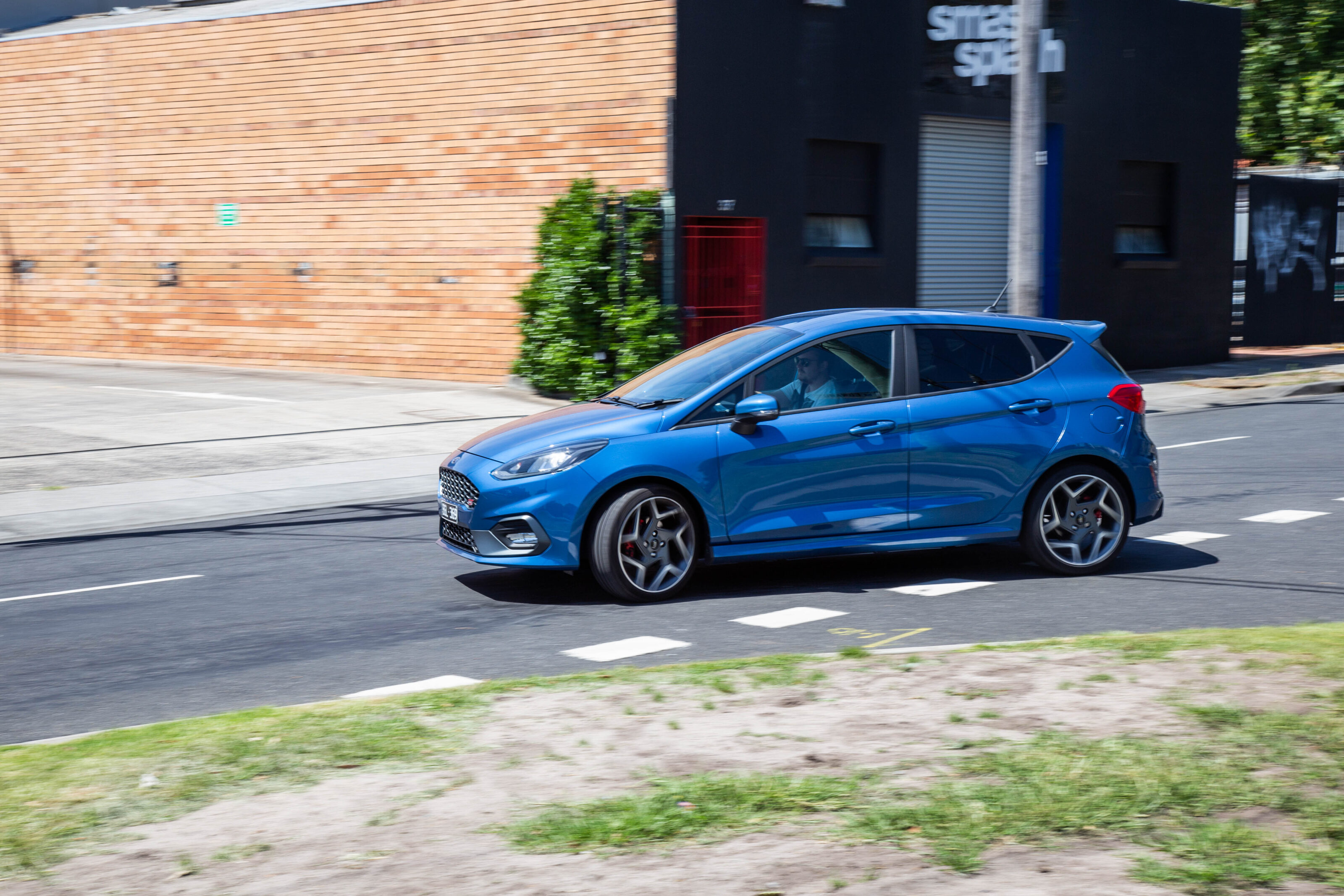
For months now, Sport mode has been my default driving setting. It wakes up the throttle response while hefting up the steering weight just so. The exhaust also seems to drop a few tones, gain a few decibels, and – once the car gets to temperature – signals off-throttle overrun with a satisfying array of pops and bangs.
Its compactness and flea-like agility are a blessing in the urban climate, able to exploit gaps in traffic – and the car park. In today’s motoring landscape, dominated by SUVs and dual-cab utes; it’s easy to forget just how fantastic it is to pedal a small car about town.
The real magic, however, of Ford’s pint-sized performance hero is the ability to row gears around suburbia without any real risk of attracting the disapproving eyes of local law enforcement.
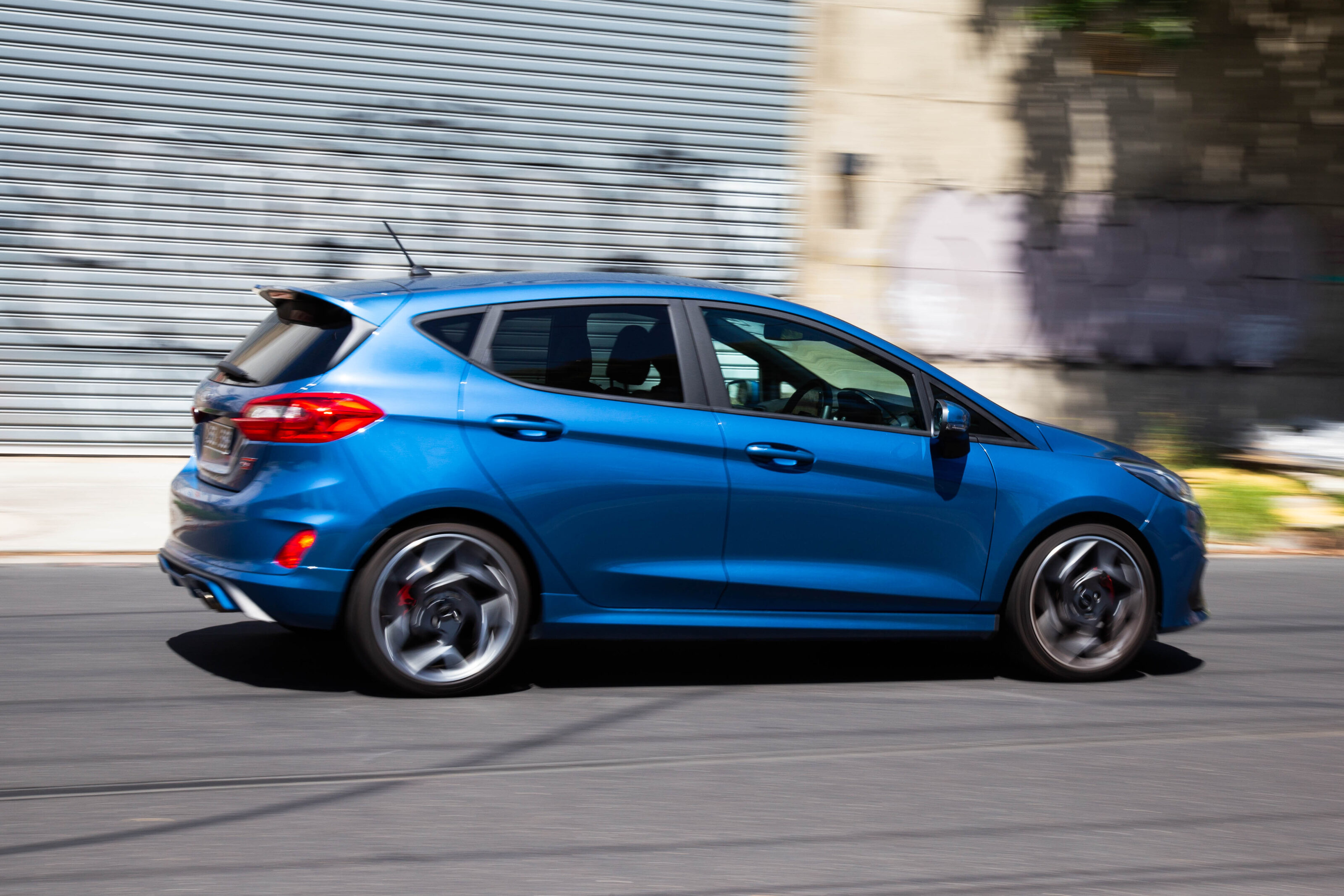
It’s one of those special cars that offers the sensation, and the smiles, of spirited driving without ever needing to reach truly consequential speeds around town. That’s not to say there are diminishing returns as the pace increases, on the contrary, the Fiesta ST is a car that gets better with speed.
It’s a car that truly makes almost any commute, errand or journey, a fun one. And that’s something to be celebrated in an age where most buyers are more concerned with getting the latest tech, or the flashiest cabin.
However, the Fiesta isn’t without fault. The interior isn’t the most dramatic or finely finished. Hard plastics aren’t always a big issue at this price point, but you are getting your value elsewhere.
While overseas Fiestas can be chosen in no less than three different levels of specification, plus an optional Performance Pack on top, the local offering gets no such choice –we simply get it all.
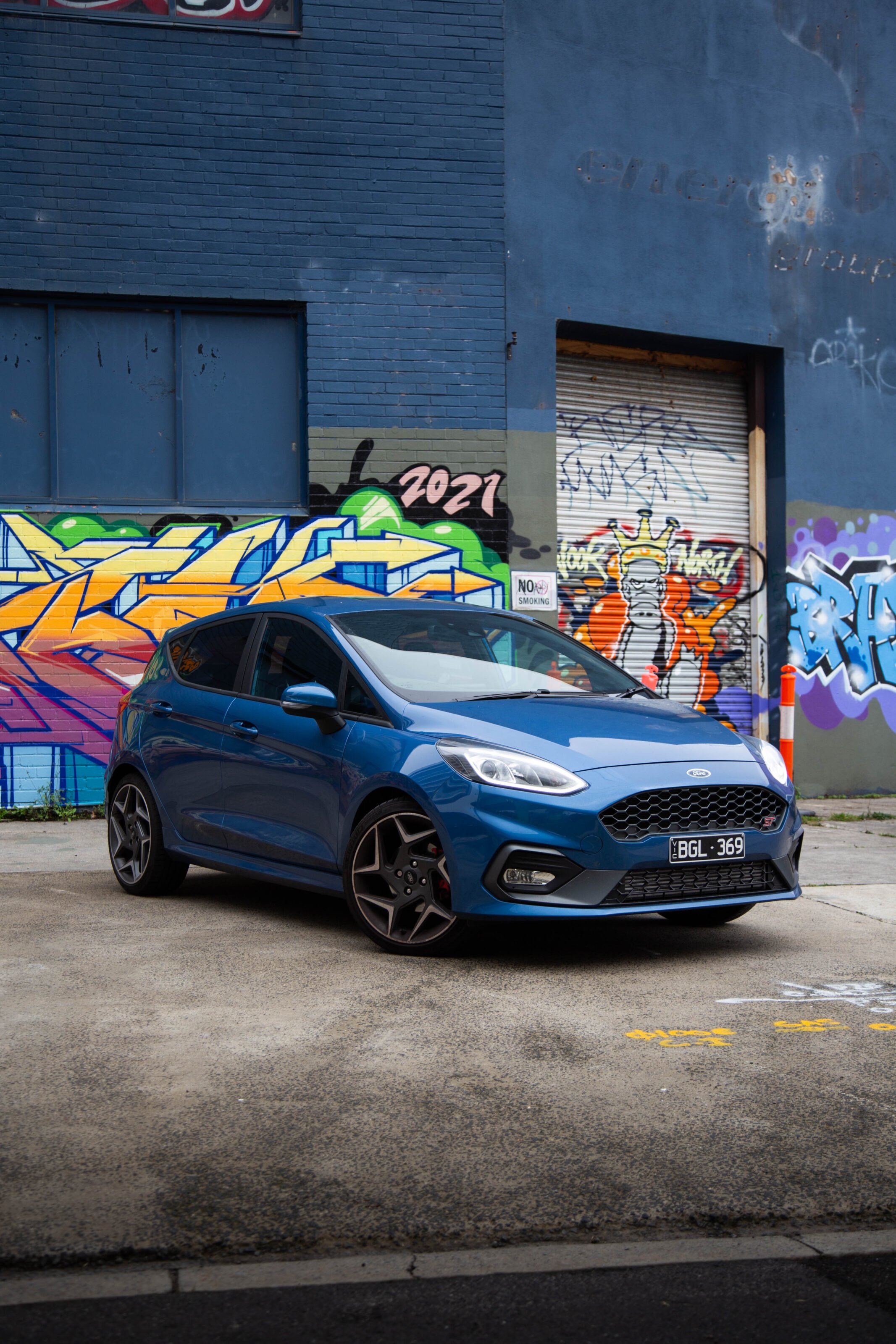
It’s easy to recommend the Fiesta ST to the driving enthusiast. As a pint-sized performance offering, it’s virtually unmatched. All the more impressive is that it took almost two years for it to arrive in Australia, and yet still shot straight to top of its class.
Indeed, it’s all the performance car most drivers will ever want, or need.
Where it may fall flat, however, are the needs of others. My girlfriend has been a constant critic of the Fiesta’s firm (yet, always well-controlled) ride and, while the rear seats are just about okay for adults; long highway trips will grow weary no matter what seat you’re sitting in – and that includes the driver’s.
The rapid rate of technology change means the absence of features like a wireless charger are increasingly conspicuous.
Of course, all that fades away at the first turn of the wheel, and the Fiesta ST should be revered as a champion of accessible performance. Sadly, however, I’ve turned my last corner.
As the micro-fighter departs the MOTOR garage and returns to the mothership, it leaves behind big shoes to fill for whatever is to come next. Bring it on! – AA
Things we love:
- Exhaust pops
- Versatile interior
- Fun withour speed
- Interior materials
- Long-range comfort
- Ford wants it back

Snapshot
- Passat R-Line wagon returns after two year hiatus
- 206kW/350Nm powerplant remains with all-wheel-drive
- Pricing starts at $63,790
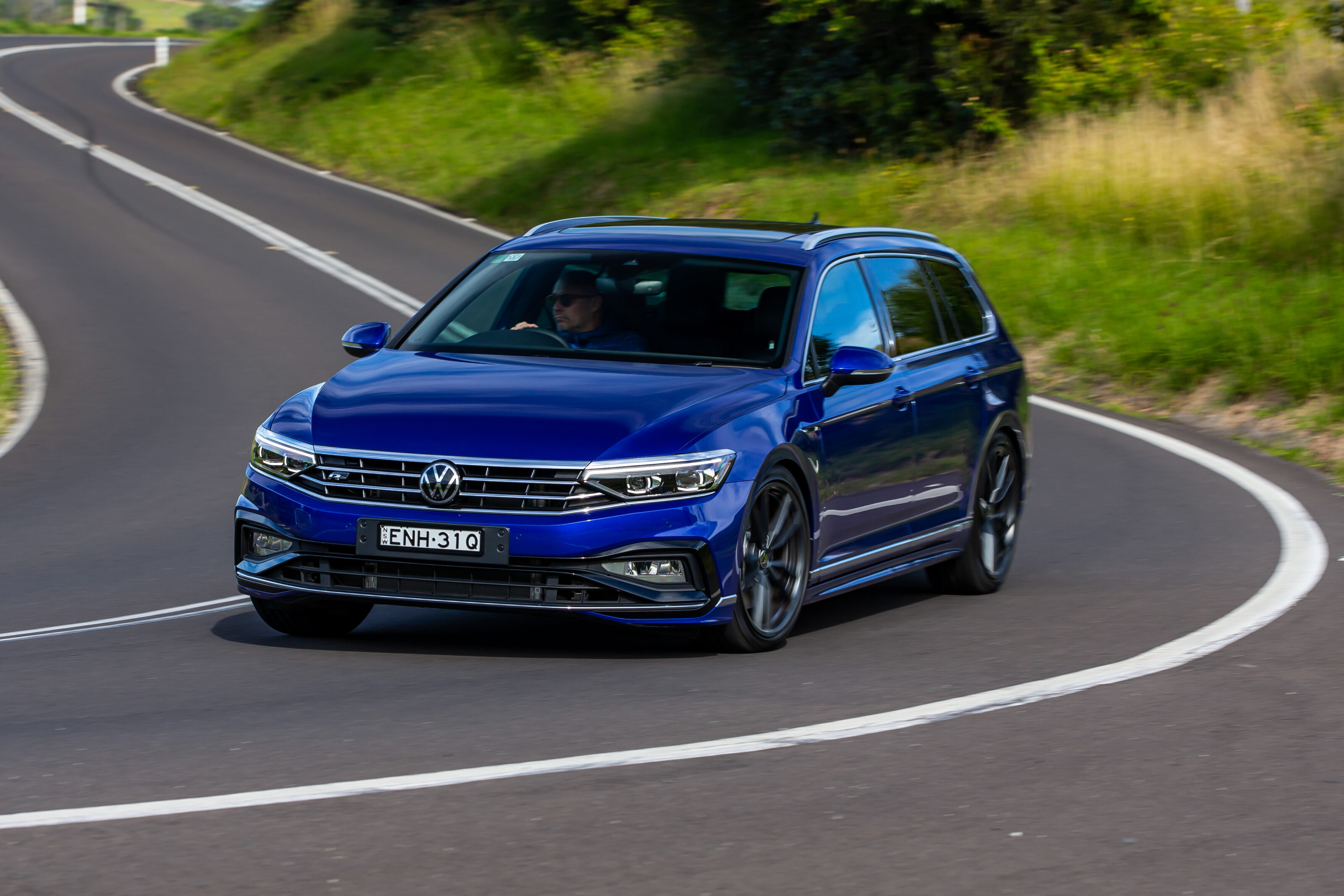
Volkswagen’s line of hot wagons continue to roll off its German production line and into Australian showrooms, with this month’s offering coming in the form of the new Passat R-Line, featuring Golf R power with wagon space.
Returning for the first time since the 2019 model year, the Passat 206TSI R-Line wagon is aimed at not only expanding the Passat range but also filling the gap between the outgoing Mk7.5 Golf’s performance wagon, which is all but sold out and the Mk8 as deliveries are not expected to start until next year.
The Passat R-Line wagon’s release comes after a four-year wait for updates to the Passat range and off the back of Volkswagen launching an Arteon R-Line wagon, featuring similar specs to the Passat but for a $5000 premium, set for release in the fourth quarter of 2021.
Pricing
The 2021 R-Line is now $1500 more than the 2019 R-Line it replaces, landing at $63,790 excluding on-road costs, with drive-away prices starting at $69,482.
Only one option is available on the R-Line – metallic and pearl effect paint which will set buyers back an extra $800, as all colours bar pure white incur the price rise.
Features
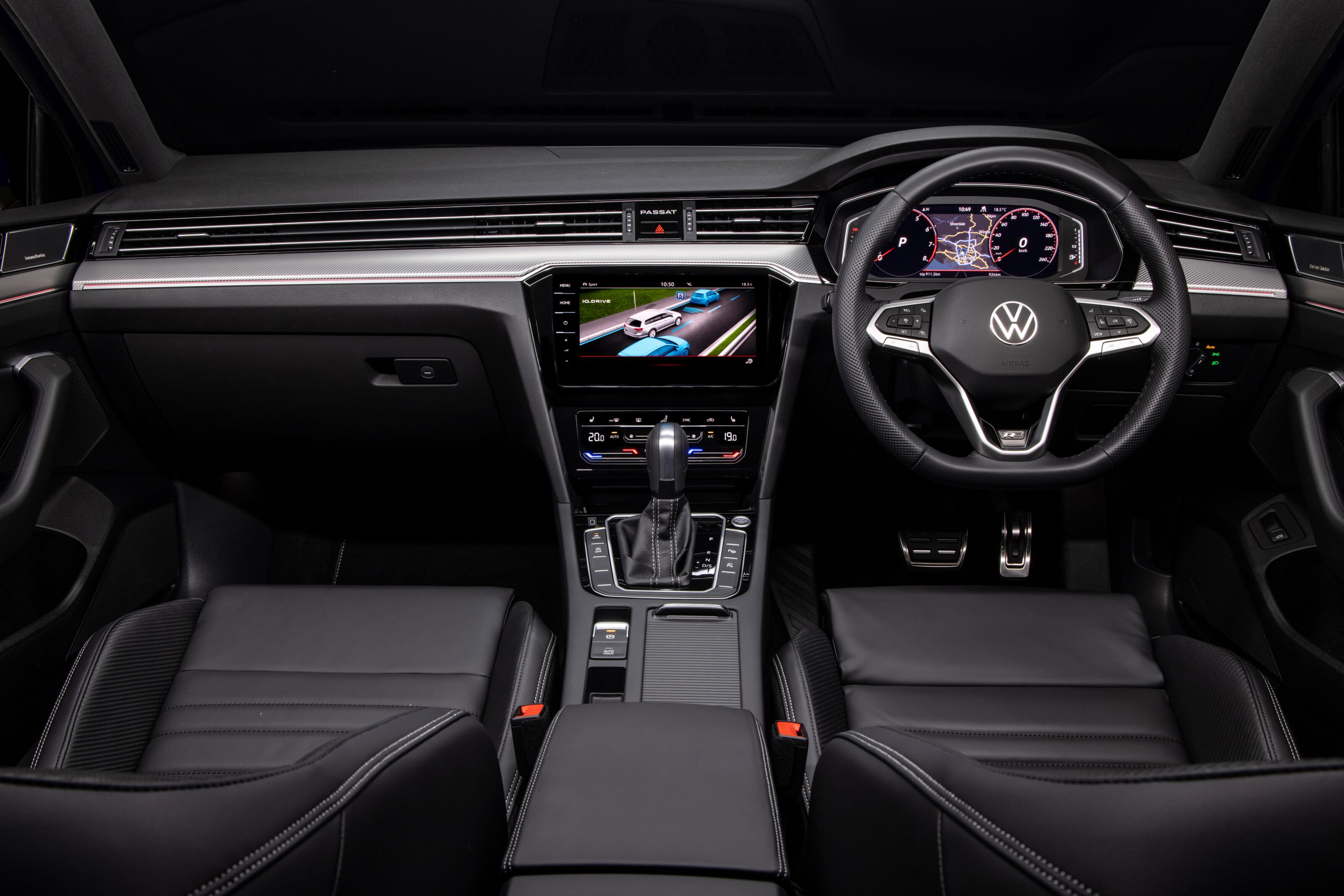
As mentioned above, the only optional extra for the new R-Line is metallic/pearl paint, with a vast range of standard features being packed into the car out of the box, including:
| LED front fog lights |
| Low light sensor with automatic headlight function; coming/leaving home function |
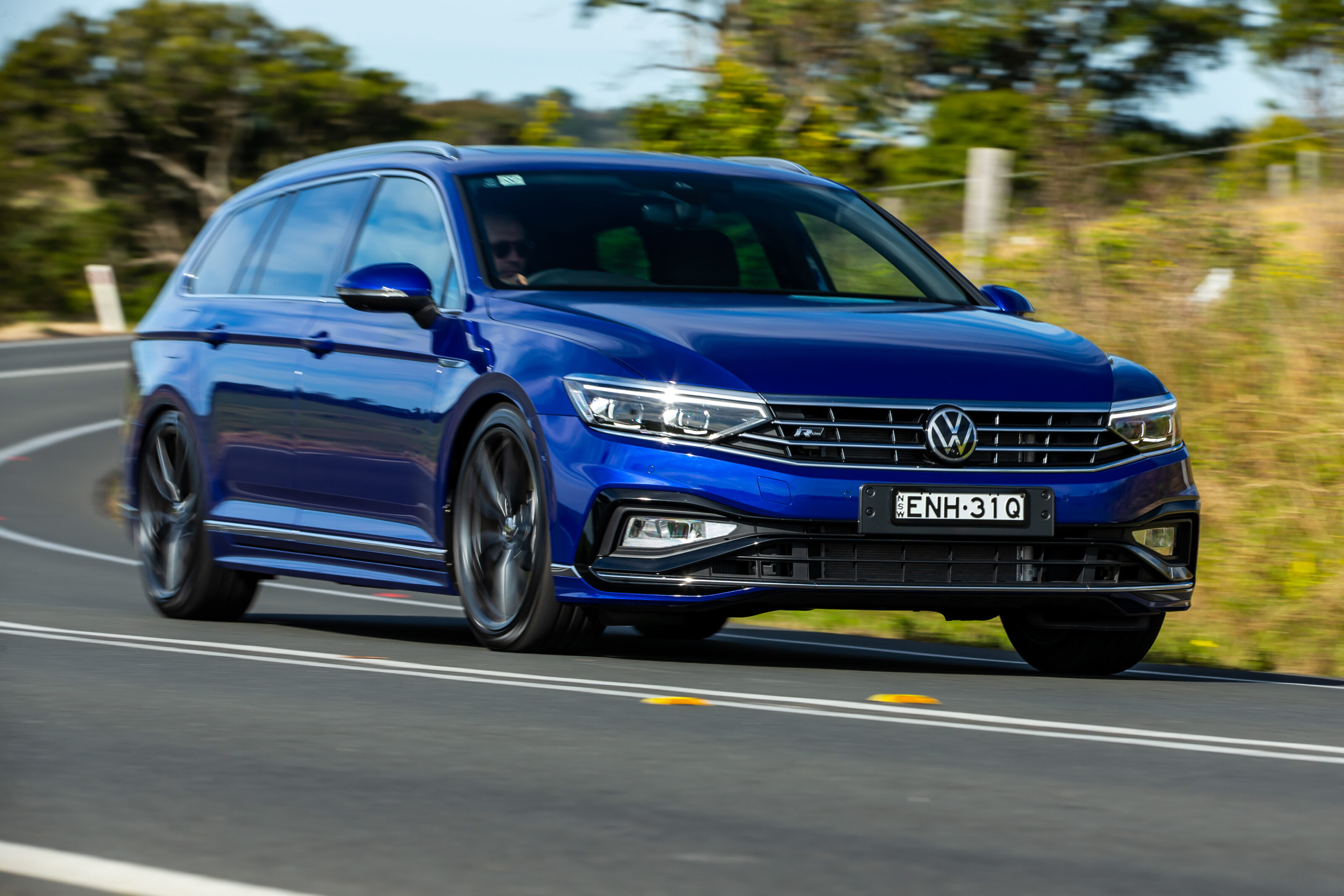
| IQ.Light matrix LED headlights and premium LED taillights with dynamic indicators |
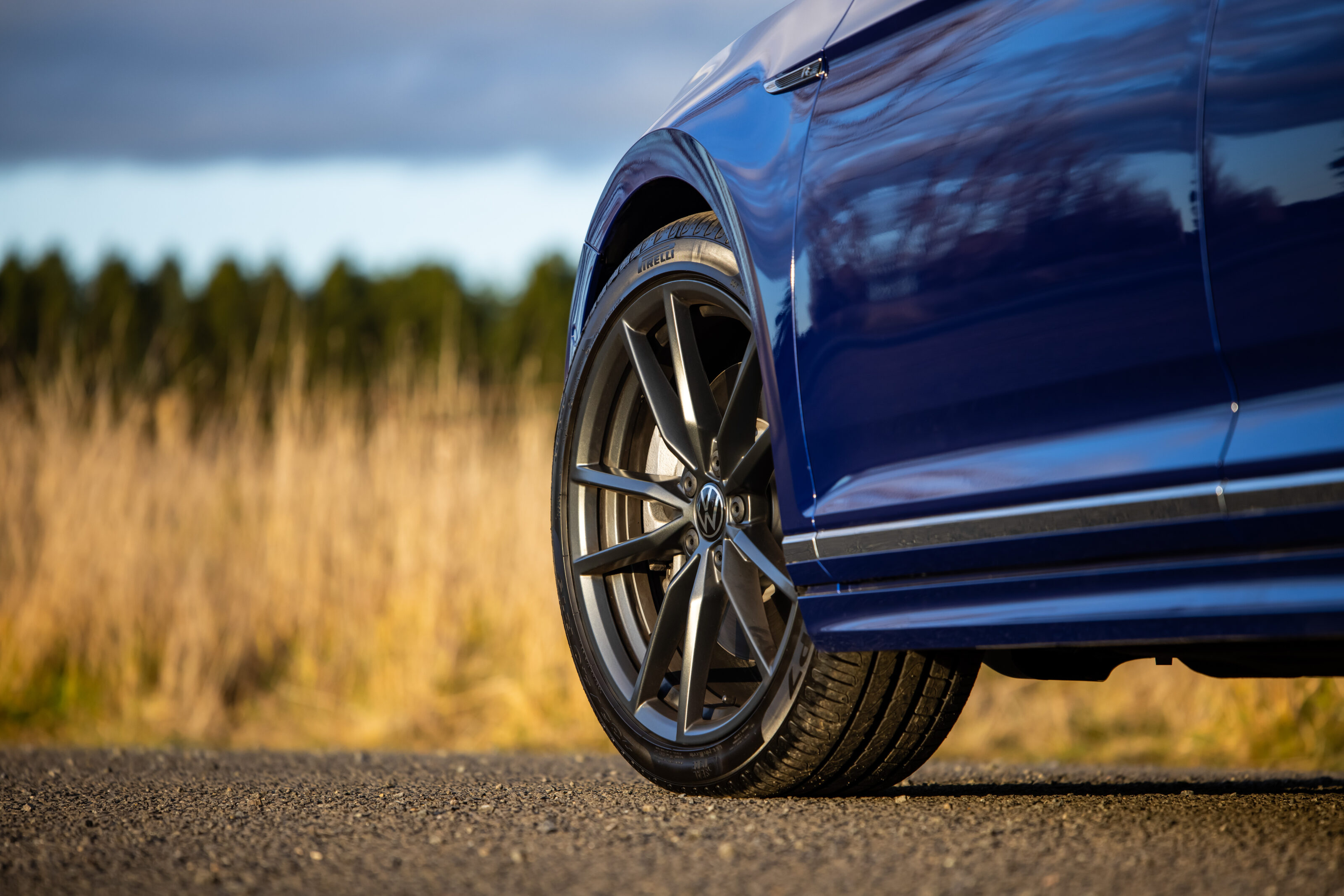
| Pretoria’ 19-inch alloy wheels |
| Chrome roof rails |
| Adaptive chassis control |
| Adaptive cruise control (ACC) |
| Park assist, parking bay and parallel parking assistance |
| Three-zone climate control air conditioning |
| Alarm system with interior monitoring and tilt sensor |
| Discover media audio and satellite navigation system, wireless AppConnect for Apple CarPlay and Android Auto |
| Eight-speaker Harman Kardon sound system |
| Electric front seats heated with electric lumbar support, easy entry and memory |
| R-Line Nappa leather appointed seat upholstery |
| R-Line multi-function steering wheel with shifting paddles |
| Silver rise’ decorative inserts |
| Keyless access, keyless entry and starting system |
Engine, drivetrain and fuel economy
Engine specs are unchanged from the 2019 to the 2021 Passat R-Line, packing the same 206kW/350Nm punch which comes from its 2.0-litre, four-cylinder turbocharged engine, achieving a WLTP tested 8.1L/100km.
Mated to a six-speed dual-clutch automatic transmission, the power is sent to all four wheels through Volkswagen’s 4Motion system.
Safety
Retaining the same five-star ANCAP safety rating as its predecessor, the Passat R-Line wagon scores a range of safety tech to keep its occupants safe, such as:
| Driver and front passenger airbags, driver’s knee airbag, side airbags, front and rear curtain airbags, outer rear seat passenger side airbags |
| Driver fatigue detection system |
| Front assist with city emergency brake (CityEB) function |
| Lane assist with adaptive lane guidance |
| Travel assist and emergency assist |
| Side assist, lane-changing assistant |
| Visual/acoustic warning for front seat belts not fastened, visual indicator for rear passenger seat belt status |
| Area view surround view camera system |
Warranty and Servicing
Just like the rest of the Volkswagen range, the Passat R-Line will be covered by a five-year/unlimited-kilometre warranty with capped price servicing every 12 months/15,000km within the warranty period.
Volkswagen’s pre-purchase service packs will also be available for either three or five years.
Availability
The 2021 Passat 206TSI R-Line wagon is on sale now through Volkswagen dealers.
I posted some pictures of the JL Wrangler Overland on social media and received a heap of responses from friends, male and female, saying Jeep’s archetypal model is their dream car.
Because I know these people, I can confidently say it’s unlikely many would engage the Wrangler in regular off-roading, so I’m keen to see how it performs as a daily driver and if it can reconcile with their aspirations.
This long-wheelbase Overland Ultimate is probably best suited to the task. It’s the most luxuriously appointed Wrangler variant and, special editions aside, the second-most expensive after the long-wheelbase Rubicon Ultimate.
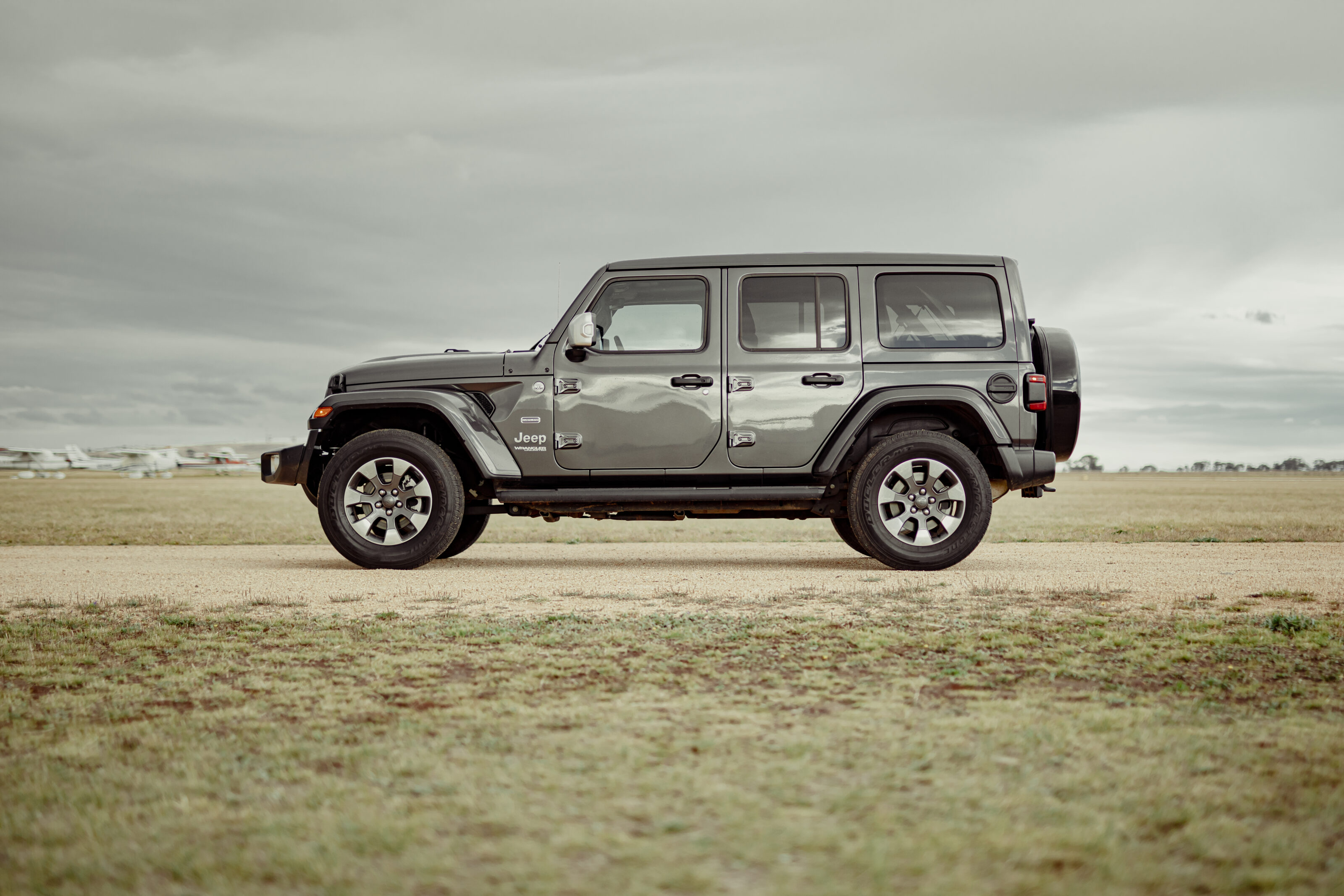
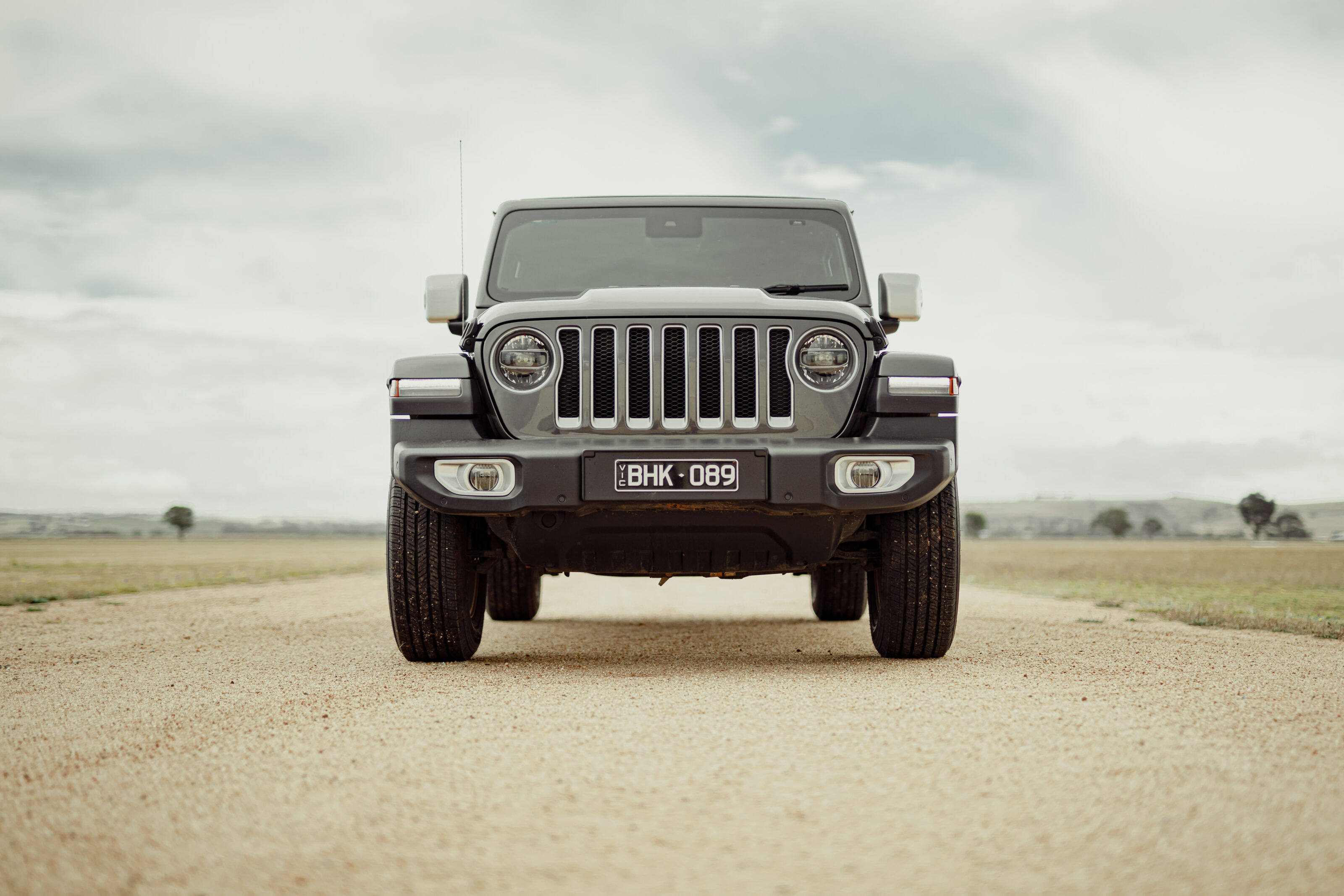
It’s easy to see why people find it so attractive. It looks cool and exudes an adventurous spirit with genuine ruggedness that oozes from the usual SUV cookie cutter.
There are downsides to the Jeep’s utilitarian nature, however, including rudimentary ride comfort and a rather poor safety rating that, as with the Ford Mustang, people are willing to overlook.
We’ll go into all that below, but first an overview.
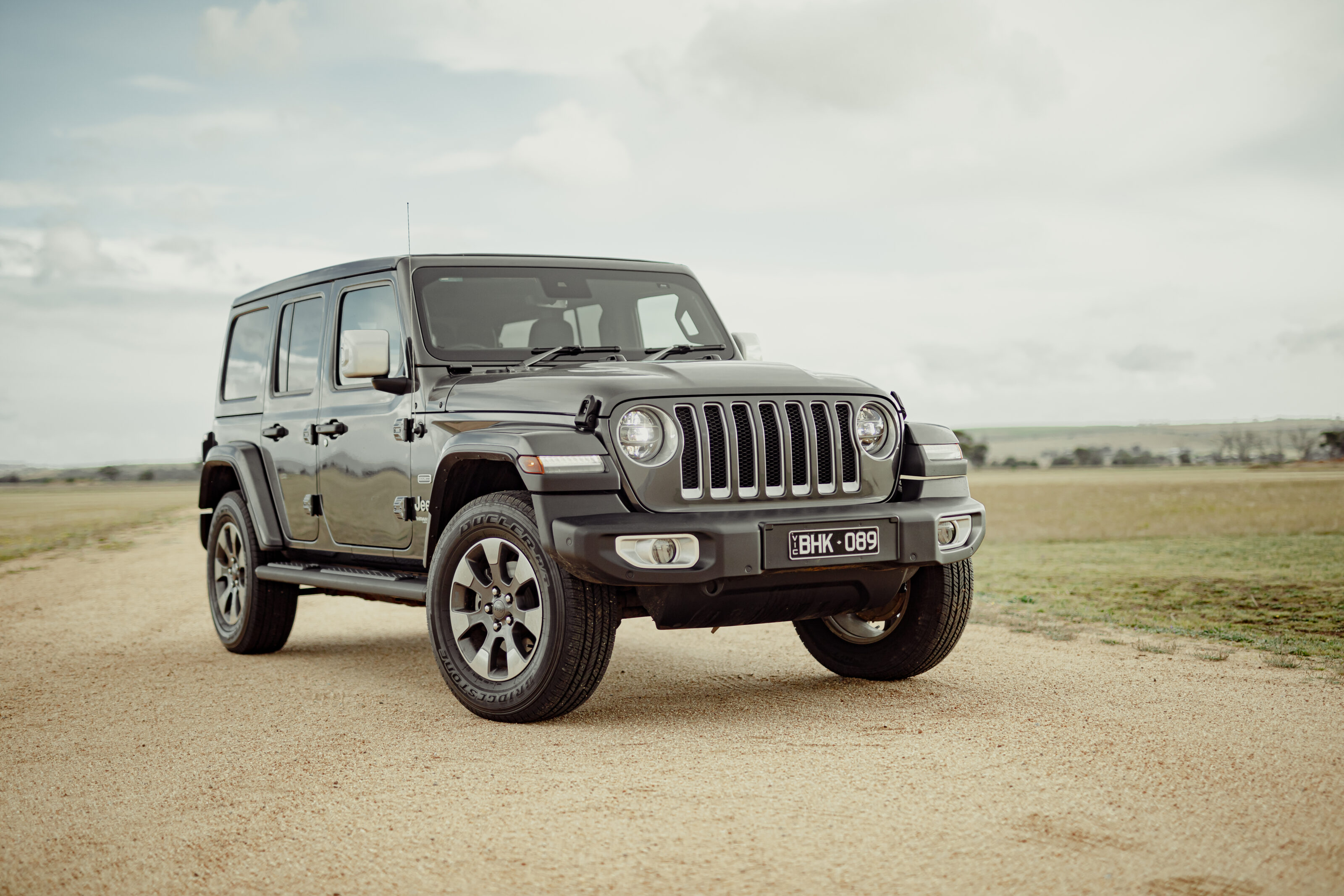
“When you open the roof, you feel that outdoor spirit that made you want a Wrangler in the first place.”
The Wrangler range comes in five specification grades including the three-door short-wheelbase Sport S that retails for $52,750 before on-roads.
That’s followed by the five-door Willy and Night Eagle versions while, at the higher end of the range, you can select the Overland and Rubicon specs that are available in both short- and long-wheelbase versions.
The short-wheelbase Overland retails for $62,250 and brings a host of additional features over the Sport S’s standard kit including a bigger 8.4-inch touchscreen, leather-trimmed seats, heated front seats, heated steering wheel, nine-speaker Alpine premium audio, front parking sensors, smart keyless entry, remote start, dual-zone climate control and 230-volt power outlet.
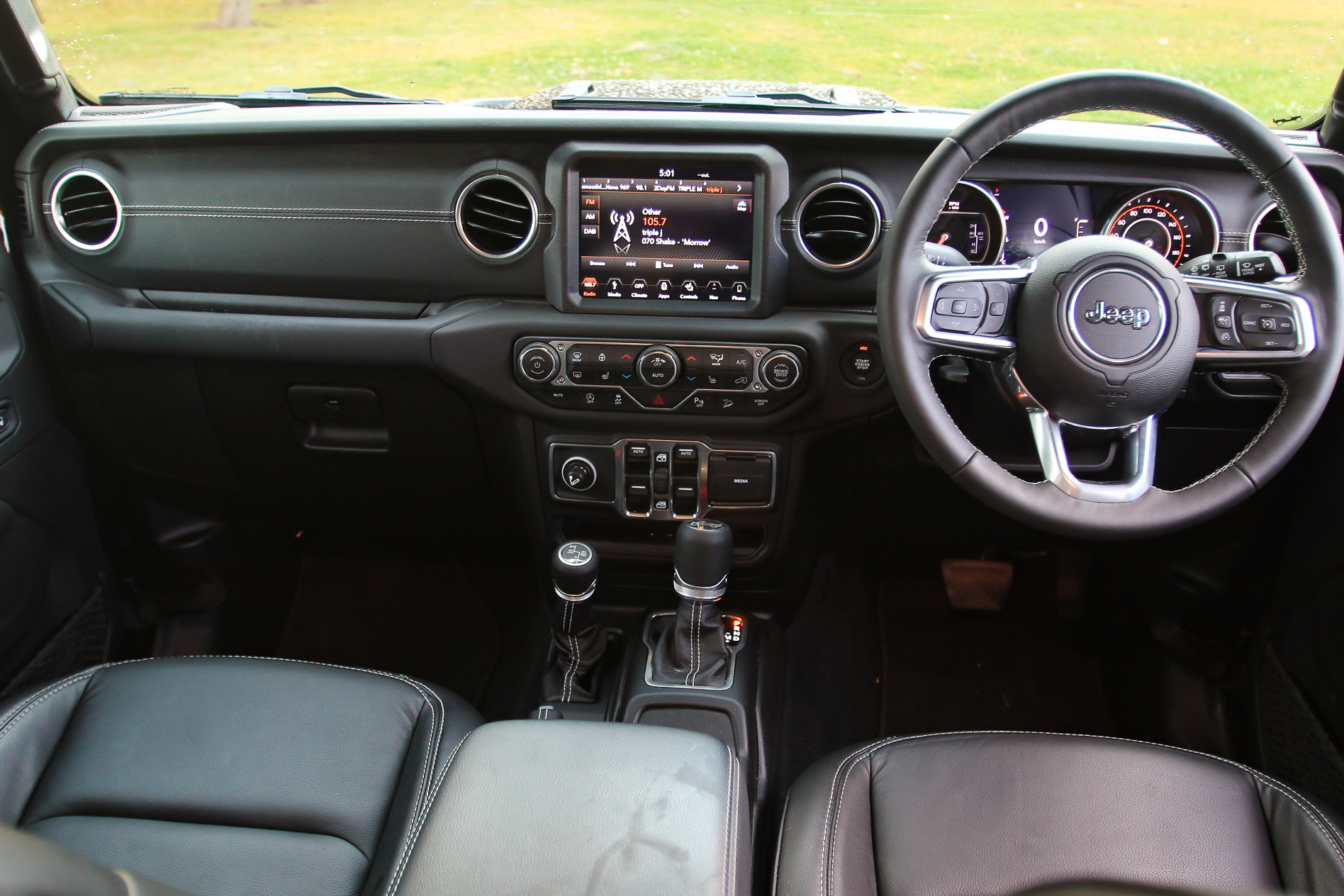
The long-wheelbase variant, called the Overland Unlimited, has all that plus a 549mm longer wheelbase, extra doors and roomier rear seats, which take the retail price up to $66,750.
Our test vehicle comes with a few optional extras including an electric peel-back roof ($4950), Granite Crystal paint ($745) and Trail Management System ($450), which adds adjustable tie-down points in the boot to help properly secure your gear even on very rough roads and trails.
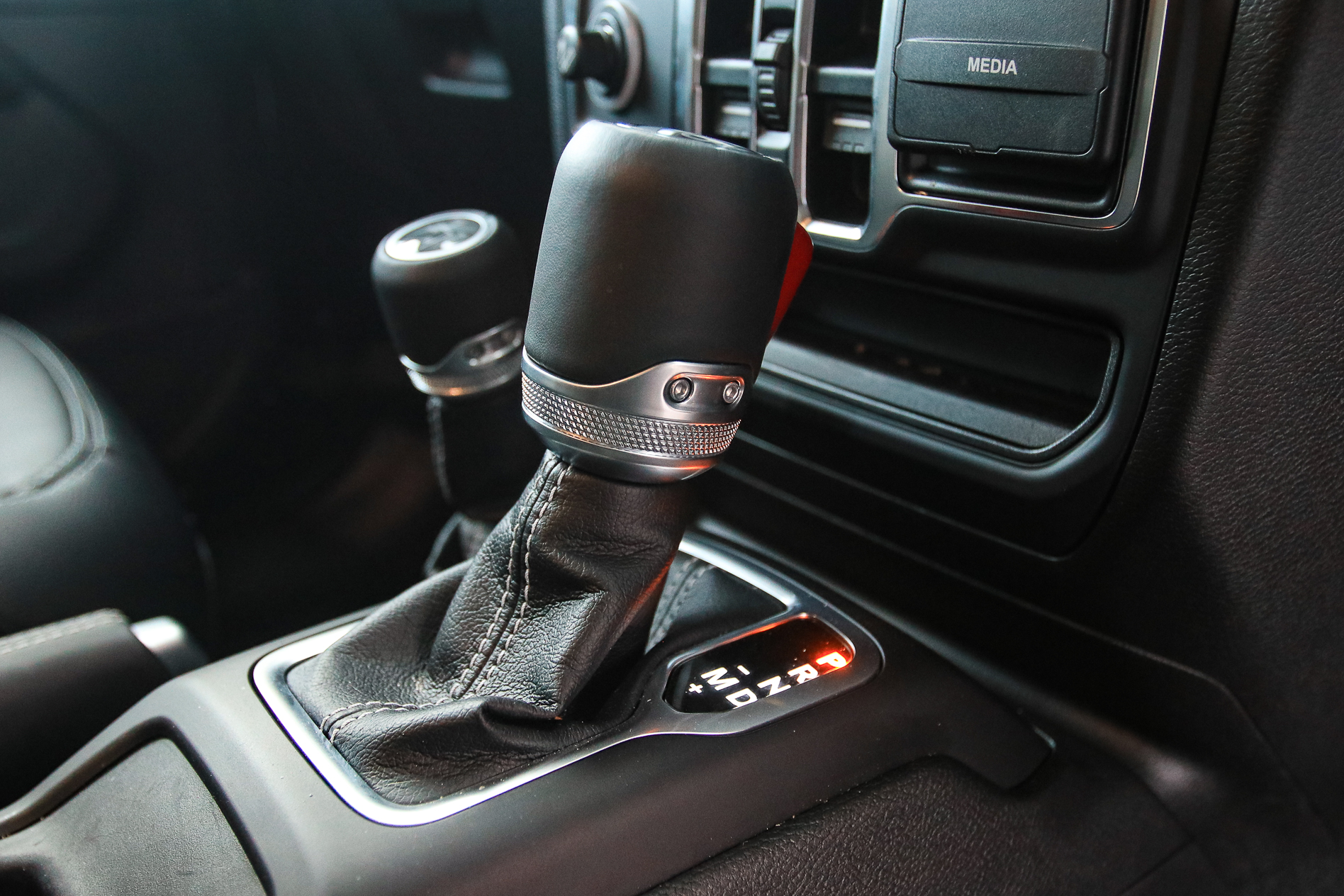
The Wrangler Overland Unlimited is powered by a 3.6-litre V6 petrol engine that’s coupled with an eight-speed automatic transmission that can send power to all four wheels through a high- and low-ratio transfer case for off-road driving.
What is the Jeep Wrangler Overland Unlimited like to live with?
The Wrangler’s rugged truck-like practicality is reflected in its rudimentary ride comfort.
Its off-road-tailored suspension is brilliant in its element, but its tight springs will ensure you feel every bump on paved roads.
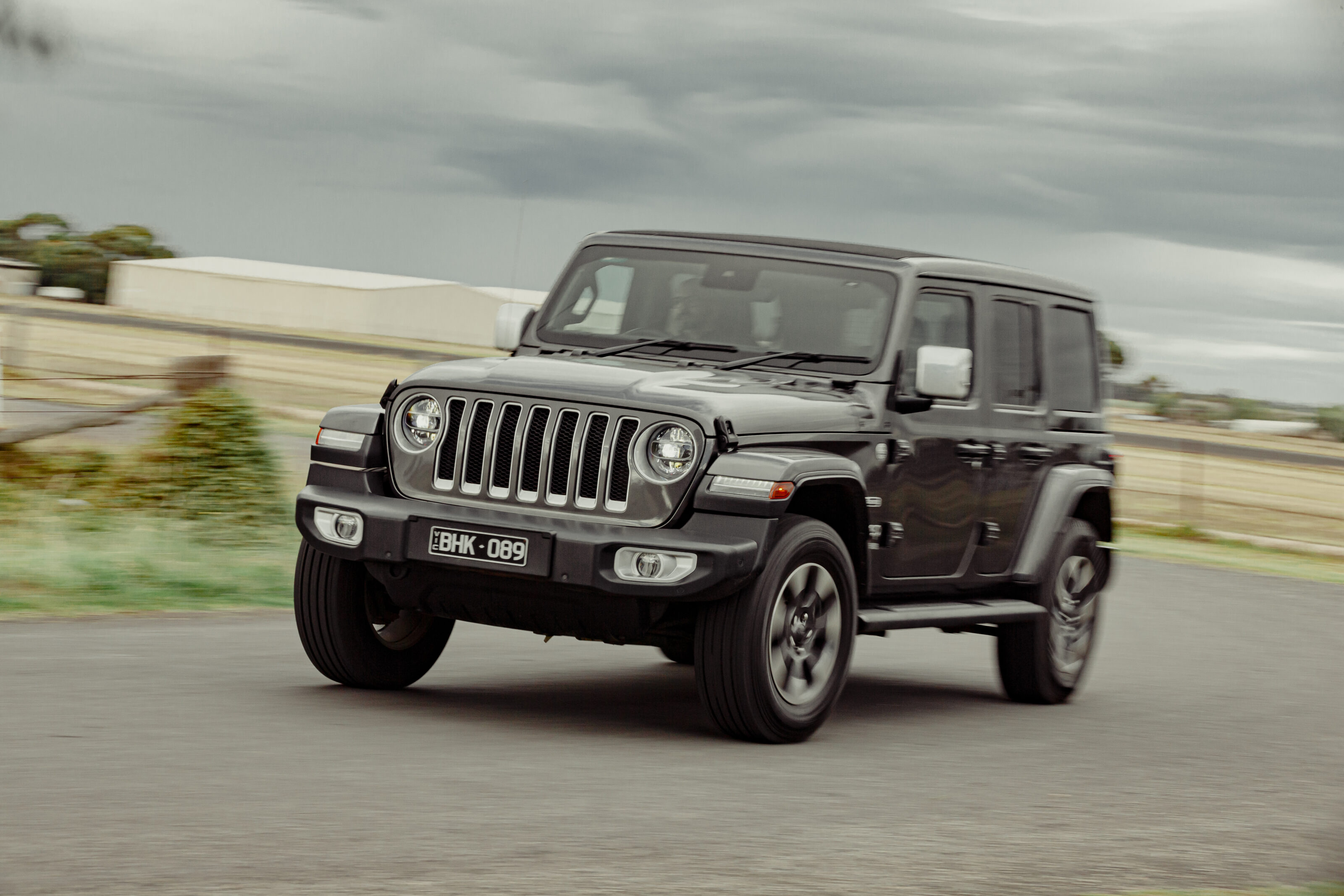
It’s pretty loud too, with road and wind noise seeping through the removable hardtop, or in the case of our test vehicle the electric concertina roof.
Most people would be expecting this and it kind of adds to the fun factor of driving something as iconic as a Wrangler, especially if your previous ride was something a little blander. But it can get a little grating once the novelty wears off.
That said, on a nice day, when you open the roof, you feel that outdoor spirit that made you want a Wrangler in the first place – even when driving to the shops.
While the Wrangler’s rugged aesthetic turns heads, it isn’t just for appearance’s sake as many of its utilitarian design features do maximise off-road capability.
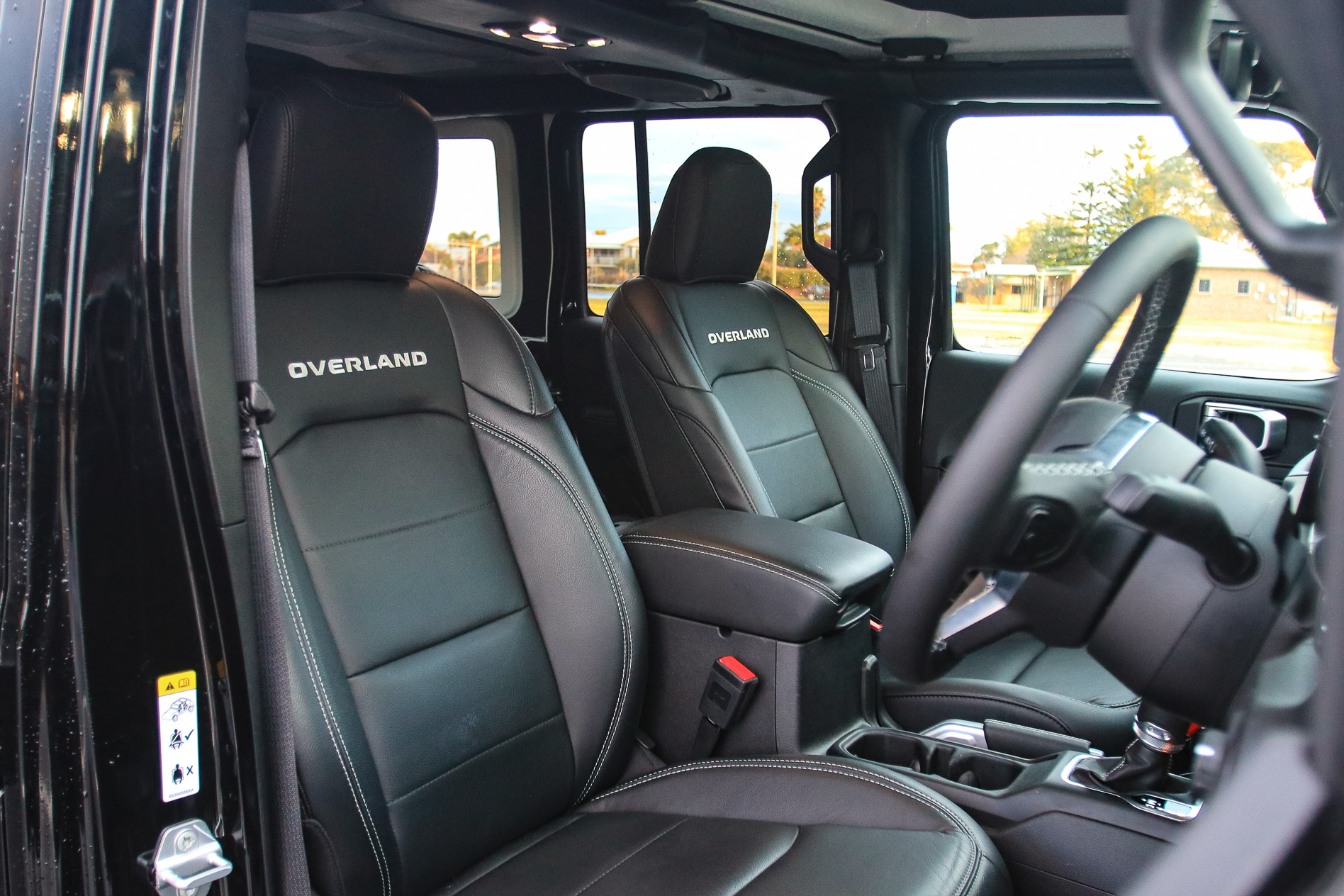
It’s a similar story with the interior, which seems rather agricultural despite the Overland’s creature comforts such as leather-trimmed seats and contrasting stitching, juxtaposed by a floor that can be hosed down.
The front seats are comfortable and feel sturdy and supportive. There are no power settings, but it’s easy to find a good driving position now the Wrangler’s steering wheel is reach-adjustable.
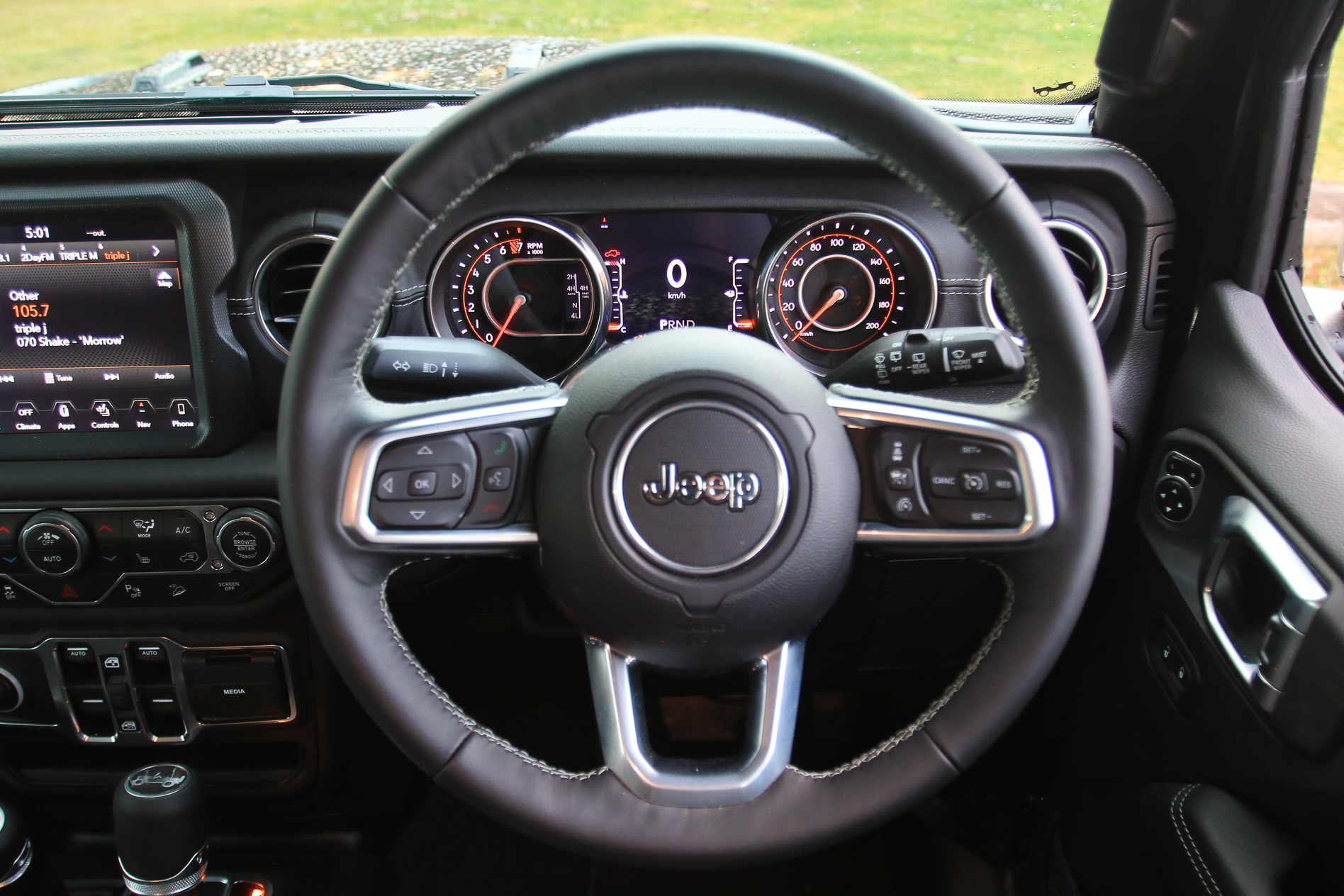
The driving position is compromised by the wide transmission tunnel that doesn’t let you stretch your left leg. I also found myself subconsciously twisting my hips to the left to align myself with the tapered bonnet, which got a little uncomfortable after a while.
On the plus side, the big leather-trimmed steering wheel feels good and has intuitively arranged buttons for the cruise control, audio and phone settings.
The flat dashboard looks a little truck-like but everything is laid out as you’d expect, with the exception of window buttons that are below the climate-control dials in order to simplify electrical connections with the removable doors.
Storage space includes a deep centre console tub with a padded lid/armrest, a smallish glove box and nets attached to the door cards in lieu of door bins to better secure loose objects on rough roads.
Moving to the back seats, you’ll find a lot more space than in the short-wheelbase version but legroom is a little tight compared to other similar-sized SUVs, though there is plenty of space under the front seats in which to tuck feet.
The seats themselves feel a bit too upright, though again that is probably designed with off-road driving in mind.
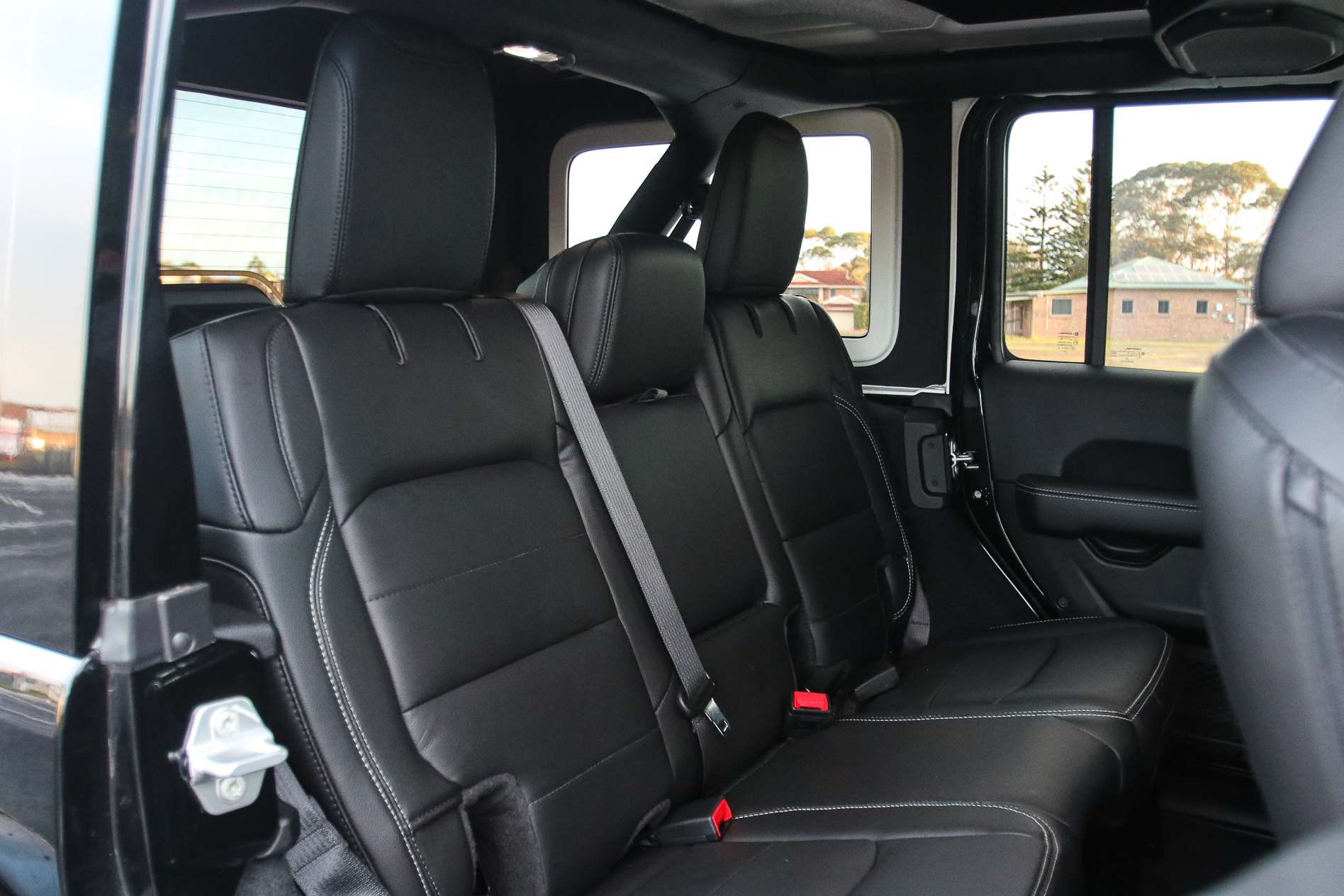
The middle seat isn’t comfortable due to the convex cushion that pushes into your back, but the shallow transmission tunnel does allow for reasonable legroom for anyone who draws the short straw.
Should you have one or two rear-seat passengers, the middle seatback folds down to become a centre armrest with cup holders.
Three children will fit okay, but it’s worth noting the Overland’s high 242mm ground clearance and narrow rear door opening can make strapping them in a bit of a chore, while making entry and egress challenging for anyone with mobility issues.
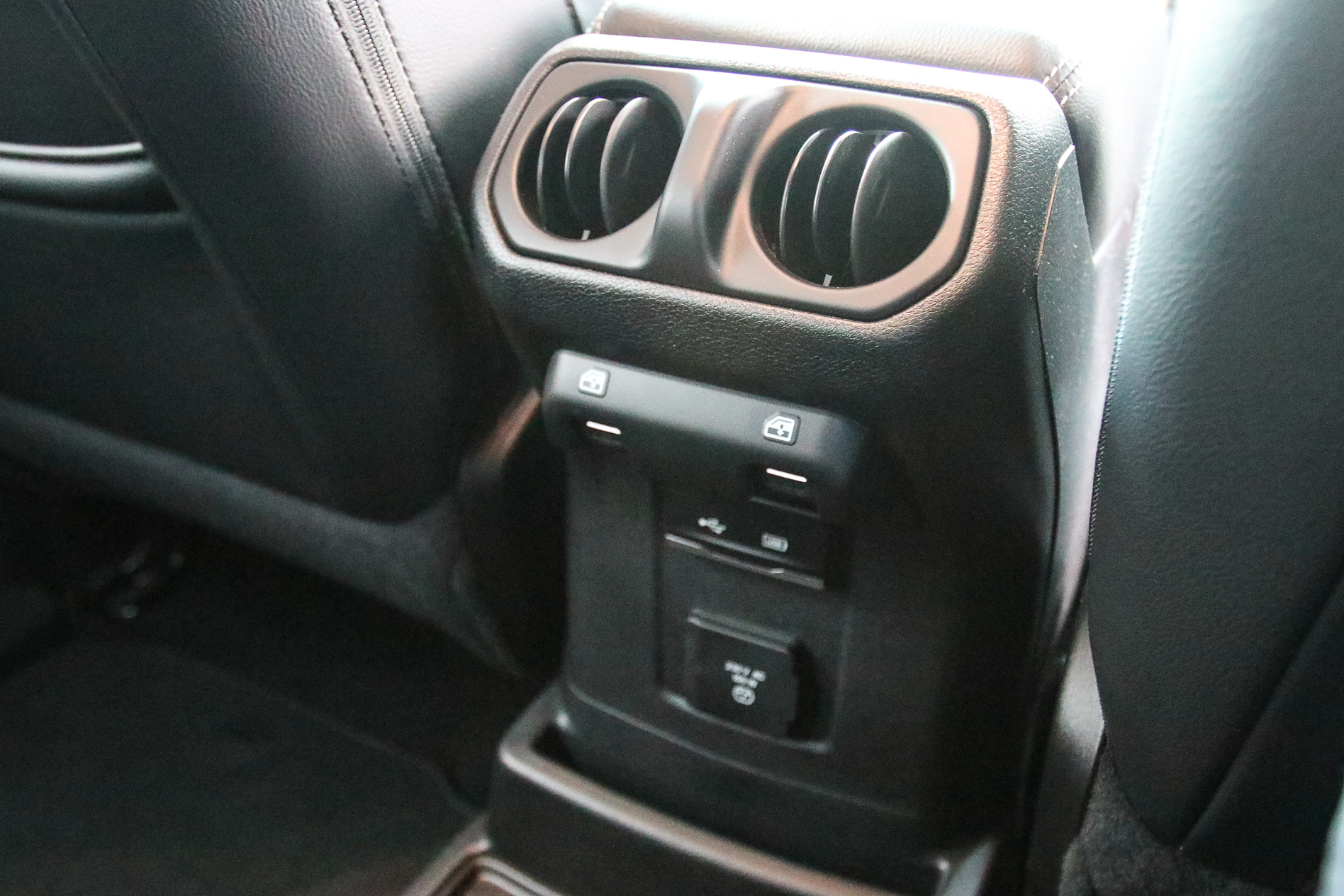
Second-row amenities include 2 x USB and 2 x micro-USB ports, air vents, door nets, map pockets behind the front seats and two huge Alpine audio speakers embedded in the roll bar just a few centimetres from the passengers’ heads.
With five seats in play, the boot space is a cavernous 897 litres and expands to 2050 litres with the seats folded down.
The Wrangler has a two-piece tailgate comprising a lower swing door and separate pull-up window. However, you can’t open the window on its own to conveniently reach in and quickly grab something because of the door-mounted spare wheel.
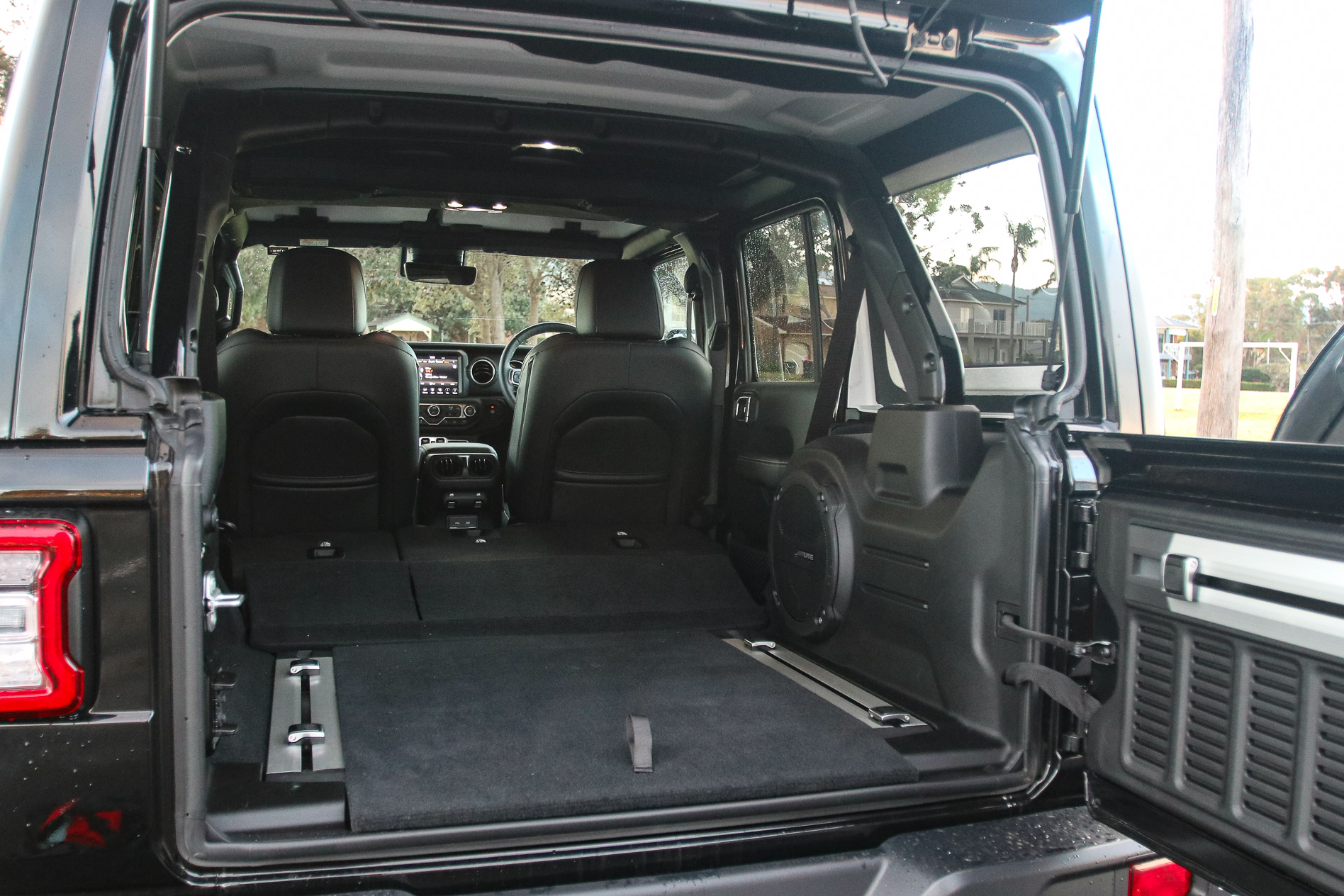
If you need to carry more, the Overland Unlimited has a braked towing capacity of 2495kg, or 750kg for an unbraked trailer.
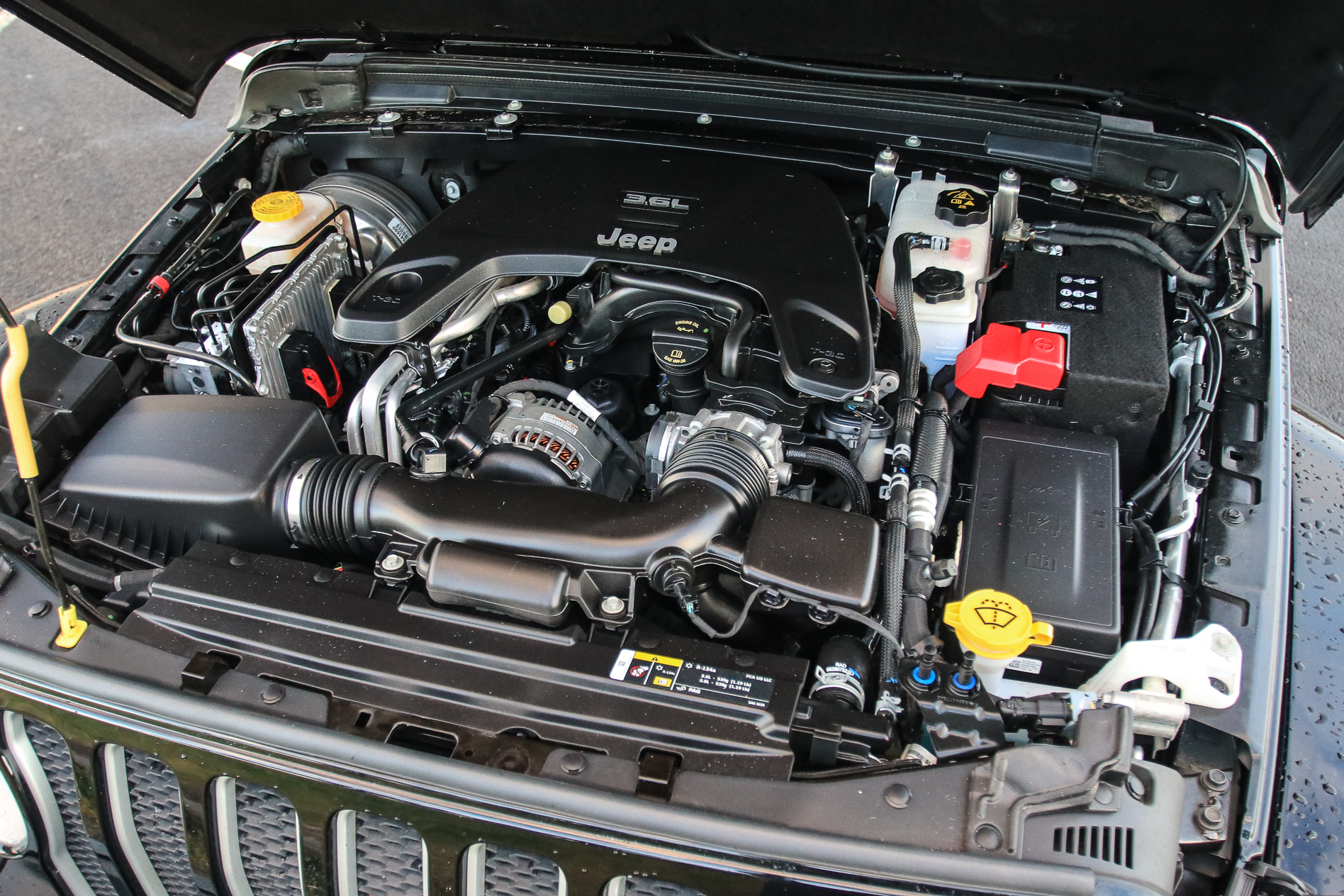
Towing is aided by the V6 petrol engine that produces 209kW peak power and 347Nm of torque. With that comes a rather greedy official combined fuel consumption rating of 9.7L/100km, and that’s without anything hitched to the tow bar.
Service intervals are 12 months or 12,000km, which isn’t much if you use the Wrangler to regularly explore the great outdoors. The good news is the first five services are each capped at $399.
The Jeep Wrangler is covered by a five-year, 100,000km warranty that includes free roadside assist.
What is the Jeep Wrangler Overland Ultimate like to drive?
The Wrangler isn’t exactly a driver’s car.
Its ageing 3.6-litre Pentastar V6 petrol engine does its job faithfully and the eight-speed automatic transmission responds to throttle inputs well, so the Wrangler always seems to have enough power on tap when needed.
As well as feeling unsettled on minor road imperfections, the JL Wrangler’s suspension – solid axles at both ends, each with two upper and two lower arms linked to them – tends to rock on the springs and you don’t have to brake too hard for the nose to dip whenever you come to a stop.
The electro-hydraulic steering feels a little distant from the front axle and the wide 12.4-metre turning circle means negotiating tight spots can be a bit of a chore.
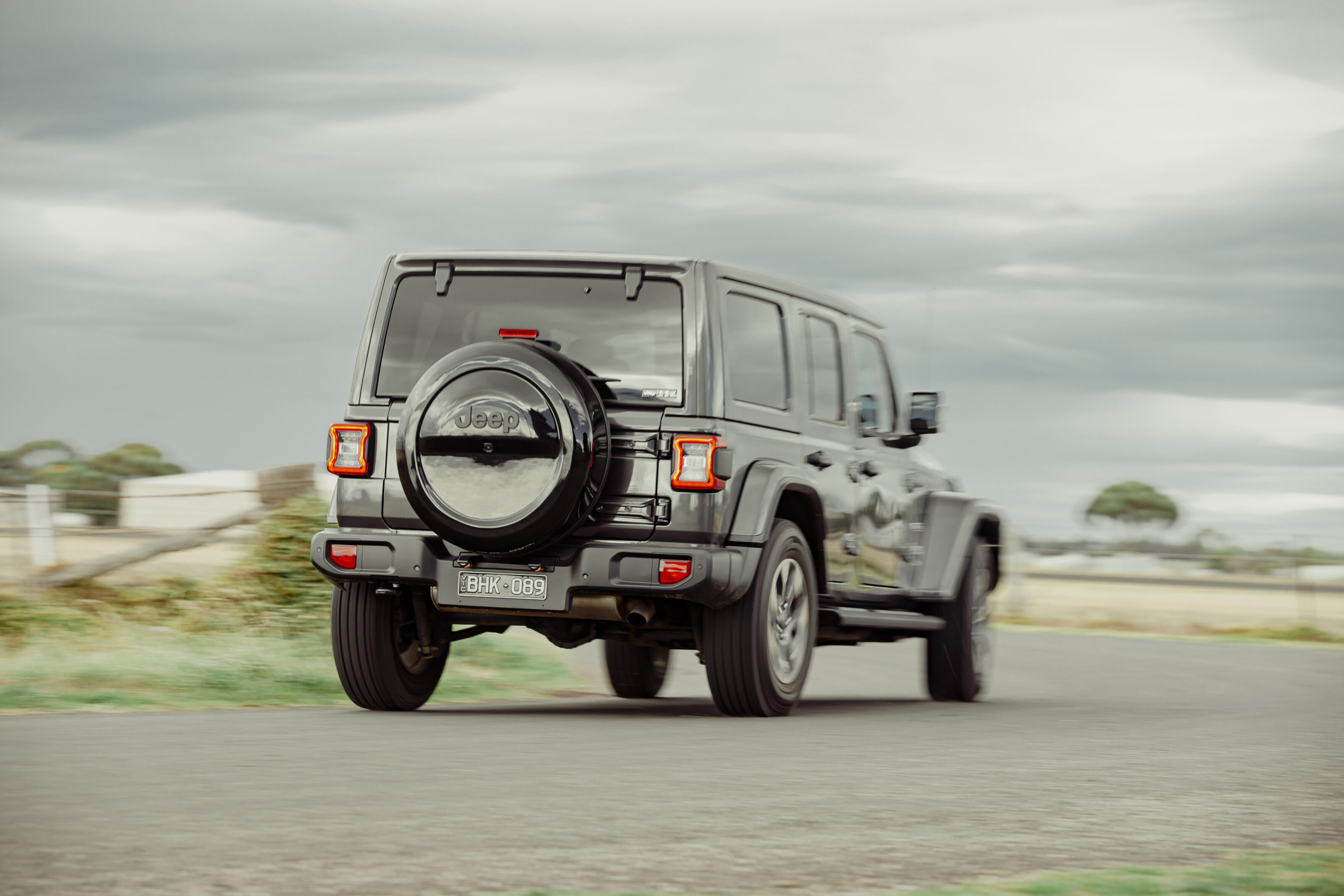
The stock 18-inch Bridgestone Dueler tyres offer an excellent compromise between on and off-road driving; they feel at home on gravel and chew through mud really well.
At 4.9 metres in length, the long-wheelbase Wrangler can be a challenge to park. The flat nose restricts immediate front vision and it’s pretty hard to see out the back, meaning you’ll often have to rely on the reversing camera and front and rear parking sensors to avoid obstacles.
What about safety in the Jeep Wrangler Overland Ultimate?
Let’s cut to the chase and discuss the JL Wrangler’s ANCAP safety rating which, when it first arrived in Australia in 2019 was just one out of a possible five stars.
This was increased to a still below-average three stars in December that year with the introduction of the MY20 model that brought active safety features such as updated autonomous emergency braking (AEB), and blind-spot monitoring (BSM).
However, there are still concerns about the Wrangler’s structural integrity that were revealed in the crash testing where it achieved a low 60 per cent score for adult occupant protection. While this included a perfect 8.0 out of 8.0 points or side impact, the Wrangler failed miserably when it came to whiplash protection, scoring just 1.67 out of 8.0, while no points were awarded for the oblique pole test.
“The Wrangler has just four airbags… with no protection for the second row.”
On the frontal offset test, the Wrangler achieved 3.89 out of 8.0 and 5.72 out of 8.0 for full-width frontal impact.
Child occupant protection was a more reasonable 80 per cent, while the AEB’s inability to detect pedestrians and cyclists led in part to scoring just 49 per cent for vulnerable road user protection.
The Wrangler has just four airbags protecting front occupants including forward-facing and side bags, with no protection for the second row.
Advanced driver assistance technology includes the aforementioned AEB and BSM plus adaptive cruise control with stop-and-go, and rear-cross traffic alert.
The verdict
Despite its poor safety rating, the Jeep Wrangler continues to ooze an adventurous spirit that manages to woo many city folks who see it as a way to escape the weekly grind.
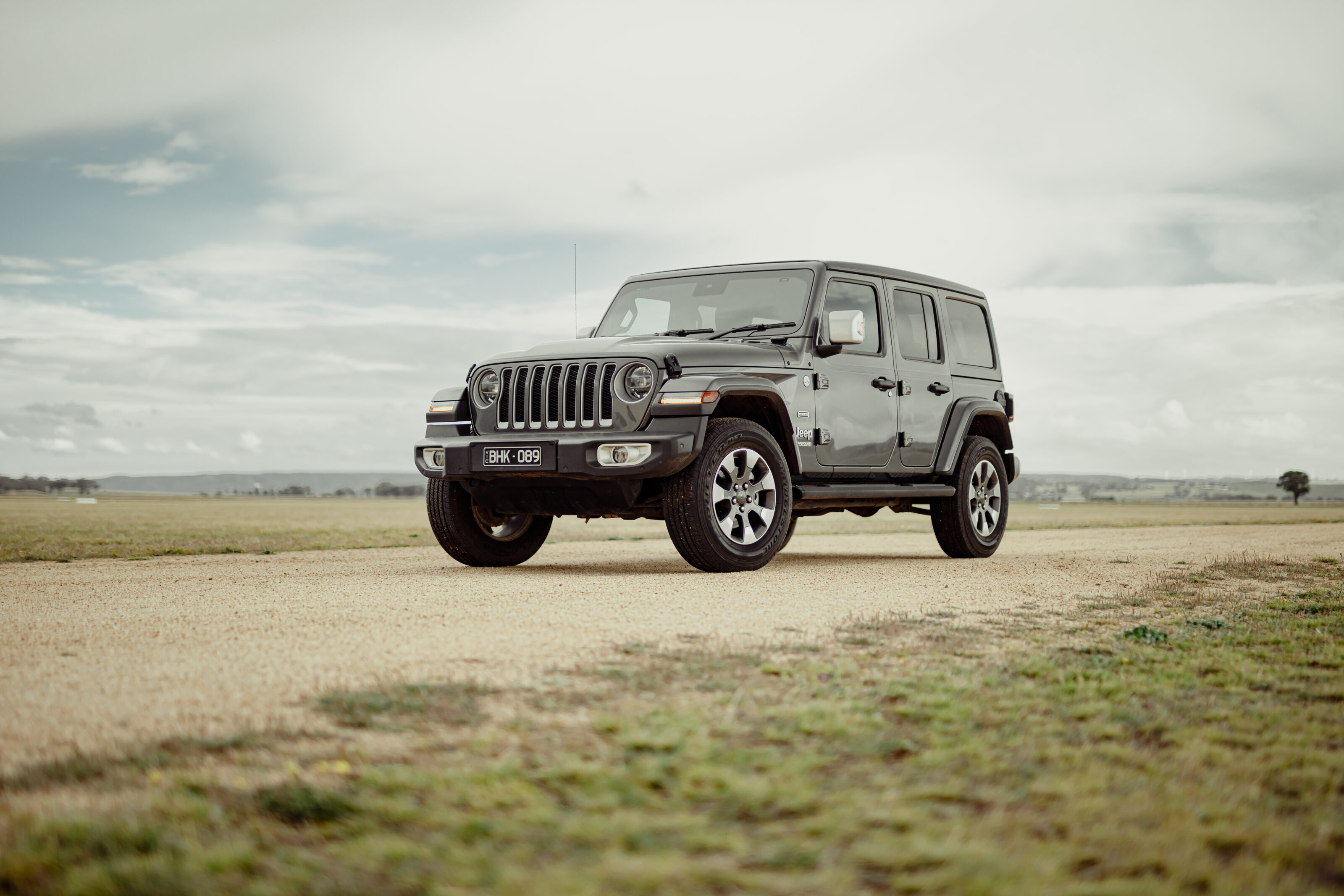
But finally jumping in one is a bit like meeting your hero – it will either bring a smile to your face or leave you vaguely disappointed.
If you’re in the market for a family SUV and just choosing the Wrangler on its looks, the chances are its poor road manners will see you fall into the latter camp and rue that you didn’t spend $67,000 on something much plusher.
However, if you regularly embrace its fun side – be it on dirt, with the roof off or a bit of both – the Overland Ultimate has sufficient creature comforts to keep you happy on the daily drive despite its urban shortcomings.
2021 Jeep Wrangler Overland Ultimate specifications
| Body | 5-door, 5-seat SUV |
| Drive | 4WD |
| Engine | 6304cc V6, 24v petrol |
| Transmission | 8-speed auto |
| Power | 209kW @ 6400rpm |
| Torque | 347Nm @ 4100rpm |
| Fuel consumption | 9.7L/100km (combined) |
| Weight | 1900kg |
| L/W/H | 4882/1894/1894mm |
| Wheelbase | 3008mm |
| Tracks | 1598mm/1598mm |
| Suspension | Front and rear solid axle four-link |
| Brakes | Front ventilated disc (330mm x 28mm)/ rear solid disc (342mm x 14mm) |
| Tyres | 215/70 R18 Bridgestone Dueler |
| Wheels | Alloy 18×7.5 |
| Price | $66,750 |
We’ve all been at a loose end on a weekend and felt like finally getting into THAT project. You know the one, something which will serve as a distraction for a few days before getting back into the grind.
Some people build model cars, some do a bit of woodwork but not everyone decides to make a model car from wood.
Well, YouTuber Woodworking Art did, spending his spare time on creating an homage to the Ram 1500 TRX pick-up truck out of Fujian Cypress.
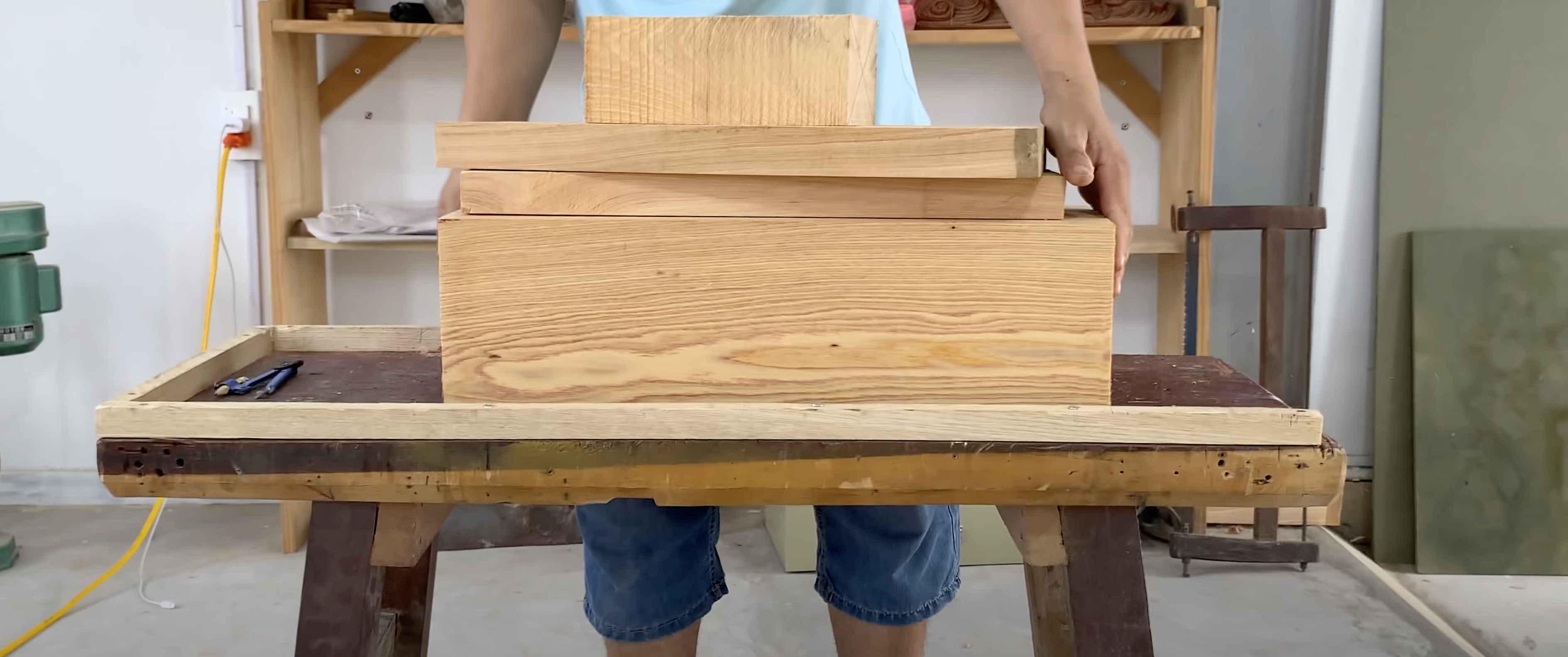
The process is mind-boggling, with proper attention to detail given as if this was a SEMA build or designed to feature as a 4×4 Australia reader’s ride.
Moving suspension, opening doors and a detailed interior make this one of the best hand-crafted automotive pieces of art we’ve seen, and it’s probably a decent amount cheaper than a real TRX, packing a 523kW/881Nm 6.2-litre Hemi V8.
Some other cars have already been built by the channel’s creator, with his most popular video of a wood-carved Toyota LandCruiser Prado amassing over 155 million views.
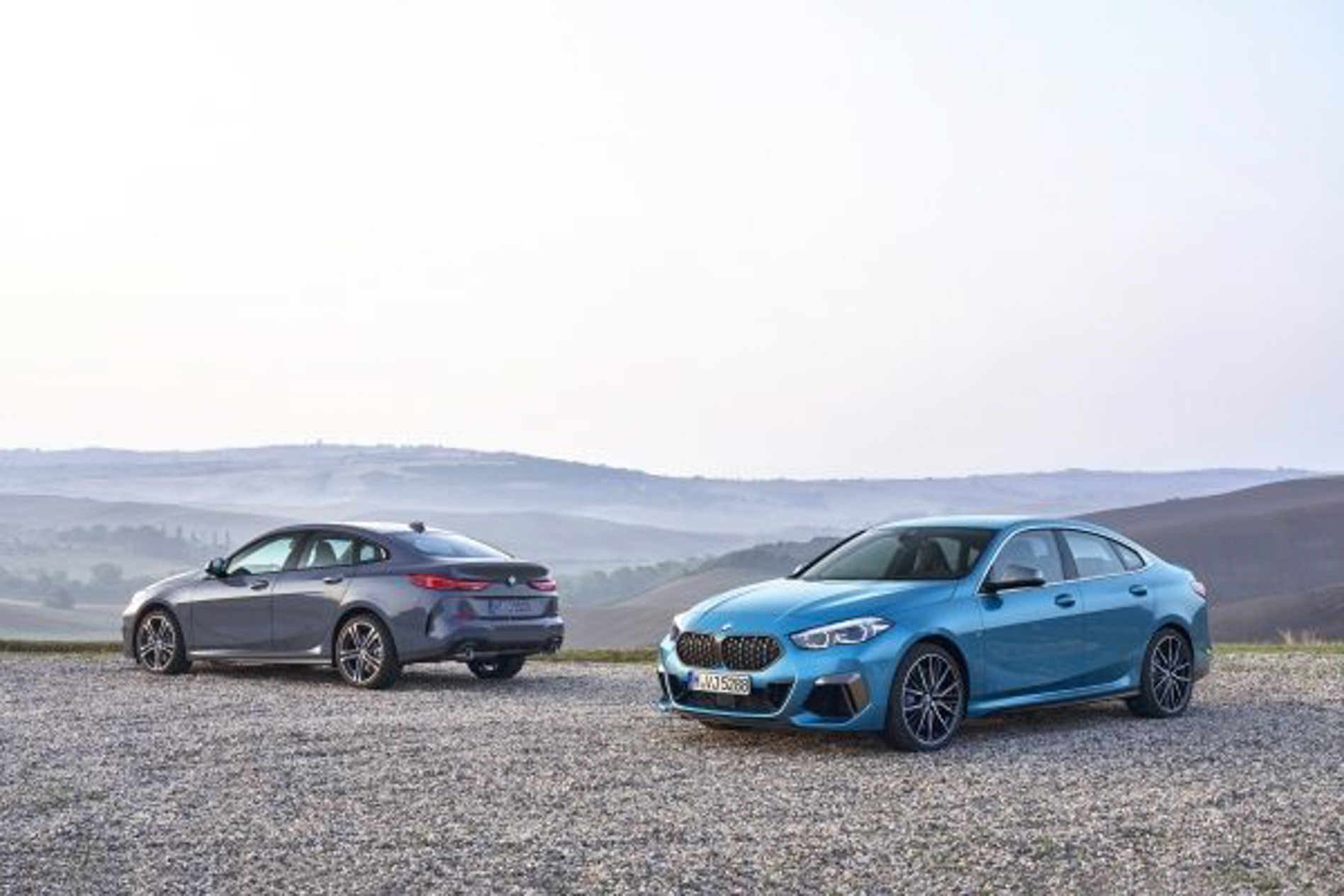
BMW’s new 2 Series Gran Coupe arrived in Australia just as the world was turned on its head, with its March 2020 launch bringing 218i and M235i xDrive variants to our shores.
As a coupe-roofed sedan companion to the new front-wheel-drive 1 Series hatch, the 2 Series Gran Coupe has been a fairly successful offering in Australia, with 1182 sold in 2021 so far.
Really, there’s no reason to believe BMW would have sold more 2 Series Gran Coupes if it had launched with a more traditional rear-wheel-drive configuration – but wouldn’t you love to see it bring that option, as a point of difference, against the A-Class Sedan and Audi A3 Sedan?
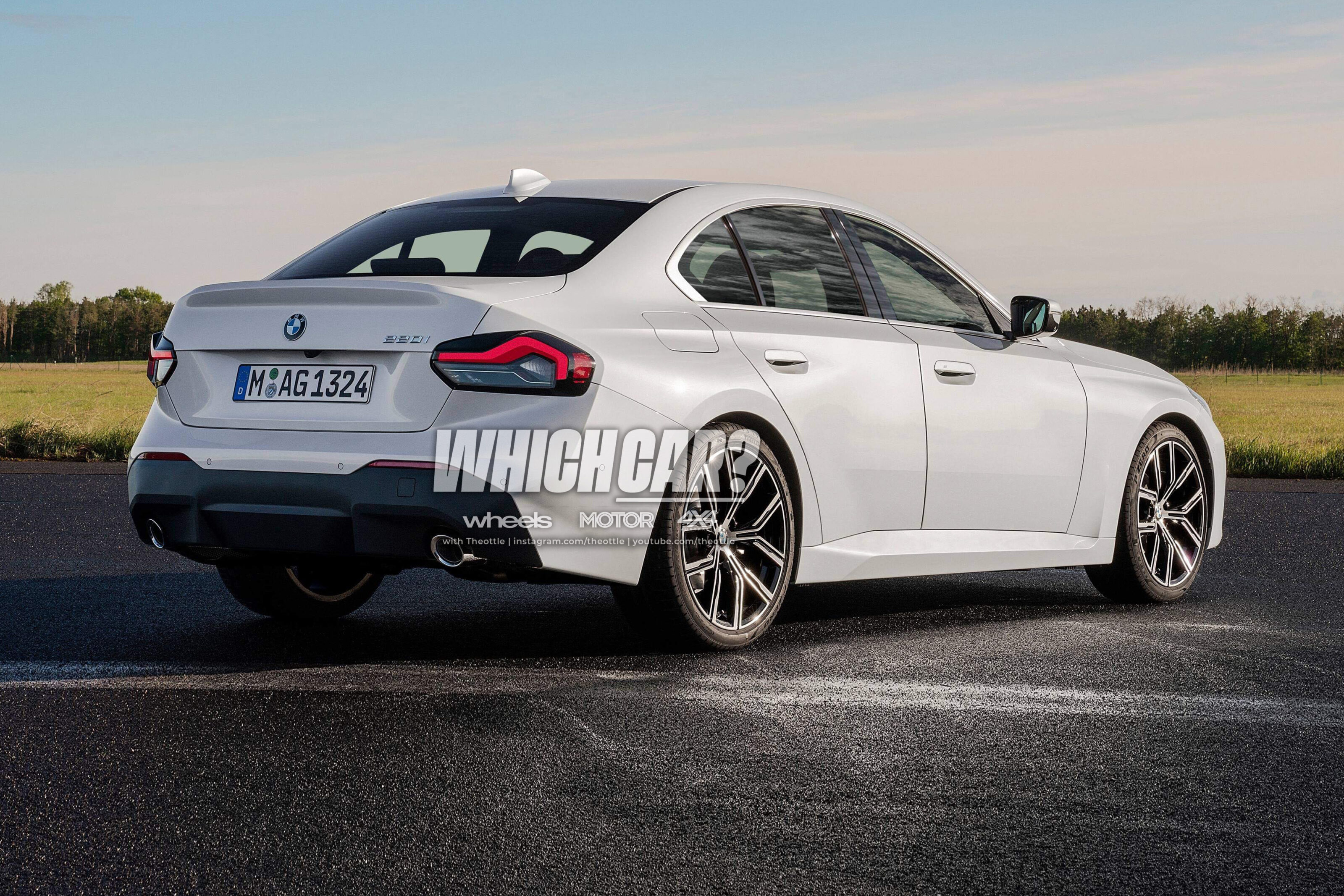
That’s just what our mate Theo Throttle has rendered here, turning the new-generation 2 Series Coupe into – well, let’s call it the 2 Series Sedan.
With a stretched roofline and wheelbase, this 2 Series Sedan adds rear doors to make it BMW’s smallest sedan and a potential option for young families with an interest in an extended game of ‘corners’ while power-sliding past the apex on track days. (Okay, this is an unlikely scenario, but still.)
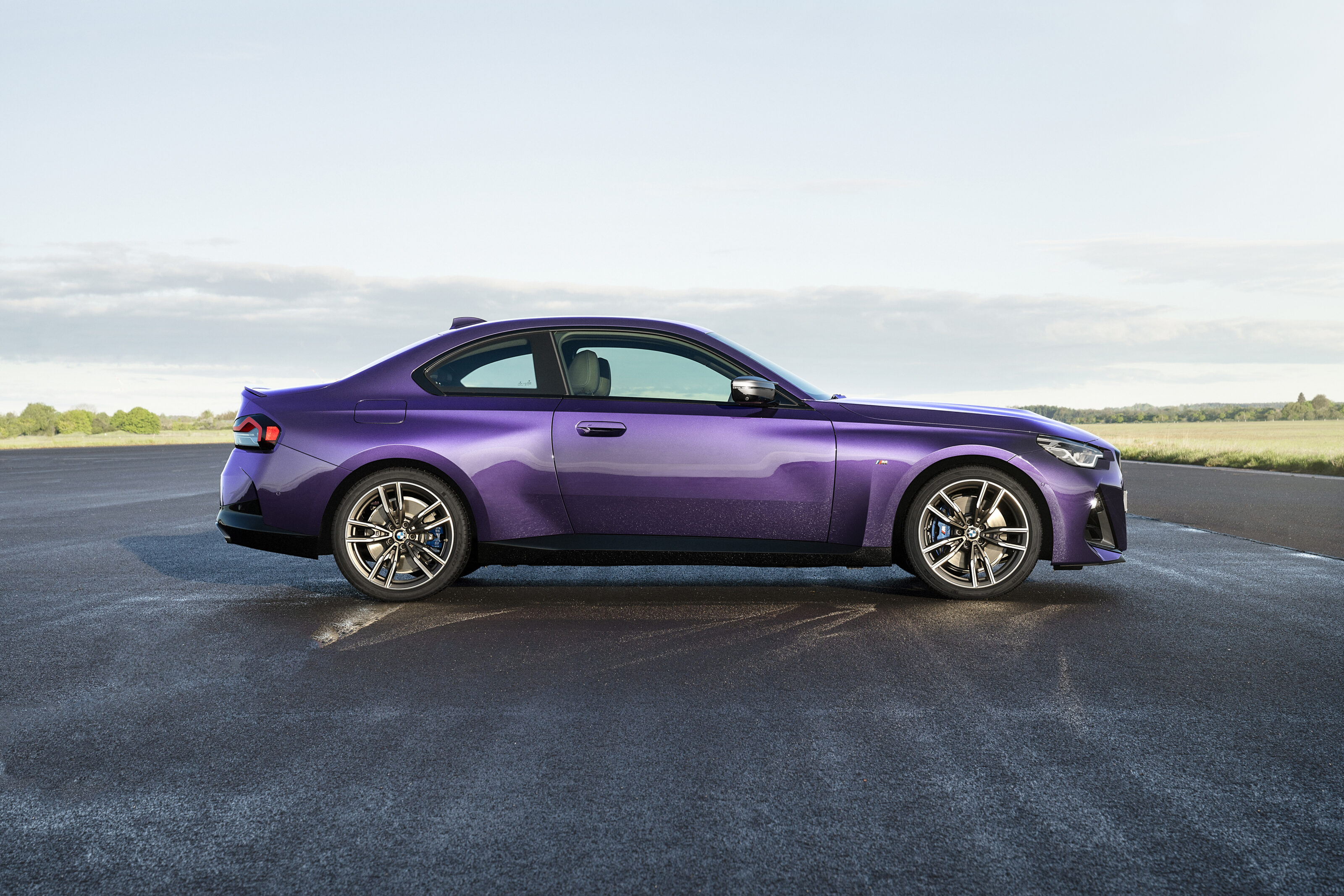
In its real-world form, the new 2 Series Coupe is available for now in rear-wheel-drive four-cylinder 135kW/300Nm 220i and rear-biased all-wheel-drive six-cylinder 285kW/500Nm forms – and there’s no reason we couldn’t see both options with this new sedan body.
Would you like to see this new 2 Series Sedan join, or even replace, the existing 2 Series Gran Coupe?
Tell us in the comments below!
BIG DAE OUT: MOTOR isn’t all glamour and supercars, sometimes we try to drive Daewoos for 500 kays…
This article was first published in the June, 2003 issue of MOTOR
It’s a gig I’ve been mulling over in my head for a couple of years now, ever since helping some friends compete in the last one. Which, by the way, sucks. You only help mates with their race stuff when your own half-arsed plans to blag a drive fall off the perch stone dead the day before the event.
Not this time; I wanted, nay needed, to do the Wakefield 500, in a 63kW Daewoo Lanos, and I wanted to do it well, dammit.
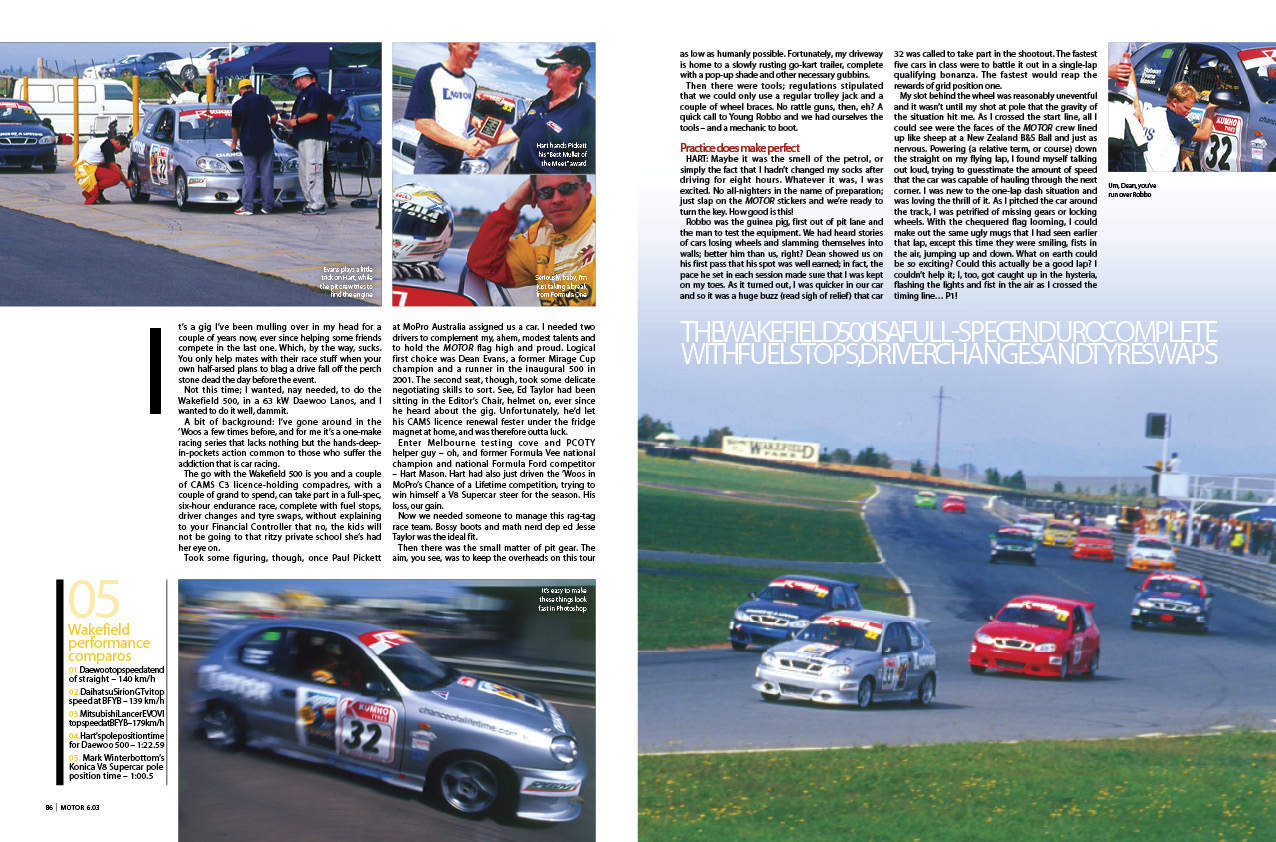
A bit of background: I’ve gone around in the ’Woos a few times before, and for me it’s a one-make racing series that lacks nothing but the hands-deep-in-pockets action common to those who suffer the addiction that is car racing.
The go with the Wakefield 500 is you and a couple of CAMS C3 licence-holding compadres, with a couple of grand to spend, can take part in a full-spec, six-hour endurance race, complete with fuel stops, driver changes and tyre swaps, without explaining to your Financial Controller that no, the kids will not be going to that ritzy private school she’s had her eye on.
Took some figuring, though, once Paul Pickett at MoPro Australia assigned us a car. I needed two drivers to complement my, ahem, modest talents and to hold the MOTOR flag high and proud. Logical first choice was Dean Evans, a former Mirage Cup champion and a runner in the inaugural 500 in 2001.
The second seat, though, took some delicate negotiating skills to sort. See, Ed Taylor had been sitting in the Editor’s Chair, helmet on, ever since he heard about the gig. Unfortunately, he’d let his CAMS licence renewal fester under the fridge magnet at home, and was therefore outta luck.
Enter Melbourne testing cove and PCOTY helper guy – oh, and former Formula Vee national champion and national Formula Ford competitor – Hart Mason. Hart had also just driven the ’Woos in MoPro’s Chance of a Lifetime competition, trying to win himself a V8 Supercar steer for the season. His loss, our gain.
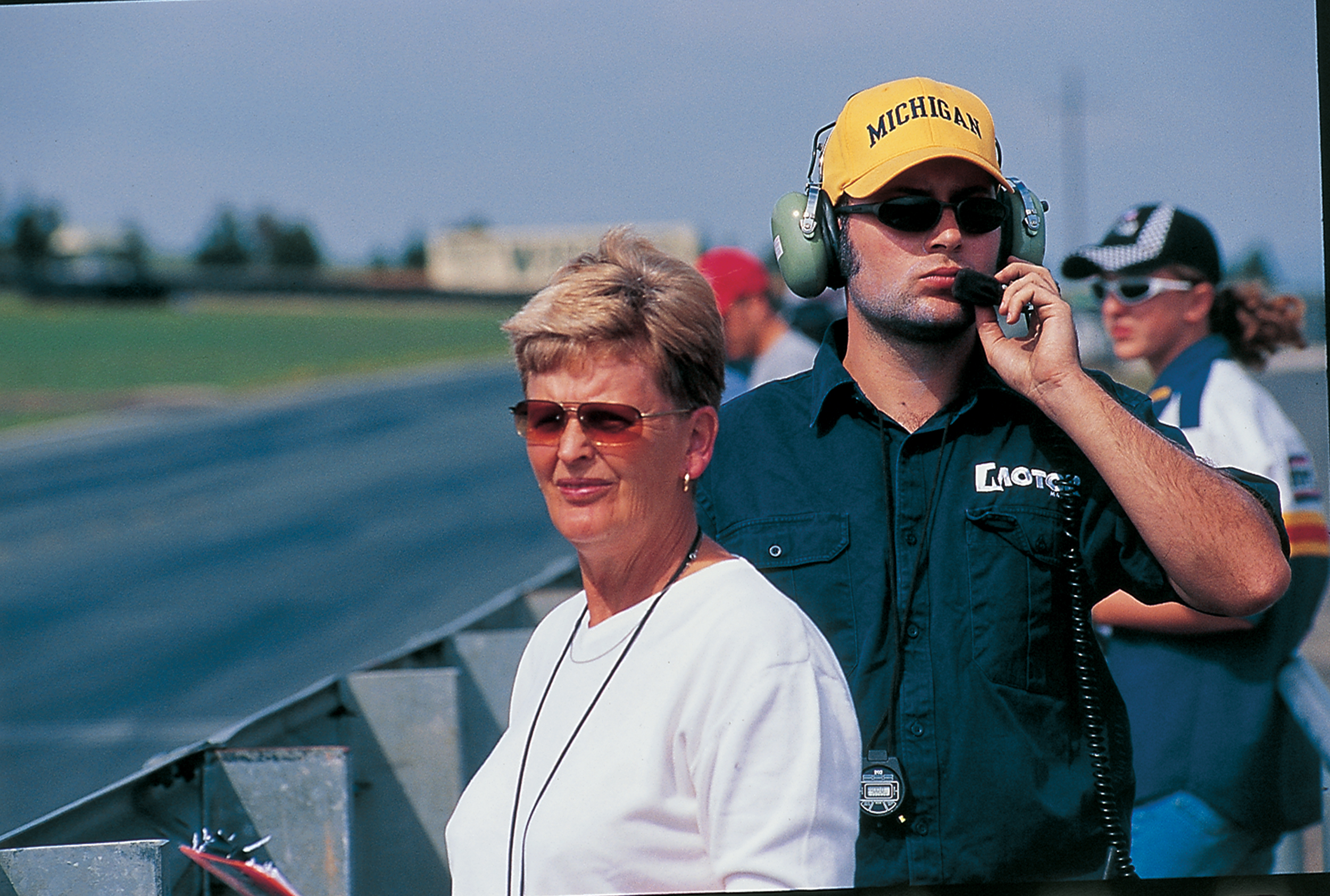
Now we needed someone to manage this rag-tag race team. Bossy boots and math nerd dep ed Jesse Taylor was the ideal fit.
Then there was the small matter of pit gear. The aim, you see, was to keep the overheads on this tour as low as humanly possible. Fortunately, my driveway is home to a slowly rusting go-kart trailer, complete with a pop-up shade and other necessary gubbins.
Then there were tools; regulations stipulated that we could only use a regular trolley jack and a couple of wheel braces. No rattle guns, then, eh? A quick call to Young Robbo and we had ourselves the tools – and a mechanic to boot.
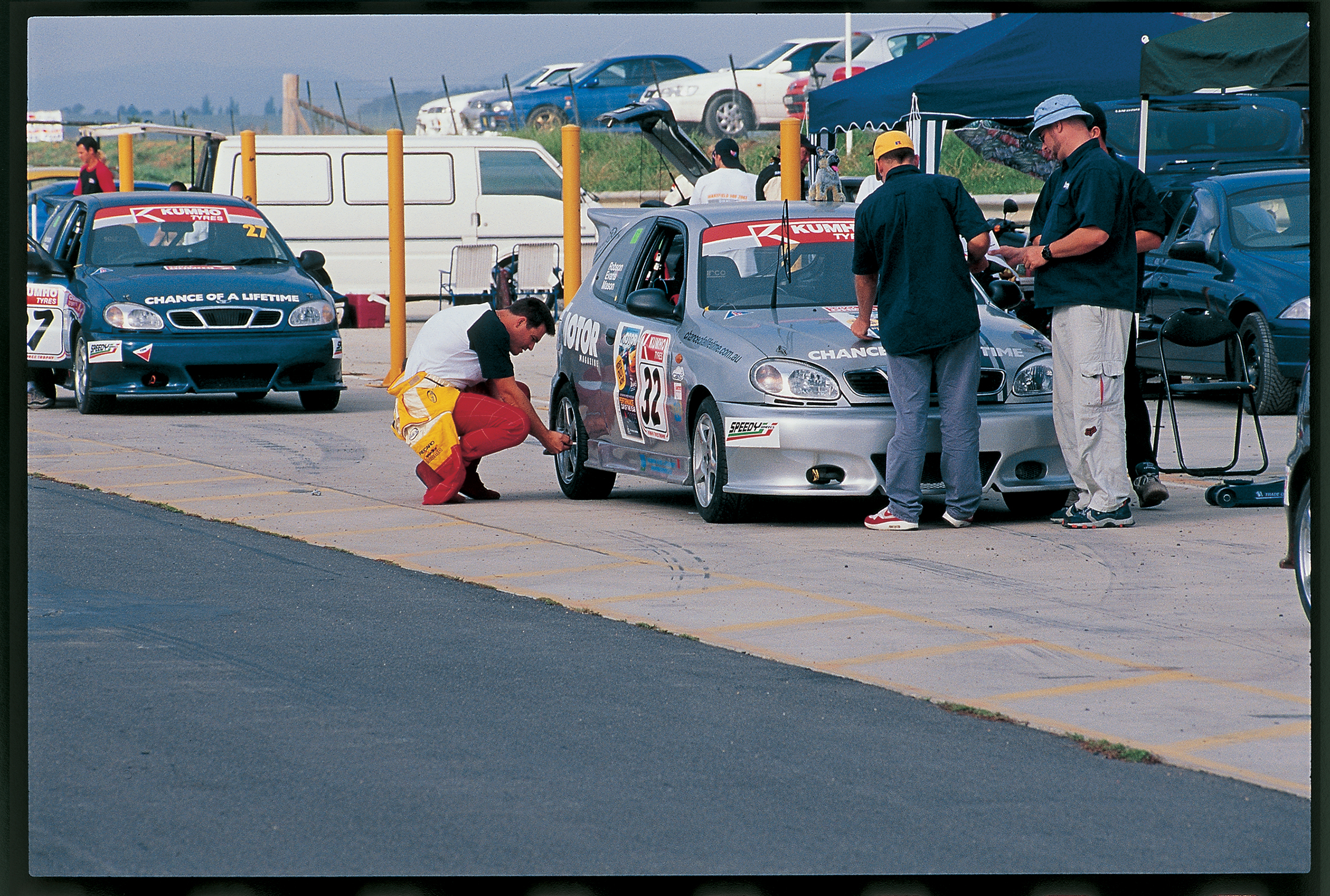
Practice does make perfect
Hart: Maybe it was the smell of the petrol, or simply the fact that I hadn’t changed my socks after driving for eight hours. Whatever it was, I was excited. No all-nighters in the name of preparation; just slap on the MOTOR stickers and we’re ready to turn the key. How good is this!
Robbo was the guinea pig, first out of pit lane and the man to test the equipment. We had heard stories of cars losing wheels and slamming themselves into walls; better him than us, right? Dean showed us on his first pass that his spot was well earned; in fact, the pace he set in each session made sure that I was kept on my toes.
As it turned out, I was quicker in our car and so it was a huge buzz (read sigh of relief) that car 32 was called to take part in the shootout. The fastest five cars in class were to battle it out in a single-lap qualifying bonanza. The fastest would reap the rewards of grid position one.
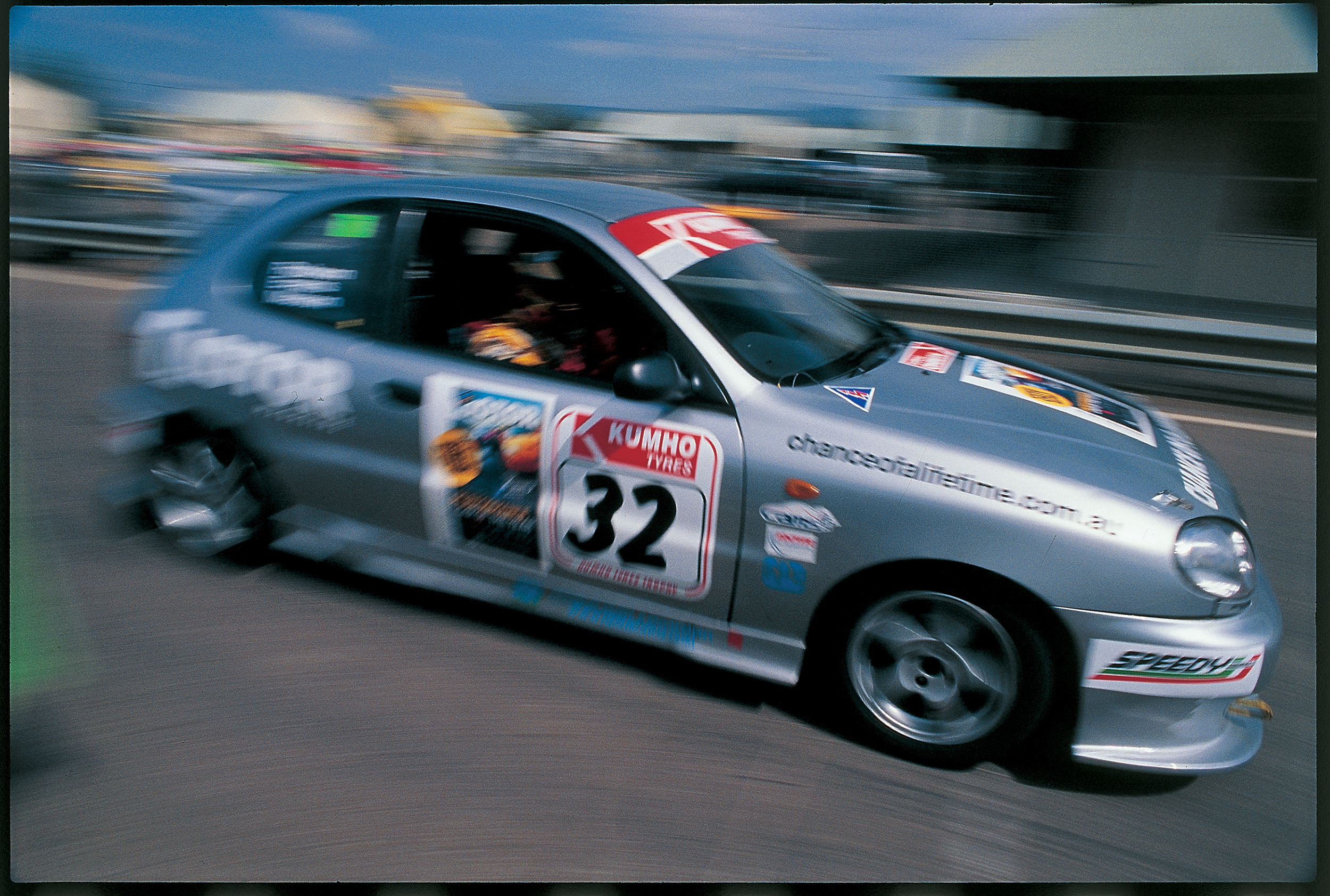
My slot behind the wheel was reasonably uneventful and it wasn’t until my shot at pole that the gravity of the situation hit me. As I crossed the start line, all I could see were the faces of the MOTOR crew lined up like sheep at a New Zealand B&S Ball and just as nervous.
Powering (a relative term, or course) down the straight on my flying lap, I found myself talking out loud, trying to guesstimate the amount of speed that the car was capable of hauling through the next corner. I was new to the one-lap dash situation and was loving the thrill of it. As I pitched the car around the track, I was petrified of missing gears or locking wheels.
With the chequered flag looming, I could make out the same ugly mugs that I had seen earlier that lap, except this time they were smiling, fists in the air, jumping up and down. What on earth could be so exciting? Could this actually be a good lap? I couldn’t help it; I, too, got caught up in the hysteria, flashing the lights and fist in the air as I crossed the timing line… P1!
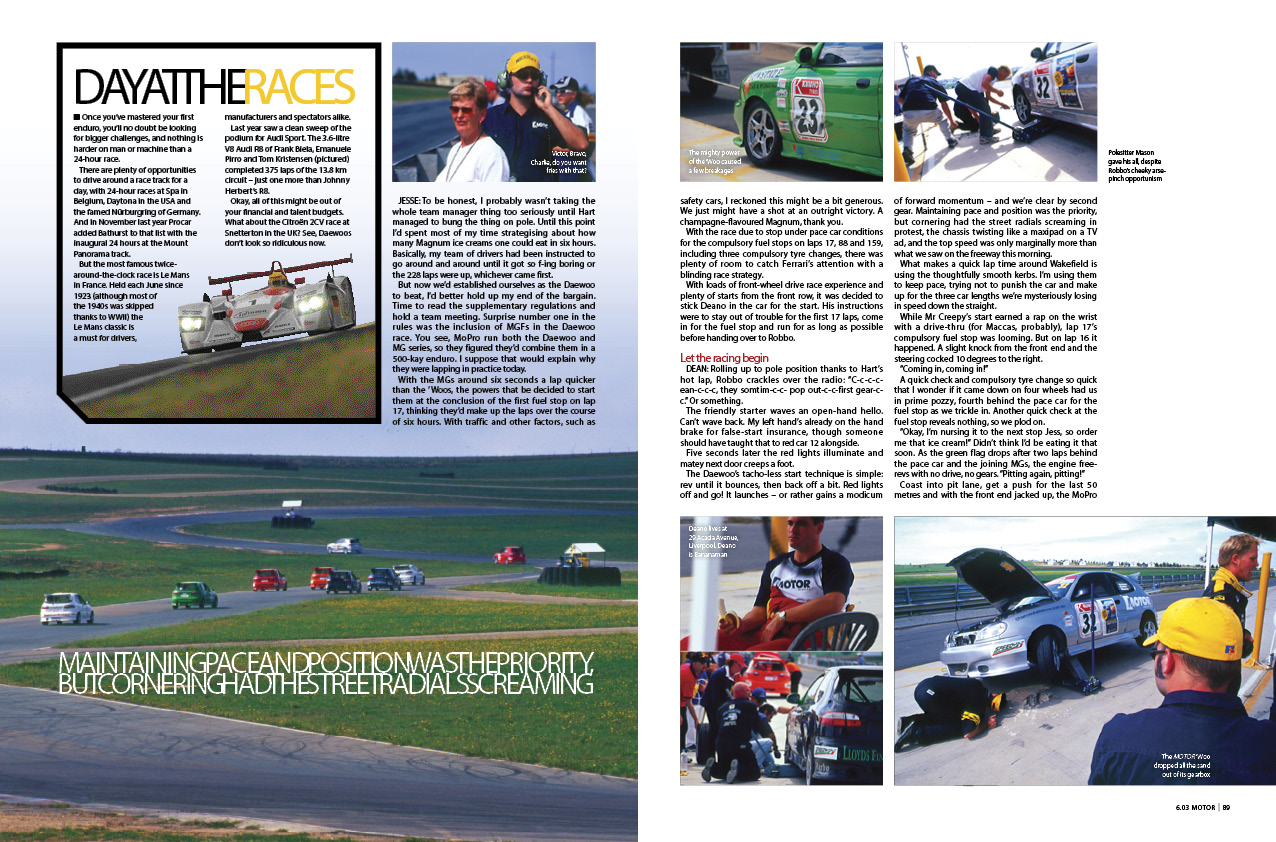
Jesse: To be honest, I probably wasn’t taking the whole team manager thing too seriously until Hart managed to bung the thing on pole. Until this point I’d spent most of my time strategising about how many Magnum ice creams one could eat in six hours. Basically, my team of drivers had been instructed to go around and around until it got so f-ing boring or the 228 laps were up, whichever came first.
But now we’d established ourselves as the Daewoo to beat, I’d better hold up my end of the bargain. Time to read the supplementary regulations and hold a team meeting. Surprise number one in the rules was the inclusion of MGFs in the Daewoo race. You see, MoPro run both the Daewoo and MG series, so they figured they’d combine them in a 500-kay enduro. I suppose that would explain why they were lapping in practice today.
With the MGs around six seconds a lap quicker than the ’Woos, the powers that be decided to start them at the conclusion of the first fuel stop on lap 17, thinking they’d make up the laps over the course of six hours. With traffic and other factors, such as safety cars, I reckoned this might be a bit generous. We just might have a shot at an outright victory. A champagne-flavoured Magnum, thank you.
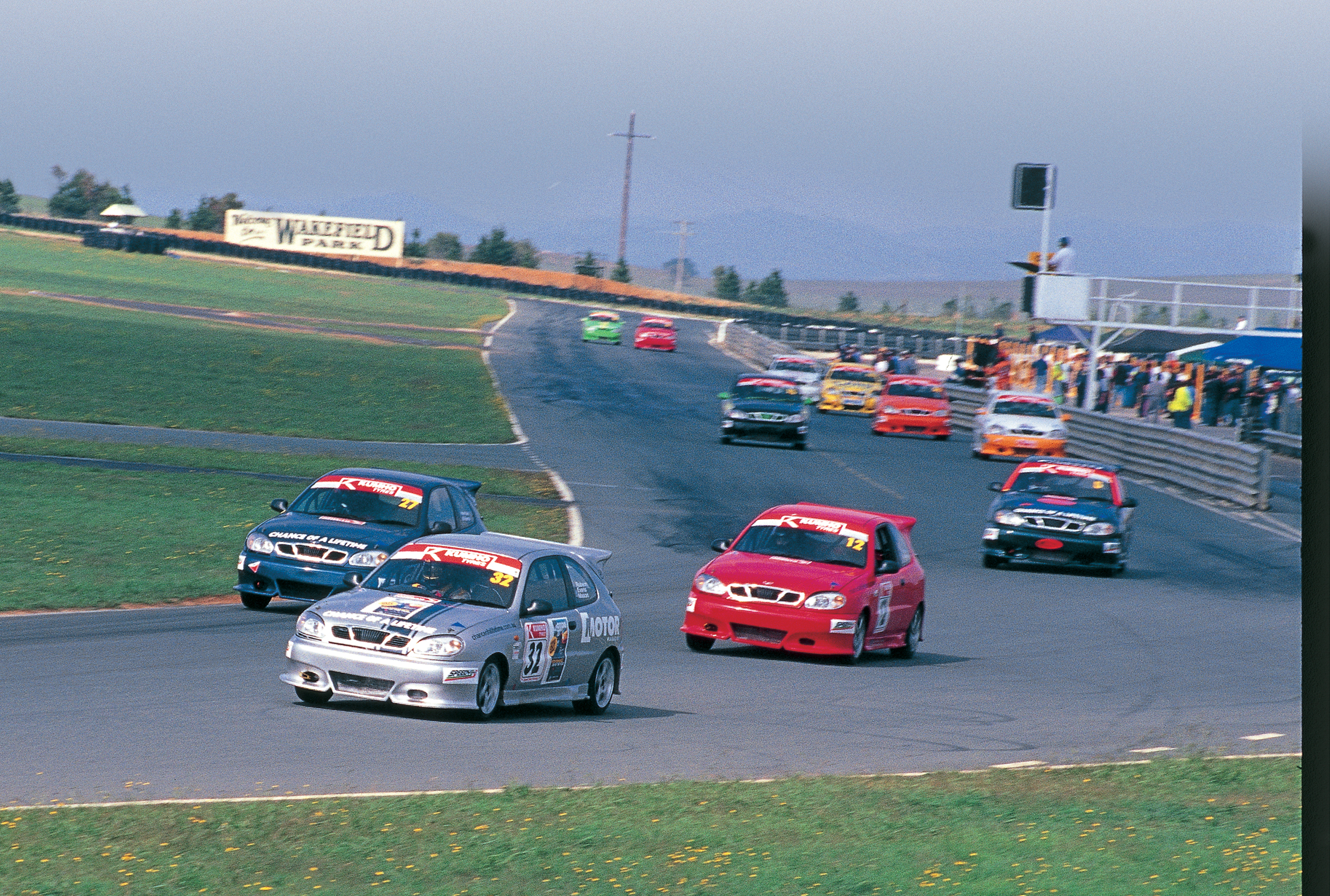
With the race due to stop under pace car conditions for the compulsory fuel stops on laps 17, 88 and 159, including three compulsory tyre changes, there was plenty of room to catch Ferrari’s attention with a blinding race strategy.
With loads of front-wheel drive race experience and plenty of starts from the front row, it was decided to stick Deano in the car for the start. His instructions were to stay out of trouble for the first 17 laps, come in for the fuel stop and run for as long as possible before handing over to Robbo.
Let the racing begin
Dean: Rolling up to pole position thanks to Hart’s hot lap, Robbo crackles over the radio: “C-c-c-c-ean-c-c-c, they somtim-c-c- pop out-c-c-first gear-c-c.” Or something.
The friendly starter waves an open-hand hello. Can’t wave back. My left hand’s already on the hand brake for false-start insurance, though someone should have taught that to red car 12 alongside.
Five seconds later the red lights illuminate and matey next door creeps a foot.
The Daewoo’s tacho-less start technique is simple: rev until it bounces, then back off a bit. Red lights off and go! It launches – or rather gains a modicum of forward momentum – and we’re clear by second gear. Maintaining pace and position was the priority, but cornering had the street radials screaming in protest, the chassis twisting like a maxipad on a TV ad, and the top speed was only marginally more than what we saw on the freeway this morning.
What makes a quick lap time around Wakefield is using the thoughtfully smooth kerbs. I’m using them to keep pace, trying not to punish the car and make up for the three car lengths we’re mysteriously losing in speed down the straight.
While Mr Creepy’s start earned a rap on the wrist with a drive-thru (for Maccas, probably), lap 17’s compulsory fuel stop was looming. But on lap 16 it happened. A slight knock from the front end and the steering cocked 10 degrees to the right.
“Coming in, coming in!”
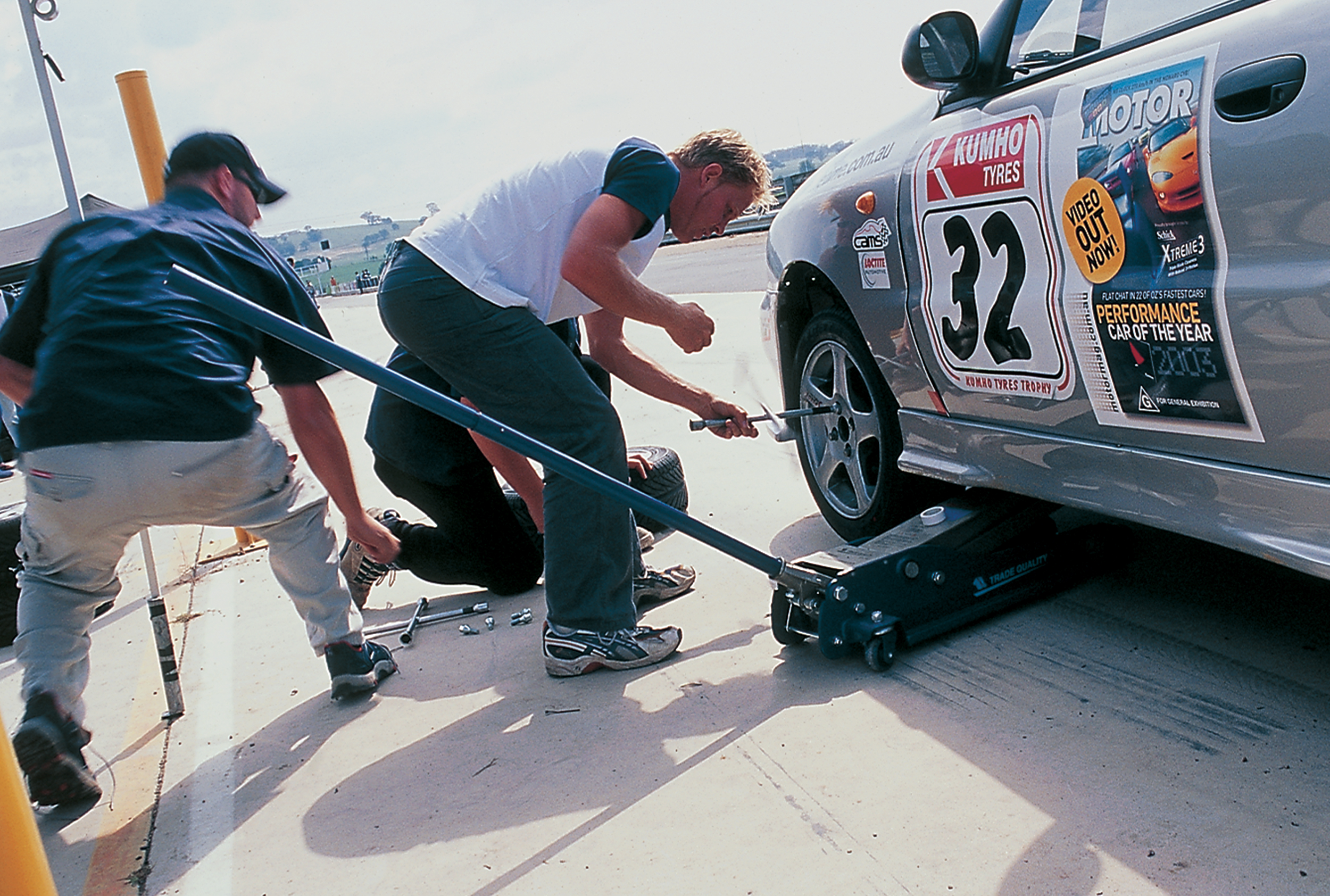
A quick check and compulsory tyre change so quick that I wonder if it came down on four wheels had us in prime pozzy, fourth behind the pace car for the fuel stop as we trickle in. Another quick check at the fuel stop reveals nothing, so we plod on.
“Okay, I’m nursing it to the next stop Jess, so order me that ice cream!” Didn’t think I’d be eating it that soon. As the green flag drops after two laps behind the pace car and the joining MGs, the engine free-revs with no drive, no gears. “Pitting again, pitting!”
Coast into pit lane, get a push for the last 50 metres and with the front end jacked up, the MoPro mechanic shakes his head and says game over. F&#k!
An hour later a person formerly known as a friend leaves a message on my mobile: “Deano, can you come over and break my chassis, too?” Bastard.
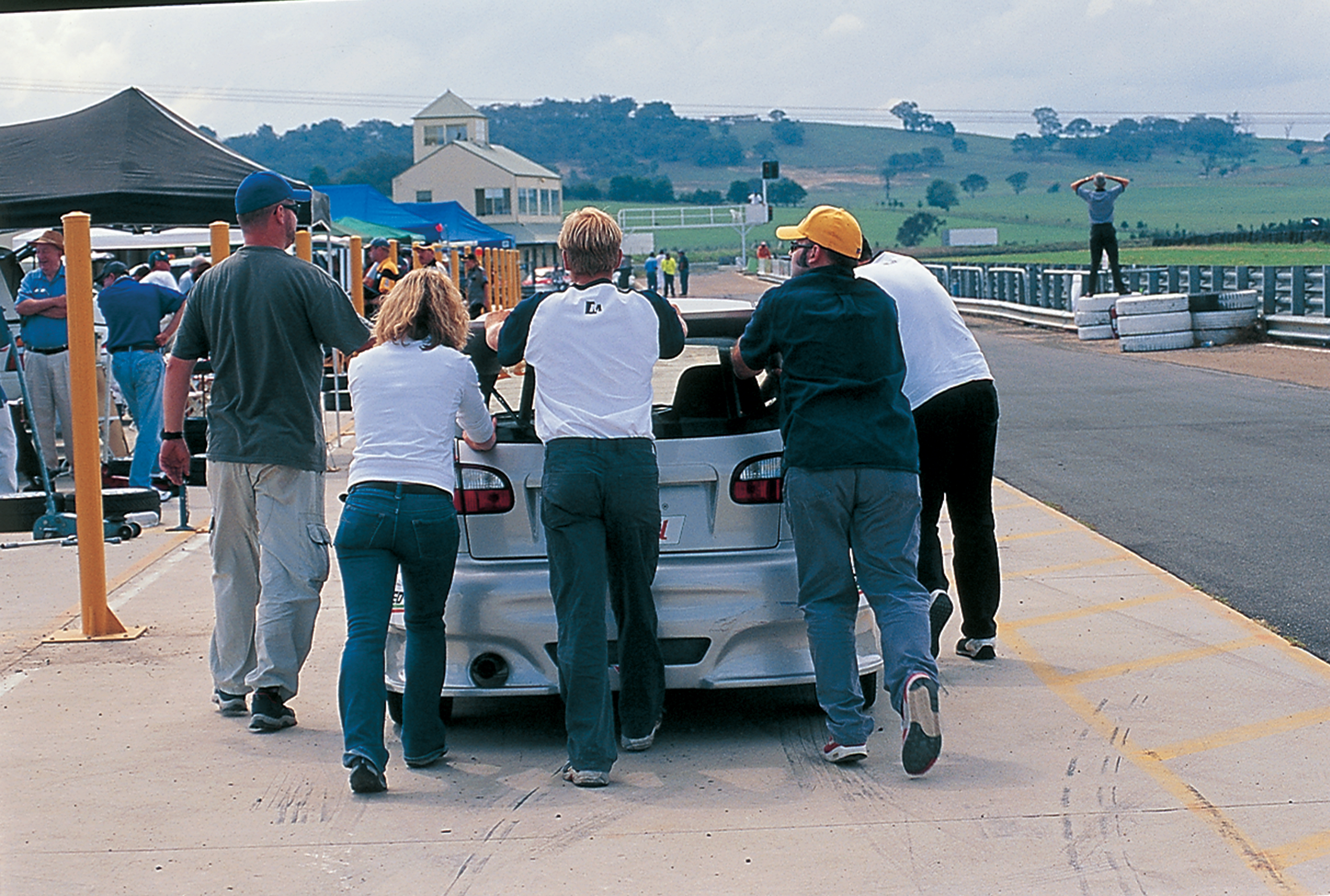
Lap 18 of 228, car 32, DNF
Robbo: After head wrench Daryl Ritchie took one look at the car and shook his head, Dean just sat in the car. Didn’t get out for five minutes. And there’s nothing quite like standing next to a deader-than-dead race car all suited up and helmet on.
As Dean rolled slowly out of the queue of cars about to take the restart and headed for pitlane, I knew… I just knew… it was all over. After Hart’s simply amazing pole lap, Dean’s inspired early running, our awesome pitstop on the hop… nothing.
No point cursing, but I wanted to. No point blowing up, even though it’d feel good. The fickle hand of motorsport’s particularly busy Lady Luck hadn’t rested on our bonnet this morning, ’tis all. And damn her and all her offspring for the oversight.
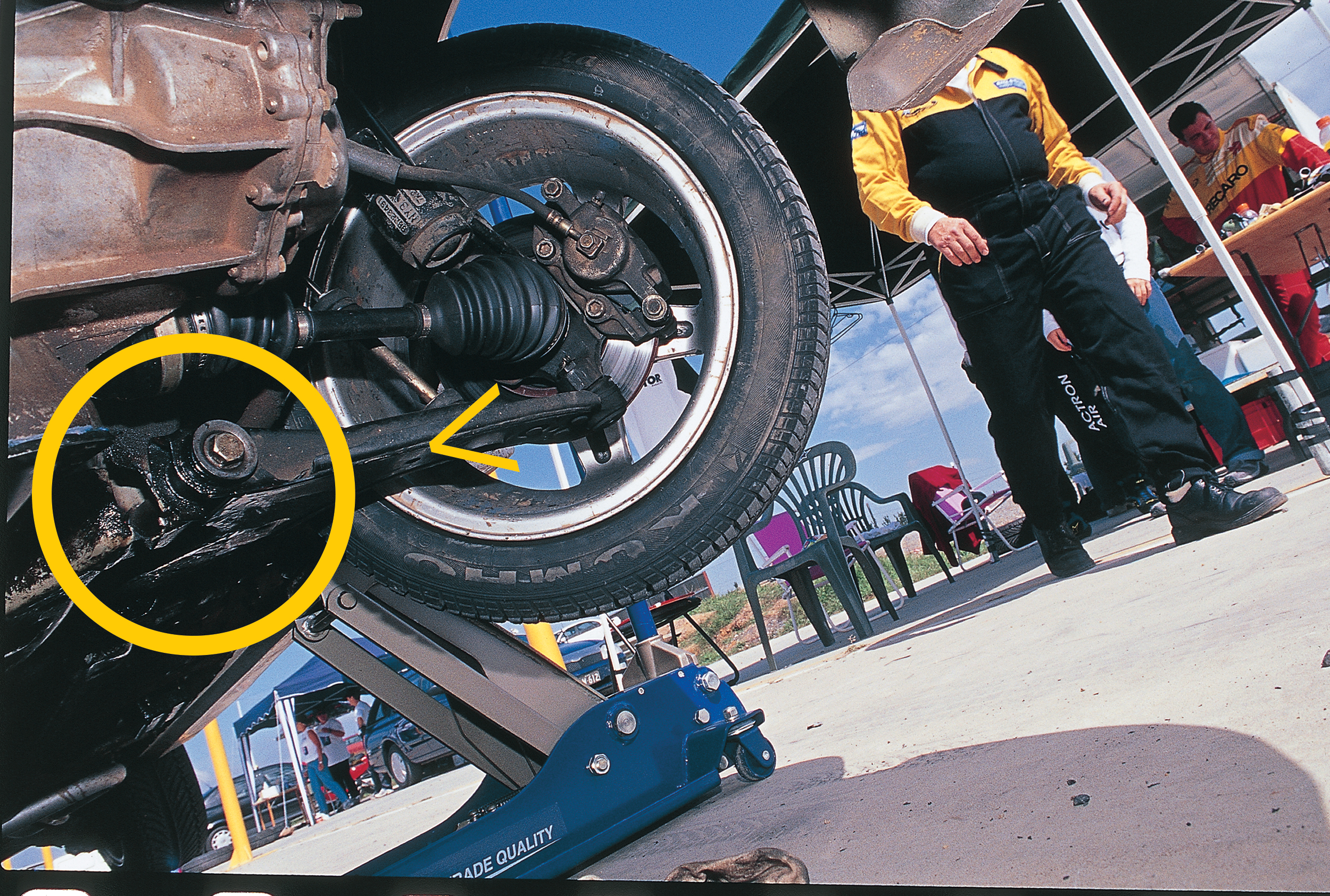
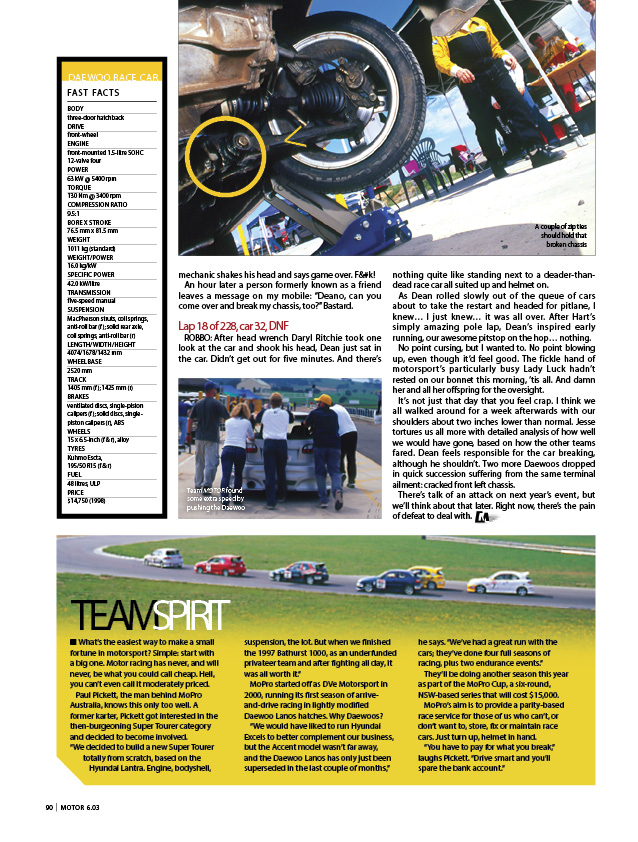
It’s not just that day that you feel crap. I think we all walked around for a week afterwards with our shoulders about two inches lower than normal. Jesse tortures us all more with detailed analysis of how well we would have gone, based on how the other teams fared. Dean feels responsible for the car breaking, although he shouldn’t. Two more Daewoos dropped in quick succession suffering from the same terminal ailment: cracked front left chassis.
There’s talk of an attack on next year’s event, but we’ll think about that later. Right now, there’s the pain of defeat to deal with.
Whether you’re preparing for a track day, shopping for a gift – or just yourself – these are the coolest car products we’ve been drooling over lately.
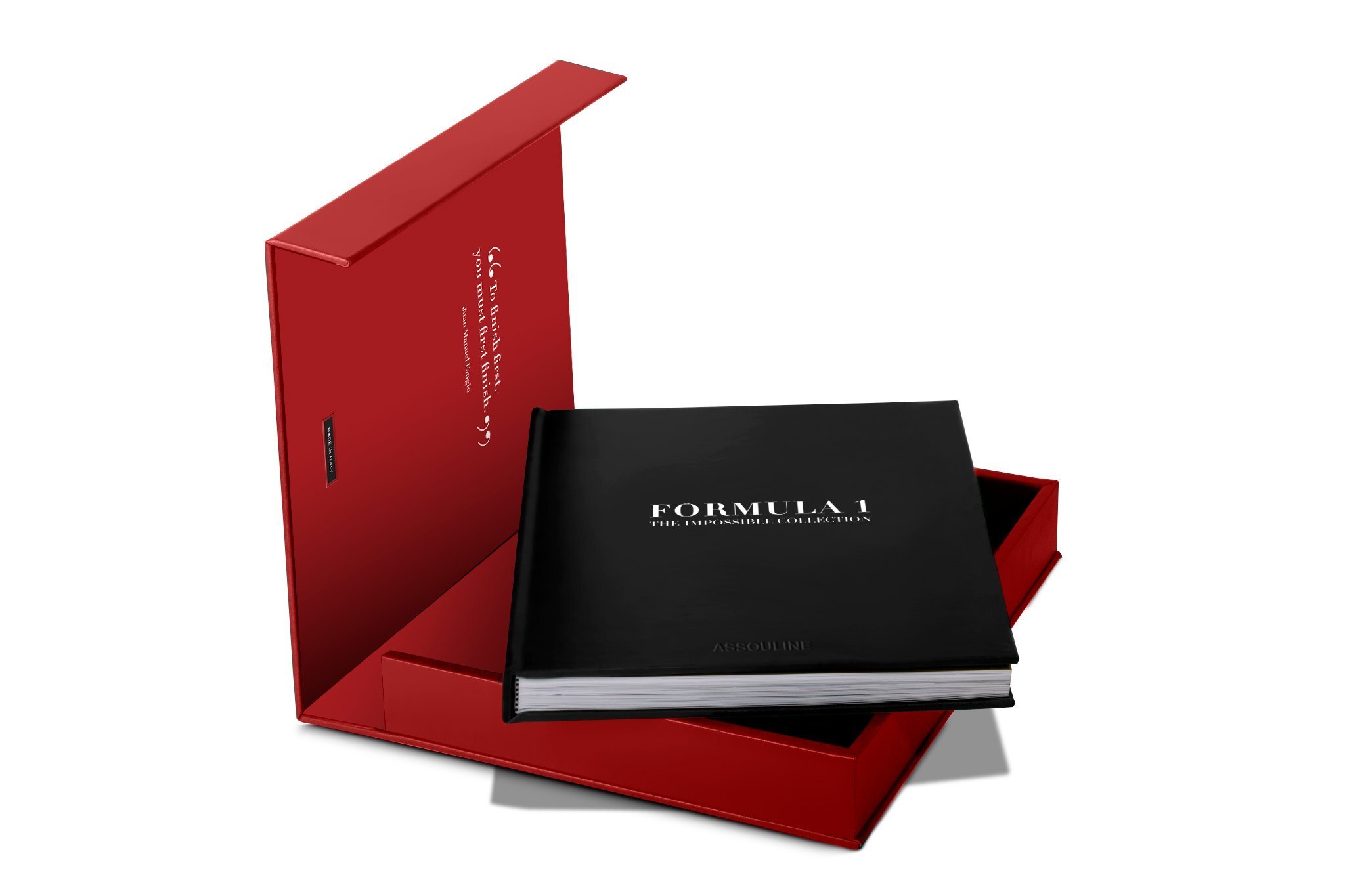
Formula 1: the impossible collection – $995 – assouline.com
This coffee-table book recounts 100 memorable moments in F1, and tributes the heroes and achievements that forged the sport.
911 Wireless charging piston – $579 – porsche.com
Normal charging pad won’t do? Porsche can offer you this one, constructed out of an original Porsche 911 piston. It boasts a 10-watt maximum output.

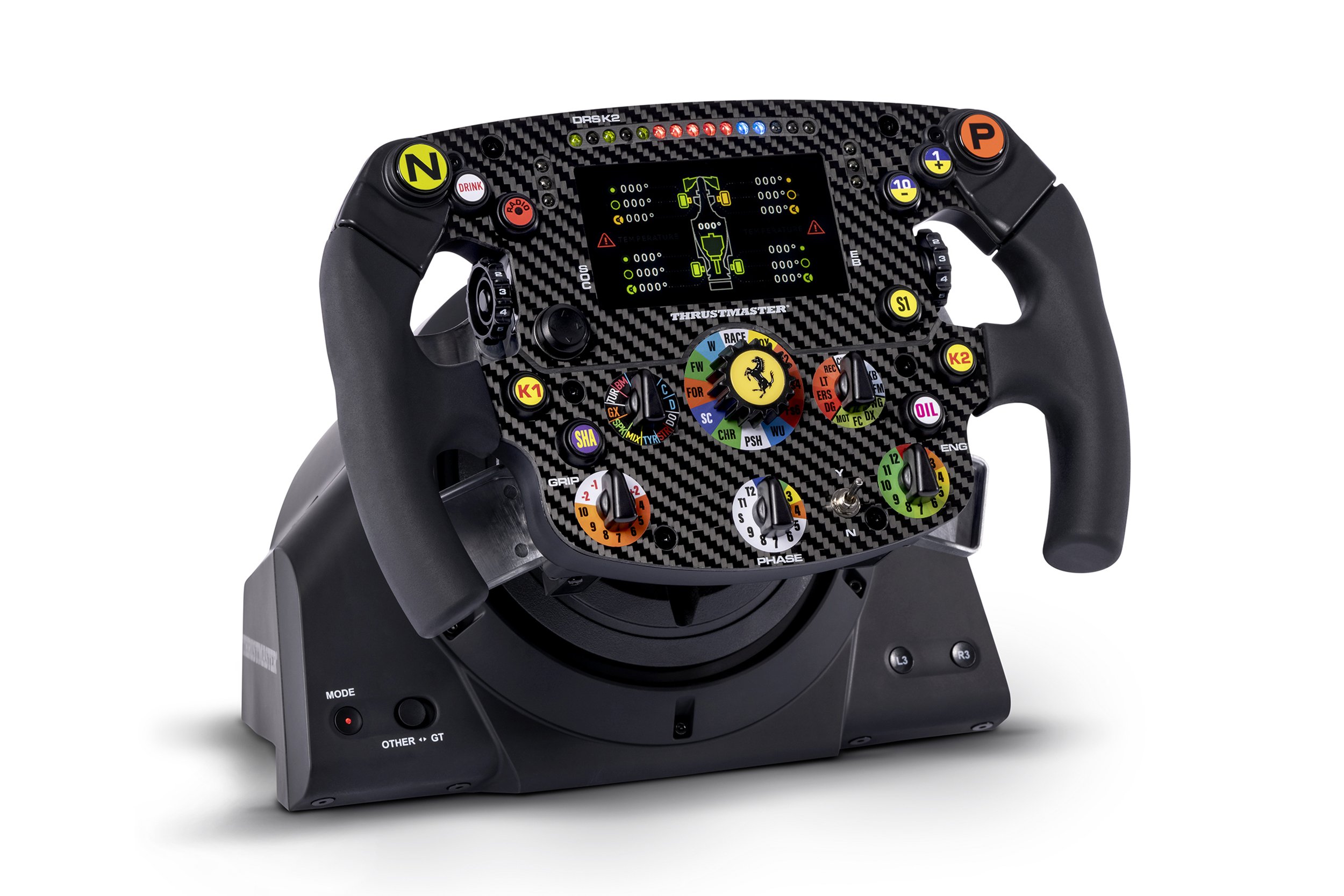
Thrustmaster Ferrari SF1000 – $599 – pagnianimports.com.au
Pre-orders are open for Thrustmaster’s latest sim add-on, this one a faithful replica of Ferrari’s 2020 F1 wheel from its SF1000 race car.
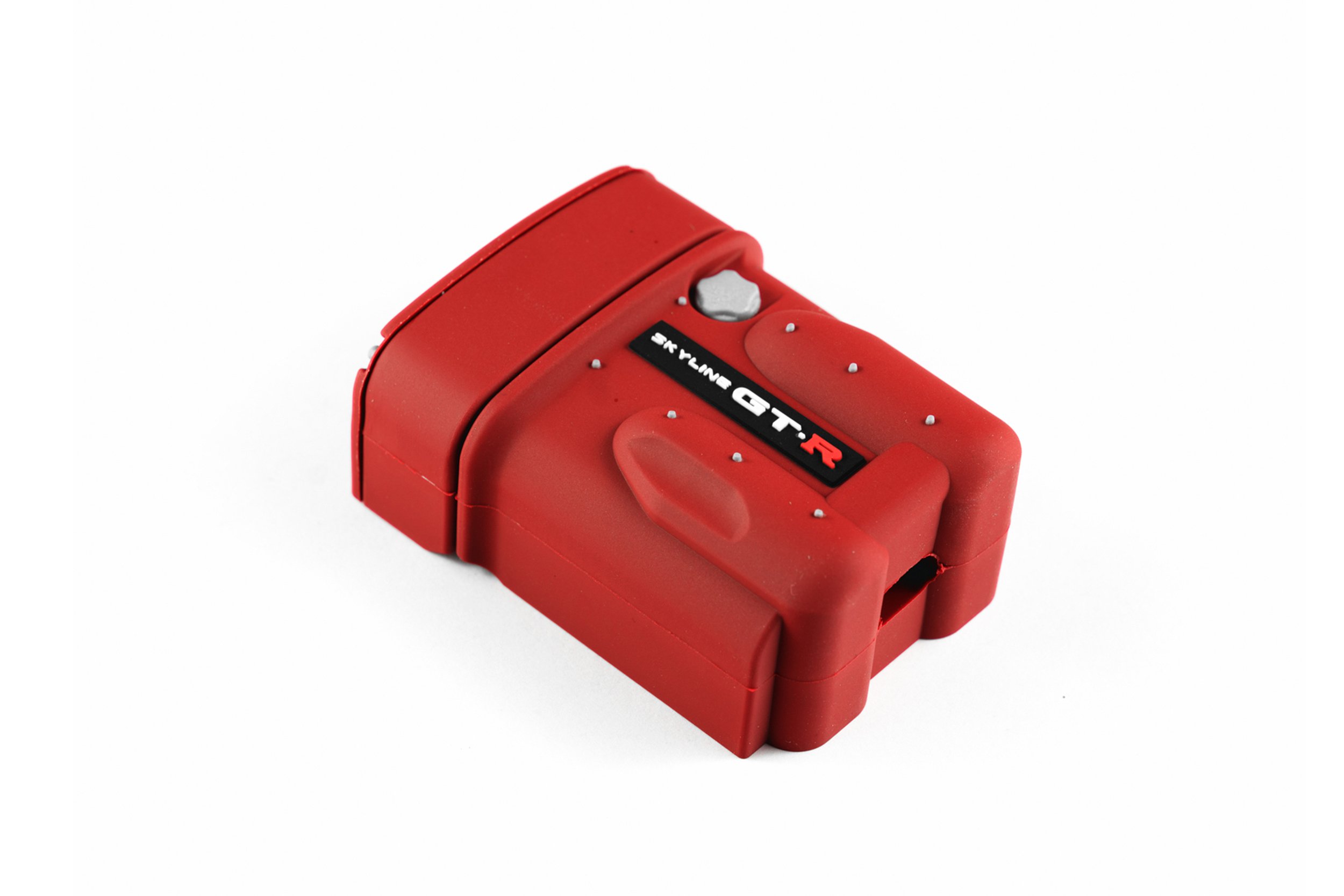
RB26DETT Airpod Case – $25 – garagepodz.com
Little chance of losing your AirPods with these silicon cases from GaragePodz. Not a GT-R fan? There are more to choose from, inspired by a range of different engines.
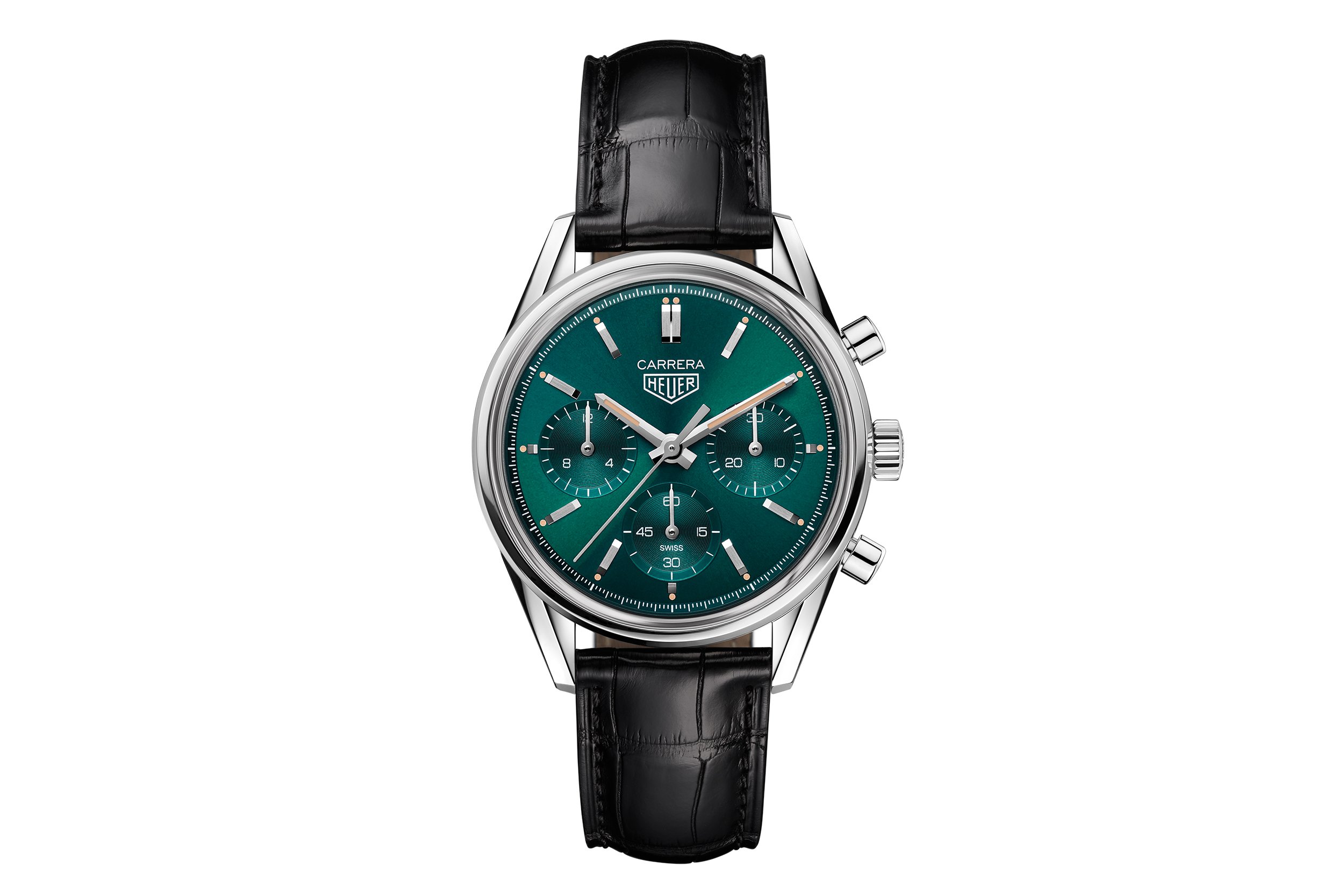
TAG Heuer Carrera Green Special Edition – $9650 – tagheuer.com
Green dials are well and truly in vogue among the watch industry this year, and we are here for it! TAG Heuer joins the party with a green-dialed special edition of its lovely 1960s Carrera reissue. Just 500 are being made.
Track Pack
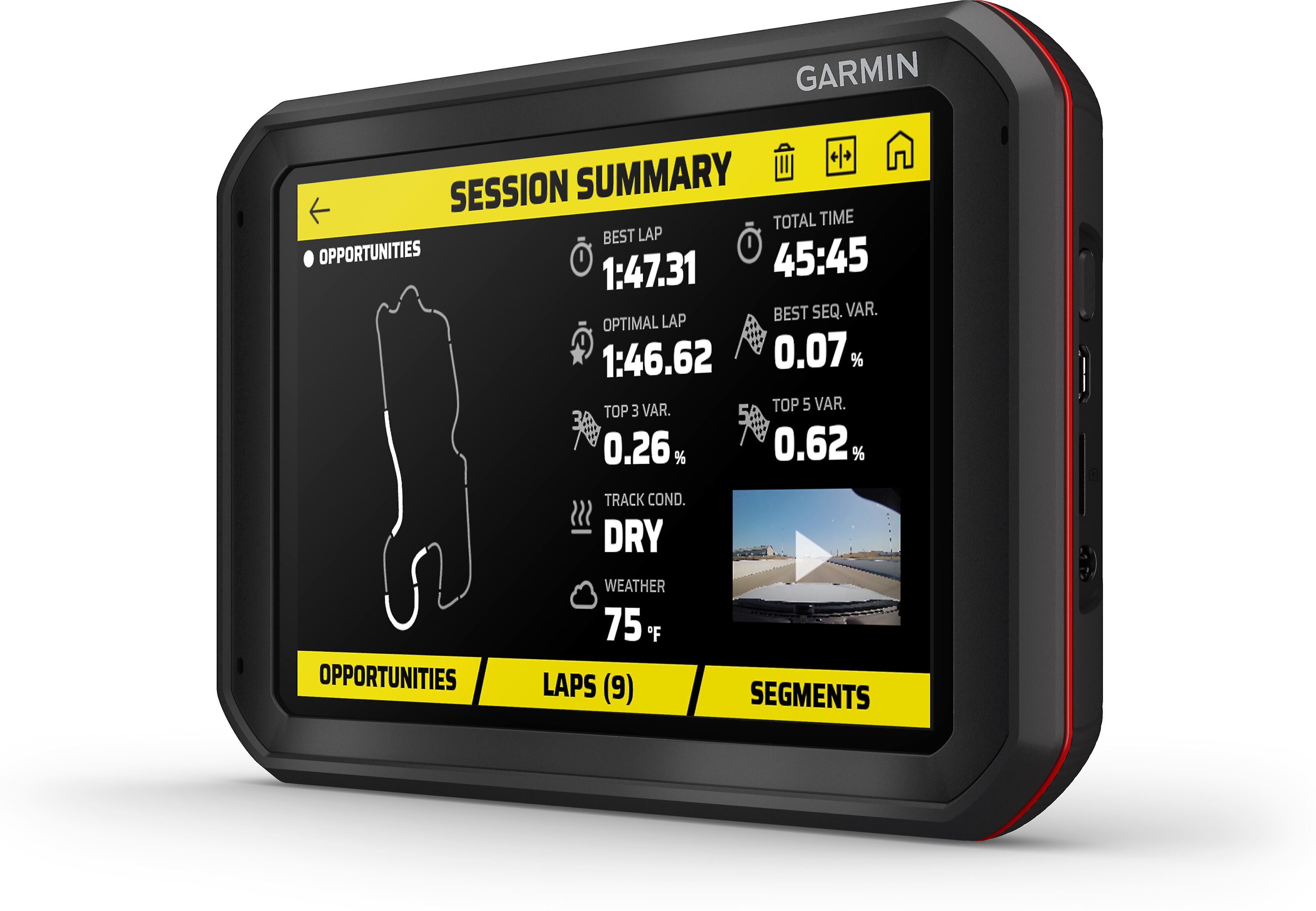
Garmin Catalyst Driving Performance Optimiser – $1699 – garmin.com
Garmin is getting into lap telemetry with its Catalyst Driving Performance Optimiser. It features GPS-based ‘True Track Positioning’, optimal lap times, real-time data, apex analysis and video capture.
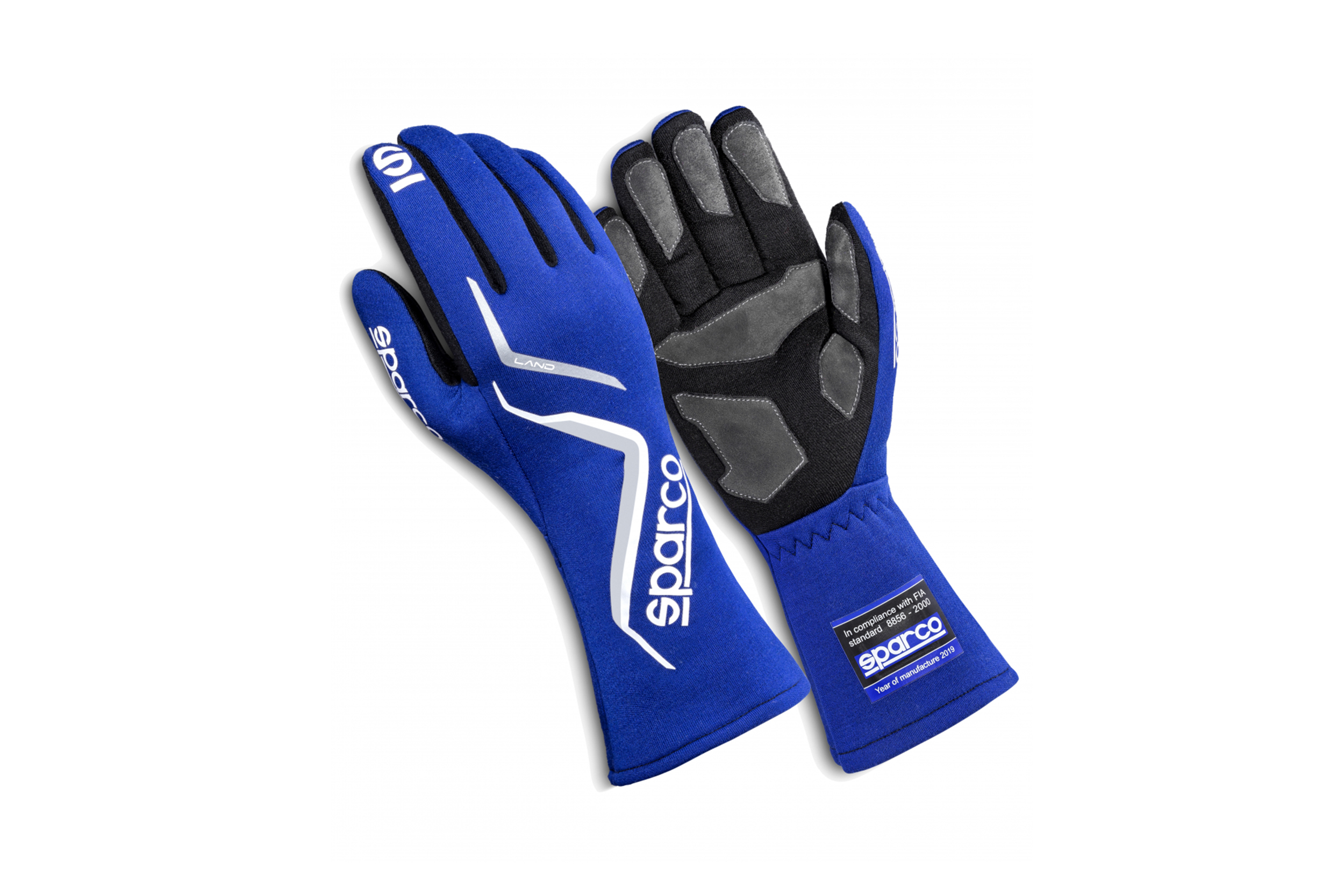
Sparco FIA ‘Land’ Gloves – $150 – racedeal.com.au
An evolution of Sparco’s popular RG-3.1 entry level gloves, these ultralight and flame-retardant gloves are great for added grip, feel and protection.
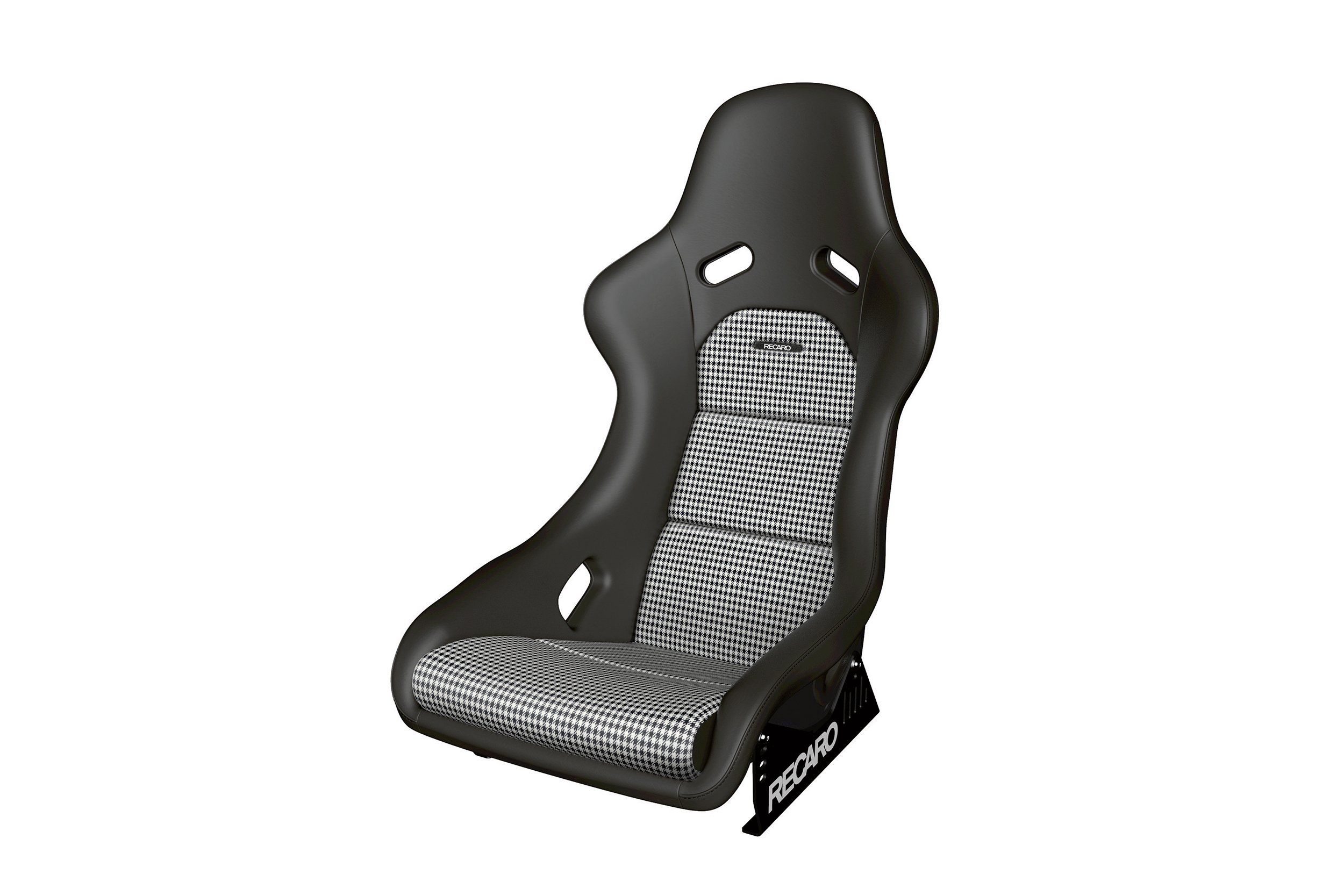
Recaro Classic Pole Position – $2939 – demon-tweeks.com
A classic twist on Recaro’s popular modern bucket seat. If houndstooth doesn’t fit your car, you can get GTI-esque tartan, or corduroy, too!
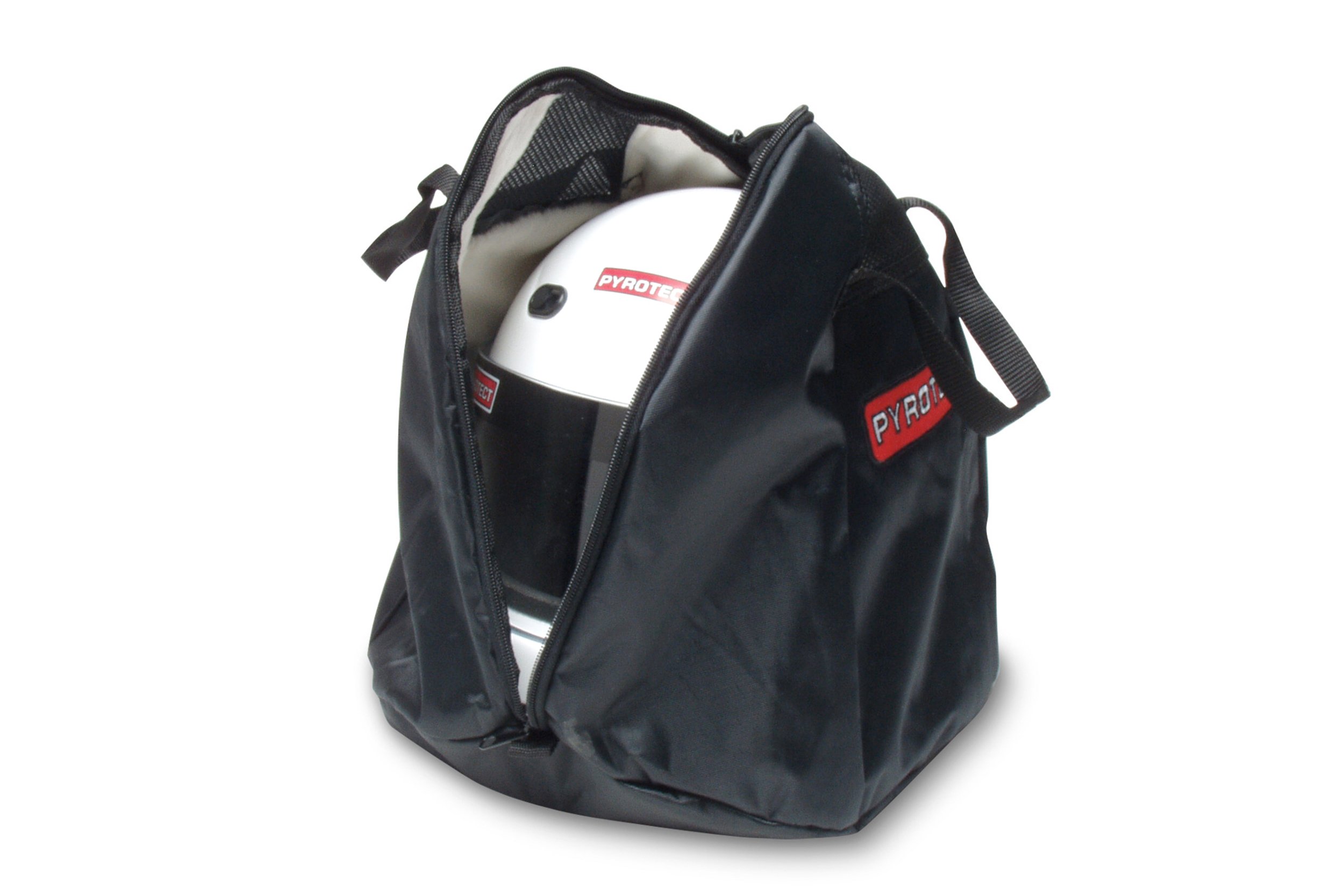
Pyrotect Helmet Bag – $34 – pyrotectstore.com
Keep your lid clean and shiny between track days with these affordable and effective fleece-lined nylon helmet bags from US manufacturer Pyrotect.
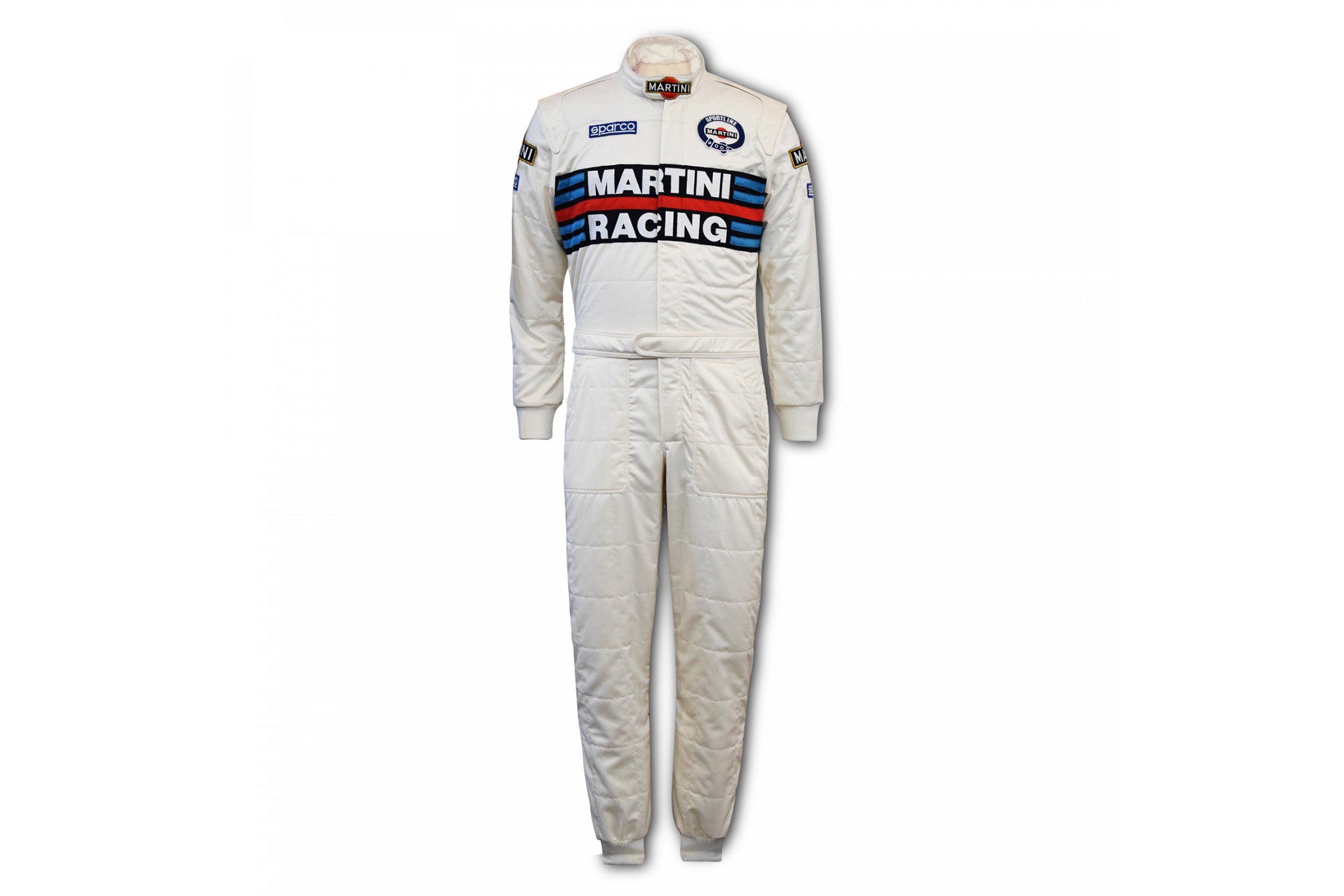
Martini Racing Replica Suit – $1294 – sparco.com
Limited edition Sparco suit looks straight out of the ’70s, but is produced with modern techniques and offers superior comfort, breathability and fire protection.
As America braces for the arrival of the new Ford F-150 Raptor, Lego will whet appetites for the off-road performance ute when it releases its brick version globally this October.
The Lego Ford F-150 Raptor is the latest instalment from the toy manufacturer’s advanced Technic series, standing at 15cm tall, 42cm long and 18cm wide once built from 1379 pieces.
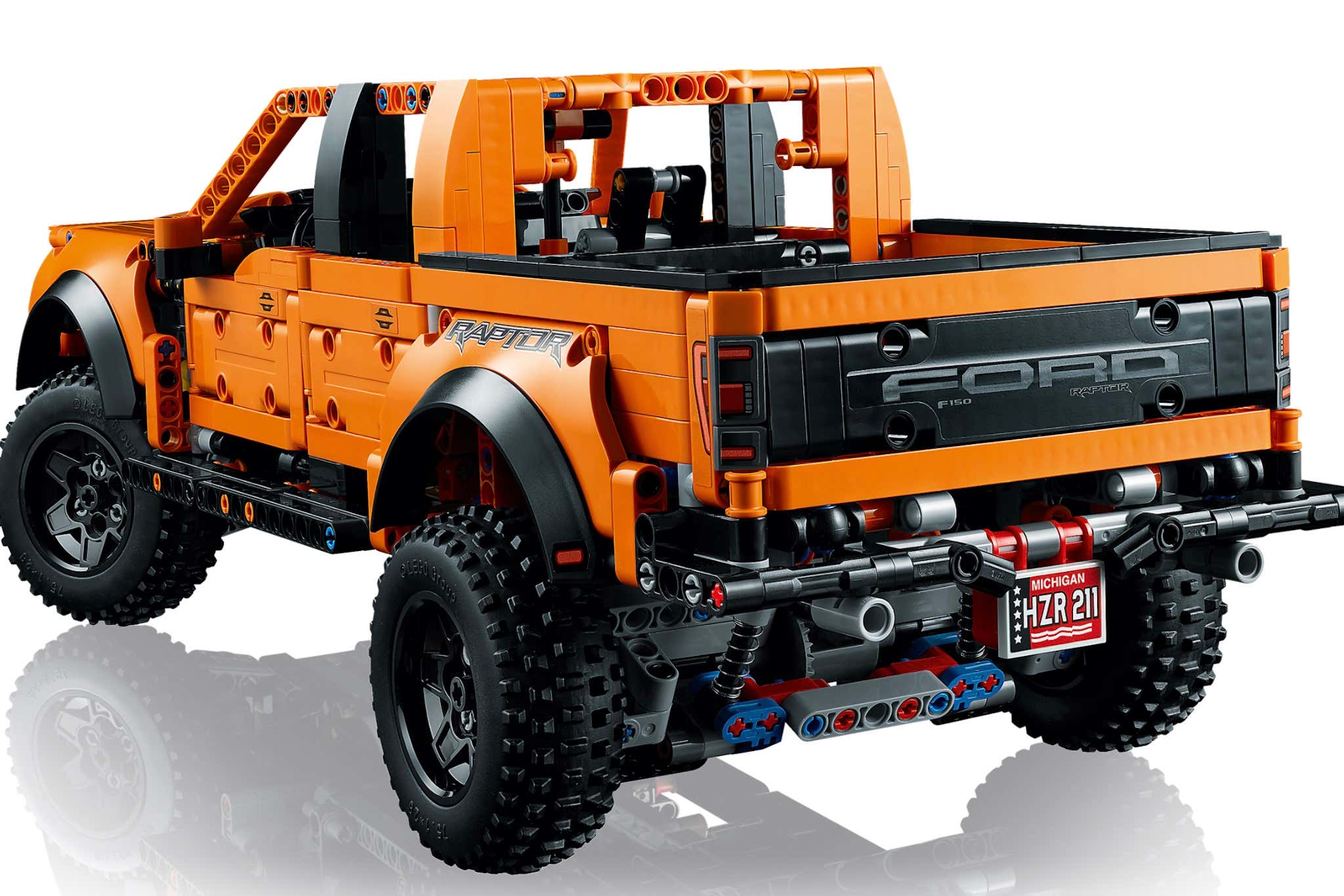
The Lego product is pretty serious about imitating the new F-150 Raptor, featuring opening doors, an opening bonnet as well as a replica V6 engine with functioning pistons. There’s also long-travel suspension at all four wheels.
Available for pre-order now, kits will be dispatched in October — just in time for Christmas. Price? The F-150 Raptor costs $249.99 on Lego’s Australian website, which is middle of the range sort of stuff. But it’s important to note Lego rate this one for ages 18 and up.
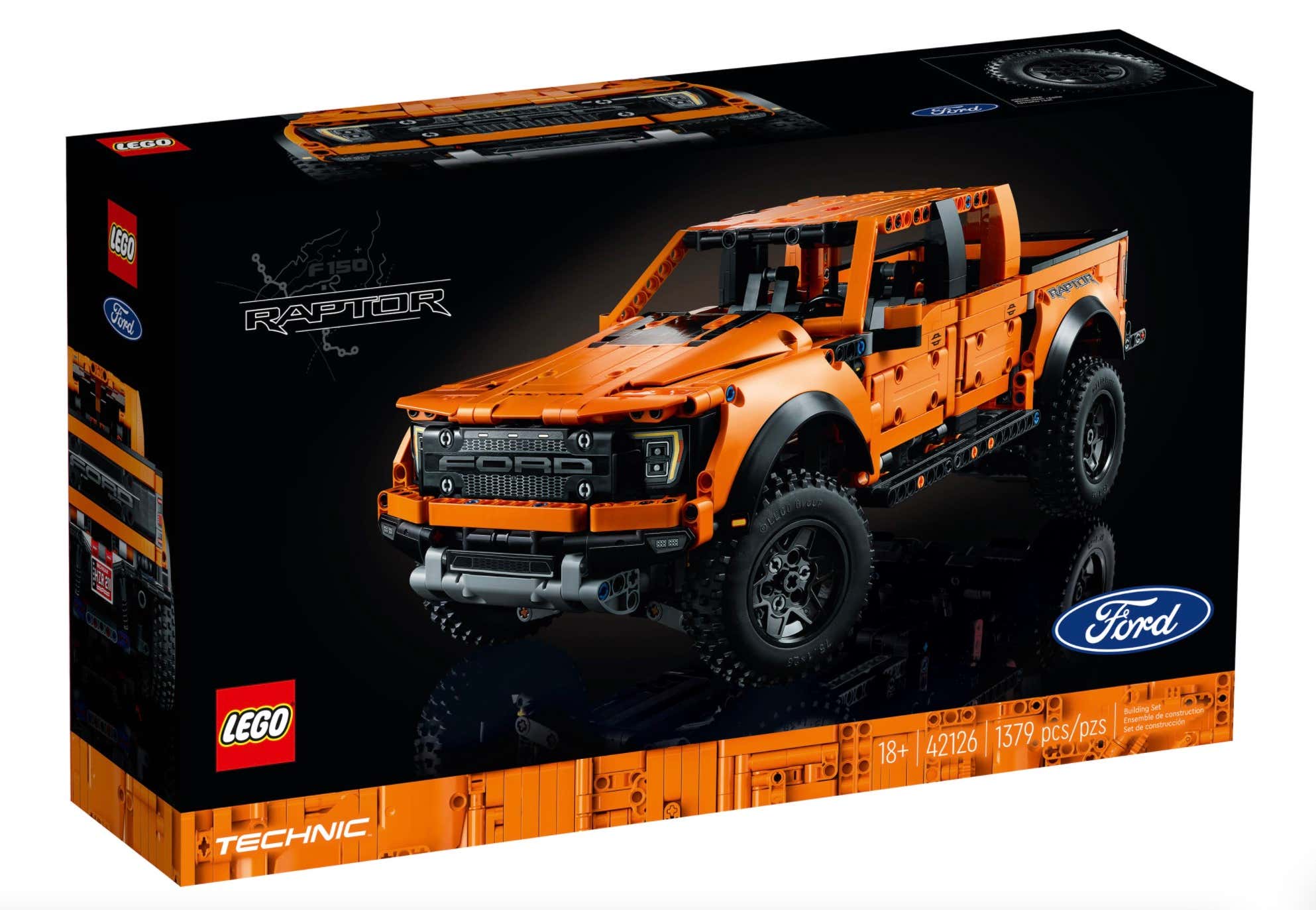
If you’re after something rugged from the Technic series with a lower age rating, the recently introduced 2573-piece Land Rover Defender is approved for 11-year-olds and above.
Otherwise, the range also includes the more challenging 3696-piece Lamborghini Sian Technic and 3599-piece Bugatti Chiron Technic. Again, they’re for big boys and girls, since both are rated for ages 18 and up.
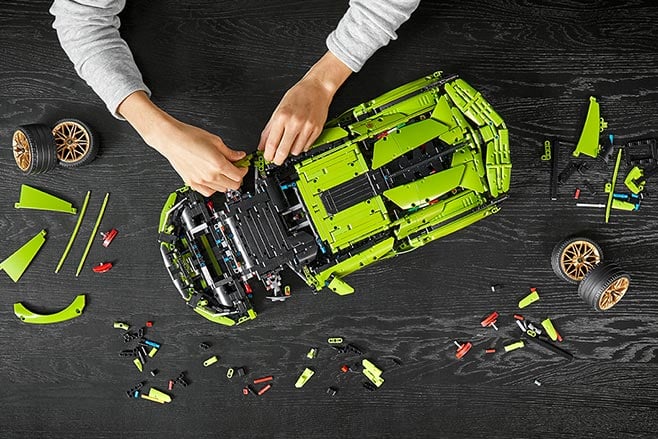
As for the real thing, the new Ford F-150 Raptor is the bigger American brother of the locally sold Ranger Raptor. For 2021, Ford has updated it with a new exterior and re-designed five-link rear suspension which relies on new coil springs to replace the old leaf-type.
The F-150 Raptor also carries over with the same petrol 3.5-litre twin-turbo V6 as before, but Ford has boosted outputs to 336kW and 691Nm.
And if that wasn’t enough to tempt large pick-up ute fans in Australia, the F-150 Raptor is set to welcome a supercharged V8 variant dubbed the R in 2022.
Ultimately, though, unless you’re keen to import one on your own, this Lego is all the F-150 Raptor we will get for now.
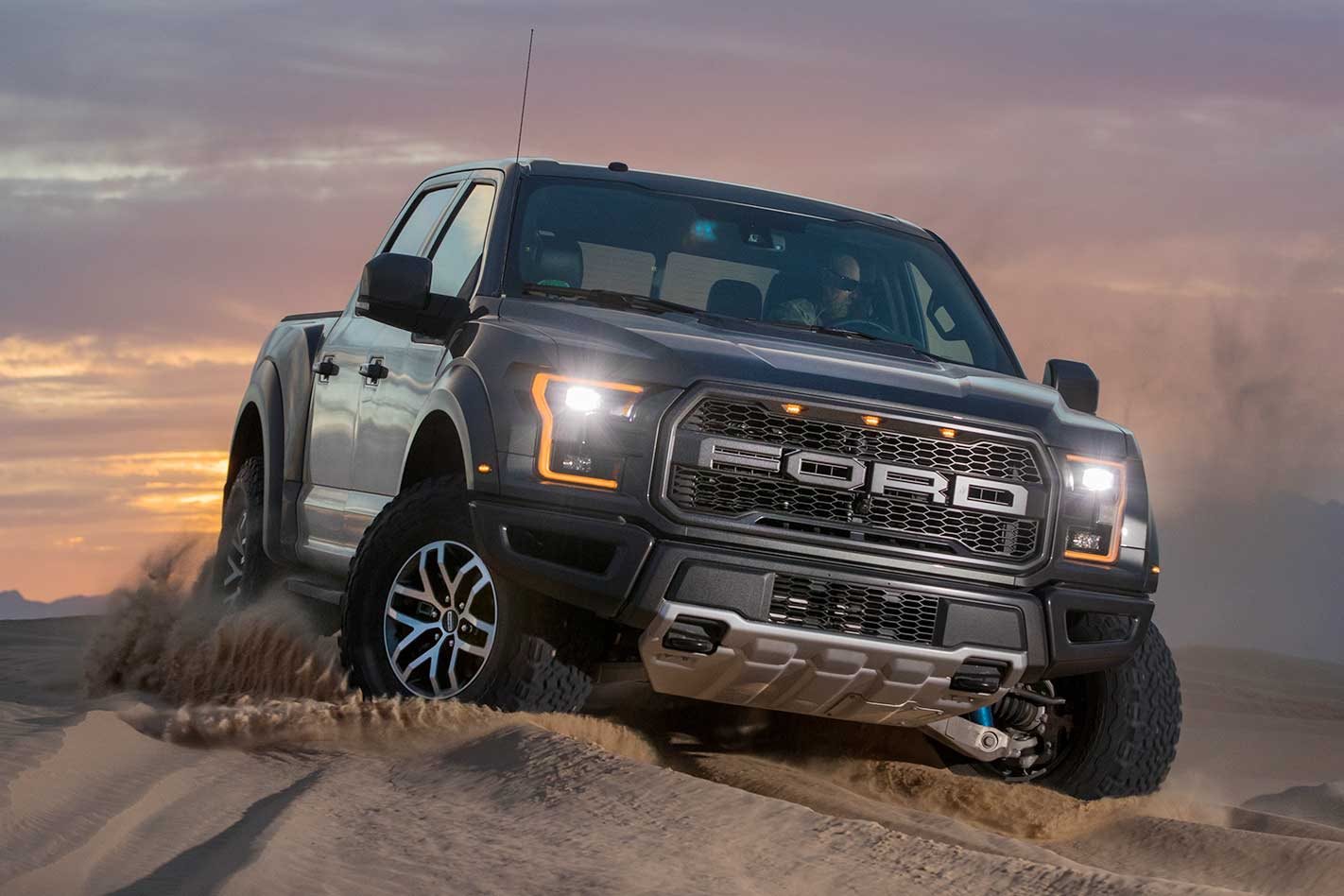
Which cars are selling like the hottest of hot cakes in 2021? With official new-vehicle registration figures now available for the first half of the year, we can reveal Australia’s most popular cars.
While there are plenty of usual suspects in the mix, there are also some big surprises.
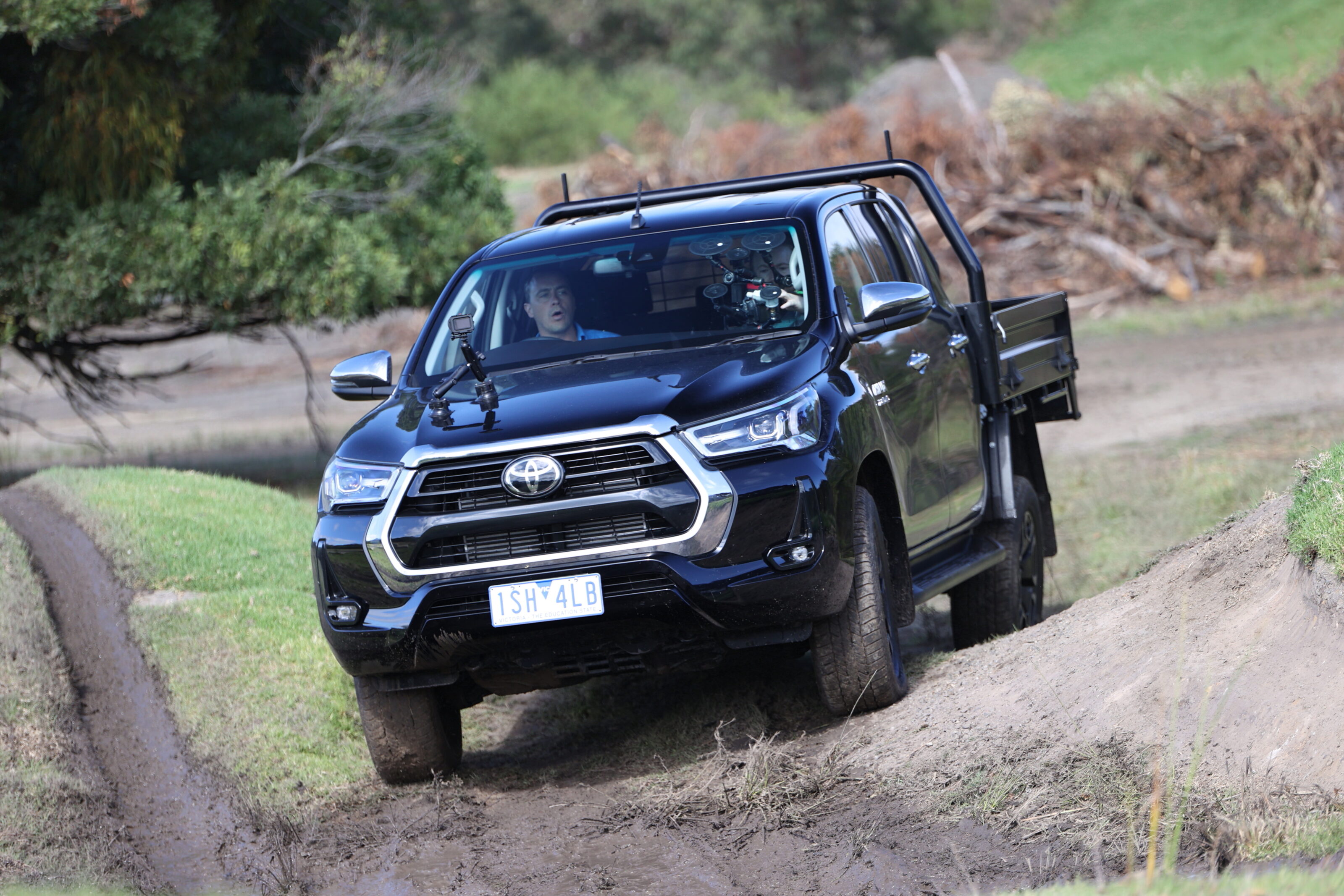
1. Toyota HiLux: 28,076 sales
“Unbreakable” could just as easily refer to the HiLux’s stranglehold on the new-car market. It’s currently on track to be crowned Australia’s best-selling vehicle for the sixth consecutive year, and sales are up 26 per cent. The Toyota not getting its own way entirely, though, with the number two car in this list…
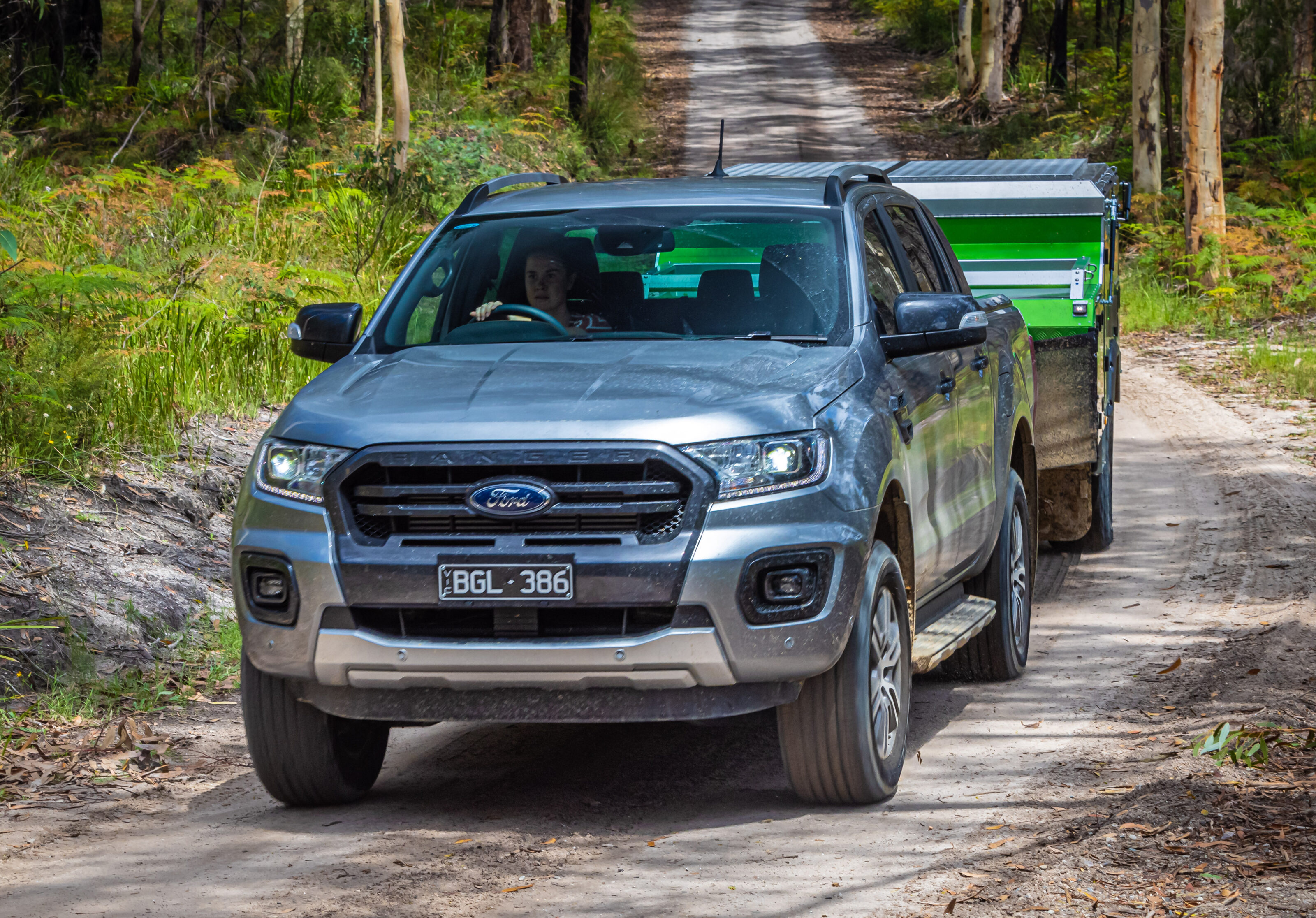
2. Ford Ranger: 25,336 sales
An all-new Ranger is due in 2022 but there’s clearly plenty of life left in the current version, which has increased sales by 37 per cent year-to-date. It leads the HiLux in the bigger, 4×4 ute segment – where it has been strong traditionally – though continues to trail its Toyota rival in the 4×2 category despite 91 per cent growth. Remarkably, the Ranger currently accounts for two out of every three Fords sold in Australia.
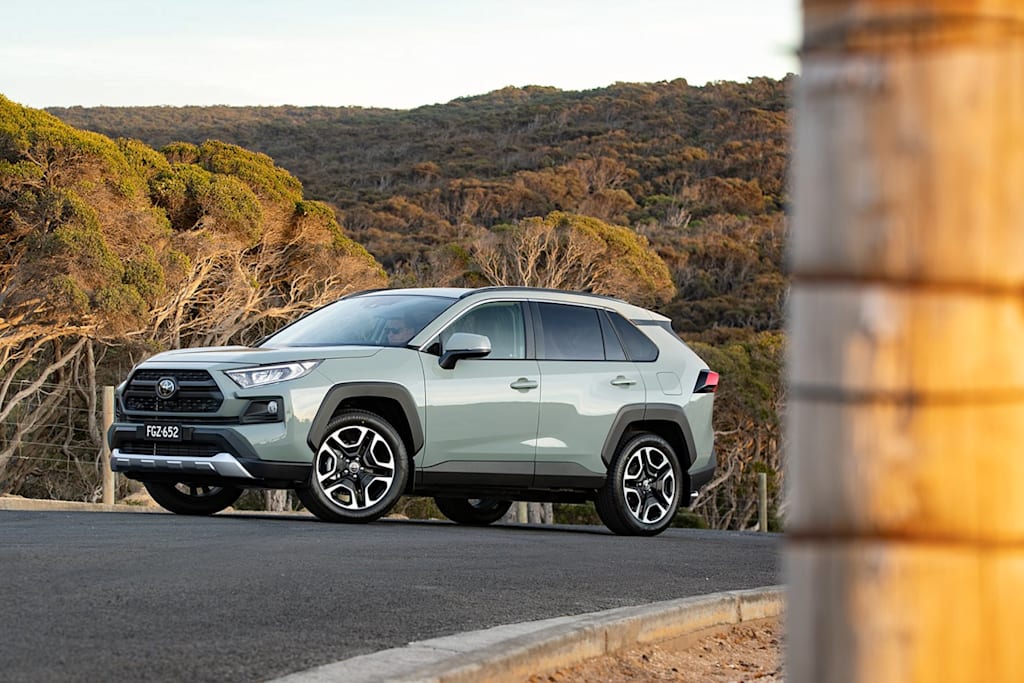
3. Toyota RAV4: 20,359 sales
Toyota’s mid-sized SUV retains it place on the sales podium, following up a strong 2019 and 2020 with 31 per cent year-to-date growth powered predominantly by the model’s first ever hybrid variant. The first updates for this generation were recently announced, though don’t arrive until 2022.
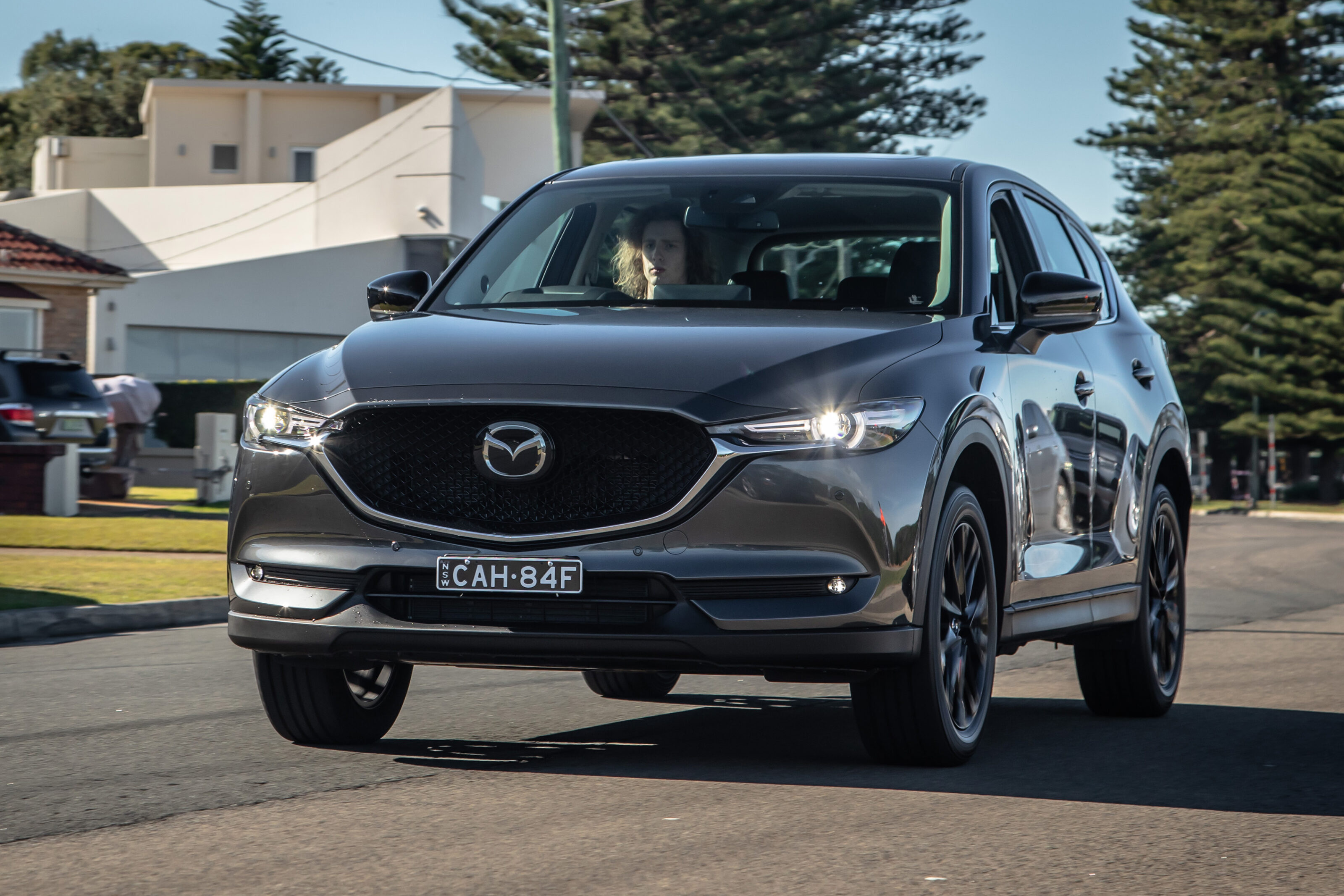
4. Mazda CX-5: 15,290 sales
Mazda’s CX-5 was replaced by the RAV4 as the country’s favourite SUV in 2020 but is making a small fightback with 50 per cent growth so far in 2021. It’s also the most popular Mazda by a long shot; next is the CX-3 with 8985 sales. A significant update for this generation of CX-5, first introduced in 2017, is expected in 2022.
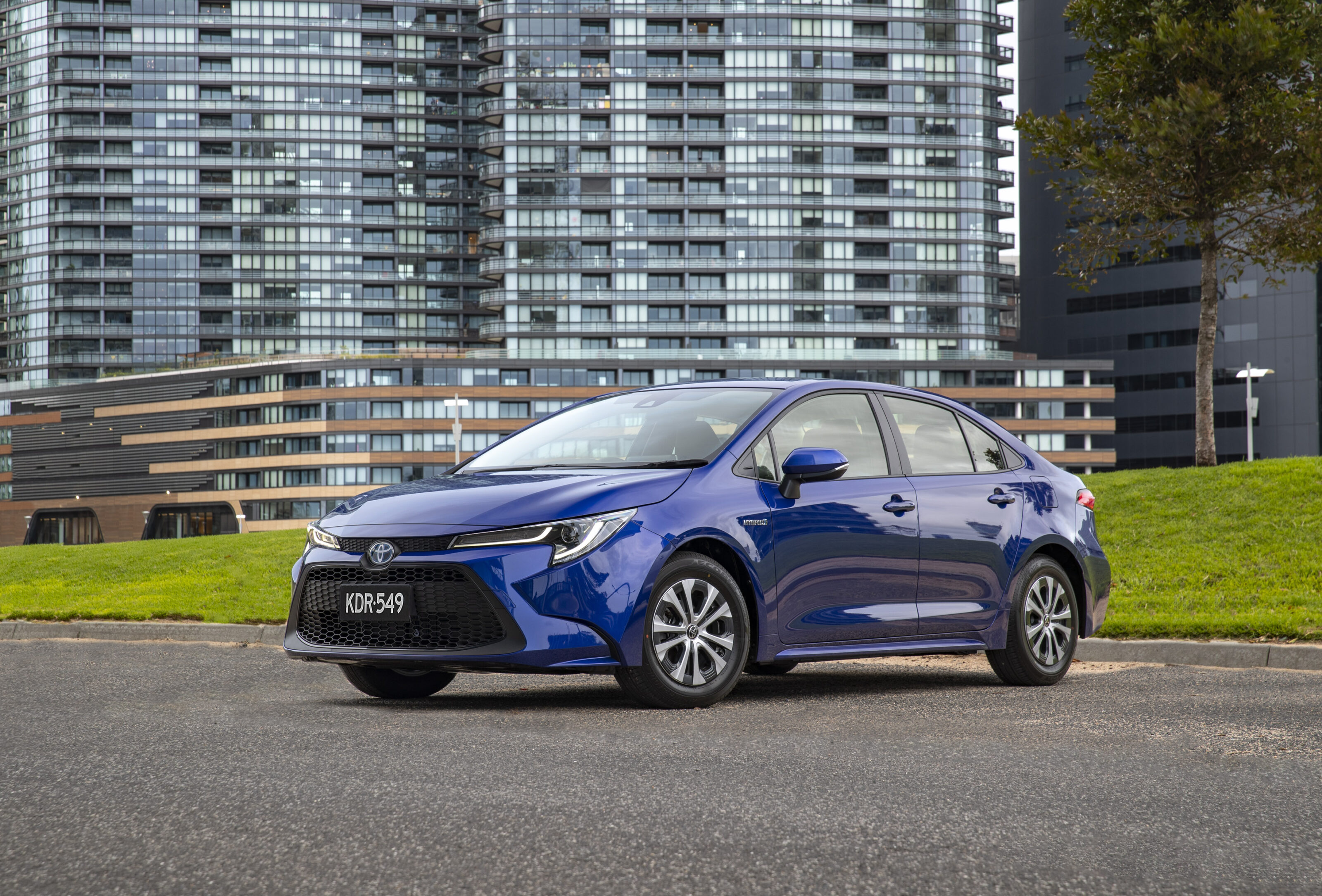
5. Toyota Corolla: 13,819 sales
The veteran nameplate has the smallest growth of any of the top 10 models – a measly two per cent. That’s seen the Corolla slip from its fourth place of 2020 to fifth, and on the verge of being overtaken by another two utes. The rival i30 is not far behind, either, and putting in danger the Corolla’s hopes of being Australia’s best-selling passenger car for a ninth consecutive year.
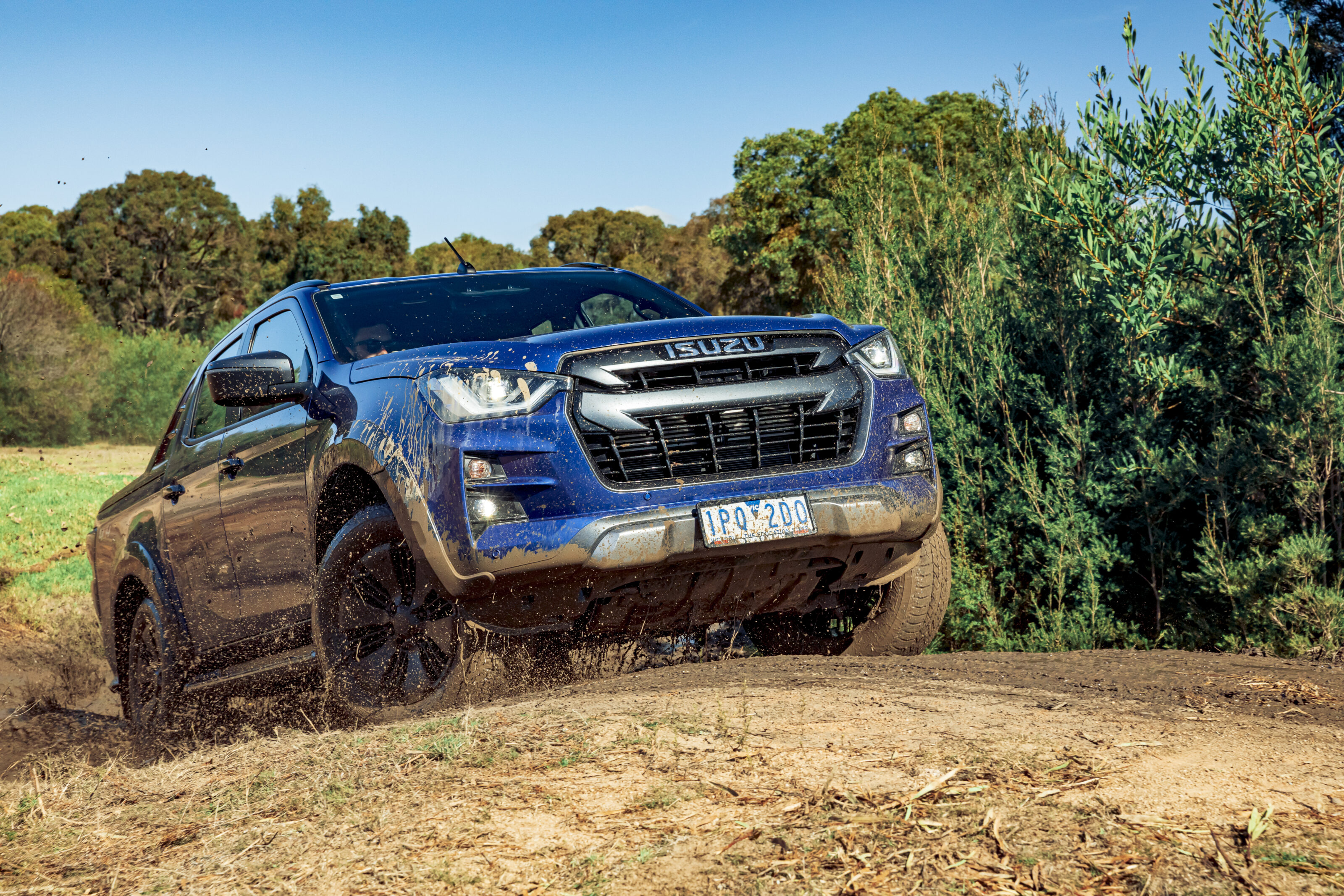
6. Isuzu D-Max: 13,805 sales
The undoubted sales star of 2021 is the new-generation D-Max ute, introduced in 2020 and still going gangbusters. With triple-digit year-to-date growth (109 per cent), the D-Max has stormed into the top 10. In June it was the third most popular model, forming a rare trio of utes with the HiLux and Ranger in the top three places.

7. Mitsubishi Triton: 13,176 sales
Unlike the D-Max, Mitsubishi’s ute is no stranger to the top 10 and it currently holds the seventh position it occupied at the end of last year. Sales are strong – up 37 per cent to be above the overall market’s rise (28 per cent).
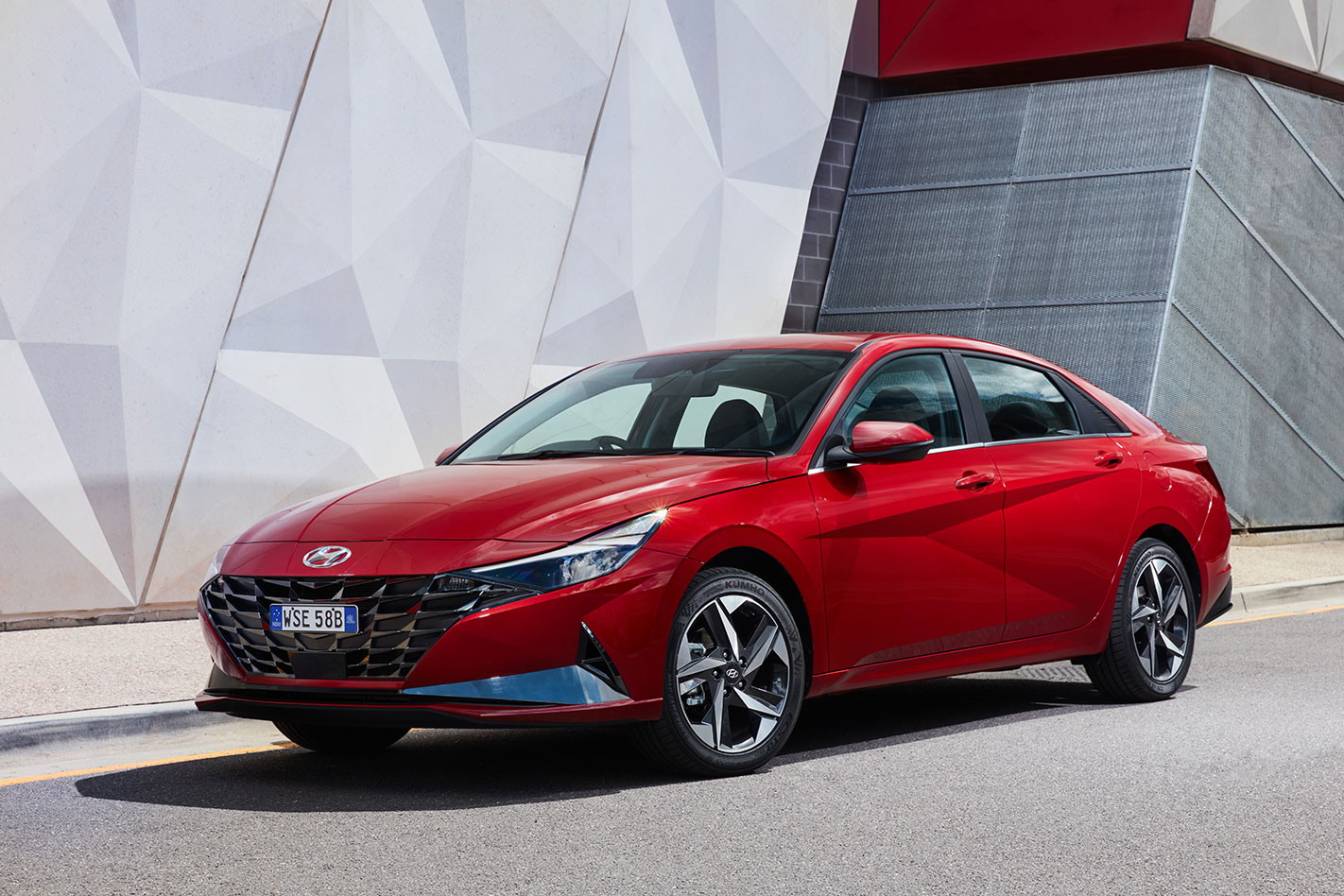
8. Hyundai i30: 13,139 sales
Sales of the i30 have benefited from the Elantra becoming the i30 sedan – which it always effectively was. Even accounting for that change, i30 still has useful growth (up 28 per cent) and its market share has increased from 18 to 25 per cent. The i30 was given a refresh earlier this year and more variants are coming, including updated N performance models. At the halfway stage of 2021, the i30 is less than 700 units behind the Corolla. Could it become the best-selling small car (and passenger car) by the end of the year?
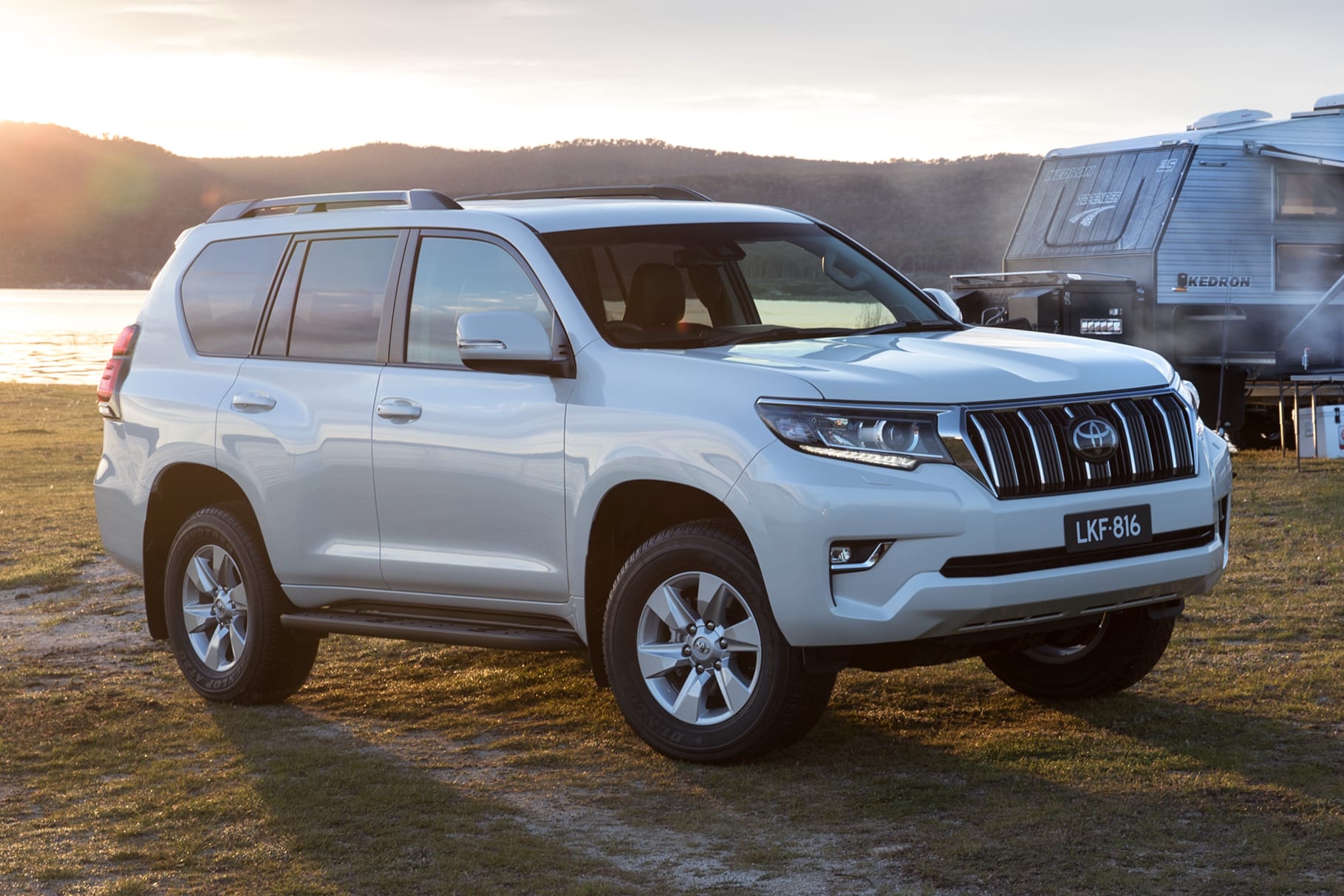
9. Toyota LandCruiser: 11,821 sales
The second unexpected model in the top 10. Huge demand for the last V8 versions of the LandCruiser 200 Series has driven 69 per cent year-to-date growth for the off-road icon, which was the fourth most popular model locally in April (and fifth most popular in June). An all-new 300 Series arrives later in 2021, swapping the V8 diesel for a twin-turbo V6 diesel. Just as remarkable is that the LandCruiser outsold the Prado which has now been pushed out of the top 10 chart (10,171 sales).
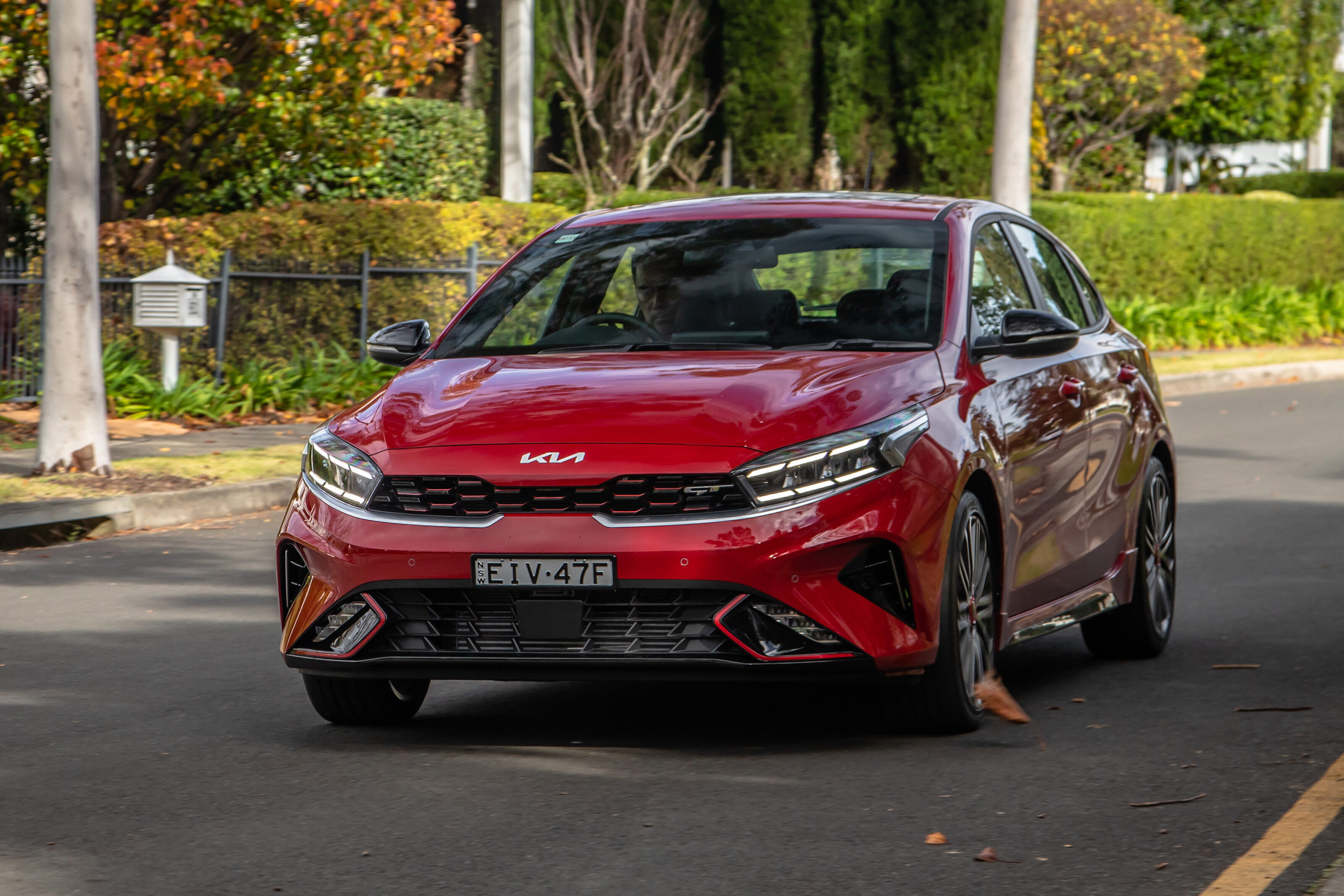
10. Kia Cerato: 10,756 sales
Australia’s favourite Kia maintains its top 10 status, if not that far ahead of the 11th-placed Prado. While the Cerato hasn’t featured in every monthly top 10 chart, the small hatch/sedan range has a respectable 20 per cent growth so far in 2021. A recent facelift should also help sales in the second half of the year.
