
Snapshot
- NSW Government’s EV subsidy comes into effect from September 1, 2021
- Up to 25,000 eligible EV buyers can receive a $3000 rebate in NSW
- Scheme will make the MG ZS EV the first new electric vehicle in Australia to fall under the $40,000 mark
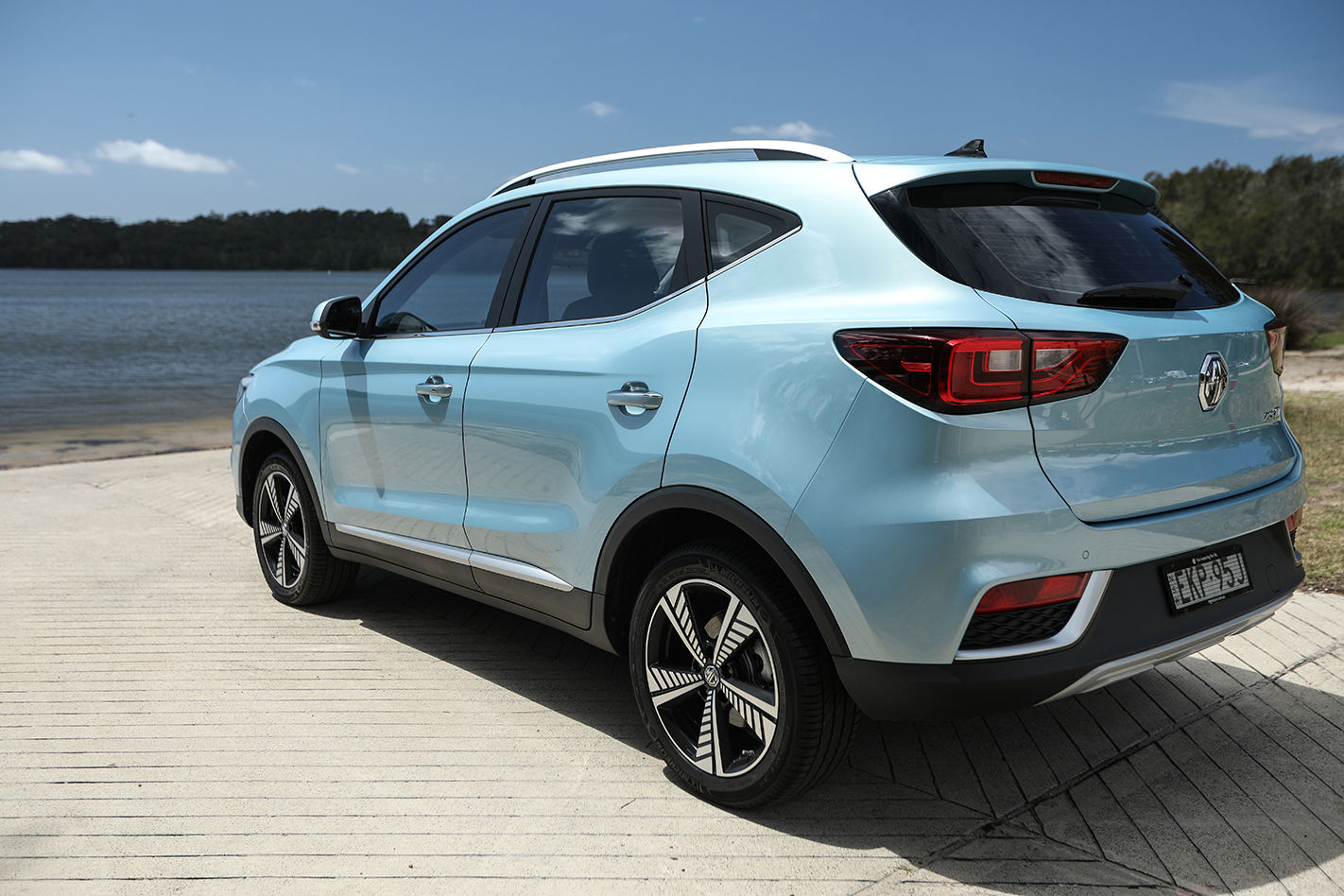
Thanks to the New South Wales Government’s new electric vehicle subsidy, the cheapest EV on the Aussie market, the MG ZS EV, just got even cheaper.
Under the new statewide EV scheme, NSW will provide 25,000 eligible buyers with a $3000 rebate and will also ditch stamp duty on electric cars valued up to $68,750. The abolition of stamp duty will also apply to EVs valued at up to $78,000.
This means buyers in Australia’s most populous state could conceivably pay as little as $39,670 drive-away for MG’s electric SUV, which normally retails for $43,990 drive-away.
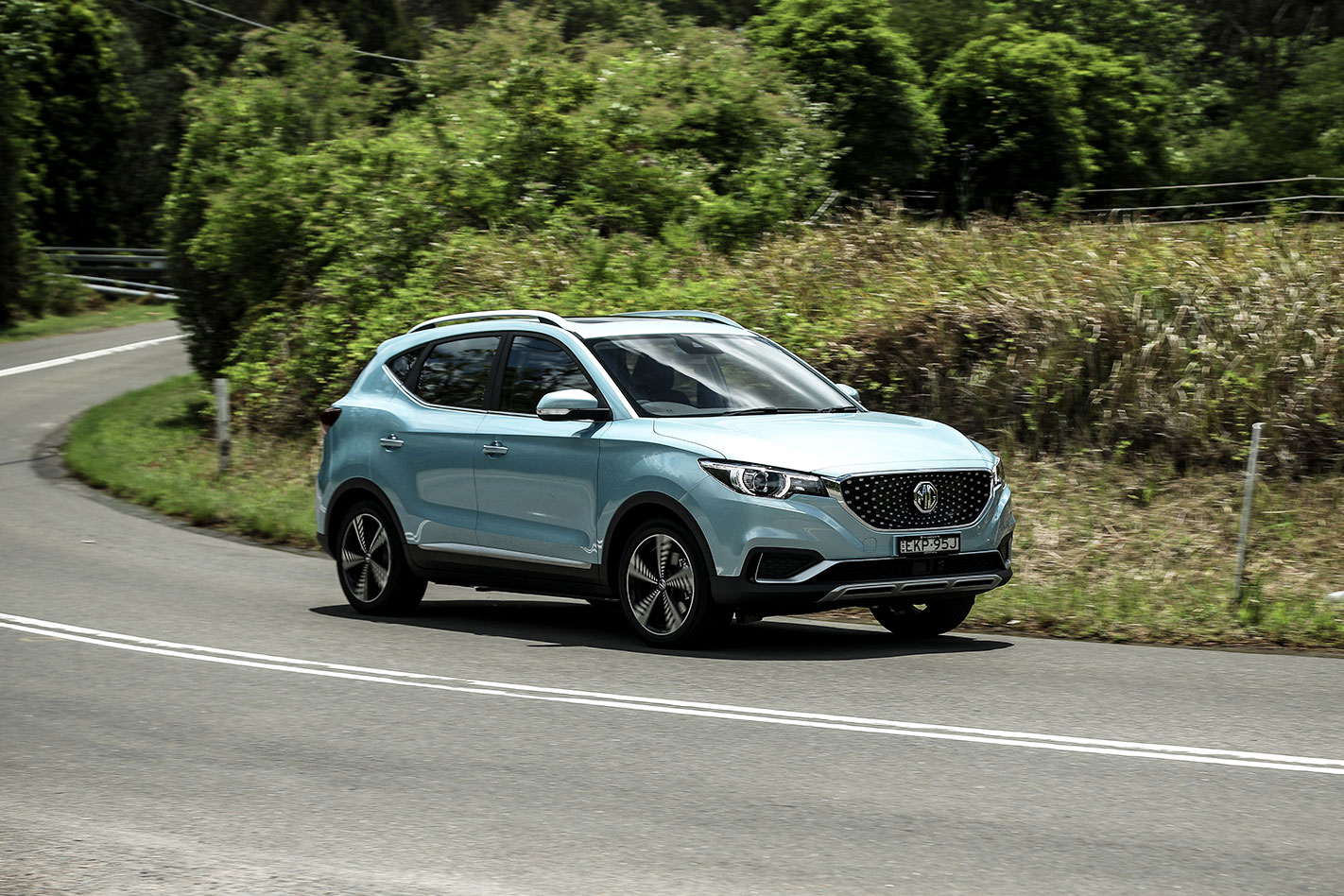
A brand-new EV dropping under the $40,000 barrier in Australia represents a significant turning point in the cost-effectiveness of solely battery-powered vehicles and could incentivise more buyers to adopt the efficient form of personal transportation.
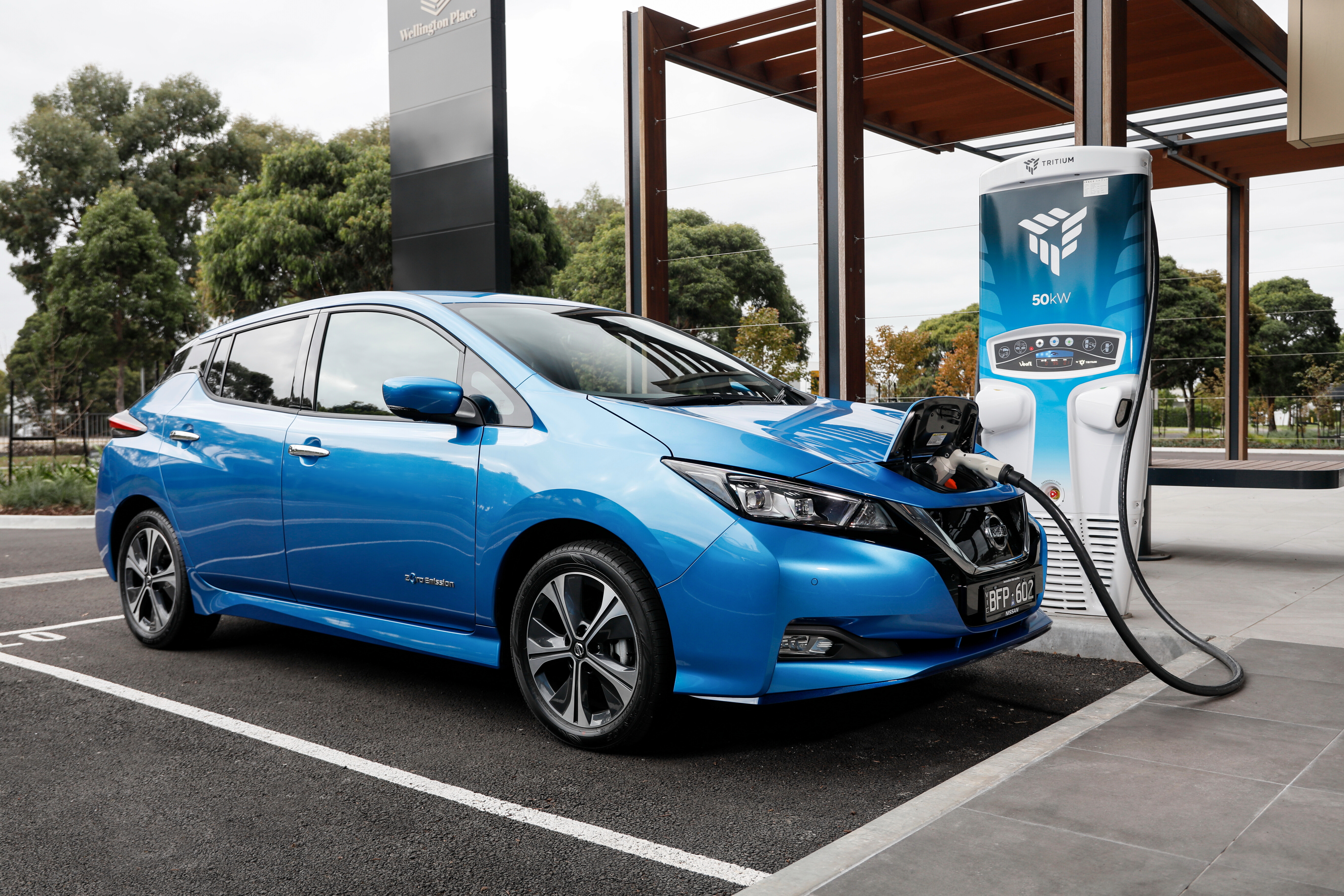
Nissan’s popular Leaf electric hatch will be the next most affordable option, with the NSW government’s incentives dropping its drive-away price to around $48,700 – a meaningful saving against its usual price of $49,990 before on-road costs, which in NSW would normally mean a drive-away price of $53,190.
The EV subsidy and stamp duty abolition is part of the NSW Government’s recently announced $490 million Electric Vehicle Strategy and will come into effect from September 1 of 2021.
“This is a vital and welcome initiative from the NSW Government to support the continued roll-out of electric vehicles,” Peter Ciao, MG Motor Australia and New Zealand CEO, said.
“At MG, we believe in Electric For Everyone, and this government subsidy program will give many more people the chance to experience the benefits of electric motoring for themselves.
“We look forward to offering our support to the Minister for Energy and Environment’s office, as MG accelerates its own plans to support infrastructure roll-out in NSW and across Australia.”
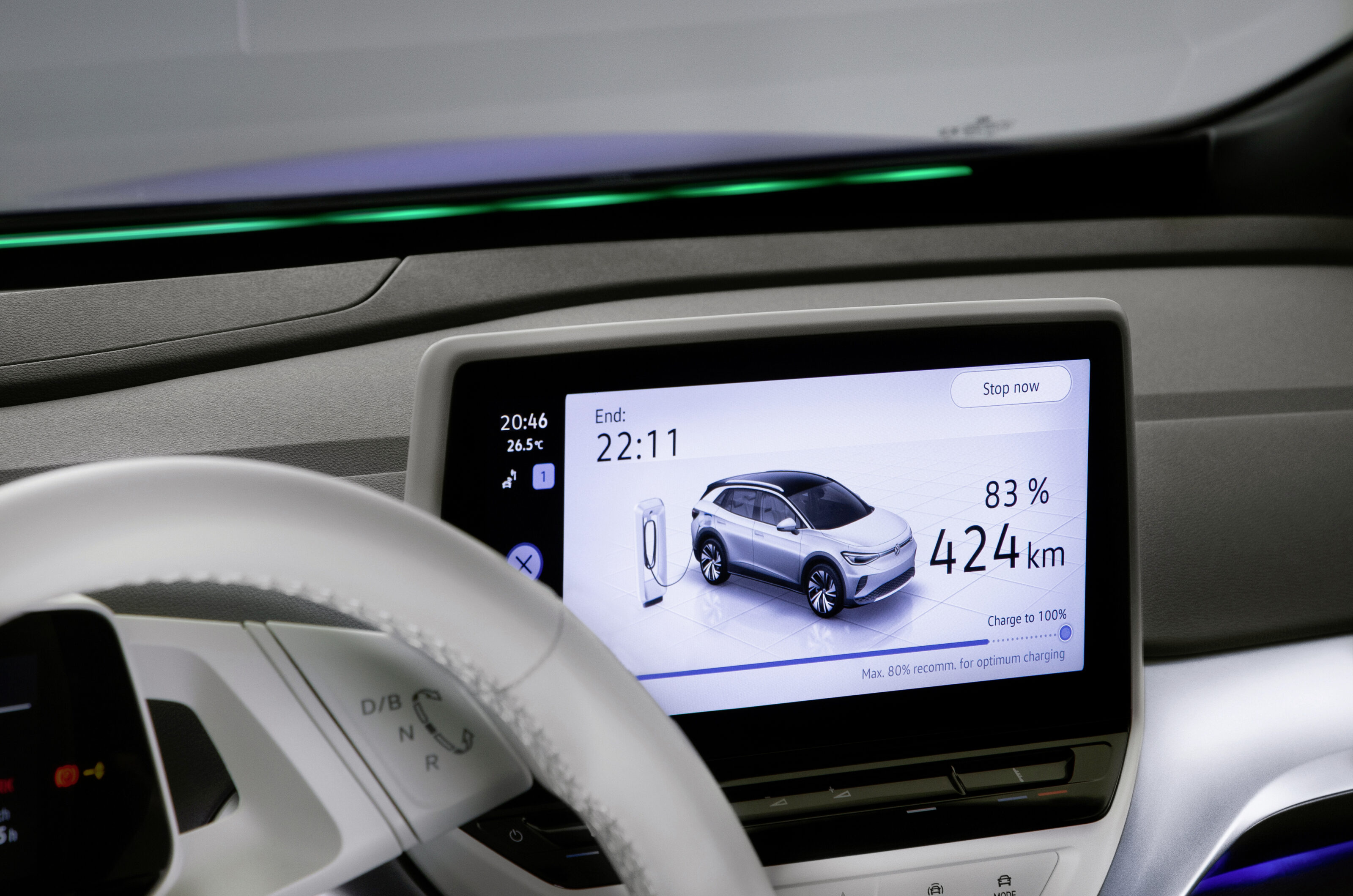
The Berejiklian government’s Electric Vehicle Strategy will also see the State spend a whopping $171 million investment in charging infrastructure, including introducing “ultra-fast” chargers, which could be capable of adding 400 kilometres of driving range in just 15 minutes.
EV buyers in Victoria should be able to cash in on a cheaper EV deal too, with the Andrews Government announcing a $3000 subsidy for electric vehicles valued up to $68,740.
However, unlike NSW, only 4000 Victorians will be able to take advantage of the cashback scheme in 2021, which will eventually apply to a total of 20,000 EV sales over the next three years.
UPDATE, March 29 2023: Australian timing confirmed for ID models
Volkswagen Australia has today confirmed local launch timing for its ID.3, ID.4, ID.5 and ID.Buzz models – get all the details at the links below.
November 2022: ID.4 driven in Australia!
We’ve now had a chance to drive an overseas ID.4 car in Australia. Get our full story at the link below.
Story continues…
Snapshot
- VW’s new electric van spied in production body
- Specs unclear, but 550km driving range expected
- As with all ID models, Australian potential is unclear
The upcoming Volkswagen ID Buzz electric van, previewed first in people-mover form back in 2017 and again as a commercial van in 2018, is finally nearing its global debut as a production model.
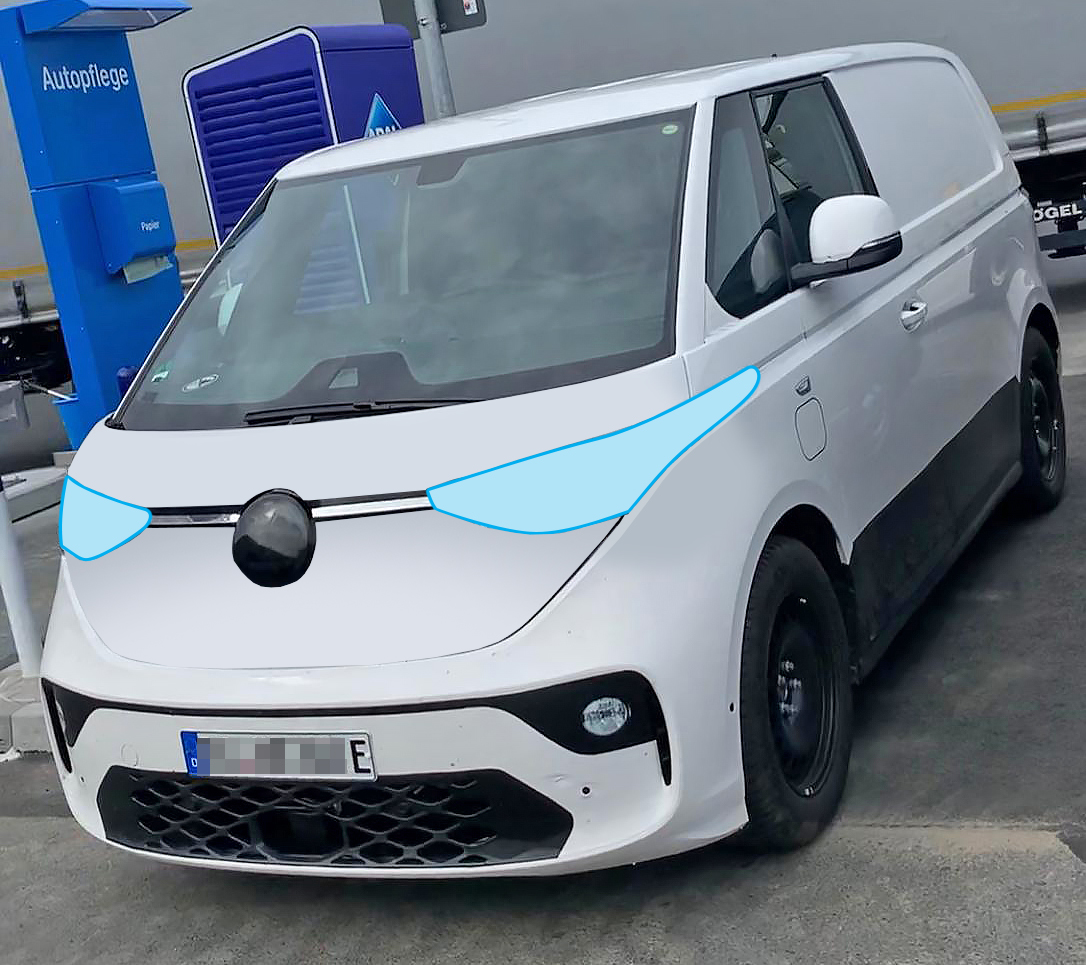
These spy photos – posted to Instagram by user red.david and shared with us by spy photography group CarPix – show the upcoming electric van in its load-hauling form, wearing bodywork fairly loyal to its original concept progenitors, with a twist.
More than most brands, Volkswagen has a bit of a thing for dressing its prototypes with camouflage designed to look like another carmaker’s wares – often of the French variety, with its upcoming ID.6 large SUV recently spied in a Peugeot costume.
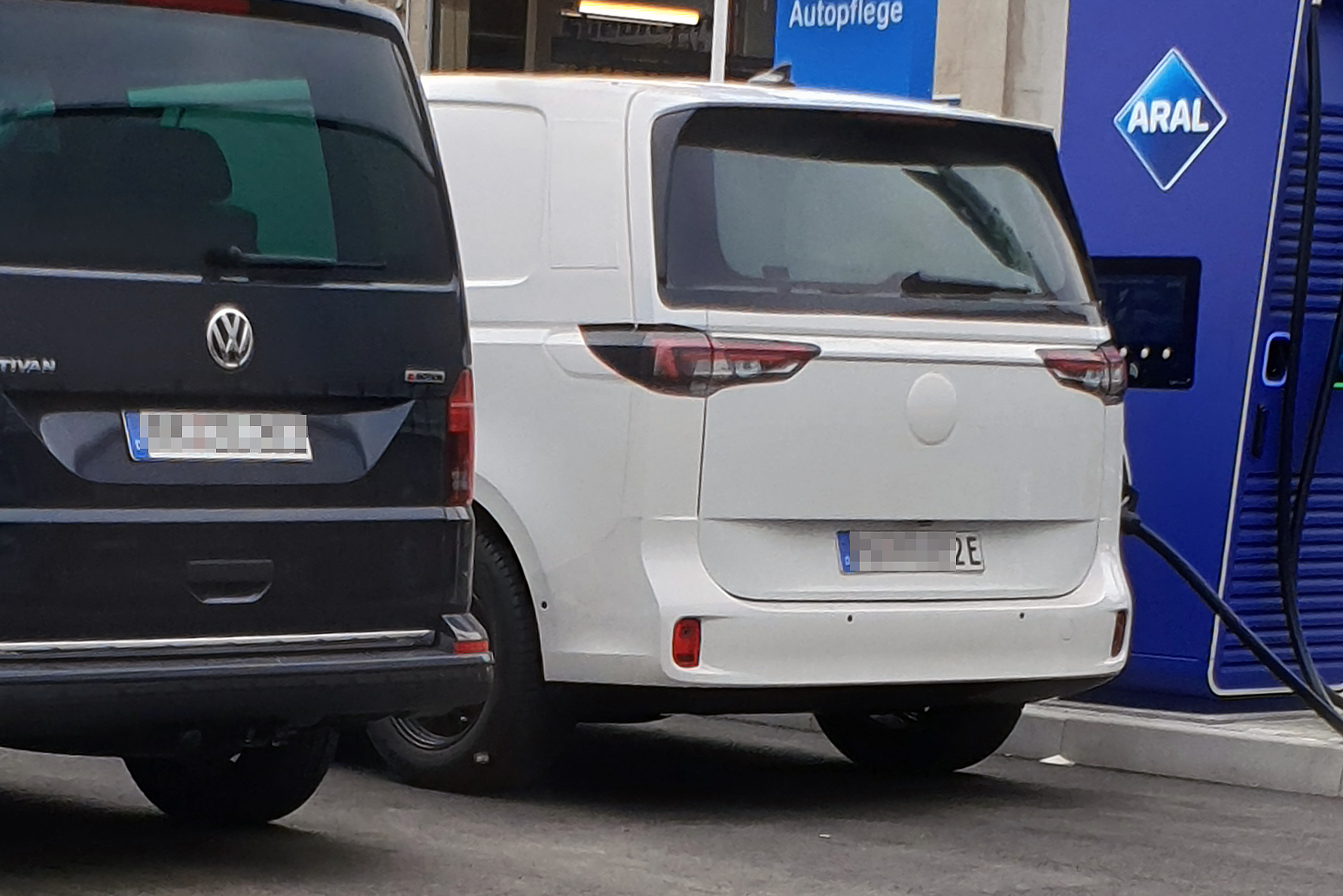
This time around, VW’s latest upcomer is wearing a Renault look up front and, interestingly, Opel lighting graphics at the rear.
Although a German brand, Opel is now owned by multinational group Stellantis, which grew out of the merger between France’s PSA Group and the Italian-American group Fiat Chrysler Automobiles.
For some clarity on what lies beneath, this writer’s humble attempt at a quick bit of Photoshop action offers a look at how the ID Buzz’s front end is likely to look – although the details around the inside edge of the headlights could appear different in production.
As for what we’ll find even further beneath the skin, the ID Buzz will ride on Volkswagen’s EV-focused MEB architecture, with an all-electric driving range of around 550 kilometres – depending on the battery size, drive configuration, and variant.
In concept form, the commercial version of the ID Buzz boasted capacity for an 800kg payload in the rear (the existing Transporter, a larger vehicle, offers a minimum of 964kg), along with a solar panel in the roof for incremental range benefits and accessory power.
For more on the ID Buzz concepts, the wider ID range, and Volkswagen’s plans for electrification in Australia, see our links below.
https://www.instagram.com/p/CQlefAOr5JI/
People might think the substance of Alfa Romeo’s 111-year heritage centres around its sporting coupes, its iconic engines and its historic race cars, but they would be ignoring a huge part of its success – bread-and-butter small cars.
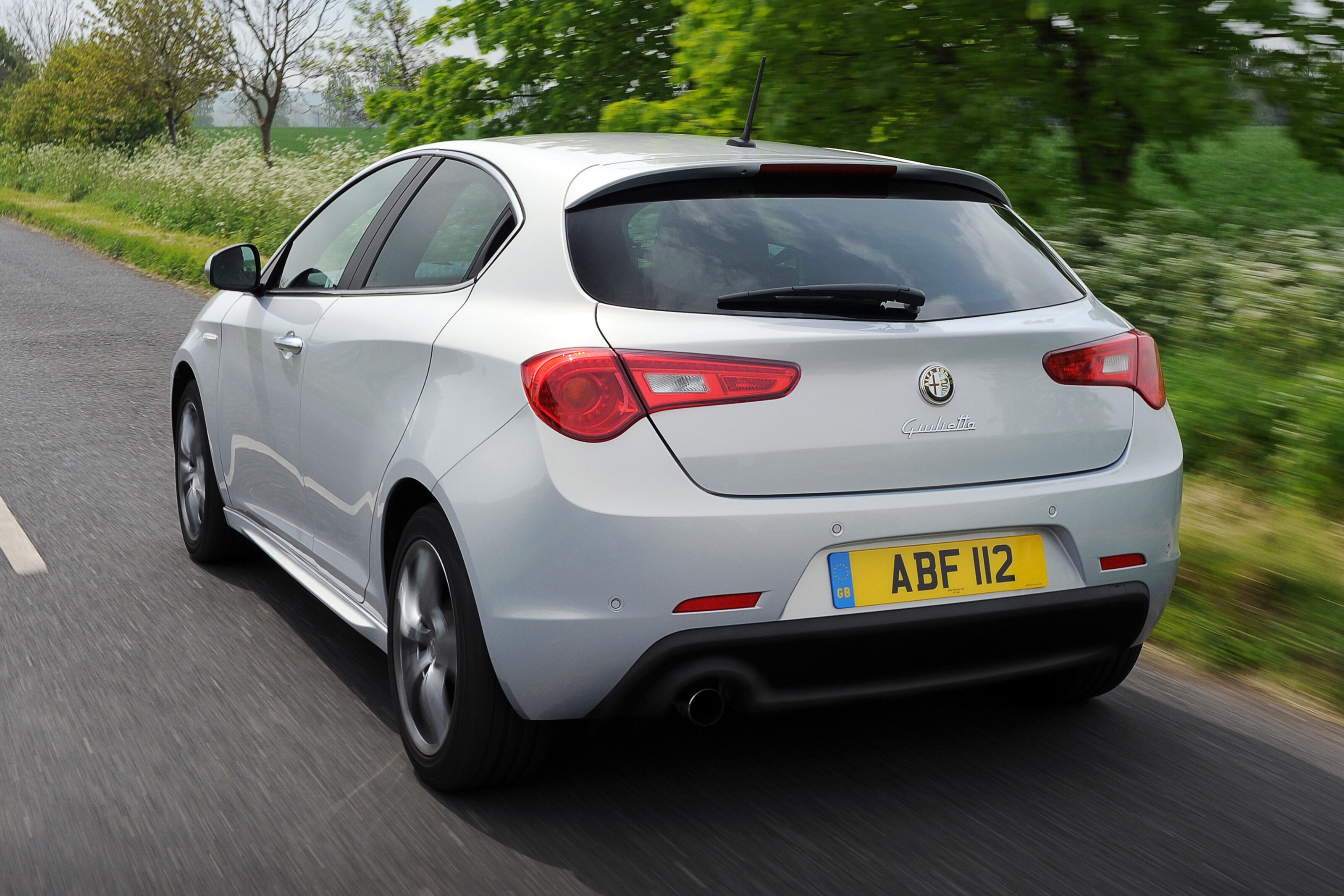
Kicking off with the super-pretty Giulietta Berlina in 1955, it’s somewhat fitting that Alfa’s small-car lineage has ended with the death of the latter-day Giulietta (2010-21), and not just because both those cars share a name. While never quite attaining the critical highs of the Alfasud or expanding on the sales fortunes of its immediate 147 and 145/146 predecessors, the modern Giulietta hatch was a bloody good car.
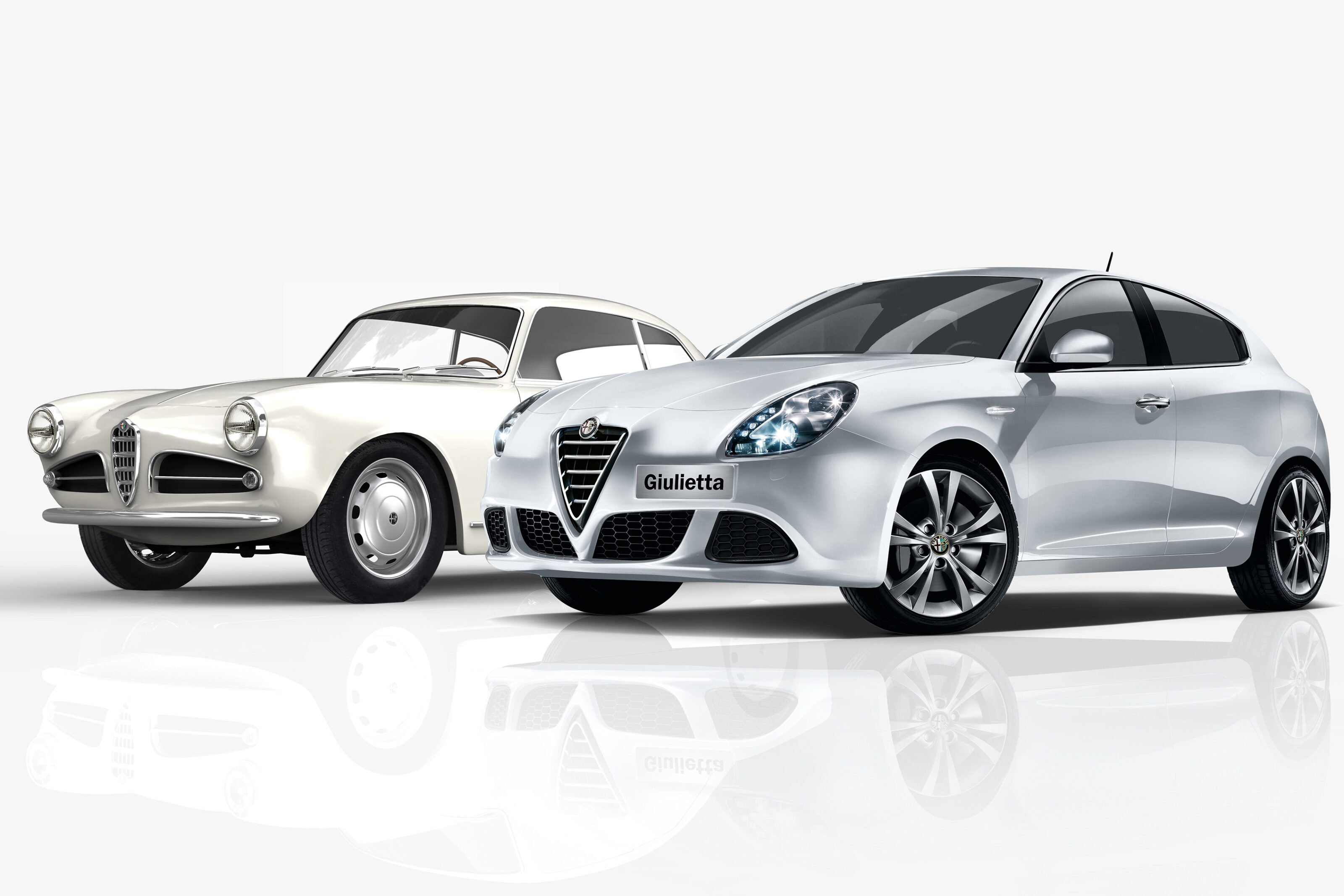
Internally dubbed Tipo 940, the Giulietta was based on the C-Evo platform, a development of the architecture that underpinned Fiat’s lacklustre Stilo (2001-07) and Bravo/Ritmo (2007-14). That’s an inauspicious beginning for what the Italians hoped would be a proper premium rival for the Audi A3, BMW 1 Series, Mercedes-Benz A-Class and Volvo V40, though the Giulietta benefitted greatly from substantial improvements, including junking the Fiat’s torsion-beam tail for proper multi-link independent rear suspension.
That investment in the Giulietta’s dynamics produced a lithe, involving hatchback that truly handled – some variants better than others, though all with proper Italian brio. Some variants also rode and steered better than others, those characteristics usually inversely proportional to each other. The same applied to the engines.
Investment in the Giulietta’s dynamics produced a lithe, involving hatchback that truly handled – some variants better than others, though all with proper Italian brio.
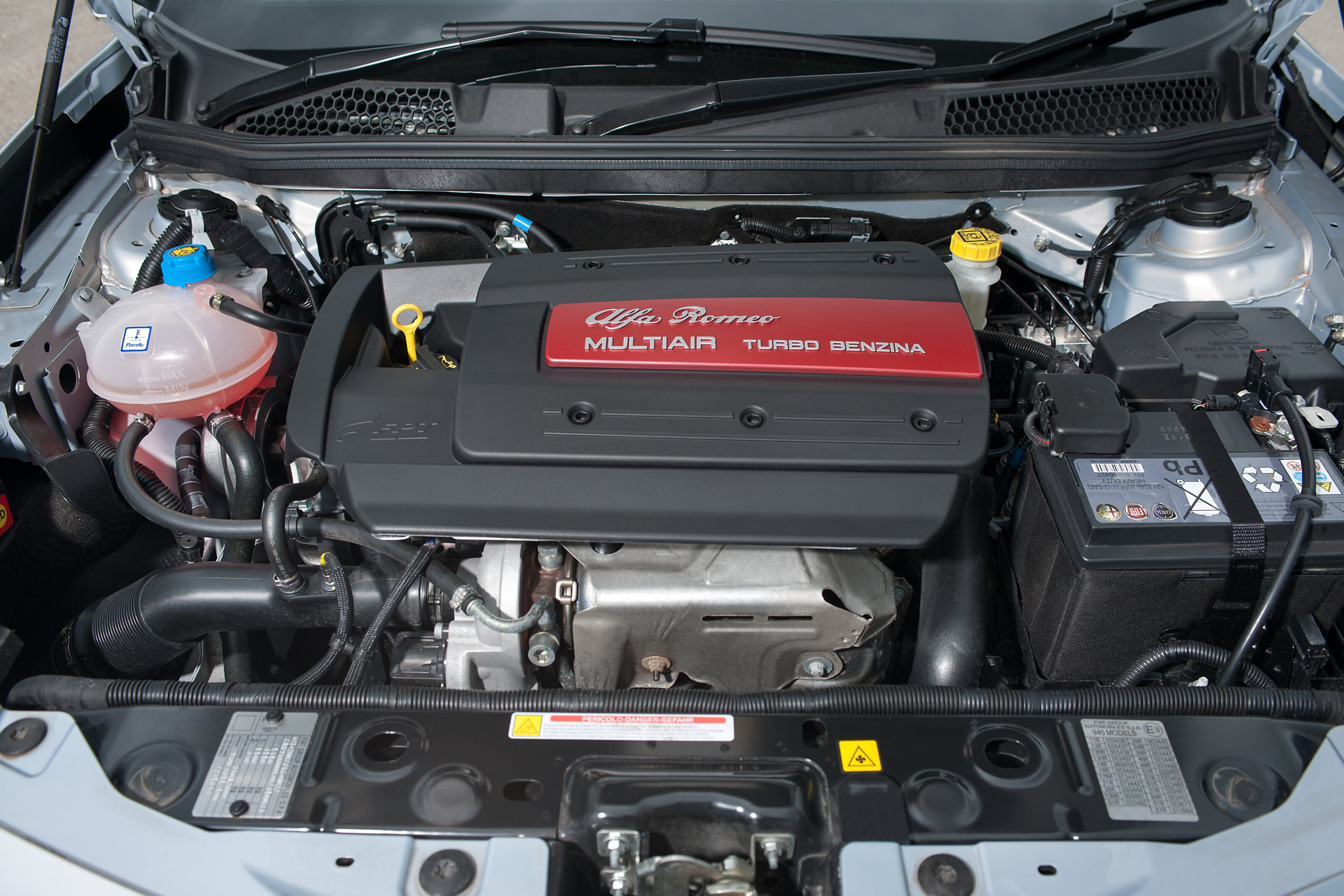
The 88kW 1.4 turbo was a torquey, effortless delight – the 125kW version keener and fruitier but also laggier down low – while the 173-177kW direct-injection 1.7 turbo from the QV and later Veloce had real balls, though perhaps not quite enough induction fizz. There’s also the matter of transmissions, with Alfa’s six-speed manual proving spirited and slick, whereas the six-speed dual-clutch – the only ’box offered in Australia during the Giulietta’s final years – was nowhere near as satisfying.
But what mattered most, both at launch and well into the future, is how the Giulietta looks. Penned by Lorenzo Ramaciotti while head of design at Centro Stile in Turin, the Giulietta’s gorgeously timeless shape remains unsurpassed by any competitor. Even at 11 years of age, it’s every bit as stylish and seductive as it was on day one.
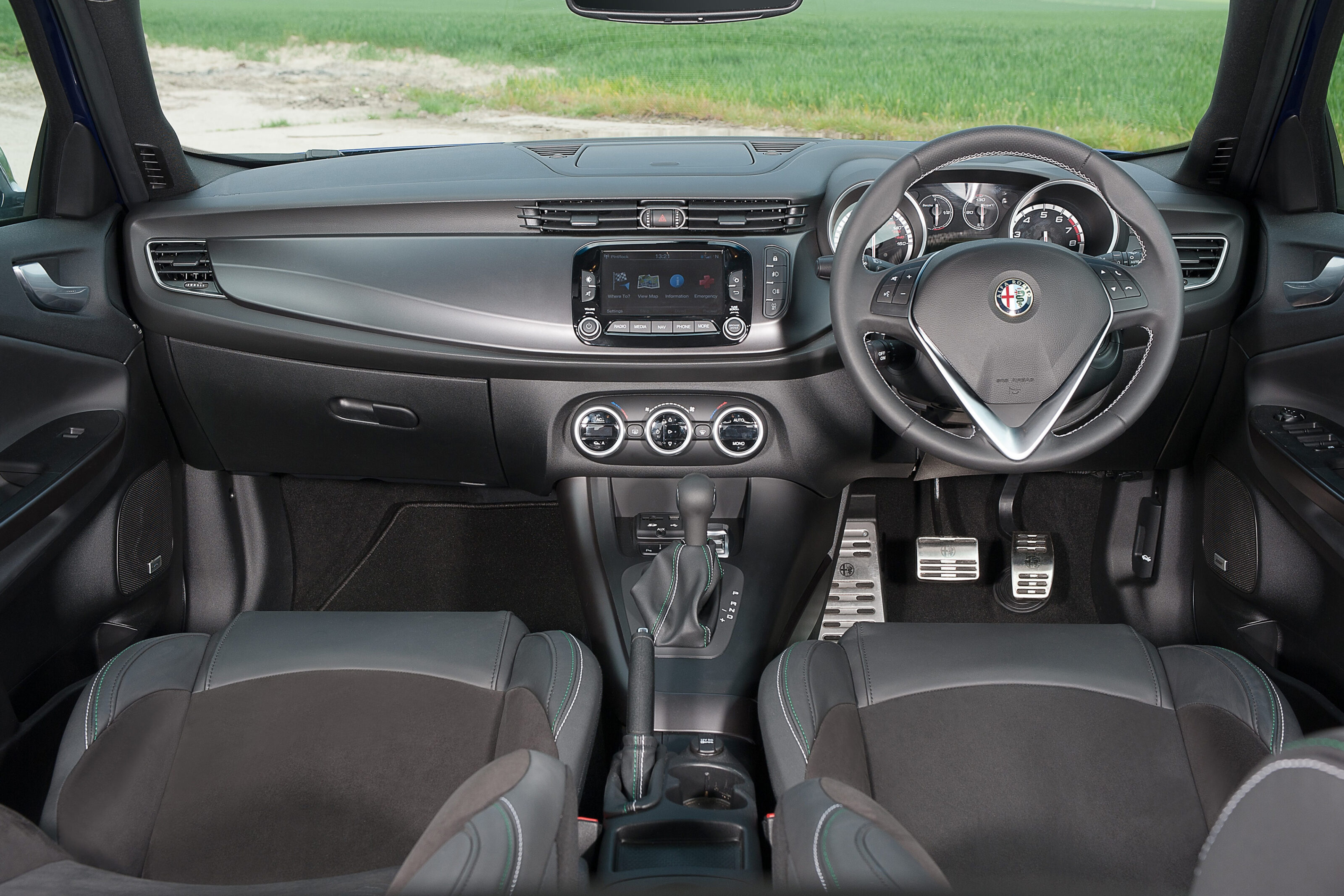
Yet, despite all that beauty and a decent level of talent, the Giulietta wasn’t a panacea for Alfa. In its last full year, the Giulietta achieved a paltry 10,718 sales across Europe, though that was 30 percent of Alfa Romeo’s total European volume, which must be slightly terrifying for the shiny bums at Stellantis.
Without a replacement player in Europe’s still-lucrative C-segment, Alfa Romeo is investing all its energy in a forthcoming small SUV called Tonale. More’s the pity, really, because the beautiful Giulietta deserves better than that.
Alfa Romeo Giulietta – Aussie Sales and why it was discontinued
Aussie sales of the Alfa Romeo Giulietta (2010 – 2021)
| Australian sales for the Giulietta | |
|---|---|
| 2010 | 14 |
| 2011 | 526 |
| 2012 | 610 |
| 2013 | 1949 |
| 2014 | 2268 |
| 2015 | 1272 |
| 2016 | 639 |
| 2017 | 389 |
| 2018 | 297 |
| 2019 | 169 |
| 2020 | 120 |
| 2021* | 35 |
*January to March 2021
Walking the Line
Giulietta’s lunge towards extinction began in 2019 when European volume fell below 20,000 (its record was 78,911 sales in 2011). But, to the Giulietta’s credit, it outlived most of its Fiat-Chrysler platform relatives, in particular the US-market Dodge Dart and Chrysler 200. That pair cost US$1 billion to develop, with production ending in late 2016 – the 200 lasting just 30 months.
Snapshot
- California allows manual 911 GT3 after ban
- Both manual and semi-auto allowed in the state upon arrival
- Common sense scores a big win
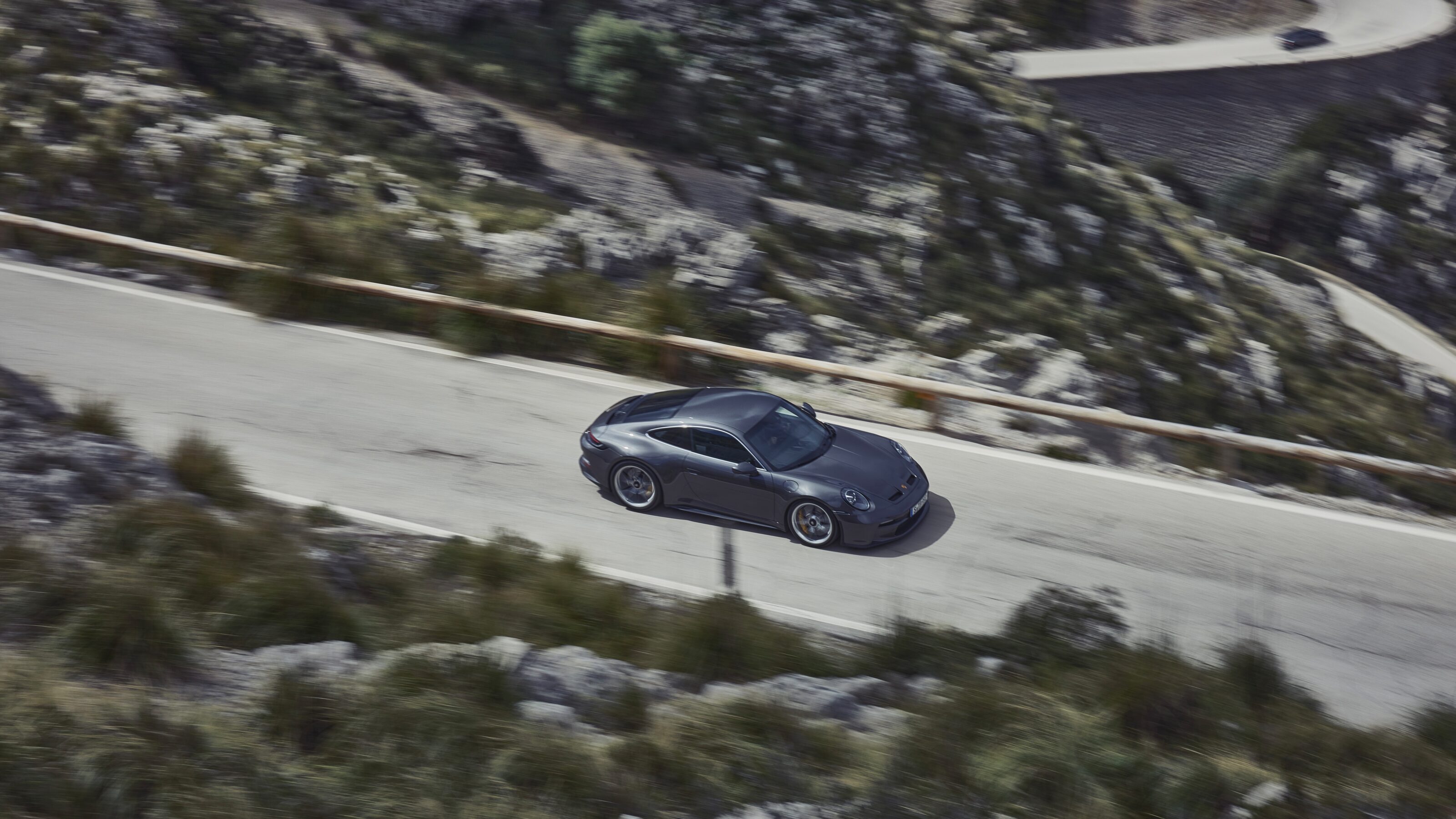
The manual version of Porsche’s new 911 GT3 is now allowed in the US state of California after local lawmakers admitted defeat – overturning a previous ban.
Off the back of the new wingless GT3 Touring’s launch two weeks ago, Porsche tipped off prospective buyers that the manual version would be unavailable in California due to the state’s soon-to-be-replaced noise emission regulations.
Despite the seven-speed dual-clutch passing, the three-stick did not pass local laws, with Porsche having to offer buyers a free upgrade to the paddle-based ‘box instead.
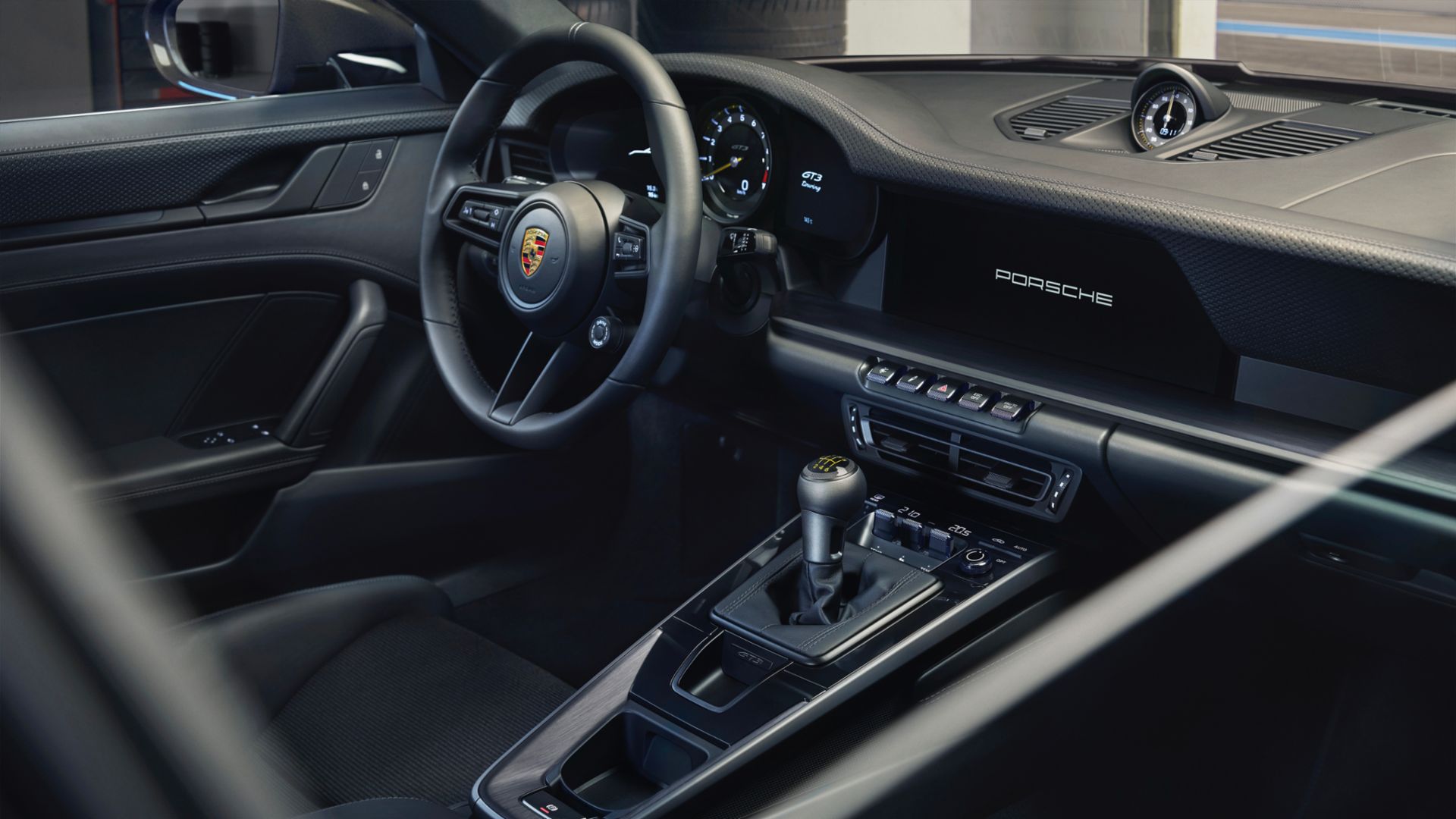
However, this week the German manufacturer’s North American arm announced the Californian Highway Patrol and Department of Motor Vehicles had brought forward the introduction of a new testing procedure which the manual GT3 has already passed, meaning it can go on sale on the country’s west coast.
In a statement to American publication Motor1, Porsche said it was pleased to work with the Californian lawmakers to reach an agreement for its customers to purchase the stick-shift GT3.
“Following consultations with California authorities, Porsche Cars North America is pleased to confirm its dealers will be able to sell the new 911 GT3 with a six-speed manual gearbox – meaning that, when the first cars arrive in the fall, they can be legally registered and driven in all 50 states.
“The work in the past week by the California DMV and California Highway Patrol to find a solution has been appreciated, and has helped to identify an appropriate regulatory path forward.
“On June 11, Porsche Cars North America received a notification from California Highway Patrol outlining its existing test procedure (SAE J1470, from March 1992) was obsolete, but it could not identify a procedural process to allow Porsche to test the new 911 GT3 equipped with a manual transmission through the modern test procedure (SAE J2805, from May 2020).
“Discussions with the regulators continued but without visibility to a solution we took the difficult decision to inform dealers the manual option would no longer be available in California, since there would be no way to legally register the cars in the state. We communicated this on June 15, coinciding with the planned announcement of the 911 GT3 Touring package.
“We thank California DMV and California Highway for their responsiveness and helping quickly to identify the appropriate regulatory path forward. The 911 GT3 arrives in the US in the fall, and will join 16 other model variants in the Porsche range which can be specified with three pedals.”
Both the manual and semi-automatic versions of the GT3 and GT3 Touring will be available in Australia, with a special 70 Years Porsche Australia Edition making its way Down Under to commemorate the brand’s local history.
It’s one of the worst feelings in the world. The crushing sensation of guilt and shame as you arrive to school on a Monday morning knowing that the assignment that’s due in a matter of moments isn’t completed. In fact, it’s not even close to being completed. It’s not like there wasn’t ample opportunity – there was weeks’ worth – but it just didn’t seem that pressing the week before, or last week, or even last weekend. There were so many other, more exciting, things to do – now there’s a price to be paid.
What does this have to do with cars? Well, the strict new European emissions regulations that for so long were a distant glow on the horizon are now high in the sky. The average CO2 emissions of a manufacturer’s entire passenger car fleet must now be below 95g/km lest they be hit with extraordinary fines; by 2025 that becomes 81g/km. For reference, a Mk8 Golf 1.5 TSI manual emits 122-130g/km CO2 under the stricter WLTP testing regime, so you can see the scale of the problem.
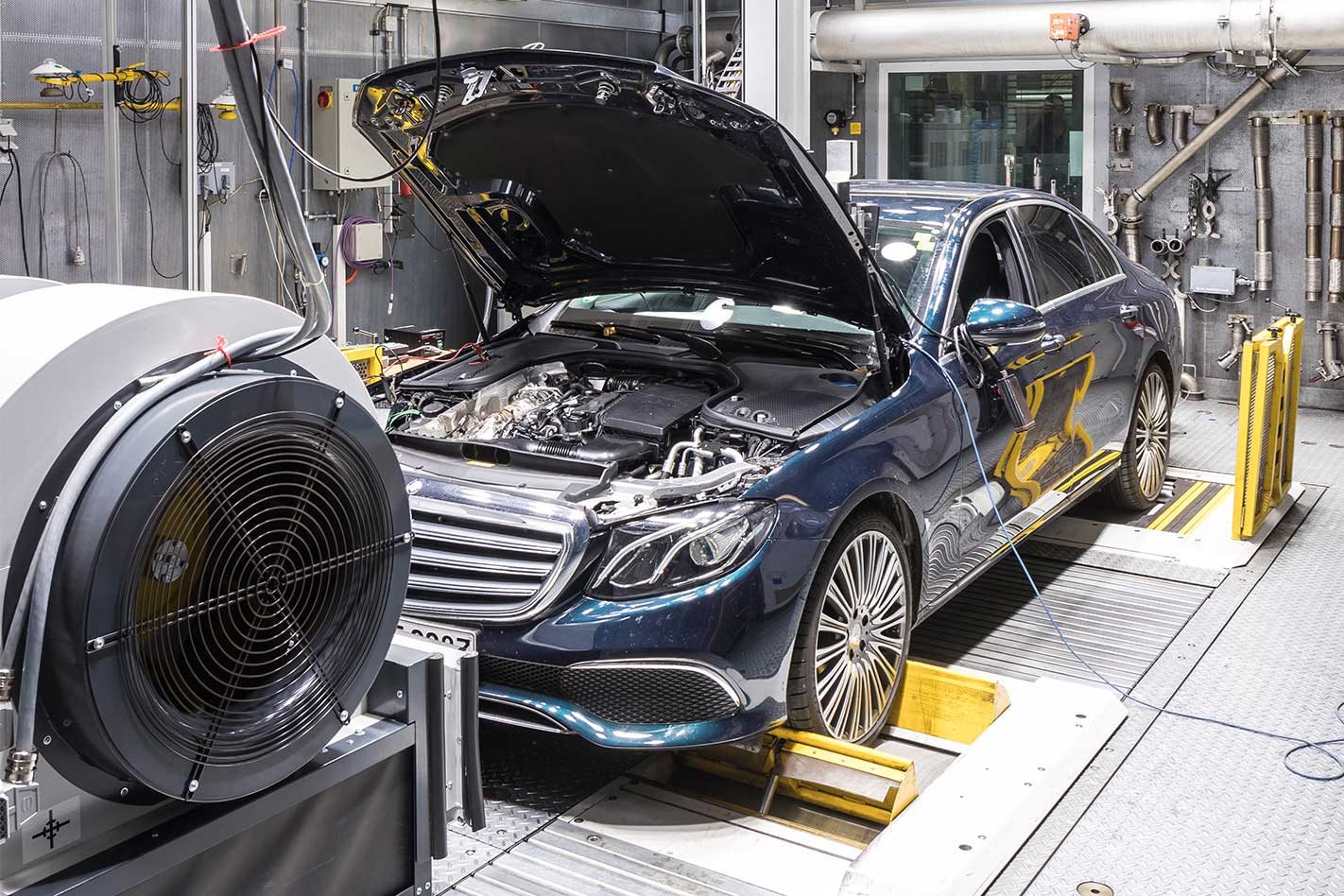
Manufacturers have responded in a variety of fashions. Most have committed to spending billions on fast tracking electric vehicles, VW for instance pledged AUD$118 billion (yes, with a ‘b’) to the production of 26 million EVs by 2030. Battery-powered sales are currently worth their weight in gold as every EV sold currently counts as two, though they don’t have to necessarily be purchased by customers. If you currently work for VAG, chances are your company car is currently running purely on electricity.
Others thought more laterally, albeit through necessity (see aforementioned AUD$118bn). Fiat-Chrysler, which is now part of the Stellantis mega-corp, joined forces with Tesla, spending 300 million Euros to include lots of zero-emission electric vehicles in its ‘fleet’. That EUR300m was considered the fiscally sensible option should give you some idea of the size of the potential fines for failing to meet the new standard.
Honda also dipped into Tesla’s fuel-free piggy bank of ‘emissions credits’. Elon.inc made a juicy US$1.58bn from this little venture in 2020, so it’s no surprise Renault, which is in dire financial straits but has met its emissions targets, is ‘open for business’ in terms of offering its surplus emissions credits while Chinese company SAIC is helping out Volkswagen.
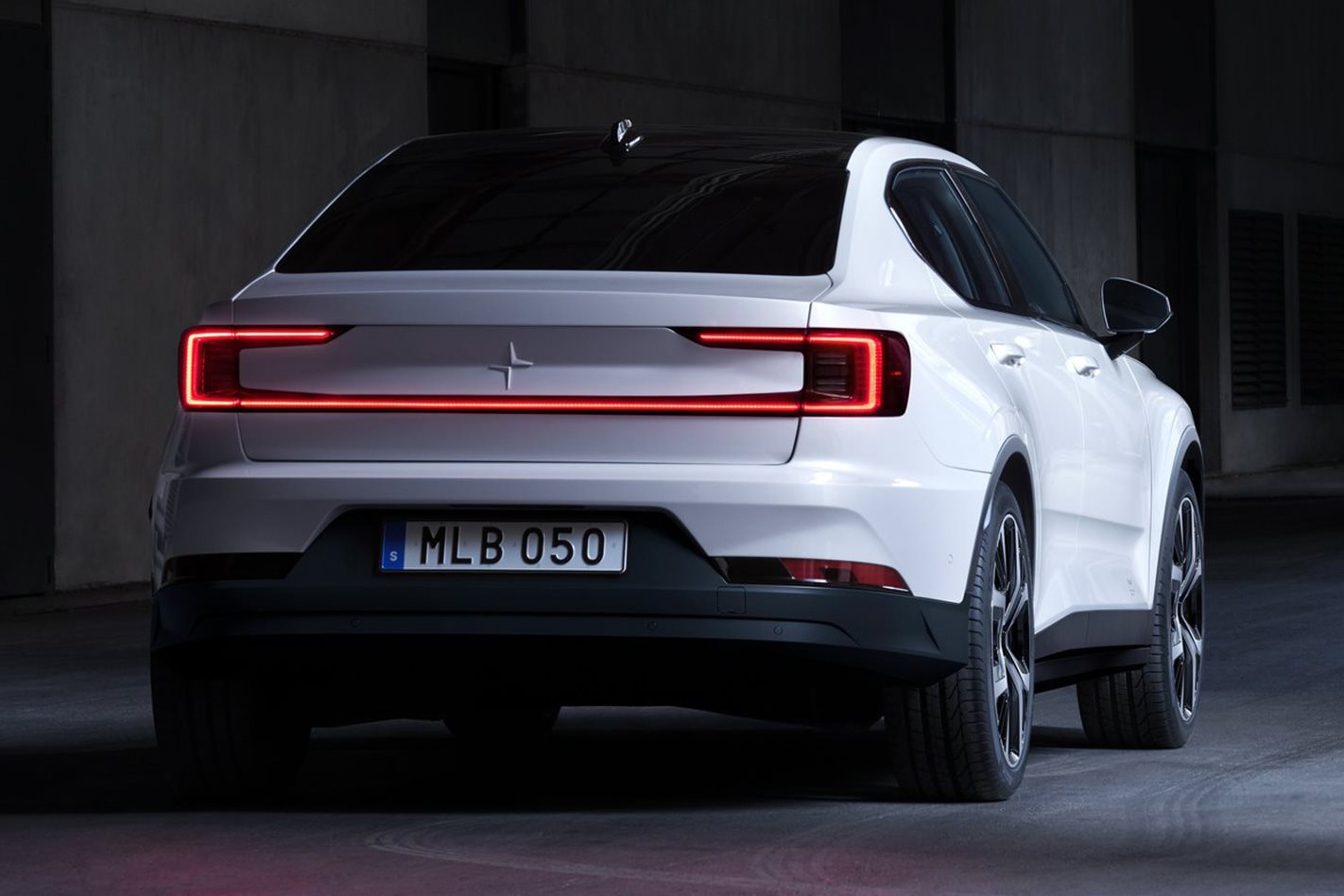
Manufacturers have also become vocal in offering alternatives to a purely battery-powered existence. Stellantis CEO Carlos Tavares told the Financial Times that the European emissions regulations were “narrow minded” and pushing manufacturers into new technologies before their total environmental impact had been understood. Polestar published a report stating its ‘2’ SUV would need to be driven 72,500km before its energy footprint was lower than a regular ICE Volvo XC40, though this figure varies wildly depending on whether the BEV is charged with renewable energy or not.
Porsche is spruiking synthetic fuels as an option, investing heavily in keeping the internal-combustion dream alive. Porsche’s sports car boss, Dr Frank Walliser, recently went on record saying that synthetic fuels could reduce CO2 outputs by 85 per cent, making them effectively as clean as an electric vehicle, though the cost and production difficulties will likely limit its use to low volume, specialist vehicles (such as Porsche’s GT-series 911s). It could keep the many millions of petrol-powered cars currently on the roads from being legislated into extinction, however.
My question is: where were these solutions five or 10 years ago? The fleet average CO2 emissions targets have been in the planning for years, but it seems that manufacturers have only responded when it’s basically too late, forcing them into the large-scale production of BEVs before the market or infrastructure is ready.
Rather than weaning themselves and customers off petrol, car makers are now forced to go cold turkey, having grown addicted to the fat profit margins of heavy, super powerful SUVs. The news doesn’t get any better, either, Autocar reporting that there is a push for the current target of a 37.5 per cent reduction in 2021 emissions by 2030 to be increased to 50 per cent. Those manufacturers better get studying.
Are you shopping for a gift, or just for yourself? We’ve rounded up the coolest car products we’ve come across on our travels across the world wide web in one handy place for you.
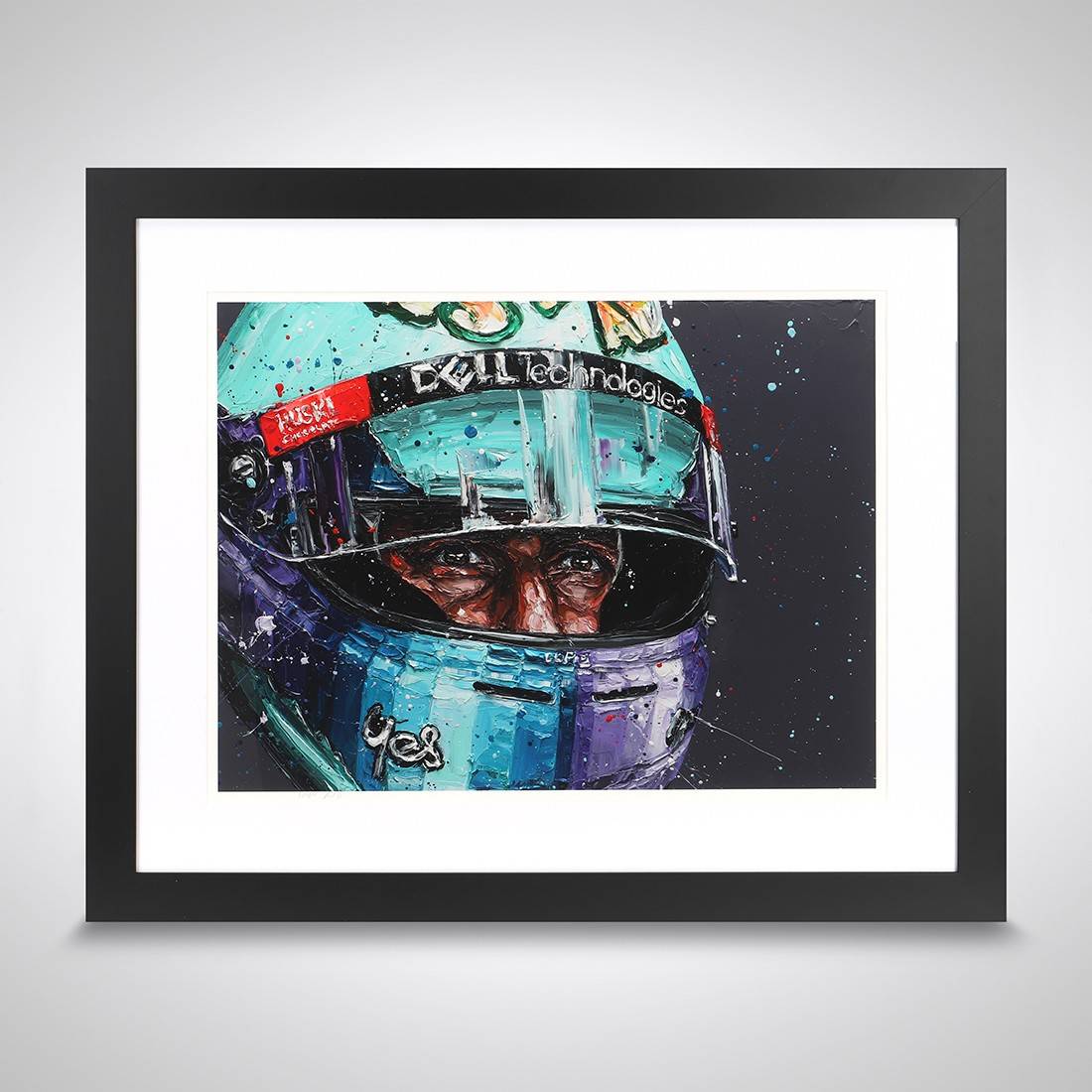
Daniel Ricciardo 2021 by Paul Oz – $510 – f1authentics.com
Celebrate our man Dan with this stunning rendition by artist and painter Paul Oz. It is also available framed or mounted on a hand-embellished canvas.
Tamiya Mercedes-Benz Unimog – $410 – metrohobbies.com.au
Tamiya originally released its Unimog assembly kit in 1963. Today it returns in 1:10 remote-control form for miniature off-road fun!

Datsun 510 Club crewneck – $130 – periodcorrect.com
For the Datsun lovers! Rep your clan with this regular fit, heavy weight preshrunk crewneck. It’s made of 80% cotton and 20% polyester anti-pill fleece.

‘Sparrow’ V2 (roo) wallet – $139 – tailfeather.com.au
This handmade Kangaroo leather slimline wallet, made by Tailfeather, comes handcrafted from the Bellarine Peninsula in VIC. Can carry 10 cards plus cash.

Breitling Premier B09 Chrono 40 – $10,990 – breitling.com
The watch industry is embracing fun colours for 2021, and Breitling is coming to the party with this pistacchio-dialed Premier Chrono 40. Boasting an in-house B09 calibre with 70 hours power reserve, column wheel and vertical clutch; somehow, the colours just work.

Track Pack
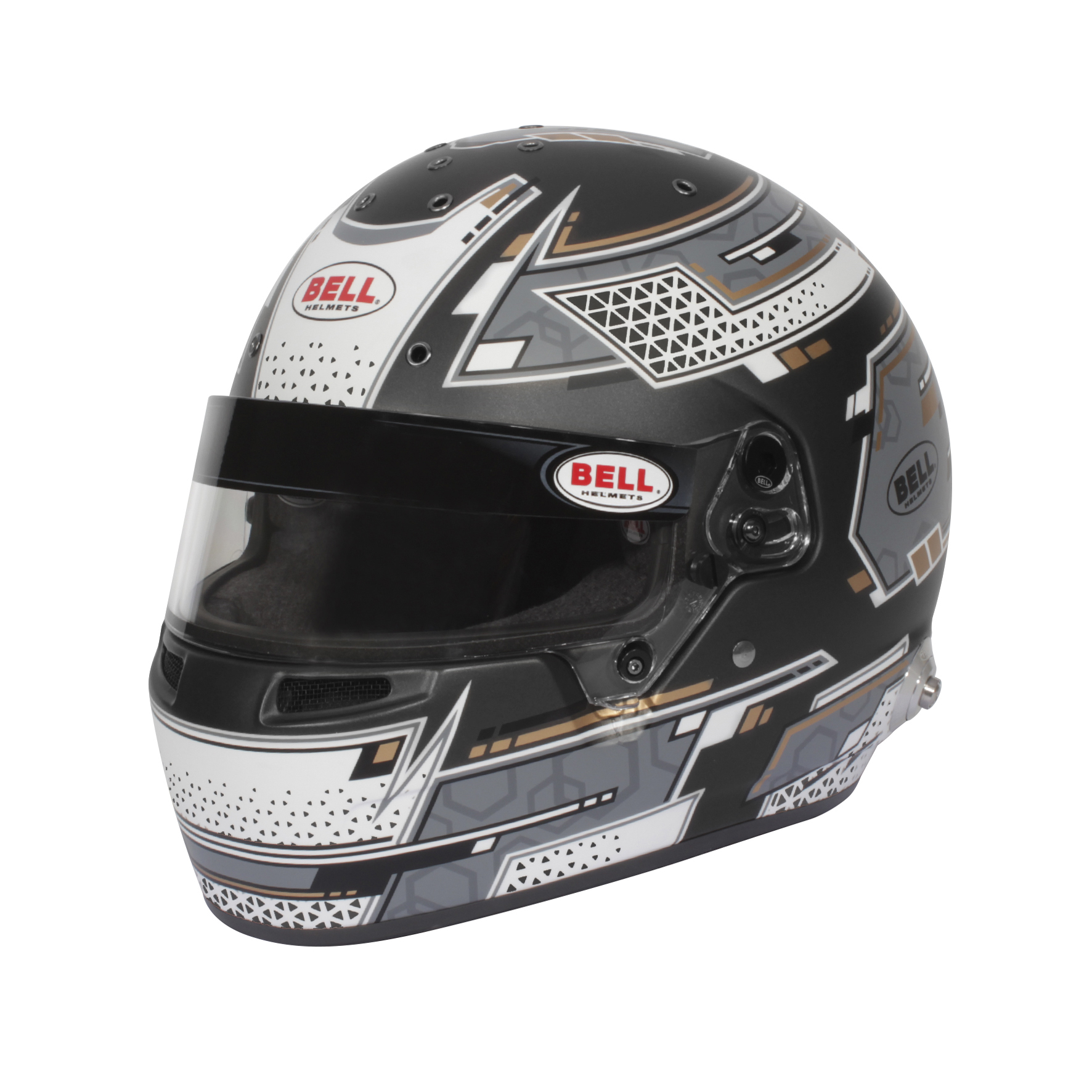
Bell RS7 Pro Stamina Grey – $1294 – demon-tweeks.com
Turn heads whilst protecting your own, with Bell’s striking RS7 Pro. It features a composite shell, anti-fog visor, FHR/HANS posts as well as FIA and Snell approval.
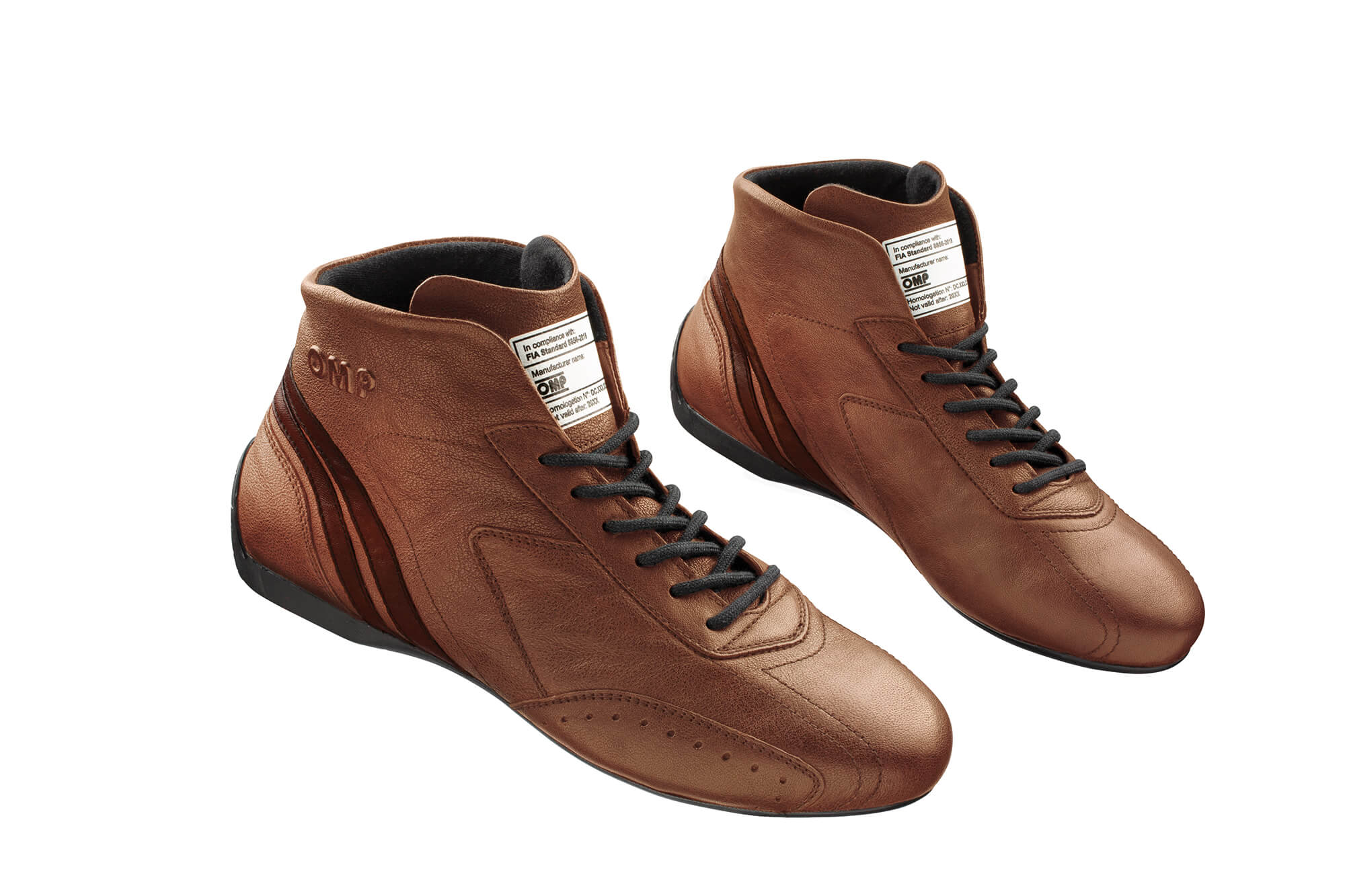
OMP Carrera FIA boot – $429 – autosport.com.au
After some boots but find most offerings too lairy? These mid-cut OMPs are a modern construction with a vintage flair thanks to its soft brown leather materials.
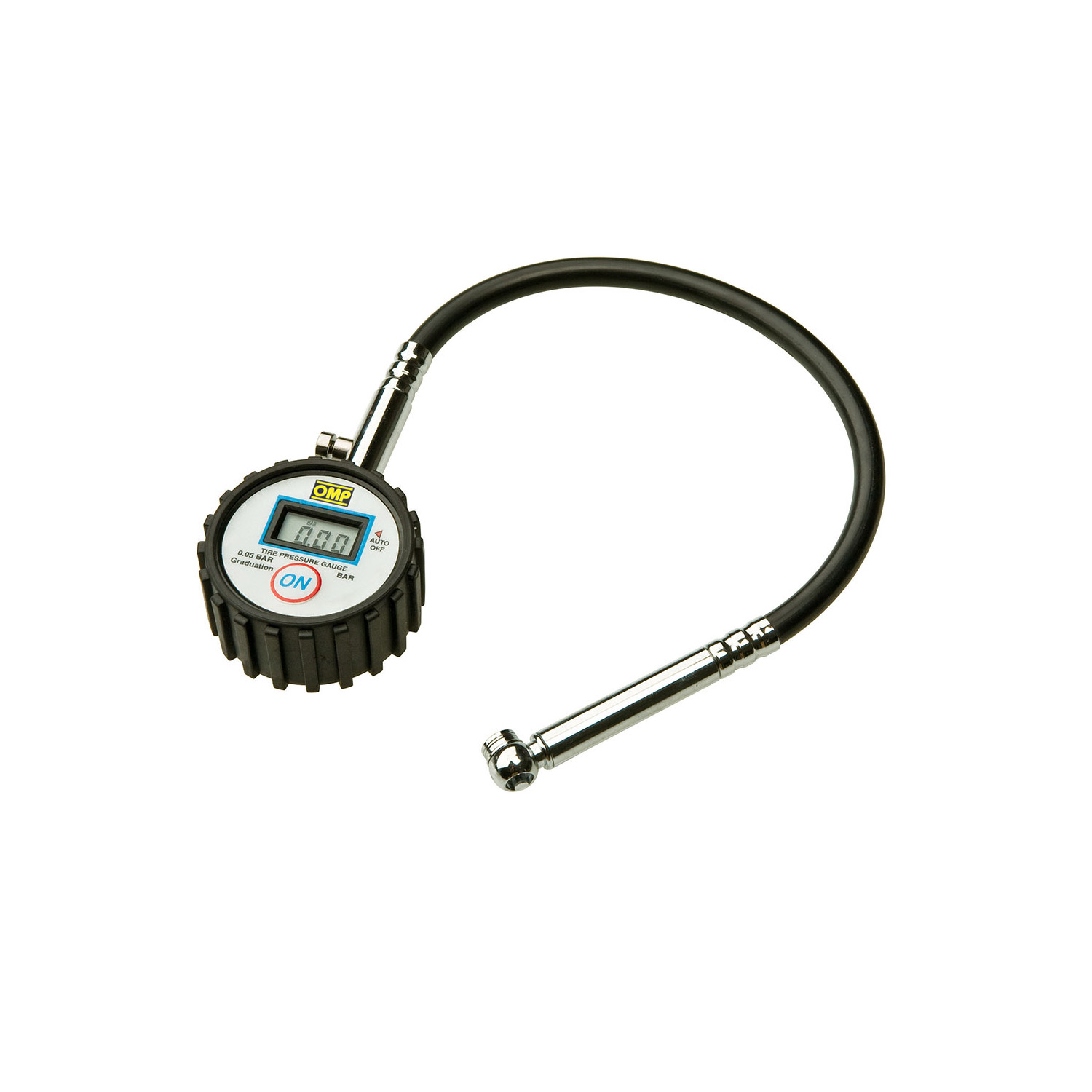
OMP Digital Tyre Pressure Gauge – $69 – raceline-racewear.com.au
This digital tyre pressure gauge measures between 0-7 bar, in .05 increments. Boasts 30cm hose and push-button bleed valve.
Fire extinguisher 1kg – $40 – repco.com.au
If you want to go racing, you need a fire extinguisher. No need to spend big bucks though, these 1kg units from Repco are great for beginners and come with a mounting bracket.

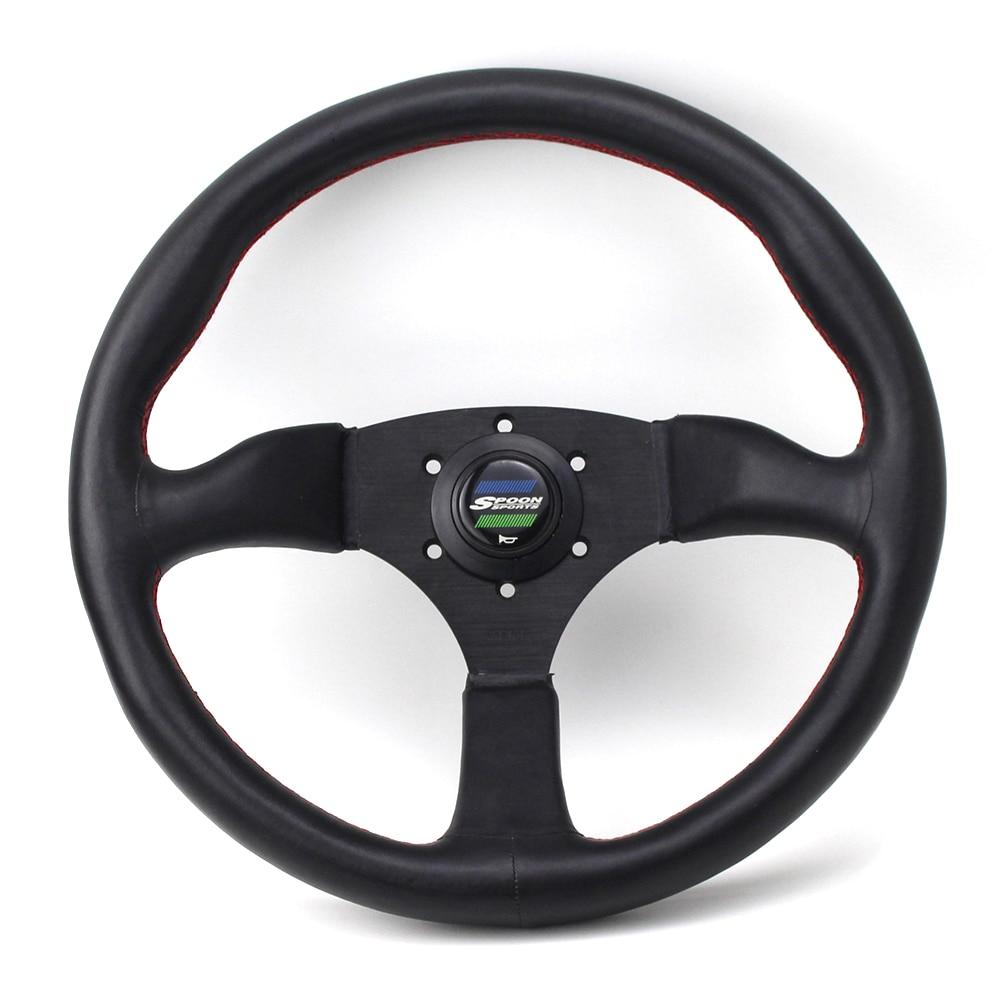
Spoon Sports Momo steering wheel – $541 – rhdjapan.com
Honda fans will love this 340mm Spoon Sports steering wheel produced by Momo. It will fit various hub applications and, like all Momo steering wheels, is handmade in Italy.
Snapshot
- Custom SIM racing steering wheel crafted from carbon fibre and magnesium
- Exact same steering wheel will be used in Bentley’s actual Continental GT3 Pikes Peak challenge car
- Can also double as a desk/wall clock
Gamers and SIM racers keen on taking their experience to the next level will soon be able to purchase a steering wheel like no other.
Bentley has teamed up with American SIM Racing hardware manufacturer Fanatec to create the ultimate in virtual racing steering wheels.
Except it’s not just for the world of pixels and Playstations – Bentley will be using this exact steering wheel this weekend when it competes to secure a class record at the 99th running of the fearsome Pikes Peak International Hill Climb.
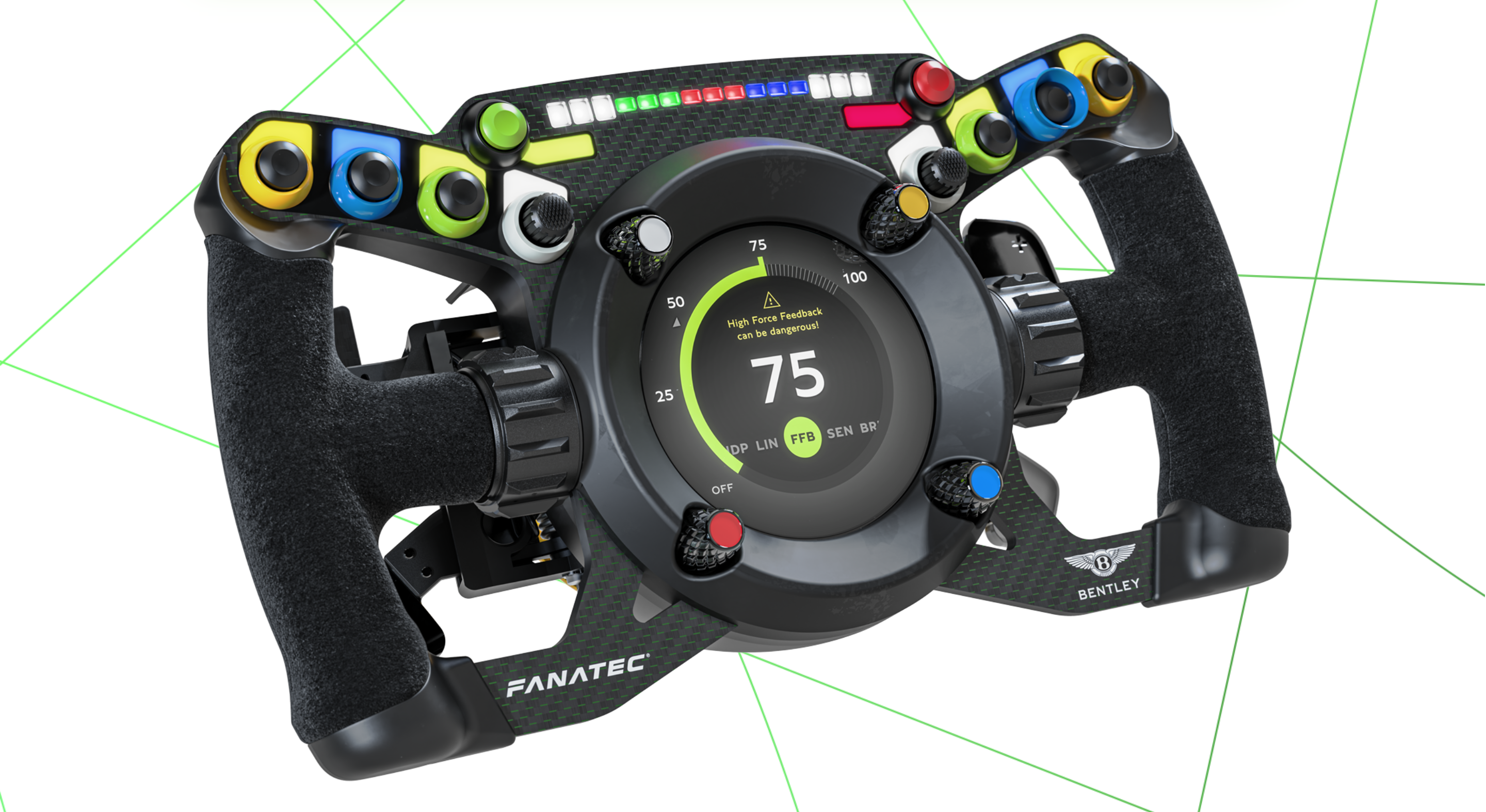
Made from carbon fibre with a metallic green-fleck and magnesium, the steering wheel has been specifically designed for the Bentley Continental GT3 Pikes Peak challenge car.
Bentley and Fanatec claim the bespoke piece of hardware is the first of its kind, and will give gamers the opportunity to experience what it’s like to steer a genuine GT3 racer.
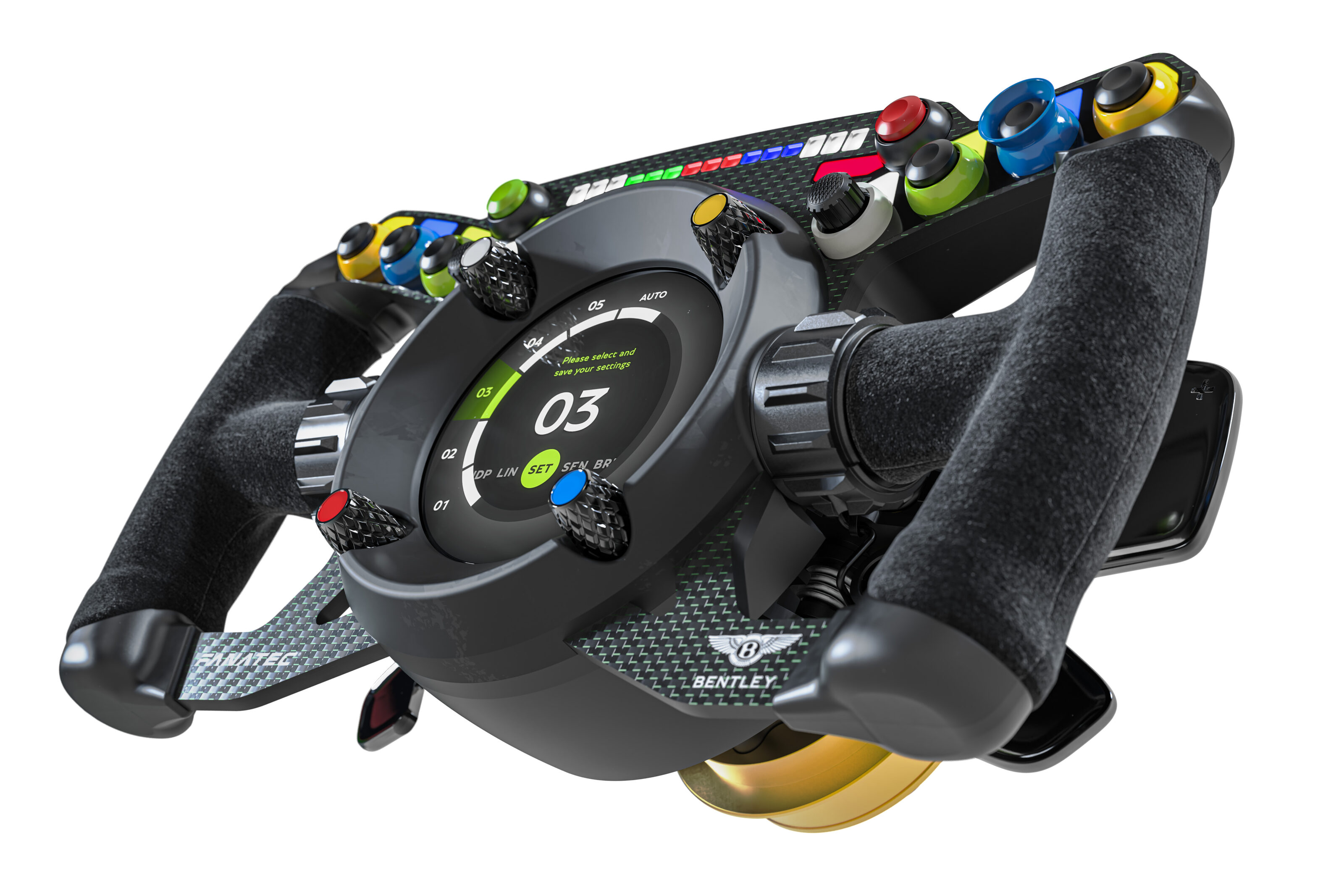
The centre of the squared-off unit features a circular digital screen, which can display on-the-fly race telemetry and information.
Surrounding the display is a raised, forged carbon bezel, flanked on either side by two seven-way FunkySwitch directional sticks with encoder functionality and a gamut of coloured buttons.
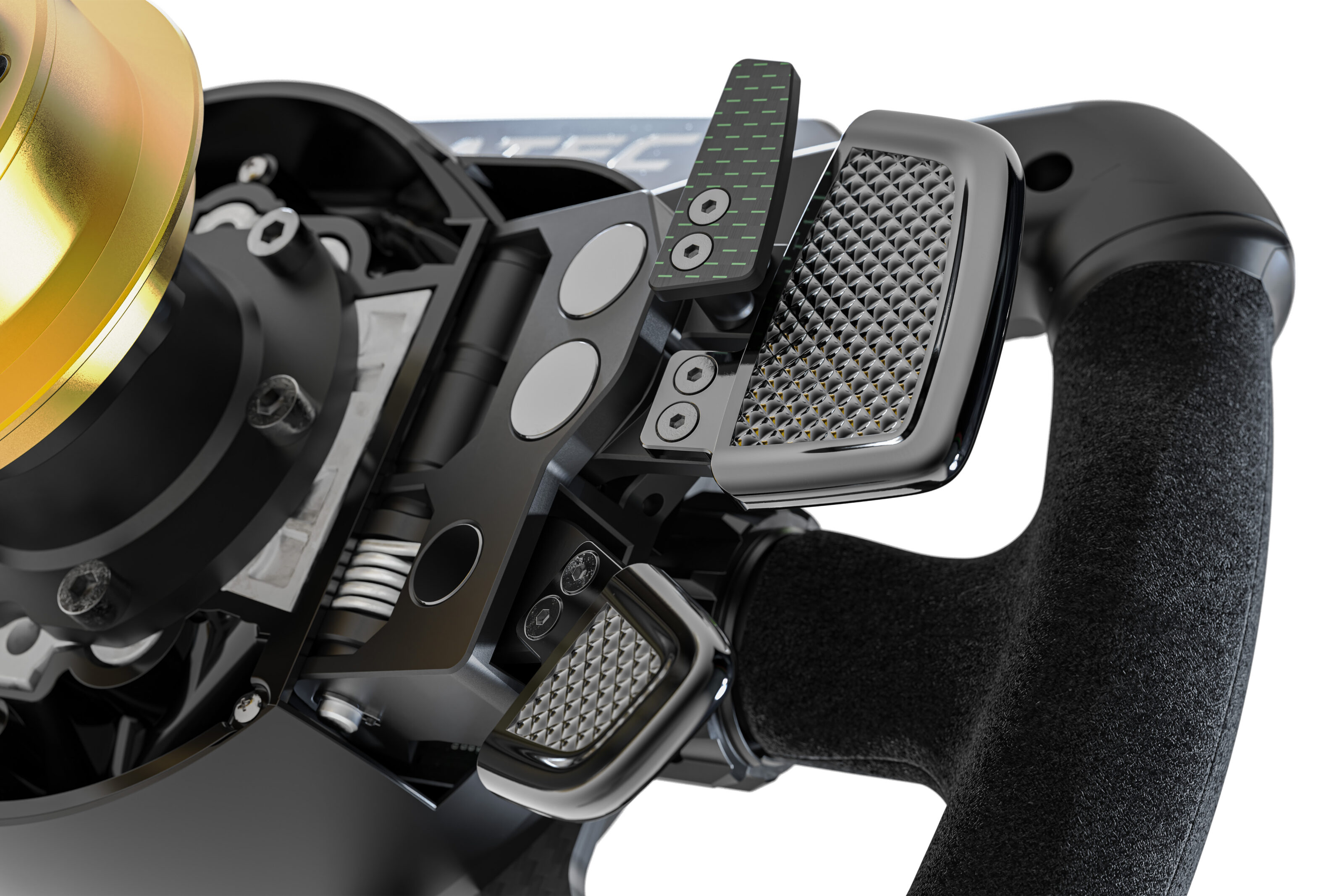
Sitting above the display is a set of shift lights which should further ramp up user immersion, and mounted on the rear of the steering wheel is four magnetic paddles – of which two are used to shift gear, while the other two act as auxiliaries, mimicking the set-up of Bentley’s GT3.
And when owners aren’t using it to race other online road warriors, the steering wheel can be placed on an accompanying mount and used as a wall or desk clock.
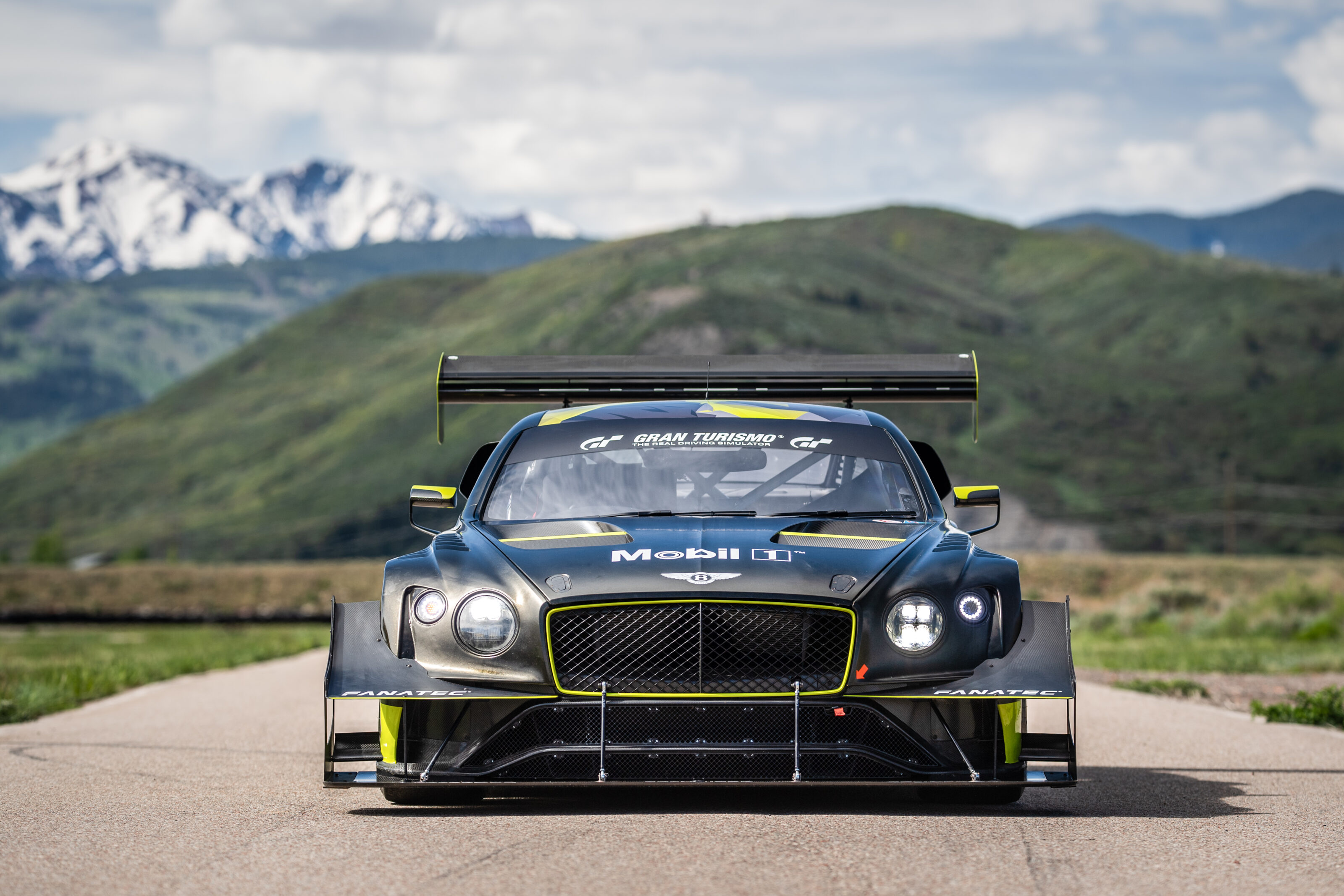
Bentley will be hoping for more success this weekend at the American racing event, returning to the mountain once again with veteran New Zealand race car driver, Rhys Millen, behind the wheel of its bespoke GT3.
Millen has previously secured two lap records for Bentley at Pikes Peak. In 2018, the Kiwi claimed the record for fastest production SUV in a Bentayga, and a year later, Millen came back in a Continental GT to secure the production car class record.
One look at DBA Mini Remastered Oselli Edition and the memories come flooding back. Suddenly I’m 16 again and the proud owner of a 1968 Mini Deluxe, beige with red vinyl seats, wide chromies all round, a big-bore muffler, and a Saas wood rim steering wheel. My first car. The Oselli Edition even has driving lights about the same size as the ones I fitted to my Mini to help spot the ’roos on late-night runs across the Hay Plain.
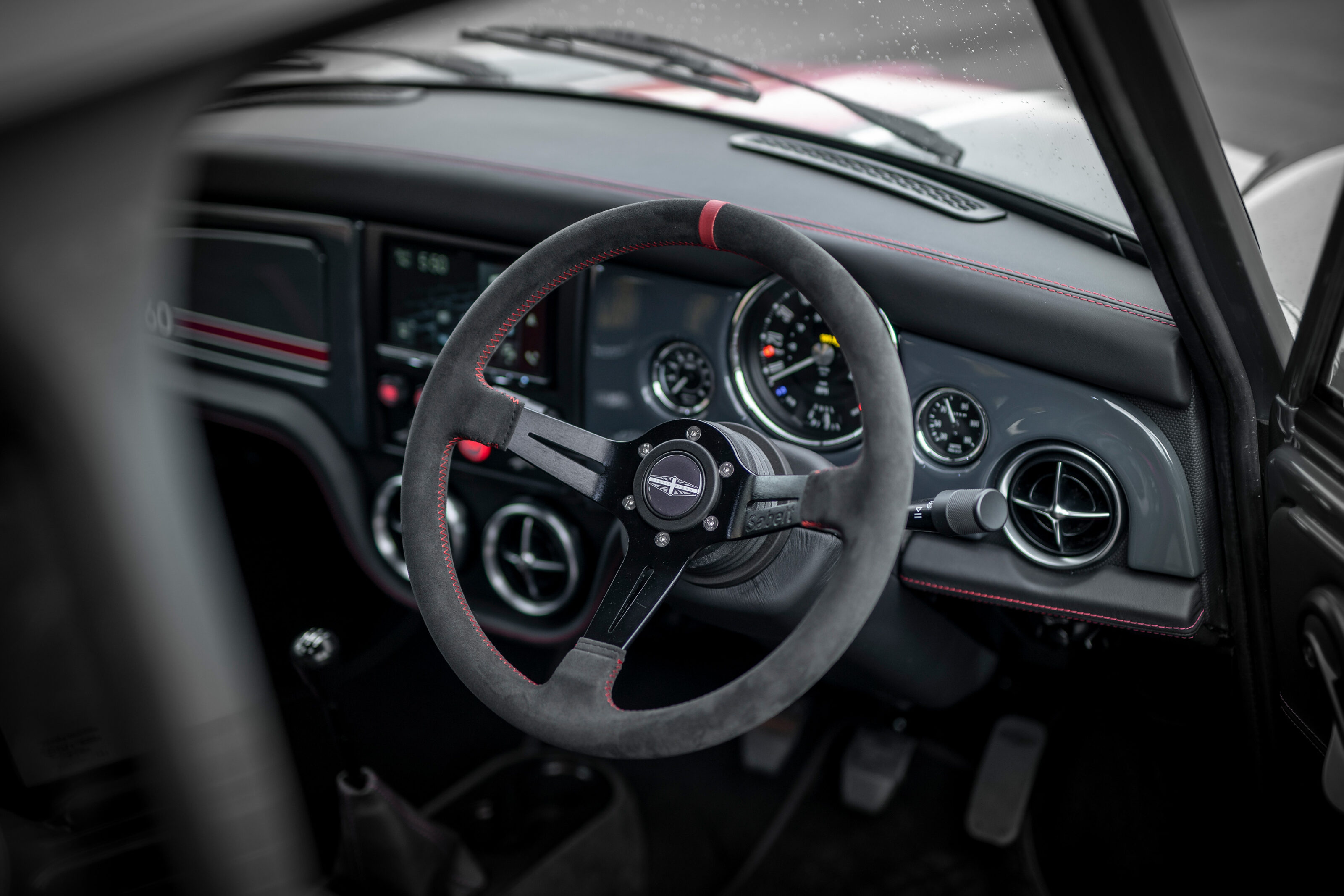
I open the door and fold into the tiny but deceptively roomy cabin. Wha…? The speedo’s been moved and now sits in line with the steering column, rather than at the centre of the dash. Whoa…! Where the speedo was in my car is now a Pioneer touch-screen infotainment system for the audio and sat-nav systems. And what are these? Vents, for the air-conditioning, I’m told. In my Mini air-conditioning meant both front windows rolled down and the two rear side windows popped open, the throbby baritone exhaust booming through the cabin.
If you have ever owned one of the more than five million Minis built between 1959 and 2000, the DBA Mini Remastered Oselli Edition will play cruel tricks with your memories. Yes, it’s the same size and shape as the innovative Alec Issigonis-designed original, is still powered by the BMC A-series four-banger, an engine whose basic design was drawn more than 70 years ago, and it has the same cheeky character as the little flying bricks that regularly humiliated much bigger cars on racetracks around Australia in the 1960s. But it’s a Mini like no other.
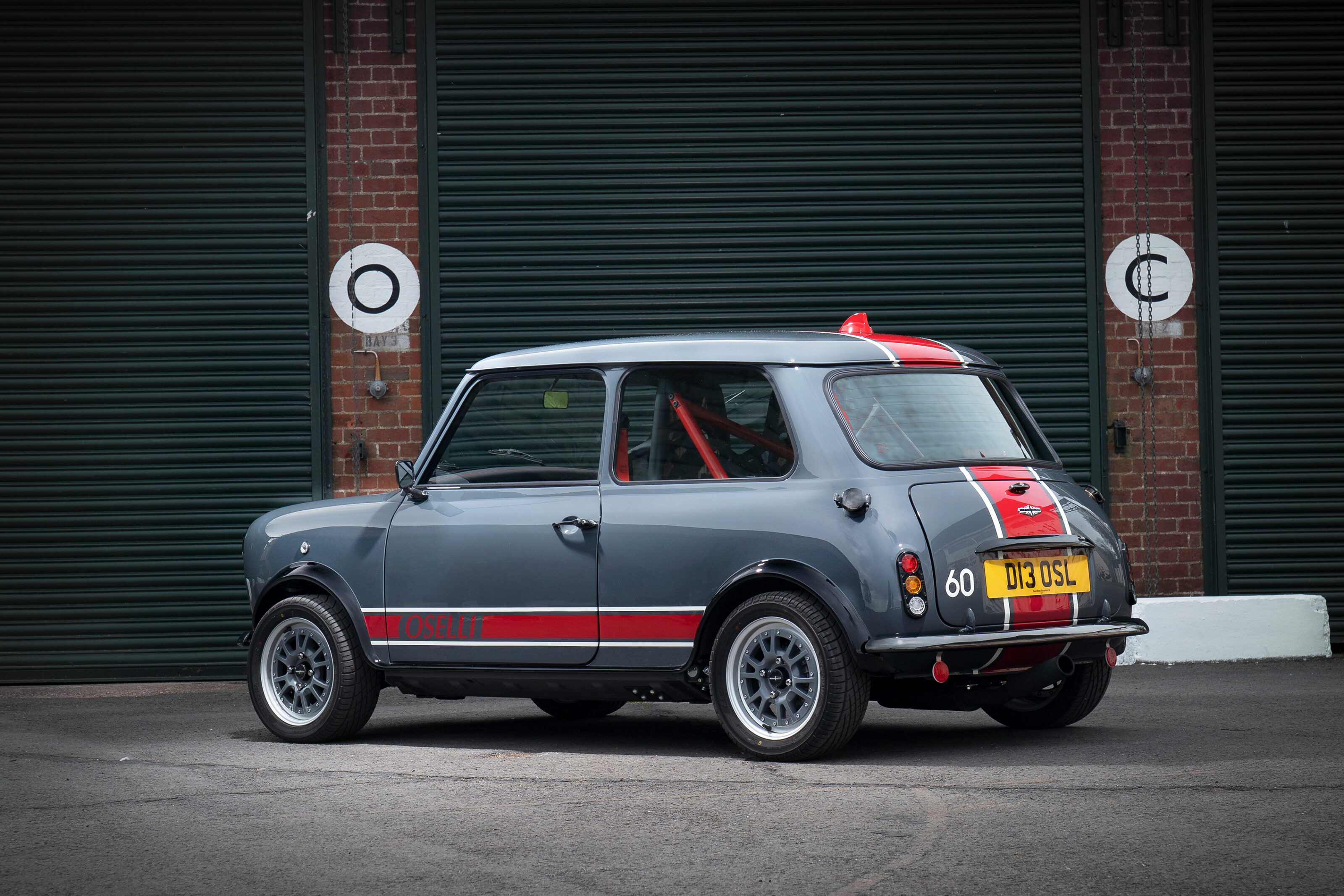
First, that name. DBA stands for David Brown Automotive, a company founded by Yorkshire entrepreneur David Brown in 2013 to make a luxury sportscar called the Speedback based on Jaguar XKR mechanicals and wrapped in hand-formed aluminium panels that riff on classic Aston Martin DB5 motifs. (For the record, this David Brown, whose other business interests include brewing beer and manufacturing components for heavy machinery, is not related to the David Brown who owned Aston Martin from 1947 to 1972.)
The Mini Remastered is DBA’s second car. Launched in 2017 it is – as its name suggests – a lovingly remade version of the Issigonis Mini, combining original but carefully refurbished 1275cc powertrains with a brand-new bodyshell made by classic car parts manufacturer British Motor Heritage.
Inside is an interior made over with lashings of leather and splashes of polished aluminium and fitted with mod-cons such as power windows, air-conditioning, sat-nav and Bluetooth audio connectivity.
Oselli Edition? Oselli Engineering is a British classic car sales, service, restoration, and performance engineering shop that traces its roots back to a race car tuning operation founded in 1962 by two BMC engineers who thought an Italian-sounding name was cool.
The Oselli Edition is a limited-build version of the Mini Remastered with a more powerful Oselli-developed version of the venerable A-series engine under the bonnet and a sportier chassis setup. Just 60 will be built, to celebrate (belatedly, due to the pandemic) the 60th anniversary of the launch of the original Mini, each available in either Old English White or Carbon Grey with graphics and stripes – hand-painted, not decals – in Competition Red, Royal Blue, or Heritage Green.
In addition to the upgraded engine, other mechanical changes include a five-speed transmission nestling in the same space within the sump as the original four-speed, a limited-slip differential, AP Racing front disc brakes, and Bilstein shocks.
While the regular Mini Remastered rolls on 12-inch alloy wheels, the Oselli Edition gets 13-inchers. Tyres are Yokohama A539s, 175/50 R13s all round. The 34-litre fuel tank is on the left-hand side of the boot, as in the original Mini, though our test car has the optional 21-litre second tank on the right side as well.
Oselli Edition? Oselli Engineering is a British classic car sales and performance engineering shop that traces its roots back to a race car tuning operation founded in 1962
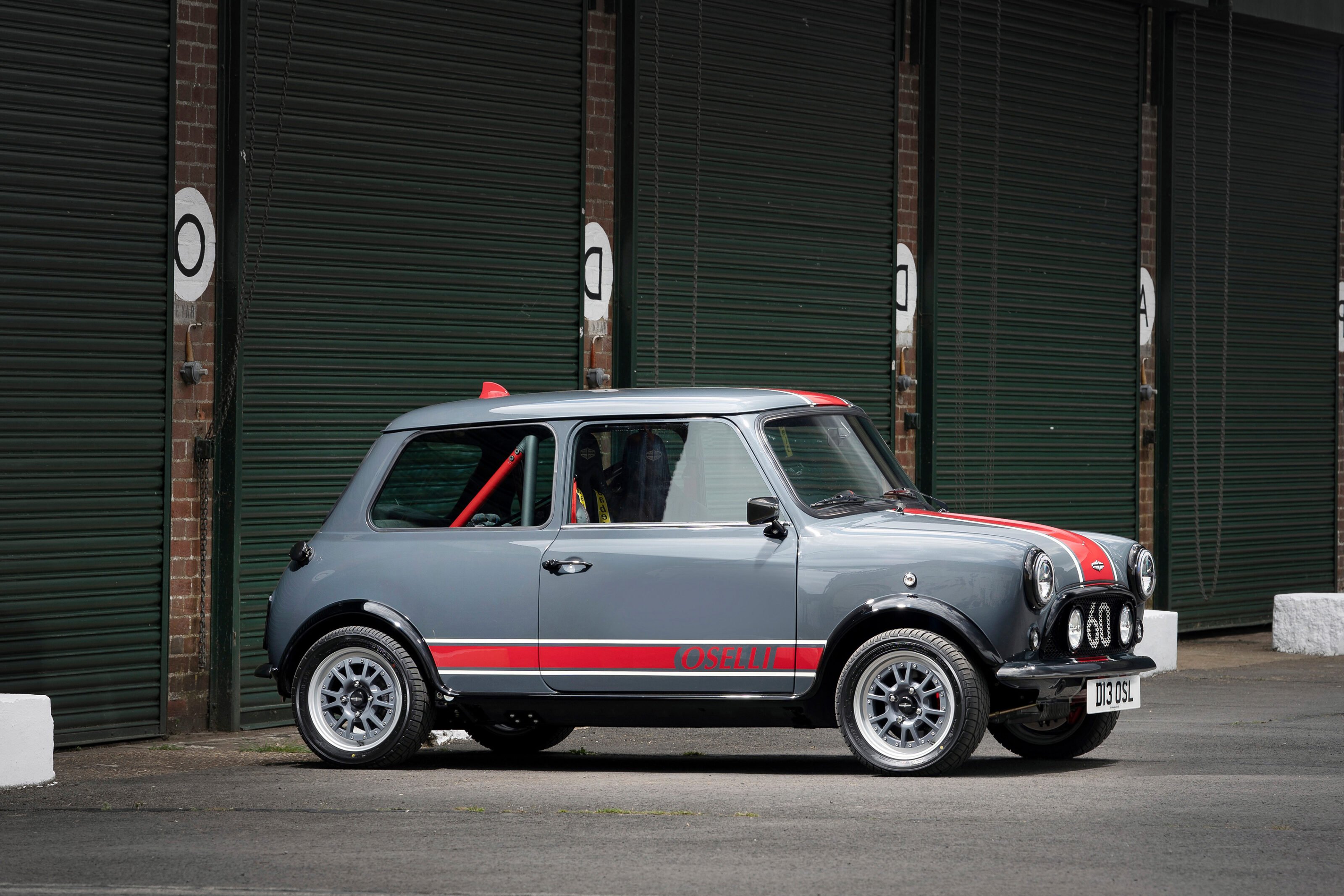
The 1275cc A-series Mini engine, with its twin 1.25-inch SU carbies, made 57kW at 5900rpm and 107Nm of torque at 3000rpm when it first appeared in 1964, enough to propel the original Cooper S from 0 to 100km/h in about 11.4 seconds on a good day.
The Osselli-massaged A-series has been bored out to 1450cc, packs a pair of 1.5-inch SUs, and punches out 93kW at 6200rpm and 153Nm of torque at 4500rpm. That’ll get the Oselli Edition to 100km/h in about 7.8 seconds, making this restomod Mini just a second slower than a 2020 Cooper S. It’s physics: The modern Cooper S might have 50 per cent more power, but it weighs 68 per cent more than the 740kg Oselli Edition.
Thumb the starter and the big-bore A-series throbs into life. The Oselli Edition’s interior has a 60s race car vibe, with a deeply dished three-spoke steering wheel and hip-hugging seats. The standard interior seats four; our car has the optional two-seat setup, which means there’s a half roll-cage behind the seats with four-point racing harnesses strung from it.
Driving the ultimate old-school Mini doesn’t mean roughing it, though: The Oselli Edition has the regular Mini Remastered’s power windows, Pioneer infotainment system, and air-conditioning.
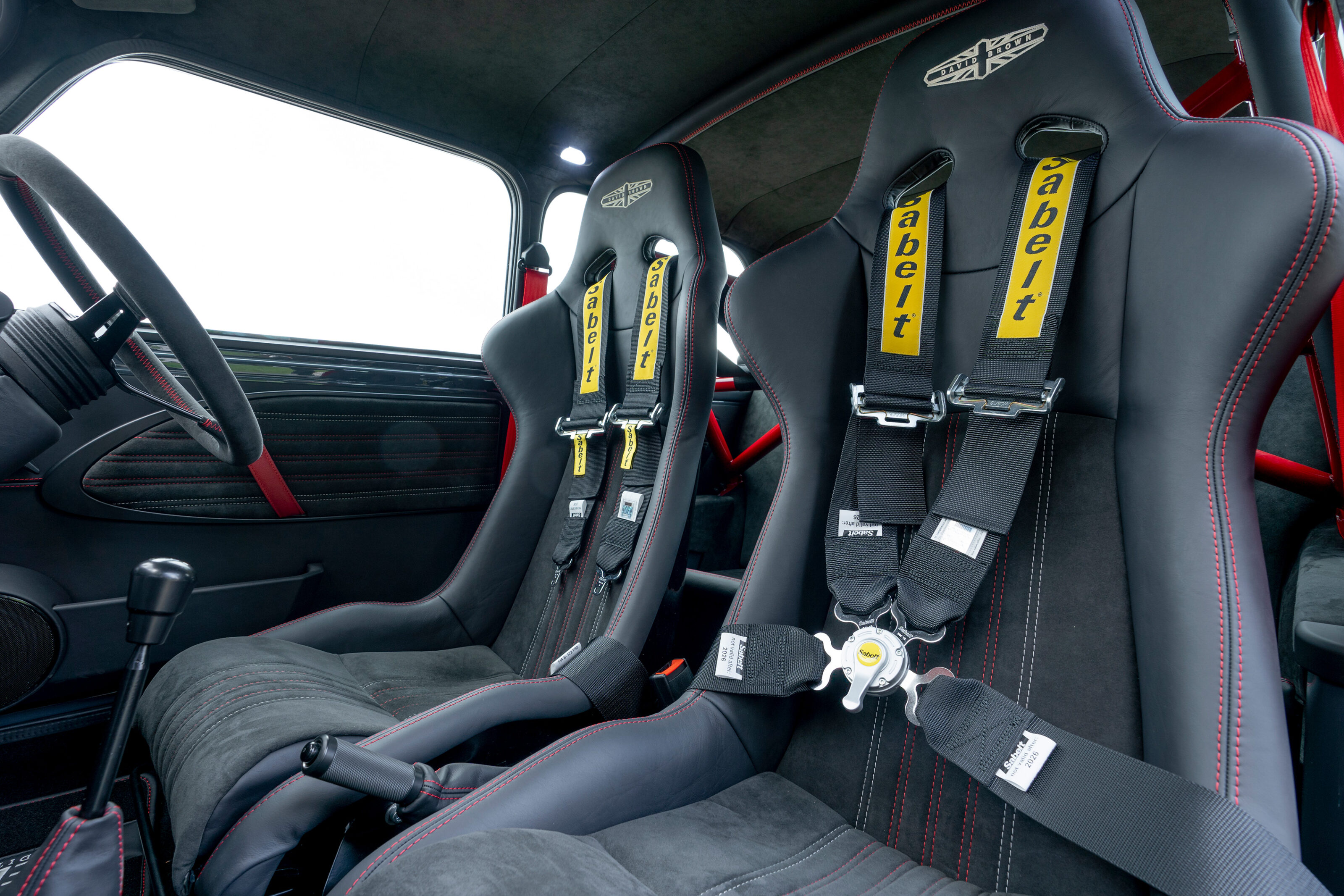
Once underway you quickly learn Oselli’s race-face A-series likes to be kept busy: Spend too long noodling around at less than 2000rpm and it will barf and stutter like all cammy, over-carbed, high-performance engines in the days before fuel injection and engine management computers. But once the little engine clears its throat, the big SUs gurgling as they gulp more air, it spins lustily to 6200rpm, the steering wheel squirming in your hands as the front tyres scrabble for grip. The shifter’s throw is long and the gate wide, but there’s never a problem finding the right gear in a hurry.
Low mass not only helps the Oselli Edition scoot between corners; it helps this manic Mini scoot around them, too. Old Minis, which combined their short wheelbase with relatively high roll stiffness, tended to spin like a top if you lifted suddenly on corner entry.
The Oselli Edition, which rolls much more noticeably than old Minis in the corners, initially feels much more tail-happy but, paradoxically, it also feels more controllable. Its greater rate of roll means you’re more aware of the weight transfer occurring during cornering, so you’re more easily able to modulate the lift-off oversteer to get the little car rotated and tucked into the apex.
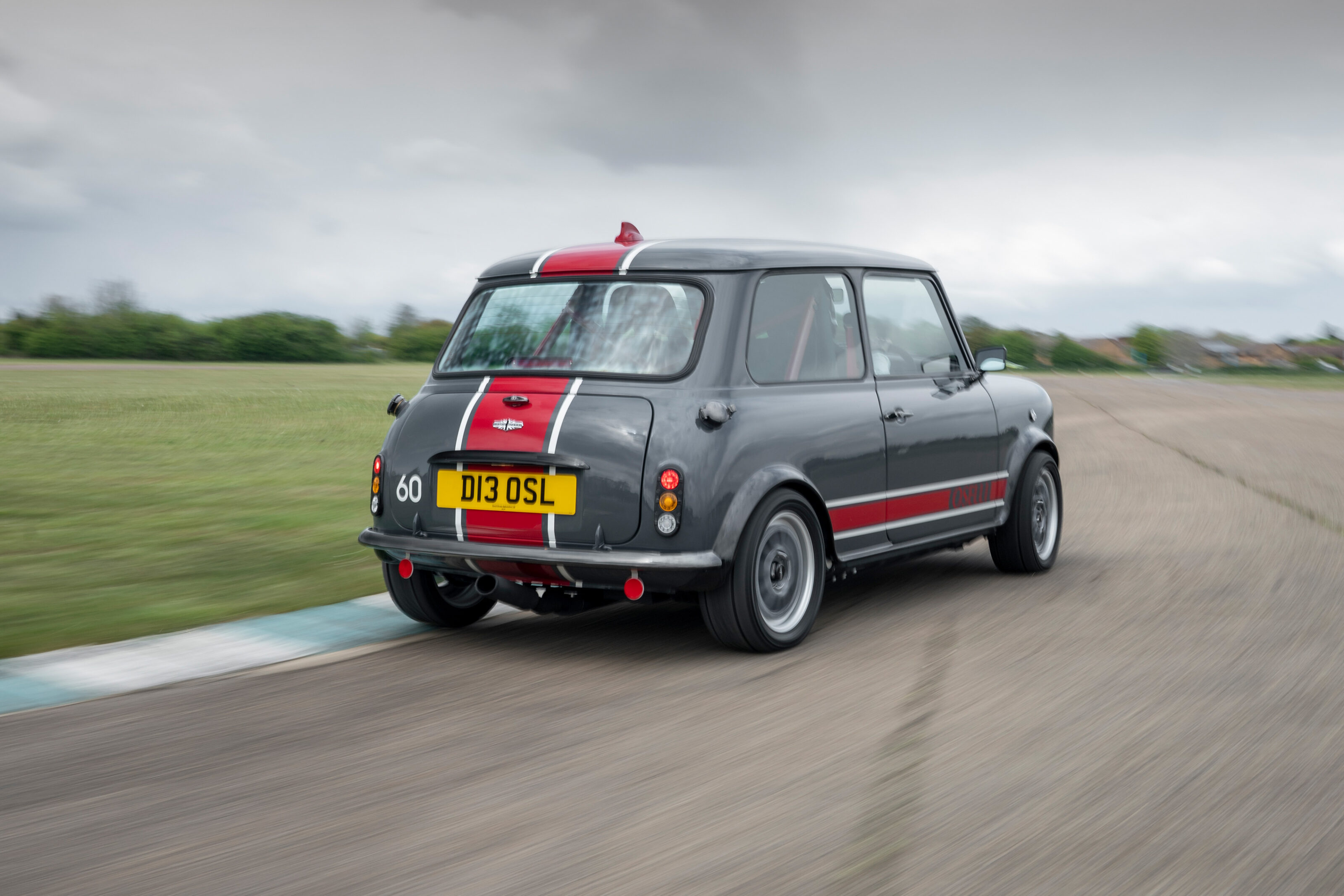
Power understeer is the default cornering mode when you’re going for it in the track, but beware: Once those tyres hook up, the limited-slip diff means the little Mini will go exactly where the front wheels are pointed.
It’s a lively little thing, and great fun on the road, where its small size, high agility and low mass mean you always have much more real estate to play with than drivers in regular cars. Yes, most modern hot hatches have more speed and more grip. But few will deliver the grin-inducing driver engagement the Oselli Edition does at speeds that won’t get you locked up.
The Oselli Edition really is a Mini Remastered, a car that distils the original’s giant-killing spirit. But memories don’t come cheap. DBA’s regular Mini Remastered, at least one of which has already been shipped to Australia, costs about about $140,000. Before tax. The Oselli Edition will lighten your wallet to the tune of at least $180,000.
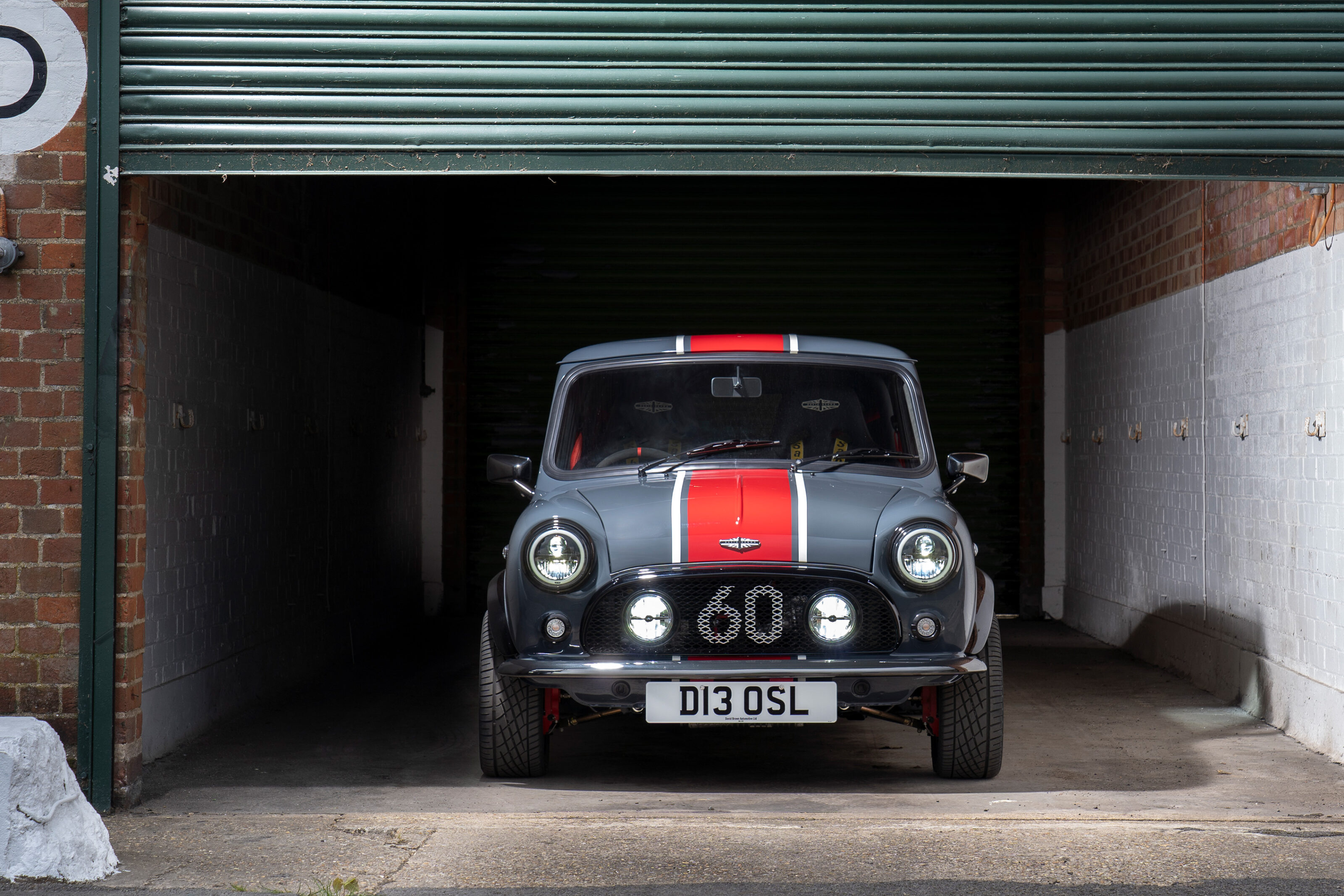
DBA Mini Remastered Oselli Edition Specifications
| Engine | 1450cc 4cyl, OHV, 8v |
| Max Power | 93kW @ 6200rpm |
| Max Torque | 153Nm @ 4500rpm |
| Transmission | 5-speed manual |
| 0-100km/h | 7.8sec (claimed) |
| Economy | N/A |
| Price | $180,000 (est) |
| On sale | Now |
Snapshot
- 1921 built prototype stands as Aston’s oldest surviving car
- Vantage roadster tribute mechanically unchanged from donor
- Production limited to three units
British marque Aston Martin has celebrated the 100th anniversary of its oldest surviving car being produced with a very-limited edition Vantage V8 roadster.
The car being celebrated is the Aston Martin A3, the company’s third ever car which was produced in 1921 and became the first racing Aston, fitted with a 1.5-litre four-cylinder engine which made just 11hp (8.2kW).
With an AMG-built twin-turbo V8 engine, the Vantage A3 tribute car makes a touch more power – with around 375kW being sent to the rear axle and put to the ground through 20-inch wheels.

Ordered as a commission by the HWM Aston Martin dealership, the longest-serving in the company’s history, the A3 features a black grille with an aluminium surround, black body paint and bronze brake calipers.
Sitting just behind the front quarter panels, and in front of the doors, is a small aluminium panel which is fixed with a leather saddle strap, taking inspiration from the bonnet and strap from the original A3 which was engraved with ‘No. 3’.
Inside the original A3’s influence continues, the cabin awash with chestnut tan leather accents and stitching, period-correct embossed logos and cast brass rotary dials, giving a real 1920s ambiance.

Aston Martin’s director of Q branch and special project sales, Simon Lane, said it was an honour to recreate such an important car for the company.
“It is only right this great marque takes the opportunity to celebrate the centenary of its oldest surviving model and I am thrilled my team, working with the AMHT and Aston Martin HWM, has been able to create this tasteful yet suitably exhilarating tribute to its historic forebear.”
Orders can only be taken through the HWM Aston Martin dealership but, with only three examples on offer, it’s unlikely it will still be available.

Holden and Nissan both have iconic coupes in their trophy cabinet. Today, their successors – the reborn Monaro CV8 and 350Z – are at it again.
This article was first published in the June, 2003 issue of MOTOR
Times, they have a-changed. Back in the ’60s and ’70s, when these iconic badges first appeared, you’d have been charged with heresy had you compared the Datsun 240Z with Holden’s GTS Monaro.
You see, the 240Z was, well, Japanese, and at around $4500 in 1971 it was nearly $1200 – or more than 25 per cent – pricier than the local coupe. And besides, both Ford and Chrysler had two-door muscle cars to go up against the Chev-engined Holden.
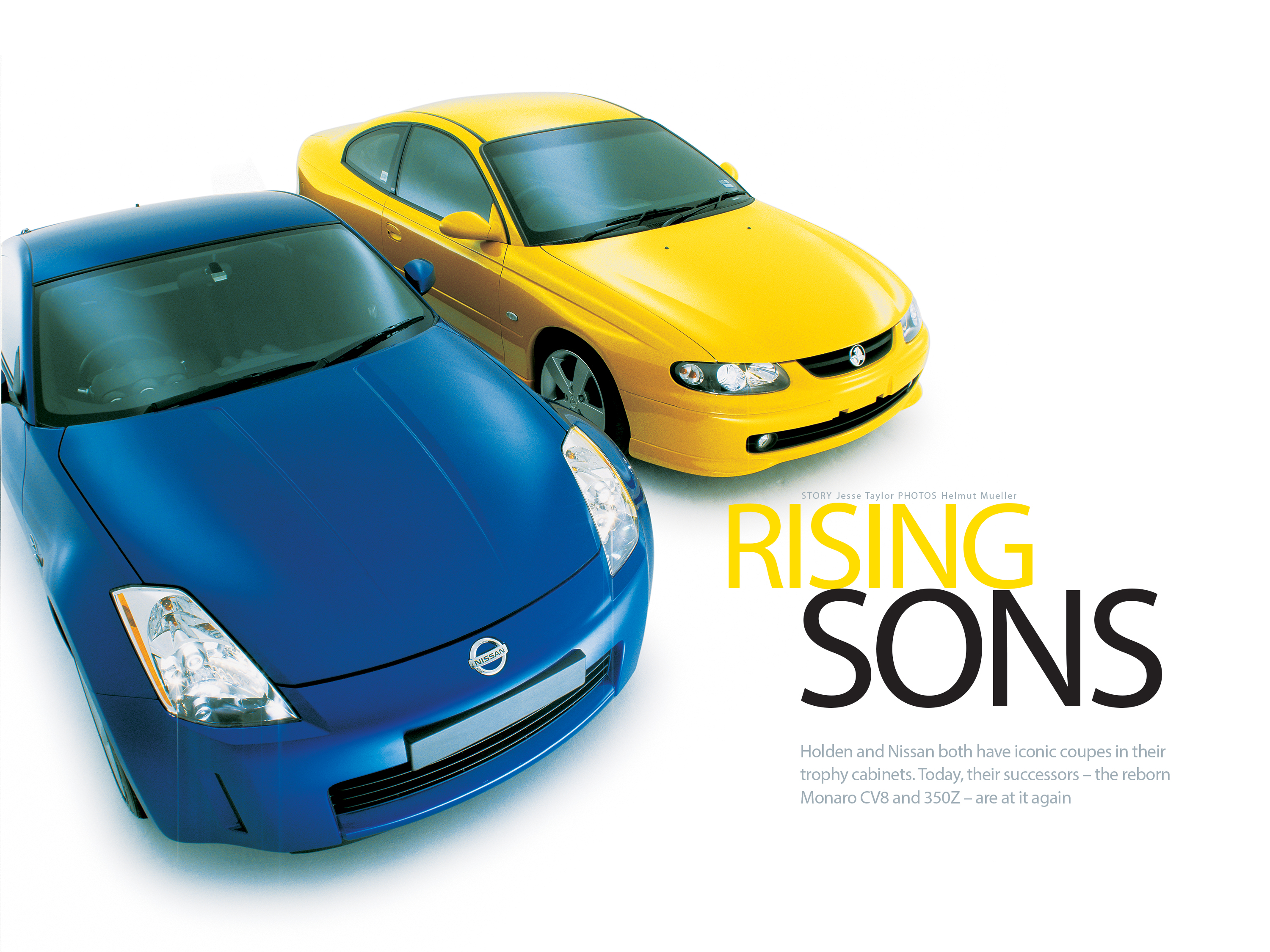
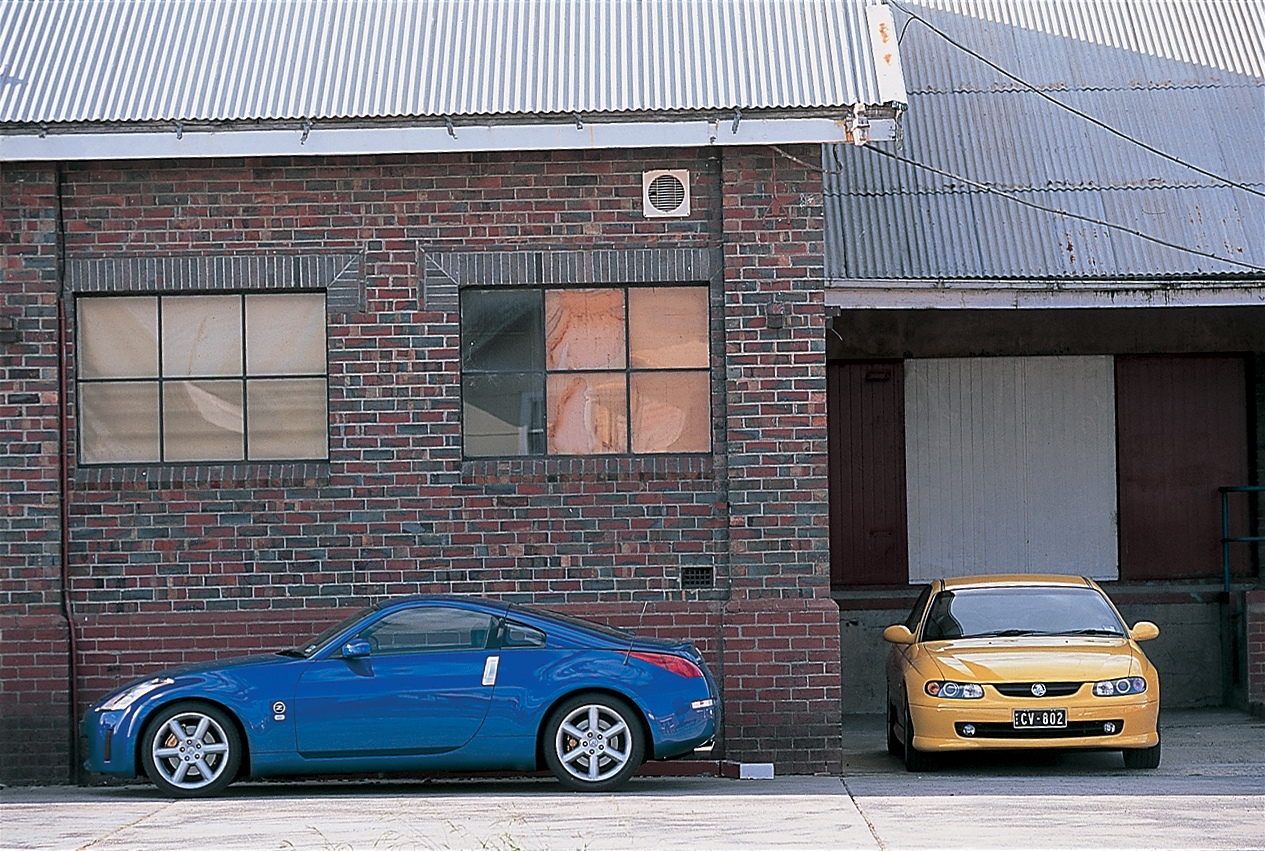
Fast forward 30 years to the second coming of the Monaro. It arrived in late 2001 and recreated a unique niche. Here was a powerful, well equipped, rear-drive coupe at a smidge under $60k. Direct rivals were hard to come by, with the smaller and less lavish Nissan 200SX nearly $20k down the tree. On the other side of the CV8 ledger sat the hard-hitting but crude Ford Mustang at a hard-on-the-stomach 85 grand.
From there you move into Bavarian coupe territory, including the $100k BMW 330Ci and the brilliant M3 nudging $150k. Of course, the Monaro is well out of its weight division by this stage and any comparo would be pointless. Probably the closest competitor on price and equipment, if not philosophy, was the Audi TT 1.8 turbo, wearing a $70,000 sticker. Not that we were sure there was a lot of buyer crossover going on there.
Just 18 months later, though, and the Monaro’s got some company in its once-lonely niche. Mazda’s rotary-powered RX-8 – we reckon it’s a four-door coupe, so no letters, okay? – will be driving off the boat soon, starting at under 60 grand. The funky Mazda will be joined later in the year by Chrysler’s Crossfire. No price has been set by Chrysler Oz, but you’d bet around the $60-70k mark.
But the first foreigner to take the fight to the local coupe hero is Nissan’s 350Z.
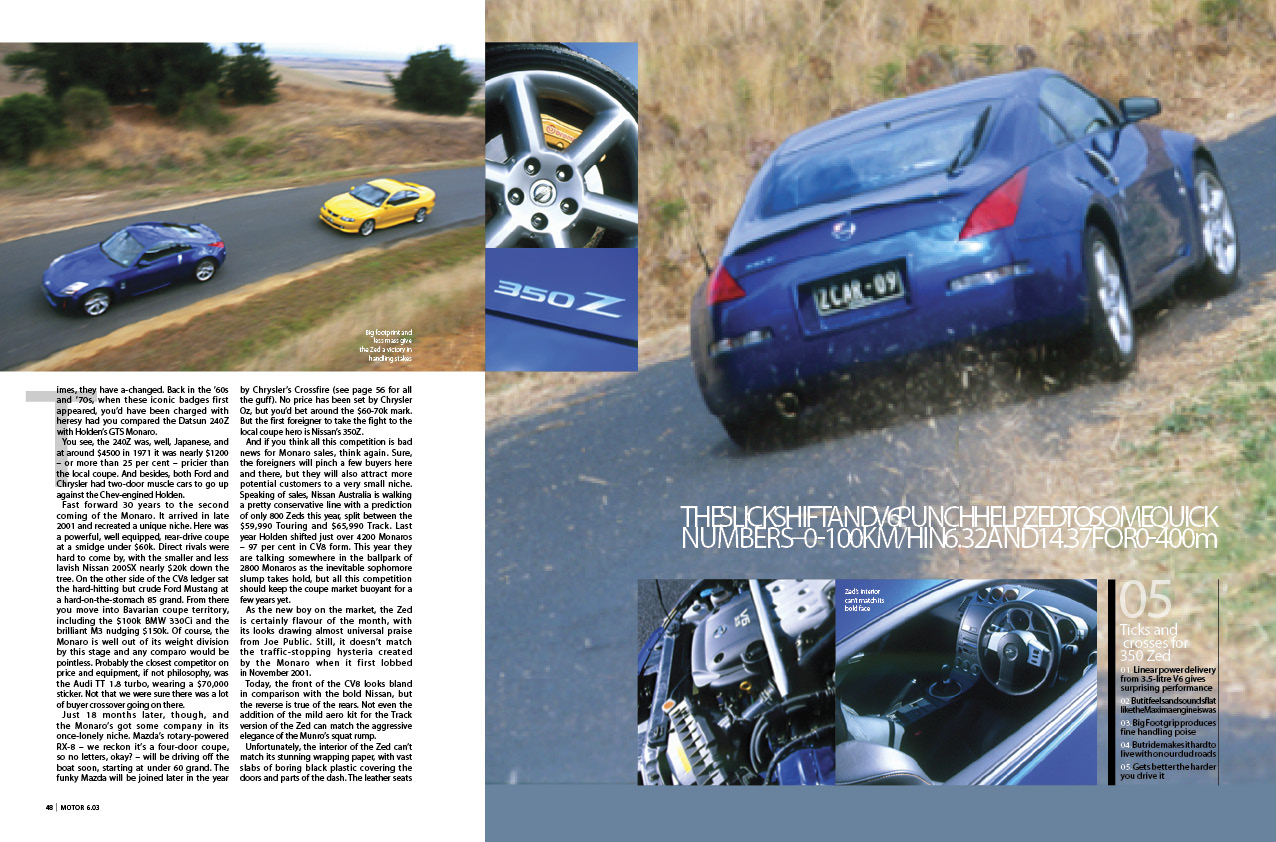
“The slick shift and V6 punch help Zed to some quick numbers – 0-100 km/h in 6.32 and 14.37 for 0-400m”
And if you think all this competition is bad news for Monaro sales, think again. Sure, the foreigners will pinch a few buyers here and there, but they will also attract more potential customers to a very small niche. Speaking of sales, Nissan Australia is walking a pretty conservative line with a prediction of only 800 Zeds this year, split between the $59,990 Touring and $65,990 Track.
Last year Holden shifted just over 4200 Monaros – 97 per cent in CV8 form. This year they are talking somewhere in the ballpark of 2800 Monaros as the inevitable sophomore slump takes hold, but all this competition should keep the coupe market buoyant for a few years yet.
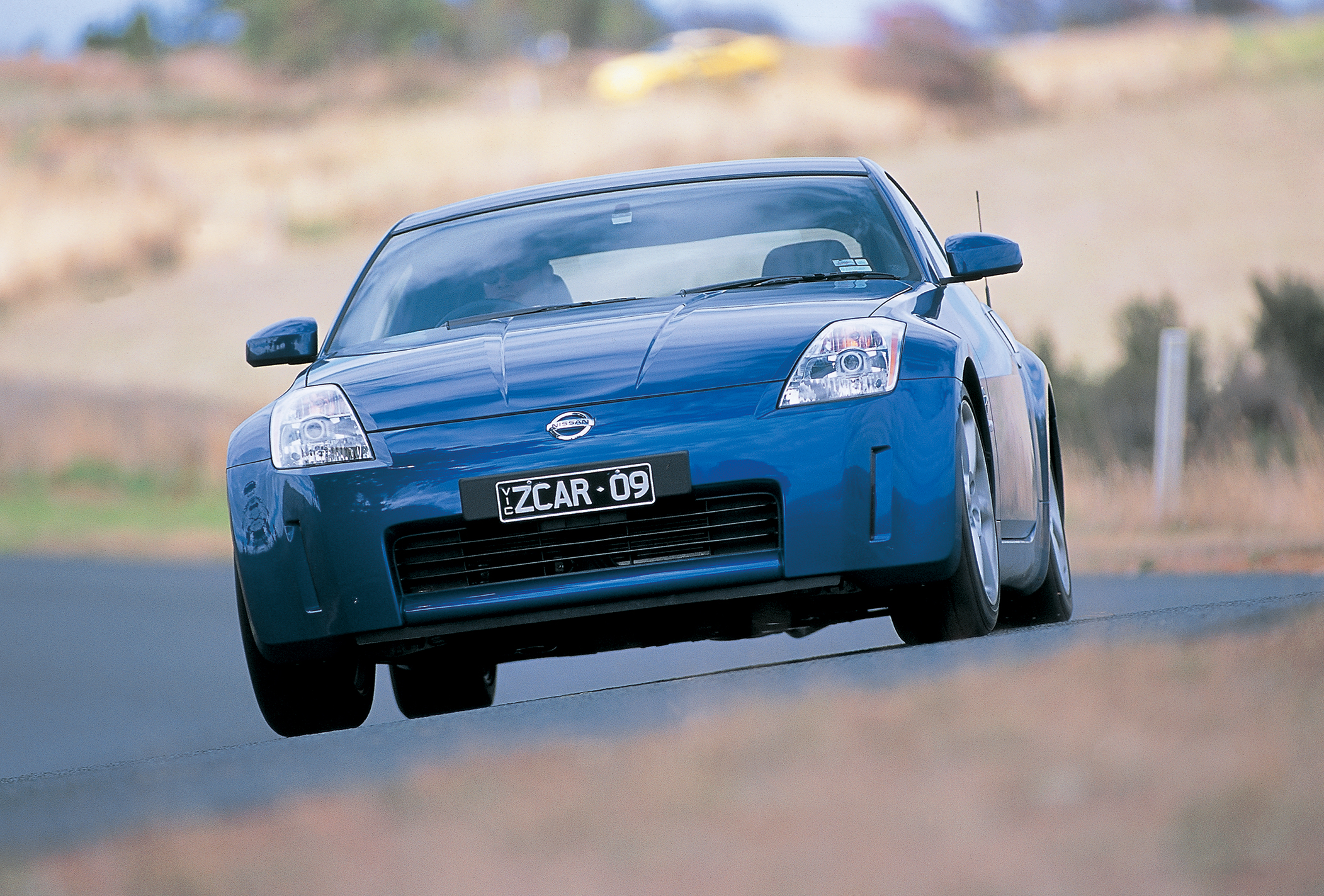
As the new boy on the market, the Zed is certainly flavour of the month, with its looks drawing almost universal praise from Joe Public. Still, it doesn’t match the traffic-stopping hysteria created by the Monaro when it first lobbed in November 2001.
Today, the front of the CV8 looks bland in comparison with the bold Nissan, but the reverse is true of the rears. Not even the addition of the mild aero kit for the Track version of the Zed can match the aggressive elegance of the Munro’s squat rump.
Unfortunately, the interior of the Zed can’t match its stunning wrapping paper, with vast slabs of boring black plastic covering the doors and parts of the dash. The leather seats are supportive, however, and the equipment includes a gun six-disc Bose CD player.
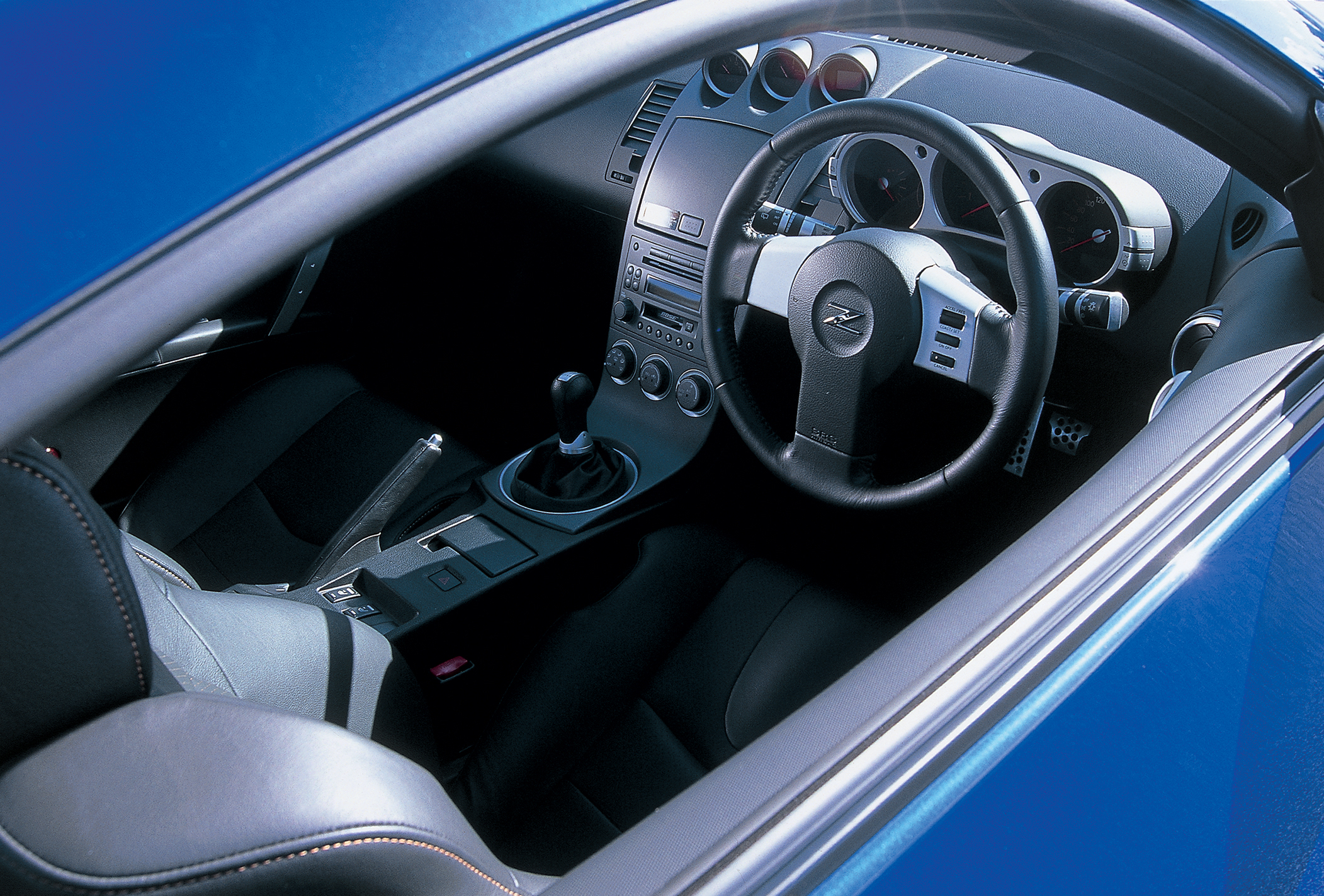
The Munro’s interior offers similar levels of equipment, with leather seats – four to the Nissan’s two – and a 10-disc CD stacker.
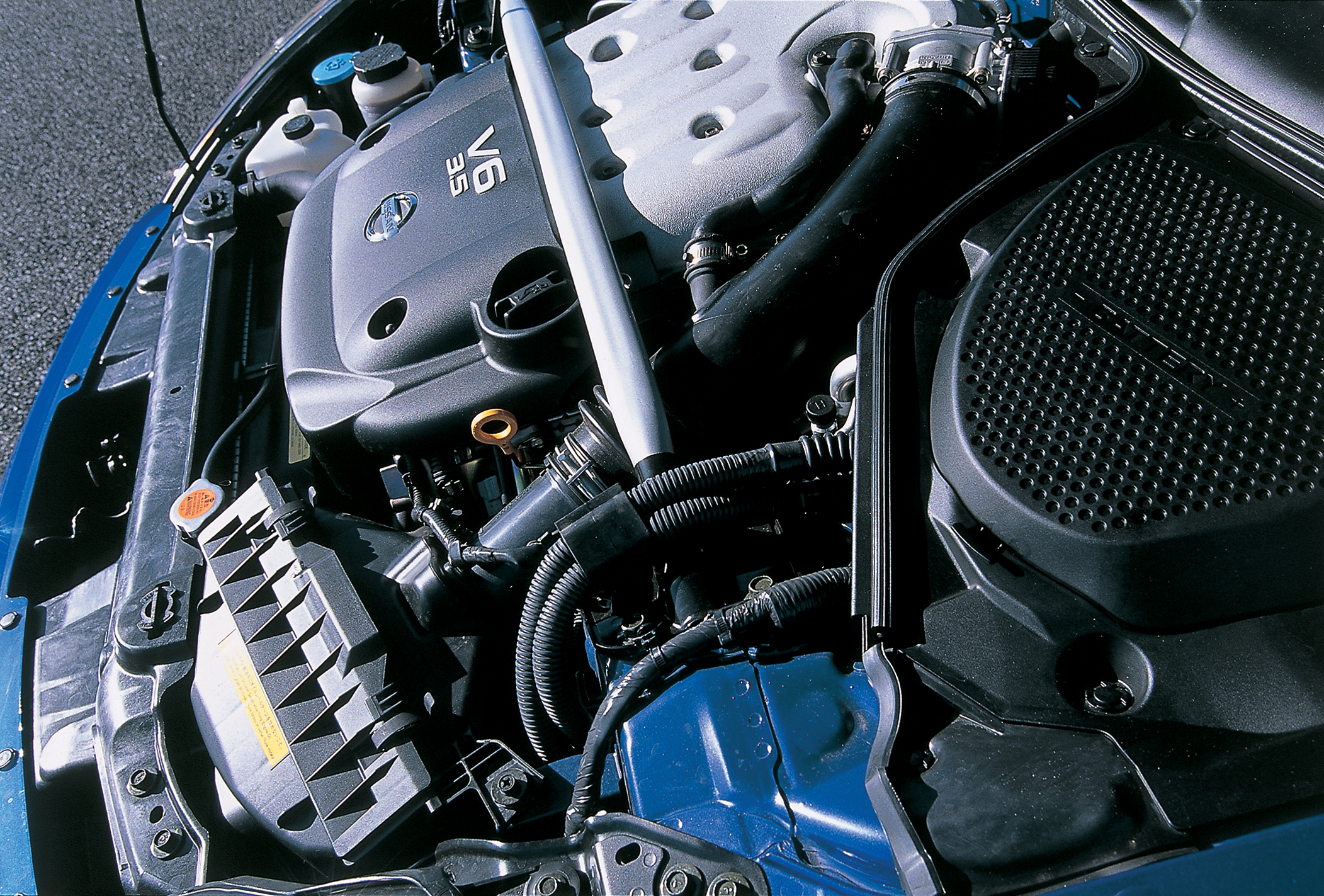
Nestling between the Nissan’s flared front guards is a 3.5-litre version of the Maxima’s 3.0-litre V6. The SOHC bent six is good for the Japanese standard maximum 206kW at a lowish 6200rpm and 363Nm at highish 4800 revs. The raw numbers are good but suggest that there is a relatively narrow band between torque and power peaks.
Nothing could be further from the truth. From two grand all the way to the 6600 rpm redline on the centrally mounted tacho there’s seamless power with no peaks or troughs. This linearity, while an easy way to propel a car quickly, can make an engine feel a little flat and lifeless, and this impression is only reinforced by the Zed’s gruff but droning exhaust note.
Thankfully the slick six-speed gearbox, no relation to the one found in the Nissan 200SX, breathes life back into the driving experience. A snappy wrist flick is all that’s required to stab the stubby shift lever through the six well spaced ratios. If you can’t be bothered with your own shifts, a five-speed auto is presently available in the Touring but won’t be in the Track until later this year.
It’s funny that the much larger-capacity and comparatively low-tech Gen III V8 feels and sounds sportier than the Nissan’s motor. With 235 kW at 5200 rpm and 465 Nm at 4400 revs, the 5.7-litre V8 kicks some theoretical sand in the face of the Zed.
But the Holden’s 30 kW and 100 Nm advantage is all but negated when you factor in kerb weights. At 1640 kg, the CV8 is the better part of 200 kegs heavier, resulting in near identical weight-to-power ratios of 6.98 kg/kW for the Monaro and 7.05 kg/kW for the Nissan.
Much has already been written in MOTOR about the six-speed Tremec gearbox found behind Gen IIIs and its reluctance to perform anything resembling a fast shift. The thing is, most of the time you can use the engine’s reserves of power and torque, along with its willingness to rev, and drive around the troublesome ’box. Start by using just the third and fourth plane – forget fifth and sixth unless you’re planning an intergalactic drive – and you should have fewer problems.
It’s when the road tightens and you’ve got to blonk it back to second that you start to wish for the Nissan’s gearbox. A closer- packed pedal box would help no end, too. As it is, there’s no way for any human to heel and toe a downshift. There’s no such dramas in the 350Z, with the metal-capped pedals all within easy reach of my size 12 sneakers.
The Holden also suffers at the hand of its gearbox when it comes time for performance testing. That recalcitrant second-third shift wastes tenths of seconds, not hundredths.
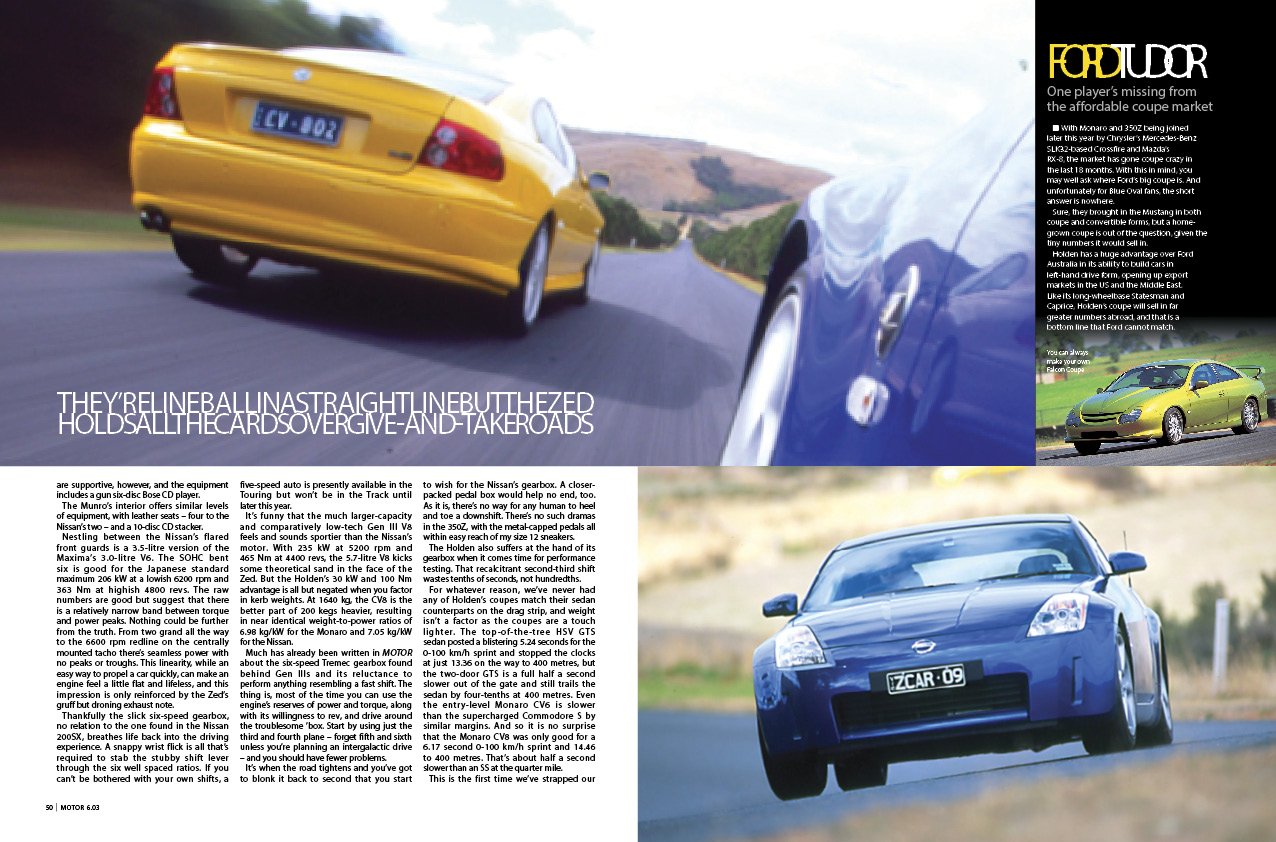
For whatever reason, we’ve never had any of Holden’s coupes match their sedan counterparts on the drag strip, and weight isn’t a factor as the coupes are a touch lighter. The top-of-the-tree HSV GTS sedan posted a blistering 5.24 seconds for the 0-100 km/h sprint and stopped the clocks at just 13.36 on the way to 400 metres, but the two-door GTS is a full half a second slower out of the gate and still trails the sedan by four-tenths at 400 metres.
Even the entry-level Monaro CV6 is slower than the supercharged Commodore S by similar margins. And so it is no surprise that the Monaro CV8 was only good for a 6.17 second 0-100 km/h sprint and 14.46 to 400 metres. That’s about half a second slower than an SS at the quarter mile.
This is the first time we’ve strapped our Correvit to a Zed, and it’s no picnic to get fast numbers out of it. You’ll need more revs than in the Munro to rotate the 18-inch 245/45 Bridgestone Potenzas just enough for the right balance of grip and slip. Once hooked up, things become easier as the slick shift and V6 punch help the Zed to some surprisingly quick numbers: 0-100 km/h in 6.32 seconds and 14.37 for the quarter mile, with a terminal speed right on the old ton.
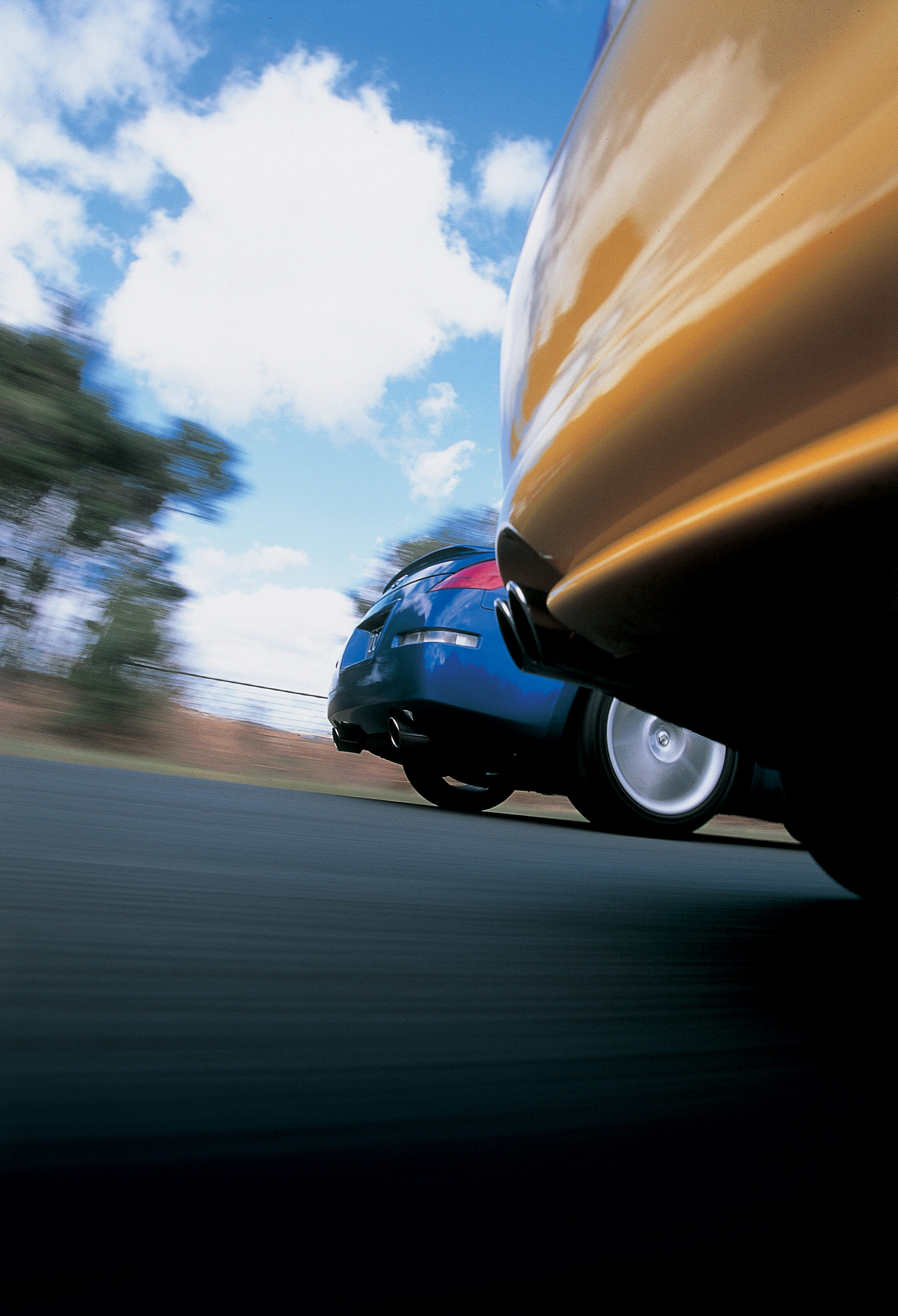
So they’re line-ball in a straight line, but the Zed holds all the cards over give-and-take back roads when the chassis are really tested. There’s way more grip from the Bridgestones than there is grunt from the V6 engine, to the point where the switchable traction control is scarcely bothered in the dry. Turn-in grip is high and there’s decent feedback through the wheel.
The Monaro also wears Bridgestone Potenzas on its redesigned 18-inch alloys, albeit 235/40s all around. Even with the improvements to Holden’s steering in the last few years, it’s still not the final word on communication. Back to back, the Monaro feels far softer, almost lifting its nose out of the water under hard acceleration and leaning heavily on the outside front Potenza when tipped into a tightening-radius corner.
The thing with the Zed is that it gets better the harder you drive it. Anything below about six-tenths and you probably won’t understand what all the fuss is about. It’s not until you really dig below the Zed’s surface that it starts to shine.
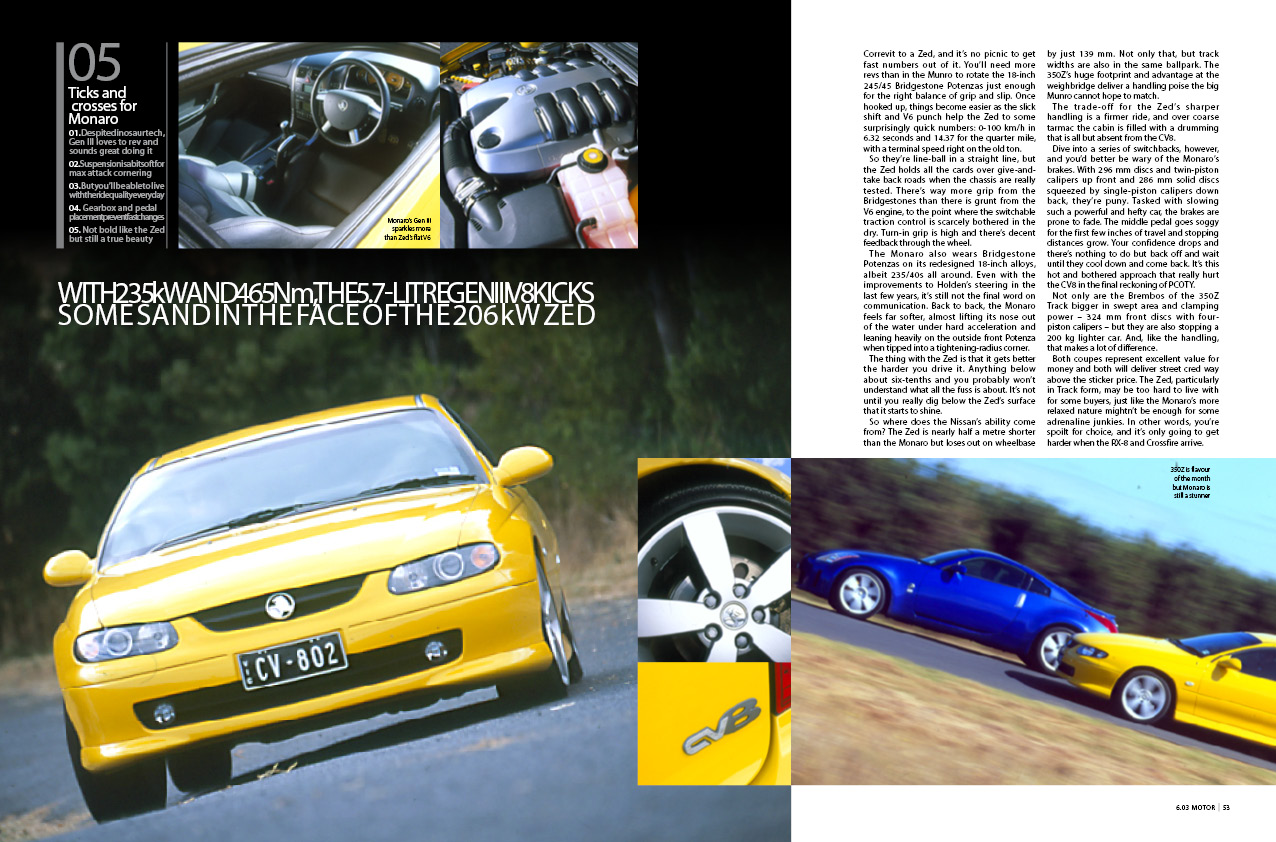
So where does the Nissan’s ability come from? The Zed is nearly half a metre shorter than the Monaro but loses out on wheelbase by just 139 mm. Not only that, but track widths are also in the same ballpark. The 350Z’s huge footprint and advantage at the weighbridge deliver a handling poise the big Munro cannot hope to match.
The trade-off for the Zed’s sharper handling is a firmer ride, and over coarse tarmac the cabin is filled with a drumming that is all but absent from the CV8.
Dive into a series of switchbacks, however, and you’d better be wary of the Monaro’s brakes. With 296 mm discs and twin-piston calipers up front and 286 mm solid discs squeezed by single-piston calipers down back, they’re puny. Tasked with slowing such a powerful and hefty car, the brakes are prone to fade.
The middle pedal goes soggy for the first few inches of travel and stopping distances grow. Your confidence drops and there’s nothing to do but back off and wait until they cool down and come back. It’s this hot and bothered approach that really hurt the CV8 in the final reckoning of PCOTY.
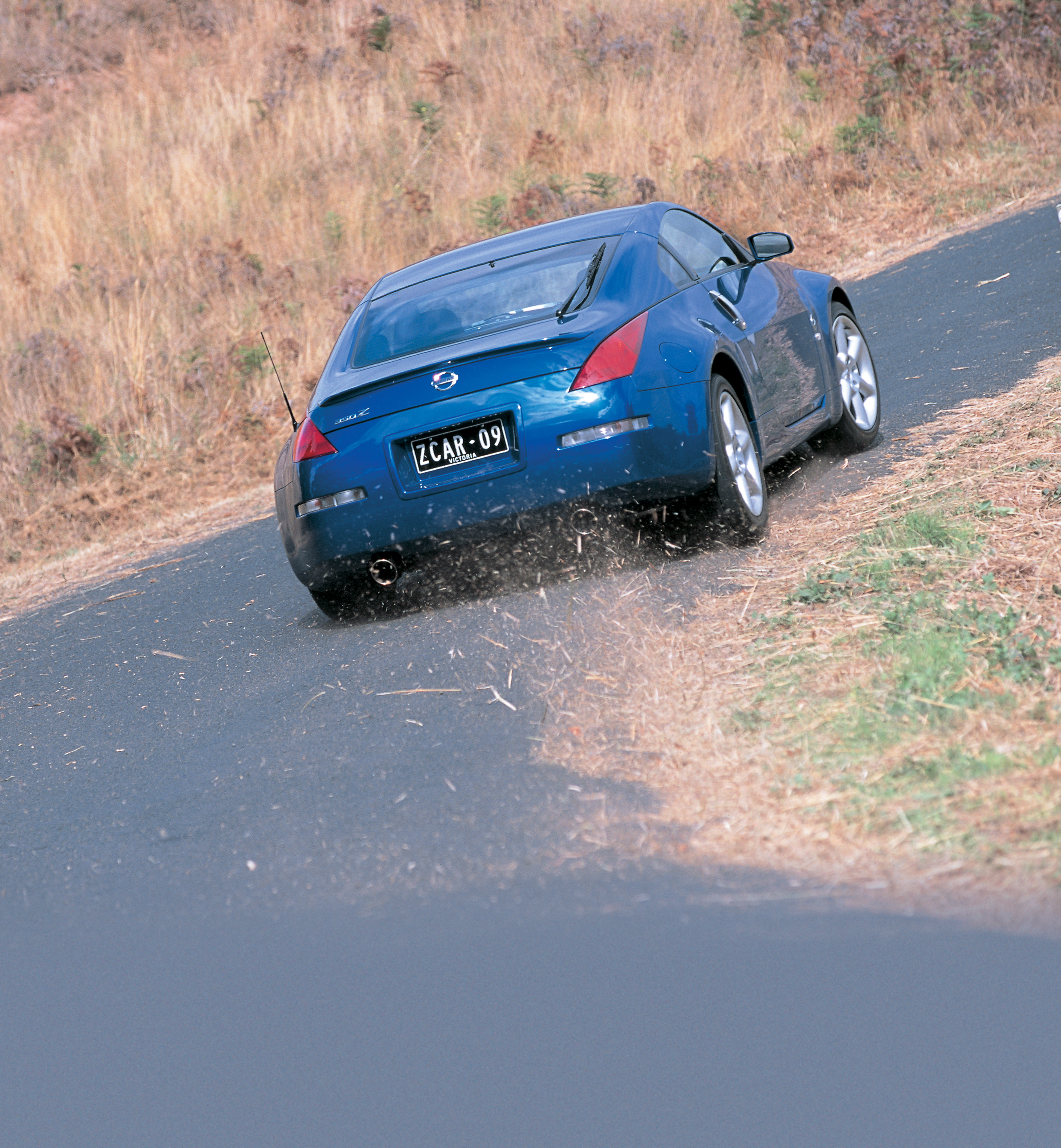
Not only are the Brembos of the 350Z Track bigger in swept area and clamping power – 324 mm front discs with four-piston calipers – but they are also stopping a 200 kg lighter car. And, like the handling, that makes a lot of difference.
Both coupes represent excellent value for money and both will deliver street cred way above the sticker price. The Zed, particularly in Track form, may be too hard to live with for some buyers, just like the Monaro’s more relaxed nature mightn’t be enough for some adrenaline junkies. In other words, you’re spoilt for choice, and it’s only going to get harder when the RX-8 and Crossfire arrive.
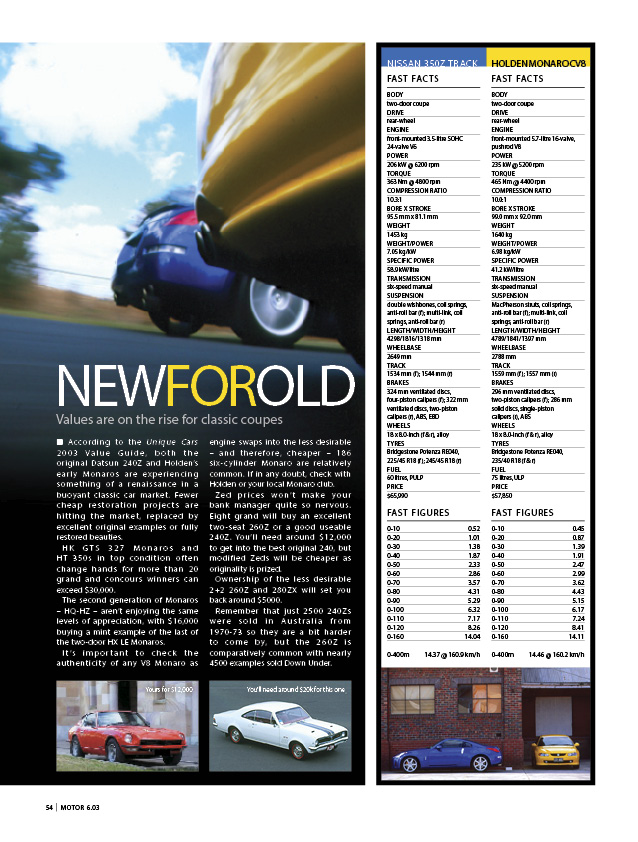
New For Old
Values are on the rise for classic coupes
According to the Unique Cars 2003 Value Guide, both the original Datsun 240Z and Holden’s early Monaros are experiencing something of a renaissance in a buoyant classic car market. Fewer cheap restoration projects are hitting the market, replaced by excellent original examples or fully restored beauties.
HK GTS 327 Monaros and HT 350s in top condition often change hands for more than 20 grand and concours winners can exceed $30,000.
The second generation of Monaros – HQ-HZ – aren’t enjoying the same levels of appreciation, with $16,000 buying a mint example of the last of the two-door HX LE Monaros.
It’s important to check the authenticity of any V8 Monaro as engine swaps into the less desirable – and therefore, cheaper – 186 six-cylinder Monaro are relatively common. If in any doubt, check with Holden or your local Monaro club.
Zed prices won’t make your bank manager quite so nervous. Eight grand will buy an excellent two-seat 260Z or a good useable 240Z. You’ll need around $12,000 to get into the best original 240, but modified Zeds will be cheaper as originality is prized.
Ownership of the less desirable 2+2 260Z and 280ZX will set you back around $5000.
Remember that just 2500 240Zs were sold in Australia from 1970-73 so they are a bit harder to come by, but the 260Z is comparatively common with nearly 4500 examples sold Down Under.
(Ed’s note: These 2003 values make for pretty depressing reading in 2021, don’t they?)
