
Introducing the Lexus RX 500h, the epitome of luxury and efficiency within the esteemed Lexus RX lineup.
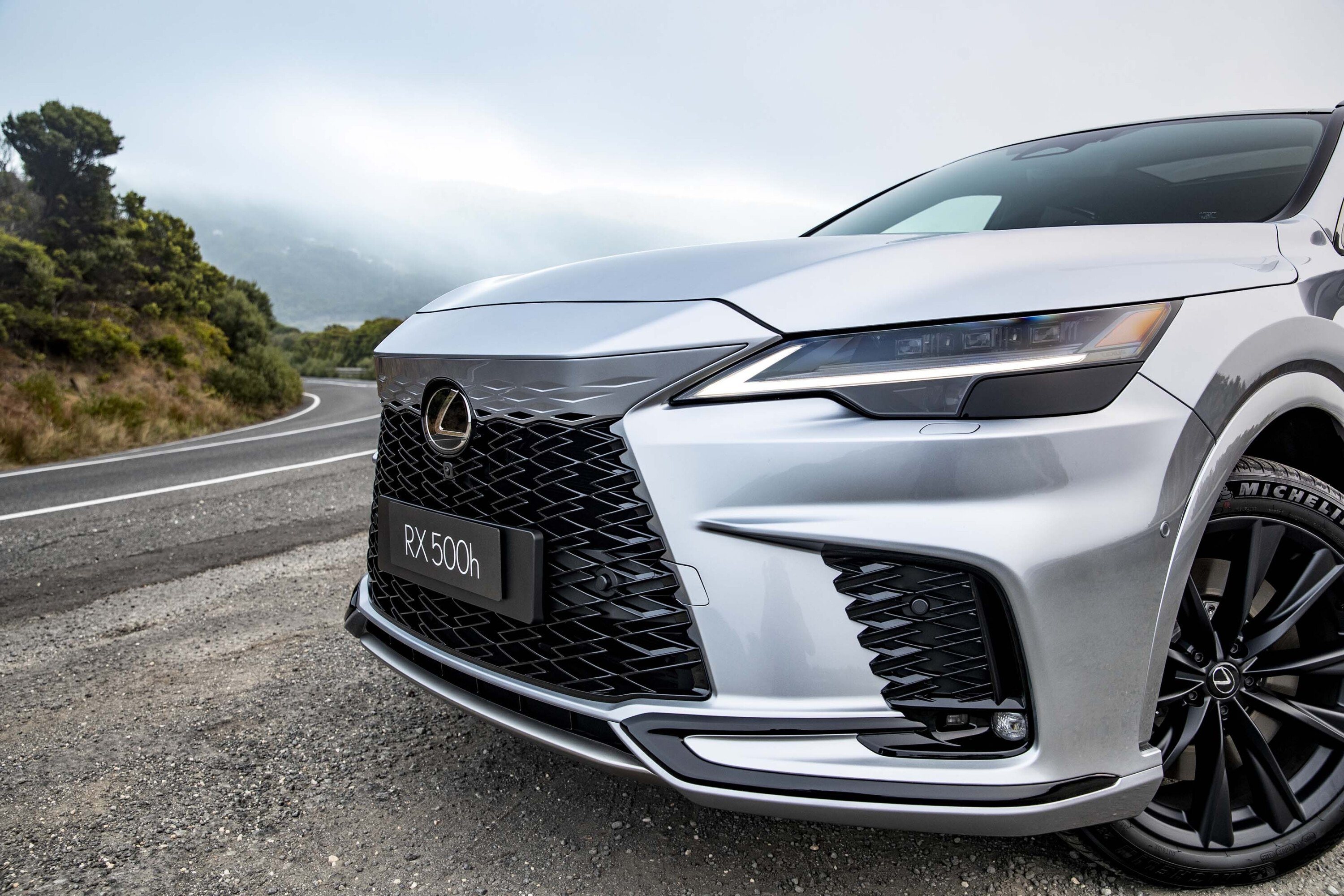
As a distinguished member of the Lexus family, the 500h F Sport sits atop the RX line-up as the models most sporty variant, yet still as a hybrid.
In a competitive landscape filled with luxury SUVs, the RX 500h emerges as a true standout, if you’re not looking at insane performance figures.

1
Pricing and features
The range-topping Lexus RX 500h sits at an $7,700 premium to its one spot below sibling the 350h AWD Sports Luxury (including both the available enhancement packs) at $128,050 before on-road costs.
Powering the family SUV is a 2.4-litre turbo petrol engine producing 273kW. As we’re used to, Lexus doesn’t quote a combines torque figure however the petrol engine alone provides a commendable 460Nm– using a claimed 6.5L/100km.
The fifth-generation update saw dimensional growth in almost every direction. This means the current RX offers ample space, especially in the rear with 612L available.
1
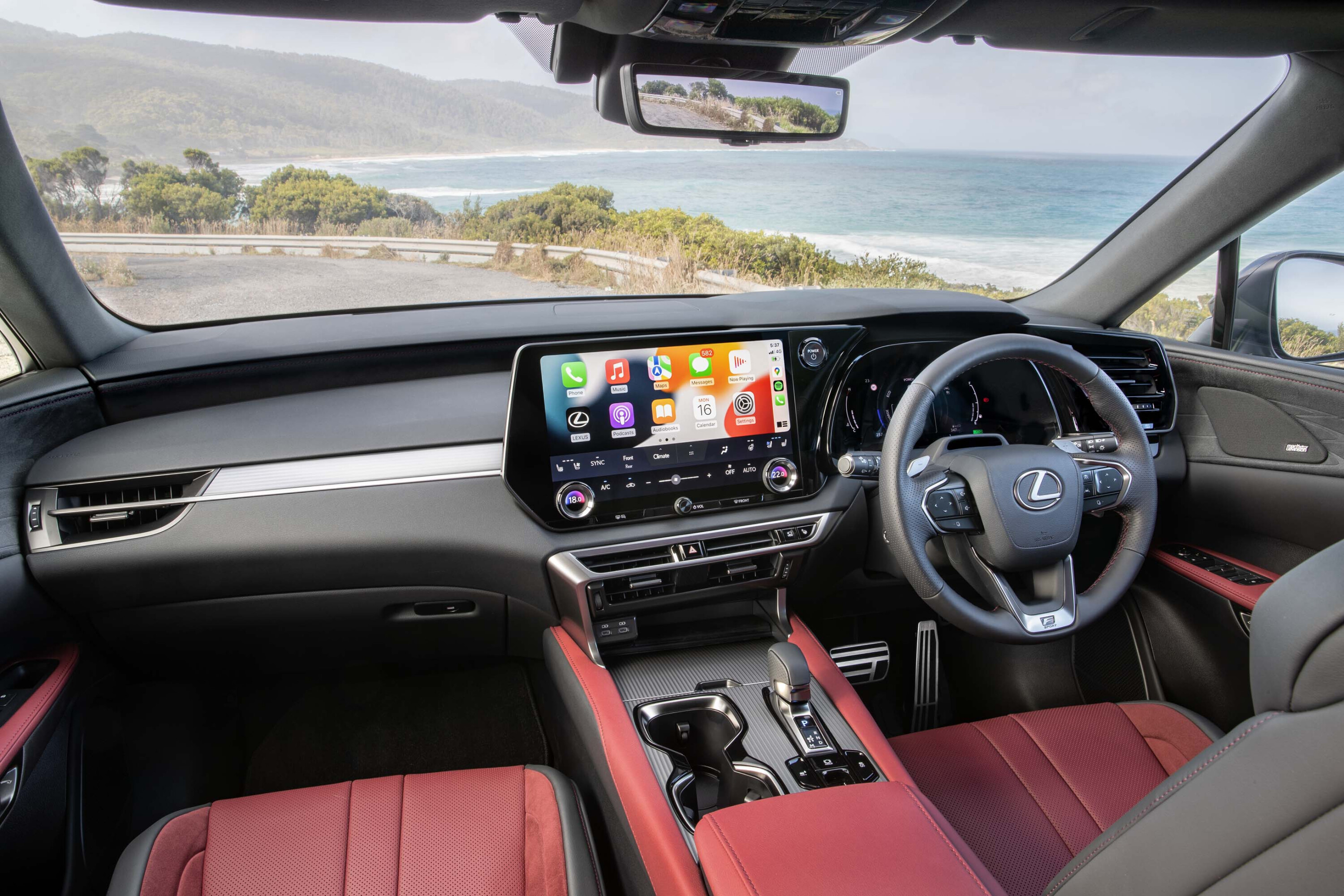
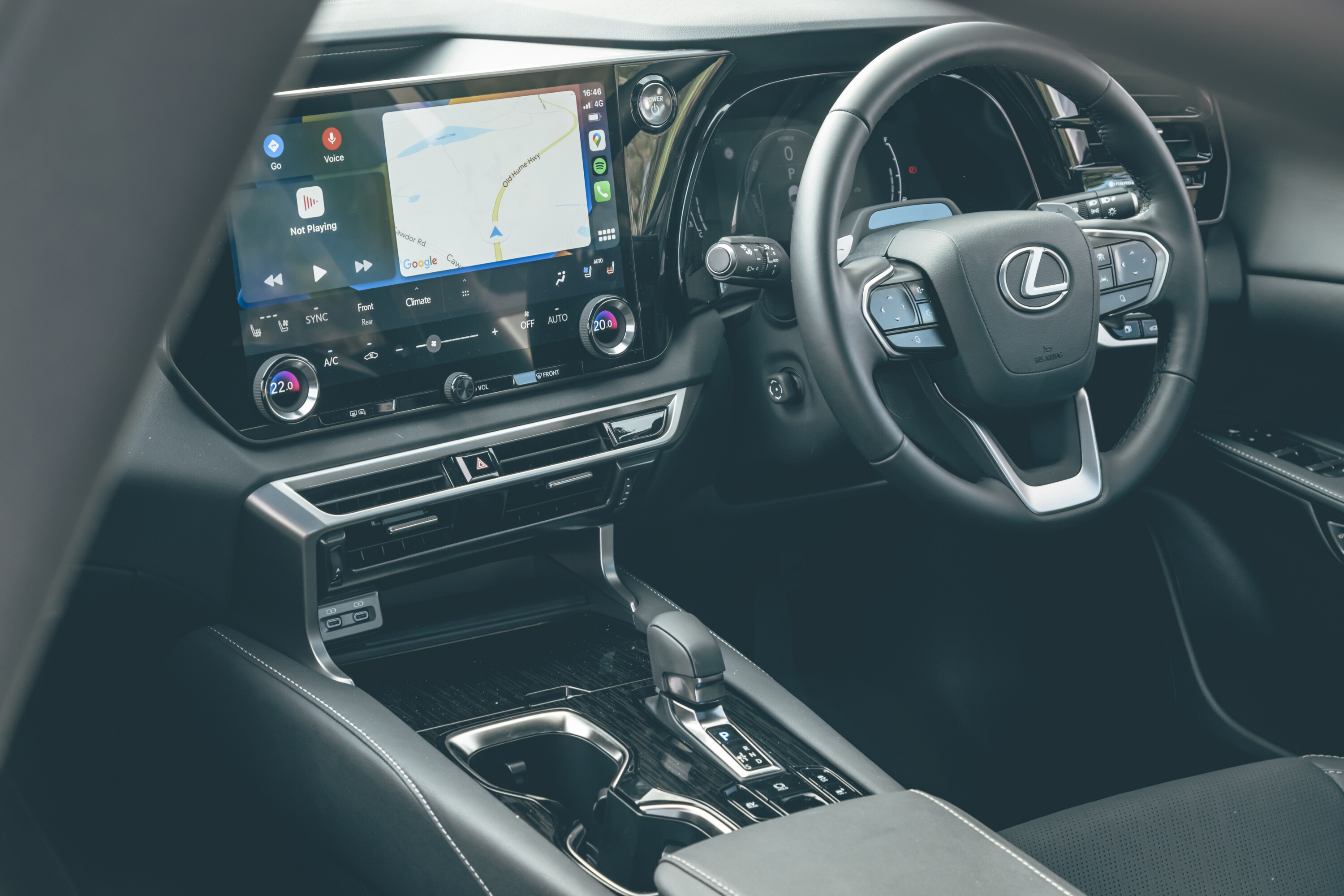
Spanning 14-inches, this infotainment screen ranks among the largest in its class. Powered by the brand’s latest user interface and software, the display is straightforward with a robust feature set and operates smoothly.
In addition to built-in navigation, the system offers wireless Apple CarPlay, wired Android Auto, DAB+ radio and a three-year subscription to Lexus Connected Services. This subscription grants owners access to emergency assistance, automatic collision notification, and remote functions via the Lexus Connected app.
Standard in the NX 500h F Sport you’ll get:
| 2-way power lumbar support for front seats | Head up display |
| 21-inch alloy wheels | Heated & ventilated rear outboard seats |
| 21-speaker mark levinson audio system | Heated steering wheel |
| 3 zone air conditioning | Leather accented seat trim |
| 8-way power adjustable front seats with memory | Leather accented shift knob |
| Active sound control | Panoramic roof |
| Adaptive high-beam | Panoramic view monitor |
| Adaptive variable suspension | Power back door with kick sensor |
| Black roof rails | Power folding rear seats |
| Cabin and door illumination | Rear privacy glass |
| Digital rear view mirror | Ventilated front seats |
| Easy-access entry (seat and steering wheel) | Wireless phone charger |
| F Sport grille, seats, bumpers and badging | Woodgrain ornamentation on steering wheel |

1
Safety
The RX 500h was awarded a five-star safety rating by ANCAP, covering all its variants following evaluation in 2022.
For adult occupant protection, it attained a score of 90%, with 89% for both child occupant protection and safety assist systems.
Featuring the Lexus Safety Sense package, the NX500h offers comprehensive safety features throughout its range, ensuring thorough protection.
2024 Lexus RX Safety System features:
- 8 SRS airbags
- Automatic High Beam
- Blind Spot Monitor
- Dynamic Radar Cruise Control
- Lane Departure Alert
- Lane Tracing Assist
- Pre-Collision Safety System
- Road Sign Assist
- Parking Support Brake
- Rear Cross Traffic Alert
- Safe Exit Assist
- Front and Rear Parking Sensors
- Driver Monitor Camera
- Tyre Pressure Warning System
- Rear Seat Reminder
1
Key rivals
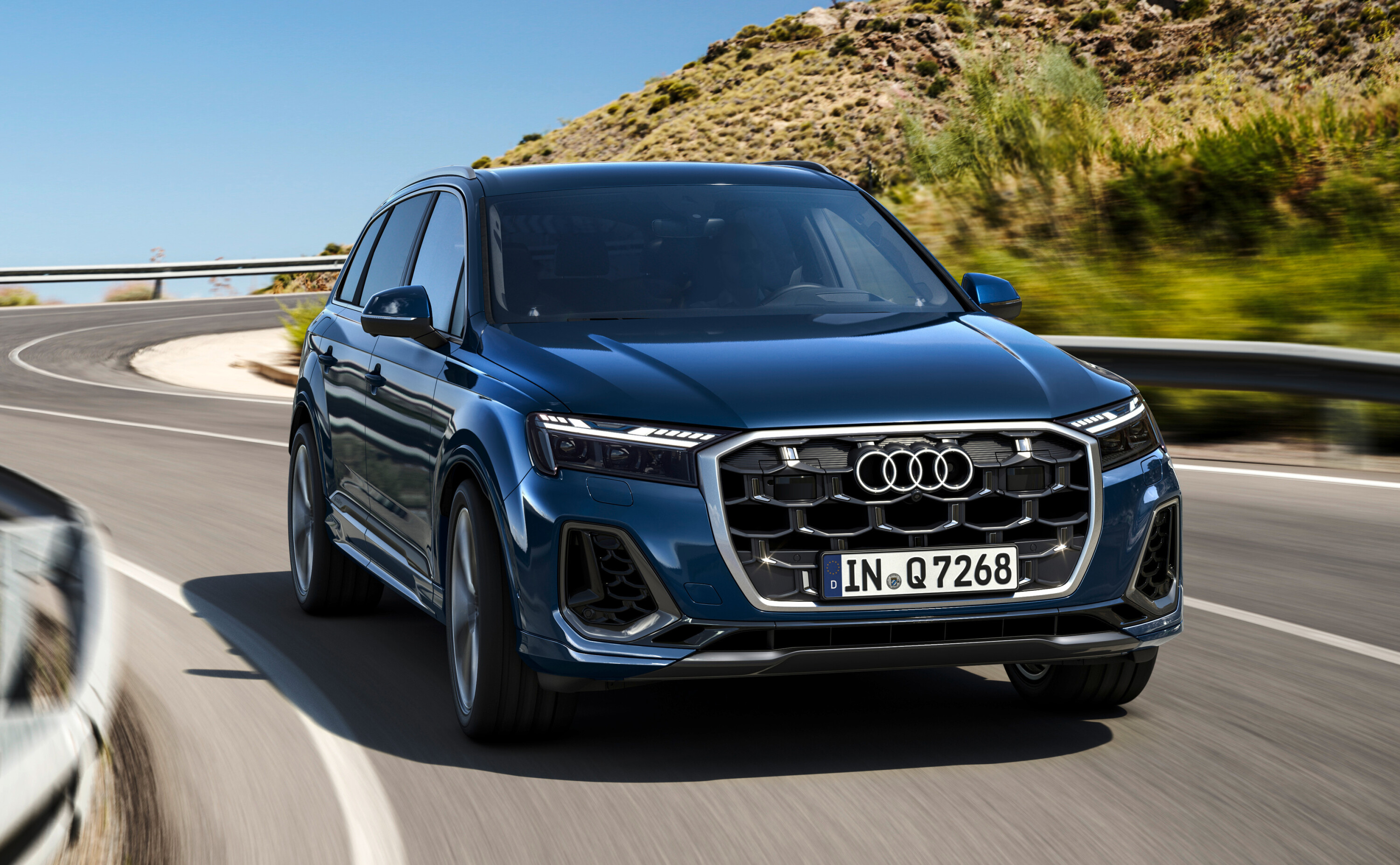
With its sporty focus, the RX500h F Sport competes against other performance variants of the following competitors:
1
Should I put it on my shortlist?
In the world of luxury SUVs, there really is no shortage of options. Any box can be ticked from the super luxury to faster rivals. But the RX manages to tick all the boxes to some degree.
It’s a hugely refined offering that is even able to match the fuel economy of some hatchbacks.
Bit with that being said, ultimately the 350h offers much of the same. You’ll still get a heap of creature comfort features, the perks of a hybrid powertrain and a several thousand dollars back in your pocket.
MORE
Everything Lexus
MORE
SUV Buyers Guide
Sales figures show us each month what the most popular used cars are for Australian buyers, but popular doesn’t also mean best.
When it comes to the hugely popular medium SUV, you should make sure the three models below are high on your list of cars to consider.
JUMP AHEAD
Near new: Toyota RAV4 Hybrid
The Goldilocks of medium SUVs
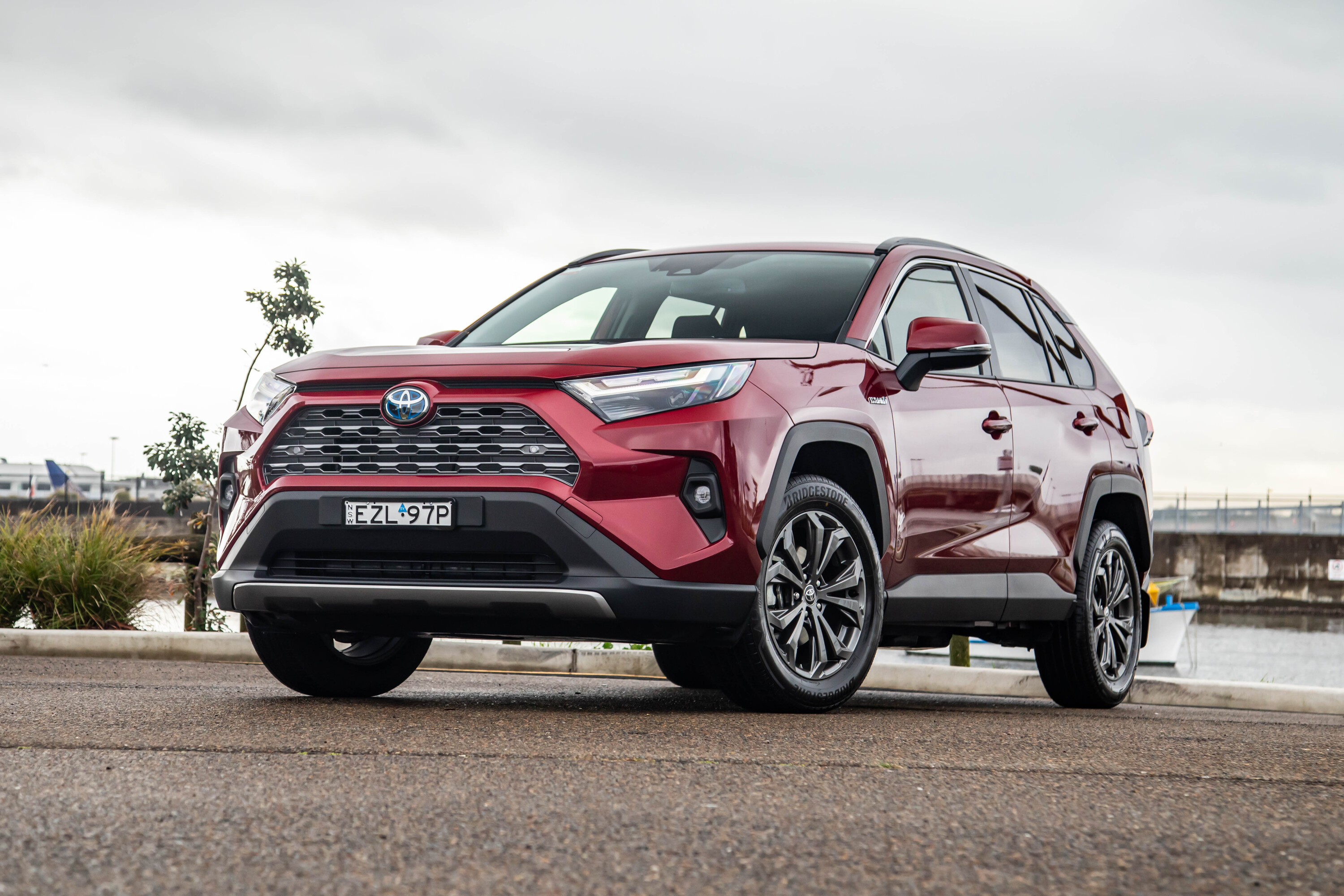
The massive wait times for new Toyota RAV4 Hybrids are finally coming down from highs of two or more years to about 12 months. But that’s still a helluva long time to wait, which makes a near-new RAV Hybrid seem an excellent alternative.
Those snaking backorder queues, and the inflated asking prices for used examples, point to the same thing: the RAV4 Hybrid is in hot demand, for good reason.
1
Take the 2.5-litre petrol-electric hybrid powertrain, which significantly cuts energy consumption compared with a conventional engine, without the cost or range anxiety of an EV.
And the RAV4’s TNGA platform, which adeptly delivers that holy trinity of ride, refinement and driver appeal.
You’d own a RAV4 just because it’s a Toyota and won’t fail you, even if it wasn’t much chop to drive. Dud dynamics certainly didn’t hurt the sales of the last two RAV4 generations.
While it may pain you to pay near new-car money for a used car, the payoff is that the RAV4 Hybrid’s appeal – and residual value – will hold up for many years to come.
MORE
Everything Toyota
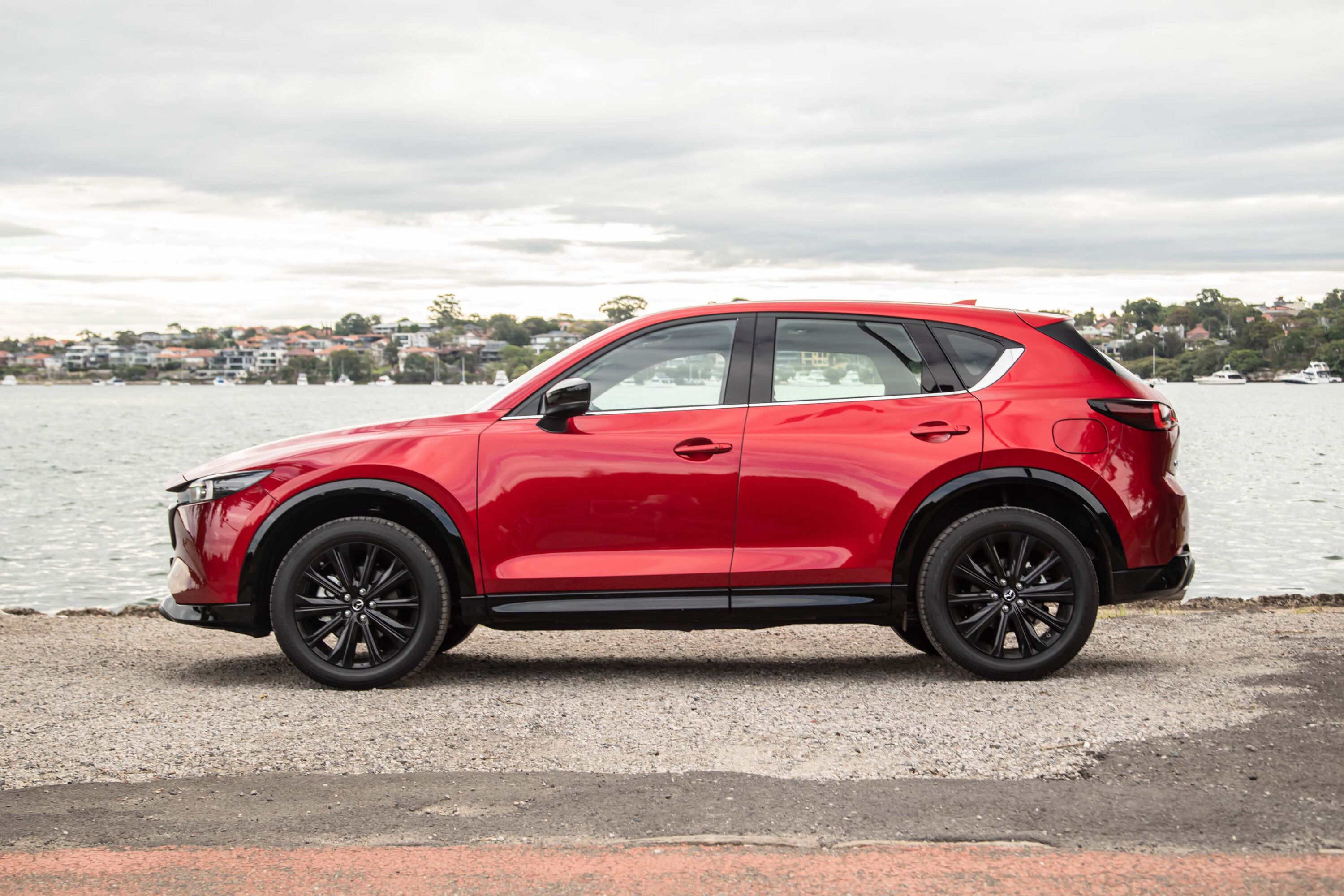
Mid range: Mazda CX-5
Entertaining and classy where it counts
The Mazda CX-5’s uncanny ability to answer almost any automotive question you could ask makes it a go-to mid-range medium SUV.
Want a car that strikes a nice balance between snobby and bargain-basement? That’s a CX-5, ideally in Touring spec with ‘Grand Luxe’ synthetic suede trim and plenty of fruit, wearing a cool shade such as Deep Crystal Blue, Machine Grey or Soul Red.
1
Want an enjoyable powertrain that delivers decent economy without any turbo or hybrid tech to give trouble? That’s a CX-5 2.5-litre petrol, with a useful 140kW and 252Nm, and 7.5L/100km official combined consumption.
In this age (2017-ish) and price bracket, the 2.5 will come paired with a six-speed auto and AWD, which is a better bet than the 2.0-litre FWD (underpowered) or 2.2-litre turbo-diesel (anecdotally a bit iffy for durability).
Did we mention the CX-5 is fun to steer for an SUV, rides well, has reasonable refinement, is utterly dependable and has excellent resale? Phew! Yep, a used CX-5 sure does a lot of box-ticking.
MORE
Everything Mazda
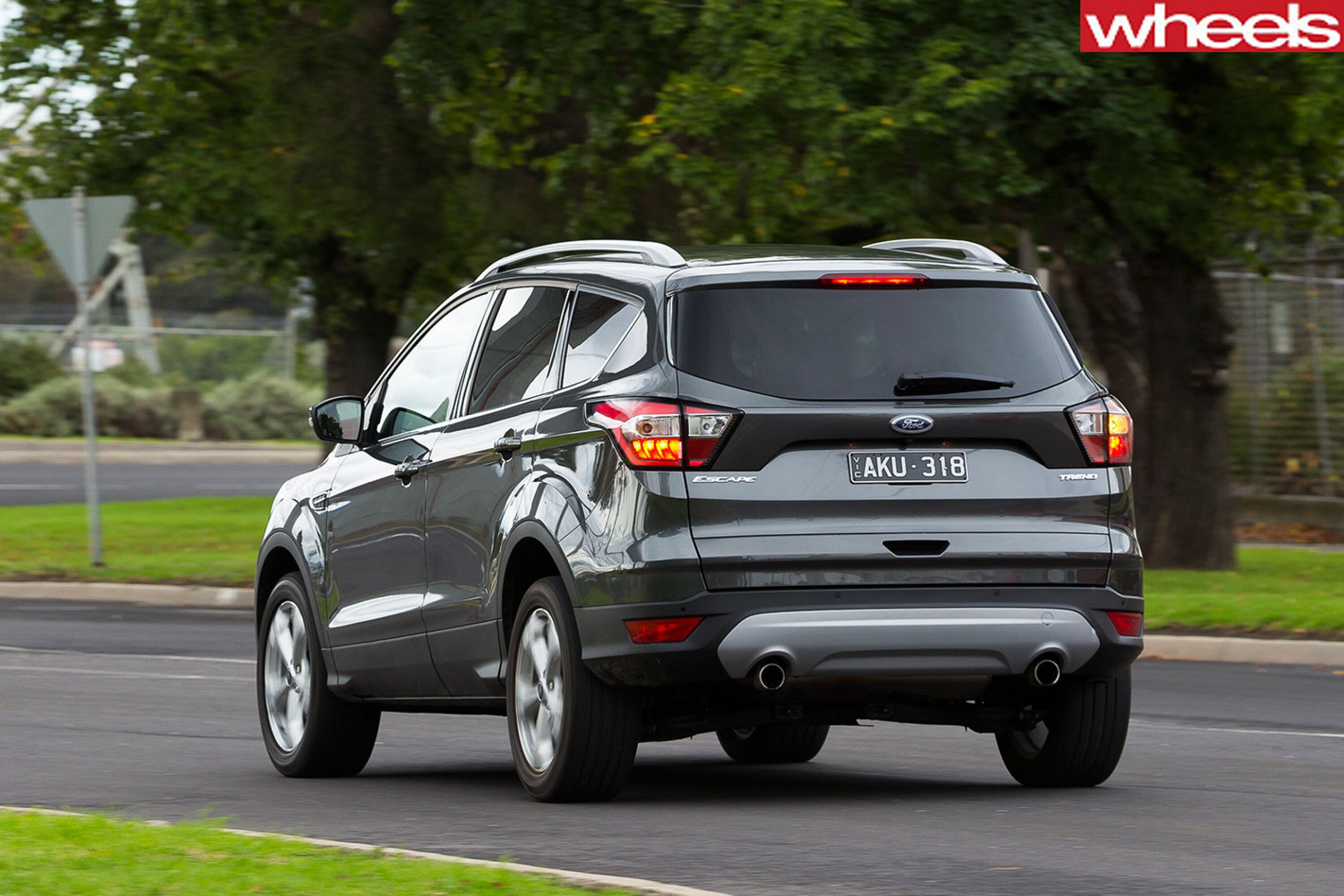
Budget: Ford Escape
So much better than its image might suggest
There aren’t many bargains in the post-pandemic used market, in which asking prices reflect the craziness of 2021 (while buyer sentiment is in the dumps).
But a five- or six-year-old Ford Escape is one, as well as an SUV Wheels has rated for some time, chiefly because it’s a crisp steer and a tidy handler in a segment where such qualities are rare.
1
Escape’s strong-value status stems from the fact that, Ranger/Everest aside, Blue Oval products are a bit overlooked on the Aussie market these days, which is great for the few who know how much the mid-size Ford wagon has going for it.
Translation: While $15K doesn’t get you very far in the market for a Volkswagen Tiguan, it buys a decent Escape Trend or Ambiente with a strong, economical 1.5-litre turbo four.
Similarly, circa-$20K will be scraping the barrel on the CX-5 market but shopped wisely gets you into a nice Escape ST-Line or Titanium with 2.0-litre turbo urge.
MORE
Everything Ford
MORE
Midsize SUVs
Sales figures show us each month what the most popular used cars are for Australian buyers, but popular doesn’t also mean best.
When it comes to the once very popular midsized sedan, you should make sure the three models below are high on your list of cars to consider.
JUMP AHEAD
Near new: Skoda Octavia
Sanity Czech
Few cars you’d describe as being a peach, but the charming Skoda Octavia has always been a car to earn that moniker.
With plenty of thoughtful design and ergonomic touches, a beautifully executed ride-handling balance, and lots of grunt in RS guise, the Octavia is a very easy car to like in our books – especially in latest NX-generation guise (based on the same platform as the Mk8 VW Golf).
With Skoda’s seven-year new-car warranty, grab yourself a 2021 example and you’ll still have four years’ of factory-backed peace-of-mind.
You can get a 2021 Octavia 110TSI Style wagon (the higher-grade model) from about $27,000 with plenty of equipment, space and much of the latest technology and safety gear (including adaptive cruise, eight airbags and AEB). This is a vehicle that couldn’t make a stronger case for buying second-hand over brand new.
MORE
Everything Skoda
Mid range: Toyota Camry hybrid
Don’t forget to leave a five-star review
If the idea of owning and driving a Camry makes you flinch, it’s your loss – at least in the case of the annoying good current-generation XV70 Camry.
With surprisingly supple ride quality, plenty of space (including the back seat and boot), and miserly fuel economy in hybrid guise (less than 5.0L/100km), this is a vehicle you’ll hate yourself for liking as much as you do. Even dynamically, it’s pretty decent, with the tiniest amount of GR86 DNA.
Produced from 2017, they’re also safe as houses and you can get a top-spec SL from $20,000 to $25,000. Of course, being a Toyota, one day you’ll realise the warranty ran out years ago and you didn’t notice.
These things rack up thousands of kilometres needing little more than fresh fluids and some new wiper blades, which is probably why you’ve sat in the back of a dozen of them already when getting an Uber.
MORE
Everything Toyota
Budget: Holden ZB Commodore
Yes, really. It merits a fair go
Putting a Holden badge on the front and a Commodore one on the rear was akin to taking a red paint brush and drawing targets on either side of this poor, unfairly maligned vehicle – one that is now a surprisingly great second-hand buy.
An Opel Insignia in Germany (where it was built), the ZB went on-sale in Australia in 2017 and came in ‘liftback’ sedan and wagon body styles, with either 2.0-litre turbo-petrol or diesel fours or atmo 3.6-litre V6 engines. Some were front-drive and others AWD, while Holden engineered its own suspension tunes, steering calibration, and even drivetrain configurations.
In 2024, you can get a ZB Commodore for as little as $14,000 – and even the VXR with its Twinster all-wheel-drive system (which can split torque not only front-rear, but also side-to-side) can be picked up for $25,000. While it might buy you some sour memories of a bygone time, it gets you a surprisingly fine car. If it helps you sleep better, rebadge it as an Insignia.
MORE
Everything Holden
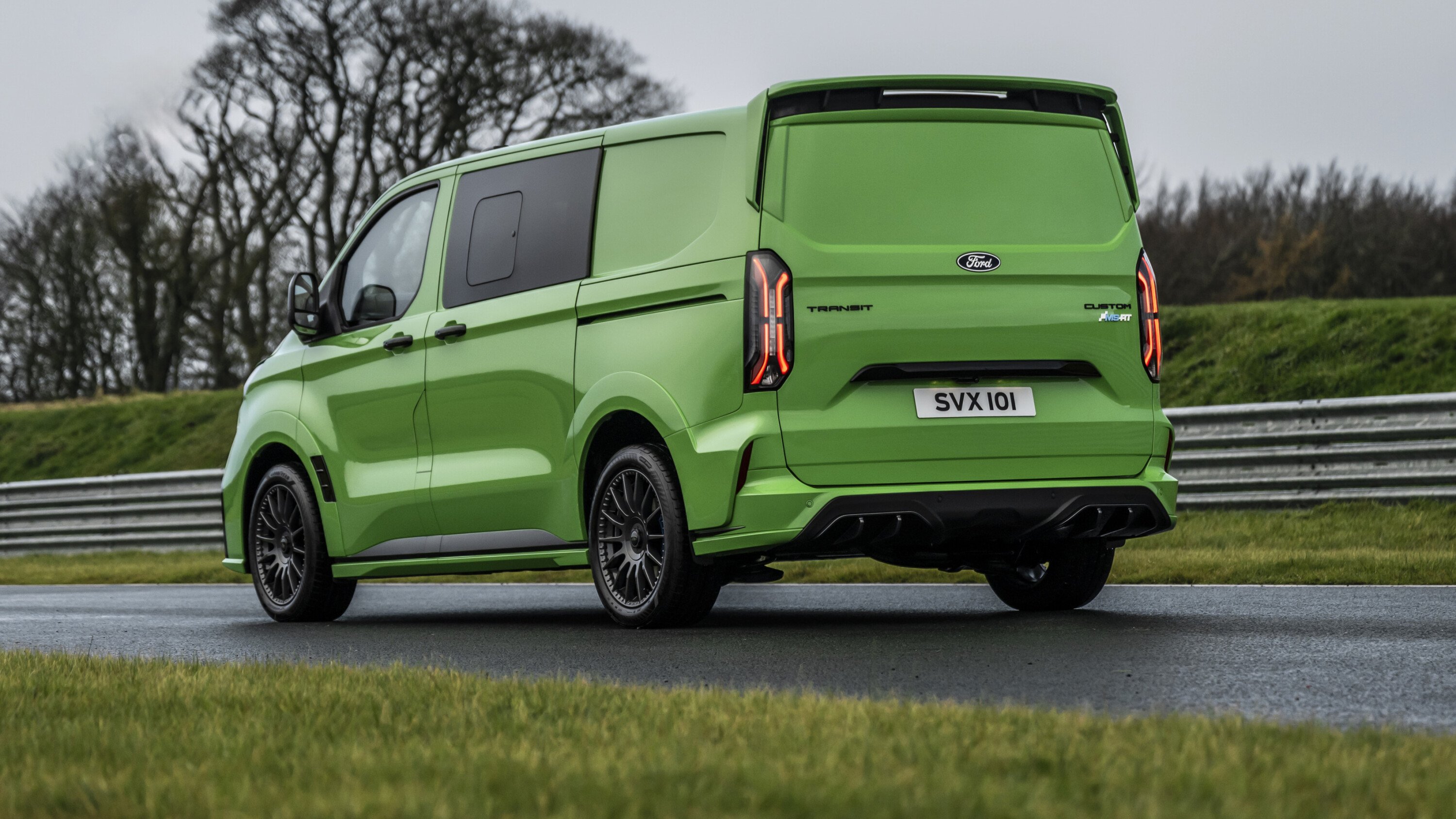
Alongside the reveal of a range-topping variant of the best-selling Ford Ranger ute, Ford Pro has also revealed its sporting vision of its trusty commercial Transit Custom workhorse, the Transit Custom MS-RT.
The motorsport-inspired van will be available with three powertrain options; diesel, plug-in hybrid and full battery-electric – the last of which boasts a 210kW e-motor powering its rear wheels. The plug-in hybrid variant will deliver approximately 170kW out of a 2.5-litre turbo petrol engine paired with a 11.8kWh battery.
The 2.0-litre diesel will be available in front- or all-wheel drive, with an eight-speed automatic or six-speed manual gearbox respectively.
1
All these sporting additions don’t look to compromise the actual function of the van
General manager of Ford Pro Europe Hans Schep said, “Whichever powertrain option you choose, everything about this Transit Custom has the MS-RT DNA running through it, delivering the excitement customers want with the productivity they need. The 210 kW fully-electric E-Transit Custom MS-RT pushes that appeal even further.”
To highlight the motorsport image the Transit Custom MS-RT wears a spoiler, side skirts and rear bumper with an integrated diffuser. The van also rides on 19-inch alloy wheels that are half an inch wider than the Transit Custom Sport’s wheels, and increases the track width by roughly 50mm. The wheels are shod with 235/45 R19 Goodyear Eagle Sports.
All these sporting additions don’t look to compromise the actual function of the van – namely carrying loads and tools – with 6.8 cubic metres of load space and a 1124kg payload figure.
1
“More customers are wanting a work vehicle for the week, with the Ford Pro productivity solutions to help their business thrive, but also something that supports their lifestyle at the weekend. These new MS-RT vehicles are the perfect answer.” Schep added.
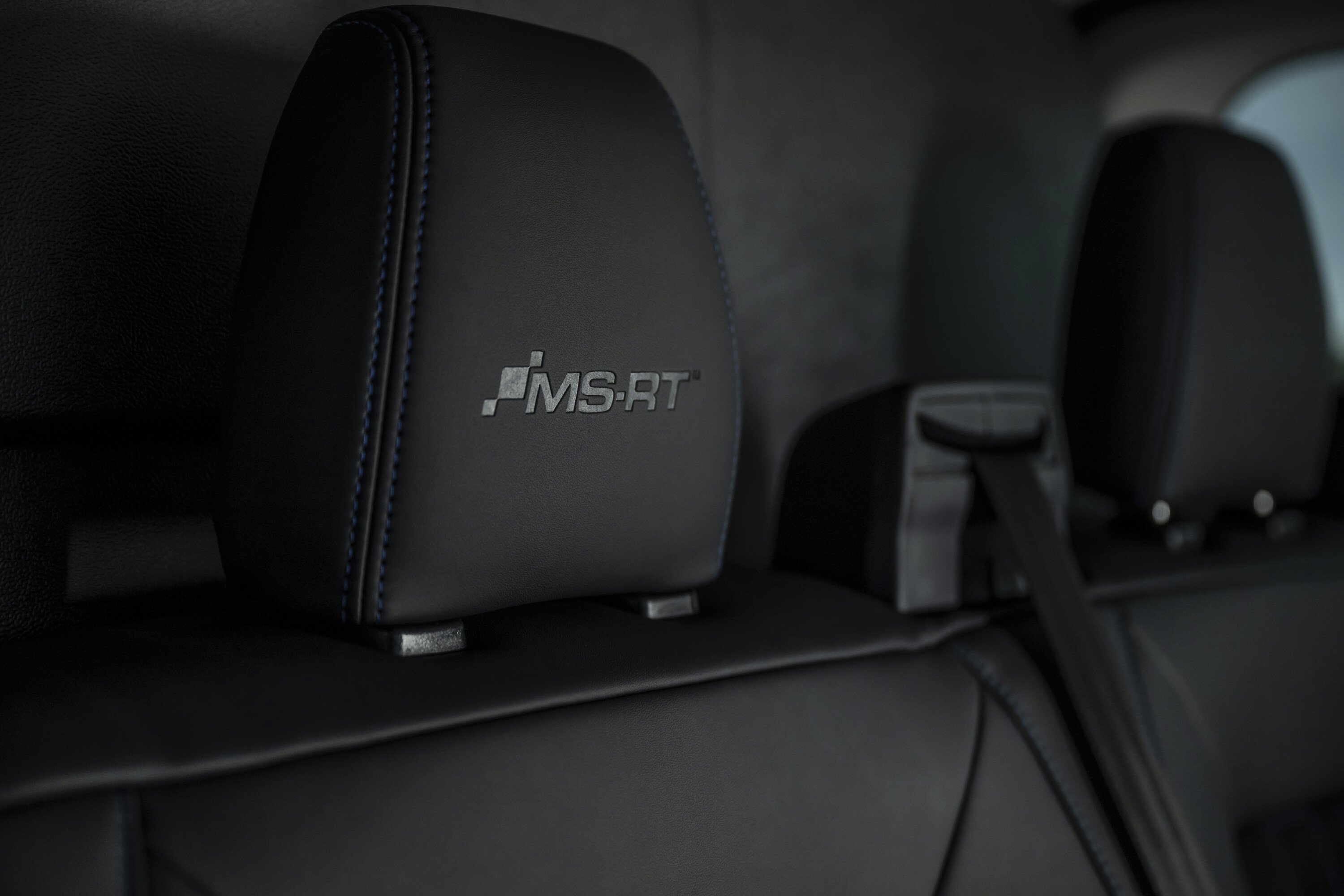
Extras extend to the cabin as well, with artificial suede front seats that have extra side bolstering, and unique MS-RT logos and blue stitching throughout. Painted blue brakes round out the visual flourishes.
The Transit Custom MS-RT will make its way to Ford Pro dealers in Europe in 2024, although news of a potential Australian release has not yet been offered.
MORE
Everything Ford
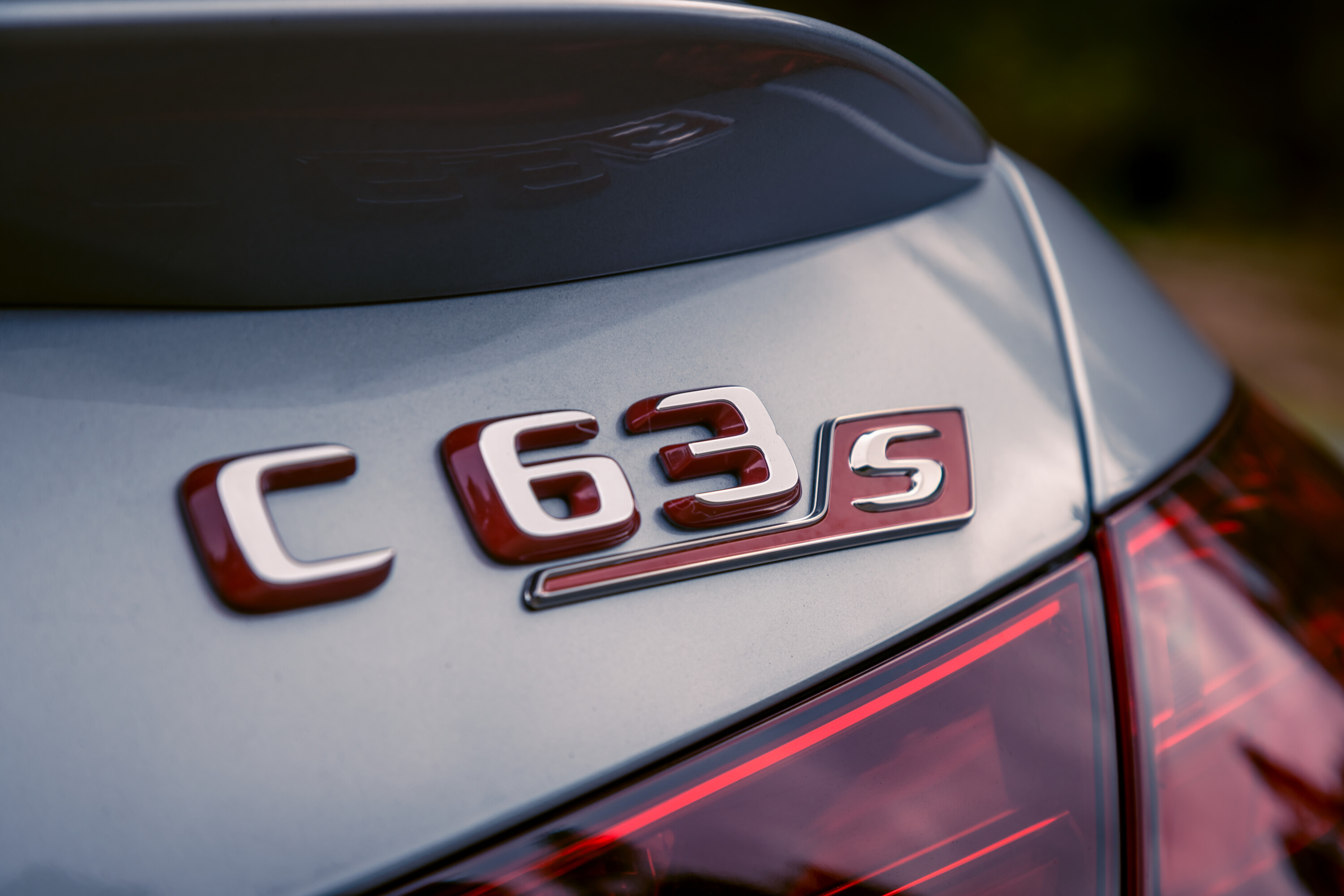
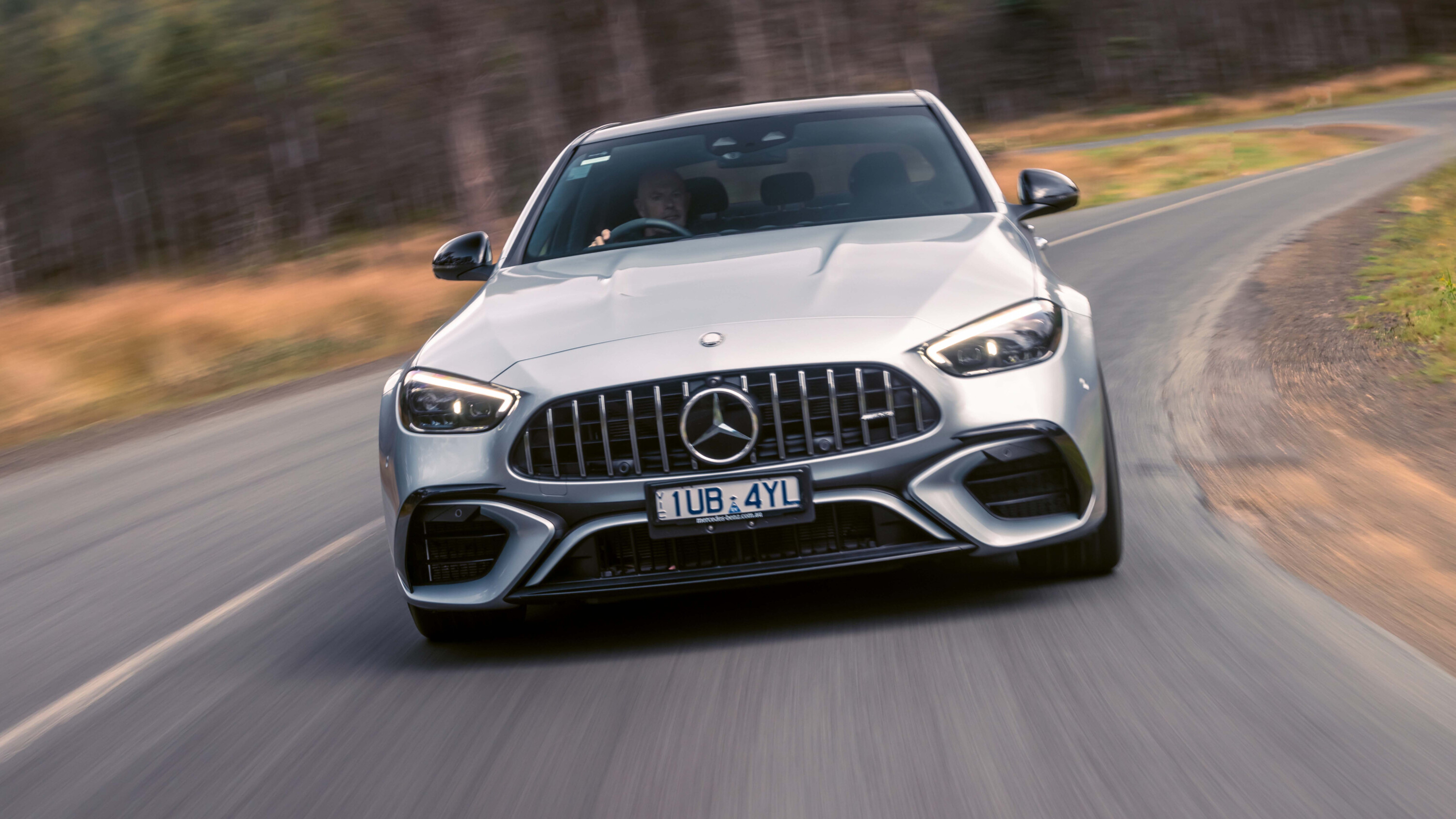
The last time we drove the 2024 Mercedes-AMG C63 it was on road and track near the famous Ascari circuit in Spain and it’s fair to say we approached it with a degree of caution.
After all, this wasn’t a new version of the V8-powered, tyre-frying C63 recipe we all knew and loved – it was a different animal altogether.
Shockingly, the V8 was gone and in its place lurked a complex plug-in hybrid powertrain that, despite four fewer cylinders, churned out a colossal 500kW/1020Nm. But a C63 with no V8? That’s like a pie with no sauce, or bacon with no eggs – it couldn’t work, surely?
1
And yet around Ascari, it kind of did. The character and experience were unquestionably different – we still missed the V8’s noise – but there was also no doubting the hybrid C63’s pulverising pace and traction.
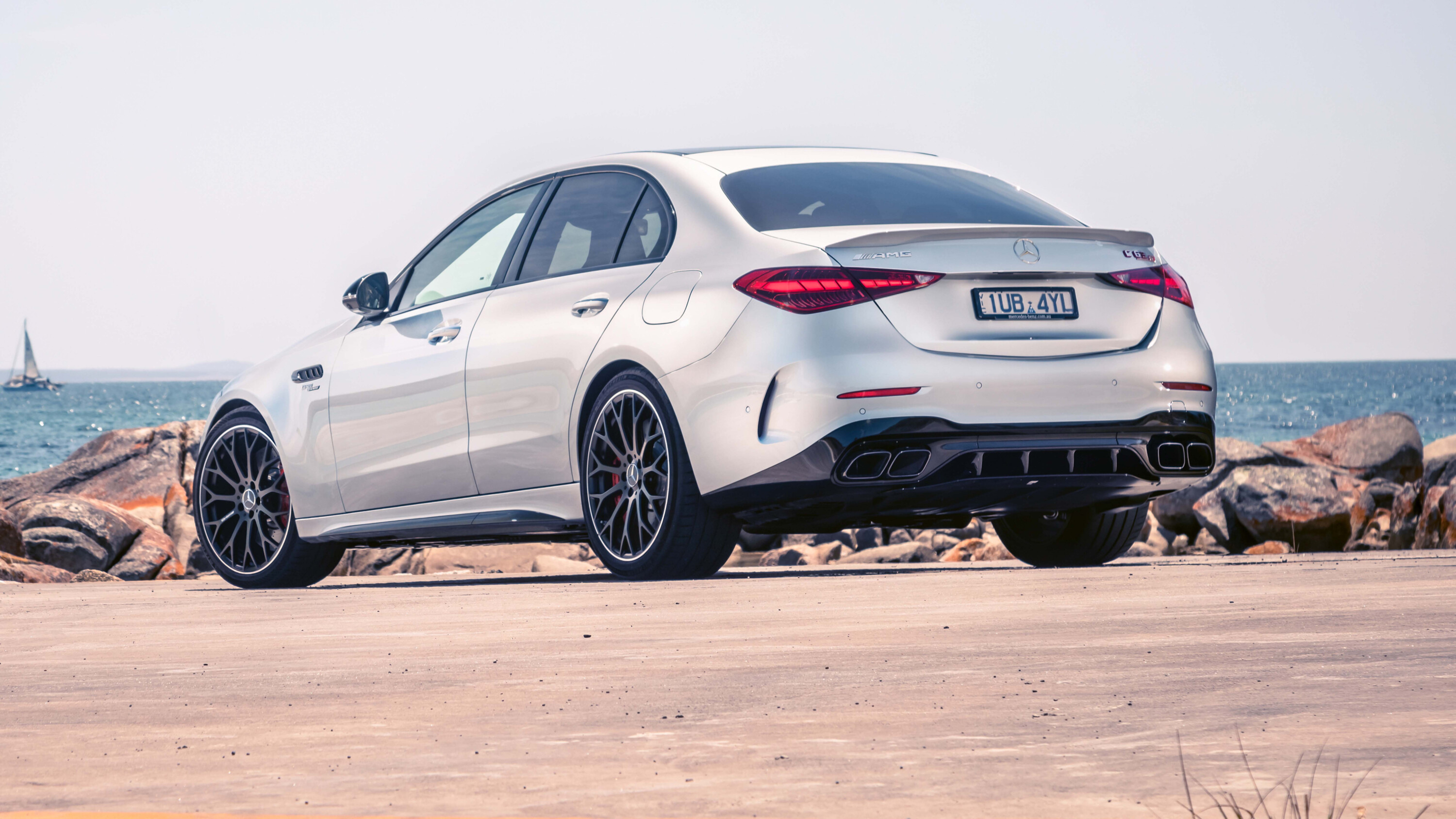
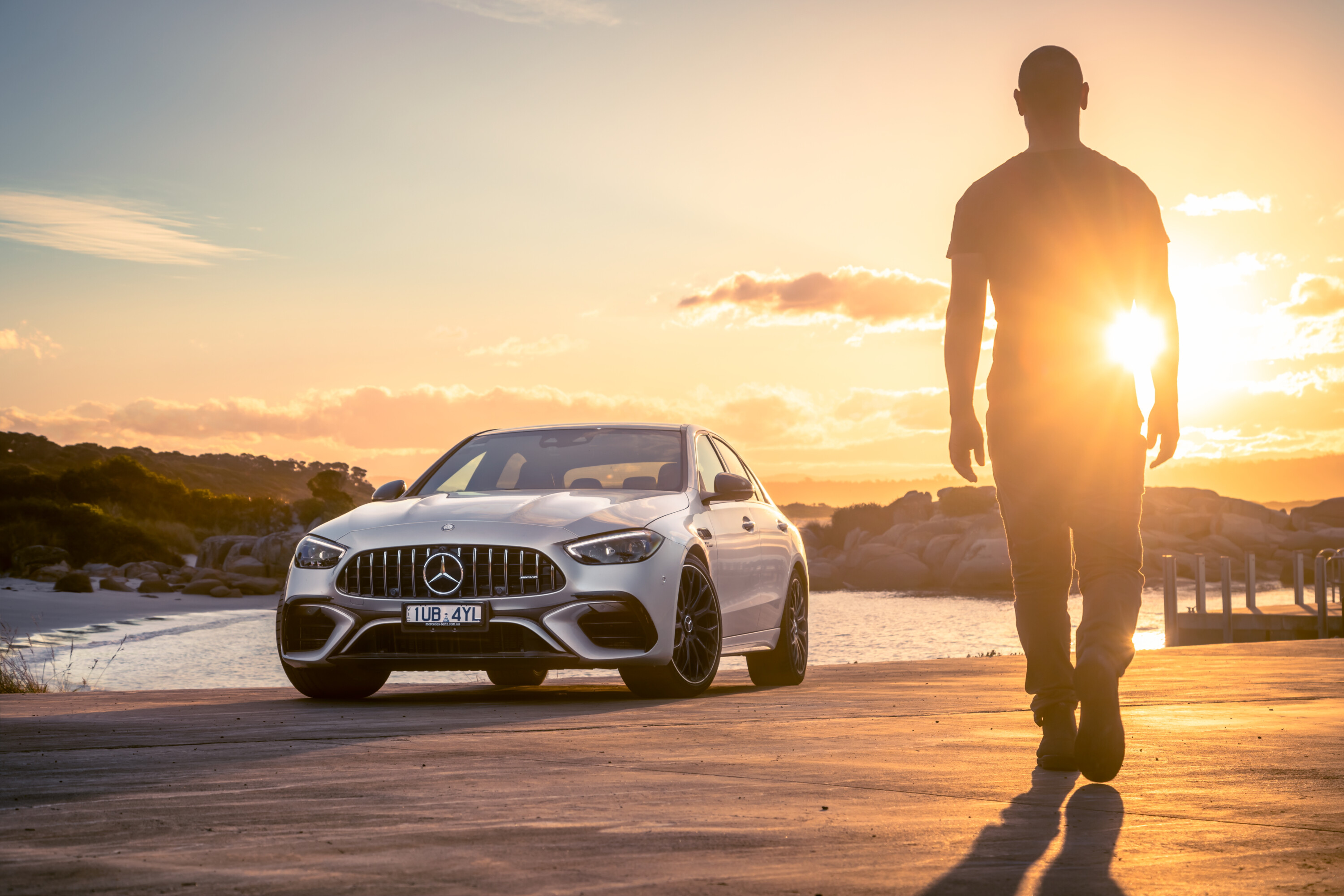
Now, some six months later than expected, the W206 C63 has arrived in Australia. Will it feel just as rapid and grippy on Aussie tarmac? Can an electrified turbo four-pot really win over a nation of V8 lovers?
And now that we know local spec and pricing, how does the fresh C63 compare for value and performance? We headed to some of Tasmania’s best roads to find out.
1
JUMP AHEAD
- How much is it and what do you get?
- How do rivals compare on value?
- Interior comfort and space
- How does it drive?
- How much fuel does it use?
- Warranty and running costs
- VERDICT
- Specifications
How much is it and what do you get?
This is the one piece of the W206 C63 puzzle that was missing when we first drove the car in Europe, way back in November 2022.
Back then, Mercedes was preparing us for a figure around $200,000 but happily, the Aussie price is lower than expected at $187,900 before on-road costs. Mind you, that’s still $19,724 more expensive than the old V8-powered sedan, but AMG hasn’t sold the sedan in Australia since 2022, so that comparison isn’t quite apples with apples.
Instead, it’s better to measure the new C63’s price against the cost of the previous coupe, which was still on sale in late 2023 for $190,000 excluding on-road costs.
Speaking of the coupe, it’s something we won’t get with this generation of C63. That role will instead be filled by the soon-to-arrive CLE, which sits between the previous C-Class and E-Class coupes for size and will be offered in sporty CLE 53 and 63 guises.
1
There’s no wagon this time around either, despite one being offered overseas, so you can wave goodbye to hopes that AMG will soon have a rival for the desirable BMW M3 Touring. Boo!
What your $187,900 does buy you, however, is a hugely complex sports sedan. We won’t rehash the full technical details here – our international review covers all the geeky changes – but even mentioning the highlights is lengthy.
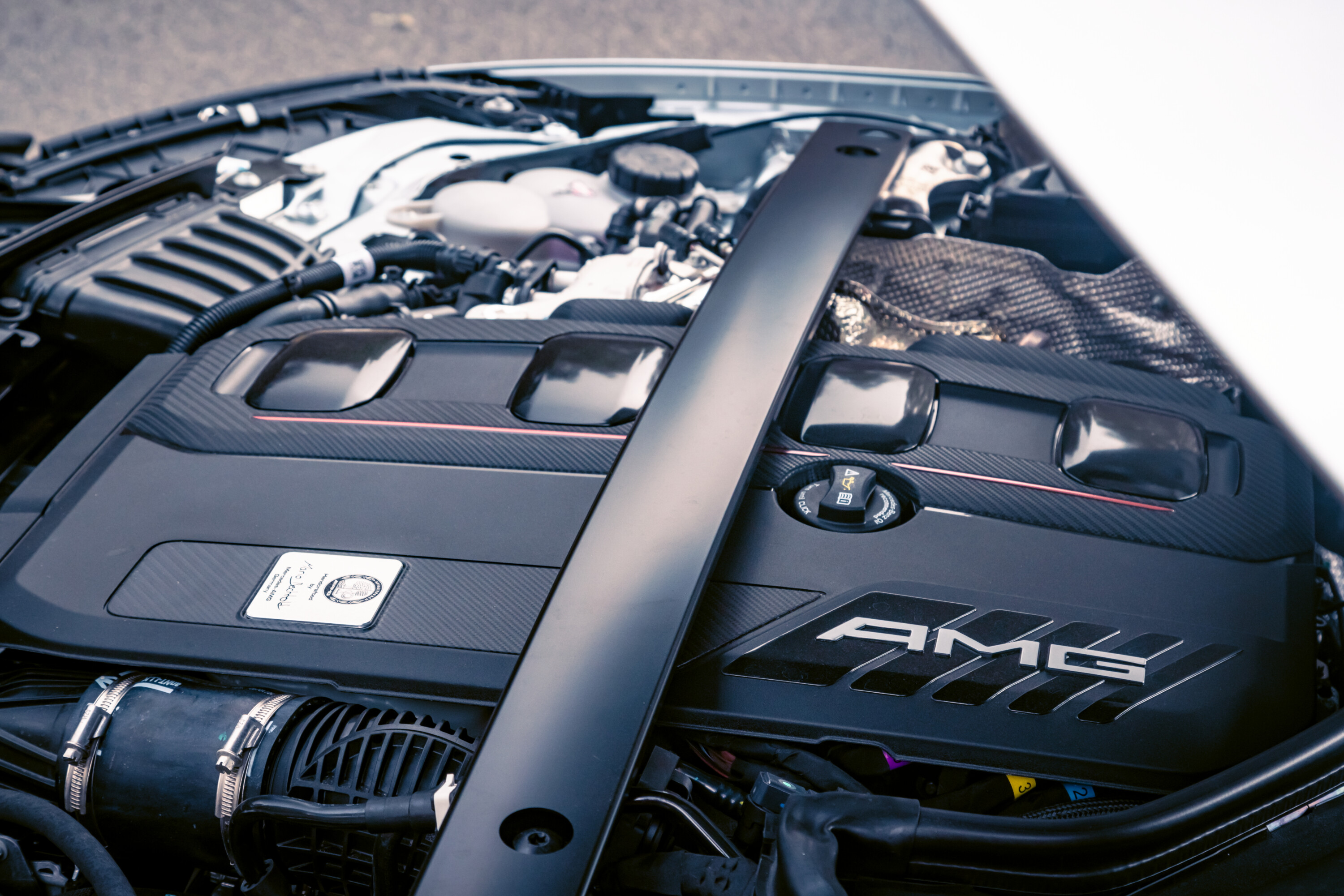
The biggest change, of course, is found under the bonnet. Under there, you score the same M139 2.0-litre four-cylinder as you get in the blisteringly quick A45 hyper hatch, yet AMG has mounted it longitudinally in the C63 and fitted a larger turbocharger.
2
The turbo itself is electrified, meaning the turbine is spun by both exhaust gas and electricity to improve response and reduce lag, and peak power for the engine alone has jumped to 350kW/545Nm.
No doubt, that’s a mighty achievement – AMG says the C63 has the world’s most powerful 2.0L engine – but it’s when you factor in the hybrid system that outputs get properly bonkers.
An electronic drive unit sits on the rear axle and combines an e-motor with a two-speed gearbox and limited-slip differential. It’s fed by a small but sophisticated 6.1kWh battery and combined, the C63’s powertrain makes 500kW/1020Nm.
1
Need some context? Those outputs are a healthy 125kW/320Nm more than the old V8 C63 and a decent wedge more than you get from the AMG’s longstanding rivals in the Audi RS4 (331kW/600Nm) and BMW M3 Competition (375kW/650Nm).
All-wheel drive helps to transfer the new 63’s grunt to the road – a Drift mode is available for tyre-smoking hijinks – and there are eight drive modes to play with, including an EV setting that provides 15km of electric-only range from a full battery.
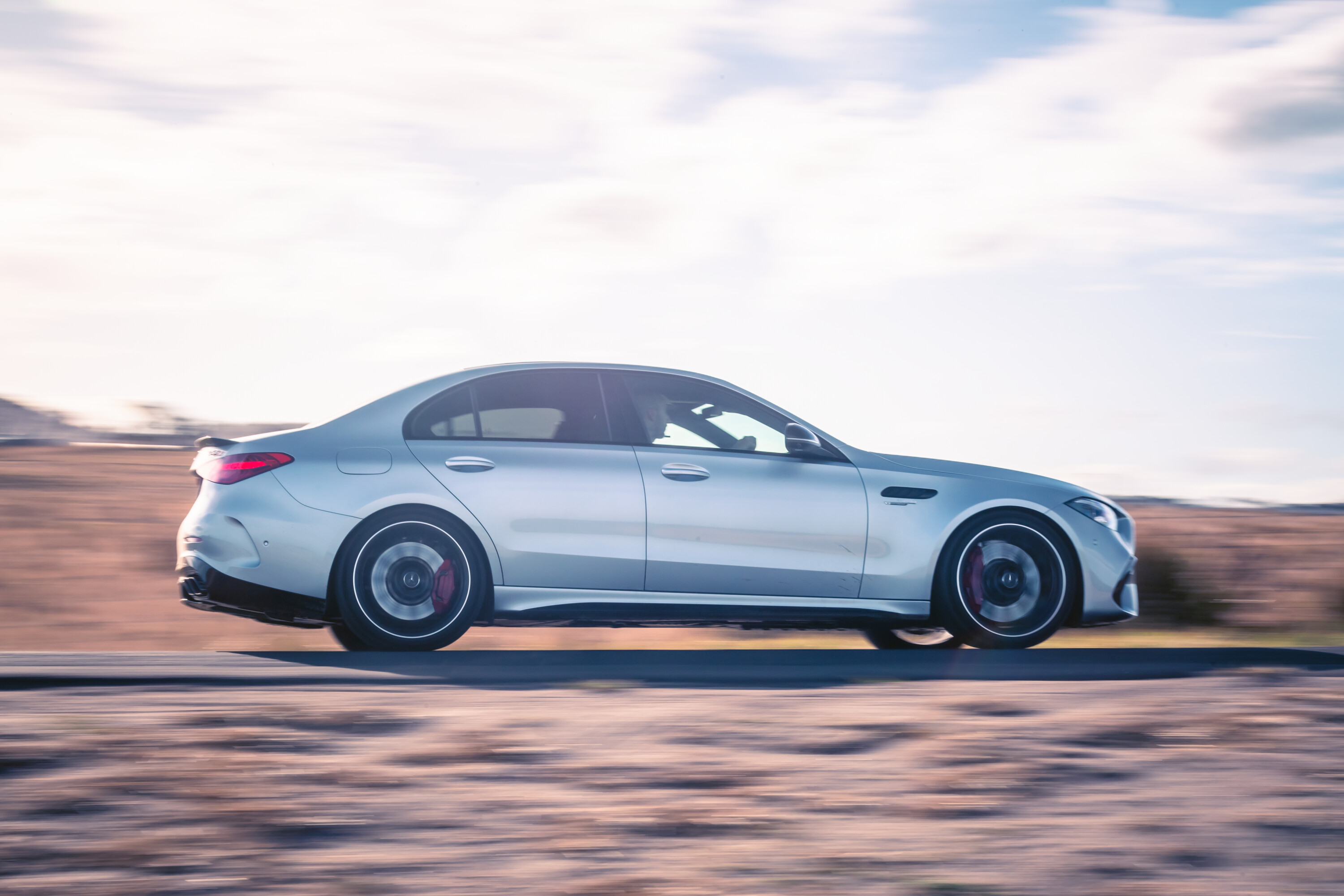
The inevitable cost of all this complexity is added weight and the W206 C63 hits the scales at a rather hefty 2090kg. It is a bigger car than before – width is up 76mm compared to a C300 and overall length has grown by 83mm, including an additional 10mm in the wheelbase – yet there’s no escaping that’s a lot of heft in a sporty mid-size sedan.
1
AMG also says it has achieved a perfect 50:50 weight distribution front to rear.
Helping to blunt the extra bulk is standard four-wheel steering that can turn the rear wheels by up to 2.5 degrees and we’re happy to report the system feels completely natural with none of the spookiness 4WS can sometimes bring. AMG also says it has achieved a perfect 50:50 weight distribution front to rear.
Another positive is that despite its newfound complexity, actually buying a W206 C63 should be straightforward. Mercedes has made a habit of simplifying its model range by offering fewer, more highly specced variants and the C63 is no exception.
The base car is incredibly well equipped and there’s only one trim level to choose from as AMG won’t offer a ‘base’ car for this generation. This time it’s full-fat ‘S’ guise only.
1
There are seven available colours (four standard and three special ‘manufaktur’ colours) and buyers also have the choice of three key option packs.
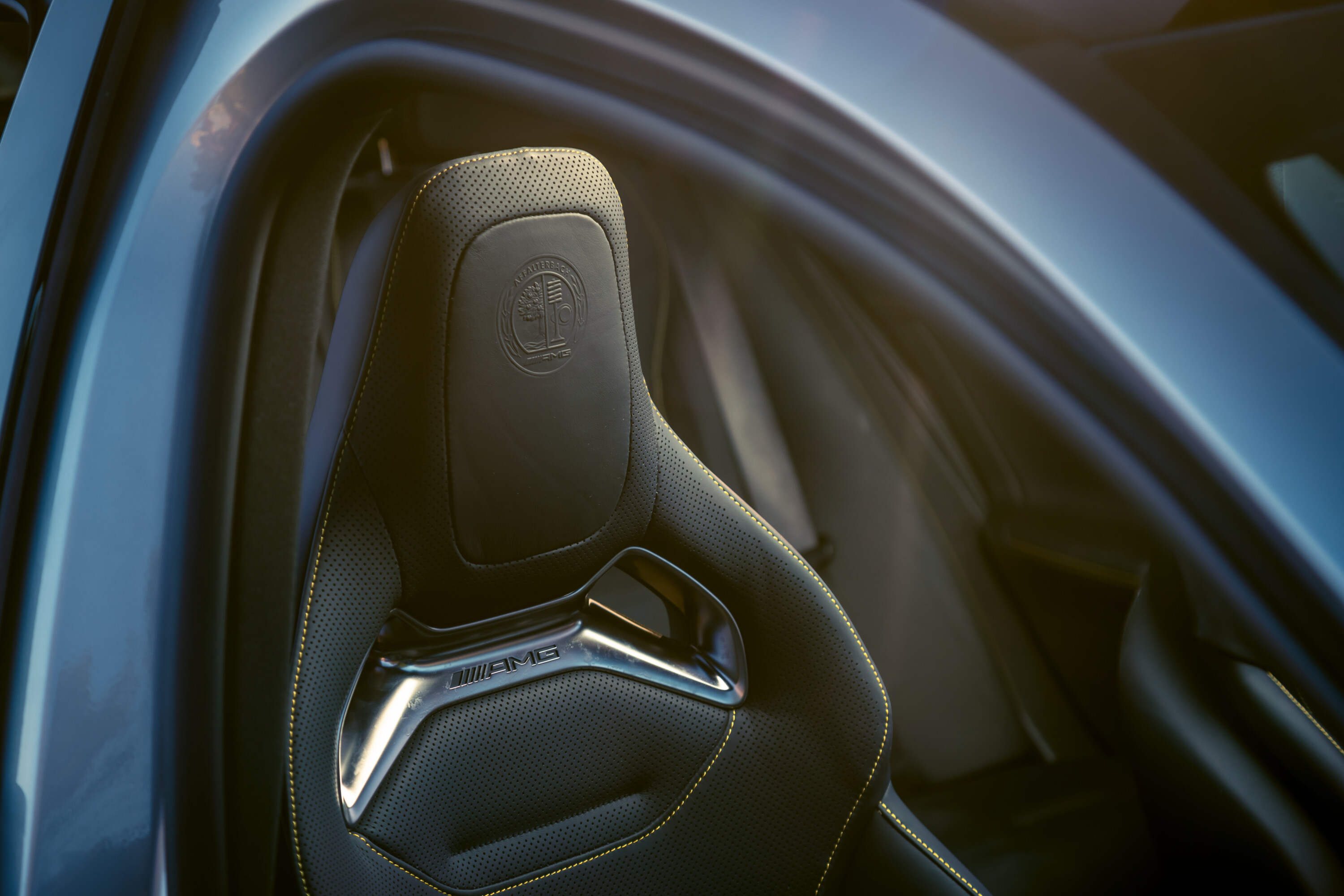
A Carbon Aero Package is the most expensive optional extra at $9990 and brings lashings of carbon on the front spoiler, wing mirrors and boot lid. You can also add more carbon to the interior courtesy of the Interior Carbon pack for $2600, however, the option we’d recommend most is the Performance Ergonomic Pack.
For $6900 it brings AMG’s excellent hip-hugging performance seats. Carbon brakes are also available, however at around $10,000, we’d question their value unless you plan on doing regular track work.
1
How do rivals compare on value?
It might be the newest, quickest and most powerful offering in its segment, but the 2024 Mercedes-AMG C63 is also the most expensive.
At $187,900 without on-road costs and options, it’s about $10K pricier than its closest performance rival, the BMW M3 Competition xDrive, which starts at $177,800. An M3 Touring xDrive is $180,100 (both before on-road costs).
Another wagon worth considering is the Audi RS4 Avant which is far cheaper at $159,990 before on-road costs. However, it’s also much further into its product cycle and down on comparative performance.
1
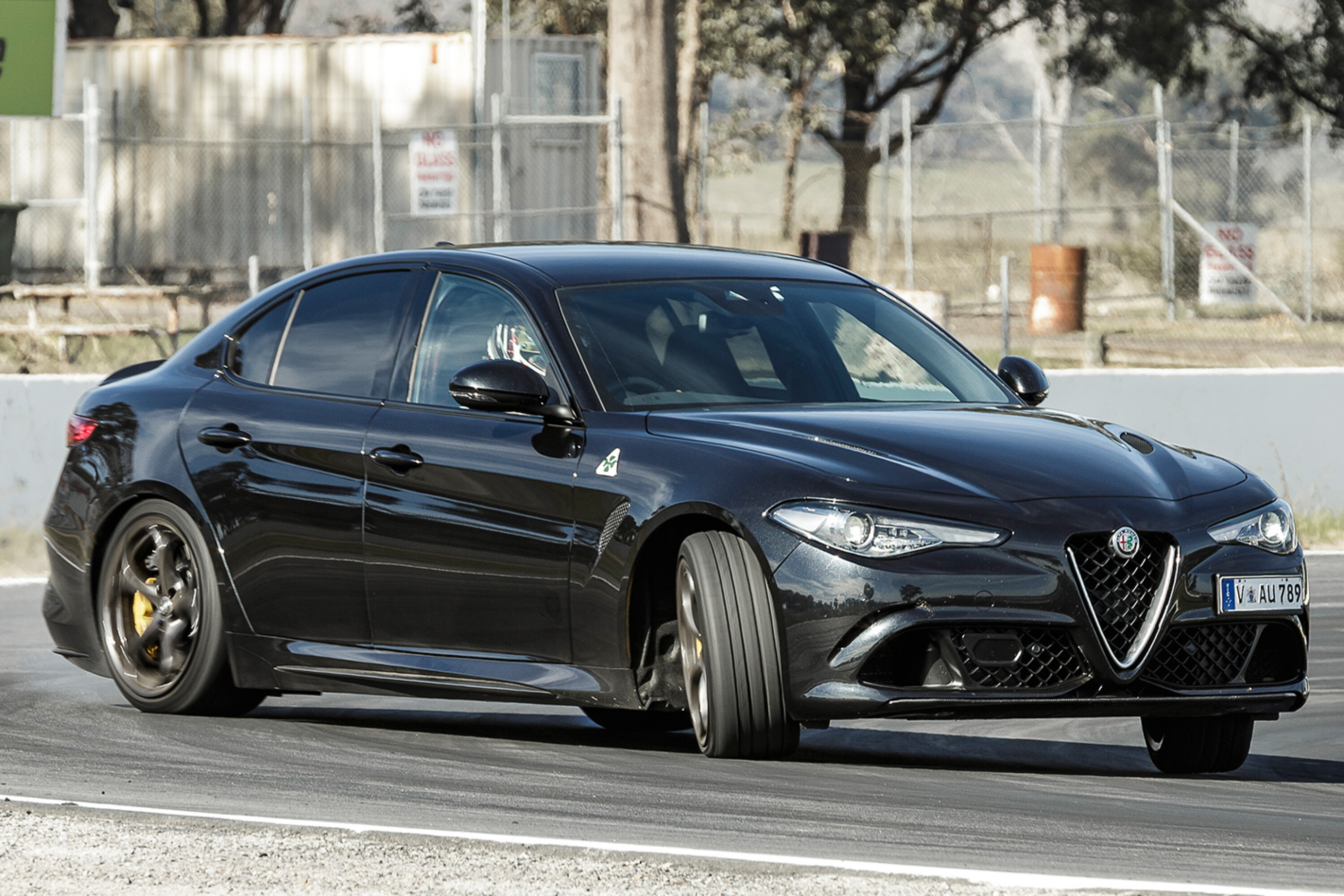
The Alfa Romeo Giulia Quadrifoglio is a tempting alternative, especially considering it’s a relative bargain at $153,700 excluding on-road costs.
Like the Audi, the Alfa is older and can’t match the AMG for performance or acceleration, although its 2.9-litre V6 is a peach and its lighter, rear-drive chassis is arguably more exciting and rewarding.
Swinging the advantage back in favour of the C63, however, is its comparative newness and its more efficient powertrain. Aside from being able to drive short distances as an EV, the AMG should also drink less fuel on the combined cycle.
| Mercedes-AMG C63 competitors | |
|---|---|
| BW M3 Touring | $180,100* |
| BMW M3 Competition xDrive sedan | $177,800* |
| BMW M3 sedan | $161,300* |
| Audi RS4 Avant | $159,990* |
| Alfa Romeo Giulia Quadrifoglio | $153,700* |
| *Prices exclude on-road costs | |
1
Interior comfort and space
If you’ve driven a regular W206 C-Class, then there’s plenty in here that will be familiar.
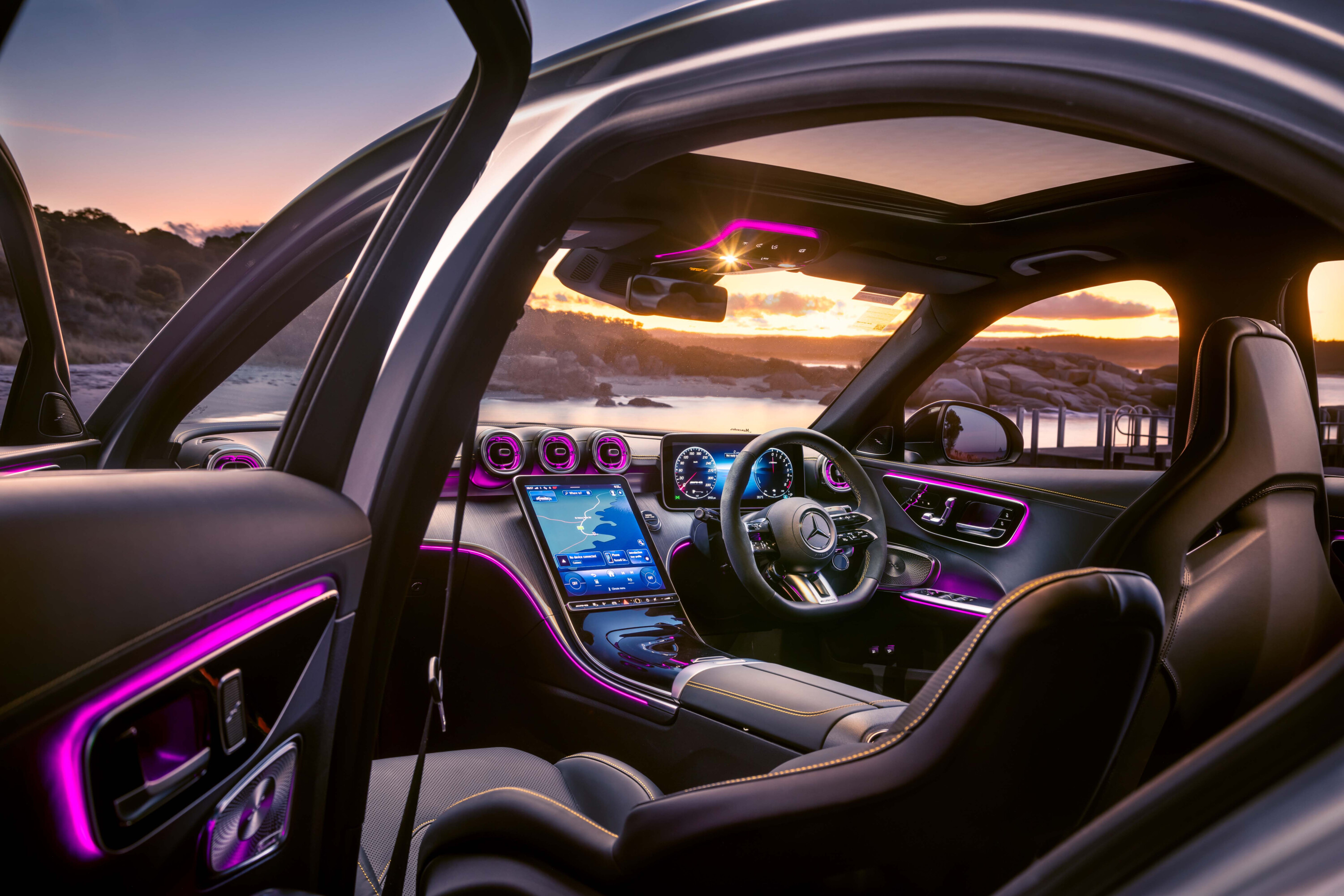
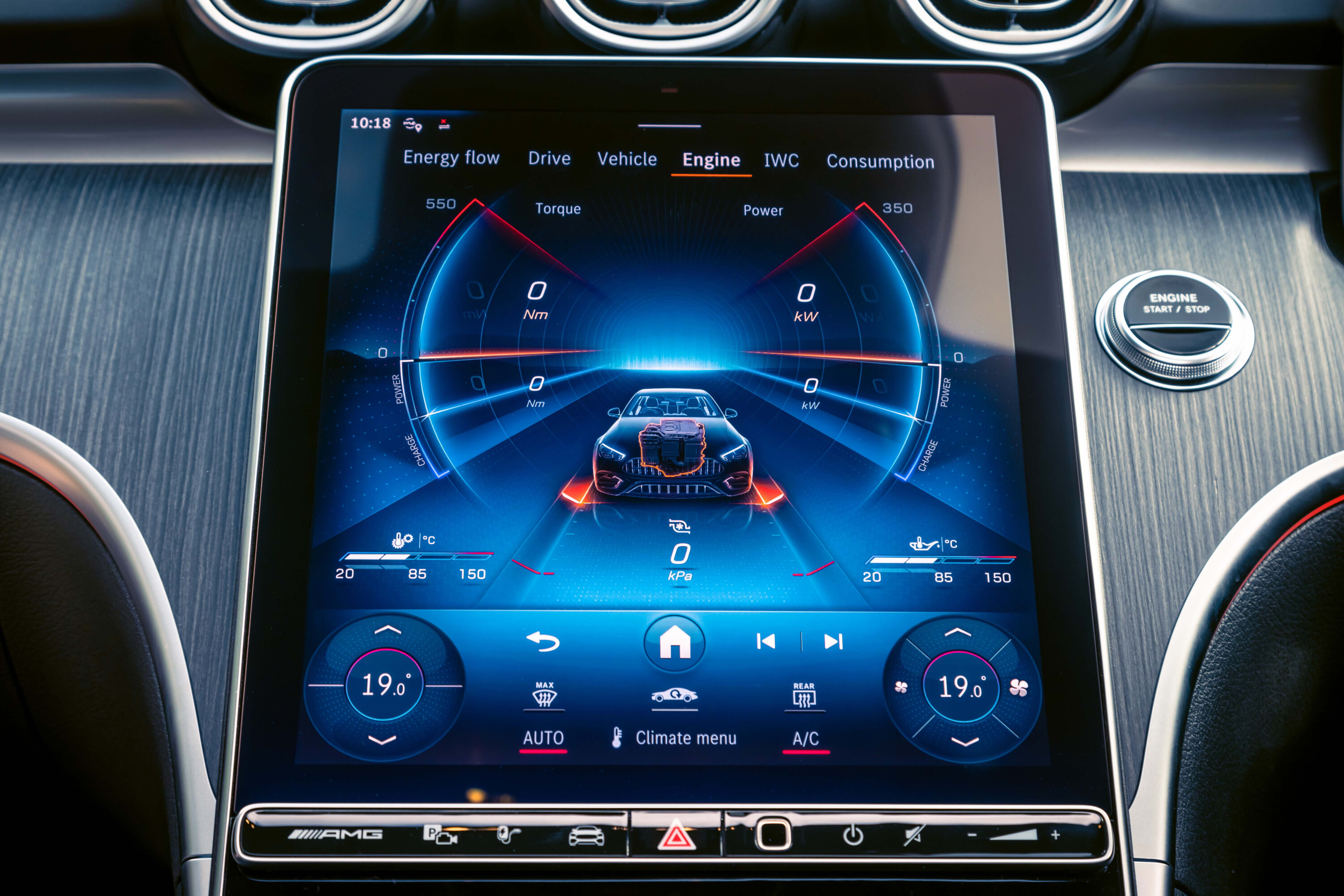
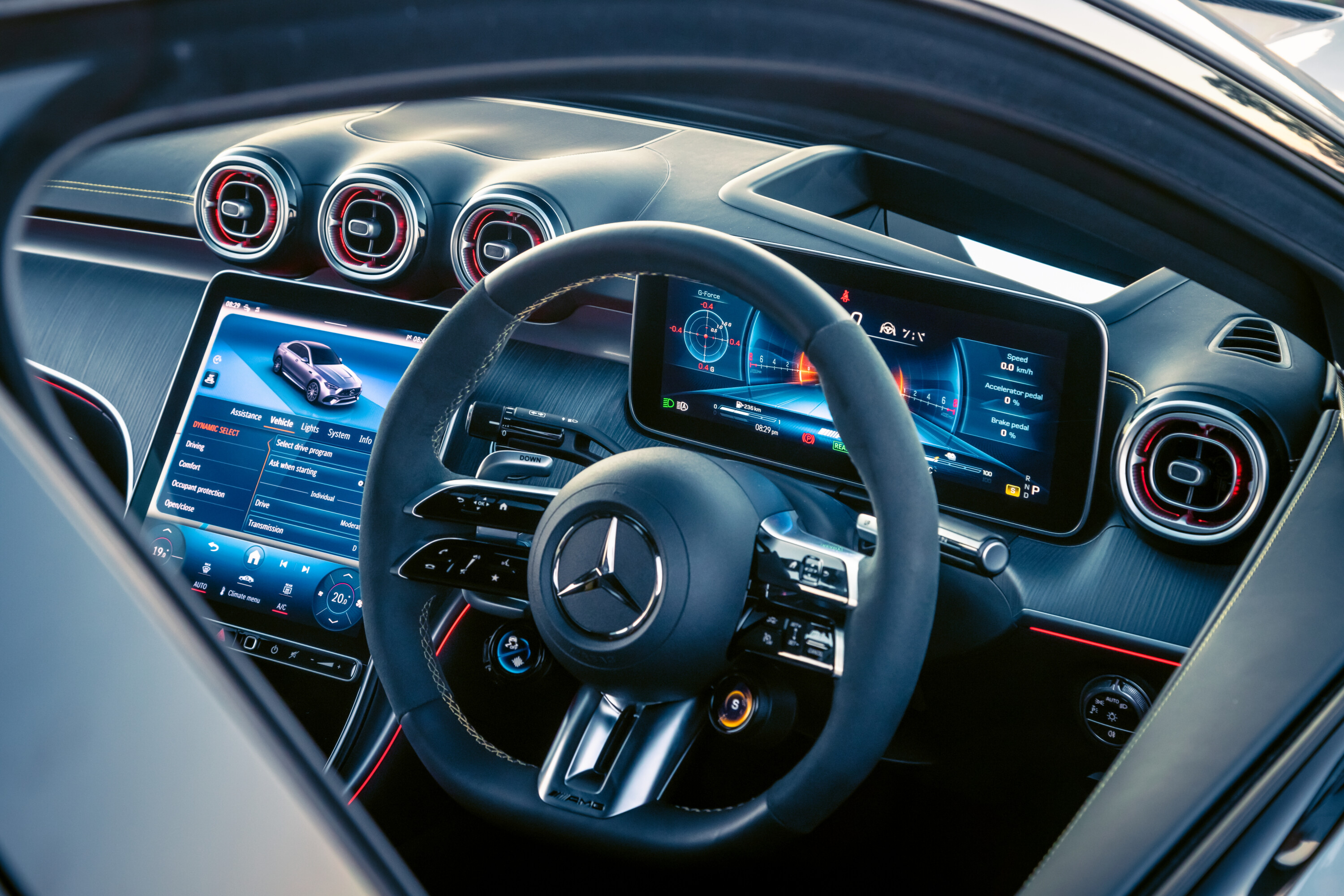
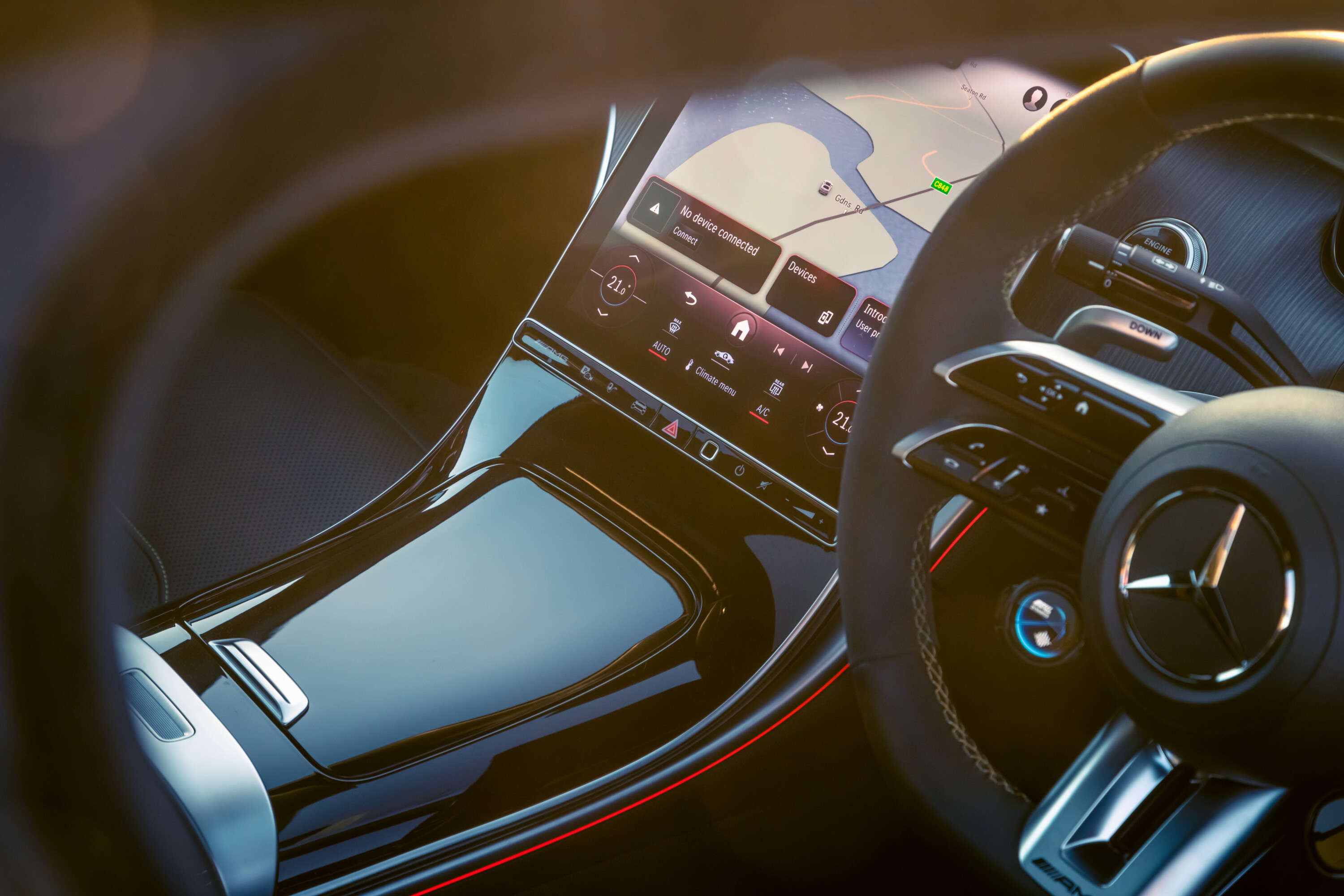
The C63 scores the same twin-screen layout as the rest of the C-Class range, meaning there’s a digital instrument cluster ahead of the driver and an enormous 11.9-inch portrait-style touchscreen on the centre stack. Both screens are excellent and aren’t only fast to respond but strike a good balance between burying functions inside the menu structure and retaining physical buttons.
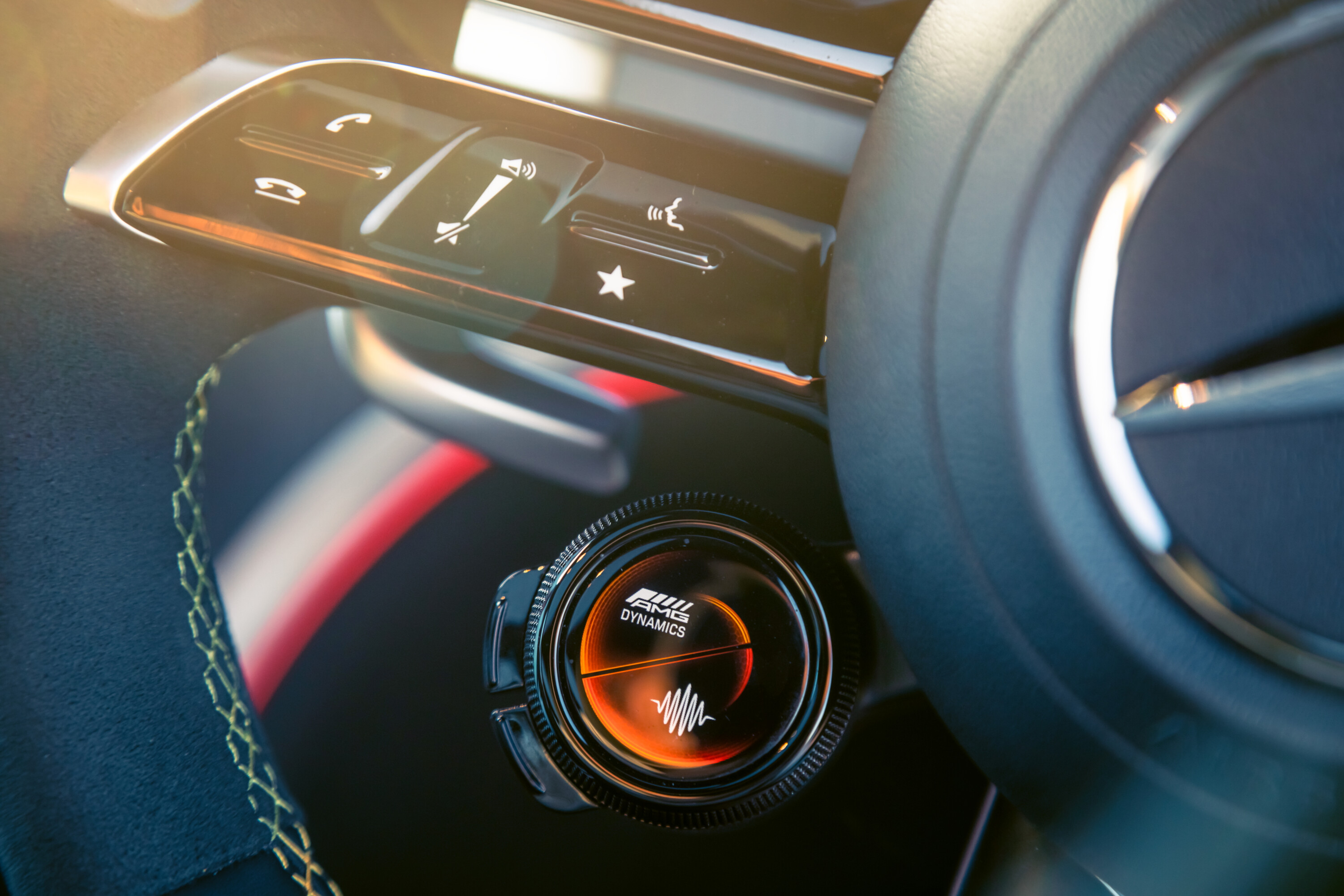
Speaking of, the sheer number of buttons and dials on the thickly-rimmed steering wheel does take some learning. You’ll soon get familiar, though, and then it’s a doddle to twist the manettino-like dial to switch drive modes and to assign your favourite functions (exhaust, ESC Sport etc) to the hotkeys.
1
The rest of the cabin feels expensive and richly trimmed and is festooned with AMG-specific touches.
It nails the basics, too. The seating position is natural and offers ample adjustment and it’s hard to fault the level of storage on offer thanks to a deep centre console and generous door bins. Connectivity is taken care of via a wireless charging pad, four USB-C ports and standard Apple CarPlay/Android Auto.
Less impressive, however, are vast expanses of thin-feeling piano black on the centre console and dash. The plastic used on the indicator stalks is also on the cheap side for a $200K car.
Another negative is boot space. Mounting the electronic drive unit above the rear axle means luggage room drops to just 279 litres. That’s only nine litres more than a Toyota Yaris…
Happily, the rear seat is roomy enough for adults and general comfort and refinement have both been improved for this generation of C63, meaning it could easily be used for long journeys. Providing you don’t have too much luggage, that is.
1
How does it drive?
It doesn’t take long to realise Aussie versions of the W206 C63 hold a significant advantage over cars sold in Europe – our cars sound better.
An evocative exhaust note has been core to the C63’s appeal for generations, so it was a touch disappointing that the cars we drove in Europe were on the quiet side, even compared to an A45 with which it shares an engine. Where an A45 sounds angry and is surprisingly loud high in the rev range, the C63s we drove had a softer, more cultured note.
Aussie C63s, however, aren’t fitted with sound-strangling petrol particulate filters and the result is a soundtrack that isn’t only louder and more engaging but is complimented by pops and crackles on the overrun. Okay, the old V8 is still meaner and more evocative, but it’s a welcome improvement.
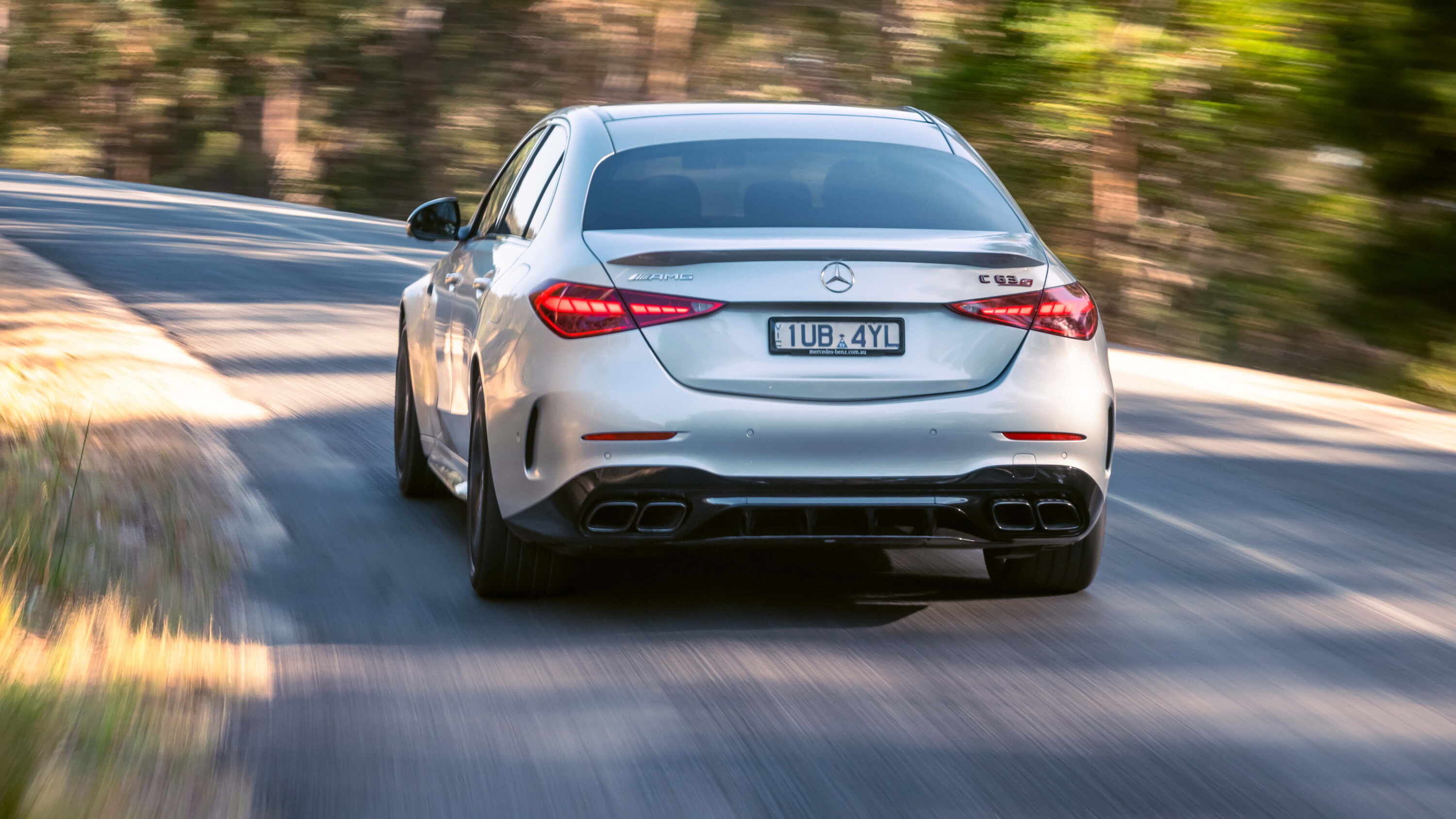
2
The rest of the driving experience is a big departure from previous C63s. In electric mode, the W206 slips into traffic effortlessly and the ride, courtesy of new adaptive dampers and suspension components lifted from the AMG GT Black Series, is impressively supple and comfortable.
Previous C63s always rode firmly but this new car has significantly more bandwidth. The trade-off is body control that can feel a little loose and floaty on properly choppy roads (this is easily fixed by switching the damping into Sport for greater control) but there’s no denying the W206 C63 is a friendlier, more liveable car to drive day-to-day.
The powertrain is remarkably smooth and intuitive, too, despite its complexity. The handover between electrons and petrol power is almost imperceptible and there are none of the jerkiness or jolts that can sometimes plague plug-in hybrids. It’s as easy to drive around town as a C300.
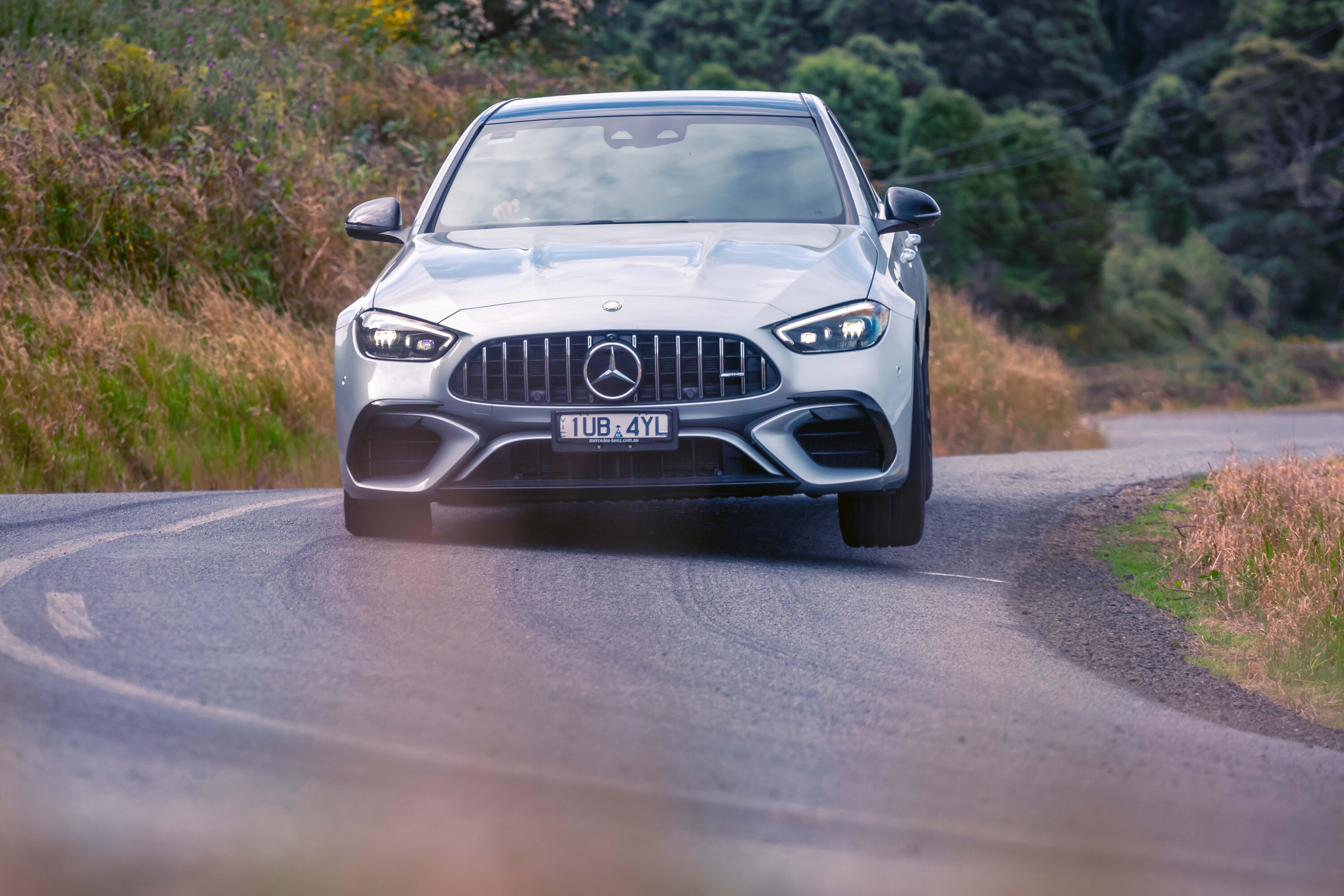
2
But what’s it like to drive hard? Different is the operative word. Where the old C63 was a snarling, rear-limited muscle car on a twisty road, this new version delivers its thrills through grip, pace and traction.
We tackled some Targa Tasmania stages during our stint with the new C63 and it immediately proved to be astonishingly quick and confidence-inspiring.
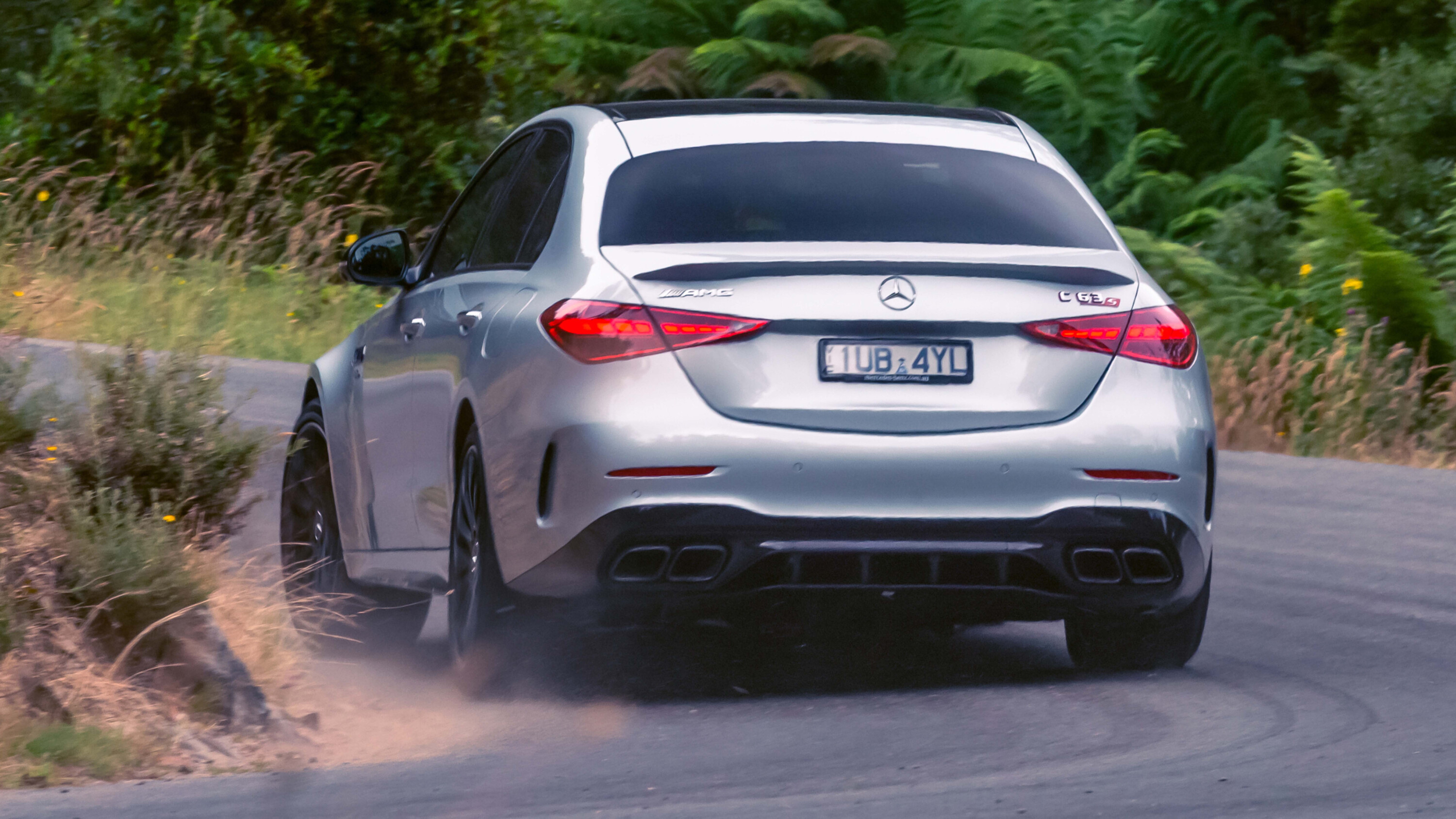
Grip levels are high courtesy of sticky Michelin Pilot Sport 4S rubber (265/35 R20 up front and 275/35 R20 out back) and because the C63 is now all-wheel drive, punch out of corners is ferocious.
No complaints about the steering either, which is meatily weighted and accurate. The brakes are impressive too, not just for their sheer stopping power but for how natural and progressive the pedal feels given there’s a high amount of regen going on in the background.
2
How the brakes would feel after extended stints on a challenging road remains to be seen (we only scored a few clear runs due to traffic) yet during our time the pedal remained firm and reliable.
Even better is how friendly and ‘chuckable’ the new C63 feels, despite its extra kegs and circa-two-tonne kerb weight. The four-wheel steering helps there, of course, and the result is a performance sedan that never feels like it will bite you.
Even at the limit, the new C63 gives you options to trim your line or blaze out of corners with a quarter turn of opposite lock. Bigger slides are dragged straight sooner than previous C63s due to all-wheel drive but there’s always the option to send the grunt solely to the back axle in Drift mode should you want to destroy your rear tyres.
1
Speaking of drive modes, cycling through the myriad different settings can seem daunting at first, yet it soon becomes second nature thanks to programable hotkeys on the steering wheel and a dedicated AMG screen on the centre display.
Does all this make the new C63 a better road car than its predecessor? There’s no arguing that it’s quicker and more comfortable but it’s also clear some drivers will miss the old car’s charisma. Where the W205 felt like a rear-driven hot rod that demanded your respect, this new C63 is more like a high-tech hot hatch.
As for weaknesses? Tyre noise is a noticeable and constant companion on coarse-chip roads. And while there’s no denying this is a seriously rapid car, flattening the throttle never feels quick as savage as 500kW/1020Nm ought to. Weight could be a factor there.
1
- What is a Powertrain or Drivetrain?
- Power vs torque
- Car suspension explained
- Automatic transmissions (‘gearboxes’) explained
- Chassis control systems explained
- Car vs Ute vs SUV: How the vehicle you buy should guide the way you drive
- What is the WLTP emissions and range test?
Fuel efficiency mightn’t be the number one reason people buy a C63, but it’s nice to know this new model will be lighter on the wallet.
Switching to a hybrid powertrain has given the W206 C63 an official combined fuel consumption figure of 6.9L/100km, which is a substantial improvement over the old car’s claim of 9.9L.
It’s also far more efficient than its key competitors like the Audi RS4 (8.9L) and BMW M3 Comp (10.2L). And of course, being a plug-in hybrid means the C63 has the potential to use significantly less fuel if your commute is less than 15km and you plug it in at either end with the included 3.7kW AC charging cable.

1
Warranty and running costs
Like all Mercedes models in Australia, the 2024 Mercedes-AMG C63 E-Performance is covered by a five-year/unlimited-kilometre warranty. The 6.1kWh battery has a separate warranty of six years or 100,000km.
Service intervals are every 12 months or 20,000km and there are three service packs available for purchase: three years for $5015, four years for $6250 or five years for $7085.
1
VERDICT
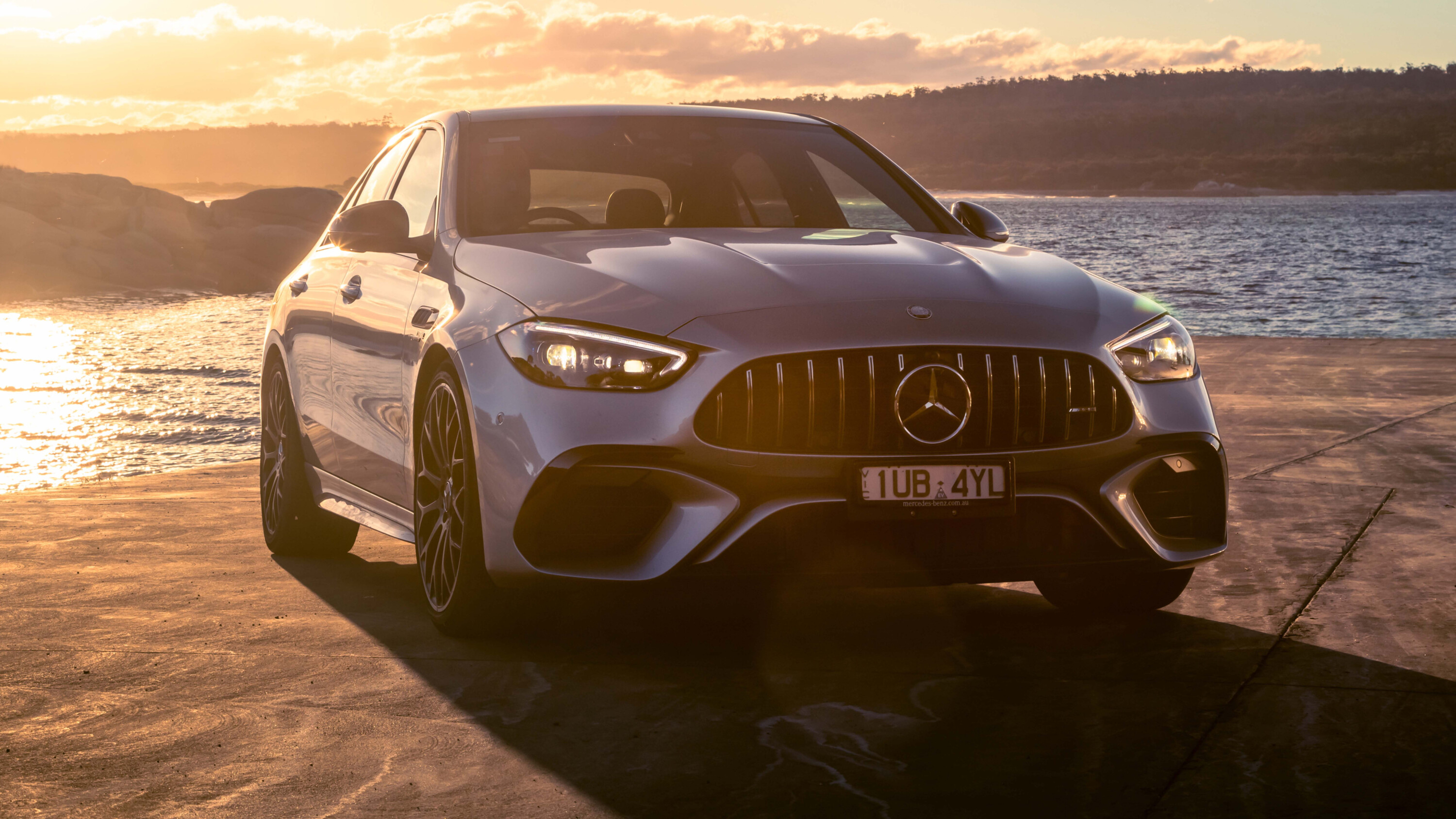
The problem with creating an icon is people tend to get their noses out of joint when you change it.
Porsche knows this best – there’s an uproar every time it tinkers with the 911 – and now AMG is facing exactly the same sense of consternation with the W206 C63. Understandably, too, given how loved the old car was and the fact this new model isn’t an update; it’s a complete and utter overhaul.
2
But while some AMG fans will struggle to warm to the new C63, there’s also no doubt that objectively it’s a superior performance car.
It’s quicker, quieter, more comfortable, drinks less fuel, rides better and delivers just as many thrills, albeit in its own way.
Does that make it a better C63? Your mileage will likely vary on that, depending on personal expectations of what a C63 should be.
To our minds, it’s neither better nor worse. It’s simply different and impressive in its own right.
| 2024 Mercedes-AMG C63 S E Performance specs | |
|---|---|
| Body | 4-door, 5-seat medium sedan |
| Drive | all-wheel |
| Engine | 2.0-litre 4cyl, DOHC, 16v, turbo-petrol + electric motor |
| Compression | 9.0:1 |
| Power | 500kW (combined) |
| Torque | 1020Nm (combined) |
| Battery | 6.1kWh |
| 0-100km/h | 3.4sec |
| Transmission | 9-speed automatic |
| Weight | 2165kg (includes 75kg driver) |
| Fuel consumption | 6.9L/100km |
| Front suspension | double A-arms, coil springs, adaptive dampers, anti-roll bar |
| Rear suspension | double A-arms, coil springs, adaptive dampers, anti-roll bar |
| L/W/H | 4842/1900/1458mm |
| Wheelbase | 2875mm |
| Brakes | 390mm ventilated/perforated front discs with 6-piston calliper; 370mm ventilated/perforated rear disc with single-piston calliper |
| Tyres | 265/35 R20 (f) 275/35 ZR20 (r) |
| Wheels | 9.5J x 20 front and rear |
| Price | $187,900 + on-road costs |
October: New Juke pricing announced for Australia
For the new model year, the 2025 Juke gains new technology and interior features, along with a new N-Sport variant at the top of the range.
February: New Juke revealed
The facelifted 2024 Nissan Juke light SUV has debuted with a revised design, upgraded technology, more comfort, and new paint colours.
“We’re very excited by the updated Juke, which has just been unveiled. We anticipate arrivals at the end of 2024. Final Australian specification will be confirmed closer to the launch date,” said Nissan Australia.
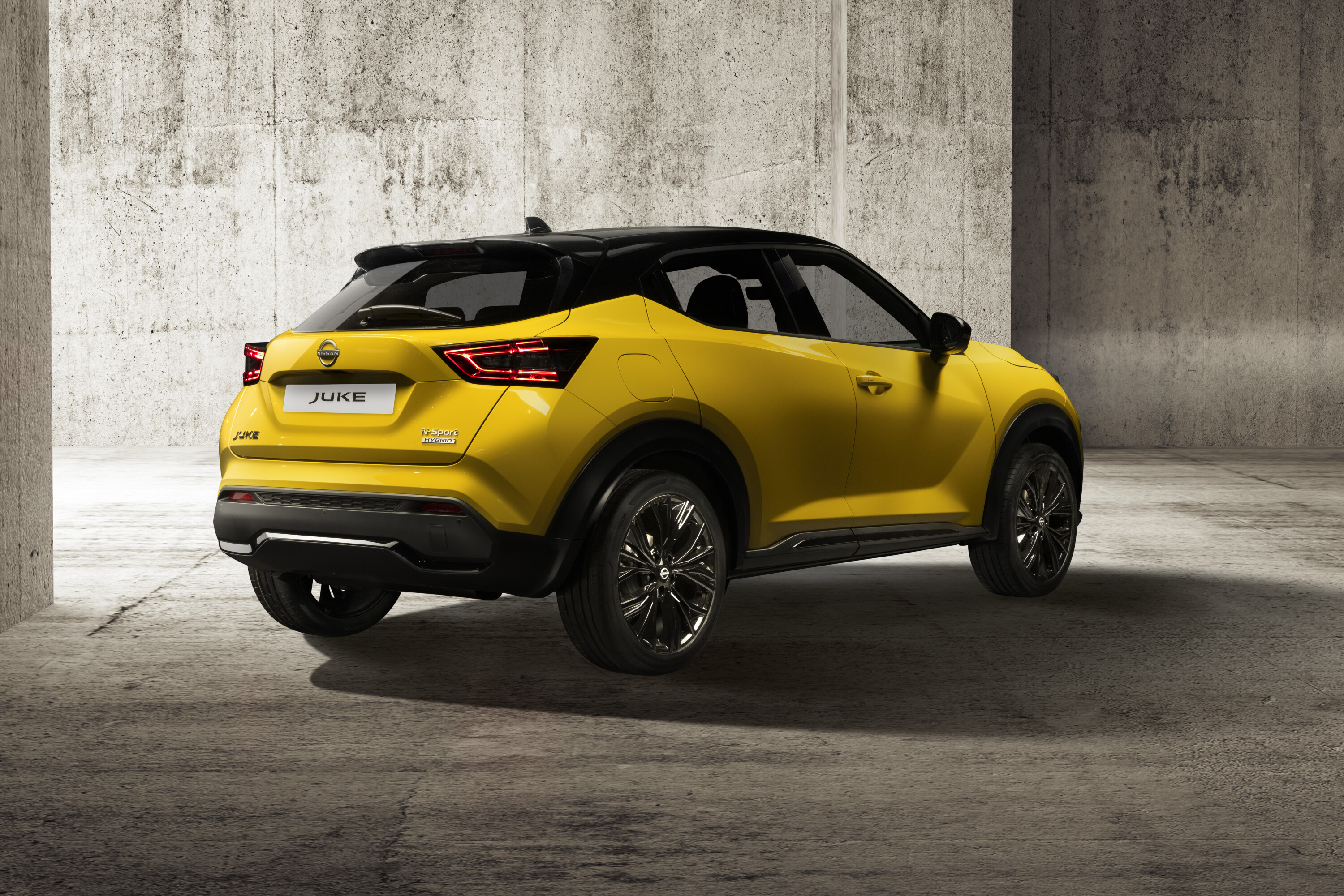
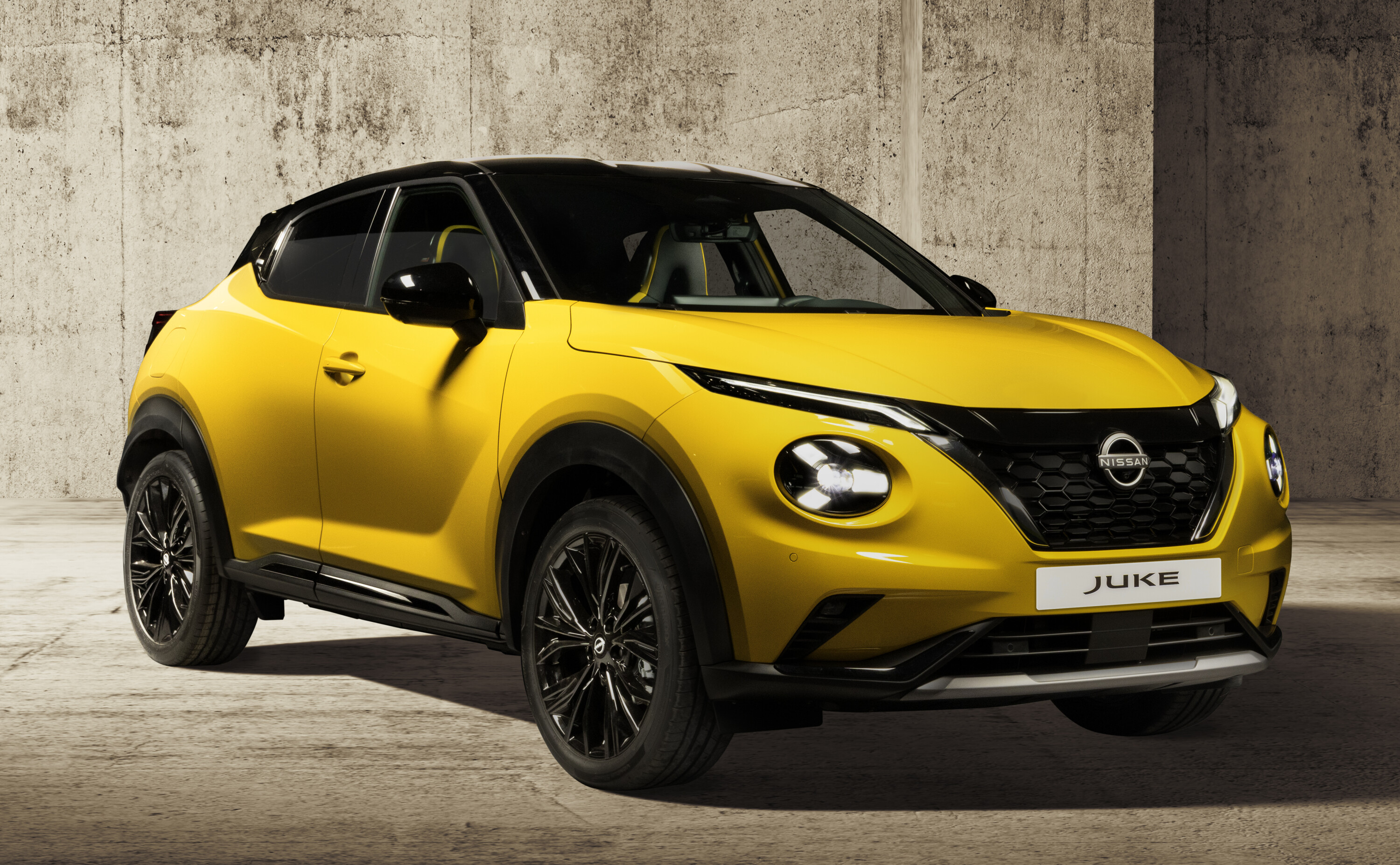
Nissan says popular demand was behind the decision to re-introduce a yellow paint colour into the second-generation Juke. It has a different, “slightly paler” shade than the first-generation model for a “more modern and impactful look”.
1
Additional exterior revisions are limited to an updated pearl white and metallic black, new alloy wheel designs, and a revised grille pattern.
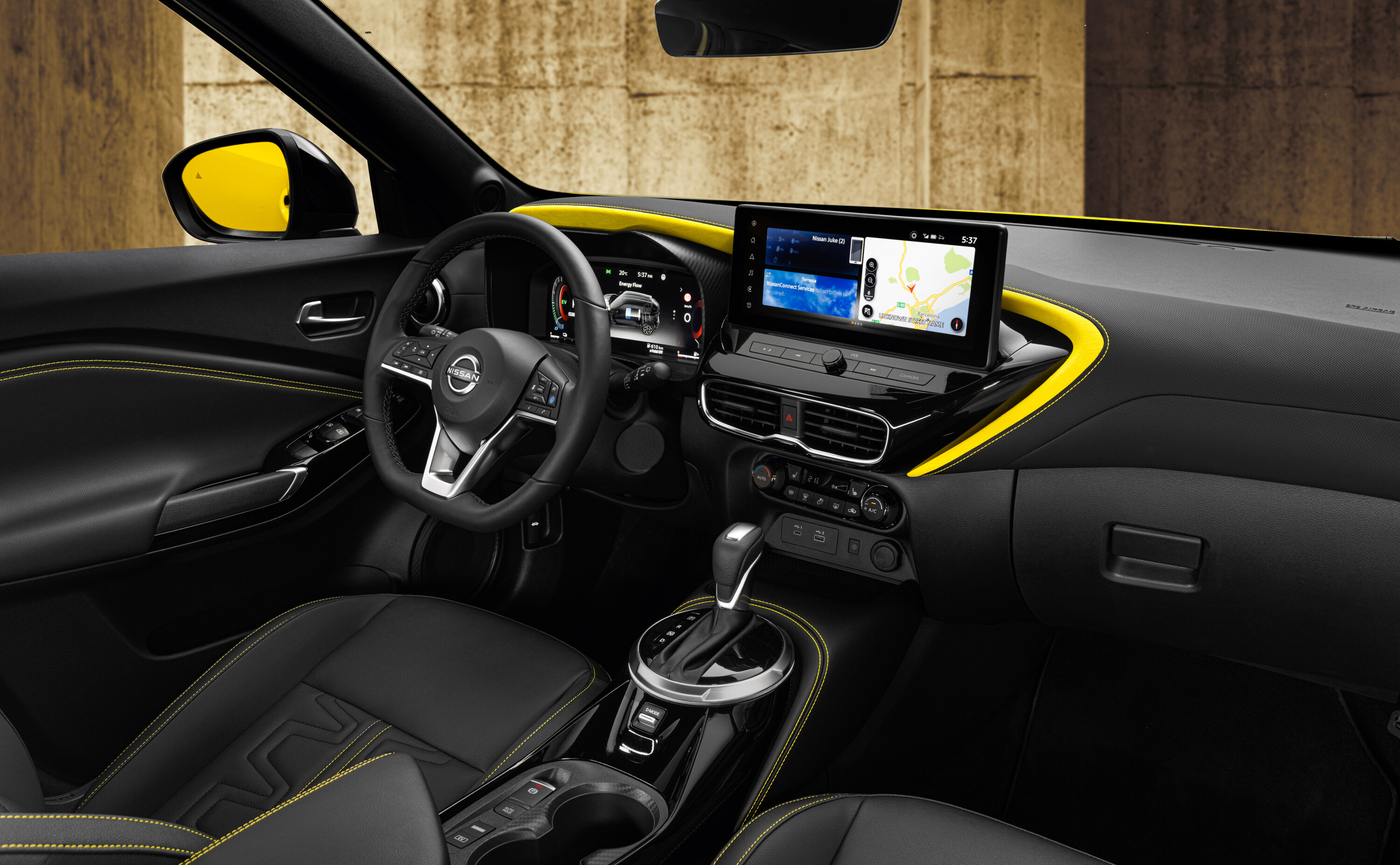
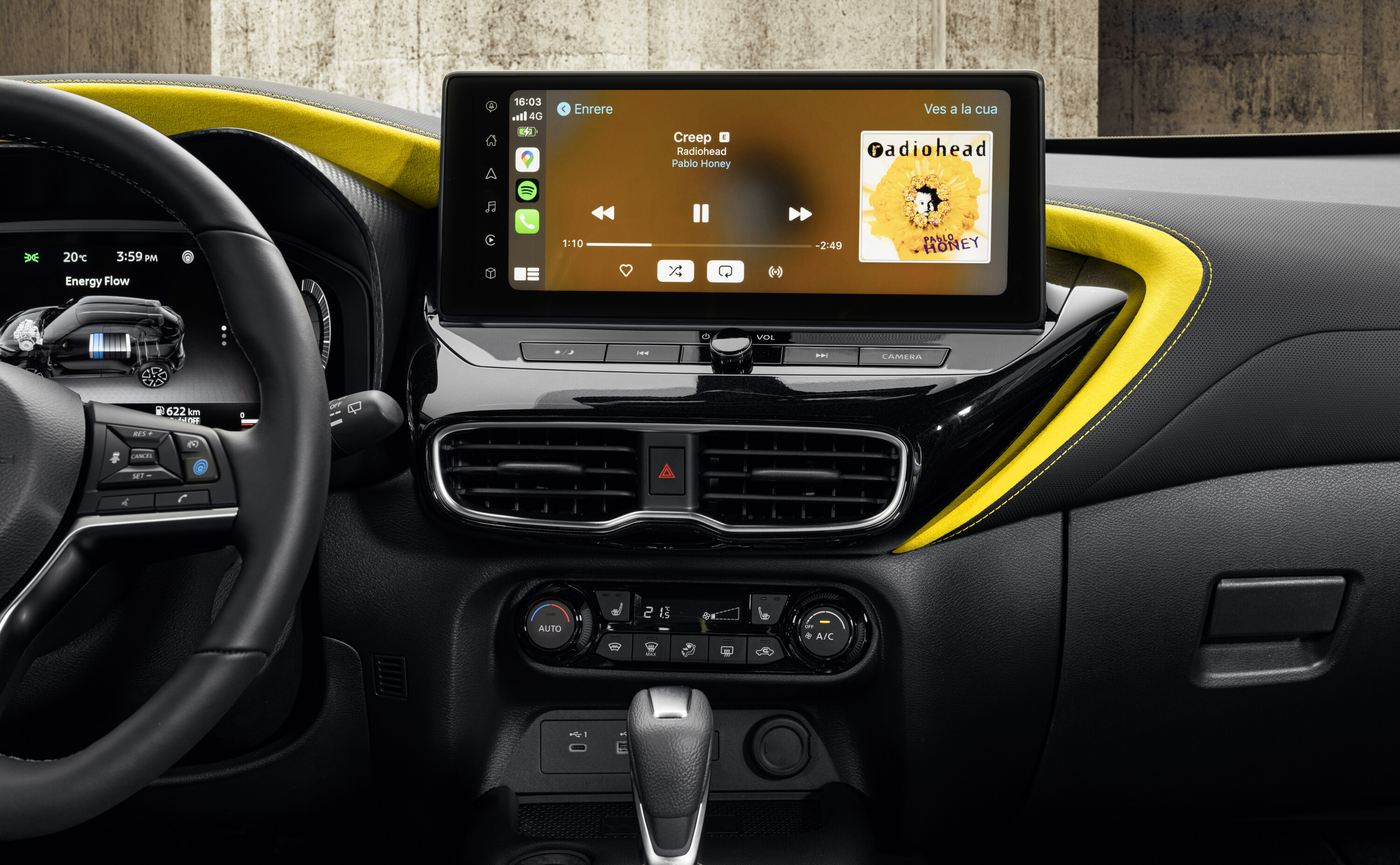
Instead, Nissan has focused on the Juke’s interior with larger dual 12.3-inch displays for the infotainment system and instrument cluster borrowed from its larger Qashqai and X-Trail siblings.
The new configurable instrument cluster supersedes the outgoing 7-inch semi-digital unit, while the rectangle-shaped touchscreen replaces the trapezoidal 8-inch system fitted to the current model.
It runs Nissan’s latest infotainment system, which supports home screen widgets, wireless Apple CarPlay and Android Auto, natural voice recognition, speed camera and fuel price information for the built-in satellite navigation, and a higher-resolution rear-view camera.
1
The Japanese brand has also added new materials and trim – including more comfortable seats for flagship variants – a larger glovebox measuring up to 6.6 litres for RHD versions, and a redesigned centre console armrest with an increased reach and built-in card holders.
All variants are now fitted with an electronic park brake in Europe. The base ST and ST+ variants in Australia currently have a mechanical park brake and rear drum brakes instead of discs.
A wireless phone charging pad designed to fit up to the footprint of the iPhone 12 Pro Max released in 2020 has been added for some variants, while USB-C charge ports join existing USB-A outlets in the front and rear.
1
A new N-Sport specification has been added in Europe with a contrasting black exterior trim, a boomerang-shaped interior yellow highlight across the top of the instrument panel, and yellow recycled Alcantara seat inserts.
There are no revisions for the Juke’s powertrain lineup, meaning Australian variants will continue to feature an 84kW/180Nm 1.0-litre three-cylinder turbo-petrol, a seven-speed dual-clutch automatic, and front-wheel drive.
The Juke Hybrid, available in Europe since 2022, remains under consideration for Australia. The facelifted version adds relocated E-Pedal and EV Mode buttons and optional rolling-resistance tyres.
“We are constantly reviewing our product line-up and ensuring we have the right product offering for the market. We will continue to evaluate the opportunity and suitability for Australia of Juke Hybrid,” said a Nissan Australia spokesperson.
An emergency stop signal during heavy braking has been added to the Juke’s list of active safety equipment.
1
The updated 2024 Nissan Juke light SUV is due in Australia towards the end of this year.
A rival to the Mazda CX-3, Toyota Yaris Cross, Volkswagen T-Cross and the related Renault Captur, the Juke is currently available in five variants – ST, ST+, ST-L, ST-L+ and Ti – priced between $28,390 and $36,890 before on-road costs.
The Nissan Juke is due to be replaced by an all-electric third-generation model around 2026 or 2027. Nissan intends for its European passenger line-up to be exclusively electric by 2030.
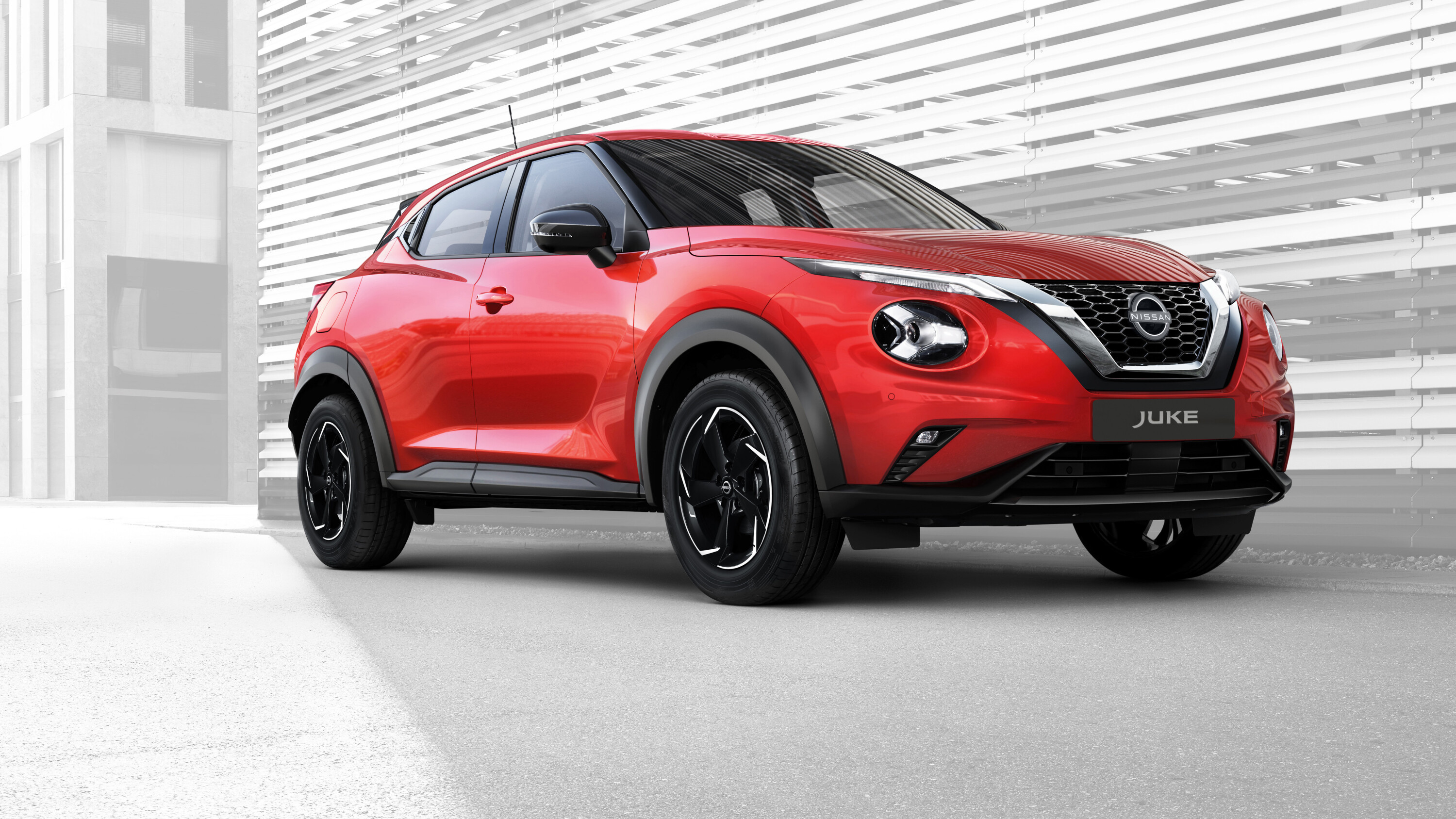
Below: The outgoing 2023 Nissan Juke
1
MORE
Everything Nissan
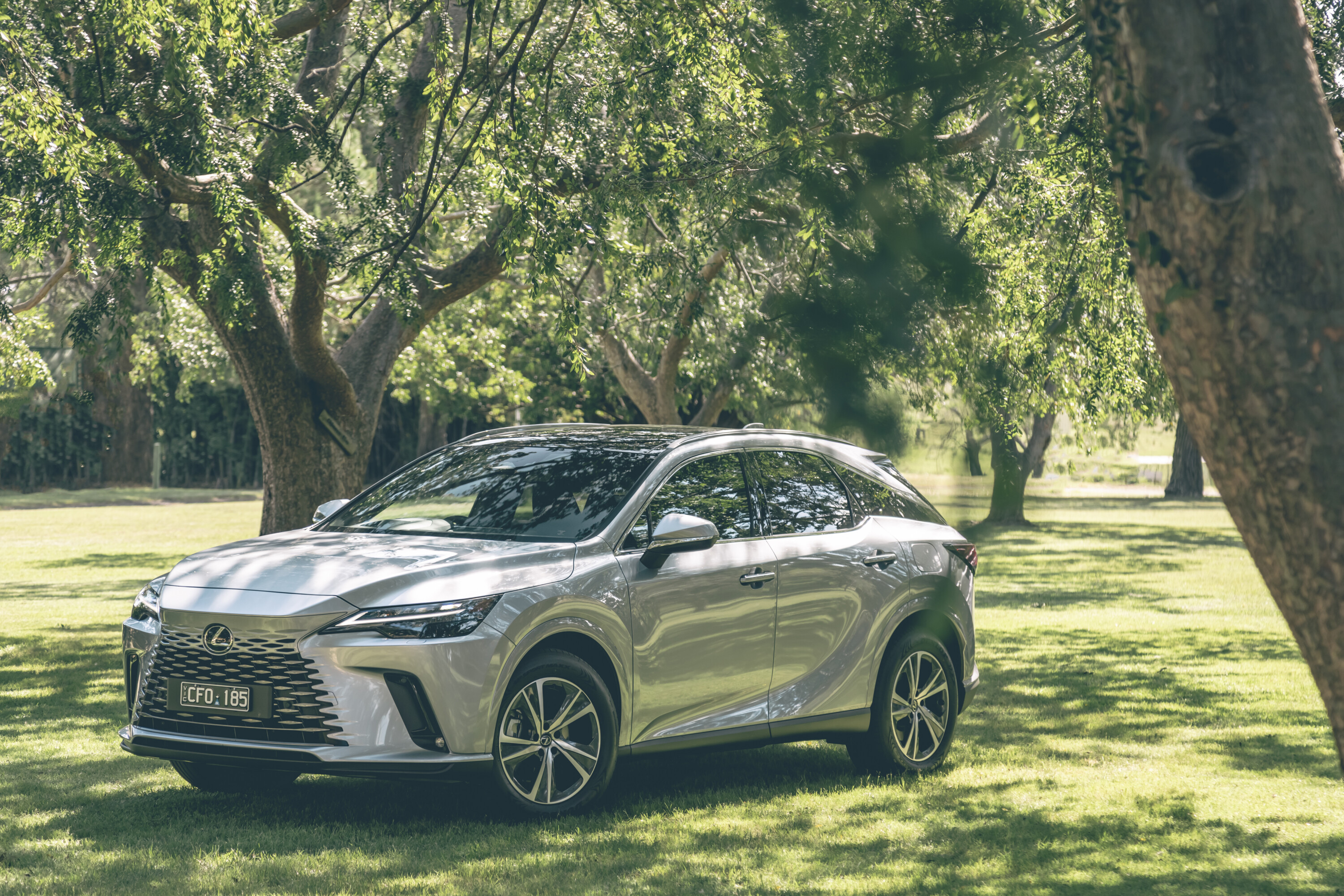
The Lexus RX 350h, part of the esteemed Lexus RX lineup, carries the legacy of one of the brand’s most successful models into the new era. With its shared DNA with Lexus’s luxury lineage, it sets high benchmarks for performance, comfort and sophistication.
The RX 350h is a large hybrid SUV that arrived in its current generation in late 2022. It aims to satisfy the demands of those who seek a vehicle that excels in both daily practicality and luxury appeal, thereby elevating the standard for premium SUVs.
In the bustling luxury SUV market, the question arises: What makes the RX 350h a standout choice?
1
Pricing and features
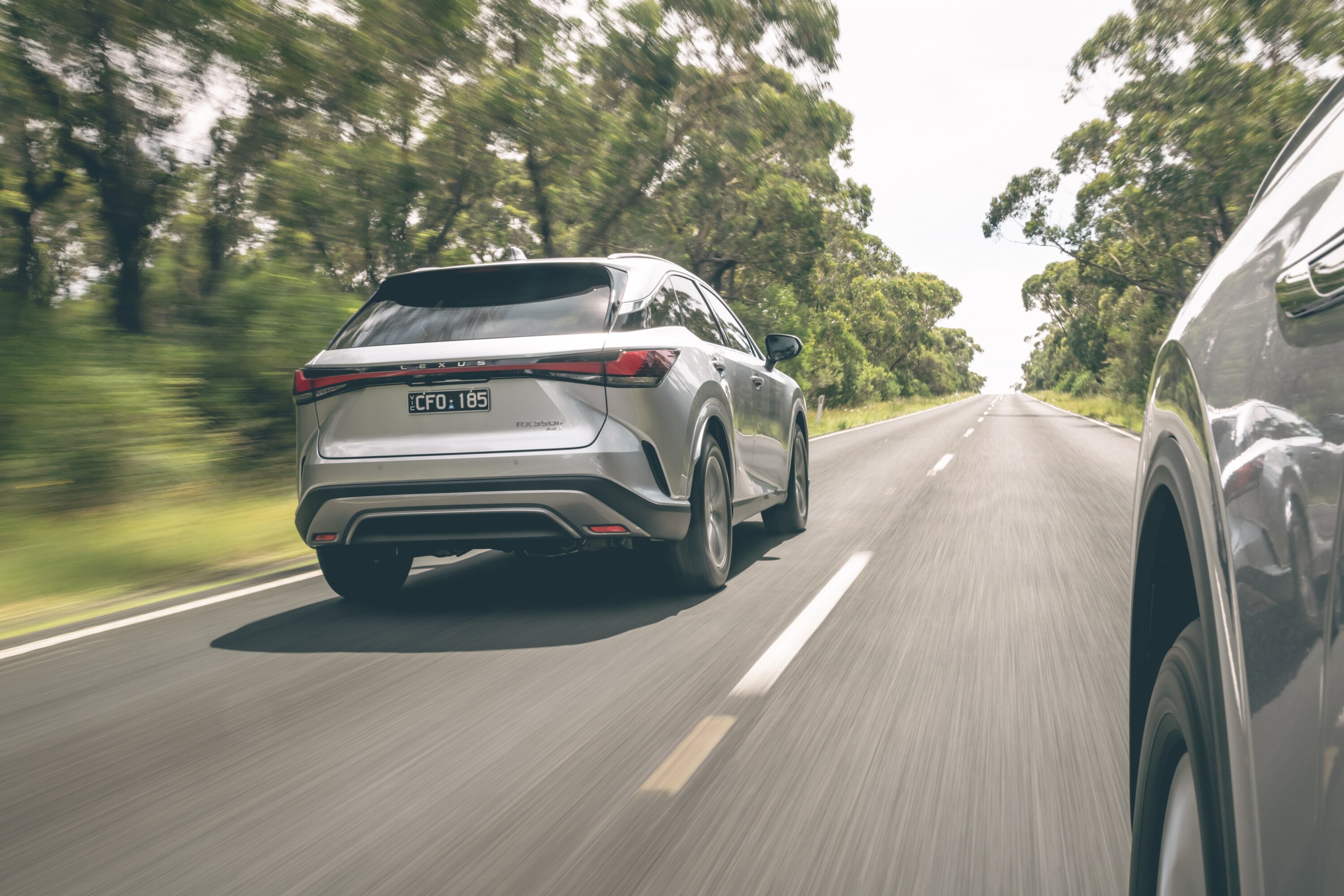
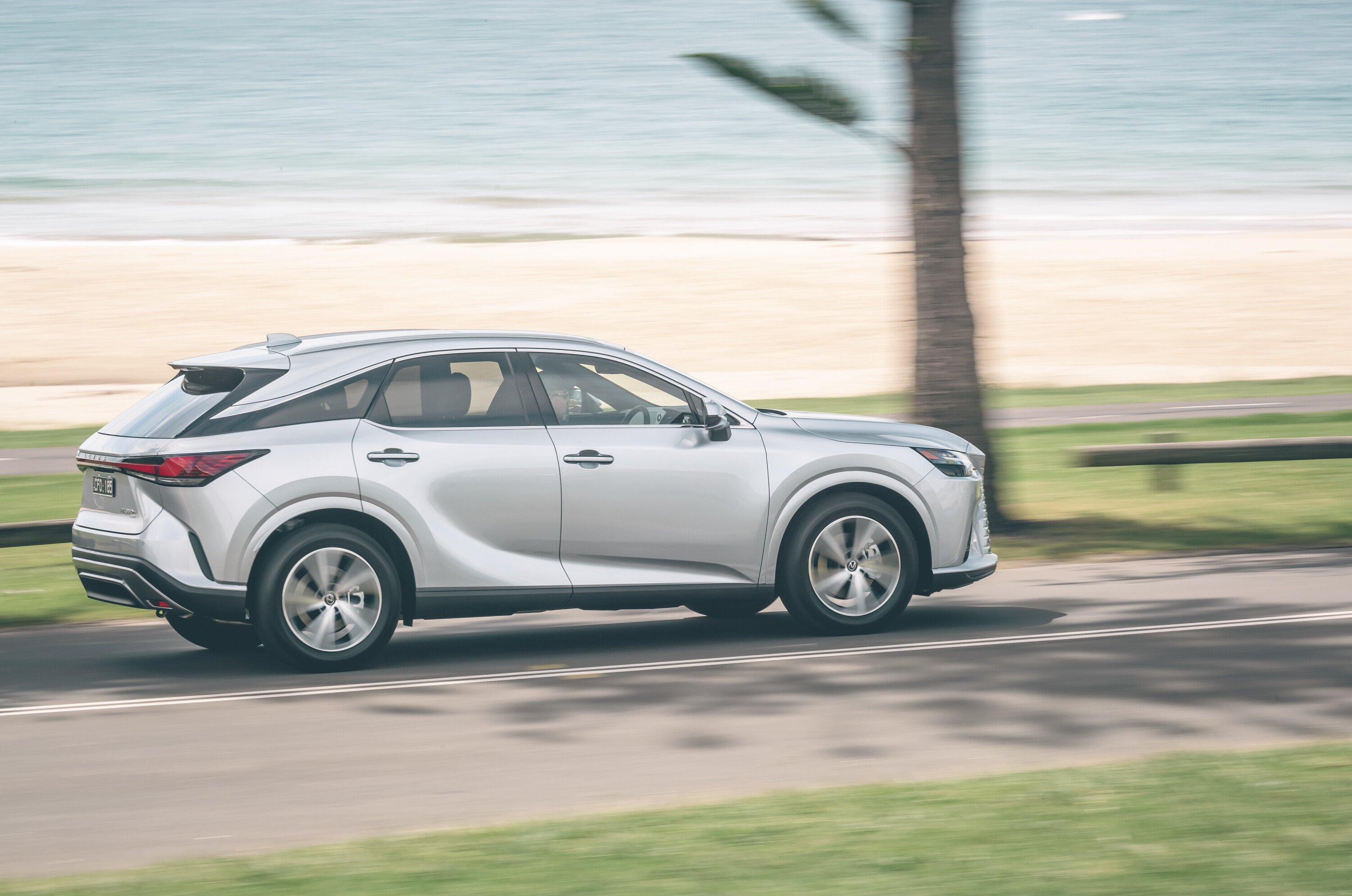
The Lexus RX 350h stands prominently in the segment with a starting price of $90,279 before on-road costs.
Underneath, the RX 350h is equipped with a 2.5-litre 4-cylinder hybrid system, channeling 184kW to either the front or all four wheels, ensuring a blend of power and efficiency that’s hard to match. A combined torque figure has not been made available.
The entry to the hybrid range– the Luxury– is available as a two wheel drive (2WD) or all-wheel drive (AWD) variant, while the more premium 350h Sports Luxury is AWD exclusive.
A key selling point of the 350h lies in its low fuel economy figures, with official figures suggesting consumption of 5L/100km for the 2WD model and 5.4L for the AWD option, a testament to Lexus’s engineering prowess.
1
Standard in the NX 350h Luxury you’ll get:
| 12 premium panasonic speaker system | Electrically adjustable steering column |
| 14-inch touchscreen display | Front & rear fog lamps |
| 19-inch alloy wheels | Heated exterior mirrors with driver’s side auto-dimming |
| 2-way power lumbar support for front seats | Heated front seats |
| 3 zone air conditioning | Leather accented trim |
| 8-way power adjustable front seats | Power back door |
| Auto-dimming rear view mirror | Rain sensing wipers |
| Bi-led headlamps | rear privacy glass |
| Daytime running lamps | Roof rails |
| Digital radio | Satellite navigation |
| Easy-access entry (steering wheel) | Wireless Apple Carplay, wired Android Auto |
An enhancement pack is available for the Luxury adds a panoramic moonroof, leather accented seats, wireless phone charger, ventilated front seats and more for roughly an extra $5000.
1
Moving up to the Sports Luxury AWD variant adds:
| 10-way power adjustable front seats with memory | Heated steering wheel |
| 21-inch alloy wheels | Leather accented seat trim |
| 21-speaker mark levinson audio system | Leather accented shift knob |
| 4-way power lumbar support for front seats | Panoramic view monitor |
| Adaptive high-beam | Power back door with kick sensor |
| Adaptive variable suspension | Power folding rear seats |
| Cabin and door illumination | Ventilated front seats |
| Easy-access entry (seat and steering wheel) | Wireless phone charger |
| Head up display | Woodgrain ornamentation on steering wheel |
| Heated & ventilated rear outboard seats |
1
Safety
The RX 350 received a five-star safety rating from ANCAP, encompassing all its variants after undergoing evaluation in 2022.
In terms of adult occupant protection it achieved a score of 90%, while scoring 89% for child occupant protection and 89% for its safety assist systems.
The NX350 boasts an extensive array of safety features across its entire lineup, thanks to the inclusion of the Lexus Safety Sense package, ensuring thorough protection.
2024 Lexus RX Safety System features:
- 8 SRS airbags
- Automatic High Beam
- Blind Spot Monitor
- Dynamic Radar Cruise Control
- Lane Departure Alert
- Lane Tracing Assist
- Pre-Collision Safety System
- Road Sign Assist
- Parking Support Brake
- Rear Cross Traffic Alert
- Safe Exit Assist
- Front and Rear Parking Sensors
- Driver Monitor Camera
- Tyre Pressure Warning System
- Rear Seat Reminder
Key rivals
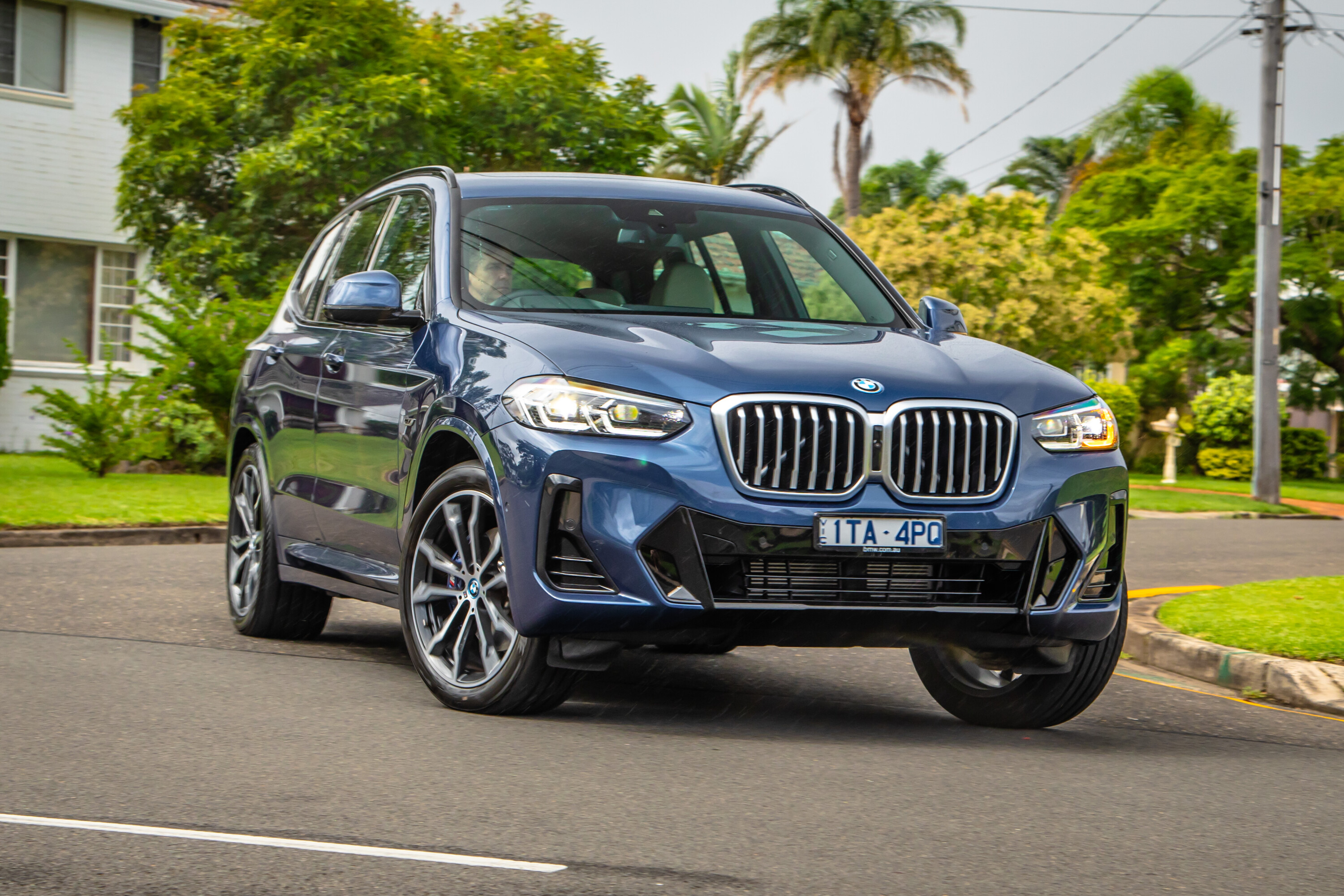
The RX350 undercuts other luxury, and slightly pricier larger SUVs such as:
1
Should I put it on my shortlist?
The RX350h doesn’t automatically surpass competitors like the BMW X5, Audi Q7, or Mercedes-Benz GLE. However, for those less concerned with dynamic handling, opulent cabin aesthetics or speed, the RX presents a compelling proposition.
In fact, it fulfills the luxury SUV brief more effectively than many of its more aggressively-styled counterparts.
If you opt for the Enhancement Pack 1, the base RX350h offers almost everything you need at a reasonable price point.
Lexus’s reputation for reliability makes the RX an appealing choice for long-term ownership, and the inclusion of the Encore Platinum subscription and impressive fuel efficiency only enhances its value proposition.
While it may not be flawless, the RX presents a logical choice for many buyers.
MORE
Everything Lexus
MORE
SUV Buyers Guide
Sales figures show us each month what the most popular used cars are for Australian buyers, but popular doesn’t also mean best.
When it comes to small SUVs, we reckon you should make sure the three models below are high on your list of cars to consider.
JUMP AHEAD
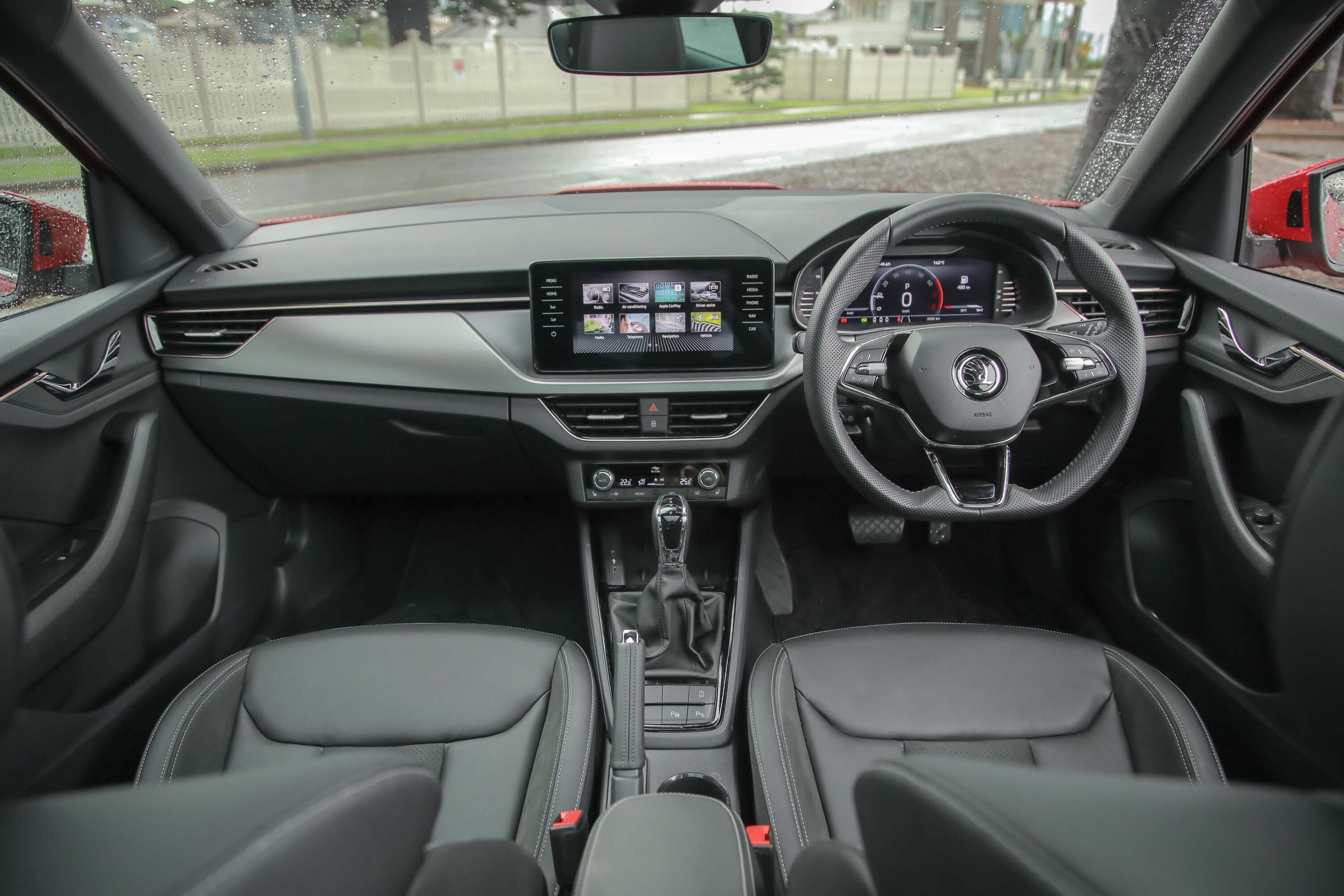
Near new: Skoda Kamiq
Simplify your life
A newish Skoda Kamiq is a textbook value pick. Why? Skodas are still a little less known to the average buyer than, say, a CX-3, so the resale is a bit weaker, which is great if you want to snag a top buy and hang onto it long term.
Then there’s the fact near-new cars are the best buying in today’s dysfunctional used market, where stupid asking (but not sale) prices for high-kay, 10-year-old cars have prevailed since the lockdown era.
1
Icing the cake is the Czech brand’s standard seven-year warranty (from September 2022), which brings ample peace of mind.
As the brand’s USP goes, the smallest Skoda has the equipment of rivals a grade up, and near the space of alternatives a class up. This makes the not-so-small Kamiq more spacious than a Volkswagen T-Cross, for example, with even the range-opening
Style 85TSI brimming with twin digital displays, 18-inch alloys, Apple CarPlay/ Android Auto, wireless phone charging, keyless entry/start and a powered tailgate.
MORE
Everything Skoda
Mid range: Kia Seltos
It pays to let the belt out a bit…
Spend $30K if you can on a used Kia Seltos, because while circa $25K cars are available, they’re higher-mileage examples and/or steel-wheeled 2.0-litre petrol base models… which cost $25,990 drive-away new.
The base car is not without its appeal, however as a used car that extra $5K brings far more bang for buck. Think Seltos GT-Line 1.6-litre turbo AWD with as little as 30,000km, complete with nav, head-up display, sunroof, and adaptive cruise.
The Seltos launched in late 2019, so any example will still have at least three years of its seven-year, unlimited-kilometre manufacturer’s warranty to go, which is fantastic.
But enough of the pragmatic stuff. As well as being a terrific ownership proposition, the Seltos is spacious for the class, has a handsome, scaled-down medium SUV look and, in up-spec form, 130kW and 265Nm powering through a seven-speed dual-clutch automatic transmission.
An ANCAP five-star car – like all our SUV picks – the Kia wagon features AEB (radar-based on top grades or as an option), lane-keep assist and six airbags.
MORE
Everything KIA
Budget: Mitsubishi ASX
Like Steven Seagal, it’s hard to kill
Buyer-favourite rather than journo’s pick, Mitsubishi’s ASX has been a massive sales success in Australia for one big reason: value.
That’s even more true of a few-year-old ASX which you could own for little more than $20K. Shop carefully for a low-kay, dealer-serviced example delivered from October 2020 onwards and you could qualify for the Tri-Diamond brand’s warranty extension, taking cover from five to 10 years: new-car territory.
While not exciting to drive or very refined, the front-drive ASX is spacious for the class, dependable and, with seven airbags, the availability of AEB, and a five-star ANCAP rating (from 2014), safe.
These dollars should buy the world’s best base ES grade with a 2.0-litre petrol and five-speed manual, which leaves CVT autos and a series of grades topping out at Exceed to Aspire to.
Sales figures show us each month what the most popular used cars are for Australian buyers, but popular doesn’t also mean best.
When it comes to hatchbacks, we reckon you should make sure the three models below are high on your list of cars to consider.
JUMP AHEAD
Near new: Ford Focus
Don’t miss out on a bona fide great
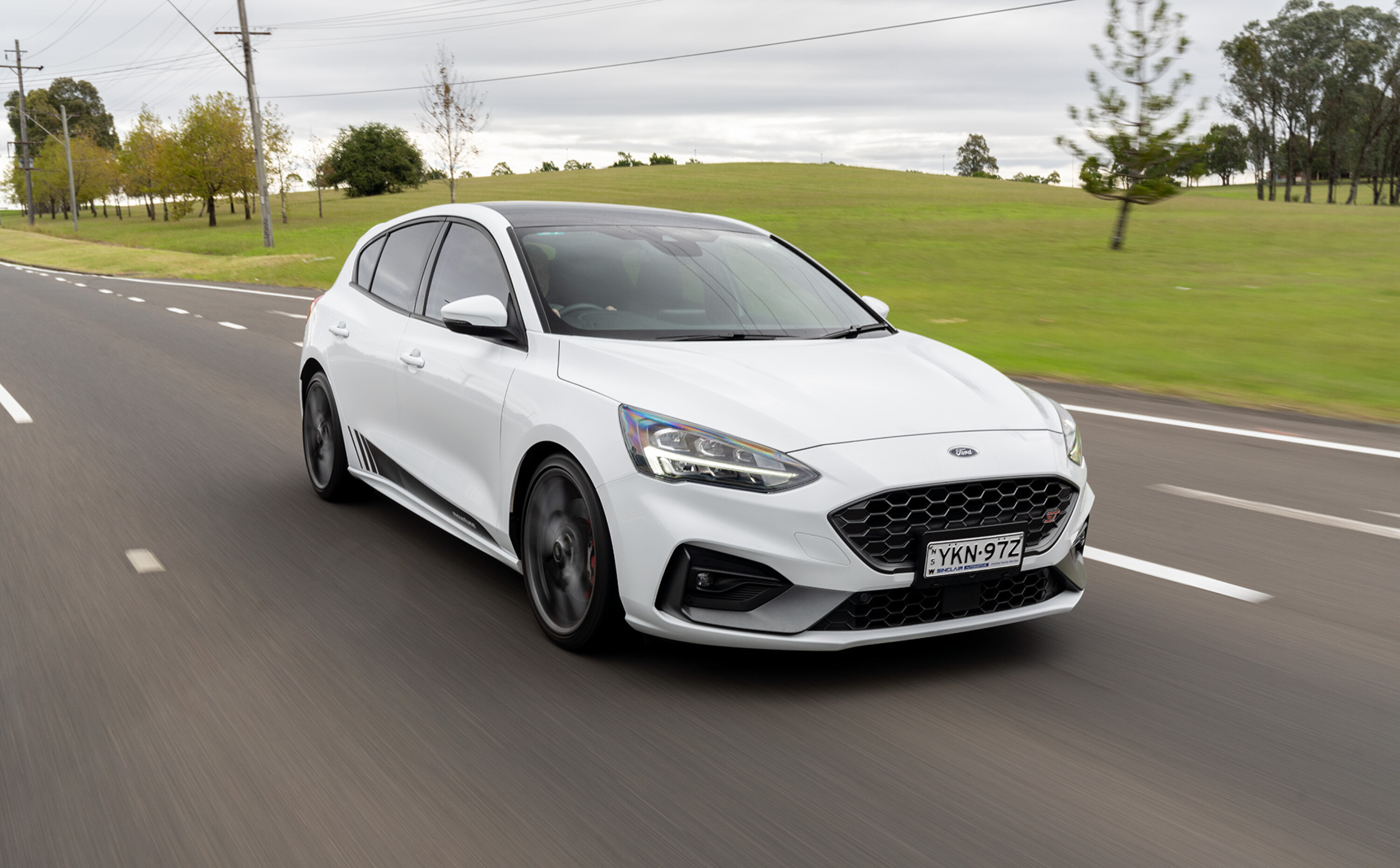
Pour one out for the last-generation Ford Focus, for despite its excellence, it lived an unfairly short life in Australia.
After just three years in Aussie showrooms – the final year of which saw the Focus only offered in hot-hatch ST guise – the plug was pulled on Ford’s small hatch for good after the arrival of the new SA generation failed to reignite sales.
1
Our loss, because the final Focus we saw was easily the best. Ford’s Euro-developed product always had more dynamic flair than segment rivals, and the SA Focus was no exception.
A sharp chassis, precise steering, and well-judged spring and damper settings made it a delight to drive, while Ford’s likeable 1.5-litre turbo triple and new eight-speed auto provided exceptional driveability. Low-mileage examples are a notable bargain too.
The Focus ST performance hero was particularly great, but the ST-Line is our pick for those hunting a well-featured small hatchback with a smidge of sporting zeal.
MORE
Everything Ford
Mid-range: Suzuki Swift
Takes a licking and keeps on ticking
The humble Swift is a small-car stalwart that’s been a favourite of those looking for a low-cost runabout, and the current generation (that’s about to get replaced by an all-new model), represents an attractive buy.
Having arrived in Oz in 2017, it still feels like a modern car – albeit one that’s clearly built to a low price point, thanks to an abundance of hard plastics and the presence of hubcaps on the entry-spec GL (how delightfully old-fashioned).
However, it drives great and sips fuel. Penny-pinchers might gravitate to a manual-equipped Swift GL, but a GL Navigator automatic – which replaces the sad base-grade headunit with a sat-nav touchscreen with smartphone mirroring – can be had for similar money.
Budget around $15,000 for a GL Navi, though it’s worth stretching to $18,000 to snare a GLX Turbo, which replaces the atmo 1.2 of the GL with a lovely boosted 1.0-litre three-pot while also adding climate control and other accoutrements.
MORE
Everything Suzuki
Budget: Honda Civic
Ninth-gen is the sweet spot
A quick note: we are NOT talking about the Civic sedan of the same vintage. The Thai-built four-door can’t hold a candle to the UK-made five-door we’re recommending here, for a few reasons.
First: Magic Seats – though the ninth-gen Civic hatch was built on a mutation of the compact Jazz’s platform, that meant it benefited from one of the Jazz’s best attributes – an ultra-low cabin floor, and the ability to flip its rear seatbase up to allow the easy carriage of tall cargo. Few C-segment hatches are as versatile.
Second: driving joy. Though it never got an engine more exciting than a naturally-aspirated 1.8 petrol in Australia (there was also a diesel, but maybe skip that one), Honda’s chassis boffins did good. Great handling, decent comfort, and an engagingly revvy engine mesh nicely, and the six-speed manual is a peach.
The mid-grade VTi-S is good enough too – the infotainment pack in the VTi-LN flagship was no bueno when it was new, let alone in this day and age.
MORE
Everything Honda
February 2024: Electric Peugeot 308 and E-Expert van confirmed for Australia
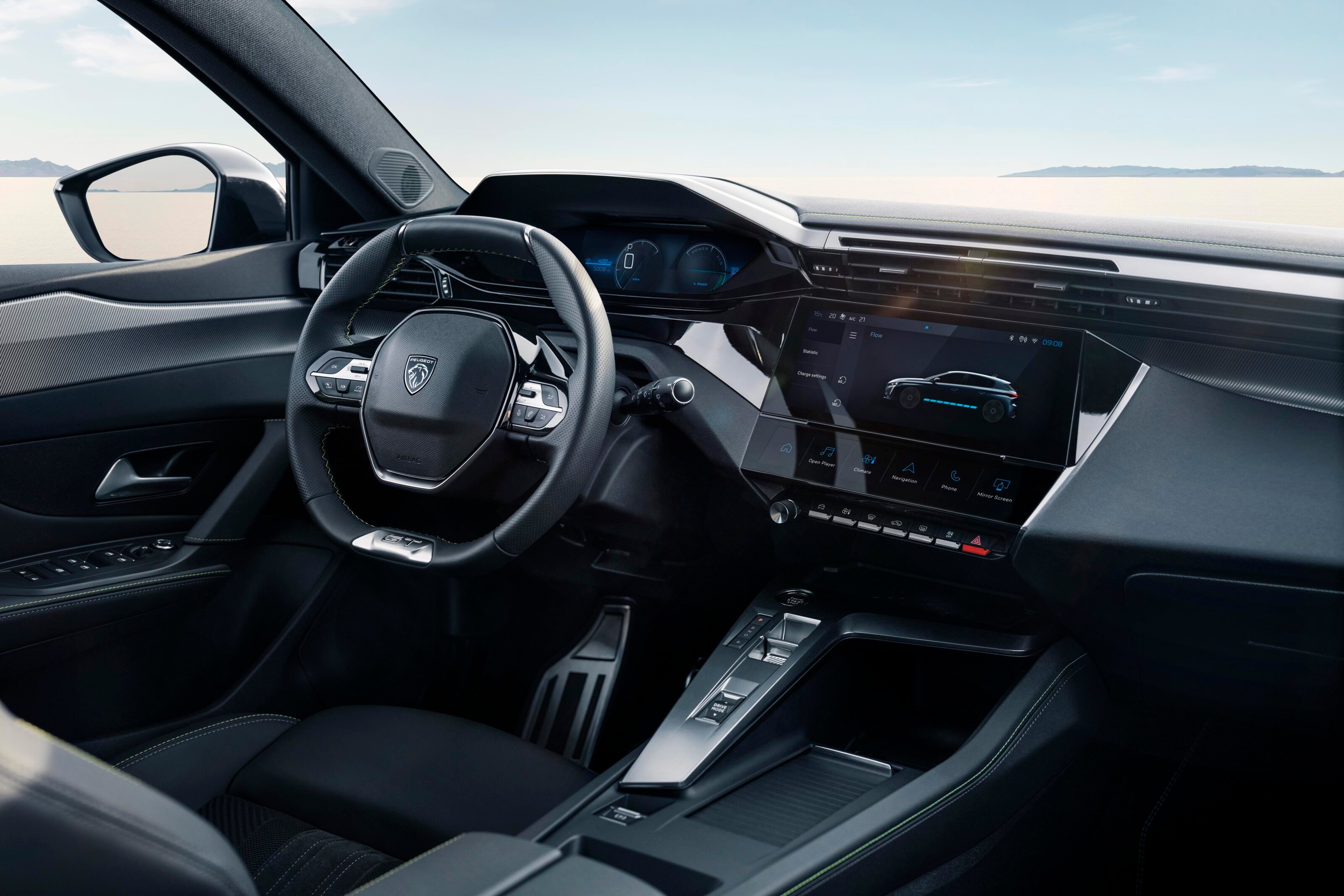
Peugeot’s small and all-electric E-308 is on its way to Australia, the company has confirmed, along with the E-Expert electric van.
Peugeot E-308
The new small EV, cousin to the regular 308 that launched here in late 2022, will go on sale in the second half of 2024.
It will join the small E-2008 electric SUV that arrived last year, and the smaller E-208 hatch due here sometime this year.
Pricing and details are still to be revealed, but the existing range and available rivals provide some clues: The E-2008 is priced from $59,990, and the E-208 will likely slot into the low $50k range, so as to not stray too far from the related Fiat 500e (both brands are part of Stellantis).
1
The E-308, however, will likely be far more expensive.
The existing 308 GT Sport PHEV (plug-in hybrid EV) is already priced from $64,990 plus on-road costs, so – short of a major pricing spec and pricing shuffle – the E-308 will surely enter from upwards of $70,000.
In that category, the E-308 will come up against compelling options like Tesla’s Model Y, the Kia EV6, Hyundai Ioniq 5, Polestar 2 and Volvo XC40 Recharge. We’ll have to wait and see how that works out for Peugeot.
The brand is now taking expressions of interest for the E-308 in Australia – let us know in the comments below if you’d be keen at that price point.

1
Peugeot E-Expert
The new Peugeot E-Expert is also bound for Australia, where it’ll take on the likes of Ford’s E-Transit Custom, the LDV eDeliver 7 and the Mercedes-Benz E-Vito.
The E-Expert brings a refreshed look for the Expert, although it’s unclear when a new-look diesel will reach Australia.
As for pricing, the diesel Expert Pro Short (wheelbase) currently sits at $47,990 before on-road costs, while the impressive LDV eDeliver 7 is priced from $59,990.
Given its premium stature, Peugeot’s E-Expert – which claims a driving range of up to 350km in its current Euro-market form – could start closer to the $90k region occupied by the E-Vito.
With the smaller E-Partner priced from $59,990, we can likely expert the E-Expert to come no cheaper than $70,000.

1
September 2022: Peugeot E-308 revealed
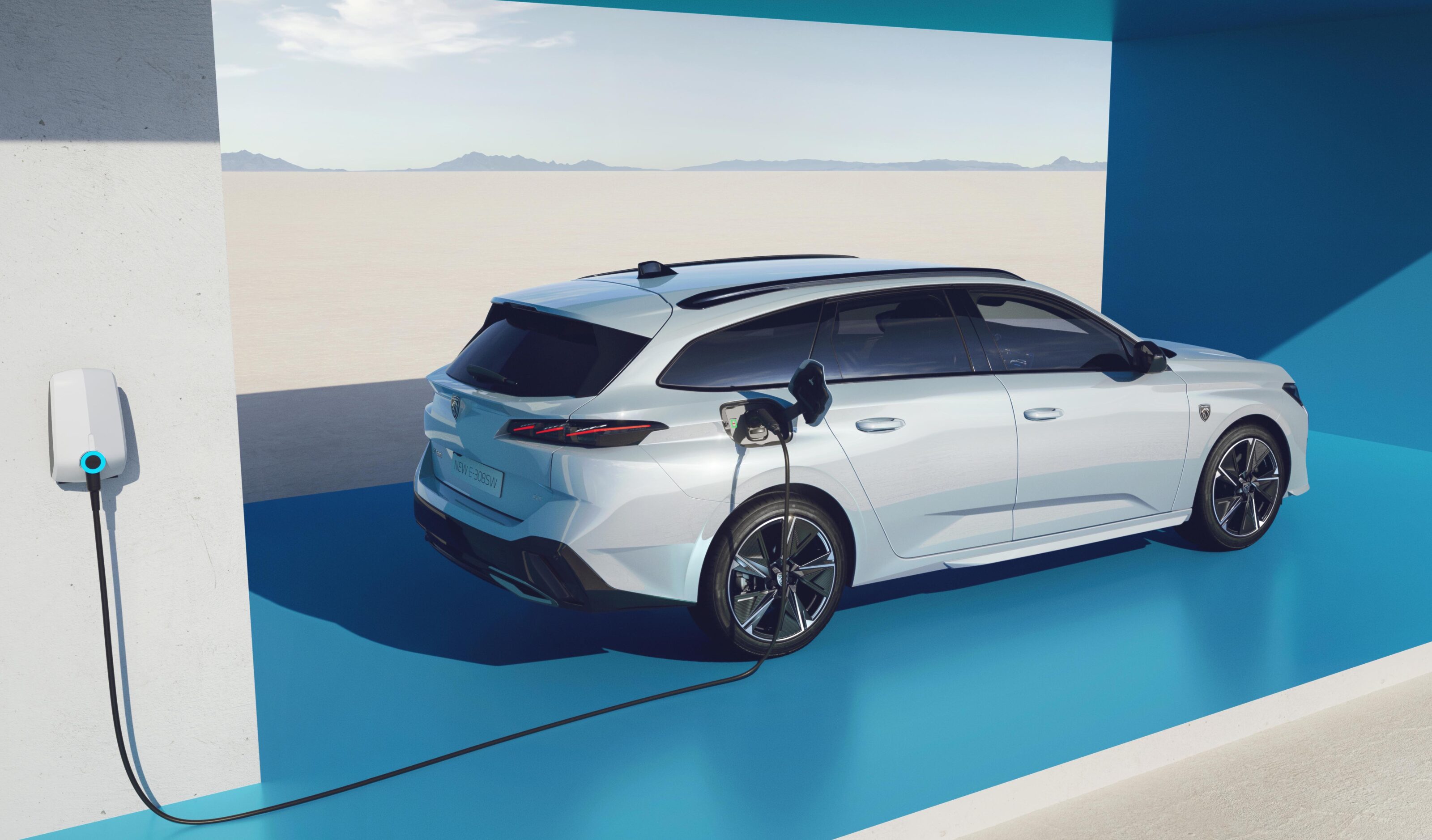
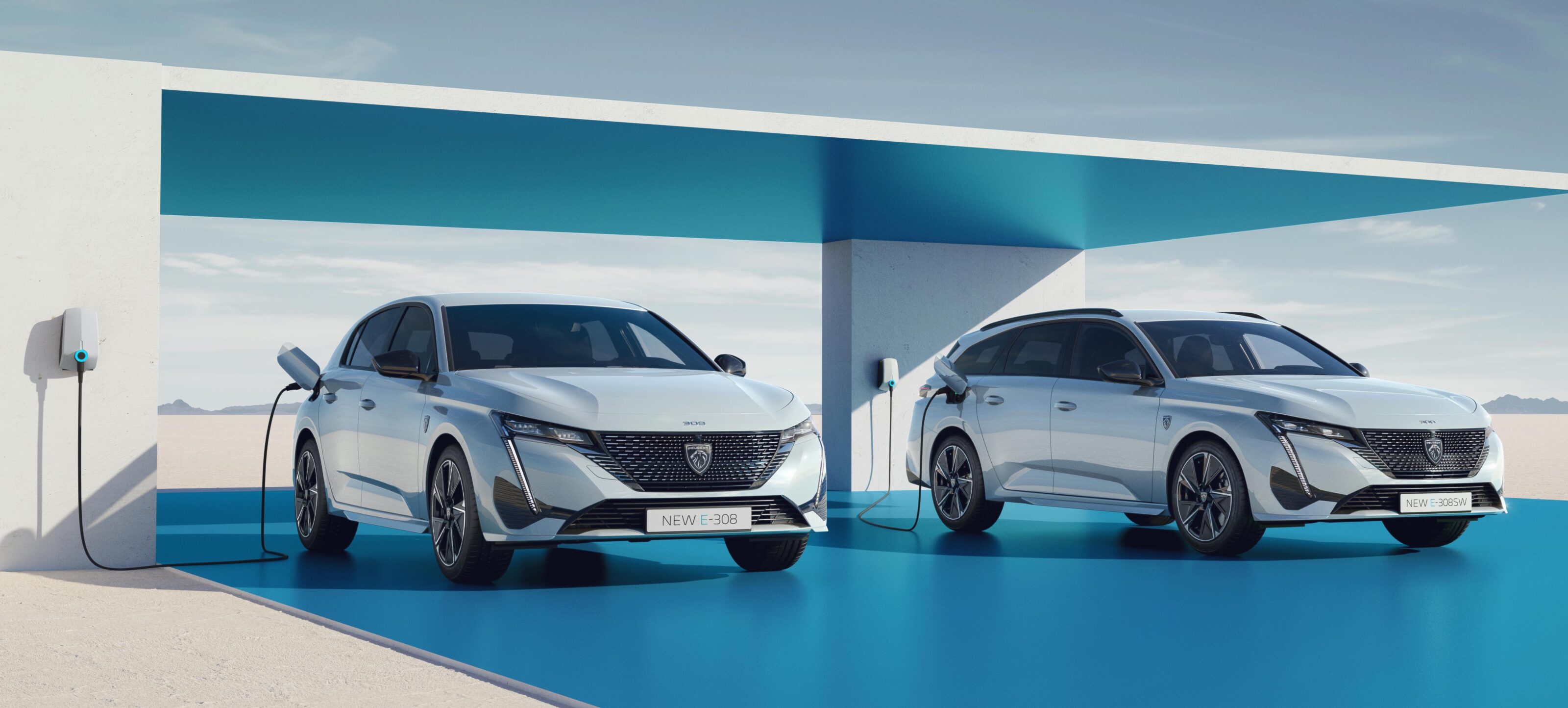
An electric version of the 2023 Peugeot 308 hatch and wagon has been revealed – and it could join the petrol and plug-in hybrid line-up in Australia.
Snapshot
- 2023 Peugeot e-308 revealed, under consideration for Australia
- Features a 54kWh battery with a claimed driving range exceeding 400km
- Available in Europe from mid-2023
While the Peugeot e-308 has yet to be officially locked in, Peugeot Australia managing director Kate Gillis said it was under consideration.
“The global reveal of a full battery-electric 308 is exciting, and we can confirm the e-308 is under evaluation for the Australian market as part of our electrification journey”.
1
It will be available in hatch and wagon form, with availability in Europe from mid-2023.
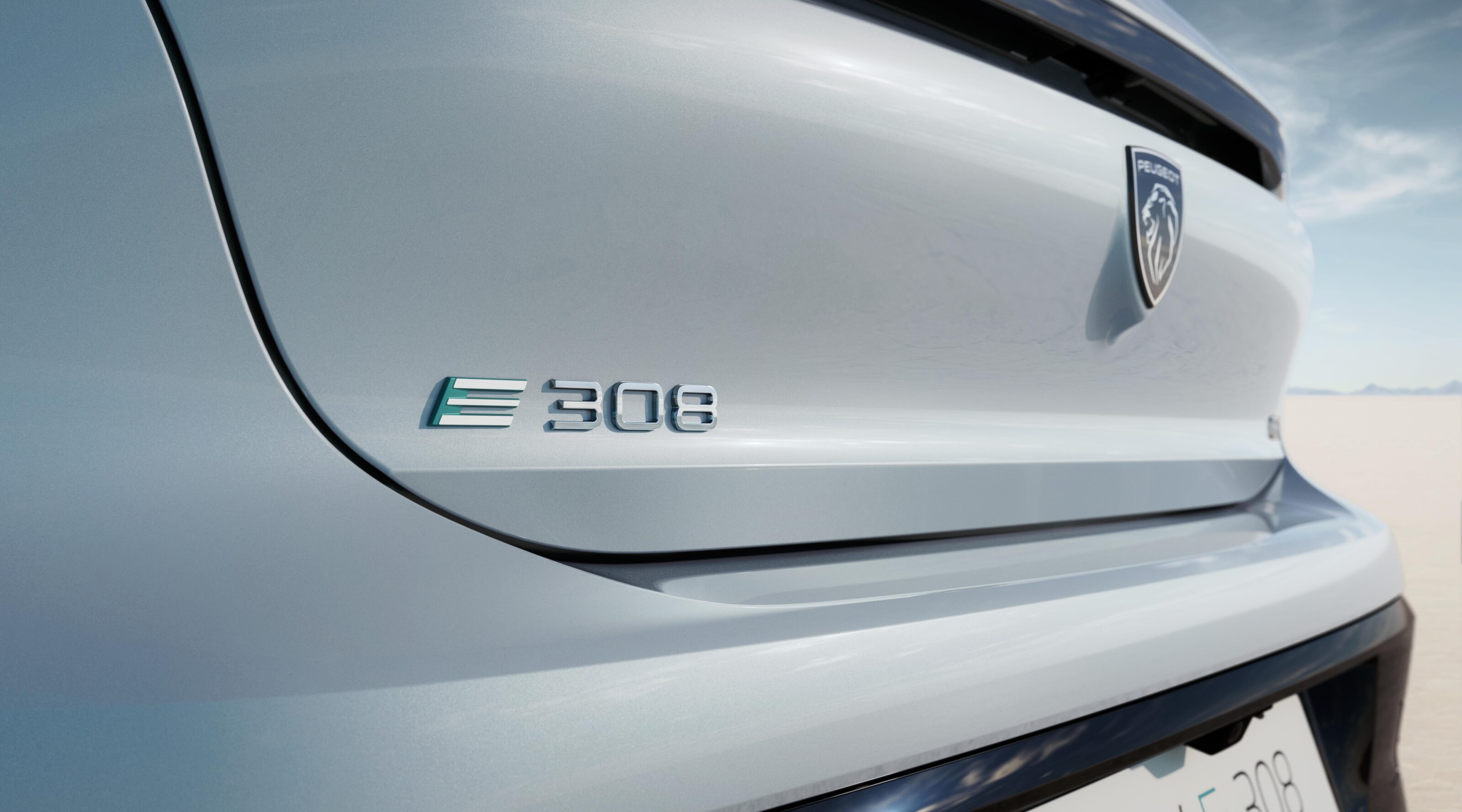
Under the body, the e-308 features a 54kWh lithium-ion battery pack (51kWh usable) using a nickel manganese cobalt (NMC) chemistry, with a 400-volt charging architecture.
The front-mounted electric motor has peak outputs of 115kW and 260Nm. Other technical specifications, such as a 0-100km/h time and a top speed, haven’t been announced.
1
Drivers can select between eco, normal, sport and brake drive modes, with the latter increasing the level of brake regeneration.
It will charge from 20 to 80 per cent in less than 25 minutes at a 100kW direct current (DC) public charger, while it sports an onboard three-phase charger supporting an alternating current (AC) charge up to 11kW.
Final driving range figures are yet to be confirmed, but Peugeot claims the e-308 can travel more than 400 kilometres between charges.
1
Peugeot says the e-308 has a class-leading efficiency of 12.7kWh/100km compared with all “electric vehicles in the C segment”, assisted by a set of aerodynamic 18-inch alloy wheels, low-resistance tyres and the lightweight EMP2 platform.
This includes the Hyundai Kona Electric (13.1kWh), Tesla Model 3 (13.4kWh), Volkswagen ID.3 (14.9kWh) and Kia Niro (16.2kWh).
Entry-level Allure and flagship GT trim levels will be offered globally, with market-specific pricing still to be announced.
Locally, the Peugeot 308 range will be available in two GT trims – GT and GT Premium – while the plug-in hybrid (PHEV) is limited to a unique GT Sport grade. We’d expect a similar move for the e-308, should it arrive in Australia.
1
A MyPeugeot application is available overseas, allowing drivers to schedule charging or remotely pre-condition the cabin.
Apart from the electric components, the e-308 is identical to the regular 308, which is set to arrive in Australia during the fourth quarter of 2022 (October to December inclusive), followed by the GT Sport PHEV in early 2023.
As such, the interior and exterior remain the same, with highlights including; a 10-inch infotainment screen, 10-inch digital instrument cluster, wireless phone charging, USB-C ports, and a full suite of active safety technology, such as autonomous emergency braking and lane-keep assist.
MORE
Everything Peugeot
