Snapshot
- Second facelift for 2024 Audi Q7 and SQ7 models
- Updated styling, new lights, and a more advanced infotainment system
- Due in Australia in the second half of 2024
The Audi Q7 luxury large SUV has received its second facelift ahead of an all-new model due in 2026.
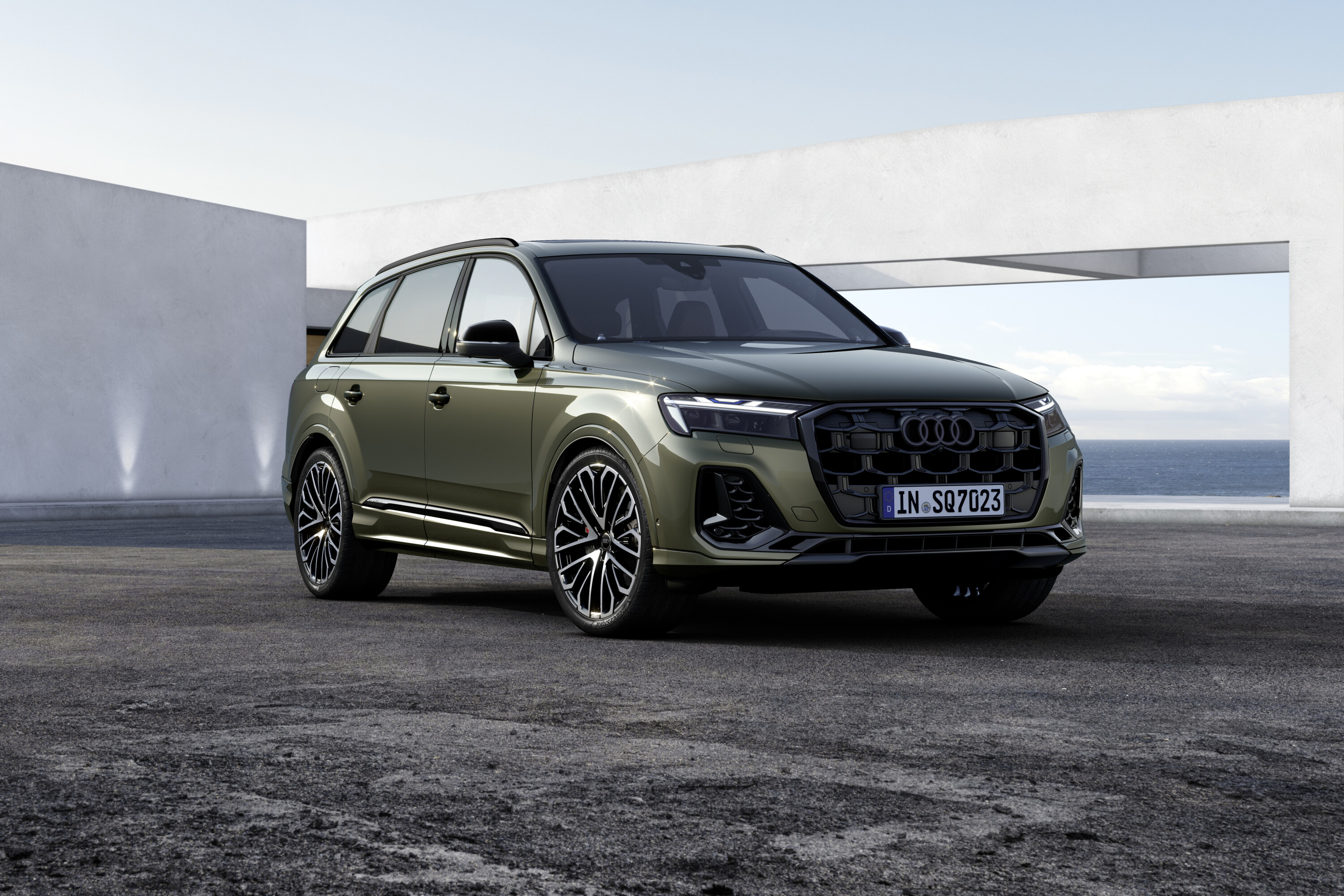
Revisions for the 2024 Audi Q7 and 2024 Audi SQ7 are applied from more recent models in the German brand’s line-up, including an updated exterior design, matrix LED headlights with laser and OLED tail-lights, and minor revisions inside.
The latest update for the seven-seat Q7 – a rival to the Volvo XC90, BMW X5 and Mercedes-Benz GLE – follows a comprehensive mid-life facelift in 2019 which introduced an identical dashboard to the related Q8 flagship coupe SUV.
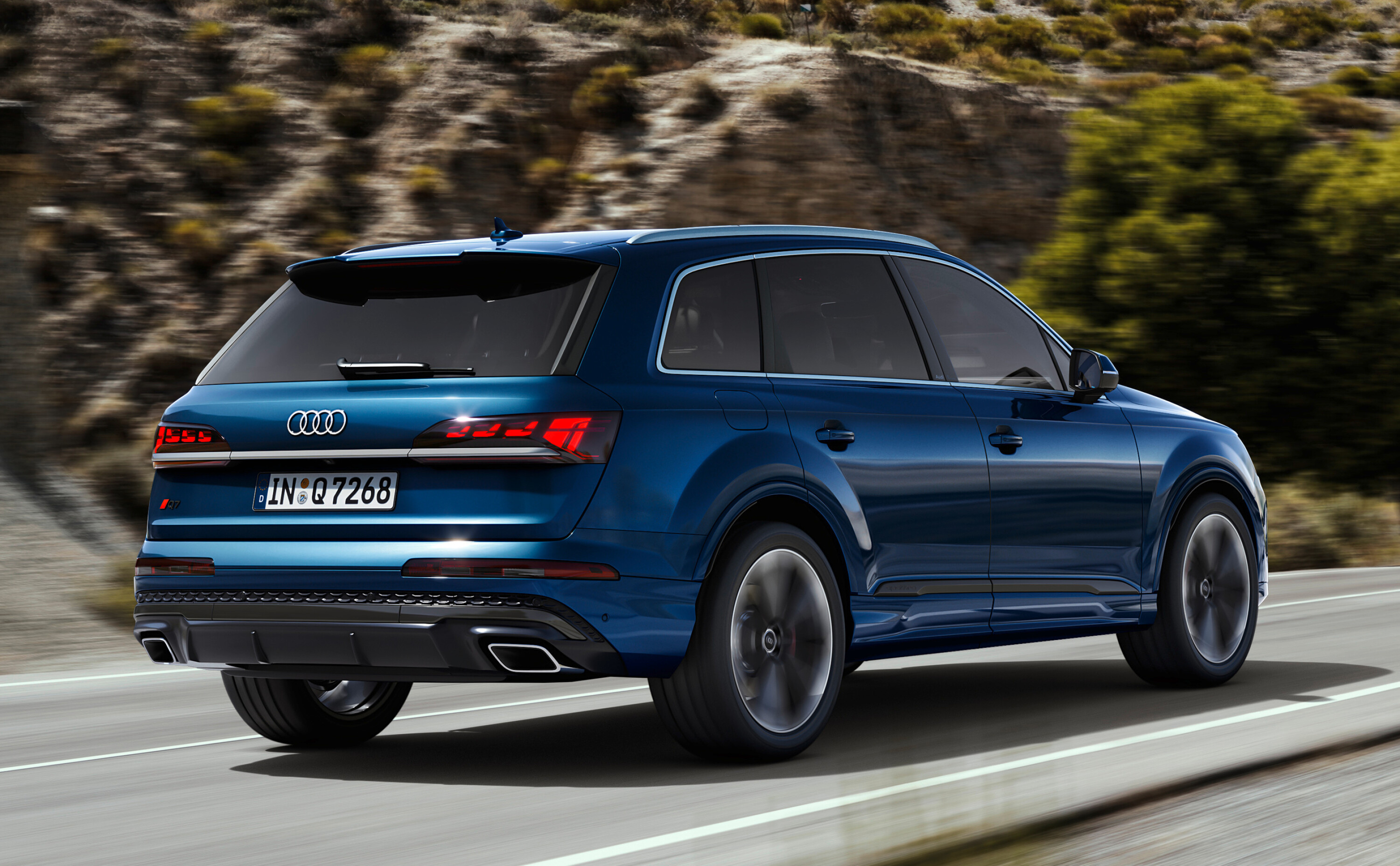
The current, second-generation Audi Q7 was launched in 2015 to replace the first-generation model sold between 2005 and 2015, which also had two major updates during its 10-year lifespan.
Audi Australia has confirmed the updated Q7 and SQ7 are due in local showrooms in the second half of this year, with further details to be announced closer to launch.
Exterior changes include Audi’s new, flatter two-dimensional logo, a larger grille with a new octagon pattern, redesigned front bumpers with “prominent colour-framed” air intakes, and a return to actual exhaust tailpipes on the lower rear bumper.
The headlights now look more familiar to the Q5 and Q8 and are available with optional matrix LED technology, which includes laser lighting. The system features 24 individual LEDs, with each having a high-power laser diode to boost the high-beam range at speeds above 70 km/h.
A digital daytime running light is also fitted to the matrix LED headlights, which allows drivers to configure the light signature.
Organic light-emitting diode (OLED) digital tail-lights are now fitted to the Q7, following the A8, Q8 and Q5. This allows drivers to choose from pre-configured light signatures, along with sequential turn signals, various coming and leaving home sequences, and a proximity feature to alert drivers when are within two metres of a stationary Q7.
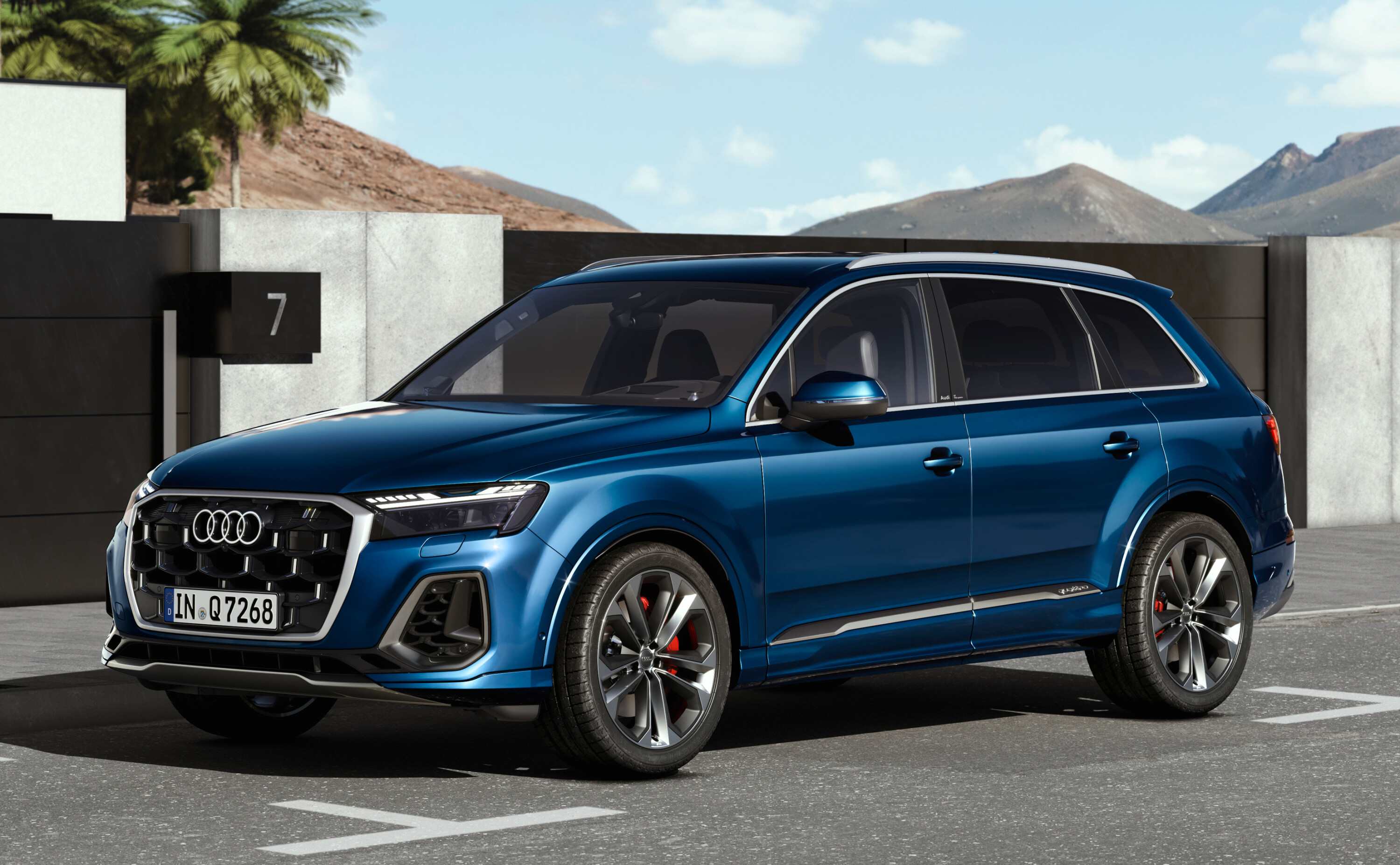
New exterior colours include ‘sakhir gold’, ‘ascari blue’ and ‘chili red’, while there are five new alloy wheel designs ranging between 20 and 22 inches.
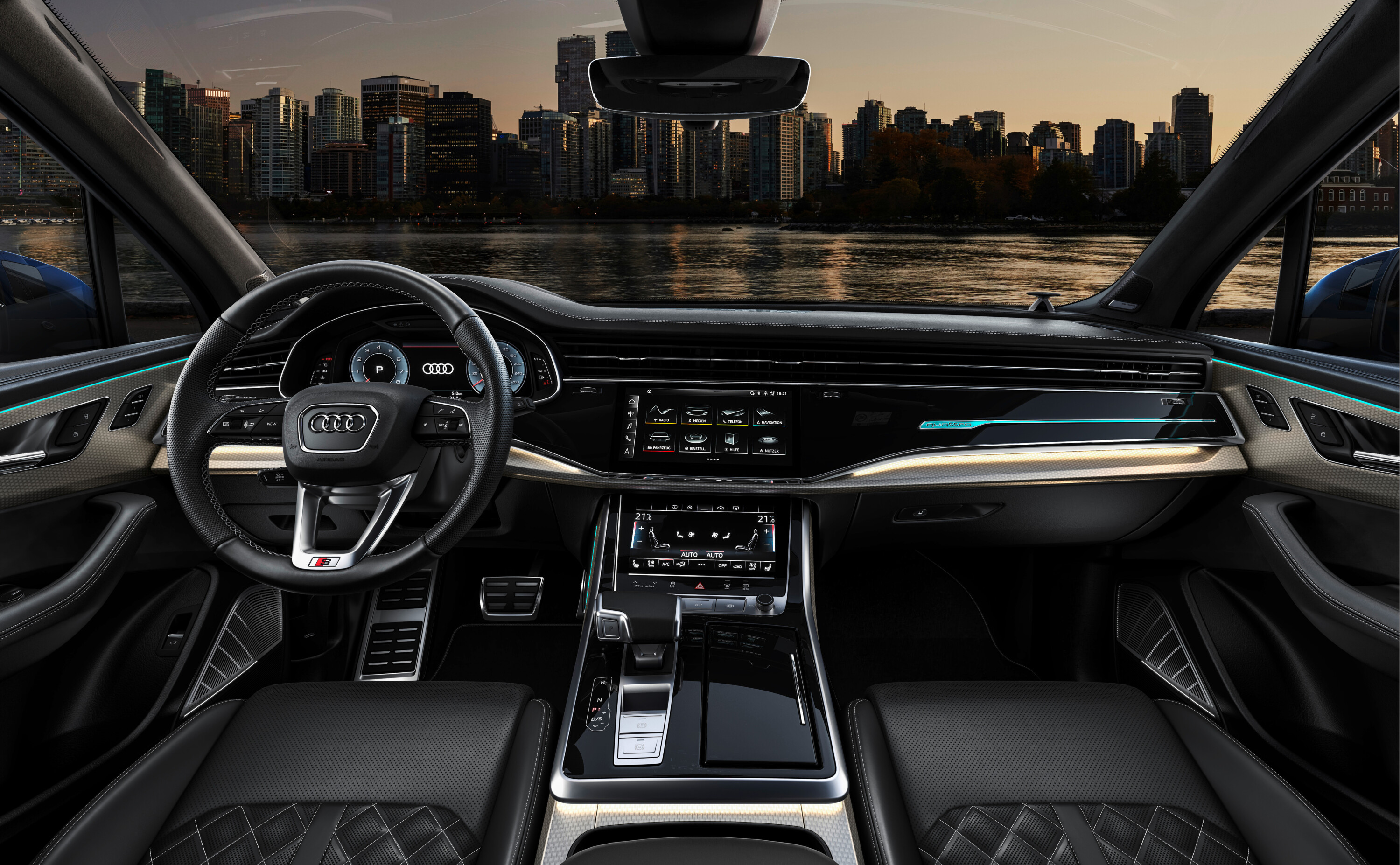
As with the facelifted Q8 due in mid-2024, the MIB 3 infotainment system now supports third-party applications – including Spotify and Amazon Music – and the digital instrument cluster is enhanced to display additional driver assistance-related details.
The latest Q7 will be available with nine decorative inlays, including ‘natural elm burl silver’ for the standard Q7, and ‘matte carbon twill’ or ‘matte brush aluminium’ for Q7 S-line and SQ7 models.
Under the bonnet, the 2024 Audi Q7 retains its existing powertrain options, including the 170kW/500Nm 3.0-litre turbo-diesel V6, uprated 210kW/600Nm 50 TDI, and 250kW/500Nm 3.0-litre turbo-petrol 55 TFSI available in Australia.
All models continue to feature a 48-volt mild-hybrid system and an eight-speed torque-converter automatic transmission.
Specific enhancements for the sportier SQ7 variant include a new honeycomb-look grille, a redesigned front spoiler and rear diffuser, and revised alloy wheel designs up to 22 inches.
As before, the SQ8 has a 4.0-litre twin-turbo V8 engine delivering 373kW and 770Nm. It does not include a mild-hybrid system but features cylinder deactivation technology.
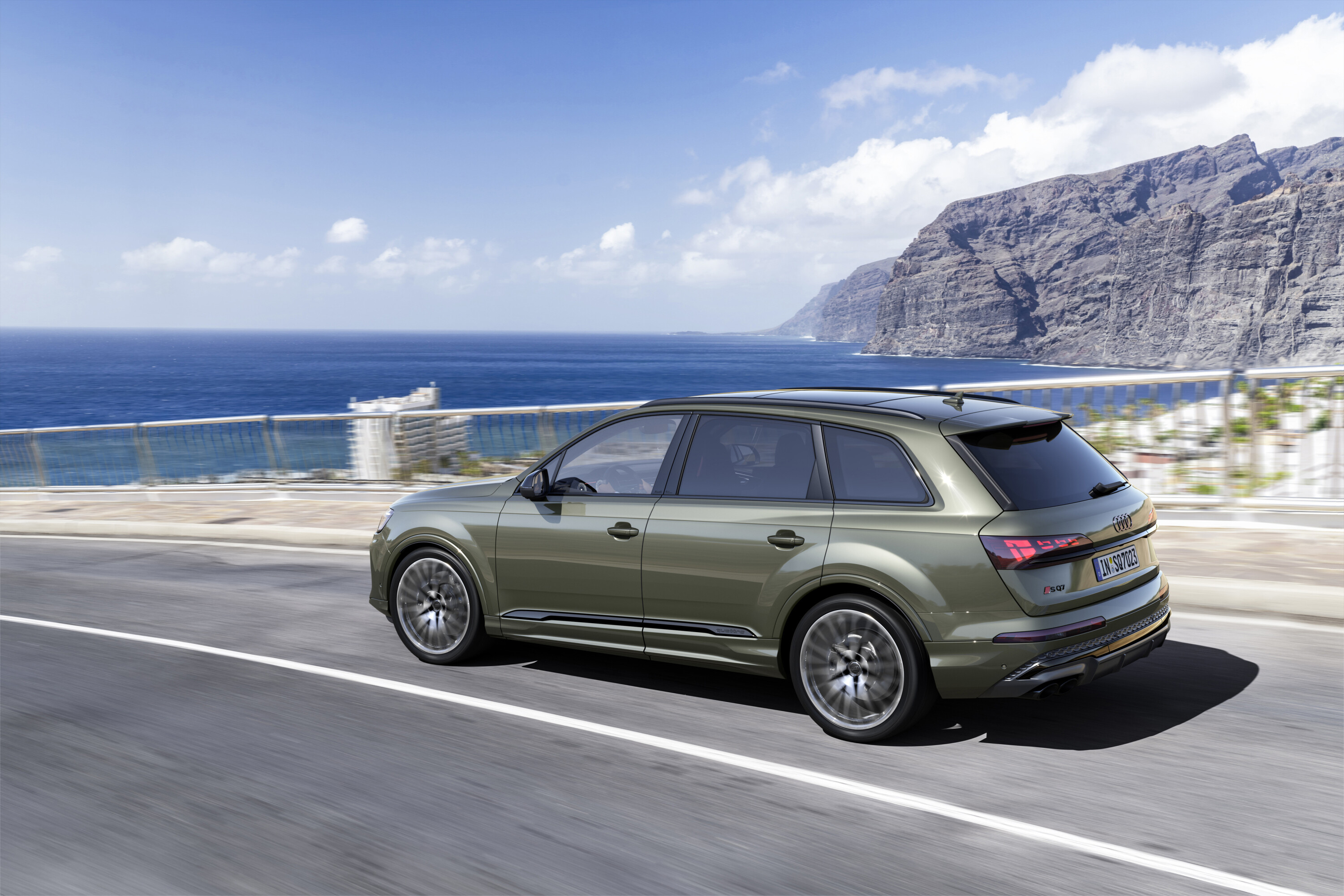
The facelifted 2024 Audi Q7 is due in Australia in the second half of this year, with further details to be announced closer to its launch.
It is expected to be the final update for the second-generation Q7 ahead of the launch of the third-generation Q7, which is due to debut later in 2025.
It will become one of Audi’s final internal-combustion vehicles ahead of its all-electric future, and could be joined by an upper-large ‘Audi Q9’ to rival the Mercedes-Benz GLS, BMW X7, the full-size Range Rover, and the Cadillac Escalade.
VFACTS new-car sales data reveals 1961 examples of the Audi Q7 were sold in Australia in 2023 compared to 3846 Land Rover Defenders, 3682 BMW X5s, 2743 Lexus RXs, 2535 Mercedes-Benz GLEs and 2224 Range Rover Sports.
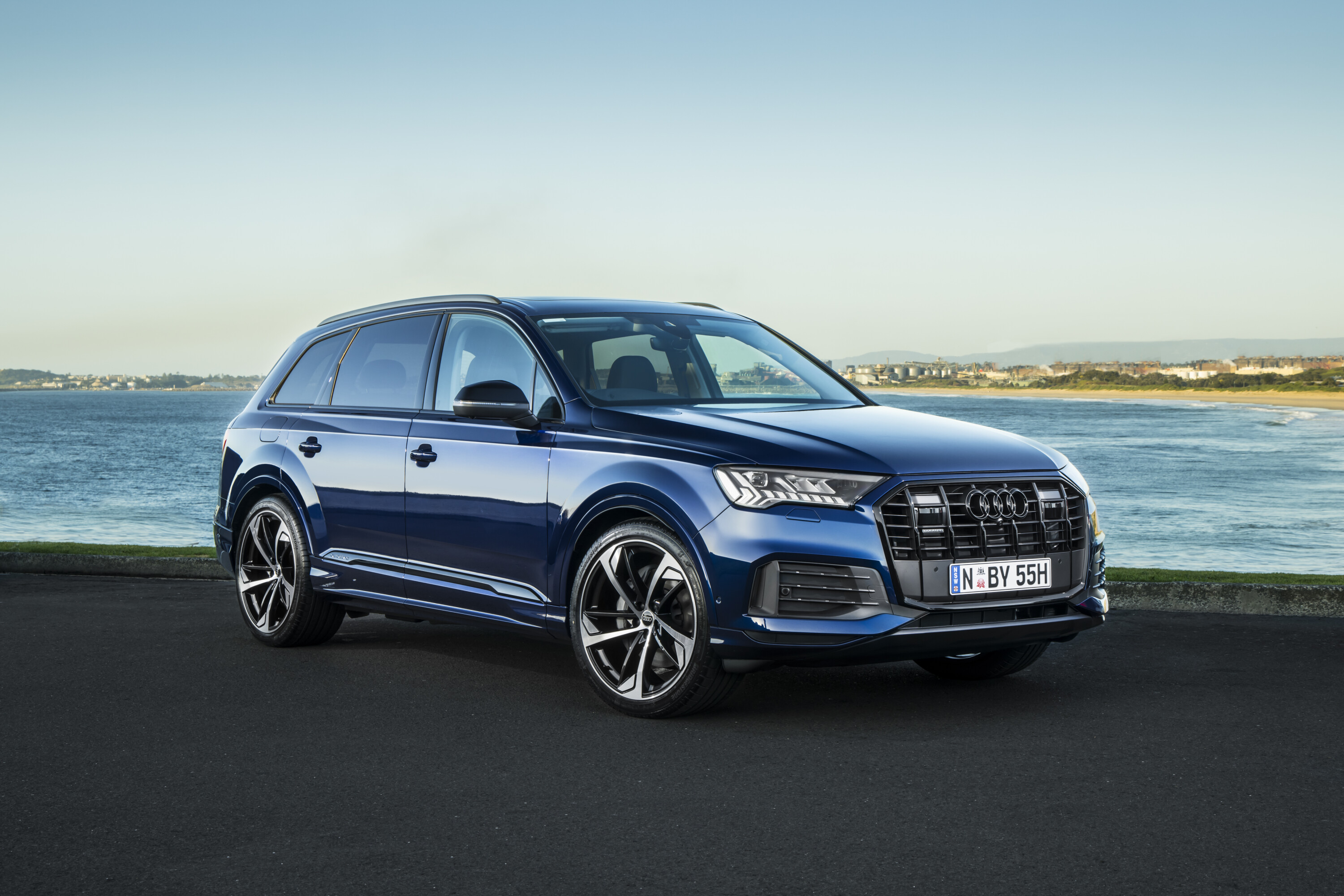
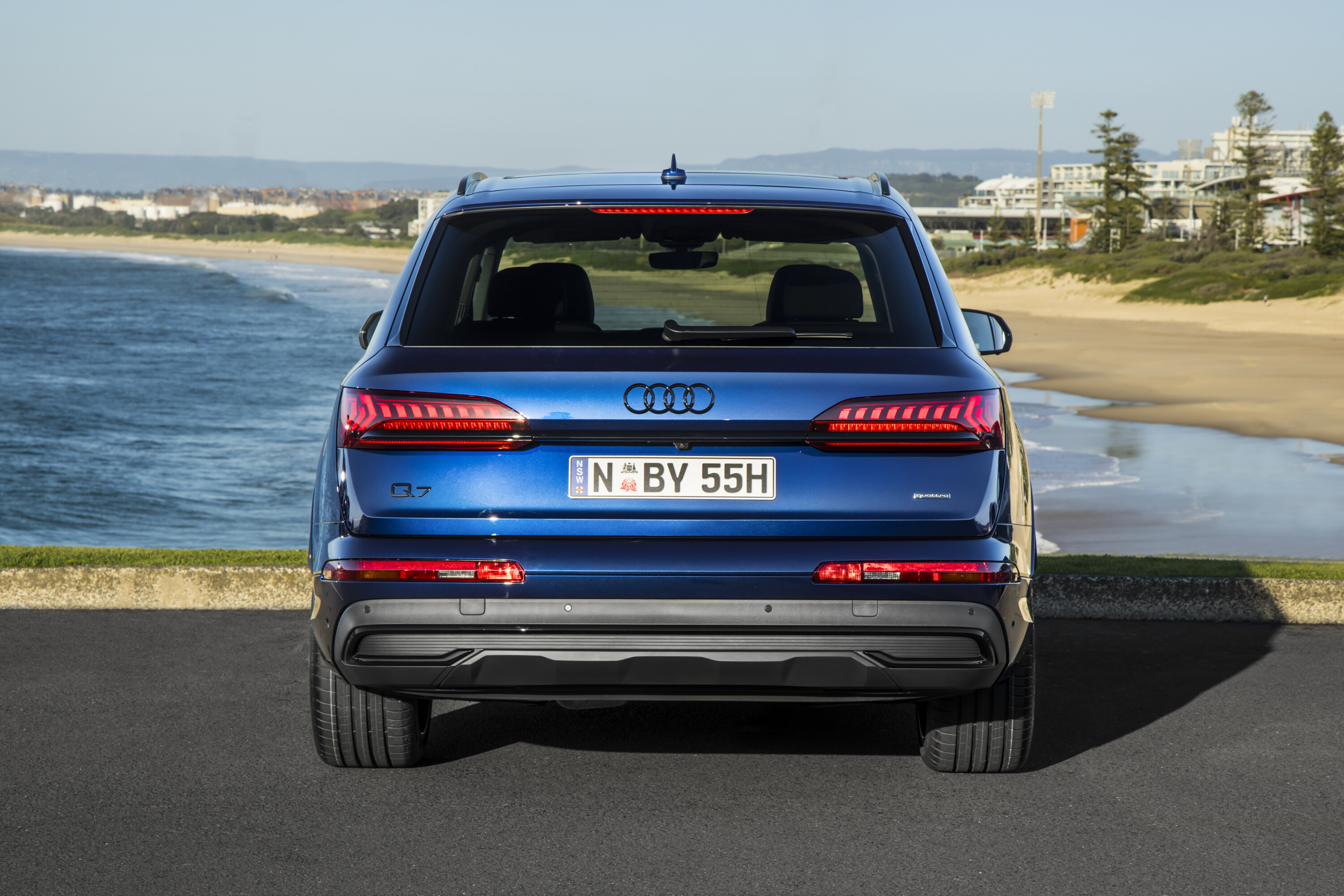
Below: The current 2023 Audi Q7
Snapshot
- Electric vehicles lagged behind combustion-engined vehicles in volume and value
- EVs listed for sale were worth just 57.6 per cent of their purchase price after 2-4 years
- Combustion-engined vehicles retained 85.9 per cent value in the same period
The Australian Automotive Dealers Association (AADA) and AutoGrab have compiled 2023’s used car sales data into the Automotive Insights Report (AIR) which paints a picture of the current market.
Throughout 2023, the pandemic’s effects lessened and used car prices slowly dropped in response to improved new car supply. For the most part, used car values are up compared to a decade ago – you can read the full breakdown here – but the market for electric vehicles isn’t so promising.
Of the used cars listed for sale, 96 per cent were petrol and diesel models, while hybrids made up 3.1 per cent of the pie. Plug-in hybrid (0.1%) and electric vehicles (0.7%) accounted for less than one per cent.
Compare that to new EVs, which made up 7.2 per cent of 2023’s record sales, and it’s clear there’s a long way to go before a mature used electric vehicle market emerges.
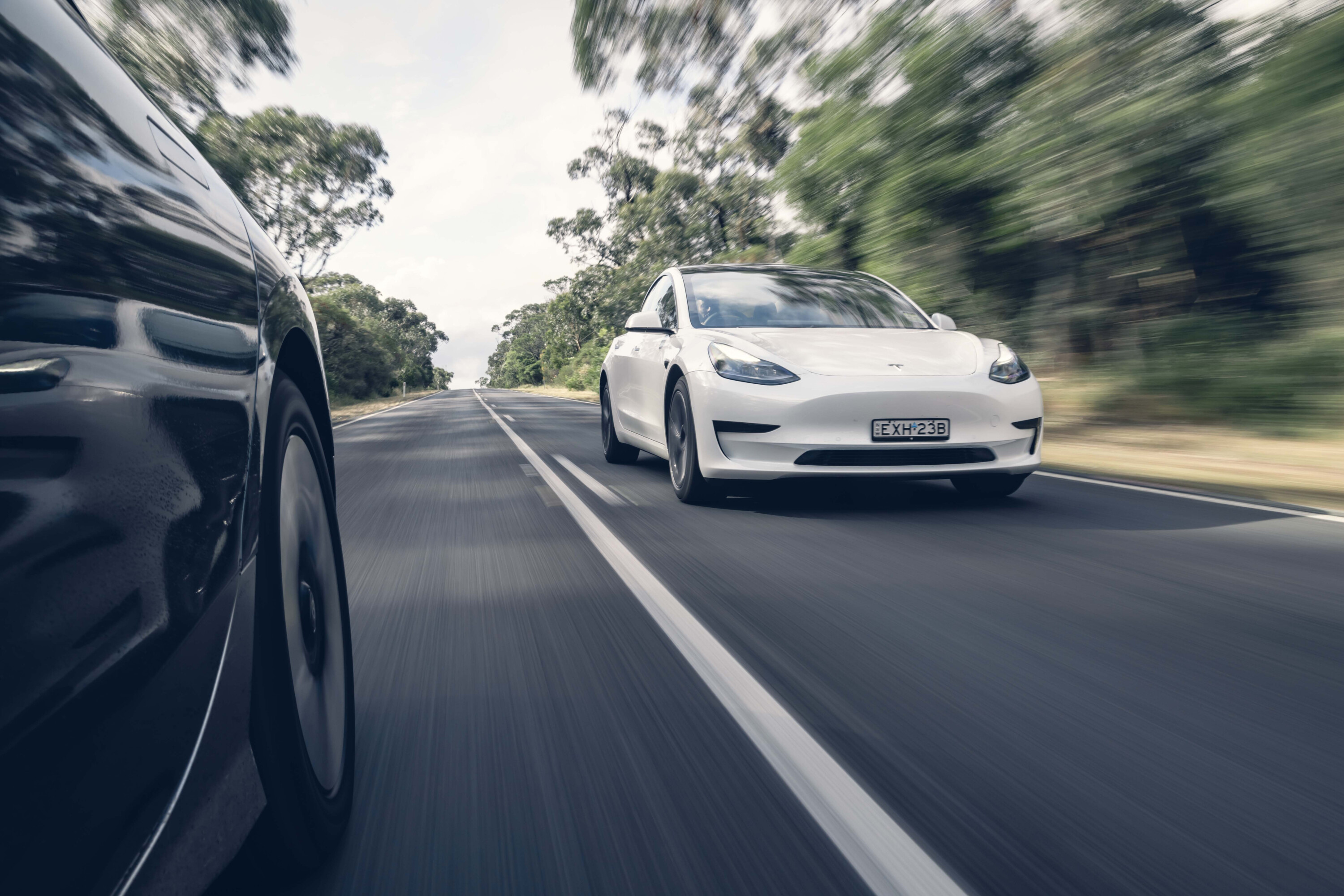
As in new electric car sales, of the 12,051 used examples sold it was Tesla that dominated (36.4 per cent) followed by MG (14.6 per cent) and Nissan (8.2 per cent). Expect this year to bring more turbulence with the advent of even more affordable options from China.
Beyond the smaller pool of choice, used electric vehicles were also valued much lower than combustion-engined counterparts.
Two to four year old combustion-engined cars retained 85.9 per cent of their value, compared to EVs which kept just 57.6 per cent of their value. The AIR described the residuals as “incredibly low” and noted EVs had “underperformed the market significantly.”
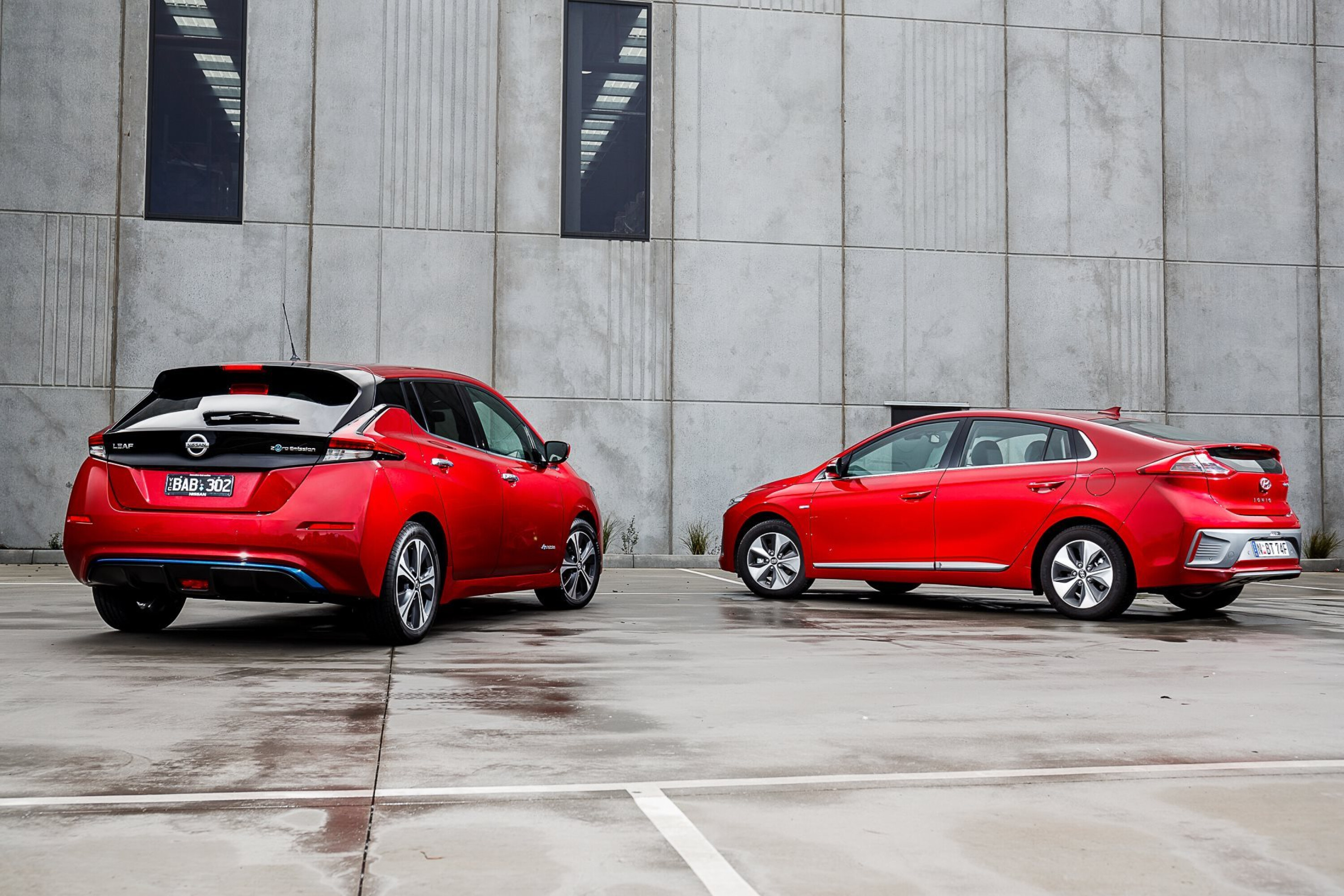
From the start of 2023, retained values dropped 15.6 per cent for electric vehicles under two years old, and a huge 23.4 per cent for those between two and four years old.
By the end of the year, the average time from list to sale of an EV had climbed to 75 days – the longest of any category in the AIR.
The AADA’s report notes a few factors in this, chiefly changes to the fringe benefits tax (FBT) structure that made leasing a new electric car far more attainable, as well as the influx of affordable options from China and the ensuing price wars.
There are also the unknowns of electric vehicle maintenance. While there may be far fewer moving parts and less brake wear, there’s a big cost if the battery goes boom (though most are covered by eight year/160,000km warranties), and Tesla only offering a four-year warranty will affect residuals.
While this might all sound like doom and gloom for prospective EV buyers, it could be a win for those on a tighter budget willing to chance a used vehicle. If you’re after a sedan under five years old for about $60K, for example, you’re remarkably well served by Tesla Model 3s in the classifieds.
Cupra might not be a name you’re familiar with yet but a name you may know is SEAT, their parent company– who are actually owned by the Volkswagen Group.
The Spanish brand has been on our shores now for a couple of years with a range of sporty and stylish looking cars– offered in hybrid, electric and petrol powertrains.
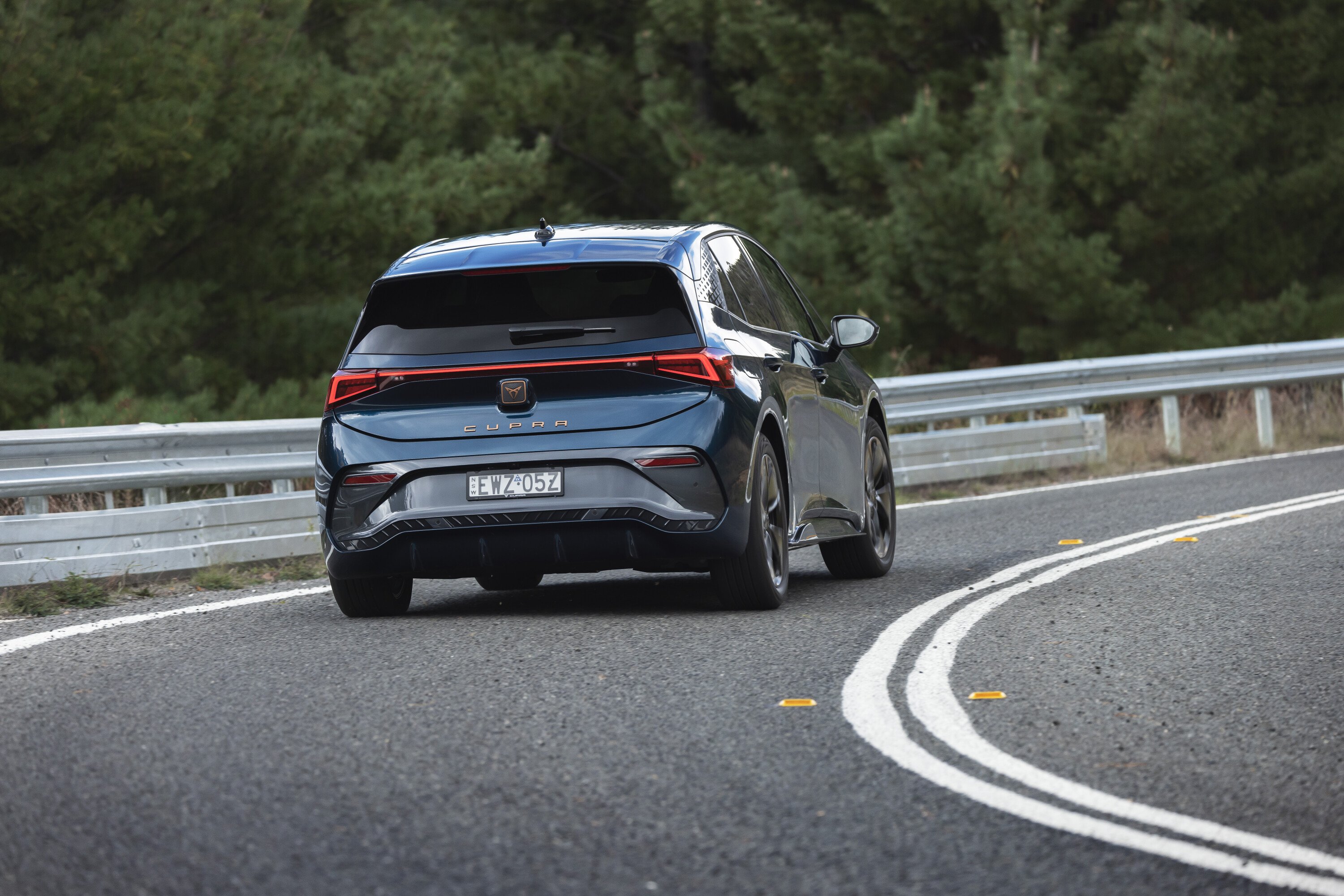
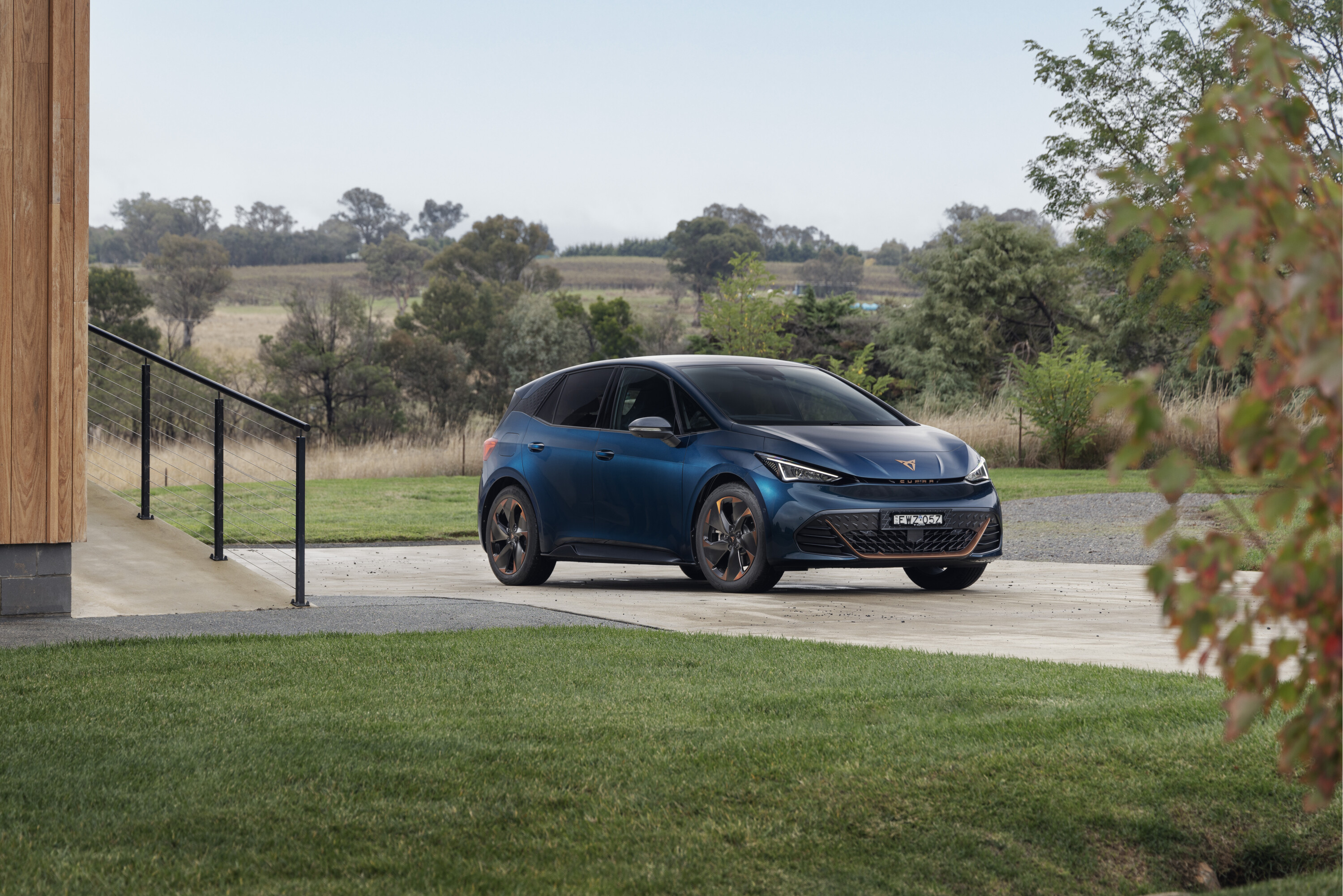
In comes the Cupra Born, the brands first all-electric car, a five-seater hatchback with up to 511km of range.
Let’s see what the newcomer is bringing into the EV fighting ring.
Pricing and features
At $59,990 before on-road costs the Cupra Born is available in a single variant.
State-based EV incentives can move this figure down depending on what current opportunities are.
The vehicle features a power system with an 82kWh gross (77kWh net) battery, capable of getting up to 511 kilometres of range under the WLTP test cycle. This system powers a rear-mounted motor, delivering 170kW of power and 310Nm of torque, which propels the rear wheels.
Cupra claims a 0-100km/h time of 7.0 seconds.
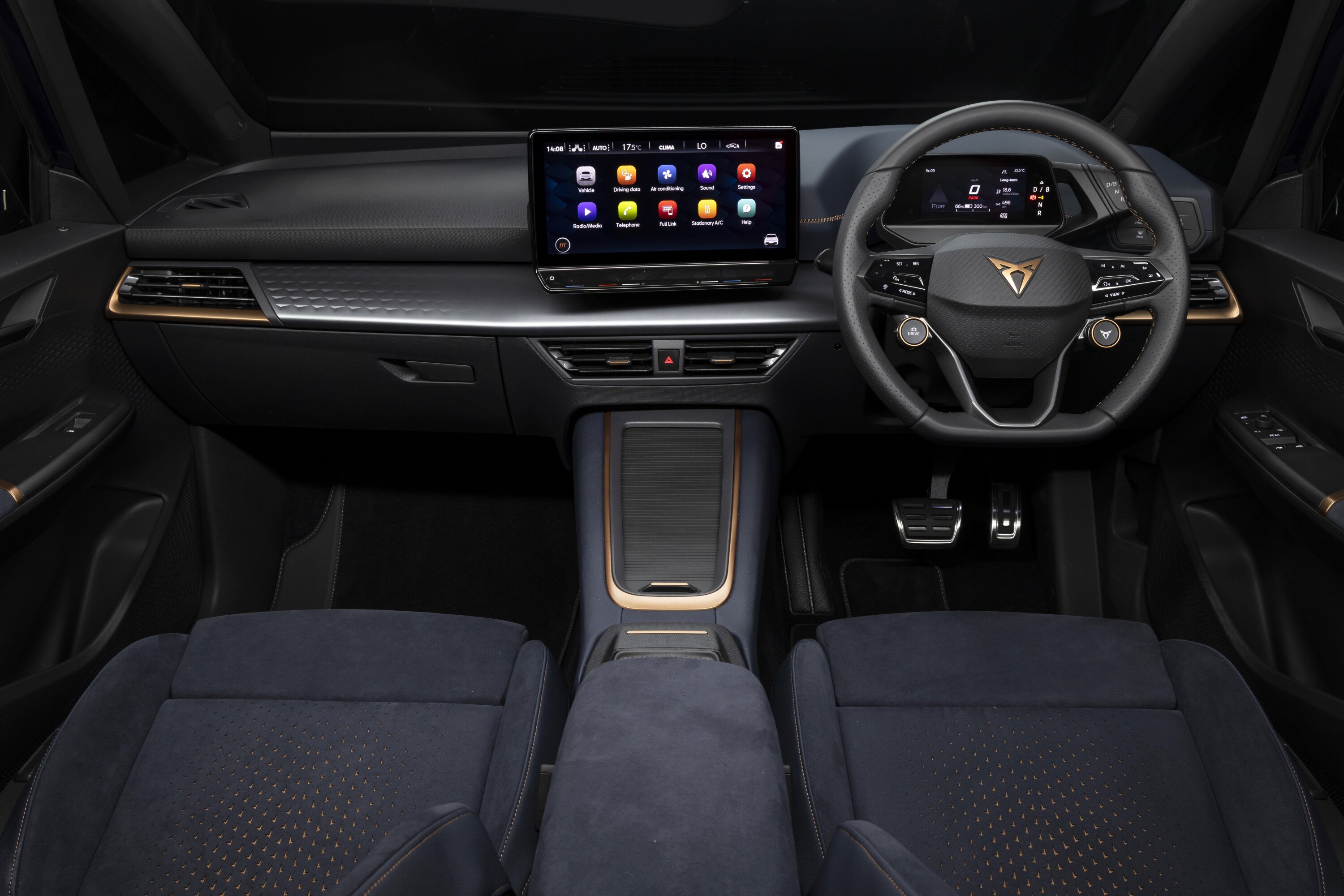
| 2024 Cupra Born features | |
| 19-inch alloy wheels | Auto-dimming rear-view mirror |
| 12-inch infotainment system | Drive mode selector |
| Wired Apple CarPlay and Android Auto | Tyre pressure monitoring |
| DAB+ digital radio | Front bucket seats |
| 5.3-inch digital instrument cluster | Recycled fibre upholstery |
| Four USB-C ports (2x front, 2x rear) | Dual-zone climate control |
| Wireless phone charger | Adaptive steering |
| Colour-adjustable ambient lighting | Sports suspension |
| Leather-wrapped heated steering wheel | Automatic parking |
| LED head and tail-lights | Rain-sensing wipers |
| Rear spoiler | 360-degree camera system |
| Heated power-folding side mirrors | Carpet floor mats |
| Keyless entry and push-button start | |
There are two option packs available on the Cupra Born: The Performance pack for $2600 and Interior Pack for $2900.
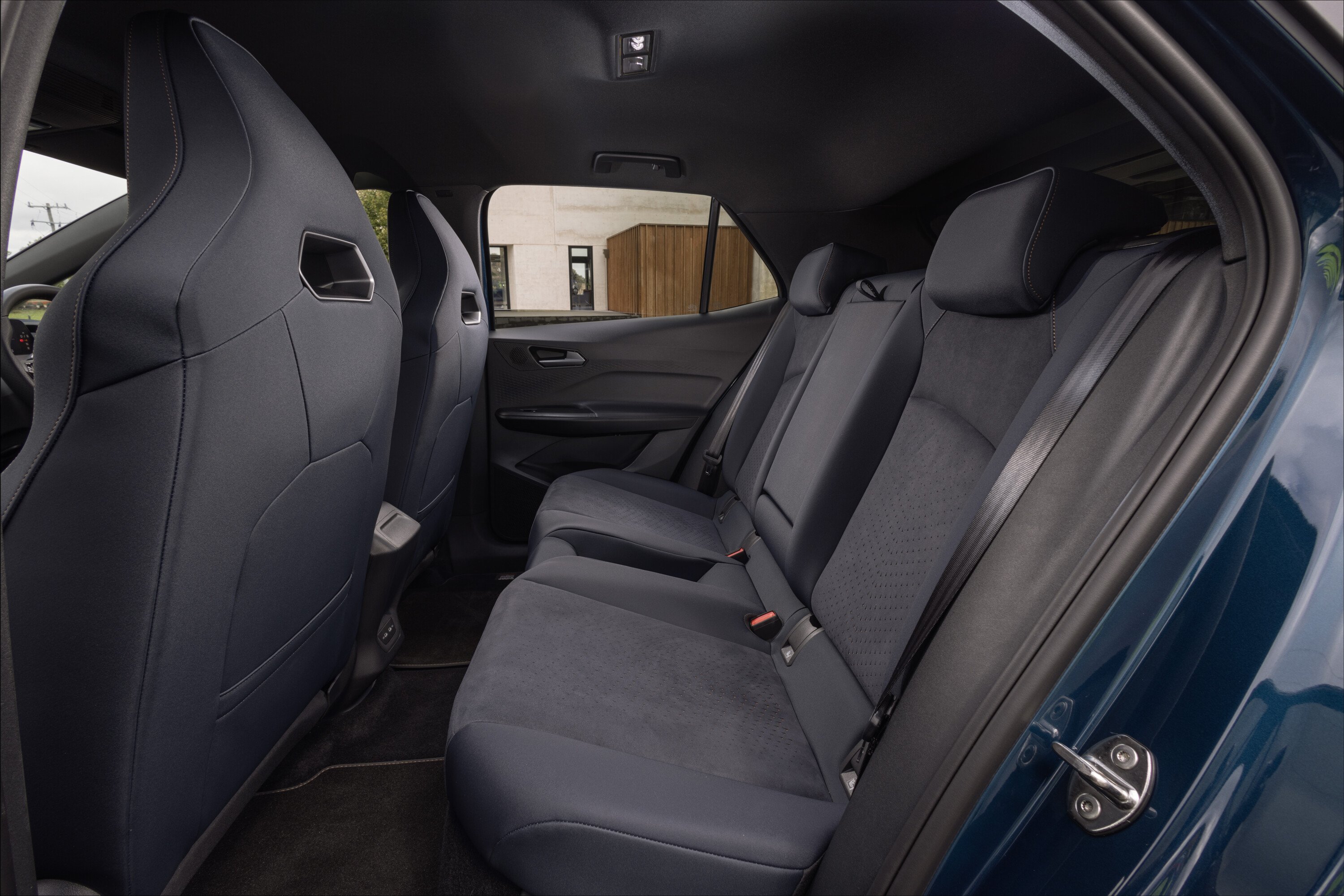
The Performance Pack adds larger 20-inch wheels, wider tyres and dynamic chassis control. The Interior Pack changes seat trim to an upcycled plastic trim and adds 12-way power adjustment, heating and massage functionality to the front seats as well as a 9-speaker Beats stereo.
Adding either option pack means you do lose a seat in the back row however, reducing total seating capacity to four.
Safety
In 2022, the Cupra Born received a five star safety rating from ANCAP.
The vehicle is equipped with seven airbags, including front, side chest, side head (curtain), and a center airbag for enhanced passenger protection.
Its safety features extend to Autonomous Emergency Braking (AEB) with multiple assist systems, Lane Keep and Departure Warning, adaptive cruise control, parking and blind-spot assist, rear cross-traffic alert, and driver attention monitoring, all standard across the range.
Key rivals
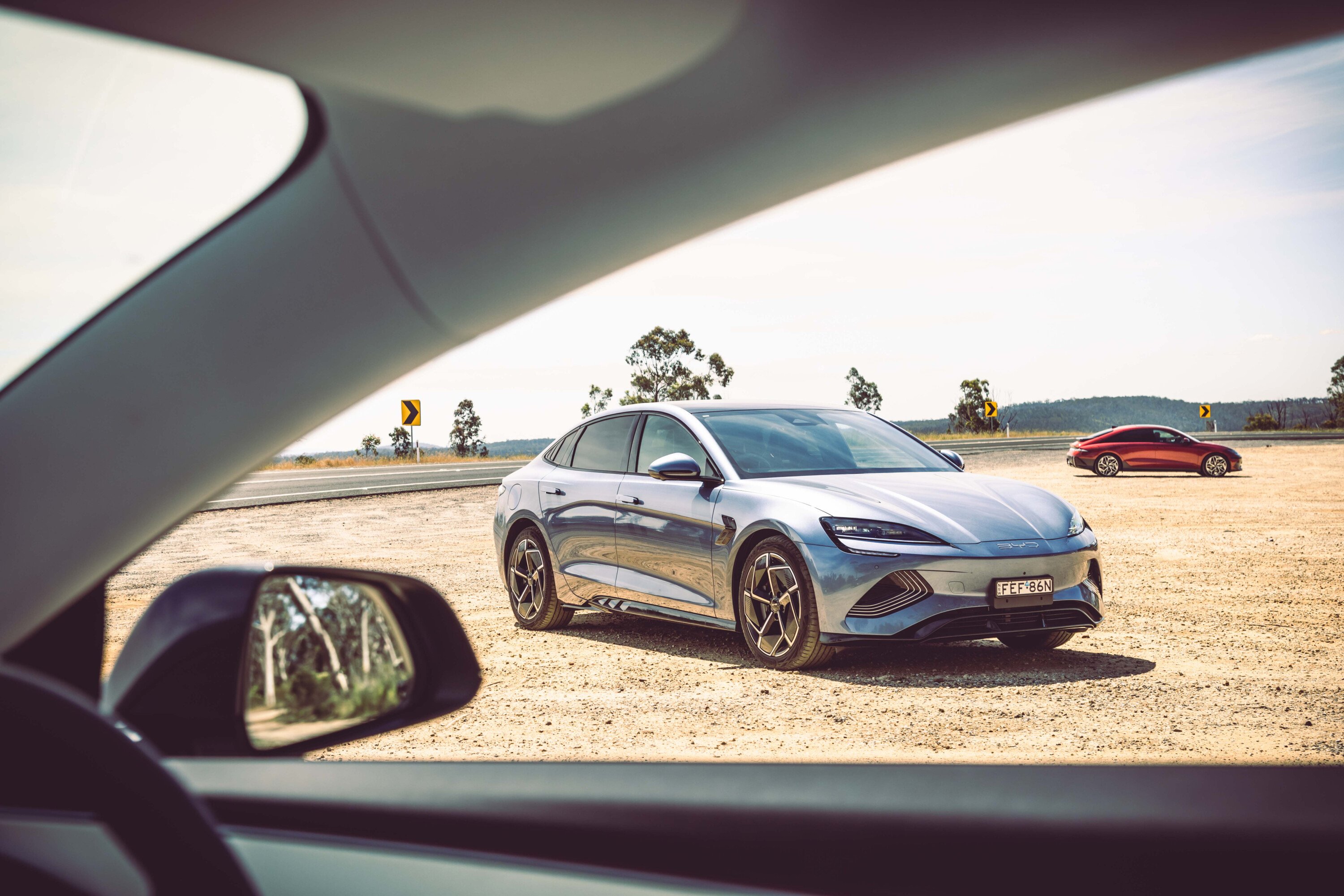
With similar capabilites in terms of range and relative pricing, the Cupra Born faces off against the:
Should I put it on my shortlist?
Entering the competitive Australian EV market around the $60k price range, the Cupra Born is impressive for its segment, especially appealing to young, urban buyers.
Its compact size doesn’t compromise on practicality or driving enjoyment, offering a balance of dynamic performance and sufficient range for city living and beyond.
The Born combines attractive design with effective performance, ensuring it stands out as an electric vehicle that’s fun to drive and practical for everyday use, including spontaneous outings and routine errands without range anxiety. Opting for the standard model with an interior pack might be preferable for an everyday ride that emphasizes comfort and style. But if you’re wanting to test it out on windier roads, the Performance Pack will be high on you list.
Australia’s 2023 used car sales: Key figures
- 2,074,535 used cars were sold in 2023
- Around 61% of used cars were sold privately
- Petrol (65.8%) and diesel (30.6%) made up the majority of used car sales
Nobody waiting on a new car delivery will be surprised to learn this: the Australian used car market saw a significant level of activity in 2023.
Highlighting strong interest in the used car market, the Australian Automotive Dealer Association (AADA) and its partner AutoGrab have today released the 2023 results of the new Automotive Insights Report (AIR).
Sales figures surpassed the 2 million mark last year, representing a 34.4% increase. By comparison, just over 1.2 million new cars were sold – a record year in the new-car space.
RELATED: New-car sales results for 2023
Sales and market dynamics
Key Points
- Toyota was the top selling used car brand with 16.6% market share, followed by Mazda (8.2%) and Ford (8%).
- The Ford Ranger was the top selling used vehicle with 65,938 units, pipping the Hilux (65,852) by only 86 units
- October & November were hottest, with both months passing 200,000 sales
- Passenger cars accounted for 43.9%, SUVs 36.9%, and LCV Utes represented 17.3% of total used car sales.
The report [↗] shows a robust result for 2023, with AADA boss James Voortman pointing to factors like wait times and the increasing cost of living.
“For every new car sold 1.7 used cars were sold, confirming that most Australians are deciding to purchase used cars,” he said.
2023 used car sales by state
| State | 2023 Sales | Market Share |
|---|---|---|
| NSW | 617,392 | 29.8% |
| VIC | 491,441 | 23.7% |
| QLD | 460,140 | 22.2% |
| WA | 262,150 | 12.6% |
| SA | 139,129 | 6.7% |
| TAS | 47,393 | 2.3% |
| ACT | 39,713 | 1.9% |
| NT | 17,177 | 0.8% |
| Total | 2,074,535 | 100.0% |
Used car prices and sales patterns
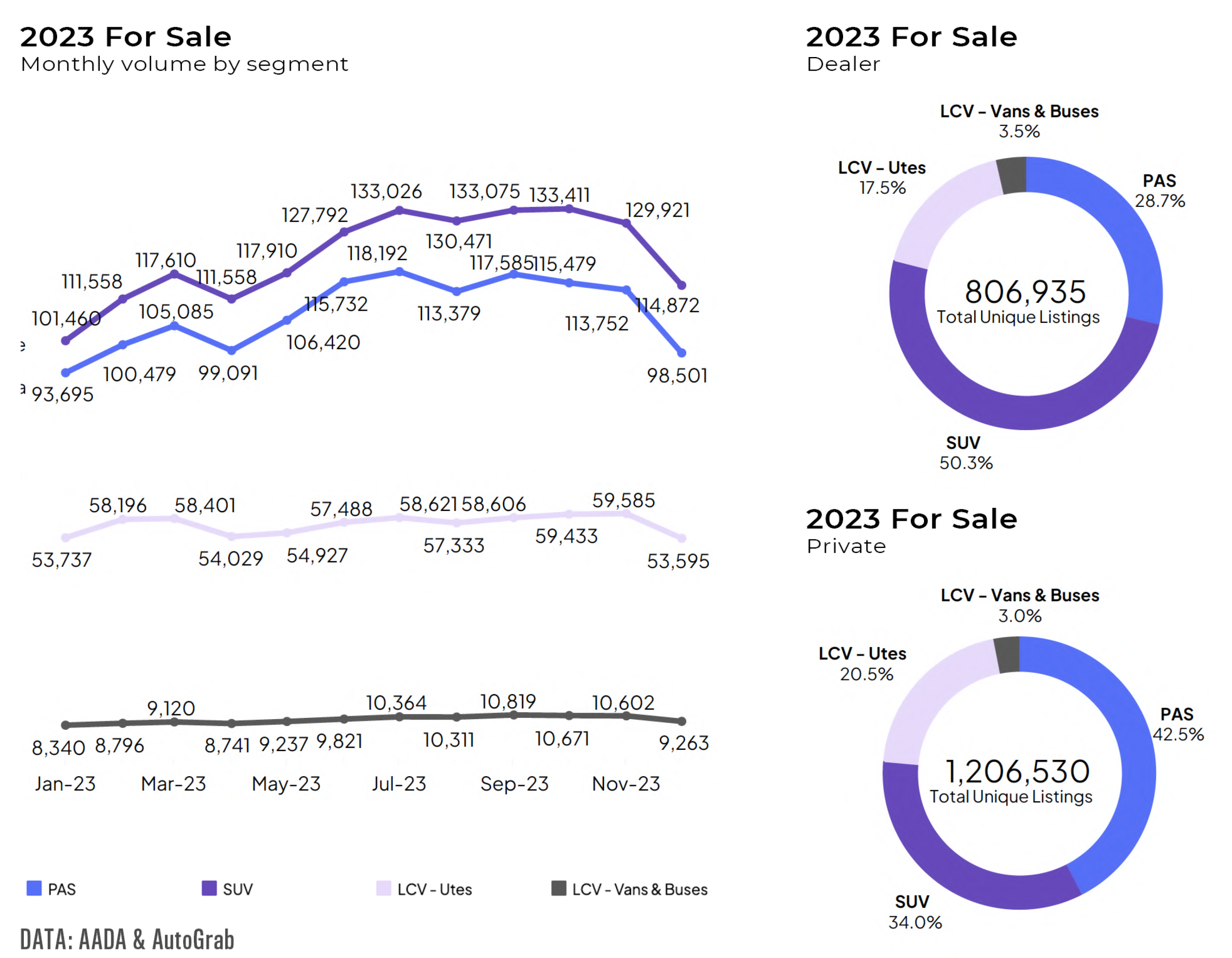
Used car prices saw a steady decline through 2023, a trend attributed to an increase in the supply of new vehicles – thanks to the reduced impact of Covid on production and shipping.
This shift in pricing is anticipated to continue into 2024, potentially benefiting buyers seeking cost-effective options in a tight economic climate.
The National Weighted Average Used Car Price peaked in March with a Retained Value of 75.8%, before declining to 67% in December. The average number of days to sell rose from almost 41 to to nearly 51, March to December.
Top-Selling brands and models in used cars
Again no surprises here, Toyota was the most purchased used car brand in 2023, although Ford’s Ranger outsold Toyota’s Hilux – just as it did in new cars.
Sales by fuel type
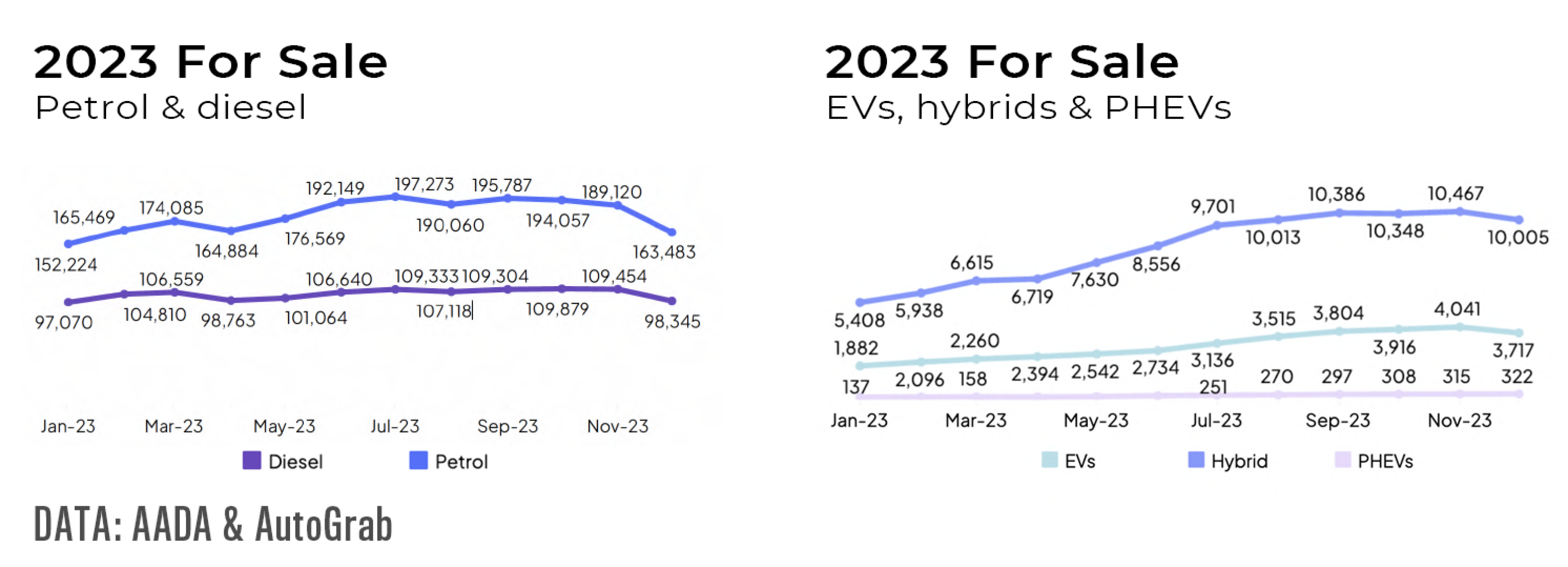
| Fuel Type | 2023 For Sale | Market Share |
|---|---|---|
| Petrol | 1,308,274 | 65.0% |
| Diesel | 625,357 | 31.1% |
| Hybrid | 61,443 | 3.1% |
| EVs | 13,748 | 0.7% |
| LPG | 3,233 | 0.2% |
| PHEVs | 1,410 | 0.1% |
| Total | 2,013,465 | 100.0% |
Top brands
| Brand | 2023 For Sale | Market Share |
|---|---|---|
| Toyota | 328,431 | 16.3% |
| Mazda | 166,024 | 8.2% |
| Ford | 156,823 | 7.8% |
| Hyundai | 153,359 | 7.6% |
| Holden | 138,940 | 6.9% |
| Mitsubishi | 115,226 | 5.7% |
| Nissan | 112,947 | 5.6% |
| Volkswagen | 108,636 | 5.4% |
| Kia | 74,095 | 3.7% |
| Mercedes-Benz | 67,140 | 3.3% |
| 2,013,465 | 100.0% |
Top models
| Model | 2023 For Sale | Market Share |
|---|---|---|
| Ford Ranger | 65,810 | 3.3% |
| Toyota Hilux | 62,086 | 3.1% |
| Toyota Corolla | 49,032 | 2.4% |
| Mazda 3 | 44,238 | 2.2% |
| Hyundai I30 | 43,158 | 2.1% |
| Toyota Camry | 38,892 | 1.9% |
| Holden Commodore | 36,825 | 1.8% |
| Mitsubishi Triton | 36,387 | 1.8% |
| Nissan Navara | 35,121 | 1.7% |
| Toyota Landcruiser | 31,786 | 1.6% |
| 2,013,465 | 100.0% |
Value retention
The report sheds light on the retained value of various vehicle types, with utes and light commercial vehicles generally holding their value better than other categories.
SUVs, in contrast, were reported to have lower retained value, “sitting well below average for all age groups”.
“When diving into retained values of vehicles, a topic that interests many consumers and Dealers, we can see that across all age groups, utes and light commercial vehicles held their values above the average,” Mr Voortman said.
“Passenger vehicles across all age groups tracked close to the average, while SUVs were the worst performing vehicle segments in terms of retained value, sitting well below average for all age groups.”
Electric vehicle market
Electric vehicles (EVs), while still a small segment of the used-car market, showed a small increase in supply and sales.
The AIR notes that EVs have a lower retained value and take longer to sell than petrol and diesel vehicles, hinting at the challenges facing this emerging market segment.
Prices have declined by 15.6% for used EVs under 2 years old, and 23.4% for those aged between 2-4 years. The average days to sell for used EVs reached 75 days in December.
The report suggests hesitation on used EVs is likely due to uncertainty around battery longevity, along with compelling new prices at the entry end of the new EV market.
Snapshot
- First Mustang Dark Horse sells for US$375,000
- That’s six times the sticker price in the United States
- Hammer price allocated to Juvenile Diabetes Research Foundation (JDRF)
The first Ford Mustang Dark Horse produced has been sold in the United States, with the hammer falling at US$375,000 (A$566,000) in a Barrett Jackson auction.
That’s a hell of a lot of money for a Mustang Dark Horse which lists for $US59,485 – A$99,102 when it arrives in Oz in the second quarter of this year – though not as much as the first 2024 GT commanded ($US490,000).
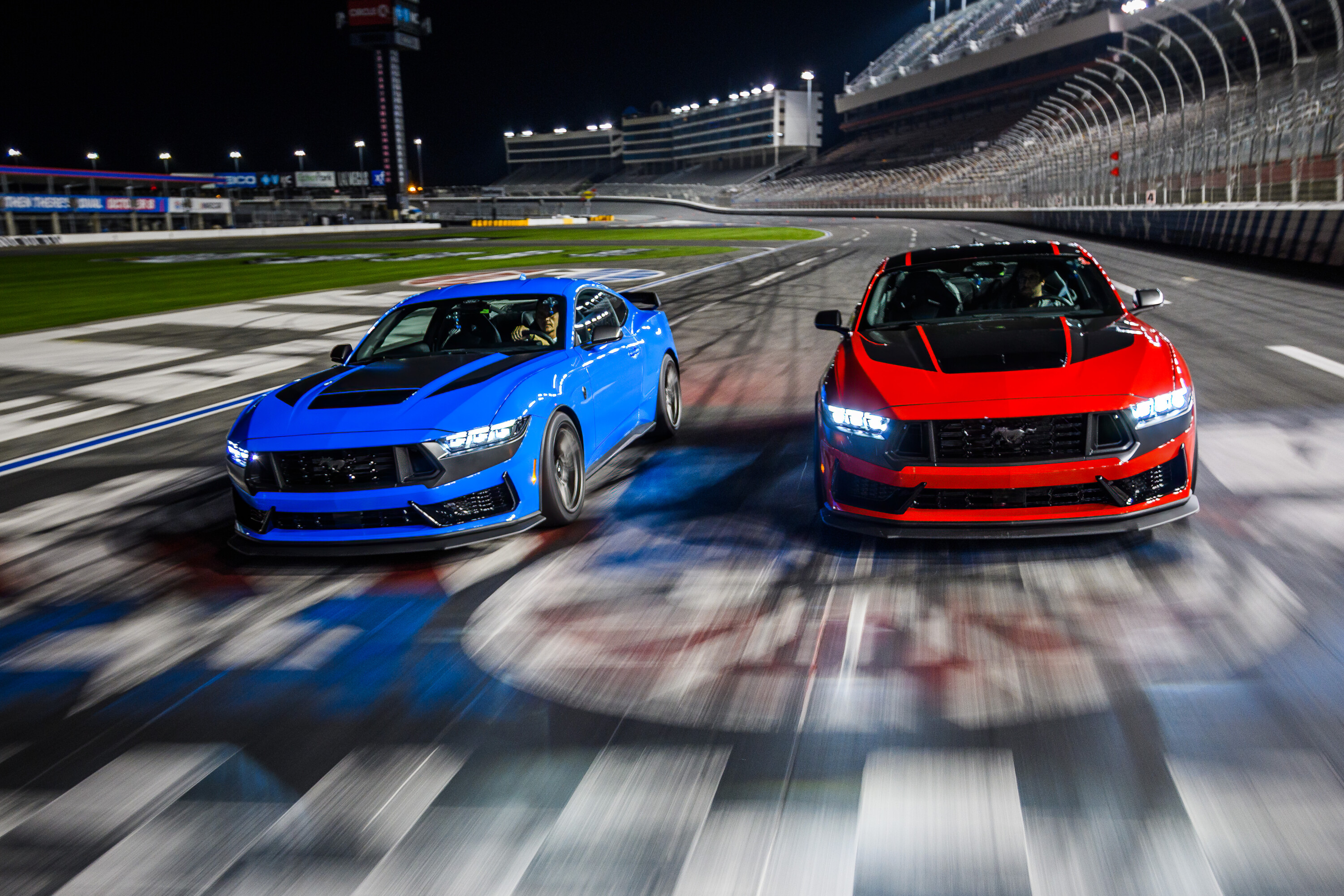
Ford donated 100 per cent of the Dark Horse 001’s price to the Juvenile Diabetes Research Foundation.
Dark Horse is the Mustang’s new flagship grade sitting above GT. It features a strengthened 349kW/548Nm 5.0-litre V8, wider 19-inch wheels than the GT, a more focused suspension tune with adaptive dampers, and a six-speed Tremec manual transmission.
The example in question – VIN 001 – is finished in the Blue Ember hero colour with racing stripes and a contrast black roof, while behind the 19-inch alloys are blue brake calipers as part of the Appearance Pack.
The 2024 Mustang is due for Australian release in the second quarter (April-June) of this year. The performance-oriented Dark Horse, meanwhile, is a limited model in Australia with only 1000 units due Down Under.
These are the luxury electric cars and SUVS bound for Australia in 2024. Which will be the most compelling for Aussie car buyers? Read on…
JUMP AHEAD
- Alfa Romeo Milano
- Audi Q4 E-Tron
- Audi Q6 E-Tron
- BMW iX2
- Cadillac Lyriq
- Lotus Eletre
- Maserati Grecale Folgore
- Mercedes-Benz EQA
- Mercedes-Benz EQB
- Mercedes-Maybach EQS
- Mini Cooper hatch
- Mini Countryman
- Polestar 3
- Polestar 4
- Porsche Macan E
- Range Rover electric
- Tesla Model Y
- Volvo EX30
- Volvo EX90
Alfa Romeo Milano
The 2024 Alfa Romeo Milano light SUV will debut globally in April, the brand has confirmed.
Joining the existing Giulia sedan, Stelvio mid-size SUV and Tonale small SUV in the Italian brand’s line-up, the Milano will ride on Stellantis’s ‘E-CMP’ architecture shared with the Jeep Avenger, Fiat 600e and Peugeot E-2008.
An all-electric powertrain will be offered at launch – a first for the Alfa Romeo brand – while a more affordable 1.2-litre mild-hybrid petrol will likely be available in select markets.
The Milano name is derived from the city of Milan in Italy where Alfa Romeo was founded in 1910. The Alfa Romeo 75 was sold as the Milano in North America between 1985 and 1992.
Audi Q4 E-Tron
The four-strong Q4 E-Tron range starts at $88,300 for the 45 grade (in Sportback or wagon body styles) with a 77kWh battery, single 210kW electric motor, a power tailgate, and LED headlights.
Audi’s Sportback 55 E-Tron flagship costs $109,500 before on-road costs and gets twin motors with 250kW outputs, S Line exterior styling, Matrix LED headlights, and more.
Audi Q6 E-Tron
The Audi Q6 E-Tron rides on the Volkswagen Group’s new ground-up Premium Platform Electric (PPE) architecture shared with the forthcoming Porsche Macan EV, compared to the adapted internal-combustion MLB Evo platform found underneath the Q8 E-Tron.
Audi has confirmed it will be available in rear-wheel and all-wheel-drive configurations with the Q6 E-Tron 55 accelerating from 0-100km/h in around six seconds, while the high-performance S flagship cuts it to 4.5 seconds.
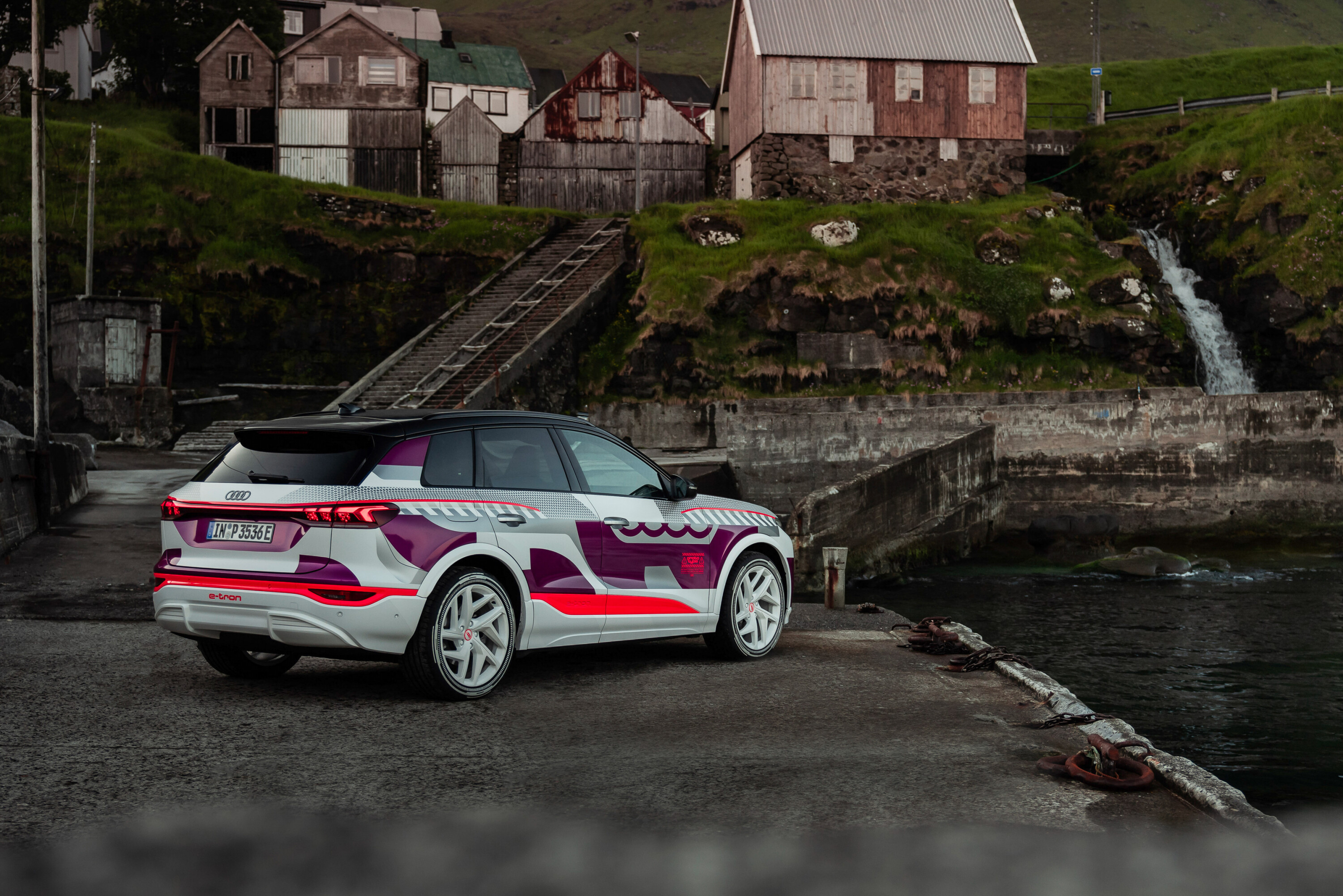
Multiple battery sizes will also be offered, starting from about 100 kilowatt-hours, with up to 270kW DC ultra-rapid charging capabilities using the 800-volt class PPE architecture.
Similar to the unrelated Audi E-Tron GT electric sports sedan, it’ll be available with two separate charging ports at each side of the rear-quarter body – with only the left able to DC fast charge.
The Q6 E-Tron seemingly appears aesthetically similar to the large updated Q8 E-Tron, except for its split headlight arrangement. It’s likely that the rally-like white alloys pictured won’t feature in the final model, though.
It’s the first Volkswagen Group model to feature second-generation organic light-emitting diode (OLED) front and rear lights, with eight selectable digital light signature designs – provided owners select the feature package.
BMW iX2
The first-ever iX2 will reach Australia in March 2024 as a fully electric companion to the second-gen X2, boasting bigger dimensions and more technology than the previous X2.
The new iX2 shares many similarities with the new X1 and iX1, including an identical platform, leaving styling and functionality as their key differentiators.
The X1/iX1 feature a more traditional design making them more practical overall, while the X2/iX2 models are focused on having a sportier presence.
Cadillac Lyriq
After years of speculation and false starts, Cadillac will return to Australia in 2024 with the Lyriq SUV.
Set to spearhead a multi-model SUV assault, Aussie versions of the Lyriq will come standard with a dual-motor, AWD powertrain that brings a range of around 500km.
The Lyriq is keen to make a good impression even before you step into the cabin. Opening the front doors reveals illuminated sills featuring Cadillac in script next to a silhouette graphic of the Lyriq.
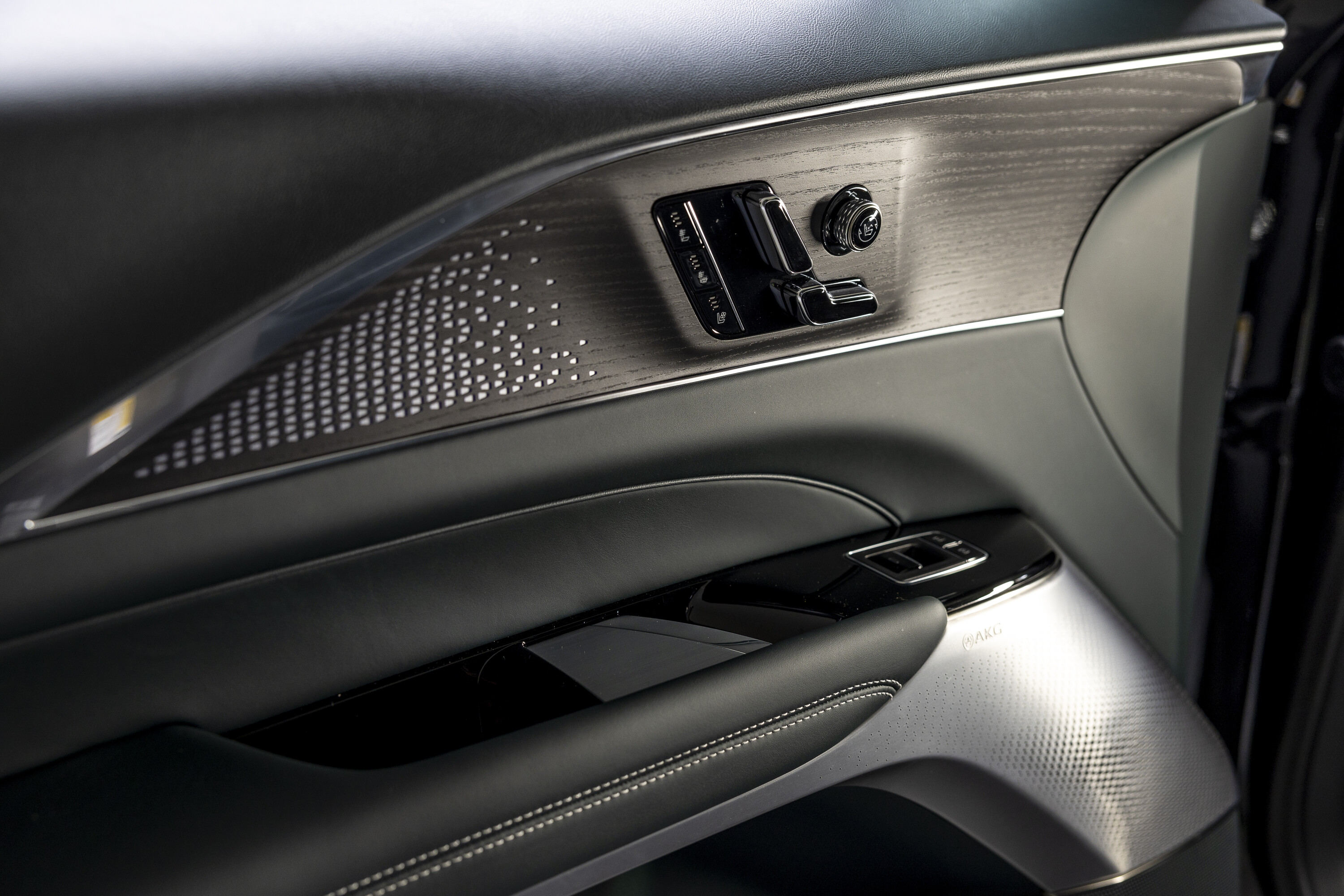
The Lyriq’s cabin design is far off Tesla’s ultra-minimalist approach, yet, again, there’s more restraint than with your typical US SUV interior.
A 33-inch digital display dominates the dash, while the rest of the cabin feels premium thanks to Nappa leather upholstery, a panoramic sunroof and heated/ventilated/massaging seats.
Lotus Eletre
The Lotus Eletre will mark the British brand’s first high-end electric SUV and all-new model under Chinese owner Geely, when it lands in Australia in the second quarter of 2024 (April to June inclusive).
Snapshot
- Lotusu2019s first electric SUV launching Q2 2024
- High-end price tag, interior and tech
- First model to mark British brandu2019s new chapter under Geely
Priced from $239,000 before on-road costs, the Eletre will rival premium and high-performance five-seater large electric vehicles, including the BMW iX, Porsche Taycan Cross Turismo, and upcoming Macan EV.
It adopts the all-new Lotus-developed Electric Premium Architecture (EPA), which will be shared with the Emeya electric sedan when it joins locally in 2025, and is made at Geely’s Wuhan factory in China.
Maserati Folgore
The 2024 Maserati Grecale Folgore has been unveiled as the pure-electric version of the company’s new mid-size SUV.
While full specifications will be announced closer to the car’s arrival, the Italian brand has revealed the Grecale Folgore will be fitted with a 105kWh battery and a 400-volt system – which should be enough to give the SUV a driving range on par with its petrol-powered counterparts.
Though yet to be confirmed, twin electric motors mounted on each axle are expected to send around 400kW and 800Nm to all four wheels, making it the most powerful Grecale within the stable.
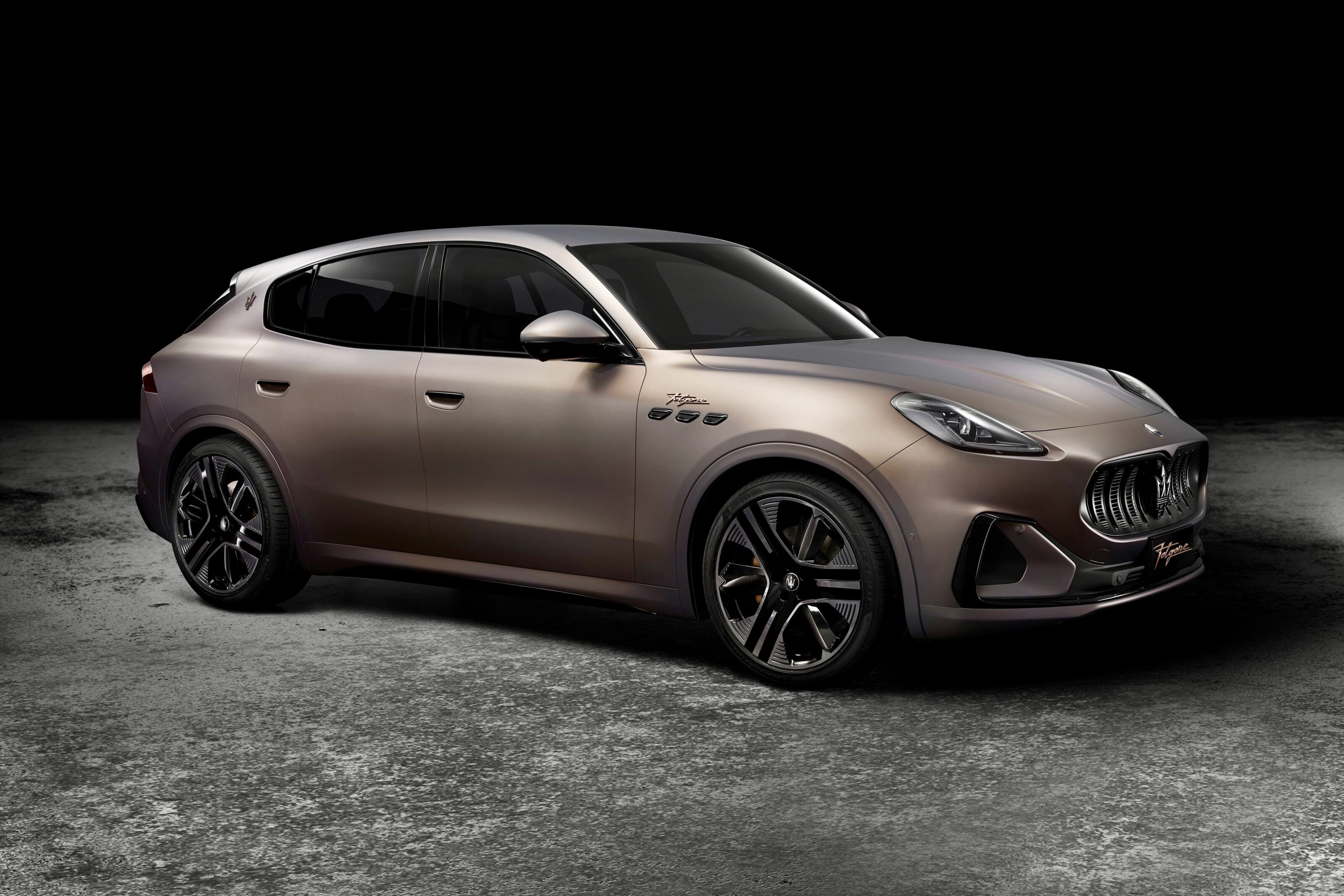
There’s little to distinguish the Grecale Folgore from the petrol GT, Modena, and Trofeo versions, other than a partially-blocked concave grille, tri-spoke style wheels, fender badges, and an exclusive copper paint colour.
Maserati says it will use a variety of recycled materials throughout the cabin, including a nylon called Econyl, derived from fishing nets.
Mercedes-Benz EQA
Mercedes-Benz has updated its most attainable electric vehicles, the EQA and EQB, with tweaked designs, longer range and improved technology.
Snapshot
- Tweaked design, more Mercedes star motifs
- Aero improvements bring slightly more range
- Australian launch expected in Q2 2024
Both premium small electric SUVs gain the brand’s signature three-pointed star pattern – in line with its newer EV offerings – across the closed front grille (in either black as standard or chrome on Electric Art and AMG Line variants), interior door trims, and on the dashboard.
The latter is backlit and corresponds with the colour-selectable ambient lighting.
There are also tweaked bumpers, touch-sensitive steering wheel and rim designs, plus new LED tail-lights with rounded bubble-like shapes on the EQA and sharper split segments on the EQB – reminiscent of the latest E-Class sedan and AMG GT coupe.
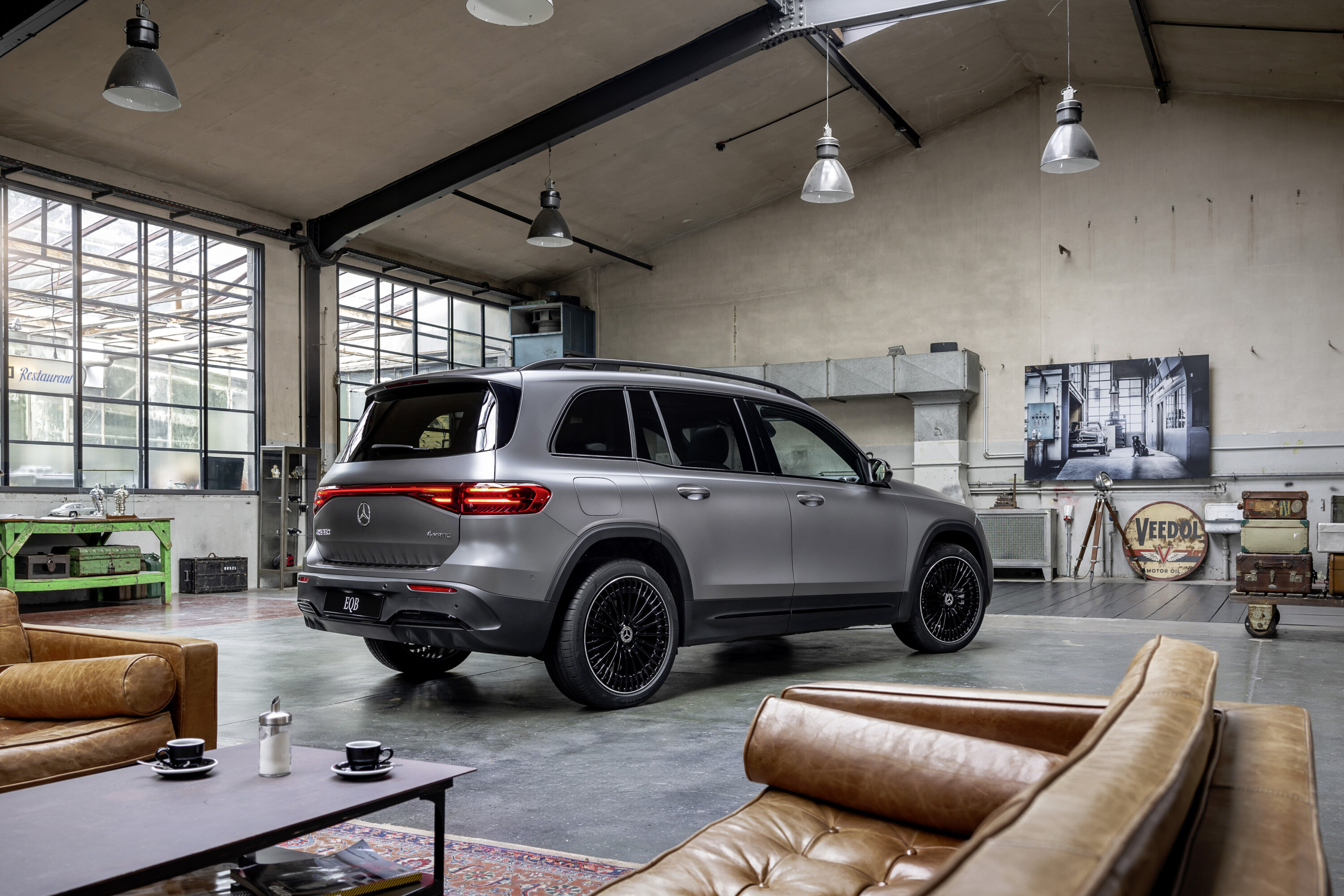
Mercedes claims aerodynamic optimisations on the new EQA and EQB have extended driving range by up to nearly 40 kilometres, depending on the variant.
The boosted range is made possible by more roll-resistant tyres, an added edge on the rear wheel arches, and an integrated spoiler.
Mercedes-Benz EQB
Mercedes-Maybach EQS
The EQS 680 SUV becomes Maybach’s first-ever electric car; it wears the brand’s signature two-tone paintwork, monobloc-inspired alloy wheels, and even retains the luxury carmaker’s classy bonnet star.
Maybach claims 484kW/950Nm, all-wheel drive, and a circa-600km driving range, but when it comes to the EQS SUV, it’s more about luxury appointments than roving range or outright speed.
The front seats are heated, ventilated, and appointed in sustainably tanned Nappa leather in your choice of Espresso brown/Balao brown pearl or Macchiato beige/Bronze brown pearl. Optionally, Manufaktur grade Crystal white/Silver grey pearl is available.
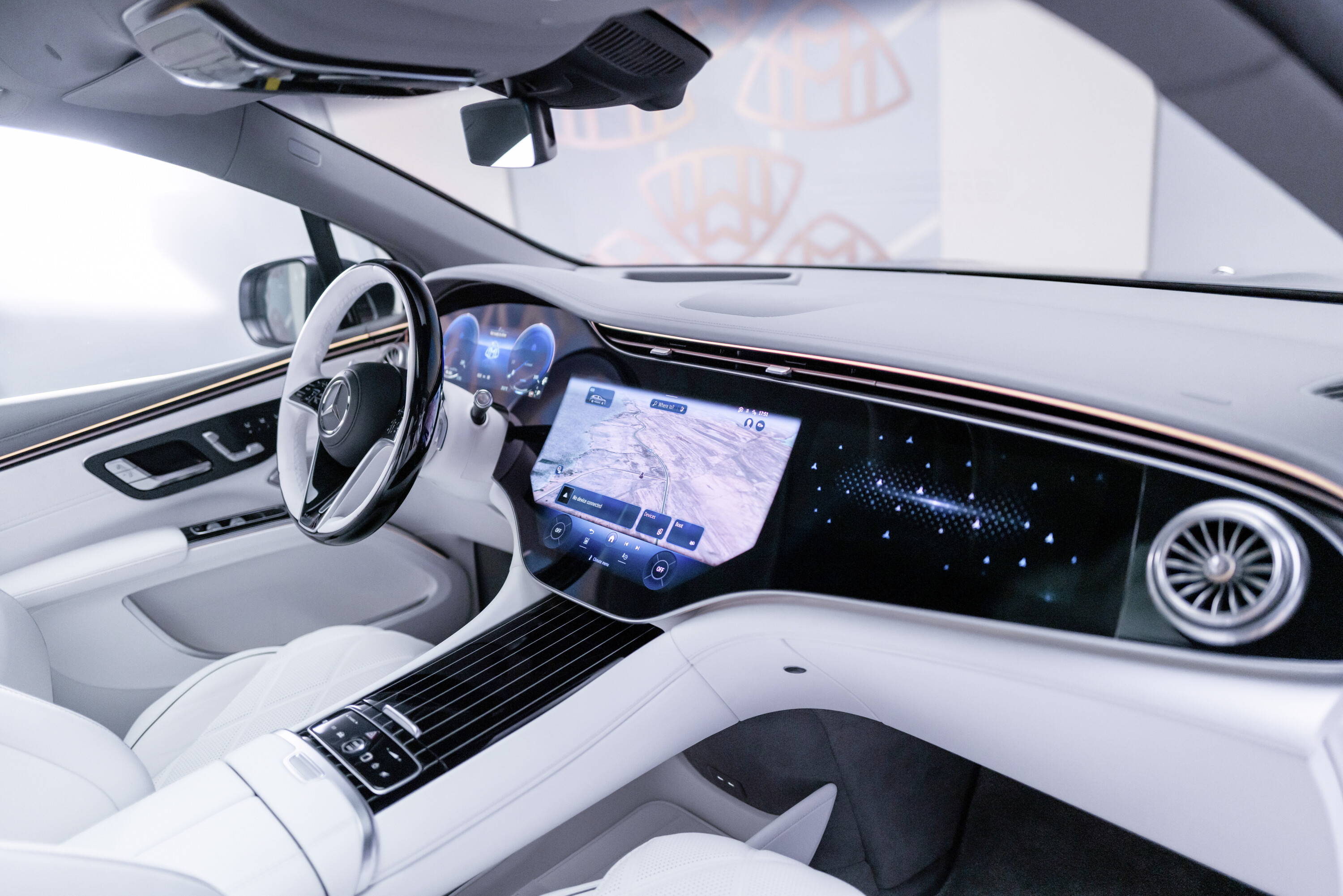
And the back seat is really where you want to be, with twin 11.6-inch touchscreen mounted on the back of the seats with ‘MBUX high-end rear seat entertainment’ representing a step up from the regular Benz EQS.
It means rear passengers can modify navigation directions from the back seat, while the centre console has been redesigned to better flow into the rear quarters.
Mercedes-Maybach is claiming a provisional driving range of 600km, from the same 107.8kWh battery as the Benz EQS. It will fast-charge at up to 200kW, for a 10-80 per cent fast-charge in 30 minutes.
Mini Cooper hatch
Both the 2024 Mini Cooper hatchback and more all-terrain-focused 2024 Mini Countryman are heading to Australia in the third quarter of 2024.
The brace of zero-emissions Minis marks the start of the company’s transition into an all-electric brand and is the first time the iconic models will be offered as electric-only.
Along with the model’s battery transition, all Mini three- and five-door variants will now be dubbed Cooper with the moniker no longer denoting engine or motor power output. Instead, the range will comprise Cooper E and Cooper SE to differentiate performance and maximum range.
With 135kW and 290Nm, the Cooper E can accelerate to 100km/h from a standstill in 7.3 seconds and has a WLTP range of 305km. With a larger battery, the SE ups the performance stakes with 160kW and 330Nm, cutting the milestone dash to 6.7 seconds while offering an extended range of 402km.
Mini Countryman
With a peak power output of 230kW and 494Nm, the most potent Countryman for now can accelerate to 100 from zero in 5.6 seconds while its more power-hungry transmission reduces WLTP range to 433km.
Mini’s first crack at a fully electric Cooper received mixed reviews with most criticism stemming from its somewhat limited range that maxed out at about 180km, however, the new version addresses the problem with significantly improved charge capacity.
A dedicated electric platform is mostly to thank, whereas the outgoing Mini Cooper SE shared the combustion model’s chassis with electric parts borrowed from the BMW i3.
Polestar 3
Polestar 4
The Polestar 4 will join the list of rivals trying to beat Tesla’s Model Y in 2024 with an entry point of $81,500.
Two models are listed, with the $81,500 Long Range Single Motor rear-wheel-drive Polestar 4 joined by a more powerful Long Range Dual Motor that costs from $92,150.
The Single Motor model brings outputs of 200kW and 343Nm, with a claimed 0-100km/h time of 7.4 seconds. The Dual Motor doubles those outputs to 400kW and 686Nm, with Polestar quoting a sprint time of 3.8 seconds.
Porsche Macan E
Porsche’s first electric SUV has been priced for Australia, with the 2024 Macan 4 arriving later this year from $133,700.
Launching with two variants initially, the all-wheel-drive Macan 4 packs 300kW while the flagship Turbo develops a whopping 470kW and 1130Nm – enough to frighten a Hyundai Ioniq 5 N in a straight line.
This is Porsche’s first outing of the Premium Platform Electric (PPE) underpinnings that boast 800-volt capability, twin-valve dampers, rear-wheel steer, and a 96kWh usable battery pack in the Macan.
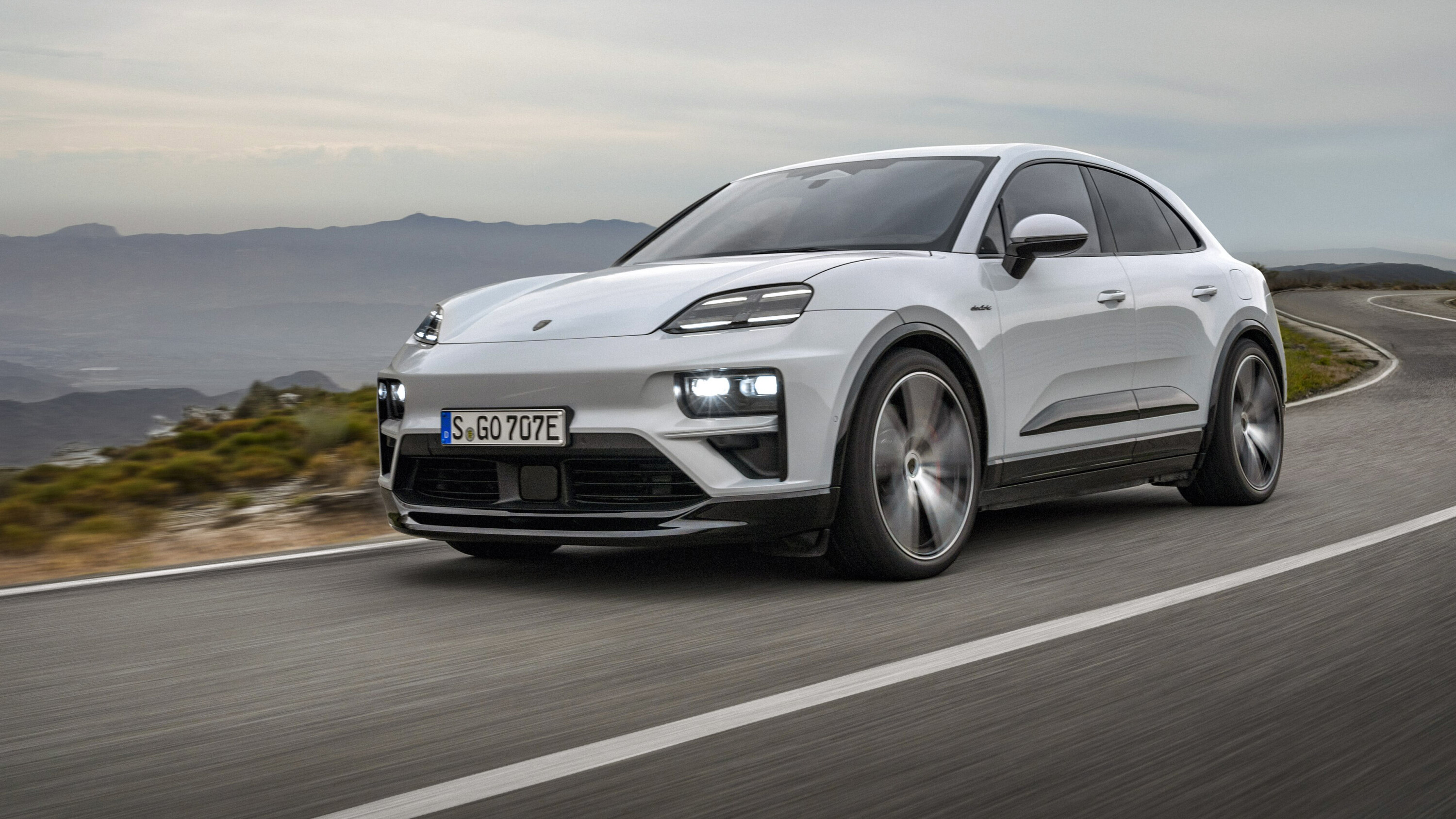
Although it’s distinctively Porsche, the larger second-gen electric Macan has a few new details including Taycan-inspired lighting signatures and a rounder rear end.
Inside, Porsche has implemented a familiar layout and moved back to physical controls for the cabin vents – perhaps in response to the less-than-rosy reception of Taycan’s digi-vents.
Range Rover electric
Range Rover is yet to reveal the electric version of its signature luxury SUV, however it did release a single teaser image in December 2024.
The brand also opened the waiting list for the new model at the same time. Little else has been revealed about the Range Rover Electric, however, with no details available on battery capacity, outputs, or driving range.
But, given its mammoth dimensions, buyers can likely expect a battery pack larger than the BMW i7’s 101.7kWh, with a claimed driving range upwards of 550 kilometres.
Tesla Model Y
The Tesla Model Y electric SUV has received a minor refresh in China – but the changes are not yet confirmed for Australia.
The world’s best-selling electric car brings some new features from the facelifted Model 3 sedan – due in Australia in early 2024 – but also carries over previous features.
Under the unrealistic China Light-Duty Vehicle Test Cycle (CLTC), the base Model Y RWD has gained nine kilometres more claimed driving range, while the mid-pack Long Range is up 28km.
For context, the current Model Y RWD offers 455km claimed range, Long Range at up to 533km, and the Performance is rated at up to 514km on the stricter Worldwide Harmonized Light-Duty Test Procedure (WLTP).
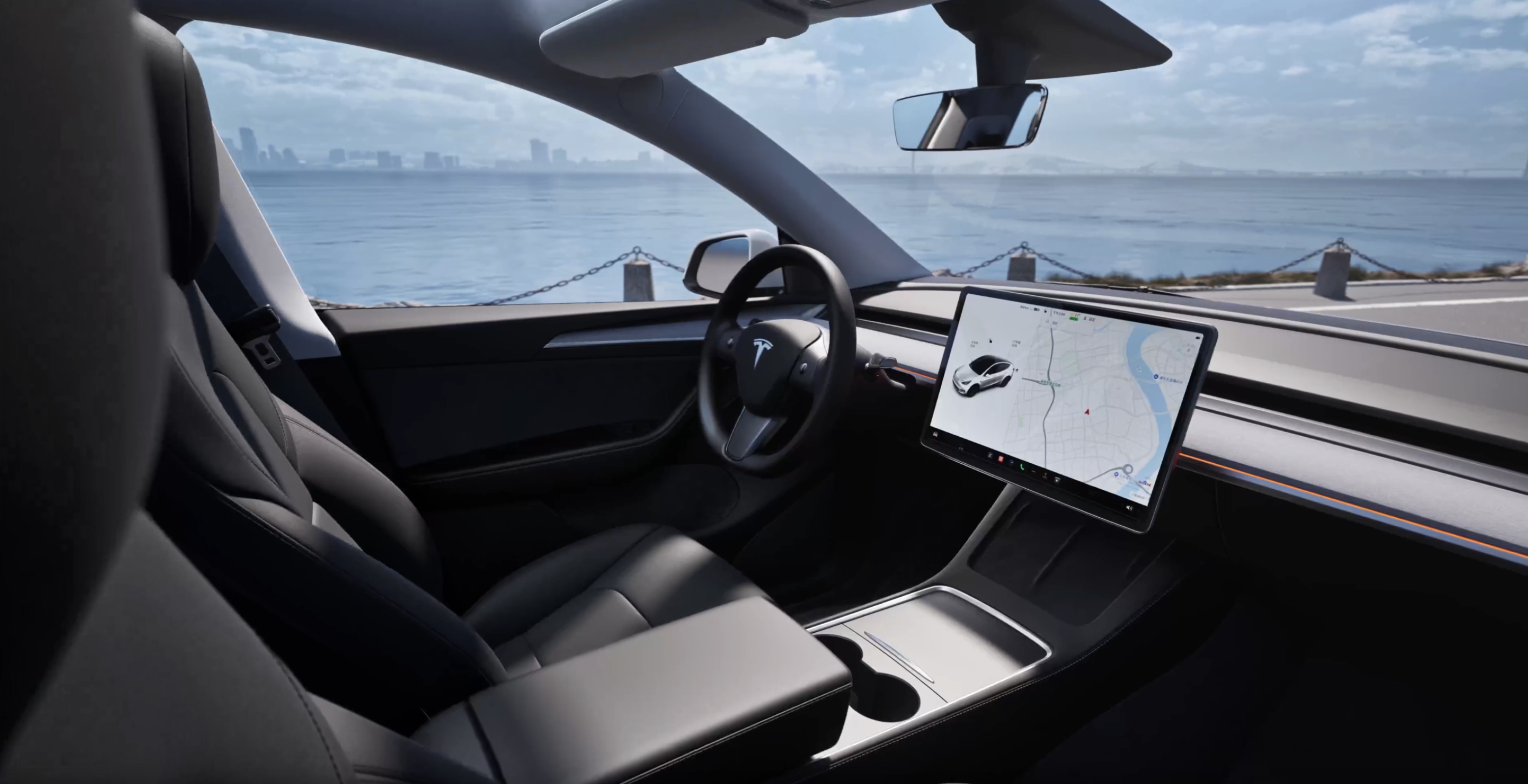
The updated Model Y RWD is also one-second faster in the 0-100km/h acceleration time, with all variants being up to two kilograms heavier.
Therefore, it’s likely that the battery packs are unchanged as per the facelifted Model 3.
This means a 57.7kWh usable (60kWh gross) lithium-iron-phosphate (LFP) battery on the RWD and a 75kWh usable (78.1kWh gross) nickel-manganese-cobalt (NMC) lithium-ion type battery on the Long Range and Performance, according to figures provided by EV Database [↗].
Volvo EX30
Starting from $59,990, the Volvo EX30 will become Australia’s most affordable luxury battery SUV in early 2024 as part of the Swedish brand’s ambition to go all-electric locally by 2026.
Volvo Australia, at least for now, has elected not to introduce a 51kWh EX30 Standard Range that uses a more cost-effective lithium-ion phosphate (LFP) battery but has the shortest driving range at 344km.
The rear-drive EX30 models share a 200kW/343Nm electric motor said to deliver a 0-100km/h acceleration time of 5.3 second, and a 480km claimed range.
The all-wheel-drive EX30’s dual motors produce combined outputs 315kW and 543Nm to make it the quickest Volvo ever. The maximum range drops slightly to 460km.
Volvo EX90
The 2024 Volvo EX90 electric SUV has been unveiled ahead of its expected Australian arrival in late 2024.
This dedicated EV platform is shared with the recently-revealed Polestar 3 and the upcoming Polestar 5.
At launch, one powertrain will be offered, while the latest technologies include bi-directional charging and a standard roof-mounted LiDAR scanner for full self-driving capability.
In Australia, the EX90 is tipped to launch in late 2024, with production commencing in the United States and China next year.
Traffic. The age-old issue affecting our roads, only briefly reduced by widened freeways, new toll roads and badly needed bypasses, until even those fill up with bumper-to-bumper headaches.
Australian governments are considering a new solution, however, borrowed from countries and cities already using it: congestion pricing. That is, charging motorists a toll for driving through congestion hotspots, differing in value at certain times of the day.
The claimed benefits to a congestion charge include reduced travel times, less gridlock, improved air quality and better roads. Sounds great. What’s the cost?
Congestion charges are used in other cities to discourage unnecessary travel through areas that are known to become congested quickly, and promotes the use of public transport, with the ultimate goal of reducing the amount of vehicles on these troubled roadways.
Heavy traffic in these areas, despite upgraded roadways and planning, comes down to a simple point: whether through poorly planned infrastructure or time constraints or mere preference, there are now too many cars on the road to allow free-flowing movement.
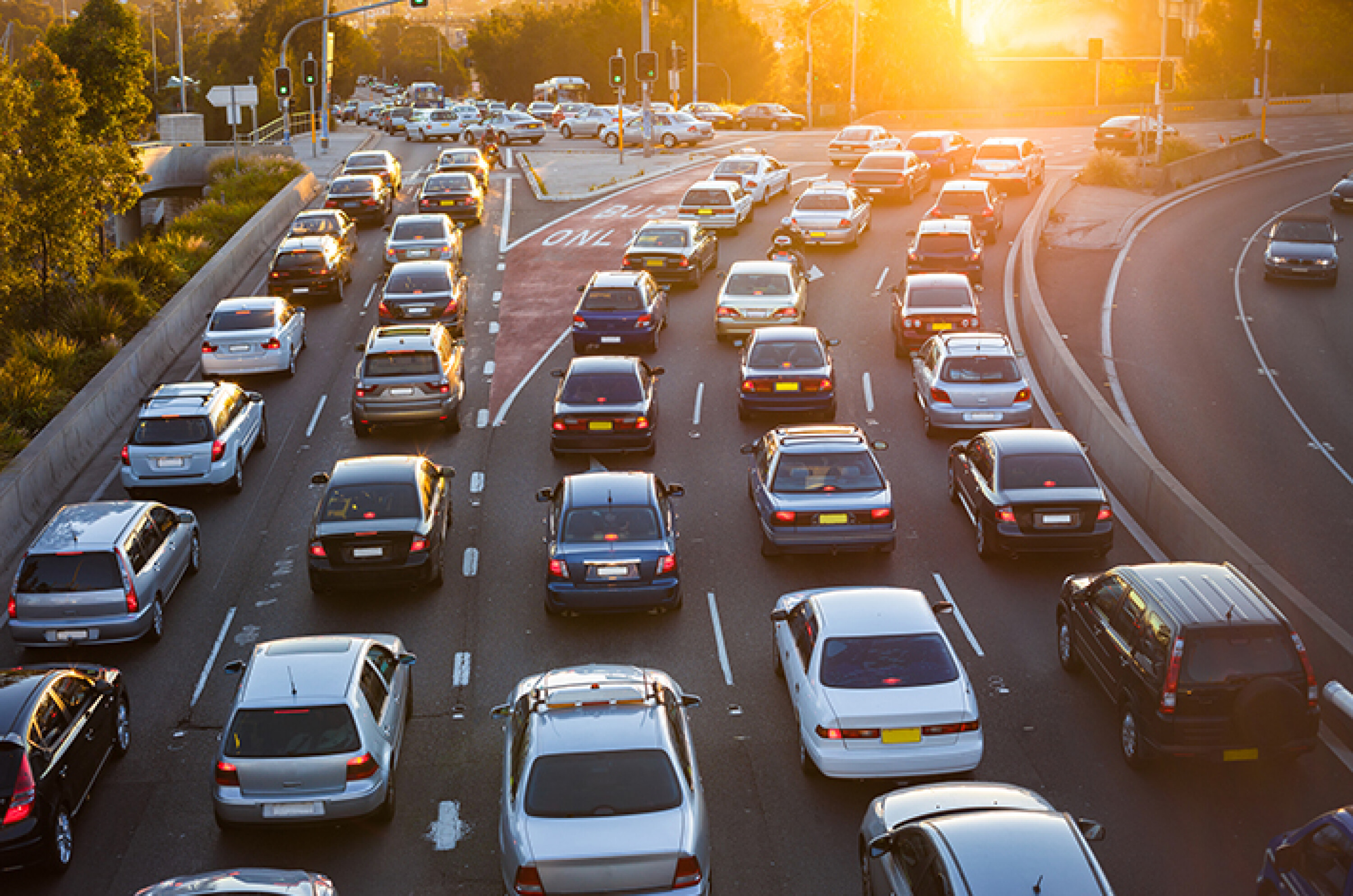
Congestion pricing is similar to a motorway toll, except the driver pays to drive through a specific district, rather than a particular road or motorway. The fees are intended to make the route unattractive to all who don’t specifically need to be in that area.
“It may also help to improve air quality, promote the use of public transport, and generate funds for infrastructure improvements,” says Dr Christopher Standen, a research fellow in applied urban development at the School of Population Health, UNSW Medicine & Health.
Dr Standen says cities like London, Stockholm and Singapore have benefited greatly from congestion pricing.
The pricing would need to be determined carefully, as the charges could be prohibitive for lower-income families and pensioners, which opens another can of worms.
Previous suggestions indicated an estimated fee of 5 cents per kilometre, during peak times – but it could also serve to partner any new charges with a reduction in the fuel excise, which would both minimise the financial impact on motorists and acknowledge the growing number of EVs on the road.
Marion Terrill of the Grattan Institute said a ‘user pays’ system makes sense.
“In the end, if particular roads are in high demand, it’s fairer that people who use them a lot pay more than those who rarely or never use them”.
Grattan Institute’s report also outlined that “the charges would mainly be paid by higher-income drivers, because people who drive to the city each day for work are more than twice as likely to earn a six-figure salary as other workers.”
According to the Federal Chamber of Automotive Industries (FCAI), these charges and new schemes could actually benefit the wallets of Australian drivers.
The FCAI recently proposed a set of plans known as the Road User Charging (RUC), effectively abolishing the usual registration and taxes that come with buying and using a car.
Instead, drivers are charged according to the locations visited and distances travelled, by tracking and monitoring vehicles individually. If you drive less, you pay less, which would greatly benefit those who have a seldom-used “sometimes” car sitting in the garage most of the year.
Road-use charges relating to EVs have been discussed in the past, based on the notion that road maintenance and new infrastructure costs are losing funds that would otherwise have come from those motorists paying the fuel excise.
It has been noted, however, that these costs are actually drawn from the broader tax pool, which EV owners contribute to through higher purchase prices and the related stamp duty that goes with it.
But, as EVs become more affordable over time, the case for lower fuel prices and a general user-pays approach to driving becomes stronger.
What do you think?
Should all motorists be able to pay less for registration and fuel, in exchange for a distance- and congestion-based pricing system?
Snapshot
- 2025 Volkswagen Golf R teased ahead of mid-2024 reveal
- Upgrades to infotainment and refreshed styling follow regular Golf
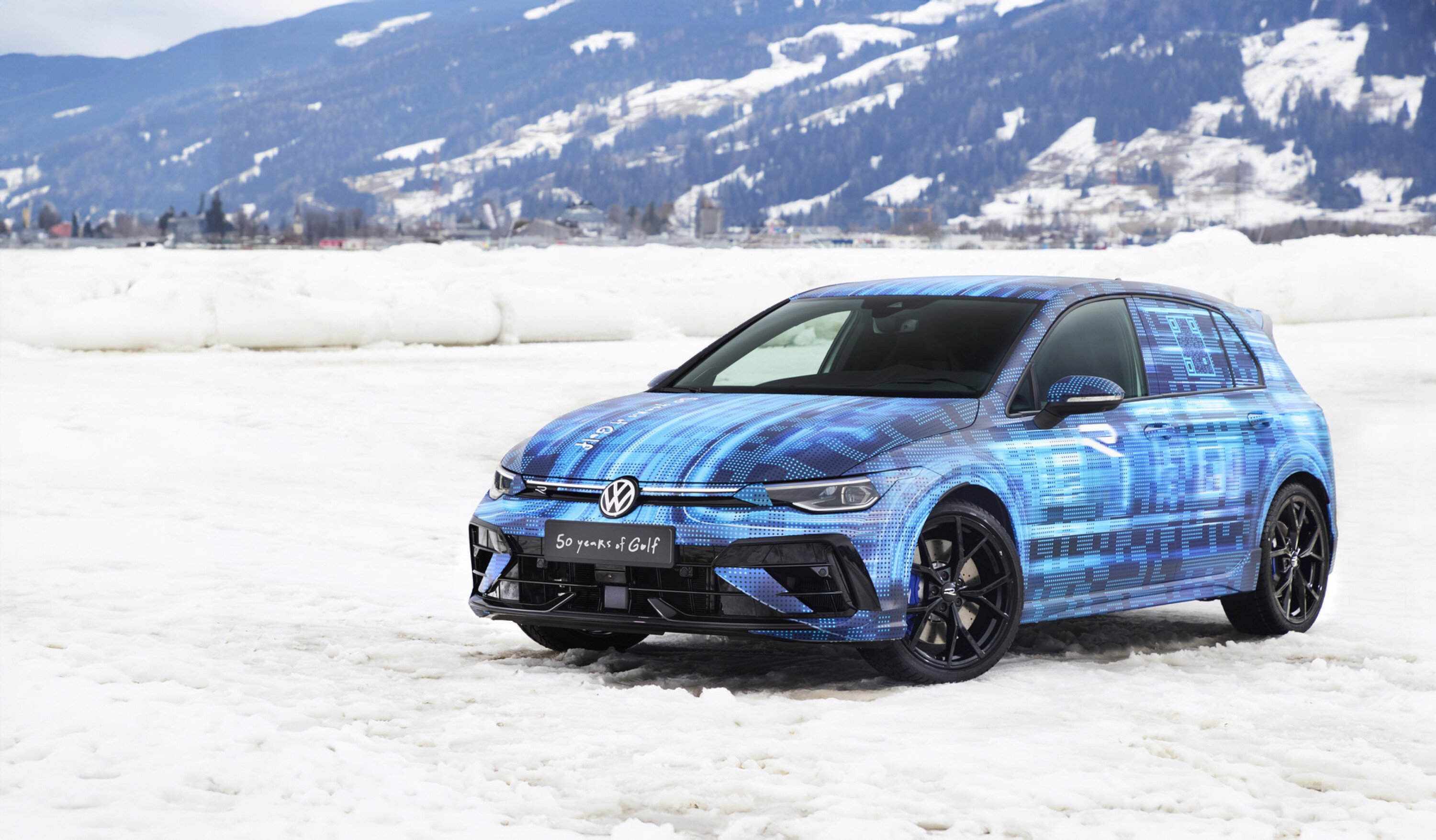
Volkswagen has teased the new-look Mk8.5 Golf R at Ice Race in Zell am See, a winter snow race in Austria.
The carmaker has not released details of the updated Golf R yet, though visually it follows the rest of the Mk8.5 Golf range with refreshed lighting signatures (including an illuminated badge), updated bumpers, and fresh wheel designs.
Elements of the new R’s design have been left covered by camouflage, suggesting there may be some differences to the grille and LED lights compared to the regular Golf range – possibly the R brand’s signature Lapiz Blue highlights.
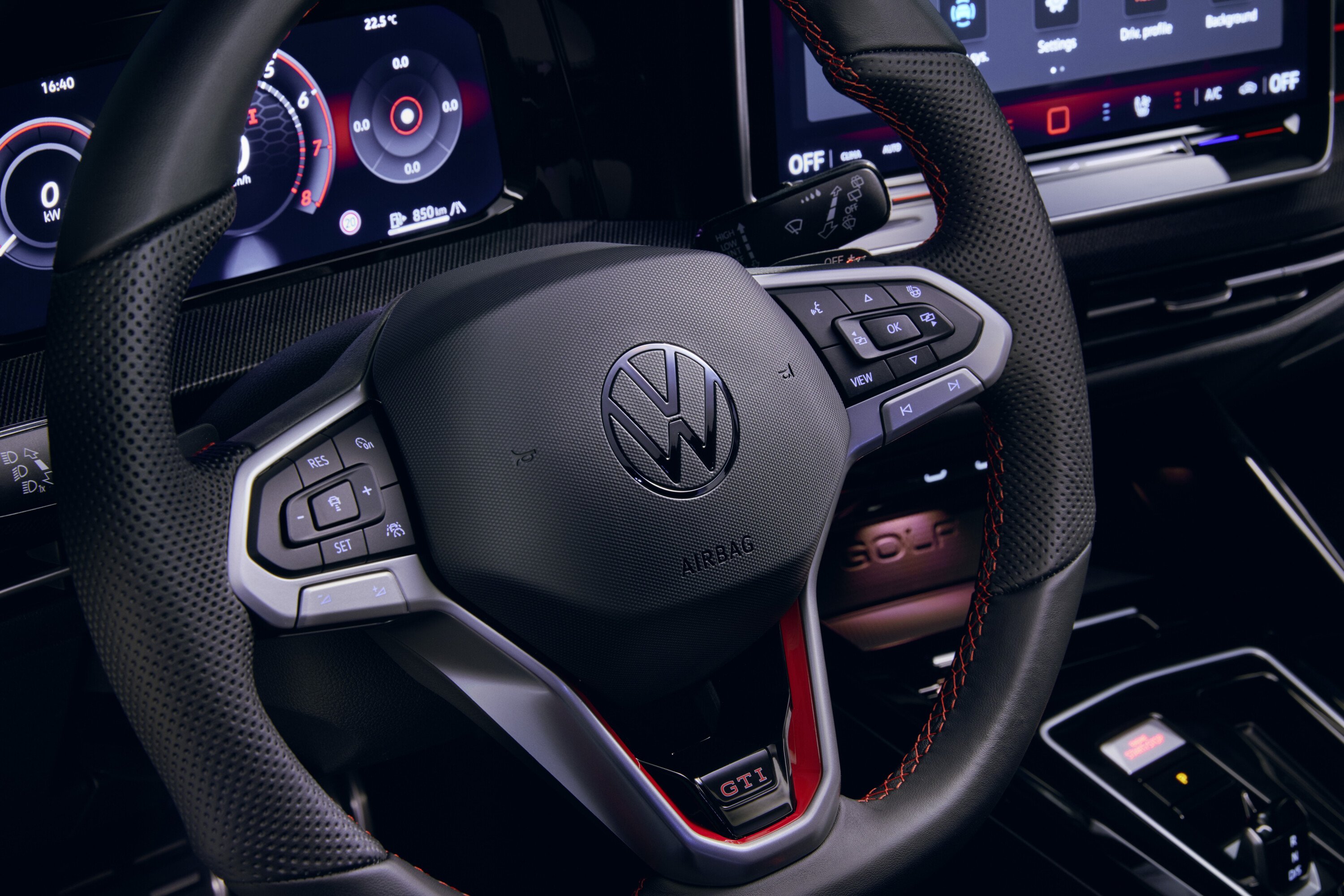
Inside, we expect the updated touchscreen interface with illuminated HVAC sliders, physical wheel buttons in place of the controversial touch-capacitive items, and a larger 12.9-inch touchscreen.
While the Mk8.5 Golf GTI will receive a power bump from 180kW to 195kW for European markets, it’s unclear if the new all-paw flagship’s EA888 2.0-litre turbo will deliver an increase over the 245kW/420Nm made by the R 20 Years special edition model.
Expect the revamped DSG-only R flagship to arrive in Australia after the early 2025 release of the core Golf range (including GTI).
“Volkswagen R is Volkswagen’s premium performance brand and has stood for sportiness and dynamic performance for more than 20 years”, said head of Volkswagen R Reinhold Ivenz.
“Here at the Ice Race, the past meets the future. We can hardly wait for the Golf R, still disguised here, to celebrate its premiere this summer [Australian winter].”
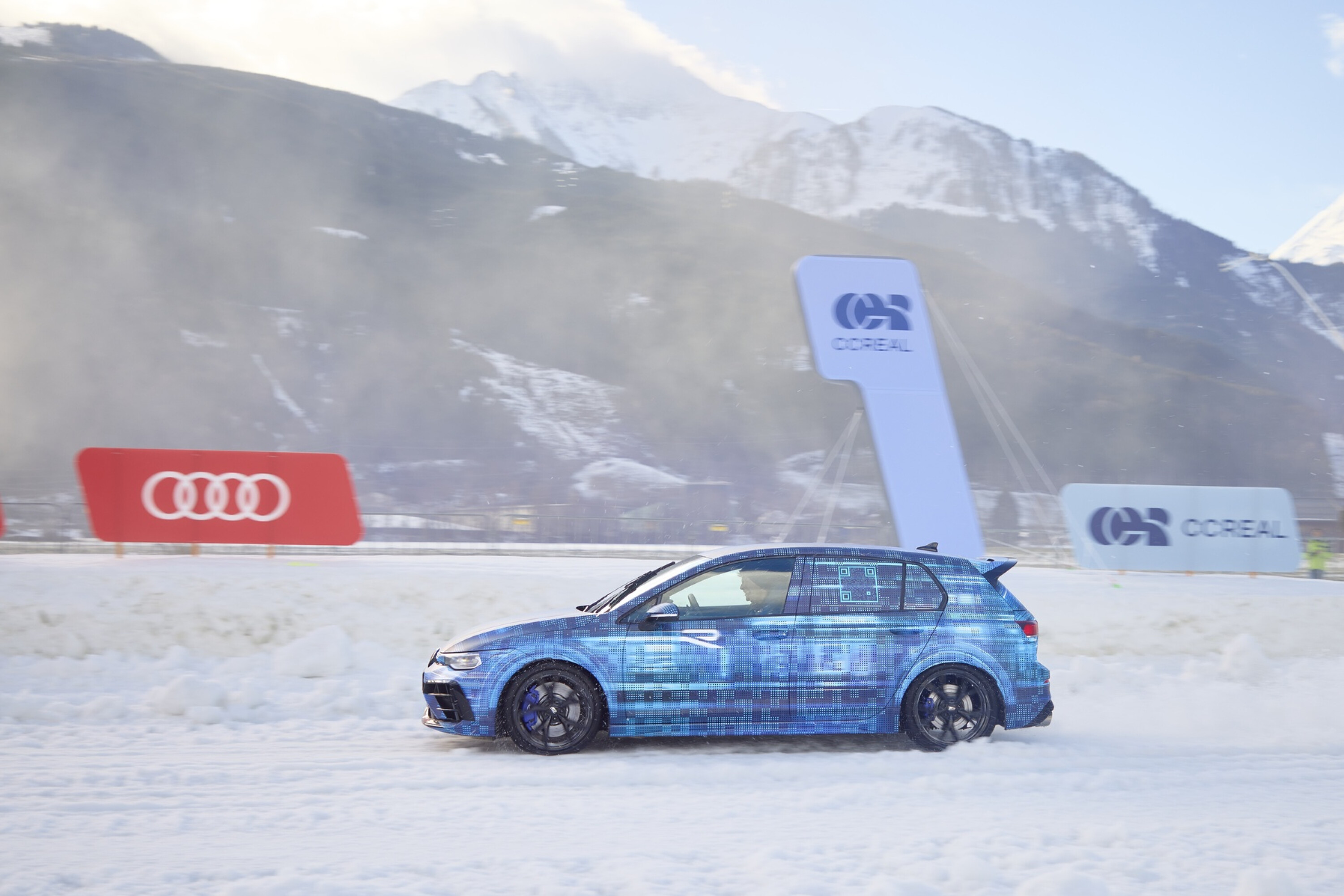
Two-time Le Mans winner and touring car Hans-Joachim Stuck was present giving demonstration laps in the all-wheel drive Golf R with its clever torque-splitting differentials.
There’s no word on whether settings have been changed, but it’s safe to assume VW’s R department will have been beavering away to perfect the programming of its electronic systems.
“The Ice Race is a real spectacle. Other drivers would be putting on snow chains in these conditions, but for us racing drivers, this is when the fun really starts”, said Stuck.
The auction for Australia’s most sought-after number plate, NSW 1, has ended with a winning bid of… $11,505,000 plus 7.5 per cent buyer’s premium.
That amount smashes the previous Australian record for a number plate auction, which has stood since 2017 at $2.45 million for ‘NSW 4’.
Auctioned by Lloyds, NSW 1 wasn’t the only plate to rake in big bucks today. Queensland’s ‘Q1’ plate changed hands for $5,655,000 plus buyer’s premium, with that figure also setting a new Aussie record for a double-digit plate.
Q1 last sold in 1985 for $100,000 making today’s result a tidy investment for its previous owner, Brisbane’s ‘hair king’ Stefan Ackerie.
The story to here
December 2023: Hitting public auction for the first time in over 110 years, the price of rare “NSW 1” number plates will break records.
The Lloyds Auction House [↗] listing describes the set as “the most sought-after Heritage Plate in Australia” and bidding has already crested $8.04 million at the time of publishing with 43 days remaining on the auction.
The current Australian number plate price record was set by NSW 4 which sold for $2.45 million in 2017, ahead of Vic 14 which saw the hammer at $2,270,500 in 2020. This will shatter both records.
Lloyds calls the auction a once-in-a-lifetime opportunity, noting that such valuable plates are typically kept within families when they change hands. We’ll find out just how much NSW 1 is worth when the auction ends at 9:00am AEDT on 27 January 2023.
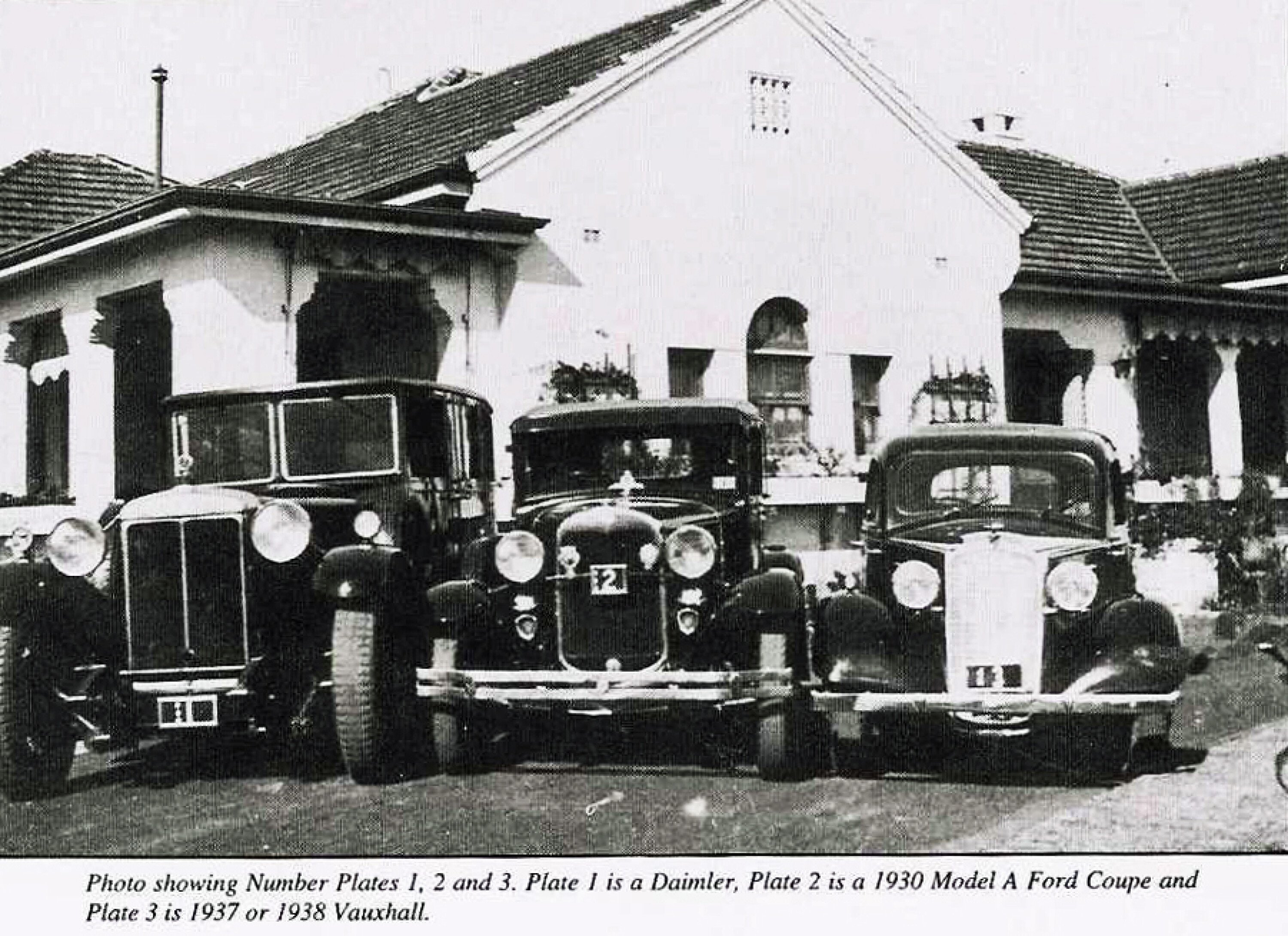
Estimated values are one thing, with Peter Bartels’ VIC 1 plate’s value estimated at up to $10 million last year, but NSW 1 is even more special because it’s not been listed for public sale in over a century and hasn’t been spotted since the 1980s.
Issued to the first NSW Police Commissioner, they were acquired by Sir Frederick Stewart in the 1930s, according to a 2006 Sydney Morning Herald article [↗], who was a railwayman turned bus company owner and founding chairman of Australian National Airways.
He passed away in 1961 when the NSW 1 plate was fitted to his Oldsmobile. His widow Lady Majorie Stewart transferred the rare enamel white-on-black plates to her 1981 Ford Fairmont Ghia LTD, alegedly declining an offer of $200,000 (around $500,000 today) to purchase them in 1988.
She passed in 2000 and left hope that the plates would be available, that wasn’t to be the case until now.
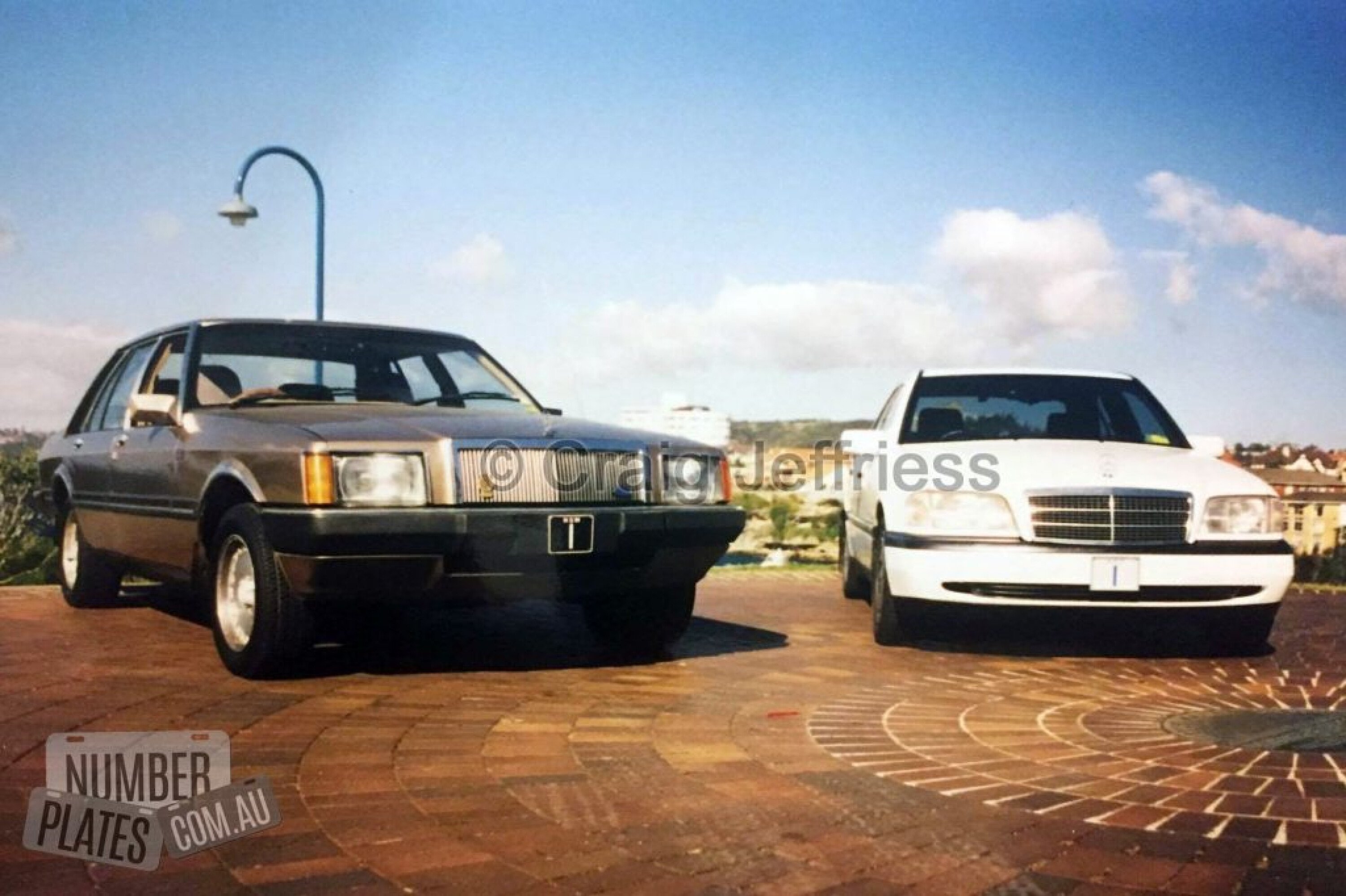
Heritage enamel plates with white numbers on black backgrounds are extremely sought-after, especially for single-digit examples.
It’s likely that NSW 1 will breach $10 million for its final sale price, and it could even set a global record. The current holder is UAE plate 1, which sold for 52.2 million Dirham in 2008, equivalent to around A$14.5 million at the time or $20.5 million today.
After laying dormant for the last 23 years, enthusiasts will be keen to see the plates fitted to a moving vehicle again, whatever the price.
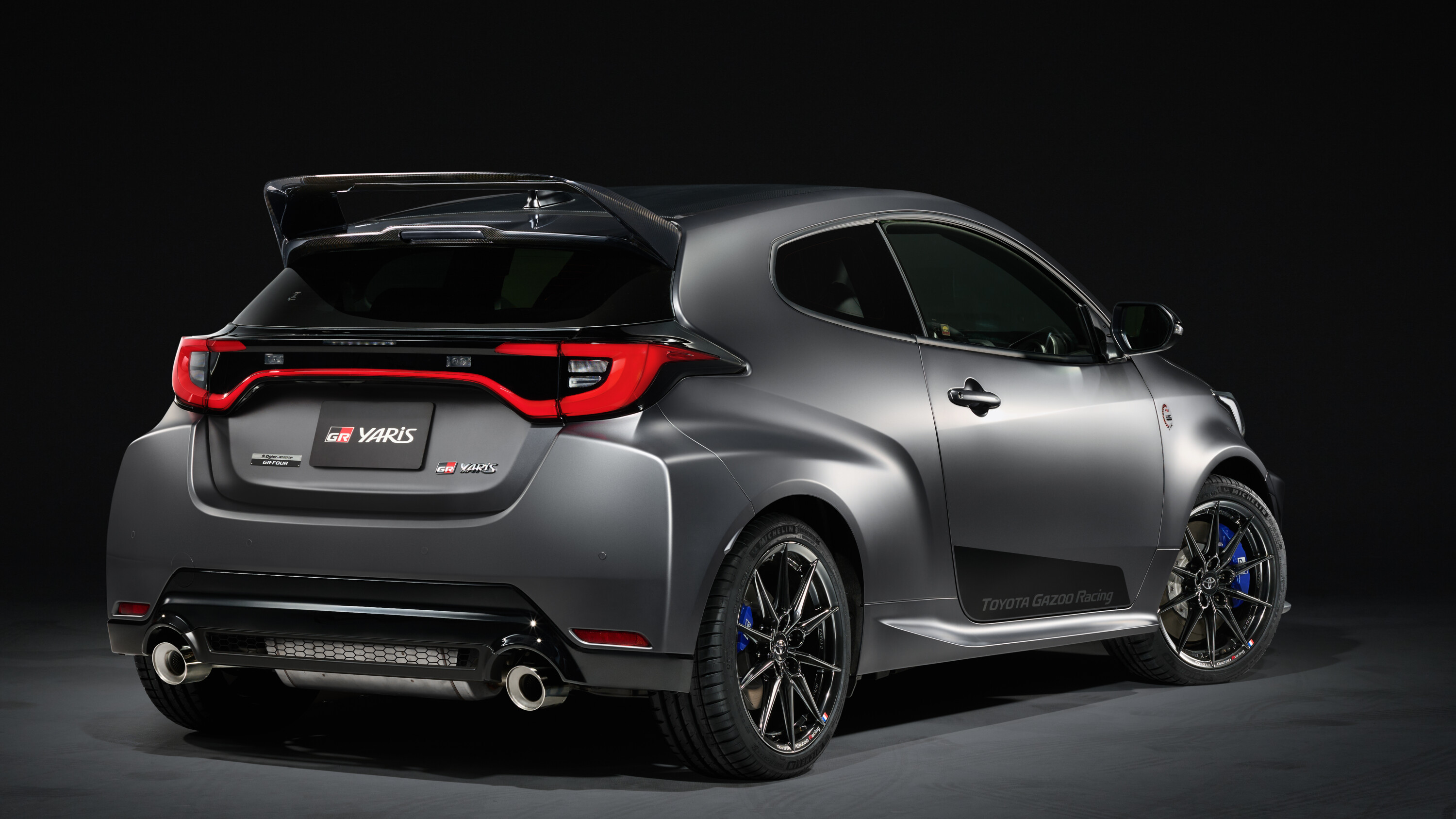
Toyota has revealed two special-edition versions of the just-updated 2024 GR Yaris that are inspired by — and have been co-developed with — the brand’s drivers in the World Rally Championship.
Snapshot
- Toyota reveals two special edition versions of the 2024 GR Yaris
- Inspired by Toyotau2019s title-winning WRC drivers, theyu2019re limited to 100 units each
- Different driving modes promise more fun and u2018oversteeryu2019 balance
Dubbed the GR Yaris Ogier and Rovanpera Editions, the new models were revealed at Rally Monte Carlo and don’t only bring a host of cosmetic differences but also promise to drive differently, too, thanks to new driving modes tailored to the WRC star’s preferences.
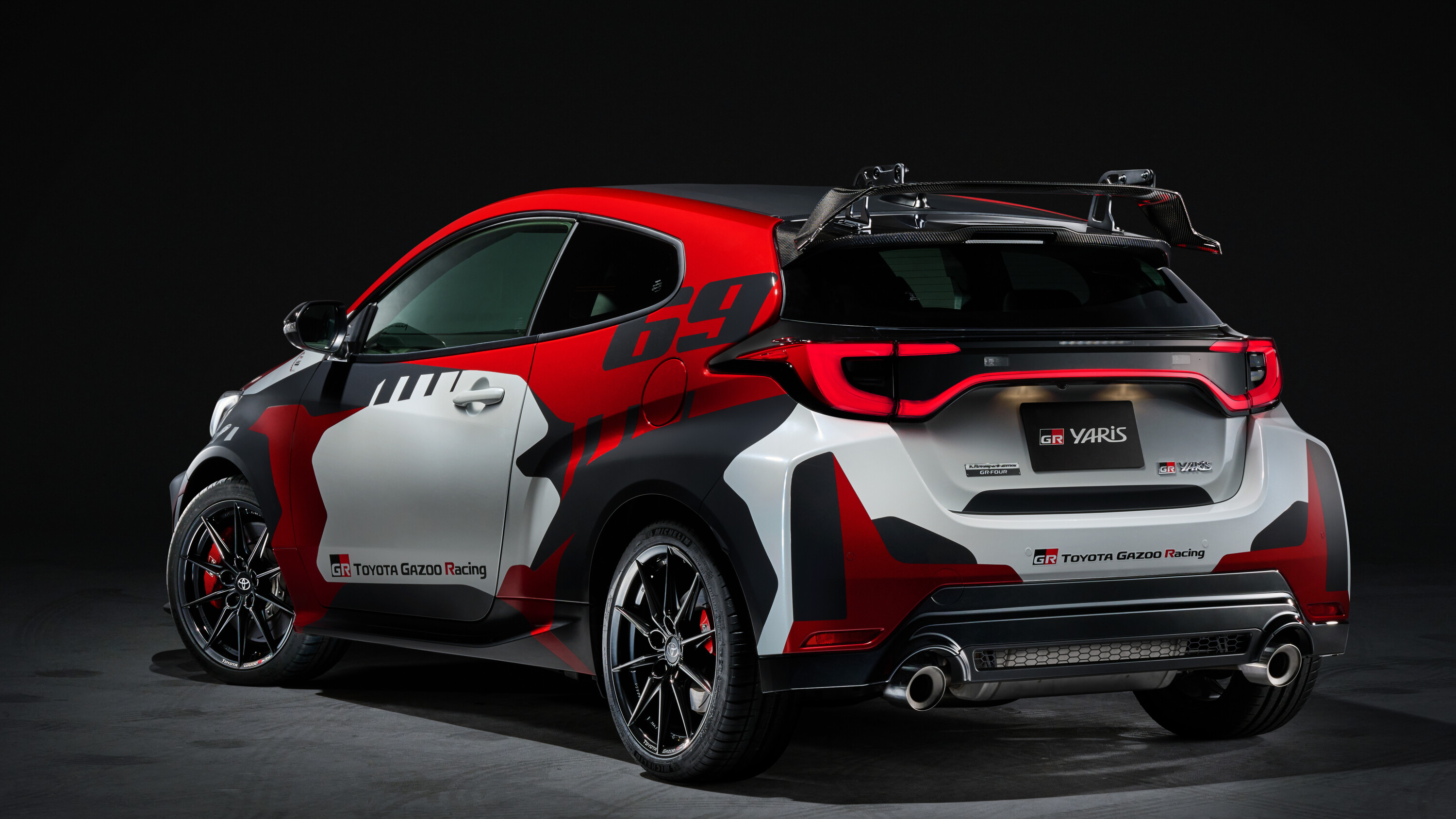
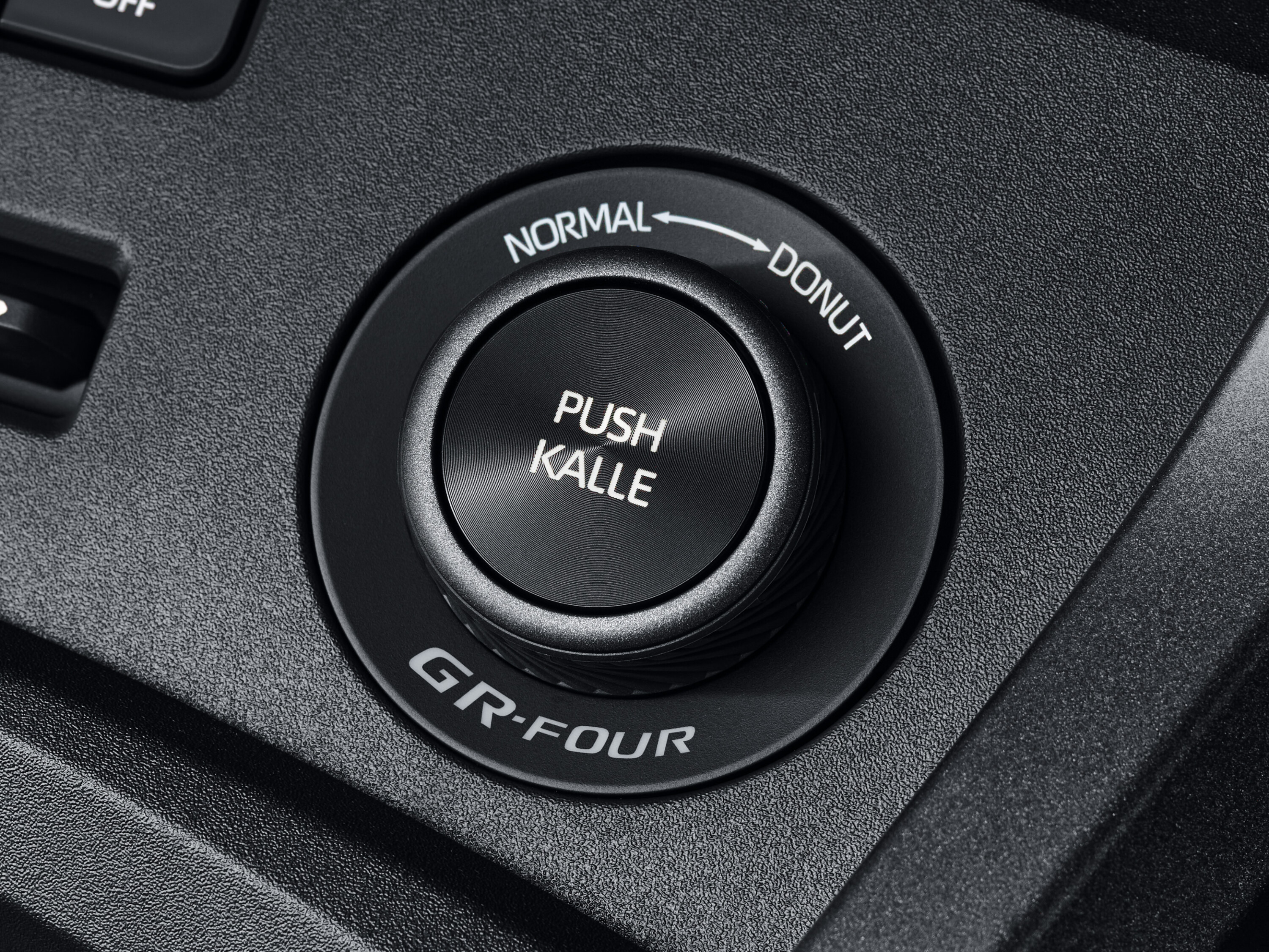
The new modes replace the existing ‘Gravel’ and ‘Track’ settings in the regular GR Yaris, with the Ogier Edition featuring ‘Morizo’ and ‘Seb’ modes. Toyota says ‘Morizo’ mode was set-up by the company’s chairman, Akio Toyoda, to deliver more consistent race times, while ‘Seb’ mode alters the behaviour of the Torsen limited-slip differentials to “favour the rear wheels” for a more oversteery balance.
The Rovanpera Edition, meanwhile, has ‘Kalle’ mode which is designed to provide more predictable handling on loose surfaces and ‘Donut Mode’, which is hat tip to Rovanpera’s penchant for drifting and donut turns.
Design tweaks include a unique exterior colour for the Ogier Edition known as “Matte Stealth Gray”, while the Rovanpera Edition has a tri-colour scheme inspired by the Finnish driver’s helmet.
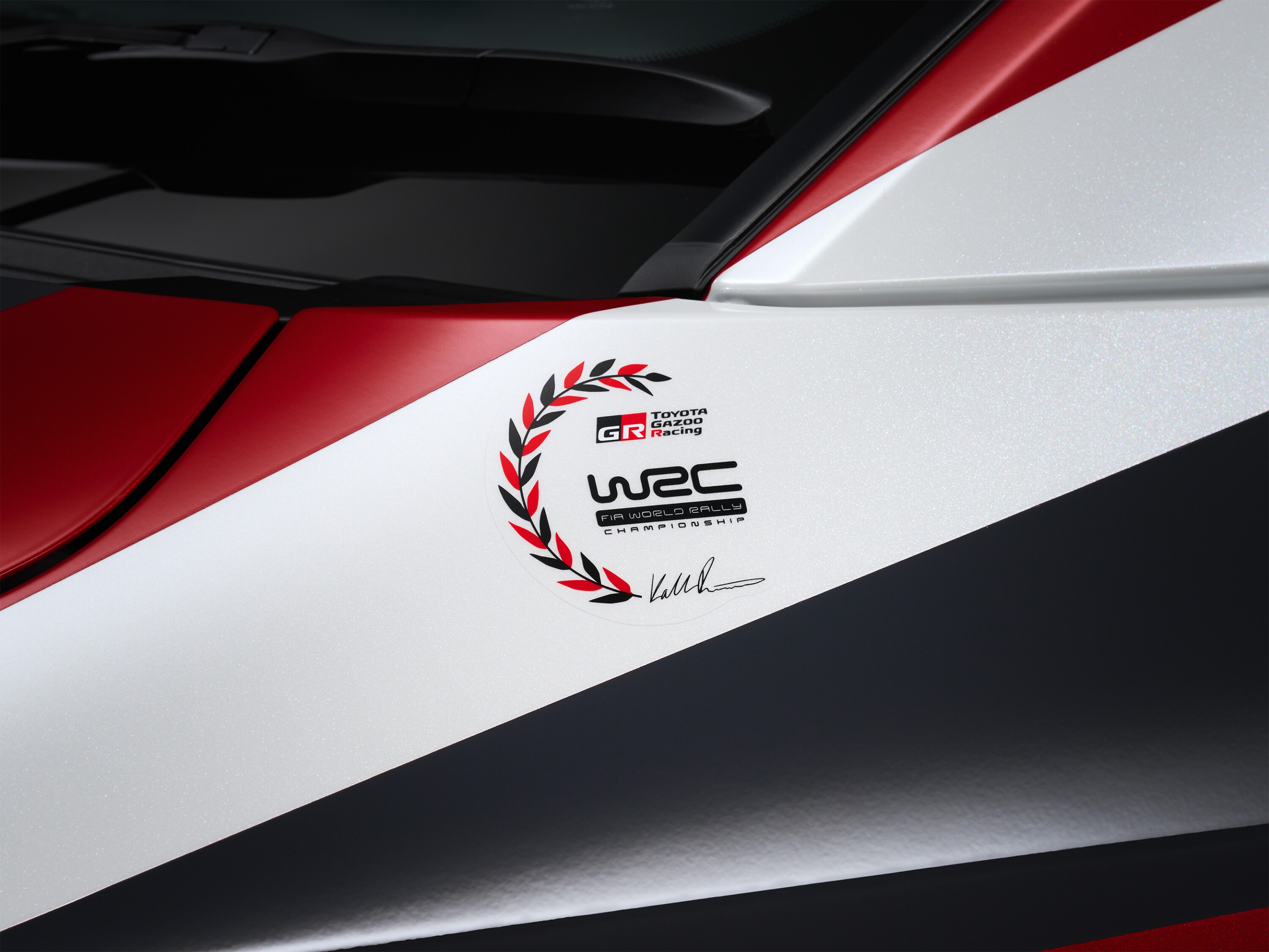
The stitching on the steering wheel also matches the colour of each driver’s national flag, while WRC victory decals are attached on each of the front fenders to commemorate Toyota’s victory in the 2023 WRC driver’s title.
Both cars are limited-edition models with Toyota planning to produce 100 units of each. It’s unclear how many, if any, of the new special editions will reach Australia, though we hope our market scores at least a few.
Pricing is also yet to be confirmed, however we’d wager it will eclipse the lofty $77,800 sticker of the GR Corolla Morizo Edition. A limited-run version of the GR Yaris’s bigger brother, the GR Corolla Morizo is $15,500 more than the regular car.