
MG Motor Australia has confirmed that the new MG4 EV Urban will launch in Australia in April, sitting underneath the MG4 already on sale but with a more affordable price tag.
At launch, the MG4 EV Urban will offer two LFP battery sizes in Australia: a smaller 43kWh standard range and a larger 54kWh extended range. Based on UK specifications, the former can travel 325km on a charge and the latter 415km. Importantly, both batteries can charge from 10 to 80 per cent in around 30 minutes at a maximum rate of 82kW for the smaller battery and 87kW for the larger one.
In the UK – Australian power figures are yet to be announced – the smaller battery is paired with a 110kW/250Nm front-mounted electric motor, with the latter using a slightly more powerful 118kW (still making 250Nm) motor instead, likely to account for the larger battery’s extra weight.
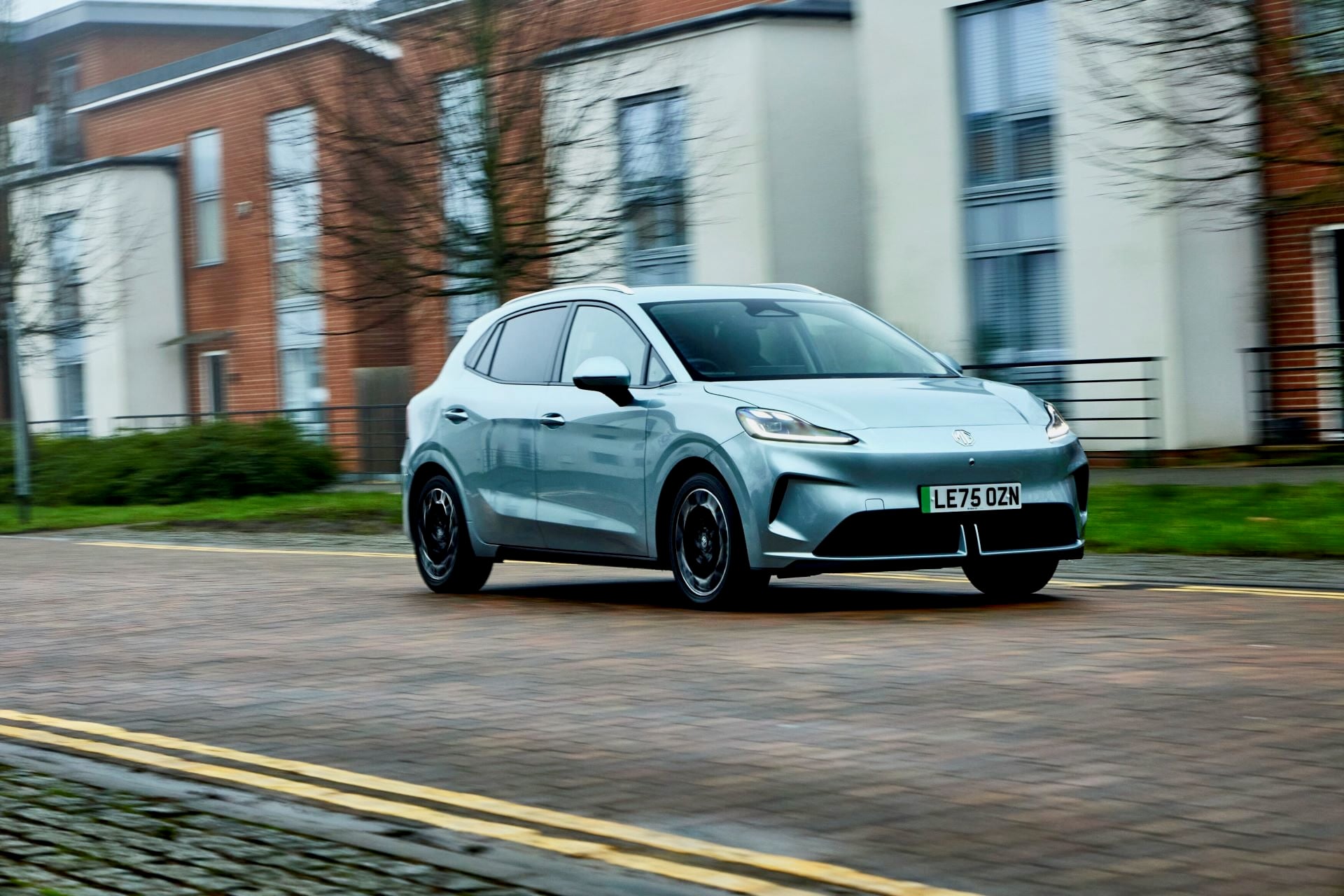
In the UK market, where it has already been updated, the regular MG4 is available with either 64kWh or 77kWh batteries, with the smaller 51kWh unit removed to make way for the MG4 EV Urban. That is a change we’re expecting for Australia as well.
Billed as a more comfort-focused and practical EV compared with the sportier MG4, the MG4 EV Urban is actually bigger and more spacious than its sibling. Measuring 4395mm long, 1842mm wide, 1549mm tall and 2750mm between the wheels, the Urban is 108mm longer, 6mm wider, 33mm taller and 45mm longer between the wheels than the MG4. Based on UK specifications, its 1364-litre boot (with the rear seats folded) is around 200L larger than the 4.
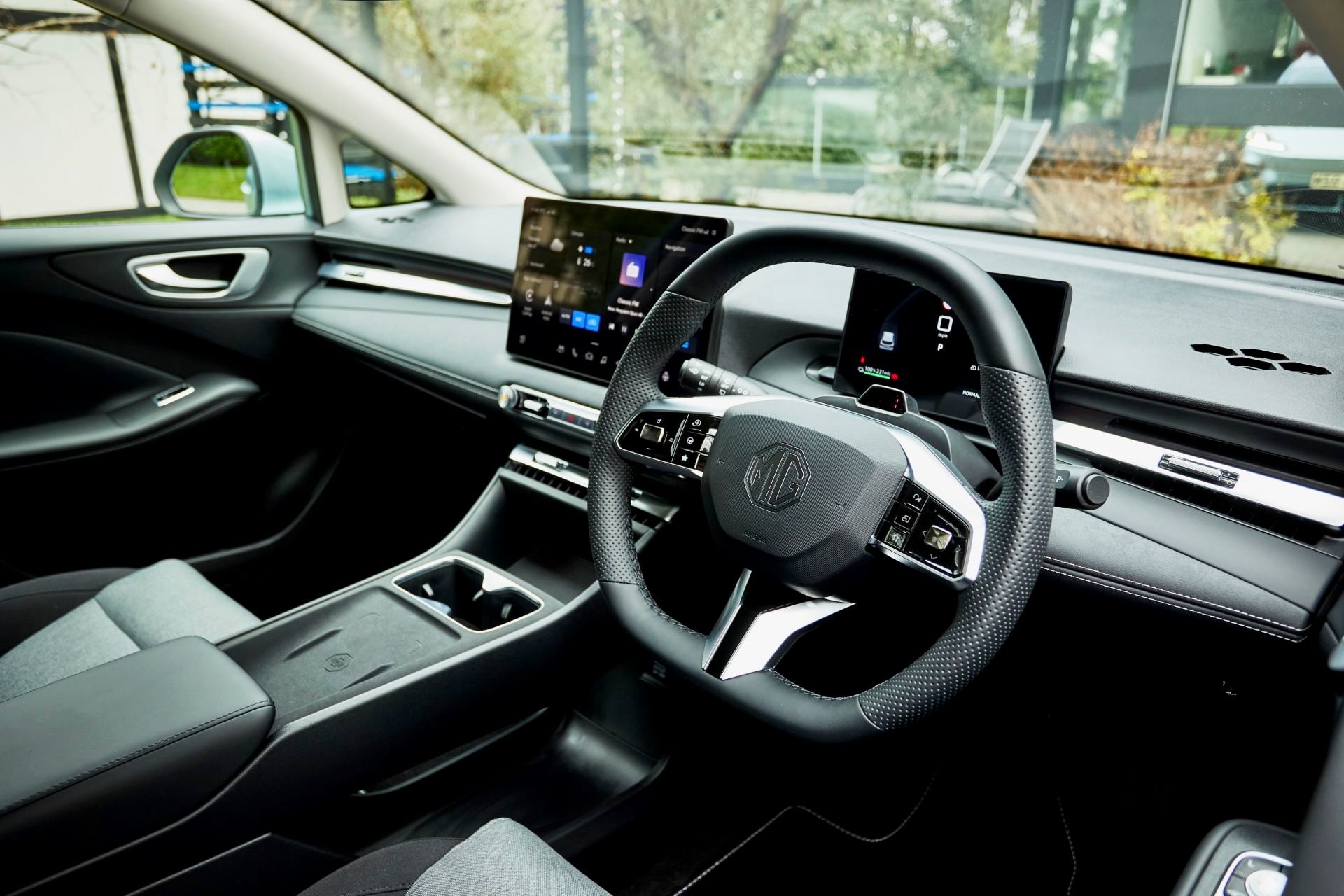
Inside the MG4 Urban is a similar cabin to the MGS5 EV electric small SUV, with a 15.6-inch touchscreen featuring wireless Apple CarPlay and Android Auto, a 7.0-inch digital driver’s display, physical air-conditioning and volume controls, and a large centre console with a wireless phone charger. The MG4 will receive a similar cabin design when it’s launched.
Australian pricing for the MG4 EV Urban is yet to be announced, but in the UK, there’s a £6500 (AS12,360) price difference between the two and we’re expecting a low-$30,000 price for the Urban once it reaches our shores. For reference, the UK-spec MG4 EV Urban starts at £23,495 (around A$44,700) and the MG4 at £29,995 (A$57,200).
The MG4 EV Urban will go on sale in Australia in April, with local pricing and specifications to be confirmed then.
At first glance, the new plug-in hybrid Audi RS 5 appears to contradict everything enthusiasts traditionally love about performance cars. It weighs close to 2.5 tonnes, carries a battery pack and relies on hybrid technology. On paper, that might sound like a recipe for disappointment.
Yet Audi Sport’s engineers have managed to turn that expectation on its head. The latest RS 5 combines electrification with serious performance hardware to produce a machine that feels far more athletic than its hefty kerb weight suggests.
Unveiled recently as the latest addition to Audi’s RS performance line-up, the new model has sparked debate among purists. For the first time, the famous RS badge has been paired with a plug-in hybrid powertrain, and that decision inevitably adds mass. Compared with the outgoing RS 4, the new car is roughly a third heavier and slightly larger overall.
But Audi’s development team insists the electrified approach brings significant benefits — and those advantages become clear as soon as you get behind the wheel.
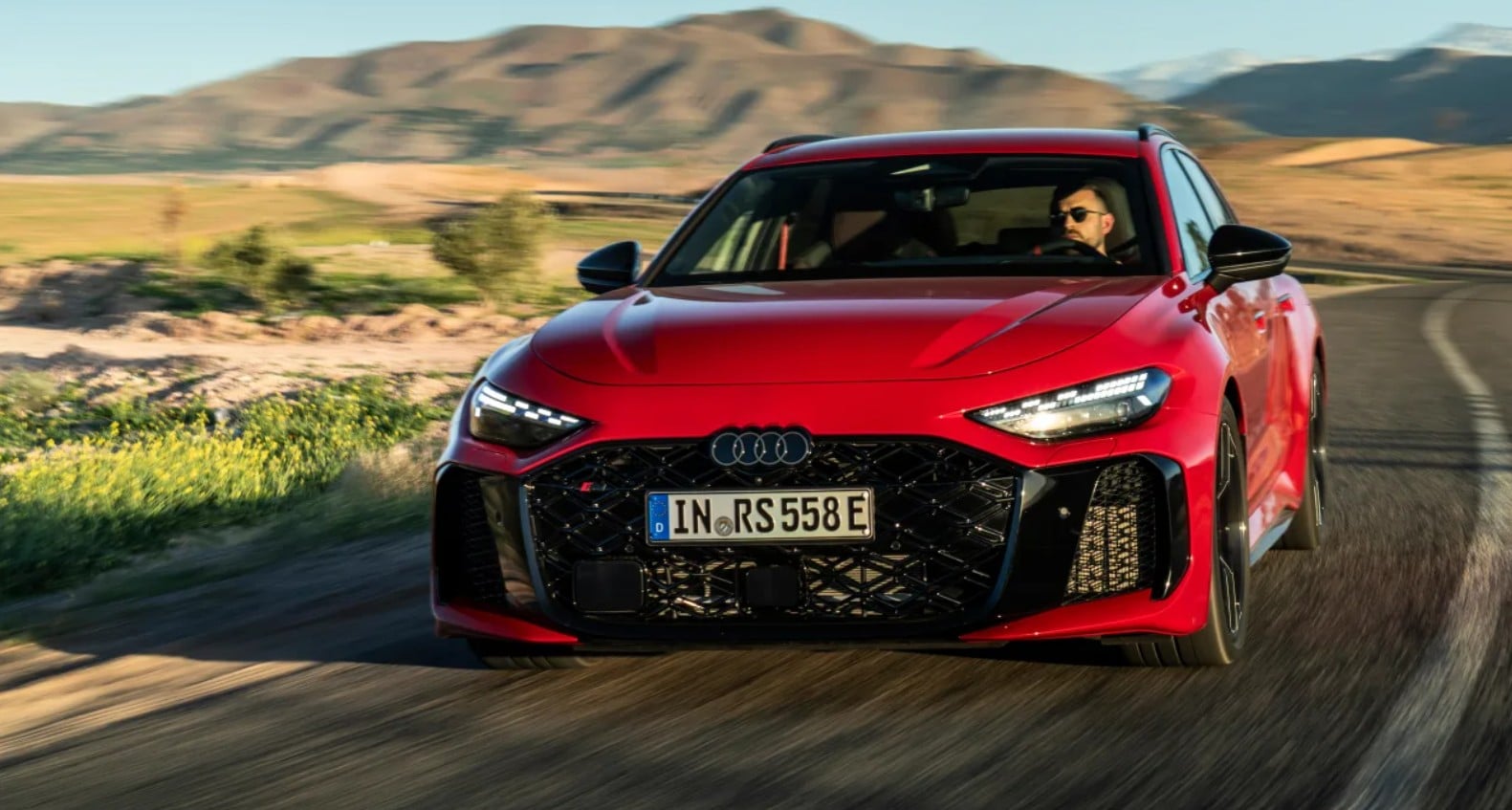
Electrified power with serious punch
The new RS 5 is powered by a 2.9-litre twin-turbocharged V6 petrol engine paired with an electric motor integrated into the transmission. The petrol engine alone produces around 375kW, while the electric motor contributes an additional 130kW.
Combined output stands at a remarkable around 470kW, representing roughly a 50 per cent increase in power compared with the previous model.
Performance figures are correspondingly impressive. Audi claims the RS 5 can accelerate from 0–100km/h in just 3.6 seconds, helped by a temporary ‘Boost’ function that unleashes the full 825Nm of torque.
On an open stretch of road, the car feels brutally quick. Acceleration builds instantly thanks to the electric motor’s immediate torque delivery, while the V6 provides the familiar surge of turbocharged power higher in the rev range.
Even without engaging launch control, the RS 5 launches forward with remarkable urgency.
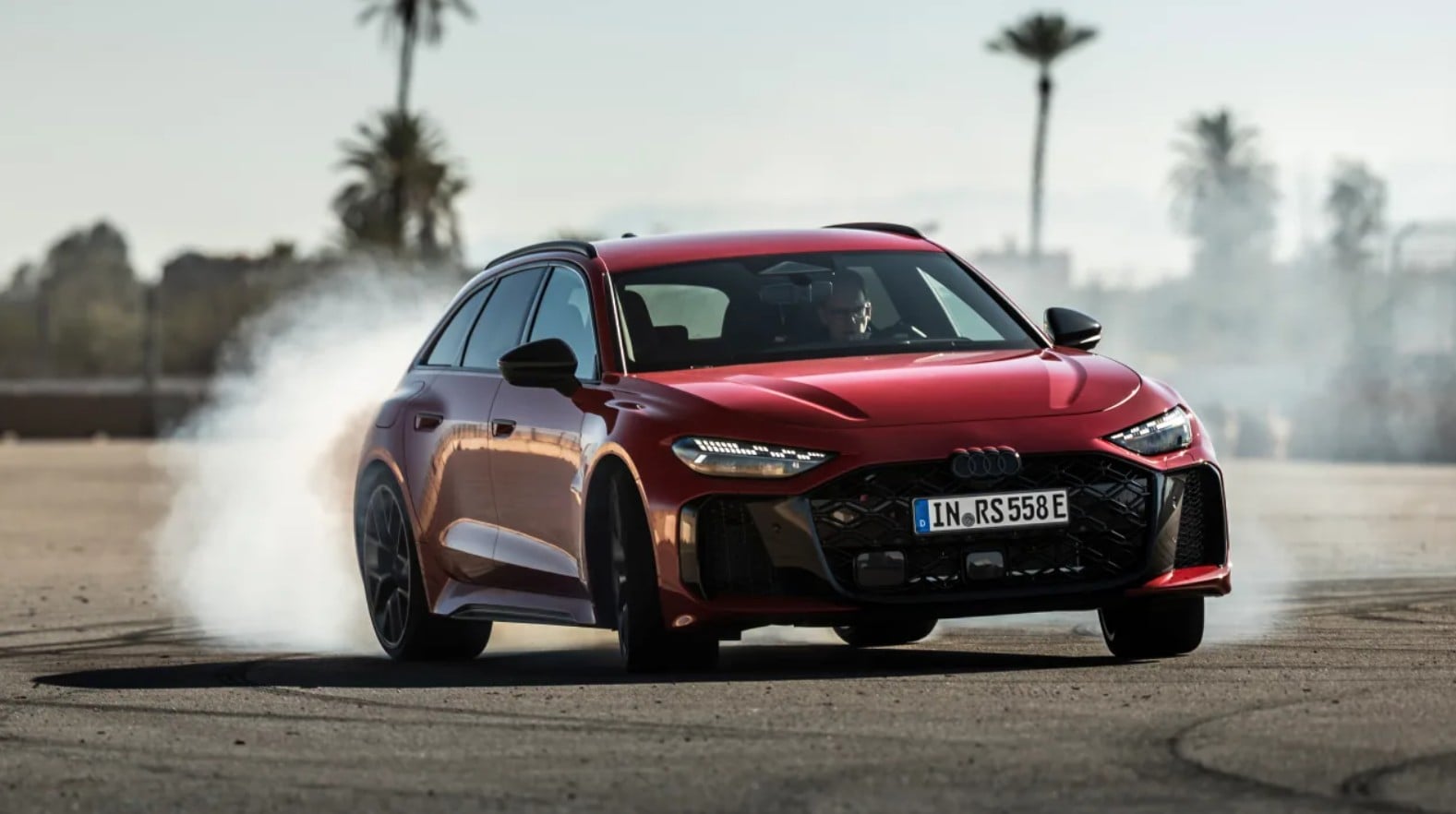
Handling that defies the weight
What’s most surprising, however, is how well the RS 5 handles its substantial mass. Audi has equipped the car with an advanced torque-distribution system that can actively send power between the rear wheels in milliseconds.
Working together with the electric motor and the rear differential, the system enhances both grip and agility.
The result is a car that feels far more nimble than its dimensions suggest. Steering is sharp and precise, and the chassis maintains impressive composure through fast corners. Wide performance tyres and a carefully tuned suspension setup help keep the car planted when pushed hard.
In standard RS driving modes, the car delivers controlled and confident performance. But switch to the more playful Torque Rear mode, and the RS 5’s personality changes dramatically.
Suddenly the rear axle becomes more lively, allowing enthusiastic drivers to provoke controlled slides. It’s a playful feature that demonstrates Audi hasn’t forgotten how to make a performance car entertaining.
Performance meets practicality
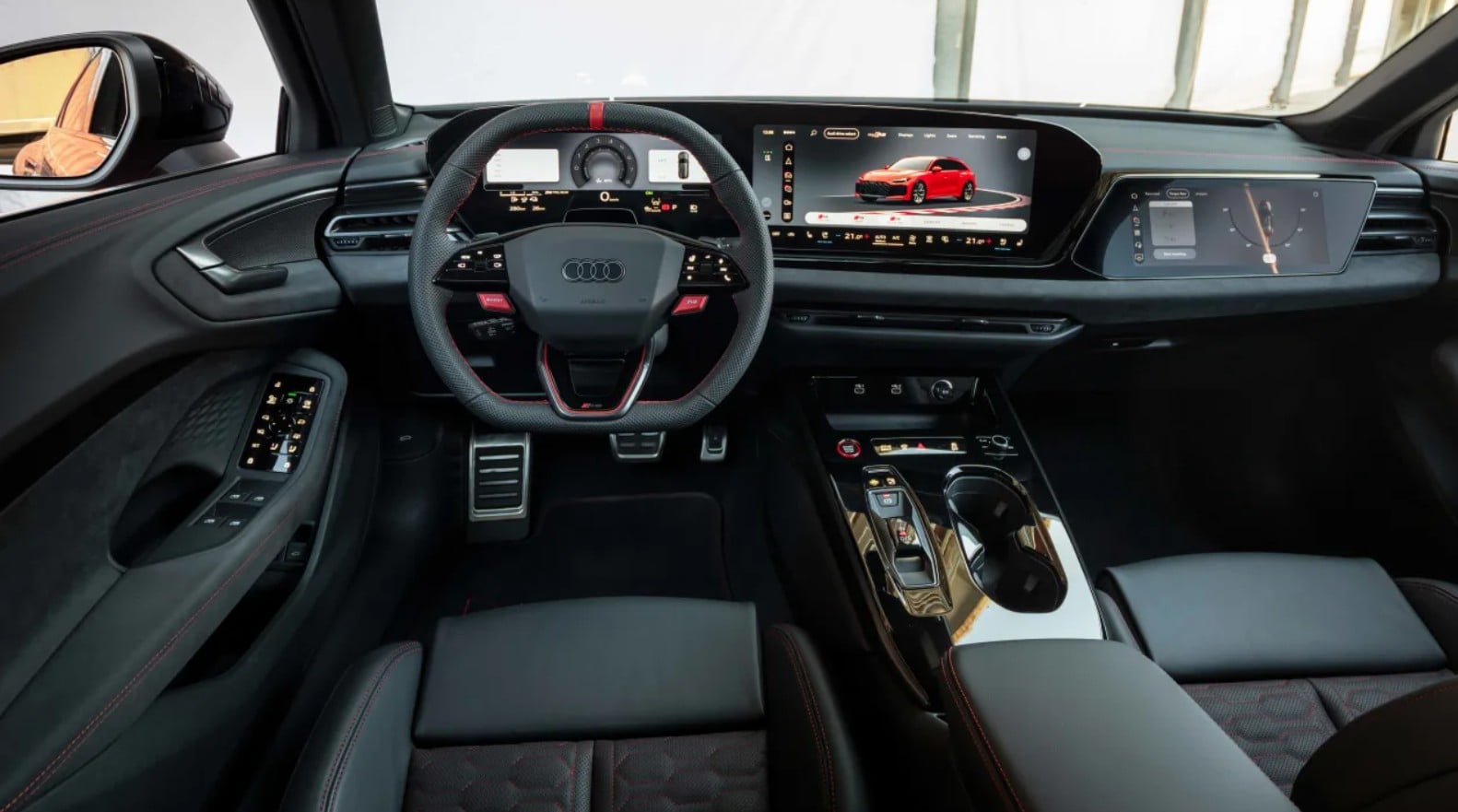
Audi has also embraced technology that appeals to a new generation of enthusiasts. The infotainment system includes software capable of recording drift angles and performance data, letting drivers analyse their driving sessions later.
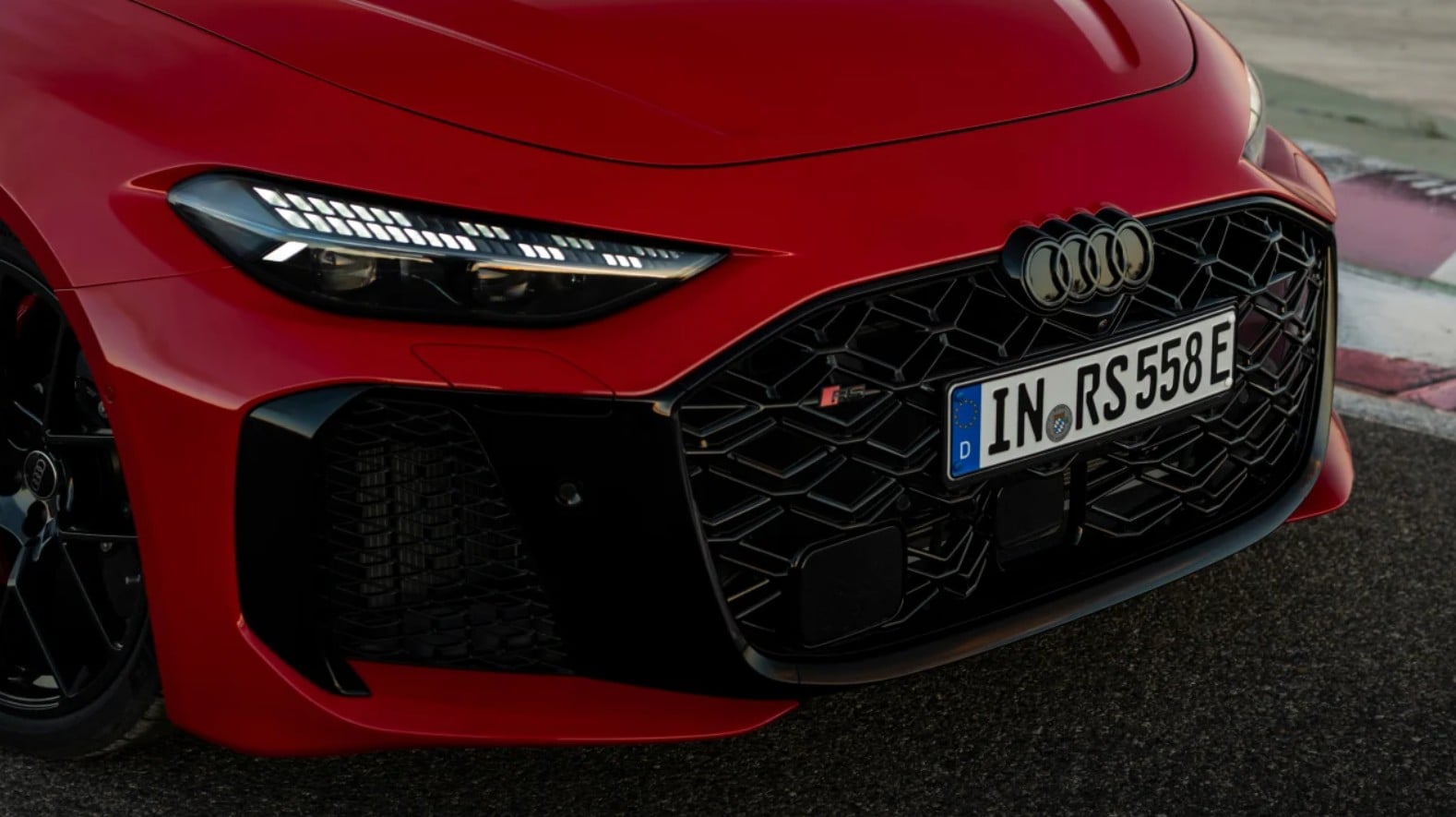
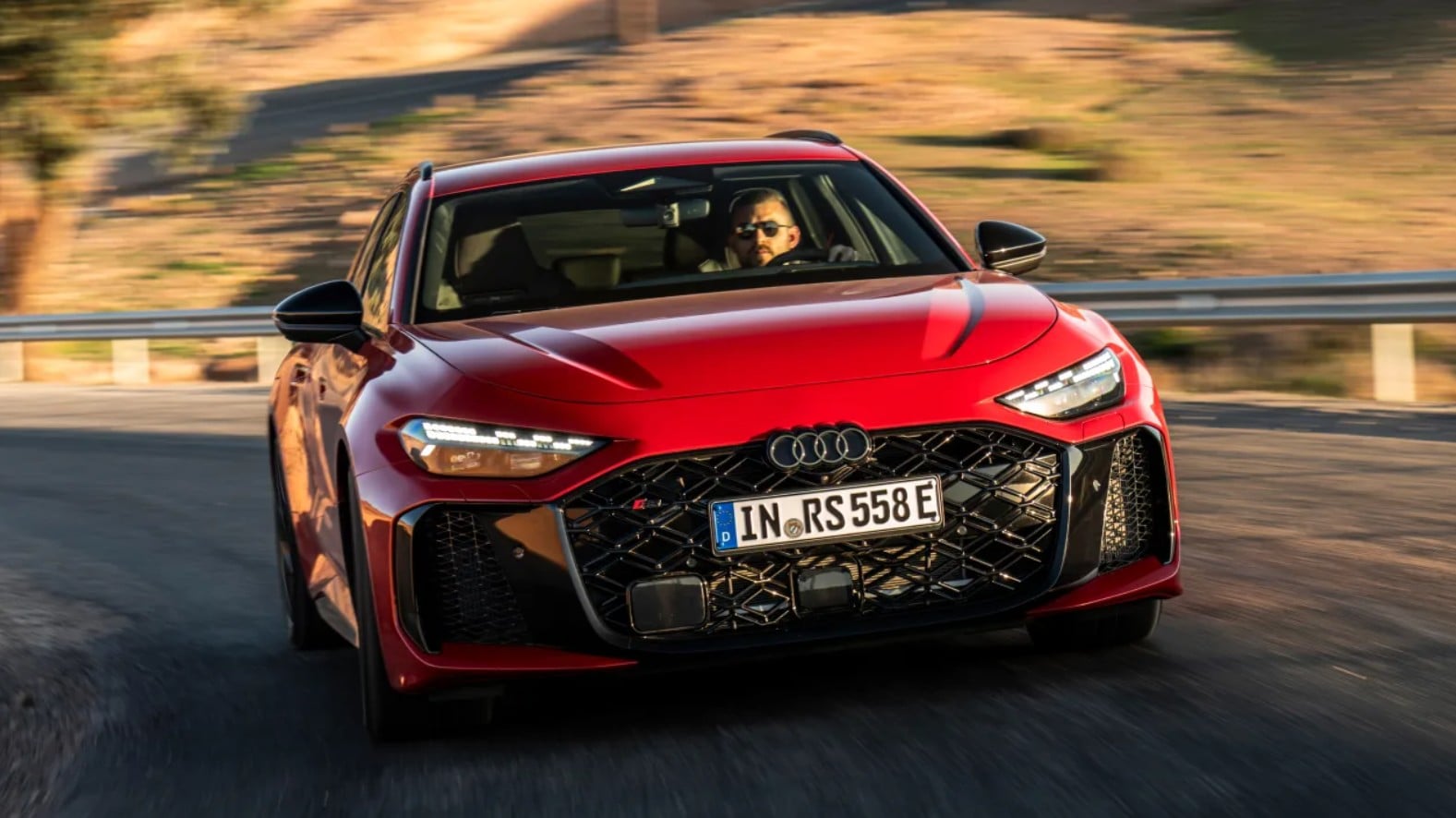
The car’s design reflects its aggressive performance intent. Flared wheel arches, prominent side skirts and large air intakes give the RS 5 a muscular stance, while twin exhaust outlets reinforce its sporting credentials.
Yet despite its dramatic appearance and impressive speed, the RS 5 remains comfortable enough for everyday use. The suspension delivers a refined ride during relaxed driving, making it well suited to commuting or long highway journeys.
Electric driving for daily use
The plug-in hybrid system also allows the RS 5 to travel around 80 kilometres on electric power alone, thanks to a 22kWh battery pack.
In EV mode the car can operate quietly and efficiently, making it ideal for urban driving or short daily trips without using petrol.
Pricing for the new RS 5 is expected to start at roughly $180,000 before on-road costs when it reaches Australian showrooms.
While it certainly isn’t cheap, the latest RS 5 demonstrates that electrification doesn’t have to dilute performance. In fact, Audi’s newest RS model shows how hybrid technology can elevate both speed and versatility — delivering the thrill of a sports car alongside the practicality of a modern performance wagon.
In 2025, 733,831 SUV models of different sizes, with different drivetrains and from different manufacturers were sold in Australia. That represents 60.7 per cent of the overall new car market, and it’s a stark contrast to even five years ago when passenger cars were more prominent.
Models such as the Toyota RAV4, Ford Everest and Mazda CX-5 tend to hog all the headlines as some of the biggest volume sellers in the market, but how about models that aren’t as high profile? Here are 10 great SUVs that you should know more about:
MGS5 EV
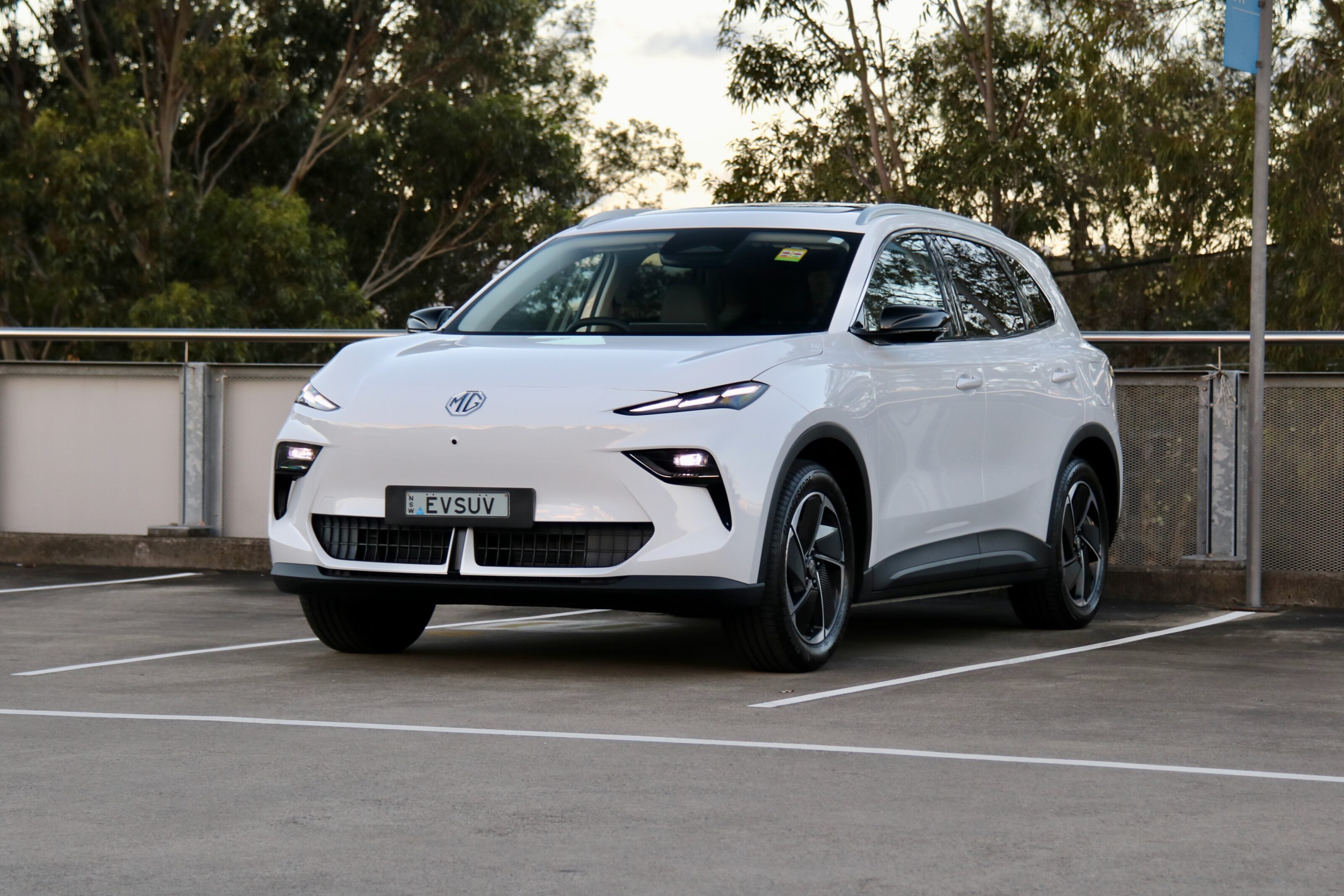
Price: From $40,490 driveaway
Drivetrains: Single-motor electric, up to 125kW of power, up to 515km of range
2025 sales: 1857
Why you should consider it: It uses the same bones as the sweet MG4 hatchback but with more practicality
We were quite impressed with the MGS5 EV when it launched last year and while sales have been reasonable, we expected it to be more popular. Attractively priced from just $40,490 driveaway, the S5 is a great small electric SUV option and a far better product than the ZS EV that it replaced. Using a 125kW rear-mounted motor, it’s solid to drive and it offers a healthy range up to 515km. The interior is also high quality, the tech is easy to use and it’s practical.
KGM Torres
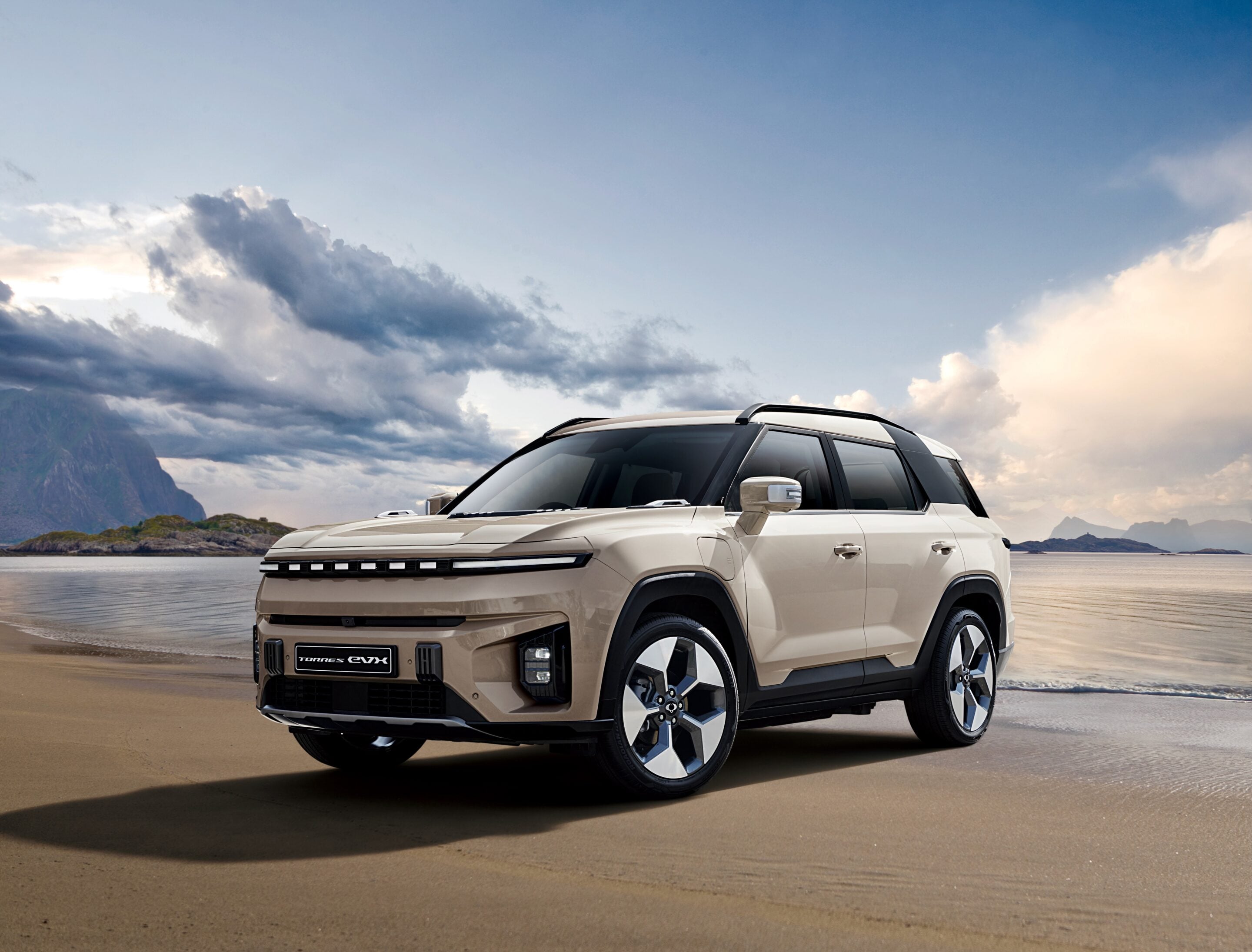
Price: From $38,000 driveaway
Drivetrains: 1.5-litre turbo-petrol, 1.5-litre turbo-hybrid or dual-motor electric, up to 152kW of power, up to 462km of range (EV)
2025 sales: 288
Why you should consider it: It offers petrol, hybrid or electric power and is a good all-rounder
It’s fair to say that KGM’s sales aren’t exactly firing up the charts at the moment, and we think that’s a shame because it offers a lot to Australians. Take, for example, the Torres mid-size SUV. It’s great value for money, is well equipped across the range, practical and offers a choice of petrol, hybrid or electric drivetrains. Pricing starts at just $38,000 driveaway, putting it in direct competition with more popular cars like the GWM Haval H6, but the Torres is also worth a look.
Skoda Elroq
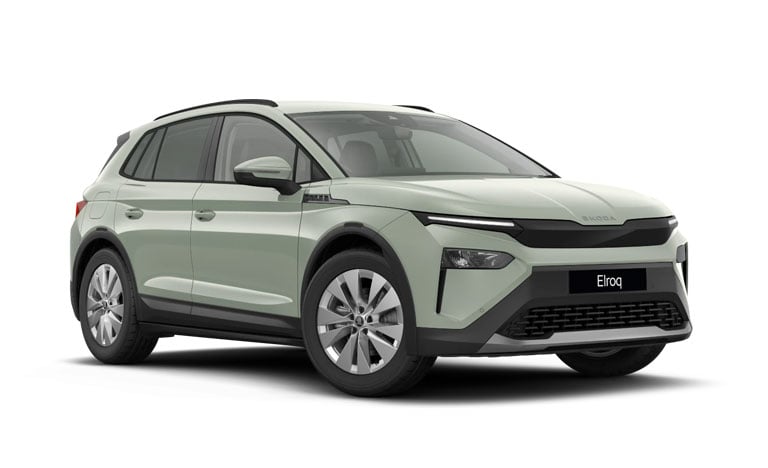
Price: From $49,990 driveaway
Drivetrains: Single-motor electric, up to 210kW of power, up to 529km of range
2025 sales: 253 (it only went on sale in September)
Why you should consider it: It’s great value for money and mechanically impressive
It’s only been on sale since September 2025, but the Skoda Elroq small electric SUV deserves more attention. Priced from $49,990 driveaway, the Elroq is solid value for money and even the entry-level 60 Select variant is well equipped, drives well and can travel up to almost 400km on a charge. Being a Skoda, it’s well packaged and features many ‘simply clever’ features – plus, it’s also covered by a seven-year/unlimited km warranty.
Hyundai Ioniq 5
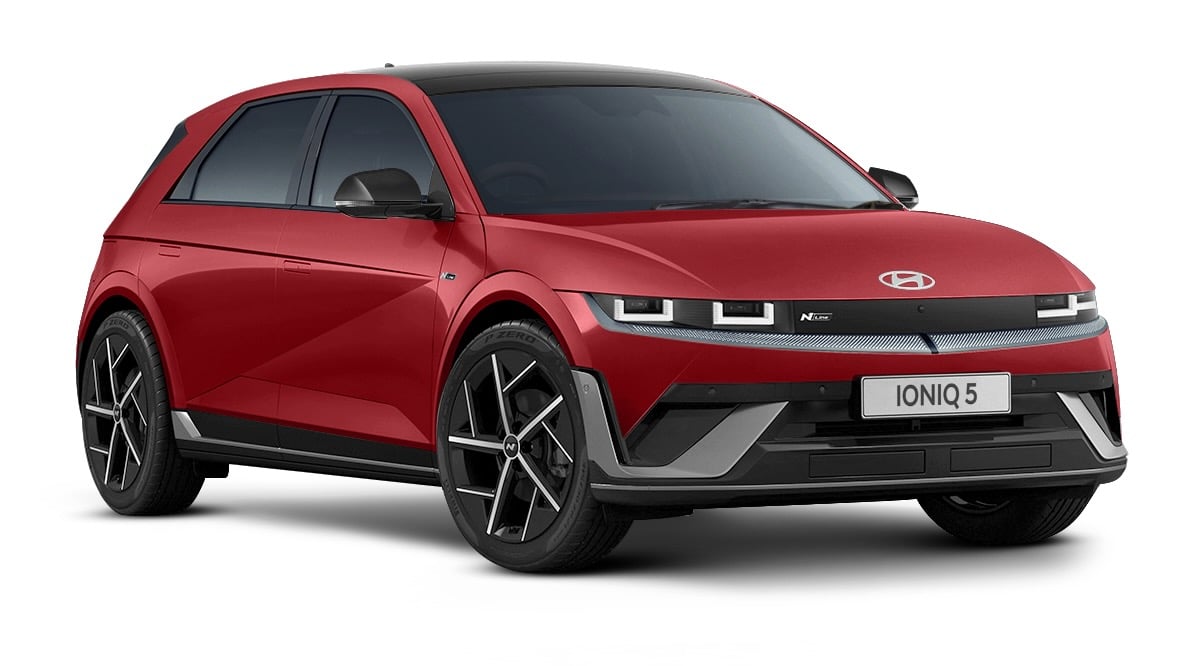
Price: From $76,200 plus on-road costs
Drivetrains: Single- and dual-motor electric, up to 448kW of power, up to 570km of range
2025 sales: 626
Why you should consider it: It’s a breakthrough EV: great to drive and great to sit in
The Hyundai Ioniq 5 was one of the first big electric vehicle launches in Australia that wasn’t a Tesla, and while sales have been modest since, there’s no denying that it’s a great car. It offers fast charging, it’s good to drive, quite practical and there are a range of different models to choose from, including the fire-breathing Wheels COTY-winning Ioniq 5 N. Pricing starts at $76,200 plus on-road costs, though Hyundai currently has the entry-level model on special for $71,990 driveaway.
Nissan Qashqai
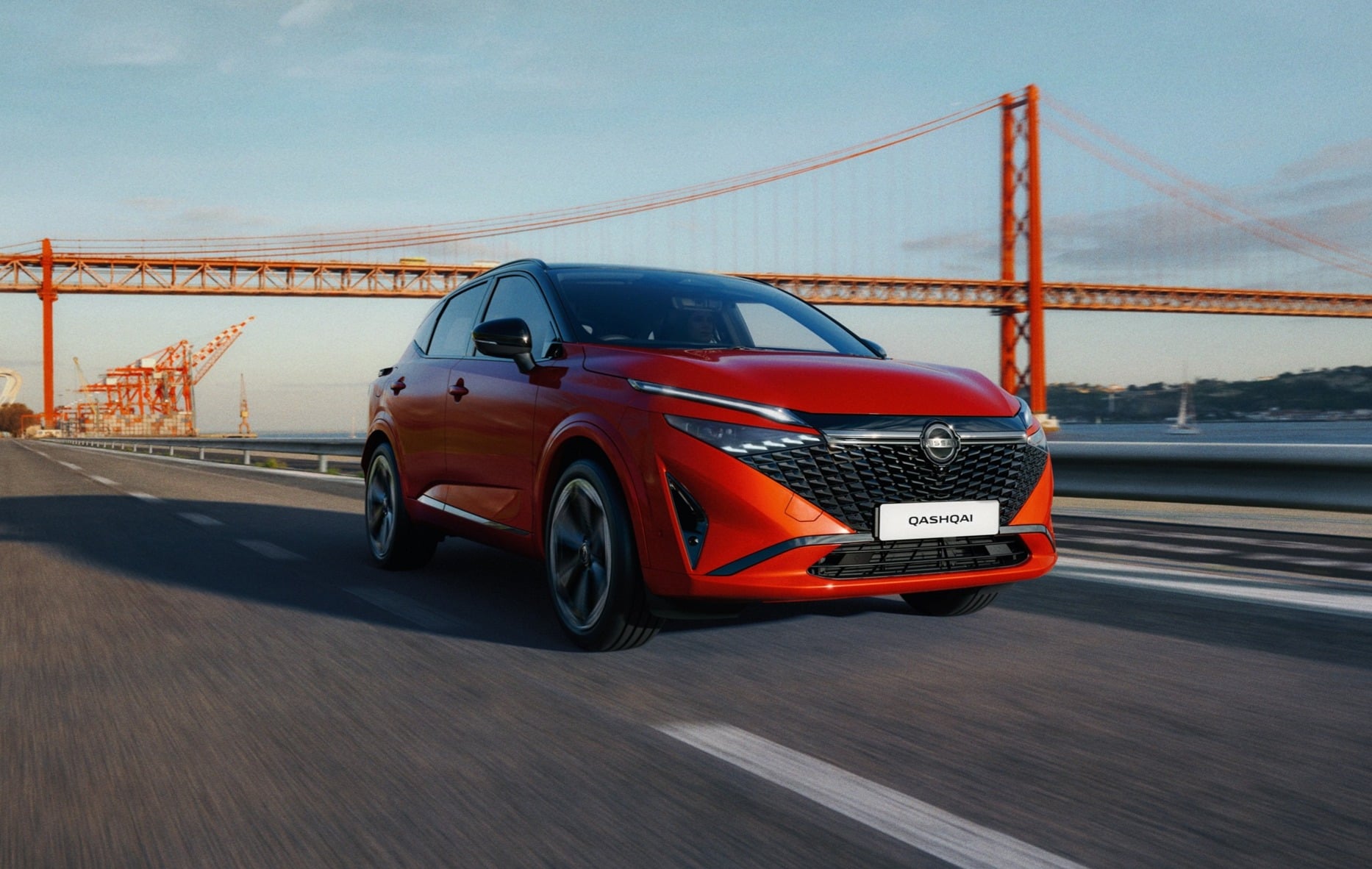
Price: From $45,640 plus on-road costs
Drivetrains: 1.5-litre turbo-hybrid, 140kW, 4.1L/100km
2025 sales: 4478
Why you should consider it: It’s got Nissan’s latest e-Power hybrid system with serious efficiency improvements
The Qashqai has been one of Nissan’s biggest global success stories since its initial debut way back in 2006, and is an influential model in creating the modern small SUV segment. Australians haven’t warmed to it like Europeans did, however, but we think it’s worthy of consideration. Nissan’s latest e-Power hybrid system has been made even more fuel efficient and is now rated at just 4.1L/100km. The best part? It’s standard across the MY26 Qashqai range.
Honda ZR-V
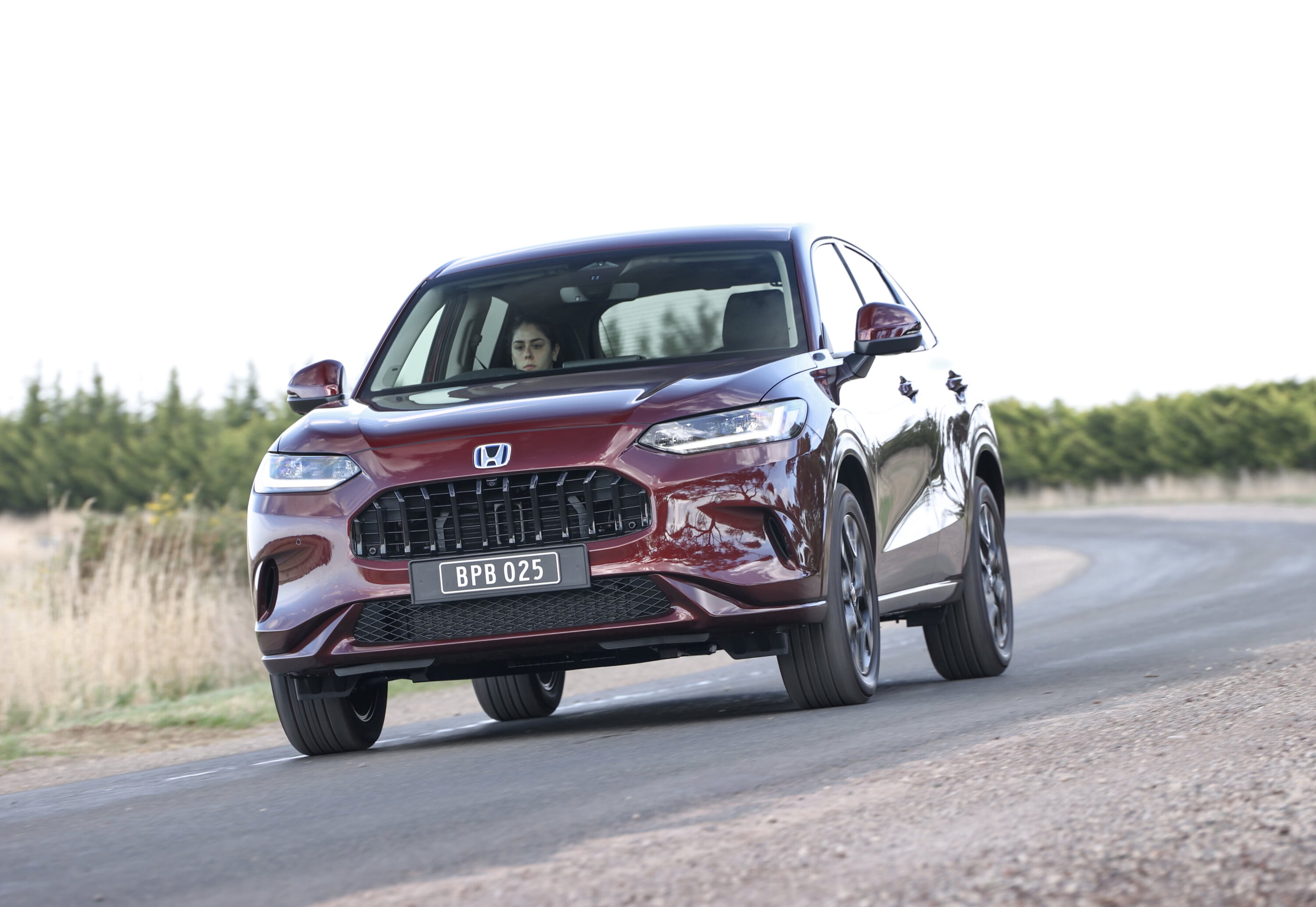
Price: From $37,900 driveaway
Drivetrains: 1.5-litre turbo-petrol or 2.0-litre hybrid, up to 135kW of power, as low as 5.0L/100km
2025 sales: 3940
Why you should consider it: It’s a great all-rounder and offers value pricing
The Honda ZR-V is a reasonable seller in Australia, though not to the level we think it deserves. Pricing starts at just $37,900 driveaway and even the entry-level VTi is well equipped, though the LX models are absolutely loaded. The ZR-V’s cabin is filled with soft-touch materials and it feels premium throughout. It’s a pleasure to drive and can be quite fuel efficient in hybrid form. If you’re searching for a small SUV under $50,000, the ZR-V needs consideration.
Ford Mustang Mach-E
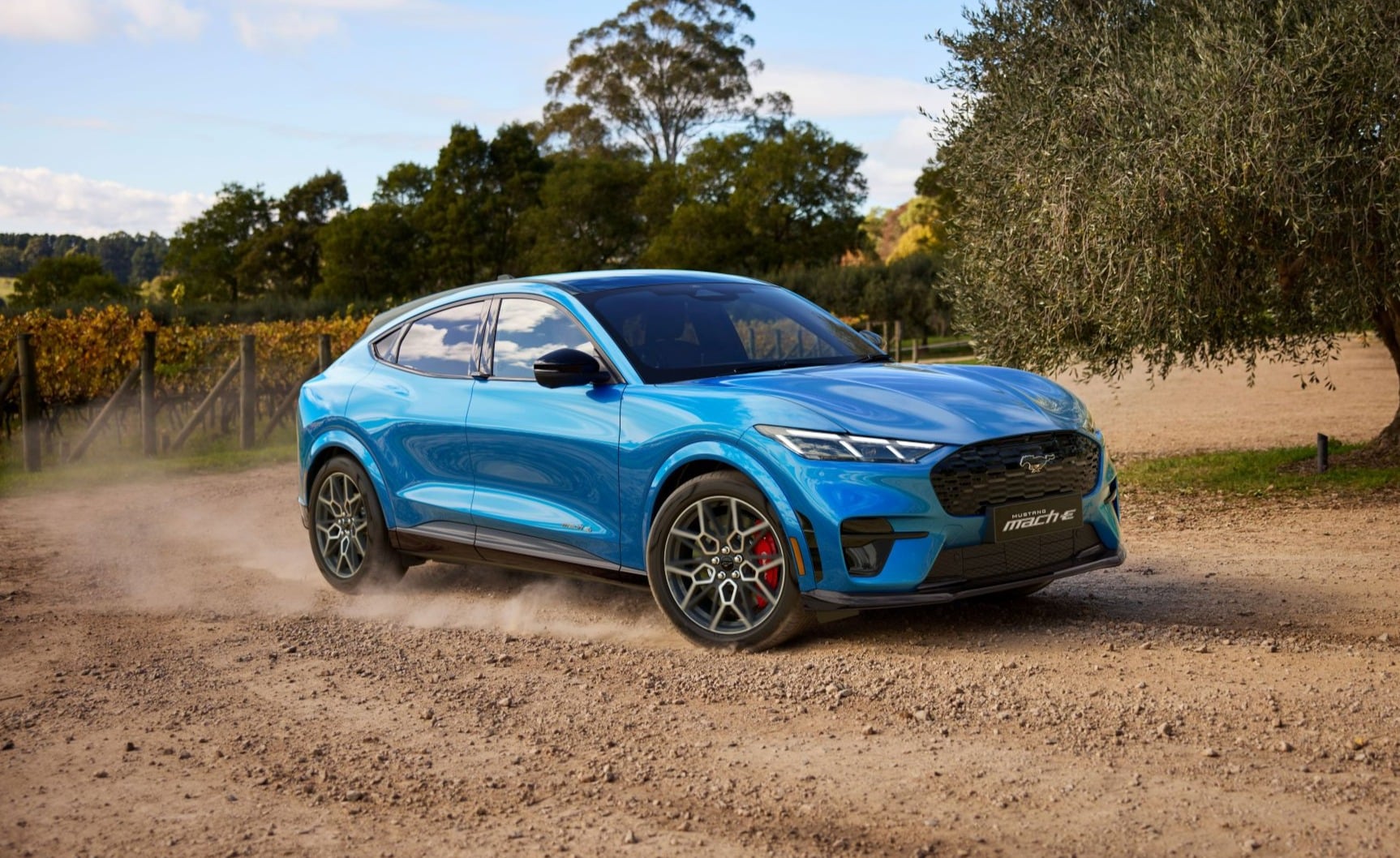
Price: from $65,990 plus on-road costs
Drivetrains: Single- or dual-motor electric, up to 434kW of power, up to 600km of range
2025 sales: 483
Why you should consider it: It’s one of the better electric SUVs to drive
Perhaps the most controversial car on this list, the Mustang Mach-E is famed for “not being a real Mustang“, according to its skeptics. That quibble aside it’s actually a pretty good car – satisfying to drive, competitive with range, practical and even in base form, well equipped. The high-performance GT is a hoot to drive as well, and very quick, hitting 100km/h in just 3.7 seconds.
Volvo EX90
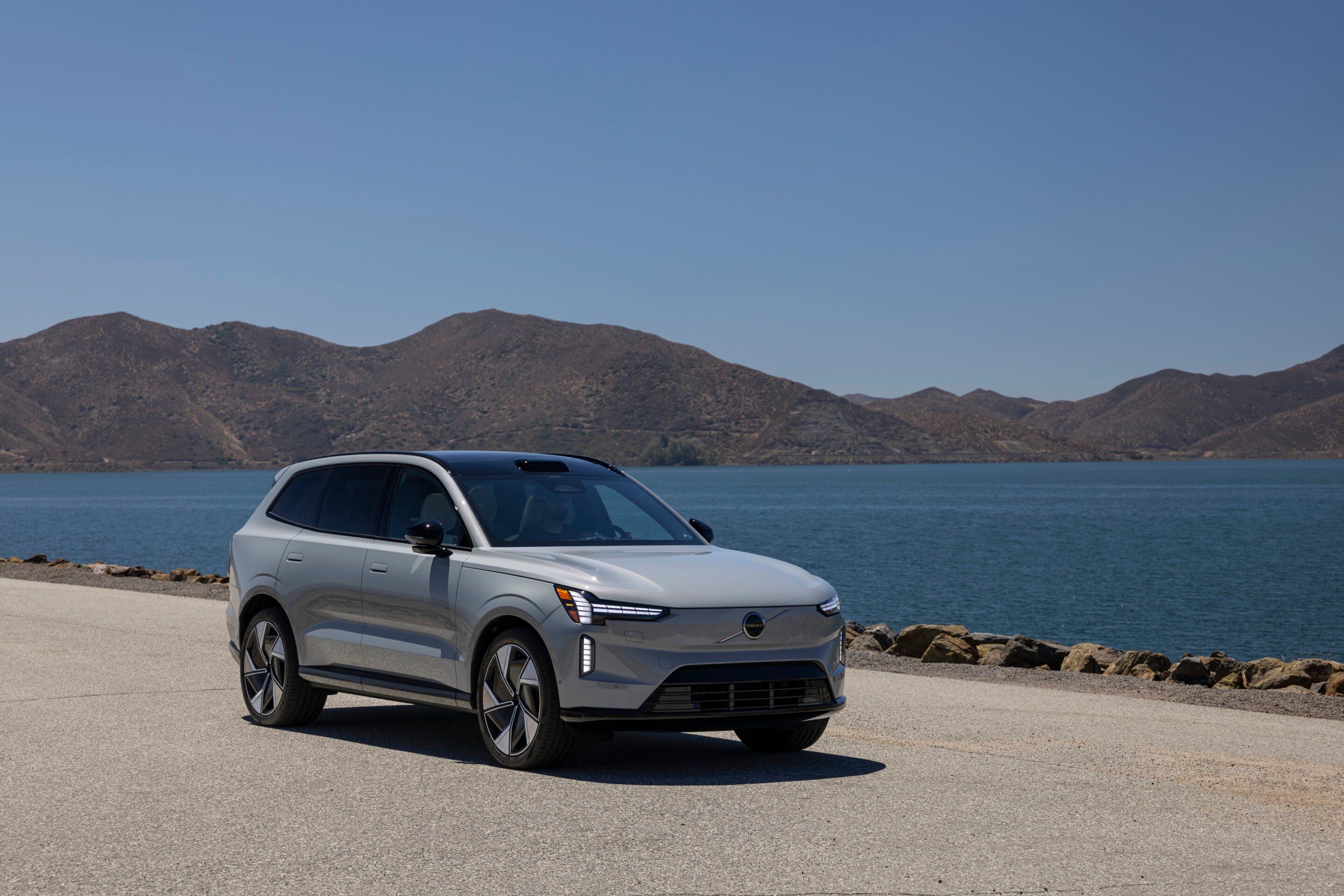
Price: From $124,990 plus on-road costs
Drivetrains: Dual-motor electric, up to 380kW, up to 570km of range
2025 sales: 209
Why you should consider it: Its cabin is spacious, luxurious and full of lovely materials
Volvo’s luxurious flagship EX90 seven-seat electric large SUV hasn’t been that big of a seller locally – the similarly-priced ICE XC90 that it was meant to replace outsold it almost four to one in 2025 – and yet it offers a lot to buyers. You won’t find a more relaxing and luxurious cabin for the money, and it’s also quite spacious. Add in faster charging with the MY26 update and it’s a strong offering at the more premium end of the market.
Kia EV9
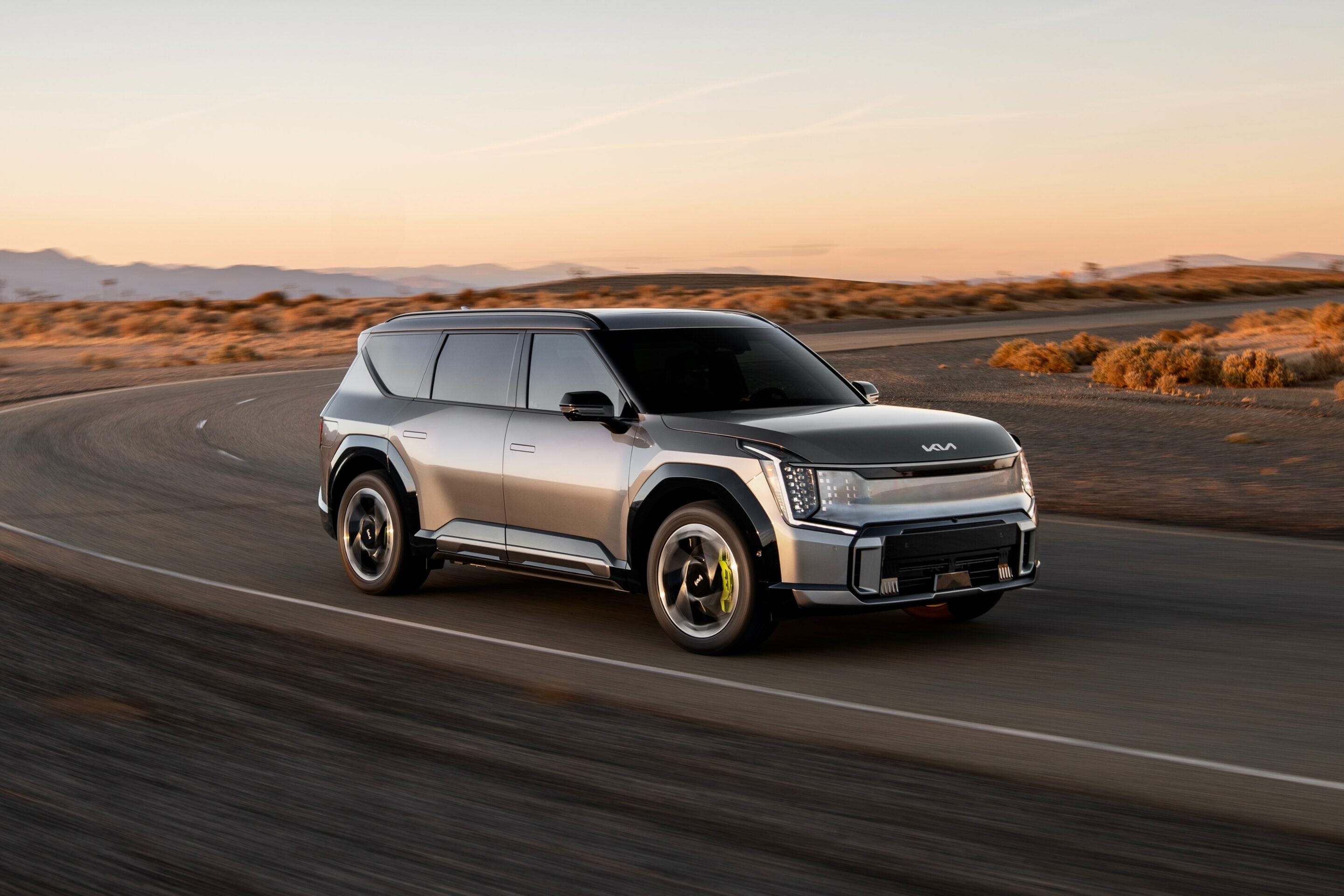
Price: From $97,000 plus on-road costs
Drivetrains: Single- or dual-motor electric, up to 374kW of power, up to 512km of range
2025 sales: 269
Why you should consider it: It’s huge inside and the new GT model is quick
Like the EX90 above, the Kia EV9 electric seven-seat large SUV hasn’t sold amazingly well in Australia and we think that’s a shame. While it’s not as luxurious inside as the EX90, it starts with a price tag $25,000 less and its interior is even larger. Seven adults will be totally comfortable in the big EV9, and its driver will be satisfied too as it’s a nice drive considering its heft and size. It bears futuristically styling and looks expensive, which counts for a lot when you’re spending this much money on a new car.
Hyundai Inster
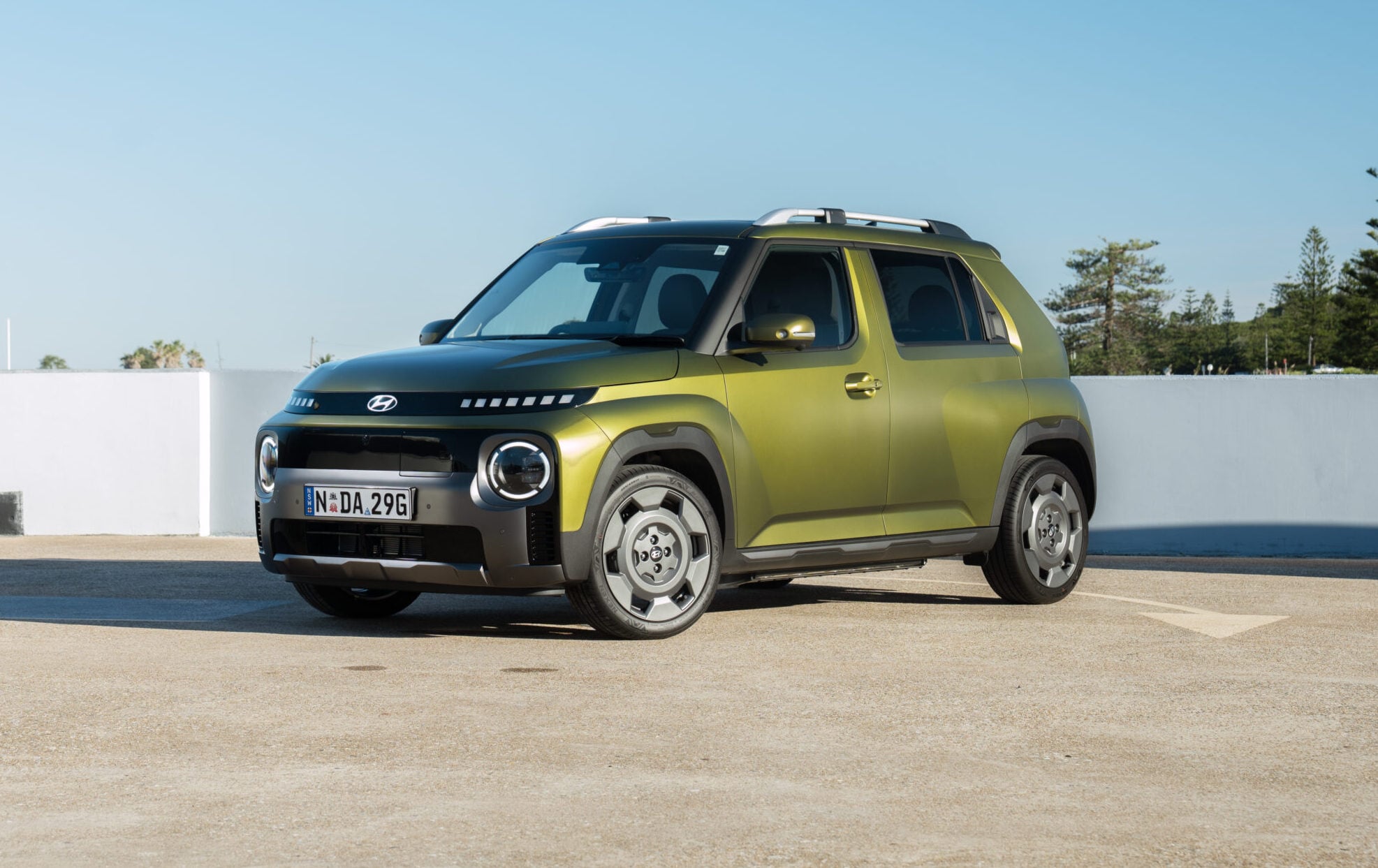
Price: From $39,000 plus on-road costs
Drivetrains: Single-motor electric, up to 85kW of power, up to 360km of range
2025 sales: 467
Why you should consider it: Just look at it. It’s so funky and cute!
The Hyundai Inster is also a car that should be selling better because it’s an ideal city-sized EV. Firstly, it’s insanely practical for a vehicle that size thanks to sliding rear seats and its boxy shape. Secondly, it drives well and even though it only produces up to 85kW of power, it’s more than peppy enough for ample propulsion around town. Sure, it’s not cheap to buy, but Hyundai’s deals help – the base model is currently on special for $35,990 driveaway, for example – and make it better value for money. Finally, it’s got so much character and in an era with a sea of the same bland SUV styling, cars with character need to be celebrated.
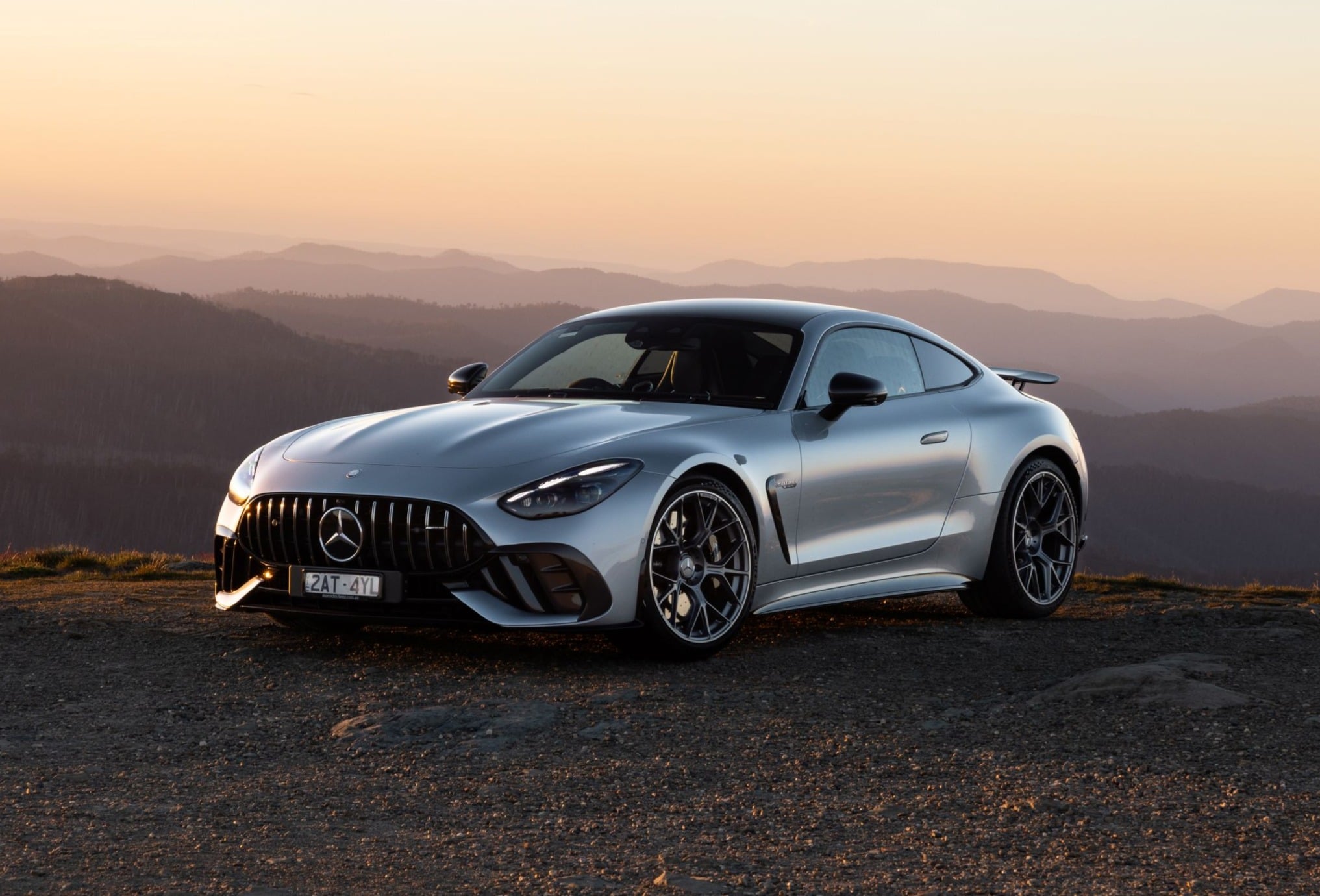
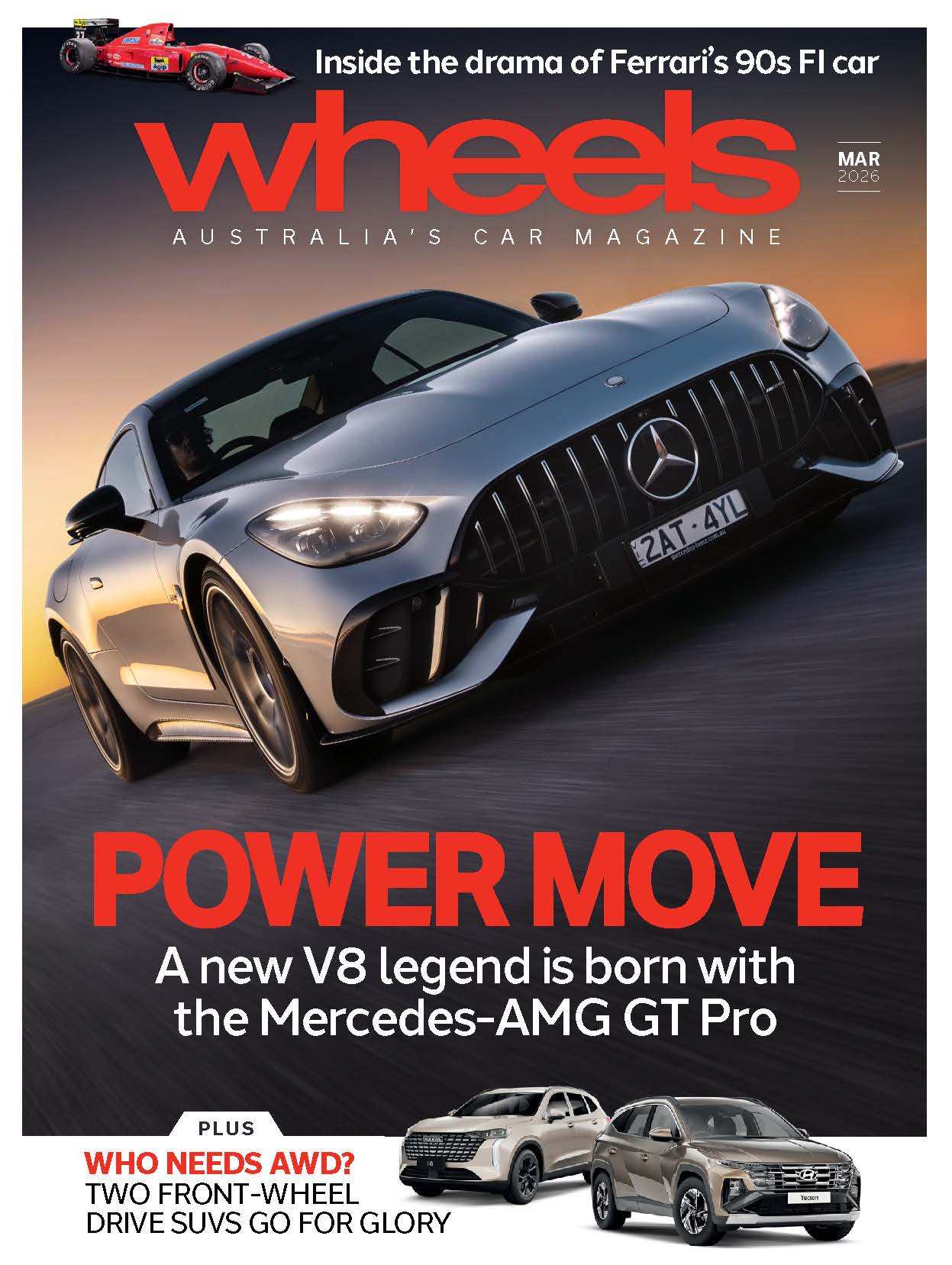
The March 2026 issue of Wheels magazine, on sale Monday March 9, featuring the awe-inspiring Mercedes-AMG GT 63 Pro on the cover.
Our feature drive of the GT 63 Pro reveals how the latest beast from Affalterbach builds on the reputation of its aggressive predecessor while adding greater usability for everyday driving – all without compromising the performance credentials that define the AMG brand.
Trent Nikolic takes a closer look at IM Motors, the premium offshoot of Chinese brand MG, and its ambitious push into the global luxury EV market via its advanced “digital chassis” technology. A timely look at the role software and electronics will play in shaping the next generation of electric vehicles.
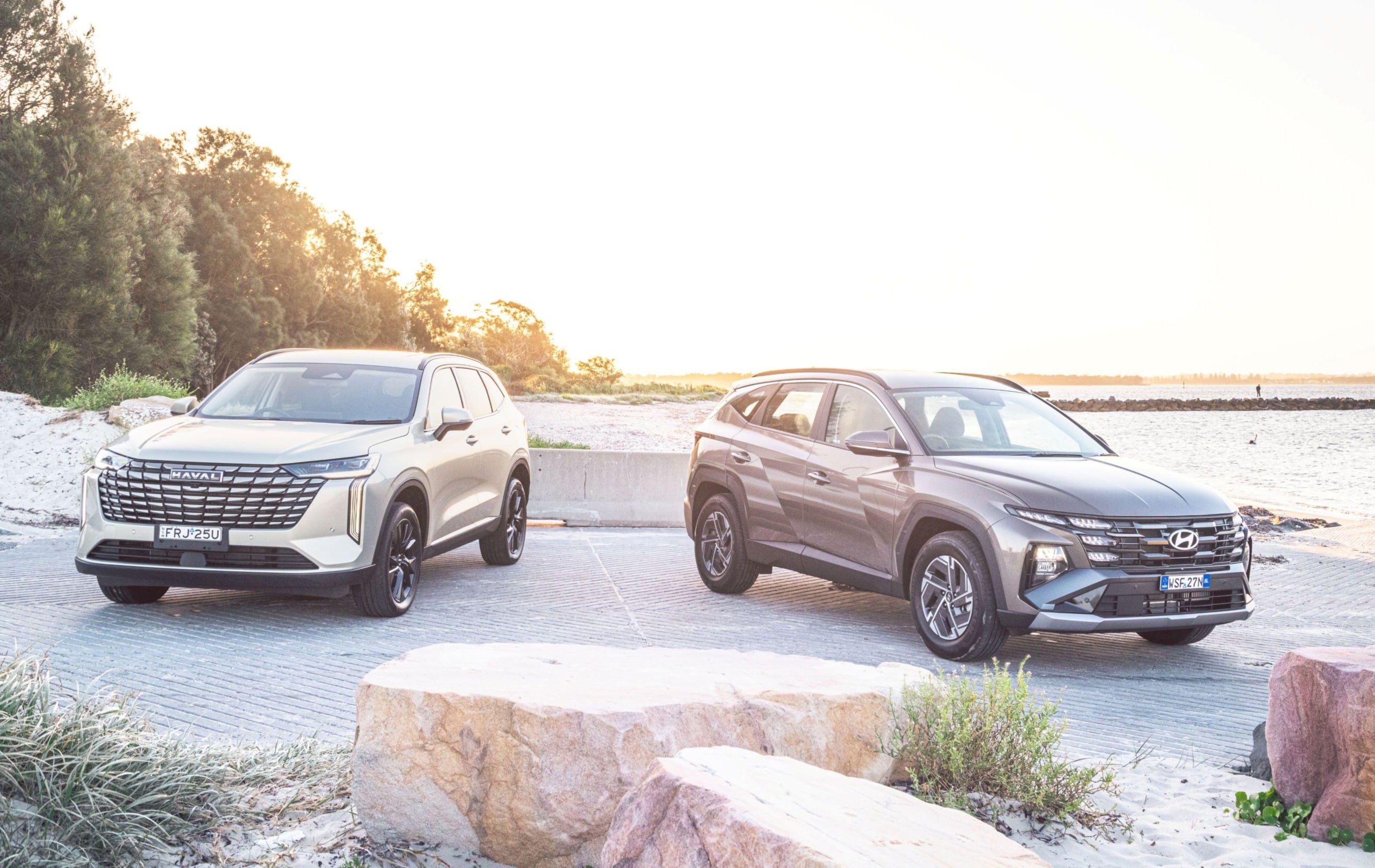
This month’s comparison pits two of Australia’s most popular hybrid medium SUVs – in the shape of the Hyundai Tucson Hybrid and the GWM Haval H6 Ultra Hybrid (below) – against each other, both in front-wheel-drive form. The test asks a simple but relevant question for many buyers: is all-wheel drive really necessary for family SUVs in everyday Australian driving conditions?
Inspired by events such as the Goodwood Revival in the UK, Wheels also visits Western Australia’s Red Dust Revival, a festival bringing together enthusiasts and historic machines in a uniquely Australian tribute to the country’s motoring heritage.
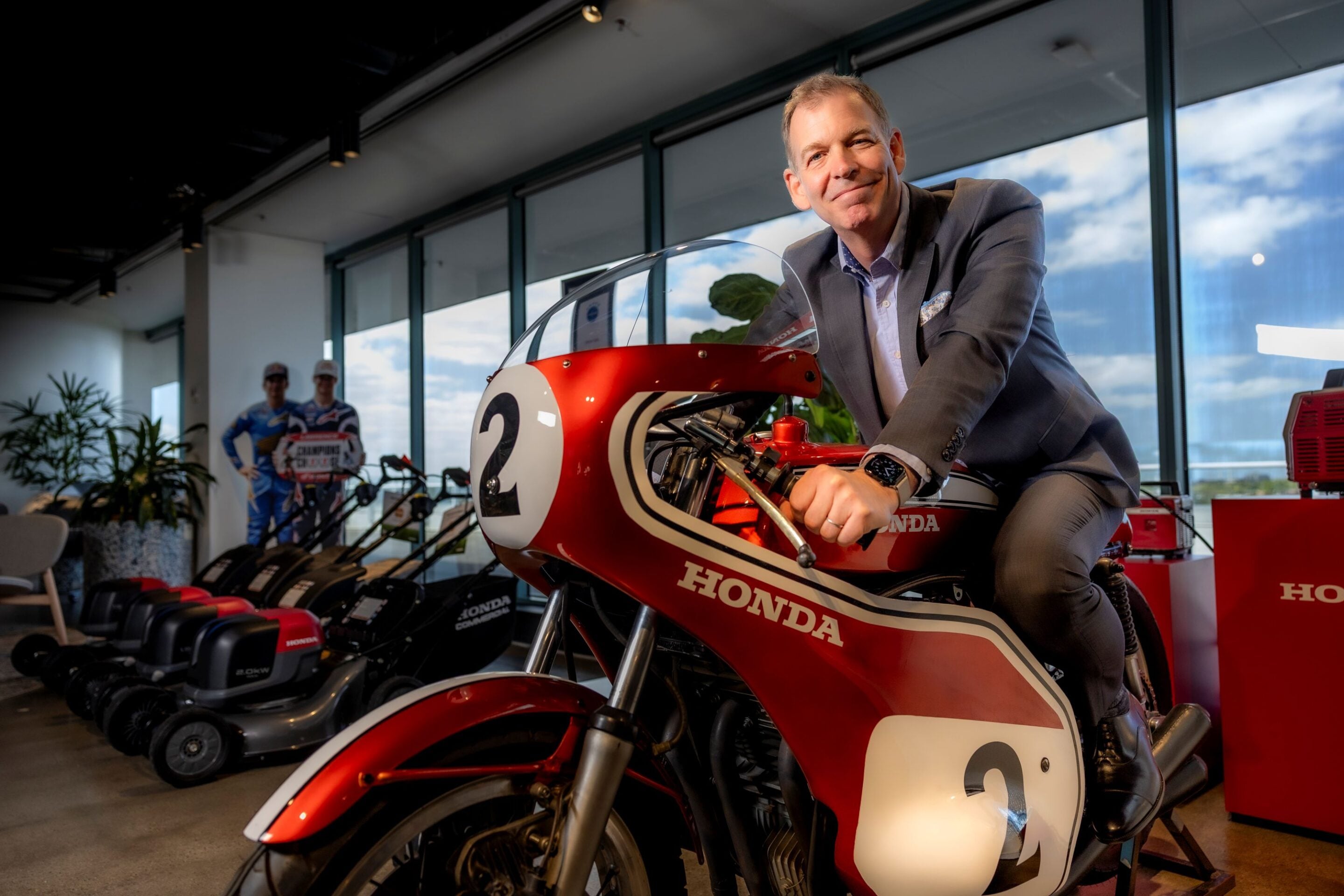
The Wheels Interview spotlights Honda Australia boss Jay Joseph (below). A 25-year Honda veteran, Joseph discusses the challenges of rebuilding the brand’s fortunes locally and outlines the strategy behind Honda’s next phase in the Australian market.
Our First Drives section this issue tests Hyundai’s upcoming Elexio electric SUV, Kia’s Tesla-chasing EV4, the new Denza B5 plug-in hybrid, BYD’s Sealion 5 PHEV and the Lexus LC500 Convertible – one of the last naturally aspirated V8 grand tourers still on sale.
Former federal industry minister Nick Minchin also contributes a guest column, reflecting on the decline of Australian manufacturing. Minchin argues that the closure of local car production marked a turning point for the country’s industrial base, blaming his own party for the loss of advanced manufacturing capability and the economic implications it had beyond the automotive sector.
Regular sections round out the issue, including Garage, Marketplace, the comprehensive 22-page Buyer’s Guide and the nostalgic Wayback Machine, which revisits Wheels coverage from March 1984 and Holden’s ambitions at the time.
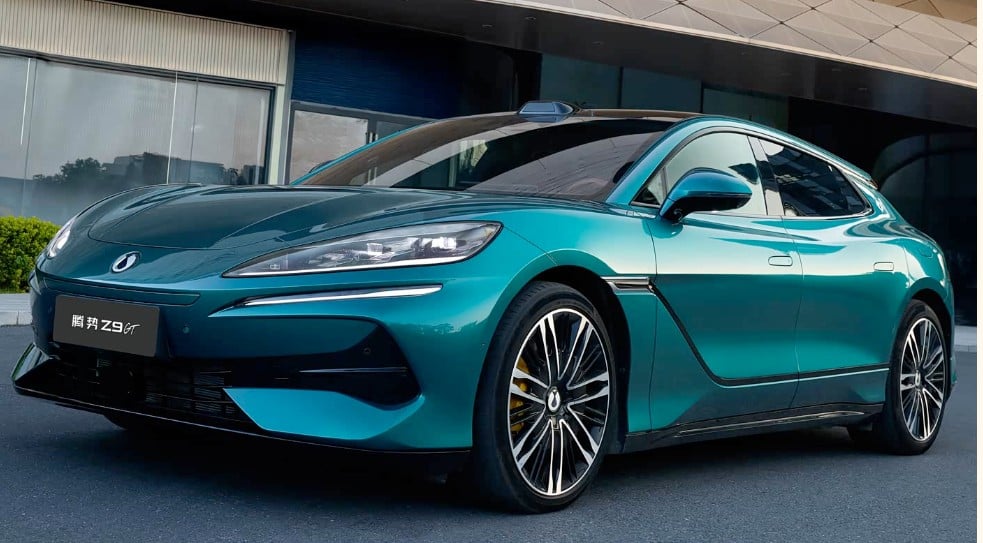
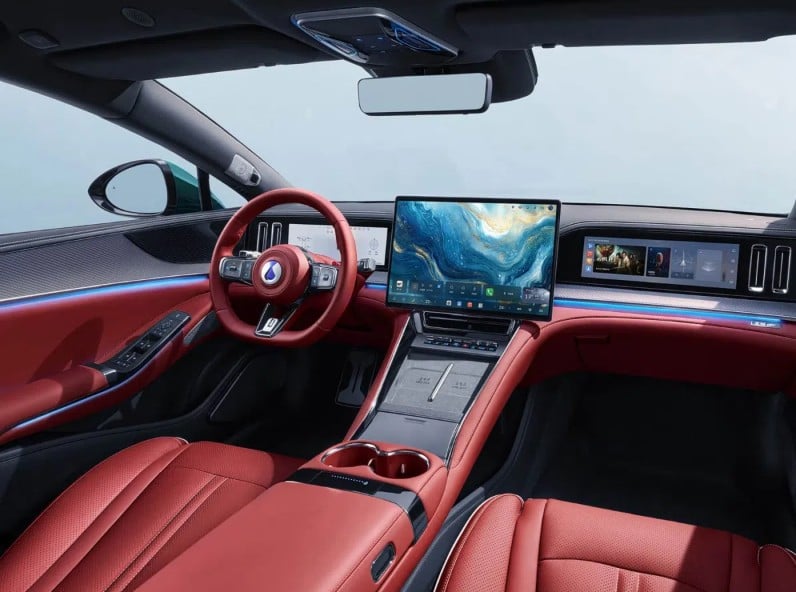
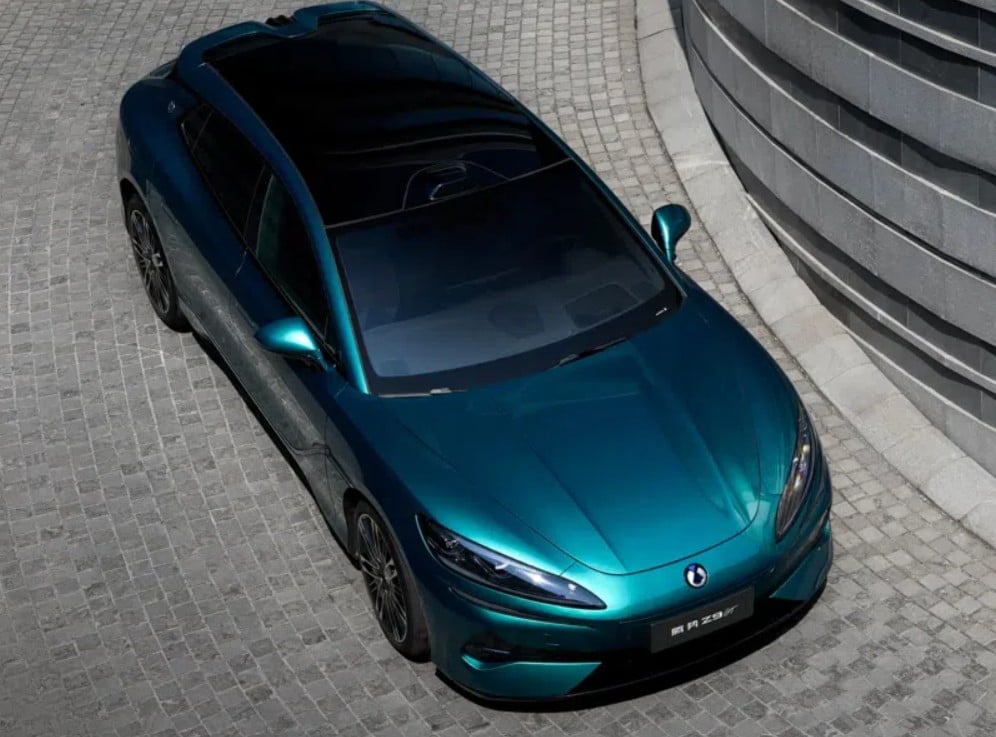
The race for electric vehicle range has taken a dramatic leap forward, with BYD’s luxury sub-brand Denza unveiling the Z9 GT – an EV that claims more than 1000km of driving range on a single charge.
According to Denza, the new Z9 GT can travel up to 1036km on a full battery under the Chinese CLTC testing cycle, positioning it among the longest-range production electric vehicles in the world.
That figure comes from the car’s largest 122kWh battery pack, although a smaller 102kWh battery will also be offered with a still-impressive 820km CLTC range.
It’s worth noting the CLTC (China Light-Duty Vehicle Test Cycle) is generally considered more optimistic than other international standards such as WLTP or the US EPA test. Even so, analysts suggest real-world range could still sit somewhere around 700–800km, which would remain exceptional for a production EV.
The Z9 GT is not only about range. The luxury electric wagon – effectively a sleek shooting-brake-style grand tourer – forms part of Denza’s push into the premium EV market dominated by brands such as Porsche, Tesla and Mercedes-Benz. The model sits on BYD’s advanced electric architecture and is available with multiple powertrain configurations, including rear-wheel drive and high-performance all-wheel-drive versions.
Fast charging is another headline feature. The Z9 GT is designed to work with BYD’s next-generation 1,500kW “flash-charging” infrastructure, with the company claiming the battery can charge from roughly 10 per cent to around 97 per cent in about nine minutes under ideal conditions.
If those figures translate to real-world use, it would dramatically reduce one of the most common concerns around EV ownership: charging time on long trips.
Importantly for Australian buyers, the Z9 GT may not remain a China-only model for long. Reports indicate the luxury Denza brand – which originated as a partnership between BYD and Mercedes-Benz — is planning international expansion, with Australia among the markets being considered for future launches.
Should it arrive locally, the Z9 GT would likely target premium electric rivals such as the Porsche Taycan and Tesla Model S, while offering dramatically longer range on paper.
In a market where range anxiety still shapes consumer perception, Denza’s bold claim of more than 1000km per charge – even under the generous CLTC system – could signal the next phase in the global EV arms race.
Recently given a mid-life facelift, the 2026 Nissan X-Trail faces stiff competition in the mid-size SUV segment, where 312,000 units were sold in Australia in 2025 – a 9.2 percent increase on 2024 – led by the Toyota RAV4 with more than 51,000 sales.
The X-Trail’s update brought revised styling, new standard equipment across the range and longer service intervals, making it one of the more practical mid-size SUV choices among more than 30 options on the market. What else recommends it?
How much does the X-Trail ST-L cost to buy?
The 2026 Nissan X-Trail range kicks off at $38,140 plus on-road costs for the entry-level ST, and here we’re testing the second-from-base ST-L in its most affordable five-seat configuration. The X-Trail range, in a higher specification with a hybrid drivetrain and all-wheel drive, hits $58,215 before on-road costs, but regardless of model, it’s quite good value for money in the mid-size SUV segment.
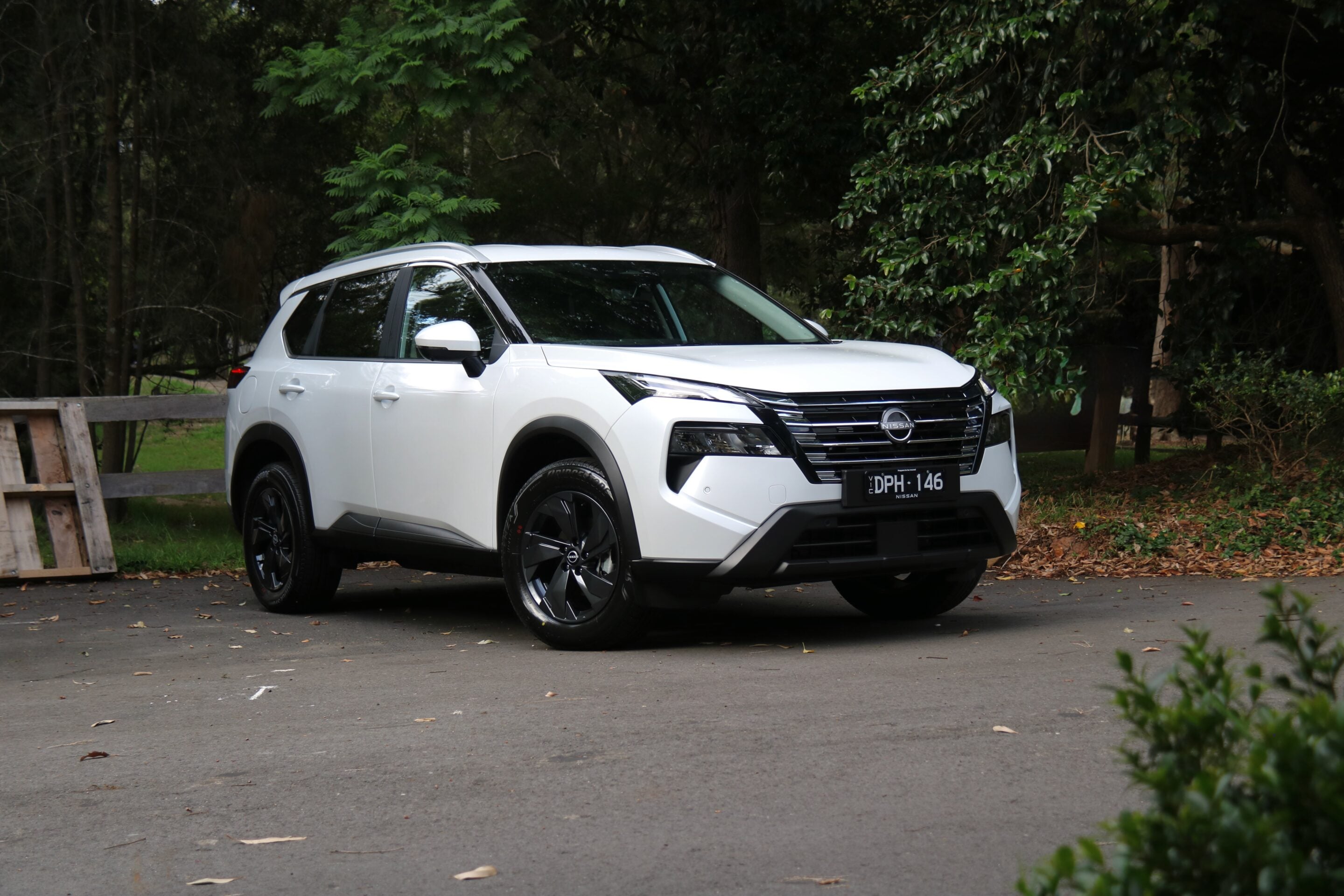
Take the five-seat two-wheel-drive ST-L we tested. It’s priced at $42,615 before on-road costs (or around $47,000 drive away, depending on which state you live in) and it’s well equipped with features like 18-inch wheels, automatic LED exterior lighting, rain-sensing wipers, ‘leather-accented’ upholstery, heated and electric front seats, a 12.3-inch touchscreen, a wireless phone charger and a full suite of active safety features. You’ll find a comprehensive equipment list at the bottom of this page.
The X-Trail ST-L 2WD’s closest rival is the $43,100 (plus on-road costs) Mazda CX-5 G25 Touring 2WD. While they share a lot of kit, against the CX-5 the sharper priced X-Trail adds features like a larger 12.3-inch touchscreen with live services, rear privacy glass, heated and electric front seats, leather upholstery and a 360-degree camera. It’s a similar story with the $45,100 (plus on-road costs) Hyundai Tucson Elite, which is also more expensive than the X-Trail ST-L but similarly equipped.
How practical is the X-Trail ST-L?
The cabin of the current shape ‘T33’ X-Trail has been one of the best all-rounders in the mid-size SUV segment since its 2021 release, thanks to the high quality, impressive practicality and easy-to-use technology. The brand didn’t update much inside the X-Trail’s cabin with the mid-life update and it’s still one of the best options for practicality in the segment.
Material quality is impressive thanks to soft stitched leather-like trims around the cabin, textured wood-like centre console trim and tight switchgear.
A 12.3-inch touchscreen is fitted to the entire X-Trail range, which is easy to use and sharp to look at. It could be a bit faster and oddly doesn’t feature inbuilt sat-nav, but the wireless Apple CarPlay and Android Auto is easy to connect. Pleasingly for usability, it still features shortcuts on the driver’s side with smartphone mirroring on the screen. The separate buttons for features like the 360-degree camera further help with practicality, as do the separate climate control below.
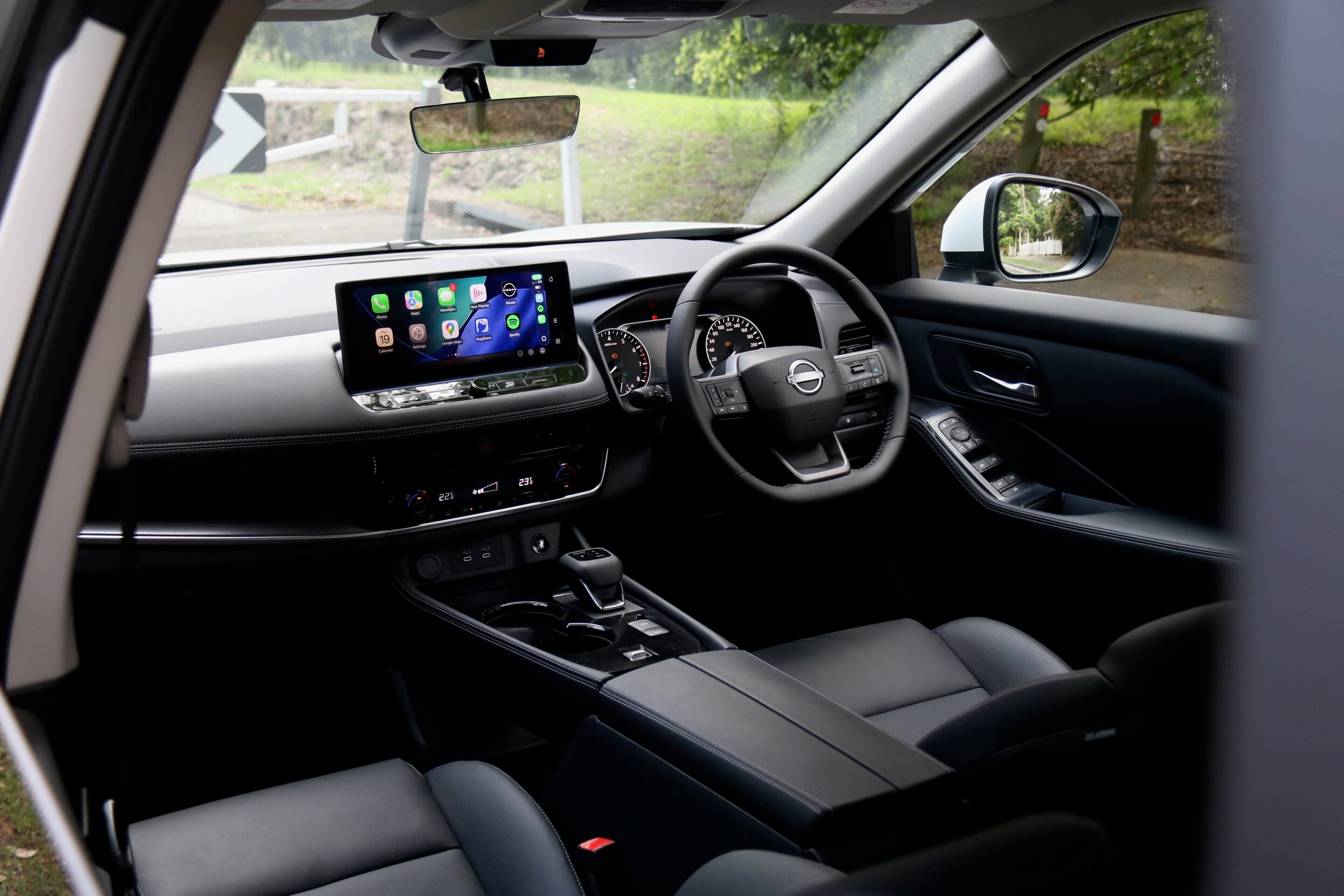
Storage space is handled by large door bins, a big central box underneath the centre armrest, a large tray underneath the centre console and an open tray with the – quite effective – wireless phone charger.
Occupants in the rear seat of the X-Trail will be quite comfortable as it’s one of the most spacious in the mid-size SUV segment. For starters, the doors open to 90 degrees, which is great for getting child seats in and out, and the door opening itself is quite wide. The seats slide and recline for more space and both legroom and headroom is impressive, and much more plentiful than the CX-5. Amenities include USB charging ports, air vents, map pockets, door pockets and a central armrest.
Behind the rear seats lies a large 575 litres of space, which is 36 litres larger than the Tucson and 137 litres larger than the CX-5. Helping practicality further is Nissan’s ‘Divide-N-Hide’ cargo management system, which allows for – as the name suggests – both dividing and hiding of items in the boot.
Fold the rear seats and space isn’t quite as impressive at 1396 litres (the Tucson holds 1860L) but it’s still a large area and the seats fold flat and in a 40:20:40 split too. Beneath the boot floor lies a space-saver spare. In terms of a well-rounded cabin, the X-Trail is an excellent mid-size SUV.
How fuel efficient is the X-Trail ST-L?
All petrol X-Trails are fitted with a naturally-aspirated 2.5-litre four-cylinder petrol engine making reasonable outputs of 135kW and 244Nm. A CVT automatic transmission is standard, while both front-wheel drive (five-seater) and all-wheel drive (seven-seater) drivetrain configurations are available. The ST-L and above can also be had with Nissan’s ‘e-Power’ hybrid system, mated as standard with all-wheel drive and only five seats in this market.
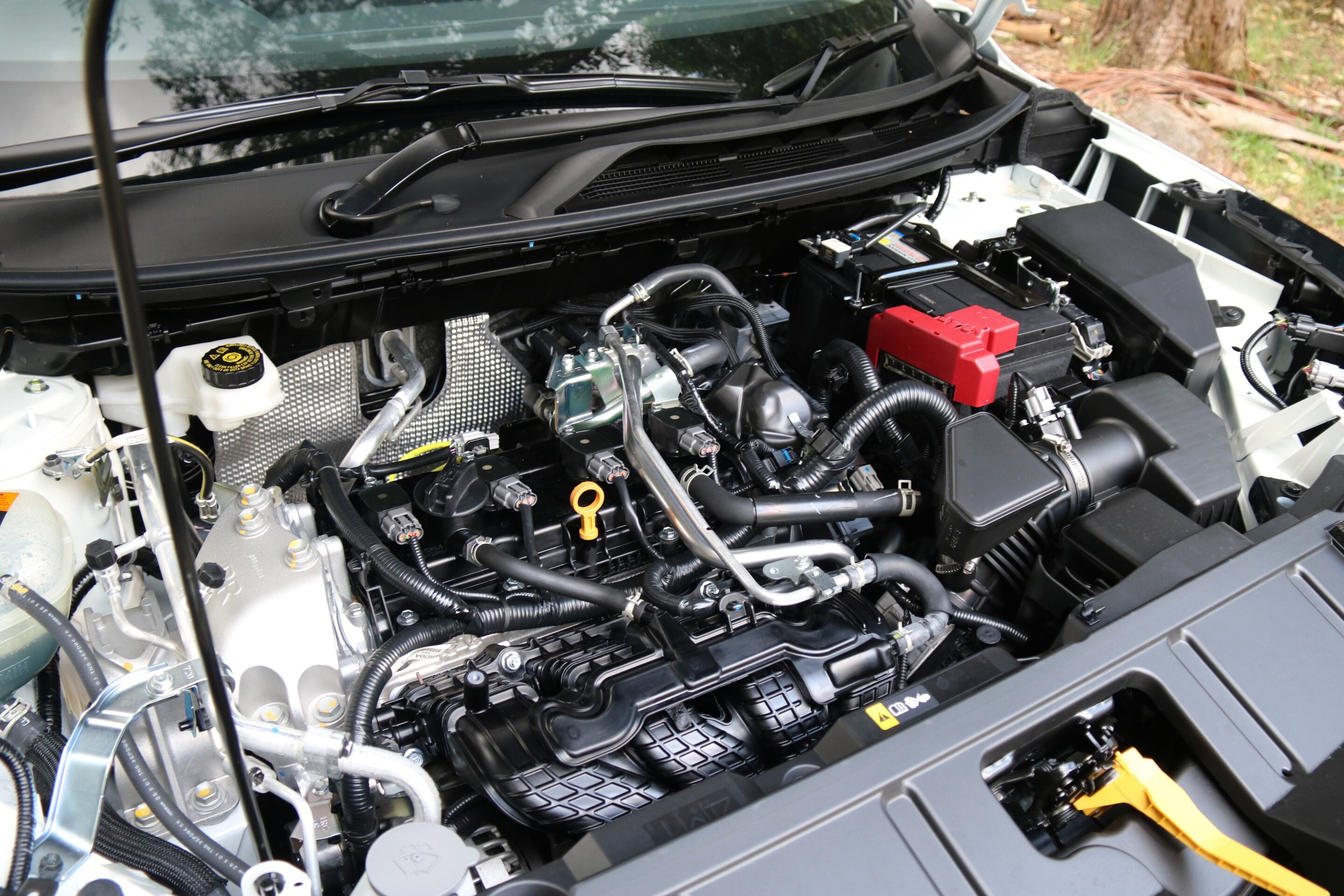
It’s true that there are more exciting drivetrains available in the mid-size SUV class with more performance or refinement, but the X-Trail’s petrol engine is par for the course for everyday use. It can be a little loud under full throttle, and nailing the throttle hardly pushes you back into your seat, but again, it’s adequate for its intended audience. Nissan doesn’t claim a 0-100km/h time for the X-Trail, but it’s sharp enough not to feel slow in the cut and thrust of daily traffic. In other words, it’s more than acceptable for most buyers and the e-Power hybrid X-Trail is a stronger performer if you so desire.
The CVT is also inoffensive during all the different driving scenarios we deal with in urban areas. We’ve seen big improvements in the type, and the X-Trail’s ‘box is a good example. Its seven stepping points – to replicate a gearbox with actual gears – performs solidly, and using the paddle shifters to control them makes a meaningful difference. Is it as responsive as the six-speed auto in the CX-5? Of course not, but it’s still a good attempt to make a CVT feel normal.
Combined claimed fuel consumption for the petrol X-Trail ST-L five-seat is 7.4L/100km and after a week of mostly urban driving, we achieved 8.7L/100km. That included a 5.3L/100km long highway run, so it can be quite efficient in the right situation. The hybrid e-Power adds both performance and refinement to the X-Trail range, but it’s also a $6200 more expensive, so do your sums to work out which drivetrain suits you best.
What is the X-Trail like to drive?
For most buyers, the X-Trail is a solid choice when it comes to the driving experience. For its likely intended daily duties, it nails the basics: the visibility is good, the steering weighting is light at urban speeds, and it’s quite easy to drive and park thanks to the clear 360-degree camera. The active safety features are also working away in the background without grating – the speed limit warning doesn’t make noise and the lane keeping assistance is subtle – as well. Unlike many rivals. Nissan’s ‘ProPilot’ adaptive lane guidance also steers quite accurately.
However, there are some areas that need improvement. The low speed ride on our test car was quite firm and smaller bumps were felt through the cabin more than expected, while the steering feedback is also too light for our liking at highway speeds. A CX-5 is more fun to drive, and a Tucson is a better all-rounder when it comes to the ride and handling balance.
What warranty covers the X-Trail ST-L?
The entire Nissan range is covered by a five-year/unlimited km warranty that can be extended up to 10 years/300,000km with annual servicing at a Nissan dealership. If owners adhere to that condition, Nissan’s warranty is one of the longest on the new car market.
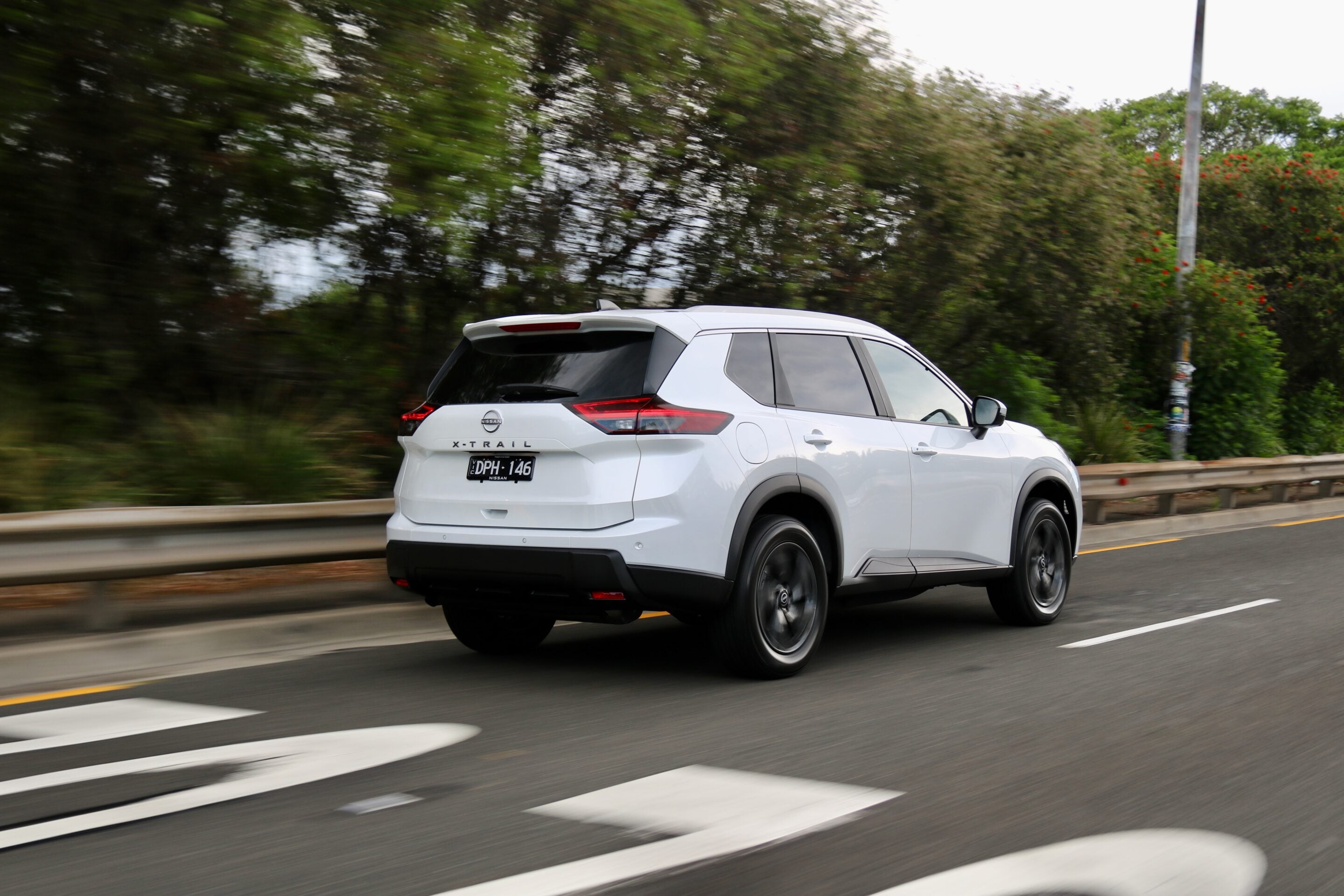
Five years/75,000km of servicing costs $1995 or $399 per service, and with the facelift, Nissan extended annual service intervals to 15,000km (up from shorter 10,000km) to match rivals. For reference, a CX-5 Touring costs $2240 to service over the same period, and its warranty finishes after five years.
Should I buy a Nissan X-Trail ST-L?
It’s frequently overlooked in discussions on the segment leaders, but we think the Nissan X-Trail ST-L is worth close consideration for those wanting a solid, family-friendly mid-size SUV. It’s good value for money in the segment, well equipped, quite practical and can benefit from coverage by one of the longest new car warranties in Australia.
Counting against it are a fine (but not overly noteworthy) drivetrain, firm low-speed ride quality and a steep hybrid premium, but all things considered, we think that the X-Trail deserves far more attention.
X-Trail ST-L specifications:
| Model | Nissan X-Trail ST-L five-seat 2WD |
|---|---|
| Price | $42,615 plus on-road costs |
| Engine | 2488cc naturally aspirated four-cylinder petrol |
| Power | 135kW (@ 6000rpm) |
| Torque | 244Nm (@ 3600rpm) |
| Transmission | CVT automatic, front-wheel drive |
| Claimed combined fuel consumption | 7.4L/100km |
| Combined CO2 emissions | 174g/km |
| Fuel type/tank size | 91RON regular unleaded, 55 litres |
| Dimensions (L/W/H/WB) | 4690/1840/1725/2705mm |
| Bootspace | 585 litres (rear seats up), 1396 litres (rear seats folded) |
| Tare mass | 1546kg |
| Braked towing capacity | 2000kg |
| Warranty | 5-year/unlimited km, extendable up to 10-year/300,000km with dealer servicing |
| 5-year/75,000km service cost | $1995 ($399 per service) |
| On sale | Now |
X-Trail ST-L standard features:
- 18-inch alloy wheels with a space-saver spare
- Dusk- and rain-activated LED exterior lighting
- Rain-sensing automatic wipers
- Keyless entry with push button start
- Roof rails
- Rear privacy glass
- Heated and auto-folding mirrors
- Leather-accented upholstery
- 10-way electric front seats with heating
- Leather-wrapped steering wheel with paddle shifters
- Dual-zone automatic climate control with rear air vents
- 7.0-inch digital driver’s display
- 12.3-inch touchscreen
- NissanConnect connected car services
- Wireless Apple CarPlay and Android Auto
- AM/FM/DAB+ digital radio
- Bluetooth phone and audio streaming
- Six-speaker sound system
- 4x USB charging ports
- Wireless phone charger
- ‘Divide-N-Hide’ cargo management system
- 40/20/40-split rear seat with sliding
- 7x airbags
- Autonomous emergency braking with junction assist and pedestrian/cyclist detection
- Adaptive cruise control with ‘ProPilot’ adaptive lane guidance
- Lane keeping assistance
- Blind-spot monitoring
- Rear cross-traffic alert
- Driver attention monitoring
- Rear door alert
- Auto high beam
- Traffic sign recognition
- Tyre pressure monitoring
- Front and rear parking sensors
- 360-degree camera
Mercedes-Benz is preparing a new generation of its A-Class hatchback, with the next version of the brand’s smallest passenger car expected to adopt electric power while remaining in the line-up into the next decade.
The current A-Class has been on sale since 2018 and is due to remain in production until around 2028, after its lifecycle was extended following a shift in manufacturing. Production will move to Mercedes-Benz’s Kecskemét plant in Hungary, freeing up the company’s Rastatt factory in Germany to build the upcoming CLA sedan.
According to comments reported by Auto Express, the move will allow Mercedes to keep the A-Class in production for several more years before launching a new generation based on the company’s latest compact vehicle platform.
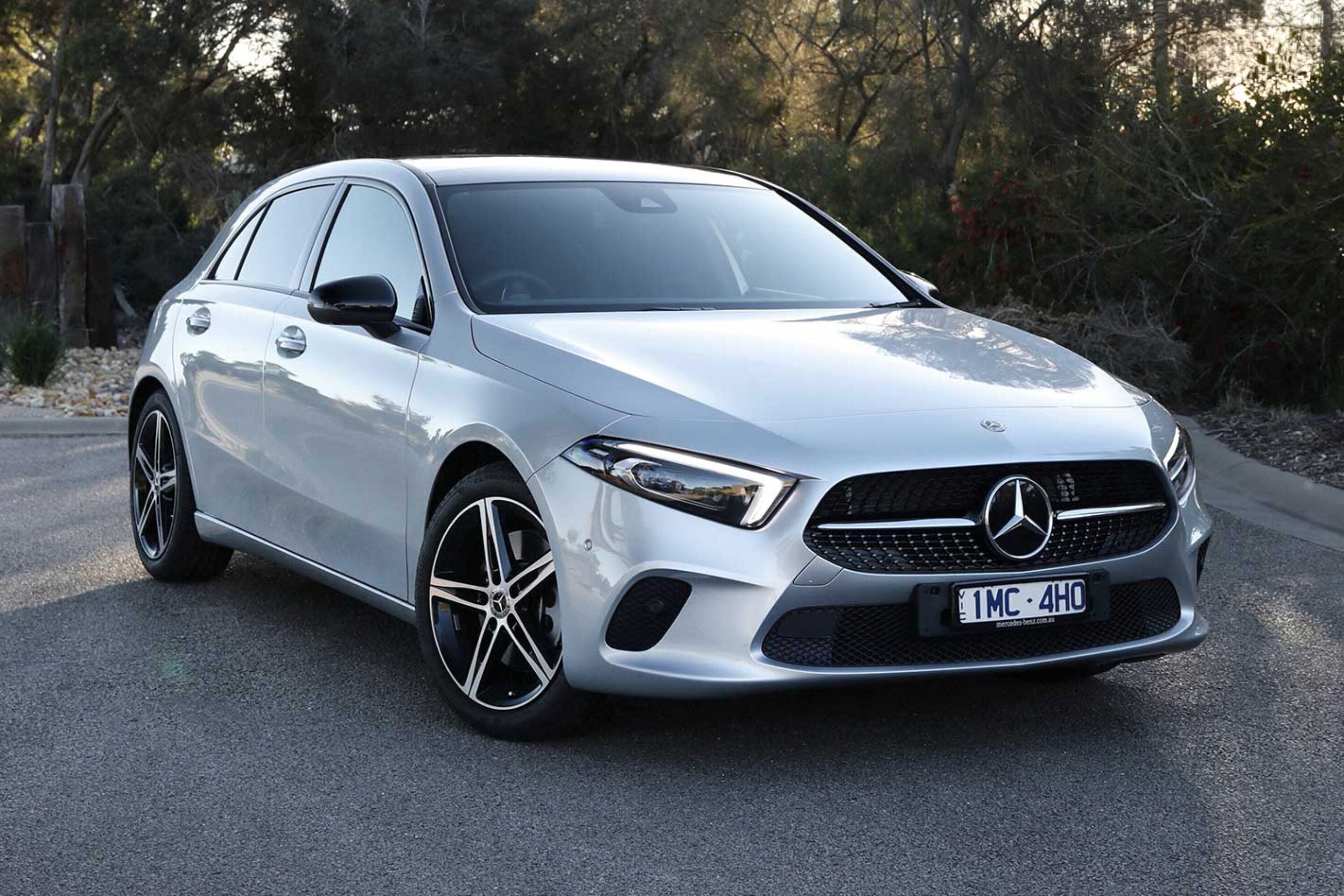
“The current A-Class is going to the Hungary plant next year. The plant can cater to the next generation of A-Class,” Mercedes exterior design director Robert Lesnik told Auto Express.
The new model is expected to be built on the brand’s forthcoming MMA (Mercedes Modular Architecture) platform, which has been designed to support both electric and hybrid drivetrains. The flexible platform will underpin several compact Mercedes vehicles, including the next CLA, CLA Shooting Brake and the GLA and GLB SUVs.
Originally planned as a four-model family, the A-Class is now tipped to become a fifth vehicle in the MMA line-up.
Using the CLA as a reference point, Lesnik suggested the adaptable nature of the architecture will allow Mercedes to adjust its powertrain strategy if needed. “With CLA we had an EV then hybrid, but A-Class is three years away. MMA platform is flexible, which is great because in the future we’ll have to change our minds faster than we do now,” he said, according to Auto Express.
If the electric version proceeds, it would position the next A-Class as a rival to upcoming compact EVs such as the Audi A3 e-tron.
In terms of styling, the next-generation hatch is expected to move away from the upright proportions of the original late-1990s A-Class. Instead, designers are aiming for a more conventional, sporty hatchback profile.
“The next A-Class should have a more stylish cab-back body rather than cab-forward,” Lesnik said in comments reported by Auto Express.
The design direction means the new model is unlikely to adopt the highly aerodynamic silhouette used by the EQE and EQS electric sedans. Instead, it will feature a longer bonnet and more traditional proportions similar to the latest CLA.
Mercedes is also expected to retain the familiar A-Class name rather than adopt the EQ branding used for earlier electric models.
For car nuts it’s the high point of any classic movie – the edge-of-your-seat car chase that raises the heart beat and quickens the pulse through every twist and turn.
Now car insurer Canstar has set out to discover the most thrilling cinematic car chase of all time with a scientific survey of more than 150 volunteers as they watched a selection of iconic films, measuring their heart rate (BPM) and heart rate variance (HRV) to determine an overall ‘Excitement Score’ for each film.
And the winner as ‘most exciting’? Mad Max: Fury Road (2015) topped the list as the most ‘scientifically exciting’ car chase, raising average heart rates by a whopping 25 BPM (37 per cent). One of three franchise film entries to make the list, George Miller’s post-apocalyptic masterpiece feels like one continuous car chase, the HRV measurement dropping 21 per cent, or the steepest dive of all films tested.
In second place was 1998 thriller Ronin, starring Robert De Niro, which was the oldest film to make the top 10. Tearing through the narrow streets of Paris, this chase raised pulses by 23 BPM (34 per cent), proving that precision and realism can be just as electrifying as CGI and explosions.

Rounding out the top five were Edgar Wright’s Baby Driver, Tom Cruise’s Mission: Impossible – Fallout, and the James Bond film, Quantum of Solace.
Other key findings from the survey included that Brad Pitt’s F1 (2025) was the highest-ranked movie released in the last year, while the Fast and the Furious series had more entries in the top 25 (four) than any other franchise.
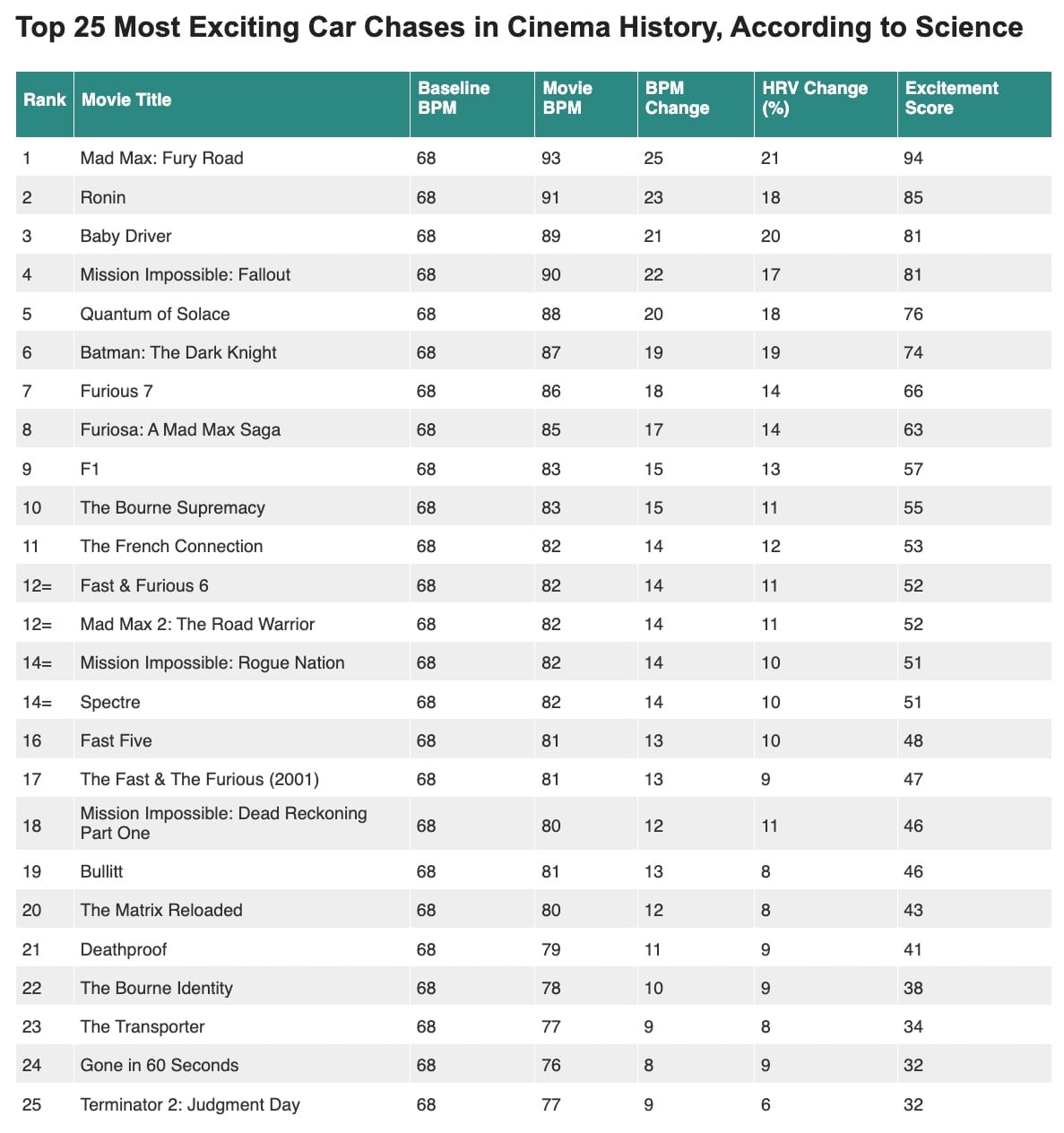
How did Canstar measure the data? Over 150 volunteers were recruited to watch iconic car chase sequences, which were curated from global critics’ lists, Reddit suggestions, and editorial picks. Each participant was fitted with a heart rate monitor tracking BPM and Heart Rate Variability (HRV) to measure changes relative to their individual resting baseline.
BPM measures how fast the heart is beating and the bigger the jump from resting rate, the more thrilling the scene. HRV tracks the milliseconds between beats. When stressed or anxious, the variance drops, and the heart beats more consistently.
Scenes that caused the most significant drop in HRV were those that had viewers holding their breath and both metrics were combined to calculate an overall Excitement Score out of 100, with Mad Max: Fury Road earning the highest score at 94.
The full results of Canstar’s survey can be found here.
Following WhichCar by Wheels‘ report that Tesla’s six-seat Model Y L had received government homologation approval to be brought to Australia, the electric vehicle manufacturer has confirmed that where there’s smoke, there’s fire.
A statement from Tesla Australia confirms, ‘the Model Y L will be coming to Australia and New Zealand’. Model Y L is already being produced at the Tesla Gigafactory Shanghai for the Chinese domestic market, and that production will now extend to RHD markets Australia and New Zealand.
According to Tesla, ‘the versatility of the Model Y L will appear to those wanting more room and more seats form Australia’s best-selling electric vehicle’. Larger than the standard Model Y in both length and height, Tesla claims that the third row will be useful because that extra length is in the wheelbase.
Model Y L’s wheelbase is 150mm longer than regular Model Y (out to 3040mm), while overall length is also 177mm longer. It’s 44mm taller, but width remains the same at 1920mm (without mirrors). This would be the first time since the discontinued Model X, that Tesla has offered a six-seat model in Australia.
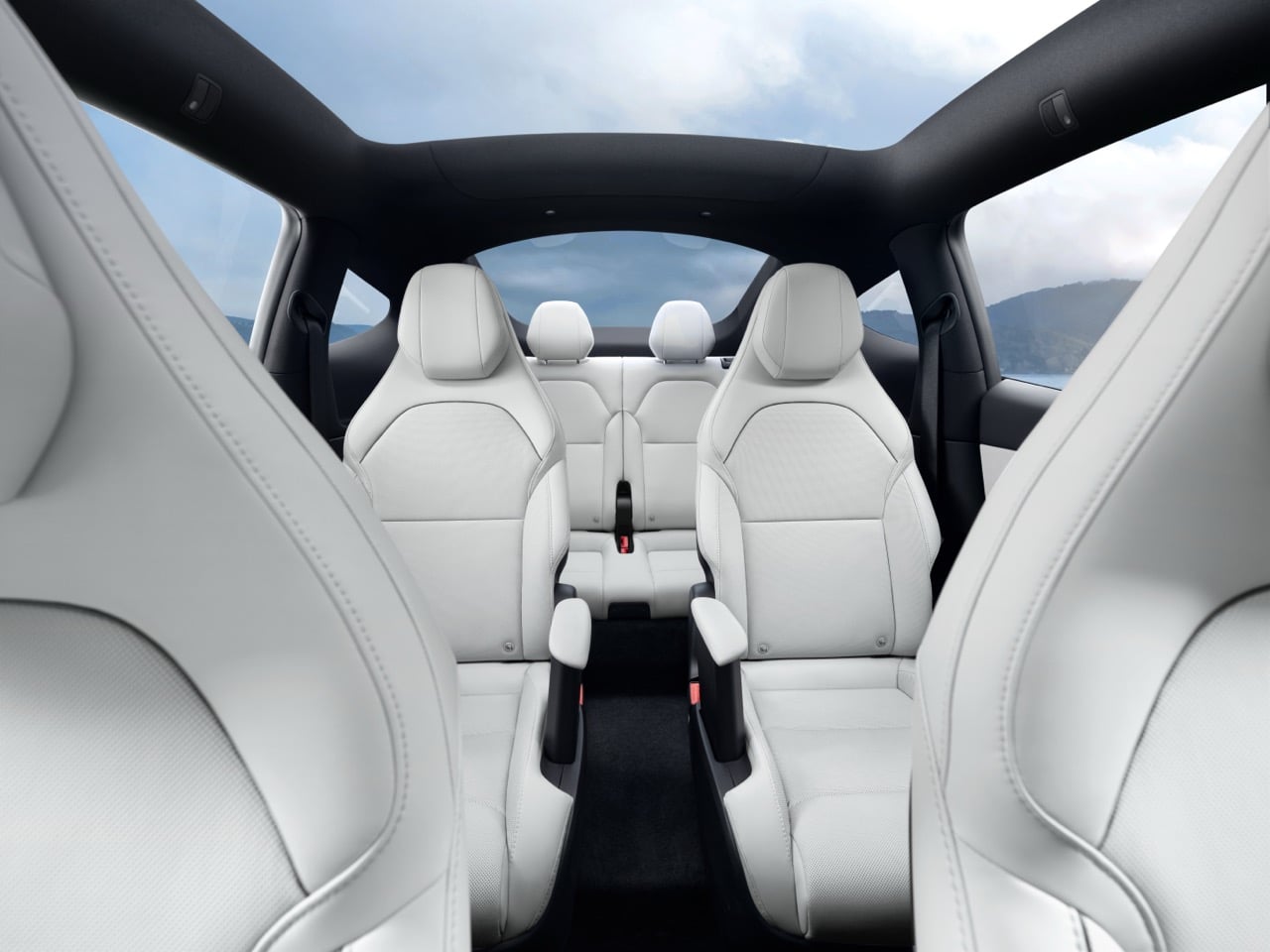
Tesla Australia won’t confirm an arrival or on-sale date as yet, but would state that customers could access Model Y L ‘this year’. Model Y L will be covered by Tesla’s five-year/unlimited kilometre warranty, with an eight-year warranty for the battery pack.
At the time of writing, Model Y starts from $58,900 for the Premium RWD, $68,900 for the Premium Long Range RWD, and $89,400 for the Performance AWD, all before on-road costs. It would be fair to assume – if Model Y L follows the same three-model line-up – that the six-seater would sit above these price points.
With more than 72,000 sales in the last three years, Model Y has been Australia’s best-selling electric vehicle since 2023, with a claimed range of up to 600km, depending on model. Given the Model Y L will be heavier than the regular Model Y, it’s safe to assume that claimed range will be revised back a little, with Model Y L getting two electric motors, AWD and an 85kWh lithium-ion battery pack.
WhichCar by Wheels will report back with range and pricing details as soon as they are available.
First published in the April 1969 issue of Wheels magazine, Australia’s best car mag since 1953. Subscribe here and gain access to 12 issues for $109 plus online access to every Wheels issue since 1953.
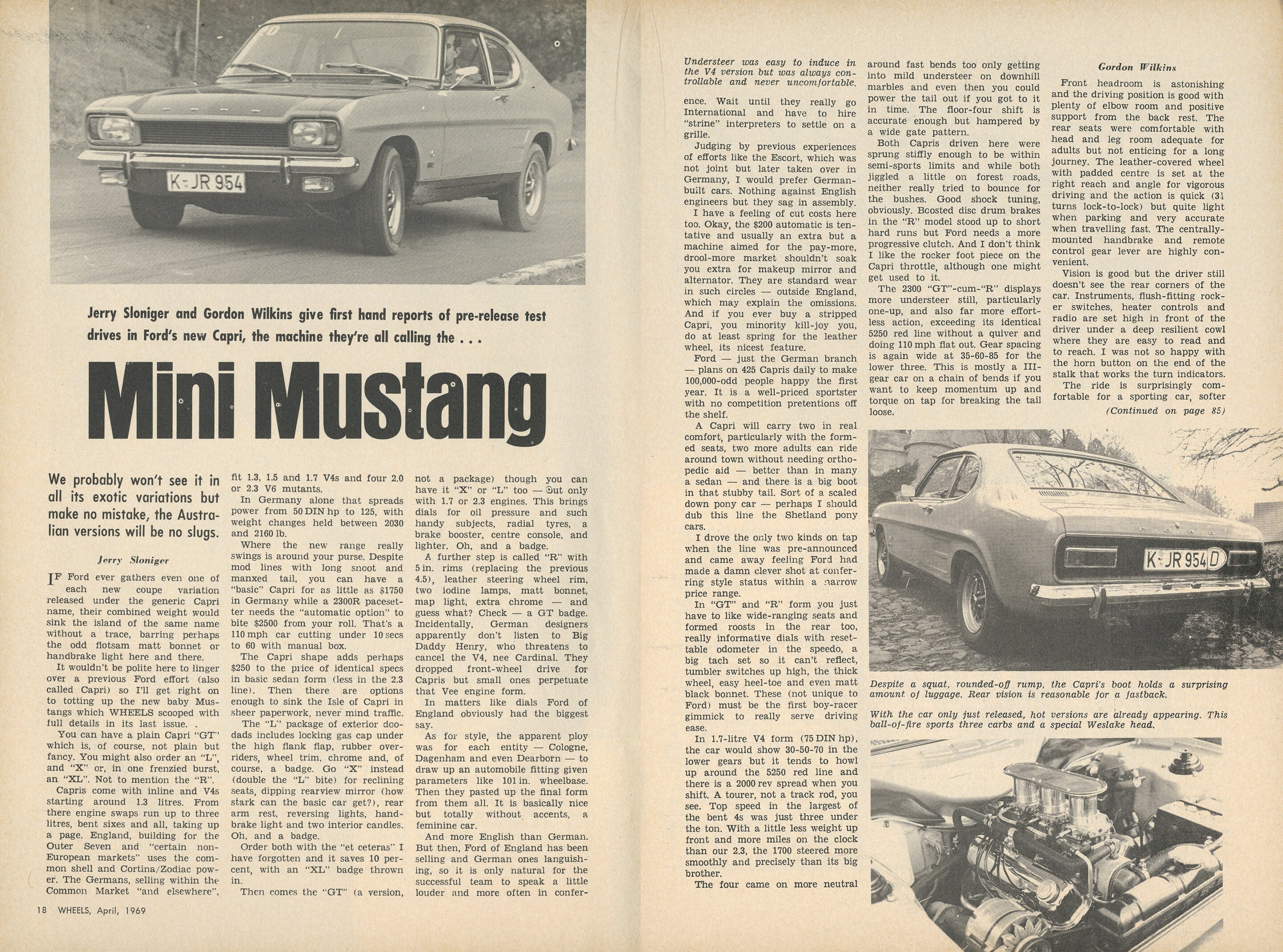
If Ford ever gathers even one of each new coupe variation released under the generic Capri name, their combined weight would sink the island of the same name without a trace, barring perhaps the odd flotsam matt bonnet or handbrake light here and there.
It wouldn’t be polite here to linger over a previous Ford effort (also called Capri) so I’ll get right on to totting up the new baby Mustangs which Wheels scooped with full details in its last issue.
You can have a plain Capri GT which is, of course, not plain but fancy. You might also order an L, and X or, in one frenzied burst, an ‘XL. Not to mention the R.
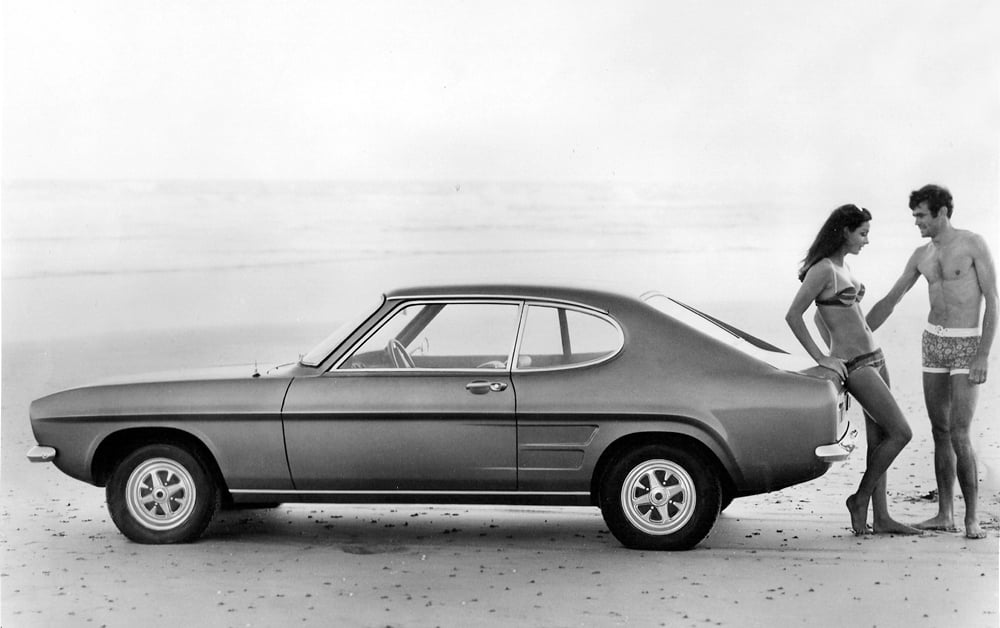
Capris come with inline and V4s starting around 1.3 litres. From there engine swaps run up to three litres, bent sixes and all, taking up a page.
England, building for the Outer Seven and “certain non-European markets” uses the common shell and Cortina/Zodiac power. The Germans, selling within the Common Market “and elsewhere”, fit 1.3, 1.5 and 1.7 V4s and four 2.0 or 2.3 V6 mutants. In Germany alone that spreads power from 50 DIN hp to 125, with weight changes held between 2030 and 2160 lb.
Where the new range really swings is around your purse. Despite modern lines with long snout and manxed tail, you can have a ‘basic’ Capri for as little as $1750 in Germany while a 2300R pacesetter needs the ‘automatic’ option to bite $2500 from your roll. That’s a 110 mph car cutting under 10 secs to 60 with manual box.
The Capri shape adds perhaps $250 to the price of identical specs in basic sedan form (less in the 2.3 line). Then there are options enough to sink the Isle of Capri in sheer paperwork, never mind traffic.
The L’ package of exterior doodads includes locking gas cap under the high flank flap, rubber overriders, wheel trim, chrome and, of course, a badge.
Go X instead (double the L bite) for reclining seats, dipping rear-view mirror (how stark can the basic car get?), rear arm rest, reversing lights, handbrake light and two interior candles. Oh, and a badge.
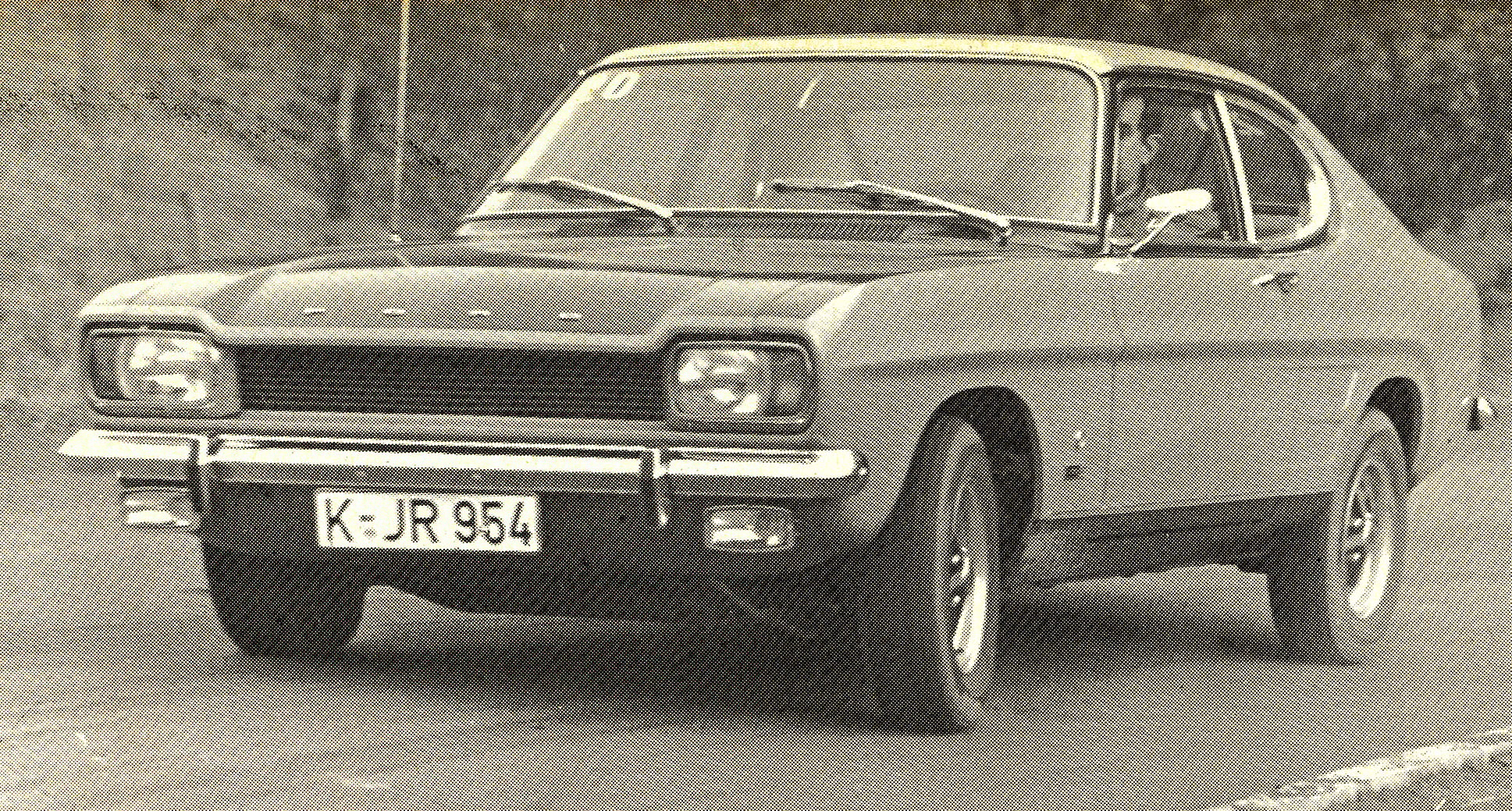
Order both with the et ceteras I have forgotten and it saves 10 per cent, with an XL badge thrown in.
Then comes the GT’ (a version, not a package) though you can have it X or L too – but only with 1.7 or 2.3 engines. This brings dials for oil pressure and such handy subjects, radial tyres, a brake booster, centre console, and lighter. Oh, and a badge.
A further step is called R with 5 in. rims (replacing the previous 4.5), leather steering wheel rim, two iodine lamps, matt bonnet, map light, extra chrome – and guess what? Check – a GT badge.
Incidentally, German designers apparently don’t listen to Big Daddy Henry, who threatens to cancel the V4, nee Cardinal. They dropped front-wheel drive for Capris but small ones perpetuate that Vee engine form. In matters like dials Ford of England obviously had the biggest say.
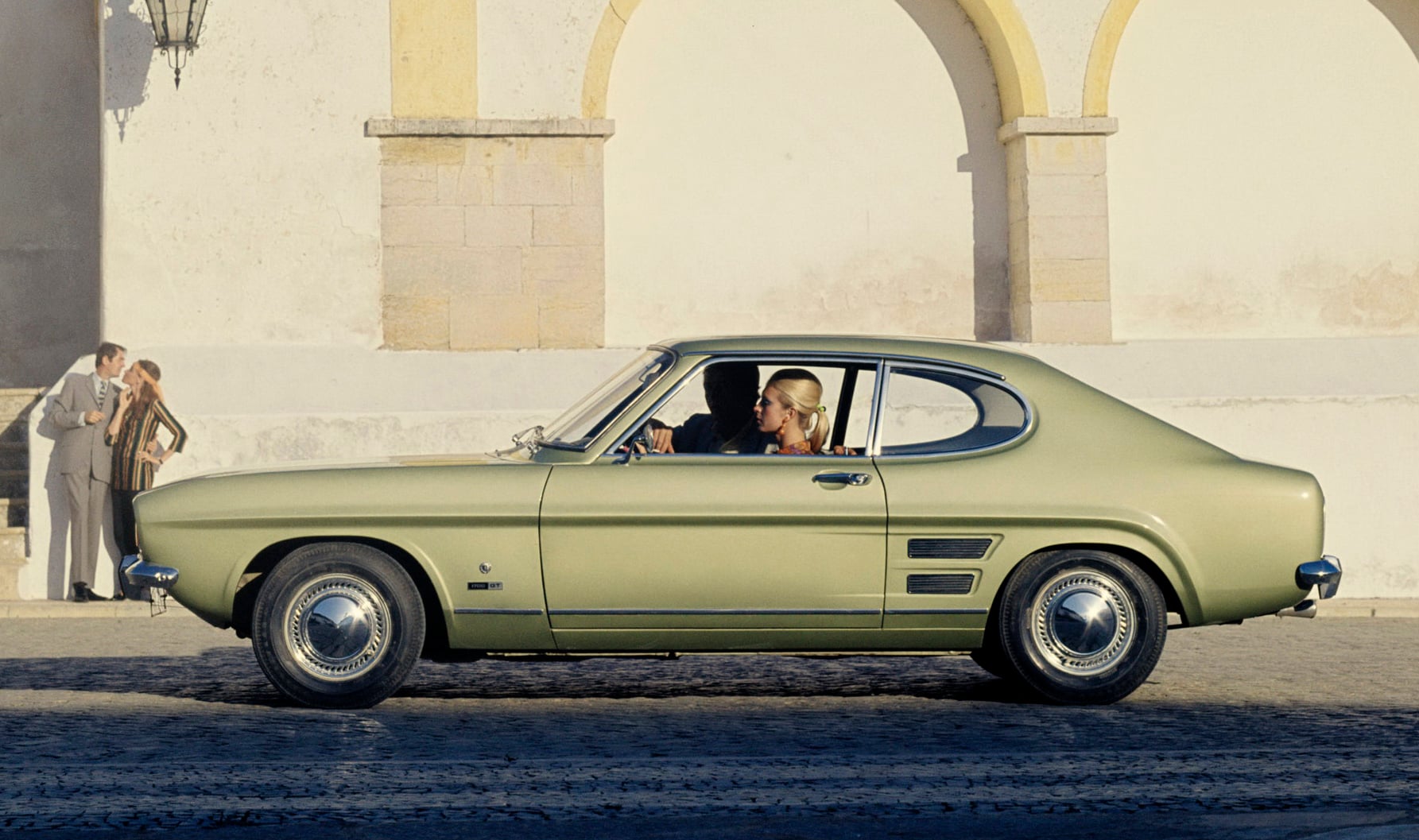
As for style, the apparent ploy was for each entity – Cologne, Dagenham and even Dearborn – to draw up an automobile fitting given parameters like 101 in. wheelbase. Then they pasted up the final form from them all. It is basically nice but totally without accents, a feminine car. And more English than German.
But then, Ford of England has been selling and German ones languishing, so it is only natural for the successful team to speak a little louder and more often in conference. Wait until they really go International and have to hire ‘strine’ interpreters to settle on a grille.
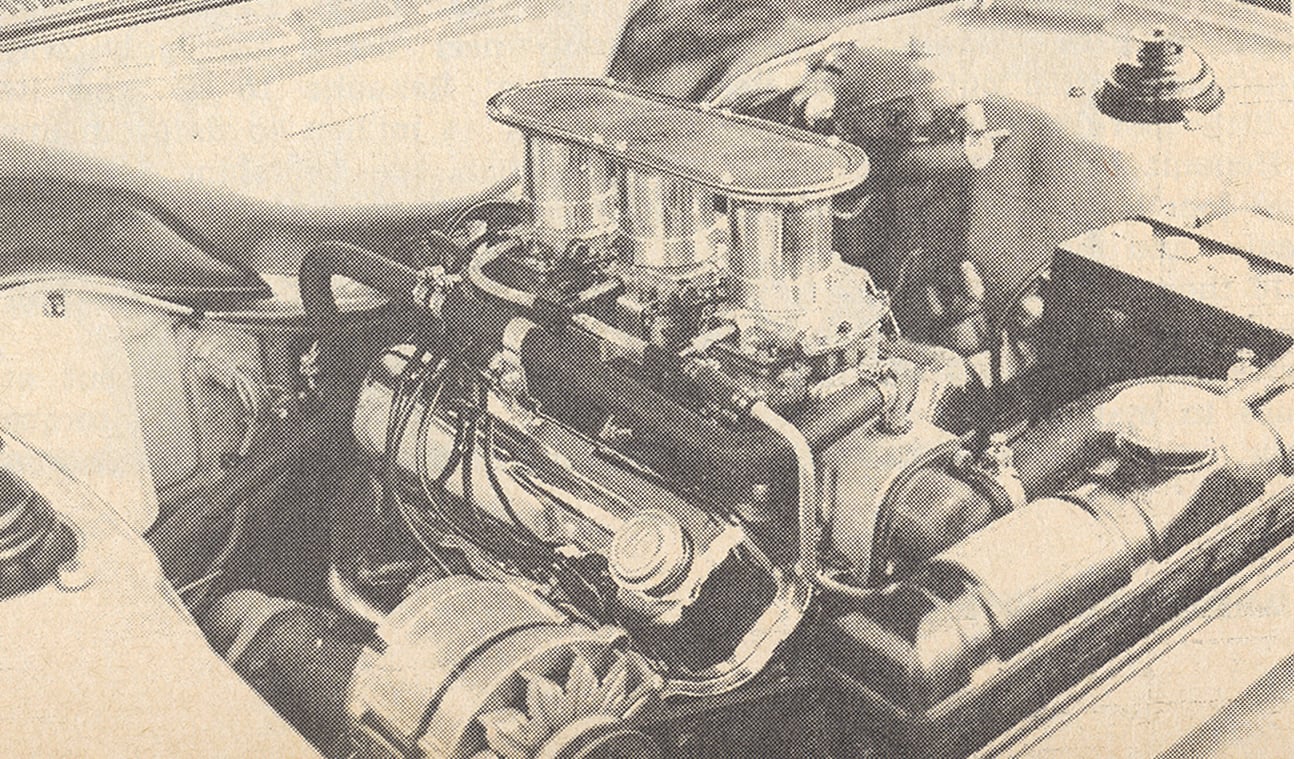
Judging by previous experiences of efforts like the Escort, which was not joint but later taken over in Germany, I would prefer German-built cars. Nothing against English engineers but they sag in assembly.
I have a feeling of cut costs here too. Okay, the $200 automatic is tentative and usually an extra but a machine aimed for the pay-more, drool-more market shouldn’t soak you extra for make-up mirror and alternator. They are standard wear in such circles – outside England, which may explain the omissions.
And if you ever buy a stripped Capri, you minority kill-joy you, do at least spring for the leather wheel, its nicest feature.
Ford – just the German branch – plans on 425 Capris daily to make 100,000-odd people happy the first year. It is a well-priced sportster with no competition pretentions off the shelf.
A Capri will carry two in real comfort, particularly with the formed seats, two more adults can ride around town without needing orthopedic aid – better than in many a sedan – and there is a big boot in that stubby tail. Sort of a scaled down pony car – perhaps I should dub this line the Shetland pony cars.
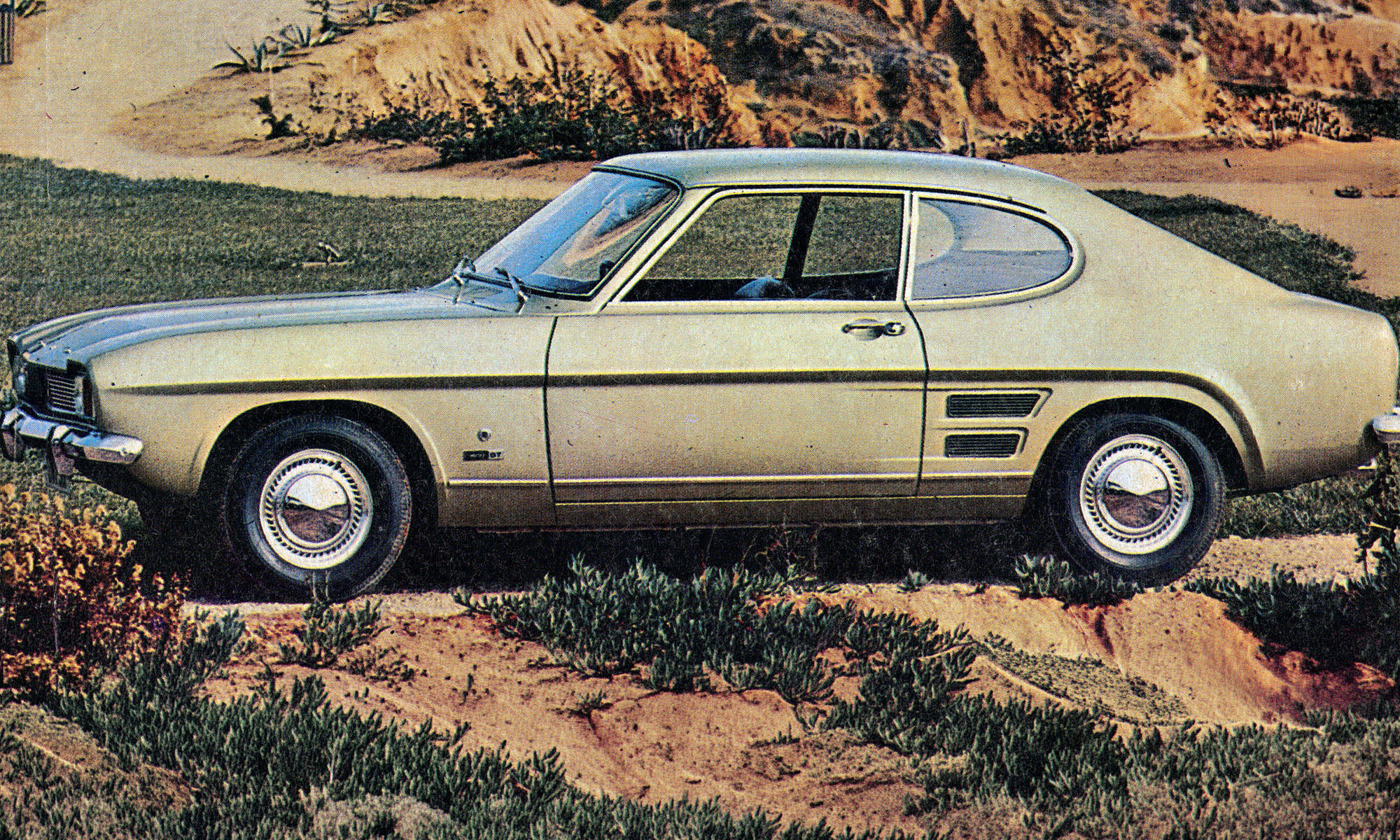
I drove the only two kinds on tap when the line was pre-announced and came away feeling Ford had made a damn clever shot at conferring style status within a narrow price range.
In GT and R form you just have to like wide-ranging seats and formed roosts in the rear too, really informative dials with resettable odometer in the speedo, a big tach set so it can’t reflect, tumbler switches up high, the thick wheel, easy heel-toe and even matt black bonnet. These (not unique to Ford) must be the first boy-racer gimmick to really serve driving ease.
In 1.7-litre V4 form (75 DIN hp), the car would show 30-50-70 in the lower gears but it tends to howl up around the 5250 redline and there is a 2000 rev spread when you shift. A tourer, not a track rod, you see. Top speed in the largest of the bent 4s was just three under the ton. With a little less weight up front and more miles on the clock than our 2.3, the 1700 steered more smoothly and precisely than its big brother.
The four came on more neutral around fast bends too, only getting into mild understeer on downhill marbles and even then you could power the tail out if you got to it in time. The floor-four shift is accurate enough but hampered by a wide gate pattern.
Both Capris driven here were sprung stiffly enough to be within semi-sports limits and while both jiggled a little on forest roads, neither really tried to bounce for the bushes. Good shock tuning, obviously. Boosted disc drum brakes in the R model stood up to short hard runs but Ford needs a more progressive clutch. And I don’t think I like the rocker foot piece on the Capri throttle, although one might get used to it.
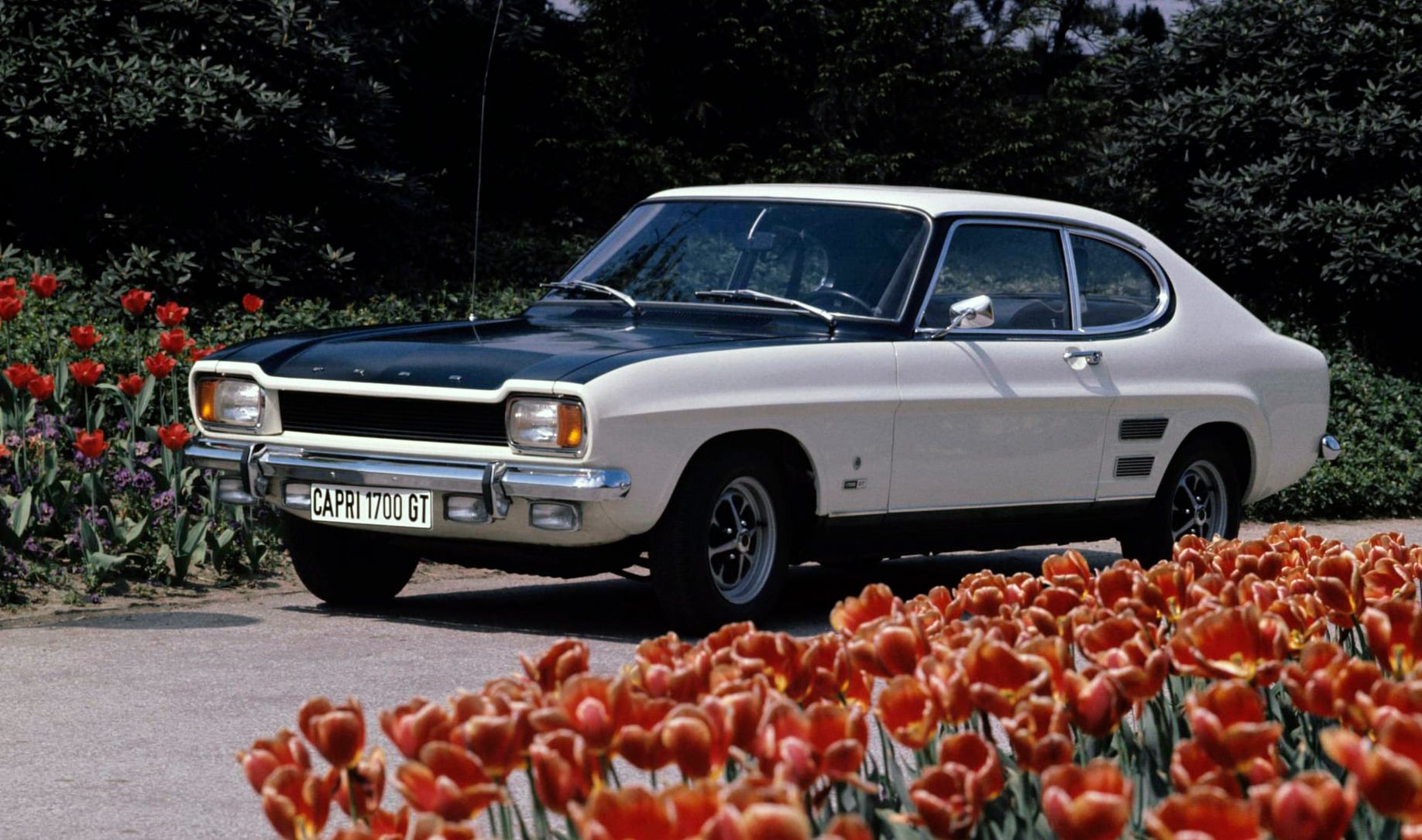
The 2300 GT-cum-R displays more understeer still, particularly one-up, and also far more effortless action, exceeding its identical 5250 red line without a quiver and doing 110 mph flat out. Gear spacing is again wide at 35-60-85 for the lower three. This is mostly a III-gear car on a chain of bends if you want to keep momentum up and torque on tap for breaking the tail loose.
Front headroom is astonishing and the driving position is good with plenty of elbow room and positive support from the back rest. The rear seats were comfortable with head and leg room adequate for adults but not enticing for a long journey. The leather-covered wheel with padded centre is set at the right reach and angle for vigorous driving and the action is quick (3¼ turns lock-to-lock) but quite light when parking and very accurate when travelling fast. The centrally-mounted handbrake and remote control gear lever are highly convenient.
Vision is good but the driver still doesn’t see the rear corners of the car. Instruments, flush-fitting rocker switches, heater controls and radio are set high in front of the driver under a deep resilient cowl where they are easy to read and to reach. I was not so happy with the horn button on the end of the stalk that works the turn indicators.
The ride is surprisingly comfortable for a sporting car, softer than Fiat’s 124 coupe at low speeds. Fast cornering is good, with no tendency to patter the axle or lift wheels at speeds higher than would ever be used on the road. Swerving about quite violently, the Capri I drove rolled little but quickly, making it a very neat performer in a fast tight “8” bend. At 6000 revs indicated I saw 36 mph in first, 50 in second and 70 in third and in top I was doing 80 at 5000 rpm. But above that, and on to 90 mph it began to sound rather busy and I began to think it must be under geared to give maximum acceleration up to Britain’s 70 mph limit.
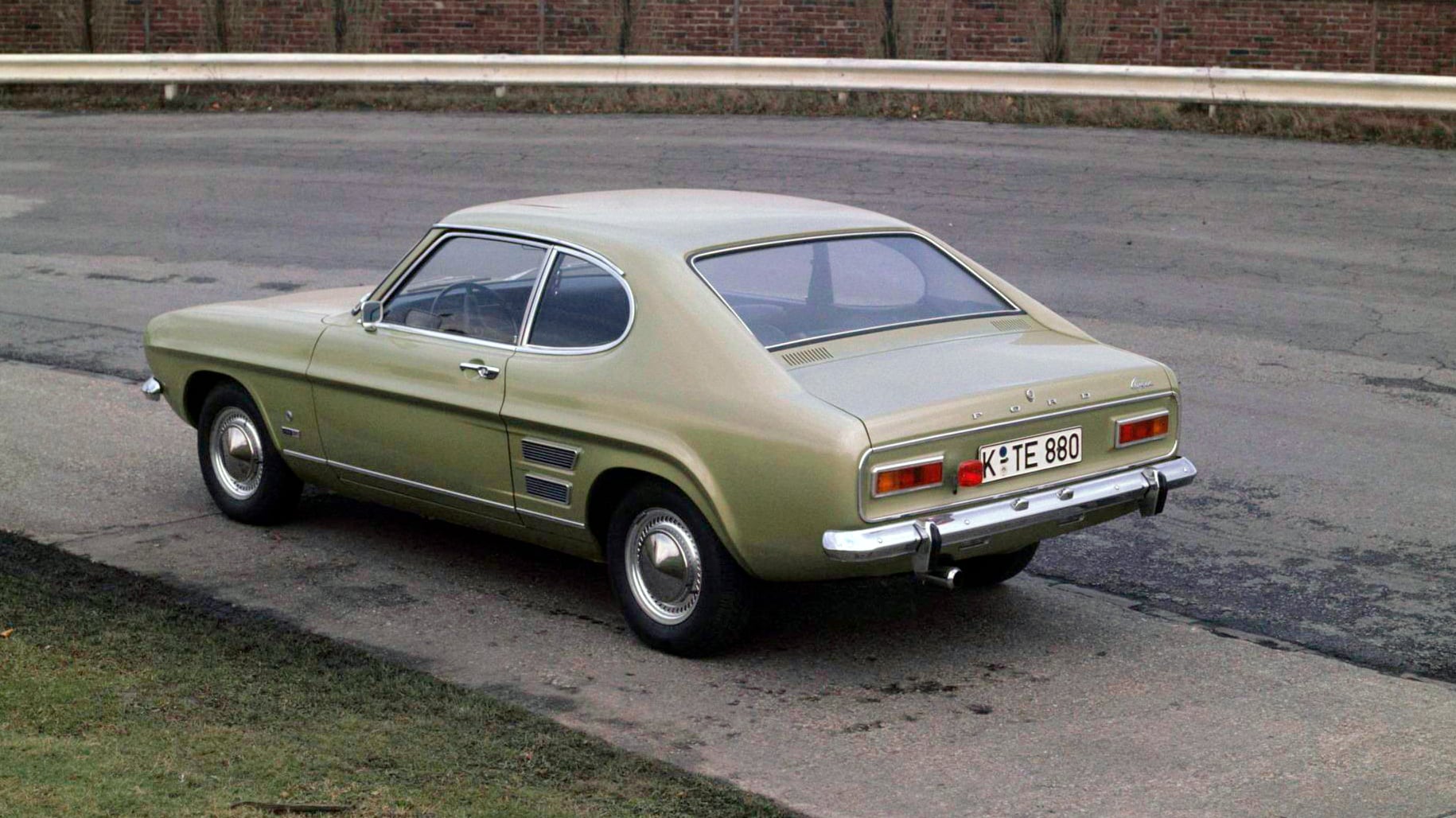
Yet according to Ford 6000 rpm in third should be theoretically 75.6 mph and 5000 rpm in top nearly 90 mph. And this is certainly what it felt like.
The normal 1600 had much simpler trim, with no console moulding over the centre tunnel and all the instruments grouped in two dials instead of six, with no tachometer. The seats had non-adjustable- backs, but were comfortable nonetheless. On the speedometer I saw 30 in first gear, 46 in second and 70 in third and after a fair run, 90 came up in top. The engine is more flexible than the GT unit and will pull smoothly from 24 mph in top.
General level of style and finish is good and there is a luggage boot of quite reasonable capacity. But the foot dipper is an item now going out of fashion and it is surprising that none of the custom equipment items includes grab handles for front or rear
passengers. As this is a car which Ford claims can generate cornering forces of 1g without a lot of fuss, it is an unfortunate omission.
They certainly have made a success of cutting wind noise, and this is matched by a very low level of mechanical noise and road rumble – even over noisy surfaces. Ford has been carrying on its war against what it calls NVH (noise, vibration and harshness) with only limited success till now. There is some real progress on the Capri. This follows some hard work with extra-sensitive microphones and acceleromators no doubt.
Underbody cross members were redesigned, several panels were made more rigid and more damping material was built in. The gearbox is a new one with only a single rail connecting shift lever and selectors and is separate from the clutch bell housing. To damp out any vibrations at this point, a stiff steel
plate links the bell housing to the sump. The gearbox extension housing was strengthened and the rear engine mounting was moved 3½ ins. to the back of the gearbox where vibration movement was lowest.
Cutting down road noise coming through the rear suspension without causing a loss of cornering capacity was a tricky job. It was achieved by enlarging the rear spring bushes, inserting isolator clamps in the axle seats, enlarging and softening the radius arm bushes and softening the front spring bushes.
The exhaust system grew extra retaining brackets fitted to the back of the gearbox, which gave an added bonus in longer silencer life at high speed. The front silencer and the pipe connecting it to the manifolds were double skinned to reduce noise. The final stage was a special bulkhead lining of PVC, felt and a woven material. The result is not a dead silent car – that is still impossible – but one in which noise is low for the level of performance. Harsh and disagreeable sounds have been eliminated and the overall effect is of quality above the price level.
I was at Ford’s Boreham test track when the first twin-cam Capri was rolled out and this too seemed a surprisingly quiet unit, both from outside the car and when driving it. It is developed from the engine which has been supreme in Formula 2 single-seater racing here. It uses the 1600 cc Cortina block and not the 1500 block, which have had to be over bored for the Lotus twin-cam unit. The pistons have flat tops and combustion chambers in the alloy head are fully machined. It is a cross flow head with eight inlet valves down one side and eight exhaust down the other connected to ports which are siamesed into four openings each side. Carburettors are two twin choke Weber 40 DCOEs and there is one plug per
cylinder fed by coil and distributor. The two overhead camshafts are driven by cogged belt from a crankshaft fully while a normal smooth belt drives fan, water pump and dynamo or alternator. The original side-mounted camshaft is retained to drive distributor, oil pump and fuel pump. Standard production crankshaft, rods, bearings, oil pump and fuel pump are used.
In racing form this engine gives 220 bhp and has rarely been beaten. So it obviously has lots of scope as a saloon car power unit.
