
Arm rests on car doors offer an additional element of comfort for rear seat passengers, but they could also pose a risk to small children, according to Australian research.
The study by the Transurban Road Safety Centre at Neuroscience Research Australia (NeuRA), found that the height and shape of arm rests can influence the likelihood of head injuries during a crash, even when a child is correctly strapped into their car seat.
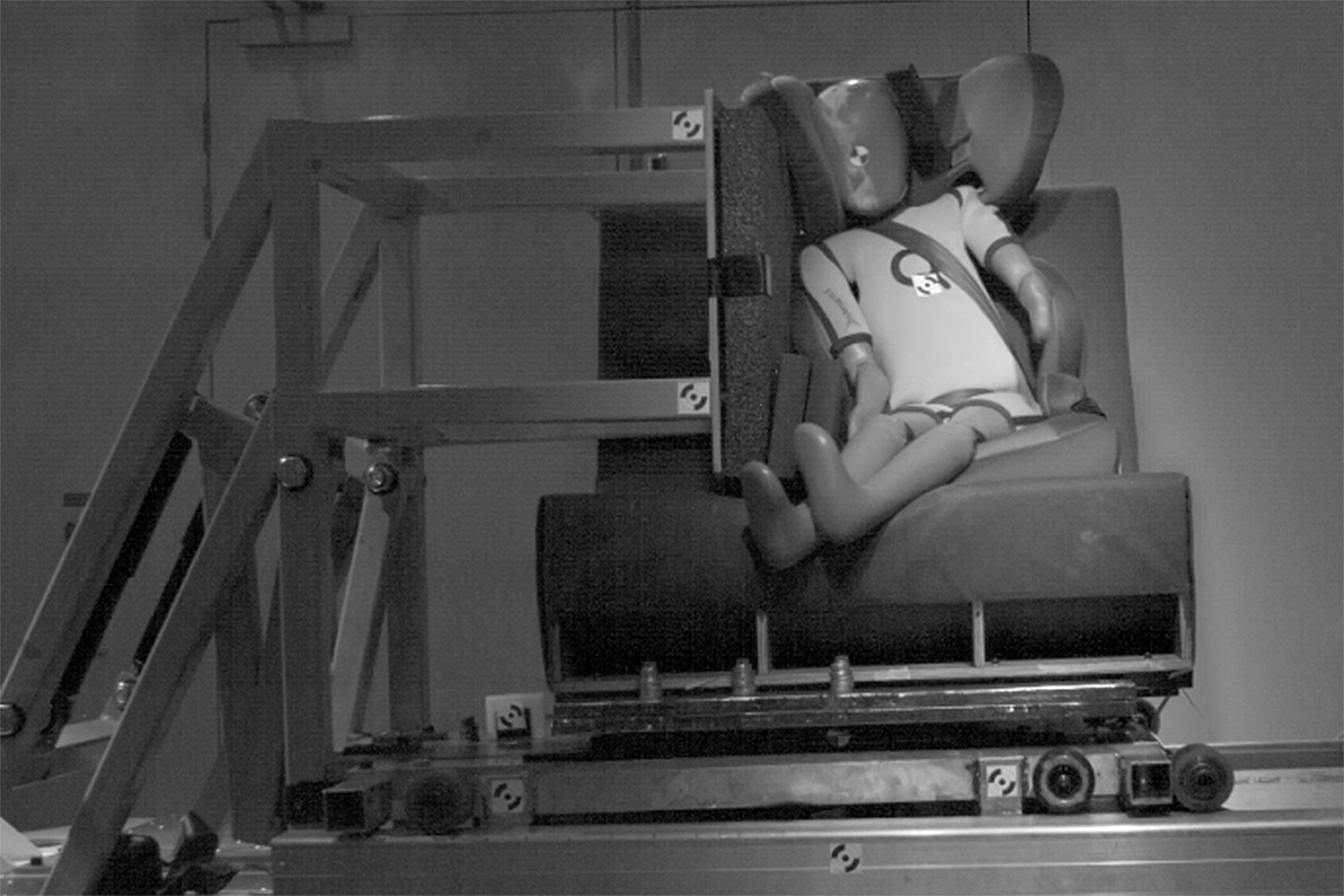
A team of researchers, led by Associate Professor Julie Brown, studied crash-test data and found the risk of head injury during a side collision can increase by up to 52 per cent depending on the height of the arm rest.
The team of scientists found that the position of the arm rest alters the movement of booster seats and this can influence head injury risk. A mid-height armrest was found to be most problematic compared with both low and high armrests. A completely flat door with no armrests was the safest, said the report.
“There are a huge range of arm rests and rear door shapes in current vehicles. Our work shows the need to find the best design to minimise injury risks caused by the door shape or position of arm rests,” said Associate Professor Brown.

“This would make it less likely that a side-on collision will result in death or serious injury of a child.”
Associate Professor Brown had previously found that significant intrusion was a factor in almost three-quarters of all child occupant deaths on NSW roads over the past 10 years, thanks to new testing equipment developed by UNSW engineering students at the Transurban Road Safety Centre.
“This is the first time Australian researchers have been able to examine how child restraints function when there is an intrusion of the door from a side impact,” Brown said.
“This is an important development because side-impact crashes are responsible for most of the serious head injury that occurs to correctly-restrained children.”
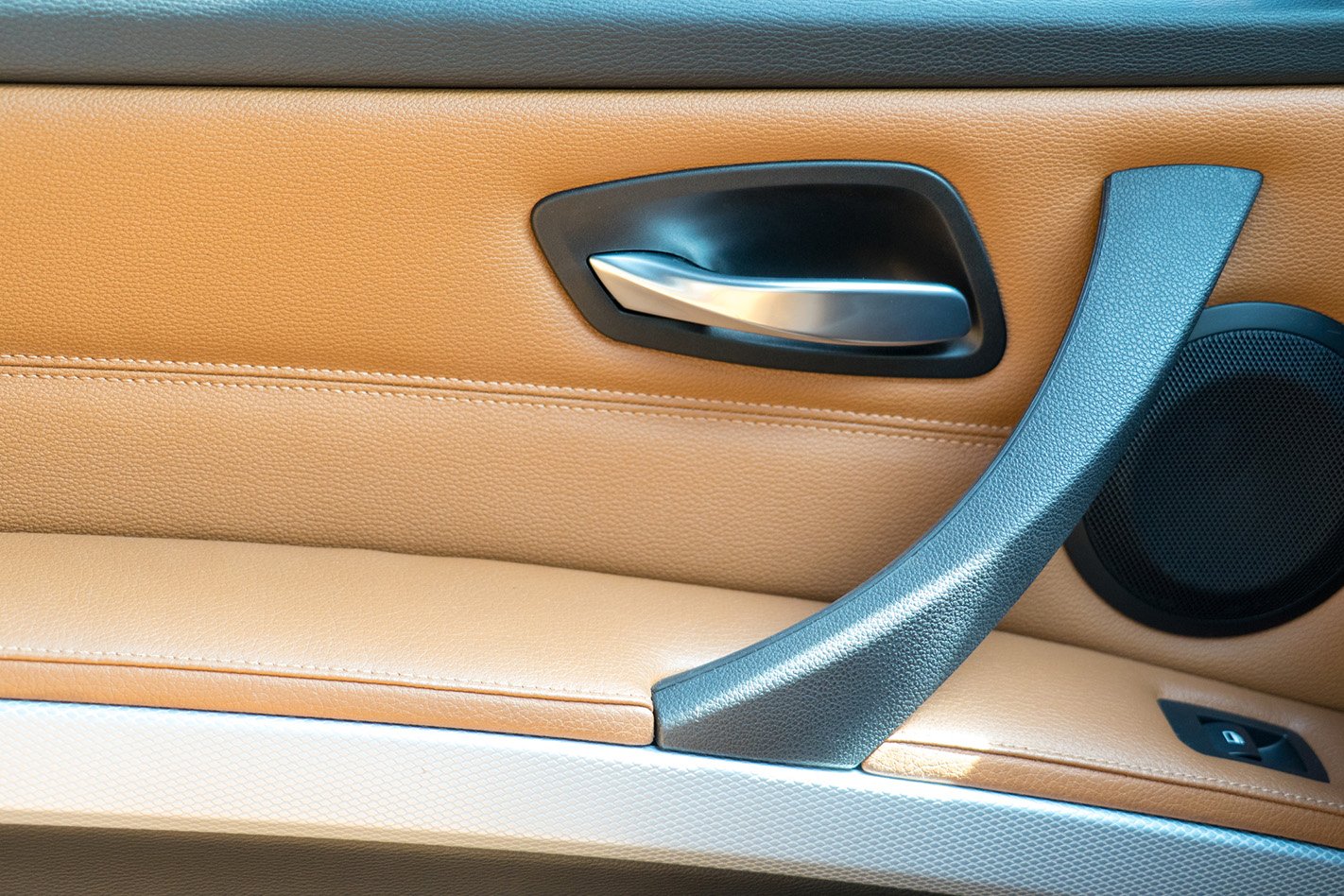
Brown’s team is now looking to test rear door shapes commonly found in cars on Australian roads to determine which designs are safest.
She stresses that despite the latest findings small children are still safest in a suitable approved child restraint, with 35 of the 66 children who died in car accidents from 2007-16 either not wearing a restraint or one that was properly fitted.
With that in mind, the professor has some tips for parents to improve child safety while in the car.
Always wear a restraint
The simplest way to increase safety is to make sure children are always restrained.
“Parents might be reluctant to fiddle with child seat restraints for short trips,” said Brown. “But it is vital that parents always ensure child seat are being used regardless of how long your child will be in the car.”
Properly fitted straps
Restraints should properly fit a child with no loose or twisted straps. A common mistake is to let children put the harness or seat belt under their arms. This can significantly decrease the effectiveness of restraints during a car crash.
Children must remain upright
Children and young people need to remain upright to be properly protected by a seat belt and should never lie across the back seat to sleep.
“While it might be challenging, children should be encouraged to sleep while seated so that they remain protected by their restraint,” said Associate Professor Brown.
Children aged over seven may still need a booster
In some cars, children older than seven and up to 12 years old may still need a booster seat to achieve optimal seat belt fit.
“A lot of parents move their children out of the booster seats as soon as possible. But it’s important to not move your child to a seat belt until they can achieve a good seat belt fit,” said Associate Professor Brown.
“This will depend on the size of your child and the car in which they are travelling. You can help improve road safety. The simplest way to check is to use the 5-step test.”
Sign-up here to get the free weekly WhichCar eNewsletter
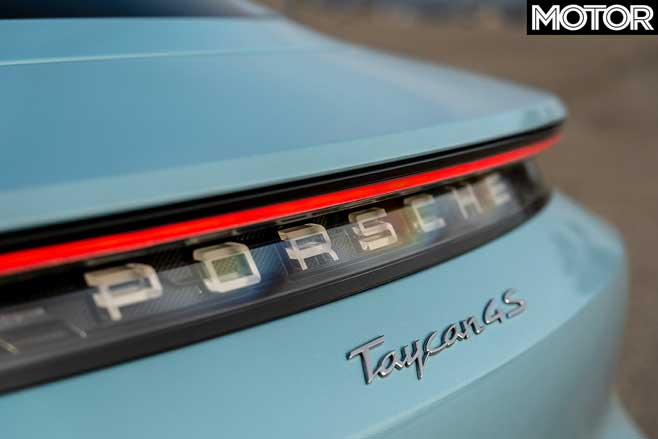
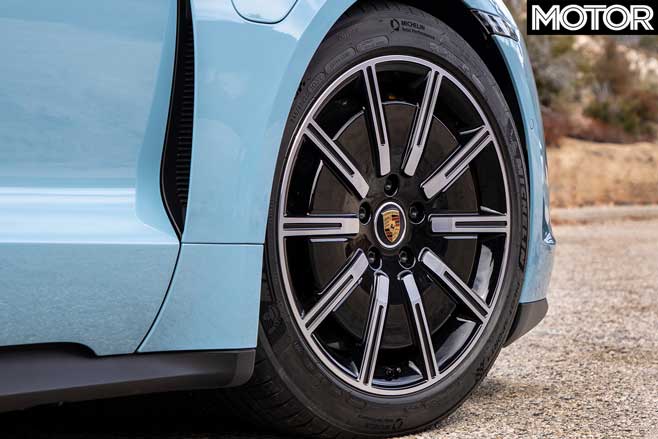
With the exception of the skimpy 19-inch wheels, the entry-level Porsche Taycan looks every bit as sexy as a fully loaded Turbo S.
Plus, all it takes to makes the interim base model more stimulating to drive is the optional Performance Battery Plus which has a capacity of 93.4kWh and a maximum output of 426kW/650Nm, up from 79.2kWh and 395kW/640Nm.
Although adding $100K worth of extras is the easiest trick in the book, you really only need a handful of essentials such as adaptive LED headlights, a couple of assistance systems and heated seats.
Comparatively equipped and priced to a Panamera V6 hybrid, the Plus version of the Taycan 4S beats its sibling in terms of outright performance, emotional driving experience and absolute environmental consciousness.
We drove the Taycan 4S over a 270km loop from the bottom of the Los Angeles Crest Highway through the San Gabriel Mountains to the Pacific Coast Highway north of Malibu. Beginning and end are popular with tourists, but the hinterland is owned by local hippies, bikers in show-off leather, hardcore sports car aficionados and crazy dudes like Domingo who had dropped an LT1 engine into his black MX-5 and was waiting by the side of the road for fresh meat.
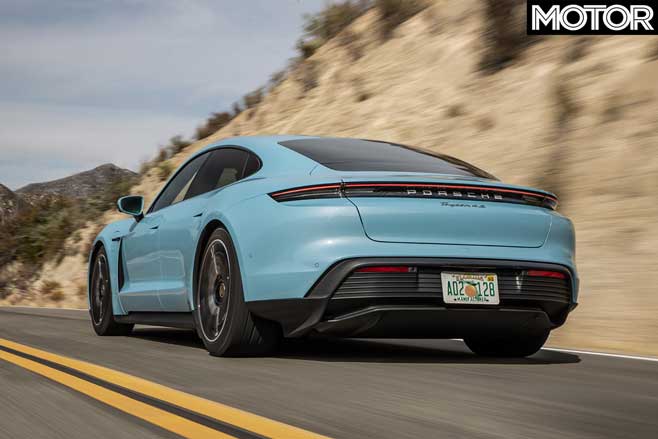
We declined the proposed race against the Nippovette, but with the available Electric Sport Sound generator and the recuperation program deactivated, our duck-egg blue Taycan would have snatched the clean-air trophy, the noise pollution award and the instant torque medal in one clean sweep. After all, this car is a truly talented tarmac-peeler and apex-whisperer.
It coasts with a subdued duo-tone chant, plays a brief solo on the drums when shifting from first into second at around 100km/h, and fuses regenerative deceleration and hydraulic braking to a polyphonic hum that spirals up and down the bottom end of the decibel ladder. Beyond 160km/h, though, wind noise, road rumble and tyre resonance take centre stage.
With all fast-forward systems armed, the Taycan 4S can sprint to 100km/h in 4.0sec and reach 250 no matter which battery pack is feeding the motors, but that sort of driving slashes the driving range from 465 to 265km.
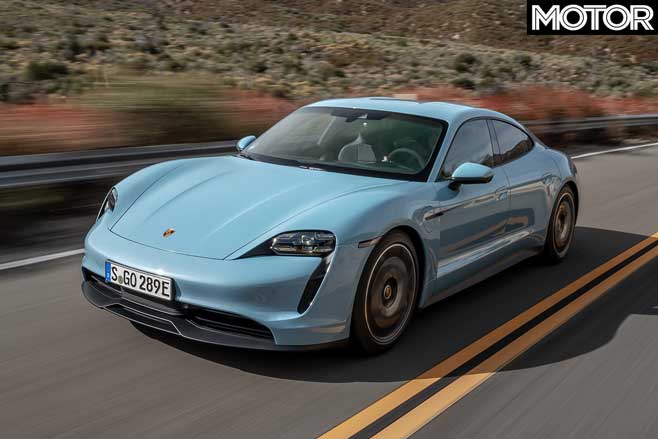
Find the most powerful fast charger and replenishing the batteries to 80 per cent takes little more than 20 minutes. The cost to fill up depends on your energy provider, but the cheapest and greenest way is of course by tiling the roof of your house and garage with solar panels.
In any other Porsche, Sport Plus only works on the track. In the Taycan, however, the no-holds-barred setting is perfect for winding country roads and even busy freeways. Better still, hit Individual and lock the air suspension in Comfort, which is reasonably compliant but not overly soft.
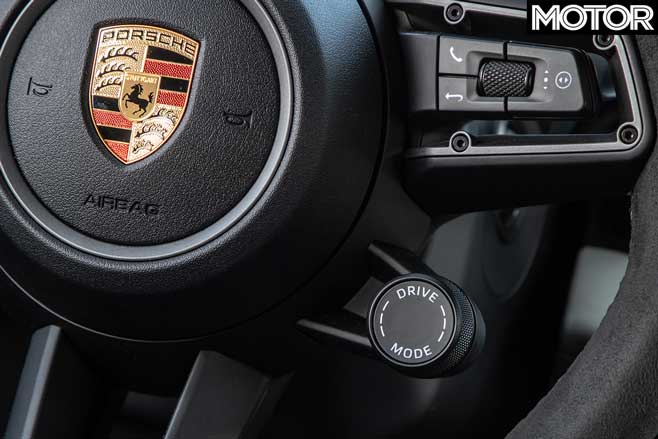
Stabbing the throttle at low speed may coax the two-speed transmission to shift briefly back into first, but second is usually happy to do all the work, with a clear rear bias in Sport and Sport Plus. In Range mode, the maximum speed can be set between 90 and 140km/h.
When the car is running on empty, only the front wheels are driven and top gear is locked in. Although there is no mechanical connection between the axles, 4WD feels at all times very much like a subtle concerted effort.
Since it can recuperate up to 265kW by momentarily turning its motors into power generators, the hydraulic disc brakes must typically handle only about 10 per cent of the total deceleration action, which explains the generous six-year interval for pad replacement.
Our test car was equipped with the usual bunch of go-faster, feel-better acronyms like PTV, PCCB, PDCC and PCCM. While these goodies are nice, they’re not must-haves like the active aero pack, comprehensive thermal management system and predicative charging planner.
The more ambitious the chosen drive mode, the more energy needs to be kept in reserve, and the system has learned to cope with over 300 different dynamic eventualities like launch control, extra-fast charging and discharging, repeated acceleration runs and continuous highway speeds.
As far as the protective redundancies of its DNA are concerned, the 4S matches the Turbo. But you don’t need the Turbo. The 4S is not that much slower and it’s the smarter buy, by about 100 grand.
PORSCHE TAYCAN 4S SPECS Motor: 2 x permanent magnet synchronous, Performance Battery Plus Power: 420kW Torque: 650Nm Weight: 2220kg 0-100km/h: 4.0sec (claimed) Price: $200,000 (est)
Likes: Smooth, quiet and quick; less grunt than Turbo S, but you can access it all the time Dislikes: High-speed wind, road and tyre noise; no extended range pack available
Rating: 4.5 out of 5 stars
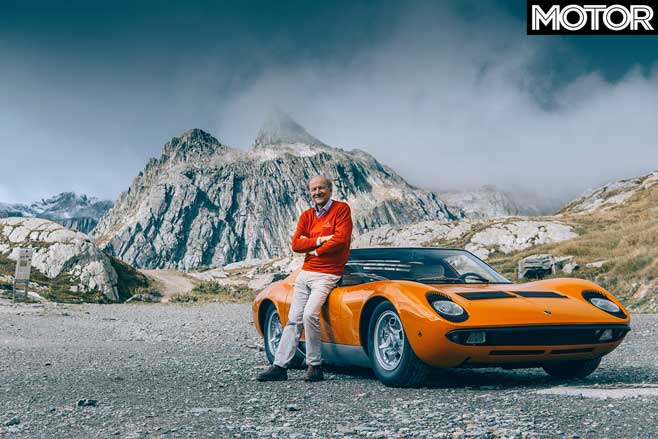
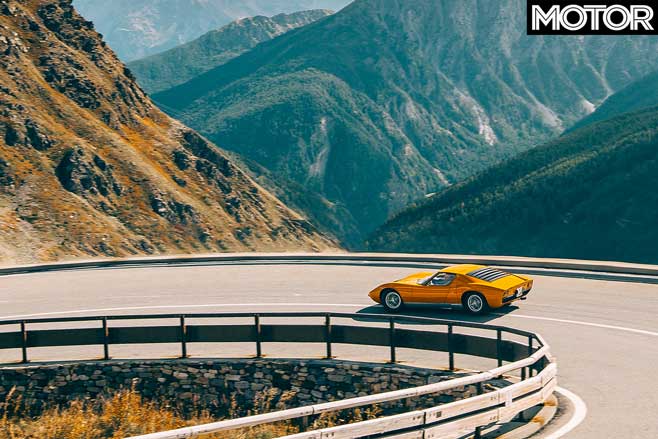
This can’t be happening. We’ve just covered the 305 metres of the Dardanelli Viaduct, in the Italian alps, in a flash of orange rage and are already negotiating the first hairpin bends of the Colle de Gran San Bernardo in an iconic Lamborghini Miura.
Supposedly, this car met its end impaled on the front of a Caterpillar D7171A bulldozer, right? Wrong. Of course wrong, because as we all now know, the Lambo that met an ignominious fate just minutes into the 1969 crime caper The Italian Job was an engineless shell.
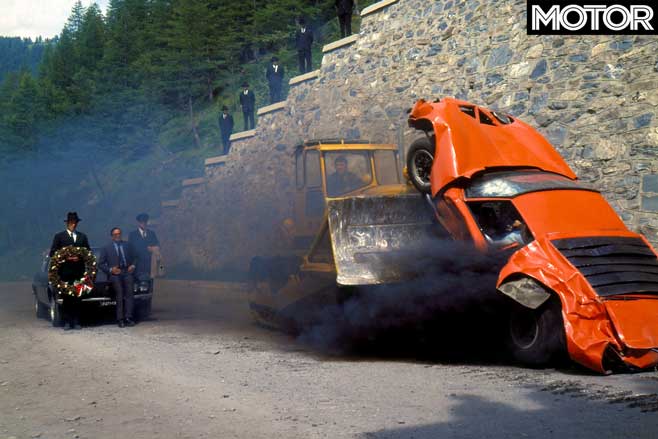
Until earlier this year, however, the true fate of the car driven by heist planner Roger Beckerman (played by Italian actor Rossano Brazzi) was a source of speculation. No more: the Miura P400 we’re in today has been certified by Lamborghini’s Polo Storico wing as the film-star car, and this is thought to be the first time it has returned to the Great St Bernard Pass since production of the film.
The same goes for its driver, Enzo Moruzzi, Lamborghini’s man on the scene and pilot of the Miura in all but the in-car images of Brazzi – wearing those famous Renauld Mustang sunglasses and lighting the obligatory cigarette – shot via a camera mounted on the door.
“The last time I drove this car was June 29, 1968,” the septuagenarian smiles. “I was 26 then. I had left on Thursday, on Friday we prepared the car with the cameras, we filmed all day Saturday, then on Sunday morning I drove back to Sant’Agata.”
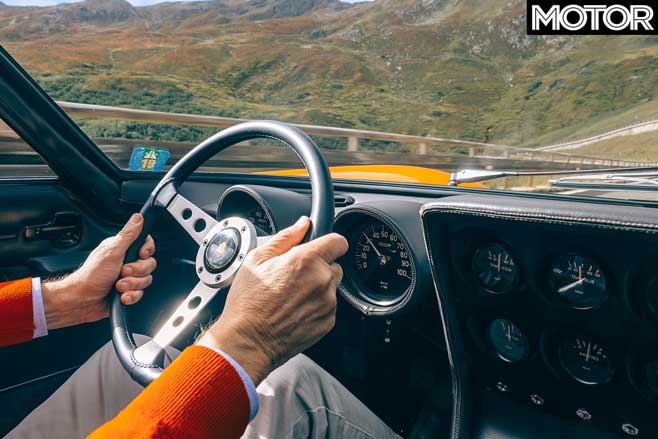
Wearing a Lamborghini-branded red v-neck sweater beneath a long black leather coat, Moruzzi is as dapper as he is animated, a ball of nervous energy, eyes twinkling and hands full of gestures in the Italian tradition. Ah yes, the hands. The way they manipulate the wheel is uncannily familiar: deliberate, respectful, caressing the leather rim and never crossing despite the acute corners we’re tackling.
And then it dawns: they’re the hands we see in the close-up driving shots in the film. “The cameraman was in the passenger seat and shouting at me to sit as far back as possible,” Moruzzi says. “When the movie came out in 1969 I was engaged and I took my fiancée to see the film. She didn’t know I was in it, but when she saw the opening sequence she turned to me and exclaimed, ‘Those are your hands!’”
The Miura’s role lasted barely four minutes – much of that overlaid with the titles – before its abrupt end at the base of a gorge, commemorated by a wreath from Mafia boss Altabani (Raf Vallone). Yet it was quite a cameo. Even now, I defy anyone to drive an alpine pass and not to picture themselves in a Miura, or to hum the first few bars of Matt Monro’s haunting On Days Like These.
The combination of that dreamy song, written for the sequence by soundtrack maestro Quincy Jones, and the fantasy imagery is what make its ultimate demise so shocking, with director Peter Collinson setting out the movie’s stall as a cut above the heist-flick norm.
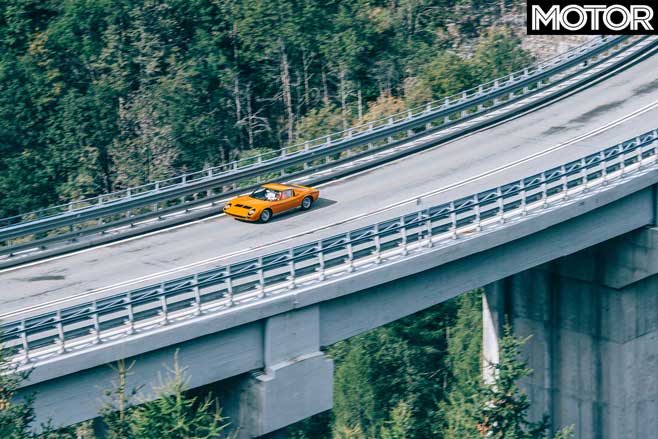
The story of the car itself is almost as familiar as that of the film, but it’s worth reiterating just to reinforce what an incredible achievement the Lamborghini was. It was inspired by Ferruccio, the eponymous tractor magnate who decided to go out and build better than Ferrari, engineered by Gianpaolo Dallara and engined by Giotto Bizzarrini. But it was the hook-up with Bertone, and particularly young stylist Marcello Gandini, that led to its breathtaking shape and sired a dynasty of dramatic supercars.
Shown as a rolling chassis at Turin in 1965, a year later it was at Geneva wearing its jaw-dropping new clothes, and by early 1967 cars were rolling out of the factory at Sant’Agata Bolognese in the north of Italy. Such was the reaction to this 270km/h roadgoing rocketship, the projected 20 cars per year turned into 108 in the first 12 months, yet to spot one on the road remained a rare treat for most enthusiasts.
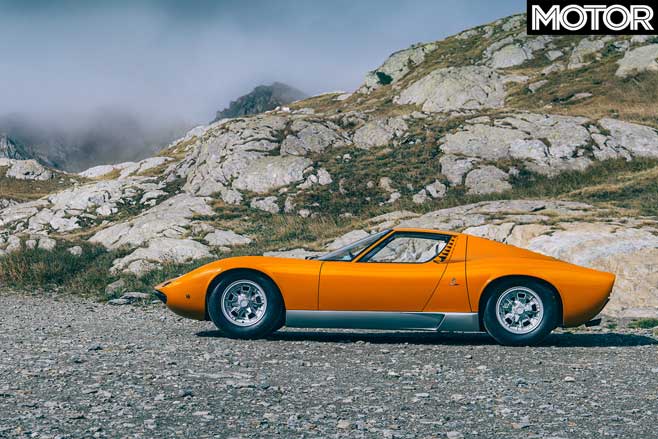
The same is true today, even if its fleeting but fundamental performance on the silver screen has helped build the legend. The majority of Fiat Pandas we pass as we follow the road up from Saint Rhemy, where the bulk of the shooting took place, are locals – many of whom have never even heard of the film – but one keen driver in a British-registered Jaguar XJ40 makes a comedy double-take as the Miura roars past.
Although he worked for Lamborghini for nearly 40 years – from July 1966 to July 2004 – it’s been a while since Moruzzi has driven any Miura, and he is initially cautious, cursing the cold gearbox and double-declutching as he feels his way back into the car.
But as the oil warms up, so Moruzzi gets back into the groove, and the revs climb with the road. “Now it sounds how I remember,” he laughs as the Miura begins to sing, then pops, spits and fizzes on the overrun.
Cinematic landmarks appear – such as the old hospice, now closed for the winter – further adding to what is surely the best view in the automotive world, the tumbling peaks of the bonnet forming a curvaceous rendering of the mountains above.
The scenery has changed little, though the road now has rather more safety barriers and we’re shooting several months later, so there’s no snow on the ground. In a few weeks’ time, however, the Pass will be impassable.
In between coaxing the meaty gearlever through the six-fingered gate – refinished in gold during this car’s restoration to match the original build sheet – Moruzzi recalls how he made the shift from managing VIP clients to appearing on film.
“As custom and car registration manager, I was the link between the admin and commercial offices,” he explains. “Commercial director Ubaldo Sgarzi sent the orders to Bertone, and when cars came back to the factory my job was to write down the colour combination, engine and chassis numbers, then get them registered. I must have done six to seven thousand cars in my career.
“The Paramount Pictures producer came to Sant’Agata in around March/April of 1968 and said he was looking for a car to crash, so Sgarzi went to the Reparto Assistenza [service department] and found a crashed Miura in ‘Rosso Miura’ already without its chassis plates. They took out the engine and the original owner bought a new Miura with the same engine and chassis number to avoid paying import duties!
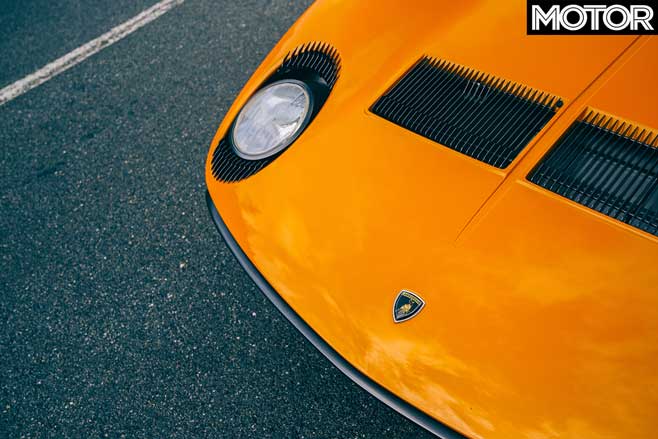
“When filming time came in June 1968, we needed a car to match. This one happened to be on the production line and in the correct colour. Although it is officially called ‘Rosso’ it’s really orange – Mr Lamborghini wanted a red colour, but it had to be different from Ferrari red.
We took the car from the line, the test driver did the procedural 100km, then I put on Prova [test] plates and drove it from Bologna to Aosta, more than 400km. I was careful because the car was going to be delivered as new – we disconnected the odometer to avoid the extra mileage, which is why the speedometer needle doesn’t move in the film.”
Looking at behind-the-scenes images, it’s remarkable that the car wasn’t damaged by the Heath Robinson collection of planks, ropes and chains used for the camera rigs.
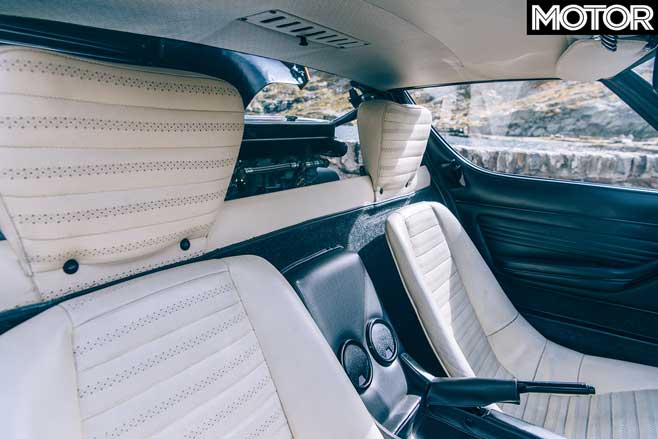
“I asked the factory to change the seats because the white ones would get dirty,” recalls Moruzzi, “but you can see the white headrests in the film.” This tiny point would later prove crucial in confirming the car’s identity. Like most early Miuras, chassis 3586 was specified with black vinyl, but soon leather became available as an option, and the order was uprated to white leather (Bianco Pelle) – the only one of the three Rosso Miura cars built in June 1968 to be so specified.
Its cinematic role over, 3586 was delivered to Lamborghini dealer Zani in Rome on July 2, 1968. Seven Italian owners later, in 2013 it went to France, when rumours surfaced about its famous past after dealer Eric Broutin spotted the unusual colour combination.
He and subsequent UK owners Keith Ashworth and Iain Tyrrell began to collate a file of evidence, which formed the basis of the more recent – and conclusive – research since the car moved to Liechtenstein and current keeper Fritz Kaiser in late 2018.
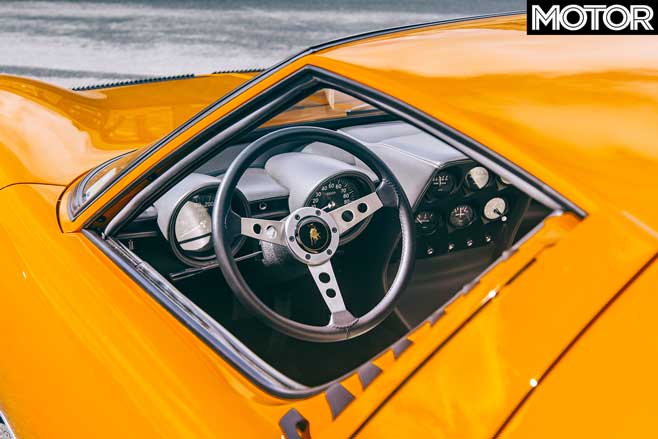
Quite apart from its historical significance, that white leather really lifts the otherwise unremittingly black cabin. Ahead of the wheel are a huge rev-counter and speedometer, with six ancillary dials in a central fascia that turns to address the driver.
As the black mouth of a tunnel approaches, Moruzzi scrabbles for the bank of switches in the roof, flicking on the Miura’s headlights. It’s impossible not to flinch as we enter, eyes peeled for a rogue bulldozer from the construction site down the valley – even though we both know that the fated tunnel in the film is a good 40-minute drive away in La Thuile.
We burst out the other end, breathe again, and after a few more switchbacks the road opens up at 2400m, where a discreet barrier marks the Swiss border. Here we stop, just as Moruzzi did in 1968: “We couldn’t enter Switzerland because of those Prova plates [taped over for filming].”
While our photographer is inspired by the misty backdrop, we once more take in the beauty of the Miura itself. Lifting the huge front and rear clams reveals a chassis extensively drilled for lightness. “The father of the Miura was really Dallara,” Moruzzi reflects, full of respect for the gifted engineer.
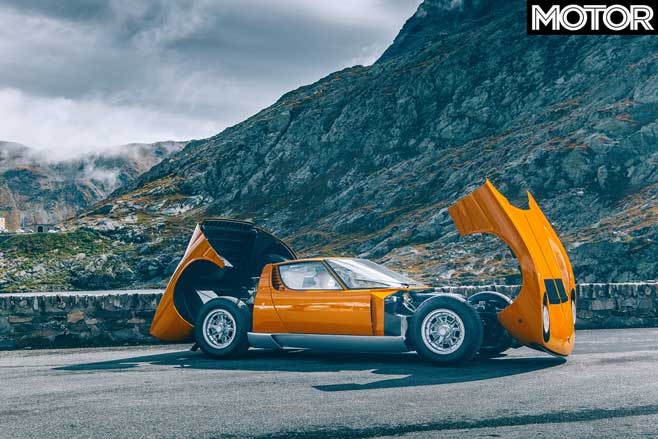
Certainly getting the car unnaturally low was quite an achievement, as was the packaging to keep it so compact – largely thanks to the V12 being mounted transversely over the gearbox, Mini-style, with a shared sump.
Later S and SV variants with more power, a wider rear track, fatter tyres and bigger brakes are preferred by enthusiast drivers, but for sheer purity of line the original P400 is impossible to match. From its famous headlamp ‘eyelashes’ to its lithe, pouncing shape, it’s the finest design to emerge from Gandini’s prolific pen.
Unsurprisingly, it instantly caught the eye of casting directors, and the Miura was soon in demand on set. For Moruzzi it made a fascinating sideline: “With any Lamborghini you see in a film from the ’60s and ’70s, I am the man driving. I became friends with all of the actors – I shared a hotel in Aosta with Brazzi and (Raf) Valone, and they pushed for me to be paid as an actor because I was in the movie so much. I remember another film in which a man gave his mistress a Miura, but she was played by Mariangela Melato and she couldn’t drive it – so I had to wear a dress and a blonde wig and drive around Rome! After this, the factory sent me to lots of films with Miuras and Espadas – it was great fun.”
The Italian Job was and always will be a Mini adventure, but for many the opening sequence had the most impact – not least because so few people had even seen a Lamborghini 50 years ago. It’s easy to see why the filmmakers chose a Miura rather than the ‘silver Iso Grifo’ in Troy Kennedy Martin’s original screenplay; this car must have looked more flying saucer than mere road car in the ’60s. Five decades on, it still has the capacity to stop you in your tracks.
LAMBORGHINI MIURA P400 SPECS Engine: 3929cc V12, DOHC, 24v Power: 257kW @ 7000rpm Torque: 355Nm @ 5000rpm Transmission: 5-speed manual Weight: 1292kg Price: Looks like a phone number
On the Hunt for The Italian Job Miura
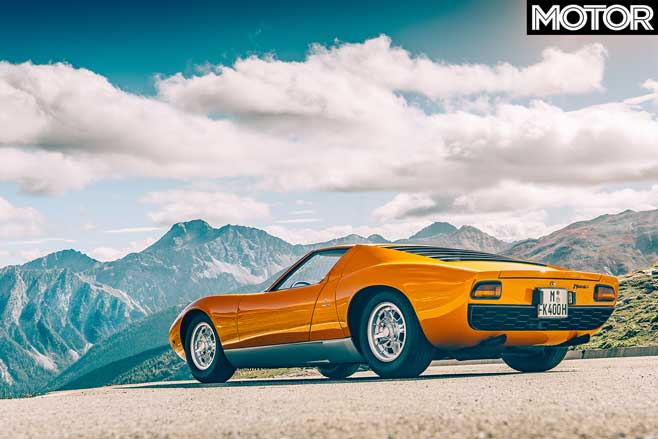
The whereabouts of The Italian Job Miura have long been rumoured, but it was only when the car came into the possession of one-time Olympian, former chairman of the Red Bull Sauber Petronas F1 team and founder of the Classic Car Trust Fritz Kaiser that its provenance was confirmed.
“I collect iconic ’50s and ’60s sports cars,” says Kaiser. “I wanted a Miura. I began searching for one four years ago and looked at 20-25 cars, but wanted one with important history – then I saw this. The dealer claimed it was the Italian Job car but couldn’t prove it. I did enough pre-purchase homework to feel confident and bought it, but didn’t think it would take a year to finish the job!
“I was introduced to Enzo Moruzzi, who gave a living testimony to go with the evidence found in the Lamborghini archives. The seats were always the centre of discussions: there is a handwritten note from Moruzzi saying ‘put the seats back in’ – and this was the only car in that period finished in that specification.”
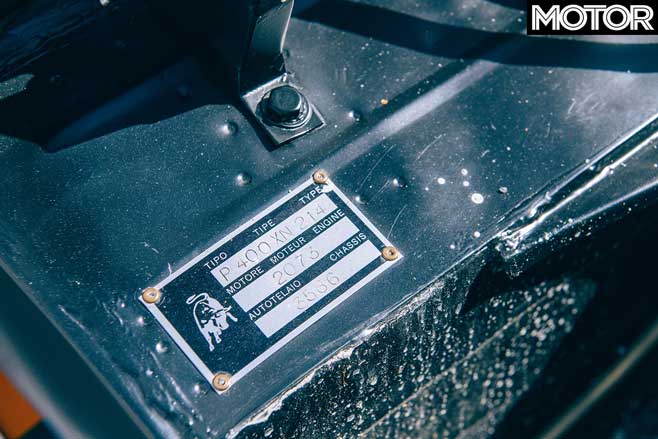
Lamborghini went through the case with a fine-tooth comb before the official confirmation was issued in March 2019, and Kaiser embarked on a sensitive restoration, with the patina of the all-important interior carefully preserved.
Since completion, and despite the car’s value (estimated at about $5 million), Kaiser has driven the Miura on the road as well as attending key events worldwide: “To me its value is not the money, it is its importance in the history of Lamborghini – this is the car that made the company famous. It’s fun, it’s beautiful, it’s wonderful to drive and I’m proud to own it.”
Driving the car that put Lamborghini on the map
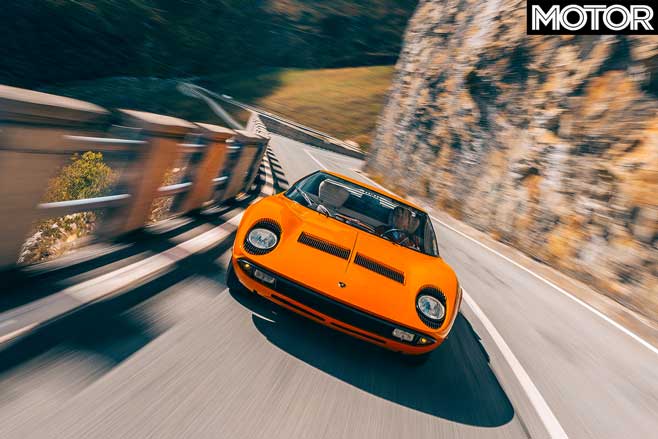
Enzo Moruzzi is the perfect size for the Miura. I am not, but it’s well worth the effort of getting in and the discomfort once you’re there, with knees around your ears and head brushing the roof.
The lengthy whirr of the starter is followed by a reluctant catch – not too much throttle, the bank of four triple-choke downdraught Webers behind your ears have a reputation for spontaneous combustion – before the V12 rumbles into life. From cold it emulates the bull for which it was named. The controls are heavy, requiring decisive movements, but it’s a car you soon settle into, flowing with this sinuous, scenic route.
Once that quad-cam V12 passes 3000rpm its howl becomes all-consuming and feral, matching the animal character of this underdog that became the pioneer of a new genre. There’s no redline on the tacho but we’re keeping to a conservative 6000 today, 1000rpm short of its power peak, and, with a sheer drop to one side, a rock face to the other, we won’t be troubling the upper reaches of the speedo either.
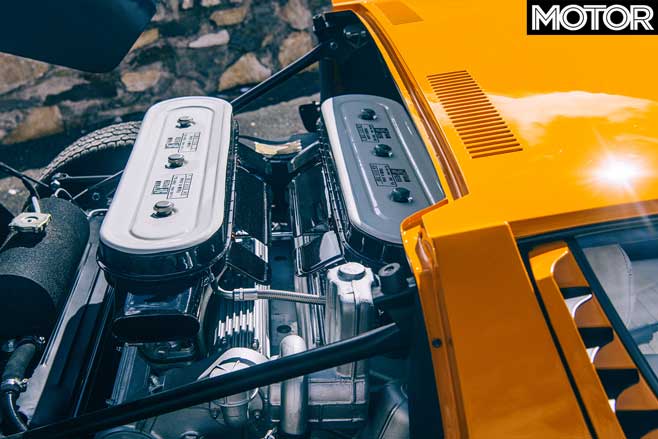
Begin to push it a little into the corners and the limitations of this earliest of supercars reveal themselves. The Girling disc brakes feel weak, while the combination of the flexible chassis (stiffened with thicker metal on later cars), narrow rear track and engine mounted high over the transmission means you’re always conscious of the car’s mass shifting over the relatively slender 215/70 VR15 Pirelli Cinturatos that wrap those gorgeous Campagnolo magnesium alloys.
But the double-wishbone suspension is supple and the steering is a joy. The flat, three-spoke wheel with its distinctive drilled spokes moves fluidly in your hands, the rack responding faithfully to your inputs and smoothly returning to the straight-ahead as the corner opens and you can wind out that flexible engine to drown out Matt Munro’s incessant earworm just one more time.
The BMW Z4 and Toyota Supra are inextricably linked. We would not have one, without the other.
Together, they represent two of the most intriguing, and polarising, new sports car offerings of 2019.
Their entry into Wheels Car of the Year 2020 had plenty of people eagerly awaiting the judge’s verdicts.
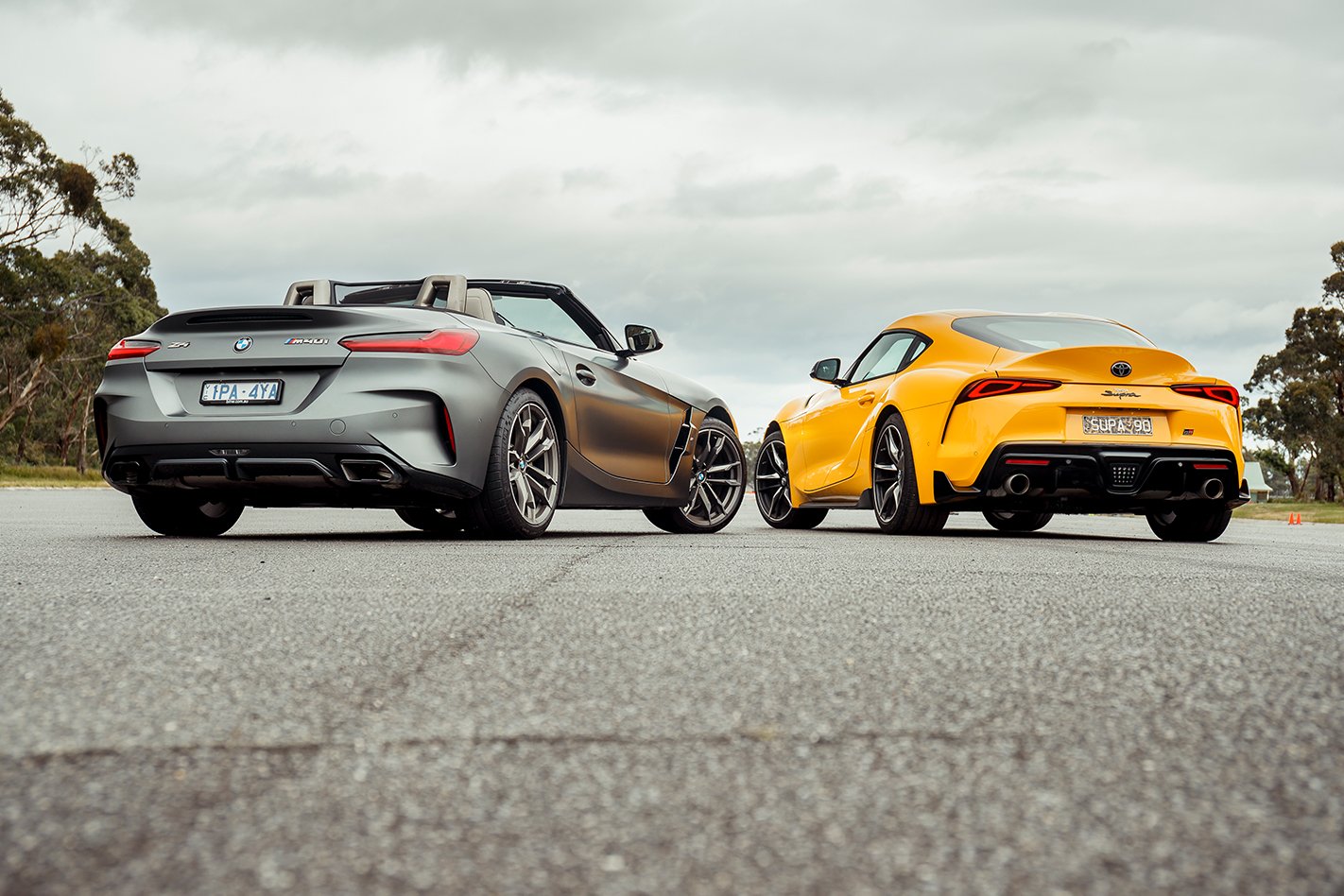
This is because mechanical twins have a good history at Wheels Car of the Year, with the Toyota 86 and Subaru BRZ winning in 2012, while the Ford Telstar and Mazda 626 duo took out the gong in both in 1983 and 1992.
However, unlike those previous mechanical twins, the Supra and Z4 are competing for the biggest automotive prize in the country completely independently of each other. There will be no shared trophy in 2020.
This means the judges evaluate the pair as two separate entities, instead of a cohesive which has undergone development and engineering in tandem.
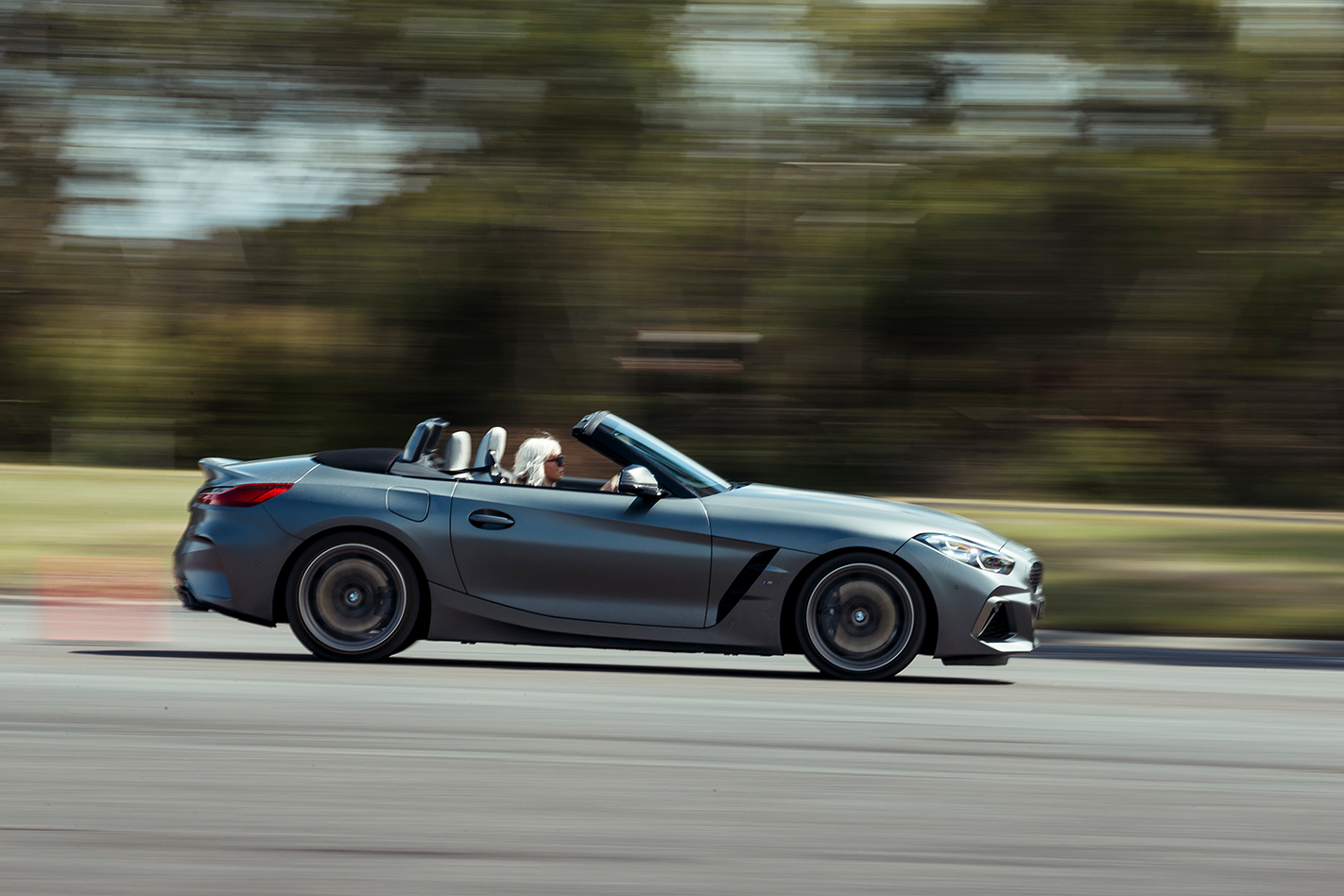
Why the dual campaigns? Well, putting the roughly 30 percent price difference aside, there are fundamental differences to the two cars – obviously one is a coupe, the other a convertible, with the latter also on offer as a four-cylinder.
While a four-cylinder Z4 was present during COTY testing, it’s the M40i variant of the drop-top that is the real sibling to the Supra, sharing the same turbocharged straight-six engine.
There are, however, some small differences between the pair, despite being built on the same factory and being underpinned by the same chassis.
Obviously there is the design, with Toyota and BMW having completely independent teams, while the interior treatment has also been tackled differently.
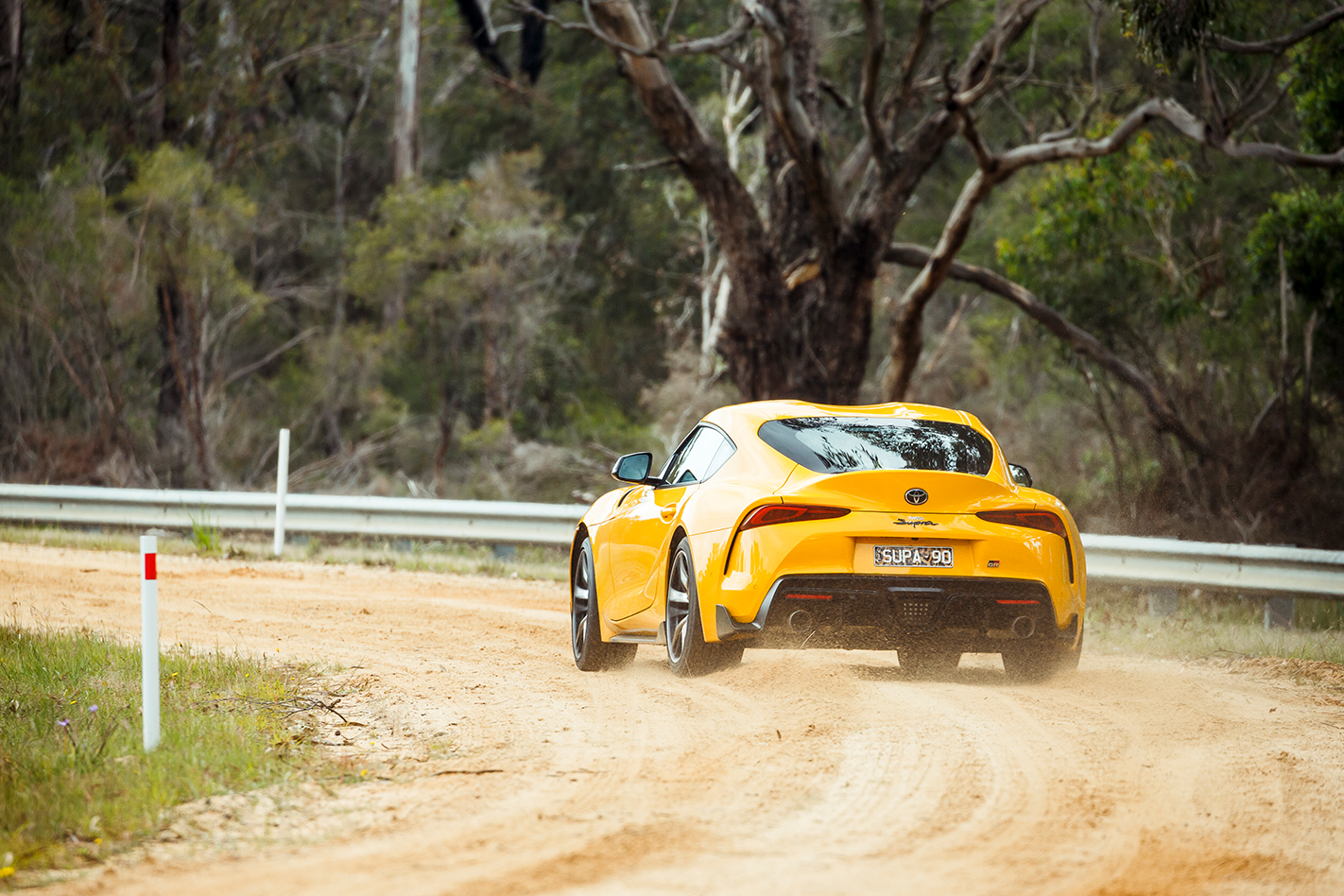
Mechanical changes are restricted to the minutia – specifically Toyota tweaked the software calibration for the Supra’s steering, engine, and transmission. The latter two receiving a Toyota-specific fettle goes some way to explaining how the Supra was quicker to 100km/h during our independent performance testing.
While the suspension hard points remain identical, each have unique springs, anti-roll bars, and lower control arms. The stability control system has also been retuned in the Toyota, along with the dampers.
Oh, by the way, we’ll let you in on a little secret, if you activate the Supra’s launch control, then mash your right foot into the fire wall upon launch, the two-door coupe can perform a giant rolling burnout smoky enough to grant you automatic admission into Summernats.
So, how do the Wheels Car of the Year judges pick these mechanical twins apart? You’ll have to grab our February issue to find out, or stay tuned to Wheels social media, as we build towards the COTY 2020 announcement on January 30.
FINDING the Car of the decade. How hard can it be? I began pestering Editor Inwood about such matters ages ago. Given Wheels’ expertise in electing a Car of the Year stretching back to the ’60s, it’d be a cinch, right? Stamping our authority on the subject and all that.
But this is exactly why I’m a lowly freelancer spending way too many weekday arvos bingeing shows like Schitt’s Creek with my Lab retriever snoring across my lap, and not a high-flying editor. Had I considered the myriad logistical and financial issues associated with assembling countless cars to drive, shoot and debate over for COTD? No, I had not, electing instead to be a little bit Alexis (just watch the show, please) by living in a la-la land of boundless yet groundless can-do optimism.
Lady Luck occasionally goes by the name of Alex, though, and I’ve been gifted this column, so here I go.
The COTD notion has long intrigued – ever since UK sister mag CAR nominated Alfa’s nearly forgotten Alfasud as its 1970s victor under the prescient headline ‘Alfasud – the winner that never will’.
It’s worth reading that January 1980 issue, because writers Ian Fraser and our own Steve Cropley turn things on their heads by also nominating the then-mundane but bestselling Toyota Corolla as the joint winner thus: ‘Corolla – the loser that never did’. Brave, brilliant, incisive journalism. As a teen from (Melbourne’s) Tottenham, I knew then what I wanted to do.
Coincidentally, I’ve owned both a Sud and a ’70s Corolla, but I’d have chosen the Mk1 Volkswagen Golf. I mean, come on.
The Wolfsburg hatchback’s influence is still felt today. Speaking of influence, and as I turn to the COTD, special mention must go to the Nissan Juke. Released early on in 2010, its enduring success helped usher in the small SUV revolution. Virtually every modern baby crossover from the Mazda CX-3 to the Audi Q2 owes a certain debt to the bolshie British-designed oddball. While not inventing the segment, globally the Juke helped popularise it.
Then there’s the Alfa Giulia as the beloved, beleaguered Italian brand’s comeback kid (from behind the wheel at least), the unremittingly fun Toyota 86/Subaru BRZ twins and Golf Mk7. All are worthy, but the latter deserves special mention since it remains a high water mark for quality, refinement and all-round capability seven years on from launch. If a Golf isn’t in the engineering department of every rival car maker as a benchmark, then they’re not being serious.
Ultimately, it seems clear that the 2010s was the decade that electric vehicles broke through. However, while Nissan’s Leaf was the first EV to find true mainstream success despite early range limitations, it is the Tesla Model S that deserves the accolade more than any other model. The controversial American brand showed that EVs can be useable every single day, fun to drive and gorgeous to behold.
It’s expensive and far from perfect, of course, but as we look back at the 2010s, can you imagine the automotive world without the Model S? Surely that’s the essence of a COTD.
See? Not so hard after all.
More than 10 million Mustangs have since passed through Ford’s factories, but the most iconic of them all is considered by many to be a Highland Green 1968 Ford Mustang GT that starred in Steve McQueen’s seminal “Bullitt”.
While two identical Mustangs were used for filming, the hallowed “hero car” that was used in the film has been sold at the world’s largest collector car auction in Kissimmee, Florida.
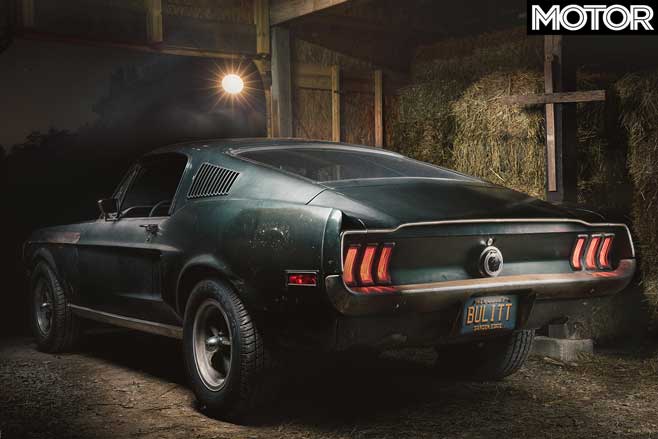
Considered lost to history at first, the “hero car” re-emerged in 2018 at the Detroit Motor Show where its current owner, Sean Kiernan, decided to reveal it to the public to commemorate the 50th anniversary of the movie and the unveiling of the new Ford Mustang Bullitt.
The 1968 action thriller flick “Bullitt” is largely ingrained in popular culture thanks to its famous car chase scene between the film protagonist’s Mustang and a pair of hitmen in a black Dodge Charger on the streets of San Francisco.
For filming purposes, one Mustang was built and used as a stunt car, whereas the “hero car” was used in many of the film’s scenes, including the legendary chase sequence.
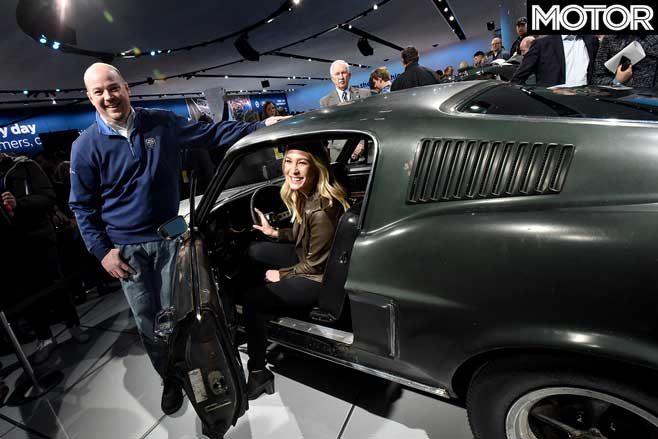
After filming wrapped up, a studio employee bought the “hero car”, who later sold it to a New Jersey detective. The car was then sold on to Robert Kiernan, Sean’s father, in 1974, who kept it in the family’s possession since. McQueen was said to have tracked down the car and offered to buy it back, but the family declined his offer.
Though the family intended on restoring the “hero car”, that never came to pass as a combination of family events and Robert’s declining health due to Parkinson’s forced the family to put off the project time and time again.
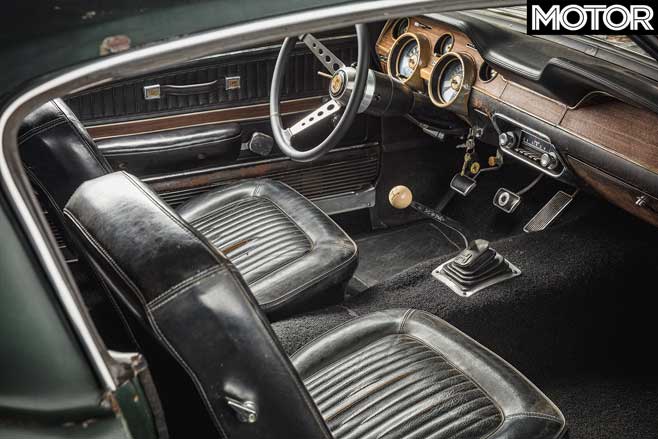
Sadly Robert never got around to restoring the car, or seeing it get its day in the Detroit spotlight, as he passed away in 2014. With the car passed on to Sean, he reassembled the car with all its original parts. As such, the car would be heading to the auction block in its original condition, with many US43/of the unique modifications used in the movie and the patina time had etched on its body.
Auctioneers Mecum Auctions auctioned the car with no reserve at Kissimmee, Florida. yesterday. The price? A heady US$3.4 million on the hammer and a total of $US3.74M with fees. That makes it the most valuable Mustang on the planet. The previous record-holder was a one-of-one 1967 Shelby Super Snake, sold at Kissimmee for US$2.2M last last year.
Reforming for the very first WhichCar Weekly of a new year and a new decade, Andy, Dan and Scott get together to slot 2020 into first gear and aggressively slip the clutch.
First up, a look back at the forgettable year of sales that was 2019. December marked the 21st consecutive month of decline in the new car market and some reports suggest the figure won’t return to growth for another 12 to 18 months.
What’s causing the slide, what is the industry feeling, and can the WCW team singlehandedly conceive an idea to reverse the ominous trend?
Next up, the team turns its view 180 degrees and looks to all the exciting hardware that will launch in the coming year. Unsurprisingly, high-performance and delicious hardware feature prominently in the most anticipated list, but there are a few conservative arrivals that might surprise you.
And finally, they say the car you drive says a lot about your personality, but what about your first car? We find out which cars the WCW trio first called their own.
Maybe the answer is deeply insightful and explains many of the team’s respective nuances, character traits and life decisions. Or perhaps they just got behind the wheel of the first 5hitb@x they could afford.
If you’re on the go, you can find WhichCar Weekly on all manner of podcast apps including iTunes and Podbean. Please rate, subscribe and leave a review! You can also follow the day-to-day happenings of the WhichCar team on Facebook, Twitter and Instagram @whichcarau.
Listened to the show? Help us out:
Leave a note in the comment section below.
One primary criticism of the McLaren 720S Spider seems to be that its styling is rather divisive, though Novitec’s N-Largo widebody treatment of Woking’s flagship drop-top isn’t going to mend that divide in opinion.
The carbon-fibre conversion has widened the 720S Spider by a whole 6cm up front, and a massive 13cm around its back.
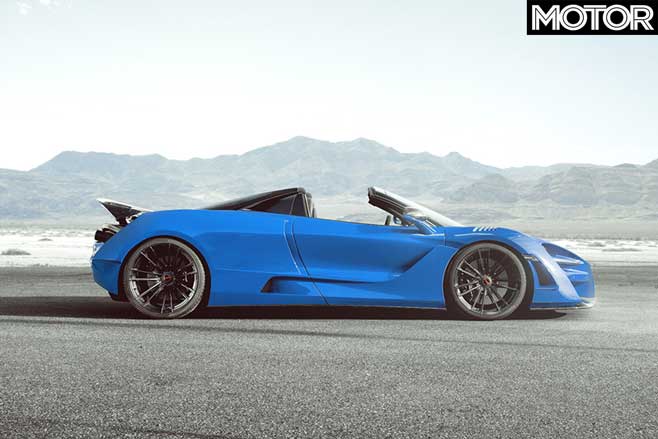
Complementing its widened visage, Novitec commissioned wheel maker Vossen to produce special 20-inch and 21-inch wheels for the front and rear axles respectively. The 720S N-Largo Spider’s wider chops also meant that it comes with a larger rear wing attachment for the retractable rear spoiler.
Far from just the visuals, Novitec has also fitted the 720S N-Largo Spider with the stage two performance kit that it developed for the 720S range, which comprises of a plug-and-play auxiliary ECU and a full exhaust system.
Though it doesn’t sound like much, the ECU tweak and free-breathing exhaust system raises the 720S N-Largo Spider’s power output to 592kW and 878Nm of torque, up from the 720S Spider’s standard 529kW and 770Nm.
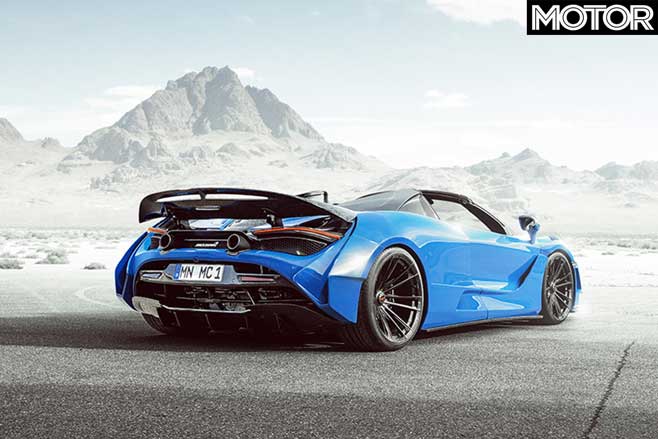
As a result, 0-100km/h times for the 720S N-Largo Spider have tumbled from 2.9sec to 2.7sec, as well as its 0-200km/h time being slashed from 7.9sec to 7.5sec, with the top speed rising from 341km/h to 346km/h.
According to Novitec, the 720S N-Largo Spider comes fitted with sport springs that drop the ride height by 35mm.
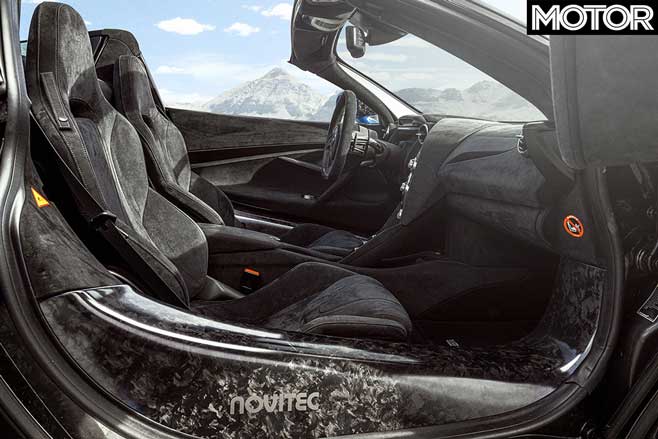
Unlike Novitec’s aftermarket parts, the N-Largo series of widebody-treated models are built in limited numbers, with German tuner planning a production run of just 15 examples of the McLaren 720S N-Largo Spider.
No word on the pricing, though expect it to be a significant premium over the standard 720S Spider’s $556,000 asking price.
While having a browse through Twitter hunting for happenings in the automotive landscape, we stumbled upon something that had everyone in the MOTOR office laughing out loud.
A photo posted by user @labergee from the Singapore Motor Show depicting a unique creation by Subaru went viral, because the car’s name is incredibly funny.
This is the Subaru Forester Ultimate Customised Kit Special edition.
Yes, meet the F.U.C.K.S edition. (Author’s note: It’s a good day at work when you’re laughing all the way through writing a story).
In search of answers to our many questions (Who approved this? Can I buy one? Is this the real world?), we hunted through Subaru’s various worldwide media resources to no avail. A tip off from the ground at the Singapore show indicated to MOTOR that this is a one-off built by the Singaporean-based Subaru importer.
We were also told the importer invited media from the Philippines as guests to the motor show, which led us to Top Gear Philippines’s story on the car.
The outlet has someone present, Leandre Grecia, who was able to grab a few details of the swearing Subie’s modifications. We also found a YouTube video with a quick walkaround.
We can already see the Enkei wheels and red decal accents, as well as the obvious tint and Need For Speed-style underbody neon, but inside this car is a continuation of the vibe.
Screens for rear passengers, more blue light inside, a large display in the front, what appears to be Alcantara, and a huge subwoofer in the boot are all signs someone’s been watching Pimp My Ride.
Think it’s tacky? We don’t feel like they give any… well, you know.
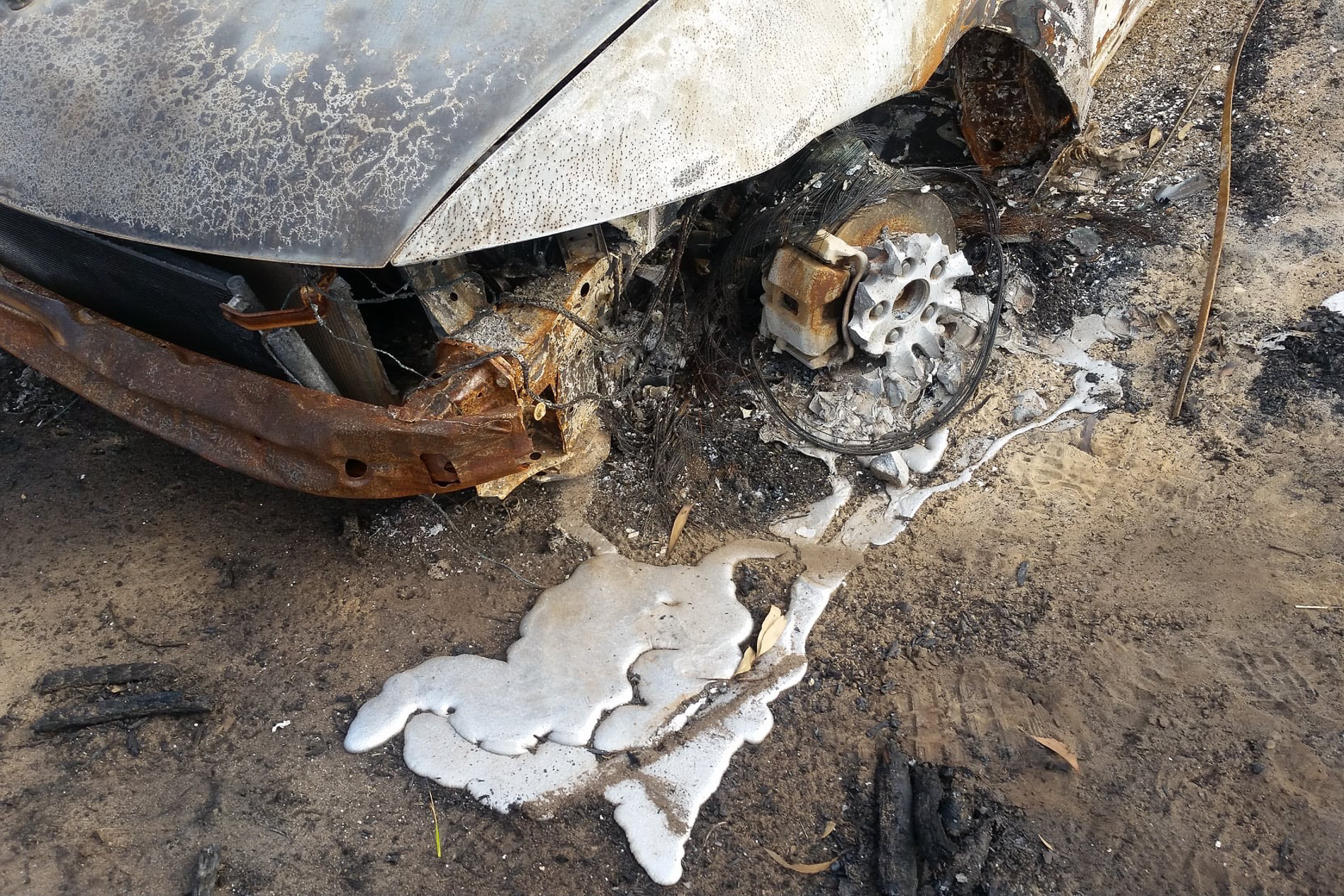
The world is pledging its much-needed support for the victims of Australia’s disastrous bushfire season, with the automotive world doing its bit to help.
A number of big (and small) players have donated to the cause, including Holden, which has pledged a significant $1 million donation. Up to $200,000 of that will go to the Australian Red Cross, while the rest will be split among a number of charities and areas directed by its wider dealer network.
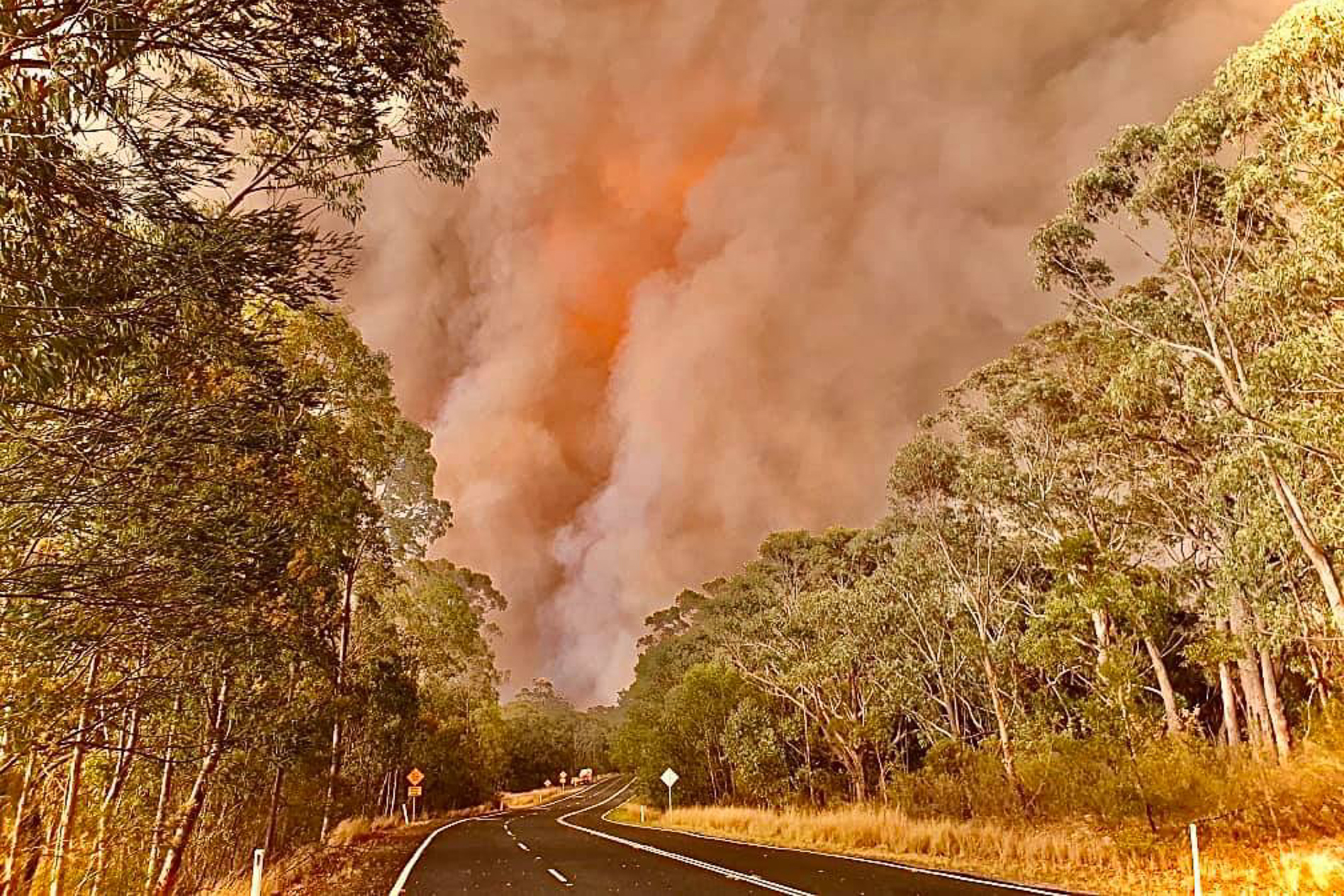
Here’s a list of everyone else in the auto industry who’s getting involved.
Volkswagen Australia
VW announced that it’ll donate $2.5 million to the relief effort with managing director Michael Bartsch saying “Volkswagen has been part of Australian life since the 1950s. Therefore, we step up both to assist those at forefront of this crisis and to aid in what will be a protracted recovery.”
Of that $2.5 million, $500,000 will go to the fire services and to the aid of those affected by the fires, $1 million will be donated to organisations involved in wildlife preservation and the last million will be distributed with reforestation in mind.
Lewis Hamilton
The Fomula 1 champion, whose love of animals is no secret, has donated $500,000 to a number of wildlife rescue organisations and rural fire services.
Toyota Australia
Australia’s biggest motoring brand pledged a $3000 donation for every ‘four’ and a $6000 for every ‘six’ hit during day four of the Sydney test and a Big Bash match which raised $223,000 for The Salvation Army Australia. It also donated an extra $250,000 to recovering communities.
Ford Australia
The Blue Oval has set aside $100,000 to the Australian Red Cross, and is also matching employee donations up to $50,000. Additionally, it is also providing vehicles to emergency services organisations and charities on the ground.
Isuzu Ute
Isuzu Ute has generously pledged $50,000 to the Salvation Army and the World Wildlife Fund in order to bring some reprieve to the lives affected during the bushfire catastrophe.
Motorsport
Local racers have jumped on board to donate, with Scott McLaughlin and DJR Team Penske auctioning off his 2017 race suit and helmet, the proceeds of which will go to the Red Cross and WIRES (wildlife rescue). He will match the final auction price with a donation of his own.
Toby Price (Dakar rally champion), Jack Miller (Moto GP), Thomas Randle (Supercars series), Kelly Racing (Supercars) and Molly Taylor (Australian Rally Champion) are all donating in a similar fashion. Hats off!
While it won’t be exhaustive, we would like to recognise as many major donations as possible. If we’ve missed anyone please let us know at [email protected].
We hope to continue adding donations to this list in the future.
On behalf of WhichCar – a sincere thank you.
MORE TO COME

