
It was in April 1967 that Ford dealers around the country, basking in the runaway sales success of the new-generation XR Falcon launched nine months earlier, learned of something even better than the XR’s optional V8. While that engine configuration was already an Aussie-made first, the Blue Oval was announcing a performance-tuned V8, to be badged the Falcon GT and aimed squarely at recovering the company’s honour at Mt Panorama, Bathurst.
Ford’s four-cylinder Cortina had taken a Bathurst hat-trick from 1963-’65, but had been ineligible for ’66. Thus, the introduction of the Geelong-built, 4.7-litre (289ci) V8 engine – plus performance-mad, ex-Ford Canada marketing man, Bill Bourke – brought the stars into line for the birth of the Australian muscle car.
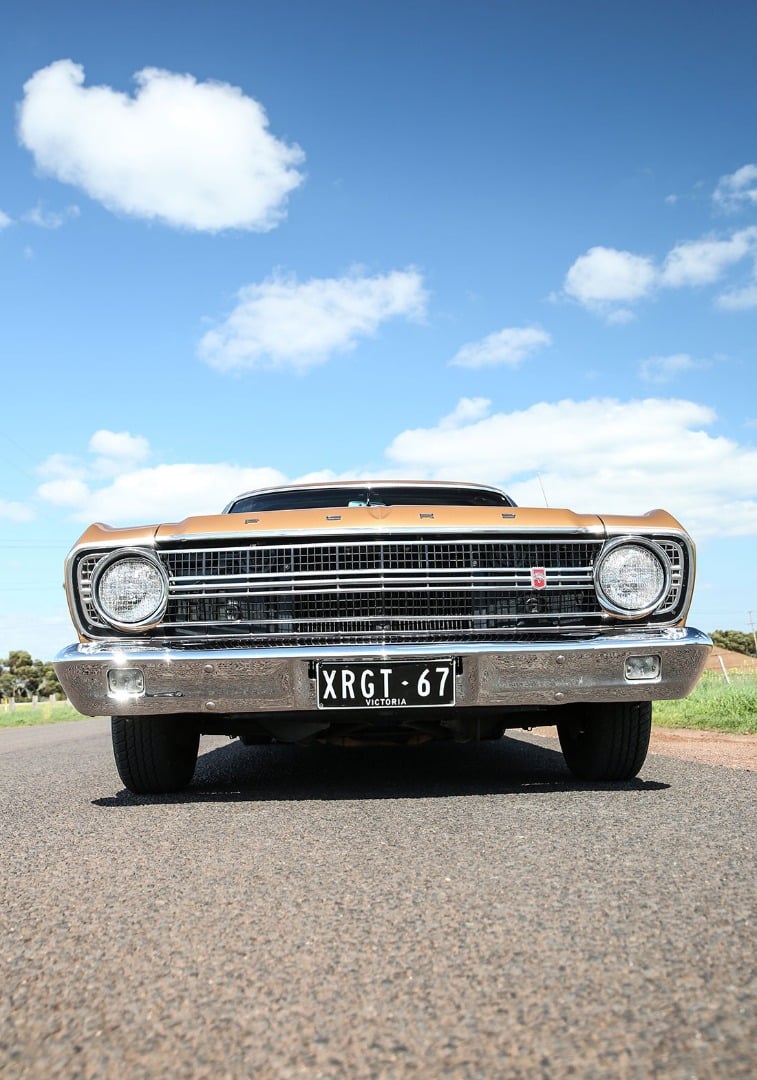
The platform was the XR Falcon Deluxe manual which, fitted with a standard 149kW V8, had been developed by Ford’s Don Dunoon and racer Harry Firth into a tighter-handling Police pack. Rumour has it that Firth’s relationship with the Highway Patrol boys came in handy when the Bathurst-bound GTs needed high-speed road running.
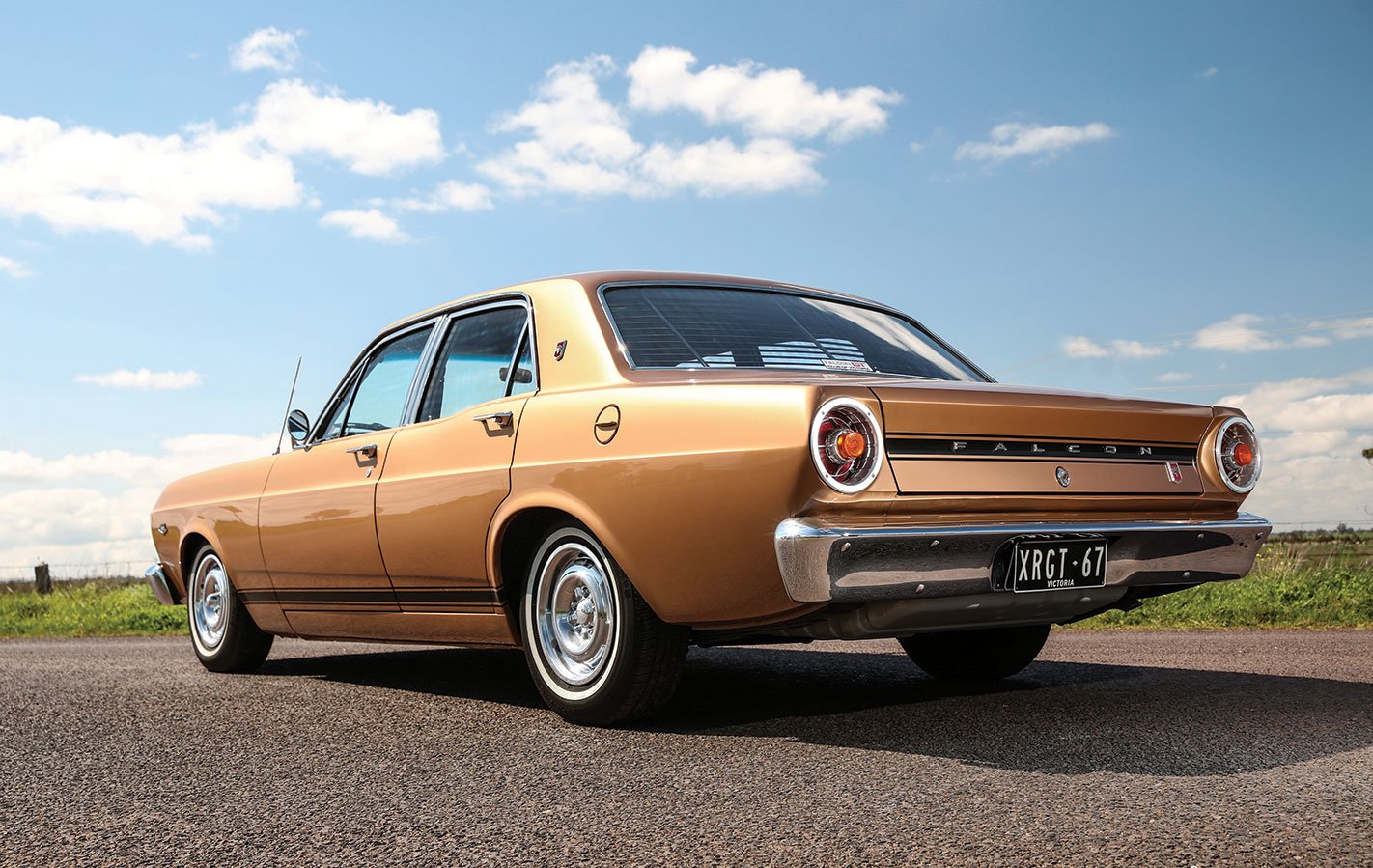
Indeed, the NSW and Victorian police forces were early and eager customers for the new GT. Its (almost) exclusive ‘GT Gold’ colour was owed to the Gallaher Group, who were the official ciggie sponsor of the Bathurst race. The low-fuss exterior styling comprised a black-barred grille, body side stripes and stainless wheel trims covering 14×5.5-inch steelies.
Engine power was raised by almost 13 percent and mated to a four-speed manual with revised ratios. The coil front and live-axle rear suspension copped heavier springs and a thicker front anti-roll bar. Faster-geared steering reduced turns lock-to-lock to just four (versus 5.5). Eleven-inch front discs were standard on the GT, with 10-inch drums at the rear.

The handsome and well-equipped GT wasn’t cheap, listing at $3890 versus $2411 for a regular 149kW V8 manual. But the first homologation batch of around 260 cars sold as quickly as Ford could build them. The groundbreaking GT’s status as a legit legend was cemented in October 1967 when the cars of Harry Firth/Fred Gibson and Ian Geoghegan/Leo Geoghegan finished one-two at Bathurst, in a tight outright tussle with a pair of Alfa Romeo 1600 GTVs.
The XR GT’s production total remains the stuff of pub arguments, being either 596 or 684. The long-held former figure is thought to have perhaps excluded police pursuit GTs.
The XR Falcon in numbers
- 302 – Cubic inches; a few late-build XR GTs copped the new, bigger V8 for the successor XT
- 14 – Inch diameter wheels stepping up from the XP’s 13s
- 4000 – Dollars, price cap for Bathurst 500 eligibility
- 125.7 – GT’s top speed (in mph) on Conrod in ’67. A new record

Harry and the four barrel
Ford’s first locally built V8 was based on the 1961-issue, 4.7-litre (289ci) ‘Windsor’ small block. Firth and Dunoon tweaked the stocker’s 149kW to a GT-worthy 168kW and 414Nm, via a four-barrel Autolite carb, higher-comp (9.8:1) head, a hotter camshaft and a new exhaust. The GT managed 0-100km/h in 9.7sec, and a top speed of 195km/h.
Jack and the three-box
The GT’s exterior scheme was done by Jack Telnack, Ford Australia’s 30-year-old chief designer. Local testers gushed over the GT’s standard-spec charcoal vinyl trim, bucket seats, fake wood-rim sports steering wheel, Hurst-style floor shifter, padded dash, Stewart Warner instrumentation and floor-level courtesy lighting.
Earlier this year, my girlfriend and I bought a puppy. Instantly our lives changed. The little brown, fluffy ball of energy brought plenty of fun and laughter, but he was a lot of work: toilet and obedience training, not to mention the scars from those needle-sharp puppy teeth. These days he’s a lot calmer; he still needs plenty of discipline, but you enjoy the same reward for less effort.
Why do you care about my dog? Well, you probably don’t (though he is very cute), but the BMW F80 M3 has charted a very similar course throughout its life. In its early days it was capable of delivering adrenaline-pumping thrills but could be a right handful on anything other than dry, warm, smooth tarmac.
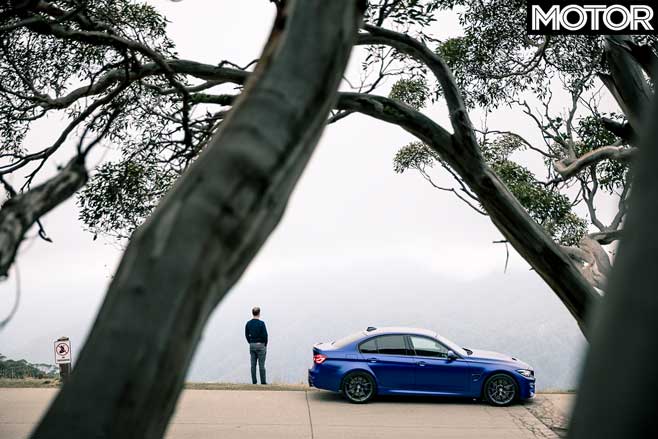
Over the years BMW has revised suspension, differential and electronic settings in an attempt to calm its overt exuberance without quelling its character. We’ve had the Competition, the Pure, an LCI (Life-Cycle Impulse, or ‘update’ in BMW-speak) and now the CS.
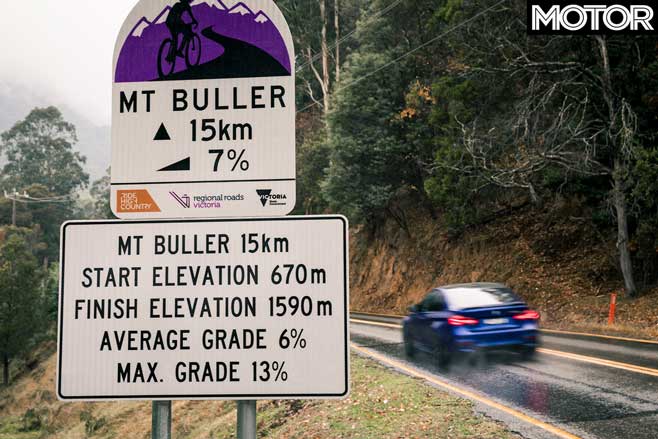
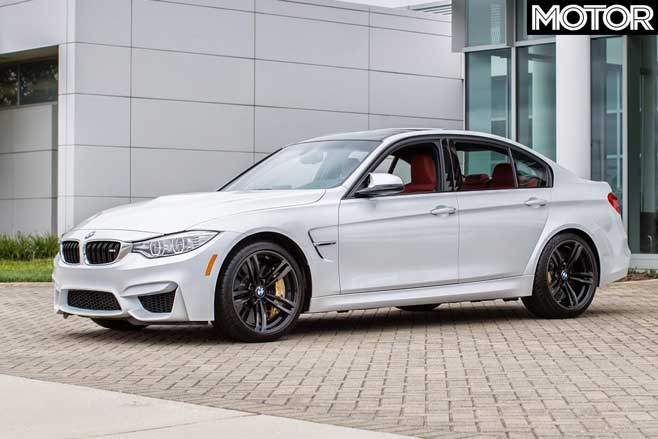
To celebrate the F80 M3, which has ceased production, we’ve brought the ultimate variant to one of Victoria’s finest driving roads, the 15km ascent to the Mount Buller ski resort, a fantastic tarmac rally stage that also serves as a metaphor for the climb the F80 has made over the past five-and-a-bit years. It’ll also provide a good indicator of where the incoming G80 M3 that adorns the cover of the December 2019 issue needs to make the biggest strides.
The weather is miserable, the temperature in the low single digits and incessant rain varies in intensity between irritating drizzle and misery-inducing downpours. Not exactly the ideal conditions for a highly focused rear-driver, but the inclement elements are actually perfect for illustrating the strides the F80 has made in its lifetime.
At its launch we were presented with a very different M3, one that sacrificed rpm for huge chunks of torque, thanks to its new 3.0-litre twin-turbo six. Likewise, every measure was taken to remove any hint of slack or imprecision from the chassis: a massive carbon engine-bay brace, myriad other front-end braces, a carbon roof and propshaft, and solid-mounted five-link rear-end. Very impressive, but on a sodden Hampton Downs racetrack and surrounding roads, the combination of the instant response and gobs of torque made for a white-knuckle affair at times, tails twitching like a kid in a sugar coma.
A couple of dry laps hinted at the new car’s potential, but a back-to-back drive with its atmo V8 predecessor proved benign friendliness had been replaced by a more nervous disposition. Back in Oz, further tests cemented those initial findings: in the right circumstances the new M3 was incredible, but on anything other than perfect roads the massive and sudden torque delivery could tie it in knots.
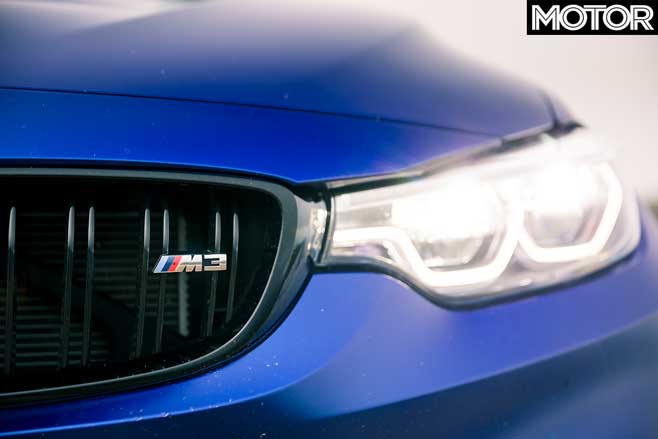
Even then the front and rear felt to respond at different rates, the steering was a bit muddy and it lacked composure over bumps. Evidence of its lack of harmony was the fact you were forever fiddling with the drive modes searching for the sweet spot, only to find it didn’t really exist. On a day like today, faced with a wet, bumpy hillclimb, you’d be happy just to reach the top in one piece.
Enter the M3 Competition. BMW’s boffins extracted an extra 14kW from the engine but spent most of their time fiddling with the chassis. An extra 10mm of tyre width at each end gave it a bigger footprint, 20-inch wheels appeared and, most importantly, there were stiffer springs and dampers, new anti-roll bars and revised calibrations for the stability control and electronically controlled diff.
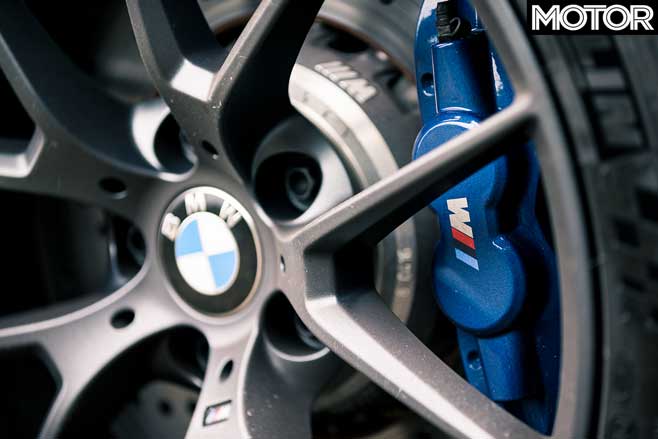
The changes worked, the M3 Competition’s handling being sharper than ever but with much improved body control, more predictable behaviour at the limit and a raspier exhaust note, especially if you specced the $9350 optional M Performance exhaust. But it still wasn’t quite there.
The stiffer suspension made the ride extremely firm – not helped by the new ‘666’alloys being much heavier than the stock 19s – and the revised ESP was hopelessly conservative, even in MDM mode, forcing its complete deactivation if you wanted even a taste of the M3’s complete arsenal of abilities.
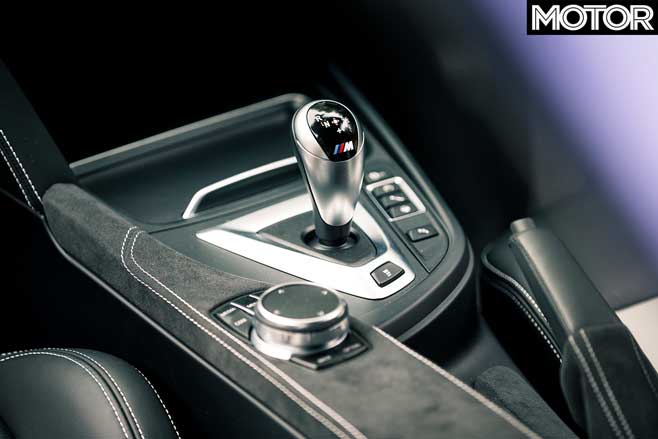
Another round of revisions brought us the M3 Pure. An Australia-only initiative on lighter 19-inch wheels, it stripped the F80 back to basics, deleting a heap of not-really-necessary equipment but keeping the juicy bits of the Competition, namely the extra grunt and revised chassis. Best of all, this package was offered at a stupidly low $129,900 when a regular M3 Competition was $146,710 and a Mercedes-AMG C63 S was $157,211. Bargain.
It was also a sweet drive, the smaller wheels taking the edge off the ride and the ESP once again happy to allow a bit of slip in its sportier setting. Helpfully, I drove an M3 Pure just prior to this feature and, while the combination of a sharp front end and lots o’ grunt required respect, it was friendly and biddable in a way early cars weren’t.
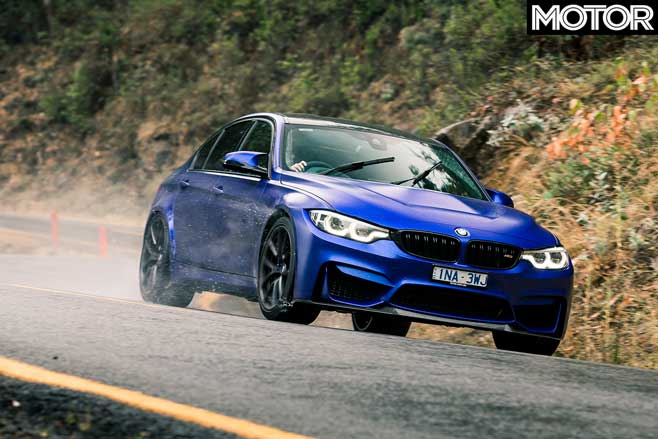
The M3 CS is a different kettle of fish again. An extra 7kW/50Nm brings total outputs to a healthy 338kW/600Nm, which lowers the claimed 0-100km/h time to 3.9sec while top speed is limited to 280km/h. Once again, however, it’s the chassis that has received the most attention. There are further revisions to the spring and damper settings and staggered rims (19s front; 20s rear) wrapped in Michelin Pilot Sport Cup 2 tyres.
A carbon bonnet and lightweight interior shed kilos, though thankfully the M3 CS doesn’t mimic its two-door M4 sibling by eliminating the standard door cards and thus retains some level of practicality. It’s a cool cabin, with swathes of Alcantara and super-supportive seats, though the ultra-fat steering wheel rim is designed for hands much larger than mine and the lightweight ethos is undermined by heated electric seats, which surely weigh more than keyless entry and proper climate control.
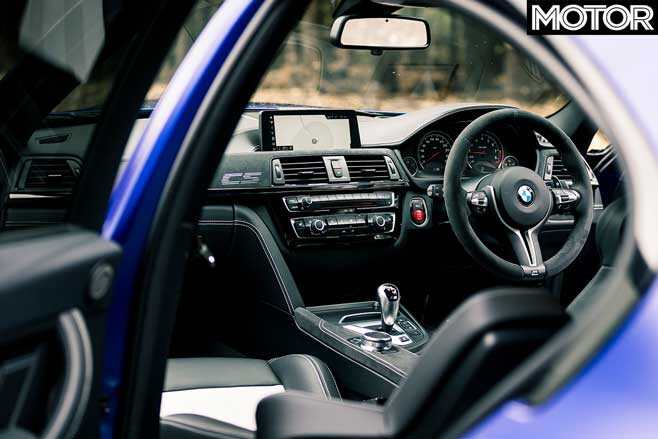
Initially, the CS feels to be channelling those recalcitrant early F80s. On slick, cold roads the track-spec Michelins are utterly disinterested in providing tractive force, working the electronics overtime as the rear-end squirms impotently, or spinning freely with the traction control deactivated. As tyre heat builds, the experience changes completely, the CS displaying a composure hitherto unknown in this generation of M3.
As long as you don’t ask for all 600Nm at once, you can deploy the engine’s full force in second gear, and there’s also the option of fiddling with the settings to give the rear rubber an easier time. Sport-Plus throttle is too aggressive in these conditions, but backing it off to Sport brings greater control; likewise, the angriest gearshift setting breaks traction on upshifts, so again dialling it back to its middle setting makes for a more fluid drive.
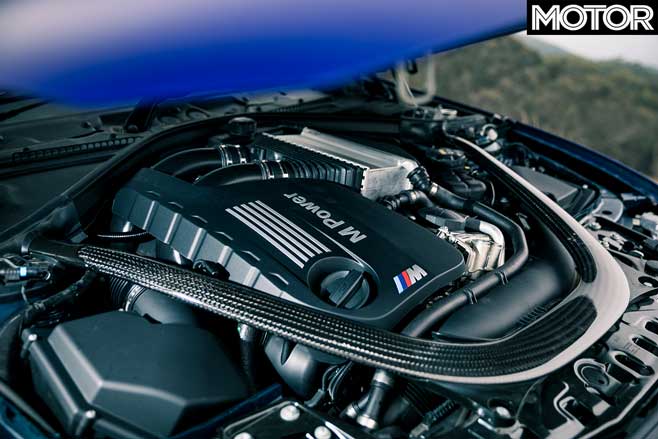
It’s still not the most characterful engine. There’s a little more straight-six rasp to the CS, but the limited-run M4 GTS shows the S55 is capable of more aggression. The focus on mid-range torque denies it some of the high-rpm drama of BMW’s best atmo engines, but it’s undeniably effective.
Boost arrives more smoothly than in the early cars, though it’s possible the throttle has just been remapped; at launch the S55 set a new standard for turbocharged response, but there is a small amount of low-rpm lag compared to the latest and greatest. Now and then the drivetrain will get out of sync and you’ll jerk embarrassingly down the road, the car kicking like a pissed-off mule.
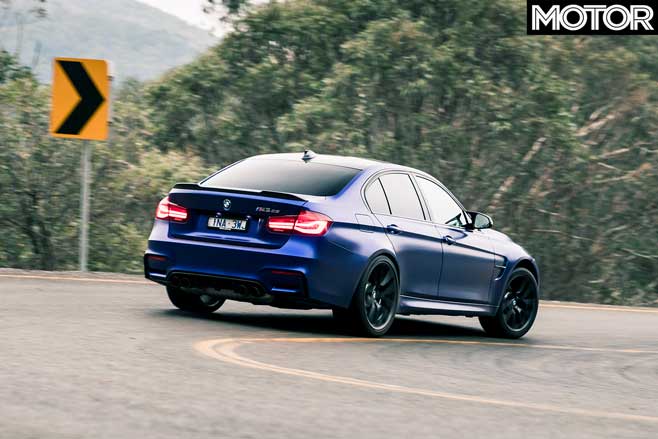
The CS chassis changes bring out the best in the M3. Those sticky Cup tyres undoubtedly help, but it’s not the whole story. The M3 Pure driven recently was reasonably friendly, but carry any sort of brake pressure into a corner and you’d have instant oversteer, followed by more oversteer as soon as any throttle was applied. In contrast, the CS’s bum is much more firmly affixed to the road, possibly a result of the staggered wheel set-up, which looks a bit odd, the front arches not filled to anywhere near the same extent as the rears. Great-looking car, though.
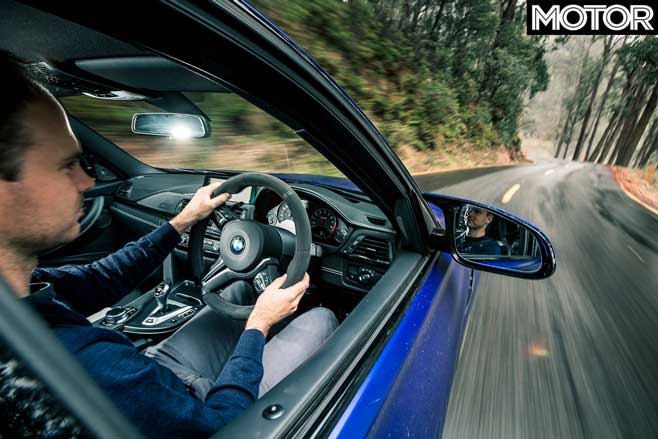
Many of the corners on this Mount Buller road are heavily cambered, but the M3 CS takes such challenges in its stride. Again, the word is composure, which in turn breeds driver confidence, as you have a reasonable idea of what the car is going to do.
Further revisions to the ESP are spot on, allowing the CS to subtly slide around in MDM mode but always keeping a watchful eye on proceedings. It’s not a car that enjoys small slip angles; subsequent time on track proves the M3 CS will happily sit on its lock stops, but with less commitment it fights to retain grip and is difficult to keep balanced.
Nevertheless, instead of tip-toeing across a tightrope, driving an F80 quickly in the wet now feels like dancing over a bridge. One with no sides, perhaps, so care is needed, but you don’t constantly feel on the verge of an accident.
There are still clear areas for improvement we’d like to see in the coming G80. Job number one should be better steering feedback, giving the driver a clearer picture of what’s happening down at the razor-sharp front end. Stronger brakes should also be a priority; the F80 took a step forward, and there’s always the option of carbon-ceramics, but you shouldn’t need to spend an extra $15K to have great brakes. Finally, a little more refinement wouldn’t hurt. The CS ride is firm but fair – there shouldn’t be too many passenger complaints – but the lack of rubber bushings takes its toll on the NVH levels.
The F80 M3 is a textbook example of how a car can improve over its lifetime. Unfortunately, BMW remains tight-lipped on the exact changes it made, refusing to go into detail beyond “revised this” or “recalibrated that”. Nevertheless, kudos for listening to feedback and turning a car that was at times brilliant, at times not, into a machine that can still make a case for being the best in its segment. Hopefully, the G80 will be brilliant out of the box, but if it isn’t, that isn’t necessarily the end of the story.
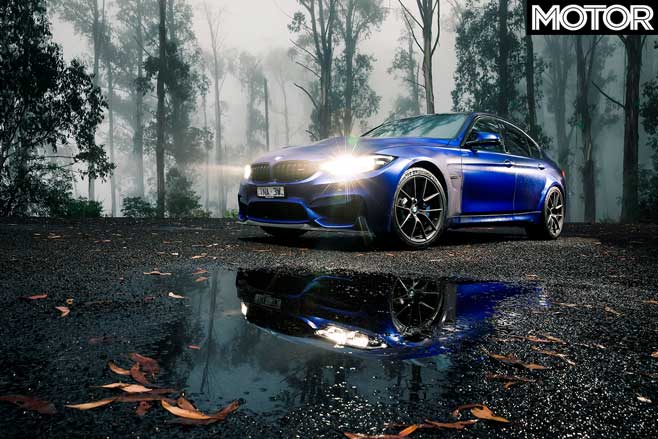
FAST FACTS 2019 BMW M3 CS BODY: 4-door, 5-seat sedan DRIVE: rear-wheel ENGINE: 2979cc inline-6, DOHC, 24v, twin-turbo BORE/STROKE: 89.6 x 84.0mm COMPRESSION: 10.2:1 POWER: 338kW @ 6250rpm TORQUE: 600Nm @ 4000-5380rpm WEIGHT: 1585kg POWER-TO- WEIGHT: 213kW/tonne TRANSMISSION: 7-speed dual-clutch SUSPENSION: struts, adaptive dampers, coil springs, anti-roll bar (f); multi-links, adaptive dampers, coil springs, anti-roll bar (r) L/W/h: 4671/1877/1424mm WHEELBASE: 2812mm TRACKS: 1579/1604mm (f/r) STEERING: electrically assisted rack-and-pinion BRAKES: 380mm ventilated/drilled discs, 4-piston calipers (f); 370mm ventilated/drilled discs, 2-piston calipers (r) WHEELS: 19 x 9.0-inch (f); 20 x 10.0-inch (r) TYRES: Michelin Pilot Sport Cup 2, 265/35 ZR19 (f); 285/30 ZR20 (r) PRICE: $179,900
PROS: Outright performance; looks; handling ability CONS: A little unrefined; confused interior; steering feel RATING: 4.5 out of 5 stars
The Four Iterations of the F80 M3
Standard 2014 – F80 M3 was a quantum shift, introducing turbocharging for the first time. Performance and efficiency hugely improved but noise and poise questionable.
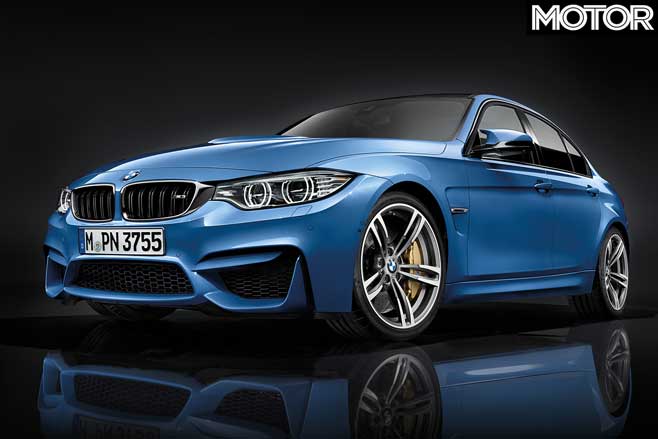
Competition 2016 – Competition variant came with more power, new 20-inch wheels and a hefty series of chassis revisions, but the ride suffered and there was a $10K premium.
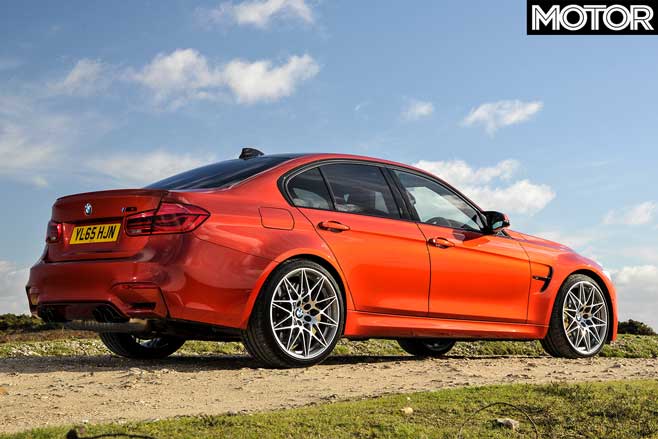
30 Jahre 2016 – A special edition that celebrated 30 years of the M3. A Competition in all but name, 500 were built worldwide – all in Macao Blue, a colour from the E30.
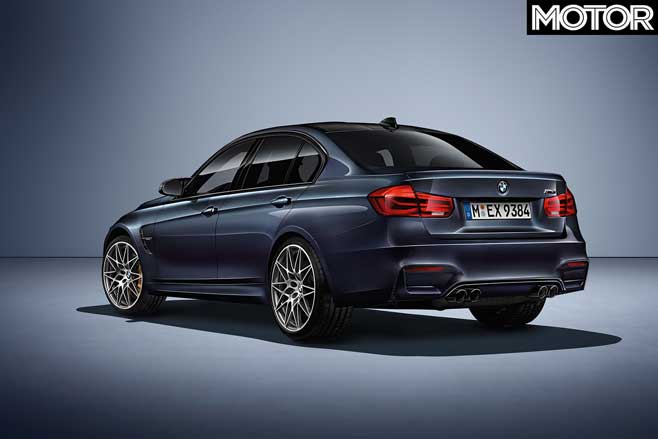
Pure 2017 – Oz-only variant ditched kit like a fancy stereo, leather and adaptive headlights, and offered for a limited time at $119,900 driveaway, the bargain of the century.
Happy Saturday Friends of WhichCar!
Ho! Ho! Ho! It’s the end of the year and hopefully you’re grabbing a few days off like we are before 2020 gets here.
What a year it’s been, although in some quarters not much has changed. Great Britain still can’t find the exit from Brexit, Donald Trump is still a clown, Australian new car sales are still falling, and Lewis Hamilton is still F1 World Champion – although I read yesterday he could leave Mercedes-Benz for Ferrari in 2021. If true, that’ll cost Maranello a fair bit more than his current GBP 40 million annual salary ($75million AUD).
No surprises I’m predicting Toyota will see out the year as Australia’s most popular new car brand for 16 years in a row when annual sales figures are released on January 6. But even that mighty Japanese juggernaut couldn’t buck the overall sales decline, falling 7.3 percent to the end of November in a market down 8.0 percent YoY.
Holden, in 2019, continued to set records for all the wrong reasons, its sales down another 28 percent on top of a 33 percent fall in 2018. In 2010, Holden was Australia’s top brand. In less than a decade the Lion has fallen to 10th and will fall further unless something dramatic happens.
In 2014 Holden’s then boss Gerry Dorizas told Australian media the Lion would take back the number-one spot by 2020. Well… based on the current rate of decline Holden will be 13th – below luxury brand Mercedes-Benz on passenger car and SUV sales.
Some say Holden took a brave first step to rebuilding its brand last week when it finally laid the Commodore badge to rest, two years after killing local production and moving Australia’s most respected nameplate to an import that shared none of the Aussie Commodore’s then-49-year history or DNA. I believe that’s just the first of many major challenges facing Holden. The biggest is how to get consumers interested in a largely uninspiring, uncompetitive SUV range. Another is how to re-energise a disillusioned dealer network trying to stay alive on less than a fifth the sales volume of the glory years in in the 1990s.
When it comes to the top ten brands, Holden and Toyota aren’t the only ones facing leaner times – one industry expert I spoke to predicted another 12-18 months of sales decline ahead.
You can be sure the car industry is under attack right now, on a number of fronts. Firstly, there’s the growing tide of electric cars headed our way as mainstream car companies scramble to catch up to Tesla. Despite what some pundits say, electric cars are not cheaper than IC cars to develop or to build. For proof look at the $12 billion Mercedes-Benz says it has invested in its new EQ range, headed by the EQC SUV which arrived in limited numbers this month. I bet you the real number is closer to $20 billion.
Right now, Mercedes-Benz cannot build enough of these cars to satisfy global demand. Australia’s initial supply was so small that the Australian arm had to invent a new retail program to guard against potential customer dissatisfaction, but more on that in a sec.
This lack of volume could be because Merc underestimated demand, but that’s not likely. I think it’s because there’s a huge learning curve associated with building electric cars, and because component manufacturers do not have sufficient volume to feed big players like Mercedes… yet. Hence Merc’s tough decision to delay the EQC’s entry into the important and lucrative US market until 2021.
Component manufacturers will come under added pressure when Volkswagen’s exciting ID family of electric cars (starting with a hatch and a small SUV) hits mass production Q1 2020.
As for Volkswagen’s ambitious boast that it will build 15 million ID electric models by 2028… Don’t bet on it.
On another front, the rise and rise of ride hailing continues, with Uber, Ola, Didi and others proving that you don’t have to own a car to be mobile at a moment’s notice. Many people underestimated the true impact these companies would have on new car sales and car ownership. Not anymore. Uber may still be struggling for profitability, but ride hailing is here to stay.
Then there’s autonomy. Thankfully for this car enthusiast, this particular threat actually seemed to weaken in 2019 as more and more car companies pushed back the highest level-5 fully-autonomous horizon by years, decades even.
Lastly, what about the humble dealer? I foresee the retail revolution picking up pace considerably in 2020. On the one hand Subaru and Tesla are well down the road with shopping-centre stores, and others will follow. On the other hand, Mercedes-Benz launched a new retail plan with the EQC electric SUV circumventing the dealer and selling cars direct to the customer.
Speaking at the launch earlier this month, Mercedes-Benz’s Network Development Director Jason Nomikos told me this program could be rolled out across other small volume, high-demand models… and also on high volume models in the future. Dealers won’t be happy, losing all that sales volume… They will still get a fee for facilitating the customer handover under the MB model, but it’s a lot less than the margin they would have made selling the car.
Meanwhile up in Brisbane, Mercedes-Benz of Brisbane opened a new $100-million-plus dealership in Breakfast Creek that definitely bucks the trend of dealership downsizing. This five-story behemoth will be more than just a car retail and servicing space, if its owner LSH Auto’s vision is realised. It will be a destination with a high-class restaurant and riverside cafe, rooftop cocktail bar, wellness centre, co-working offices and more.
With all this uncertainty and change, there’s one thing I’m absolutely 100 percent, rock solid, put yer house on it certain of: I am really looking forward to 2020!
Until then, thanks for your support in 2019, have a fantastic holiday season, and we’ll see you next year!
Have you comprehensively run out of gift ideas for that special someone? Does said person enjoy long bouts of video gaming?
Get them Puma’s purpose-built gaming sock. Maybe.
Okay, the very concept of footwear engineered for gaming is, frankly, pretty ridiculous, but the gaming sock (or as Puma prefers to call it, “Active Gaming Footwear”), could be just the thing for sim racers.
The weird thing is, Puma doesn’t single out driving game enthusiasts as the target of its gaming sock, but rather avid console gamers. Given most console gaming is done while seated on a couch or slumped on top of a beanbag, we’re not exactly sure how wearing a specific kind of sock is going to enhance your performance.
But for driving sims, it makes perfect sense. Many hardcore sim racers prefer to wear socks rather than shoes to give them better pedal control, with the thin fabric providing better tactile information to the driver about how hard they’re pushing a pedal, while being slightly more comfortable than going totally barefoot. Puma’s gaming sock, which doesn’t really look like a sock, but rather a lace-less running shoe with a very thin overmoulded sole on the bottom, looks like the perfect middle ground between an ordinary sock and a full-fledged driving boot.

But boy, it’s not cheap. Priced at $160 in Australia, the gaming sock rates poorly on the value-for-money scale. After all, an actual sports shoe (and a reasonably decent one at that) will cost you less, and you’ll be able to wear it outside your home too. Puma’s gaming sock does look pretty damn comfy though, with its open mesh upper and stretch-fit design being both breathable and easy to slip on.
Are you serious enough about your gaming to justify spending that much coin on fancy footwear though? Well, if you’ve already got a big-dollar sim rig, your battlestation is maxed out and your iRacing subscription is up to date, then hey, go nuts. It’s Christmas, treat yourself.
Fact: at 290km/h, a car and its driver are covering a kilometre every 12.4 seconds. Even with a professional drag racer’s reaction times, from the instant the driver sees the obstacle until the moment he pins the anchors, that same car will have covered more than 32 metres.
This feature was originally published in MOTOR’s April 2004 issue
Fact: in order to cover 400 metres from a standing start in 13.1 seconds or less, a hard-launching all-wheel drive’s acceleration can peak at around 1.0g. About the only way to get it to accelerate faster is to drop it off a bridge.
Welcome to extreme sports, Avalon style.
The good news for the cars and the MOTOR crew this time around was that the ambient temperature at Avalon airport wasn’t nudging its customary 40 degrees in the shade. In fact, it was a pleasant low 20s. But just to prove that the weather gods have a sense of humour, there was the odd spot of drizzle early on, just to tighten any freckle that wasn’t already clenched at the thought of hurtling flat strap down three kays of hotmix.
Of course, even three klicks isn’t enough to wind everything out, so you needed to hit the runway proper (from a slip-road) as fast as possible to give the car the best chance to produce a big number on the radar screen. And it didn’t help that, instead of last year’s 15km/h tailwind, we had a 3km/h crosswind this year.
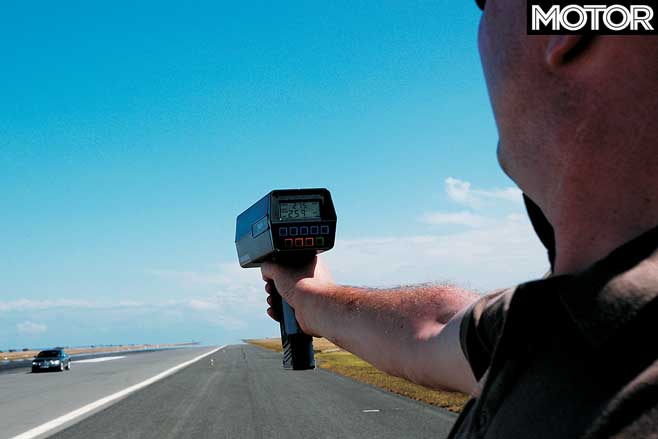
The real work at Avalon, meanwhile, involves Correvits at 10 paces. To keep it – as Ali G would say – real, we need to run each contender across the standing 400m, kilometre and from zip to 100 on the same surface, in the same conditions.
Boiling down the numbers, this year’s field is the fastest and most accelerative PCOTY group ever. The average top speed was a stunning 254km/h, up a full 10 kays on last year’s field, itself up 10km/h from 2002.
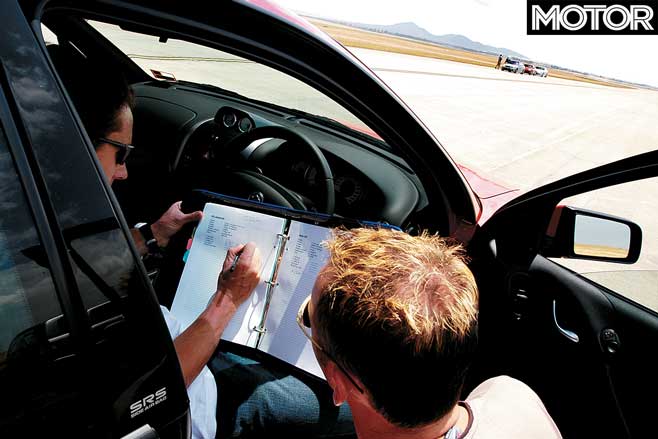
Improvements in acceleration were marginal, with the average 0-100km/h sprint dropping from 6.34sec in 2003 to 6.31 (Lambo clutch caution and, mostly, lower grip out of the concrete with the cooler temp).
This year’s crew was a bee’s pecker slower across the quarter mile (14.34sec to 14.33) but terminal speed was up two kays to 162.5km/h. And to the standing kay, 2004’s field dropped a tenth to 25.81sec and picked up nearly two kays in terminal speed at 209.85km/h.
Alfa Romeo 147 GTA 0-100km/h: 7.24sec 0-400m: 15.06sec @ 156.5km/h 0-1000m: 26.96sec @ 200.0km/h Top Speed: 239km/h
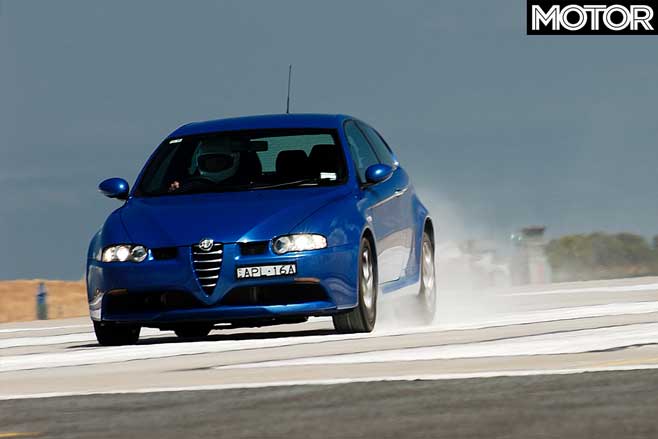
A 184kW front-driver is no picnic to get off the line, and the disappointing 7.24 seconds to a hundred proves as much. The 147 is starting to hit its straps by 400m with near enough to a 15 dead. The sweet-sounding V6 pulls hard across the kay marker and is all done at a whisker shy of 240km/h in sixth.
Audi RS 6 0-100km/h: 4.92sec 0-400m: 13.08sec @ 172.3km/h 0-1000m: 23.96sec @ 224.9km/h Top Speed: 266km/h
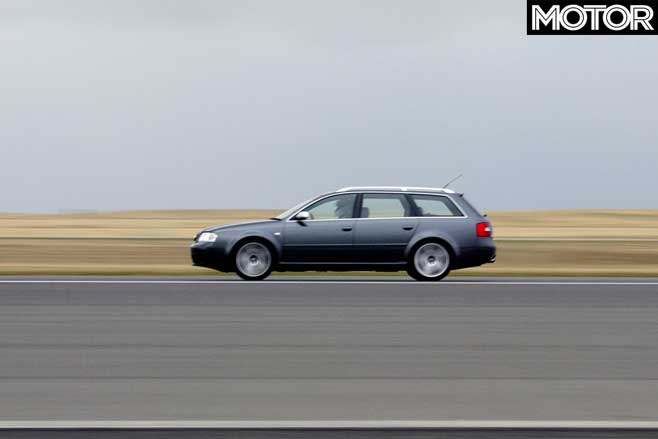
Despite being an automatic station wagon weighing 1865kg, the RS 6 claimed the honours for the fastest times on the day. Okay, so 331kW and 560Nm of turbo-torque are always going to be hard to beat, but 0-100 in 4.92 and 400m in 13.08 at 172.3km/h is anything but hanging around.
The standing kay is impressive, too, taking just 23.96 seconds and maxing out at 224.9km/h at the finish post. Phew. The RS 6’s 266km/h was recorded as it snuggled against a soft limiter with 300 or 400m of strip to go.
Audi S4 0-100km/h: 6.26sec 0-400m: 14.38sec @ 160.4 km/h 0-1000m: 25.81sec @ 212.0km/h Top Speed: 261km/h
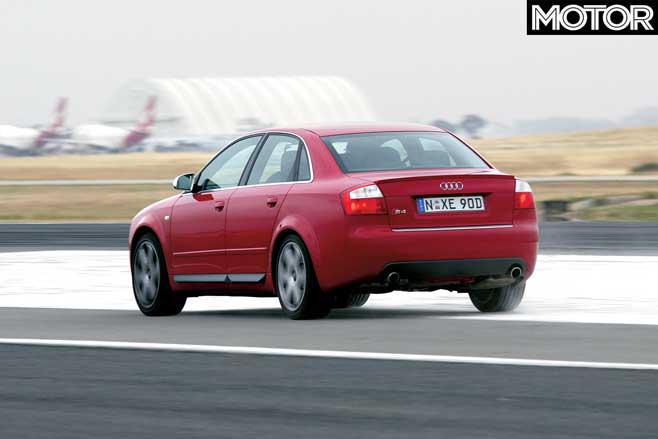
Neither Audi is particularly lithe, but the S4’s 1660kg is no real barrier to performance thanks to 253 very flexible kilowatts and 410Nm. Nought to 100 comes up in 6.26 and the 400m is gone in 14.38, with a terminal velocity just over the pre-metric ton. Continues to pull hard across the kay and rock solid on the run to its 261km/h top whack.
Bentley Continental GT 0-100km/h: 6.06sec 0-400m: 13.88sec @ 171.9km/h 0-1000m: 24.58sec @ 225.9km/h Top Speed: 280km/h
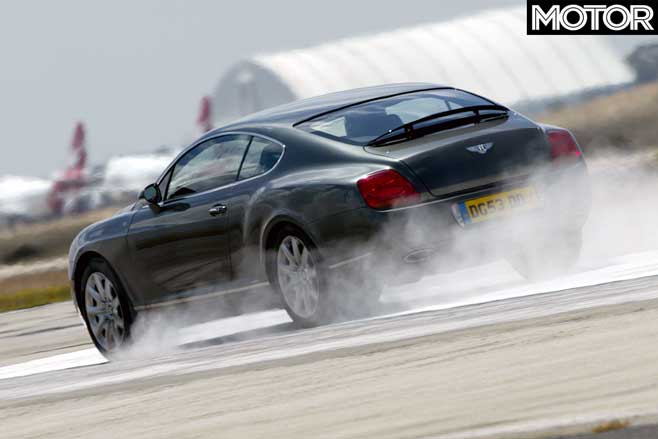
Okay, so it’s 2.4 tonnes… that’s bad. But it also has a twin-turbo 12-cylinder engine with 650Nm, so that’s good. Good enough to fling it to 100 in just about six seconds flat and across the quarter in under 14.
Slower off the mark it may be, but across a kilometre it caught the hell up with a time of 24.58 and a terminal speed of 225.9km/h. From seventh to 100, it charged to the fifth fastest trap speed after 400 metres, then was, incredibly, the second fastest car at the 1km mark.
Four hundred and eleven kilowatts can pretty much fix anything. The Bentley was another big hitter, with 280km/h making light (literally) of its kerb mass. The top-end spurt in the Bentley was the really amazing bit – it just never quit.
BMW M3 CSL 0-100km/h: 5.15sec 0-400m: 13.40sec @ 174.1km/h 0-1000m: 24.06sec @ 224.4km/h Top Speed: 269km/h
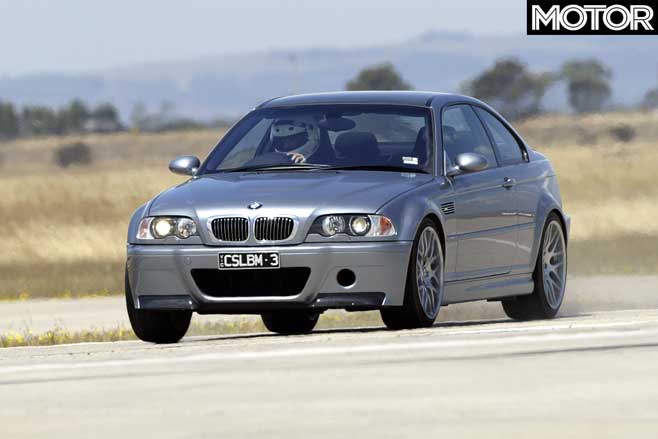
Suddenly, we’re down to the exotica and some big reputations are seriously on the line. With its launch control and the SMG gearbox moved from ‘stun’ to ‘kill’, the M3 CSL was always going to give things a big shake. And a 5.15 to 100 and 13.40 at 174.1km/h is the business.
It also managed the first kay in 24.06 with a terminal of 224.4. The M3 clocked 269km/h and felt like it was out for a Sunday drive in the process. And this one was ‘limited’ to 250km/h.
BMW Z4 3.0 0-100km/h: 7.02sec 0-400m: 14.92sec @ 153.2km/h 0-1000m: 27.10sec @ 196.7km/h Top Speed: 241km/h
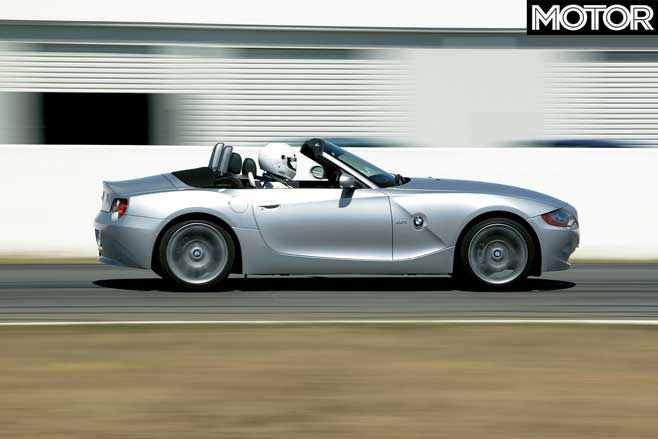
We’ve run about four-tenths quicker to 100 on a previous test, but the 14.9sec 0-400m time is about on the money at just a tick slower than our best. Disappointingly, the Z4 was one of only five cars not to crack 200km/h by the kay marker, but the Z4’s 241km/h seemed pretty handy given the compromised aerodynamics inherent in any soft-top.
Chrysler Crossfire 0-100km/h: 7.27sec 0-400m: 15.07sec @ 151.0km/h 0-1000m: 27.37sec @ 193.8km/h Top Speed: 233km/h
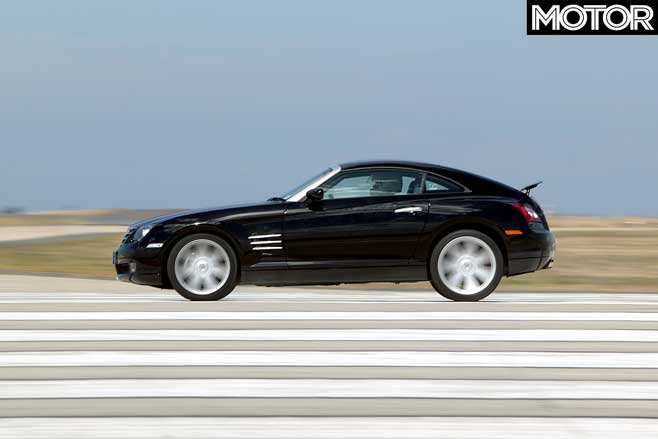
Avalon established the pecking order for the latest rear-drive, mid-sized coupes and convertibles. The Chrysler Crossfire was the slowest to 100 (7.27) and was also the only one of the four (350Z, Z4 and RX-8) that couldn’t get under 15 seconds over the standing 400m, although it was damned close at 15.07.
Top end was also slowest with a disappointing 233km/h (just pipping the Astra by a single kay). Only a slightly wandery rear end under hard brakes at the end of things spoiled the fun in the Chrysler.
CSV Mondo GT370R 0-100km/h: 5.52sec 0-400m: 13.60sec @ 177.0km/h 0-1000m: 24.10sec @ 224.6km/h Top Speed: 282km/h
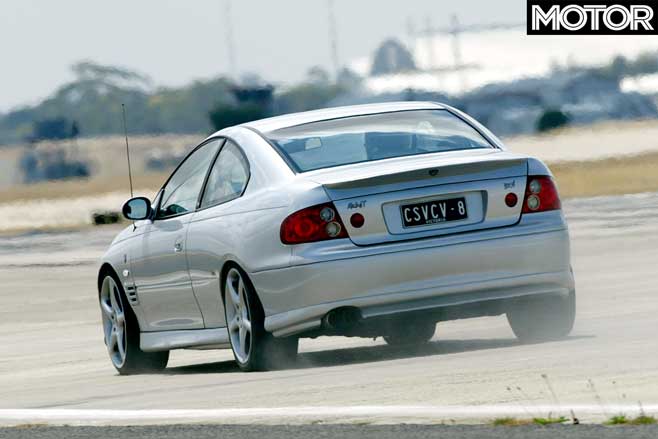
The six-and-a-half-litre CSV Mondo blew the other locals into the weeds with 5.5 for the 100km/h dash and a 13.6 at 177km/h for the 400m. Throw in a 24.1sec klick at 224.6km/h (a shade faster than the RS 6) and the Mondo GT emerges as a real player. This is CSV country – wide open straights and traffic light Don’t Argues.
The Mondo GT was blisteringly quick down the top speed chute, especially since it doesn’t have the Lambo’s aero package, and it gets worryingly skittish over 270-odd (we’re assuming – the speedo goes to 220).
Still, it’s the fastest Australian-manufactured car we’ve ever tested, so cop that and two fingers to the Big Boys. And let me tell you, at 282km/h, you’re mighty glad CSV went to the trouble of the huge brake package it wears.
FPV Falcon GT 0-100km/h: 6.32km/h 0-400m: 14.52sec @ 162.8km/h 0-1000m: 25.81sec @ 209.7km/h Top Speed: 254km/h
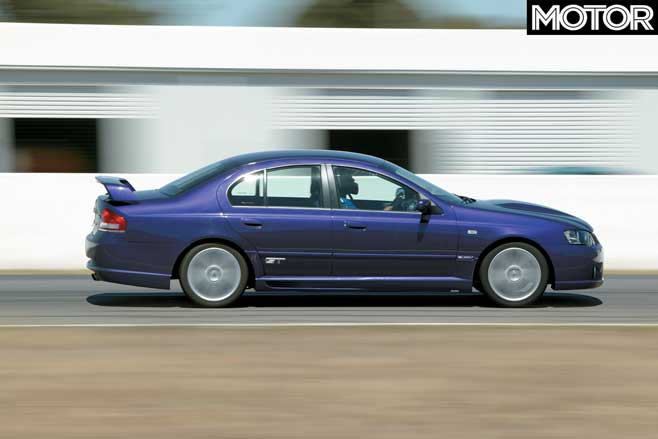
Wow! Big top end for a Falcon. These things are supposed to be limited to 230, but this big boy just powered on to 254km/h. Ran straight and true and had no problem with the big stop at the end of the runway. Couldn’t match the HSV on the drag strip but managed to pip the lighter Holden Commodore SS. And it sounded better than both of them, howling like buggery under full load in fourth and fifth.
Holden Astra SRi Turbo 0-100km/h: 7.42sec 0-400m: 15.44sec @149.2km/h 0-1000m: 27.86sec @ 194.7km/h Top Speed: 232km/h
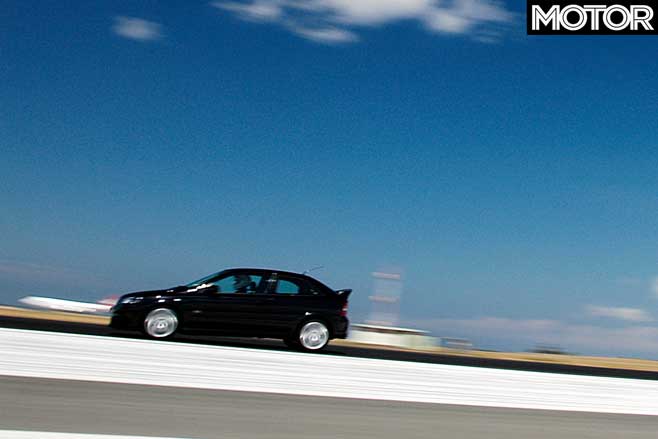
With the least power and worst weight-to-power ratio of the field, it’s no real surprise to see the little huffer-stuffed Astra at the bottom of the speed charts. It might be down on pace from the big boys, but the 147kW hatch posts solid acceleration numbers for its ilk. And 232 kays is not messing around, either, sitting pretty with both the Liberty and the Crossfire. The steering’s starting to get light at that speed, and it could do with some more in the braking department when the end of the runway is rushing up.
Holden Commodore SS 0-100km/h: 6.48sec 0-400m: 14.50sec @ 162.5km/h 0-1000m: 25.95sec @ 207.8km/h Top Speed: 251km/h
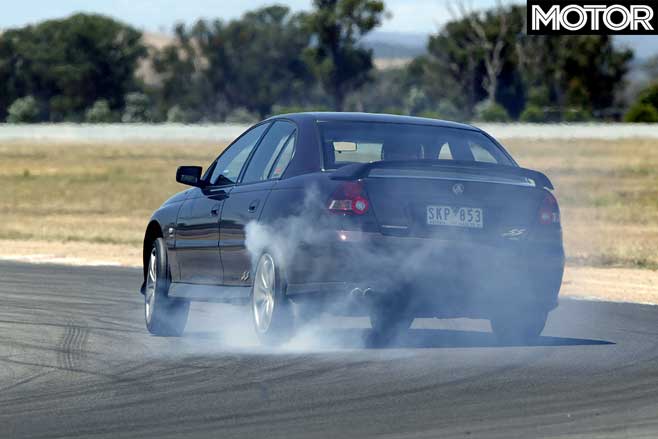
Not bad for a big family hack. And remember, the SS is the second cheapest car in the field at a whisker under $50k. It’s a battle of the six-speed ’box on the acceleration strip, but a mid-six to 100 kays and a mid-14 is pretty sharp, even though conditions took more out of the rear-drivers than others. Given the SS’s brakes, which felt like they were underdone, 251 was really as fast as you’d want to go.
HSV ClubSport R8 0-100km/h: 5.92sec 0-400m: 14.08sec @ 167.4km/h 0-1000m: 25.13sec @ 216.4km/h Top Speed: 260km/h
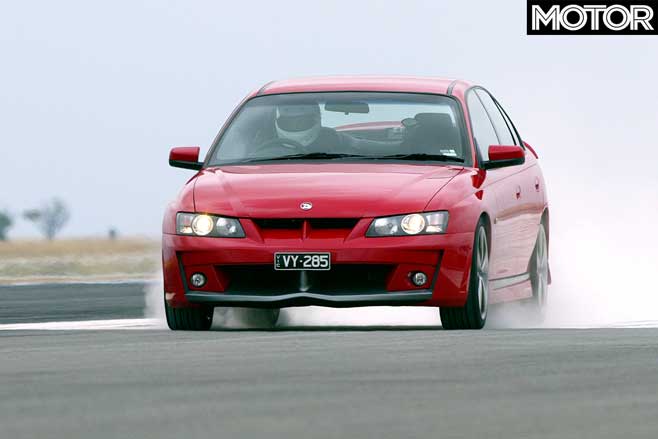
Predictably, the ClubSport R8 was quicker than the Commodore SS and Falcon GT with a 0-100 time in the fives (5.92, to be precise) and a 400m time of 14.08. No match for the CSV in acceleration or top speed, it bested it for stability at extreme pace.
The Clubbie still impressed with 260km/h (up six klicks on the FPV), although that’s about 15 kays down on the (shorter geared) GTS sedan from last year. Most stable of the local sedans under brakes when the fence started to look big.
Jaguar XJR 0-100km/h: 5.79sec 0-400m: 13.96sec @ 167.0km/h 0-1000m: 25.17sec @ 214.6km/h Top Speed: 252km/h
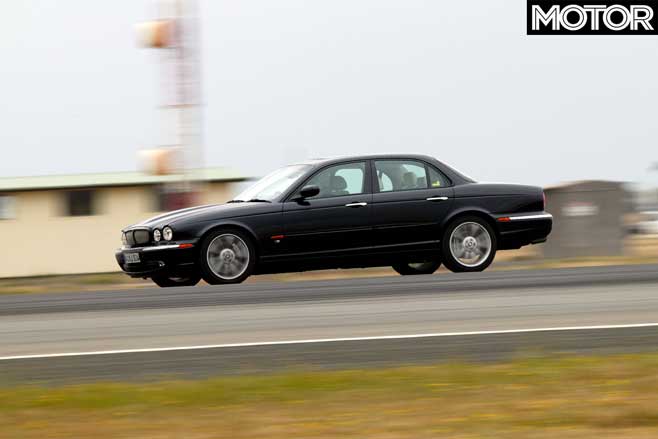
The Jaguar XJR packs a good wallop with a supercharged 298kW and a six-speed auto. It hustles, too. A gear ratio for every occasion hides its 1655kg, and 0-100 in 5.79sec and 13.96 at 167km/h are right up there.
Like Jaguars past, the XJR was nibbling on its limiter at 251km/h just before the radar and felt like there was still a bit in reserve. Brakes are still not a strong suit, but the XJR displayed way more stability than last year’s XKR.
Lamborghini Gallardo 0-100km/h: 5.55sec 0-400m: 13.36sec @ 179.7km/h 0-1000m: 23.57sec @ 236.6km/h Top Speed: 292km/h
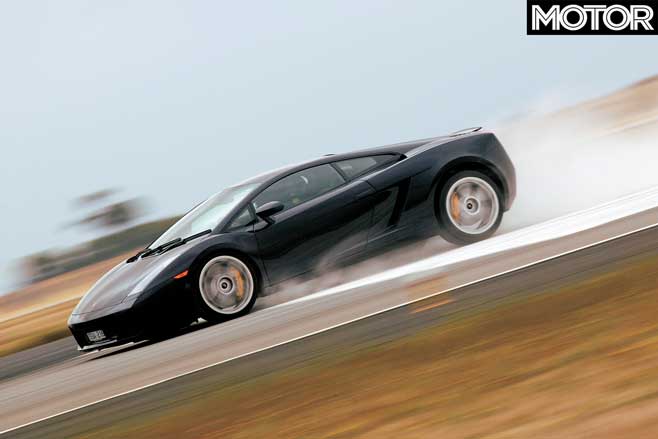
Like the CSL, the Lamborghini Gallardo was similarly burdened by its own reputation, but also acquitted itself well with a marginally slower 0-100 time than the Bimmer – 5.5 – but an ever so slightly quicker time for the 400m with a 13.36 at 179.7.
If you think that 5.5sec 0-100 is a bit off the pace, you’re dead right. There’s probably another second or so in the car, but the high-grip surface at Avalon makes launching an all-wheel drive next to impossible. This early on in the event, we felt discretion was the better part of valour.
Only fourth to 100 kays, then, the Gallardo mowed them all down with disdain once it got rolling, fastest at every other increment. It’s the same in all-time PCOTY reckoning – it had the 10th fastest 400m run we’ve ever done (even with the dainty launch), but the fourth fastest trap speed behind Porsche’s 911 Turbo and GT2, and the Viper.
The real difference, however, was across the standing kilometre, where the Lambo’s top-end rush and slicker aerodynamics allowed it to post a time of 23.57 at a stunning 236.6km/h. That’s more than a second and 10 kays quicker than the Viper from last year, but the Lambo storms onto a similar top speed, meaning it has serious acceleration in fifth and sixth gears.
On the runway, the Lambo was king of the hill with a best of 292km/h and still running hard in sixth. Given room, the Gallardo’s a genuine 300km/h car. And of all the cars, it was the only one you’d confidently move the braking maker back another 100 metres or more – even with its higher top speed!
Mazda RX-8 0-100km/h: 6.58sec 0-400m: 14.58sec @ 156.6km/h 0-1000m: 26.50sec @ 199.8km/h Top Speed: 235km/h
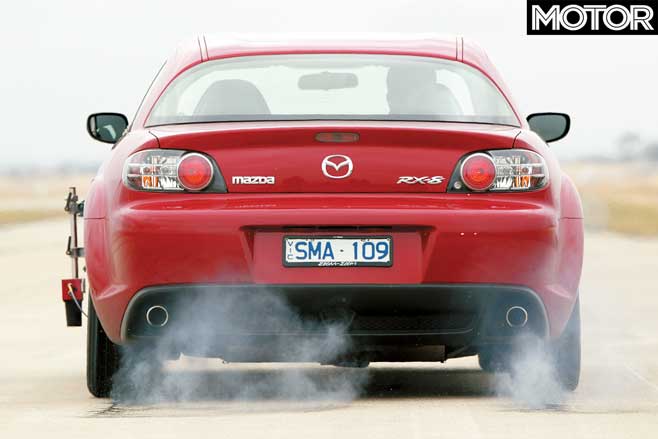
Quickest RX-8 times we’ve run by a good half second. No doubt helped by the sweet gearchange, which is only ever a wristy jab away from the next ratio. The RX-8’s 235 seemed a bit disappointing, more so when compared with the Zed’s 251 and the 250 clocked by the Volvo. By then it had genuinely run out of puff and was struggling to push the air.
Nissan 350Z Track 0-100km/h: 6.68sec 0-400m: 14.61sec @ 159.6km/h 0-1000m: 26.31sec @ 206.2km/h Top Speed: 251km/h
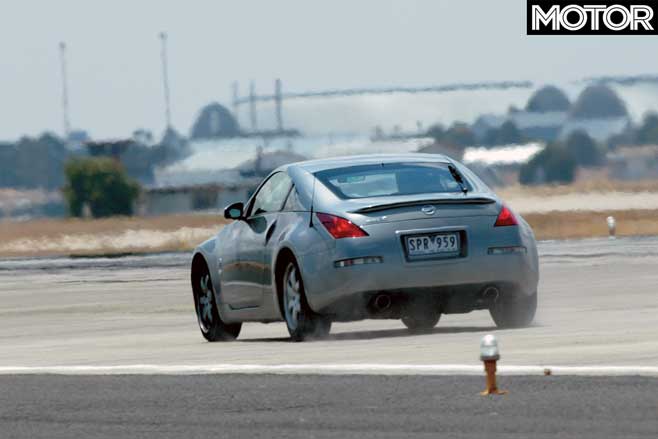
Very strong performance from the Zed. Sure, it drops a tenth to the Mazda on the run to 100km/h, but it’s hauling it in by the 400m mark with a higher terminal speed. Continues to bully both the Crossfire and the RX-8 over the standing kay and pushes on to a solid 251km/h top whack – and it’s still gathering pace. Big Brembos do the stopping with ease.
Porsche Cayenne Turbo 0-100km/h: 6.48sec 0-400m: 14.49sec @ 159.7km/h 0-1000m: 26.10sec @ 205.6km/h Top Speed: 250km/h
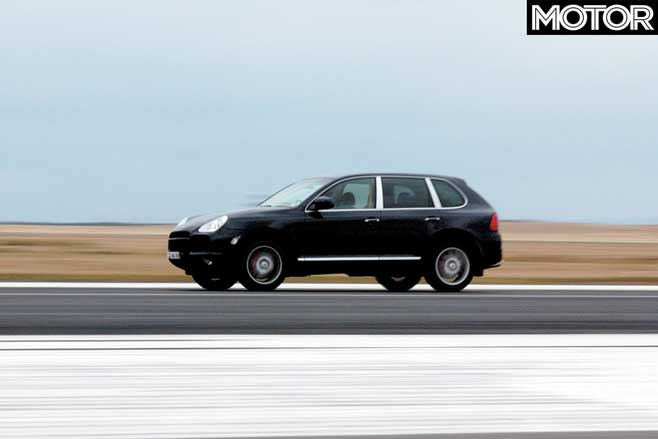
While it doesn’t especially look like a performance tool, with a twin-turbo V8 and 331kW at its disposal, the Porsche Cayenne Turbo sure as hell goes like one in a straight line. The first 100km/h came up in 6.48 and the 400m dash takes 14.49. On the runway the Cayenne managed 250km/h neat, which, considering its frontal area, is a bit like ramping a council dunny block up to Mach 3.
Subaru Liberty GT 0-100km/h: 6.90sec 0-400m: 14.99sec @ 150.2km/h 0-1000m: 27.60sec @ 189.4km/h Top Speed: 234km/h
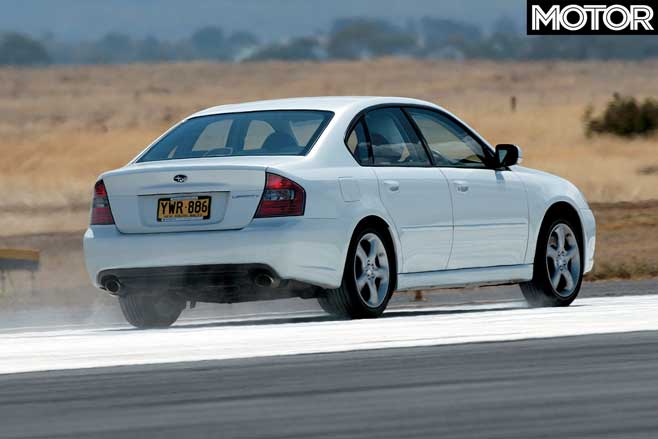
Next year we’ll have some locally made all-paw monsters (did someone say Coupe4?) to run at PCOTY, but this time around all the four-wheel drives were imports. And with no WRX, STi or EVO Lancer this time around, the competition was wide, wide open.
The Subaru flag was flown by the Liberty GT, which, with its 180kW, is some kind of big kid’s Rex. Nought to 100 came up in 6.90 and the standing 400m was dispatched in 14.99. Nothing too flash, it must be said, and the 234km/h top speed confirmed suspicions.
Volvo S60 R 0-100km/h: 6.38sec 0-400m: 14.58sec @ 156.6km/h 0-1000m: 26.40sec @ 204.0km/h Top Speed: 250km/h
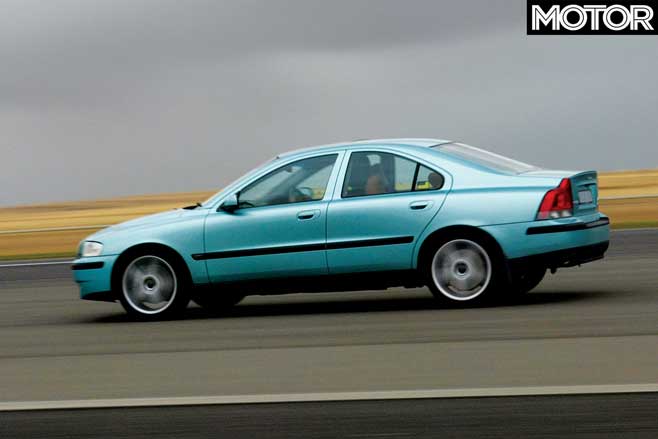
The big Volvo S60 R feels pretty toey on the road, so its 6.38 and 14.58 were no real surprise. But along with the Lambo, the Volvo was the hardest car to launch. Various techniques and launch revs were tried, but the Ovlov wanted none of it, bogging down on each run.
Once again, it really hits its straps a bit further down the road, and its standing kay terminal speed of 204 neat suggests its portly 1700-plus weighbridge ticket hinders it a little at first. Pulled a solid 250km/h on the nose, but the last five or so kays were a bit of a struggle.
Avalon Drag Strip Numbers

Sometimes life gives you lemons. Sometimes it chucks you the keys to some of the most amazing cars on the planet and says to you: “Go on, maaaaate. Knock yourself out.”
Happens to us a lot at Wheels (not the lemons part) – and we’ve bottled our best hitouts of 2019 for you in our annual Best Drivers’ Cars mag, on sale now!
Strap in as we take you to some of the most challenging roads in stunning locations in Australia and overseas. Big cars or small, there’s one thing they all have in common: the sheer joy they bring when you have the time and place to let them do their thing.
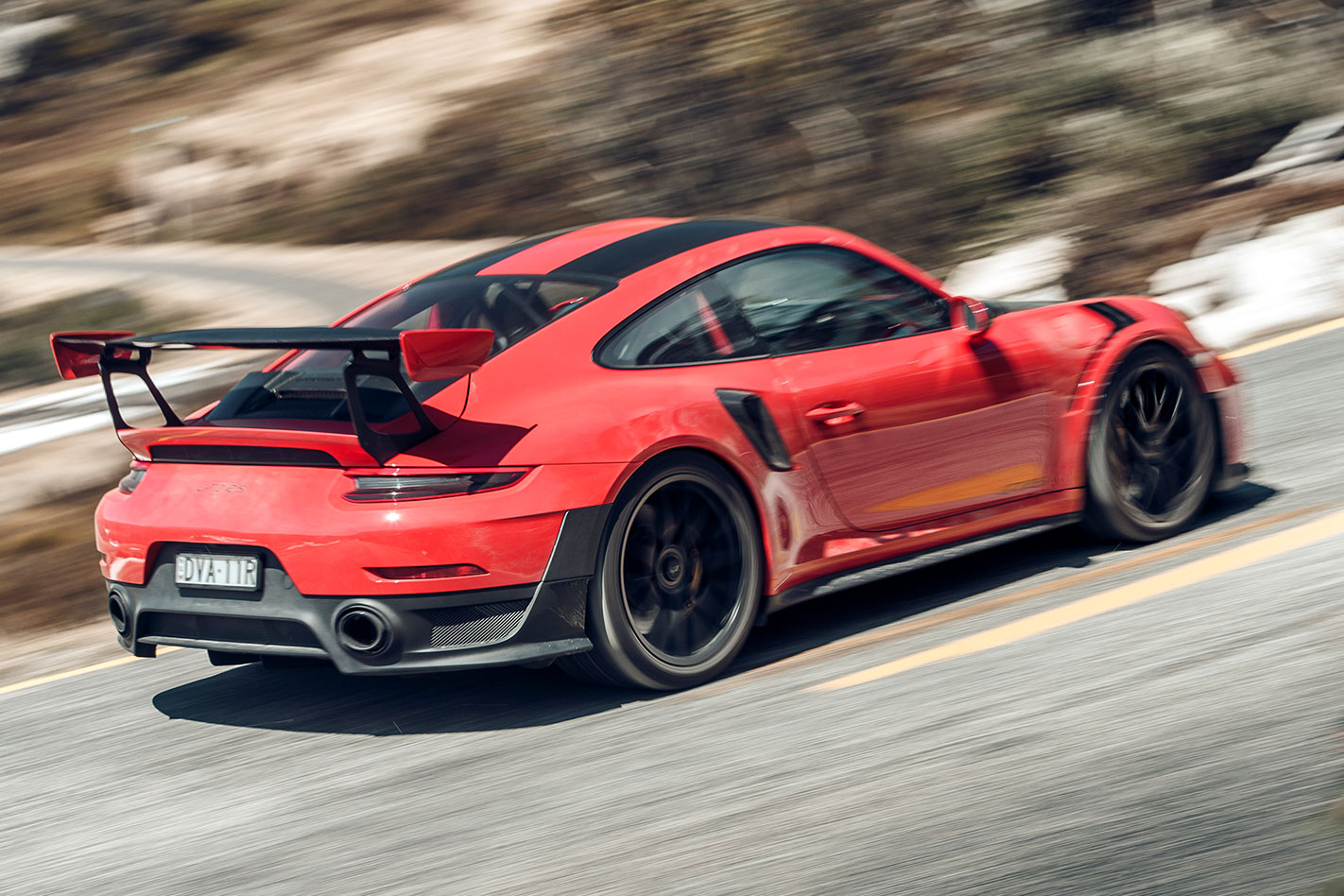
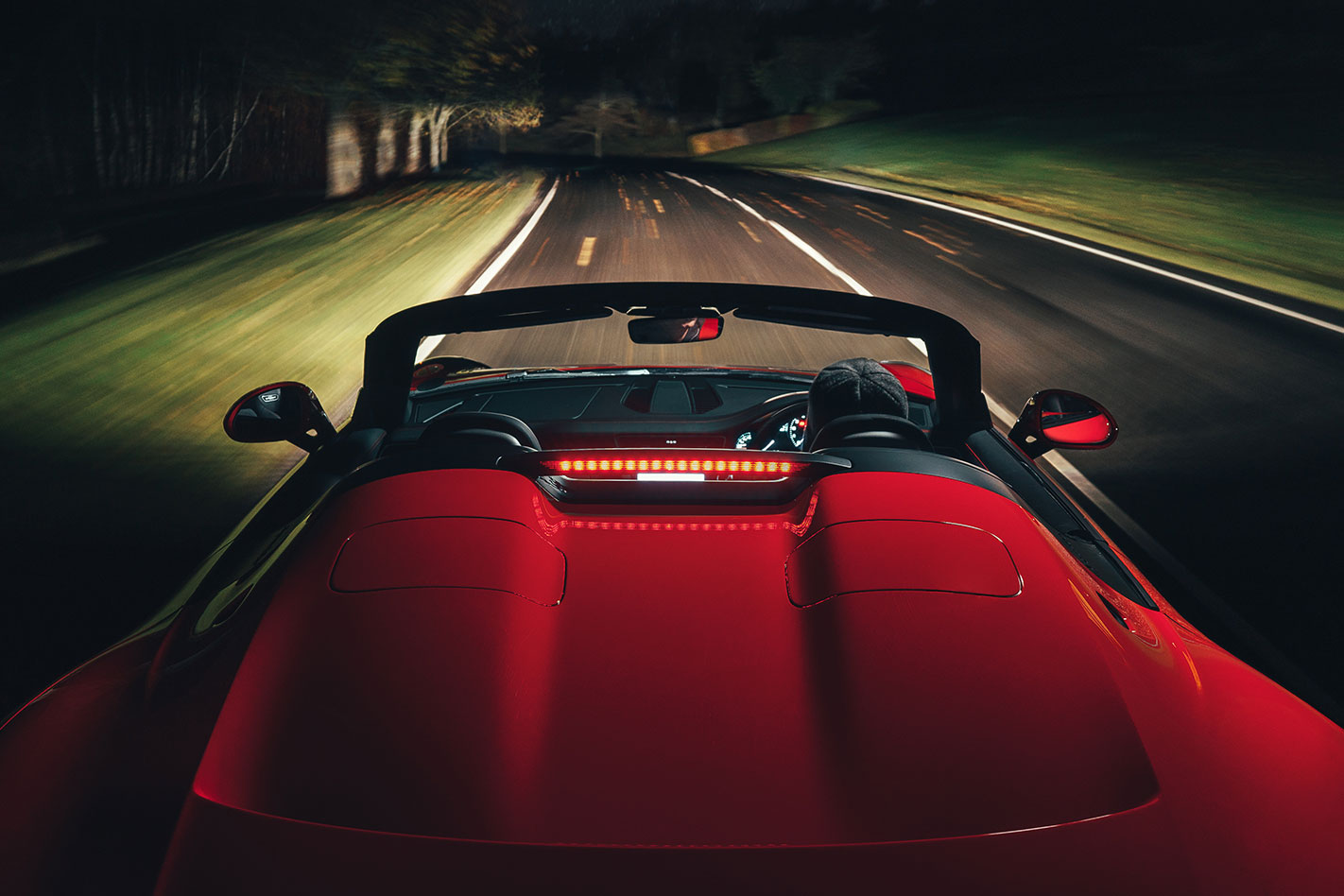
Passionate for Porsche? Get a load of the ultimate 911 as we unleash the GT2 RS in Victoria’s High Country. We hit the roads of Scotland top-down in the 911 Speedster. At night. In November. In the rain. But who cares when the car’s this supreme and you don’t need to return it till dawn?
We hit the track in the Cayman GT4 and ask, when a car’s this good, do you really need a 911? Our 911 group test may help you answer that… And as we punch out quick, quiet kays in the Taycan, there’s another question on our mind: can Porsche’s first EV really embody the spirit of Stuttgart?
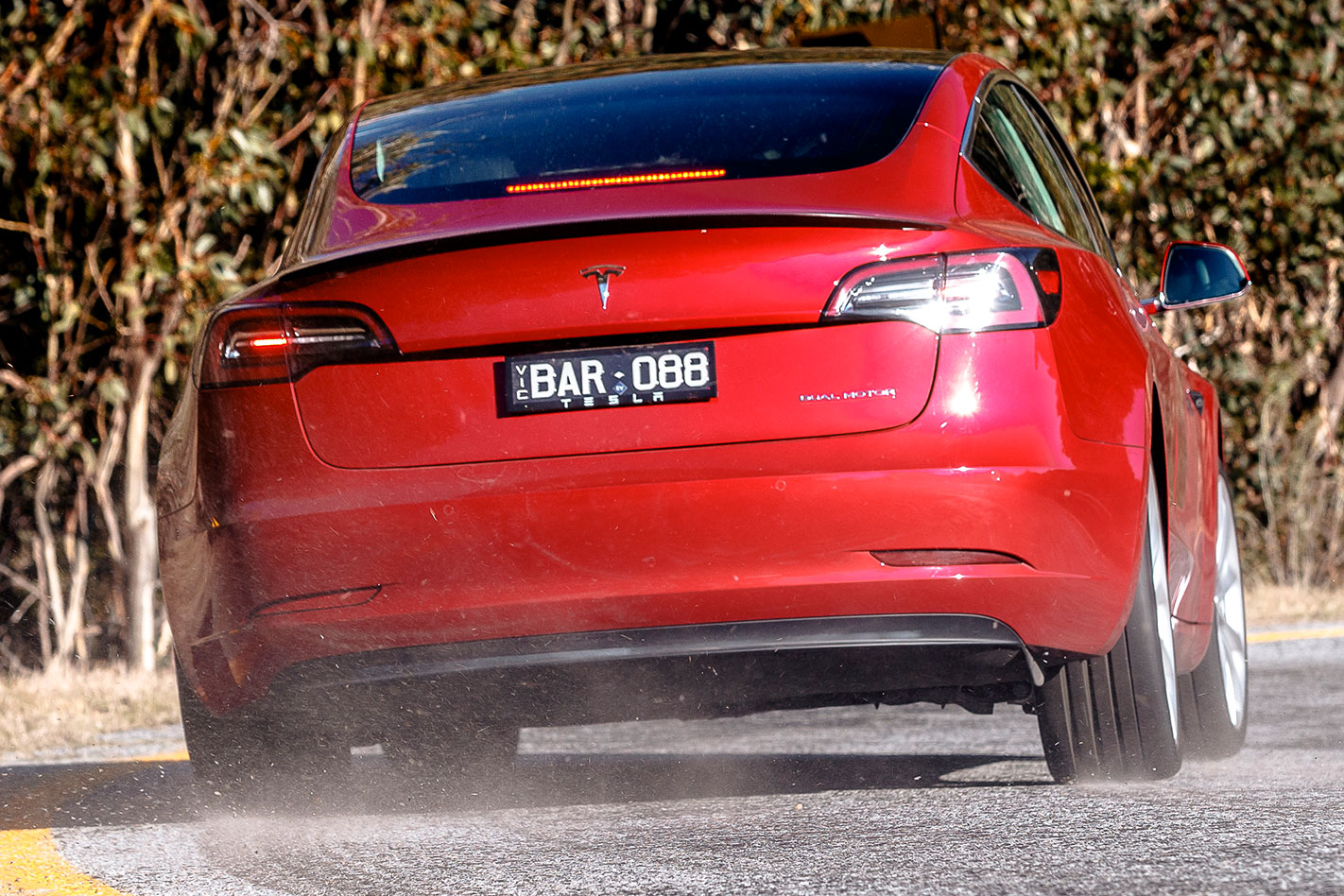
But Taycan’s not the only electric show in town. We plant the pedal in the Tesla Model 3 and find there’s lots to like without it being loud.

It’s lightweight versus brute force as we pit the Alpine A110 against the BMW M2, and more M muscle’s on display in a journey into the past in the M850i
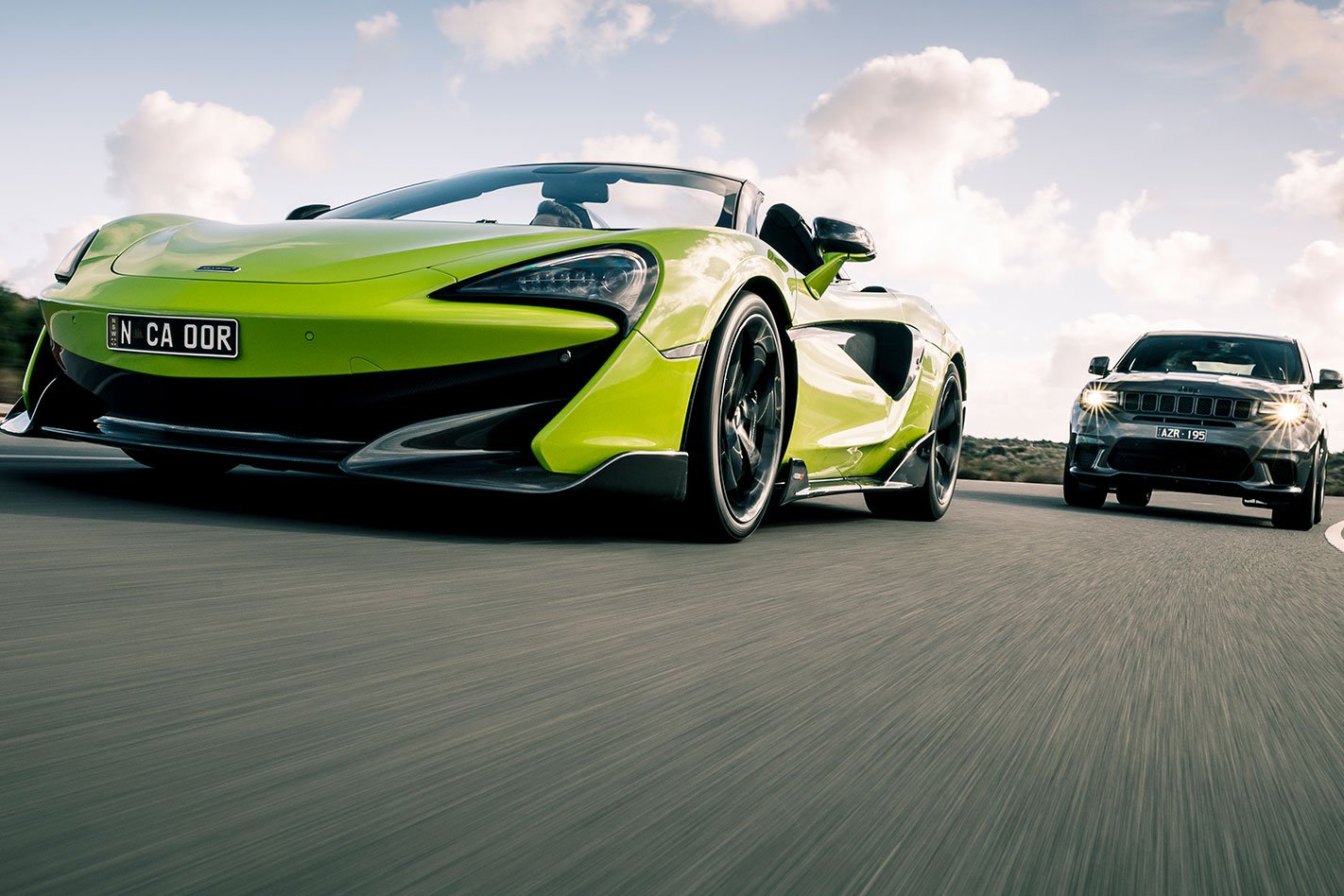
Great V8s? We’ve five of the best for you – who can mix it with the mighty McLaren 600LT? We head to Michigan for some mid-engined mayhem in the Chevrolet Corvette C8, and there’s more free-breather fanging in our celebration of naturally aspirated donks.

We take AMG’s entry-level A35 hatch deep into the Swiss Alps to see if it lives up to the fabled badge, and go large in the Mercedes-AMG GT4. More seat-of-your-pants? Check out what the Kiwis are cooking up in the F1-inspired Rodin FZed.
Not a lemon in sight, so grab your copy of Drivers’ Cars right now!
The good news is that the Toyota GR Yaris will be hitting Australian showrooms in the fourth quarter of 2020, adding another hot hatch choice to the already bulging landscape.
The bad news is that it won’t be offered in its ultimate guise, with Toyota Australia deciding against offering the Performance Pack version, instead sticking with just the standard car.
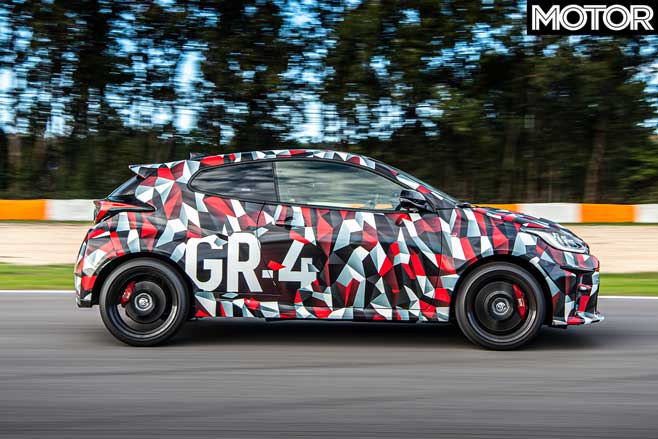
“When we considered the GR Yaris offering, we looked at it very carefully,” explains Toyota Australia’s Vice President of Sales and Marketing, Sean Hanley. “The car’s got to be attainable; we believed, looking at the market size, that the [standard] GR Yaris was absolutely suitable and ticks every box we needed to tick to bring this car to market in Australia.”
The standard GR Yaris is still impressively equipped, all cars scoring a 1.6-litre turbo three-cylinder developing around 185kW/350Nm (final figures TBC), a six-speed manual and unique all-wheel drive system with three modes.
Remarkably, a carbon fibre roof is also standard, along with weight-shaving aluminium doors, bonnet and hatch. There are big brakes and 18-inch wheels wrapped in 225/40 Dunlop SP Sport Maxx tyres.
The Performance Pack adds Torsen limited-slip differentials front and rear, introducing the ability to split drive torque left and right as well as fore and aft, along with Michelin Pilot Sport 4 S tyres and revised damper settings to take advantage of the extra grip.
However, while it currently has no plans to offer the Performance Pack option of Aussie GR Yaris, Toyota says customer demand will ultimately be the deciding factor: “Of course, in the event that we get overwhelming market demand,” says Hanley, “we can always look at the option pack going forward, but right now we believe that the [standard] GR Yaris is a very capable car that will meet the requirements of the target audience in the Australian market.”
There you have it: if you want your GR Yaris with all the goodies available overseas, you’d best get on the phone to your Toyota dealer now.
No stone has been left unturned in transforming the Toyota GR Yaris from a humble city car to a turbocharged, all-wheel drive rally car for the road.
Scheduled to land in Australia in Q4 2020, the GR Yaris will occupy a unique segment of the market, its size putting it in line with the likes of the Ford Fiesta ST, Renault Sport Clio RS200 and VW Polo GTI but with far greater power and performance.
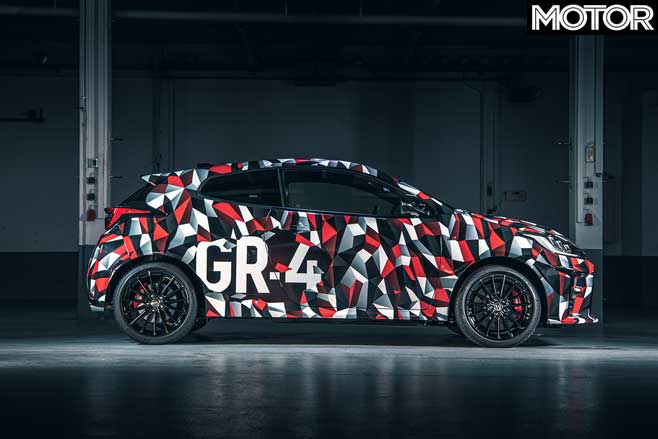
Will it come with a price tag to match? Time will tell, as Toyota Australia is keeping tight-lipped on cost, Vice President of Sales and Marketing Sean Hanley stating only “We understand that the car’s got to be attainable.”
The hot Yaris will be the second Gazoo Racing product to be made available in Australia but, unlike the Supra, will not be limited in production. “This won’t be a car that will be short of supply in Australia,” says Hanley.
Powering the GR Yaris is a bespoke 1.6-litre turbocharged three-cylinder. Final power and torque figures are yet to be confirmed, but Toyota claims it will produce more than 185kW/350Nm.
The engine uses a ball-bearing turbo for improved response and direct and port injection, with the redline set at 7000rpm. A six-speed manual is the only available gearbox, with 0-100km/h expected to take less than six seconds.
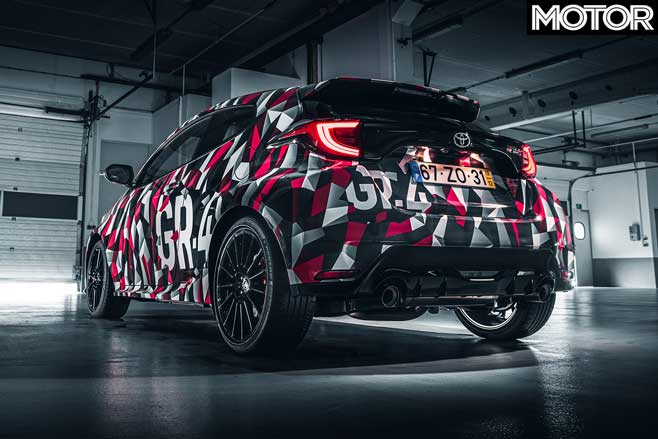
All-wheel drive is standard, the Yaris using an electro-mechanically controlled clutch pack to distribute drive between the front and rear axles. Drive is nominally split 60:40 (front:rear) in Normal, 30:70 in Sport and 50:50 in Track, but 100 per cent of drive can be sent front or rear depending on the circumstances.
Wheels are 18s shod in 225/40 Dunlop SP Sport Maxx 050 tyres, while the front brakes are claimed to be larger than those on the Supra (so at least 348mm). Toyota won’t yet provide exact rotor sizes, but there are four-piston calipers at the front and two-pistons at the rear.
The bodyshell is three-door, the only Yaris to be configured thus, with the roofline dropped 95mm, both measures aimed at providing a stiffer, more aerodynamic base for Toyota’s next World Rally Car. The roof is carbon fibre and the doors, bonnet and hatch are aluminium.
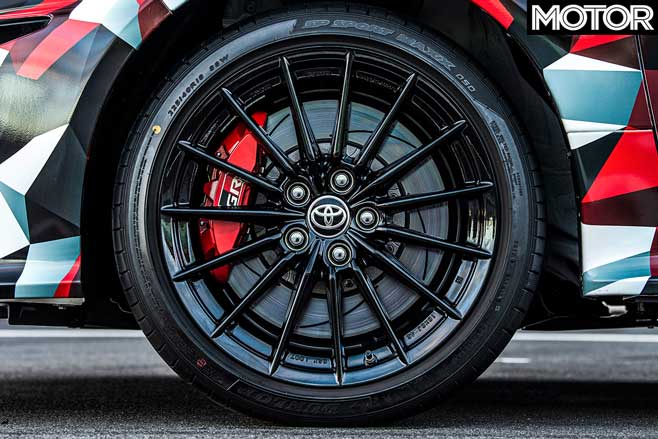
A Performance Pack is available overseas, consisting of Torsen limited-slip differentials front and rear, Michelin Pilot Sport 4 S tyres in place of the regular Dunlops and revised damper settings to match, but Toyota Australia has no plans to offer it locally.
You can read our prototype review of the Toyota GR Yaris here and we’ll bring you further news regarding pricing and local specification closer to its Australian launch.
Portugal’s Sintra region is a haven for royalty. The World Heritage-listed Sintra National Palace was consistently occupied by kings from the early 15th to the late 19th century; the accompanying castle dates back a further 600 years still.
In more recent times, primarily the 1970s and ’80s, Sintra played a crucial in the Portuguese round of the World Rally Championship, motorsport monarchs like Markku Alen, Walter Rohrl, Hannu Mikkola and Michele Mouton mastering the stages, the seas of rabid spectators parting just long enough to allow the passage of screaming Group 4 131 Abarths and bellowing Group B Quattros.
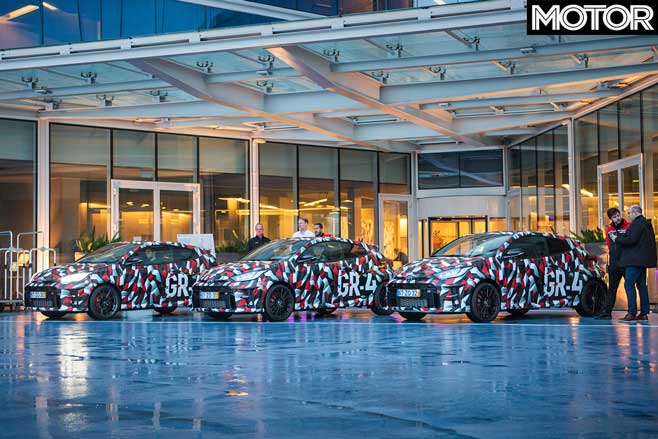
It’s apt, then, that Toyota should choose the region for our first taste of its new road-going rally car, the Toyota GR Yaris. If that seems too tall an order for the humble Yaris, consider that the GR will form the basis of the successor to the machine that carried Ott Tanak to the 2019 world title.
The days of the true homologation special are sadly over, but Toyota has thrown not just the kitchen sink but the refrigerator and half the oven at its new Yaris to transform it from an inoffensive city car into an all-wheel drive hot hatch.
It starts with the bodyshell. The GR is the only three-door Yaris, a decision made to provide a stiffer, more aerodynamic base for the World Rally Car. The roofline is lowered 95mm to reduce drag and the roof itself is carbon fibre, an unheard-of addition in this segment. To further shed weight the doors, bonnet and hatch are aluminium, the net result being a 38kg saving over the previous Yaris body-in-white.
The modifications don’t stop there, the GR sharing virtually nothing in common with the cooking version Yaris. The standard car’s cheap and easy to package rear torsion beam suspension has been ditched for a four-link arrangement, the dampers and springs have obviously been completely overhauled, wheels swell to 18 inches in diameter wearing 225/40 tyres and cover enormous brakes.
Toyota won’t provide the exact sizes just yet, but reveals the front two-piece rotors are bigger than those on the Supra (so at least 348mm) and there are four- and two-piston calipers front and rear respectively. Healthy stoppers for a car that weighs in at just 1300kg.
Where it really gets juicy, though, is the drivetrain. The engine is bespoke to the GR Yaris, a 1.6-litre three-cylinder that benefits from a hefty dose of turbocharging. According to engine boss Atsunori Kumagai: “The three-cylinder is very good [for] response and power compared to four-cylinder,” though its compact size and lighter weight certainly can’t hurt. Toyota might have downsized the engine, but it hasn’t downsized the grunt. The exact outputs are still a secret, but the GR Yaris will produce more than 185kW/350Nm for a power-to-weight ratio of at least 142kW/tonne. Healthy.

A close-ratio six-speed manual is the only available gearbox, an auto dismissed due to its weight. But what truly sets the GR Yaris apart in the baby hot hatch segment is its all-wheel drive system. Loosely based on that found in the RAV4, drive is apportioned front-to-rear via what Toyota calls a ‘high response coupling’, using a set of electro-mechanically controlled clutches. There are three modes which vary the base drive split: Normal (60:40), Sport (30:70) and Track (50:50).
Selecting the optional Performance Pack adds Torsen limited-slip differentials front and rear, swaps the standard Dunlop SP Sport Maxx tyres for Michelin Pilot Sport 4 S and revises the damper settings to suit.
Sadly, Toyota Australia has no plans to offer the Performance Pack, Vice President of Sales and Market, Sean Hanley, stating: “We believe the [standard] GR Yaris ticks every box we needed to tick to bring this car to market.”
It’s an impressive stat sheet and happily one that translates to the drive experience. The engine, in particular, is incredible. According to Kumagai, the “most important point is response for this car.”
Response isn’t an attribute generally associated with small, heavily turbocharged engines but the GR’s triple feels at least 25 per cent bigger than it is. Flexibility is its greatest strength, charging forward even in higher ratios; fifth gear, 2500rpm? No sweat. This isn’t a car in which you’ll need to row the gearbox to overtake.
Not that doing so is a chore. The shift is light, accurate and easy to use; it’s not quite a Civic Type R, but on first acquaintance it’s nicer than an i30 N or Megane RS. At the legendary Estoril racetrack it feels pleasingly quick; on the narrow mountain roads where Alen, Rohrl et al plied their craft it feels seriously potent. The short gearing helps, but the GR’s engine also isn’t afraid to rev; the redline sits at 7000rpm, though its best work is done by 6500rpm.
Subjectively, the biggest question mark surrounds the soundtrack; the three-pot thrum is more commonly associated with budget city cars (VW Up, Renault Clio, Nissan Micra) and isn’t unpleasant, just a bit tuneless. Some rally car-style pops and bangs would help, but are no longer possible with the latest emissions regulations.
The best insight into the attitude of the GR Yaris engineering team? The fact it retains a manual handbrake, Toyota’s European Master Driver Vic Herman laughing: “It can be useful.” Toyota’s new hot hatch was tested extensively at the Nürburgring, but its program wasn’t limited to tarmac, hitting the snow and gravel with Toyota’s WRC drivers behind the wheel. “They have huge experience with differentials,” explains Herman. “It’s their main tuning tool.”
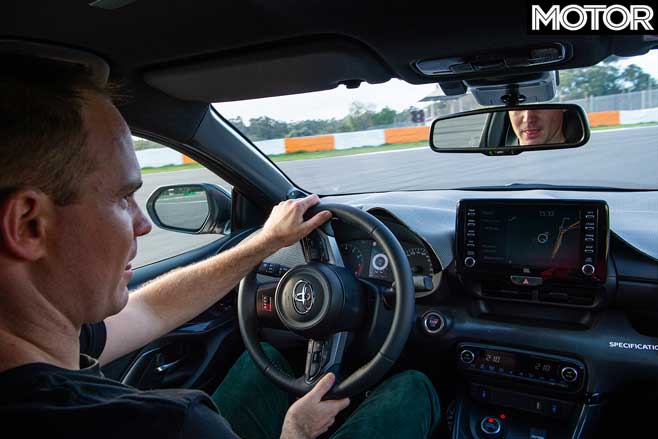
The harder you drive, the greater the similarity between the three driving modes. Sport’s 30:70 drive split sounds like an invitation to power oversteer, but once the all-wheel drive system detects wheel slip its priority is to take the necessary steps to regain traction.
Exiting Estoril’s super tight chicane the Performance Pack’s Torsen diffs prove their worth, the standard car momentarily spinning an unloaded inside rear wheel, though such is the level of grip that it’s unlikely to be an issue that would ever appear on the road.
The grippier Michelin tyres improve turn-in and lateral adhesion, but either car displays fine balance. Estoril’s final corner is a fast, fourth-gear right-hander that goes on longer than a Logies acceptance speech, seemingly purpose-built to expose understeer.
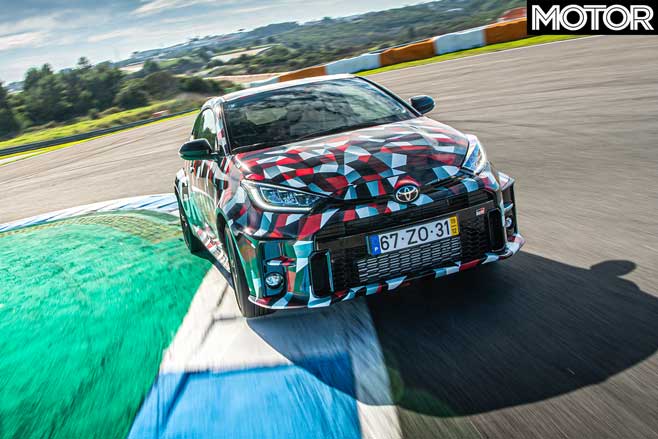
You still have to exercise a degree of patience, but do so and the GR Yaris will tenaciously hold your chosen line. The ESP is far too conservative and there’s no halfway-house sport mode, but thankfully my chaperone is happy for it be disengaged for the last couple of laps and the Yaris feels so happy to be free of its restraints.
On the road it just flows. The steering is light and accurate, turn-in crisp and traction absolute, all characteristics that promote confidence. Its size is also of real benefit; the smaller footprint takes up less real estate on the road and the relative lack of heft gives it an agility larger rivals will struggle to match. The static dampers feel nicely judged, too, providing stability and support without rattling your teeth out.
It’s difficult to suggest many improvements, but a stronger rear-drive bias would be nice, for it seems the GR Yaris lacks that Focus RS-like ability to rotate the car using the throttle. The details differ, but its overall behaviour is strongly reminiscent of the Audi S1.

Let’s hope the price tag isn’t also reminiscent of the $49,990 Audi. Currently, it’s the great unknown, Hanley refusing to offer hints on pricing beyond “We understand that the car’s got to be attainable.” It’s a unique offering; its size suggests a competitive set of Ford Fiesta ST and VW Polo GTI, yet its power and performance puts it closer to the Subaru WRX and Hyundai i30 N.
At $35,000 or so the GR Yaris has the potential to be the hot hatch king, but add $10K and it could be the court jester, talented and amusing but ultimately a bit player. The bang is there, but we won’t learn the bucks until closer to the GR’s Australian release in Q4 2020.
FAST FACTS Toyota GR Yaris prototype BODY: 3-door, 4-seat hatch ENGINE: 1.6-litre inline-3cyl, DOHC, 12v, turbocharger POWER: 185kW @ 6500rpm (approx.) TORQUE: 350Nm WEIGHT: 1300kg TRANSMISSION: 6-speed manual TYRES: 225/40 R18 PRICE: $40,000 (est)
PROS: Engine; size; handling; brakes CONS: No Performance Pack; price unknown
Elon Musk likes bold claims. When he announced the Tesla Model 3 Performance via his favourite communications medium Twitter, he claimed it would be quicker and better handling than a BMW M3 and beat anything in its class on the track.
The video above isn’t a direct comparison of the two; there’s little point, as the two are fundamentally very different machines. However, it is worth examining how the Tesla Model 3 Performance performs on track and how driving it differs to a conventional combustion-engined, rear-wheel car.
Key to the Model 3’s circuit ability is its Track Mode. Select it and the battery fans immediately whirr into life to keep temperatures under control and ensure you have as much power as possible. It also sets up the twin electric motors (one front, one rear) to allow maximum cornering agility.
Fundamentally, the Model 3 Performance handles very well. It’s softly sprung so rolls quite significantly and the combination of its 1847kg heft and relatively modest 235/35 tyres means outright grip levels aren’t massive.

However, that mass is carried very low, so the Tesla handles in a similar fashion to something like the current Golf GTI. Until you hit the throttle, at which point it seems to somehow summon extra traction out of the road, hanging on steadfastly when logic dictates it should begin to slide wide.
It’s brutally fast, the experience enhanced by never having to worry about wheelspin and the absolutely instant throttle response. Time pressures prevented us recording laptimes around the Haunted Hills circuit but on a short, constantly twisting circuit like this, it’s almost certain the Tesla would give the BMW a bloody nose. On a more conventional circuit, we’d expect those positions to be reversed.
But is it fun? After all, there are no gears to shift, no engine noise to enjoy, very little traction management required. Yes, it is fun, primarily because the Model 3’s soft-ish setup allows you to adjust its balance using the brakes and the throttle.
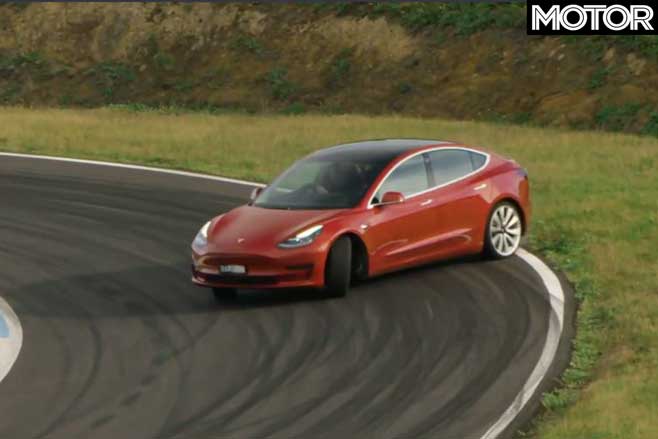
Enter a corner with caution, floor the throttle with intent and it will even swing into oversteer as long as you aren’t too abrupt with your inputs. Track Mode relaxes the stability control but it doesn’t completely eliminate it. As such, there’s a lack of consistency to the Model 3’s behaviour; sometimes it will swing into a slide, other times the computers will say no.
This is where the M3 has an advantage as a driver’s tool. It responds to your inputs, whereas it feels like ‘fun driving’ has been programmed into the Tesla; give it an input that program doesn’t recognise and it shuts the entertainment down quick smart.
What is abundantly clear, though, is the potential electric propulsion provides. The prospect of a low centre of gravity, instant torque delivery and the tremendous tuneability of electric motors in the hands of Renault Sport, AMG or M Division (Porsche is already there with the Taycan) is a mouth-watering one.
Is Tesla’s M3 more entertaining than BMW’s? No, but it’s closer than most will expect for an electrical all-wheel drive hatchback.
