
Here’s a question for you: Have you tested your automotive knowledge with our inaugural Hump Day Quiz? If you like it we’ll run one each week giving you something to help you through the mid-week monotony and hopefully giving you bragging rights over your mates.
Here’s another: What turned 50 this week? If Nissan’s GT-R was a wedding anniversary it would be golden and if it was a person it would probably still be shaking off the hangover. We marked the birthday of a motoring icon with a whole week of celebrations and a look back at Nissan’s hero car milestones and half a century of high-performance stories.
Cars and their use were once again in the firing line this week. While Jaguar argued that hooning should be banned from all advertising, not just car ads, Greenpeace completely lost its mind and suggested that car advertising should be banned altogether. Hmmm.

While there is evidence to suggest electric cars are worse polluters than combustion power, but that won’t be the case as soon as our government gets its act together and starts supporting renewable energy.
Maybe the greenies should be focusing on the endeavours of the car industry to create clean zero-emissions cars like this cool Volkswagen concept, which is also actually green.
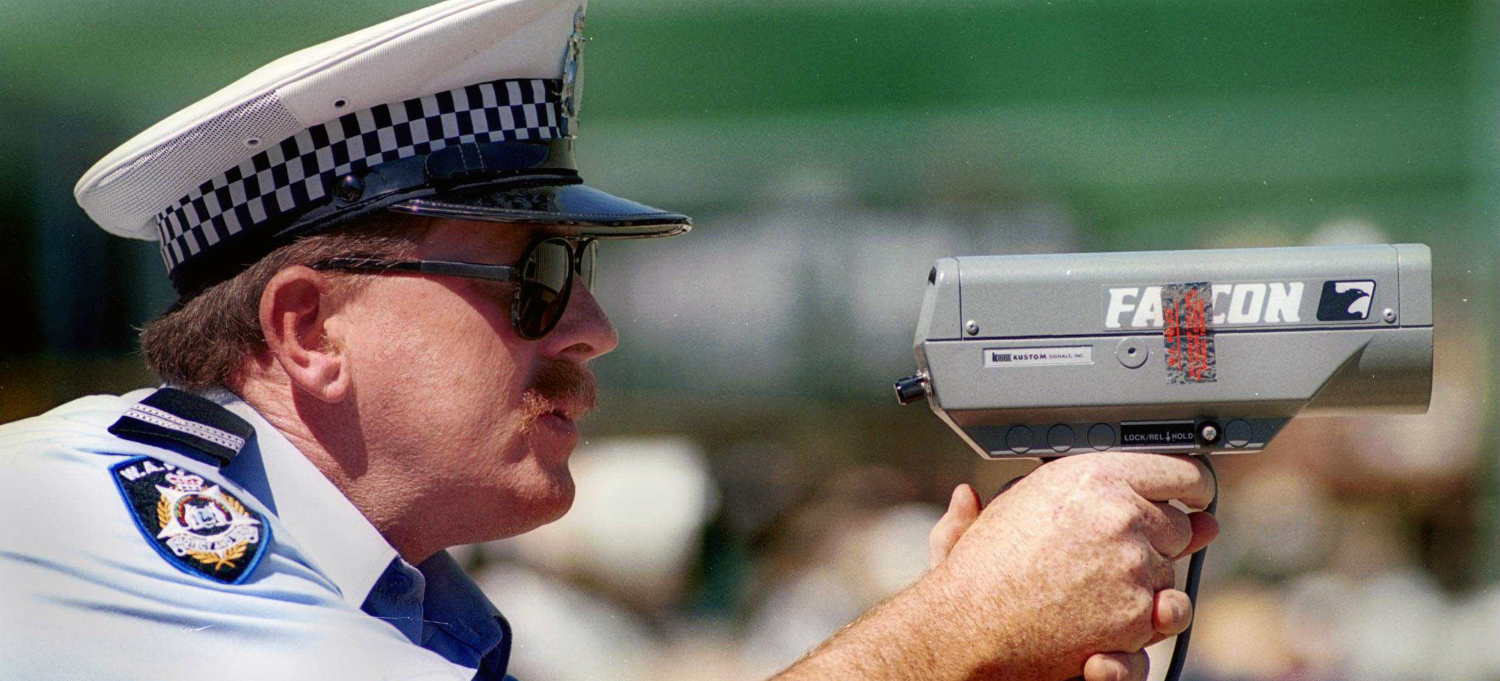
As if environmentalists implying cars are antisocial as cigarettes and alcohol wasn’t laughable enough, news came to light that the police really have been incentivising speeding ticket issuing after all. Perhaps now the police will turn their attention to preventing hippies climbing bridges? And where were they when this guy decided to go for a night drive!?
At least now we have a way of avoiding the temptation of using a phone while driving and the potential for more fines. Here’s how to retrofit Apple CarPlay to your car (or perhaps Android Auto) and Mazda will also now offer its own CarPlay upgrade for older models. It only costs a few hundred dollars but you may be surprised to find out how much the option has netted for the Japanese car maker.
Apple made the car news again when Porsche announced it was partnering with the tech giant to slot more than 50-million songs into its imminent Taycan electric high-performance model. If the Taycan is a little out of your price range, perhaps something like this is more manageable – it gives an entirely different meaning to car play.
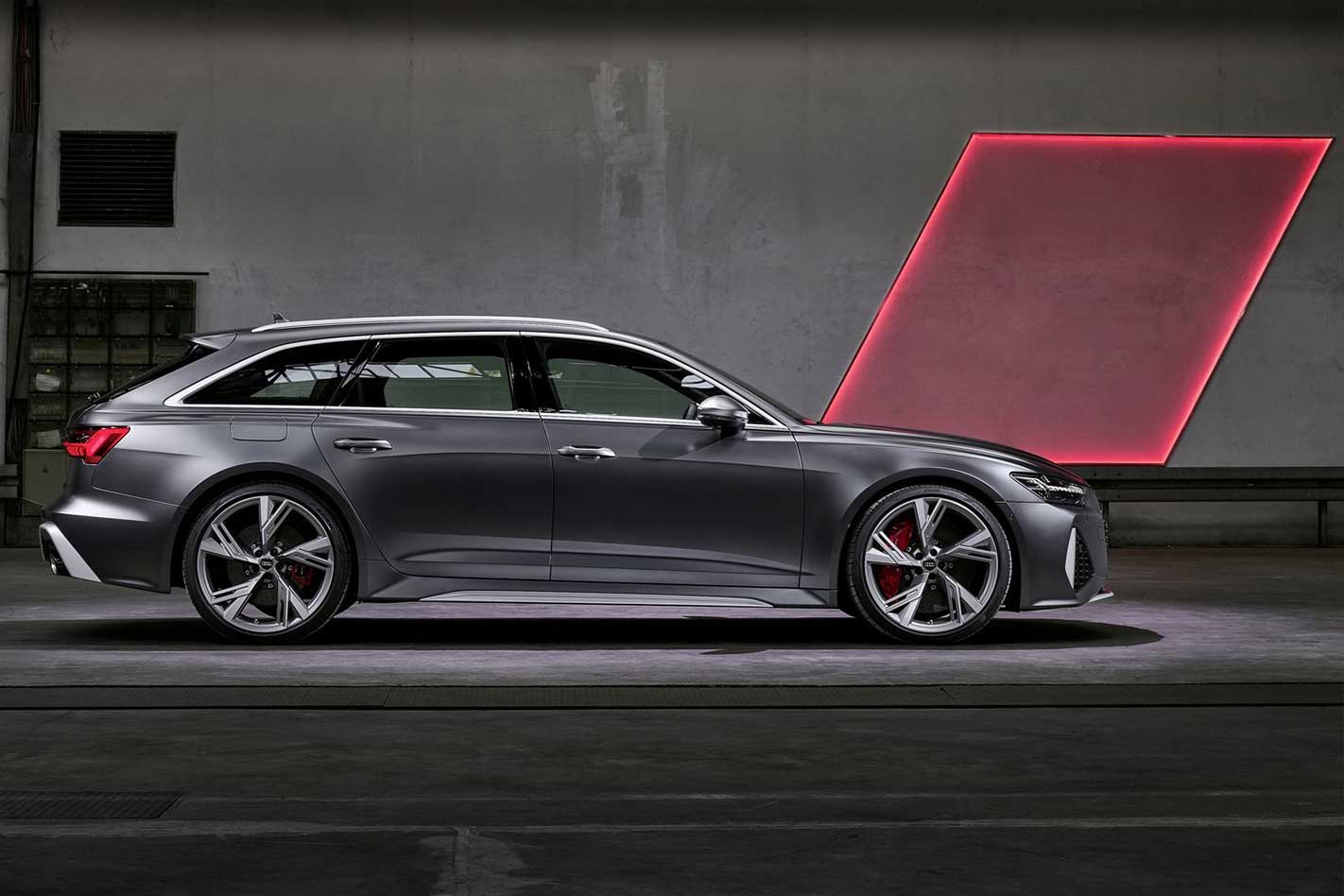
If you wanted even more great advice, here’s our guide to the best baby-friendly cars. Or perhaps one to take the dog somewhere really, really fast. Here are some Audi RS6 facts that you might not have learned from all the straightforward media coverage.
There was more good news for one-tonne ute fans, with Volkswagen confirming a manual V6 Amarok for Australia, as well as a pair of high-end variants. Ford is now offering two engine options for the returning FX4, and we get our hands on an off-road camper trailer that’s as quick as the Amarok V6.
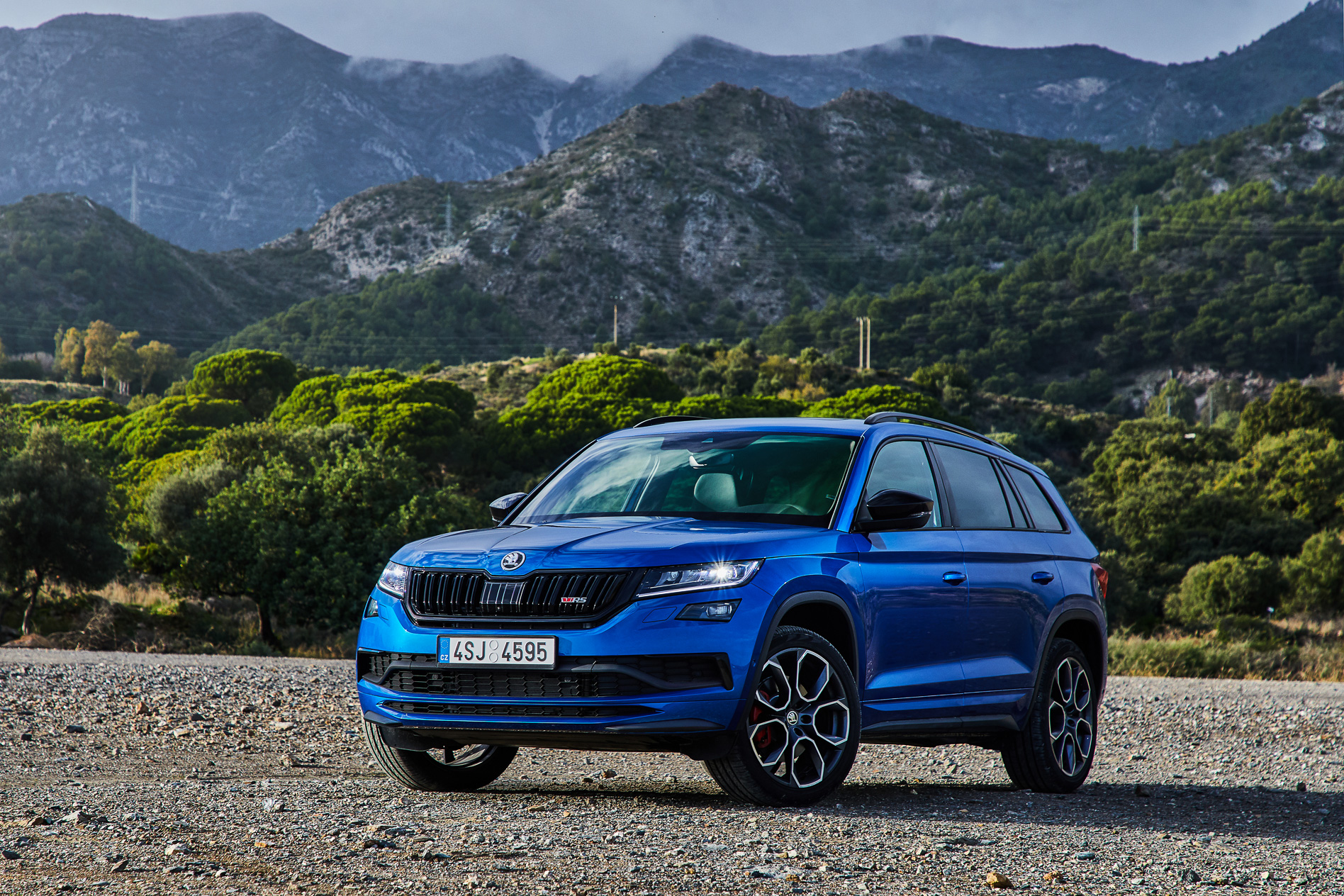
SUV enthusiasts have also been well catered for this week too with Skoda’s Kodiaq RS arriving on local turf, we pitch the ‘standard’ Kodiaq against the excellent Octavia wagon to see why the high-rider is so much more popular, and BMW confirmed that its SUV lines will be expanding.
And of course, the last seven days have been punctuated with the steady flow of other reviews from our team of reviewers, including BMW’s 740Li, the Ford Ranger and Focus, and Nissan Qashqai.
Until next Friday, keep an eye on WhichCar – the best source of car information, entertainment and advice. There’s no question about that.
It’s not every day, even for a motoring journalist, that ‘work’ involves jumping in a Porsche with a racing driver and following instructions on how to go faster, but that’s exactly how Michelin’s new product launch started earlier this month.
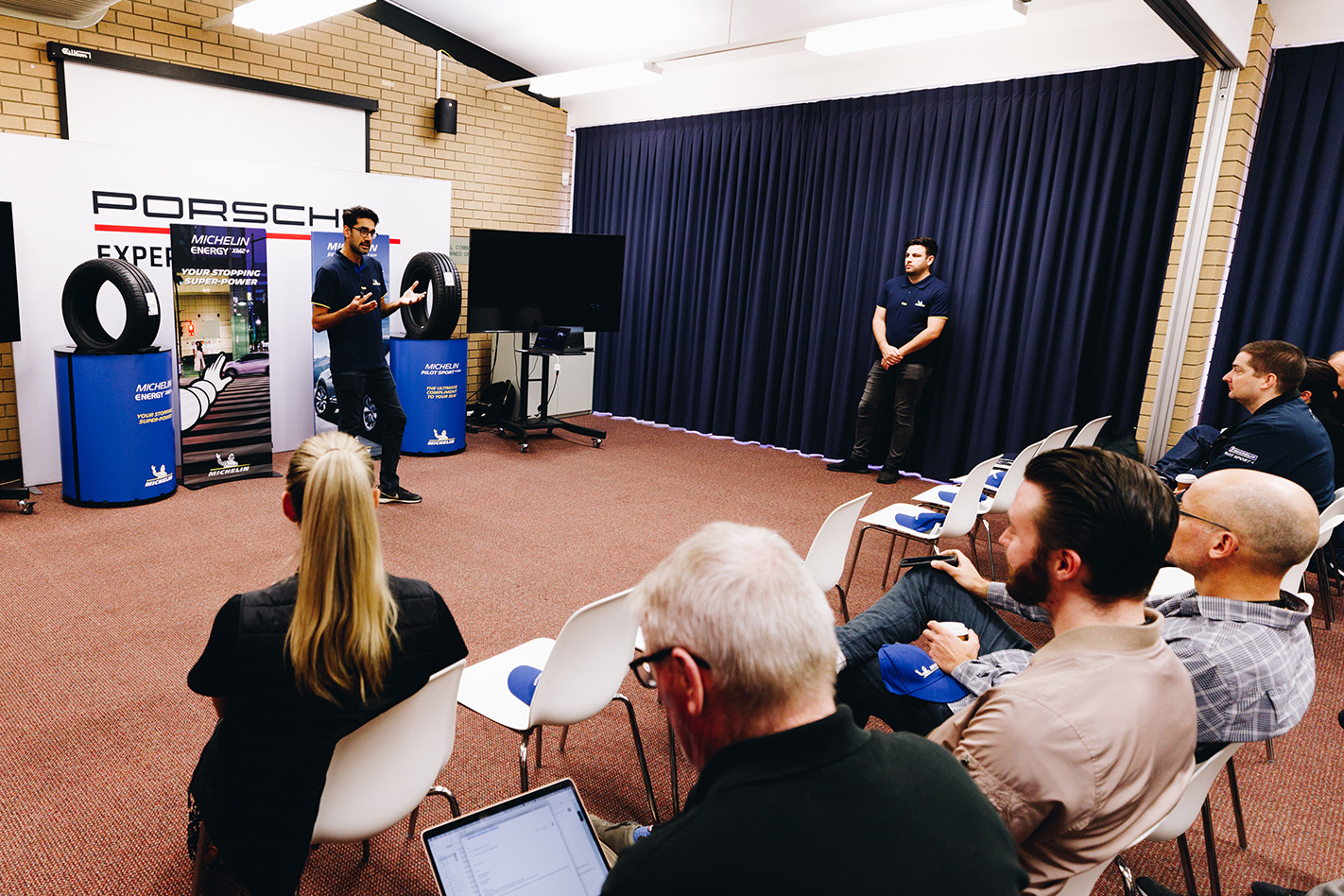
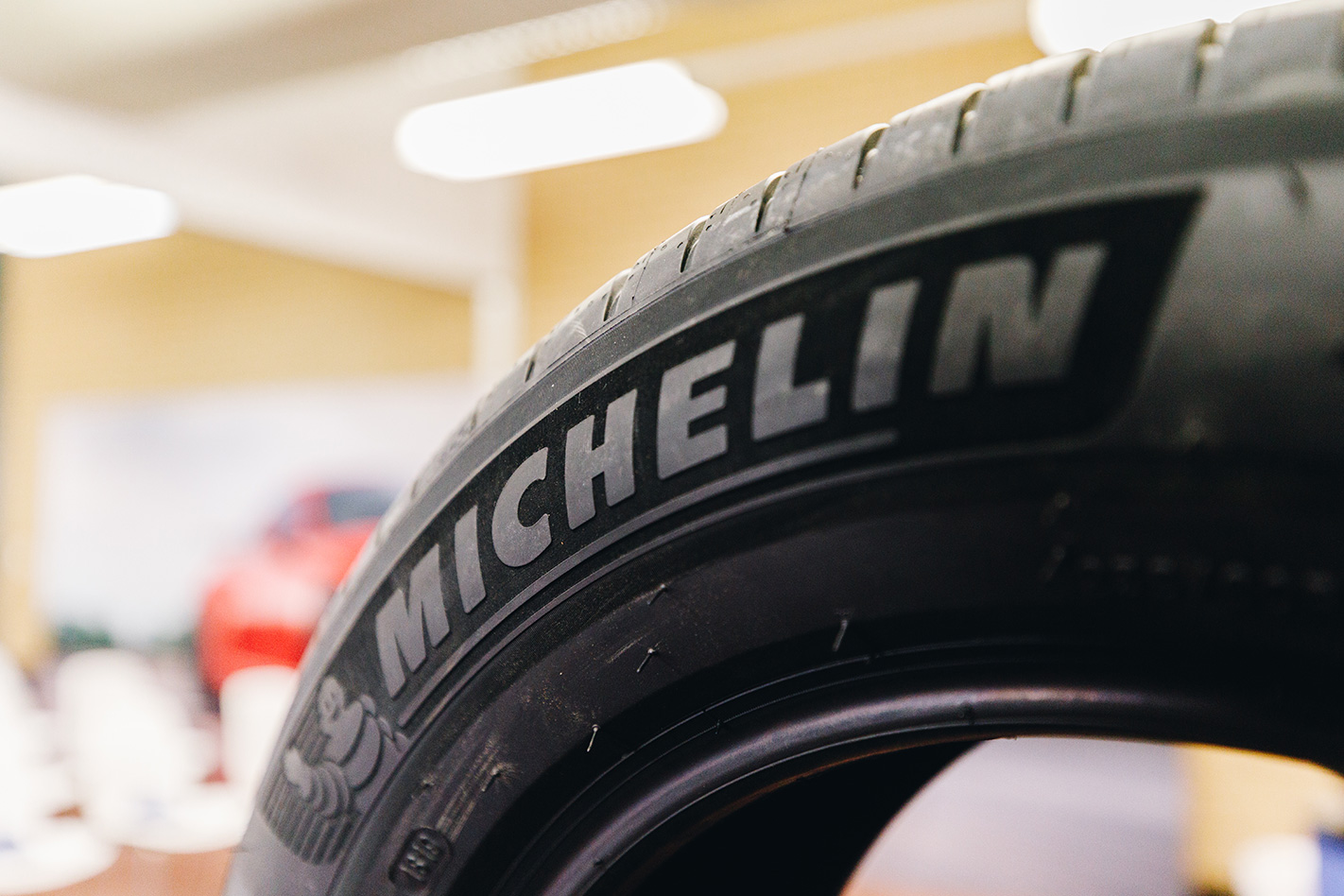
Before the fun started though, participants (in this case a mix of media and Michelin employees) were given a rundown of the new products, and a safety briefing by staff from the venue. Under the spotlight was the new Pilot Sport high-performance hoop specifically designed for SUVs and a more efficiency focused XM2+.
Michelin partners with Porsche’s Driving Experience program to provide the basis for the testing (as other tyre brands do with different manufacturers), which means there is a fleet of vehicles on offer as well as a place to use them. This also means the staff are usually racing drivers.
A Porsche Cayman GTS, Boxster GTS, and a Macan S were the victims for media attendees to sample, all shod with the tyres of our host brand.
In this case, our playground was the Mt Cotton Driver Training Centre near Brisbane, and it features a simulated public road loop which is perfect for trying out tyres – this time the new rubber was the set of Pilot Sport 4 SUV tyres on the Macan S.
After cycling through each of the three cars on offer and scribbling a few notes it’s time to head off for the next exercise – the skidpan.
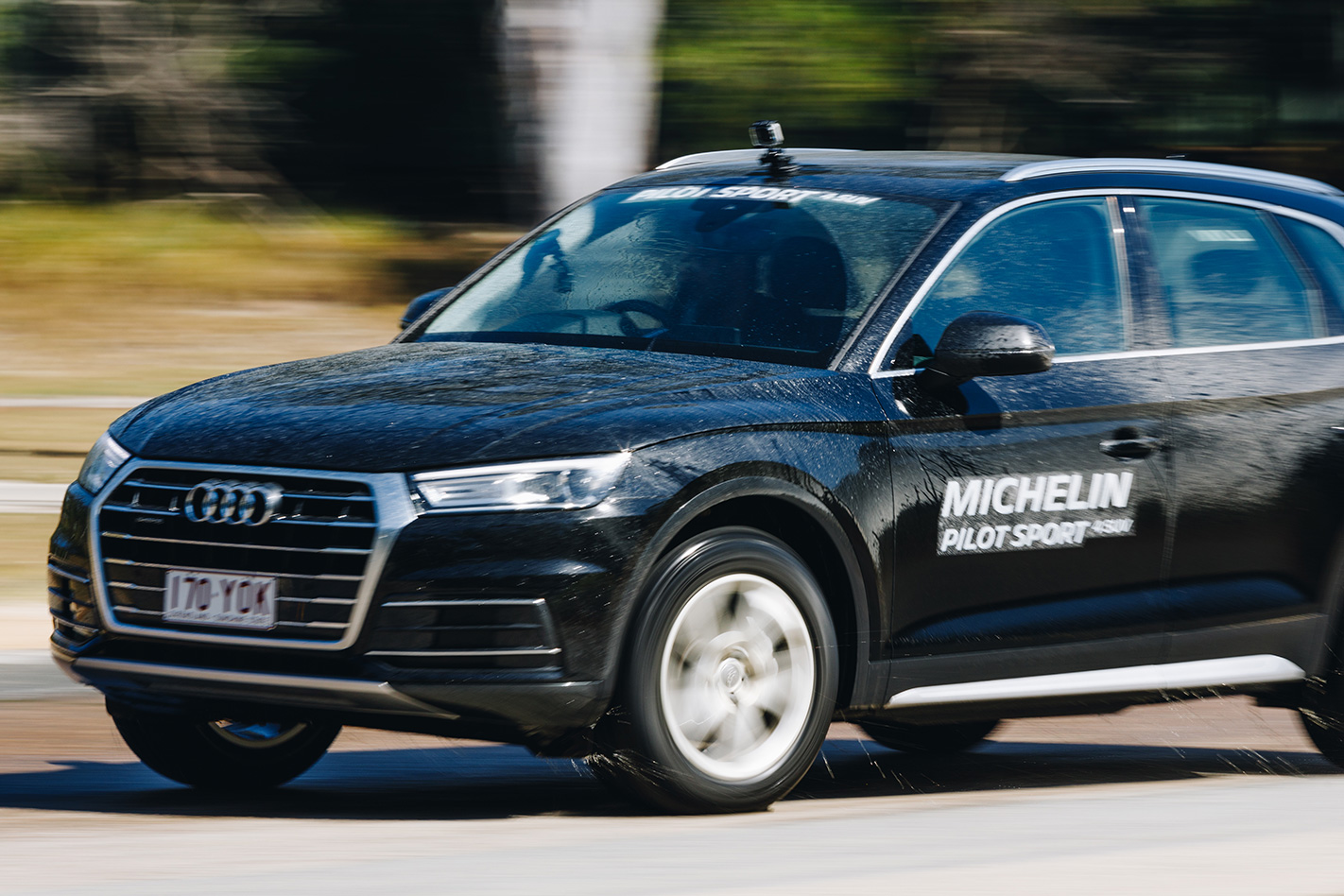
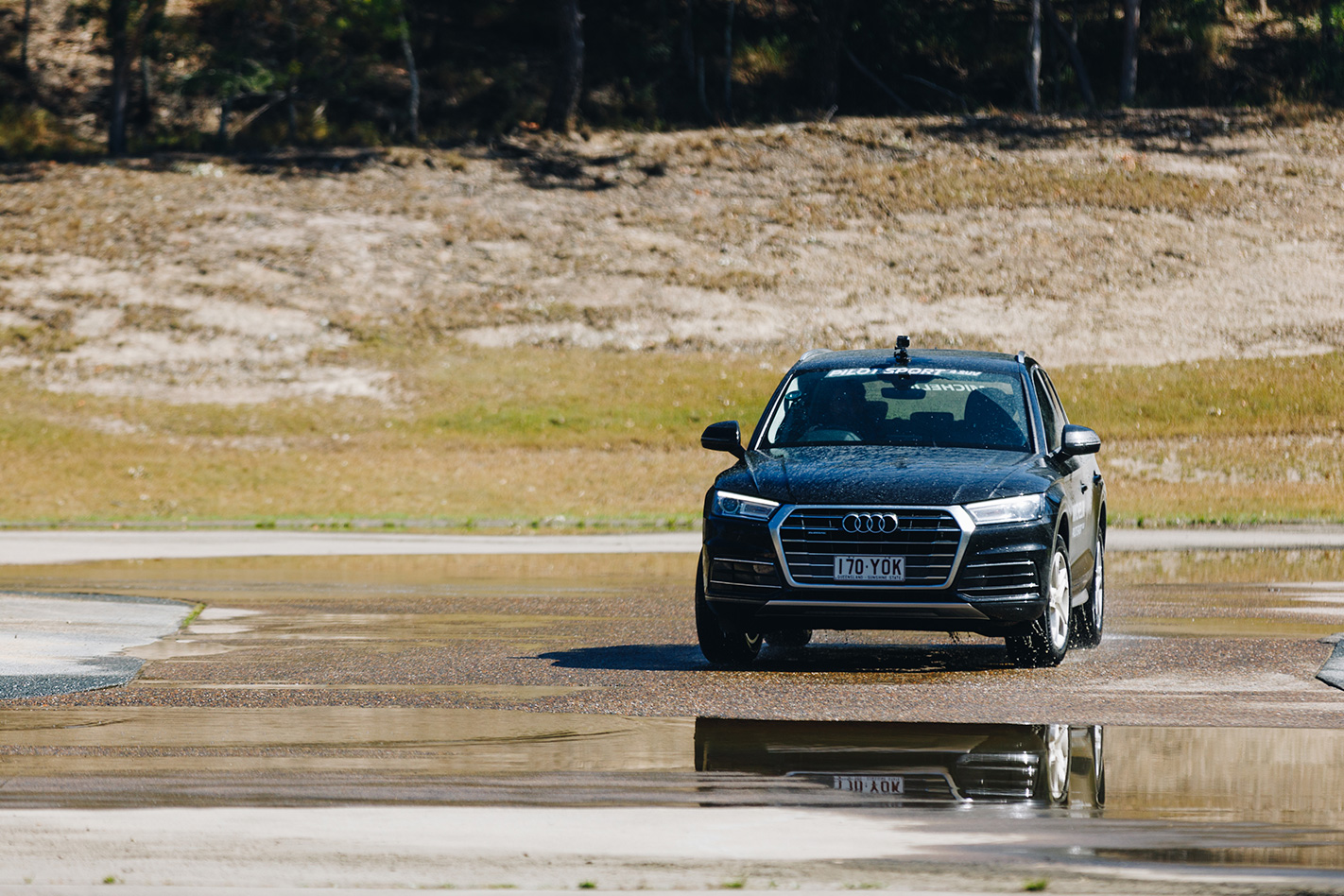
Each exercise is designed to highlight the tyre’s strengths and Michelin is so confident in the new Pilot Sport’s ability that it had laid on a comparison test. The very low-friction course was tackled first with an Audi Q5 wearing Michelin Pilot Sport 4 SUV rubber and then again with another well-known maker’s equivalent.
As you might expect, the Michelin shone, but the real highlight was sliding an Audi SUV around on a low-grip surface in a low-risk environment.
After making more notes, the final comparative test rolls around. Post-lunch, we’re shown to a different skidpan, though this one is set up with cones for a wet braking exercise in which one car has another new Michelin product, the Energy XM2+, and two other cars wear rival tyres. The key difference however, is that the Michelins are worn, while the competitor brand is new.
The intention was to demonstrate that the economy oriented XM2+ is just as good as a new tyre even when it’s nearing the end of its life. Again, the test showed that to be true.
So with the testing out of the way, a different kind of product demonstration was next… hot laps of the road circuit in a highly specialised Porsche 911 GT3 RS complete with a racing driver at the wheel.
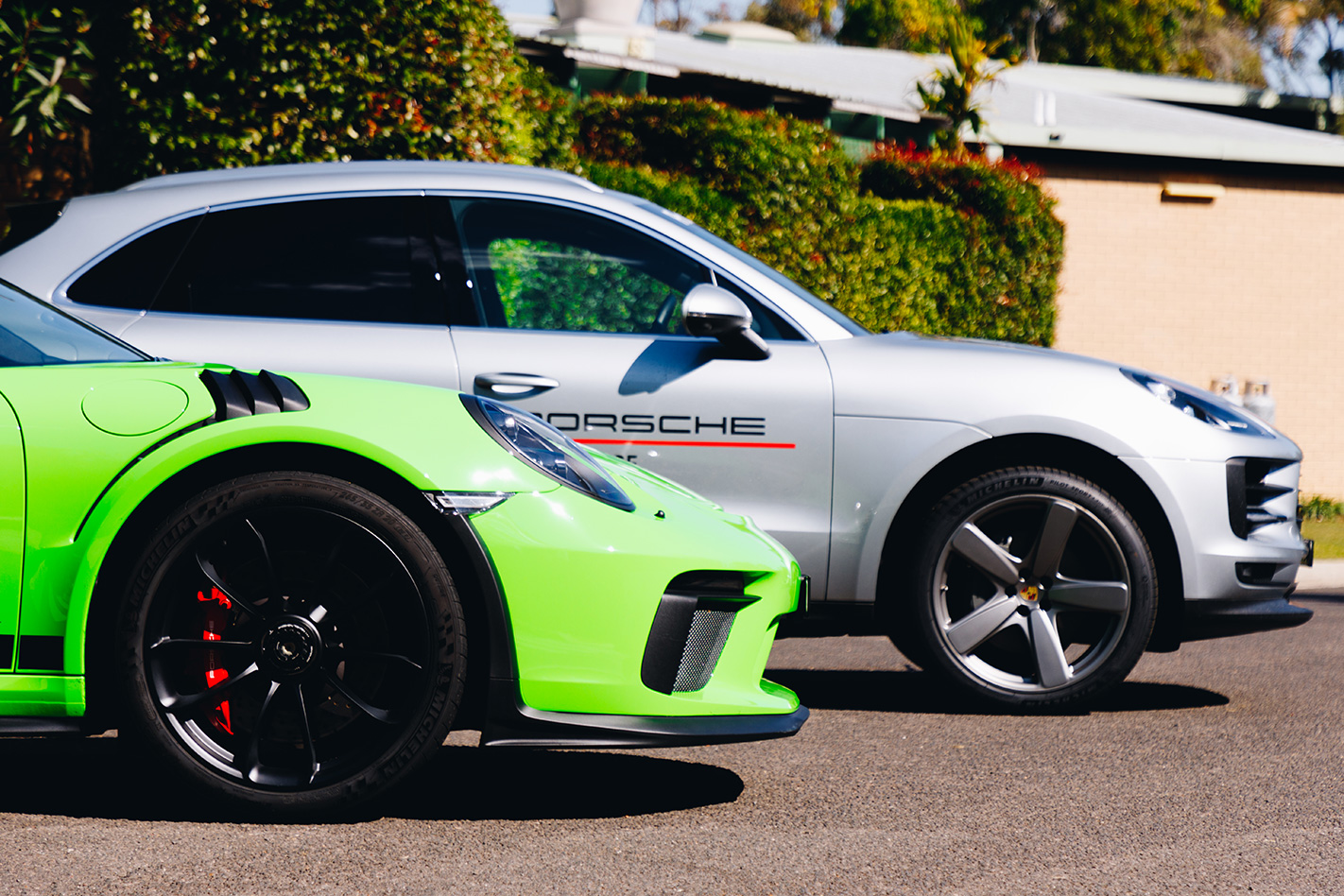
Suddenly, the Cayman GTS, driven by yours truly didn’t feel quite so fast, but with a professional race at the helm, testing the very fringes of adhesion, the full potential of the Michelins was clear.
The final stage of the day became a little competitive, as Michelin employees and media attendees took to a wet motorkhana to see who could lay down the fastest course time. Using economy hatchbacks and the Macan S, the Michelin-shod cars became tools to see who had the best car control and throttle discipline.
Michelin’s showcase day followed the general agenda of many tyre launches, though each brand and tyre has different needs and will therefore, have differences in the itinerary. For example, it might be more appropriate to launch the most performance-focused tyres at a full racing circuit, while a tyre built for off-road use would require… off-roading.
Either way, Michelin succeded in not just highlighting the virtues of its top-quality tyres, but also proving that a product many see as somewhat uninspiring can be incredibly good fun.
To see more of what happened at the Michelin Pilot Sport 4 SUV launch, check out the gallery at the top of the page.
STOP PRESS: JUN II reclaims its world record to the tune of 6.77-seconds at 212mph, 1 April 2021 at Sydney Dragway.
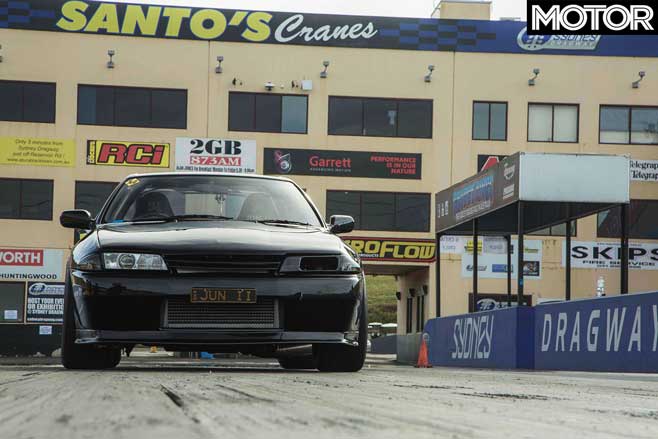
When it comes, the answer is unequivocal. Certain. Iron-clad. And frankly detrimental to the whole point of this exercise.
Not, ‘Well, we’ll have a think about it.’ Not, ‘If you’ve got all the gear and promise not to be stupid, go right ahead.’ No, this is a straight up and down, flat rejection.
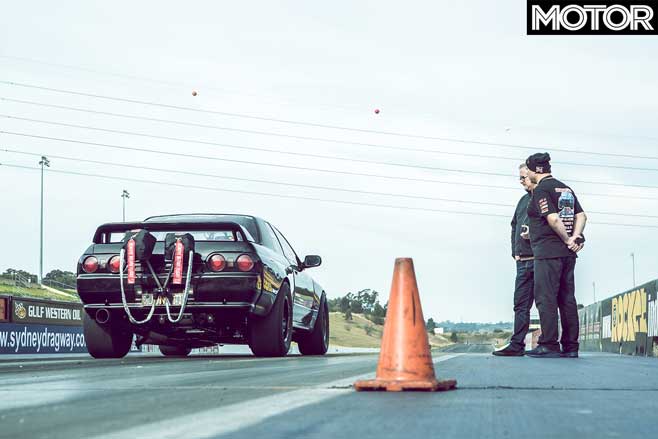
Delivering this answer is the management of Sydney Dragway, refusing our request to ride shotgun alongside Rob Marjan in his Nissan Skyline R32 GT-R, known the world over as JUN II. Okay, to be fair, it’s not just any old R32 GT-R. It is the world’s fastest street-registered Skyline, and packs a deeply serious punch.
How serious? How does 6.86 seconds down a quarter-mile grab you? At more than 320km/h! Sure, you say, that’s pretty handy, but that’s a proper racing car and… Let me stop you right there. Just in case you missed it, let me say it again: JUN II is street-registered. And street-drivable. Legally. Just ponder that for a moment.
“When we ran the six, we drove back from the track to the workshop,” grins owner/driver Marjan. “That got a lot of views on YouTube.”
Anyway, without a permit and an ambulance (and probably not even then) the plan of rearranging my insides today with 2.4G of lateral acceleration is put on ice. Disappointment – and a teeny, tiny bit of relief, if I’m honest – is etched on my face as we trudge back downstairs to the sight of this surprisingly petite drag racing superstar sitting silently on the start line, awaiting a staging sequence that would not come this day.
“I suppose we could try and do a run after next weekend’s GT-R Festival,” muses Rob. What? The dream is still alive?
Rob’s history with JUN II was born from a determinedly – some might say bloody-mindedly – focused point of view: to own the fastest street-registered GT-R in the entire universe.
“I have a principle behind it, if you want to call it that,” says Marjan, whose day job is running the renowned Ali Baba kebab chain. Not for him a clip-on fibreglass nose, aluminium flat-deck spoiler and polycarbonate windows.
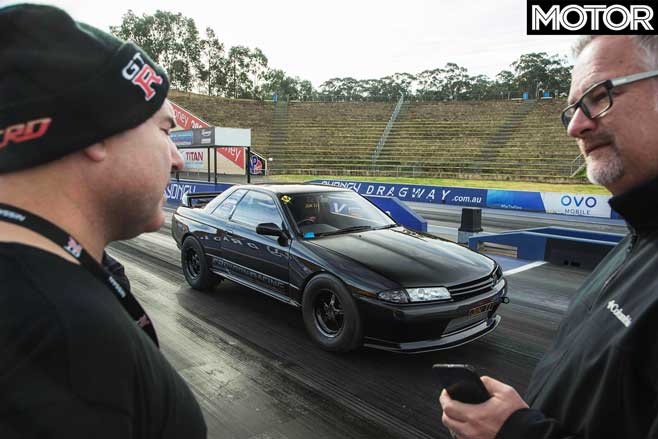
Rob is fiercely proud of the fact that his lean, lithe R32 has the power of at least six of its production-line companions, and yet to the untrained eye – at least away from the twin five-inch exhausts poking out of the left sill and bulbous drag tyres – looks almost stock.
“It’s registered, with a full exhaust,” he explains. “It has all of the standard body parts, including the rear wing. Full interior, two seats, dashboard, all this standard [door trim] material, radial tyres, carpet, rear seats, all the glass still intact…
“Take that rear wing, for example. It’s slowing us down, I know it is. And everyone keeps reminding me, but I won’t take it off. Sure, when we’re over 200 miles an hour (320km/h), it could give us two, three, maybe five miles an hour. I know it’s slowing us down, but how beautiful is it that a car that’s in factory trim can be the quickest car in the world?”
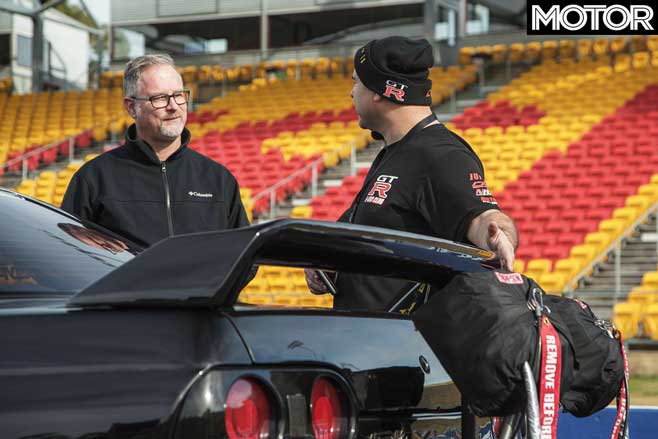
Rob bought the car – then known as JUN I – about 12 years ago as a 550kW going concern. It replaced another Nissan, a heavily worked 200SX called Devilish. “I’ve had a passion for fast cars for a long time,” he says, “and I was buying and selling a few GT-Rs. I loved the engineering in them, and they were quick, and just beautiful cars.
“A friend of mine from Canberra was building this particular car at Croydon Autosports while I was racing Devilish. At Summernats one year, he said, ‘Rob, do you want to drive the car? I don’t think I’m up to it.’ I said, ‘Sure, no worries.’ Never sat in the car, didn’t know the car, and we won our first race.
“I fell in love with the GT-R there and then. It was really, really good; it was just a different sort of car than the 200SX that I had. It was still drivable, which is what I liked.”
As it sits today, about 29 years after it landed in Australia as one of the 100 locally delivered GT-Rs, the car’s plain black paint is still in amazingly good condition. The front bar and rear spoiler are, as Rob points out, left as Nissan intended.
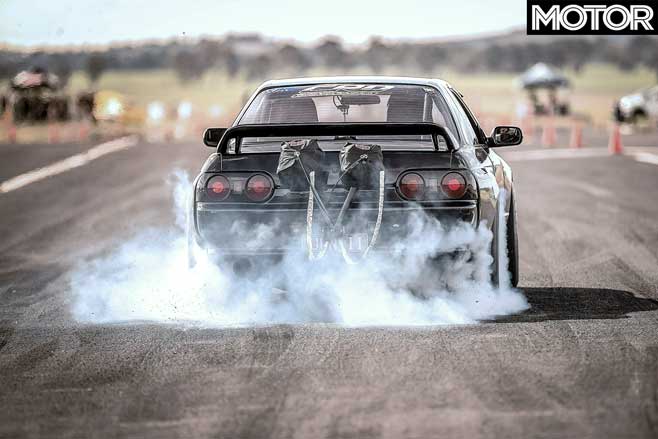
The only blatantly obvious concessions to the realities of the car’s potential is an air intake where the left-side headlight would – and can still – sit, and of course the twin parachutes mounted on the rear scuttle panel.
“We had to go to twin-chute when we ran sevens,” Rob explains, adding that he had a pretty sizable accident when the previous single-chute set-up failed in strong winds and he ended up in the tyres at the far end of the strip. Gulp.
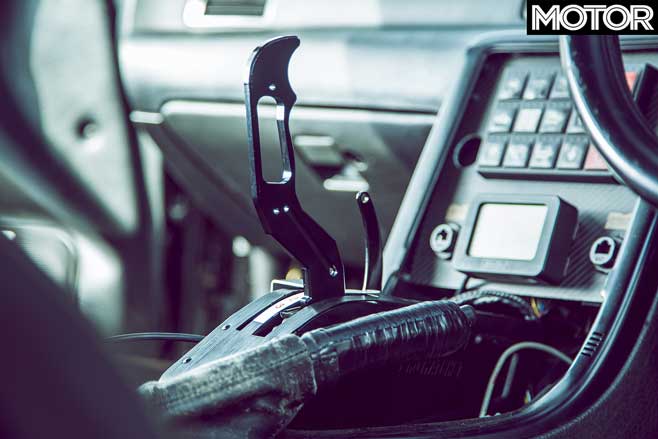
On the inside, a pair of customised carbonfibre race seats, roof-mounted chute release and a six-point chromoly cage are the most obvious signs that this thing is not what you’d call normal. Swing your gaze to the transmission and the three-speed Al’s Race Glides TH400 transmission stick and MoTeC dash also give the game away.
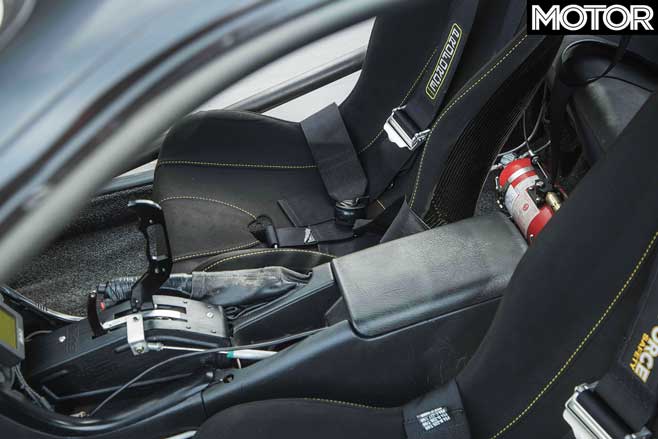
But the steering wheel is stock, the handbrake is still there, and so are the buttons on the left side of the instrument binnacle, except that they have been wired up to scroll through the pages on the race dash.
The other fiendishly cool element to JUN II is that it starts on a plain old Nissan key with a battered plastic fob, its silver blade tarnished and rounded by nearly 30 years of use.
We need to move the car for more photos, and Rob casually reaches down and twists. The R32 bursts into life like a Zero fighter, its deep, baritone, thrumming bark actually vibrating the car minutely down the track. Its menace and intent is unmistakable – it doesn’t sound like an inline-six. At all.
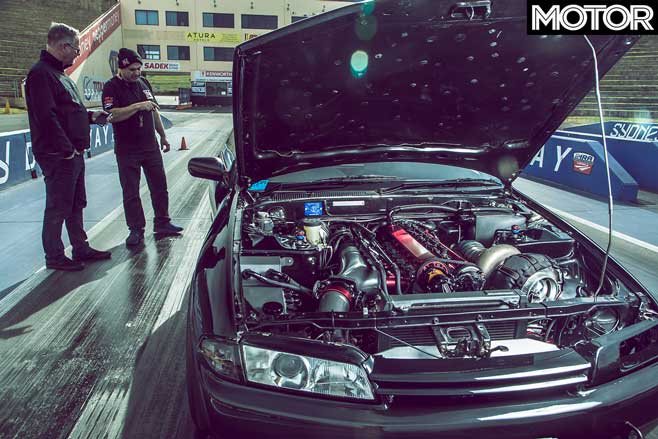
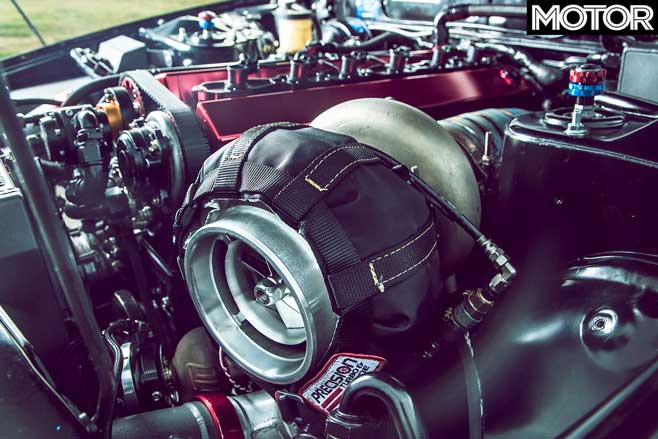
Under the steel bonnet lies a Nitto-stroked 3.2-litre RB30 with a billet block, fed United E85 by 12 fuel injectors and a customised under-bonnet surge tank on the right guard. The Precision XP098 turbo could hide a rockmelon, and can handle up to 2300bhp, according to Rob, while the whole shooting match is orchestrated by MoTeC.
“We run nitrous to the car, both to bring it up on the transbrake as well as down the track for extra power,” he says. “From an engineering perspective, the car is how they were designed out of the factory back in 1989. Everything’s upgraded around it to make sure that we can handle the power, and give us the power.”
Rob says the three-speed TH400 automatic is one of the magic bullets for the GT-R… that and refabricating everything in the GT-R’s driveline that could twist, shear, snap or shatter under the engine’s relentless urge.
“Even the [chassis] flex plates were breaking. We have to build billet shafts, because in the past we’ve broken two transfer cases. The diff has been upgraded to a nine-inch spool to handle the power as well.”
Although the car retains the standard IRS suspension and arms, it has been tweaked to within an inch of its life, and the Mickey Thompson drag radials – and, yes, they are literally street-legal – are the best that money can buy.
“Should we go for a cruise on the road?” Rob asks. Do I need to answer? With the pipes exiting under my left butt cheek, I’m grinning like a beagle as we set off for a quick burger run.
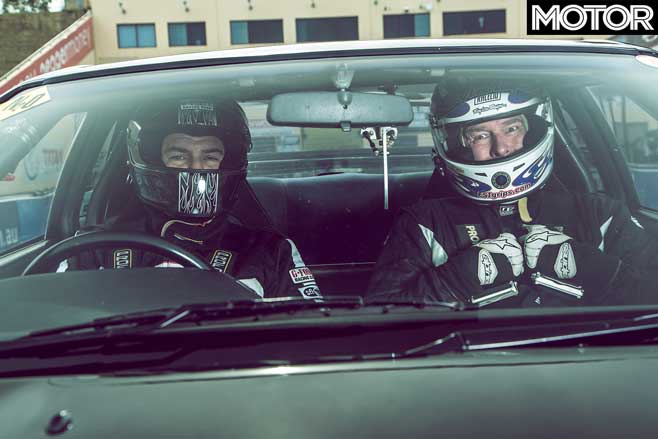
The ride is choppy but bearable, with huge amounts of compression damping built in to handle the weight transfer. The MoTeC computer does a frankly incredible job of keeping the mighty mill docile and tractable.
It’s the carpet I admire most, and I suggest to Rob it must be a psychological ploy as much as anything for his potential rivals in this high-stakes game. He doesn’t reply, but his grin says it all.
JUN II rumbles through the crowded Maccas car park, tradies and suit-wearers alike swivelling to sight the source of the sonic disruption. “Thick shake and a bottle of water please,” Rob asks the impressively uninterested drive-through attendant. “I’m amazed she could even hear me!” he laughs.
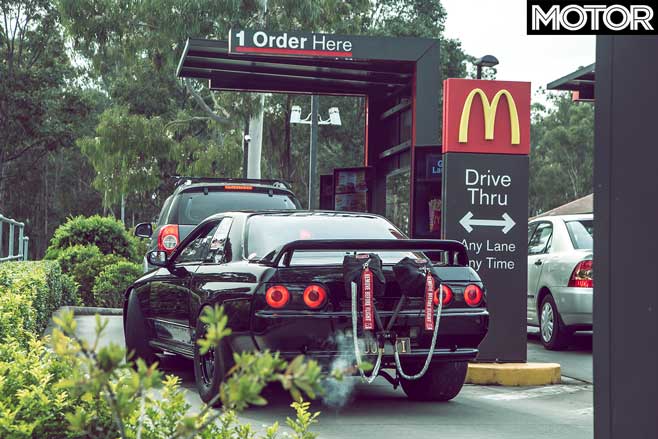
Rob drops me back to my car, with a date to catch up at the annual GT-R Festival back at Sydney Dragway the following weekend. I wouldn’t miss it. After all, it’s not every day you see a six-second GT-R in full flight.
There are more than 400 cars on site today, and Rob has brought a large crew to send JUN II down the strip as part of the event. As afternoon draws into evening, JUN II is swarmed over by an army of Croydon Racing Developments mechanics, while Rob’s extended family prepares the best racetrack food I’ve ever had. It’s a fabulous atmosphere. “We wouldn’t do it if it wasn’t fun,” says one of the lads.
Unsurprisingly, we’re knocked back again from taking a ride during the drag meet, so I take up a trackside vantage point.
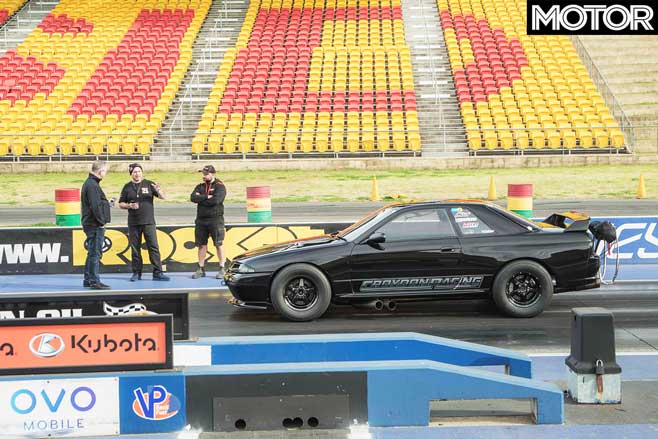
Rob loads up the trans brake, the GT-R building revs and noise like a WWII fighter plane straining at the chocks. Suddenly, the rears whip into life and the side pipes simply spew out acrid E85 fumes into the crowd. He winds up the 1800-horsepower rubber band under the bonnet before slipping the brake and simply explodes away from the line.
The rear squats viciously and the fronts are all but airborne as JUN II veers savagely to the left. Almost unbelievably to my untrained eyes, Rob stays with it and keeps the car – somehow – tracking straight and true, building inconceivable speed before flashing past the finish line at 7.1 seconds and 201mph (323km/h). It’s an assault on every sense.
“Yeah, that was pretty comfortable,” he tells me as he rolls back in. “Still plenty more in it. Might be time to add the nitrous.” I am literally speechless. He will go on to record a night-winning 6.9sec/208mph (335km/h).
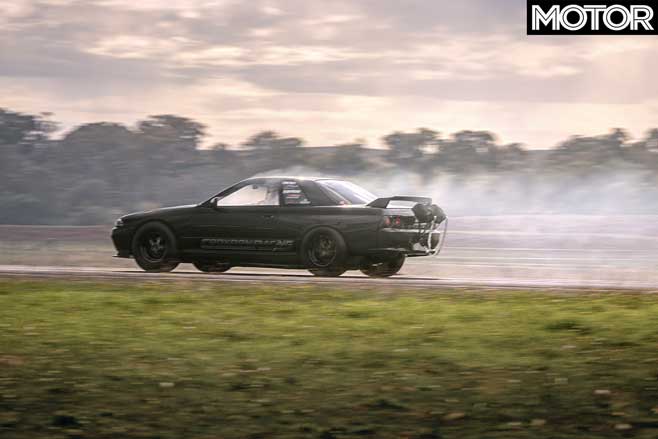
JUN II is an absolutely astonishing feat of engineering, made all the more remarkable by Rob Marjan’s relentless determination to stay true to the vision he formed back when he bought the car. He is, however, planning a full-house drag car that won’t carry the same compromises that JUN II wears.
But JUN II has a place in the lexicon of the GT-R, in the same way as some of the more storied cars in this issue. Its simplicity of form belies its absolutely incredible abilities… and isn’t that what the legend of GT-R is all about?
*Thank you to Croydon Racing Developments, Robert Marjan and Sydney Dragway for their assistance with this story.
FAST FACTS Nissan Skyline GT-R ‘JUN II’ BODY: 2-door, 2+2 seat coupe DRIVE: all-wheel (nine-inch spool rear diff) ENGINE: 3.2L inline-6, DOHC, 24v, turbocharged (Nissan RB30, billet block, Nitto 3.2L stroker kit, dry sump, Precision XP098 turbo) POWER: 1400kW (estimated) TORQUE: 2000Nm (estimated) WEIGHT: 1645kg POWER-TO- WEIGHT: 851kW/tonne TRANSMISSION: 3-speed automatic (Al’s Race Glides TH400) SUSPENSION: double wishbones, coil-over struts (f/r) L/W/h: 4545/1755/1340mm WHEELBASE: 2615mm TRACKS: 1480/1480mm (f/r) STEERING: power-assisted rack-and-pinion; rear-steering WHEELS: 15.0 x 8.0-inch (f/r) TYRES: Mickey Thompson ET Street Radial Pro; 275/60 R15 (f/r) PRICE: “Don’t ask”
Nissan Skyline GT-R ‘JUN II’ Performance figures 0-60ft (18.2m): 1.242sec 0-330ft (100.6m): 3.096sec 0-1/8 mile (201.1m): 4.596sec @ 264.01km/h 0-1000ft (304.8m): 5.891sec 0-1/4 mile (402.3m): 6.993sec @ 328.0km/h
0-100km/h: 0.96sec 0-200km/h: 2.85sec 0-300km/h: 6.69sec
Sydney Dragway, 17˚C, dry. Driver: Robert Marjan
Allan Moffat’s 1969 Trans-Am Boss 302 Mustang race car has been tributed with a limited edition run of Tickford ‘Trans-Am’ Mustangs in the style of the original car.
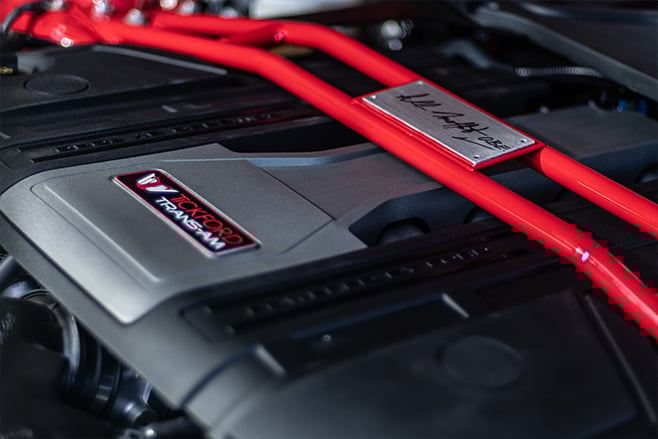
Fitted with the ‘Tickford 400’ tune, which Tickford claims put out 400kW with the N/A 5.0-litre V8 only requiring an ECU tune.
Two versions of the Trans-Am are available, though the whole run is limited to 100 cars.
Replica front grille lights, an under-bonnet chassis strut bar, and identical replicas of the original car’s wheels are featured on both the Performance Edition and Performance Plus Edition, but the plus edition cops bigger Wilwood 6 (front) and 4-pot (rear) brakes.
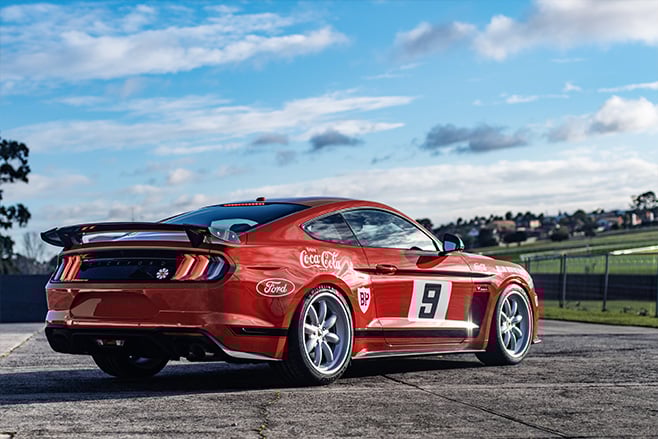
The lower spec kit costs $32,995, excluding the cost of the Race Red donor car supplied by a customer, while the Plus version is a significantly higher $52,995.
Tickford says customers of the Plus version are also given “the opportunity to participate in a number of unique Allan Moffat experiences and allow customers to hear first-hand from the man himself via various events and activities around the country.”
Moffat himself was involved in the project, as was the case with Tickford’s Bathurst ’77 Special, and says he’s quite proud of how it turned out.
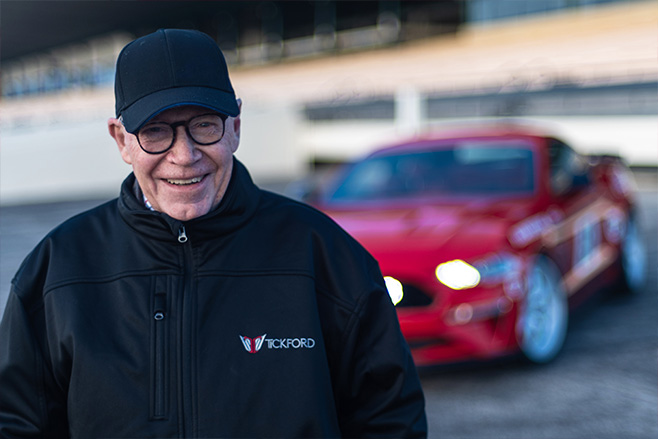
“The Tickford Trans-Am is probably the most exciting car project I have ever been part of. It has made an old racer like me feel proud of my racing history and what I have been involved with,” Moffat said, apparently forgetting that perhaps his racing career is the most exciting car project that he’s been part of.
“My original ’69 Trans-Am Mustang was an incredible race car and I have so many great memories of the battles I won on track.”
Tickford boss Rod Nash said the Trans-Am is a representation of the brand’s “commitment in developing new and exciting engineering-led projects.”
“Building on the success of recent projects such as the Bathurst ’77 Special, the Trans-Am has been a close collaboration with Allan Moffat, using resources from Tickford Racing to deliver a truly remarkable Mustang.”
Fifty years is some time. Plenty, in fact, to grow a family. Maybe even spawn a legend. Just like the one Nissan has with its GT-R.
Over six generations the GT-R has collected more touring car wins and records than you could count. So those three letters boast a rich history few do.
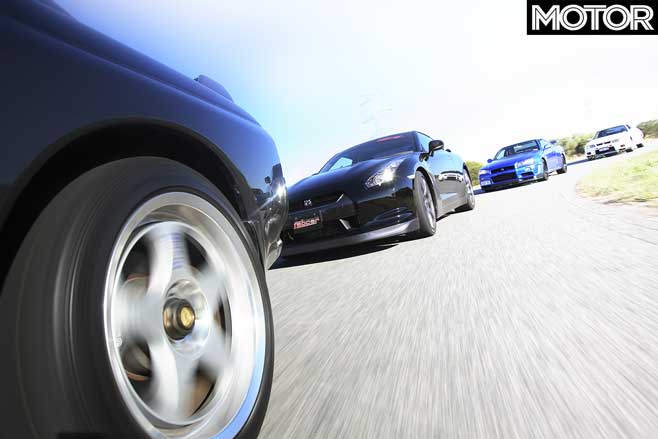
And, clearly, that’s worth celebrating, because Nissan Australia has called a family reunion at Norwell Motorplex in Queensland and invited us along.
It’s gathered a stunning collection, starting with a genuine KPGC10 Skyline GT-R and finishing with the MY20 R35 GT-R we’ve reviewed here.
As it turns out, though, the first and last GT-Rs are what we won’t be driving. Not back to back with the chunk of them, anyway. We instead can only focus on the R32, R33 and R34. Poor us.
And we won’t be crowning a favourite. This is more a celebration of these icons with some driving impressions thrown in. Time’s short, anyway, since we’ve been limited to 100km/h and allowed one flying lap with owners in the passenger seat.
After all, where did you think these cars would come from? Nissan Datsun Owners of Queensland, of course. Let’s meet the family.
1989 to 1994: NISSAN SKYLINE GT-R R32
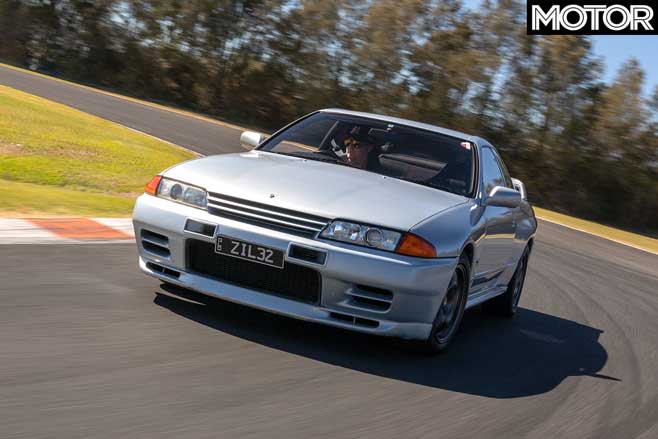
Carl’s obviously bored watching me baby his silver R32 around Norwell. “Yeh, give it a bit here,” he says, as we approach a tight infield right hander.
I obey and ease into throttle after the apex. The 2.6-litre inline six builds a hard edged noise. And as the two low-mount turbos start blowing the rear tyres snap into a small arc. A dap of opposite lock easily catches the wiggle.
As fun as that is, it happens quicker than expected. And that might have something to do with Pirelli Cinturato P7 tyres fitted. Carl admits they need to go. “It’s too loose for me,” he adds, “the next ones will be a lot better.”
We can only imagine what the R32’s engineers would say. They insisted Aussie cars stay on OE Bridgestone Potenza RE71s and not the Yokohamas that would have benefited Nissan Oz’s marketing relationships.
That’s the level of attention Nissan paid to this car, an all-wheel drive twin-turbo monster born to destroy all in road and race trim. Not that you’d know while inside.
As a place to live, the interior’s leather and plastics blend into one shiny black office, while gauges set in the centre stack and the controls huddled around the cluster tunnel simultaneously age the cabin and declare its serious intentions.
Seating position and pedal placement is good. The thin rimmed steering wheel looks big but feels right and the seats are more cushioned and supportive than you’d expect.
Sitting in one belies the technology hiding underneath, such as a multi-plate clutch centre differential and rear steering. Seriously, you’d be impressed if it was released today.
But the most charming aspect of the R32 is the light, direct and mechanical driving feel, bolstered by the sort of technology that encourages four-wheel power oversteer. And yet, it still rides beautifully.
It’s no wonder Nissan sold over 46,000 of them.
1995 to 1998: NISSAN SKYLINE GT-R R33

“R34s I just could not afford,” Reece, the owner of the white R33 GT-R we’re in, explains. “[The R33] is the ugly duckling of the group.”
The R33 is less adored for a couple reasons. It’s bigger in every way compared to the R32, except front track, and took on a more rounded form in search of improved aerodynamics.
You could argue the stigma is unfair, though, since it delivered the improvement you’d expect. In 1996 it smashed its predecessor’s Nurburgring Nordschleife lap time by over 20 seconds.
Driving one reveals the benefits of improved weight distribution, a stiffer chassis and longer wheelbase. It hunts corners with a more stable and planted stance, but its steering is slightly heavier.
There’s a titanium exhaust bolted to its RB26DETT that breathes through a modified intake and the acceleration, despite being a heavier car than the R32, is a step up. I’m certainly squished into my seat as I open the taps.
The five-speed manual transmission ups feel and accuracy, and the cabin looks cleaner in layout. There’s just no shaking the sense of its mass, which ballooned 100kg from 1430kg in the R32 to 1530kg in the R33.
1999 to 2002: NISSAN SKYLINE GT-R R34

The R34 bookends the GT-R’s straight six engine, all-wheel drive era. That in itself is a big responsibility to do well, even now, 20 years on from when it first launched.
Its aggressive lines, shaped in response to criticism of the R33, quickly catch your eye. Owner Jason has perfected its stance, too, with the addition of Nismo wheels and Tein coilovers.
Out on track it does not disappoint. It pulls harder everywhere, helped by the aftermarket cams and breathing mods Jason treated to its ‘carried-over’ RB26, and feels quick even by today’s standards.
What’s more impressive is how modern its handling package feels. It combines the best handling characteristics from both the R32 and R33 with a planted stance that’s also sharp to turn-in.
Traction is excellent, helped by the fact it sits nicely on its outside rear, and the controls are all still tight and precise. Inside, the multi-function 5.8-inch LCD flaunts its technological superiority.
As the final evolution of the Skyline GT-R, the R34 sharpens a highly-developed package into its most capable, and attractive, form. It’s easy to understand its cult appeal.
SO, HOW QUICK ARE THEY?
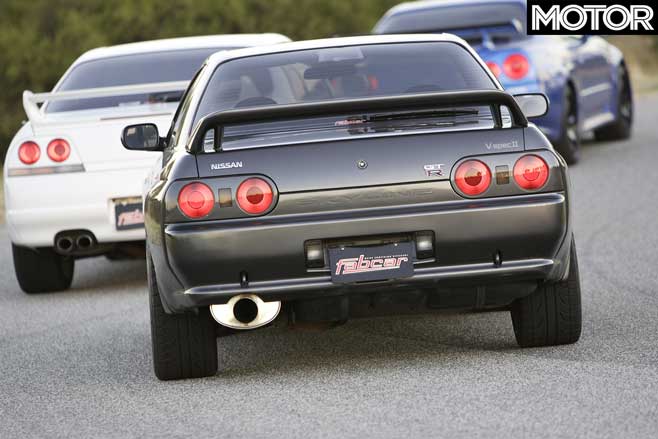
While we would have loved unleash these cars with a Driftbox and Warren Luff inside, unfortunately that wasn’t allowed. But if you’re curious how they would compare, R35 included, on a track, we can give you an answer.
Back in May 2008 we grabbed a private import R35 and brought it to Midvale, Perth, alongside an R32 V Spec II, R33 V Spec and R34 V Spec where a tight sprint course awaited.
Unsurprisingly the R32 was slowest, registering a 52.27sec, while the R33 followed with a 51.12sec time. The R34, lightly modified with coilovers and track rubber, improved that with a 49.19sec. But it was the R35 that blew everything out of the water, its 46.18sec time show how far its clean-sheet package had taken the GT-R’s performance.
| u00a0 | 1994 R32 gt-r V-Spec II | 1997 R33 gt-r V-Spec | 2000 R34 gt-r V-Spec | 2008 R35 gt-r black edition |
ENGINE | 2568cc inline-6cyl, DOHC, 24v, twin-turbocharged; alloy head/iron block | 2568cc inline-6cyl, DOHC, 24v, twin-turbocharged; alloy head/iron block | 2568cc inline-6cyl, DOHC, 24v, twin-turbocharged; alloy head/iron block | 3799cc 60-degree V6, DOHC, 24v, twin turbocharged; alloy head/alloy block |
POWER | 206kW @ 6800rpm | 206kW @ 6800rpm | 206kW @ 6800rpm | 353kW @ 6400rpm |
TORQUE | 353Nm @ 4400rpm | 367Nm @ 4000rpm | 400Nm @ 4400rpm | 588Nm @ 3200-5200rpm |
| u00a0 | R32 | R33 | R34 | R35 |
| Length | 4545mm | 4675mm | 4600mm | 4655mm |
| Width | 1755mm | 1780mm | 1785mm | 1895mm |
| Wheelbase | 2615mm | 2720mm | 2665mm | 2780mm |
| Front Track | 1480mm | 1480mm | 1480mm | 1590mm |
| Rear Track | 1480mm | 1490mm | 1490mm | 1600mm |
| Weight | 1430kg | 1530kg | 1540kg | 1750kg |
| kW/Tonne | 144kW | 135kW | 134kW | 202kW |
Boring, processional races do nothing for Formula 1 – period. We’ve been lucky of late with cracking races in Germany and Hungary, but sadly, they’re more an anomaly than the rule with modern F1.
The category knows this and, in conjunction with the FIA, is toiling away at the new regulations for 2021. And now, with the deadline fast approaching, we have a first look at what the F1 car of the future will look like.
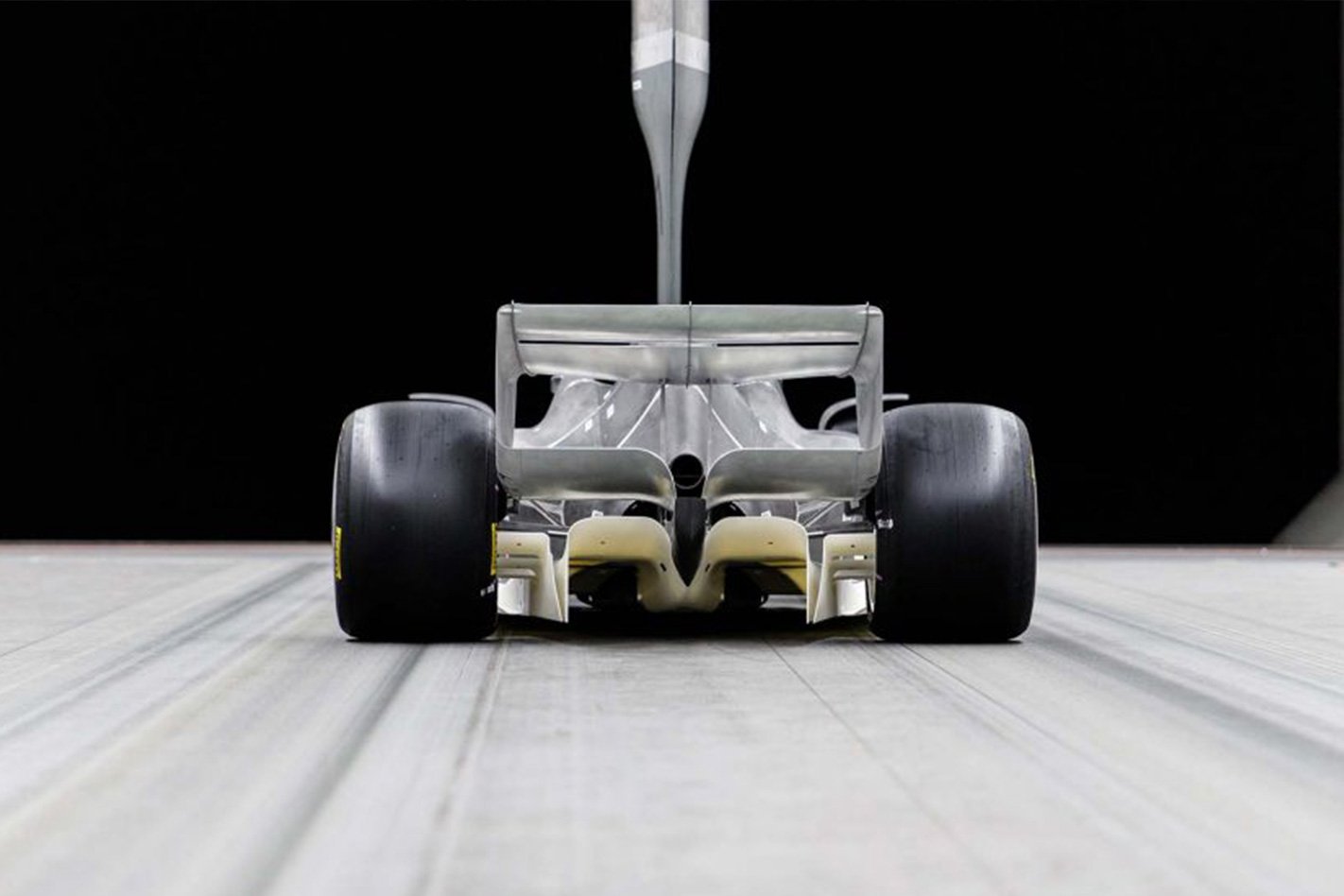
The latest CFD testing highlights F1’s push to clean up the ‘dirty’ air left behind the highly aero-sensitive F1 cars. Drivers have long circled this as the number-one factor in the ability to follow another driver close enough to overtake them. It’s been proven that the wake left behind a 2019-spec car can disturb the aerodynamics of the car behind by up to 50 percent.
Results of the latest test, conducted in Sauber’s wind tunnel with a 50-percent scale model, show that the quoted disturbance figure has decreased to between 5 and 10 percent under the new regs. This is good news for competitive racing as it increases the ability of the car behind to remain in close proximity without significantly reduced aero.
To achieve this, just about every aspect of the F1 car has changed, including the rear wing. The current concept features elements to create a higher air flow behind, essentially channelling it over the preceding competitor and reducing the turbulent effect. Simplified end plates will also aid this target.
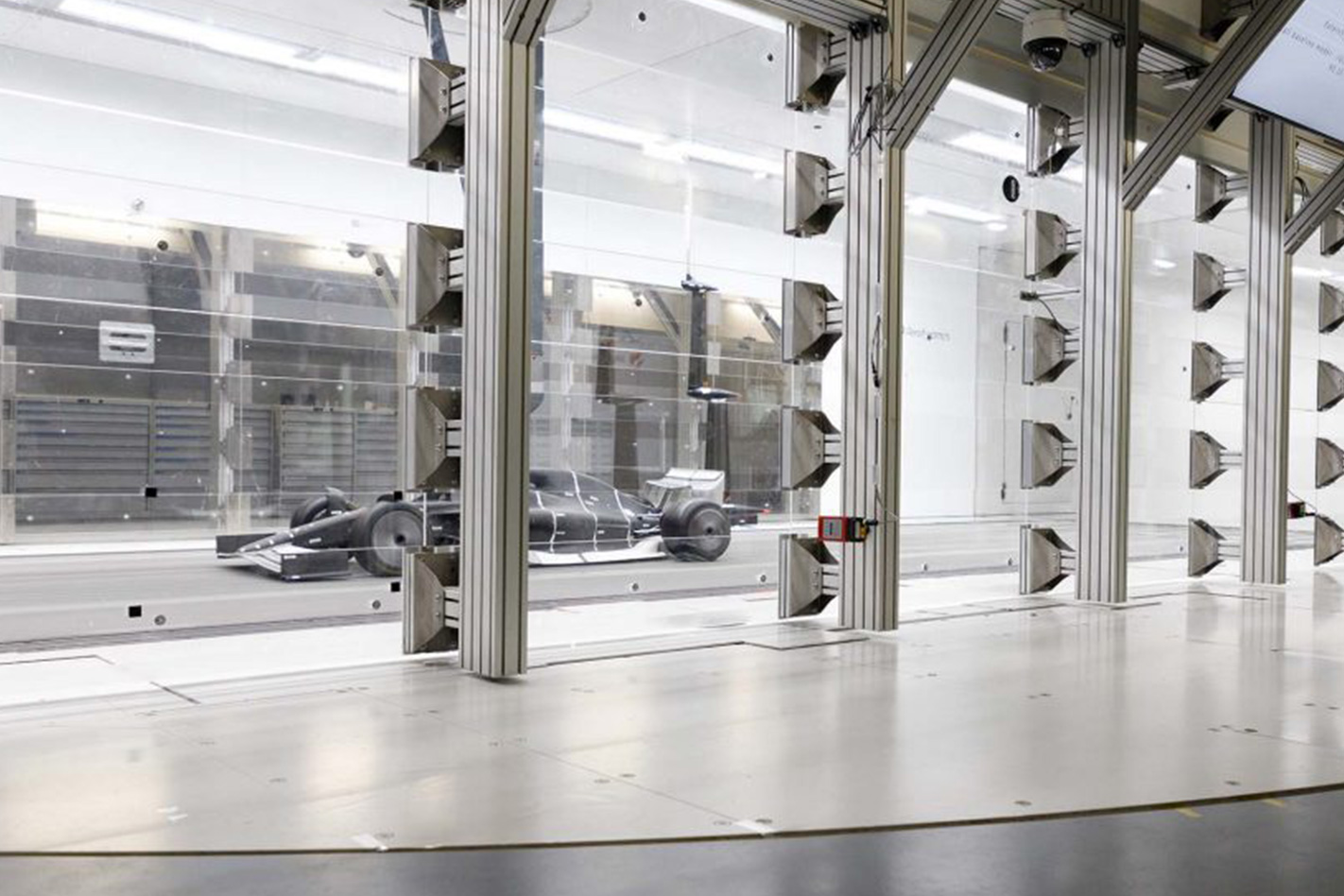
Sleek body work and a reduction in aerodynamic paraphernalia is evident with the cleaner design. The floor has been reformed with Venturi channels underneath the side-pod inlets for great ground effects – think Lotus 79. The proposed 18-inch wheels, shod with Pirelli’s new low-profile tyres and wheel covers to control the air flow, were also fitted and tested on the scale model for the first time in CFD simulations.
However, a full assessment is yet to be conducted on the new front wing, which now allows only three elements as opposed to five to cut the creation of vortexes between the tyre wake and the floor.
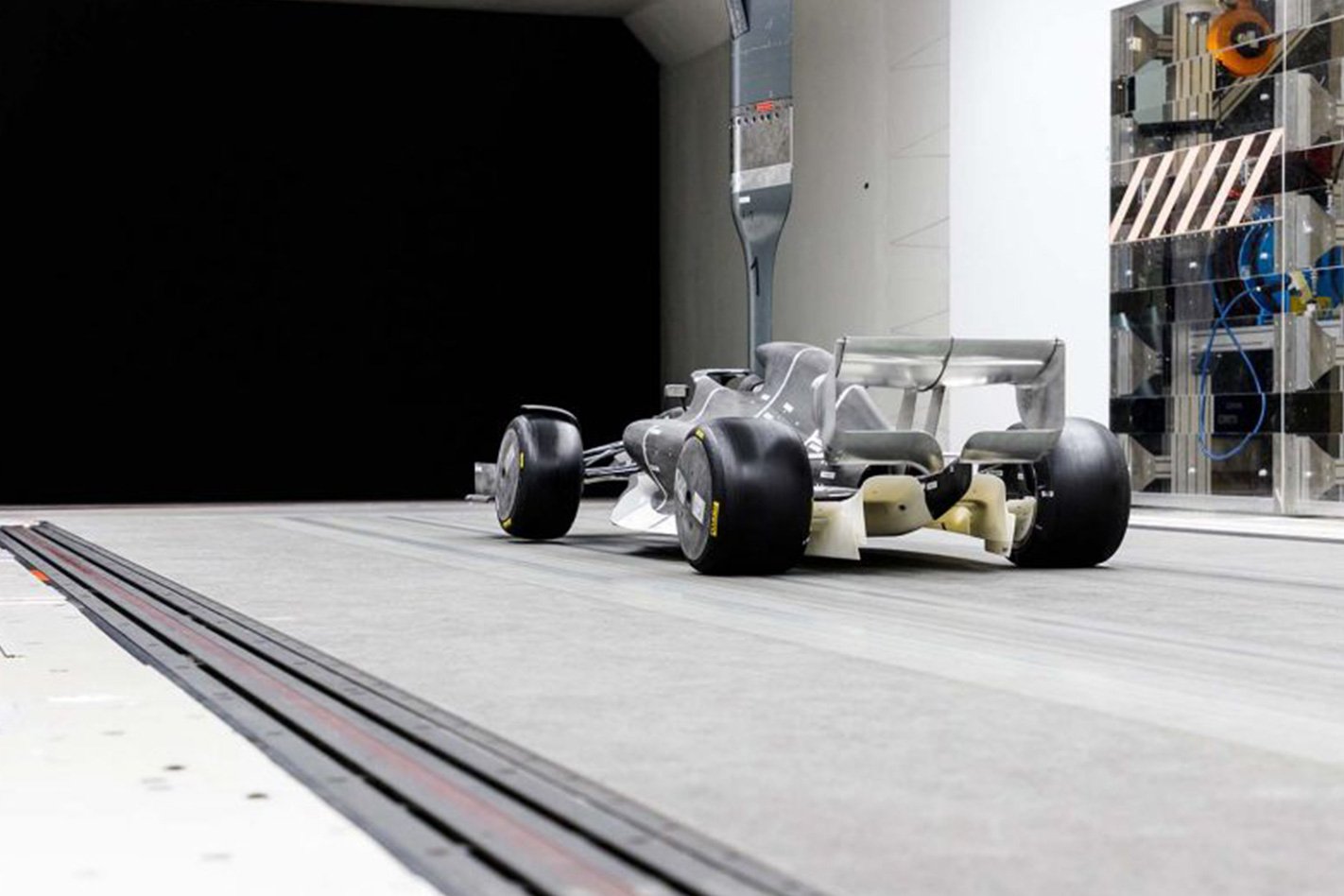
Still, the overall initial results paint a positive picture for closer racing and more passing opportunities in the future. And that’s a tantalising prospect, indeed.
What’s in the garage?
The N emblazoned on the i30’s rump might have been the headline news at the hatch’s launch, but the real story was Hyundai’s snaffling of a man known for another letter – the letter M. Albert Bierman, famous for heading BMW’s go-fast M Division, was tasked with fronting Hyundai’s first true performance foray. Hindsight tells us it was a good idea.
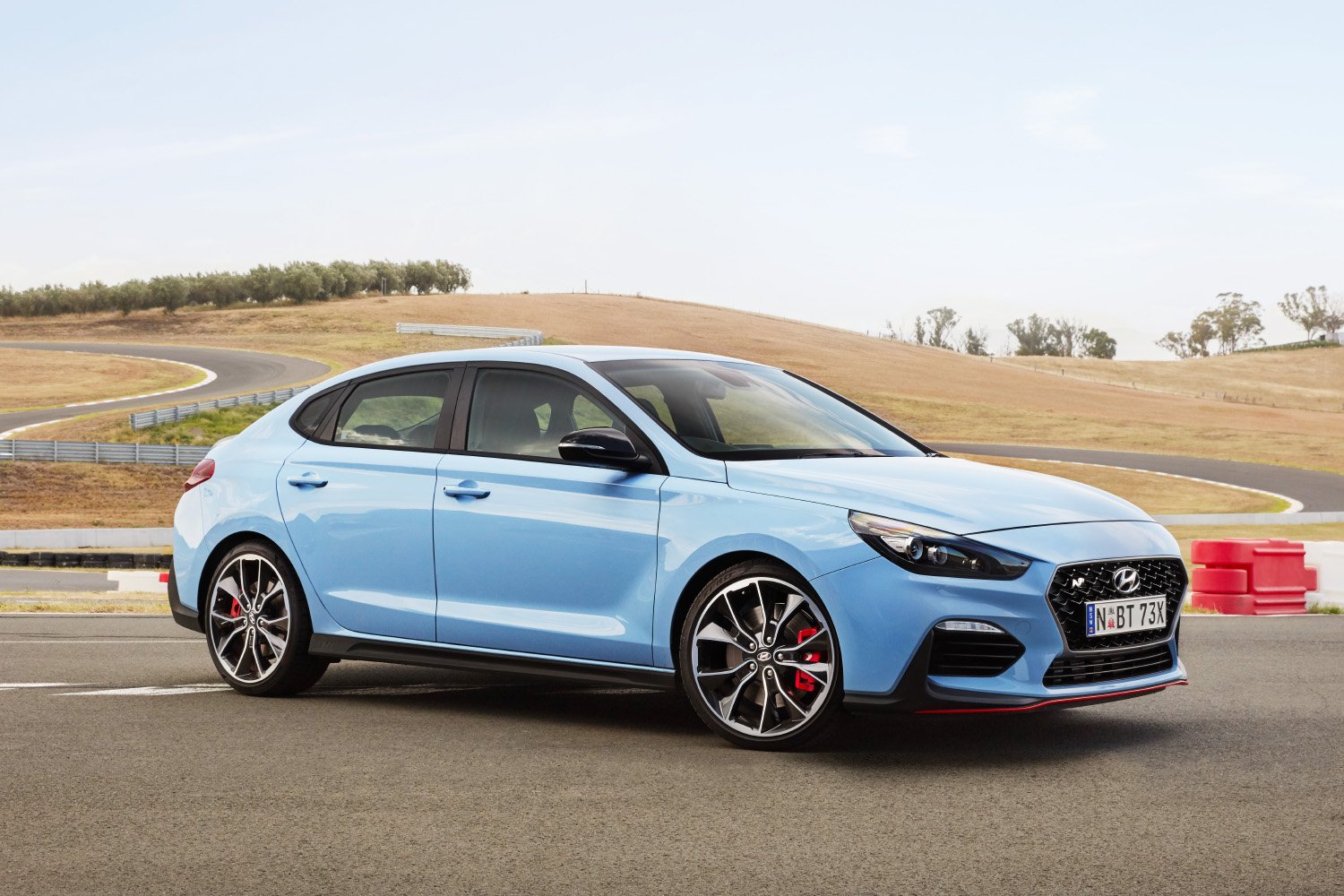
Now, on the back of the hatch’s success, we have the i30 Fastback N. Essentially it’s a five-door hatch that’s morphed into a sleek five-door liftback, a mini-me version of the in-fashion four-door coupe silhouette. At $41,990 it’s $2000 more expensive than the hatch, however, it remains highly specced with items like AEB, lane-keep assist and LED lights part of the standard kit.
Underneath there’s been some changes to its suspension, but overall the mechanical goodies remain. The 2.0-litre four-cylinder turbo still generates 202kW and 353Nm (or 373Nm on overboost) and can reach 100km/h in a claimed 6.2 seconds. The front-wheel-drive architecture and electronically controlled LSD carry over, as does the six-speed manual. There’s still no dual-clutch gearbox – for now at least.
What we reckon

Trent Giunco
Staff Journalist
This is an easy car to like. Actually, it’s a riot and sounds like a full-on rally car – which is very cool. Yet its talents extend further than popping and banging theatrics. Genuine dynamic talent and serious performance is now attached to a Korean marque. Badge snobs need not apply. Personally, when it comes to fast, front-drive hatches, I have a strong hankering for the Honda Civic Type R. Yes, I’d be further up the road in one, but also an extra $10K out of pocket.

Cameron Kirby
Staff Journalist
The Hyundai i30 N hatch is already a seriously potent vehicle for someone that wants a solid mix of practicality and performance. But that might not be enough for some, with the Fastback variant catering to those, along with customers who prefer sedan styling. By adding a bigger boot, the Fastback N hasn’t lost any of the hatch’s dynamic prowess, and it retains the same roaring character that makes it a benchmark in the hot hatch segment.
REVIEW
Power and performance:
Choose your flavour. The i30 Fastback N is all about what mode you choose as each alter the Fastback’s persona demonstrably. Push the steering wheel-mounted N button, designated by a chequered flag, and everything is turned up to 11. The 2.0-litre four-pot feels as strong as its 202kW/353Nm figures suggest, but there’s not a great deal of value searching for the redline as power trails off higher in the rev range.
It’s a linear unit matched with strong levels of traction. Occasionally the fronts will scamper over uneven tarmac and the abundant torque will tug at the wheel, but you can make swift progress. The six-speed manual is pleasing to use and there’s a well-calibrated rev-match system if you don’t fancy heel and toeing yourself. The brakes are strong and there’s a conventional handbrake if you want to channel your inner Thierry Neuville.
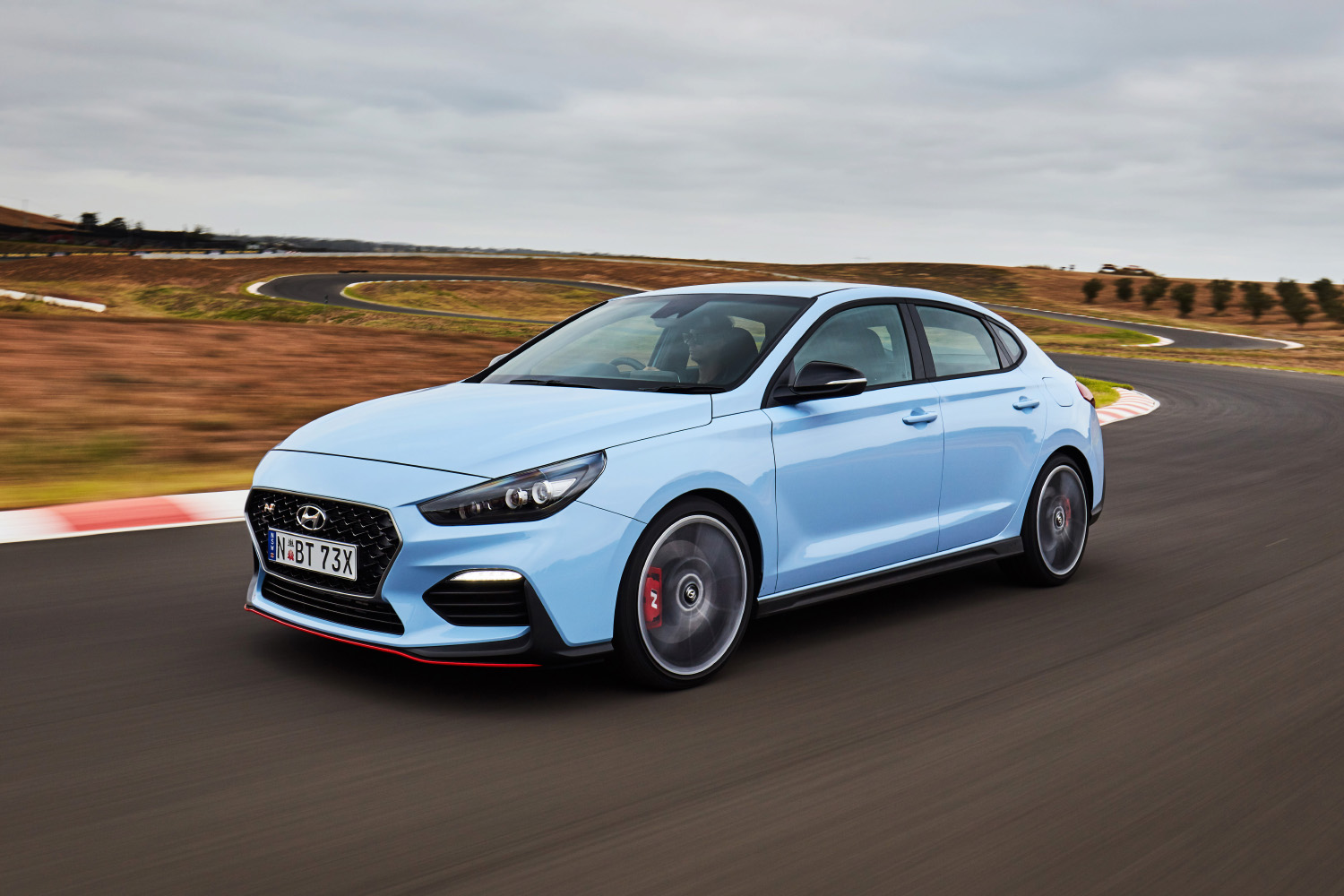
It’s impossible not to talk about acoustics. The i30 N sounds demonic – it pops and bangs on the overrun like you’re at a shooting range. Although, it’s not solely look-at-me drama as there’s a rorty engine note paired with an enticing induction noise. Switch to Comfort or Eco modes and you can putter around with onlookers none the wiser.
Ride and handling:
In a range of conditions, the Fastback delights with layered levels of dynamic ability. It’s a feast for the senses in all the right ways. Overall the centre of gravity is slightly lower and it is both 12kg heavier and 120mm longer past the rear axle compared to the hatch.
The most significant mechanical change is a more forgiving MacPherson strut front suspension set-up with less aggressive bump stops. The adaptive dampers have also been tweaked (slightly stiffer at the rear) and it equates to a ride quality that is more forgiving in more comfort-orientated modes. N mode is still overtly firm, but you no longer need a billiard-table smooth road to engage it.
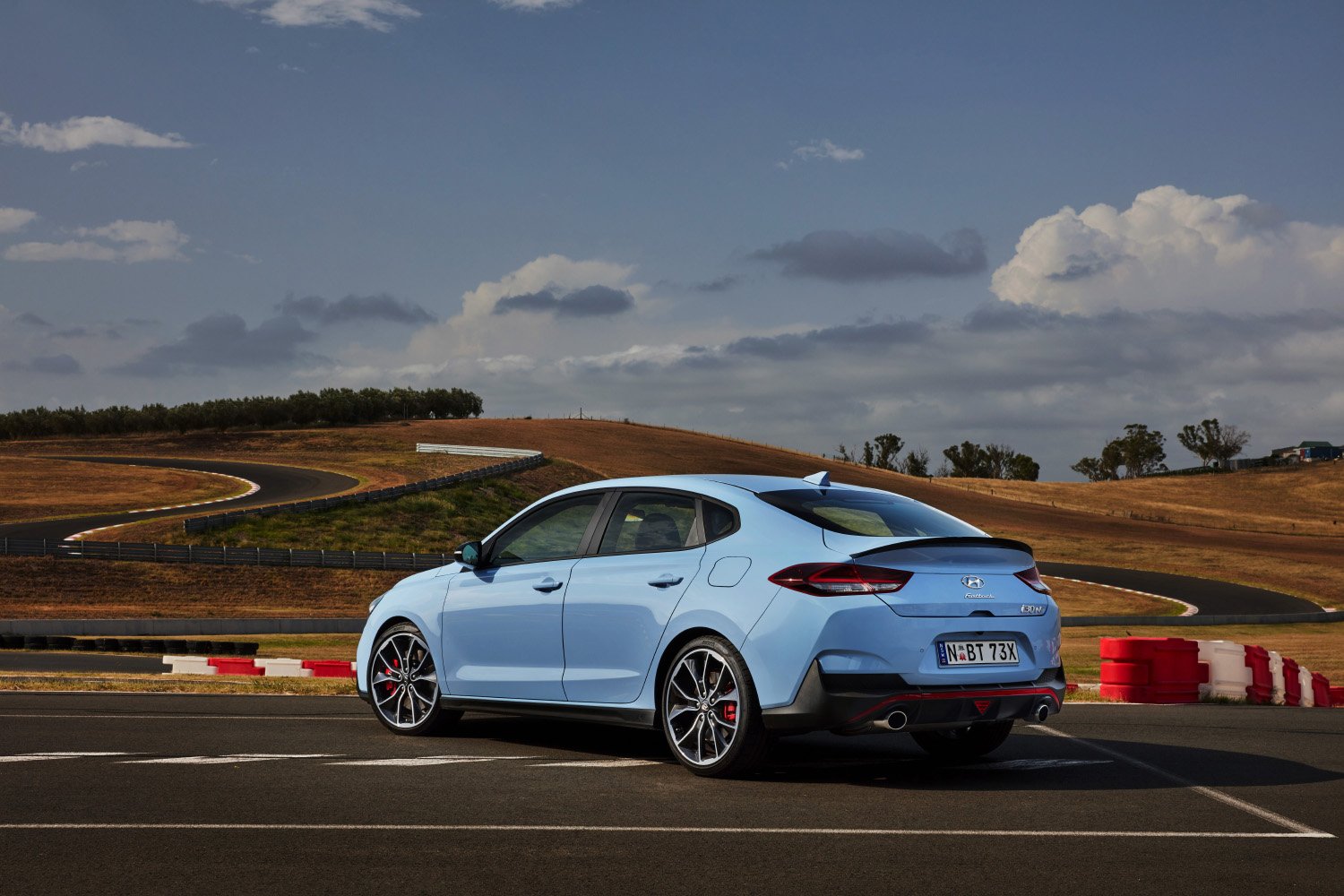
Engagement certainly isn’t something that’s lacking between car and driver. The steering feels meaty, while the front-end is willing and able to attack an apex. If you drive cleanly, the i30 Fastback allowe for impressive entry- and mid-corner speed before any hint of understeer becomes apparent. On the flip side, the rear will dance under heavy braking as you add lock. This isn’t alarming; working with the yaw movements only increases the fun factor.
Interior and Comfort:
Inside, the Fastback’s dash design and touchpoints mostly mirror the hatchback. And that’s a good thing, as ergonomics remain high and the expected level of tech is present. It isn’t bathed in soft-touch plastics and you get the feeling Hyundai’s N division placed more monetary value in upgrading the running gear over all else.
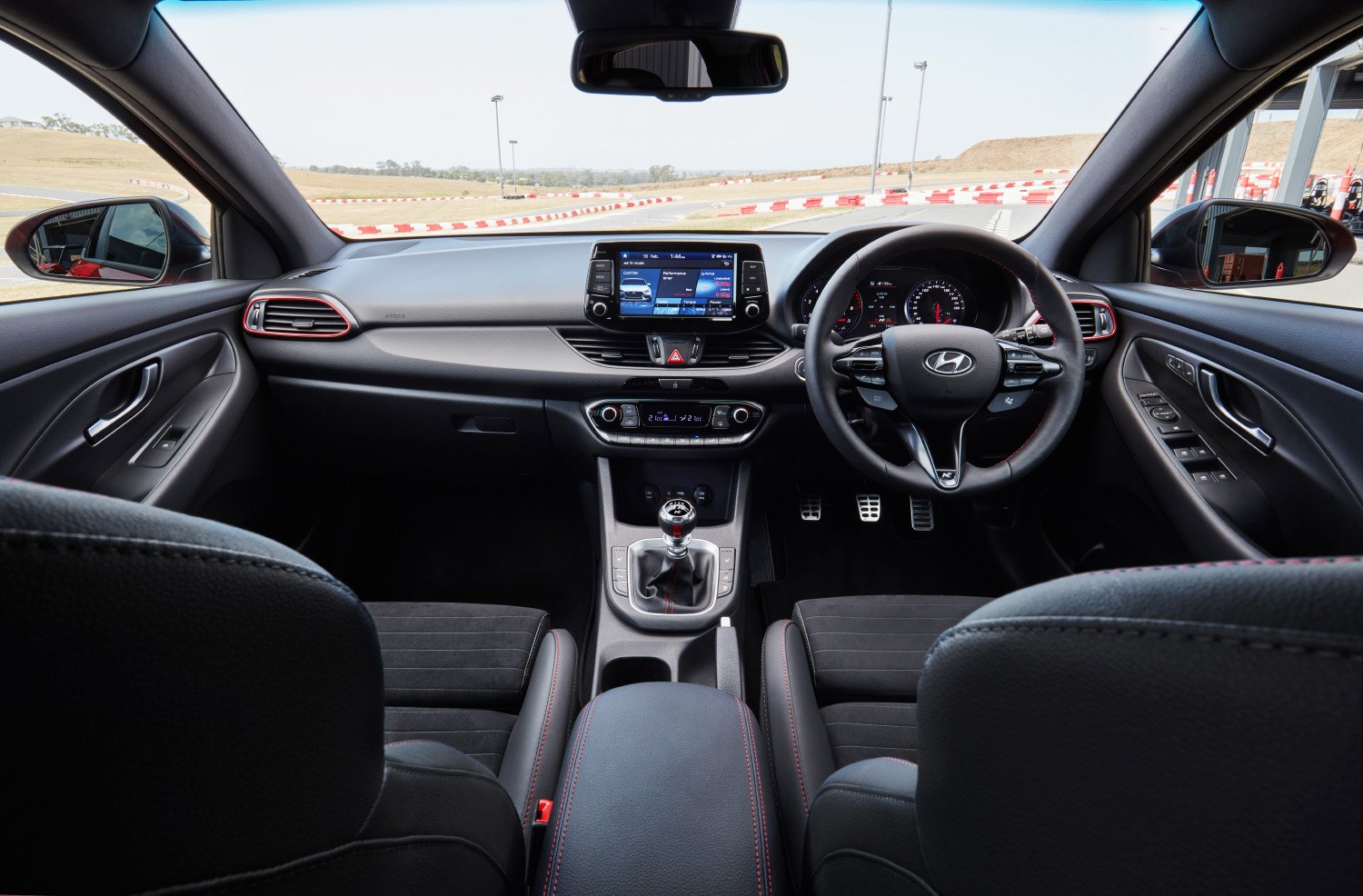
Still, there’s a pleasingly chubby steering wheel, a tactile shift knob and body-hugging seats – again, it’s Hyundai ticking the right boxes. NVH levels could be better suppressed on coarse surfaces, but slink into Comfort mode and the Fastback is, ahem, comfortable.
Rear headroom isn’t compromised too much despite having a 21mm lower roof, affording enough space for adults to sit comfortably. The legs, knees and toes of back-seat passengers won’t find much reason to complain in terms of space, but overall they might baulk at a lack of rear air vents. The boot space is 436 litres, which expands to 1337 litres with the 60:40-split seats stowed.
VERDICT
In terms of bang for your bucks, the Fastback version of the i30 N is a real winner. Whether or not punters like the styling or see value in the price-premium for the swoopy liftback design is up to personal preference. It’s a decision made harder by the fact that the hatchback now receives the same suspension tweaks. Ultimately it doesn’t really matter which form factor you choose.
It’s baffling to think that the Fastback is part of a first hit out for the N performance range given its competency. First attempts rarely foster such impressive results. Overall, the i30 Fastback N endears itself in ways many hot hatches can’t. And for that, we can’t help but like it.
HYUNDAI I30 FASTBACK N SPECS
Model: Hyundai i30 Fastback N
Engine: 1998cc 4cyl, dohc, 16v
Max power: 202kW @ 6000rpm
Max torque: 353Nm @ 1500rpm
Transmission: 6-speed manual
Weight: 1441kg
0-100km/h: 6.2sec (claimed)
Economy: 8.0L/100km (claimed)
Price: $41,190
On sale: Now
The mark of a true car enthusiast is using hard-earned cash and annual leave to travel to an international car event and do effectively the same thing you would in your day job. This week, the WhichCar Weekly team welcomes photographer extraordinaire Alastair Brook to regale his adventures from Monterey Car Week.
As one of the world’s premiere automotive events, Monterey showcases cars young and old on a spectrum like no other. What might constitute a headline act at any other car show is what you will find in the queue to get in.
Tune in to find out the highlights and fails at this year’s incredible event from our roving reporter on the ground.
Later, the attention is turned to the new-generation Audi RS6, which has just broken cover. It packs a monstrous turbocharged V8 into a practical wagon body for one of the most impressive and intimidating cars on the road.
Despite the compelling choice of hot wagons available, Australians just don’t seem to warm to the potential of these hi-po all-rounders, instead opting for high-riding SUVs. We discuss our favourite fast estate options and why Australians are getting it wrong!
If you’re on the go, you can find WhichCar Weekly on all manner of podcast apps including iTunes and Podbean. Please rate, subscribe and leave a review! You can also follow the day-to-day happenings of the WhichCar team on Facebook, Twitter and Instagram @whichcarau.
Listened to the show? Help us out:
- Leave a note in the comment section below.
- Leave a review on Apple Podcasts/iTunes
- Subscribe to our podcast
The first round of the new S5000 open-wheeler race series is set to welcome former F1 driver Rubens Barrichello to the grid when the cars line up for the inaugural race at the 2019 Shannons Nationals at Sandown.
The race is to take place next month, but Barrichello is the only confirmed driver so far, with as many as 14 rivals to be announced soon.

“The concept of the S5000 formula is a very interesting one, the car looks to be a real challenge, and I look forward to playing my part in its launch.”
With 5.0-litre V8s powering the S5000 cars, even just a dozen cars should be enough of a spectacle to draw a crowd.
“It’s great to see what will be a resurgence in serious open-wheeler racing in Australia. I hear the sight and sound of a 5-litre V8 in the back of the S5000 is pretty awesome.”
Barrichello raced in F1 for almost two decades between 1993 and 2011, racking up a record 322 race starts, and 11 race wins. Notably, he was paired with Michael Schumacher during his stint at Ferrari between 2000 and 2005, making him part of the recipe that saw the team dominate the sport in the early 2000s.
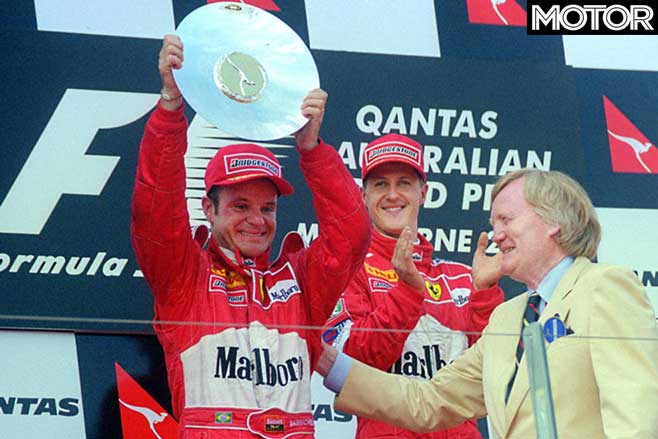
Though he’s raced in Melbourne in the past, the S5000 race over the September 20-22 weekend will mark Barrichello’s first at Sandown.
“I’ve never been to the Sandown circuit before, so there will be much to absorb, but it looks like a great venue for the S5000s to make their debut. It’s going to be a great experience.”
It’s a big deal for any automotive nameplates to reach their 50th birthday, but 2019 sees Nissan celebrating two!
Nissan’s sporting mainstays, the R35 GT-R and 370Z, are both blowing out the candles for their golden jubilee and receive special editions of each for the 2020 model year, with healthy doses of visual nods to their motorsport-steeped history.
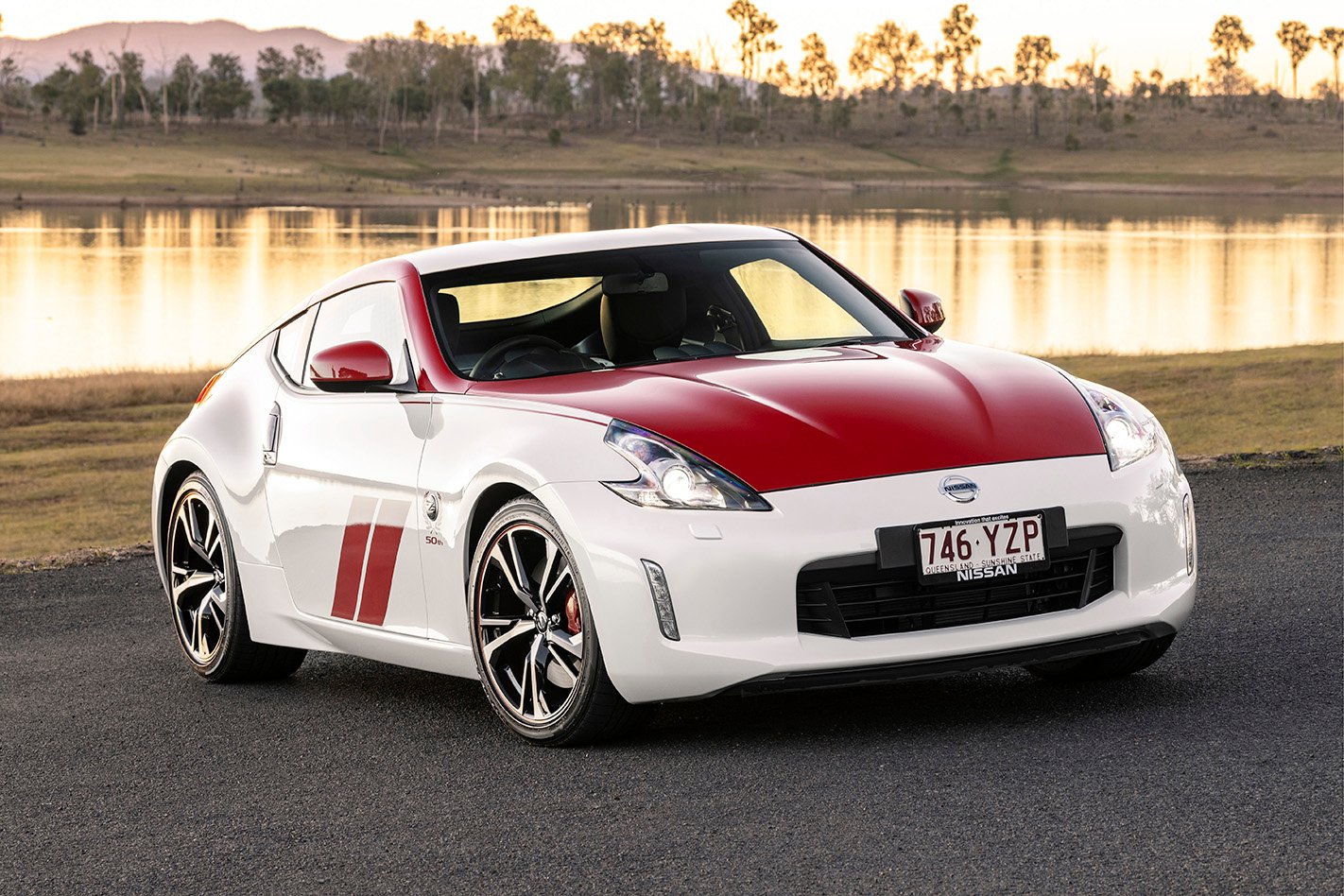
The 370Z range remains unchanged from the previous model year; with its 3.7-litre V6 still yielding 245kW and 363Nm.
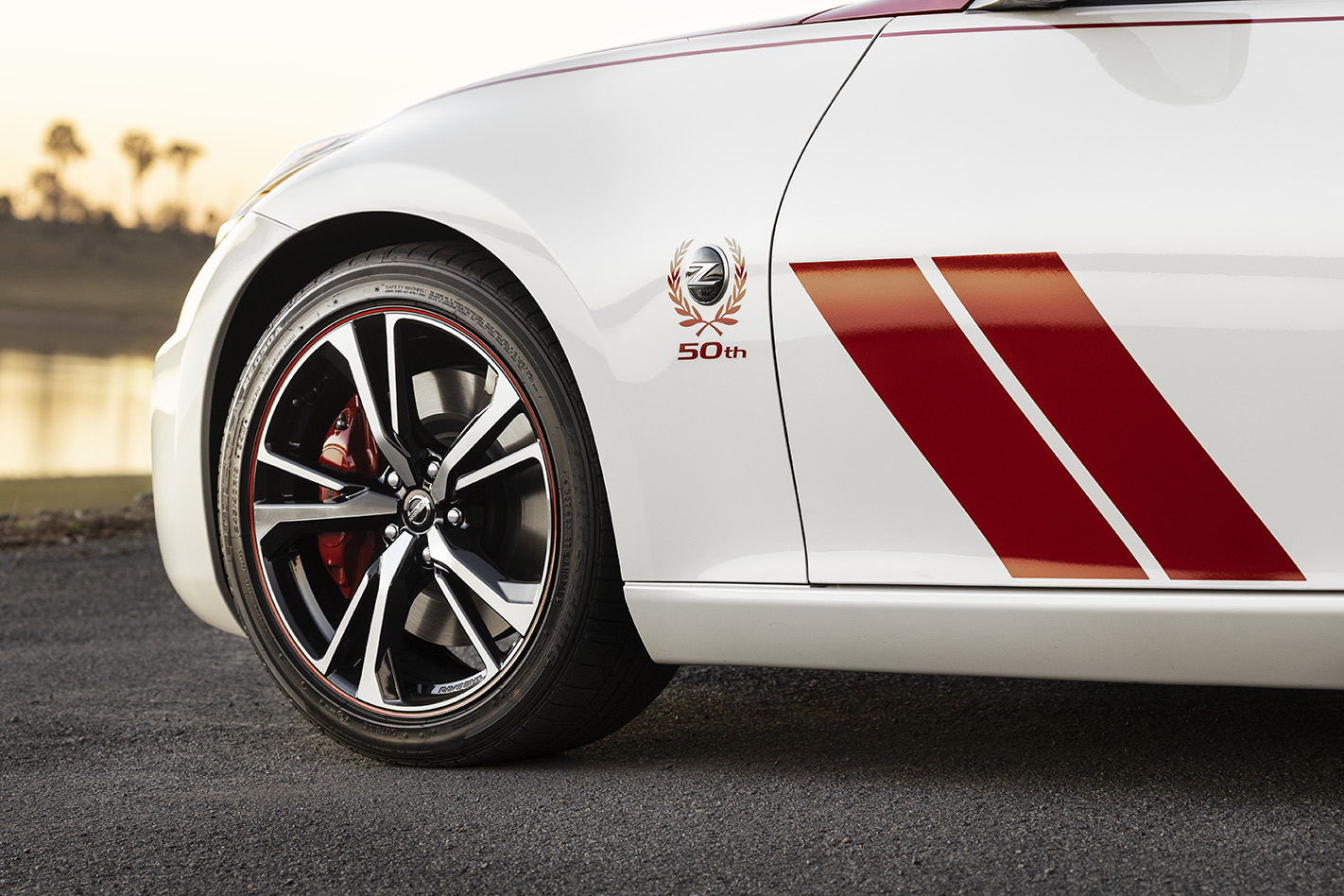
Channelling Peter Brock’s (the American one… not ours) #46 ‘BRE’ liveried Datsun 240Z, the 370Z 50th Anniversary receives legendary Datsun/Nissan racer’s signature two-tone striped outfit in iconic red-over-white or, alternatively, black-over-silver. The car gains further 50th anniversary badging on the rear and front guards, and updated 19-inch wheels with red outer rings.
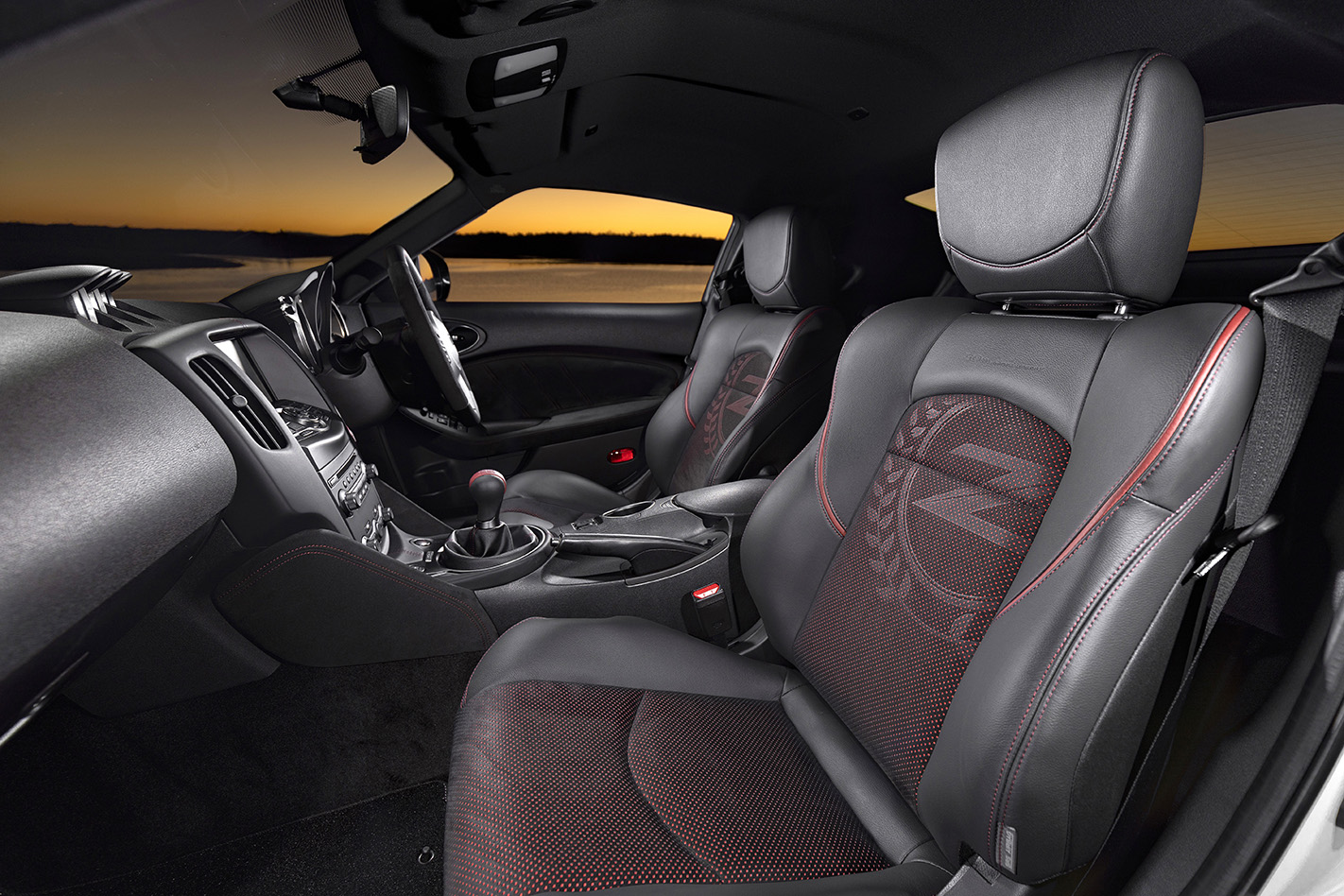
Inside, the 370Z’s ageing cabin receives red leather mesh with 50th anniversary wreath within the seat centres, red stitching across the doors, knee pad, cluster and steering wheel; as well as red highlights on the shift lever, shifter boot and 50th anniversary logos adorning the tachometer and above the shifter.
As before, the 370Z is available in both a close-ratio six-speed manual or seven-speed automatic.
GT-R extras
The flagship GT-R receives a little more fettling under its skin for the 2020 model year.
Across the range of Premium, Premium Luxury and Track Edition vehicles, the front foglamps have been redesigned, the existing titanium muffler receives burnt blue tips and they’re now cornered by the lightest stock wheels ever offered on a R35 GT-R.
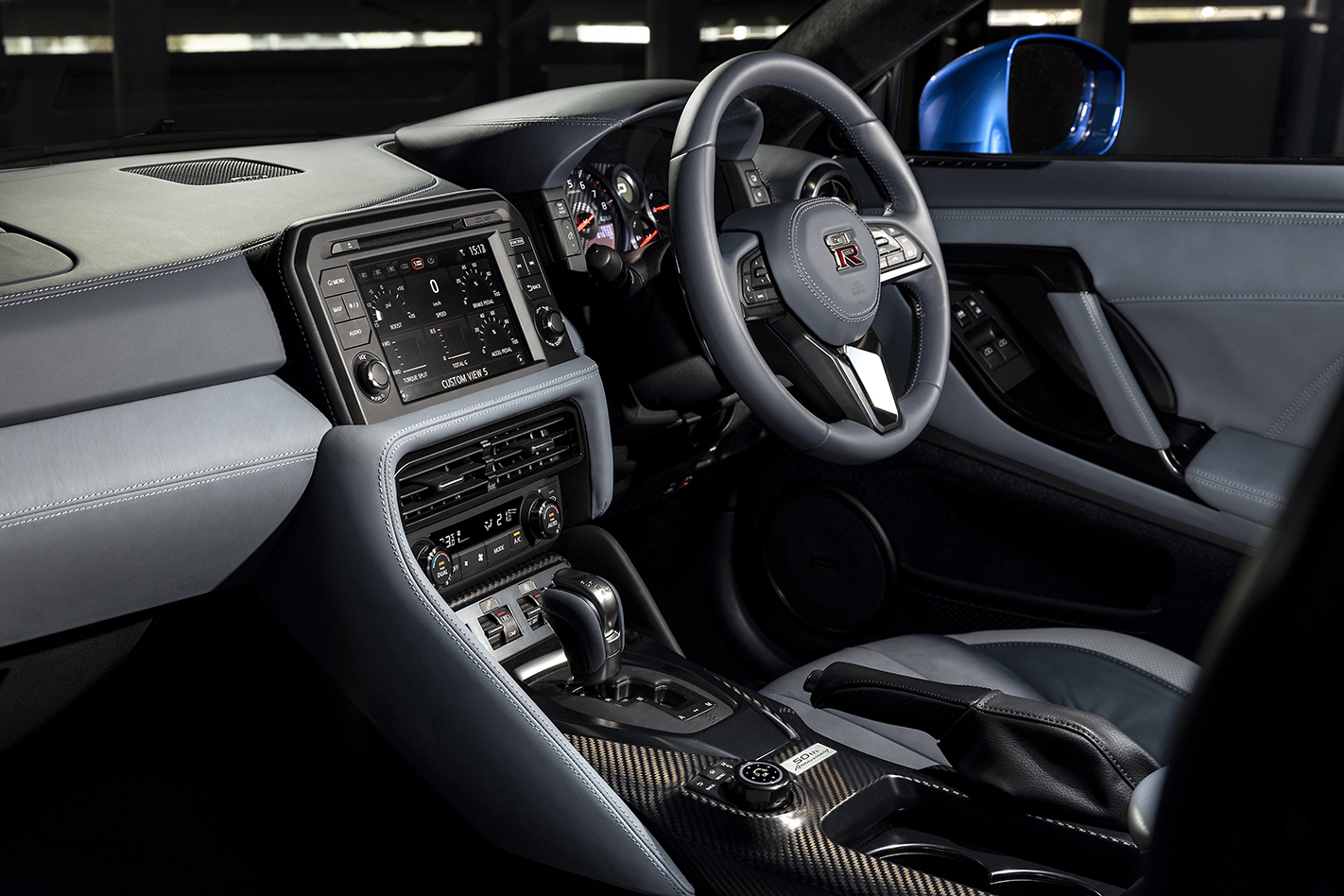
The mid-spec Premium Luxury variant receives a new “Urban Grey” interior trim option, while the Track Edition with Nismo interior option receives updated Recaro seats.
The 3.8-litre twin-turbo VR38 V6’s 419kW/632Nm performance remains unchanged from the MY19 model, but updated turbos coupled with Nismo throttle and gearbox calibrations see more responsive acceleration and more aggressive downshifts.
The electronically controlled suspension has received a new tune for better ride comfort and more precise cornering bolstered by improved steering angle and a new brake booster.
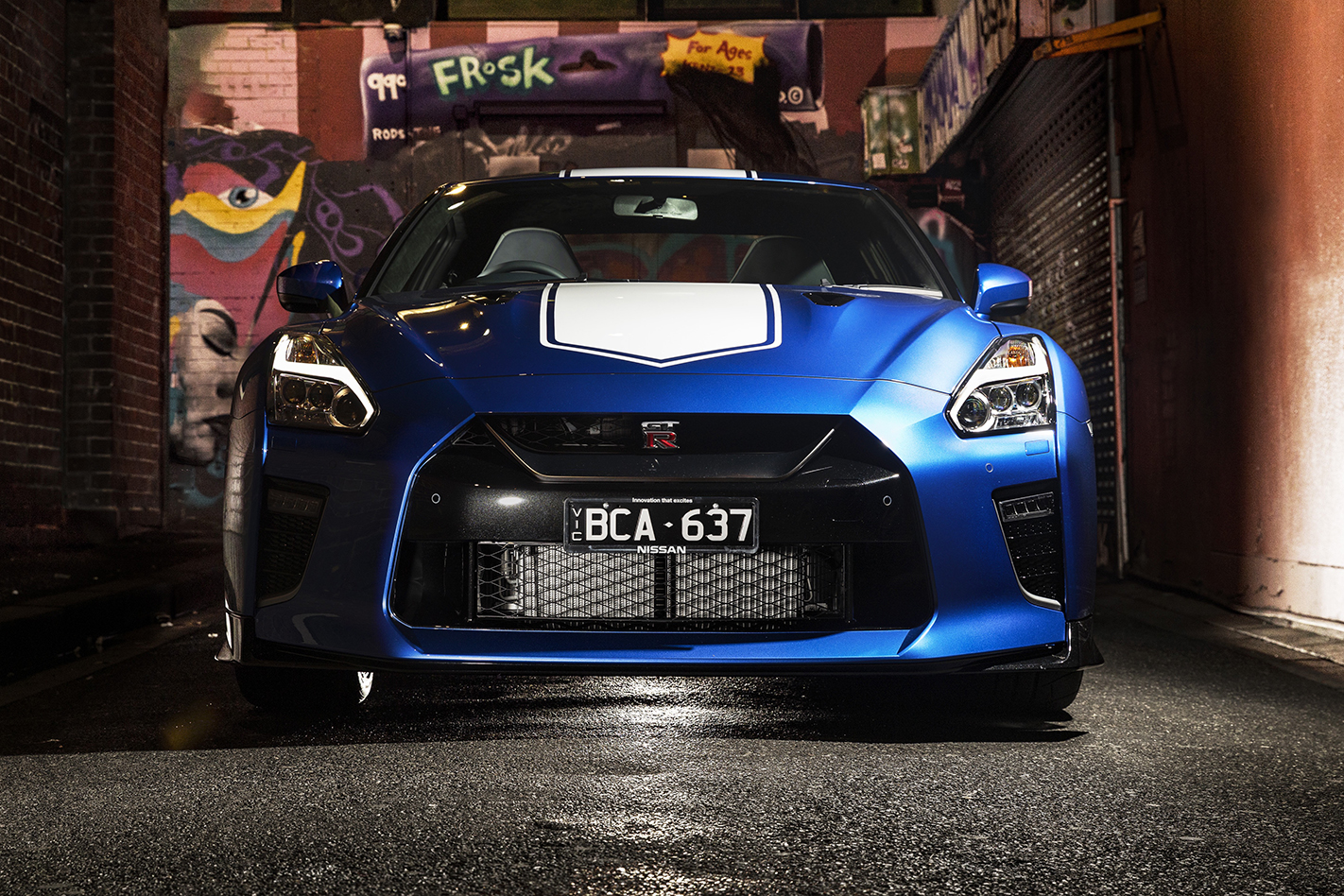
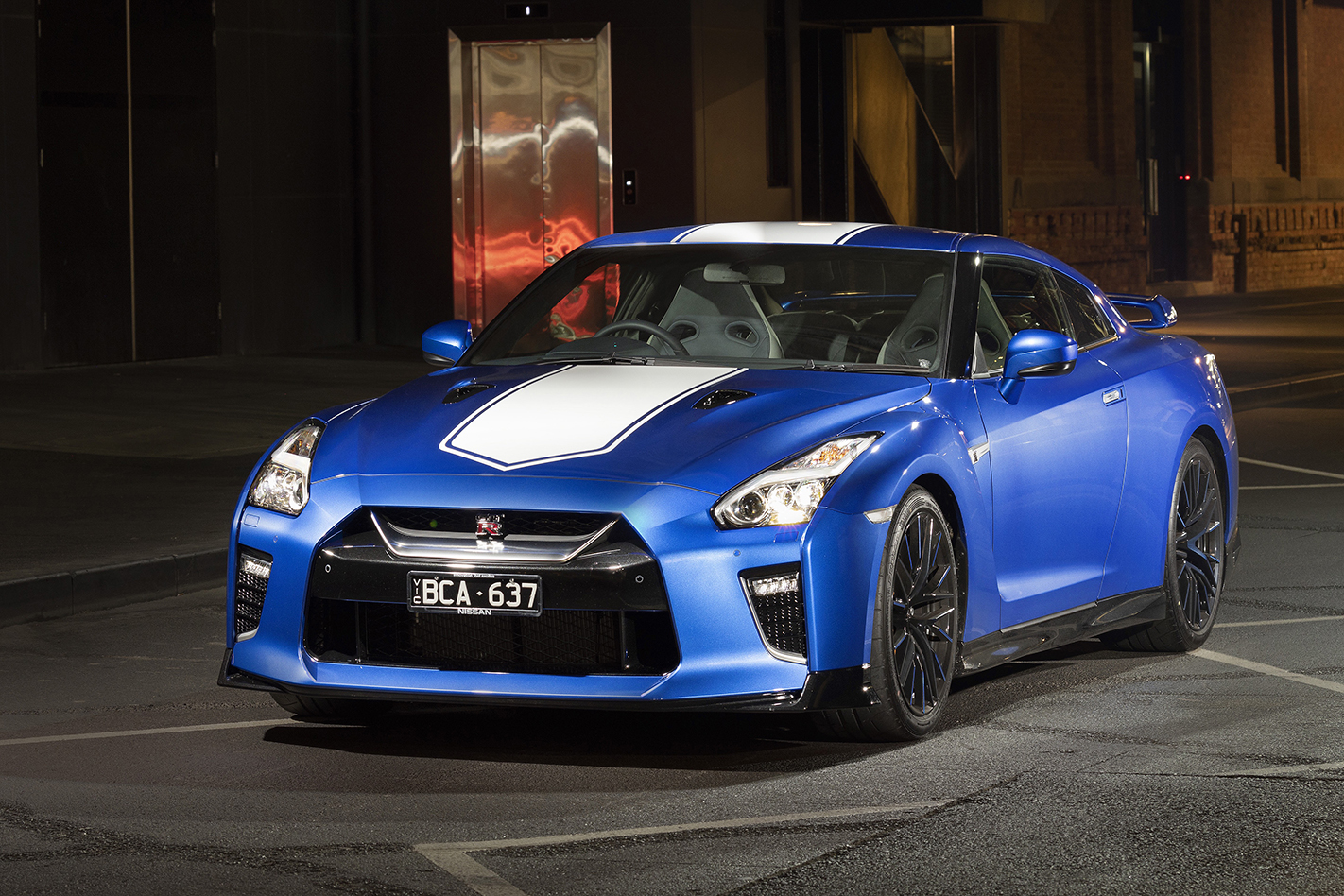
The GT-R’s 50th anniversary edition is based on the mid-spec Premium Luxury variant and available in three colour and stripe options: Super Silver with white stripes, Ivory Pearl with red stripes, and the newly released Bayside Blue with white stripes.
GT-R faithfuls should recognise Bayside Blue as the hero colour of the R34 generation GT-R, while the bonnet and roof stripes adorning the latest 50th anniversary harken back to the first generation “Hakosuka” GT-R race cars from the 1971 Japanese Grand Prix.
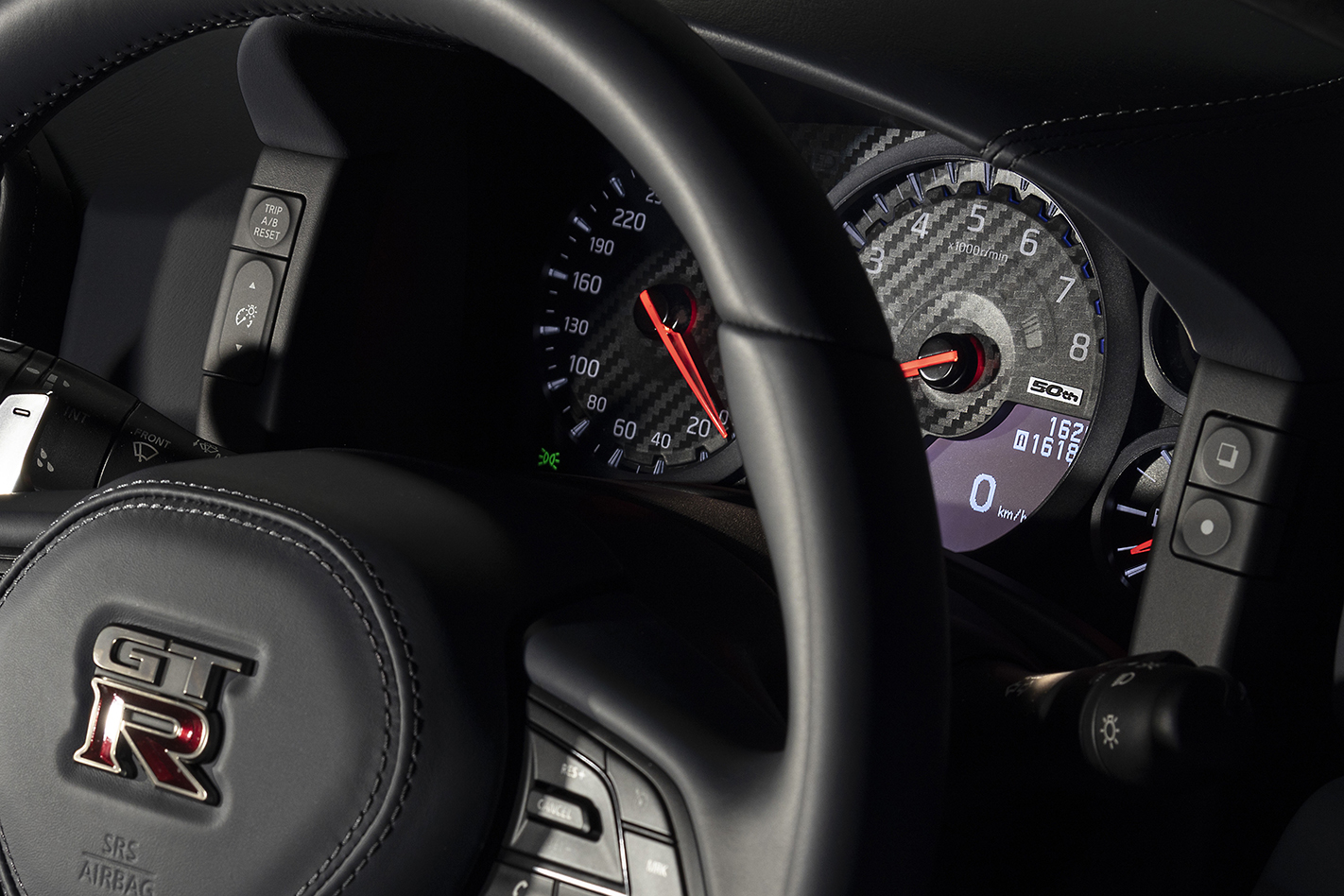
Further differentiating the 50th Anniversary edition from the standard range is a new interior trim offering, dubbed “Twilight Grey”.
Of course there’s also a swathe of 50th anniversary badging and iconography adorning the car both outside and in.
2020 Nissan GT-R and 370Z 50th Anniversary Pricing:
- Nissan 370Z 50th Anniversary Edition (Manual) – $53,490
- Nissan 370Z 50th Anniversary Edition (Automatic) – $55,990
- Nissan GT-R Premium – $193,800
- Nissan GT-R Premium Luxury – $199,800
- Nissan GT-R Premium Luxury 50th Anniversary – $209,300
- Nissan GT-R Track Edition – $235,000
- Nissan GT-R Track Edition w/ optional Nismo interior – $247,000
