
You almost giggle. You have to. This is a Fiat Cinquecento, after all. You’re not supposed to be in a car like this and cursing the chicane for interrupting your flow at 195km/h. This isn’t supposed to be the car where you find Brembo calipers on relatively massive 284mm ventilated front rotors under your foot.
This review was originally published in MOTOR’s September 2008 issue
See, while people are going to harp on about the ridiculousness of a car like this having twin exhausts, 99kW, and a flat torque curve from an Abarth-tweaked 1.4-litre turbo four, it’s not the big achievement.
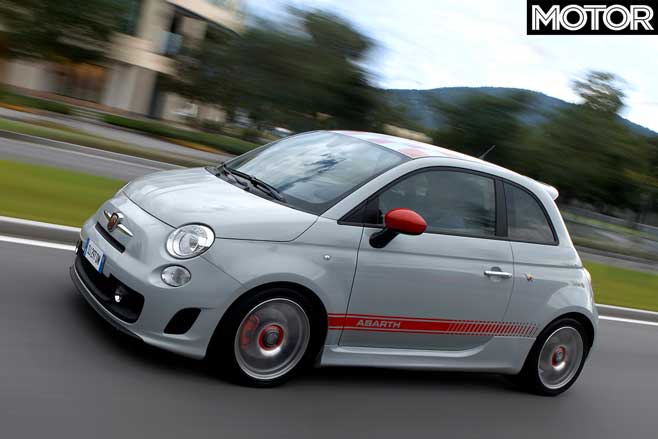
The worst of the stock 500’s handling problems all come from the pedestrian Panda’s rear end. But the Abarth gets an anti-roll bar squeezed into its date and the differences are immediate. Over any mid-sized and even large bump, the Abarth just hunkers down and goes. And goes hard.
The trick is that the roll bar has allowed Abarth to soften the rear springs by about 20 percent, stiffen the front ones by about the same and to drop the roll centre 20mm. The result is an agility that belies its origins. Stand on the anchors across a bump as big as you can find and the back end doesn’t move. It just hunkers down deep into the front spring travel and waits for you to change direction.
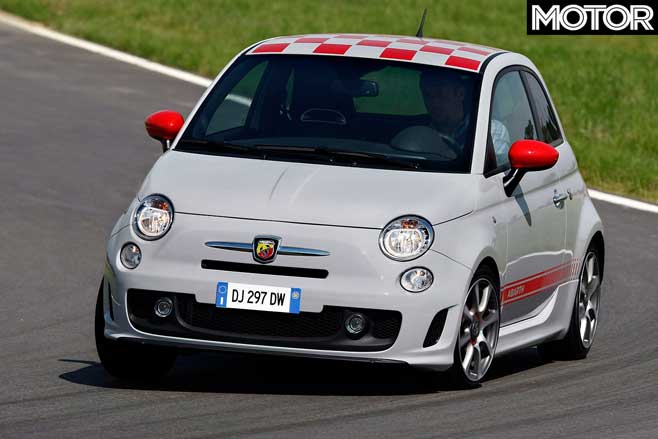
The Sport button livens up the ESP but also delivers more mid-range gristle, while the boost-gauge mounted gear-shift indicator swaps from fuel saving to attacking advice. Push on and the steering feels too slow, especially in its initial movements, but gives just enough info to earn its keep, not stardom.
Instead, that goes to the feel the Abarth imparts through the seat, and the accuracy and alacrity of its pedal response — both on and off.
The back gives an occasional tiny drift as you trail brake into faster corners, but it never threatens to meander far from where you want it to be and it can even help tuck the elongated nose back to the apex. It also keeps its body alarmingly flat in corners and on direction changes. There’s no lurching, no stumbling over roll centres. It just flicks one way and then the other.
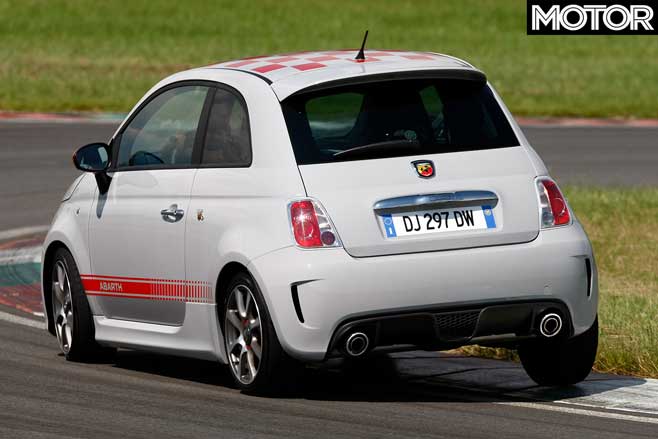
Fire up its Torque Transfer Control diff and it gets even better. The system basically predicts the onset of wheelspin and brakes the clumsy wheel, effectively sending the drive to the other (usually outside) wheel, which Abarth reckons lifts its lateral g-load from 0.95 to the full gee and whiz.
The result is the negation of the annoyingly over-helpful ESP with its elongated consideration before it will allow you full throttle — almost like it’s deciding whether you’re worthy of it.
Instead of the wheelspin setting off the computer’s alarm bells, the TTC just gives you drive and drive and drive — sometimes enough to spin up the outside wheel, too. The TTC manipulates torque to reinvent a chassis with a lot more drive, pushing power to the wheel with the most weight on it, making the car a hoot.
So the 500 is nimble and its chassis actually works, even if the steering rack is a bit too slow for the rest of the chassis feel. Which leaves only a few bits and pieces, like an engine that sounds dullish in normal mode, but purposeful and stroppy in Sport. Stuck on the side of it (well, it is laterally mounted) is a five speeder with ratios so close together that you’re always pumping back, forward and sideways.
It doesn’t hide the best of its soul, either. In Sport mode, it’s forever burbling and spitting and crackling on the overrun and you know when it’s giving its all, even if its best is confined to events beneath 5000rpm.
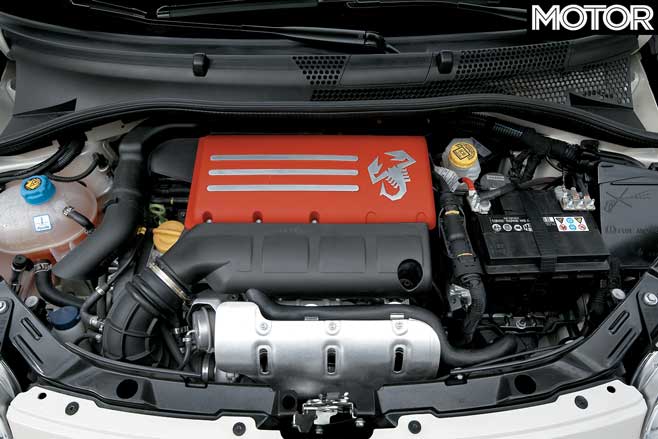
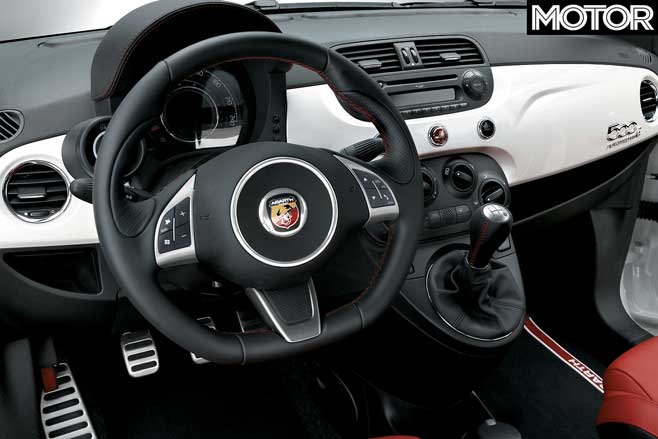
Opening the door is enough to know this isn’t just another grown-up toy of a Cinquecento. It’s far more masculine that the stock car, with a thick-rimmed, flat-bottomed steering wheel, leather seats with impressive bolstering and aluminium pedal facings.
It’ll be cost that prohibits the 500 Abarth’s appeal in Oz. The regular 500 is massively over-priced, and if Ateco does the same thing with the Abarth, it could end up playing with Evos and STis — and that’s well above its weight.
2008 FIAT 500 ABARTH SPECS Engine: 1368cc 4cyl, DOHC, 16v, turbo Power: 99kW @ 5500rpm Torque: 206Nm @ 3000rpm Weight: 1035kg 0-100km/h: 7.9sec (claimed) Price: $35,000-plus (estimated)
Like: Cornering ability, sharp throttle and braking response Dislike: Slow steering, intrusive ESP and dull engine-note in normal mode
The Wheels Verdict: While those in search of outright power might be disappointed by the range culling, Jaguar should be commended for simplifying its XE line-up. By leaving the excellent dynamic character unchanged, but refining the interior and exterior styling, the XE retains its driver appeal, and should be more appealing for mainstream buyers.
What is it?
Jaguar’s premium mid-size sedan, which has been treated to its first mid-life update. New styling and a more focussed line-up headline the changes.
Why we’re testing it
We’ve always rated the XE as one of the best driver’s cars in its segment. But with sales in a downward spiral, Jaguar needed to add some mainstream appeal to match the dynamic prowess. As part of a mid-life update, engines have been culled to just a single unit, with under-the-radar styling tweaks inside and out.

The Wheels review
There’s something about the Jaguar XE that hasn’t grabbed the attention, and wallets, of the buying public, despite being one of the most appealing drives in the premium mid-size sedan segment. Just 528 registrations were recorded for the XE last year, down from 729 in 2017. Meanwhile, class sales leader the Mercedes-Benz C-Class shifted 5055 units in 2018 and 8549 in 2017. Jaguar hopes to have found the fix, by radically readjusting its local offering as part of the model’s first mid-life update.
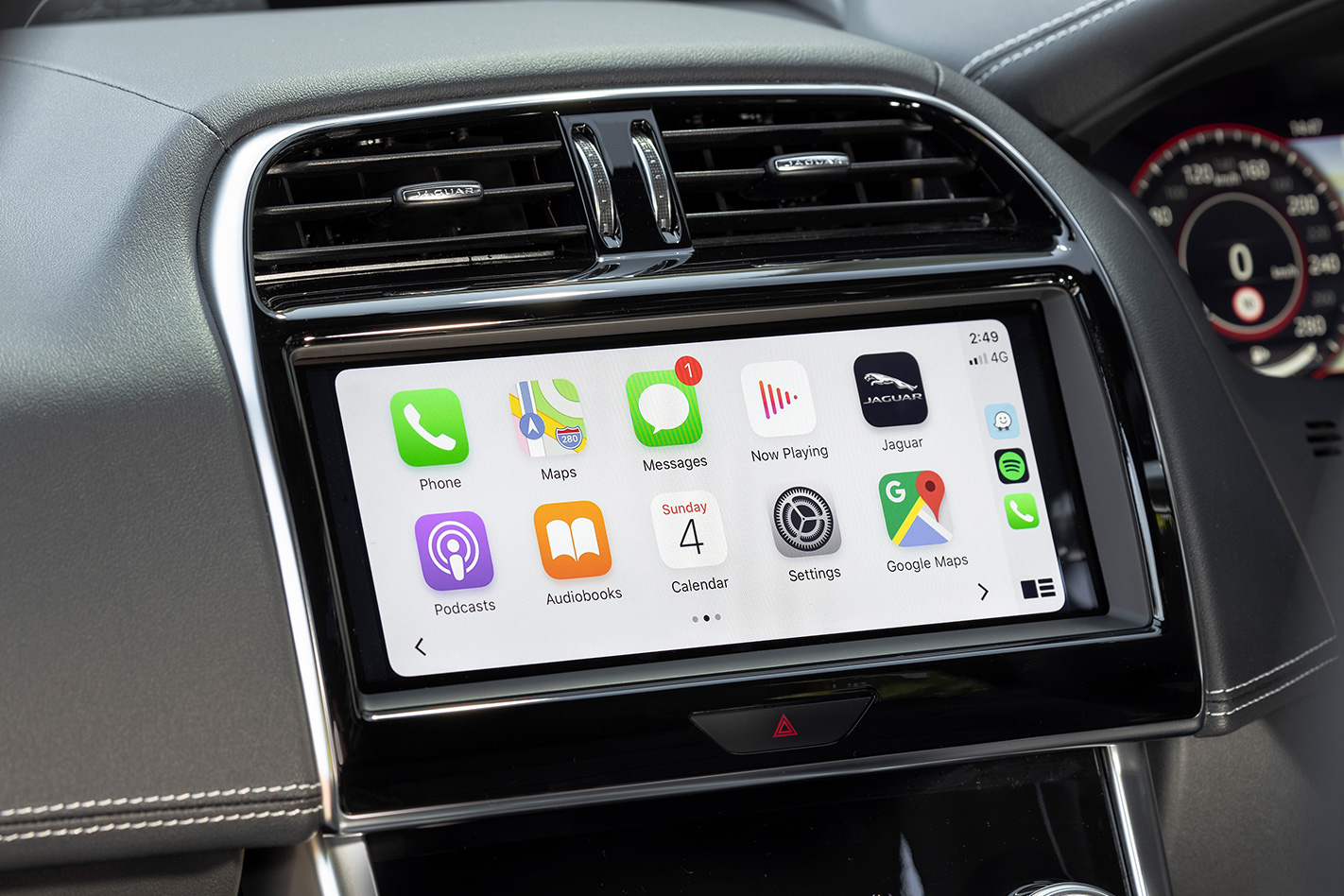
Cosmetic changes are subtle; littler more than tweaks front and rear, enhancing the already handsome looks, while the interior has been graced by the infotainment system and steering wheel from the Jaguar I-Pace, as well as a new gear selector (gone is the fiddly rotary dial), and revised door trims.
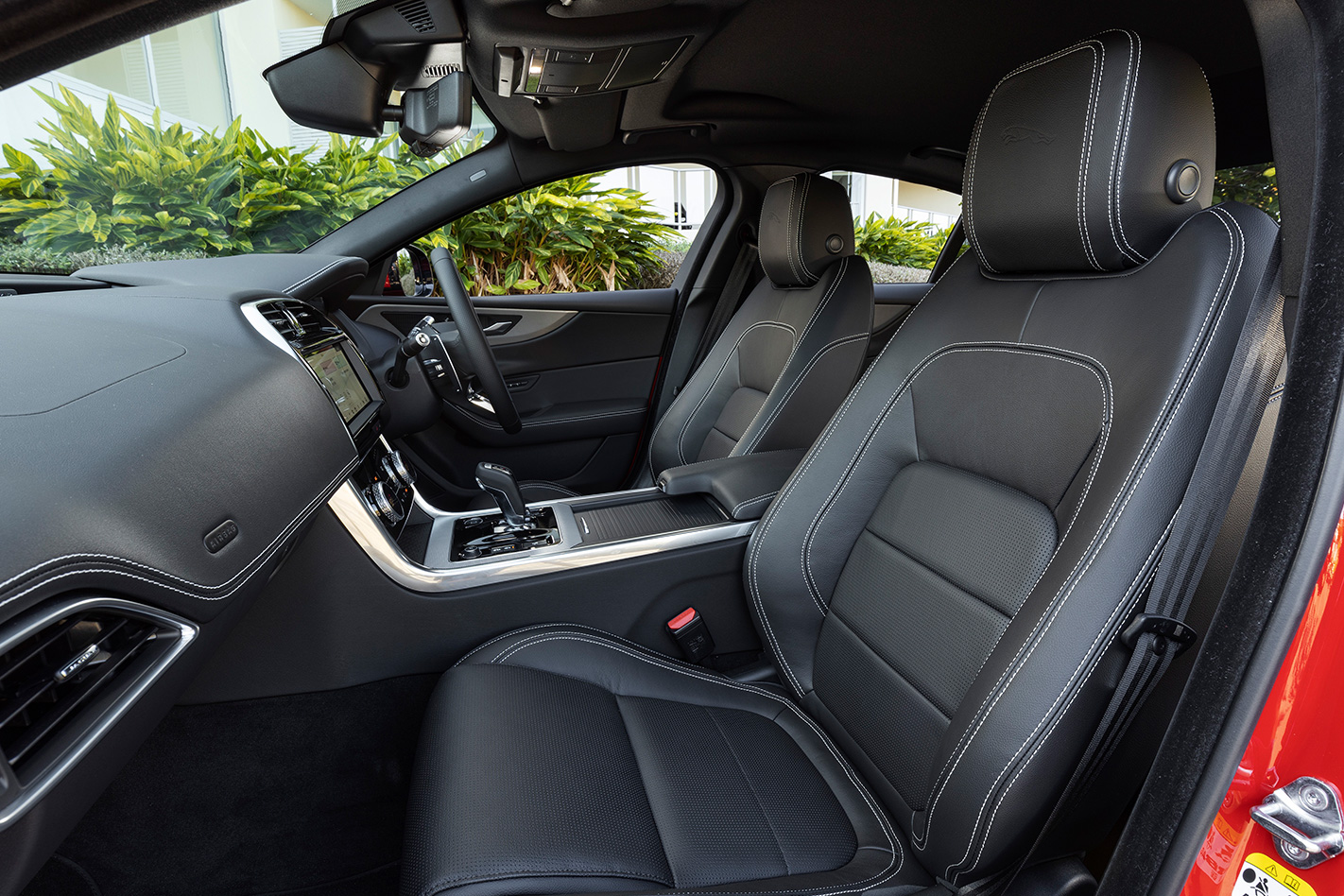
Also gone is all bar one engine configuration. Previously Jaguar XE buyers had to choose between five different engines, spread across 11 variants. Now, just two variants are offered in a delightfully simple range, wiping out hard-to-sell stock. The last engine standing is the old ‘30t’, the (previously highest output) 2.0-litre turbocharged four-cylinder petrol producing 221kW/400Nm, badged P300, and sending power to the rear wheels via the carry-over eight-speed ZF automatic transmission.
While the four-pot is a good engine, and one of the most powerful in this class, with ample grunt piling on progressively through the rev-range, it’s a shame to see the supercharged V6 S dropped for those partial to its crackling soundtrack and extra kilowatts.

Trim levels are now limited to either SE or HSE badges ‒ $65,670 and $71,940 respectively ‒ with no base S grade in sight. Both variants come fitted with Jag’s more aggressive R-Dynamic styling pack as standard.
So, should you be parting with an extra $6270 for the higher grade XE? HSE buyers score an electrically-adjustable steering column, 16-way adjustable heated front seats (SE buyers have 12-way adjustable pews), 19-inch alloy wheels (up from 18s for the cheaper variant) an 11-speaker sound system, and the Touch Pro Duo infotainment system spread across two 10-inch touchscreens on the centre console. The SE gets the same software, but just a single 10-inch screen, leather seats, a reversing camera, front and rear parking sensors, lane-keeping assistance, DAB+ digital radio, and Apple CarPlay and Android Auto phone mirroring. If you want high-speed autonomous emergency braking, blind-spot monitoring, and adaptive cruise control on the SE, you’ll need to tick the box for the $1340 Drive pack.
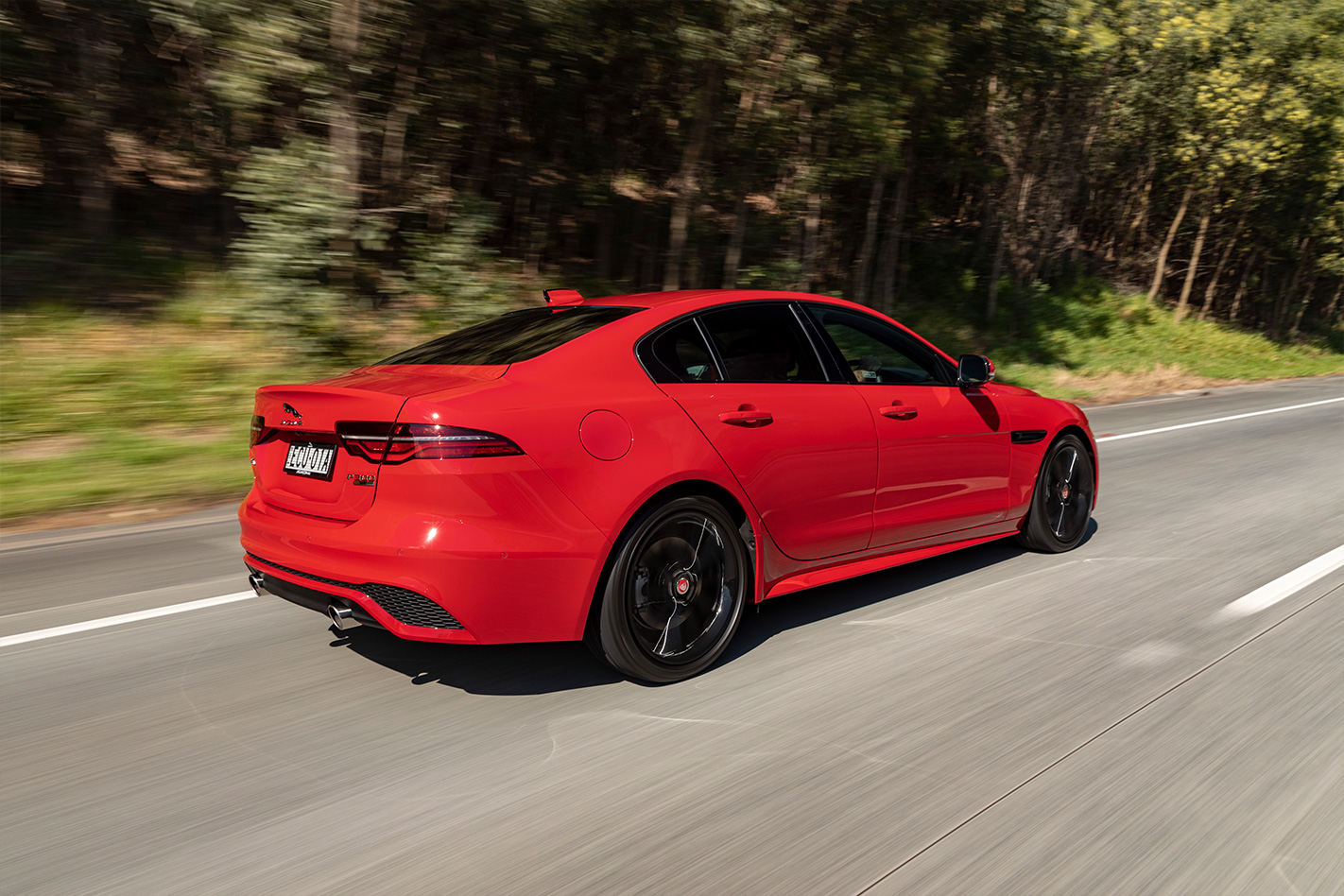
Thankfully, the XE’s dynamic appeal remains unmolested, retaining class-leading steering, which is beautifully weighted and progressive. Our test cars were fitted with 20-inch wheels (a $2300 option on the SE, and $1300 for HSE), wrapped in sporty Pirelli P Zero rubber which aided the corner carving ability, but hindered interior refinement due to intrusive road noise.
Despite the slim sidewall (tyre specs were 235/35 front and 265/30 rear), the XE retains an impressively compliant ride, particularly on gnarly bits of backroad bitumen. Opting for the $1850 adaptive dampers improves things further, with the optional suspension offering better poise when dealing with mid-corner bumps, and urban irritations like speed bumps.
The mid-life changes also make the interior a slightly nicer place to spend time. Crucially, though, it’s the range rationalisation that should result in more customers opting for a test drive before giving up out of confusion and opting for a rival brand. Hopefully JLR’s Australian operation applies a similar strategy to its other flabby model lines. Sometimes, less really is more.
Rivals
Mercedes Benz C-Class, BMW 3 Series, Audi A4, Lexus IS, Genesis G70, Infiniti Q50
2019 Jaguar XE Specifications
- Model: Jaguar XE R-Dynamic SE
- Engine: 1997cc 4 cyl, dohc, 16v, turbo
- Max power: 221kW @ 5500rpm
- Max torque: 400Nm @ 1500-4500rpm
- Transmission: 8-speed automatic
- Weight: 1523kg
- 0-100km/h: 5.9 seconds (claimed)
- Economy: 6.7L/100km
- Price: $65,670
- On sale: Now
UPDATE – DJR Team Penske announced that it will sell replicas of the infamous poster, with all proceeds going to children’s cancer charity Camp Quality. Several posters signed by drivers Scott McLaughlin, Fabian Coulthard and Tickford driver Chaz Mostert, as well as by Dick Johnson, were auctioned at $1000 apiece and were instantly snapped up, according to the team. The team has donated a $30,000 cheque to Camp Quality.
When Supercars defending champion Scott McLaughlin mounted the podium truck after his 14th win of the 2019 season in Queensland last Sunday, he was waving an A3-sized poster that read ‘Ford News – Mustang Wins Title’ in ye olde worlde newspaper style.
It’s a PR stunt we haven’t seen in the series for more than a decade, and for very good reason – according to series rules, it’s illegal.
McLaughlin, who drives for the powerhouse DJR Team Penske outfit, was fined $10,000 after the race, along with an additional $3000 for extending a victory burnout where he shouldn’t have.
“Following a post-race DRD investigation and admission of a breach of Rule E6.8.2 (non-permitted item on the podium) by Car 17, Scott McLaughlin, the Stewards imposed the penalty of a fine of $10,000 on Scott McLaughlin,” read the post-race steward’s report.
The report also added that the young Kiwi, who is on track to back up his 2018 championship win, also breached safety regulations after dropping a burnout (below) on the front straight at Queensland Raceway.
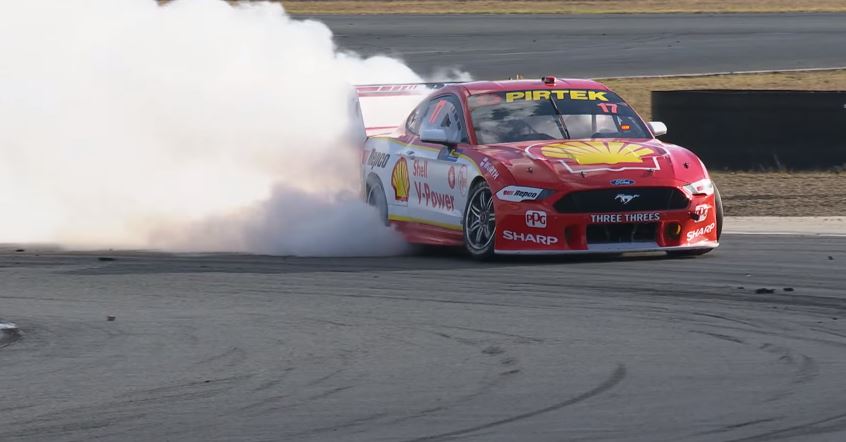
So keen was everyone involved to trumpet the success of the Mustang Supercar – which has now earned an unassailable lead in the series’ manufacturer championship over its Holden and Nissan rivals – McLaughlin bounded onto the QR podium with the poster in hand, seemingly unaware it would cost around $3,333 per second that it was on display.
The ban on marketing materials extends back to 2006, with ‘non-permitted items’ including posters, drink bottles and other unauthorised merchandise banned from the podium and from press conferences.
The ungainly Mustang Supercar has claimed 17 of the 20 of 32 races run so far in 2019. McLaughlin’s 14 wins have been supplemented by teammate Fabian Coulthard (two wins) and Tickford Racing’s Chaz Mostert (one).
It has also been beset by rule changes designed to reel in its perceived advantage over the ZB Commodore and the now-outdated Nissan Altima.
The car company upped its support for the Supercars series for 2019, after officially withdrawing in 2015.
It has supplied intellectual property support to key Ford runners, as well as supplying Ranger Raptor recovery vehicles to the Supercars series.
The Wheels Verdict: The Jaguar F-Pace SVR is a whole lotta performance for the cash, giving customers over 400kW for under $150K. This means smile-inducing performance is available at the flex of the right foot, but there are some features, like adaptive cruise control, which remain cordoned off as optional extras. Power distilled, then.
What is it?
Jaguar’s mid-size premium SUV, with the 5.0-litre supercharged V8 from the Range Rover Sport SVR and Jaguar F-Type SVR wedged under the bonnet, at a fraction of the cost.
Why we’re testing it
Mega-quick SUVs are in vogue right now, with Mercedes-AMG, Alfa Romeo and BMW’s M Division all pumping out high-riders that have enough performance to rival their sedan siblings. The F-Pace SVR is Jag’s foray into the fight, and the cheapest SVO product you can buy. But is it worth the six-figure outlay?
The Wheels review
In a 2018 Wheels comparison test, Andy Enright succinctly summed up the F-Pace as the perfect car for someone that wants modern convenience, but doesn’t actually like modern cars. In an era of adding batteries, not cubic inches, to find extra power, Jaguar has taken this caricature to the next level, shoehorning a truly old school supercharged 5.0-litre V8 into its mid-size SUV. Modern sensibilities be damned.
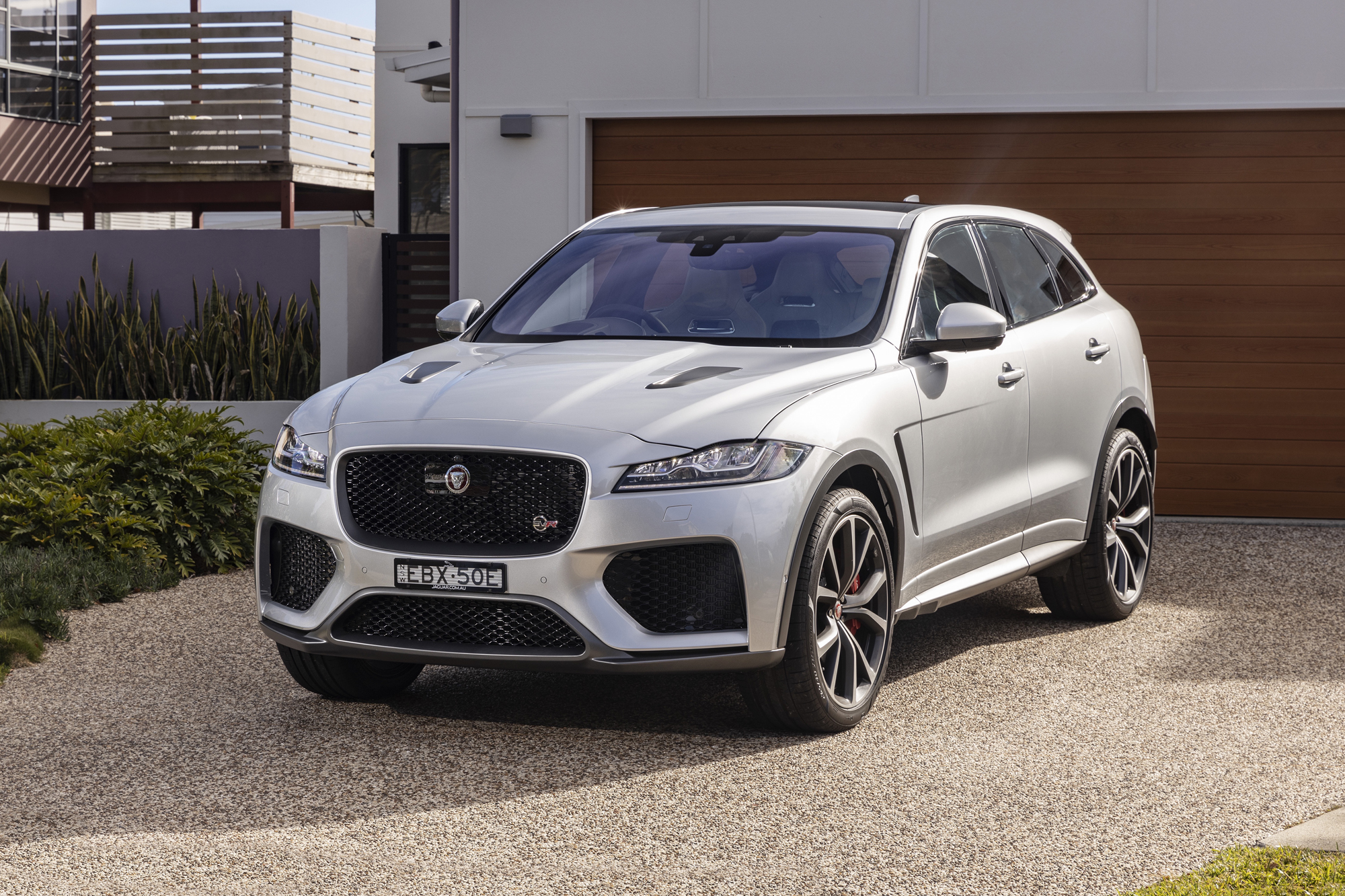
The end result is the F-Pace SVR, a 404kW/680Nm uber SUV that is being offered to the public at a relatively bargain $140,262. Along with the bigger engine, the SVR gains new bumper treatments front and rear, which combined with bonnet vents and quad exhaust tips, add some much-needed aggression to the styling of Jaguar’s first SUV.
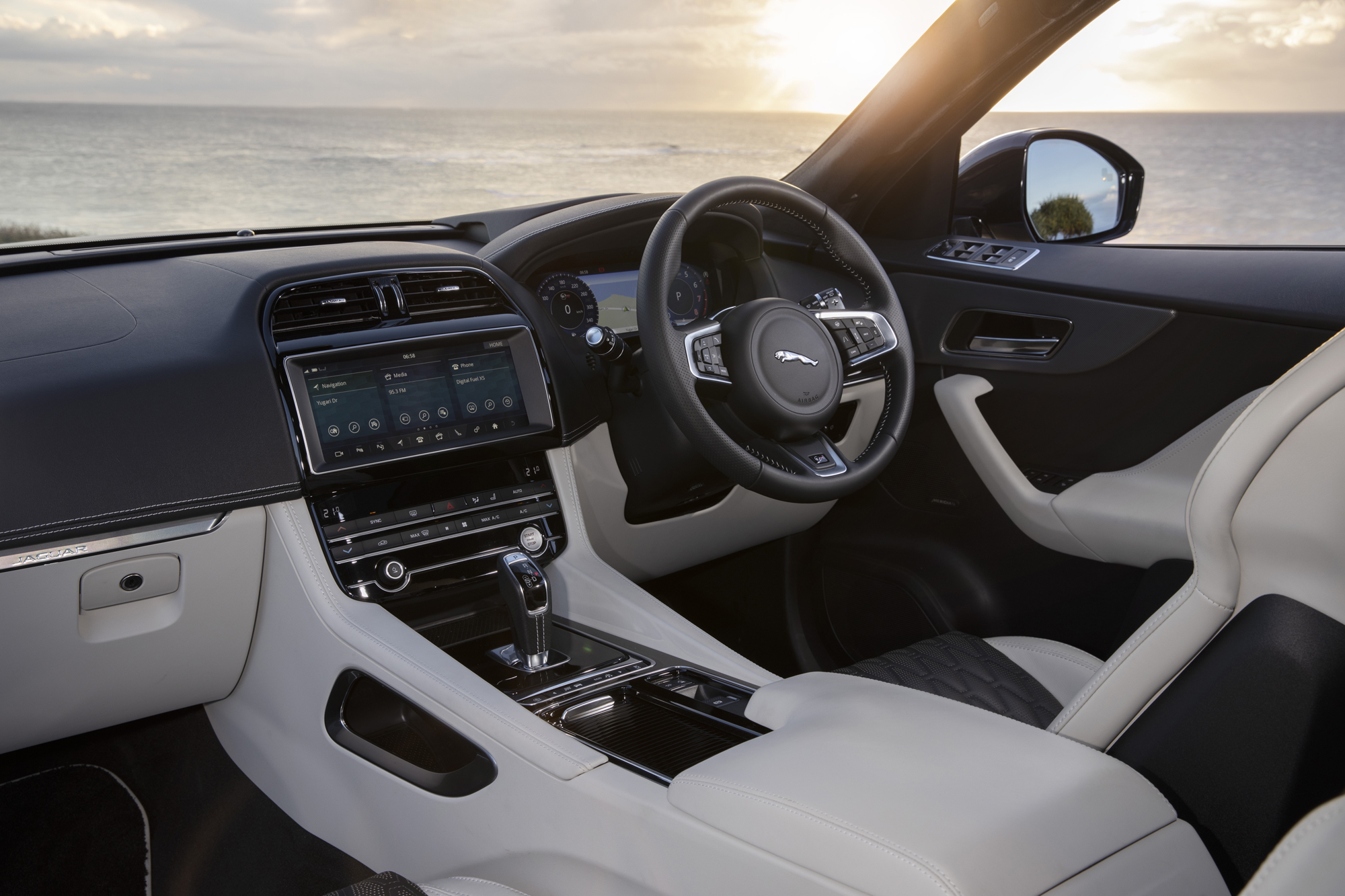
Inside there is some generous equipment as standard as well, with heated and cooled front seats, heated rear seats, 14-way electric adjustable sports front seats with memory, heated steering wheel, electrically adjustable steering column, 11-speaker 380-Watt sound system, Apple CarPlay, and Android Auto all fitted to every F-Pace SVR.
But it’s the engine which is the real headline act here. Being supercharged, it provides power in a linear fashion, making it feel manageable in all situations, even as it approaches redline. When we performance tested the F-Type SVR recently, it reeled off easily repeatable figures that matched Jaguar’s reported time to the tenth of a second, giving credence to the F-Pace SVR’s 4.3-second sprint claim. Acceleration is efficient and brutal in equal measure, with the nose nudging skyward as almost two tonnes of bulk lunges forward. It will keep hauling well past any speed limit in Australia in just a few seconds.
Mated to the V8 is an eight-speed automatic transmission, sending power to all four wheels via an electronic active differential. Gearbox calibration is subdued when left in its standard mode, opting to keep revs low. Flick the gear selector over to sport, and the revs increase as the shifts occur later in the range. If driving enthusiastically, but not at ten-tenths, it’s well suited; if you really want to grab the F-Pace by the scruff of the neck and get into its dynamic well, picking ratios is best taken care of manually via wheel-mounted paddle shifters. This will also give you the best aural experience, with genuine guttural overrun theatrics on gearshift. This is in part thanks to the switchable sports exhaust which is fitted as standard – something that can’t be optioned on other F-Pace variants.
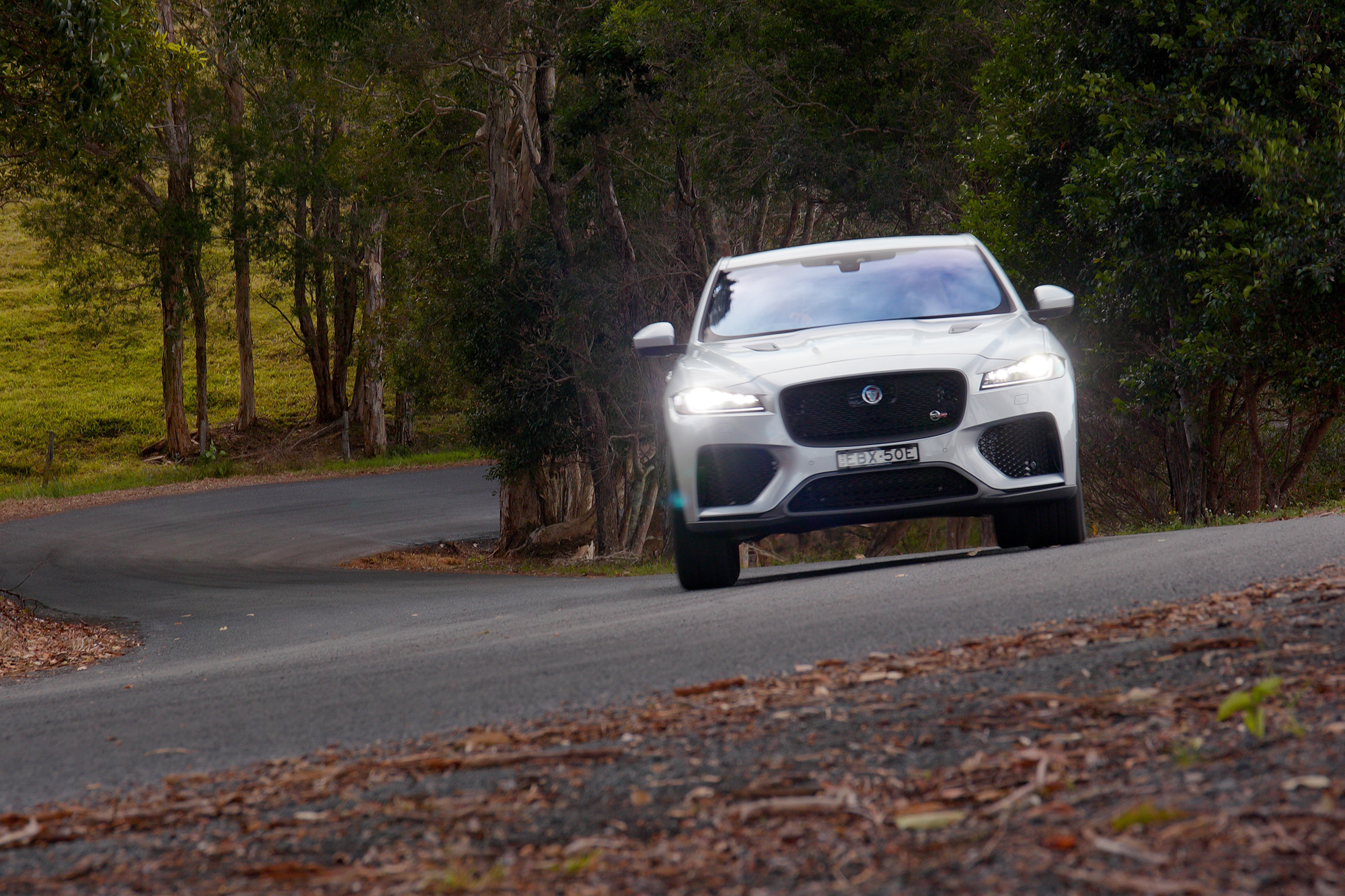
Jaguar’s engineers have done well to hide the F-Pace’s size and heft, and while the steering isn’t as impressive as others within the stable, it remains enjoyably communicative and direct. While adept enough to hassle, or outrun, some of the fastest hot hatches available, the F-Pace isn’t as dynamically sorted as the class benchmark Porsche Macan, falling foul of its inherently flawed SUV design. This is despite JLR stiffening damper rates 30 and 10 percent front and rear respectively compared to the 35t. Brake discs measure in at 395mm and 396mm front/rear, with impressive stopping power, however, we didn’t get enough time behind the wheel to see how they withstand extended punishment when slowing down 1932kg of mass.
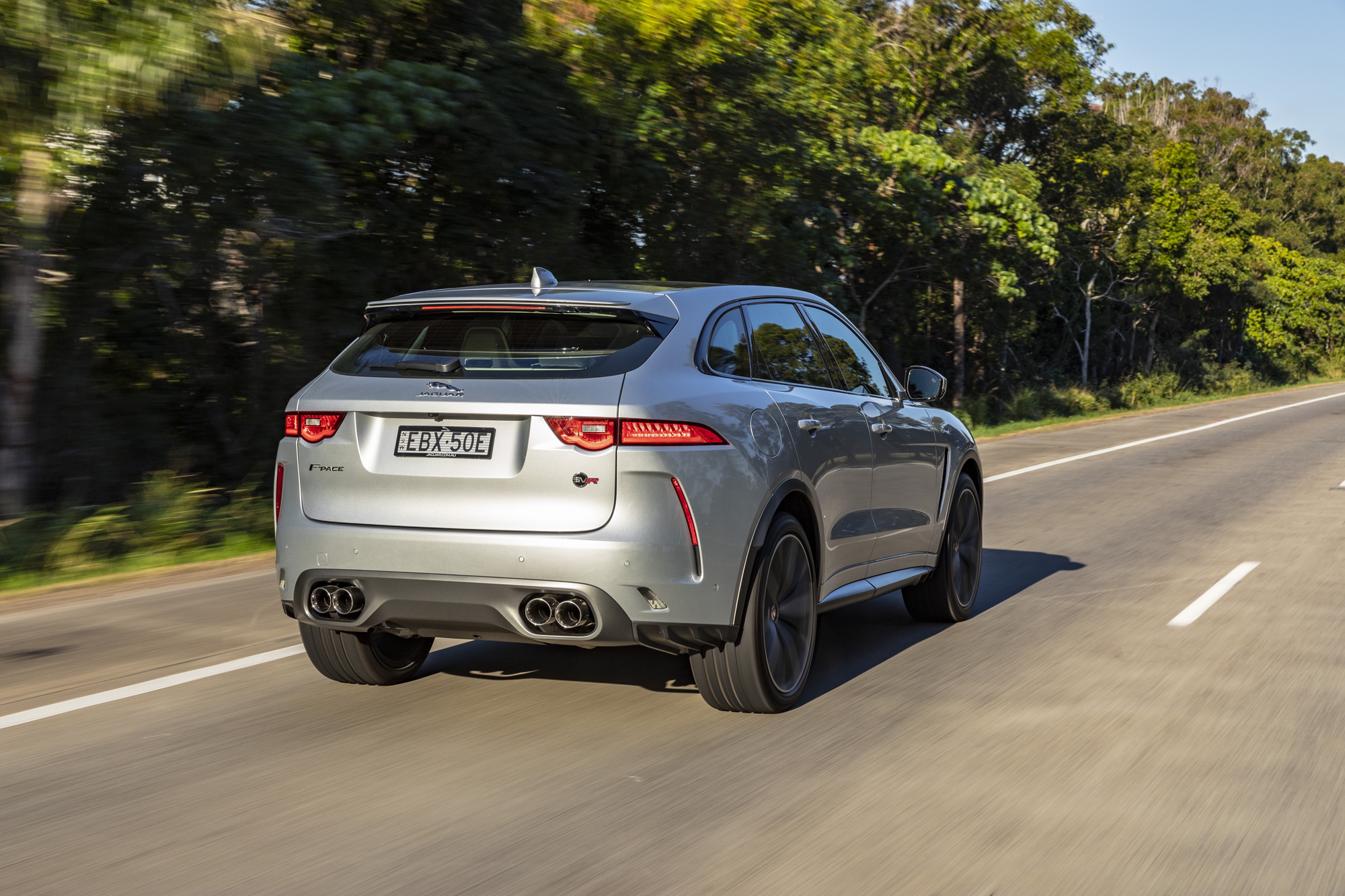
The fact our test car rode as good as it does on 22-inch forged alloy wheels (a $2210 option over standard 21-inch rims) and steel suspension is an engineering feat, but it still struggles with sharper bumps in the road, particularly at slower speeds. Adaptive dampers are standard, thankfully, but the suspension is best left in comfort, with sport too harsh for all bar the smoothest of black tops. However, the firmness on choppy and urban roads dissipates slightly with increasing speed.
Bang for bucks, the F-Pace SVR offers the best value in its class. While it’s $31,825 more expensive than the previous range-topping 3.0-litre supercharged V6 35t, it offers a whopping 125kW/230Nm boost. And compared to rivals the Mercedes-AMG GLC63 S and new BMW X3 M Competition, it’s an attractive proposition, positioned $24,638 and $17,638 cheaper respectively. While the AMG might be the torque monster with 700Nm on tap, the SVR delivers 29kw more power than either, and 80Nm more than the Beemer.
However, some things that should be standard remain optional, such as blind spot assist, adaptive cruise control, and high-speed emergency braking, which are all locked off as part of a $1740 ‘drive pack’. A head-up display can only be had when bundled as part of a $2650 option pack that also includes rain sensing windscreen wipers – worrying when you can easily be in license-suspension territory in a matter of seconds, and will be wanting to keep an eye on those rapidly rising speed figures.

Despite these shortcomings, and the unrefined low-speed urban ride, the F-Pace SVR is a people hauler with real muscle. A more aggressive tune is available for the 5.0-litre supercharged V8, but you’ll never miss it, with physics-defying straight line performance worth the price of admission alone. The F-Pace SVR does exactly what it says on the packet, bringing the theatre and speed of the F-Type SVR and mixing it with a capable and convenient mid-size SUV package, at a price point that will be sure to appeal. It’s an old-school ethos, in a new world body.
Jaguar F-Pace SVR vs rivals
Mercedes-AMG GLC 63 S, Alfa Romeo Stelvio Q, BMW X3 M Competition, Porsche Macan Turbo
Specs:
- Model: 2019 Jaguar F-Pace SVR
- Engine: 5000cc V8 (90°), dohc, 32v, supercharger
- Max power: 405kW
- Max torque: 680Nm
- Transmission: 8-speed automatic
- Weight: 1932kg
- 0-100km/h: 4.3 seconds (claimed)
- Economy: 11.7L/100km (claimed)
- Price: $140,262
- On sale: Now
The Wheels Verdict: Those that care about how it drives won’t be impressed with the jostling ride and lack-lustre engine, though both can be fixed for a further ten grand. At that point, the GLE presents a serious bit of kit to rival the best in class and features such as the expansive displays and MBUX can’t be beat. But as a sub-$100k premium SUV, the 300d will still find plenty of homes, with approachable steering and a dazzling cabin the likely highlights for many.
What is the Mercedes-Benz GLE?
Merc’s GLE badge isn’t old but the platform it came from is. Originating as the M-Class, the third-generation GLE had been on the same running gear since 2012, albeit with some nips and tucks to look a bit nicer. Now in its fourth-generation it’s a completely new beast, promising a host of improvements to elevate it to the top of the class.

Why we’re driving it
Are SUVs popular? Right, now you know why we have to test Mercedes’ latest crossover.
Mercedes-Benz GLE300d Review
Mercedes finally has a gun to fight against luxury SUV rivals with its fourth-generation GLE. It’s been a while in the waiting as rivals such as BMW and Volvo have introduced polished competitors to the segment in the form of the new X5 and venerable XC90, but Merc’s bigger and better GLE looks to have the panache to win back buyers. (To find out if it does reign king, read our GLE, X5 and XC90 comparison test in the September issue of Wheels, on sale 15th August). Launching with three variants, the 80mm longer wheelbase brings seven seats for the first time, and there has been a huge improvement to technology and interior packaging – areas that should lure shoppers to showrooms. Well, that, and its sub-$100k price tag.

Starting at $99,900, the entry-level GLE300d looks plump with value. Helping keep costs down though the Benz is powered by a relatively small 2.0-litre twin-turbo four-cylinder diesel that’s good for 180kW and 500Nm. Moving to the middle of the range is the petrol 450, costing $111,700 and boasting a larger 3.0-litre inline six augmented by mild 48v electric power. It develops a meatier 270kW and 500Nm that’s over one second quicker in the claimed 0-100km/h race. Most expensive is the $118,500 400d, which gains a 3.0-litre turbo diesel producing 243kW and 700Nm.
Despite the price differential, this entry-level 300d is included with plenty of Merc’s best safety technology, including AEB, collision protection system, 360-degree view camera, adaptive cruise control, steering assist, lane change assist, blind-spot monitor and automated parking. It all helps the GLE score a five-star ANCAP rating.

Other standard inclusions are twin 12.3-inch display screens with MBUX (Mercedes-Benz User Experience), head-up display, Artico leather, Nappa leather steering wheel, heated front seats with electric adjustment, open pore oak wood trim inlays, DAB+ radio with Apple CarPlay and Android Auto, multibeam LED headlights with adaptive highbeam, roof rails, powered tailgate, 64-colour interior ambient lighting and 20-inch alloys.
Steel spring suspension with passive dampers is standard; Merc’s more sophisticated air suspension is a $3800 cost-option and E-Active (fully active suspension) body control costs $13,000 – though the latter is only available on 450 and 400d variants.
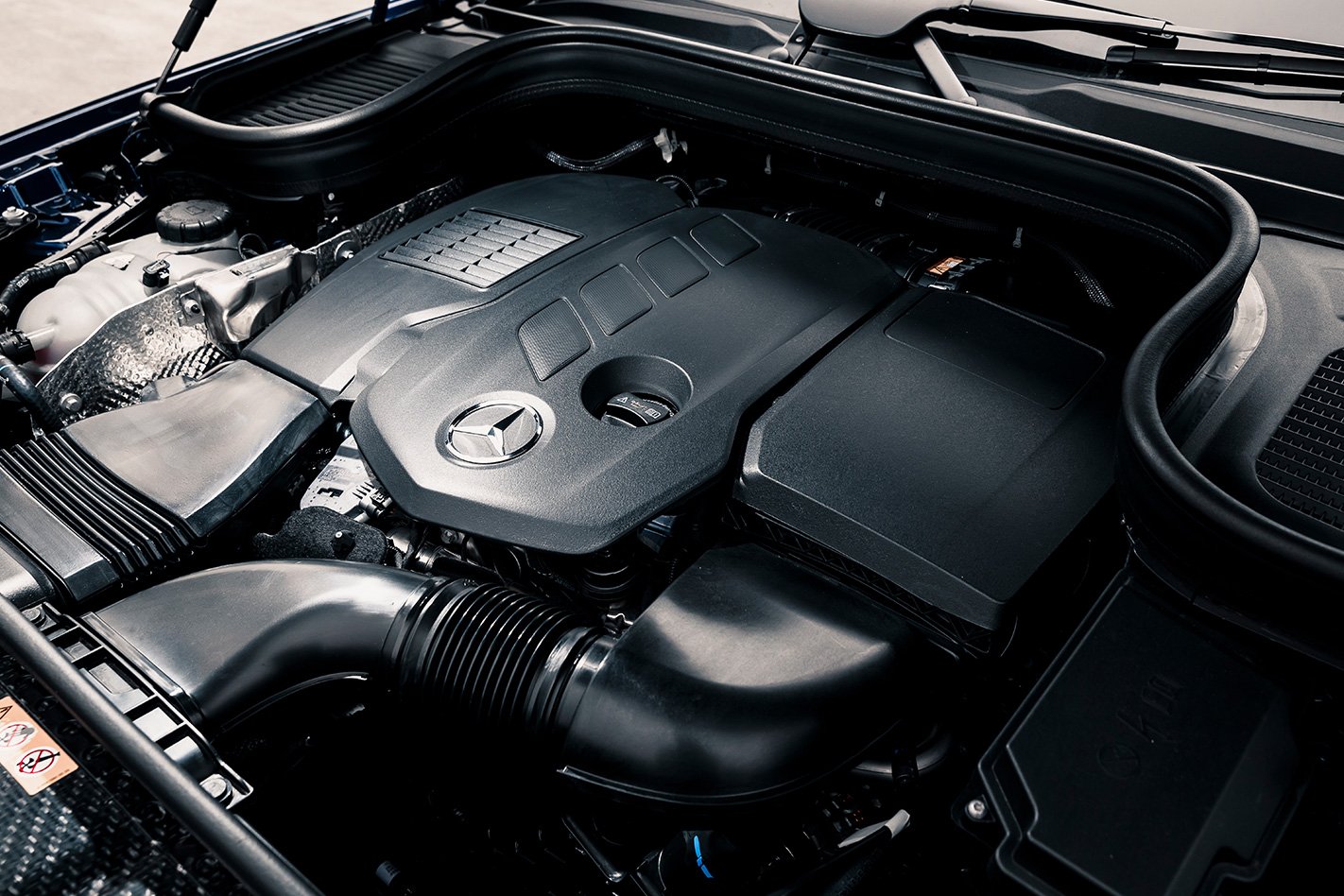
Other options are the $4800 Night Package which includes black highlights and 22-inch alloy wheels, and the $9900 AMG Sport Package with panoramic sunroof, wireless charging, leather upholstery and 21-inch AMG alloys. If you want seven-seats, that’ll be a further $3900, and braked towing capacity can be increased to 3500kg in the $1900 Towbar pack.
As a package, the new GLE is leaps ahead of the old stablemate. Interior dimensions have grown to provide a more airy feel and second-row passengers will appreciate the liberated footwell between seats. The wide rear-door aperture is also a boon for parents throwing kids up onto the rear pew. Third-row passengers aren’t as well catered for with restricted ingress and tight legroom, but at least the boot remains a capacious 630L even with the seven-seat option ticked.

The front of the cabin is a technological delight, fitted with Merc’s latest 12.3-inch twin-screen arrangement that’s unlike any conventional dash. Behind the scenes is MBUX, Mercedes’ personal assistant for you, which can be called upon at any time by saying ‘Hey, Mercedes’ and a command such as ‘open the sunroof’. Given its debut in the A-Class last year, you’ve probably heard all about it, but suffice to say it’s intuitive and can do some neat tricks – though for it to be a proper personal assistant it needs a few months to figure out your routine.
Beyond voice control, the infotainment screen is touch sensitive and can be controlled via a (mostly) slick pad on the centre console. All other touch points are equally impressive with nice tactility and quality trims used throughout; it’s certainly the premium standard we’ve come to expect from the Three-Pointed star, feeling sumptuous from the first impression even in this entry-level model.
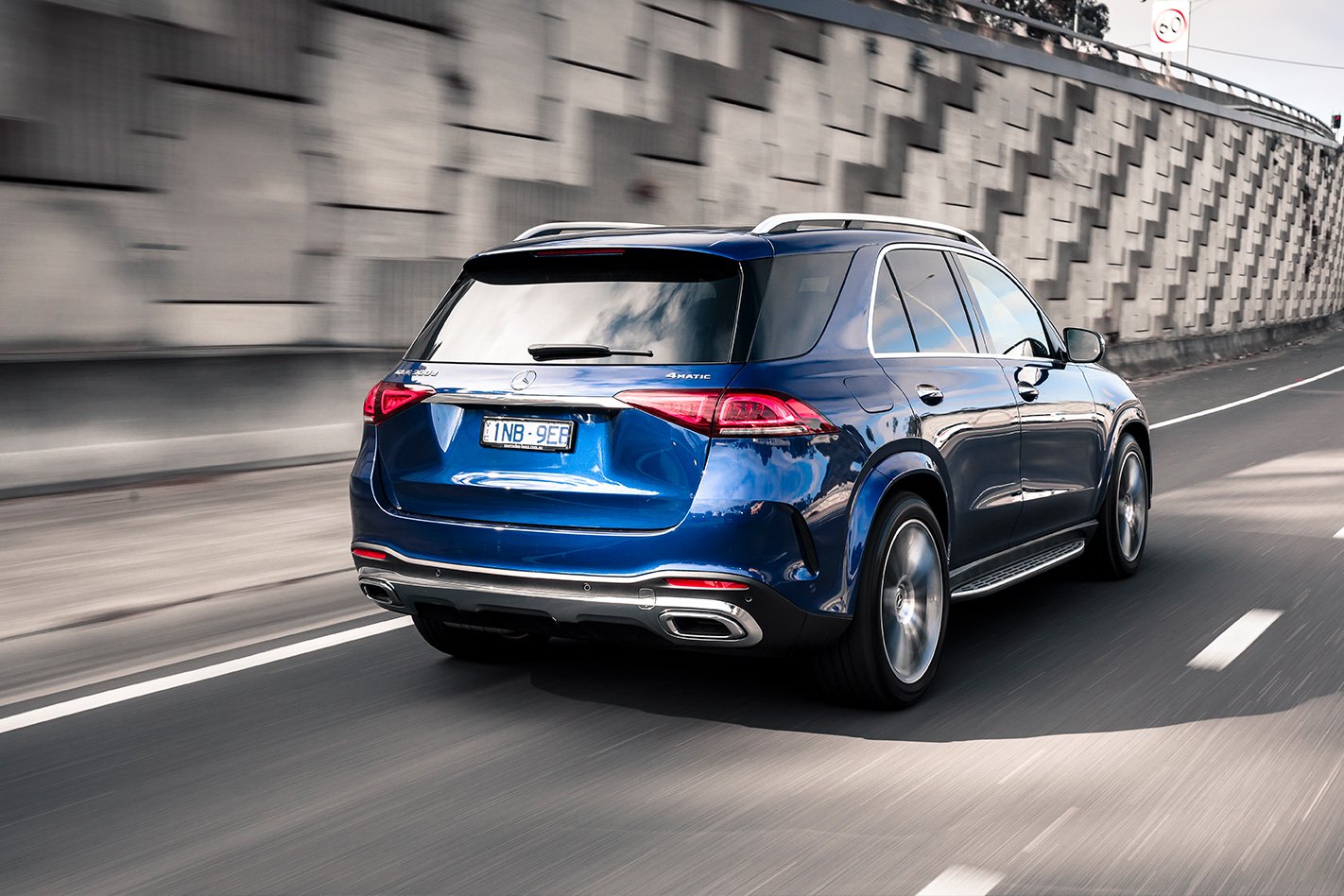
While MBUX can’t start the car using voice control, push-start ignition kicks over the little oiler and it quietly idles upfront. It feels quick off the mark and suits the urban environment, bringing a surge of grunt down low where you need it in traffic. But stretching its legs the 2.0-litre runs out of power further up the rev range, and despite nine cogs to call on the ratios can’t hide a lack of overtaking power above 80km/h. The more powerful 450 should fill this hole, but for most urbanites, it’s a sufficient Toorak tractor.
Though that leaves us with our only real quibble about Merc’s new luxo barge, which is that the standard steel spring suspension isn’t a great fit for lapping up long kays on country roads. The underlying Modular High Architecture (MHA) platform feels tight and responsive, but it doesn’t respond well to passive dampers that feed a brittle response into the cabin from the larger 21-inch alloys. On hard bumps it’s edgy, and over corrugations it can wobble about.
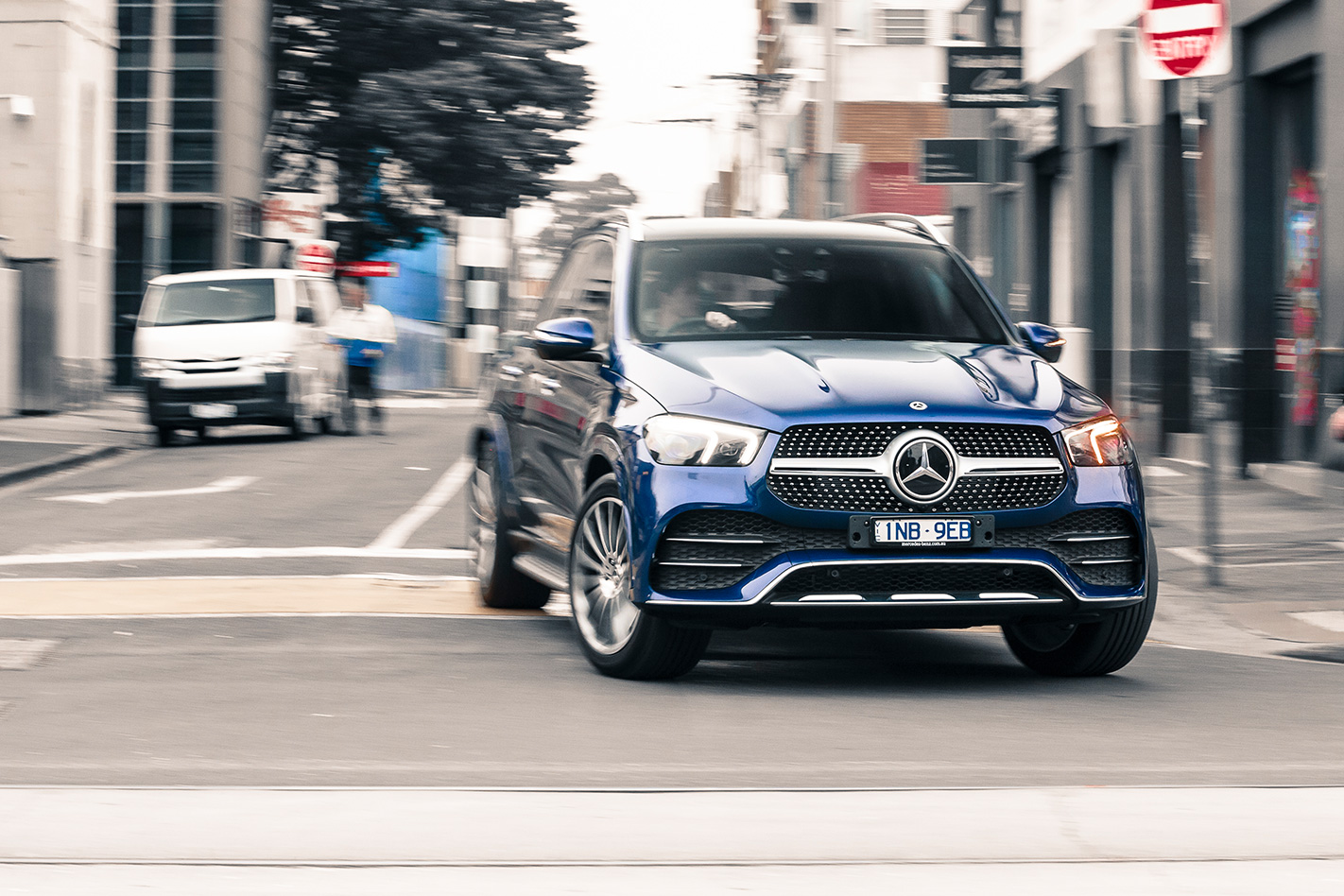
But, again, it’s fine around town, jostling slightly but mostly unintrusive to the premium experience going on up top, which, for most city buyers, is where the real event happens. Ticking the right options, like air suspension, you’ll likely have the perfect all-rounder, and there’s no doubting it’s another aspirational SUV for the Joneses to keep up with.
Mercedes-Benz GLE vs rivals
BMW X5, Volvo XC90, Audi Q7, Range Rover Velar
Mercedes-Benz pricing and specs
- Model: Mercedes-Benz GLE300d
- Engine: 1950cc 4cyl 16v twin-turbo diesel
- Max power: 180kW @ 4200rpm
- Max torque: 500Nm @ 1600-2400rpm
- Transmission: Nine-speed automatic
- 0-100km/h: 7.8s (tested)
- Price: $99,900
- On sale: Now
The Luxury Car Tax is a dinosaur of a thing. Originally intended to protect a domestic car industry that ceased existing several years ago, the LCT has instead stuck around and continues to add thousands of dollars more to the cost of new vehicles.
The unjust part of the Luxury Car Tax is the fact that despite its name, it doesn’t apply purely to premium cars – in fact, its fairly arbitrary thresholds mean that many ordinary cars from mainstream manufacturers fall afoul of the LCT, despite not being what most reasonable people would call a “luxury car”.
The list below is long, but by no means represents the full number of mainstream cars that sit above the LCT price threshold – we’ve omitted many in the interests of brevity. Is the car you want on here?
Toyota LandCruiser Workmate 4×4 Troopcarrier – $67,640 Yep. Toyota’s ancient body-on-frame work wagon is about as far as you can get from a luxury car yet its price tag sits just above the $67,525 LCT threshold for non-fuel-efficient cars. The taxman cares not that this rig has steel wheels and doesn’t even come with carpets as standard equipment.
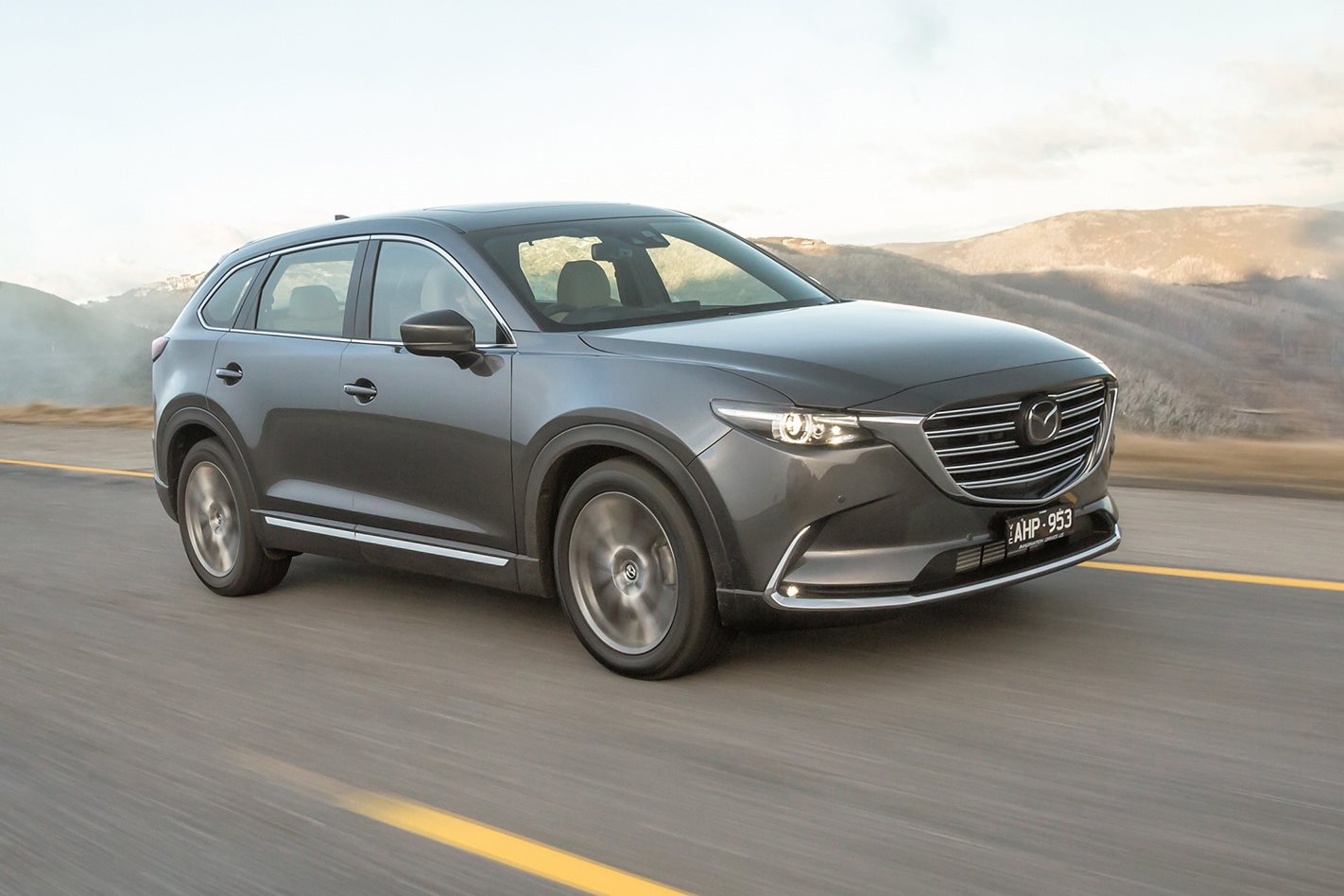
Mazda CX-9 Azami LE – $68,523 Okay, we reckon the Mazda CX-9 (above) is a pretty nice SUV, and definitely one of the more aesthetically appealing offerings in its segment, but a luxury car it is not. Even so, the range-topping CX-9 has the misfortune of being priced above the LCT threshold and not being fuel-efficient enough to take advantage of the higher green-car threshold of $75,526
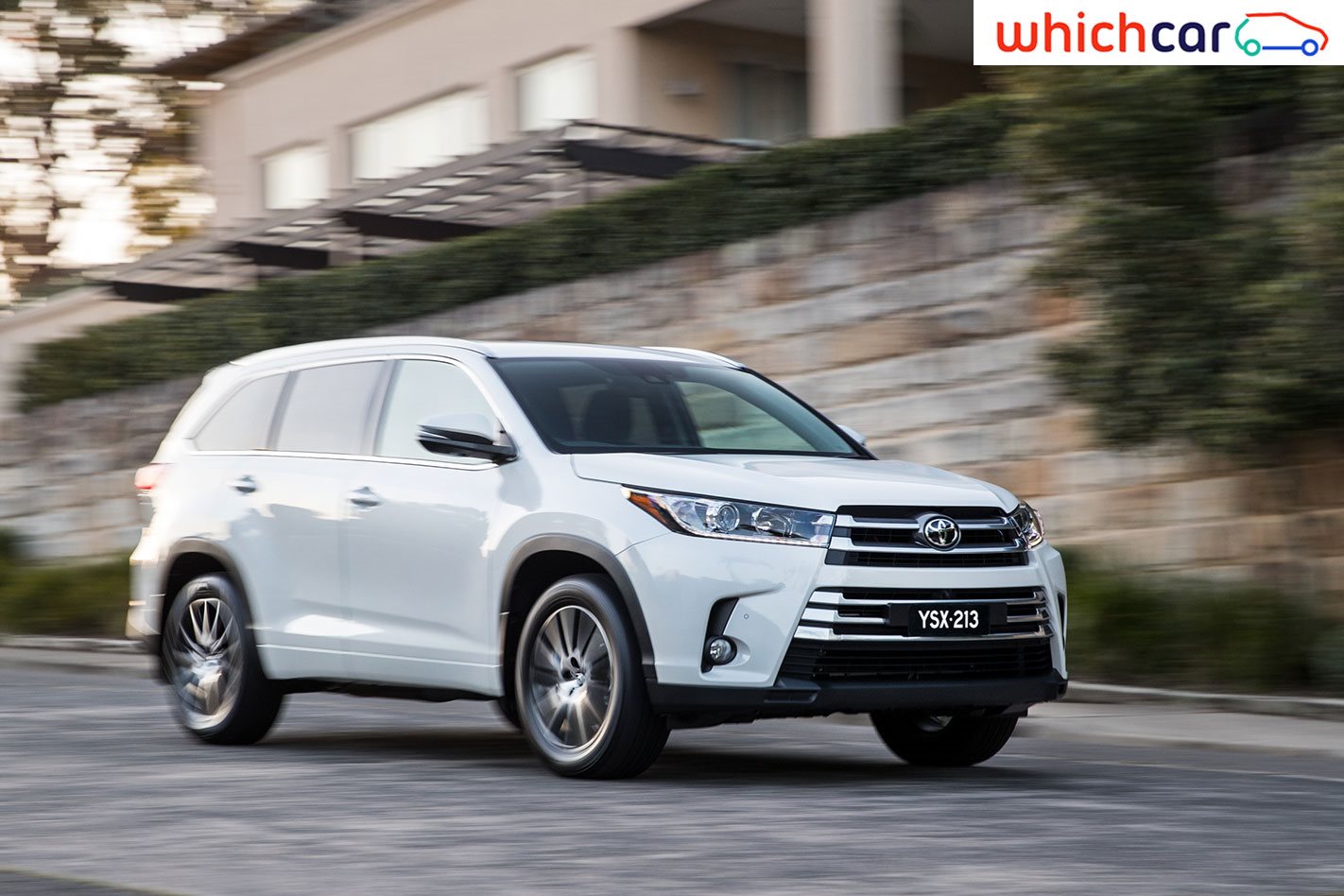
Toyota Kluger Grande – $69,246 Another range-topping mainstream large SUV, the Kluger Grande (below) isn’t even as pleasant on the inside as its rival the CX-9. Nevertheless, because it happens to be priced higher than the CX-9 Azami a greater chunk of the Toyota Kluger Grande’s retail price must then go to the state.
Holden Colorado Z71 Xtreme – $69,990 A Holden ute of all things! The tax that was originally brought in to protect Holden now actively works against one of that brand’s most popular models. Sure, there are cheaper Colorados in the range, but the Z71 is the one that any self-respecting tradie with Holden on their shortlist actually wants.
Toyota HiAce Commuter Bus GL – $70,140 We have no words. The HiAce Commuter Bus (at top) is something you’d commonly see being used to shuttle hotel guests from airport to lobby or take seniors out on daytrips – it’s not a fancy-pants luxobarge driven by the monocle class.
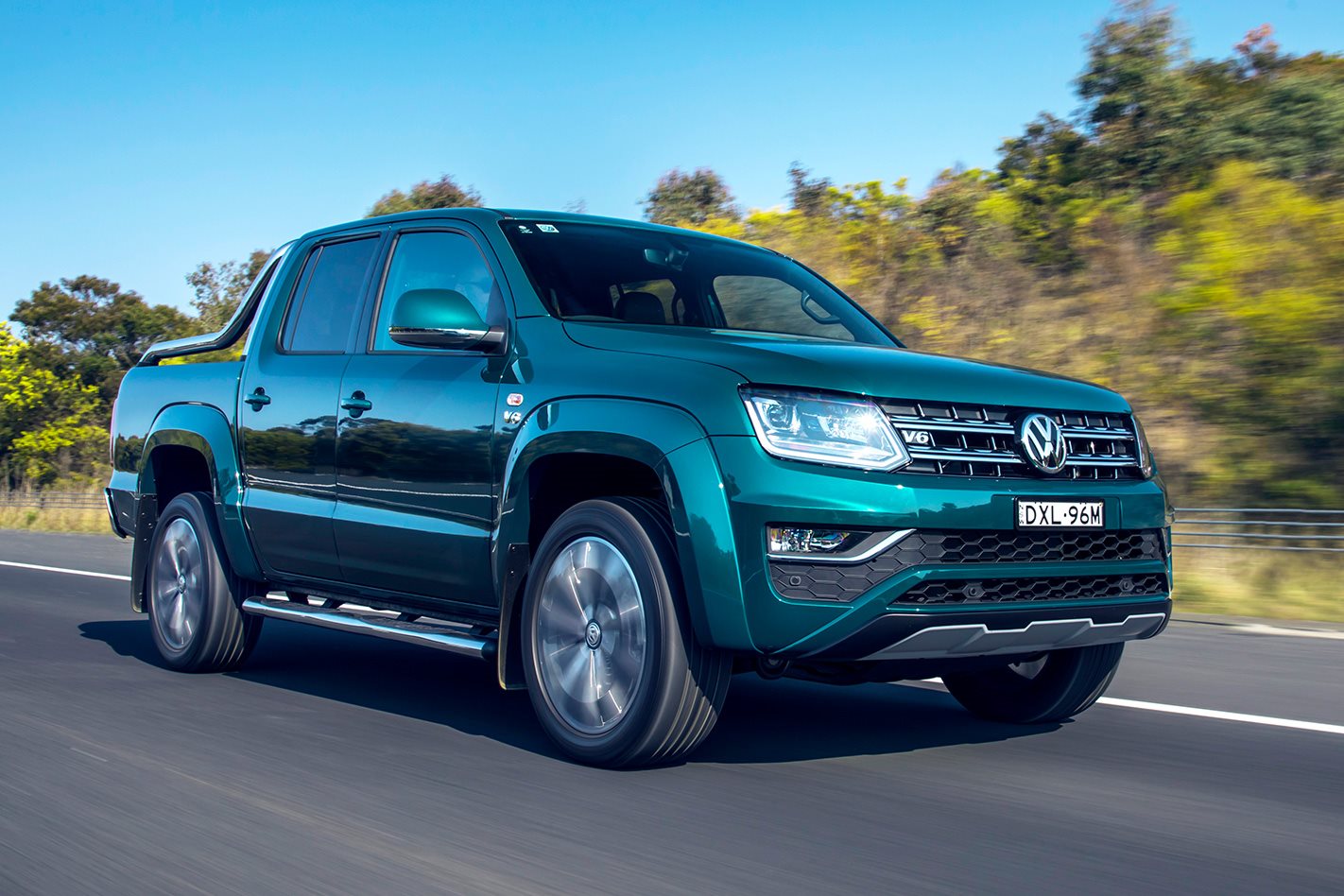
Volkswagen Amarok V6 TDI 580 Ultimate – $72,790 The Volkswagen Amarok (above) has the enviable reputation of being one of the most pleasant dual-cab utilities to drive and be in, however it is still resolutely NOT a luxury car – not that the average Joe or Josephine would ever confuse it for one.
Nissan Patrol Ti – $72,880 It might burn fuel like a luxury limousine, but the V8-powered Nissan Patrol is a lot more blue-collar than the ATO thinks. For those that have a need to tow heavy things in areas where there are no prepared roads, the Nissan Patrol isn’t a luxury, it’s a necessity.
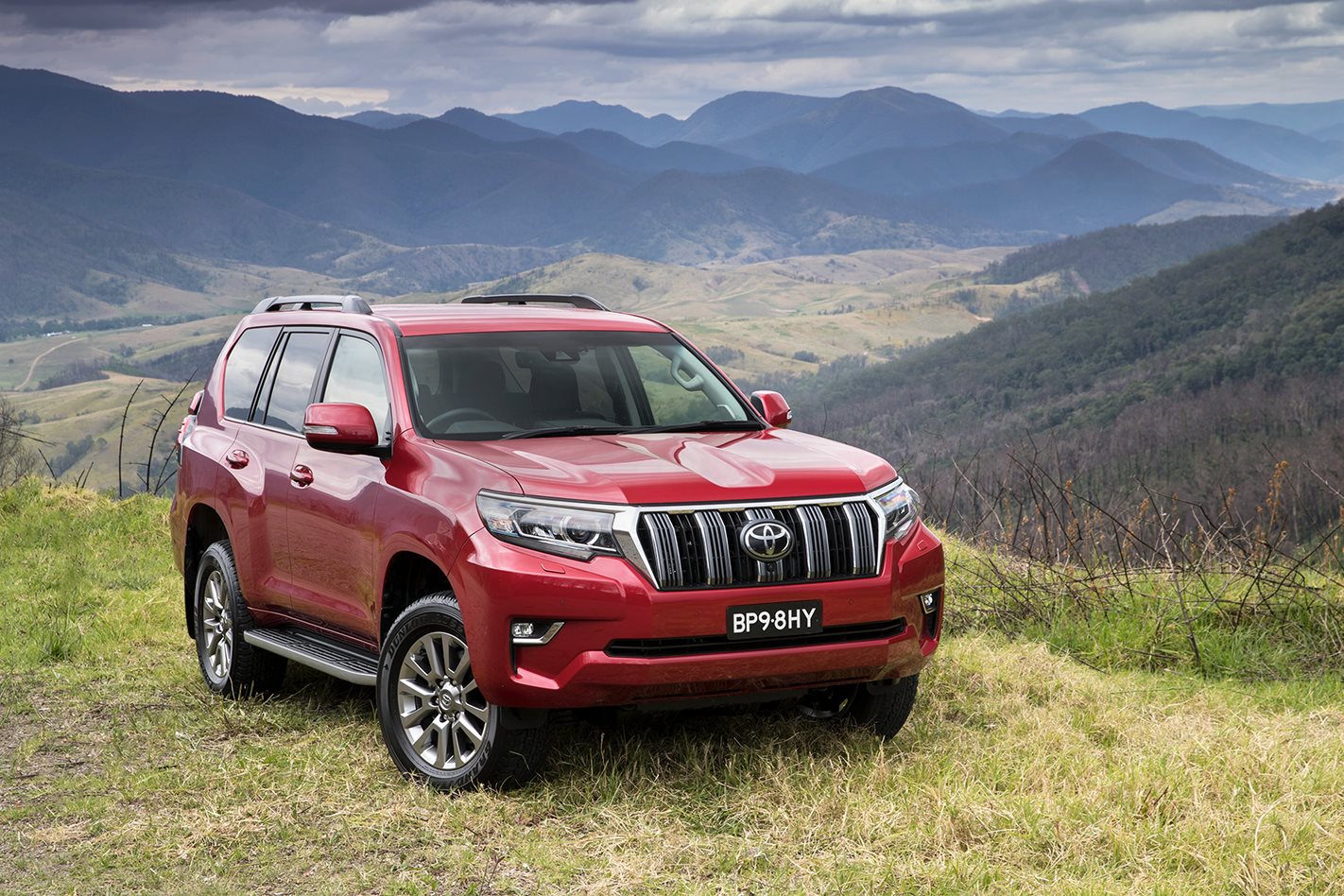
Toyota Landcruiser Prado VX – $73,619 One of Australia’s most popular cars is undoubtedly the Prado (above). Our roads, both in cities and out in the country, are virtually teeming with Toyota Prados, and owners love them for their combination of go-anywhere ability, size, towing capacity and easy-driving nature.
They probably don’t like the fact that the Prado VX, the sweet spot in the range, falls under the LCT. This isn’t even the most expensive Prado in the range either – that’s the $84K Prado Kakadu.
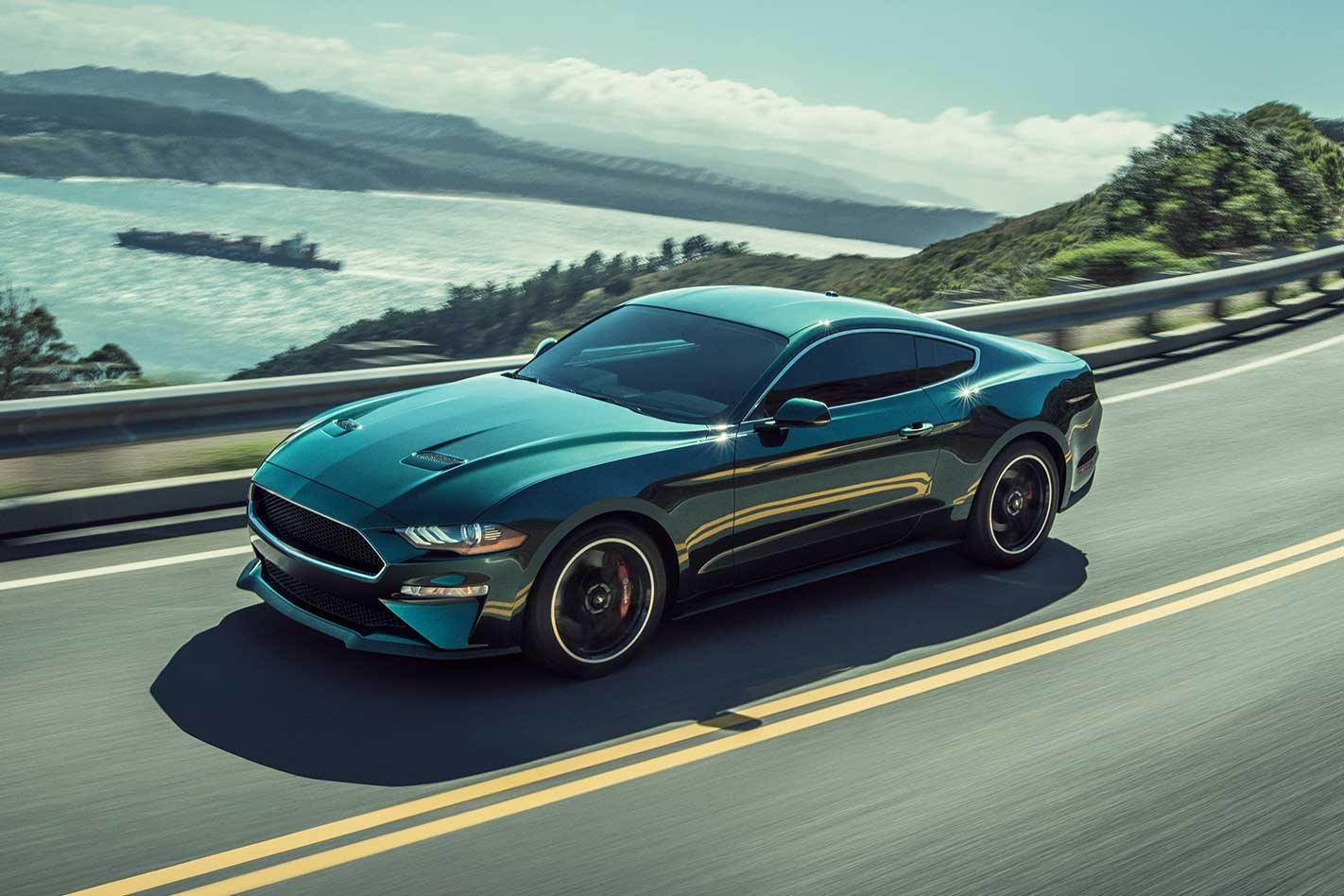
Ford Mustang Bullitt – $73,688
While the regular V8-powered Mustang GT coupe slides under the LCT threshold, the iconic Bullitt special edition (below) does not. Ever been inside a Mustang? That interior is a bit of retro fun, but luxurious? Yeah nah. The Mustang GT convertible costs a little more than the Bullitt and thus makes an LCT contribution as well
Ford Everest Titanium – $73,990 Whiles some might argue that Ford’s Mustang is a sportscar and thus a luxury item, that line of thinking definitely doesn’t apply to the hulking Ford Everest Titanium. Sure, it’s the range-topper of Ford’s SUV family, but its 4×4 bones are based on the Ranger ute and the cabin fit-out isn’t anywhere near what you’d regard as premium.
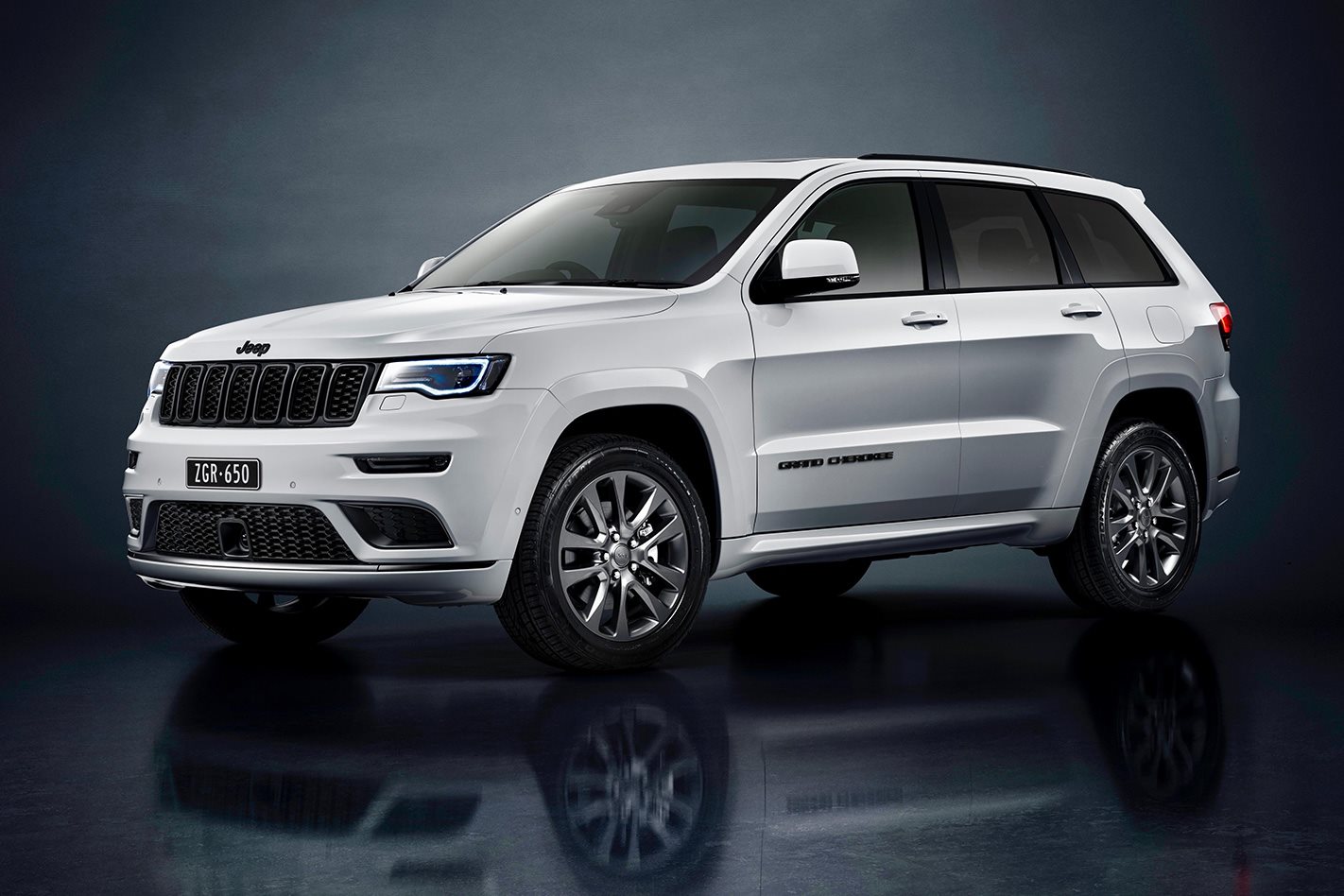
Jeep Grand Cherokee Overland – $78,450 Jeep has long been a potent symbol of American freedom. It is not, however, considered a potent symbol of luxury motoring. Even so, at $78K the equipment-rich Jeep Grand Cherokee Overland (below) requires an extra donation to be made to the state’s coffers.
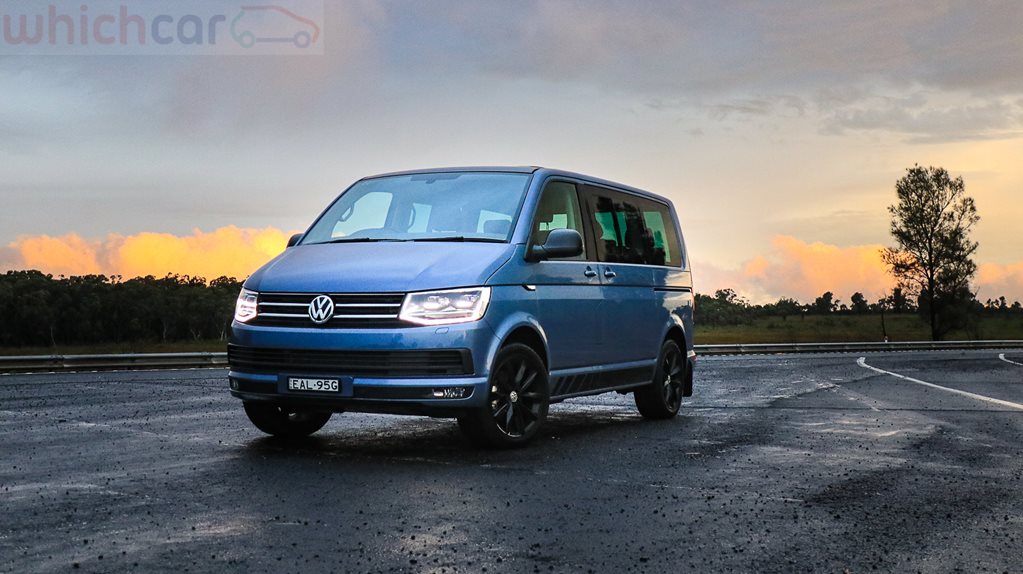
Volkswagen Multivan Highline – $79,890 Based on a commercial van – the Transporter – yet with a passenger-carrying cabin to turn it into a people-carrier, the Volkswagen Multivan (below) is pleasant but not really all that plush. It’s a nice van to be shuttled to the airport in, but it’s no Mercedes-Benz.
Note that this is actually the most affordable Multivan in its three-variant range. The tax bill only gets fatter from here.
Chevrolet Camaro 2SS manual – $86,990 The ol’ sportscars-are-a-luxury rationale could legitimately be applied here once more, but c’mon. It’s a Chevrolet, not a Cadillac.
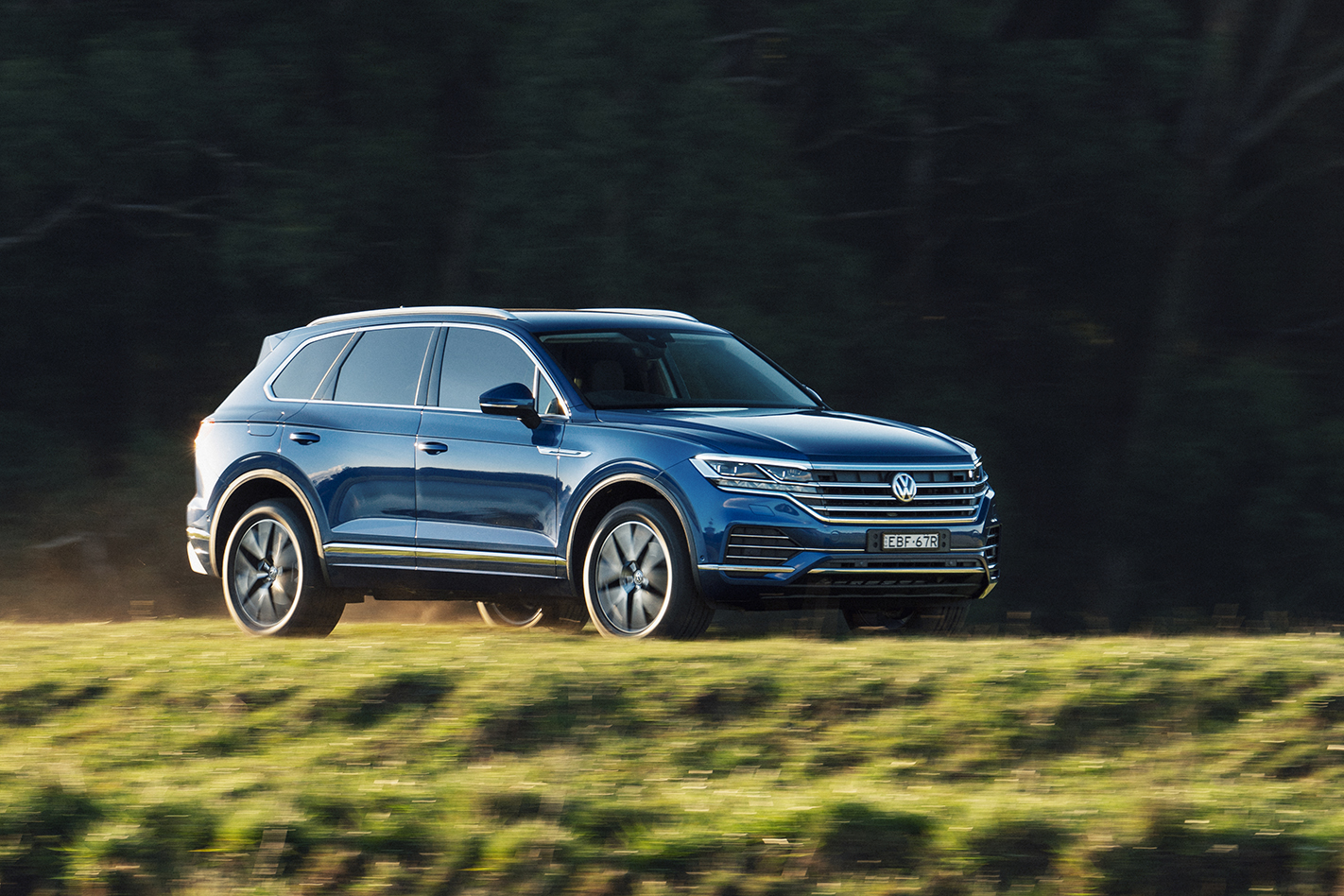
Volkswagen Touareg Launch Edition – $89,990
Being a brand that exists at the top of the mainstream genre and dances very close to that mainstream/premium boundary, it’s no surprise to find another Volkswagen on this list. However, while the Touareg is indeed an accomplished and well-designed car (below), true luxury status belongs to its corporate cousins the Audi Q7 and Porsche Cayenne.
Toyota Supra – $94,900
We debated whether this one should be here, considering it’s built on a BMW platform and uses a lot of BMW hardware. From the taxman’s point of view, though, the Toyota Supra’s $94K sticker is enough reason alone to consider it a luxury vehicle, despite the humble Toyota badge on its snout.
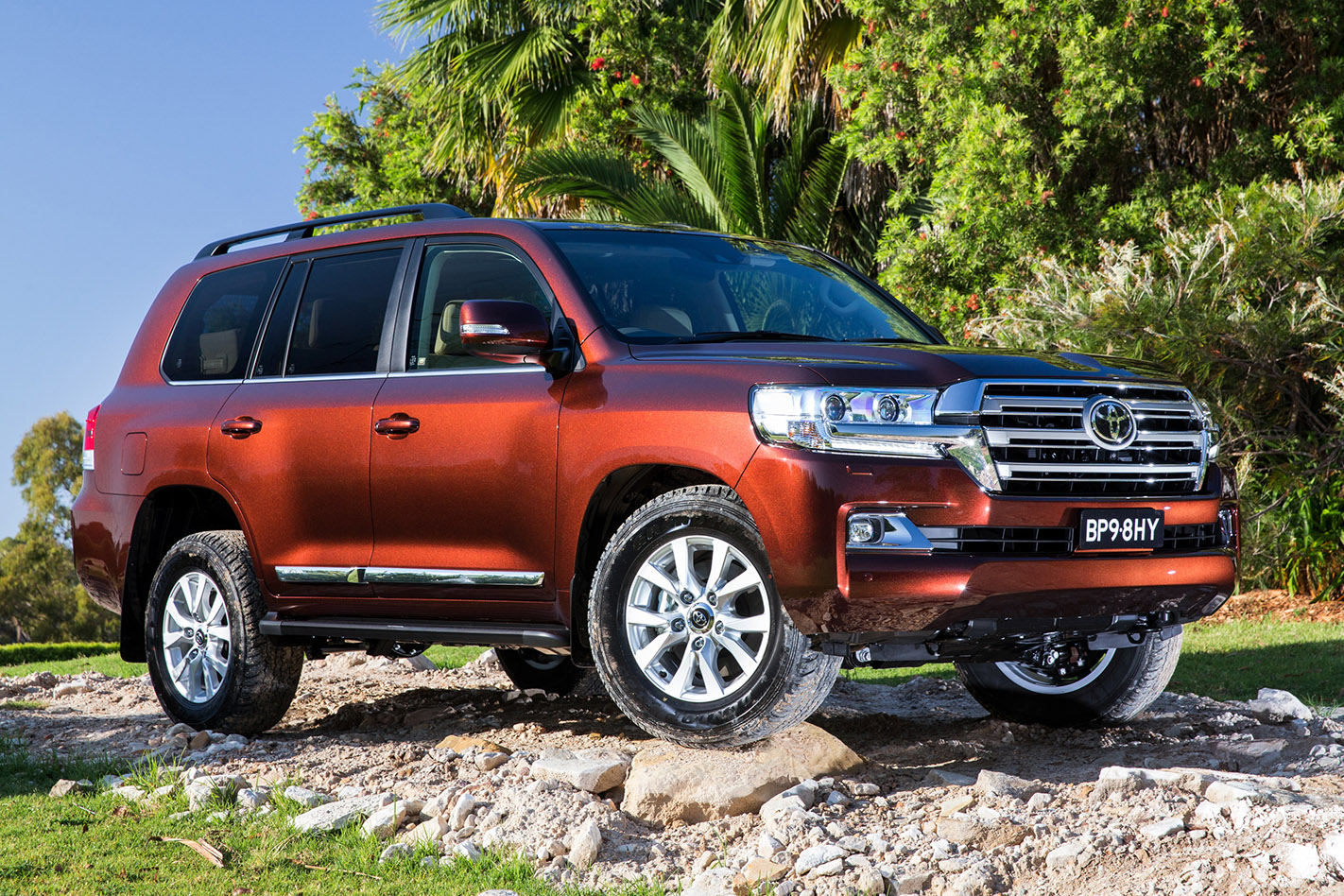
Toyota Landcruiser LC200 Sahara diesel – $119,930
This isn’t the only 200-series Toyota Landcruiser (below) that carries an LCT impost (they all do, in fact), but it’s the most expensive. A six-digit sum is certainly a lot of money to pay for any car, especially something with a badge as proletarian as Toyota, but the Landcruiser is a vehicle with genuine utility and one that isn’t often bought simply because it’s seen as exclusive or high-end – there are far more luxurious vehicles around for less money, for example. Is paying LCT on a high-end Landcruiser unfair?
Chevrolet Camaro ZL1 automatic – $162,190
Okay, the ZL1 is ridiculously expensive and ridiculously exclusive in this country and definitely something that’s strictly only available to the well-heeled by virtue of its colossal pricetag, so we’ll throw the ATO a bone here and say that yes, the Chevrolet Camaro ZL1 could very much be considered to be a luxury.
However we figured you’d all be curious to know what the most expensive car from a non-premium automaker is, and it’s Chevrolet’s hard-hitting V8 hero – at least until the Corvette gets here.
The ESP warning light starts flashing at 274km/h as we drive through a fast right-hander on the busy A31 Bottrop-Emden autobahn. It’s been three hours of sweaty-palm steering and flat-out fighting this crazy C-Class drugged by Brabus. But there’s not much left to shock you. Not even stability control telling the captain of this road ship that it’s now cruising at the very limit.
This review was originally published in MOTOR’s September 2008 issue
A few miles back, when the speedo reached 315km/h, the car suddenly sounded as if the sunroof would peel off. Of course it didn’t, but the brute force of such speed managed to flip open and bend the roof-rail mounting-point covers thanks to the massive aerodynamic lift. Germany’s Brabus power brokers have computer-simulated speeds up to 370km/h, but no test drivers have yet cracked 200mph (322km/h) in the aptly named the Brabus Bullit.
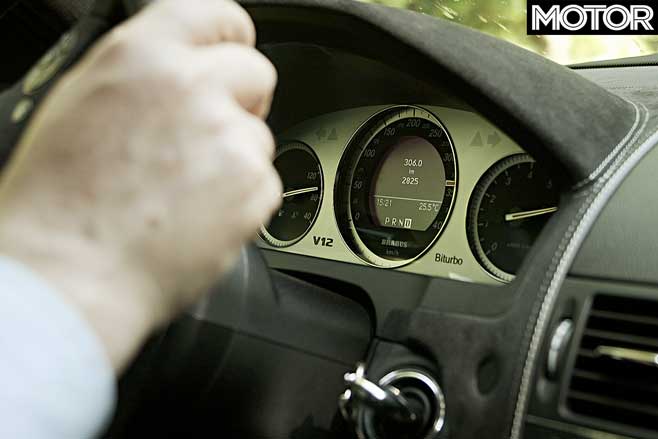
“It’s not so much the actual experience that counts but the imagination of what it be might be like to do 200, 210 or 220mph,” grins Ulrich Gauffrés, head of R&D.
“With the long axle, the Bullit would theoretically exceed 230mph [370km/h]. But because of the extreme mix of power, torque and load, we pull the plug at 219mph [350km/h]. So far, all customers opted incidentally for the ultimately less dramatic short final-drive ratio.”
The four cars built to date will reach a respectable maximum speed of 317km/h. That’s fast, but not excessively fast for Brabus, which has a long tradition of building modified Mercs capable of the speed of sound. The E V12 (based on the taxi-esque W210 E-Class) maxed out at 331km/h, the E V12 Biturbo (derived from the W211) topped an honest 352km/h, and the CLS Rocket passed the light bar on the Nardo oval in Italy at 367km/h.

Although lighter and smaller, the Bullit is equipped with the same 537kW V12, but — perhaps for political reasons — is not allowed to eclipse the more expensive Rocket. It’s limited to 350km/h when fitted with the 2.24 final-drive.
After a few high-speed runs, it becomes clear why hitting even the 200mph (322km/h) mark is plenty. The exhausted Yokohamas smell like an F1 grid just after the red lights have gone out, and they’re hot enough to fry bugs before getting a chance to squash them. Give it stick and the Bullit will instantly ricochet, fishtail, squeal and be a general nuisance to all the good guys on the road.
Whipped hard, it briefly feigns a front-to-rear weight distribution of 90-to-10, lets the rear attempt to overtake the front, and encourages an epic battle between the clever electronics and the monstrous 1320Nm of torque – limited electronically to 1100Nm to protect the drivetrain.
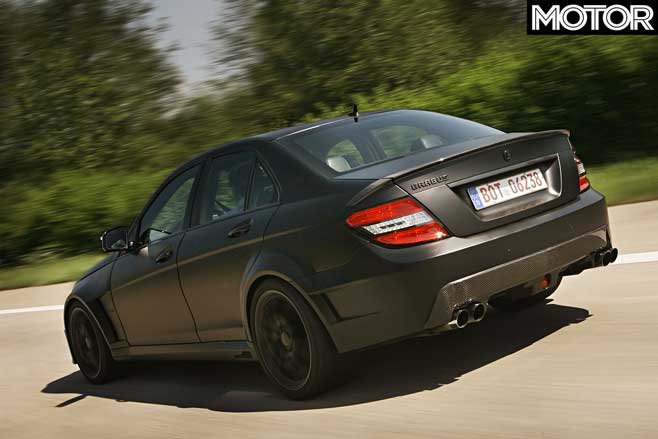
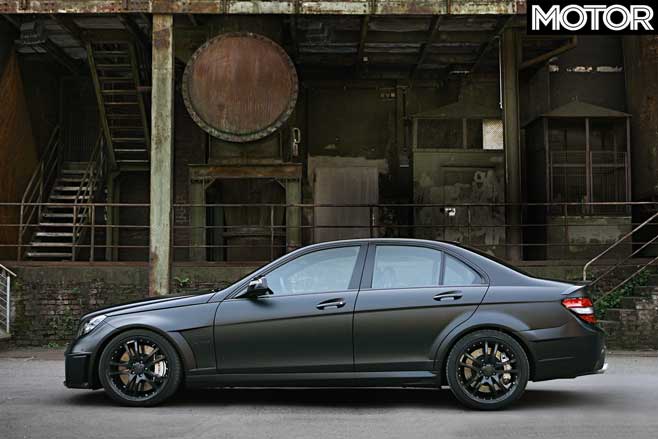
Its loud character matches its performance, and would likely receive a unanimous thumbs-up from the likes of P. Diddy, Marilyn Manson or Hulk Hogan. The test car looked particularly satanic, its original silver body covered by a dark matt-black coating for an extra €4000 ($6500).
The gothic treatment may be super cool, but stone chips will tear up the surface finish, which is notably more relaxed in places than solid paint. Matching the stealth bodysuit are dark 19-inch alloy wheels, carbonfibre grille and rear apron, generous wing and sill extensions, rear spoiler and wide-mouth front bumper which feeds plenty of air into the brake-cooling ducts and the radiators.
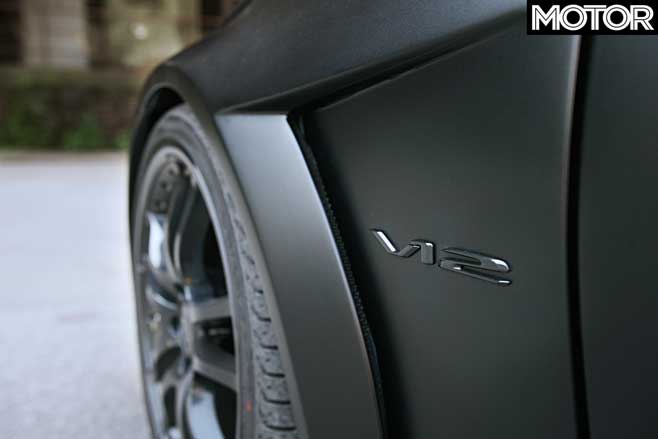
The Brabus Bullit Black Arrow (to give its full name) boasts a twin-turbo 6.2-litre V12 that musters 537kW at 5100rpm, and max torque of 1100Nm from 2100-3000rpm. Compared to the base 5.5, the uprated V12 features a longer-stroke crankshaft, bigger-bore cylinders and heads, special pistons and conrods, high-performance camshafts, a pair of intercooled turbos and a revised free-flow exhaust brutal enough to crack open nesting bird eggs a kay away.
About as ancient as the three-valve heads is the reinforced five-speed auto, but when there’s more torque than a run-of-the-mill turboprop, the number of gears becomes virtually irrelevant. The downside is the absence of shift paddles, which would have suited the overkill character of this beast. You can always stir the column-mounted shifter, but considering the rear axle’s tap-dance talents, having both hands on the wheel is a better idea.
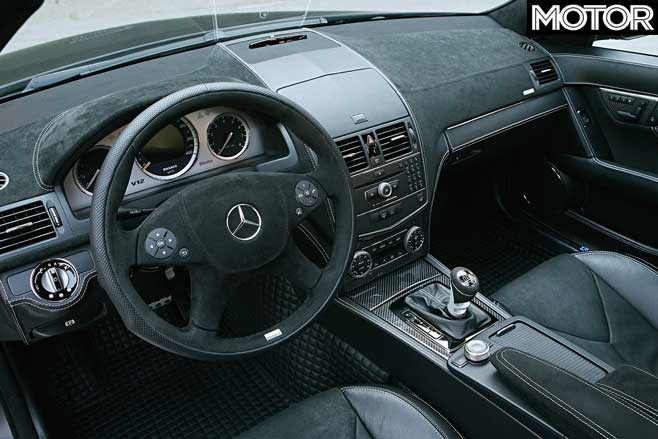
However, such a modern, high-tech super sports car lacks certain features like ESP Sport (an in-between mode which permits more wheelspin), a choice of transmission driving programs and shift speeds, and a hooligan button to trigger launch control.
Although weighing a feisty 1850kg, traction is always an issue. To balance the unladen rear axle and nose-heavy front suspension, engineers fitted a limited-slip differential with a 40-percent locking rate. Traction- and stability-control also help, as do the 285/30ZR19 rear Yokohamas which are a little fatter than the 265/30ZR19 footwear chosen for the front wheels.
New for this superior C-Class are beefier anti-roll bars, a wider track (two inches), high-performance brakes and a specially prepared spring and damper set-up, adjustable from reasonably compliant to virtually solid.
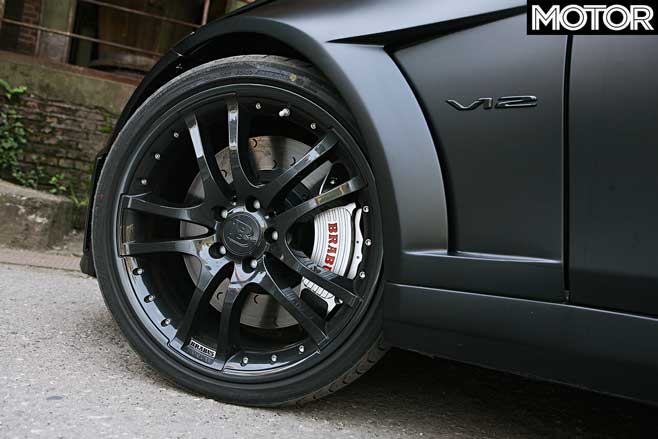
Extra money buys carbonfibre brake discs, but the standard all-steel stoppers are better suited for everyday use. Combining 12-piston fixed calipers and 380mm rotors in front with six-piston calipers and 360mm discs at the rear, the Bullit decelerates with vigour and spontaneity.
On a grippy airport runway, acceleration from 0-100km/h takes only 3.9sec and 200km/h just 10.5. In another 14sec, it will thunder past the 300km/h barrier. While the S63 AMG or the BMW M5 start running out of steam at 250km/h, this monster from Bottrop keeps charging ahead like a raging gas turbine right up to 300.
To save stress and fuel, fifth gear kicks in relatively early, but there’s still so much oomph on tap that this Merc on steroids will peak at an indicated 327km/h, which is all the shorter 2.65:1 axle allows. That’s not enough to qualify for the Guinness World Records but it’s plenty to show it has guts and foresight when pushed to the limit.
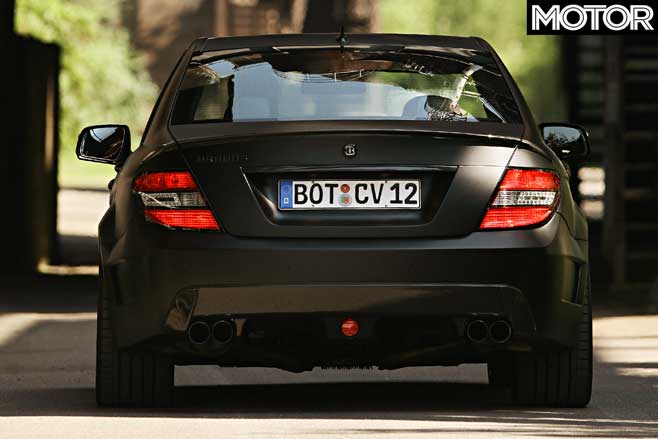
The downside of this v-max, though, is crippling fuel consumption. Instead of an advertised average of 15.1L/100km, the test car returned 29.1L/100km in foot-to-the-floor mode, the measly 66-litre tank empty after just 197km.
Brabus chose a mix-n-match suspension setting that is fine for secondary roads. On the autobahn, however, we’d encourage a few subtle set-up changes. The front end felt a little stiff in the springs, while the rear spring and damper set-up was a touch on the cushy side — allowing too much lift and vertical movement, and meaning directional stability isn’t quite arrow-straight.
It’s a minor issue, and could be fixed rather quickly, but at speeds over 320km/h you need total confidence, absolute clarity and reassuring composure. Although the Bullit is nine-tenths there, it could be even better tied down and more stoic in how it relays road and driver inputs.
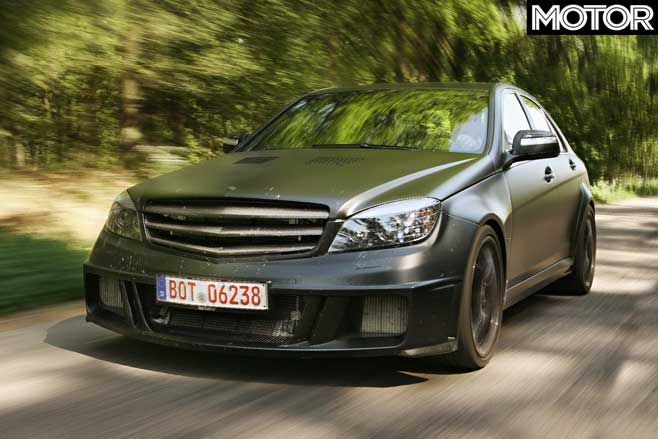
Up to 200km/h — when aerodynamics take a back seat and the suspension feels well connected — the Bullit is a hoot. On-ramps are perfect to stage lurid slides, traffic lights encourage you to leave behind black stripes and grey smoke signals, while on-demand third-gear wheelspin, even in the dry, never fails to make your passengers turn a shade whiter.
Any second-gear corner that’s clear from entry to exit beckons for a drift-challenge audition. Trouble is, other motorists aren’t prepared for a rowdy baby Benz going OTT, and the law is entitled to interpret even mild drifts as reckless driving.
That’s why a muscle machine like this deserves a race track, a drag strip or at least an empty car park without too many light posts hindering one’s impromptu auto slalom.
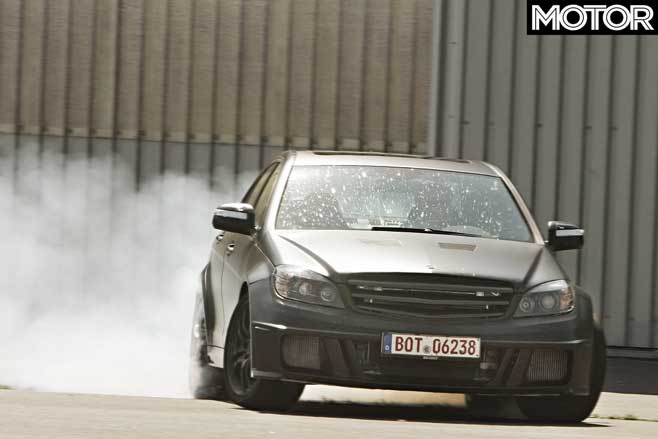
With ESP switched on, the roaring V12 is reigned in by a mastermind black box. With ESP deactivated, just about every stab at the throttle requires a handful of opposite lock. At first it’s a lot of fun, but it leaves you wondering if Brabus ever considered an all-wheel-drive version.
There’s no doubt about it: this C-Class with up-rooted, re-routed DNA is a wild zombie cocktail which should wear skull-and-crossbone stickers. The V12 is an alien ingredient, but those who aren’t gifted with superhuman reflexes may actually appreciate the fact that opposite lock can be applied in generous, leisurely doses. More than once the Brabus indulged ‘almost’ full spins, only to rescue itself after a deep-breath downshift.
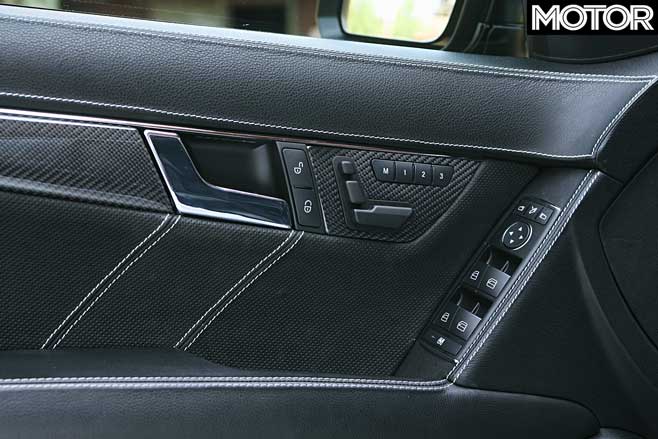
In addition to essential factory options like sat-nav, xenon lights, power-operated memory seats, Keyless Go and the totally counter-productive sunroof, our Bullit sported classic Brabus add-ons such as full leather and Alcantara trim (costing roughly $32,700, which also includes hide-covered footwells) and an extensive carbonfibre pack. Although the base version can hardly be described as a bargain, our fine specimen commanded an even more outrageous asking price of €451,138 ($737,349).
In terms of value for money, the ballsiest C-Class on the market is very expensive compared to, say, the quicker and faster Porsche 911 GT2. But it’s cheap in relation to, well, a Veyron (but what isn’t?). What you get isn’t just about how much the parts cost, though, but a made-to-measure, well-engineered car that’s been properly developed.
The Brabus Bullit Black Arrow is a quality piece of kit, somewhat of a government-certified, crash-tested ecstasy pill on wheels. No, the Bullit certainly doesn’t make a perfect second or third car. But Mercedes-minded multi-millionaires will be hard pressed to find a more exciting plaything. For the ultimate in understatement, though, might we suggest a coating of German-taxi beige?
FAST FACTS Brabus Bullit BODY: 4-door, 4-seat sedan DRIVE: rear-wheel ENGINE: 6233cc V12, DOHC, 36v, twin turbo BORE/STROKE: 83.0 x 96.0mm COMPRESSION: 9.0:1 POWER: 537kW @ 5100rpm TORQUE: 1100Nm @ 2100-3000rpm* WEIGHT: 1850kg POWER-TO- WEIGHT: 290kW/tonne 0-100KM/H: 3.7sec (claimed) TOP SPEED: 350km/h (limited)** TRANSMISSION: 5-speed automatic SUSPENSION: double A-arms, coil springs, anti-roll bar (f); multi-links, coil springs, anti-roll bar (r) L/W/h: 4590/1830/1402mm WHEELBASE: 2761mm TRACKS: 1538/1539mm (f/r) STEERING: power rack-and-pinion BRAKES: 380mm ventilated/grooved discs, 12-piston calipers (f), 360mm ventilated/grooved discs six-piston calipers (r) WHEELS: 19 x 9.5-inch (f), 19 x 10.0-inch (r) TYRES: Yokohama Advan V103; 265/30ZR19 (f), 285/30ZR19 (r) PRICE: €451,138 ($731,870)
RATING: 9.5 out of 10 stars
*electronically limited **with 2.24 final drive
It’s not just an engine
Read anything on a Brabus — any model — and it’s all about power and performance. But the Bullit is a more than just a big donk shoved in a small Benz. Covering ground at more than 300km/h requires some serious body mods, beginning with the C-Class shell.
The front and rear wheelarch extensions are aluminium, adding 2.36-inches (60mm) to the Bullit’s width. The bonnet is also aluminium, with cooling slots added, while at the rear a three-piece spoiler sits above a carbonfibre apron with an integrated diffuser. The front apron is also made of autoclave-baked carbonfibre, with cooling for the biturbo V12 and 12-piston brakes provided by larger air intakes.
Doing donuts around a fiery volcano is pretty strange in itself. Throw in the fact it’s a president of a country aiming to disprove rumours of his death, and that takes the cake. It seems a simple press release doesn’t make a big enough impact these days.
Who are we talking about? Gurbanguly Berdymukhamedov – otherwise known as the repressive president of Turkmenistan. And as you can see, the 62 year old is very much not dead. There’s a video to prove it, including footage of him ‘fanging’ a Dakar-style off-roader.
Although the date the video was created is yet to be confirmed, it’s said to quell rumours of the dictator’s death, which originated in July. The clip contains film of Berdymukhamedov riding horses and a bicycle with fat tyres, working out and scoring strikes while bowling with aides wearing identical tracksuits.
Not to glorify the actions of an infamous leader, but the Turkmen president is then seen seemingly off-roading through the Karakum Desert and doing donuts near the Darvaza Crater. The latter comes across as slightly dangerous. More so when you learn it’s nicknamed ‘Gateway to Hell’.

The crater, which is essentially a cave of natural gas, is believed to have formed in 1971 when Soviet geologists stumbled across it while looking for oil. To prevent the spread of methane, they set it alight thinking that would solve the problem… 50 years later, it’s still burning.
It also comes across as a strange release from a country known for offering little access for foreign media. The Human Rights Watch also alleges Berdymukhamedov controls all aspects of public life, with religious and political expression punishable. Turkmenistan also rates poorly in numerous human rights indexes.
Queensland is set to double down on its country-leading laws that specifically target defective cars that can’t be repaired to a customer’s satisfaction, with tough new legislation to come into force on September 1.
Under the amendments to the Queensland Civil and Administrative Tribunal and Other Legislation Amendment Act 2019, the Queensland Civil and Administrative Tribunal (QCAT) will widen its purview on matters relating to new and old vehicles colloquially known as ‘lemons’.
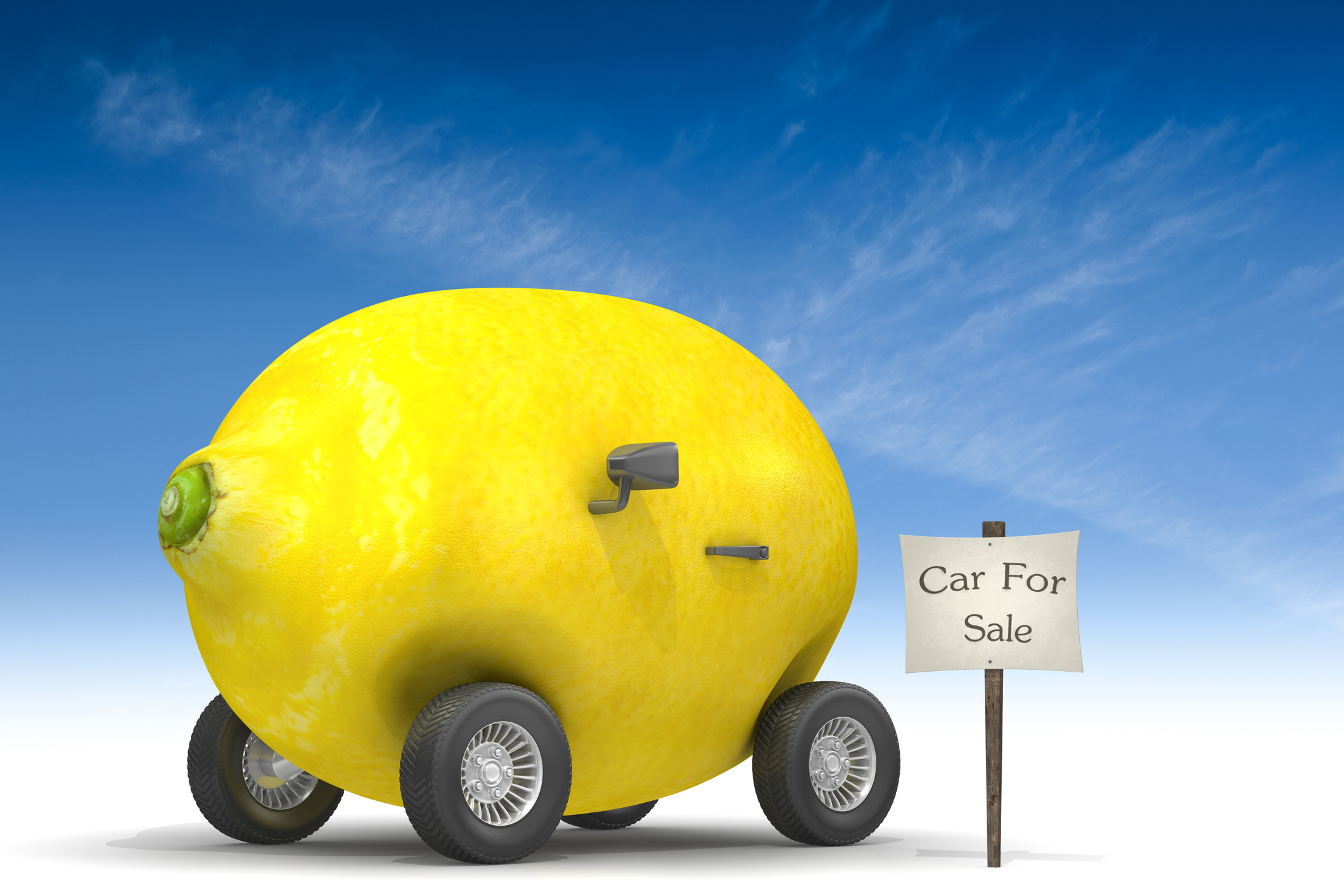
QCAT defines a lemon as ‘having numerous defects that reoccur despite multiple repair attempts or where defects have caused a motor vehicle to be out of service for a prolonged period of time’.
Key to the change is an increase in the amount that can be claimed, from $25,000 to $100,000. The legislation covers car, boats, motorbikes, caravans and motorhomes.
Attorney-General and Minister for Justice Yvette D’Ath said the law changes meant buyers could make their vehicle purchases with greater confidence and peace of mind.
“These measures will build levels of trust in the industry and benefit the majority of motor dealers who are doing the right thing by offering best practice in terms of refunds, replacements and repairs at no cost when a vehicle is faulty,” she said.
Additionally, 30-day/1000km warranties for people buying a vehicle that is more than 10 years old, or which has 160,000km or more on the odometer will be restored. It was scrapped by the previous Liberal National government of Campbell Newman.
The reinstated protection would complement the current three month/5000km warranty for second-hand vehicles bought from a motor dealer that is no more than 10 years old and have travelled less than 160,000km.
“After buying a home, a motor vehicle is often the next biggest purchase a person will make in their life,” said D’Arth.
“When you invest in a car or a caravan, you don’t expect it to be off the road for a lengthy period with all the stress and inconvenience that can cause.”
Consumers in other states can, of course, still claim a full refund for a faulty vehicle, but Queensland moves the process from a law court to a tribunal.
According to the Australian Competition and Consumer Commission, a product or good has a major problem when:
- it has a problem that would have stopped someone from buying it if they’d known about it
- it is significantly different from the sample or description
- it is substantially unfit for its common purpose and can’t easily be fixed within a reasonable time
- it doesn’t do what you asked for and can’t easily be fixed within a reasonable time; or
- it is unsafe.
Have you got a lemon story you want to share? Comment below!
With the departure of the M140i hot hatch, the BMW M240i coupe is now the cheapest way to get into a car powered by Bimmer’s 250kW B58 straight six, and it just got a fair bit cheaper.
BWM Australia has announced a new drive away price for the hottest ‘non-M2’ 2 Series, set lower than its previous RRP which excluded on-roads.
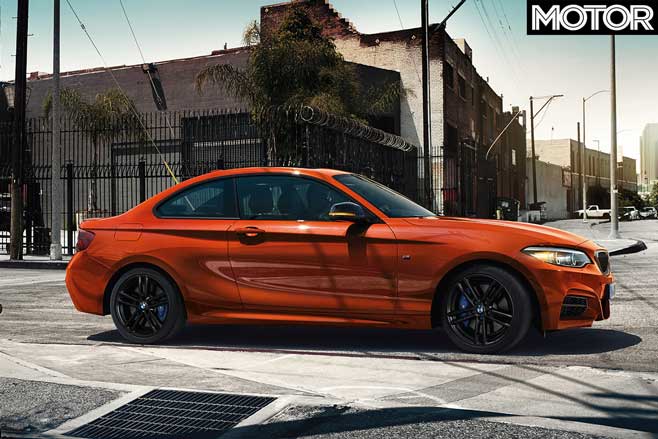
At $74,900 drive away, the BMW M240i is now several thousand dollars cheaper with more features as standard. Its previous $79,100 didn’t dip into the options list and meant buyers would still be paying fees to get the car out of the dealership and onto the streets.
Its 3.0-litre twin-scroll turbo inline six (the aforementioned B58) outputs remain at 250kW and 500Nm, the same as in the more expensive Toyota GR Supra and much more expensive BMW Z4 M40i, but with the M240i now comes features previously only available as extra-cost options.
A sunroof is now included as standard, as is wireless phone charging, metallic paint (pictured is Sunset Orange Metallic), double-spoke 18-inch alloys, and an Alcantara interior treatment with black gloss highlights.
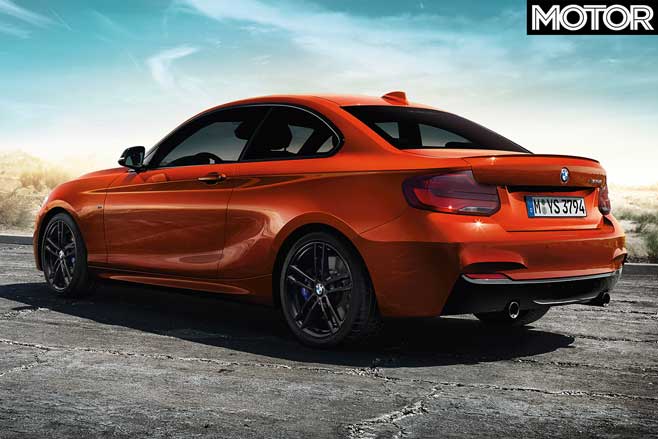
Three options are available for the twin-spoke wheels, Jet Black, a twin colour design, or Cerium Grey Matte. Similarly, several exterior body colours can be chosen from, including Long Beach Blue, the BMW M2’s hero colour.
Approximately two years ago, the BWM M140i underwent a similar price drop, preceding the model’s demise in favour of the new FWD/AWD 1 Series replacement. But according to BMW’s indication, the M240i is here to stay.
Orders are now open for the M240i at its new price point, with cars expected to be delivered in the final quarter of 2019.
