
Volkswagen has been added to a growing number of car makers subject to an Australian consumer class action over potentially deadly airbags, as the global Takata recall crisis shows no signs of abating.
The German brand now joins BMW, Honda, Mazda, Nissan, Subaru and Toyota as the focus of a lawsuit by Sydney law firm Quinn Emanuel, which is seeking damages on behalf of a number of Australians.
Many millions of vehicles are now known to be carrying the faulty Takata airbags worldwide, which have the potential to explode in the event of a collision, and the recall and replacement of defective units is already underway.
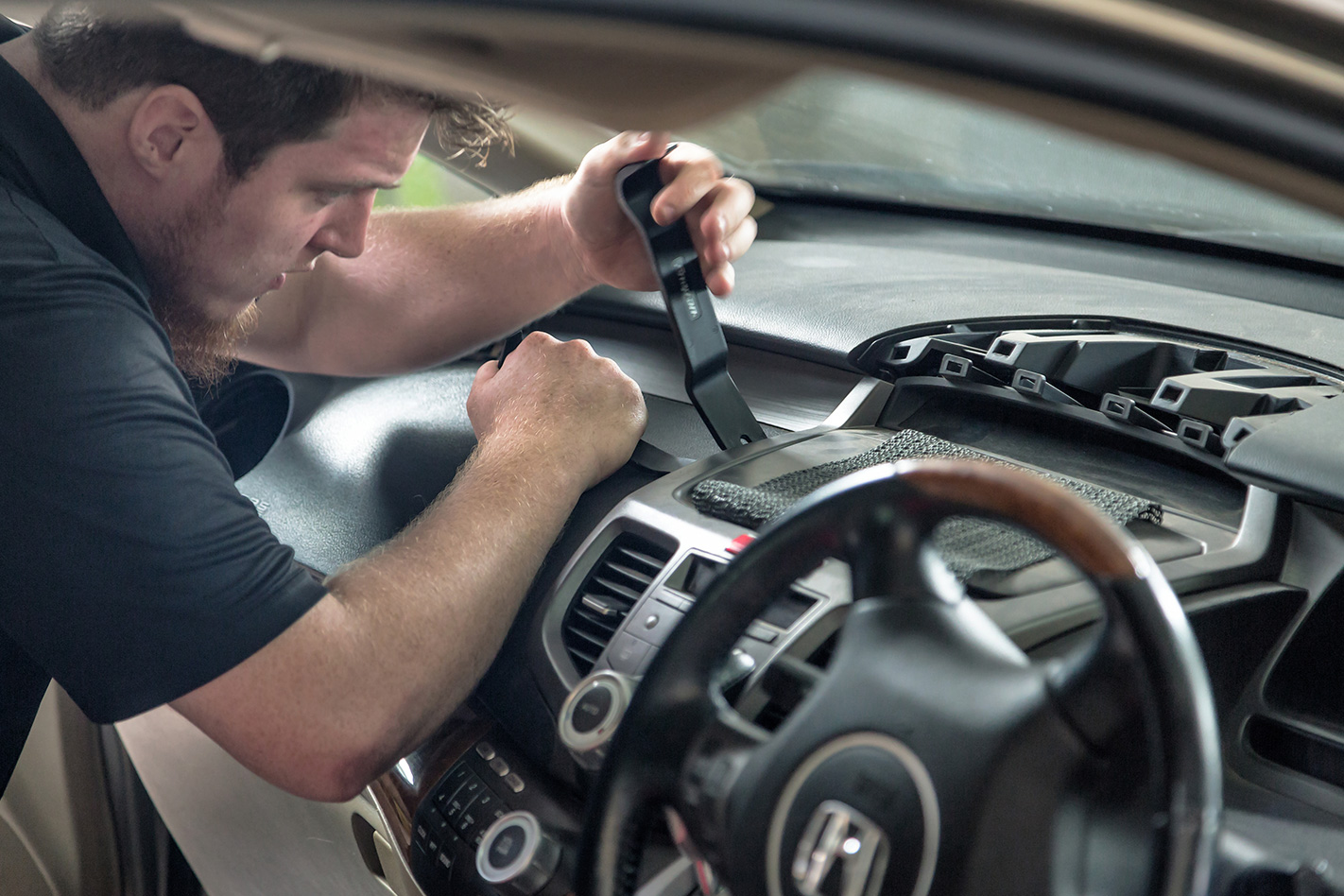
According to Quinn Emanuel however, the seven manufacturers knew the replacement Takata-made airbags suffered the same manufacturing fault and associated hazards at the time of replacement, deliberately exposing the vehicle’s owners to continued or even increased danger.
“These manufacturers knew these airbags were dangerous, but kept using them in their vehicles – putting profits before the safety of their customers,” said Quinn Emanuel partner Damian Scattini.
The company has not disclosed how many owners have signed up to be part of the claim action, but as many as one in four (2.5 million) vehicles are fitted with the potentially dangerous units on Australian roads.
One death and one serious injury has resulted locally from the problem, which originates from an assembly defect, allowing moisture to contaminate the pyrotechnic propellant. When the airbag is triggered in the event of a crash, the unstable propellant can rupture the metal casing causing potentially deadly shrapnel.
The faulty airbags cannot spontaneously explode and must be fired by the vehicle’s SRS system during a crash.
Since the problem was first identified in 2013, the various impacted car makers have been scrambling to recall and replace potentially dangerous units, but the sheer numbers involved have caused immense supply problems.
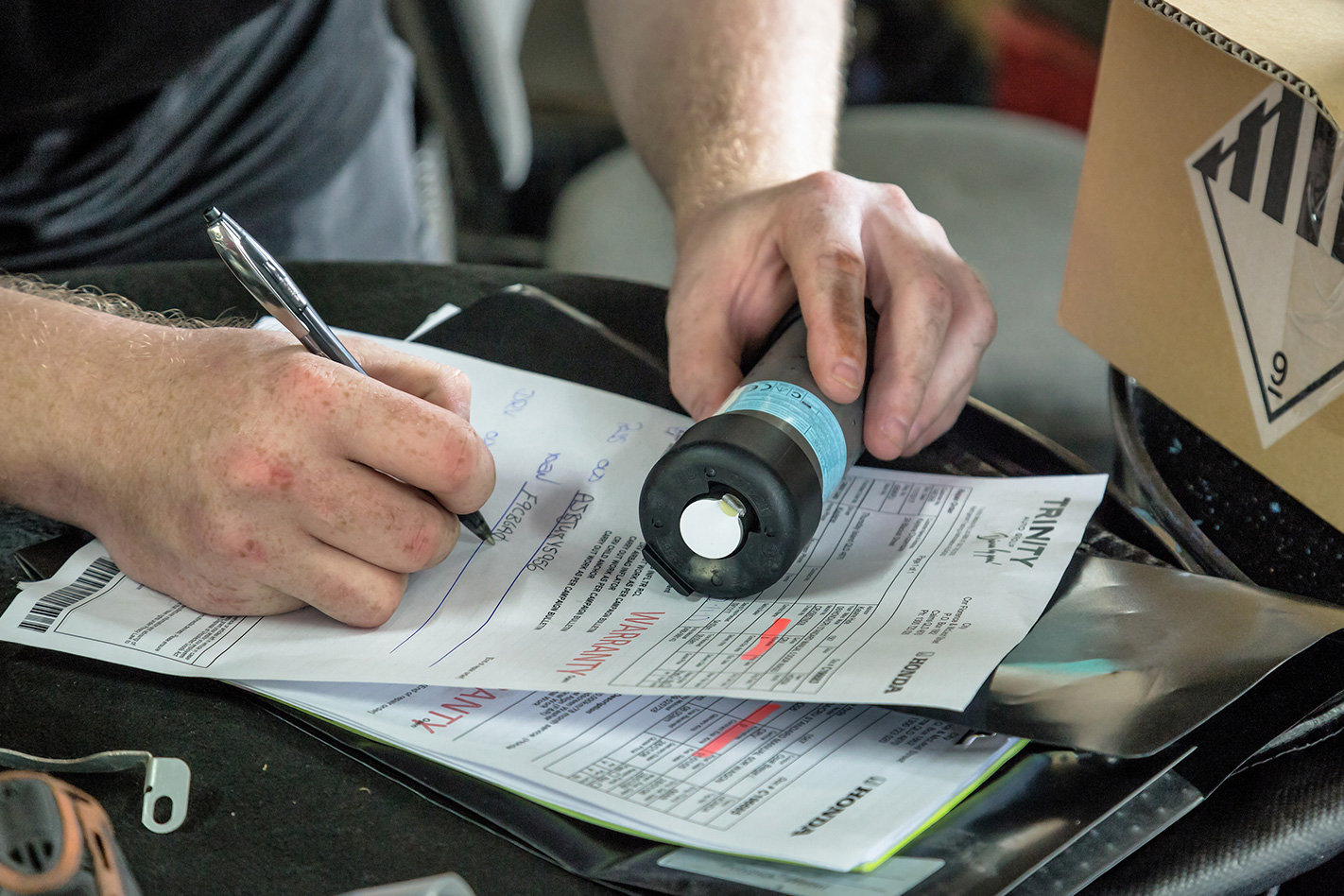
In some cases newer airbag modules with the same potential manufacturing defect have been used in ‘remedial’ work, but as to whether the car manufacturers were aware at the time is a matter for the courts to decide.
Such is the gravity of the implications and number of motorists potentially affected, the federal government instructed the Australian Competition and Consumer Commission (ACCC) to issue a compulsory recall for the Takata airbag – its first to date for a consumer product.
Owners of affected vehicles should have been contacted by the respective manufacturers, but the ACCC website provides a simple search function for drivers concerned their vehicle may need attention but have not received official notice.
As it stands, the best advice if you believe your vehicle may contain an affected airbag is to not drive it until a safe unit has been installed.
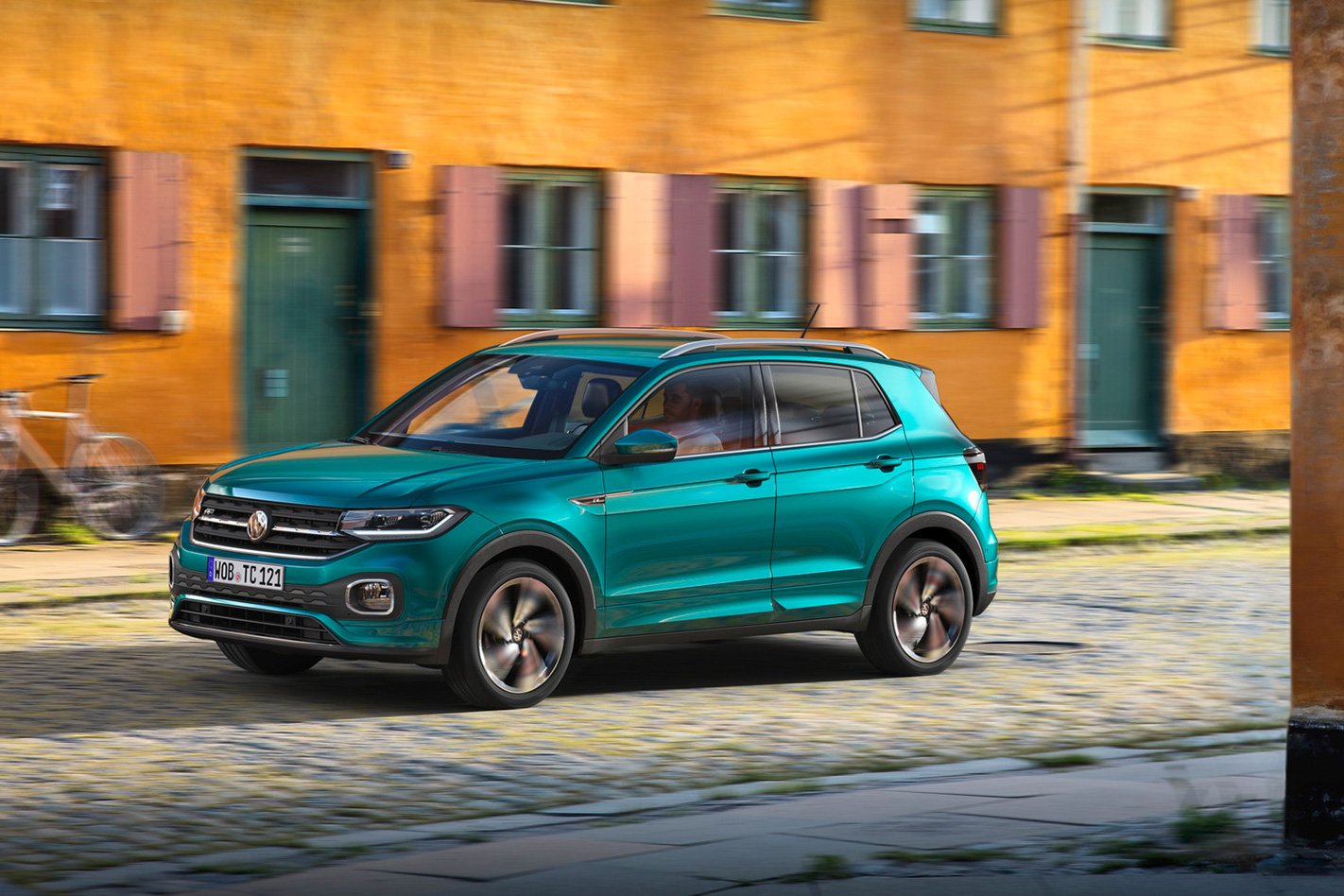
Volkswagen has finally dropped the sheets from its long-awaited compact SUV, the T-Cross, over three star-studded reveals across the world… but Australia has to take a back seat until at least 2020.
The five-seat, five-door T-Cross was revealed at events in the Netherlands, China and Brazil over the weekend.
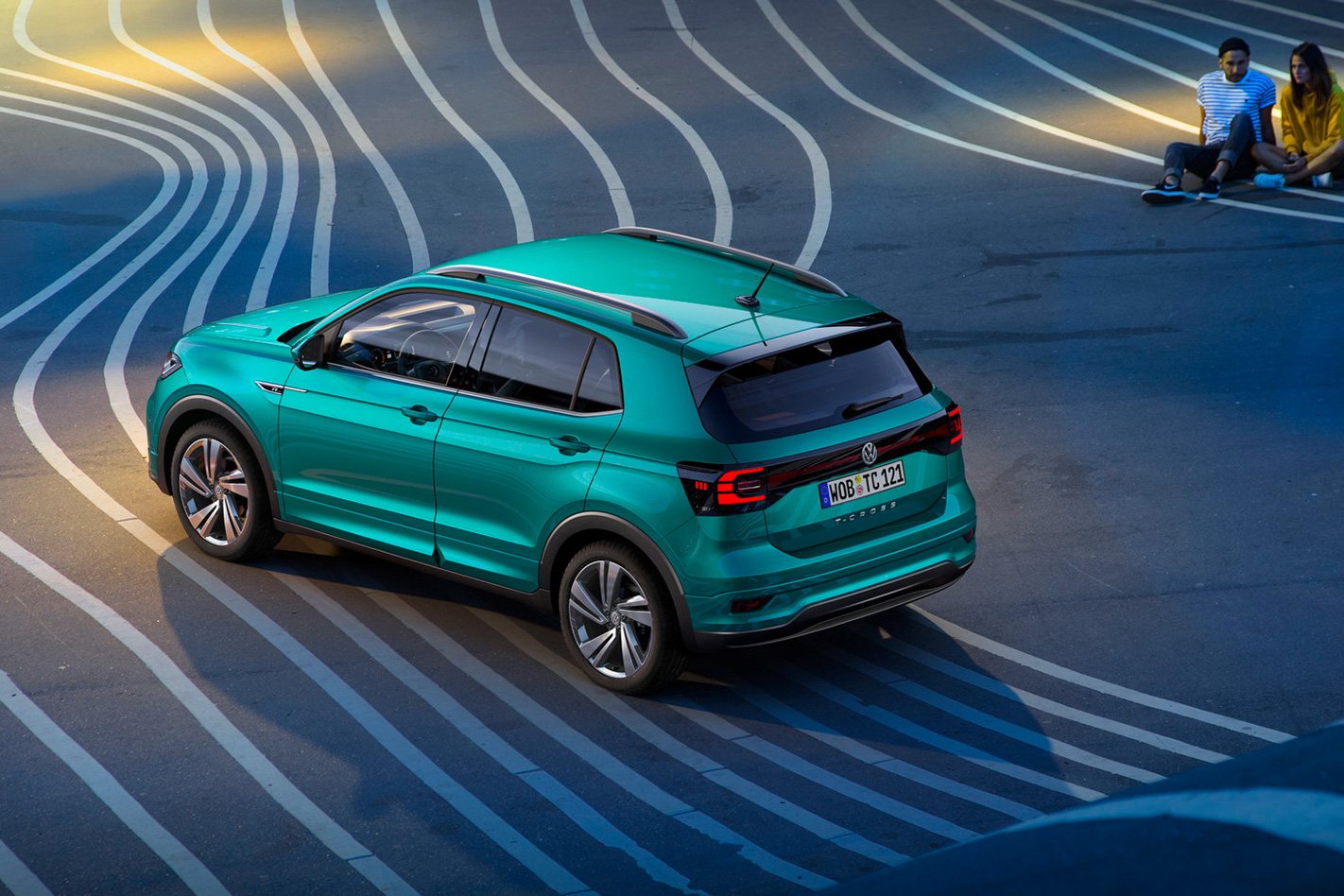
Based on the same platform as the recently released Polo, the T-Cross is, at 4110mm long, smaller than the category-leading Mazda CX-3. Claiming up to 455 litres of space behind its seats, however, it will arguably have more cargo space than all of its potential rivals, including the voluminous Honda HR-V (411 litres), Mitsubishi ASX (393 litres) and Hyundai Kona (361 litres).
The Volkswagen T-Cross will be available in front-wheel-drive guise only, and while Australian specs aren’t yet available, WhichCar.com.au understands that a five-speed manual variant won’t be offered here; ditto the diesel versions announced at the launch.
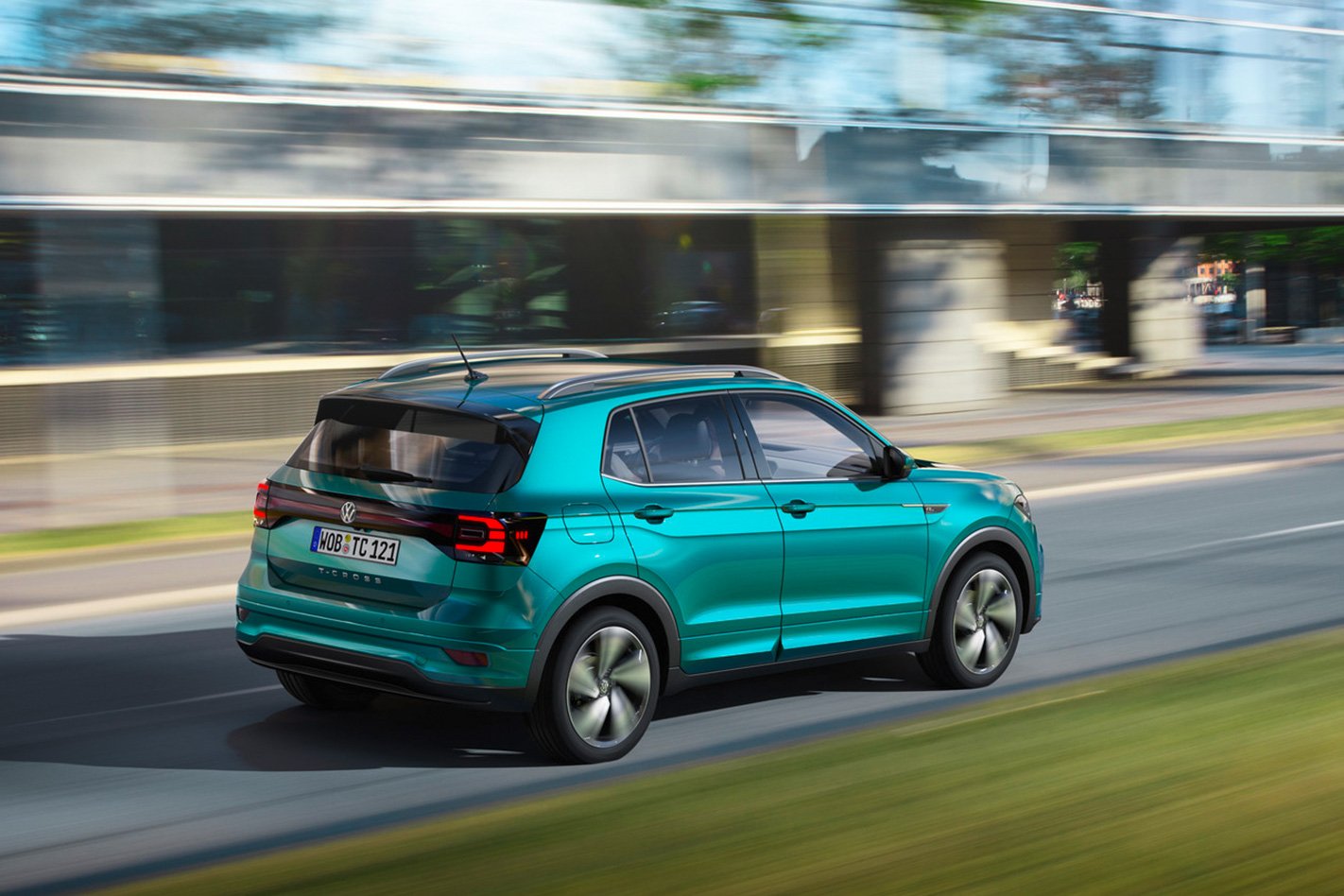
Instead, the local range will likely feature two model grades powered by 1.2-litre three-cylinder turbocharged engines (one at 70kW and one at 85kW), while the top-spec T-Cross variant will sport VW’s latest 110kW 1.5-litre petrol turbo four-cylinder. All will be teamed with a six-speed dual-clutch gearbox.
Expect to see Comfortline, Trendline and Sportline variants on offer, with R-Line additions as an option.
Based on a modified version of the VW Group’s ubiquitous MQB platform – which underpins everything from the VW Golf and Arteon to the similar sized Skoda Karoq – VW says the T-Cross will come standard with its Front Assist area monitoring system that includes pedestrian detection and AEB , active lane assist and hill start assist, as well as a blind-spot detection lane change assist system with rear traffic alert.
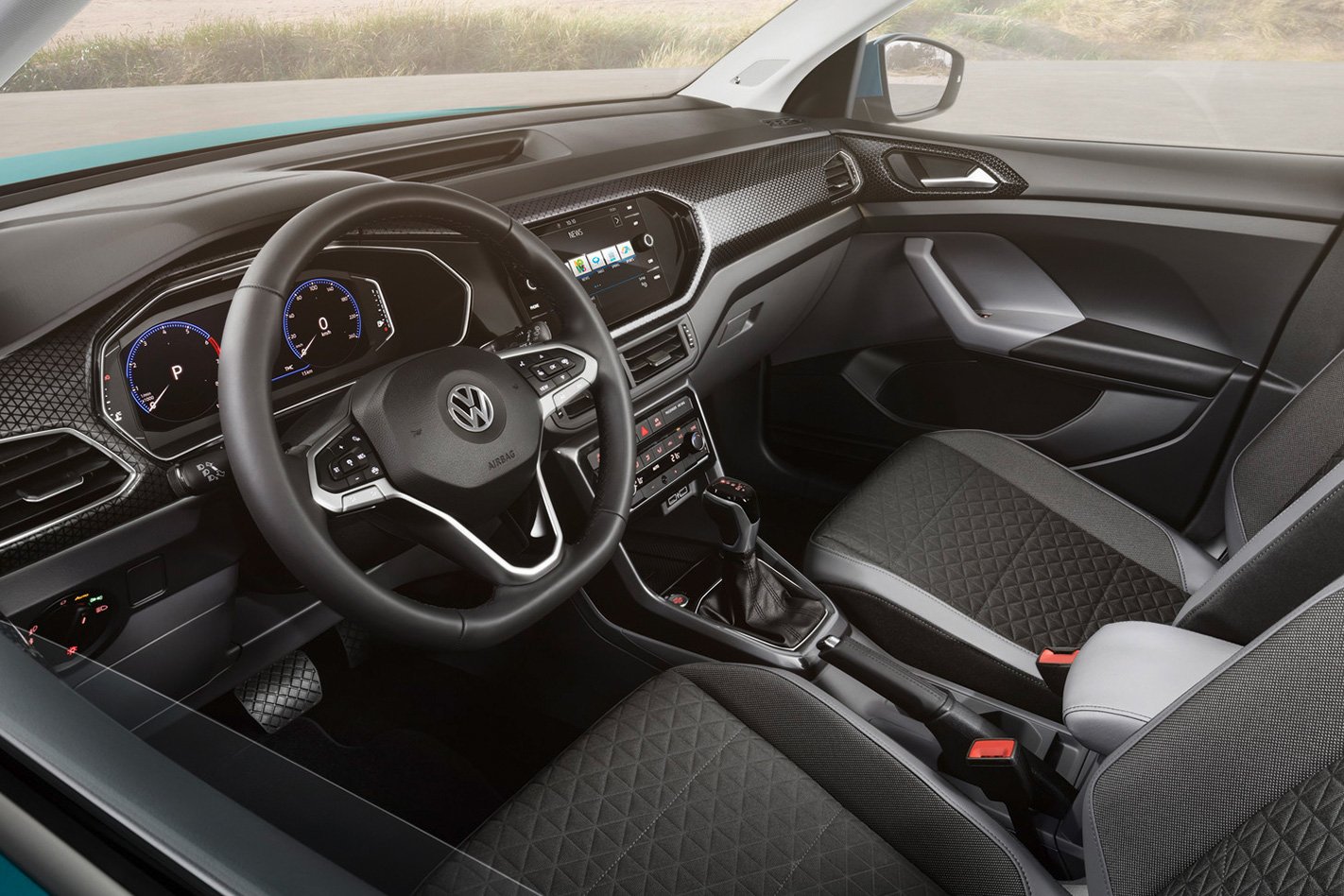
Systems like adaptive cruise control and automated parking assist will be available on higher grades.
Inside, expect to find an inductive phone charging pad, VW’s capacitive touchscreen with Apple Carplay and Android auto smartphone mirroring, VW’s digital dash as an option, up to four USB ports and more.
Despite turning up very late to the compact crossover party, VW is betting big that the sector will continue to grow strongly across the world; for example, both China and South America will get bespoke versions of the T-Cross for their respective markets.
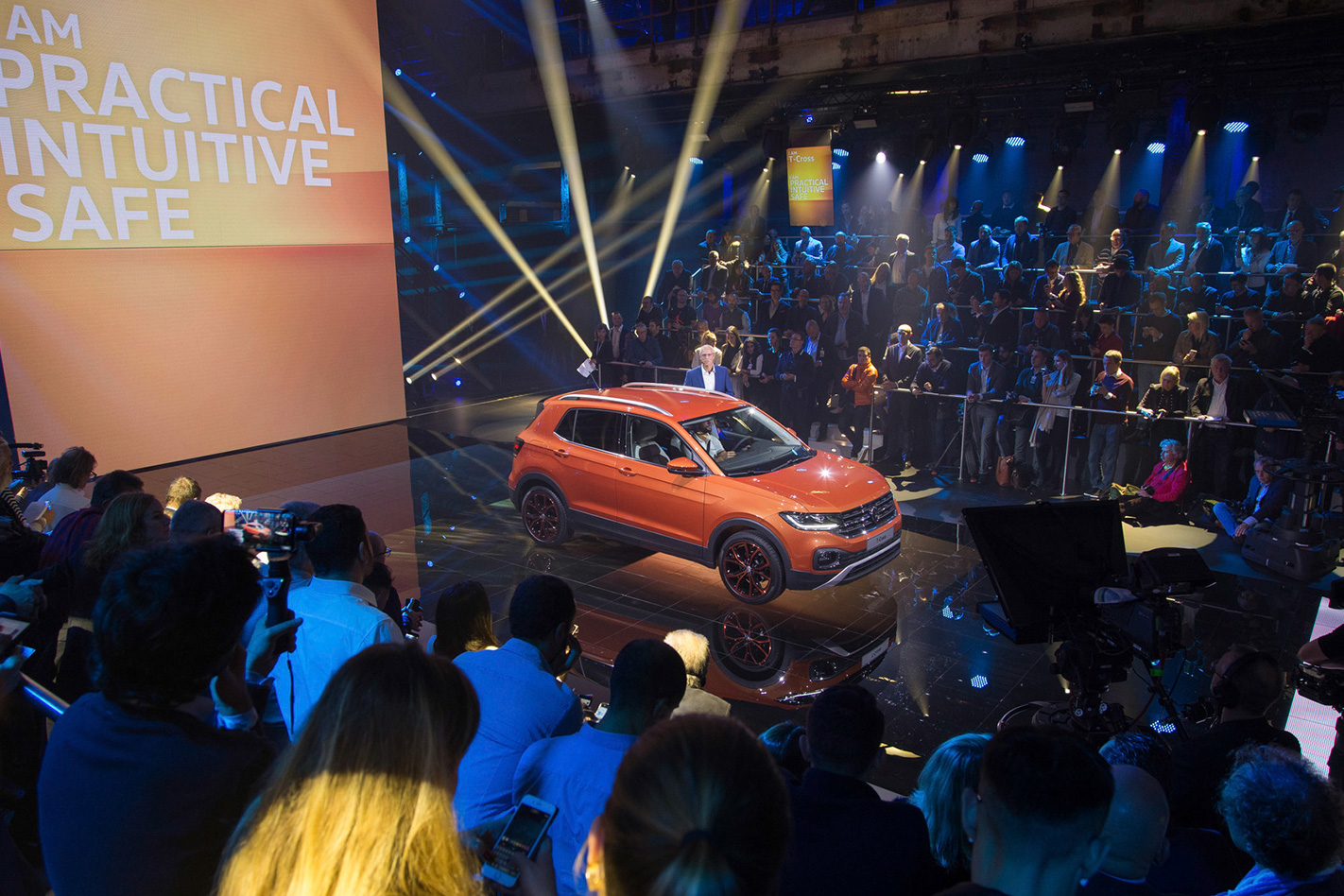
The T-Cross will be built in Spain alongside the newest Polo, with VW earmarking $2 billion to upgrade the Navara plant by the end of next year to increase production.
VW Australia has been shouting loud and long for the T-Cross to lob into our SUV-mad market. “It simply can’t arrive soon enough,” said head of communications for VW Australia, Paul Pottinger, who confirmed that it’s unlikely to arrive before 2020.
One of the big reasons for the lengthy delay in the arrival of the T-Cross is the worldwide harmonised light vehicle emissions testing regime (WLTP), which is twice as complex and time-consuming as the previous emissions testing protocols.
The move to WLTP testing has meant that VW Australia has to stand in line as more than 200 models and their respective variants are ratified to the new standard, which has just come on line in Europe.
Ares Design, possibly most renowned for its attempts to revive the DeTomaso Pantera through a spiritual successor, has taken on a new project steeped in nostalgia.
Its latest efforts, called ‘Project Pony’, involve taking the Ferrari GTC4Lusso and turning it into a modern reimagining of the iconic Ferrari 412.
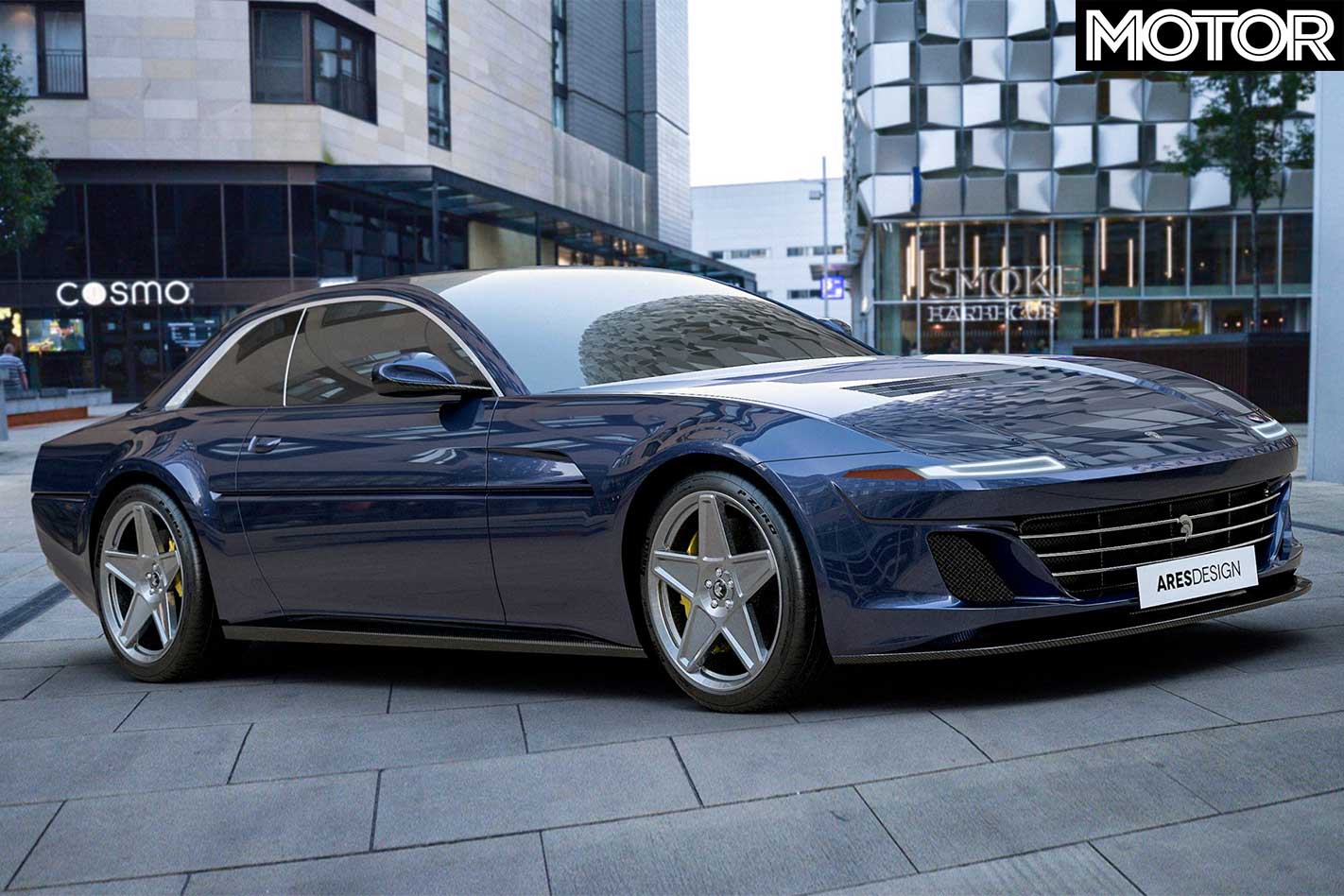
The GTC4Lusso’s 6.3-litre naturally-aspirated V12 remains, producing its standard 507kW and 697Nm, mimicking the front-engined V12 of the original.
“The Ares Design Pony will be part of the company’s ‘reborn legends’ portfolio,” Ares says.
“The Ares Pony’s styling is influenced by the 1980s 412 and after extensive computer modelling will be handcrafted with the finest grade carbon fibre not only endowing the car with stunning looks but giving it a low kerb weight, too.”
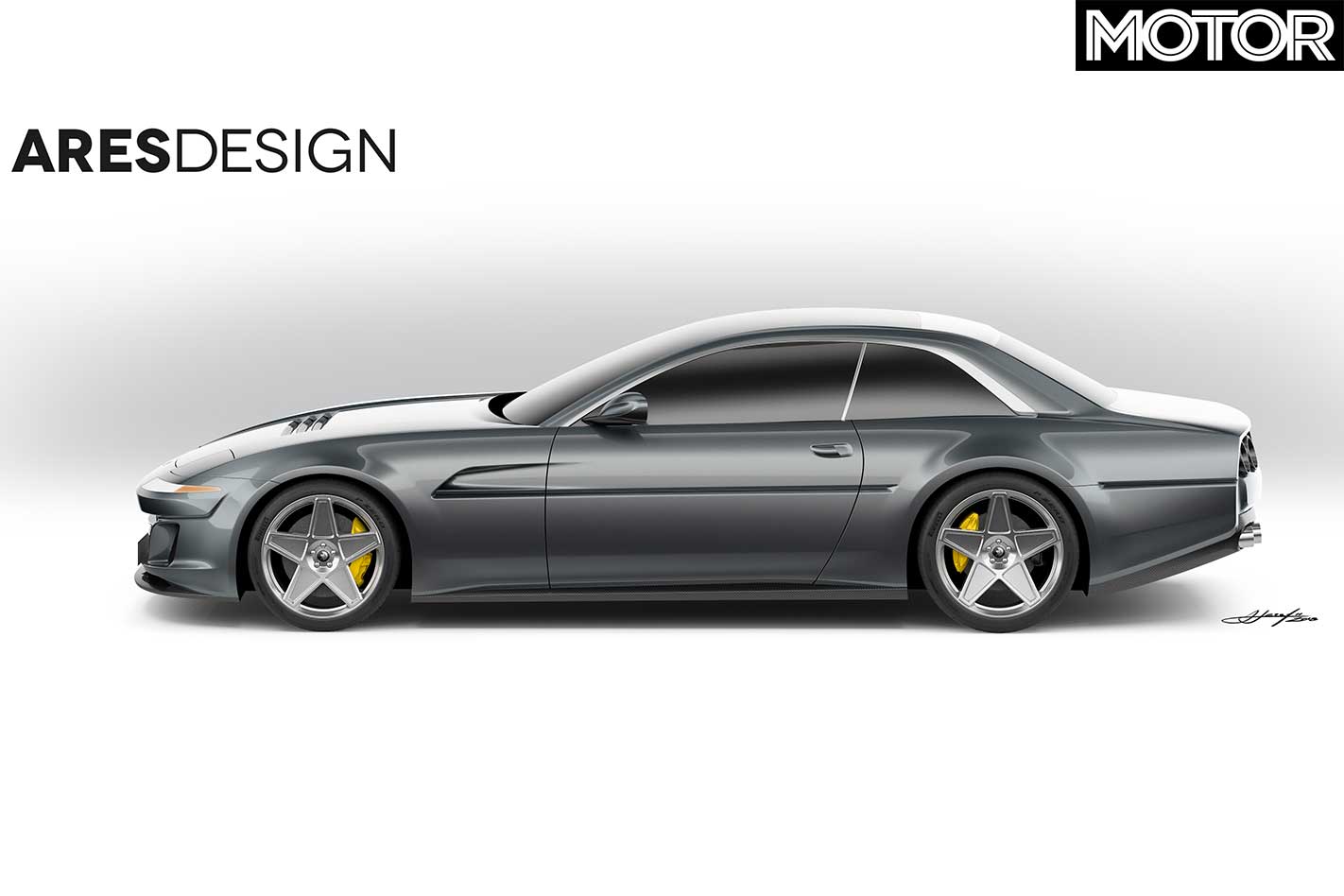
Given a Ferrari GTC4Lusso weighs in at 1920kg (in part thanks to its AWD system), it’ll be a challenge for Ares to get Project Pony’s weight close to anything able to be called ‘low’.
“Inside the 412 Ares Design will use the finest quality components with handcrafted leather seats and dash architecture complimented by hand-stitched features and highlights,” the design house says.
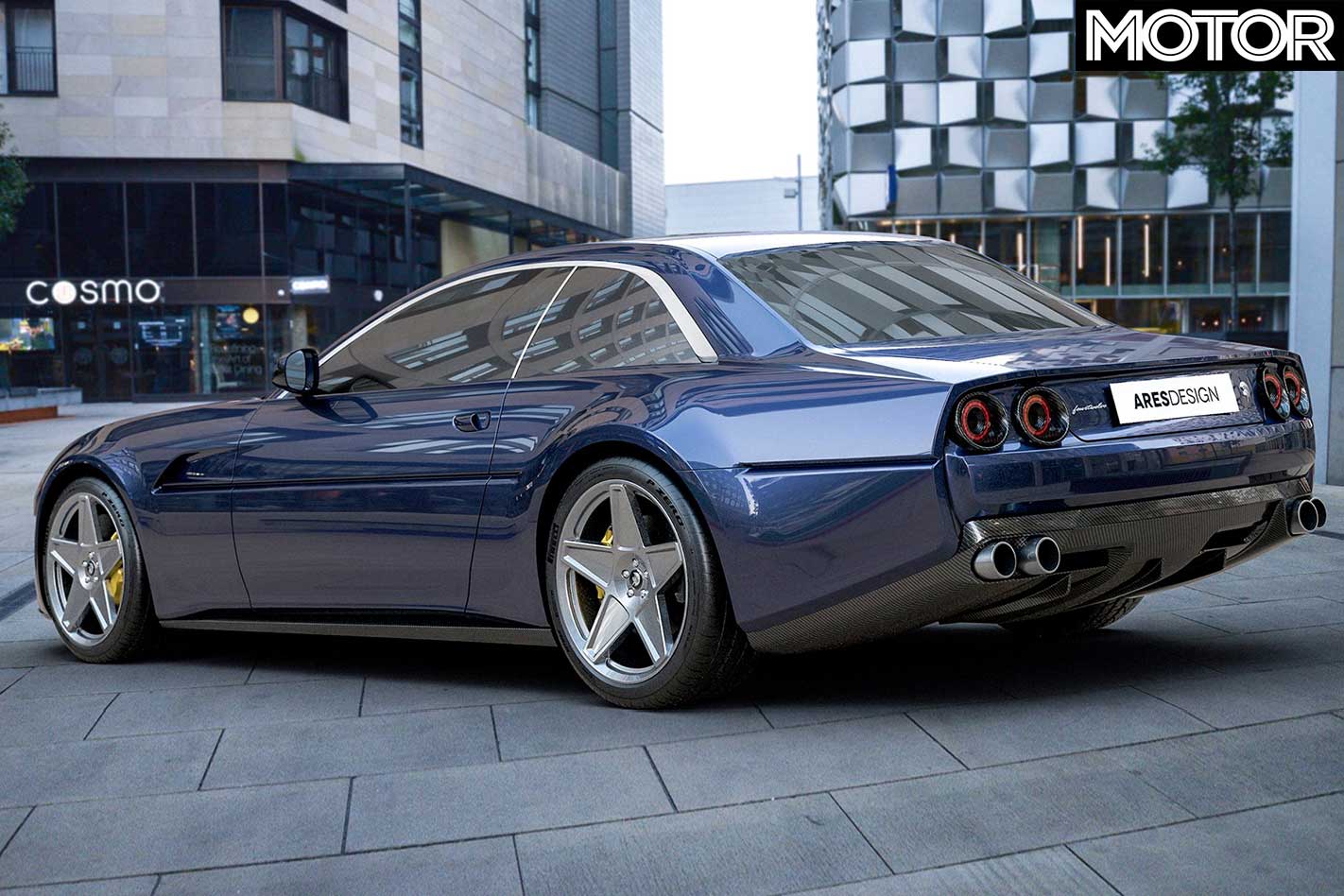
“The carbon fibre coach-built Pony will have all the style and panache of the original 412 but the modern underpinnings of the GTC4Lusso endow it with the sort of performance and connectivity the original could only have dreamed of.
“Ares will deliver a phenomenal vehicle, representing the exterior grace and poise of the iconic Ferrari 2+2 with the chassis from one of today’s most exceptional vehicles.”
There’s no word on how many will be built, or how much they’ll cost, but we imagine the answers will be ‘few’ and ‘plenty’ respectively.
AUDI can’t build a sports car. Everybody knows that. Everyone apart from the engineers who built the revolutionary ur-Quattro, the borderline genius B7 RS4, the disruptive R8 coupe and the astonishing R10 TDI racer – a diesel that dominated at Le Mans even when Ingolstadt voluntarily used the same engines in the 24-hour race as it used in practice and qualifying.
So it ought to be obvious that there’s a pool of hugely talented chassis and powertrain people at Audi. What’s truly frustrating is that this rich vein of dynamic know-how has all too often been neutered by the might of marketing and design, the power of the brand going rogue and often bringing us some strangely compromised road cars.
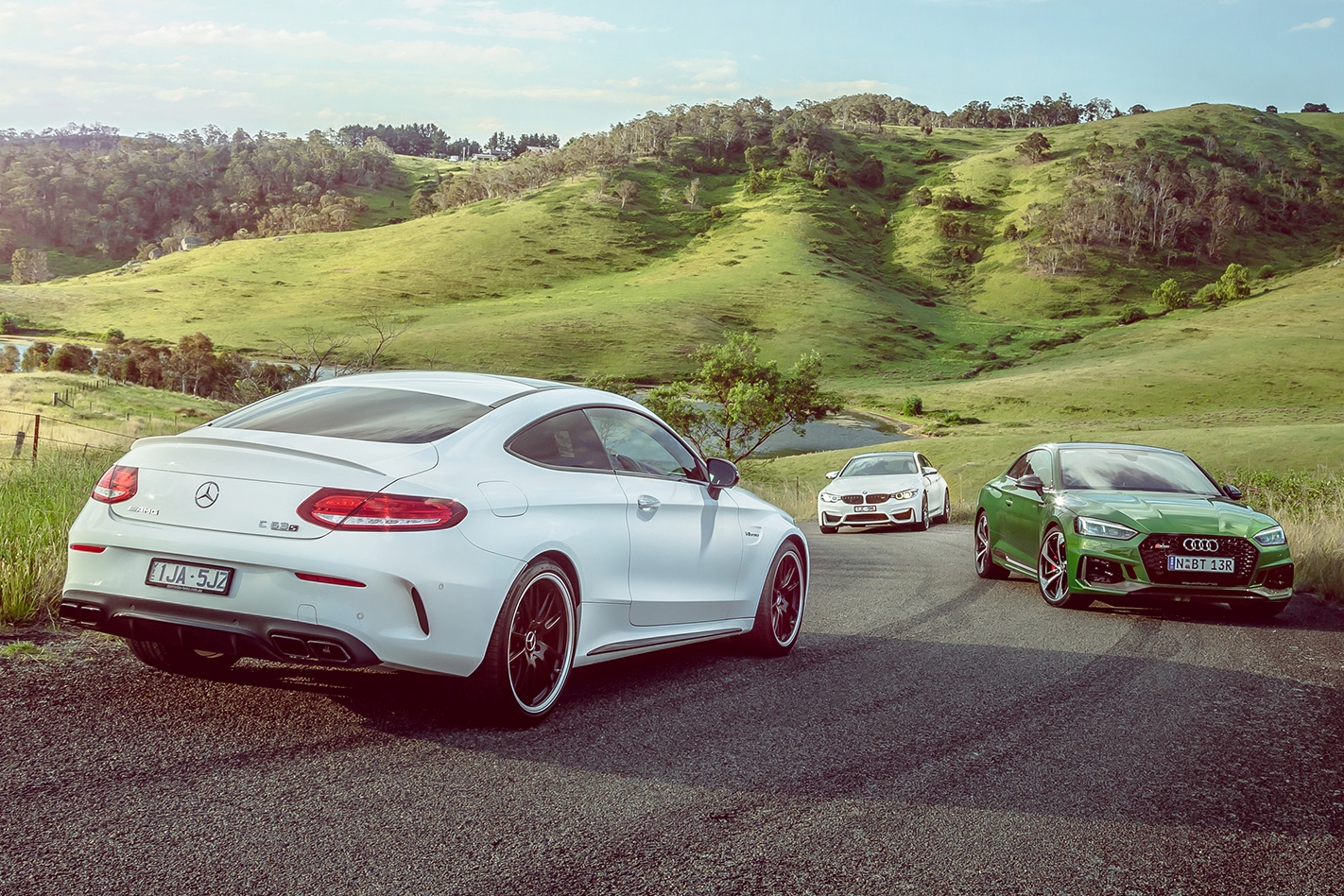
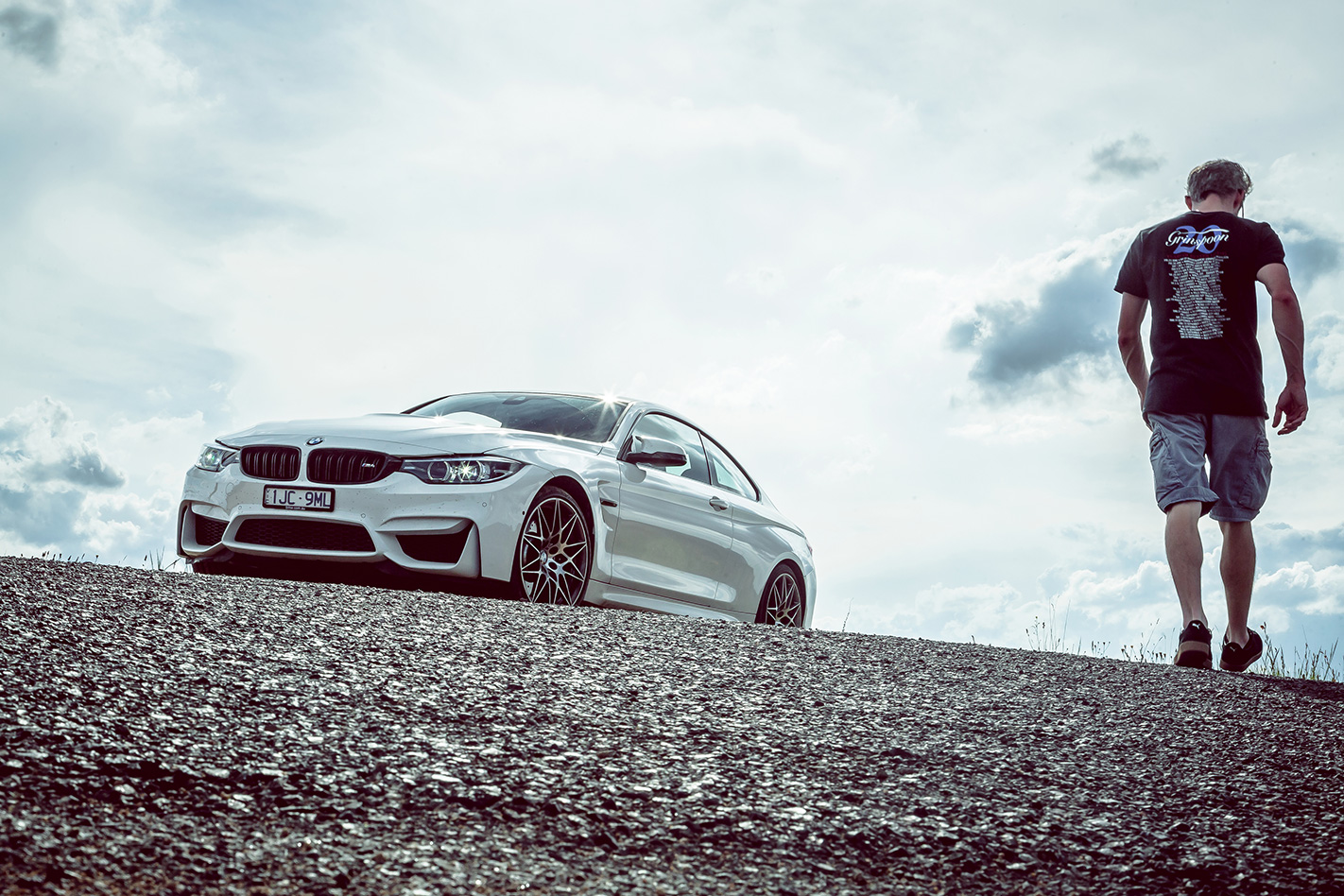
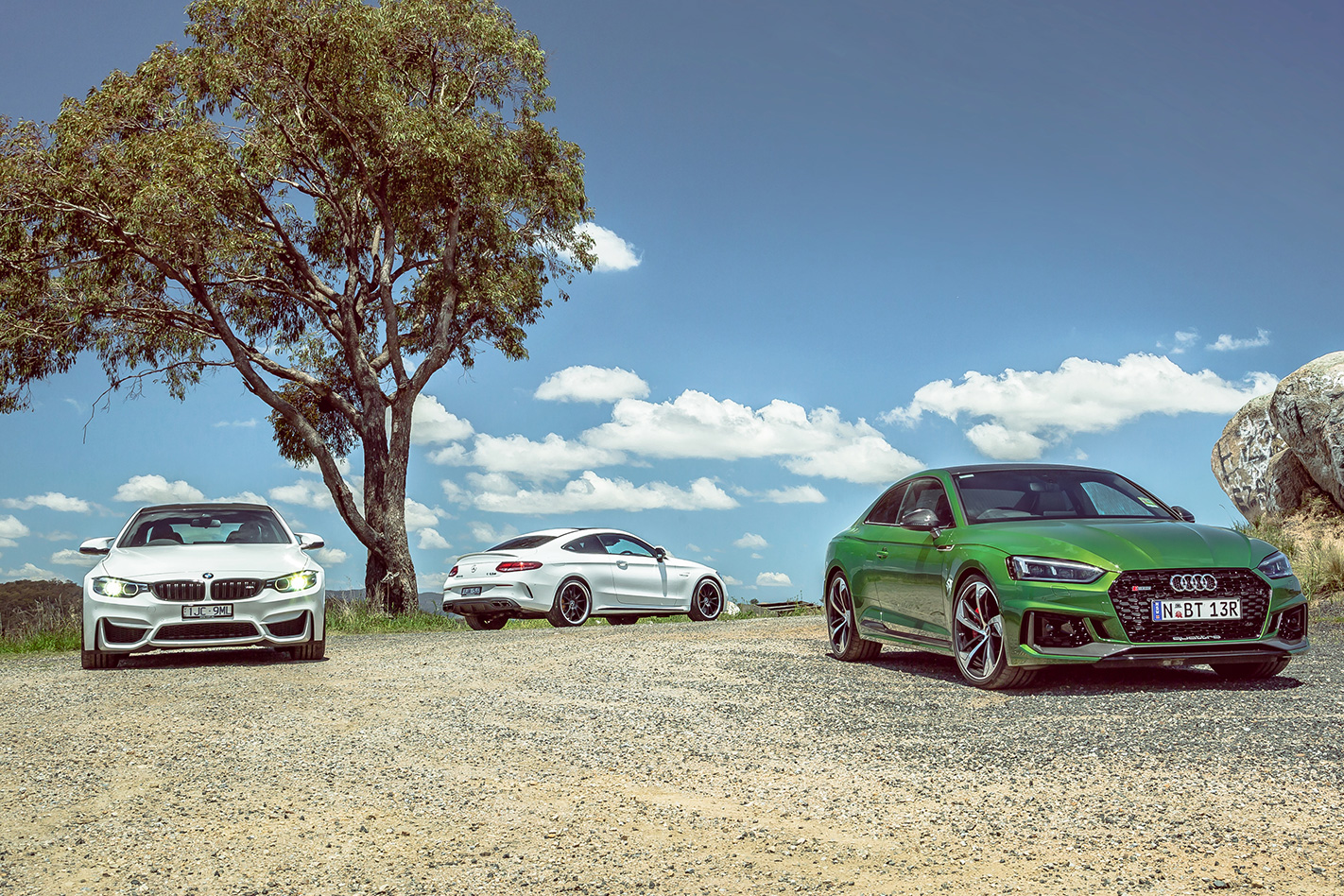
The premise of this test, therefore, is to discover whether the latest RS5 comes from the ‘good Audi’ that brought us those aforementioned gems or the other bunch, the crew who gave us the 2010 RS5 V8, a true collector’s piece for the connoisseur of plough-on understeer. Even if it’s from the former camp, it’ll have its work cut out against the BMW M4 Pure and the Mercedes-AMG C63 S Coupe. The M4 doesn’t brook too many surprises, the M3 Coupe/M4 bloodline representing a durable class benchmark.
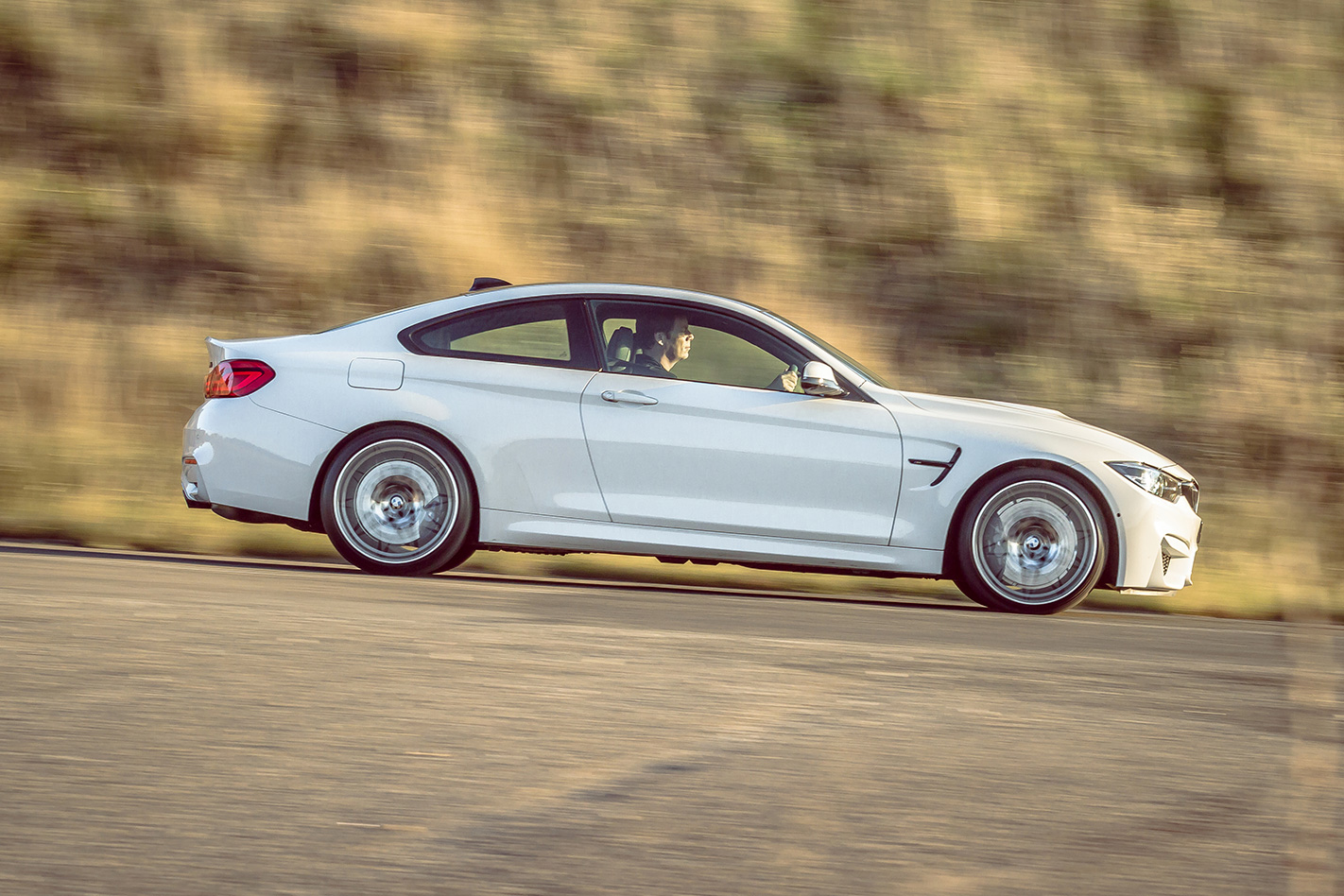
The Pure trim is an Australia-only model that strips out big-ticket items like adaptive LED lights, leather and premium audio system. Mechanically, it only differs from the M4 Competition by switching from 20- to 19-inch alloys. The Pure shares the Competition’s 331kW/550Nm 3.0-litre twin-turbo six and has an identical suspension tune, though our test car featured the 20s optioned back in (for $2500 more). With a $139,000 base price, the M4 Pure is comfortably the most affordable car here.
The AMG has clearly been on the juice, now sporting muscular wheelarch bulges, fat rubber and an aggression that’s entirely absent from its comparatively snake-hipped C43 sibling. The pugnacious stance works well, this remedial work fixing the standard coupe’s rather apologetic rear end. The only V8 of the trio, the 375kW/700Nm 4.0-litre Merc fronts up with the most grunt and the heftiest sticker price of $163,612. Add $9900 to that to get the car as tested here, complete with AMG ceramic front stoppers.
Slotting neatly between these two bookends comes the 331kW/600Nm 2.9-litre V6 Audi RS5 which has been sensibly pitched at $156,600. The eye-catching Sonoma green paintwork, an extended carbon package (including the roof and engine cover) and a Technik package, which includes colour head-up display, Matrix LED lights and a Qi wireless charger, bumps that up to $179,346 as-tested.
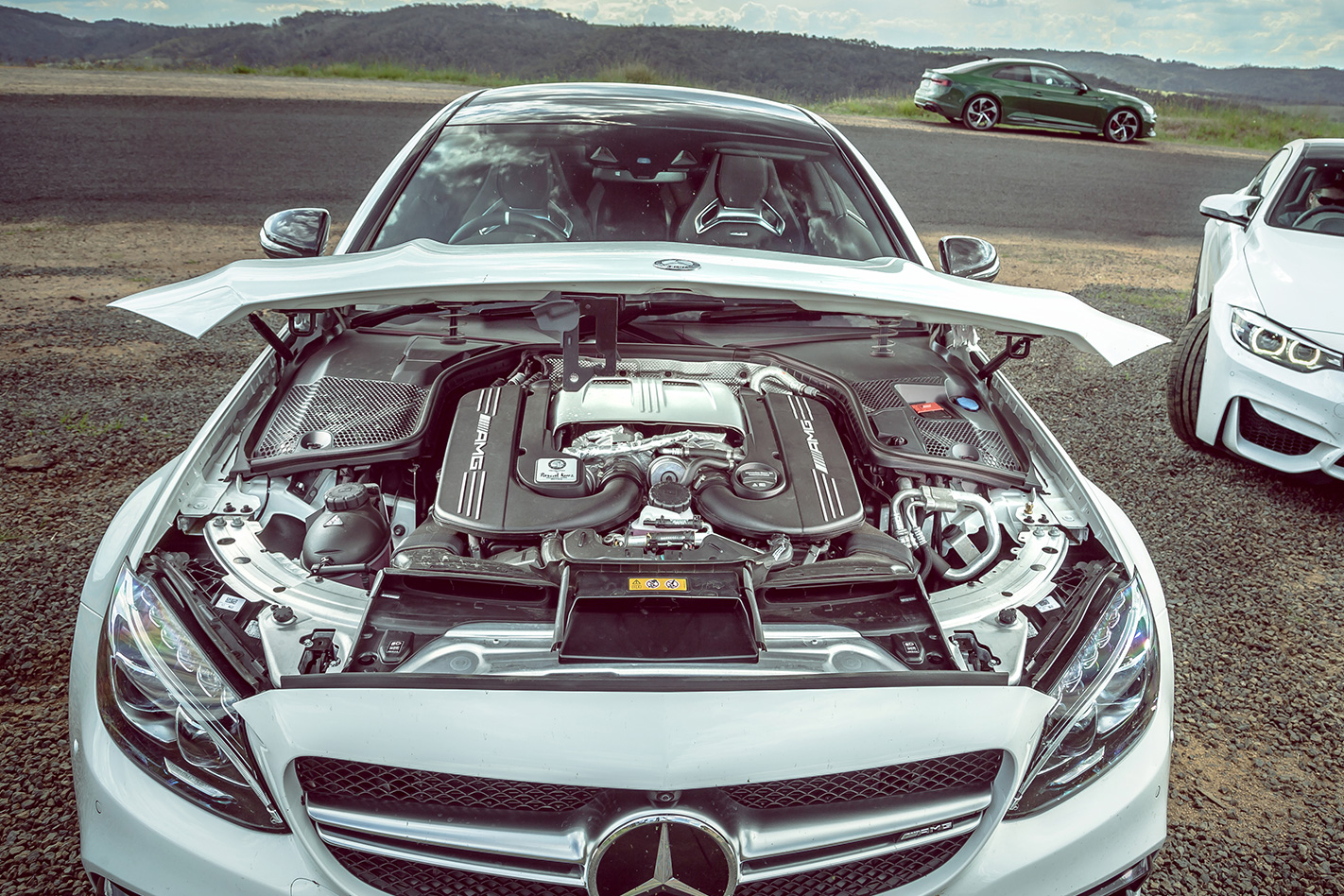
FIRING UP more than 1000kW of aggro at 6am is going to make you unpopular, even in a town as octane-addled as Bathurst. The Merc’s bent-eight emits exactly the correct frequency to turn motel windows into giant drum skins, bleary-eyed curtain twitchers unable to figure out at which miscreant to direct their stink eye. It’s a fat, meaty wub-wub with an old-school appeal that sounds anything but turbo-neutered. The M4 is the midrange, with the RS5 adding some tinnitus treble to really round out the sonic barrage.
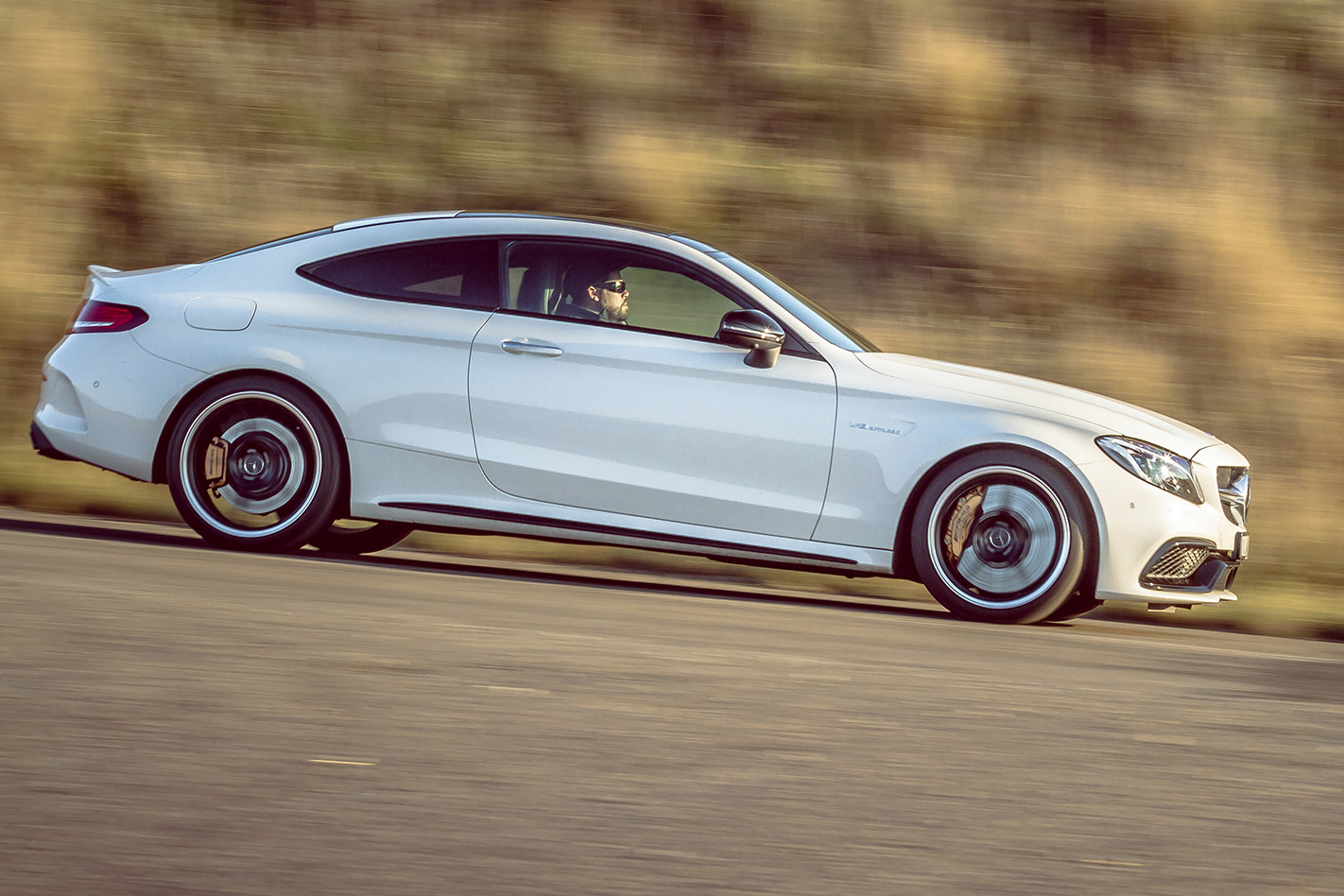
Received wisdom has it that the C63 S is going to be cast as the hooligan here, the point-and-squirt hot rod that’s long on drama but light on subtlety. It plays up to that casting, initially at any rate, with a wilful determination to bend the coding of its traction control software to breaking point and inflicting a ride quality around town that’s marginally better than setting off down the Dipper after zipping yourself into a hard-shell Samsonite roller. Race mode has your foot bouncing on the throttle pedal like a Tullamarine taxi driver with St Vitus’s dance.
By contrast, the M4 feels as if Munich has commissioned Tempur for the damper tune. By most normal measures it’s still firm, but there is a degree of suppleness that’s missing from the Benz. The bandwidth between the M4’s Comfort and Sport+ settings isn’t huge, certainly less than the C63’s arc between acceptable and vertebra-clacking, while the Audi effectively has two damper settings. Comfort is where you’ll stay almost all the time, giving the RS5 a genuinely plush GT car ride, with Sport being reserved for smoothly surfaced twisties. On typically scabby country roads the latter will have your head coming into contact with the roof lining a little too often for comfort. Kiss goodbye to your sunnies if you occasionally prop them atop your noggin.
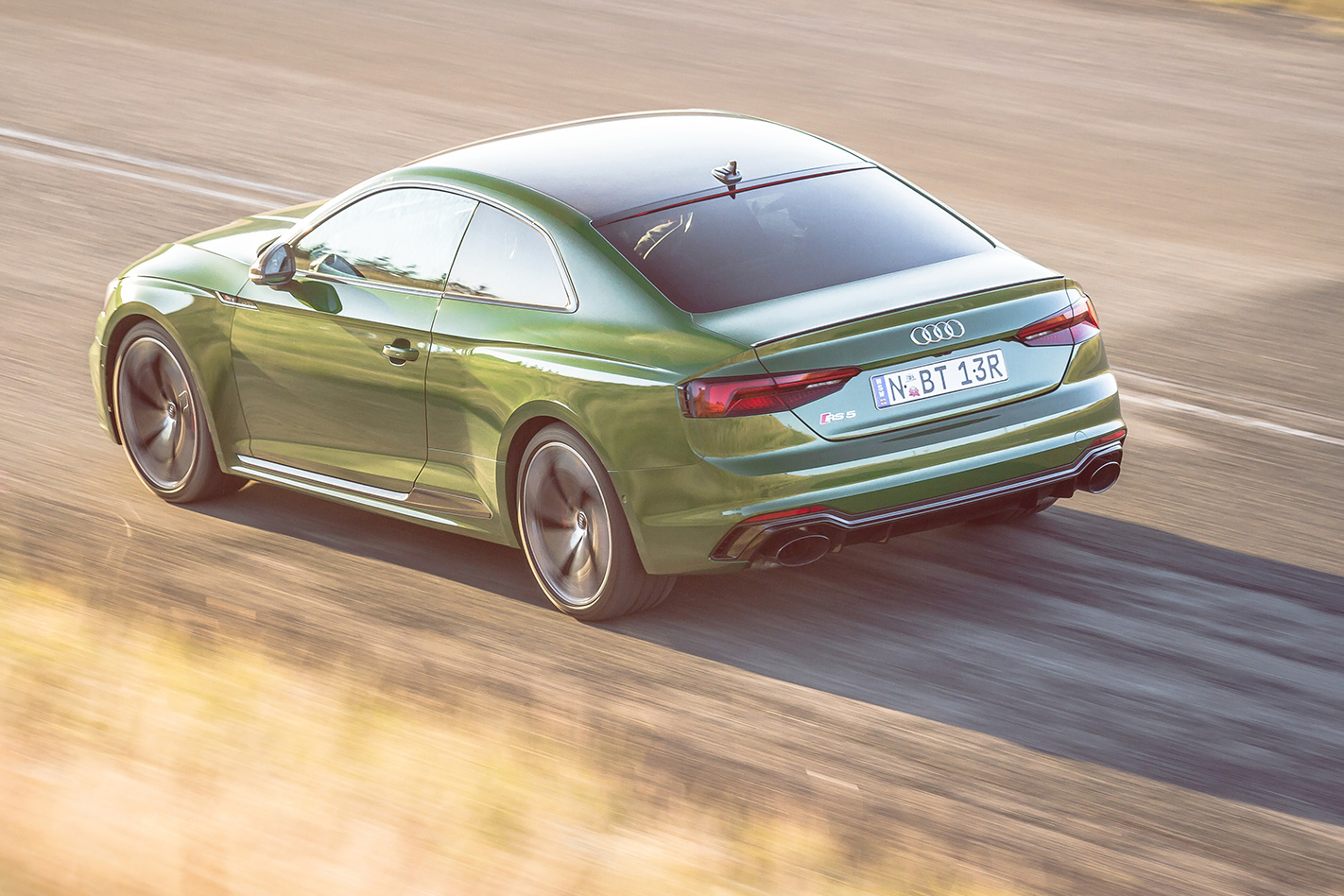
Snapper Wielecki has identified a suitably scenic corner for us to play on (33°33’18.22”S, 150° 8’36.31”E, if you’re interested), which requires a fair degree of commitment to make the cars look lively for his Canon. It’s here that the Mercedes shines, with just enough reassuring bodyroll and a beautiful, buttery transition into power oversteer.
Even with the ESC switched on, you can feel the electronic limited-slip diff smearing in and out, allowing just a spritz of rear end movement. In ESP Sport, it’s a whole lot more lenient, responding well to a gentle roll of the wrists. The weight of the engine makes itself felt if you’re lazy with your braking or ambitious with corner entry speeds but greater negative camber, stiffer bushings and a model-specific rear-axle carrier combine to give the C63 S a sweetly textural, benign feel at the limits of grip, belying its somewhat one-dimensional image.
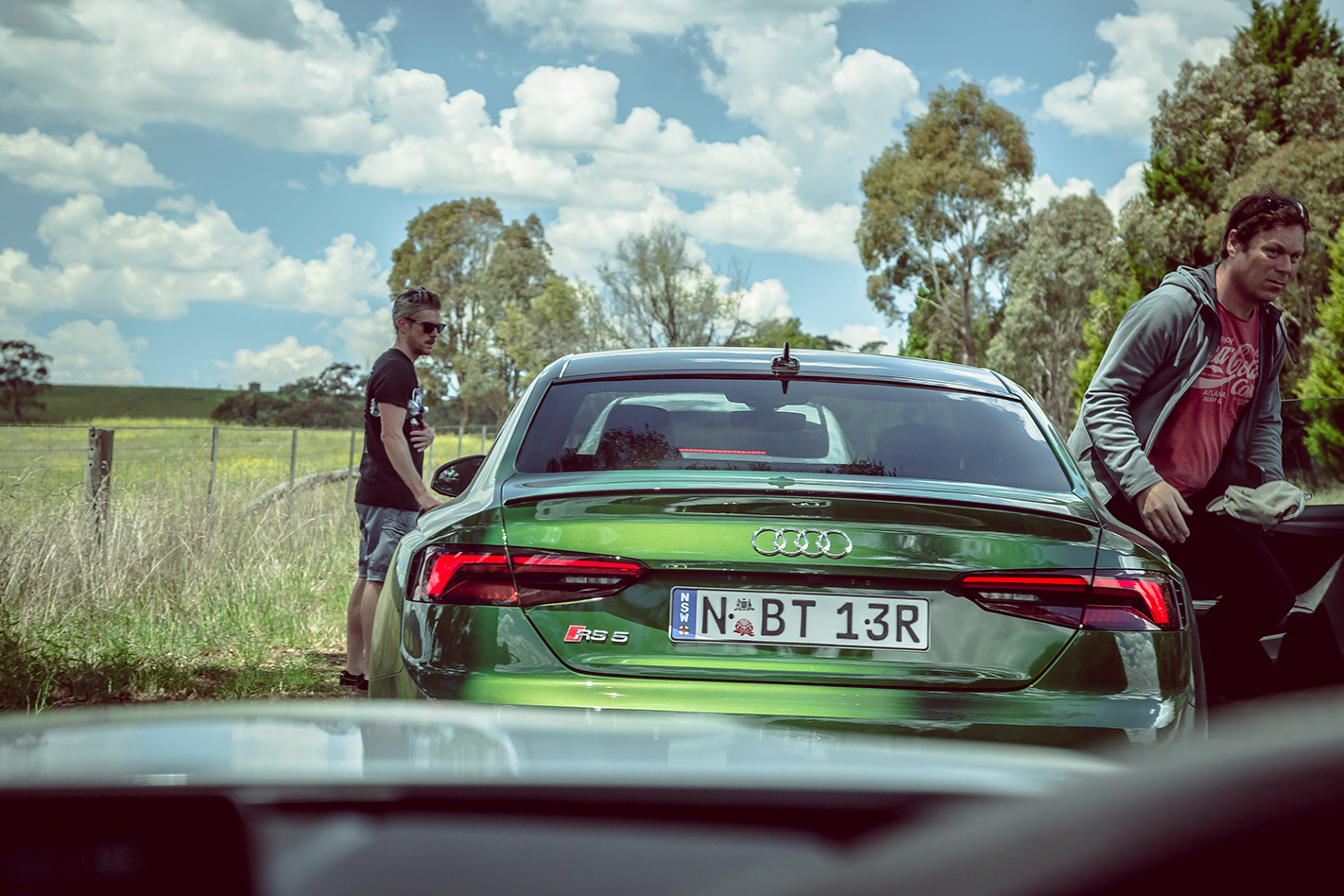
Rolling from throttle to brake reveals a slightly clunky pedal positioning, Mercedes – like many manufacturers – retaining a higher brake pedal than accelerator; a legacy of manual car heel-and-toe requirements. Out of the corner, the Mercedes feels the strongest, with a comical slab of torque arriving at 3000rpm and persisting with no let up to 5000rpm. The AMG-Speedshift 7 lets you hold a gear if the requisite button is engaged, but despite its surfeit of cubic centimetres, the AMG engine operates best in that 2000rpm band and the gearbox software has a better feel for this than you or I. The optional ceramic front stoppers help shrug off the car’s 1725kg heft and, unusually for carbon picks, are easy to modulate, representing a key point of difference between Affalterbach and Munich.
The M4’s four-piston front brakes are the weakest aspect of its dynamic palette. It’s a perennial M-car complaint but BMW doesn’t seem to be listening, deeming them sufficient for fast road driving. That’s also open to question, the pedal going long after a few committed applications on a downhill stretch. The M4 also suffers from oversteer. Perhaps that needs qualification. Unexpected oversteer has given more than a few drivers a case of the frights and much of that may well be caused by the Active Sound symposer.
Between 2500 and 3000rpm, the sound piped into the cabin is a muted, deep rumble. It doesn’t sound particularly potent, yet at this point in the rev range, the engine’s making its full slug of 550Nm; more than enough to light up the rears. BMW claims the symposer makes up 2-3 percent of the sound with the rest natural, but the careful wording of its claim is disingenuous. Listen to a car with the symposer disabled and it’s markedly different.
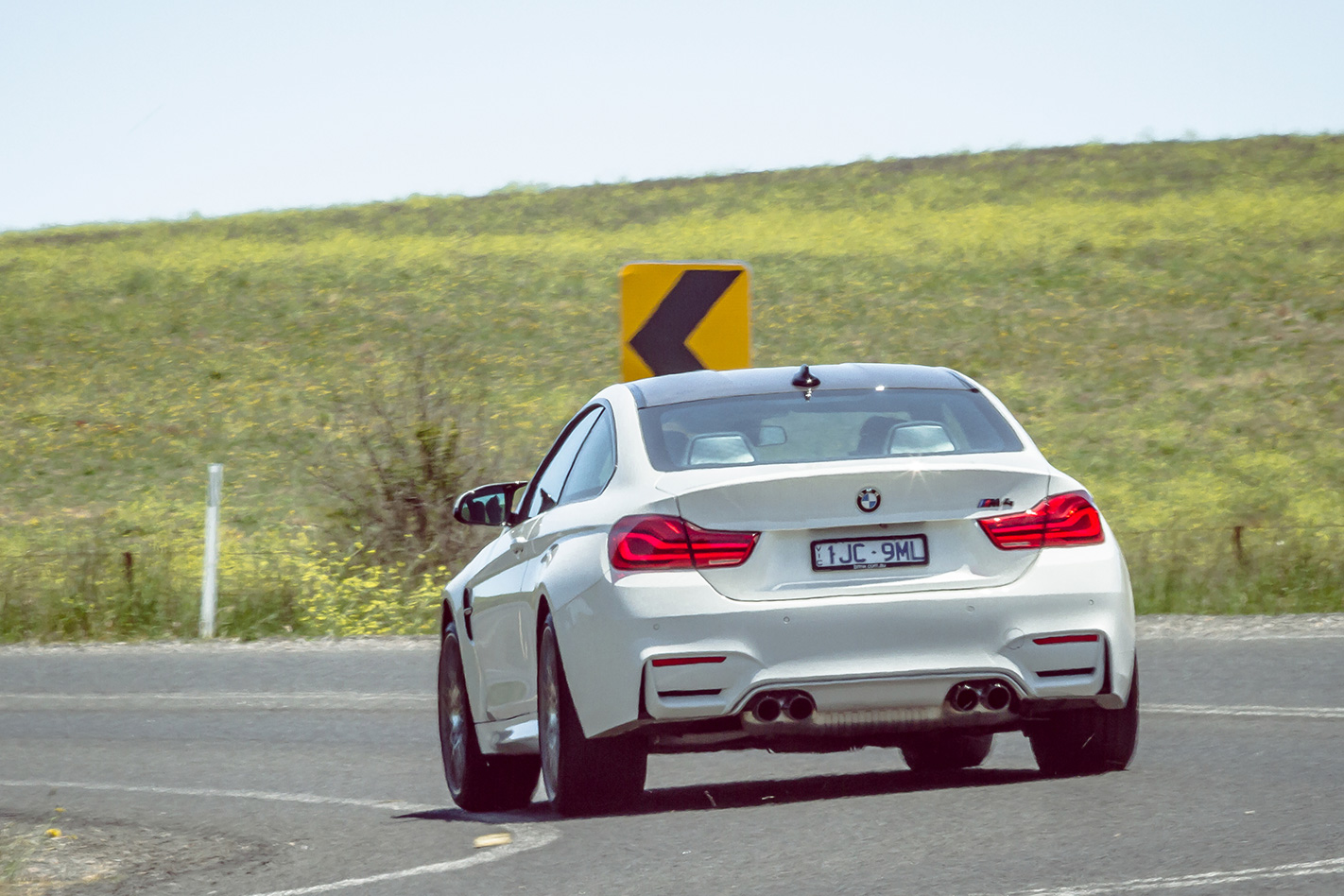
This is what’s spooked so many, the weird disconnect between what’s happening at their ears and what the rear contact patches are having to contend with. In short, oversteer arrives before you expect it and it’s spikier than the AMG, the BMW’s Michelin Pilot Super Sport rubber being less forgiving than the more malleable ContiSportContact 5P boots on the Benz, which exhibit a more manageably ramped transition from grip to slip. The M4 also has the loosest body control of the trio and requires a little more consideration when flicking from corner to corner.
Get into the RS5 after a committed blat in either of the other two and it feels as if you’re wearing noise-cancelling headphones. The Porsche-developed V6 (you’ll find similar ironmongery under the bonnet of the Panamera 4S) sounds a little too mannered, even when given a merciless prodding. I found myself clicking my jaw because I thought the altitude drop on the road had caused my ears to need popping. No, it’s just a lot quieter. Quieter and quicker. The numbers against the stopwatch tell a compelling story and there’s little doubt that on a gnarly cross-country route, the other two wouldn’t see where the RS5 had gone. It gives so much and asks for so little in return, which is both its greatest talent and most significant shortcoming.
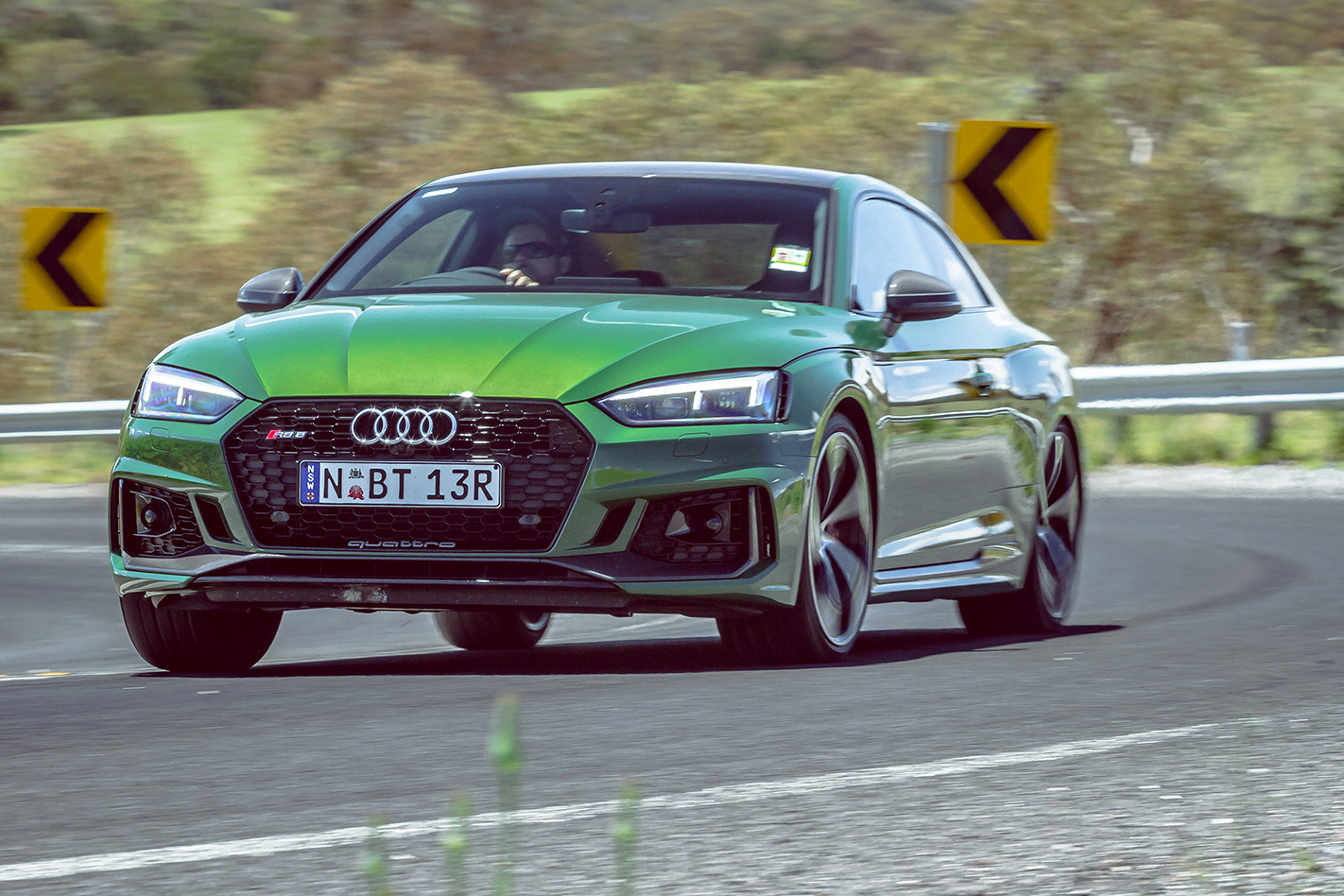
The steering, even in Dynamic mode, is a bottle of Pure Blonde to the AMG and M4’s steins of Warsteiner. The front end of the RS5 is predictably mighty, with huge grip aided by the widest tyres of the trio, 275/30ZR20 ContiSportContact 6s. Try to get the car to misbehave and it all gets a bit reluctant, the 40:60 rear bias seeming to promise a level of throttle adjustability that the Audi isn’t keen on indulging. It’s undeniably effective at demolishing a string of corners, the new five-link rear end replacing the trapezoidal-link arrangement that underpinned the old car. It should be noted that Aussie cars feature the quattro rear sport differential – an option on Euro models – which delivers a greater percentage of fun to the outside rear wheel.
The V6 is freakish in its sheer relentlessness, with instant go from 2500rpm right through to the redline. There’s next to no let-up. The only automatic gearbox of the trio makes a solid partner, slurring up and down ratios almost imperceptibly, holding gears to the limiter if you prod the lever to the left and being way slicker in its operation than the stalk-mounted Benz shifter or the maddeningly over-complex BMW contrivance. Audi scores a minus point for getting the shift action the wrong way round though. And on an RS model too. Tut.
The RS5 delivers the most refined cabin of the trio at cruising speeds, although loose chip surfaces set up some extravagant tyre rumble. The Mercedes is all exhaust boom, with or without the extra noise button engaged, while the BMW is largely civilised below 4000rpm, whereupon it all starts getting a bit exciting. While the Audi boosts its GT credentials with impressive driveline civility, it scores a few surprising ergonomic demerits.
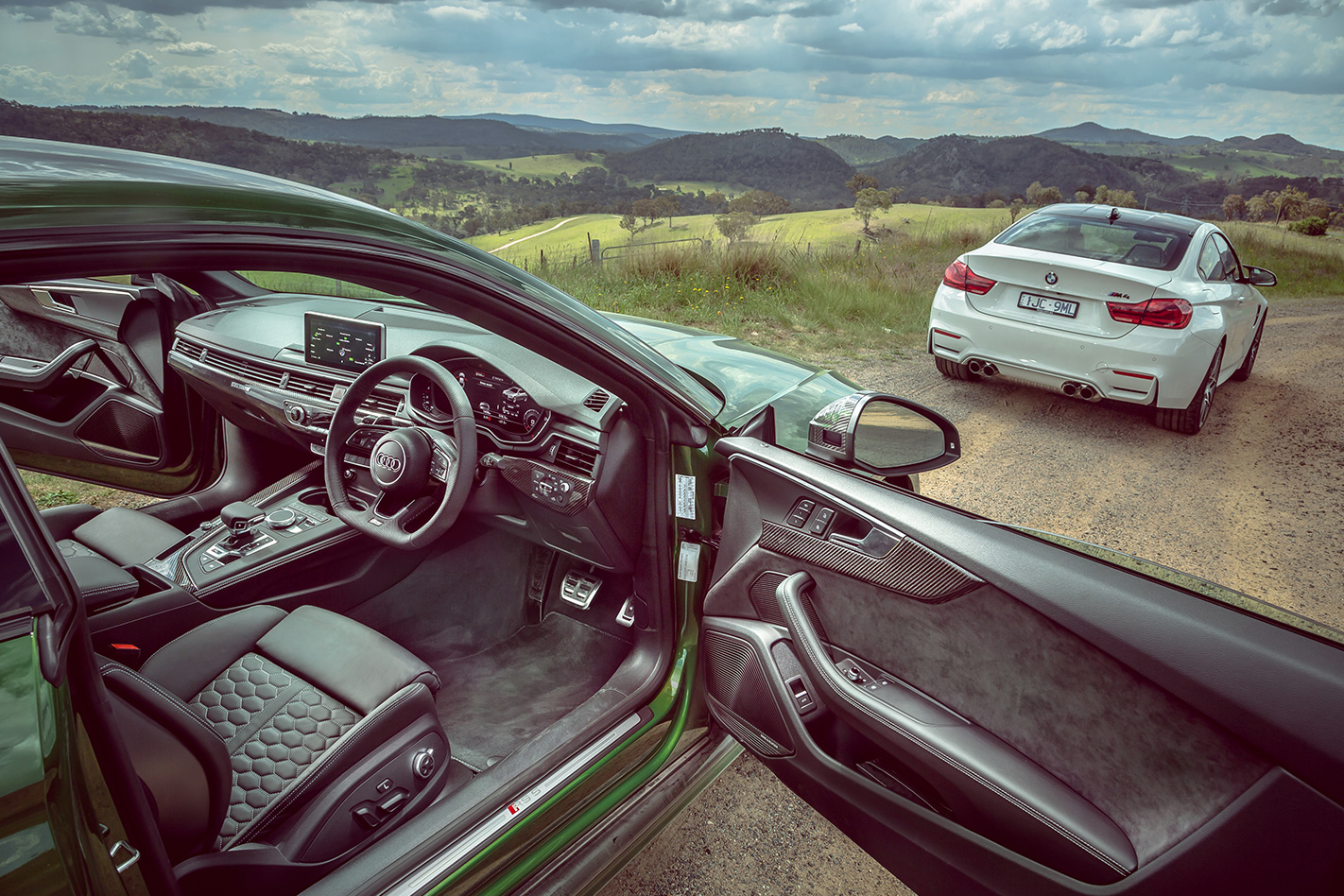
The cabin is undeniably gorgeous, with hexagon-stitched leather seats, beautifully judged materials quality and that showstopper wall-to-wall TFT virtual cockpit. Spend a little time with the RS5, however, and its compromises become apparent. The drive select button, a function you’ll use fairly frequently, is tiny and a long stretch away, evidence of lazy right-hand drive conversion. After fumbling for that, you then have a few seconds to grab at the MMI controller dial before the screen reverts to its previous setting. What’s more, the buttons are all but impossible to see in bright light, nestling beneath a line of angled silver toggle switches that reflect the sun.
The seating position is also too high for a coupe, robbing headroom and exacerbating the shortcomings of the RS5’s ride quality in Dynamic mode. The manual steering adjustment feels a bit cheapjack after the other two’s slick electric rake and reach settings. Access to the rear is slightly better than the AMG and a good way worse than the M4, although once in, it feels snug and far from claustrophobic. The rear also has the best array of storage options, and it’s the only back seat of the three to get its own dedicated temperature control for the air-con.
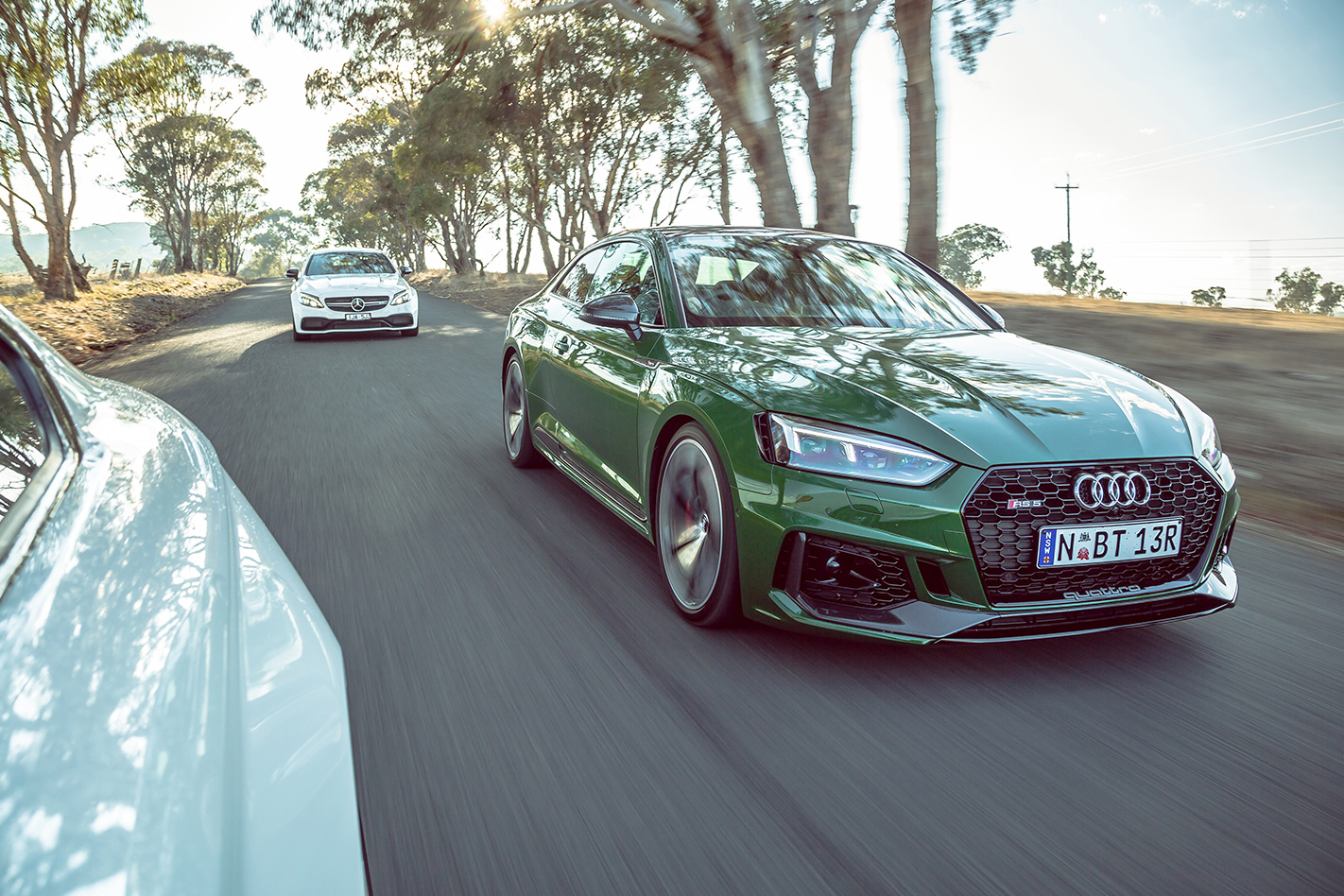
The buttons to slide the front seat back and forth are considerately located on the upper side of the chair, unlike the M4 which positions them in plain sight on the back of the seat, which is always going to be too much of a temptation for evil offspring or drunken mates. Visibility out of the RS5 isn’t bad, with the slimmest A-pillars but the fattest B-pillars.
Styling? You’ll need to be the ultimate arbiter of that, but the Audi attracted a lot of interest. That complex, hue-shifting optional paintwork was a factor, but the RS5 is a striking car. It’s not as pretty as the original A5 shape, Walter de Silva’s finest moment, but it’s a confident and assured piece of vehicular sculpture. The AMG’s glitzy shtick will, for many, justify its elevated price tag. Great seats and showy alloys aside, the M4 looks slightly dull. This alone ought to be enough to guarantee the RS5’s success, from a sales perspective at least.
We don’t count registrations as the fairest way of keeping score. We never have and never will, so it’s time to crown a winner of these three cars. The M4 is undoubtedly the most flawed of the trio, yet it’s a car that rewards an extended period of acclimatisation. What’s more, there’s real bite and character to it. Yes, it’s finishing this test third, but of the three, it’s the only one I reckon you’d grow to love, and it’s the only one that’s also offered with three pedals. The Pure model probably ought to be a simpler, rawer thing, and that car doesn’t exist as yet. The M4 CS shows what can be done but, to put it bluntly, its price is a joke, even allowing for its more recent haircut. Model by model, BMW continues to just miss with the M4, like a sniper repeatedly overcompensating the adjustment on a scope.
The RS5 is an interesting one. It excels on so many objective counts that were we totting up scores, it’d undoubtedly emerge with the biggest number. It’s the newest, slickest, most economical, and quickest on a challenging road, but it never connects with the driver on any significant emotional plane. It’s more ‘good Audi’ than bad, but it emerges as a bit of a curate’s egg: it’s a melange of overpolish in some areas and somewhat underdone in others. Its optimum ride/handling setting is, frustratingly, somewhere smack between the binary Comfort and Dynamic modes and that engine needs more attitude and flintiness to it.
Which leaves the Mercedes-AMG as last man standing as the other two manage to count themselves out. Yes, the ride could be better and the shouty design will dissuade some but, unlike both of the others, this is a car that doesn’t seem to take itself too seriously. This impishness is infectious and encourages you to have a little fun. It’s less one-dimensional than you expect which, admittedly, is not saying much, but it nails a brief that AMG seems to understand better than the others. It’s about an experience removed from the ordinary and the C63 S drenches you in just that from the first prod of the starter button. Notch another one up for Affalterbach.
WITH just 10 laps remaining in the Mexican Grand Prix, Daniel Ricciardo was in a good position to score a podium position.
Starting from pole position, Ricciardo had driven a hard-fought race, and was shaping up to defend against a hard-charging Sebastian Vettel in the closing stages of the 71-lap grand prix.
Then it happened.
A white wisp of smoke expunged from the exhaust of his Renault-powered Red Bull.
Just a handful of corners later, and it was all over, and Ricciardo was climbing out of his car, not having finished a grands prix for the eighth time this season.
The loveable Aussie had put together a masterful lap in qualifying to deny his lauded teammate Max Verstappen pole position, telling TV cameras afterwards he was “tripping major nutsack”.
Ricciardo’s retirement was his 11th in the last 23 races.
During the grand prix it was all Verstappen, who made a strong start to lead the opening lap. It was a position the Dutchman would not relinquish throughout the race.
Ricciardo then scrapped with Lewis Hamilton for second place in the first half of the race, before the Briton made a mistake heading into turn four. Then it was Vettel’s chance to do battle with The Honey Badger.
The four-time champion finished second during the race, behind Verstappen, but it wasn’t enough to stop Hamilton claiming his fifth world drivers’ championship.
Only needing to finish seventh of better to ensure the title was his, Hamilton settled for fourth place on the day, with Kimi Raikkonen securing the final podium position.
Valtteri Bottas rounded out the top five, with Nico Hulkenberg, Charles Leclerc, Stoffel Vandoorne, Marcus Ericcson, and Pierre Gasly the other points finishers.
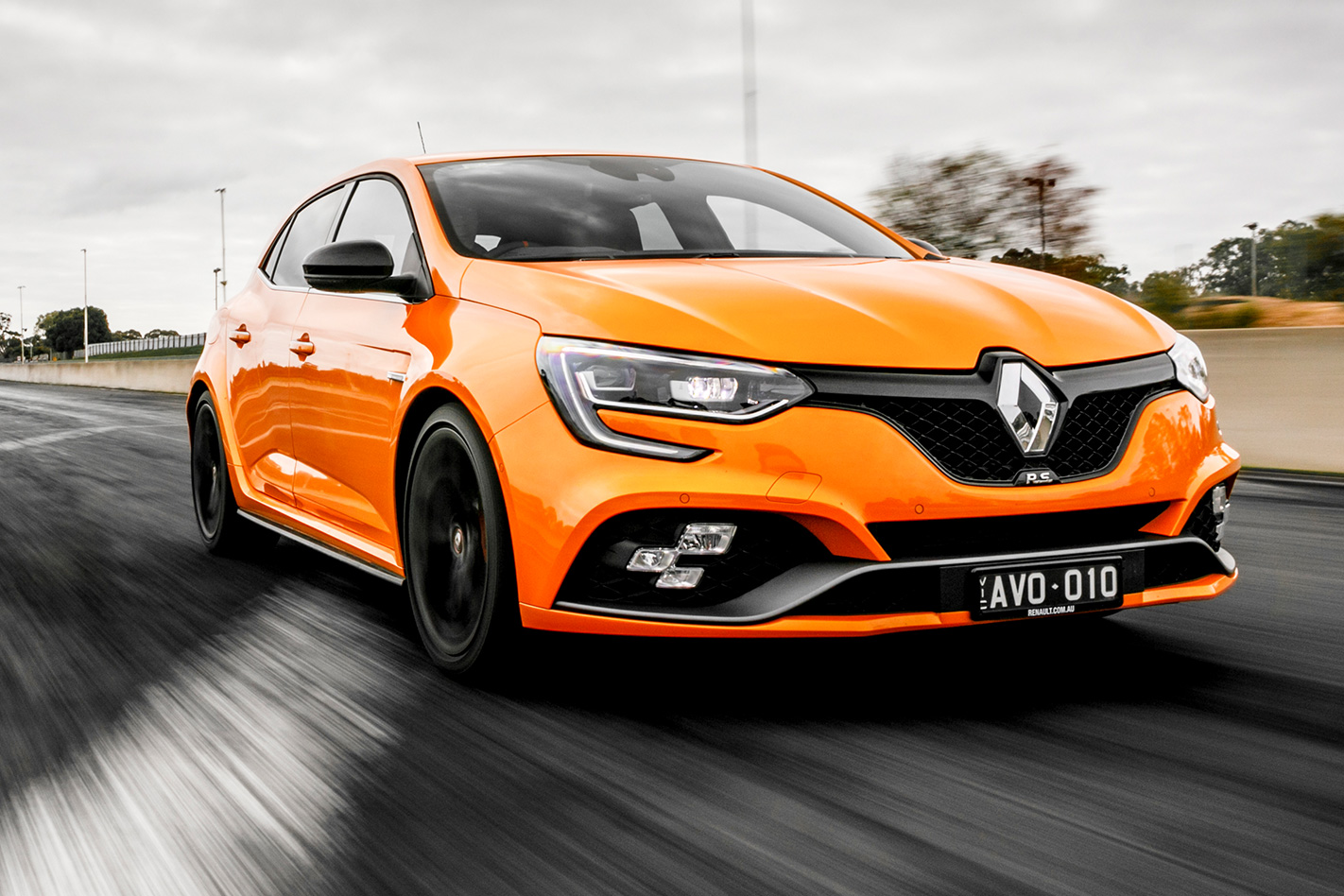
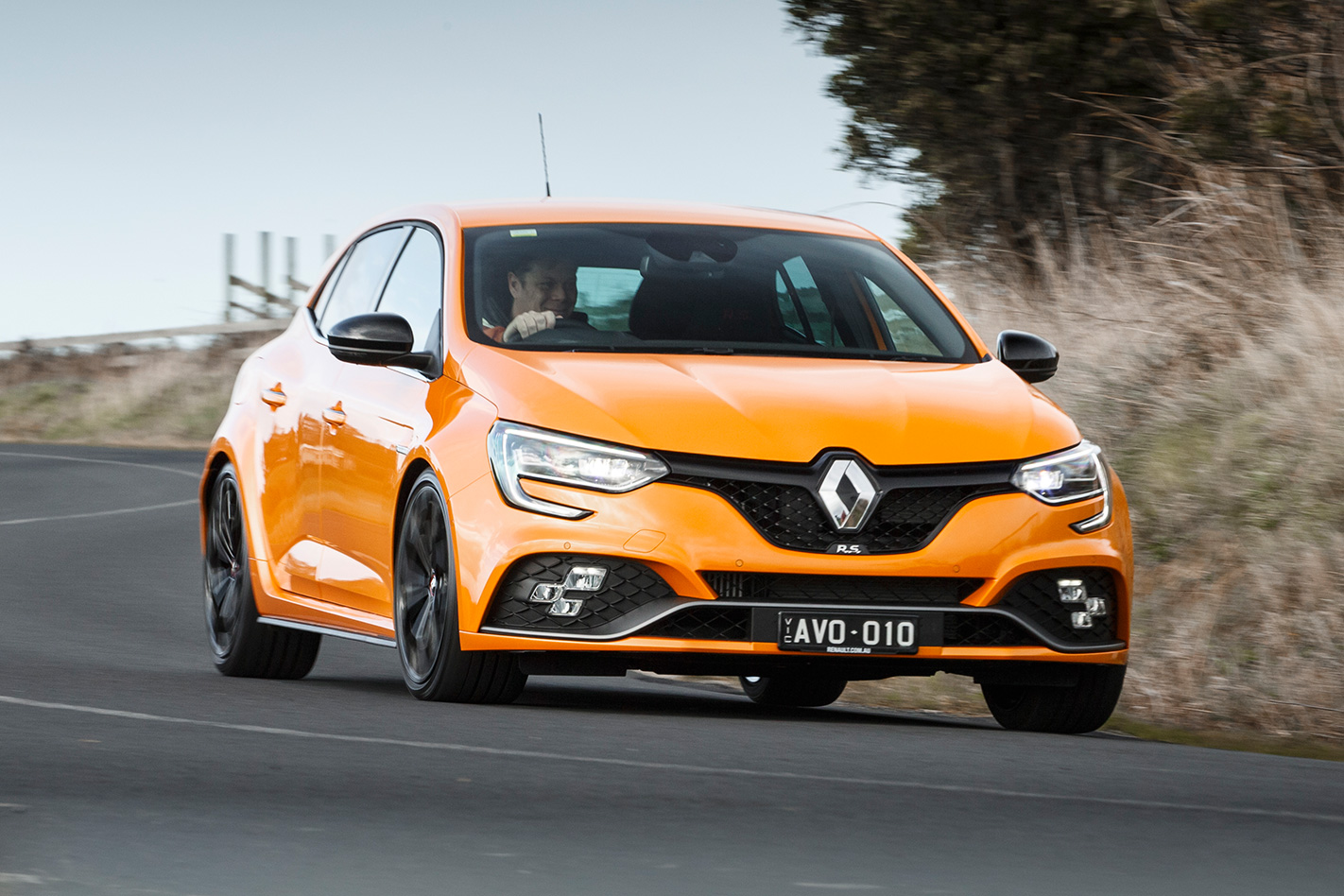
THIS ought to be terrifying. The road runs across a rolling plateau, open at first before diving downhill in a series of ever-tightening, wildly cambered bends. Fat gobs of rain spatter the windscreen. I’m attempting to keep the teardrop-shaped tail lights of the Hyundai i30 N somewhere ahead of the red ribbon that marks top dead centre of the Megane RS280’s steering wheel.
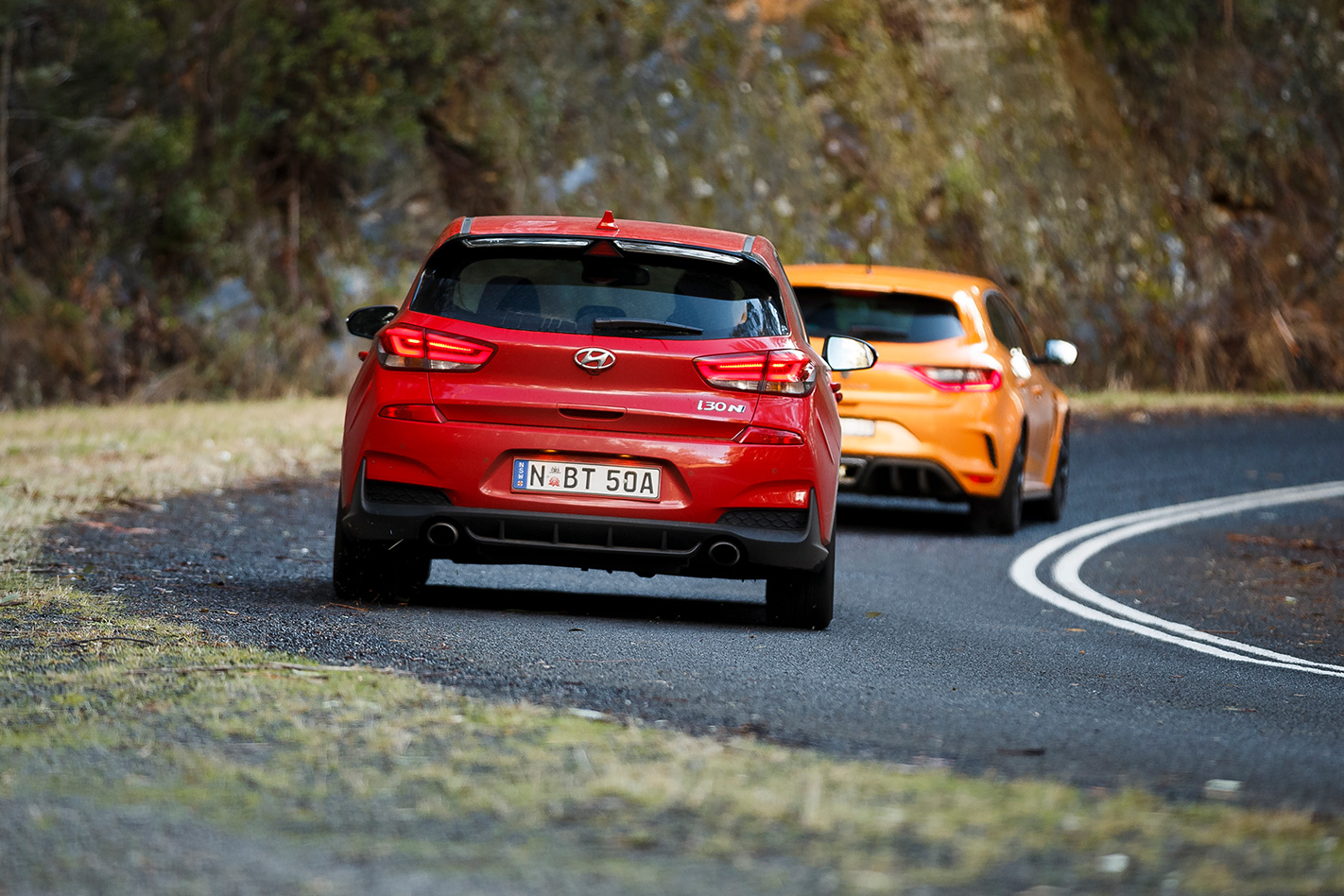
Rather than slowing for the corners we seem to be accelerating, sucked into the rainforest as if we’re in a venturi, having crossed some unmarked event horizon. Every once in a while, the Hyundai’s tail lights disappear mid corner as it yaws into a big tail slide, before blinking back out of the gloom, the tyres firing bark and leaves in twin vortices behind it. I’m laughing like an idiot. The Megane will do that for you.
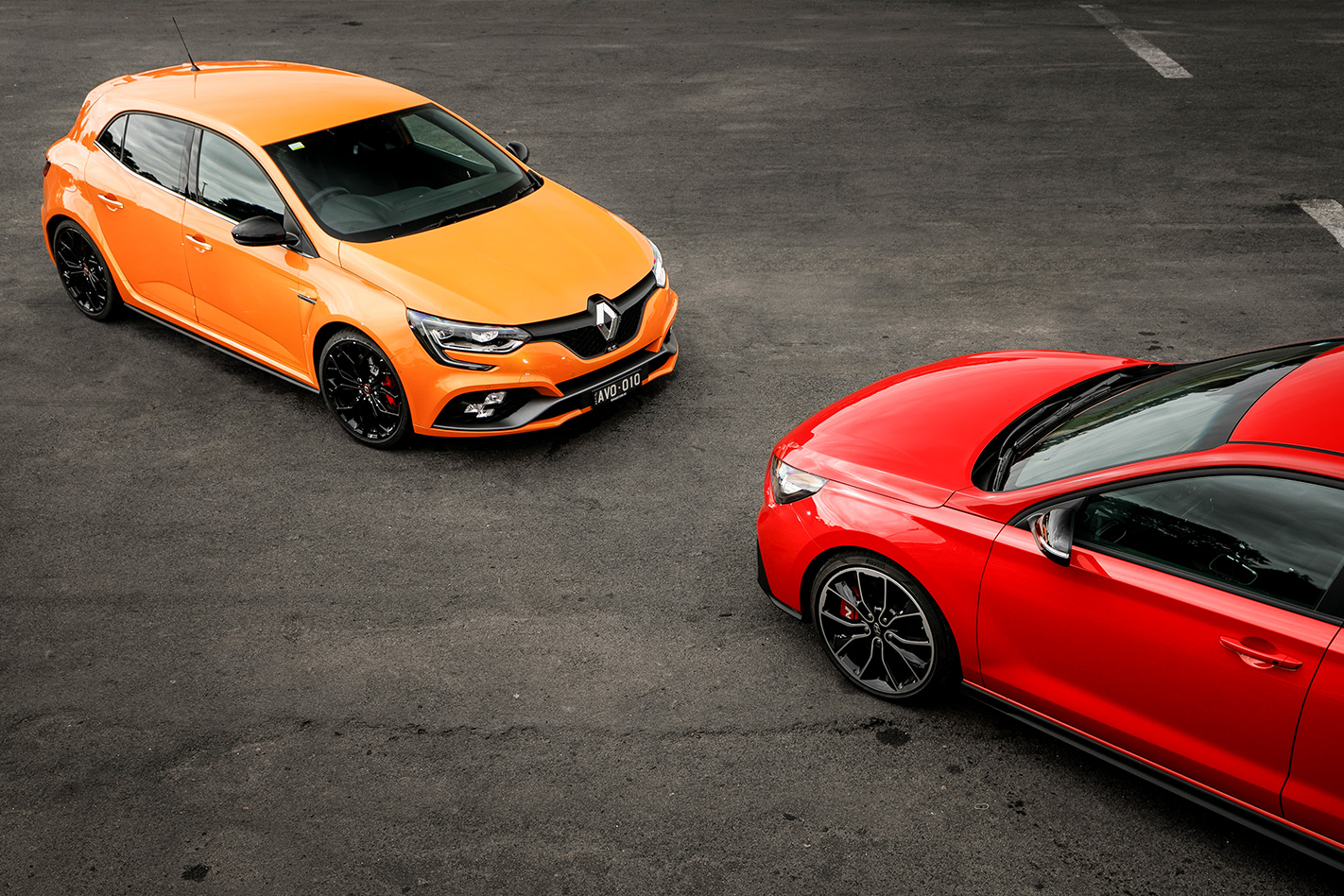
It didn’t take too long to figure out which car we ought to pitch the Renault against. The Hyundai i30 N’s beautifully judged blend of talents were enough to land it top spot on the podium in our hot-hatch showdown in the April edition. In order to establish itself as a worthy addition to the Renaultsport canon, the RS280 at least needed to level with the $40K Korean. At first, it seems as if the Hyundai stands little chance. The Renault’s overt display of bulging arches, gaping vents, big rubber and a rear diffuser that might actually do something makes the i30 N look distinctly underdone.
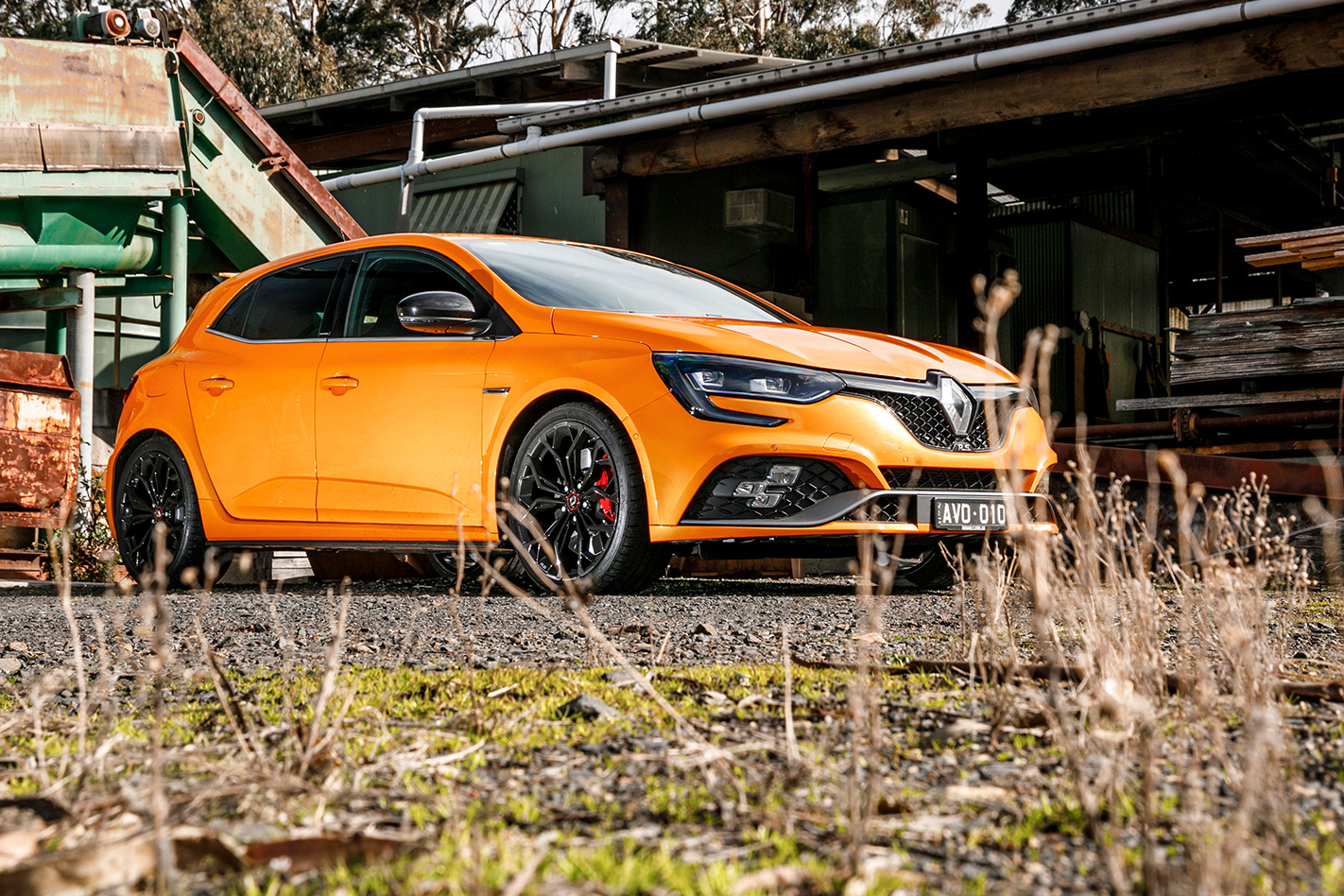
The Megane’s optional Tonic Orange signature paint finish also helped clone-brush the Hyundai into near invisibility. Still, there’s something to be said for a certain discretion, even if the early money’s all on the French hatch.
One thing that’s worth knowing from the outset. The 202kW Hyundai and the 205kW Renault are virtually line ball in terms of pace. At Heathcote the Megane was a mere tenth slower to both 100km/h and 400m than the i30 N, while on the open road, they’re impossible to separate. The red car is two kilos heavier than the orange one and while the Renault opens a torque advantage (390Nm vs 353), you need almost another 1000rpm on board to plug into peak twist action in the Megane.
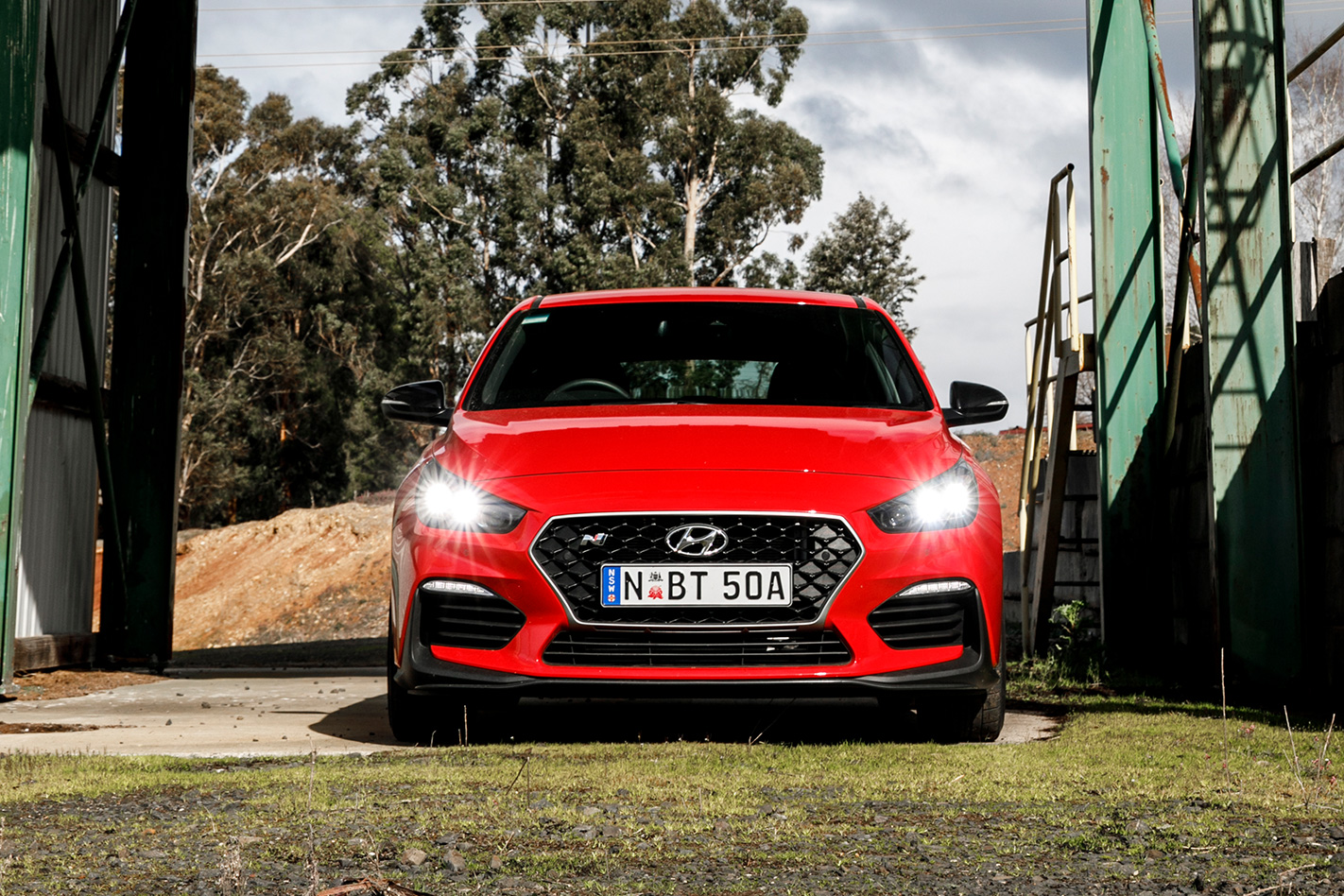
It’s clear that the Hyundai has a broader dynamic repertoire than the Renault, thanks in no small part to its adaptive damping. The suspension can be either more accommodating than the Megane’s or punchier, the drive modes easily accessed by the pale-blue steering wheel-mounted tabs. Thing is, one really well-sorted suspension setting always trumps a selection of so-so calibrations and the Renault’s is a gem. Like all the best Megane hatches, the RS280 with Cup chassis feels fluid at speed yet body control is excellent with brilliantly telegraphed transitions into understeer and, with a sharp lift of the throttle, oversteer. The stability control interventions are also malleable, if a little lax, but in Race mode it switches them out completely.
Despite the fundamental excellence of the RS280’s chassis, there’s a thin but impermeable membrane of artifice that sits between the Renault’s contact patches and you. The 2.7-degree four-wheel counter steer can suddenly and unpredictably alter the car’s centre of balance to a point over your left shoulder, as if you’ve suddenly taken up the slack on a steel hawser tethered to the corner apex. The first time it does it, you think it’s the diff dragging you in, but you’ll feel it even off-throttle.
Then there’s the fact that the steering, which, unlike Ferrari’s system that retains speed of response when you need it most – that is when you’re really piling on the big numbers – the Megane’s rack initialises its 1.0-degree virtual long wheelbase set-up when you’re looking to attack a corner hard. A little more often than necessary it feels as if you’re reacting to the Renault rather than dictating to it. It’s undeniably effective, though, and huge fun when you tune into its nuances. It makes a Civic Type R feel a little straight-laced in comparison.
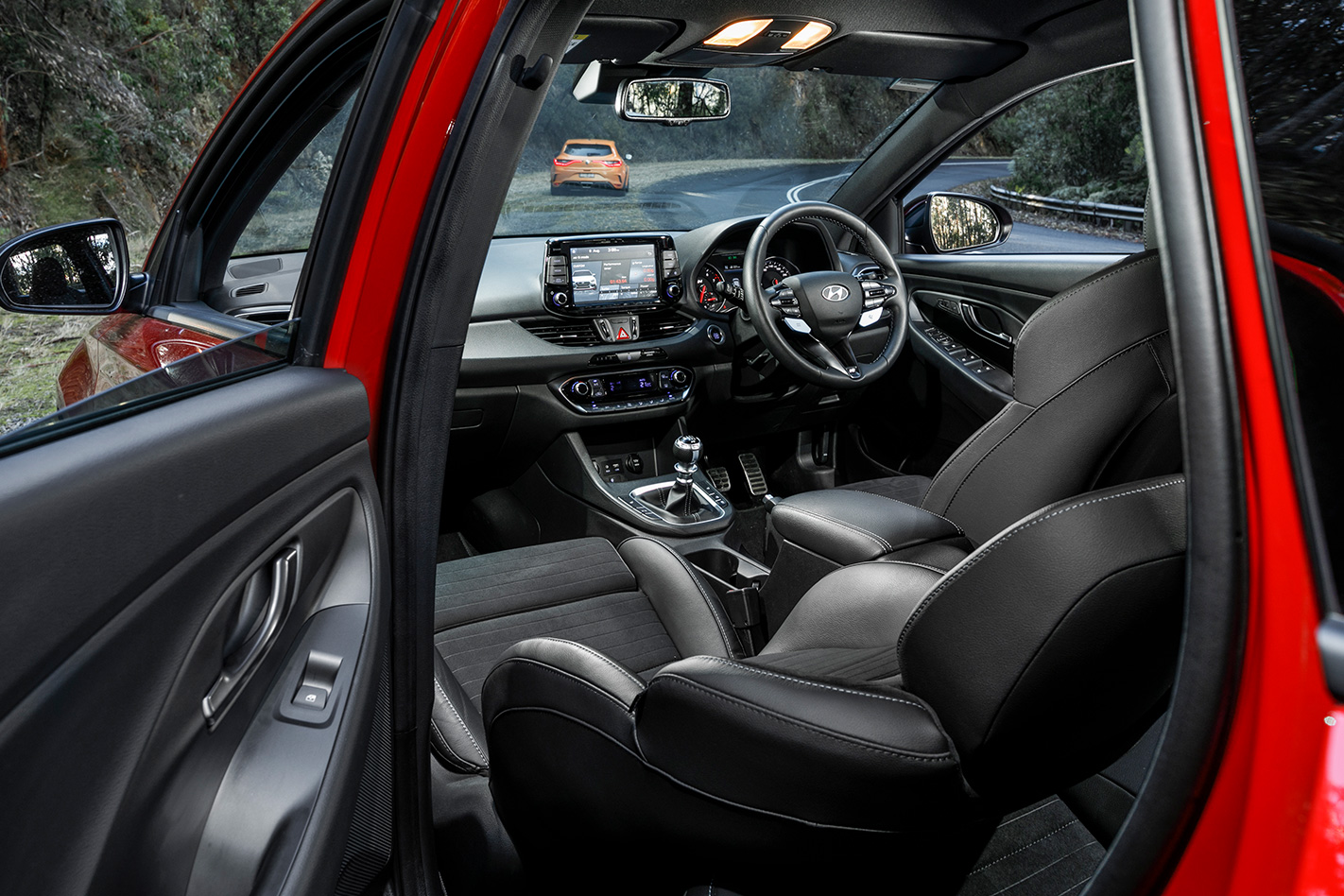
The Hyundai, which came in looking wholly outgunned, more than holds its own. Switch it into N mode on smooth roads or, on scabbier bitumen, the custom setting that offers all the angriness but with the softer damping, and it feels puckishly no-nonsense. It’s almost as easy to swing the back out and get the nose engaged into a corner, the i30 N just feeling a little edgier in yaw, due in no small part to a slightly shorter wheelbase, both real and virtual. The Hyundai’s gearchange is night and day better than the Renault’s, offering a well-oiled slickness allied to pedals that are better weighted for heel and toe downshifts. If you can’t be bothered with that, Hyundai also offers switchable rev matching like that in the Civic Type R.
The i30 N sounds fiercer than the Renault too, its engine cammier and more characterful at idle, while delivering a cleaner build in volume and a more extrovert set of bangs and crackles on the overrun. By contrast, the Megane’s fireworks sound muted, our testers convinced at first that they were coming from the rear speakers rather than the tailpipes.
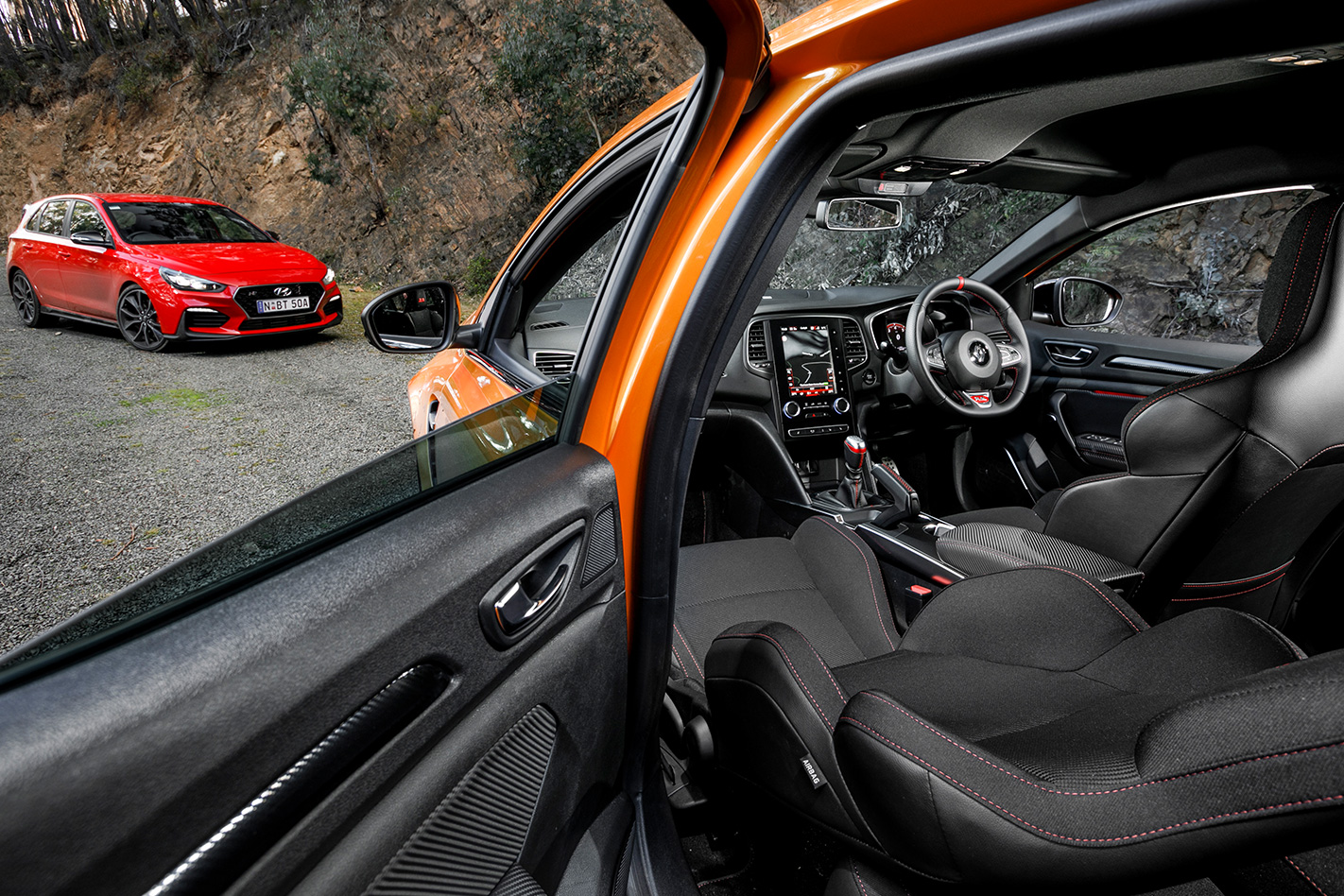
There’s little doubt that the RS280 looks tougher and has more going on inside. The Hyundai feels a little too close to the cooking i30s and the seating position feels too high, whereas the Megane cocoons you low and piles on one sporting cue after the other. In the showroom, the Renault appears to easily justify the price differential of $5K between a base RS280 and an i30 N, and the loyalty of hardcore Renaultsport fans and hard-won credibility of the badge cannot be underestimated. That RS badge has become a guarantor of a certain level of excellence.
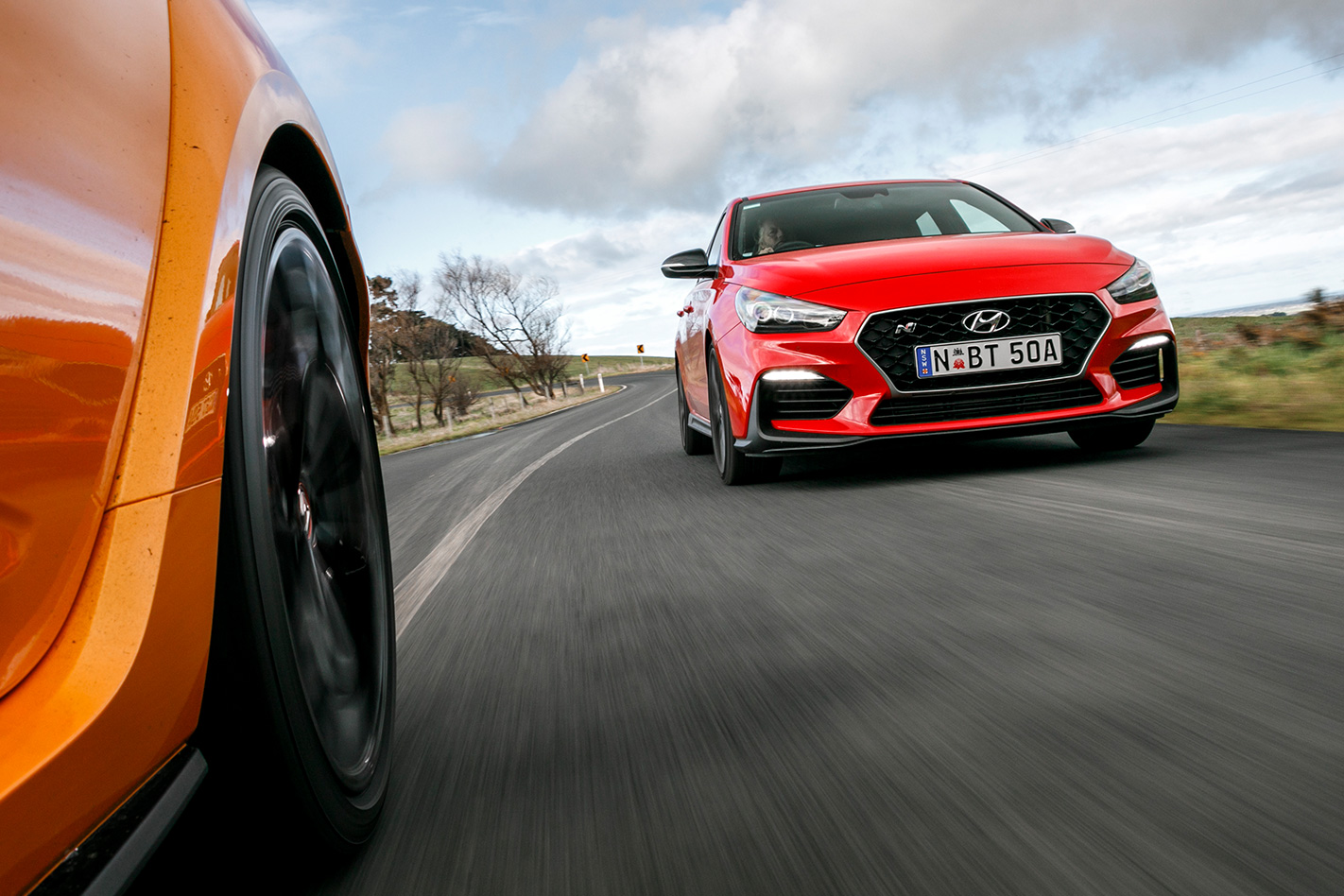
Buyers will be rewarded with a hot hatch that goes straight into the top drawer of current contenders. What they won’t get is a better car than the Hyundai i30 N. Drive the Megane at absolute ten-tenths and it probably has a veneer of talent beyond even the i30 N. That’s fine for the odd track day but requires a level of commitment incompatible with public roads. For the huge majority of the time, the Hyundai is a more satisfying and more rounded proposition. Cheaper, just as quick and possessed of a broader skillset, it does enough to get the nod here.
The decider comes upon the realisation that were you interested in a Megane with serious track day chops, it’s likely that you’ll sit on your money until the 220kW Trophy model with bimodal exhaust, Recaro seats and super-sticky Bridgestone S007 rubber arrives in 2019. That’ll be the one that uncorks all of the Megane’s potential and sends us into paroxysms of hyperbole. So it’s a familiar story from Renaultsport then. The RS280 is good, but we’d hold out for something better. It’ll likely be worth the wait.
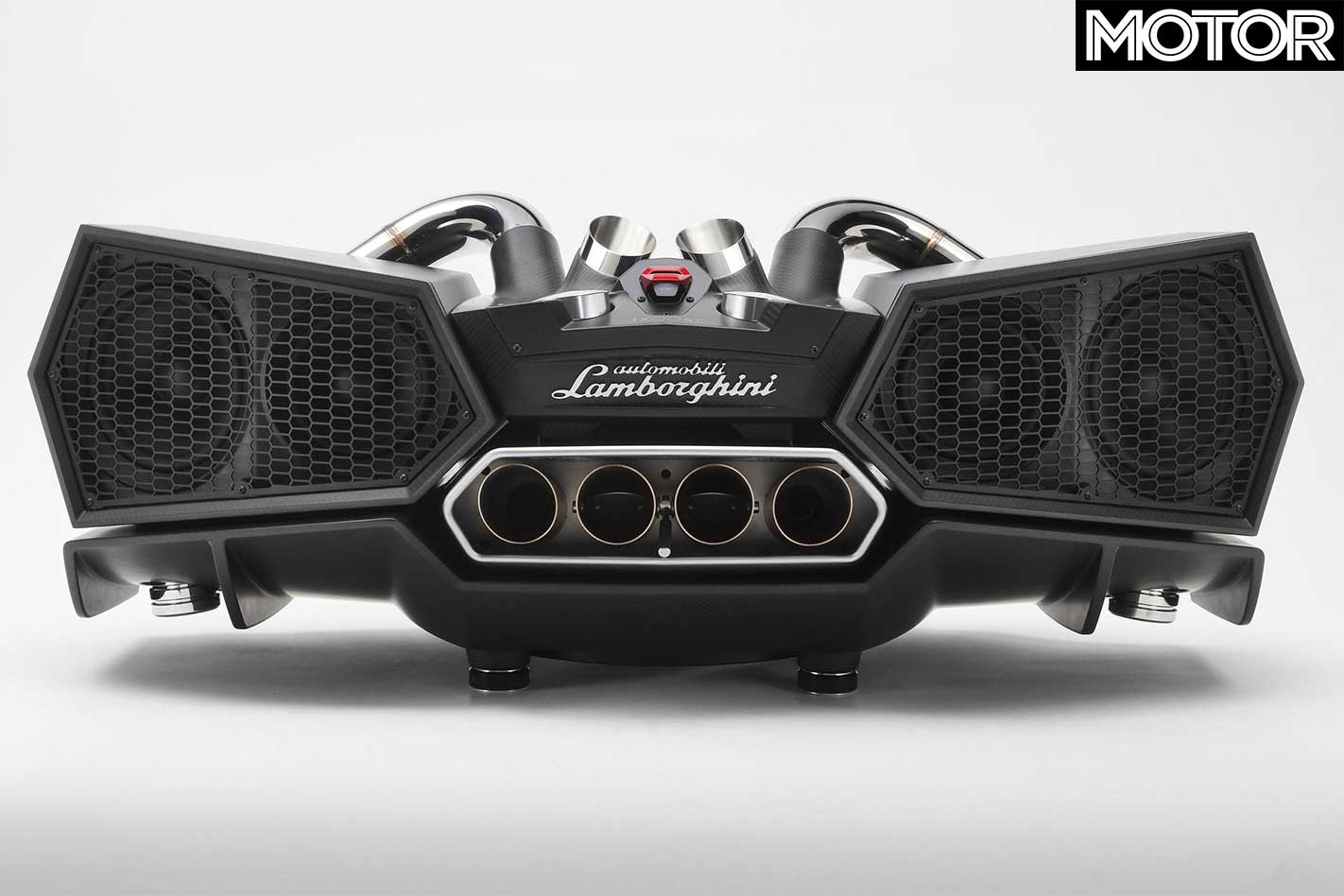
Do you need a Prancing Horse badged suitcase or an iPhone dock shaped like the rear end of a Lamborghini? No. Do you want them? Definitely.
It isn’t all about brand power in this month’s Cool Car Things We Want as it also features a varied collection of tuning gear, decor, and even a radio-controlled Subaru to pique your octane-fueled interests.
1 – FEATURED “PRODUCT OF THE MONTH”: iXOOST Lamborghini dock ($32,000 from ixoost.it) Designed to fuse Lamborghini aesthetics into a speaker dock, this ESAVOX sound system from iXOOST uses the actual exhaust tips from an Aventador SV. It is Bluetooth capable, boasts 900 watts and weighs 53kg…
2 – APR S01 forged wheels (POA from goapr.com) Give your hot VW or Audi a tough new look with these gorgeous forged aluminium rims. Lightweight, they use a 5 x 112 PCD, come in silver or brushed gunmetal, either 19 x 8.5in (+45) or 20 x 9.0in (+42).

3 – Lancia Stratos HF poster ($138 from automobilist.com) Put Lancia’s World Rally Championship winner up on your wall with this one of 100 poster, sized 50 x 70cm. Designed by Pavel Fuksa, each is hand-signed by the artist himself.

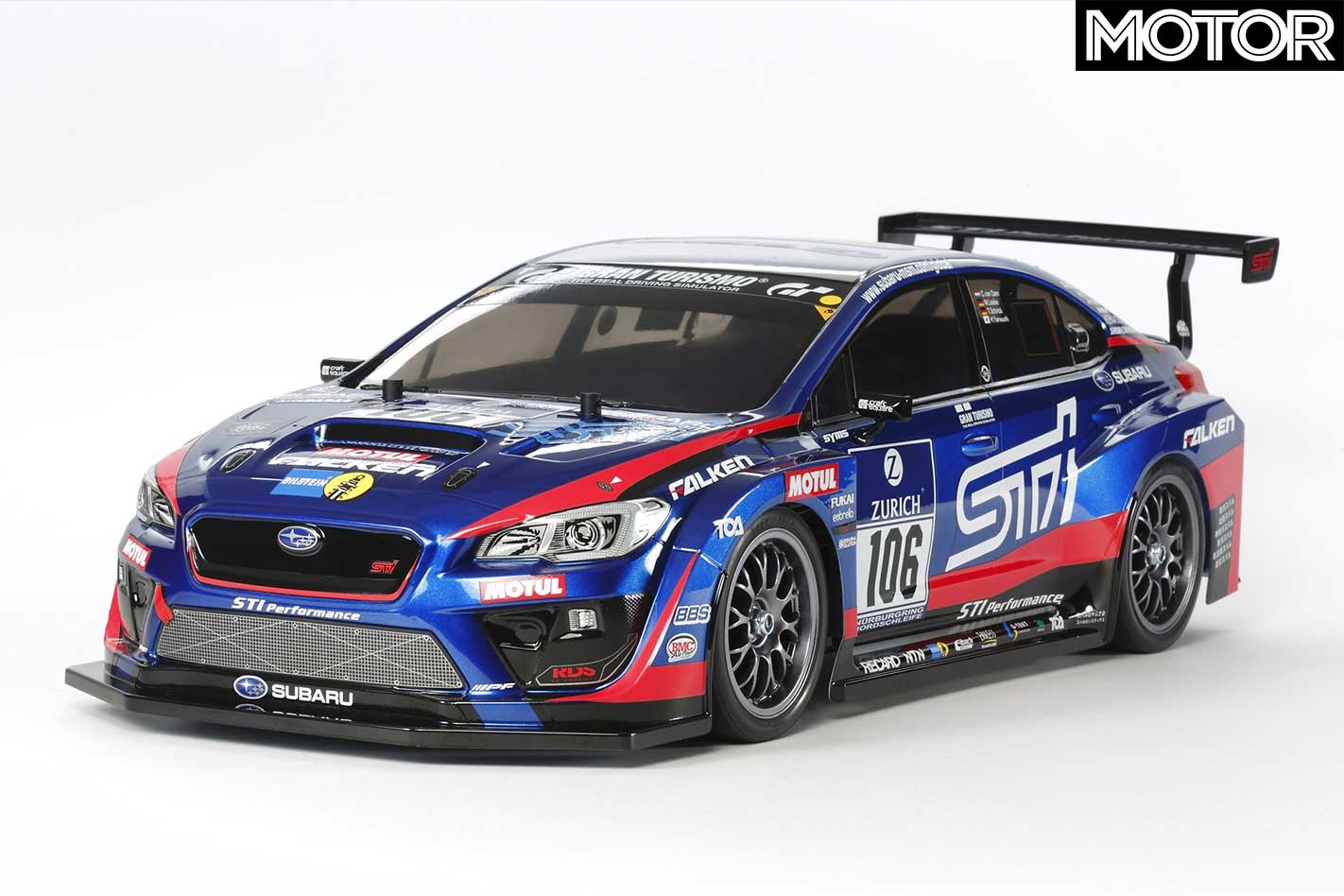
4 – Tamiya Subaru WRX STI R/C car ($180 from metrohobbies.com.au) Tamiya’s entry-level TT02 electric radio car chassis is seen here under a replica Subaru WRX STI NBR Challenge shell. In 1/10 scale, it comes with batteries, charger and radio gear.
5 – K&N cold air intake (POA from knfilters.com.au) So you bit the bullet and bought a 2.0-litre turbo ZB Holden Commodore and you’re already used to the power… bolt on this cold air intake for a bump in output, response, fuel economy and intake noise.

6 – Ferrari luggage ($497 from store.ferrari.com) A lightweight polycarbonate hard shell encloses 44 litres of luggage space. It’s lockable and comes with zipper tags that sport 12 dots in the style of the Ferrari F1 car’s brake lights.

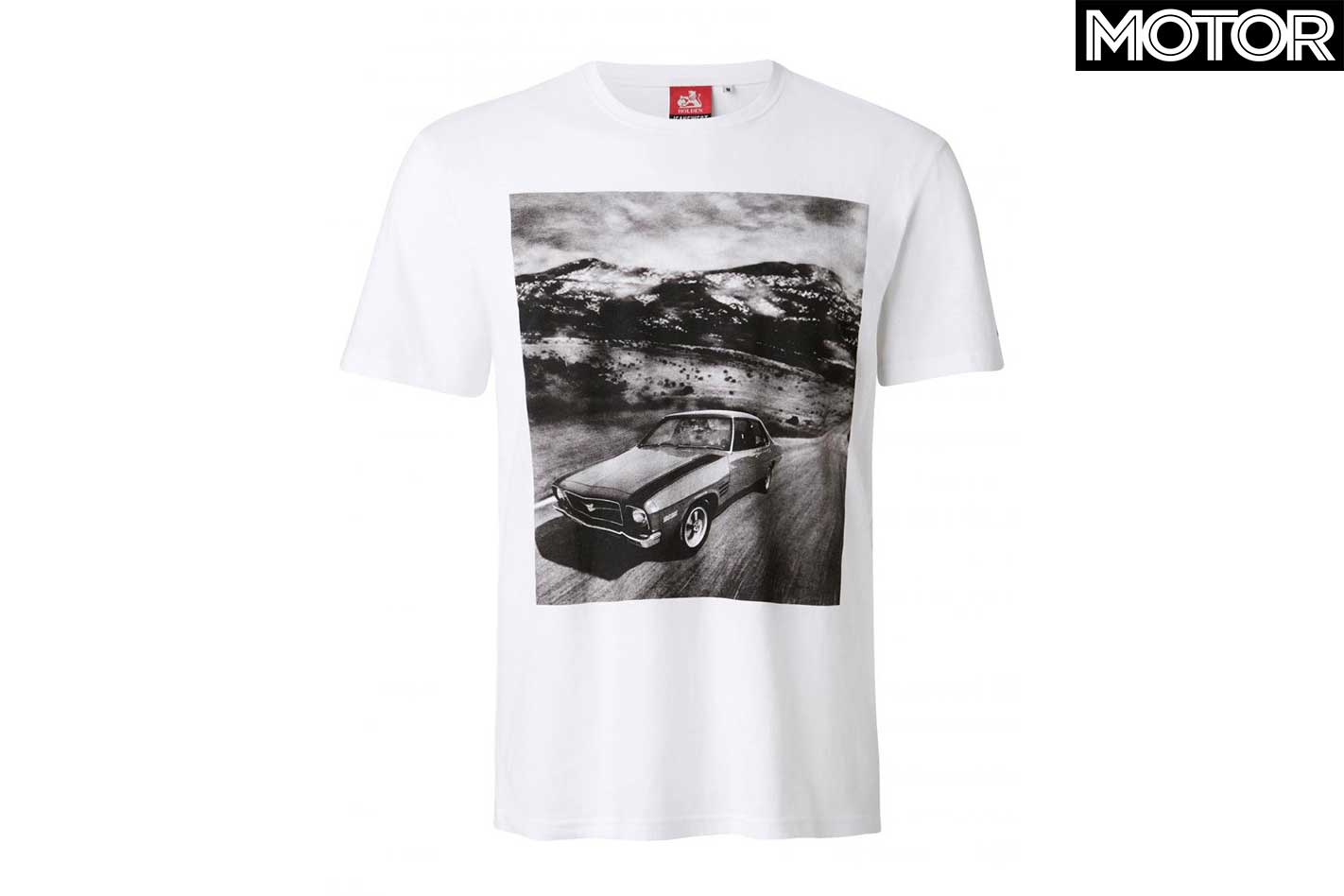
7 – Holden shirt ($40 from jeanswest.com.au) A simple, clean tee fronted by the mighty HQ series Holden SS from 1972. Comes in sizes small to XXL. Made from 100 per cent cotton.
Since its was first introduced in 2013, the current generation Mazda 3 has been considered the benchmark of the small-car class, with a series of subtle style tweaks and technical upgrades.
This has helped it maintain second place on the passenger car sales ladder behind the ubiquitous Toyota Corolla, though its biggest rival is arguably the Hyundai i30 that continues to threaten its market share thanks to its fresher aesthetics, and driver engagement.
With the next-generation Mazda 3 on the horizon we decided to revisit the current model in mid-spec Touring hatchback automatic guise to see how it stands up against the relatively youthful Hyundai i30 Active auto.
VALUE
Mazda 3
The Mazda 3 Touring is the plushest of the 2.0-litre versions, with retail pricing starting at $25,490 for the six-speed manual, with the six-speed auto attracting a $2000 premium. The sedan and hatch versions cost the same.
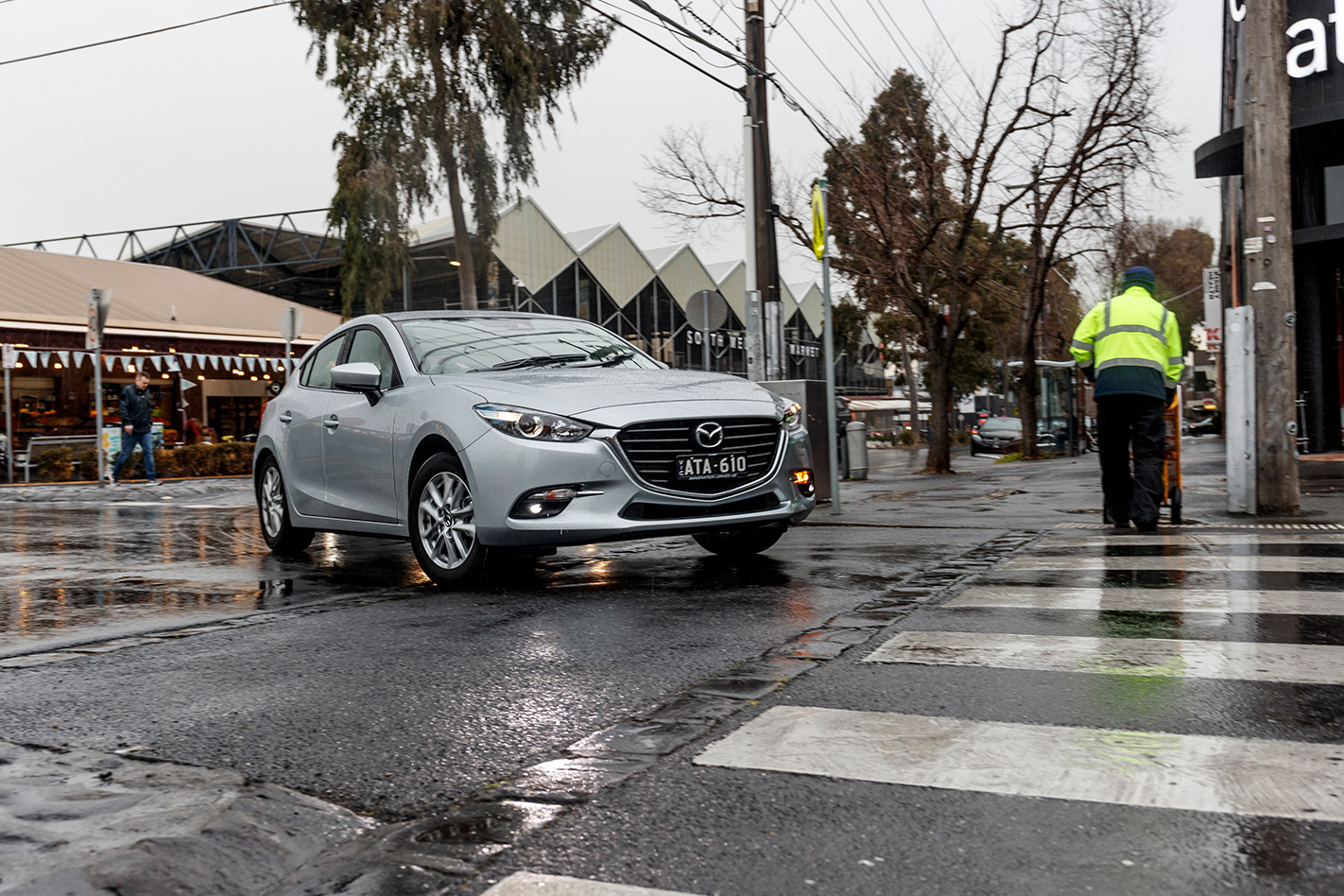
The Touring costs just $4000 more than the entry-level Neo Sport and $10,000 less than the range-topping SP25 Astina.
The 2.0-litre engine is reasonably frugal, with an official combined fuel consumption figure of 5.8L/100kms when coupled to the optional six-speed auto. Our real-world driving saw that figure rise to 8.5L/100km, though this involved quite a lot of city driving, mostly in Sport driving mode.
The Mazda 3 Touring requires servicing every 10,000kms or 12 months, whichever comes first, which is relatively frequent. Mazda charges $303 for the first and third service appointments and $331 for the second and fourth.
Hyundai i30
Priced at $23,390, the i30 Active 2.0-litre petrol automatic we’re testing here costs $2300 more than the manual version. The same grade can also be had with a 1.6-litre turbo diesel version in manual or automatic form, for $23,590 and $26,090 respectively, if you’re looking for a more fuel-efficient option.
However, if you’re looking for the most affordable i30 outright, there’s another variant below the Active called the i30 Go that starts at $19,990 for the manual, or $22,290. If feature-count matters not, then the Go is the one for bargain-hunters.
The vehicle we tested was standard, with the only extra on top of the six-speed automatic gearbox being the Marina Blue paintwork for an extra $495 that took the total retail price to $23,885.
The 2.0-litre engine’s claimed average fuel consumption is 7.4L/100km with the automatic, which is a little thirsty for a small hatch – the similarly powered Mazda 3, for example, sips unleaded at a rate of 5.8L/100km.
As for servicing, the i30 tested here has 12-month/15,000km service intervals. Scheduled services within the first five years are capped at $259 a visit, except for the 45,000km major service which will cost you $359. The i30 is covered by Hyundai’s five-year/unlimited kilometre warranty.
STANDARD FEATURES
Mazda 3
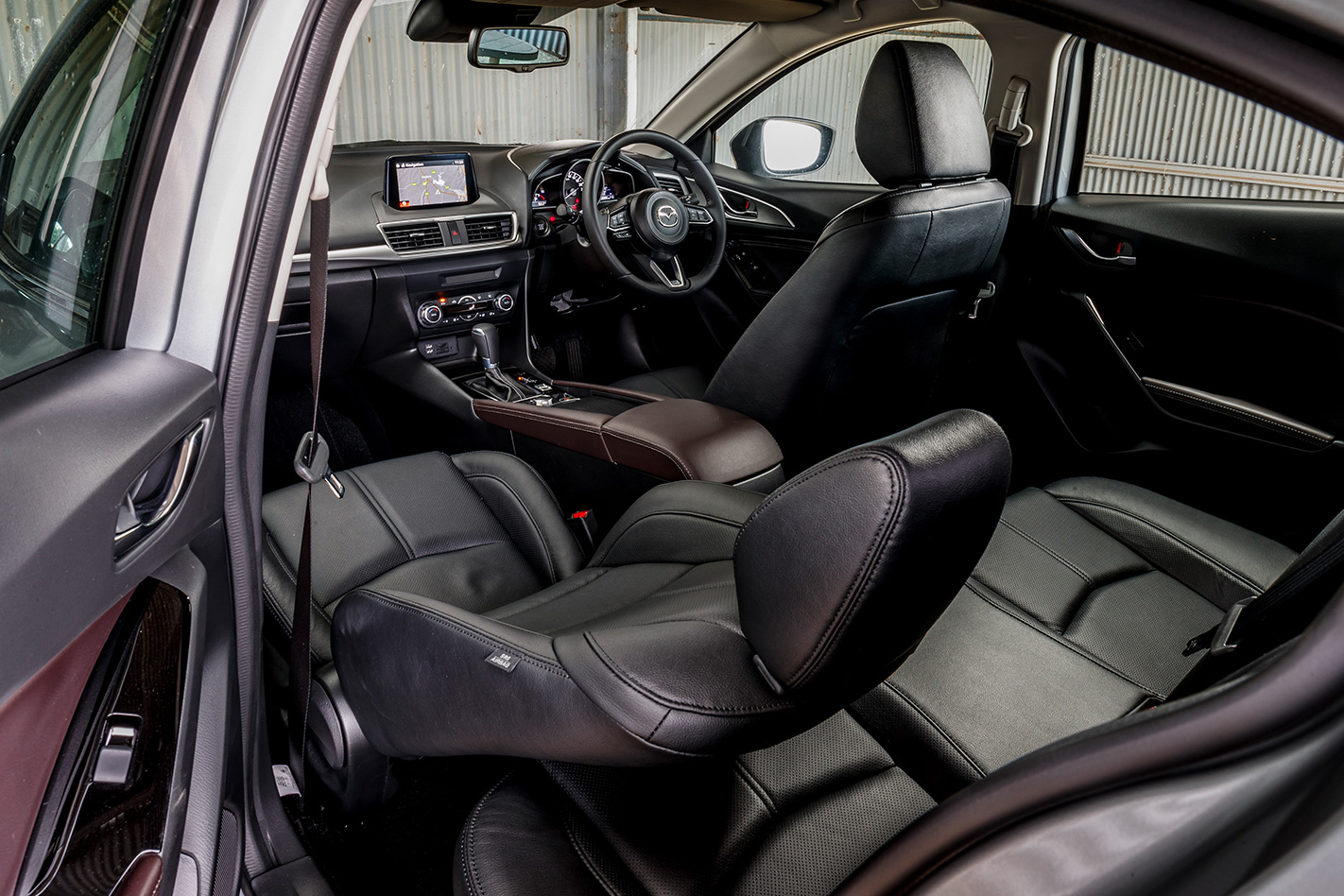
The Touring adds a few creature comforts over the Maxx Sport including leather upholstery, automatic folding mirrors and advanced keyless entry that lets you open the door and start the engine without having to take the key fob out of your bag or pocket.
That’s on top of a healthy equipment list that includes a 7.0-inch colour screen, AM/FM/Digital (DAB+) radio, and autonomous emergency braking that also works in reverse to help prevent parking bingles.
Other features include rear-parking sensors, cruise control, blind-spot monitoring, rear-cross traffic alert, dual-zone climate control, dusk-sensing headlights, LED fog-lamps, rain-sensing windscreen wipers, an electric park brake and 16-inch alloy wheels.
Hyundai i30
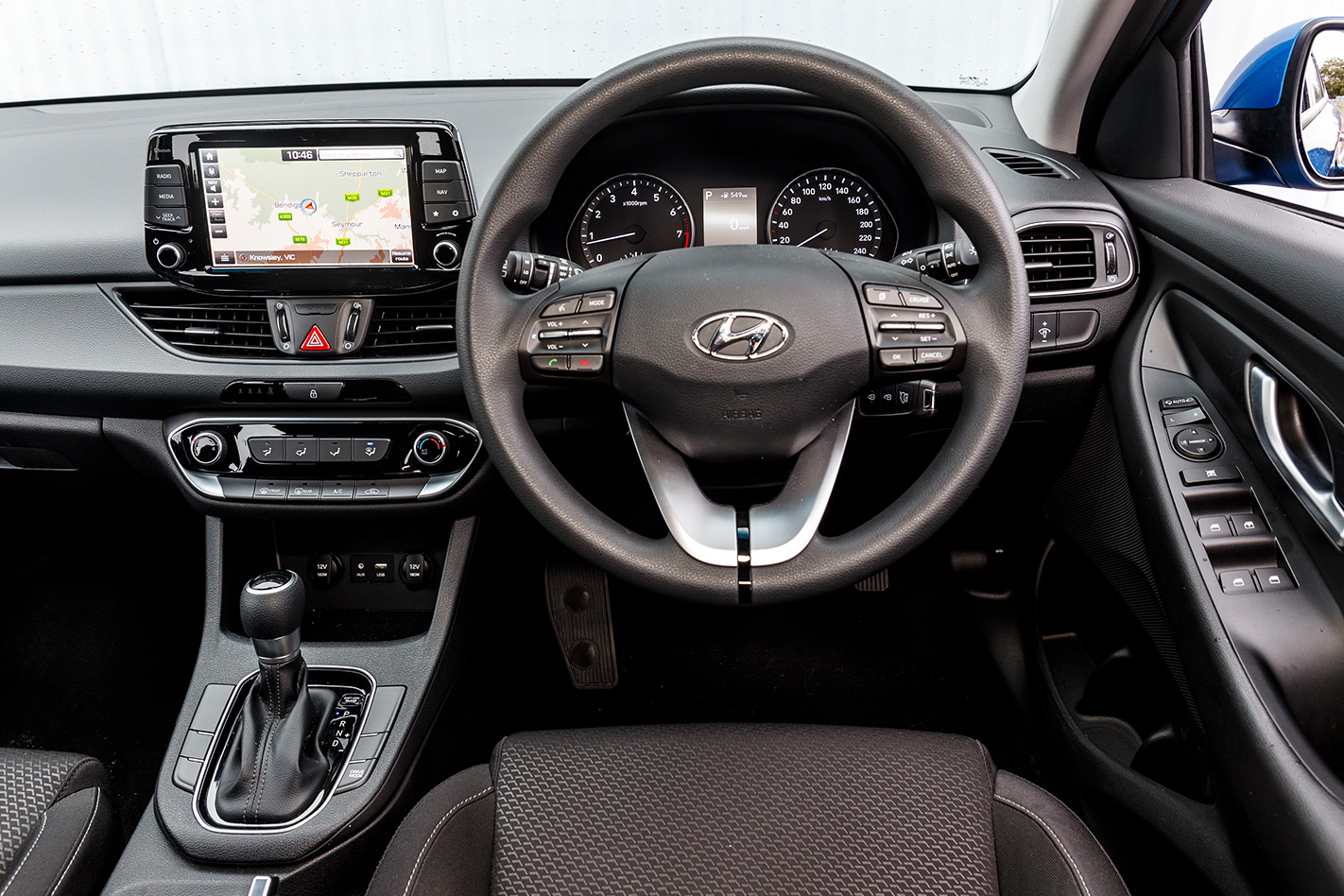
You’ll find things in the i30 Active that are options in far more expensive cars, such Apple CarPlay and Android Auto smartphone pairing, satellite navigation and digital radio (DAB+), which are controlled via an 8.0-inch touchscreen.
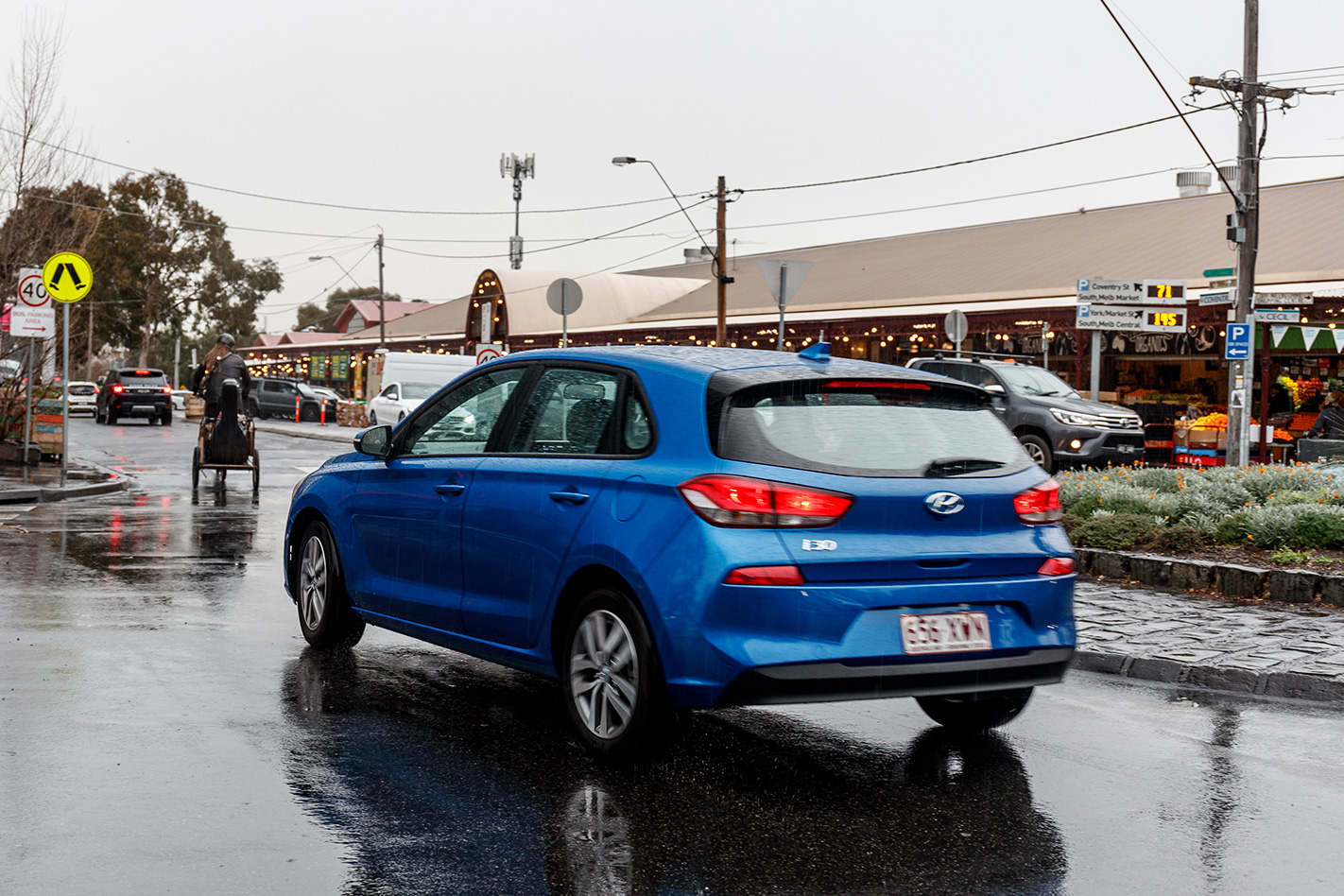
It also comes with LED daytime running lights, power-folding electric mirrors, cloth seats and cruise control. 16-inch alloy wheels are standard, and you get a full-sized spare alloy wheel as well – something that’s often a cost option in this segment, or replaced by a space-saver.
SIZE
Mazda 3
The Mazda 3 Touring we tested is a five-door hatchback that seats up to five people. A four-door sedan with five-person capacity is also available..
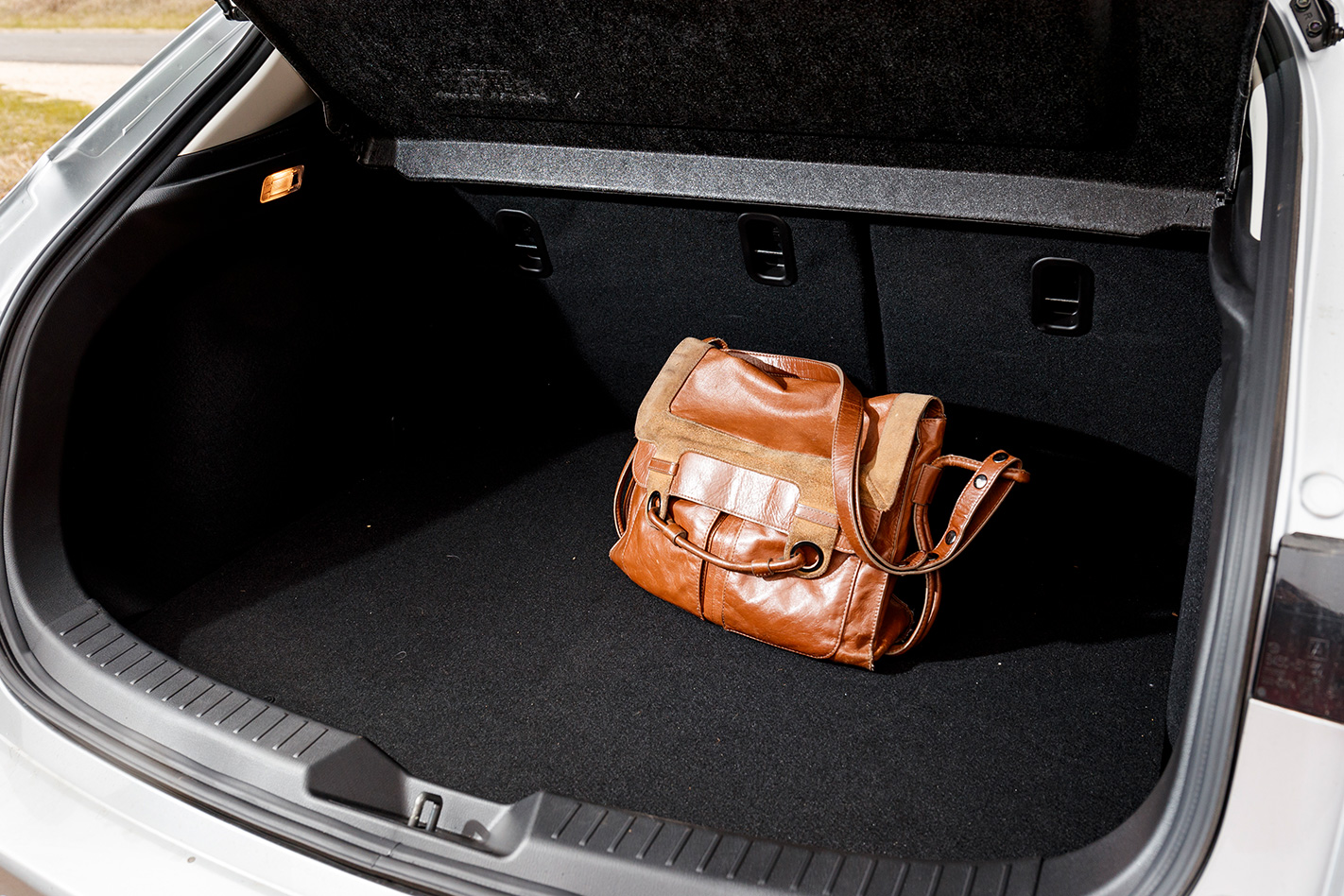
Measuring 4.47m long by 1.79m wide, and weighing in at 1308kg, the Mazda 3 Touring hatch auto isn’t the smallest car in its class, however boot space is tight with a 308-litre capacity that measures less than smaller cars such as the Kia Rio and Hyundai Accent. The Mazda 3 sedan’s boot holds a more sizable 408 litres.
Hyundai i30
The Hyundai i30 Active is a five-door hatchback that seats up to five people.
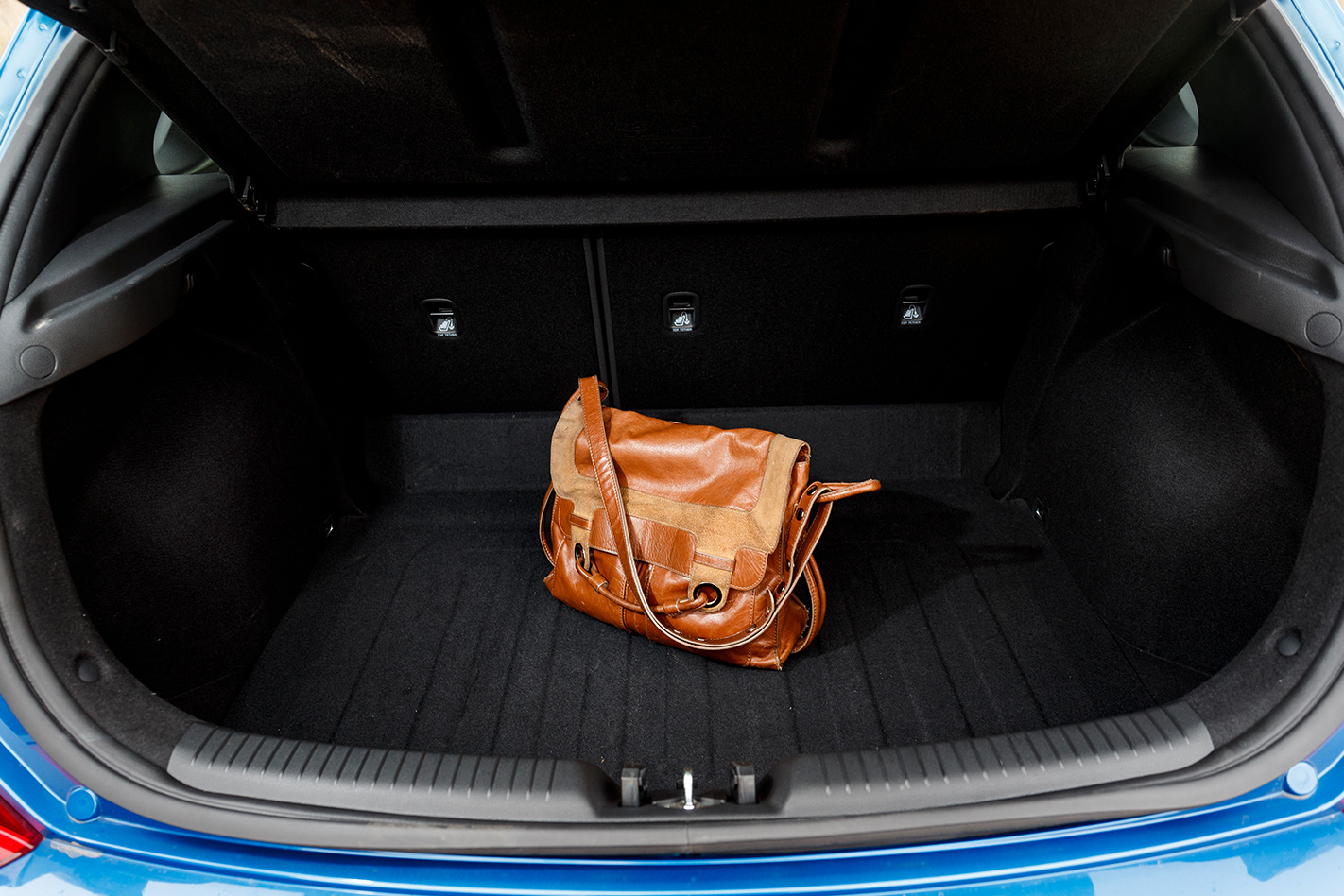
It measures just 4.34m length with a 2650 wheelbase that accommodates a spacious interior and practical 395-litre boot space that expands to 1301 litres with the rear 60:40-split seatbacks folded down.
SAFETY
Mazda 3
The Mazda 3 received a five-star ANCAP safety rating in August 2016 thanks in part to its active safety features, including range-wide autonomous emergency braking (AEB). It scored well for crash protection, including 16 out of 16 for side impact. It has six airbags, and child-seat anchor points including two ISOFIX brackets for each outboard rear seat, and three top tethers.
The Touring brings additional active safety over and above the standard kit, including blind-spot monitoring and rear-cross traffic alert that warns you of any cars approaching from the side while you reverse.
Hyundai i30
The Hyundai i30 was awarded a five-star ANCAP rating in April 2017. It’s a safe car in terms of crash protection, with seven airbags including a driver’s knee bag and full-length curtain airbags to protect your head.
Other safety features include a reversing camera, rear parking sensors, auto-on headlights, LED daytime running lights, seatbelt reminders on front and rear seats, and electronic stability control that all cars are required to have.
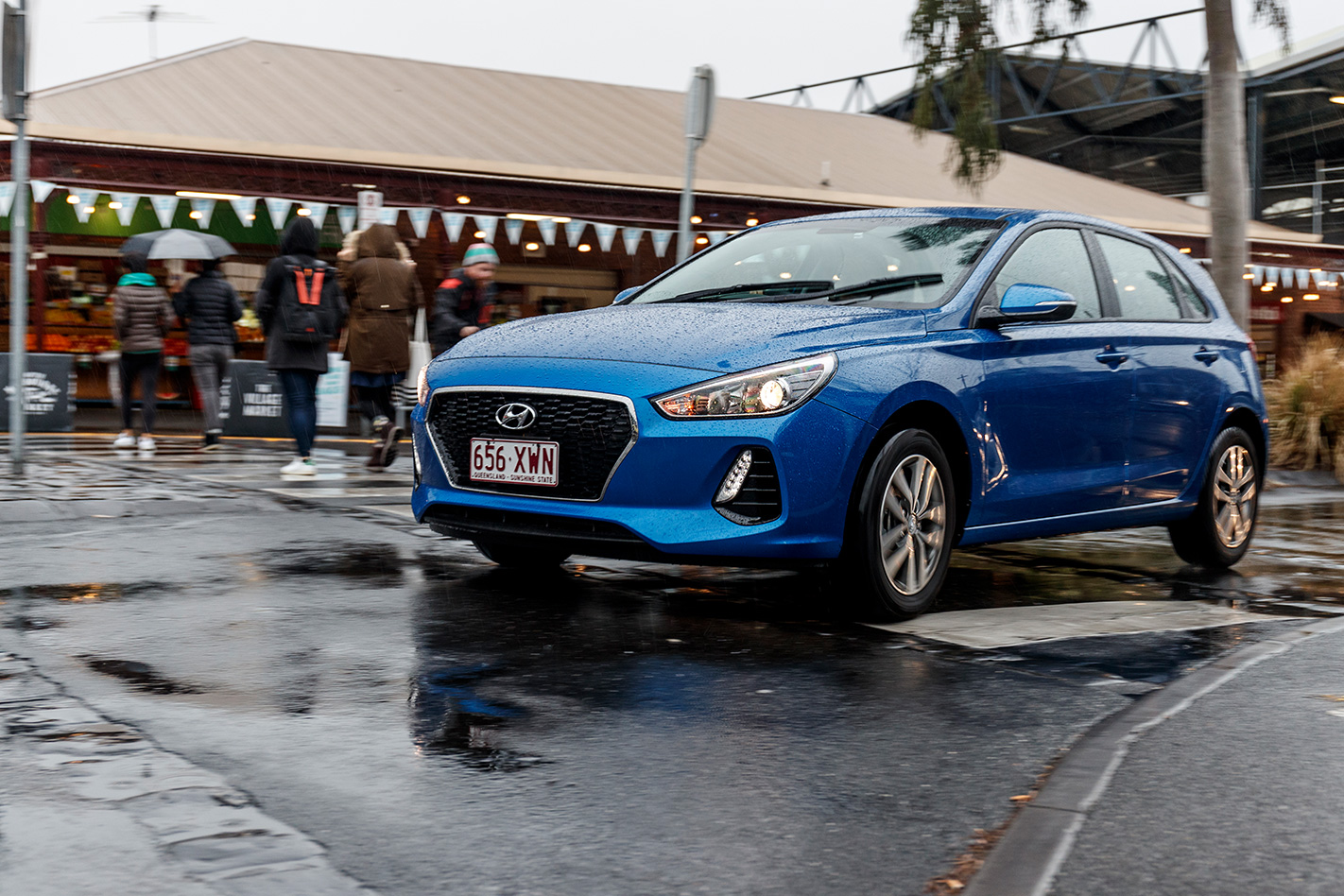
Active safety features including autonomous emergency braking aren’t included on the standard spec sheet, however it available as part of Hyundai’s SmartSense package that for around $1700 adds active cruise control, auto-braking, lane keeping assist, driver attention alert, blind-spot detection, and rear-cross traffic alert.
COMFORT
Mazda 3
The Mazda 3’s interior is showing its age, but still has an air of sophistication with soft-touch surfaces aplenty, clean design, a leather-clad steering wheel and intelligently-placed switches and gauges. The seats, trimmed with a mix of real and faux leather, offer good comfort. The driver’s seat has height and lumbar adjustment to help you settle into a good driving position.
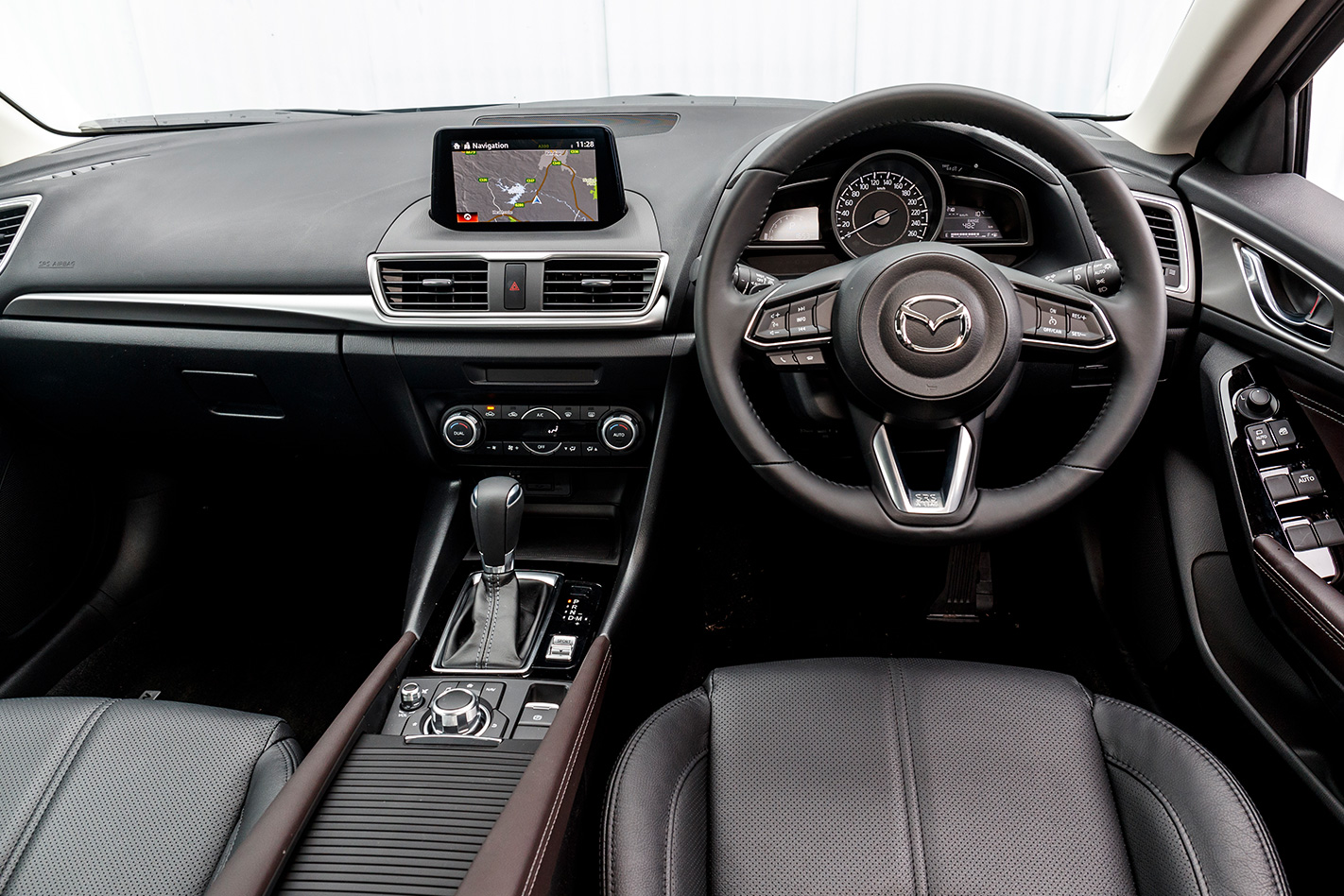
The MZD infotainment system is easy to operate via a dial on the centre console. It lacks the added convenience of Apple CarPlay and Android Auto smartphone mirroring, however an upcoming update will allow that tech to be retrofitted next year.
The Mazda 3 loses marks in the back row, with its ascending window line obscuring side vision for younger occupants. Legroom is a little tight as well, with even average-sized adults finding their shins touching the front seats.
Second-row passengers also miss out on conveniences such as face-level air vents, and there are no USB or 12v charging sockets to keep devices charged up. It might be a niggling complaint, but those features are fast becoming common in newer cars in the segment. There are at least bottle holders in the doors and the fold-down centre armrest has two cup holders, though there’s only one map pocket on the passenger side.
Road noise is also high despite Mazda attempting to improve sound suppression in a 2016 update, but the ride is comfortable even on rougher roads thanks to a settled ride that recovers quickly from big hits.
Hyundai i30
The i30 Active’s cloth seats are comfortable and there’s good leg and headroom throughout, though the rear seat is a little too narrow to comfortably seat three adults – though that’s common for this segment.
The smaller 16-inch wheels provide it with a better ride than the up-spec models that roll on 17s and 18s, and the locally-tuned suspension has a composed ride over bumps.
The conservative cabin design is a little bland and hard plastics abound, but the dashboard looks neat and uncluttered and the controls, particularly the switches on the steering wheel, are intuitively laid out.
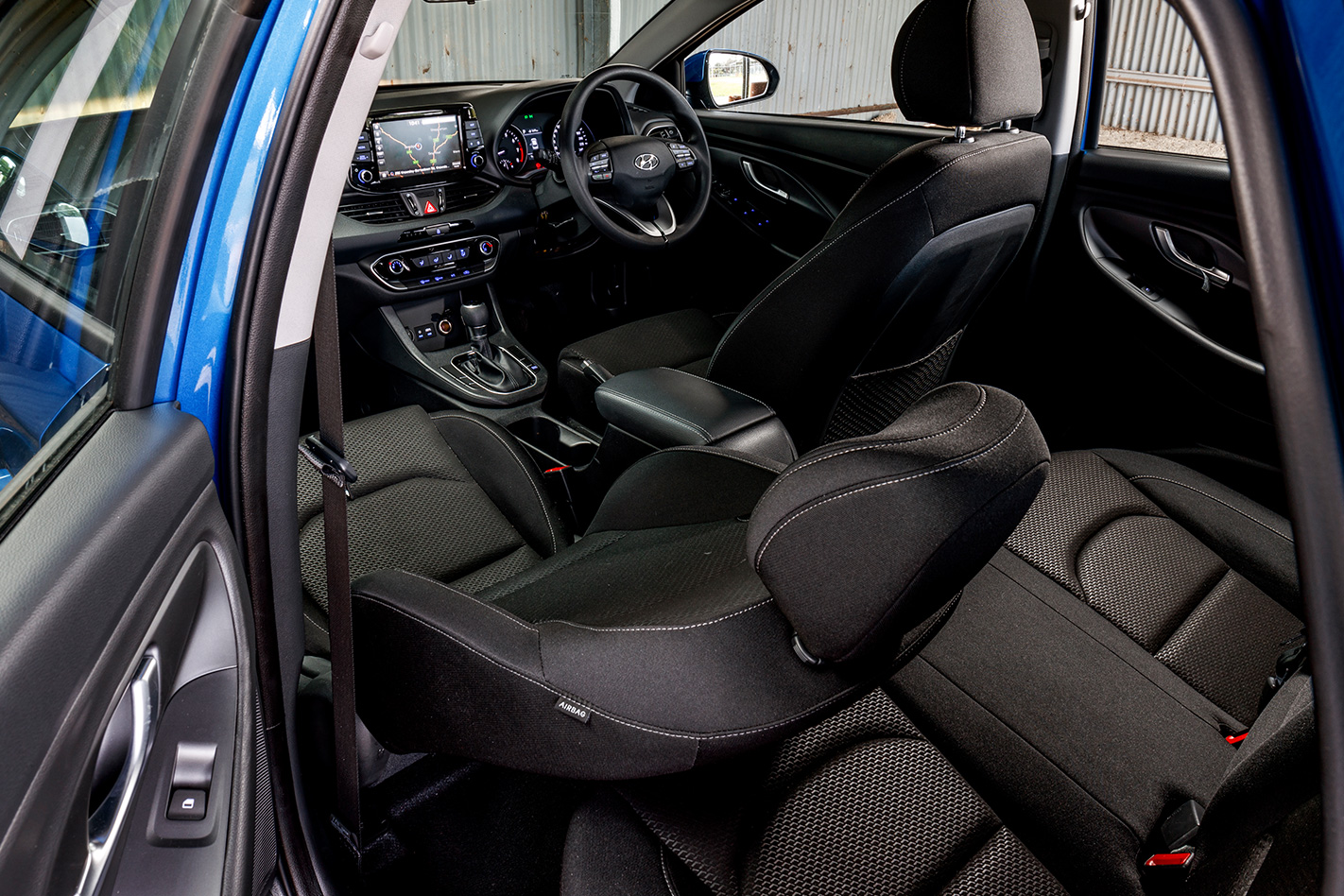
The 8.0-inch touchscreen, which is a staple across the Hyundai and Kia range, looks good, works well and the infotainment system is very easy to navigate.
Rear-seat passengers miss out on their own air vents or USB/12v charging sockets, but if their phones go flat they can enjoy the view with good side and forward vision through the i30’s generous glasshouse.
ON THE ROAD
Mazda 3
The 2.0-litre engine is a city slicker but has enough power for easy trips down the highway, with the six-speed automatic transmission working smoothly with throttle inputs.
It is, however, a little lethargic from a standing start and doesn’t really wake up until the tachometer hits about 4000rpm. A Sport drive mode introduced in 2016 makes the engine rev higher before shifting up to the next gear, though frequent use of that feature will see your fuel consumption head north.
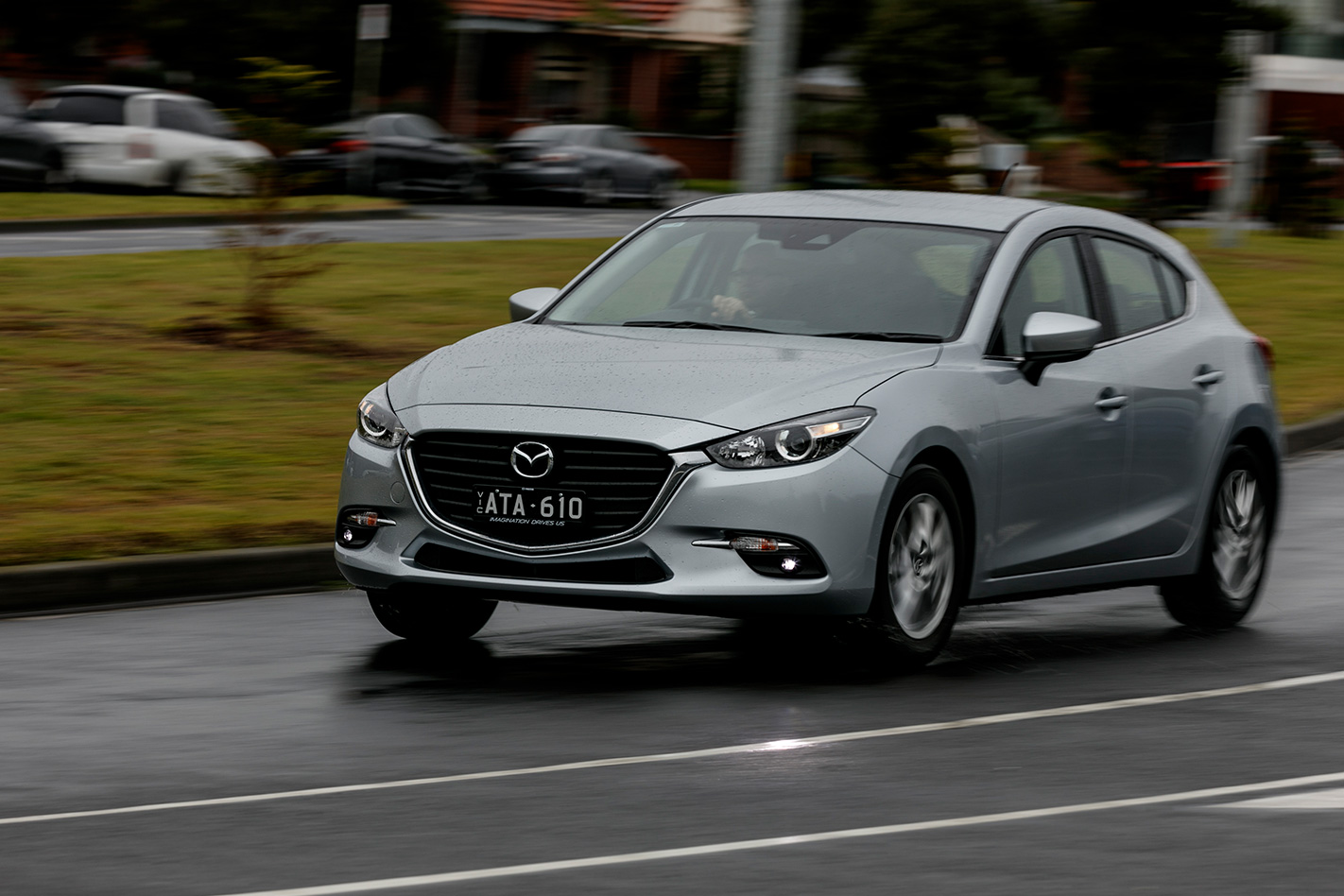
The Mazda 3 is an enjoyable car to drive, with light but engaging steering that makes easy work of negotiating suburban streets and bendy country roads. Despite its age it remains one of the segment’s best when it comes to handling.
The ride feels soft but delivers enough body control for sharp cornering. This is helped by something that Mazda calls G-Vectoring Control, which subtly trims power when cornering to transfer load onto the front tyres and help them produce more cornering grip. Result: the car feels more planted while changing direction more fluidly, but you’ll barely notice that the electronics are giving you a helping hand.
Hyundai i30
While it’s not intended to be as spirited or dynamic as the sportier i30 SR at the upper end of the range, the Active certainly feels nimble enough around town. Hyundai has honed its chassis and suspension for Aussie roads resulting in a great ride and body control on a broad range of road surfaces, which makes it feel like a bigger, more mature car.
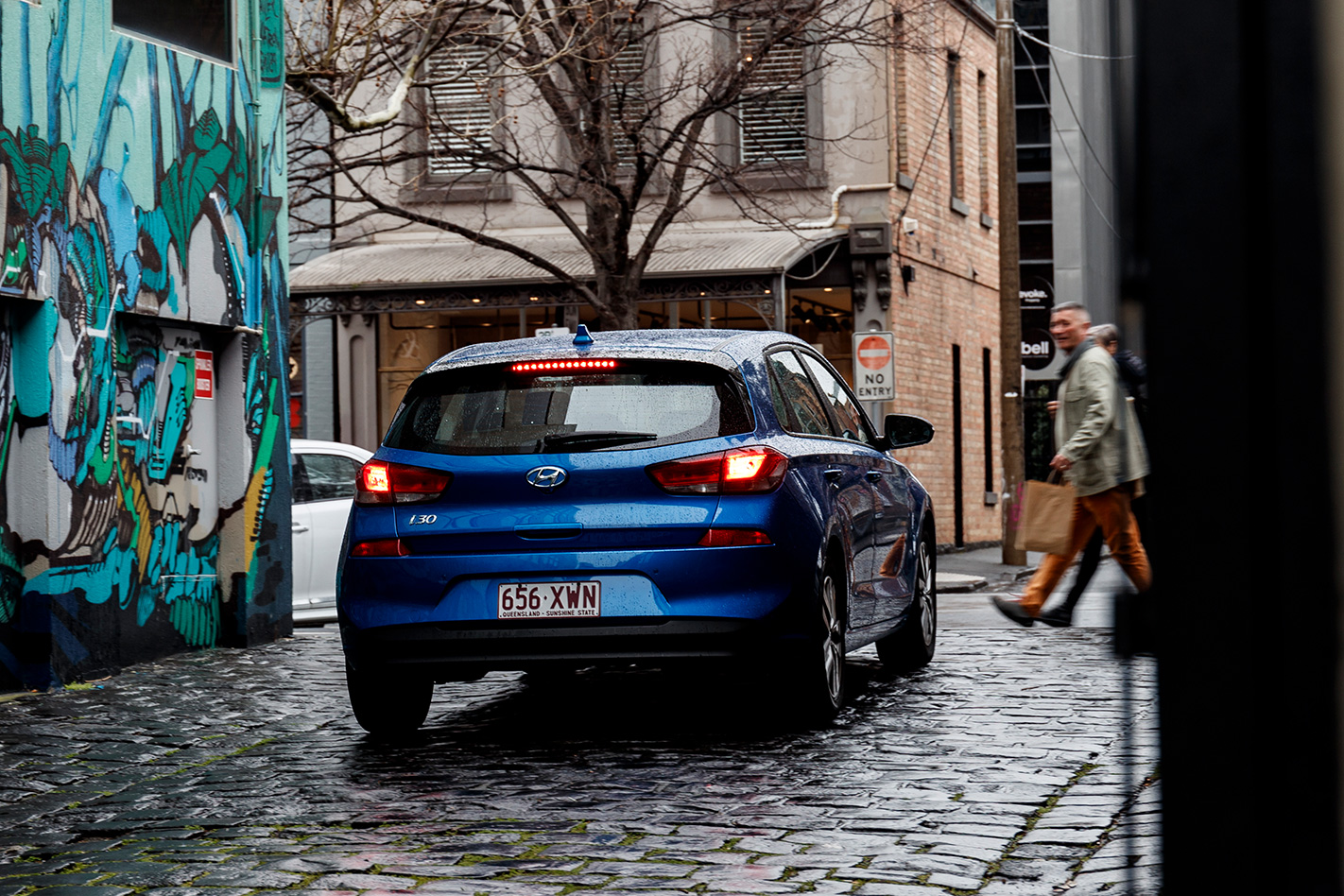
Meanwhile, the 120kW/203Nm 2.0-litre petrol engine responds quickly to throttle inputs and the six-speed torque converter automatic gearbox shuffles smoothly between steps. It may be a comparatively thirsty engine, but it also produces more power than many others at its price point. For those that don’t like to dawdle, that’s worth noting.
OUR OPINION
The Mazda 3 is less than a year away from being replaced by an advanced next-generation model, but will bow out like a champion cricketer who scores a ton in their final Test match.
It’s significantly older than the Hyundai i30, but the age difference is less noticeable at the lower end of their respective ranges, where the Mazda’s trim and equipment levels exceed the i30 Active, which doesn’t benefit from the standard active safety, plush interior and sharper driving dynamics found higher up the range.
Adding the SmartSense active safety to the i30 Active brings its price and safety levels on a par with the Mazda 3 Touring, but the Mazda still has enough going for it in terms of sophistication to give it the slight edge.
EVERYBODY knows that Renault makes the best hot hatches. It’s as reliable an indicator as a Porsche performance car of the year win or a Rover K-Series head gasket failure; merely one of those little things that ground the automotive world on a reassuring footing. Sure, other hot-hatch manufacturers are available, and every once in a while one of them will build something class-leading, but these are anomalies; mere blips until normal service resumes.
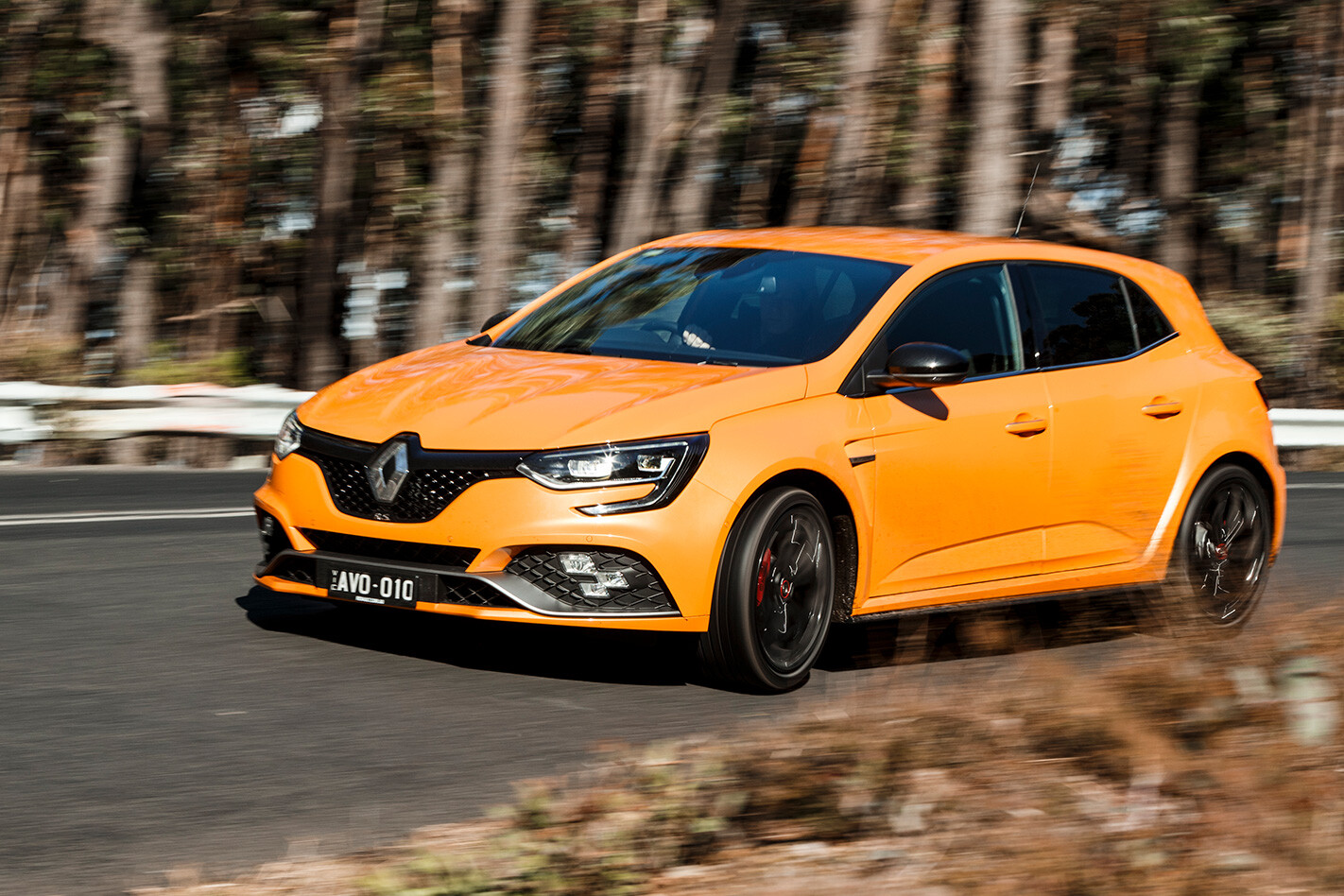
All of which ignores the fact that the first Megane Renaultsport was a bit of a dog’s dinner. The 165kW Megane 225 (launched overseas in 2004) showed initial promise but needed a fair amount of remedial work before it came good in Cup guise in 2005. Trace the lineage of many Renaultsport hot hatches and you’ll find a similar theme. The Clio III was underwhelming in initial 197 guise, taking three years before the Clio Renaultsport 200 unlocked its potential. Now we have the box-fresh Megane IV in RS280 guise and I’m wondering whether this one’s going to be great straight out of the crate or will be one to return to in a couple of years’ time.
The basics look brilliant. Out goes the old car’s 2.0-litre lump, replaced by a Samsung-built 1.8-litre four-pot that makes more power and torque than before and, unlike the current crop of hot Clios, this one’s got three pedals, although a dual-clutch is available. The suspension is the usual Renault strut and torsion beam pairing at front and rear respectively, but there are a couple of new fitments that are intriguing, to say the least. A four-wheel-steering system and a set of hydraulic suspension bump stops transform the way this car drives.
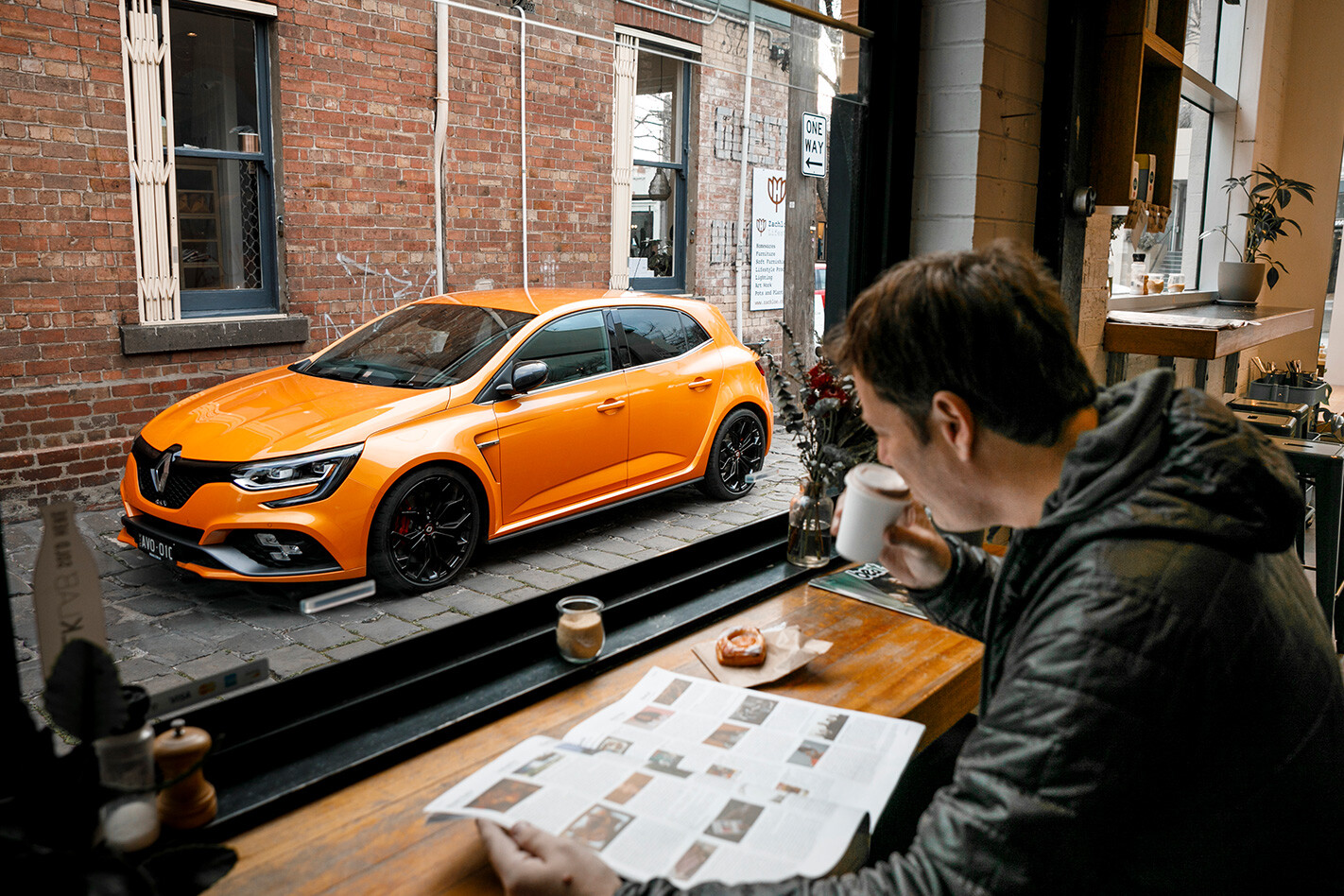
The steering does the usual trick of angling the front and rear wheels counter to each other at low speed and in concert at higher velocities, but switch the Megane into Race mode and the speed that this transition happens lifts from 60 to 100km/h. This makes the car feel unbelievably agile on turn-in, giving the steering an almost Ferrari-style pointiness.
Renault describes the hydraulic bump stop as a damper within a damper. They sit at the base of the front and rear struts, the vehicle dynamics team in Dieppe concluding that they were a better solution than adaptive dampers. First seen on the front end of the Clio 182 Trophy of 2005, the technology has been refined in Renaultsport’s rally division and gives the Megane a fluidity, even in this particular car, equipped as it is with the 10 percent stiffer optional Cup chassis pack ($1490). That also buys Brembo brakes, 19-inch alloys and a Torsen mechanical differential, so it’s money well spent. It also bumps the $44,990 asking price up to a point midway between the first and second place finishers in our hot hatch megatest from earlier this year (April 2018); the $39,990 Hyundai i30 N and the $51,990 Honda Civic Type R respectively.
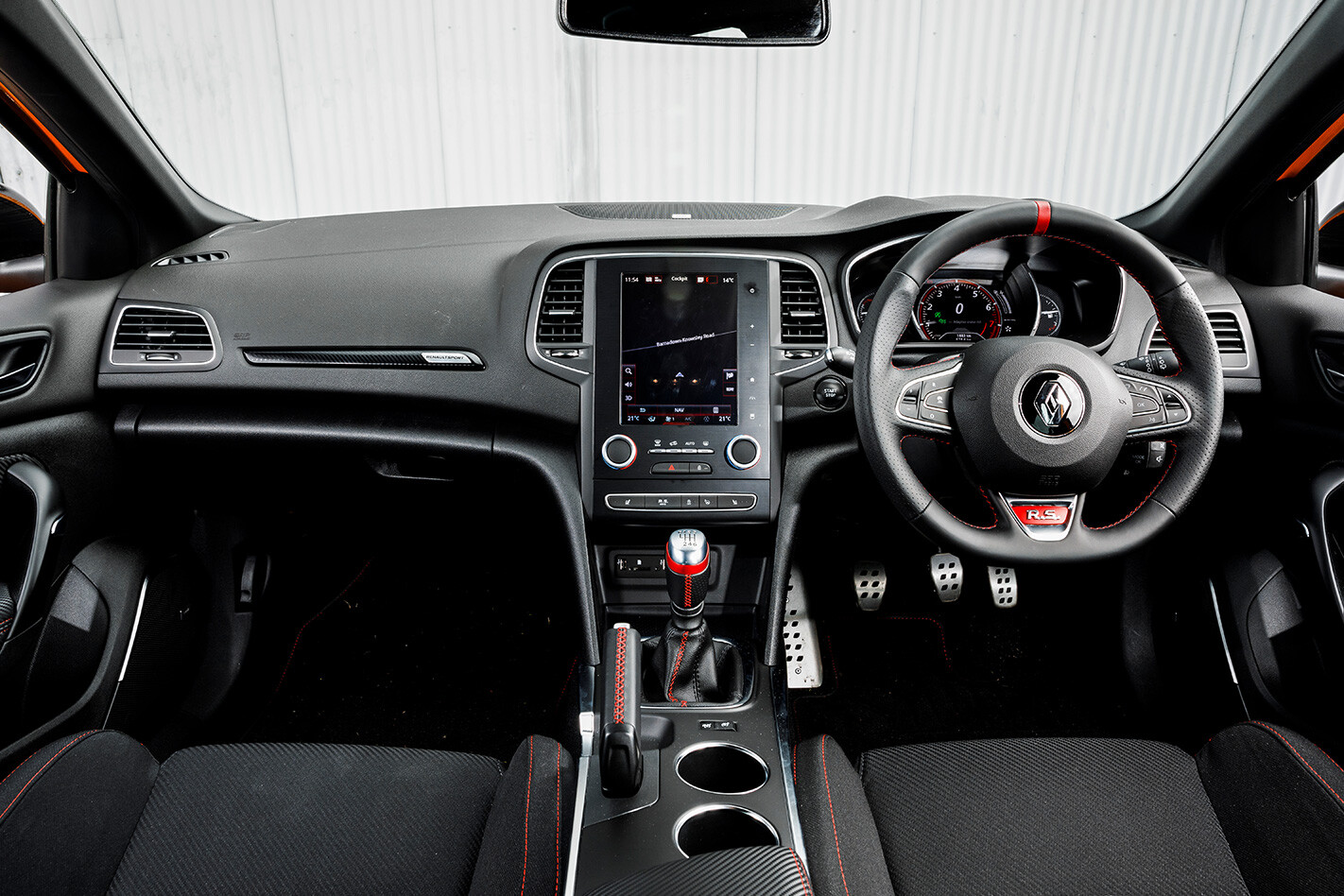
Keen to see how the RS280 feels upon first acquaintance, here’s the initial three-discipline report card.
Urban Dweller
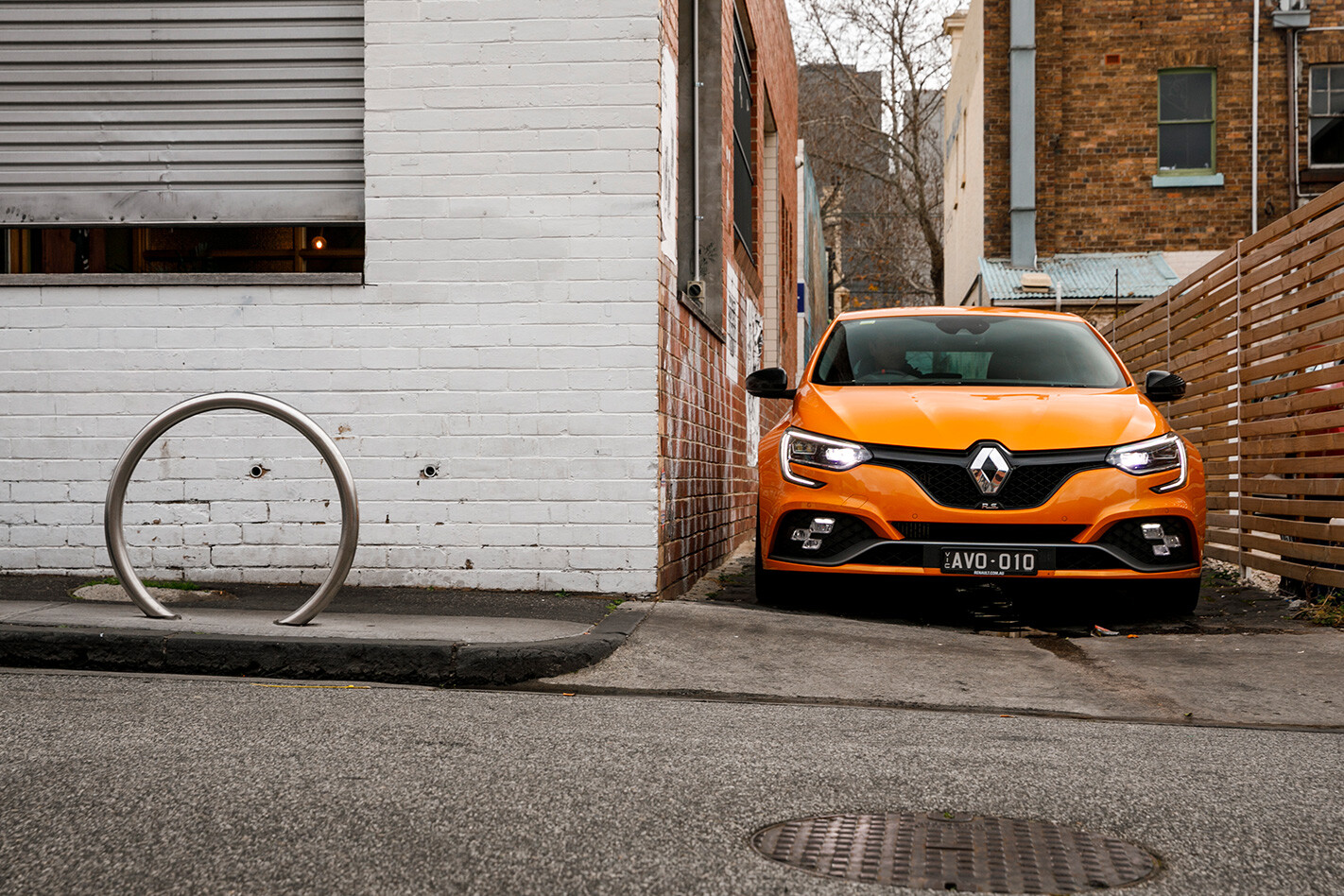
We pick up the RS280 in central Melbourne and while the ride is on the firm side, it’s never what you’d call harsh. It torque-steers and slithers on wet tram tracks, the diff sometimes having a sly snatch at the wheel, but it rides speed bumps and cobbled laneways without having you checking your health cover for chiro extras. The four-wheel steering gives it a virtual short wheelbase, which manifests in a mere slice of the wheel to send the car through 90-degree lefts and rights.
The engine pulls well at low revs, but any aural character seems to emanate from the speakers rather than anything oilier. Pressing the RS button only shuttles between two of the six drive modes. Go for anything other than Neutral or Sport and your bouncing finger will be jabbing at a tiny tab on the portrait-oriented touchscreen. In Comfort you also lose the digital speedo display. That’s all a bit French. On the plus side, you sit beautifully low in the car, with stacks of headroom even for taller drivers. And the sports seats are brilliantly supportive.
The Strip
Scratch what I just said about the sports seats. The set-back pedal box forces a splay-legged driving position which, after a couple of hours at the wheel, feels like a DVT in the making as too much of your weight is pressed onto the side bolsters. Bring back the old Recaros. Likewise the switches for the cruise control are weirdly scattered between wheel and centre console. Arriving at Heathcote to a damp strip with standing water, it’s clear we’re not going to get too close to Renault’s claim of 100km/h in 5.8 seconds. That time was set with a dual-clutch version with launch control, so even in perfect conditions, we’d probably call a 6.2-second time a good ’un in the manual car.
Switch the car into Race mode and the rev counter vanishes, being replaced instead by an unhelpful digital bar. With only a knife-edge margin between manic axle tramp and flaccid off-boost bogging, the RS280 isn’t an easy vehicle to launch swiftly off the line when it’s greasy underfoot. After a handful of runs, our best effort is 6.5 seconds, with 400m vanishing in 14.5 sec at 162.9km/h.
The 100-0km/h braking test saw the pedal bend slightly onto the actuator; an issue we’d had with some other vehicles subjected to full-power decelerations. This manifested in the vehicle limping, thinking it was being left-foot braked. Pulling the pedal back up forcibly effected a fix, the issue not repeated with normal brake pedal use.
The Test Route
Initial impression on our challenging hill route? Good engine, strong brakes, average manual transmission, fantastic chassis. There’s not quite the consistency we would have hoped for across the major controls, the gearbox feeling a little clumsy. The vertical shift planes of gears 1-2 and 3-4 are set close, with the 5-6 shift feeling further out right, which meant that dropping from fifth to fourth wasn’t a snap back, but a deliberate guide to the spring’s detent and then a pull into the lower gear. The shift itself is deliberate but slightly notchy, and the shift knob is a weird and uncomfortable shape. The relaxed throw of the shift can also feel out of cadence with the sharp steering.
Faulting the Megane’s handling balance is a tougher assignment. It’s fantastically chuckable, with a huge amount of lift-off adjustability to tuck the nose in. The four-wheel steering can occasionally feel a little weird, almost as if you’ve hooked an outside rear wheel into a gutter, but the RS280 feels like one of those cars that gets better the harder you drive it, which is as good a mark as any of a talented chassis. Of course, for a deep dive into the dynamics of the Megane RS280, we need some sort of frame of reference…
Every once in a while, you get to drive something quite special. This is one of those times.
This review was originally published in MOTOR’s December 2004 issue
MOTOR was invited to participate, at a secret location, in the first shakedown of the Le Mans CL-1 prototype – one of the most un-Japanese sports cars we’ve seen.
The C in the name is a combination of ideas from two sources; from US-based engine tuner Caldwell Development Inc, the company which tuned the car’s engine, and the word challenge. The L comes from Le Mans. And the 1 refers to its first prototype.
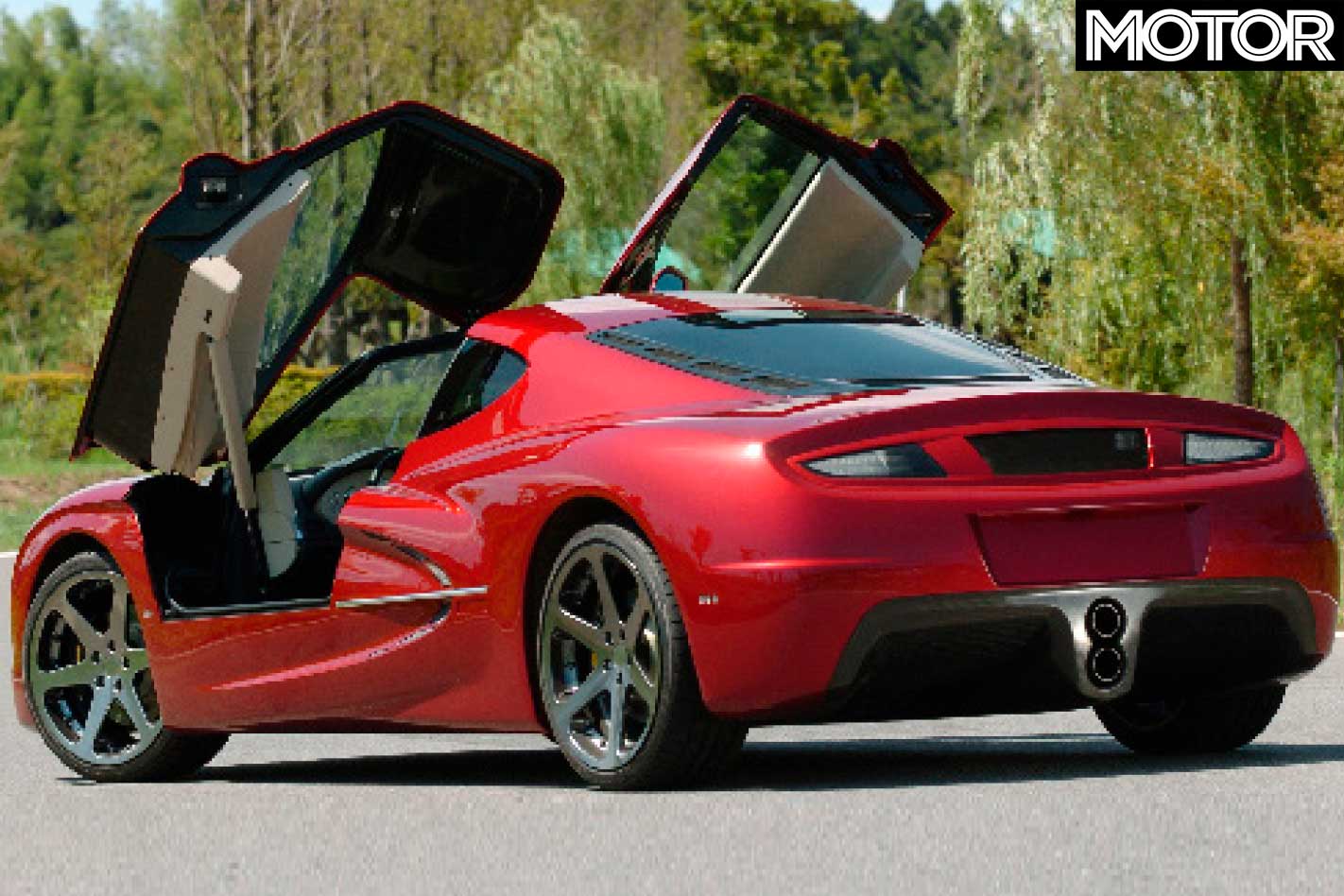
First impressions were startling. A lightweight 1174kg draped in a rich ruby colour, the Le Mans CL-1 employs definite design hints from the Ferrari 360’s rump, and even the legendary Dino 246’s silhouette.
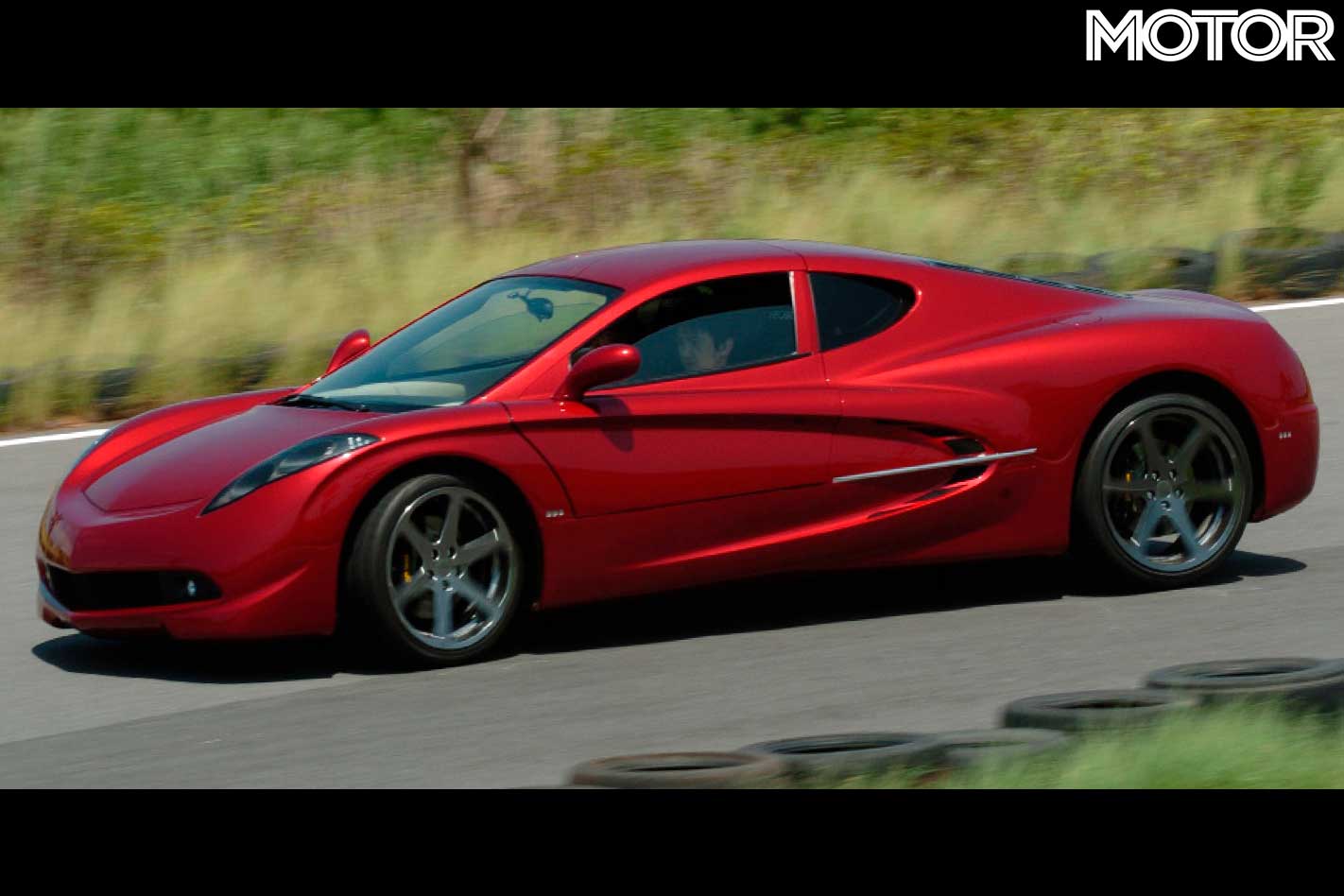
Its non-functional side ducts also appear to derive inspiration from the original 1950s Corvette. But amazingly, Le Mans Co has incorporated these well-known designs to create a style all of its own.
Unable to display its products in public due to the covert nature of what it makes, Le Mans Co wanted to be able to show the public and other interested parties (possible investors) just what it can do. It wants to show that it has the skills and know-how to build a great sportscar, and is seeking the collaboration of a car company or tuner to realise this dream.
CL-1 project director Junichi Katagiri says that, “ideally, we would like to join forces with a British company and take the CL-1 to the next step in the home of the backyard builder.”
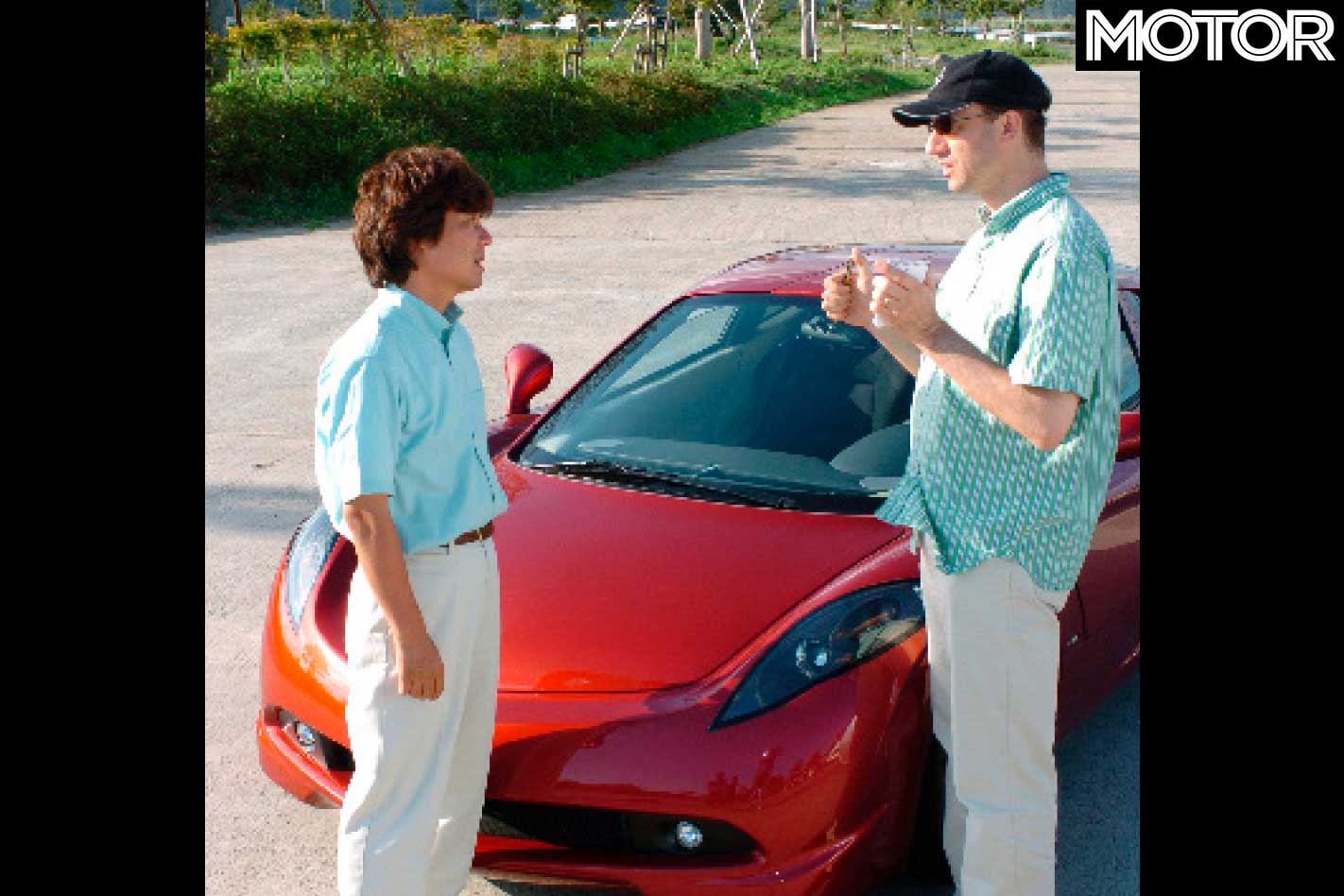
This company has a history of racing triumphs, including back-to-back titles in 2001-02 in the JGTC in the Esso Ultraflo Supra.
The build quality of this one-off is stunning. Costing around $900,000 to build, it employs a carbon fibre body and leather interior. Le Mans is also known in Japan as designer of the rear diffuser fitted to the R34 Skyline GT-R, and we can see a similar application on the CL-1. The CL-1 sits on a Group C race car-type space frame, similar to that of the Group C cars that Le Mans ran in the 1980s.
Powered by an Oldsmobile Intrigue 3.5-litre DOHC V6 engine, well-known American engine tuner CDI stepped in to tweak the V6 from its standard 160kW to a healthy 209kW. To save development money, but still a surprise for this type of track-focused car, the CL-1 also employs the same four-speed auto gearbox as the Intrigue.
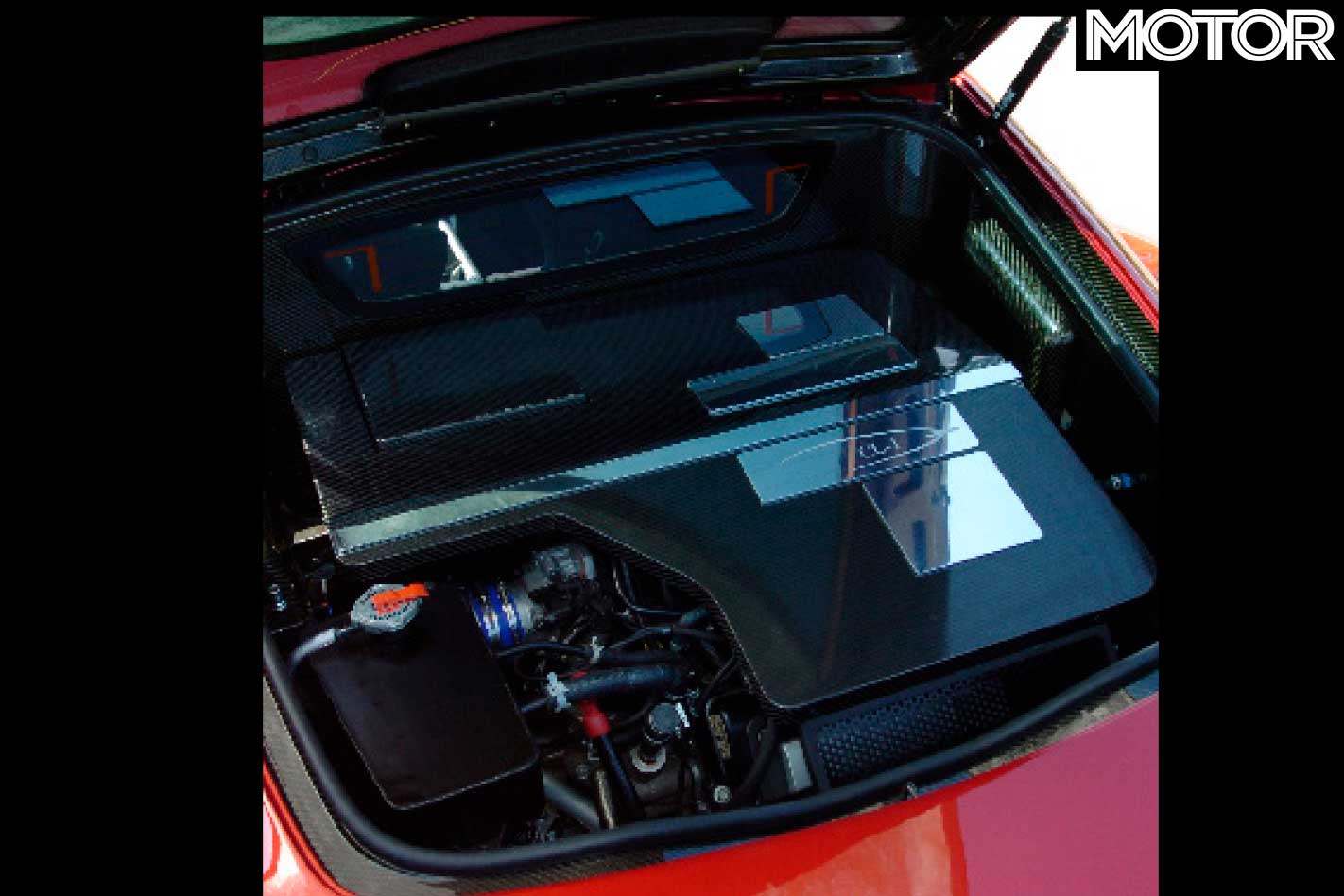
There’s little doubt that the mid-engined CL-1 is the most refreshing piece of automotive inspiration we have seen from a Japanese company since Mazda’s M2 design centre went bust in the mid-’90s.
But why fit a GM V6 to the CL-1? As Katagiri says, “if you use a Nissan or Toyota engine, as other Japanese companies have done (like Autobacs), you can’t help but be strongly linked to that car maker. But our end goal will be to employ something like a Nissan 3.5-litre V6 with a five or six-speed auto/tiptronic-style transmission, because we believe that this car is targeted at an adult sportscar enthusiast who prefers autos.”
FAST FACTS Engine: 3.5-litre V6 DOHC 24-valve Power: 209kW Weight: 1174kg Drive: rear-wheel Price: $900,000 (for the prototype)
Test Drive
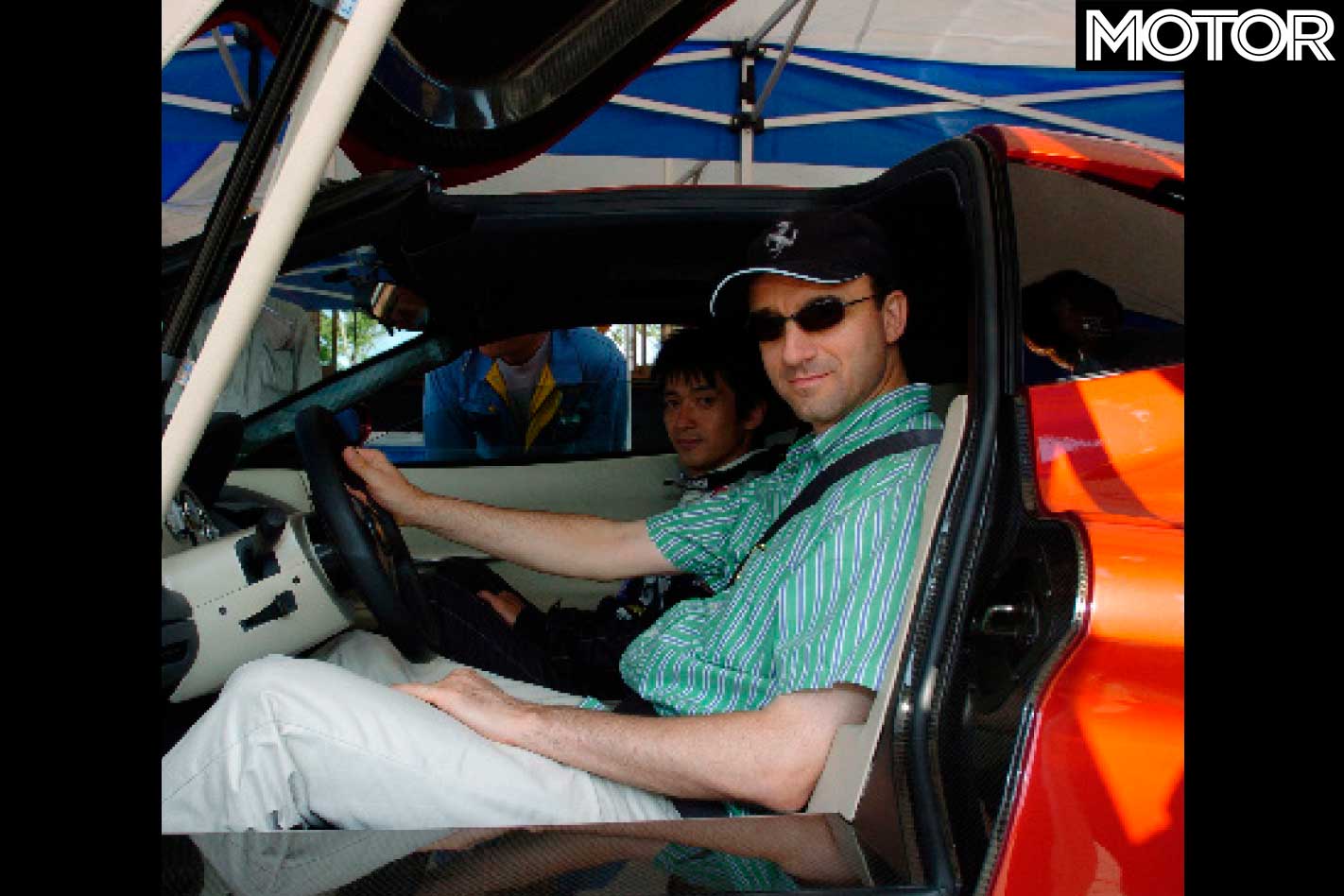
Opening the gull-wing doors, we were surprised by the protruding door support dampers. But, as Katagiri says, these were needed to support the doors in this unusual gull-wing construction.
Once in the driver’s seat, you are surrounded by ivory-coloured leather. Le Mans has spared no expense to impress with this car, its leather interior costs around $12,000. And yours truly was delighted to see that his 190cm frame had plenty of room all around.
Similar in cockpit space to the Lamborghini Gallardo, I found loads of headroom, legroom and elbowroom. This is a good sign for a company that wants to take its development project overseas.
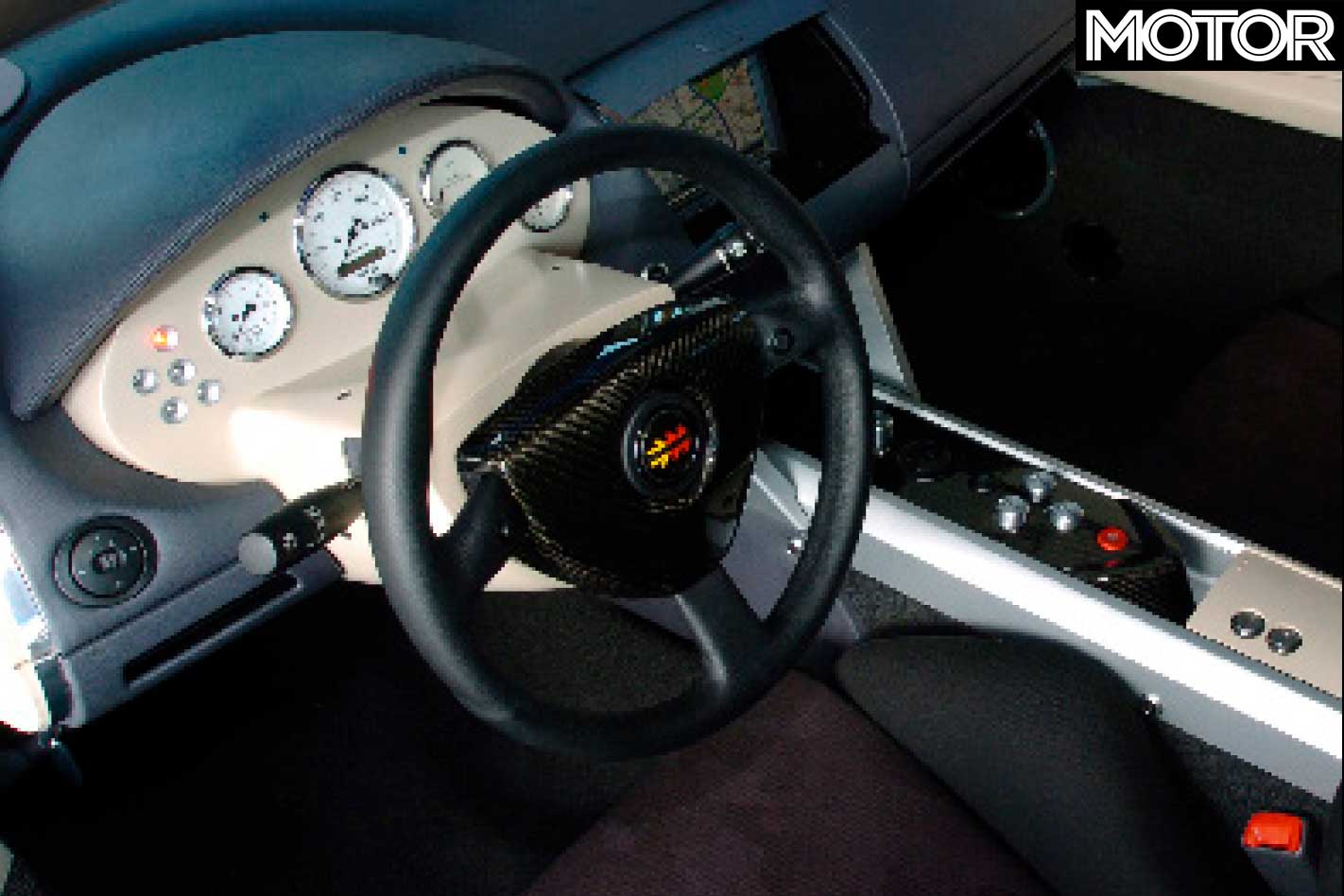
Turn the ignition key and the V6 springs to life. But, surprisingly, where the auto shift knob would normally be, Le Mans’ designers have employed a gear selector no bigger than the volume knob on a car radio.
As it is based on a Group C race car space frame and employs Koni dampers and Eibach springs, believe us when we say its ride is very stiff.
On the road, the CL-1’s steering was a bit heavy, due to the power steering having been disconnected, yet it turns in superbly with almost no body roll. While we were not able to experience the car’s full potential on the day, tuned to 209kW, the 3.5-litre, V6 DOHC with 24-valves, generates adequate acceleration, and the six-pot AP brake calipers on the front and four-pots on the rear stop the CL-1 quickly and surely, while the Bridgestone S-03 tyres provide plenty of grip.
Although we only got a few laps in the CL-1, we left the test track feeling hopeful for this company that spends most of its life in secret. The covers are off, Le Mans has come out, and what a way to do it.
