
Some unlikely cars have done pretty damn well at Bathurst over the years. The otherwise humble Mini took the first nine outright places in 1966 and even a 1200cc Volkswagen Beetle won its class in ’62 and ’63.
This feature was originally published in MOTOR’s January 2011 issue
But you can imagine the reaction from the knockers and the nay-sayers when the first Mazda sporting a rotary engine rasped its way on to the grid in 1969. And that car was, of course, the R100 driven by Trevor and Neil Mason who managed to bring the little screamer home seventh in class and 21st outright, having put it 32nd on the grid in qualifying. Amazing.
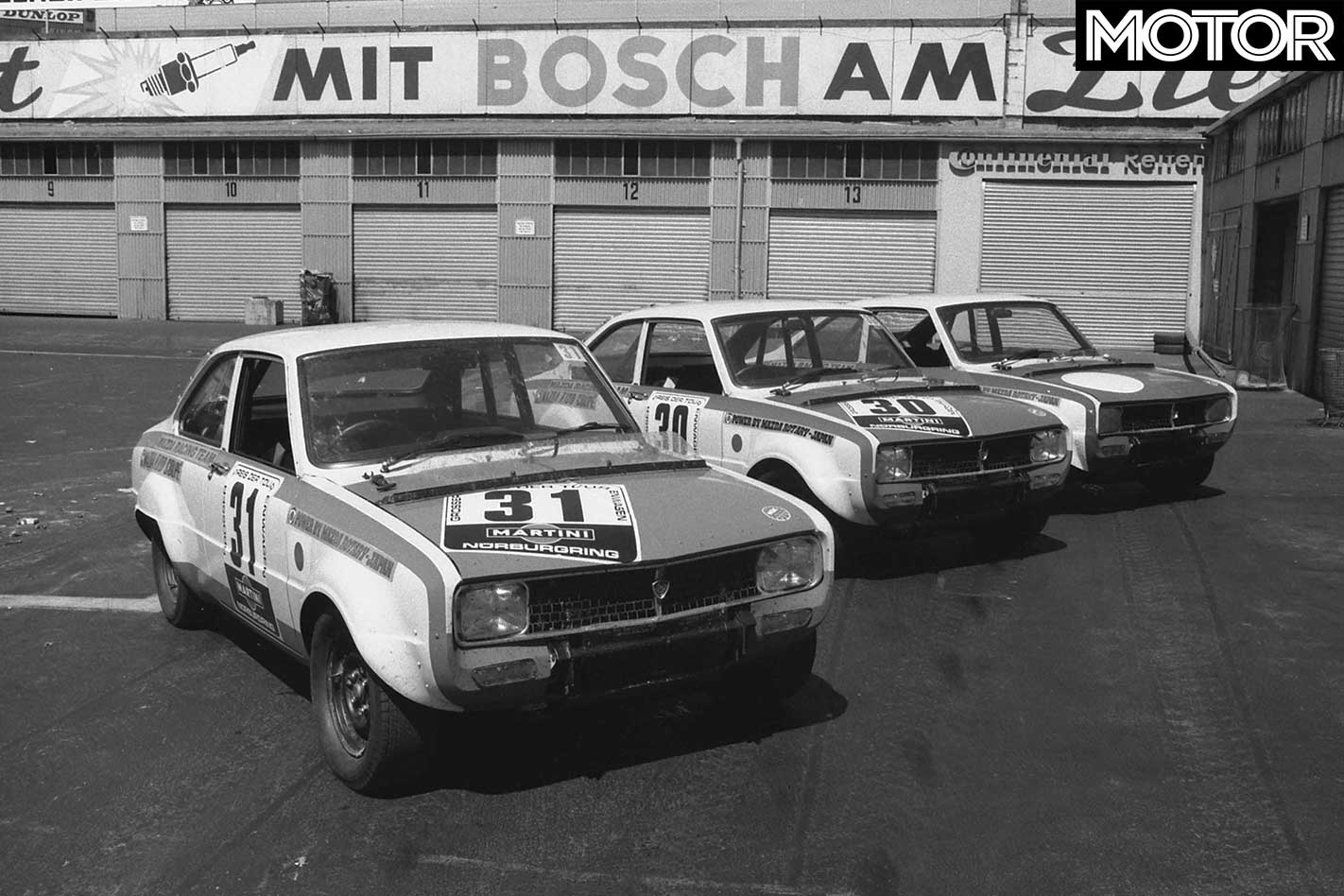
Strangely enough, not a single rotary Mazda greeted the starter for the 1970 classic at Bathurst, but in 1971, the RX-2 had arrived. Gary Cooke piloted the car on his own (doing Bathurst solo was still permitted back then) and brought the RX-2 home first in class and 26th outright.
The rotary club was catching on and by 1972, no less than three RX-2s gridded up. The year 1973 represented a changeover period as the RX-3 emerged and pushed the RX-2 into the shadows. Three of each lined up at Mount Panorama that year, the RX-3 doing better with the Mollison/Hindhaugh car finishing second in class and ninth outright, just ahead of the RX-2 of Haehnle and Rogerson in tenth outright.
The next two years, however, represented the pinnacle of rotary power achievements that wouldn’t be overshadowed until Allan Moffat finished third outright in an RX-7 in 1981 and then brought the Stuyvesant-branded rotary home second outright in 1983 with Yoshima Katayama (Moffat also finished third outright in 1984 driving with Gregg Hansford).
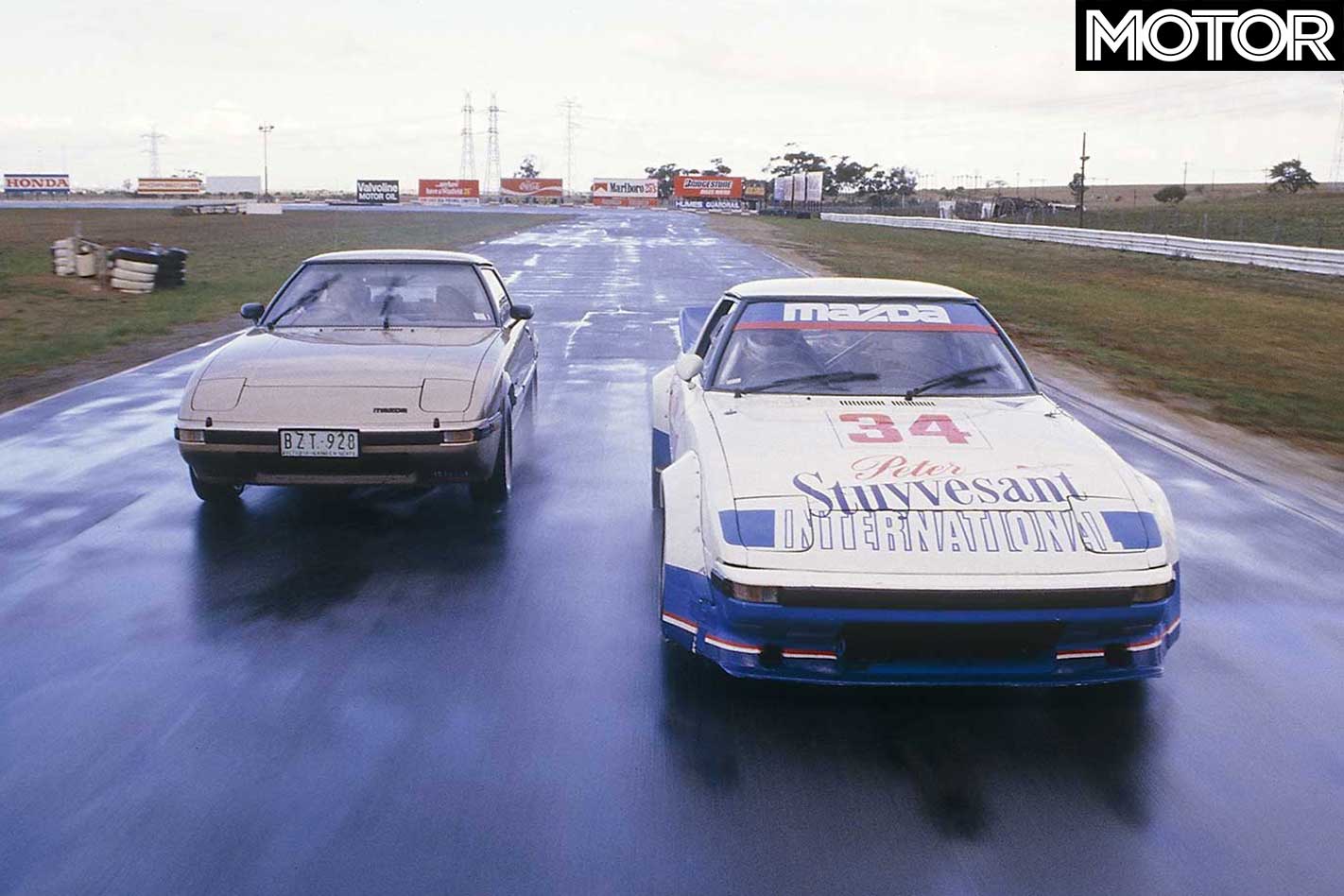
But back in ’74 and ’75, the RX-7 wasn’t even heard of, and the RX-3 had the job of taking on the best touring cars in the world.
And even though the R100 and RX-2 had paved the way, there’s no getting around the magnitude of the efforts of Tony Farrell and Brian Reed in bringing it home first in class and sixth outright and then Don Holland and Hiroshi Fushida going one better the next year; first in class and fifth outright.

Yep, that little RX-3 sure showed the big guys a trick or two. I wonder where it is now? Well, thanks to a succession of owners who realised the significance of what they were on to, the car has survived. Better than that, it has survived in precisely the same trim and condition it was back in those heady days of the mid-70s.
And even better than that, we tracked it down and it’s the car you see here. This is no tribute, no recreation … it’s the real deal. And it’s amazing. After the car retired from front-line touring car racing (RX-3s were still running at Bathurst until 1979 and finishing 13th outright), its history is a bit murky.

The rumour is it went improved-production racing – which kind of makes sense because a lot of pensioned-off racers did that or went club racing in those days – but nobody’s really sure.
One thing we do know is that the red bits on the car were, at some stage, painted blue. They’ve gradually been returned to red over the years, as bits and pieces of the paintwork have been touched up (such is the life of a race-car).
Sometime in the late 1980s or early ’90s, the car was bought by a bloke who intended to do Targa Tasmania in it (which was kind of prescient, because the first event wasn’t held until 1991), but that never happened, apparently. Which probably saved the thing from the knacker’s yard.
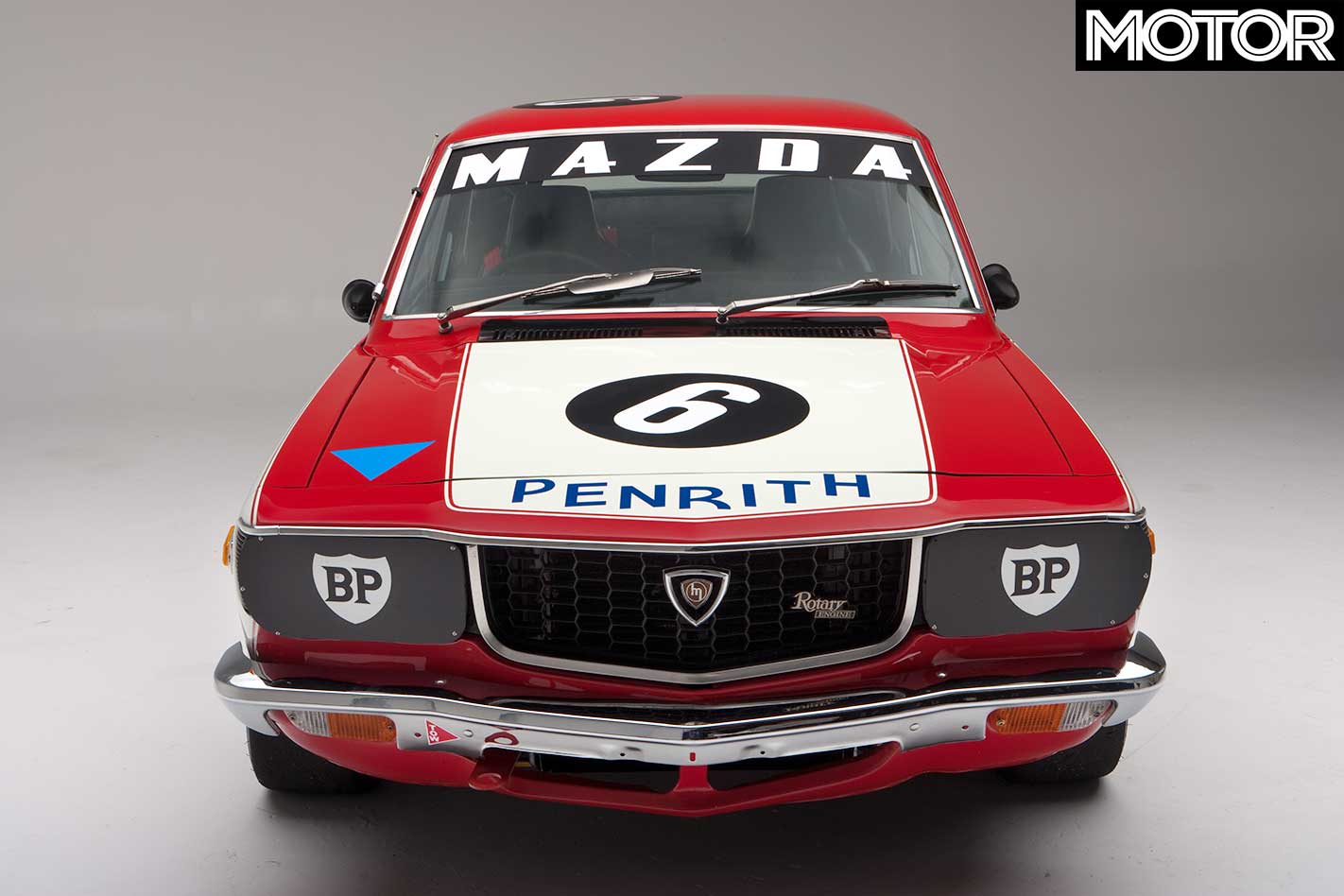
In fact, the car’s whole life since it finished top-flight racing has been a pretty charmed one. Nobody who owned it had ever thought to mess with it mechanically or visually and, apart from that blue paint we mentioned, it hasn’t been altered at all over the years. ‘Uncommon’ barely covers it. What you see here is exactly how it was back in the mid-70s.
That means we’re talking about the 1146 cubic-centimetre version of the Wankel rotary which, by the time the officials had finished with it, was deemed to have an equivalent capacity to a piston engine of 2292cc. That meant it had to run in the under three-litre class, but even with that notional capacity, it was one of the smaller engines to do so.
Touring car rules of the day didn’t offer much in the way of flexibility, either, so don’t expect to see a wildly tuned mill. You will, however, find a set of tubular headers replacing the stock exhaust manifold, and the dreaded pollution-gear air-pump could be disconnected.
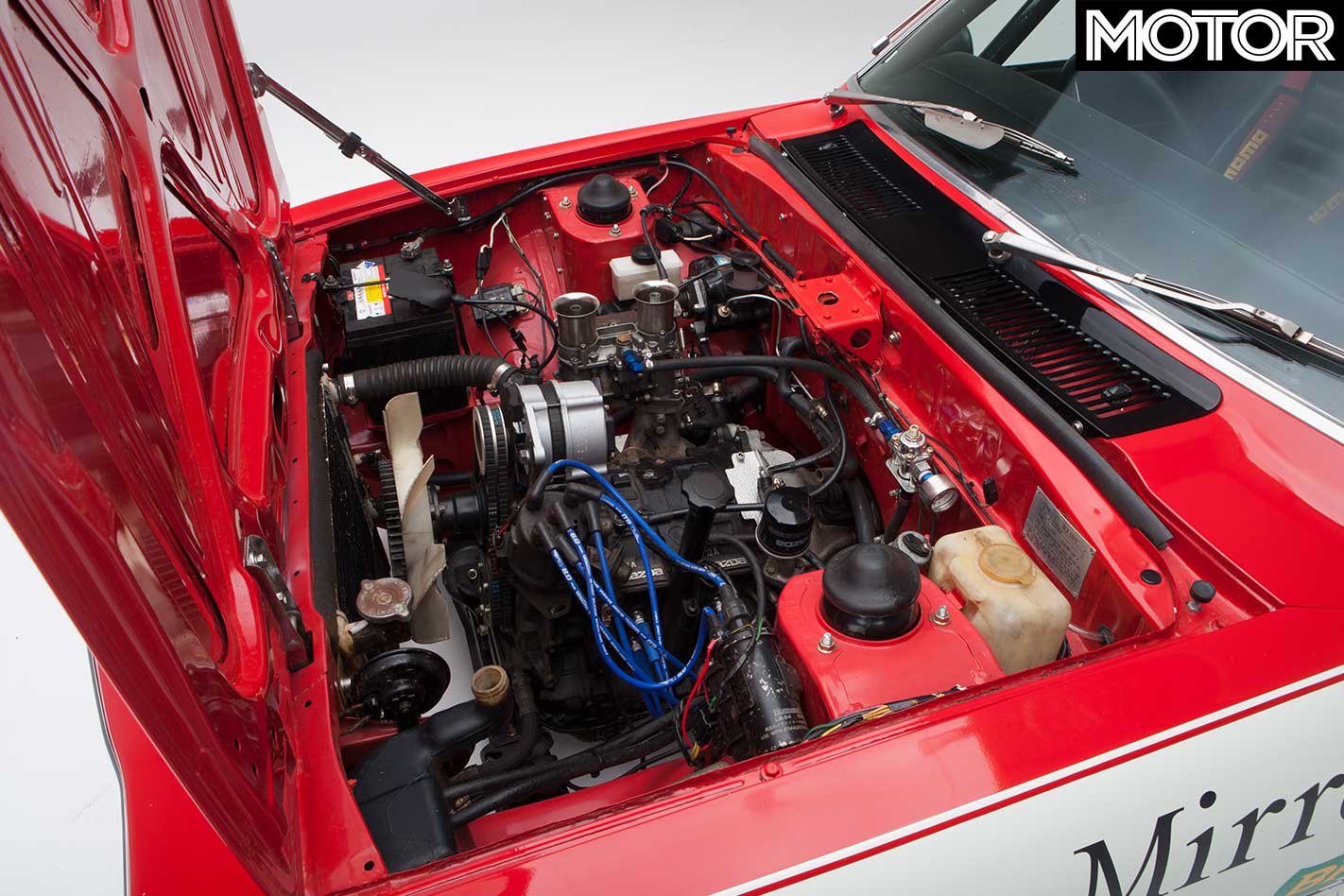
The big power gain was to be had in the carby department, and this particular RX-3 usually ran with a choice of sidedraught or downdraught Webers, ranging from 48mm for tight, twisty tracks where low-down torque (not something the rotary was flush with early on) was important, right up to a monster 58mm job for longer, more flowing circuits.
While the stock RX-3s claimed 97kW, the competition car was bumped to about 125kW which doesn’t sound much, but when you consider its dainty kerb mass, you can see how it potentially was a serious giant-killer.
One area that could be changed was the width of the wheels. So, the RX-3 was given a six-inch front rim and nine-inch rears fitted with Dunlop slicks. Despite that, you couldn’t alter the diameter, so those slicks were still 13-inchers.

While a modern V8 Supercar has a suspension set-up even its own mother wouldn’t recognise, again, in the 1970s, you more or less had to run what Mazda had provided in the homologated road car.
In the RX-3, that meant the standard set-up with only firmer springs, a thicker anti-roll bar and adjustable Koni shocks, while at the rear, the stock leaf springs were beefed up and adjustable shocks were added, although you could also add a Panhard rod and tramp rods to try to tame it all.
The four-speed ’box remained but was fitted with close-ratio gears (with a l-o-n-g first gear), and the diff centre was altered from the standard 3.9:1 to a slightly sharper 4.1:1.
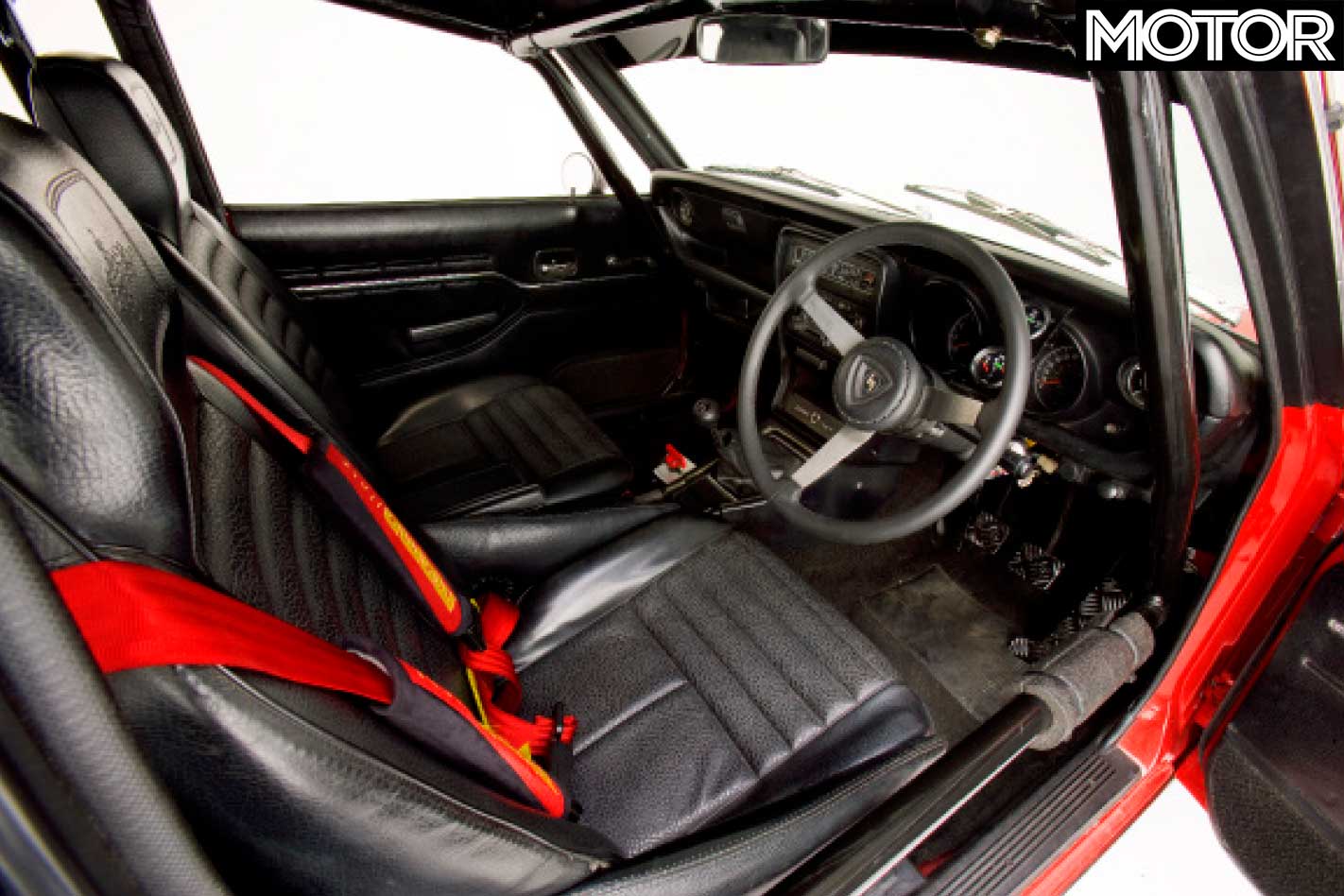
Actually, the rear axle was the cause of a few headaches along the way. The limited-slip diff was a factory option and was part of what was called a ‘Mazda Sport Kit’. The catch was that the axles had to be shortened 1mm each and that, according to the rules, was not on.
Then-driver Don Holland argued that the factory Sports Kit – which stipulated the shortening – should have allowed for this, but the authorities said no. Six months of wrangling ensued, in which time Holland figured that he could achieve the same result by shimming the outer end of the axles by the same 1mm.
Brakes, meanwhile, are ventilated Girlocks with four-piston calipers (pretty tough for the day) with the stock drums at the rear, drilled for extra cooling.
It might all sound a bit tame, but this RX-3 was actually the most successful car in the 1974 Manufacturers’ Championship with a string of class wins and outright results that often shaded the V8 and factory-backed runners.

The Good
1 – Unique Issue This fine little RX-3 proves that you don’t need to boast a V8 engine to be a genuine Bathurst hero.
2 – Untouched Apart from some of the signage changing colour, it’s just as it ran in the day. Unlike most you’ll find.
3 – Can you Handle it? An example this neat and tidy would still be a great club car if you were game to take it to the racetrack.
The Bad
1 – Rare Item Okay, so this RX-3 really is road-registered, but would you really be taking it for a Sunday drive?
2 – Irreplaceable Do you even want to think about banging up that pristine, original bodywork? It’s not worth it…
3 – Showing its age Plenty of hot littlies would thump it these days. And they have air-con and cruise.
Time to get personal
The car’s current owner, Sydney-based Zyg Ryter, has owned the little Mazda since around the mid-1990s and although he’s been a racer in the past, he never got around to hurling the RX-3 at the Armco himself.
And he admits that he’s never done any restoration on it – hasn’t had to – and this is the condition he found it in. Lucky bloke.
In fact, Zyg also points out that while the car is, in fact, road registered, that it was probably the work of the geezer who was looking at Targa Tassie. Zyg has never had it on the road.
His plans are to “showcase it as the only remaining Bathurst RX-3, and the most successful”.
The only survivor?
“Yep, all the others were either butchered or written-off. That’s why I reckon it needs to be preserved and shown to people. If somebody else was the owner, that’s what I’d hope they did.”
For his part, Zyg is a long-term rotary perv, having been around them since they first arrived here in the late ’60s. And the Ryter clan is now into its second generation of rotor-nuts with Zyg’s son also falling victim to the raspy little rascals.
So will the car ever be for sale?
“Not a chance,” says Zyg.
GRAEME Whickman, appointed to close Ford’s six decades old Australian manufacturing business, will officially leave the former car maker today, the company has announced.
In his place, Kay Hart Ford’s global distribution and digital experience manager for battery electric vehicles is named president and CEO, Ford of Australia and New Zealand. Hart joins Ford Australia from Team Edison, a division within Ford formed to speed up its electric vehicle development.
Ford said Hart, 40, would be based in Melbourne, and report to Peter Fleet, the group vice-president and president of Ford Asia Pacific.
“Kay is a proven leader, highly motivated by consumer insights and dealer relations,” Fleet said in a statement. “She has broad experience across the company and around the globe. With strong knowledge and relationships in Australia and New Zealand, Kay will be a wonderful addition to our leadership team and a strong advocate for our customers and dealers.”
Hart has had country responsibilities before. Between 2013-15, she was managing director for Ford Philippines.
She started her career with Ford at the car maker’s New Zealand-based marketing team in 1998.
Whickman, meanwhile, will officially leave Ford to “pursue a new opportunity”. Melbourne-based GUD Holdings, which includes automotive brands such as Ryco, Cooper and lighting company Navra, announced today that Whickman would formally take up the position as its managing director.
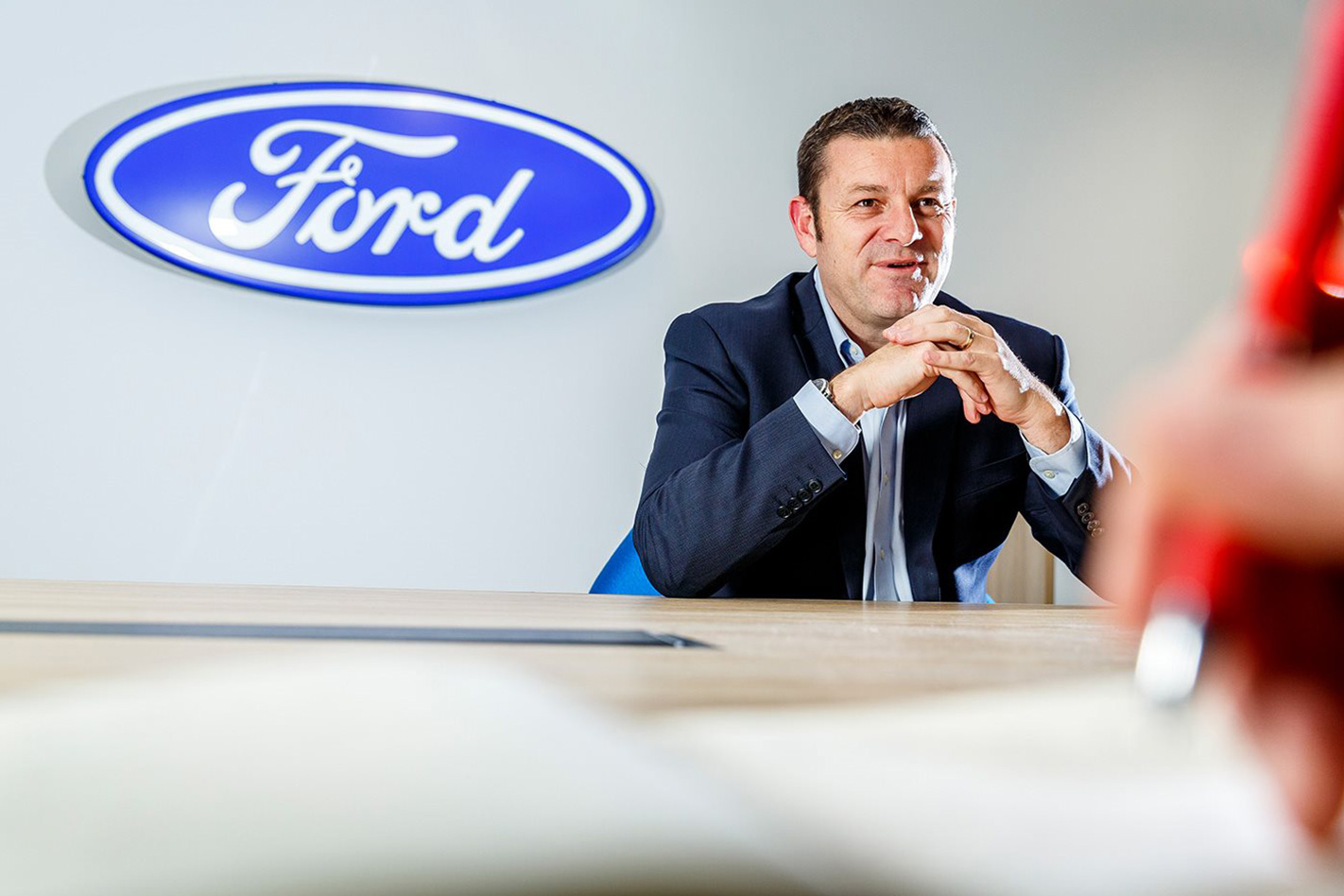
Whickman, a 20-year Ford veteran, replaced Bob Graziano at the helm of Ford Australia in 2015 as the company was preparing to wind up its car manufacturing and engine casting operations the next year. Graziano announced the closures in May 2013, and confirmed he had doubled his Australian tenure from three to six years to ensure he was here right through the “transformation” process from manufacturer to full-line importer. However, after a 32-year career with Ford, Graziano elected to retire rather than see his tenure out.
“In the past some people have coined the phrase the ‘Falcon Motor Company’. And whilst that’s a tremendous legacy, it was also a gating function and I think some people couldn’t see past the Falcon,” Whickman told Wheels a year after the factory gates closed for the last time on October 6, 2016.
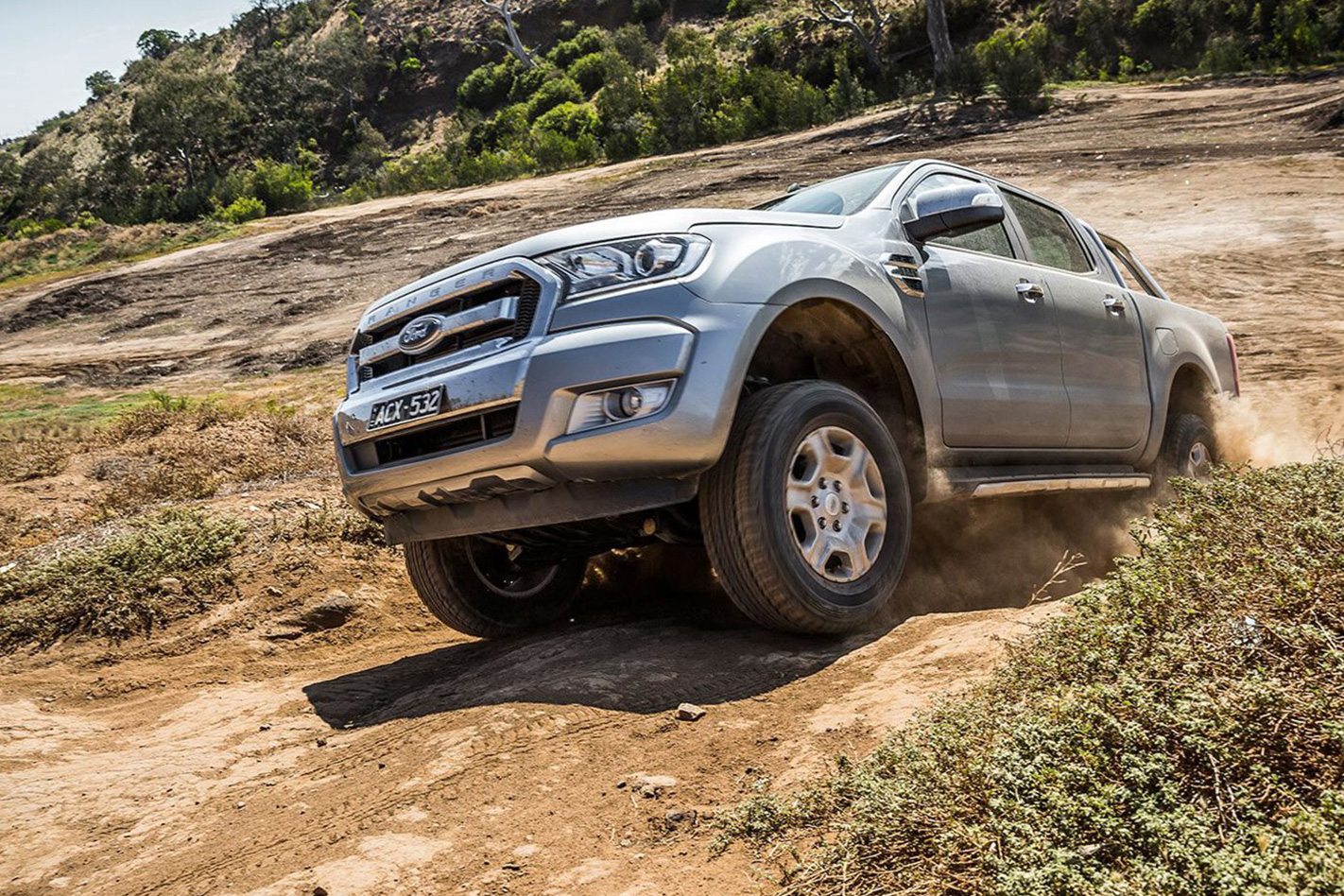
Read next: Ford Ranger range review “[Falcon] cast a very large shadow and I don’t think people could see we had other offers in the marketplace… it is interesting to see what’s happening with the [Ford] Ranger, because over that longer time we are seeing another product get a bit more of the limelight.”
Over Whickman’s tenure, Ford has introduced the Mustang performance car to its Australian showroom, a model that has risen to become the brand’s second-best performer behind the Ranger trade ute.
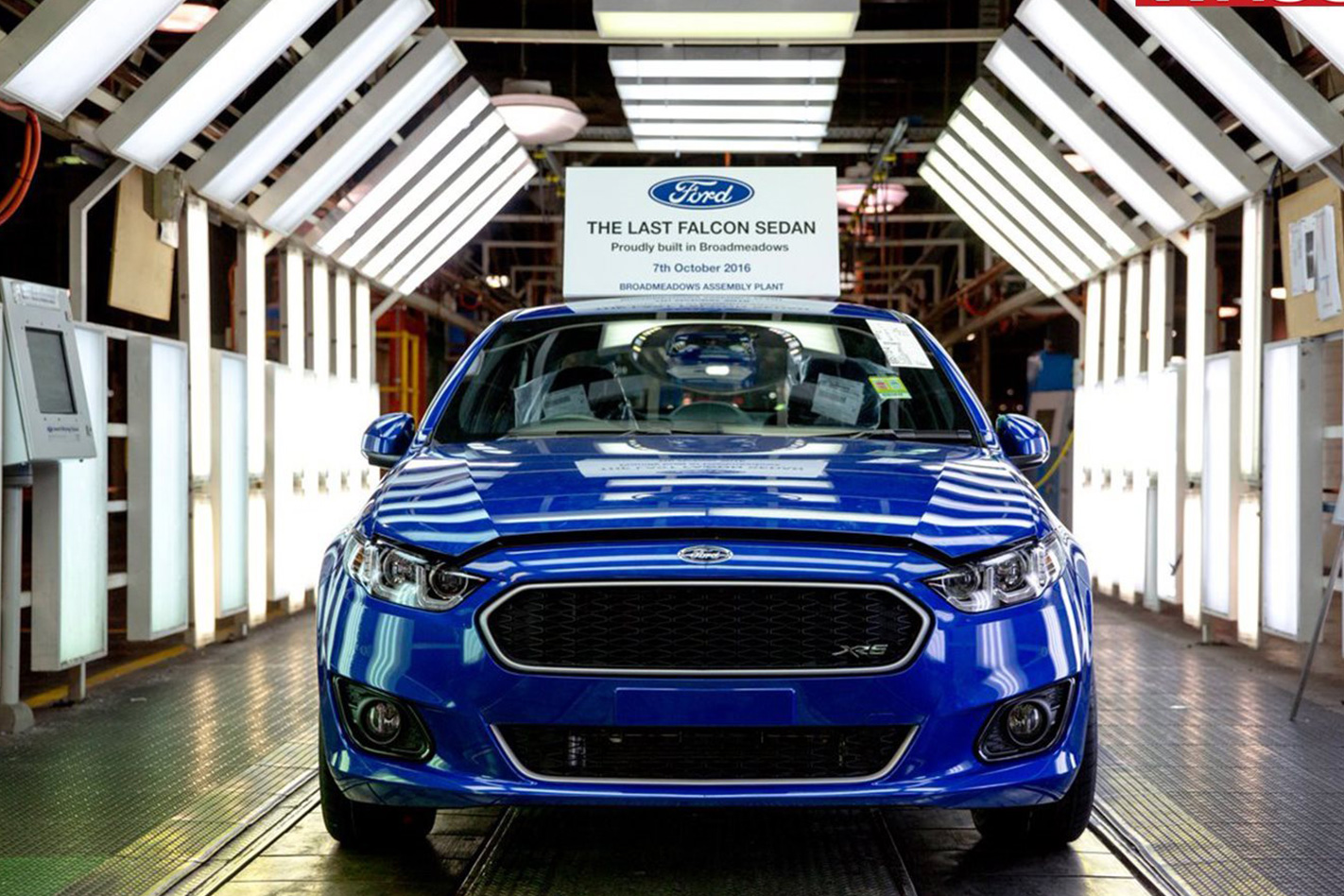
It has also announced plans to roll out the Ford Performance sub-brand to Australian showrooms, and introduce the Ford Ranger Raptor as a halo model for the trade ute – despite it missing out on the twin-turbo V6 petrol engine that will power it in the US, and instead using a twin-turbo four-cylinder diesel engine.
In her most recent role in the US, Hart was responsible for driving the transformation of Ford’s future customer experience across the globe. “During her time as advanced consumer experience marketing manager, Hart led innovations such as FordPass – the company’s one-stop app that delivers solutions aimed at helping consumers get the most out of their vehicle ownership experience,” the company said in a statement.
“I know I leave a much stronger Ford Australia and New Zealand than only a few years ago, a company that has a strong and vibrant future,” Whickman said.
“The industry is undergoing rapid change, and I have confidence the local leadership teams have the right plans in place to be successful,” he said. “They will continue to be held up in the global Ford world as great examples of what happens when good, focused strategies are supported by committed and skilful employees and dealers.”
Ford Australia’s revolving door
- Geoff Polites (1999-2004)
- Tom Gorman (2004-08)
- Bill Osborne (only seven months in the chair)
- Marin Burela (2008-10)
- Bob Graziano (2010-15)
- Graeme Whickman (2015-18)
- Kay Hart (from April 2)
MAX VERSTAPPEN held on to win the Austrian Grand Prix in tense conditions, with a severely blistered rear tyre.
It was a chaotic race at the Red Bull Ring, with a number of lead changes, and several high-profile retirements.
Kimi Raikkonen hunted the Dutch Red Bull driver to the very end, finishing second ahead of teammate Sebastian Vettel.
Despite not appearing on the podium, Mercedes-AMG driver Lewis Hamilton led the race early on, holding off a hard-charging Raikkonen at the start.
The Ferrari driver split the Silver Arrows (which had locked out the front row in qualifying) heading to the first turn, heading to turn two in second place. However, Raikkonen then ran wide and was demoted to fourth, as Verstappen slid into third, and poleman Valtteri Bottas soared into second.
However, the Finnish driver was soon out of the race with a gearbox failure. Bottas’s retirement prompted a virtual safety car, under which both Red Bull and Ferrari pitted. Race leader Hamilton stayed out on track, a tactical error that would turn out to be disastrous for the Briton’s hopes for victory.
Having to pit under green-flag conditions, Hamilton dropped to fourth behind Daniel Ricciardo, but importantly ahead of drivers’ championship title-rival Vettel. Not for long, though, as Vettel made a bold move to pass the Mercedes-AMG driver at turn three.
Verstappen and Raikkonen were untroubled at the head of the field.
Blistering rear tyres then became a problem for many drivers, with Ricciardo pitting from second place for fresh tyres, followed 15 laps later by Hamilton.
Running in fourth, Ricciardo’s Renault engine then gave up the ghost, forcing the Australian to pull off the track, his race over.
Lewis Hamilton was next to retire with a loss of fuel pressure. The last time Mercedes-AMG had a double mechanical retirement was the Italian Grand Prix in 1955.
Late in the race, Verstappen’s rear tyre was blistering, but the Dutchman held on for victory. Raikkonen put in the fastest lap of the race on the 71st and final tour.
Romain Grosjean finished fourth, a best-ever result for the Haas F1 team, with teammate Kevin Magnussen rounding out the top five.
Esteban Ocon, Sergio Perez, Fernando Alonso, Charles Leclerc, and Marcus Ericsson completed the top 10.
The defending champion’s retirement promotes Vettel to the championship lead by a single point ahead of next weekend’s British Grand Prix.



READER CODE
For 10 chances to win, enter the reader code from your August MOTOR magazine issue below (Don’t have a magazine code? Keep scrolling down!):
Can’t see the entry form? Click here to enter
FREE ENTRY
Enter your details below for your chance to win!
Can’t see the entry form? Click here to enter

FREE ENTRY
Enter your details below for your chance to win!
Can’t see the entry form? Click here to enter


READER CODE
For 10 chances to win, enter the reader code from the latest issue of Wheels magazine below (Don’t have a magazine code? Keep scrolling down!):
Can’t see the entry form? Click here to enter
FREE ENTRY
Enter your details below for your chance to win!
Can’t see the entry form? Click here to enter
This year, 2018, marks the 40th anniversary of the Mazda RX-7.
In fact, the date this story is published – July 1 – marks 40 years to the day since the first Mazda RX-7 was registered in Australia according to the archives at Mazda Australia HQ. So we decided today would be the best day to look back at the ‘highlight reel’ of the RX-7’s history, particularly in Australia.
But first, a quick history lesson from the UK thanks to Mazda, which gathered one model from each generation of RX-7. They’re called FB, FC, and FD.
The FB Mazda RX-7, which was released in 1978, became a performance icon to demonstrate what the Wankel rotary engine was capable of in a road car.
According to previous stories on the RX-7 from MOTOR Magazine, Mazda’s engineer Takao Kijima, studied the Porsche 924 and emulated it with a car that offered close to 50:50 weight distribution, which he achieved by locating the 77kW/147Nm 12A twin-rotor engine in a front-mid position.
When MOTOR (then known as Modern Motor Magazine) first drove the RX-7, we noted that it was “quick without being sensational”, but that “the Mazda’s real abilities lie in putting down fast point-to-point times in demanding conditions.
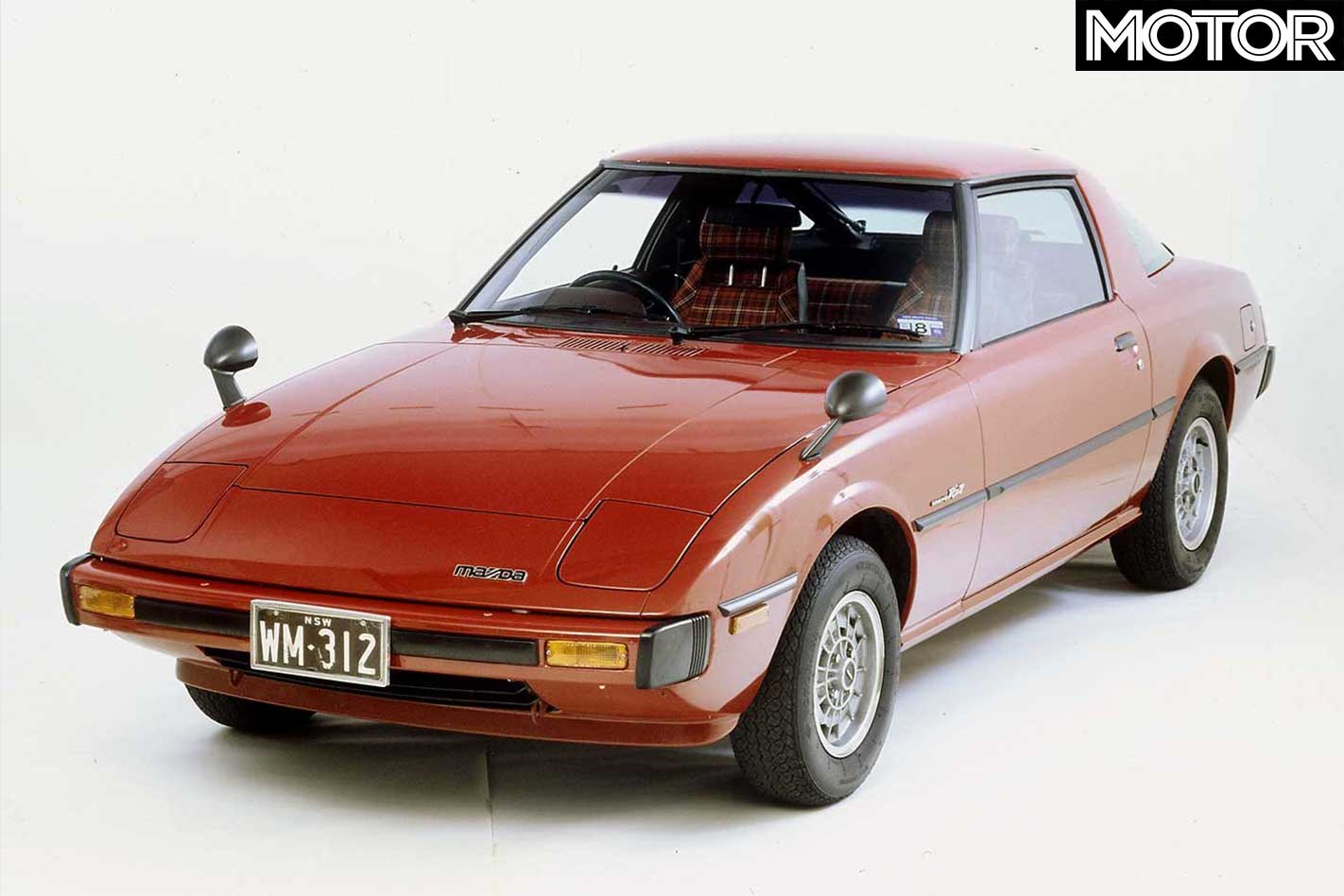
“Over undulating, twisting, narrow secondary roads, the Mazda would out-run just about any mass-produced car − and many thoroughbreds, too.”
It became the weapon of choice for one Alan Moffat during the early 1980s in touring cars. Opposition to the car’s admission was heavy until it was clear that the car didn’t have massive power advantage.
What the car did have, however, was balance and low running costs. A few months after its debut, it won the 1981 Australian Endurance Championship.
“The first real demonstration of its prowess came at the Sandown 400,”Moffat once told MOTOR.
“We went the whole distance on one set of tyres. This showed how ideally balanced the car was. After our first stop there were sniggers along pit lane. People thought we’d forgotten to change tyres.”
In 1982, at Lakeside in Queensland, Peter Brock broke the lap record in a Commodore, but Moffat went out and clocked a lap 1.1sec better in the RX-7.
The RX-7 would eventually become turbocharged, offered in Japan during the FB generation, but not in Australia until the FC came around in 1985.
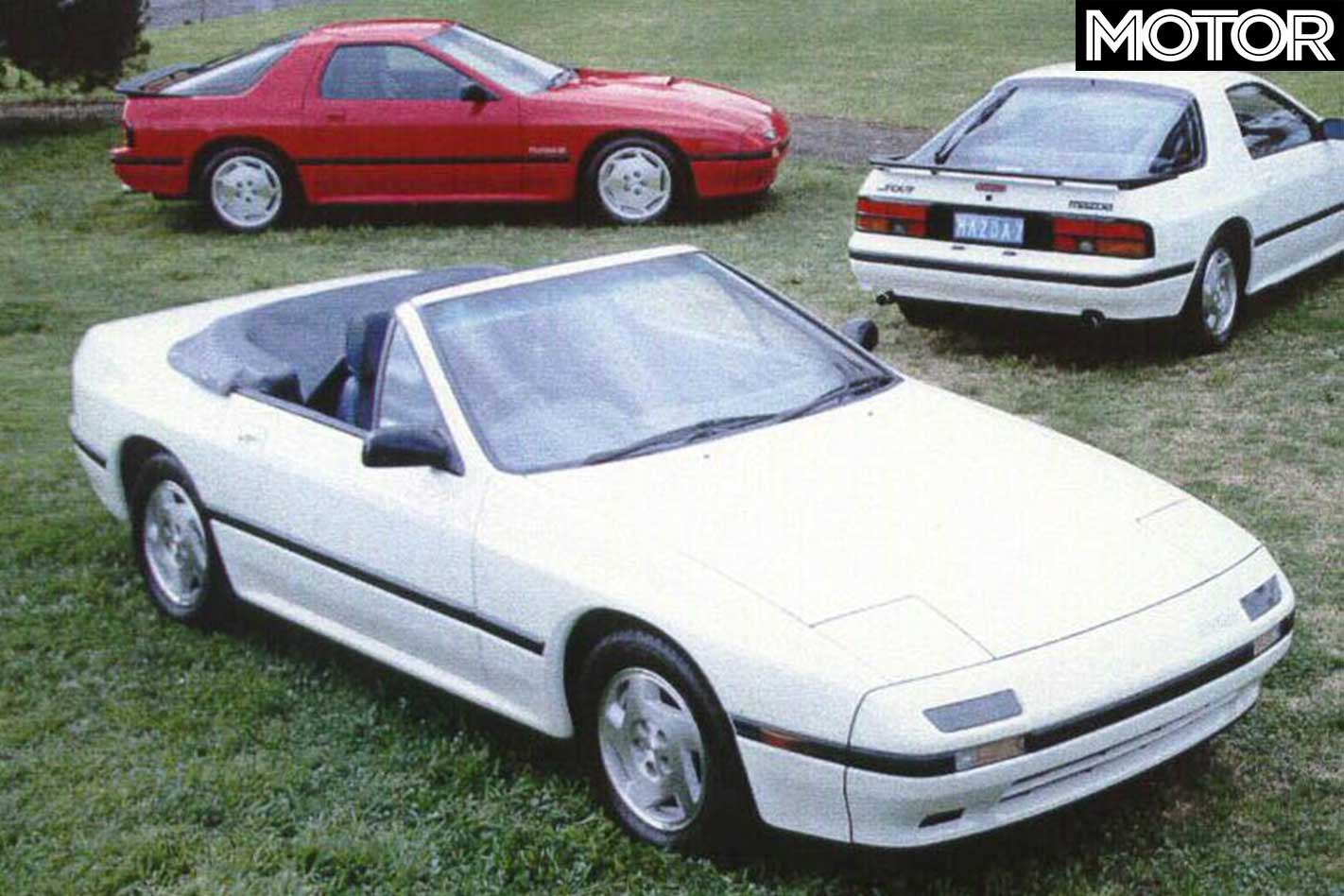
By this point, a turbocharged option was available to Aussies with 133kW/247Nm, and could hit 100km/h in 7.8sec. The engine used in this car might be more familiar to younger readers than the 12A rotary.
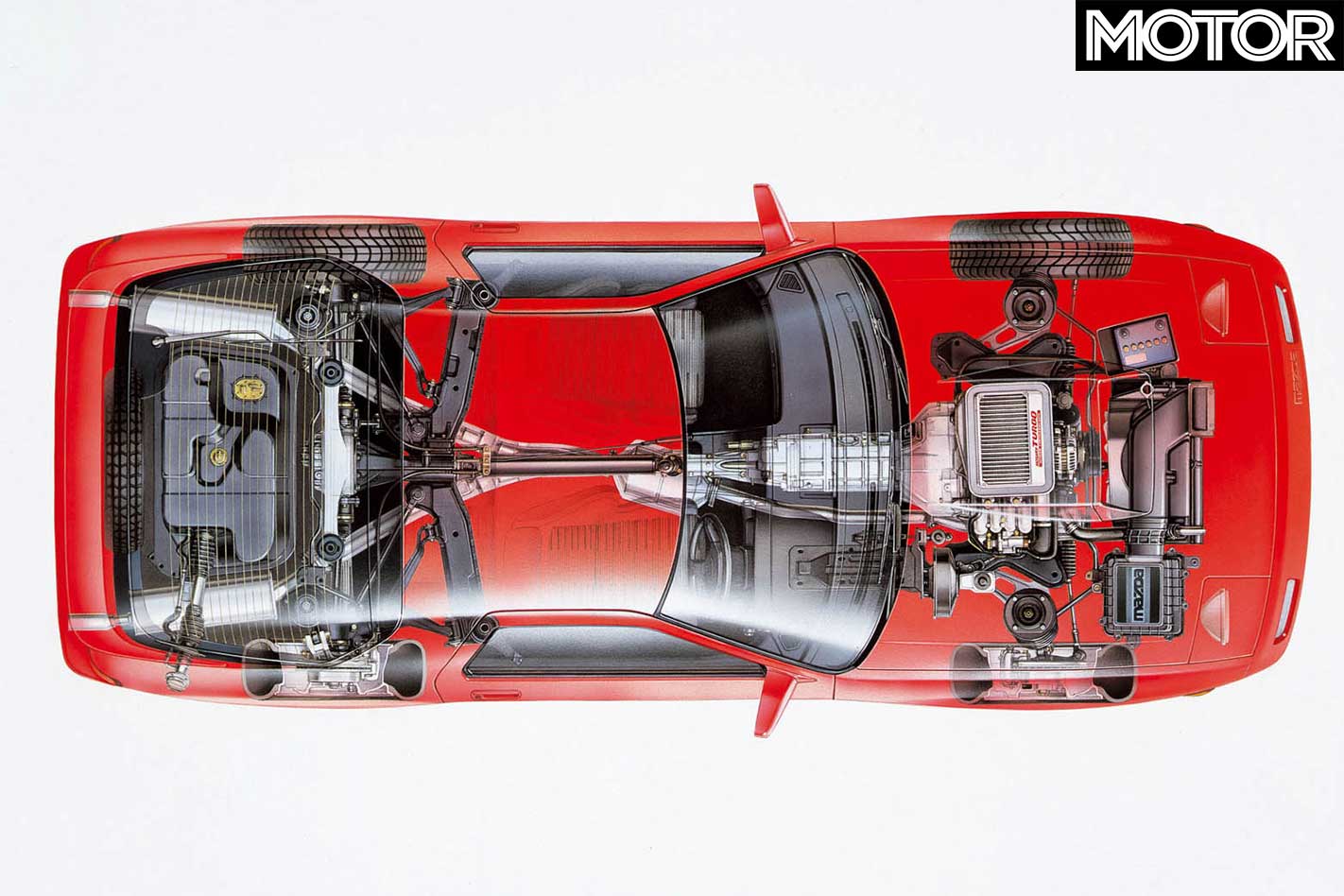
The FC-gen RX-7 brought with it the iconic 13B.
It was also far more ‘Porsche’ than Mazda might like to admit. It featured multi-link rear suspension and passive rear-wheel steering, while a later Series V Turbo produced 146kW/265Nm and hit 100km/h in less than 7 seconds.
The RX-7 was finally taking the fight to the Euros.
But perhaps the generation most responsible for the RX-7’s fame is the FD.
The third and final RX-7 was a culmination of everything learned prior, meaning twin-turbochargers and better chassis dynamics, as well as 176kW and 294Nm being more than enough for a 1290kg vehicle.
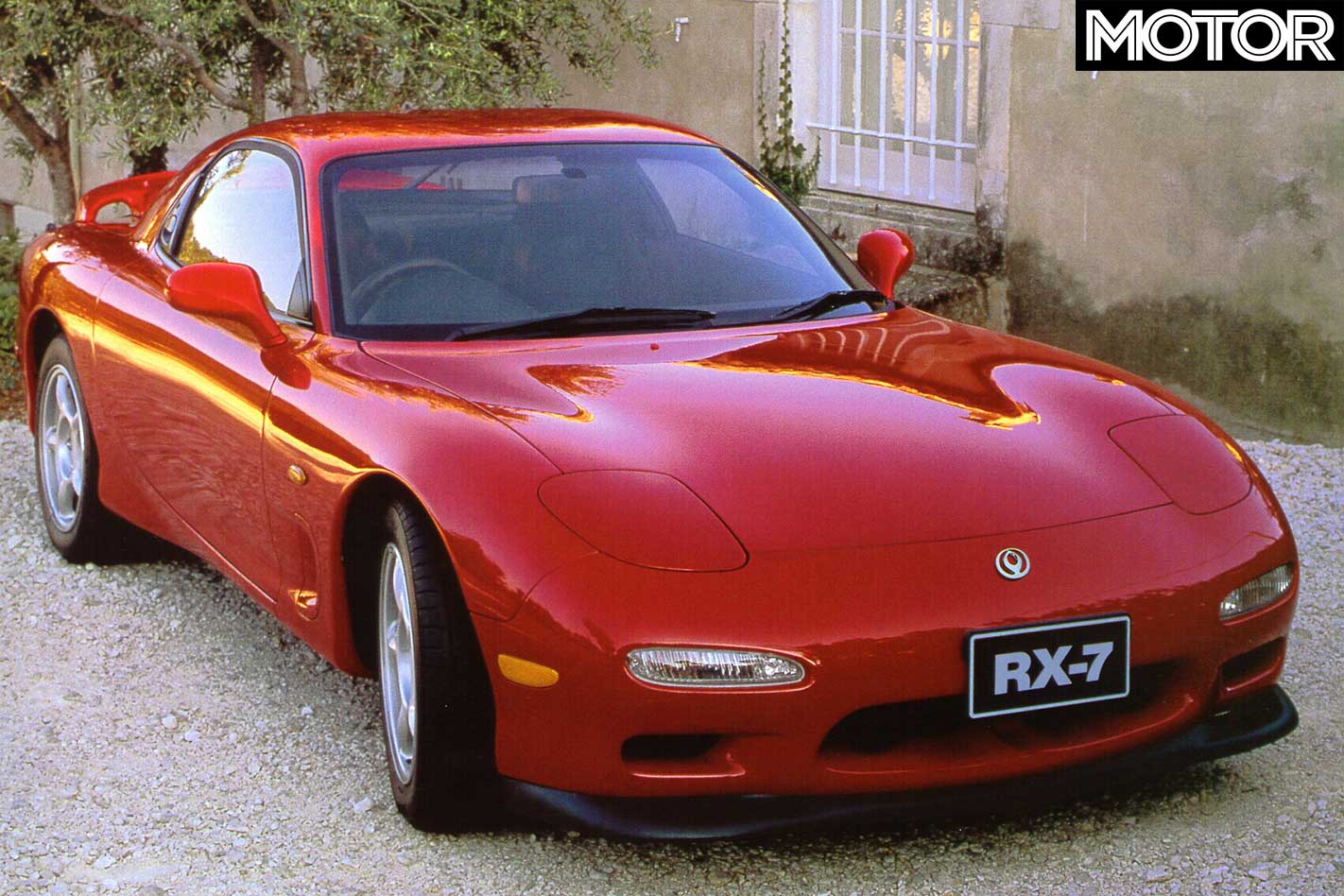
“This is a car you can balance on the throttle beautifully,” MOTOR wrote in June ’95.
“Its chassis is great and it’s nicely weighted. Sharp rack-and-pinion steering, 50:50 weight distribution, wider track and lower centre-of-gravity all contribute to delightfully sporty dynamics.”
Several race wins later, and the FD RX-7 had well and truly proven its prowess. So Mazda Australia built a faster, better, and far more expensive RX-7. The RX-7 SP.
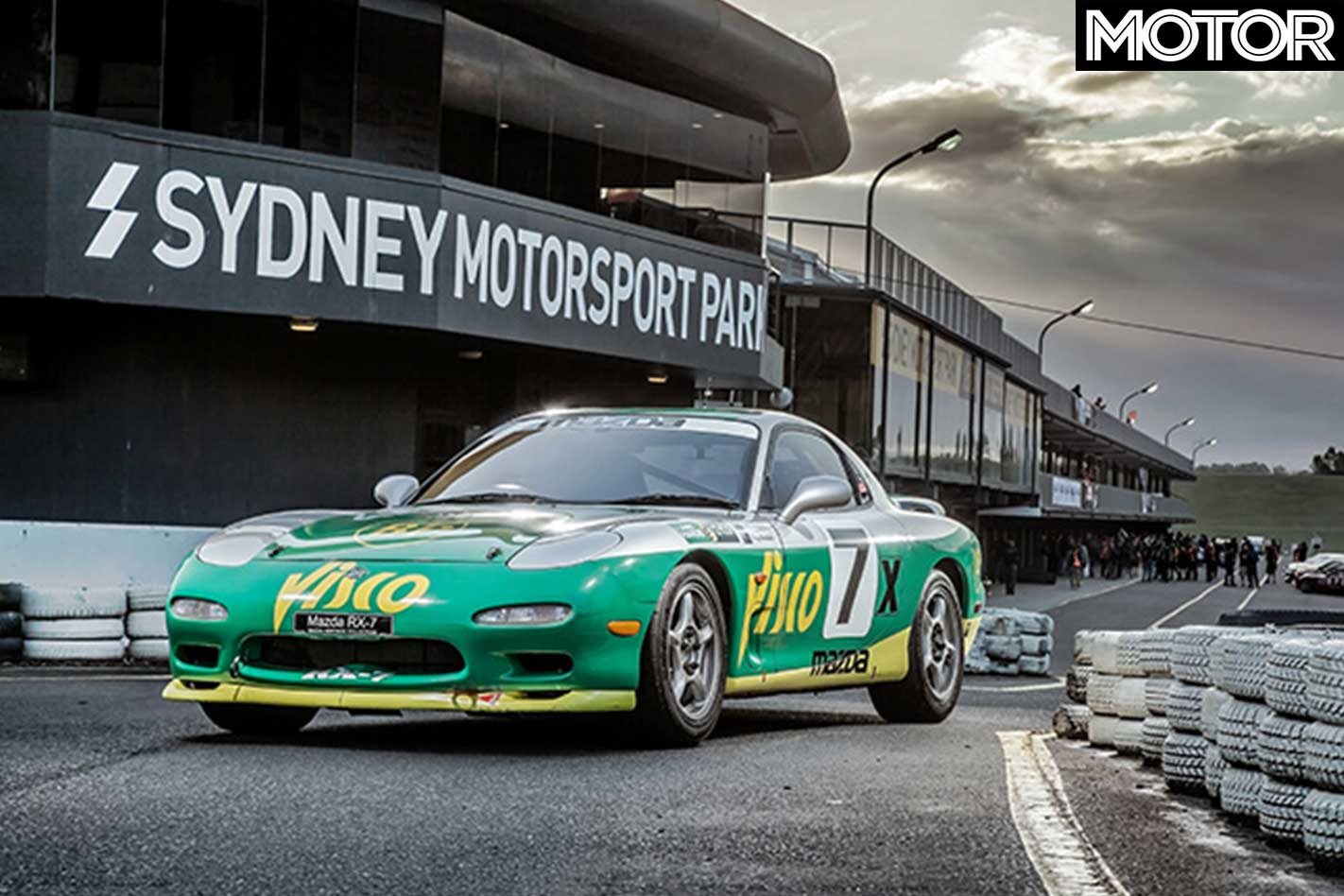
Though it was essentially the race version of the FD, some road-going models are still around today, with its original $99,750 asking price having been overshadowed by a sharp increase in demand for ‘90s Japanese classics.
Its 204kW/357Nm twin-turbo rotary made it arguably the greatest RX-7 of them all, and it was a fitting way for the badge to go out – locally at least. It was Australian developed as a homologation car with help from one Allan Horsley – part of Moffat’s team at the time.
“We developed the SP in such a short period,” he told MOTOR.
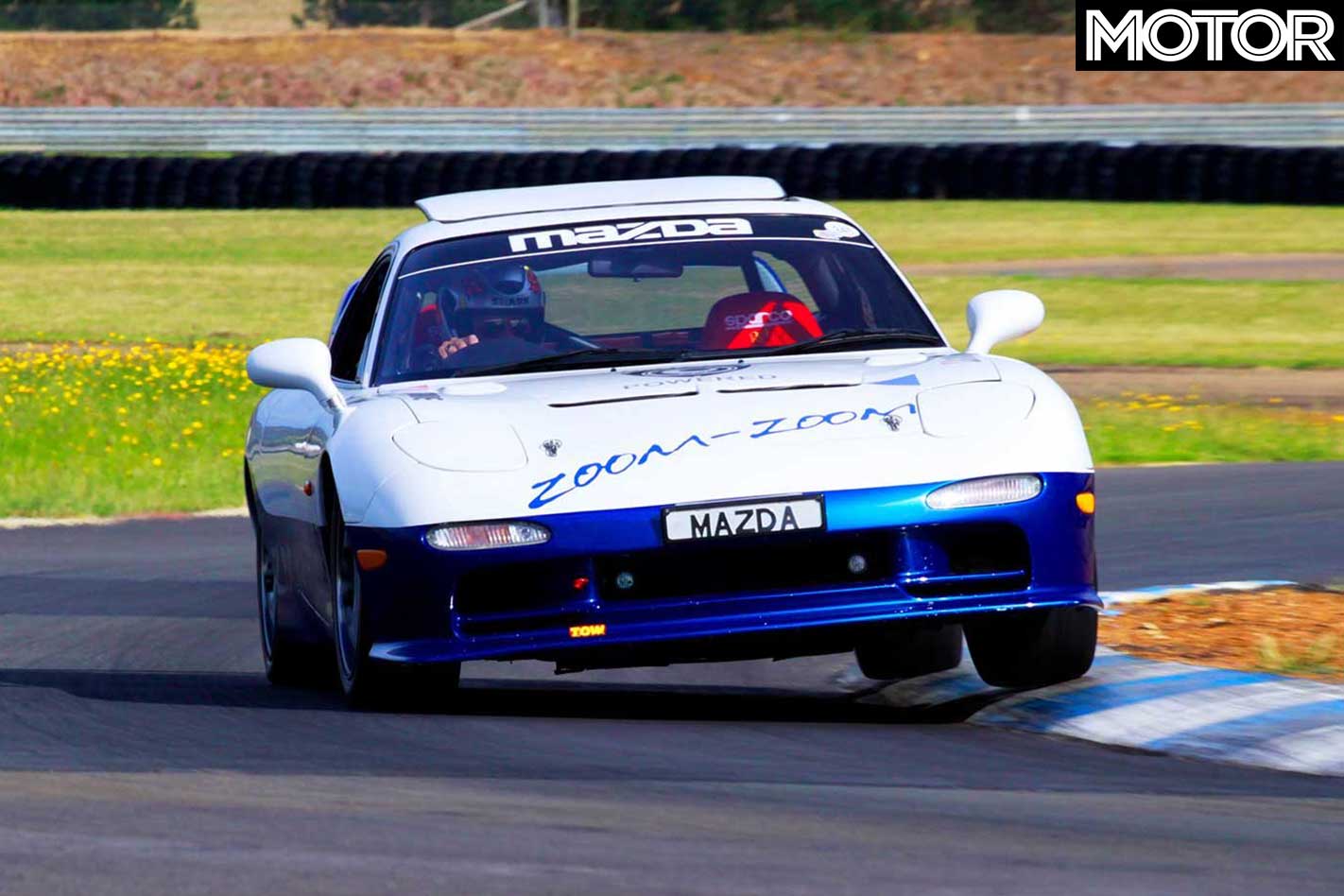
“We heard the [Porsche] Clubsport and the BMW [M3R] were coming and thought that we weren’t going to win with the standard RX-7. So we started work on the SP.
“There were something like 180 changes, all made in the workshop at Kingsgrove. We had a great team put them together and we were incredibly lucky.
“Everything worked first time: the rear wing, the larger carbon fibre fuel tank – it all just worked. And we initially were going to make 10, but the orders just kept coming.”
By 1999, the RX-7 was gone from Aussie showrooms, though it survived in Japan a while longer, where models such as the ‘Spirit R’ had become iconic in their own right.
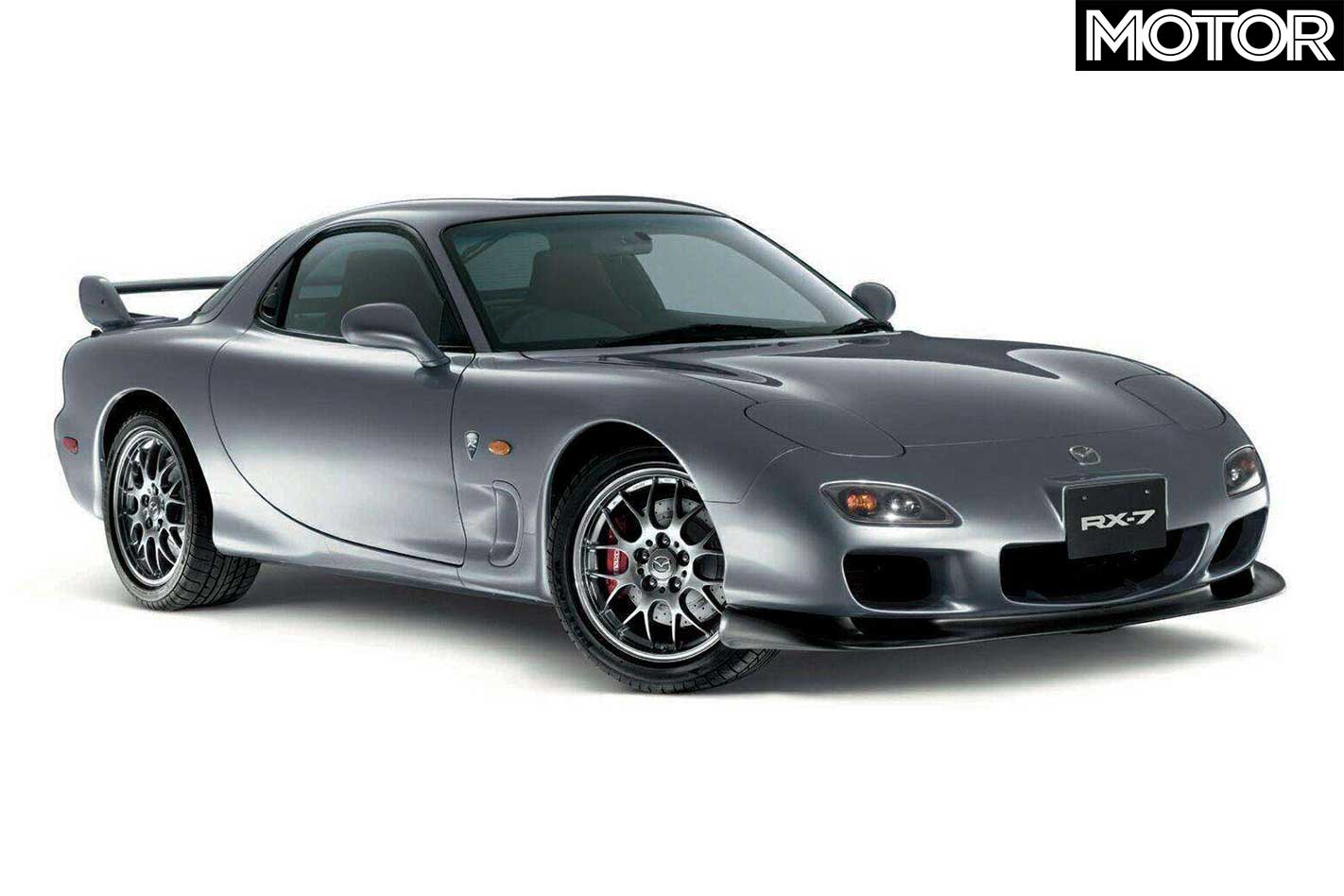
Lately, whispers of Mazda returning to its rotary roots and releasing a successor to the RX-7 – as Toyota has done with the Supra – have kept our interest, but it’s no reason to hold one’s breath.
All we can say for now is: Happy Birthday to the Mazda RX-7!
Remember when hot hatchbacks felt like a break from the rigorous commercial norm of the car business?
The modern descendants of these cars might still be fun to drive but, at least as far as the industry is concerned, they’re now not only serious cars, but also serious money-making machines.
Being seen as key ‘brand-builders’ by the companies producing them, hot hatches are now, ahem, hot property. So much so that critical acclaim and buyer demand persuaded Ford Australia to ship in the new, third-generation Fiesta ST from Germany.
For quite some time it was looking like we’d miss out altogether Down Under. As a result of its global popularity, it’s evident that time and effort has been lavished on it by in-house tuning department Ford Performance.
Coming along just a year after the launch of the seventh-generation Fiesta hatchback on which it’s based, the new ST has a list of hardware upgrades and performance features more lengthy and impressive, in many ways, than that of the car with which ‘Team RS’ built its modern reputation: the 2002 Focus RS.
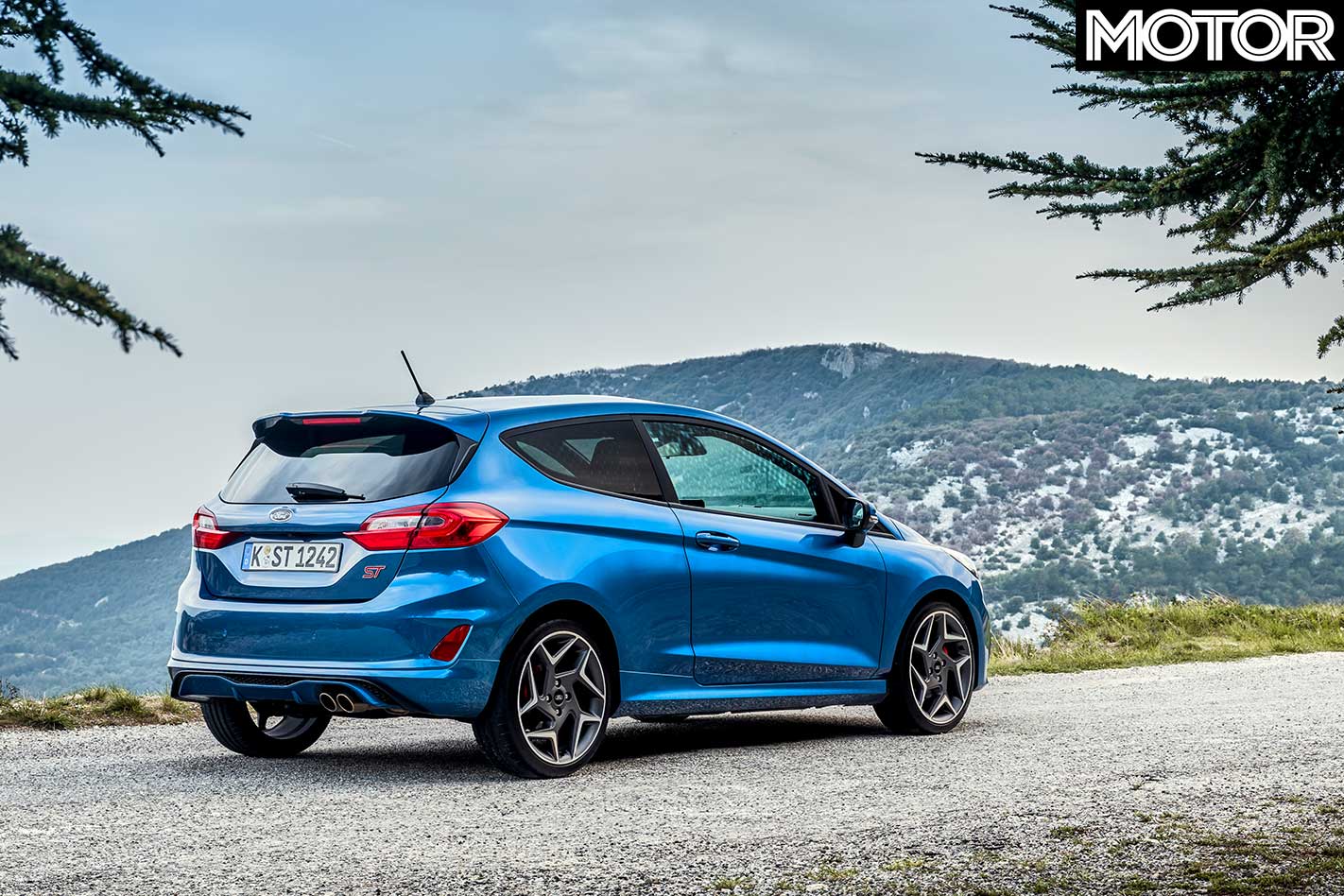
That it’s the first fast Fiesta to be available with a helical limited-slip differential for its driven front axle will be the headline-grabbing titbit plucked by many from its specification sheet (it’s expected to be standard in Oz and supplied by Quaife).
But this is actually a car with so much new and interesting technical content that it is worth its own study.
The car’s departure point is a Fiesta chassis braced in key areas on the underside of the body-in-white, which is itself 14 per cent more rigid than that of the standard car. The new ST also has the fastest steering rack and the stiffest torsion beam yet to be fitted to a performance Ford.
It has particularly interesting suspension, too. Frequency selective dampers from Tenneco feature front and rear. They are double-valved in order to better handle both high- and low-frequency inputs than a conventional passive damper could, but they’re not ‘adaptive’ as such – just clever.
Moreover, Ford fits asymmetrical, directionally wound springs onto the car’s rear axle, which are in effect bent into their fittings in order to apply a stabilising lateral force onto the rear wheels as well as performing the usual load-bearing job.
The springs address a key problem that hot hatchbacks with twist-beam rear suspension have always had: that, in order to effectively locate the rear axle and deliver top-level handling precision, you have to fit very rigid suspension mounting bushes which have a detrimental effect on the ride.
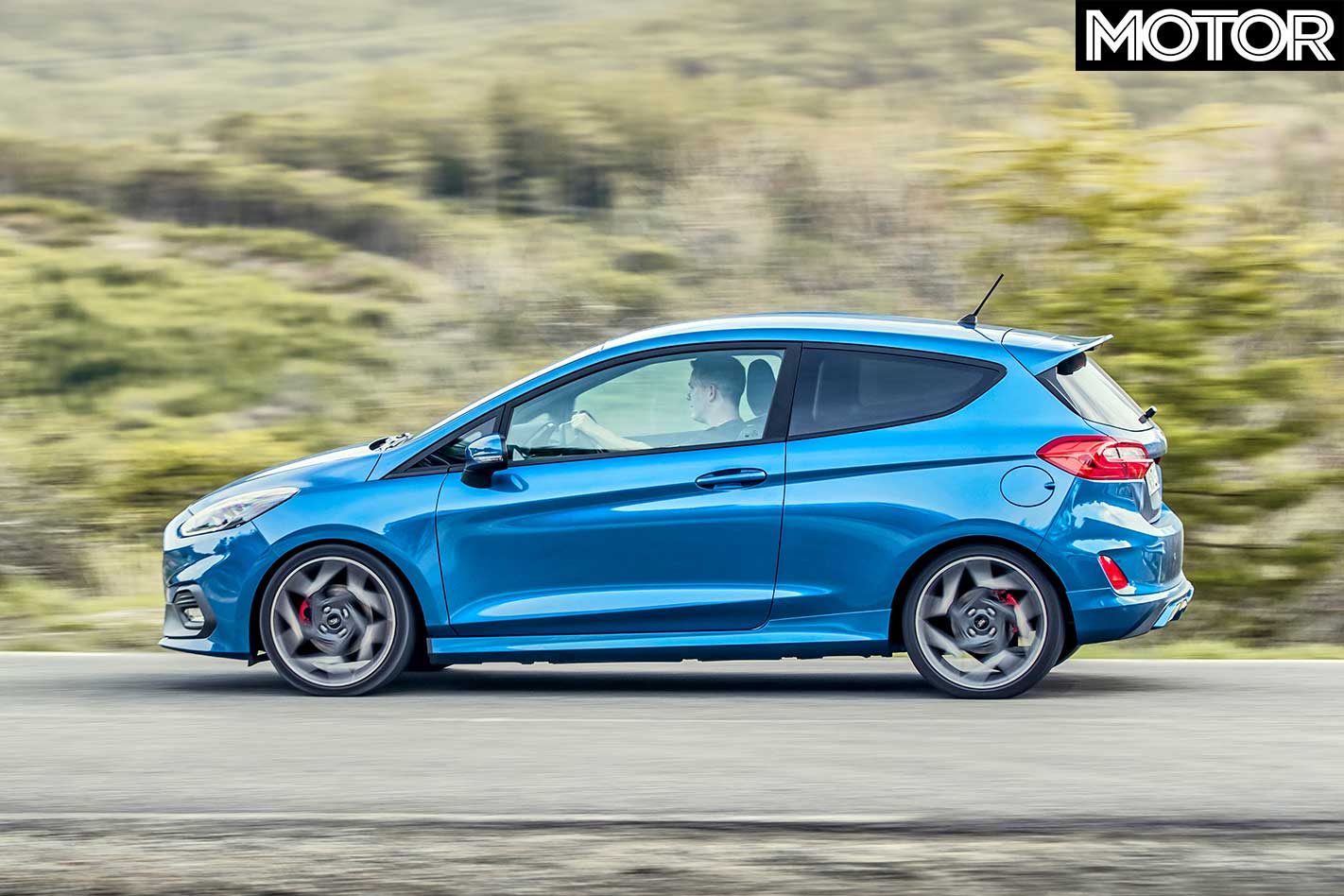
These ‘torque vectoring’ springs, says Ford, do as good a job as a Watt’s linkage in solving that problem and permit the fitment of much softer bushes. Additionally, they’re also significantly lighter than a Watt’s linkage would be.
The Fiesta ST has a dedicated front hub design of the sort becoming common among cars of its ilk. It has allowed Ford to lower the car’s ride height without lowering its front suspension roll centre too much, and it keeps control of front kingpin angle and wheel offset as necessary in order to avoid too much torque steer and bump steer.
The spring rate is slightly higher than that of the outgoing car but, as the engineers behind the car’s chassis development will tell you, the new damping and bushing in combination contribute to a more mature, rounded feel to the new car’s ride. It was also achieved without taking the all-important playful dynamic balance and cutting-edge response away from the handling.
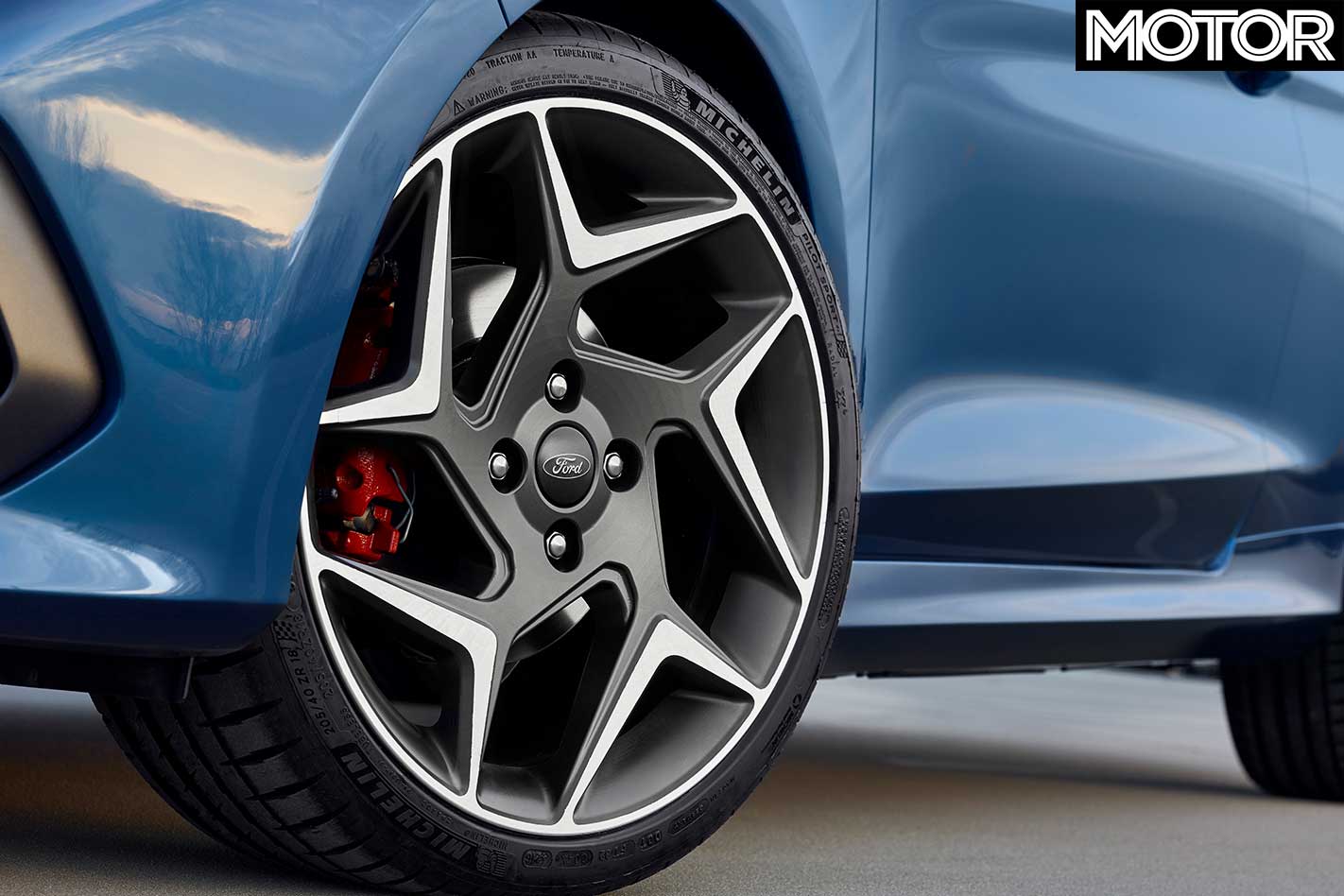
Those engineers will also tell you that while they loved the last Fiesta ST, it certainly had a yobby, antisocial ride that they simply couldn’t justify transferring directly onto this new version.
But before you doubt them, these are the same engineers who, half way through the development program, sent the Pilot Sport 4S tyres originally intended for the car back to Michelin and insisted only grippier Pilot Super Sports would do.
The ST’s new engine is one about which, I dare say, you may already have read: an all-aluminium, three-cylinder, 1.5-litre turbocharged motor which gives the car identical peak power and torque figures to those of the outgoing ST’s 1.6-litre four-pot.
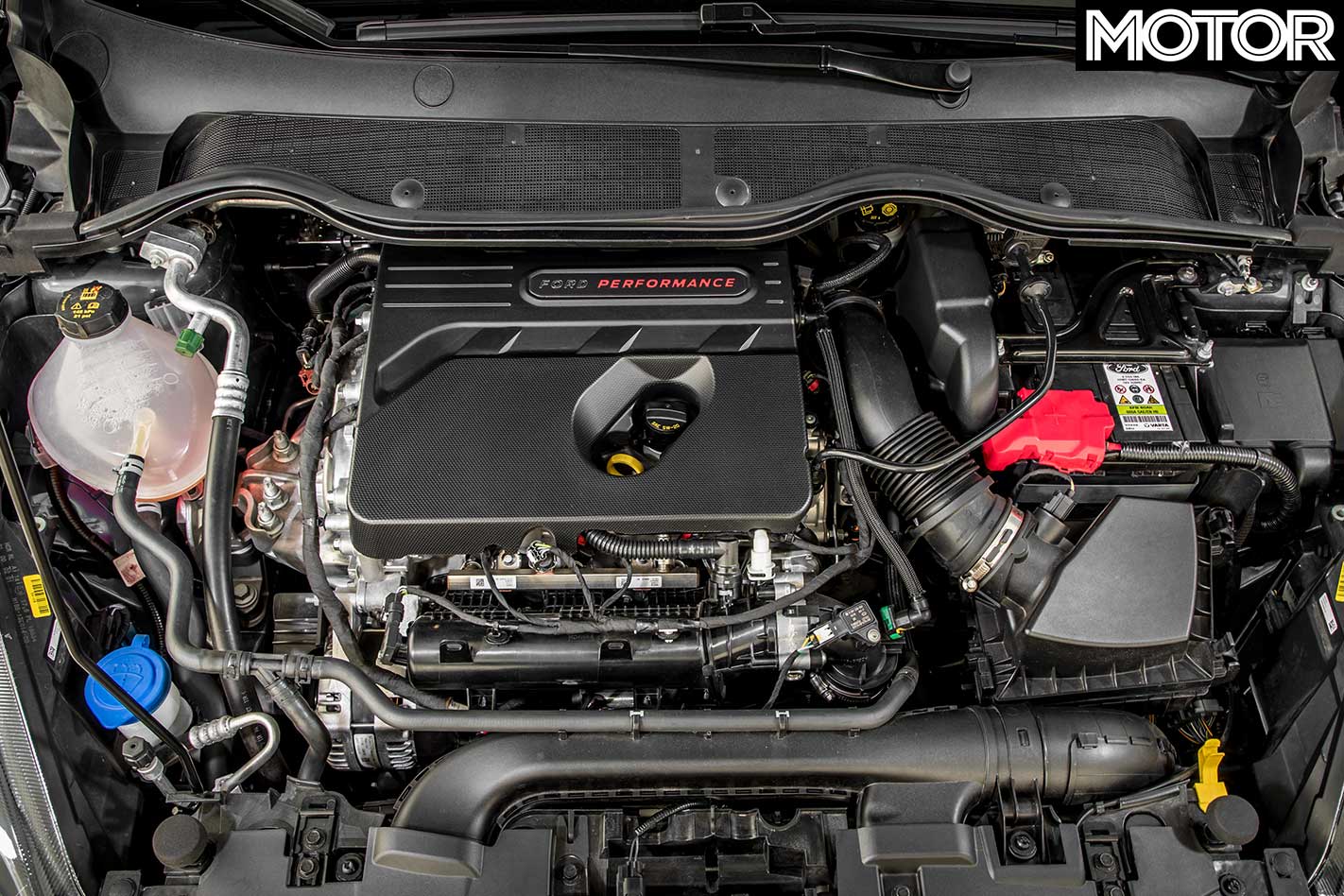
However, it can also deactivate its middle cylinder and run on 66 per cent of its normal swept volume in conditions of light load. That’s a three-cylinder engine capable of running on two: a car industry first. Upshot? A 20 per cent improvement on lab-test fuel economy and CO2 emissions compared with the old ST.
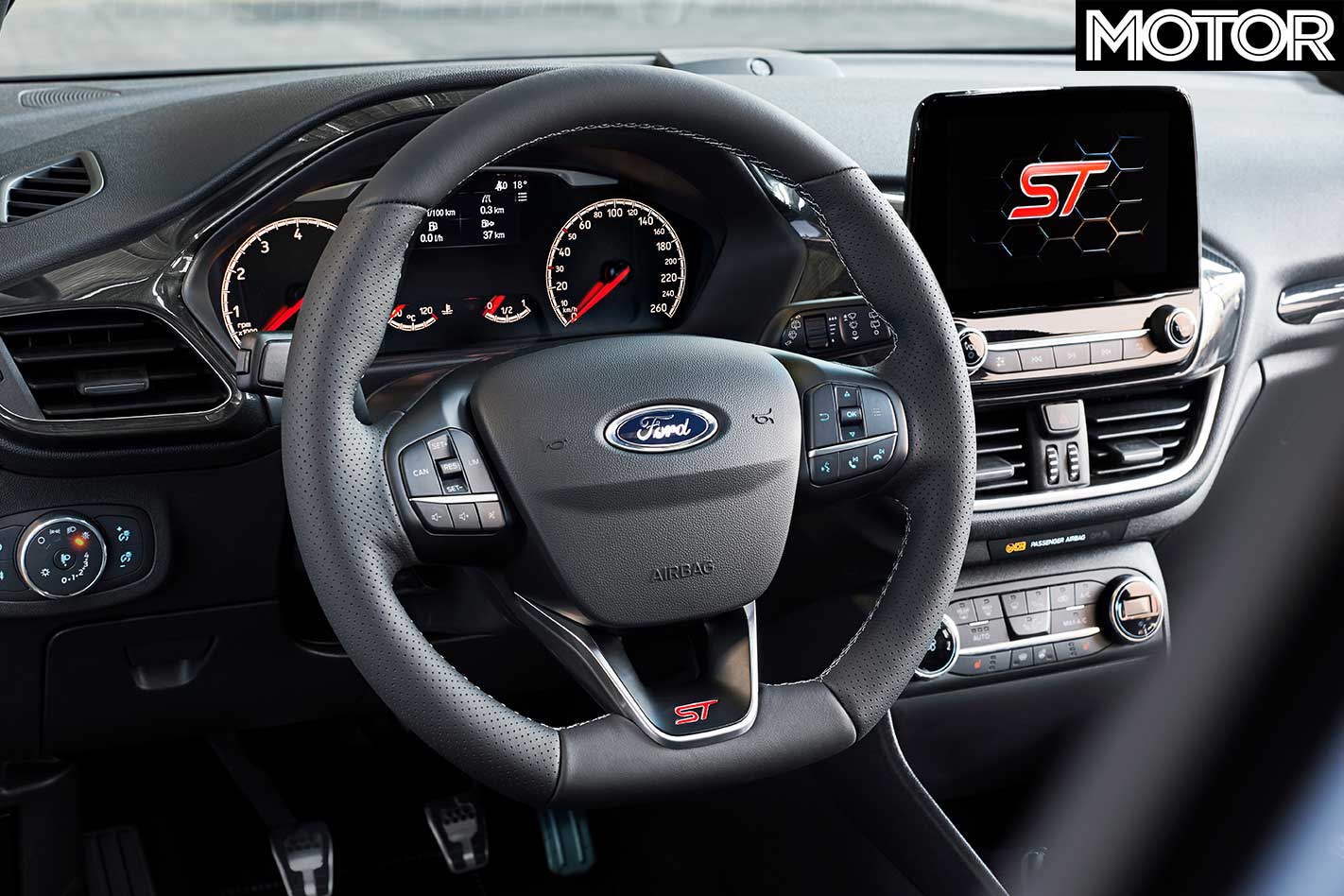
Perhaps of more interest, the new motor is also lighter than the one it replaces. This is also the first Fiesta ST to have selectable driving modes: Normal, Sport and Track.
As you cycle through them, that engine gets fruitier and fruitier-sounding as its active exhaust and engine sound synthesising system combine to bring additional layers of noise. There’s a distant flavour of the original five-cylinder Focus ST both about the way this engine warbles and its torquey mid-range feel.

I’m not totally sold on the time it takes the crankshaft to slow down from high revs, I have to say (it’s a function of the counterbalance measures that three-pots need in order to run smoothly at low engine speeds). Can’t help wondering, either, how much faster the engine would spin, and how much more power it would develop, if Ford dropped the flywheel completely.
Still, perhaps that’s just me. All in all, there’s certainly plenty of urgency, plenty of character and, in spite of the torque, a likeable willingness to rev.
In lots of ways the Fiesta feels like the car it replaces: it has meaty, fixed-ratio steering with which it’s easy to gel in spite of its pace, as well as supreme handling response and brilliantly flat body control.
But the way it rides is something else. Having only driven the car at a test track I can’t tell with certainty how it might deal with Aussie back roads, but there’s quite a lot more suppleness and ride dexterity here than there used to be.
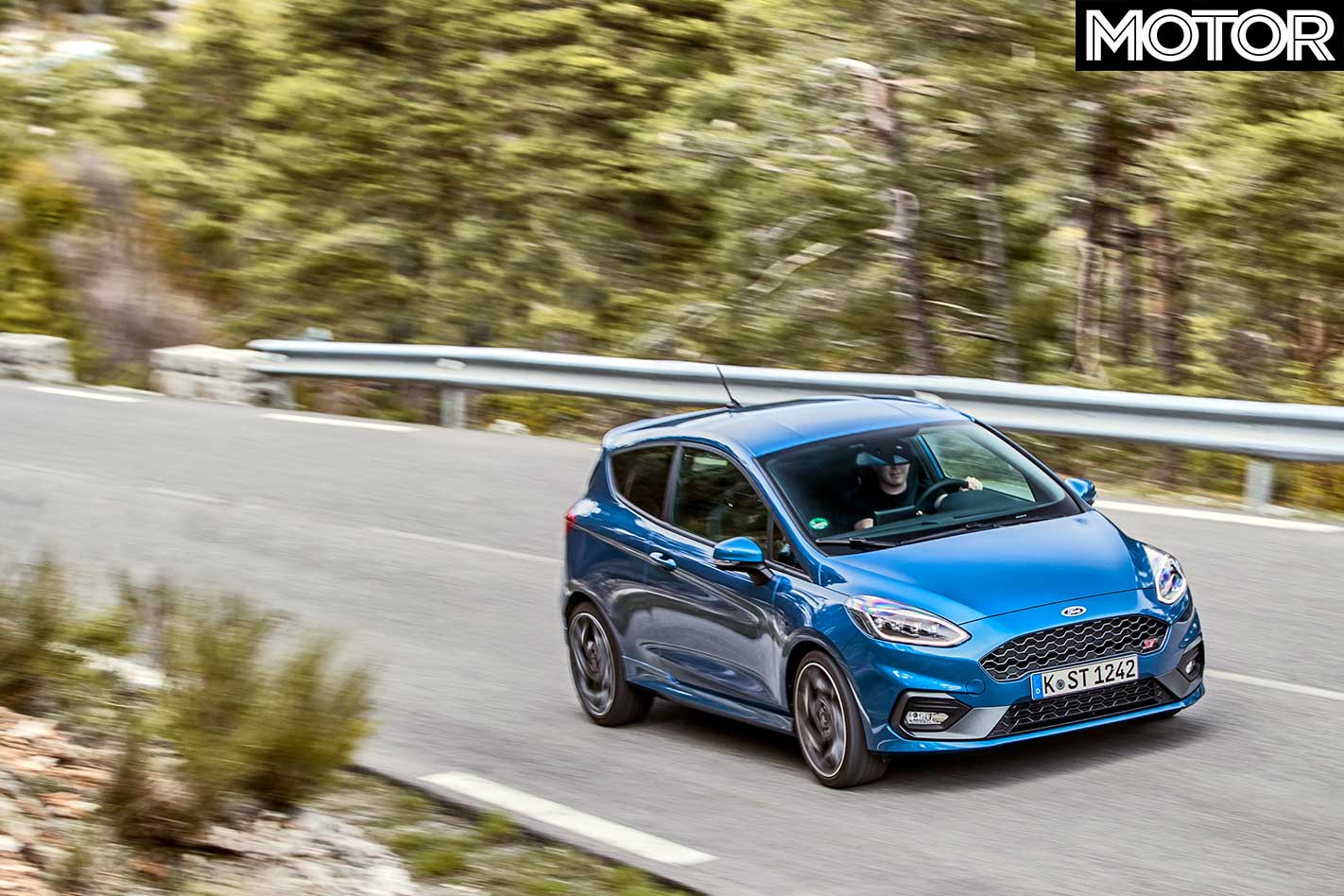
Over what lumps and bumps I could find on our test drive, over which the outgoing ST’s dampers might have bristled and its body fidgeted, the new model’s suspension just sucks up the punishment and lets you get on with it.
Perhaps more importantly, on surfaces over which drivers of the old ST might have felt the need to apologise to their passenger for the selfishness of their buying decision, I suspect you won’t in the new one. And that’s a bit of a revelation: a Fiesta ST that passes the partner/mother-in-law test. Hurrah.
Equally brilliant is the car’s handling – although that much we expect of a Ford Performance product. The ST feels a shade more precise in its steering response than the last one did, turning in more crisply, gripping harder and staying slightly truer to your intended path than its forebear did as the lateral load builds into the rear tyres.
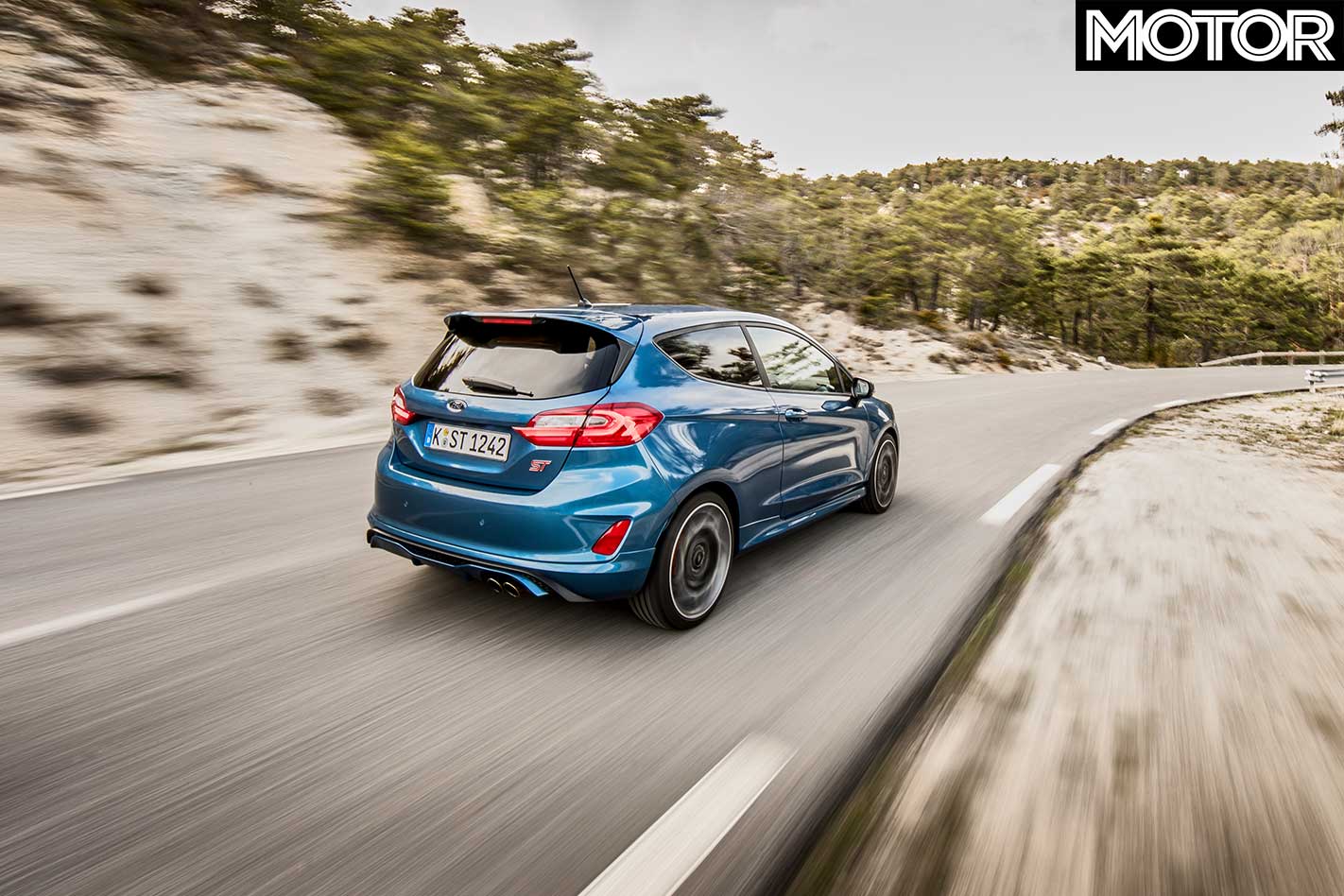
It’s certainly capable of carrying more cornering speed than the old car and it has a bit more mid-corner stability, while traction on corner exit is subtly, but notably stronger than it was thanks to the machinations of that Quaife limited-slip diff.
But fear not: the car is still a barrel of fun when you disengage the stability control and unload the rear axle. On a trailing throttle, the Fiesta can be teased into easily tamed oversteer more dependably and willingly than any other hot supermini I can think of.
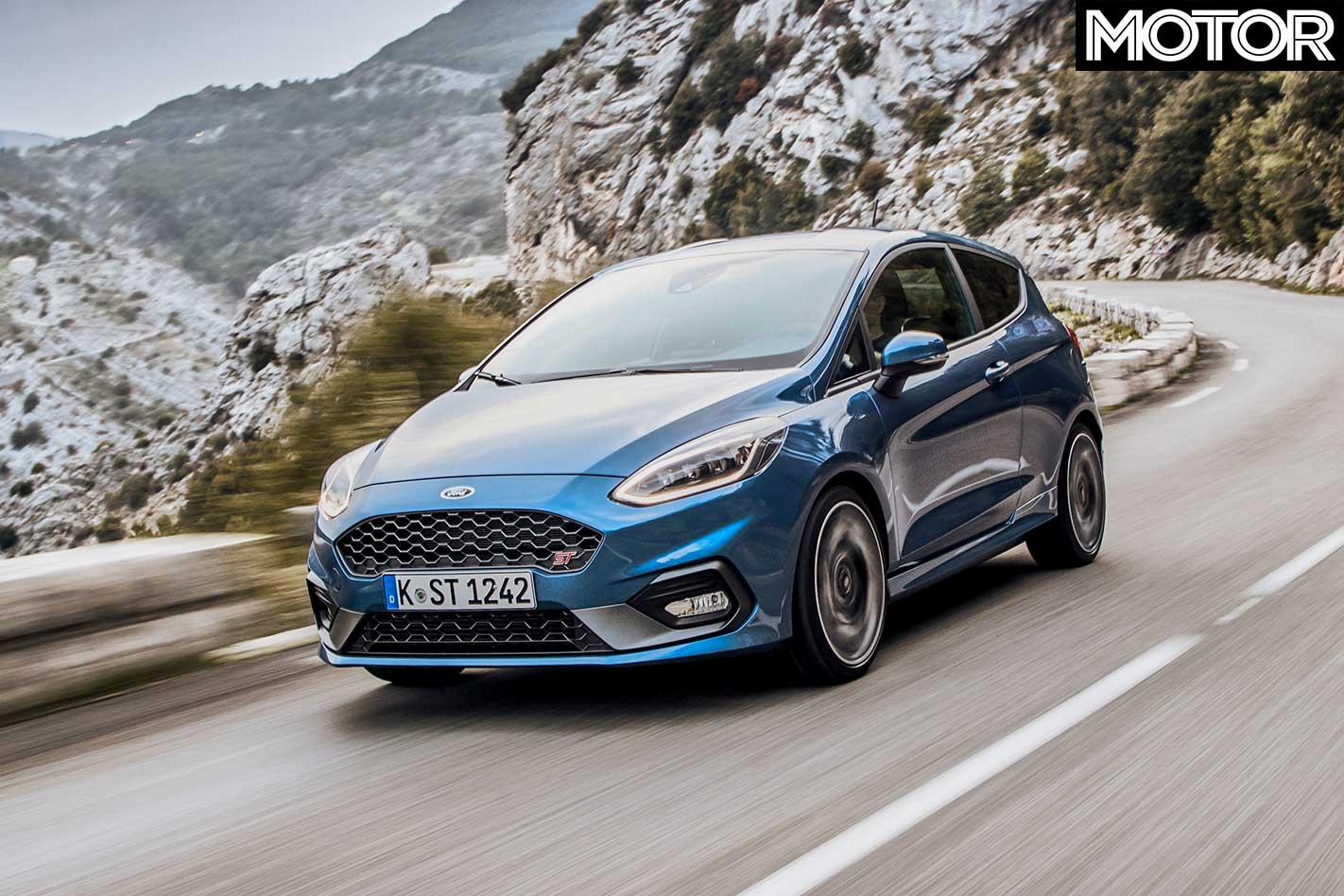
Its handling balance and adjustability remain exceptional, and in a way that speaks volumes about the philosophy of chassis engineers who think a front-drive performance car that isn’t sensitive to controllable lift-off oversteer just isn’t worth their time and who can’t understand why so many of their rivals seem to be so afraid of the phenomenon that they try to engineer it out entirely. Lucky for Ford, I guess, that they are.
Given how many new arrivals have lately come into the market niche that the last Fiesta ST so plainly bossed, and how short our initial test drive was, we’ll leave the ultimate decision as to whether this car is another Ford Performance worldbeater for another day. It has to be right up there. And it’s none the worse as a driver’s car for what’s plainly an attempt to give it a broader sales appeal.
When this year’s best affordable performance cars are measured, the Fiesta ST will take some beating.
The Nemesis – Volkswagen Polo GTI 2.0-litre turbo inline-4, FWD, 147kW/320Nm, 0-100km/h 6.7sec 1355kg, $28,000 (est)
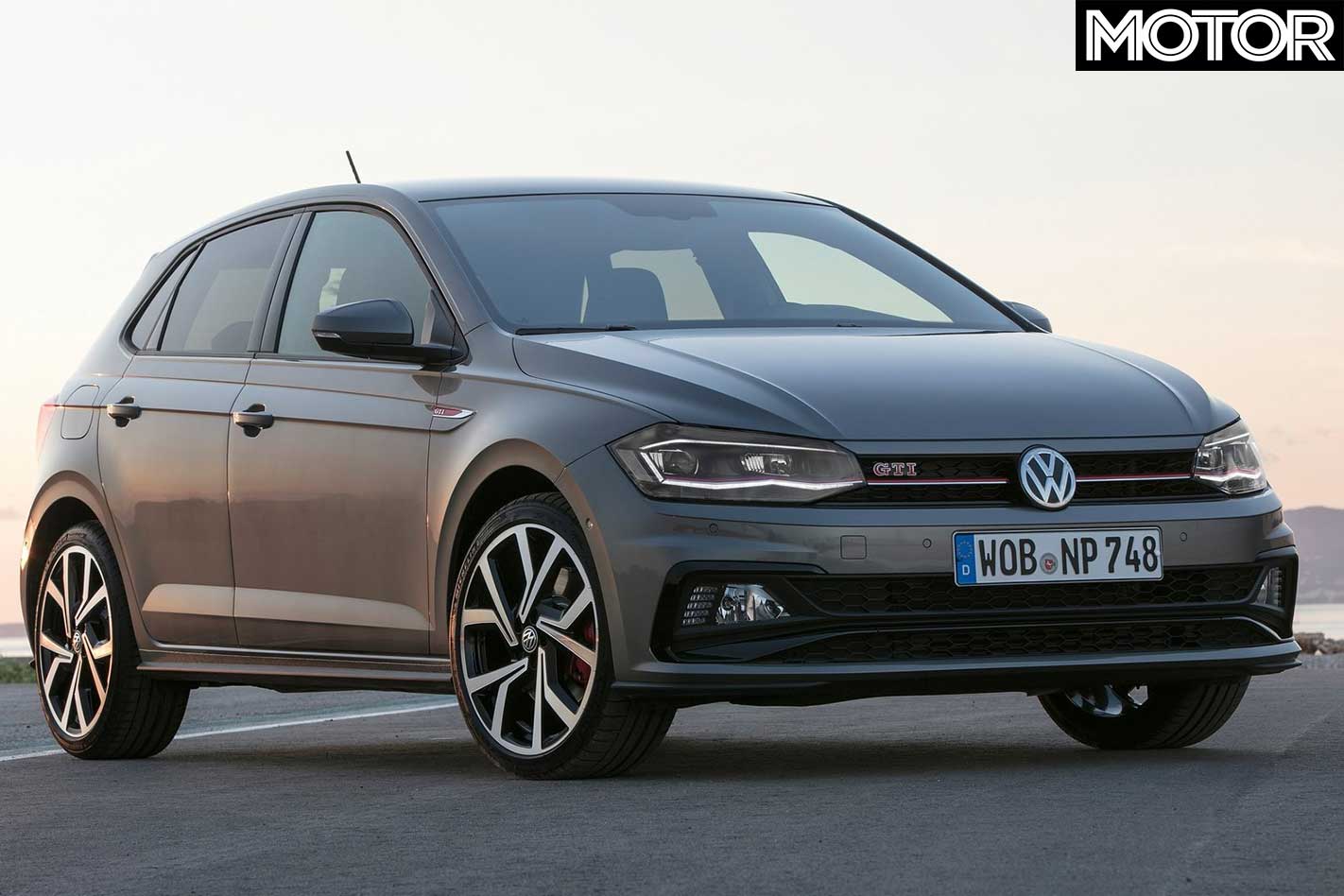
Yet to be released in Australia, the next-generation Polo GTI grows up in just about every respect. It’s physically bigger and gains more power and torque (147kW/320Nm) thanks to a detuned Golf unit. The stakes have been raised.
FAST FACTS 2018 Ford Fiesta ST
BODY: 3-door, 5-seat hatch DRIVE: front-wheel ENGINE: 1497cc inline-3, DOHC, 12v, turbocharger BORE/STROKE: 84.0 x 90.0mm COMPRESSION RATIO: 9.7:1 POWER: 147kW @ 6000rpm TORQUE: 290Nm @ 1600-4000rpm WEIGHT: 1262kg POWER-TO-WEIGHT: 116kW/tonne TRANSMISSION: 6-speed manual SUSPENSION: MacPherson struts, anti-roll bar, twin-tube dampers (f); Twistbeam, coil springs, mono-tube dampers (r) L/W/H: 4068/1735/1469mm WHEELBASE: 2493mm STEERING: electrically assisted rack-and-pinion BRAKES: 278mm ventilated discs, 2-piston calipers (f); 253mm solid discs, single-piston calipers (r) WHEELS: 18.0 x 7.5-inch (f/r) TYRES: Michelin Pilot Super Sport; 205/40 R18 (f/r) PRICE: $30,000 (estimated)LIKE: Perky three-pot turbo; playful dynamics; cabin upgrade DISLIKE: It won’t be here until next year; how much will it cost? RATING: 4.5 out of 5 stars
Brett Patterson, 46, grew up like most of us, with a fascination for cars, trucks and mechanical things. For the past 22 years he’s been working at a critical junction of the automotive world, on the front line of heavy- vehicle compliance enforcement for NSW Roads and Maritime Services. With well over 400,000 heavy vehicles operating on NSW roads at any one time, it’s a huge matter of safety for the community.
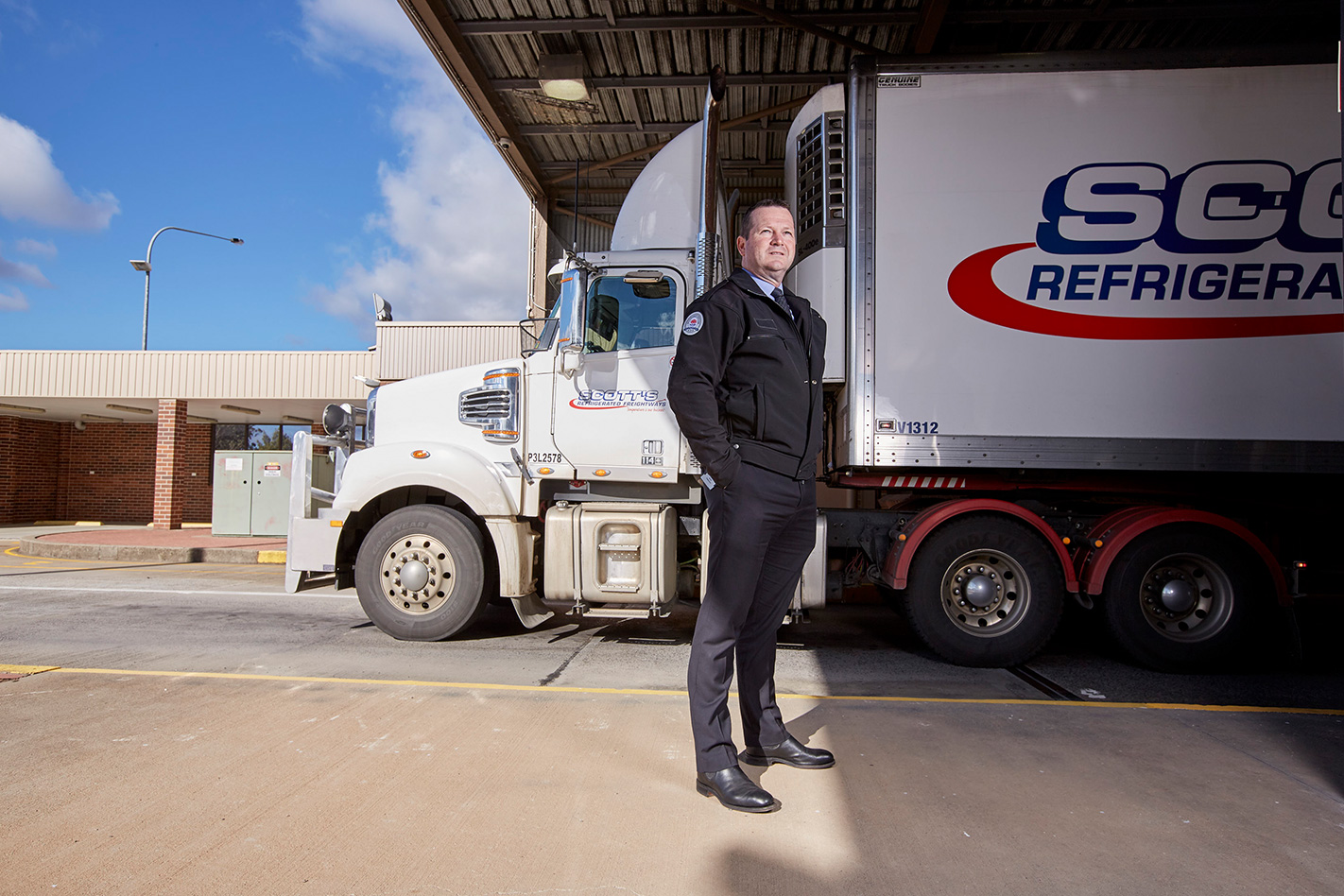
Since 2011, Patterson has been Senior Manager of Compliance Operations, supervising a team of more than 250 compliance inspectors around the state – variously mobile operations, or at eight heavy vehicle inspection stations dotted along the state’s major road transport routes.
And they’ve a lot of work to do. NSW has the highest number of registered heavy-goods vehicles (192,000), and of those registered in neighbouring states, about 65 percent travel through NSW.
In 2017, Patterson’s compliance crew made more than half a million vehicle inspections, across a range of compliance programs. They also assist the Police in large operations, including compliance checks on modified cars.
Patterson knows his vehicles, having worked as a mechanic for eight years. In 1996, he was offered the opportunity to become an inspector with the (then) NSW Roads and Traffic Authority. “I know this will sound unusual, but the driver for me was the opportunity to improve road safety.”
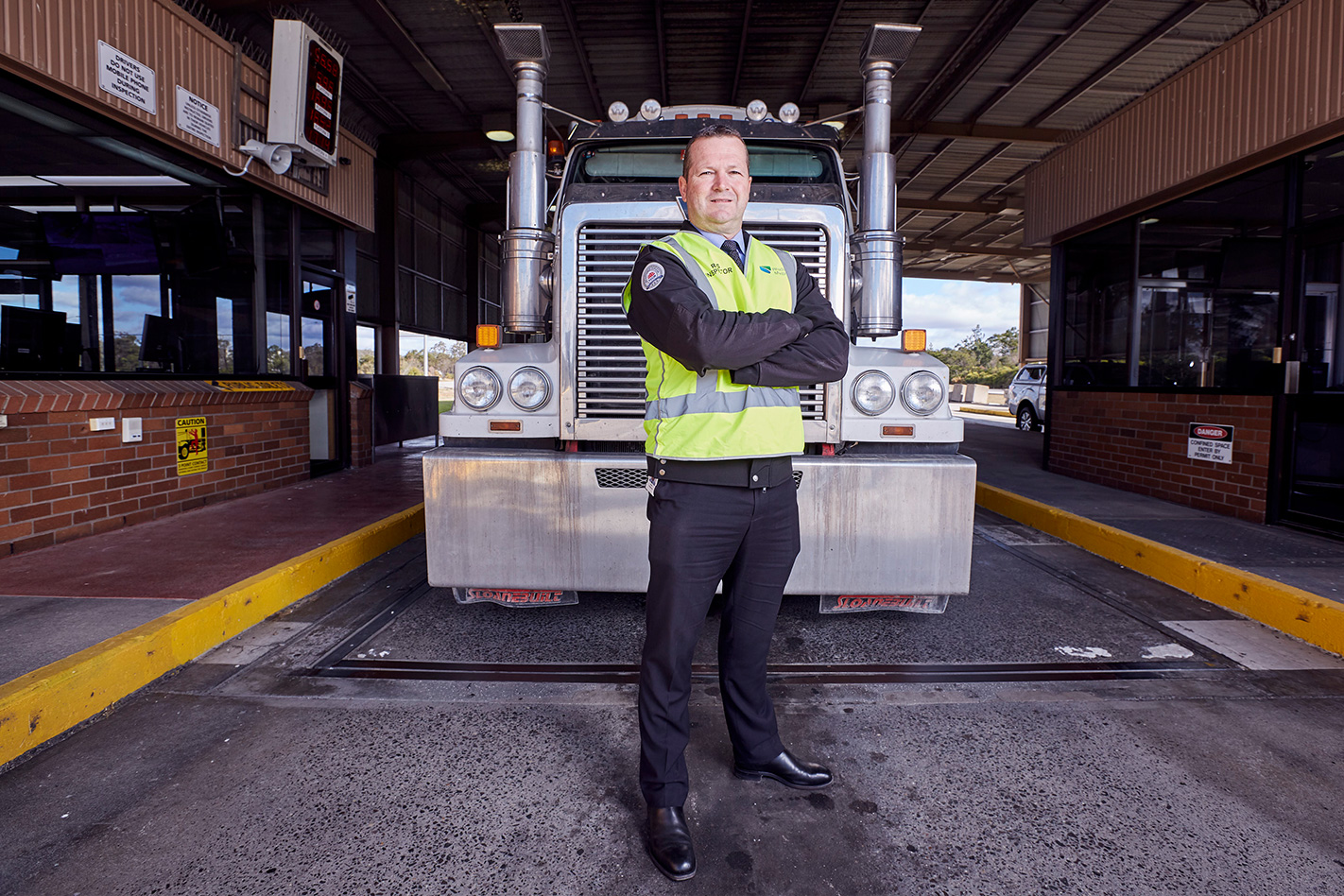
For the most part, he says, heavy-transport operators are doing the right thing, so Roads and Maritime Services streamline its inspections as much as possible. Four of the state’s eight heavy-vehicle inspection stations are now largely automated; compliant trucks literally need not even come to a standstill.
“At our larger weighbridges we have electronic screening technology where the vehicle leaves the highway, goes through a number of checks like registration, mass, Safe-T-Cam sightings, previous compliance histories … A vehicle that’s beamed through the screening as compliant, will continue on its journey – it might have slowed down to 40km/h, but off it goes. Or if it’s directed, we will do a more thorough inspection.”
The things that keep Patterson awake at night are trucks with defective brakes and steering, worn-out suspensions, lapsed registrations, overloading and drivers who ignore national fatigue management laws designed to ensure they get adequate rest.
Patterson loves that no two days in his job are ever the same. “I’m directing operations, leading staff, engaging with drivers and operators, dealing with our customers … I look after all the inspectors state-wide, so I could be in the office, or out in the field. Our work is reported up through our management team, right through to the [Roads, Maritime and Freight] Minister.
“What we are delivering is important, especially with the current road toll and heavy vehicle crashes. We had a terrible January this year, in a two-day period three heavy vehicle fatal crashes occurred, resulting in the death of five people.
“Occasionally we have to deal with interactions that are angry and aggressive and that’s disappointing. Both parties have a job to do and we try to understand the challenges that heavy vehicle drivers have, in getting from A to B, the traffic on the roads, ensuring that their trucks are maintained and loaded safely. We’ve got a role in ensuring compliance, not just for their vehicles, but for other vehicles, operators and users on the roads.
“That’s sometimes a hard message to deliver and demonstrate, but I think we are getting through, working together and changing the culture for a safe transport industry.”
JAGUAR owners can expect to see an increasing number of so-called Easter eggs throughout the cabins of their cars, with more of the surprise design touches following the E-Pace’s lead into future vehicles.
We won’t spoil the surprises for existing owners and give away the current secrets, but spend some time in the E-Pace cabin and you’ll discover Jaguar fur-patterned surfaces, heritage references and even a little Jaguar cub wandering about the interior.
Speaking to Wheels, exteriors advanced design chief Matthew Beaven confirmed that the unique touches were resonating with customers and more vehicles would be treated to the light-hearted inclusions.
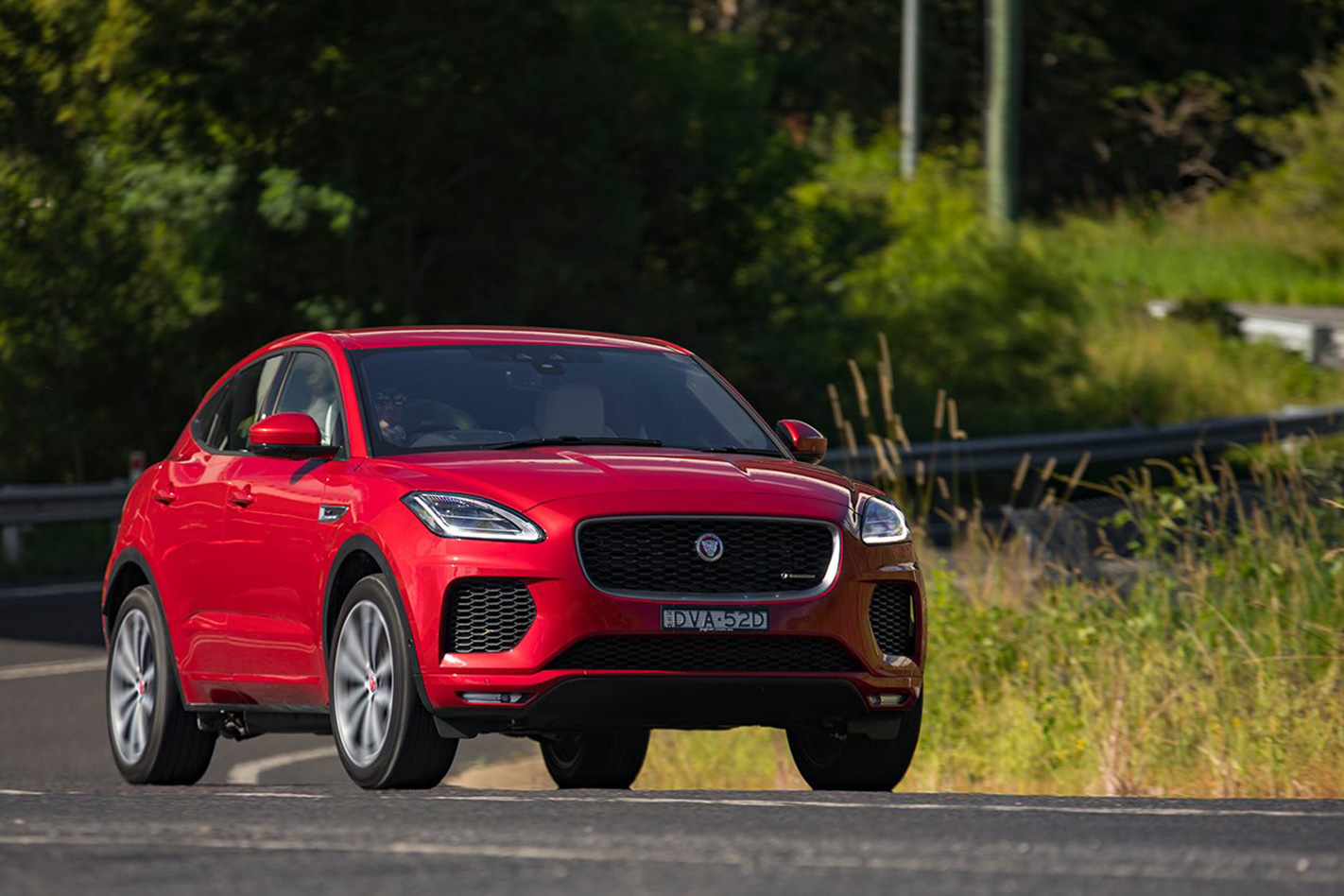
“It’s one of those surprise and delight things because you don’t notice it straight away,” he said. “It’s something that we want to try and do more, like a signature from the design department and it shows a bit of our character.”
For a car company that has previously been portrayed as a stuffy gentlemen’s brand, the hidden gems create intrigue and a more playful persona. Combined with more sports models, the E-Pace small SUV and its first electric drive tech, it’s likely the Easter eggs are a small part of a strategy to appeal to a broader and more youthful audience.
In isolation, Beaven said the design touches were not intended to target a specific audience, but were there to please customers long after they make the decision to buy a Jaguar.
“We’re not really trying to appeal to a particular customer and a lot of the time no one even knows about it.”
Indeed, Beaven admitted he probably didn’t know where all the secrets were hidden himself. After signing off on all the larger design details and proportional elements, the rest of the design team were left to finalise the E-Pace and that’s when the Easter eggs sneaked in.
As for what’s next for the treatment, Beaven would not say but indicated there were some treats to find woven into the company’s first pure electric vehicle – the I-Pace. “Yes, have a look around,” he said.
More of the latest Jaguar news
The move to hide Easter eggs in Jag models appears similar to Jeep’s approach of concealing pop culture references and historical brand icons about some of its models, including the Compass and Renegade.
However, Beaven said the company has been concealing tongue-in-cheek design elements in cars for years including the R-Coupe concept that broke cover at the Frankfurt show 17 years ago.
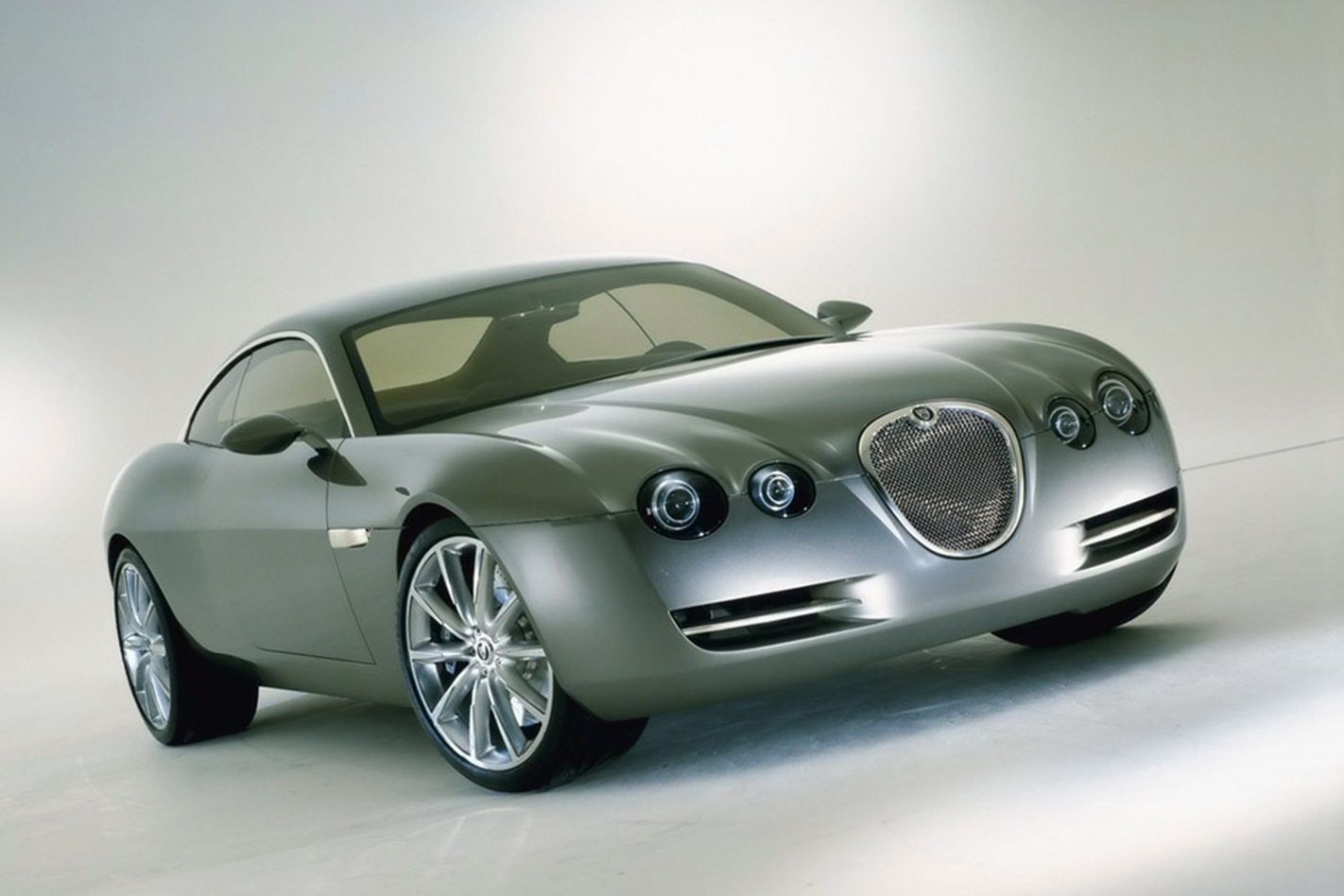
“We’ve been doing it a while since, I think, the R-Coupe in 2001. It’s not very PC these days but we had a little whisky flask in the side, but we wouldn’t do that now. It was for the passenger obviously.”
As for the meaning of the little jaguar cub that made its debut in the new E-Pace, Beaven revealed a little-known inside secret about the company’s unofficial nickname for its baby of the SUV range.
“The E-Pace – when we were designing that car it was the small Jaguar and it had a real character with these big wheels and it kind of looked like a cub to us. It’s codename within design was always Cub and that’s where it’s come from. It’s an affectionate name.”
