
The facelifted Clio RS 200, in this case with the Cup chassis, is more fun than a cheap hatch has any right to be.
Everything is essentially the same as the old version, though new chequered-flag headlights, or RS Vision, are new and now aim where you steer. Purists beware, though, it’s still dual-clutch-only.
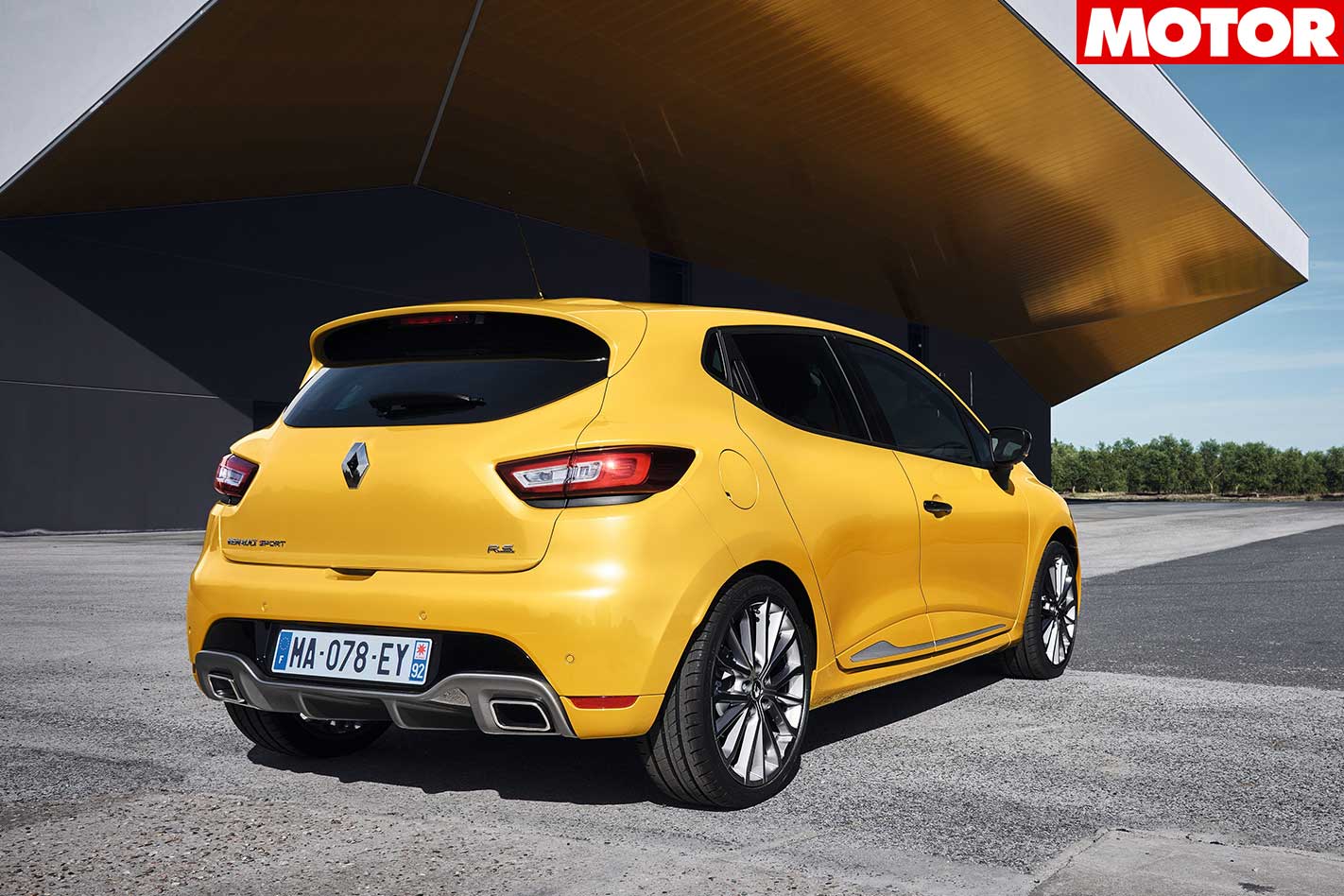
Shifts can become quite sharp (and make a little ‘brap’) when Race Mode is active, but there is a downside. Race automatically switches the Clio’s traction and stability control off, and there’s no way around it.

If you want a true daily proposition, there’s always the Polo GTI, but you won’t have nearly as much fun when Sunday rolls around.
2018 RENAULT CLIO RS 200 CUP SPECS:
Engine: 1.6-litre, inline-4 turbo Power: 147kW @ 6050rpm Torque: 260Nm @ 2000rpm Weight: 1204kg Price: $32,490
IT’S hard not to picture the faces of the macaque monkeys being gassed in a test chamber and suffering from nitrogen-oxide poisoning, when recalling the latest twist in the Dieselgate saga.
Yet it’s really not about the monkeys.
As unethical as it was, the gassing of these ‘non-human primates’ merely points to a bigger picture. The body responsible for commissioning the test, the European Research Group on Environment and Health in the Transport Sector, known by its German acronym of EUGT, a body funded in part by Volkswagen, BMW and Daimler.
The test was wholly disingenuous, as Liang was on hand to ensure that the car would run in its ultra-clean rolling road mode, defeat device software in full effect. It was also inept, as emails show that staff at the Loveland Respiratory Research Institute found that the results didn’t clearly demonstrate the effects Volkswagen was looking for, largely due to a series of procedural blunders.
A round of middle management sackings of EUGT-tainted staff has followed. Volkswagen’s Dr Thomas Steg, its head of external relations and sustainability, fell on his sword on January 30, followed quickly by Daimler firing Udo Hartmann, head of environmental protection at Mercedes-Benz, and BMW suspending Frank Hansen, head of its urban mobility business unit. The car makers had hoped that this would close the issue.
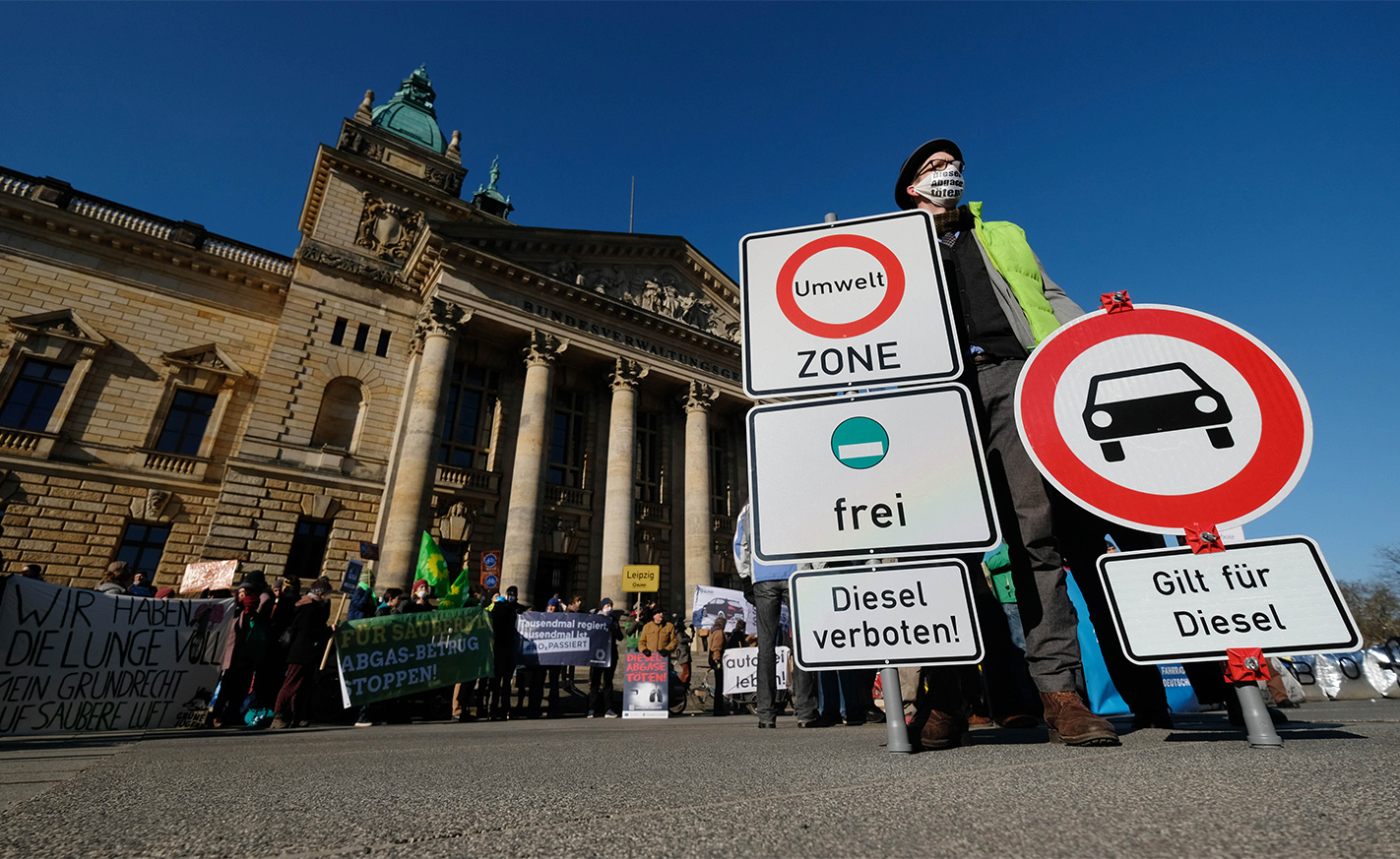
This lack of transparency, political cosying and undermining of legitimate scientific research by the EUGT, which dissolved last year, is now achieving the opposite effect of its original aims. The German government is cracking down harder on suspicious diesel models and is demanding additional concessions. A special environmental fund aimed at offsetting some of the damage done by dirty diesel had been established, and the manufacturers were expected to make a contribution. Now German transport minister Christian Schmidt has handed them the entire €250m bill.
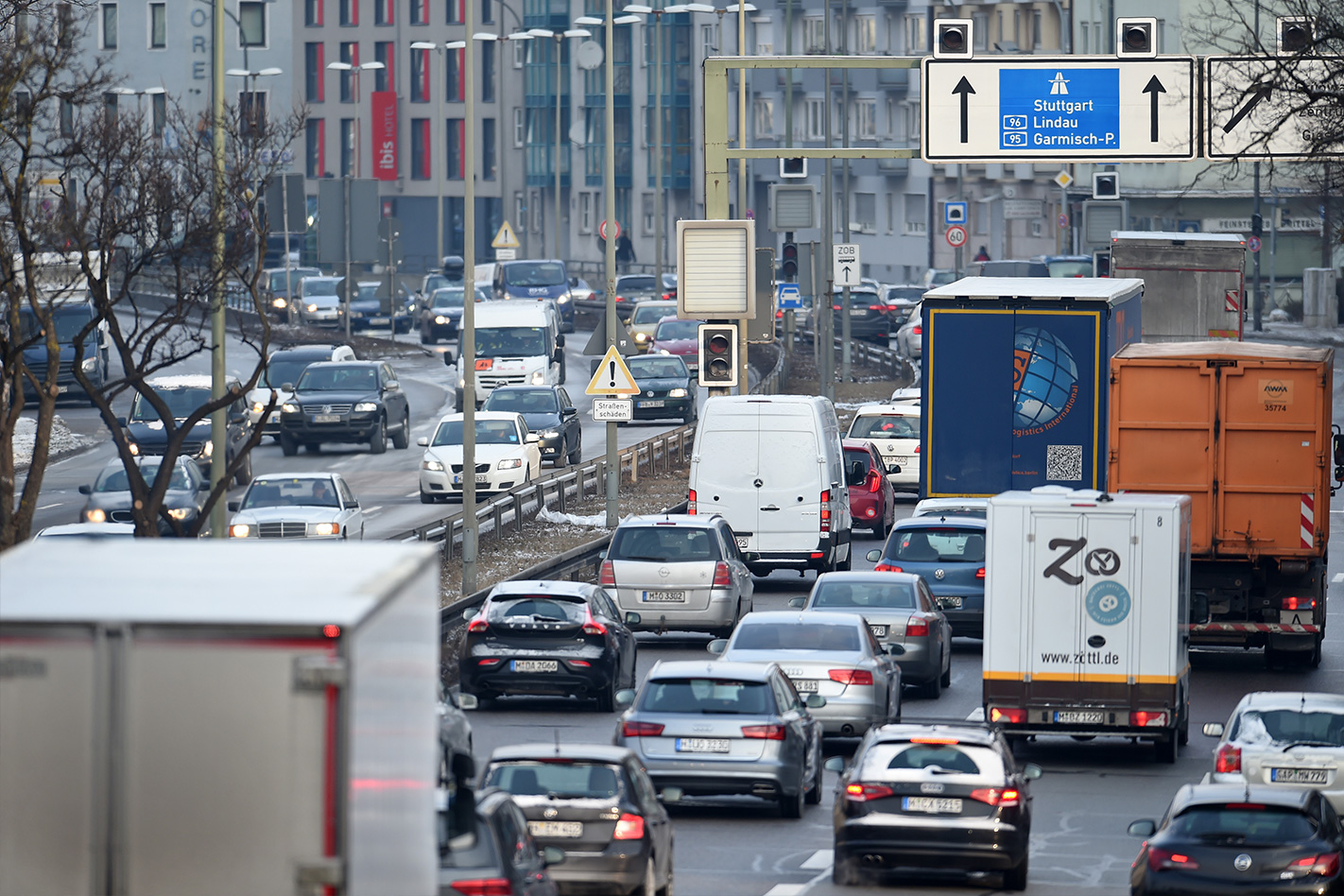
In a landmark ruling on February 27, the Federal Administrative Court decreed that the cities of Stuttgart and Dusseldorf could legally ban older, more polluting diesel cars from zones worst affected by pollution. This sets a precedent for other cities and came after German states had appealed against bans imposed by local courts in Stuttgart and Dusseldorf. The environmental group DUH brought the cases after around 70 German cities exceeded European Union limits for NOx last year.
He’s not buying their professed outrage.
“Their representatives were sitting at the table with us.”
School of hard NOx?
Volkswagen goes straight to the top of the class when it comes to prospering in the face of adverse publicity.
Although the company has been hit with billions of euros in fines and penalties, buyers don’t seem to care. VW sold a record 6.2 million cars in 2017, cementing its position as the world’s biggest car maker. VW sold seven times as many cars in China as it did in its home market, Germany, and it has even increased share in the US. Net income jumped from €5.12bn to €11.4bn.
“Based on economic forecasts and our plans for new models, there is no reason to expect that 2018 should turn worse than 2017,” VW brand sales chief Juergen Stackmann said at the Detroit show.
1. Ferrari 812 Superfast
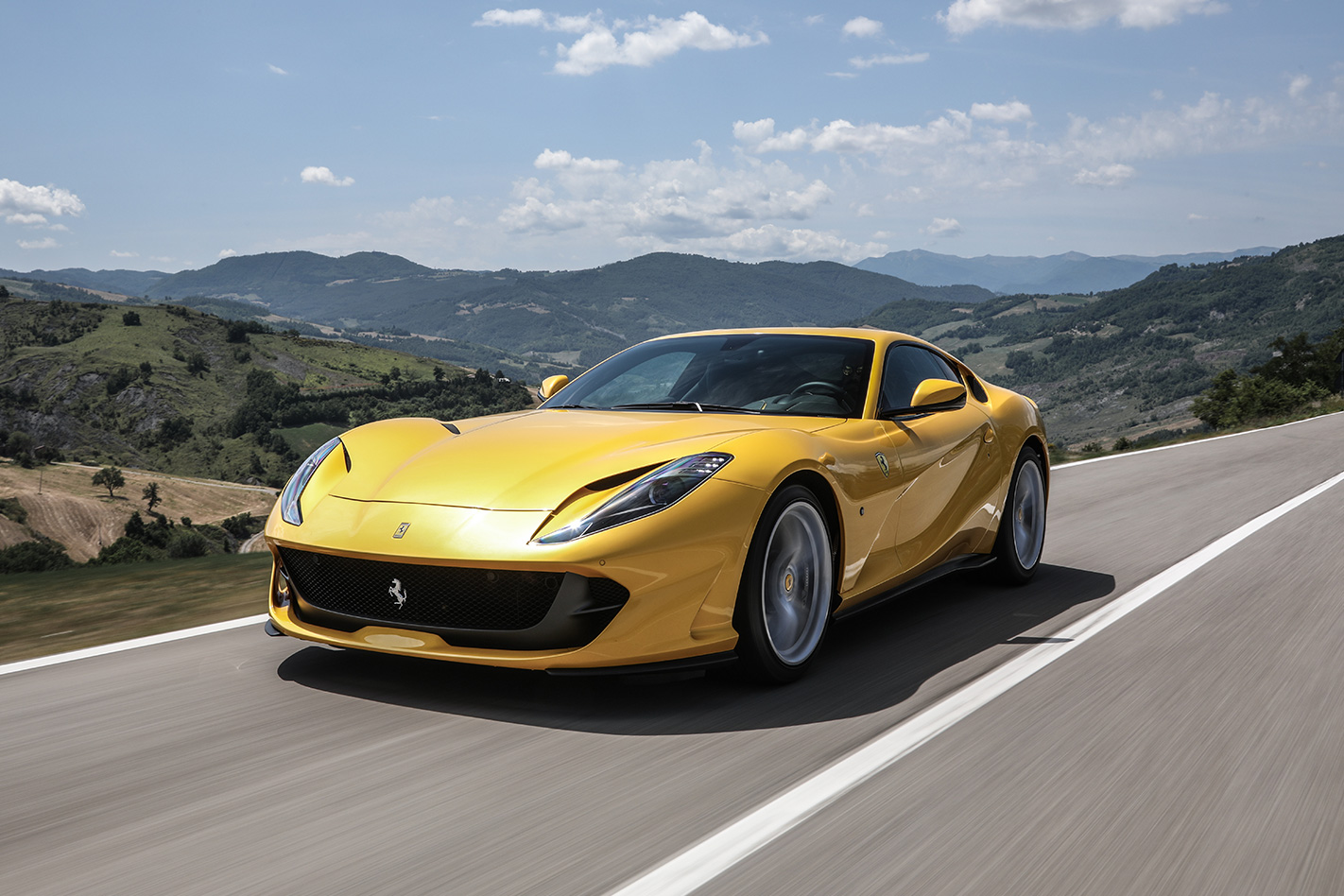
6.5-litre V12 – 588kW Ferrari’s flagship illustrates the potential of large-capacity, high-revving engines with a monstrous output at 8500rpm. It’s Australia’s fastest car with a top speed in excess of 340km/h.
2. Lamborghini Aventador S
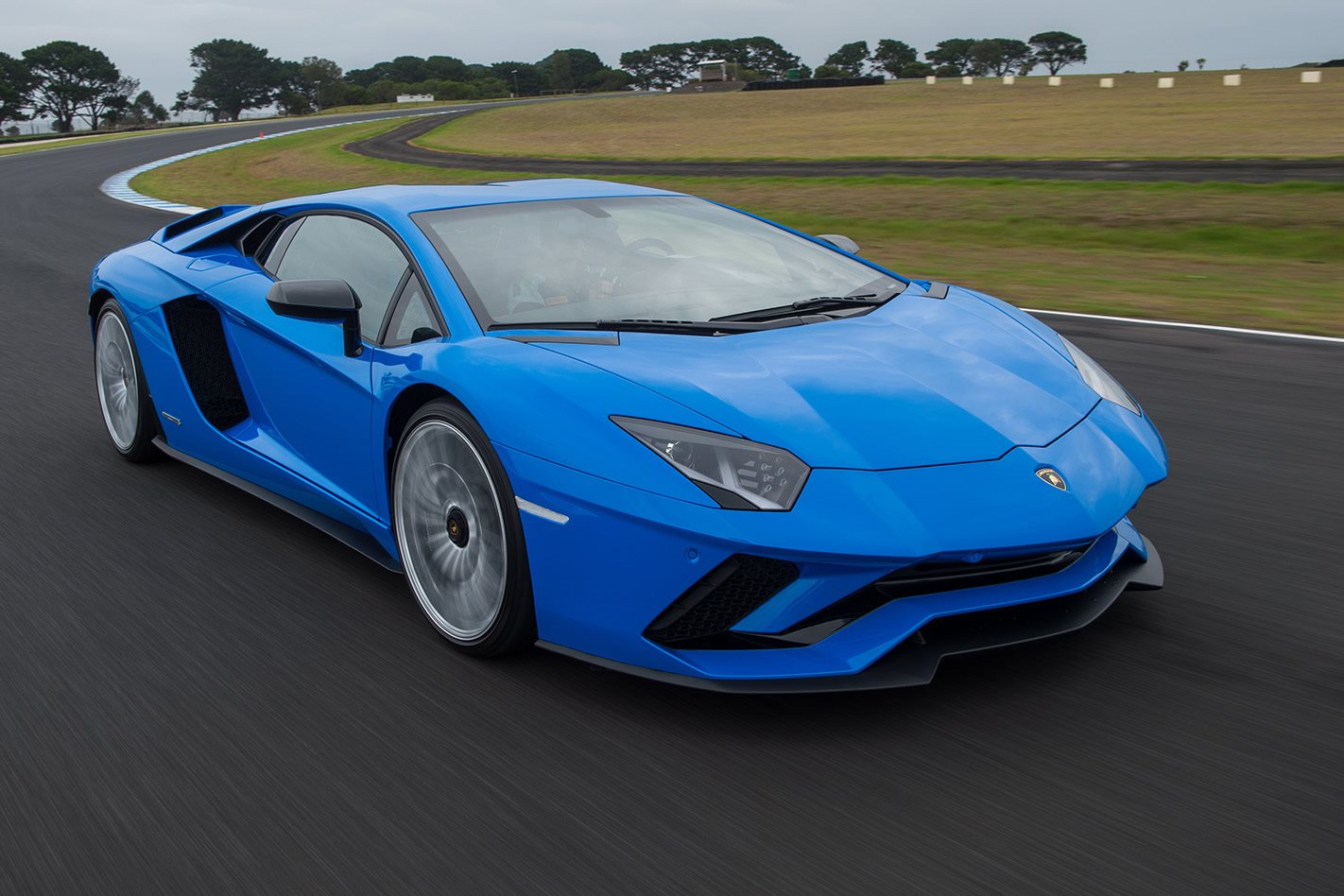
6.5-litre V12 – 544kW Lamborghini deploys the same capacity as Ferrari to reach slightly lower, though still outlandish outputs, but gets its power to the ground through AWD.
3. Audi R8 Plus/Lamborghini Huracan
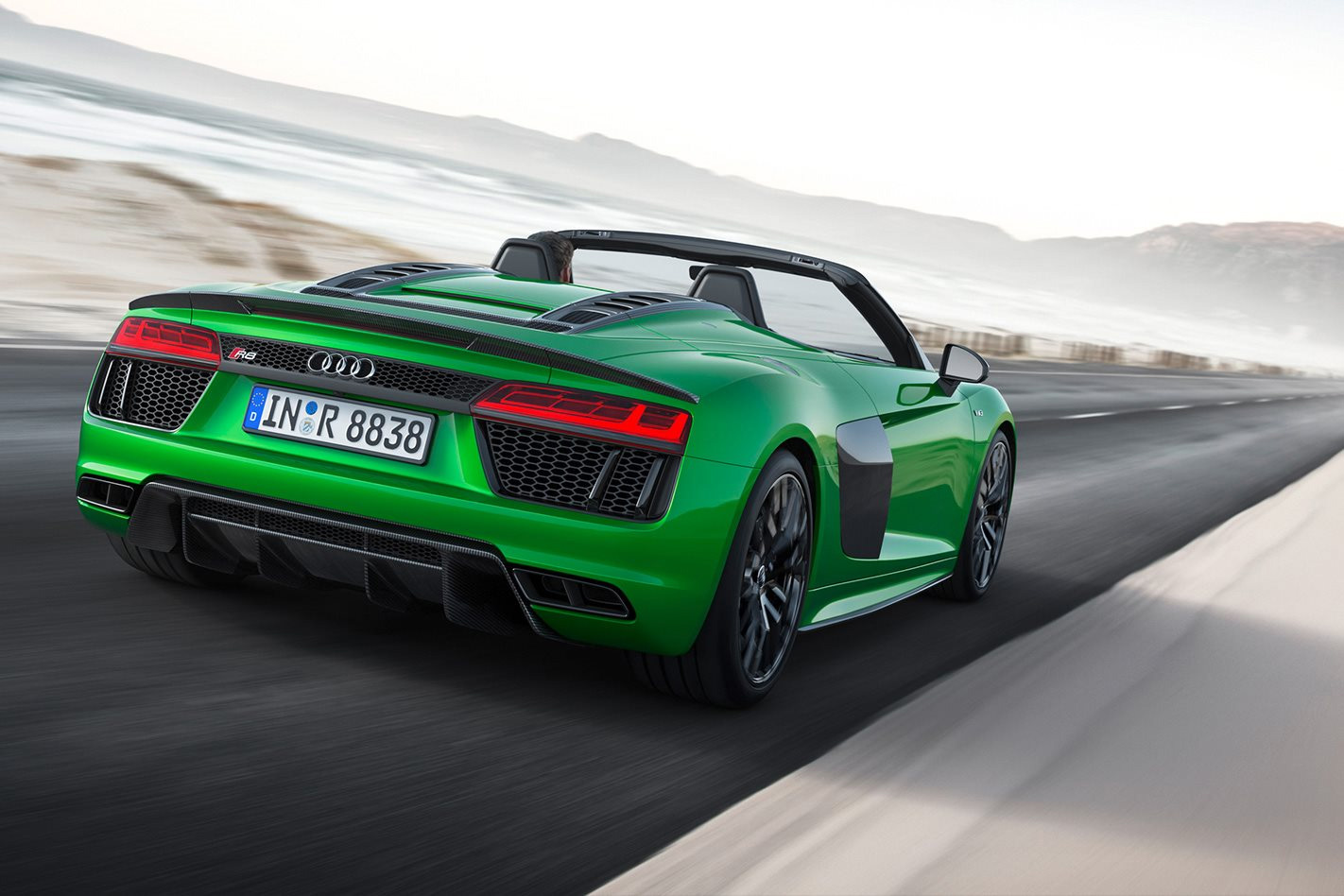
5.2-litre V10 – 449kW Audi and Lamborghini’s shared atmo engine drops two cylinders and power compared with the mighty Aventador but has an unforgettable soundtrack.
4. Aston Martin V12 Vanquish
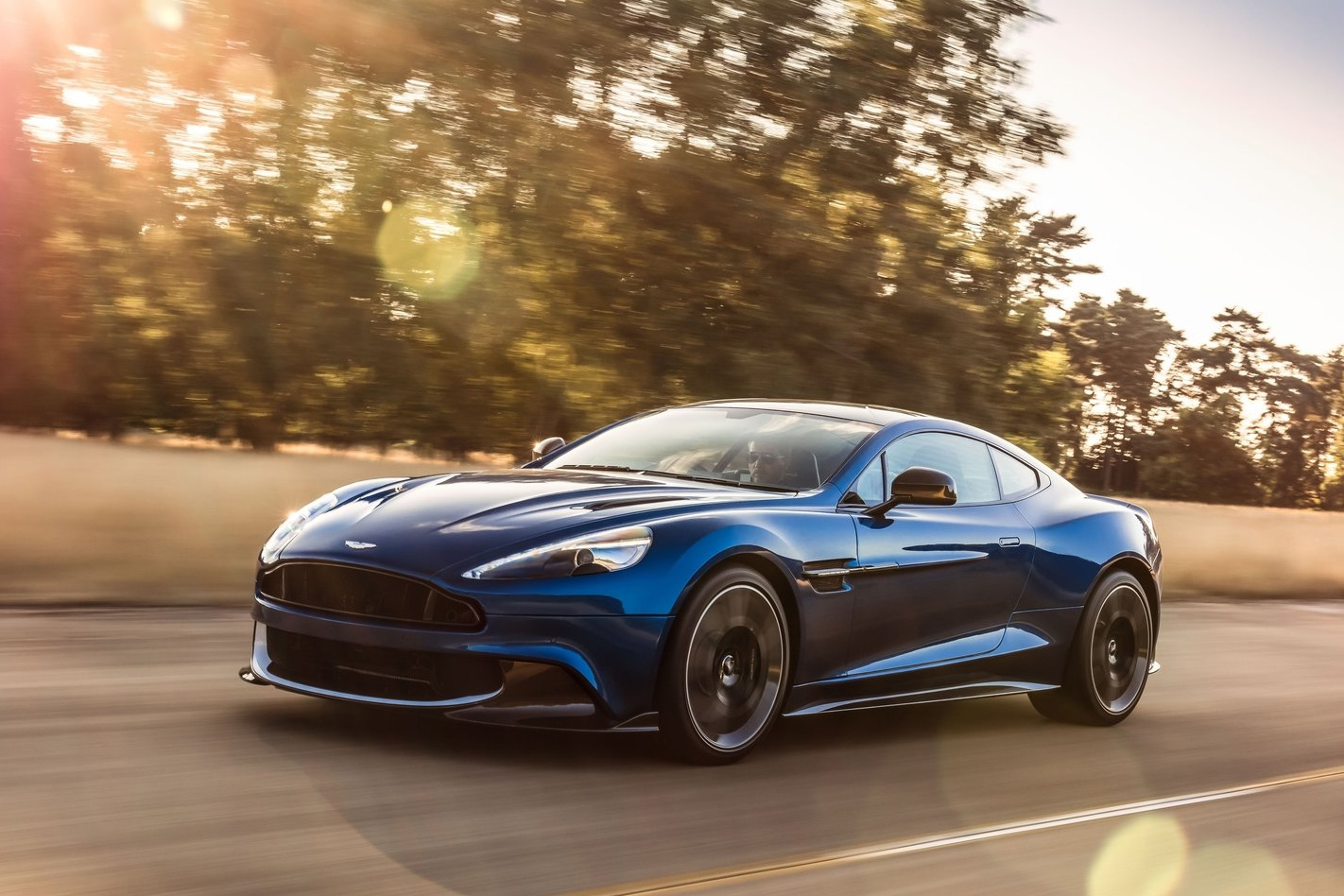
5.9-litre V12 – 421kW It might be as old as the hills, but Aston’s V12 is still punching like a heavyweight. Its days are numbered, though: the new twin-turbo 5.2-litre V12 will replace it.
5. Lexus RC F/LC F/GS F
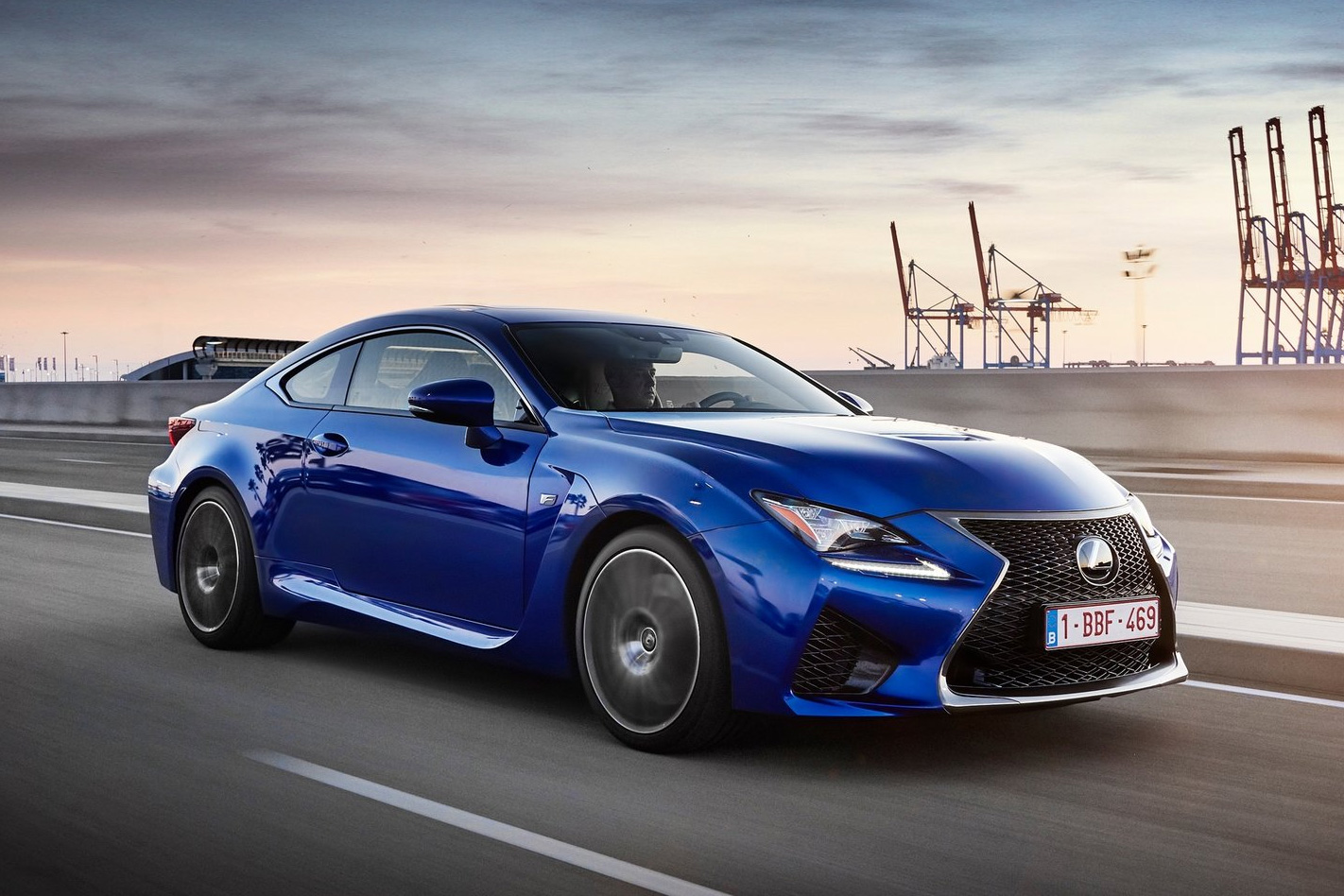
5.0-litre V8 – 351kW Developed in partnership with Yamaha, the Lexus V8 continues to flex its free-revving muscle and delicious induction note under the bonnet of three models.
Toyota’s local manufacturing shut shop last year, but the Australian arm of the Japanese car giant can still offer products designed specifically with Aussies in mind.
That’s thanks to Toyota’s Product Planning and Development Division in Port Melbourne, Victoria.
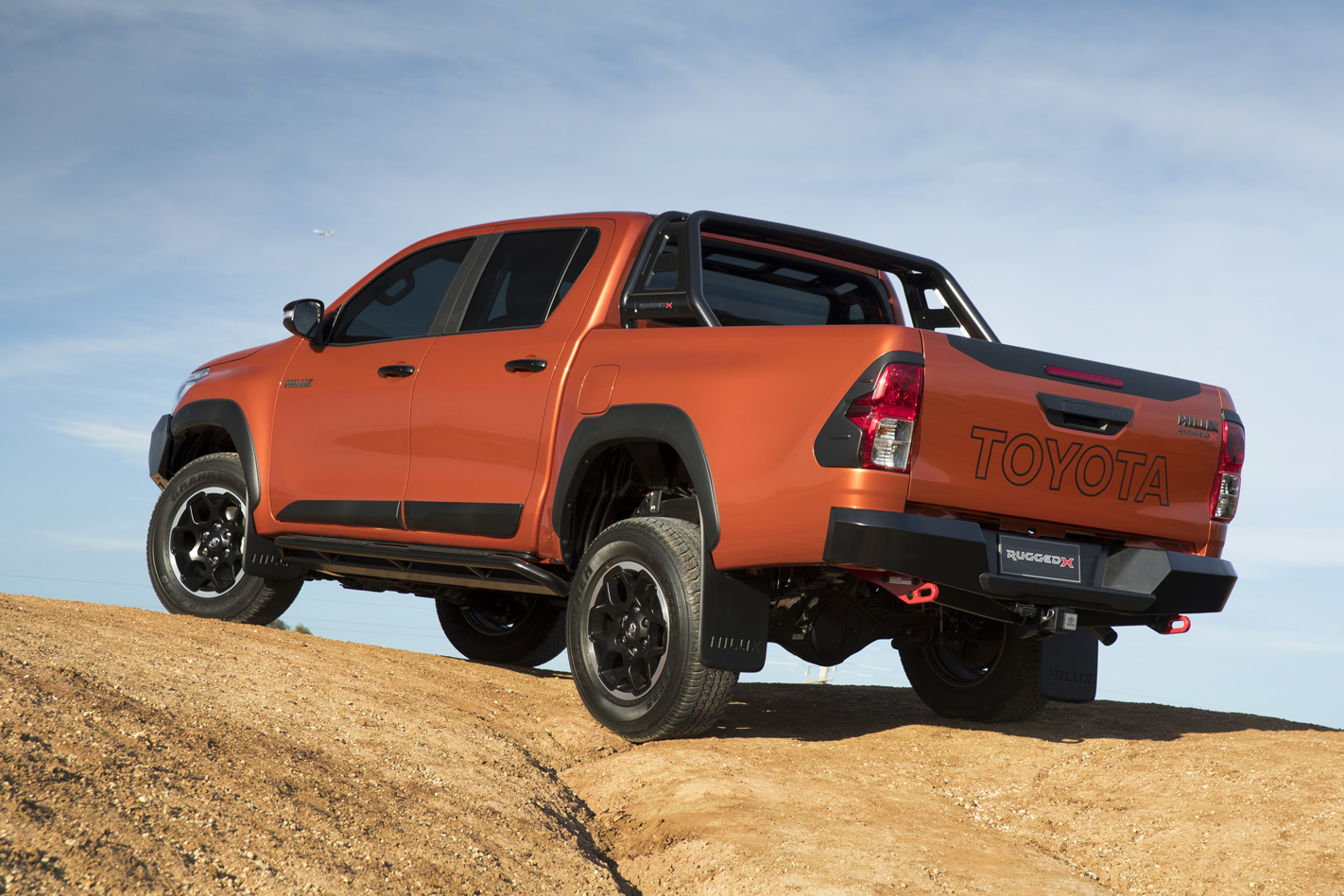
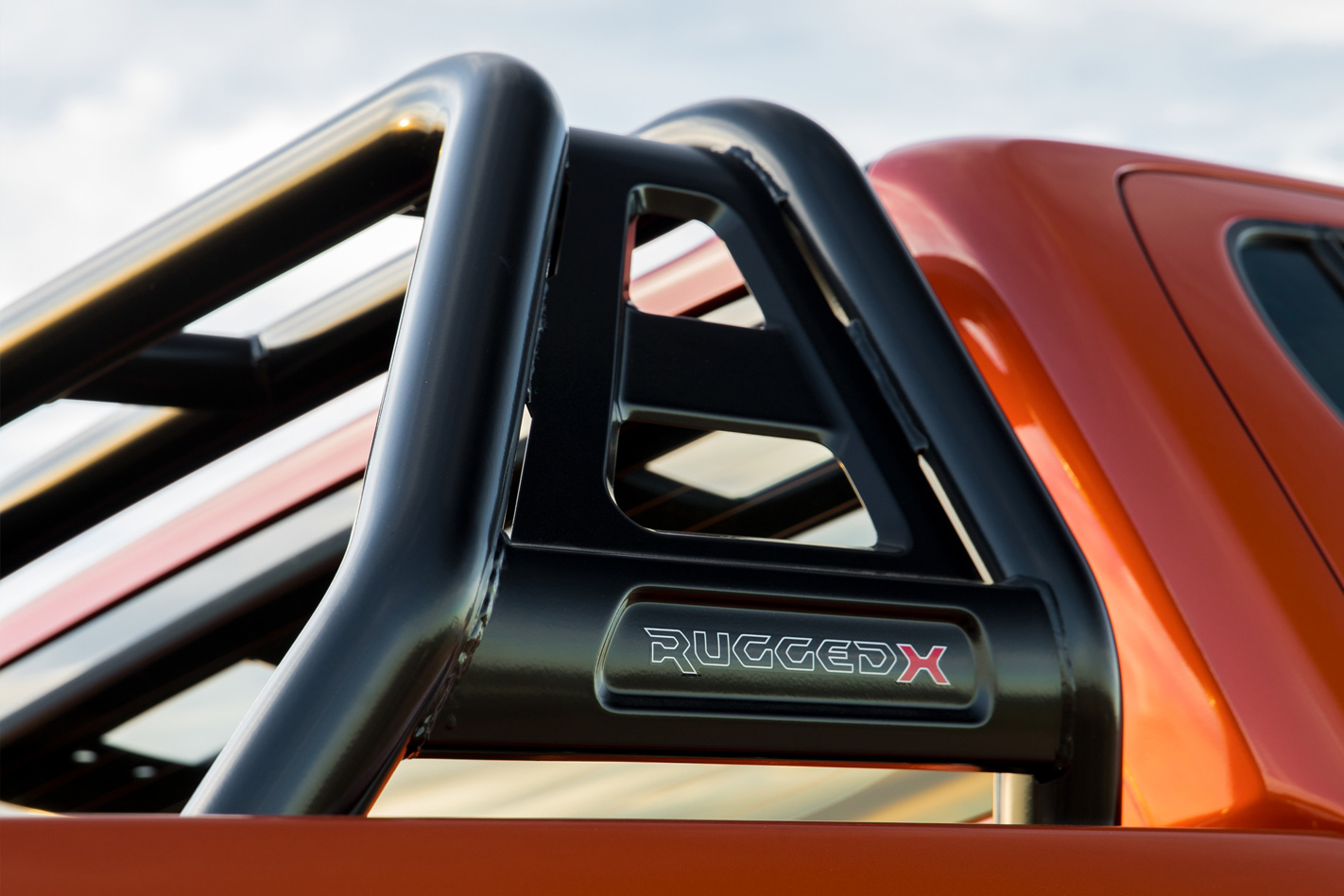
Located in a high-security building which sits astride Toyota Australia’s head office, the Product Planning and Development Division is most recently responsible for the Toyota Hilux Rugged, Rugged X, and Rogue models which will be released in the coming months.
While the Rogue will also be released in some South-East Asian markets, the Rugged and Rugged X were built and designed solely for Australians, by Australians.
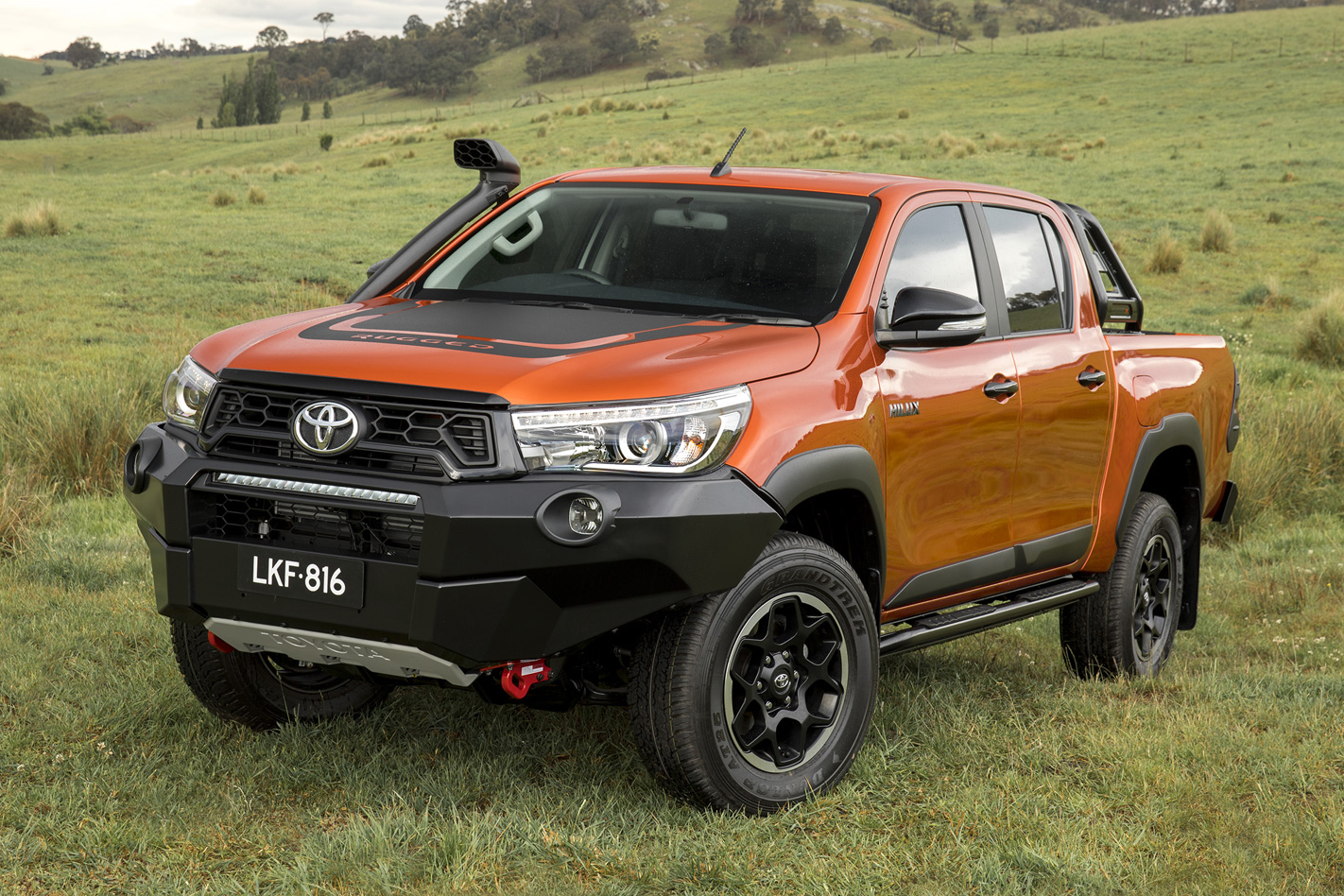
Toyota Planning and Development General Manager Rod Ferguson said designing a special edition of the popular dual-cab was a no-brainer.
“We have started with the Hilux because it is our biggest selling car, and one of our most accessorised vehicles,” he told Wheels.
“The opportunity for that upper-level spot in the market was there, so we feel that the market is going to accept these well.”
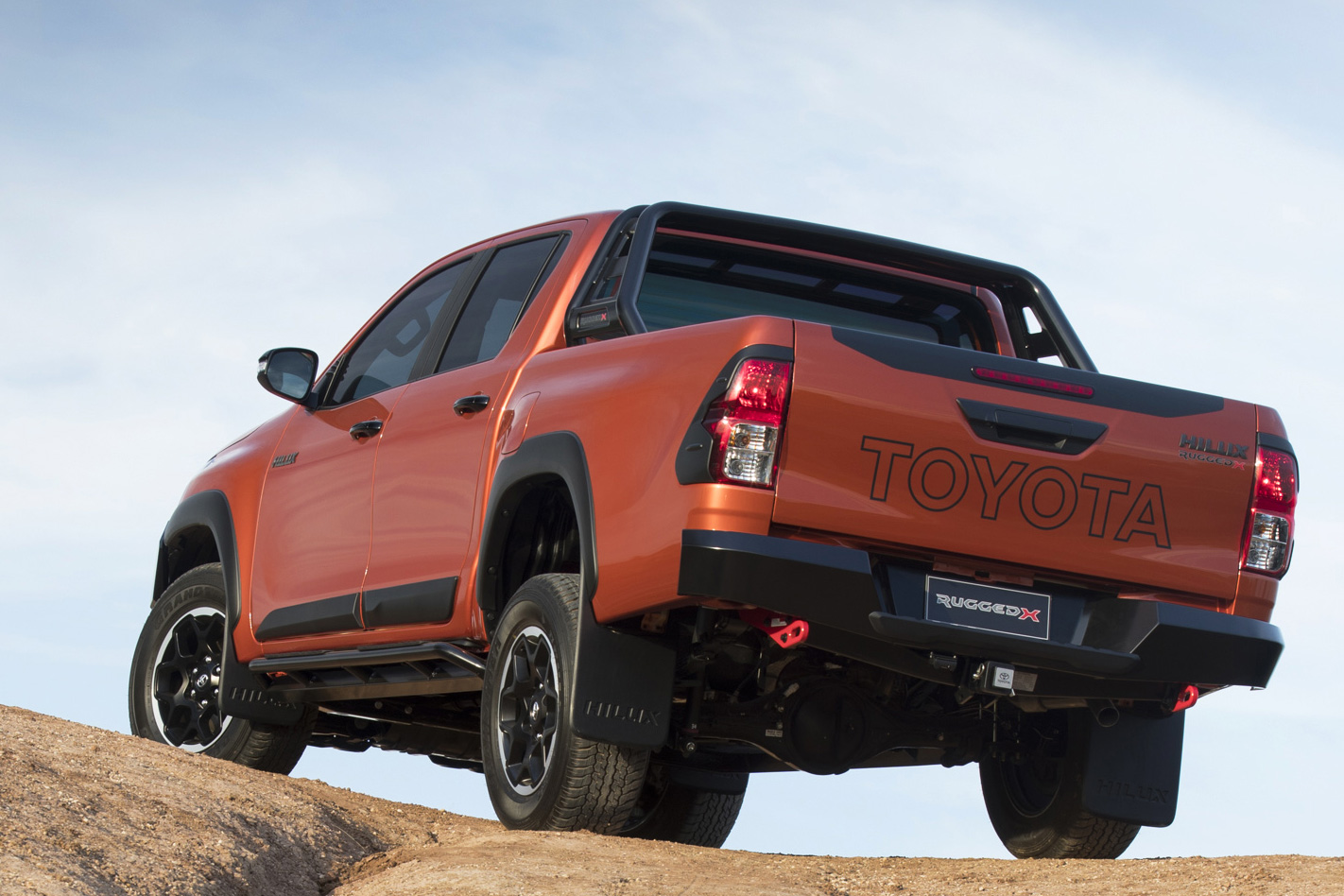
Rod Ferguson could not confirm plans for similar programs on other models, but said Toyota Australia will continue to evaluate possible future plans.
“There is always a limitation on what can be offered on a global level, and of course we will work with our parent company to get the best global line-up we can, and then on top of that we will look to how we can increase the functionality or emotional side, or suitability, of the car,” he explained.
“We’ve got an extensive vehicle range to look at, so we’ll continue to look at that and see if there is a need we can fulfil locally to enhance other products,” he explained.
Fleet purchases make up a large portion of Toyota Australia’s sales, and Rod Ferguson says the Product Planning and Development Division is also looking to cater to the needs of Aussie businesses.
“We will always develop different parts for our local market,” he said. “The Hilux we currently offer in a mining pack, so the mining industry has a pack available for them.
“We’ve done vehicles in the past where we have offered a police pack for vehicles in our range.
“Our Hilux, and some other cars, are huge for fleet. We’re not sure what the split of fleet vs private will be on [Rugged X]. There will certainly be a strong private demand on that.
“But we work with our big fleet customers and other prospective customers on their requirements, and we do the best we can to try and build in those features for them to make it ideally a one-stop shop.”
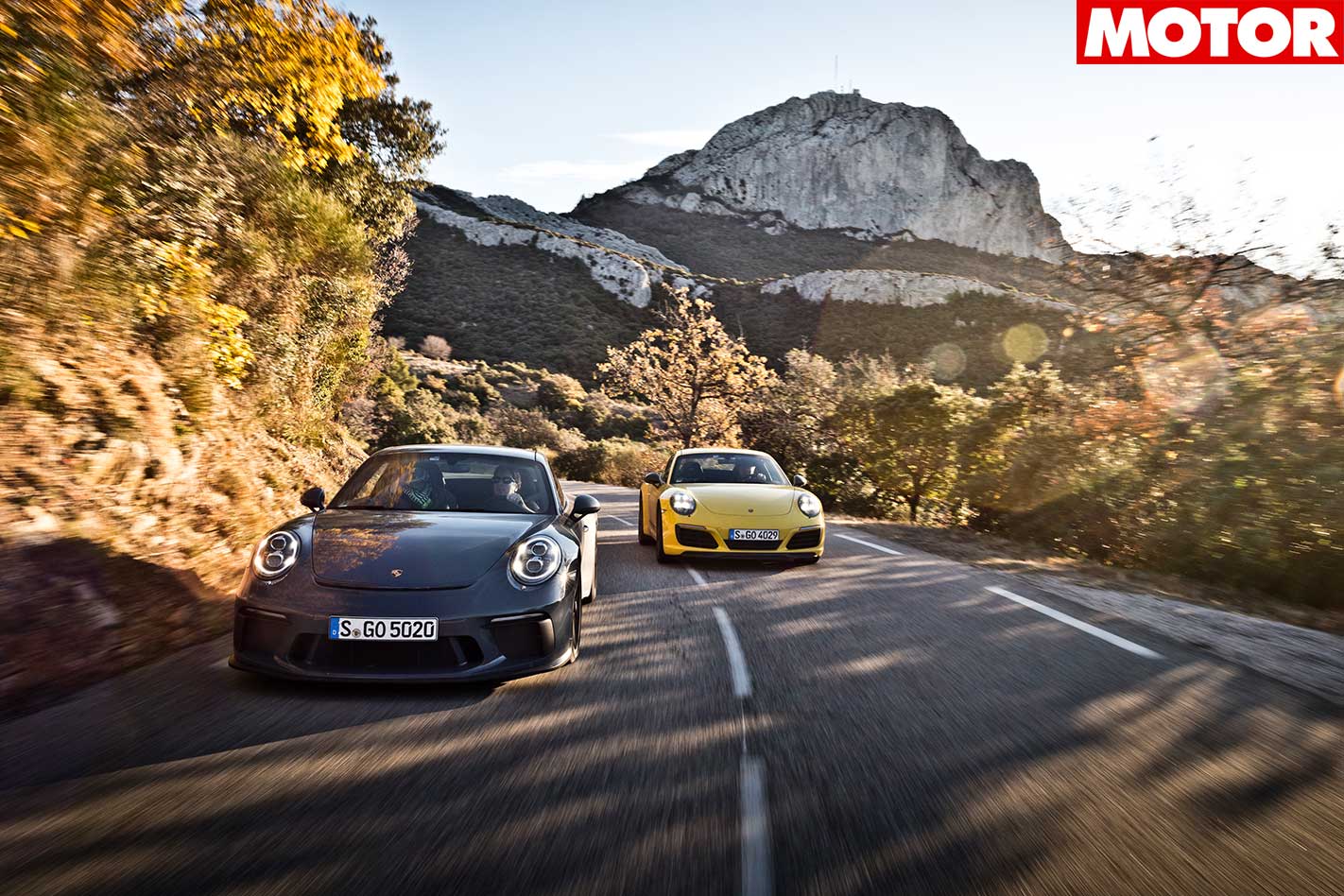
It’s early on a very chilly morning. In an ideal world the alarm clock would have been set much later. But with two new, wingless 911 Porsches to play with, it seems like one of those Gen Y, first-world problems.
Still, the firing order of the flat sixes suggests we wait a minute for the cylinders to collect themselves and for everything to thaw. Once I’m somewhat coherent, my thoughts immediately turn to the frosted yellow Carrera T idling away.
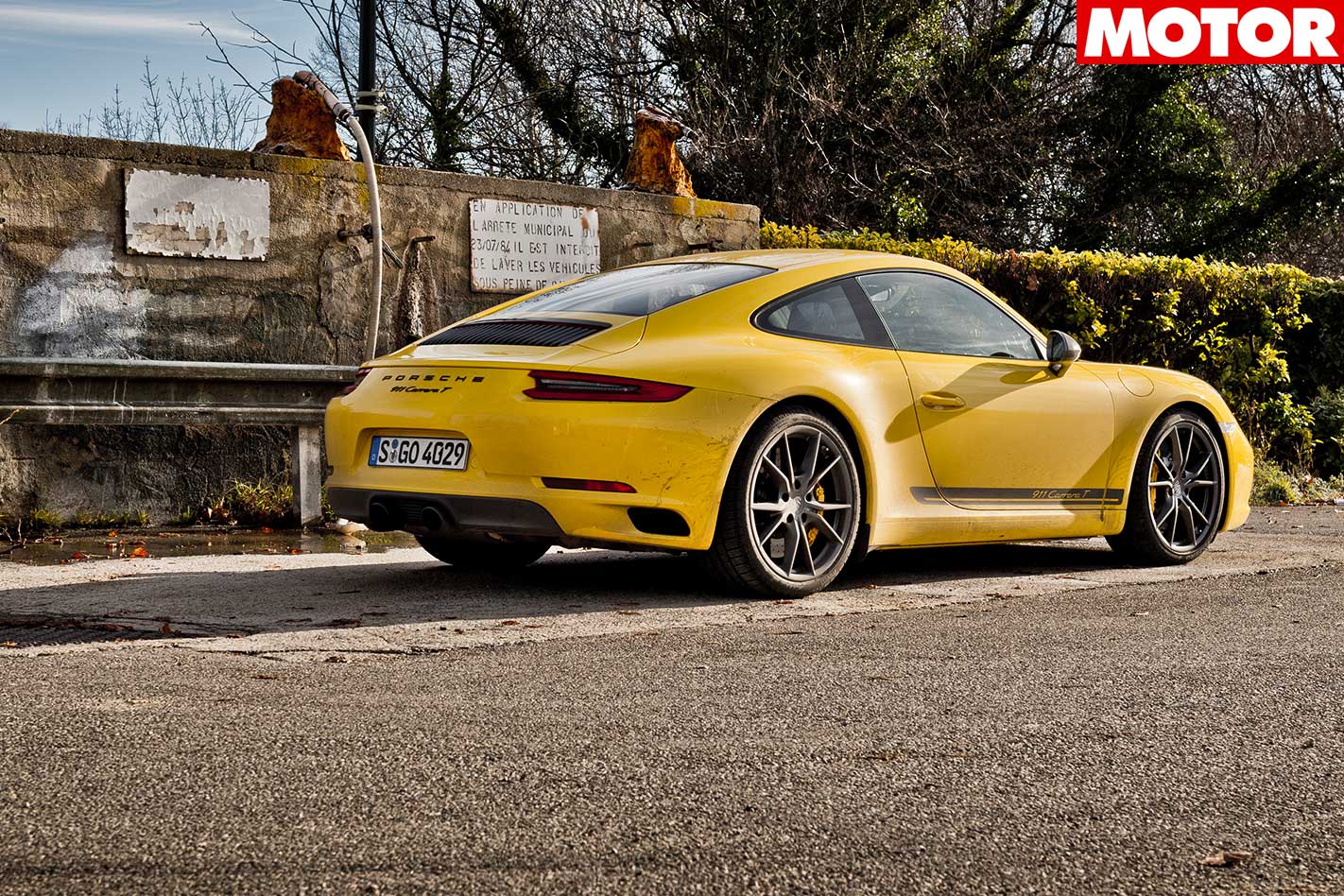
No doubt it’s bound to generate maximum return on investment – for Porsche especially – given its special-model status. Although, it’s too early and the air is too cold for my brain to comprehend value equations.
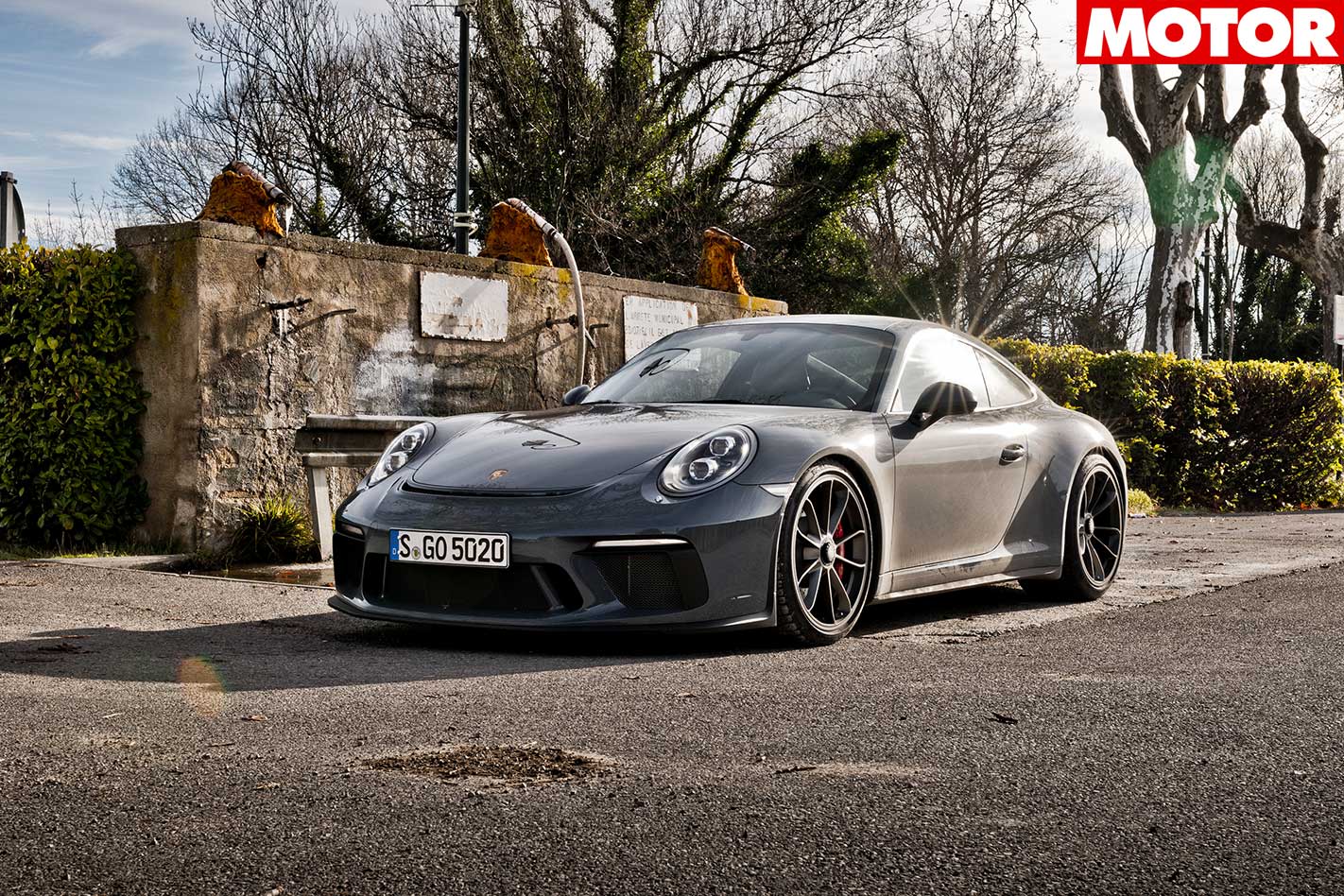
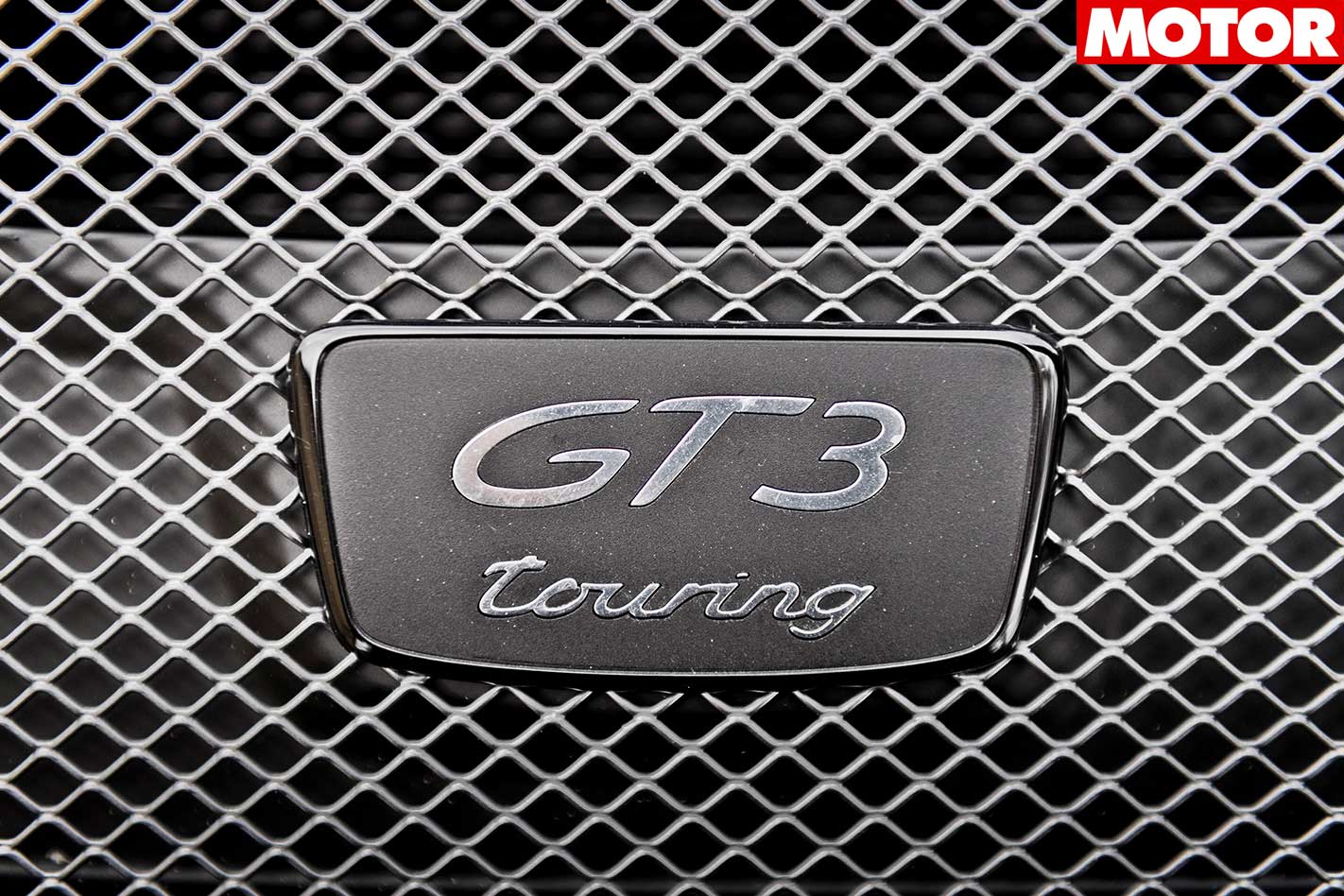
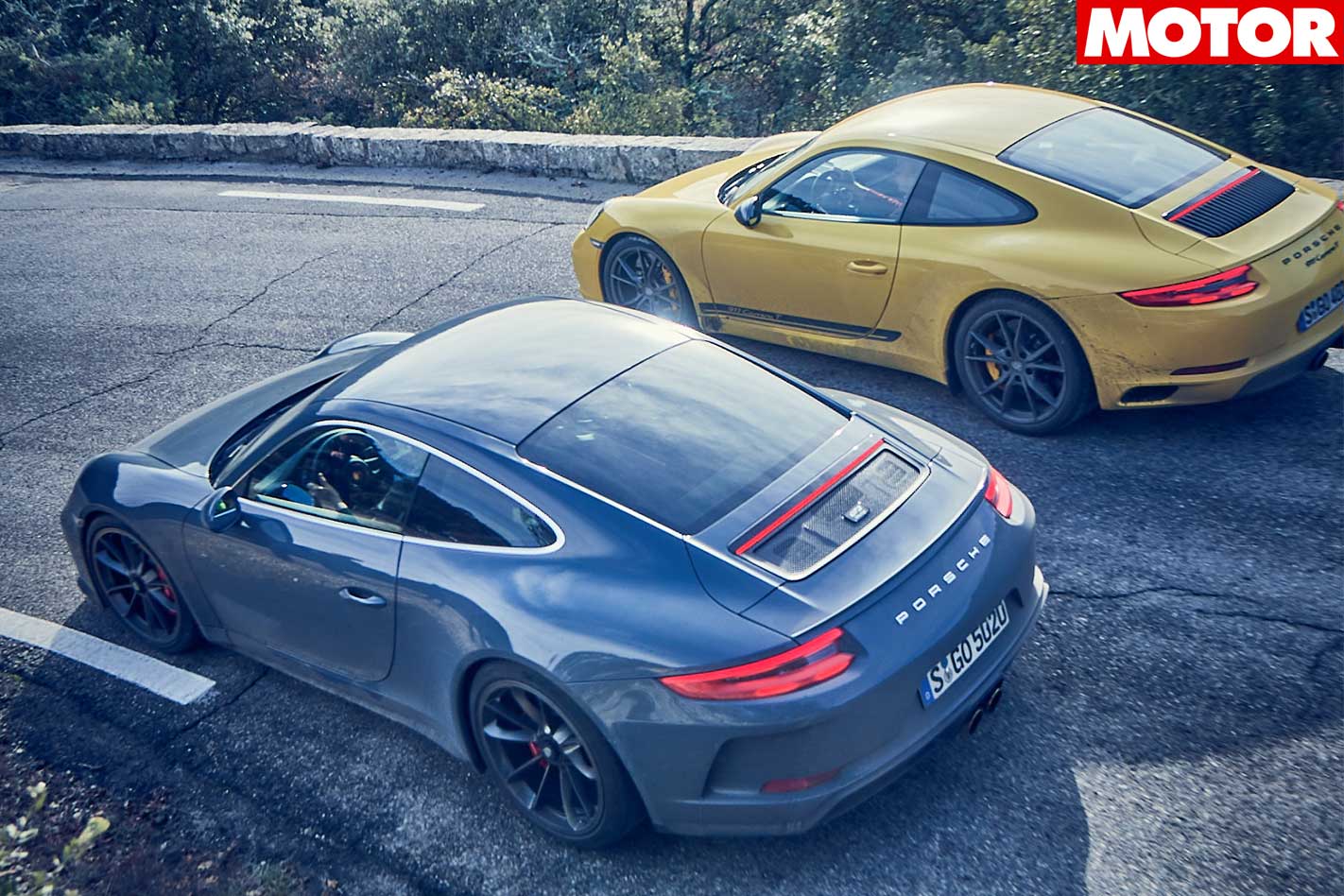
The Carrera T is the first Porsche marked under the recently introduced heritage banner (the next model is believed to be the GT Speedster due for release later this year). It’s current counterpart is the GT3 Touring which, when you break it down, is a de-winged 991.2 911 GT3 with the spirit of the 911 R (including the naturally aspirated 4.0-litre flat six with 368kW/460Nm).
To celebrate the feat, we travelled to the Maritime Alps high above Nice where the midday temperature hardly nudges double digits – hence both cars are shod with soft-compound winter tyres.
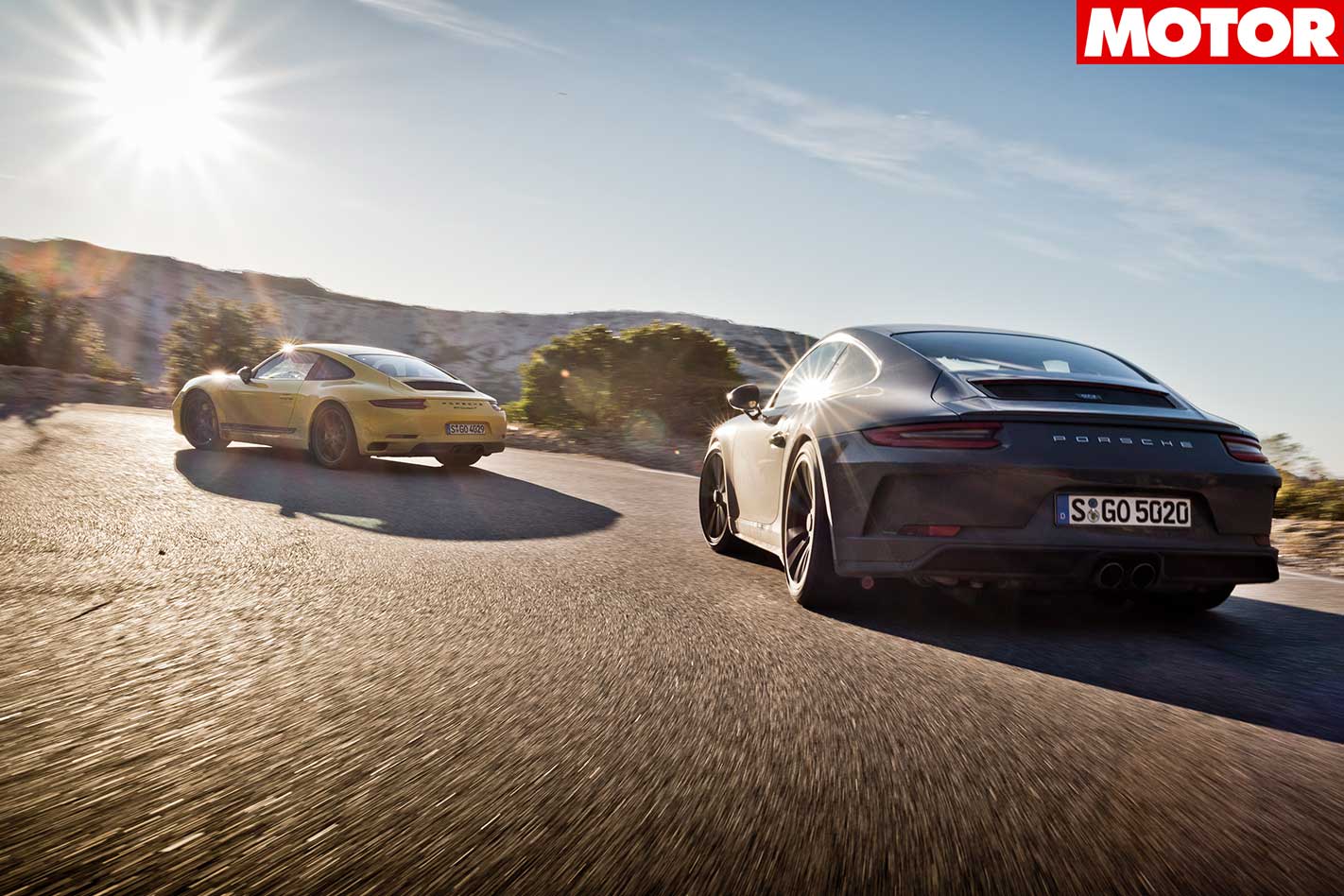
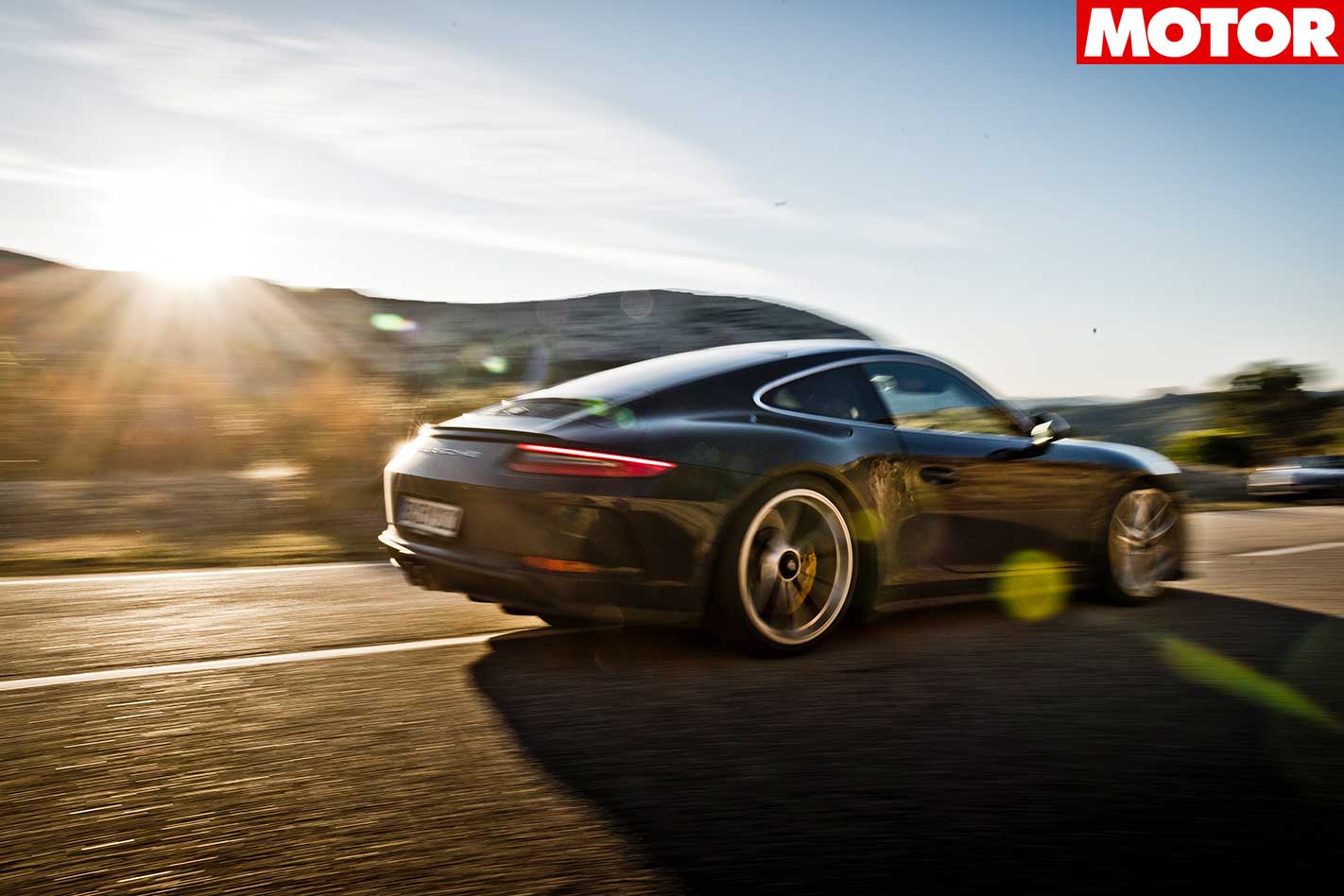
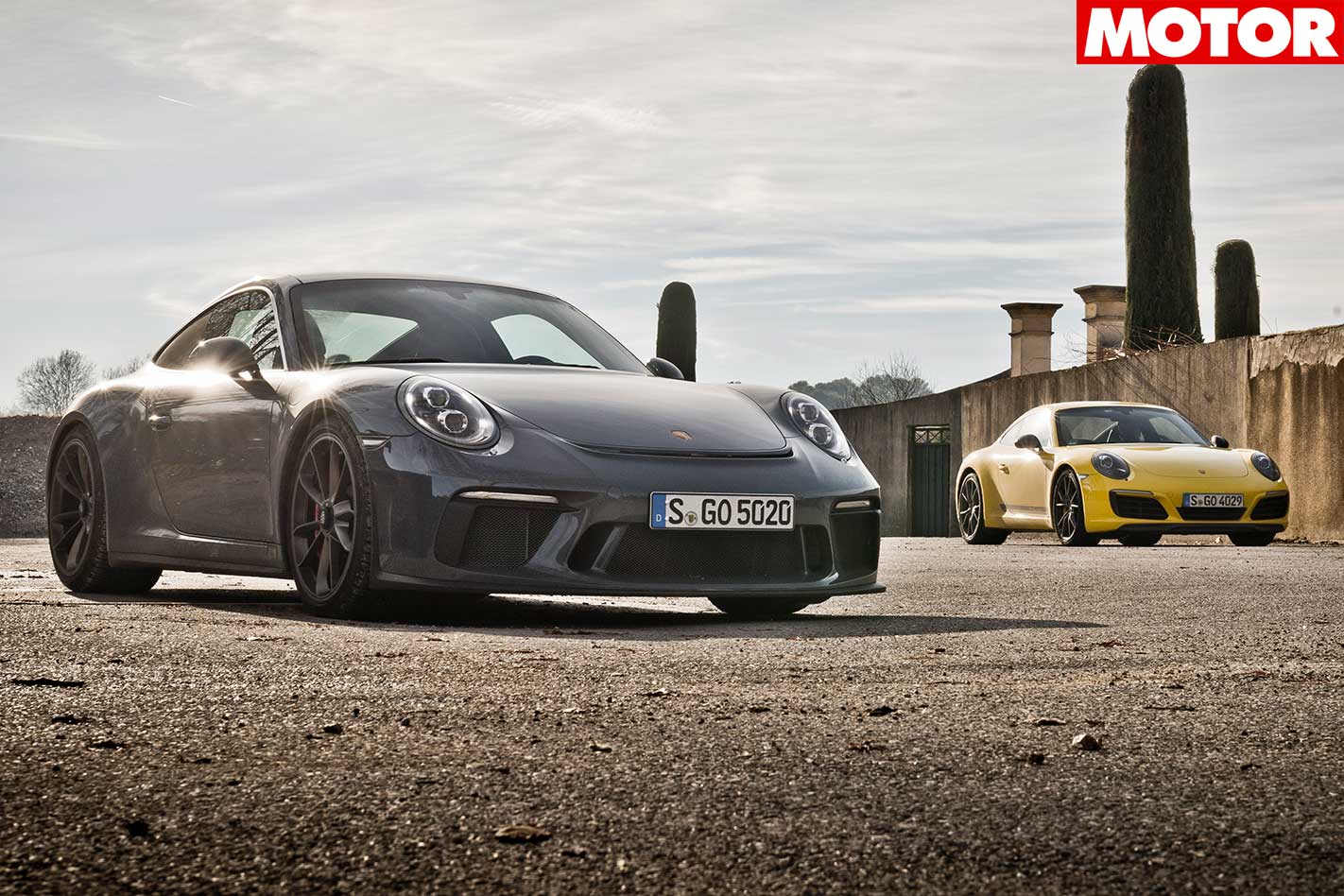
Leading the way is the new $326,900 911 GT3 Touring, which follows the same less-is-more theme as the Carrera T. It swaps the dinner-table wing for the stealth spoiler set of the 911 R, adding black accents to the light clusters front and rear.
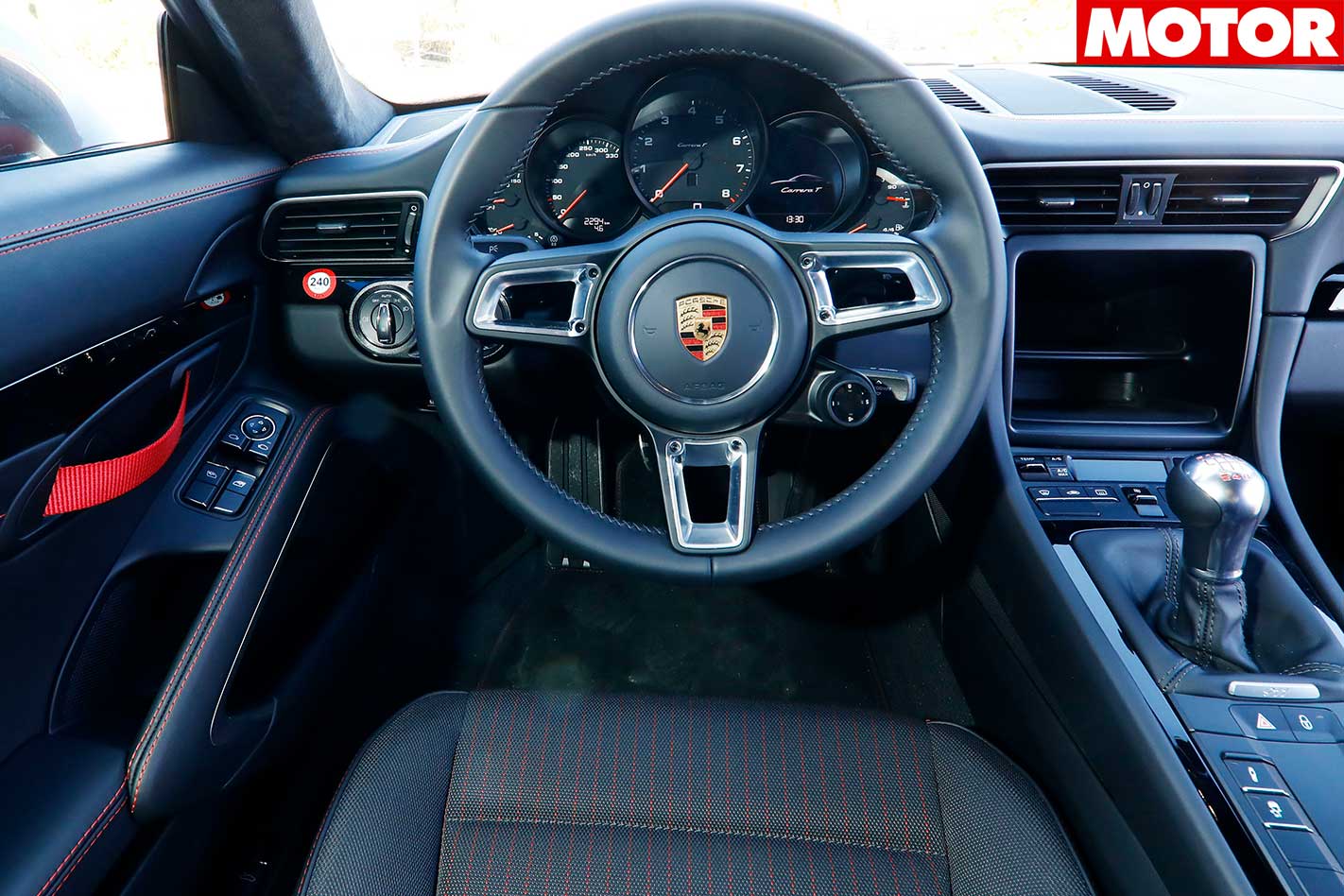
Inside, the Carrera T gains a bespoke, colour-coded cabin trim boasting yellow belts, yellow fabric door openings, yellow stitching and yellow 911 embroidery. The infotainment system, rear seats and air-conditioning can be fitted free of charge, but those checking the scales closely will delete them. Every gram counts; which explains why our test car has a big black hole in its centre stack. It all depends if you want comfort or ultimate performance out of your 911.
While the GT3 Touring can only be had with a six-speed manual, the Carrera T is offered in two- or three-pedal guise. Sadly, Porsche chose the seven-speed manual ’box over the closer-ratio six-speeder of the GT3.
In many ways, the GT3 Touring would also be better off with PDK – but it isn’t offered. Walter Rohrl, who owns the collectable 911 R, calls the decision to tie the Touring specification to the manual gearbox “impolite”. I call it unfortunate. Why, you ask? Because the PDK version is not only more relaxed, it’s substantially quicker.
Then, of course, there’s the time factor. According to Porsche, the 368kW GT3 Touring can do the 0-100km/h sprint in 3.9sec. That’s lightning fast for sure, but then, the 272kW, PDK-equipped Carrera T is only 0.3sec slower to the same marker (4.5sec for the manual).
Conversely, pitch the three-pedal Touring against the winged two-pedal GT3 and the deficit is five tenths. Put stick against stick and, unsurprisingly, the GT3 Touring will drive circles around the Carrera T – despite Porsche speeding up the gearing of the latter.
The answer is because the blend of the 309kW/500Nm Carrera S engine with PDK would have been too close for comfort to its bigger brother. Adding salt to the wound would be the fact that the beefier turbocharged Carrera S also gains 40Nm against the naturally aspirated 4.0-litre unit’s 460Nm in the GT3.
The most accessible and best balanced Porsche 911 this side of the turbo has always been the GTS – and it still is. Having said that, the Carrera T does, on certain roads and conditions, make the adrenalin flow even faster – with one caveat. To make it shine it requires specific turf. It loves tight corners, short climbs, deep dips, blind crests and sudden surface variations.
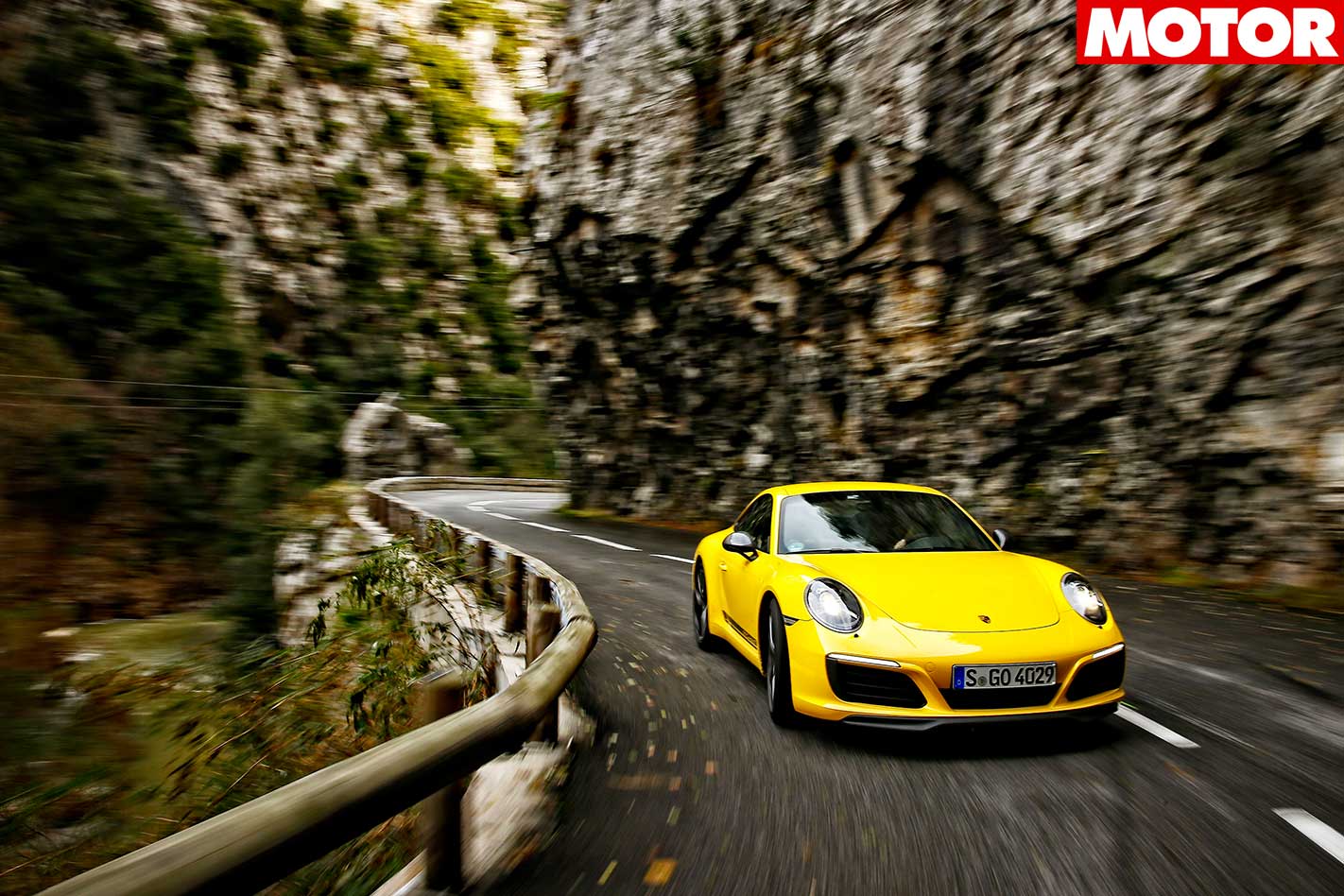
The benefits of the PDK have already been explained, but adding steer to all four wheels makes the car turn in with a newfound velocity. It also helps the wheels juggle torque and noticeably increases the high-speed stability.
In a nutshell, all three options are key confidence-enhancers. And we all know that confidence is the prerequisite for going really fast on winding roads.
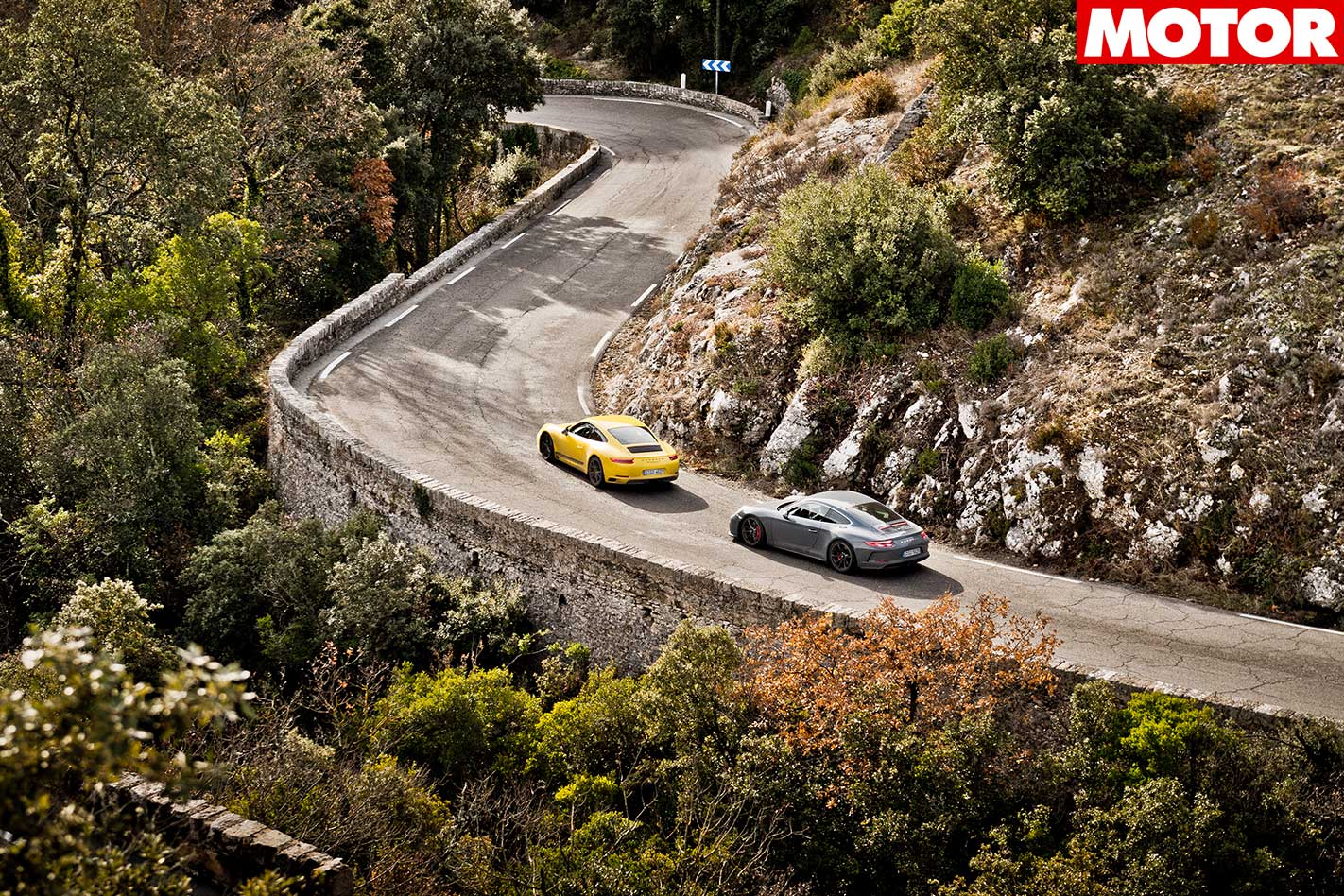
Unlike generations of rally drivers on these roads, in a modern context, we must always be prepared for oncoming traffic. Be it a courier driver, a dallying grandparent or absent-minded youth, today’s perils simply come in different forms.
With a camera rather than pace notes clutched in his trembling hands, my passenger’s facial expressions say ‘I’m not ready to die yet’. Although one can now almost sniff the limit of adhesion, the front end still turns in with vigour as it bites and hangs on. The carbon-ceramic brakes allow us to hone in on the GT3 Touring at the end of straights and a quick flick into first gear shoots us out of tight hairpins.
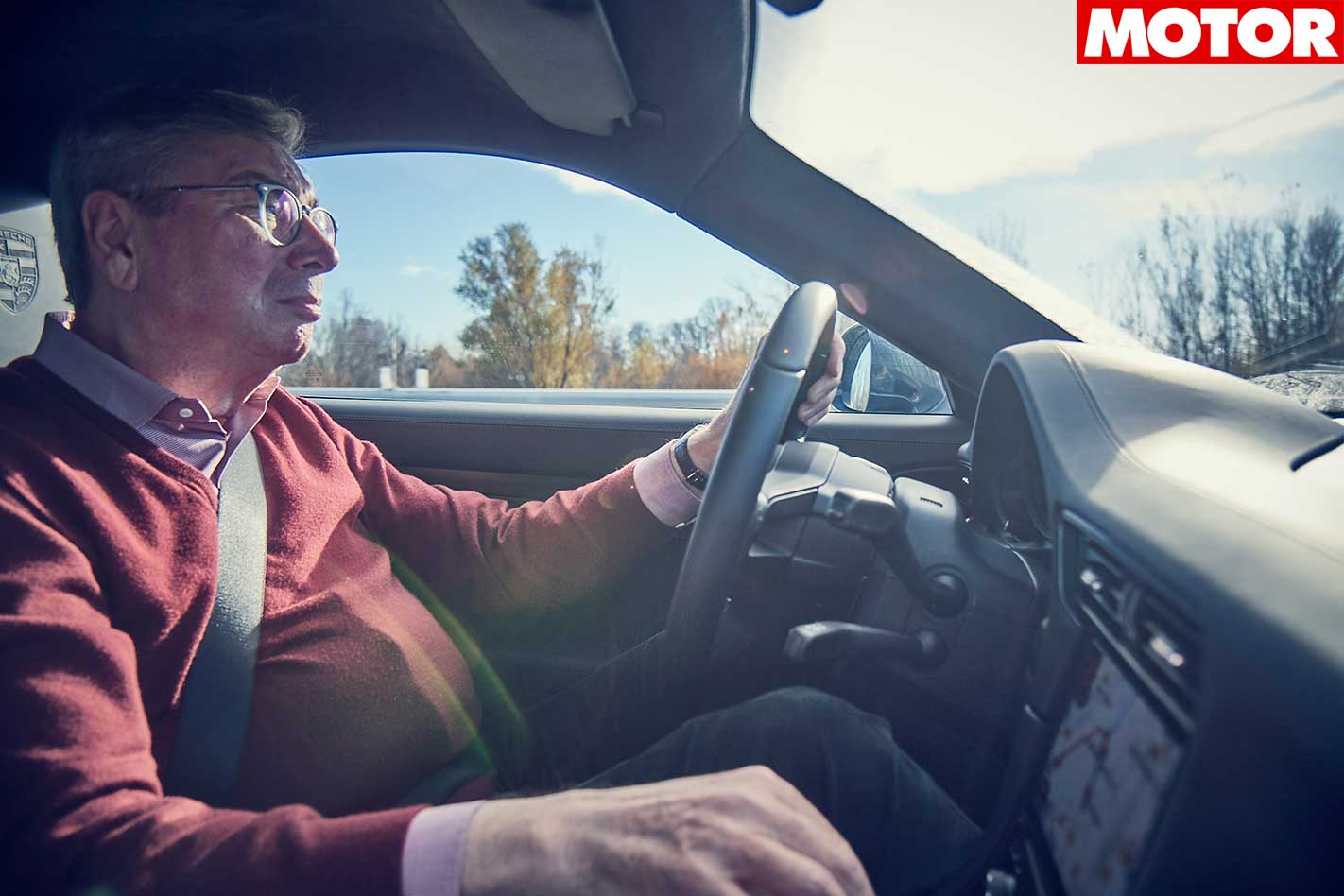
What sets the two 911s apart is the difference in character. While the Carrera T is more Sport than Touring, the GT3 Touring prefers plenty of room to move, open-radius corners and a topographic rhythm composed for high revs rather than low-end torque. The 4.0-litre flat six needs to be near its peak to shine, but at 6500rpm in first gear it’s a war between engine and transmission.
The same could be said for second gear. Below 4000rpm, this mechanical masterpiece wilfully works to rule. The ensuing 4000 to 6000rpm bracket pairs a fast rising torque curve with an even sharper throttle response.
If pragmatists, purists and Porschephiles could have things their way, these two chapters of Touring history would have to be slightly rewritten. Starring in the edited script would be a moderately more expensive Carrera T powered by the 309kW Carrera S engine and a GT3 Touring available with PDK. “Dream on” is Weissach’s official answer to such proposals.
The makeshift option is to de-spoiler a GT3 and fit the Touring kit – a move Porsche intends to make as difficult as possible. So what other choices are there? One could wait until 2019 for the next 911 (dubbed 992), which is claimed to muster 294kW and 331kW as Carrera and Carrera S respectively.
What would I do? I’d be nice to a rich aunt, buy a paint-to-sample GT3 Touring and keep it until the coffin lid shuts. In case that aunt isn’t quite rich enough, one could always opt for the upcoming 718 Cayman GT4.
Truth be told, Porsche and turbos are as much a part of now as they are the future. But in the case of the 911, which turns 53 this year, living in the past makes for such a charming alternative.
Fast Facts
| u00a0 | 2018u00a0Porsche 911 GT3 Touring | 2018 Porsche 911 Carrera T |
| BODY | 2-door, 2-seat coupe | 2-door, 2-seat coupe |
| DRIVE | rear-wheel | rear-wheel |
| ENGINE | 3966cc flat-6, DOHC, 24v | 2981cc flat-6, DOHC, 24v, twin-turbo |
| BORE/STROKE | 102.0 x 81.5mm | 91.0 x 76.4mm |
| COMPRESSION | 13.3:1 | 10.0:1 |
| POWER | 368kW @ 8250rpm | 272kW @ 6500rpm |
| TORQUE | 460Nm @ 6000rpm | 450Nm @ 1700-5000rpm |
| POWER/WEIGHT | 260kW/tonne | 191kW/tonne |
| TRANSMISSION | 6-speed manual | 7-speed manual |
| WEIGHT | 1413kg | 1425kg |
| SUSPENSION (f) | struts, coil springs, adaptive dampers, anti-roll bar | struts, coil springs, adaptive dampers, anti-roll bar |
| SUSPENSION (r) | multi-links, coils, adaptive dampers, anti-roll bar | multi-links, coils, adaptive dampers, anti-roll bar |
| L/W/H | 4562/1852/1271mm | 4527/1808/1285mm |
| WHEELBASE | 2457mm | 2450mm |
| TRACKS | 1551/1555mm (f/r) | 1545/1581mm (f/r) |
| STEERING | electrically assisted rack-and-pinion, all-wheel steer | electrically assisted rack-and-pinion, all-wheel steer |
| BRAKES (f) | 380mm ventilated discs, 6-piston calipers | 350mm ventilated discs, 4-piston calipers |
| BRAKES (r) | 380mm ventilated discs, 4-piston calipers | 330mm ventilated discs, 4-piston calipers |
| WHEELS | 20.0 x 9.0-inch (f); 20.0 x 12.0-inch (r) | 20.0 x 8.5-inch (f); 20.0 x 11.5-inch (r) |
| TYRE SIZES | 245/35 ZR20 (f); 305/30 ZR20 (r) | 245/35 ZR20 (f); 305/30 ZR20 (r) |
| TYRE | Michelin Pilot Sport Cup 2 | Pirelli P-Zero |
| PRICE | $326,900 | $238,400 |
| PROS | One of the worldu2019s great engines; superb handling | Great engine; tidy chassis; turbo torque |
| CONS | PDK as an option would be nice; hard to get hold of | Should be based on Carrera S; wrong manual |
| RATING | 5 out of 5 stars | 4 out of 5 stars |
When you drive a new performance car and think to yourself, ‘what an engine’, you cherish the thought – especially a hot hatch.
The scintillating chassis combined with a forgettable, aurally-overdone turbocharged engine has become somewhat of a modern stereotype with this class of car. But it’s a trend the updated Audi RS3 is bucking with its new 2.5-litre inline-five – a seriously awesome engine. The turbocharged powerplant, shared with the TT RS, is the big news for Audi’s hottest-ever hatch.
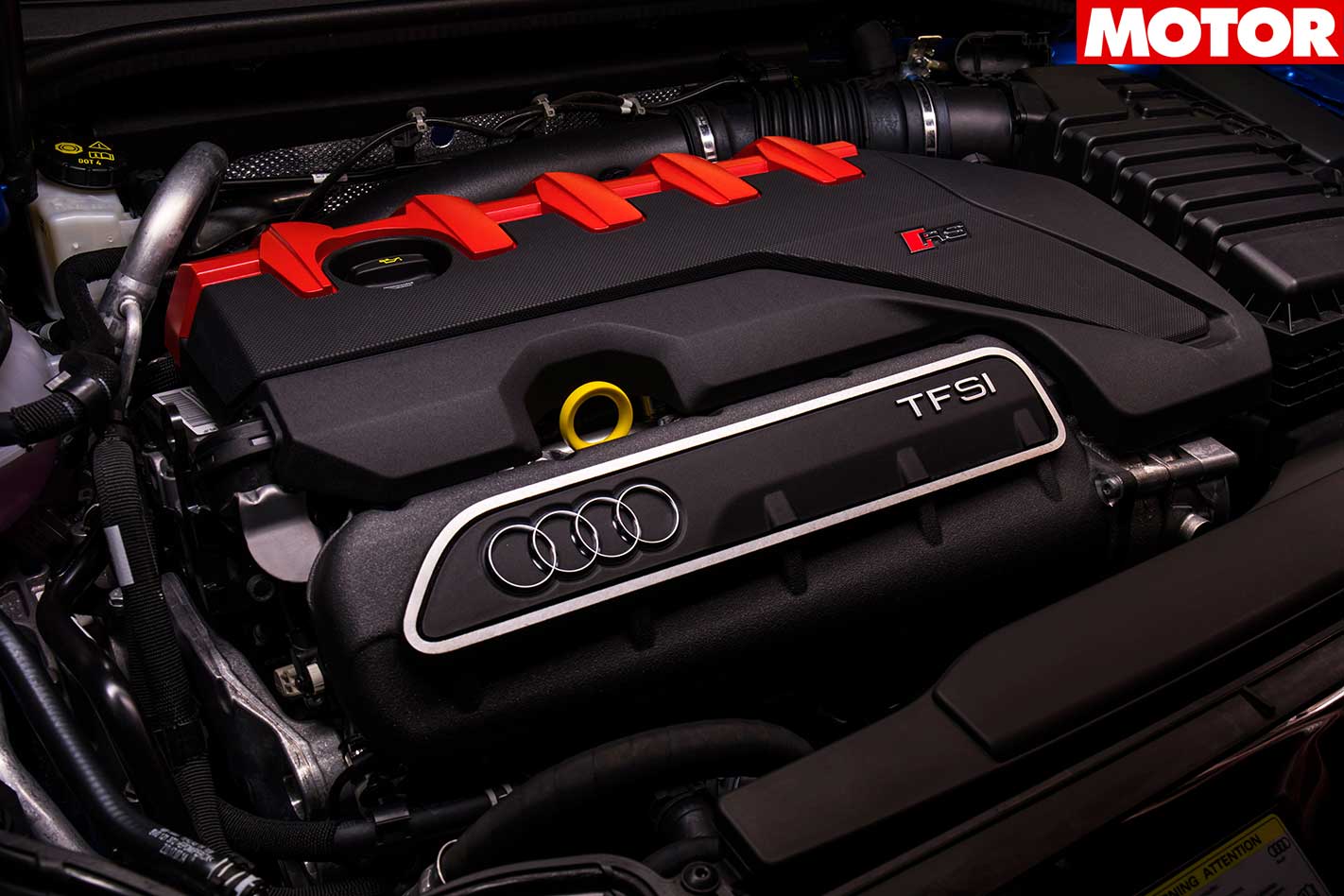
But stuck with it they have, even making it 26kg lighter, thanks in part to a new alloy crankcase, important as recent five-pot Audis have been a little front-heavy.
By continuing to fit 255/30 fronts and 235/35 rear tyres, there’s the hint that Audi hasn’t sorted all the RS3’s front-heavy woes. And this is still a very front-axle focused car by way of power distribution.
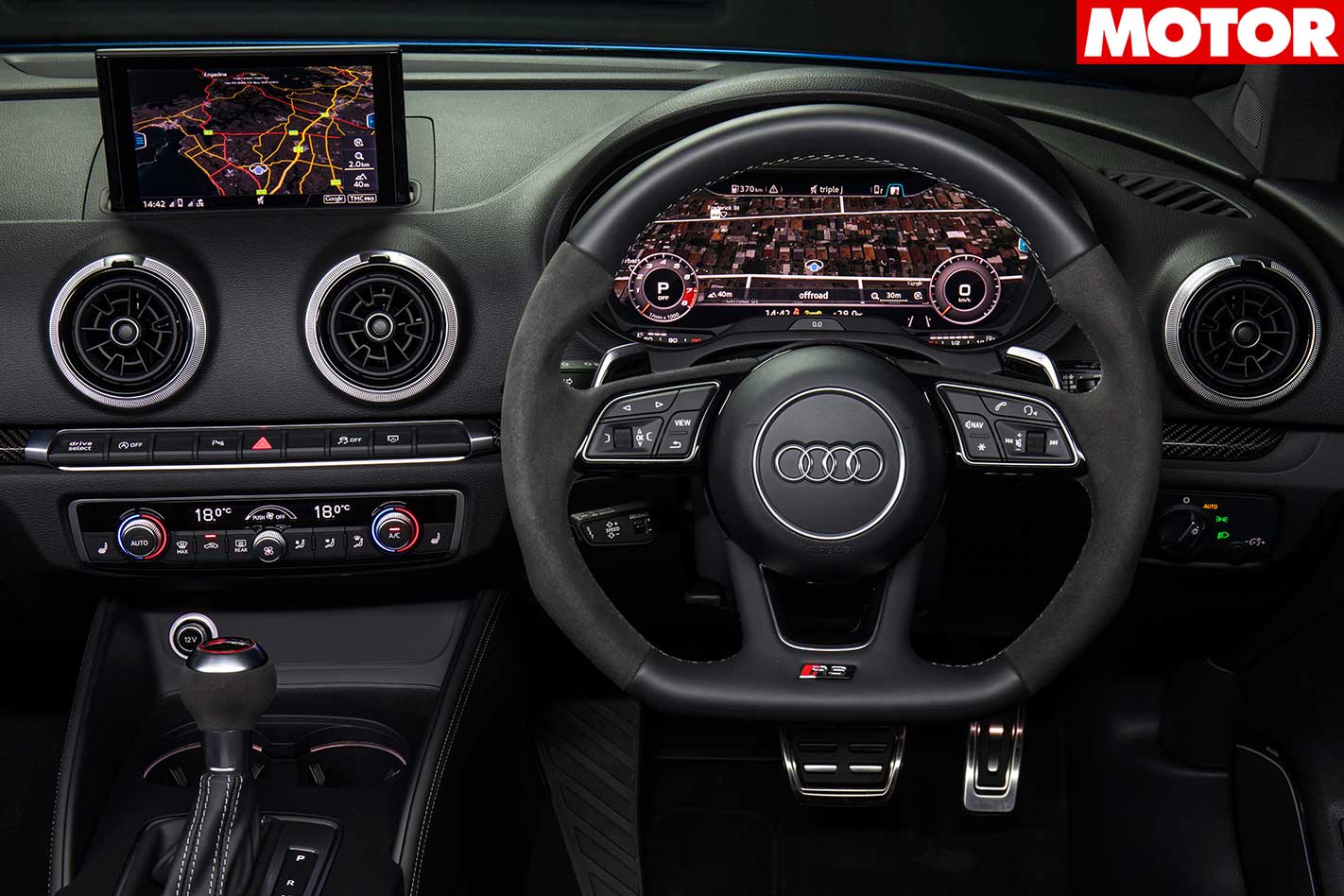
With its understated styling – compared to a bewinged A45 – it’s no surprise to find a very comfortable, sensible-driving car in Comfort mode, with a nice urban ride as well (Magnetic Ride is optional). Engage Dynamic mode (or Individual with Comfort dampers and Dynamic powertrain) and all hell breaks loose.
The hissing, torquey five-cylinder warbles like an R8 under acceleration and cracks out the exhaust with every twin-clutch upchange. Holy moly, this is a potent little car – and the noise, it’s just rude. With a bit more poke, this engine could go in an R8. No joke.
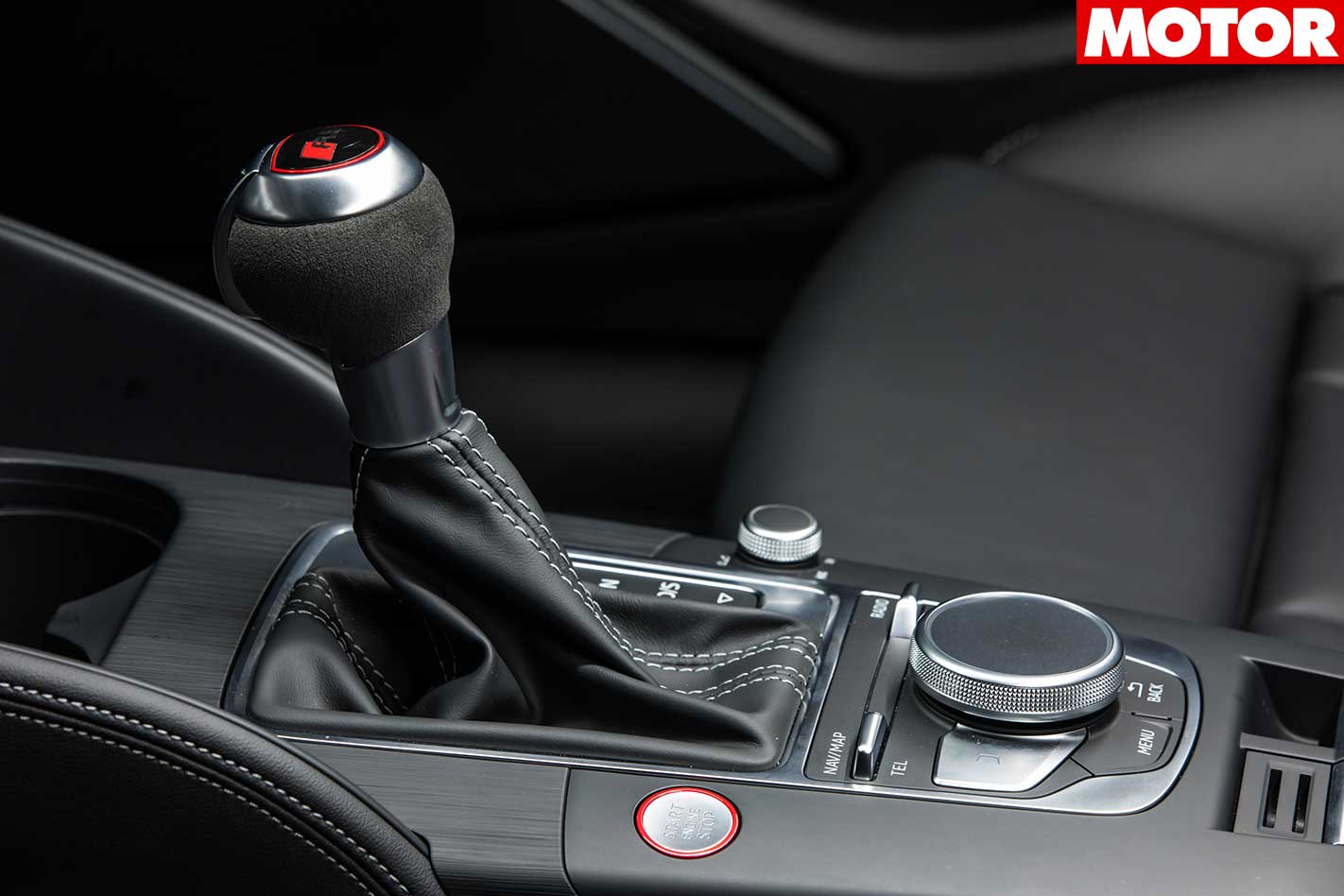
This car is now so fast, with such epic brakes as well (and our test car was on the steel items, not the optional carbons), that it’s almost crying out for stickier tyres. But that’s another story.
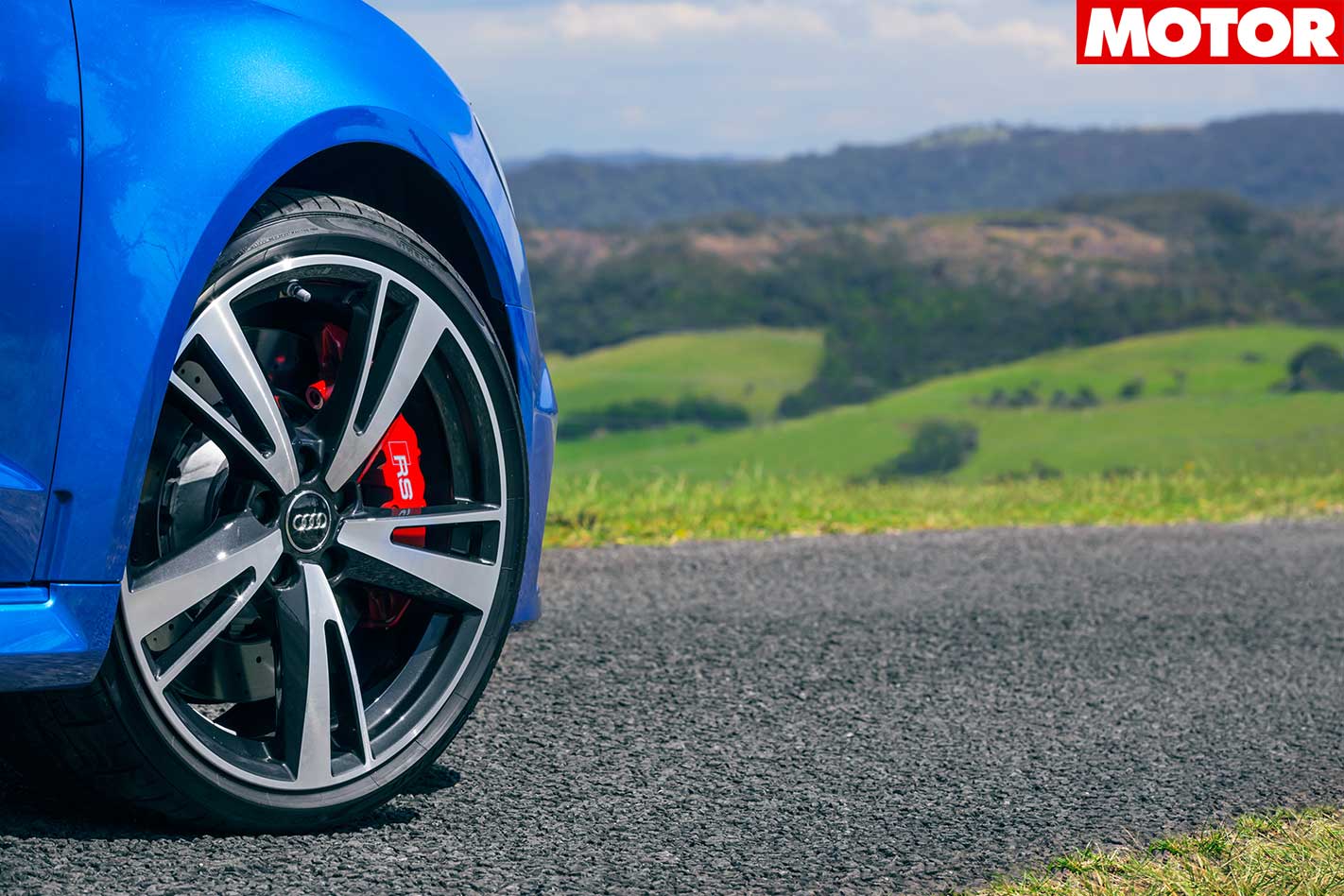
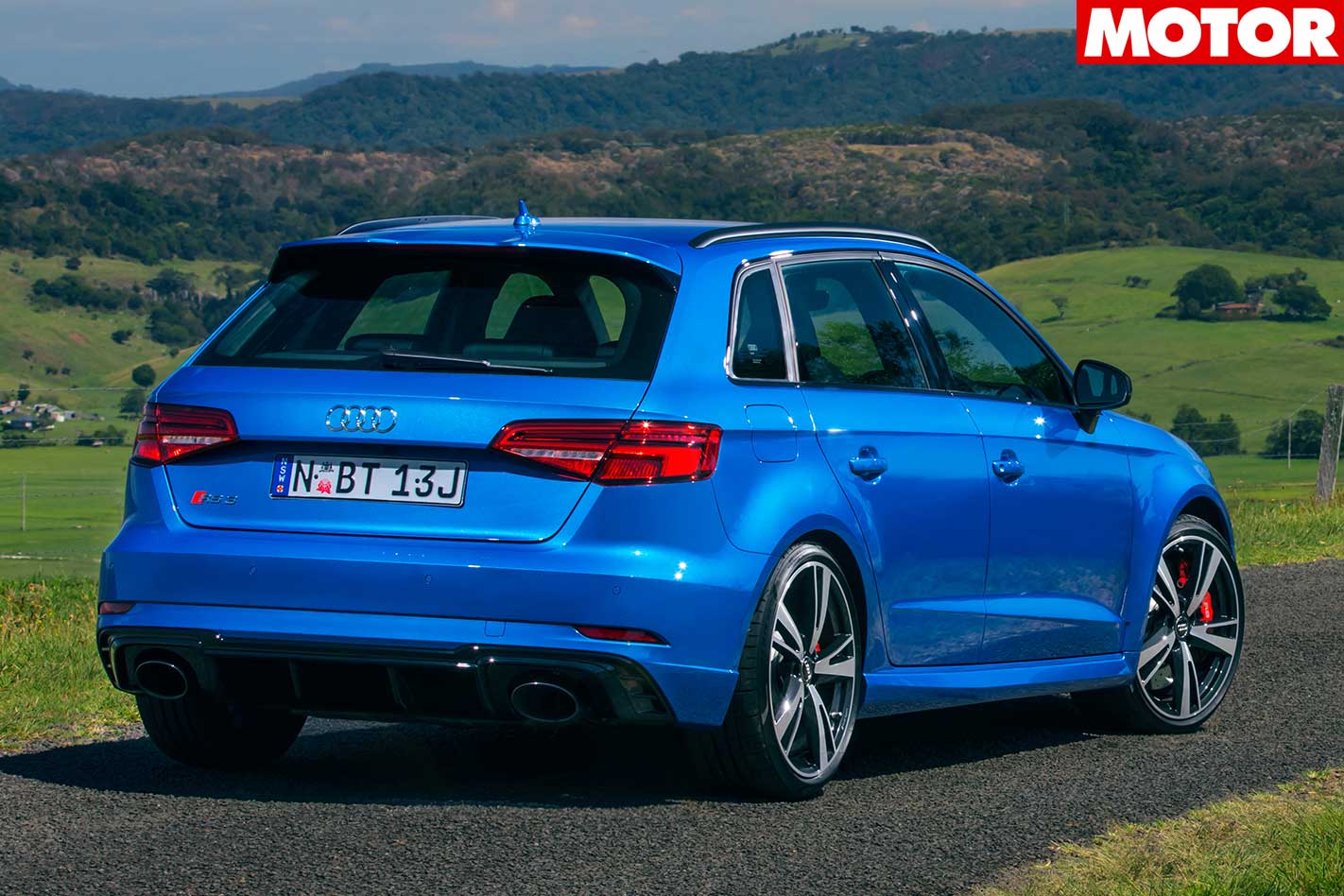
2018 AUDI RS3 SPORTBACK SPECS:
Engine: 2480cc inline-5, DOHC, 20v, turbo Power: 294kW @ 5850-7000rpm Torque: 480Nm @ 1700-5850rpm Weight: 1510kg 0-100km/h: 4.1sec (claimed) Price: $80,900
Like: Crazy fast; awesome five-pot warble; mega brakes; comfortable; dual-clutch ’box Dislike: Still a bit front heavy; very front-biased AWD; high seating position; thirsty Star Rating: 4 out of 5 stars
YOU CAN never quite tell with Porsche, but the second generation of the 991-series of GT3 RS could be the very last of the current 911 generation.
If all the rumours are correct and Porsche is true to form, it will reveal the all-new 911 (code-named 992) at the Paris motor show in October, seven years since the 991 made its global debut at Frankfurt in 2011. And the whole merry-go-round will kick off another cycle, during the course of which the world’s first hybrid 911s will be launched.
But back in the present day, it’s just possible that a few of you are scratching your heads not so much at the existence of this car, but its timing. It always makes sense to produce such cars at the end of the model’s lifetime because they draw attention not only to themselves, but the lesser 911s that might otherwise be starting to be overlooked in the marketplace. And that being the case, you’d naturally want to save the best, or at least the biggest, till last.
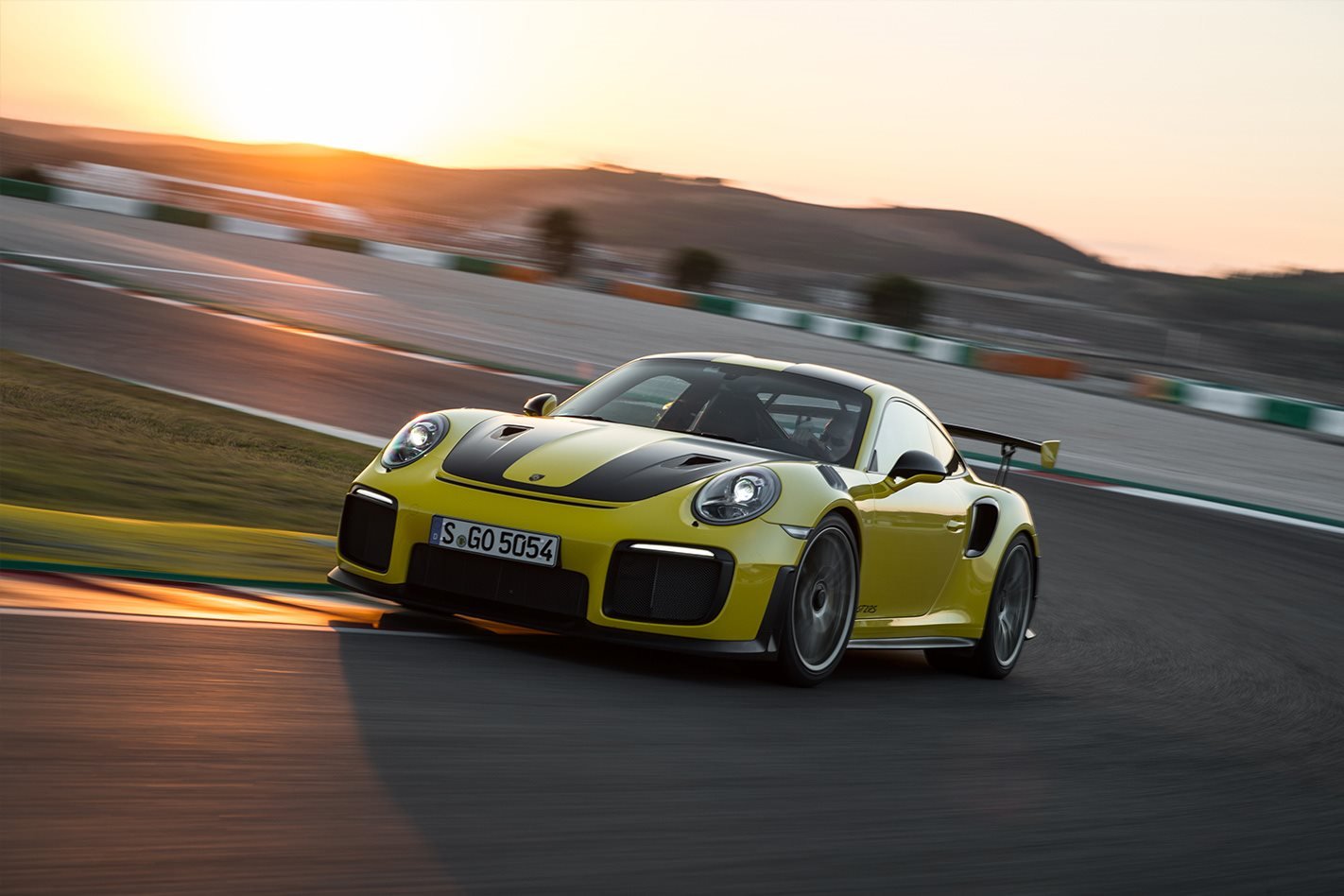
In fact the reason this GT3 RS appears to have been delayed seems to be a combination of the weather and a Lamborghini.
And I’m not kidding.
Manufacturers don’t just throw these cars out whenever they are ready, they are released in accordance with a carefully coordinated marketing plan that, in normal times, would indeed have seen the GT3 RS predate the GT2 RS.
For Porsche this was doubly bad news: first, it was Porsche’s own 918 Spyder whose record the Lambo snatched, and secondly, if a normal launch schedule was maintained, Porsche would have nothing with which to reply to its in-house rival until early 2018, which was not only almost 18 months later but also a time of year when the ’Ring tends to be under several feet of the white stuff.
Something had to be done, and that something was to swap the launch dates of the GT2 RS and GT3 RS around. And late last September, just before the weather window closed, the GT2 RS went and obliterated the Huracan’s record to sighs of profound relief all around Weissach.
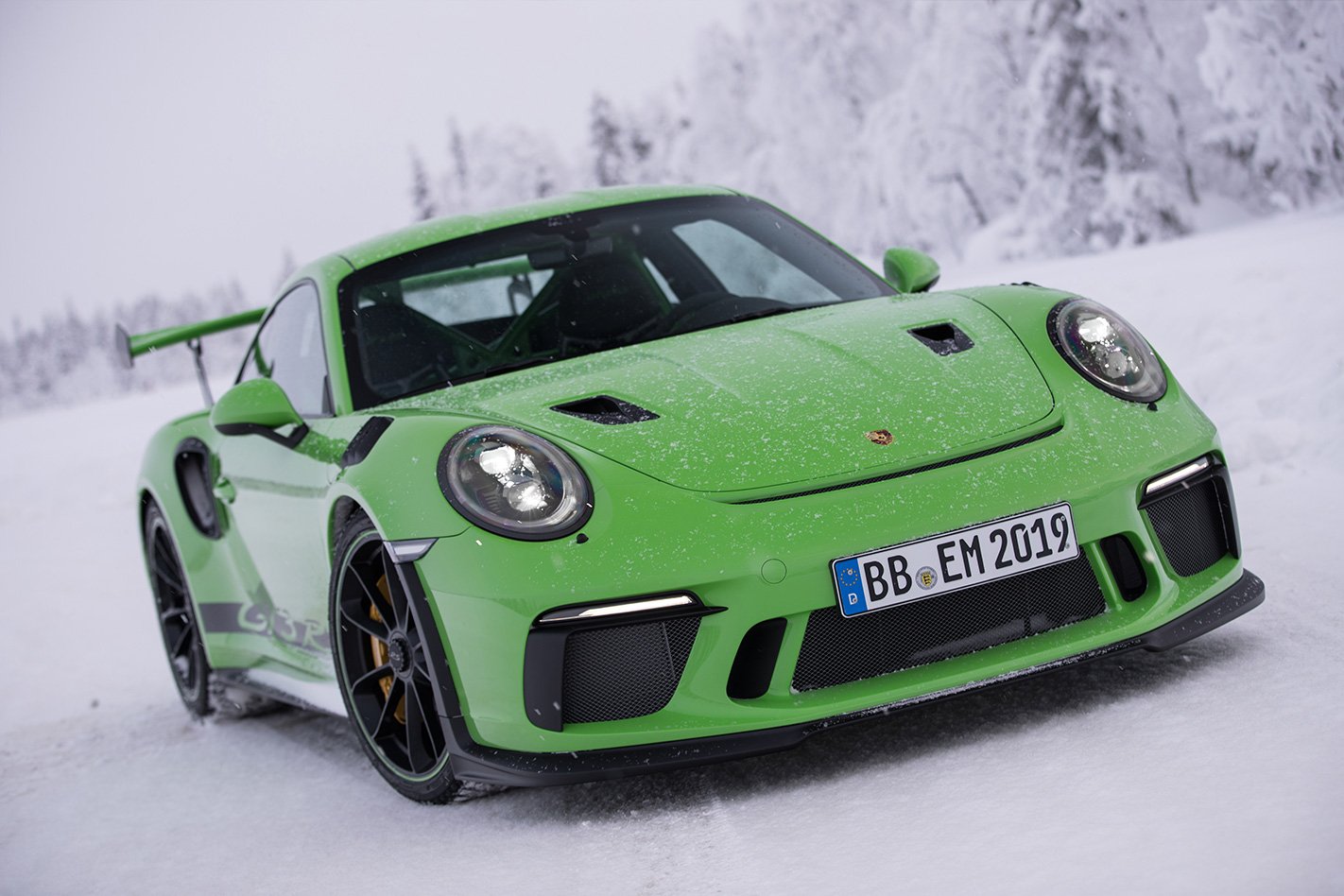
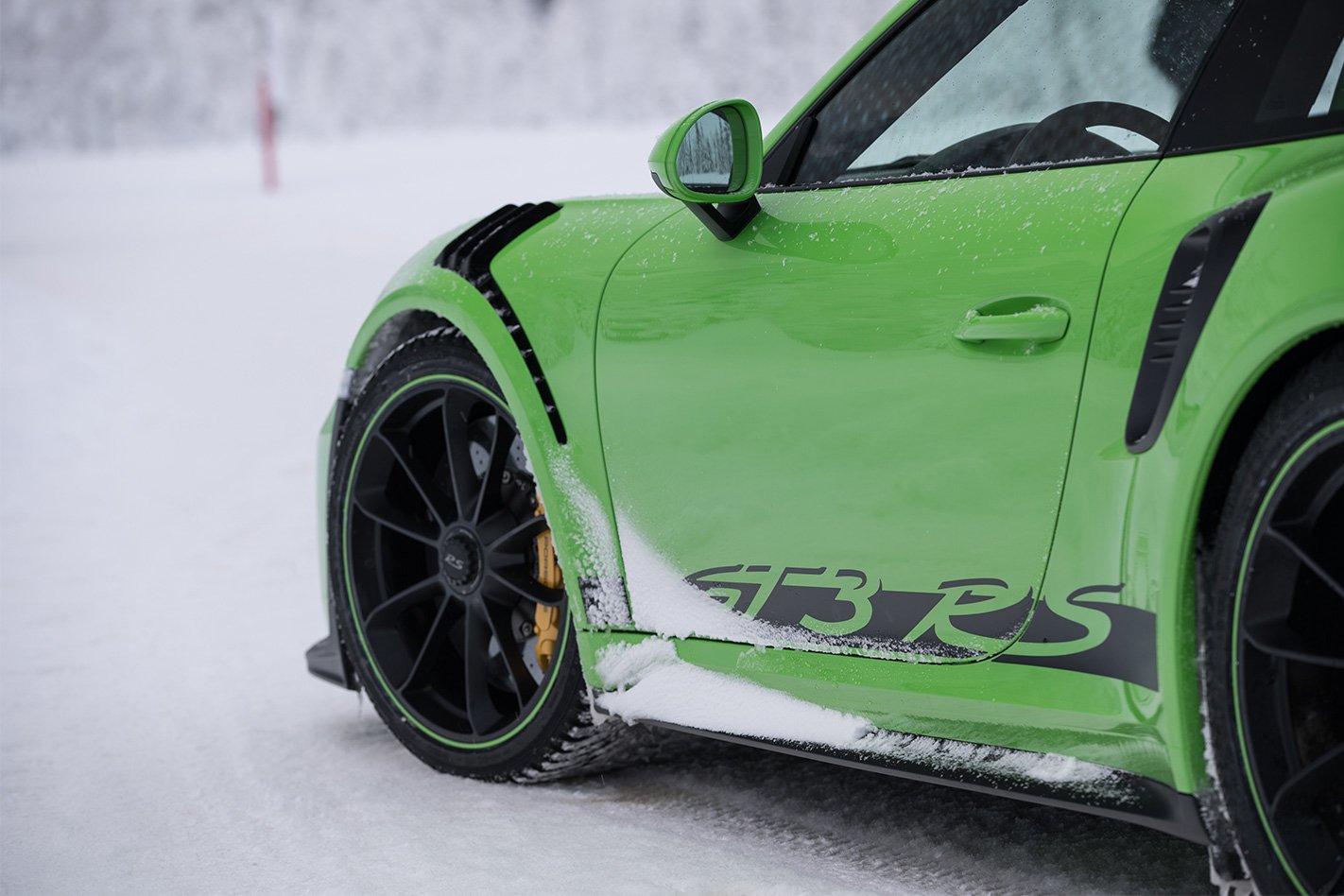
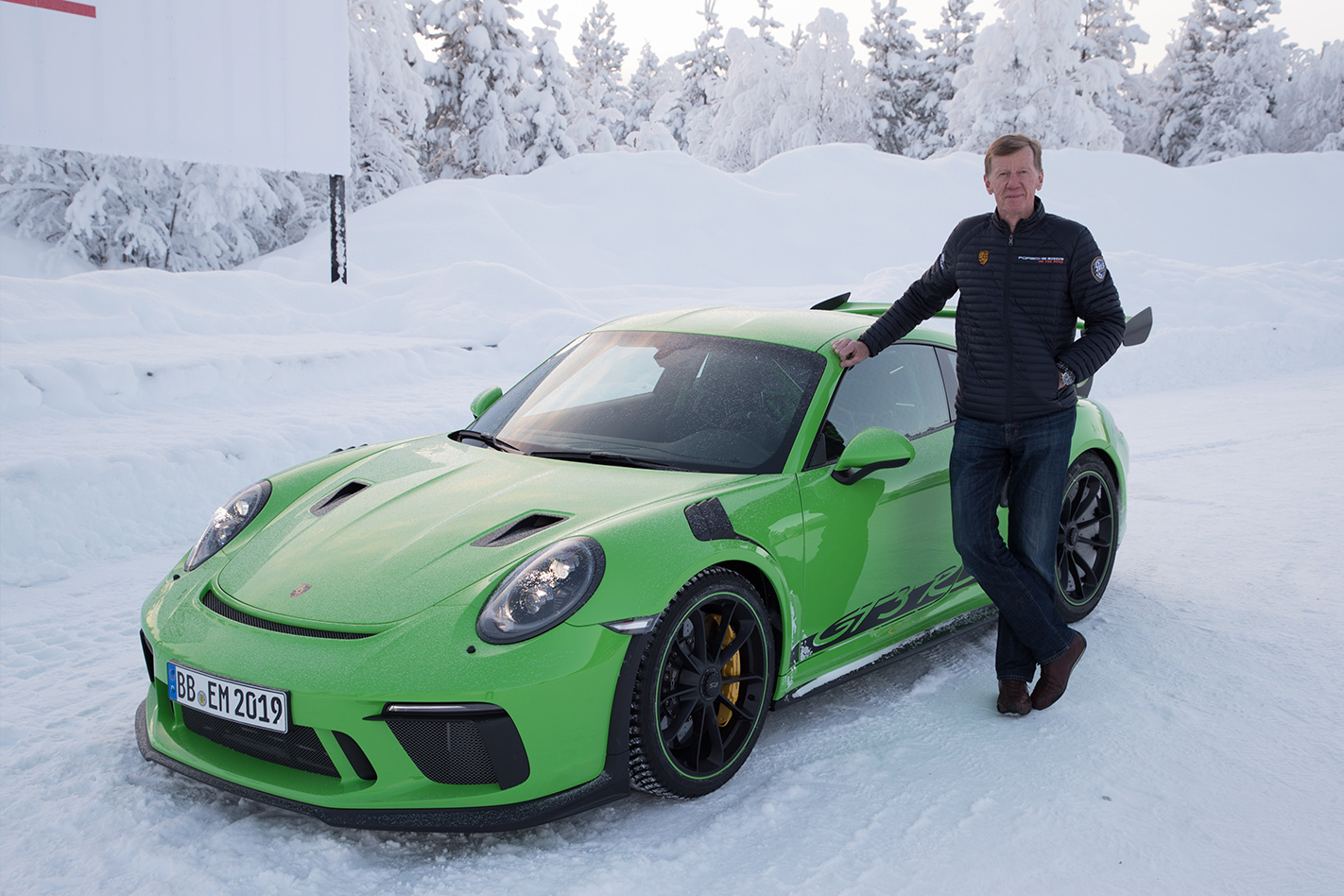
Like the previous ‘gen 1’ 991 GT3 RS, this car remains very much the track-honed option; a downforce-optimised, stripped-out, dual-clutch-only weapon with an ultra-aggressive look, especially in the new ‘Lizard Green’ paint in which Porsche presented it to us in Lapland.
The engine remains the same 4.0-litre flat-six used in the previous GT3 RS and current GT3, but its output has been tickled up 15kW to a claimed 383kW, not by changing any of its internals, but through careful optimisation of its respiration via inlet tracts, exhaust system and engine management.
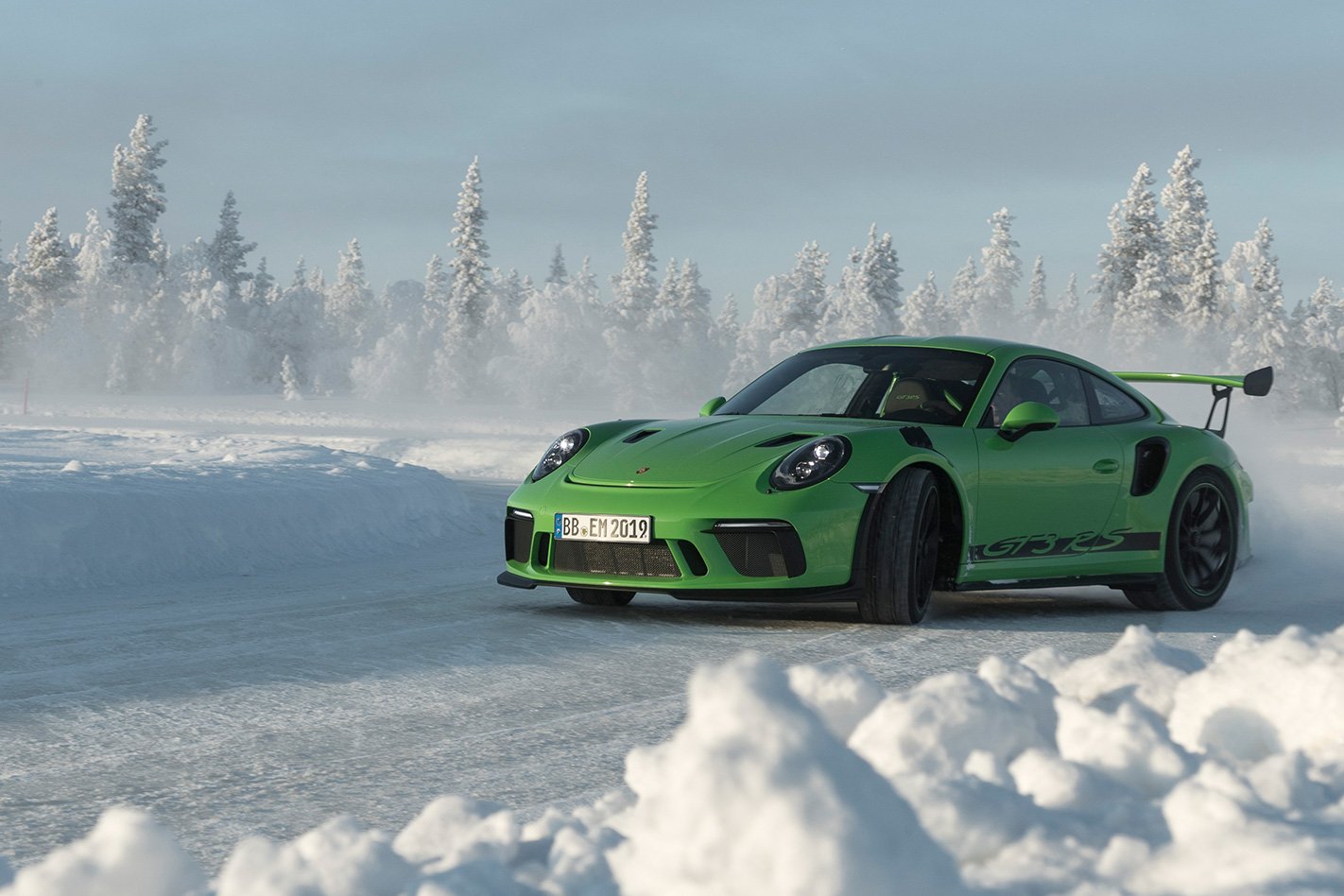
Some sense of the influence of the GT2 RS on this car can be seen in the suspension, which is essentially carried over from its turbocharged sibling, meaning its front spring rates are double those of the old GT3 RS and 40 percent stiffer at the back. Essentially the Weissach engineers started with something close to a full racing car set-up and worked their way back until reaching a point where the car was usable on the road. Almost every union, front and rear, is rose-jointed. It also comes with completely reprogrammed four-wheel steering.
The car leans heavily on the GT2 RS for its aero pack too, including a new bonnet containing NACA ducts for additional brake cooling purposes. Porsche won’t say just how much downforce the new car generates, but it’s believed the goal was not a massive increase over the outgoing GT3 RS, but to deliver a modest improvement along with a reduction in drag, which is pretty much the holy grail in aero engineering terms.
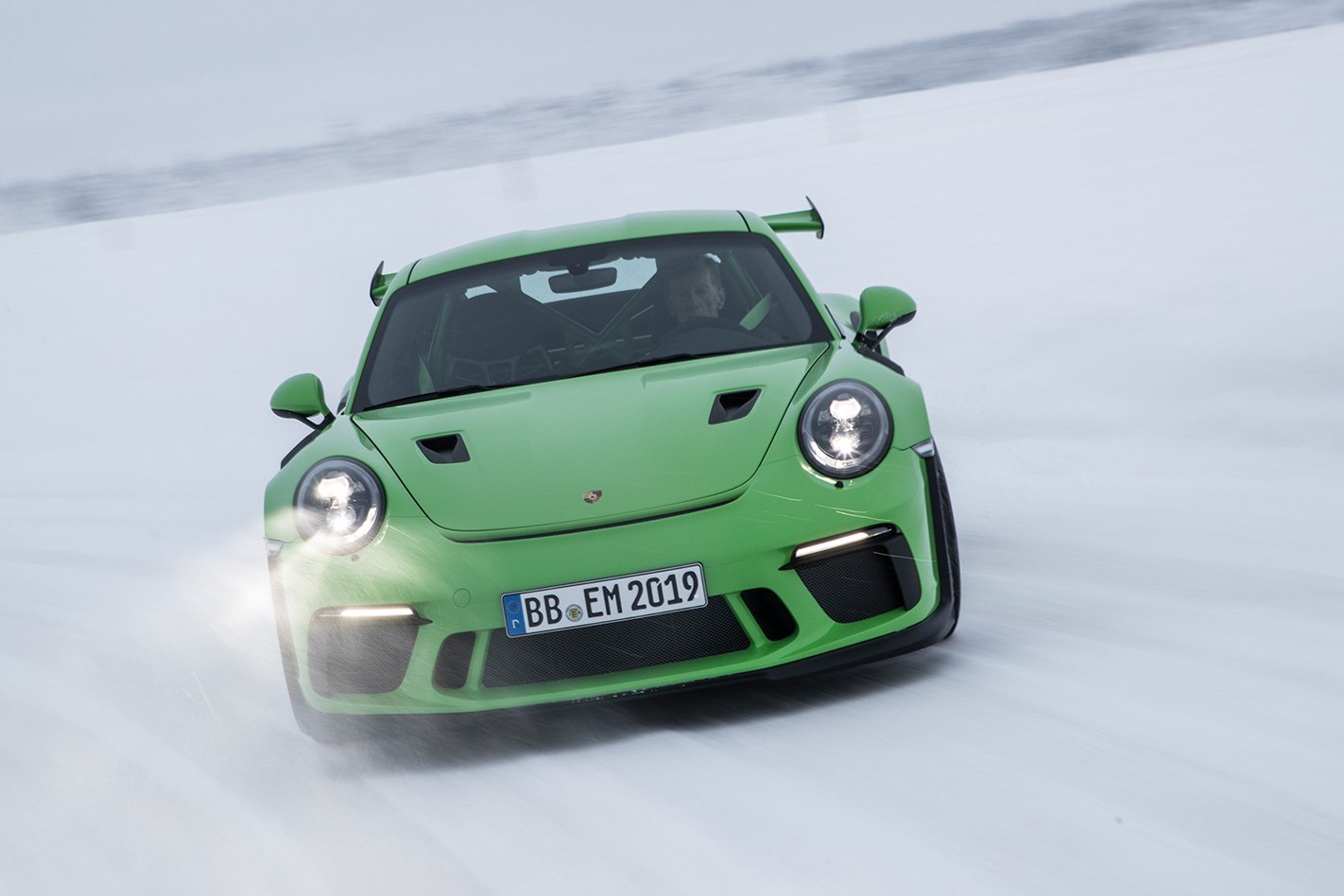
As a result of all these modifications, it is quietly anticipated within Porsche that the new GT3 RS will prove itself to be around 10 seconds per lap quicker than its predecessor around the Nurburgring.
While I’d love to tell you how the car drives, Porsche deemed it too early to allow the press behind the wheel, so relegated me to the passenger seat next to double world rally champion Walter Rohrl.
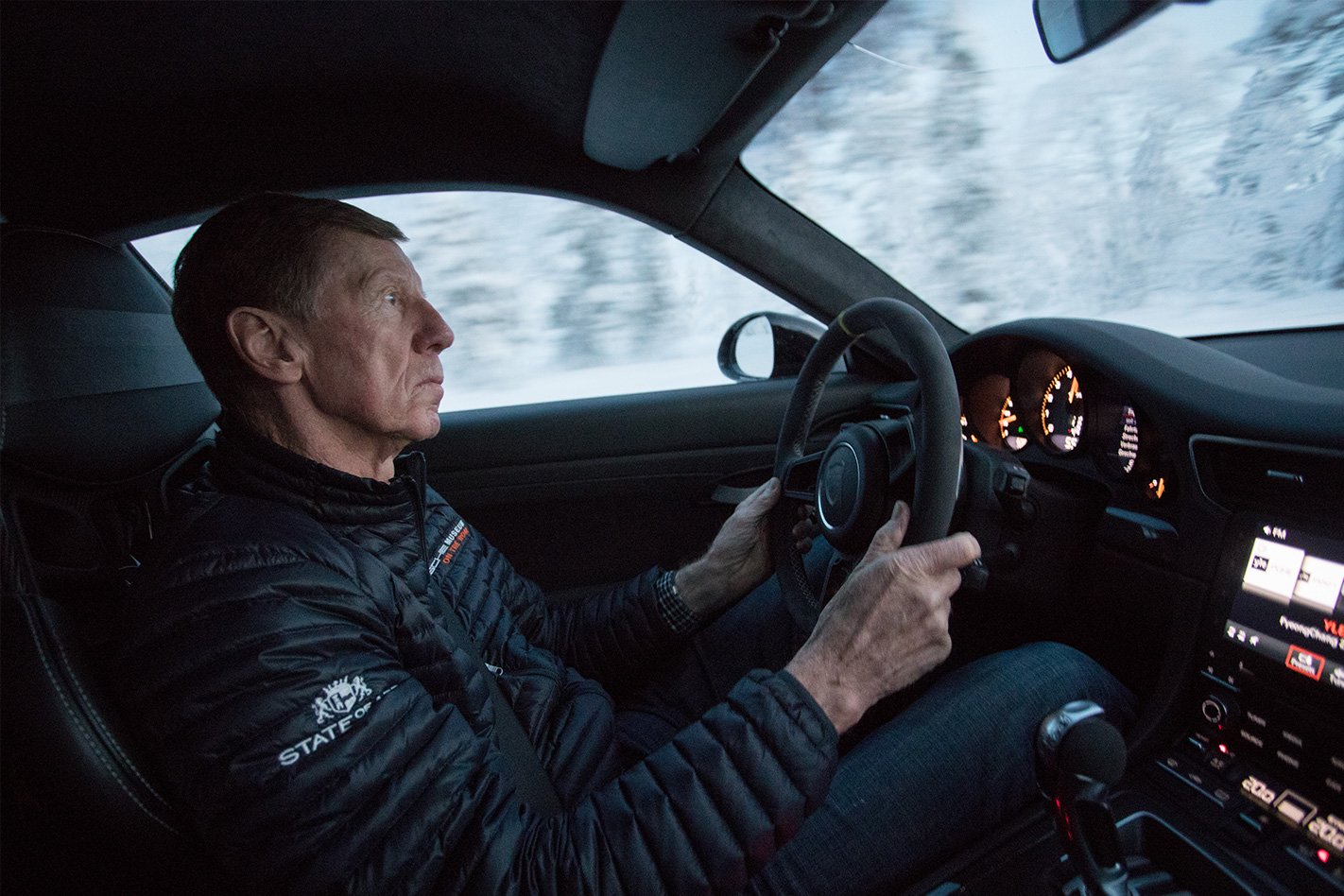
For what it’s worth, the interior is exactly as you’d expect for such a car. Everything is stripped right back, a cage occupying the space where the rear seats would be in any normal 911. There are carbonfibre seats, GT3 RS badges, cord pulls for door handles and today, a brisk -28 degrees Celsius showing at the bottom of the right-hand dial.
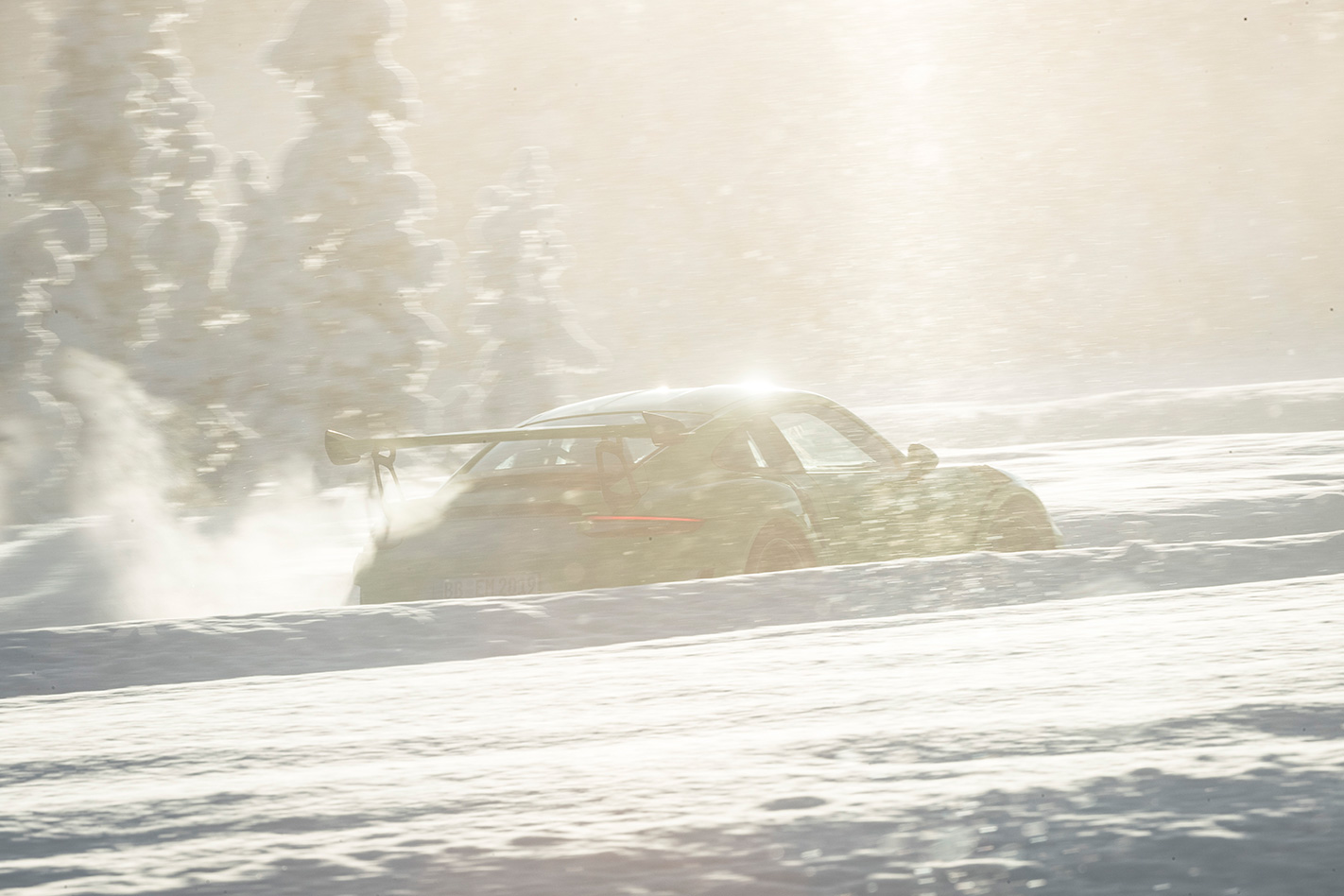
Walter dispenses with the usual pleasantries, nails the power and with a shriek from the engine, we are propelled simultaneously forward and sideways. How does the new suspension affect the car? What’s the aero balance like? Does it feel any quicker? Good questions, which I wish I could answer. All I feel really qualified to tell you is that if there is a better sounding production 911 in existence, I’ve not heard it.
It was almost as mesmerising as watching the man himself. Rohrl can anticipate exactly how the car will respond to any given input by instinct alone, which, when the car is never pointing in the same direction as that in which it’s travelling, gives him an insuperable advantage over us mere mortals who spend all our time reacting to and trying to manage the unexpected. He is always at least one corner ahead of the car.
I’m sorry not to be any more illuminating than this, though given what is known already of its constituent ingredients – it is essentially a blend of the old GT3 RS, current GT3 with a large chunk of GT2 RS thrown in, complete with its own little twist in the powertrain department – it would be almost unbelievable were the car not at least to match the expectations of its badge.
Sometime later this year we will let you know for sure.
The forest was pulverised, the road covered in debris. Sharp skeins of hail tracked up the mountainside on the wind like wraiths in the headlights, before slashing at the two cars.
As the ice tattooed the sheetmetal, I reached overhead to slam the sunroof shade closed; certain that the glass was about to smash. Sheet lightning strobed crazily somewhere above the battered canopy, as another fusillade of hail filled the windscreen with white. With visibility reduced to zero, all photographer Dewar and I could do was sit in the forest and flinch as the full fury of the summer storm battered Falls Creek. We’d only picked up the pair of Holden Commodores a few hours earlier from Holden’s HQ in Port Melbourne. Now these German-built imports looked as if they were about to be written off…
PART ONE: ANDY ENRIGHT
PORT MELBOURNE to MOUNT BEAUTY, 433KM
This was the plan. Pick up two Holden Commodores and subject them to the full gamut of Aussie conditions by driving them the long way from Melbourne to Sydney via the high country. From there they’d arrow north-west and end up in the kiln-red earth out the back of Bourke, retracing a classic Wheels test route.
Manoeuvring the VXR out of Holden’s Salmon Street facility, it was clear that despite being built in Russelsheim by Opel, there’s a superficial continuity of General Motors look and feel. The nav screen still has that clunky look and the automatic gear selector arcs through a long throw before arriving at drive. Other things aren’t so familiar. The sizeable transverse engine limits the lock the front wheels can achieve, giving it an initially cumbersome feel. That disappears after a few corners, the VXR quickly feeling surprisingly agile.
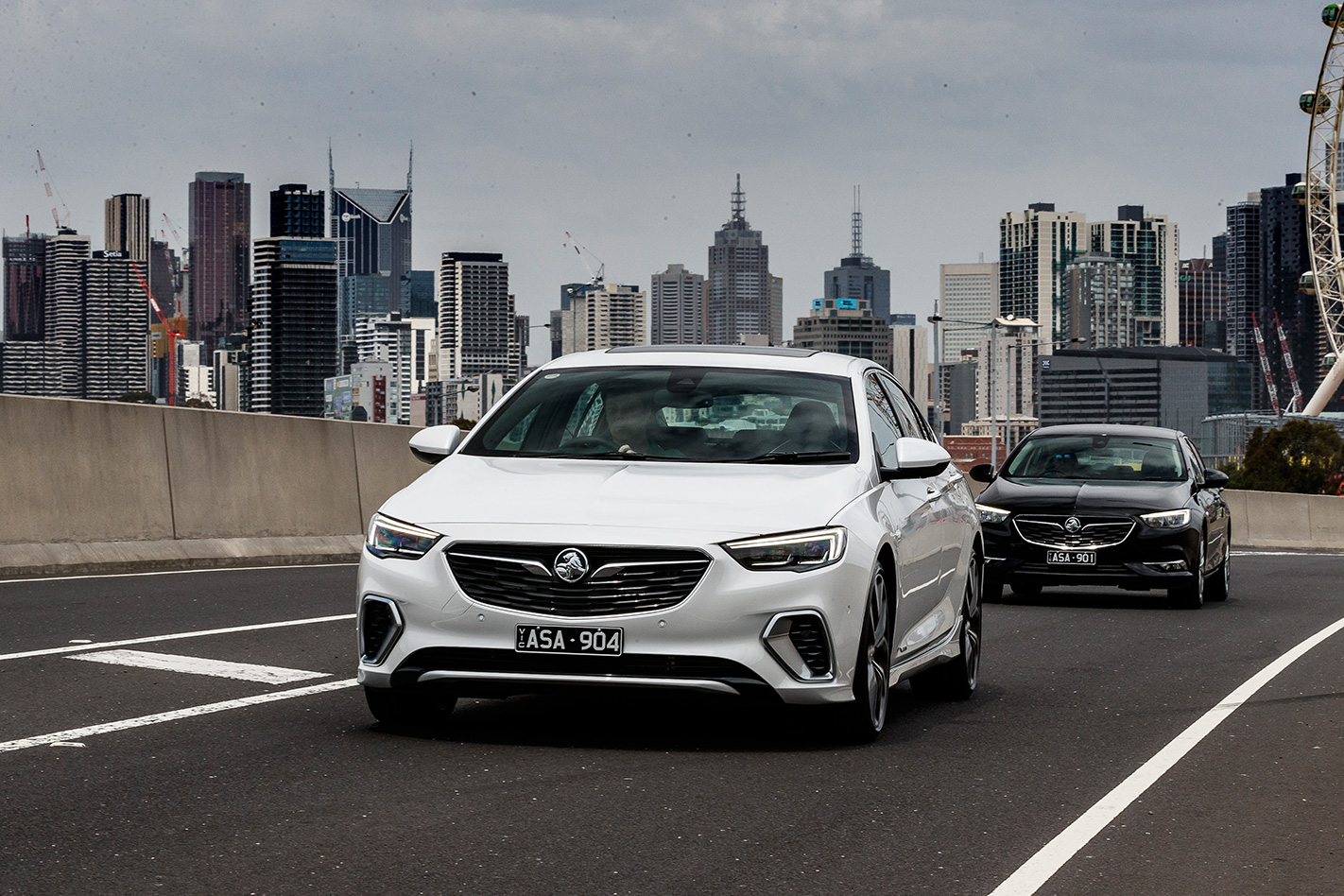
At the bottom of the road up to Falls Creek, I switch back into the $55,990 VXR. Here you get wheel-mounted plastic paddles to manage the nine-speed ’box and an all-wheel drive, torque-vectoring GKN Twinster chassis to deploy 235kW and 381Nm. Brembo brakes, too, which offer real bite and the ability to modulate the pedal deep into the corner without getting the stability control system too aerated.The VXR mode also pipes a synthesised engine note into the car. Holden commissioned Bose to get rid of the European car’s note, which sounds much like a demo at Godfrey’s, in favour of a deeper, tougher, more authentic sound that builds on what’s already there. In sport mode you can also toggle the maps for throttle, steering and adaptive damping.
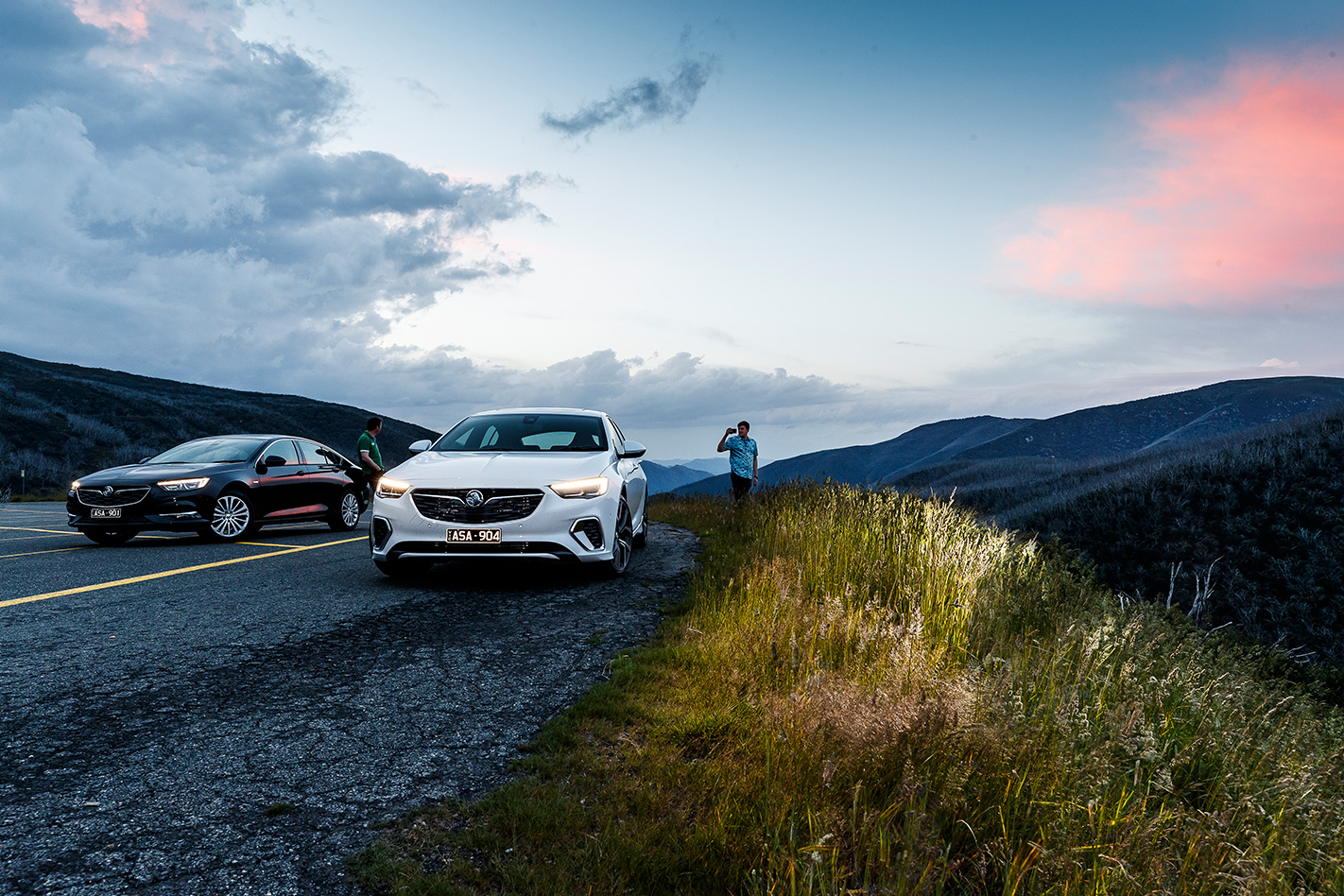
Then the weather arrived.
MOUNT BEAUTY to SYDNEY, 915 KM
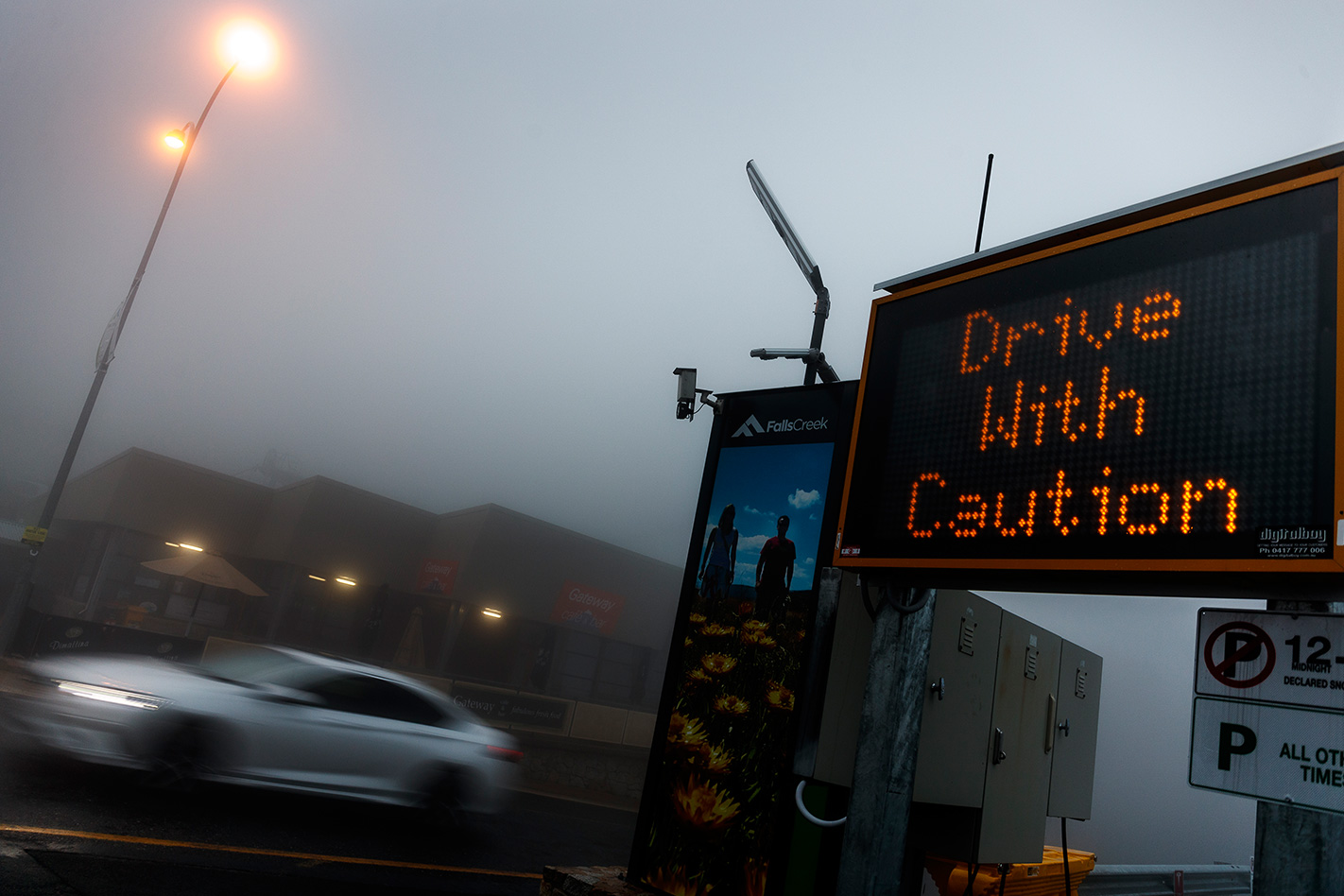
Twenty to five is a hard start to a long day. Having been in the firing line of icy shrapnel last night, we decide to try Falls Creek again, this time for sunrise over the high plains. Cloud blankets the snow gums, jutting like ghostly fingers under the sodium lights. Eventually the fog gets so bad that Dewar is hanging out of the passenger window, looking down at the yellow line that marks the edge of the road, giving ‘left a bit, right a bit’ instructions. Our selected location is also doing a reasonable impression of the inside of a ping-pong ball, the maelstrom whipping cloud over the cars like a reverse wind tunnel. Put your finger into the shafts of light from the headlamps and it’s possible to see whirling vortices of fog streaming away like a Schlieren photograph. It’s time to pack away the Canon and get some miles under our belts. The good news is that the Commodores don’t resemble golf balls, instead just picking up a couple of minor pin dents each.
Walking by the side of the road near Tangambalanga is Indigo Shire’s citizen of the year. Playing a piano accordion. Ex-schoolteacher John gives us a rounding rendition of ‘It’s A Long Way To Tipperary’ – and indeed it is – but can’t believe our destination. “Bourke?” he says, with eyebrows raised. “Have you tried Tangambalanga?” He takes a look at the Commodore, nods approvingly and starts walking, without passing comment. Doesn’t seem so much of a car guy.
You can’t please everyone. “You can’t deny they’re genius engineers though. Look at Subaru,” Chris adds. It’s hard to argue with this sort of logic. Both are impressed by how neat the cars are under the bonnet and the quality of the cabins. “I drive Fords, and they can take a beating, but the Commodores have much better interiors,” adds Chris. He has a point there.
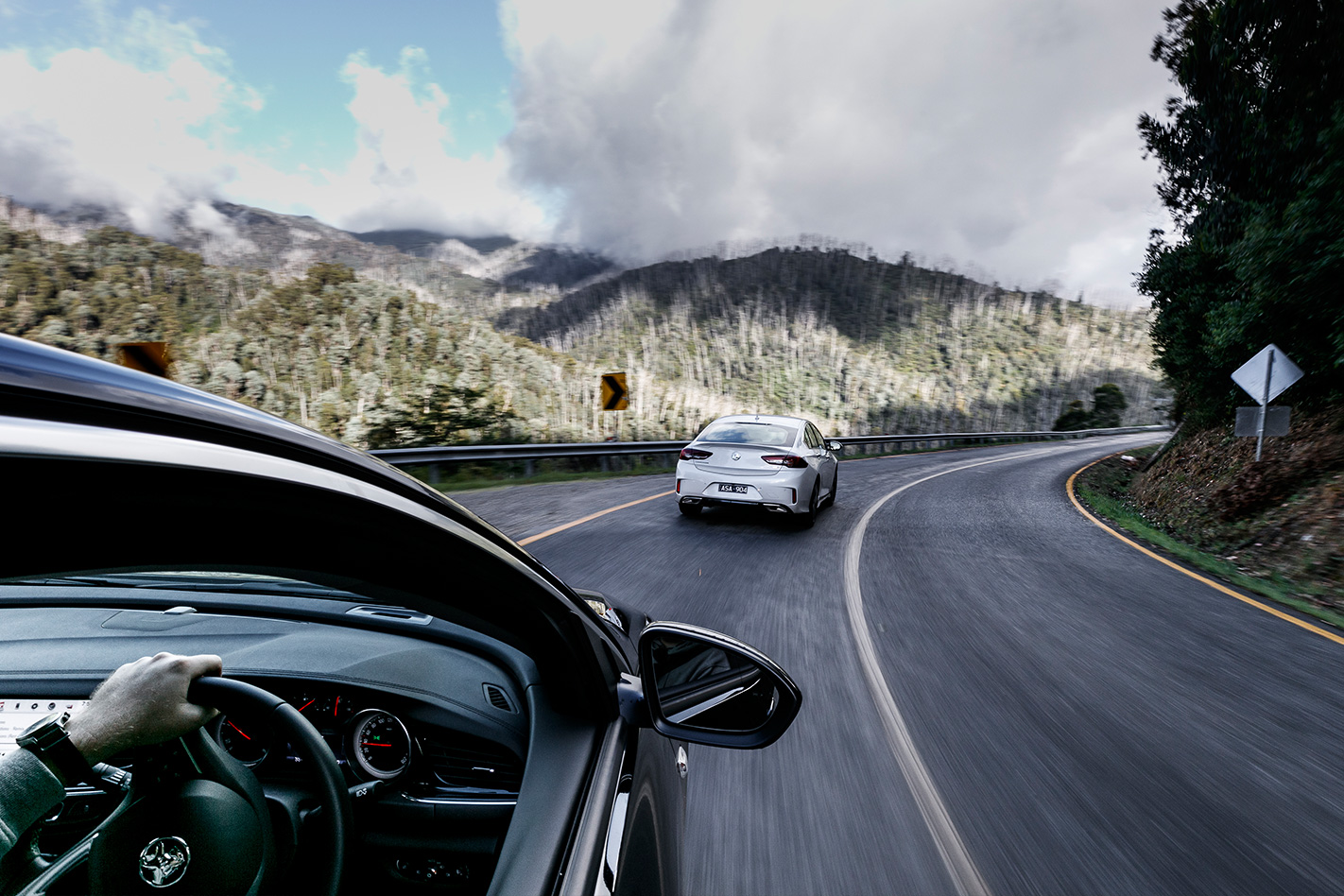
Galleries of mountain ash frame bend after bend on the Alpine Way between Khancoban and Jindabyne. It’s a nadgery route where the overtaking punch of the VXR sees it clear dawdling caravans where width permits. The Calais driver has an easier time plugging into the fat of the torque curve, the VXR requiring a surprising sweep of the tacho to really feel swift. Time and again, the Calais holds station with the VXR for a few seconds post-apex before the white car edges inexorably away. Make no mistake, you could buy a diesel Commodore for dourly practical reasons and still have a surprising amount of fun.
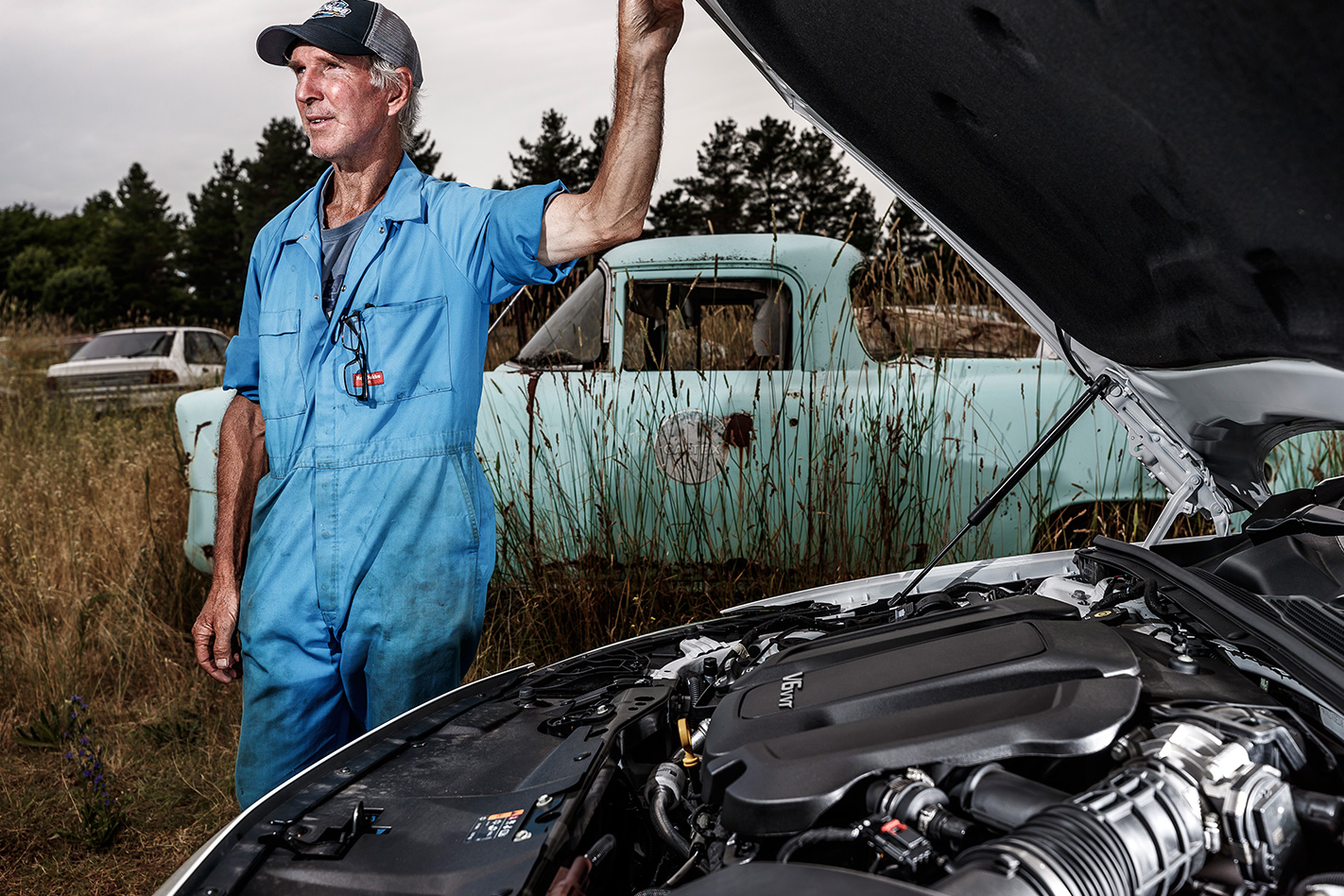
“It’s got the style of a German car. It doesn’t look like a Holden of old,” says Flynn as he walks around the VXR. “I’ve never owned a Commodore. I had an old Falcon panel van in my younger days. Went around Australia with a mate in it.” I can’t help think that he’s assessing how it’d look after 40 years in the long grass here. The legions of old Simcas, Renaults and Fords aren’t going to be here too much longer. Wayne’s not getting any younger and there’s no family willing to take up the reins, so Flynn’s is set to be sold at some point.
This amazing study in patina sees blooms of lichens appear on glass, crazed dry-lake crusts of paintwork erupt on roofs and ultraviolet turning black plastics into spidery webs of grey powder. It’s beautiful and a little melancholy but also has the ability to take you back to your childhood as you spot a car you probably haven’t clapped eyes on since primary school. Get there while you still can.
The long-legged, rangy Calais has acquitted itself well, mopping up big miles with ease. Holden’s team has triumphed in giving this car its airy, easy, interstate ability. The VXR is a tougher thing to assess. It’s well-priced and loves a solid shoeing but I wonder if its intriguing palette of abilities could prove a little opaque to many who want to see a clear bloodline from VFII.
Tomorrow will see us retrace an historic Wheels route. If it doesn’t help establish this car’s bona fides, nothing will.
PART TWO: NATHAN PONCHARD
IT WAS a huge drive to tackle in a day. Sydney to Bourke and back for Wheels’ first-ever ‘consumer test’ of the then-new HQ Kingswood. Back when listening to the Ashes test on AM radio and extending Holden’s asthmatic ‘red’ six to 154km/h in fourth gear wasn’t so unusual. Forty-six years ago, would you believe.
That epic road trip – “to see if it is possible to drive 1000 miles [1609km] in a day and still have time for photographs, an enjoyable lunch and yet arrive home reasonably sane the same night” – has remained forever etched in our memories, demanding a retrace, if perhaps not a total repeat.
This time, however, the automotive landscape has completely changed. The scorched earth stretching north-west to Bourke in New South Wales’ outer reaches might be little different, but the lion-badged product at hand has more than a whiff of weiss beer and bratwurst, not VB and Vegemite. “Fully imported quality” is what they used to call it.
SYDNEY to BOURKE
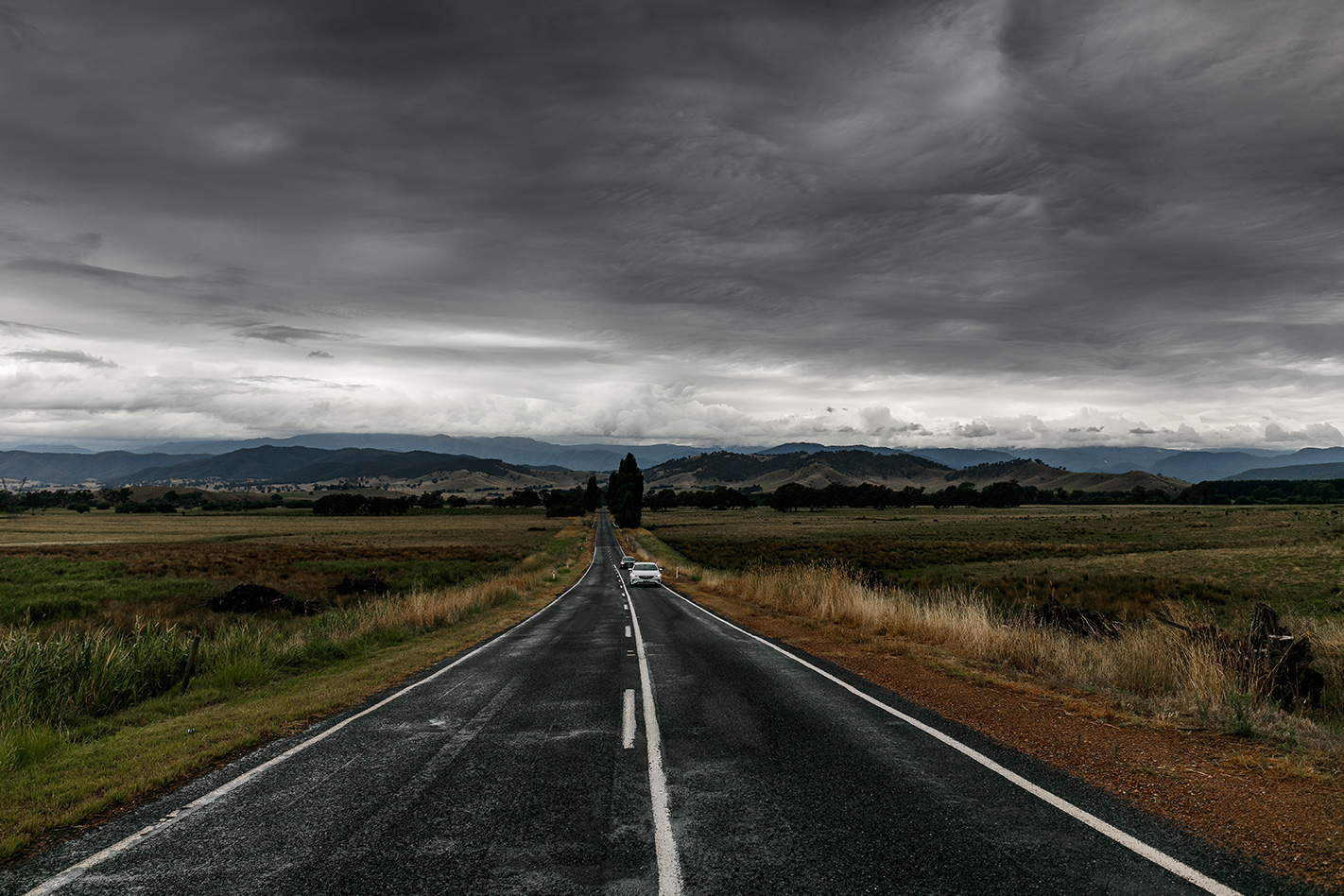
WITH the metaphorical baton passed from Enright to me, I greet the bleary-eyed Melburnians (shooter Dewar and staffer Kirby) with Sydney coffee capable of meeting south-of-the-border standards.It’s 48 hours after Sydney’s hottest day in 79 years and the heat still lingers. But by the time we blaze past the construction maze of the ‘new’ M4 and climb to Katoomba in the Blue Mountains, it’s a chilly 11 degrees and thick fog hangs heavily in the air. If Pommy expat Enright thinks Victoria has four-seasons-in-one-day weather all to itself, then he needs to get out more.
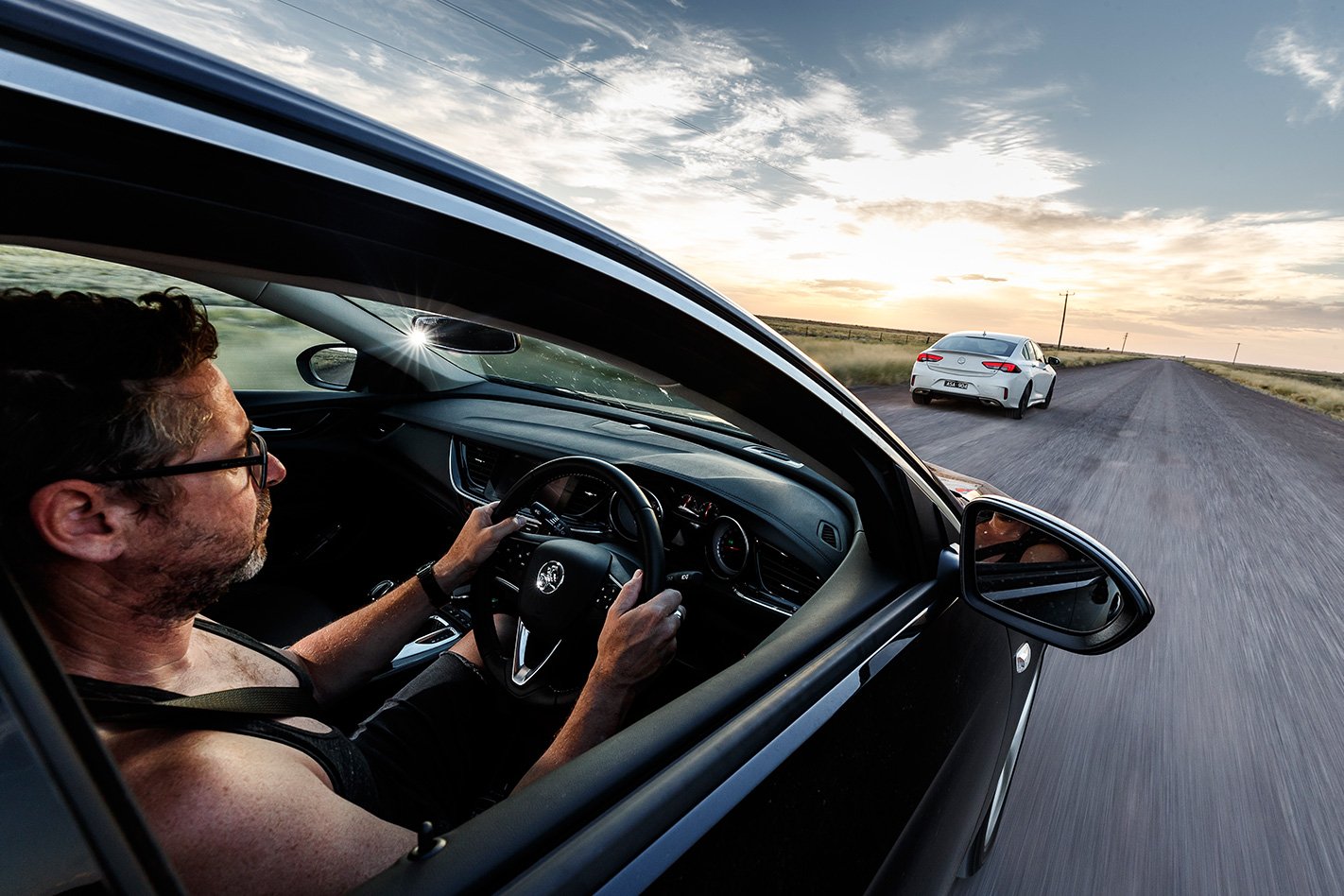
There’s an urgency to the transverse ‘LGX’ 3.6-litre V6 that elevates it to a new level for a modern Holden six pack, but the note is not exactly inspiring. I would’ve much preferred actual hardware amplifying its bent-six rasp, rather than software sprinkling the fairy dust.
Flat-knacker isn’t an issue, what with nine tightly stacked ratios filling the gaps, but the all-paw V6’s step off the mark is nowhere near as strong as that of the boosted diesel, and its cruise-control calibration on the Great Western Highway is frustratingly lax. Too often the VXR lags in kicking down a gear (or three) before regaining speed – a problem not shared with the torquey diesel – which makes its progress over the undulating blacktop not as effortless as it should be.
Bench the electronic aids, however, and the 235kW V6 feels alert and responsive. You don’t need much throttle input to keep it ticking along, and with the drive setting in its default mode – meaning cushiest dampers, lightest steering, and no synthesised induction acoustics – there’s a leggy, long-distance character to the VXR that feels totally Commodore.
For the next few hundred kays of varied Castlereagh Highway topography, I swap between the VXR and turbo-diesel Calais, impressed by the overtaking punch of the range-topper as it stretches beyond 5000rpm, but also the instant kick afforded by the torquey Calais, as well as the silken upshifts of both transmissions.
It’s seriously hot outside – more than 40 degrees by the time we reach Narromine, and climbing – yet both cabins remain delightfully chilled and breezy, especially the VXR with its seat-cooling fans blowing crisp air onto my buttocks. The VXR’s shapely and supportive seats look good too, with their sculpted backrests, VXR badges and race-style faux-harness slots in the shoulder section. You lose map pockets from the rear, though at least the plastic backs don’t hinder the Cinemascope vision from the ZB’s vast back seat.
The Calais’ more traditional leather-faced chairs have less bolstering than the VXR’s but they’re still superbly comfortable on a long haul like this. And the sound of both audio systems is kick-arse. The Calais’ standard set-up is a bass-friendly cracker, but the VXR’s Bose arrangement is so damn strong it could make Justin Bieber sound hairy-chested, with enough distortion-free volume to easily drown out the harmonic resonance from the 245/35ZR20 Michelin Pilot Super Sports on coarse surfaces. And I could name a whole heap of big-dollar stereos that can’t match the Bose system’s staging.
As we create our own version of car-pool karaoke, I’m surprised at the effectiveness of the ZB’s lane-keep assist, which works with satisfying accuracy and minimal steering corruption, but as darkness descends, maximum focus calls. Hundreds of Skippys start to line the arrow-straight Mitchell Highway south of Bourke. Even with the VXR’s ‘IntelliLux’ headlights on full beam bathing the landscape in bright, white LED light, it’s near-impossible to spot one until you’ve almost clobbered it.
It’s 9:15pm by the time we crawl into Bourke. The mercury remains over 40 degrees and the town is eerily quiet. Even the servo is closed, leaving the motel front desk as our only source of beer. Air-con maxxed, I flop onto the floral motel bedspread, slightly dreading Dewar’s proposed 4:45am wake-up call.
BOURKE to MUDGEE
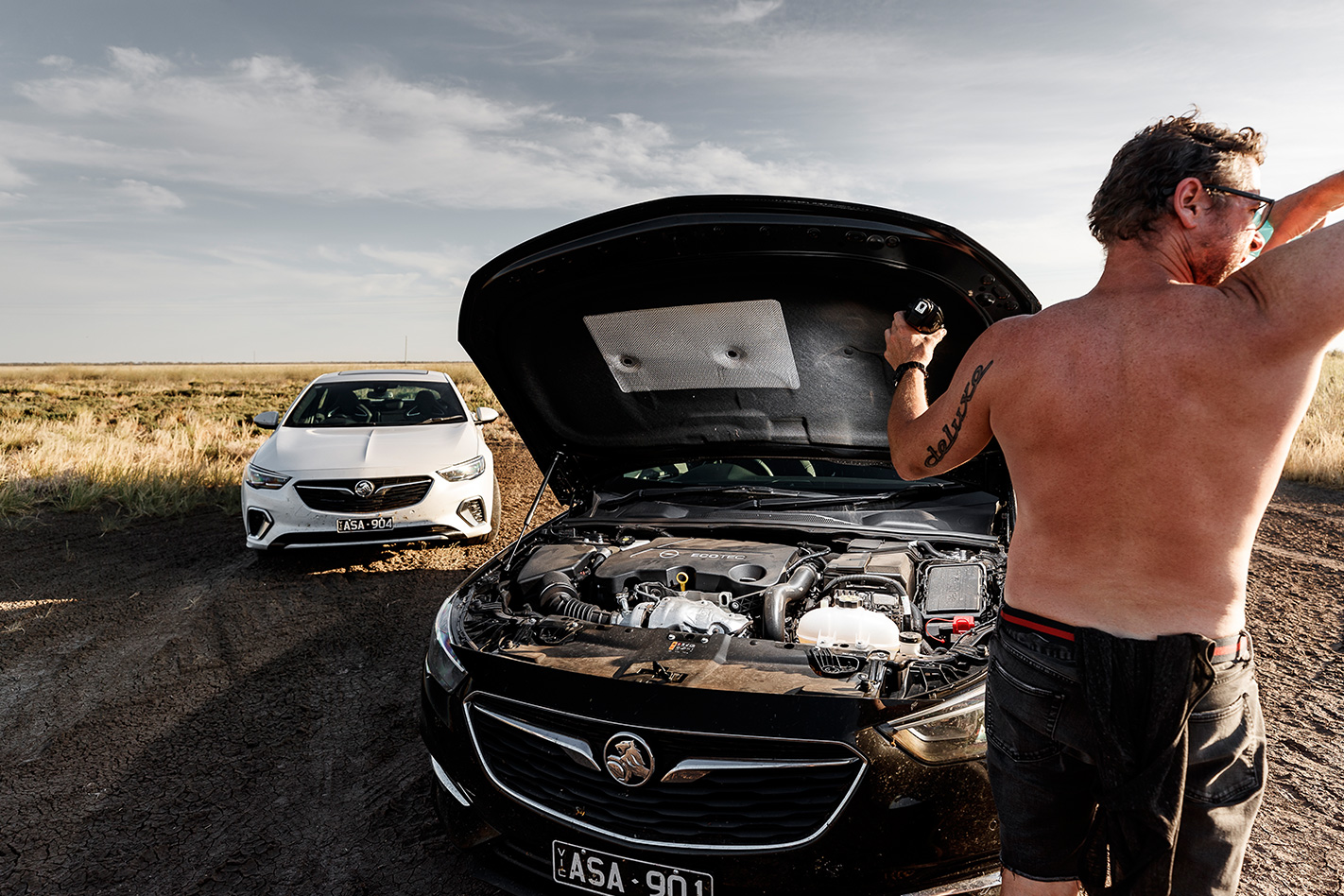
FROM before dawn until at least 7:30am on the Hungerford Road north of Bourke, not a single car passes the ZBs parked in the mulga for an obligatory ‘outback’ shot. Then once ‘peak hour’ finishes, we log acceleration times because, well, it’s already 42 frigging degrees and surely that’s a proper Aussie test.
Despite my best efforts to wind it up on the brake, the VXR refuses to launch with urgency. It reminds me of the old Insignia VXR (and Saab 9-3 Turbo X before it) in the way it eases forward before finding its power band, then turning up the wick as revs increase. Upshifts occur at six-seven, though the V6 will stretch to 7100rpm if you manually extend it.
Despite switching the air-con off, the intense heat dulls the VXR’s punch significantly. Still, 6.9sec to 100 and the standing 400m in 14.9sec at 156.6km/h is respectable. The front-drive turbo-diesel is some way adrift – 8.5sec to 100 and 16.1sec to 400m (doing 141.1km/h) – yet the Calais’ launch is far superior. Controlled wheelspin seamlessly transfers into strong tractive effort, making the diesel 0.1sec quicker than the V6 to 40km/h. And while it upshifts at a conservative 4200rpm (even though 5100rpm is achievable), its progress feels smoother than a full-body Brazilian.
Over steak sangas and post-mix Coke at Mulga Creek hotel, bar talk turns to cars without any prompting by us. The barmaid tells us how her old Falcon wagon could go pretty much anywhere her Triton dual-cab can, surely testament to the terrain she travels, rather than any supernatural off-road ability of the Falcon. I mention the pair of new-gen Commodores parked out front and our re-creation of the ‘Bourke and back in a Day’ yarn. Travel stories ensue. One bloke asks what the imported cars are like, but in the heat no one budges for a look.
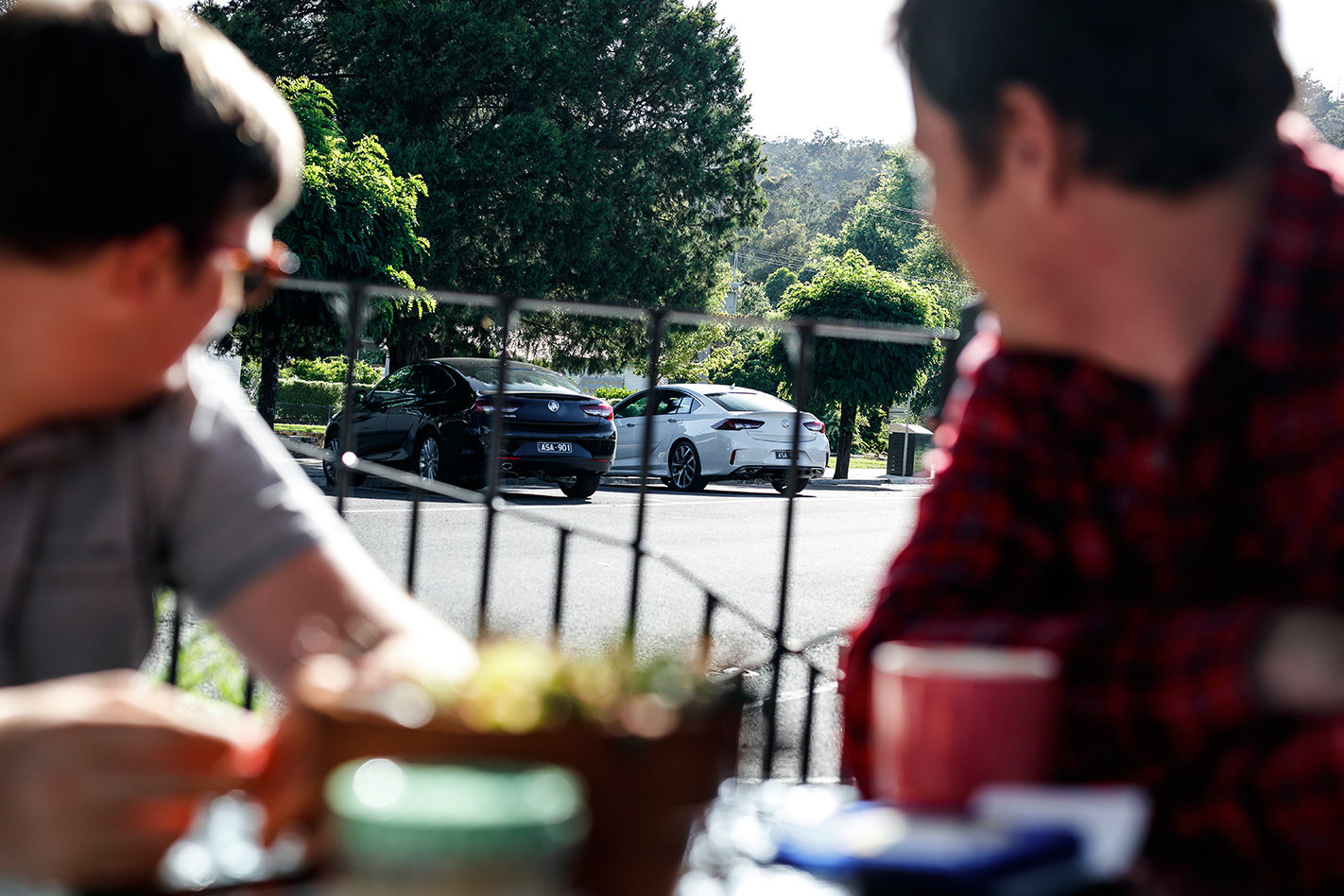
The SS’s owner, Peter Standen, is well aware of the new-generation Commodore but doesn’t like it. And he wishes Holden had called it something else. After admitting he’ll never part with the SS, Standen ponders what his next purchase might be. “My big question is, what do I now move on to? Coz I’m not gonna buy that,” he says, motioning towards the VXR. “Do I go to the dark side and buy European?” I point out that the new Commodore is in fact European – just like smoking in restaurants and public nudity – but Standen remains unconvinced of the ZB’s merits.
MUDGEE TO SYDNEY
FOR THE leg back to Sydney, I point the VXR down Sofala Road, aiming for the even twistier Hill End Road – once a dirt track to an abandoned gold-mining town but now all-bitumen and a terrific test of man and machine. And much like Enright, I’m deeply impressed by the corner-carving knack of the Twinster AWD system. Driven like it’s stolen, the VXR’s poise and its ability to harness mid-corner throttle inputs proves that this is a chassis destined for greatness … once it has an engine to suit. On the really tight bends of Hill End Road, the V6 simply doesn’t have the torque-laden muscularity to make this a truly great driver’s car.
Re-entering Sydney via the sinuous Bells Line of Road – an original Aboriginal track first surveyed by the invaders in 1823 and without any kind of speed limit until the 1970s – the ZBs make a mockery of the current 80km/h ceiling imposed in 2008.
On a brilliant Aussie mountain road like this, even the Calais is a driver’s delight, effortlessly disassembling the never-ending curves with fluency and fun. If you consider this front-drive, diesel-drinking liftback is the cornerstone of GM Europe’s medium-to-large family fleet, it’s no surprise the unpretentious ZB Calais easily works its way into favour.
It’s a no-nonsense car, devoid of needless fripperies, though whether its relatively anonymous styling and dour colour palette have enough pizazz to attract Aussie buyers remains to be seen.
The VXR is a more complex car, literally and figuratively. Its excellent all-wheel-drive system adds another dimension to the already impressive front-drive ZB’s dynamic talents, yet we can’t help but feel a wicked-up 2.0-litre turbo-petrol four would be far better suited to the VXR’s sporting purpose than GM’s almost-anachronistic V6. Clearly Holden felt there needed to be some continuity from the previous Commodore, though the whole atmo V6 thing must surely have a use-by date.
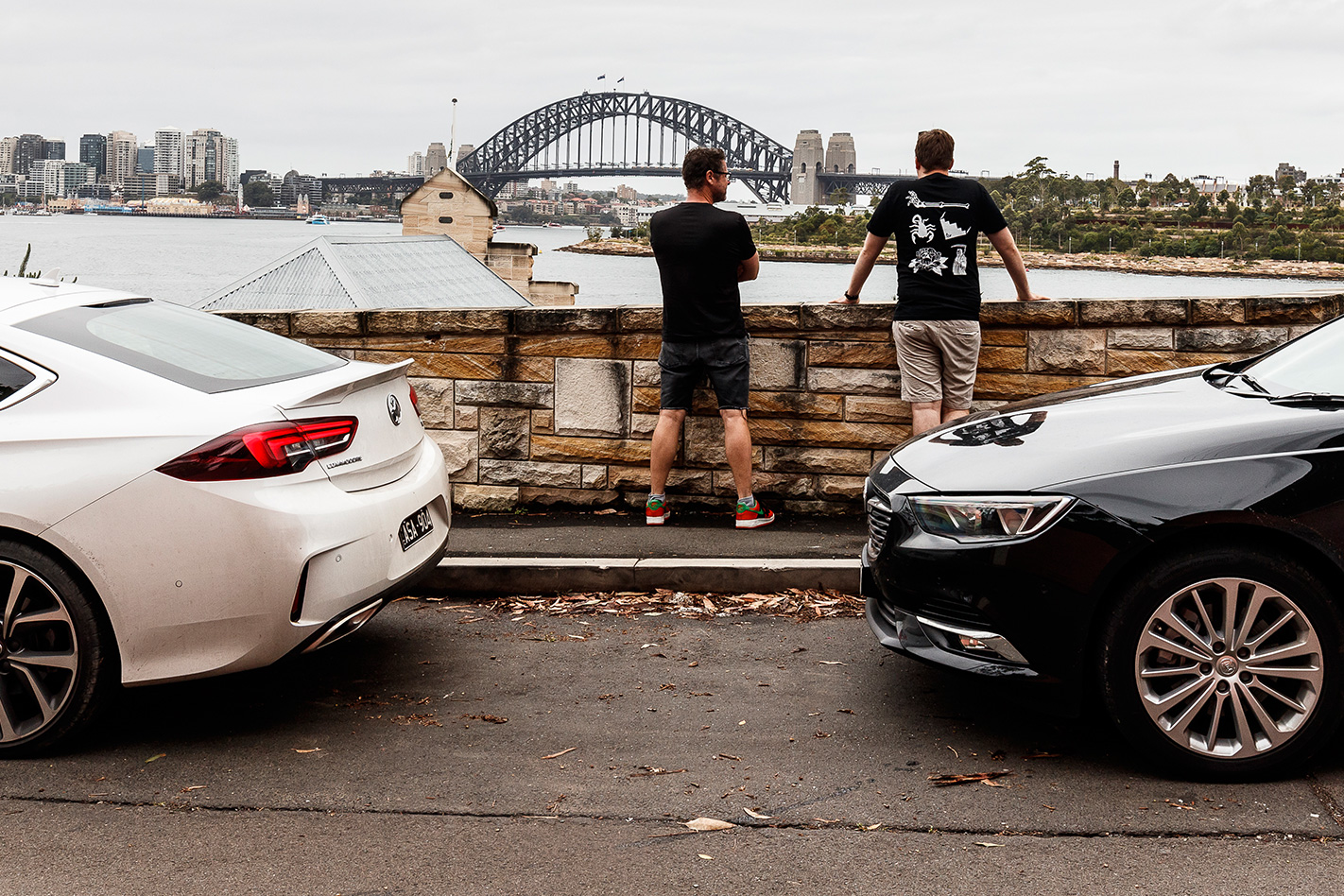
Forty six years ago, people thought the HQ looked too feminine, even though it’s now viewed as one of GM’s most beautiful designs of all time. The ZB, on the other hand, is deliberately less masculine than its handsome VF predecessor, to the detriment of its stance and its presence. There’s no doubt the ZB is a bloody good car, brought to life by Holden’s adept dynamic tuning. But will that be enough for Australia to accept it?
Holden ZB Commodore VXR Specs Engine: 3649cc V6 (60°), dohc, 24v Max power: 235kW @ 6800rpm Max torque: 381Nm @ 5200rpm Dimensions :(L/W/H/W-B) 4897/1863/1544/2829mm Transmission: 9-speed automatic Weight: 1737kg 0-100km/h: 6.9sec (tested) Economy: 11.7L/100km (tested) Price: $55,990 On sale: Now
Holden ZB Calais Specs Engine: 1956cc 4cyl, dohc, 16v, TD Max power: 125kW @ 3750rpm Max torque: 400Nm @ 1750-2500rpm Dimensions: (L/W/H/W-B) 4897/1863/1544/2829mm Transmission: 8-speed automatic Weight: 1613kg 0-100km/h: 8.5sec (tested) Economy: 7.2L/100km (tested) Price: $43,990 On sale: Now
Dam trucksAustralia’s biggest civil engineering project didn’t just leave its mark on the local hills. The Snowy Mountains Scheme also materially altered the Australian motoring landscape. It saw the introduction of Land Rover into this country, with more than 200 units sold in the project’s first four years. In 1959 Snowy Hydro was also Australia’s first major customer for the Toyota LandCruiser. It’s somewhat ironic, therefore, that the rise of the ‘gas-guzzling’ SUV in this country can be traced directly back to Australia’s most effective sustainable energy production scheme.
Screen test
Both Calais and VXR grades get an 8.0-inch colour ‘MyLink’ touchscreen. Although it looks much like the old white and grey GM interface, its functionality is a lot more intuitive. The on-screen icons are, for the most part, big enough to jab a finger at on the move and the menus are logically constructed.
All models get Bluetooth, with the added bonus of Apple CarPlay and Android Auto smartphone mirroring as standard – this allows you to control certain phone apps including sat-nav through the infotainment screen. Couple that with a well thought-out set of steering wheel-mounted controls and you have a system that’s easy to get up to speed with.
Mile eaters
Unlike the relatively simple Calais (fixed-rate dampers, no Sport mode or steering wheel paddles), the VXR gets adaptive dampers with three settings – default, Sport and VXR. Each ramps up steering weight and damping firmness, while Sport and VXR add engine ‘sound’ and greater rear-end flavour to the Twinster AWD system.
Sport rides well enough to be used regularly but only VXR nails the right amount of steering weight. The Calais’ standard steering, on the other hand, is just about spot on – crisp, consistent and incisive. And its diesel economy smashed the V6 VXR’s – 7.2L/100km over 3113km versus 11.7L/100km.
Rainbow drought
The colour palette for the ZB range was clearly chosen by some all-black-clad Melbourne type because it includes just one bright hue – red – and monotone black interiors across the board. Low-spec ZBs are only available in five colours whereas higher grades offer six and Calais Tourer seven (including a handsome dark blue).
In Europe, the Opel Insignia’s spectrum spans 13 exterior hues and several interior choices, as well as an ‘Exclusive’ line offering virtually unlimited choice. Does the boring ZB palette reflect our equally snoozy tastes? That didn’t apply during the HQ’s 1971-74 lifespan. Purple, mauve, teal, blue, orange, bronze, yellow, brown, mustard featured – often in several variations – as well as the Lina Mint green of our ‘Bourke and back’ HQ long-termer.
Our Damion has a plan. It seems that this month is the 40th anniversary of the GTS name in Australia and, unable to contain himself until the 50th, MOTOR’s eager Production Editor has rustled up a pile of Holdens bearing that sacred badge.
This feature was first published in MOTOR Magazine’s August 2008 issue
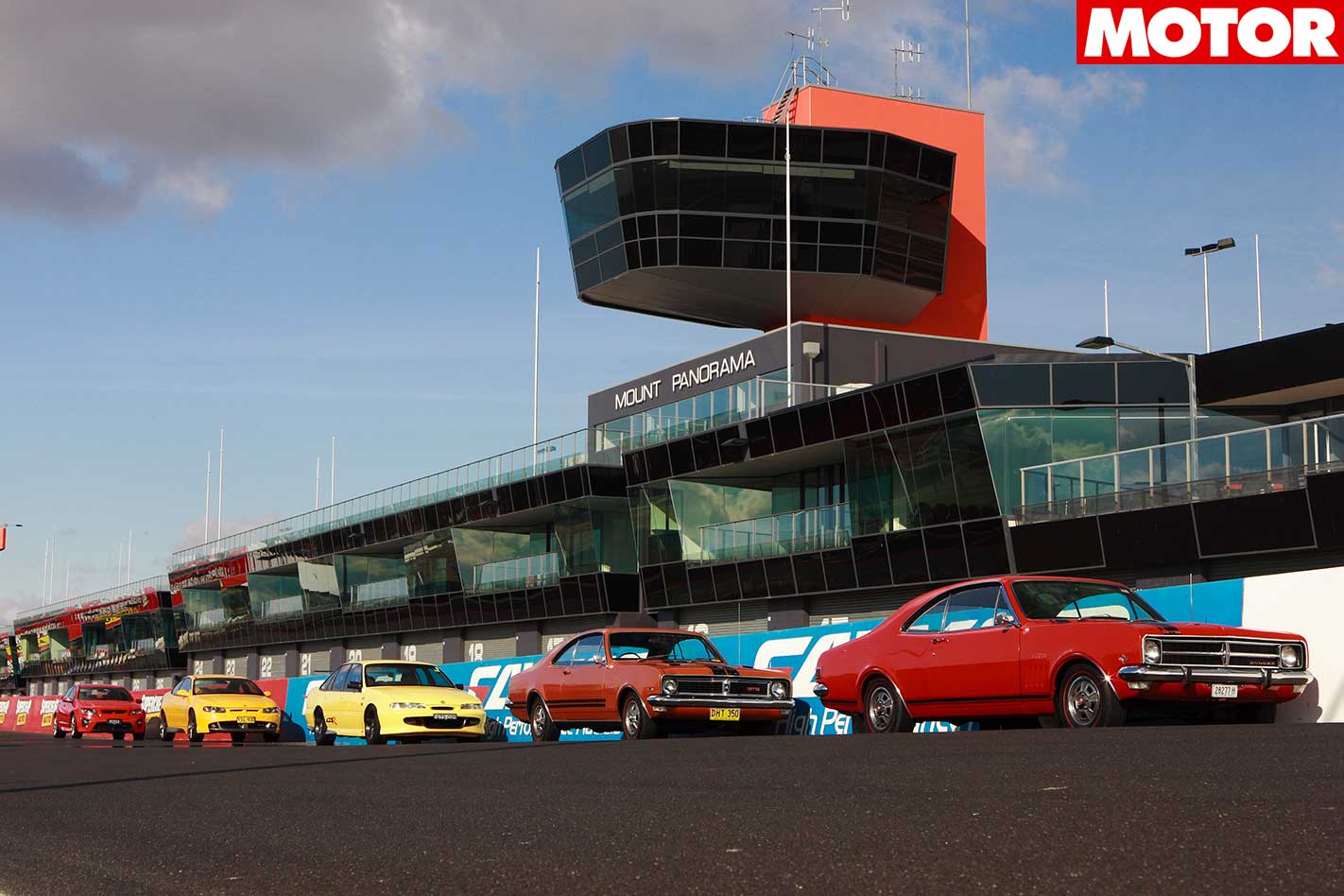
The Plan is to give their owners a taste of the Mount Panorama circuit that coated the name in glory… and me the experience of 40 years of evolution in one day. Commencing at dawn on Sunday, it is a good plan. But not perfect…
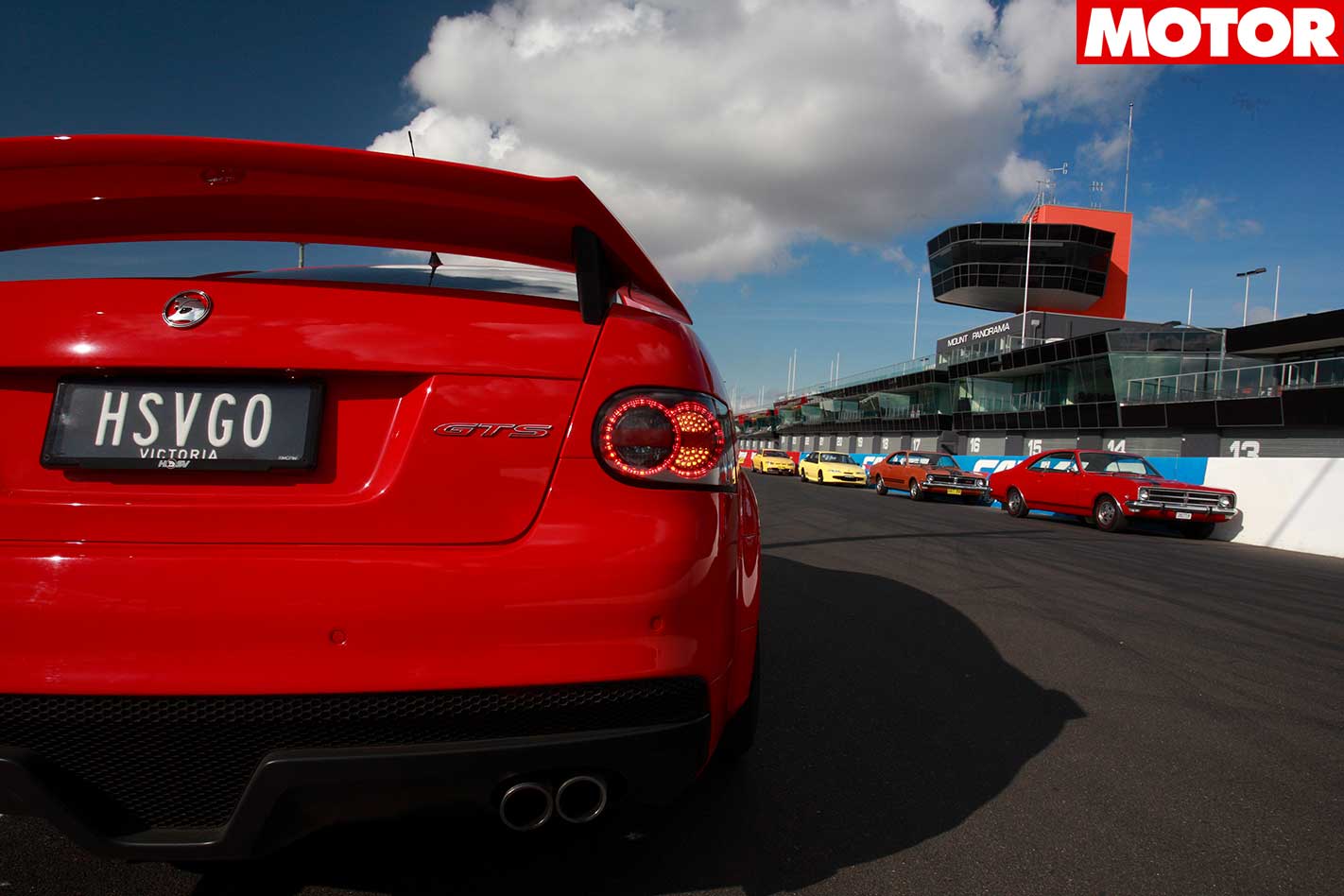
Granted, this is faint praise as the brute still has the stance of a phone box and the visibility of a bunker, but let’s cut it some sporting slack: because in that context it has merit, as 317kW usually does. But it’s the delivery of 550Nm of torque and the Magnetic Ride Control-equipped chassis that, numbers be buggered, impress on our journey. A journey back in time, and not only because we meet out in semi-rural Richmond.
Assembled there are an SBS diversity of souls linked by both a love of Australia’s uniquely bastard-born but circuit-sanctified cars and a staggering knowledge of their minutiae. Did you know that an original 350-engined HT Monaro’s prop-shaft was painted purple? I couldn’t have even made that up! What these folk don’t know, I am assured, isn’t worth knowing.
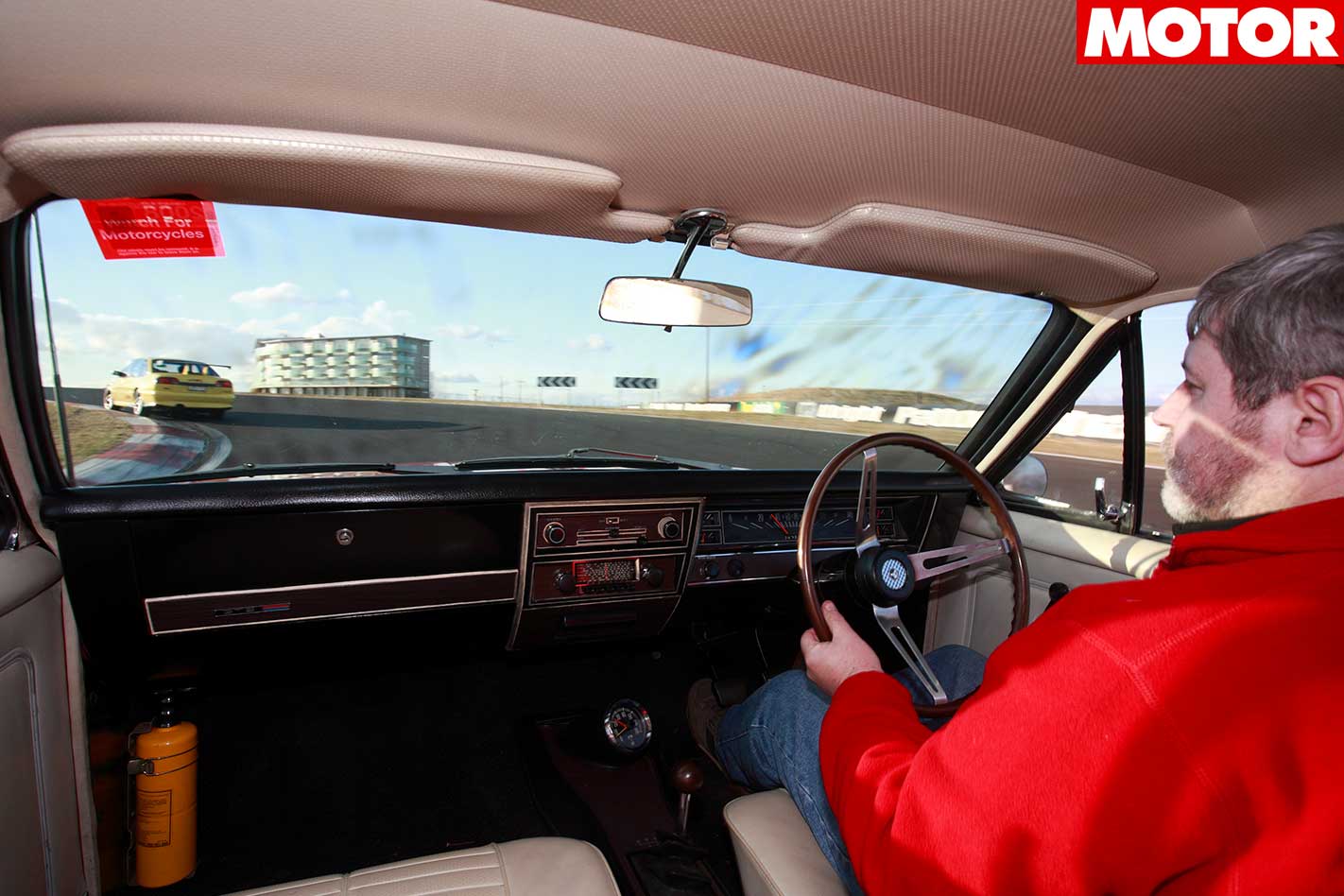
Pull on the seatbelt and it doesn’t budge. Adjust. And adjust to seats as slippery as a dancefloor that top out at mid shoulder-blade and address a thin-rimmed, hard-gloss, yard-wide wheel. How anybody raced that workstation (and the rules required they did) almost defies comprehension.
The red brute is no less demanding on the road: a car of almost religious purity, it offered few comforts. Neither air-conditioning nor automatic transmissions were offered and the high and hard-as-a-dog’s-forehead dashboard bristles with menace.
Cars that once changed hands for $4000 are now worth $140,000 + and the best part is you can still use them. John Bertuzzi’s 92,000 mile HT GTS 350 Monaro underlines the point; not that it doesn’t take some effort if you’re keen. And he is.
Probably the most original car on the guest list, it’s Factory Authentic down to its nuts, bolts and period radiator clamps. Even the battery is original – or its casing is at least – and contemporary tyres are professionally red-walled to look period perfect. But Factory Authentic doesn’t mean cotton-woolled concours and John’s entirely happy to use the westward roads to demonstrate what God gave us the 350 engine for.
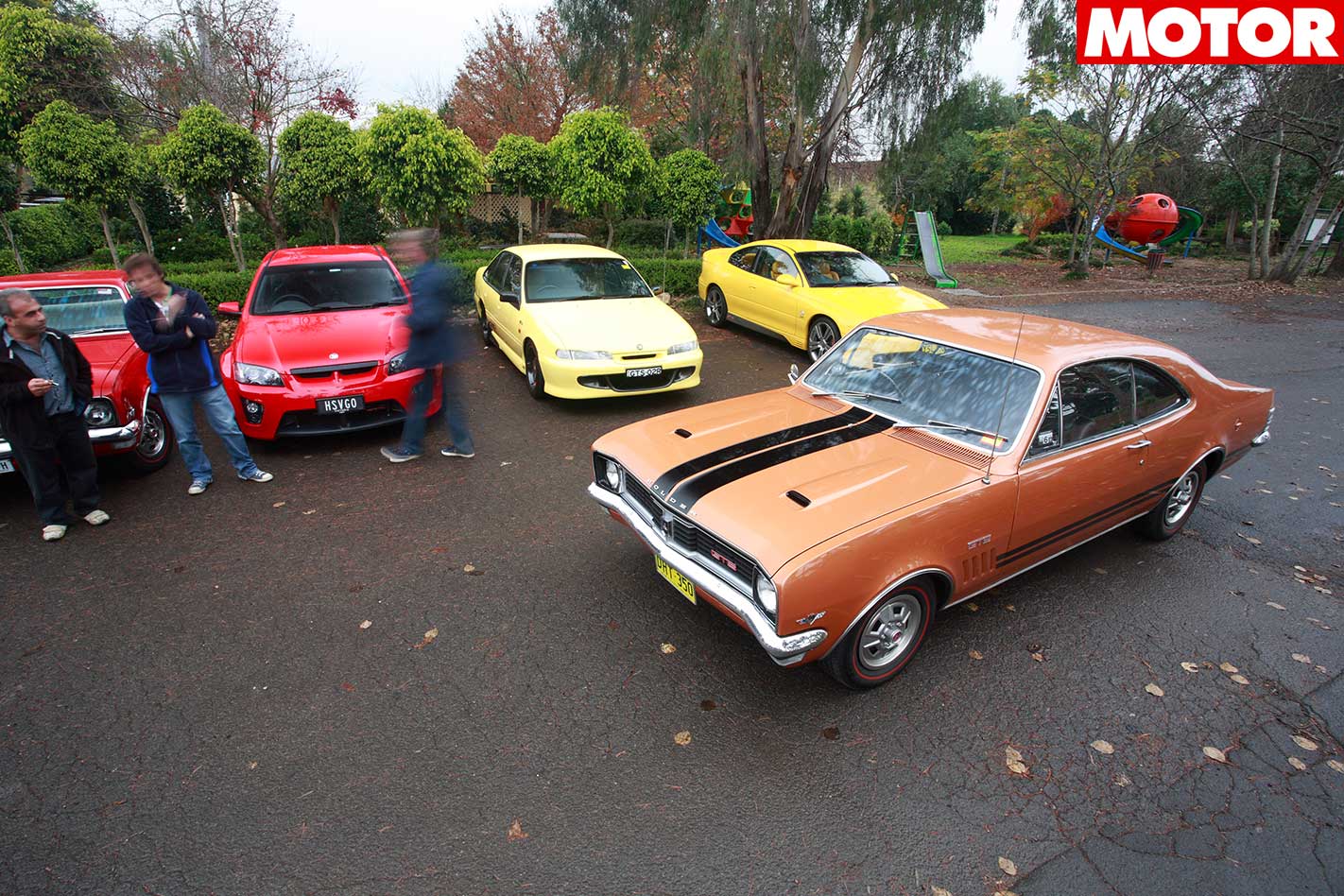
That advance over the HK’s 327 reflects, along with subtle interior and exterior refinements, a solid year’s work back at the factory; work rewarded by the second, and last, Bathurst victory for the GTS badge.
The improvements show on the road, too, with a deeper, more primal sound, improved seating and more sensible instrumentation, but I suspect that all the love lies on the other side of the firewall for John: big V8s go back to his childhood and even today, his (and his wife’s) five cars have nothing less than five litres apiece.
Okay, some of the car’s old bones creak on the Bells Line of Road, but the heart is still there and when, years ahead, the last V8 is heard in the distance, I have a fair idea who’ll be driving it.
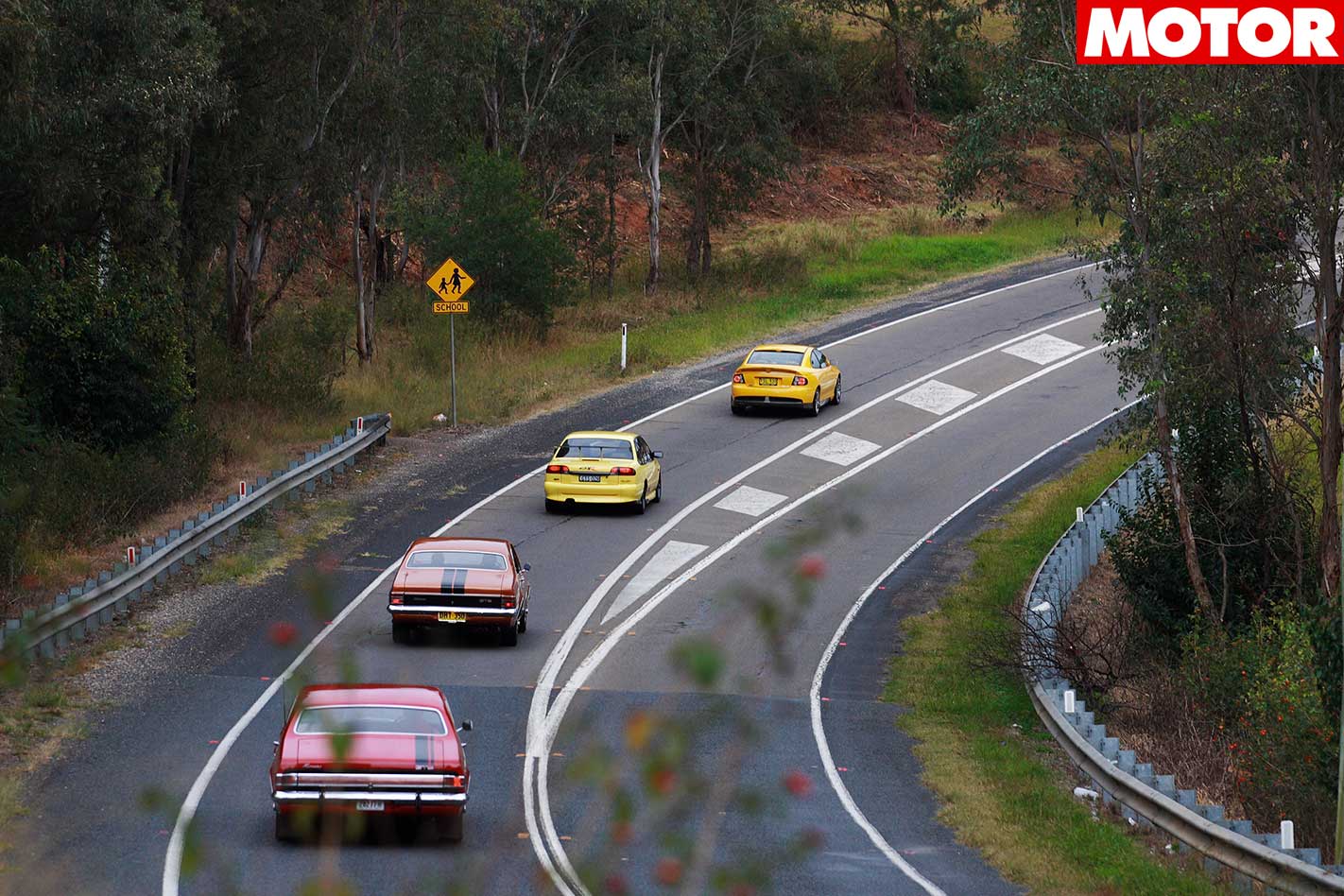
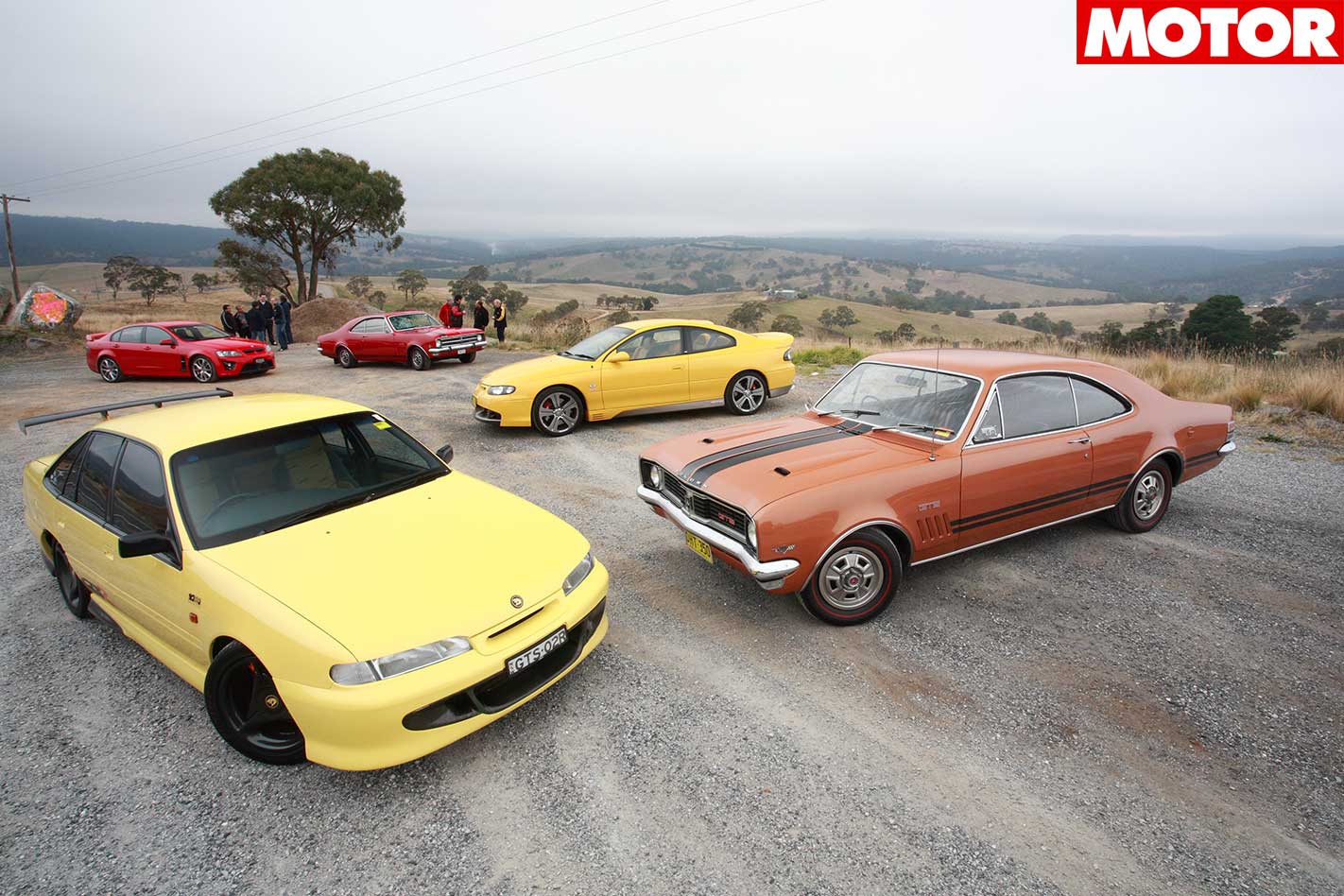
As Peter Hennessy’s HRT-optimised 1996 HSV GTS-R proves. The rarest and wildest Holden ever to wear the GTS badge, the four-door R is a standout even in this company.
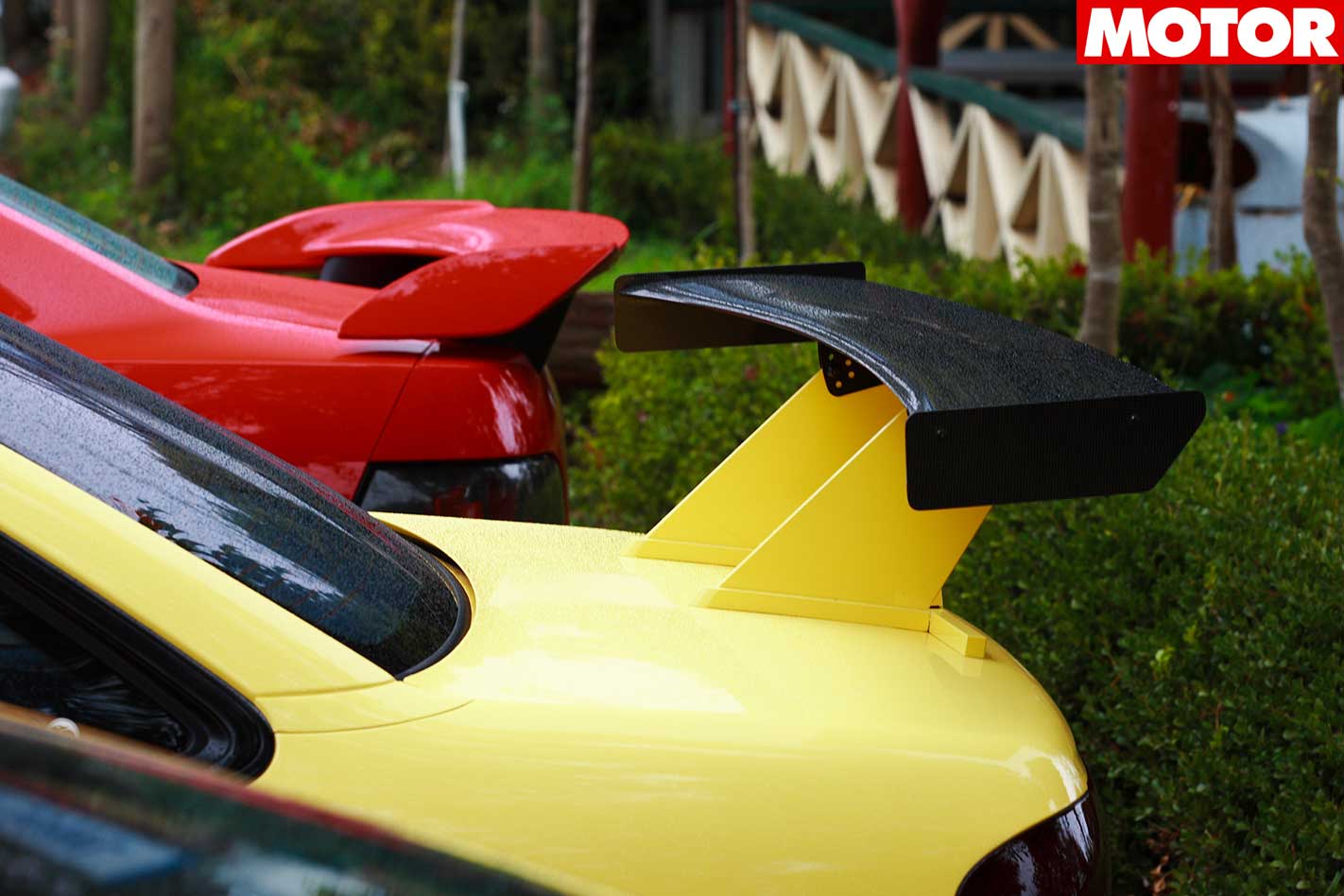
I still remember driving one at its launch and shrinking into the seat at every traffic light. This from an E-Type owner. But the thing was, and still is, outrageous, with its massive rear wing and carbonfibre detailing and bright ‘XU3 Yellah’ paint (the standard taxi colour in Melbourne) all adding to the clamour.
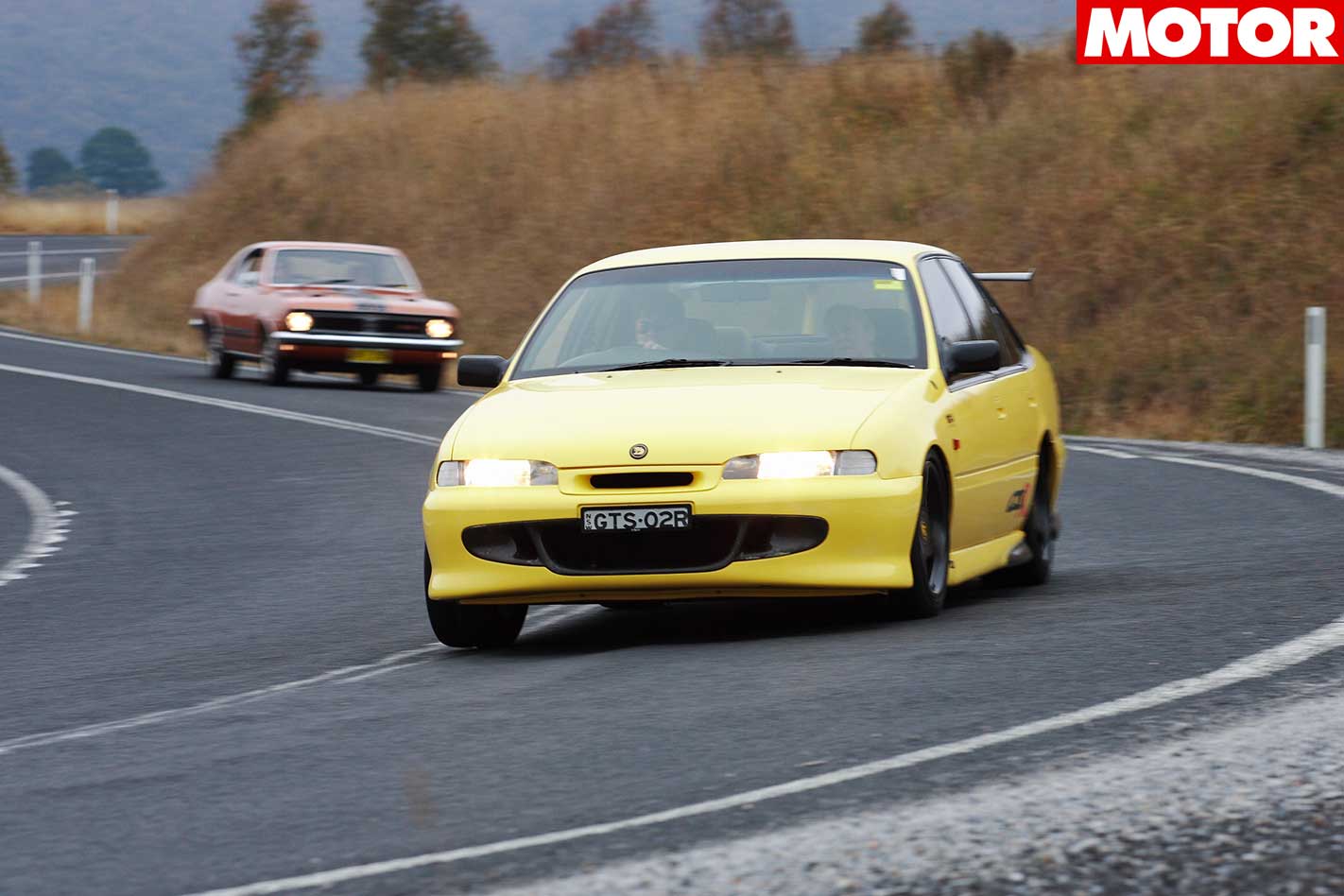
Underneath, racing experience in his BMW E36 M3R has inspired Peter to equip the GTS-R with modified springs and dampers and cross-drilled, slotted brake rotors. So the thing goes real-world harder than it ever did and the wing does whatever it does without disturbing the vision. And from the inside, you don’t even have to look at it, Praise Be.
As treasurer of the HSV Owners Club and president of the Australian Muscle Car Club, it may be assumed that our Mr Losurdo knows a good deal about such brutes but that is strictly incorrect. He knows everything, and even in this company, has godfather status.
So his arrival today in a 2003 HSV GTS Coupe is a commendation of the return of the GTS badge to its original form, as a two-door with the 5.7-litre LS1 engine that matches the HT’s 350-cube armament and Chevrolet parentage. And then some.
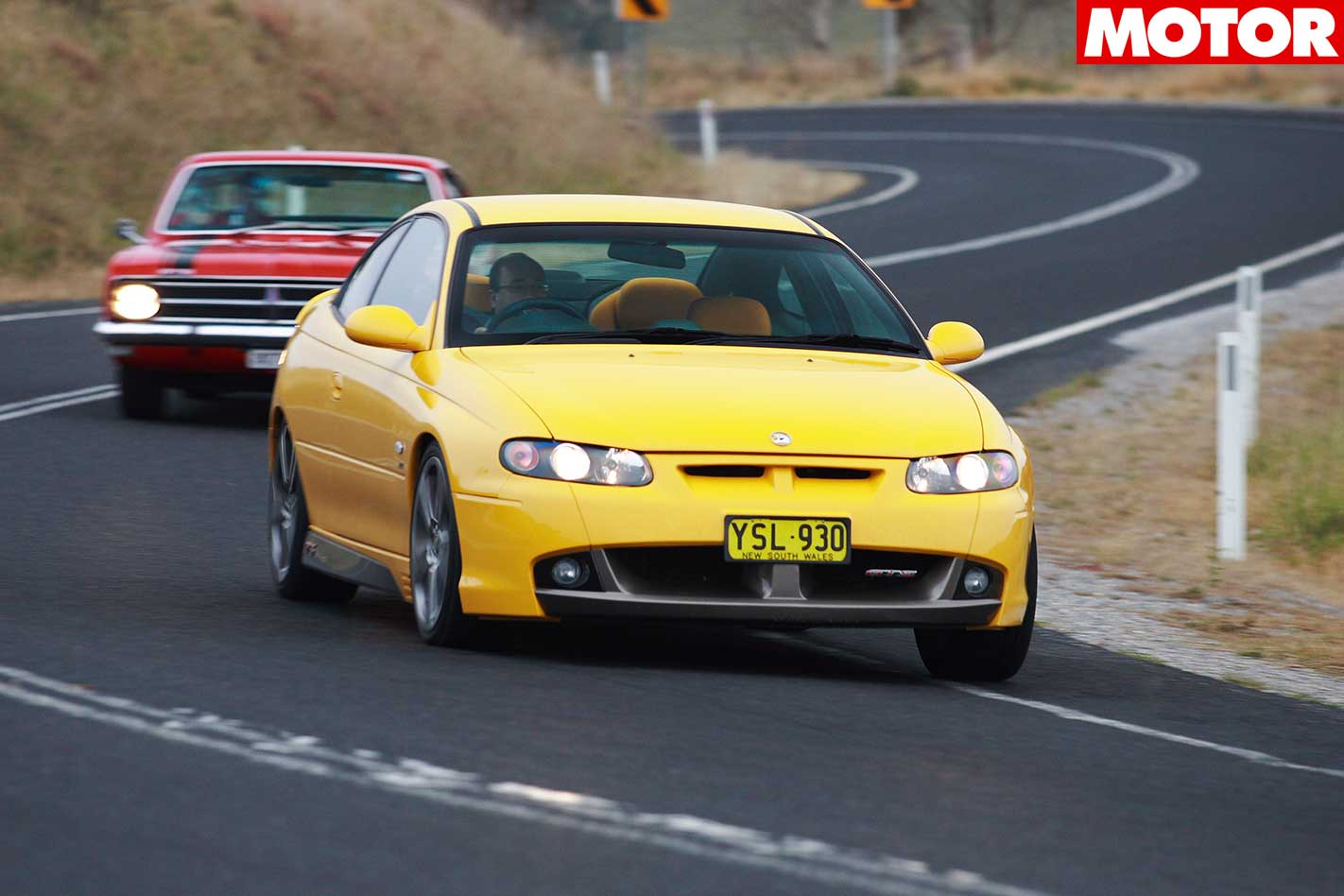
Remaining indoors is wiser, though, because the coupe is the first of this lot that actually feels truly cohesive…solid. As it should, with a new-car price of $105,000 making it the most expensive to ever wear the GTS badge. It rides firmly, but not uncomfortably, due in part to good seating intelligently employing leather and fabric where they should be for both physical effect and aesthetic benefit.
The exterior aesthetics, though, are somewhat more controversial. Based on Mike Simcoe’s lovely 1998 Sydney Motor Show-stopping VT Coupe form, it has received yet another (after the Pontiac aberration) nose job to Add Manliness.
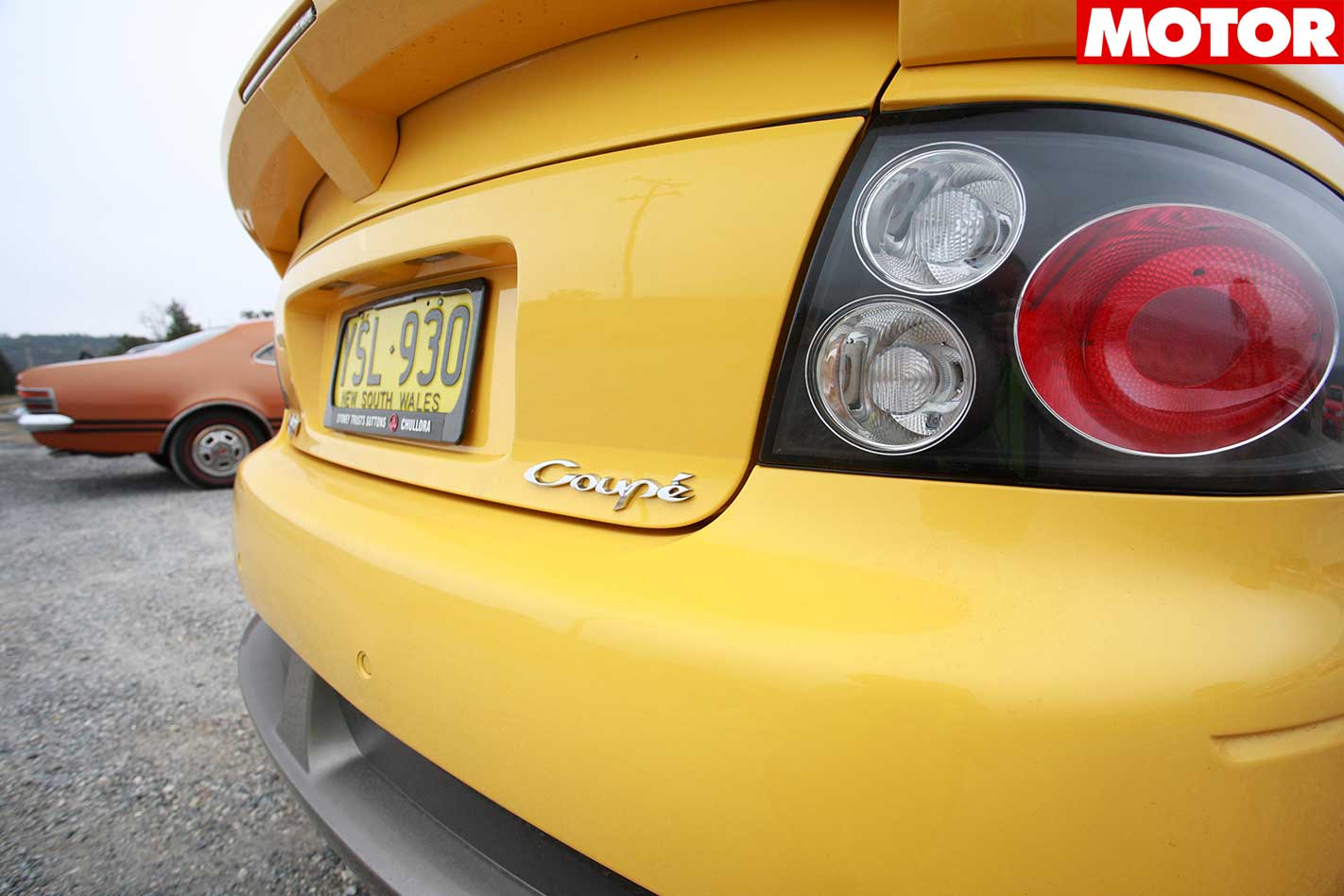
And there, in the GTS heartland, the stories begin again, facts and fallacies debated, and the comparisons and rivalries bubble up in good humour as the later cars are dubbed ‘plastics’ by the earlier model-owners, whose claims that their relics can’t be killed with a stick simply inspire a quest for a bigger stick.
And on it goes into the afternoon, disturbed only by Photographer Bean’s command for yet another angle or antic or briefly interrupted by the odd truancy around the circuit until, in fading light, our Mr Losurdo announces his departure to attend a Monaro Club meeting which causes me, if no-one else, to cry out into the coming night: “What’s left to say?!”
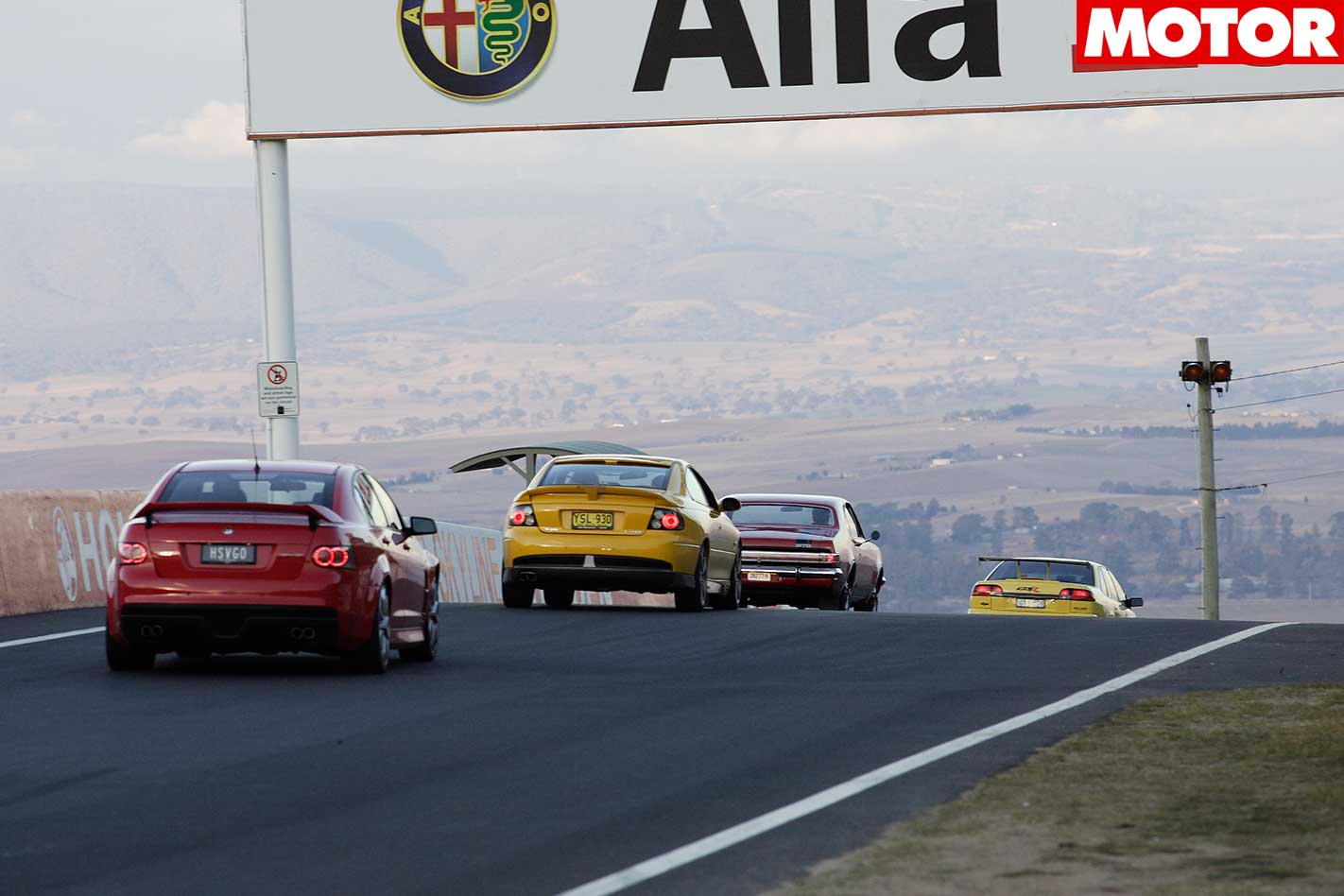
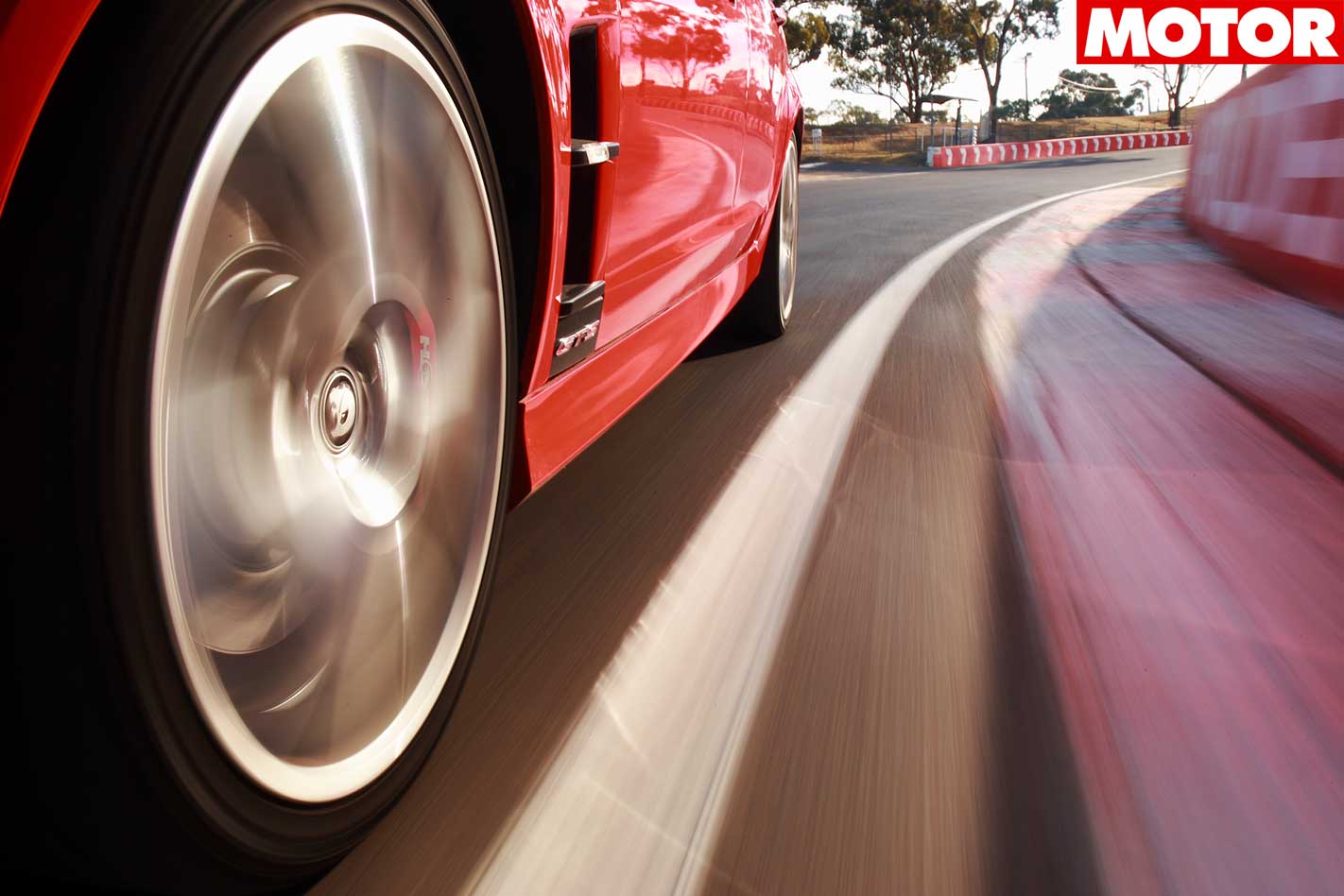
That lovely, lazy rumble on the way home from Bathurst is as pure a music as any machine ever made and as I listen, I can imagine the pleasure of owning a GTS. The only choice would be which. Because at the end of the day, if I had to drive one, it would be the last of them.
But to look at, it would be the first.
A big thank you to Rob Losurdo, John Bertuzzi, Steve Short and Peter Hennessey for giving us their time and knowledge.
1968 – 2008 GTS Timeline
1968 HK GTS
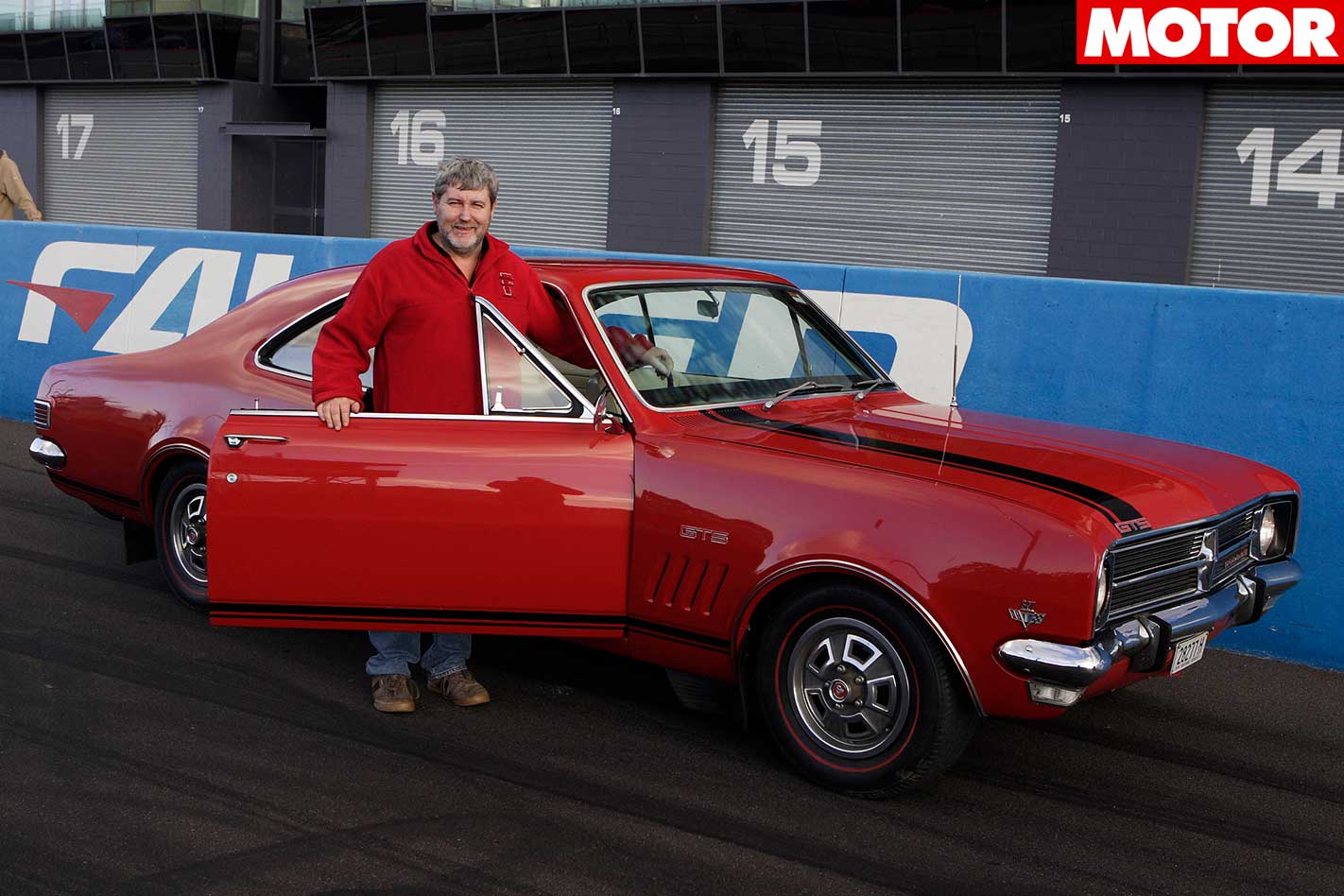
ENGINE: 5363cc V8, OHV, 16v POWER: 186kW @ 4800rpm TORQUE: 439Nm @ 3200rpm WEIGHT: 1488kg 0-97km/h: 7.6sec (man – tested) 0-400m: 16.4sec (man – tested) PRICE: $3790 (1968)
1969 HT GTS
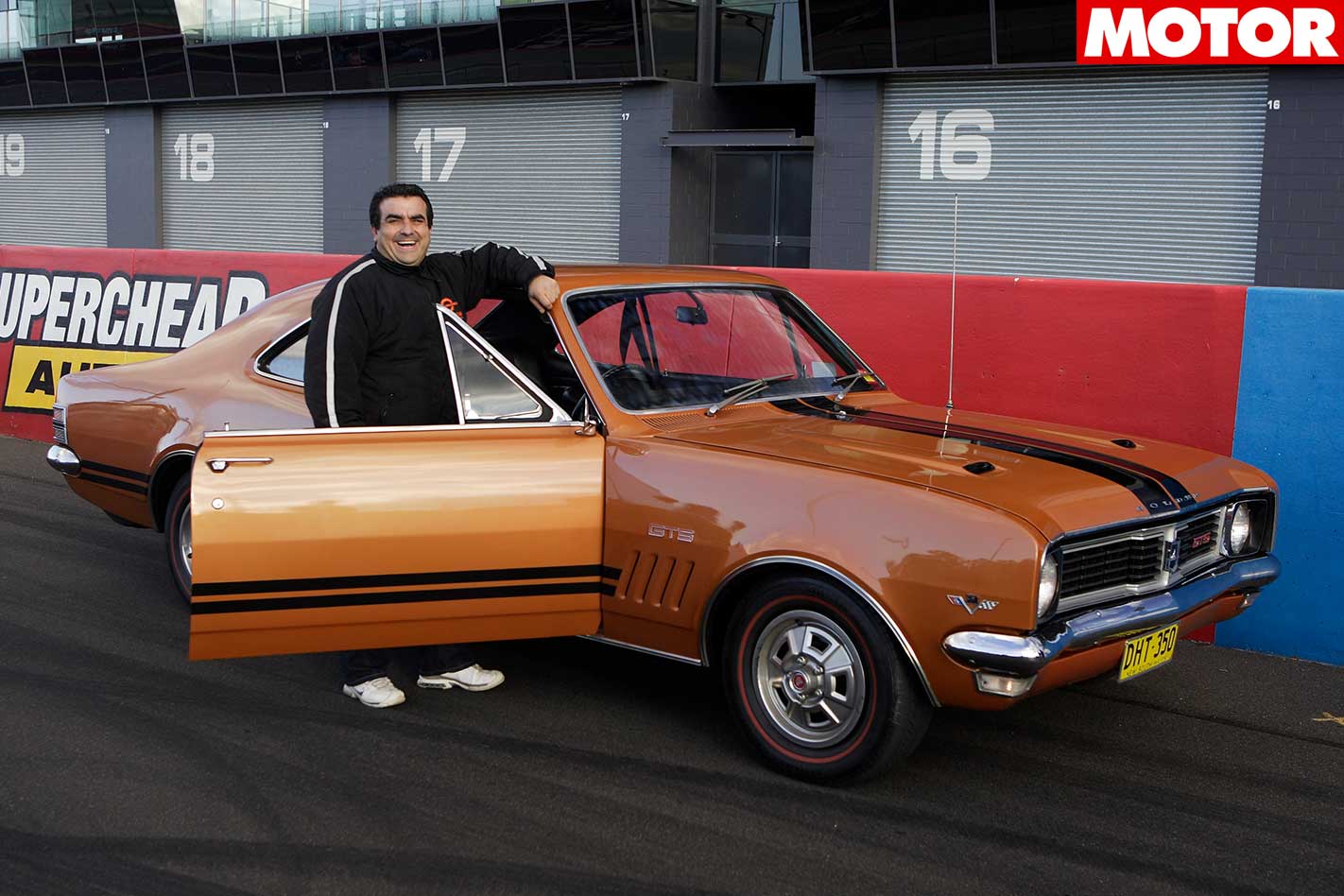
ENGINE: 5734cc V8, OHV, 16v POWER: 224kW @ 4800rpm TORQUE: 515Nm @ 3200rpm WEIGHT: 1504kg 0-97km/h: 8.1sec (man – tested) 0-400m: 15.6sec (man – tested) PRICE: $3995 (1969)
1970 HG GTS
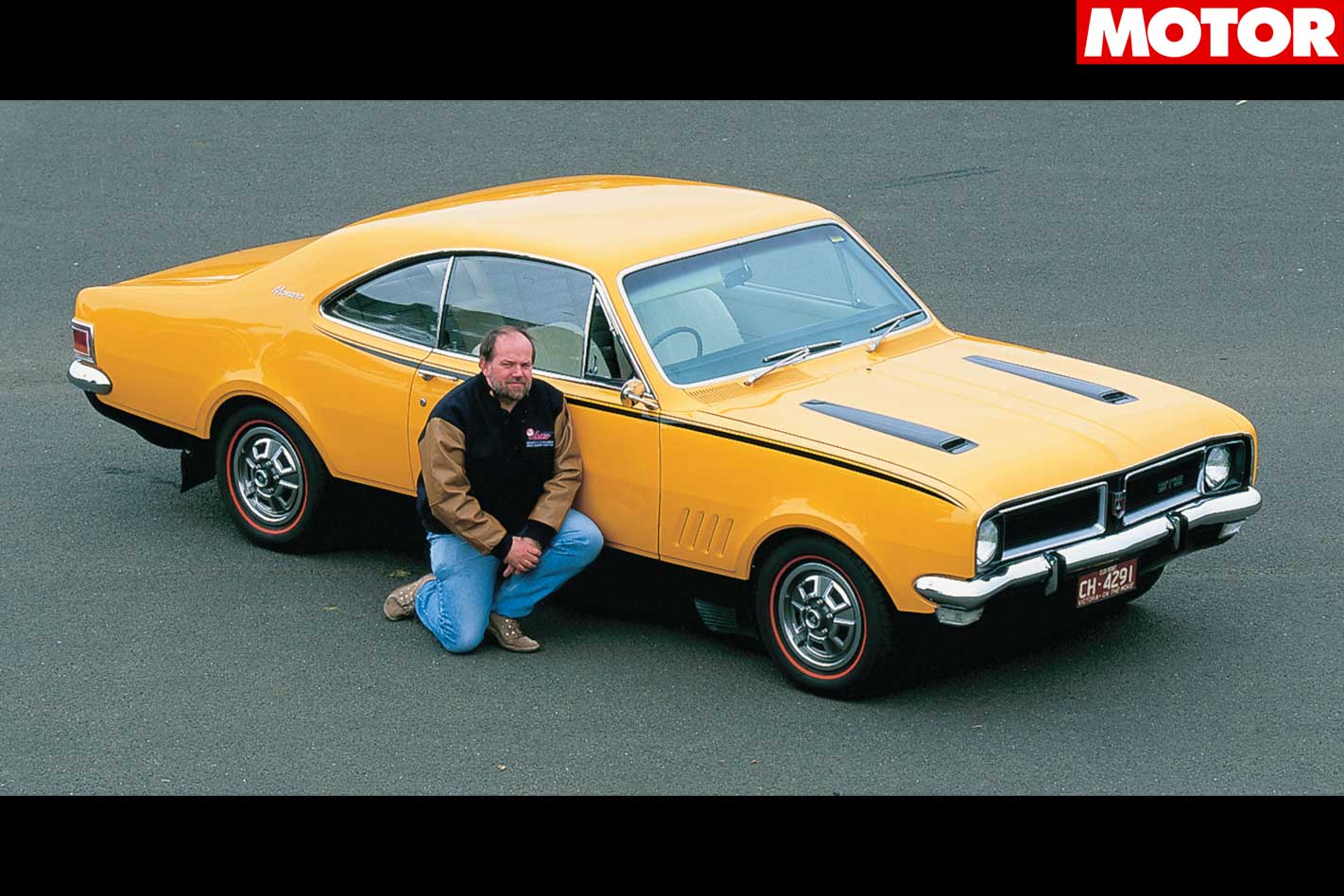
ENGINE: 5734cc V8, OHV, 16v POWER: 224kW @ 4800rpm TORQUE: 515Nm @ 3200rpm WEIGHT: 1530kg 0-97km/h: 7.5sec (man – tested) 0-400m: 16.0sec (man – tested) PRICE: $4174 (1970)
1971 HQ GTS
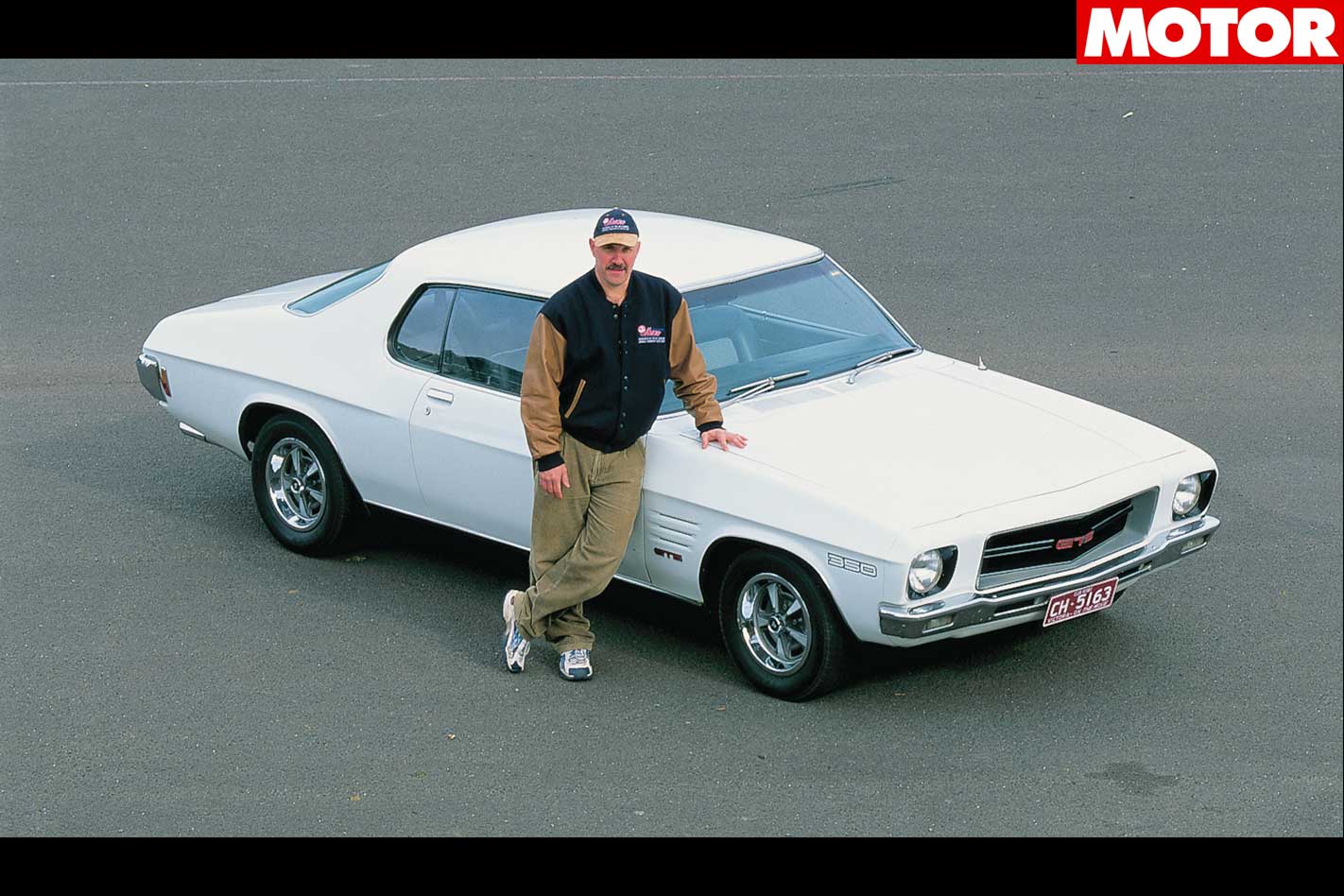
ENGINE: 5734cc V8, OHV, 16v POWER: 205kW @ 4800rpm TORQUE: 488Nm @ 3200rpm WEIGHT: 1451kg 0-97km/h: 8.0sec (man – tested) 0-400m: 15.7sec (man – tested) PRICE: $4630 (1971)
1974 HJ GTS
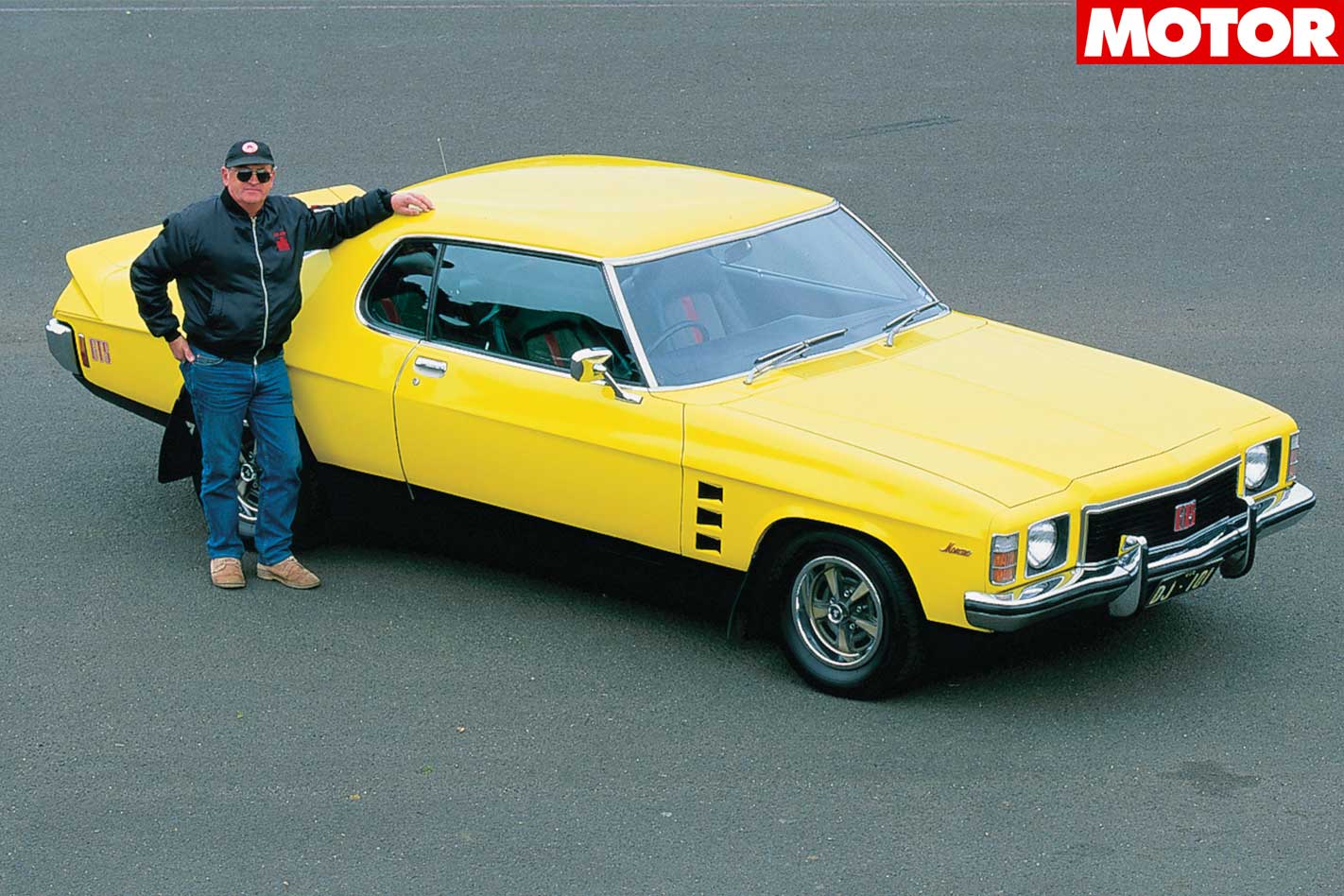
ENGINE: 5044cc V8, OHV, 16v POWER: 179kW @ 4800rpm TORQUE: 427Nm @ 3000rpm WEIGHT: 1438kg 0-100km/h: 10.4sec (auto – tested) 0-400m: 17.9sec (auto – tested) PRICE: $5138 (1974)
1976 HX GTS
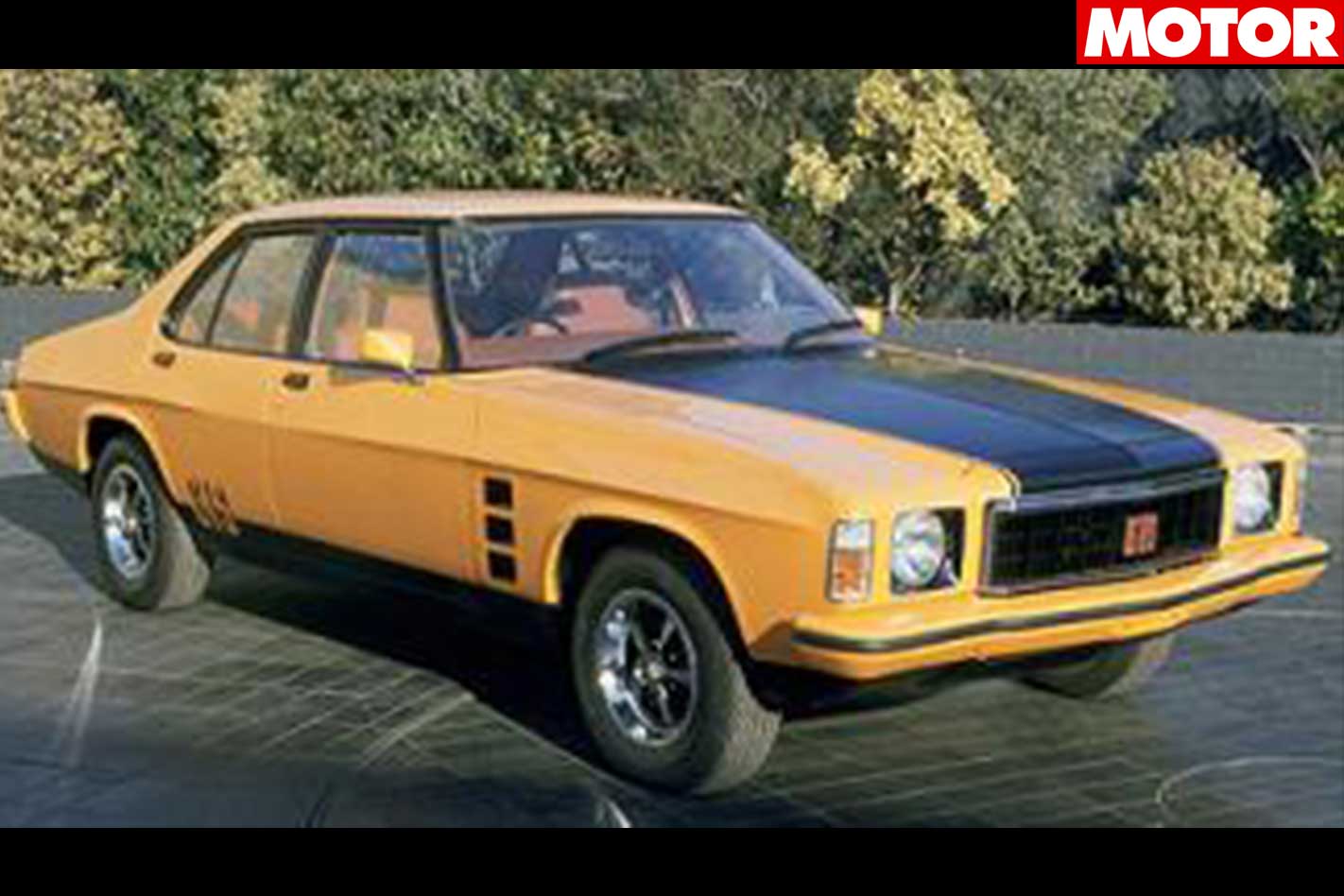
ENGINE: 5044cc V8, OHV, 16v POWER: 161kW @ 4800rpm TORQUE: 400Nm @ 3100rpm WEIGHT: 1475kg 0-100km/h: not available 0-400m: 17.2sec (auto – tested) PRICE: $7016 (1976)
1977 HZ GTS
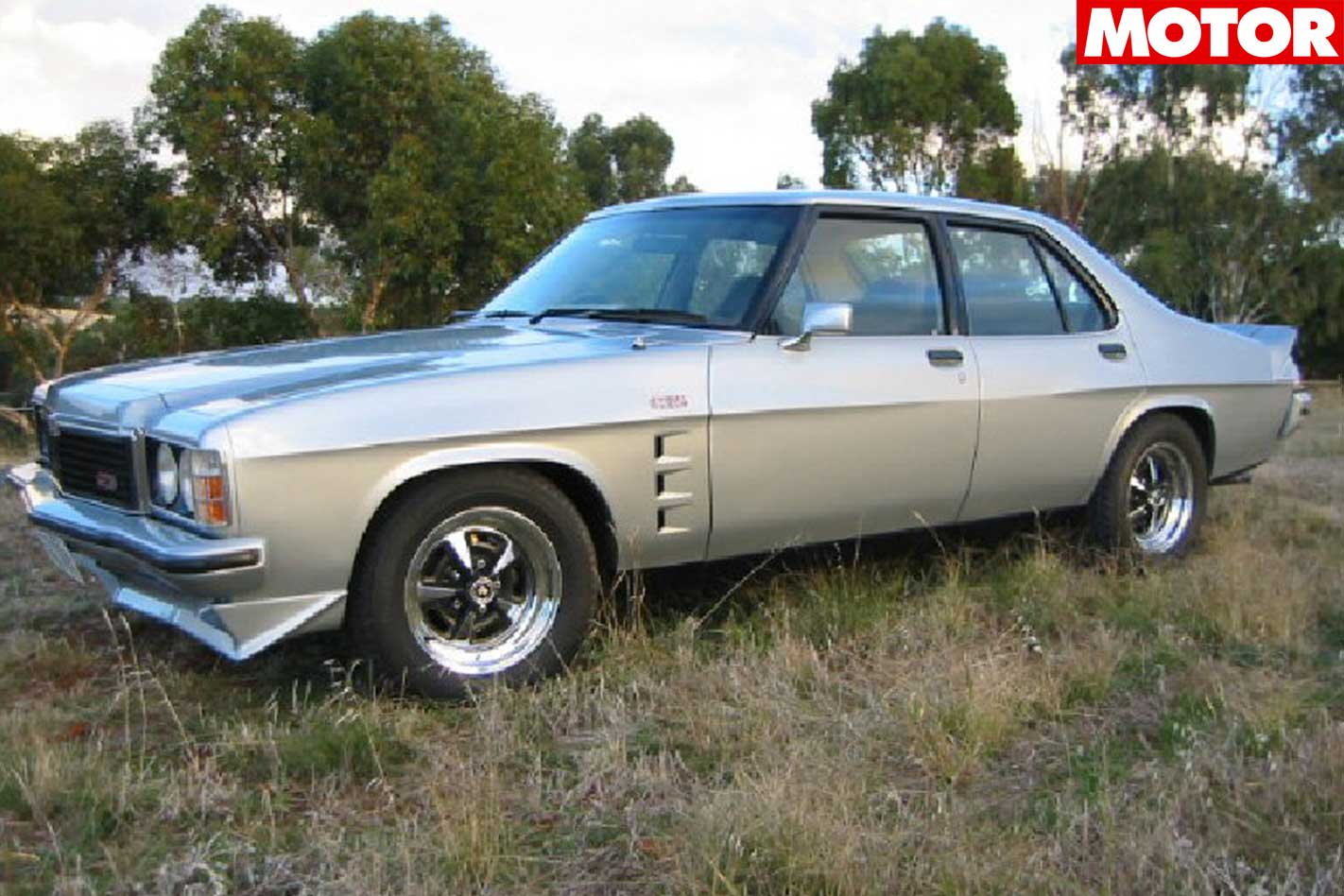
ENGINE: 5044cc V8, OHV, 16v POWER: 161kW @ 4800rpm TORQUE: 400Nm @ 3100rpm WEIGHT: 1475kg 0-110km/h: 11.9sec (man – tested) 0-400m: 16.8sec (man – tested) PRICE: $8619 (1977)
1992 VP GTS
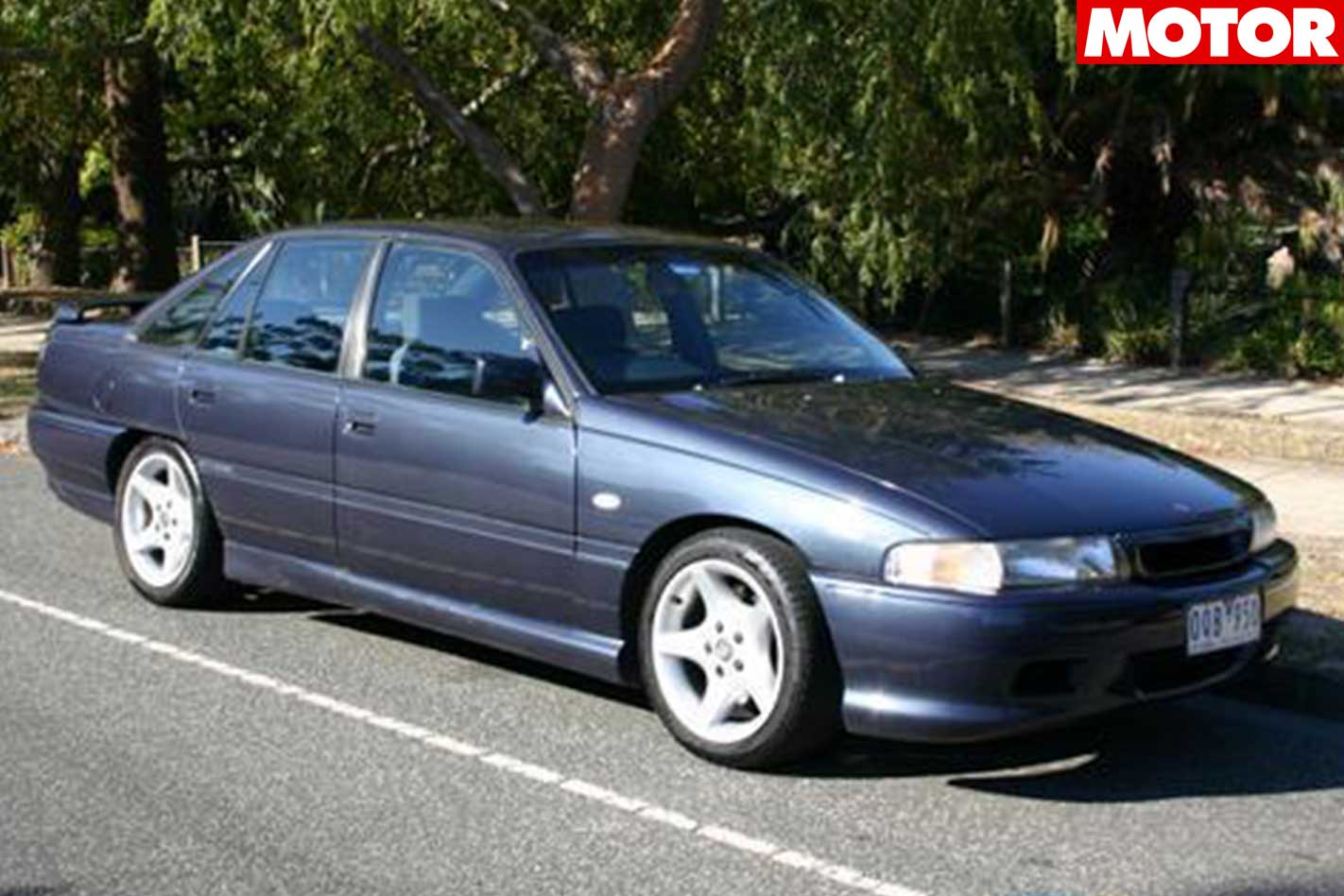
ENGINE: 4987cc V8, OHV, 16v POWER: 200kW @ 5200rpm TORQUE: 410Nm @ 3600rpm WEIGHT: 1633kg 0-100km/h: 7.31sec (auto – tested) 0-400m: 15.75sec (auto – tested) PRICE: $53,750 (1992)
1994 VR GTS
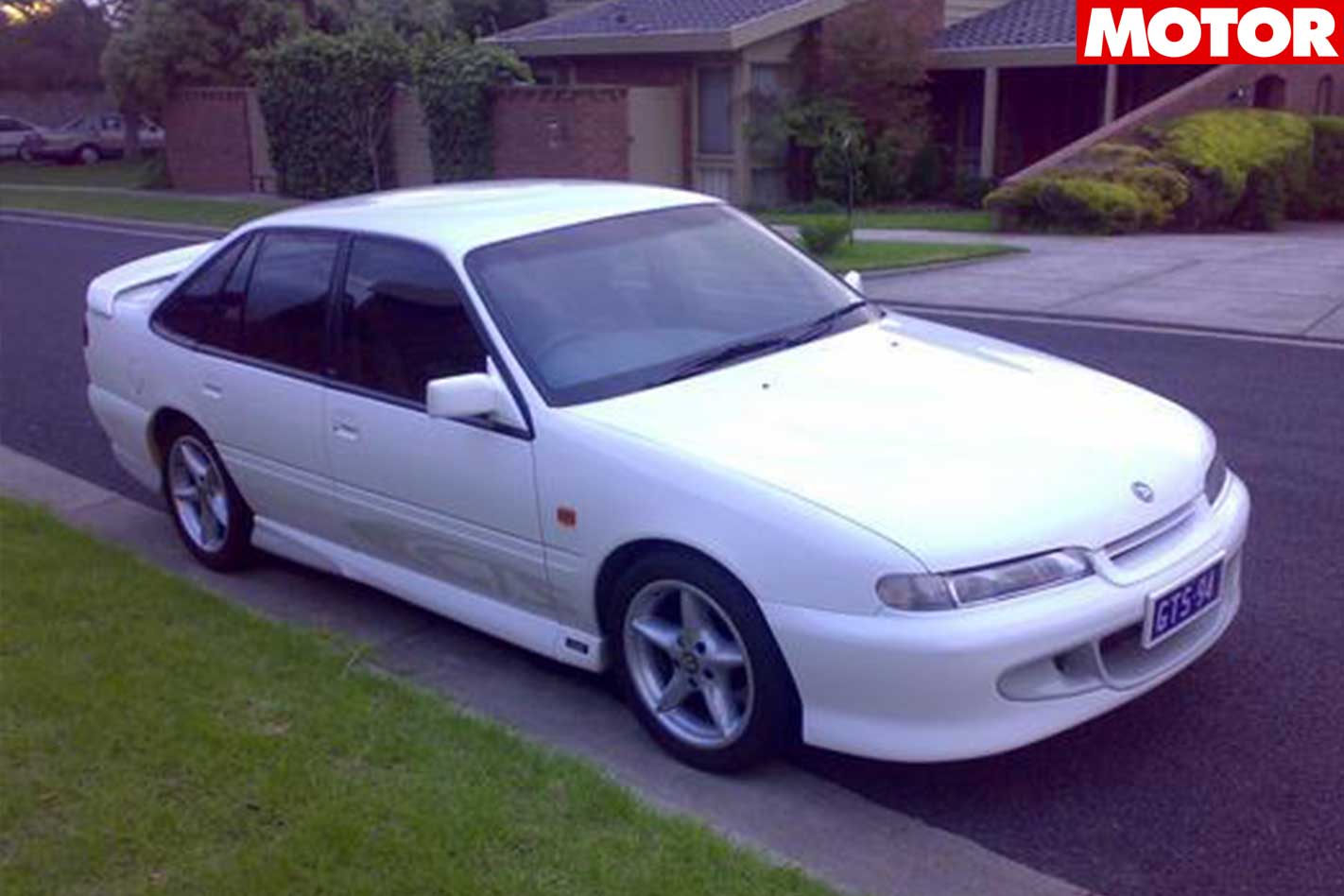
ENGINE: 5710cc V8, OHV, 16v POWER: 215kW @ 4800rpm TORQUE: 475Nm @ 3600rpm WEIGHT: 1600kg 0-100km/h: 6.6sec (man – tested) 0-400m: 14.8sec (man – tested) PRICE: $59,324 (1994)
1995 VS GTS
Ian Callum styled VS GTS offered 5.7-litre stroker and polished three-spoke alloys. Driveline identical to 246km/h VR GTS, but 250km/h speedo and firmer ride and handling package were introduced, with Touring and Sports options.
ENGINE: 5710cc V8, OHV, 16v POWER: 215kW @ 4800rpm TORQUE: 475Nm @ 3600rpm WEIGHT: 1600kg 0-100km/h: 6.19sec (man – tested) 0-400m: 14.8sec (man – tested) PRICE: $62,677 (1995)
1995 VS GTS-R
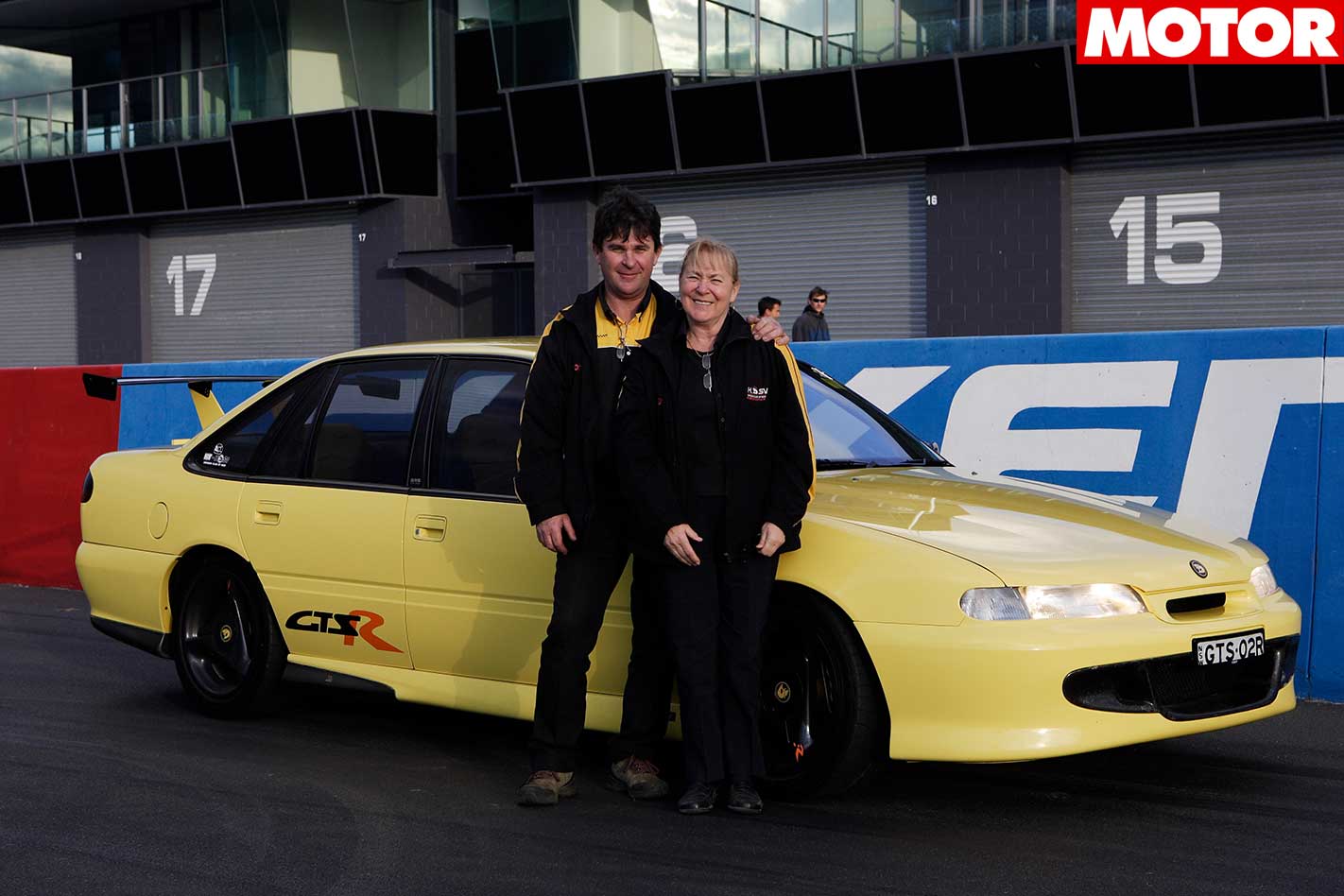
ENGINE: 5710cc V8, OHV, 16v POWER: 215kW @ 4800rpm TORQUE: 475Nm @ 3600rpm WEIGHT: 1600kg 0-100km/h: 6.6sec (man – tested) 0-400m: 14.8sec (man – tested) PRICE: $76,000 (1995)
1997 VT GTS
The VT HSV range delivered a GTS with more power – 220kW thanks to better breathing and smarter EFI. A more aero-friendly bodyshell saw the VT GTS crack 250km/h in pre-launch testing. Last GTS to be powered by the Holden stroker.
ENGINE: 5737cc V8, OHC, 16v POWER: 220kW @ 4800rpm TORQUE: 475Nm @ 3600rpm WEIGHT: 1740kg 0-100km/h: 7.6sec (man – tested) 0-400m: 15.5sec (man –tested) PRICE: $76,000 (1997)
2000 VT II GTS
By VTII, the 220kW ‘Iron Lion’ Aussie V8 is gone. So – again – is HSV’s GTS until the LS1-based Callaway Engineering (USA) C4B ‘tier two’ engine arrives. With a special diff and six cogs, it’s a sweet sounding 300kW sub-6.0sec screamer.
ENGINE: 5665cc V8, OHV, 16v POWER: 300kW @ 6000rpm TORQUE: 510Nm @ 4800rpm WEIGHT: 1721kg 0-100km/h: 5.9sec (man –tested) 0-400m: 14.0sec (man – tested) PRICE: $90,500 (2000)
2001 VX GTS
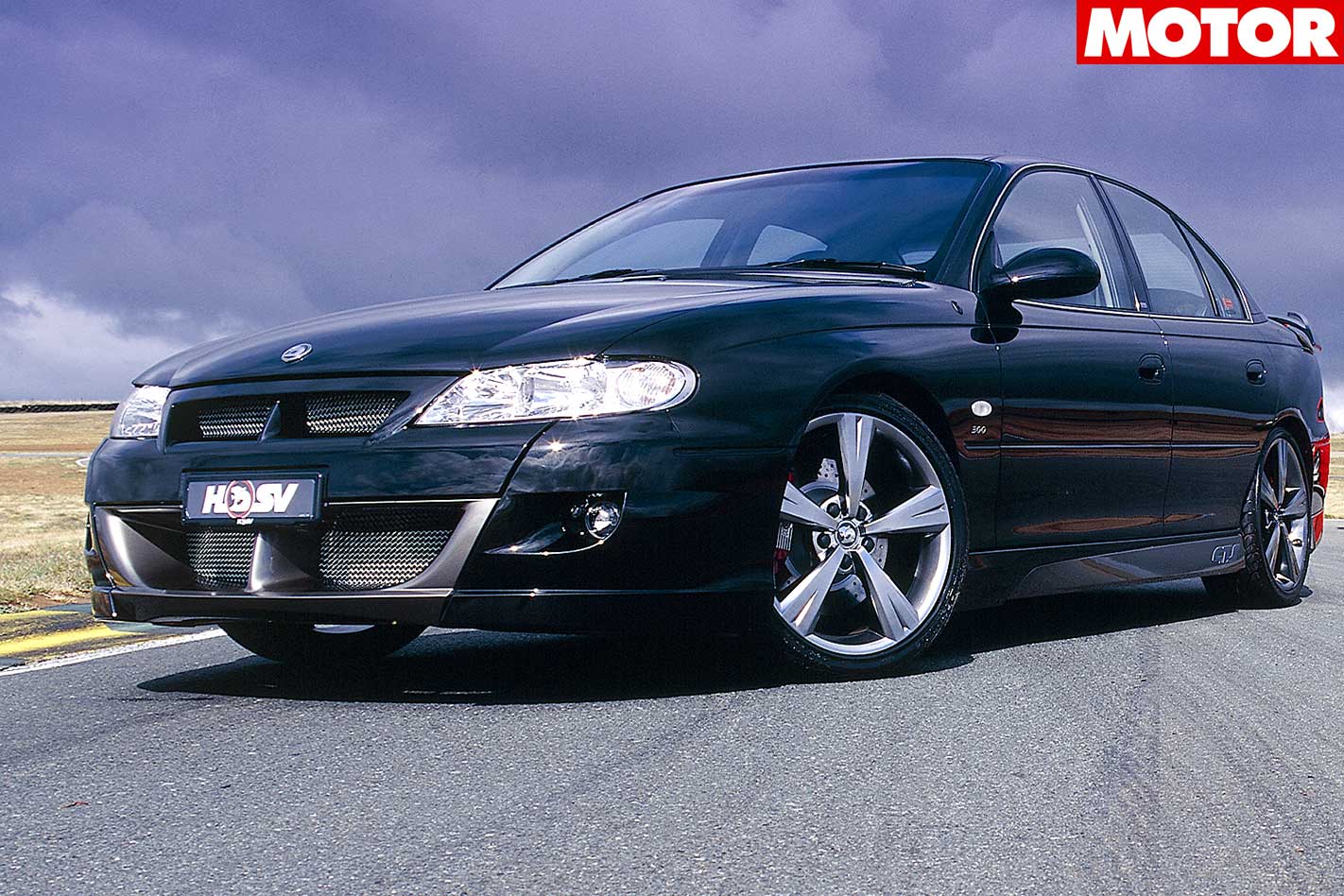
ENGINE: 5665cc V8, OHV, 16v POWER: 300kW @ 6000rpm TORQUE: 510Nm @ 4800rpm WEIGHT: 1700kg 0-100km/h: 5.4sec (man –tested) 0-400m: 13.57sec (man – tested) PRICE: $92,100 (2001)
2002 VY GTS
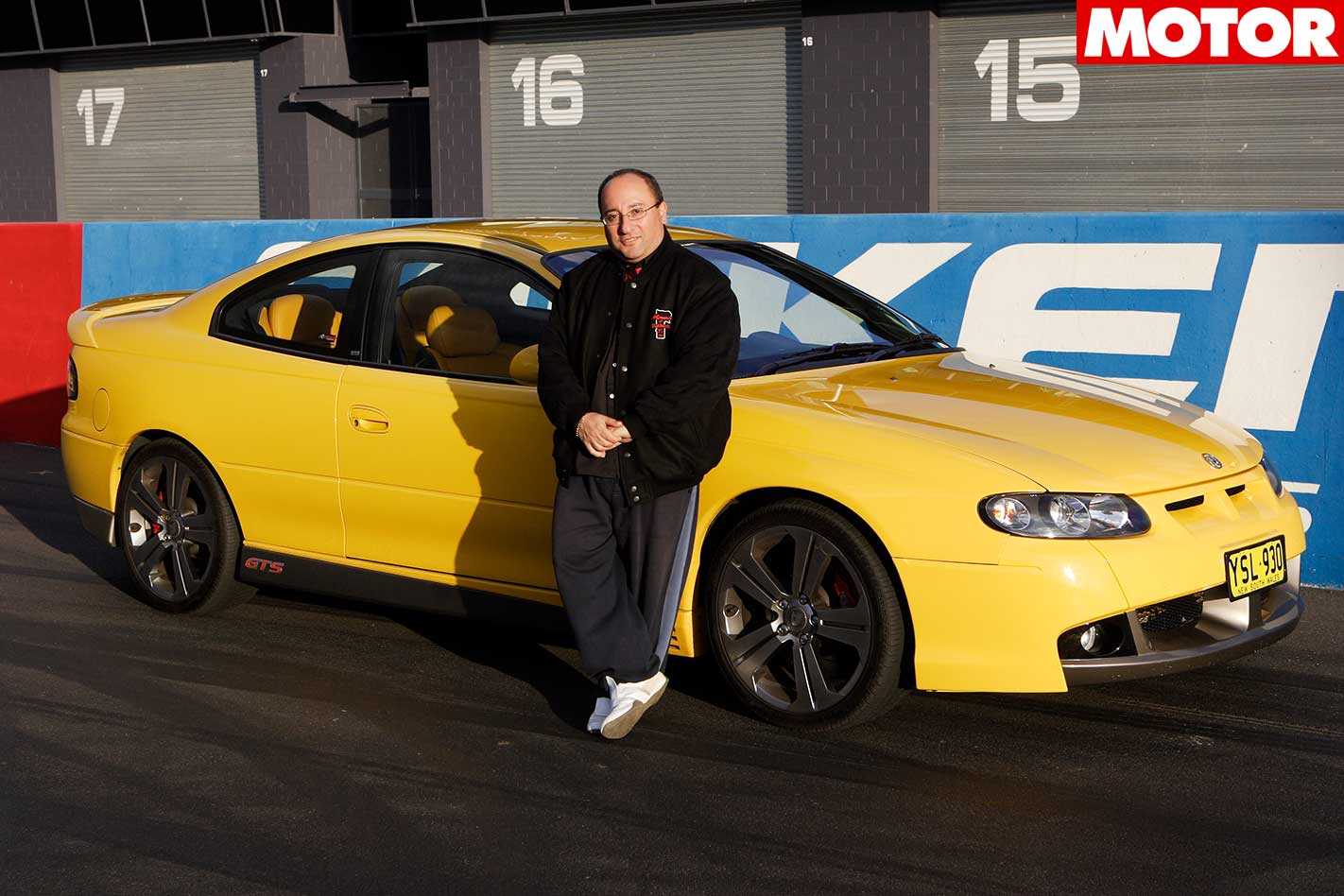
ENGINE: 5665cc V8, OHV, 16v POWER: 300kW @ 6000rpm TORQUE: 510Nm @ 4800rpm WEIGHT: 1680kg 0-100km/h: 5.7sec (man – tested) 0-400m: 13.74 PRICE: $94,750 (2002)
V8s – The GTS’ Heart and Soul
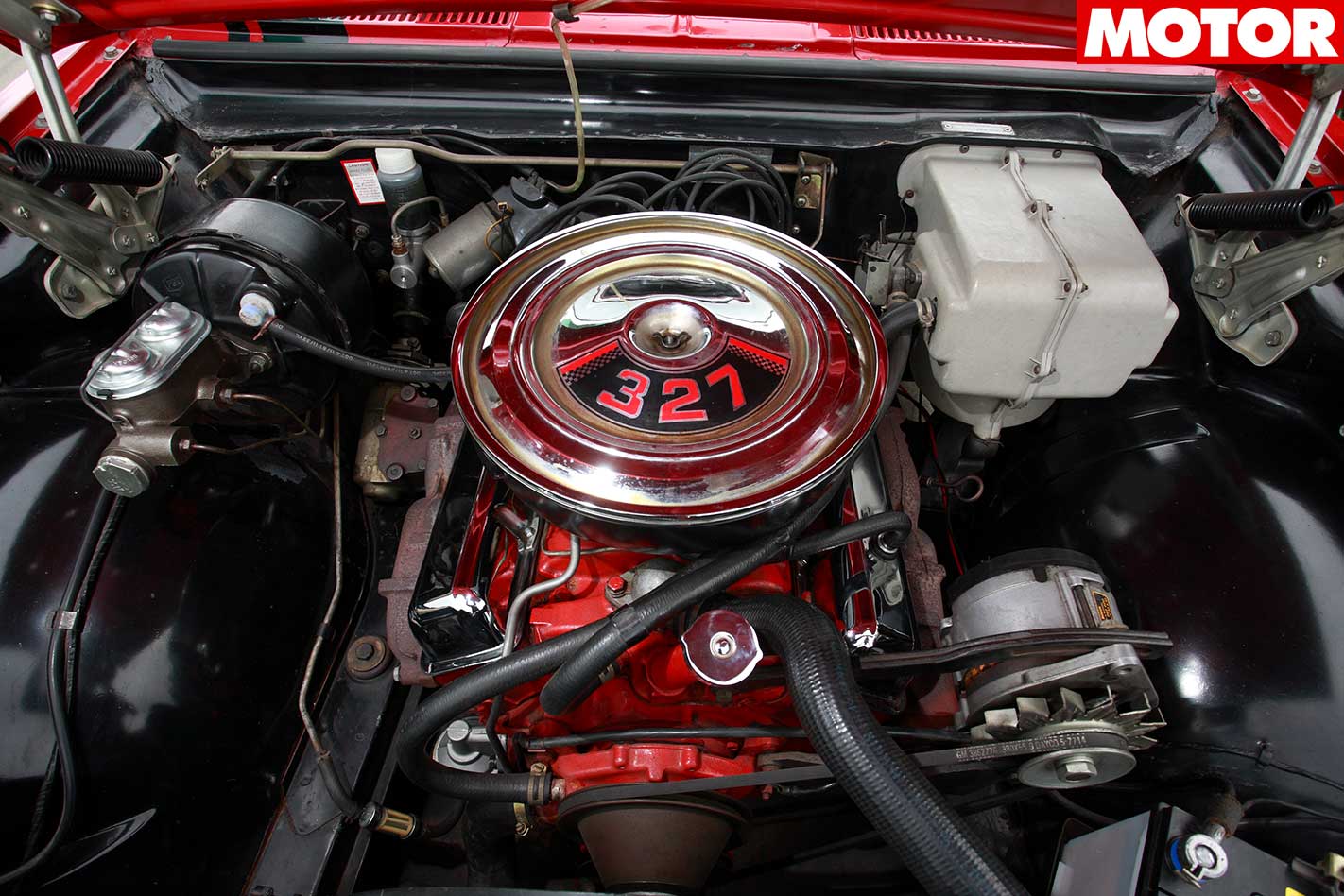
327 (5.4L) V8 Debuted with ’68 HK, the US-import was replaced by (also imported) 350 in ’69 HT.
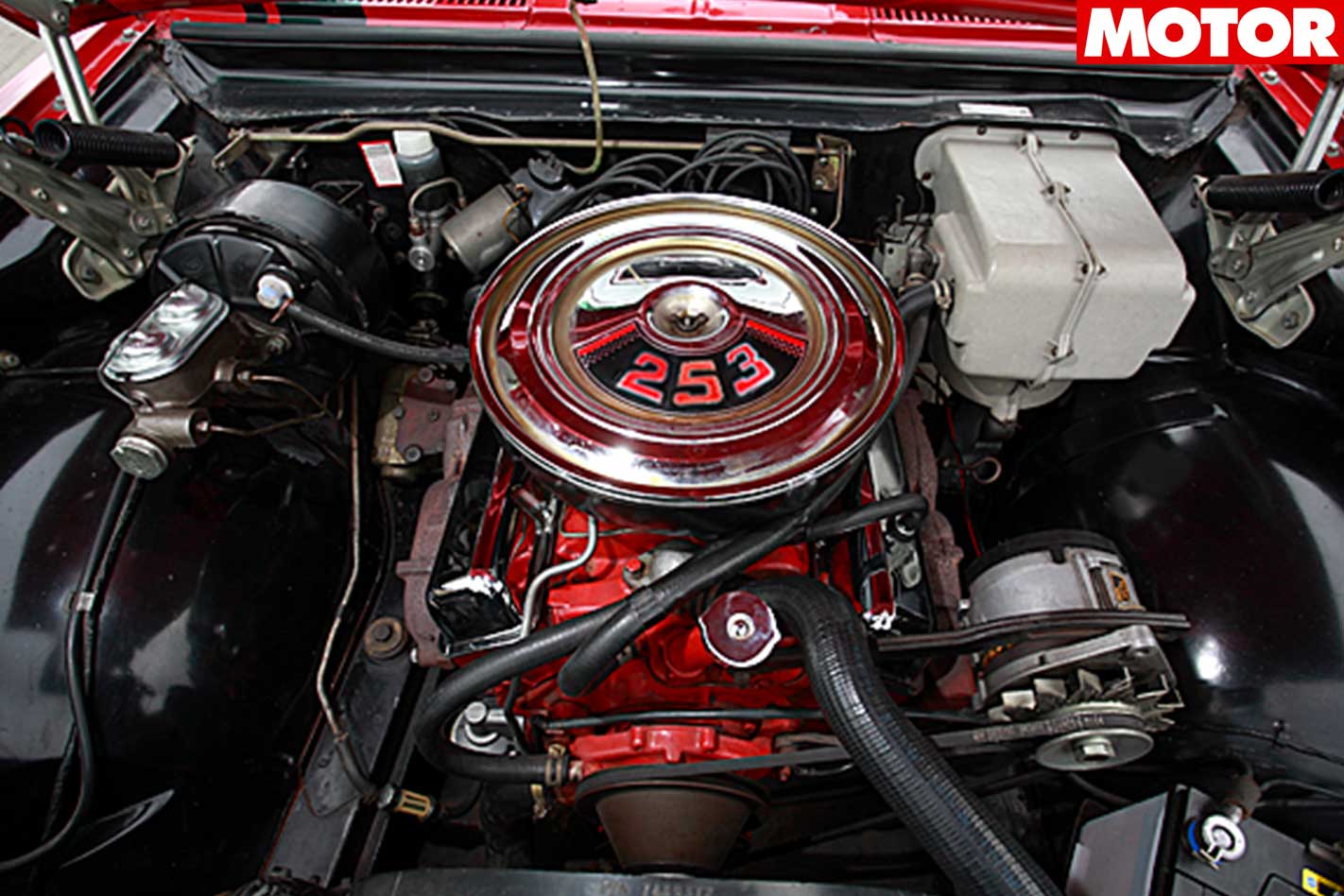
253 (4.2L) V8 First Aussie V8 debuted in 1969. Used until HZ GTS; Carried on until 1984 Comodore.
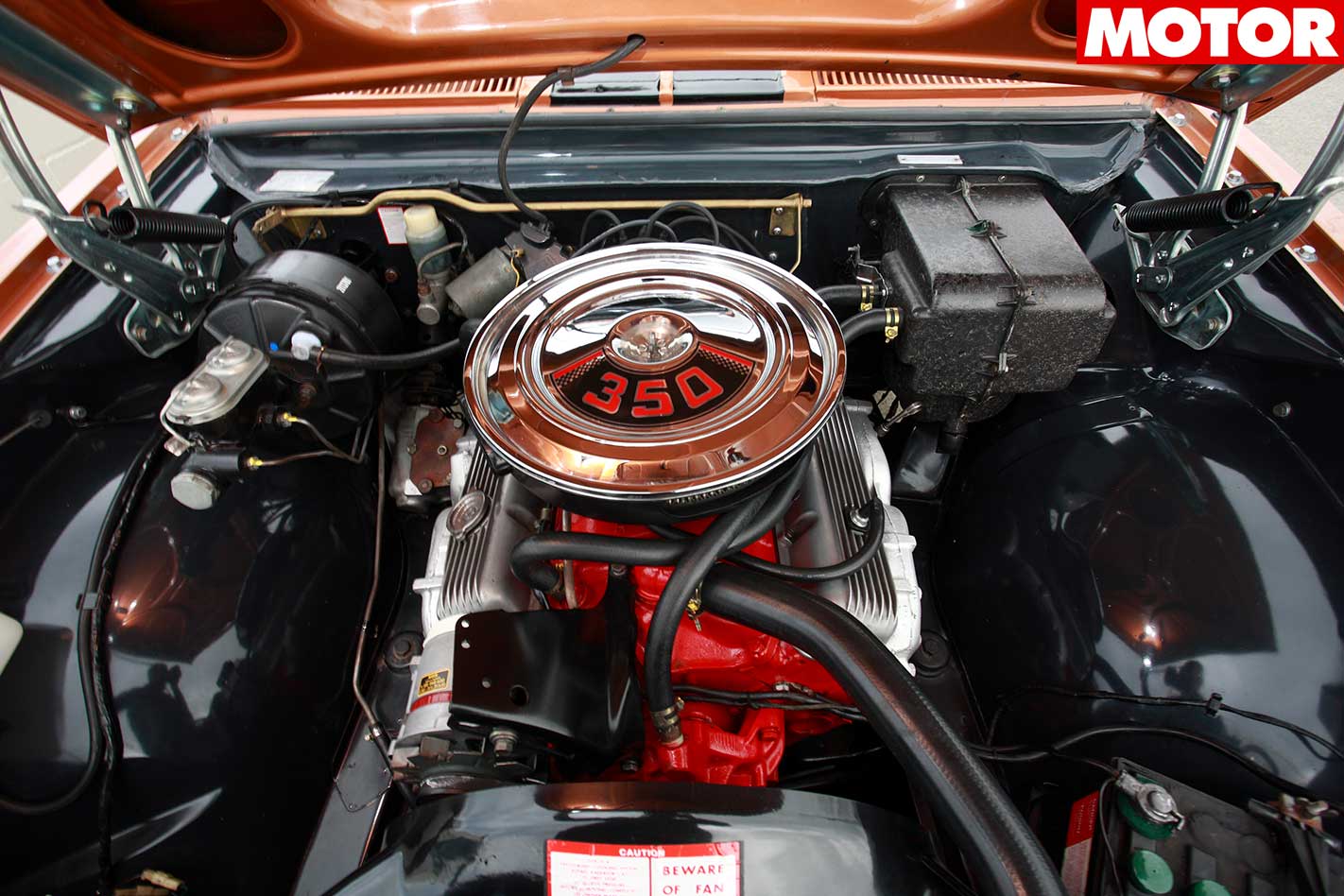
350 (5.7L) Debuted in 1969 HT, making the model the quickest of all GTS’ until the ’92 VP GTS.
304 (4.9L) First injected GTS mated solely to 4-speed auto in VP; EFI V8 debuted in 1988.
ENGINE: 4987cc V8, OHV, 16v POWER: 200kW @ 5200rpm TORQUE: 410Nm @ 3600rpm
5.7L Stroker Stroked version of Aussie 5.0-litre; used in VR/VS/VT Series I GTS and Senators.
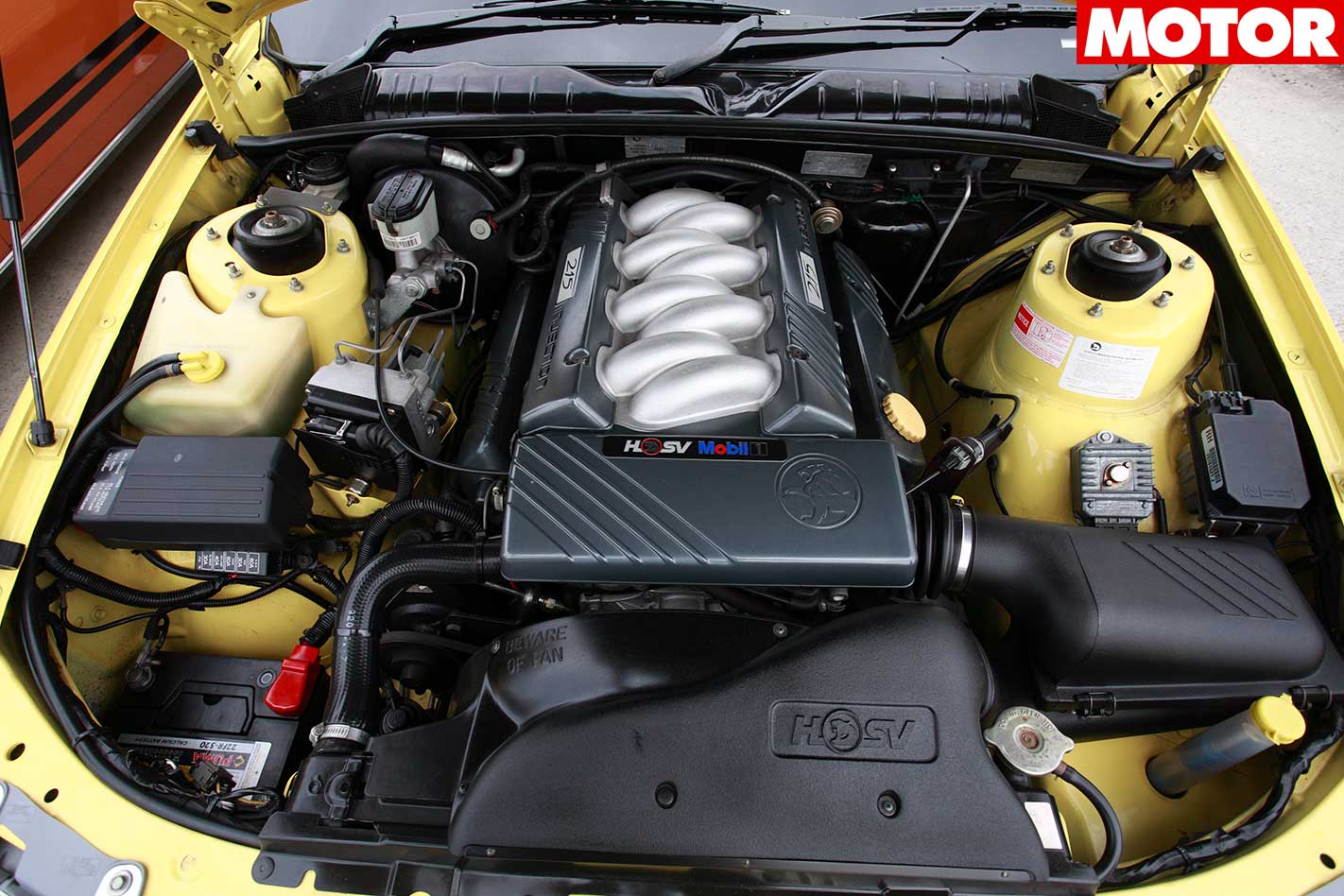
5.7L C4B Callaway-tuned, debuted with VTII in 2000; stronger and tougher than LS1.
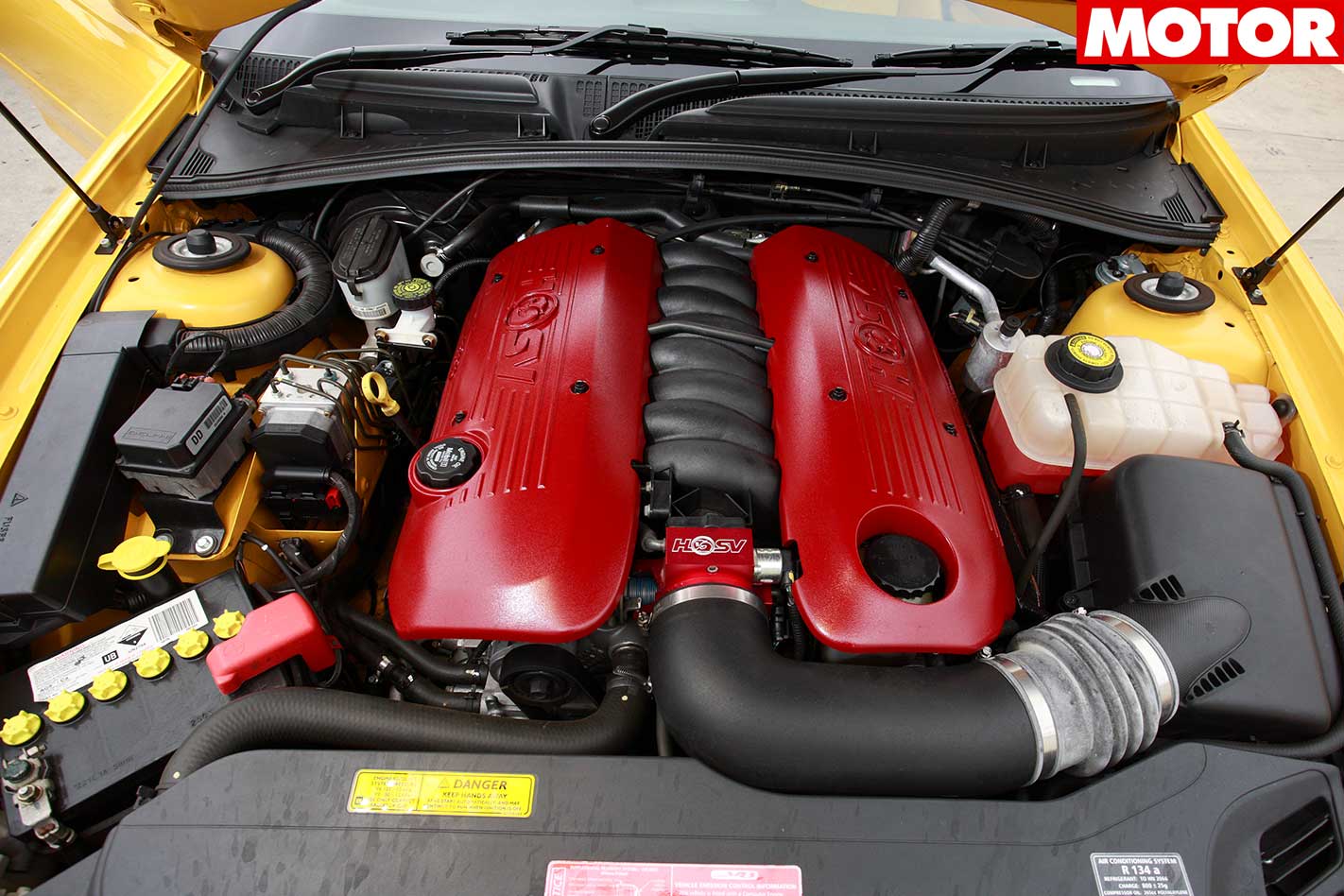
6.0L LS2 Debuted with E-Series; better bottom-end torque; is still in Holden’s current range.
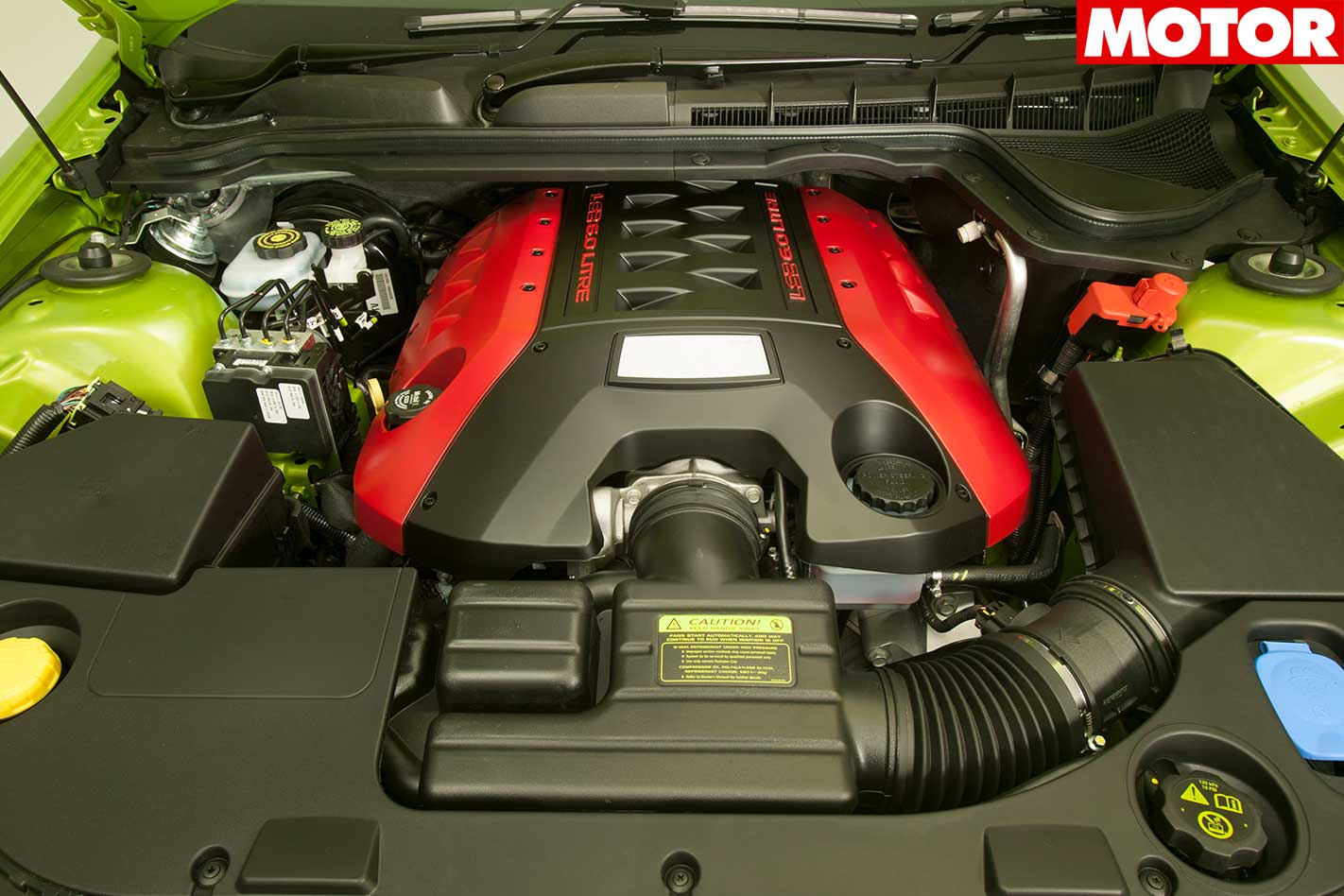
6.2L LS3 Debuted in 2008 Series II HSVs; more mid-range punch and an even better growl.
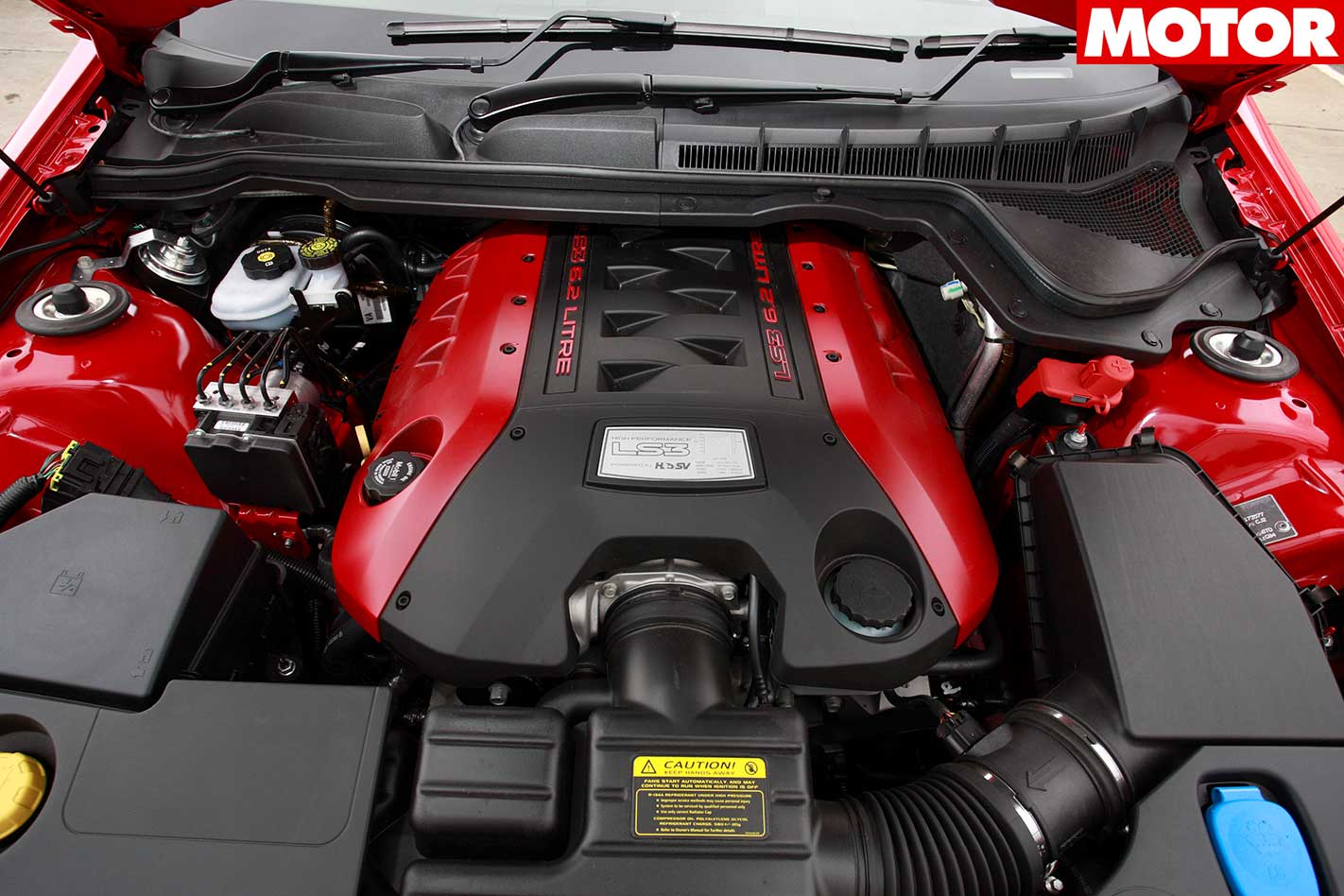
Humans are always seeking thrills in unlikely places.
Whether we’re being crushed in a mosh pit, flung out of an aircraft, plunging over a waterfall or simply sat in a dark room having the wits scared out of us while munching popcorn, as long as that heart rate is increased we’re happy.
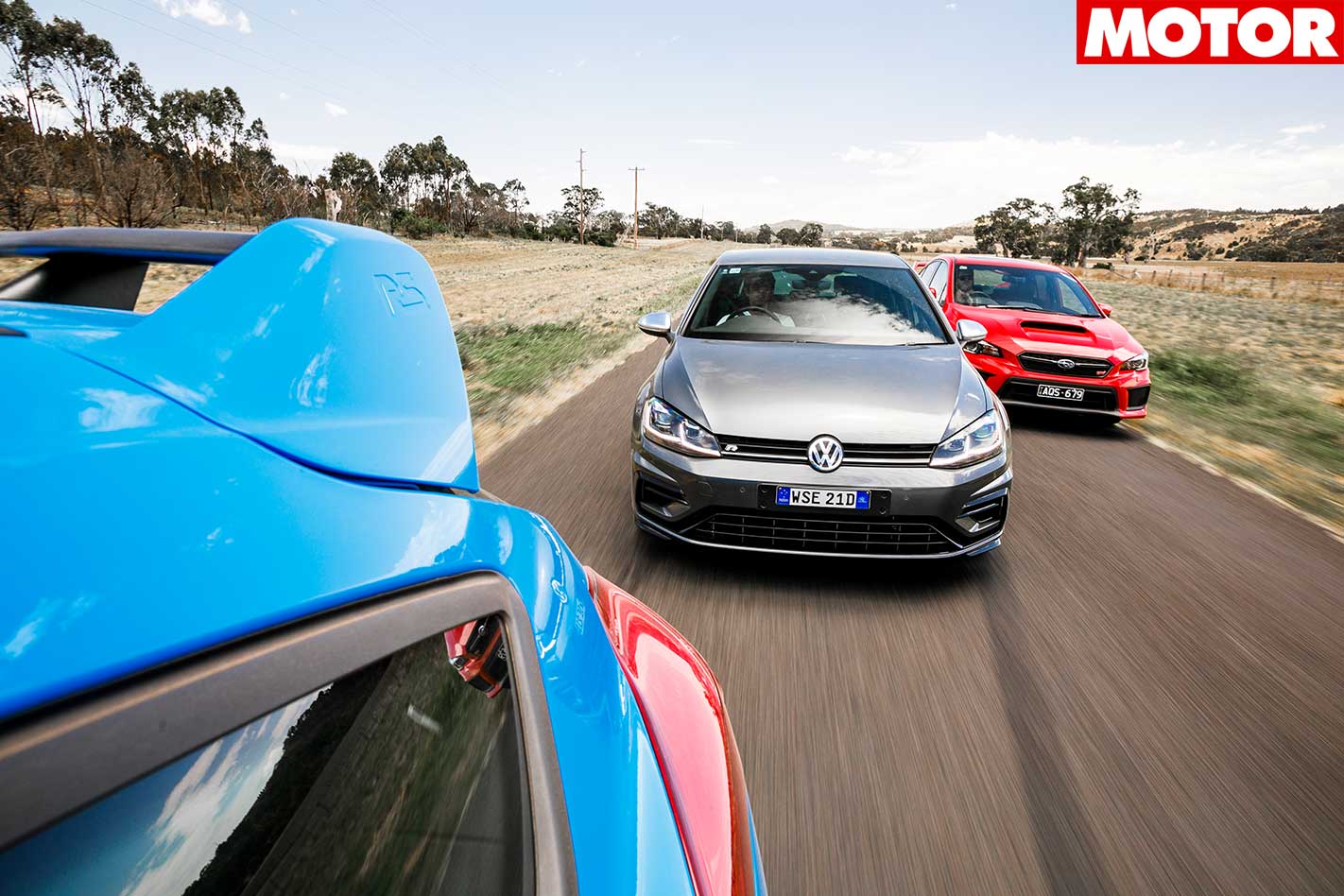
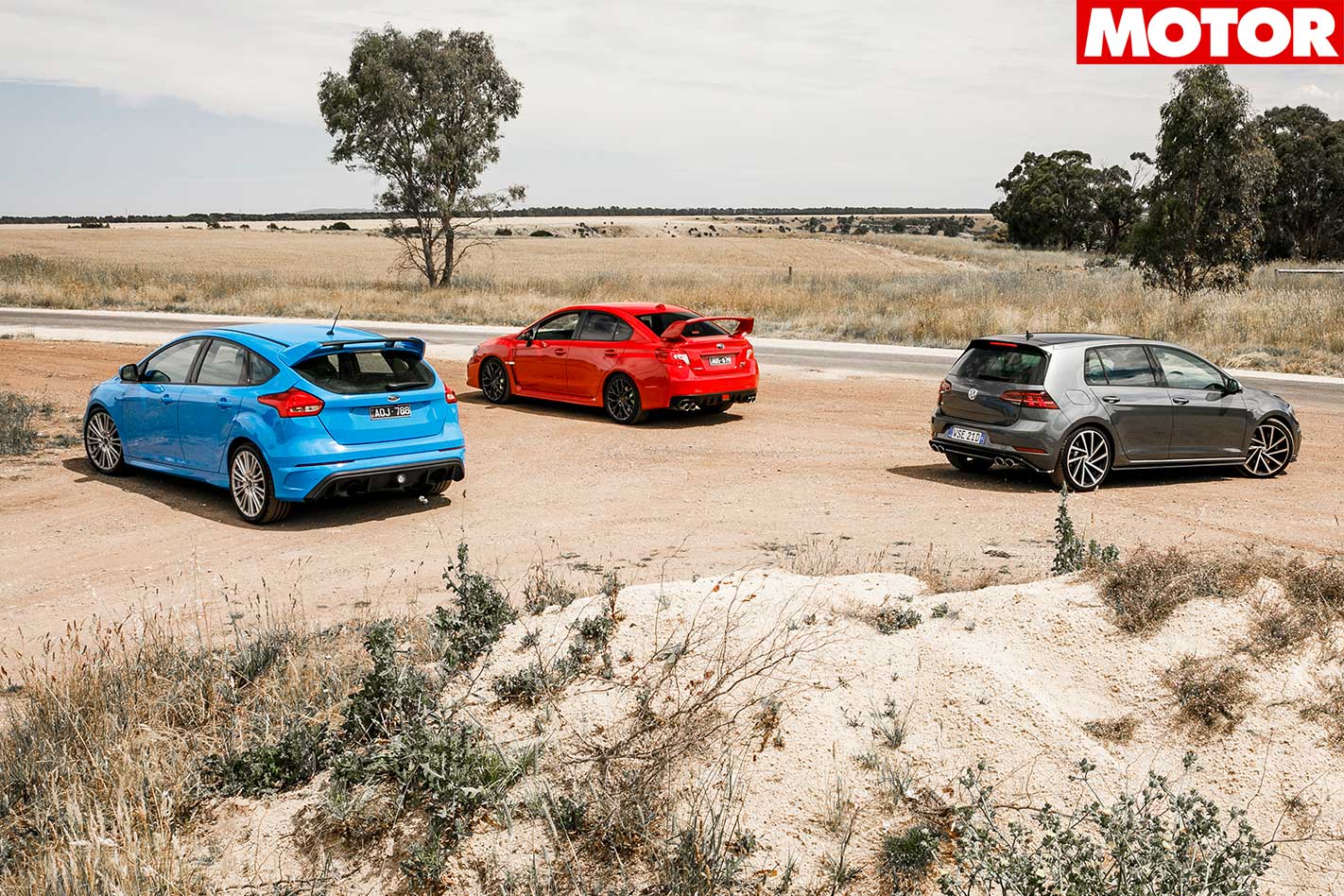
The Ford Focus, Subaru Impreza and Volkswagen Golf are equally weird places to search for a buzz. In standard form, their engines prioritise economy over power, their bodyshells swallow groceries better than they distribute weight and their prices are too small to justify serious engineering.
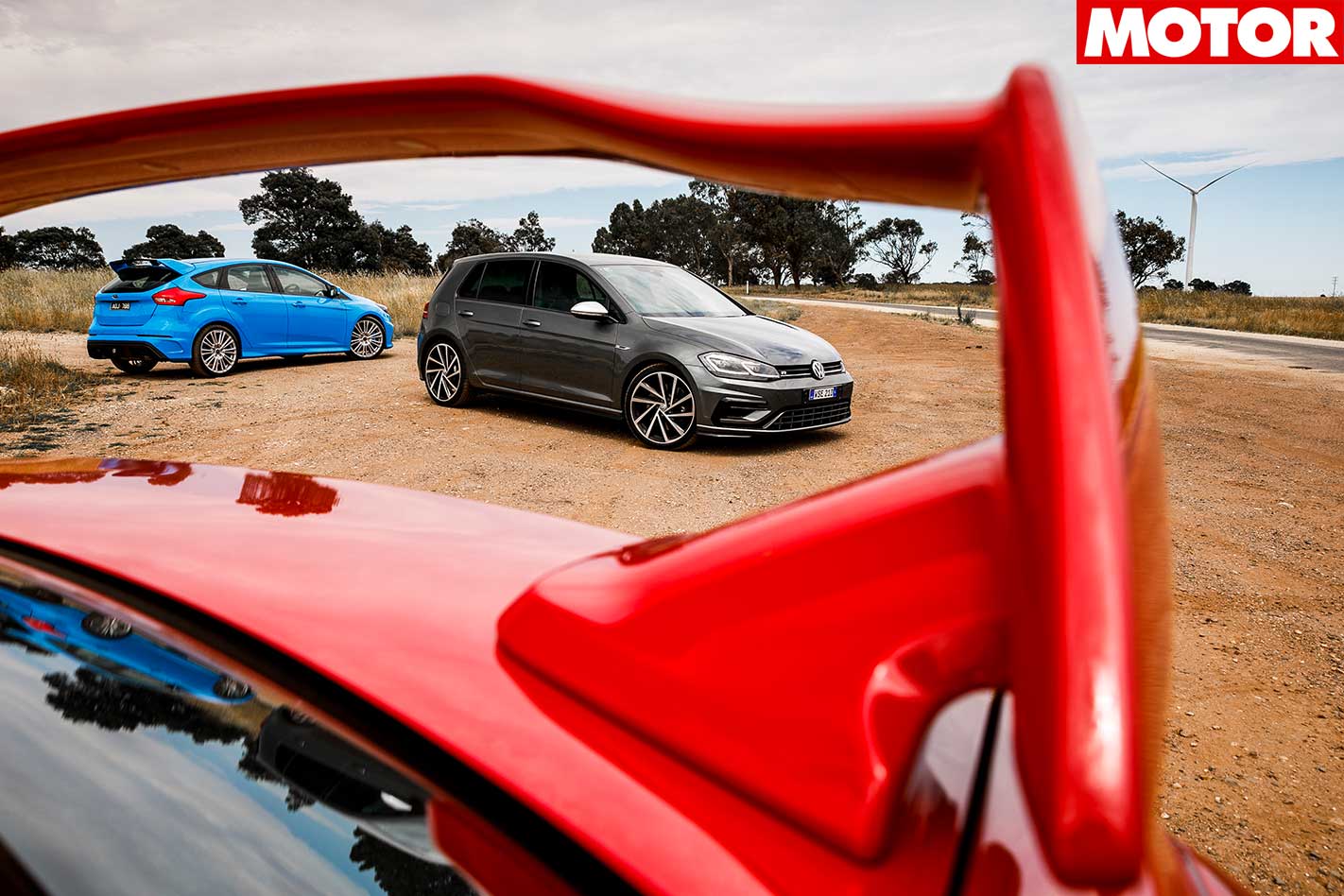
Virtually nothing could drop a well-driven STI on a tricky road. The Subie wasn’t the first turbo all-wheel drive weapon, but its success forced others to forge their own.
Ford’s third-generation Focus RS switched to four driven wheels with devastating effect, rolling into Performance Car of Year 2017 and blowing away three supercars to snatch third place. Before that, it beat the Volkswagen Golf GTI 40 Years and Mercedes-AMG A45 in a comparison where neither could match the RS’s involvement and handling genius.
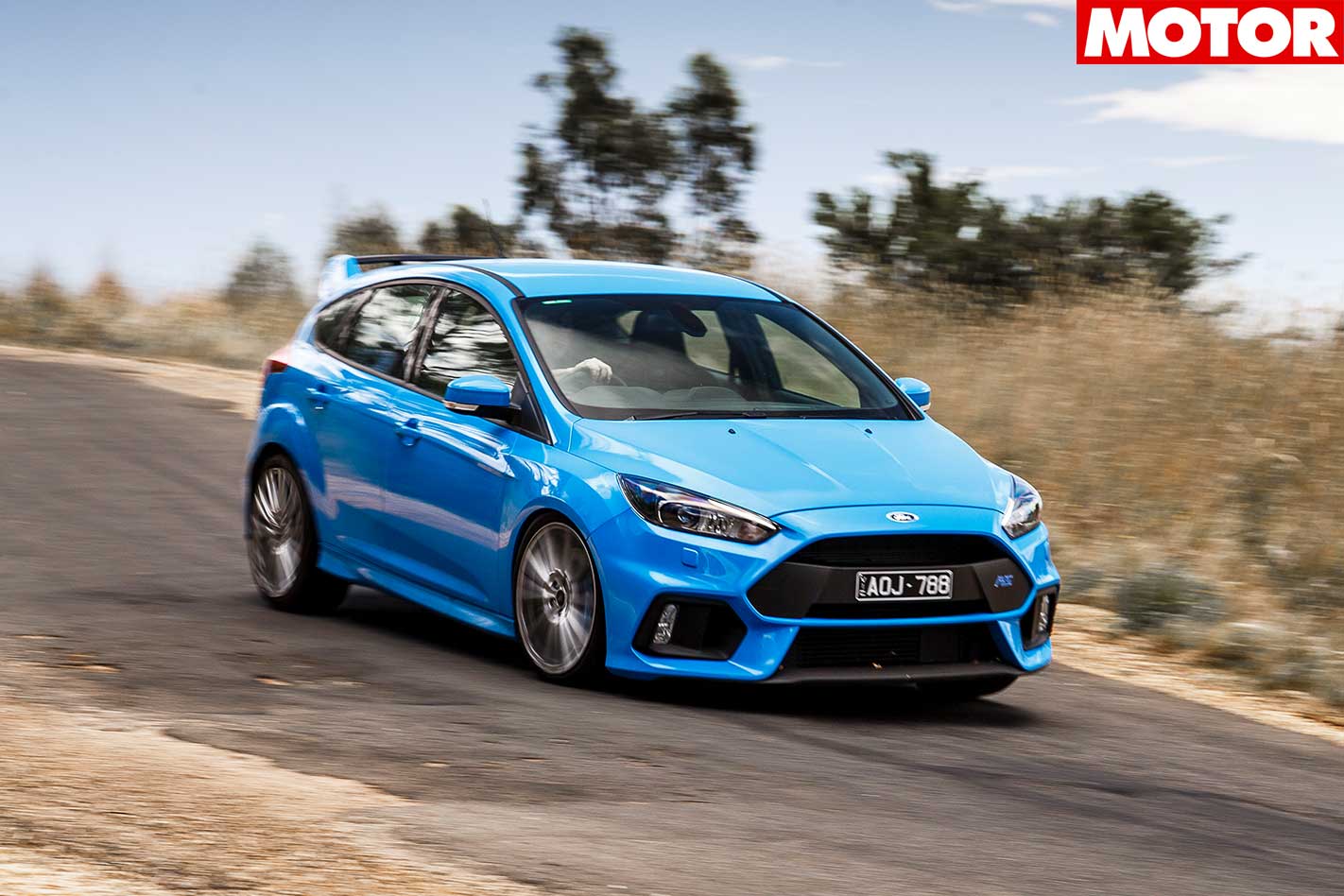
This inflates the LE’s price to $56,990, but because Ford didn’t have one available, we’ve snaffled the standard $50,990 RS with the LE’s Michelin Sport Cup 2 tyres instead. It arrives in Nitrous Blue, the only colour now available.
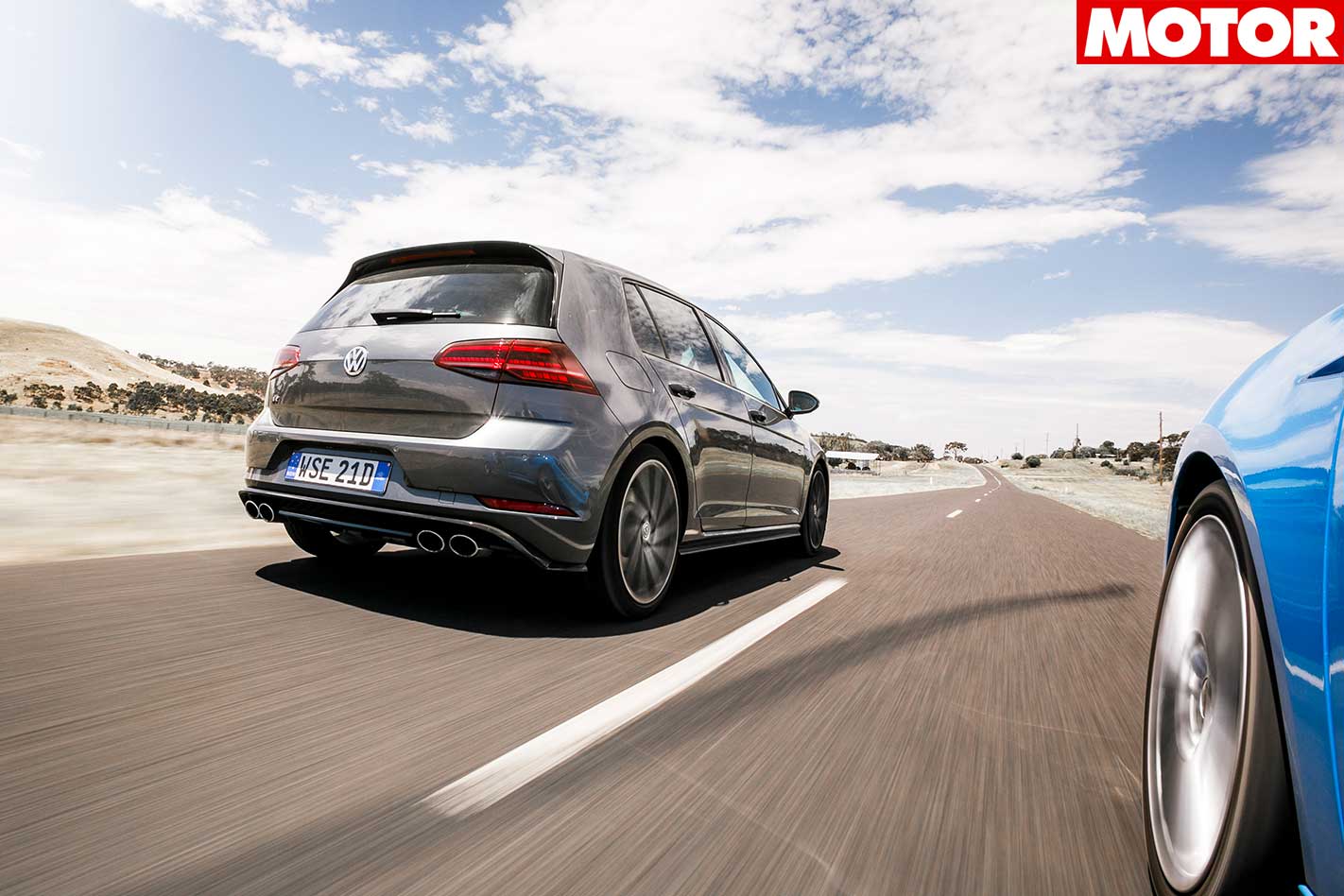
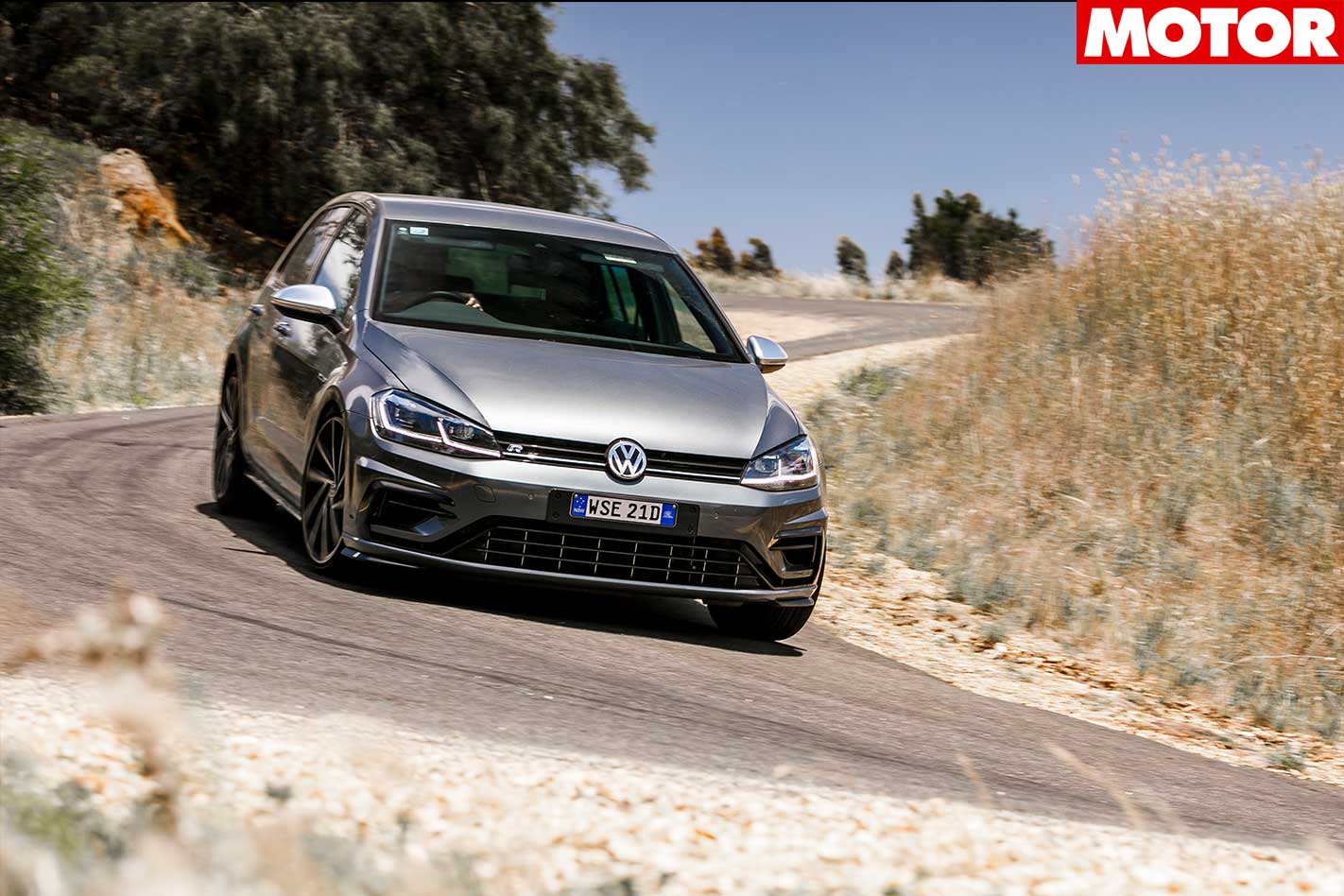
For the rematch the limited-edition Golf GTI 40 Years has tagged in its big brother, the R, which transfers the clutch-locking Haldex differential from the front axle to the propshaft for a better chance at slaying the RS.
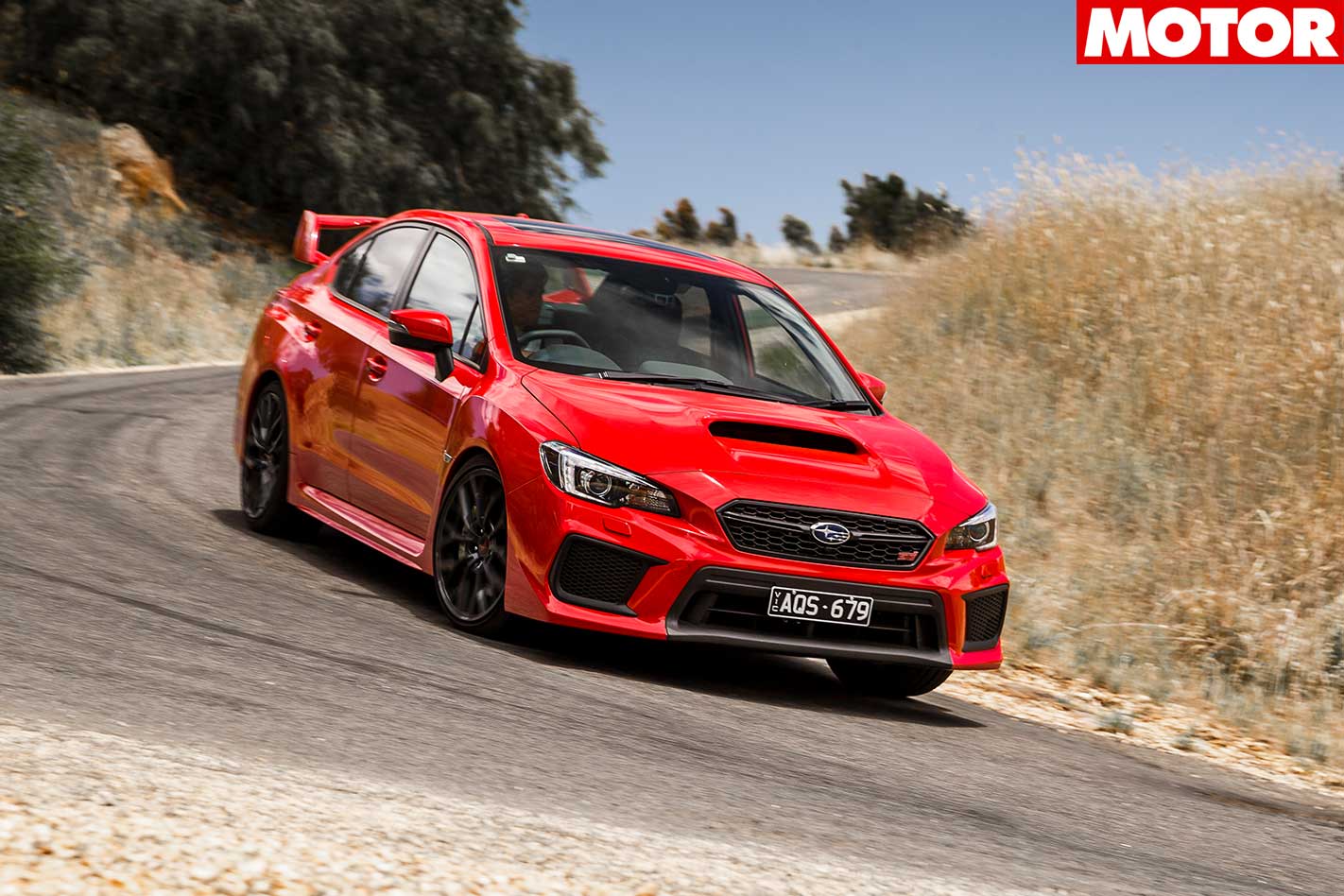
Speaking of previous BFYB champs, the WRX STI used to be virtually purpose-built for the award, but the receipe’s been the same for a while now. Subaru dropped the Impreza nameplate, allowing the base car to move on a generation. Meanwhile, the standard WRX has adopted the company’s new FA-series engine with a more logical low-mount turbocharger.
The largest revision made to the STI was in 2014 when Subaru flipped the location of the clutch and front differential, stretching the wheelbase 25mm. The budget clearly wasn’t huge for the 2018 version, but worthwhile changes have still been made.
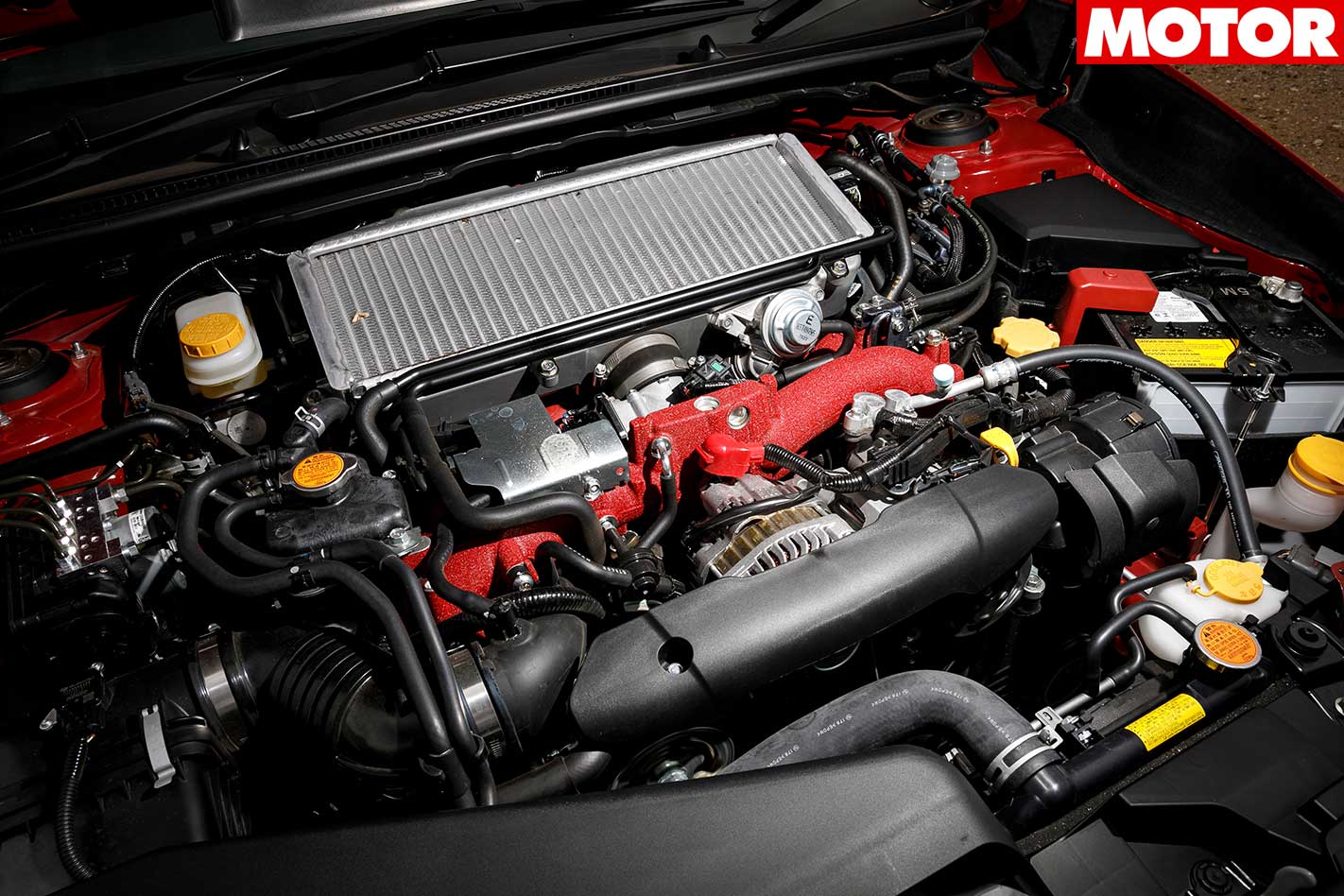
Under the bonnet is the same 2.5-litre boxer four that’s propelled the car’s last three generations. It’s far from the latest and greatest – the port-injected unit offers the same 221kW and 407Nm it did a decade ago – but still splits the other two on the spec sheet.
The Golf R’s revised EA888 inline-four features unique pistons, dual-injection and variable valve lift and has spiked 7kW. This takes European engines to 228kW/400Nm, but our crappy fuel and searing temps smother the 2.0-litre’s full potential, capping numbers at 213kW and 380Nm.
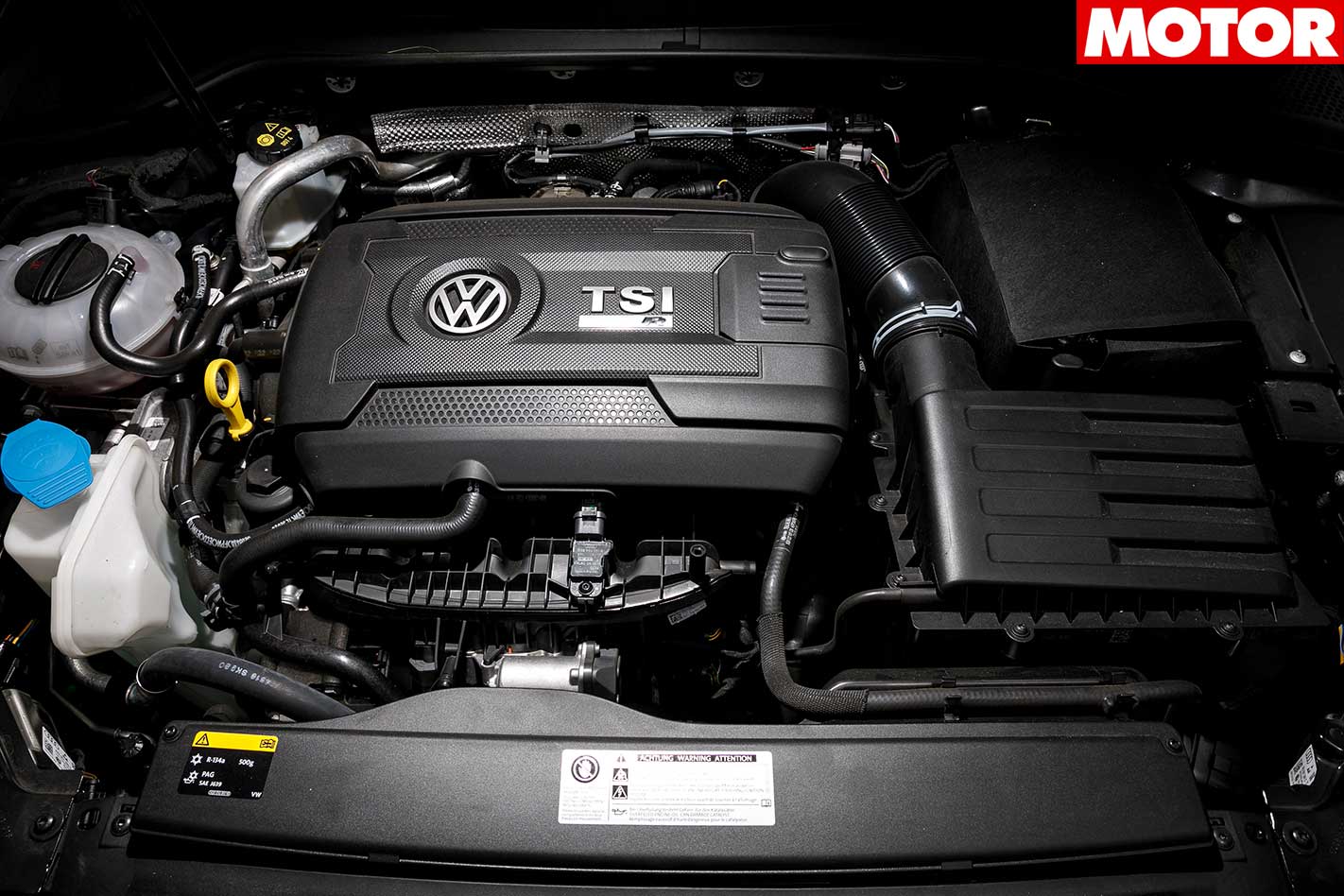
The Focus doesn’t shout about this advantage, at least from the inside. The starter button treats bystanders with a raspy growl that carries a hint of WRC car, but it’s a bit lost in the cabin.
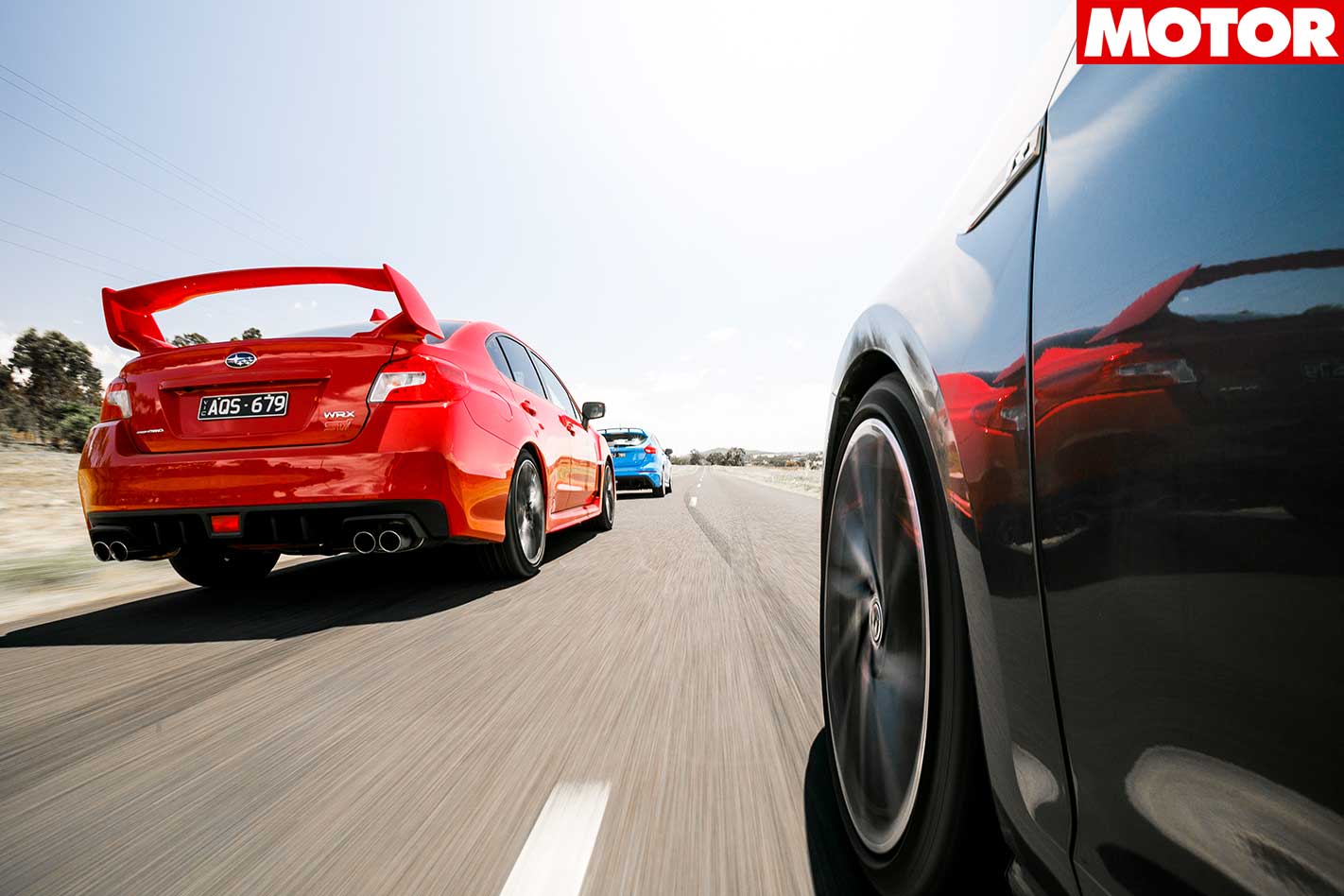
There’s no such problem in the Subaru. It settles into a deep, bassy throb loud enough to charm the fussiest boxer fan, inside or out, though early-risers who want to retain an invite to their neighbour’s BBQ should look to the Golf. The gruff note played by its quad tips isn’t meek or lacking intent, just more sensible in this company.
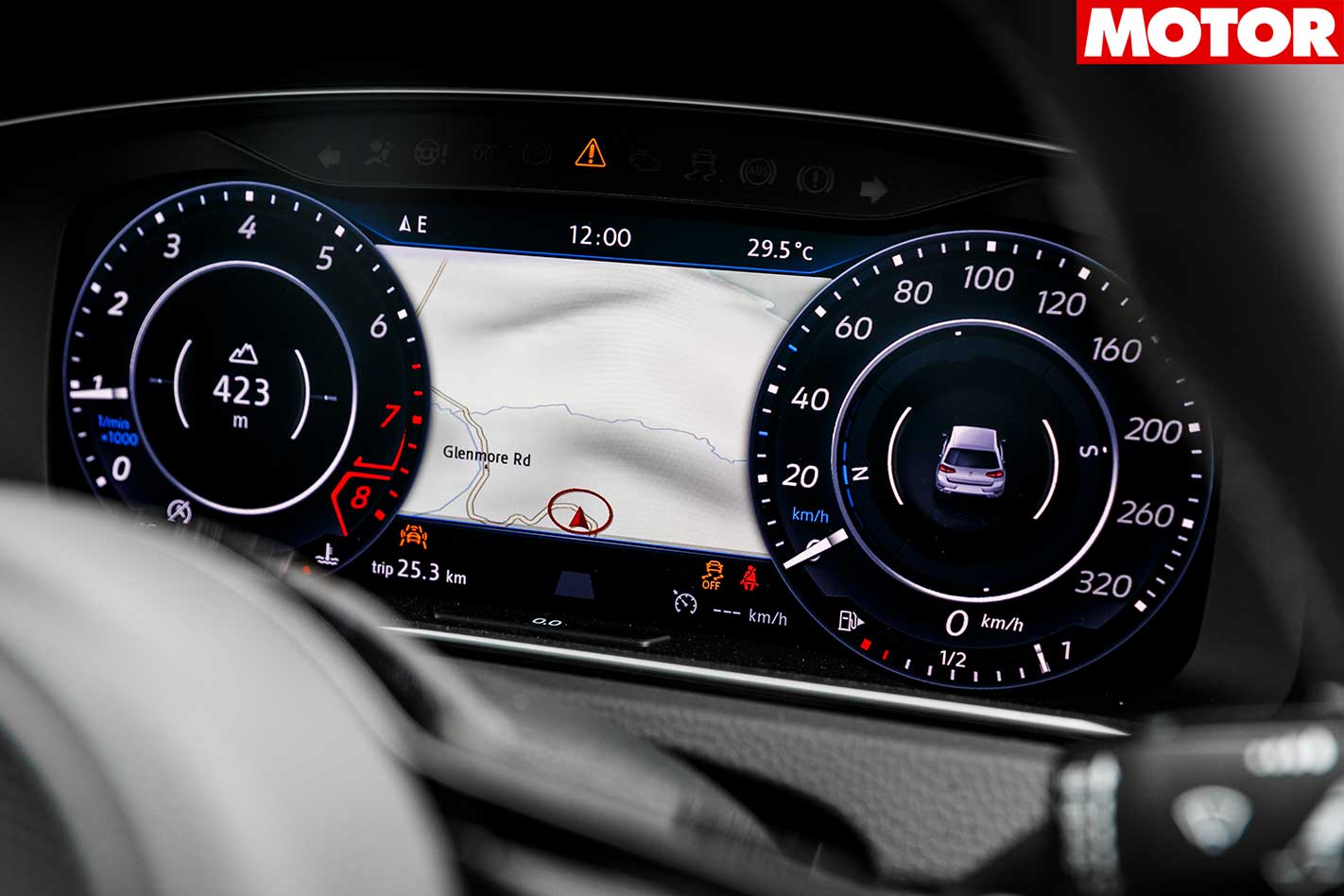
Launch control doesn’t lurk in these sub-menus, though. Because our Golf R packs a six-speed manual to match its rivals, your feet are in charge. Select Race mode, disable ESP, and pin the clutch to select first gear. Half-throttle has the needle hovering about 3750rpm, where you should briskly drop the clutch.
Volkswagen’s new seven-speed dual-clutch would fling the R from rest with more fluency. But once engine and wheel speeds match, you surf a creamy, linear powerband that stretches from 3000rpm to redline. The 2.0-litre unit loves to rev more than its undersquare dimensions hint, even though it stops at 6750rpm – short of the indicated cut-out on its fancy new 8.0-inch digital cluster.
The STI requires brutality, though; it needs as many revs as possible to overcome three limited-slip differentials, so stepping off the clutch is like plunging the lever connected to a dynamite stack. Try to launch at anything less than redline and the Subaru hops, bogs, and falls out of its tightly-packed powerband.
Thank the engine’s high boost pressure and low compression ratio for its slug of thrust, which swells at about 3000rpm. Once the turbo wakes up it’s like the car’s chained to a passing bullet train and the slack’s suddenly run out. The thrust fades near 6000rpm, but the boxer’s oversquare dimensions spin the crank so fast it’s easy to reach the 6700rpm redline.
Drop the clutch and the revs land nicely in a torque crest, which reels you into the engine’s mid-range. It’s here the Focus RS channels its predecessor’s five-banger vibe, its 2.3-litre engine feeling half-a-litre larger than it is. The engine bay’s sound-pipe injects a hint of warble into the cabin, too, for those missing the old soundtrack.
Second gear will kiss 100km/h, but the Focus engine’s drawcard is its 204Nm-per-litre specific output (on overboost), which towers above the Golf’s 190Nm per litre, and the Subaru’s 163Nm. Attempting to channel 440Nm through the front boots in the last RS is undoubtedly why Ford summoned AWD.
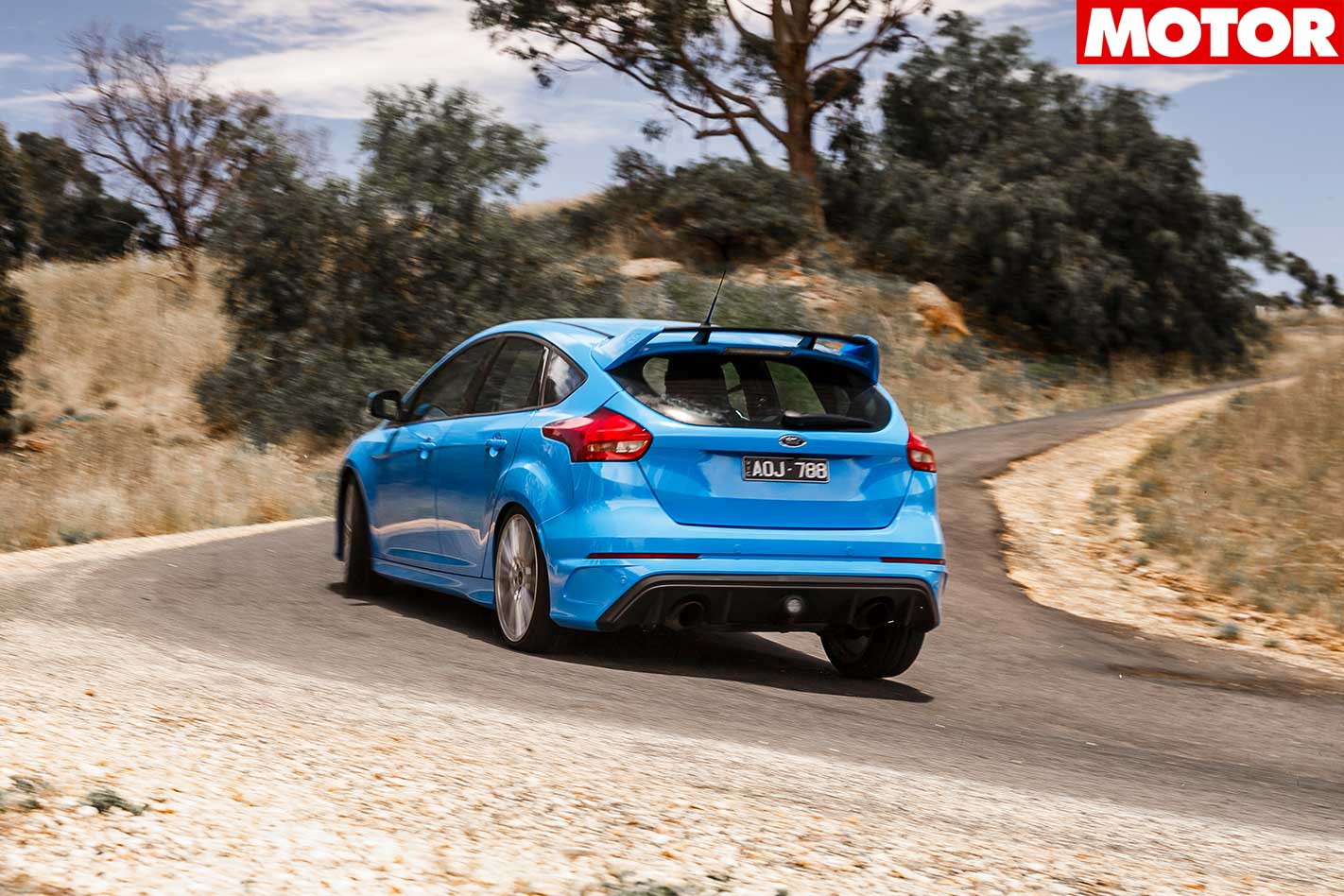
Super-quick steering helps. The electrically-assisted rack might feel slightly elastic and simulated, but its solid weight and accuracy are reassuring, especially after blasting the Subaru across bumpy surfaces. It’s like different engineering teams worked on the STI’s front and rear suspension and never shared notes.
Switching to the Golf R on these roads is like finding the right frequency on the radio. There’s no more harshness, noise, or vibration. We expected more suspension travel and the rear axle jumps a touch in Comfort mode, but switch into Race and the chassis is supple yet adjustable, with expertly tuned variable steering that feels linear. It’s super sharp, well weighted, and the easiest to handle.
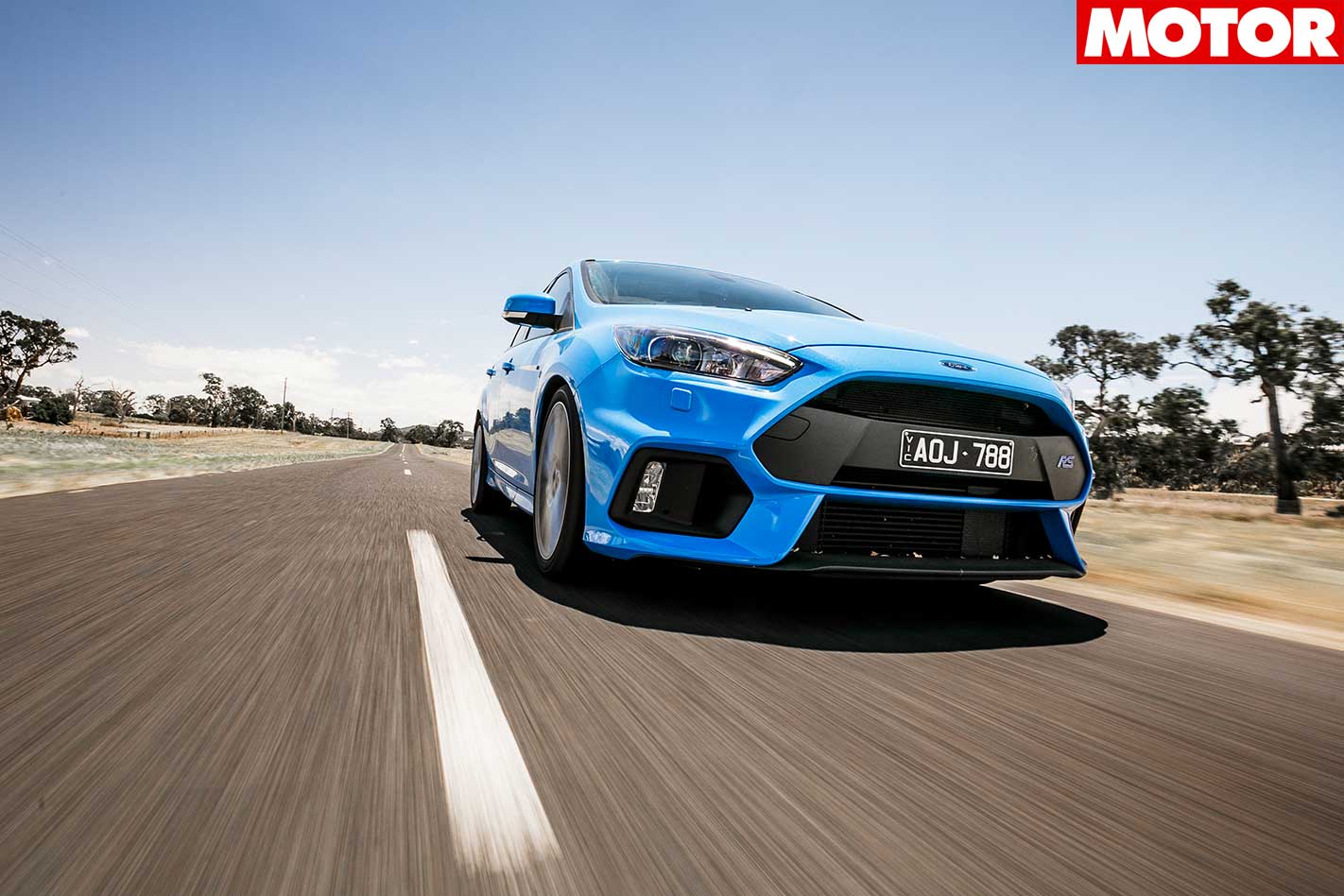
Where confidence evaporates in the STI and plateaus in the Golf, it blooms in the Focus RS. Yes, it has stiff damping and spring rates, and the damper’s Sport mode is strictly for a racetrack if you value your teeth, but the RS attacks shoddy roads that are dusty, off-camber, and downhill with the composure of Roger Federer on match point.
Smoother tarmac lets the Subaru shine. While you can’t adjust the suspension, you can adjust the lock-up of the centre-diff. Leave it open for more agility, lock it up for more traction, but really it’s best left to its own devices in Auto.
The Golf’s all-wheel drive technology pales next to the others, relying on its single-piston brake calipers to shuffle torque from side to side. It doesn’t fire off corners like the WRX or pivot like the RS, however, its Pirellis never protest under power, its circuitboards clearly knowing how to best distribute its 380Nm.
The clutch has a firm spring, and the bite point is brief, but it oozes mechanical charm. The Focus’s is the most involving device, with a slick, long throw and more purposeful knob design. But a non-linear clutch feel spoils ultimate refinement. We’d match the Golf’s clutch feel to the RS’s shift action for the ideal setup.
Subaru’s made a clear effort to push the WRX STI into premium territory with the Spec R. It’s replaced the foggies with swivelling headlights, moved the rear wing to the options list, and installed electrically-adjustable Recaros.
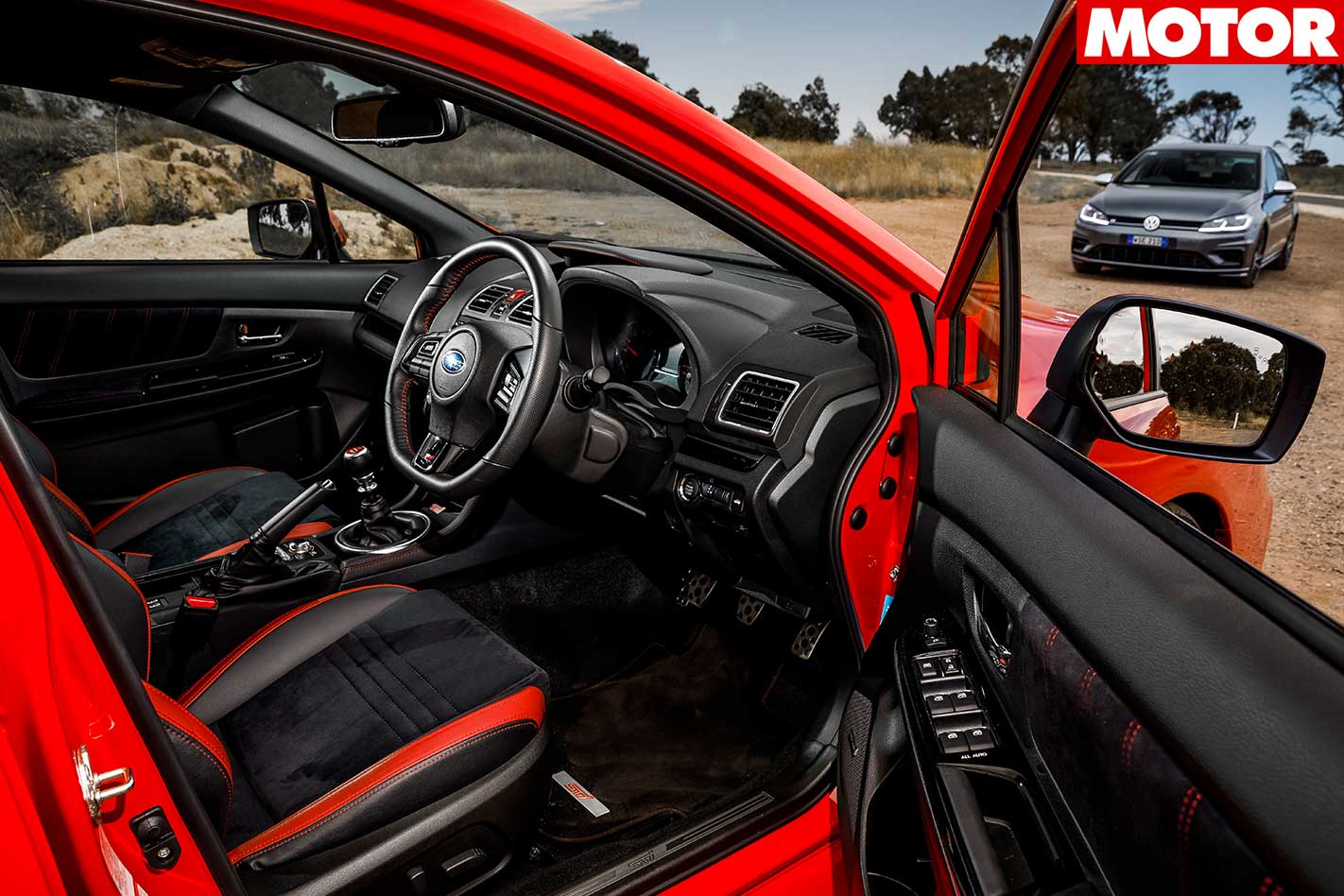
Bolt-ons won’t fix the STI’s problem. Yes, it offers huge performance, the all-wheel drive system deploys furious power with ease and its new brakes can pop your eyes out with their power. But it lacks the compliance and solid steering to play these tricks on any road surface. The engine’s also over a decade old and while some might like its explosive nature, it sorely needs its power curve ironed out.
fast on the (spec) sheets with MOTOR Reviews
Best to leave luxury to Volkswagen’s golden child. The Golf R’s updated cabin brims with technology and brilliant build quality. The seats hug better than the STI’s and it steers with clarity and plushness at no expense to its speed.
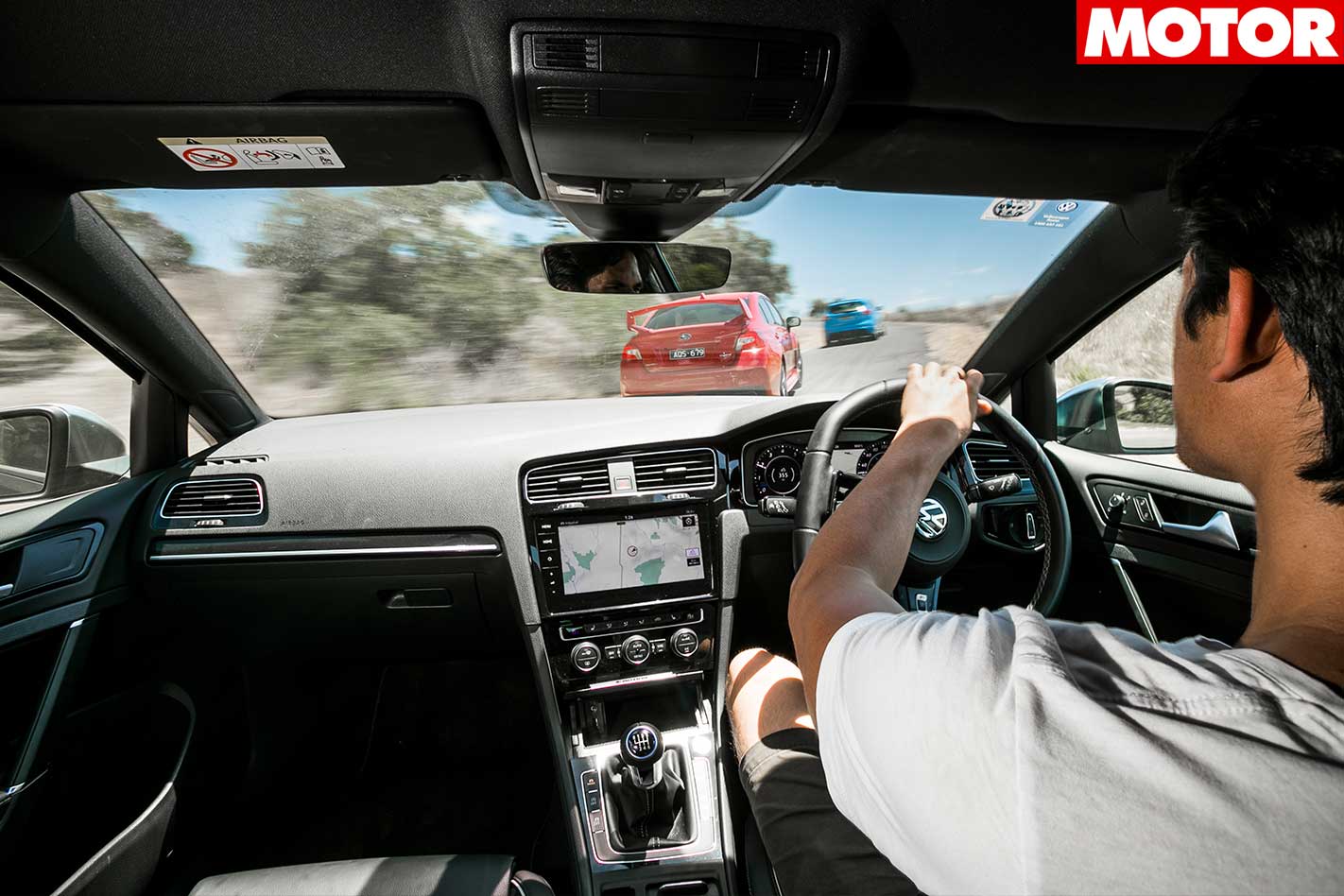
However, while we expected the Golf to school its track-focused competition on ride composure, it failed to master the bumps. Maybe the Mk VIII R coming in a couple years will bring even better damping and an engine that can max out in our conditions. These are, admittedly, among the worst surfaces we’ve ever used, but this rough terrain is what hot hatches and WRX STIs must rule.
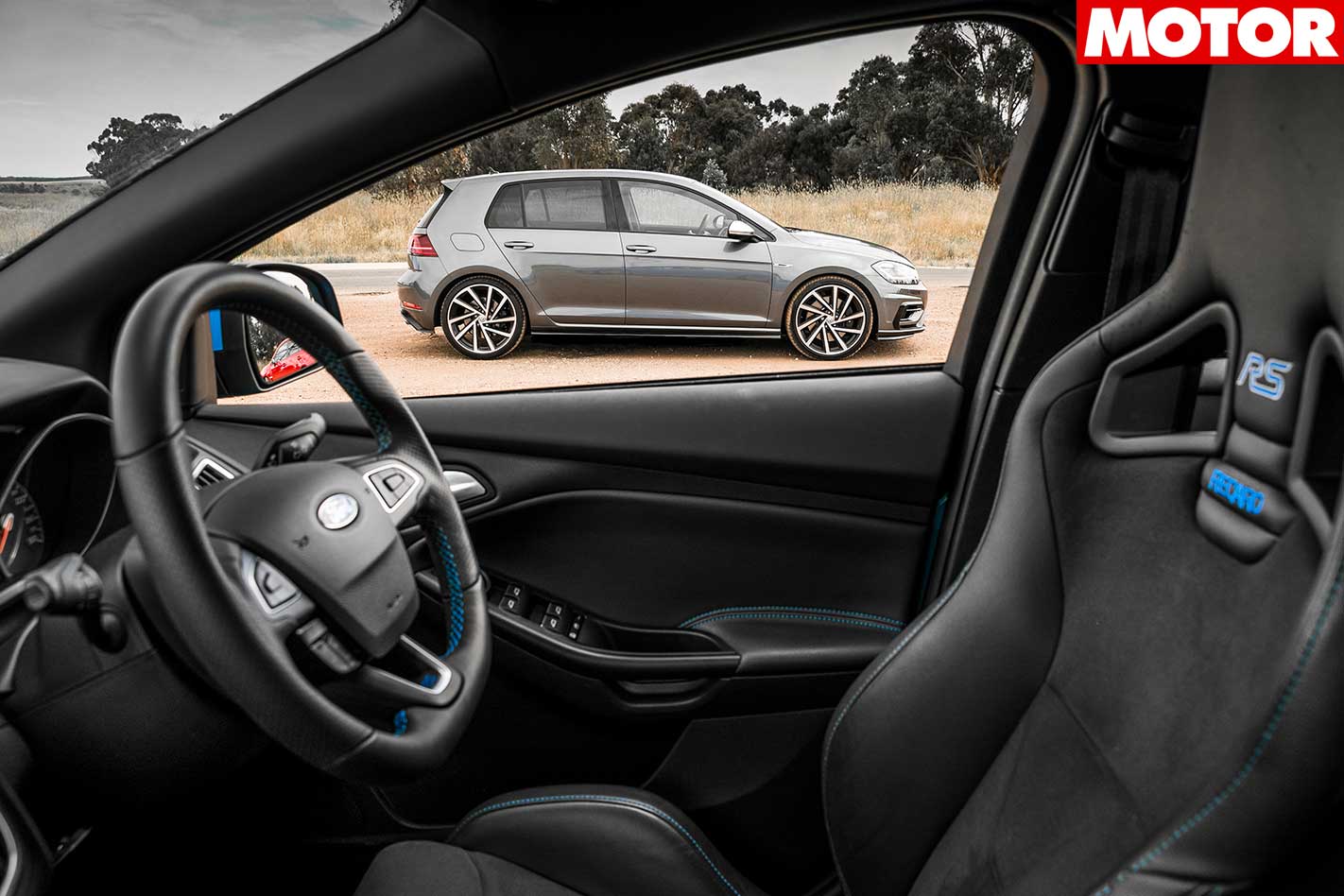
And the Ford Focus RS does rule. Its interior might resemble a melted Nokia omelette, and its ride is challenging, but when you slide into its wonderfully grabby seats it’s like dropping the visor on Sebastien Ogier’s helmet.
FAST FACTS
| u00a0 | 2018 Ford Focus RS | 2018u00a0Subaru WRX STI | 2018 Volkswagen Golf R |
| BODY | 5-door, 5-seat hatch | 4-door, 5-seat sedan | 5-door, 5-seat hatch |
| DRIVE | all-wheel | all-wheel | all-wheel |
| ENGINE | 2261cc inline-4cyl, DOHC, 16v, turbo | 2457cc boxer-4cyl, DOHC, 16v, turbo | 1984cc inline-4cyl, DOHC, 16v, turbo |
| BORE/STROKE | 87.6 x 94.0mm | 99.5 x 79.0mm | 82.5 x 92.8mm |
| COMPRESSION | 9.4:1 | 8.2:1 | 9.3:1 |
| POWER | 257kW @ 6000rpm | 221kW @ 6400rpm | 213kW @ 5400-6000rpmu00a0 |
| TORQUE | 440Nm @ 2000-4000rpm (470Nm on overboost) | 407Nm @ 4000rpm | 380Nm @ 1850-5300rpm |
| WEIGHT | 1524kg | 1572kgu00a0 | 1429kg (1450kg auto) |
| POWER/WEIGHT | 168kW/tonne | 141kW/tonne | 149kW/tonne |
| TRANSMISSION | 6-speed manual | 6-speed manual | 6-speed manual |
| SUSPENSION (front) | struts, adaptive dampers, anti-roll bar | struts, coil springs, anti-roll bar | struts, adaptive dampers, anti-roll bar |
| SUSPENSION (rear) | multi-links, adaptive dampers, anti-roll bar | A-arms, dampers, anti-roll bar | multi-links, adaptive dampers, anti-roll bar |
| L/W/H | 4390/1823/1472mm | 4595/1795/1475mm | 4263/1799/1436mm |
| WHEELBASE | 2648mm | 2650mm | 2626mm |
| TRACKS | 1547/1524mm (f/r) | 1540/1530mm (f/r) | 1537/1511mm (f/r) |
| STEERING | electrically-assisted rack-and-pinion | hydraulically-assisted rack-and-pinion | electrically-assisted rack-and-pinion |
| BRAKES (front) | 350mm ventilated discs, 4-piston calipers | 340mm vented/drilled discs, 6-piston calipers | 340mm ventilated discs, single-piston calipers |
| BRAKES (rear) | 302mm solid discs, single-piston calipers | 326mm vented/drilled discs, 2-piston calipers | 310mm ventilated discs, single-piston calipers |
| WHEELS | 19.0 x 8.0-inch (f/r) | 19.0 x 8.5-inch (f/r) | 19.0 x 8.0-inch (f/r) |
| TYRE SIZES | 235/35 ZR19 91Y XL (f/r) | 245/35 R19 89W (f/r) | 235/35 R19 91Y (f/r) |
| TYRE | Michelin Pilot Sport Cup 2 | Yokohama Advan Sport V105 | Pirelli P Zero |
| PRICE | $50,990 | $56,682 | $52,990 |
| PROS | Handling genius; response; involvement | Grip; visibility; brakes | Classy; punchy; sleek looking; sharp steering |
| CONS | Ride; torque steer; crappy interior | Ride; steering kickback; power curve | Forward vision; damping finesse |
| RATING | 4.5 out of 5 stars | 3 out of 5 stars | 4 out of 5 stars |
THE NUMBERS
| u00a0 | Focus RS | WRX STI | Golf R |
| 0-100km/h (sec) | 5.04 | 5.49 | 5.2* |
| 400m | 13.08sec (173.82km/h) | 13.62sec (164.78km/h) | 13.5sec** |
*claimed **estimated
