
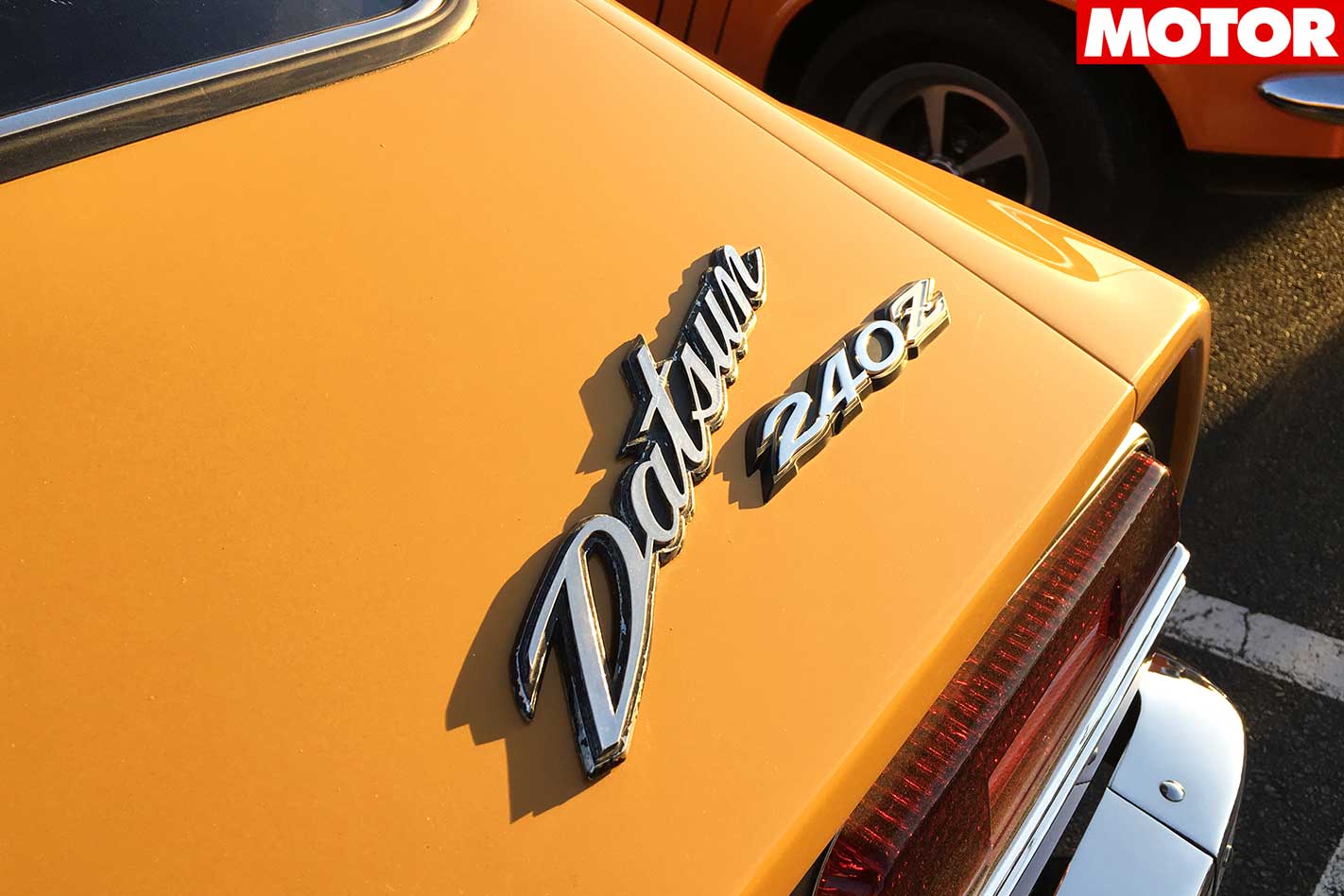
Normally you wouldn’t associate a Datsun with a performance car publication like MOTOR, but this is no ordinary Datsun.
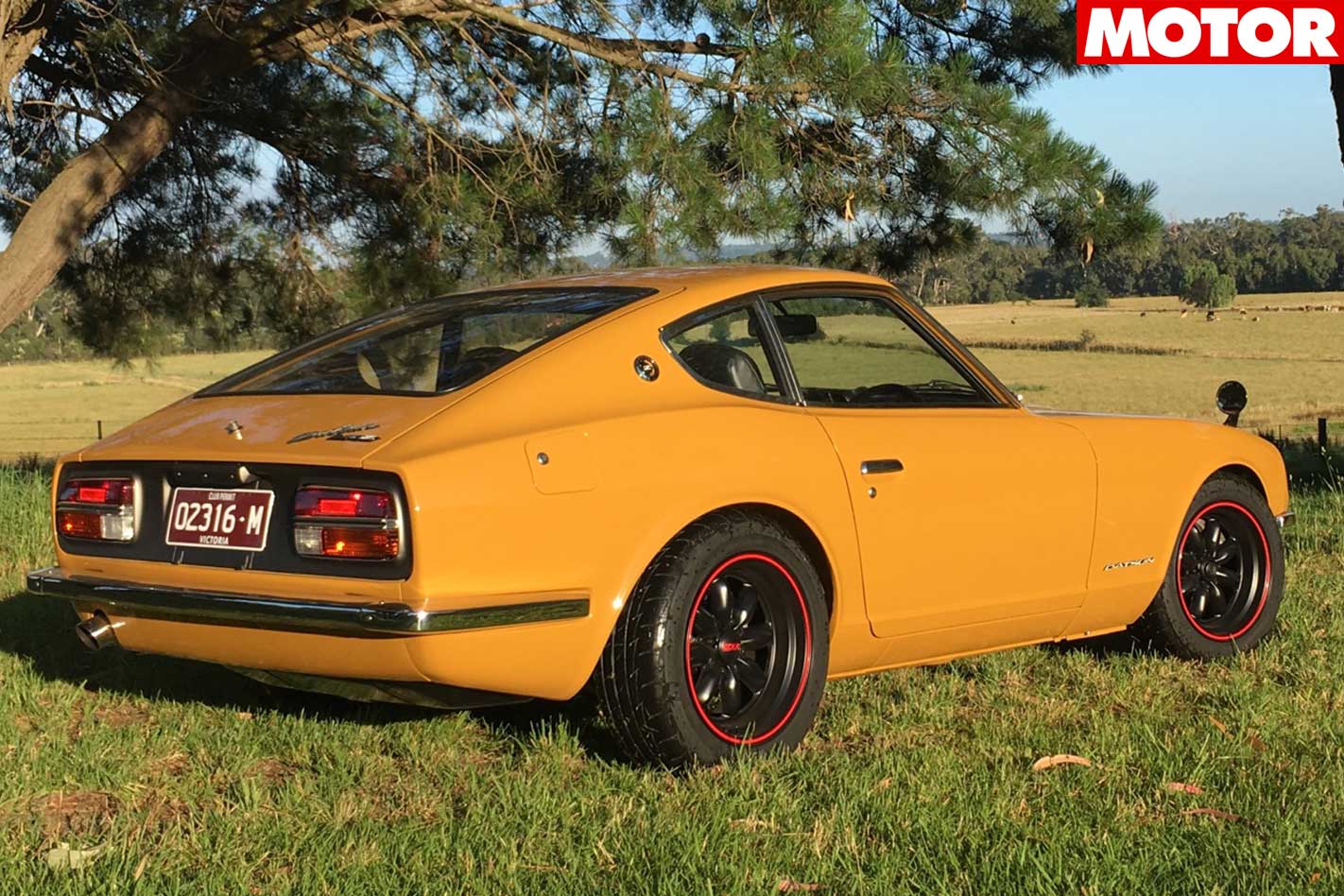
This ‘70s classic has been given the resto-mod treatment over the course of seven years by its owner, David Fettell.
He’s a qualified motor mechanic by trade, who has a lot of experience swapping engines for personal projects.
“I’ve done quite a few conversions in the past, but a lot of them were with carburettor-fed V8s,” David tells MOTOR.
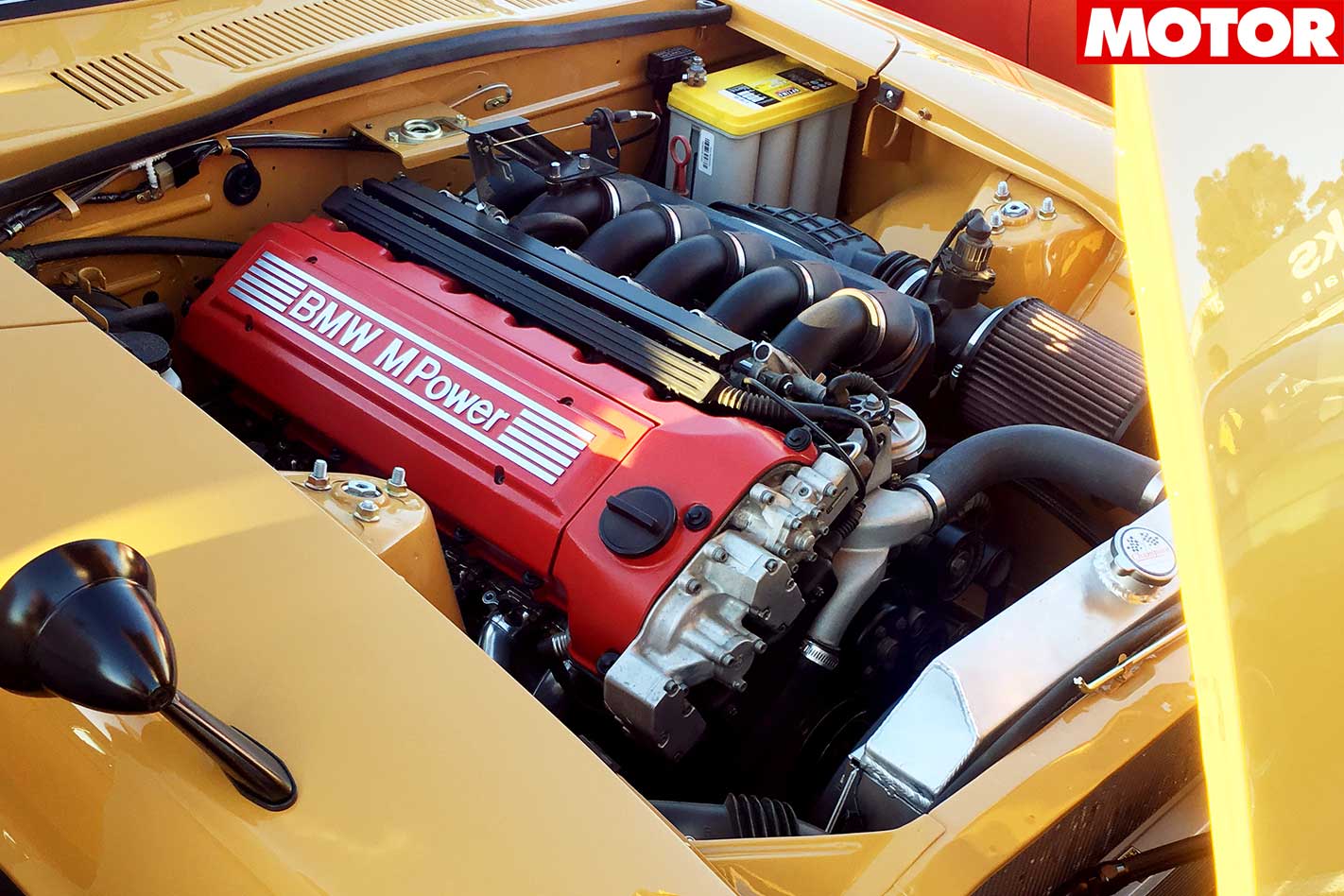
The M3 engine is the dual-Vanos equipped ‘Evolution’ version, which puts 239kW though the manual gearbox. In a 1080kg car.
“The engine choice came when I was working with Castrol. We were partnered with BMW… and we had access to a BMW experience day at Phillip Island.”
That’s when he first felt the M3’s engine at work, and knew he wanted to put one into something with a classic look.
He says he kept returning to the idea of using a Datsun 240Z or 260Z as the transplant recipient, and it worked out better than you might have expected.
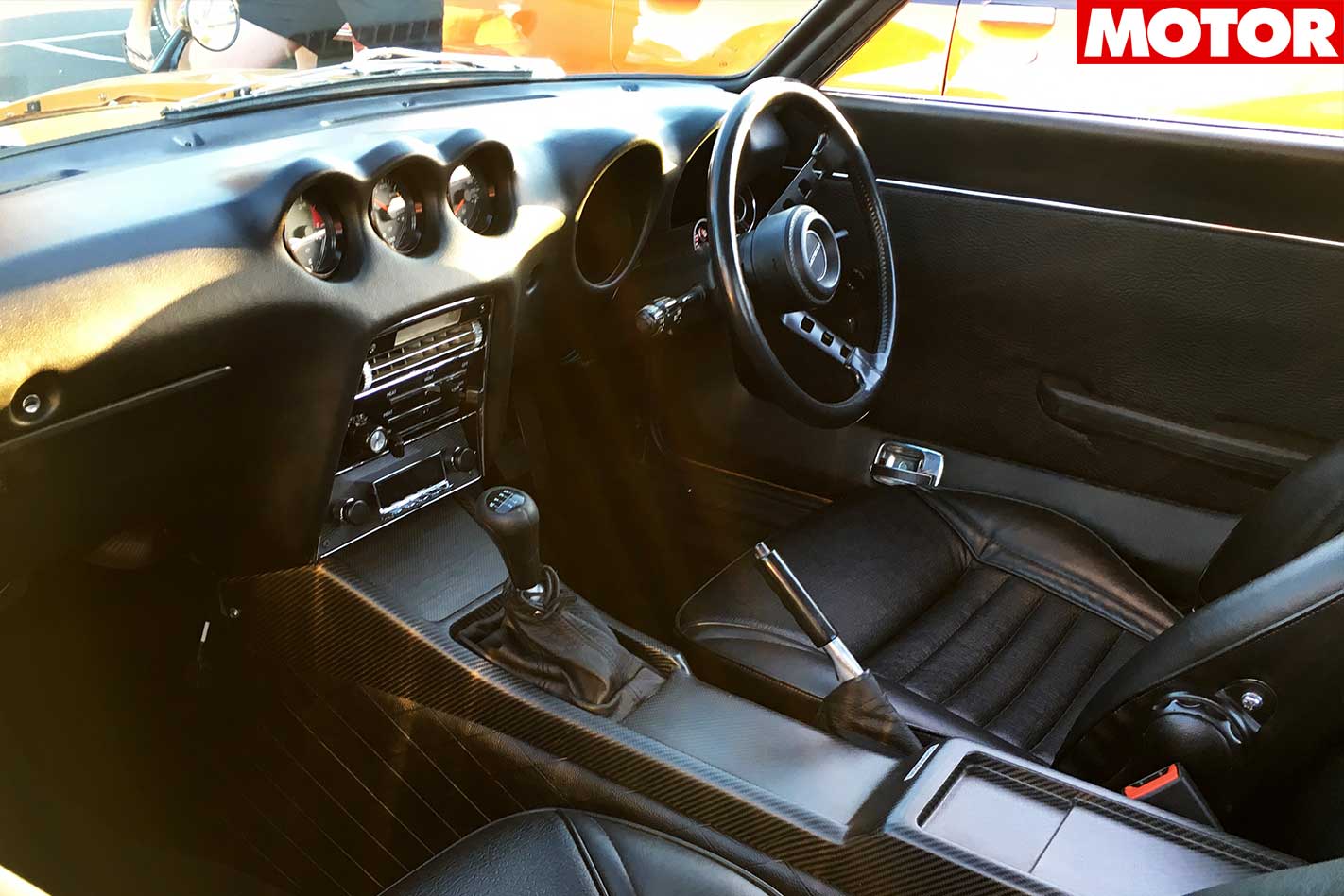
In terms of the aesthetics, most of the car is actually original. Inside, the original parts such as the dash and seats have been refreshed to look new, though the instruments and radio are new retro-look parts, and the centre console cover is a replica of the original, but made of carbon fibre.
One cheeky nod to the powertrain that lies underneath is the BMW M3 shifter.
To help keep the car up to coping with the power increase, David swapped its steering system for a late-‘90s WRX steering rack, which is obviously much lighter, and the brakes and peripherals for a set of R33 Skyline front brakes, and R31 rears .
It’s also got an upgraded R200 diff from a 260Z, though suspension is all 240Z aside from the MCA coilovers.
David also told us about the security system issues that arose from the BMW ECU, and the clever solution he came up with to fix it. But for security’s sake, we won’t tell you how it works.
“I’ve driven other 240Zs and 260Zs… they’re a little uninspiring. The steering especially feels very heavy to the point where if you need to change gear mid-corner, you would be struggling letting go of the wheel.”
Since it was finished late last year, the Zed has been out on a few drives, covering a little over 1000km.
The original engine and running gear also remains in David’s possession, as the car can be returned to original-spec easily. He even chose the car’s original colour, Safari Gold.
“The end result is all that matters. It drives like a modern car, and the controls are nice and light, but from the outside it looks just like a 240Z.”
Price & Equipment – Winner: Honda Civic Type R
Visual subtlety is in short supply in the Honda Civic Type R but there’s not much else missing. A one-spec-fits-all proposition, it gets all of the safety stuff standard, and like the Subaru, has adaptive cruise, dual-zone climate control, sat-nav, a rear camera and huge alloys wrapped in sticky rubber (20in here; an inch bigger than those fitted to the STI.)
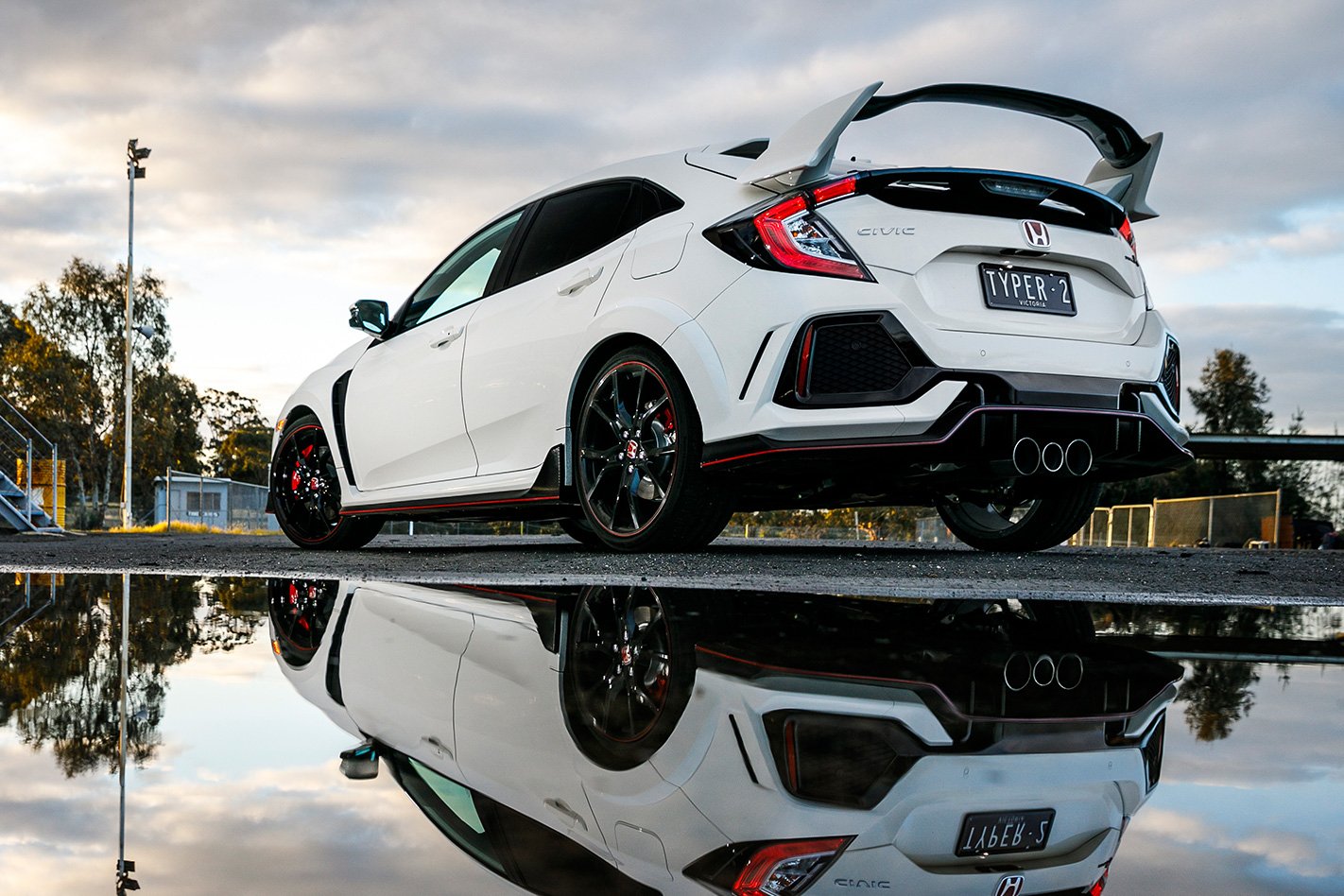
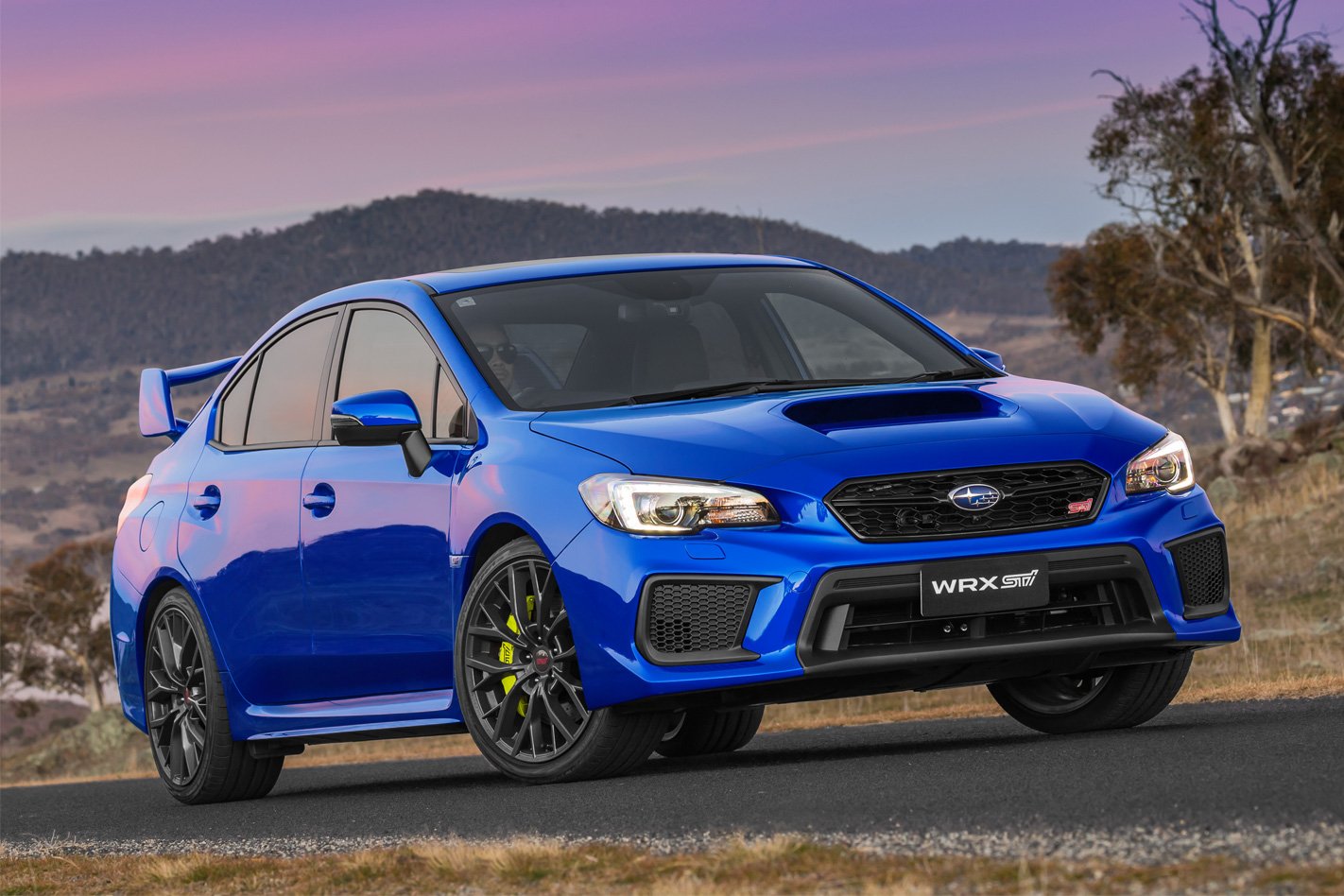
The Subaru WRX STi is a mainstay in the $50K performance realm while the newly turboed Type R has grown into it. Close on power and torque, the super Subie isn’t as loaded with kit; you have to pay an extra $5K for an STi Premium to get the likes of forward-collision warning, lane-change assist and a side-view monitor.
Interior & Versatility – Winner: Honda Civic Type R
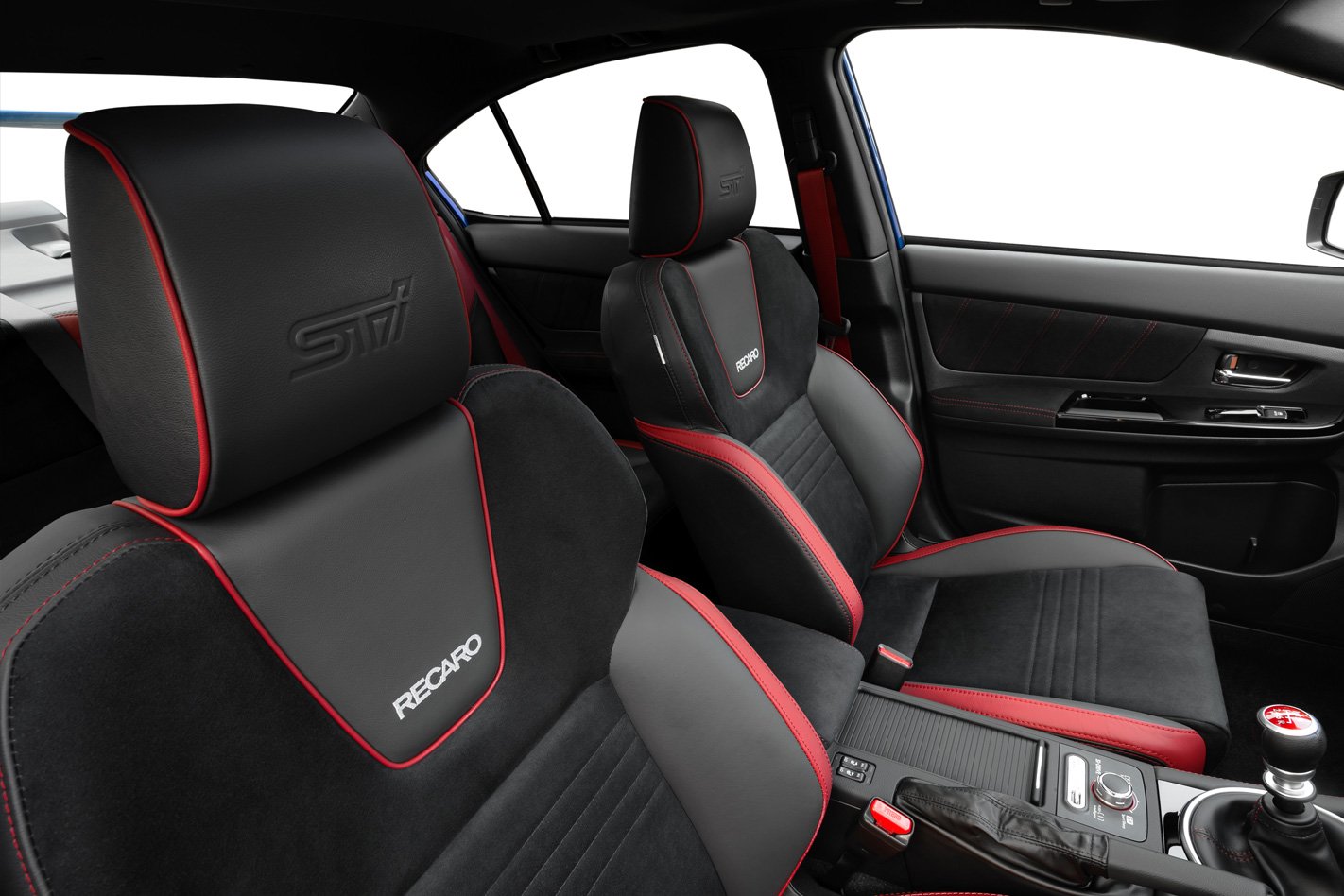
The Honda’s front seats and driving position top the Subaru’s and the finishes are nice but the success of the busy design is perhaps a matter of taste. Tenth-gen Civic’s broad proportions translate to plenty of cabin space. With the rear seats folded the cargo compartment grows from 414 litres to do a handy wagon impression.
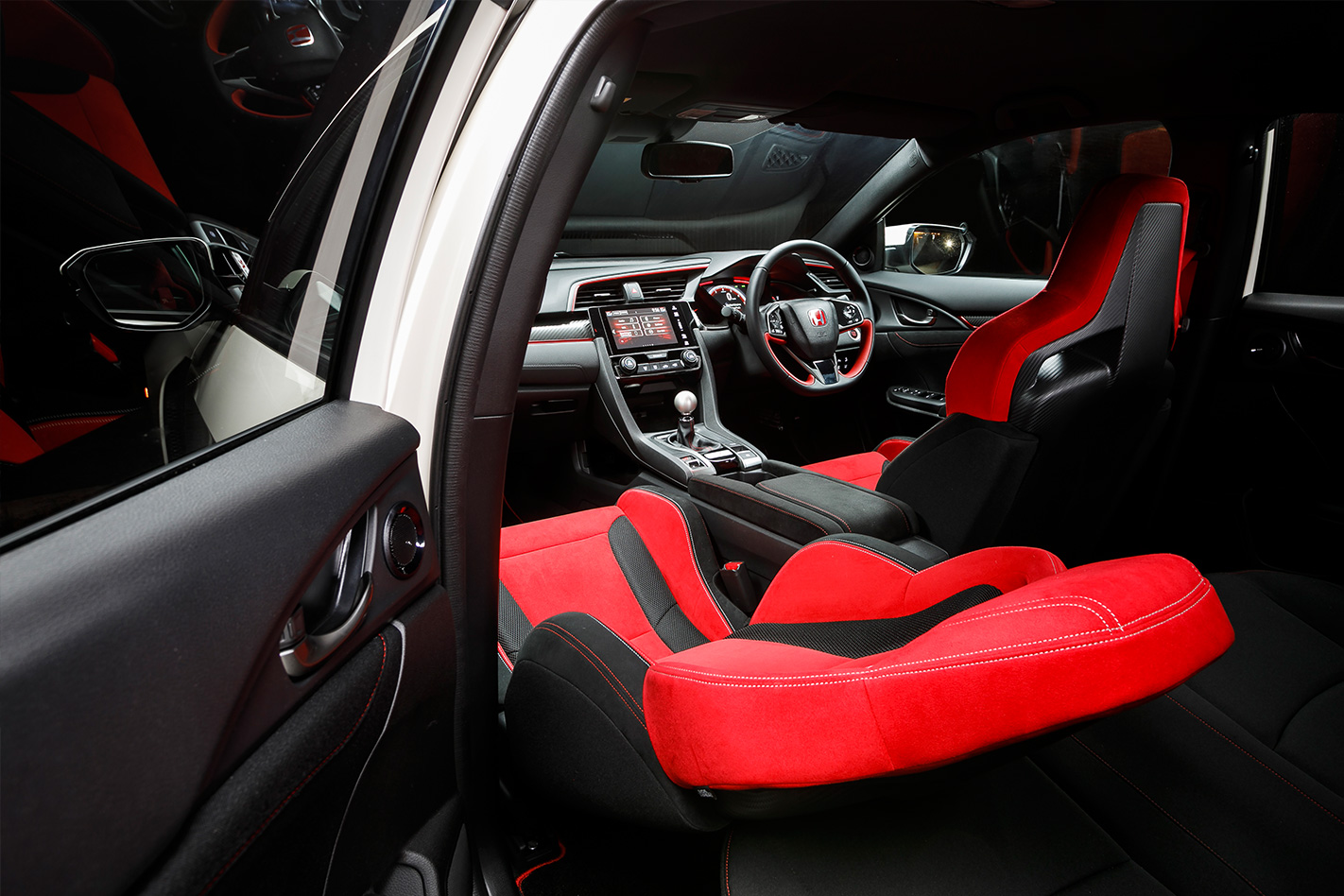
The fourth-gen Impreza-based STI has been around a while so the Type R has newness and Honda’s quality focus in its favour. There’s nothing wrong with the Subie’s materials, it’s just that it aims for neat functionality rather than classiness.
You get a 460L boot and a bit less rear legroom due in part to the STI’s 50mm-shorter 2650mm wheelbase.
Performance & Economy – Winner: Honda Civic Type R
The Honda has similarly hefty outputs but is 150kg lighter than the STI and only drives the front wheels, which hurts it away from the line but makes it feel livelier at low revs. The Type R’s sweet-revving nature recalls atmo Type Rs, which is nice, as is the way it builds to its peak of 228kW at 6500rpm.
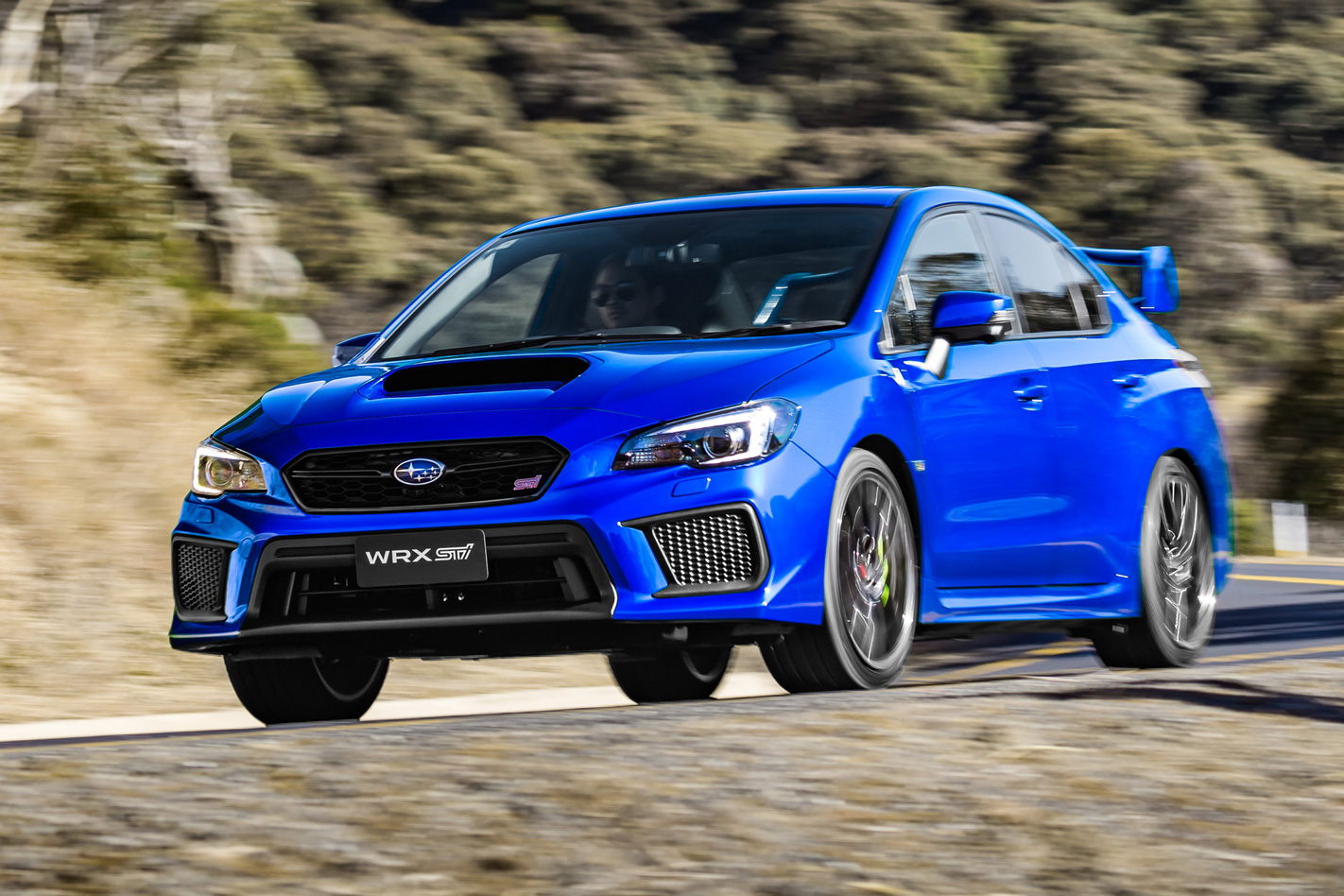
Subaru’s EJ-series engine is nearing 30 years old as a design but there’s still plenty to like in 2.5-litre turbo STI guise. It’s tough, easily tuneable and packs a 407Nm wallop at 4000rpm. At its most driveable in ‘sport’, the AWD Subie is quicker off the mark, but loses its accelerative advantage on the move, and it officially uses a third more juice.
Ride & Refinement – Winner: Honda Civic Type R
The Type R’s ride is surprisingly unaffected by the 30-profile 20-inch rubber and it strikes a terrifically absorbent tune on adaptive dampers in comfort mode. It’s perhaps a bit quieter inside than its rival, although it does let some tyre roar into the cabin on coarse-chip; neither has an overly noisy exhaust.
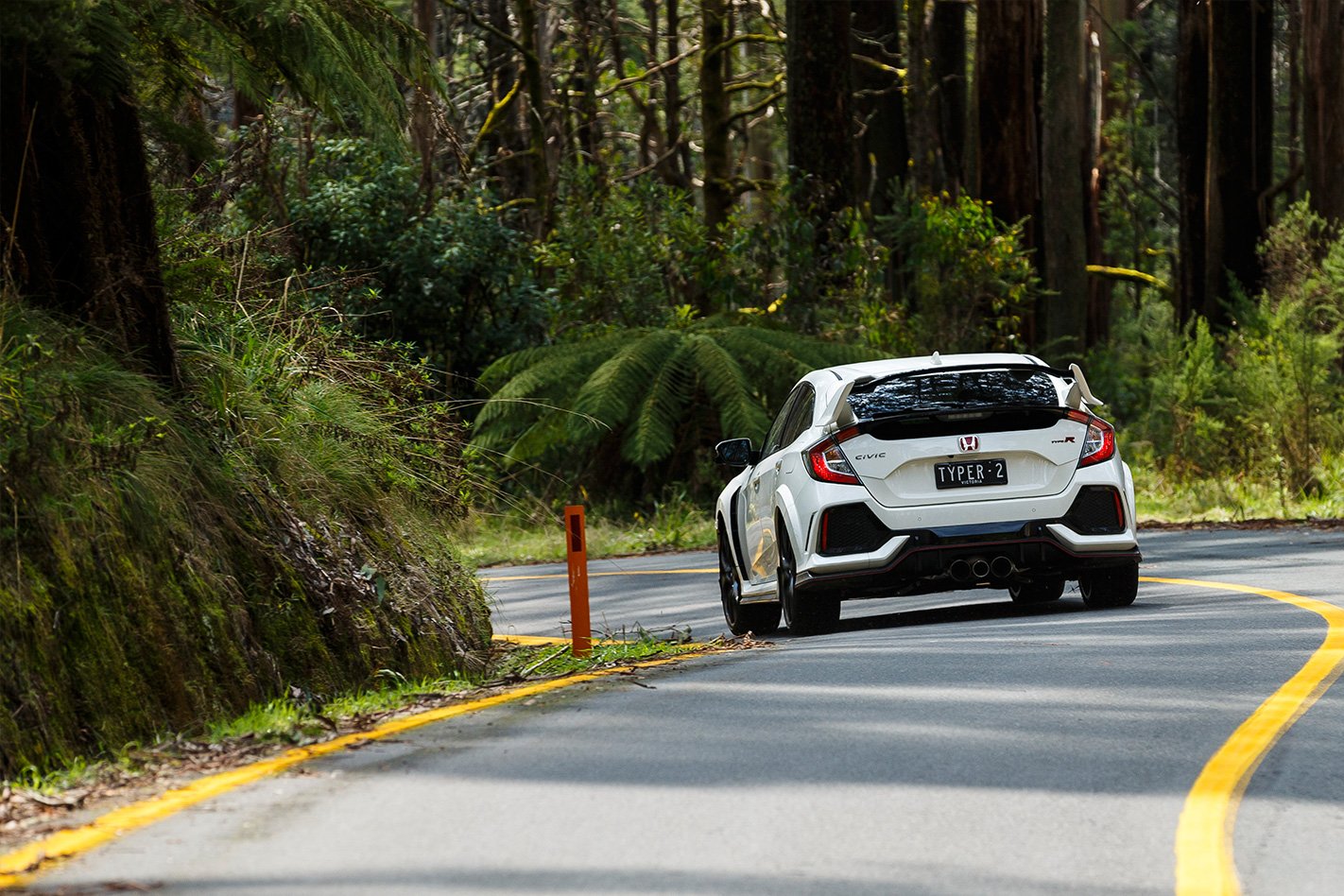
The STI’s NVH is fundamentally quite good but there’s no escaping the extra tyre drone you get on large, low-profile performance-oriented rubber, or the boxer thresh and burble (which we love). Restless at low speeds, the STi’s ability to ride well exists away from sharp-edged bumps and above 80km/h.
Steering & Handling – Winner: Honda Civic Type R
The Type R is eager to turn in and there’s genuine meat to the steering (just as in the STI). The dual-axis front suspension – think Ford Revoknuckle or Renaultsport Perfohub – separates steering and suspension axes to provide geometry approaching that of a double A-arm front end, and as a result, improved ability and feel.
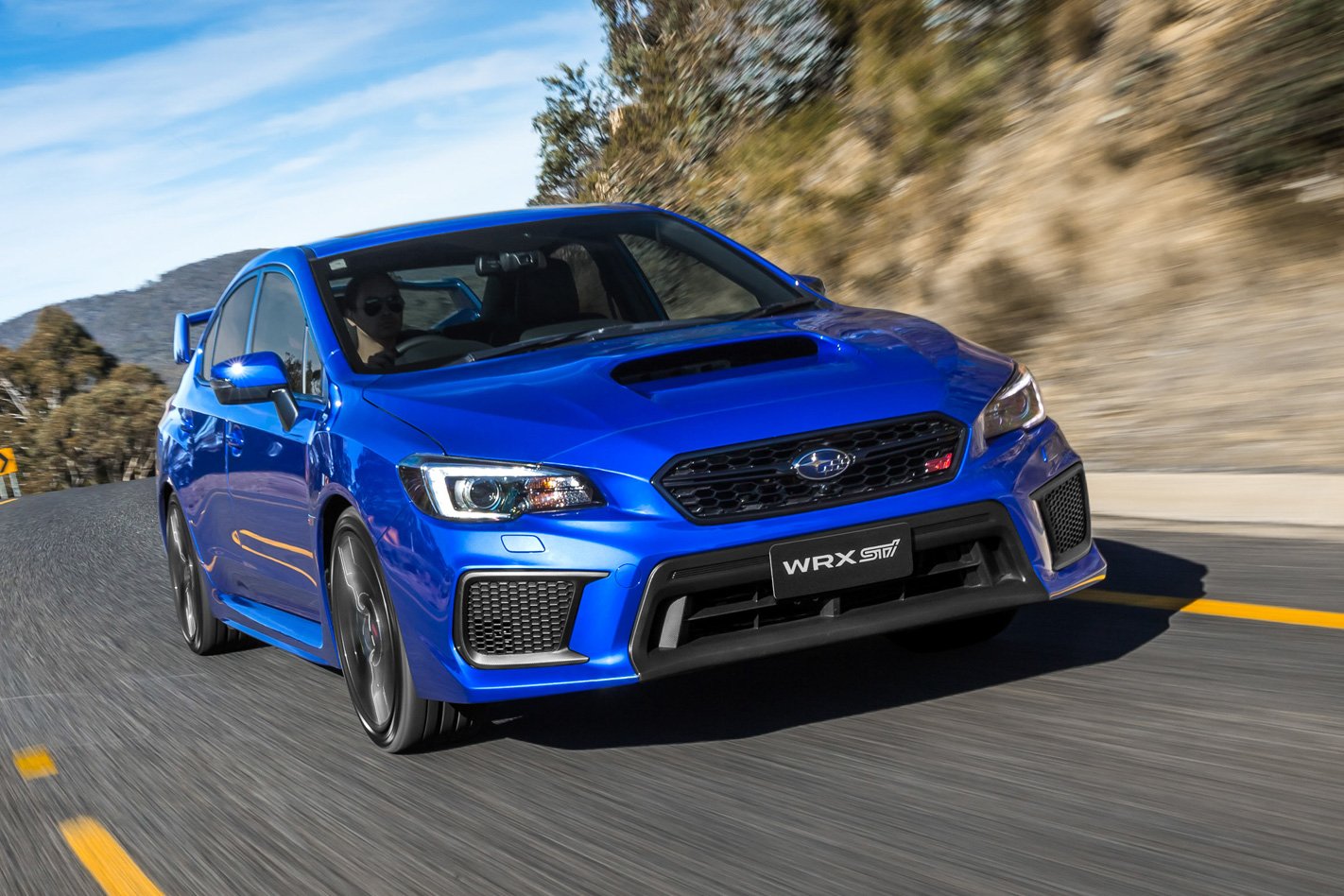
The STI is rare in that it is fitted with hydraulic steering assistance, yet this doesn’t make it a car you’d single out for its ability to deliver feel. The Subie isn’t quite as keen on turn-in, nor to offer nuanced feedback as its rival. It rewards a scruff-of-the-neck driving style more than a smooth approach; drive it hard and it’s a hoot.
Verdict – Winner: Honda Civic Type R
When two rivals are closely matched, elements of the ownership experience often rise to deliver the decider. But that’s not the case here. Not only are the Civic Type R and WRX STI fundamentally different machines with different audiences, they’re both made by brands with a solid rep for quality and reliability. Honda does give you a five-year warranty though (while Subaru’s is three years).
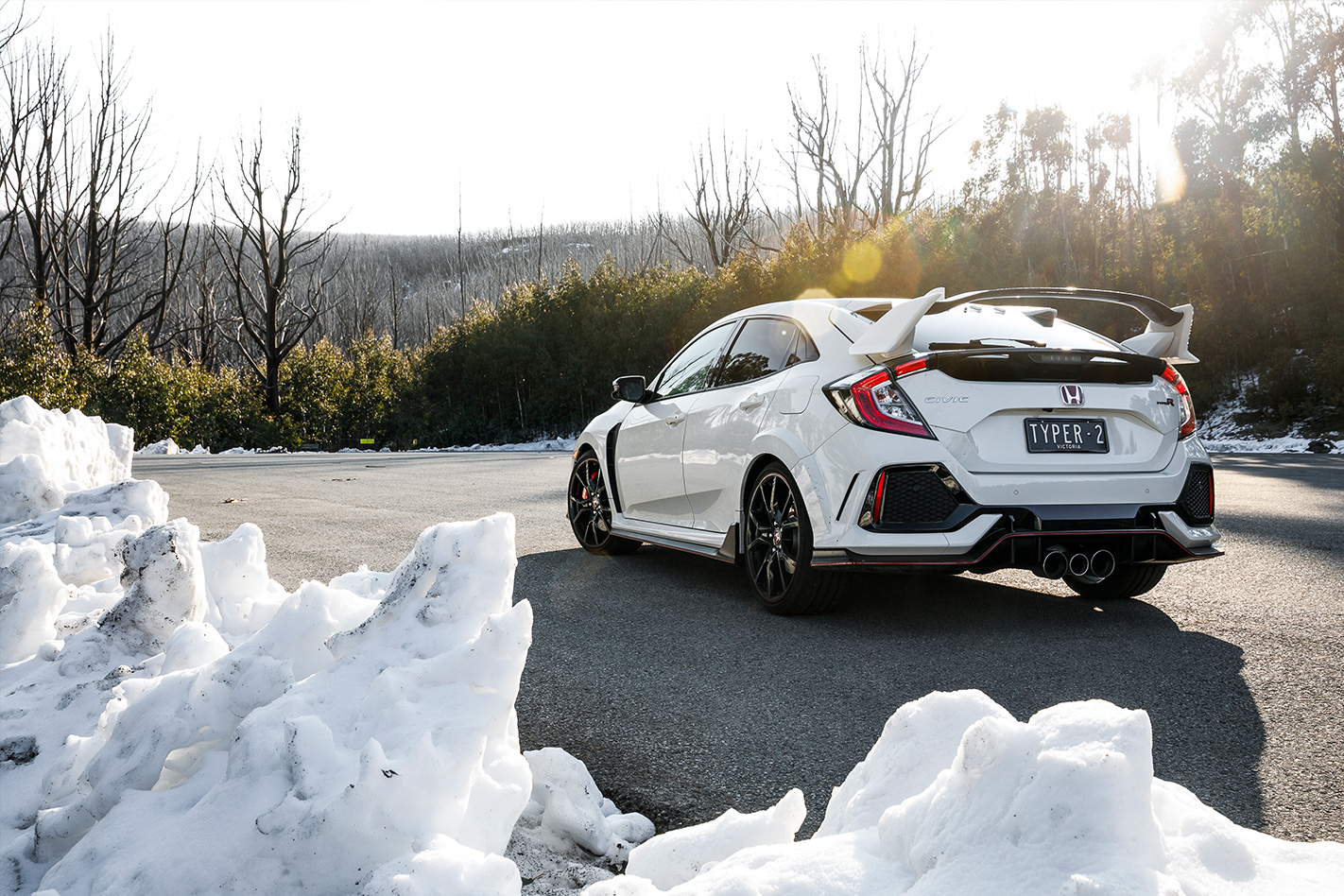
We like the Subie’s character and hard-driven demeanour, but unless you’re a blinkered brand loyalist or an all-paw devotee, the Honda is more thoroughly convincing for its cabin space and finish, hatch practicality, engine efficiency, nicer ride and for presenting an overall sweeter proposition as an urban hi-po tool.
Just as long as you’re a fan of the styling.
Mitsubishi’s Lancer Evolution MiEV (short for Mitsubishi In-wheel motor Electric Vehicle) could well be the quietest, quickest production car sprint ever.
This review was first published in MOTOR magazine’s January 2007 issue.
With only the whir of electric motors and tyre noise audible, it scoots from standstill to 100km/h in under seven seconds and has a top speed of 185km/h. No, it’s not as quick as its petrol-slurping turbocharged brother, but that’s not the point.
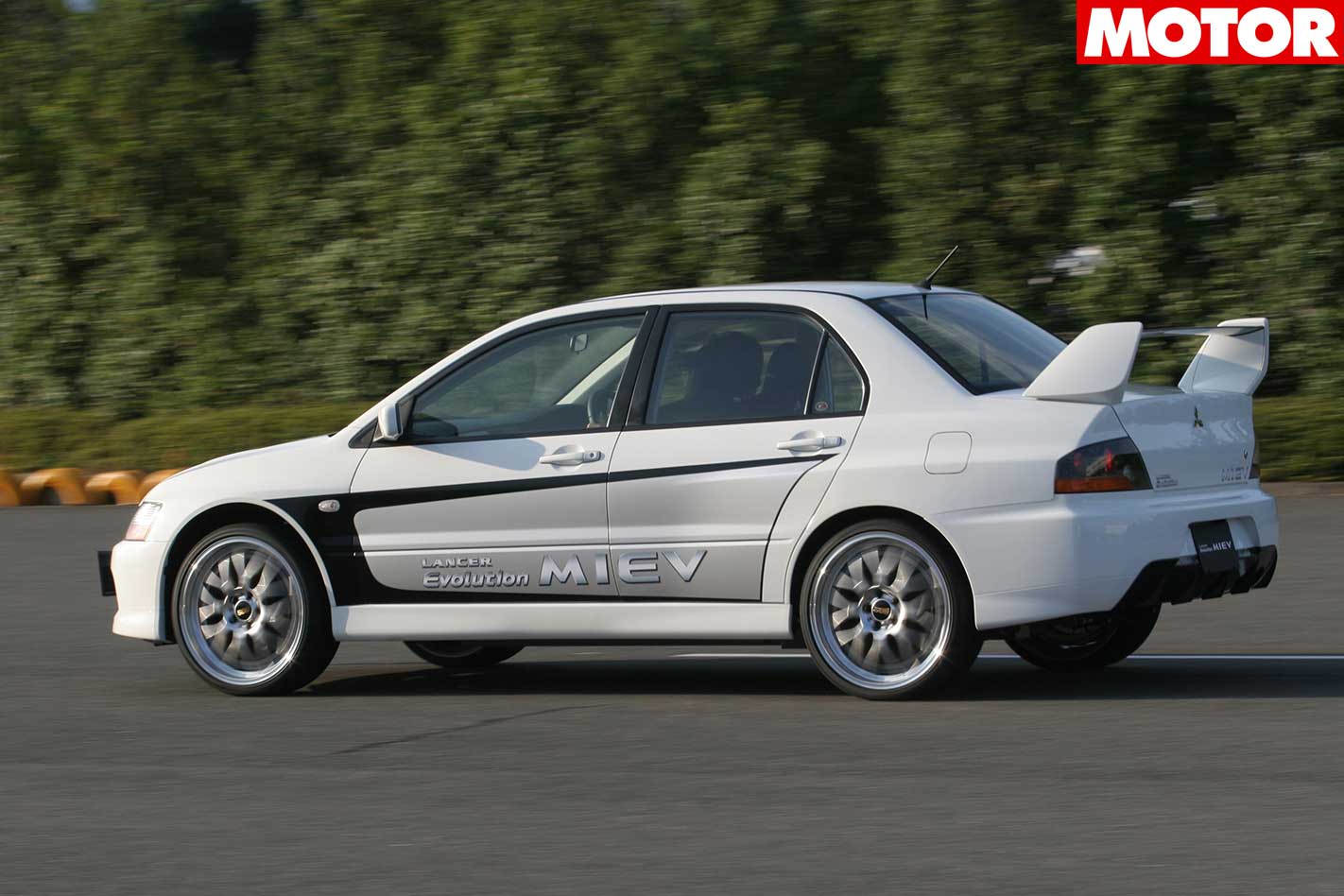
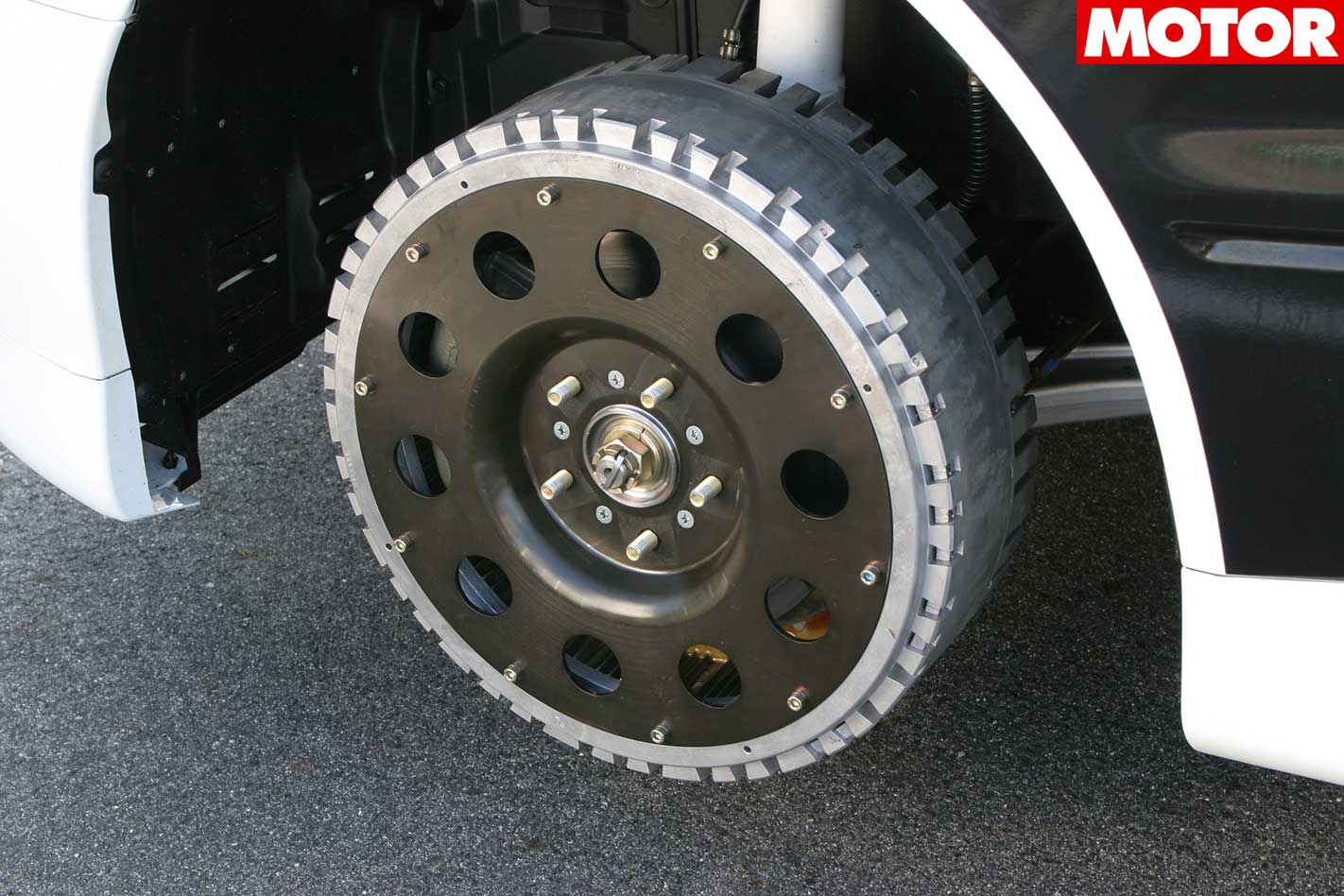
The MiEV may look like a standard Evo with a WRC-spec wing and 20-inch BBS rims, but pop the bonnet or peek behind those wheels and you’ll soon realise that this is a very different beast.
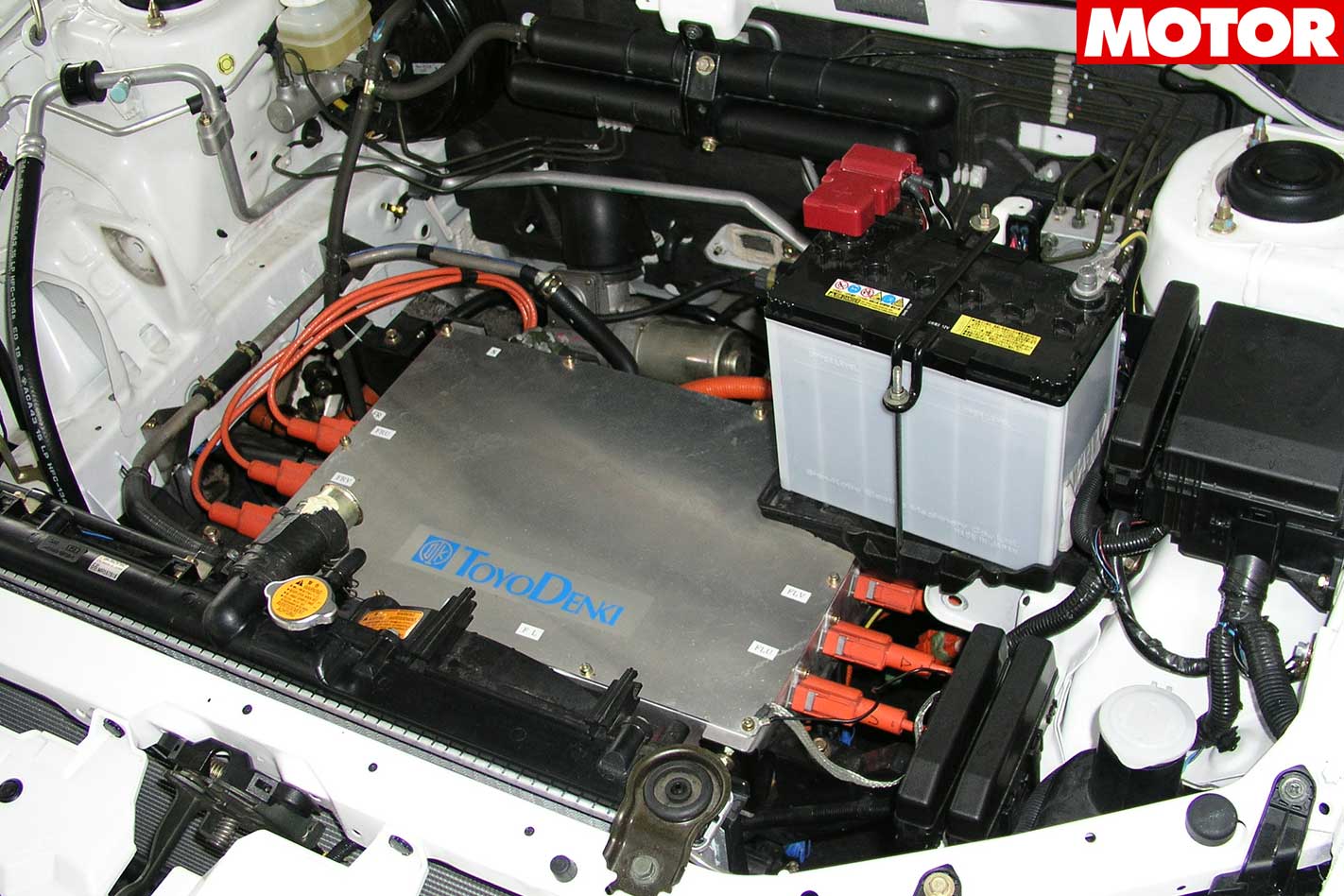
The second surprise is in the engine bay; it’s empty. Apart from a backpack-sized inverter mounted down low, and another in the boot, the engine room looks deserted. These inverters draw electric power from the 18 lithium-ion battery cells cleverly fitted under the floor and channel juice to the in-wheel motors, with the front inverter driving the fronts and the boot-mounted inverter powering the rears.
The company does say, however, that it plans to reduce overall weight by as much as 100kg through downsizing batteries, magnets and motors, while maintaining current power levels. That will also help to improve the car’s range, which stands at just 250km on one charge. That’s about what you you get out of a regular Evo if you’re one for fanging around, though…
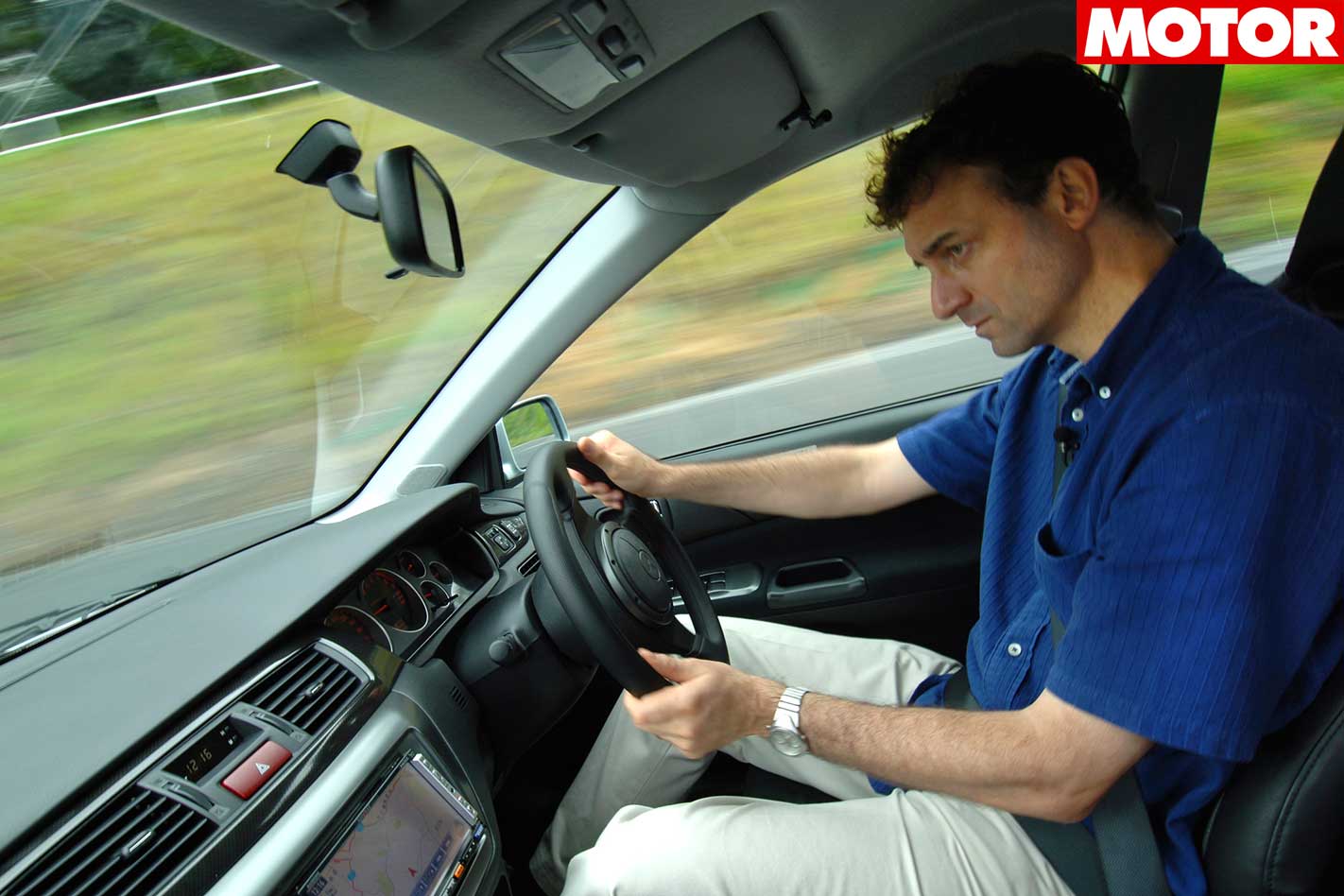
There is no transmission loss with electric cars, just lightning fast throttle response; it, along the lack of noise, really takes a while to get used to. The ride is harsh, thanks to the low-profile 20-inch Dunlop SP Sport Maxx rubber.
Sadly, the Evo’s masterful AWD technology and tricky ACD and Super-AYC traction control systems haven’t been translated to the electric car. “That comes later,” said Tsutsumi.
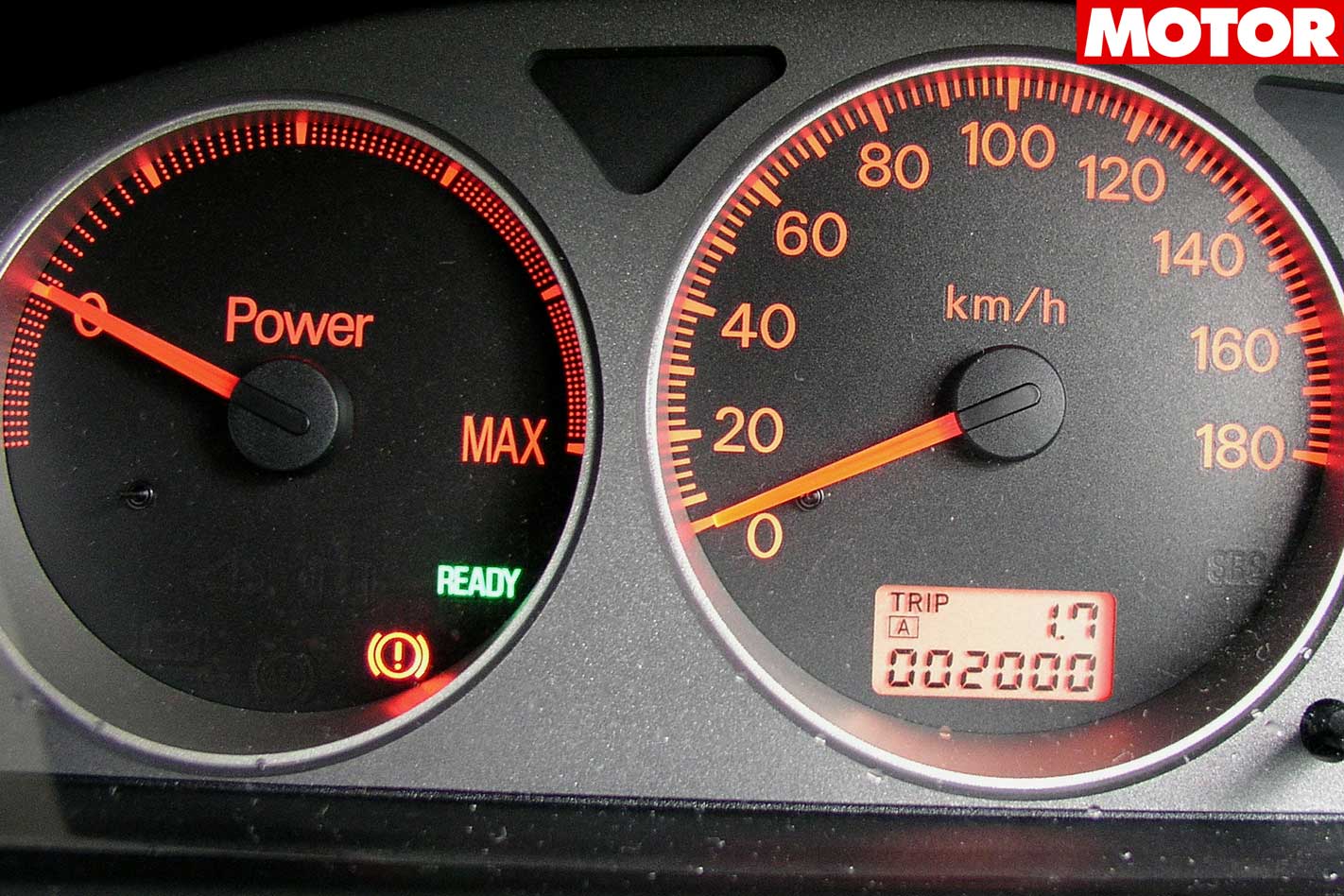
With the breathtaking speed that this technology is hurtling along at, along with the obvious advantages that electric power provides (huge torque, instant response and no emissions), the Evo MiEV could be the start of something very special.
Fast Facts – 2007 Mitsubishi Evo MiEV
ENGINE: Four in-wheel electric motors, twin inverters, Li-ion batteries POWER: 200kW TORQUE: 518Nm WEIGHT: 1590kg 0-100km/h: sub 7 seconds (claimed) TOP SPEED: 185km/h
LIKE: A startling peek into a green high performance future. DISLIKE: Limited range at present, and will need to lose weight RATING: 3.5 out of 5 stars
As our $1.8m train snakes its way to our intended base at the Tawonga Gap lookout, the rain drops land with increasing frequency and the mist thickens as we climb until it seems as though we’ve ascended into the clouds.
The lookout itself offers a stunning view if complete white-outs are your thing, so best to turn 180 degrees and examine the more stirring sight of 10 of the year’s best performance cars ready to be put to the test on one of Victoria’s finest roads.
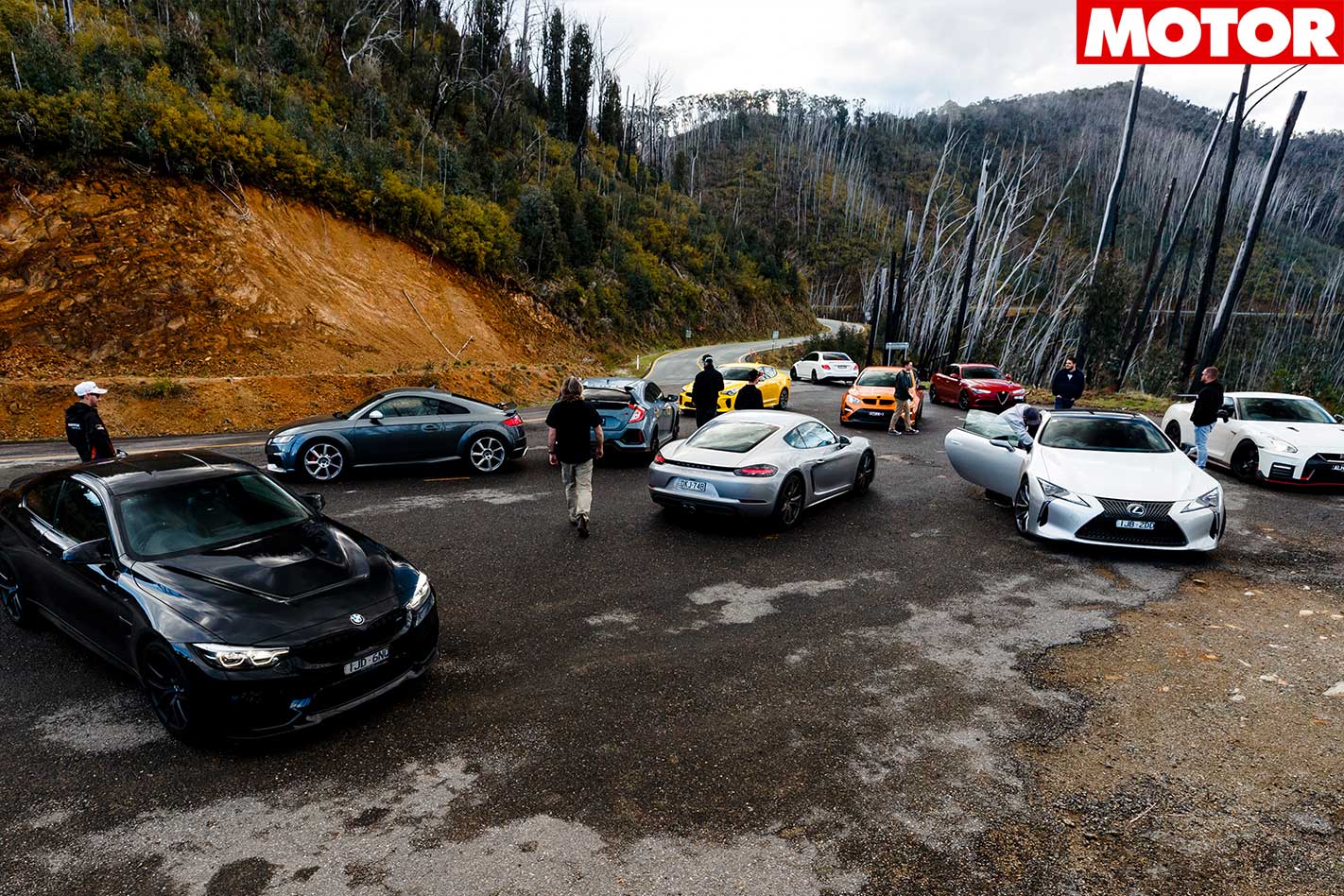
Adding to the challenge is the wet surface, though the rain has stopped and the cloud is dissipating, affording the odd glimpse of the stunning outlook over the Kiewa Valley and Mount Hotham.
In slippery conditions it seems prudent to start in something with four driven wheels, though given the slowest of our all-paw trio hit 100km/h in 3.59sec, that decision doesn’t reduce trepidation as much as it might. As such, the 450kW/850Nm Mercedes-AMG E63 S seems as sensible a place to begin as any, a decision validated by the incredible wet weather grip of its new-generation Michelin Pilot Sport 4S tyres.
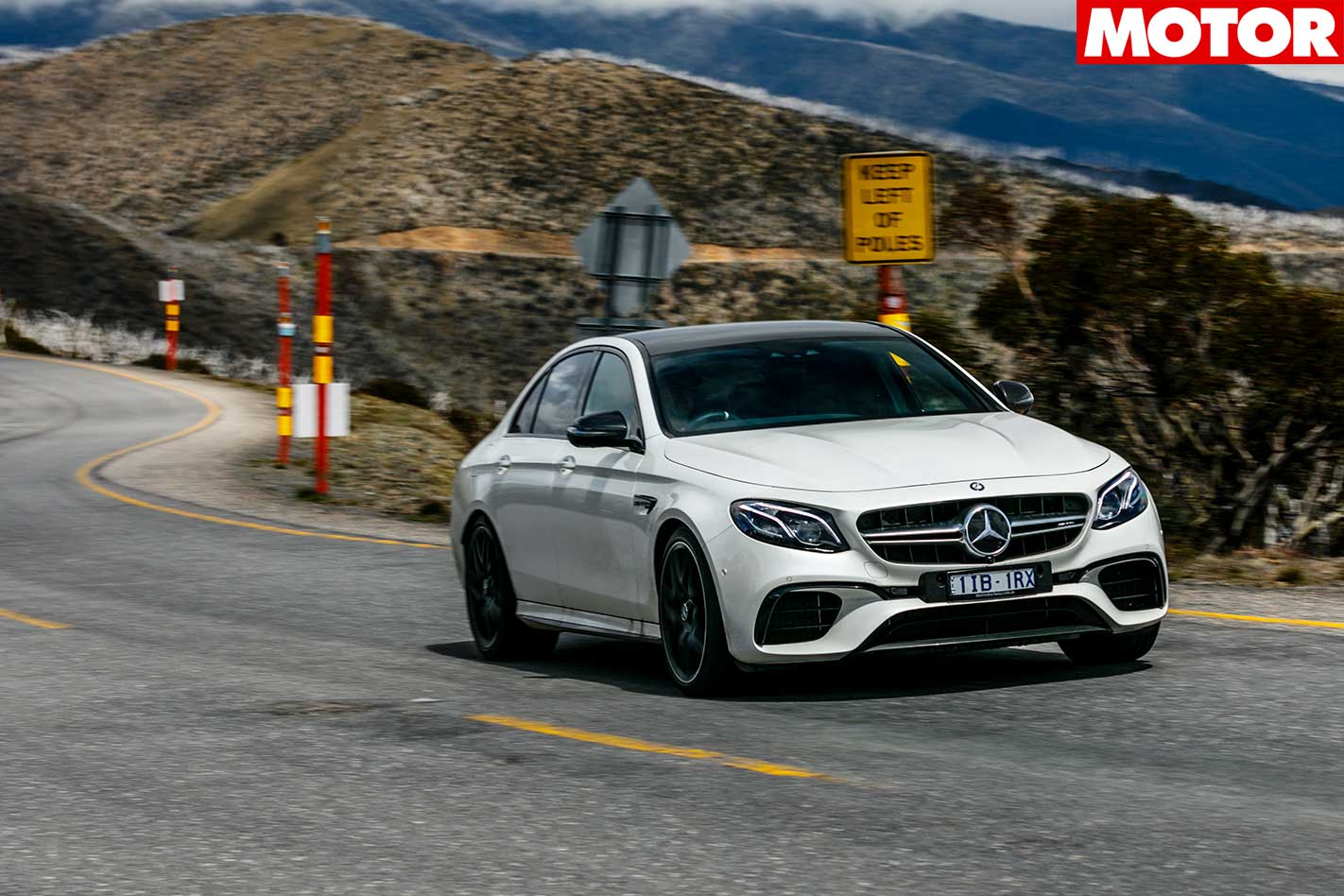
The speed the E63 is capable of is so immense that even a casual sighting run is enough to upset the sensitive stomach of videographer JP, who thankfully exits before redecorating the AMG’s sumptuous interior. Despite its confidence-inspiring demeanour, using the Merc’s entire performance envelope is impossible as it’s not the conditions that prove constraining, but the physical dimensions of the road.
It accelerates so rapidly that by the time you’ve approached full throttle the next corner has arrived. The 4.0-litre twin-turbo V8 is a monster; in its angriest modes it feels so sharp and sounds so aggressive – though the note is a little manufactured – that it makes the similar engine in the C63 seems almost tame. The steering is well-weighted and linear, the brakes impervious and the new nine-speed gearbox a clear improvement over the old seven-speeder.
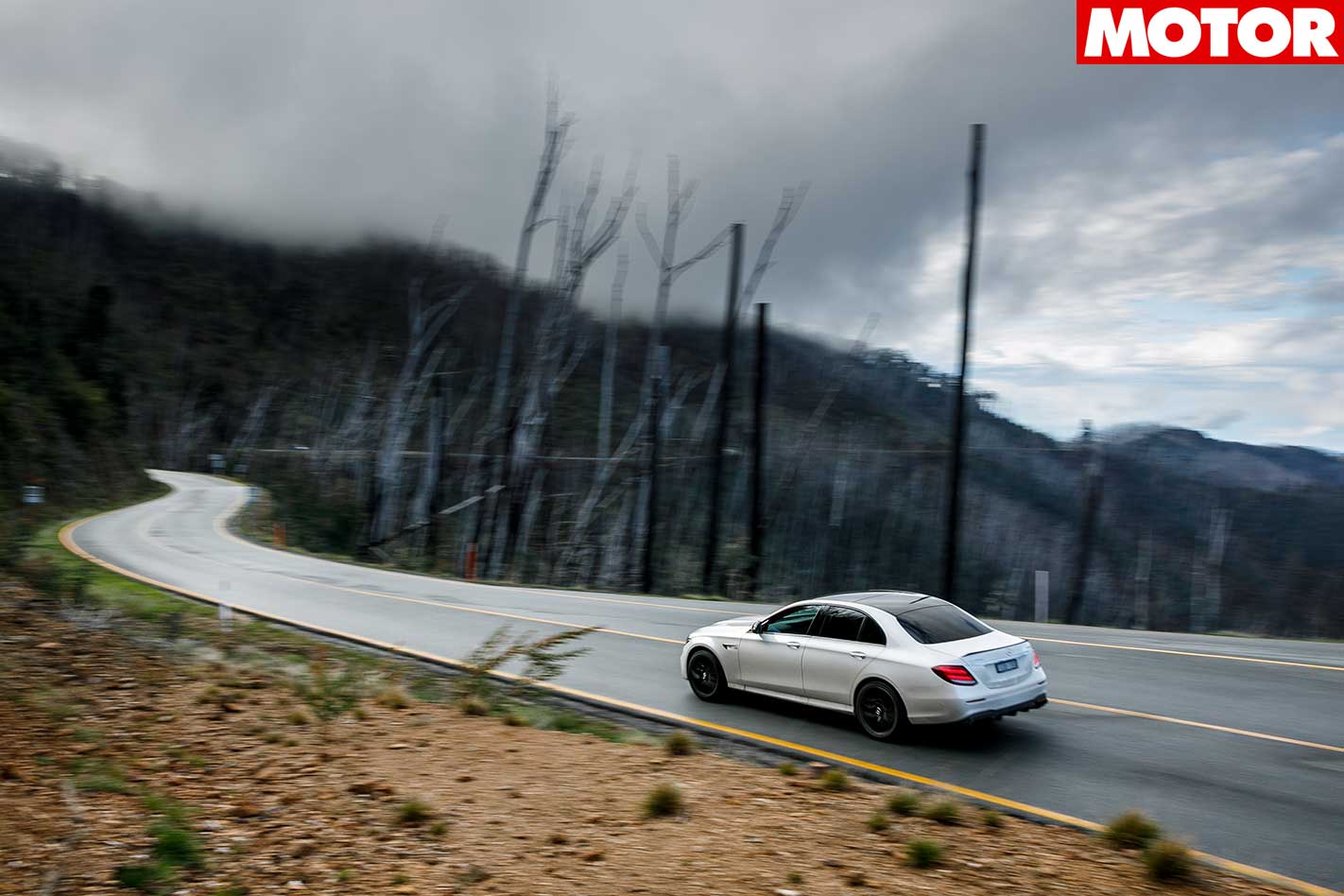
The bigger issue for a number of judges is whether the AMG possesses the refinement expected of a $260K premium sedan. As DC puts it, the E63 always feels “on”. Its performance is staggering, but the ride is firm and road markers thud through the structure often enough for questions to be raised.
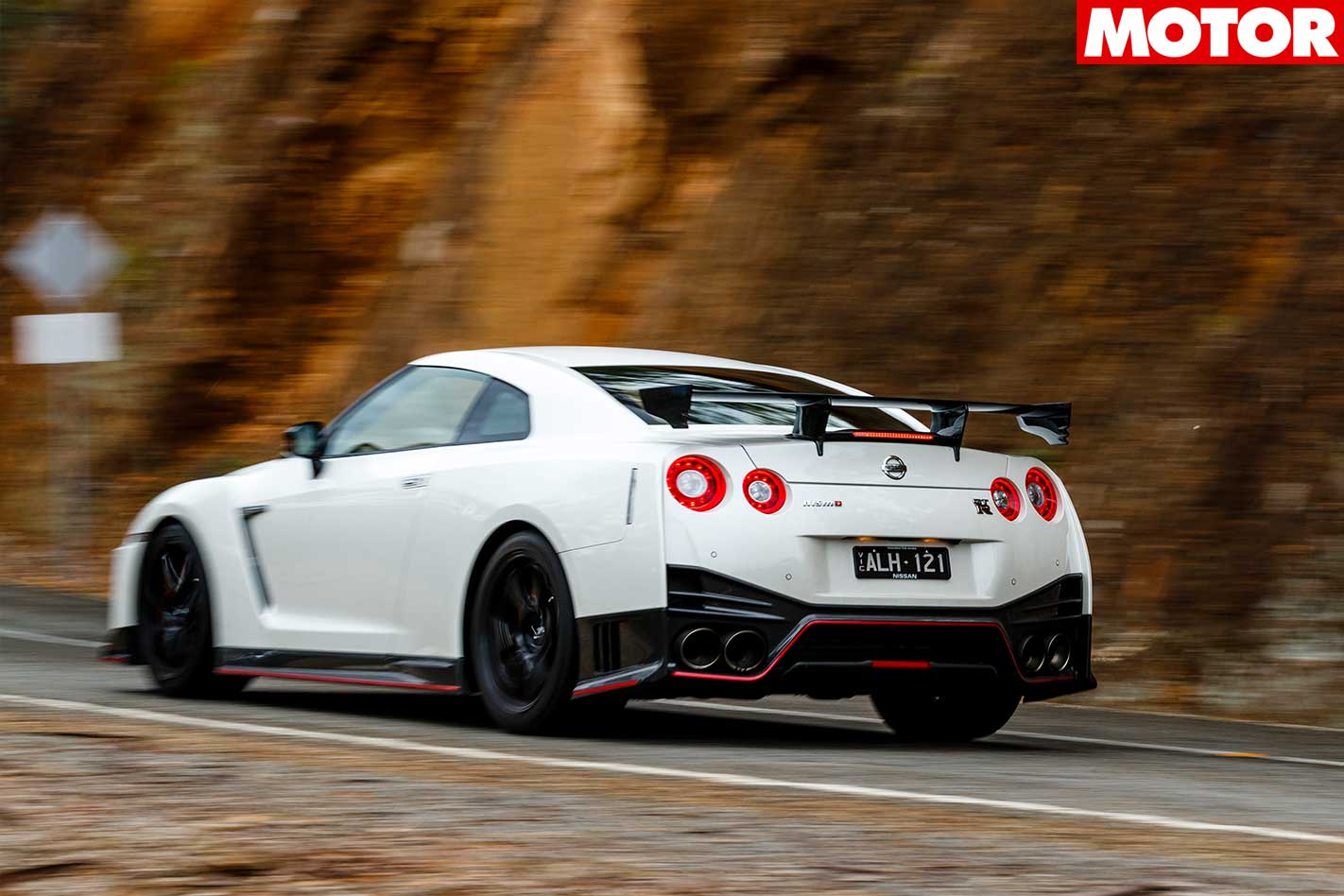
Still, a blast in the GT-R Nismo puts refinement in perspective. In an earlier comparison against the BMW M4 GTS we praised the Nismo for its relative comfort, but among more ‘normal’ vehicles the Nissan’s track focus is obvious. On the road, selecting Comfort for the dampers is as much a part of the start-up process as turning the engine on.
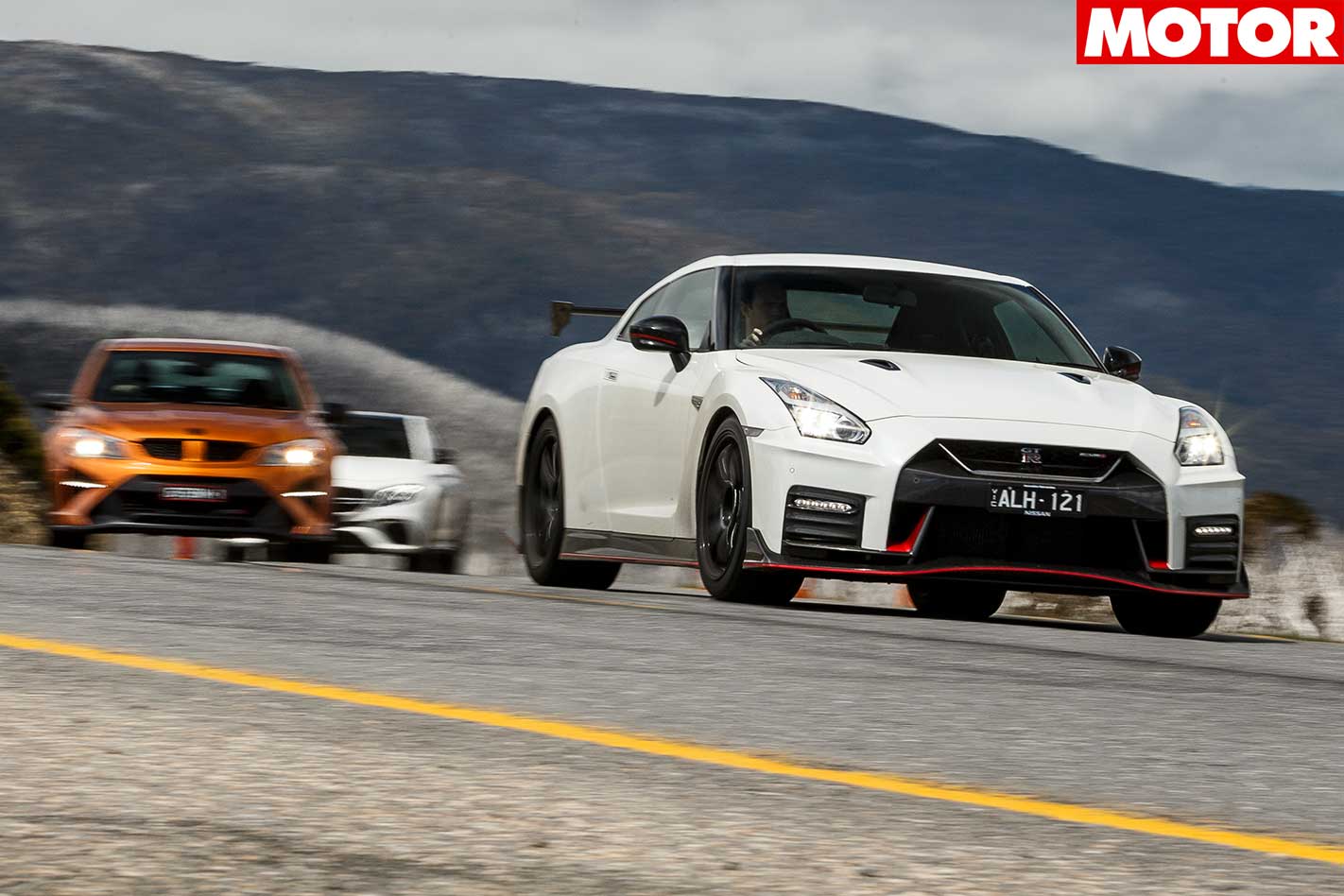
The road is drying, but still damp – conditions that, contrary to internet opinion, would tie a regular GT-R in knots. Its Dunlop rubber enjoys water as much as your average household cat, but for reasons that can only be guessed at – softer compound, perhaps? – the Nismo’s R-spec Dunlops find plenty of purchase.
Light steering and an elevated driving position make it difficult to get an accurate read on the road, yet the GT-R’s outright grip levels are such that you’re unlikely to be close to its limits.
The similarly focused HSV GTSR W1 straddles the line between road and track more comfortably. Those trick SupaShock dampers are undoubtedly firm – too firm for Morley and Robbo – and the exhaust drone can be distracting, yet both issues are mainly a problem for rear-seat occupants. The driver is better isolated and likely to be having too much fun to care.
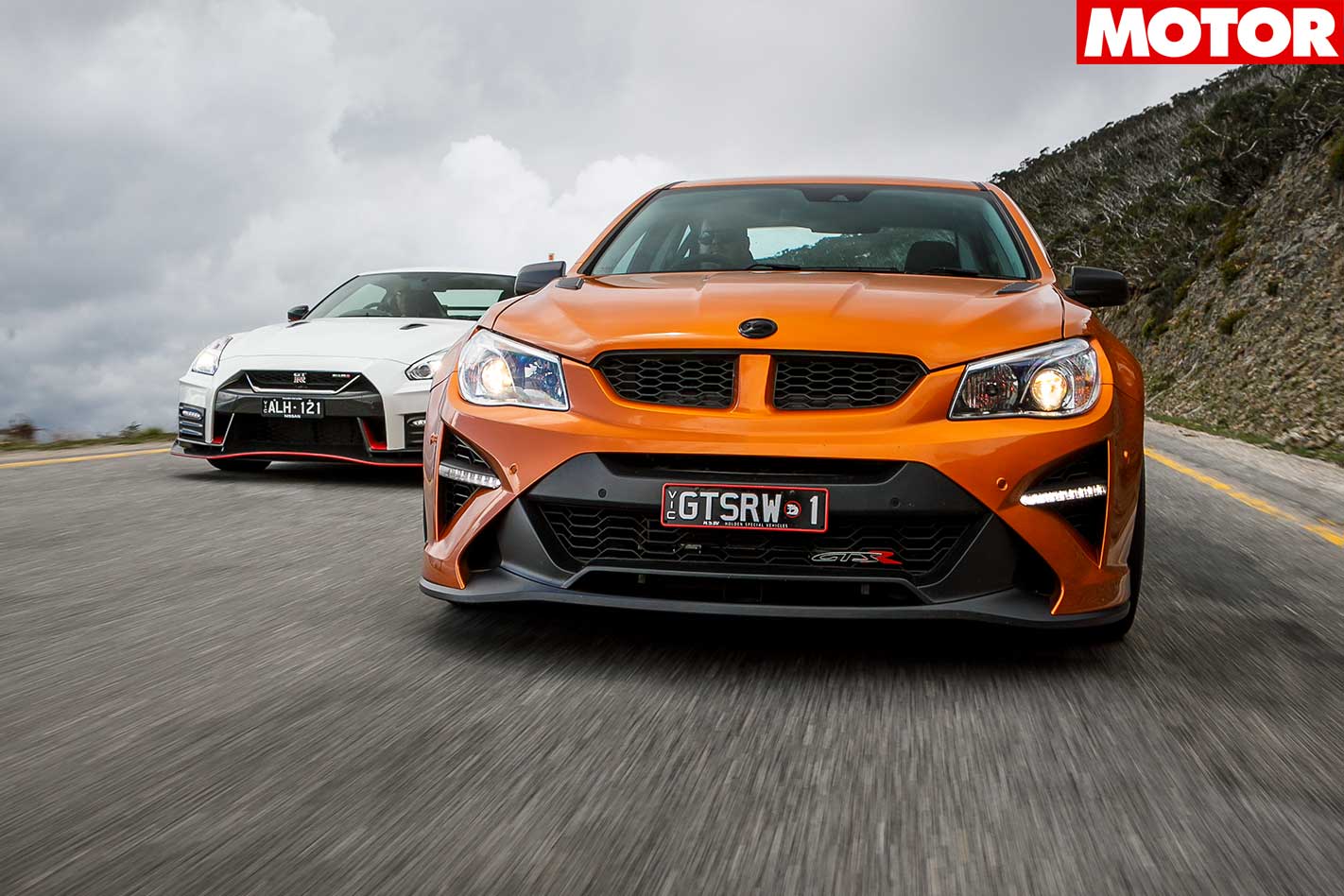
Those trick Trofeo R tyres aren’t the liability you might expect on damp roads – though we wouldn’t like to hit standing water – and in the dry they grasp the tarmac like they’re acutely aware of the value and rarity of the car they’re supporting.
The main barrier to exploiting the W1 on the road is its gearing. When first stretches to 97km/h and second to 145km/h, cog-swapping opportunities are rare, HSV’s hottest offering being virtually direct-drive on our test route – simply leave it in second.
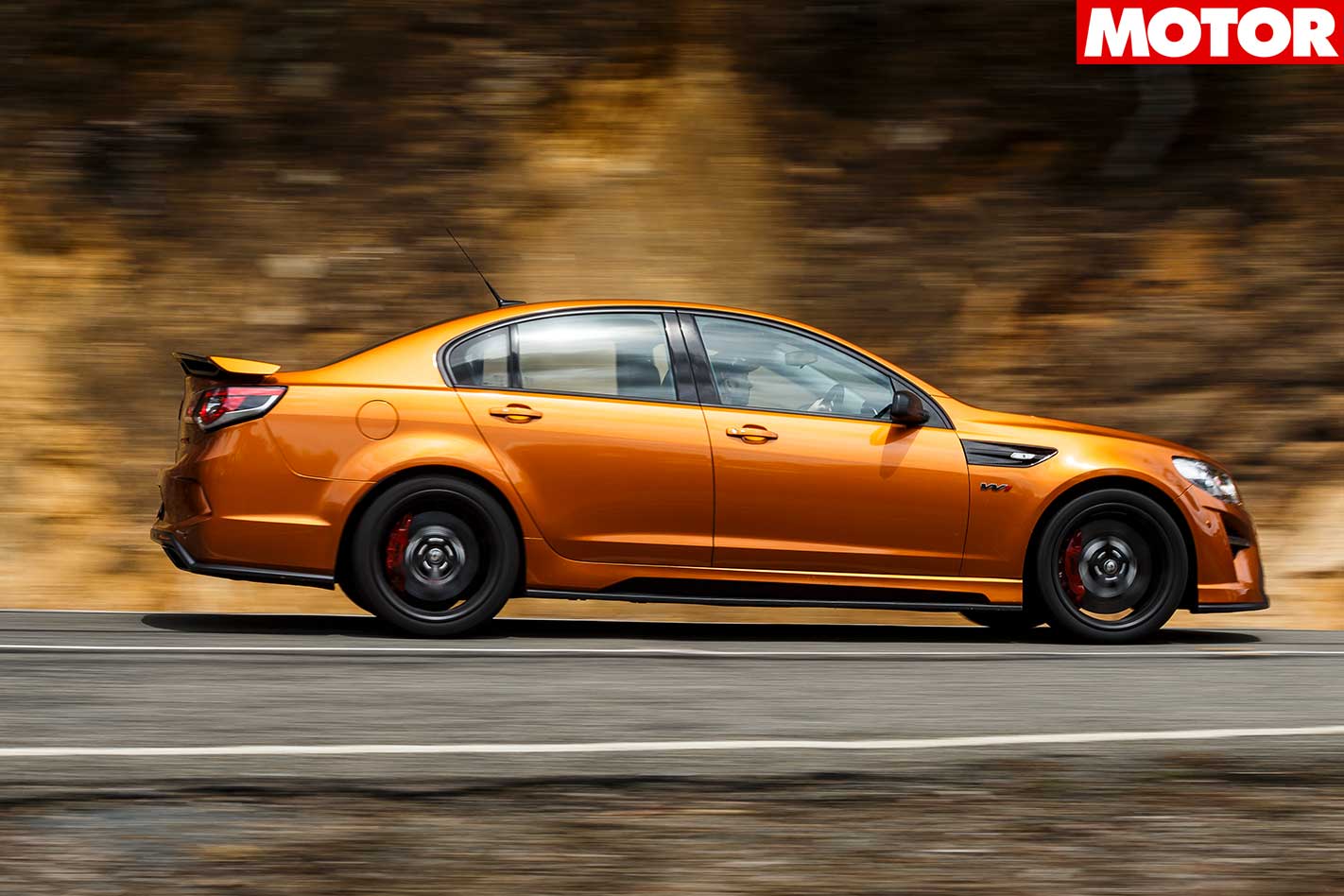
Arguably the best W1 experience, though, is waiting at the lookout and hearing the thunderous LS9 bellow through the trees like a dragon from Game of Thrones.
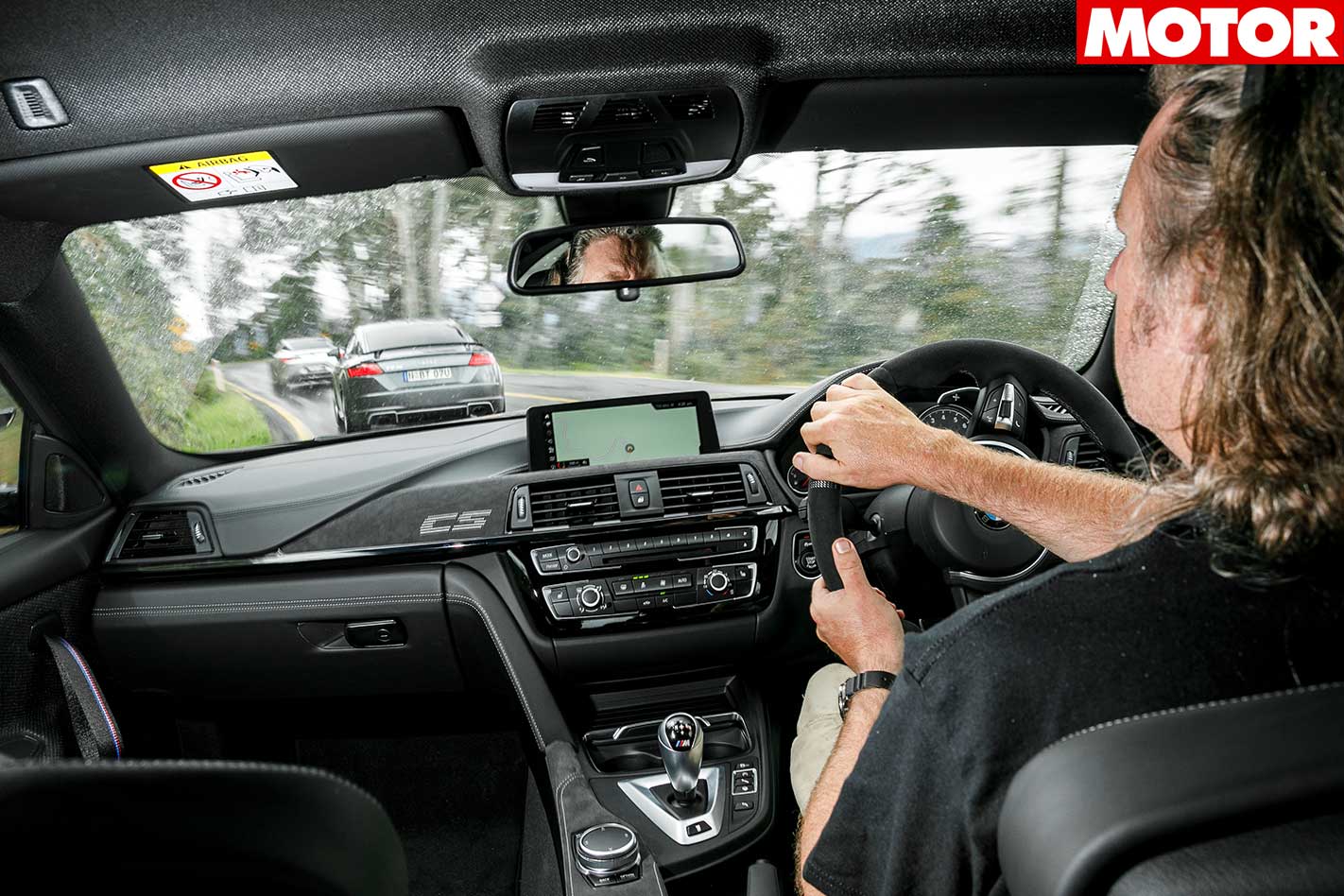
Like the W1 and Nismo, we suspected the BMW M4 CS would also be happiest at Winton – more fool us. Its beefed up stance, subtle carbon aero, weight loss, extra power and sticky Michelin Cup2 rubber all scream ‘take me to a track day’, but on-road this butch Beemer blows us away.
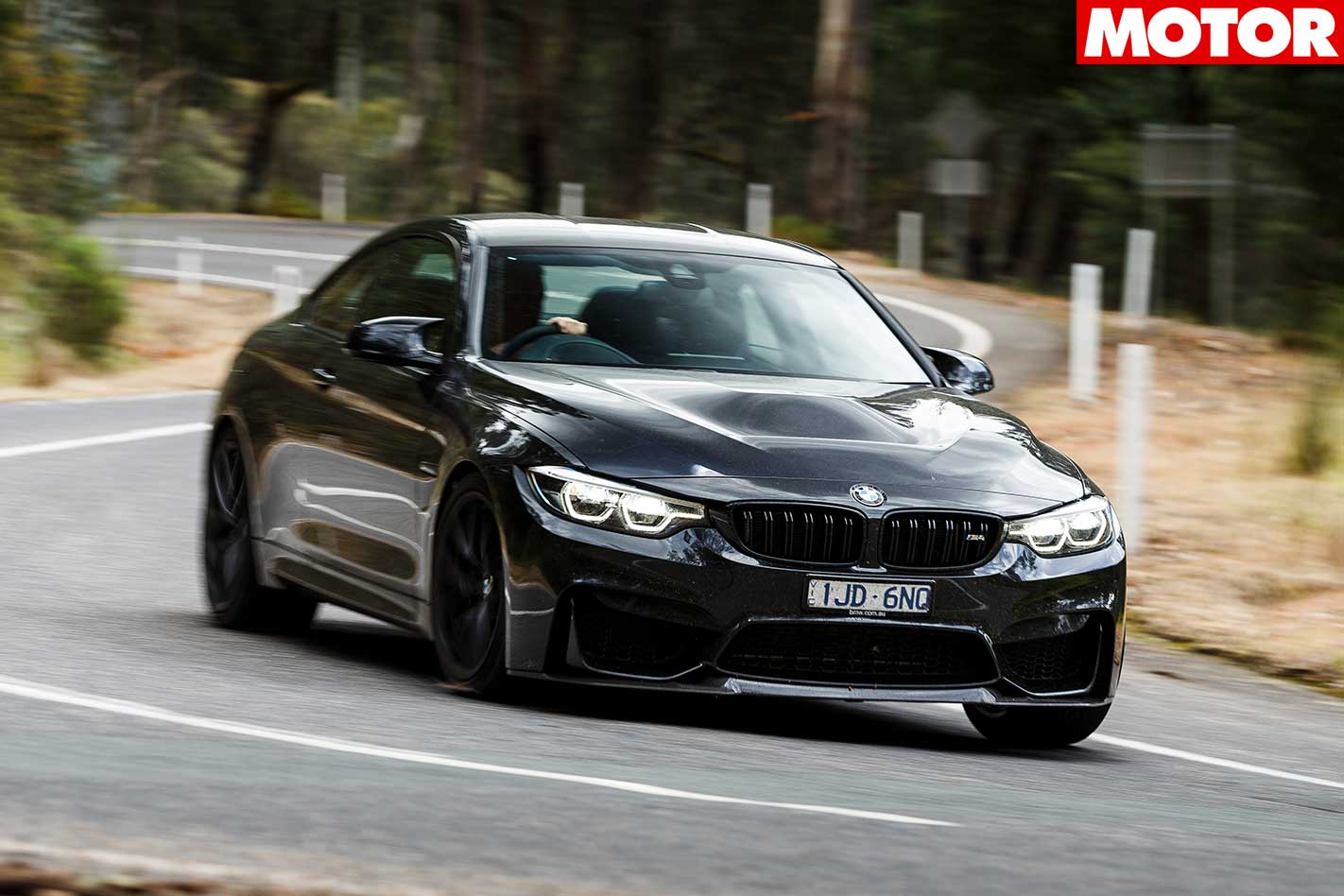
The improvement is such, though, that the changes feel to go deeper than merely a change of rubber. There’s better control over nasty mid-corner bumps, the MDM stability control setting is more refined and the engine angrier and more vocal.
Whereas the standard M4 would be hopping over bumps with spikes of oversteer, the CS more often than not grips and goes, yet if you really dig in it still loves a cheeky hint of oversteer on corner exit.
Sadly, the same can’t be said for the Lexus LC500. It looks fantastic, inside and out, and you could make a case that it’s the best sounding car here, but sadly the substance doesn’t match the style. That’s a tad harsh, as in many ways the LC500 is Lexus’s most polished performance product yet.
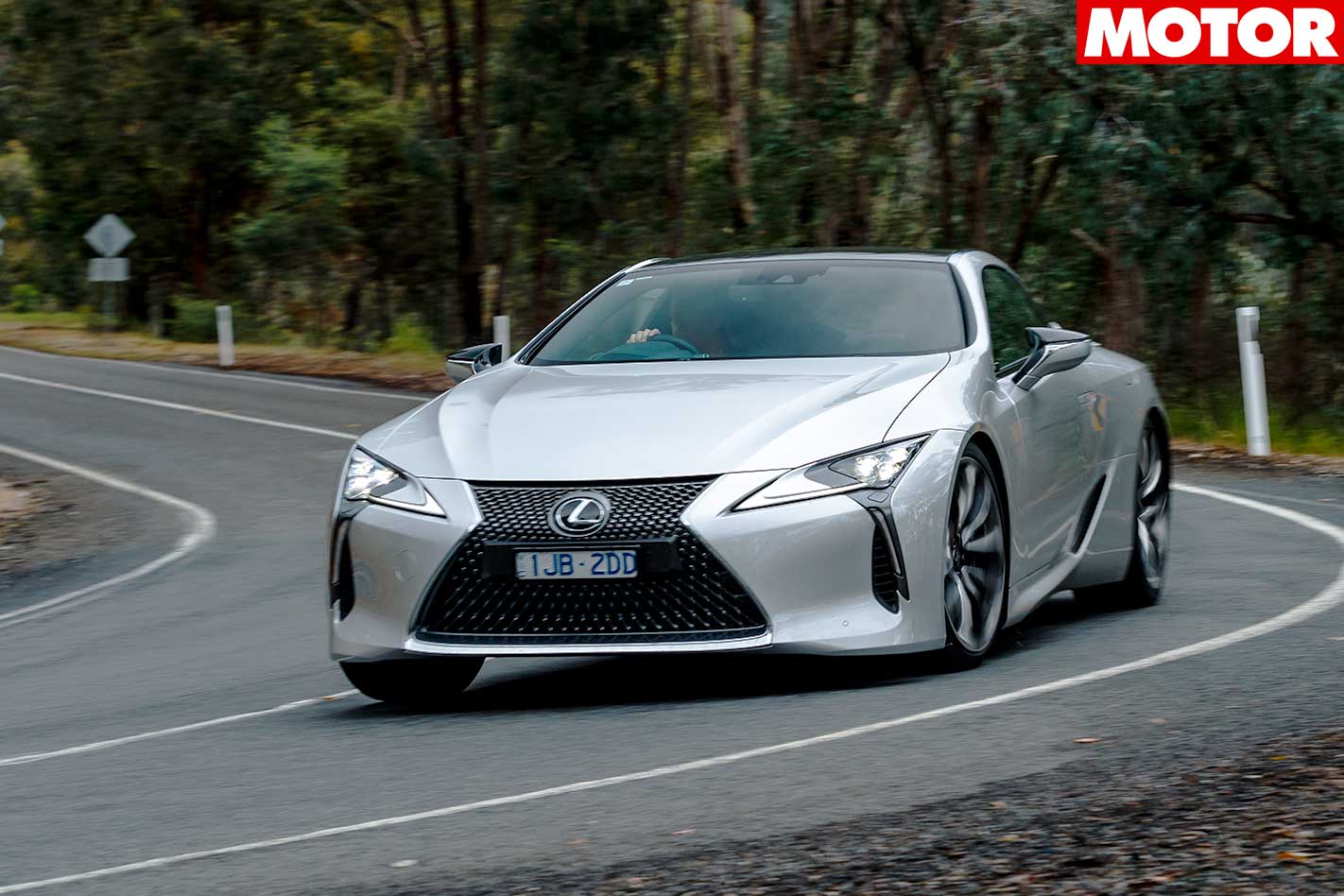
Unfortunately, as soon as you turn the wheel that weight starts to hurt the LC500. It doesn’t offer a whole lot of feedback and feels too soft to effectively control its weight, yet skitters over bumps, putting the overly sensitive ESP system on high-alert.
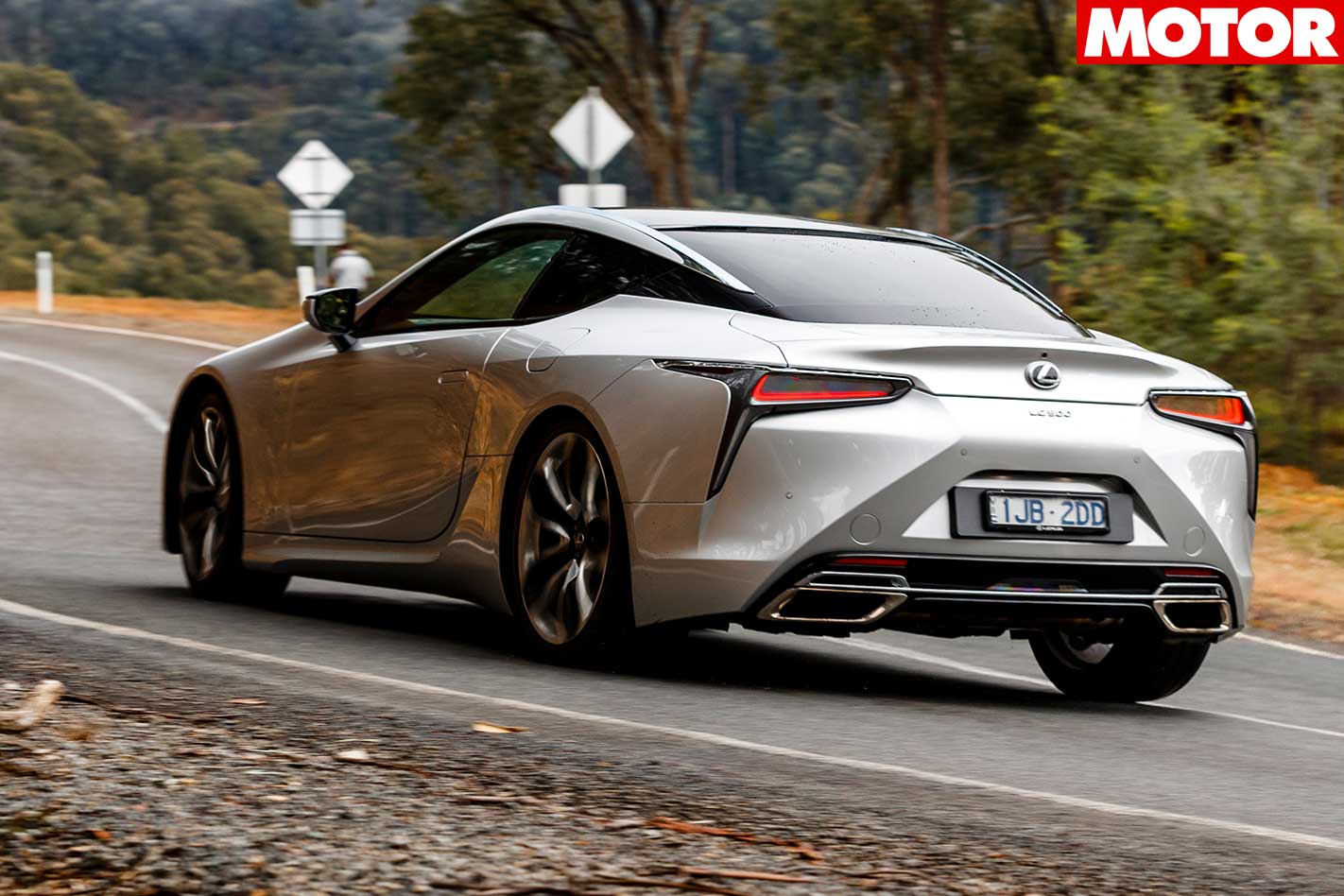
Despite its grand tourer brief, the ride is also jittery to the point of annoyance and the infotainment system seems deliberately unintuitive. Despite this, the LC500 remains an easy car to fall for, if you like the way it looks, that is.
Another car that divided the judges on its aesthetics was the Kia Stinger.
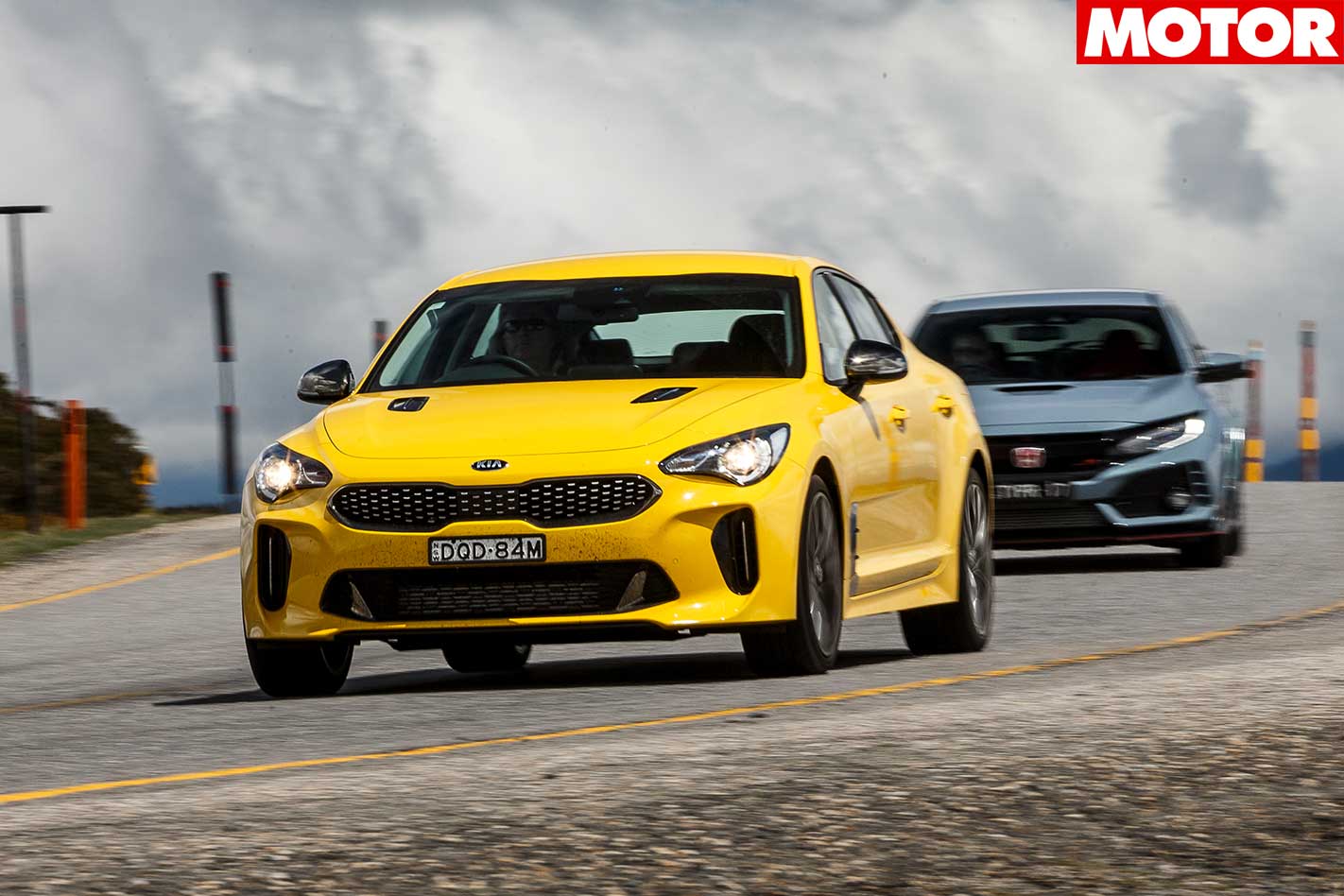
The kindest way to describe the Stinger’s chassis is ‘unfinished’. If you’re intending on buying Kia’s new rear-drive sports sedan as a day-to-day cruiser, it’s likely you’ll have no complaints, though the way it floats over larger undulations yet fidgets over small amplitude bumps is a little disappointing.
When it comes to driving hard, however, the Stinger is most definitely a work in progress. We’d start with a better tyre. The way they completely fell apart on track suggest the Continental ContiSportContact 5s aren’t suitable for this level of performance, but a more focused tyre would only help mitigate some major handling flaws.
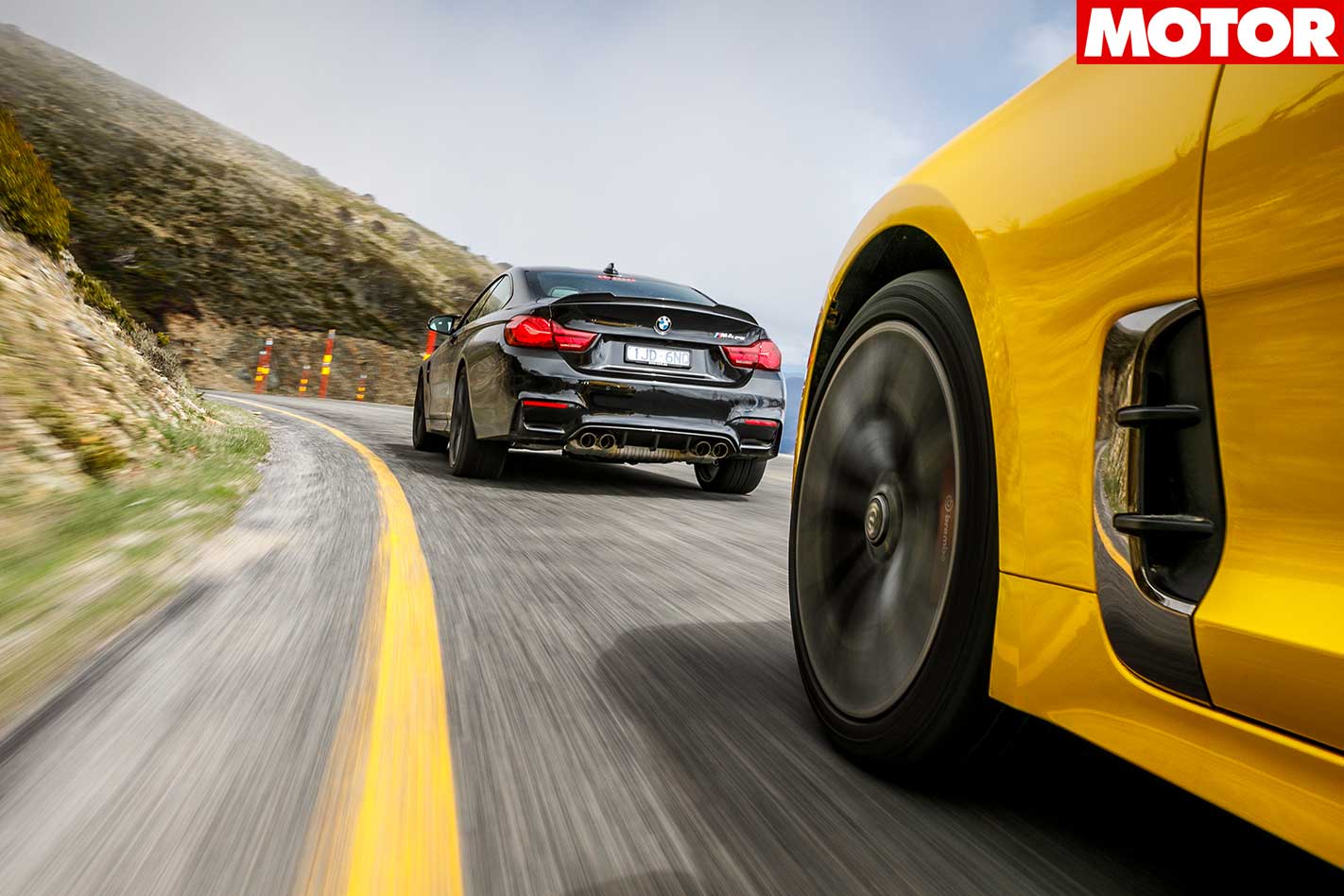
Actually, the almost complete lack of brakes after Winton is currently the Kia’s biggest issue, but inconsistency is a close second.
Contrary to Kia’s claims, the ESP doesn’t deactivate completely, operating more like a very lenient Sports mode. This is fine – welcome, even – except that sometimes the system is overzealous and other times checks out completely; combine this with its oversteer-first handling balance and the Stinger can be an eye-opening ride.
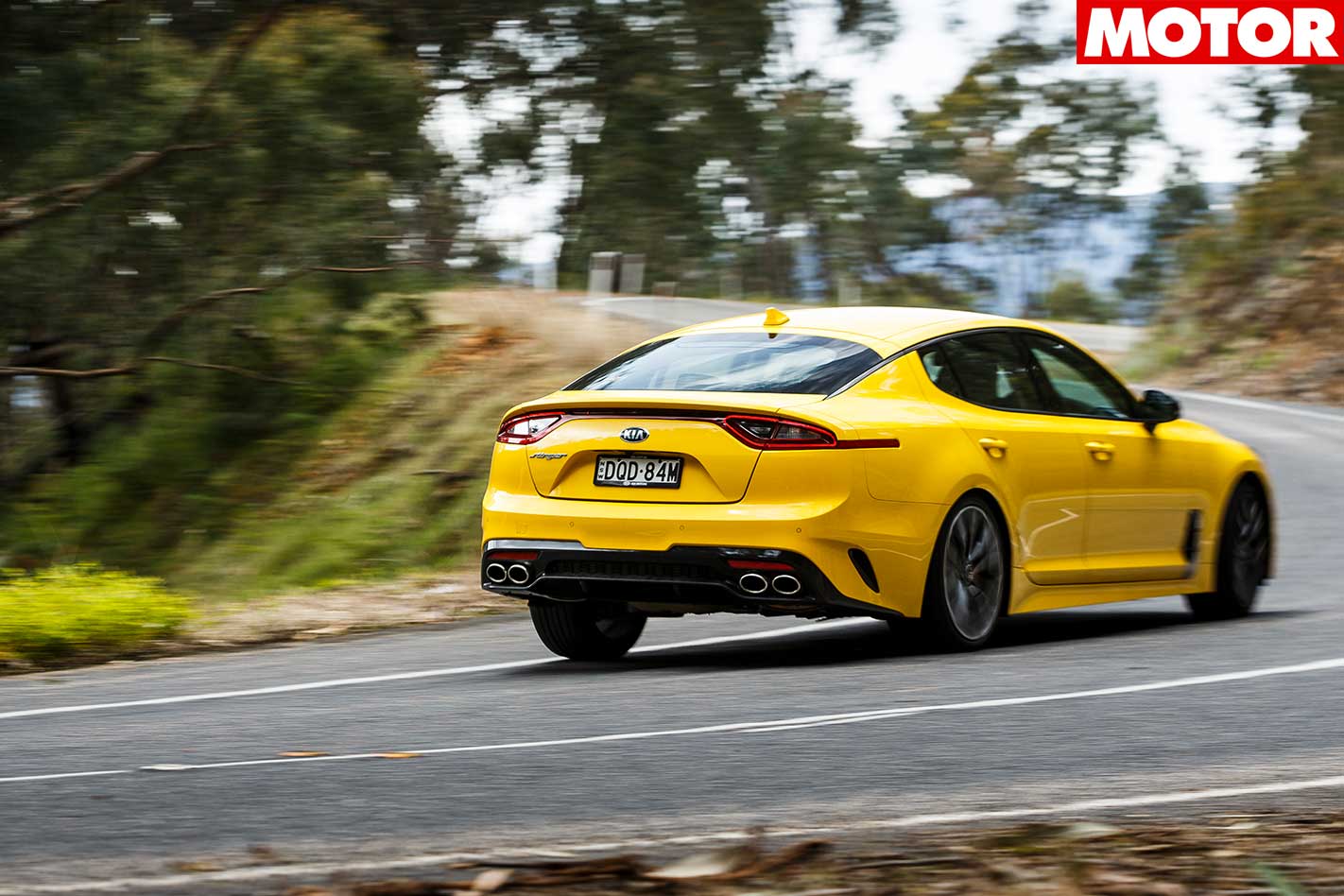
As mentioned, as a sports-luxury cruiser it does a decent job, with heaps of grunt and a great interior, but even at a slower pace the lack of a proper manual mode for the eight-speed auto grates. As a performance car, it needs more tyre, more brakes and more control – maybe the adaptive damper-equipped GT is better?
Virtually identical in mechanical spec to the Kia is the Alfa Romeo Giulia QV, a rear-drive sedan powered by a twin-turbo V6. In contrast to the Stinger, however, the chassis is undoubtedly the highlight of this Italian stallion.
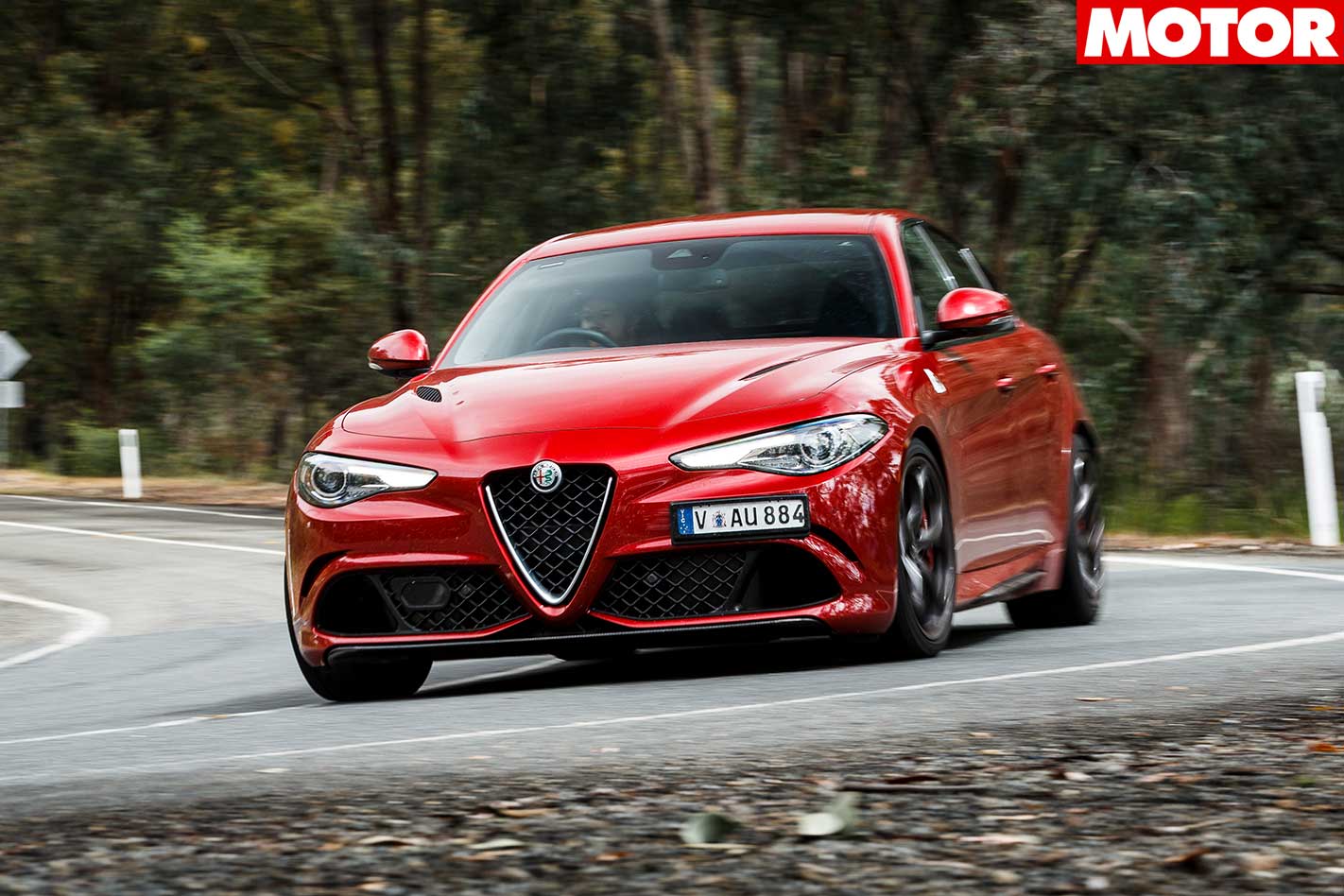
The only way to experience the Alfa’s true talents is in Race mode. This more or less deactivates the ESP completely – a midway mode would be welcome – yet the Giulia QV is so friendly at the limit it seems almost a crime to electronically shackle it.
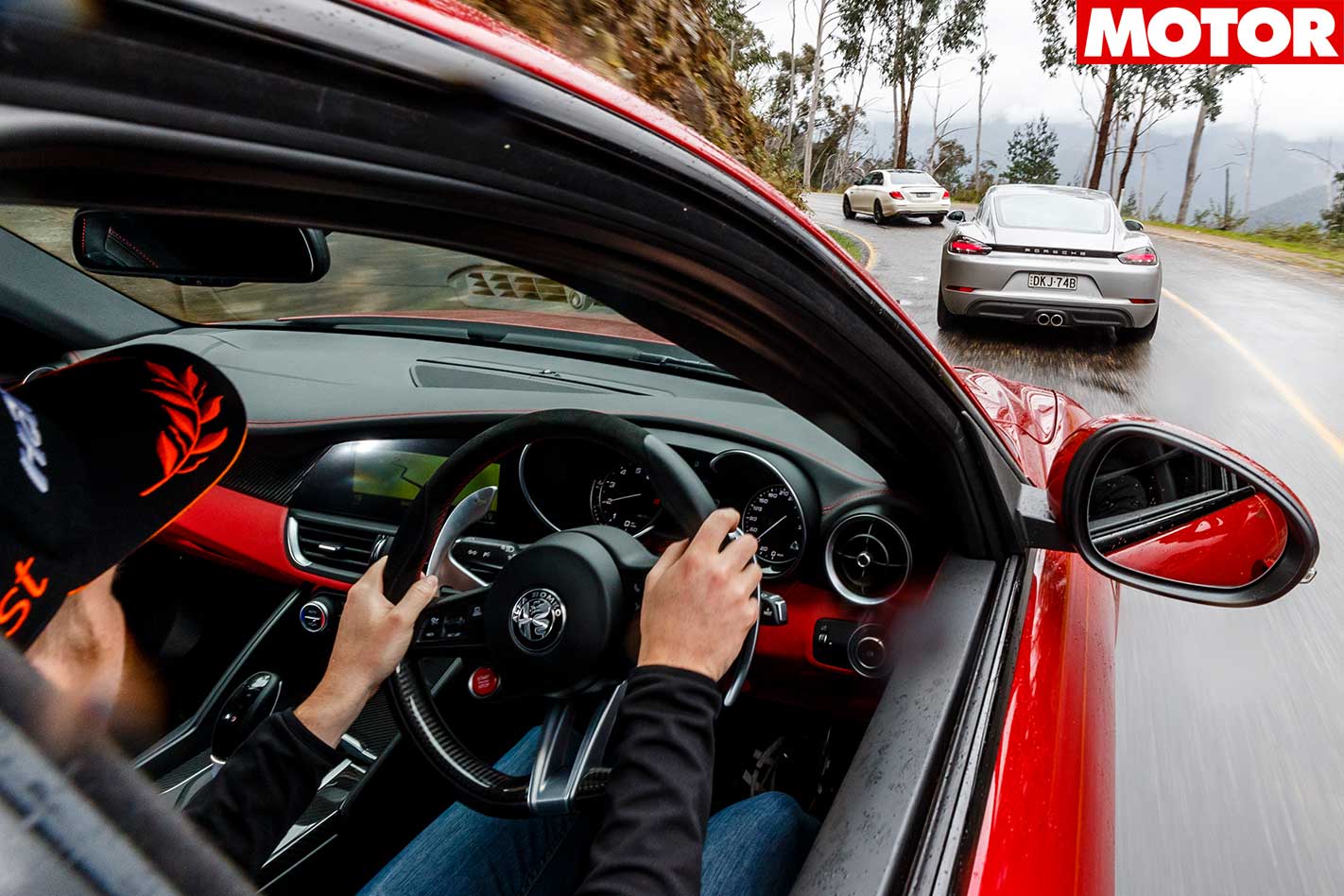
Combine this with outstanding touring manners – its ride is probably the best on test – and you have an excellent package, more than worthy of the 4.5-star rating we gave it last year. But this is PCOTY and that missing half-star proves crucial.
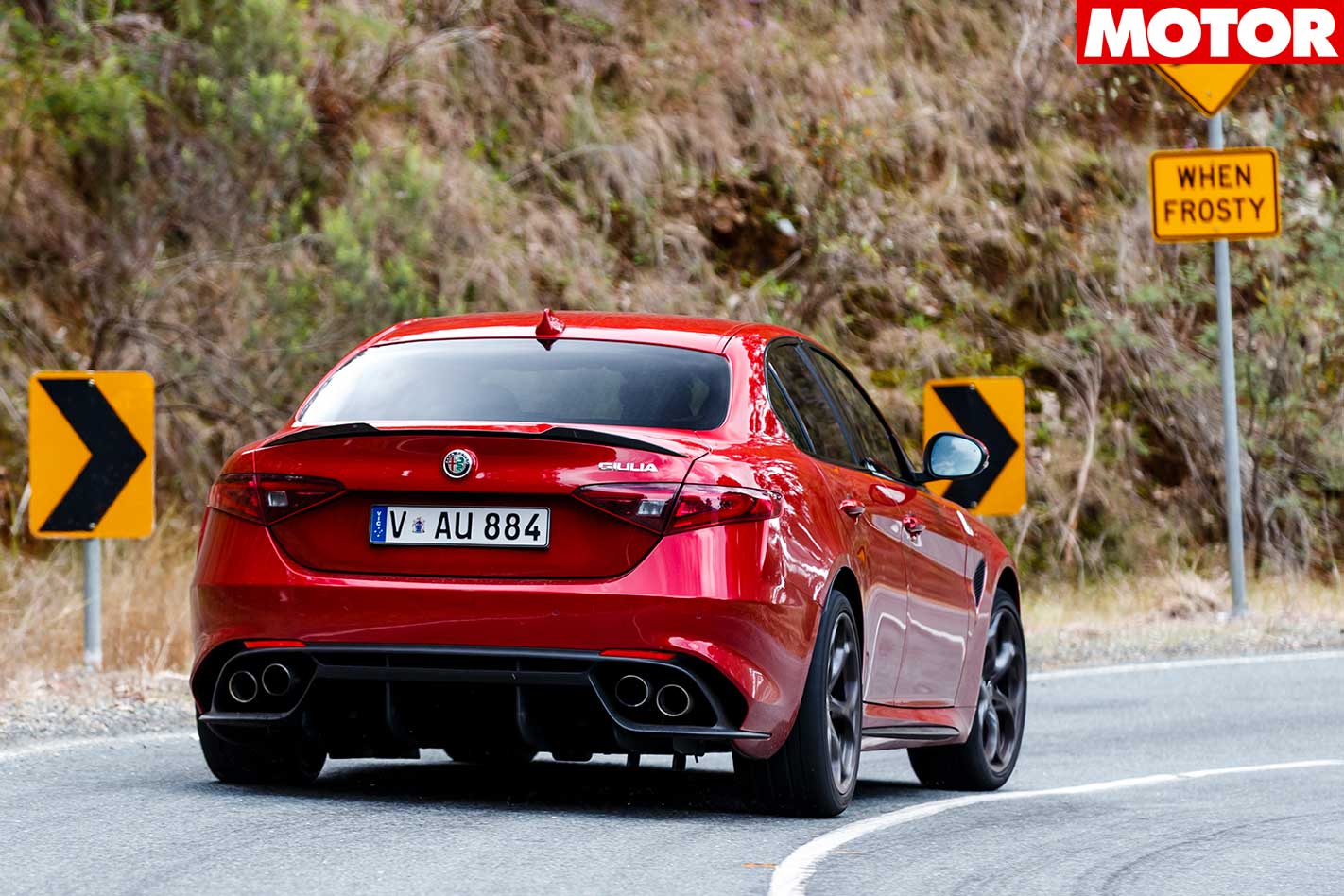
To these ears it also sounds uninspiring, with a flatulent exhaust note and a wheeze-like whine under heavy load emanating from the engine bay.
The experience from behind the wheel of the Audi TT RS couldn’t be more different.
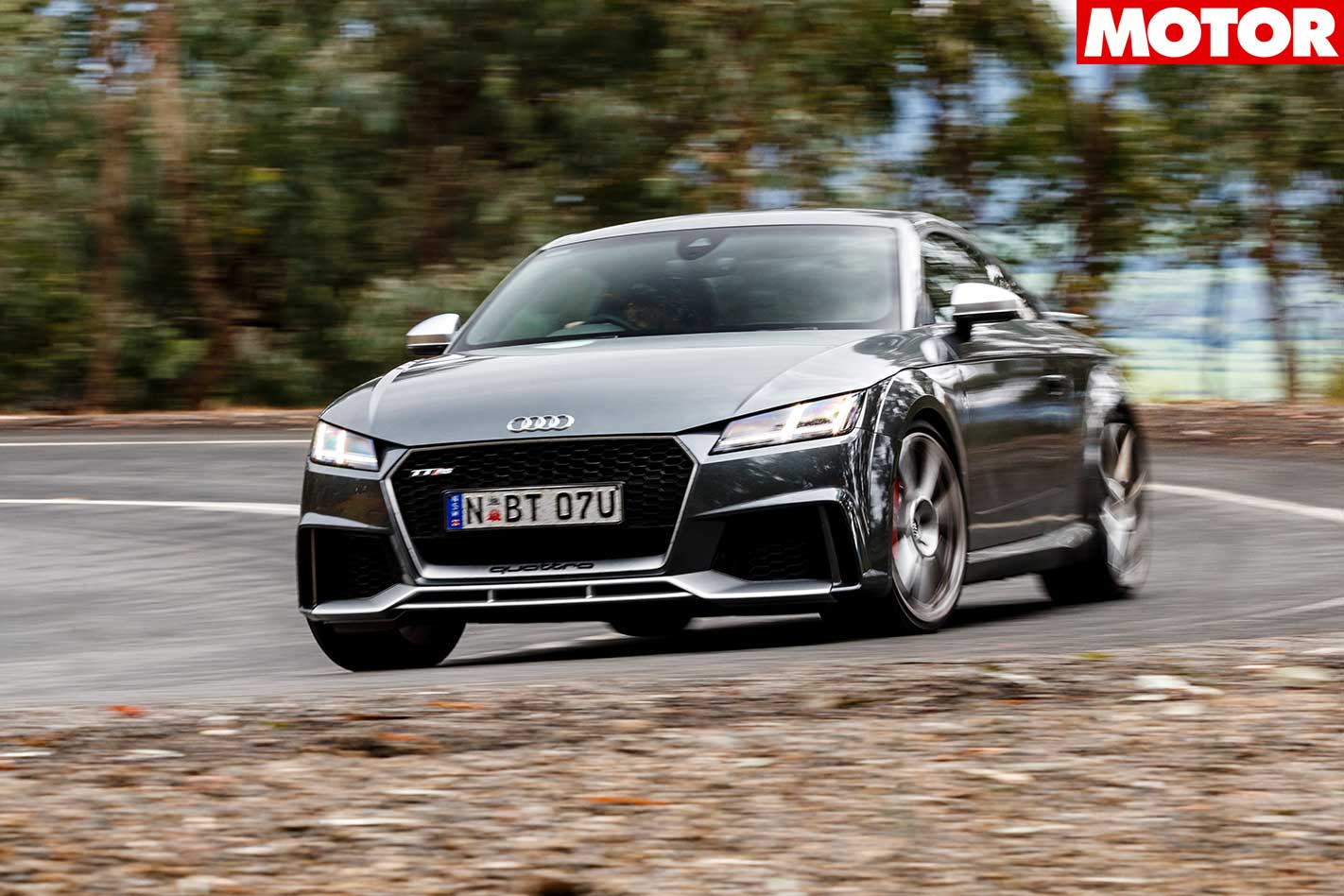
Despite its proficiency in the art of point-and-shoot, the Audi excels in faster corners where there’s enough momentum to get its rear moving slightly, something the Sport ESP setting is more than lenient enough to allow, helping point the front wheels at the corner exit and allowing power to be applied earlier.
However, while the TT RS is no boring, stuck-to-the-ground automaton, of the three all-wheel drives here it’s obviously the only one that’s predominantly front-drive, shuffling power to the rear when required.
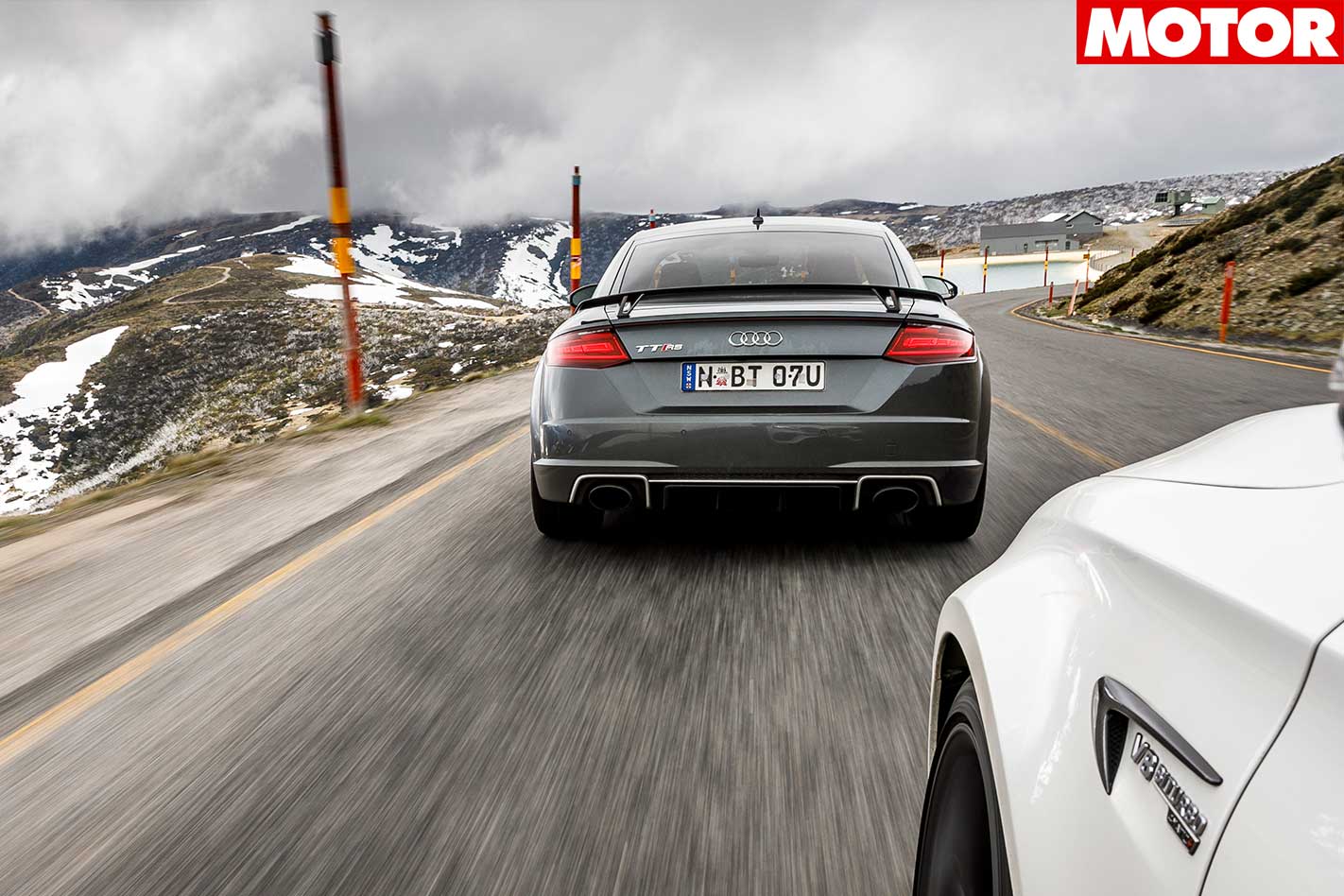
The Audi’s preference is for smooth roads, as bumps encountered under load will have the car skipping, hopping or (occasionally) jumping depending on their severity. Its ride is definitely on the firm side, though thankfully without the wince-inducing crashing of the TT S.
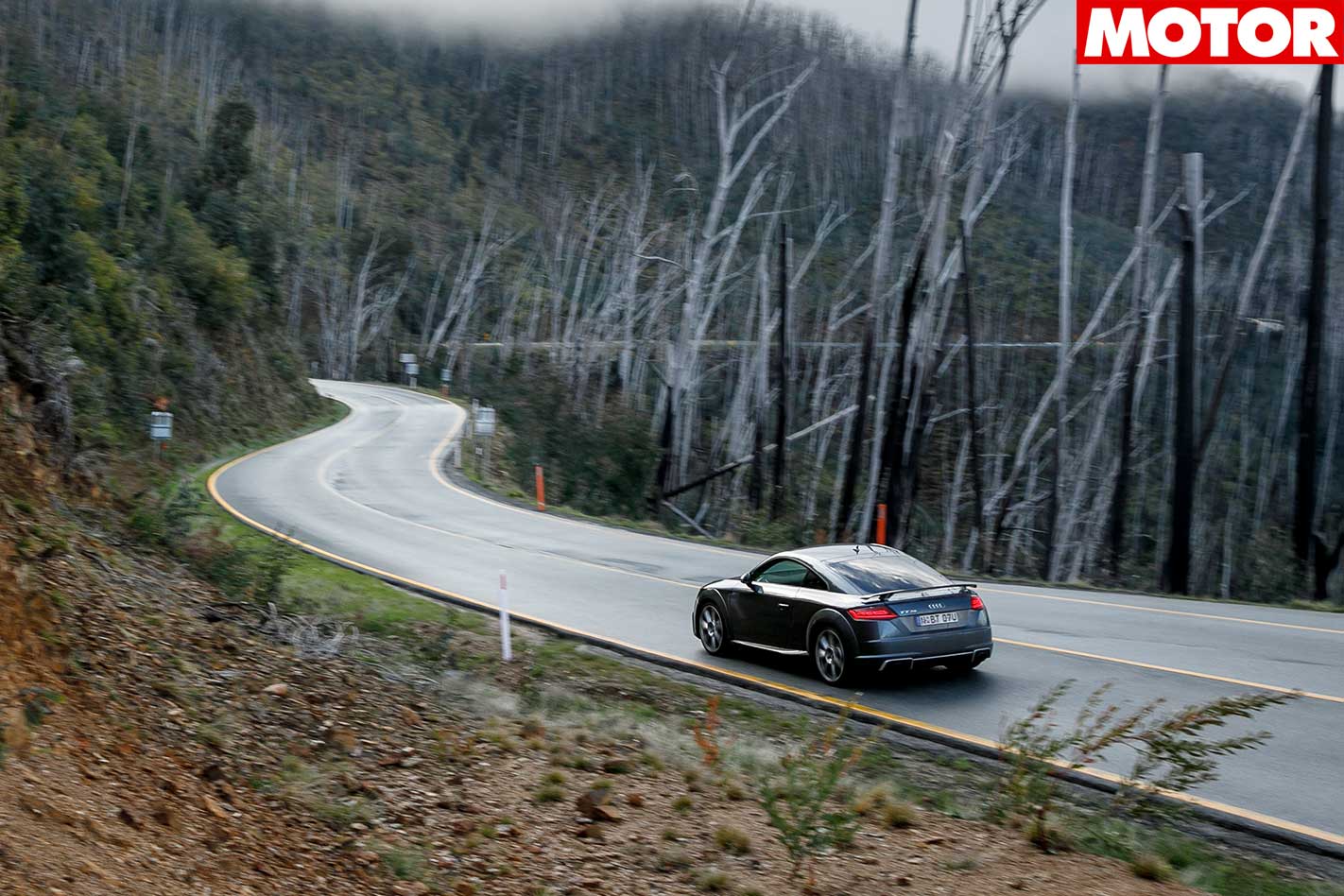
Unfortunately for Ingolstadt, the Porsche 718 Cayman S shows what the Audi is lacking. As a driving tool it’s virtually perfect.
Like the Audi it can get flustered over bumps but doesn’t lose its composure to the same degree and otherwise it’s difficult to imagine what more you could want from a car dynamically. The steering is spot-on, brakes powerful and easily modulated and grip levels immense, yet while it doesn’t move around in the manner of the M4 or Giulia, it still always manages to feel alive.
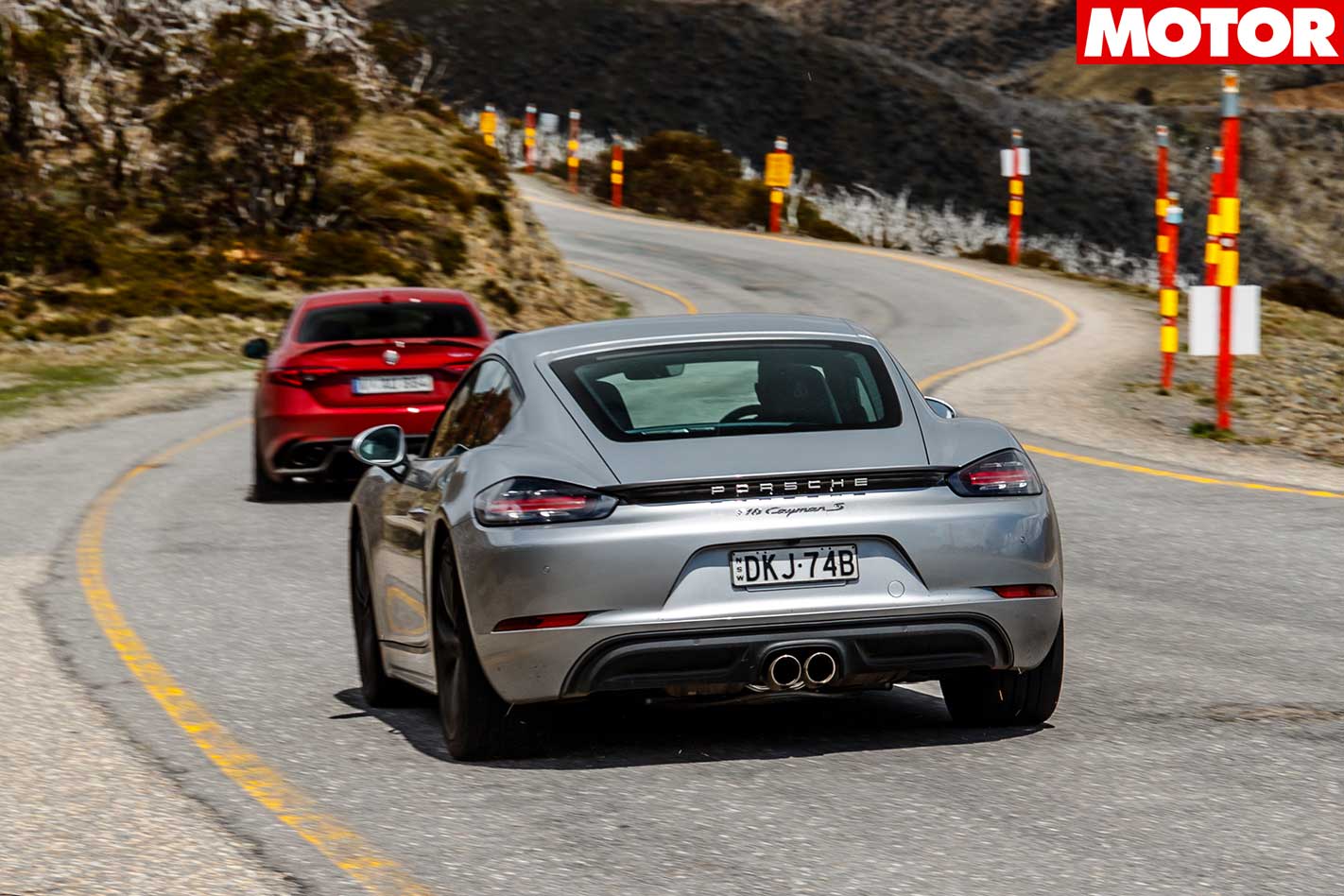
The 2.5-litre turbo flat-four will never make your ears tingle like the old sixes, but it sounds okay from inside and anyone used to 981-or-previous Caymans will be shocked at the new car’s speed – I certainly was when I encountered it coming the other way on the exit of a tight bend with a certain Bathurst champion at the helm.
The 718 Cayman is now a very expensive car – more than $170K as tested without carbon-ceramic brakes – yet somehow it still feels good value, simply because it could easily be used every day while being so polished that, in engineering terms, it’s almost faultless.
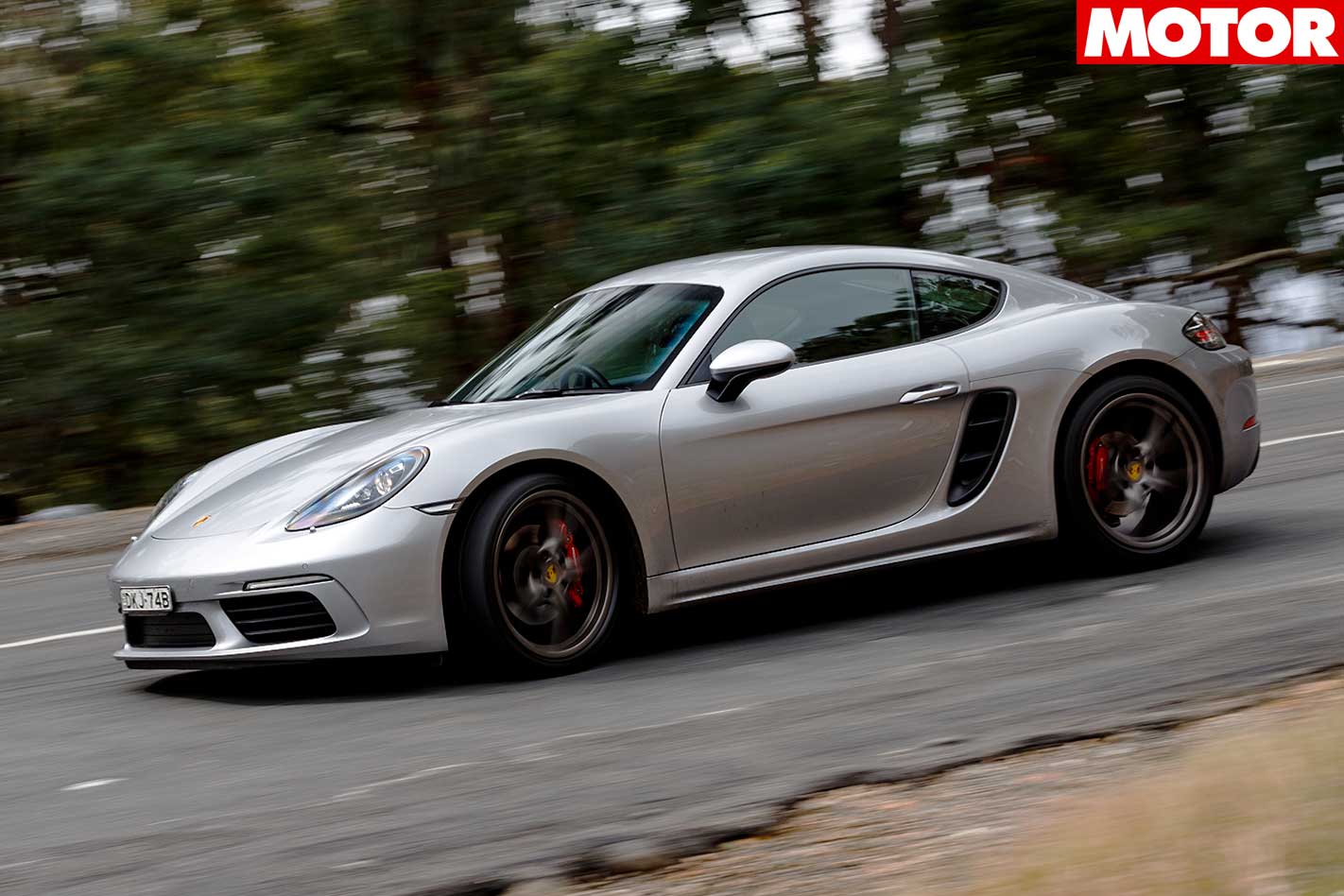
As a precision driving instrument, though, it sets the benchmark, which only makes it more remarkable that as I shut off the Civic Type R’s 2.0-litre turbo four my foremost thought is: “I think this is the best car I’ve driven today.”
Every superlative just used to describe the $170,000 Porsche applies equally to this $50,000 Honda, yet it’s remarkably difficult to explain why this hot hatch is so good.
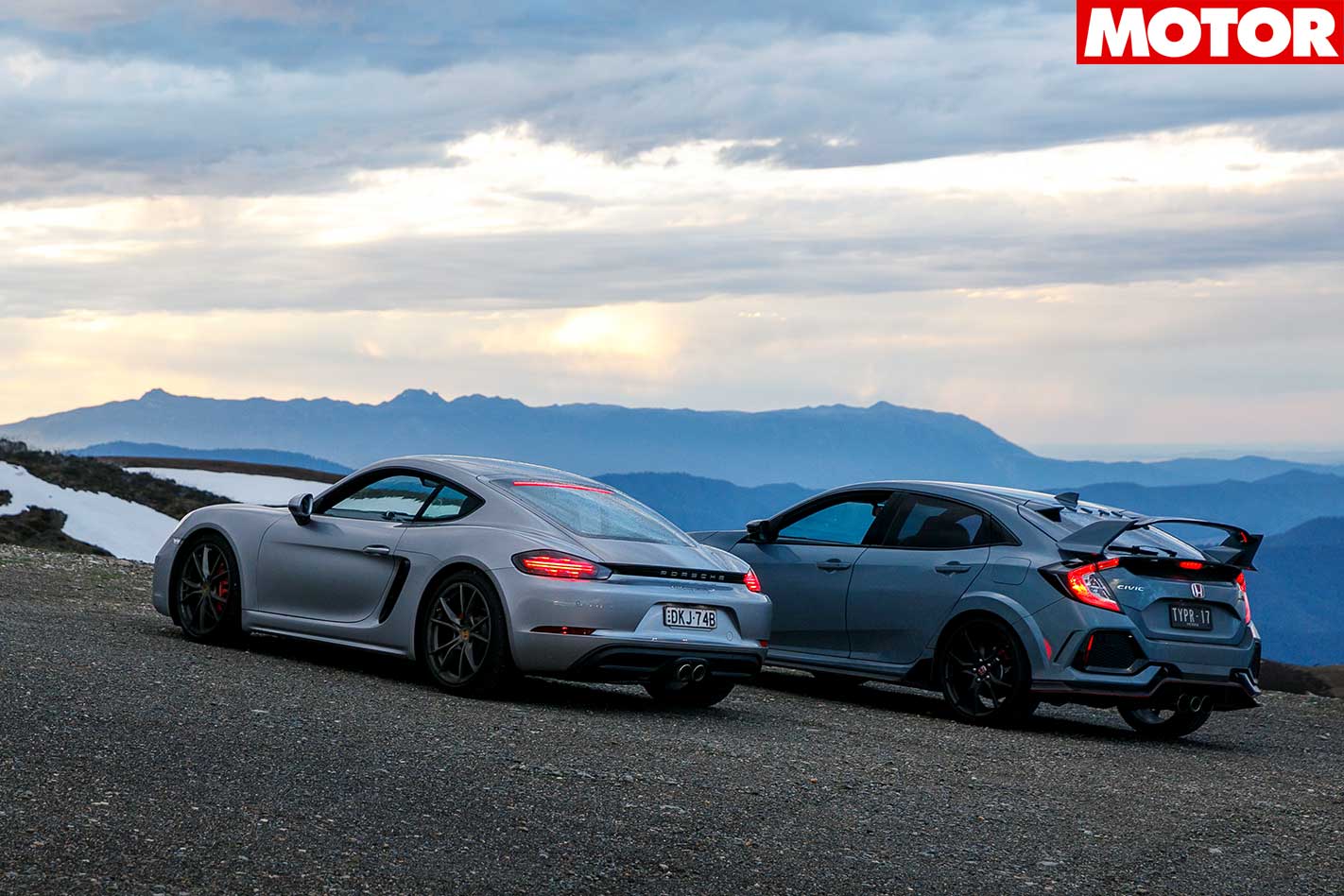
Adding a turbo means the VTEC engine majors on mid-range torque rather than screaming rpm, but it’s beautifully responsive, revs hard and keeping it in the sweet spot is a cinch thanks to the closely stacked ratios of the sweet-shifting six-speed manual.
Quick, accurate steering controls a front-end that is absolutely nailed to the road, the stable rear ensuring quick corner entries and the tricky limited-slip diff allowing all 228kW/400Nm to claw at the road on exit, with occasional torque steer on bumpy surfaces the only price to pay.
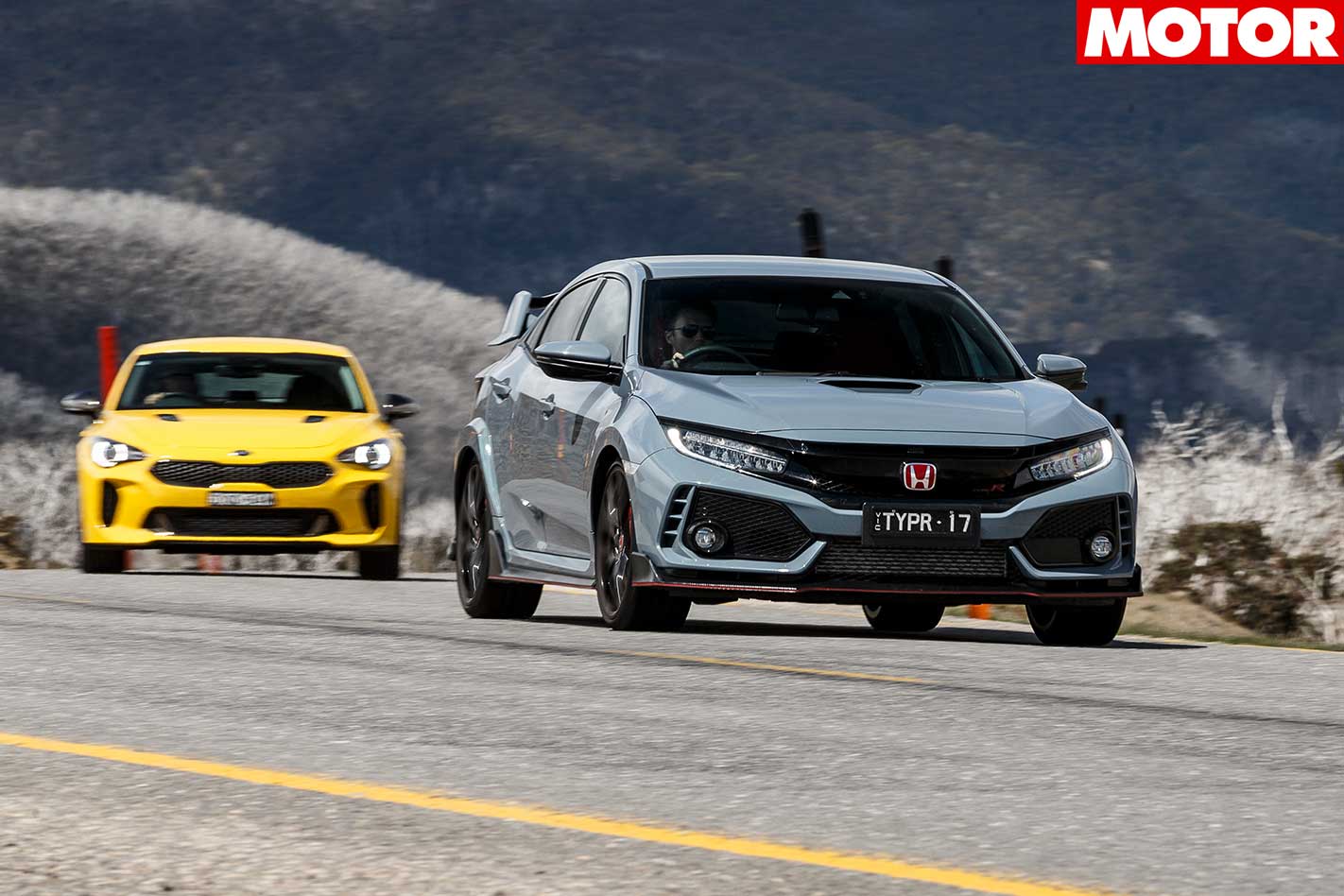
Driving the TT RS, I’m unable to gap Robbo in the Civic uphill or down, despite the Audi’s obvious power advantage. Even more impressively, this cornering prowess doesn’t come at the expense of ride.
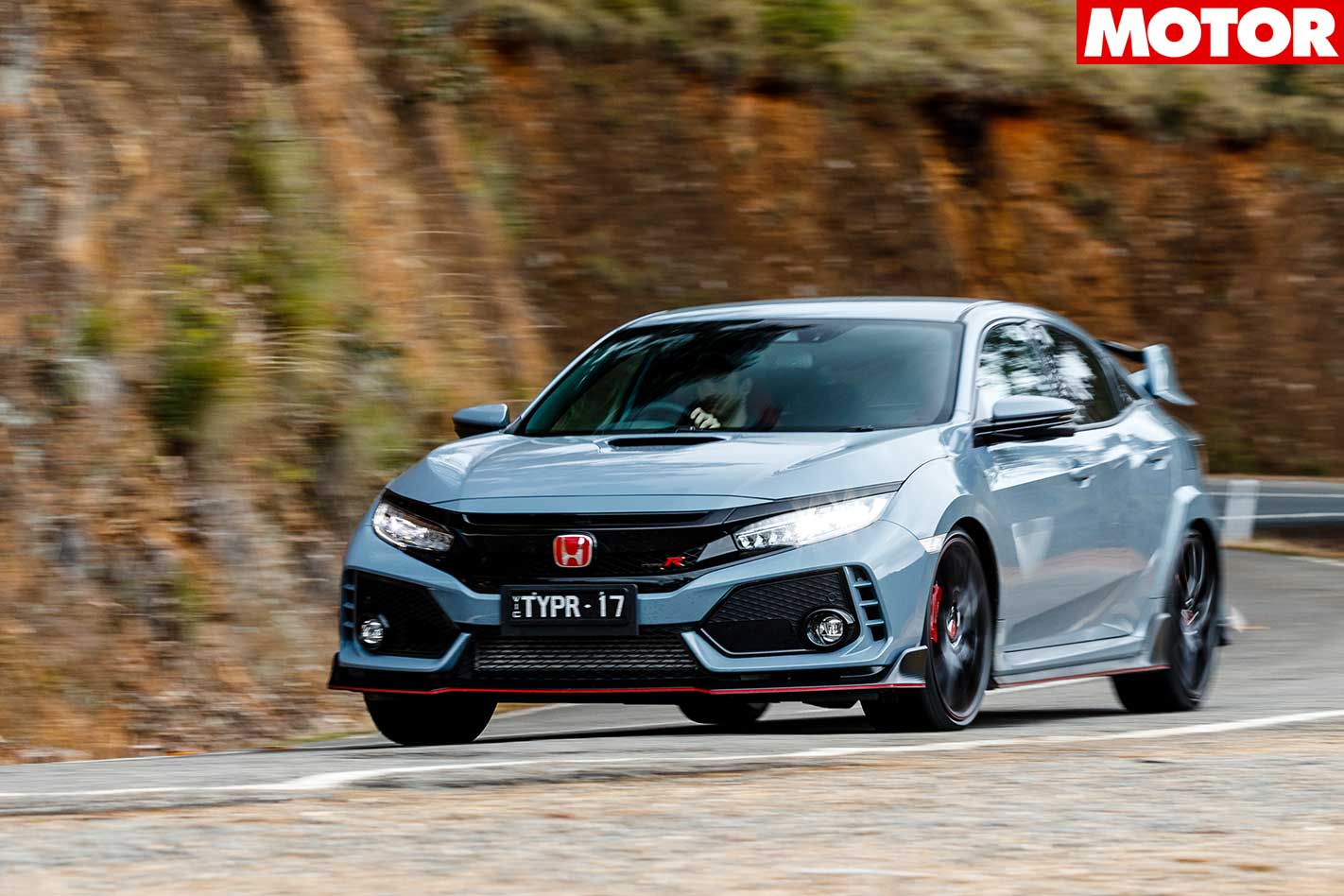
It begs the question: is the Civic Type R the best car here?
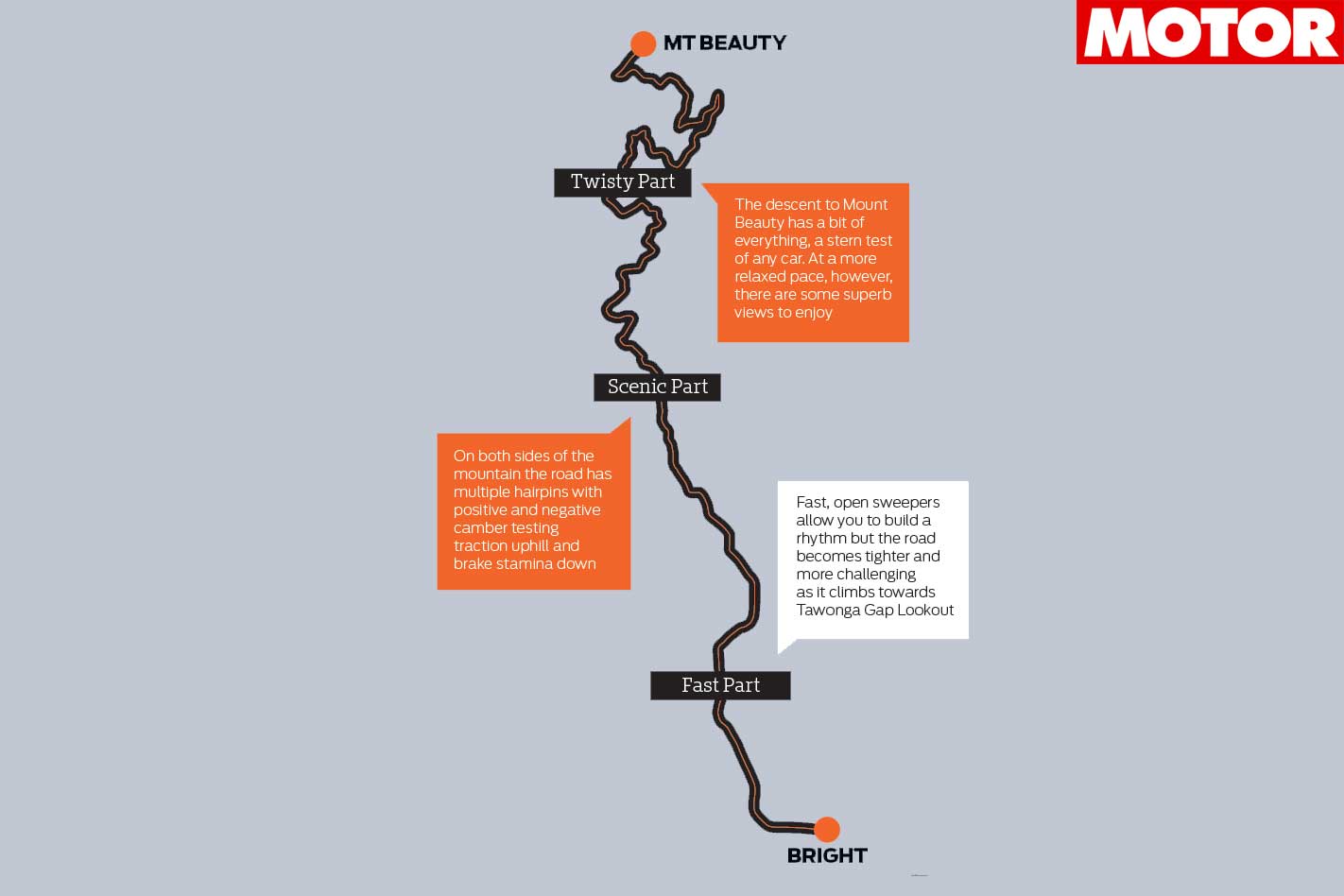
THE ROUTE
THE GAS GUZZLERS
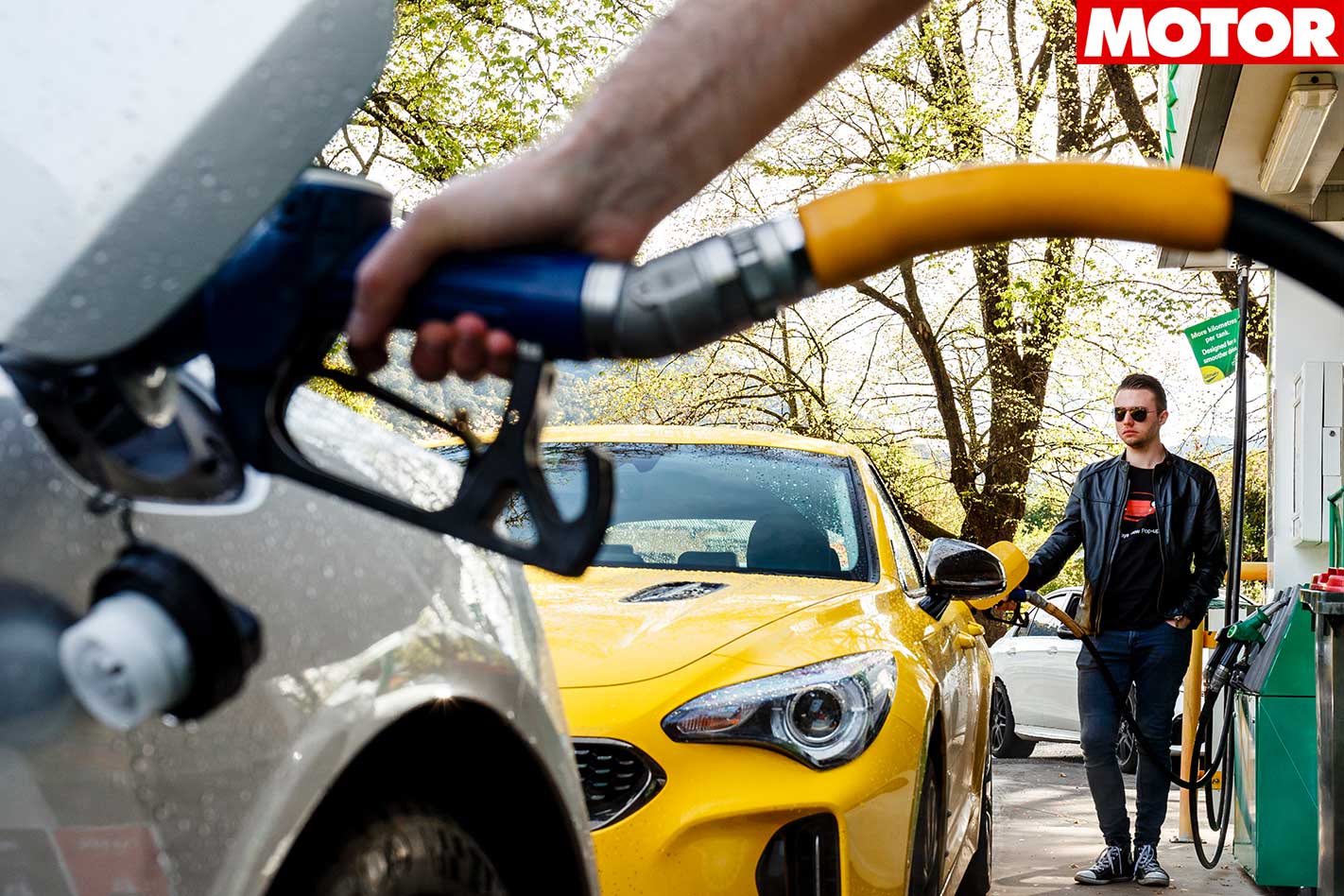
| u00a0 | Vehicle | Claimed | Measured | Difference |
| 1st | Honda Civic Type R | 7.7L/100km | 15.1l/100KM | +7.4L |
| 2nd | Audi TT RS | 8.4L/100km | 15.8L/100km | +7.4L |
| 3rd | Kia Stinger 330 Si | 10.3L/100km | 17.7L/100km | +7.4L |
| 4th | Porsche 718 Cayman S | 8.1L/100km | 16.8L/100km | +8.7L |
| 5th | HSV GTSR W1 | 16.5L/100km | 25.2L/100km | +8.7L |
| 6th | BMW M4 CS | 8.4L/100km | 18.0L/100km | +9.6L |
| 7th | Alfa Romeo Giulia QV | 8.2L/100km | 19.9L/100km | +11.7L |
| 8th | Lexus LC500 | 11.6L/100km | 23.3L/100km | +12.1L |
| 9th | Nissan GT-R Nismo | 11.7L/100km | 24.4L/100km | +12.7L |
| 10th | Mercedes-AMG E63 S | 9.3L/100km | 23.4L/100km | +14.1L |
UNTIL just over a decade ago, Australia had the unique distinction of being the only country in the world with an undivided highway with open speed limits.
In fact, for most of our country’s history, there were copious roads where the enthusiastic driver could open the taps and enjoy the freedom of travelling without speed limits.
New South Wales, Western Australia, Queensland, the Northern Territory, and yes, even nanny-state Victoria, each had large sections of rural roads and interstate highways without posted speed restrictions.Many of these were prima facie conditions, meaning drivers could still be pinged by police for excessive speed if they didn’t ‘drive to the conditions’.
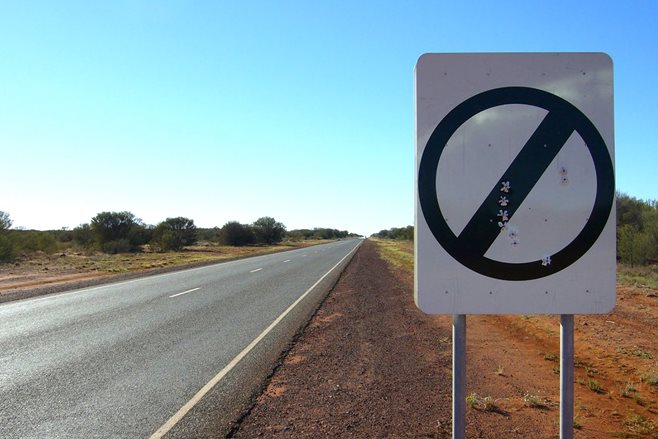
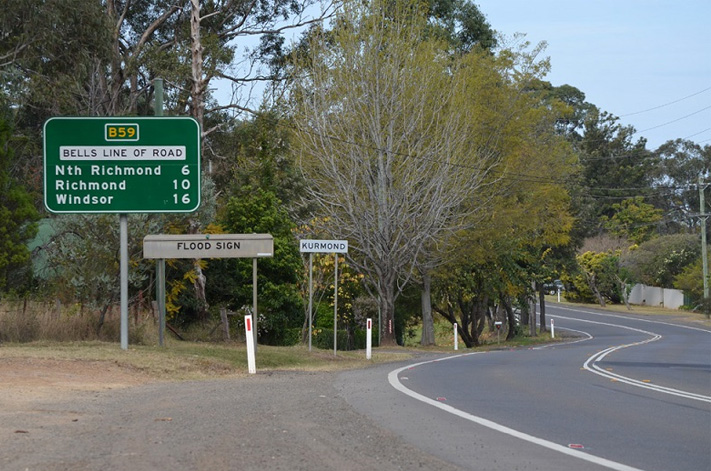
This led to a false belief that derestriction signs indicated unlimited speed was permitted, with studies from the period showing 85th percentile speeds on unrestricted roads were often in excess of 120km/h. The Bells Line Of Road in the Blue Mountains was famously unrestricted during the early ‘70s.
In 1978, NSW implemented a state-wide maximum rural speed limit of 100km/h, with derestriction signs progressively replaced by signposted limits.
The territory’s unrestricted highways grew to national and international infamy following the 1994 Cannonball Run, which ran down the Stuart Highway and was sponsored by the then Country Liberal Party Government. During the event, a high-speed crash involving a Ferrari F40 killed four people.
Up until 2007, the territory, which includes vast swathes of desert, had no blanket speed limits outside of major towns. In January that year a general rural limit of 110km/h was introduced, while the four major highways were capped at 130km/h.
It was claimed that, at the time, the Northern Territory had the worst road safety stats in the country, with one person killed, and nine seriously injured each week. However, half of all fatal crashes at the time were attributed to drunk driving, with testing showing one in every 42 drivers in the state got behind the wheel under the influence of alcohol. The territory’s highest recorded annual road death toll of 75 fatalities was in 2008, when a 130km/h limit was enforced.
Since the implementation, unrestricted speed limits have become a political football in the territory. The Country Liberal Party continues to campaign on keeping unrestricted sections of highway, while the Australian Labor Party has removed open speed limits twice in the last decade.
In 2012 the CLP won the election, campaigning on a transport policy which promised an evidence-based approach to speed limits. A 12-month de-restriction of a 200km stretch of Stuart Highway began in 2014 and, in a review of the trial, it was revealed there were no recorded fatalities in the derestricted section for the first 11 months.
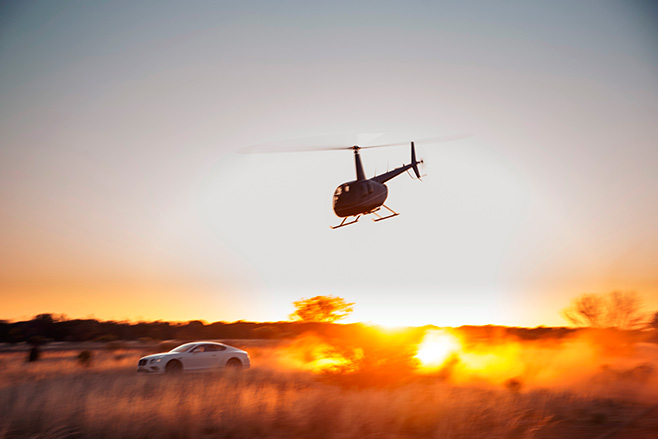
A 2016 election saw a change of government and by November the 130km/h speed limit was re-introduced.
An online petition asking for the Labor Government to reinstate open speed limits was signed by nearly 2000 people however, it is unlikely the 130km/h signs will be removed while Labor remains in power.
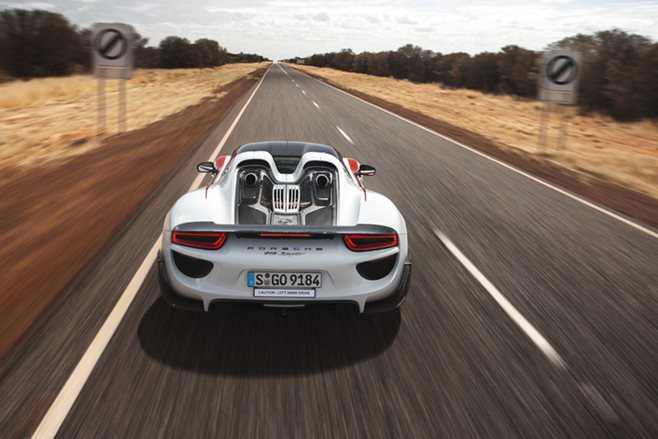
BMW Australia’s outspoken stance against the Australian government’s lacklustre support of electric vehicles took an angry turn this week.
BMW Australia CEO Marc Werner used a media event in Victoria on Wednesday to vent his frustration and demand action from Canberra to bring Australia up to speed with its counterparts in the rest of the world.
“At BMW, we are clearly on it, but here in Australia we continue to languish in the doldrums as senior government officials concentrate on their private affairs rather than formulating the advancement of our society,” said Werner.
Werner cited a lack of firm policy as a major problem not only for BMW but the industry as a whole.
“We need, urgently, a set of short- and medium-term support options to kick start our market. Things like strong electric vehicle targets, CO2 emission targets, extended infrastructure, and tax incentives. That all works in other countries, why not in Australia?
“The world has given us 20 years notice that we are transitioning to electric vehicles. There is no excuse for government to ignore that opportunity.”
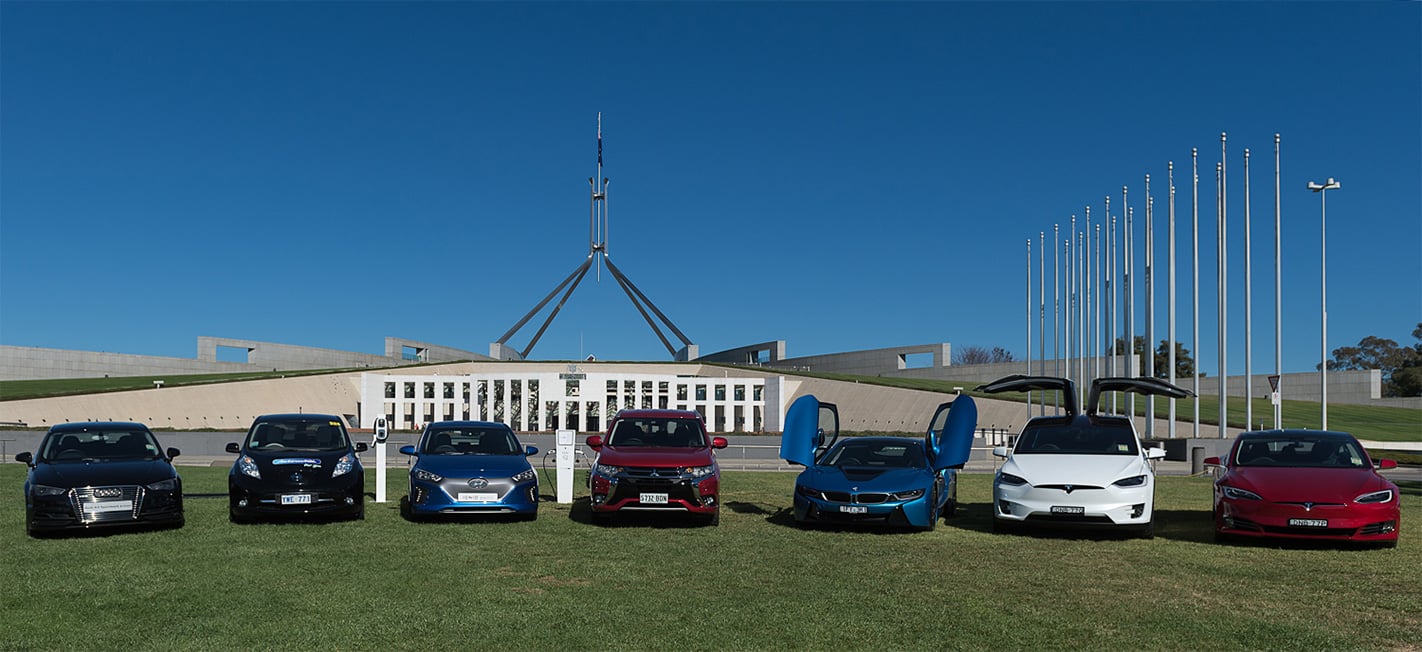
“Our industry is doing the heavy lifting on their own and the short-sighted attitude of the government is honestly disappointing.
“I will say it was heartening to see the minister for energy citing that he expects to see EV take-up increase dramatically with a million EVs on the roads in Australia by 2030… 2030.
“[But] these targets are extremely light in comparison to other countries.
Mr Werner said BMW alone aims to have more than half a million electrified vehicles on the road around the world by the end of next year.
“At least the government is thinking about the situation, however, thinking about this is not enough. It’s clearly not enough. We need to see some action here, or Australia will continue to lag behind the rest of the world.”
“I call again on the Prime Minister Malcolm Turnbull to show the strong leadership and strong action this country so desperately needs. I live in hope.”
BMW established a sub-brand for electric vehicle development in 2011, and introduced it to Australia with the BMW i3 and i8 in 2014. Electrified versions of its more conventional vehicles have joined its line-up since then, such as the 330e and X5 xDrive40e.
Maybe it’s the notion of a five-cent whiskey. Or perhaps the reality that, should you learn of another man messin’ with your lady, you could shoot him in the leg and no-one in the saloon would blink an eye.
Either way, the thought of life in America’s wild-west gold-rush era has long held a fascination.
When I learned about the town of Bodie in the Eastern Sierra Nevada region about seven hours from LA, that claimed to be the best-preserved ghost town in the USA, it began to pull at me like gold-strike fever.This was a town that drew over 8500 hopefuls to it back in the late 1800s; people from a generation that surely invented the concept of ‘fear of missing out’ about 140 years before it became ‘FOMO’ for the Instagram era.
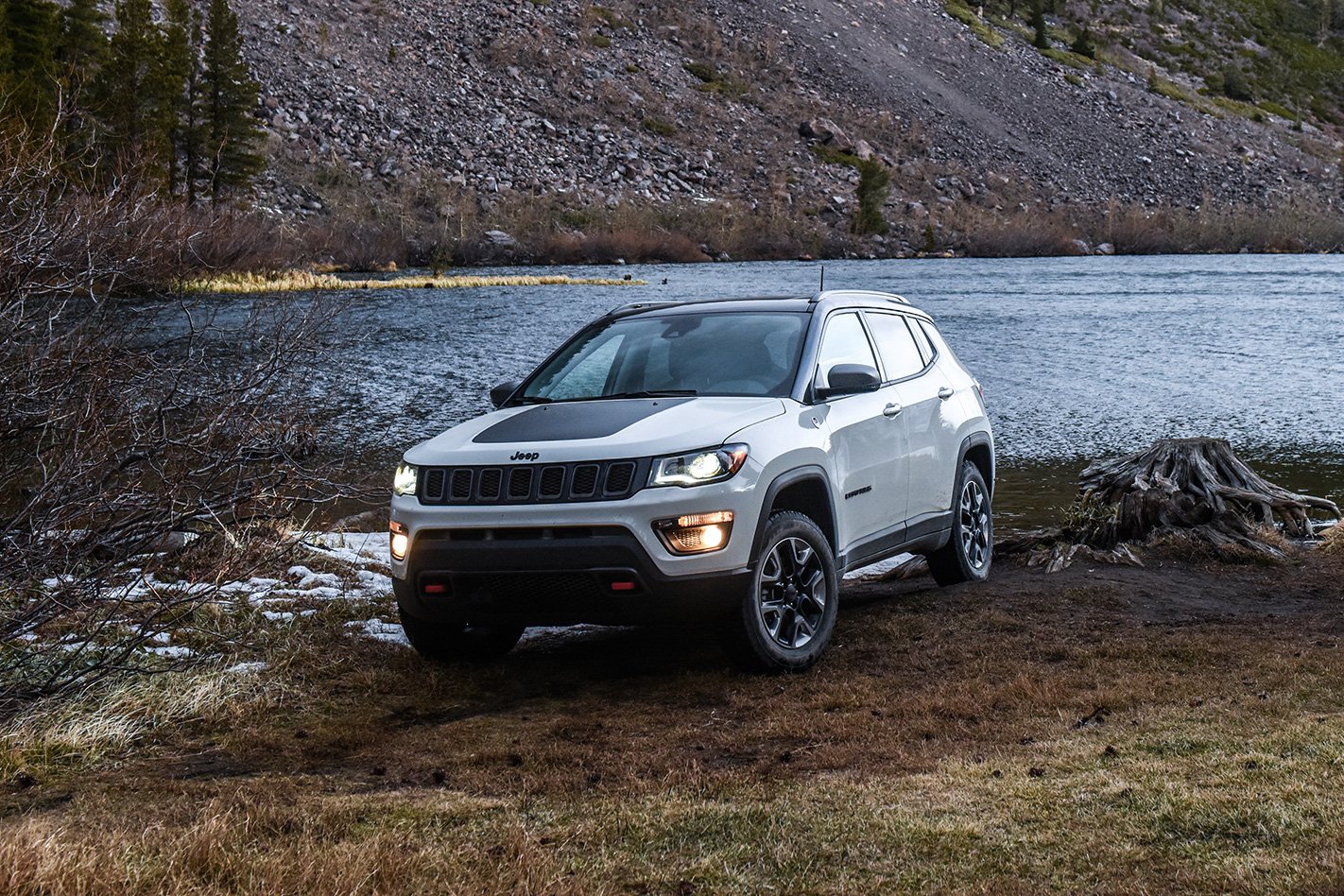
For this trip there was potential to need proper off-road capability, not just the on-demand all-wheel drive of a typical soft-roader. The Bodie website talks of heavy snow, with uncleared or closed roads in the winter months. Jeep’s all-new Compass seemed an ideal on-paper fit. It’s underpinned by a stretched version of the Renegade’s Fiat-derived ‘small wide architecture’ and sits at the more compact end of the medium-SUV class.
The lure of Bodie, in the Eastern Sierra Nevada region, began to pull at me like gold-strike fever
Styling wise, it pretty much mirrors big brother, the Grand Cherokee – squared-off wheelarches, seven rectangular grille elements, but brings a semi-floating roof design. All delivering, to my eye at least, a purposeful, nuggety little contender that seems determined to stand apart from the soft-roader mainstream. It’s only recently gone on sale in Australia, so in this most off-road-capable Trailhawk spec, it would be a perfect chance to test its chops.
Sliding inside only further heightens that sense of the Trailhawk’s utilitarianism. Compared to class rivals, it again seems happy to set its own agenda; ultra functional at the expense of much aesthetic seduction. I say that not as a real criticism; I actually like the fact that logical knobs are easily at hand; there’s no period of fumbling familiarisation. But the seats are only adequate rather than deeply supportive and the steering is nothing special in terms of feel. The Uconnect system, though, with nav, CarPlay and Android Auto, is agreeably seamless.
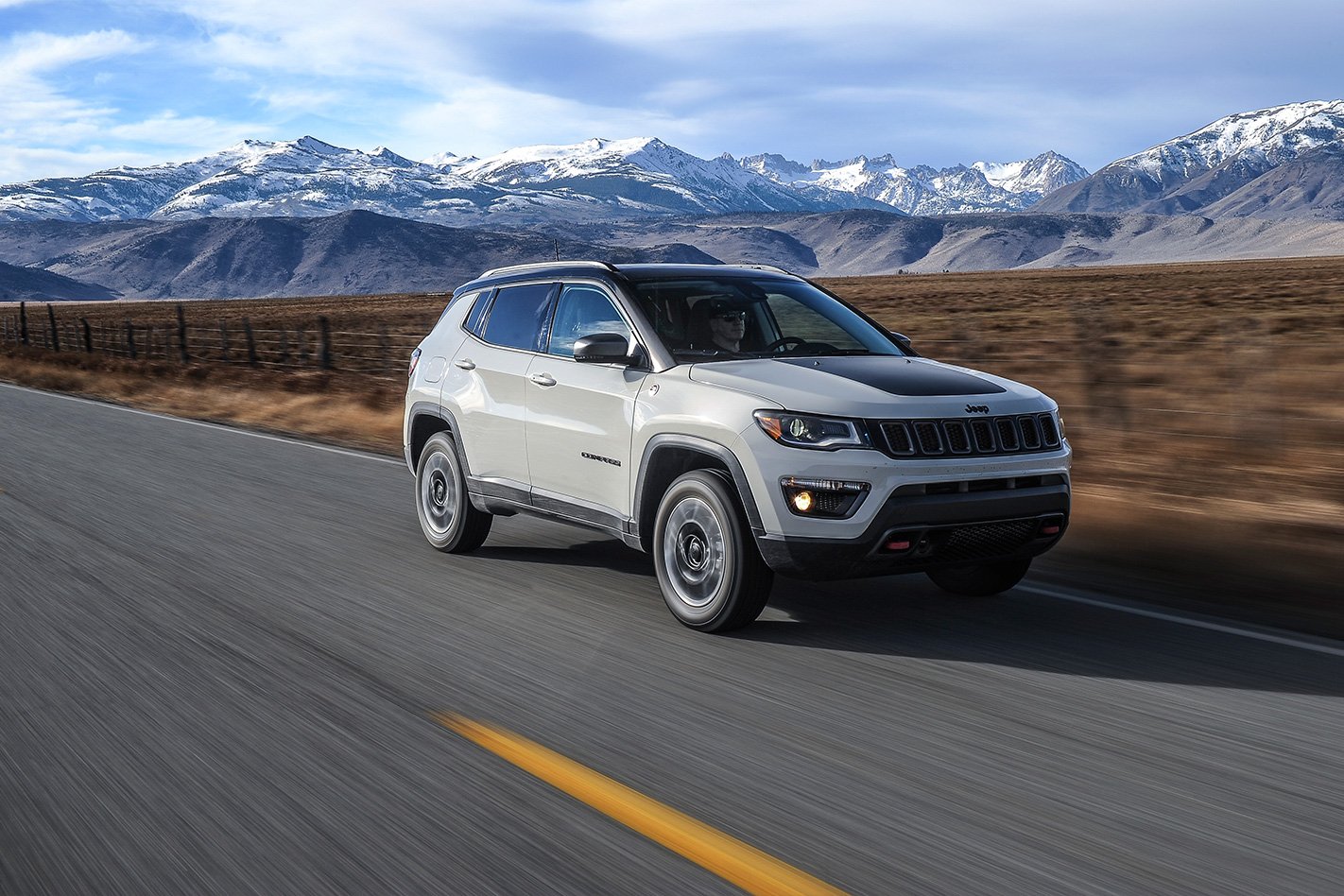
As we glide onto the freeway headed north, the chassis tune slips into the background, and the powertrain comes to the fore. At least it sounds like it wants to, there’s just not a lot of thrust to match the noise. Here’s the thing: around town, the 129kW/229Nm 2.4-litre Tigershark atmo four (carried over from the previous generation, and shared with some Renegade models), teamed with short first and second gear ratios, lulls you into thinking things are adequate under the bonnet. And they mostly are. But America’s freeways – signposted at 65mph, but with a median speed closer to 80 – demand a greater level of urge and throttle response. Just merging and keeping up often requires the Jeep’s throttle pedal to be buried to the mat, and even then things seem to happen in slow motion. At least compared to the silky, near-silent Teslas that whip past, and even next to the oversize Chevy Silverado-style pick-ups the Yanks cling to as vehemently as their right to bear arms.
Okay, so it’s clear this engine doesn’t have a whole lot for torque fans, so I can either moan about it, or shift into manual mode, wring its neck, turn the music up, and deal. Besides, our Aussie Trailhawk model won’t get this engine; instead it will be fitted with the 125kW/350Nm 2.0-litre turbo-diesel from Fiat, which will surely be a more satisfying offering. Let’s hope the NVH is sorted.
The surprisingly punchy standard Beats audio system proves to be my saviour, drowning the strained and frenetic engine note when the gradient climbs. Which is not much at this stage. Once on the outer edge of the massive Los Angeles sprawl, it’s startling how quickly the urban fringe becomes stark, arid desert. We’re on Route 395, the main link between LA and the Eastern Sierra Nevada region and, take away power poles and the road, there’s zero sign of life. No fences, no cattle, no houses. Just a vast, parched expanse of scrub and cacti that has repelled any effort to tame and monetise it.
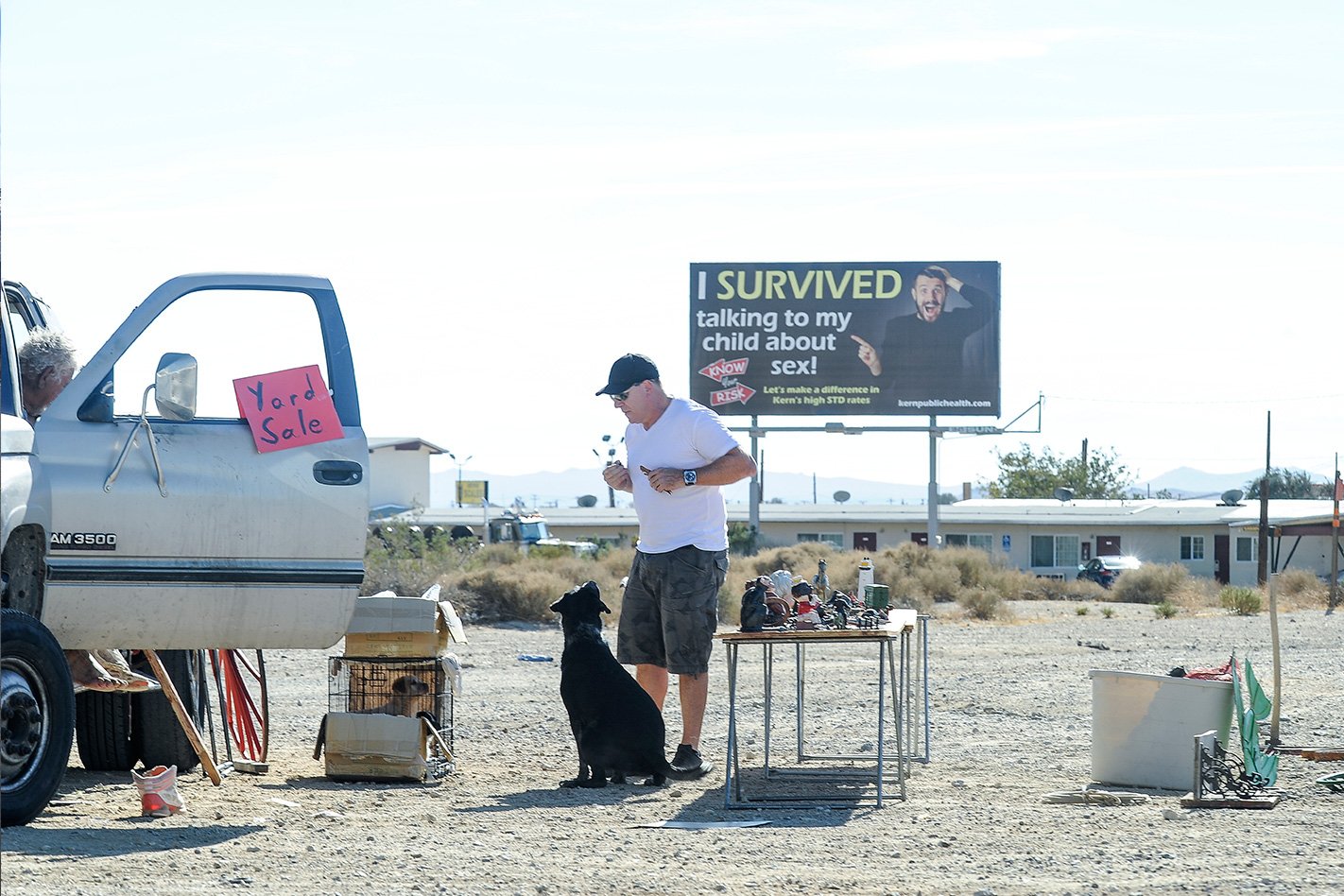
His dog, a cross-kelpie with a luxuriant ebony coat, dances around me, clearly sharing my obsession with beef jerky. I try an ice breaker: “Beautiful dog. What’s her name?”
“Black Dog,” he drawls.
Cowboy George, as he introsduces himself, is a real-life picker. He tells me he makes $100,000 a year doing this
“Oh yeah?” I pipe back. “Named after the Led Zeppelin song?” He looks at me sideways. “Naw, ’coz she’s a black dawg.”
Cowboy George, as he introduces himself, is a real-life picker. He tells me he makes $100,000 a year doing this – selling what is junk to some and collectibles to others – next to the roadside.
“I could do that,” he says. He’s warming to us, but so is the winter sun. It’s 32 degrees away from the shade, so we fill up nearby with premium ‘gas’ at what works out to be around A$1 per litre, crank up the Compass’s excellent air-con, and roll on.
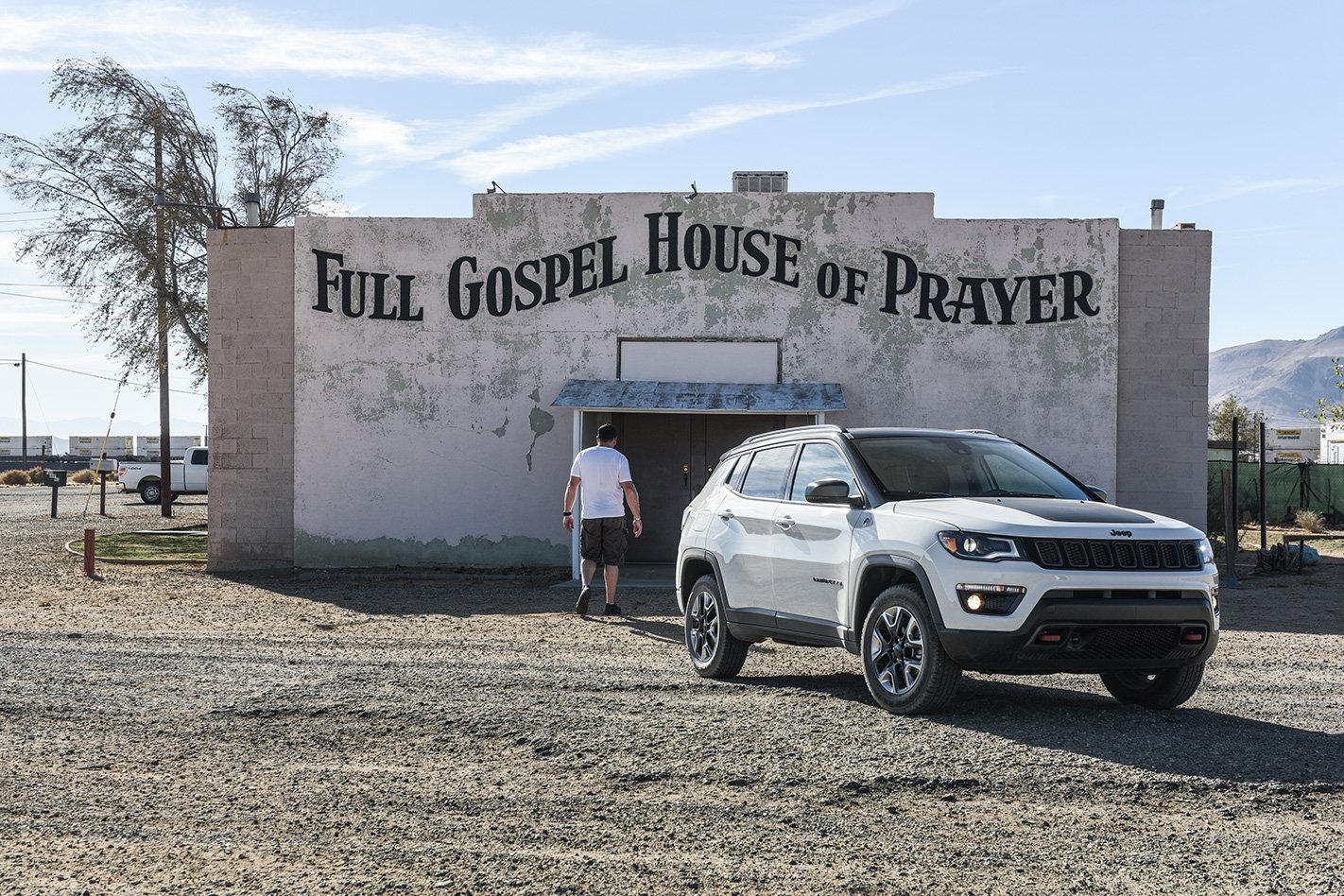
We’re not far when the photographer spots an opportunity. It’s a bolted-closed chapel, nestled in the dirt next to a quintessential American trailer park – one where the homes have wheels and the cars don’t. The place is utterly deserted, except for a muscled-up pit-bull terrier tethered to a post in the ground, inexplicably in the middle of the dirt access lane. He has no shelter, no water; hopelessly captive.
I approach cautiously, soothing him with my best doggy dialogue and he responds with a madly wagging tail. I want to offer him water, maybe a muesli bar. His face splits into a comical grin. Then I’m in his space and his internal switch flicks; he lunges, snarling; teeth bared, enraged and desperate to clamp flesh. His rope pulls him just short as I backpedal, mere millimetres from a tetanus-riddled savaging. Was it something I said? There’s no bowl, no vessel in which to offer him water. I have to leave, a dull ache in my guts for the uncertainly of what his next 24 hours hold.
Hundreds of towering white turbines dot the hillside, a massive commitment to growing power demands, some of which will be driven by the shift to EVs. We stop for a photo, but there’s not a breath of breeze, so not a single blade turns. It’s an incongruous sight, seeing all these power generators standing idle over the landscape, rather than the workers they’re supposed to be. It’s easy to imagine Tony Abbott, pointing, sneering, and pushing his “no good for base load” agenda. While munching on a raw onion.
Time to jump back into the very much fossil-fuelled Compass, burning juice at a none-too-special 10.4L/100km, and head north towards Red Rock Canyon State Park. The pairing of a nine-speed auto with this engine has me perplexed; it’s as if the eighth and ninth ratios are purely for decorative purposes, as the engine has no intention of getting to know them. Even when you force-feed the tallest ratios in manual mode at highway speeds, the revs drop below 2000rpm and into a torque hole so deep it has an echo.
It’s dusk by the time we reach the ski town of Mammoth Lakes that will provide our overnight accommodation. The temperature hovers around zero, but the main streets look seductive and magical, lit with decorative lights, and the place buzzes with that holiday vibe of well-off locals in pursuit of recreation and pleasure. If I had mad snowboard skills, a more chipper attitude and better teeth, I could really fit in around here.
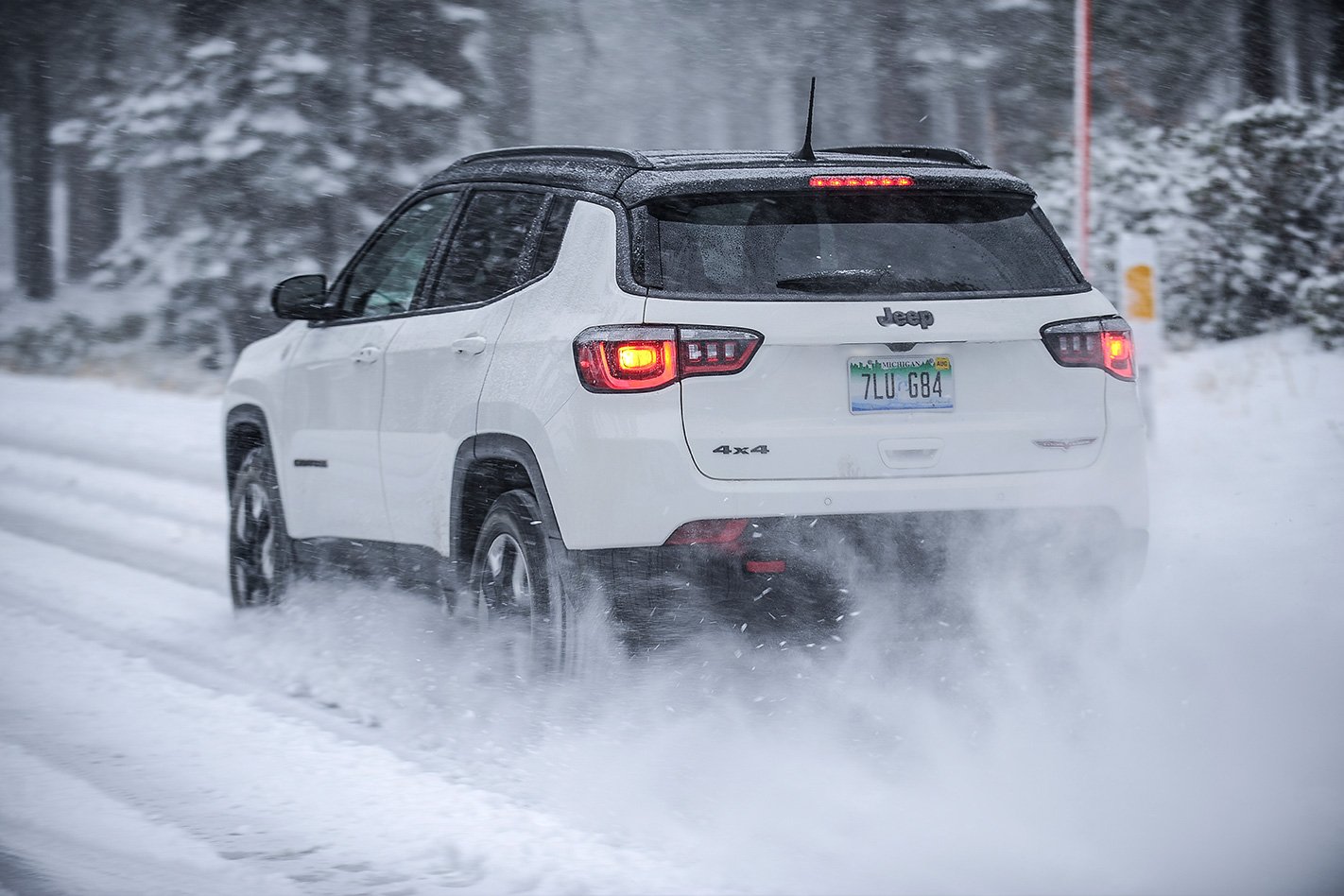
It requires serious concentration to pull my attention back to the American-sized mountain of eggs, bacon and hash browns piled high in front of me. The roads outside now have a 15 centimetre blanket over them, but snapper Baz, a cold-climate local who’s driving the support Grand Cherokee Trailhawk, assures me there’ll be no need for chains, insisting that our all-terrain tyres and the cars’ snow mode will be fine for the final two-hour push to Bodie.
I’m almost a little disappointed, given I’m secretly bi-chain curious, but alternatively happy not to have to roll around in the wet snow to fit them. It’s also a brilliant test of the Compass’s traction and controllability on the slippery white stuff. The little Jeep’s ability to cut through the powder and find traction is genuinely surprising, and the calibration of the traction control in snow mode is spot-on, allowing just enough slip and spin to retain momentum right when you need it. It’s even happy to allow gentle all-paw drifts when the sensors figure you’re not about to stuff it into a snowbank.
On SR 270, about 11km from the town of Bridgeport, we take the posted turn onto dirt for Bodie, only to see a sign warning that the final approach is closed due to mud and snow, with access via foot only. When we reach the locked boom gate, it’s like a bouncer’s arm across a door we so badly want to enter.
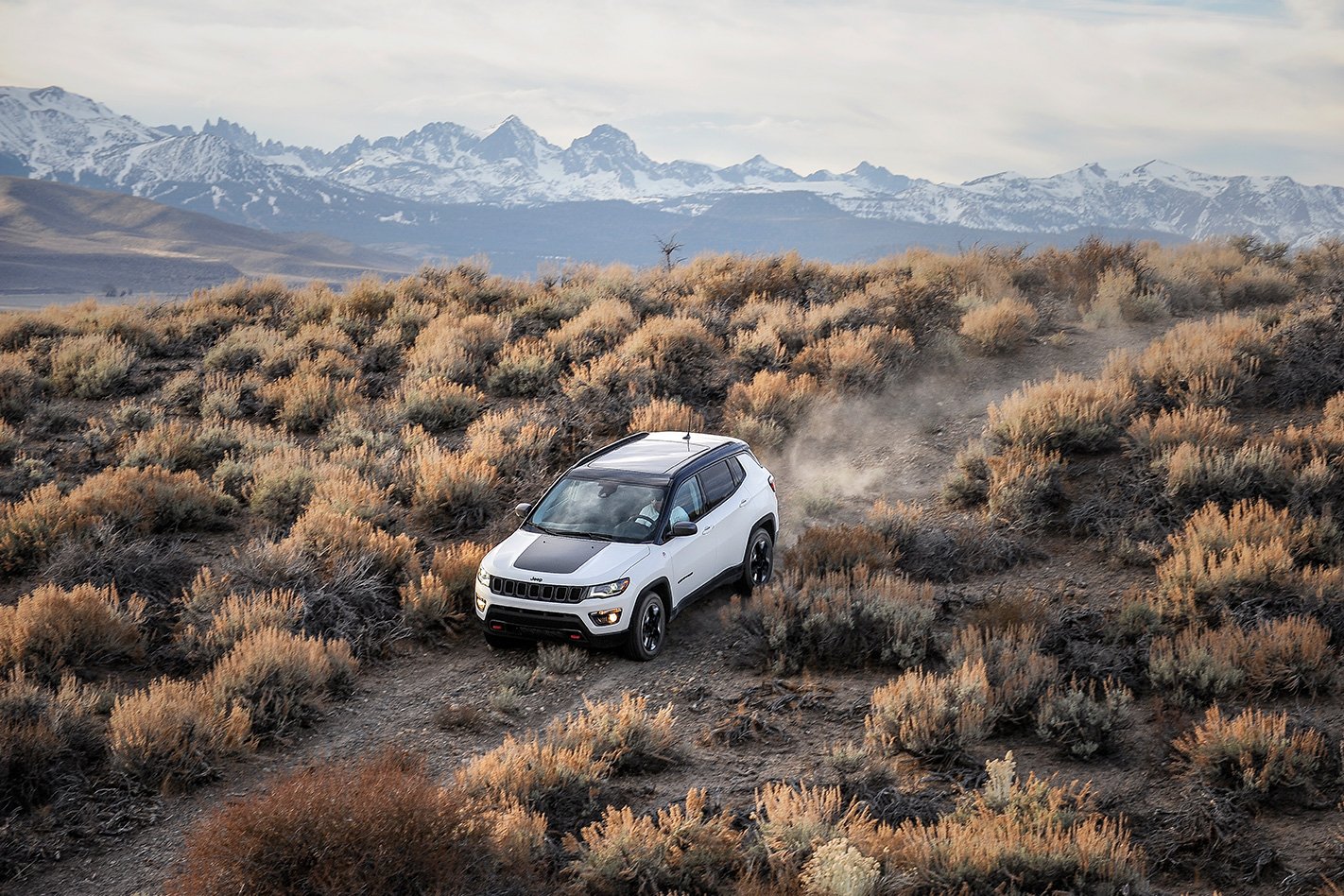
Me and the Compass are doing fine until we hit a wash-away gouged into a 20 percent incline and strewn with bread-loaf-sized rocks. I know I’m at the threshold the Compass’s ability when I hear graunching against the underbody protection, but the low-range gearing and diff-locking rock mode overcome any torque deficit, and we literally scrape through. The red ‘Trail Rated’ badges on the front guards aren’t for idle bragging: this thing is properly capable off-road.
Ultimately, though, our gate-skirting tactic proves futile. We hit another locked barricade and have to backtrack. The final four kilometres will need to be done on foot, lugging the camera gear.
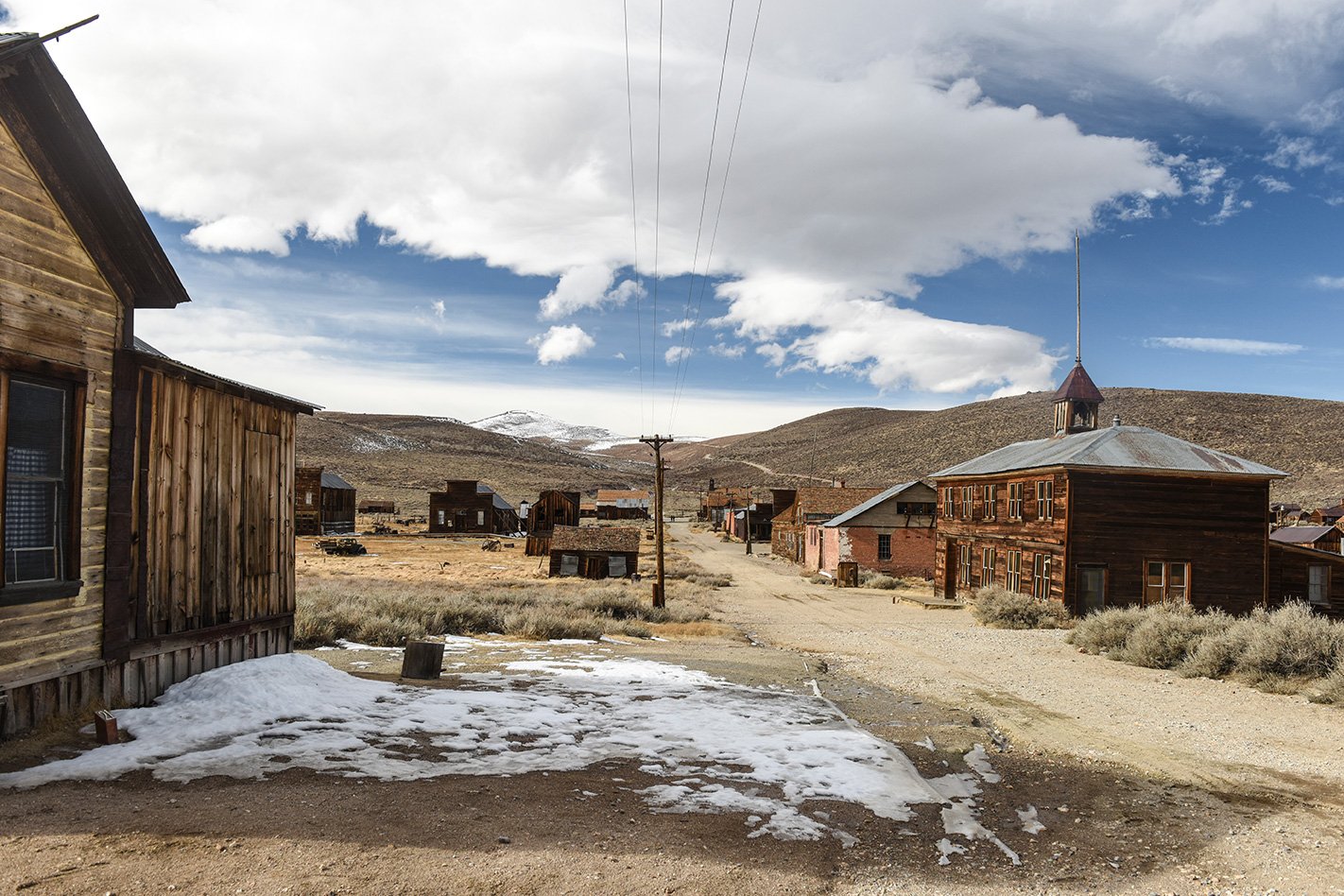
Low clouds, driven by an icy wind, scud across a washed-out sky when the old town finally comes into view. It’s said that less than 10 percent remains of the once-thriving mining settlement that was here, due to a fire in the 1890s – clearly kerosene lanterns, timber constructions and drunk miners are not a mix approved by Smokey Bear. But what is left is plenty to transport you back 140 years. Bodie is kept in a ‘preserved state of decay’, meaning everything stays just as it was when the abandoned town was acquired by the State Parks department in 1962. So it’s not a tended restoration, just an authentic slice of how life really was. One of what were 70-odd bars still has all the glassware and pool table; elsewhere the shops are still stocked with bottles and cans. It’s possible there’s a tin of Spam there yet to reach its expiry date.
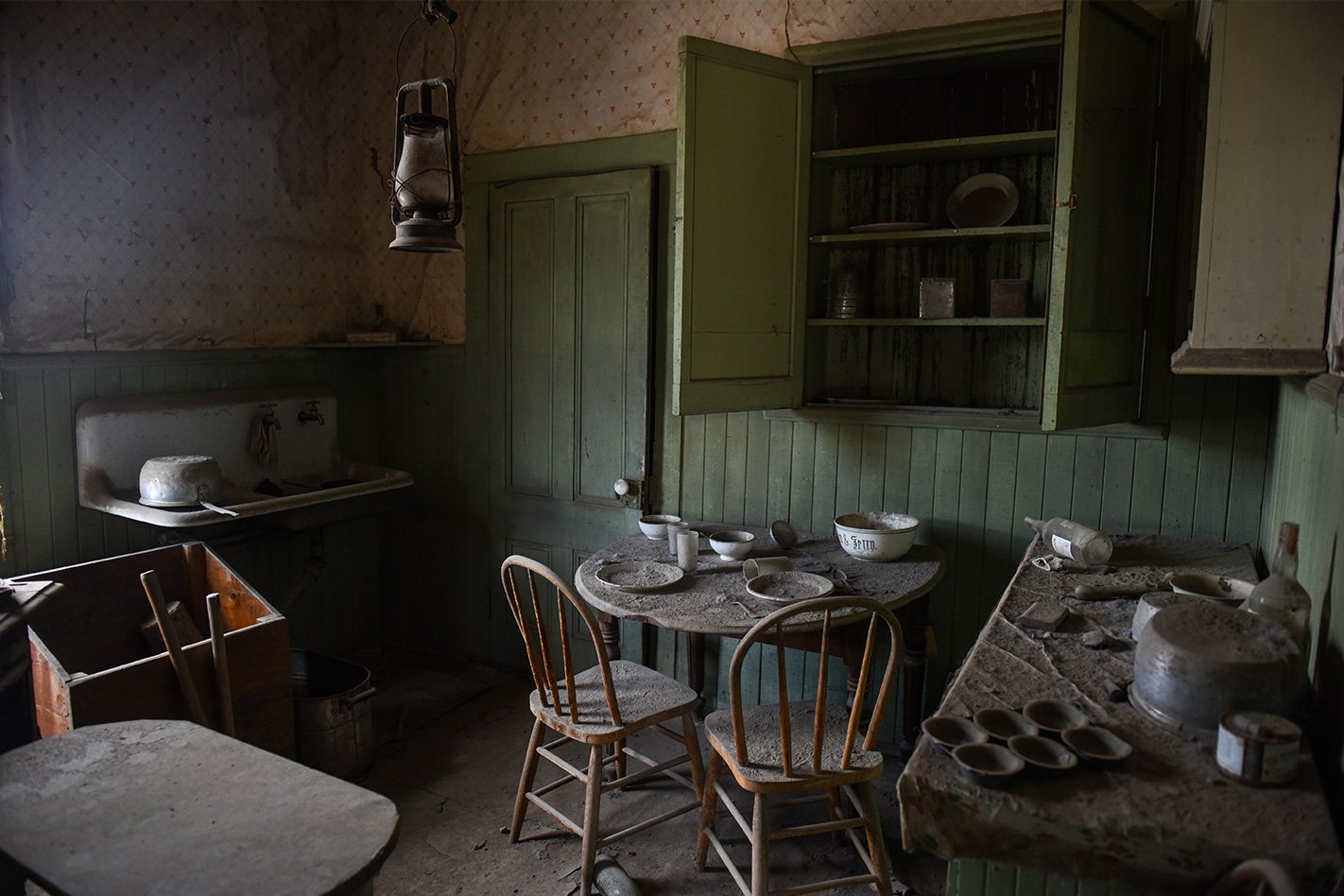
I wonder what the Bodie locals of the late 1800s would have made of our transport
Modern sanitation, electricity and technology have surged ahead, but the fundamentals of family, food and shelter remain largely unchanged.
It also takes very little imagination to picture why Bodie was described by one Reverend F. M. Warrington back in 1881 as “a lawless sea of sin, lashed by the tempest of lust, greed and passion.” Robberies, shoot-outs and lynchings were all commonplace. And when the males of the town got involved, well, that’s when things really turned crazy. Late in the afternoon, we trudge our way back towards the Jeeps in the face of a freezing wind whipping us at over 60km/h.
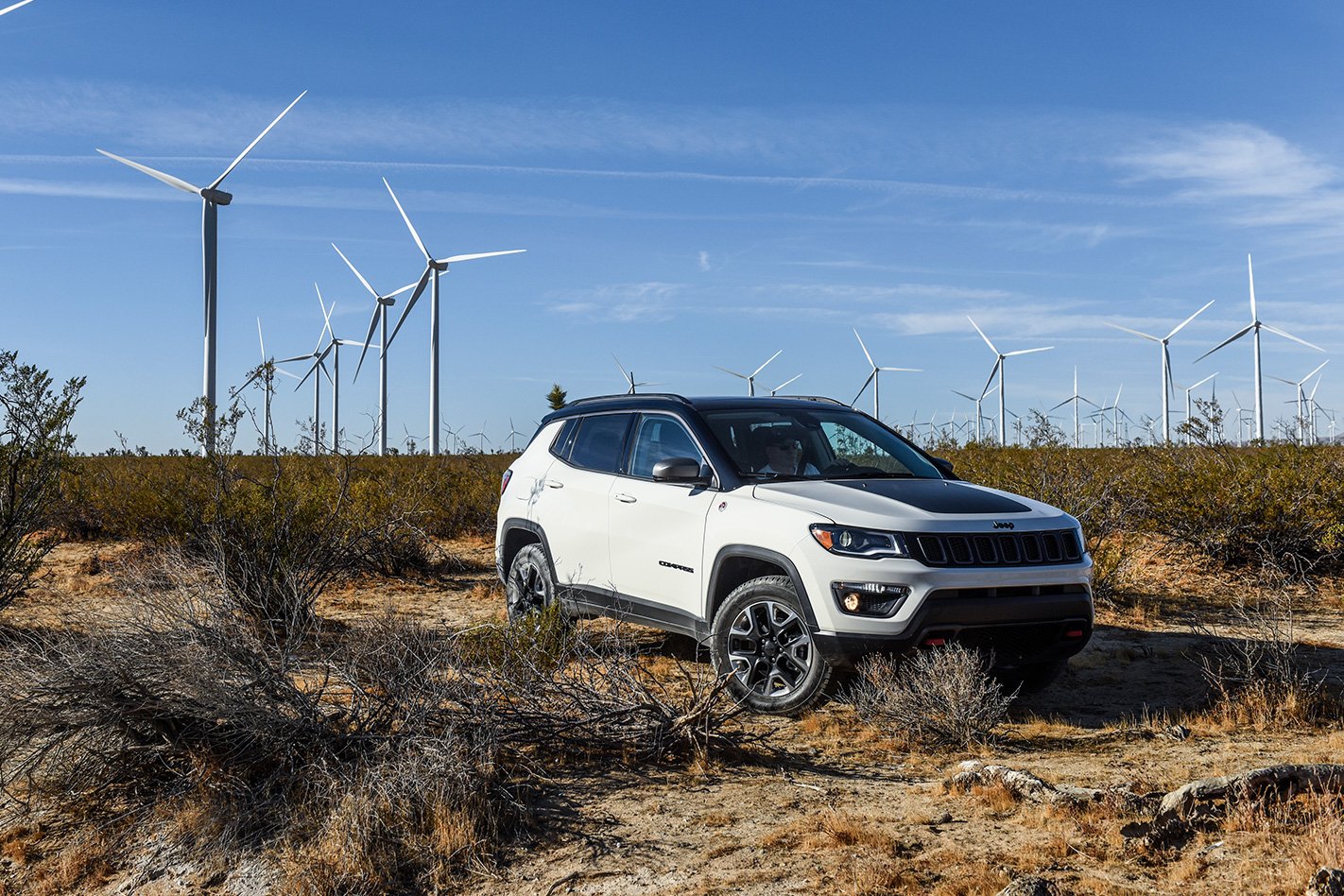
Or maybe they would have just shot us in the legs for being the softest men of the West.
IT’S HARD to imagine, but before Mark Webber started stuffing his cabinets full of Formula Ford, Formula 3000, FIA GT, Formula 1 and WEC trophies, he wasn’t always such a great driver.
While there’s no doubt the Webber name will forever be synonymous with spectacular motor racing following a colourful and multifaceted career in cars, it’s comforting to hear that the race ace’s journey to his current role as Porsche ambassador started from humble origins. Familiar, even.
Raised in rural New South Wales on the ACT border, Webber describes his freshly licenced self as “notorious on the road” and racked up more than one wrecked car to his name before he eventually started keeping vehicles on the road and track.
Firstly there was the entire rear left suspension he tore out of a car on the kerb of a Canberra roundabout after trying to negotiate it too fast.

Then there was the time he “trashed” his sisters car along with another parked car coming through a corner a little too hot in a big front-wheel drive and trying to maintain his momentum – unsuccessfully.
But perhaps the most amusing period in Webber’s formative driving years were back in his halcyon Karabar High School days. While a majority of his fellow students would choose to spend their recess kicking a footie or perhaps doing even less, our Mark had very different ideas.
“I had a 1969 Toyota Corona two-speed automatic which my Dad got me because it had no horsepower, but I used to rally up behind the school,” he told Wheels at the Bathurst 12 Hour endurance race.
And if you think this was some kind of responsible early involvement in organised low-speed motorsport, think again. With bench seats and no seatbelts, Webber was happy to take passengers, lots of passengers.
“We’d be seven or eight-up in the car – an absolute deathtrap with me behind the wheel doing rally stages. One day we did have a head-on because my mate was coming back the other way.

But the culmination of Webber’s highly informal paddock bashing in underpowered Japanese hardware was the day his antics were very publically ousted and captured in unequivocal evidence.
“One day I got back and the teachers were having their annual school photos outside. I came back in, we were seven-up and I was behind the teacher’s photo on the grass. I got in a lot of hot water for that. It wasn’t the best move.”
His antics with joyriders on board may seem questionable these days, but Webber says he undoubtedly learnt a lot of valuable lessons tearing up unsealed roads by himself “sliding, changing tyre pressures, going out there and having some fun on my own.
“As soon as got my licence, normal roads were one thing, but being rural I knew these areas where I might be able to take the car for a bit of a drive so I would test myself out there. The bottom of Mount Jerrabomberra was the playground.”
Like the sprawling housing estates that have now spread into Webber’s unnoticed test tracks, the promising young driver also evolved and found a way to focus his energy and enthusiasm for going quickly into a more constructive goal.

Instead of an old Toyota, Webber took his runners and used the Queanbeyan fields as his training ground, building vital fitness before returning to Europe where his career would shift into the higher gears.
“I’d go to the same location and do interval sessions on my own, scorching hot, because I knew the Europeans were in the winter and I’d go back and drill them when the fitness camps were on.
“Within the space of about three or four years I was a completely different animal. Same spot.”
So what’s the secret to transforming a reckless young man into a seasoned professional? Webber has some sage words on the transition from “absolute hooligan” to “disciplined and self-driven individual.”
“It’s got to come from within,” he said. “It’s the passion, the enthusiasm and the discipline within yourself. Something’s got to click. I’ve got to have some standards in myself now, I’m representing myself.
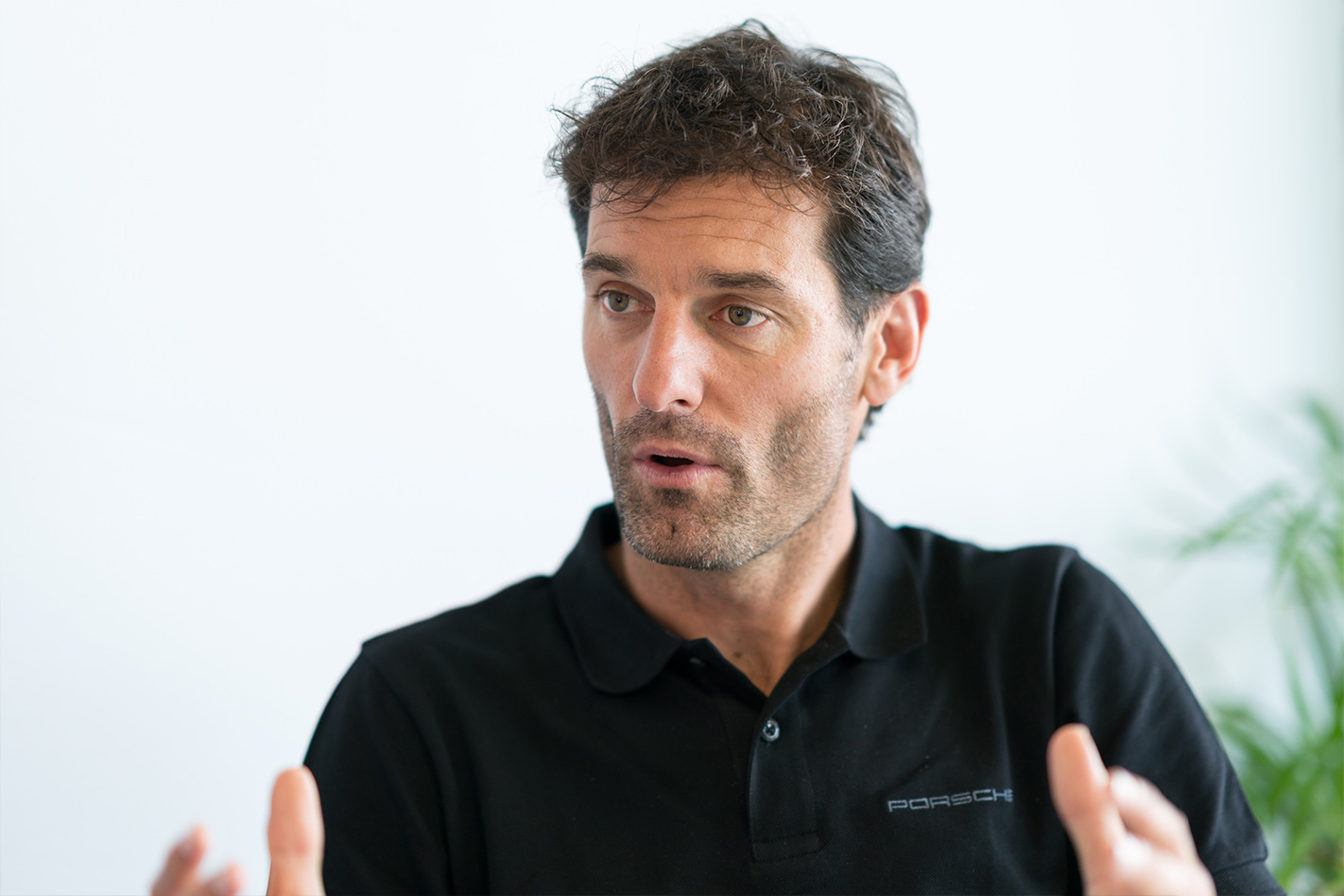
“It’s an old head on young shoulders. That’s what you’ve got to try and achieve.”
That ideal scenario of nurturing a wise mind before the body is too aged to achieve the maximum potential may be far easier to suggest than create in practice, but Webber explained that taking a few knocks helped him battle through.
“Adversity is a sensational thing because it teaches you resilience. Professionally and privately you have to have resilience. That’s the cornerstone of success and being prepared to things that other people aren’t.
While the life of a successful racing driver may seem glamorous and privileged to motorsport fans and spectators, it’s the part you don’t see which is toughest and the element of forging a career in racing that decides the mediocre from the champions, said Webber.
“It’s not when the helmet’s on or the stopwatch, it’s the Monday to Friday component and being professional. Going to Austria, going to France, living in these places – the language is difficult. Well guess what? That’s how it is. You’re not going to change a nation just because you turned up.
Despite having a seemingly inexhaustible monologue of humble advice and experience to dispense, Webber chose to summarise his ongoing career in fast cars and the race track with the words of another F1 great – Jackie Stewart.
“I’ll never forget Jackie. He’s always told me ‘fly with the eagles not with the crows’”.
He must have been talking about the wedge-tailed eagles that soar in the hot Aussie thermals above Mount Jerrabomberra.
Three days after the car’s debut at the Paris Show and three months before the first official drive in Las Vegas, we managed to steal the new Audi R8 away for a real-life encounter on real roads.
This review was first published in MOTOR magazine’s January 2007 issue.
Admittedly it’s from the passenger seat of the gunmetal pre-production mule, but the Gallardo connection even from here turns out to be much more blurred than anticipated.
“The Lamborghini was a good starting point for the r&d team,” concedes project manager Dirk Isgen. “But while it gave us a solid basic concept to work with, the only common elements between the two cars are the transmission and the position of the driveline in the vehicle. Everything else is new and quite different – body, suspension, interior, packaging and character.”
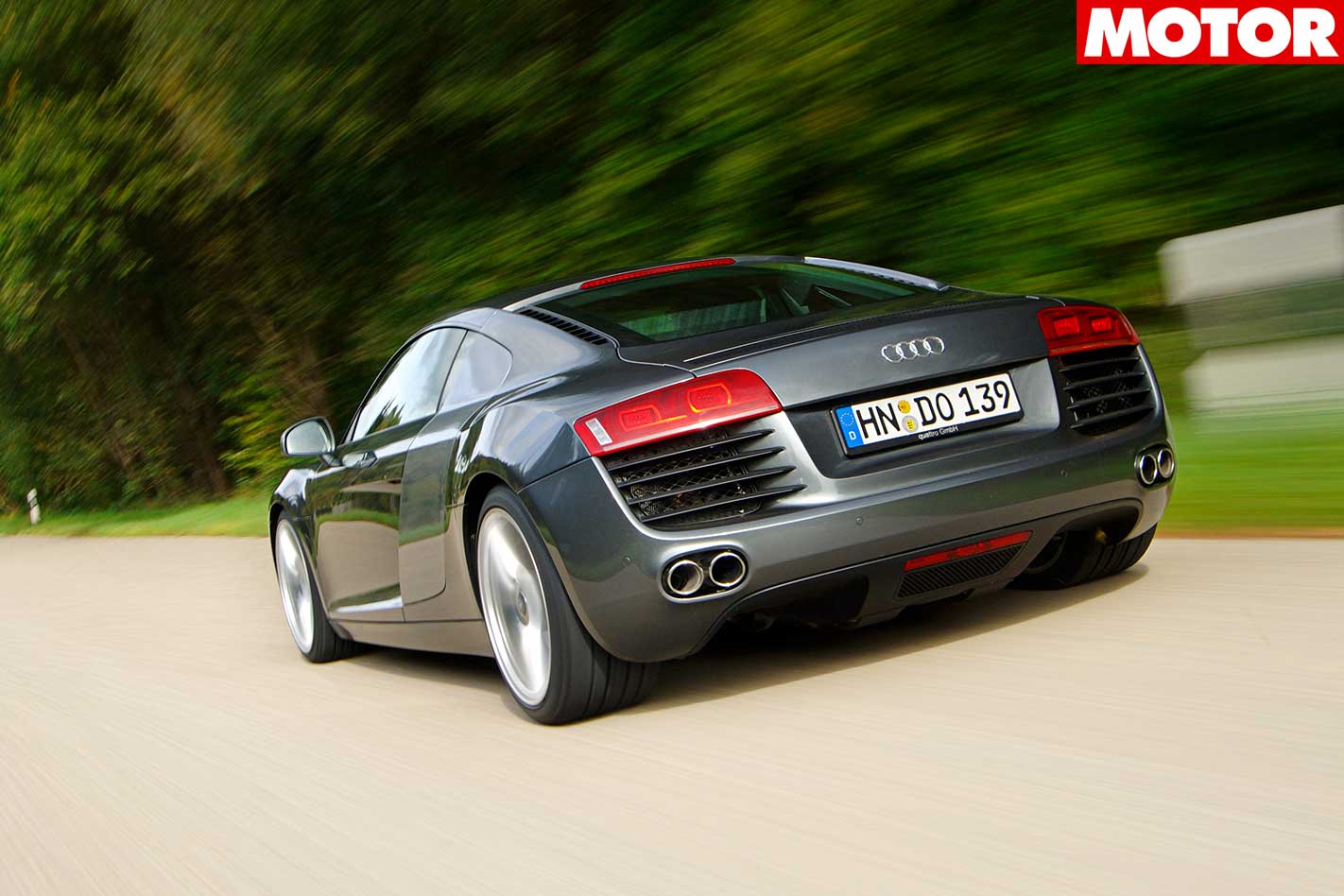
“In addition, the double-wishbone set-up renders itself for a better defined fine-tuning, so manhole covers and transverse ridges are no longer an issue. A 1740 Euro [$2900] option, Magnetic Ride allows you to dial in an extra dose of compliance at the one end and a little more firmness at the other.”
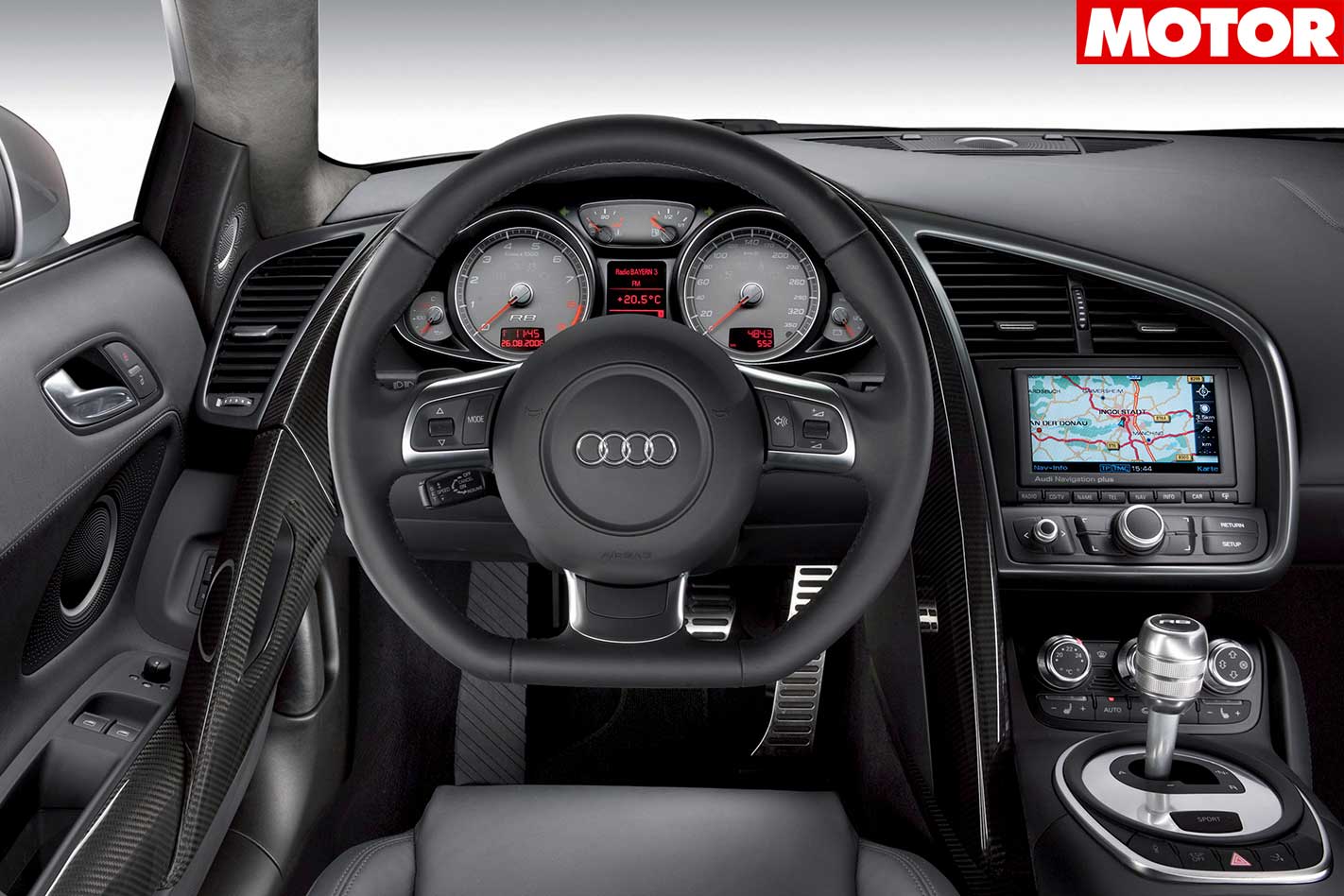
Also conspicuous by its absence was the six-speed R-tronic transmission which adds $12,360 to the list price, in Europe, of $175,000.
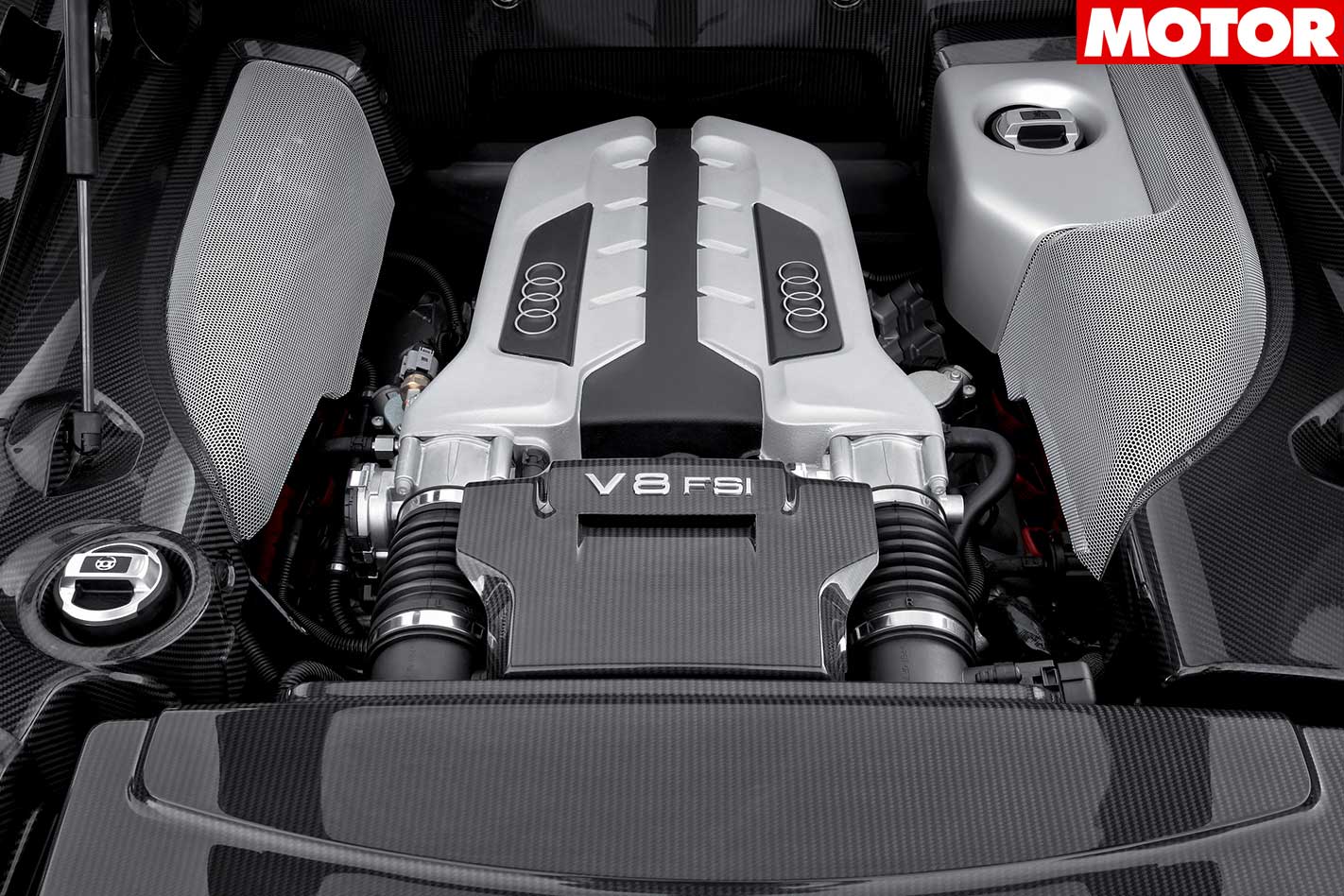
At 1560kg, the R8 weighs 130kg more than the V10-engined Gallardo, but give it stick and the 317kW@7800rpm 4.2-litre unit, derived from the RS4 engine, will propel the coupe in 4.6sec from 0-100km/h, 14.7sec from 0-200km/h and in a little over 60 seconds on to a top speed of 301km/h.
On the second run up through the roller-coaster zig-zags, the coupe behaves true to its master’s words. Even where the road has ragged outer edges which curl towards the apex like ripples on a lake shore, the front suspension feels creamy, smooth and totally unperturbed.
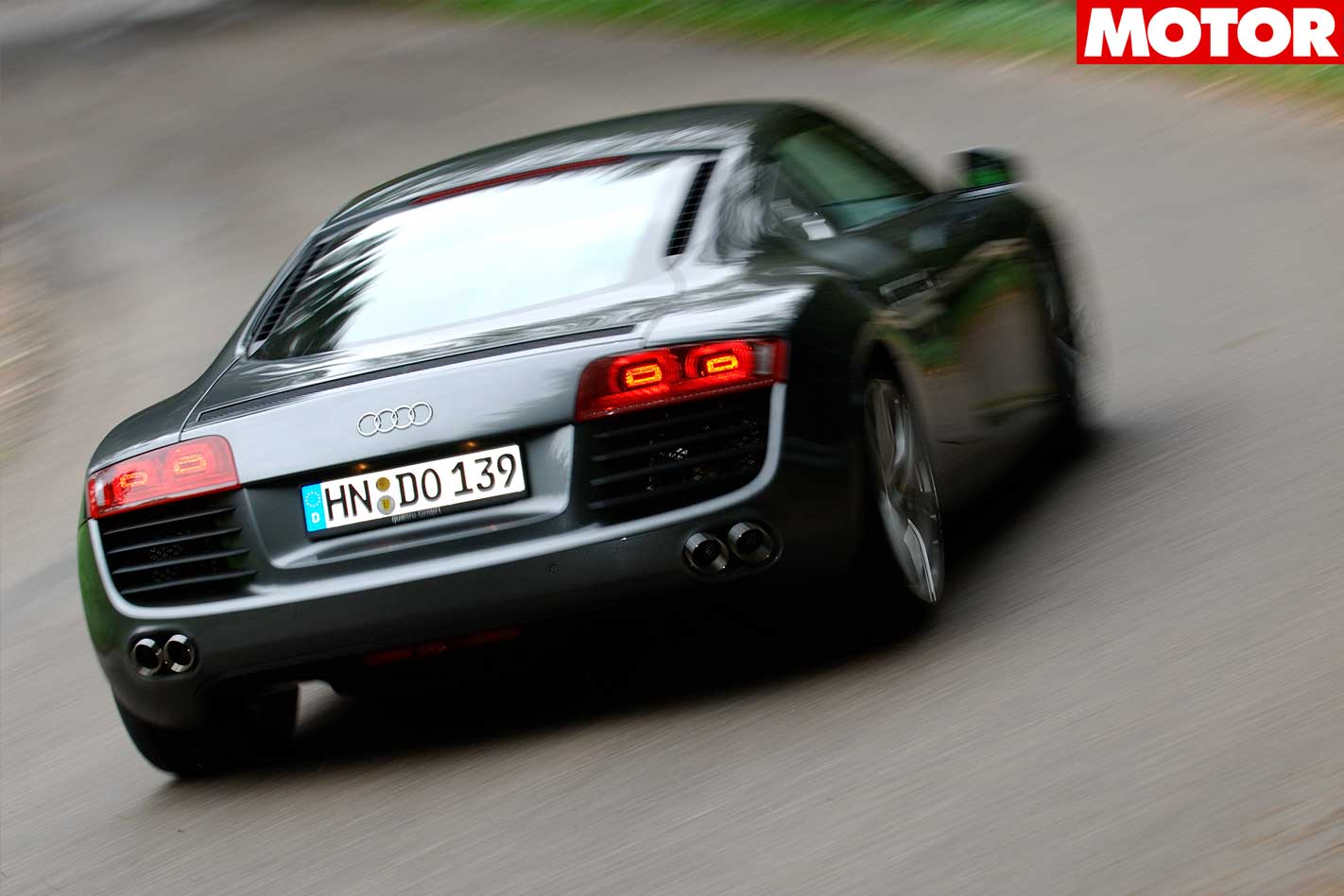
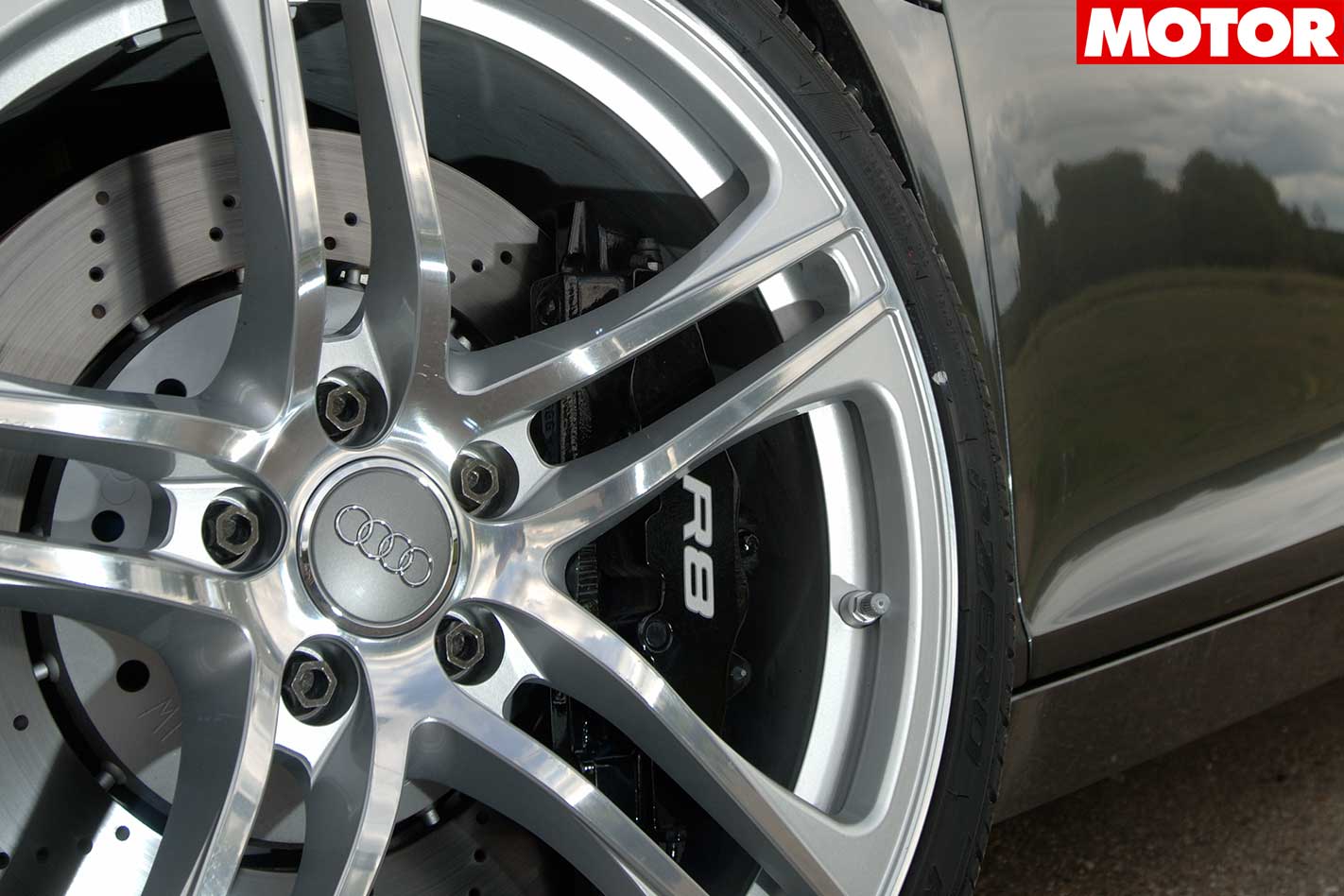
On the return run down the hill, the brakes get a chance to show off, too. “The stopping distance from 100km/h to zero is a best-in-class 34 metres,” claims the proud project engineer. “And that’s even before the optional ceramic discs become available in mid-’07. Deceleration is definitely one of the strong points of this car.”
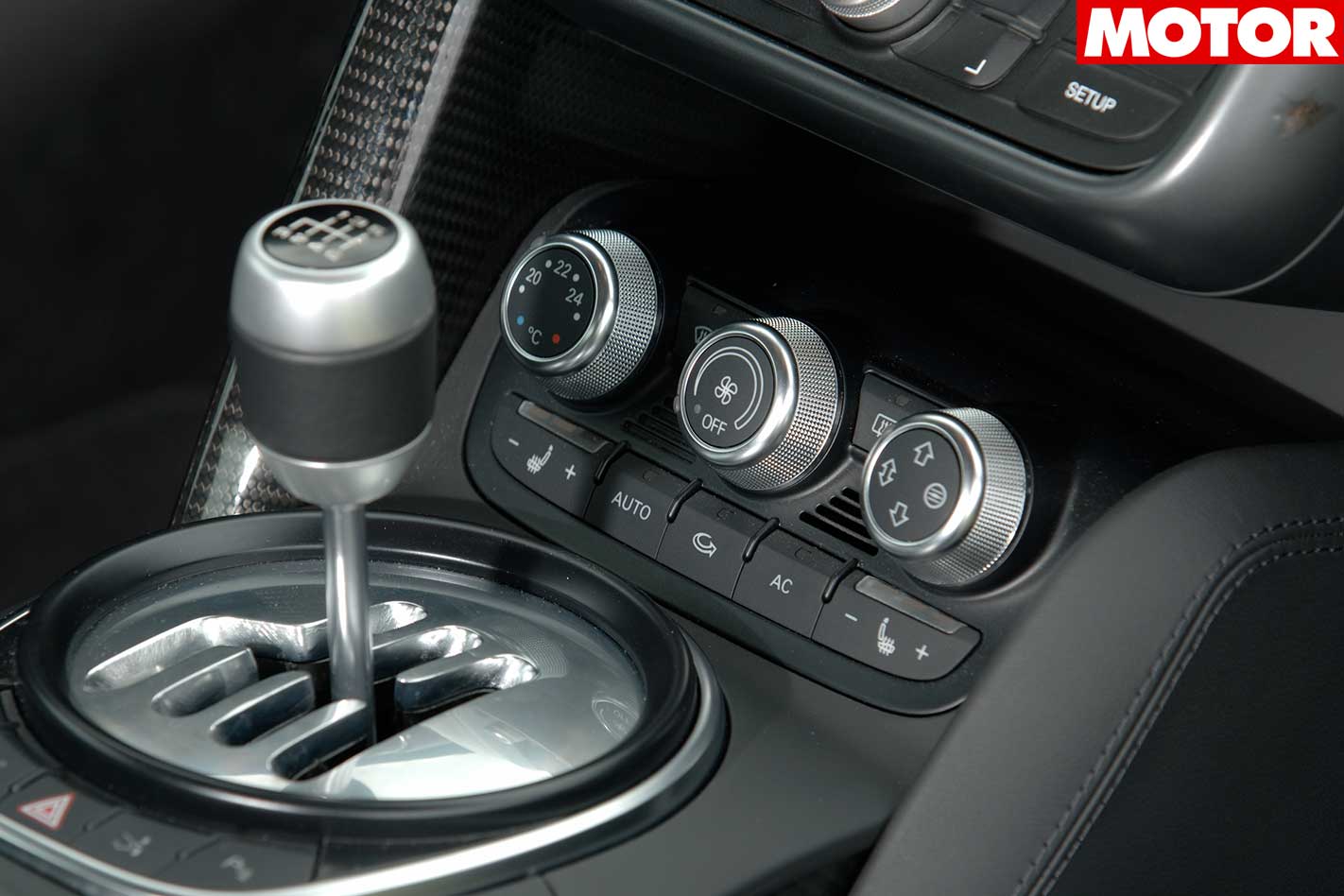
The six cogs of the manual tranny are evenly spaced, so first is more than just a take-off ratio, third is perfect for brisk overtaking manoeuvres, and sixth is a proper driving gear which carries you past the 300km/h threshold.
For the next two years at least, production is limited to 15 units a day or about 3750 vehicles per season. What if there is demand for more? “Let the market clamour for more vehicles – it’s good for the residuals and for our brand image.,” answers Isgen.
Of the first 30 allocated to Australia, it’s already too late to get one; at an estimated $238,000, they were all spoken for by the end of the Australian motorshow. Better luck next year!
Fast Facts – 2007 Audi R8 V8
ENGINE: 4.2-litre direct-injection V8 POWER: 317kW @ 7800rpm TORQUE: 430Nm @ 4500rpm WEIGHT: 1560kg 0-100km/h: 4.6sec (claimed) TOP SPEED: 310km/h PRICE: $238,000 (est)
LIKE: Creamy smooth handling; phenomenal brakes DISLIKE: Only 317kW; they won’t make enough of them RATING: 4 out of 5 stars
We say this every year, but geez modern cars are fast.
We don’t wish to sound like a broken record, but once again one look at the numbers spat out by our PCOTY contenders left our jaws agape and heads slowly shaking back and forth in disbelief.
You want progress? The quickest car at PCOTY a decade ago, the half-million-dollar Lamborghini Gallardo Superleggera, would only be fifth fastest to 100km/h and fourth over the quarter mile in 2017, with a BMW M4 and Porsche Cayman snapping at its heels.
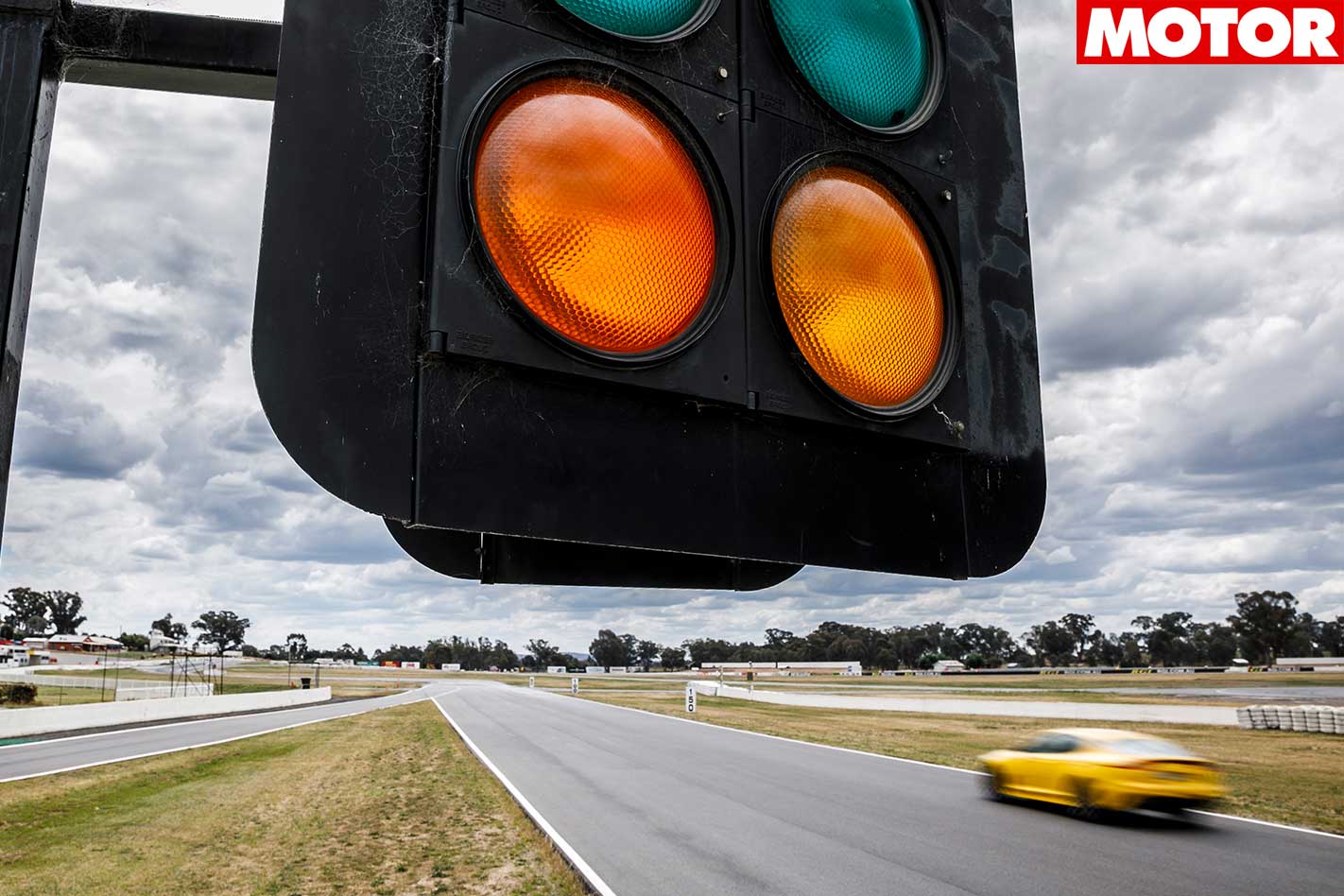
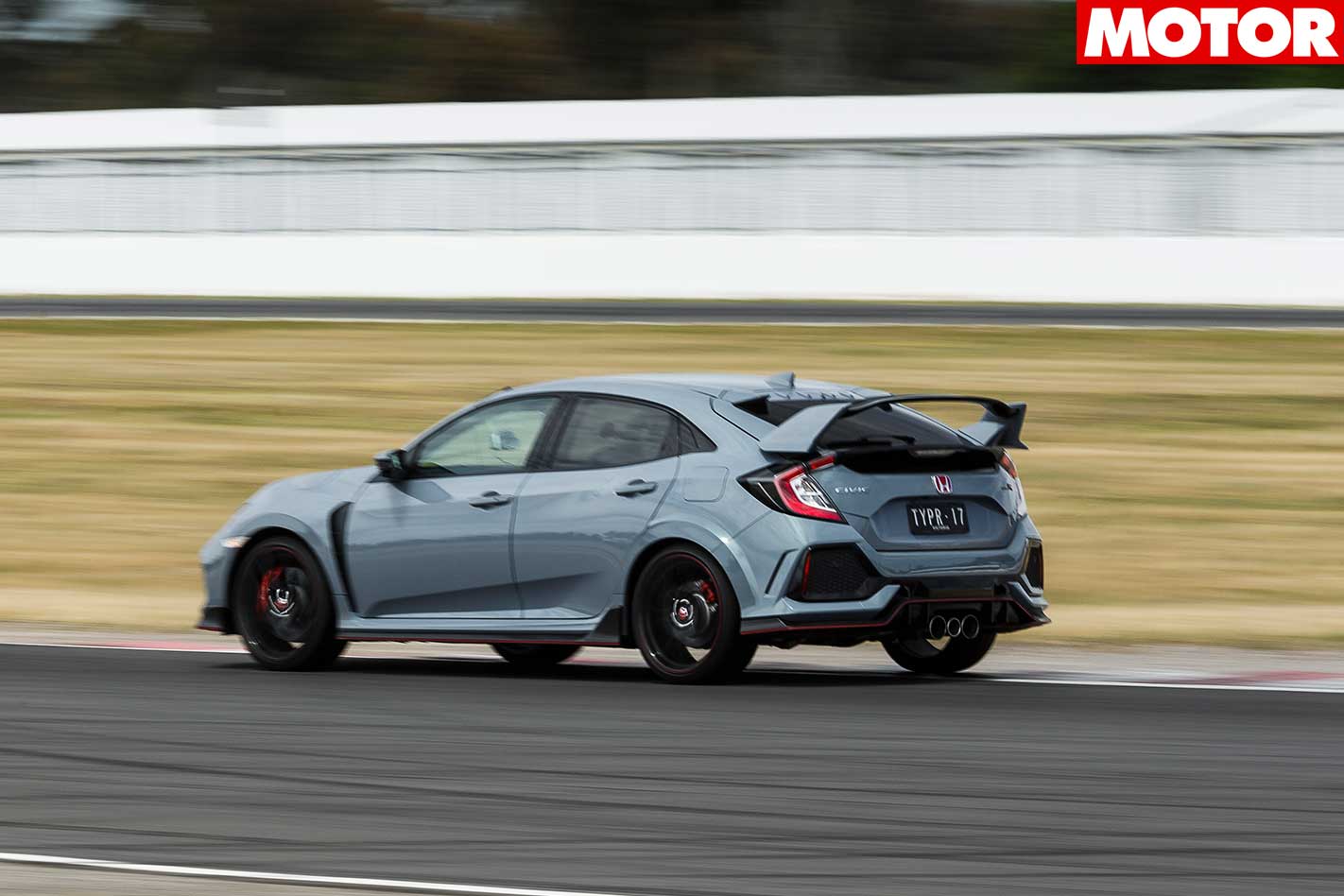
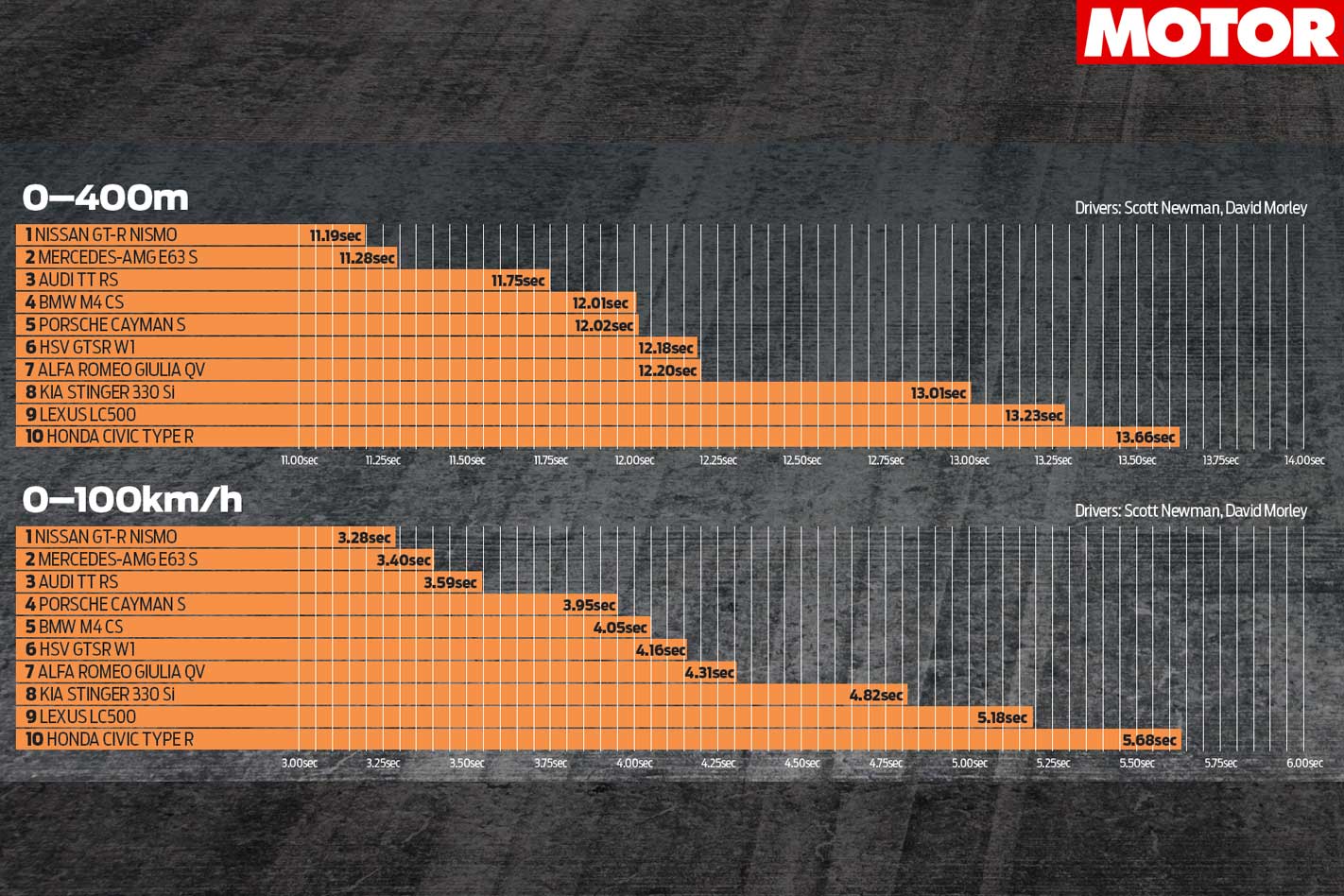
Even the slowest of our 10-strong field, the Honda Civic Type R, would give the very best Aussie V8s of 2007 a scare, clocking an impressive 5.68sec to 100km/h and 13.66sec quarter at 174.92km/h. These numbers improve slightly on our first effort at Heathcote for a recent comparison, the conditions at Winton being virtually perfect (for once) for quick times.
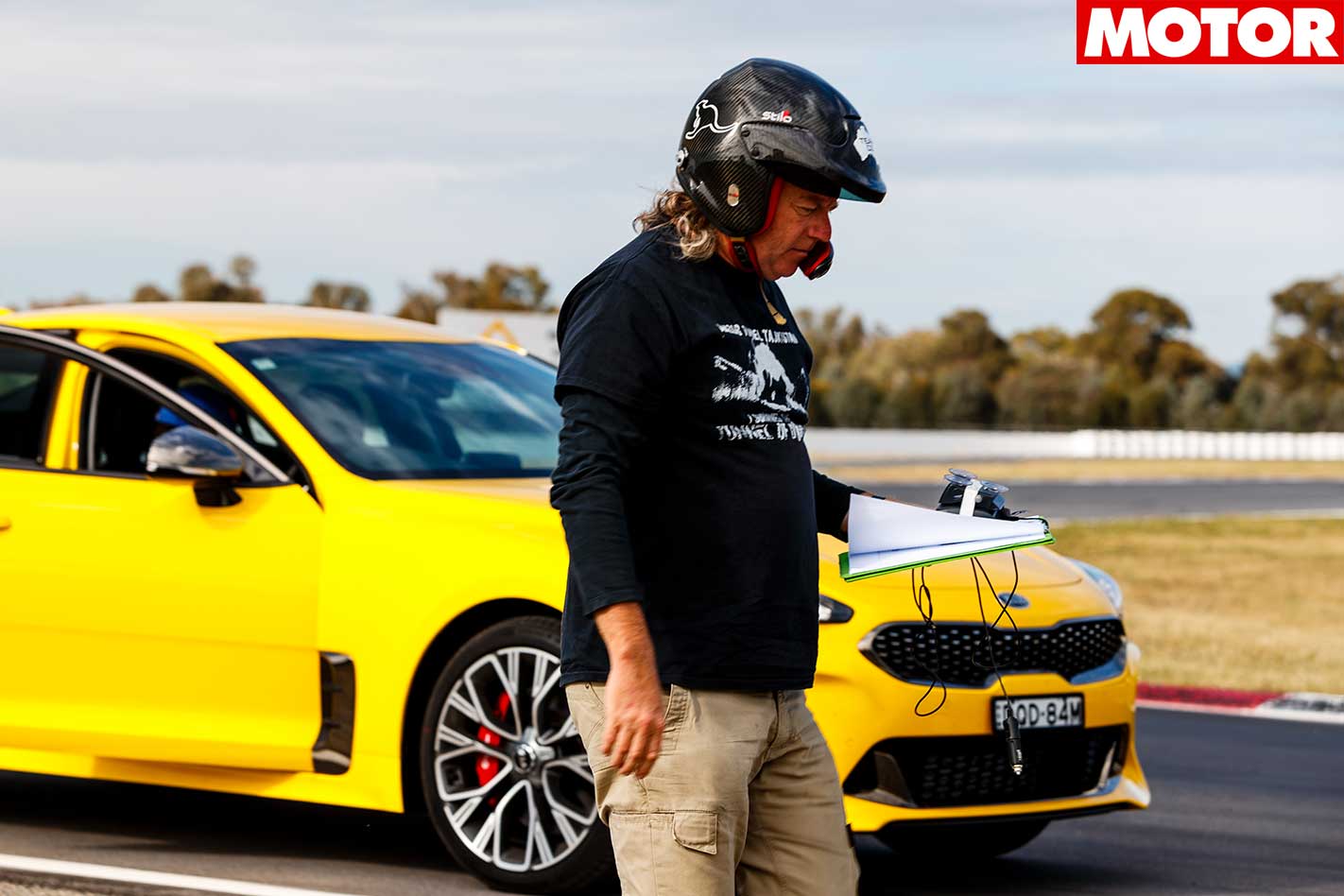
The Kia Stinger 330 Si might have plenty more grunt, but can’t best the Civic’s 2.9sec 80-120km/h effort. Its 36.88m 100-0km/h braking distance might be the worst in the field, but is an okay result for such a big car.
Which is the opposite of the Lexus LC500 – the vicious bark of its delicious 5.0-litre atmo V8 is arguably the noise of the day. However, while it’s far from slow – 5.18sec to 100km/h and a 13.23sec quarter at 178.73km/h isn’t shabby – it struggles on a bang-for-your-buck basis.
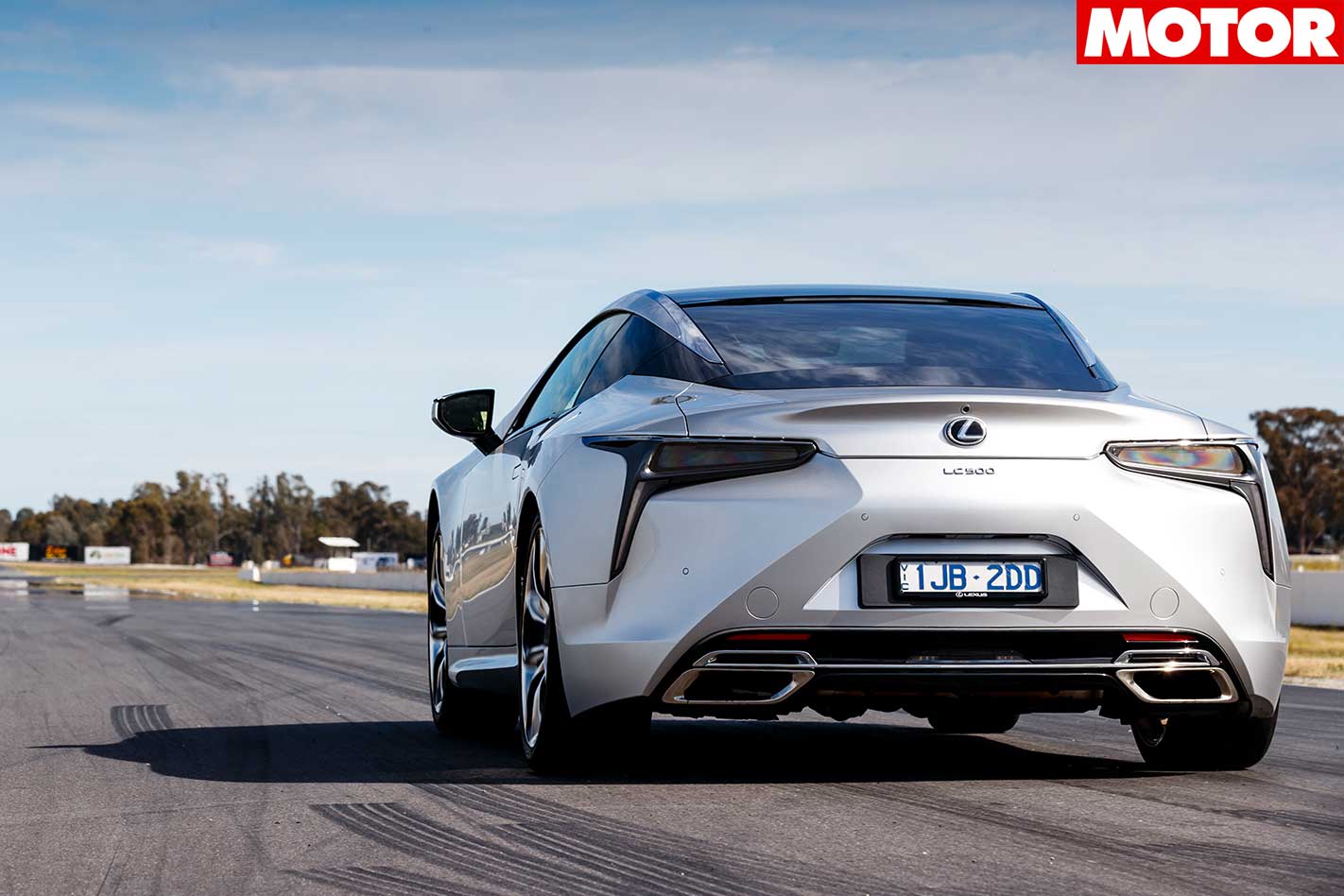
The LC500’s nearest competitor on price is the BMW M4 CS (standard they both cost $190K), but the Bavarian occupies a completely different performance league.
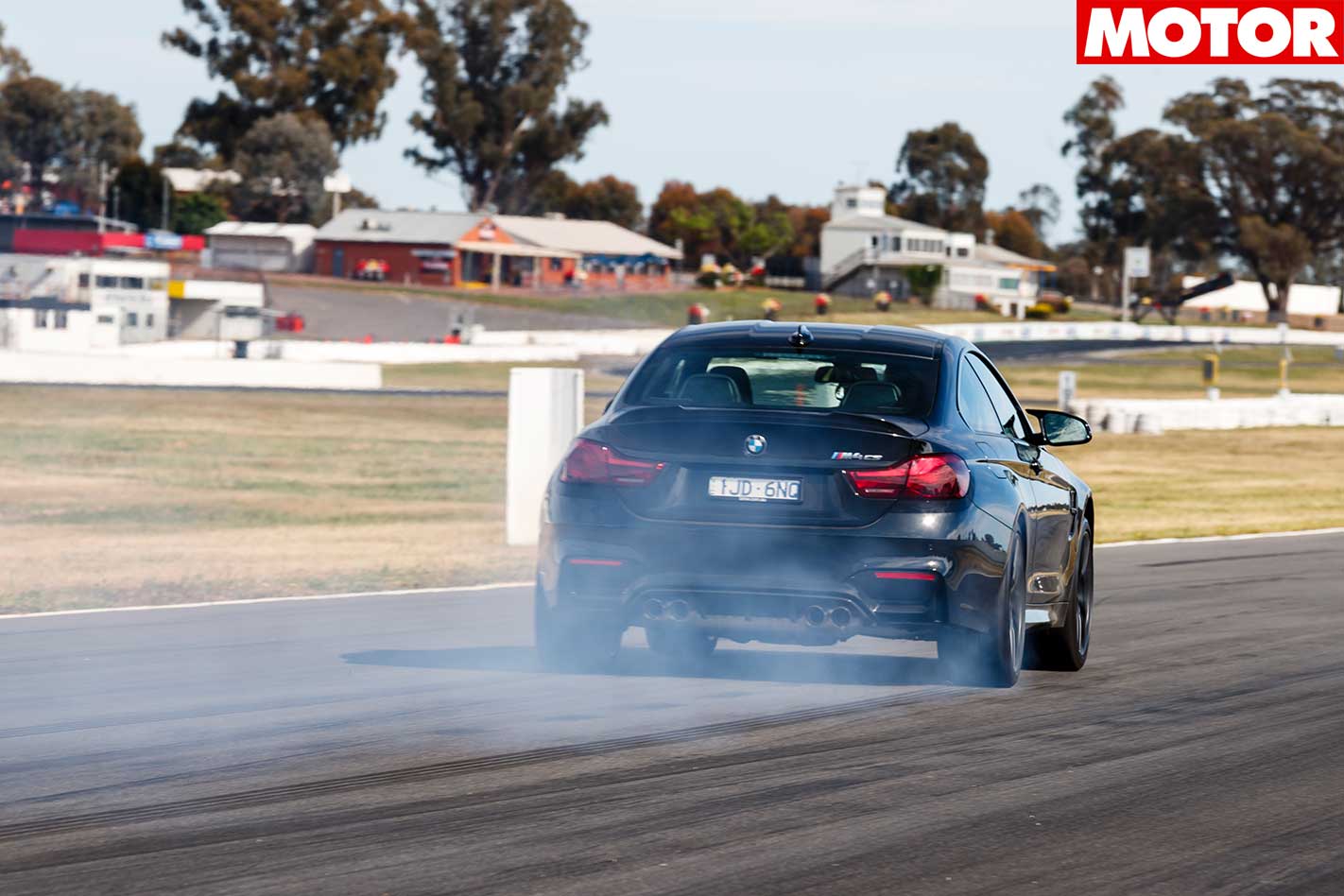
As ever, launch control simply generates too much wheelspin, but once warm the sticky Michelin Pilot Sport Cup 2 tyres offer enough traction to rocket it to 100km/h in 4.05sec, the quickest number we’ve ever recorded in an M car. What’s truly impressive, though, is the way it keeps hauling, 80-120km/h disappearing in just 2.2sec on its way to a 12.01sec quarter at a whopping 197.25km/h.
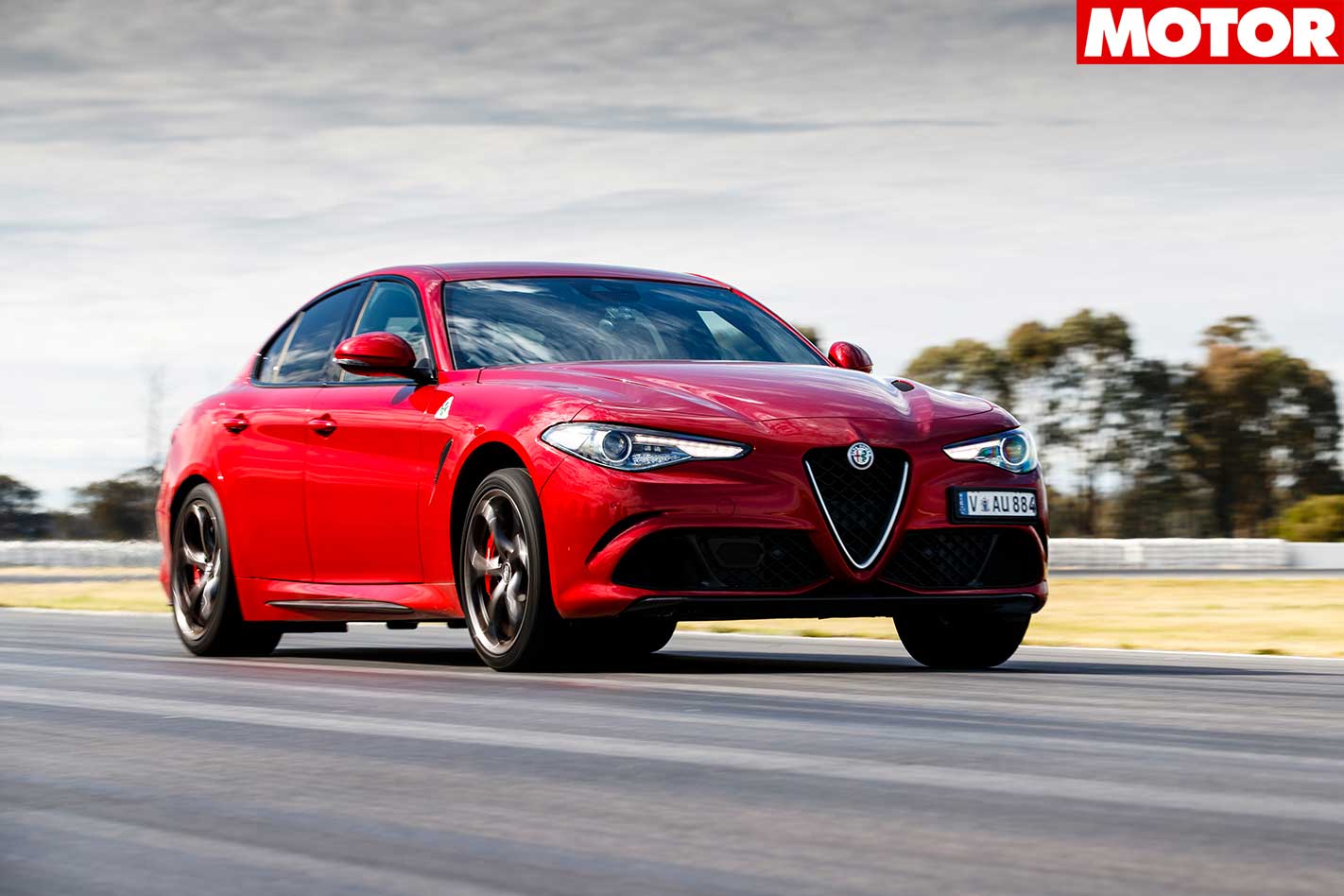
Similar in concept and speed to the M4 CS is the Alfa Romeo Giulia QV. Like the BMW, walking it off the line to limit wheelspin is key to the quickest times. Be ready to grab that over-size upshift paddle, too, as the Giulia’s 375kW/600Nm 2.9-litre twin-turbo V6 rips through its close ratios.
When calibrated correctly, launch control is a real asset. The 718 Cayman’s 2.5-litre turbo four-pot generates much more torque than its predecessor, which makes the fact it dials up around 6000rpm on the line a real surprise.
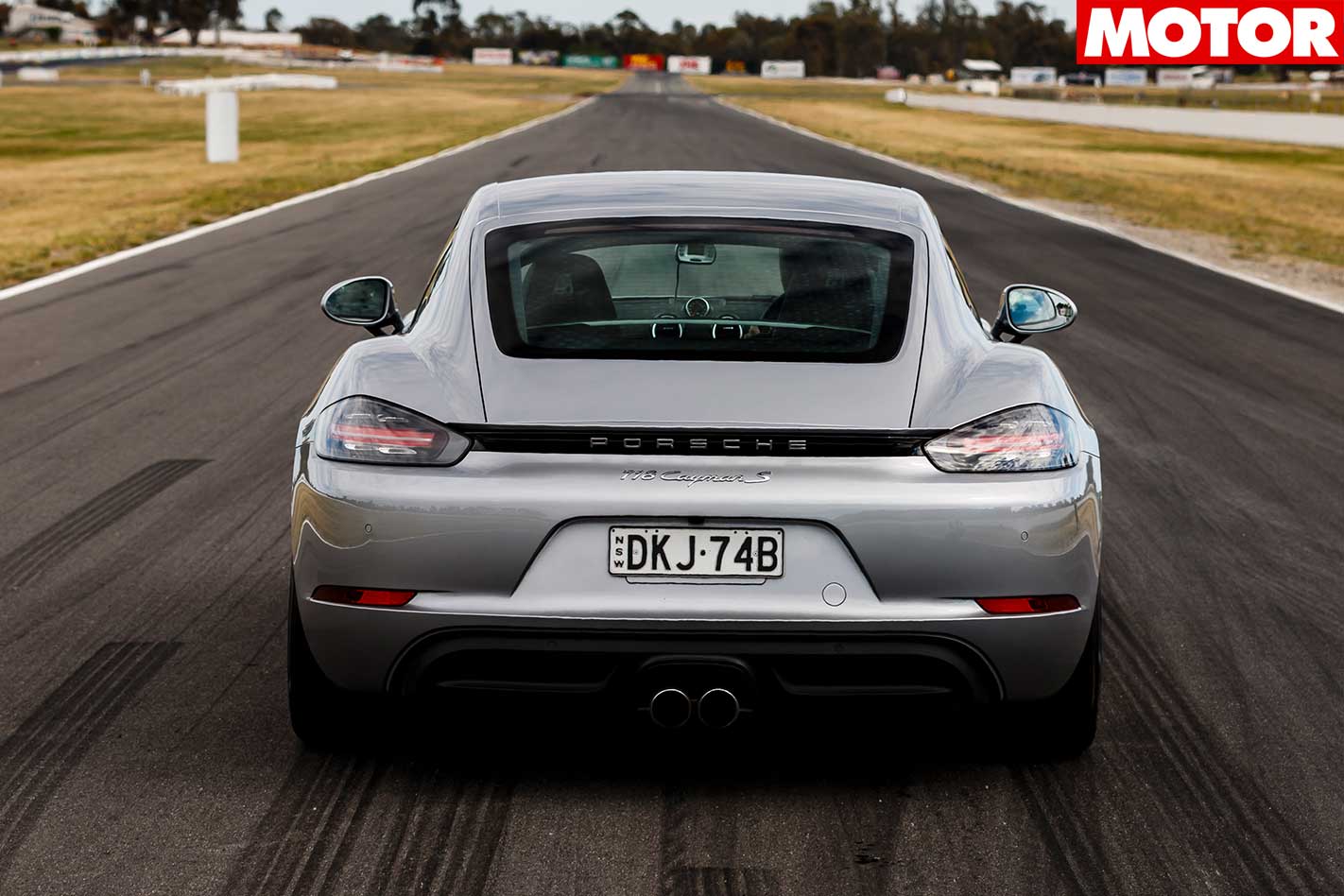
If any car proves it’s not what you’ve got but what you do with it that counts, it’s definitely the Cayman, backing up its eye-popping acceleration figures by pulling up in 30.94m from 100km/h.
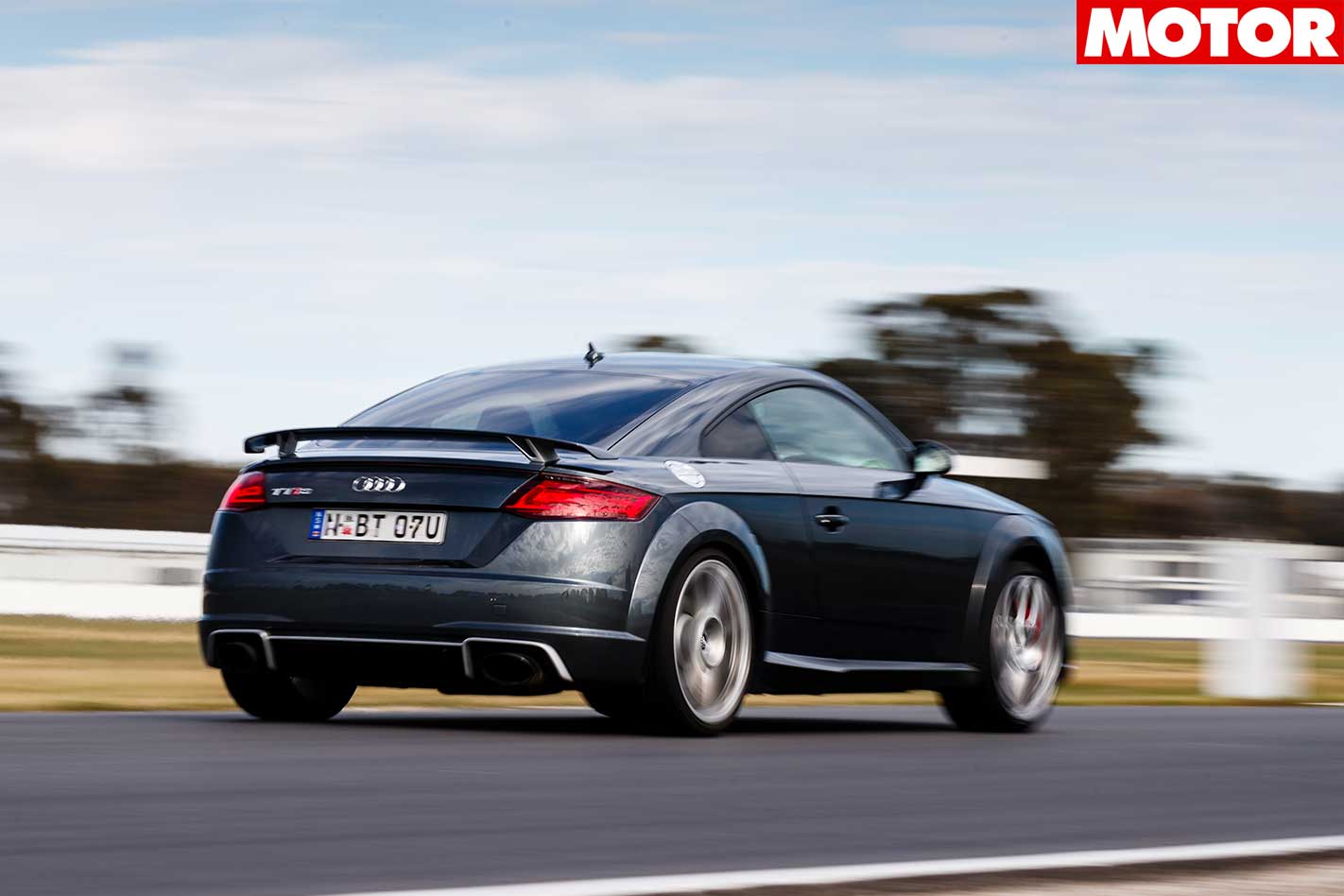
For the ultimate in straight-line efficiency, though, look no further than the Audi TT RS. It’s undoubtedly a powerful car, producing 294kW/480Nm from its 2.5-litre turbo five, but few would expect numbers as sharp as 3.59sec from 0-100km/h and a scorching 11.75sec at 191.89km/h.
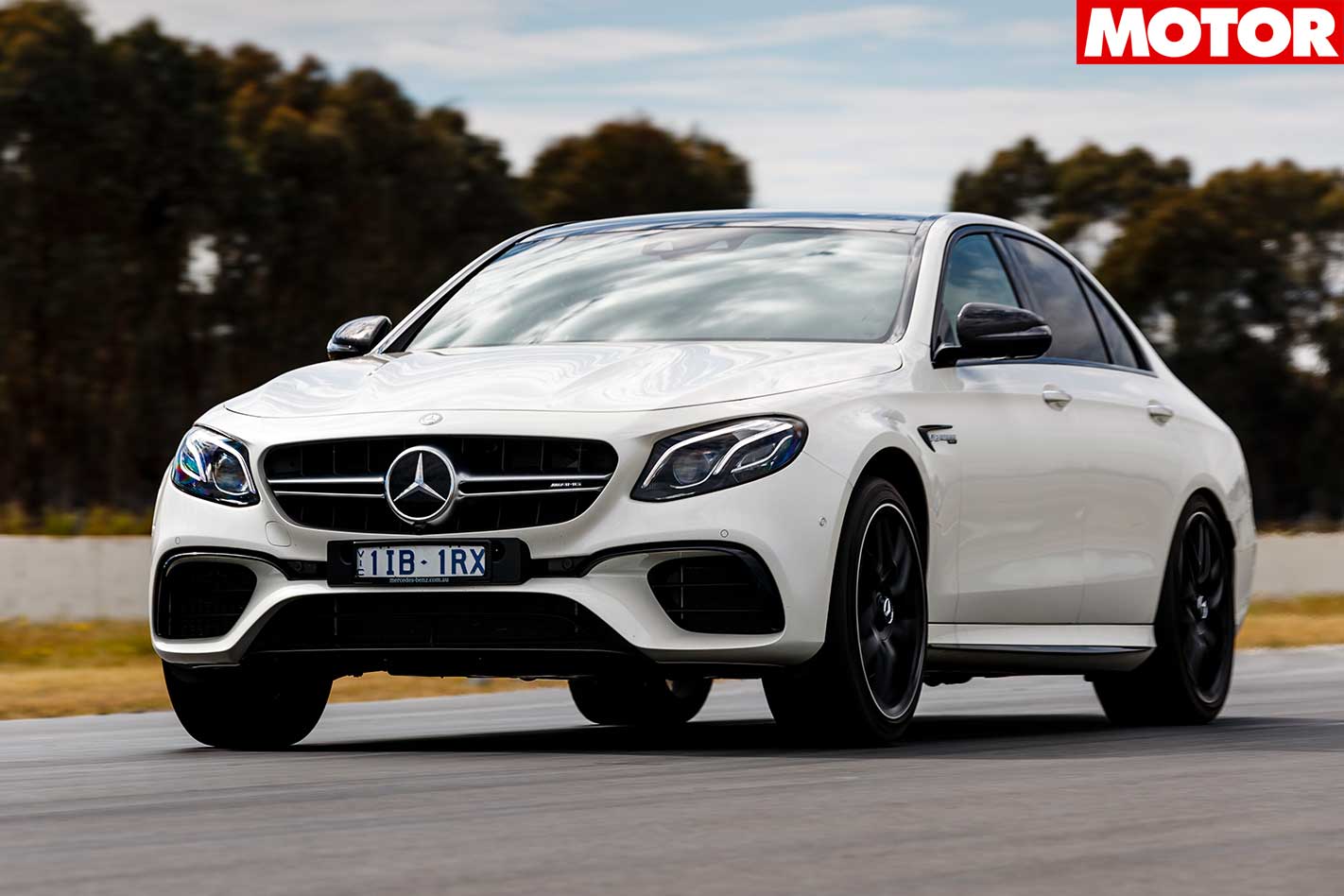
If AMG wanted vindication for its decision to go all-wheel drive with the new E63 S it need look no further than figures of 3.4sec from 0-100km/h (right on claim) and a stunning 11.28sec at 203.72km/h for the 400m.
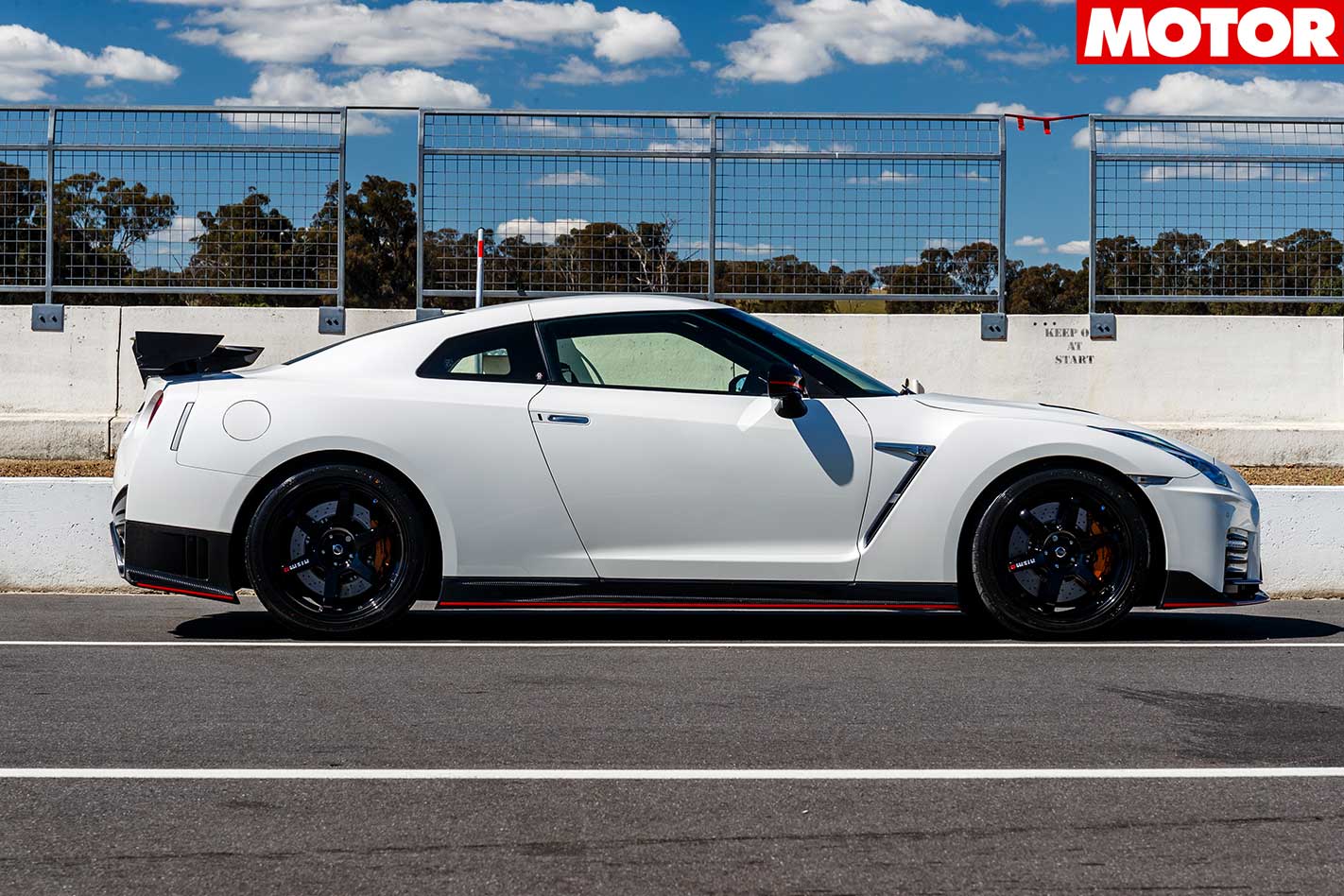
Unfortunately, a problem with its 12v outlet prevented us running numbers on the Nissan GT-R Nismo at Winton, however, its previously recorded numbers still secure it the straight-line gold medal. Given it recorded three identical runs (to the tenth) at Heathcote, it seems reasonable to assume it would have replicated its 3.28sec 0-100km/h and 11.19sec at 203.08km/h efforts at Winton. Its three fewer ratios than the E63 shows in its 2.1sec 80-120km/h result and mash the brake pedal as hard as you can and you’ll pull up from 100km/h in 33.27m.
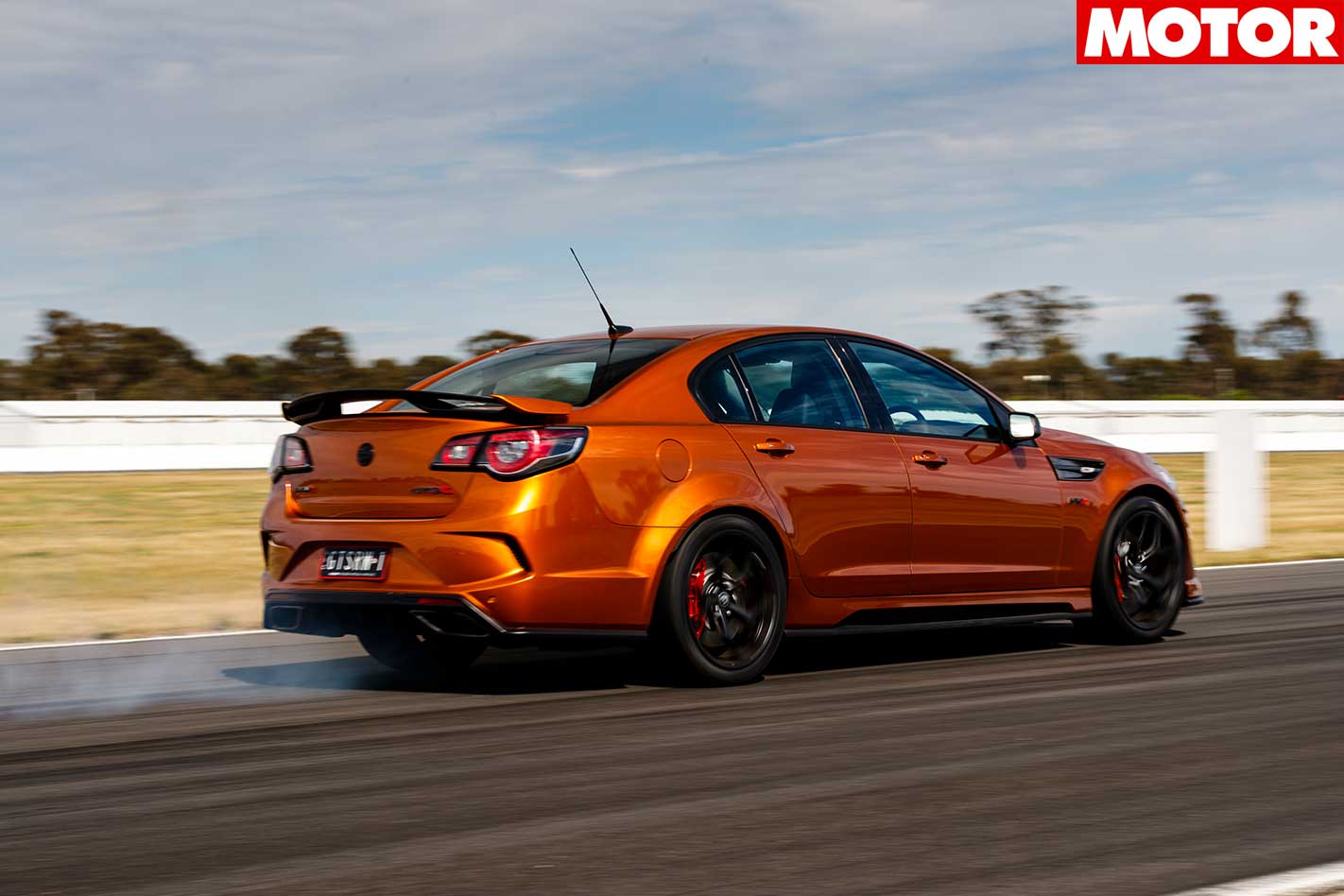
It’s clear the only way to get it rolling quickly is to slip the clutch slightly to keep the revs singing as there’s too much power to allow any wheel slip. The burning smell and smoke that appears from the back of the W1 suggests it’s not a launch you’d want to attempt more than once, but once is all that’s required as the ultimate Aussie muscle car rips off 0-100km/h in 4.16sec and a 12.18sec quarter mile at 195.86km/h as well as 80-120km/h in just 2.2sec (in second gear!).
History suggests next year’s PCOTY field will be even quicker, but there will never be a faster Australian-built car than the HSV GTSR W1.
DRAG WARS – The numbers
| Terminal Speed | Speed |
| Mercedes-AMG E63 S | 203.72km/h |
| Nissan GT-R Nismo | 203.08km/h |
| BMW M4 CS | 197.25km/h |
| HSV GTSR W1 | 195.68km/h |
| Alfa Romeo Giulia QV | 194.96km/h |
| Audi TT RS | 191.89km/h |
| Porsche 718 Cayman S | 189.12km/h |
| Lexus LC500 | 178.73km/h |
| Kia Stinger 330 Si | 176.63km/h |
| Honda Civic Type R | 174.92km/h |
