
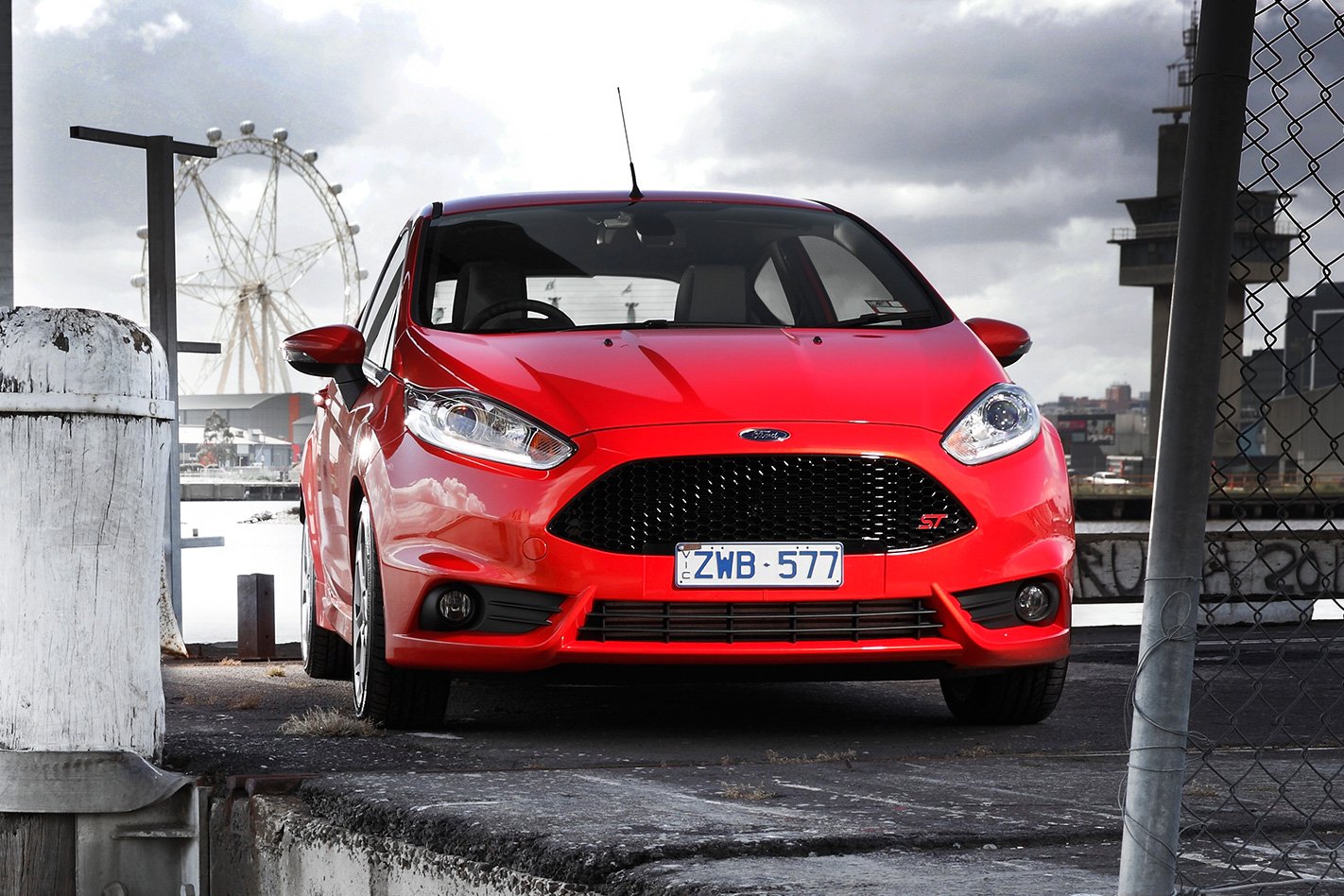
Who would’ve guessed that the device most likely to depose Toyota’s 86 GT as the best driver’s car under $30K would be a humble compact hatchback, its DNA designed for supermarket car parks, 1.6 litres driving the front wheels and a torsion beam dragging its rears along for the ride?
This article first published in MOTOR Magazine December 2013.
And what a wild little ride the Ford Fiesta ST is. Its needle-sharp $25,990 sticker dips well below Toyota’s cut-priced sports car and what other lightweight-yet-heavy-hitting hot hatches have traditionally asked for.
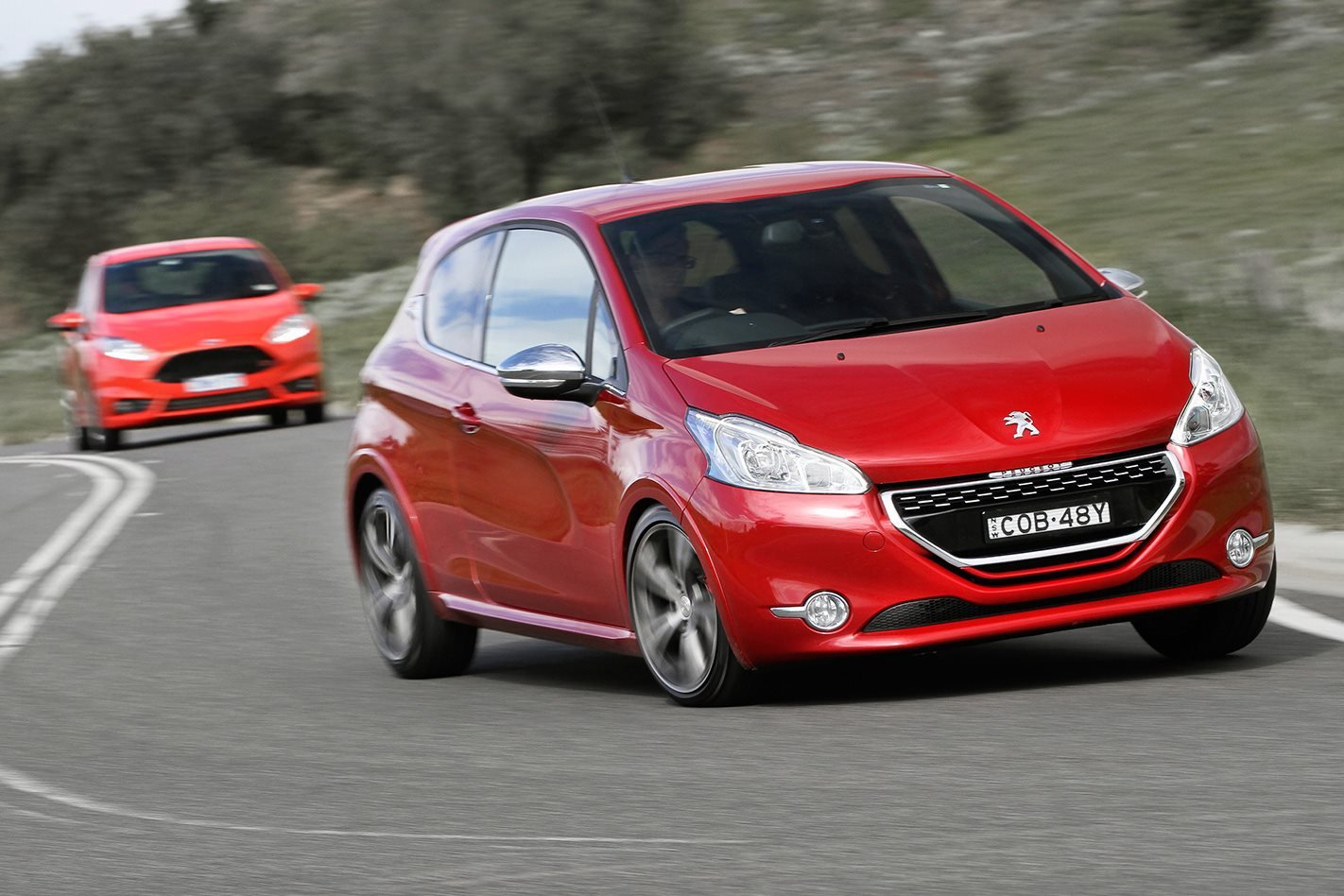
When Peugeot’s hotly anticipated GTi revival arrived in 208 form in Oz for $29,990 – the very same week as ST’s local launch – faces were slightly grim. But we’re assured the junior Pug brings with it a level of style, richness and maturity often lacking in the fast end of the small hatchback segment. Better yet, when let off its diminutive leash, the GTi proves an absolute corker – oodles of pace, heaps of fun – when thrown down a twisty back road.
The two are clearly different. Ford Team RS in Europe has honed the German-built ST to favour athletic ability, while the GTi, built in Poissy, France, aims (in Polo GTi tradition) to be the finest all-round hi-po supermini in the biz. The $4000 difference is a fortune at this price point, but there’s a lot to play for. Pace? Sure. Fun factor? Absolutely – though each has strengths in different areas, such as quality, equipment or value.
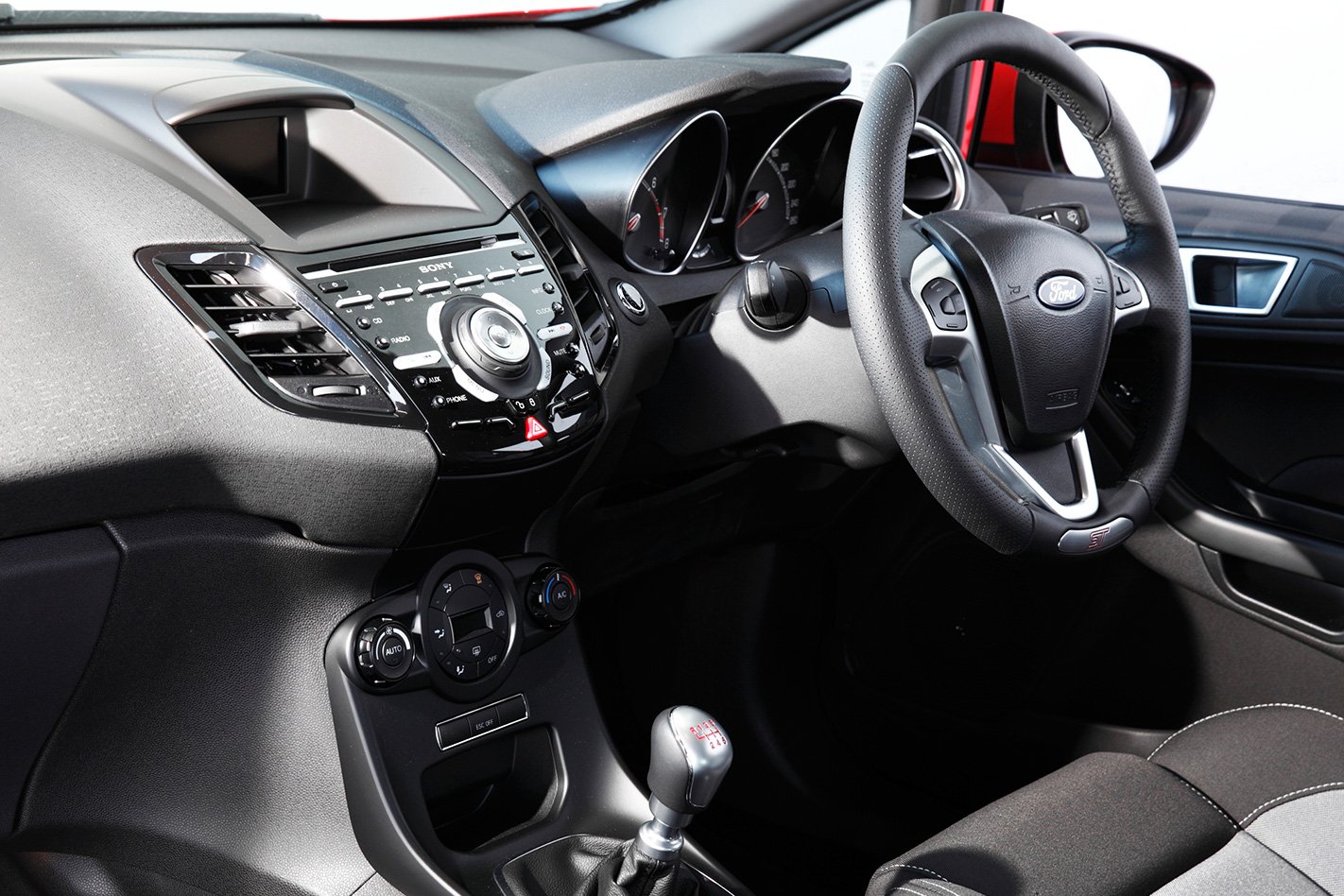
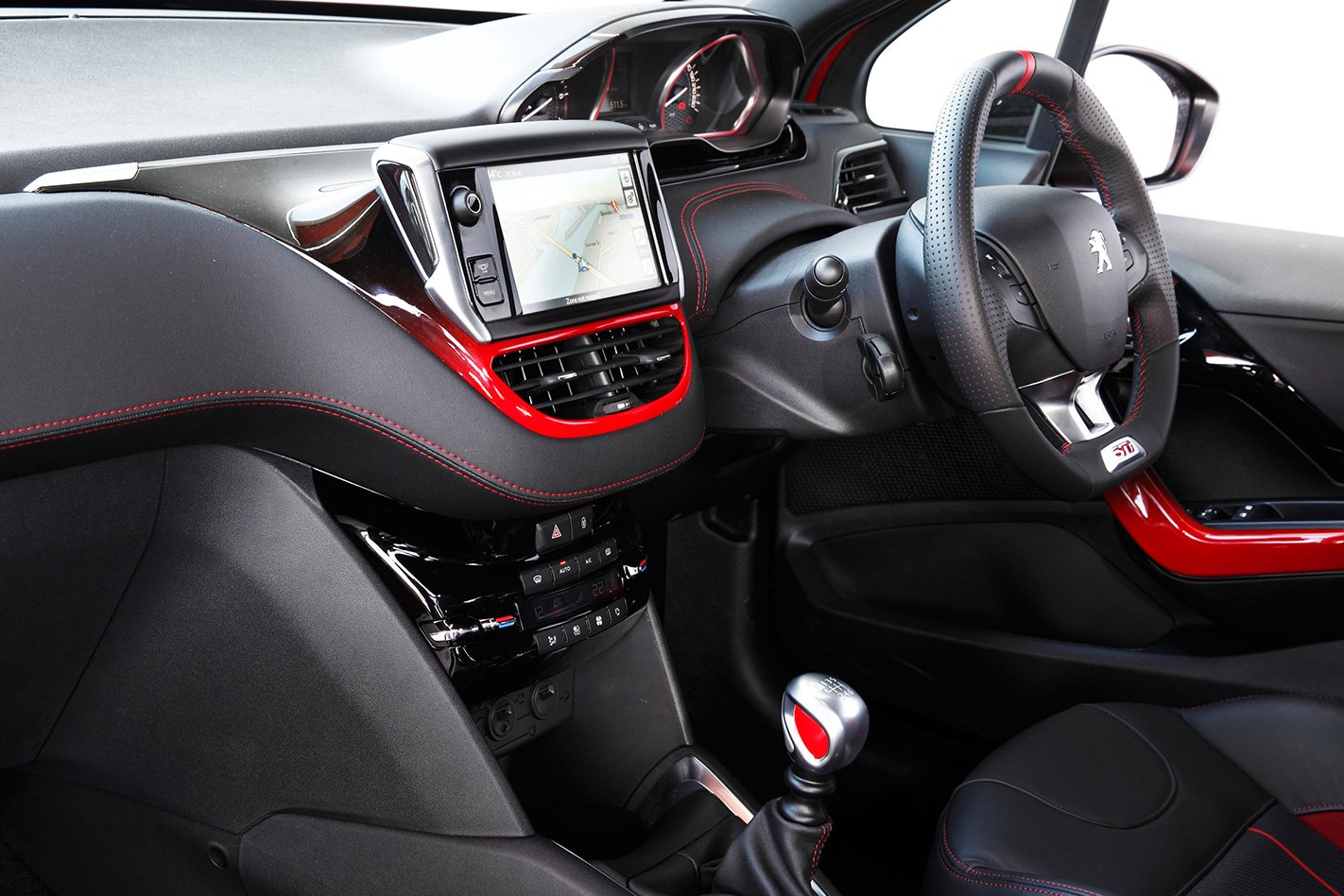
But the centre stack is a case of fussy over design and struggles to escape its cost-conscious roots. It’s no stripper though: Single-zone climate control, eight-speaker audio, rain-sensing wipers, auto headlights, Bluetooth connectivity, smart key entry, seven airbags and an auto-dimming mirror are all standard equipment. There’s no sat-nav (even as an option) and no digital speedo, though.
The GTi manages to dodge the clichéd youth stylisation that afflicts small performance cars and alienates those of us who don’t wear our baseball caps backwards. There’s subtlety in its exterior appearance and a refreshing sense of quality in the detail. Climb inside the GTi and the premium feel is worth a good chunk of that $4000 investment.
The real buzz-killer is the weird red-to-black finish on some of the trim that can’t be delete-optioned. In terms of driver ergonomics, the 208 is better than most Peugeots, but the Fiesta has a slightly more natural relationship between driver and controls.
A big black mark against the French car is its tiny steering wheel, not due to its size but because with any normal adjustment setting the upper half of the rim completely obscures the instrument cluster. A deal-breaker? For some it will be.
Both use 1.6-litre direct-injected turbo fours, yet the form guides suggest there’s a larger gap between the French and German hatches than is the reality. The GTi boasts 147kW at 5500rpm with 275Nm available from just 1700rpm. Meanwhile, the ST officially offers 134kW at 6000rpm and 240Nm from 1600rpm. But those numbers don’t take into account the ST’s ‘overboost’ function, which lifts outputs to a GTi-matching 147kW and a dominating 290Nm.
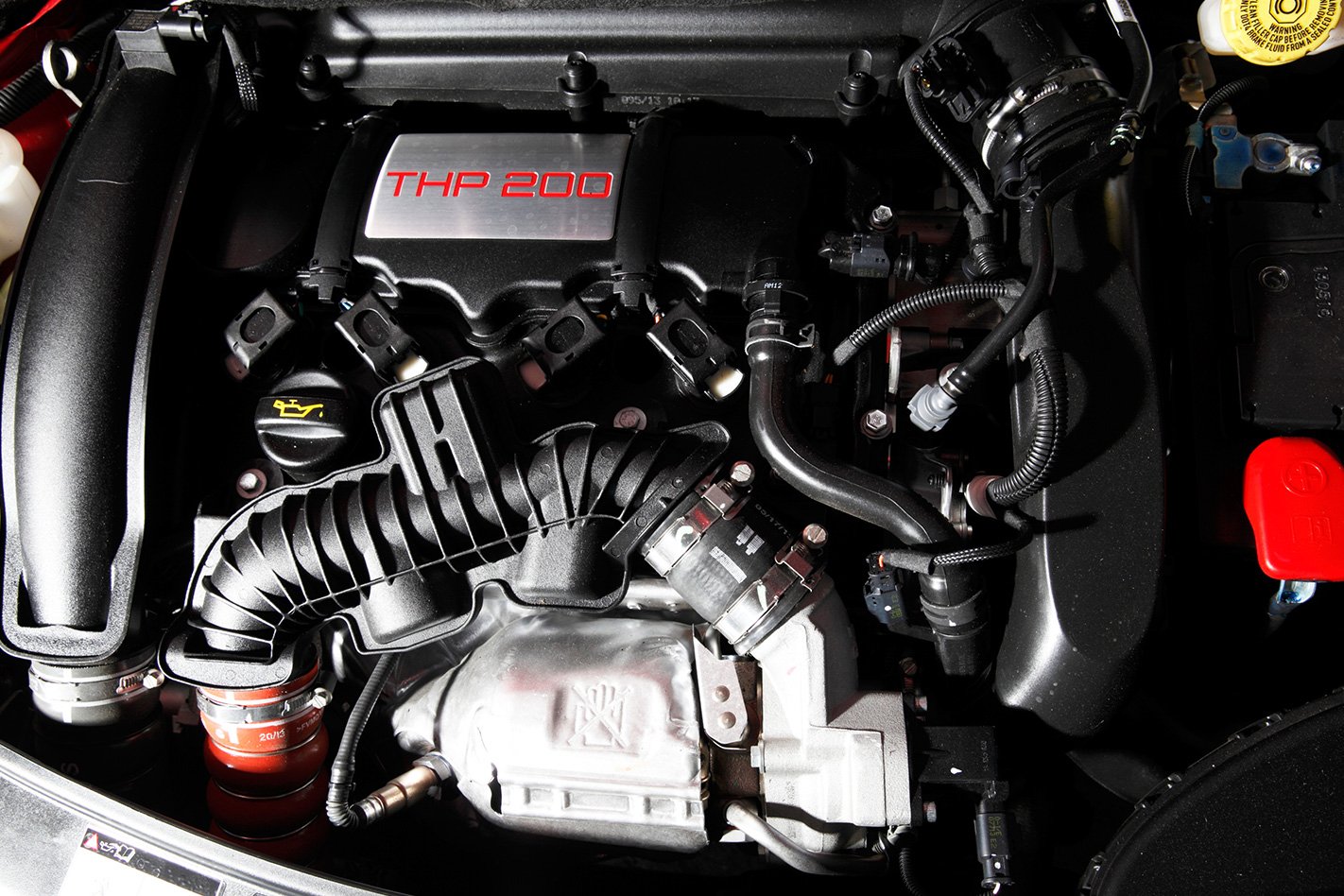
Regardless, the GTi feels like it pulls harder in the lower mid-range of the rpm sweep, and it claims it’ll arrive at triple figures 0.1 seconds quicker than the Ford. But while the ST doesn’t quite have the initial slug down low, it swings pretty hard in the upper reaches of the tacho needle sweep, feeling a little more energetic and alive in doing so.
Both are virtually lag-free from the rpm depths, satisfyingly tractable, and capable of sling-shooting their lightweight 1197kg (ST) and 1160kg (GTi) masses forward with heady force.
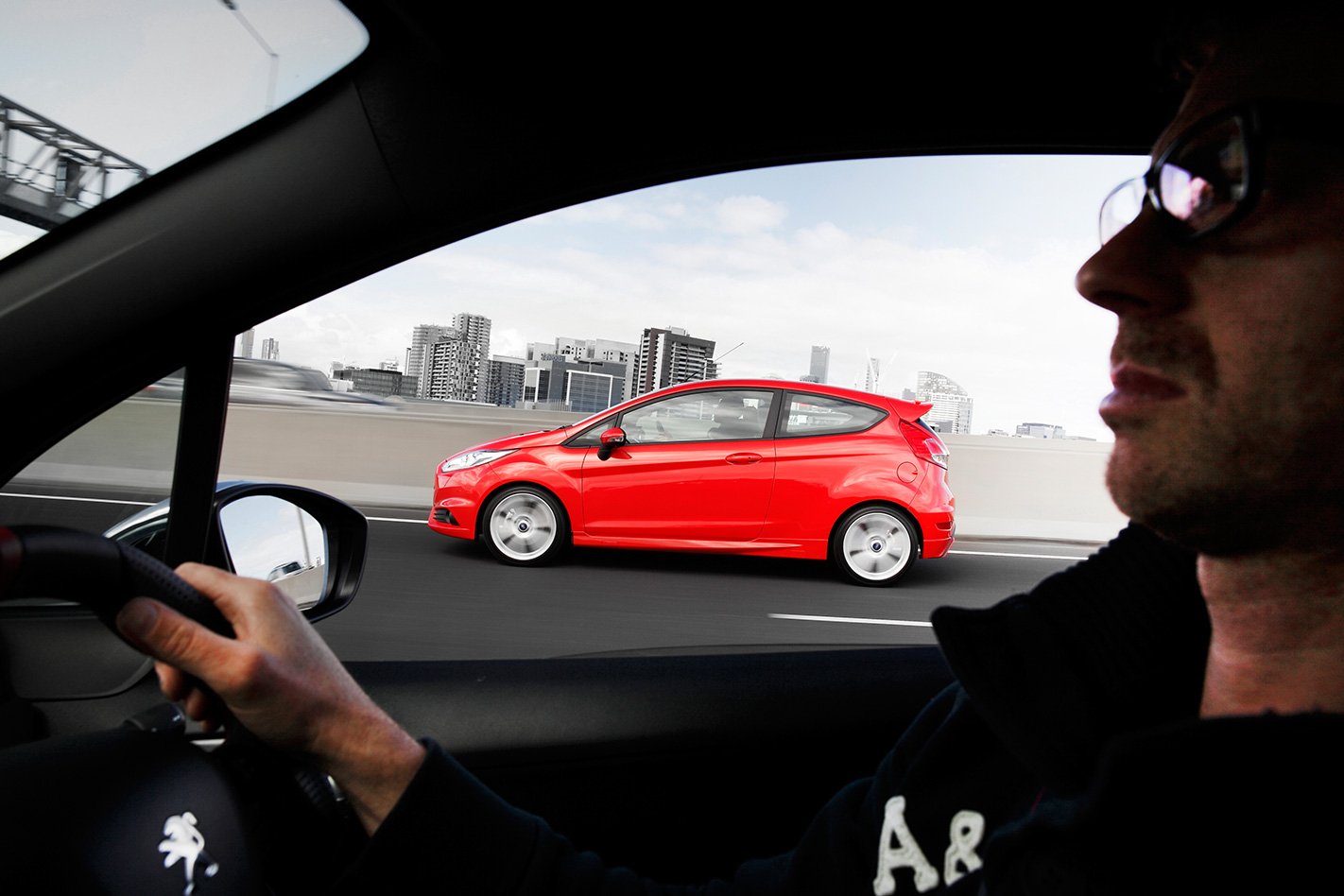
The turbo engine’s mid-range kick lends an effortless vibe to making rapid forward progress between the curves. Neither is better or worse – they’re simply suited to different driver tastes and, thus, demand to be driven differently. But one thing’s for sure, both are deceptively quick cars.
Both are only available as conventional six-speed manuals and both, incidentally, come in three-door-only forms. Neither transmission is a particular pillar of weight and accuracy in hand, though the ST is slightly tighter in gating and slicker in feel. Their pedal arrangements, too, are good rather than stunning, the GTi suffering from the pronounced stagger of other cars in the French breed (such as the RCZ).
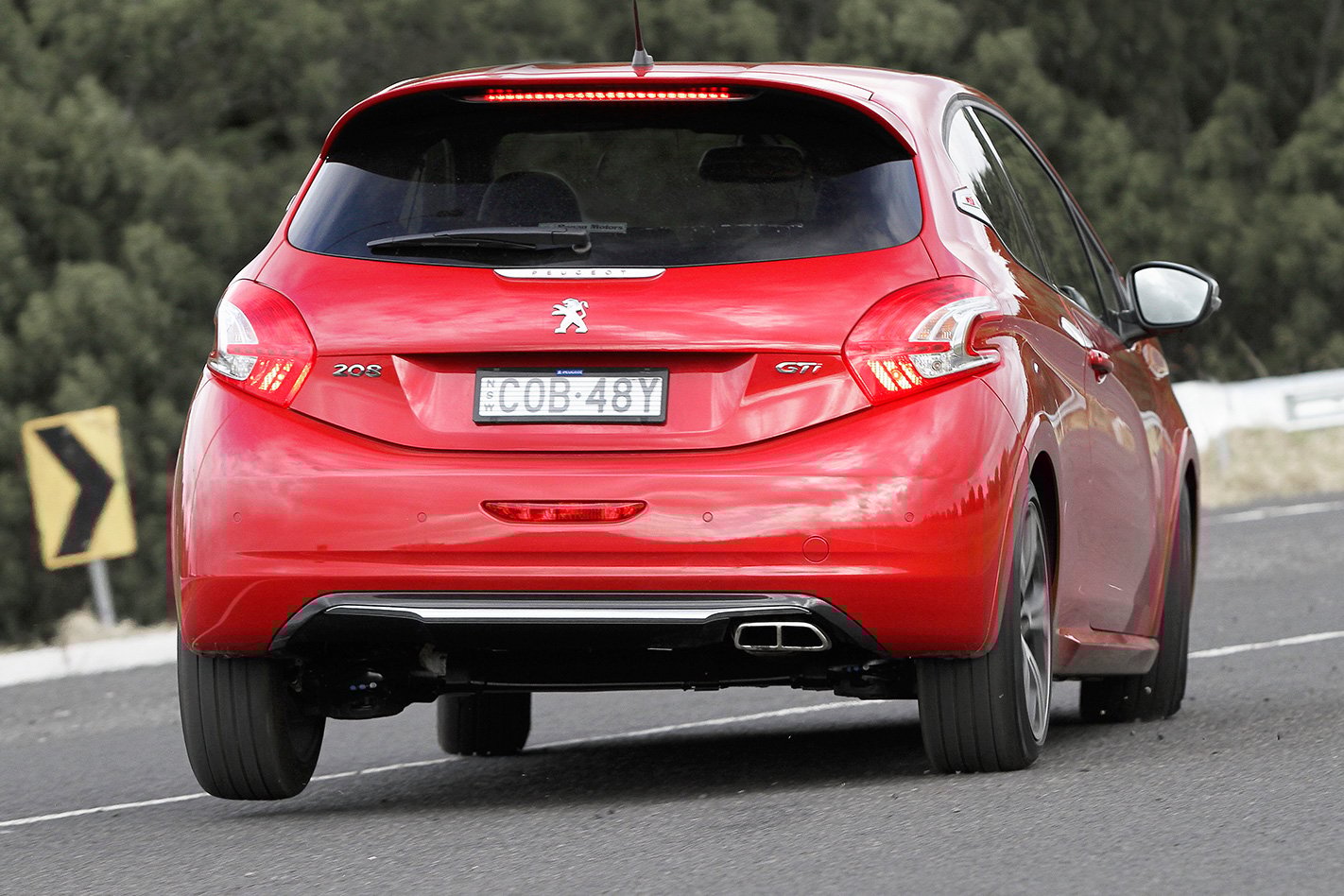
Particularly impressive is how well the ST’s mechanical systems gel together.
So often hot Fords feature the appropriate hardware for strength and performance yet lack a level of calibration and honing that make a car satisfying to drive. But with the Fiesta, Ford Team RS has created a car with real synergy.
The French car, too, feels completely and utterly polished once you get a move on, particularly the suspension set-up when you throw it up or down a challenging Aussie back road. The GTi is pretty handy on track, but you really notice the body roll, tends to light up the inside front wheel too readily and its engine gasps near redline.
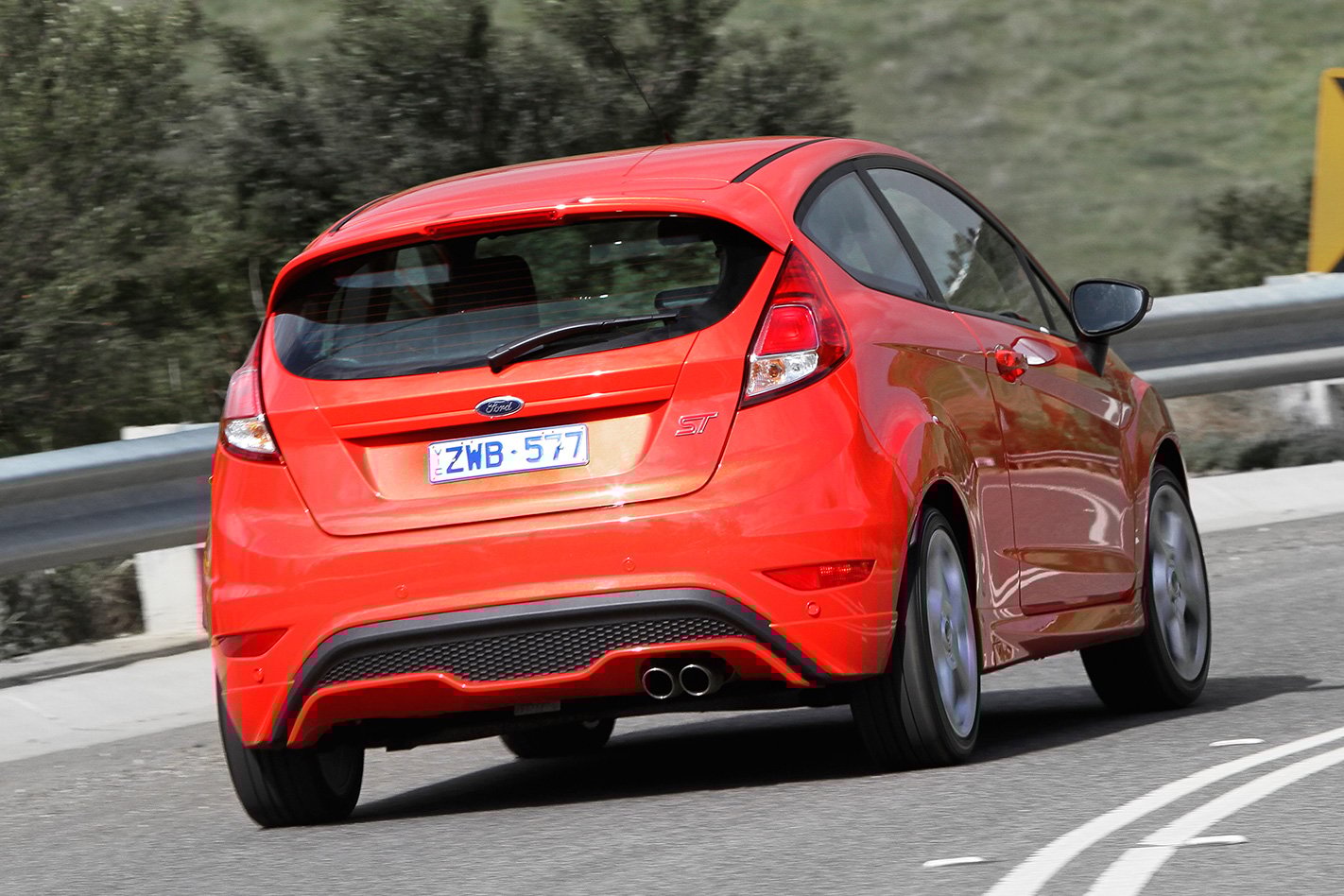
What’s immediately obvious moving into the ST is just how more direct it feels, how much extra clarity there is between driver and road surface, particularly through the steering wheel and seat.
Some of the connection is no doubt a by-product of the chassis stiffness – the ST certainly sits flatter in corners, its ride more fidgety and uncomfortable over more surfaces. Yet there’s enough compliance in the suspension that you won’t want be spat off the road at the first mid-corner undulation.
Lift off the throttle in a curve and the Fiesta reacts instantly and aggressively. And though the Fiesta’s responses are electric it’s also impressively balanced, a sort of happy medium where little wheel or pedal input is required to hustle the hatch along.
Even though the GTi is an exceptionally good real-world hot hatch, it simply doesn’t move one of the world’s most exciting segments along like the ST does. The Fiesta offers both old-school, wring-its-neck fun factor with new-gen ballistic pace in droves, in a German-spun package that costs veritable peanuts.
The next time Bang For Your Buck rolls around, the Fiesta ST is going to be one helluva tough little act to beat.
If you’re keen to celebrate spring with a German two door, Mercedes-AMG’s C43 Cabriolet has you covered.
Joining sedan and coupe offerings, it adds boulevard cruising appeal to the range. And the best thing about folding that cloth-top away, in 20 seconds, is the access granted to the howling 3.0-litre twin-turbo six.
The V6 isn’t AMG’s burliest powerplant, with the C63’s V8 still aural manna, but the optional exhaust makes it a crackling, popping, treat in the open air.
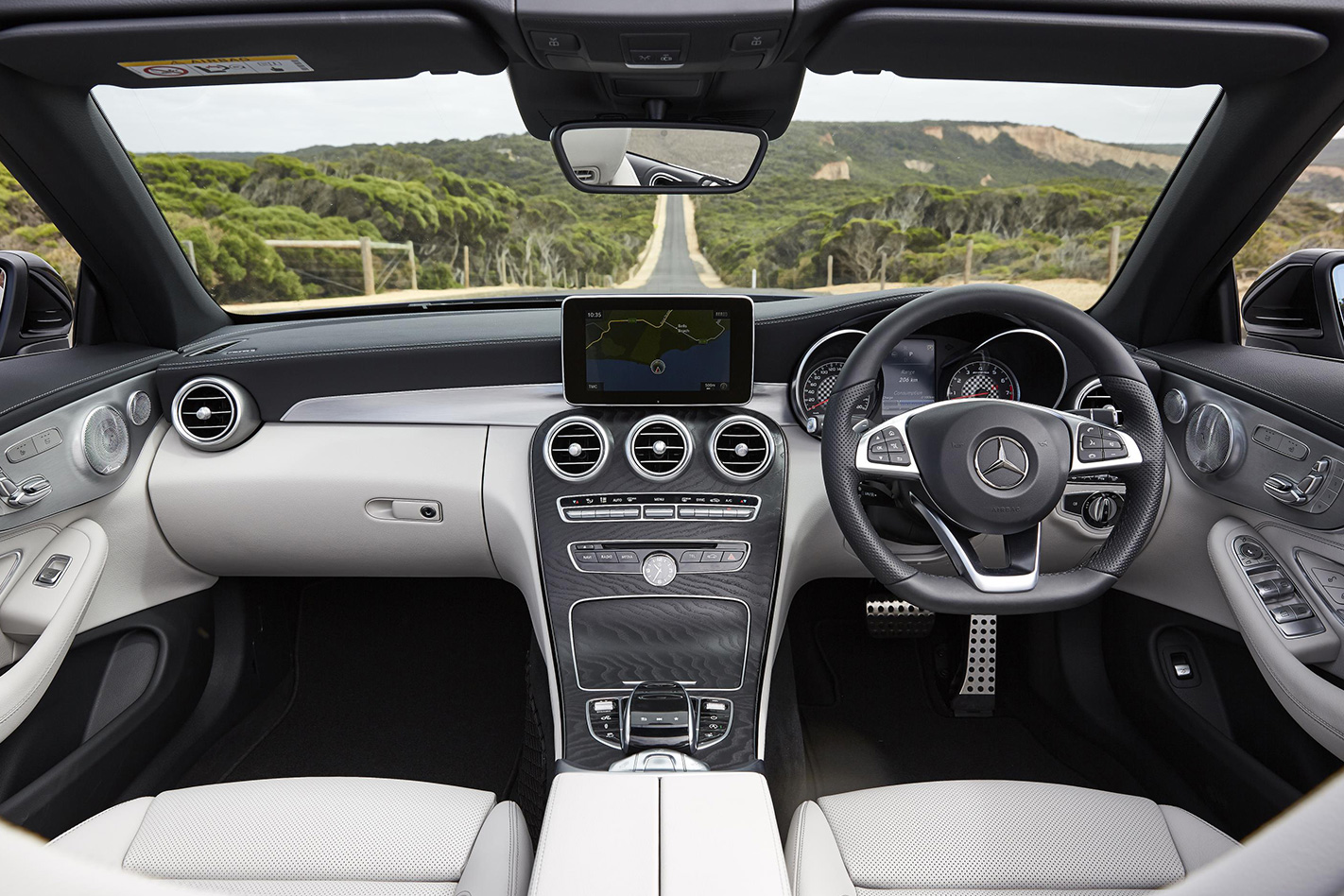
But you’ll need to pick between the snarling exhaust note and a cosy neck as the package including the system fits performance seats that delete Mercedes-Benz’s signature neck heaters. Still, the interior’s a nice place to be, with a distinct art-deco look and feel that sets it apart from more clinical BMW and Audi workstations.
Dynamic-wise, a surprisingly sturdy bodyshell and rear-biased all-wheel drive system help it work 225mm/255mm wide contact patches with similar athleticism to the hard-top, but it’s maybe not the best track-day chariot. And it hasn’t transformed the hardtop’s sometimes spine-jolting ride.
It’s priced well at $120K – right in the middle of an Audi S5 or BMW 440i drop top. We predict it’d be the most emotive choice of the three, and maybe the most suited to top-down driving.
Stuck in winter? Pick the optional exhaust, the sound will be warming enough. Even without neck warmers.
2017 Mercedes-AMG C43 specs Engine: 3.0-litre twin-turbo V6 Power: 270kw Torque: 520nm Weight: 1795kg 0-100km/h: 4.8sec Price: $119,900
MAZDAu2019S CX-9 arrives in our garage with plenty of pedigree, having recently been announced as Wheels Magazine’s Car of the Year for 2017.Now, all that COTY goodness get puts to the real-world test as the seven-seat Mazda finds itself enlisted for six months of family duties and general around-town running.
There will be school runs, loaded-to-the-gunnels holidays and plenty of peak-hour grind, as well as the occasional fast blast down a challenging back road to test the handling mettle that contributed to the model’s COTY crown.
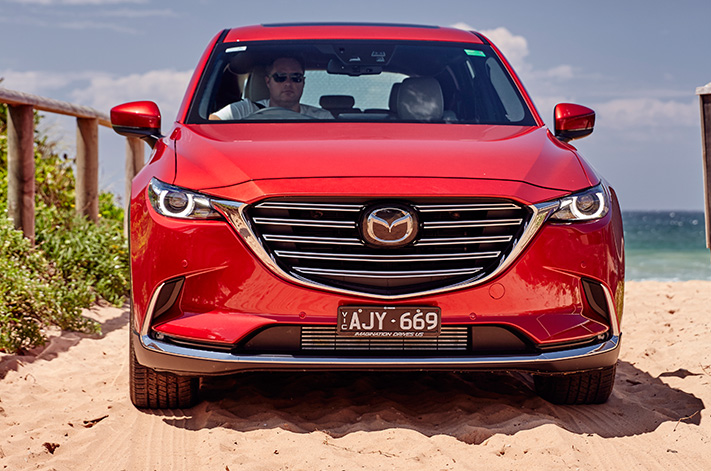
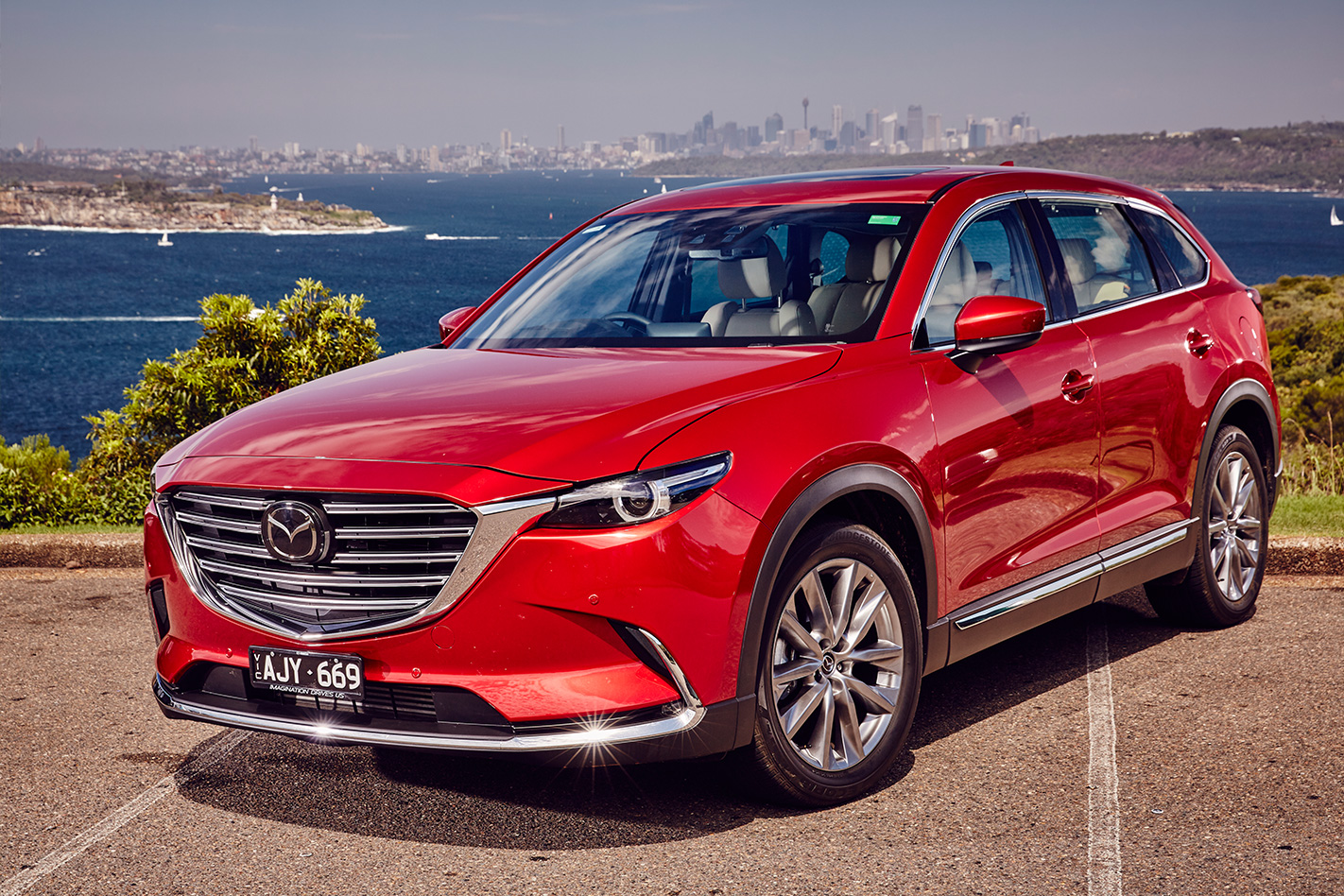
Our CX-9 is the top-spec Azami finished in Soul Red. Armed with the all-wheel-drive system that half of buyers opt for, it’s the most money you can spend in a Mazda dealership; the RRP is $63,640 before dealer and on-road costs (we also scored floor mats and a tow bar).
But there’s plenty included for the coin, including leather (we chose the cream hue that contrasts nicely with the black dash and roof lining), a 12-speaker Bose sound system, electric front seats, a colour head-up display and radar cruise control as part of a more advanced active safety suite. As with all CX-9s it also gets sat-nav, reversing camera, blind spot monitoring, three-zone auto air-con and auto braking in forward and reverse.
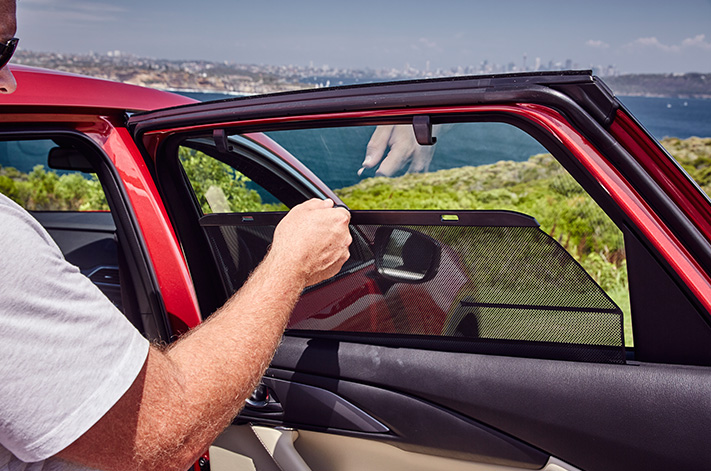
It was straight into action with a run to the country with the family on board. The kids (a four-year-old and a seven-year-old) quickly figured out the retractable side blinds and centre arm rest complete with cupholders, covered storage and a pair of USB inputs (double bonus!).
Unfortunately, they’ve also worked out the rear air-conditioning controls.
Early signs are that the fuel use is a big improvement over the thirsty previous model but perhaps not the game changer some might have been expecting.
A 110km/h freeway run was followed by a few hundred kays of country cruising with the occasional full-throttle blast to overtake. Consumption hovered close to the claimed 8.8L/100km average, but some city driving quickly shoots that back into double digits.
More impressive was the general driving experience. The torquey 2.5-litre turbo does a beautiful job of summoning the full 420Nm to comfortably maintain pace up hills, giving the CX-9 an effortless, diesel-like flexibility across the mid-range.
That said, it’s not exactly sporty in its nature, relying more on the low to middle part of the rev range to produce its best.
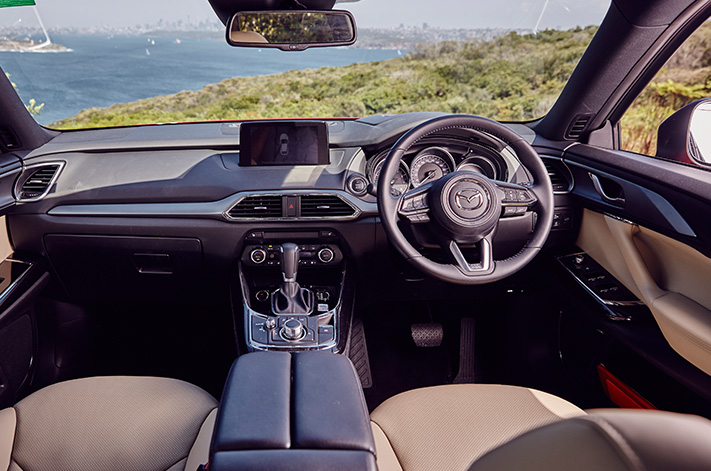
Similarly, the six-speed auto is intuitive without being particularly sharp. For that there’s a Sport button, which is (curiously) separate to the gear selector; why Mazda doesn’t just copy Ford, BMW and others and have the main gear selector choose the tranny’s Sport mode is a mystery.
There are new levels of refinement for the mainstream seven-seat SUV class, too. Our country trudge was made easier with impressive suppression of wind and road roar. The fact the engine doesn’t rely on revs removes yet another noise source from the NVH equation.
One gripe was the occasional 100km/h tyre roar on coarse-chip bitumen from the 20-inch Bridgestones.
It only happened occasionally and on poor quality surfaces, something we’ll be monitoring as the tyres wear.
Part of our inaugural CX-9 trip involved something very un-SUV-like – fast gravel roads, a change in surface the Mazda did an equally good job of dealing with.
The only concern was those Bridgestones, which provide respectable grip on both bitumen and dirt, but aren’t designed to deal with sharp rocks.
The prospect of a skinny 17-inch space saver as a backup meant we backed off the pace, just in case.
There will be more dirt during our time with the CX-9, but for now it’s beaches, ’burbs and school runs.
And keeping a close eye on the fuel gauge.
Drinking top-shelf
The CX-9 is designed to run on regular 91-octane fuel, on which the 2.5-litre four-cylinder turbo produces the claimed 170kW.
But fill it with 98-octane premium unleaded and it’ll muster up to 186kW thanks to the top-shelf fuel’s superior knock resistance and the extra boost/ignition timing this allows.
Our time with the car has kicked off with the 98 RON brew, but later in the CX-9’s life we’ll switch to using regular unleaded and monitor changes to performance and economy.
Four with more
The second-generation CX-9 dumps its Ford-sourced 3.7-litre V6 for a new Mazda 2.5-litre four-cylinder turbo.
The force-fed donk’s 170kW on regular unleaded is down from the 204kW of the V6, however, torque has taken a big step in the right direction, with the new model peaking at 420Nm, well up on the 366Nm of the outgoing atmo engine.
Even better is that the torque peak now arrives at 2000rpm, less than half the revs of the V6 needed to deliver max twist (4250rpm).
Fuel use has dropped from a claimed 11.2 litres per 100km (it was higher in earlier iterations of the same car) to 8.8L/100km.
Update #2
Two days. That’s all it took out on the street for the reigning Wheels Car of the Year to succumb to thousands of dollars of damage.
For the first five weeks at Chateau Hagon the still-new CX-9 long-termer had been tucked safely away in my carport. But the arrival of an MX-5 RF test car saw it relegated to life on the streets, which is when things went wrong.
The culprit? Ice. Big chunks of it falling from the sky. I wasn’t even home when the biggest hailstorm in years hit Sydney’s north, destroying thousands of cars and stripping leaves from trees.
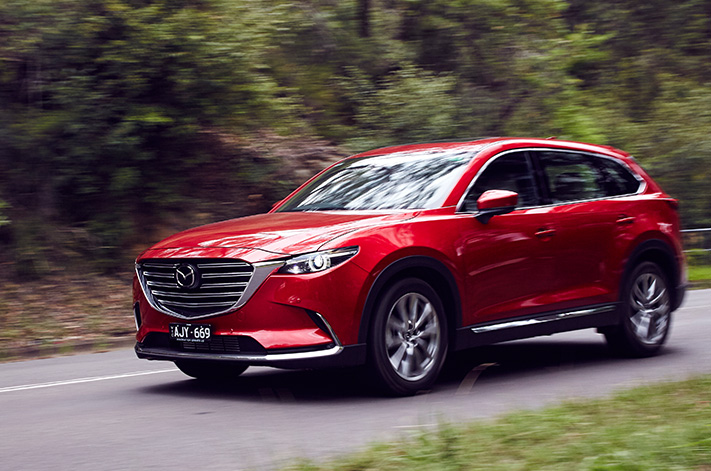
To be fair, the CX-9 wasn’t destroyed. Golf ball-sized stones left more than a dozen dings in the roof and bonnet, but no windows were smashed. From 10 metres away you’d struggle to spot the damage.
Still, for $63K of new car it’s less than ideal. And the aluminium bonnet is likely requiring replacement due to the metal’s reluctance to be beaten back into shape.
From now on, though, the Azami AWD will be back under cover, something that often provides a source of excitement for my kids. They love it when I reverse towards the plants at the back of the carport and let the auto braking system grab the anchors hard, which is accompanied by a graunching sound as the ABS does its thing.
My wife isn’t as enamoured and refuses to take part in such skylarking. She’s a bigger fan of the 12-speaker Bose sound system (complete with a subwoofer in the boot) coupled to the digital radio tuner. There’s decent bass and crisp treble, making for great 80s blasts.
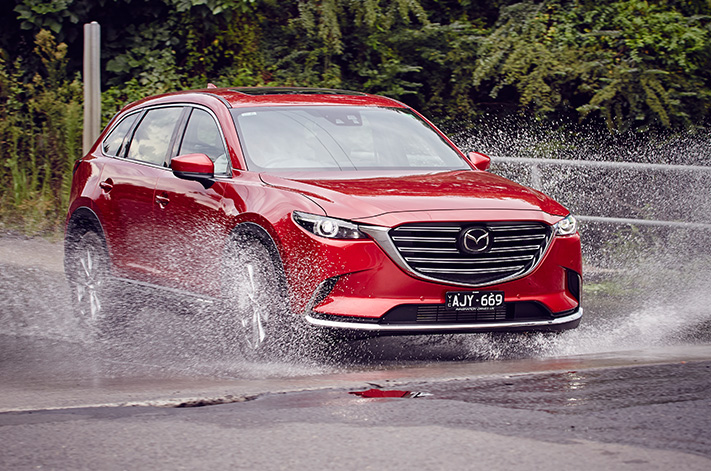
However, the digital radio reception isn’t as strong as it is in a Toyota, Holden, Audi or Mercedes-Benz. You can be happily bopping along to Whitney Houston (the missus, not me…) on full bore, proud of how in-tune you are and how well you’re hitting the high notes … before being hit with the sound of silence when the reception strikes a black hole. Somehow the CX-9 finds plenty of them.
It’s then you realise how out of tune you are. And how you’re at least two octaves shy of hitting those high notes.
Update #3
Serenity is a good thing in a car.
I say this with some authority, having driven everything from a Lotus Elise on a rainy freeway to a Toyota LandCruiser with kids and in-laws aboard on a long country Christmas run. Neither is much fun, although forced to choose the Elise would win out…
Those character-building experiences made me appreciate my last month in the CX-9 Azami that little bit more.
Sure, the kids were occasionally squawking and bickering, but otherwise peace prevailed.The distinct lack of tyre noise on a country road is a welcome change for a Mazda. After all, serenity is something Mazda owners haven’t always had, courtesy of an early-2000s edict to strip weight (some of it sound deadening) and focus on dynamics.
Being designed primarily for those freeway-loving Yanks, the Mazda CX-9 comes suitably attired for the 60mph cruise, ably hushing the hum from the 20-inch Bridgestones. It’s impressively quiet, making everything from a Sunday morning croissant run to a high-speed cruise that little more relaxed.
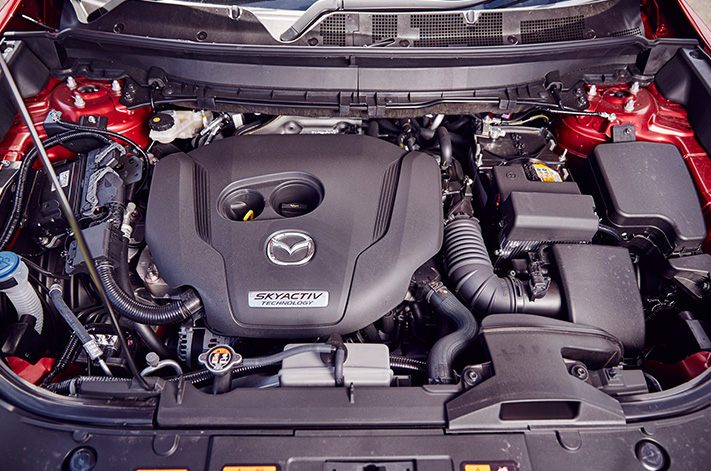
But it’s the 2.5-litre turbo that contributes most to the peacefulness of the CX-9’s cabin. Having a full 420Nm under your right hoof from 2000rpm means there’s rarely a need to delve beyond that beautiful bulge of torquey goodness. Gentle squeeze, turbo quickly wakes up and off you go, the six-speed auto swiftly slotting through its cogs to maintain that torque focus.
Sure, there’s more on tap if you tramp the throttle – enough to briefly spin the front wheels before the computer diverts drive rearward – but that’s only needed when you really want to smash the traffic-light grand prix.
It also makes the Sport button for the transmission largely redundant for all but a backroad fang. Sure, it sharpens responses, but the insistence of the transmission to drop down a ratio bypasses the torquey low to mid range in the hunt for high-rev power.
That relaxed, low-rev acceleration also helps with decent – rather than exceptional – economy. This month’s 12.2L/100km was slightly up on the 11.1L/100km average, but it was achieved in mostly suburban running.
Thirst could head north from here, though; I’ve ditched the 98-octane for regular unleaded to see what it does to real-world performance and consumption.
One thing’s for sure: it won’t impact the serenity of what is a supremely relaxed and comfy family cruiser. And the quietest Mazda in decades.
Update #4
FUEL bills can be a sore point with anyone who’s stepped up to a seven-seat SUV. The prospect of lugging around upwards of two tonnes – especially in a spirited way – can easily lead to fuel use well into the teens of litres per 100km travelled.
Not ideal if you’ve also got some human food processors on board churning through your weekly salary concurrently.
Which is why we’ve been keeping an eye on the Mazda CX-9’s trip computer pretty closely, moreso over the past month.
For the first time in 3500km the 2.5-litre four-pot turbo has taken a gulp of regular unleaded. The cheaper fuel still achieves the 170kW claimed in the brochure, but it does without the additional 16kW kick delivered from a 98-octane brew. And the engine loses some of its top-end spark once revs lick past 5000rpm.
So, if you’re planning on flogging it on a back road or looking for that extra zip passing a road train you may be disappointed that things peter out that fraction sooner.
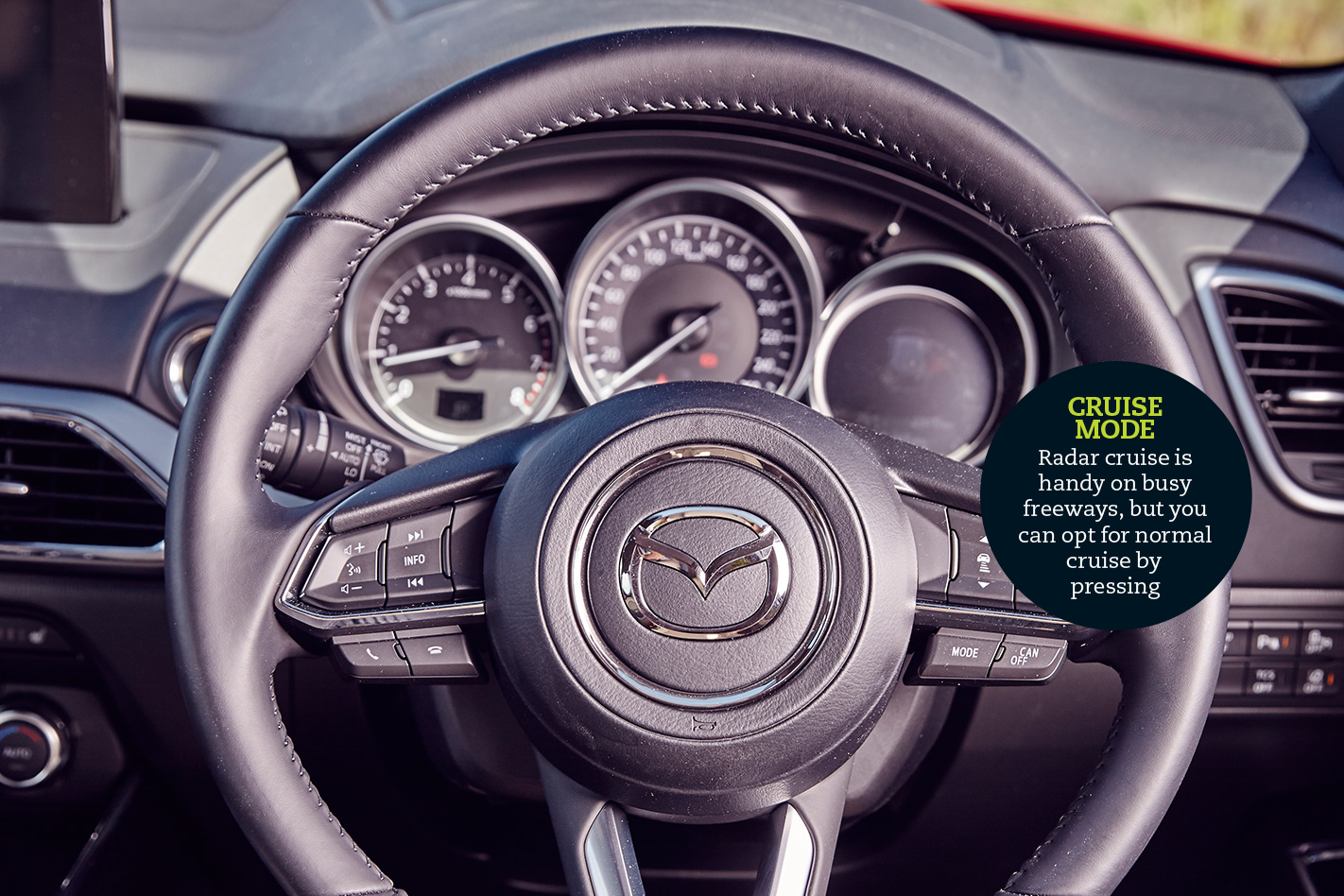
But the reality is that’s not what this engine is about, at least for most people, most of the time. And this month the switch to regular hasn’t created a notable performance impediment, mainly because the Mazda CX-9 has largely been confined to the suburbs and the occasional city motorway.
There’s still a lusty 420Nm on offer from way down in the rev range. By the time that’s done its job the sizeable seven-seater is generally maintaining pace with traffic. That laziness is welcome and makes for a relaxed suburban runner.
But the big question is: how much fuel is it using? Well, the ULP does flow through the fuel lines that little bit more freely than PULP, but not outrageously so. After predominantly suburban driving, two fills this month have resulted in consumption of 13.6L/100km, up slightly on the 12.8L/100km figure we’ve gleaned from similar peak hour-infested driving on 98 RON.
From here the CX-9 will get one more freeway run with ULP and a last blast with 98 before it heads back to its home base. We’ll crunch the dollar figures then.
Farewell
Bath time in our house usually involves plenty of suds, rubber ducks, and the occasional soapy stoush.
But this time around it’s in the driveway and it involves our four-wheeled boarder, otherwise known as a Mazda CX-9. Something of a farewell pressie for a car that has endured plenty.
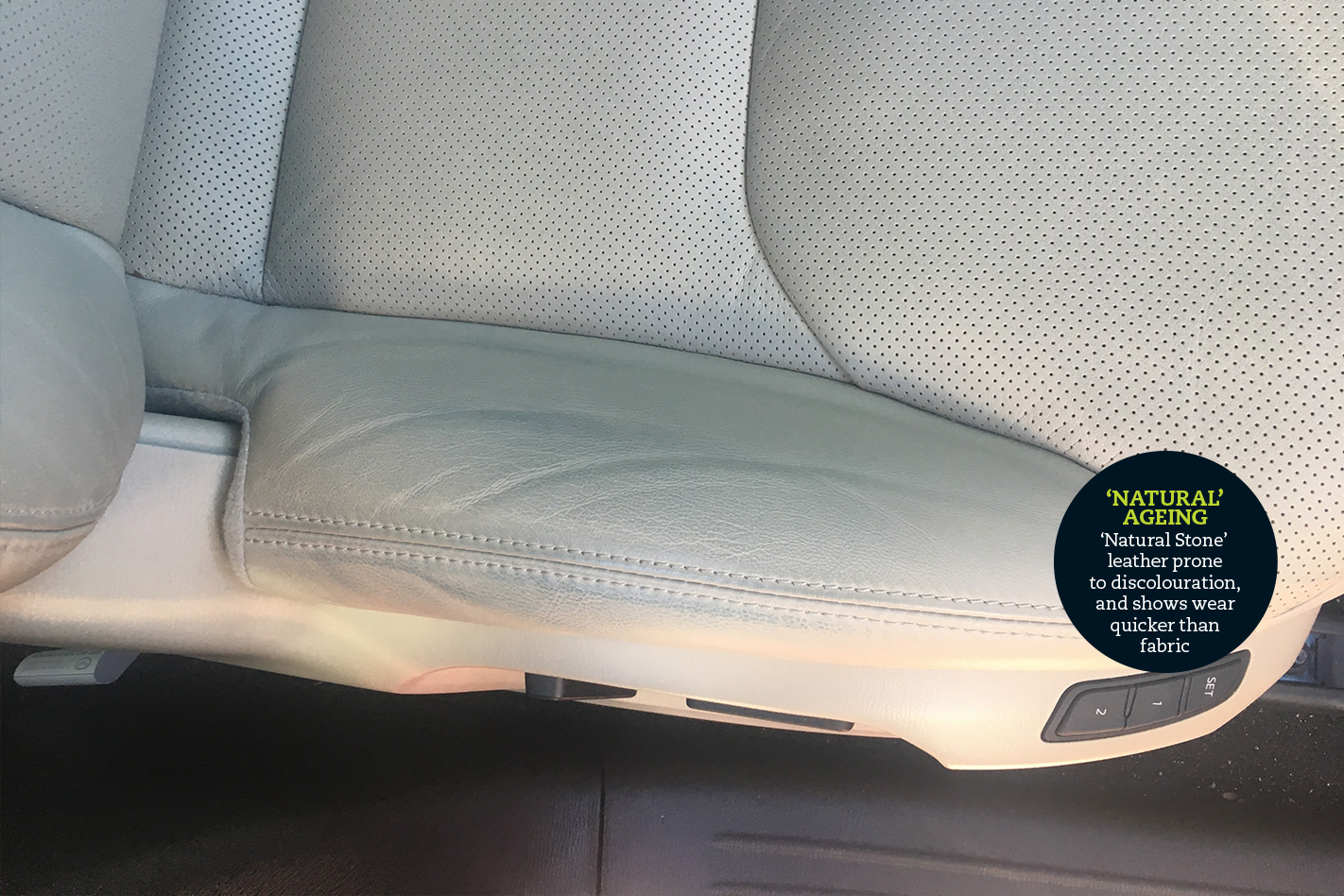
Like carbon-dating rocks, the back seat is a receptacle for all that has gone on over its six months of duty.
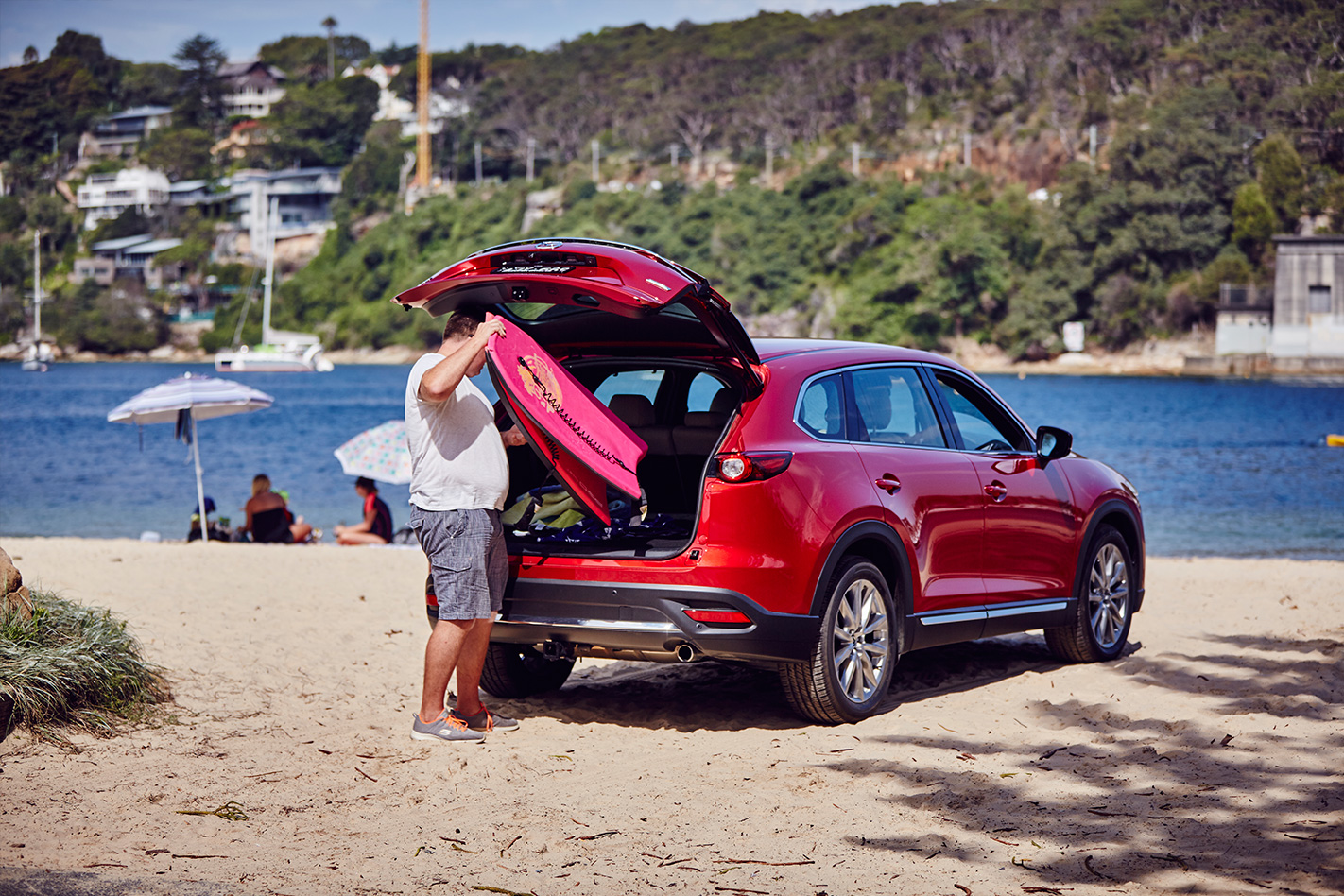
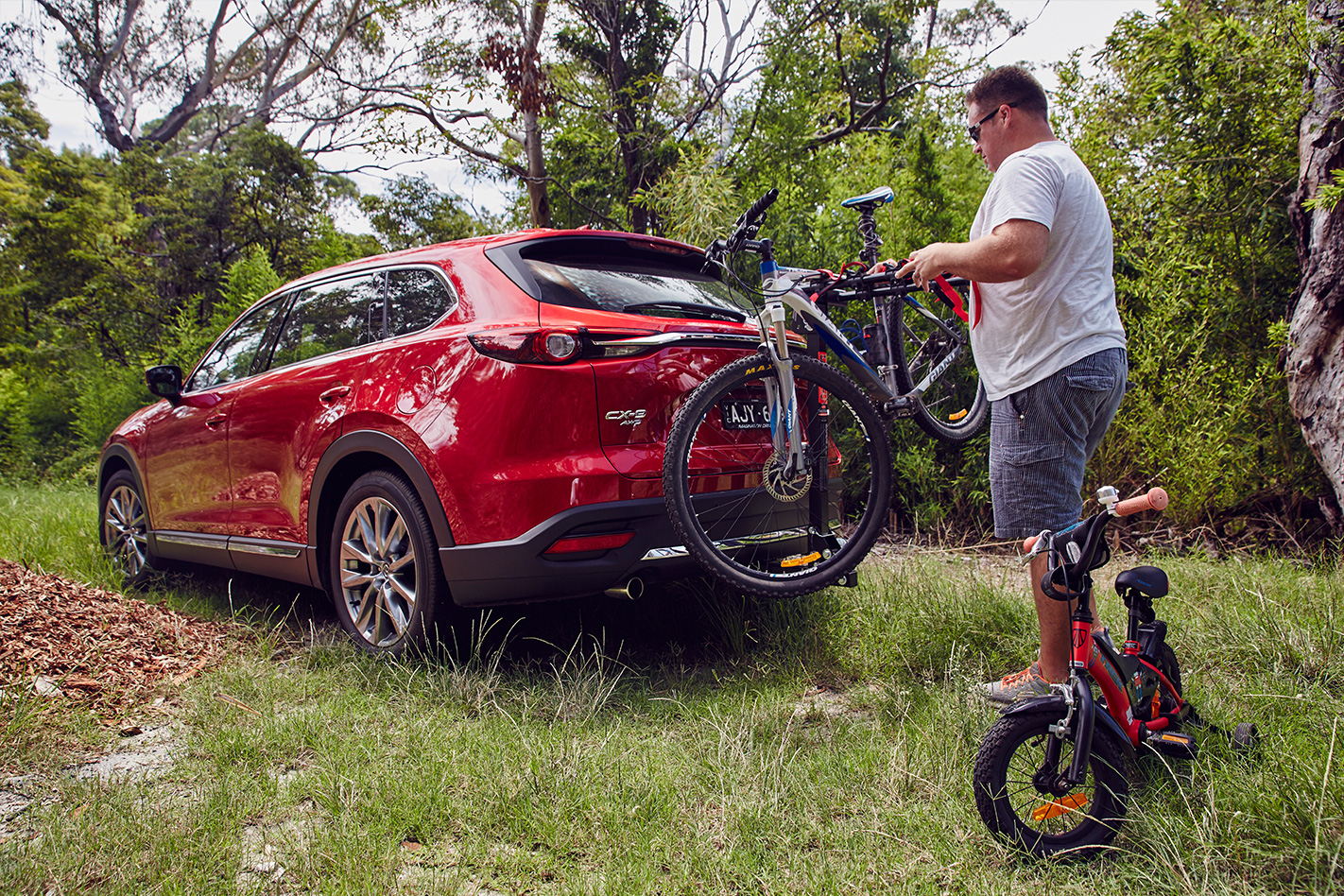
Sand, crumbs, and the occasional raisin are expertly arranged with a plastic wrapper buried near a seatbelt buckle. All reminders of trips to the country, dozens of beach runs, and months of Saturday sport.
Washing the Soul Red exterior reinforces the CX-9’s lofty dimensions. Extra stretching is needed to cover the extremities of the roof and, while it has 10-spoke wheels, their simple design makes it easy to sponge off a light coating of brake dust.
Its lengthy body was a boon for friends and family who hitched a ride. The ability to put a car seat in the very back row was a big win when employed occasionally, and was some consolation for the CX-9’s lack of air vents way aft.
Running on 20-inch rubber means some gribbles over small imperfections, but the inherent suppleness of its MacPherson strut front and multi-link rear made for respectable plushness. Mixed in with some meatiness to the steering, its mannerisms are something appreciated on a final fling up a local set of twisties.
It’s quiet, too; for a brand with its fair share of tyre-roaring models, the CX-9 defies expectations, cementing its position as a seriously relaxed cruiser.
While its all-wheel drive was never wholly put to the test, its presence made it easier to utilise the full 420Nm on faster gravel blasts, and all but eliminates the front-wheel chirp of 2WD CX-9s, although firing out of an intersection can occasionally elicit some slip.
Alternating between ULP and 98-octane showed there was an edge with the latter. But it was mainly top-end, way out of the engine’s natural habitat.
Besides, the chances of bettering its 8.8L/100km official figure on any fuel were slim, short of meandering along a country road.
For suburban duties there’s a higher price to be paid, right down to the (now departed) kid droppings.
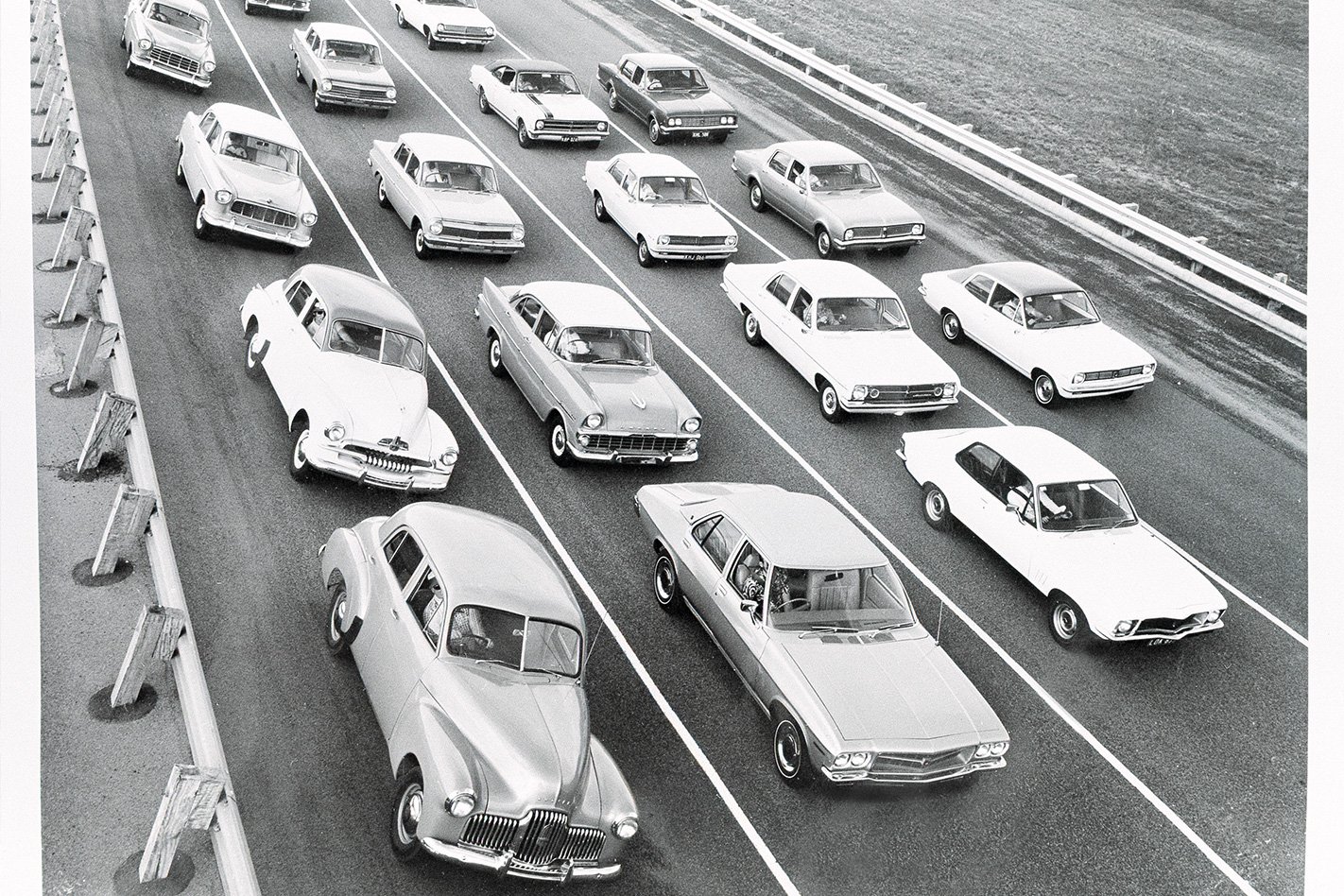
AUSTRALIA’S car industry was preparing for big change in 1973 that would introduce our first emissions laws and radically reshape the manufacturing landscape.
The rise of Japanese cars was continuing unabated. Mazda entered 1973 holding fourth place on the sales charts behind Holden, a Ford starting to beat its rival in the monthly sales fight, and Chrysler. Rumors start spreading, too, that Holden will soon start supplying completely knocked down versions of the HQ Premier to Mazda in Japan that will be fitted with a rotary engine – the Roadpacer.
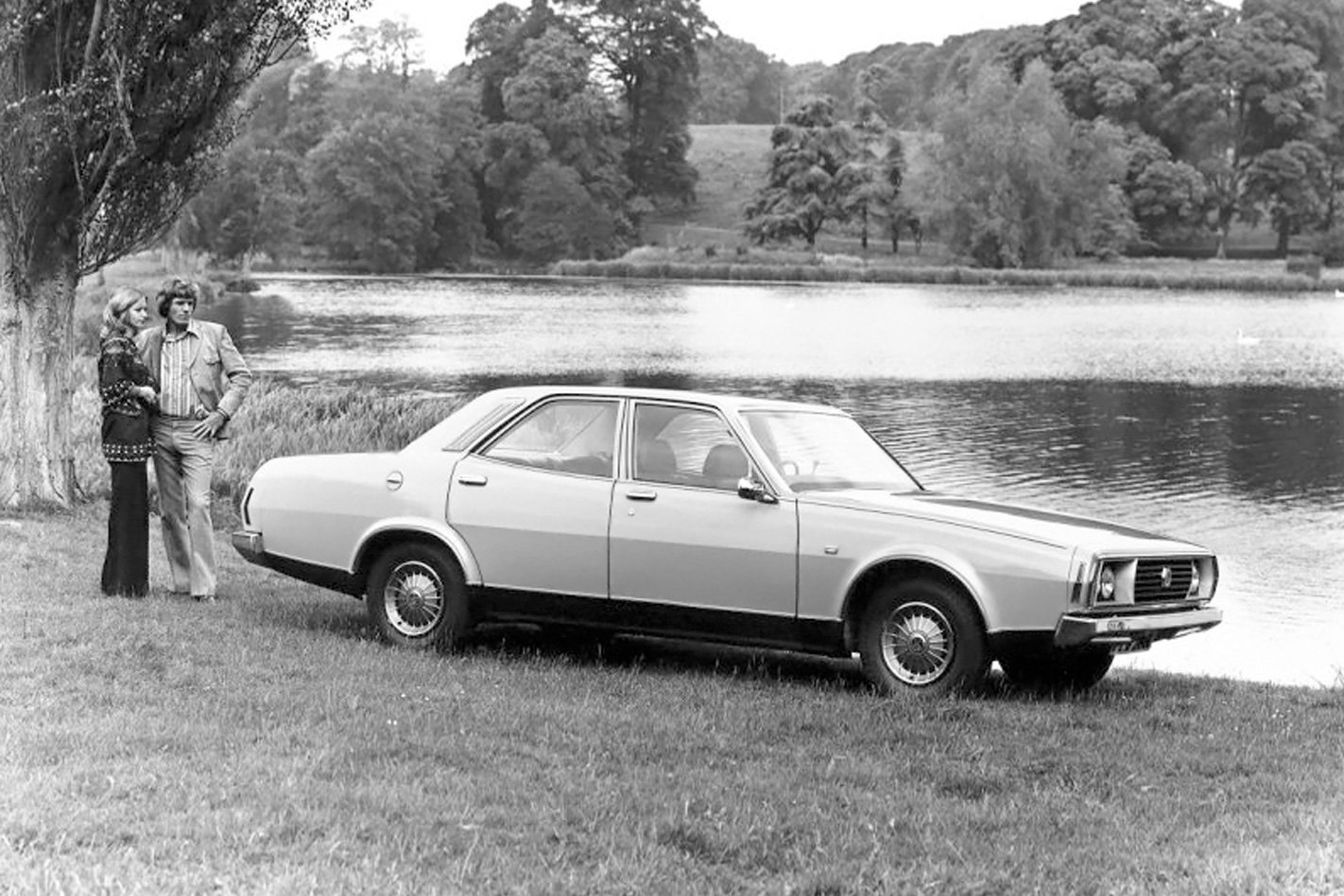
The V8-engined Leyland P76 won 1973’s Wheels Car of the Year award.
Looming local content mandates, due in 1974 and requiring up to 85 percent Australian-sourced parts, resulted in both Toyota and Nissan announcing plans to introduce local production lines – a plan that gained the Federal Government’s approval the following year. Nissan would start with the 180B, assembled at Motor Producers Limited in Clayton, where the 180B and the 1200 are already assembled, but flagged plans to include an engine and transmissions plant, steering gearboxes and front axles. Toyota had bought a 130-acre site at Altona that it would use as the site of its local manufacturing operations.
Without the benefit of 20:20 hindsight, Chrysler Australia managing director David Brown claimed there was no room for the 100,000 annual sales-strong market to support more than three manufacturers.
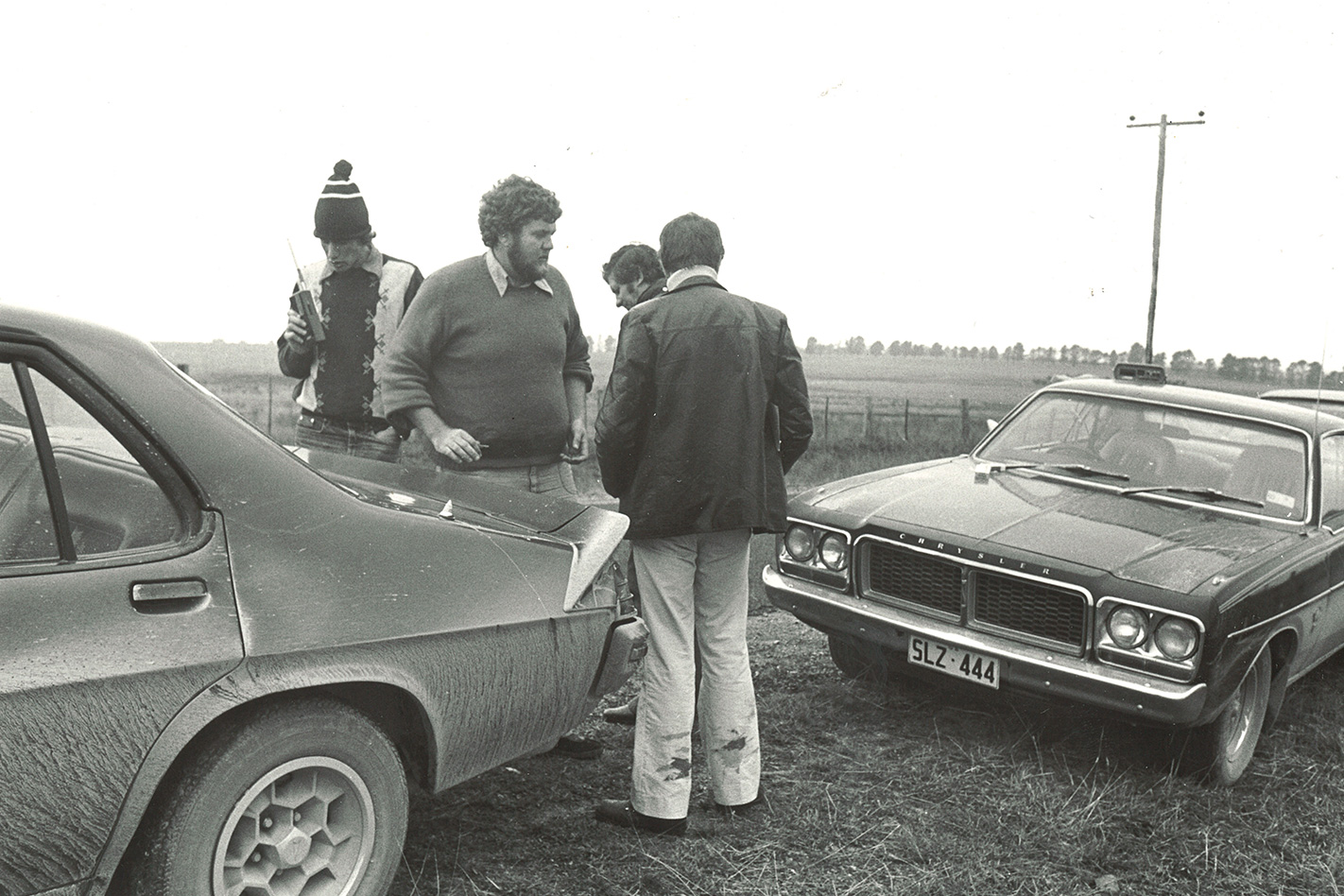
Chrysler, meanwhile, switched off assembly of the Dodge Phoenix after a 12-year run, AMI introduced a fully imported Toyota Corolla wagon, and Holden released the Monaro GTS four-door in response to the Falcon GT-HO and the Charger R/T. Ford also released a Falcon Superbird.
Holden topped the sales charts in 1973, selling more than 93,000 cars against Ford’s 62,000. But the industry was struggling with rapid growth. Waiting times for new cars started to blow out, with the wait for a Chrysler Gallant up to three months. The problem? Components suppliers are identified as the single biggest problem, although the shortage of tyres has hit manufacturers hard – Holden had even considered supplying cars without spare tyres to get around the problem.
The industry was also struggling with rising production costs, with salaries in the industry rising 25 percent over 12 months, inflating new-car prices. By way of measure, the price of a base Peugeot 504 had gone up from $3475 when launched to $5498.
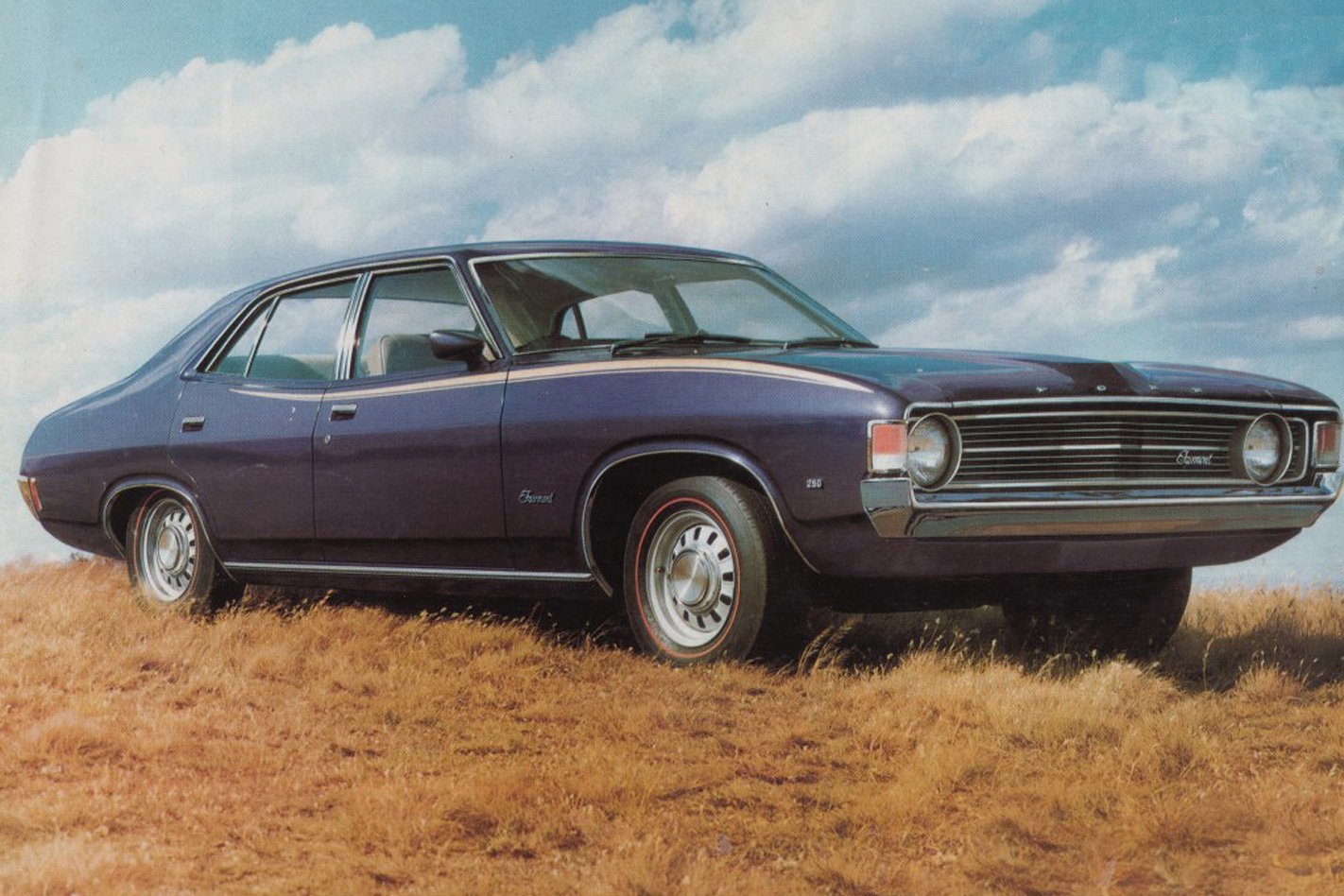
The big-spending Whitlam Government threw a spanner in the works in 1974, exploring the idea that tariff protection in the automotive industry should fall to 25 percent. In response, the future of the Leyland P76 Force 7 is cast in doubt. Whitlam would eventually turn around his hardline position and increase tariff protection for the industry.
Troubles overseas would see the end of Leyland Australia – the fourth-largest manufacturer – in 1975, despite top-level government talks aimed at increasing its quota to assemble or import cars up to 30,000 – four times its current production. Toyota, meanwhile, started assembly of a two-door Corolla as speculation raged of a tie-in between Chrysler, Toyota and Nissan to produce four-cylinder engines at Tonsley Park.
Ford released the John Goss Special version of the Falcon 500 hardtop. Rumours start to circulate, though, that Datsun is considering abandoning its local manufacturing plans in favour of full imports given the uncertainty around import tariffs on parts.
Meanwhile, news broke of the first Korean car potentially bound for Australia – the Hyundai Pony – featuring an Italdesign body and a Mitsubishi motor.
Tighter vehicle emissions standards were slated for 1976, meaning cars had to be fitted with a positive crankcase ventilation system, an evaporative emission control system and an exhaust gas recirculation system. It was also the year Nissan would take full control over the Clayton-based assembly plant building its vehicles.
Our industry would produce 473,045 vehicles in 1976. An Australian car employee would make the equivalent of 5.6 cars a day, while their Japanese equivalents would make 37.2 at Nissan and 40.5 at Toyota.
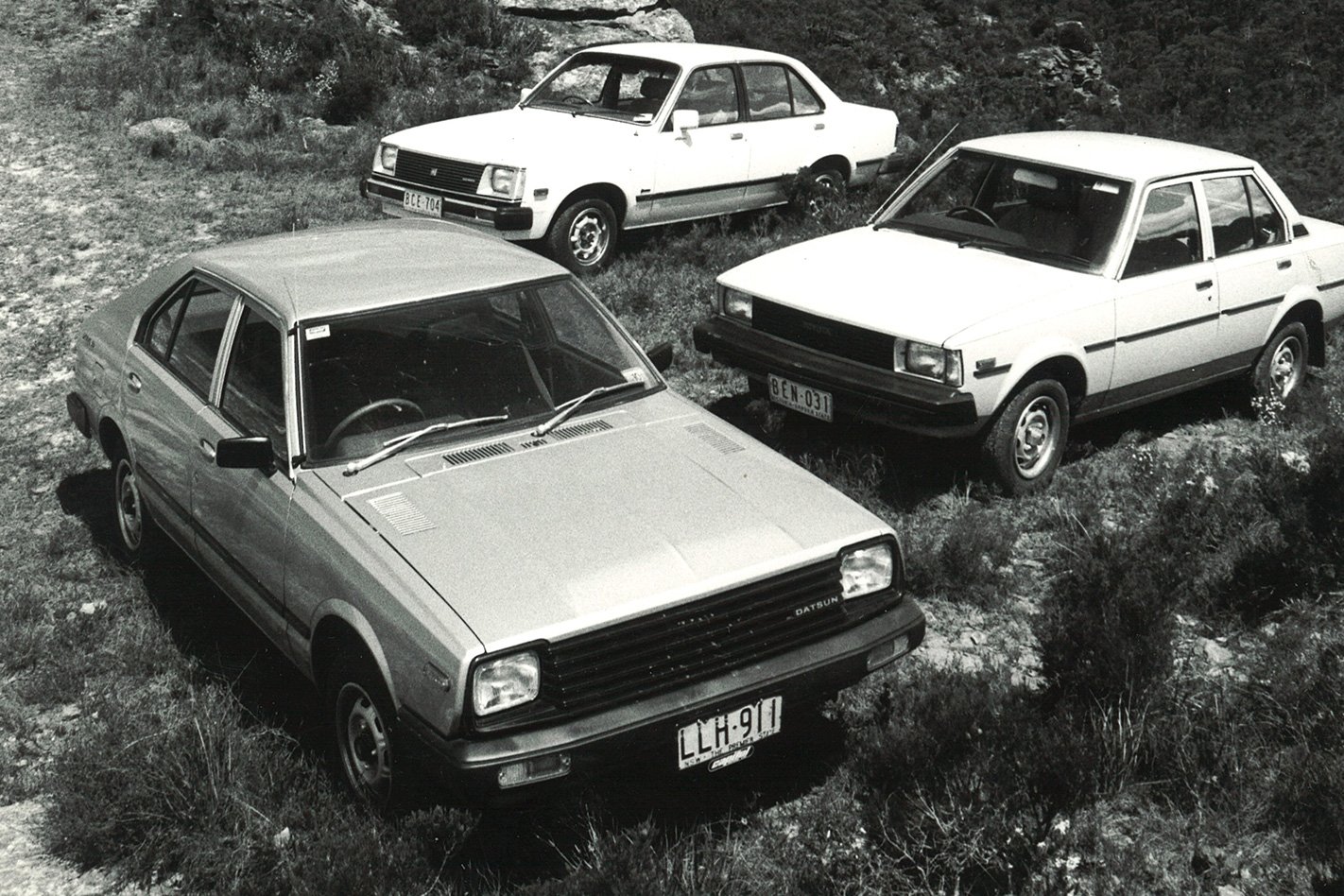
In 1977, the unthinkable happened: The Ford Falcon outsold the Holden Kingswood by a narrow margin. Alan Moffat and Colin Bond celebrated that with their now famous 1-2 victory at Bathurst. And in spite of the flood of cheap, well equipped Japanese cars, the Holden Torana/Sunbird managed to outsell the Datsun 180B. It’s also the year the Honda Accord took the Wheels Car of the Year title.
Next:1978-82: The game-changing Holden Commodore
Skoda has released details of its ambitious product plan, with seven new models set to launch by 2020 – with electrified vehicles and a sub-Yeti compact crossover among them.
The Czech carmaker is revealing an updated version of its Vision E concept at next week’s Frankfurt Motor Show which will preview its first electric car, a high-riding coupe-crossover with a 500km range. The production version is expected in 2020, but there’s a lot more to come before that:
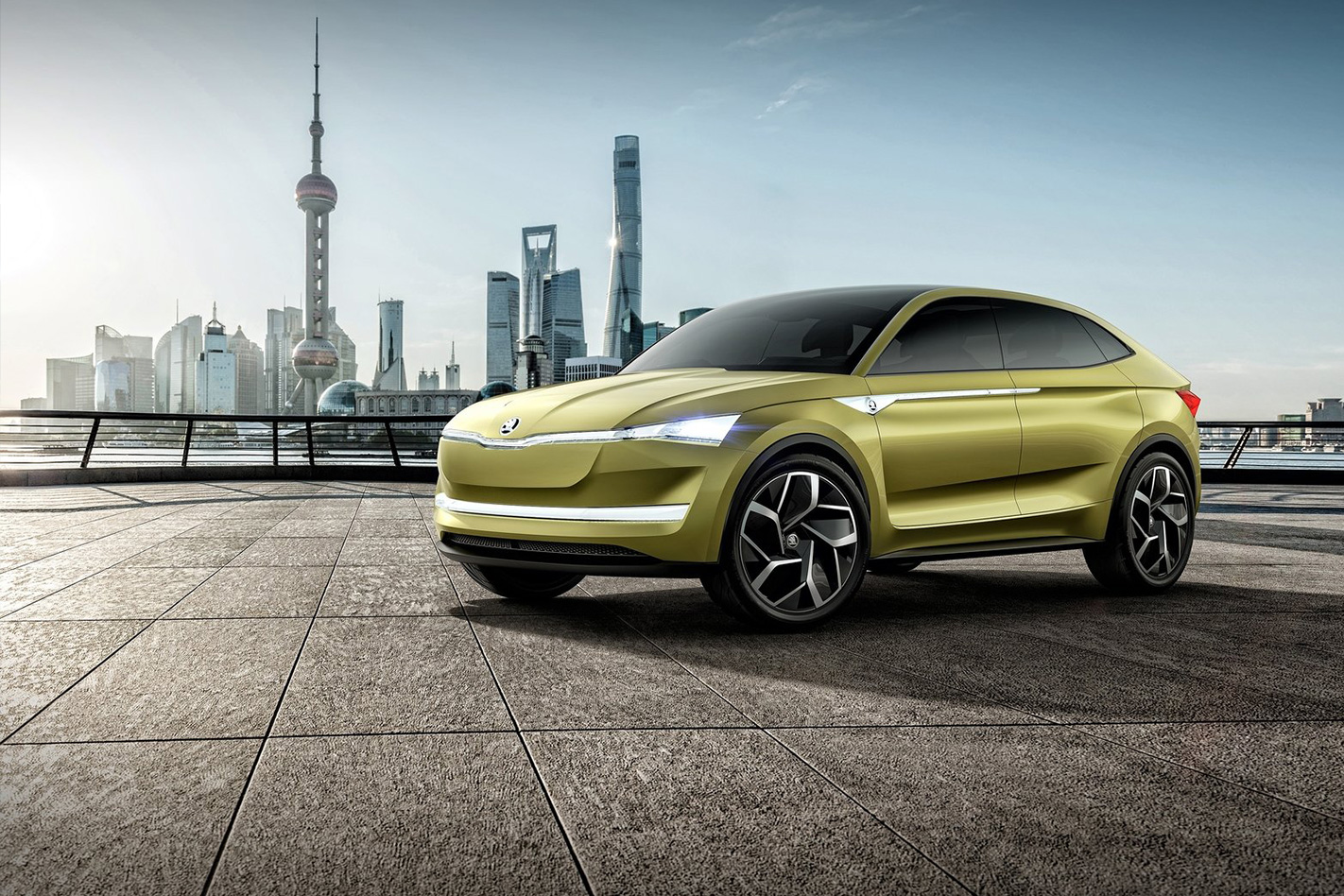
Kodiaq RS
A high-performance version of Skoda’s Kodiaq large SUV is due by mid 2018. Expect a much beefier exterior than the Kodiaq Sportline (pictured) including bolder bumpers with deeper vents and a tailgate spoiler.
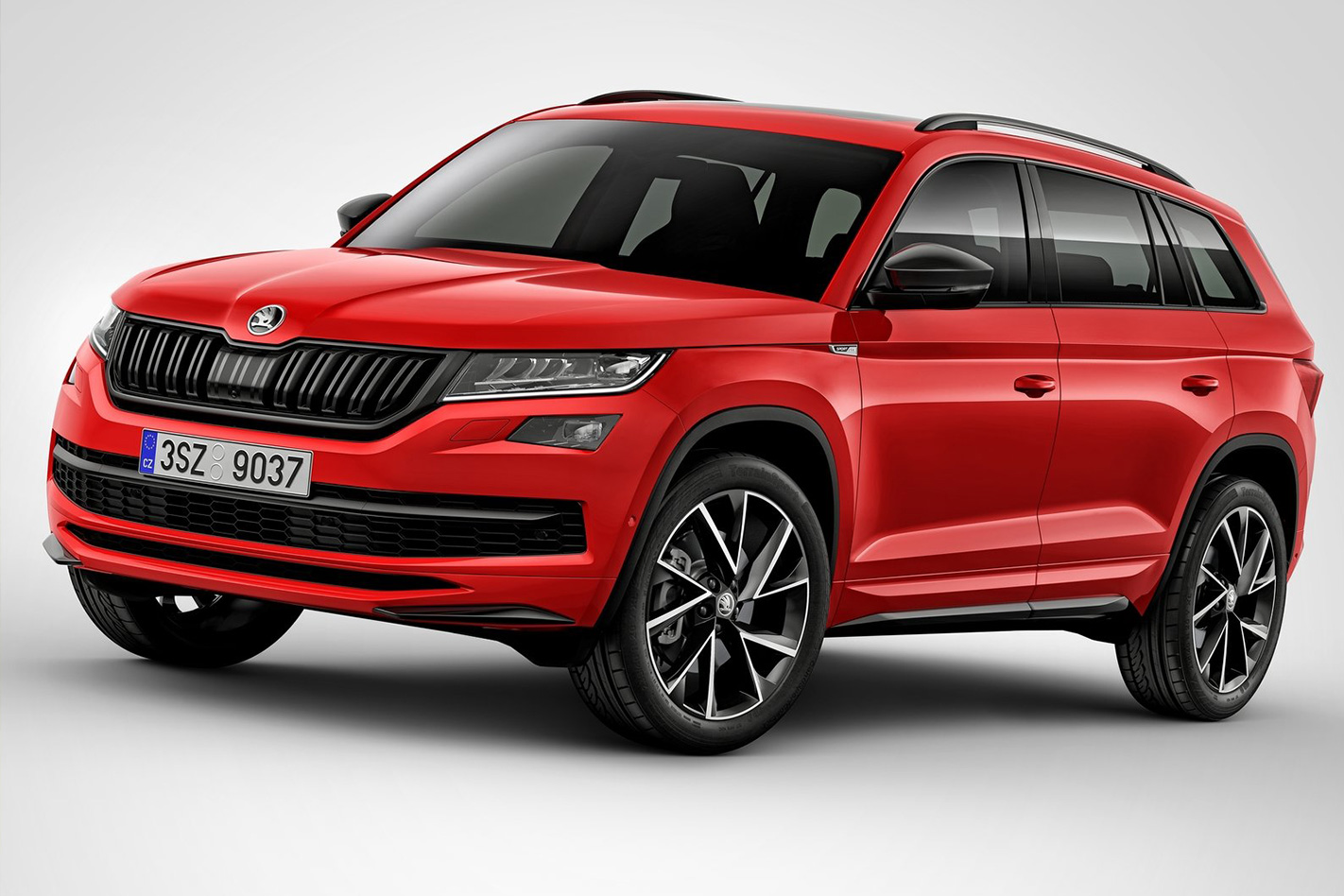
It’s set to be powered by a 176kW/500Nm 2.0-litre four-cylinder twin-turbo diesel engine, a powertrain which may present some hurdles for an Australian introduction. With Skoda lumpin Australia in with the Middle East and Africa as a hot weather region, the engine’s sensitivity to high ambient temperatures could get in the way of a local debut. However Skoda Australia is making the case that Australia, with its diverse climate, be reclassified as an RS-badged Kodiaq derivativeis a vehicle it sorely wants to see in Aussie showrooms.
The Kodiaq RS is likely to debut at the Paris Motor Show in October, with sales starting mid-2018.
Fabia facelift
The Kodiaq RS is due around the same time as Skoda rolls out its facelifted Fabia hatchback, with subtle changes in store for the compact hatch including new LED headlamps and a revised grille design to bring it into line with the company’s current design language.
Karoq
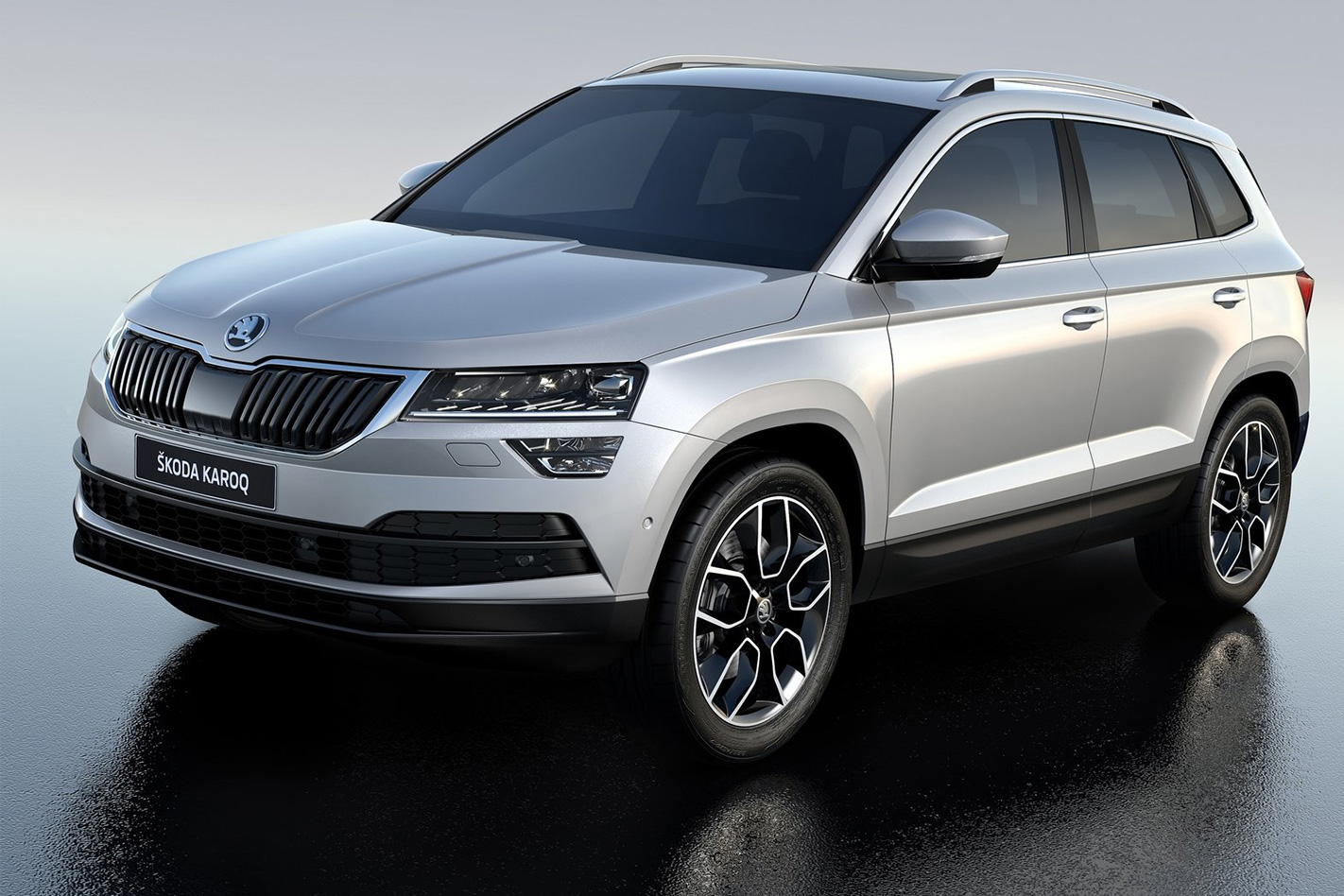
The middle part of next year will also see the release of Skoda’s all-new Karoq medium SUV, which will effectively replace the Yeti at the bottom of Skoda’s SUV line-up and with more conventional SUV styling that draws inspiration from the significantly larger Kodiaq.
Hybrid Superb
The updated Superb is due early 2019 with a facelift and the addition of a plug-in hybrid (PHEV) powertrain option – the company’s first electrified production vehicle. A PHEV Kodiaq will follow soon after.
Rapid change
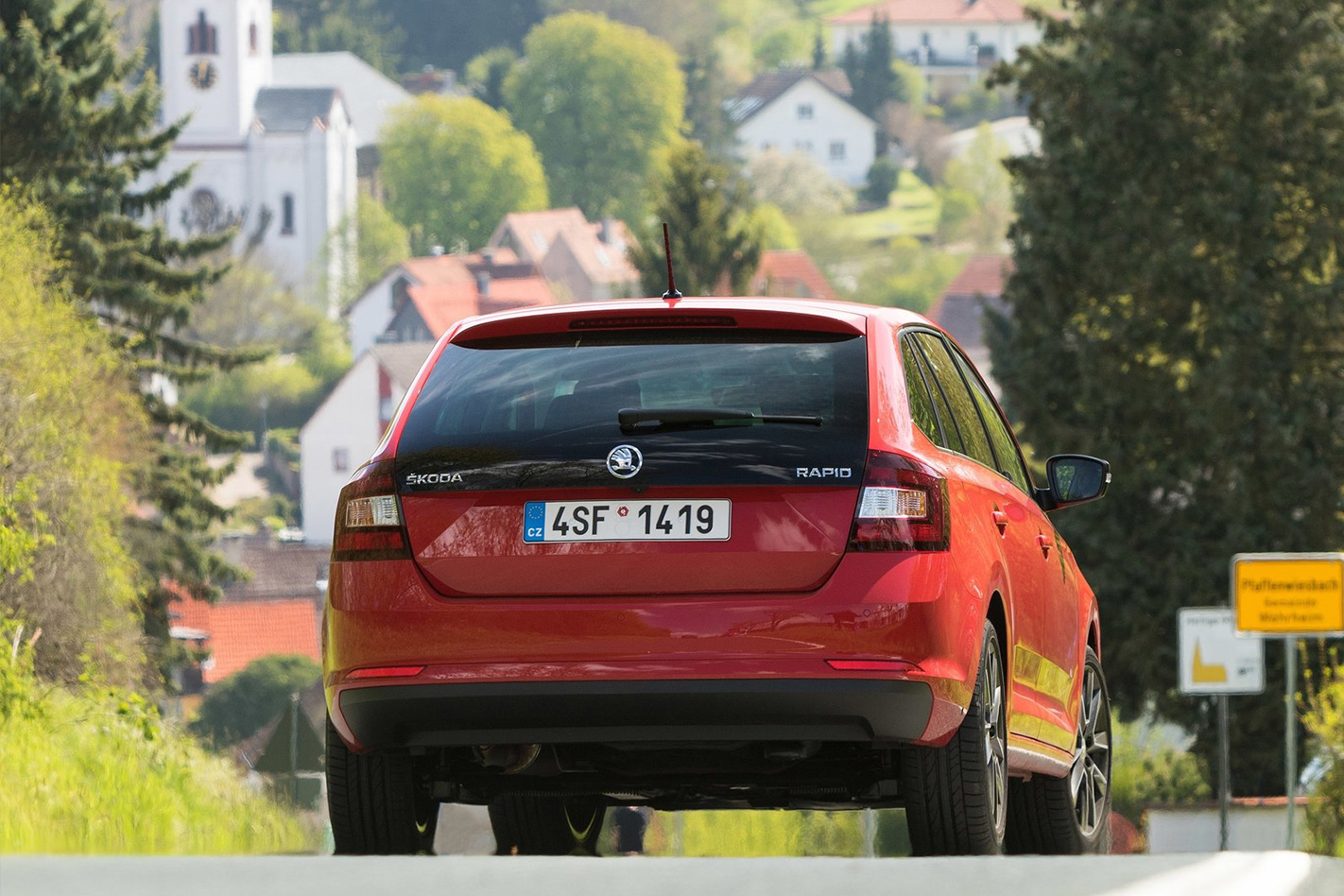
The year 2019 will herald the arrival of several all-new Skoda models, including a new VW Polo-based hatchback to replace the Rapid Spaceback
Skoda says it will feature some of the unique design elements of the current model such as its distinctive glass tailgate, but will have a more upmarket look and will also be offered in a sedan bodystyle.
New crossover
Another key model due mid-2019 is a crossover version of the Rapid, which will be Skoda’s third and smallest SUV model and similar to the recently revealed Volkswagen T-Roc.
2020 Octavia
As well as the first all-electric production model, 2020 will also see an all-new Octavia make its debut – thus completing what is going to be a pretty busy three years for the growing Czech brand.
While Nissan Australia has given the aging 370Z a kick in the pants by slashing the price of entry to $49,990 and introducing a tuned-up Nismo flagship, the company’s overseas arms have gone a step further and applied some mild updates to the V6-engined sports car.
The 2018 model year 370Z, now on sale in the European, US and Japanese markets, gets a minor refresh via new 19-inch alloy wheel designs, black-finished door handles and a blacked-out rear bumper fascia, while the tinted headlamp and tail lamp internals from the 370Z Nismo also become standard on the cooking variety Zed.

Under the skin, the 370Z’s 3.7-litre naturally aspirated V6 carries over unchanged. However, manual-equipped models receive an uprated clutch supplied by powertrain parts specialist Exedy – with Nissan claiming the new clutch reduces pedal effort while also improving gearchange precision.
It’s unclear how long Australian Zed fans will have to wait for the updates.
The price adjustment applied earlier this month that saw the entry-level 370Z manual coupe dip below $50k and the 370Z Roadster convertible trimmed to $60,990 (add $2500 for the seven-speed automatic) wasn’t accompanied by any specification upgrades.
Wheels understands that Nissan may announce the arrival of the updated Zed within the next few months, but it’s worth noting that the 370Z currently on offer in Australia represents keen value relative to overseas models.

Even in the 370Z’s country of origin, Japan, the equivalent Fairlady Z Version ST retails for roughly AU$58,350. It’s unclear at this point whether the arrival of the mildly-updated 370Z will have an impact on Aussie retail prices, but if you’ve been yearning for a fast coupe for less than $50k that isn’t a Ford Mustang, now may be the time to pounce.
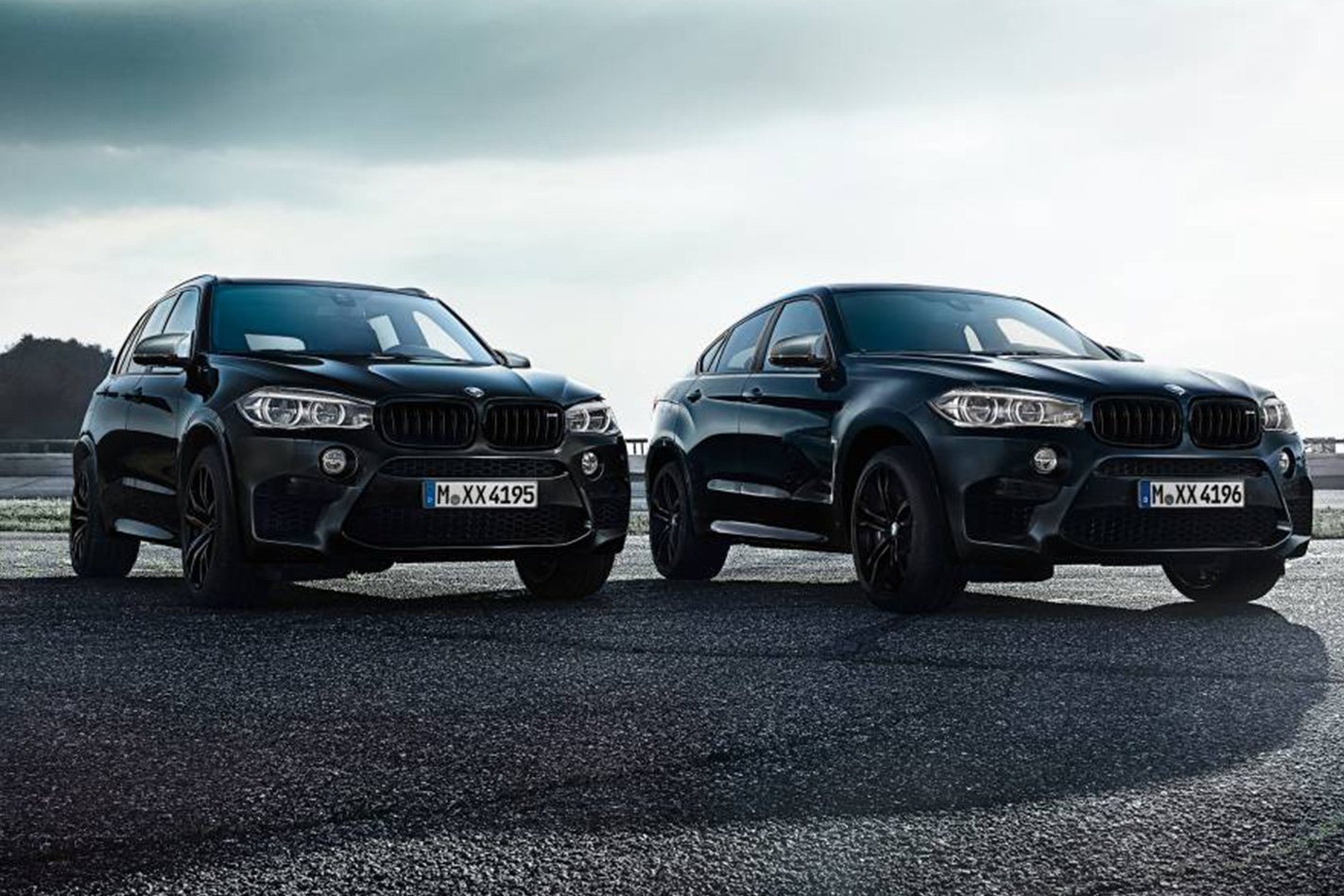
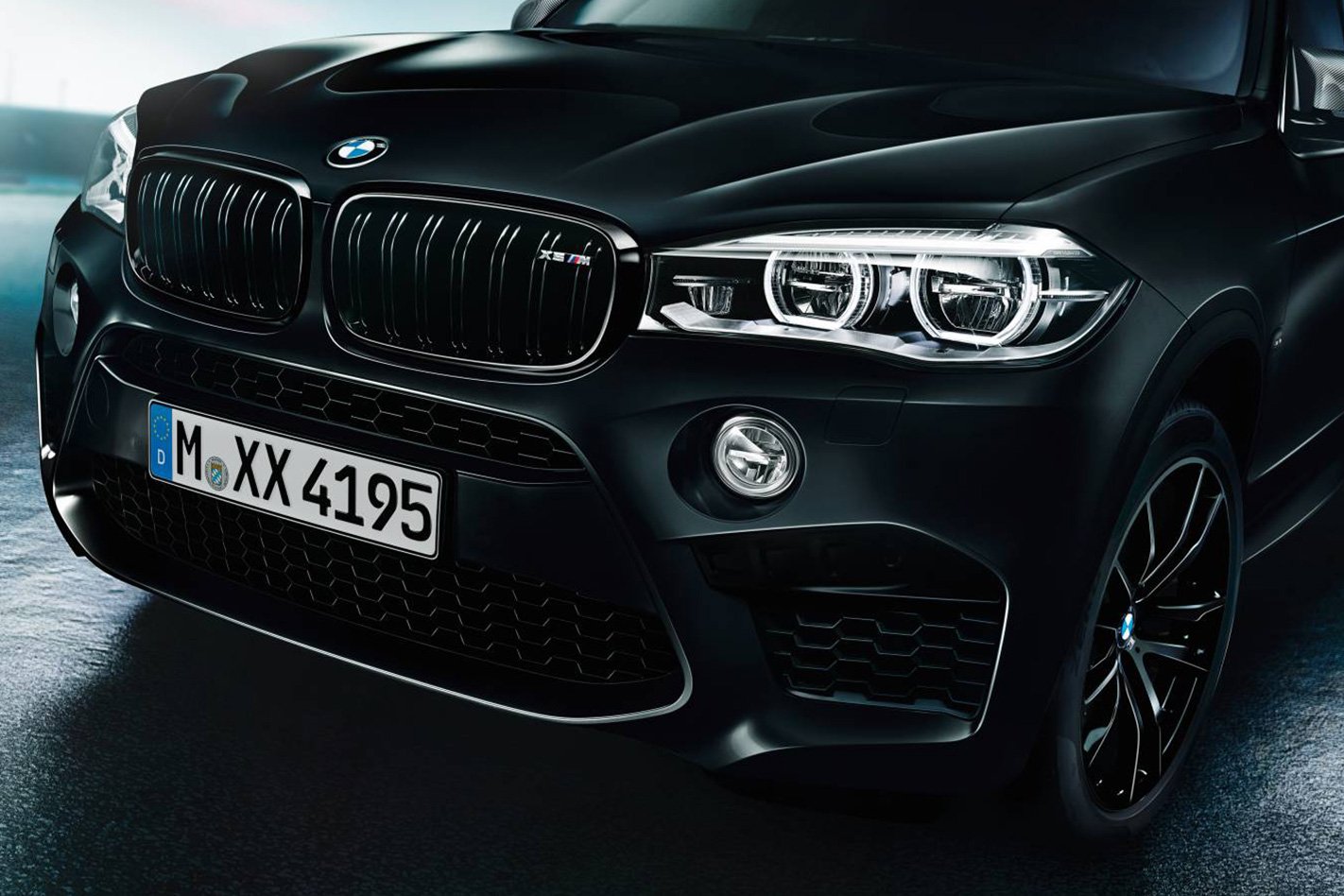
All-black styling for BMW’s fast SUVs will become another exercise in exclusivity, as only 25 of the new X5 M and X6 M Black Fire Editions will be sold in Australia.
The special edition SUVs aren’t any faster or different to drive than regular X5 Ms or X6 Ms, but have simply had a visual pack added to induce a more “sinister” appearance.
Both still have the same 423kW/750Nm 4.4-litre twin-turbo V8 under the hood, but the real changes are on the outside.
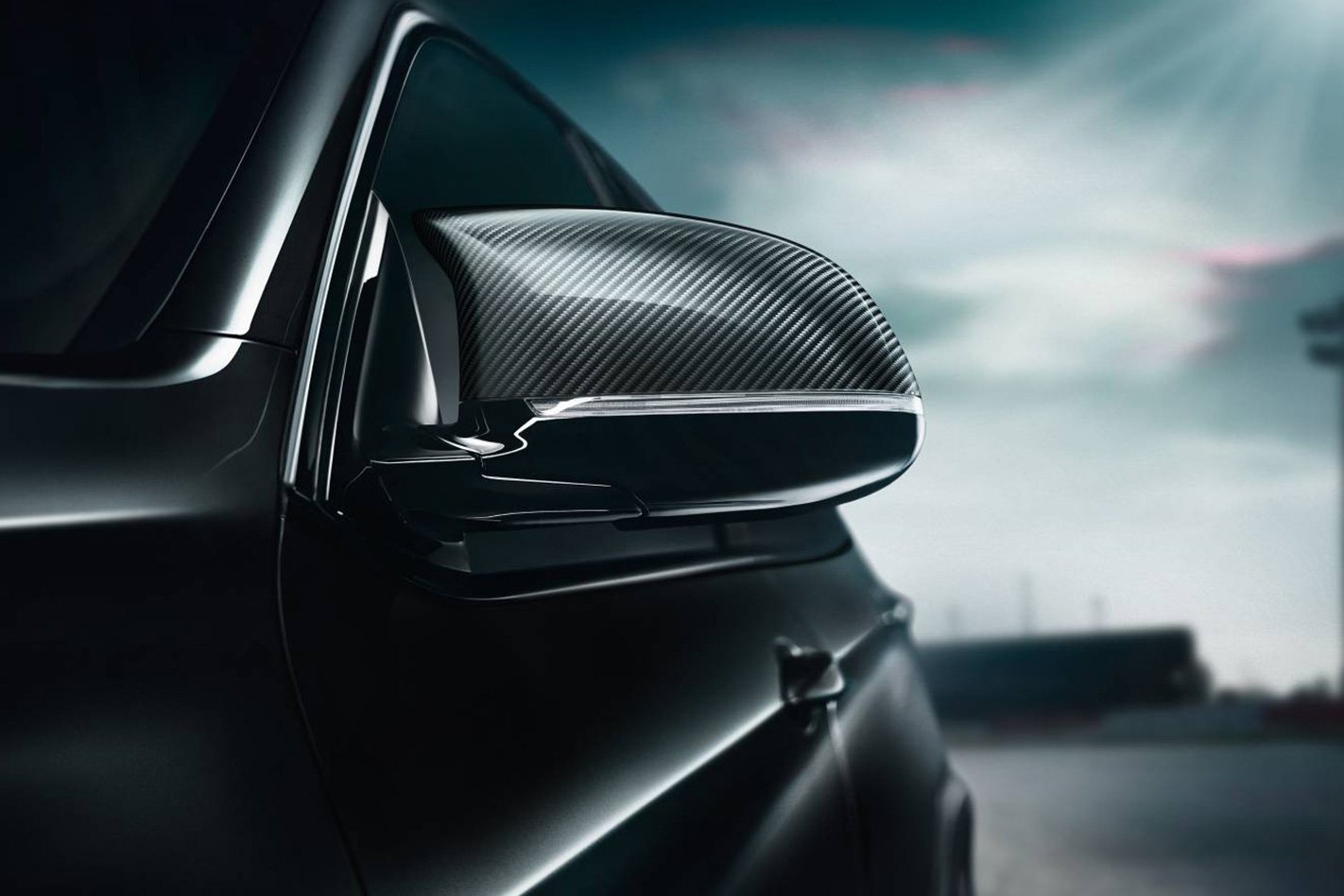
BMW says “standard sun protection glazing on the rear windows have the double effect of adding privacy and further subtle menace to the X5 M and X6 M Black Fire appearance.”
Piano black trim is also finished with ‘X5 M Edition Black Fire’ or ‘X6 M Edition Black Fire’ signets.
15 X5 M and 10 X6 Ms will be up for grabs, at $205,900 for the X5s, or $214,800 for the X6s.
“I am very excited to introduce these Black Fire limited editions to the Australian market,” Werner says.
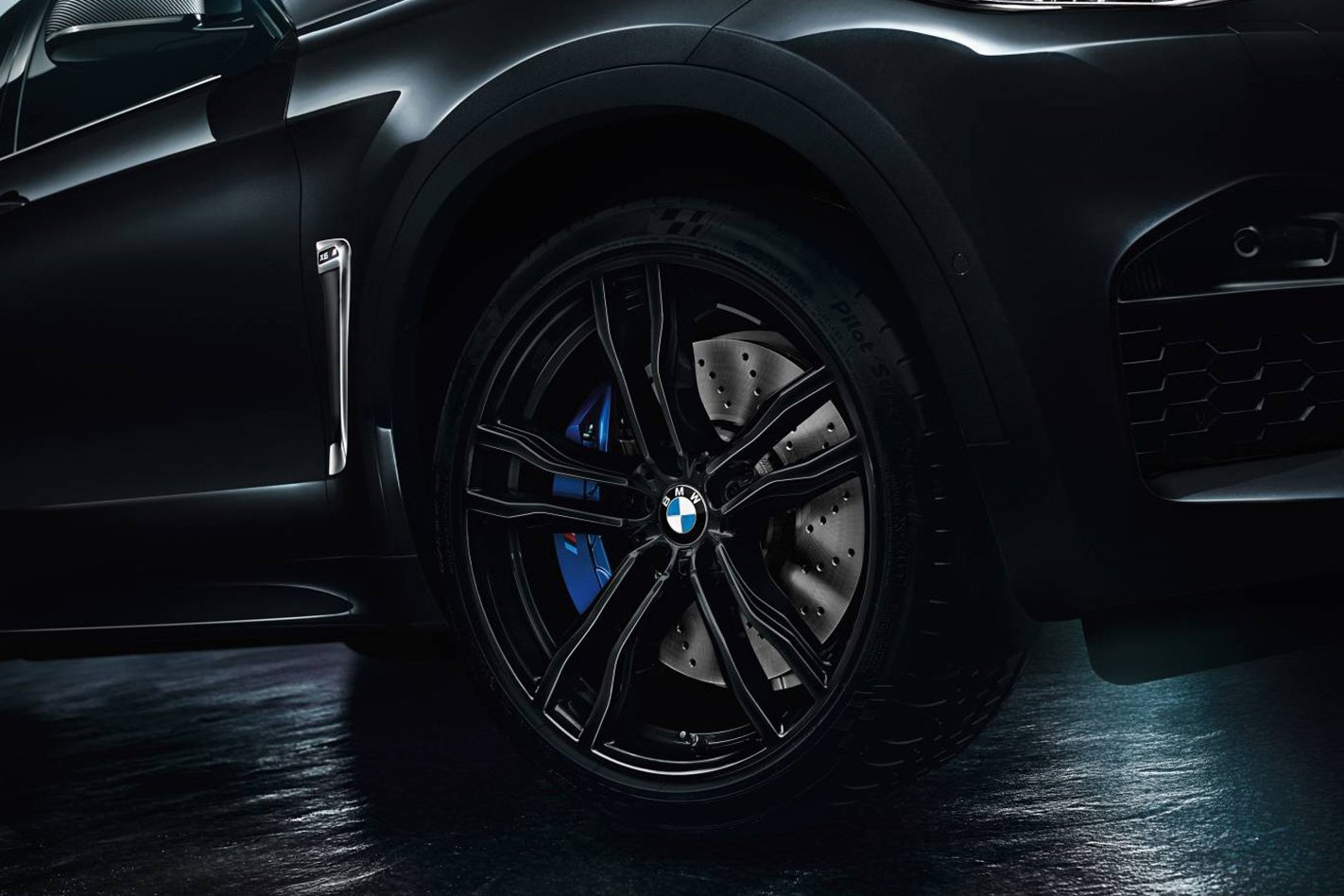
The Black Fire Editions will be available in dealerships from October this year.
Roger who? No, The Who.
English rocker Roger Daltrey most renowned for songs like My Generation and Who Are You has raised £208,945, or AUD$340,500, to help fight teenage cancer.
And to do that, he sold his bespoke Rolls Royce Wraith, which was created with the help of artist and The Who album designer Mike McInnerney to pay tribute to the band’s first album, Tommy.
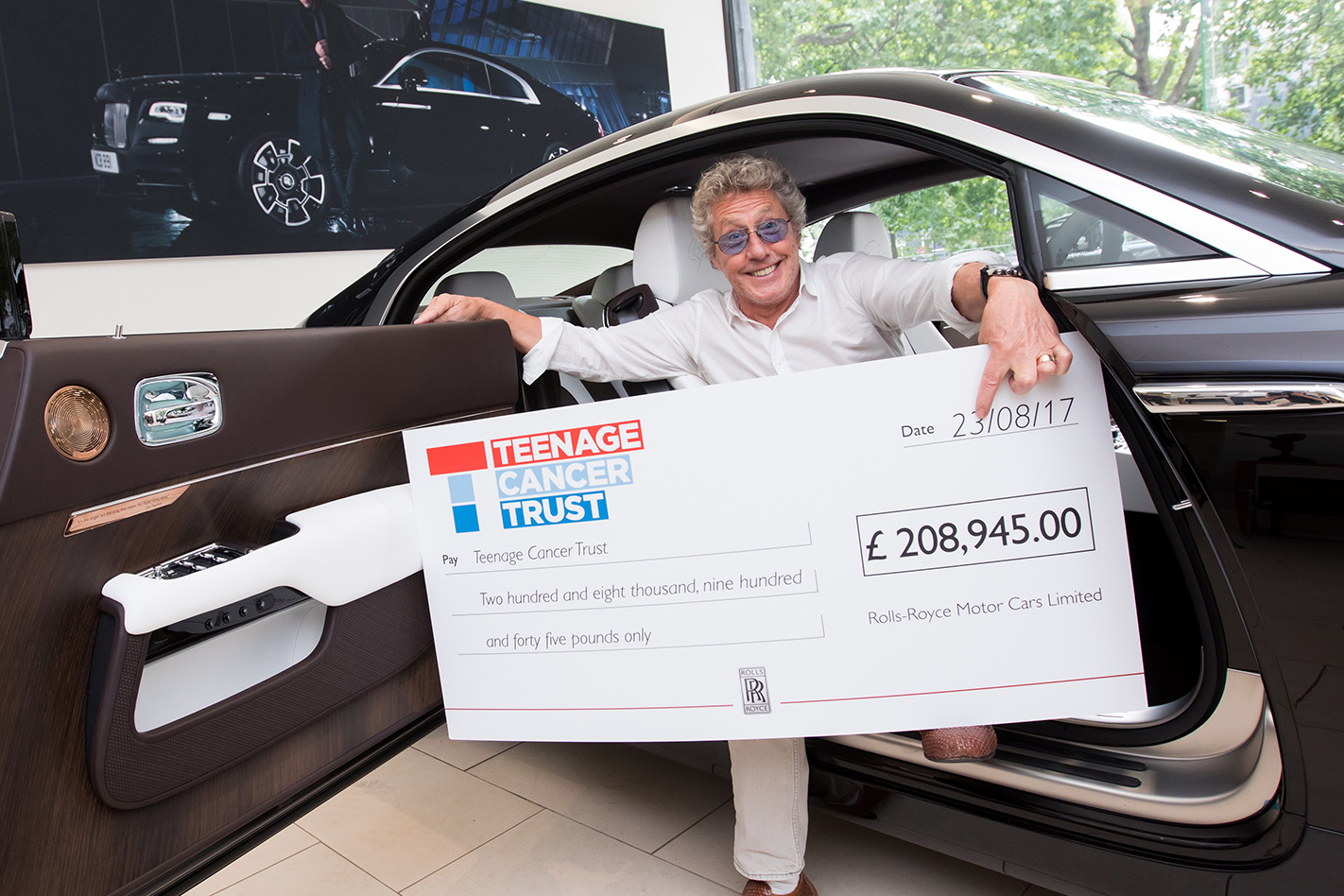
This car, as well as the Tommy car, was part of a set of Rollers which were revealed earlier this year to celebrate the British music industry, and four bands in particular.
The Who was one, but was joined by a car to celebrate The Kinks, one for ‘fifth Beatle’ Sir George Martin, and others.
The money raised from the sale of the Tommy Wraith will go towards fighting cancer, particularly in young people.
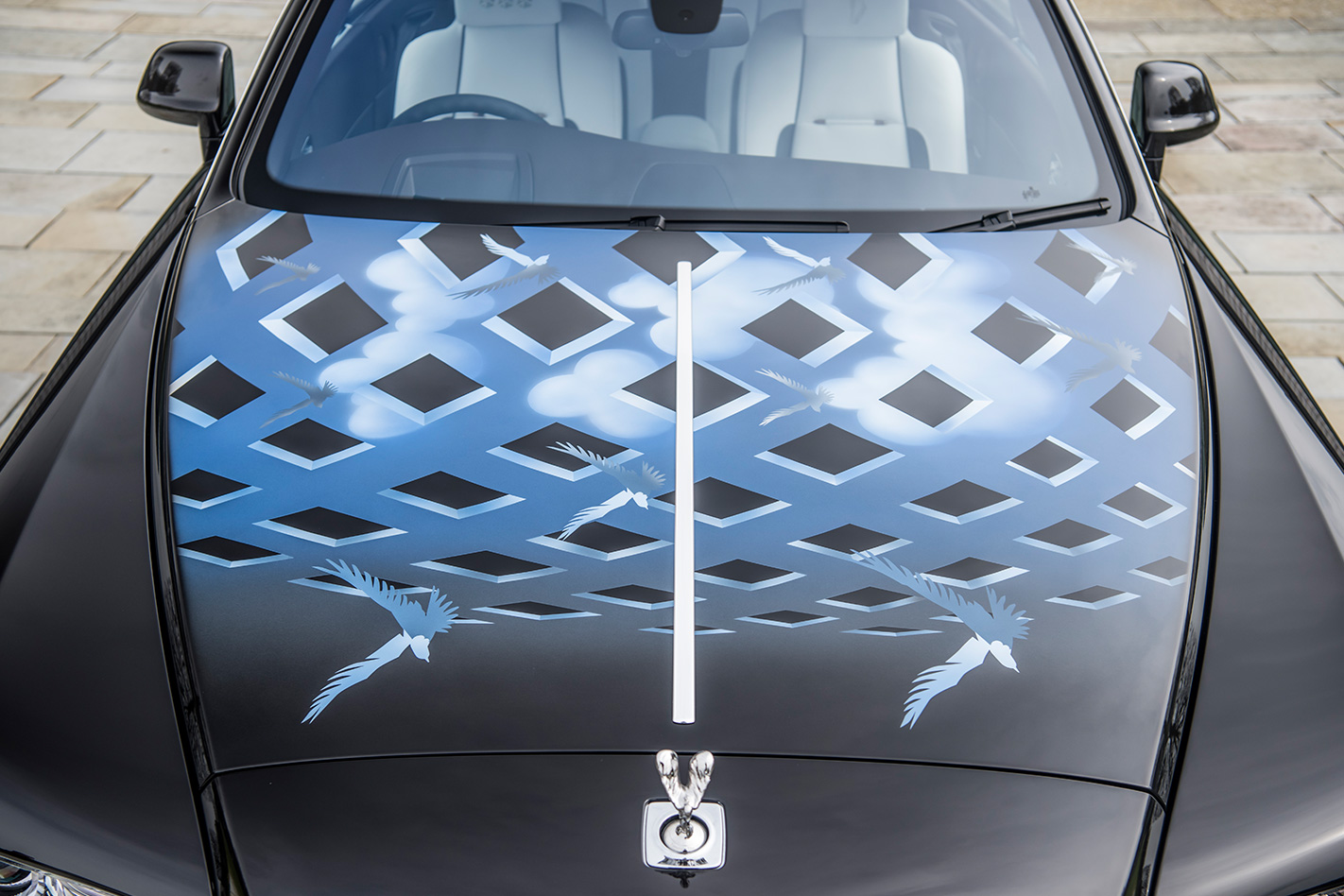
“Seven young people are diagnosed with cancer every day in the UK, and these vital funds will help Teenage Cancer Trust take a huge step towards its goal of providing specialist support to every young person with cancer in the UK,” says Daltrey.
“This car has become an incredible collectors’ item, and it’s gratifying to know that the proceeds of the sale will support such a worthy cause.”
Rolls Royce adds that each of the nine ‘Inspired by British Music’ cars has now been sold, with all proceeds from the sales donated to charities of the artists’ choosing.
A dealership proprietor’s expansive collection of near-new Australian-built Holden models spanning across five decades will be heading to auction early next year, following the sale of a D’Alberto Motors dealer in Echuca, Victoria, where most of the vehicles are housed.
The collection of 50-plus Holdens have been stockpiled by four D’Alberto brothers, who have kept aside a vast number of models the local arm of General Motors has sold to customers over the years in their trio of country Victoria and New South Wales dealerships.
UPDATE: See the auction results!
MOTOR has been told that the tarpaulins have just started coming off the private collection ahead of an auction held by Mildura-based Burns and Co set for 13-15 April, 2018, but already a number of significant near-new examples of famous Holdens have emerged.
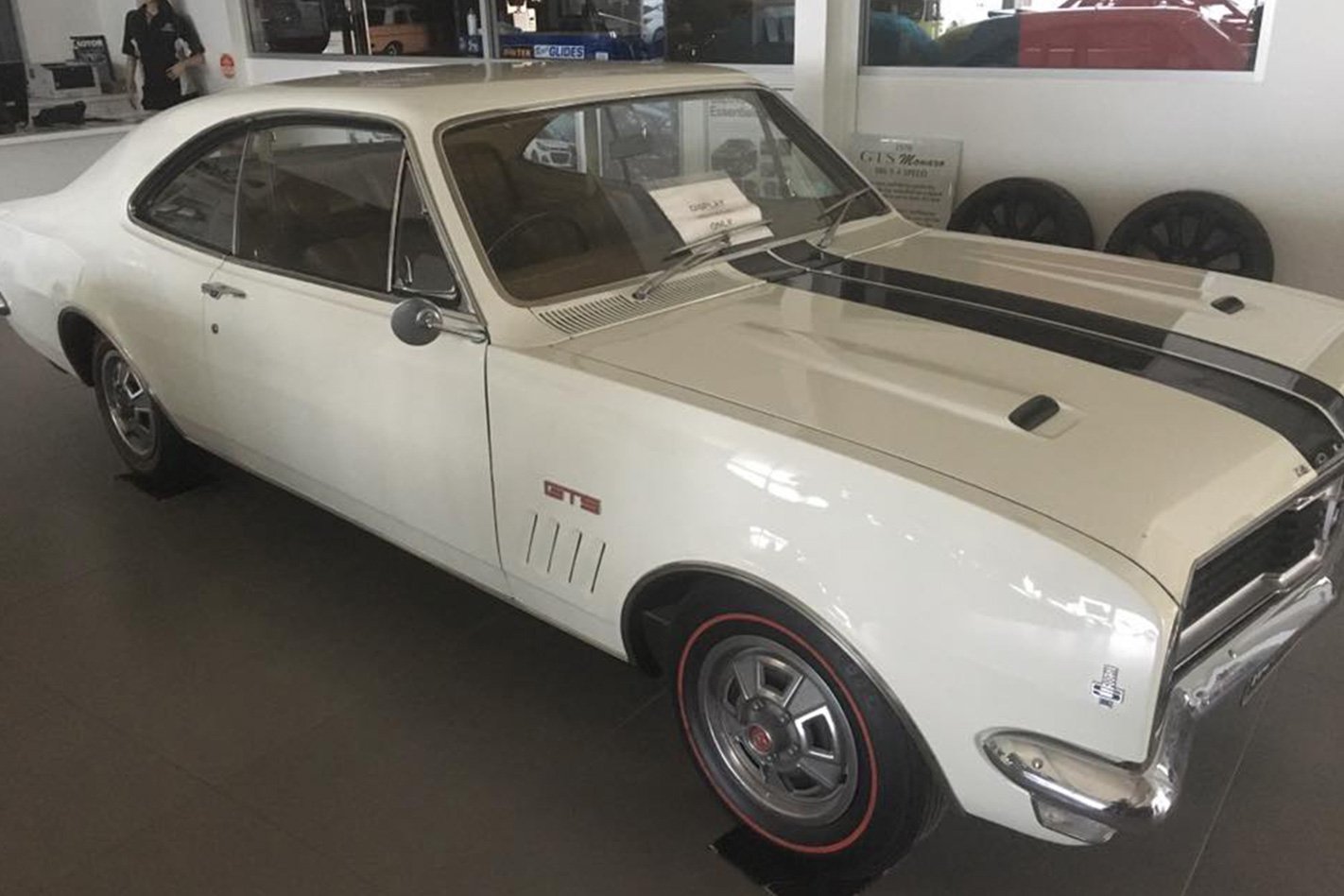
A couple of Walkinshaws will be on offer as well, including a metallic light blue ‘plastic pig’ Walkinshaw VL SS Group A with only 1271km showing, and a red Walkinshaw VN SS Group A Commodore with 1830km on the odometer.
The oldest vehicle up for auction will be an FX 48-215, while EK, EH and HR Holdens, and several Commodore and Torana models, are also in the early stages of being catalogued. MOTOR has been informed that there are examples of the reborn, 2001-era V2 Monaro that are virtually new, making this collection basically a real Holden dealership time warp.
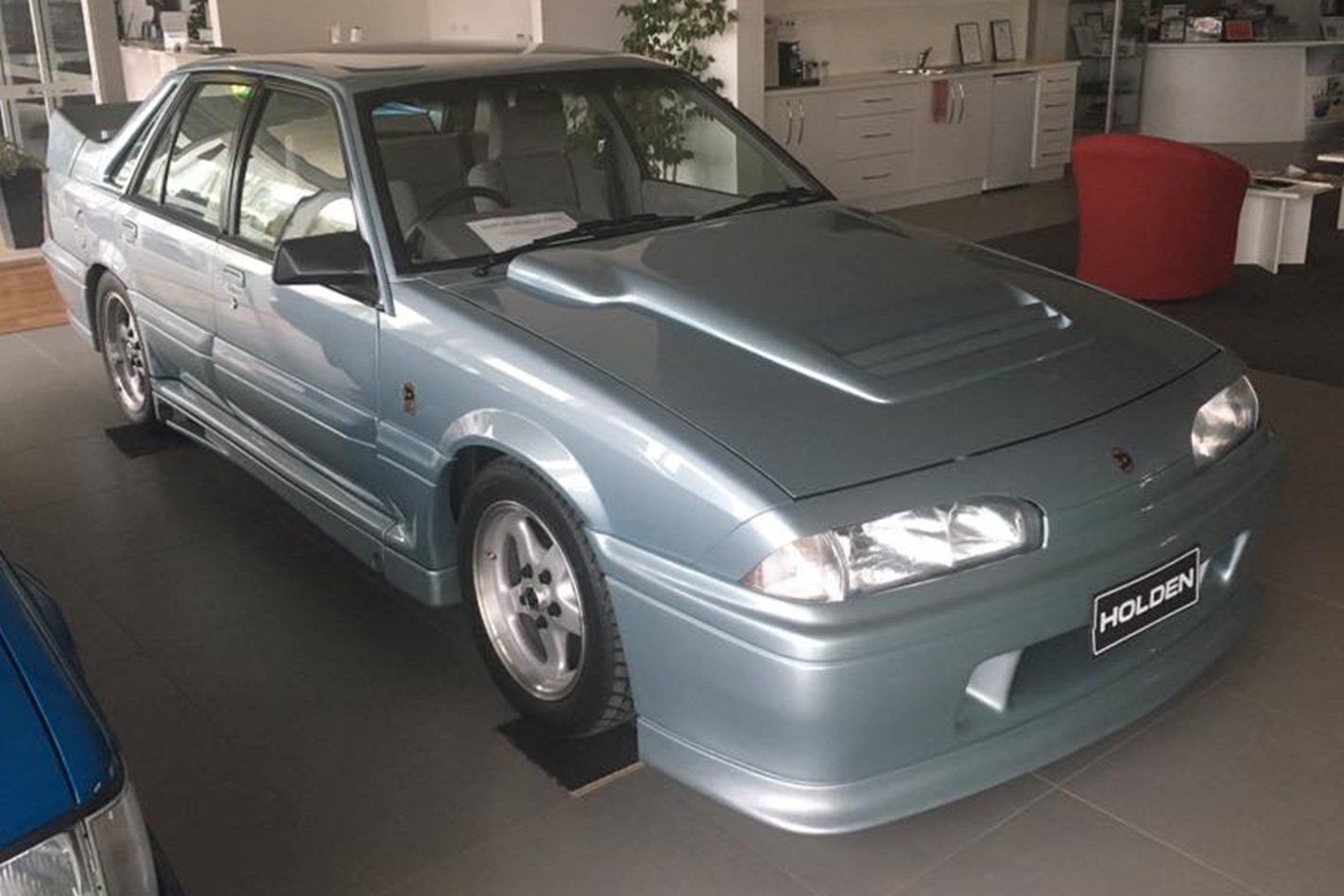
Burns and Co described the auction as, “Certain to be one of the countries most prized private collections of Holden motor vehicles … with extremely low kilometres and never been registered … along with numerous workshop lots, signage, car manuals et cetera amassed over three Holden dealerships in Echuca, Kyabram and Deniliquin since the 1980s.”
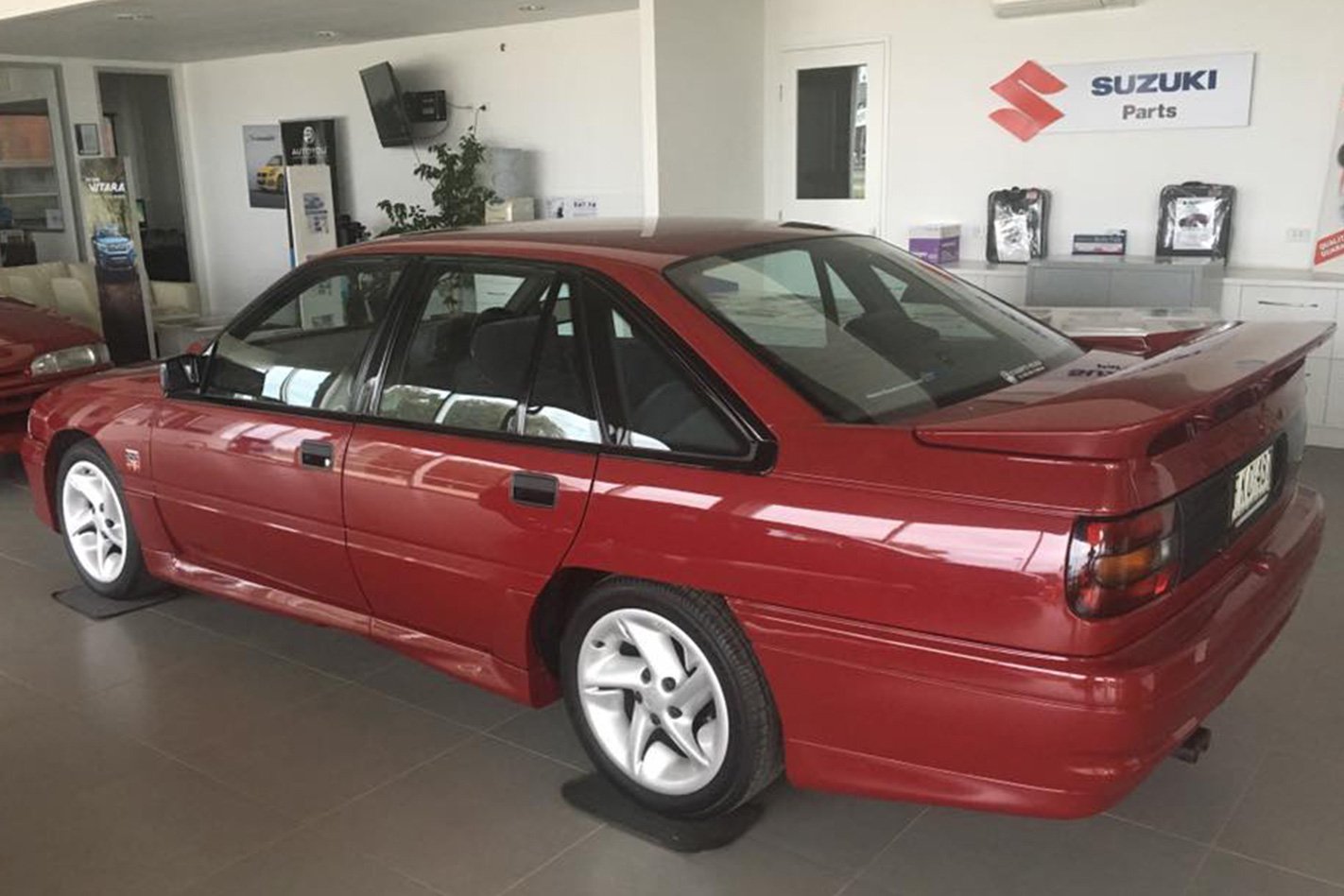
Check out the auction details here
GENERAL Motors will invite Australian ride-share drivers to lease cars by the week as it attempts to tap the rising popularity of the so-called ‘gig economy’.
Maven Gig, GM’s car lease service for freelance drivers in the US, has expanded to Australia after a trial here with Holden-badged vehicles. It plans to allow freelance drivers keen on tapping into ride-share services to walk up and lease a Holden for a month at a time, at rates similar to novated leasing plans.
The service is GM’s gamble that it will still be able to get people to use its products, even if it is selling fewer cars. Maven says the service also allows drivers who have signed up as a ride-share freelancer to give the gig economy a trial run with no fallout if they decide that, after a month, it’s not for them.
Anthony Riemann, GM’s director of strategy and urban mobility, told Wheels the roll-out of the service came after a year-long trial of Maven Campus – aimed at business clients – and the public-facing Maven Gig at Holden.
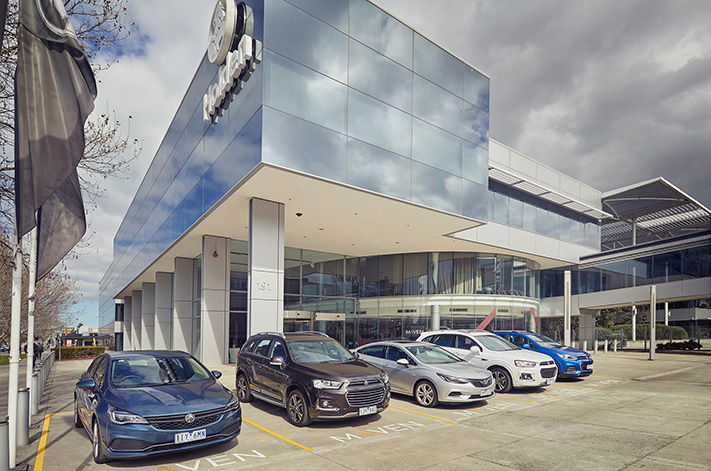
“[Maven Gig] is a driver for the ride-share economy,” Reimann said. “A lot of people who don’t own a car are looking for alternate ways to get around, whether it’s through ride-sharing or as a supplement to the car they own.
“What we’ve been doing in the US with Maven, we’ve been able to take a more curated approach with the market and really look at cars that fit our members’ needs.”
What that means is that Australian customers will need to sign up for a minimum of a month at a time, while in the US Maven has trialled daily, and even hourly rentals so that ride-share drivers can take advantage of peaks in demand.
Maven’s weekly rates will start from $215 for unlimited travel, with no sign-up fees. The Maven website lists a Holden Trax from $225 a week, a Holden Astra Hatch from $240 a week (a sedan costs $20 a week more), and a Holden Captiva from $300 a week. Those novated lease-like rates include insurance, registration and maintenance, so all the freelance driver needs to do is fuel it.
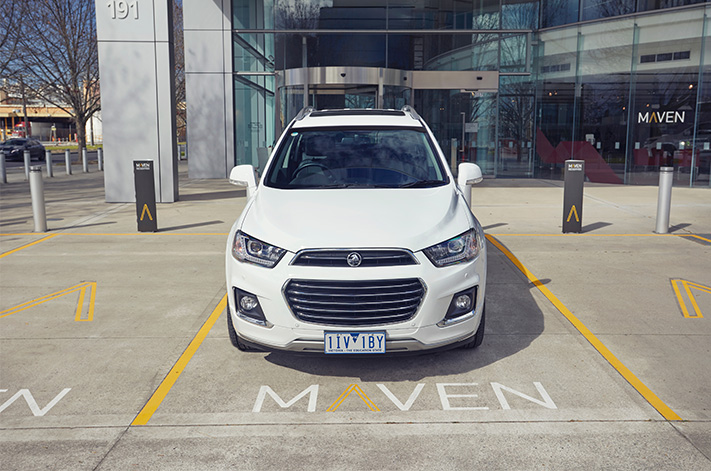
“They can choose to work when they want, where they want, and whether it’s part time, full time driver with companies like Uber,” Reimann said.
“For them, it sort of puts back to them the ability to earn when the market’s up and/ or down, but it’s really tapping into that growing economy where you want to be able to get into these types of technology but not also necessarily own assets.”
Maven hopes to tap a growing trend among people aged under 30 who are now quite comfortable paying monthly fees for a smartphone rather than owning one outright. It’s also a tricky demographic that Holden has struggled to connect with in the past.
Reimann said the cars would even be made available to drivers using a number of ride-sharing smartphone apps, and could also extend to deliveries from fast food outlets, parcels, and shopping if the demand was there.
Maven Gig was trialled over several months in March before it was expanded to full capacity several months later. It’s now established in Sydney and Melbourne, with about 350 drivers tapping the resources of around 300 vehicles.
While Reimann says popular products among the Maven drivers here tended to be SUVs and Astra-badged cars, in the US it was largely a demand for electric vehicles.
Maven will eventually be tied in with Holden’s version of OnStar, GM’s subscription-based service that will eventually allow drivers to unlock a car via a smartphone app. OnStar is yet to roll out here.
