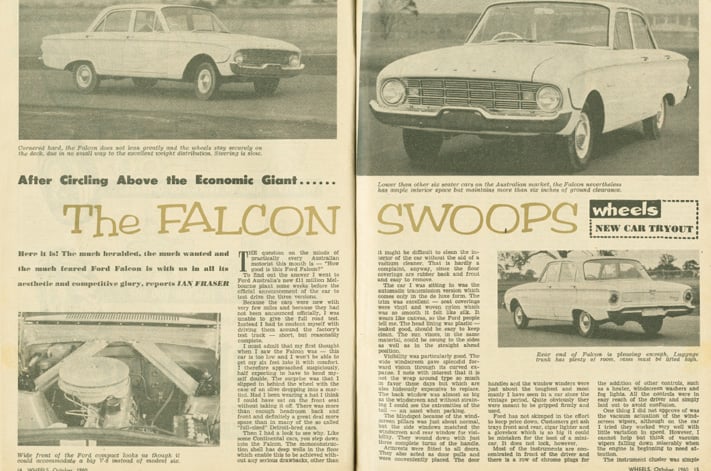
THE QUESTION on the minds of practically every Australian motorist this month is – “How good is this Ford Falcon?”
First published in the October 1960 issue of Wheels Magazine, Australia’s most experienced and most trusted car magazine since 1953.
To find out the answer I went to Ford Australia‘s new £11 million Melbourne plant some weeks before the official announcement of the car to test drive the three versions.
Because the cars were new with very few miles, and because they had not been announced officially, I was unable to give the full road test. Instead I had to content myself with driving them around the factory’s test track – short, but reasonably complete.
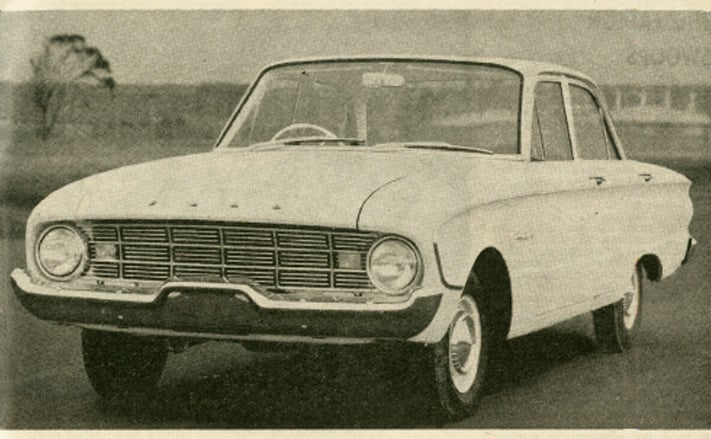
I must admit that my first thought when I saw the Falcon was – this car is too low and I won’t be able to get my six feet into it with comfort. I therefore approached suspiciously, half expecting to have to bend myself double. The surprise was that I slipped in behind the wheel with the ease of an olive dropping into a martini.
That is hardly a complaint, anyway, since the floor coverings are rubber back and front and easy to remove. The car I was sitting in was the automatic transmission version which comes only in the deluxe form.
The trim was excellent – seat coverings were vinyl and woven nylon which was so smooth it felt like silk. It wears like canvas, so the Ford people tell me. The head lining was plastic – looked good, should be easy to keep clean. The sun visors, in the same material, could be swung to the sides as well as in the straight ahead position. Visibility was particularly good. The wide windscreen gave splendid forward vision through its curved expanse.
I note with interest, that it is not the wrap around type so much in favour these days, but which are also hideously expensive to replace. The back window was almost as big as the windscreen and without straining I could see the extremities of the tail – an asset when parking. The blindspot caused by the windscreen pillars was just about normal, but the side windows matched the windscreen and rear window for visibility.
Ford has not skimped in the effort to keep its price down. Customers get ash trays front and rear, cigar lighter, and a glovebox which is so big it could be mistaken for the boot of a minicar. It does not lock, however. Most of the instruments are concentrated in front of the driver and there is a row of chrome plugs for the addition of other controls, such as a heater, windscreen washers, and fog lights.
All the controls were in easy reach of the driver with a simple layout ·to avoid confusion. One thing I did not approve of was the vacuum actuation of the windscreen wipers, although they worked very well on the car I tried with little variation in speed. However, I cannot help but think of vacuum wipers falling down miserably when the engine is beginning to need attention.
The instrument cluster is simple and directly in front of the driver. The speedo was calibrated in at every five mph. In the same housing and at either side of the speedo were gauges for fuel tank contents and water temperature. Actually, these two dials were just about the strangest instruments I have ever seen in a car.
Unlike many of the torque converter transmissions we are used to, the one on the Falcon was silent and incredibly smooth in operation. It had only two speeds, but you have to try very hard to pick exactly where the change occurs. If it stays in adjustment for long periods, then this will be one of the best automatics ever to come to this country. It is obviously the latest style of US auto box and something we are just not used to.
This one, named Fordomatic naturally enough, will do a great deal to boost the popularity of shiftless cars in this country. Although the brake pedal was not as wide as it is on some automatic cars, it was easy to reach with either foot and light enough not to need both together.
The go pedal was a long organ-type which permitted plenty of variation in driving positions without the driver feeling uncomfortable. I liked the feel of the brakes. They were light and felt as though they were really stopping the car. Although its lining area was a little on the small side at 114.3 square inches, I could not detect any signs of fade in the relatively short time I drove the Falcon. However, I feel sure that really hard motoring would probably produce a fair amount of deterioration. They were surprisingly light to operate.
Although far from being uncomfortable, some tall drivers may find that the driving position – even with the seat fully back – is mildly unsatisfactory. Tall people would probably think they are all arms and legs at first. It is probably only a matter of getting used to it. So much for the interior. A key switch starts the engine only if the selector points to neutral. After the engine is running you then move into drive.
The test car I tried was idling too fast and the car had the creeps, so it was necessary to hold it on the brake. Once underway the transmission was excellent, as we said before. Naturally there is a hold for low range to aid braking downhill, etc.
Besides being impressed with the transmission (you will not be able to shut me up about it), the engine itself was delightful. Smooth even in such an early stage in its life, the power unit felt willing and able to rev like mad if need be. The bore is 3.5in and the stroke 2.5in, giving a cubic capacity of 144.3 cu in, or if you like metrics, 2366 cc. With such a short stroke, long engine life seems assured.
A couple of other points I liked were a) the integral intake manifold and cylinder head which, although restricting hatting up, does away with all the sealing problems.
b) a special filter arrangement reduces the oil change frequency to every 4000 miles, after the initial 1000 miles. Also on the servicing side are the self-locking rocker arm adjusting screws. Chief Falcon engineer at Ford Motor Company (Dearborn, USA), Jack Hooven, realised that to get the new compact to perform really well it would be necessary to make the car as light as possible (2400 pounds was the target), so he made the engine light – just 345.5lbs with the flywheel, but without the clutch.
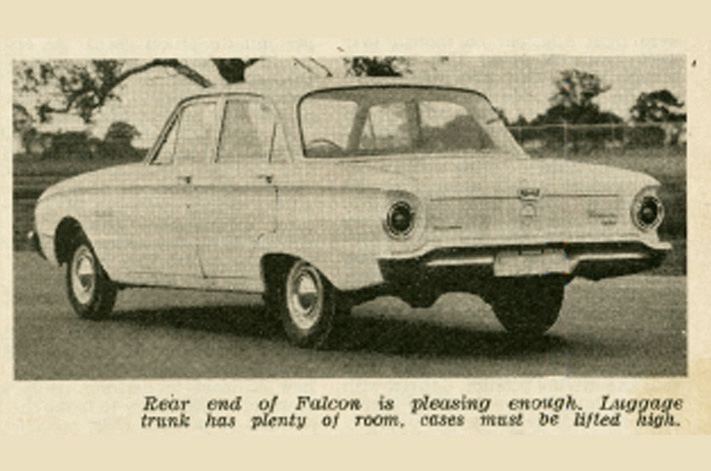
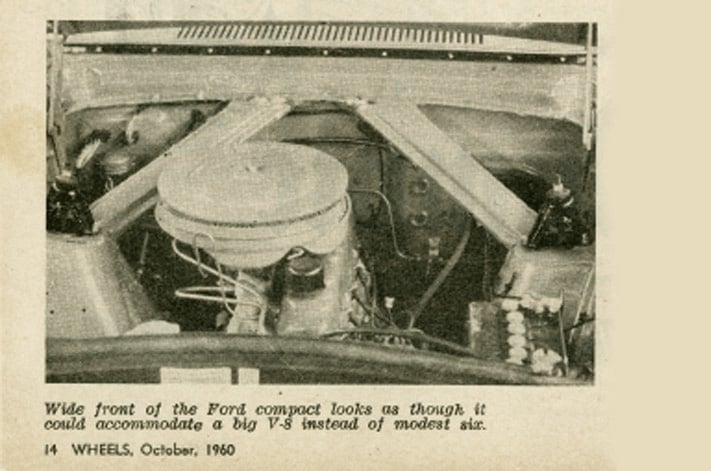
Compare this with the Ford Six’s 525lbs, yet the Falcon’s is iron, using only aluminium pistons. The sturdy crankshaft runs on four main bearings. Peering under its big bonnet I almost expected to see a V8 packed in there. Instead, all I found was a very conventional straight six with plenty of space work on the accessories. A strangely old fashioned touch was the steel rod bonnet stay – no counterbalancing in this one. The motor delivers 138lb/ft of torque at 2000 rpm which gives the engine a nice range of flexibility. Peak torque is equal to a shade more than 40 mph in top gear. With a wheelbase of 109.5 in, the Falcon will turn in a circle of 37.7 feet which is perhaps not as good as could be expected in a car released during the 1960s.
Personally, I would like to see the steering box ratio altered to reduce the tum to about 3.5 lock-to-lock, but this would naturally incur a heaviness penalty. Although not many people would start throwing the Falcon around in slides, if they did I think it may become something of a handful when the understeer finally turns to oversteer and the tail comes around. Even coming out of moderate corners fairly fast I found myself becoming rather busy getting the wheel unwound. Once again, this may largely be a matter of getting accustomed to the limitations, but I am afraid I must disagree on principle with so many turns. The Falcon handled well as far as I was able to judge during my brief tryout of the car.
It felt well balanced – and was – with 52/48 front and rear weight distribution. When cornered hard, body roll was slight and the tyres were quiet. The suspension behaved very nicely and did not feel soft and loose in spite of the excellent bump-damping effect. There is nothing unusual about the suspension – independent at the front by the usual Ford ball joint arrangement with long coils and shockers, and the live rear axle was suspended by semi-elliptics. Road shock was not transmitted up the steering column to the wheel. Fully laden with six people, the Falcon sits down noticeably, but does so evenly between front and rear. Unladen, its ground clearance is 6 inches.
After trying the Fordomatic version, I then had a short run in the standard version of the car which, besides being fitted with a conventional three-speed transmission, had been stripped of some of the glitter, but looked perfectly respectable nevertheless. When steering column shifts were made popular on US-made cars years ago we came to expect them to be sloppy – like stirring an uncooked Christmas pudding with a rubber hose.
Naturally, since the car was very new, I could not wind it out in the cogs, but first felt plenty strong and overseas reports indicate that it will spin to more than 30 mph in this ratio, 60 mph plus in second.
Although capable of revving fairly hard, the Falcon was also very flexible in top gear, pulling away quite strongly from 15 mph. The rear axle ratio on the Australian-made Falcon is 3.56 to 1, which makes it a shade lower than the original American specification of 3.10 to 1.
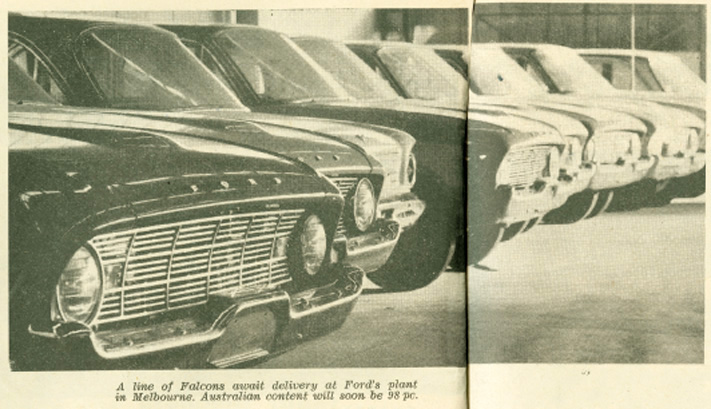
Ford has great plans for the Falcon. It is meant to challenge the Holden and I think it does just that most effectively. Locally found content of the car will be 95 % at first, rising to 98 % as production gets into full swing.
An excellent car in practically every respect, this Ford is going to win lots of friends because of its nice feel, ample performance, and because, for the first time since 1948, Australians are being offered the type of car they want without it having to be a Holden.
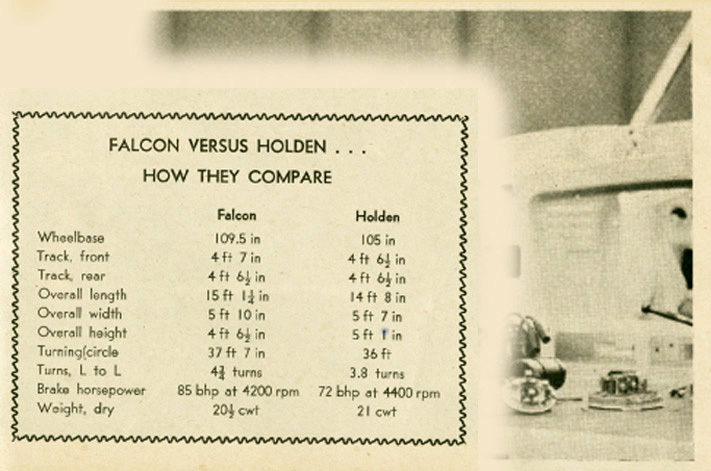
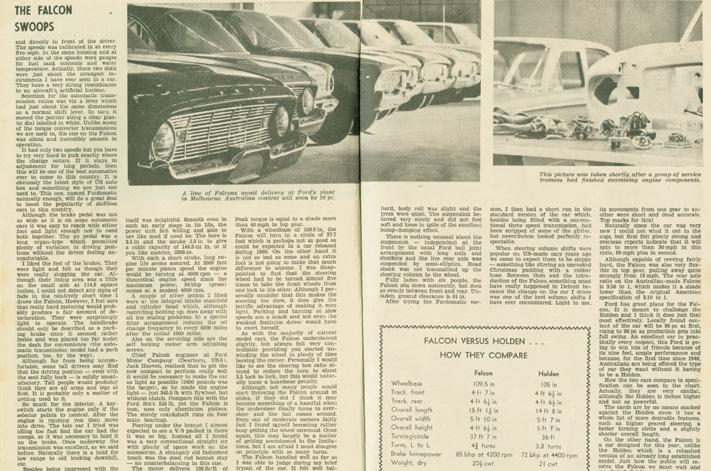
The cards are by no means stacked against the Holden since it has a whole list of more desirable features, such as higher geared steering a better turning circle and a slightly shorter overall length.
On the other hand, the Falcon is a car designed for this year, unlike the Holden which is a rehashed version of an already long established model. Just how the public will receive the Falcon we must wait and see, but I think a lot of people are going to be happy.
MORE images of what could shape up to be the most powerful post-V8 Holden Commodore have leaked online, giving a tantalising hint at how the range-topping 231kW, all-wheel-drive liftback will square up.
Pictures of a Chinese market Buick Regal GS have rolled out on a Russian website showing aggressive aero modifications, gulping air intakes, low-profile Continental rubber and bright red brake calipers fitted to a version of the car destined to be sold here as the 2018 Holden Commodore.
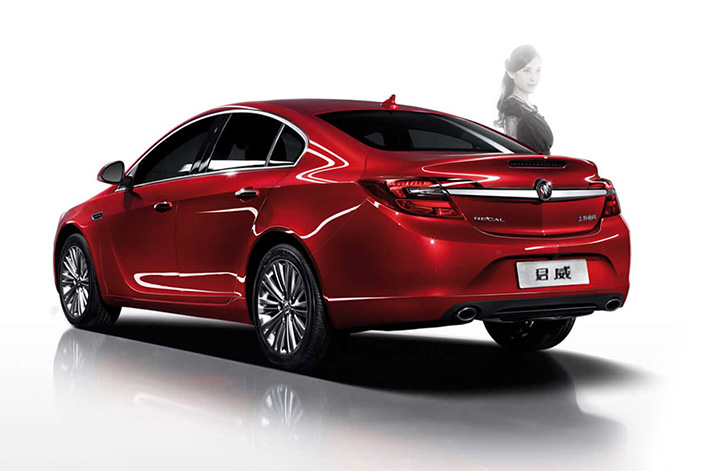
If it lands here, though, the stove-hot, V6-engined and all-wheel-drive Commodore will potentially wear a “VXR” badge, driving a wedge between it and the “SS” and “SSV” badges that have historically linked to V8 engines. Those latter two badges are likely to retire once local Commodore manufacturing ends in October.
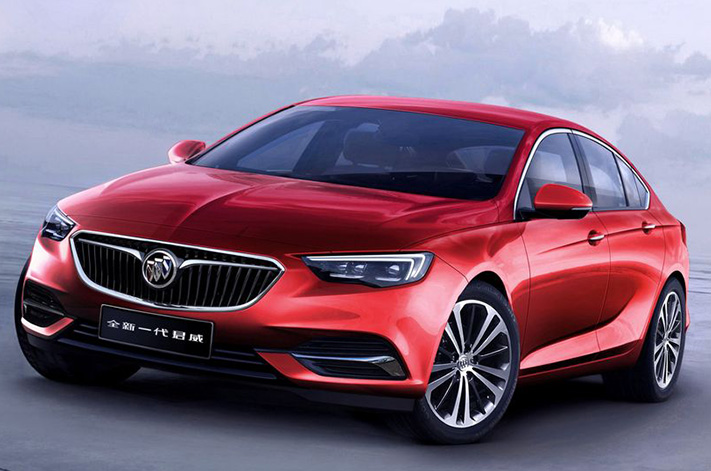
However, there’s another tune of that engine, used in Cadillac’s passenger cars that will make a mouthwatering 250kW/386Nm. That engine could backfill a more performance-oriented, possibly OPC-badged model.
Holden has confirmed an as-yet unnamed V6 version of the Commodore will pair with Opel’s Ford Focus RS-like “Twinster” all-wheel-drive system that can be tuned to provide rear-drive feel – important for a vehicle that will replace the current rear-driven car.
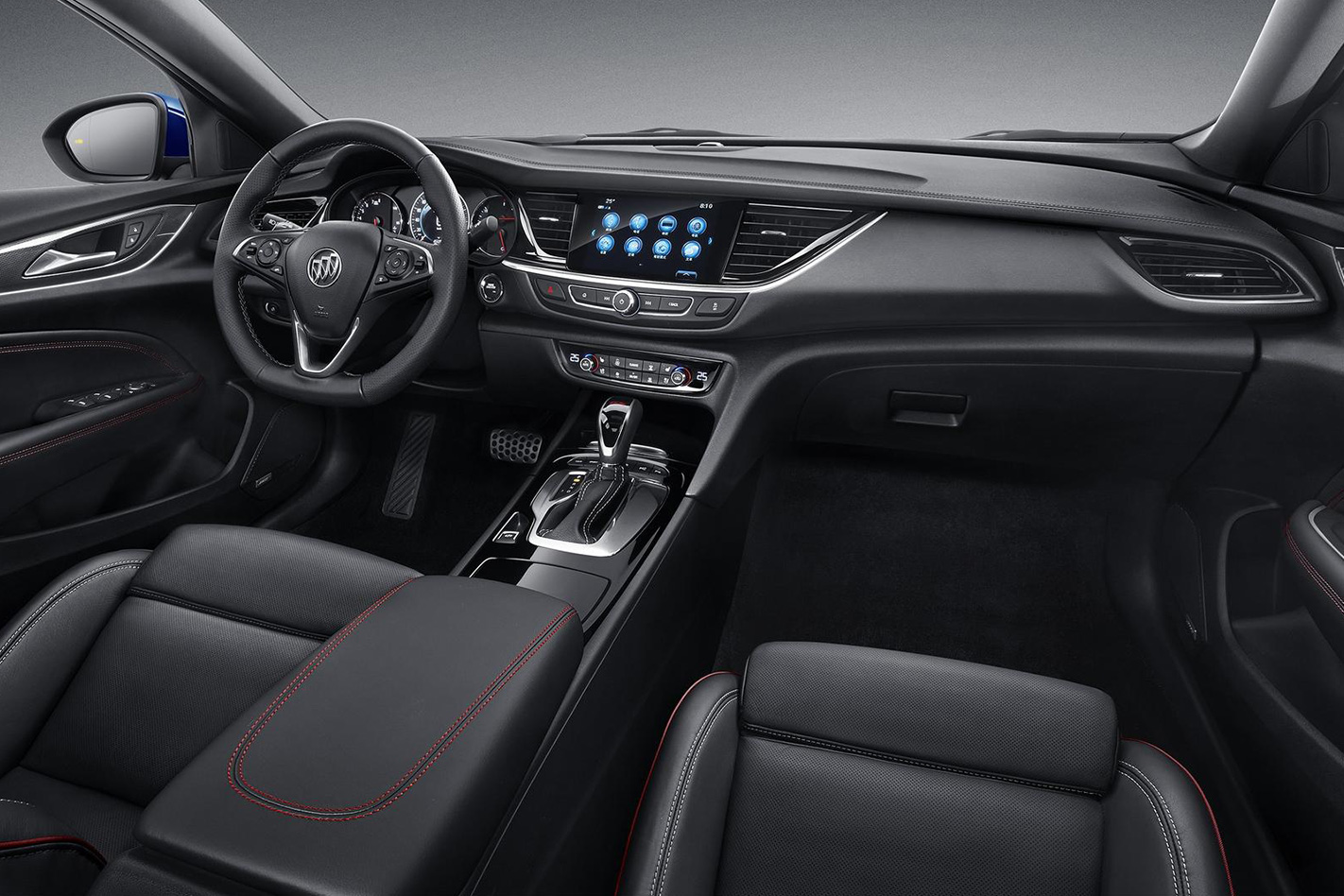
Holden has released few details of how its 2018 Holden Commodore range will stack up in the showroom, so far only confirming that the Calais badge will live on into the brand’s post-manufacturing future. It will also sell a Sportwagon version of the Commodore alongside the five-door sedan, and an SUV-styled Tourer wagon.
MORE than just a video game, today’s modern driving simulators gives you the chance to experience a near-realistic rendition of your dream car, hoon it around a virtual-rendition of your preferred track, and not worry your insurance agent or accountant.
The Forza Motorsport franchise has been responsible for producing highly-realistic simulated escapism, and it is poised to release its seventh iteration on October 3.
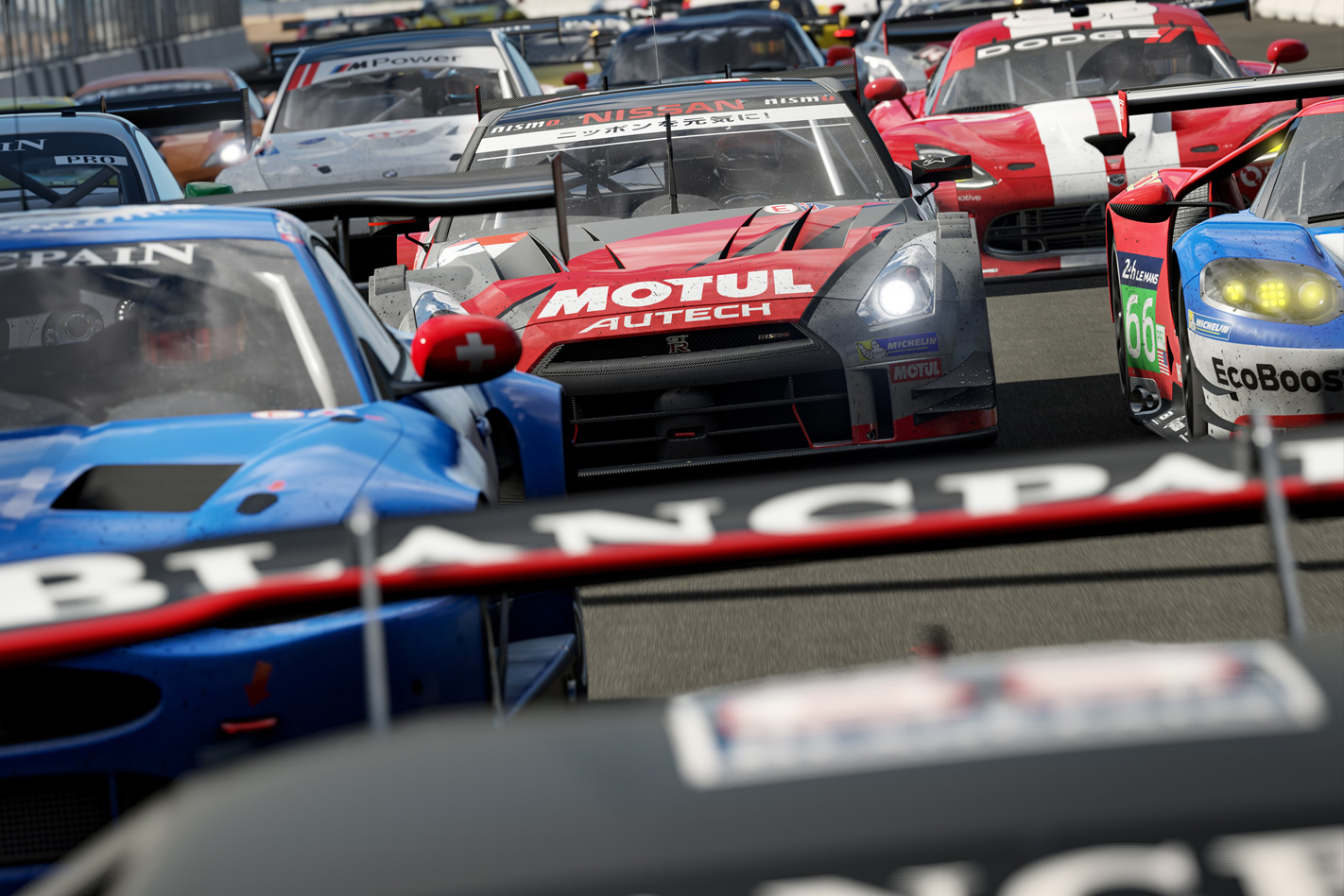
Highlights include 1967 #24 Ferrari Spa 330 P4, 1967 Lotus Type 49, Ayrton Senna’s 1988 #12 McLaren- Honda MP4/4, and 1998 Porsche 911 GT1 Strassenversion.
The first batch of cars are dominated by high-end exotica and thoroughbred racing cars, which makes sense for a circuit-based sim game like Forza Motorsport.
However, judging from previous car lists for Forza games, expect plenty of ‘everyman’ vehicles to be featured as well, and if we are lucky, a sprinkling of Aussie muscle.
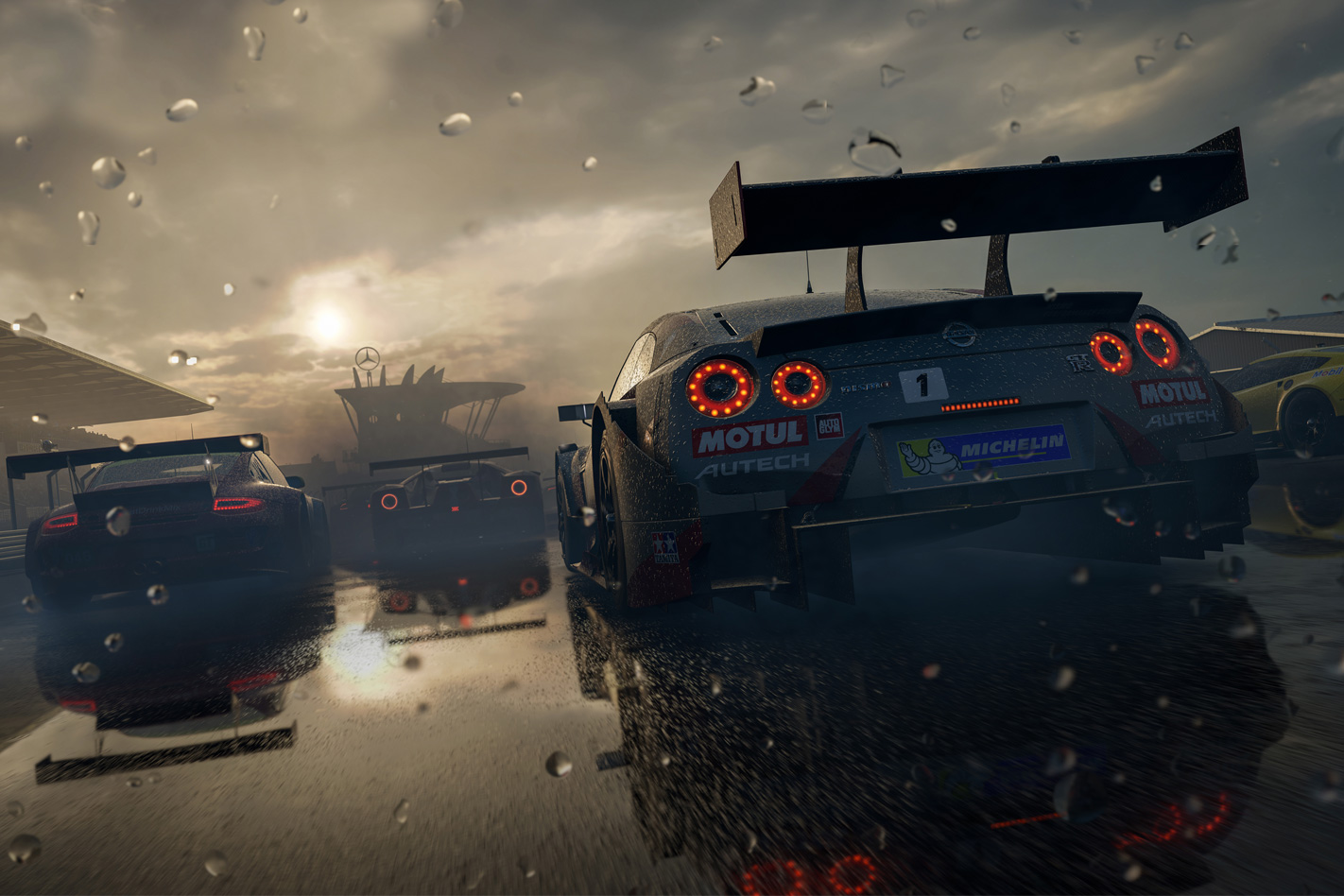
If a large selection of racing tracks is more of your thing, FM7 will have 30 of those, including our very own Mount Panorama.
Check out the full 167 snippet below:
- 2013 Ariel Atom 500 V8
- 2016 Ariel Nomad
- 1958 Aston Martin DBR1
- 1960 Aston Martin DB4GT Zagato
- 1964 Aston Martin DB5
- 1977 Aston Martin V8 Vantage
- 1998 Aston Martin V8 Vantage V600
- 2006 #007 Aston Martin Racing DBR9
- 2008 Aston Martin DBS
- 2010 Aston Martin One-77
- 2012 Aston Martin V12 Zagato
- 2012 Aston Martin Vanquish
- 2013 Aston Martin V12 Vantage S
- 2016 Aston Martin Vantage GT12
- 2016 Aston Martin Vulcan
- 2017 Aston Martin DB11
- 2014 BAC Mono
- 1992 Bugatti EB110 Super Sport
- 2011 Bugatti Veyron Super Sport
- 2013 Donkervoort D8 GTO
- 1948 Ferrari 166MM Barchetta
- 1952 Ferrari 375
- 1953 Ferrari 500 Mondial
- 1957 Ferrari 250 California
- 1957 Ferrari 250 Testa Rossa
- 1962 Ferrari 250 GT Berlinetta Lusso
- 1962 Ferrari 250 GTO
- 1963 Ferrari 250LM
- 1964 Ferrari F-158 F1
- 1967 #24 Ferrari Spa 330 P4
- 1968 Ferrari 365 GTB/4
- 1969 Ferrari Dino 246 GT
- 1971 #2 Ferrari Automobili 312 P
- 1976 #1 Scuderia Ferrari 312T2
- 1982 #71 Ferrari France 512 BB/LM
- 1982 #72 N.A.R.T. Ferrari 512 BB/LM
- 1984 Ferrari 288 GTO
- 1987 Ferrari F40
- 1989 Ferrari F40 Competizione
- 1990 #1 Scuderia Ferrari 641
- 1992 Ferrari 512 TR
- 1994 Ferrari F355 Berlinetta
- 1995 Ferrari F50
- 1996 Ferrari F50 GT
- 1998 #12 Risi Competizione Ferrari F333 SP
- 1998 #30 MOMO Doran Racing Ferrari F333 SP
- 2002 Ferrari 575M Maranello
- 2002 Ferrari Enzo Ferrari
- 2003 Ferrari 360 Challenge Stradale
- 2004 Ferrari 612 Scaglietti
- 2007 Ferrari 430 Scuderia
- 2008 Ferrari California
- 2009 Ferrari 458 Italia
- 2010 Ferrari 599 GTO
- 2010 Ferrari 599XX
- 2011 #62 Risi Competizione Ferrari 458 Italia GTC
- 2011 Ferrari FF
- 2012 Ferrari F12berlinetta
- 2013 Ferrari 458 Speciale
- 2013 Ferrari LaFerrari
- 2014 #51 AF Corse Ferrari 458 Italia GTE
- 2014 #62 Risi Competizione Ferrari 458 Italia GTLM
- 2014 Ferrari California T
- 2014 Ferrari FXX K
- 2015 Ferrari 488 GTB
- 2015 Ferrari F12tdf
- 2012 Hennessey Venom GT
- 2011 Koenigsegg Agera
- 2015 Koenigsegg One:1
- 2016 Koenigsegg Regera
- 2013 KTM X-Bow R
- 1967 Lamborghini Miura P400
- 1986 Lamborghini LM 002
- 1988 Lamborghini Countach LP5000 QV
- 1988 Lamborghini Jalpa
- 1997 Lamborghini Diablo SV
- 2008 Lamborghini Reventón
- 2010 Lamborghini Murciélago LP 670-4 SV
- 2011 Lamborghini Gallardo LP 570-4 Superleggera
- 2011 Lamborghini Sesto Elemento
- 2012 Lamborghini Aventador LP700-4
- 2013 Lamborghini Veneno
- 2014 Lamborghini #14 GMG Racing LP 570-4 Super Trofeo
- 2014 Lamborghini #18 DragonSpeed Gallardo LP 570-4 Super Trofeo
- 2014 Lamborghini Huracán LP 610-4
- 2014 Lamborghini Urus
- 2015 Lamborghini #63 Squadra Corse Huracán LP620-2 Super Trofeo
- 2016 Lamborghini Aventador LP750-4 SV
- 2016 Lamborghini Centenario LP 770-4
- 1956 Lotus Eleven
- 1966 Ford Lotus Cortina
- 1967 Lotus Type 49
- 1971 Lotus Elan Sprint
- 1976 Lotus #5 Team Lotus 77
- 1990 Vauxhall Lotus Carlton
- 1999 Lotus Elise Series 1 Sport 190
- 2000 Lotus 340R
- 2002 Lotus Esprit V8
- 2005 Lotus Elise 111S
- 2009 Lotus 2-Eleven
- 2011 Lotus Evora S
- 2012 Lotus Exige S
- 2016 Lotus 3-Eleven
- 1939 Maserati 8CTF
- 1953 Maserati A6GCS/53 Pininfarina Berlinetta
- 1957 Maserati 300 S
- 1961 Maserati Tipo 61 Birdcage
- 1997 Maserati Ghibli Cup
- 2004 Maserati MC12
- 2010 Maserati Gran Turismo S
- 2014 Maserati #35 M.Calamia Swiss Team MC Trofeo
- 2014 Maserati Ghibli S Q4
- 1966 McLaren M2B
- 1969 McLaren #4 McLaren Cars M8B
- 1976 McLaren #11 Team McLaren M23
- 1988 McLaren #12 McLaren-Honda MP4/4
- 1993 McLaren F1
- 1997 McLaren F1 GT
- 2011 McLaren #59 McLaren GT 12C GT3
- 2011 McLaren 12C
- 2013 McLaren P1
- 2014 McLaren #60 Bhaitech 12C GT3
- 2015 McLaren 570S Coupé
- 2015 McLaren 650S Coupe
- 2015 McLaren P1 GTR
- 2010 Noble M600
- 2009 Pagani Zonda Cinque Roadster
- 2010 Pagani Zonda R
- 2012 Pagani Huayra
- 2016 Pagani Huayra BC
- 1955 Porsche 550A Spyder
- 1957 Porsche 356A Speedster
- 1960 Porsche 718 RS 60
- 1970 Porsche 914/6
- 1973 Porsche 911 Carrera RS
- 1982 Porsche 911 Turbo 3.3
- 1987 Porsche #17 Porsche AG 962C
- 1987 Porsche #17 Porsche Dunlop 962C
- 1987 Porsche 959
- 1989 Porsche 944 Turbo
- 1993 Porsche 928 GTS
- 1995 Porsche 911 GT2
- 1998 Porsche 911 GT1 Strassenversion
- 2003 Porsche Carrera GT
- 2004 Porsche 911 GT3 (996)
- 2008 Porsche #7 Penske Racing RS Spyder Evo
- 2011 Porsche #45 Flying Lizard 911 GT3-RSR
- 2012 Porsche 911 GT2 RS
- 2012 Porsche 911 GT3 RS 4.0
- 2012 Porsche Cayenne Turbo
- 2014 Porsche 911 Turbo S
- 2014 Porsche 918 Spyder
- 2015 Porsche #19 Porsche Team 919 Hybrid
- 2015 Porsche Macan Turbo
- 2016 Porsche 911 GT3 RS
- 2016 Porsche Cayman GT4
- 2017 Porsche #1 Porsche Team 919 Hybrid
- 2017 Porsche Panamera Turbo
- 2018 Porsche 911 GT2 RS
- 2011 Radical SR8 RX
- 2015 Radical RXC Turbo
- 2004 Saleen S7
- 2016 Spania GTA Spano
- 2005 TVR Sagaris
- 2015 Ultima Evolution Coupe 1020
- 2016 W Motors Lykan HyperSport
- • 2016 Zenvo TS1
Mercedes-Benz has confirmed that the 2018 S-Class will be the first to receive the new electrified straight six which has been so-far revealed to achieve an output of 320kW.
And, as far as downsizing engines goes, that’s good news for the S500.
With the previous V8-powered S500 boasting outputs of 335kW/700Nm, the six-pot S-Class will surely keep up. Though its 520Nm is substantially weaker, the S-Class has learned a new trick.
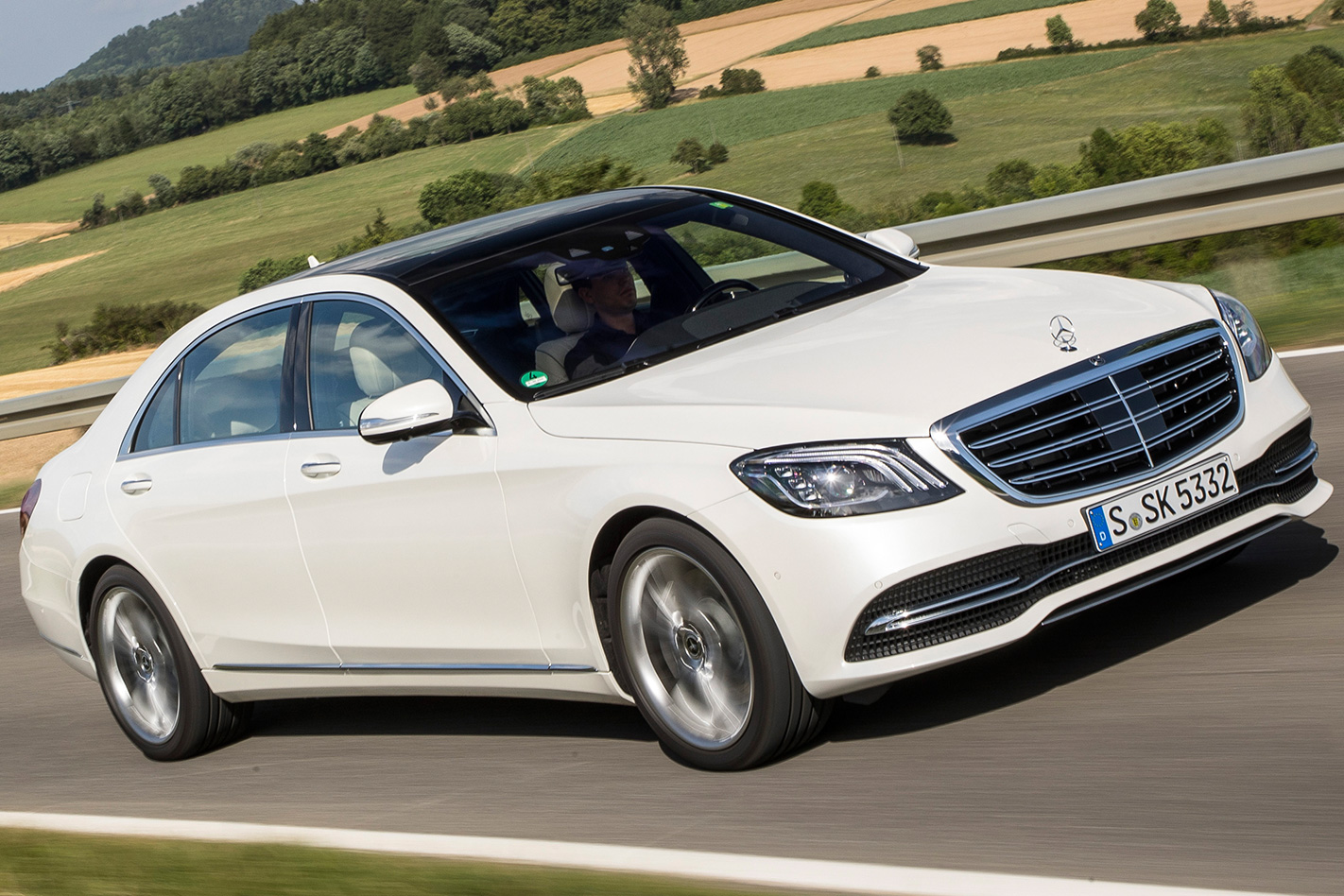
The engine is also slated to be used in the S450, which will be tuned to a more modest output of 270kW/500Nm.
As reported by MOTOR’s sister publication Wheels, the new straight six will also be plonked into the upcoming Mercedes-AMG CLS53.
In its CLS home, the in-line six will produce 320kW and more torque than it does in the S500, though will be given an extra 50kW from the electric system when called to action with a nudge of the right foot.
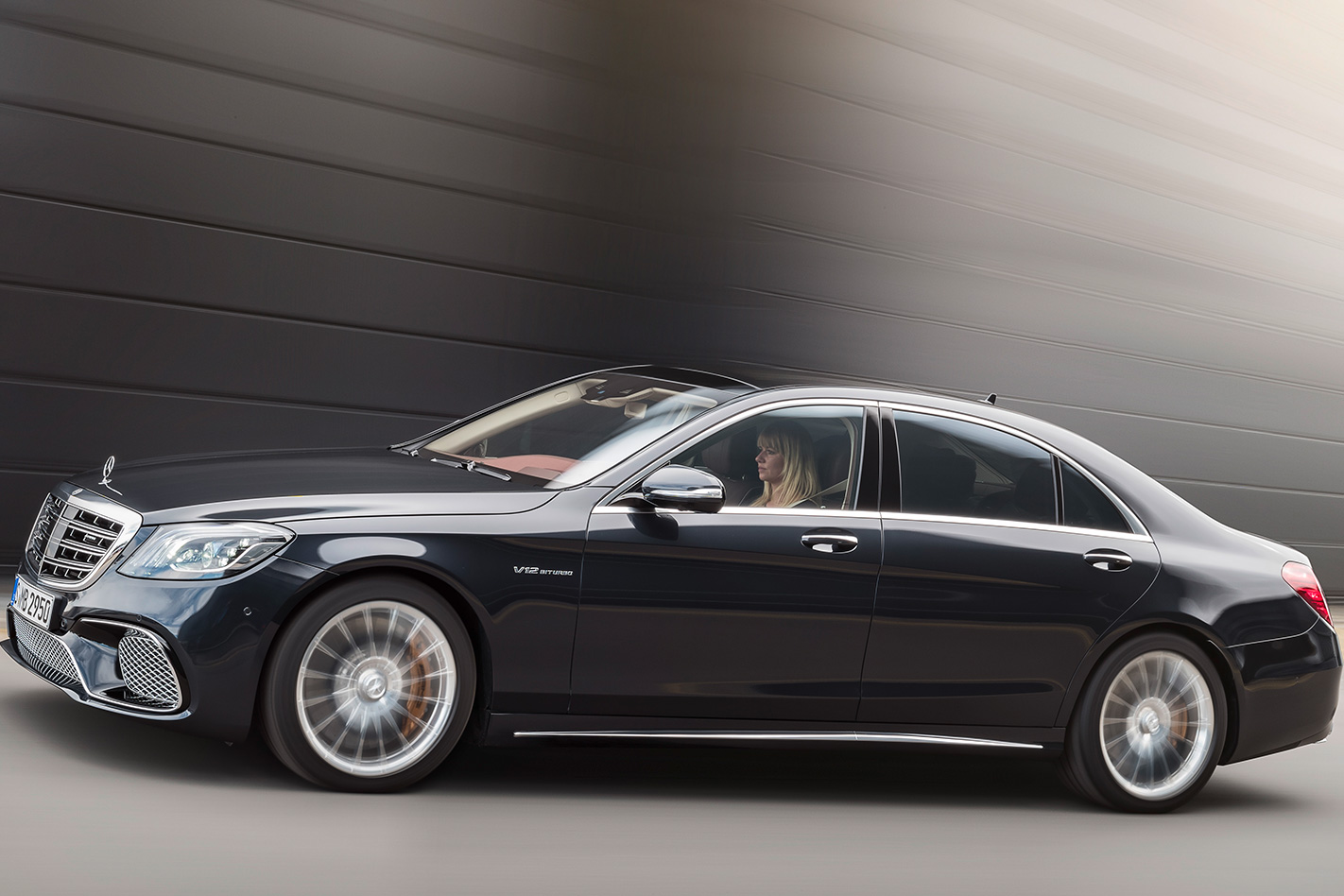
Mercedes-Benz has adopted a new battery system to achieve this and, though we’d expect a 48-volt system as-per the Audi SQ7, M-B’s official statement calls it a 49-volt system. Typo? Possibly.
As for the next targets for this new hybrid straight-six, the upper echelon of the S-Class (including the 6.0-litre V12 AMG S 65) are unlikely to see its use, though how soon we’ll start seeing other V6s dropping out of use is yet to be confirmed.
Tell me about this car
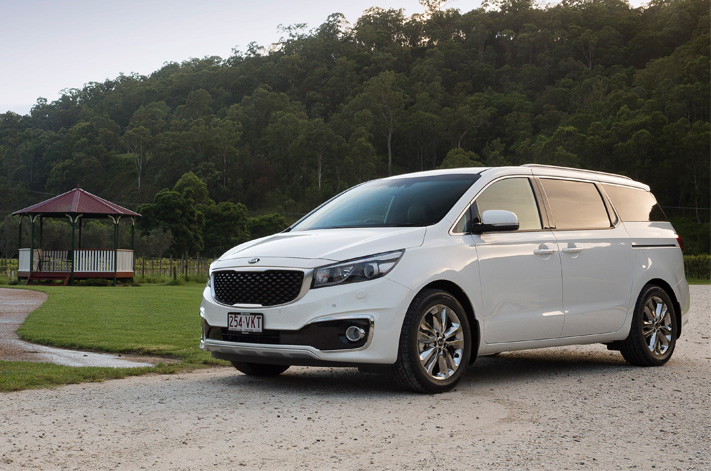
Kia’s family-friendly SUV alternative, the Carnival, is a seven-seat people mover designed to transport an entire tribe in comfort and style. The Platinum is the flagship spec, and comes with a simple but effective brief – moving people. We put it to the test by loading it with six adults and heading for the high country for a weekend retreat. Spoiler alert: It’s bloody brilliant.
Strengths
- Space. The Carnival offers it in spades. All three rows are comfortable for full-sized adults, even on long trips.
- Accessibility. Powered sliding doors can take a bit getting used to at the first experience, but quickly become a little joy. Entering and exiting the Carnival is a breeze, with the second row smoothly folding to a standing position to allow adult-sized third row occupants to enter with ease. The third row can also be folded flat in no time at all thanks to an intuitive operation that only requires a single hand.
- Storage. The cabin of the Kia is filled with innovative and well-thought-out nooks and crannies for phones, sunglasses, bottles, and anything else you may need for a roadtrip with the gang. Each row has multiple cupholders, and the centre console box is cavernous.
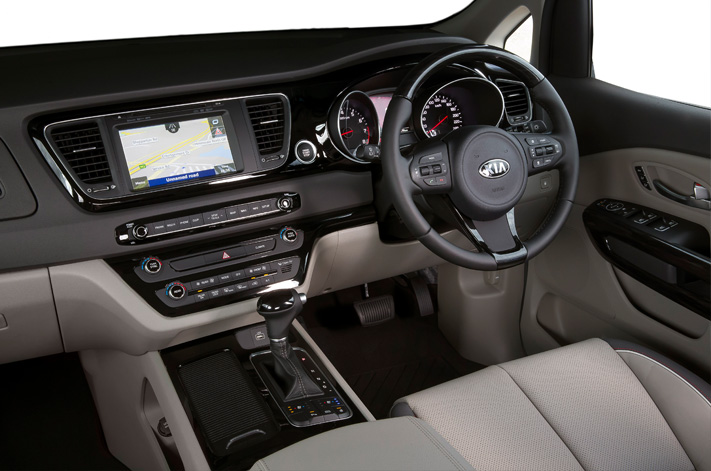
- Equipment. Sat-nav, cruise control, Bluetooth, power doors and tailgate, heated and cooled front seats, and heated steering wheel means Carnival owners aren’t left wanting for much. Built-in sunblinds for the second row are a nice addition and great for keeping kids sunsmart, while multiple USB and 12V outlets for each row will help keep your companions entertained.
- Parking Cameras. The Carnival is a very large car, measuring in at over five meters long. The 360-degree camera array means parking the beast isn’t harder than docking a cruise ship.
- Style. This isn’t a hum-drum beige people mover. It’s mostly personal taste, but the Carnival has a restrained and sophisticated styling which could be argued as attractive.
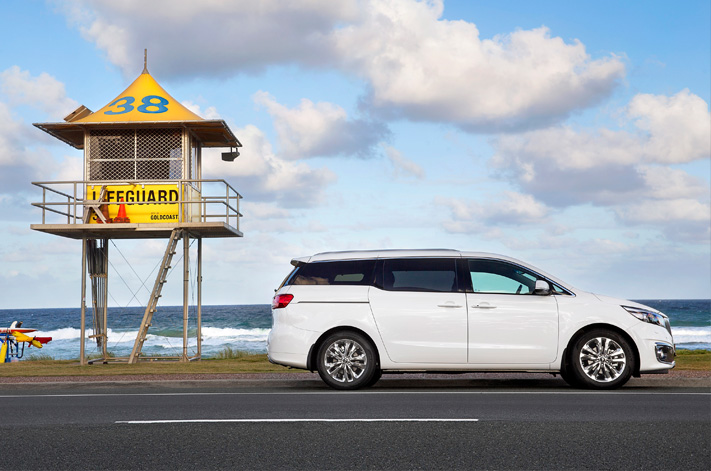
- Ride. The suspension tune for the Kia Carnival belies its bus-like capabilities. It is never a hassle in tight urban environments, was smooth and poised on corrugated dirt roads, and soaked up large bumps with suppleness even when fully loaded.
Weaknesses
- Fuel consumption. The 206kW/336Nm 3.3-litre V6 gives the Carnival plenty of get up and go, but the tradeoff is a hefty fuel bill. An average consumption of 11.6L/100Km and an 80-litre tank can make long trips a real pain for the hip pocket. The power and torque of that tractable V6 is sweet compensation for the guzzling though, while a diesel option is available.
- Throttle calibration. It should be noted there is only one throttle setting, requiring some pre-planning and considered throttle application on hilly roads to maintain a constant speed. There is a lack of sensitivity in the calibration of the right pedal, so be prepared to squeeze the accelerator more than you would in other vehicles.
Rivals?
Mazda CX-9, Kia Sorento, Citroen Grand C4 Picasso, Toyota Kluger, Volkswagen Multivan, Hyundai Santa Fe, Nissan Pathfinder, Honda Odyssey, Holden Captiva
The all-new Peugeot 3008 mid-size SUV will boast a four-tier model line-up, two engines choices and a suite of active safety features when it goes on sale in mid-August.
Set to rival the Mazda CX-5, Ford Escape, and Volkswagen Tiguan, every model in the 3008 range will feature keyless entry and push-button start, dual-zone climate control, roof rails, sat-nav, digital radio, and 18-inch alloy wheels.
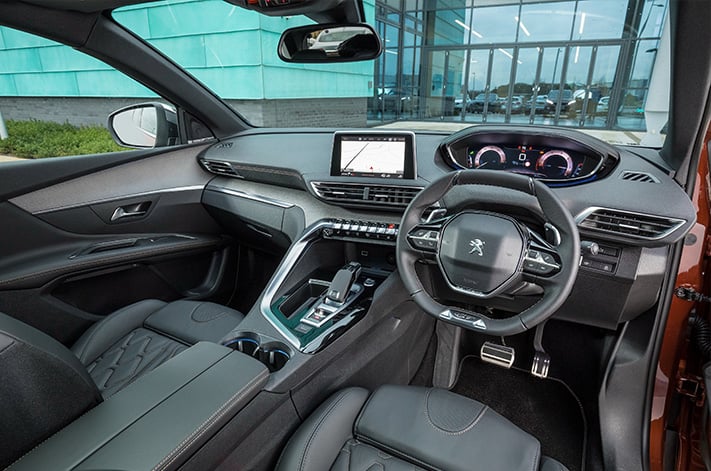
The funkily styled interior will also include a large 12.3-inch digital instrument cluster and an 8.0-inch touchscreen infotainment system.
Autonomous Emergency Braking and speed sign recognition will be standard across the range, which opens with the entry-level Active and tops out with the flagship GT.
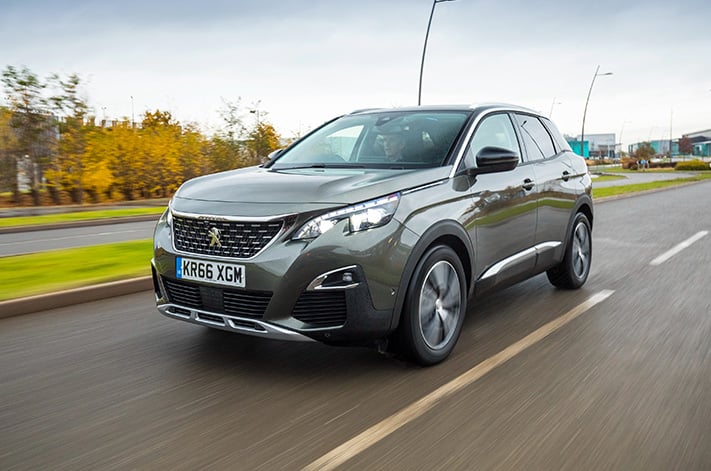
Mid-spec Allure and GT-Line models complete the range, with pricing tipped to span from the high $20K mark to just below $50,000.
GT-Line and GT models will feature electrically adjustable massaging front seats, wireless phone charging, and a panoramic sunroof – all of which will be optional extras on the Allure.
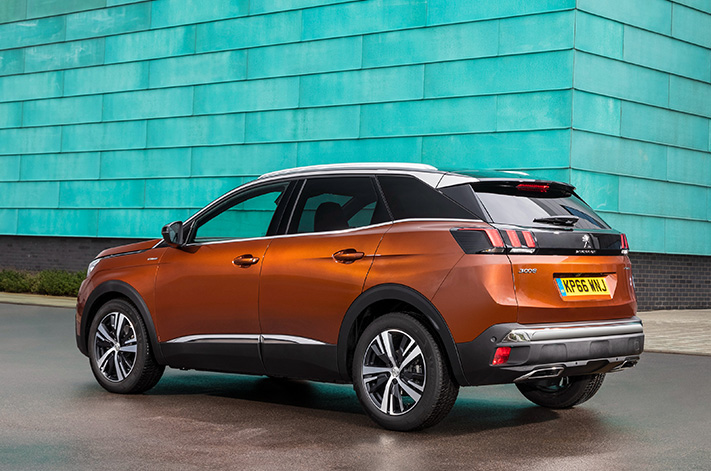
Engine-wise, buyers will have the choice of either a 1.6-litre petrol turbo or a 2.0-litre turbo diesel.
Petrol variants will produce 121kW and 240Nm, sent to the front wheels via a six-speed automatic gearbox.
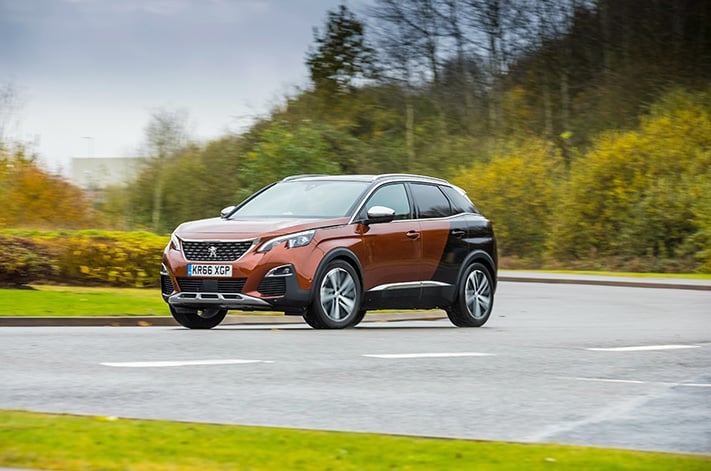
The diesel engine, offered in the range-topping GT, offers 133kW and a muscular 400Nm.
The 3008 is a crucial model for Peugeot and will do battle in one of Australia’s most competitive and lucrative segments. Stay tuned for more details closer to the 3008’s mid-August launch.
The 2018 Mercedes-Benz X-Class ute lands in Australia early next year, ranging in ability from an entry-level workhorse right up to a high-end showpony.
As well, the vehicle range launched in South Africa overnight will boast both four-and six-cylinder engine options, and the choice of either rear-wheel-drive, permanent all-wheel-drive or selectable, seriously off-road capable four-wheel-drive modes.
“The new X-Class finds the perfect balance between the stylish design expected of a Mercedes-Benz and the uncompromising robustness and functionality demanded of the category,” Mercedes-Benz Vans Australia managing director Diane Tarr said. “As a result, with the X-Class, we can effectively provide a solution for trade and fleet customers, and we will find out just how far this category can evolve for private customers who need the vehicle to support their lifestyle.”
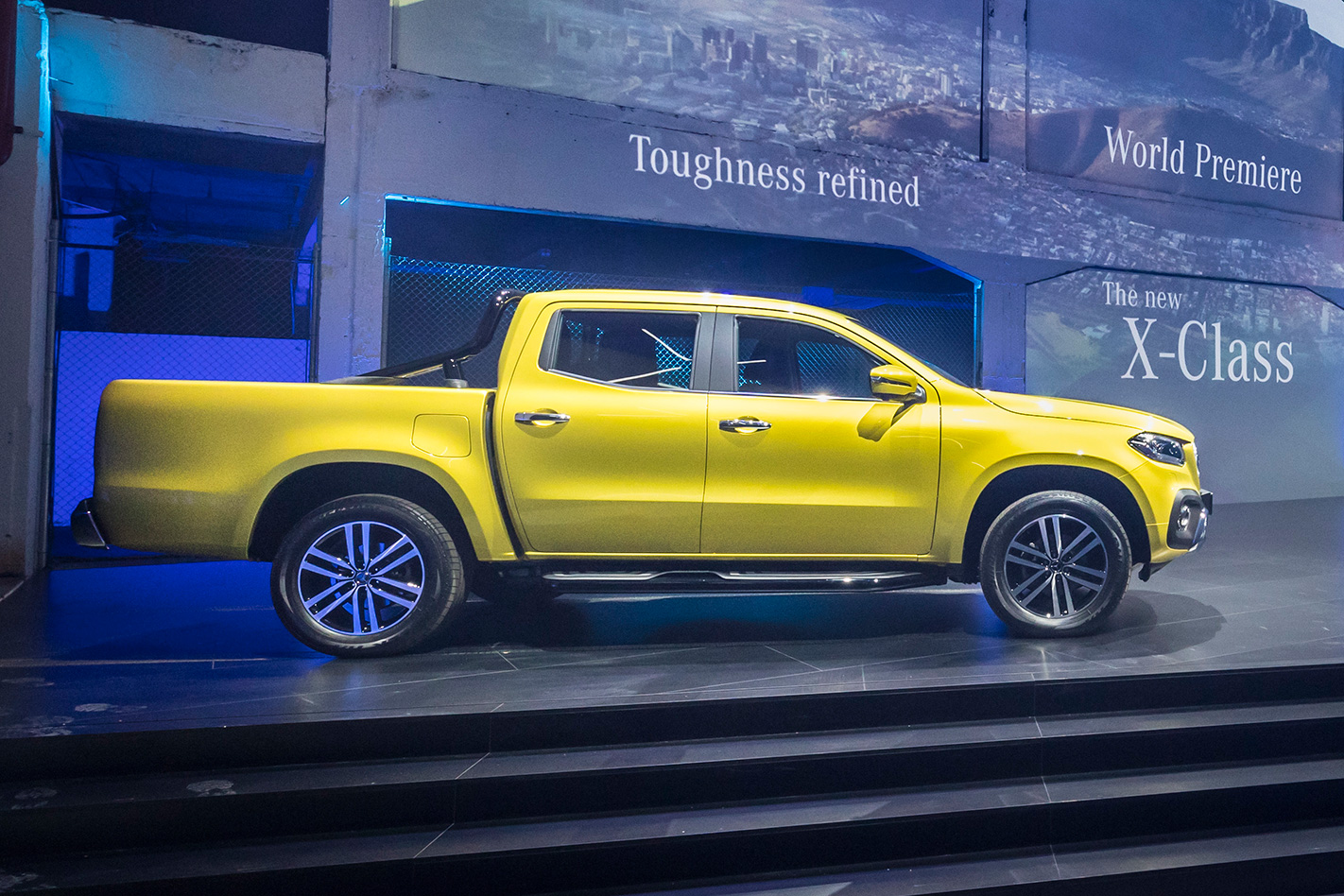
Stepping up a grade to the X-Class Progressive introduces us to what Mercedes hopes will be the version of the trade ute that will appeal most to private buyers who like the looks of four-door workhorses, but want it kitted out with a bit of creature comfort and envy-inducing looks. Mercedes claims this model will be the “calling card” for a business, while also being “a comfortable yet prestigious vehicle for private use”.
The top-of-the-line model will be the X-Class Power, featuring high-end design and equipment, aimed at buyers “for whom styling, performance and comfort are paramount”. Mercedes says this model grade will be suited to the urban environment, while also aiming at buyers interested in sport and off-road use. According to Mercedes, the X-Class was developed for the changing requirements of the ute market.
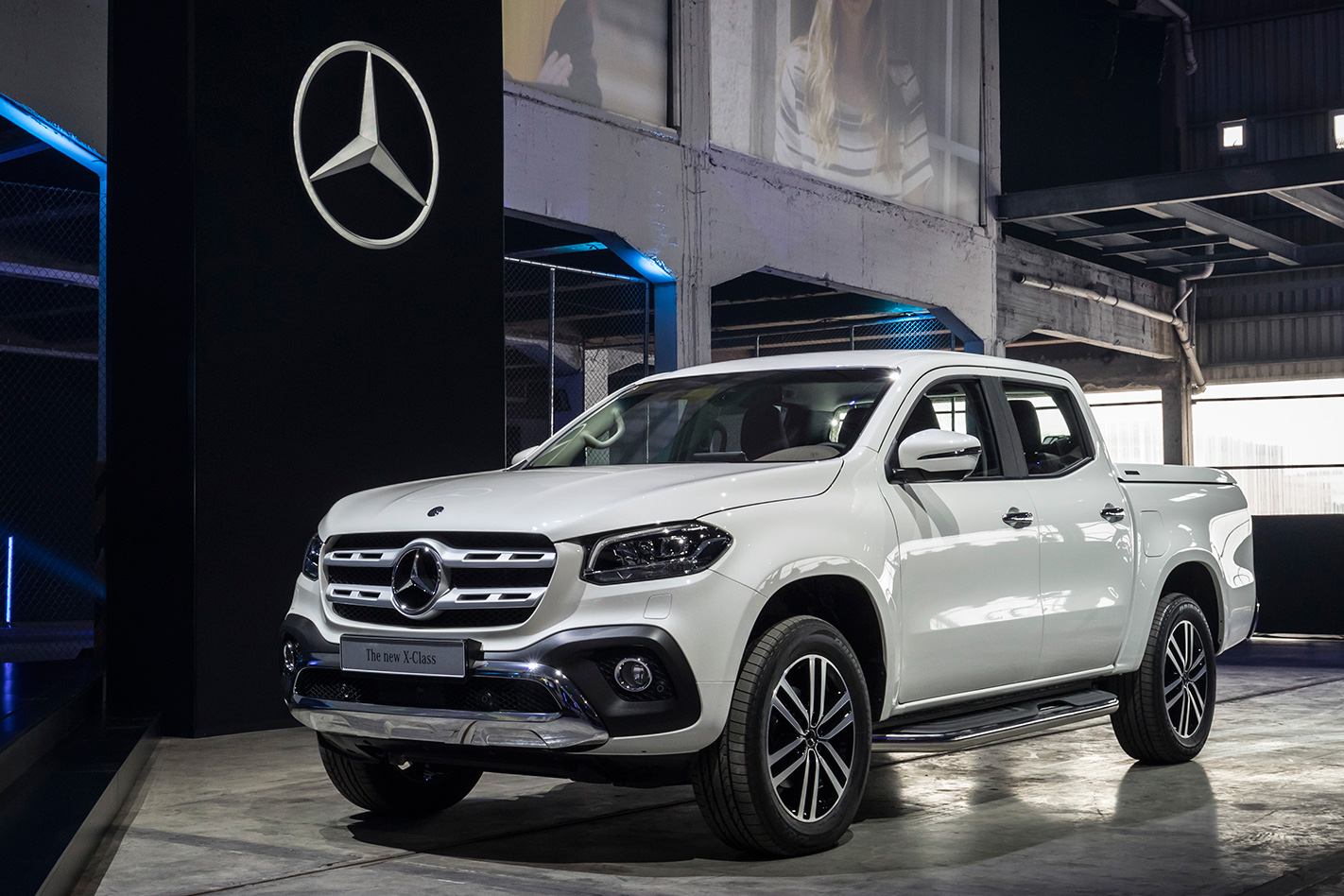
The light commercial segment, the part of the Australian new car market in which the trade utes play, is one of the fastest growing segments, particularly the higher-end, more passenger car-like 4×4 twin-cab utes variants.
In the first six months of 2016 the 4×4 segment – where most private buyers play – is up 9.5 percent over last year, with sales in June alone jumping almost 20 percent compared with the same month last year. Almost one in every five new cars sold is a trade ute.
The Ford Ranger is currently the best-selling 4×4 trade ute in Australia, accounting for one in five sales in the segment – narrowly ahead of the Toyota HiLux, which does better than the Ranger in 4×2 sales.
Private buyers aren’t afraid to splash out on a powerful, well-equipped trade ute. Earlier this year, Volkswagen launched a V6 version of the Amarok here worth almost $70,000.
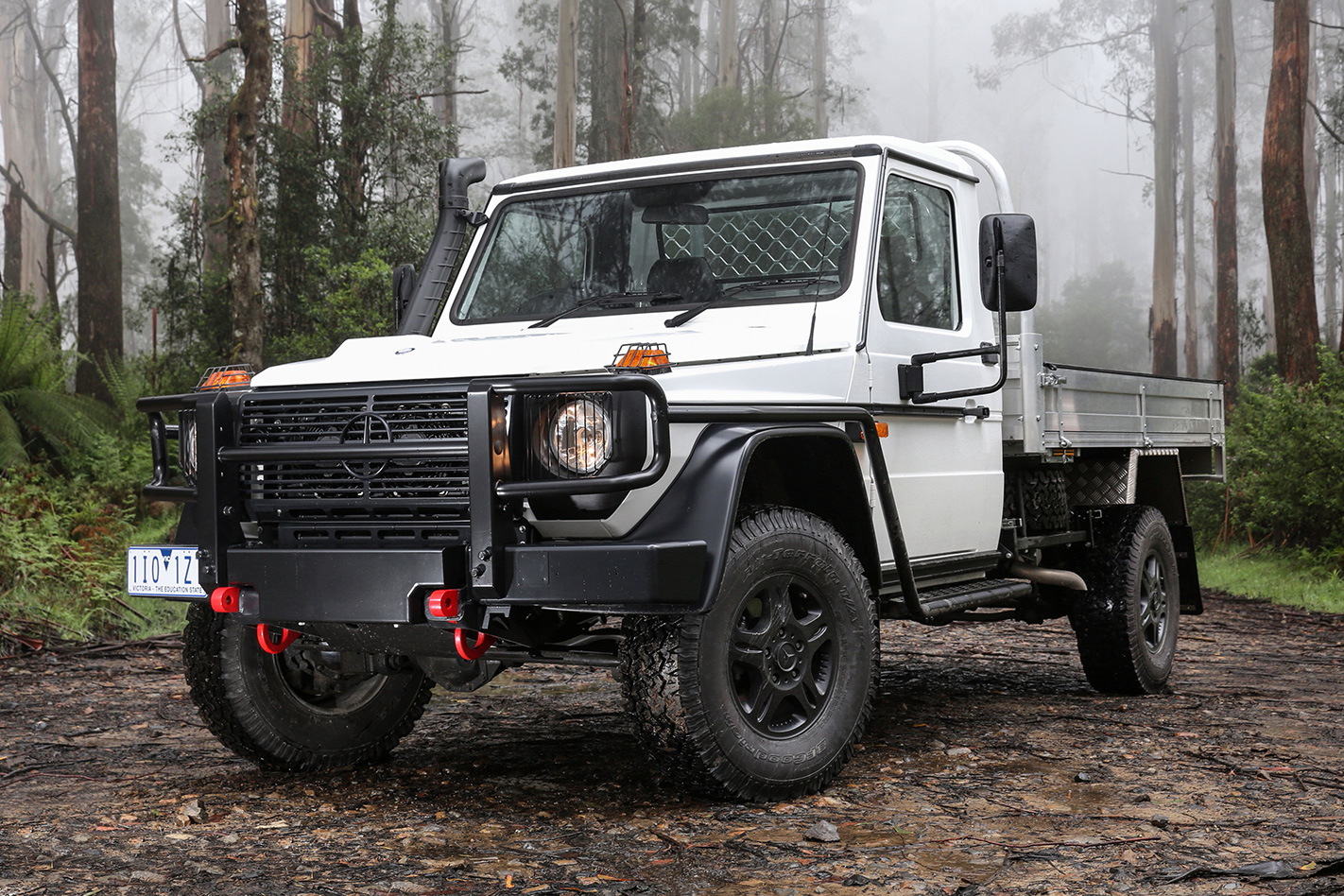
Mercedes-Benz’s foray into the more urbanised ute scene comes via a collaboration with Japanese carmaker Nissan. Scratch the surface of the X-Class, and underneath is the chassis from the Navara trade ute. However, Mercedes says very little of the Nissan DNA carries through to its version of the Japanese workhorse.
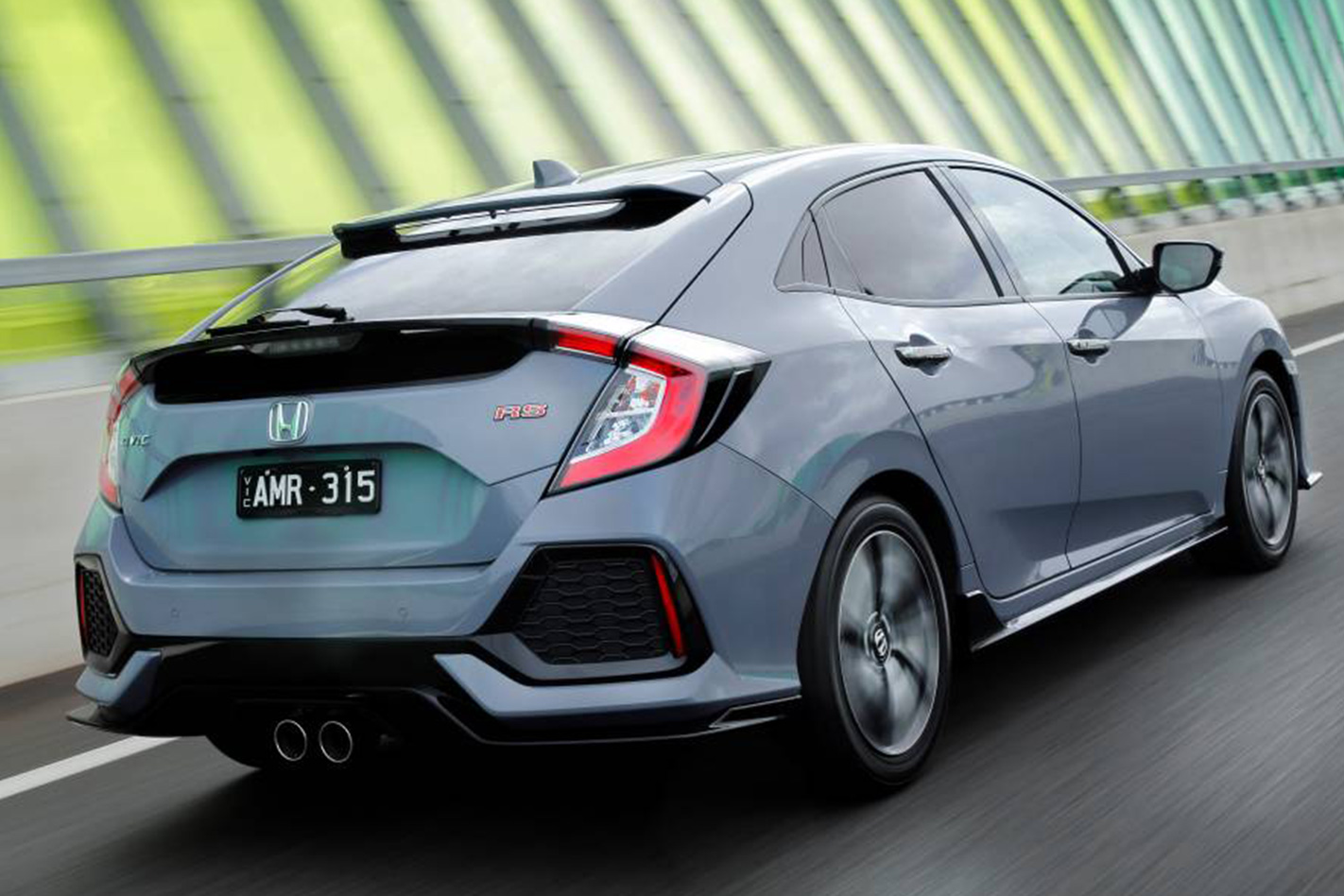
The new Civic is up against it.
Not only will the new Type R be welcomed by a rabid Focus RS, all-new Megane RS, and updated Golf GTI Performance when it arrives, but the base model needs to claw back market share. Last year the Mazda3 outsold the Civic five times to one.
So Honda’s ditched a rear torsion-beam for a multi-link setup on its 10th generation Civic, while lightening and stiffening its chassis. The brand’s also injected a fresh 1.5-litre turbo four into the range, which mates 127kW and 220Nm exclusively to a CVT.
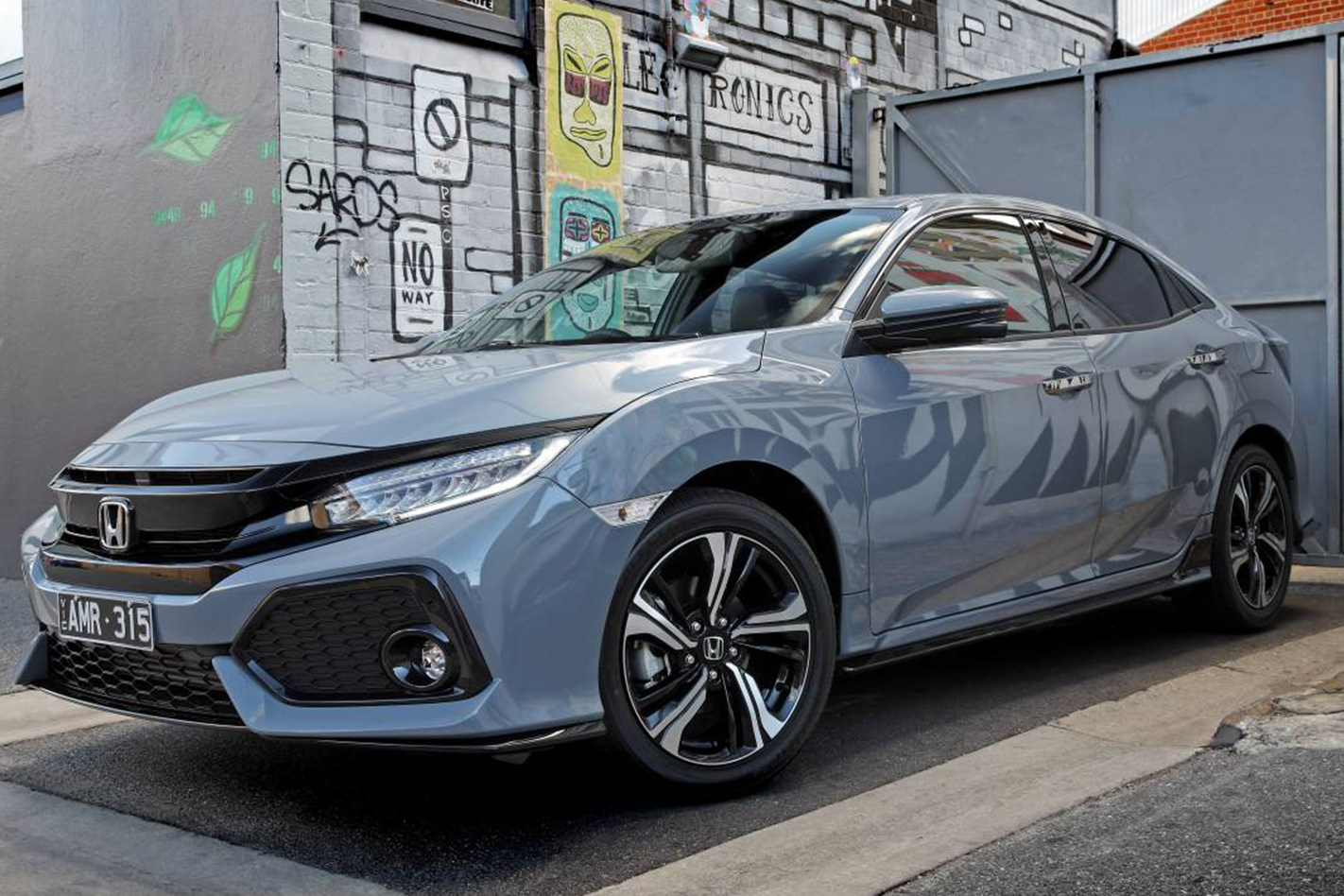
Its steering is direct and the chassis feels lively enough, even if it lacks feedback or tyre bite. Plus, the brakes are both strong and nicely judged for feel. Unfortunately the 1.5-litre sounds dull and lacks any real accelerative urge in a straight line, while the gearbox measures shift times in full- rather than split-seconds.
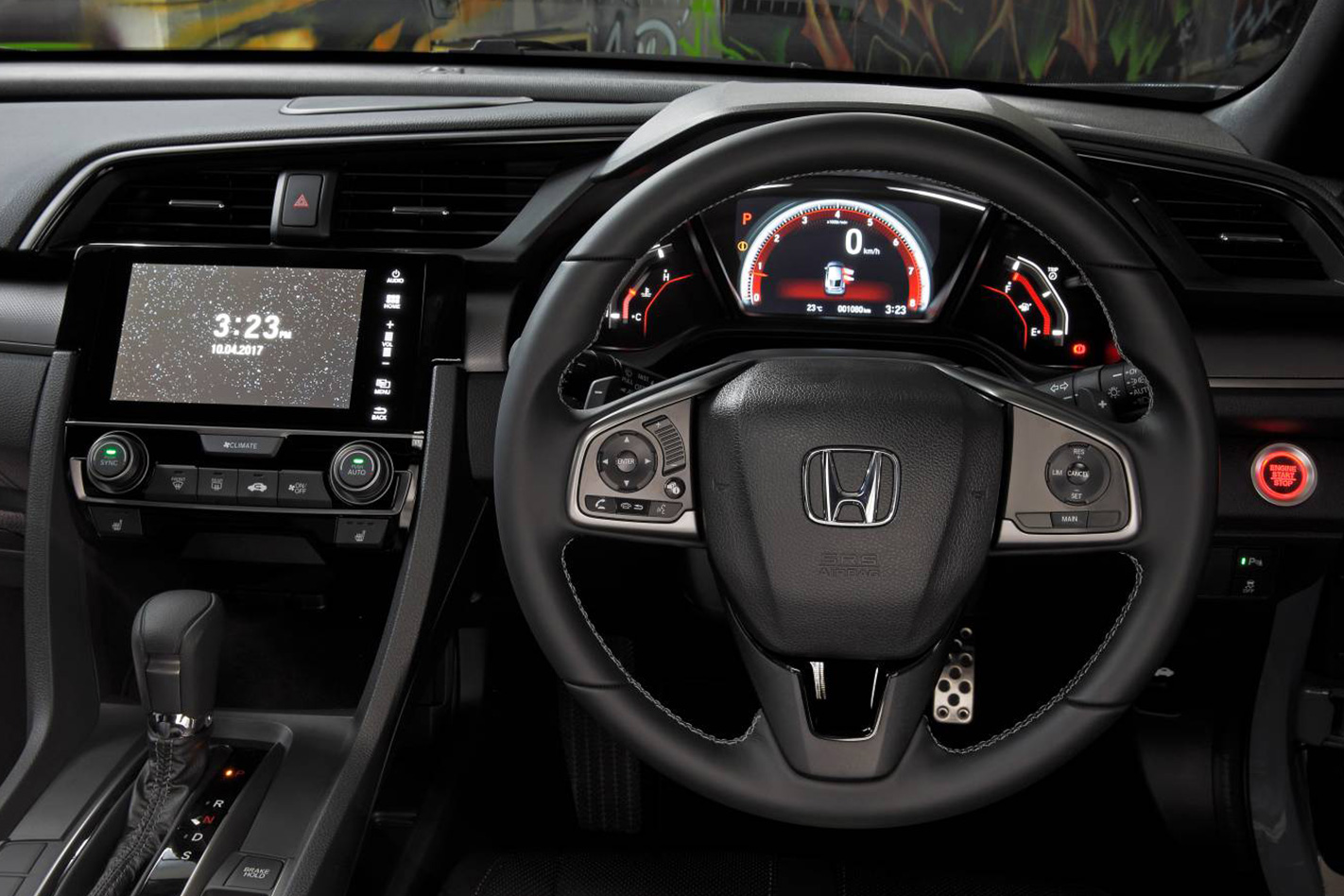
The transmission would unlock a sorely needed 20Nm (overseas where it’s offered) and make it a touch cheaper.
The tradie ute space is set to look a little whiter around the collar, with the Mercedes-Benz X-Class making its global debut in production form in South Africa this morning ahead of its early-2018 local launch.
Based on the ladder-framed undercarriage of the Nissan Navara, the X-Class is powered by three engines – a Nissan-sourced 2.3 litre turbo diesel four-cylinder in 120kW/403Nm and 140kW/450Nm trim, and a range-topping turbo diesel V6 from Benz’s own engine catalogue. As the range-topping engine, the V6’s outputs of 190kW and 550Nm will put it well ahead of the Volkswagen Amarok V6, which makes the same peak torque but significantly less power.
Some markets will receive a four-cylinder petrol option, but that engine is not on the cards for an Aussie intro.
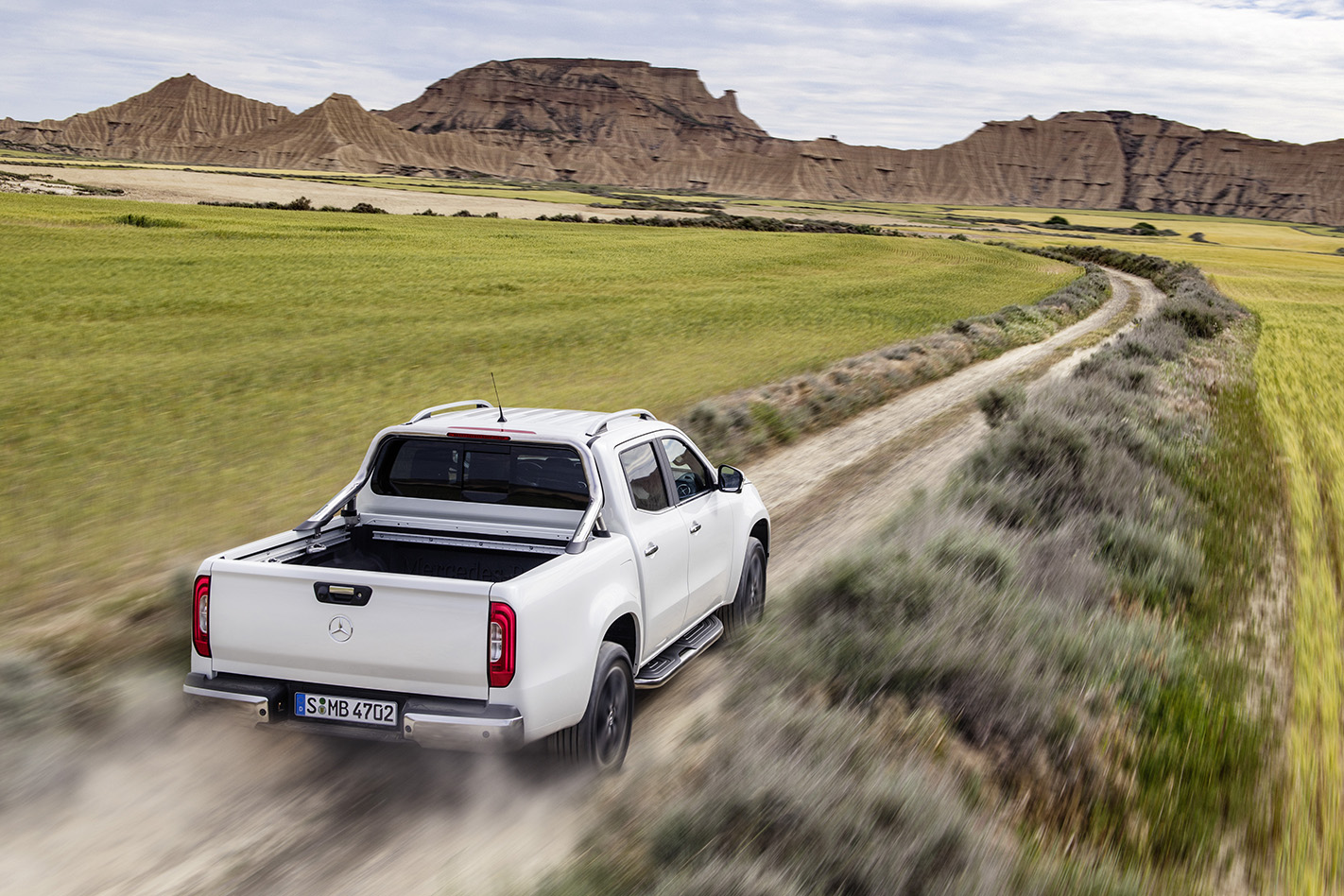
Like most utes, rear-wheel drive variants will be offered alongside 4WD models in the X-Class range, with six-speed manual and seven-speed automatic transmissions sitting between the engine and differential. For the four-cylinder versions of the X-Class, the drivetrain will be a Navara-style selectable RWD or 4WD system. The V6 will take a permanent 4WD driveline.
Just like the Navara, the X-Class will ride on coil springs at front and rear, with a live-axle rear end and independent A-arms at front. Ventilated disc brakes slow each wheel, rather than the more conventional disc front, drum rear setup used by many utes.
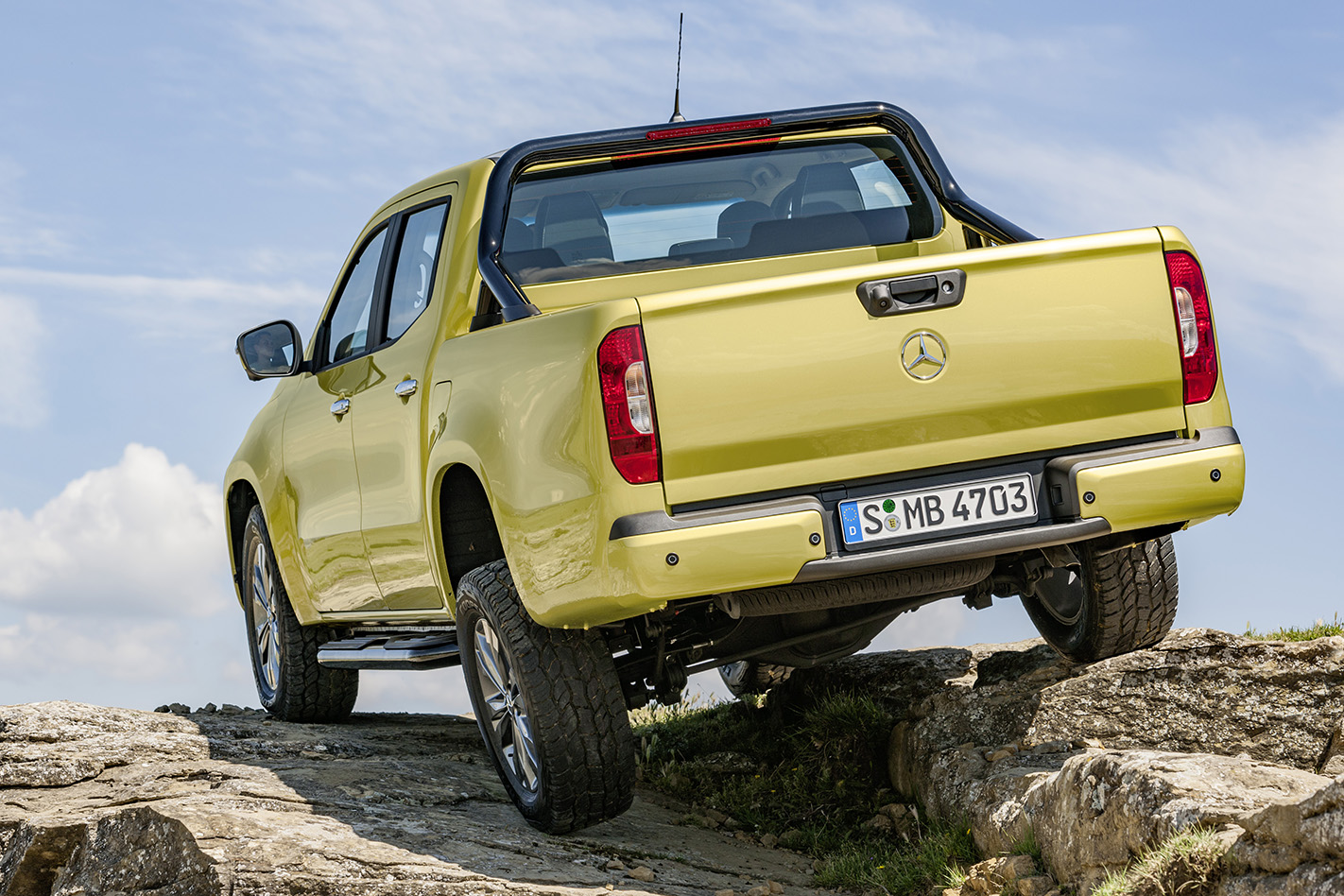
Local specifications have yet to be confirmed, but Benz’s claimed maximum payload figure of 1.1 tonnes and towing capacity of 3.5 tonnes puts the X-Class on roughly equal terms with the Navara as a load lugger. Loading can also be enhanced via a rear-bumper delete option, which allows the tailgate to open a full 180 degrees for easier forklift loading.
The X-Class’ load bed can take a standard European pallet and a 12-volt power socket is integrated into the sides. LED lamps mounted on the rear of the cabin can also illuminate the bed at night.
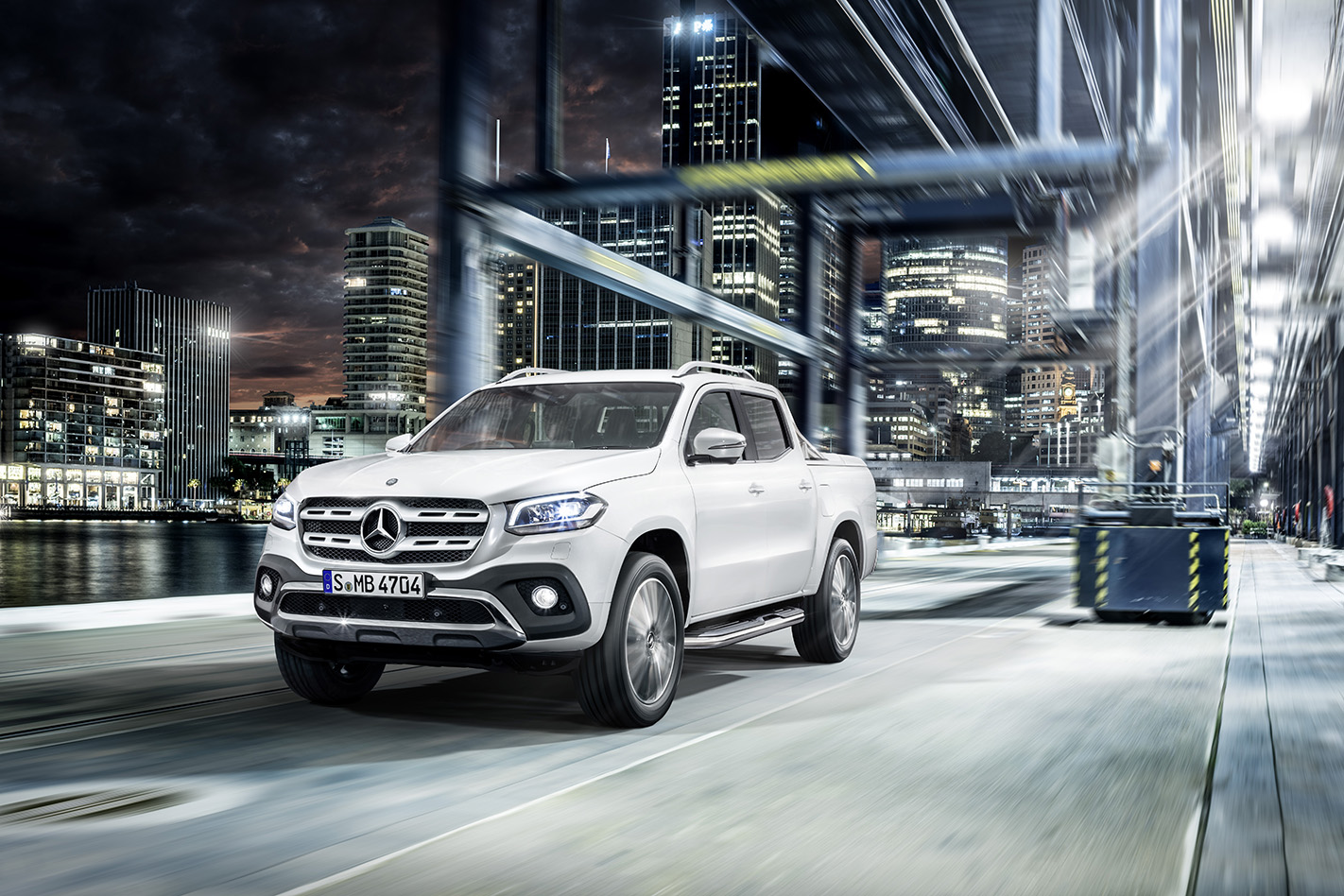
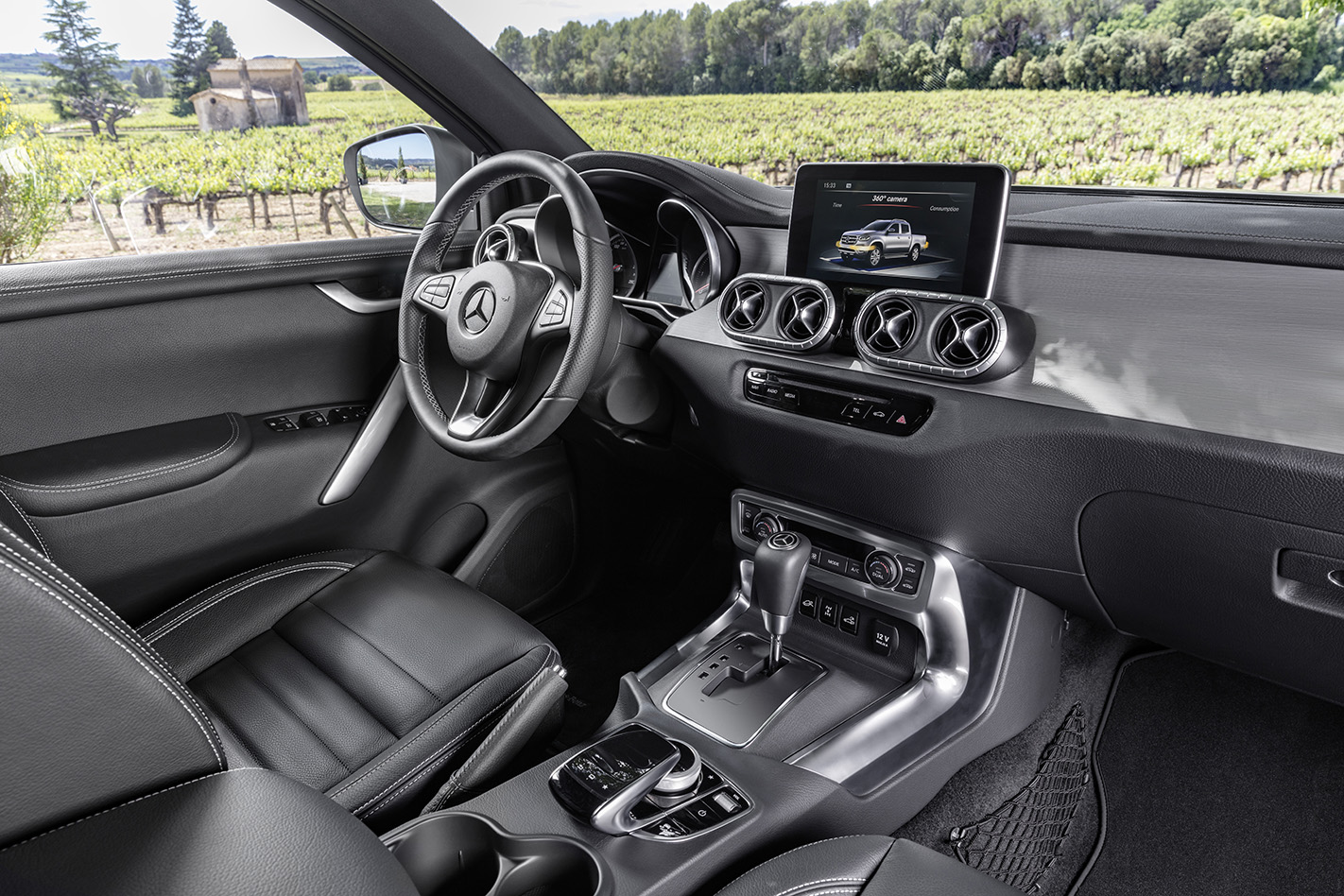
Benz claims the X-Class will be a “new benchmark in comfort” when it goes on sale, thanks to interior furnishings that have been thoroughly reworked to help separate it from its Nissan cousin.
A Comand touchpad and rotary controller sit atop the centre console and should be familiar to anyone who’s driven a Mercedes C-Class, E-Class or S-Class, and is the primary interface for the 8.4-inch infotainment display that protrudes from the top of the X-Class’ dash.
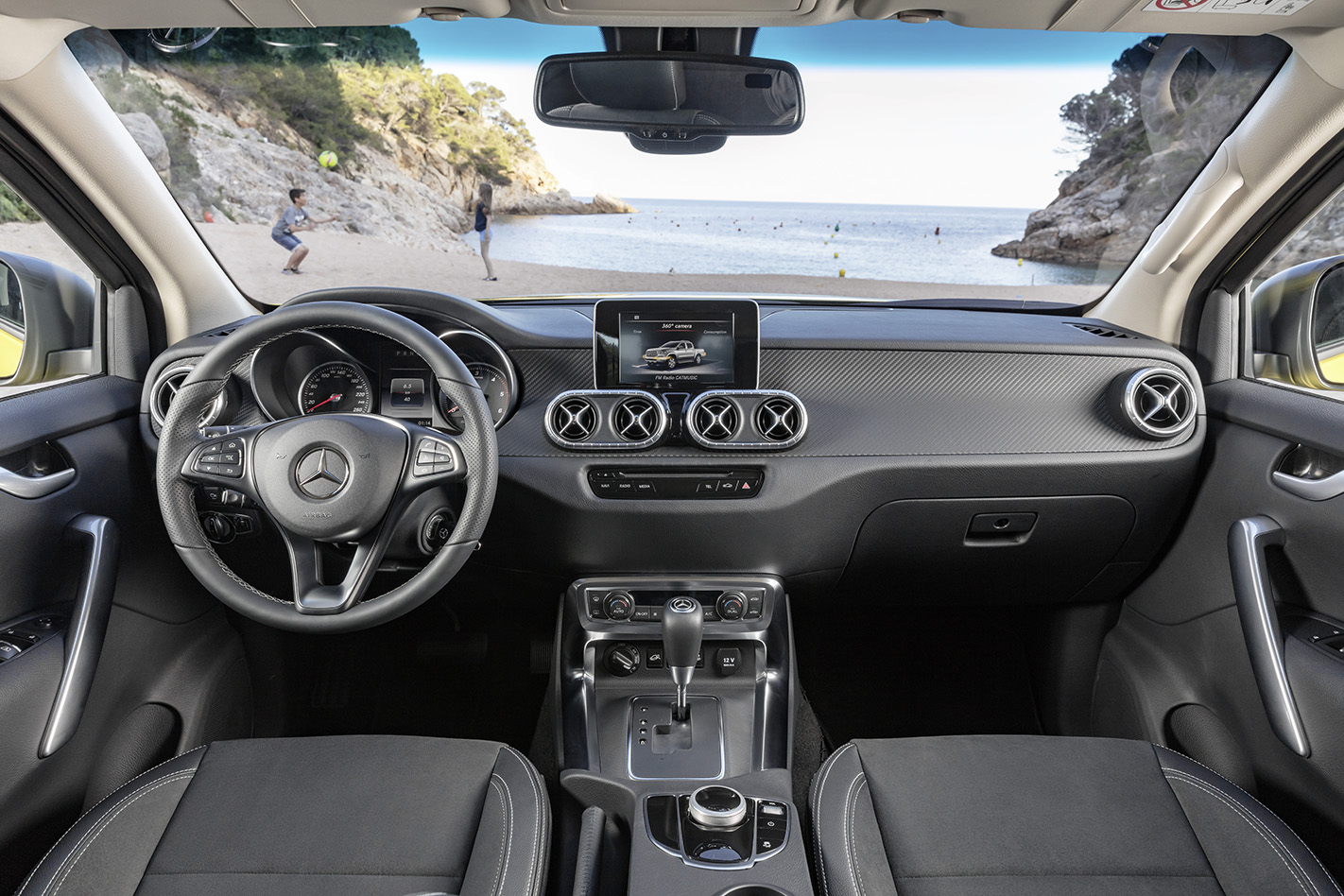
Other luxuries include power-adjustable front seats on high-grade models, leather-upholstered dashboards, leather upholstery from the mid-grade model and up, voice controls and a top-down camera view.
Expect local specifications and pricing to be announced closer to the X-Class’ local launch in the first quarter of 2018.
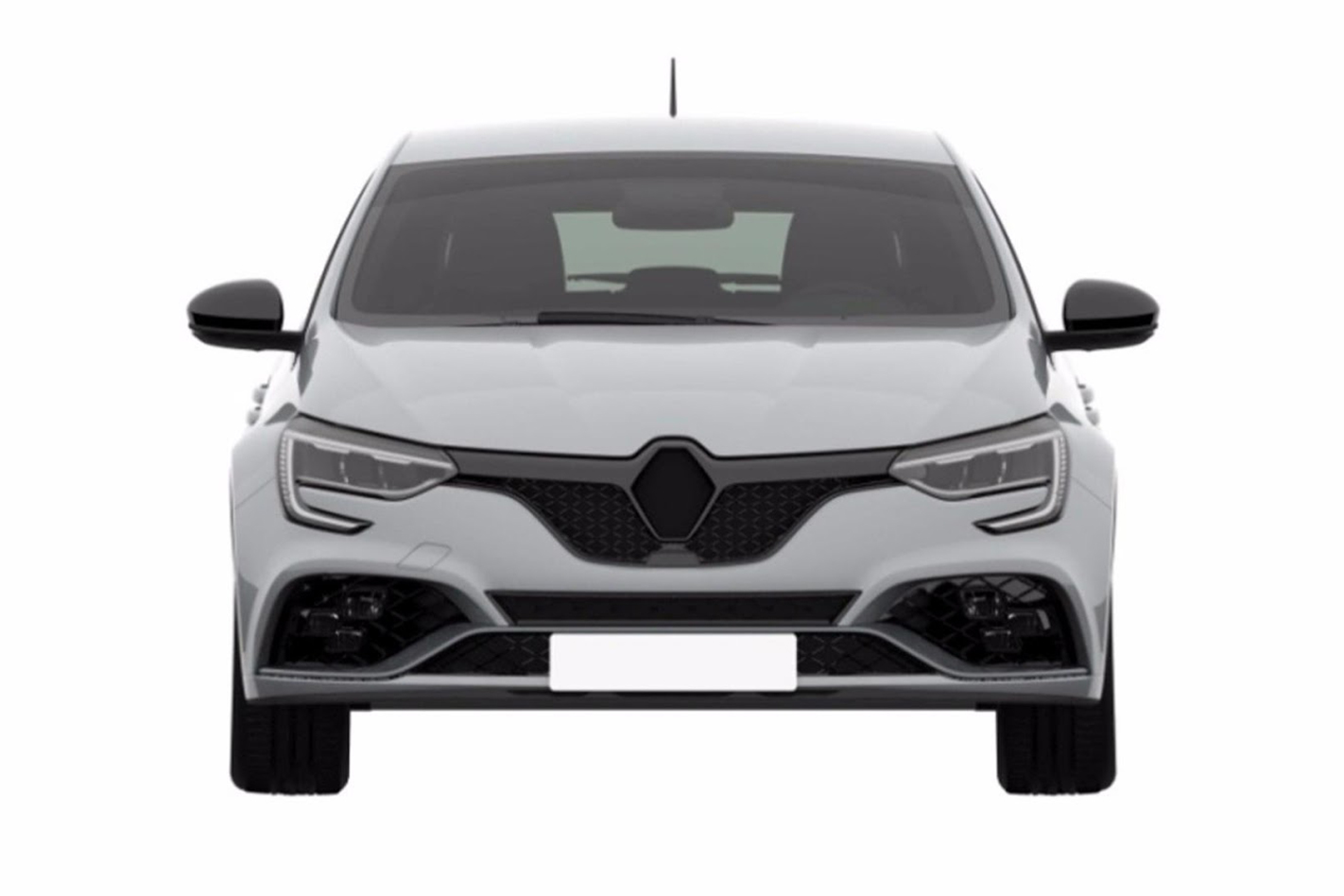
RENAULT’S upcoming Megane RS hot hatch has been spied testing at the Nurburgring – the circuit its predecessor once ruled as the FWD lap record holder.
The French hot hatch isn’t taking it slow this time, either. The camouflaged fourth-gen weapon is seen lapping the Green Hell at maximum attack in the video above.
Uncertainty currently surrounds how much power the RS badged Megane will produce, however Renault sources have previously suggested a power output of around 220kW from a boosted four-cylinder.
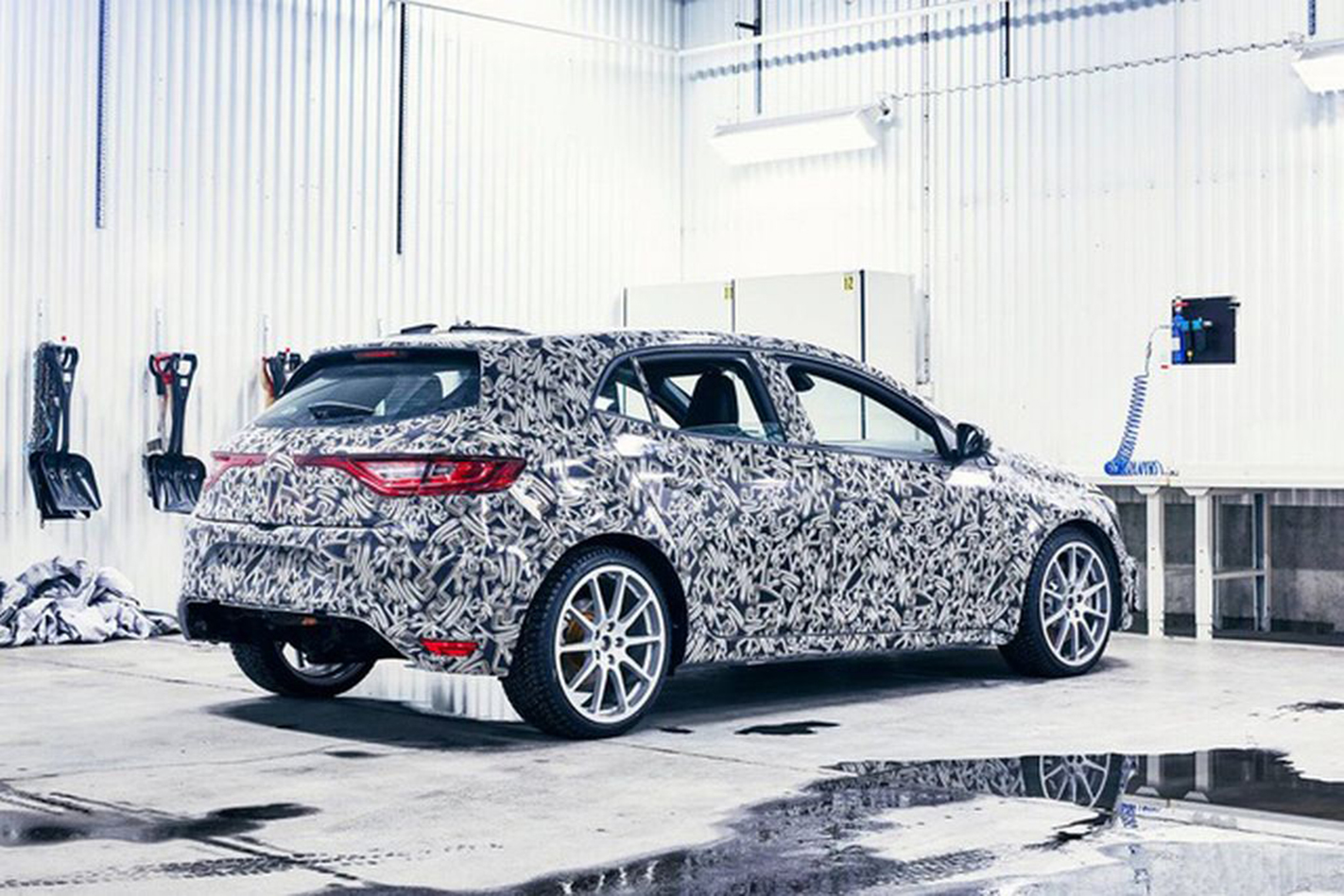
Manufacturers test and tune everything from SUVs to hypercars on the Nurburgring, though the appearance of the Megane RS is likely related to the brand’s desire to reclaim the front-wheel-drive lap record from the Honda Civic Type R.
Renault has started a surreptitious reveal process for the RS by releasing its own ‘spy’ pictures as the car nears a global debut.
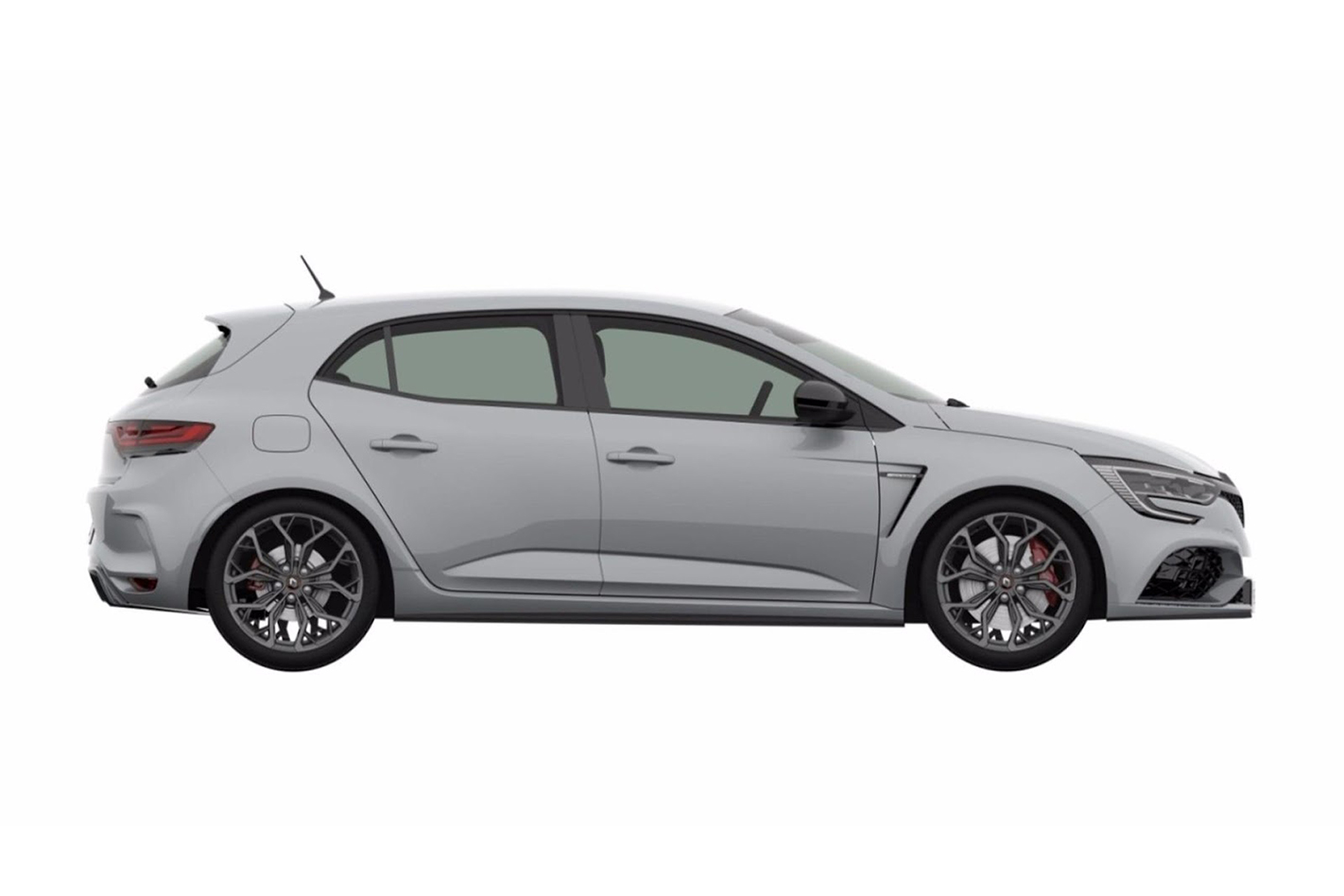
They show the RS with flared arches front and rear, a more aggressive bumper treatment in comparison to the standard Megane and unique alloy wheels.
It’s likely the Megane RS will be officially unveiled at the Frankfurt Motor Show in September, with right-hand drive examples set to be fast tracked to Australia shortly after its European launch to feed our ravenous performance-hungry market.