
THE McLaren 570S Spider has joined the growing Sports Series range, providing a sun-loving two-seater that will sit beside the coupe and GT, priced from $435,750 – $56,750 more than the coupe.
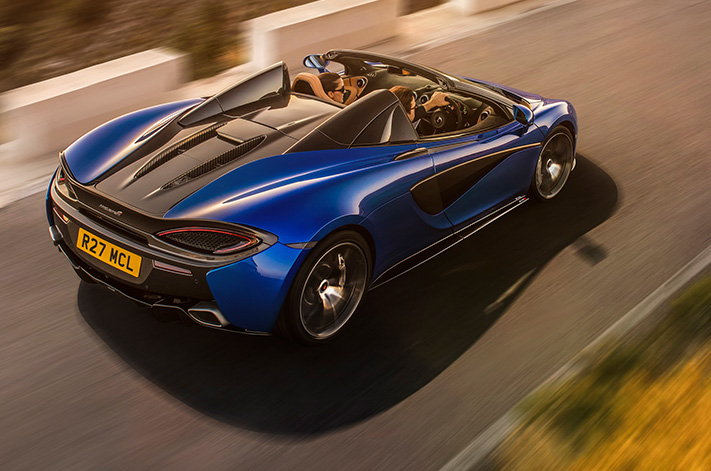
Featuring a retractable hardtop that can drop in 15 seconds at speeds of up to 40km/h, the Porsche 911 Turbo Convertible rival uses the same technology developed initially for the 650S and 675LT Spider.
The removable roof adds 46kg to the 570S Spider’s carbonfibre-clad kerb weight, with extra reinforcement keeping the drop-top’s torsional rigidity the same as for the coupe.
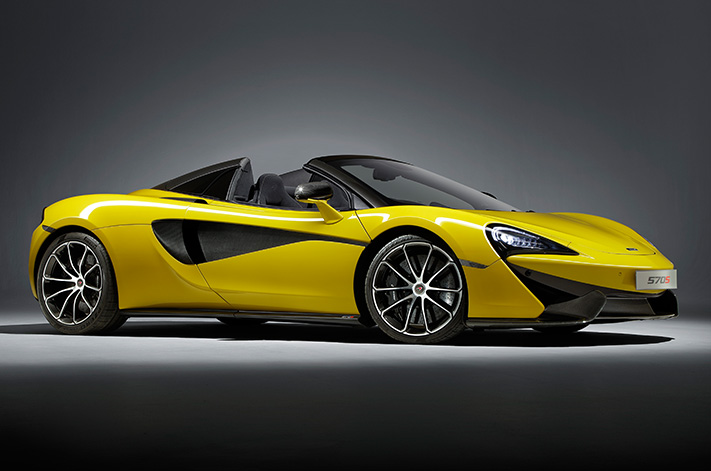
Meanwhile, its mid-mounted 419kW, 600Nm 3.8-litre twin-turbo V8 will push the 1498kg two-seater from 0-100km/h in 3.2 seconds, the same as for the hard-topped version.
The 570S Spider uses an unchanged seven-speed single-clutch transmission as the coupe. The suspension also remains as dual wishbones with adaptive dampers allowing for Normal, Sport and Track modes, with staggered Pirelli rubber – on 19-inch 10-spoke forged alloys down the front, 20s down the back – wrapped around pizza tray-sized carbon ceramic discs.
The Spider will hit a top speed of 328km/h, the same as for the Coupe, but roof-down it’s limited to a slightly milder 315km/h. Flat out, Bentley’s four-seat Continental GTC Supersports Convertible, flagged the fastest four-seat drop-top in the world, will edge out to 336km/h thanks to its 522kW, 1017Nm 6.0-litre W12 engine.
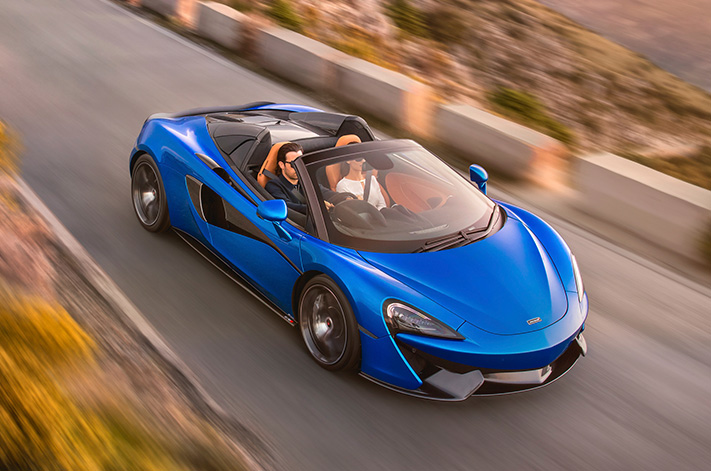
Corner-carving ability comes courtesy of a system developed originally for Formula One called Brake Steer, which uses the McLaren’s brakes to drag the inside wheel on tip-in, helping to turn the 570S and minimise understeer. You’ll be able to test it at the limit too, with the electronic stability control system including a ‘Dynamic’ mode that switches off most of the electronic nannies and introduces the driver to a concept that McLaren simply describes as “increased driftability”.
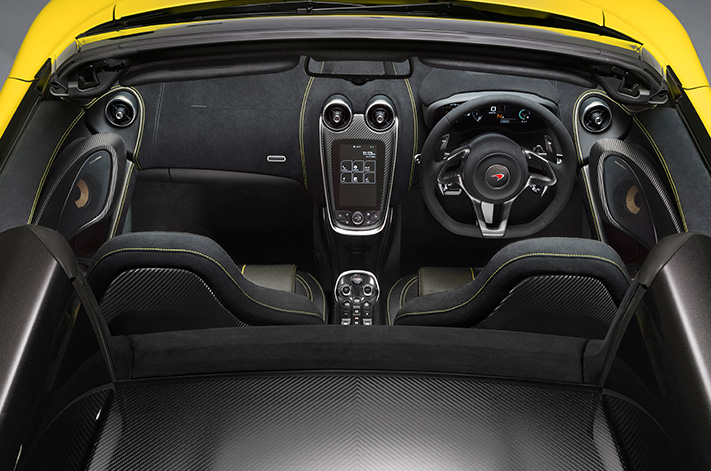
Don’t like the pork that the seats add? As always, there’s the option to rip them out and replace them with lightweight carbonfibre shell sport seats developed for the P1.
The first international deliveries of the McLaren 570S Spider start late this year.
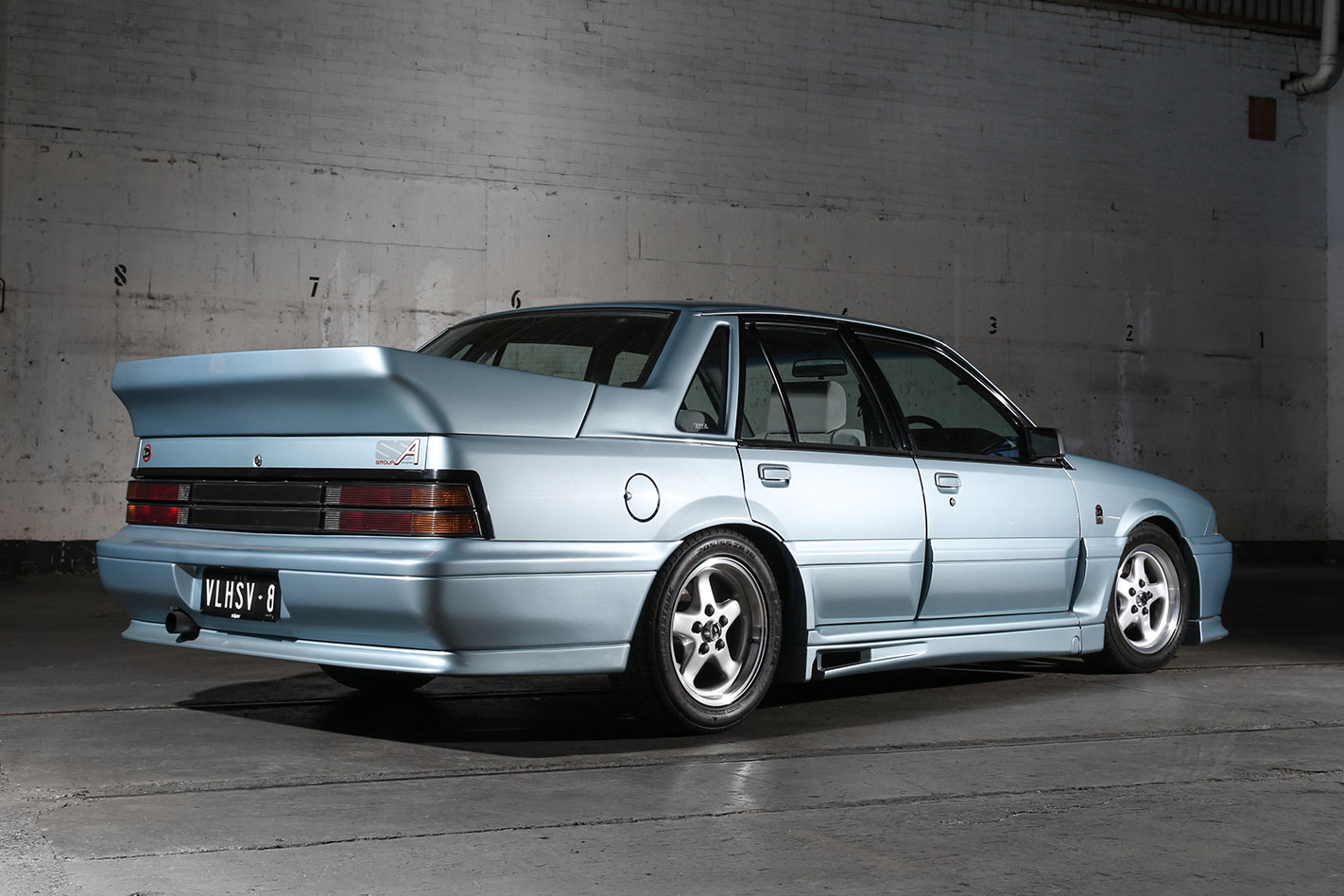
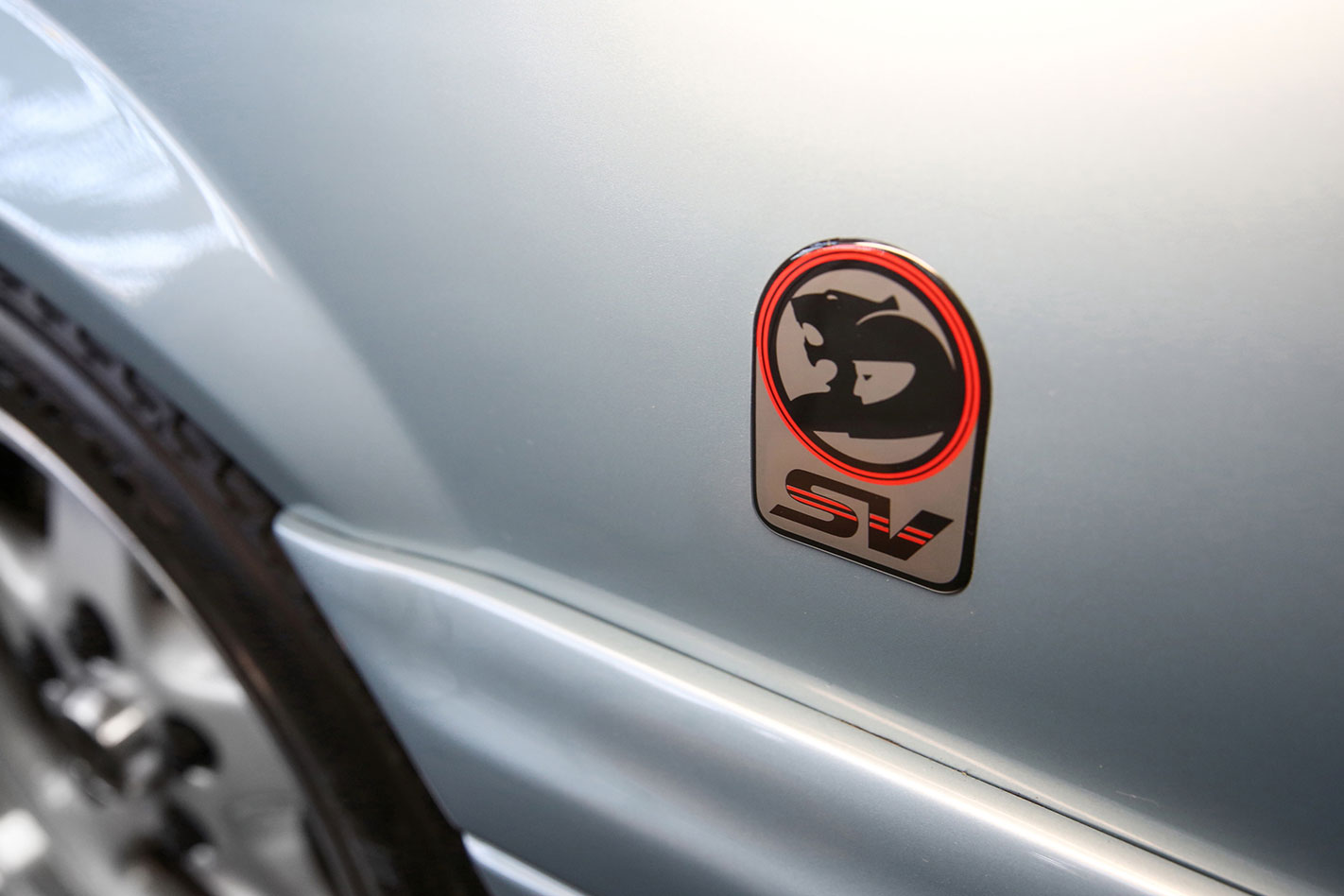
We know it these days as the Walkinshaw. But back in the day, it was called some terrible names. Plastic Pig, Batmobile, and there were other, less printable names for the first fair-dinkum HSV.
Fact is, the Walky was the homologation car needed for Holden to go racing and, with the move to Group A a few years earlier, you couldn’t just go and build a `roided V8 Commo with boxed guards and a killer wing.
Nope, if you wanted to race that on the alleged level playing field of Group A, you had to homologate it first. And that’s where the Walkinshaw’s mad body-kit came in.
The spirit of the rule was to force the race-cars to use stock headers. HSV had a better idea: It made a set of headers that was essentially just the flange and a few millimetres of pipe. Run what you like from there, fellas.
Still, it was the body-kit that was grabbing headlines and holding the car back, both in the showroom and at Bathurst as it turned out.
That said, the body-kit was way too extreme for the street and most dealers supplied the very lowest skirts and lips in a box, allowing the new owner to choose whether he or she wanted to full Group A look OR to be able to enter a service station. ‘Cos you really couldn’t have it both ways.
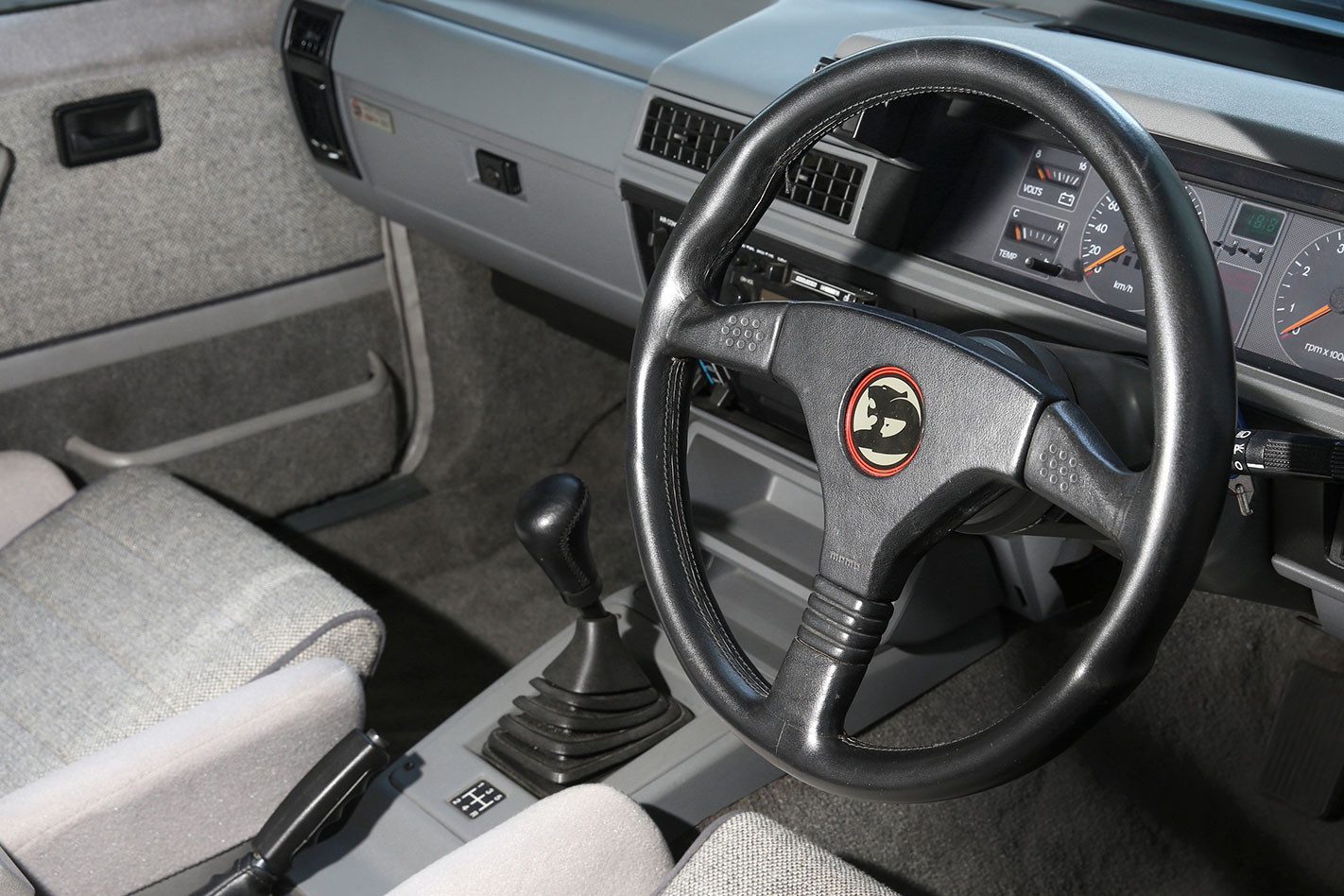
At just 1340kg, it was a good 400 or 500 kegs lighter than the current stuff. Throw in gear ratios in the five-speed that were realistic and you had a car that felt fast and fun. And still does.
Oh, and here’s another thing: Even though it was relatively low-tech with a live rear axle and such, the Walkinshaw was streets ahead of the standard VL Commodore on which it was based. Where the latter could be relied upon to fall over in corners and spin an inside-rear in the Maccas drive-through, the VL Group A SS was a much tidier, responsive thing.
In fact – and it’s a big statement – the Walky might just be the HSV that represents the biggest improvement over the donor dunger in the brand’s history.
Engine:4987cc, V8, OHV, 16-valve Power: 180kW @ 5200rpm Torque: 380Nm @ 4000rpm 0-100km/h: 6.5sec (claimed) Weight: 1340kg Price when new: $45,000 Years on sale: 1988-1989
Welcome to episode five of the Performance Car Podcast.
This episode is all about the Nissan R35 GT-R, with our studio being the rare and exotic Nissan GT-R NISMO, released to the Australian market earlier in 2017.
Editor Dylan Campbell and Associate Editor Scott Newman discuss how the R35 GT-R has evolved since its introduction a decade ago, culminating in the 441kW NISMO, how the performance car landscape has changed around it and also debunk some myths and misconceptions around the car itself.
2017 Nissan GT-R Track Edition review
This episode is slightly different as it is filmed not on the public road but at the Bryant Park hillclimb circuit, east of Melbourne, which allowed us to let the NISMO off the leash somewhat.
Don’t forget you can listen to this podcast on the run in audio form via iTunes or Podbean, please subscribe and leave us a rating. As ever, any topics or cars you’d like us to discuss please let us know in the comments below.
HSV may have inherited the dry sump lubricating system with the Corvette’s LS9, but it had to make modifications for its installation in the W1’s engine bay.
It took the upper (separation system) and lower (pick-up and transfer piping) sections of the Chevy’s oil reservoir but features a different shape and geometry – and is positioned on the opposite corner side of the engine to the US sports car. HSV’s engineers also had to create some unique oil lines.
A dual-gerotor oil pump is carried over, integrated into on to the crankshaft and featuring separate rotors for supplying and scavenging the oil.
Nick True, HSV’s managing engineer for powertrain, says while there are multiple benefits to a dry-sump system, it’s primary aim for the W1 was maintaining constant oil pick-up during fast dynamic driving on road or track.

“In a race-car application, [engineers] might scavenge harder to get that crankcase pressure lower, but we’re not doing it for that reason.”
How it happens
- A dual-gerotor oil pump is driven off the nose of the crankshaft, and comprises a primary supply rotor and a secondary ’scavenger’ rotor. The former draws oil, via a strainer, from the bottom of the 58cm40cm-tall, cylindrical oil reservoir/tank. Here, the oil is pressurised then passed through a filter and cooler to be distributed around the engine – covering key areas including the crankshaft, bearings, camshaft and piston cooling jets.
- The W1’s oil system holds 10 litres – a generous amount that is beneficial from engine degradation, cleaning and cooling perspectives.
- Gravity then does its thing and the oil drains into the shallow sump via internal passages in the engine. The scavenger pump inside the sump sucks picks up the oil and blow-by gas (an escapee from the cylinder combustion process) and pumps it back into the oil tank via a return pipe.
- A transfer pipe in the oil tank then directs this oil/gas mixture into the oil separation system, where it’s basically projected onto the sides of the tank. Oil runs down a helical ramp, draining through slots back into the bottom of the tank, while the gas is directed towards the top of the tank and onto the intake system to be burnt. (A perforated baffle plate prevents oil droplets from taking the same journey.)
- There can be aeration in the oil running back into the tank. The large oil volume allows for an increased residence time in the tank and permits de-aeration at the surface of the oil so a de-aeration process involves venting it to the surface of the oil. Oil is then picked up again from the bottom of the tank to repeat the cycle
Kia’s constantly evolving and affordable range of vehicles goes from strength to strength and the trend looks set to continue with this, the fourth-generation Optima.
On the outside, the styling changes over the previous version are hard to spot but that needn’t be a bad thing and it’s the changes under its skin that really make the difference.
WHAT STANDS OUT
With a light redesign, the Optima still looks sharp and stands out in a segment where many other options look alike.
In the previous-generation, Kia only offered the Optima with its established 2.4-litre naturally aspirated four-cylinder, but there is now a new GT which has a more powerful turbocharged 2.0-litre under its bonnet and that’s upped the performance stakes without a significant impact to fuel efficiency.
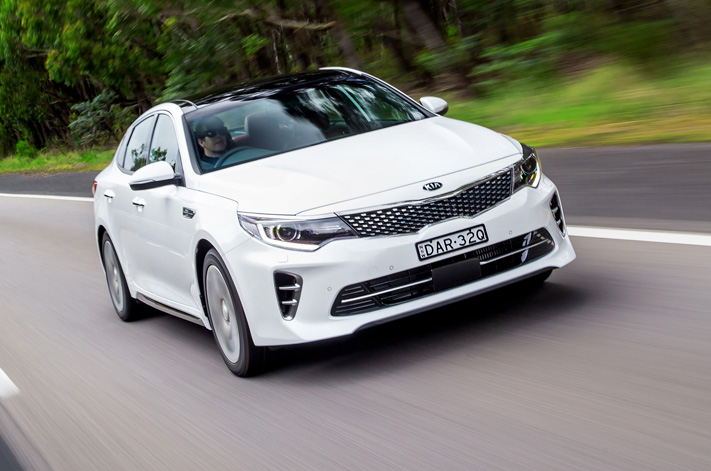
There’s also a big step up in refinement levels and classier cabin as well as a more generous standard equipment list.
If the Ford Mondeo, Volkswagen Passat or Mazda6 have gone on your consideration set, then so should the Kia.
WHAT’S INSIDE
There are big improvements to be found in the Optima’s cabin including a good mix of technology up front, sharp design and the general layout is excellent. For both versions, the touchscreen information and entertainment system is easy to use with many of the functions accessible from the steering wheel.
There’s plenty of space to be found throughout the cabin, including accommodating door pockets and a deep central console bin.
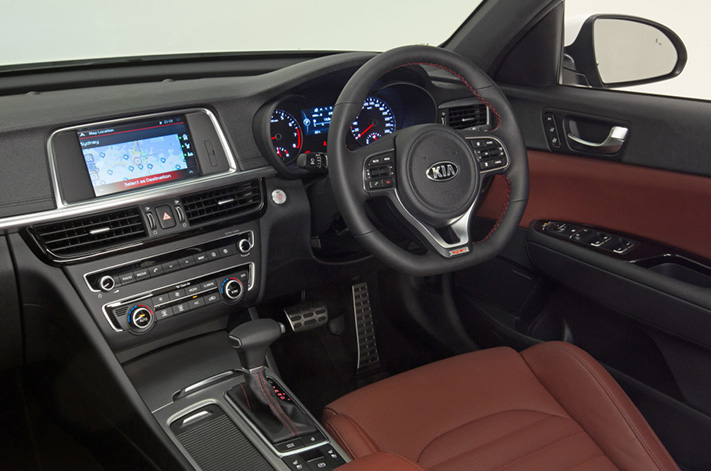
And if you’re jumping into the GT you’ll find leather upholstery, while there’s also heating and cooling for the front seats and steering wheel heating too. Life in the second row is also comfortable thanks to the generous cabin with space for kids and adults.
At the back, there is a generous 510-litre luggage area, and that can be expanded with 60/40 folding rear seats.
CHOOSING YOURS
Two variants are on offer including the Si at the entry level and the GT which brings more kit and the turbo engine which is the performance pick for drivers after a little more punch.
Both versions send power to the road via the front wheels and a six-speed automatic transmission and if you’re not looking to break lap records then the 138kW Si will probably fit the bill.
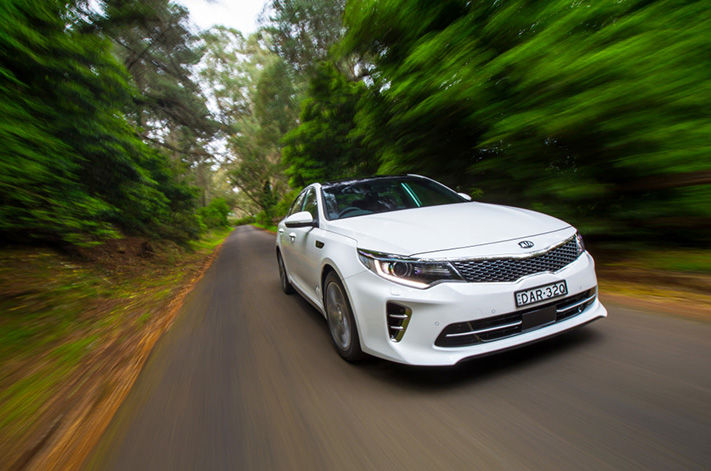
But it’s the GT’s 2.0-litre turbo with 180kW that will really appeal to drivers who want a bit of fun behind the wheel. It also has sharper styling and larger 18-inch wheels to match the extra power, but the suspension tune remains the same as the Si.
The official fuel consumption figure for the Si is 8.3 litres per 100km but that compares to 8.5L/100km for the turbo, which is a negligible difference for the extra mumbo.
Adaptive cruise control, reversing camera, automatic wipers and headlights that turn on and off, and dip the lights for oncoming traffic are standard.
Automatic emergency city and freeway braking along with lane departure warning and six airbags including curtain type are standard for both variants.
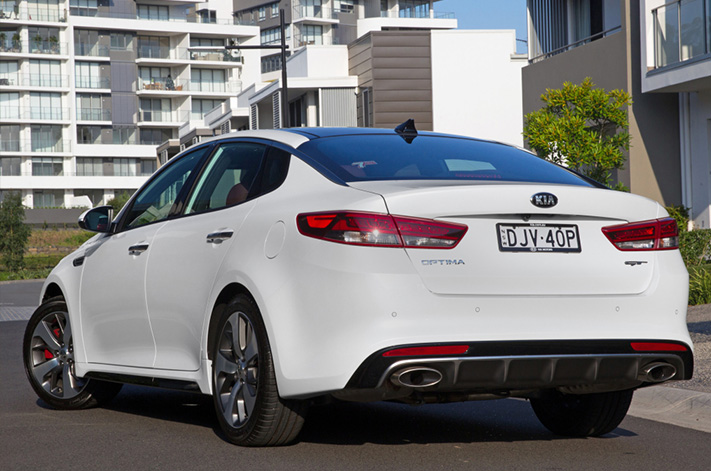
Opt for the GT and you’ll get added safety features in the form of blind spot monitoring and rear cross traffic alert.
For our money the sweet spot of the pair is the GT – that extra performance and equipment takes the Optima into new territory and with fuel economy only slightly impacted, the price premium over its Si sibling is well worth it.
SUMMING UP
The Kia Optima range offers an affordable way into the mid-sized sedan market without having to compromise on looks, equipment or performance.
A compelling package of quality, styling and kit has resulted in the first Optima that can genuinely hold its own against some European and Japanese rivals.
Here’s what you can expect from MOTOR’s latest instalment, our exciting July issue.
Oh, and we also snuck in a preview for Bang For Your Bucks 2017. Get keen!
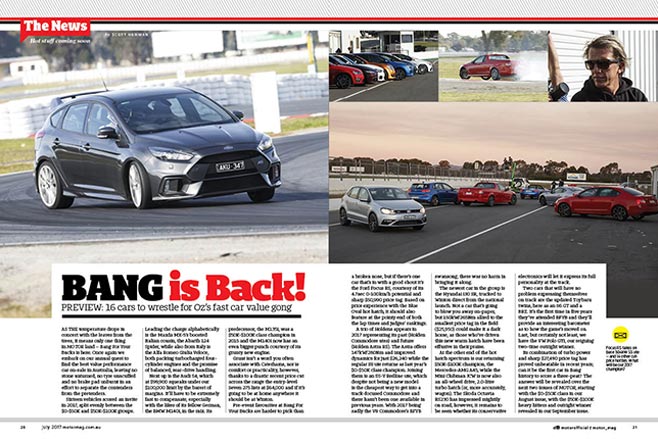
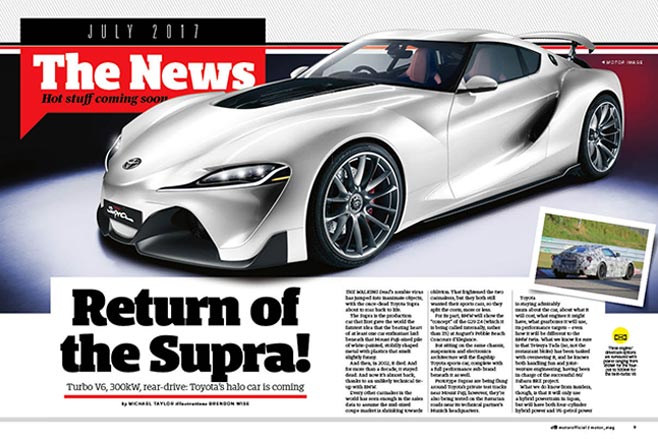
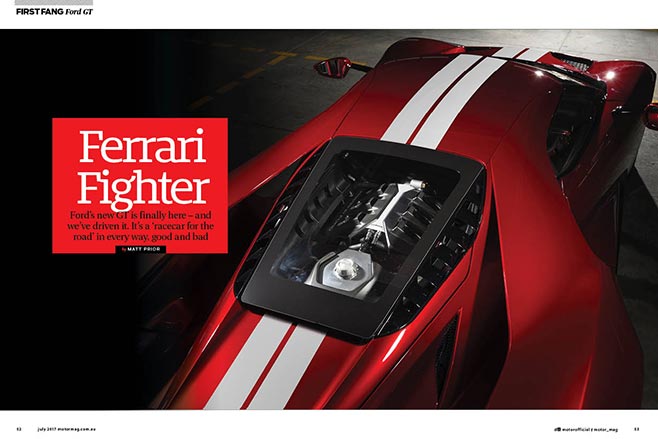
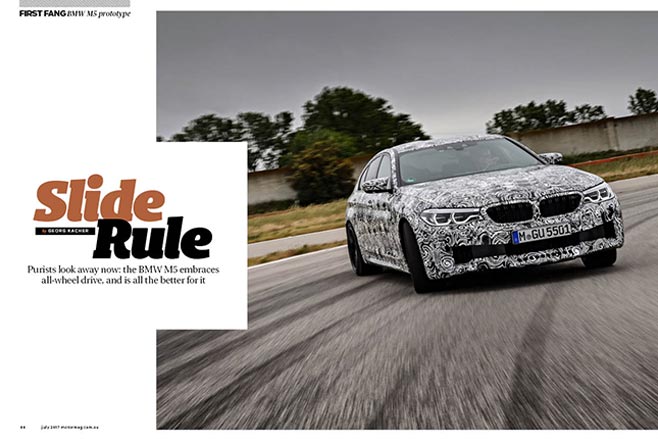

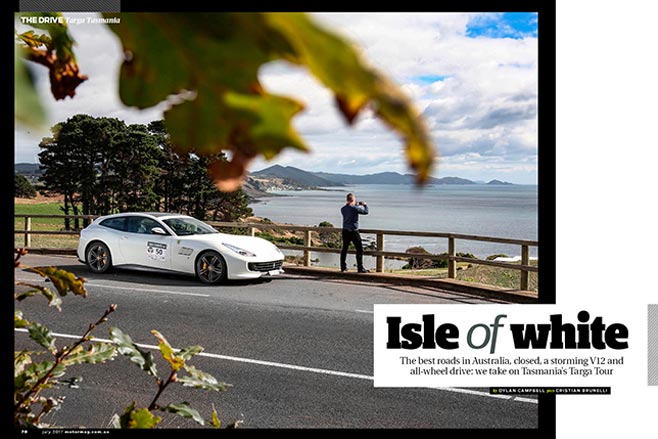
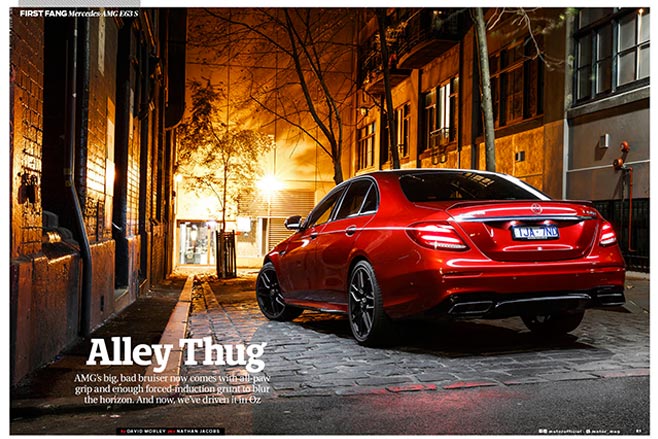
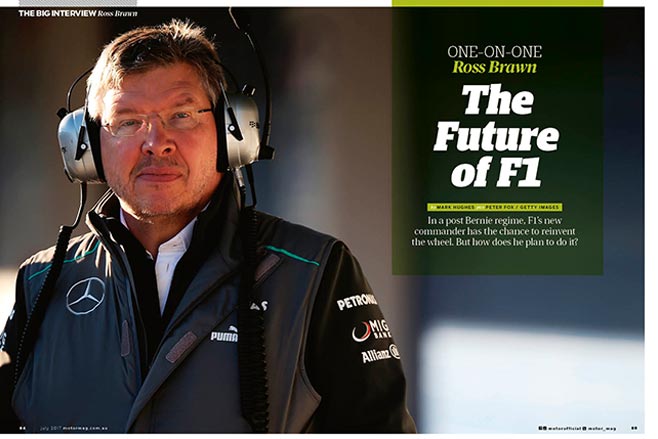


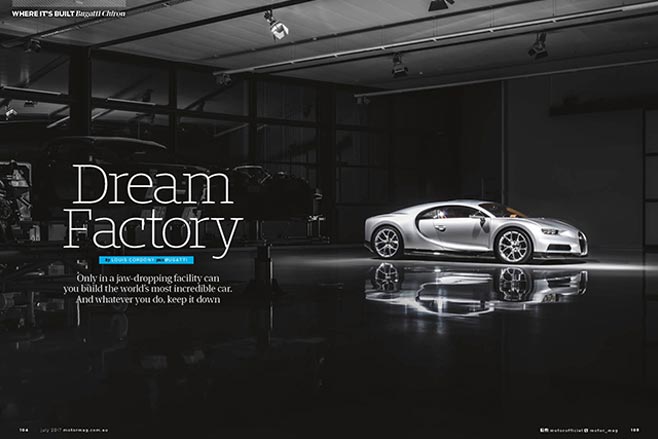
Morley’s on about Pizza and Patriots this month, plus we put a new SS V Redline up against a 2008 BMW M3 for the sake of a $60K V8.

Dropping the kids off at school has never been quicker.
The Ford Territory was never known for being particularly performance oriented, but the blokes at Independent Motorsports (IMS) have managed to change that with one example, their 620kW Barra-powered Territory.
It’s the ultimate workshop runabout.
IMS says the aim was to show the world that it is “possible for the impossibly heavy… severely disadvantaged Territory to get low ETS and high MPH without stripping it of its street ability, without converting to RWD, all while using very street-able Yokohama Advan 18″ tyres”.
Coming in at 2280kg, the Territory had a lot standing in the way of running nines, but with a lot of know-how, the Barra knows no bounds.
Mods under the hood include a Borg Warner S300 turbo with a custom front wheel running 34psi, a 4-inch stainless steel exhaust, Bosch 2200cc Injectors, a ported head, and cams from an FG Falcon.
The result?
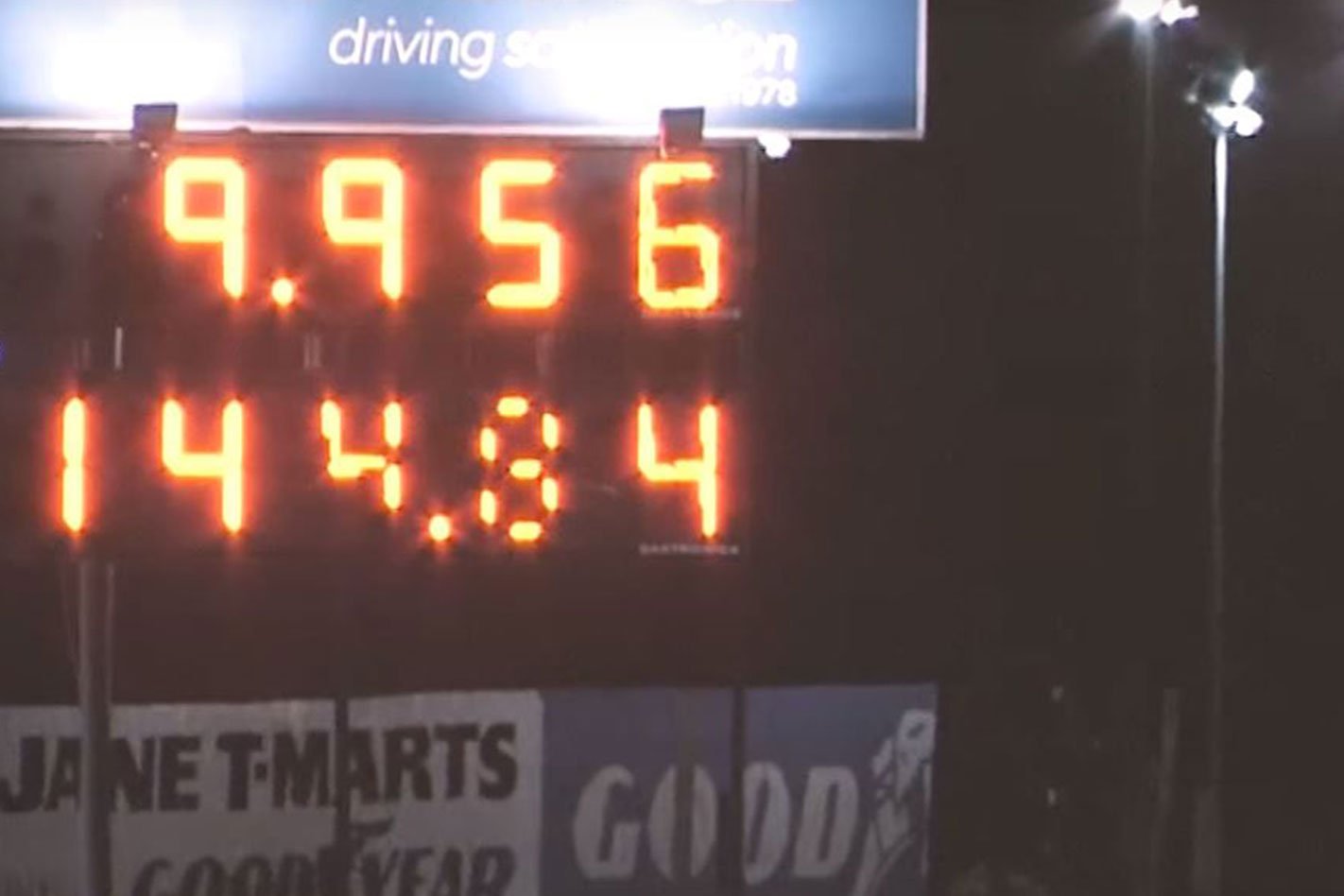
That’s about 233km/h. There really aren’t that many Territories that have, or will, reach that speed even with more than a quarter-mile of tarmac.
For extra entertainment factor, watch the Territory stroll past an FPV FG ute which was given a couple of seconds head-start at 1:55 in the video above.
MELBOURNE based Herrod Performance has given the Mustang 500kW of grunt along with an elocution lesson.
WHAT IS IT?
A long-awaited, but more powerful, right-hand-drive Shelby GT350 Mustang alternative by Melbourne-based Herrod Performance, with sophisticated handling and a supercharged donk that yields a monstrous 500kW and 750Nm.
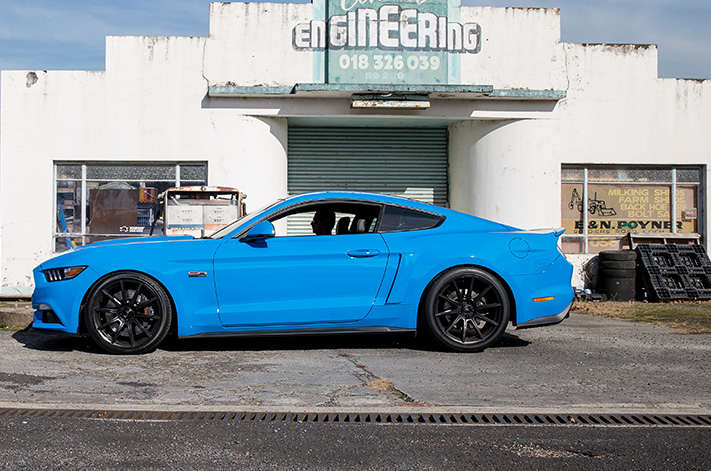
The Aussie muscle car is about to become extinct, but Ford Australia’s big-selling American coupe is ripe for local tweaking and we want to see if this blown Herrod Performance version lives up to its impressive numbers.
MAIN RIVALS The Tickford Mustang 500 and Aussie-made HSV Clubsport LSA both provide supercharged grunt for the same circa-$90,000 price tag.
THE WHEELS VERDICT Despite injecting a massive power boost that beings joy to all the senses, Herrod’s significant modifications tame the stallion by giving it road manners and refinement to make it a better all-round, but bloody quick, ride.
Minus: Barely a four seater
THE WHEELS REVIEW
WE should be grateful that Aussies can finally buy a factory-built right-hand-drive Ford Mustang for a damn near gob-smacking price, even though it took half a bloody century to get there. But with Ford US having put the kybosh on building any right-hook Shelby GT350 versions for us muscle-car-loving folk, here is a ‘factory-aftermarket’ solution for anyone who finds that situation unacceptable. The Herrod Performance Ford Mustang GT.
As an official Ford Performance Parts distributor, Rob Herrod’s slick operation in Melbourne’s Thomastown knows a bit about making Mustangs meaner. And if you go by the figures, this supercharged 500kW-plus monster puts the official 392kW/581Nm GT350 in the shade when it comes to mumbo. No, it doesn’t rev to 8250rpm, but surely 7000rpm is enough?
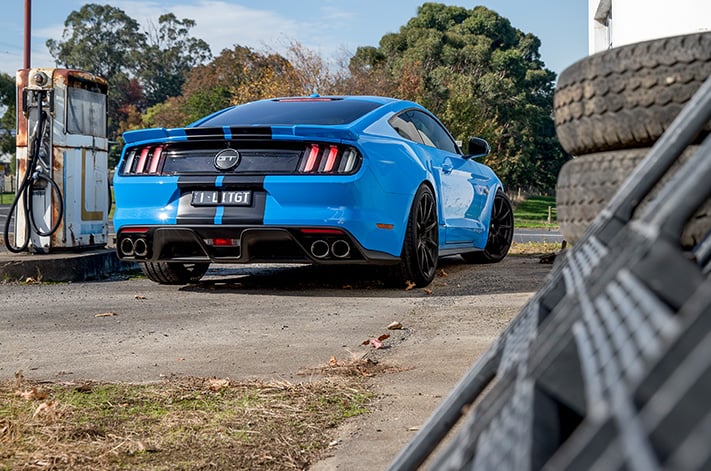
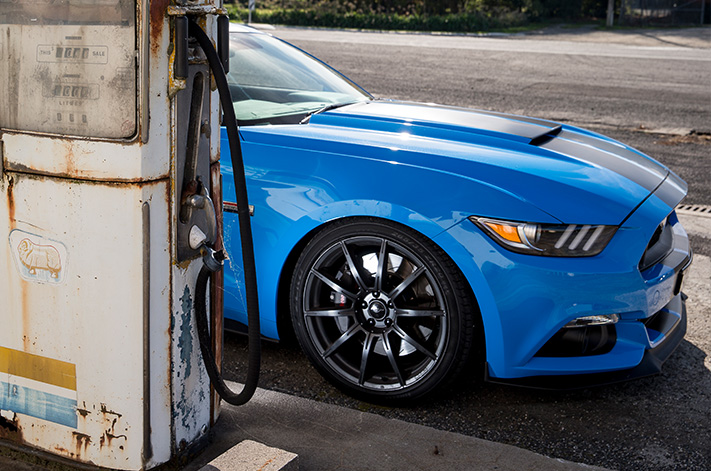
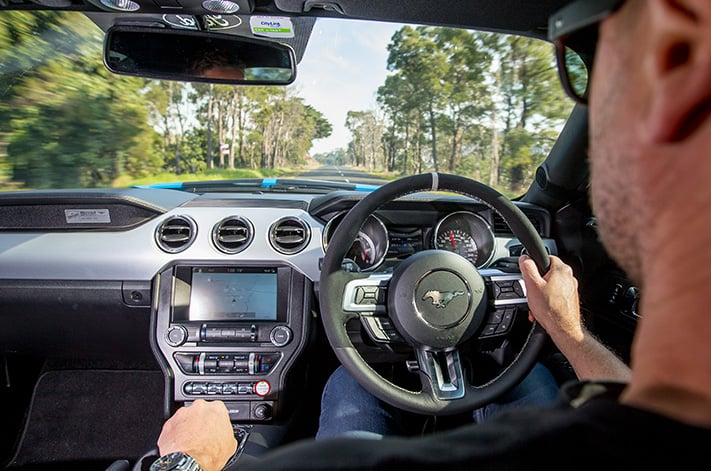
But not this six-speed manual Grabber Blue beast. An FR3 suspension pack ($2000) which incorporates completely new front strut assemblies, new anti-roll bars at both ends, and new rear springs, dampers, bushes and a different lower arm for the multi-link IRS arrangement all feature in this car, to brilliant effect. Plus it has a short-throw shifter ($950), a gorgeous GT350R Alcantara steering wheel ($850), matte-black 20-inch Momo rims with Pirelli P Zero rubber ($3900), and a bunch of other visual enticements to make it look nastier than a mugging at knifepoint.
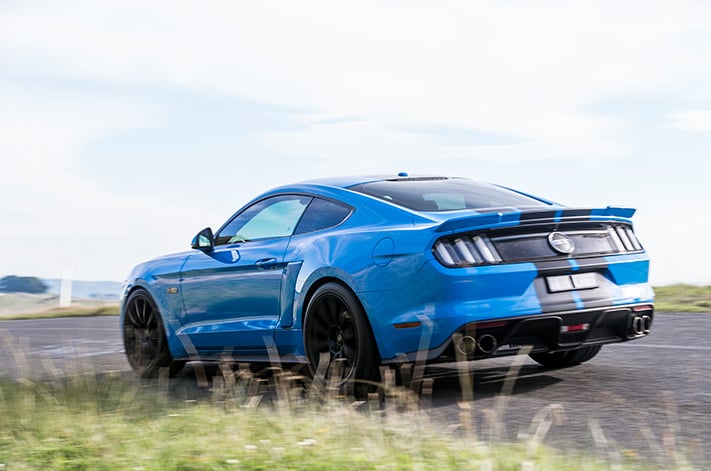
The 20-inch Momos don’t feel any heavier than the stock GT’s 19s, and the suspension changes actually improve the Mustang’s ride. There’s less of a reaction to road joins and vertical movement, making the Herrod car feel calmer, yet better controlled. For all its visual bluster, this is a seriously capable long-distance cruiser, backed by a super-tall sixth for some semblance of fuel range.
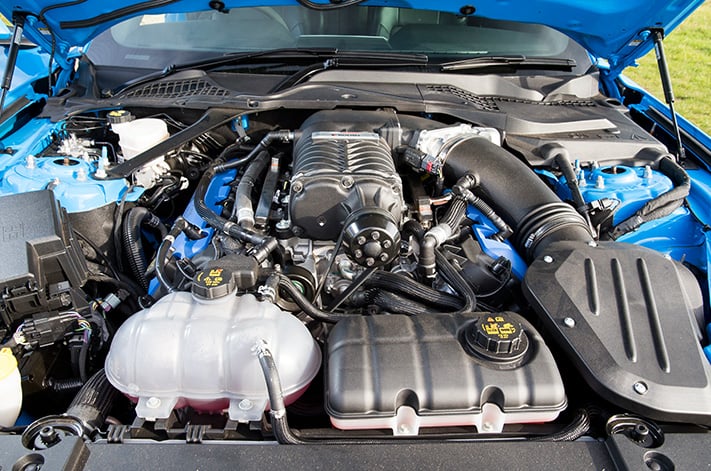
And then there’s the drivetrain. It’s surprisingly docile in Chap-lap-type scenarios (insert local cruising strip here), without the drop in engine torque off the line that demands extra revs and clutch slip in the stock Mustang manual for brisk getaways. And there’s a glorious rumble around 2000rpm that fulfils every acoustic desire even at urban speeds. The stubbier shift action – weighty as it is – also slots home with greater satisfaction than stock, providing you’re decisive with the clutch.
SPECS Model: Herrod Performance Ford Mustang GT Engine: 4951cc V8 (90°), dohc, 32v, S/C Max Power: 500kW* Max Torque: 750Nm * Transmission: 6-speed manual Weight: 1800kg* 0-100km/h: 4.5sec* Economy: n/a Price: $88,945 (as tested) * estimated
WHEN the latest Honda Civic Type R arrives this year it will be the most powerful model to ever wear the esteemed red ‘H’ badge, but it owes its heritage to a line of previous hot models that have spanned the Japanese line-up. Here are our favourites.
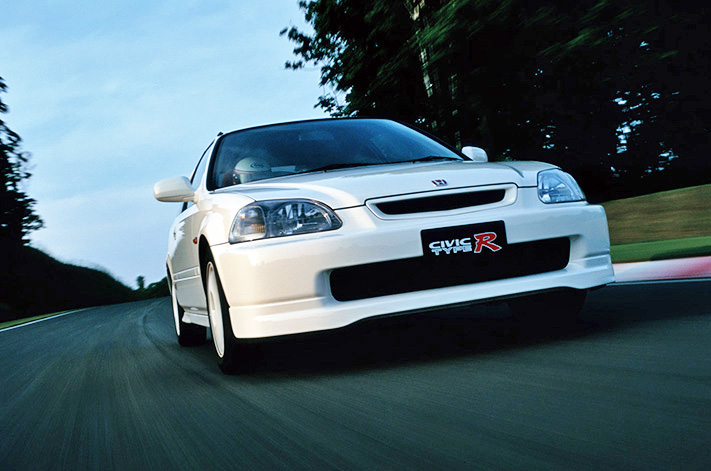
1997 Civic Type R
It took six generations of Honda’s popular Civic hatchback before the first Type R version came along, but with 136kW from just 1.6 litres, its engine produced more power per litre than almost any other road-car engine of the time.
A limited-slip differential helped get the power to the road through the front wheels, and a close-ratio manual gearbox added another hot-hatch touch.
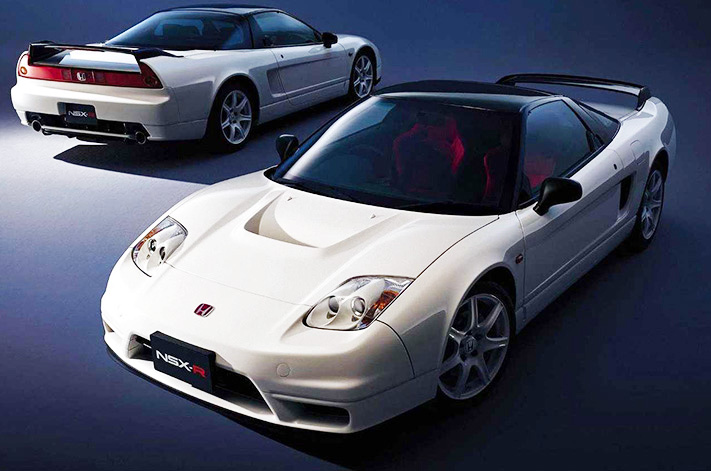
1992 NSX Type R
The one that started it all will always have a special place in the hearts of all Type R enthusiasts. As if the recipe of mid-mounted 3.0-litre V6 in a rear-drive two seater wasn’t un-Honda enough, the Japanese car maker took the NSX up another notch with a very limited number of even lighter and more potent versions.
Our favourite has to be the one that sent the model out with a bang in 2002 and the NSX-R, which used a blueprinted version of the later 3.2-litre engine with balanced components. The official power output did not exceed the 220kW of the ‘standard’ NSX, but those who drove it disagreed.
An even rarer NSX-R GT run was limited to just five examples in the name of production car-based racing homologation, and included race-car features such as a lowered and widened body, and a functional air scoop that sent fresh air from above the cockpit to the engine.
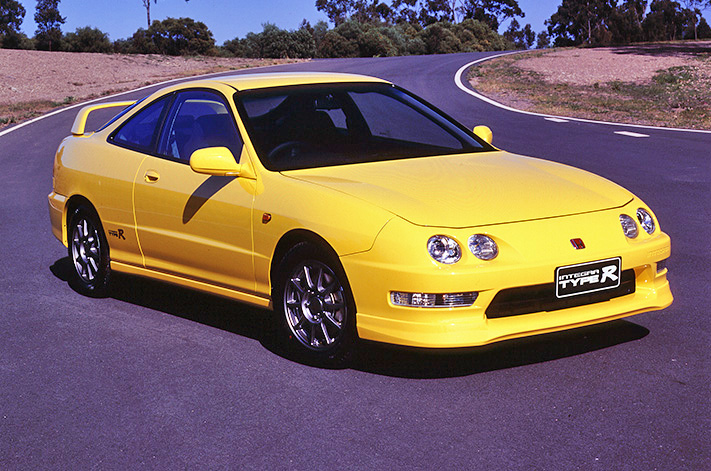
1995 Integra Type R
The hottest Integra variant shared some of its mechanicals with the first Civic Type R but a larger 1.8-litre engine gave it a decent power advantage. With a dizzy 8000rpm redline, the Integra turned out 147kW, enough to get the sporty hatch to 100km/h in about 6.0 seconds.
The JDM version that launched the model in 1995 had a more conventional front end look, but our pick is the UK and Europe version that was given a far sportier and unmistakable quad-headlight nose.
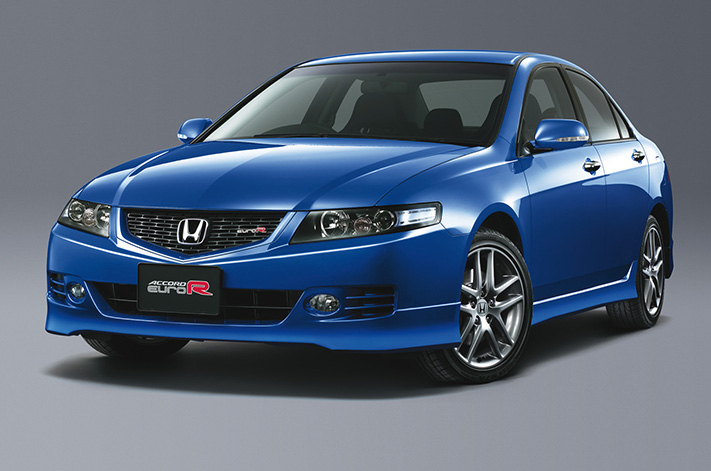
2002 Accord Euro R
In standard form, the Honda Accord Euro could be described as a little forgettable, but the addition of a 162kW i-VTEC engine, Recaro seats, larger wheels, Momo steering wheel and a body kit took the sensible sedan into a different realm.
Customers with some extra cash to spend at the dealership could add a lighter manual gearbox with six gears instead of five, for close ratio cog-swaps and a more racy feel.
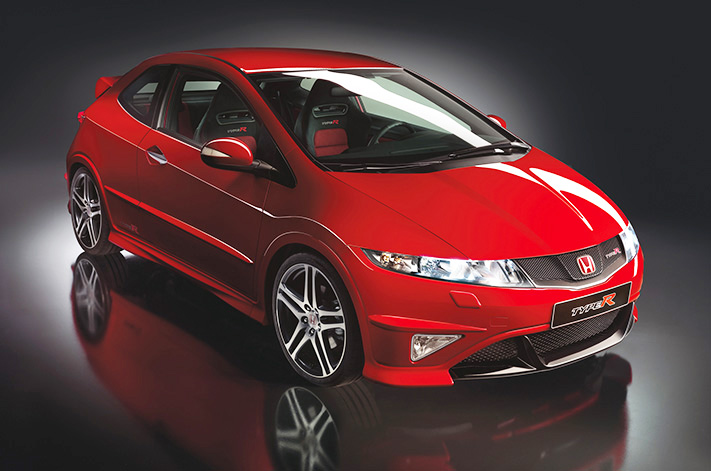
2007 FN2 Civic Type R
In the absence of a ninth-generation Civic Type R that was denied for Australia, the FN2 version was the last version offered to local enthusiasts. It was also the last to offer the classic high-revving naturally aspirated engine.
Its output of 148kW from 2.0-litres might not sound like much compared with some of its predecessors, but Honda had redressed the balance of power and torque and 90 percent of its respectable 193Nm was available from 2500rpm.
BABY’S got back. Yep, there’s a new generation of the BMW 5 Series Gran Turismo, although this time around it’s gone up a number and stacked on a little less booty.
Welcome, then, to the BMW 6 Series GT, a stretched and sculpted five-door coupe made for carrying junk in its (ever so slightly compromised) trunk, and featuring BMW 7 Series-sized interior space, as long as you’re willing to duck slightly in the rear.
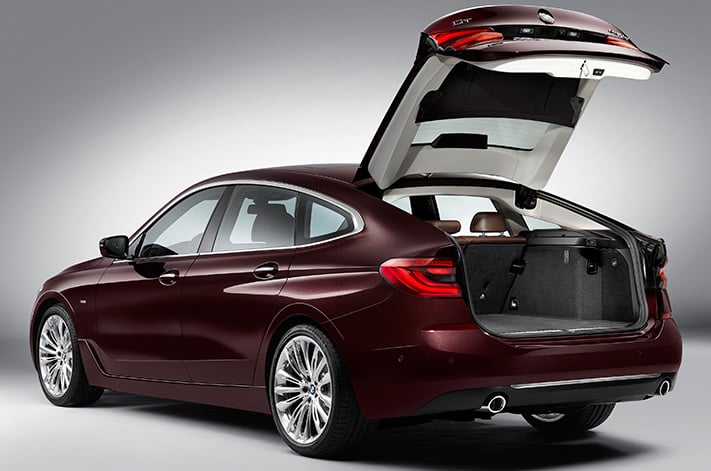
Billed as something of a Porsche Panamera rival, at least as far as its expected $200,000-plus price tag goes, the new GT fixes much of what was wrong with the dowdy, dumpy-looking fastback sedan it replaces.
Underpinning this generation though, is BMW’s “CLAR” cluster architecture, the rear-drive, hybrid-ready platform that underpins the closely related 5 Series range.
It’s a lighter architecture, too, with the 6 Series GT shedding 150kg of weight compared with the 5 Series-based model – that’s also almost twice the weight that the 5 Series dropped in its generational jump – largely through the use of more high-strength steel and aluminium. It means the new one tips the scales at less than 1800kg.
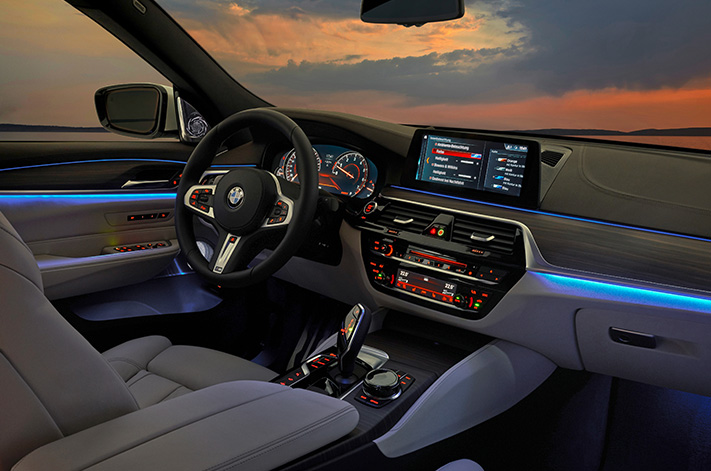
At 5091mm long, an 87mm gain on its predecessor, the 6 Series GT’s width remains unchanged at 1902mm. However, it does sit 21mm lower to the ground at 1538mm. The wheelbase remains at 3070mm.
Significantly though, the rear of the tailgate sits 67mm lower than the 6 Series GT’s predecessor, while inside there’s slightly more rear-seat headroom available.
Despite its more low-slung looks, boot space – one of the main areas of criticism in the old model – increases by 110 litres to 610L. Fold down the 40:20:40 split-fold rear seats via the push of a button, and that grows to a much more useable 1800L.
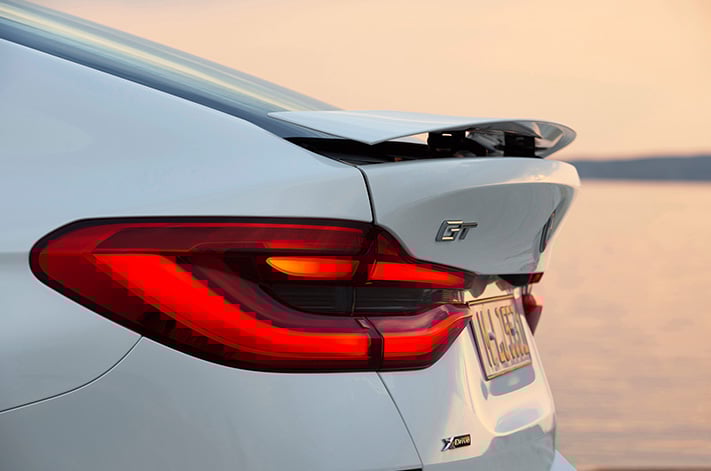
Standard equipment on European versions of the 6 Series GT includes LED headlights, as well as a system that can detect if you’re driving the wrong way down a one-way street. The rear axle uses self-levelling air suspension and active rear steering is optional on xDrive all-wheel-drive versions.
BMW says two petrol engines (190kW/400Nm 2.0-litre four-cylinder 630i and 250kW/450Nm 3.0-litre six-cylinder 640i), and one diesel unit (195kW/620Nm 3.0-litre six-cylinder 630d) will be available from launch, all paired with an eight-speed automatic transmission.
The 6 Series Gran Turismo will be unveiled at September’s Frankfurt Motor Show.
