
Speed isn’t inborn. It’s a skill. One racers hone in the gritty world of motorsport.
And there’s a place, half an hour south of Brisbane, where race-hardened drivers will impart you secrets of the craft.
But this tutelage comes at a fee, $1485 in fact, as part of Porsche’s Sport Driving School; a five-stage program designed to boost your skills from rookie to racer.
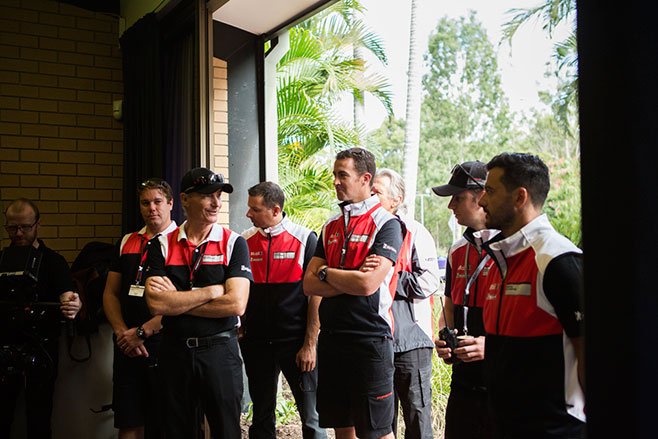
It lays the crucial learning blocks for customers who can end up at Master, which involves a full track day in a 911 GT3 road car and telemetry analysis, before eventually finding GT3 Cup – where you strap into a 911 GT3 Cup racer. If their wallet’s big enough.
So Porsche’s most basic lesson is a serious affair. In fact, even experienced MOTOR readers will learn a lot, and fang many Porsches in the process (everything bar GT cars).
Sure, the day alone won’t make you a racing driver. But it’ll get you started. Here are our top-six speed tips from the day…
REACT WITH SOMETHING REPEATABLE
It’s best to counter-steer with a technique that’s repeatable, says V8 Supercar driver Steve Owen. There’s no use saving a yaw movement if you can’t catch the second.
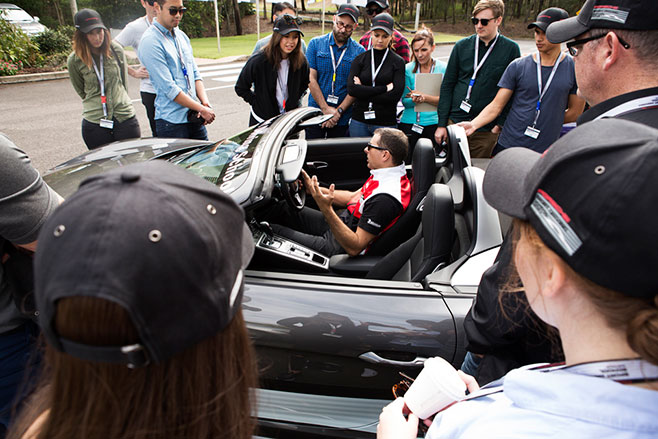
During a wet motorkhana competition Daniel Gaunt, ex-A1 GP driver, said leaving ESP half on will make the car faster. It’s electronic brain able to manage slip much better than you.
ROLL CAGES AREN’T FOR SAFETY….
…well, they are. But according to Tomas Mezera, ex-Bathurst winner and the program’s headmaster, engineers are more focused on stiffening a car’s chassis when they design a roll-cage. Drivers are changeable “light bulbs”, he jokes.
SIT LOW, EYES UP
Sitting low down in a car not only helps you feel what the car is doing, but also forces you to raise your vision and look further down the road.
SLOW AND STEADY
Turn into a corner slow and smoothly. Every input should be considered. Remember, where you look, you steer, and that’s where the car will go.

That dead pedal underneath the steering wheel? While a convenient rest during cruise control, it’s also a great way to brace yourself during hard driving – keeping your body firmly in place.
Honda and Rahal take two from two in Detroit
Chevrolet crushed in Motown
Honda might be struggling in Formula One but it’s a different story in Indy Cars, with driver Graham Rahal and the Japanese powerplant taking two strong wins in rival Chevrolet’s home town in the two-race Detroit Grand Prix at Belle Isle Park.
Seventy-lap races on Saturday and Sunday, each time preceded by morning qualifying, were the focus of so much interest, after a fascinating Indianapolis 500 the previous weekend.
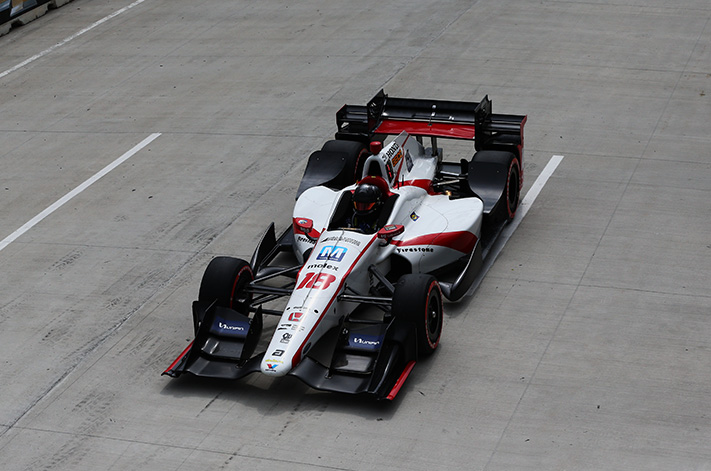
Davison turned in a stellar drive subbing for Bourdais at Indy on short notice, moving forward from the rear of the field to lead the race in a performance that attracted a lot of positive comment. But in small outfits like Dale Coyne Racing, money speaks volumes. The Mexican had some to bring; Davison didn’t.
Gutierrez, a rookie in IndyCars, also came with welter of road-racing experience, making the choice a no brainer.
Ganassi Honda driver Dixon showed no outward signs of any after effects from his shunt, finishing second to Rahal on Saturday, battling through pain in his left leg and ankle on one seriously bumpy and physical racetrack.
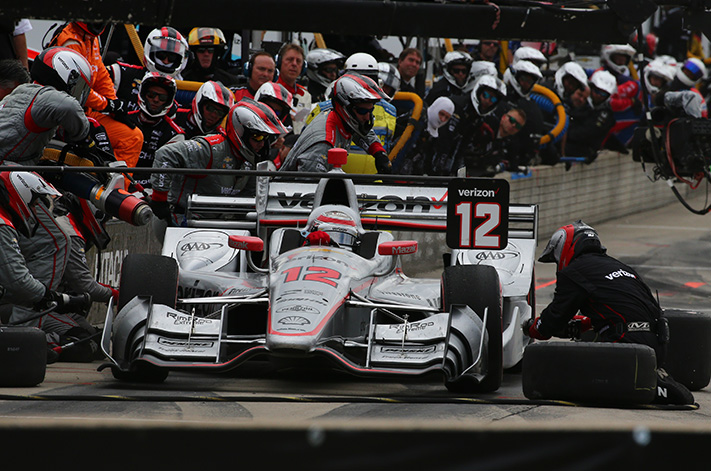
The Sunday race was controversially red flagged and then restarted with two laps remaining, giving Newgarden and Power one last shot at Rahal.
But all three commented they were happy just to survive. Said Newgarden: “We had marbles all over our tyres – all we wanted to do was finish. We were sliding all over the place.”
Power added that he wasn’t close enough to Newgarden to think about a pass and that “he is my team-mate so I wasn’t taking any risks”.
“I’m really happy with third,” Power emphasised. Behind Power were Indy 500 winner, and pole man Takuma Sato, defending Indycar champ Simon Pagenaud and the consistent Dixon.

With the two wins, Rahal vaulted nine spots in the championship standings, to sixth place after eight of 17 races. The 28-year-old second-generation racer is the first driver to win two races this season.
Leaving Detroit, the tough Dixon leads the standings on 303 points, closely shadowed by Helio Castroneves (295), Sato (292), Pagenaud (278), Newgarden (259), and Rahal (251). Power is eighth on 233 points.
Ducati’s Dovizioso stuns in home MotoGP
Captivating racing at Mugello
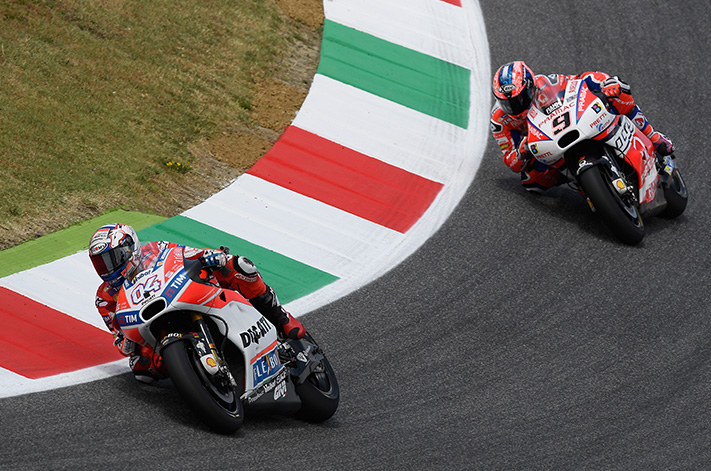
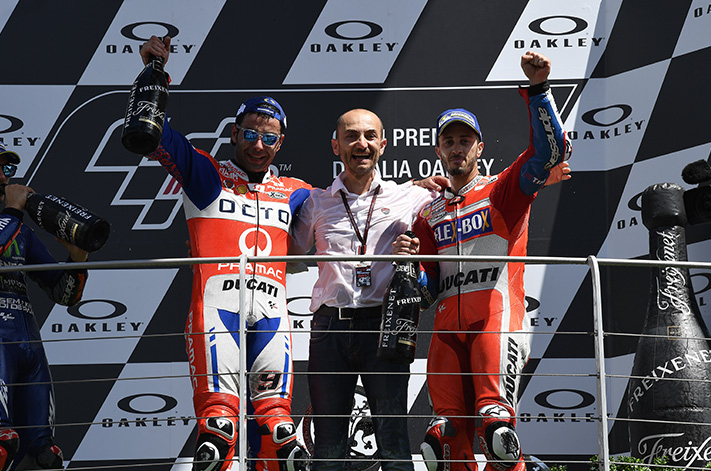
Overcoming a bout of food poisoning overnight, Ducati’s Andrea Dovizioso scored a gutsy win in the weekend’s epic Italian MotoGP race at Mugello in Tuscany in front of a noisy, record crowd of 98,269 spectators.
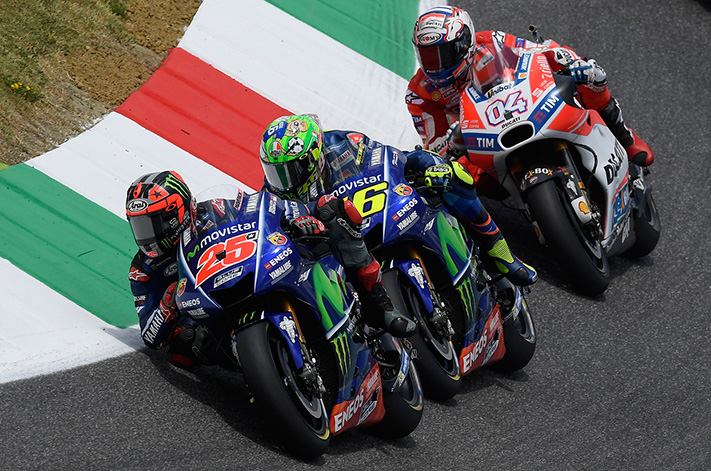
“Dovi” was flawless, taking the win – his third in MotoGP but his first in stable dry track conditions – from Yamaha’s Maverick Vinales and the impressive and fired up Danilo Petrucci on the satellite Pramac Desmosedici GP Ducati.
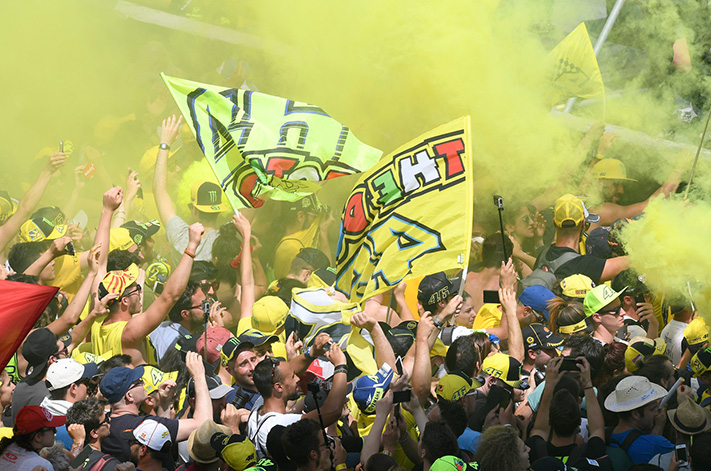
The bulk of the spectators, who created a sea of yellow on the hills, wanted a Valentino Rossi victory and the local legend gave them hope when, from the centre of the front row, he led into turn one and duelled with Ducati’s Jorge Lorenzo and Vinales in the opening laps.
Dovizioso, who started from the front row after qualifying third, was fourth in the early running but used the power of the Ducati and some strong late braking to push forward to second behind Vinales on lap six, as his team-mate Lorenzo dropped back through the field.
Dovizioso surged to the front mid-race but had to fight off attacks from ever-present Vinales and Petrucci, who got as high as second in the race of his life.
“Today I didn’t have much energy, but I knew that the bike was going to be strong, because we had worked well throughout the weekend and I also had a lot of support from my fans, physiotherapist and family and this made a big difference. I rode really smoothly, I never forced the pace excessively and this made all the difference because Mugello is a track that physically wears you out and in any case the tyres did not allow me to push too hard. Finally we did it: winning at Mugello is really something special!”
Rossi, battling injuries suffered in a motocross training spill, had to settle for fourth, ahead of Alvaro Bautista (Ducati) and Honda’s Marc Marquez, who never threatened.
Lorenzo was eighth while Australian Jack Miller managed 15th after Dani Pedrosa took out Cal Crutchlow on the final lap as the Honda pair scrapped over a lowly 11th.
Racing in all three classes was spectacular, with Mugello’s slipstreaming possibilities making for great pack racing.
Six laps from the finish of the stunning Moto3 race, 22 riders were still part of the leading bunch, covered by a mere 1.6 secs!
There were at least 14 different leaders until finally KTM’s Andrea Migno claimed his first GP win by 0.05sec in a result which was in doubt right until the end.
Australia’s Remy Gardner also had a heartening time in the Tuscan hills, finishing 14thto bag his first Moto2 World Championship points of the season and his first for the Tech3 Moto2 Racing Team. Gardner is slowly regaining fitness after a broken ankle in the Austin race.
But those armies of spectators went home from Mugello deliriously happy with local heroes taking out all three GPs, and a Ducati on top in the premier class.
IndyCar champ fires back at churlish Mercedes driver
Probably fair to suggest we won’t see Hamilton at Indianapolis
Doncha love it when a self-absorbed prat gets his come-uppance? No, not Donald Trump, not in this case. Nor Tony Cochrane. Nor Lance Stroll.
Perhaps disturbed that the motor sporting spotlight was not on him but on another multiple world champ who was an ocean and half away contesting the Indianapolis 500, Lewis Hamilton checked his phone, adjusted his shades and patted his jewellery and delivered an unworthy put down of Fernando Alonso’s campaign at the Brickyard.
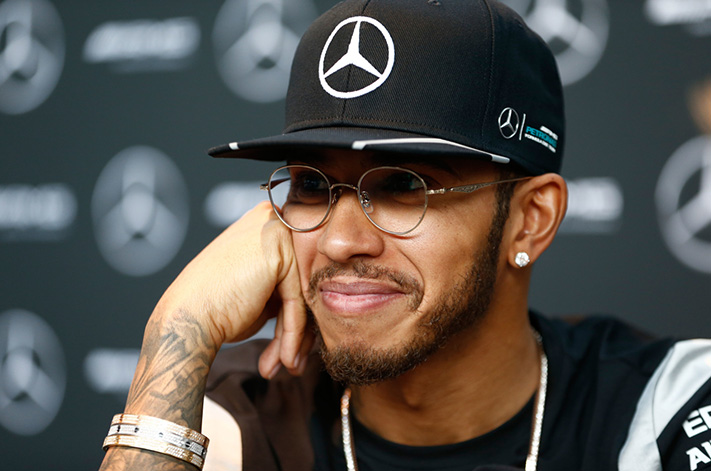
So in one mean and meagre quote, Hamilton (who at the time was flat-out under-delivering at Monaco) managed to belittle Alonso’s bold venture into the uncharted waters of oval racing while at the same time was disparaging of the whole American Indy Car community.
As we now all know, Alonso went on to deliver an outstanding drive in the 500, leading 27 laps and duelling comfortably in the top 10 when his Honda expired.
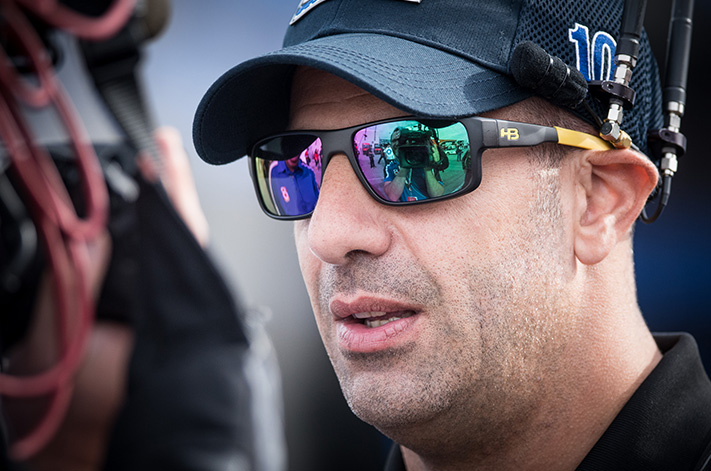
But hey Lewis, more importantly… your new designer shades are trending on Twitter.
Button to race NSX-GT in Super GT Series
2009 world champ bitten by the race bug
After, well, not doing very much at all this year up until he subbed for Fernando Alonso at Monaco, Jenson Button has now agreed to race a Honda NSX-GT Super GT machine in the Suzuka round of the Japanese championship.
Honda has confirmed that Button, a reserve driver for the McLaren F1 team, which uses Honda power units, will race in the 2017 Super GT Series on August 27.
On a circuit he is very familiar with, Button will share a Mugen Honda NSX-GT in the 1000-kilometer race with full-time team drivers Hideki Mutoh and Daisuke Nakajima.
The 2009 F1 world champion will test the NSX-GT for the first time at the Suzuka this week. He drove a prototype late last year.
Indoor motocross facility for Sydney
Expands one-stop motorsport “shopping” at Eastern Creek
Sydney, which hosted Australia’s first indoor Supercross show at the Entertainment Centre, is now on track to get Australia’s first ever permanent indoor motocross stadium which is intended to give dirt bike riders a new, legal and safe home in Sydney.
The $5 million project – to be known as Sydney Indoor MotoX Park – will be constructed within the Eastern Creek International Karting Raceway precinct adjacent Sydney Motor Sport Parks racing circuits.
The Sydney Indoor MotoX Park is the first of its kind in Australia and the 12,000 square metre facility will be housed in a revolutionary, climate controlled, air-filled membrane dome, constructed in the United States.

Sydney Indoor MotoX Park will house three separate racetracks all capable of operating independently of each other. Stadium style seating for up to 6000 spectators will all be part of the park.
Designed to operating in tandem with Garry Holt’s karting facility, it will co-use a café and retail outlet and will cater for varying skill levels from entry-level juniors right through to professional motocross racers.
CCTV will monitor all tracks, trained first aid practitioners and mechanics will all be available to those wishing to challenge themselves, whilst future plans include training camps from some of Australia’s best known motocross riders.
Privately funded, the project is the brainchild of lifelong dirt bike rider and motocross fan Mattew Bartolo. It was sparked by his frustration with not having a place close to Sydney to ride with his children.
Blown globes: it’s a pain when the light in your bathroom gets unexpectedly snuffed out, but it can be downright dangerous if the various lamps on your car quit shining bright.
It’s generally easy to tell when a headlamp globe blows out, given the road in front of your car will become noticeably dimmer at night, but what’s the best way on keeping an eye on the rest of your globes when you’re in the driver’s seat? What’s more, how do you go about fixing it? WhichCar shows you how.
If, like most people, you simply jump in your car, flip on the lights and drive away, it can be difficult to tell when your tail lamps, brake lights, parking lights and indicators stop working. The easiest way is to start your car, put the hazard lamps on to get your indicators flashing, and switch on the headlamps so both your head and tail lamps are illuminated. Walk around the car and it should be quickly apparent if a globe is busted.
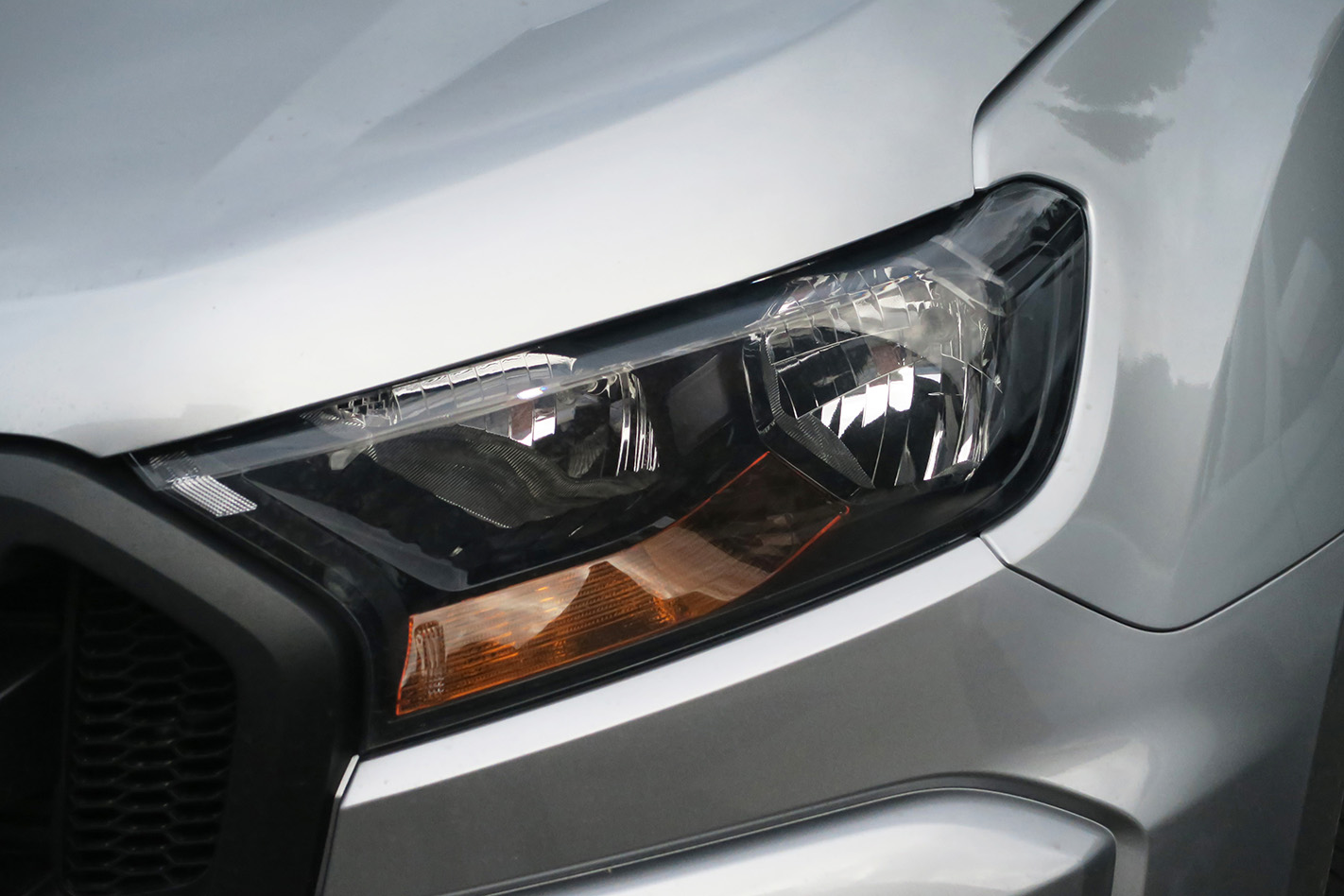
If you have a friend to help, get them to press the brake pedal as you walk around, as well as put it in reverse while holding the brake on. Even if you don’t, most cars will have a warning light in the instrument cluster that will tell you when a brake light is not working – though it won’t necessarily tell you which globe needs replacing.
A blown indicator globe can also be detected if you notice the rate of flashing has suddenly increased. If the clicking noise of the indicators seems faster when indicating in one direction, that’s your clue – the side that clicks faster is the side where a globe needs replacing.
It’s worth performing this inspection every two months or so. Remember – having non-functioning lights technically makes your car unroadworthy, so when you notice a globe is blown replace it as soon as possible.
Replacing a globe
The exact procedure for replacing a globe can vary greatly from car to car, and can be tricky for cars with higher-tech illumination like LEDs, xenon or lasers – those are best serviced by a dealership. For most mainstream cars, however, regular incandescent globes similar to those found in your home are still common, and easily replaced on the driveway.
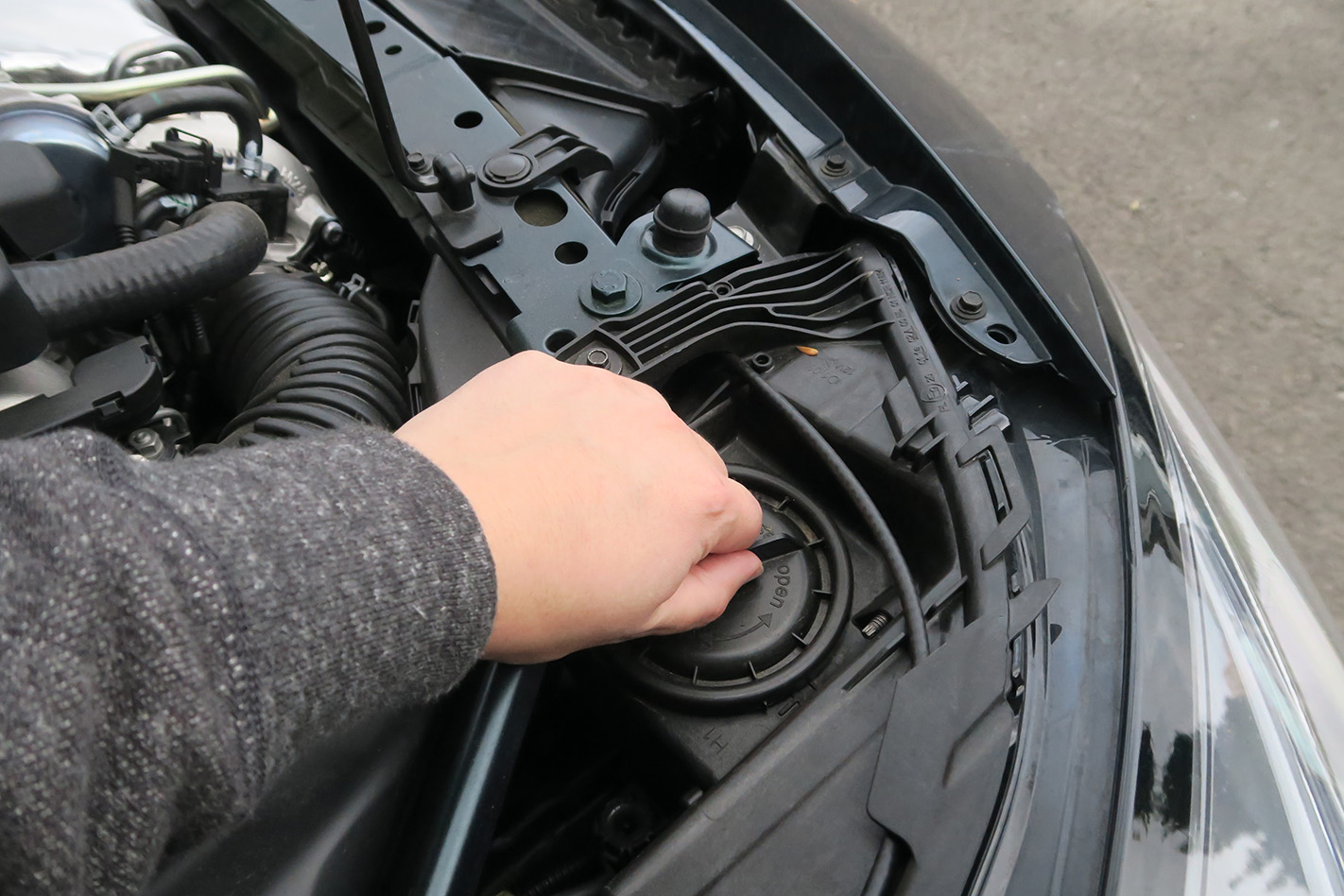
Your owner’s manual is your best resource when it comes to properly replacing your globes, though most cars follow the same basic conventions when it comes to lights.
Headlamp, parking lamp and front indicator globes are typically accessed from the engine bay, with a removable cap on the rear or top of the headlamp housing (above) allowing enough room to reach in and grab them. There may be individual caps for the low beam, high beam and indicators, or there may just be one – it can vary.
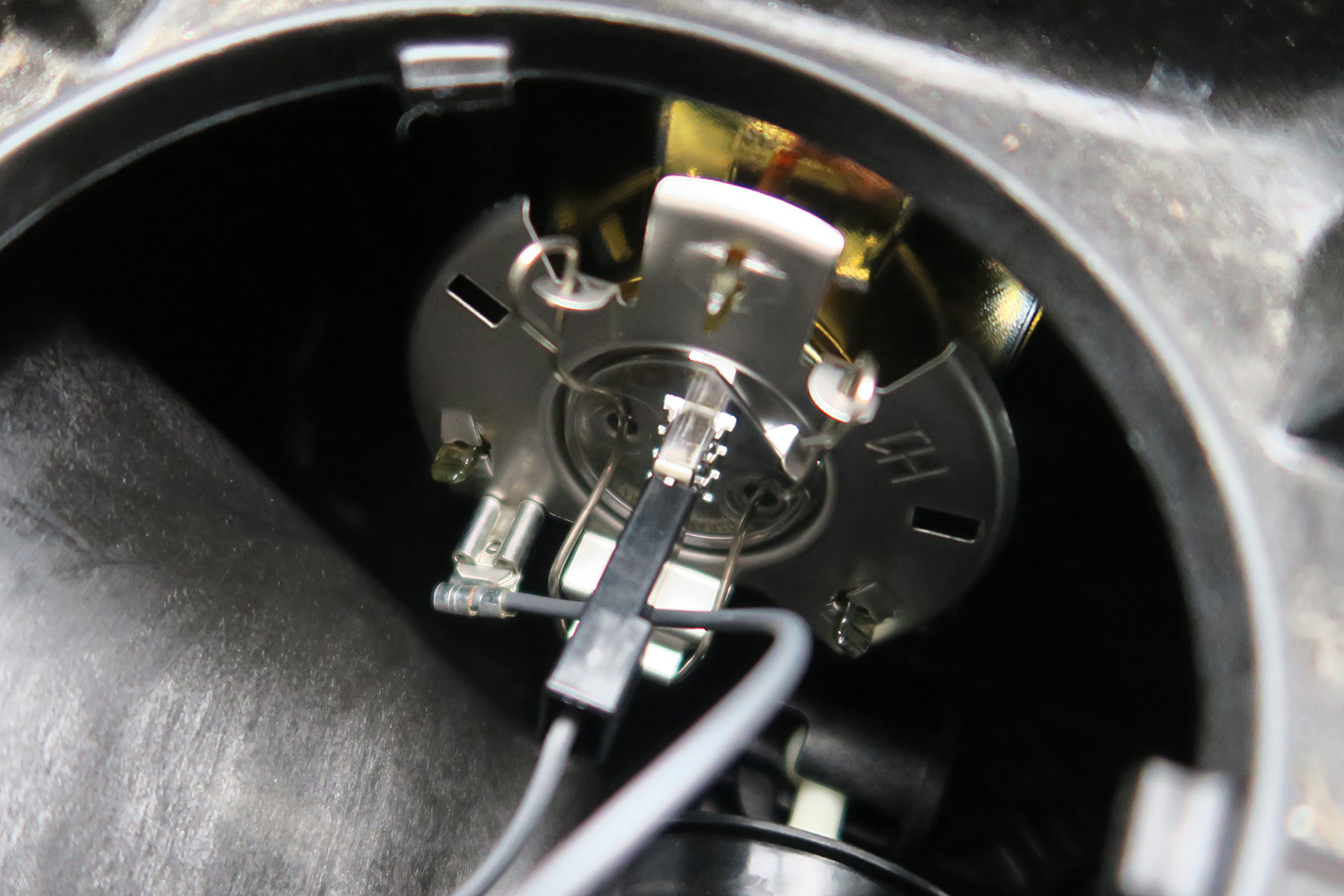
Low beam and high beam headlamp globes are typically held in with a wire retainer (above) that needs to be unclipped and moved out of the way in order to pull out the globe. The wires that supply power to each globe should pull off easily, though some may require you to depress a tab before pulling.
When installing new globes, particularly headlamp globes (below), be sure not to touch the globe’s surface with your bare skin. Oil from your skin can cause hotspots on the glass when the globe is on, and can cause the globe to fail prematurely.
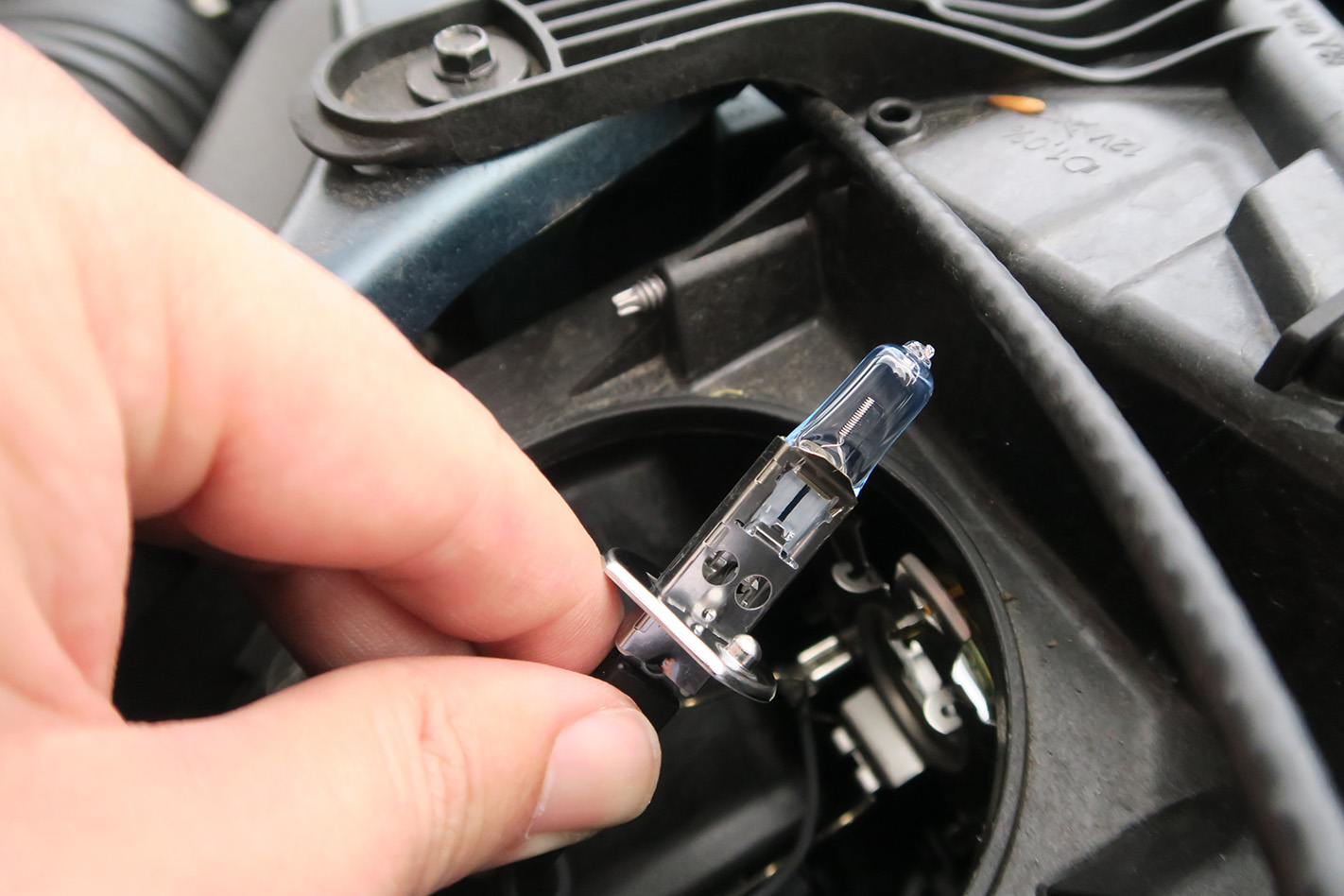
If you do happen to touch them with your fingers, wipe them clean with some methylated spirits before installing them.
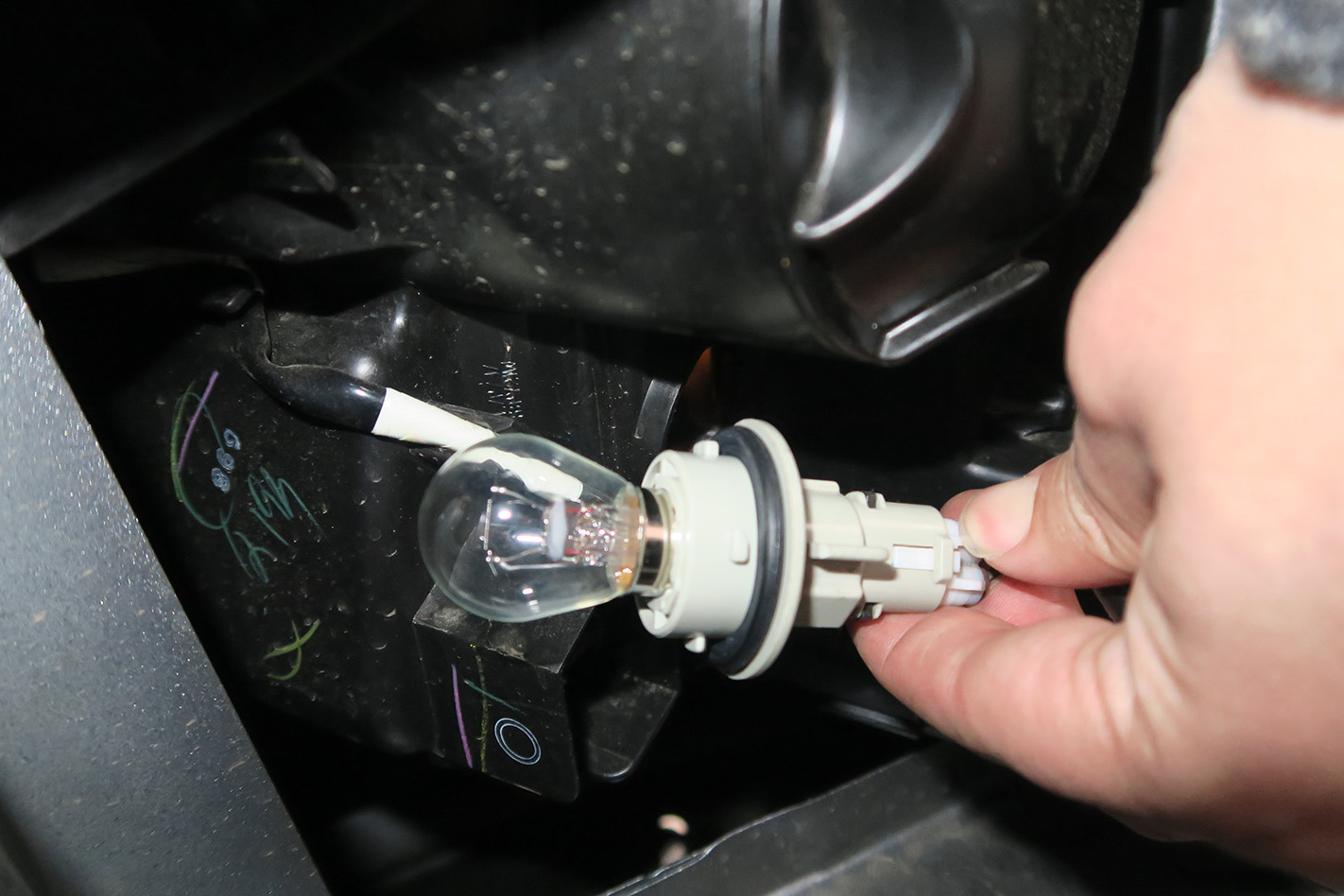
Indicator and parking lamp globes (below) typically twist out of their housings with minimal effort, and the globes themselves use a bayonet-style base much like a household lamp. With no tricky wire retainers, they’re usually quite easy to replace.
Tail lamp globes can be trickier. They’re often hidden behind the boot trim, though most cars will have a fairly conspicuous panel covering them.
On the Holden Astra hatch we’re using as an example here, there are large carpeted panels on either side of the boot area that can be easily pulled away.
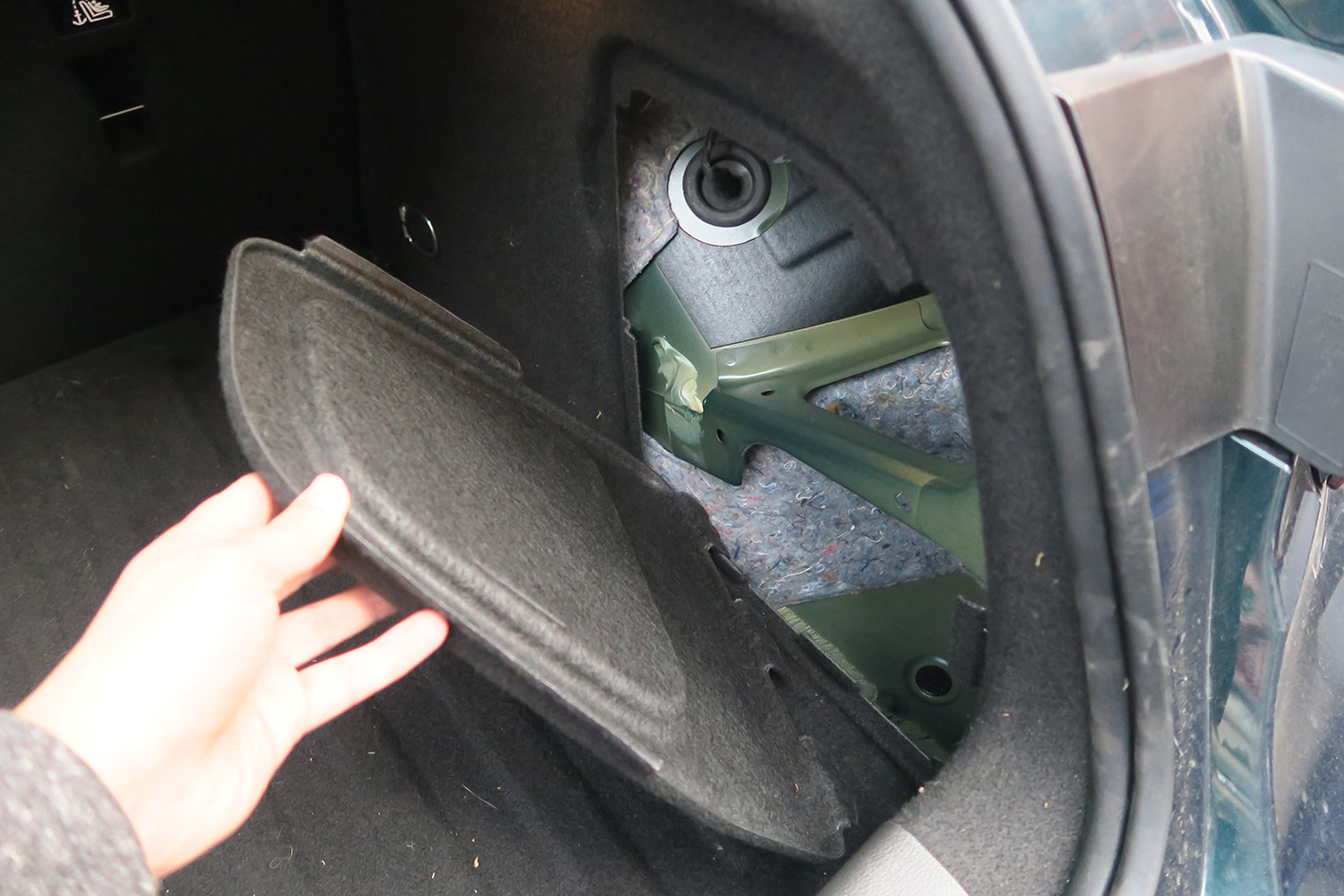
Once access is obtained, follow the wiring to the area directly behind the tail lights. You’ll either see a set of sockets and plugs for the tail lamp, reversing lamp, indicators and stop lamp globes, which should simply untwist and unplug much like their counterparts at the front.
However some cars, like this Astra, need the tail lamp housing itself to be removed before you can access the globes.
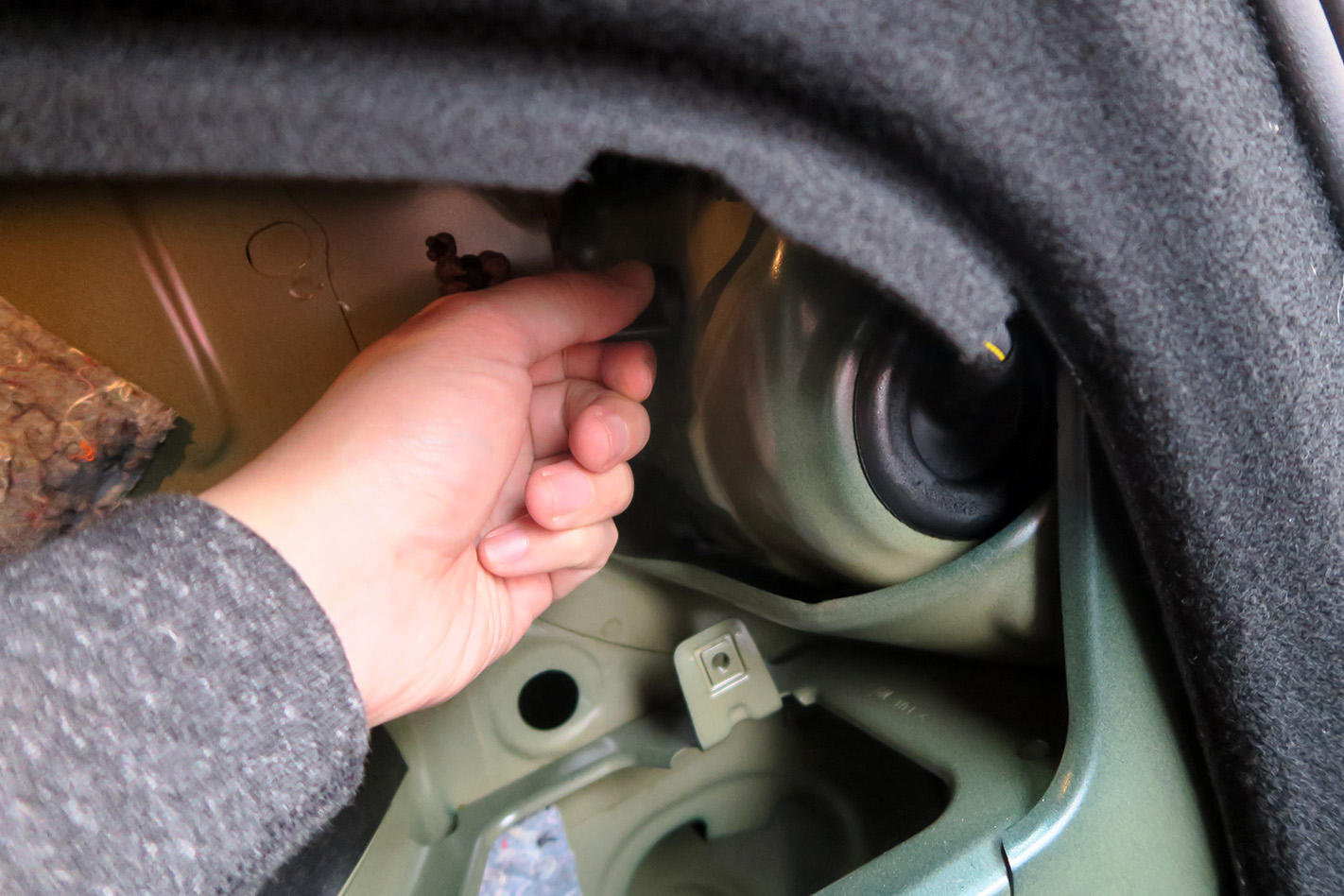
The Astra requires a large plastic nut (above) to be turned until the tail lamp cluster comes free, though some cars may require basic tools to do the same.
Once separated from the body, a plastic panel on the back of the cluster will need to be removed to reveal the globes themselves.
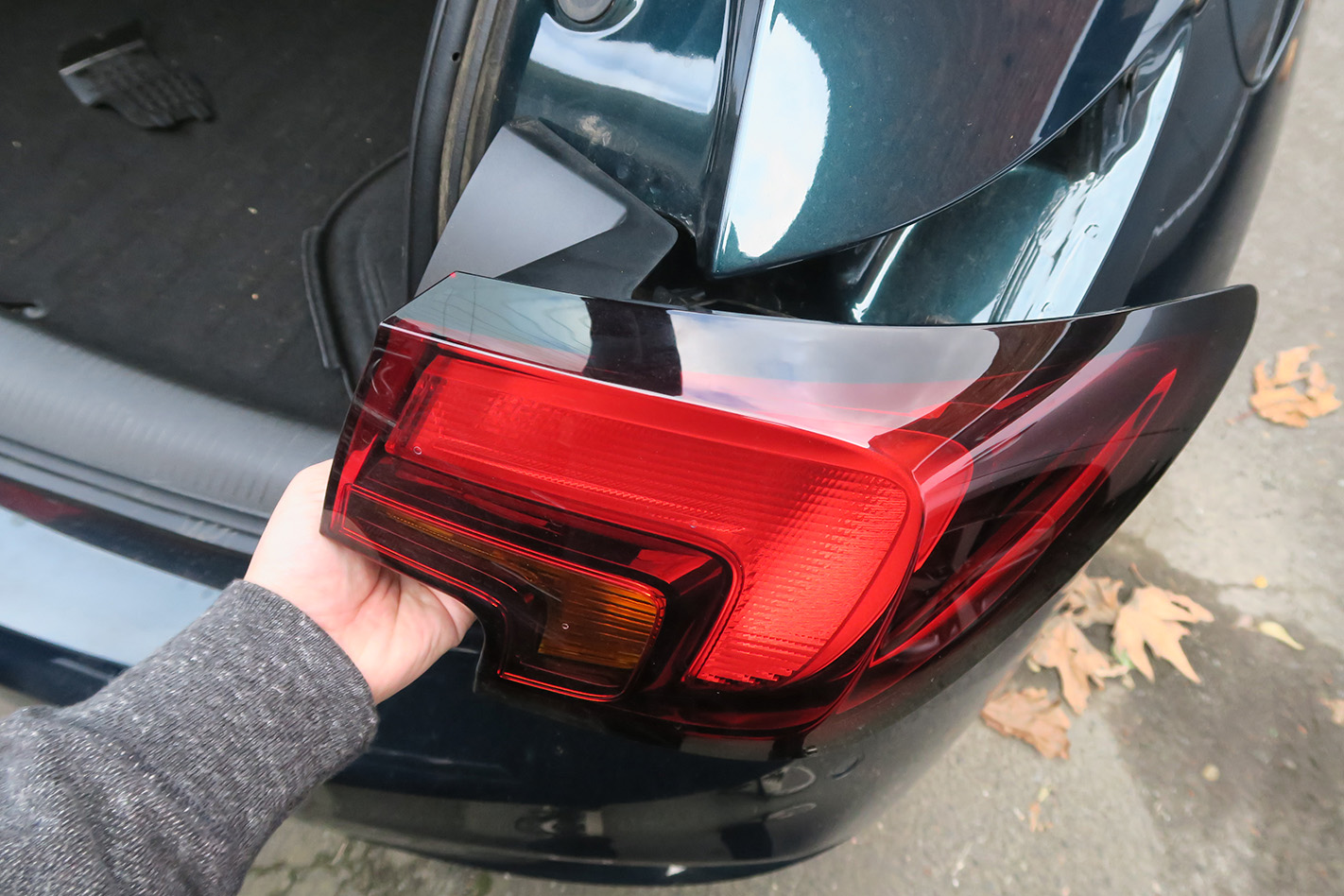
Note that on hatches, SUVs and wagons, some globes may be housed in the tailgate rather than on the body. Again, there should be some obvious access panels on the interior trim.
On sedans, the high-level brake light that shines through your rear window is often accessed from the underside of the parcel shelf, and from inside the boot.
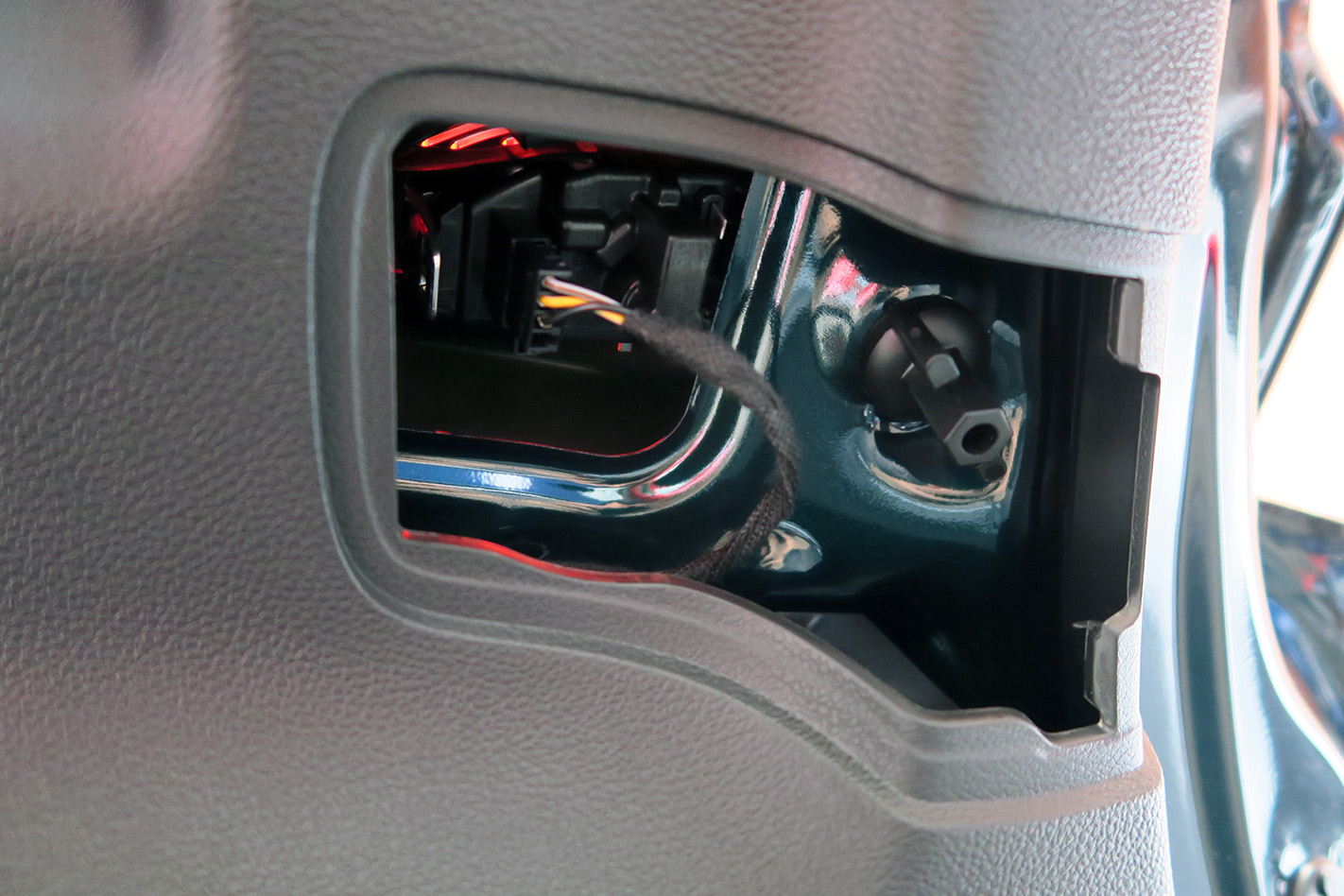
Always match the wattage rating for the globe you’re replacing. The watt output of a light globe determines how bright it is and having too few watts means a feeble lamp that won’t be as easily seen, while too many watts can dazzle other motorists or even melt the lamp housing.
If replacing a headlamp globe, make sure the type matches up with the manufacturer recommendation (halogen types, for example, are different to regular light globes). You can find those details inside your owner’s manual.
Again, be sure to match the wattage.
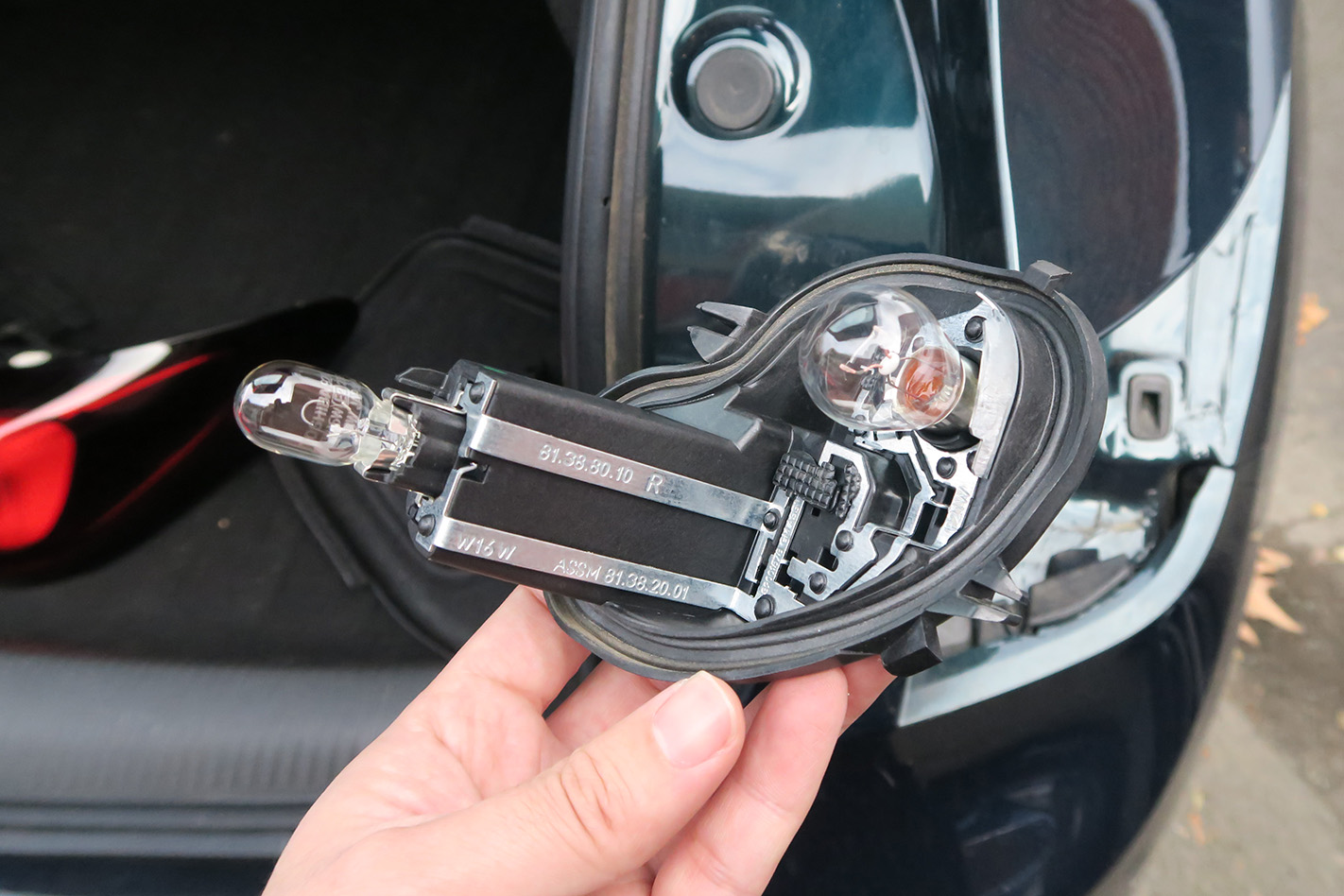
If your car is used, it doesn’t hurt to reference the manual just to make sure the previous owner didn’t replace a globe with the wrong type. Also make sure to note whether the globe in question is a dual-filament type that outputs two different light levels – brake lamps often use these, but sometimes front parking lights and corner indicators use them as well.
Once you’ve changed your faulty globe, be sure to check that it functions – there’s nothing worse than spending time fixing up your car only to have it still malfunction because a wire wasn’t plugged back in correctly.
JUST as the underpinning bricks-and-mortar technologies of modern cars increasingly rely on advances in the digital realm, BMW’s 18th Art Car installation proves that even automotive art is entering a virtual world.
Forty two years after the original rolling work of art hit the track at the 1975 Le Mans 24 Hour endurance race, the latest wheeled canvas has broken cover at the Minsheng Art Museum in Beijing. However unlike the 17 vehicles before it, this one has been digitised.

In every case before this latest Art Car, the artist has been limited by the rules of physics in the real world, but Fei made the bold statement of leaving the M6’s bare carbonfibre body untouched and suspended the artistic element of the work in the space around it.
Viewed with the naked eye, the M6 racer appears like any other, but scan the car with a smartphone, similar device or virtual reality goggles, and the vehicle comes to life with Fei’s energetic light, colour and movement.
But quite how the car will appear outside an augmented reality arena remains to be seen, particularly when the car hits the track at the hands of BMW works driver Augusto Farfus.
“I’m really looking forward to diving deeper into this project and learning more about the artist’s ideas and her philosophy behind it,” Farfus said.
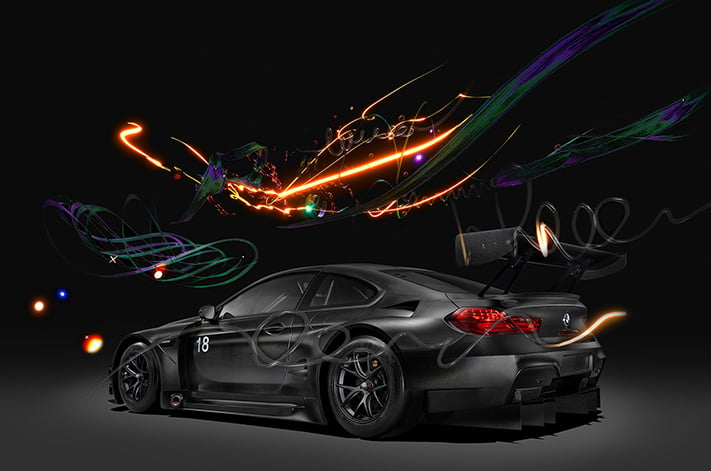
Alexander Calder started the Art Car movement in the mid-1970s with a lurid 3.0 CSL and was followed through the decades by other world-renowned artists including Roy Lichtenstein, Andy Warhol and David Hockney.
Fei was selected as the perfect fit for the latest car, with her multimedia style mirroring the evolving and technologically driven automotive landscape, as well as “a reflection on the speed of change in China, on tradition and future”.
While the augmented reality Art Car is undoubtedly the kind of mould-breaking step that advances art movements, is it a step too far for a car?
IMAGINE, for one horrible moment, you are the victim of a violent home invasion.
First published in the May 2017 issue of Wheels Magazine, Australia’s most experienced and most trusted car magazine since 1953.
Your attacker is large, powerful, and fast. He comes at you with an iron bar, and strikes your lower face with one vicious blow.
In that instant, your jaw is shattered; most of your bottom teeth reduced to broken fragments. You black out from nervous-system trauma and pain, but he’s not done.
Just to finish you off, he delivers a massive don’t-argue to the upper section of your skull. Haemorrhaging blood immediately begins to congeal dangerously on your brain. Minutes after this, any medical practitioner would declare your unresponsive condition ‘clinically dead’.
If you don’t receive an emergency tracheotomy to stop your airways being fouled by a morbid slurry of flesh, blood, pulverised bone and teeth, there will be no ‘clinically’. You’re gone.
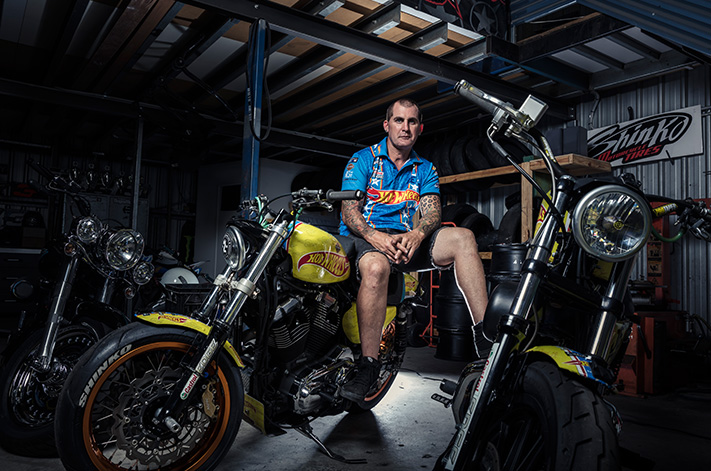
But the injuries he suffered after that crash in the Belle Isle round of the Stadium Super Truck (SST) series in the USA in June last year were every bit as catastrophic as an attempted murder, and his slow, painful recovery still has at least another eight months or so to run.
IF YOU’VE never heard of Matt Mingay, then you’re surely not one of his 1.2 million followers on social media.
A Day in France with Ari Vatanen and a BMW M4 GTS
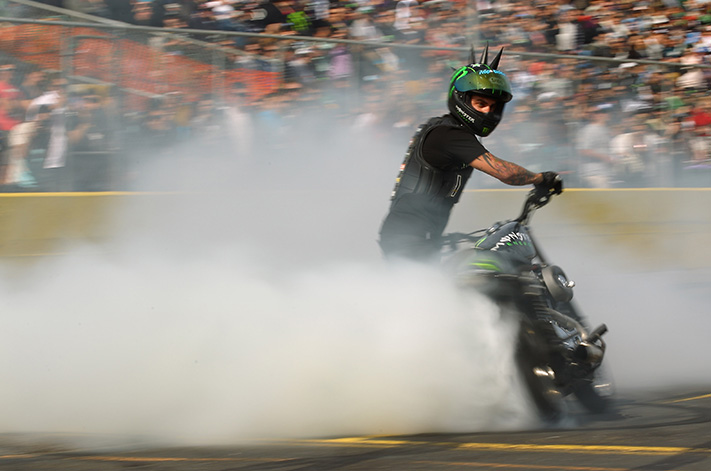
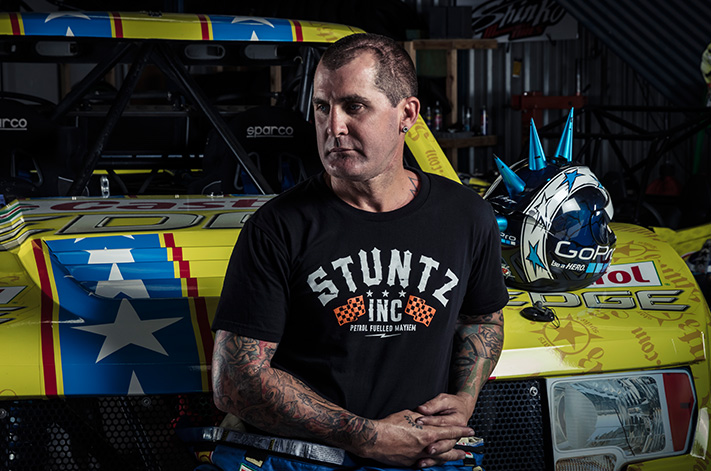
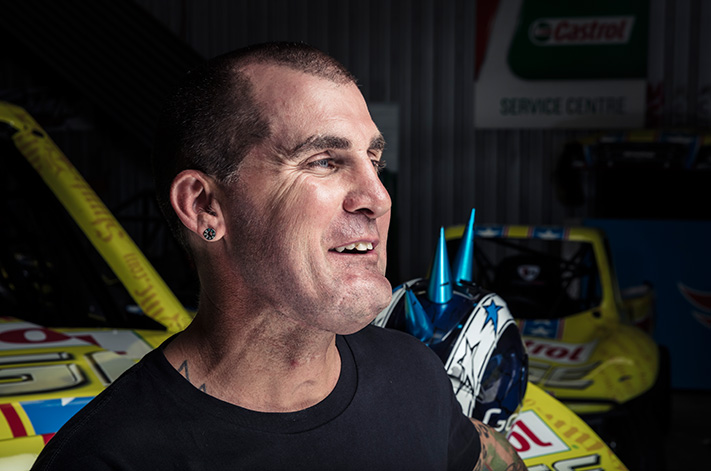
Or maybe you’ve managed not to notice Mingay at a major Australian motorsport event, warming up the crowd with his stunt show. After all, he’s easy to miss, pulling feet-up doughnuts on a barely-muffled motorcycle, covered in tatts, his cartoonish mohawk-style helmet bobbing around like a deranged cockatoo. Actually, he’s been doing it for 20 years, so it’s not as if you’ve been starved of a chance to see him.
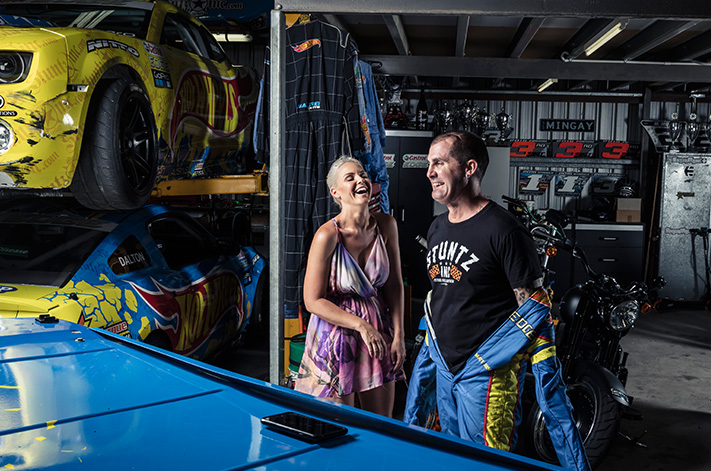
I meet Mingay and his wife Sheena at their large industrial unit on the Gold Coast, a boys’-toys trove chockers with two drift cars, a stadium jump truck, five stunt motorcycles, a couple of road-going Harleys, a plethora of dirt bikes, off-road buggies and jet skis. Rows of trophies glint above the workbench, distracting your eye from the racks of tyres and tools.
Mingay cracks a lopsided grin as he says G’day, and assures me he’s not drunk; he just sounds that way. One of his five post-accident surgeries involved stitching his lower lip to his bottom (toothless) gum, and it makes him sound, well, as if he’s had a few. “Definitely not pisshed, mate, but happy like I am. Good ta shee ya.”
Then again, injury and recovery does come as an occupational hazard for this bloke. He’s broken bones like you or I have broken bread.
He was born the youngest of three kids, and instantly latched onto wheeled toys. There’s a faded photo of him, aged three, pulling a neat little wheelstand on his BMX.
“I practised my guts out when I was a little fella,” he tells me. “I’d fall off; stack it, go again. Over and over.”
So the attention and adulation was addictive? “Oh yeah,” he says, with a slightly sheepish smile. “I loved it. It made ’em all so happy; they’d be coming up to me; ‘mate, you’re a legend.’”
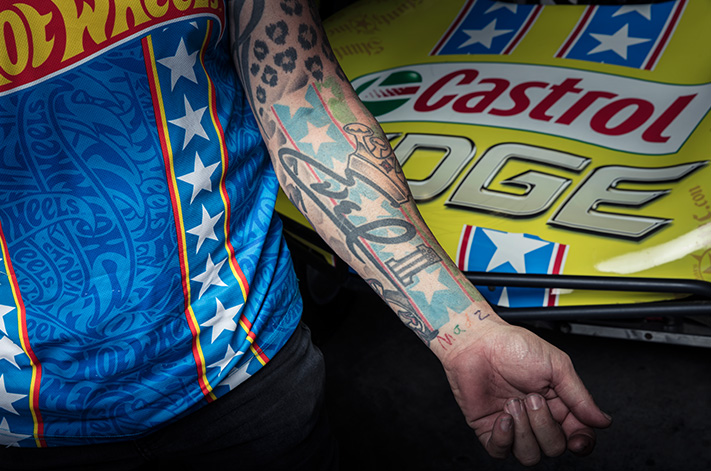
As for his own hero, take a guess: the middle name of his nine-year-old son Maddox is Evel. “Yeah, I idolised Evel Knievel,” he says, glancing at the tribute tattoo on his left forearm. “It did take me a while to realise he crashed more jumps than he landed, though…”
Out of high school he became a motorcycle mechanic, and continued to “ride like a crazy bastard, fall off, do heaps of stupid stuff.” Early car control skills came via a Gemini, which he quickly took to with a gas axe to weld the diff locked for oversteer.
A couple of years later, in 1997, aged 20, he had an off-chops Suzuki GSX-R1000, an imperial ton of fearlessness, and ambition churning in his guts. He quit the tools and forged out on his own as a full-time, self-employed, professional crazy person. Work came patchily, but soon built into a steady flow.
“How did you know how to price yourself?” I ask. “What’s the going rate for 40 minutes of tyre-destroying, injury-tempting mayhem?” “I had no idea,” he laughs. “I’d just throw a number out there – ‘ummm … 1500 bucks?’ – and see what stuck. When I got a ‘yeah, okay’ I was like, YESSS! I went from there.”
He added sub-contracted riders to bolster the on-track spectacle and weave in choreographed moves. Then Holden saw the following he was attracting at motorsport events and offered a couple of V8 utes. It was in those utes that he really honed his drift skills from the sublime to the ridiculous.
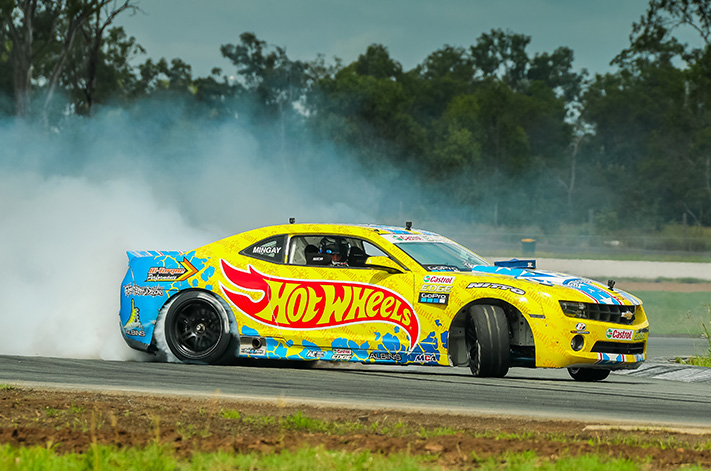
Mingay is a savvy, pragmatic type. “I could spend five grand to compete in a round of the drift championship, or get paid five grand to drift in front of a huge crowd, all going nuts. It’s a pretty easy decision.”
But it’s the bike stunts that really forged his rep, and ultimately what sends the crowd into raptures.
“Bottom line; quite a lot of people can now drift well. Me and Kent [Dalton, his co-drifter] keep upping the ante to make it look awesome, but fact is not many people can do what we do on bikes. Especially Harleys. People said, ‘No way, you can’t do that show with Harleys.’ I said, ‘bullshit, just watch me do it with Harleys.’”
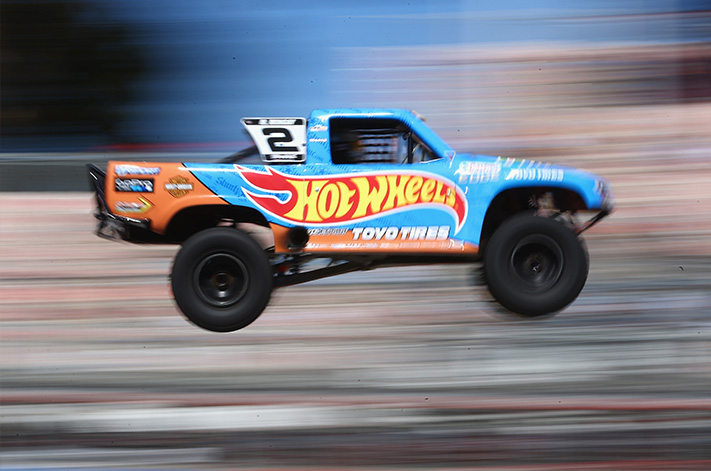
Others seem to defy physics, like wheelstanding the bike with his legs draped over the handlebars. His feet-up doughnut burnouts are almost balletic, the grace in complete contrast to the bellowing bike and screaming, tortured rear tyre.
What defines his style is the sheer ease he has with the machine; the way it fluidly obeys every input. There’s never a sense that he’s muscling it into submission; instead it’s like a trained animal that jumps through a hoop when he snaps his fingers. He clearly has an almost obscene amount of natural talent; phenomenal balance that allows him to pull wheelstands past the point of vertical. Or to take both hands off the bars when the bike is at its balance point. (Correct, that means letting go of the throttle. No, I don’t get it either.)
THE IRONY that it was an accident while inside a race truck that nearly claimed his life is not lost on Mingay, given what he does on motorcycles. “Yeah, so much for the old adage: ‘as you age, get a cage’,” he smiles ruefully. “That didn’t work out so good.”
The bad news came fast, though. “Then I was told he was non-responsive, and I realised how serious it was.”
The pair met while Sheena was employed by the action sports brand Jet Pilot, at the time one of Mingay’s sponsors. That was about seven years ago. He was besotted by her Gold Coast good looks and sunny, switched-on disposition. They went through courtship on a wide-open throttle with minimal speed humps, and married in Vegas in 2015. Together they work for anything up to 12 or 13 hours a day, often seven days a week on the business; bookings, logistics, sponsor commitments, merchandise, staffing the operation. There’s gentle ribbing and tangible adoration between them.
Sheena is almost always by his side as the Mingay show moves around the country. The Clipsal 500 in Adelaide in 2015 was no different, where Matt was granted a wildcard entry to the Stadium Super Truck curtain-raiser. A third place there was enough to get some momentum and connections; it was this that led to an invitation first to Vegas for a round, and then to Detroit in June last year.
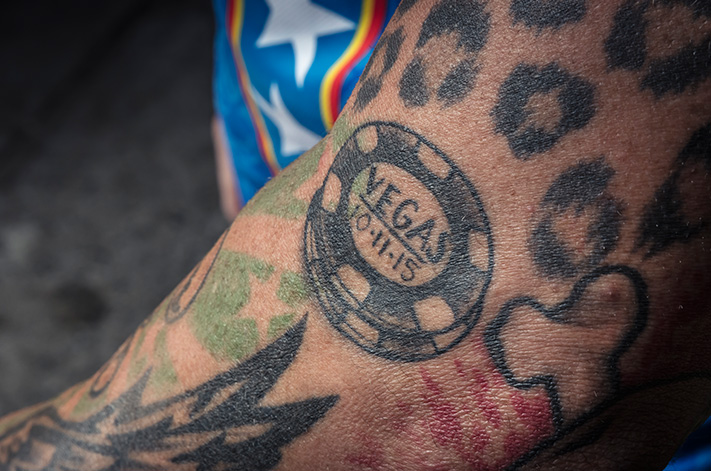
So, no memory of the three weeks in the Detroit hospital, of the reconstruction that took a bone graft from his hip and fused it via a titanium plate to replace the missing section of lower jaw.
No recollection of being cared for by Sheena, then at night by his older brother Chris and his best mate. And absolutely no recollection of the private jet provided by motorsport billionaire Roger Penske to get them all from Detroit to LA for the flight home to the Gold Coast. “It’s like my brain has just wiped all that,” he says. “The first thing I remember is being in the Gold Coast hospital, a week or so after I’d been admitted.”
For Sheena, the exact inverse applies. Her recollections of the experience are laser etched in her memory. There’s a photo of him as he first lay on the Detroit operating table. His chin looks as though it’s been decorated with some ghastly hibiscus flower; pink petals peeled back to expose a horrible black abyss.
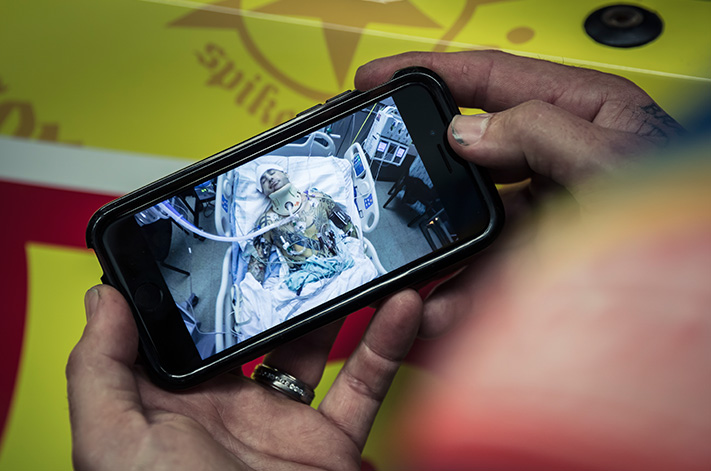
Matt did regain a degree of coherence after a few weeks, and a sense of optimism flickered, but even this improvement in his condition brought its own challenges.
“I remember at one stage he started to pull at the hospital tubes, and snarling that he had to leave,” says Sheena. “I said, ‘Go where, matey? You can’t go anywhere.’ He was an awful patient. We ended up having to strap him to the bed with wrist and ankle cuffs.”
There will ultimately be five surgeries as a result of this accident. It will take his career total deep into double figures.
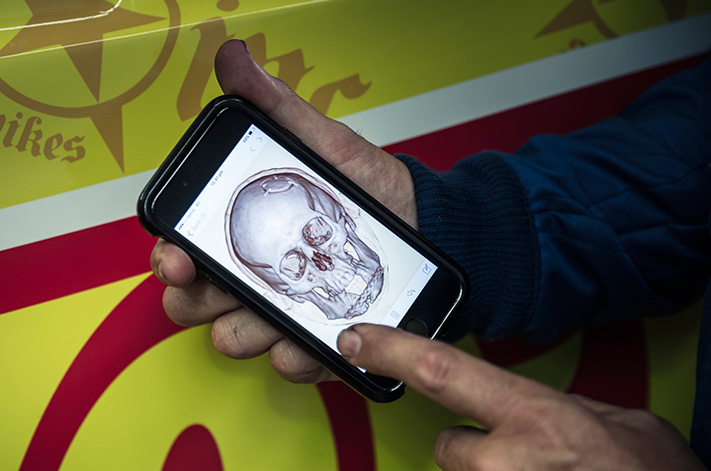
“Looking forward to that last bit,” he smiles. “Can’t wait to rip into a good steak.”
Along with Sheena, a core part of his support has come from a chunk of those 1.2 million social media followers. He has been inundated with messages of support, of lovingly crafted cards from hundreds of kids, and offers of financial help from people with only modest means; even kids wanting to donate their pocket money towards his rehab costs.
“Yeah, it’s touched my heart, very humbling,” he says, looking visibly emotional.
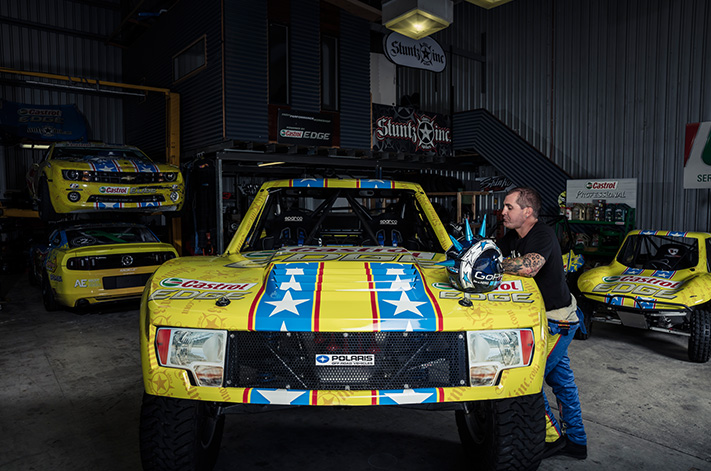
“Yeah, it makes me feel so special; such a good feeling. Love it when they come up and I can give them a bit of encouragement, or send a message on Facebook,” he says.
So is it the showmanship side, the fan base, that really drives him, rather than the thrill and accomplishment of forcing a motorcycle (or car) to do something for which it was fundamentally never intended?
“Absolutely,” he says. “I love my fans. Love seeing them going crazy, love really amping up the crowd. It’s the greatest buzz. Look, if you pull an awesome wheelstand and there’s no-one there to see it, it’s like … what’s the point?”
The collector car market continues to boom and Lamborghinis have not escaped attention. Icons like the Miura and Countach are steadily climbing in value and more modern machinery, especially anything with an SV badge, is seemingly immune to any kind of depreciation.
Stuck in the middle has been the Diablo but it, too, is beginning to enjoy its moment in the sun. This presents an interesting conundrum – if you’re a fan of the raging bull with around $400K to spend, you have the option of a current-gen Lamborghini Huracan or a top-notch example of arguably the best Diablo, the VT 6.0.
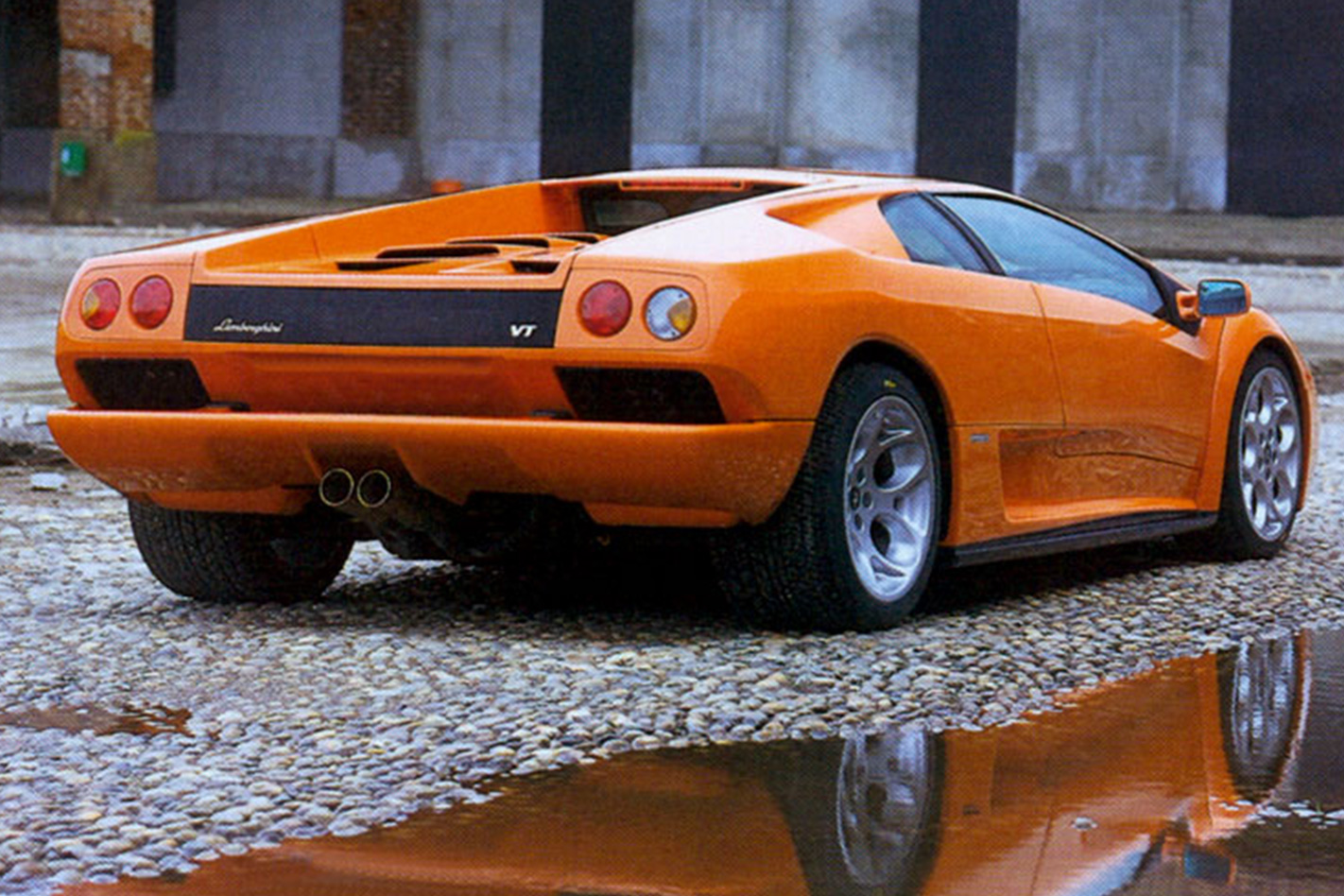
The Lambo Diablo is much more of a brute. Though the VT 6.0 was developed under Audi’s watch, it still needs extreme care when driven hard due to its size and weight. City driving will save you the effort of a gym workout thanks to the demands of the clutch and gearshift.

The other advantage of the older car is wow factor. The Huracan isn’t exactly a shrinking violet, but it is ‘relatively’ common and has neither 12 cylinders nor scissor doors.
With a claimed 322km/h top speed, you’re looking at the official fastest Jaguar ever made – the kitty atop the food chain – the new F-Type Coupe SVR. And at last, we get to drive it in Australia.
This is more or less a hotted up F-Type Coupe R all-wheel drive, a car that really is quite hot enough already. Jaguar’s SVO engineers have increased the ball-tearing 5.0-litre supercharged V8’s outputs by 19kW and 20Nm, now 423kW and 700Nm.
Again, the all-wheel drive Coupe R is hardly a quiet car – let it idle in your garage a little too long late at night and you’ll have cops knocking on your front door – yet Jaguar has made it even louder for the SVR, now bellowing its sinful V8 racket through a titanium exhaust.
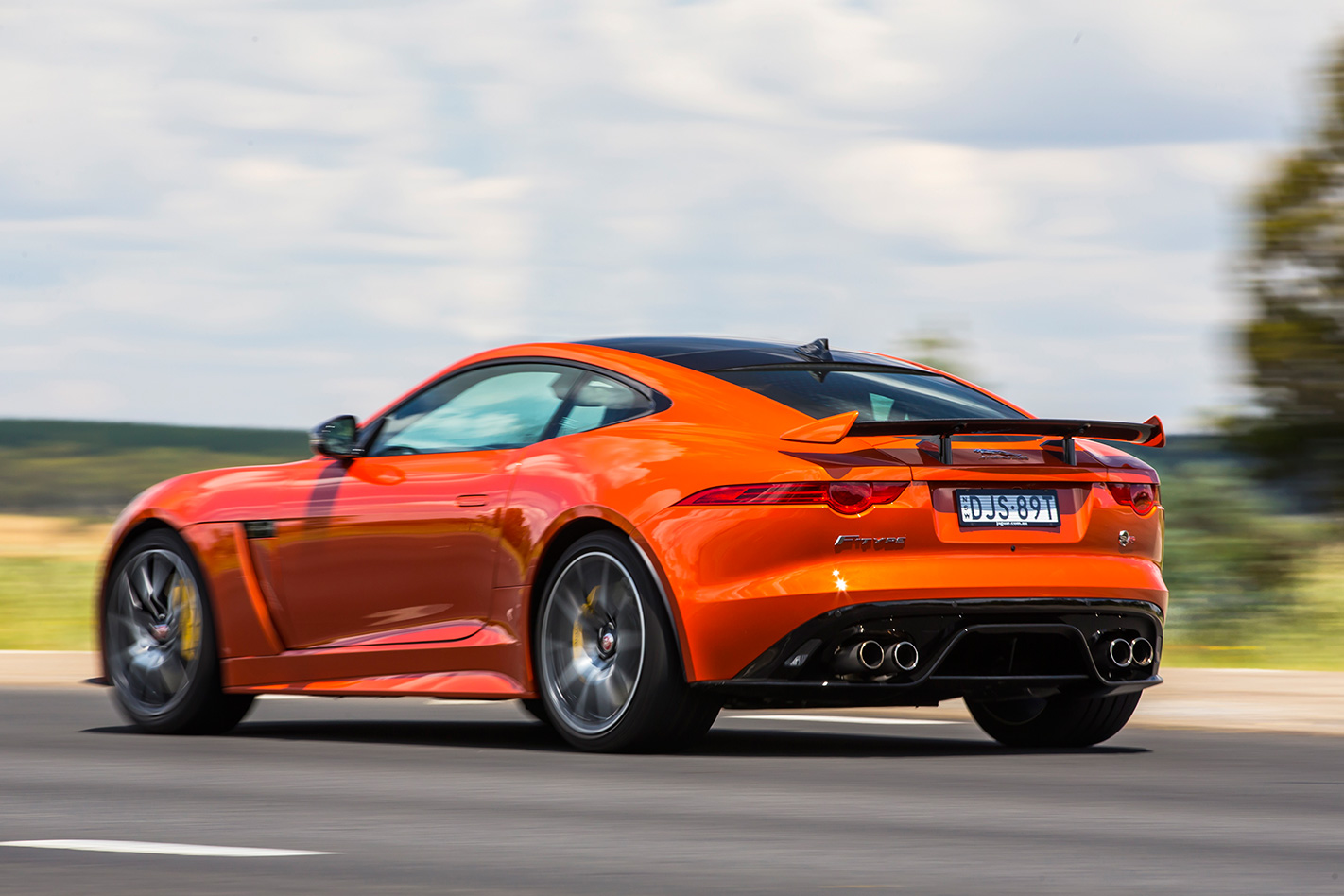
Then there’s the styling. An active rear wing is the most obvious feature of a unique bodykit for the SVR, popping up automatically at 113km/h and programmed to work with an automatically adjusting front spoiler. Of course, there’s a button in the interior to raise the spoiler for maximum effectiveness at standstill.
That’s basically what this car is all about – you’ll never see one of these with tinted windows. It attracts a silly amount of attention, particularly our test car in bright orange, just one shade in a suite of attention-seeking colours. We dare say quite a few of these cars will never get very far from the main drags of Australian capital cities. Which is a shame, as this is one kitty that wants to stretch its very long legs.
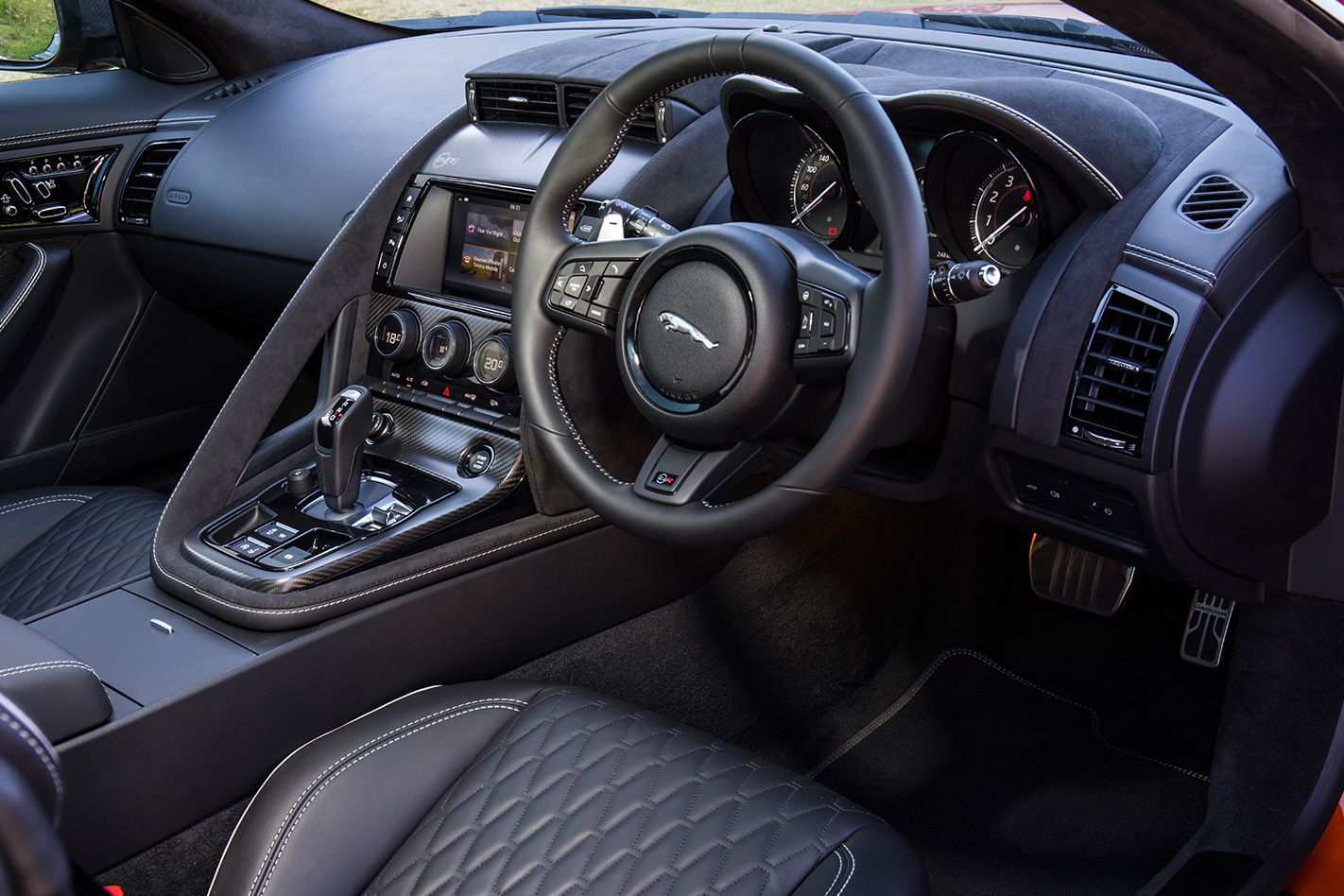
The SVR is also silly loud. You wonder how it’s legal. But it’s a great sound: raucous, evil V8, all tailpipe. You hear the SVR coming long before you see it. The V8 racket is such a big part of the SVR appeal, it would be a totally different car with a V6.
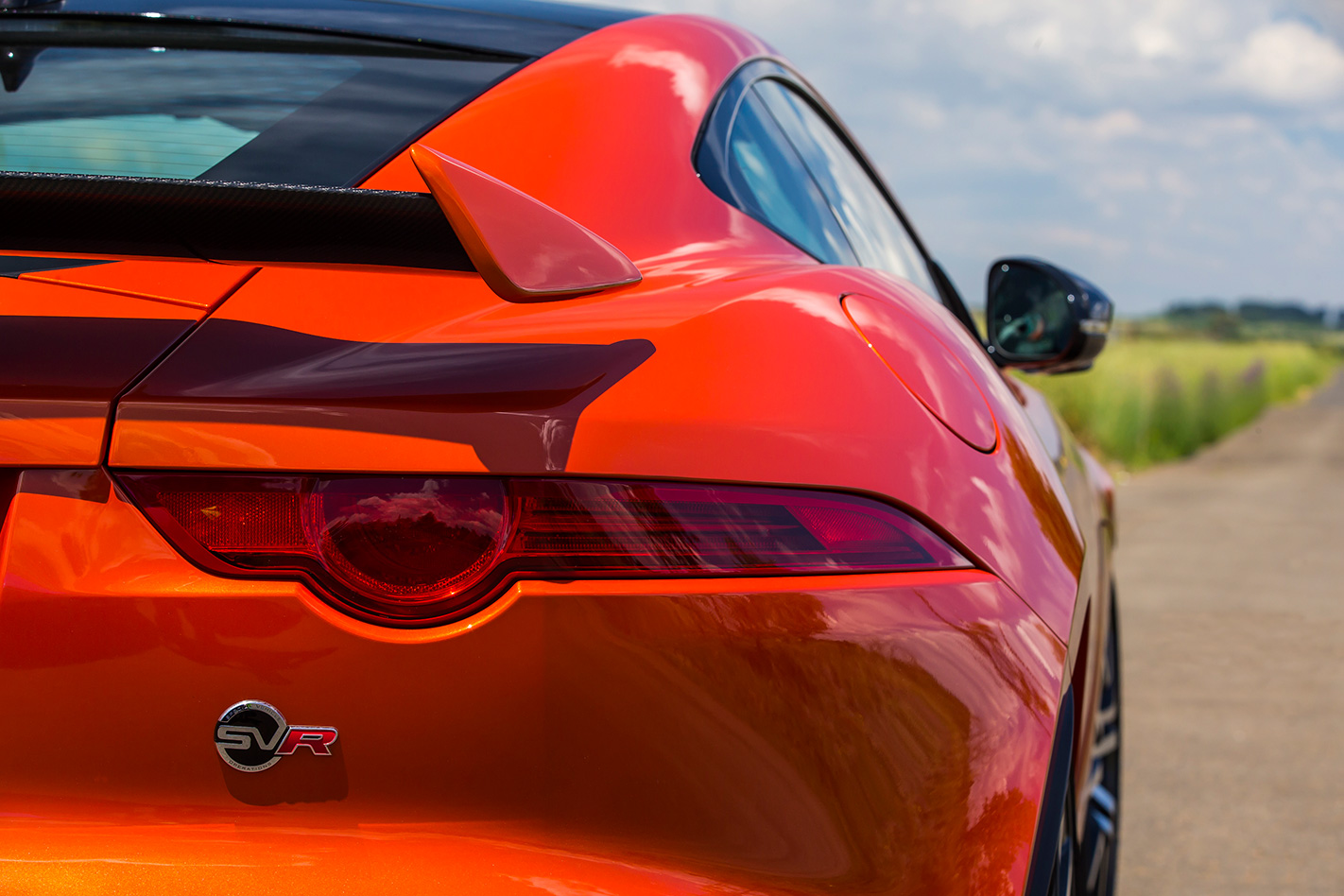
The SVR is an awesome gadget with a big, muscle-car personality. But it’s really for people who talk too loudly and consider manual transmission mode actually Saturday Night Mode (with the active exhaust on, and rear spoiler deployed) for built-up areas. Anybody not like this, and really keen on this car, would do well to bank $44K and snare the fantastic ‘normal’ (it’s not normal, trust us) all-wheel drive Coupe R. It’s not quite as fast, or as loud, as the SVR, but it’s 90 per cent an SVR, still ridiculously fast and ridiculously loud and designer Ian Callum’s gorgeous F-Type Coupe rear end is uncorrupted by that wing.
Or be a big boy (or girl) and get the hilarious rear-drive 404kW Coupe R version to save $60K on an SVR. Blow it all on rear tyres.
SPECS
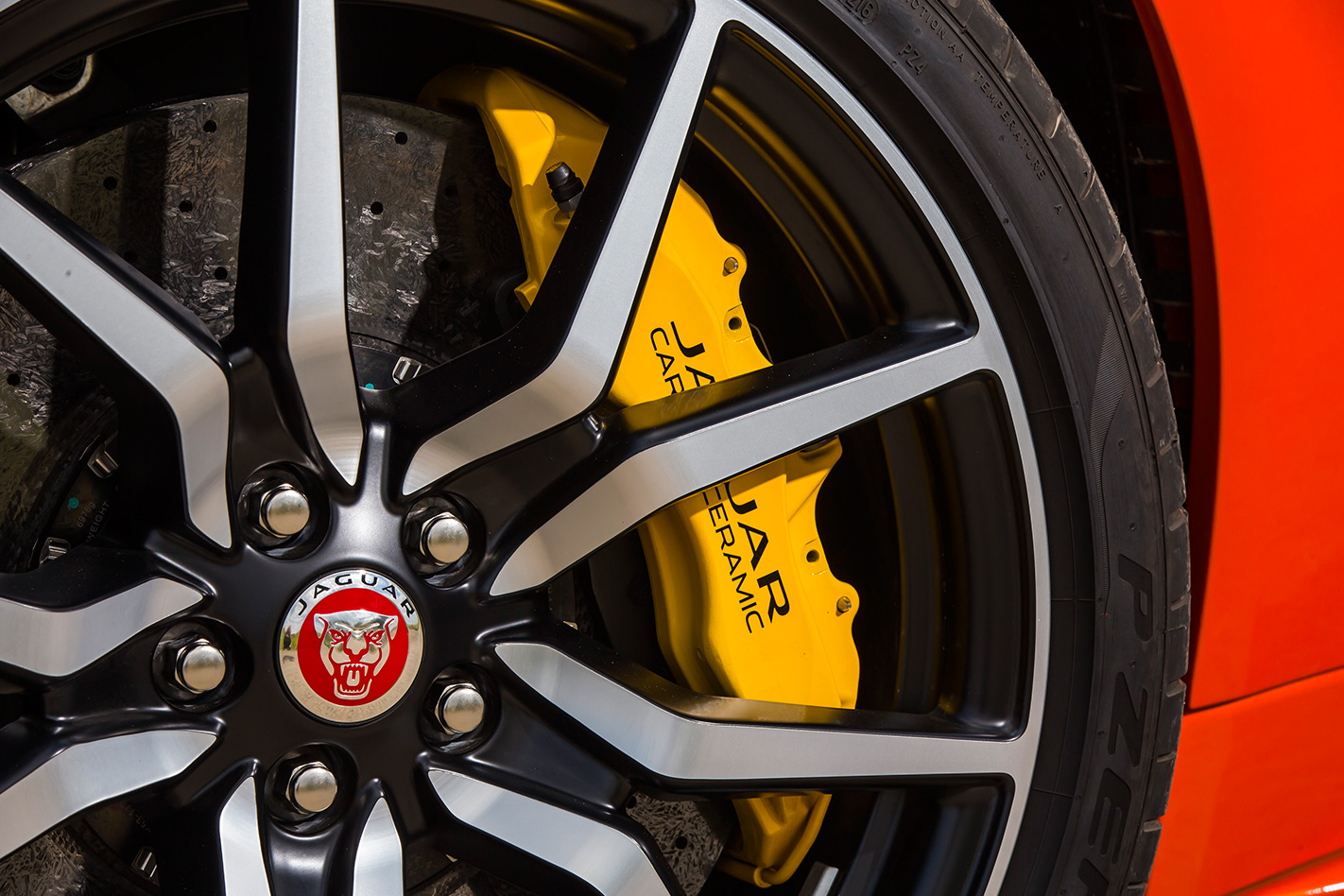
Engine 5000cc V8, DOHC, 32v, supercharged Power 423kW @ 6500rpm Torque 700Nm @ 3500rpm Weight 1705kg 0-100km/h 3.7sec (claimed) Price $289,305
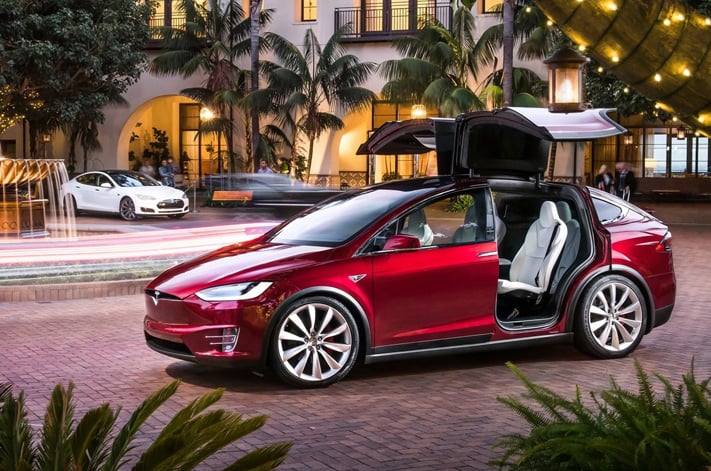
1: Tesla Model X
0.0L/100km Up to seven seats and swanky rear ‘falcon wing’ doors make for one snazzy machine. Fast, too, in P100D guise and with up to 542km of claimed all-electric range.
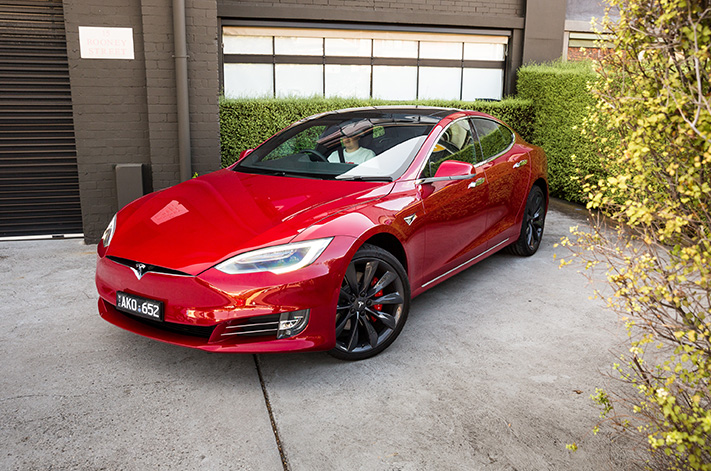
2: Tesla Model S
0.0L/100km Same philosophy as the X but with a luxury liftback body. Floor-mounted batteries and low stance keep the centre of gravity low. The same motors as the X with less weight equals more fun.
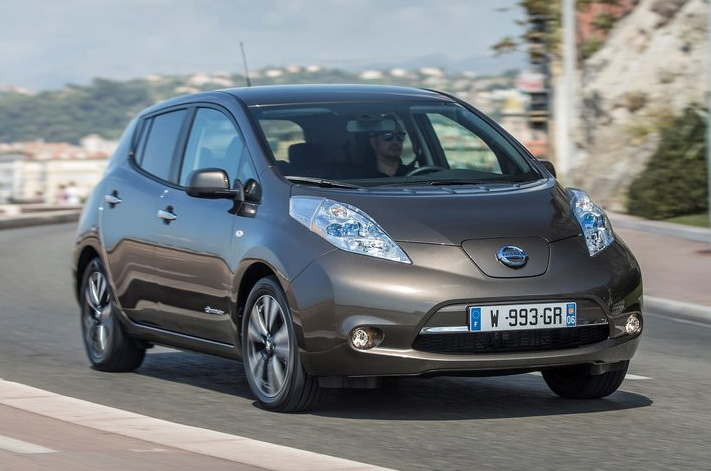
3: Nissan Leaf
0.0L/100km It’s a slow seller (less than one a week) and has a design only Noddy could love. But the Leaf offers mainstream hatchback performance with a specialty in low-speed electric motor flexibility.
4: BMW i3
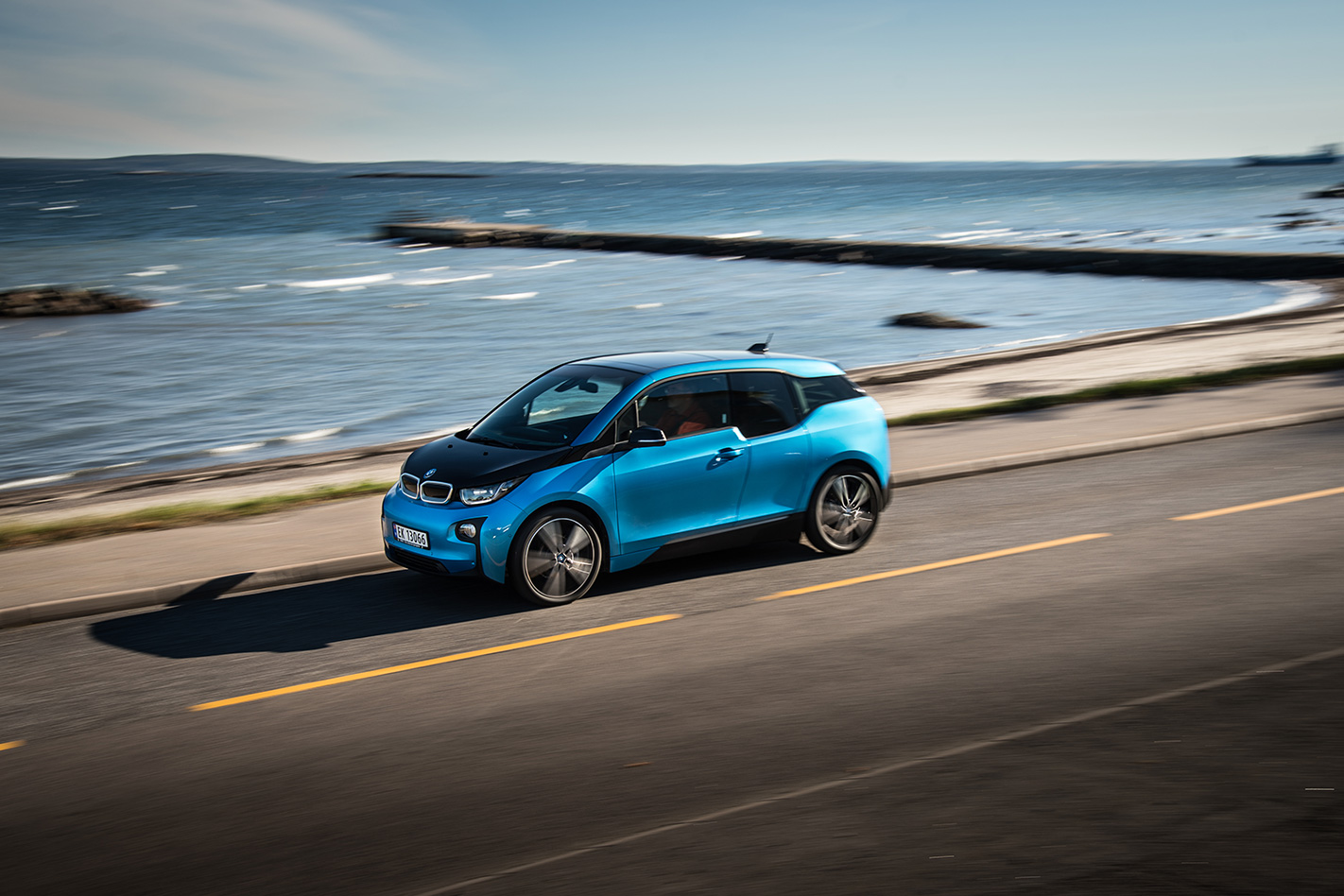
0.0L/100km More batteries makes for a longer range in the all-electric i3 94Ah, which will do about 200km in normal driving. Those wanting to go further can choose the range extender instead, which is claimed to use 0.6L/100km.

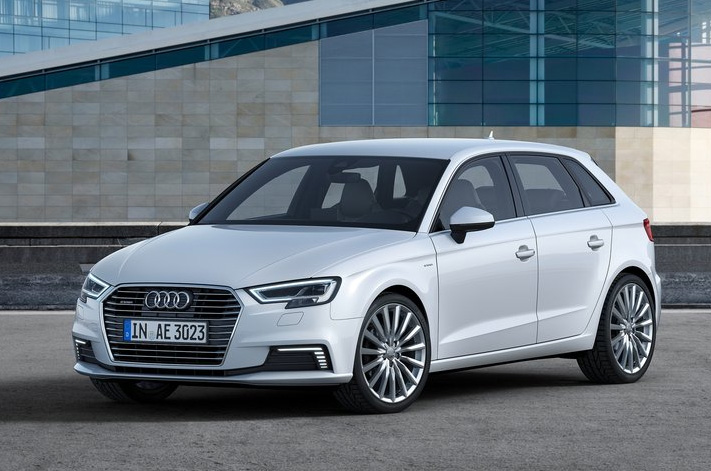
5: Audi A3 e-tron
1.6L/100km The most efficient of the plug-in hybrids on the market (at least according to the official fuel figures), the e-tron is refreshingly normal to look at and drive, with a 1.4 turbo allied to an electric motor.
THOUGH journeys through time are presently impossible, travelling to Norway is easy.
First published in the Summer 2016 edition of Wheels Magazine, Australia’s most experienced and most trusted car magazine since 1953.
And for a preview of the future of cars and driving, this is the place to come.
Here the transition to electric vehicles is more advanced than anywhere else in the world.
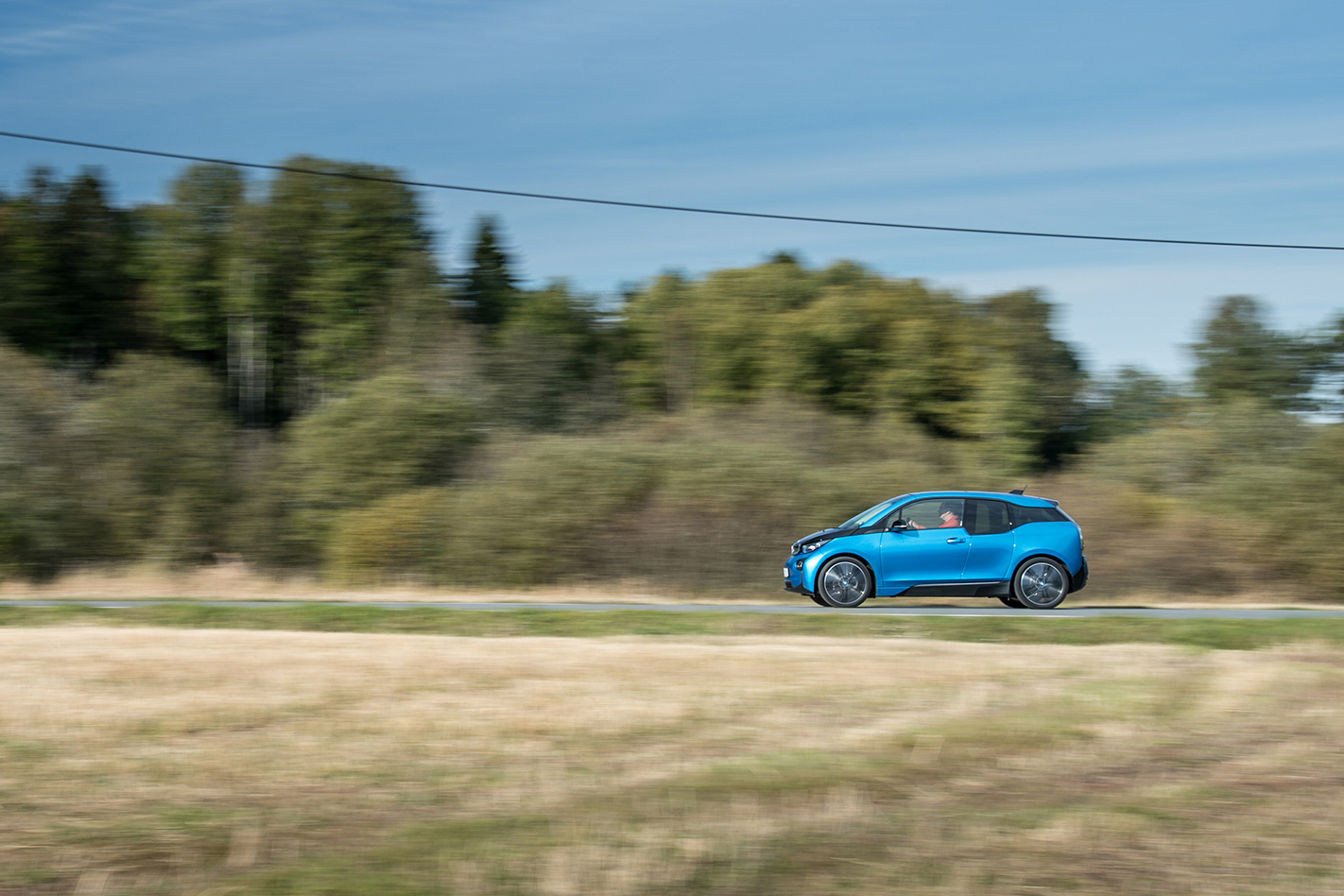
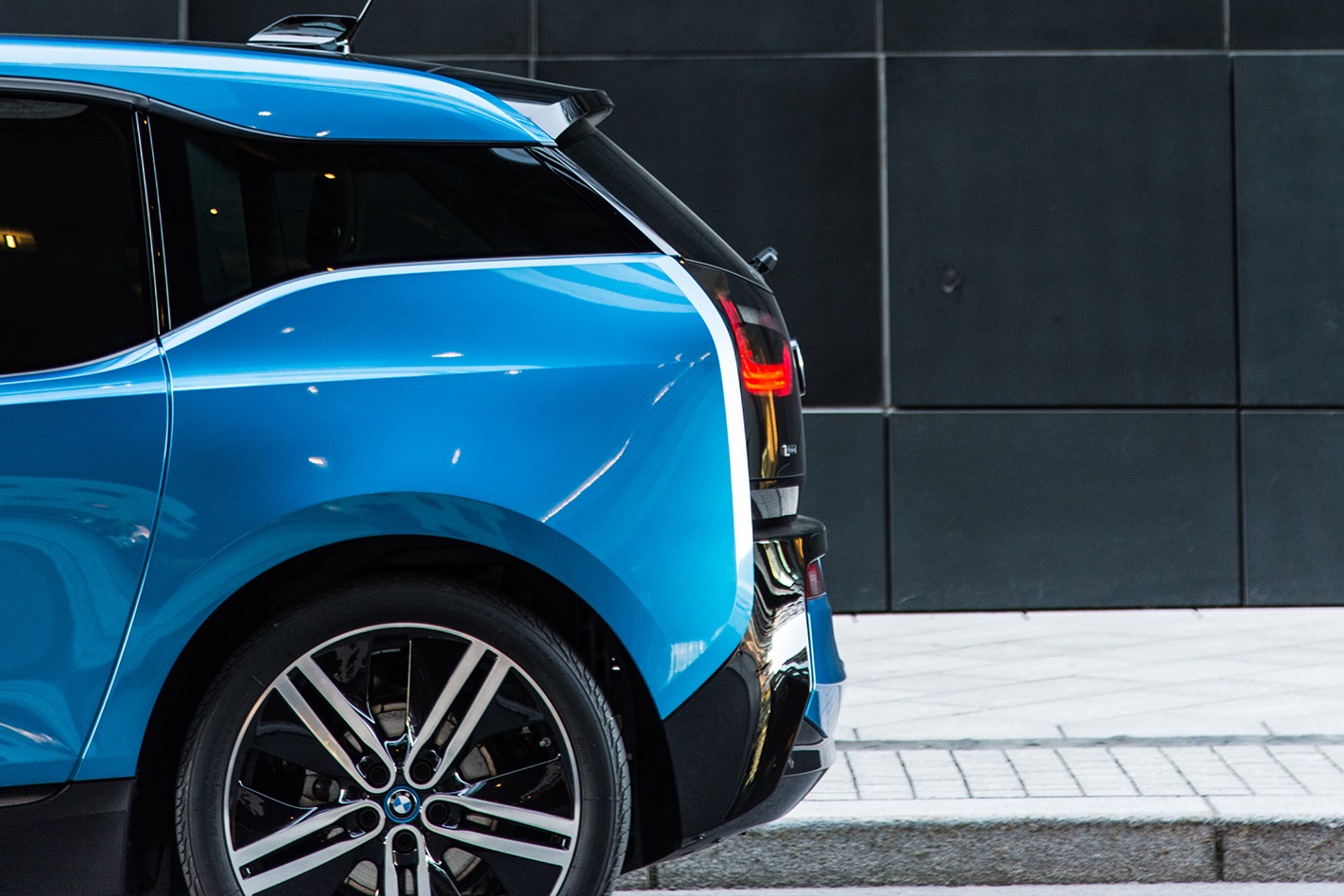
The i3 is a big hit in Norway. Following the release of the 94Ah model, with an improved battery and increased range, the monthly sales rate promptly doubled. BMW Norway estimates it will deliver up to 4000 in 2016 – 13 times more than the Australian market, which is seven times bigger overall.
Greater driving range is a persuasive selling point with EV-savvy Norwegians. It’s a big deal for me, too. Oslo to the End of the World is 130km.
As we found during 2014 Wheels Car of the Year testing, this is at the ragged edge of the real-world driving range of an original i3 with 60Ah battery pack. The 94Ah, with its real-world range of around 200km, should enable us to do it confidently.
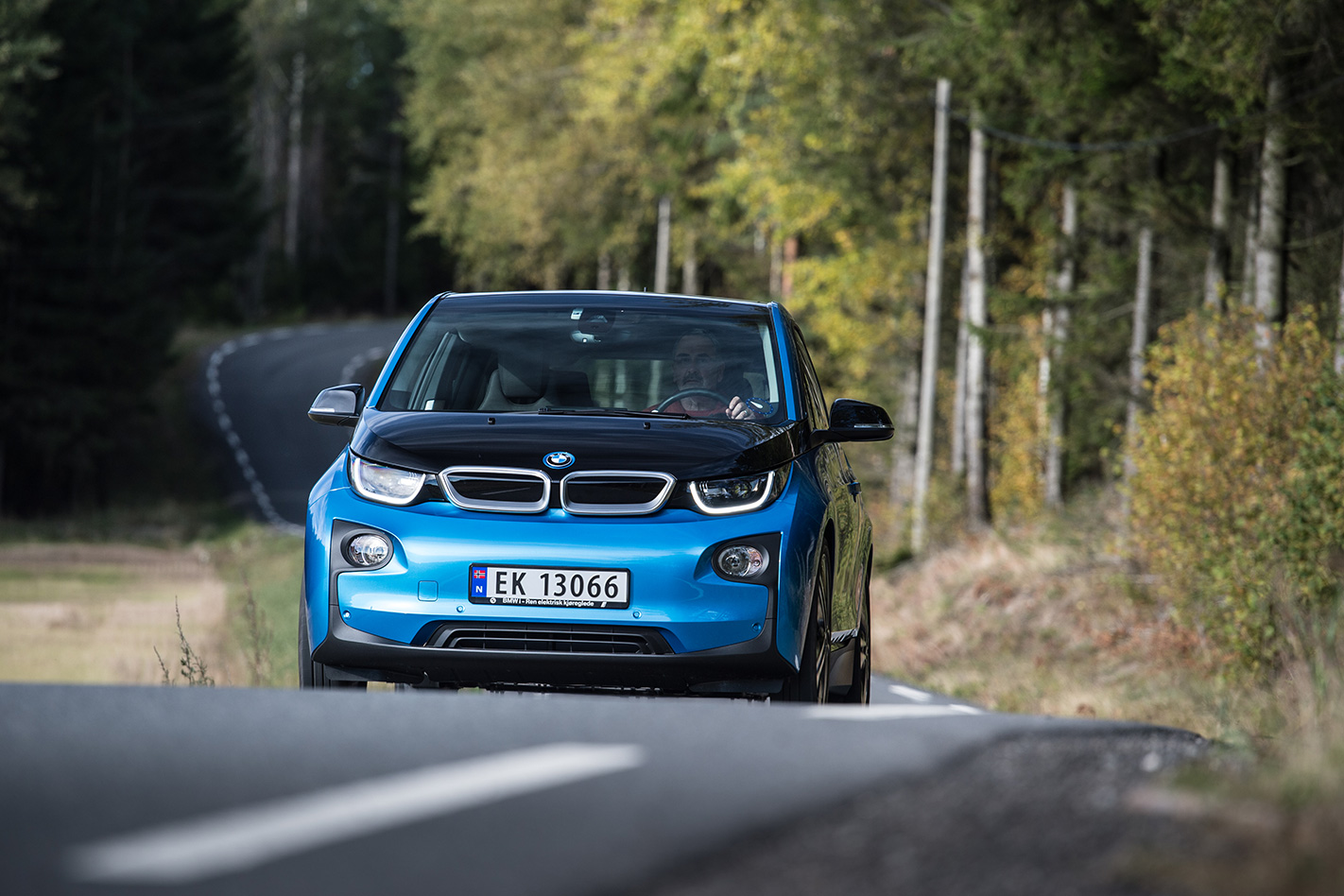
World’s End is a stony tongue poking south into the icy water where the Oslo Fjord meets the North Sea.
There’s no place to stay, so our journey will involve backtracking 25km to a hotel in the nearest large town.
That’s 155km on a single charge, something I’d never attempt in an i3 60Ah.
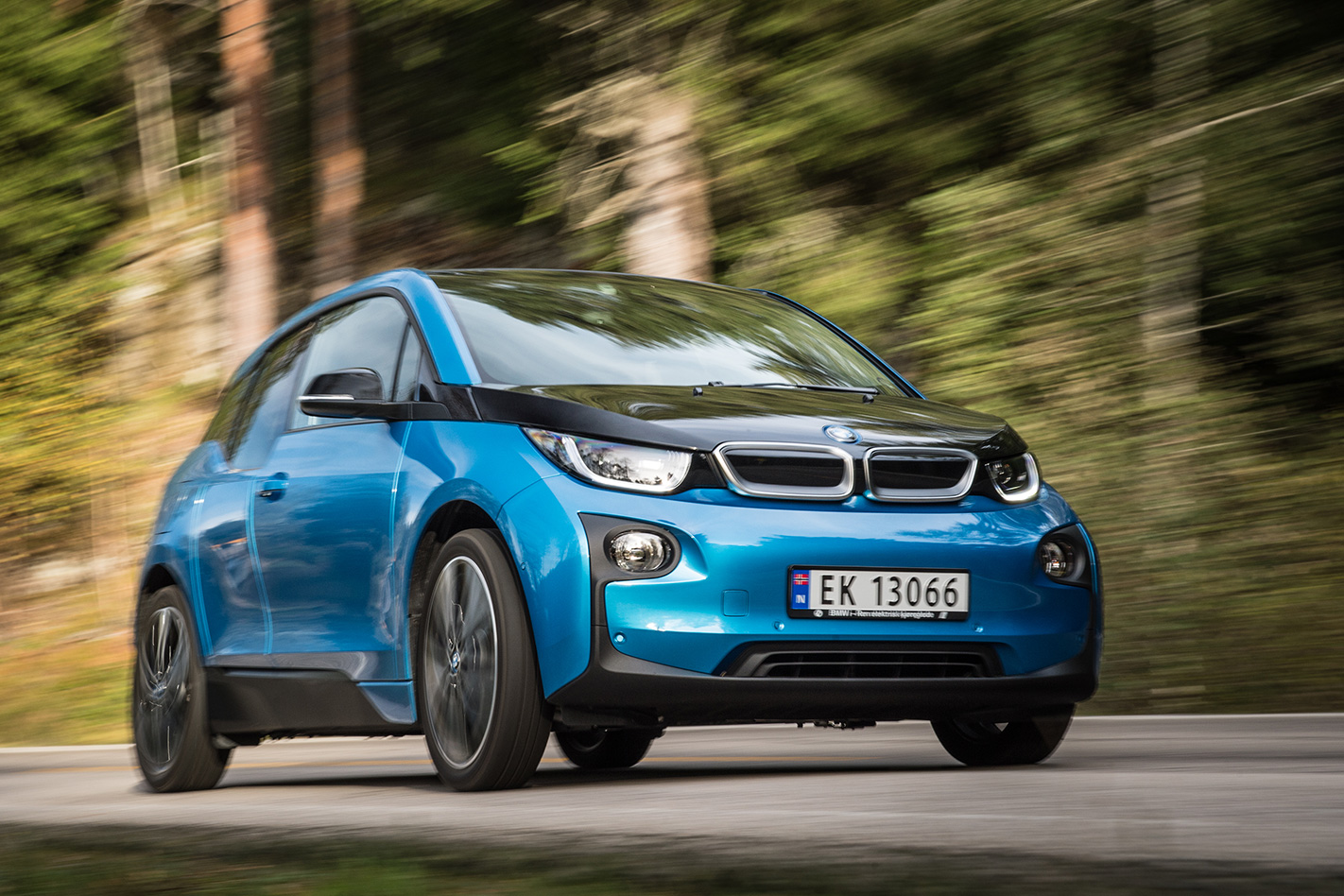
While the i3 is a success in Norway, it’s no chart-topper. The most popular EVs are currently the VW e-Golf and Nissan Leaf.
The Tesla Model S claimed national best-seller status for a couple of months in 2013. And when Tesla launched its new SUV, the Model X, in 2016 it promptly shot to second spot on the Norwegian sales chart.
These cars are mainstream choices in Norway. About 20 percent of new cars these days are EVs. Norway leads the world for EV share. By a long, long way.
So what’s happening in Norway that makes it such a powerhouse of EV adoption? The answer is as simple as it is predictable… money.
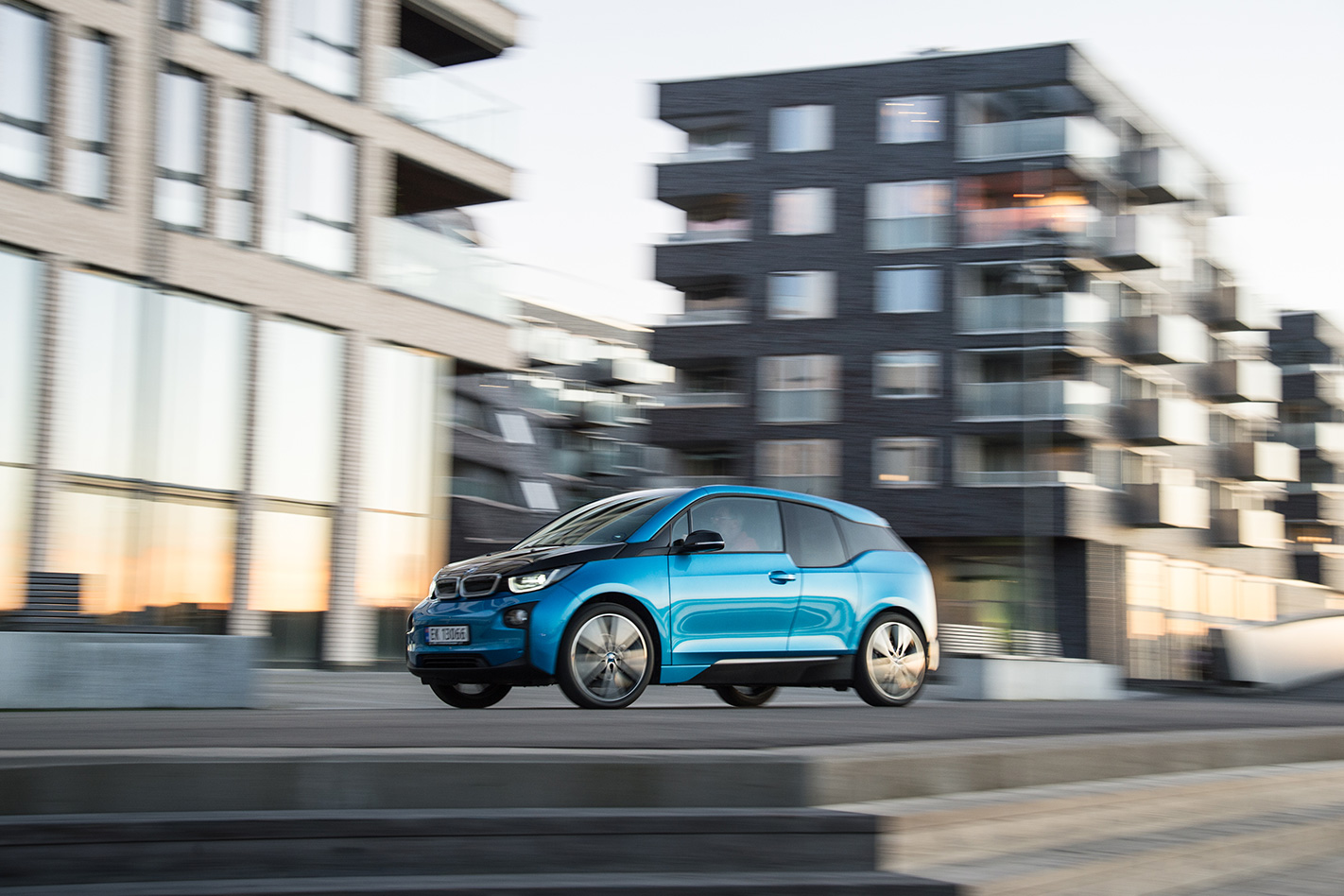
And the equivalent of GST is 25 percent. But Norway’s government exempts EVs from both these taxes.
EVs also don’t have to pay motorway tolls or car ferries, which are an integral part of the local transport network. They’re allowed to use bus lanes when carrying two or more people, and get free municipal parking.
Ståle Frydenlund, communications advisor to the Norwegian EV Association, estimates the purchase tax and GST account for about half the sticker price of a normal car in Norway.
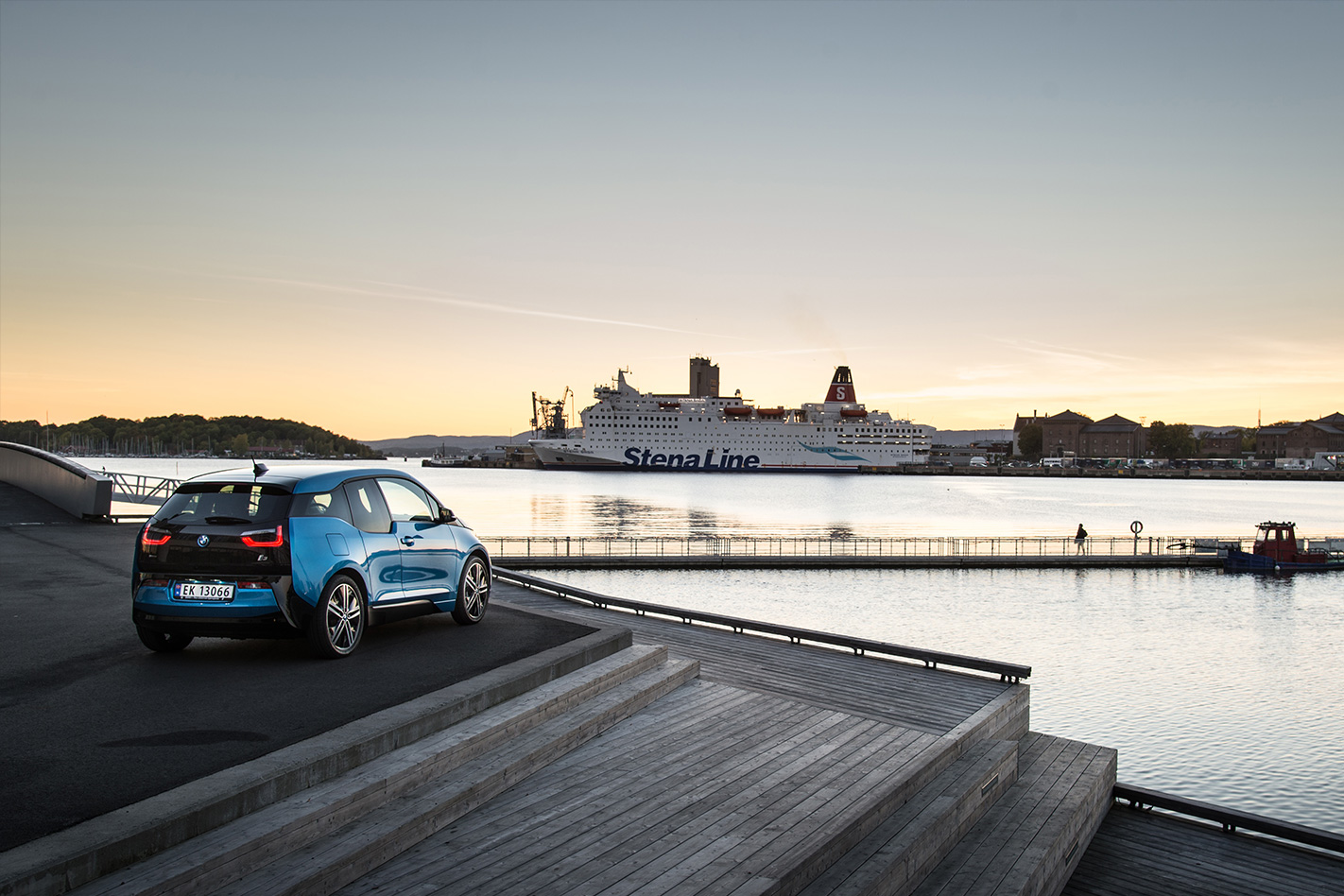
Frydenlund is no car-hating greenie. He was a motoring writer, first for a weekly men’s magazine, later with Norway’s most popular newspaper.
“I’ve been into cars since I was a little boy,” he says. “Hot hatchbacks were my cup of tea.” Now his needs are different. He has a Tesla Model S and likes the long-distance comfort of the big liftback.
“I’m 40 now, I’m a family man, so I think that’s more important than the speediness of a hot hatchback.”
Despite the primitiveness of these tiny EVs, Frydenlund could see the potential. His interest grew, and when the job with the Norwegian EV Association came up in 2013 he wanted it.
Audi A3 etron vs BMW i3 comparison review
“This is one part of the automotive sector I really wanted to explore, and learn all about.”
The association had been formed in 1995 to support these tiny manufacturers – a role that ended in 2010 when Think, by then the sole survivor, declared bankruptcy for the fourth and final time – but it’s now a consumer organisation.
Frydenlund credits those failed companies with initiating Norway’s pro-EV policies. There was never a real masterplan, he says. Once Think and Buddy were gone, the environment became the motivation for consumers to switch to EVs.
Electricity generation in Norway is squeaky clean, with 95 percent of its needs supplied by hydro. Transport is the largest source of CO², with private cars accounting for the biggest chunk, so EVs are a really effective way to cut overall emissions.
The Norwegian EV Association’s membership of 40,000 makes it the biggest of its kind in the world, and staff totals 13. It represents members’ interests in discussions with government and happily shares its experience and knowledge.
“In June we had the whole board of the passenger car division of Volkswagen here in Oslo,” Frydenlund tells me. “Talking to us, asking us questions: ‘What kind of EVs do you think we should make in the future?’” Three months later at the Paris motor show, chairman Herbert Diess, who led the expedition, revealed VW’s ambitious EV new-model program.
It’s not only Norway’s embrace of EVs that makes the place feel like tomorrow. Prices of most things are so high they must be from five years in the future. And so is the way Norwegians pay them. Cash rarely changes hands; it’s all card taps and phone apps.
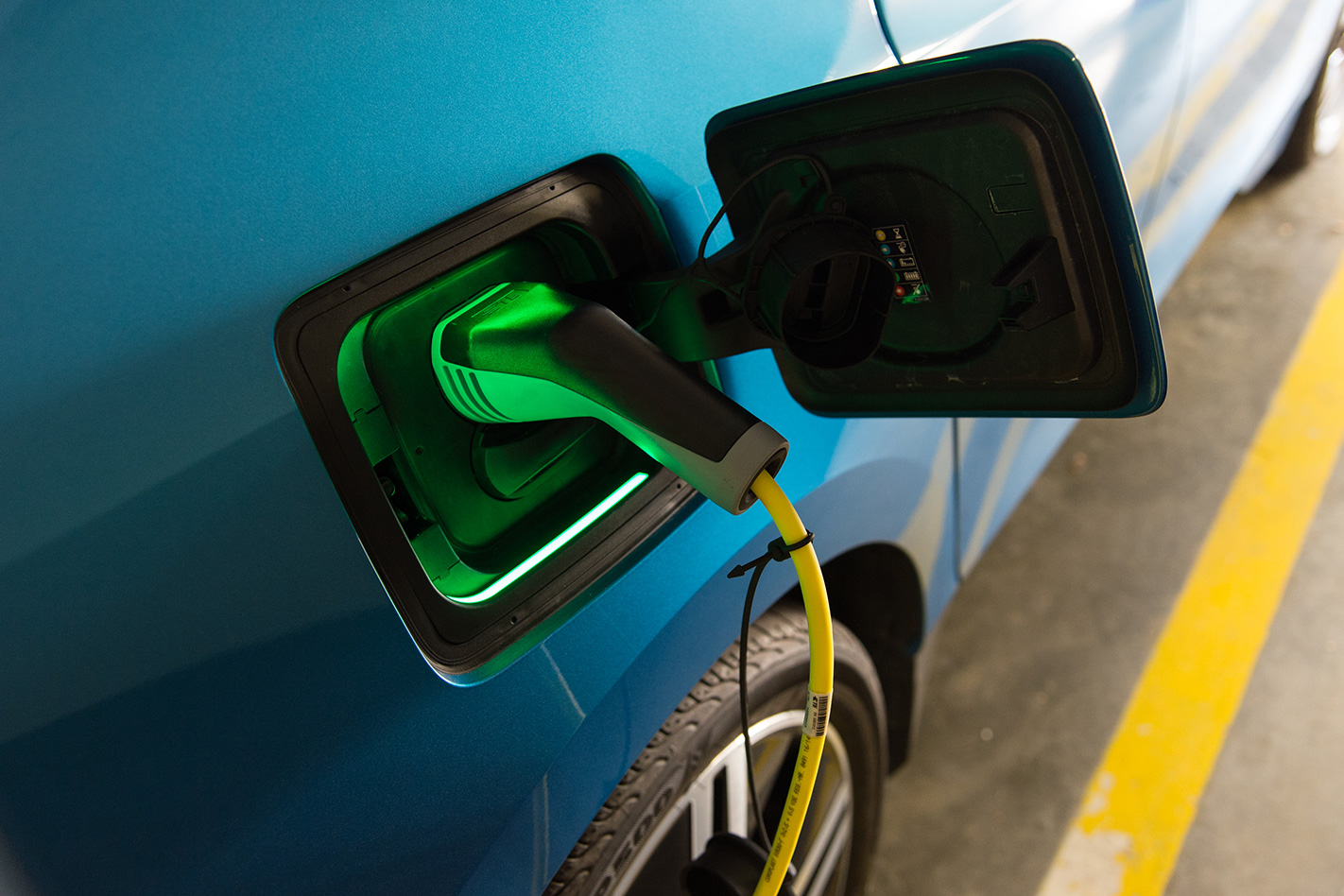
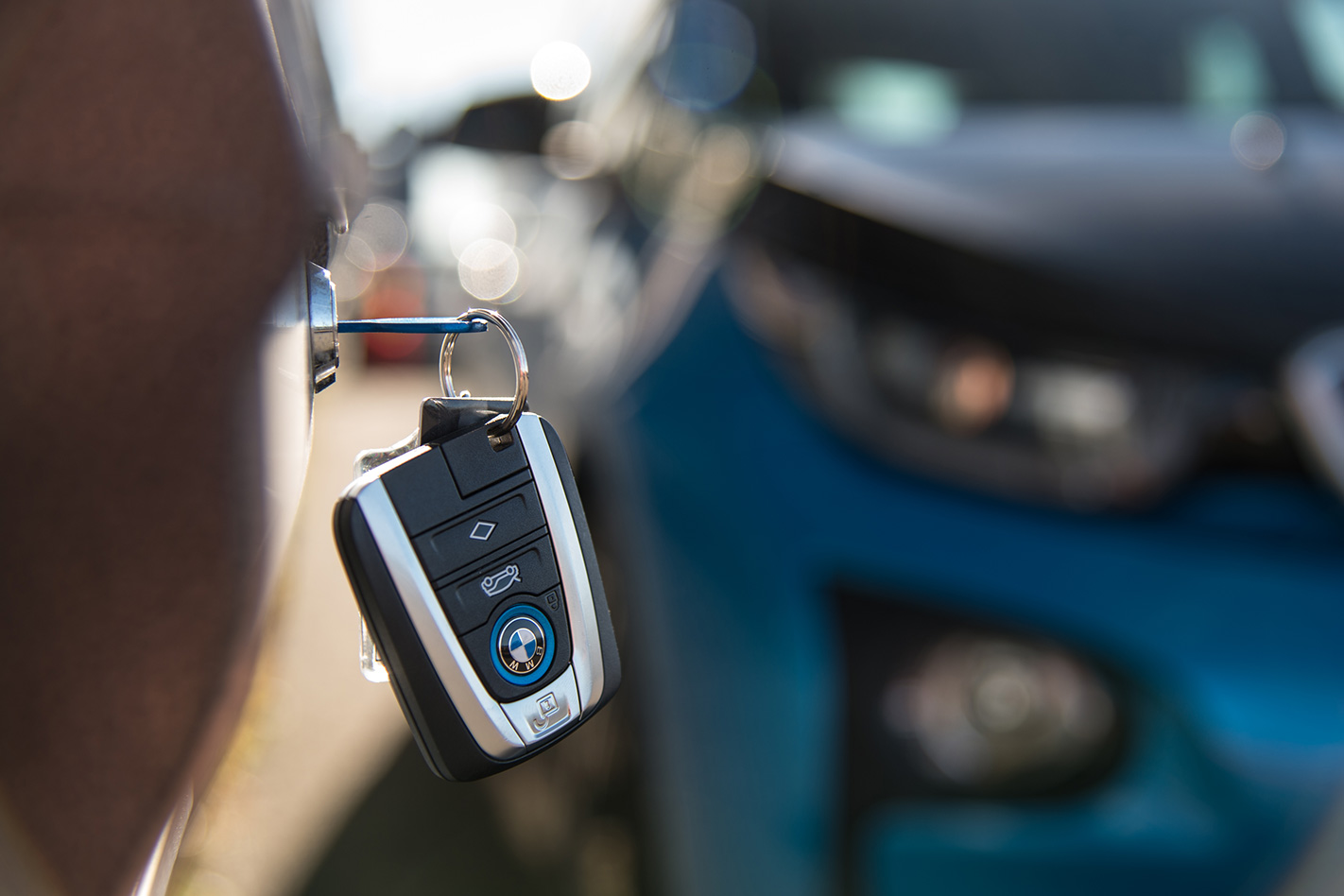
Having flown in from the primitive present, I can’t use either of them. Without a credit app in my smartphone or an account linked to the RFID tag on the BMW’s keyring, I can’t get the required electrons flowing into the i3’s underfloor lithium-ion battery pack.
Luckily, the woman behind the reception desk at the Thon Hotel Rosenkrantz is prepared to help. She sends an SMS from her smartphone to begin the recharge, which will take a few hours. Her credit app will tell her the cost and I’ll repay her with old-fashioned cash.
The fully recharged i3 emerges onto the streets of Oslo early next morning. Like Sydney, the city has an avant-garde harbourside opera house that’s a major tourist draw. But, with a population of only one million, the Norwegian capital isn’t nearly as big.
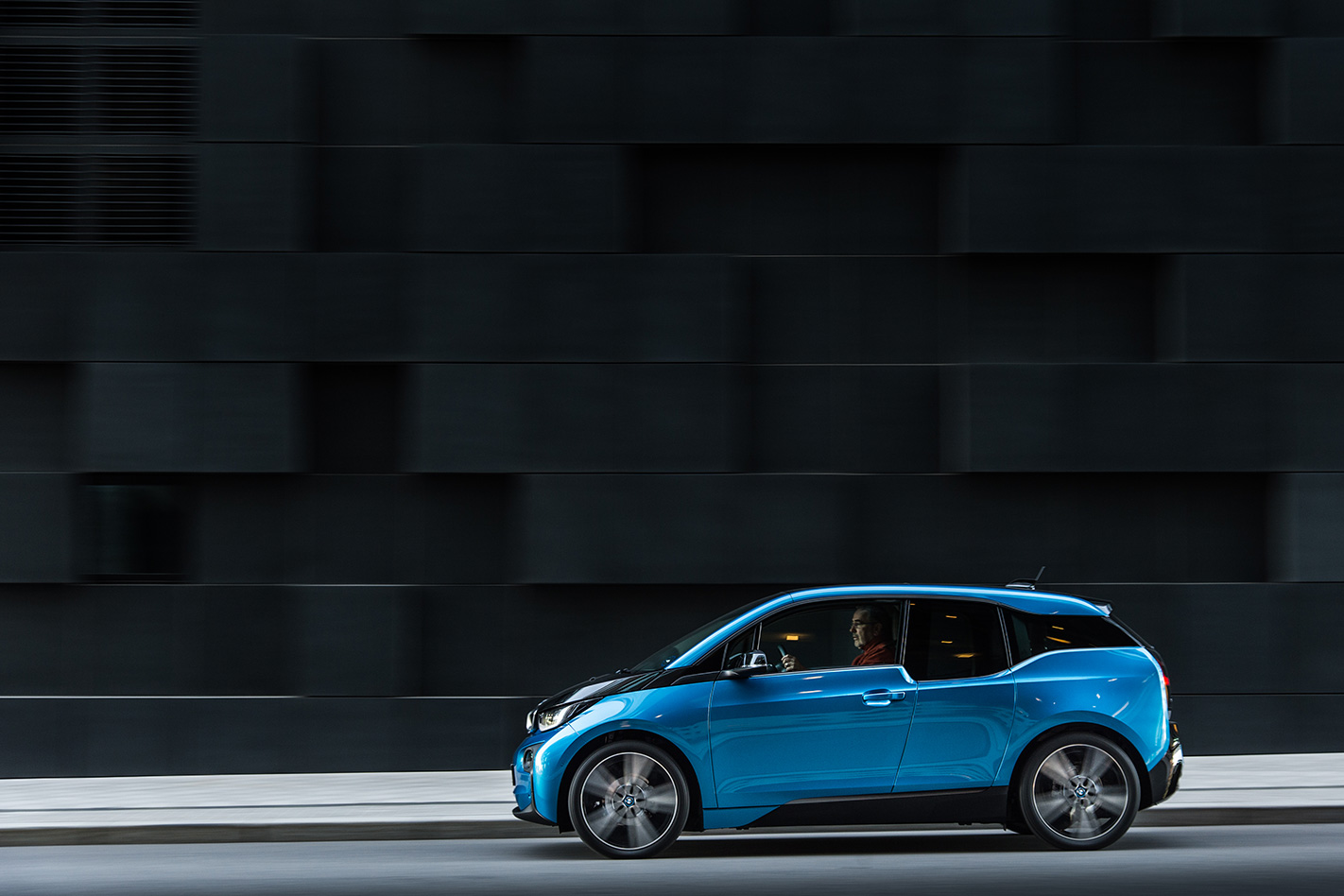
This is a neatly Nordic and unmistakably prosperous city. It is mostly well-tended older buildings, with enclaves of modern architecture like the Barcode Project, a row of tomorrow-modern high-rises on former industrial land beside Oslo’s busy central station. Seen from the station platforms, the row of buildings does look a bit like a gigantic barcode.
We use more than 10km of the i3’s driving range scanning the Barcode Project before heading to World’s End. With two aboard, we can use bus lanes. Gliding past slow-moving morning rush-hour traffic, it’s obvious using an EV in Oslo can be a major advantage.
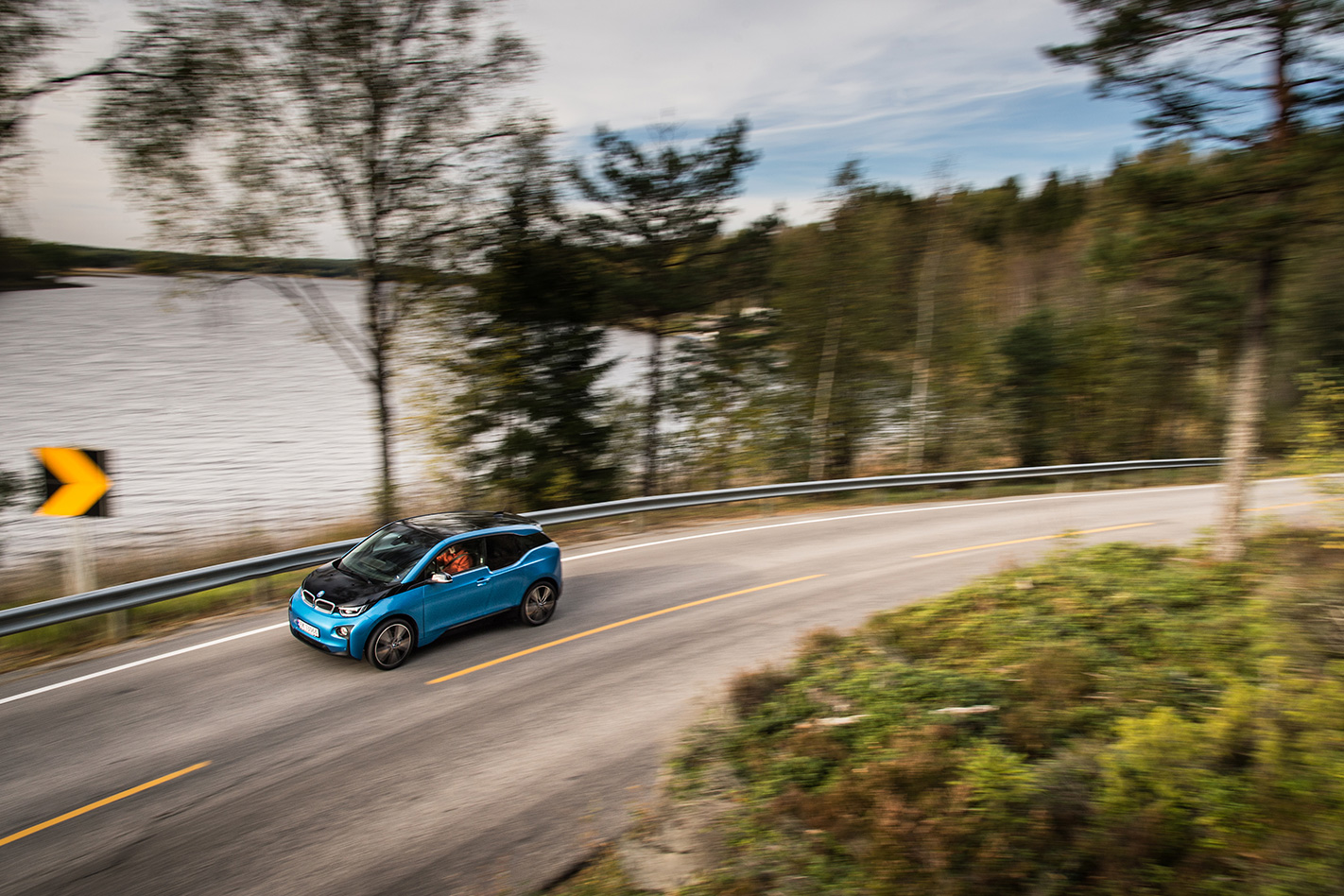
There’s another bonus as we join the motorway towards Drammen. This is a toll road… except if you’re in an EV. But instead of feeling smugly thrifty, I begin to suffer range anxiety. Driving at sustained motorway speeds, with a long climb before Drammen, chews away at our range more hungrily than I’d like. And I’m not yet sure how trustworthy the BMW’s range indicator is.
Range anxiety gets the best of me and I pull into a motorway services area. I’m looking longingly at a pair of unoccupied 50kW DC fast-chargers that I’m unable to use for lack of means to pay when a Renault Zoe pulls in for a top-up.
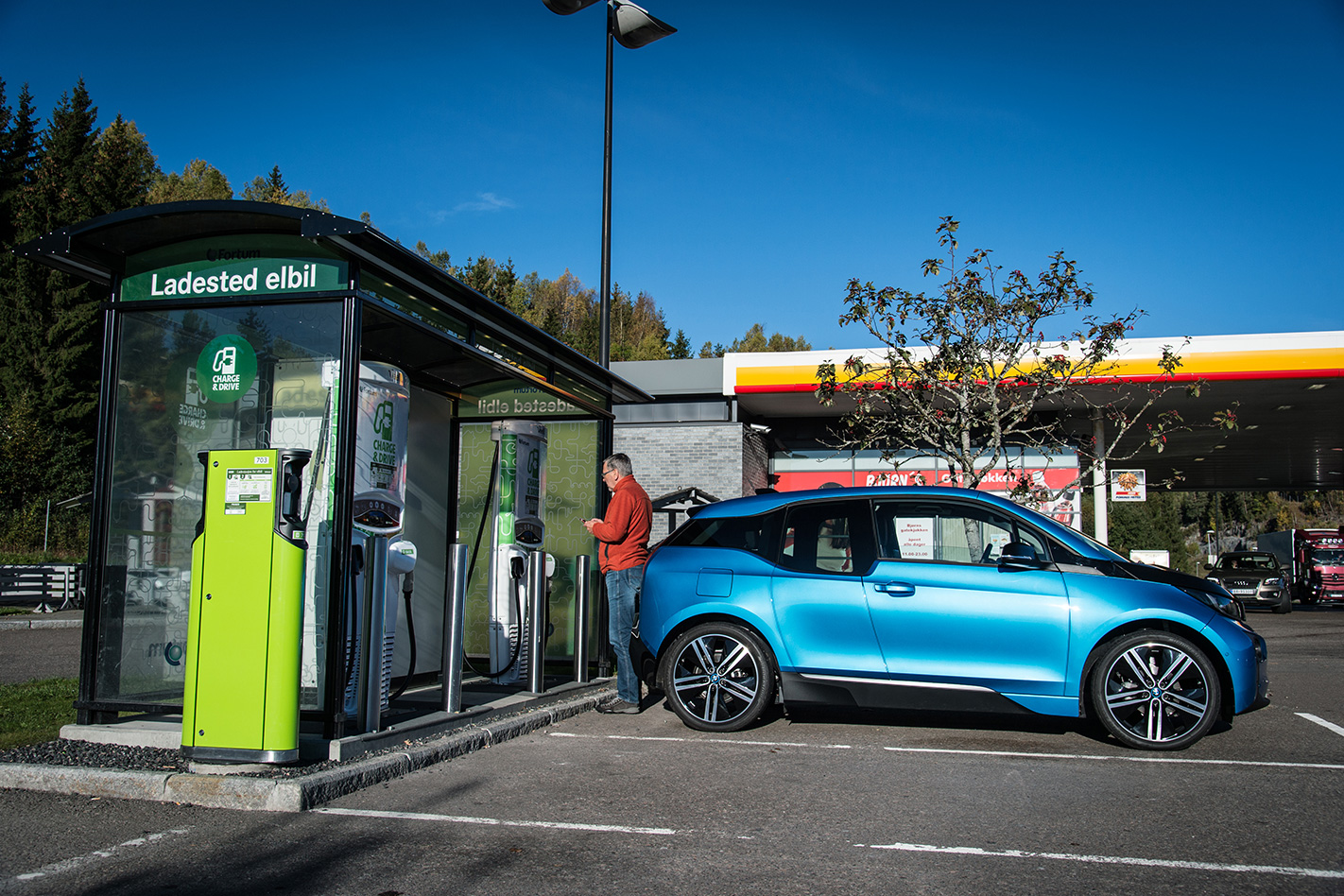
Holanger bought the Zoe a year ago. “It was interesting to drive electric,” he says. “And it’s cheaper. Many say you are doing it just for the environment, but it’s also an economic issue.” He estimates the Zoe’s running costs are only a third those of the family’s second car, a diesel-burning people-mover.
While the Zoe came with a year of free access to the charger network operated by Finnish company Fortum, which is what the car is plugged into as we talk, Holanger mainly charges it at home. For $3 he gets about 150km of driving in summer, a range that’s reduced in the cold winter months.
While he’s learned to live with the electric Renault’s limitations, he’s excited about upgrading to the Opel Ampera-e, a Euro version of the Chevrolet Bolt due to launch in 2017. Holanger thinks it’s a game-changer. Its 60kWh battery means a much longer driving range; up to 500km. With the kind of range only Tesla has so far been able to offer, but at less than half the price, Holanger is certain the Opel will be a hit in Norway.
This is basically a map showing every EV charger in Norway, both free and pay. It leads us to a public parking station, and one of the two recharging spaces is vacant. Though we pay to park, we don’t pay for the electricity. It’s a common tactic to attract EV drivers to parking stations and shopping malls.
The only problem is that it’s not a fast-charger. It will take a couple of hours to put enough into the i3’s battery to give me complete confidence that we can make it to World’s End and back again.
We pass the time watching a small team of craftsmen constructing a shapely Viking vessel. A guy turning a large tree trunk into a hull plank using only a small axe tells us it’s a replica of a 1000-year-old trading vessel known as the Klåstad ship. The aim is to sail it over ancient Viking trading routes; the Arctic waters of northern Norway, the great rivers of Russia, the Black Sea, the Mediterranean, then home via the Atlantic and North Sea.

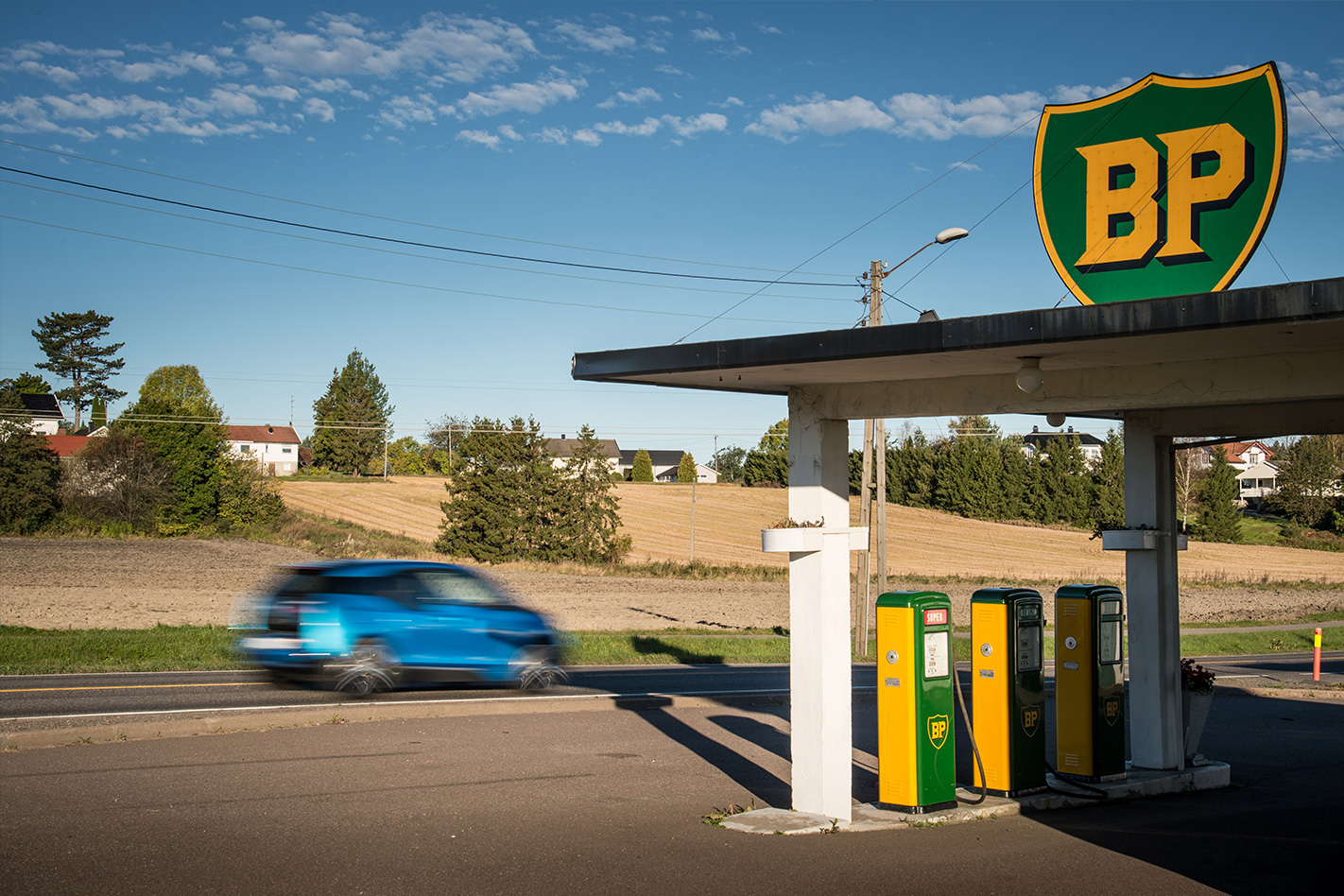
Just south of Tønsberg we find a time-warp BP petrol station. There’s no one around, but it appears to be a kind of museum. Which could be the fate awaiting many other service stations. The way Norway is headed, BP could soon stand for Battery Power instead of British Petroleum.
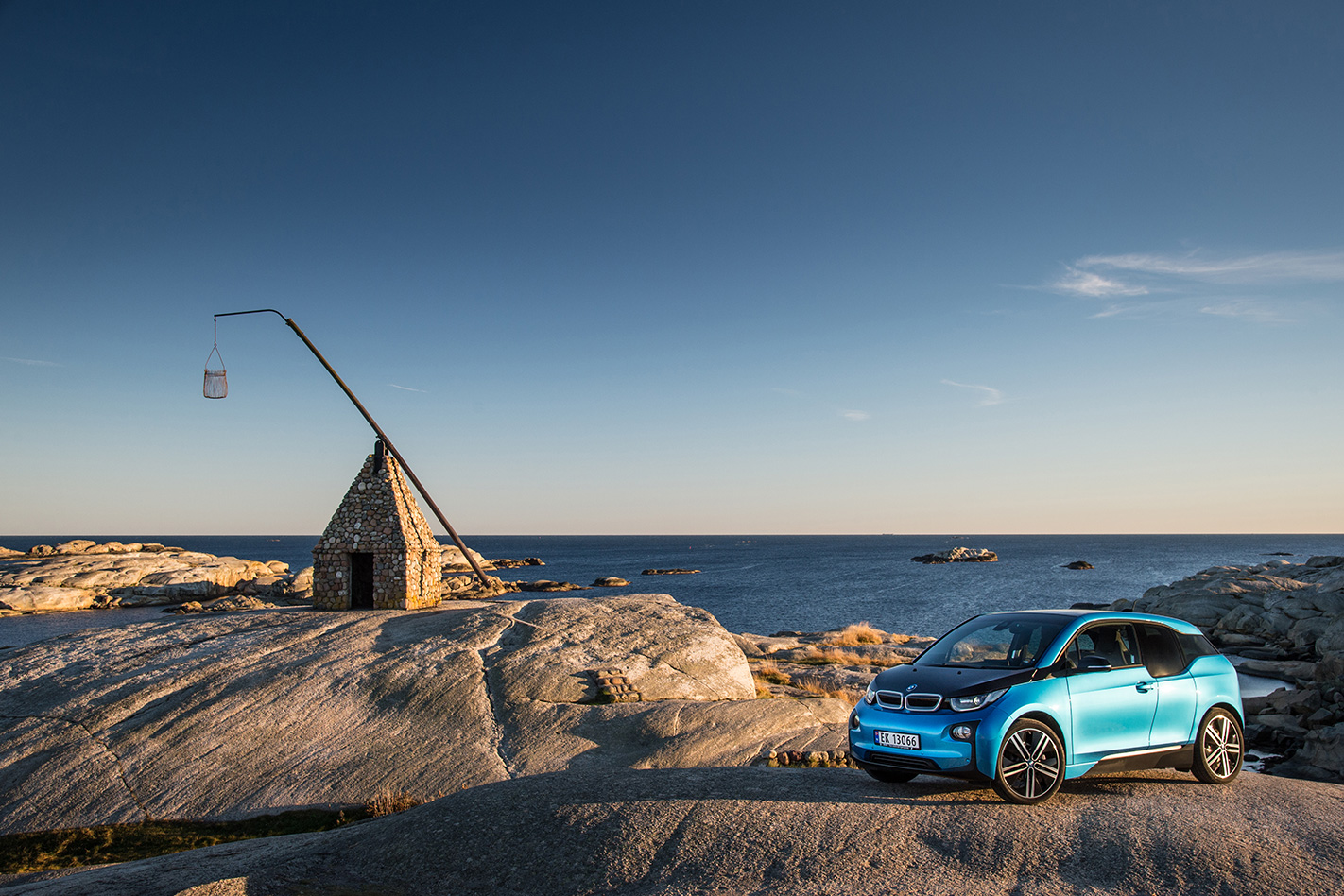
It’s mid-afternoon when we reach World’s End. There are signs banning cars from entering an area where rocks, sea and a stone signal beacon can be seen. The Verdens Ende operations manager has just one question when we ask if we might be permitted to photograph the BMW there.
“Is it a pure electric car?” she asks. It is, so we’re allowed in. Which is not the answer a video crew shooting a conventional car earlier in the day received, the woman adds.
Our trip through darkness to Tønsberg isn’t at all perilous. There’s still 20 percent charge and more than 40km of driving in the i3 battery as I hook it up for another slow-but-free charge before checking in to our hotel; we could have made it from Oslo to World’s End and back to Tønsberg without that top-up.
The i3 is completely charged next morning. The car’s display shows a range of 186km in default Comfort mode or 236km in Eco Pro mode, which trims top speed to 130km/h and reduces the climate control system’s energy consumption.
My confidence in the accuracy of the i3’s range gauge is growing, so we take the longer and more scenic route up the western edge of Oslo Fjord to Horten and catch one of the frequent car ferries to Moss on the other side. While we pay normal passenger fares, the BMW rides for free.
Choosing and using an EV in Norway isn’t always easy, at least for a foreigner who has dropped in to see what the future of driving looks like.
For Norwegians, though, the EV is an affordable, user-friendly, everyday reality. All it took was forward-looking, eco-minded government policy, the activism of the EV Association, and some advanced technical infrastructure. And perhaps a touch of Viking willingness to sail beyond World’s End and into the unknown.
THE latest M5 has some big boots to fill, with a legacy of five generations of talent spanning more than three decades.
Some were good, others great, but plotting the timeline provides an insight into how technology and tastes have shifted,sometimes subtly; occasionally with huge generational strides.
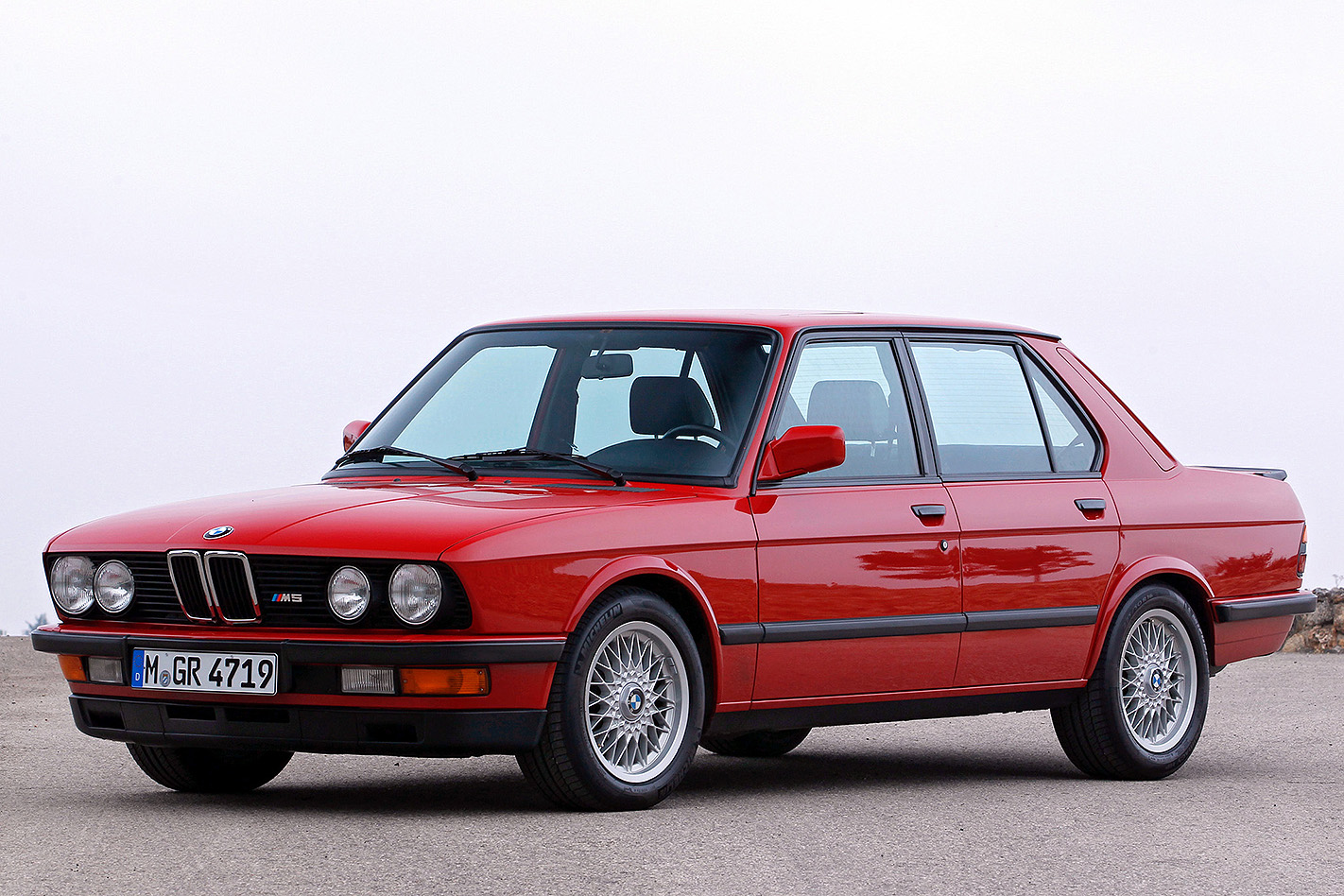
The M5 never claimed to be the first hot sedan but it did redefine the genre, delivering dynamics normally associated with exotica. At the time of its global launch, only four cars on Wheels’ price list packed more power: the Porsche 928S, the Aston Martin V8 Vantage and the Lamborghini Countach, none of which had four doors and a boot. It’d be five years before a home-grown sedan eclipsed this figure, by which time BMW had moved the game on again.
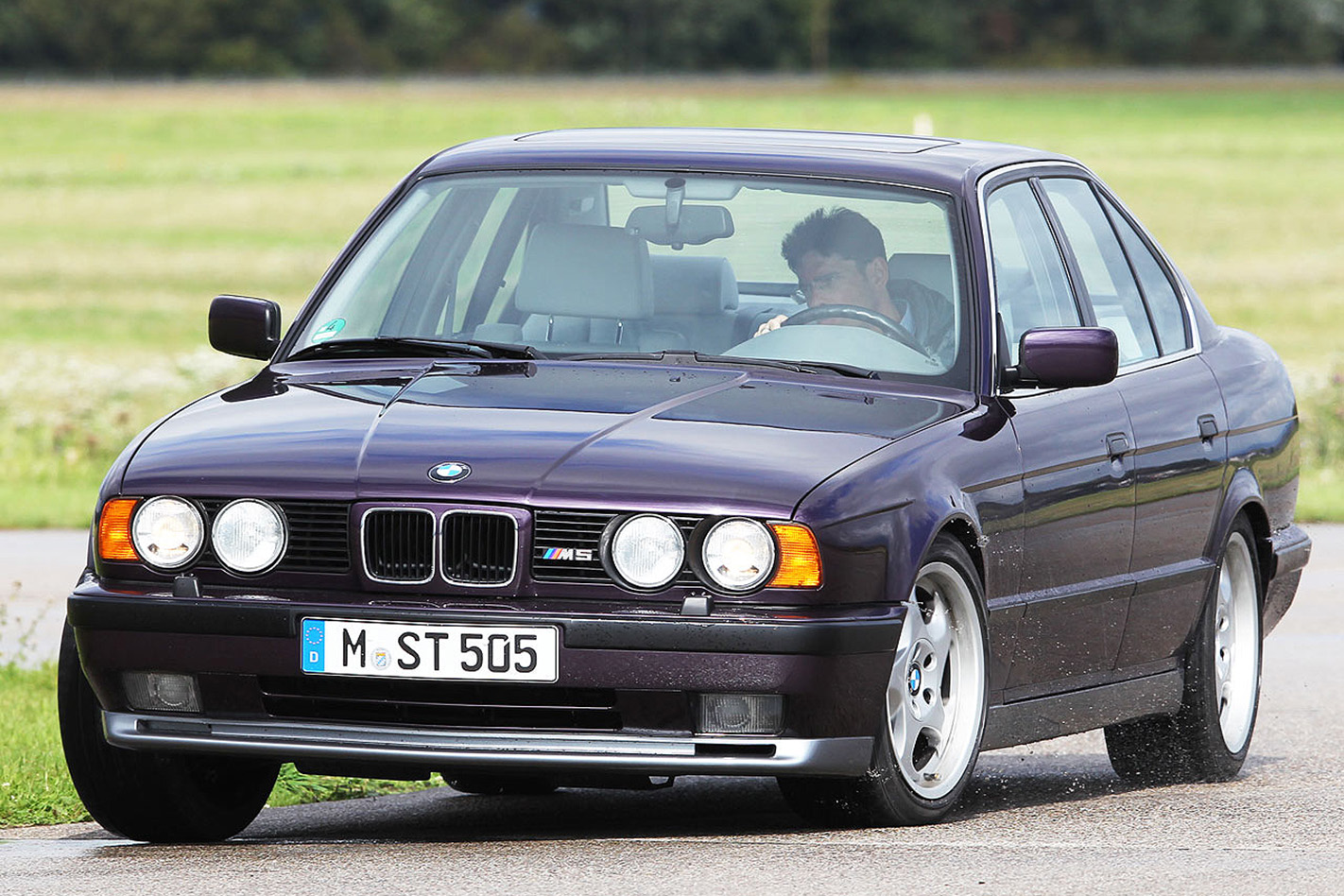
Bigger and more polished, the E34 cost a heady $169K back in 1995. Wheels’ rent-a-racer Kevin Bartlett pronounced it “the best road car I’ve ever driven – close to perfect” in our September 1990 comparo. The engine was uprated to 3.8-litres in 1992, restoring the BMW’s power advantage over the Porsche co-developed Mercedes-Benz 500E introduced the previous year. But a new wave of turbo tearaways had already prompted an underbonnet revolution…
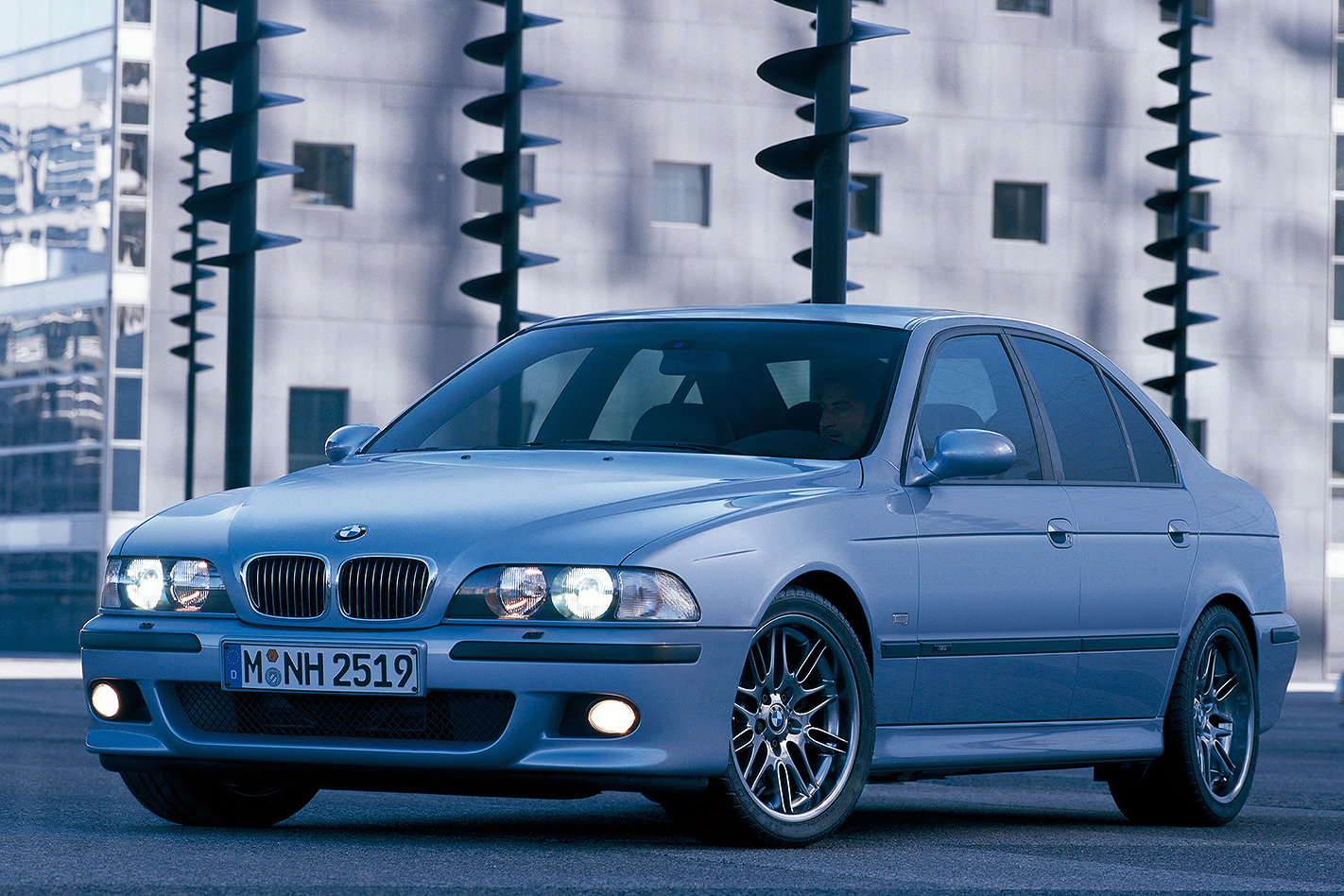
To many, the E39 was the sweet spot in the M5 timeline and it’s easy to see why. An operatic 4.9-litre V8, elegantly understated styling and a chassis of near-genius were the constituent parts. It also featured tech like stability control, floating brake discs and variable valve timing on both intake and exhaust. It arrived after a hiatus of four years where the E36 M3 sedan had temporarily filled the M5’s boots, but there was something wild and exotic about the M5 that set it apart.
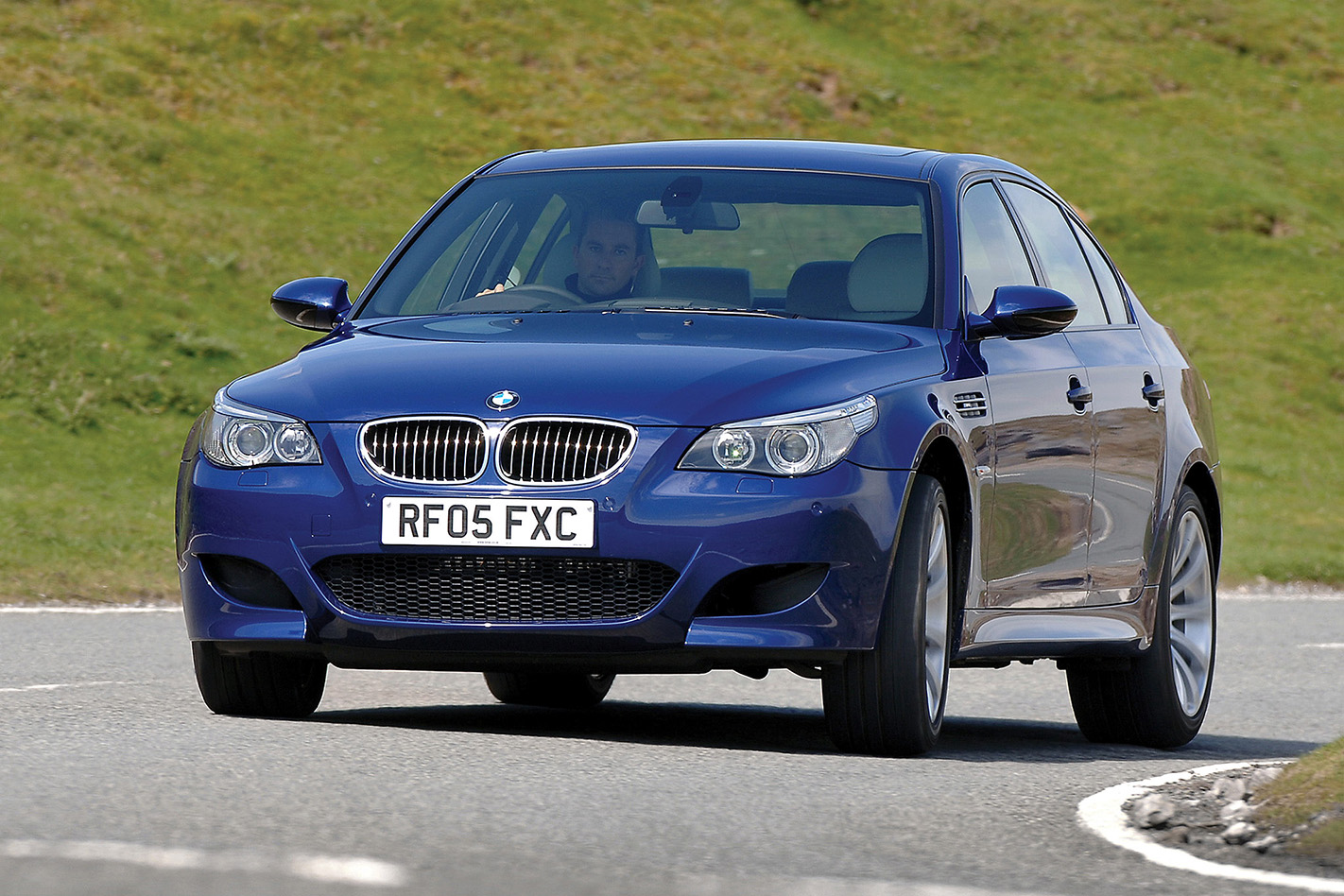
Formula One’s V10 era lasted from 1989 until 2005 and spawned some of the most ear-splitting engines in the sport’s history. The M5 got its own atmo ten-pot in 2005, the all-new S85 engine and Getrag semi-automatic gearbox making the old E39 instantly look a bit quaint. The Bangle-era styling was less of a hit but has aged relatively well. It got an array of drive modes, launch control and the contentious iDrive, but the M5’s atmo zenith was never shy of charisma.
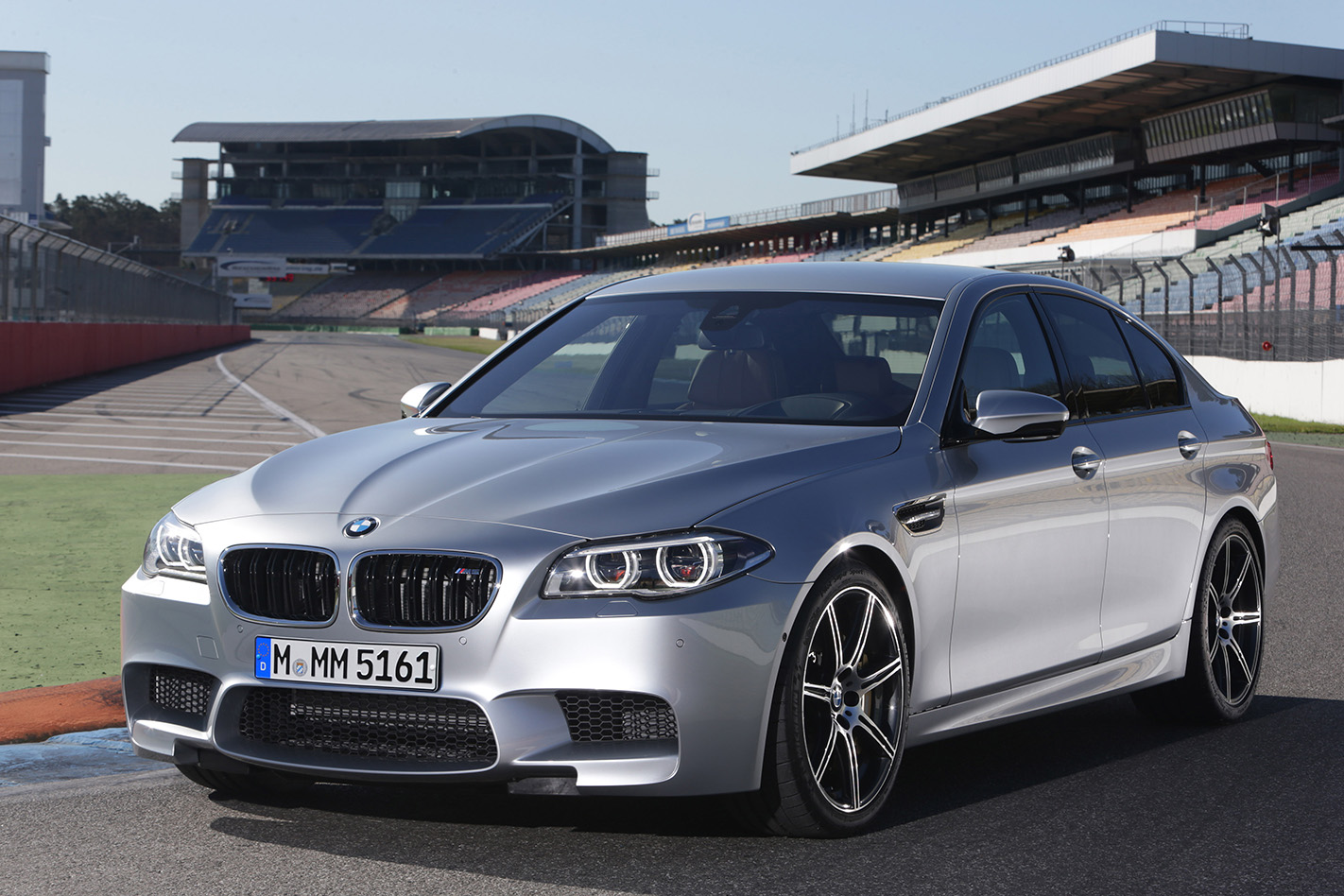
Post GFC, the M5 needed to inject some measure of pragmatism into its genetics and the twin-turbocharged F10 was the result. Lower key but harder-hitting than ever before, the F10 was also more fuel-efficient. The blown V8’s acoustics were given a boost by an in-cabin audio symposer, and torque vectoring helped it to shave a healthy 18 seconds off its predecessor’s Nurburgring mark. But it lacked attitude, which next year’s G30 M5 looks set to sort…
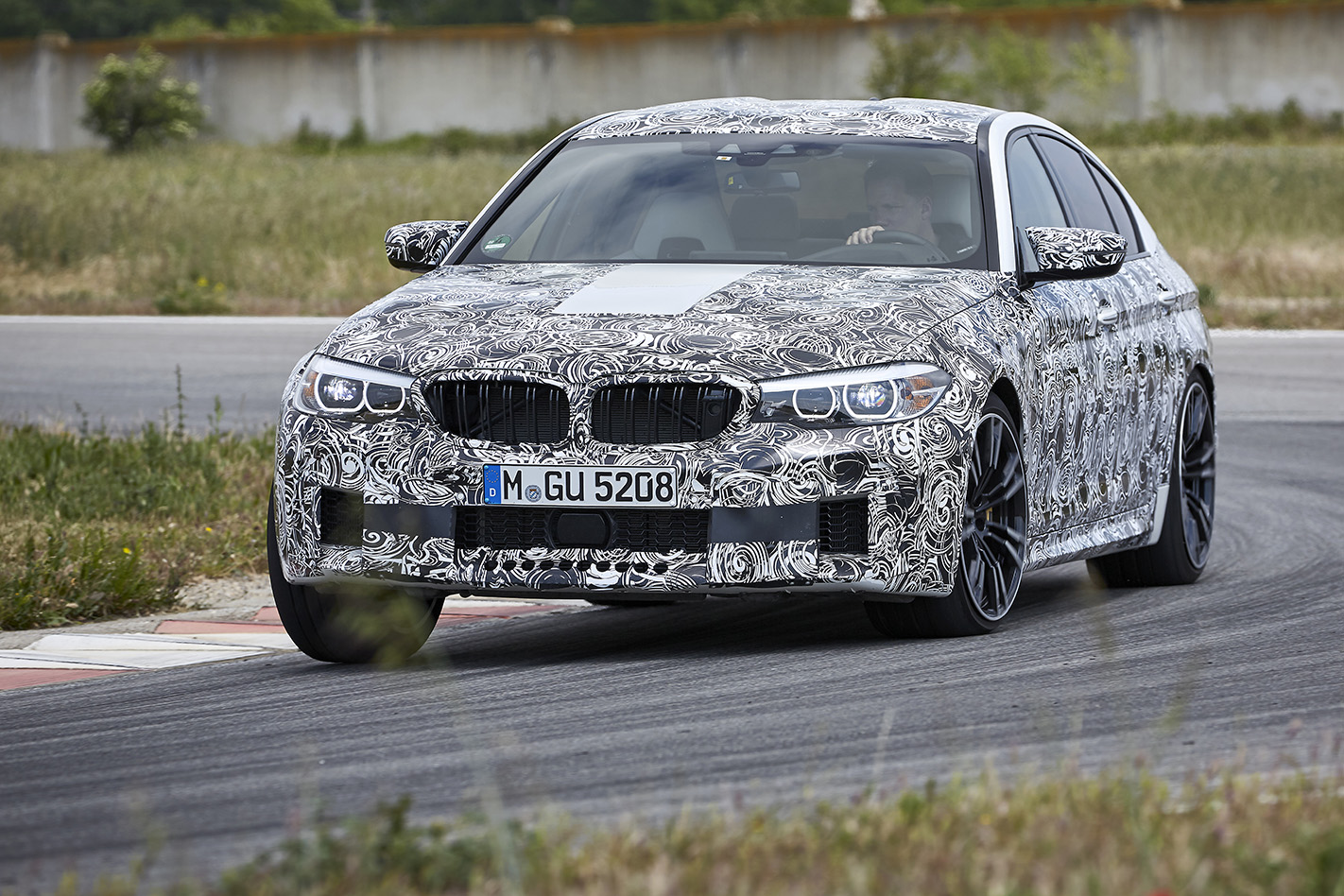
A drive of a prototype F90 M5 suggests the production car will once again raise the bar. John Carey writes, “The new M xDrive system gives the next M5 the choice of all-wheel or rear-wheel drive. It’s basically an all-wheel-drive car, with a sideways and smoking rear-drive option. According to [BMW], the F90 M5 is quicker in ‘2WD’ than the rear-drive F10 M5 it replaces and can rip from zero to 100km/h in “less than 3.5 seconds”. This is around a second quicker than the current M5, and happens to be right in the same near-supercar acceleration league as the Mercedes-AMG E63 S.”
