BMW Australia has launched a shot across the bows of its German rivals, offering a de-specced Pure version of its current M3 and M4 with an eyebrow-raising price tag.
It’s still too early even for official imagery – the photos here are the visually identical M3 Competition LCI – but the M3 Pure will hit showrooms in July 2017 at just $129,900, with its two-door twin asking for an extra $10K at $139,900. This is a $10,000 saving over the regular models’ MSRPs.
The deal becomes even sweeter, however, as the Pure models are almost identical in mechanical specification to the $15K dearer Competition variants. In terms of its main competition, the Alfa Romeo Giulia QV starts at $143,900 and the Mercedes-AMG C63 $155,615.
This means 331kW/550Nm from the 3.0-litre twin-turbo six, a stiffer suspension setup and revised settings for the electronically-controlled limited-slip differential.
The only Competition feature the Pure misses out on are the larger wheels and tyres, wearing the standard M3/M4’s 19-inch wheels – though in a slightly different design – and 255/35 and 275/35 rubber front and rear respectively.
To slice the price BMW Australia has mainly deleted luxury equipment such as adaptive LED headlights, premium audio system and full leather trim, though a nine-speaker sound system, keyless entry and go, carbon fibre interior trim, head-up display, LED headlights and satellite navigation all remain standard.
The Pure offering is unique to Australia. First introduced on the E90/E92 M3, it has since been rolled out on the M2 and M5.
“The BMW M3 Pure builds further on Australia’s successful Pure Edition models,” said BMW Australia CEO Marc Werner in a statement. “This model offers the full capability of our M3 Competition at a price point that is sure to attract a new core of enthusiast customers.”
We’ll bring you official imagery and a first drive of the M3 Pure shortly after its local launch.
What stands out?
The Subaru XV brings you the elevated outlook many people enjoy in small SUVs, while performing much like the well regarded conventional hatchback it is based on. Cool-looking wheels, plastic cladding on the lower body and a more exuberant palette of colours add personality, and all-wheel drive helps control in poor conditions. This review covers cars on sale new prior to July 2017.
What might bug me?
Trying to squeeze the family’s holiday luggage into the space behind the rear seats. Even the Impreza hatchback has more room there – but that’s because the XV carries a full-sized spare tyre. However, the XV has more luggage space than some alternative small SUVs.
What body styles are there?
Five-door hatchback.The XV drives all four wheels, and it is classed as a small SUV, lower priced.
What features do all versions have?
Cruise control, and climate control air-conditioning (which maintains a set temperature).Bluetooth phone and audio connectivity, with a voice command function and audio controls on the steering wheel, and a touchscreen (6.2-inch on the least expensive version, the 2.0i). A radio and CD player, and Aux and USB inputs for the MP3 compatible sound system.Hill-start assist, which operates the brakes automatically to make take-offs on hills easier.All-wheel-drive, which improves drive and stability on slippery surfaces.Aluminium alloy 17-inch wheels, which look nicer than steel wheels and usually weigh less, and a full-size steel spare wheel.Foglights, and a 4.3-inch colour multi-function display that presents helpful information.A reversing camera.Seven airbags: two directly in front of the driver and front passenger; one alongside each front occupant to protect the upper body; a curtain airbag on each side to protect the heads of front and rear occupants; and a knee protection airbag for the driver.Electronic stability control, which can help the driver to control a skidding car. All new cars must have this feature.Ten metallic, pearl and silica colours are available, and they come at no additional cost. The XV is offered in more vibrant shades than the Impreza, among them the eye-catching Tangerine Orange Pearl.Every Subaru XV carries a three-year, unlimited kilometre warranty.
Which engine uses least fuel, and why wouldn’t I choose it?
The sole engine available with the Subaru XV is a 2.0-litre petrol four-cylinder. When teamed with the continuously variable automatic transmission, it uses 7.0 litres/100km on the official combined cycle test.With the optional six-speed manual it consumes 7.3 litres/100km, but you can make more of the engine’s modest power output with this gearbox.Fuel use in city driving is reduced by the XV’s automatic stop/start system, which shuts off the engine when you stop and restarts it when you press the accelerator to drive away.The XV’s engine differs from those found in cars from most other makers, in that it lies flat across the engine bay rather than standing up vertically. This places the weight of the engine lower in the car, which helps it steer more responsively.
What key features do I get if I spend more?
Stepping past the least expensive 2.0i and into the 2.0i-L brings you a power-operated sunroof, a bigger 7.0-inch touchscreen interface with satellite navigation, and an SMS-reading function (compatible with some phones but not all). Dual-zone air-conditioning allows different temperatures for each side of the cabin. The steering wheel and gear shift lever are trimmed in leather.Spend more again for the 2.0i-S and you get seats trimmed in leather. The front seats can be heated, and the driver’s seat is power-adjustable. Headlamps use very bright Xenon bulbs for low-beam, and switch on automatically when it’s geting dark. Windscreen wipers operate automatically when it rains. A smart key can remain safely in your pocket or bag while you unlock the car and drive away. Control pedals are finished in aluminium with rubber grip pads, for a sporty look and feel.
Does any upgrade have a down side?
The sunroof reduces headroom for occupants in the front.You might slide around more on the leather seats than on the cloth versions, in corners.
How comfortable is it?
The Subaru XV is very comfortable to drive and ride in, although its suspension feels noticeably firmer than the Impreza’s.The XV is among the quietest of the small SUV set. Its cabin is well insulated from outside noises, such as the noise of the suspension working and the sound of the tyres rolling over coarse road surfaces. The only noticeable sound at highway speeds is airstream rustle around the large, door-mounted side mirrors.The cabin is made from good plastics and textiles, which fit together well. That brings an air of quality to the driving experience that elevates the Subaru above some Japanese competitors.Like other small SUVs, the XV’s taller stance – it is 7.5cm higher than the Impreza – brings occupants a more commanding view of the road than they would have from conventional sedans and hatchbacks. Supportive standard seats stay comfortable for drives of two hours, and the driving position is easily tailored thanks to the standard height- and reach-adjustable steering column. The eight-way power- adjustable driver’s seat in the 2.0i-S makes it even easier to get comfortable behind the wheel.
What about safety?
Seven airbags, a reversing camera, voice recognition, the mandatory stability control, and seatbelt reminders for all five seats contribute to a good core safety package.The forward location of the XV’s A-pillars (those either side of the windscreen) allows good vision for tight corners and roundabouts, increasing primary safety. The door-mounted exterior mirrors aid vision in the same driving conditions.No Subaru XV offers autonomous emergency braking or other active crash-avoidance features, however.The Australasian New Car Assessment Program (ANCAP) awarded the Subaru XV its maximum five-star rating for safety, in January 2012.
I like driving – will I enjoy this car?
The Subaru XV is among the more enjoyable small SUVs to steer. It is based on a conventional Subaru hatchback, the recently superseded Impreza, and is nearly as responsive, notwithstanding its greater ride-height and all-season tyres.The electrically assisted power steering is weighted just right, and the car turns into corners well. The XV’s body does not lean much when cornering, with help from the relatively firm suspension and the flat layout of the boxer four-cylinder. This adds to the feeling of good handling.However, for those who sometimes drive with enthusiasm, the XV becomes less impressive. Vigorous driving exposes the limitations of the standard all-season tyres, which ultimately have less grip on paved surfaces than normal passenger car tyres.The engine is a weak link in driver enjoyment of the XV. It is very smooth and quiet, and feels good in normal driving. But on hilly roads, or when asked to accelerate the car quickly, it lacks the ability to respond decisively.The continuously variable automatic transmission can be manually operated using gear-shift paddles behind the steering wheel, which makes it more fun than some conventional automatics.
How is life in the rear seats?
Entry and egress from the back of the XV is not quite as easy as it is with some alternative SUVs, such as the Mitsubishi ASX. That is because the XV shares its body with a conventional hatchback.A comfortable, well-angled base and backrest, and good shoulder and foot room, contribute to a good level of comfort for rear passengers once inside.There are no rear air-conditioning vents, although this is a common omission in small SUVs at this price.The seat can carry three passengers, with lap and sash belts for all.
How is it for carrying stuff?
The Subaru XV provides less luggage space behind the rear seats than many small hatchbacks – its 310 litres is 30 litres less than the Impreza has, for example. This is because the XV comes with a full-sized steel spare wheel, which could be very handy on an extended trip but which takes up more space than the Impreza’s space-saver spare.Nevertheless, there is more boot space than you get with some popular small SUVs – the Mazda CX-3, for example.The XV’s cargo volume expands to 741 litres when its 40/60 split-fold seatbacks are folded.
Where is it made?
The Subaru XV is manufactured in Japan.
What might I miss that similar cars have?
Autonomous emergency braking. Cars with this feature can sense an obstacle ahead (typically another car that has stopped suddenly), warn you of the danger, and brake automatically if you fail to react. All versions of the Mazda CX-3 offer this as an option, for example, and all but the least costly Honda HR-Vs have it standard. (Subaru offers it on its bigger Forester.)The ability to display some apps from compatible smartphones on the car’s touchscreen, and control them from there, via Apple CarPlay or Android auto. The Suzuki Vitara offers this, for example.Alternatives that offer turbo-petrol or turbo-diesel engines, such as the Vitara, CX-3, Mitsubishi ASX and Nissan Qashqai, respond more eagerly to the accelerator pedal, particularly from low to medium speeds. They may also be more economical on fuel and offer greater range on a full tank.Mitsubishi offers a five-year warranty for its ASX.Among other cars you might consider are the Toyota C-HR and Jeep Renegade.
I like this car, but I can’t choose which version. Can you help?
Absolutely – the Subaru XV 2.0i-L is our pick of the line-up.It brings very useful extra features over the basic 2.0i, such as satellite navigation, as well as luxuries such as the electric sunroof and leather-trimmed steering wheel.However the entry-level 2.0i is certainly worth considering if you can do without satellite navigation. It offers most of the necessities, including a reversing camera.
Are there plans to update this model soon?
The Subaru XV arrived in Australia in 2012. It received a minor update in May 2015 that focused on a revised touchscreen interface.An all-new XV went on sale in Australia towards the end of June 2017. It brought a little more power, better handling, more security on loose surfaces, auto-braking via Subaru’s EyeSight suite, and better smartphone integration (from support for Apple CarPlay and Android Auto), among other changes.
NOBODY likes the sad sound of present-day Formula 1 cars, not even the people in charge of the sport.
The quiet drone of the current V6 engine crop isn’t a patch on the high-revving naturally aspirated shriek we’ve waved goodbye to, but turbocharged V6s don’t have to sound so sour – as proven by IndyCar.
The American open-wheeled racing series has been using boosted small capacity V6 engines since 2012 – two years before Formula 1 adopted a similar format – and they happen to sound pretty exciting.
And, at a base level, the engine specs of the two categories are surprisingly similar.
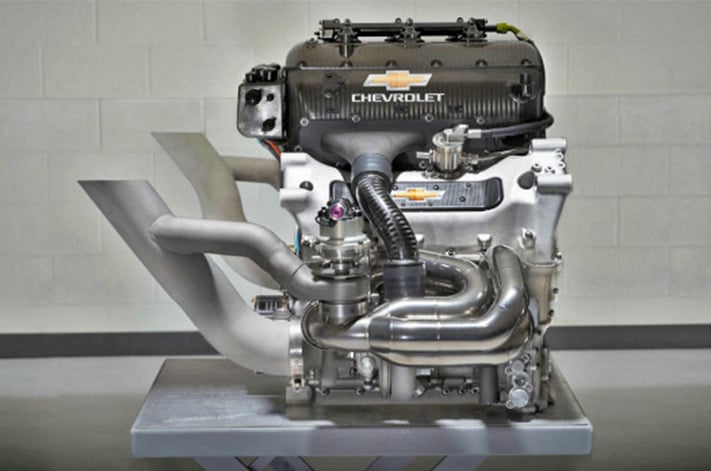
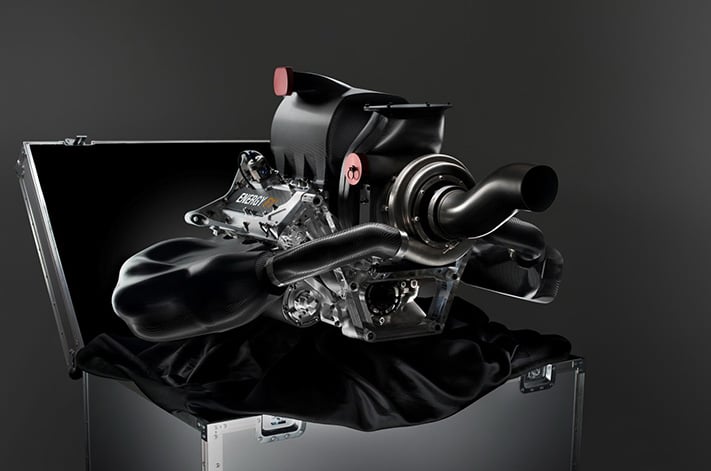
Formula 1 regulation specifies a 1.6-litre turbocharged V6 engine (below) with a rev limit of 15,000rpm running on unleaded petrol. Though the rev limit is higher, a 100kg/hr fuel flow limit (and the enormous torque of these engines) means drivers often short-shift before redline.
Its difficult to illustrate just how loud the IndyCar engines actually are, whereas anybody who has visited a recent Formula 1 race will tell you that maintaining a conversation with the cars running isn’t that difficult.
A large part of the difference comes down to the complex hybrid system required in a Formula 1 power unit. The electric motors and generators add their own whininess to the overall sound, but they also diminish some of the noise of the engine and turbo and leave us with this…
One could kindly describe the sound of current F1 cars as interesting, but not quite as emotionally engaging as that of their American cousins.
A motor generator unit integrated within the turbocharger in a Formula 1 car makes a wastegate more or less redundant, and takes away much of the screaming exhaust rush that’s heard from each of an IndyCar’s two turbos.
Video: Visor Cam injects more thrills to televised motorsport
There’s also the fact that sound is wasted energy, and as the efficiency of Formula 1 internal combustion engines improves, so their sound reduces. It’s possible a lift on the fuel flow limit could help, with teams then able to dial up their engines to higher peak revs, but that would go against the sport’s current efficiency objectives.
Formula 1 is a hotbed of incredible engineering feats making racing cars faster and more efficient than ever, but sadly going fast with these engines doesn’t sound anywhere near as viscerally sensational as it used to.
At least IndyCar is helping out with that in its own way.
 Turbo Titans
Everything you’ve ever wanted to know about the humble turbocharger and its miraculous power-boosting abilities.
FOR our retrospective glance back through the ages of locally designed concept cars, we are frequently lamenting about how a given show car or design study showed great potential, but never managed to convince the accountants, but when it comes to more recent vehicles, their fate may not yet have been decided.
One such case in point is the Buick Avenir that made its debut at the North American International Auto Show early in 2015, revealing a large luxury rear-drive sedan that could point to a production version that would be shared by both Buick and Holden.
With the departure of the locally made Commodore and all of its derivatives, a showroom version of the car you see here would be a prime candidate to replace the swansong Caprice when it takes a final bow in October this year.

As a further encouraging facet, the concept’s name translates from French as ‘Future’. A subtle Easter egg that hints at the car’s potential to make it through to the manufacturing lines perhaps? Let’s hope so.
It is not unusual for the experienced local design team to have involvement in international and high-profile projects but it is less common for the two-dimensional version to evolve into three-dimensions on local turf as well.
The car that rolled out at Detroit may wear one of the most quintessential North American auto maker badges, but the concept was designed jointly between the Detroit HQ and Fishermans Bend, before being built in Melbourne at one of only two GM facilities worldwide that is capable of taking sketch to full-size model in house.

It sweeping body and “boat-tail” design is an homage to the 1970s Riviera said GM at the Detroit show launch.
Inside, the minimalist but tech-packed cabin offers expansive leather, ambient lighting and a theme that is inspired by waves receding from a beach, according to its maker.
Front row occupants are treated to a 12.0-inch touchscreen that incorporates Buick’s IntelliLink operating system for access to features including a connectivity service that synchronises all devices when the ignition is switched on.

While some esoteric concepts are harder to build a business case for, the Avenir has Chinese and US markets written all over it, and that potential volume in other markets would give the car better prospects in Australia, despite slipping demand for large sedans.
Of all of our best Aussie concepts we have looked at so far, the Buick is one you are most likely to see on a road near you at some point in the not too distant avenir.
I BLAME Max Verstappen. I point a wrinkly finger at his barely pubescent visage, his F1 podium glory, his fearless racecraft, and I put curse on his wretched, monumental talent.
First published in the Summer 2016 issue of Wheels Magazine, Australia’s most experienced and most trusted car magazine since 1953.
I do this because Max is the new face of the young and gifted.
Society has idolised youth and virility since forever, but at least there was a window, through your 20s and 30s, where you were surely in life’s sweet spot.
Now, no thanks to Max – born in 1997, for chrissake – that window has shifted south. Leaving blokes like me even older, crustier and closer to washed-up than we thought we were.
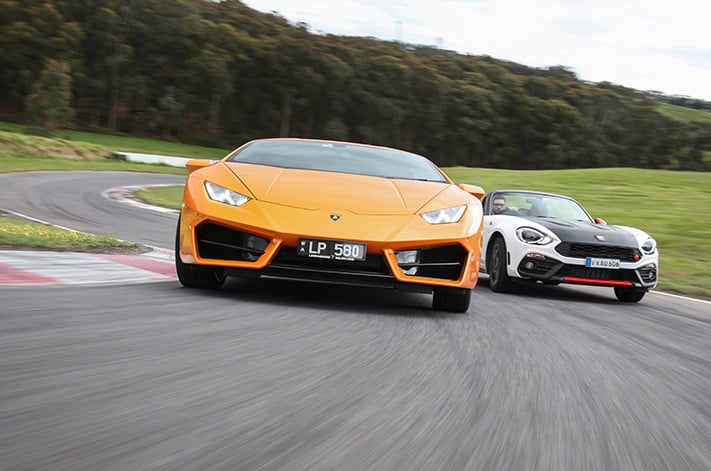
So of course someone at Wheels had the genius brain-fart idea: why not give the old crusty dude (er, me) a wickedly fast and capable car. Let’s say, oh, a 426kW rear-drive Lamborghini Huracan.
Then take someone youthful and quick (that would be Alex Inwood, Wheels acting editor) and drop him in something sweetly honed and balanced, but way down on power: the new 125kW Abarth 124 Spider.
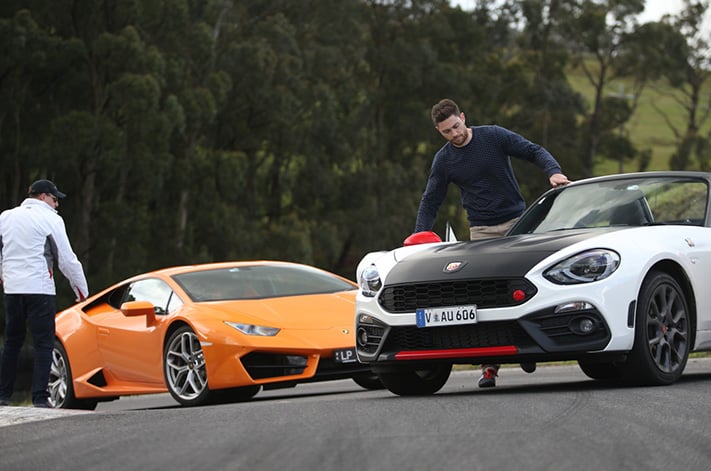
I weigh up the equation: potential driving elation versus possible scarring humiliation. I’m in!
Lurking below the surface, though, is a premise with more substance: Does power, performance and a towering pricetag automatically bring greater satisfaction and enjoyment? Or can you get just as big a buzz from something affordable and brilliantly focused?
Then there’s the curious commonality shared by this pair: both are raunchier iterations of more conservative birth partners. The Fiat, of course, is the turbocharged, brio-infused iteration of Mazda’s MX-5, while the wildly flamboyant Huracan shares its DNA with the less shouty, more tempered – but still sinful – second-gen Audi R8. Who, we wondered, comes out of this automotive bed-hopping with arms raised in a post-coital salute?
WE ARRIVE at Haunted Hills under steely, set-to-burst skies and a biting wind.
It’s a bit foreboding, but I dunno about the ‘Haunted’ bit, as I’m with Homer Simpson when it comes to ghosts. I’m sure they’re mere figments of the human imagination, like elves, goblins and Eskimos.
Yet I’ll quickly learn that this place is inhabited by spirits left behind by slaughtered cars and broken competitors.
It’s a twisting ribbon of bitumen that resembles a huge strand of grey fettuccine spat against a lush, verdant hillside, and, as circuit tsar John Bryant explains to me, it’s scalped plenty who have thought themselves too quick or too clever for it.
It makes me think of Sharon Stone’s character in the 1992 schlocker Basic Instinct.
Not the curves – although they were pretty tidy – no, more the irresistible seduction, the promise of an orgasmatron of enjoyment to be had, but knowing it’s just waiting: one tiny slip and this place will deliver an ice-pick to the temple.
It has already been helpfully pointed out that Robbo is the only journo who’s crashed a Lambo and lived to write the tale.
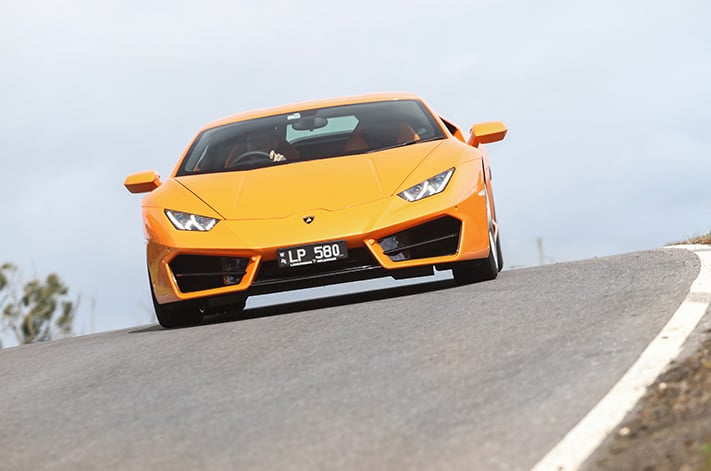
Alex and his Fiat, meanwhile, have been out for a brisk sighting lap and pull in as if back from a leisurely jaunt along the Amalfi Coast.
Our acting editor has that slightly irksome quality of having a suite of well-rounded skills, plus he knows the Fiat well, having driven the wheels off the thing on Japan’s famed Mazda turnpike (Wheels, November).
He claims to have not even noticed the foreboding walls, embankments and drop-offs. In his mind, he sees only driving bliss, artfully controlled slides and joyous humiliation of his crusty old colleague.
After he’s done flinging turds at me, he’ll swan off to his nice new home, lovely wife and beautiful life. I’m tempted to look for that ice-pick and jam it in his smug left buttock.
No opportunity, sadly, because it’s time to man up and learn the circuit.
THERE’S a slight irony with the Lambo, in that you need to be old enough to have accumulated the wealth to buy it, yet young enough to be sufficiently limber and supple to jump in without looking like a beer carton being forced into a letterbox. I make a mental note to do more yoga.
Once in, the driving position is sublime; legs ahead, the wheel offering enough reach adjustment to be pulled into your chest like a Super Trofeo racer, and a gun-slit view through the screen. In true supercar tradition, the rearview mirror shows nothing but a glimpse of engine bay.
Perfect.
What jars is plasticky switchgear and some questionable interior design elements. Good bits include long shift paddles that are fixed to the column.
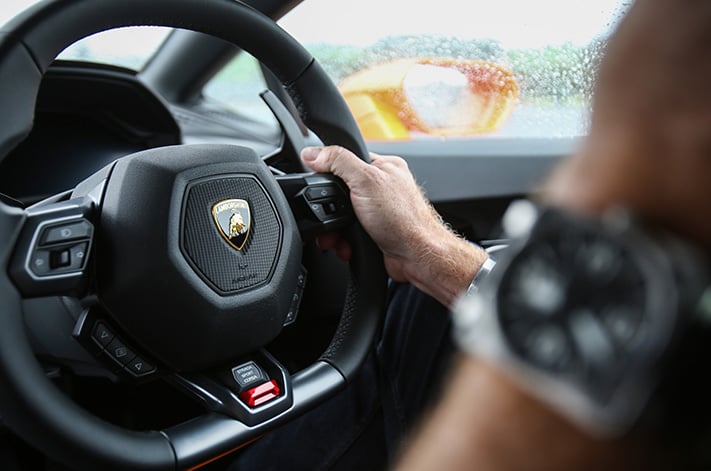
But all of this is negated once you press the starter button.
I know, dear reader, that writers who bang on endlessly about a car’s noise risk becoming as tedious as TV chefs telling us about the delicious aromas wafting from their pan. But forgive me, because the Huracan sounds just nuts, in the most multifaceted, brilliantly ear-bashing way possible.
I laugh like a hyena every time the V10 hawks in the back of its throat on over-run like some giant pub-brawler coughing up phlegm.
Then someone points out all the places hapless drivers have crashed cars into flaming wrecks here – “That’s where Thickhead pulped a GT-R; that’s where Dopey put a TTS on its roof” – and suddenly I’m not giggling anymore.
A section called ‘Oh Shit’ is potentially lethal; a fast, steep, blind crest that plunges savagely down into a compression-dip gradient like a housing-price graph inverted, before snaking into a sharp, tightening right-hander. Huge tractor tyres and earth embankments threaten to turn the Lambo from aero wedge into a cube.
You already know the Huracan shares its aluminium and carbonfibre structure with the Audi R8; same V10 engine, plenty of shared electrical architecture, safety systems, etc. It may lull you into thinking the two cars are non-identical twins, with just styling to differentiate them.
You would be hopelessly wrong. They have core fundamental differences to their characters, which just points to the brilliant execution by their respective makers.
The R8 is the Roger Federer of supercars; polished, accomplished, gracious, rounded. The Lambo is more like Nick Kyrgios; aggro, brash, flashy, almost ridiculously loud…
And supremely talented when conditions are favourable.
Which is not now.
Here, as the circuit is lashed with rain, AWD would be handy.
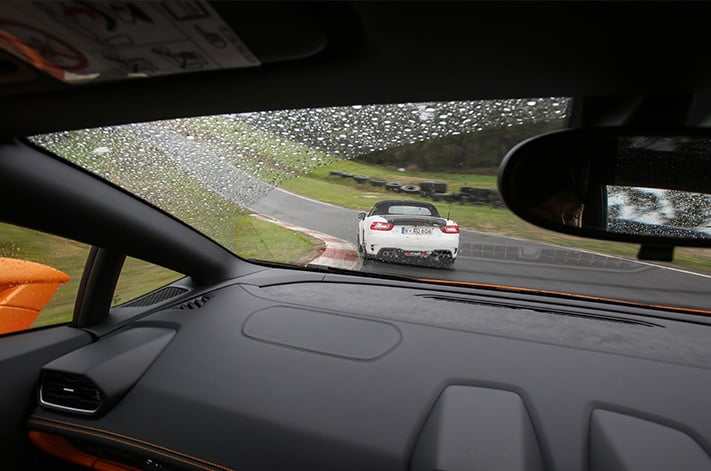
Hooray for an atmo hero of an engine. When the day comes that everything including your toothbrush is turbocharged, we’ll look back at this V10 with the sort of reverence Christians reserve for the Shroud of Turin.
MEANWHILE, I’m starting to love this circuit. It demands big respect, but the omnipresent threat of damage to car and career is countered with rich rewards when you’re tidy, precise and string together crests and apexes.
It also reveals the Lambo to be a car of curious juxtapositions: coiled, outrageous styling; epic, brutish engine, yet a real delicacy and precision to its motions.
I’m fairly convinced it’s actually a better, more satisfying supercar experience without the all-wheel drive of the LP 610-4. It sure makes you feel more manly, like a bloke who shuns safety razors for a cut-throat.
Inwood, meanwhile, is out coaxing his little Fiat into a series of rather balletic and aesthetically attractive wet-weather drifts.
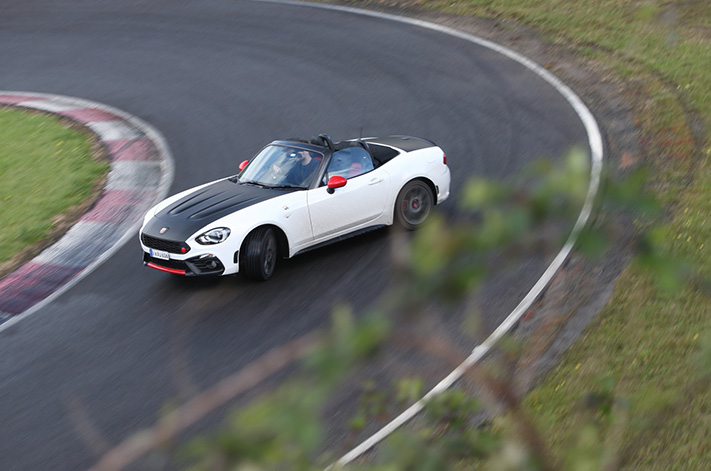
It all makes me both harrumph like a grumpy old goat and also want to have a go.
Can a $40K Fiat really nudge the fun-o-meter anywhere near the Lambo?
My first issue with the 124 Abarth is the driving position. Seat fine, legroom good, pedals great… wheel too far away.
No reach adjustment is a bummer.
I wanted this car to feel like slipping on a favourite pair of jeans; it’s close but not perfect for my frame.
What is terrific is, well, pretty much everything else. The engine has a boosted punch missing from the MX-5; less pure, sure, but more satisfying on corner exit and making it easier for the driver to light up (and keep lit) the rear tyres when you want to get your drift on.
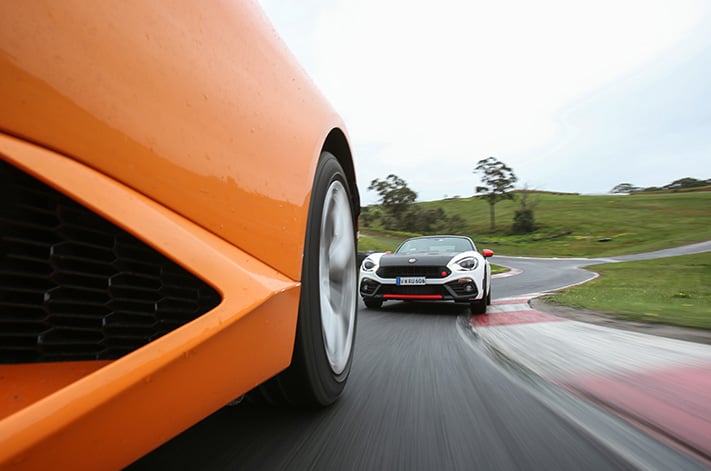
Significantly, there’s less squat at the rear under power.
The 17-inch Bridgestones provide enough grip to force you into the seat side bolsters, but it’s still easy to slide and exploit the brilliant balance.
There’s a fingertip lightness, eagerness and ‘rightness’ to the 124 Spider you just know Fiat could not have achieved on its own.
Constantly shifting track conditions make it impossible to run meaningful comparative numbers, but it’s clear the Lambo is capable of monstering its way around this place a fair bit quicker than the Abarth, regardless of who’s driving.
But what about the crucial fun factor? Well, holding the Abarth pinned wide open at the top of second gear over the ‘Oh Shit’ crest, feeling it get light and squirrelly before mashing the Brembo stoppers and trail-braking the rear loose into the next right-hander, is to experience sublime driving satisfaction.
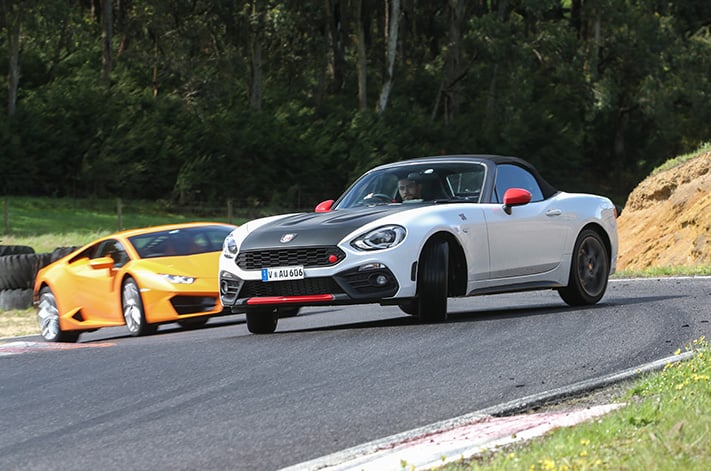
But ultimately it’s a brawny beast that yearns for a bit more room than Haunted Hills can offer; it needs space to really show off its planted high-speed stability and huge stopping power. It’s an autostrada demolition machine, a Phillip Island marauder that also likes to occasionally flex its pecs on Lygon Street.
The little Abarth has no interest in that. It’s all about purity, purpose and good times; image be damned.
A bit like us old blokes, really. In your face, Max.
THE GARBO is one of the great unsung heroes of local council.
These humble blokes and blokettes earn their packet by rising early to patrol our darkened streets on the wrong side of a whiffy, diesel-belching dumpster to ensure our towns remain litter- and rat-free.
If you ever doubted the importance of garbologists in our urban eco-systems then consider the good folk of Napoli, who endured eight months without waste collection back in 2007-2008, leading to mountains of stinking rubbish and a multi-million-dollar bill to send the stuff north to Hamburg for incineration.
So, yes, our Garbos are champions of the first order but, as you’ve no doubt discovered, they can be a tad devil-may-care with the placement of bins once empty.
The Good Wife found this out to her detriment recently while threading a back-road short-cut to collect the kids from school.
The route avoids some traffic lights but ducks and dives, jinks and jigs to get there, mixing ragged road edges with blind crests and mid-speed chicanes, among other amusements.
These, when taken at pace, provide an exhilarating appreciation of the Skoda Superb’s steering precision and handling.
Normally.
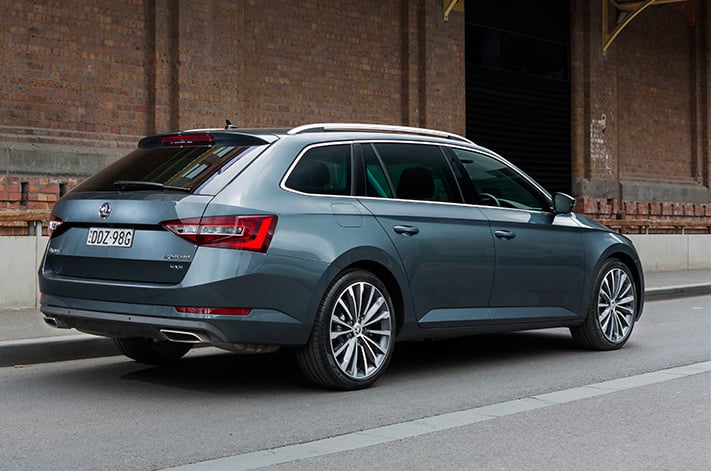
But this time, our friendly garbologist had casually dropped emptied bins right on the edge of the thin ribbon of tarmac; as the Superb sailed up and over a blind crest, sticking well left to avert a nasty coming-together with unseen approaching traffic, the passenger door and its protruding handle clipped a bin just hard enough to leave a smear halfway along the door.
It looked innocuous enough and, after the Superb had pitted and race control were advised of the incident, I thought we’d escaped with just a mark that would buff out.
Sadly, it wasn’t quite that simple: the whack had taken out the Skoda’s keyless entry function, which the amber alert on the dash and its accompanying chime has been eager to remind us of ever since.
Acknowledging the warning via the rotary dial on the steering wheel shuts it up for a bit, but the moment speed drops below 60km/h it comes back.
| 2017 Skoda Superb 206TSi 4X4 Wagon Quick Review
And despite trawling the Skoda’s touch-screen menu, I can’t find a way to shut it up more permanently.
If it weren’t for the pre-Christmas rush I’d have had it in for a good seeing-to by a Skoda technician … but in lieu of that I handed the keys to acting editor Inwood for his annual festive-season road trip to the family home in Bathurst.
The bloke reckoned the Skoda’s air-sprung cruising road manners, its commodious 625-litre boot, all-wheel drive and gutsy 206kW turbo-petrol engine would be an ideal combination for hauling better-half Bek, their border collie Riley and a swag of Chrissie gifts on the 1000km inland run.
I couldn’t agree more, but may have failed to mention that damn warning chime during the handover…
Read part two of Whichcar’s long-term review of the Skoda Superb wagon here!
This article was originally published in Wheels magazine February 2017
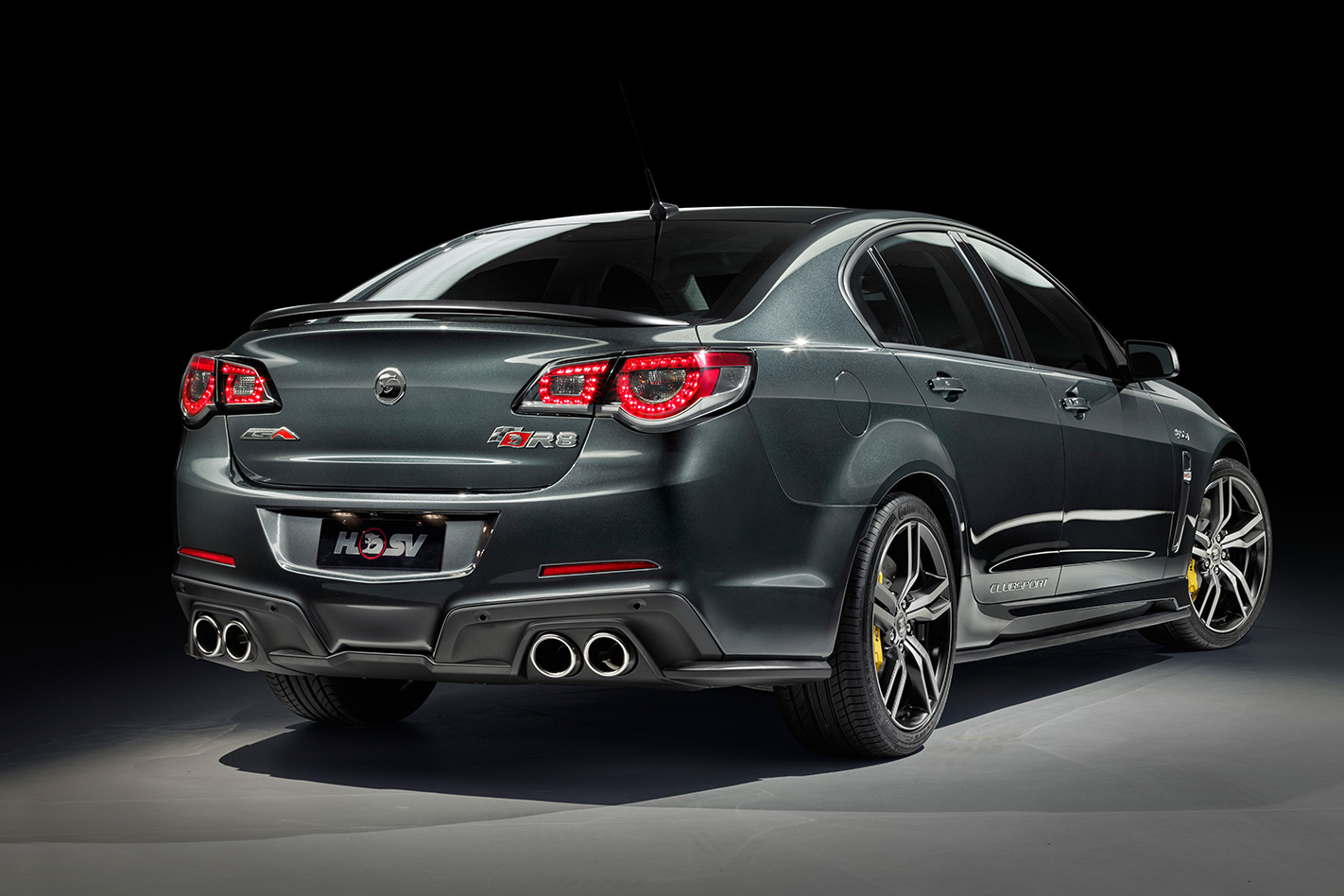
With GTS production quietly and sadly due to wind up in the not-too-distant future (prior to production of the GTSRs) your only option if you want a hot sedan – sub-$100K – from Holden Special Vehicles will shortly be the Clubsport.
And so it makes sense that HSV has moved the much-loved (and last all-Aussie) Clubbie more into GTS territory as part of its recent round of 30th anniversary updates.
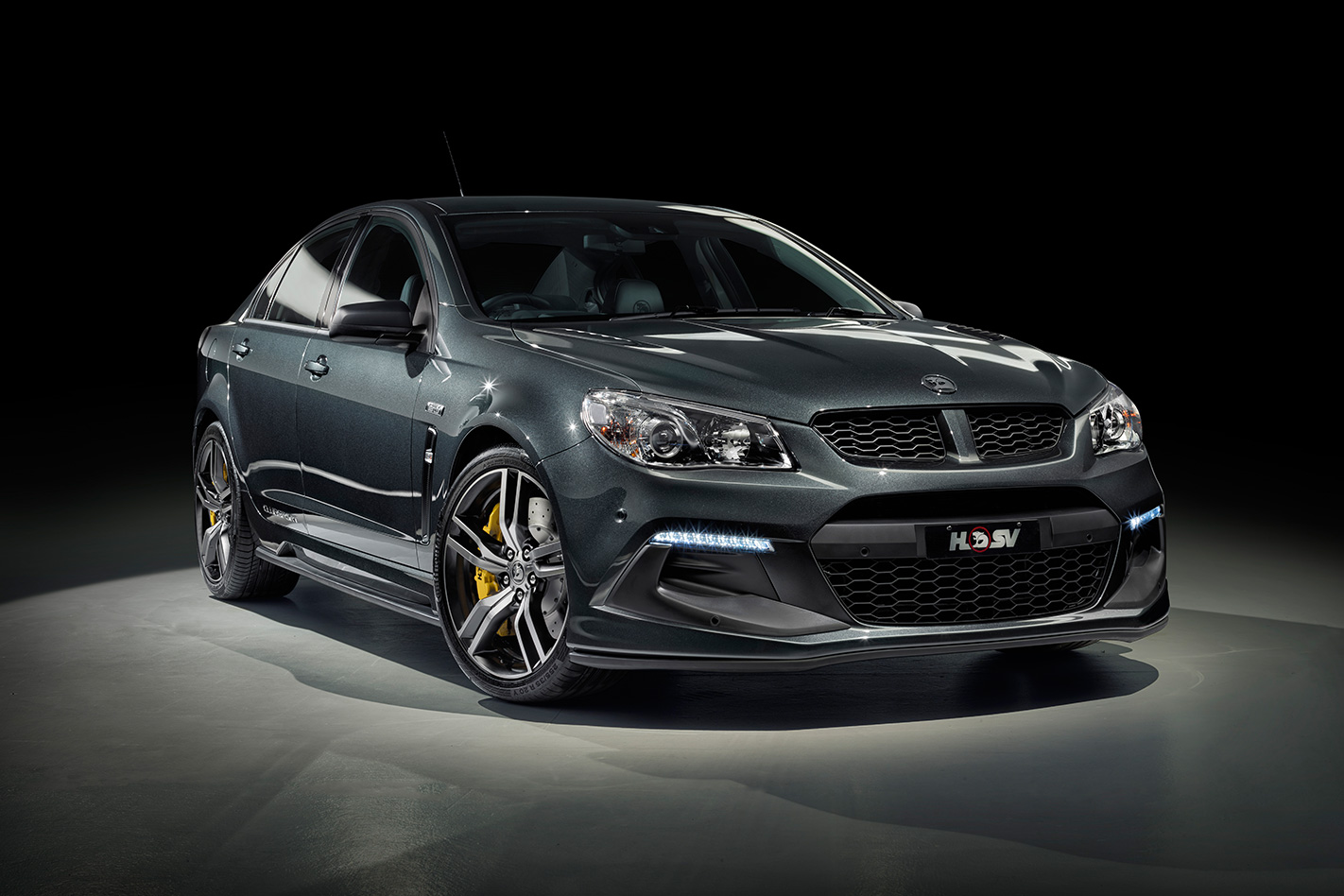
While the brilliant Magnetic Ride Control is still off-limits for Clubsport, the fixed dampers still offer a well-judged ride/handling balance in a car that’s been subtly improved rather than dramatically overhauled.
While the power increase simply makes it feel the tiniest bit more eager – like you’d only just started putting 98 into it instead of 91 (and boy will you be putting some 98 into this thing) – this is still a seriously fast car.
It sounds better, too, with HSV fiddling with the bi-modal exhaust to seemingly remove the odd ‘chuffing’ sound of the old model as the valves opened. HSV has put the price up $2K, now $82,990 for the manual, the price also inching further into GTS territory.
Small cars may have ceded some of their popularity to SUVs but for now they remain firmly entrenched as Australia’s favourite vehicle type.
With the end of financial year approaching on June 30 , this is also a particularly good time for bargain hunters as manufacturers and dealers aim to clear stock and hit important targets.
To help you go beyond great deals, WhichCar’s sister brand Wheels crunched the numbers on a multitude of ownership factors to establish which small cars offer the best value in their class.
Wheels’ Gold Star Car awards scored cars out of 100. Real costs comprising three-year depreciation and a year’s insurance and fuel expenses accounted for 80 per cent of the score, with 10 per cent each for servicing costs and warranty.
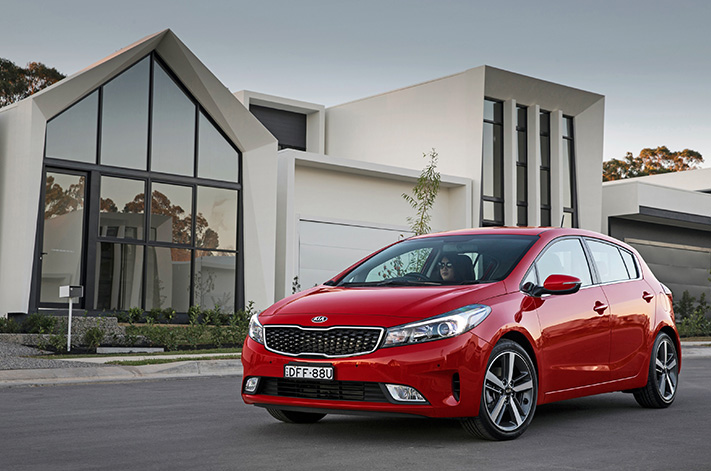
The upshot in the most affordable bracket for the Small Car class is a gold star for the entry-level version of the Kia Cerato.
The Kia Cerato S trim grade makes a good start by squeezing under the psychological $20,000 barrier with a sharp $19,990. You can also factor in cheap insurance and a decent resale value (49 per cent), while the Kia drinks the most affordable petrol (91 unleaded), even if its 7.1 litres per 100km fuel consumption is above average.
Its trump card, however, is a benchmark seven-year warranty, which offers four years of extra peace of mind beyond the industry average of three.
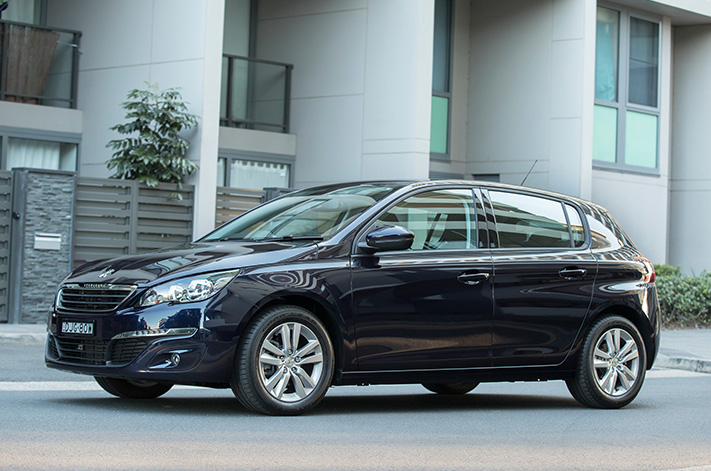
The latter hurt the Bronze-medalled Peugeot 308 Access, which otherwise offers the lowest running costs of the top three over three years – aided by superior fuel consumption (4.6L/100km) that is slightly offset by the fact the French hatch drinks more expensive premium unleaded.
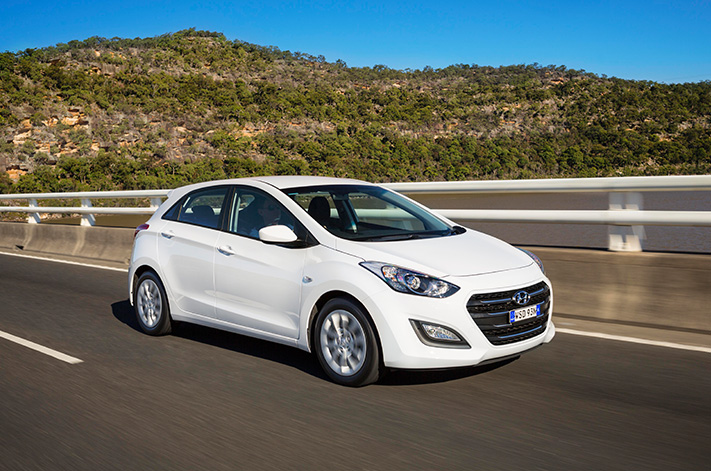
Hyundai’s i30 Activeslipped ahead for silver. Its $21,450 starting price is higher, but its five-year warranty is still generous even if shorter than that offered by sister brand Kia, and its key advantage is strong resale of 56 per cent.
Until June 30, the Kia Cerato S is being offered with free on-road costs at $19,990 driveaway. The price applies to both the manual and automatic transmission versions, meaning there’s an even bigger saving for the latter.
Hyundai’s deal for the i30 Active auto isn’t strictly an EOFY offer as it lasts only until May 31, though it may be extended. A $21,990 driveaway price adds only $500 to the Active’s RRP, while a $1000 gift card is also thrown into the equation.
There are currently no offers for the Peugeot 308 Access.
DO YOU ever have that feeling you really should be doing something useful, but just can’t be arsed?
First published in the May 2017 issue of Wheels Magazine, Australia’s most experienced and most trusted car magazine since 1953.
That’s the zone I find myself in as I sit outside a nondescript building in a nondescript industrial estate in a nondescript suburb near Melbourne airport.
I’m waiting for editor Inwood to arrive in the W1, a weak autumn sun warming my face. I should be using my phone for something productive, like replying to emails or watching Nurburgring crashes. Instead, I’m following a link to an oddly compelling time-wasting site.
Deathclock.com purports to be able to predict the precise day of your death, based on a bunch of lifestyle questions.
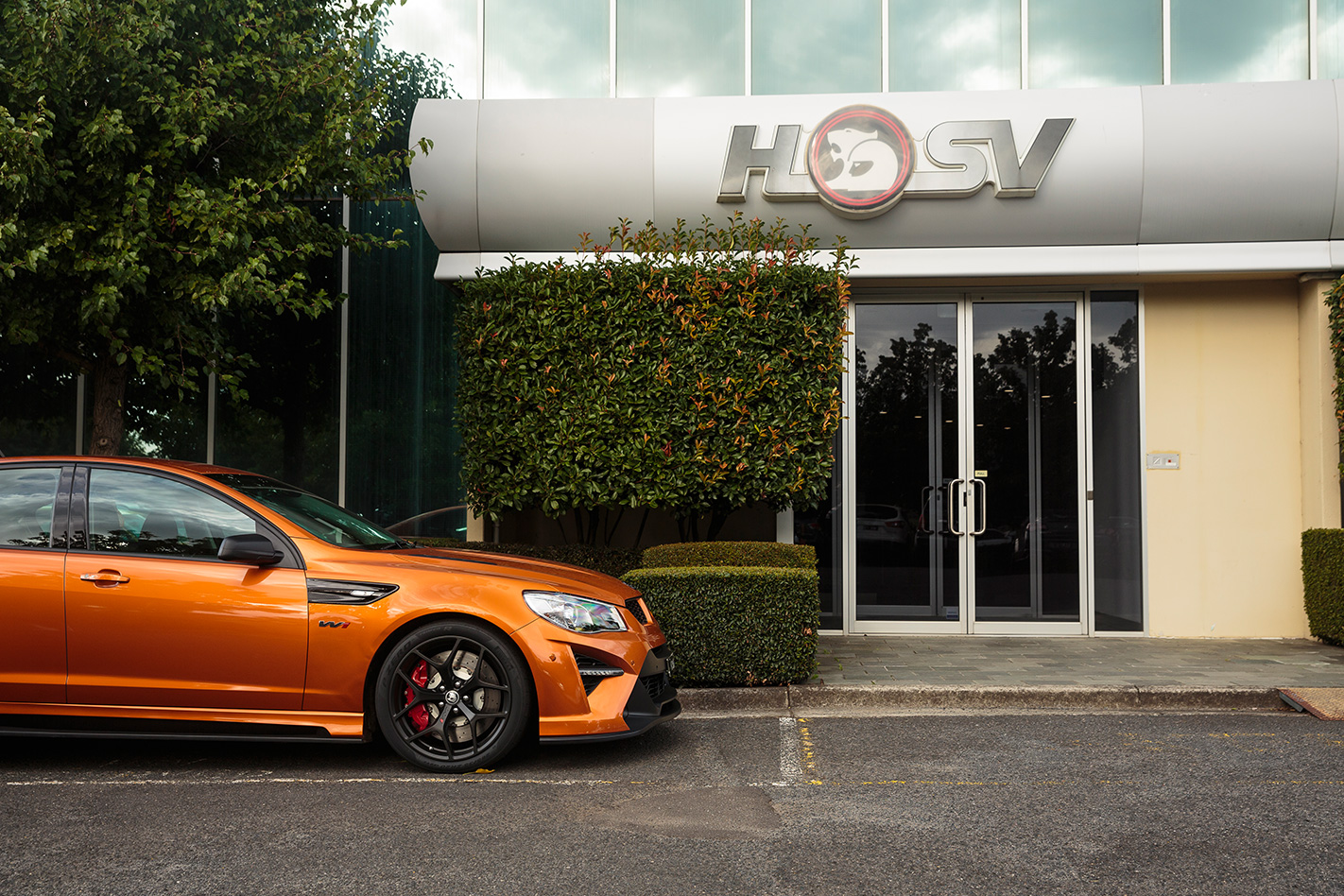
But what if there was an automotive Deathclock.com around back in 1988?
What if HSV was able to punch in the details of the first VL Group A SS, the game-changing Plastic Pig, into this morbid calculation device?
Somehow I doubt the result spat out would say something like: “You’ll evolve through three core generations, building a legion of loyal fans. Your zenith will come as your morph into a 474kW supercharged beast, reigning supreme, lauded as the greatest Australian-built sports sedan ever built. But you’ll be the last of your breed, and your final passing will come in the summer of 2017-18…”
Yet that’s pretty much the reality, so it’s no wonder I’m feeling a weird tangle of emotions.
Excited, of course, to be heading to some of the best drivers’ roads in the Victorian High Country in this epic car.
But also just a bit melancholic it’s come to this. Is this a wake? A celebration? Hell, it can’t be a wake; that feels a bit premature; and besides, we can’t neck fruity moselle and listen to a boring old uncle bang on about the glory years.
So it must be a celebration, then. An 815Nm, tyre-frying knees-up as the curtain comes down.
It’s impossible not to feel a tug in the gut, though. We all know large, locally built, rear-drive sedans are about as relevant as a Nokia 3310 these days, and as popular as gout, but it’s still tragic that the mainstream swing towards SUVs and small cars has claimed the scalp of the great Aussie sports sedan.
This is our effin’ M5; our E63 … those German V8 headkickers have never been in better shape; it feels criminal that as a supposedly switched-on country with a 92-year history of automotive manufacturing, we are about to have precisely nothing built here that can stare headlight to headlight with those cars.
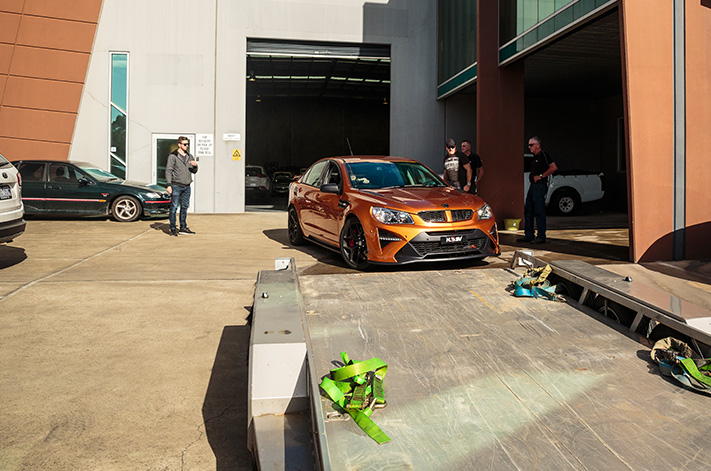
Very considerately, he treats the neighbourhood to a bit of second-gear wide-open throttle, and as shrieking birds take to the skies, it’s enough to make you want to cheer and sear a Southern Cross branding iron into your left pec.
Holy crap, it sounds tough. Way more hard-edged and nasty than the GTS/GTS-R’s related LSA engine of the same capacity; properly motorsport loud and chest-thumpingly unapologetic.
Job one, even before we drool over the W1’s carbonfibre airbox and dry-sump reservoir, is to deal with HSV’s request to add only 1000km to the car’s odo.
Inwood’s idea is to simply trailer the W1 to the prime driving roads, and as he’s my boss, of course I agree it’s a brilliant plan; why waste any of our kilometre limit plodding along camera-infested freeways?
But the W1’s wide, low front bar refuses to be dragged onto a trailer, and I’m quietly pleased, as towing this car anywhere would have felt a bit wrong. Pampered, concours E-Type Jaguars are trailer queens. The W1 is this country’s toughest-ever bare-knuckle brawler; dragging it around on a trailer would feel a bit like Danny Green being pushed into the ring for a title fight in a wheelchair, so, y’know, his legs don’t get tired too soon.
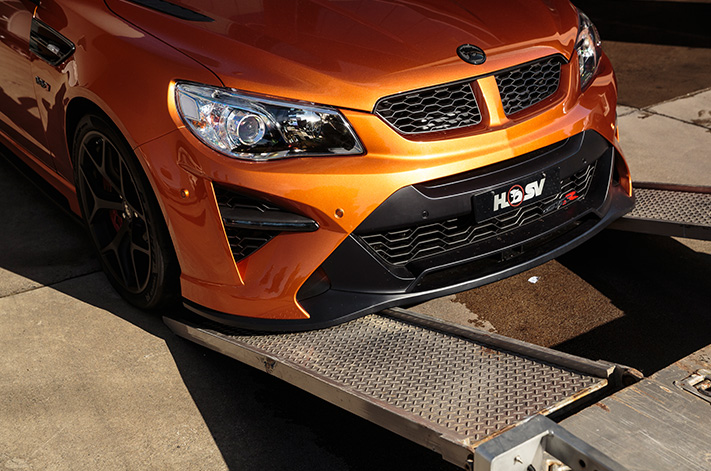
First impressions are that the clutch and gearshift don’t feel noticeably different to a GTS, which is to say, the pedal is medium weighted – not heavy, with a nice, progressive bite – and the shift action reassuringly mechanical-feeling with short, positive throws.
And damn, it feels brilliant to connect with this car via a manual gearbox. Then there’s the engine’s flexibility, which is just colossal. Sixth gear will pull from 40km/h at 1000rpm with no snatch or judder. The drummer from Def Leppard could motor around in a W1 and hardly remember his accident.
The ride feels ultra-taut, but first impression suggests there’s just enough initial compliance to filter out most of Melbourne’s ruts and bumps.
Then a decent whack comes through at suburban speeds and I feel the driver’s door heave in its jamb in protest.
HSV was utterly unapologetic when describing this as the most track-focussed chassis set-up its engineers have ever attempted; the all-new SupaShock suspension, similar to that used in Walkinshaw Racing’s Supercars, offers a setting “comparable to a street-circuit tune of a V8 Supercar”, according to the company.
The inverted coil-over front set-up is apparently ‘2.2 times uprated’ over the current GTS, so no wonder there’s so little roll. But it sometimes feels this stiffness is at the threshold of what the body rigidity can take, given the protest of the doors over fast, bumpy backroads.
Later, the brilliance of the damping will be apparent, but the ride equation will continue to mess with my head, sometimes feeling completely acceptable, other times, a jiggle and shake-fest that starts to tire after a long day.
HEATHCOTE dragstrip, about 90 minutes north-west of Melbourne, somehow sits as a motorsport portrait of what’s happened to the Australian car industry. It’s a faded and tatty shadow of what it once was, but just fine for our purposes.
Deep down, though, we all know the W1 is a slim-to-none chance to put down a really blinding 0-100km/h time. HSV claims its halo model can hit the magic number in 4.1sec, but we’ve rarely been able to match the company’s claims, and we know that the manual transmission will rob it of several tenths in the launch phase, even with the ultra-sticky (and expensive) 295-section Pirelli Trofeo R rear rubber.
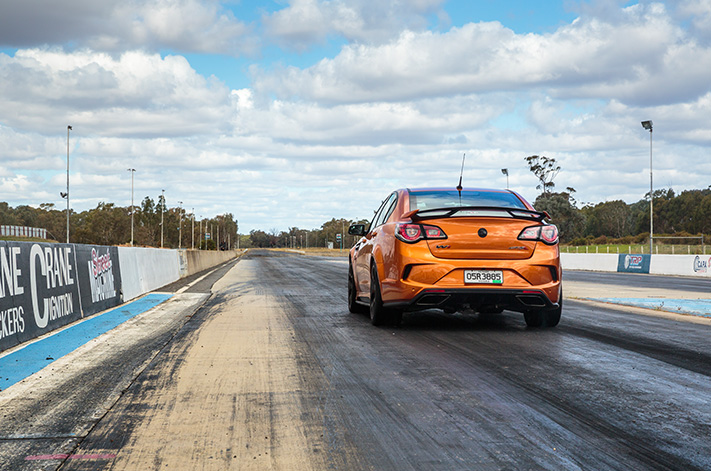
Sure enough, despite loads of attempts and various launch techniques, the W1 refuses to bolt to 60km/h any quicker that the last manual HSV GTS (down 54kW and 75Nm) we tested here in near identical conditions. It’s closed-case proof that gifting more power and torque to a big, heavy rear-driver does not bring faster off-the -mark sprinting ability once you pass circa 430kW and 740Nm outputs.
By the 100km/h mark, the W1 has trimmed 0.2sec off our GTS number, but its time of 4.5sec is still only what an auto GTS will do anyway. Beyond that point, though, with the tyres hooked up and inertia tumbling into the vapour trail, the W1 hauls like a shot dog. By 160km/h it’s a second faster than a GTS; by 180km/h that gap has doubled to two seconds.
But quibbling over the raw numbers, especially in the off-the-line phase, feels like a football star agonising over the fact he’s earning $40,000 a month instead of $43,000. What’s more relevant is just how epic this thing sounds from inside the car with the bi-modal exhaust open in either the Performance or Track modes, and how well the driveline handles abuse.
The tone is deep and rich off the bottom, all Barry White-ish from down low in the diaphragm. By 4000rpm it’s hollering, but there’s no taper up top, just a borderline vicious lunge to the 6600rpm limiter and a volume, especially in the back, that would have small children calling their DOCs case-worker.
Then there’s the overrun, which rumbles and crackles and pops with almost cantankerous contempt that you’ve backed out of the throttle.
Yet it’s not like the almost cartoonish noise some other performance manufacturers tune from their exhausts; this sounds properly motorsport, the noise you expect from a hand-built engine running titanium internals and a dry sump.
It’s way more Nomex, much less feather boas, than the twin-turbo V8s from a couple of the Germans. It’s also quite distinct, in sound, character, and revability compared to the LSA. Of course there’s an inescapable family likeness, but it’s almost like a William-and-Harry thing. Both have ample merit, but you know which one you want along for a weekend in Vegas.
That close-ratio Tremec gearbox, too, is right on the job, allowing near-flat upshifts just shy of the 6600rpm cut out, with a synchromesh that’s hard to beat.
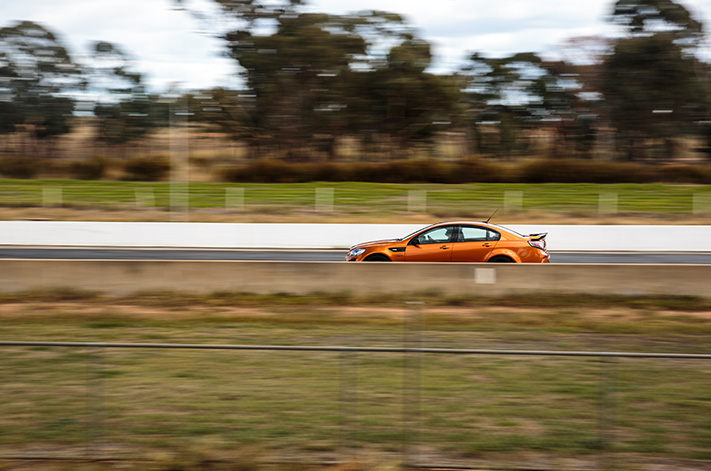
I take slight consolation that Inwood, now ahead of me in a 991.2-series Porsche 911 Turbo, is suffering exactly the same discomfort, but also has earfuls of tyre roar to contend with.
I still have no real clue why he needs a 911 Turbo for this trip when there’s a perfectly nice, vacant passenger seat next to me, but I try not to take it personally. Since becoming editor, I’ve noticed via Instagram he’s taken to wearing snakeskin trousers and a fedora in nightclubs, and demanding his grapes be pre-peeled. So of course he needs a 911 Turbo. I’m hoping it’s a just phase he’s going through.
When we arrive at our overnight stop in Bright, nestled in the Ovens Valley, Inwood eats pizza and drinks beer with us just like a regular person. There are no demands for poached swan or a snifter of cognac, although he does insist on the seat closest to the heater at our outdoor table, and I know he’d take a throw-rug for his knees at this point if one was going. Still, things are looking up.
The next morning we’re up in the pre-dawn darkness to try and meet the sunrise at the ski resort of Falls Creek.
To avoid a possible lynching from the Bright locals, I leave the drive-mode selector in the Sport setting, which keeps the exhaust well hushed unless you spin the engine into its angry zone.
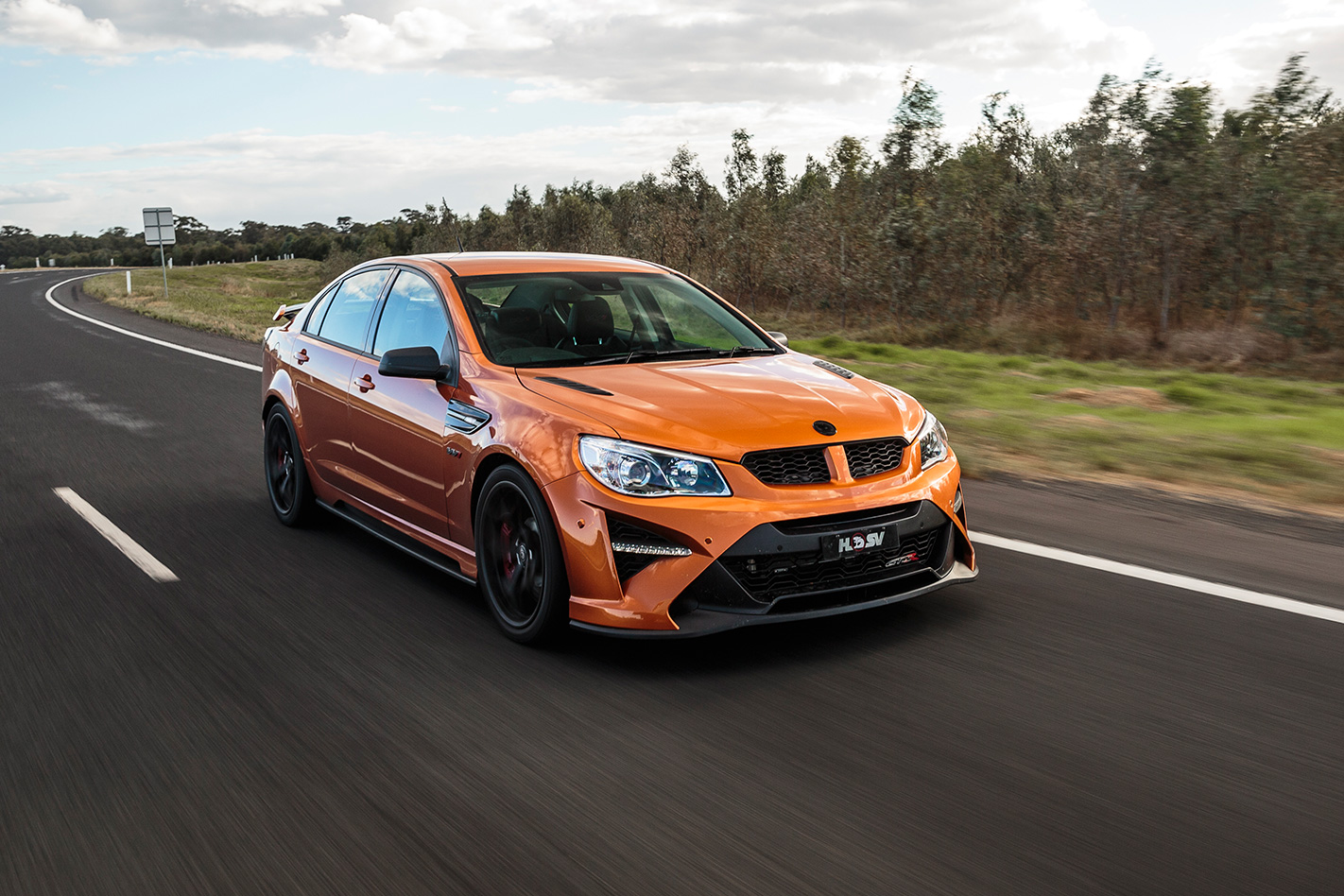
With the secondary flaps shut, you can lope around using as few ratios as you want – first to fourth is no problem – and there’s no bass drone when you ask it to pull. I actually prefer the lighter steering delivered in the Sport mode; for me it’s a shame you can’t keep this setting when the Performance or Track modes are selected. A job for the facelift? Oh, wait…
Inwood’s 911 Turbo was never intended for comparative purposes, but it’s instructive that the W1 is able to keep it so honest on the twisting run along the Great Alpine Road towards the famed Bogong High Plains Road.
Sure, in the hands of pro drivers on a closed-road targa course, it would likely be a different story. But in the hands of a couple of journos having a crack within the bounds of sanity on a public road, the W1 stands tall.
Literally tall, as Inwood and his Porker have a centre of gravity similar to goanna roadkill compared to me in the HSV sedan.
He’s also got about 250kg less to wrestle and phenomenal all-paw traction. But I have a power and torque advantage, as well as massive mid-corner grip provided by those only-just road-legal (and massively temperature-dependent) Pirelli Trofeos. Then there’s the power-down ability. The Commodore’s Zeta platform has always been a great thing when it comes to converting torque to thrust, but the W1 takes it to a new level.
First, though, you can lean on the loaded front corner in this car with an intensity that would have a regular GTS howling and baying at you to keep its nose out of the Armco. Then start chasing big throttle inputs still with loads of lock on and the apex barely in sight.
Unless there are ruts or you’re plain savage with the loud pedal, it just squats slightly and hammers out. The clarity and feedback of the chassis is sublime; the linearity and punch of this engine properly next-level.
Then there are the upgraded AP Racing brakes and 410mm front discs, which didn’t make any great difference to the car’s 100km/h-0 figure on the test track, but feel like they could stop communism when used hard on the road, with near-perfect pedal feel and the ability to seemingly burrow the snout of the car into the bitumen just before turn-in.
Only the lack of perfect pedal placement for heel-toeing (for my feet, at least) sticks as a demerit.
Guess that won’t get fixed in a facelift either.
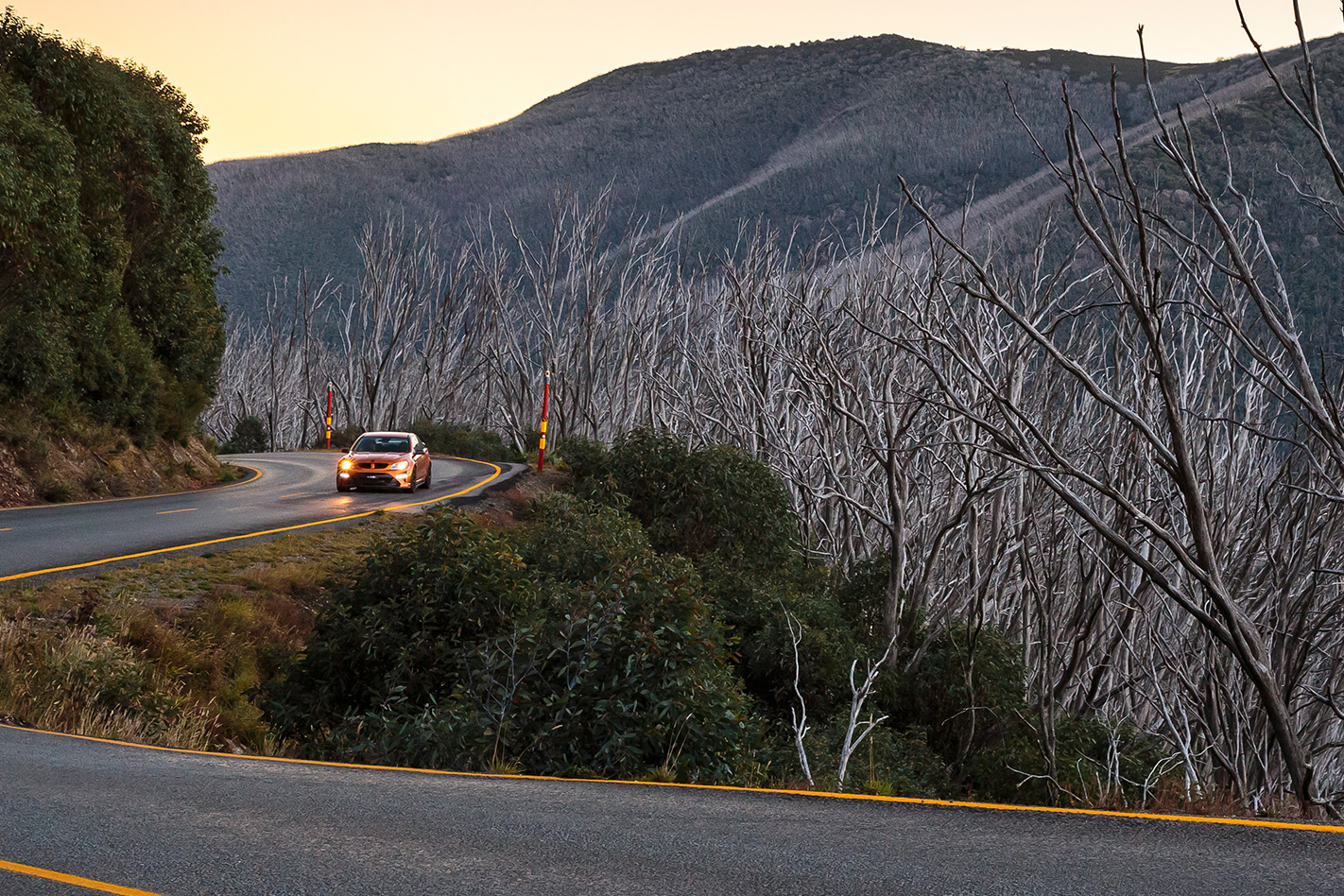
See, parts of this road should, in theory, be too tight for the big HSV to feel fully deployable, yet it just doesn’t seem to care. It’s a huge-hearted thing, scathingly quick and sounding enraged when really spanked, yet at the same time utterly co-operative and remarkably non-threatening when you’re driving it hard.
You’ll feel out the ESC intervention just to know where the threshold is – yep, bloody high – but then find you can drive right up to it, and be sniffing at it, corner after corner, even on damp patches, without re-awakening it.
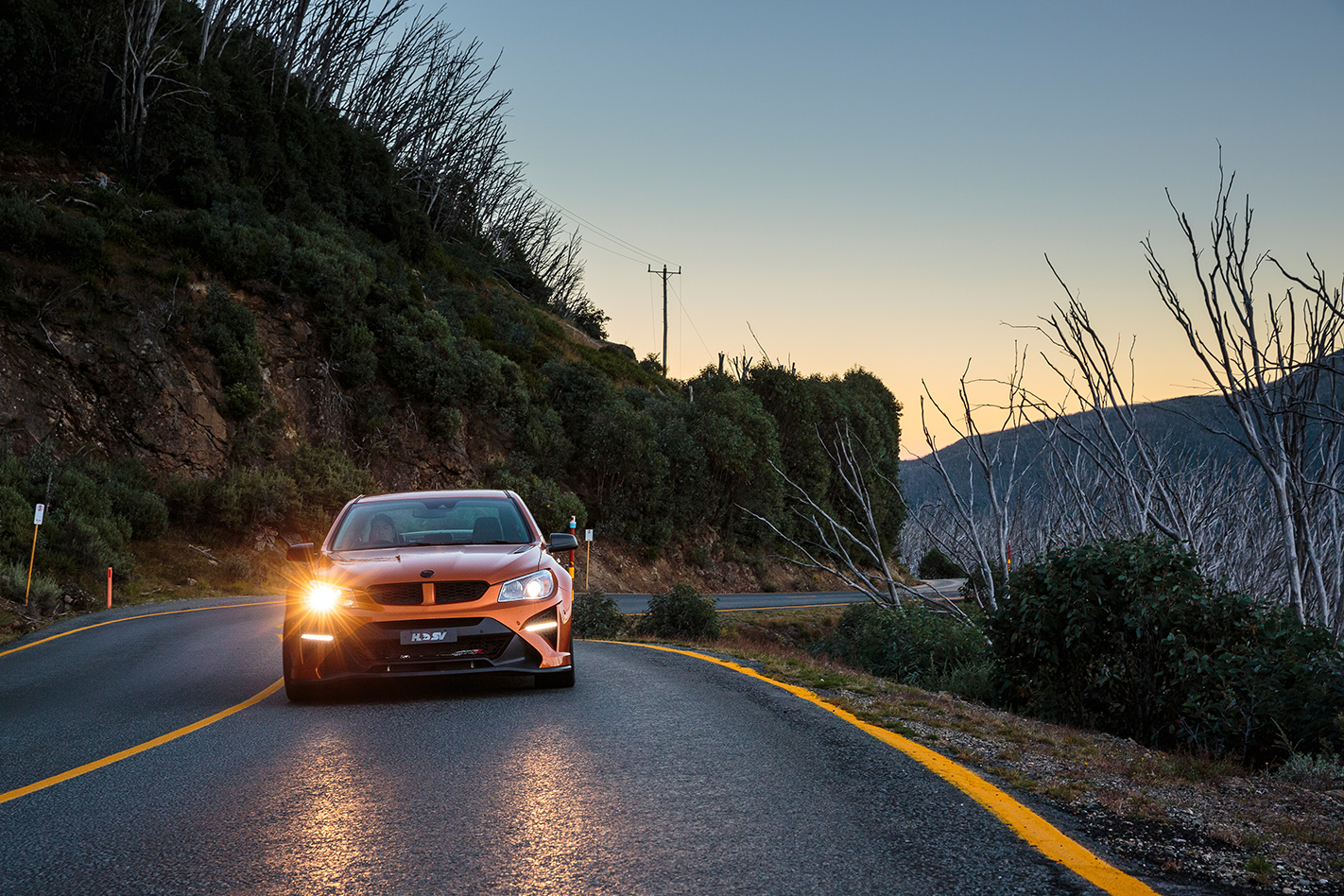
Later, as I’m bombing along a deserted section past Rocky Valley Lake, I find myself mentally ticking off elements about this drive that I doubt I’ll ever repeat.
To have had a chance to drive a big-capacity, supercharged V8 hooked to a manual in a rear-drive, Aussie-built sedan – a combination about to become an automotive unicorn – is something to be deeply grateful for.
I recall one of those eulogy cliches; “let’s not lament what we’ve lost; let’s celebrate that which we were lucky enough to have had,” or something along those lines.
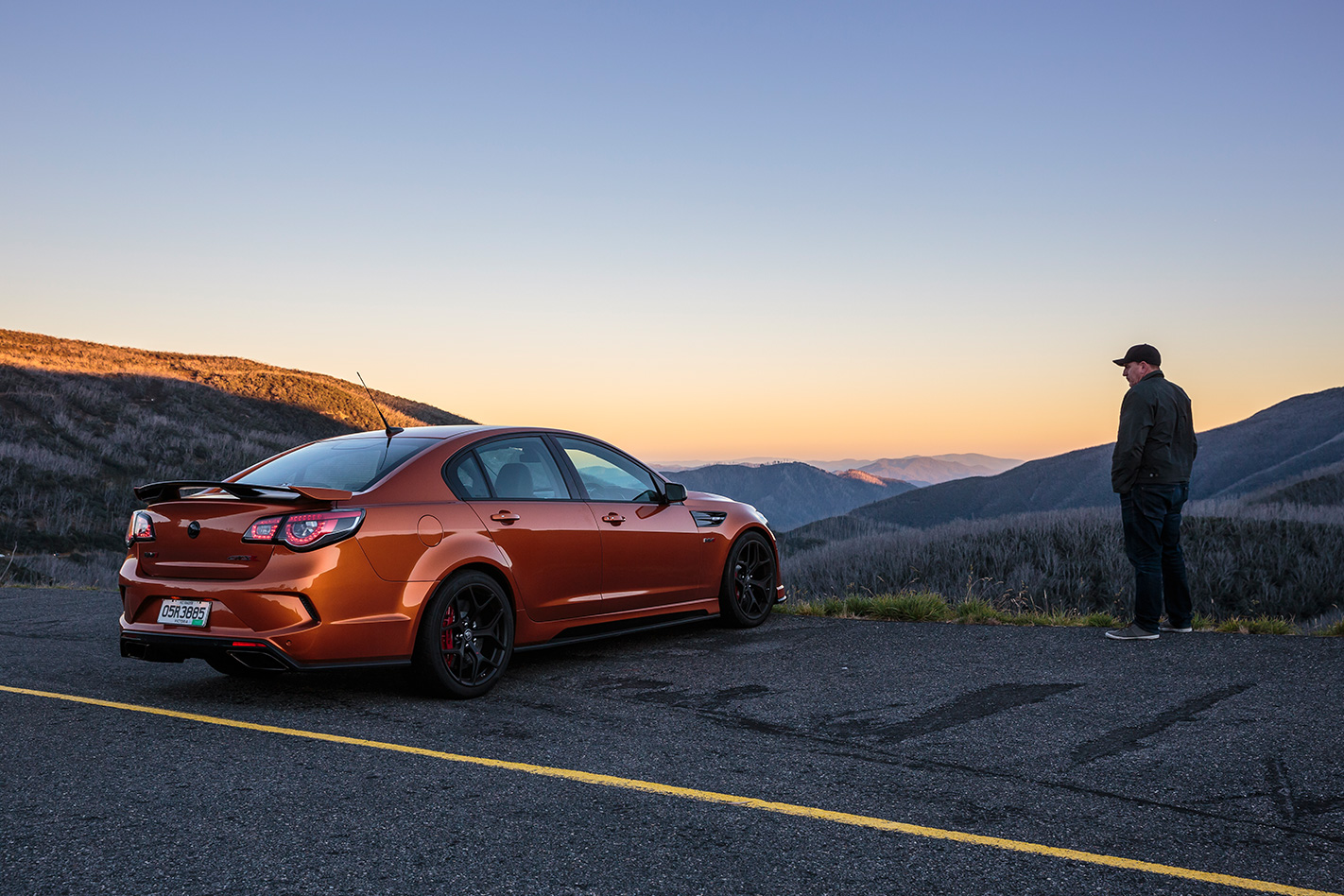
Yet it doesn’t seem to help much when I finally park the W1 for the last time and walk away.
YOU’VE got the factory optioned Alcantara seats with contrasting stitching. You paid extra to have the triple-protection paint treatment and UV tint applied before delivery. After, you made a beeline to the original accessories store where you had the branded mats and roof rack fitted. And then, on your way out, you grabbed the matching baseball cap and luggage for a good measure.
There’s not a single accessory left in all the SuperBarn and AutoCheap stores in the country that you haven’t got but there is still a wad of cash burning a hole in your pocket like wobbly Fukushima reactor, so what do you do?
For the car owner who has everything, including money to burn, there is often one final bastion of the accessory world to turn to. The one accessory that adds no value, no performance enhancement, no safety, economy or practicality benefits and yet commands a handsome premium.
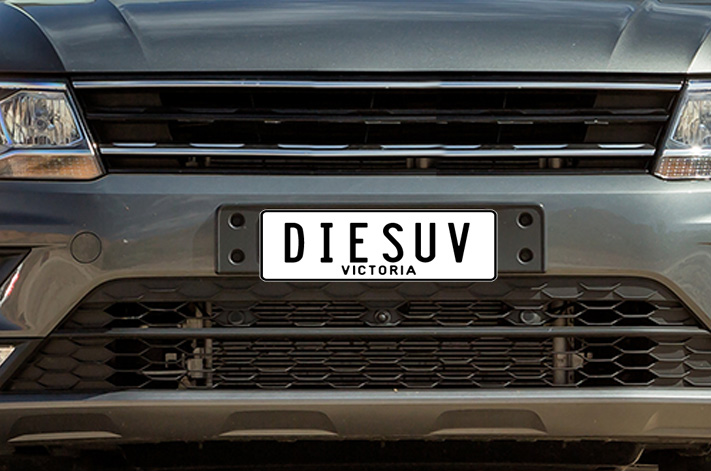
We are, of course, talking about the custom registration plate.
Most road-users will be able to recount at least one or two good and bad examples of custom regos, as readily as you could recount examples of tattoos at either ends of the spectrum. Your star sign as a Chinese character seemed like such a good idea in 1998 didn’t it? So is there really such a thing as a respectable personalised plate?
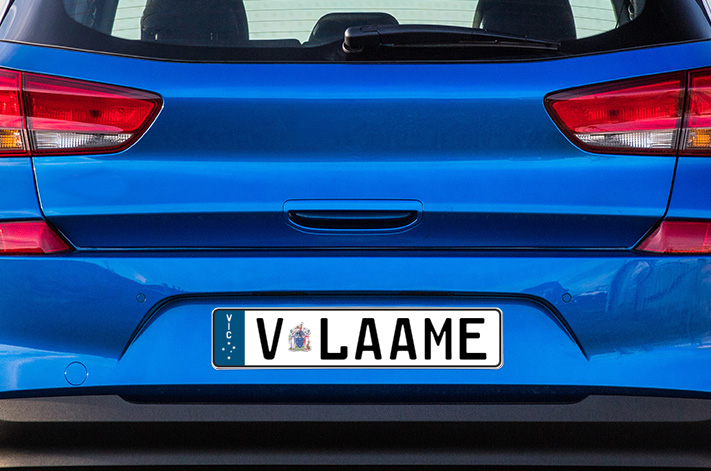
Even in the cases where it is patently obvious what you are trying to say, your efforts won’t necessarily garner admiring looks.
As a case in point, take the guy in the UK who payed top-dollar for a plate that read PEN 15. There are a number of ways that one could be interpreted, but disappointingly, VA61ANA has been banned, preventing a feminine retaliation. As has 15LAM, PI5 OFF and WA5TED.
But thanks to Australia’s state-by-state system that allows far more versatility and creativity, local roads are littered with examples.
A Hummer H3 with HARD AS, a Jeep Patriot wearing FLEMMM, FAR TED on a BMW X5 and a Volkswagen Amarok that proudly displayed the word ERECT. Are any of these sending a good message and worth the cash?
With custom plates costing about $500, we put our heads together at the Wheels office and came up with a list of things that are a better investment of your hard-earned dollars than personalised rego plates.
- A neck tattoo that reads “You only YOLO once.”
- Invest it with that Nigerian guy who emailed you
- Hairpieces to disguise a bald patch start from around $500
- About five tanks of fuel to actually enjoy using your car
- A six-year subscription to Wheels magazine
- 17 kilograms of fillet steak
- 500 of something at the Queen Victoria Market at closing time