
Engineers rarely receive a rockstar reception at automotive events.
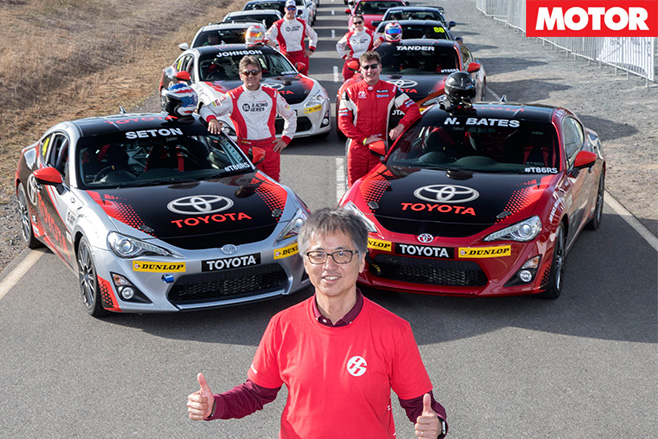
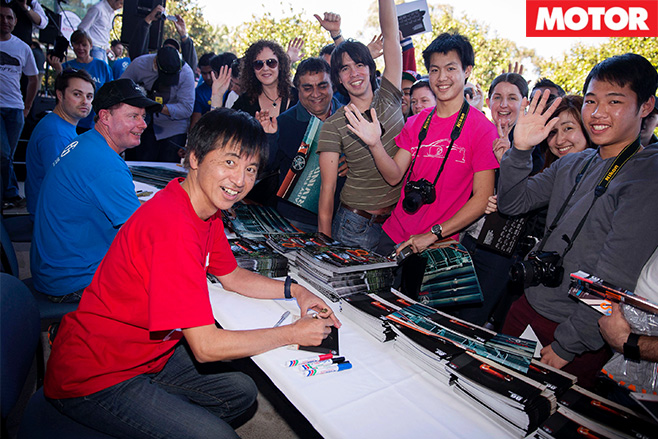
Celebrity ambassadors often schmooze glossy crowds, as do skivvy-clad designers, but rarely do quietly-forthright engineers get a look in. Toyota 86 chief engineer Tetsuya Tada is one of those personalities – and he is front and centre in the spotlight.
It has been four years since the 86 (and its Subaru BRZ twin) debuted. The $29,990 rear-drive Toyota coupe passed 10,000 local sales two years ago – with volume behind only Japan (39,000) and the US (35,000) – and by mid-2016 the ‘Toyobaru’ duo had doubled that tally.
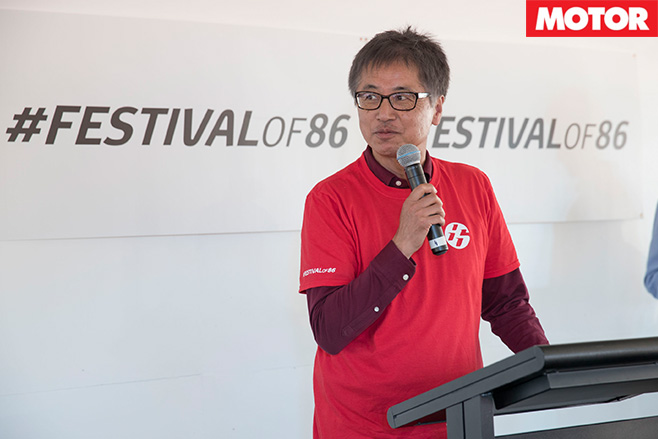
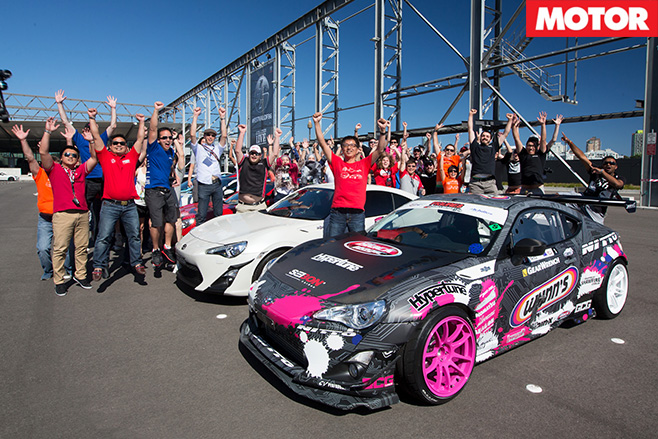
Armed with a marketing budget to make most manufacturers blush, both the festival and the 86 amateur race series, launched on the same day, are Toyota Australia’s paid celebration of what is still its only sports car.
Despite promises from company president Akio Toyoda that the brand would bring more fun-to-drive cars to market, none have yet been forthcoming. Nothing has changed with the 86, either. A facelift – attacked by keyboard warriors for raising outputs by just 4kW/9Nm – is due in the third quarter.
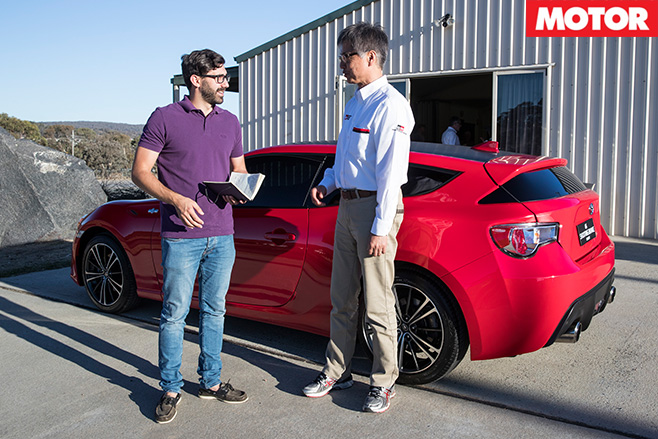
“It will definitely be above fans’ expectation. If you supply what all the fans really want nobody gets really surprised or impressed, so wait and see, we will provide something that will be really [a] surprise.”
Tada-san laughs when reminded of his previous comments that turbocharging the 86 would be the “easy answer” – and that stance resolutely remains. But what about drawing upon – gasp! – Toyota’s hybrid technology for the next model? “Not necessarily we would be saying hybrid as such, hybrid could be part of the answer but if [we] provide just a normal hybrid it makes no-one surprised,” he responds cryptically.
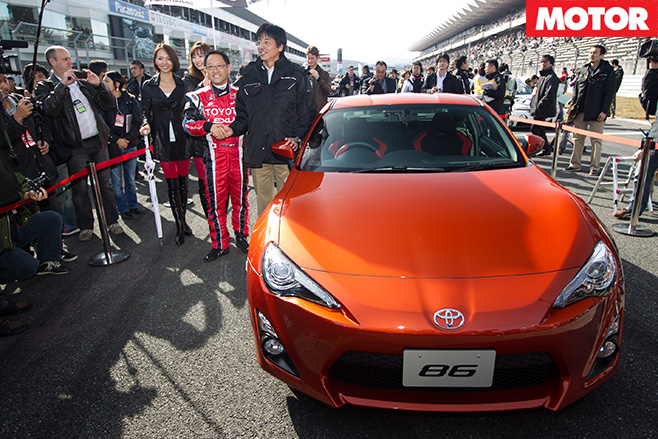
Tada-san lights up at the suggestion that an electric motor could be used as a power ‘boost’ – something popular among today’s high-end supercars. “Oh yes, yes! It is a good idea but it is not as surprising as what [we] want to make,” he teases. “Not necessarily just the engine but [with] the whole package as a new-generation 86 we want to make everyone go ‘wow’.”
There is a roll-call list of improvements engineers are aiming to make with new models and Tada-san understands them well. He leans back and grins then answers in the affirmative when asked if he’s driven the new Mazda MX-5, a car that has achieved a 1000kg kerb weight. The current 86 weighs 1200kg-plus.
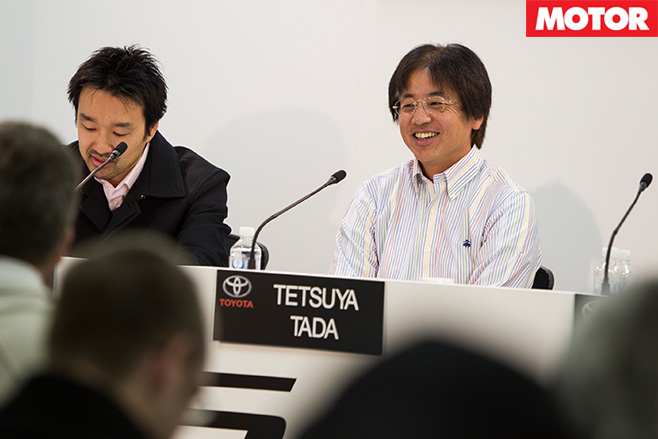
The inference is the research conducted into kerb weight reduction for mainstream cars will aid future sports car development. Tada-san confirms that the “big” drop in body weight would help the next 86, but could the second generation hit the magic tonne? “I will try my best,” he says, grinning.
Making the coupe smaller, however, is clearly not the simple fix. “The 86 maybe can go slightly smaller but it wouldn’t have much of a less weight or make it less cost,” he explains. “At the time when we developed the 86 like that, that was the best balance between cost and [practicality of] usage.
“The lighter one [sports car] is easier to make. The smaller one automatically you think would be easier to make because it’s smaller, but it’s not that way because it still needs to be safe for accident so all that strength will still be demanded. It remains same [cost]. It’s not that easy to make that smaller car.
“Even the president of Toyota is not considering making a huge profit throughout the 86, but if the profit disappear totally, it is very hard as part of the company policy to [make] the same style. So as soon as they are making even a little bit profit [we] can continue.”
“Continuation is something [important] because in the past Toyota make so many sports car and then when the profit goes down they finished every single time and didn’t continue,” Tada-san tells.
“When you think about the user, we should continue. At this current time we are making a profit, so we will of course continue making the 86 and then consider a family. But if we release so many variants of the family that will value down the original. [We should] continue making the original first.”
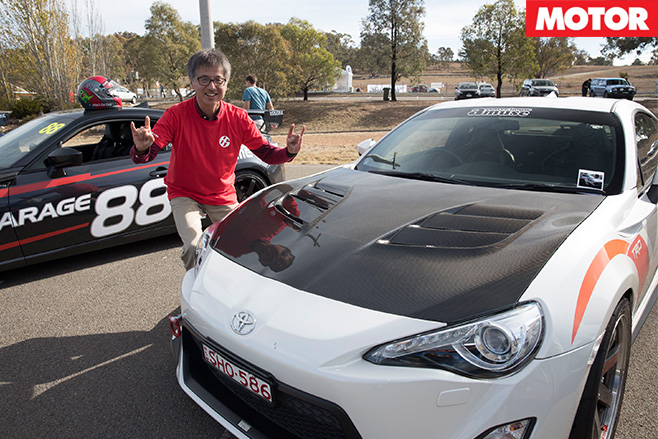
In quick quips between his rockstar treatment at the festival he admits he would love to build a hot-hatch and hopes the Yaris WRC car would be an indicator of things to come. Ideally Toyota should have its own sports division like Renault Sport or AMG, too – and not necessarily TRD.
But we finish with the big gun: Supra, when is it coming? “Ah, Supra!” he exclaims, visibly excited by the project. “It’s very hard to tell when the Supra will be produced, but regarding the 86 we weren’t really focused on the speed or the power [but] on simply so much fun to drive. When we consider the 86 so many users consider it is not enough power, it is not enough speed, because they want to focus on that.
“[It will be] top of Toyota sports,” he says. “When we produce the 86 so many people ask [about] the rival, but [I] never think about what is the rival. As soon as you make a normal car there is always a rival to compare the ability, but when you talk sports car it’s not that way. It is more a self satisfaction that works out better than putting a target on the competitors.”
But while excess power and indulgent speed – a bit like the celebrity rockstar lifestyle – have their place, the values of this softly spoken engineer still remain crystal clear. “[My] feeling of what is a sports car is 100 per cent reflected into what is the 86,” he says, pausing momentarily. “It is fun to drive.”
BRAZIL HAS AN AUTOMOTIVE INDUSTRY THAT RESEMBLES DETROIT’S GOLDEN DAYS
Brazil is the world’s eighth biggest car maker and churned out two million cars and 410,000 commercial vehicles in 2015 for local and export markets. Manufacturers include Audi, Chery, Citroen/Peugeot, Fiat, Ford, General Motors, Honda, Hyundai, Jac Motors, Mercedes-Benz, Mitsubishi, Nissan/Renault, Toyota, Volkswagen and Uruguayan carmaker Effa.
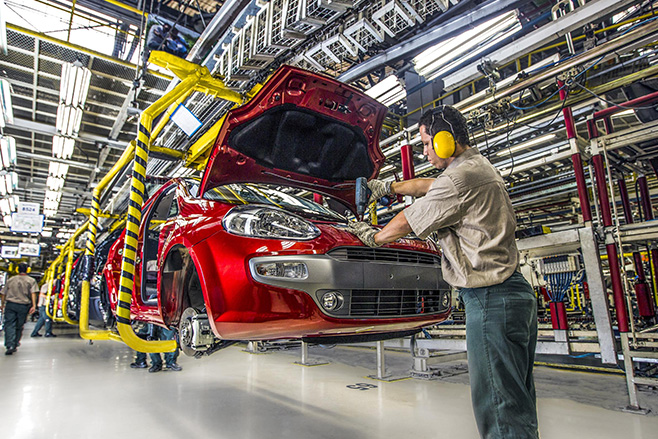
CHEVROLET IS THE MOST POPULAR CAR BRAND IN BRAZIL
Chevy has toppled Fiat as the country’s most popular brand this year, with 16.6 per cent market share in the first six months. Both brands have large manufacturing bases in the country. Fiat ruled supreme until last year but has since dropped from 18.6 percent market share to 15.1 percent. The Chevrolet Onix is now the biggest selling car in Brazil.
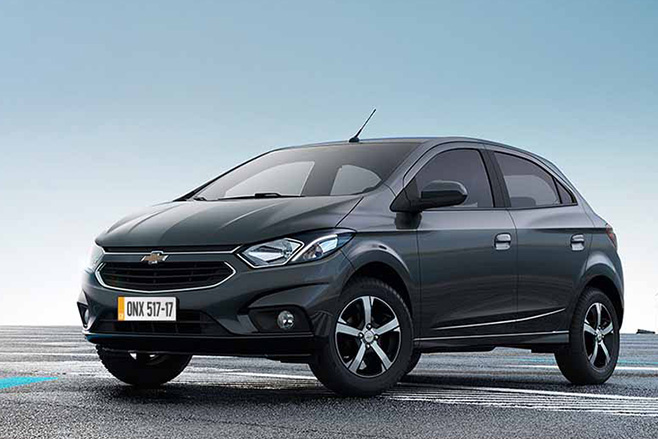
THE BRAZILIAN NEW-CAR MARKET IS TANKING
Brazil’s economic boom of the early 2000s turned into a bubble that well and truly burst as the century entered its teens. New-car sales have dropped a quarter in the first half of 2016 to 951,206 – the first time half-yearly sales have dropped below a million since 2007.
THERE ARE ONLY TWO INDIGENOUS CARMAKERS LEFT IN BRAZIL
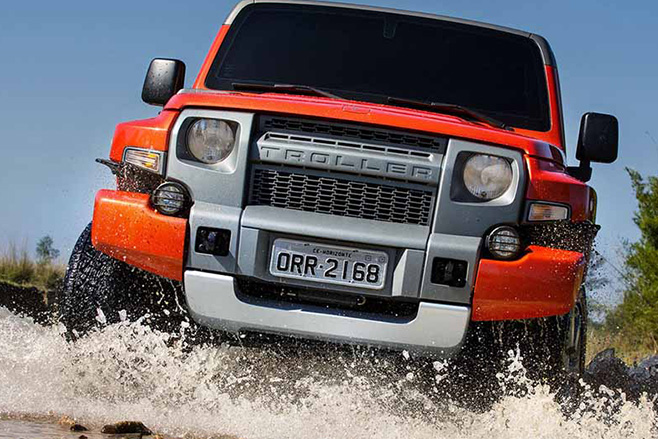
Troller and Tecnologia Automotiva Catarinense (TAC) both make rugged SUVs. Troller (which is the Portugese word for Troll) is now owned by Ford and makes a range of vehicles which it exports around South America including the Troller T4 3.0 Turbodiesel. TAC is a much smaller company and produces one vehicle, the TAC Stark.
VOLKSWAGEN MAKES CARS UNIQUE TO BRAZIL
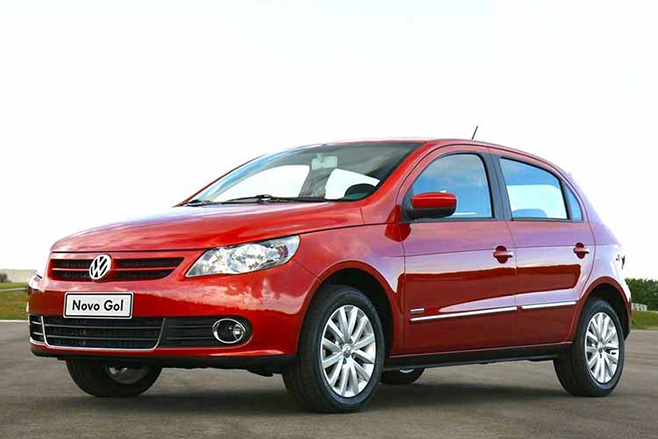
A bit like Holden and Ford here, VW went on a local tangent in Brazil to suit South American needs. Volkswagen does Brasil-made cars you won’t see in European showrooms including the big-selling Volkswagen Golf-like Gol hatchback, and sedan and ute versions called the Voyage and Saveiro. Discontinued models include a sports car called the SP2, which was a latter-day version of the legendary Karmann Ghia – also built in big numbers in Brazil.
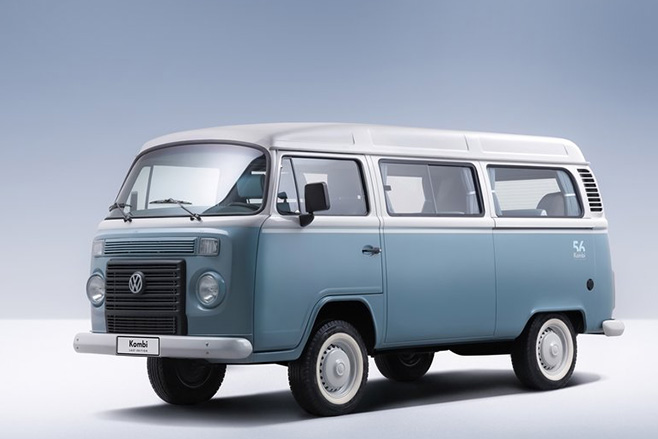
VOLKSWAGEN DO BRAZIL-BUILT KOMBI VANS UNTIL 2013
VW stopped making the Volkswagen Kombi in Europe in 1979 but construction of the venerable vans and mini buses continued in Mexico, Argentina and Brazil. By 1997 they were only being built in Brazil, and only stopped 16 years later because of new safety requirements mandating at least two airbags and anti-lock brakes, which made building them no longer viable. The popularity of old Kombis has spawned an export trade in recent Brazilian models.
BRAZIL LOVES BIOETHANOL
Brazil is the world’s second largest producer of ethanol fuel after the US. In 2014 it produced 23.4 billion litres – about a quarter of the world’s total ethanol used as fuel.
AUSTRALIA SOLD COMMODORES TO BRAZIL
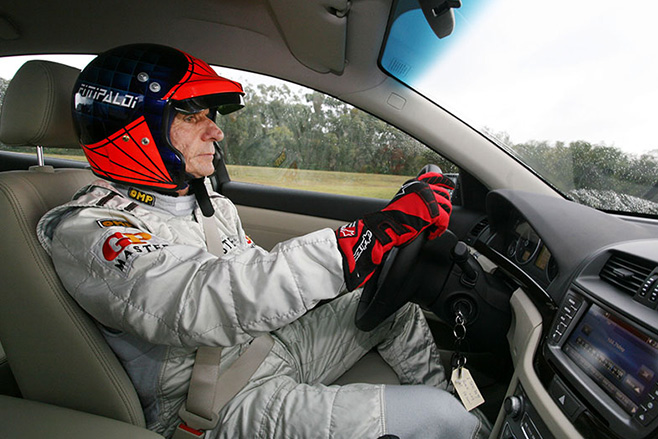
Holden exported left-hand-drive Commodores to Brazil between 1992 and 1998 and re-entered the market in 2010 with a bioethanol-fuelled Holden VE Commodore. Chevrolet recruited legendary Brazilian F1 and Indy racing car champion Emerson Fittipaldi to launch the initial batch of 600 VEs branded as the “Chevrolet Omega Fittipaldi Specials”.
THERE HAVE BEEN 31 BRAZILIAN FORMULA 1 RACING DRIVERS
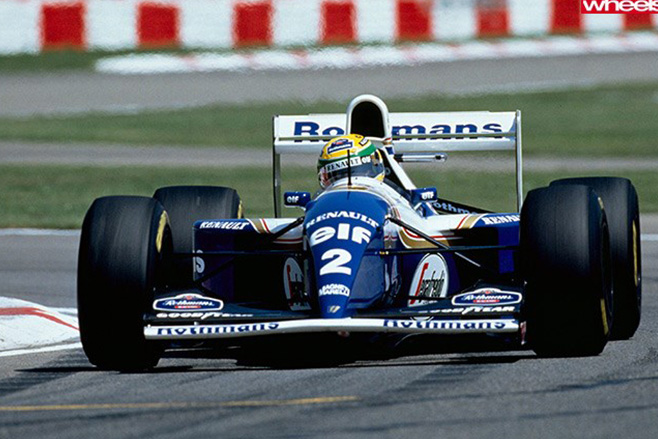
Brazil has produced some of the greatest racing drivers, including former world champions Emerson Fittipaldi, Nelson Piquet and the great Ayrton Senna. Notable drivers from the other 28 include Rubens Barrichello and current drivers Felipe Massa and Felipe Nasr.
BRAZIL HAS ITS OWN V8 RACING SERIES
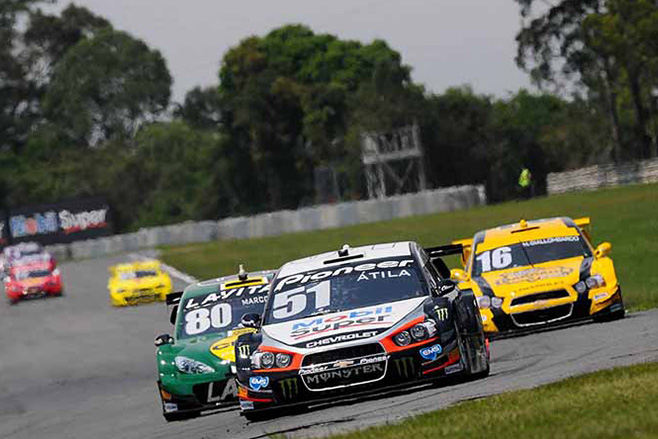
Brazil has a strong touring car history and racing championship called Stock Car Brasil, or Stock Car V8s, which is currently a two-horse race between cars loosely based on Chevy Cruzes and Peugeot 408s. The series attracts big names in South American motorsport including former F1 drivers such as the aforementioned Rubens Barrichello. Our own Mark Winterbottom co-drove in the opening round of the 2015 series and scored a podium finish with Marcos Gomes for the high-ranking Voxx Racing team.
Getting into a Hyundai Veloster is going to cost a little bit more following the Series II update and range consolidation from four Veloster variants to two.
The move means an entry-level manual Veloster Series II is now $29,590, up $5100, though it has had a suite of extra features added to it.
The entry price for the Hyundai Veloster SR Turbo has also risen by $1100, from $29,990 to $30,650.
Both variants come with a six-speed manual transmission as standard, with the dual-clutch automatic option still costing an extra $2500.
For the extra money the base model Veloster will now come standard with additional features including leather-appointed seats, electric driver’s seat, push button start, climate control, panoramic glass sunroof updated touchscreen and electric folding mirrors.

It will however lose in-built satellite navigation, CD player, premium audio system and steering-wheel mounted phone controls of the previous Veloster +, in favour of the mobile phone app-based Apple CarPlay and Google Now (Android) and voice activation.
The Veloster SR Turbo will now come with some options for the now-axed SR Plus variant such as panoramic sunroof and automatic climate control while losing its premium audio system and CD player for the apps.
Hyundai previously sold the popular three-door sports coupe as Veloster, Veloster +, Veloster SR Turbo and Veloster SR Turbo + but will now only have Veloster and Veloster ST Turbo models in manual and automatic.
Hyundai Australia Director of Marketing Oliver Mann says Veloster buyers generally wanted extra options.
“We have concentrated on the features our customers have told us they like the most. Keeping popular, high-value items – such as the panoramic sunroof and leather-appointed upholstery – has led to a sharper overall package for both Veloster models.”
The price change means the Veloster loses its pricing edge against its Kia Cerato Koup Turbo rival, which starts at $24,190 but without many of the Veloster’s features.
NINE years after Gilltrap’s Auto Museum opened on the Gold Coast, Wheels finally ran a story on what was then Australia’s best car collection.
Read Tom Floyd’s classic tale of the museum.
The disparate assortment of more than 100 cars included a 1955 Ferrari Super Squalo F1 open-wheeler, an exceptionally rare 1920s Australian Six, a 1907 Cadillac and, most famously, Genevieve, a 1904 Darracq and the star of the hit film of the same name.
This was not, however, a predictable yarn. Taking direction from the editor, the great and recently departed Bill Tuckey, staff writer Tom Floyd penned the story as a series of letters between writer and editor.
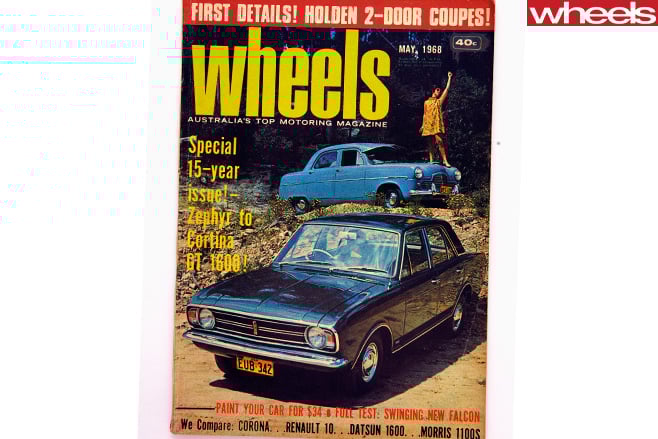
Threatening not to pay any of Tom’s expenses, while imploring him to “stop spending our money”, Tuckey eventually fires Floyd by telegram. Of course, it’s not the way it really happened, but it is entertaining.
Between pineapple bombshells, Floyd cleverly works details of the museum into his letters, so the reader gains a clear understanding of Gilltraps, its exhibits and how it works, even down to the daily demonstration runs in some of the more interesting vehicles. The heading Old Dogs and Hard Roads is pure Tuckey. Today Floyd says, “I’m absolutely sure the end result would have had a measure of brilliance from the old fellow (Tuckey).”
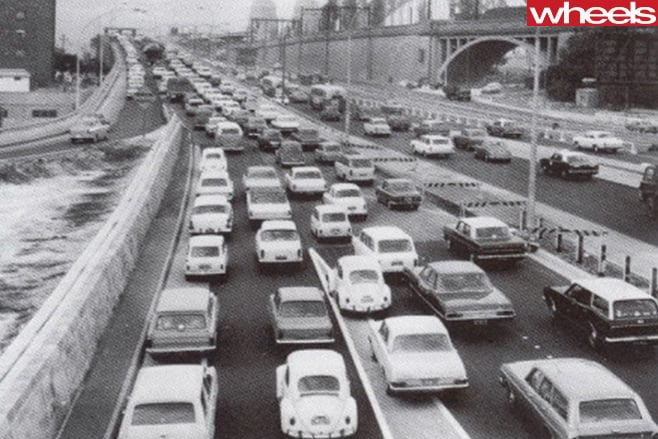
For 22 years the Gilltrap Auto Museum was one of the Gold Coast’s key attractions, at least so far as enthusiasts were concerned, run by the family after founder George died in 1966. In 1981 a major part of the collection was sold, though the core (including Genevieve) was moved to new premises at Dreamworld. When George Gilltrap’s widow Kathleen died in 1988 the final part of the collection was sold at auction. The museum irreversibly closed on 31 January 1989.
FORMER Wheels editor Bill Tuckey used a number of clever ways of making readers think the magazine had more resources – and reach – than the smell of an oily rag allowed.
First published in the May 1968 issue of Wheels magazine, Australia’s most experienced and most trusted car magazine since 1953.
Rather than send staffer Tom Floyd to Gilltrap’s Auto Museum on the Gold Coast, Tuckey asked him to pen a series of letters between journalist and editor to write a story on a landmark that Wheels never officially visited.
Read former Wheels editor Peter Robinson’s tale about how this story came to be written.
***
OLD DOGS AND HARD ROADS
Mr Bill Tuckey, Editor, WHEELS Magazine, Sydney, NSW.
Dear Mr Tuckey,
I’ve finally found the greatest tourist attraction since Surfers Paradise put in those meter maids.
I wasn’t too excited about this assignment when you first suggested it – besides, I somehow got stuck with that lunch bill and missed seeing the mini-skirt parade down George Street. Maybe the mood was wrong. Anyway, I take it all back.
Gilltrap’s Auto Museum is the best thing since bottled beer.
I left Sydney the afternoon I last saw you. I followed the coast road right through Casino, then stopped off at Tweed Heads for one of those pineapple bombshell things (you know the one you shake up with one part vodka – bill enclosed) and won a race down into Coolangatta with a tattered old Ford Falcon with Victorian plates.
Well, tomorrow I’ll find where Gilltrap keeps his old cars, and drop you a line then.
Yours truly, Thomas B. Floyd, Coast Motel, Surfers Paradise.

Thomas B. Floyd, Coast Motel, Surfers Paradise.
Dear Mr Floyd,
Sorry, I cannot permit payment of expense cheques outside routine costs of your assignment.
The pineapple bombshell bills are returned herewith since the weather bureau verified Tweed Heads was experiencing cool weather and you needn’t have stopped, and we doubt the other bombshells were really in line with the assignment.
Please shorten your letters; that is, if you must write at all, for we are too busy at the office to bother with them. Follow through with your assignment and hand in your story upon returning.
Bill Tuckey, Editor, WHEELS Magazine, Sydney, NSW.
***
William Tuckey, Editor, WHEELS Magazine, Sydney, NSW.
Dear William,
I found Gilltrap’s place today. Of course, I had the usual trouble as there really aren’t that many signs pointing in his direction, so I went to a local coolie-bar (they just happened to sell pineapple bombshells) and finally found where I had to buy my ticket (receipt enclosed).
The museum is on a corner of the highway at Kirra, near a pedestrian crossing where all these beaut brown birds walk all day.
There’s a big sign over the top and the windows are full of old gear like policemen’s helmets and brass snuff boxes.
There’s a big lobby lined with souvenirs and what looks like a helluva reference library. I have to go back and help an old lady over the pedestrian crossing, but you said to keep letters short anyway; so I’ll write tomorrow.
Yours truly, Thomas B. Floyd, Coast Motel, Surfers Paradise.
***
Thomas B. Floyd, Coast Motel, Surfers Paradise.
Dear Mr Floyd,
Acknowledging your letter of today. Receipt for entry charge to Gilltraps Auto Museum returned.
Your instructions were to check with Miss Robyn Gilltrap for admission. Please do not send any more correspondence COD.
Please get on with assignment. Need story in our office by Wednesday next.
Very sincerely,
Bill Tuckey, Editor, WHEELS Magazine, Sydney, NSW
***
Bill Tuckey, WHEELS, Sydney.
Hey, Bill;
This is a gas fab pad. Seems it was all started by George Gilltrap, who was born in Ireland and died in March, 1966. He migrated to New Zealand and worked as a bullocky, then a tractor- demonstrator, and kept buying pre-1914 cars. After the war, you know, the second one, you grimy old veteran, you. He started a contracting and war surplus business.
He opened a small museum in Rotorua in 1954 but got a bit annoyed (who wouldn’t?) about the lack of future in New Zealand and moved with 24 cars to Kirra in 1959. They opened an extension last December to bring the floor space up to 10,200 sq ft and they put through about 100,000 people a year.
How about that? At 50-cents a head for adults? Who said they don’t make it like they used to?
OK? Robyn and I are just going out to lunch to talk business, so will drop another note tomorrow.
‘Byeeeee,
Tom Floyd, Coast Motel, Surfers Paradise.
***
Thomas B. Floyd, Coast Motel, Surfers Paradise
Dear Mr Floyd,
We trust that Miss Gilltrap took you to lunch. We cannot imagine why you are spending so much time at Gilltrap’s, but suggest you find less expensive quarters. Please stop putting sketchy details in your letters and make up a complete story. Hurry with the assignment, as deadline is approaching.
Yours sincerely,
Bill Tuckey, Editor, WHEELS Magazine, Sydney, NSW.
WPT, WHEELS, Somewhere in Sydney.
Bill Baby;
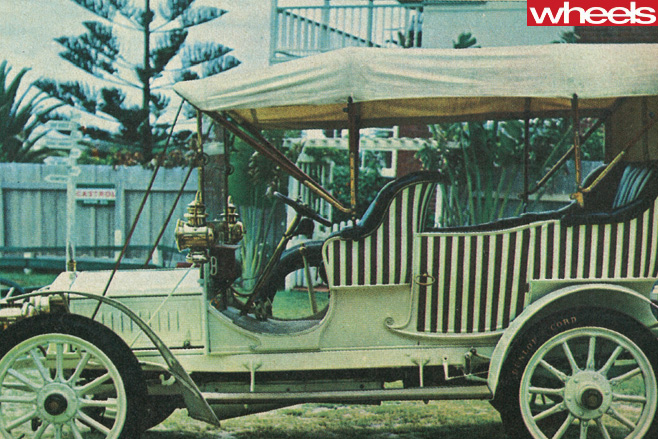
This place would snap your brain. I just can’t wait to get down to writing the story. Gilltrap’s is all Dunlop Cord tyres and twinkly brass and bulb horns and pin striping… they’ve got cars from 1899 right up to a first Holden and a 1955 Ferrari Super Squalo – you remember, the one Arthur Grimths had in Queensland and then Des Kelly bought it to race at Lowood. Ol’ Des got killed on the speedway not long back, but he sold the big Fazzazz to Gilltrap’s.
That car really turned me on, until Robyn dragged me away to show me the last thing George Gilltrap ever bought.
It’s a teeny bopper of a 1925 baby Caterpillar tractor they found in Tully. Man, you feel you could pack it in your briefcase.
Anyway, they’ve also got fire engines, trucks – hey, there’s a screamer of a 1927 Foden steam truck that takes two hours to fire up and when you get it started it’s too late to go anywhere… besides where would you go in a 1927 Foden steam truck?
Then there’s tractors from 1900, 1910 and all that, including something called a 1916 Rumley Oil Pull, and three locomotives and 11 motor bikes from 1901 to 1929 and a dangerous-looking plane they tell me was the first Flying Doctor gizmo. Great stuff!
But listen, the best of all; you know in Harrah’s and Montague’s how you all gotta stand around and look and whistle and say gee whiz looky at that and that’s the whole bit? Well here, buddy, they run the bombs around and give rides and what else! They do! Robyn Cherie said it’s probably the only museum in the world that does this and that this was always her father’s idea because he liked people to see and feel the link between animal power and engine power.
They put all the speckies up in a small grandstand and then start up things like the 1908 Vulcan which they’ve just finished restoring. It’s done in chocolate stripes over cream, and Robyn Sweetie says that you could order this (it’s called Roi de Belge, but I’ll leave all these details for the story) to match your Edwardian blazer. Hot deal! This could be bigger than Boney and Claude, those Mafia pair.
Then this guy stops bloop-blooping around in the cars and digs out these crazy bikes. There’s an 1870 Boneshaker – you wouldn’t believe this! It’s solid iron right through and on the smooth concrete floor it gives the guy a hernia every third session. Then he gets out on an 1875 Penny-Farthing and then an 1886 Humber Tandem Tricycle in which the lady sits out front between two huge spider-thin wheels and the gent pedals along in back perched above her. They must have had good morals in those days, for that bike’s a dead loss for lover’s lane if ever I saw one.
Anyway, I’ll start writing all this stuff tomorrow, because I have to continue my research tonight at the High Bonnet restaurant; the owner, Gordon Bedson (a really good wine buff, incidentally) is a distinguished aeronautical and mechanical engineer who also makes a mean baron of beef. Enclosed please find receipts for $40 expenses including lunch for Gilltrap’s publicity officer.
Go baby!
Tanned Tom, Surfersville.
***
Thomas B. Floyd, Coast Motel, SP, Qld.
Dear MISTER Floyd,
Find non-refundable expense receipts for $40.00 herewith. Stop spending our money! And we must ask again that you not send letters unstamped. Another reminder that deadline for the issue is nearing and that next Wednesday is final production day.
Try and find out how many old cars are in the Gilltrap museum and let me know. Try and add more detail to your letters; the place sounds intriguing.
Yours sincerely:, Bill Tuckey, Editor,
WHEELS Magazine, Sydney, NSW.
***
Bill, WHEELS Sydney.
Bill Buddy;
This story gets bigger every time. I’ll start writing it tomorrow. Did you know that at the museum they have a full souvenir kit of the veteran rally that never was? Honestly, these old car guys keep all the good secrets. Apparently they planned a big deal International rally for Ireland in 1966 and at the last moment had to call it off because of one of those shipping strikes the Pommies are always having because Till Death Do Us Part changes time slots or something. Anyway, Mrs Gilltrap (she’s now managing director of the show) brought back souvenir programs, ashtrays, passes, vouchers – all the gear to go visit a raliy that was never held.
And get this – in this new extension they have a fifty-fifty Ford Model T. No really! Half of it’s restored; the other half is just as they found it- rust, chicken droppings, springs poking through horsehair and all. It’s weirdsville!
Robyn says that the old side will just get older. Appears they only restore about four cars a year, and Gold Coast blokes do the trim and paint work for them. One of them is an old stager who still remembers how to do button upholstery, but they find it hard to get good pin-striping. Down the road apiece is a storage shed with about 20 cars in bits and pieces, plus bins of spares.
Just- met Terry: He’s Miss Gilltrap’s brother. Big fella. Nice man. He seems to know most of what’s going on in the museum. He showed me a 1912 Panhard-Levassor that they’re going to restore in time for the 1968 International Rally. Hope there’s no shipping strike for that one. The 1970 Rally, incidentally, is scheduled for Australia. Terry says they found the 1908 Vulpan and the 1901 steam Locomobile together with the Panhard in one heap a few hundred yards away. The Loco was apparently built under Stanley patents, with a 926cc engine.
Oh, how many cars? Do you mean complete or in bits? I’ll have to count them all. Let’s say 150. Why do you want to know?
Anyway, it took me more than three hours to see the building; can I have a day’s extension on deadline?
Enclosed a bill for $51.86 for dry-cleaning incurred while climbing up on a 1913 Dennis fire engine.
Tom (brown baby), Sin City.
***
TELEGRAM
TOM FLOYD,
GILLTRAP’S AUTO MUSEUM, GOLD COAST, QLD.
YOU NOW FIRED STOP HAVE HEARD GILLTRAP HAS COLLECTION ANCIENT SPEED EQUIPMENT STOP SEE WHAT YOU CAN FIND OUT STOP DETERMINE IF ANY OLD BRASS HORNS FOR SALE STOP WIRE ANSWER COLLECT STOP
BILL WHEELS MAG SYDNEY NSW
***
TELEGRAM
WPT ED WHEELS SYDNEY NSW
FOUND BUILDING WITH OODLES OF OLD STUFF STOP NOT SURE WHAT TYPE HORN YOU REQUIRE STOP CANNOT ASK QUESTION OF WORKERS ONLY OF SPECIAL ANSWERING STAFF STOP LETTER FOLLOWS
TOM (EVEN BROWNER) GOLD COAST QLD
***
Ex Boss-man, Wheels, Sydney.
Baby;
You didn’t mean that fired bit. You’re just working too hard. Now look; I don’t know what you’re after. I had a look in their library of 1000 books and magazines (Miss Robyn says Australian motoring history fascinates her and she’s busy cataloguing and indexing all the references she can find) but I didn’t do any good. Just to be sure I took another hour’s walk through the museum. Up on the walls they have radiator grilles from everywhere – a 1922
Australian Six, a 1911 -English Bell, a 1923 Deemester (whatever the hell that was), a 1920 Stutz, a 1909 Riley, a 1922 Belgian Minerva, and would-you-believe a 1910 Alldays and Onions. Give me a 1968 Hamburger and Egg any time. Is this what you’re after?
Just in case not, I’ve extended my research. Down one hall, just near the old Cobb and Co coach from Cunnamulla, there are some display cases. In there, in the middle of some real hoary old spark plugs and trembler coils, I found a Wright’ Cyclone aircraft engine piston with a 6in. bore and weighing 5lb 12oz, a 1913 Rayfield updraught carburettor and a 1935 Spartan Adjustable Chime Bugle Horn.
Any joy?
Swinger Tom, Onionsville.
***
TELEGRAM
TOM FLOYD GOLD COAST QLD
AM ON MY WAY TO KIRRA STOP WILL TELEPHONE AHEAD FROM PINEAPPLE BOMBSHELL STAND TWEED HEADS STOP TRY LOCATE OLEO MAGNETO FOR MY 1925 MORRIS COWLEY STOP
BILL BABY WHEELS SYDNEY NSW
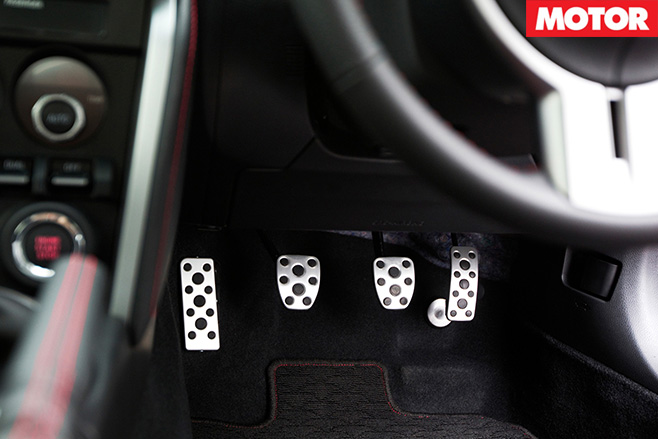
Almost every Toyota 86 and Subaru BRZ sold in Australia has been recalled for a steering fault that has so far caused a loss in power assistance in at least 62 vehicles nationwide.
Around 15,000 86s and 3000 BRZs built between March 2012 and March 2015 will be recalled for a wiring defect that could interfere with the driver’s knee airbag housing and cause an electrical short circuit.
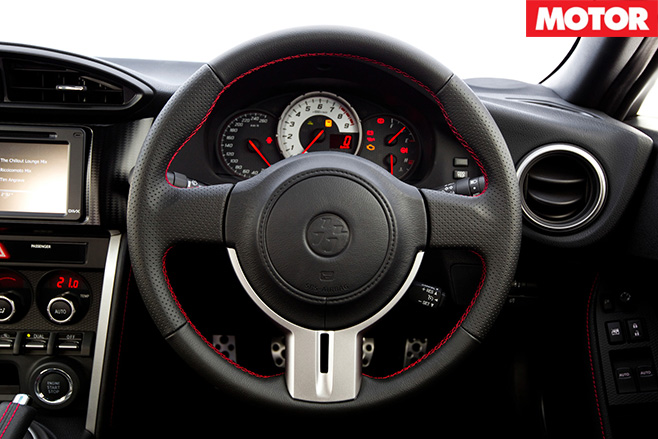
Both single-spec BRZ, and 86 GT and GTS with either manual or automatic transmission are included in the recall, which will take one hour to fix free of charge at any Toyota dealership nationwide. It will involve the replacement of the power steering ECU and electric assistance harness.
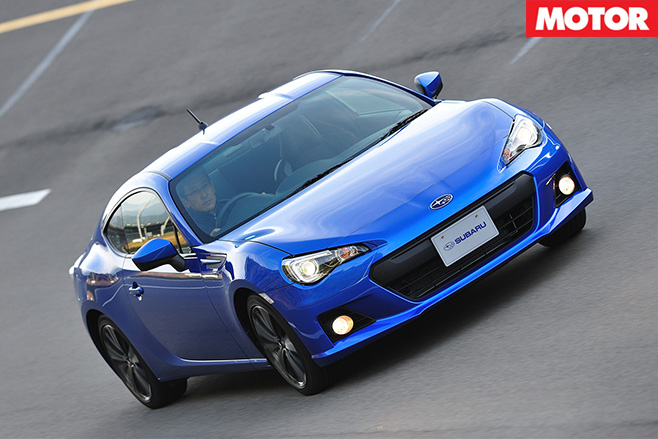
Alternatively, 86 models are affected if the final eight digits of the VIN are between ranges DG002006 and DG015716, EG018002 and EG023149, FG025022 and FG029639, DG002013 and DG015715, EG018001 and EG023148, or FG025003 and FG029637.
BMW will release two updated BMW 3 Series Gran Turismo models before the end of the year.
The entry point to the two-tiered range has risen by $2300 to $70,400 (plus on-road costs) for the 320d, powered by a 140kW 2.0-litre four-cylinder turbo diesel engine matched to an eight-speed automatic transmission.
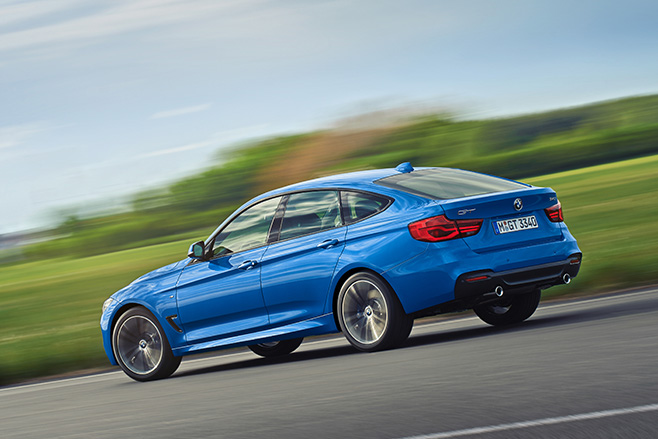
The big change, though, is the 330i, which replaces the 328i. The new range topper still uses a turbocharged four-cylinder petrol engine, but performance steps up 5kW over the old model to 185kW. It’s more expensive, too, rising by $1100 to starting from $77,900, but it does improve fuel efficiency slightly.
Inside the 330i, a better version of BMW’s satellite navigation system is fitted as standard, complete with a new user interface, as is a full-length sunroof. The 320d adds improved smartphone connectivity.
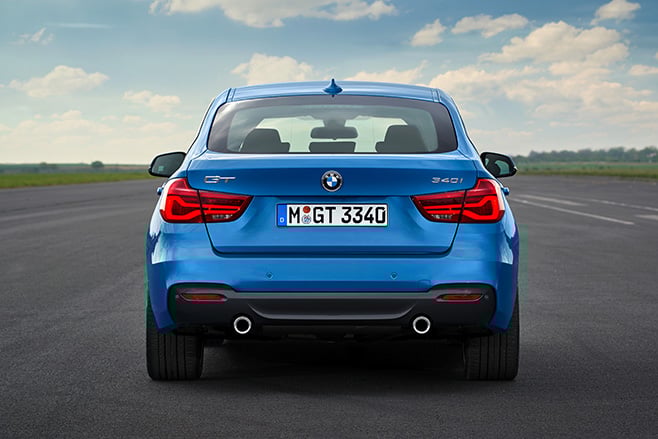
Externally, the 3 Series GT gains a revised bumper incorporating restyled air intakes and LED fog-lights. New headlights that use the same LED bulbs for both low- and high-beam applications, combined with LED daytime running lights, carry over the twin headlight look. Adaptive headlights aren’t fitted as standard on the new models. Restyled LED tail-lights and the apron framing the larger-diameter twin exhaust system are used on both variants.
The 320d sits on 18-inch alloy wheels, 10mm lower than before on active suspension that includes selectable driving modes. The 330i uses slightly larger 19-inch rims, and carries over the 328i’s active rear spoiler that automatically deploys at speeds above 110km/h to reduce rear-axle lift.
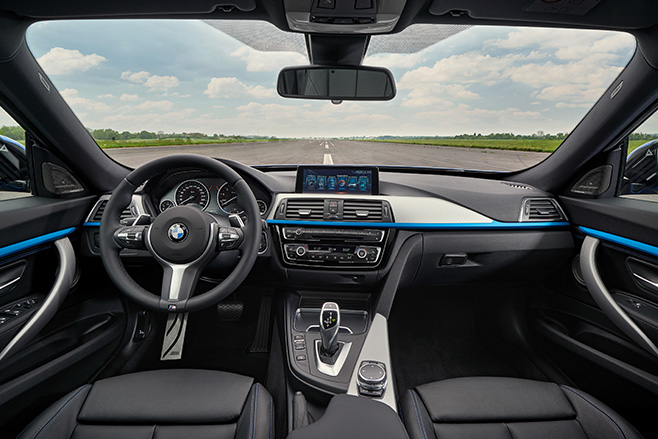
The updated BMW 3 Series GT range is expected to hit Australian dealerships late this year.
PACKAGES
320d Innovations Package, $2870
Active cruise control with stop-and-go function, parking assistant, Professional navigation system and a nine-speaker HiFi loudspeaker audio system.
320d Comfort Package, $2270
Steering wheel heating, Comfort Access, lumbar support for driver and front passenger, seat heating for driver and front passenger, and rear seat heating.
330i Innovations Package, $3500
Active cruise control with stop-and-go function, parking assistant and 16-speaker surround-sound audio system.
330i Comfort Package, $1730
Steering wheel heating, seat heating for driver and front passenger, and rear seat heating.
The fourth generation of Lexus’ mid-sized SUV has an aggressive new look, larger and plusher interior than its predecessor and a range of engine types including the 2.0 litre turbocharged petrol, a 3.5 litre V6 and 3.5 litre V6 Hybrid. We test drove the Lexus RX 450h Luxury, which is the entry level hybrid.
STRENGTHS
The stately handling is smooth and is incredibly quiet, particularly when the electric motors are doing the work. Despite being a big car it feels nimble around town but has the smooth ride and creature comforts to make long drives pleasant.
The city is also where the hybrid technology earns its keep fuel wise. The combined fuel economy rating of 5.7L/100km compares incredibly well to the 9.6L/100km of the petrol-only alternative, the Lexus RX350. The RX450h also has one of the lowest CO2 outputs of any SUV.
RX450h is brimming with active safety technology which makes you feel like you have a co-pilot, including radar cruise control, automatic lane keeping, blind spot detection, rear cross traffic alert and collision detection. The satellite navigation also warns you about upcoming hazards including fixed speed cameras, school zones and railway crossings.
The interior is beautifully appointed and comfortable with lots of soft leather and gadgetry that looks good and is generally in the right places. It all seems to be a direct lift from the premium Lexus GS sedan though the extra height gives it a more commanding feel.
The seats are very comfortable with automatic heating and cooling and a heap of electric adjustments which you can pre-set when you finally attain the perfect position. The back seats are cozy and fold down to provide a reasonably sized cargo area.
The entertainment system includes digital radio that sounds epic through the 12-speaker Mark Levinson audio system. Bluetooth syncs quickly and reconnects instantly when you start the car.
Some may consider its exterior appearance a weakness, but it’s a grower that gets better the more you look at it. It will still divide opinion, which will make some people like it more. The colour can be a big factor.
WEAKNESSES
The hybrid version isn’t cheap with a starting price of around $97,000 drive away. That’s about $16,000 more than the entry level 2.0 petrol turbo RX200t and $8000 more than the gutsy V6-powered RX350. For another $4000 you can get RX350 F Sport, which has a few more features inside and extra performance via Sports + and customised driving modes. It’s the pick of the range.
Fuel economy isn’t as great on the open highway, as the hybrid system shuts off and the somewhat thirsty V6 petrol engine does all the work. Potential buyers lucky enough to commute at 100km/h may be better served by conventionally powered RX models.
The screen controls are a little cumbersome and fiddly.
ANY RIVALS I SHOULD CONSIDER?
The Audi Q7 and BMW X5 turbo diesel models offer similar fuel economy and luxury for around the same price. However they don’t have all the options found in the Lexus as standard. BMW’s 3.3L/100km sipping hybrid xDrive 40e will set you back around $130,000.
We love Mazda’s MX-5. But there’s no doubting it’s a little slow.
However, you won’t be able to convince stateside tuners Flyin’ Miata. It’s turned the new Miata (as the MX-5 is known over there) into a 321kW turn-key package.
The headline figure comes from GM’s LS3 V8, which our own Holden SS cops in VF II guise. FM has quite the reputation for cramming big engines in Miatas, and the ND is its latest creation to benefit from its lunacy.
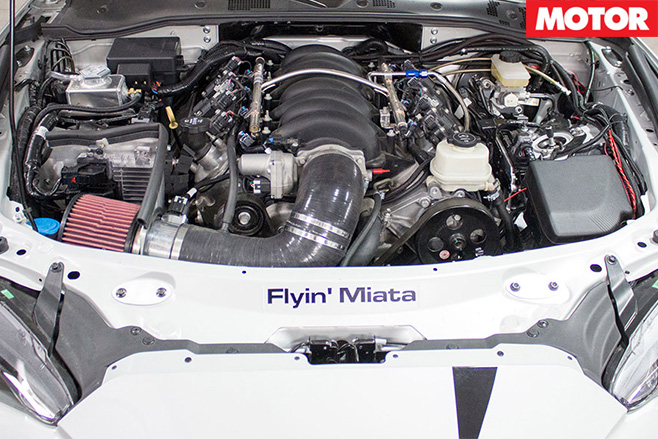
Hanging off the 6.2-litre pushrod is a T56 ‘Magnum’ six-speed. It’ll spin an aluminium shaft that meets a Camaro LSD rear-end. Heavy-duty half shafts are the last link the driveline’s chain.
There’s also a GM-built wiring harness and management system. So you’ll lose electric steering (for hydraulic power) and traction control, while an aftermarket cruise-control costs $1000. The upside of this is clearly hilarious power-to-weight.
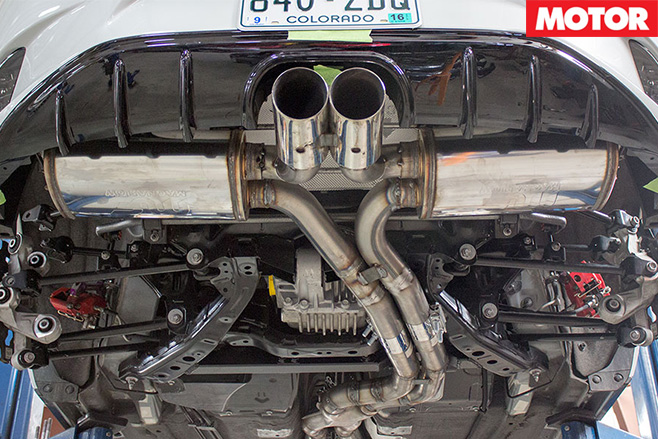
You can also have your madness built with different flavours, as FM will happily do the same to Fiat’s incoming 124 Spider or Retractable Hardtop Miata.
Parts and labour are set at US$50,000 before the cost of the car. And considering the US 2.0-litre Miata costs US$24,088, you’re looking at close to $100,000 in Aussie peso for the whole build.
But the result should be priceless.
Car safety is of paramount importance for every parent, but finding the right car seat for your children can be an overwhelming process. Even once you’ve found the correct seat for their needs, there is often confusion surrounding the best time to turn it over, turn it around, or turf it altogether.
To make it even more challenging, there is no set age or time limit for any child seat. Yes, there are laws and guidelines, but child seat limits are set by height, not age. While it is easy to adhere to the manufacturer’s maximum height recommendations, the minimum height for a child in a car seat and when to change a seat’s position are factors open to debate – there’s what you can do, what you must do, and what you should do.
Read on for our recommendations.
CAPSULES
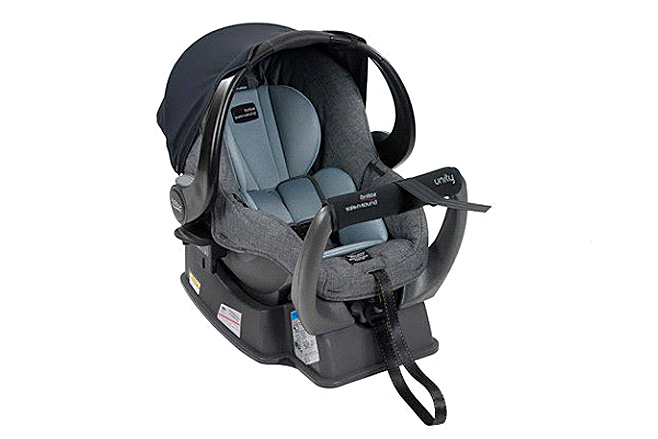
Capsules are so convenient; the ability to move a sleeping newborn in and out of the car is a godsend for many new parents. With additional capsule bases costing a fraction of a second car seat for multiple-vehicle families, they are also far cheaper. Therefore it can be quite hard to let them go, particularly as their lifespan seems so short. But you must.
Like car seats, capsules have an indicator line of the maximum height allowance (at the shoulder), letting you know when the time has come to upgrade to the next level of car seat. You must adhere to this rule, particularly if you travel long distances. An infant should not be in the foetal or cradle position for extended periods of time, as it can lead to stiffness, soreness, and even posture and development problems. For this reason capsule warnings clearly prescribe a maximum of two hours’ continuous use – some even less.
Once your child reaches the height indicator line – that’s it. And you have some big choices to make from there.
REAR-FACING
Babies are sponges, soaking in the world around them and fascinated by even the most trivial or mundane sights and sounds. But staring at a car roof is probably a bit boring even for a baby, so many parents can’t wait to face their child forward to see the world as soon as possible.
Some will also choose to move straight from a capsule to a forward-facing car seat for babies six months and older. It’s arguably a cheaper and easier alternative to a rearward/forward convertible seat, which can have a shorter lifespan (around four years versus up to eight) and requires more heavy lifting to get in and out of the car. But please, try to use the rearward-facing position for as long as possible.
While the law states six months is the minimum age, and all car seats will have a minimum height at the shoulder clearly displayed on them, infants and toddlers don’t have the awareness or ability to brace themselves for a crash. Their heads are big and heavy, their bodies soft, and many injuries or even deaths could have been lessened or avoided outright by a rear-facing seat. In an accident, a rear-facing position can reduce or eliminate whiplash or spinal trauma, and internal injuries from belts.
So while the whining and the entry/egress can be painful, rear-facing is the safest position until your child grows too big to fit.
FORWARD-FACING
There are two types of forward-facing seat: a car seat with child restraint, and a booster seat.
The forward-facing child seat still encapsulates the body and head with big bolsters and padding, and has a minimum five-point harness to strap the child in. These are for use up to and beyond four years of age, and in the case of forward-facing/booster convertible seats, up to eight or even 10 years.
Typically, a child has outgrown this type of seat when either its height or weight has exceeded the limit recommended by the manufacturer, or the child’s ears are peeking over the very top of the head support. The height and weight limits are always listed on the warning labels on the seat, and in the instruction booklet.
The big difference with the booster seat, which can legally be used from four years, is that it employs the car’s lap-sash belt instead of a harness. The harness is a safer belt (race cars, anyone?), and a lap-sash can be a problem for wriggly kids who hate their belts – which is pretty much all of them. Aftermarket harnesses are not recommended for use with boosters, so be sure your kid is mature enough to keep their lap-sash on, as well as being physically big enough, before upgrading to a booster.
There are forward-facing/booster seats on the market (Type G) that can be used like a booster but still employ a harness, and are suitable for children up to eight years; this is a great solution if it works into your upgrade schedule.
The minimum height to move out of a booster seat is 145cm, and over seven years of age. But until they grow too large for them, simply keep using them. It’s the safest option.
NATIONAL CHILD RESTRAINT LAWS
- Children up to the age of six months must be secured in an approved rearward-facing restraint
- Children aged from six months old but under four years old must be secured in either a rear- or forward-facing approved child restraint with an inbuilt harness
- Children under four years old cannot travel in the front seat of a vehicle with two or more rows
- Children aged from four years old but under seven years old must be secured in a forward-facing approved child restraint with an inbuilt harness or an approved booster seat
- Children aged from four years old but under seven years old cannot travel in the front seat of a vehicle with two or more rows, unless all other back seats are occupied by children younger than seven years in an approved child restraint or booster seat
- Children aged from seven years old but under 16 years old who are too small to be restrained by a seatbelt properly adjusted and fastened are strongly recommended to use an approved booster seat
- Children in booster seats must be restrained by a suitable lap-and-sash-type approved seatbelt that is properly adjusted and fastened, or by a suitable approved child safety harness that is properly adjusted and fastened.
