
Blame the demands of corporate average fuel economy and carbon-dioxide emissions for Porsche’s decision to downsize and turbocharge its mid-engined Cayman sports car. But there’s an upside to all this – the now four-cylinder Porsche 718 Cayman (along with its 718 Porsche Boxster sibling) has stepped out of the 911’s shadow to become an entity all to itself, with a personality all its own.
Boasting not only increased engine outputs, reduced fuel economy and cleaner tailpipe emissions, the 718 Cayman is also more appealing to look at, nicer to sit in, and sweeter to drive. But it’s that rambunctious new turbocharged flat-four that dominates the show.
STRENGTHS
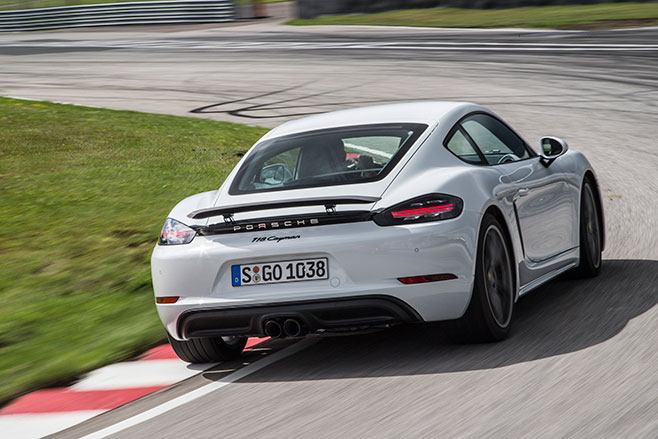
- Ride and handling. The mid-engined Porsche Cayman has always been stupendously good at stringing corners together with feel and precision, yet the new four-pot 718 is even better again. With faster steering response, a smoother and more sweetly balanced feel, and improved lateral grip, there’s both a delicacy and a solidity to the way the 718 Cayman handles. If you option Porsche Active Suspension Management (PASM), the Cayman rides amazingly well too, even when fitted with 20-inch wheels.
- Performance. There might be a little bit of lag at the bottom end of the engine’s operating range but once it picks up, boy does it go! Unlike the old flat-six Cayman, which demanded a committed right foot and plenty of revs to really deliver, the turbo four is blessed with bundles of boosted shove in any gear, at just about any speed. And it sounds great too when switched to sport mode with an optional sports exhaust system attached. Kind of like Porsche’s original 356 Carrera. Or a heavily worked, air-cooled Volkswagen!
- Customisation. Not only is the 718 available with two engines (220kW 2.0-litre Cayman and 257kW 2.5-litre Cayman S) and two transmissions (six-speed manual or seven-speed dual-clutch automatic), there’s also a vast array of interesting new trim and equipment options, as well as vibrant paint colours like Lava Orange and Miami Blue.
WEAKNESSES
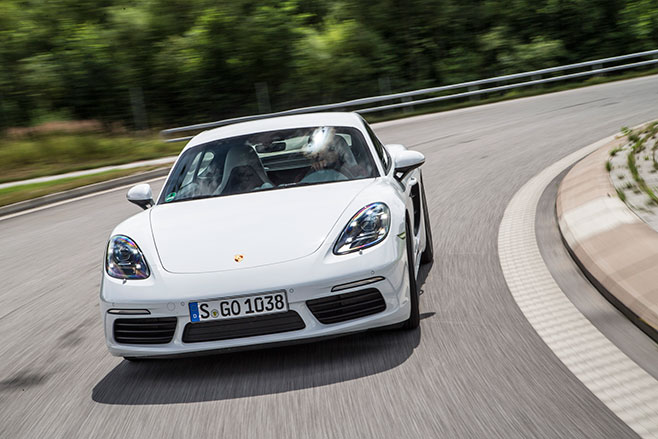
- The flat-six’s soundtrack is gone. That textbook exponential rise in power and thrust, backed by a hard-edged, almost aggressive wail as the previous six soared towards 7500rpm isn’t really replicated in the new turbo flat-four. But to its credit, the new four still revs to 7500rpm, it still keeps piling on the kilowatts the harder you push it, and it still makes a great noise. It’s just that it’s no longer textbook Porsche. Instead, there’s a hint of both Subaru WRX STi and Toyota 86/Subaru BRZ flat-four in the four-pot Cayman, though the Porsche creams both for quality and volume of noise.
- Minimal driver-safety aids. There’s Electronic Stability Control, of course, which is brilliantly tuned, as well as Multi Collision Brake borrowed from VW/Audi, which can reduce the severity of a secondary collision by automatically braking the vehicle if an initial collision has triggered the airbags. You can also option lane-departure warning and adaptive cruise control but that’s pretty much it. No autonomous emergency braking (AEB) is becoming a rarity at this price.
- Expense. The base 718 Cayman (from $110K) and more powerful 718 Cayman S (from $140K) are hardly cheap, and that’s without dabbling in Porsche’s famously extensive options catalogue. To the standard price, you really need to add Sports Chrono (which introduces multiple drive modes, among other sporting extras), a sports exhaust, and Porsche Active Suspension Management (PASM), which is code for adaptive dampers – taking the extras total to well over $10K, and that’s without any multimedia or styling upgrades.
ANY RIVALS I SHOULD CONSIDER?
At the upper end, the BMW M4 Competition and Mercedes-AMG C63 S Coupe seem natural two-door rivals to the Cayman S, though they both seat four and pack more cylinders. But if you don’t mind four pots, the Audi TTS quattro is an obvious alternative to a base 718 Cayman. That said, none of those cars can match the Porsche’s ultimate dynamic ability.
TELL ME ABOUT THIS CAR
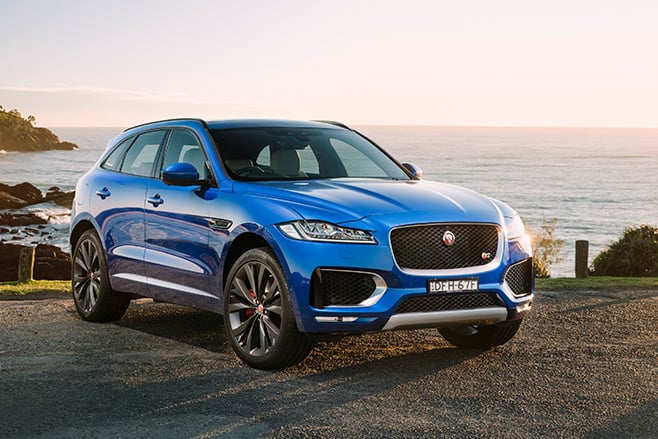
Jaguar F-Pace is the British brand’s first SUV, designed to attract a huge number of first time Jaguar owners and carve out its own patch of the booming SUV market. Jaguar is making the most of its sports car history by introducing a family friendly car with wide audience appeal that doesn’t sacrifice focus on the driver. Pricing ranges from $74,340 to $120,415.
STRENGTHS
- Styling. Renowned British designer Ian Callum is the man largely responsible for styling the F-Pace. It’s an accomplished and refined package that incorporates elements of other Jaguars to give it a distinct link to the sports sedan and coupe family.
- Engines. Three engines are available: a 132kW/430Nm 2.0-litre turbo-diesel four-cylinder, a 221kW/700Nm 3.0-litre turbo-diesel, and a top of the range 3.0-litre supercharged petrol V6 that produces 250kW/450Nm in Prestige, Portfolio or R-Sport trim and 280kW/460Nm in S and First Edition models.
- Handling. An F-Pace is great to drive. Steering is the most impressive part of the F-Pace’s dynamic ability. It is direct and quick, and makes the most of all available front-end grip – which is a lot. It manages to stay near flat when cornering and will happily hustle along twisty sections of road without complaint.
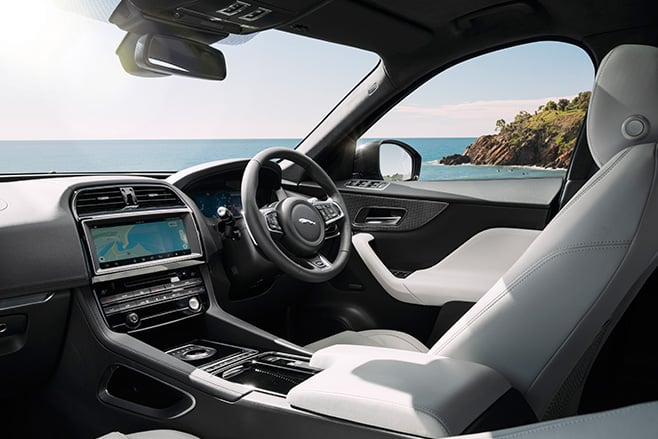
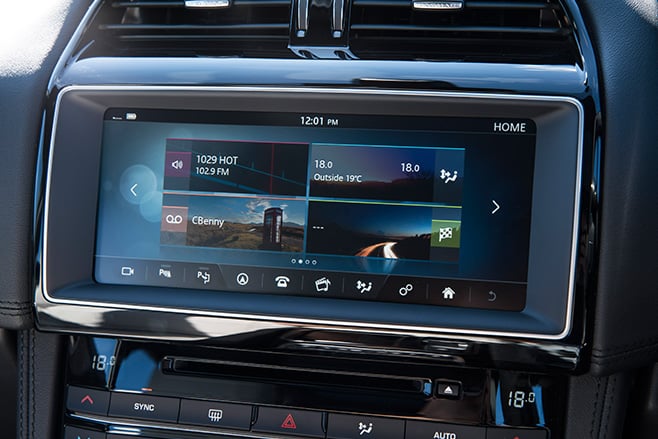
- Technology. F-Pace has lots of up-to-the-minute tech like a fully digital instrument cluster and 10.2-inch widescreen centre display. There’s also a cool feature called Activity Key, which is a wristband that can be worn while out and about when you can’t carry the normal key. Leave it inside the car, use the wristband to activate the locks and off you go.
- Practicality. A 508 litre boot in the F-Pace is big enough to accept a generous amount of whatever it is you need to carry. It’s not the biggest in its class, but there’s a proper spare wheel and tyre under the boot floor which is better than the inflation kits found in some rivals.
- Options. So much of what separates the F-Pace from others in the segment comes at additional cost on top of the initial purchase price. Things like the Activity Key and the digital instrument display mentioned above attract $640 and $4000 premiums respectively. If you want the digital display with a surround sound stereo it’ll cost $7290. A sliding sunroof costs $4200.
- Competition. Describing F-Pace as a driver’s SUV automatically draws comparison with the Porsche Macan, which is a very difficult match-up. F-Pace does a great job of blending sports car dynamics with SUV practicality, but it’s not quite as sharp as the mid-sizer from Stuttgart.
- Interior. F-Pace is stylish inside. In fact it’s one of the best Jaguar interiors in recent times. Unfortunately it needs quite a few options to give it the premium feel one might expect of it, and it isn’t as polished as some competitors – the Mercedes-Benz GLC in particular.
F-Pace enters a hotly contended segment against a tough list of competitors. If it’s outright driver involvement and dynamic ability you want, the Porsche Macan is about the only one that can out-drive the F-Pace. Luxury and refinement challengers are the Mercedes-Benz GLC and, to a lesser extent, the ageing Audi Q5 and SQ5. BMW X3 is another good option, or the X4 if a sportier coupe roofline is your thing. The size of F-Pace sits between classes and could also attract buyers of BMW X5 and Mercedes-Benz GLE.
Peugeot Australia has announced discounted on-road prices and a host of equipment increases for its 208, 308 and 2008 models as part of a winter sales push.
Peugeot is tempting would-be buyers of its 208 Active Special Edition hatch with the inclusion of a reversing camera, smartphone connectivity and satellite navigation system via Apple CarPlay and MirrorLink, while keeping the five-door hatch’s price tag at $21,990 (plus on-roads).
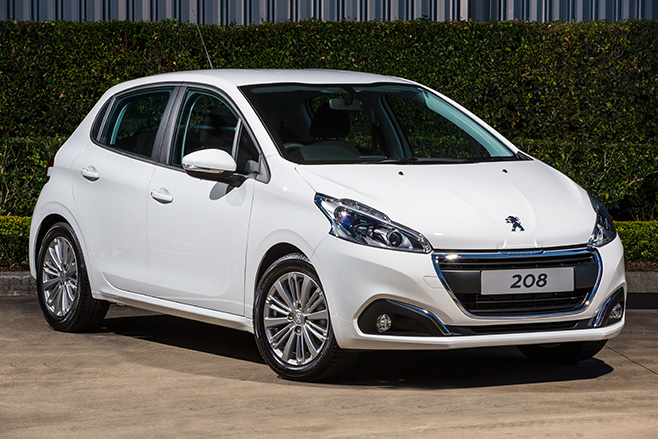
As part of the push, the well-equipped 208 Allure hatch – which includes satnav, a self-parking function, cornering foglights and various other tech features as standard in its $25,990 price tag – is being offered with free on-roads between now and the end September.
It’s a similar story across the Peugeot 308 range, with Peugeot offering free registration, stamp duty and CTP insurance across the four-tiered range. Depending on which State or Territory you’ll be buying in, the offer could save some purchasers as much as $3000.
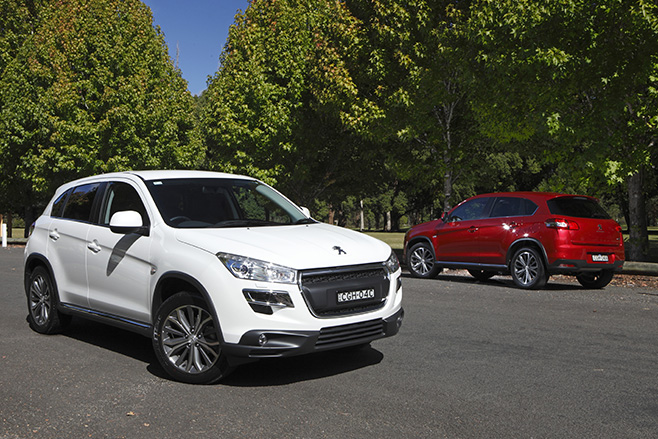
Peugeot’s 1.6-litre 2008 Outdoor turbo diesel SUV has been reduced to $29,990, as has the 4008 Active. As well as the price drop, buyers of the 4008 Active can add 18-inch alloy wheels and a chrome pack – valued at $2000 – at no extra cost. The offer on the firm’s 4008 Active, according to Peugeot, could potentially save would-be owners up to $6000.
New and current Peugeot owners can also benefit from a 20 percent saving on replacement windscreen wiper rubbers and batteries, a timely offer in these winter months.
Would you buy a press car? After all this particular Renault Megane RS275 Trophy-R has had only a single owner with just over 7000km on its odometer.
But this Renault Australia-owned Glacier White example of arguably the hottest front-wheel drive hot hatchback of all time, has been in the hands of MOTOR testers for more time than pretty much any other outlet. (And you’d trust us, right?)
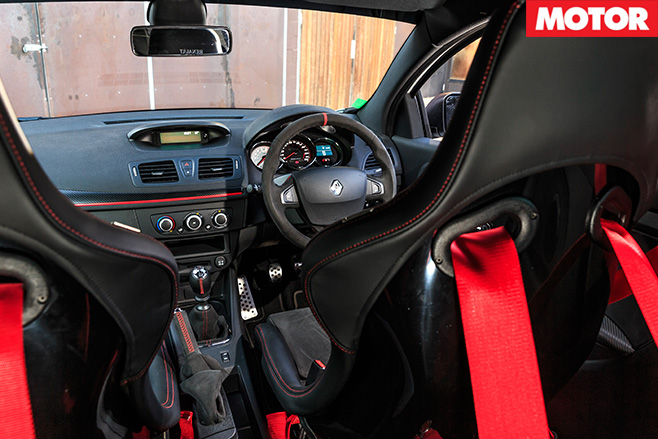
That’s Megane GT220 five-door hatch money for the 201kW/360Nm, 1284kg two-seater with fixed Recaros, adjustable Ohlins dampers, Akropovic exhaust, Michelin Pilot Sport Cup 2 and a MOTOR-recorded 5.8-second 0-100km/h.
So what have we done with this particular example?
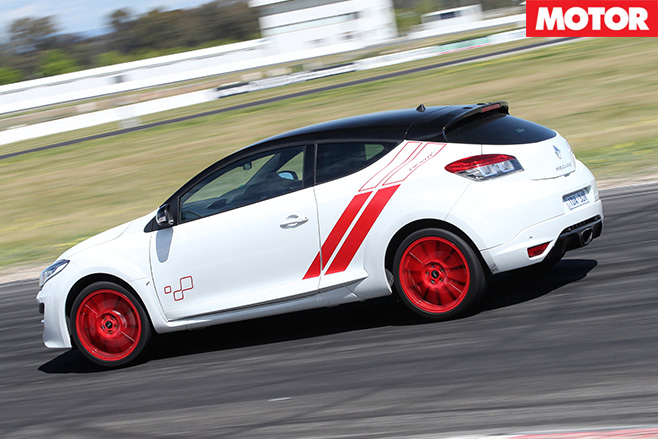
It challenged some big names at 2016’s Performance Car of the Year, most notably on Winton Raceway being 2.0 seconds slower per lap than a Mercedes-AMG C63 S that had a 1.0sec 0-100km/h performance advantage and cost almost three times the price. Yep, the little Reggie is that good.
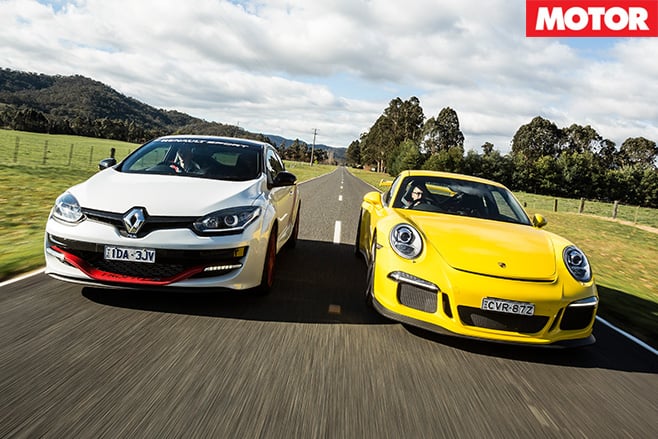
We also compared the RS275 Trophy-R to the RS65, its sibling that cost almost $10K less but missed the adjustable suspension and sticky tyres, and retained its rear seat.
The next-gen Megane RS is still at least another year away, and with most RS275 Trophy-R examples now sold it’s either a case of buy used or wait if you want the most hardcore hot hatchback offered locally. Even if that means sharing the driver’s seat with a good number of MOTOR testers…
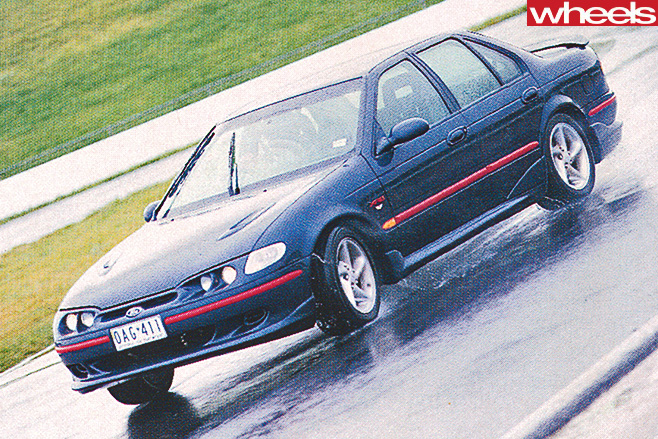
EL Falcon XR Series: Australia’s best value sports sedans have been away for a nose job – and singing lessons, reports Bob Hall.
First published in the September 1996 issue of Wheels magazine, Australia’s most experienced and most trusted car magazine since 1953.
“We’ve already made the major advancements,” says Tickford product manager Howard Marsden. “Now we’re doing the sort of tuning that in the racing world can give you that extra half-second a lap advantage.” In other words, it’s the same XR hardware but running on a new, improved set-up.
While there are no major revisions to what we now know of XR Falcons, a spread of relatively minor tweaks succeed in moving Australia’s best value sports sedan into a yet more favourable light.
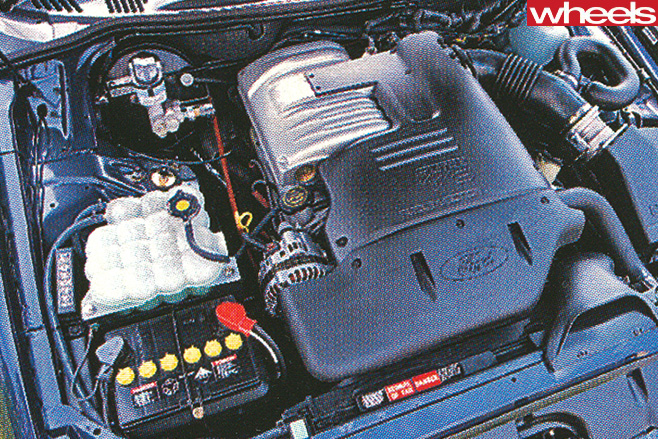
Only the eight-cylinder engine is changed, and then only in its exhaust system. But the improved breathing provides not only a few extra kilowatts to enjoy, but also gives the engine a magnificent V8 burble – something sorely missed in previous Ford Falcon XR8s.
The pushrod 5.0 now produces 170kW while turning out 398 of Sir Isaac’s metres.
Tickford is making no claims of improved performance against the clock, and the seat of the tester’s pants did not detect any, but it really sounds musical now. The 164kW 4.0 litre XR6 soldiers on, still coarse when revved, still torquey as hell and still a lot of fun, particularly when sitting ahead of a manual gearbox.
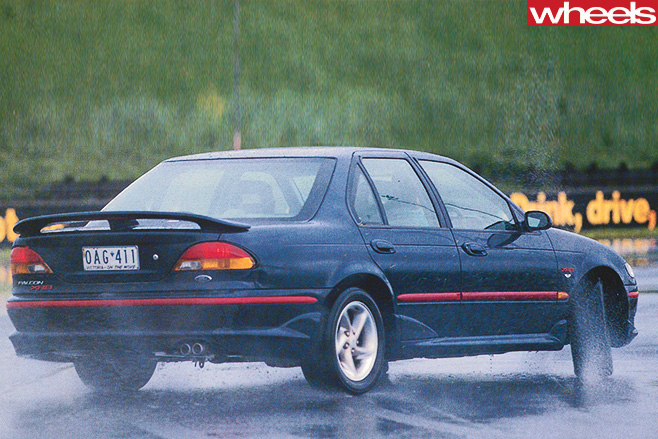
“We wanted to make sure the XRs don’t creep away from their roots,” he said. “We want to make sure they remain fun to drive.” The middle-age spread Flint indirectly refers to 1s a genuine problem – the Datsun 240Z‘s (d)evolution into the swansong Nissan 300ZX is a classic example of what can go wrong when you forget where you started.
One of Tickford’s specific goals was to make the XRs drive ‘smaller’ than they are- a noble ambition for any large sporting sedan.
Up front there’s been some jiggling with spring rates (about 5 percent above that of the EFII XRs), adoption of a clever – and actually pretty sexy-looking, if you can find it- metal/urethane composite one-piece inner bushing for the lower control arm, in place of the three-piece bushing used in the plain-jane EL. In addition, the shock absorber has been revalved for superior compression and rebound control.
More work with giant molecules can be seen on the front tie bar, where the magical properties of urethane (okay, when compared with good ol’ synthetic rubber) under compression improve suspension compliance and reduce toe-in/ out changes during acceleration and braking.
Incremental changes have also been made at the rear. The upper control link is a fabricated component –longer than the one used on the fleet specials – and a uses a unique front pivot point.
The miracle material is again used to keep the Watts link and rear stabiliser from rattling on their fasteners, in place of synthetic rubber.
For the first time there’s also a sports suspension pack for Falcon and Fairmont wagons which incorporates all of the XR’s front-end tweaks in conjunction with Tickford enhancements to the, ah, simple leaf spring geometry at the rear.
Yokohama A510s replace the Michelins previously fitted to the two optional16in rims. One is the current twisted five-spoke design, the other a new ‘closed face’ wheel which really looks like it should be the design for the base Fairlane wheel cover. The new standard 15in alloy wheel on XRs is a snazzy seven-spoker.
The degree to which Tickford has succeeded in refining the XR package is even more impressive when you take into account the tight cost and · production restrictions. The desire to keep both XRs affordable meant that engineers couldn’t go at the EL armed with a fat chequebook and the trusty meat axe.
The goal was to ensure the new XRs would be more entertaining on the road for folks like us without spooking the less-than-keen driver, in the meantime avoiding a billycart ride. Having said that, no blind rear passenger is going to mistake an XR for an LTD, thank God. The ride is firmer than on the standard EL, but your teeth won’t shake loose.
Of course the XRs get most of the tweaks which have improved the demeanour and presentation of the Falcon across the EL range, including front seatbelt height adjustment (finally!), better sound deadening in the cowl and underbody areas, and incremental upgrades in material selection and quality.
TVE have indeed ·succeeded in making the XR6 feel ‘smaller’. It now feels much like a well-sorted rear-drive Telstar- if you can imagine such a thing- than a big, true blue Aussie.
There have also been some cosmetic fiddles, not all of which will be to everybody’s taste. The shark-like snout of the EF has been ‘freshened’ (we really can’t bring ourselves to say ‘improved’). The front end now features a small ovoid intake between the headlamps and scalloping around the headlamps themselves, plus revised bonnet air oudets and a larger, more aggressive rear wing as part of the body styling kit that’s exclusive to the XRs.
The XR6 wagon, sadly, is no more. We liked this car a lot but it appears that Ford’s marketing types just couldn’t get their arms round it, so it’s unceremoniously been dropped from the range.
The really sad part is that the new sports suspension pack with availability of the 16in wheel and tyre combination would have made the wagon one helluva car. May it rest in peace – it will be missed.
However, it wouldn’t be a funeral without a wake, so here’s a little nip to help you remember the departed with fond affection: Ford’s marketing people must be feeling so guilty about the death of the XR6 wagon they decided not to raise the prices of the surviving XR6 and XR8 model a penny; XR6s start at $38,442 and the XR8 bases at a paltry $40,603.
And despite the aural excitement of the re-piped bent eight, we still favour the unique proposition the XR6 offers. Queue here.
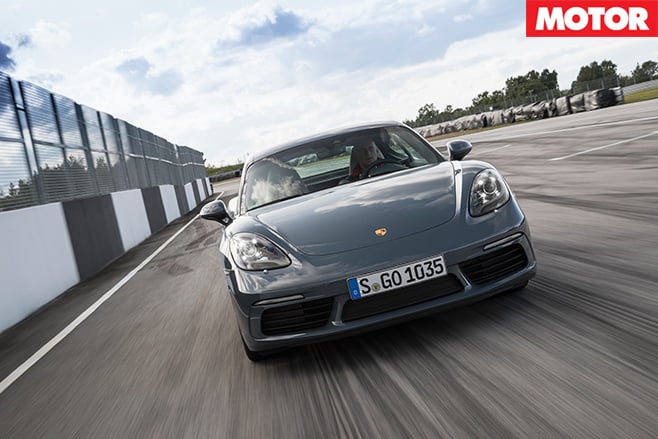
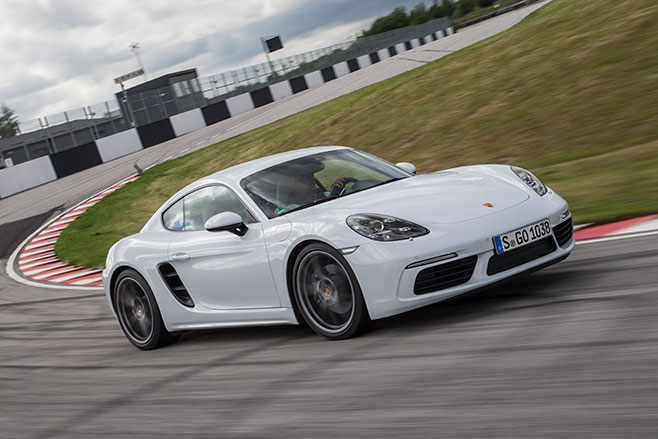
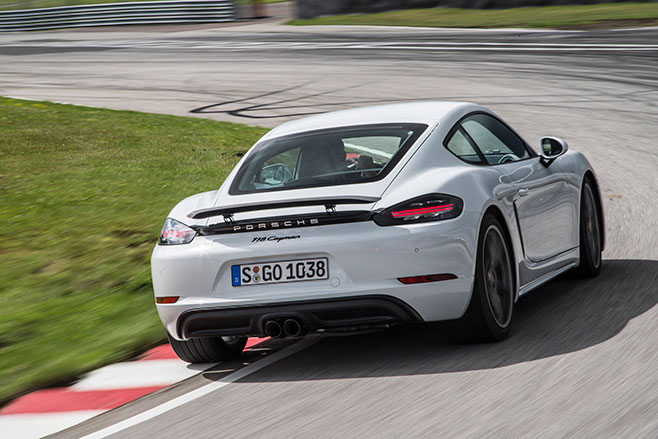
It’s as much a personality as an engine transplant for Porsche’s new 718 Cayman.
The styling is basically all new (not kidding) and the suspension’s been rejigged but the big news is centimetres from your spine. As you would’ve read, it’s out with the old 2.7- and 3.4-litre howling naturally aspirated flat-six engines, replaced with a pair of turbo four-cylinders.
This will make for many sombre Porsche fans but despite a third less cylinders there’s no denying the 2.0- and 2.5-litre boxer-four donks pack a fair bit more grunt, the base car 220kW/380Nm and the S, 257kW/440Nm – up 18kW/90Nm and 18kW/70Nm respectively.
We’ll focus on the S in a different review but having just driven the base 718 Cayman in Sweden there’s a bit for us to digest.

At car park speeds from outside, the 718 Cayman almost sounds like a very high quality WRX, although from inside the comparisons to Subaru’s rally rocket are somehow less likely in the Cayman than Boxster.
Instead you could very easily compare it to another Subaru product, the BRZ. Yep, at full noise the Cayman’s interior floods with a distinctive induction note very similar to the Subaru sports car. (Sorry, Porsche.)
The comparisons to Subarus end there though, particularly the modestly-powered BRZ, because that’s one department you won’t be drawing parallels.
Aside from the sound this is one area the Cayman’s personality has changed dramatically, the old car needing fistfuls of revs to hustle whereas the new one is all about surfing great waves of mid-range torque.
And where once if you bought a Cayman the first thing you told your mates about was the engine, now it could just as easily be the chassis.
That is to say the Cayman’s engine has gone from an overwhelming centrepiece of the experience to more merely an effective propulsion unit for what has always been an incredible-handling car.

Much like the old car the Cayman is a simply superb handler, agile yet stable, easy yet challenging – and despite all the weight in the middle, absolutely a car that feels to be on your team, not one to bite.
The excellent new sport ESP also helps, even fully on it won’t interrupt the fun if it senses you’ve got things under control, which somehow it does with eerie precision. That includes rear-steering the car with the throttle out of slower, tighter corners, something you could never really do with the old car.
Of course everything else about the base 718 Cayman is pretty excellent. Interior quality is great, the seating position perfect. Tyre noise is a bit noticeable at highway speeds but it rides well (though our test car had the optional 20s and adaptive dampers).

Of course manual or PDK is almost a subjective thing these days but doubtless many owners will be swayed by the PDK being just $1572 extra (normally $4990), its 6.9L/100km claimed fuel consumption just scraping into a lower bracket of Luxury Car Tax, one designed to encourage more economical cars.
The base 718 Cayman starts from $110,000 in manual and $111,572 in auto, with options including Sport Chrono (which gives you launch control in PDK and that 4.7sec 0-100km/h time; it’s $4990 or $3990 for manual), Sports Exhaust ($4330), adaptive dampers (called PASM, $2710), 20-inch wheels ($4840) and the Sport Chassis, a more focused suspension tune that also lowers the car 20mm ($3030).
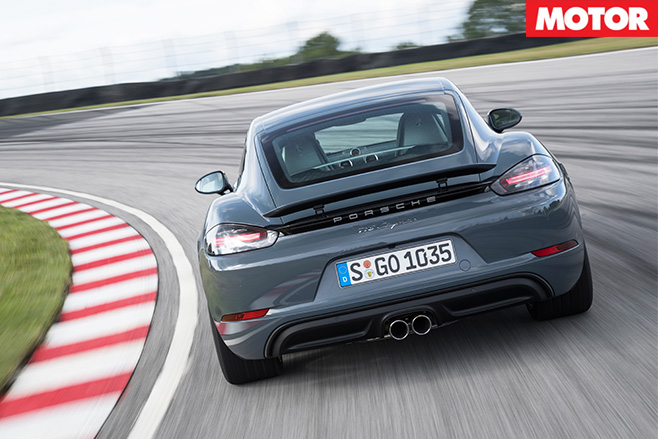
But even the very base car will be brilliant. Subjectively those that knew the old car will rue the removal of the peaky flat-six and the noise it made as you used every single rpm right to redline – truly it was something special.
But objectively the move to turbo four-pot has made for a better Cayman, the torque turning it into a seriously fast car and some will even love the new flat-four vibes, the Cayman having a totally different personality to 911 which you couldn’t say before.

The 718 Cayman is on-sale in Australia from November 26.
4.5 OUT OF 5 STARS
SPECS – Porsche 718 Cayman Engine: 1988cc flat-four, turbo, DOHC, 16v Power: 220kW @ 6500rpm Torque: 380Nm @ 1950-4500rpm 0-100km/h: 5.1sec (manual), 4.9sec (PDK), 4.7sec (PDK with Sport Chrono) Fuel consumption: 7.4L/100km (manual), 6.9L/100km (PDK) Weight: 1335kg (manual), 1365kg (PDK) Price: $110,000 (manual), $111,572 (PDK)
THE Porsche Cayman, the poor man’s 911, gets a new role as the performance brand’s entry-level sports car via a flat-four heart transplant and a personality all of its own.
WHAT IS IT? The mid-life update for Porsche’s 981 Cayman, though this is far more than your average facelift. Almost every panel is new, the interior and suspension have been extensively altered, and mounted just behind the occupants’ heads sits an all-new, smaller capacity turbocharged flat four, replacing Porsche’s revered naturally aspirated flat six.
MAIN RIVALS The BMW M2 is staring the 718 Cayman directly in the face, and ditto the ballsy Audi TTS quattro, feral Alfa Romeo 4C, and Mercedes-AMG’s coupe-with-four-doors, the CLA45.
PLUS: Ballsy, bassy new flat-four gives Cayman a whole new personality; warmer, cleaner interior; more fluent dynamics. MINUS: Some turbo lag below 2000rpm; brilliant PDK makes it even harder to argue a case for the still-wonderful manual
But not anymore. Its reinvention as Porsche’s entry-level sports car, controversially boasting all-new turbocharged flat-four engines, has effectively set the 718 Cayman free. It’s gone through a mid-life crisis and come out the other side looking fitter, feeling fresher, and proving it still knows how to have a rollicking good time, all while sounding completely unlike a 911.
Offered in two capacities – a 1988cc version in the base 718 Cayman and a 2497cc version in the Cayman S – the new flat-four was developed simultaneously with Porsche’s all-new turbocharged flat-six that recently made its debut in the 911 Carrera. The base Cayman engine shares its bore and stroke with the 911’s 3.0-litre boosted flat-six, while the S gains its larger capacity via a fat 102mm bore. The larger donk also gets a touch of the exotic courtesy of a variable-vane turbocharger (or Variable Turbine Geometry – VTG – in Porsche-speak), just like the flagship 911 Turbo.
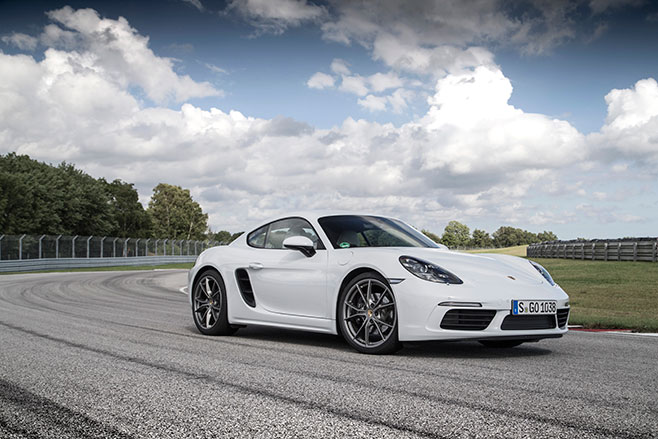
Tied to carry-over six-speed manual or seven-speed dual-clutch transmissions, the slowest Cayman you can buy (a stock 718 manual) now does 0-100km/h in a claimed 5.1sec. A sports chrono-equipped S PDK (with launch control) trims that to just 4.2sec. Don’t be fooled by its lesser cylinder count; the flat-four Cayman is a bolter.
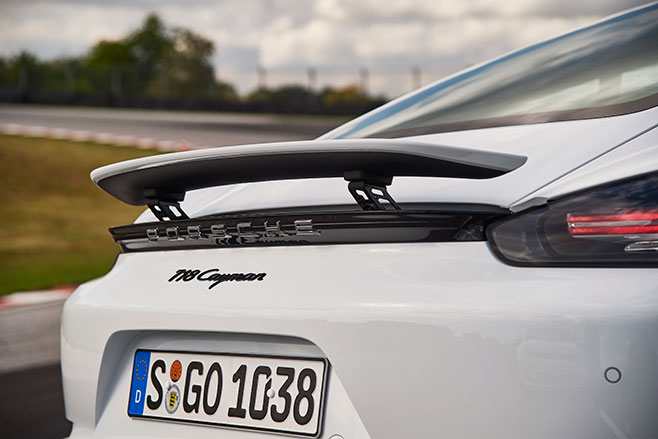
Not that the base Cayman really needs improvement. With a 10-percent more direct steering rack (from the 911 Turbo), higher spring and anti-roll-bar rates, additional rebound buffer springs in the front axle, a stiffer rear axle and half-inch wider rear wheels, Porsche claims the 718 offers reduced front axle lift, less roll, improved rebound control, increased lateral grip and significantly higher cornering stability. What that means in plain English is an almost supernatural ability to deal with the greater demands of so much extra low-end torque when putting power down, and sweeter dynamic behaviour in all conditions.
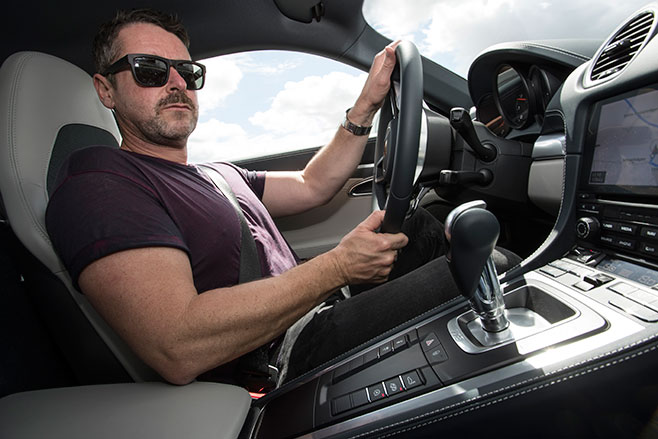
And the ride. While tyre noise remains ever-present on coarse surfaces, the base PASM-equipped 718 Cayman on 20-inch wheels is yet another example of Porsche’s ability to combine sports car body control with liveable absorbency.
But it’s the all-new engine that steals the show. With the steering wheel’s drive-mode dial set to “Sport” and the exhaust button engaged, the Cayman PDK manages to choose exactly the right gear for any given situation, and backs that up with a ballsy, bassy, throbby backing track that sounds slightly manufactured on first acquaintance, but really grows on you the more time you spend with it.
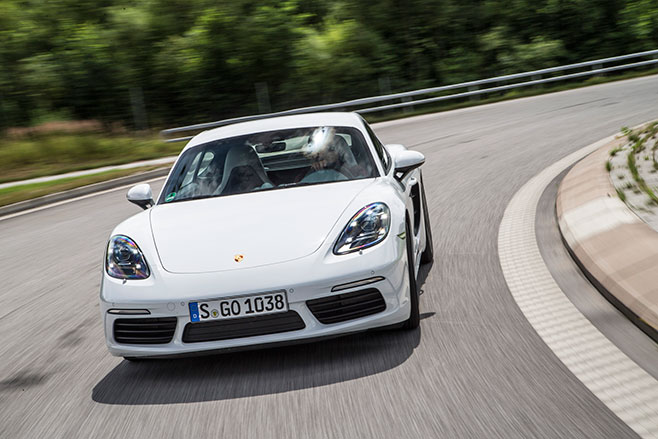
Thinking no union could surpass the 2.0-litre dual-clutch’s driveability excellence, the 2.5-litre manual adds another level of naughtiness. Sport modes primed, the manual’s exhaust crackles every time you lift off the throttle, and when provoked on overrun, it’s bliss on a stick. It doesn’t sound anything like the old flat-six but only died-in-the-wool purists would ever shit-can the flat-four Cayman’s character. About our only criticism is some turbo lag below 2000rpm – it only really starts hauling once there’s a “two” on the tacho – which becomes even more obvious in the manual if sport chrono isn’t in either Sport or Sport+.
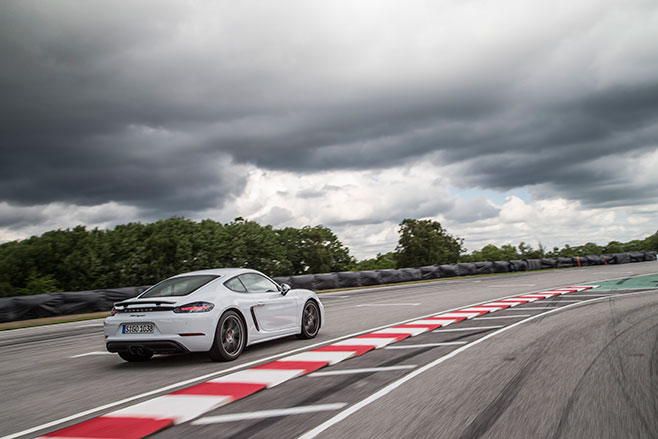
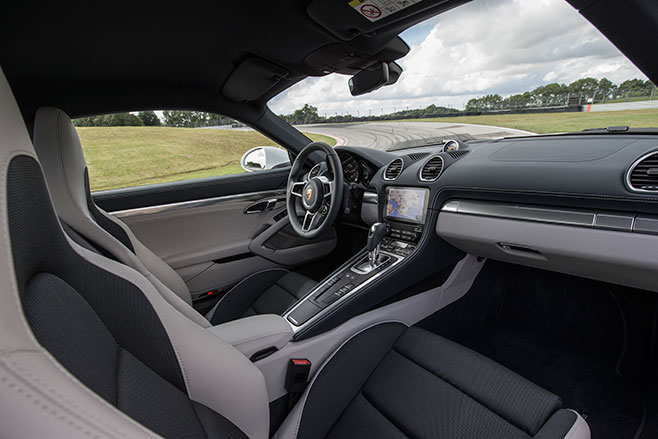
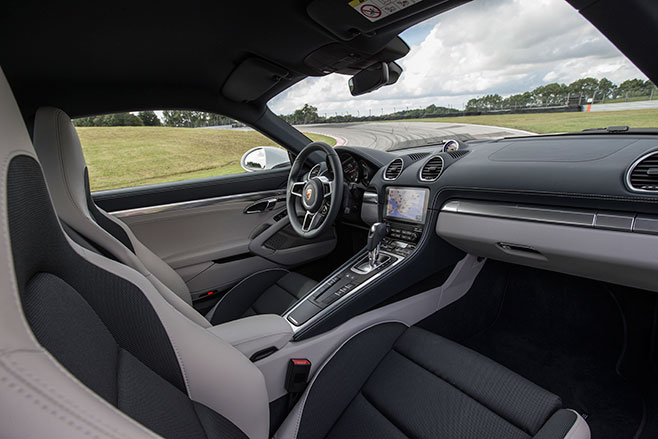
While the 718’s four-pot provenance is undoubtedly the main deal, the rest of the car has undergone many changes to facilitate its seamless application, including all the plumbing associated with a keeping a mid-mounted turbo engine cool. Only the 718’s roof, windscreen and luggage tailgate carry over from the previous six-cylinder 981, and there’s been a considerable lift in interior lushness, thanks to the 911’s new multimedia set-up and the 918’s fabulous steering wheel. Finally, the Cayman’s cabin matches its sticker price.
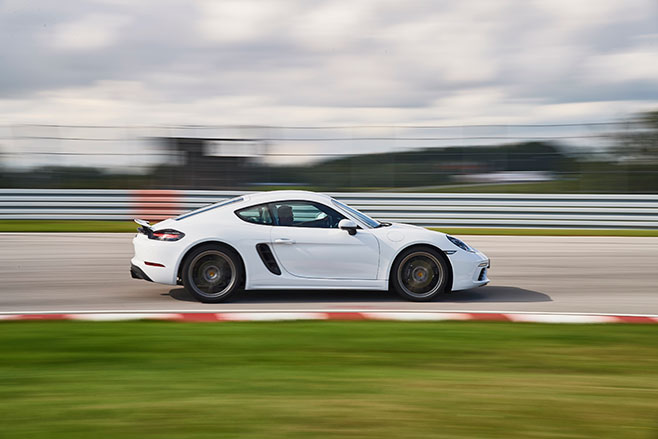
Stepping out from the 911’s shadow was never going to be easy. Others might argue but I think the 718 Cayman is all the better for it.
SPECS Model: Porsche 718 Cayman Engine: 1988cc flat 4, dohc, 16v, turbo Max power: 220kW @ 6500rpm Max torque: 380Nm @ 1950-4500rpm Transmission: 7-speed dual-clutch Weight: 1365kg 0-100km/h: 4.7sec (claimed) Economy: 6.9L/100km (EU) Price: $111,572 On sale: November

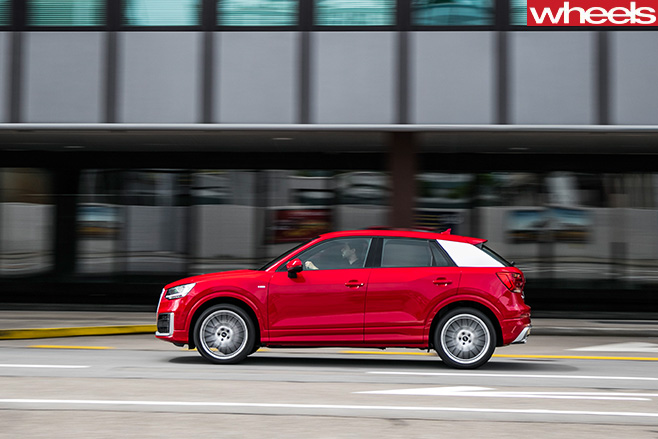
Another remix of VW Group’s fine MQB component set, the Audi Q2 stands out from the premium small SUV crowd for the right reasons. It makes the Audi Q3 look dumpy, dull and done-for…
WHAT IS IT? A premium small SUV that introduces Audi’s sharp new Polygonal exterior design language. Decently packaged interior lives up to the brand’s reputation for cabin quality.
WHY WE’RE TESTING IT The international launch in Switzerland provided our first chance to sample the Q2; more than six months ahead of its scheduled first-quarter arrival in Australia.
MAIN RIVALS Mercedes-Benz GLA and Mini Countryman for sure; possibly even top-end variants of the good-looking Mazda CX-3.
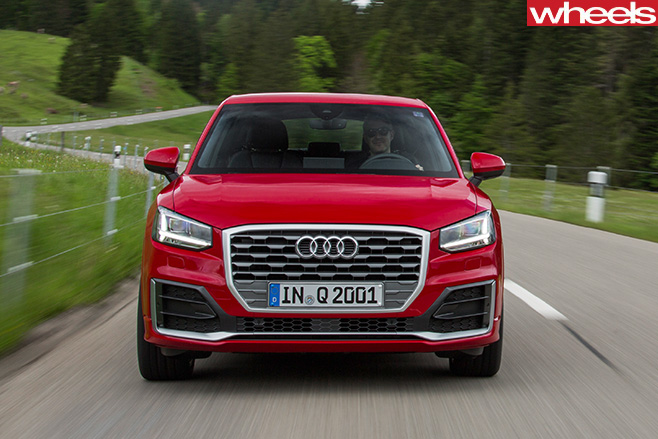
PLUS: Exterior design; interior package; quality; handling; equipment MINUS: Road noise; front-driver sometimes scrabbles for traction
THE WHEELS REVIEW Who’s going to want a Q3 after the Q2 reaches Australia in Q1 next year? The angles-with-attitude exterior of Audi’s new small SUV looks great. The interior, chassis and drivetrains aren’t bad, either. And Audi is aiming for a Q2 range entry point price thousands below the $42,900 tag worn by the least expensive Q3.
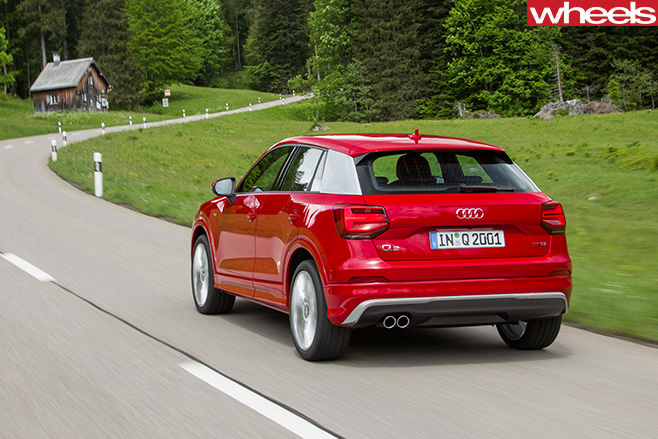
The name implies a full size step down from Audi Q3, and the Q2 is smaller. It’s 200mm shorter (thanks mainly to small overhangs), lower and slightly narrower. But the newcomer is another mash-up of VW Group’s MQB component set, and the 2600mm wheelbase it happens to share with the three-door A3 Australia doesn’t see is a scant 5mm shorter than the Q3’s.
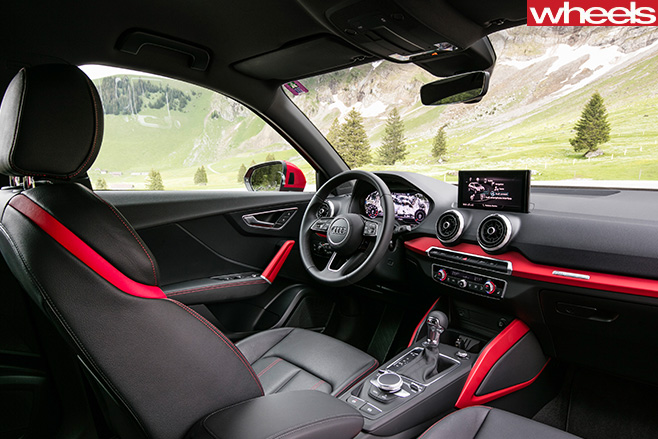
That wheelbase is the foundation for an interior package that’s reasonably spacious. There’s sufficient knee, head and toe room for tall adults in the rear seat. The Q2’s long rear doors also improve rear seat access ease compared to the Q3. Where the Q2’s more compact dimensions are most evident is the 405-litre cargo compartment, which is more than 50 litres smaller than the Q3’s.
But the list of infotainment and connectivity features is even longer: MMI Navigation with 7-inch hi-res display; Audi Connect; smartphone interface, and Bluetooth plus voice control. Options – including MMI Navigation Plus with a larger screen; Audi’s brilliant Virtual Cockpit instrument screen; a head-up display; adaptive cruise, and a bunch of other driver-aid systems – make it possible to go even further. Spend enough, and it will be possible to specify a Q2 to a tech-level to almost rival an Audi Q7.
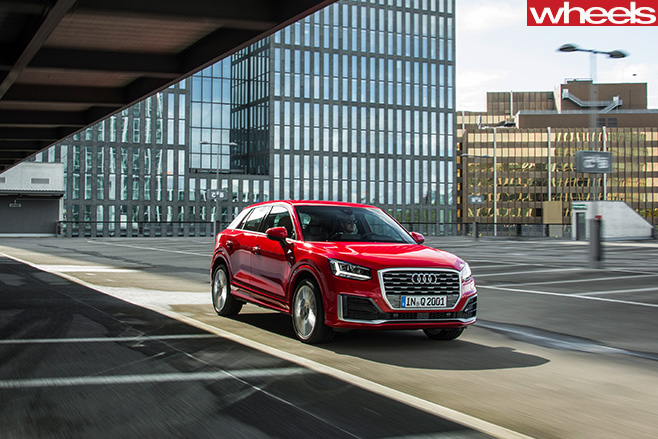
The 2.0 TDI quattro has a 110kW turbo diesel four, teamed with a new seven-speed S-tronic double-wet-clutch auto. No complaints about performance, shifting or traction, but the engine should be quieter and smoother.

Naturally enough, the cheaper 1.4 TFSI is expected to be the best-selling Q2. Although it has a rear torsion beam instead of the multilink suspension of the quattro-equipped Q2s, it’s a sweeter drive overall. The 110kW petrol-burning turbo four, which is combined with a seven-speed double-dry-clutch S-tronic, is a more refined engine, and the simple rear suspension has little negative effect on handling.
But the mere fact that the Q2 encouraged a little cornering enthusiasm was further confirmation that it’s a more characterful Audi SUV than the yawn-worthy Q3.
SPECS Model: Audi Q2 1.4 TFSI S-tronic Engine: 1394cc in-line 4, dohc, 16v, turbo Max power: 110kW at 5000 to 6000rpm Max torque: 250Nm at 1500 to 4500rpm Transmission: 7-speed double-clutch auto Weight: 1355kg 0-100km/h: 8.5sec (claimed) Fuel economy: 5.5L/100km (European combined cycle) Price: $39,500 (estimated) On sale: First quarter 2017
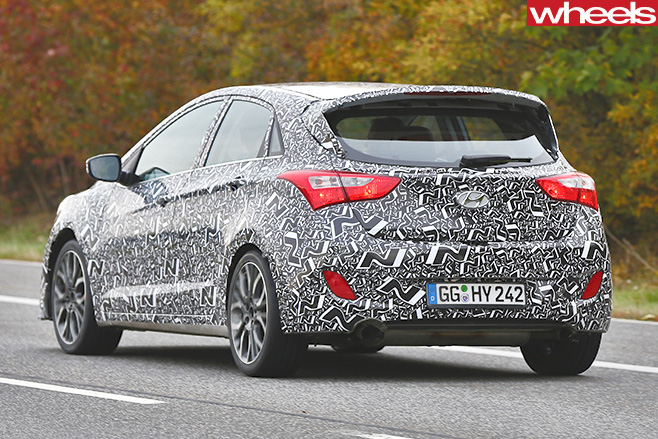
Hyundai has released new video teasing out the progress of the first vehicle to come from its newly launched N Performance sub-brand – this time with an emphasis on the fruity exhaust note of the all-new Hyundai i30 hot hatch.
The video begins with a very un-Hyundai-sounding engine being revved, complete with the crackle and pop that only a serious performance exhaust produces. From then on, it’s 25 seconds of aural madness, as the heavily camouflaged prototype chops and changes between mid-corner burbles, corner-entry crackles and corner-exit induction howls – all staged to convince the viewer of Hyundai’s new performance-car credentials.
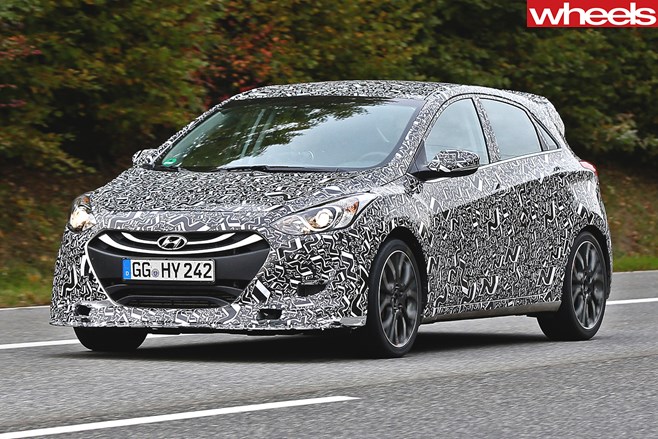
The highly anticipated project, which is being led by former vice-president of BMW’s M division Albert Biermann who recently spoke to wheels about the forthcoming N-range, is expected to be launched as part of the 2017 model line-up, but could make its public debut alongside the second-generation i30 tipped to break cover at this year’s Paris International Motor Show in October.
Volkswagen’s all-new second-generation Tiguan SUV steps up a size category, and will arrive with a slight price increase to match, when it goes on sale in Australia this September.
The extensive three-tiered, five-engine range offers consumers seven different options with the base-level Tiguan starting at $31,990. According to Volkswagen, this price tag is actually $2000 less expensive than the first-generation equivalent was at the time of its 2008 launch. And while it’s a fact that may be true, it’s one with questionable relevance considering the current model is priced between $28,990 and $44,990.
The second-gen Tiguan models will all gain the latest Apple and Android-savvy 8.0-inch infotainment system, electronic parking and lane assistance as well as rain-sensing wipers as standard fitment, with the level of equipment increasing in accordance with the pricing scale.

The first tier is the front-wheel drive Trendline 110TSI, which consists of either a six-speed manual or six-speed automatic gearbox matched to the same 1.4-litre turbo-petrol 110kW/250Nm engine. The auto option demands a $2500 premium, pushing the price to $34,490.
Next in the line-up are three variants of the all-wheel drive Comfortline. Kicking off the mid-level series is the six-speed DSG petrol 110TSI series which starts at $36,990, followed by two seven-speed DSG options; a 2.0-litre 110kW/340Nm diesel powered 110TDI or a slightly more powerful 132TSI packing a 2.0-litre 132kW/320Nm petrol engine. All three variants come with Volkswagen’s 4Motion all-wheel-drive. The 132TSI will set you back $41,490, while the 110TDI is yours for $42,990.

Rounding out the range are the Highline all-wheel drive models; both boasting seven-speed DSG transmission with the choice coming down to a petrol or diesel engine – both of which offer the highest power and torque outputs in the range. The 162kW/350Nm 2.0-litre petrol option comes with a $48,490 price tag while the range-topping 140kW/400Nm 2.0-litre diesel carries a retail price of $49,990.
If a choice of seven vehicles isn’t enough, the firm is also offering model-specific packages to further customise the car. The Driver Assistance package (adaptive cruise control; rear traffic alert; a digital instrument cluster and 360-degree camera) is offered for either the Comfortline ($2250) or Highline ($2000) models. Also available for the Comfortline is a $5000 Luxury package, featuring leather trim; electric tailgate; heated front seats; keyless entry and a panoramic sunroof. Priced at $4000, Highline buyers have the option of an R-Line package, which includes 20-inch alloy wheels; a sportier body kit; adaptive suspension and variable ratio steering.

The second-generation Tiguan measures nearly 80mm more between the front and rear axles which, in real terms, offers almost 150 litres more space in the cargo area.
It’s an update which has forced it out of the small SUV category, where in the first six months of 2016 it held the title of the best-selling European (under $40k) with a 4.1 percent market share against its successful Japanese rivals: Mazda’s CX-3 (18%); Mitsubishi ASX (19.9%); and Honda’s HR-V (13%).
The size increase means the latest Tiguan will now go up against the likes of Mazda’s CX-5 in the highly competitive but equally lucrative medium SUV market in Australia.
