
Snapshot
- 2021-22 Lexus LX and NX models recalled
- Two issues relating to software and welding
- A total of 1028 cars are included in the notice
Lexus is recalling a total of 1028 LX and NX vehicles built between 2021 and 2022.
Two notices have been issued, with the first relating to a software glitch with an important safety system, while the second affects car body welds.
According to the first recall notice published by the Department of Infrastructure, if the Vehicle Stability Control (VSC) system is turned off on LX and NX models, the technology may remain off the next time the car is started.
While warning lights will indicate VSC is not operational, the driver could misunderstand or remain unaware, potentially putting the vehicle in a dangerous situation where control is lost.
The second – which only relates to Lexus NX models – states the welding of the front shock absorber mounting areas may not be correct, causing the parts to detach and increasing the likelihood of an accident.

Lexus Australia will contact affected owners, but the company can be reached directly by calling 1800 023 009 or visiting a dealership, found here.
You can check a list of all the VINs related to the recall by clicking here for the software issue for the LX and NX, or by clicking here for NX welding fault.
UPDATE: Since this story went live, our source in Europe has established Amedeo Felisa will take over the top job from Tobias Moers, while Felisa’s former Ferrari colleague Roberto Fedeli will take on the role of Chief Technical Officer at Aston Martin.
However, it’s understood Felisa will step down once the company’s restructure has been completed.
The story has been updated to reflect the changes.
The story to here
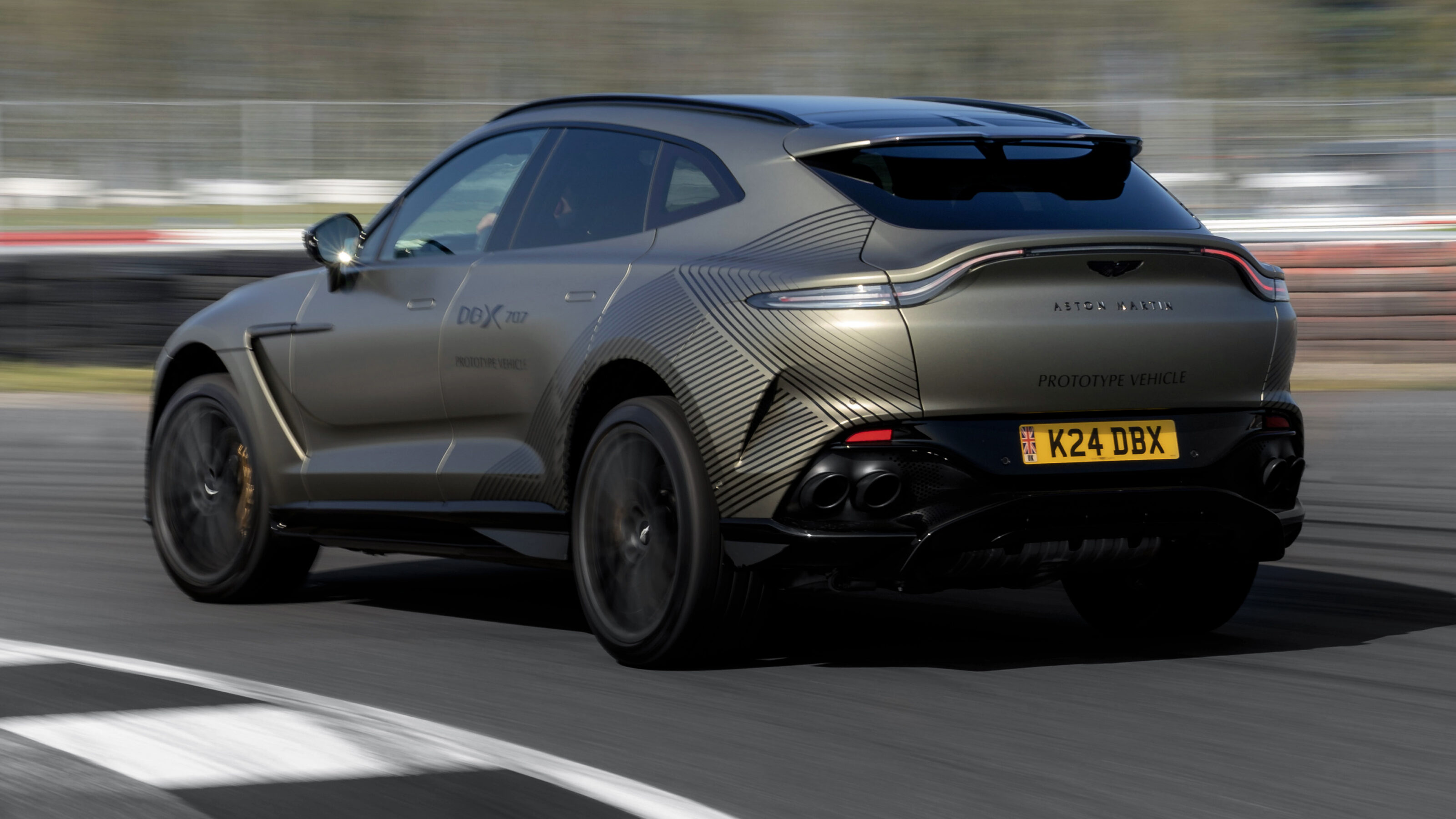
Tobias Moers is rumoured to have stepped down as CEO of Aston Martin “with immediate effect,” according to WhichCar sources.
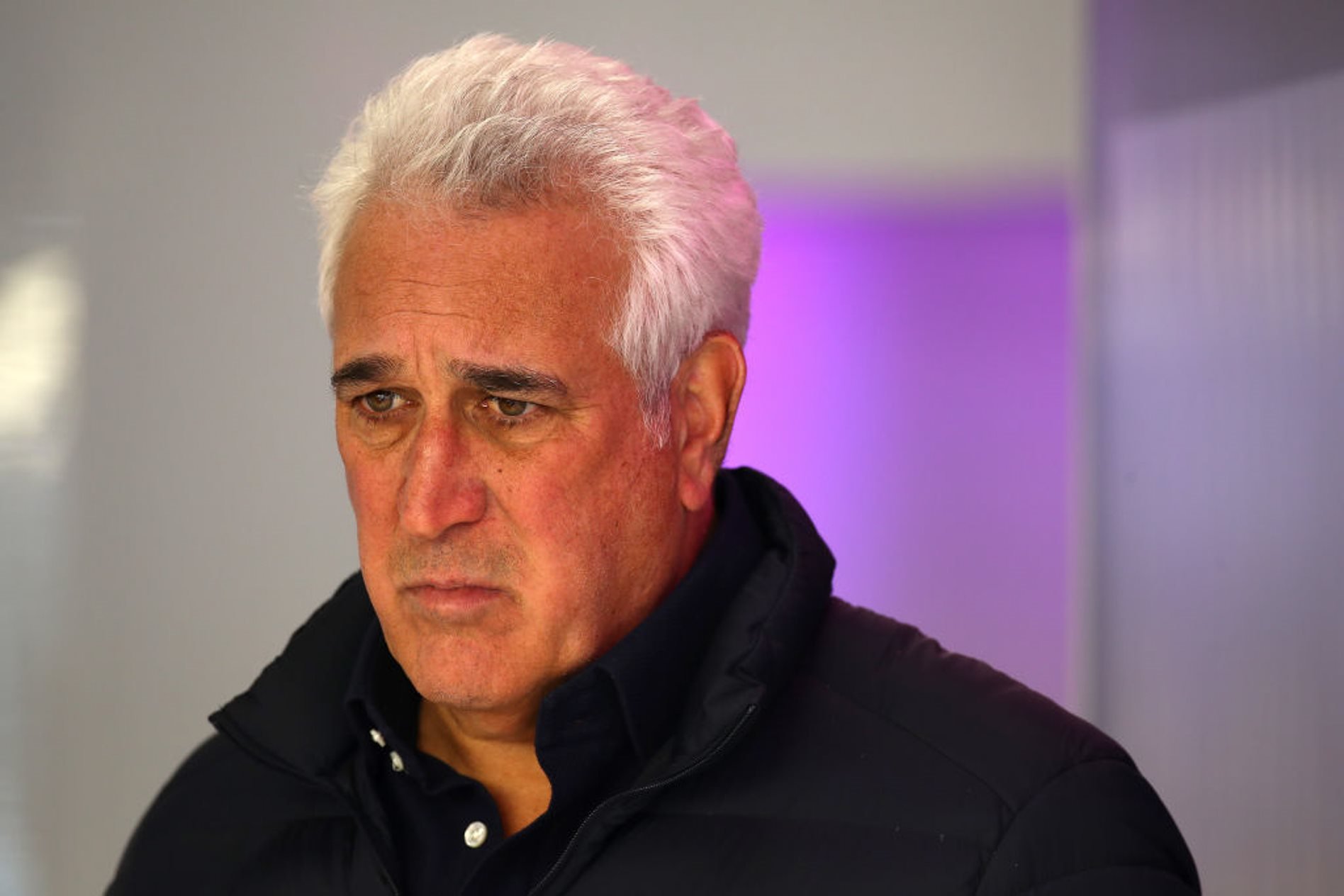
The former head of Mercedes-AMG, Moers took the top job at Aston Martin less than two years ago, but is understood to have clashed with billionaire Lawrence Stroll over the direction of the business.
The unconfirmed reports suggest Stroll, who leads a consortium which owns 16.7 per cent of Aston Martin, is pushing to fill the company’s top seats with former executives from Ferrari.
Sources told WhichCar former Ferrari boss and special adviser to Chinese supercar startup Silk-Faw, Amedeo Felisa, will be taking the reins as CEO at Aston Martin for the time being.
Felisa will be joined by Ferrari’s former technical director Roberto Fedeli, who will begin as Chief Technical Officer from July after fulfilling contract obligations at Silk-Faw.
It appears the news is a result of a power struggle at Aston Martin between Mercedes-Benz and Stroll.
While Mercedes views Aston as a way for performance arm AMG to compete indirectly with Ferrari using German know-how, Stroll’s camp wants to develop Aston Martin models in Italy using ex-Ferrari talent.
Mercedes-Benz currently owns 2.6 per cent of the British marque, but had planned to increase its ownership to 20 per cent by 2023.
The two carmakers have been growing closer in recent years, with many Aston Martin models utilising powertrains from Mercedes-AMG.
Mercedes was rumoured to have plans to bring future Aston Martin product development to Germany, but it now appears as if Stroll will get his way, with Aston Martin R&D looking likely to move to facilities located in northern Italy.
The change will see Aston Martin’s UK headquarters in Gaydon limited to production and final assembly.
Former technical boss for McLaren and Lamborghini, Carlo Della Casa, is also said to be leaving Silk-Faw for Aston Martin, but it’s understood Marek Reichmann will continue to design Aston Martin cars for the time being.
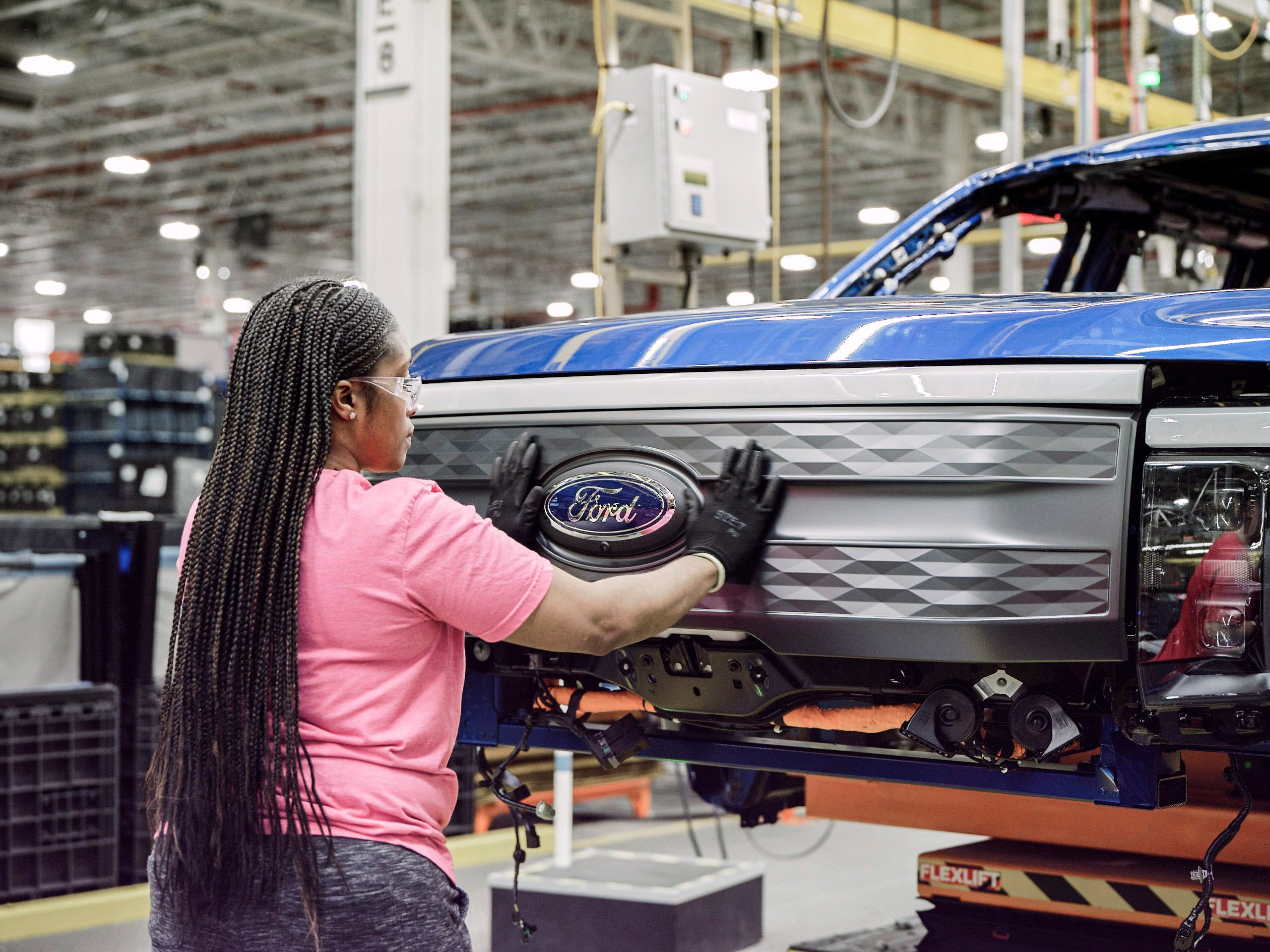
Ford’s upcoming F-150 Lightning might not be locked in for Australia, but the Blue Oval is making sure its flagship electric vehicle can make waves as soon as it rolls off the production line.
With customer deliveries of the all-electric pick-up truck beginning shortly in its native United States market, Ford has finalised the outputs of its latest F-150, confirming the Lightning will make more power than first intended.
When equipped with the Standard Range battery pack, the F-150 Lightning can develop up to 337kW, an increase of 20kW from the figure first quoted, and just under 2kW more than the flagship F-150 Raptor – the latter powered by a 3.5-litre, twin-turbo V6 petrol engine.
Stepping up to the Extended Range battery further enhances the F-150 Lightning’s performance potential, although its 433kW on tap is still 62kW shy of the Chevrolet Silverado EV, set to launch in 2023, and the GM product also beats the Blue Oval on driving range – 644 kilometres plays 515 kilometres.
Across both battery packs, Ford claims the F-150 Lightning produces 1050Nm of torque, more than enough to handle its revised payload capacity of 1015 kilograms.
Ford is set to win the battle of being the first mainstream manufacturer to bring an electric pick-up to market, over half a year before Chevy intends to do the same, and well before Ram has finished teasing its electric 1500.
The combustion engine-powered F-150 is set to make a return to Australia next year, with Ford undertaking conversions to right-hand-drive locally, although the Lightning is off the cards for now, despite being on the marque’s radar.
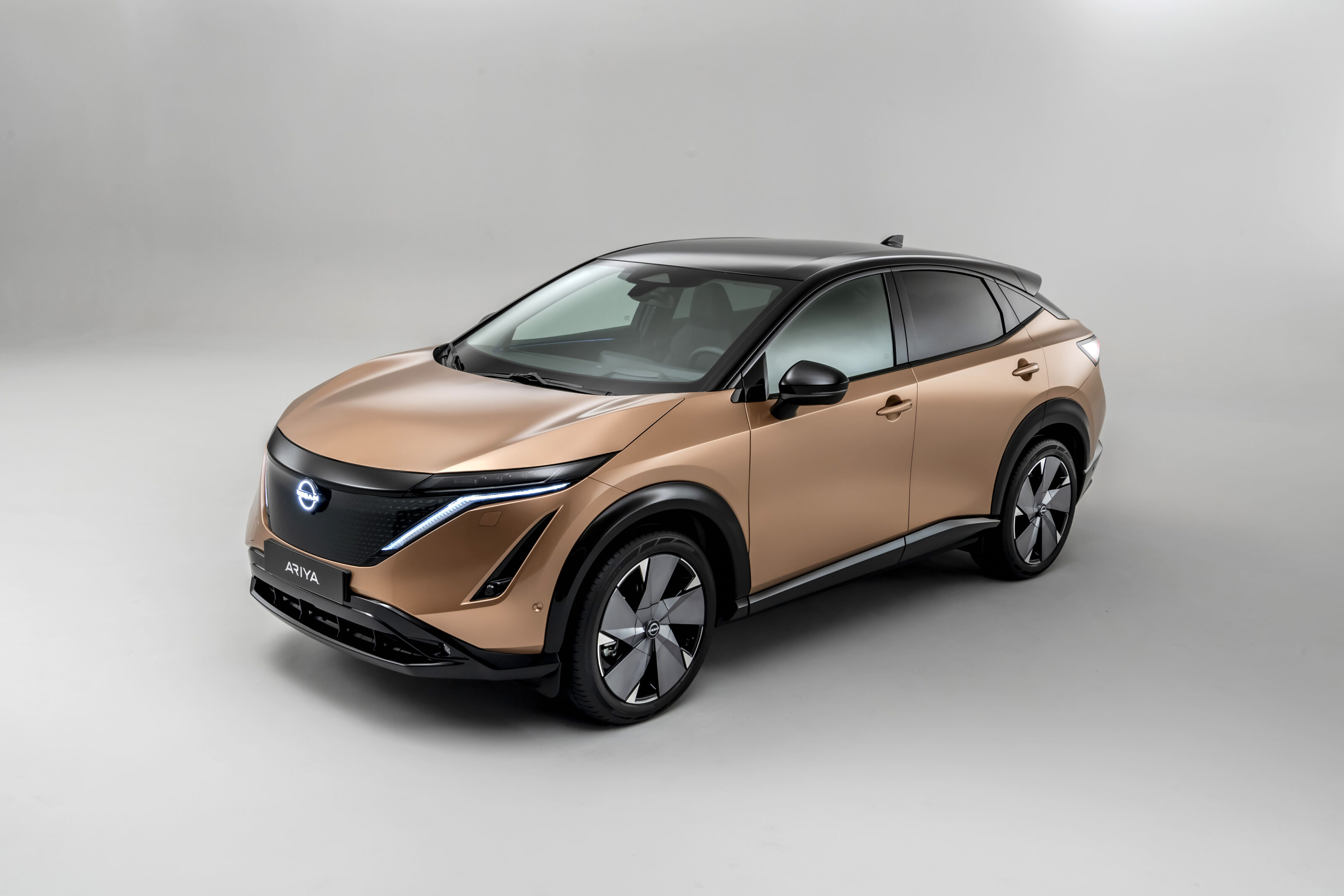
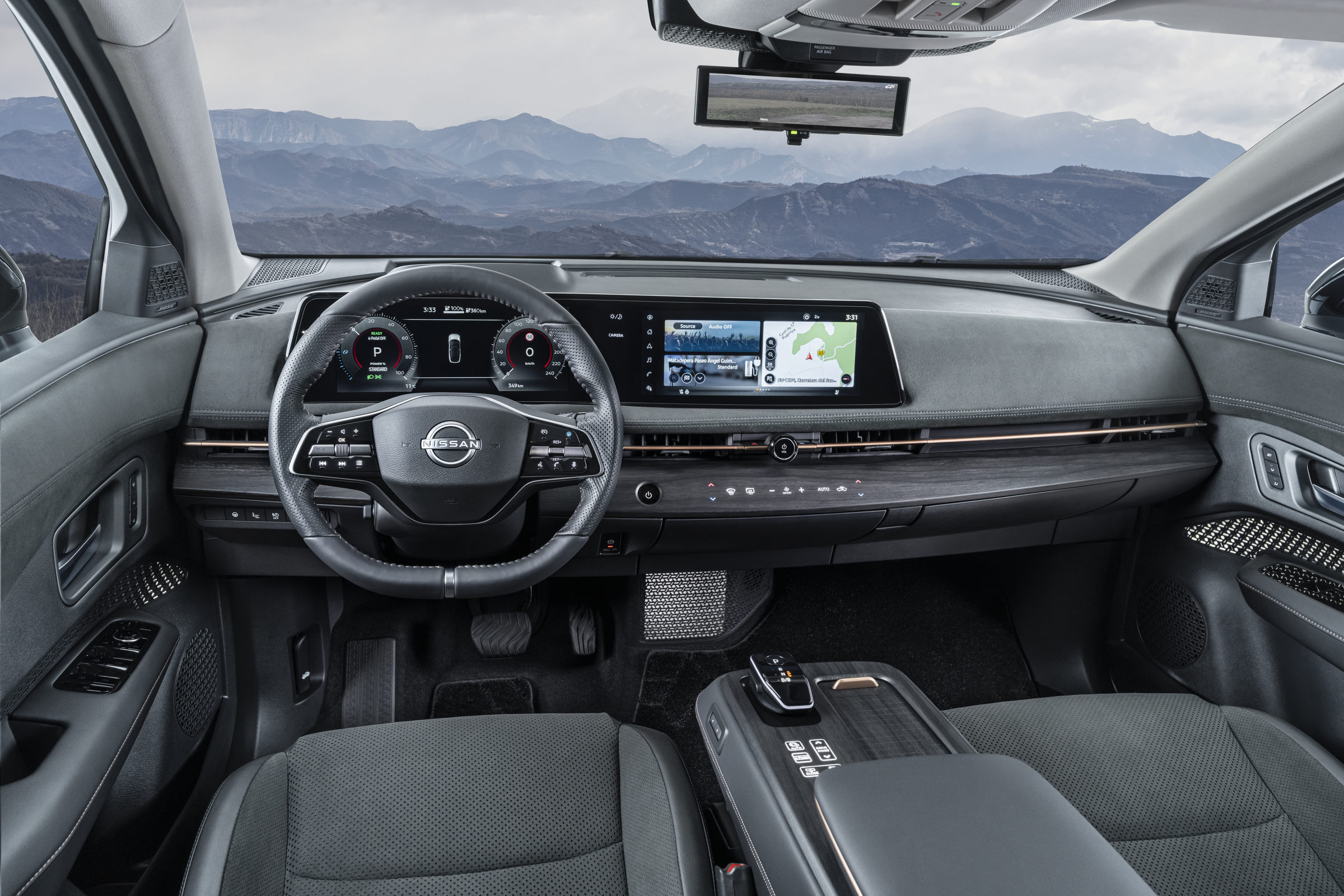
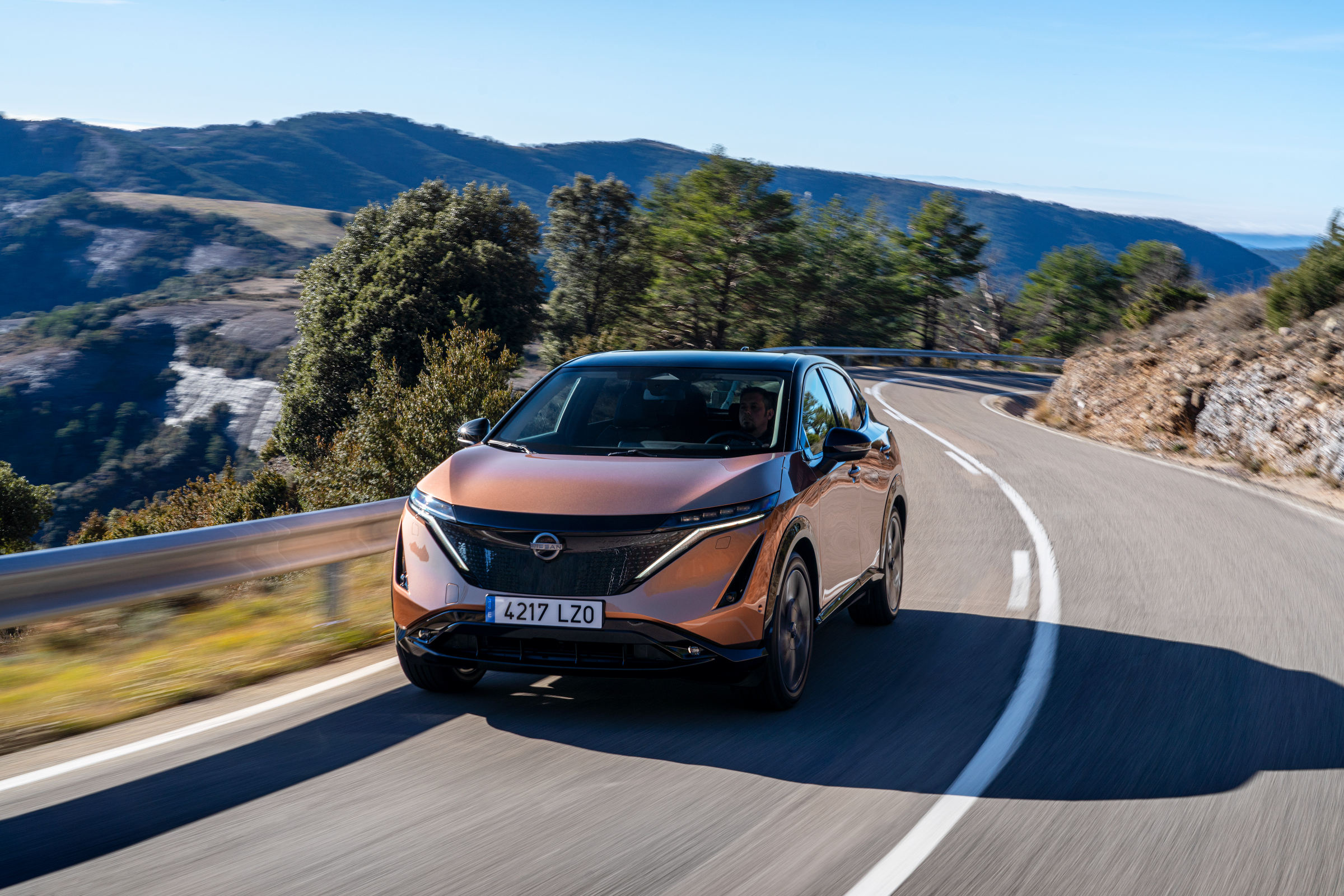
Nissan Australia’s electrification strategy has hit a short-term speed bump with the arrival of its long-awaited Ariya EV crossover pushed back until at least 2023.
It was hoped that the Ariya, which is Nissan’s second dedicated EV after the Leaf, would arrive locally this year to take on the likes of the Tesla Model Y and Polestar 2. But global production delays due to the semiconductor shortage, and Australia’s position as a lower-priority market for EVs, means the Ariya’s arrival timing has blown out until at least 2023.
“We’d love to get it the market as soon as possible,” said Nissan Oceania boss Adam Paterson. “But there’s very limited supply available globally for that product. We’re working on a plan to get it here but I just don’t have a date I can share with you on that.”
While a 2023 launch is likely for Ariya, Paterson wouldn’t be drawn on whether that timing could be extended even further to 2024 as Nissan prioritises high demand markets for EVs like China, the US and Europe.
“I don’t have a date I can share because if I say 2023 and it changes, I’ll need to make a correction,” he said. “But it won’t be in 2022, how’s that?”
The news comes at an interesting time for Nissan in Australia. The brand is poised to launch four new models in the coming months that will see it suddenly boast one of the freshest model ranges in the country.
The product onslaught, which includes the new generation Qashqai, X-Trail, Pathfinder and Nissan Z sports car, will also see Nissan introduce its ePower hybrid tech for the first time in Australia.
The new hybrid powertrain will first be available on the Qashqai and later on the X-Trail, and means Nissan will soon have hybrid alternatives to the popular Toyota RAV4 and C-HR hybrids – though supply is expected to initially be limited.
But surprisingly, given the sales success of Toyota’s hybrid models, Nissan has downplayed the potential of the new electrified SUVs with its immediate focus instead being placed on high-demand vehicles like the Y62 Patrol and Navara.
“I feel like there’s a tonne of talk and conversation about it, but I don’t think 80-90 per cent of Australians would go out and buy an electrified car if one was available today,” Paterson told Wheels.
“It’s interesting that all the market is talking about is ‘when can we get one, when can we get a hybrid?’ But not everyone wants a hybrid, right? Many people are considering it, but it’s not the dominant powertrain yet. It will be, but to be the company that springs ahead is really just going to limit your ability to meet what your customers are wanting.
“It [hybrid tech] is an interesting space to be in, but we want to make sure we’re still offering what Australians are actually looking for.
“You heard me talk about Patrol earlier. We’re selling V8 petrol motors as fast as we can get them, and there almost seems to be as much demand in that segment as we’ve ever seen before. Whereas on the other side of the column we’re talking about electrification. So it’s pretty interesting, right?”
Nissan has long been a pioneer in the electric space, and globally it has committed that 50 per cent of its sales will be either hybrid or full-electric by 2030. The strategy, known as ‘Ambition 2030’, will see Nissan invest ¥2 trillion (AU$21.6 billion) over the next five years – which will include 15 new electric models.
“I’m not saying we don’t want to be a market leader in some ways, we have been with Leaf, but I think when ePower launches it’ll be a different electrified powertrain,” said Paterson. “Traditionally hybrids have been all for economy, right? And while ePower will deliver economy, it’s also an exciting car to drive.”
Nissan’s ePower hybrid tech is different to what’s offered by most manufacturers. Known as a ‘series hybrid’, Nissan’s system uses only the electric motor to turn the wheels. The combustion engine is used solely as a generator to power the electric motor and burns fuel in the process.
Most rivals use a ‘parallel hybrid’ system, which sees the combustion engine and electric motor work together to turn the wheels. The advantage of ePower, according to Nissan, is a driving experience that feels more like a pure EV with sharper performance and improved economy.
“I think that’s the way we’re going to try and want to lead,” said Paterson.
Snapshot
- BMW 230i added to local 2 Series Coupe line-up
- Priced from $70,900 before on-road costs
- 220i pricing increased by $2000
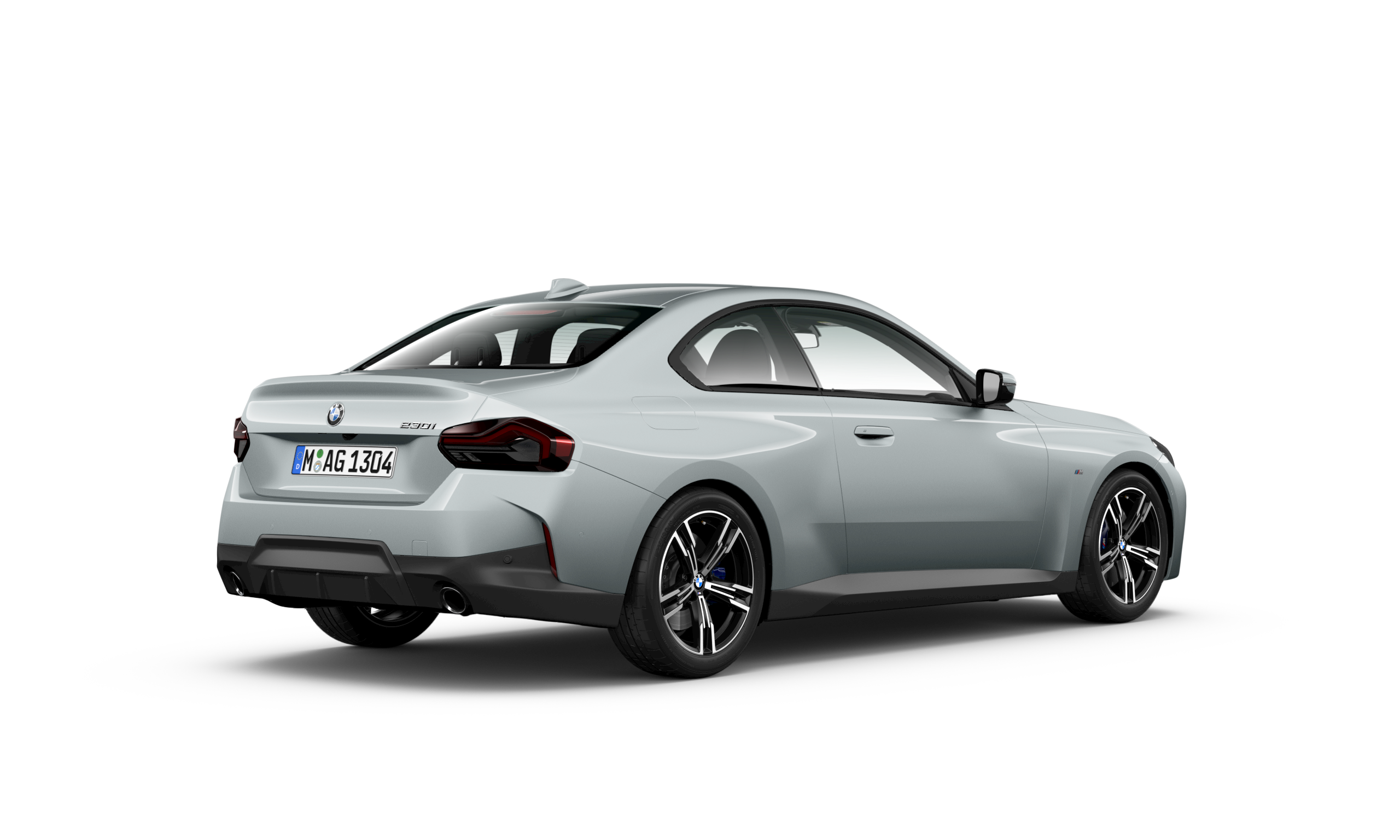
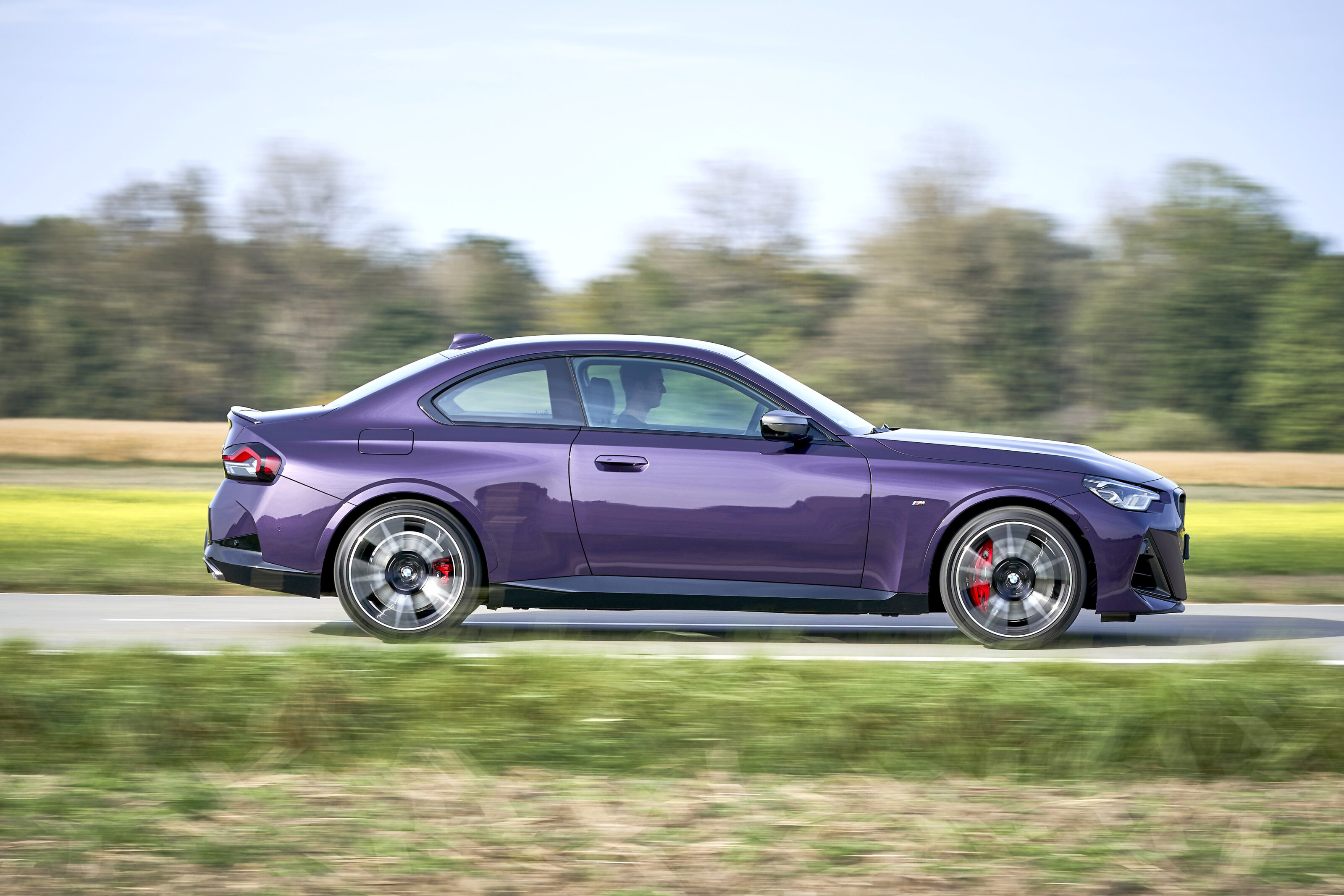
The 2022 BMW 230i will join the local 2 Series Coupe line-up in June.
Priced from $70,900 before on-road costs, the 230i is positioned between the existing 220i and M240i in the second-generation 2 Series Coupe range which launched in late 2021.
The price of the 220i Coupe has also increased by $2000, with the entry-level variant now available from $61,900 before on-roads – despite the omission of the previously-standard head-up display due to the semiconductor chip shortage.
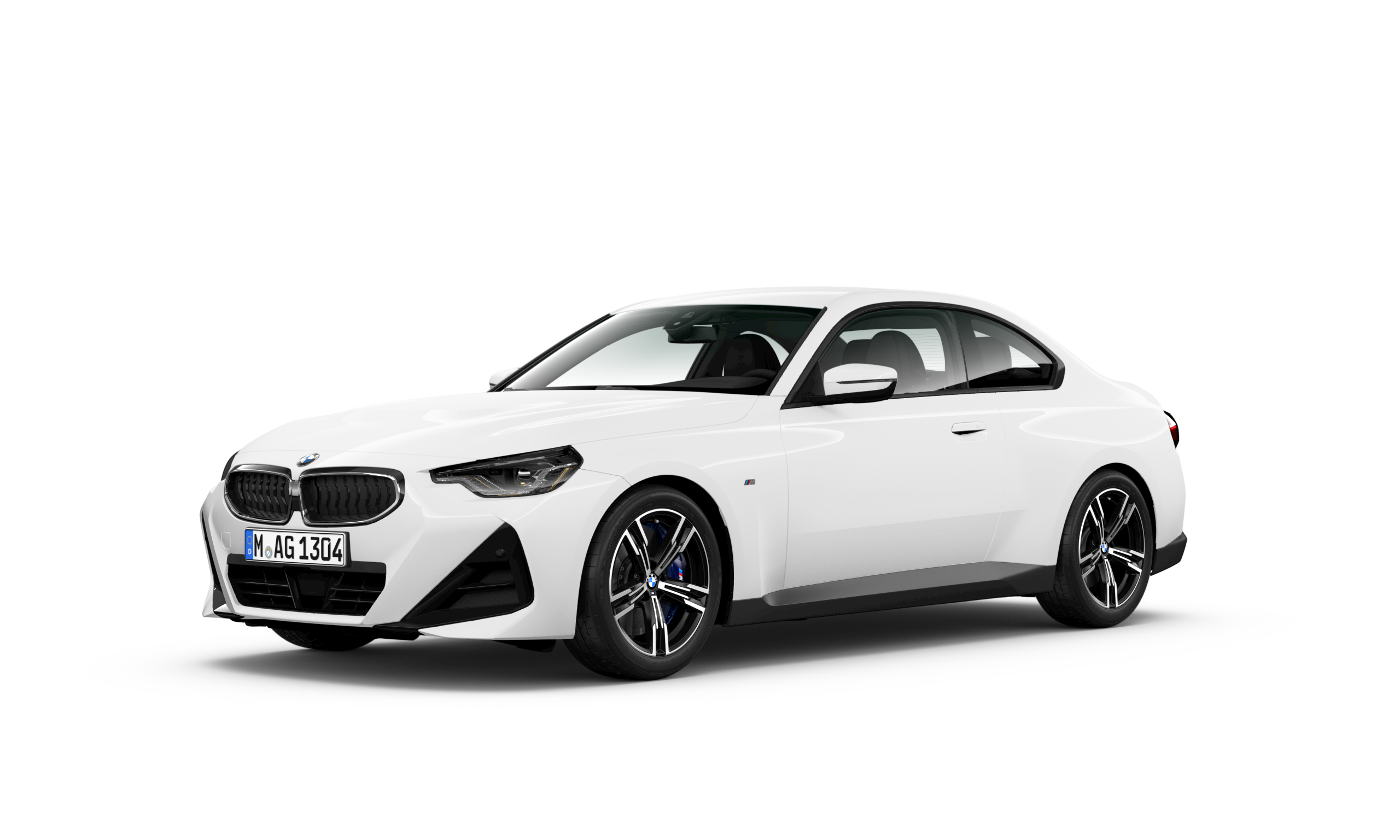
Featuring a higher-output version of BMW’s 2.0-litre turbocharged four-cylinder petrol engine, as found in the larger 330i sedan, the 230i produces 190kW of power and 400Nm of torque – an increase of 55kW and 100Nm over the 220i.
It sends power to the rear wheels through an eight-speed torque-converter automatic transmission.
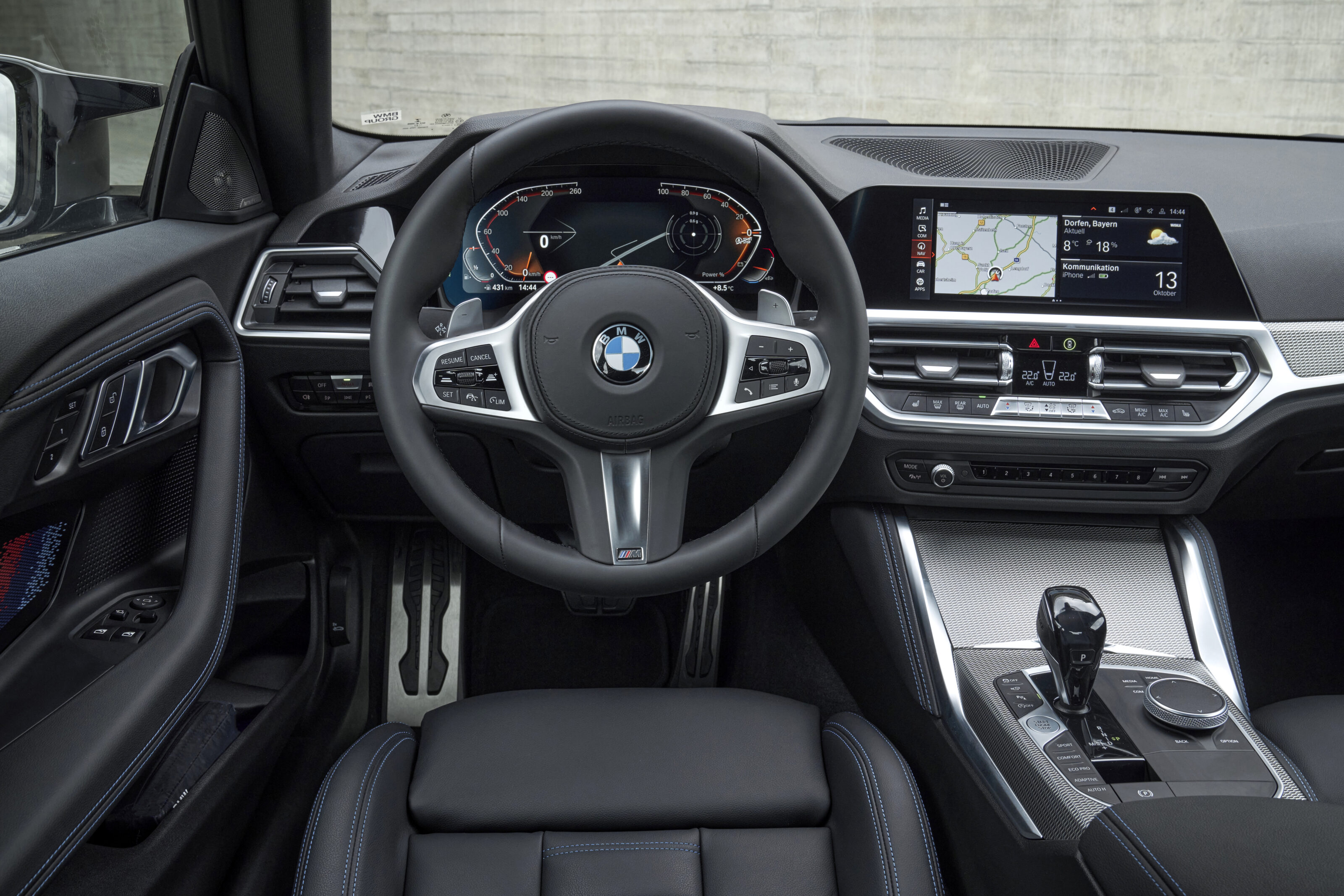
Additional specification includes; keyless entry with Digital Key smartphone functionality, M Sport brakes, electric seat adjustment, adaptive LED headlights, automatic high beam, adaptive cruise control and an enhanced audio system.
The addition of the mid-spec 230i has reduced the previous $30,000 premium between the 220i and M240i, with the flagship AWD turbocharged inline-six variant requiring an additional $19,000 over the 230i.
BMW is yet to confirm details for the upcoming M2 coupe, which is expected to join the 2 Series range in early 2023.
2022 BMW 2 Series Coupe pricing
Prices exclude on-road costs.
2022 BMW 2 Series Coupe features
220i
The head-up display previously standard on the 220i is currently unavailable due to the semiconductor chip shortage.
230i
M240i xDrive
Options:
Enhancement Package – $3900 (220i, 230i)
Comfort Package – $3400 (220i), $1400 (230i)
M Sport Plus package – $1500 (220i), $1500 (230i), $1200 (M240i)
Executive Package – $3000 (220i), $3300 (230i), $2800 (M240i)
Engine, drivetrain and fuel economy
The entry-level 220i is powered by BMW’s turbocharged 2.0-litre four-cylinder petrol engine, which produces 135kW of power and 300Nm of torque. It can reach 100km/h in 7.5 seconds.
Stepping up to the mid-spec 230i retains the same basic motor but a more aggressive tune increases outputs to 190kW/400Nm, with BMW claiming the 230i can complete the 0-100km/h sprint in 5.8 seconds.
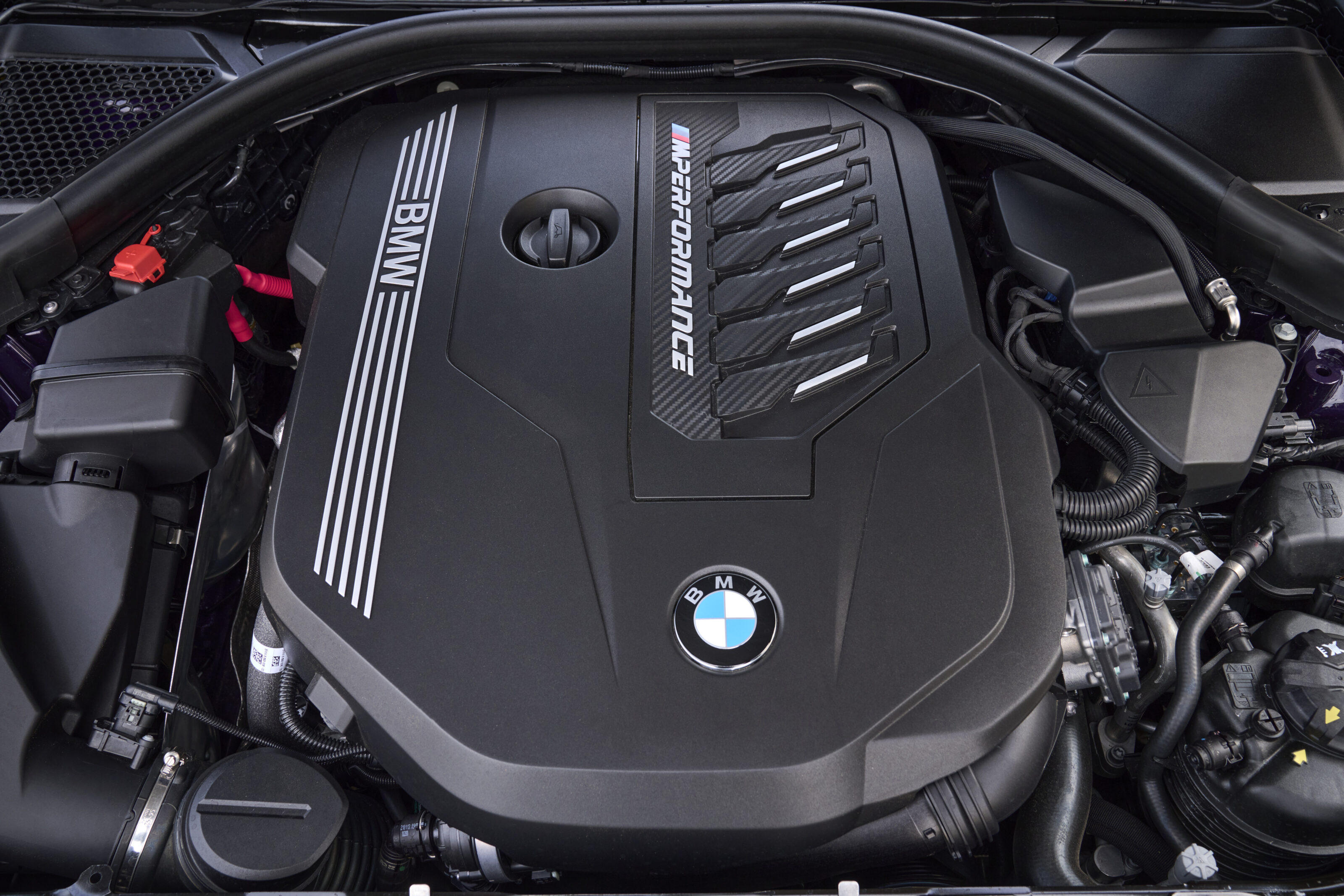
The range-topping M240i xDrive is powered by BMW’s familiar 3.0-litre ‘B58’ twin-scroll turbocharged inline-six engine, producing 285kW and 500Nm.
It includes BMW’s xDrive system sending power to all four wheels, with 0-100km/h said to take just 4.3 seconds.
Drive is exclusively sent to the rear wheels through a ZF-sourced eight-speed torque-converter automatic transmission across the entire 2 Series Coupe range.
Fuel economy figures can be found in the table below:
Safety
The second-generation BMW 2 Series is currently unrated by ANCAP.
It scored four stars in testing conducted by Euro NCAP, which shares identical protocols with the local crash assessment program.
Each variant includes the following active safety equipment as standard:
Dimensions
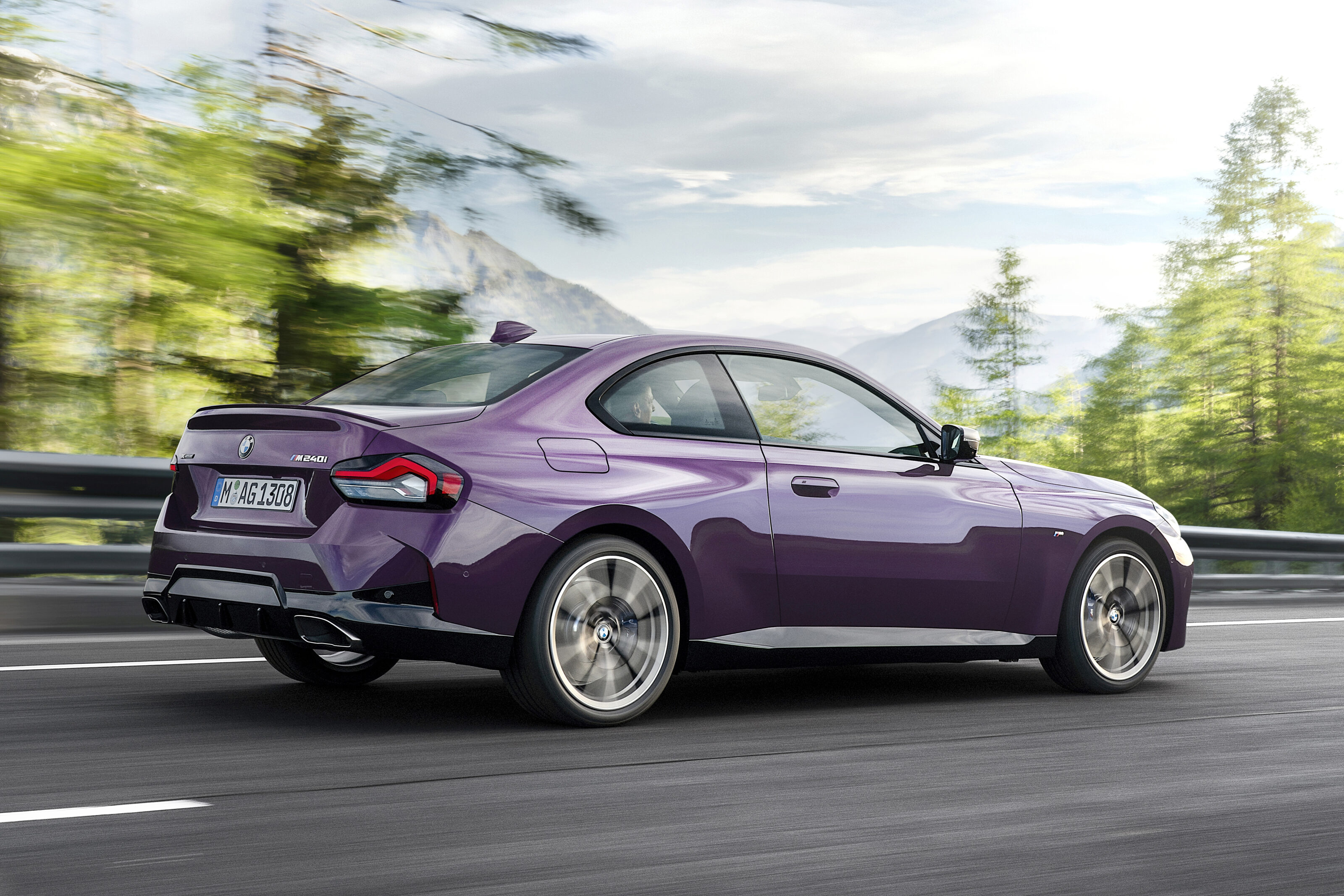
The BMW 2 Series has a wheelbase of 2741 millimetres, and is 4547mm long, 1839mm wide and 1392mm high.
Warranty and servicing
As per the wider BMW range, the 2 Series is covered by the marque’s three-year/unlimited-kilometre warranty, along with a three-year/unlimited-kilometre roadside assistance program.
A five-year/80,000km service package is offered across the 2 Series range, at a cost of $1800 for each variant.
Availability
The 2022 BMW 230i is on sale now and will begin arriving in Australian showrooms during June.
Key Points
- April sales only just eclipse 80,000 units
- Year-on-year monthly new car sales drop by 12 per cent
- Year-to-date figures slide below last year’s
New car sales in Australia suffered a fall last month, with almost every mainstream brand in the top 10 struggling.
According to monthly results provided by the Federal Chamber of Automotive Industries (FCAI), it was a worse April than last year, with 81,065 units registered compared to 92,347 this time in 2021 – which was boosted off the back of a COVID-19 decimated 2020.
It leaves the market down 12 per cent, or 11,282 vehicles, compared with April 2021, and also down 3.5 per cent year-to-date.
Though most brands suffered losses – with Nissan, Ford and Mazda the worst affected of the main players – though Kia, Isuzu and MG managed to swing things in the other direction.
As expected, New South Wales sold the most vehicles with 25,432 units shifted, followed by Victoria with 21,339 and Queensland on 17,424.
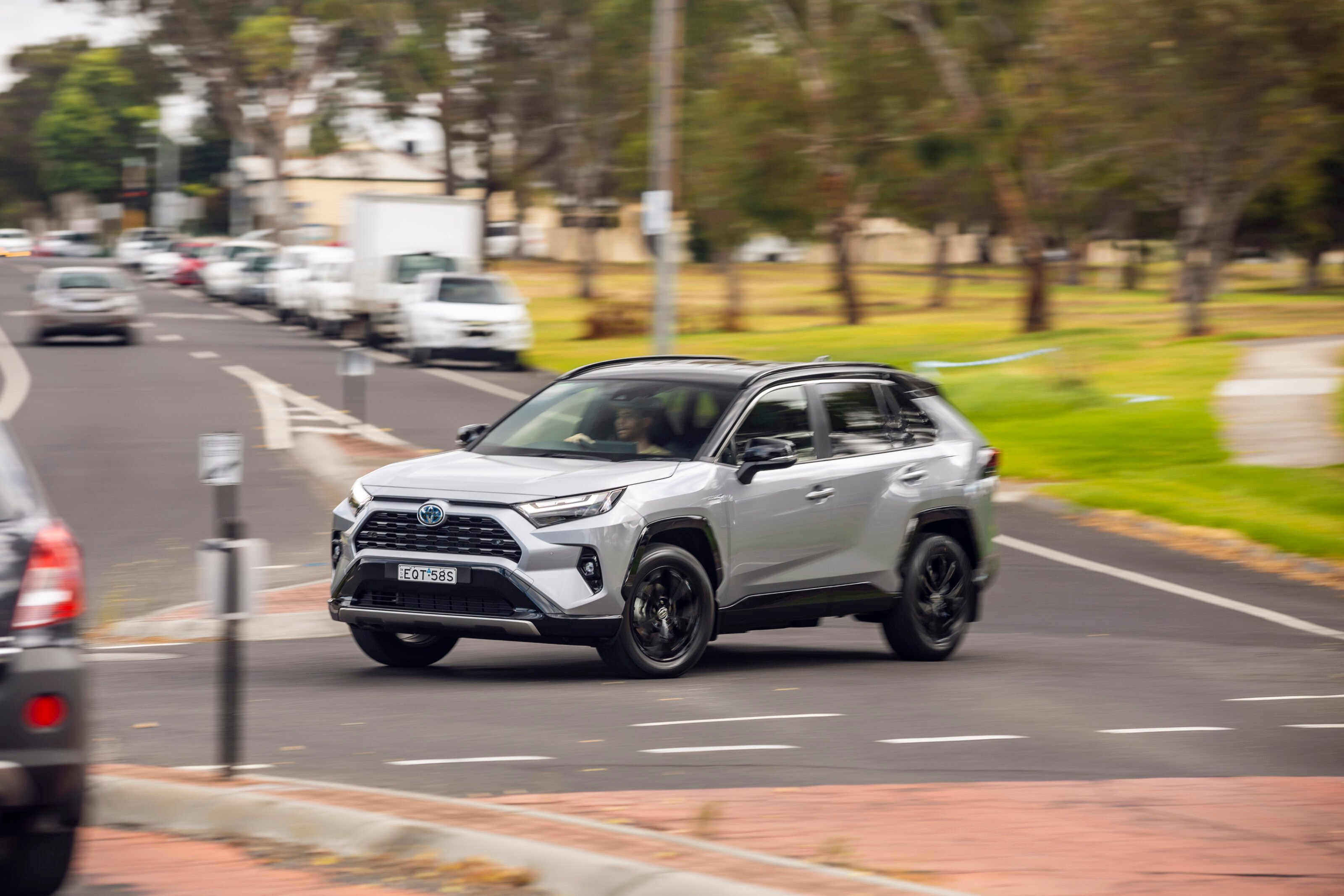
The Federal Chamber of Automotive Industries (FCAI) said supply was far outstripped by demand, with ongoing production and delivery issues not providing a true indictator of the industry’s strengths.
“We know this is not a reflection on the demand for new vehicles in the marketplace,” said FCAI chief executive Tony Weber.
“This is a reflection on the global automotive industry’s ability to supply vehicles to not only the Australian market, but all markets throughout the world.
“Automotive manufacturers continue to suffer from a shortage of microprocessor units, which is impacting their ability to ramp up production to pre-pandemic levels.
“COVID-19 continues to impact manufacturing and supply, particularly where factories have been forced to close and shipping operations are yet to fully recover. This is being reflected in the extended delivery times for new vehicles.”
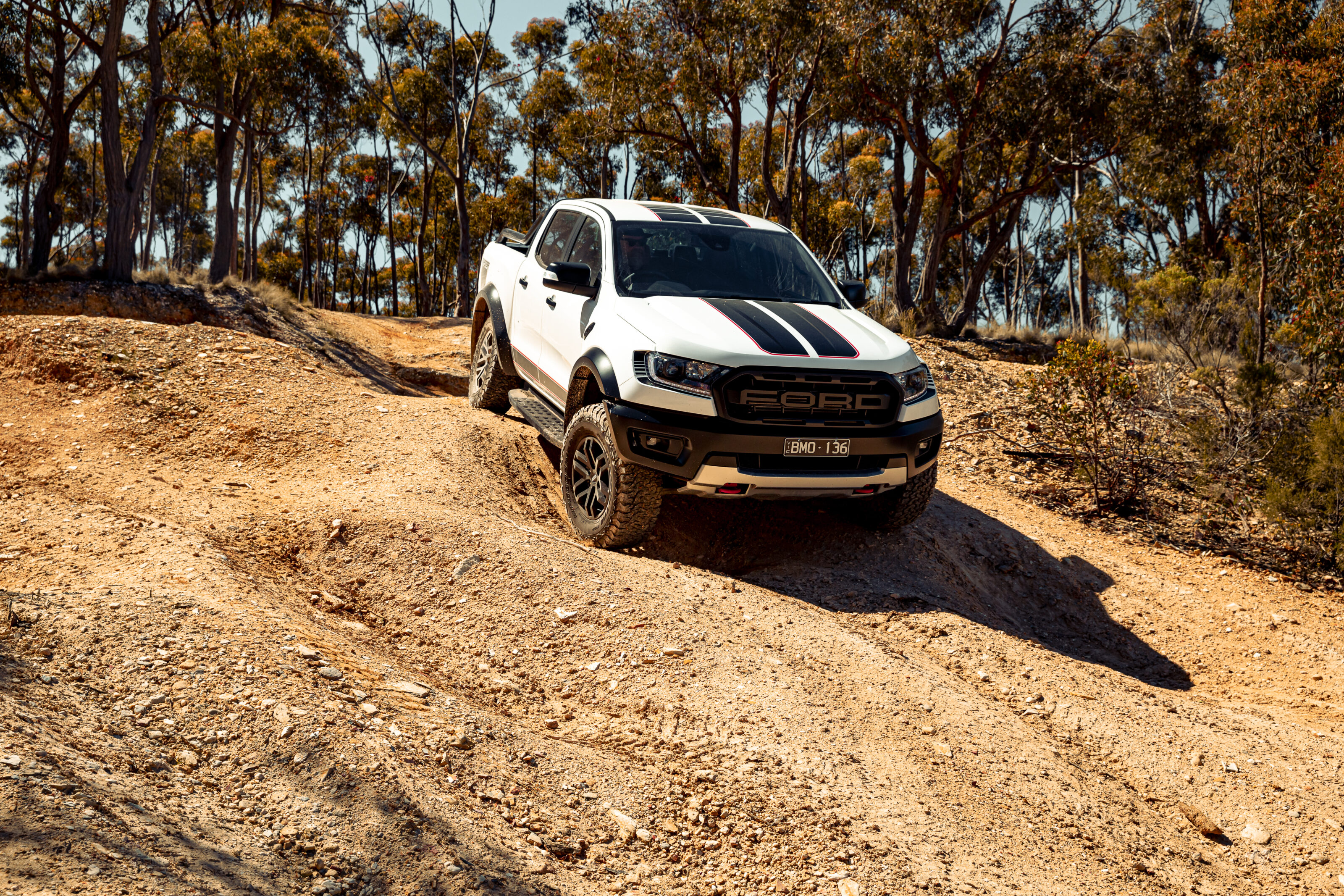
Toyota continued to hold top spot among all the carmakers, followed by Mazda and Mitsubishi rounding out the top three, while sister companies Kia and Hyundai kept their positions in fourth and fifth respectively.
With electric brand Tesla now posting monthly results, the true picture of its sales pattern was clearer and it fell from its one-month top 10 placement with just 52 Model 3s flogged Down Under during the period – which meant it was outsold by new rival the Polestar 2, of which 93 were shifted.
Outside the top 10, Subaru (down 52 per cent), Honda (down 37 per cent), Skoda (down 36 per cent), Alfa Romeo (down 38 per cent), Volkswagen (down 45 per cent), Lexus (down 39 per cent), Peugeot (down 44 per cent) and Jeep (down 42 per cent) were the biggest strugglers among mainstream brands.
Successes came for other household names though, with Fiat (up 50 per cent), Citroën (up 667 per cent), Porsche (up 36 per cent), Ram (up 86 per cent), Renault (up 103 per cent), Chevrolet (up 63 per cent) and Suzuki (up 37 per cent) all posting large increases in April.

Utes were the country’s most popular vehicle type again last month when combining 4×4 and 4×2 variants, with the former accounting for 15,047 units of a 18,662 total.
There were 16,274 medium SUVs that left showrooms compared to 16,686 in April 2021.
All SUV categories posted losses last month, with upper large SUVs worst affected with a 56 per cent drop – though the overall SUV share of the market barely changed, down by just one per cent for the month and down 0.2 per cent YTD.
Total SUV sales sat at 42,370 for April and 177,795 for 2022 so far (versus 49,176 in 2021 and 185,076 by this point the year before). For the year so far, medium SUVs and large SUVs however grew by two and four per cent.
Light-commercial vehicles increased its share by 0.7 per cent in April and 1.4 per cent YTD, again at the expense of passenger cars that were down 0.5 per cent of the market last month and 1.6 per cent YTD.

Micro cars, small cars, medium cars, sports cars and people movers all suffered falls of 13 per cent, 21 per cent, 15 per cent, 44 per cent and 37 per cent respectively.
Light, large and upper large car sales, however, grew seven per cent, 19 per cent and two per cent for the month.
Comparatively, year-to-date all these categories experienced losses – with the exception of medium cars, which were up 45 per cent.
In April, there were 866 electric vehicles sold compared to 286 in April 2021 and 7618 for 2022 so far – increases of 203 and 507 per cent.
Although the number of hybrids dropped from 7585 in April 2021 to 6277 last month, a decrease of 17 per cent for the month, things were still looking positive with a 13 per cent hike for the year-to-date.
Plug-in hybrid numbers were up 153 per cent with 628 sold in April and 1675 for 2022 (compared to 248 in April last year and 877 by this time in 2021).
Unstable petrol prices are partly responsible for the electric boom, though state-based incentives, such as those in NSW, VIC and recently announced in QLD, have also played a part.
Top 10 models
The Toyota HiLux ute kept the top spot with 4493 for April and 18,671 YTD, compared to 3581 for its regular rival, the Ford Ranger, which came in second place for the month – but came in third year-to-date with 13,241 sales.
Coming in third was Australia’s most popular SUV, the Toyota RAV4, with 3373 units registered – though for the year so far it bested the Ranger, swapping into second YTD with 13,862 sales, despite having a rocky start to the year when it left the top 10 entirely in January.
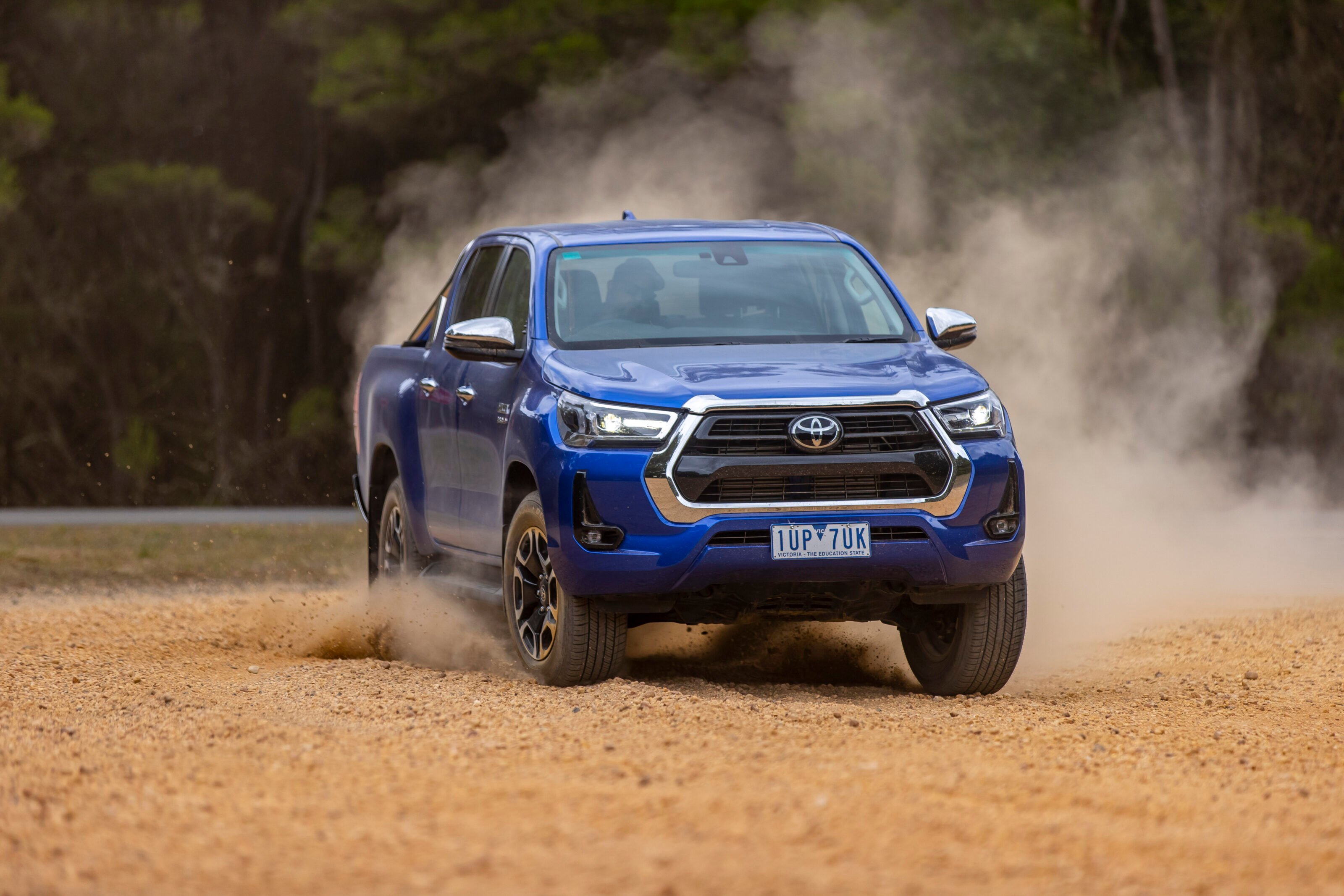
After a bad month in February for the Mazda CX-5, its successes continued off the back of March with another solid period in April, selling 2701 cars thanks to the recent launch of the new model coming in fourth place – though that figure is down on March’s 3772 units. Looking at the year-to-date results, the CX-5 was fifth with 10,951 cars sold, an equal result to this time last year.
Top 10 spots also continued to be taken up by more utes, with Isuzu’s D-Max and Mitsubishi’s Triton occupying fifth and sixth places respectively with 2374 and 2357 sales in April. For the year so far, Isuzu shifted 8646 units of its D-Max, taking seventh overall, while Mitsi sold 12,852 Tritons to take fourth spot.
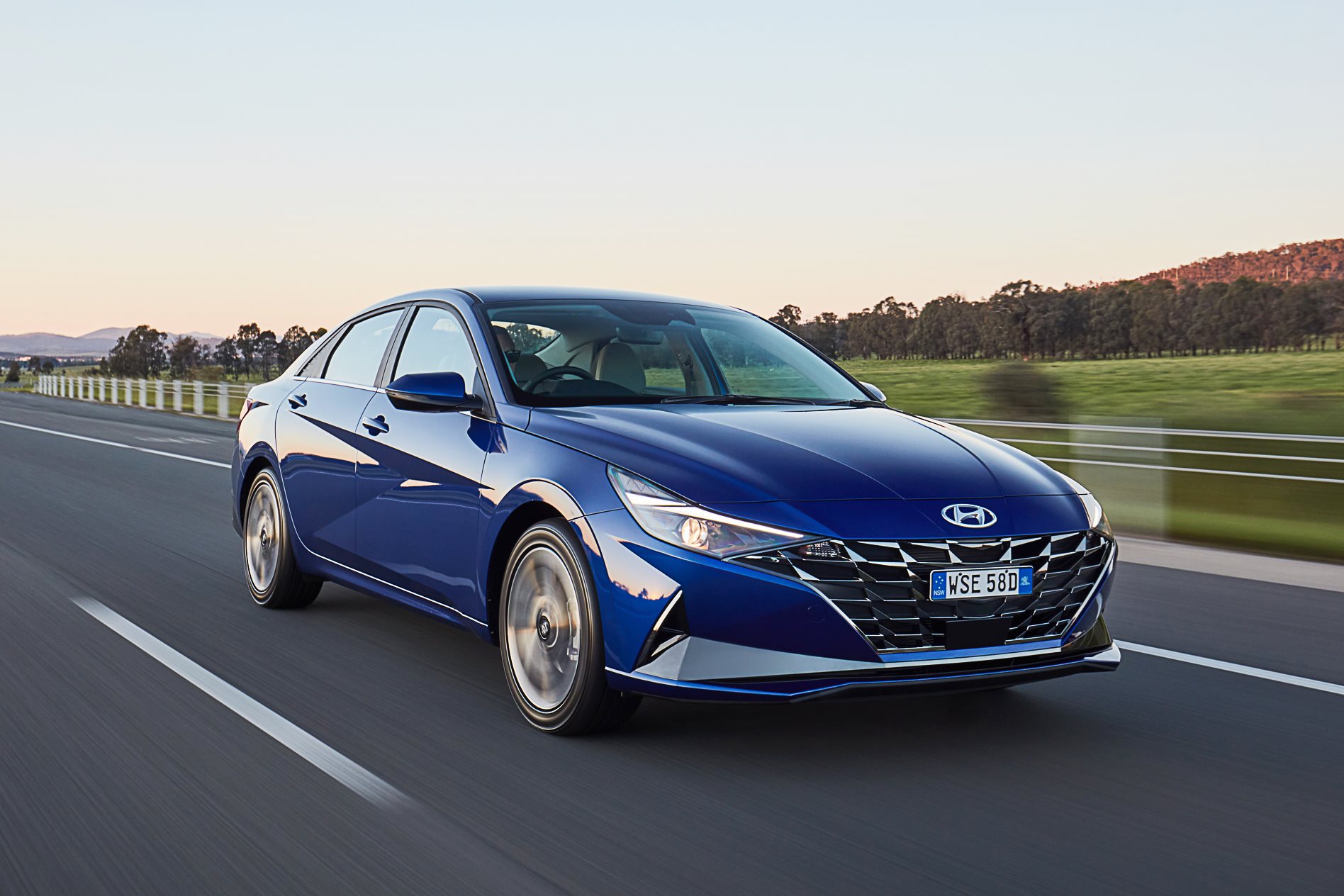
Representing passenger cars in the top 10 were the ever-popular Hyundai i30, with 2071 finding homes last month (7924 YTD), coming in eighth for April and for the year to this point, and the Toyota Corolla – which, despite falling out of the top 10 multiple times since December last year – achieved 2202 sales in April making it seventh, but ninth YTD with 7239.
Meanwhile, its Prado sibling came in 10th spot last month with 1031 units shifted, but did much better YTD taking sixth position with 9205 sold.
Rounding out the top models so far for 2022 was the MG ZS, remaining a popular choice with Australian buyers, with 7220 examples leaving showrooms. For the month the ZS took ninth, selling 1923 cars.
Narrowly missing out on a spot were the Kia Sportage with 1327 sold, besting its Cerato sibling, which no longer enjoys a top 10 spot regularly, the Toyota Kluger with 1381, and the MG 3 with 1615 – the second time the latter has done well in 2022 with it posting a strong start and making the best-sellers list earlier this year.
Top 10 models: April 2022
| Rank | Model | Sales | vs April u201821 |
|---|---|---|---|
| 1 | Toyota HiLuxu00a0 | 4493 | +6% |
| 2 | Ford Ranger | 3581 | u201329% |
| 3 | Toyota RAV4 | 3373 | u201325% |
| 4 | Mazda CX-5 | 2701 | +15% |
| 5 | Isuzu D-Max | 2374 | +19% |
| 6 | Mitsubishi Triton | 2357 | u20134% |
| 7 | Toyota Corolla | 2202 | +6% |
| 8 | Hyundai i30 | 2071 | +3% |
| 9 | MG ZS | 1923 | +42% |
| 10 | Toyota Prado | 1631 | +19% |
Top 10 models: YTD 2022
| Rank | Model | Sales | vs YTD u201821 |
|---|---|---|---|
| 1 | Toyota HiLuxu00a0 | 19,211 | +5% |
| 2 | Toyota RAV4 | 13,862 | u20130.1% |
| 3 | Ford Ranger | 13,241 | u201312% |
| 4 | Mitsubishi Triton | 12,852 | +49% |
| 5 | Mazda CX-5 | 10,951 | +15% |
| 6 | Toyota Prado | 9205 | +72% |
| 7 | Isuzu D-Max | 8646 | +15% |
| 8 | Hyundai i30 | 7924 | u20139% |
| 9 | Toyota Corolla | 7239 | u201323% |
| 10 | MG ZS | 7220 | +33% |
Top 10 brands
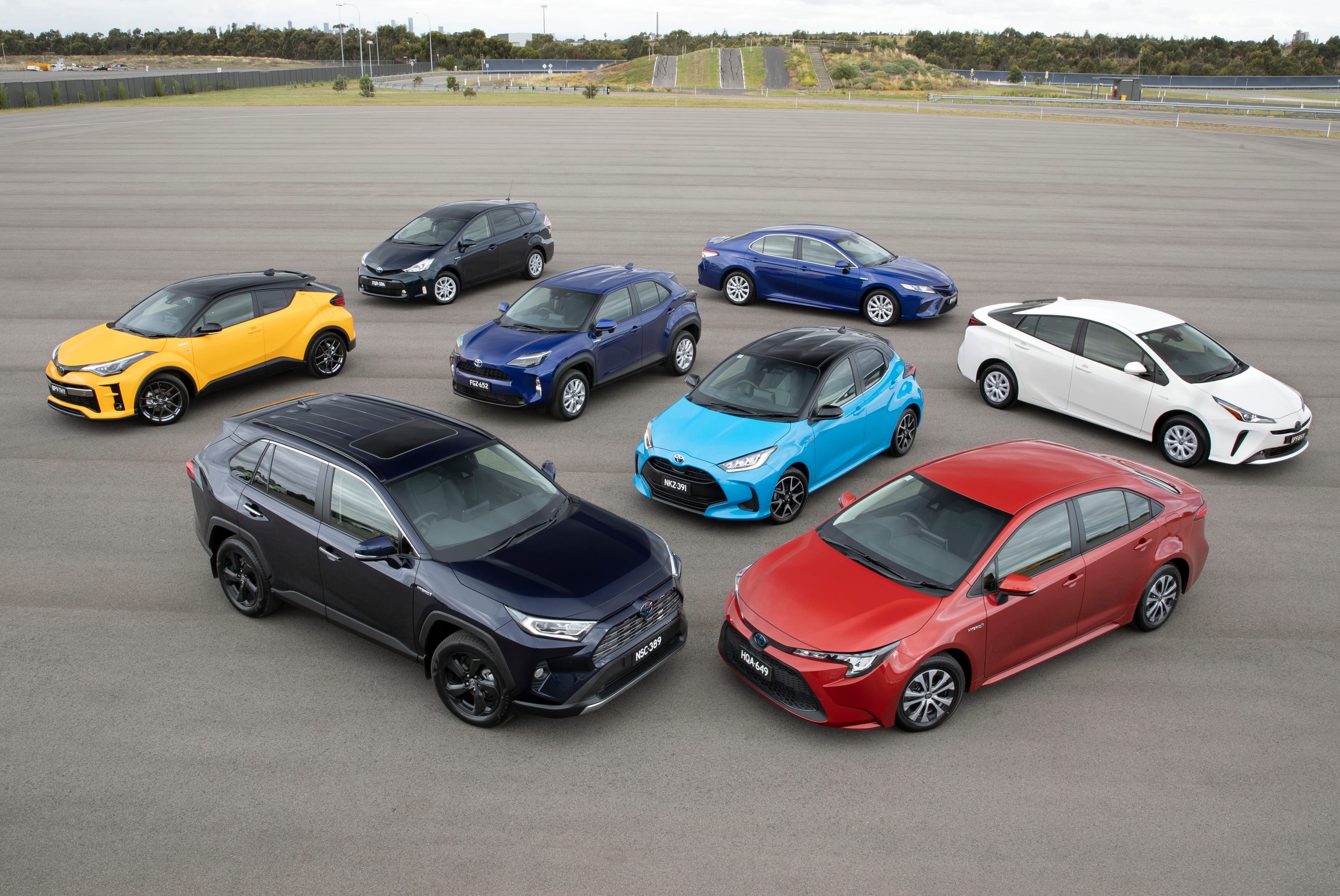
April was another difficult month for the market’s dominant brand Toyota, despite a rebound in March, notching up 17,956 sales, down 11 per cent compared to this time last year when it had 22,208 – mostly down to COVID-19 related production problems. Year-to-date it has sold 76,003 units.
Mazda followed in second place with 7378 units achieved last month (down 27 per cent) and 37,213 year-to-date, followed by Mitsubishi, with 6463 cars shifted in April (down 14 per cent) and 29,816 this year so far.
Hyundai and Kia continued to battle it out for the higher spot of fourth place, with the latter winning this time around with 6180 sales in April (up eight per cent) versus Hyundai’s 5552 (down four per cent), with a similar picture for the year overall with Kia selling 23,682 compared to Hyundai’s 22,845.

Though Tesla snuck into the top 10 with 4417 sales in March, placing sixth because its quarter one results were grouped together due to it reporting them to the FCAI for the first time ever, in April it posted just 52 cars sold – leaving it well outside of contention for best-selling brand.
With Tesla falling back down the ranks, Ford took sixth spot last month with 4974 units (down 30 per cent), and also came sixth year-to-date with 18,357 vehicles sold.
MG held its seventh position for the year with 4773 registrations (up 59 per cent), despite just the ZS appearing in the top 10 vehicles list, and achieved 16,040 sales YTD.
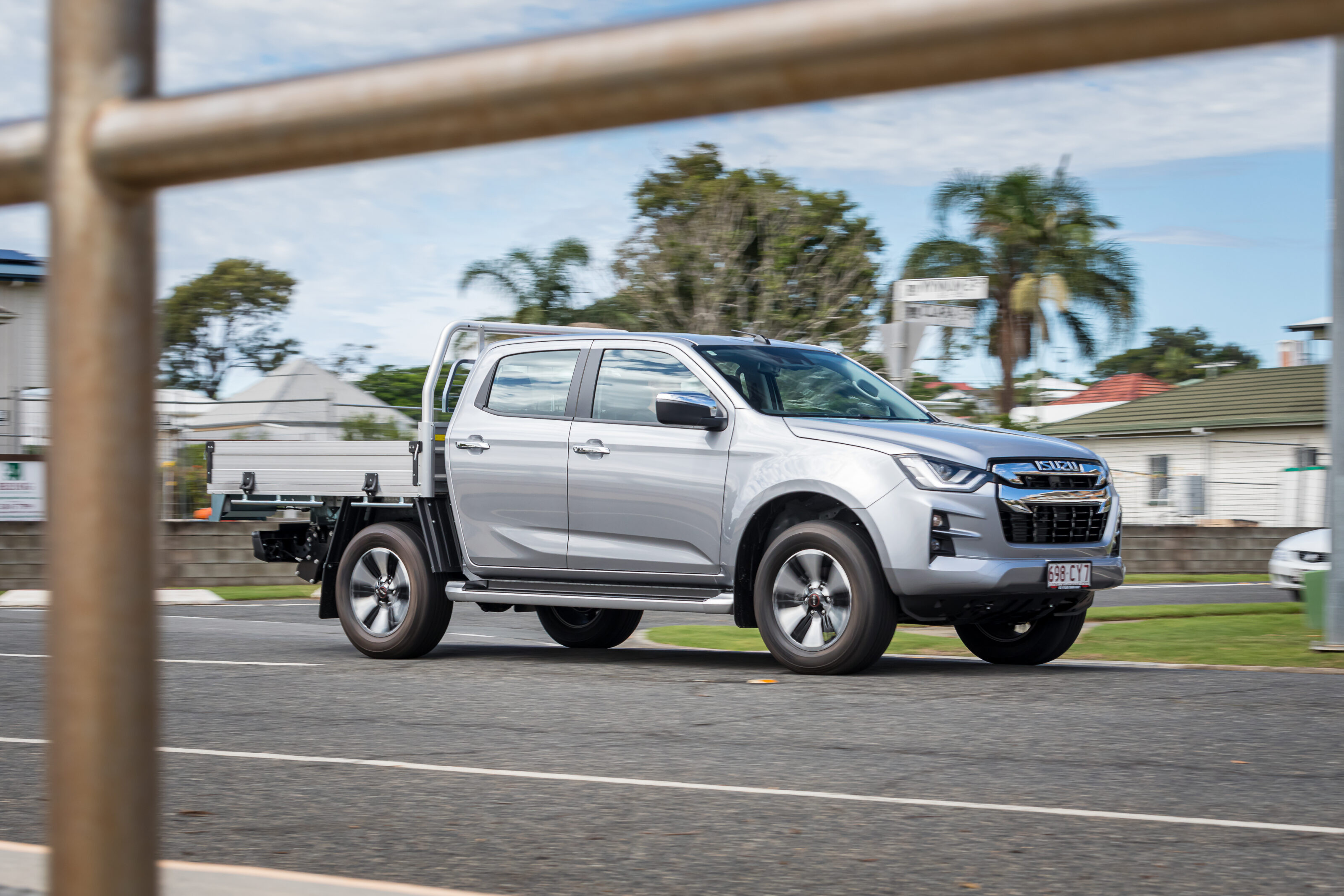
Isuzu Ute also had a good month – not only did it remain in the best-sellers list for April with 3032 vehicles shifted and up six per cent for the month, but it rose to eighth place from ninth in March when it sold 2962 units. Year-to-date it held eighth place, with 11,838 sold compared to 8806 the month prior.
Subaru didn’t make the cut for April, with 1644 units sold, its place taken by Mercedes-Benz with 2682. Year-to-date however, Subie retained its top 10 spot with 9796 sales and Merc was ousted – its 9481 vehicles not quite enough to get it over the line.
Nissan finished up in 10th place for April and ninth position for 2022 so far, with 2050 sales (down 41 per cent) last month and 10,372 for the year.
Top 10 brands: April 2022
| Rank | Model | Sales | vs April u201821 |
|---|---|---|---|
| 1 | Toyota | 17,956 | u201311% |
| 2 | Mazda | 7378 | u201327% |
| 3 | Mitsubishi | 6463 | u201314% |
| 4 | Kia | 6180 | +8% |
| 5 | Hyundai | 5552 | u20134% |
| 6 | Ford | 4974 | u201330% |
| 7 | MG | 4773 | +59% |
| 8 | Isuzu | 3032 | +6% |
| 9 | Mercedes-Benz | 2682 | u201311% |
| 10 | Nissan | 2050 | u201341% |

Top 10 brands: YTD 2022
| Rank | Model | Sales | vs YTD u201821 |
|---|---|---|---|
| 1 | Toyota | 76,003 | u20131% |
| 2 | Mazda | 37,213 | u20131% |
| 3 | Mitsubishi | 29,816 | +17% |
| 4 | Kia | 23,632 | +3% |
| 5 | Hyundai | 22,845 | u20138% |
| 6 | Ford | 18,357 | u201320% |
| 7 | MG | 16,040 | +37% |
| 8 | Isuzu | 11,838 | +9% |
| 9 | Nissan | 10,372 | u201334% |
| 10 | Subaru | 9796 | u201328% |
In charts
April 2022 – Top 10 models
April – Top 10 brands
April 2022 – Overall segment sales
April 2022-2021 category sales
April 2022-2021 category YTD sales
2022 Sales race
April 2022 Australian sales map
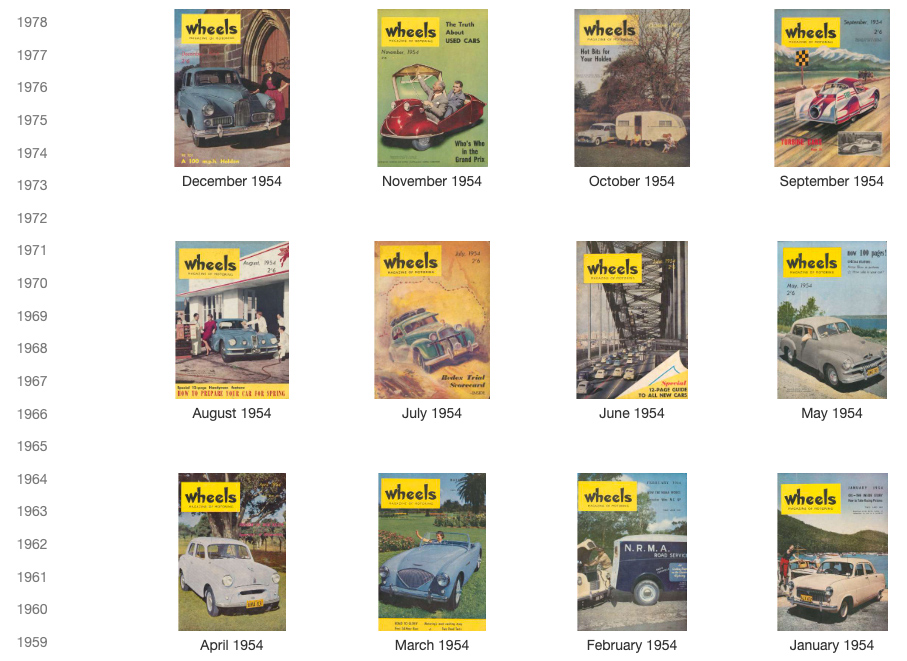
The WhichCar digital magazine archives provide online access to current and past issues of Wheels, MOTOR and 4X4 Australia magazines.
For Wheels, the archive includes every issue ever published, since 1953. It’s an incredible resource and probably the most comprehensive history of the Australian automotive industry over the past 70 years.
In the case of MOTOR and 4X4 Australia the digital archives date back to 2015, meaning over 80 back issues of each magazine are available.
The archives are accessible via any device (mobile, tablet or desktop).
How to access the archives
SUBSCRIBE
- Print subscribers receive free access to the digital archive as part of their subscription.
- Digital only subscriptions are also available
LOG IN
Click any of the below links to access the relevant digital magazine archive.
Need help with your login? If you have forgotten your login or need help getting access to the archives, please contact our support teamWheels Media – Subscriptions Sales and Support Team
- Email: [email protected]
- Phone: (02) 8315 2092 – Mon-Fri, 9AM-5PM (AEST)
“It had the unreal quality of a dream. That strange hyper-cleanliness, the dazzling intensity of colour, the haunting feeling of being suspended in time and motion: sitting there with the speedo reading beyond 160mph and two more gold Lamborghinis drifting along ahead.”
Convoy! I remember opening my copy of Wheels in the late 1970s and devouring every word of Mel Nichols’ vivid account of driving three Lamborghinis on a road trip from Sant’Agata Bolognese through Italy and France and back to London.
Nichols was – still is – a consummate storyteller. He loved to drive fast cars fast, but, more importantly, he took you along for the ride. I could forget for a moment the tedium of my bank clerk job in the Adelaide suburbs; I was right there with Mel as we arrowed across France in an impossibly exotic Italian supercar.
“…for the rest of the day our speed stayed around 120mph, with some spells at 140 and some at a little over 160mph. And so we flowed along that silver-grey ribbon of road, disappearing north into a blue, blue morning. It was a big, wide-open feeling – lulling and warm. You felt relaxed, hand just resting on the wheel, the car reaffirming its poise and arrow-like direction every instant.”
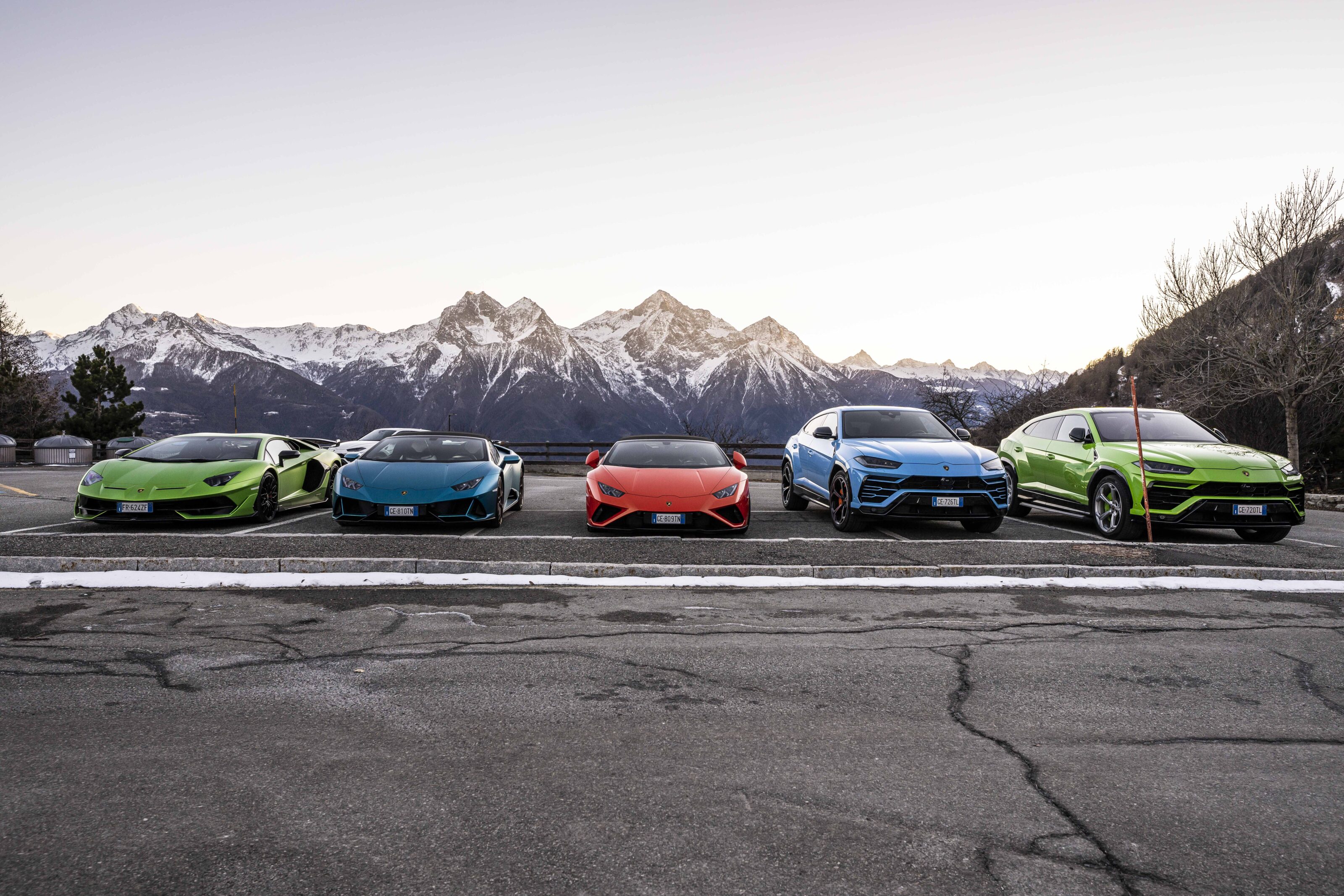
A pale gold twilight glows behind the serrated ranks of the snow-covered peaks to the west as I walk past a brightly coloured assemblage of Urus SUVs and Huracán coupes and convertibles towards the Lamborghini Huracán STO.
I’m almost 1700 metres up in the Italian Alps, and the residual warmth of the day’s bright sunshine is rapidly seeping away. It’ll be close to freezing soon, and my next destination, 60 kilometres away on roads that wriggle and writhe through the mountains like spilled spaghetti, is more than 2000 metres above sea level, snuggled at the base of the Matterhorn.
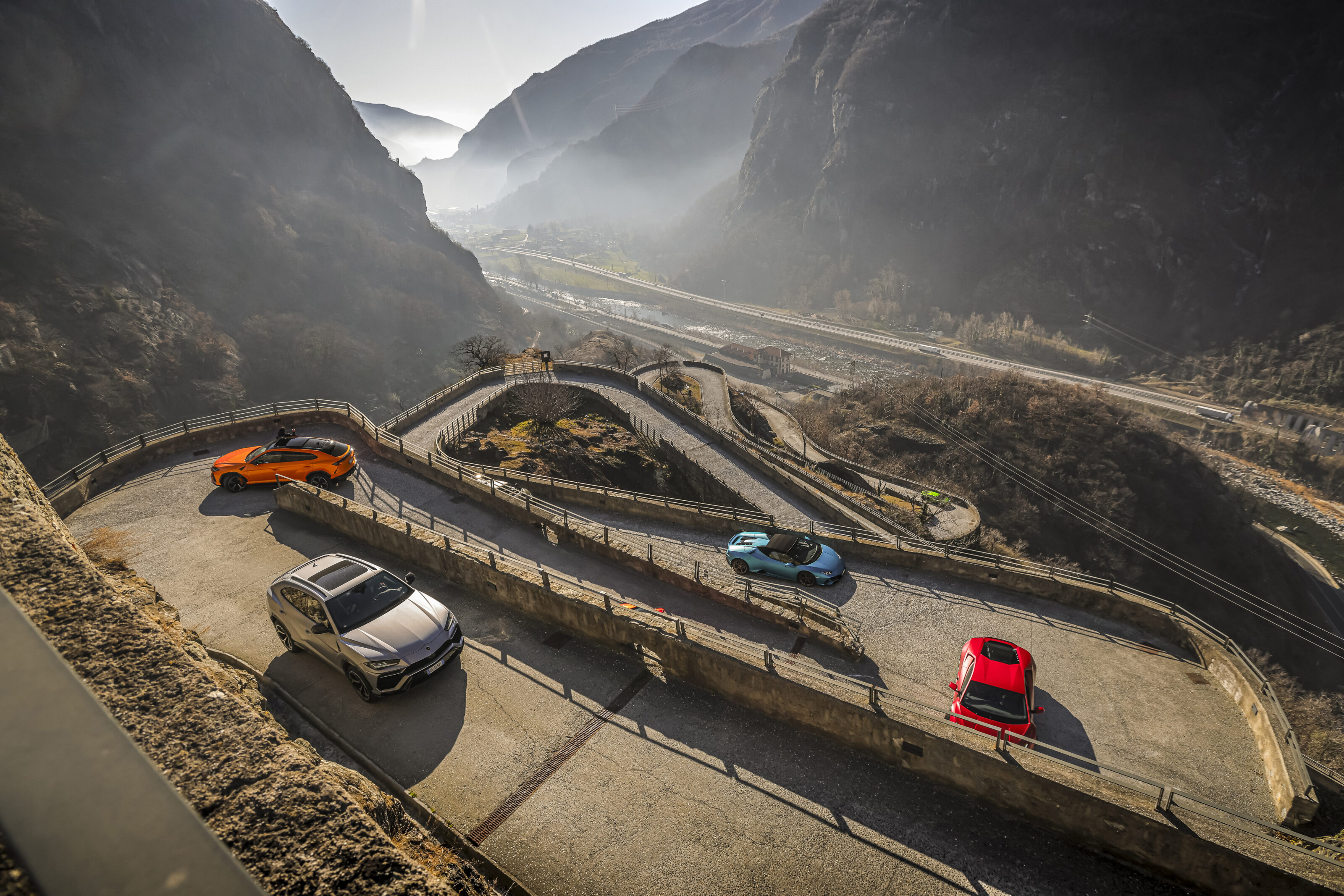
The STO is the edgiest, most track-focused Lamborghini here. I glance at the Pirelli SottoZero winter tyres, 245/30 items at the front and 335/30 at the rear, little more than fat rubber bands wrapped around the Lamborghini’s 20-inch alloy wheels, and silently hope they’re as good as the Pirelli people say they are…
My journey had begun the evening before, behind the wheel of bright blue Urus, rolling out the gate at Sant’Agata Bolognese, where Lamborghinis have been produced ever since Italian industrialist Ferruccio Lamborghini decided he could build a better sportscar than Enzo Ferrari.
Convoy! Take Two wasn’t going to be as epic as Nichols’ original – too much traffic and speed cameras. But it promised to be memorable all the same
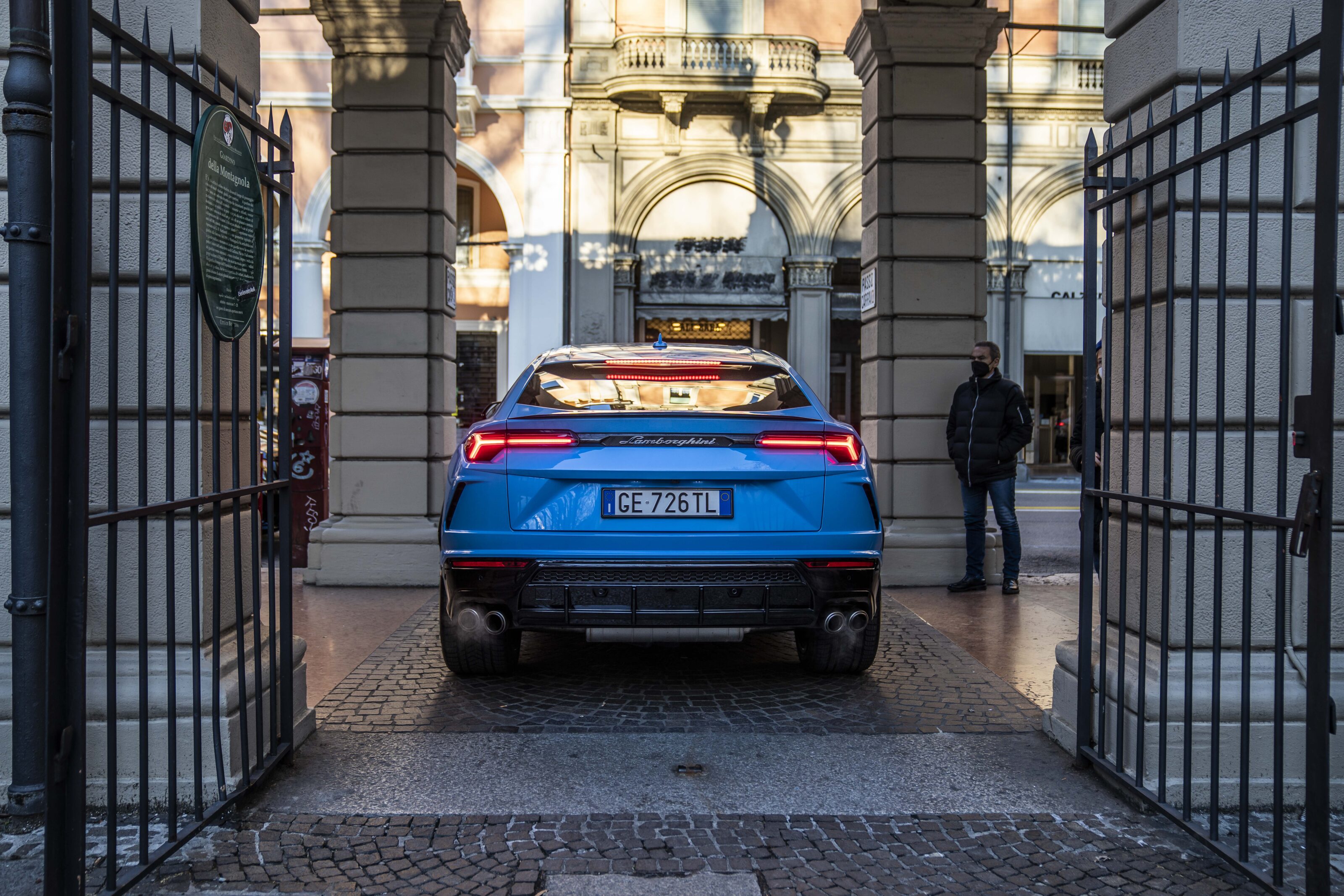
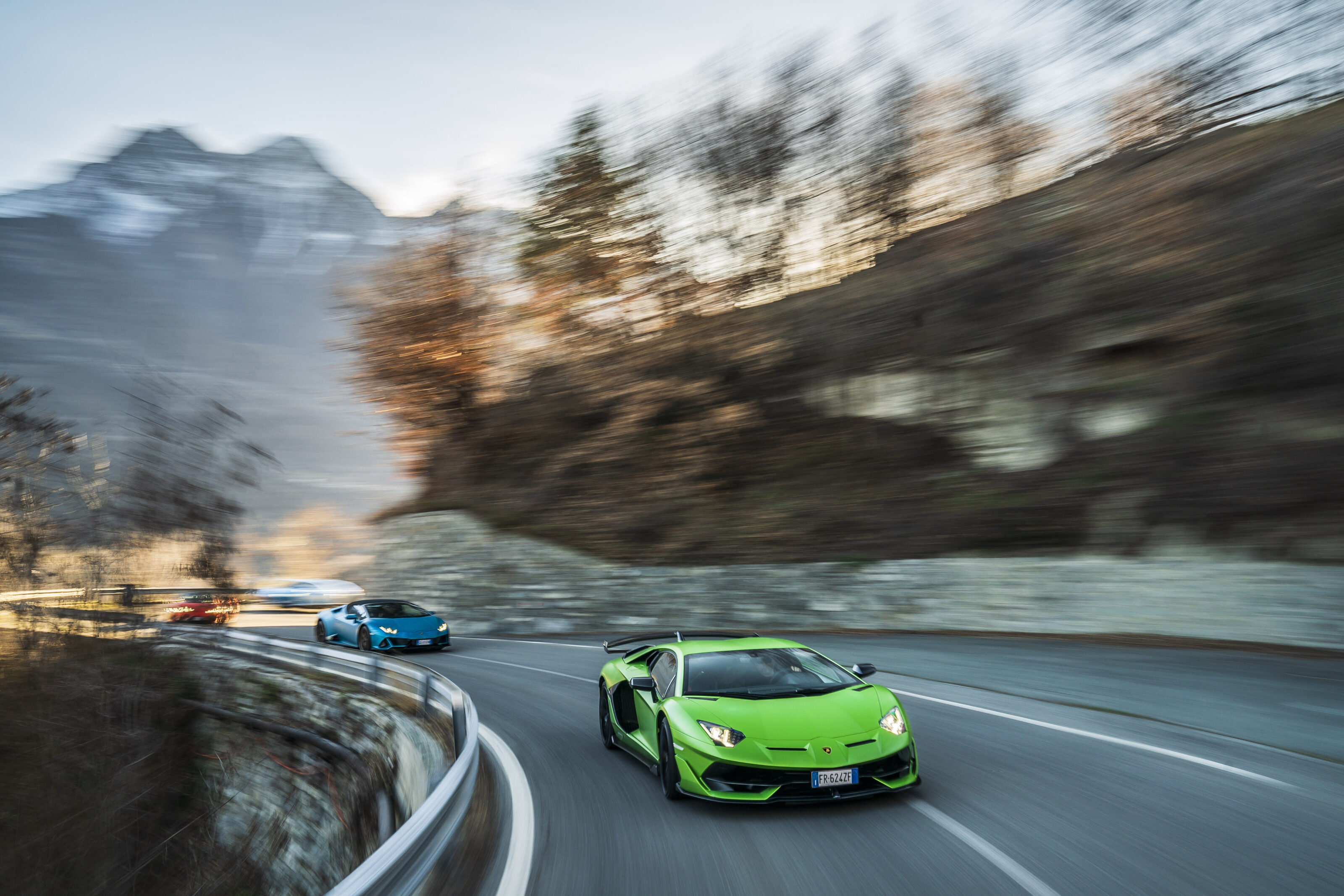
After an overnight stop in nearby Bologna, no fewer than 12 Lamborghinis – six Urus, two Huracán STOs, two Huracán Evo Spyders, a Huracán Evo coupe, and an Aventador SVJ – would be heading for the Italian ski resort of Cervinia. Along the way, lunch in a castle.
Convoy! Take Two wasn’t going to be quite as epic as Nichols’ original mad dash across Europe – too much traffic, and too many speed cameras. But it promised to be memorable all the same.
The Lamborghini factory is nothing like it was on my first visit, with Peter Robinson, in the early 1990s. Back then, they were building Diablos in the same hall where the Countach, the Urraco P300 and the Silhouette Nichols and his colleagues convoyed back to the UK were made almost 15 years earlier. And using the same methods, too, clusters of workers wrestling parts out of wooden crates and onto the cars.
Volkswagen Group’s acquisition of Lamborghini in 1998 changed all that.
Today there are giant assembly halls, hushed and gleaming and modern, with autonomous vehicles shuttling components to the workers. Out the back, is a paint shop that is one of the newest in Europe. Up front, near the small museum, is a room where buyers can customise their cars, mixing and matching up to 350 different exterior paint colours and 50 different leather trim colours with carbonfibre trim and wheels in black, silver, gold or bronze as part of the Lamborghini Ad Personam program.
Today’s Lamborghinis are the best-built and best-mannered in history. But even as I had headed out of Bologna earlier this morning in the Urus, bound for the lunch stop 360km away, I realised the essential nature of a Lamborghini remained unchanged. The Urus might not have the menace of a Murcielago, but it is still … extreme.
The Urus is Lamborghini’s 21st century gran turismo, composed and confident and fast on all roads in all weather
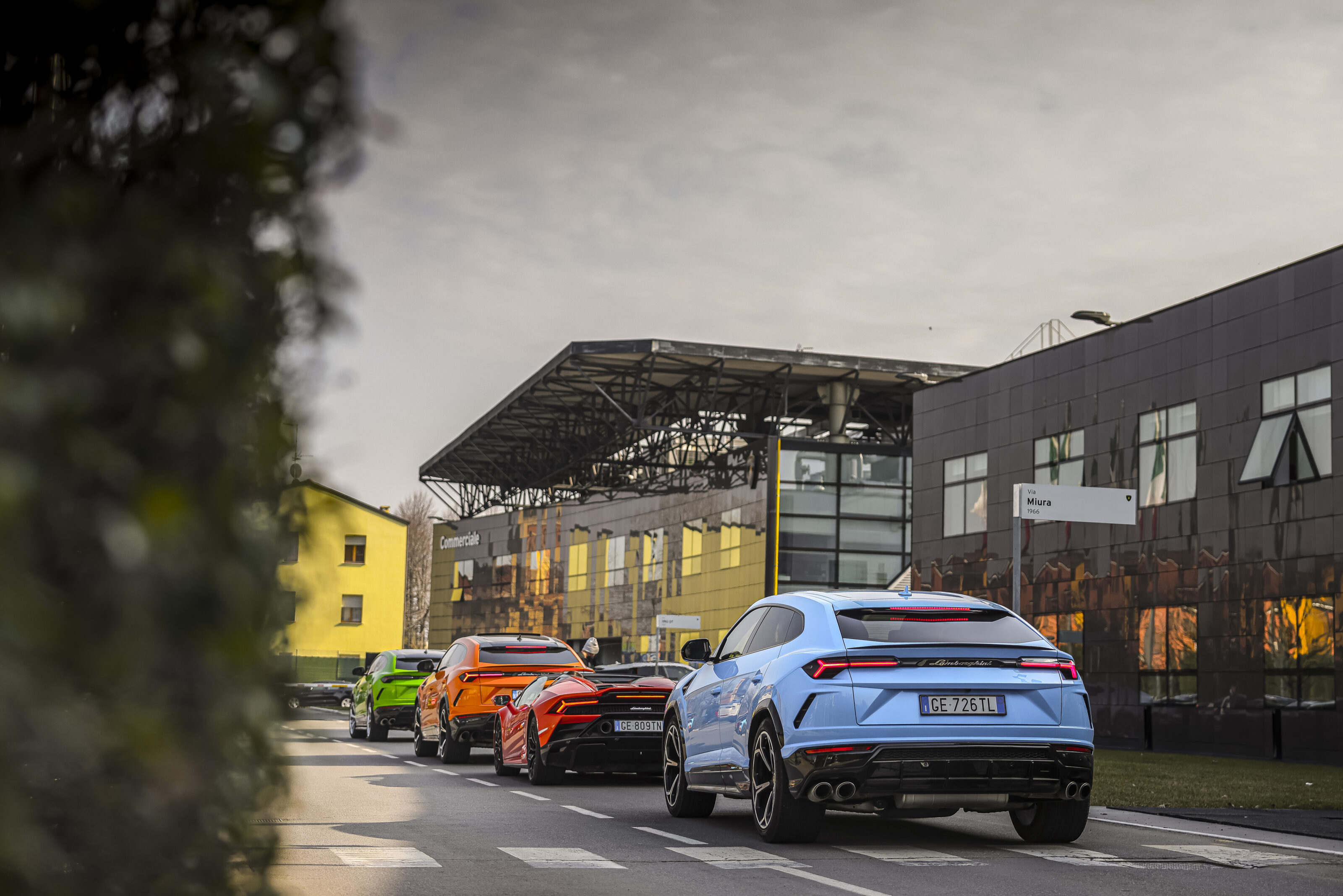
The Urus was the soft option of the group, and one I was perfectly happy to take given that most of the run to lunch at the Forte di Bard in the Aosta Valley would be on autostrada, where its relative quiet and comfort would prove its worth. But it speaks volumes about the Lamborghini brand that its soft option is an SUV that packs 478kW and will sprint from 0-100km/h in 3.2 seconds on the way to its 305km/h top speed.
The Urus was unflustered by the heavy traffic in Bologna and around Milan, and, once past the speed cameras, devoured the lightly trafficked E25 that heads up the Aosta Valley to, ultimately, the Mont Blanc Tunnel and France. It might look like an SUV, but the Urus is Lamborghini’s 21st Century gran turismo, composed and confident and fast on all roads in all weather.
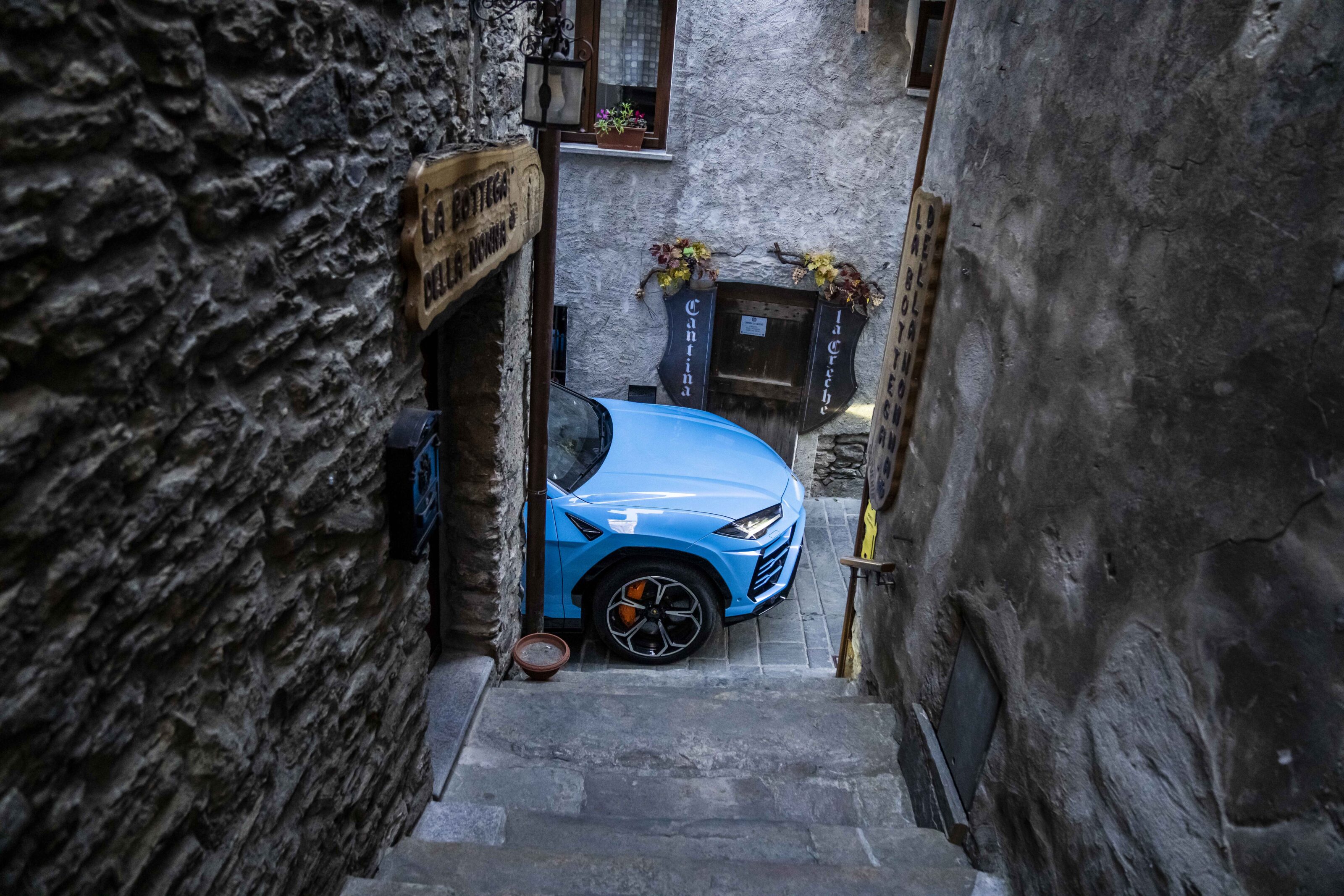
Well, almost all roads. The big Urus barely squeezed between the houses clustered in the shadow of the Forte di Bard and required backing-and-filling to get around some of the tighter hairpin turns on the serpentine one-lane road leading up to the hulking castle that dominates this part of the Aosta Valley.
After lunch, it was out of the Urus and into a Huracán Evo Spyder. Finished in matte blue paint with white leather interior and bronze wheels, this Lambo looked like it would do its best work cruising down to grab a latte in Double Bay on a sunny Sydney Sunday morning. But in Corsa mode on these Italian mountain roads, the 470kW naturally aspirated V10 responded to the throttle with a bombastic bellow that echoed off the rock walls and reverberated around the open cockpit, punching the Evo Spyder hard out of the corners as we twisted and turned, climbing higher, ever higher, among the peaks.
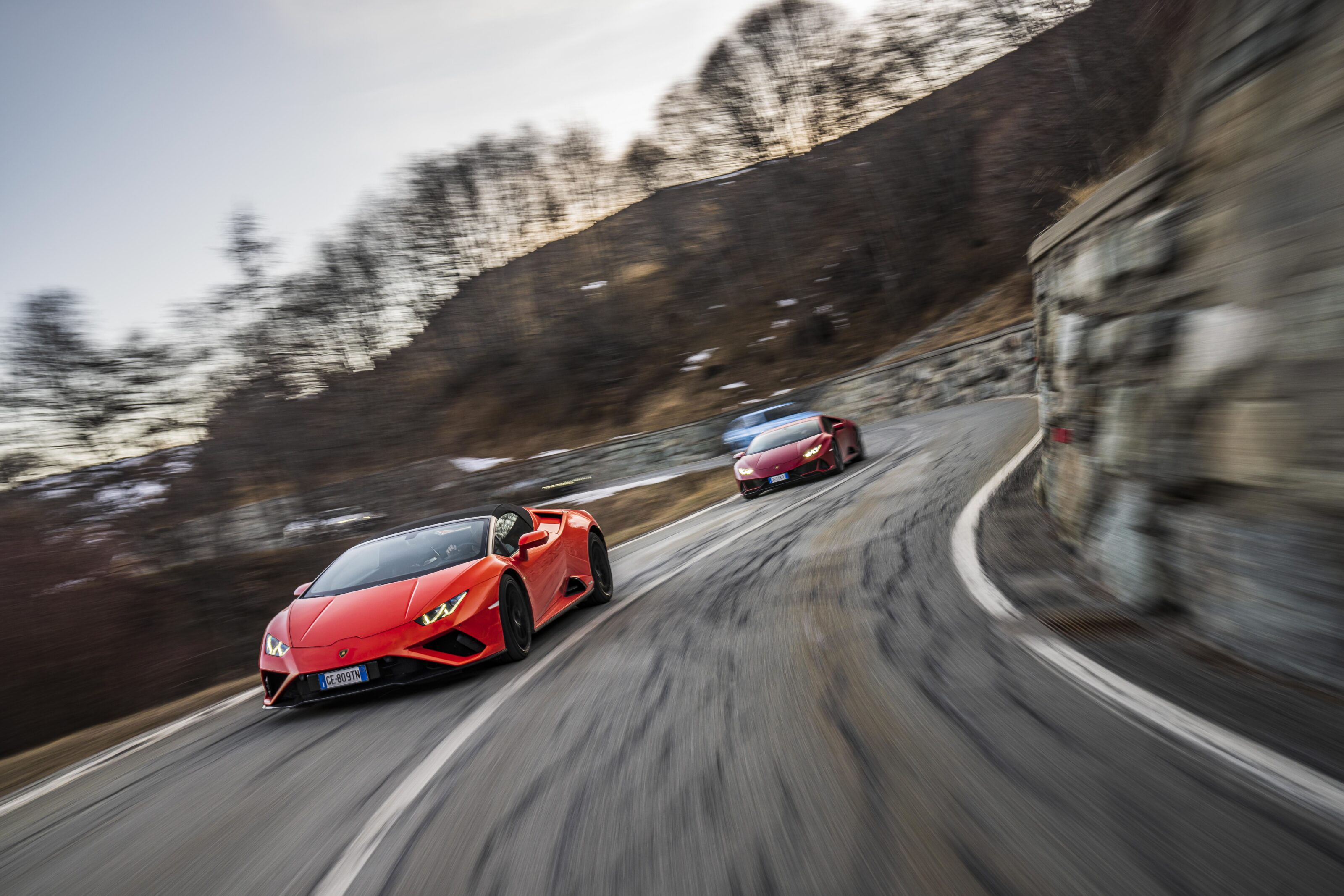
The Huracán has grown up; this Evo Spyder felt a more coherent, more mature car than the early Huracáns I’ve driven. It’s still brash, loud and omigod fast, but the meaty steering offers good feedback, and the ride is surprisingly composed over the patches and frost heaves. The brakes feel indestructible. It’s a more muscular, more deliberate car to drive than a Ferrari, particularly the new 296GTB, which has more delicate layers to its dynamic capabilities.
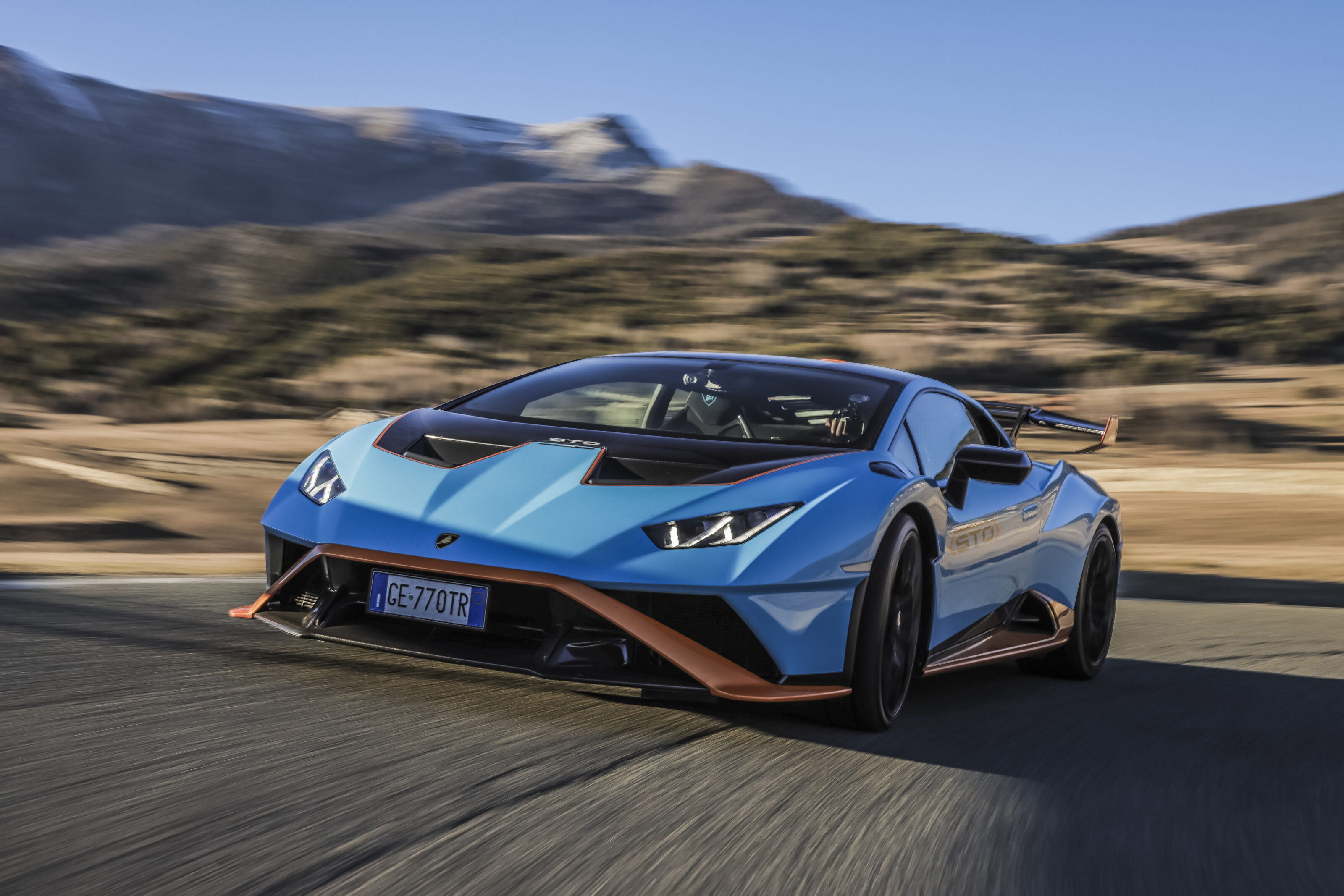
Now it’s time for the Huracán STO, Lamborghini’s equivalent to a Porsche 911 GT3 RS.
It’ll set you back around $570,000, the STO, and while you’re spending more than you’ll spend on a regular Huracán, that extra money buys you less. Less weight, that is. The rear-wheel drive STO tips the scales at 1339kg, making it 43kg lighter than the Huracán Performante. Weight-saving measures include the adoption of magnesium wheels, carbonfibre reinforced plastic body panels, and a single-piece carbonfibre clamshell bonnet.
The STO doesn’t get the active aerodynamics used on the Performante because it’s a homologation special for Lamborghini’s Super Trofeo race car and active aero is banned
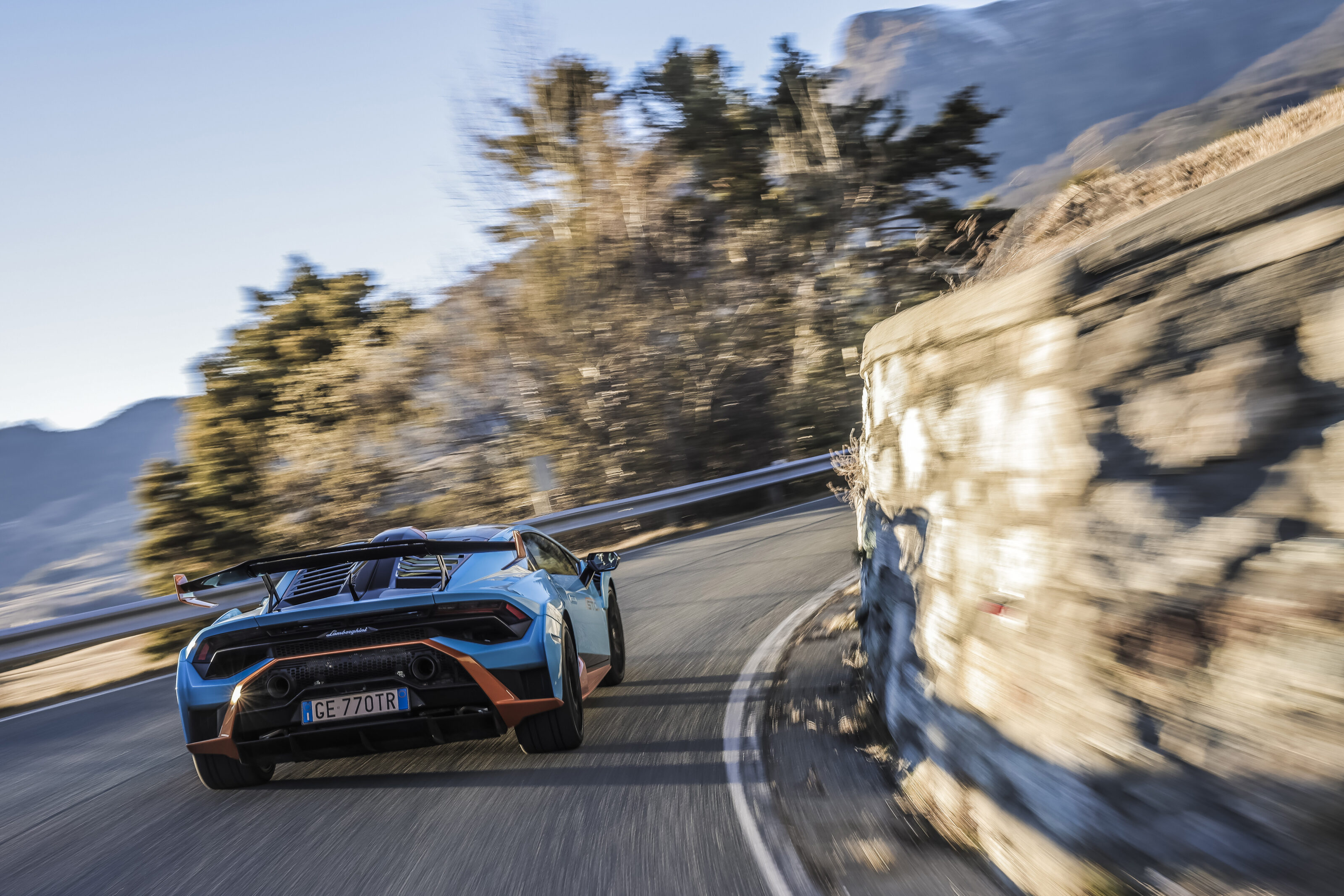
The 5.2-litre V10 makes the same 470kW and 565Nm as in the AWD Performante and Huracán Evo models, and though lighter, the STO is 10km/h slower overall than the slightly less powerful RWD Evo, topping out at 310km/h.
That’s because this Huracán has been optimised for corner response and roadholding rather than straight-line speed. The track has been widened, the suspension bushings are stiffer, and it has STO-specific stabiliser bars and magneto-rheological dampers. Its standard brake set-up is Brembo’s mid-level CCM-R carbon-ceramic brake system, similar to that used on the McLaren Senna. The STO has rear-wheel steering and the mechanical locking diff pre-loads on corner entry to deliver side-to-side torque vectoring. The front wheels are steered by way of a quicker fixed ratio rack.
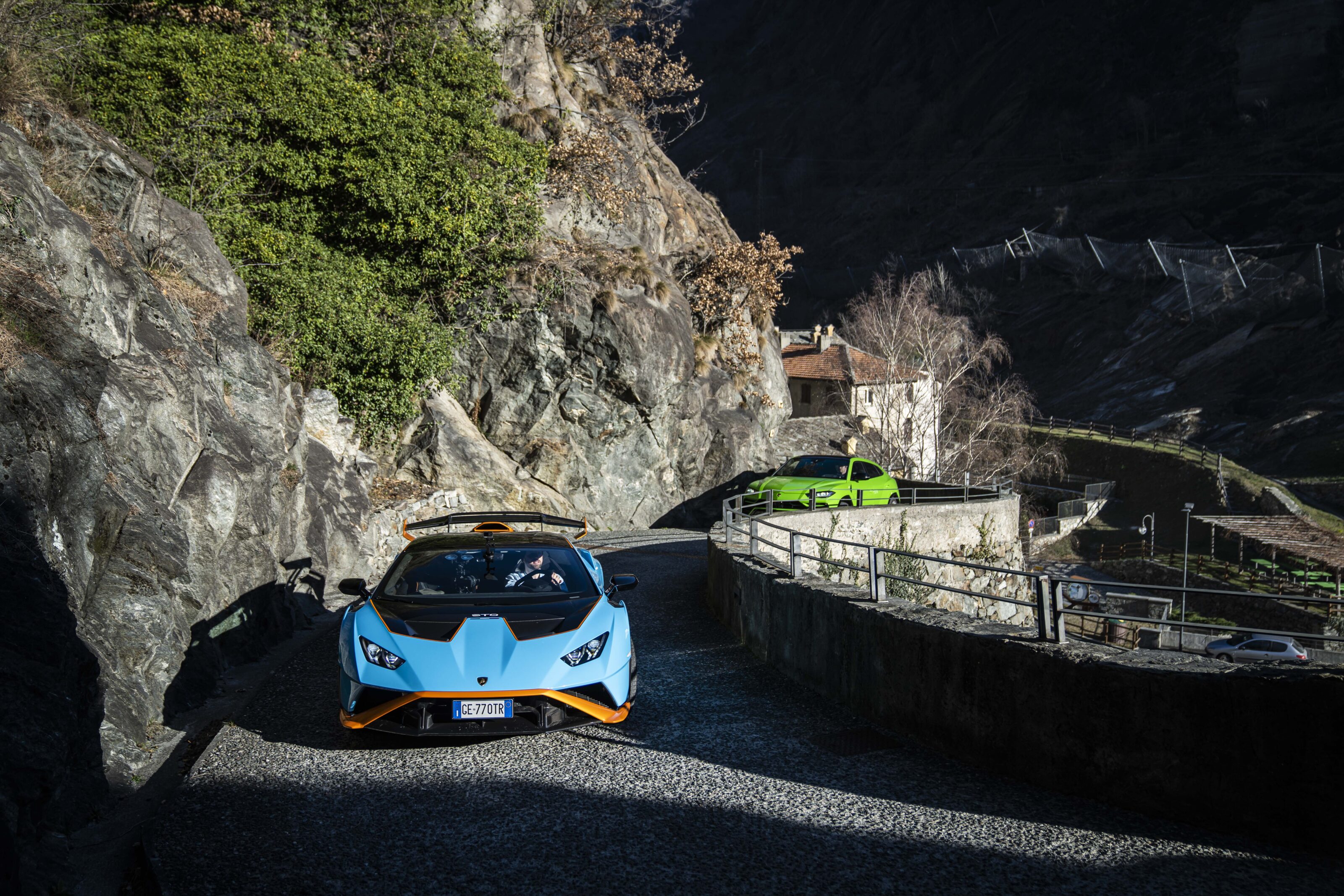
The trick aero package – in addition to that giant rear wing the STO boasts new front bumper air inlets, louvres on the front guards to reduce drag, a new underbody panel, and new rear guards with NACA ducting – helps generate 450kg of downforce at 280km/h. The STO doesn’t get the ALA active aerodynamics system used on the Performante because it’s positioned as a homologation special for Lamborghini’s Super Trofeo race car – STO stands for Super Trofeo Omologato – and active aero is banned in that category.
I’ve driven both the Super Trofeo Evo and GT3 Evo race car versions of the Huracán that inspired the STO, and I can detect their DNA deep in its bones within the first couple of kilometres.
The STO is alive, eager on these occasionally rough mountain roads. But I can feel every nuance through my fingers and toes, as if I’m hard-wired to the chassis
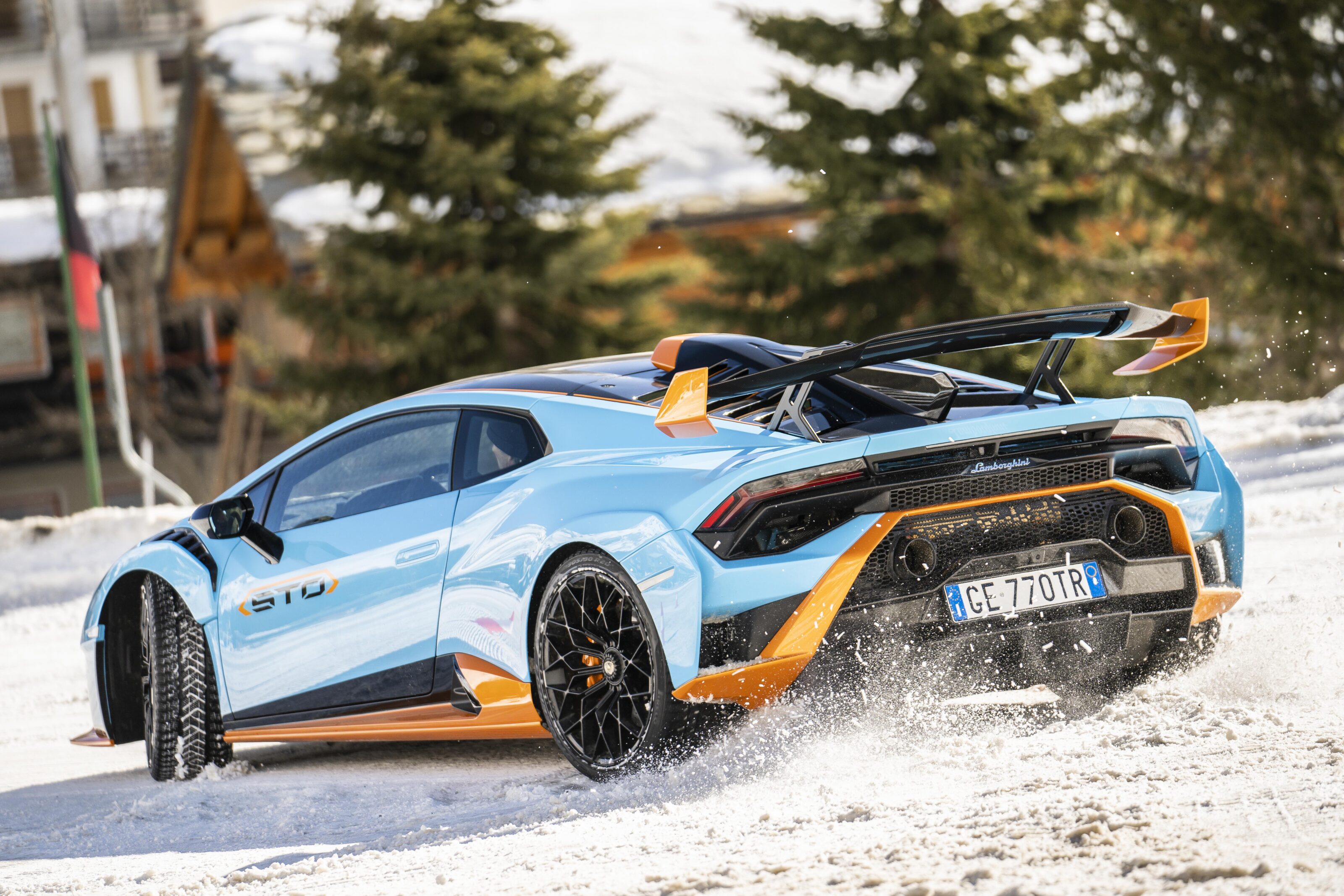
There’s a precision to the front end and a vividness to its transient responses that makes the STO feel like it’s just one step removed from being on the grid for the Bathurst 12-Hour. It moves around under brakes, and under acceleration, too, but the softer tread blocks of the winter-spec Pirellis are only part of the reason why: The STO is alive, eager, relentlessly restless on these occasionally rough mountain roads. But I can feel every nuance through my fingers and toes and bum, as if I’m hard-wired to the chassis.
That mighty V10, bellicose and belligerent, scarcely draws breath on the upshifts and barks and crackles on the downshifts. There are three drive modes: STO, Trofeo, and Pioggia. STO is the default on-road mode, equivalent to the Performante’s Sport setting. Trofeo is dry race mode, and Pioggia is wet race mode. It gets darker and colder as the road climbs, and I’m wary of ice in the occasional wet patches. Discretion, I decide, is the better part of valour, and I switch out of Trofeo back into STO mode.
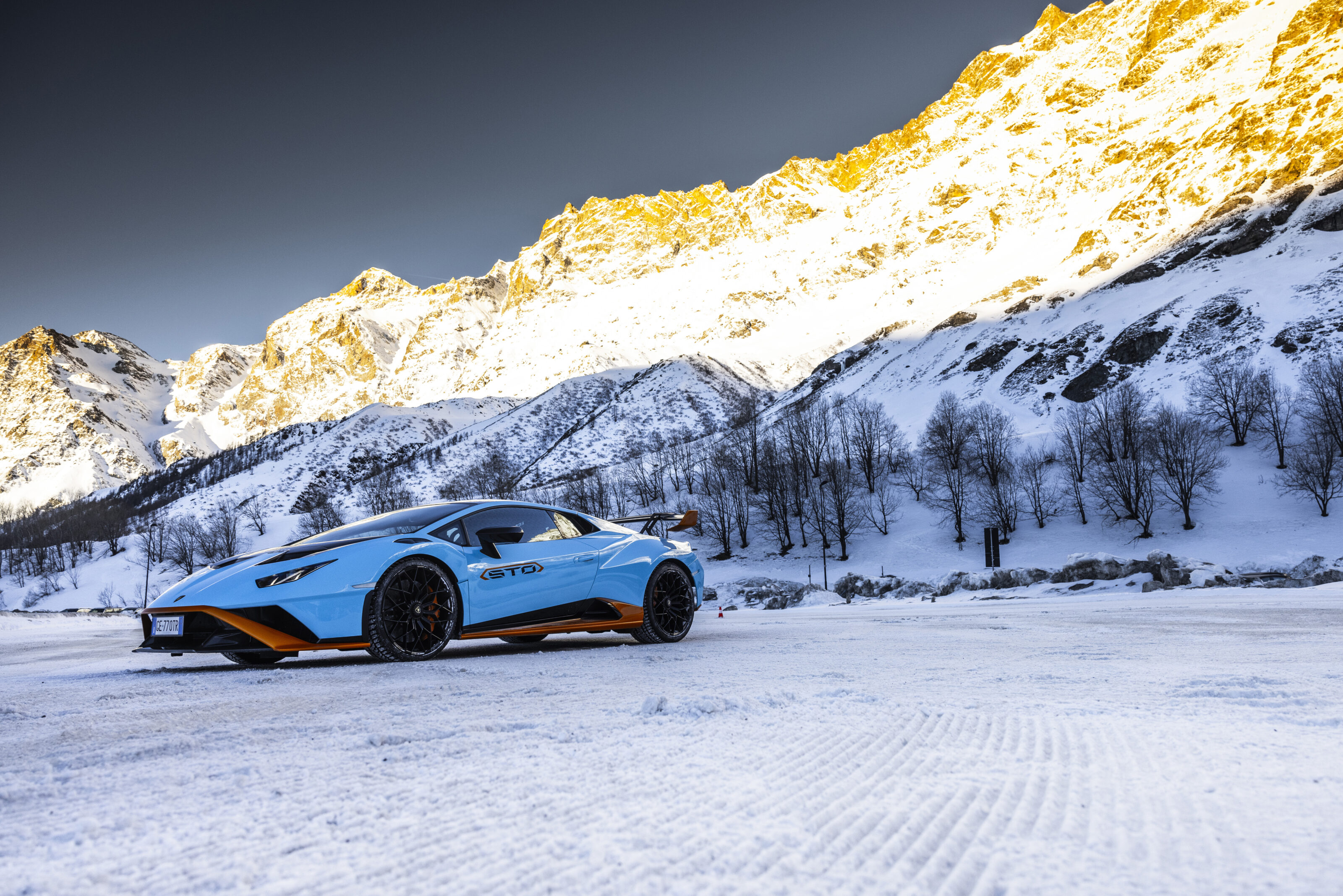
The high beam/low beam switch on the steering wheel has proven next to useless and the headlights really need to be better for a car with this level of performance. But I’m smiling as I pull into the Grand Hotel Cervino; it’s been a raw, intense, intoxicating drive and I can forgive the Huracán STO such silly flaws.
I’m smiling as I pull into the Grand Hotel Cervino; it’s been a raw, intense, intoxicating drive and I can forgive the Huracán STO such silly flaws
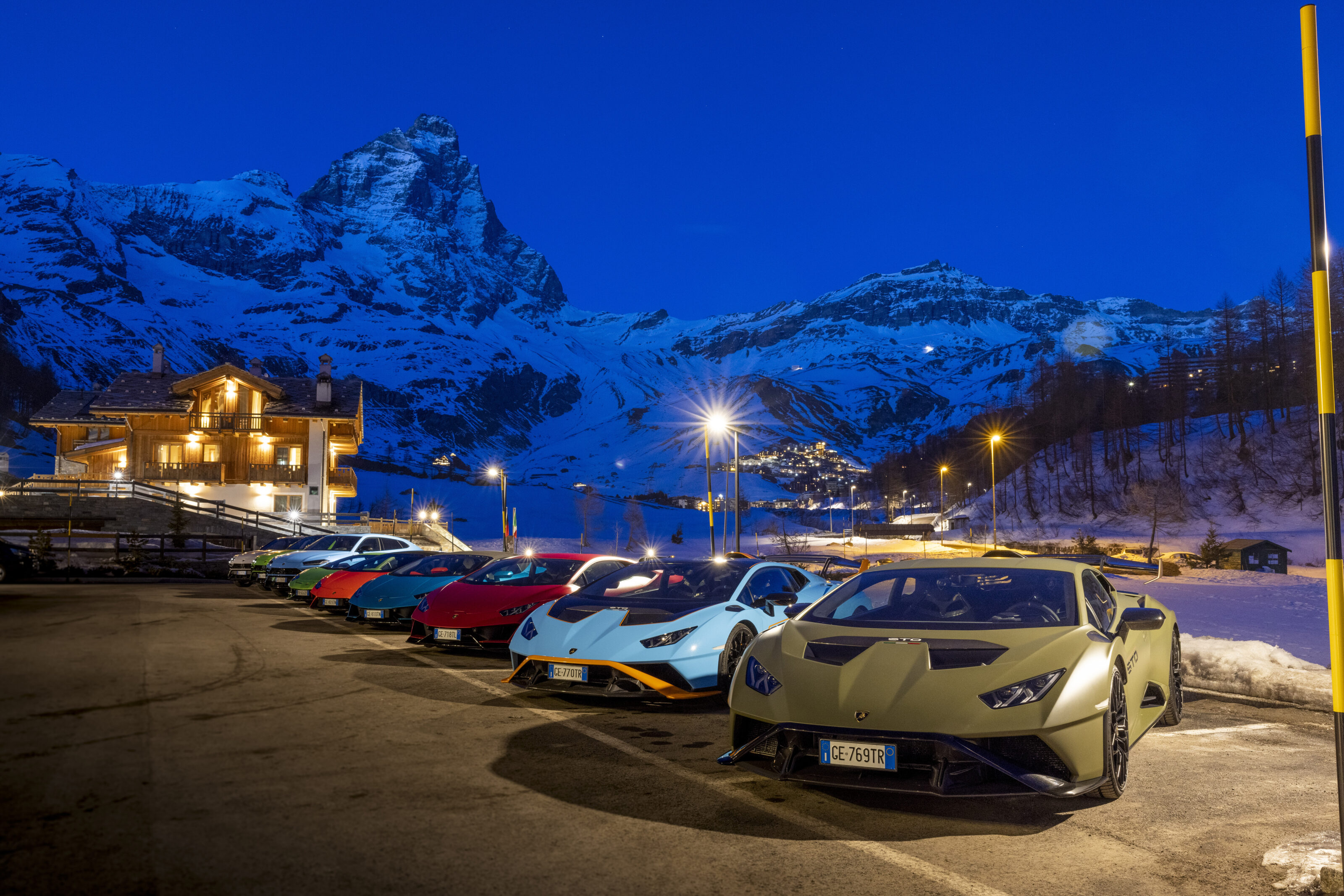
The original plan had been to take part in Lamborghini’s Accademia Neve at Livigno, 400km to the east of here, but the pandemic put paid to that. Instead, tomorrow I’ll get to spend some time skidding an all-wheel drive Evo coupe and the STO around a snowy car park on the outskirts of Cervinia. It will prove entertaining for about two minutes, both Lamborghinis sliding around at little more than walking pace like curling stones on an ice rink.
The Accademia Neve program involves a proper track, speed and studded tyres. It sounds like serious fun. Especially in a Lamborghini Huracán STO.
Next year, maybe…
Taking a tour through some incredible old ‘coulda been mine’ classifieds listings. Originally published at our sister site, Unique Cars.
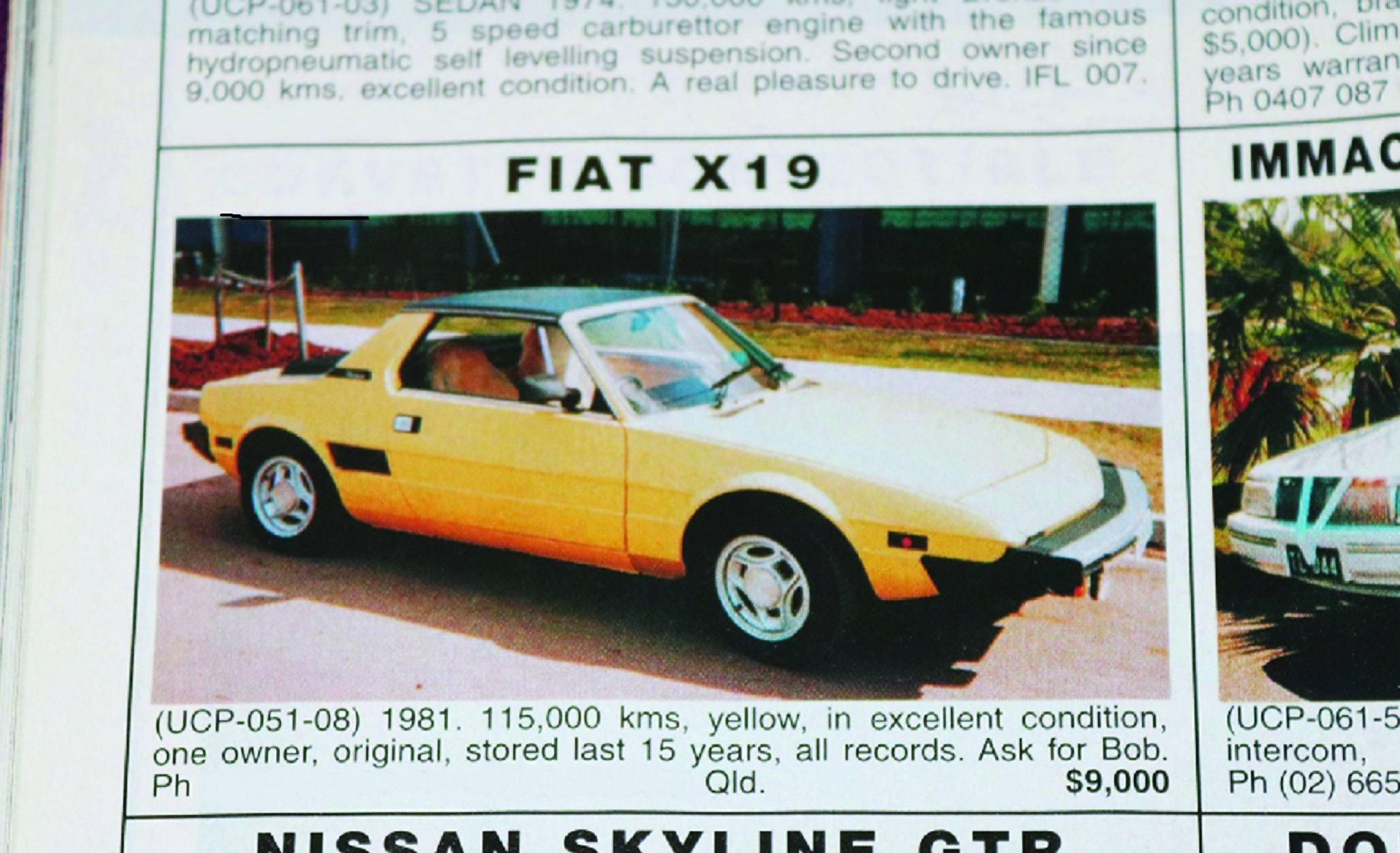
Fiat X1/9 – Advertised June 2001
Some cars charm buyers out of the treetops and appreciate wildly while equally worthy designs can’t even keep pace with inflation. The energetic X1/9 Fiat sadly falls into the latter category. With a body by Bertone, 1.5 litres, four discs and a five-speed, Series 2 versions look good and get along quite nicely while remaining among the least expensive sports cars of their era.
Yes, Fiats rust but so do Alfas and Lancias and their appeal doesn’t seem to be suffering as a consequence. We can only assume that the Fiat is awaiting its time in the spotlight and values one day will ignite.
Then: $9000. Now: $16,000-18,000
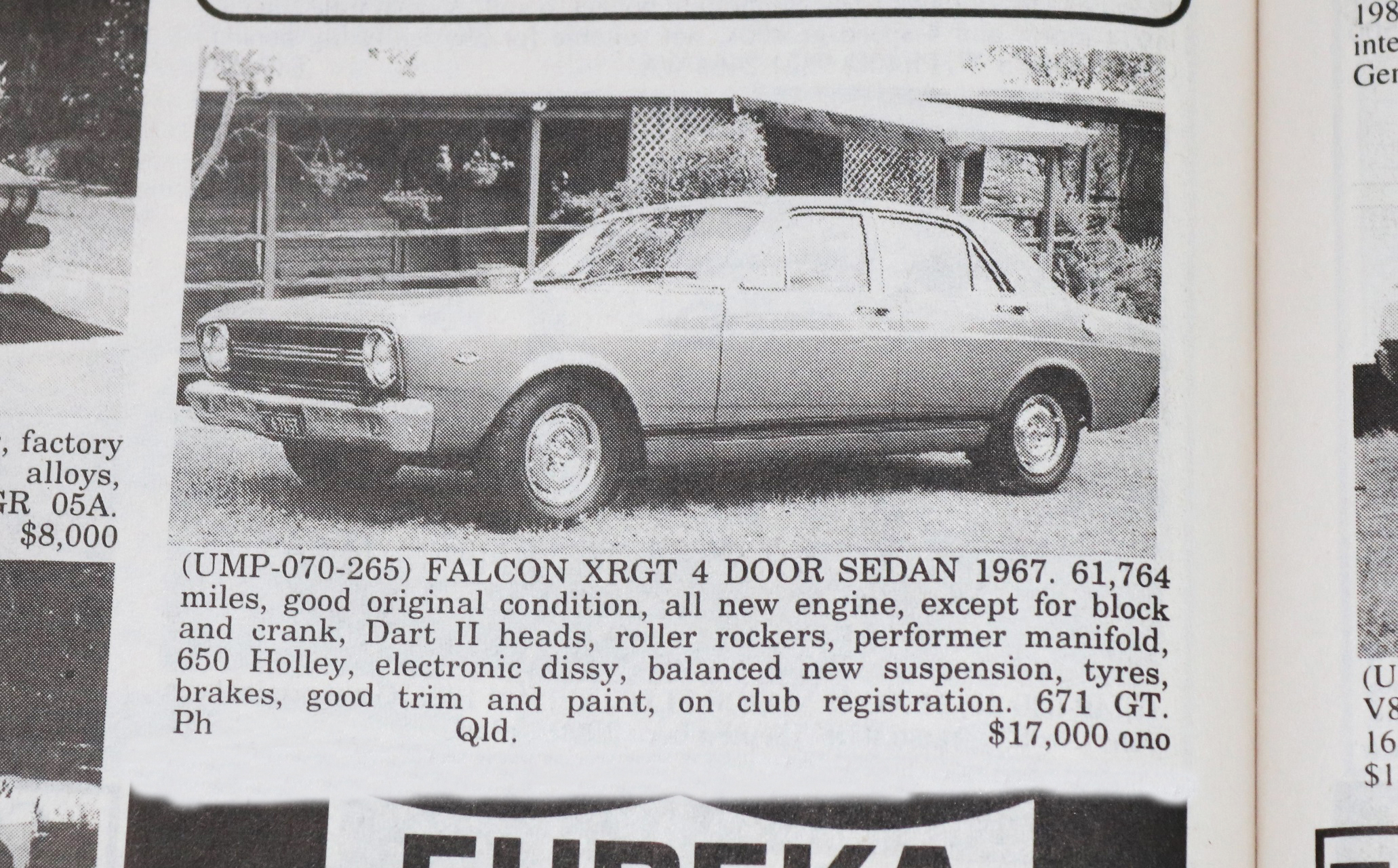
Ford Falcon XR GT – Advertised August 2000
As did happen to GTs back in the day, this Old Gold XR has been messed with beneath the bonnet but retains the external embellishments that made these a traffic stopper when new. Unless you count the GT500 Cortina, Australia prior to 1967 never had a genuine road-going racer but Ford with this car made up for lost time in one swoop.
Fewer than 600 were built but for years they were ignored by people who preferred later GTs with 351 engines and more muscular looks. That changed about 15 years ago, with prices surging and despite authenticity issues this car should still make $100k.
Then: $17,000. Now: $95,000-110,000
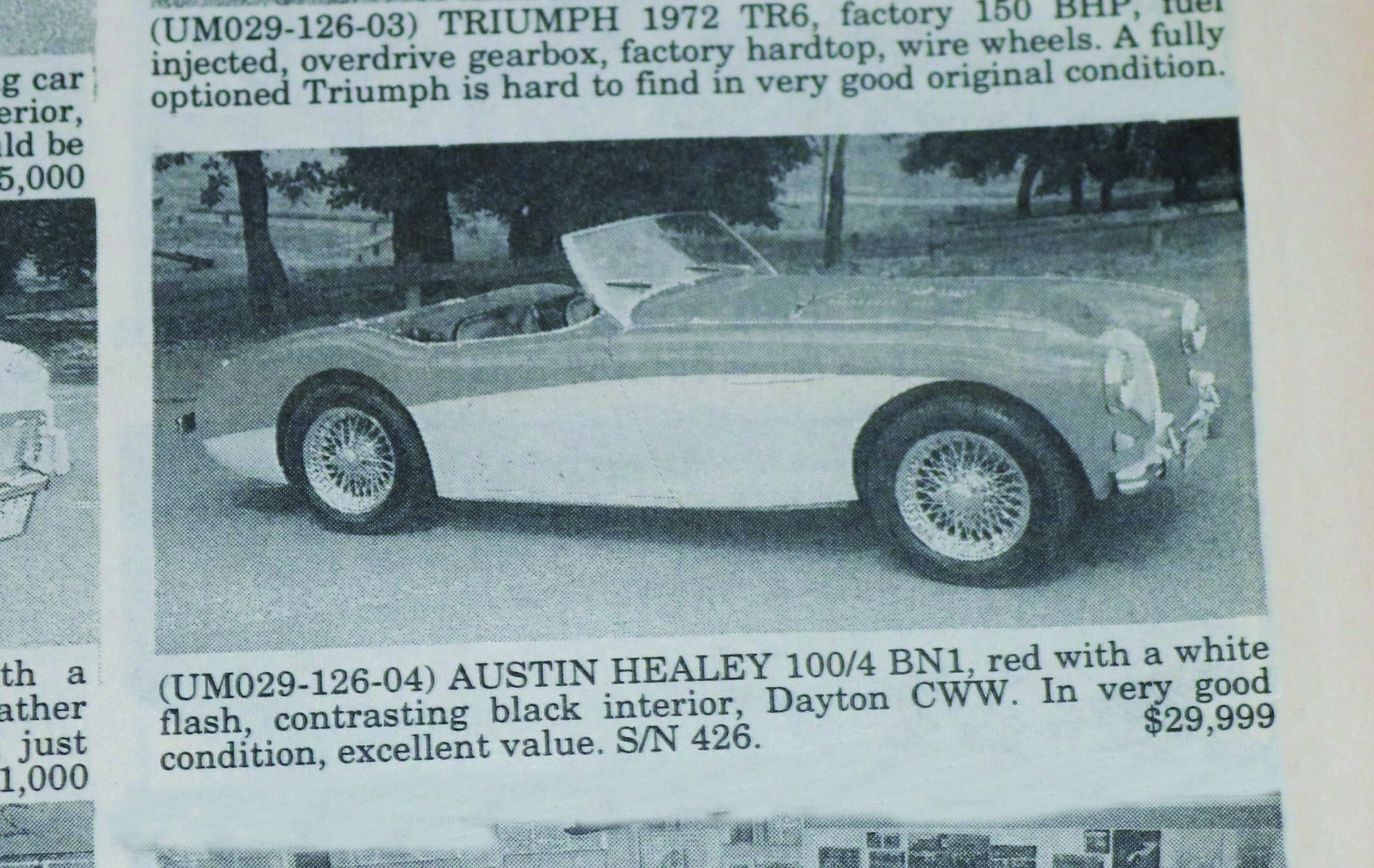
Austin-Healey 100/4 – Advertised December 1996
Christmas-time 25 years ago would have seen a few Unique Cars readers tempted to put this Santa-spec (red over white) Healey into the stocking. $30k was at the time fair money for a decent but not exceptional 100/4 and this car shouldn’t have struggled to find a buyer.
Fast forward to Christmas just gone and the same car might have been back in the market and tempting a new generation of cashed-up empty nesters. This time though, with Big Healeys of all kinds in hot demand and buyers on the hunt for good 100/4s, the price will more likely be $99,999.
Then: $29,999. Now: $90,000-100,000
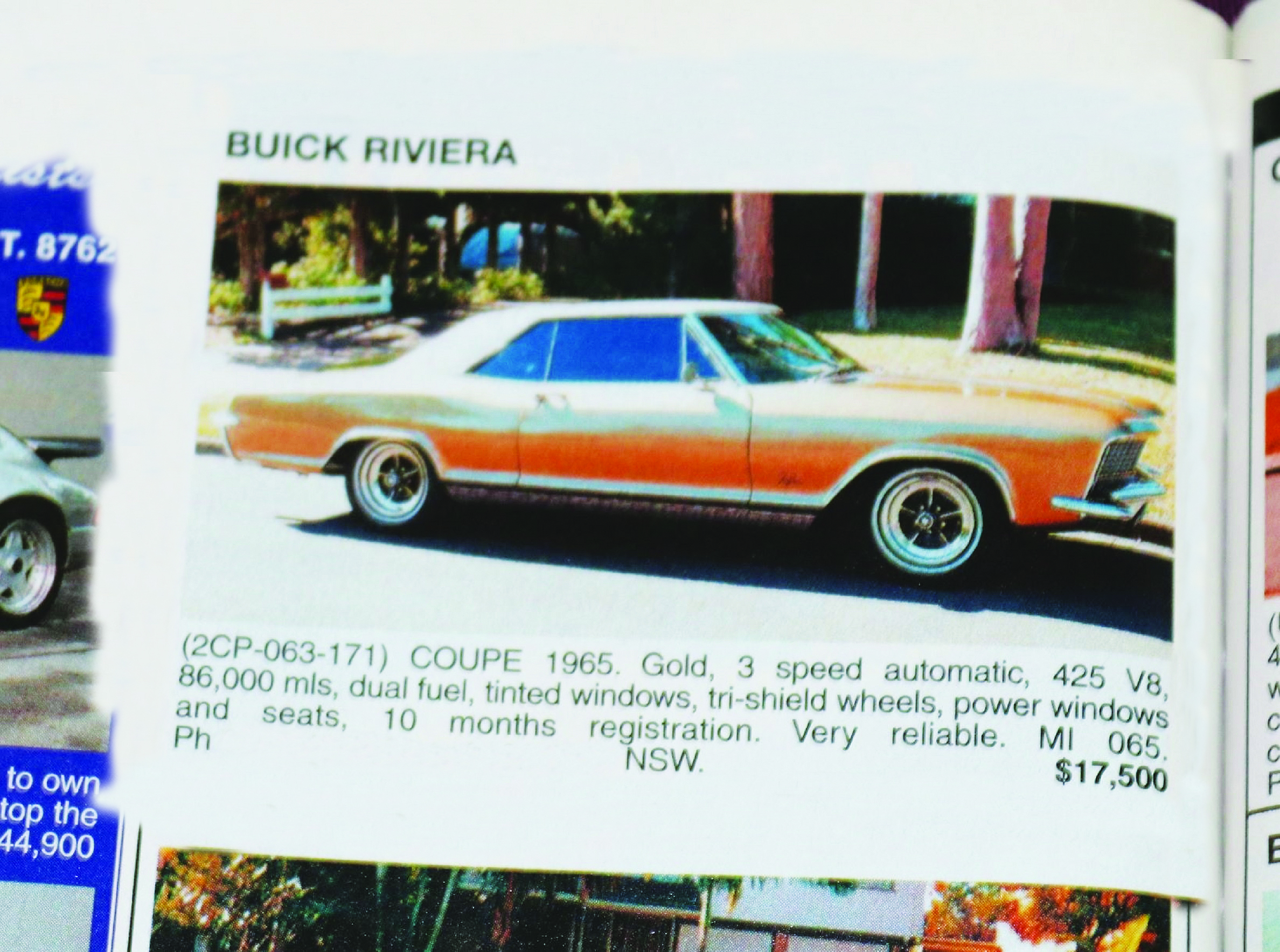
Buick Riviera – Advertised July 2003
As an impressionable 11-year-old I managed to score a whirl around the block in the passenger seat of a LHD Riviera and have never forgotten the experience. ‘My’ Riv was a personal import and not required to be RHD, however a lot did arrive via big-city Holden dealers to be locally converted and sold with new car warranty.
Whether this one is a survivor from those times, or a more recent import is impossible to say, but it looks excellent and should have survived the years since 2003. Had you paid $17k for it back then, the ledger would by now be looking very healthy.
Then: $17,500. Now: $50,000-55,000
From Unique Cars #463, March 2022
Originally published at our sister site, Unique Cars
One of the largest collections of Indy 500 pace cars is up for sale in the United States, only a few weeks before the Greatest Spectacle in Racing gets underway.
In the lead up to this year’s Indianapolis 500, Mecum Auctions has listed the Dr Richard Foster Corvette Pace Car Collection, consisting of 18 Chevrolet Corvettes which are either replicas or genuine race-used pace cars from the iconic race.
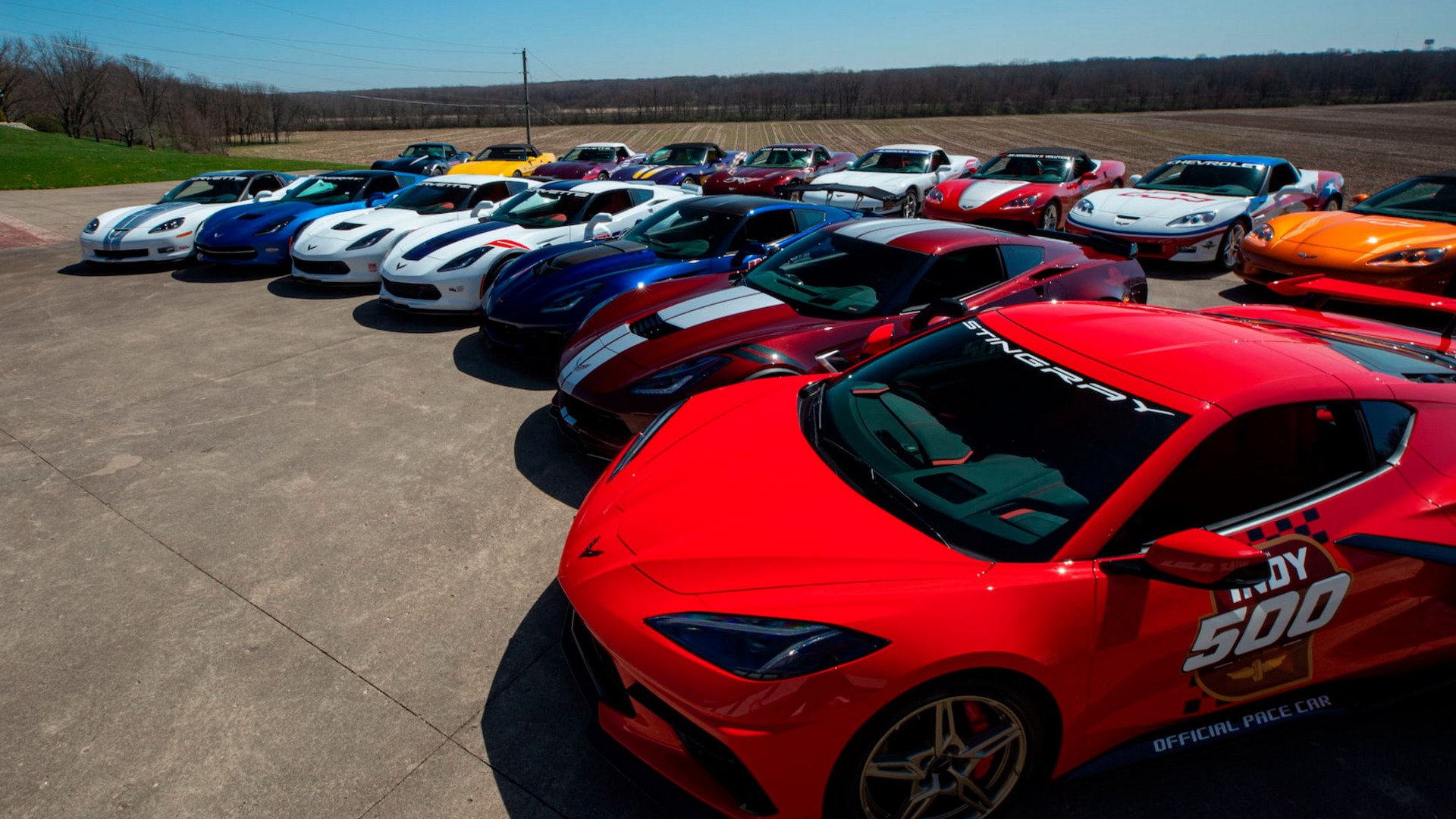
Spanning from 1978 (Corvette C3) to 2022 (Corvette C8), there are just two vehicles in the collection which were a part of the Indy 500, with the 2005 and 2006 Corvettes being the first two of the C6 generation to be a part of the official race fleet.
Of the remaining 16 vehicles, eight have been authorised by the Indianapolis Motor Speedway as replicas of the genuine pace cars from their respective years, while six are offical Corvette Pace Car Editions – sold through Chevrolet at the time.
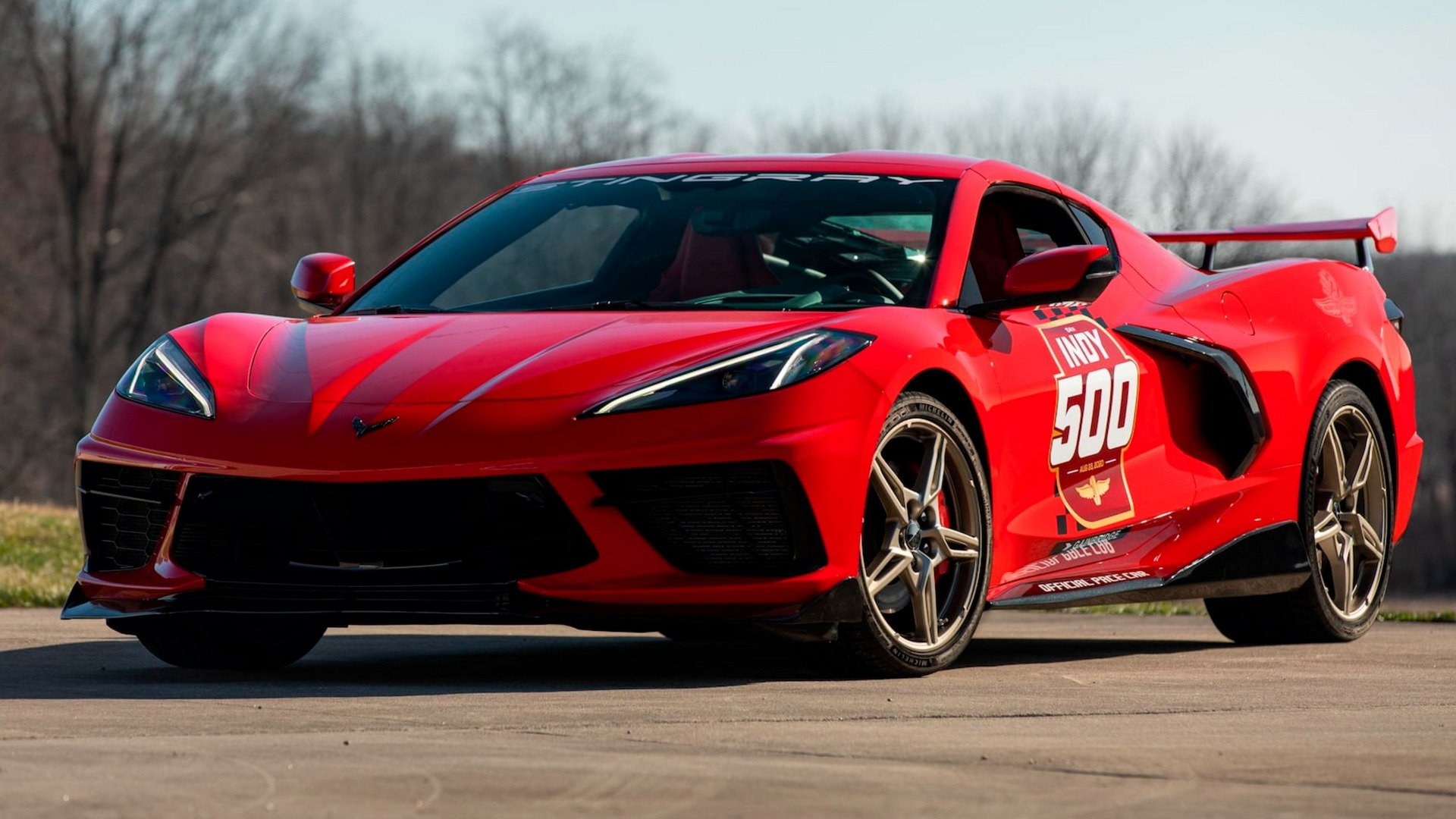
One of those eight IMS-authorised cars is a 2022 Corvette C8, which is yet to be completed by the Bowling Green, Kentucky plant – although the seller says it will be shipped to the winning bidder upon completion of its production and conversion to pace car spec.
Chevrolet has had an exclusive run as pace car supplier to the Indy 500 since 2002, with General Motors’ tenure stretching back to 1997, as the last non-GM product to lead the field to the green flag was a Dodge Viper in 1996.
This year’s Indy 500 will take place in the early hours of May 30 (AEST), with streaming platform Stan providing NBC’s coverage of the 500-mile Indycar race.
