
Glebe, where I live in Sydney’s Inner West, is not the Outback. The challenges involved in negotiating between the terraces on Glebe’s narrow streets could not be further from the abilities demanded in off-road driving. Yet, a couple of weeks ago, two neighbours choose to buy new dual cab 4×4 utes. Independently, both decided on BT-50 Mazdas.
I’ll admit to utter confusion by their decisions. In a market in which the two best sellers are the Toyota Hilux and Ford Ranger, I guess I should not be surprised. Horrified is more accurate. One of the 2.2-tonne, 5470mm-long BT-50s replaces a Honda Odyssey MPV, the other a Subaru Liberty wagon.
Don’t think I’m arguing against dual-cab utes. For working tradies, they are the rational choice. But as replacement for family cars that perform duties on the school run or to the local shopping centre? I think not. I’m offended by their urban-assault-vehicle, Tonka-toy appearance and suspect that in this class, the demand for a macho look is essential. One even wears a $1150 snorkel, as if river-crossing was an everyday occurrence in the suburbs. I doubt either will ever see serious off-roading.
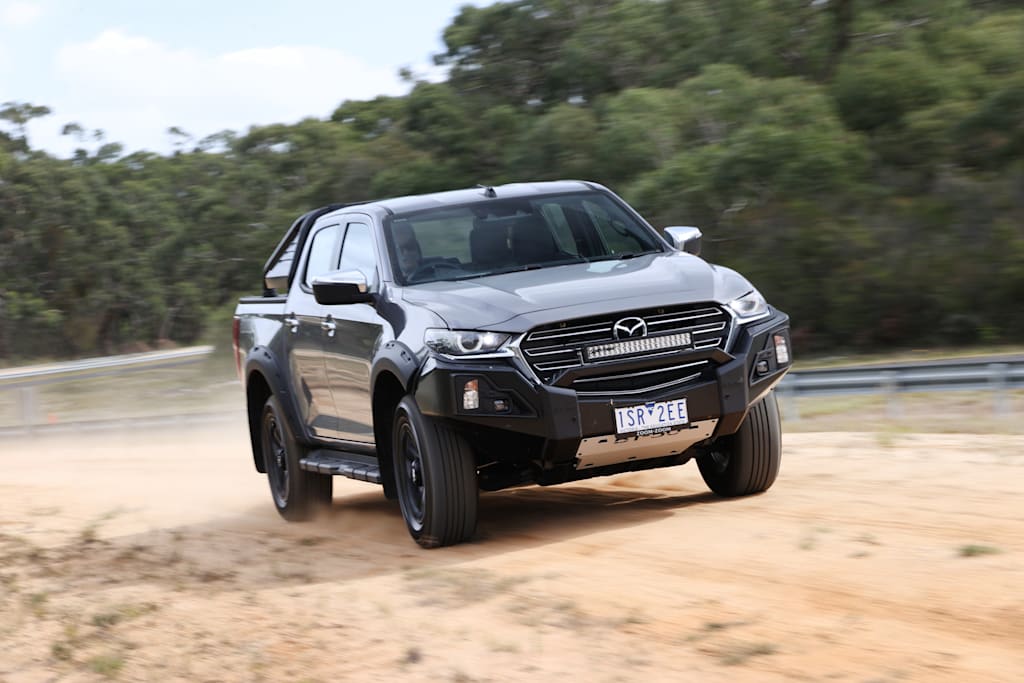
So, why do families buy trucks that use more fuel (8.0L/100km combined average), are truly dirty (207g/km CO2 combined), dynamically vastly inferior, take far longer to stop and are less refined and comfortable – try the back seat for a couple of hours to understand pain – than any contemporary, five-seat passenger cars?
Yes, you can claim a tax a write-off of the running costs on a novated lease. How many corporate-career executives leave the dual-cab ute at home for their partner, while they take the bus? Or they can claim a GST credit of up to $5521 (on a sliding scale for a ute costing up to a $60,733), provided the truck is used for ‘business’ purposes. Can you imagine anyone scamming this scheme? Yes, so can I.
Beyond the financial aspects, it’s obvious that for many Australians, dual cab utes are now trendy, even aspirational, just as their prices continue soar. Add a few options and it’s all-too easy to spend $90K on a dual-cab truck.
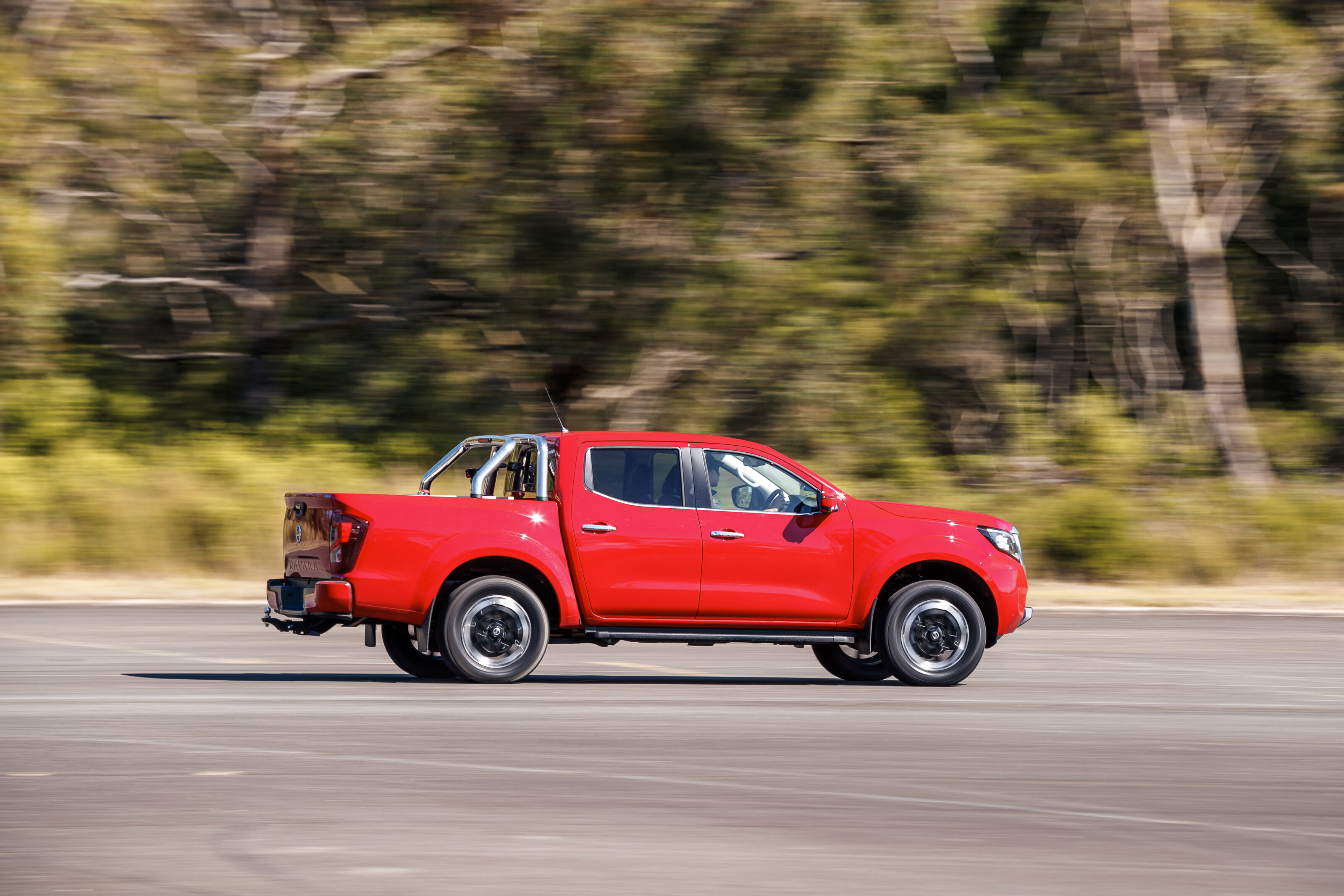
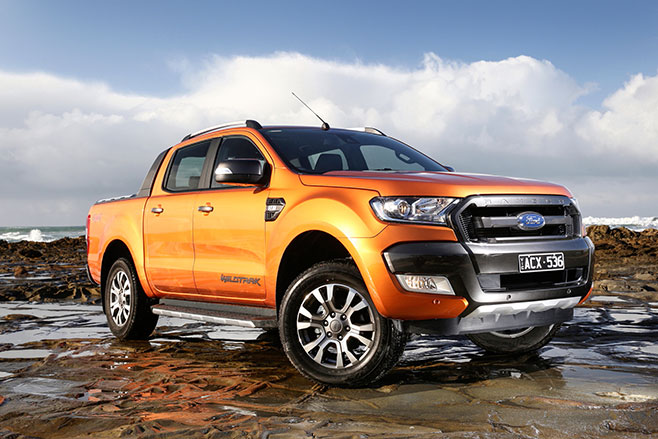
Could one ramification of the end of the local car industry suggest Australians are moving towards more American-style vehicles, rather than European or Asian models, as must-have vehicles? The truck makers must love it, for models like the Ford F-150 in the USA and the Ranger in Australia are bank-rolling their balance sheets.
How much is Ford pocketing on each locally developed, Thai-built Ranger – still the best ute dynamically – that’s now a decade old, when the average transaction price is close to $60K? If the Ford bean-counters told me it was around $10K – and it could be much more – I would not be surprised.
Now, given the inexorable market trend, the question is: which car maker will be first to market with a smaller – say 4.8-5.0m long – monocoque ute, when today’s oversized dual cabs are all ancient body-on-frame trucks? I’m betting the Koreans. Hyundai already has the Santa Cruz, but it’s left-hand drive, and the only rival for Ford’s similar (but also LHD) Maverick.
Longer term, the truck makers must be concerned by the increasingly stringent emission standards being applied by countries and individual cities across the world, many with a starting date of 2030.
From last year, European light-commercials (mostly vans) needed to meet 147g/km. In 2021, none of the dual-cab utes on sale in Australia go close.
If Australia follows suit – and global pressure makes it inevitable – regulations could force a massive shift in buying habits. Anything so that I won’t be forced to see trucks every time I open the front door.
If you looking to purchase the latest and greatest hatchback in 2022, be prepared to go European.
The limited number of small cars launching next year primarily originate from the Volkswagen Group, with light hatch buyers treated to a major update for a crowd favourite and a new-generation version of the Czech underdog.
Timing issues caused by the global semiconductor chip shortage and COVID-19 lockdowns, which plagued the automotive industry in 2021, are set to remain throughout 2022. This means several vehicles on this list are either delayed beyond initial projections, or could be delayed.
NOTE: To see all the new cars coming to Australia this year, check out our 2022 New Car Calendar story right here.
New hatchbacks arriving in 2022
- Audi A3 and S3
- Cupra Born
- Cupra Leon
- Ford Fiesta ST
- Ford Focus ST
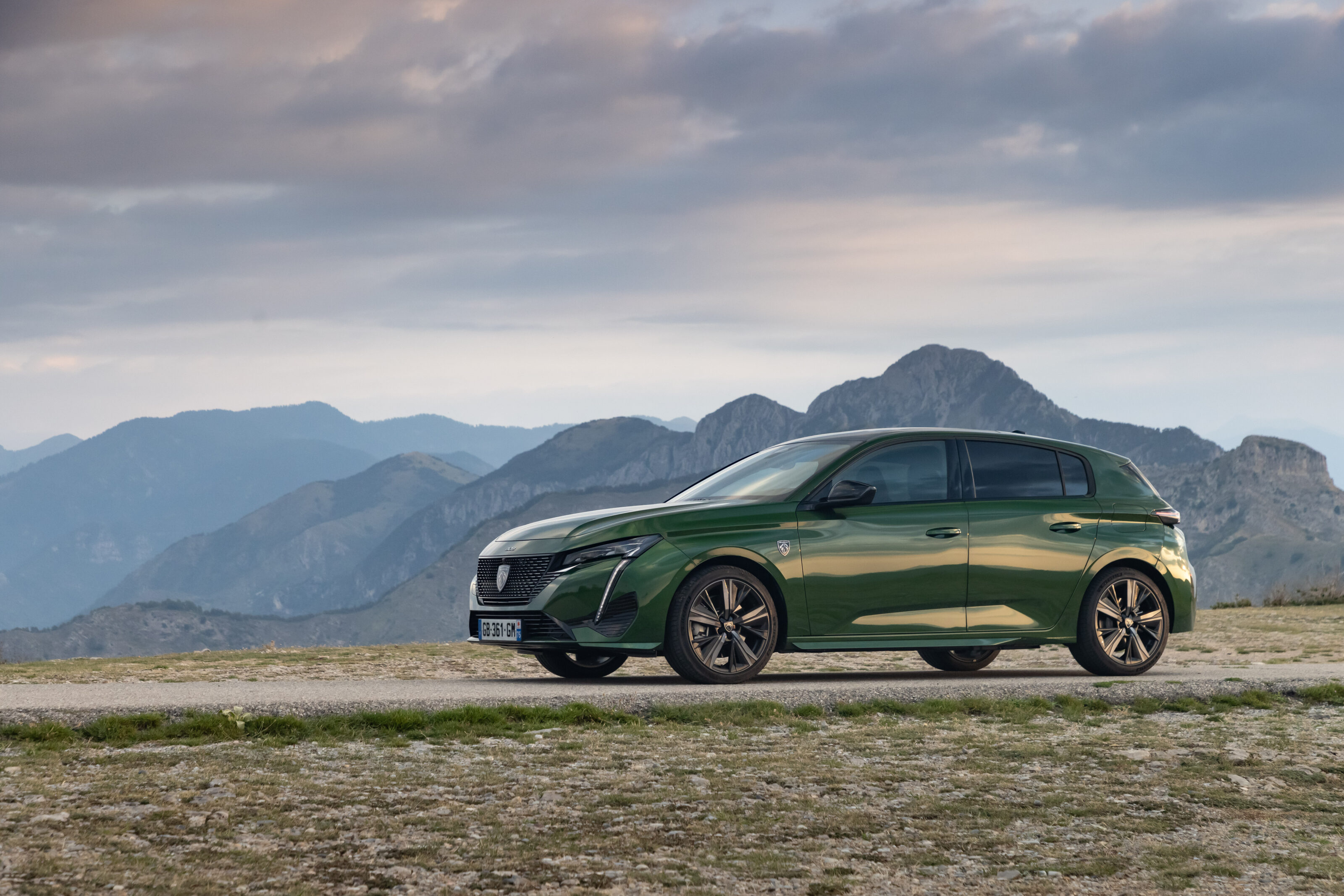
- Peugeot 308
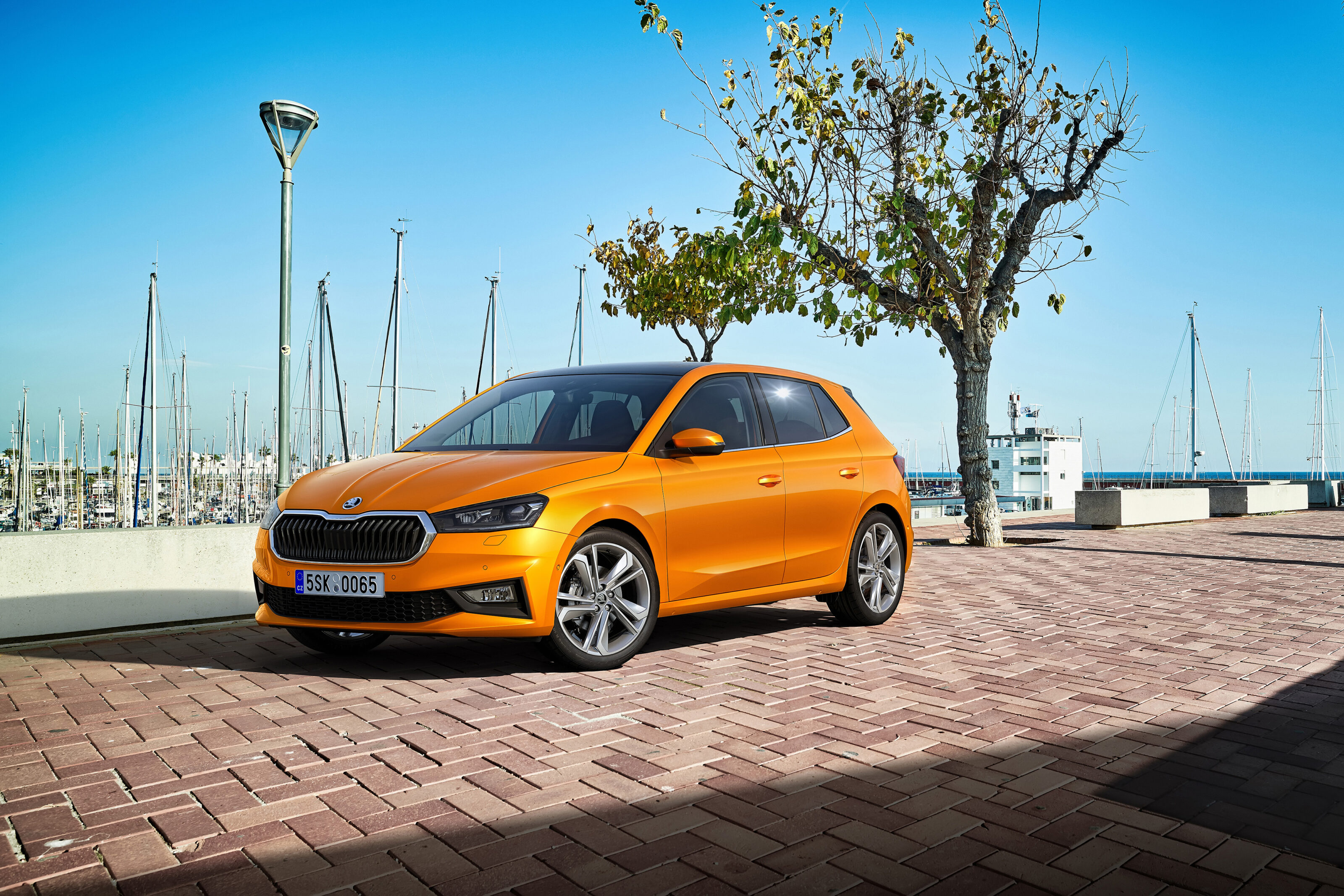
- Skoda Fabia
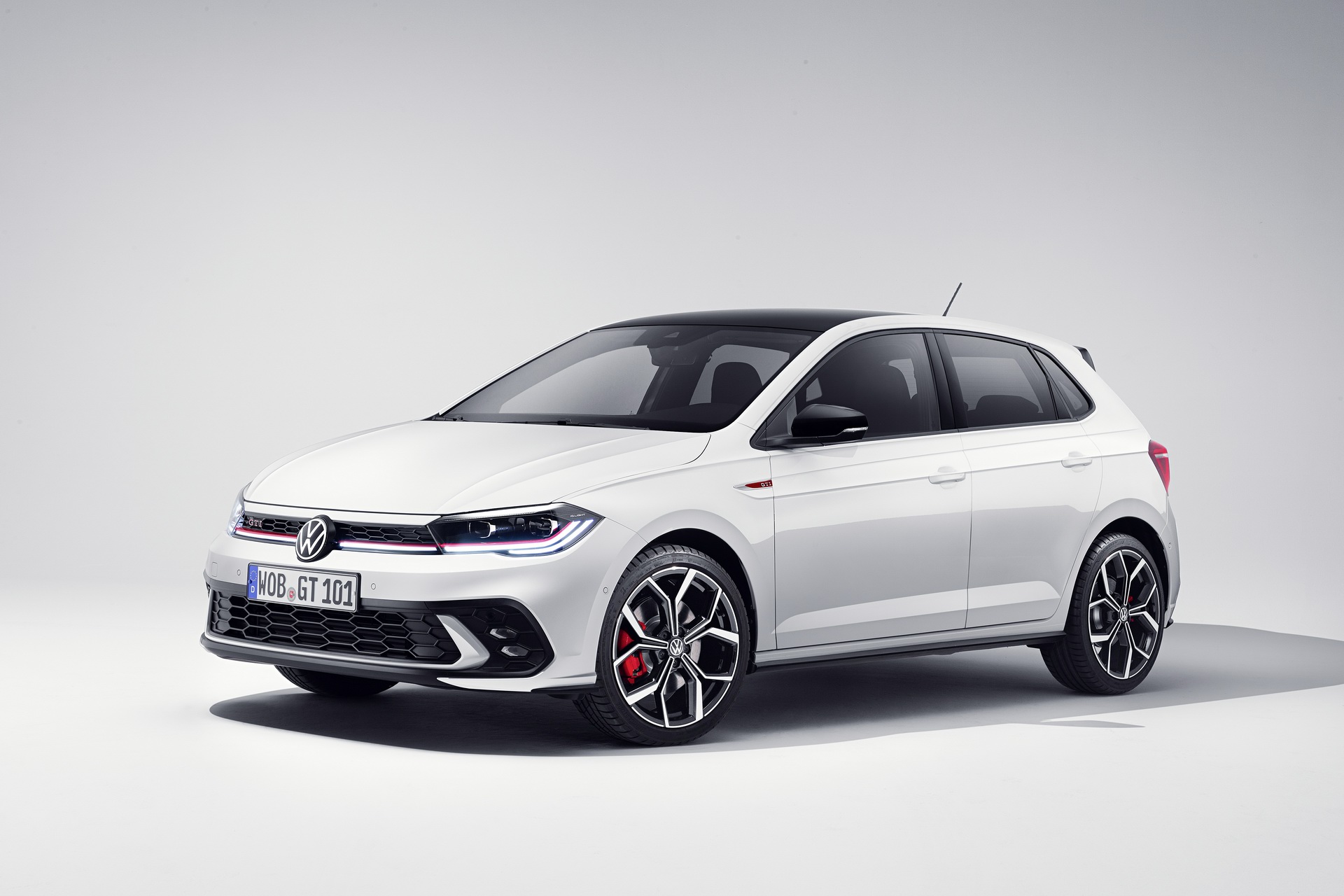
- Volkswagen Polo.
Audi A3 and S3
Arriving: First quarter
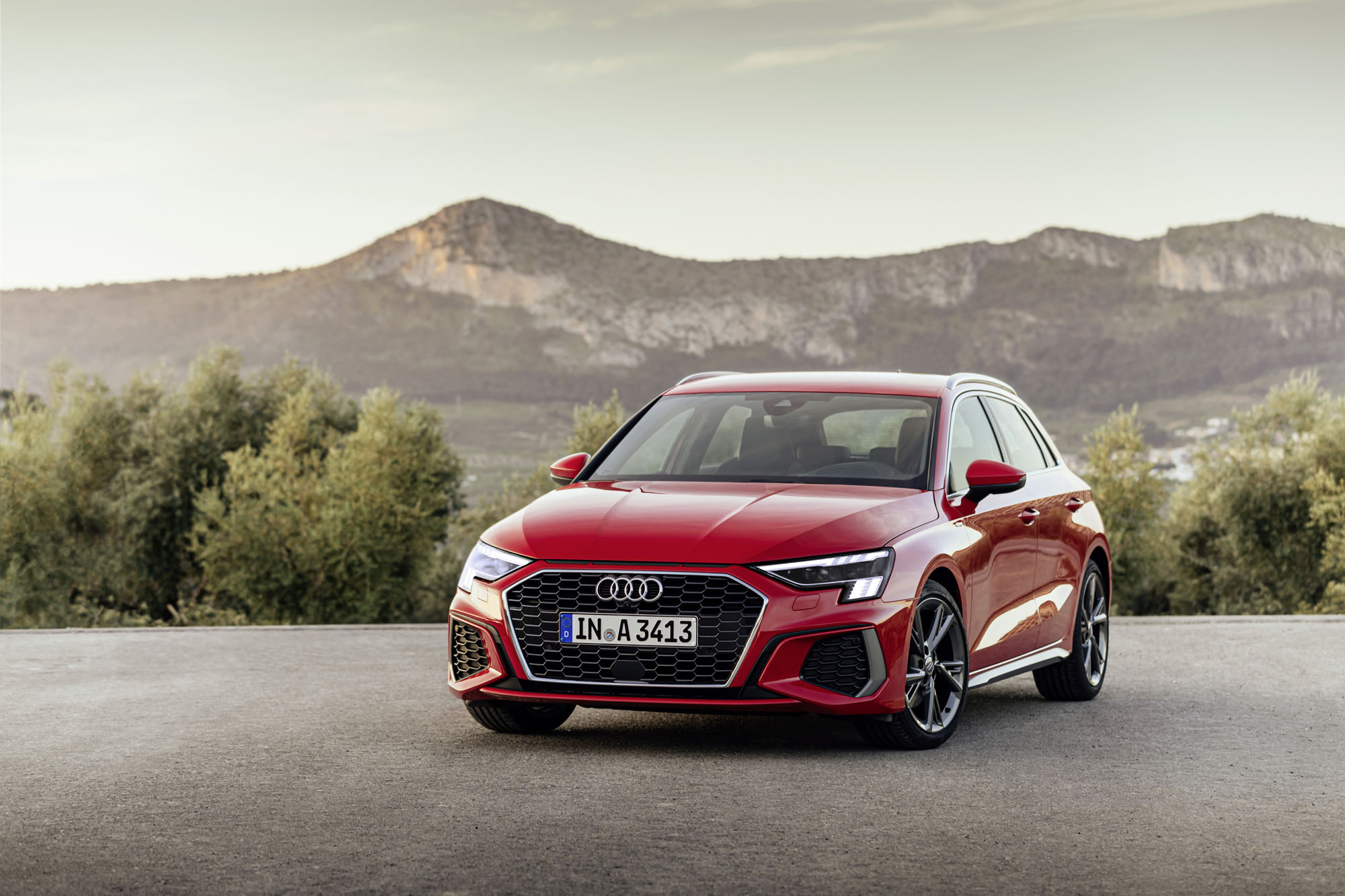
The fourth-generation Audi A3 and S3 hatch will make a local debut in early 2022, alongside the sedan.
Audi has confirmed local pricing and specifications for the updated A3 hatch, with the range set to kick off at $46,300 before on-road costs for the mild-hybrid, front-wheel-drive 35 TFSI.
A more-powerful all-wheel-drive 40 TFSI S-line is available, bringing additional equipment and sporty additions over the entry-level A3.
The S3, which shares its 2.0-litre turbocharged engine with the Volkswagen Golf R, is listed at $69,900 – a $5700 increase over the outgoing model.
Standard equipment includes; LED headlights, keyless entry and start, leather seats, a 12.3-inch digital instrument cluster, 10.1-inch infotainment system, wireless/wired Apple CarPlay and wired Android Auto, wireless smartphone charging, and Audi’s Connect Plus online connectivity.
You can discover the full pricing and specification details for the A3 by clicking here, or the updated S3 here.
The 2022 Audi A3 and 2022 Audi S3 will go on sale in the first quarter of the year.
Cupra Born
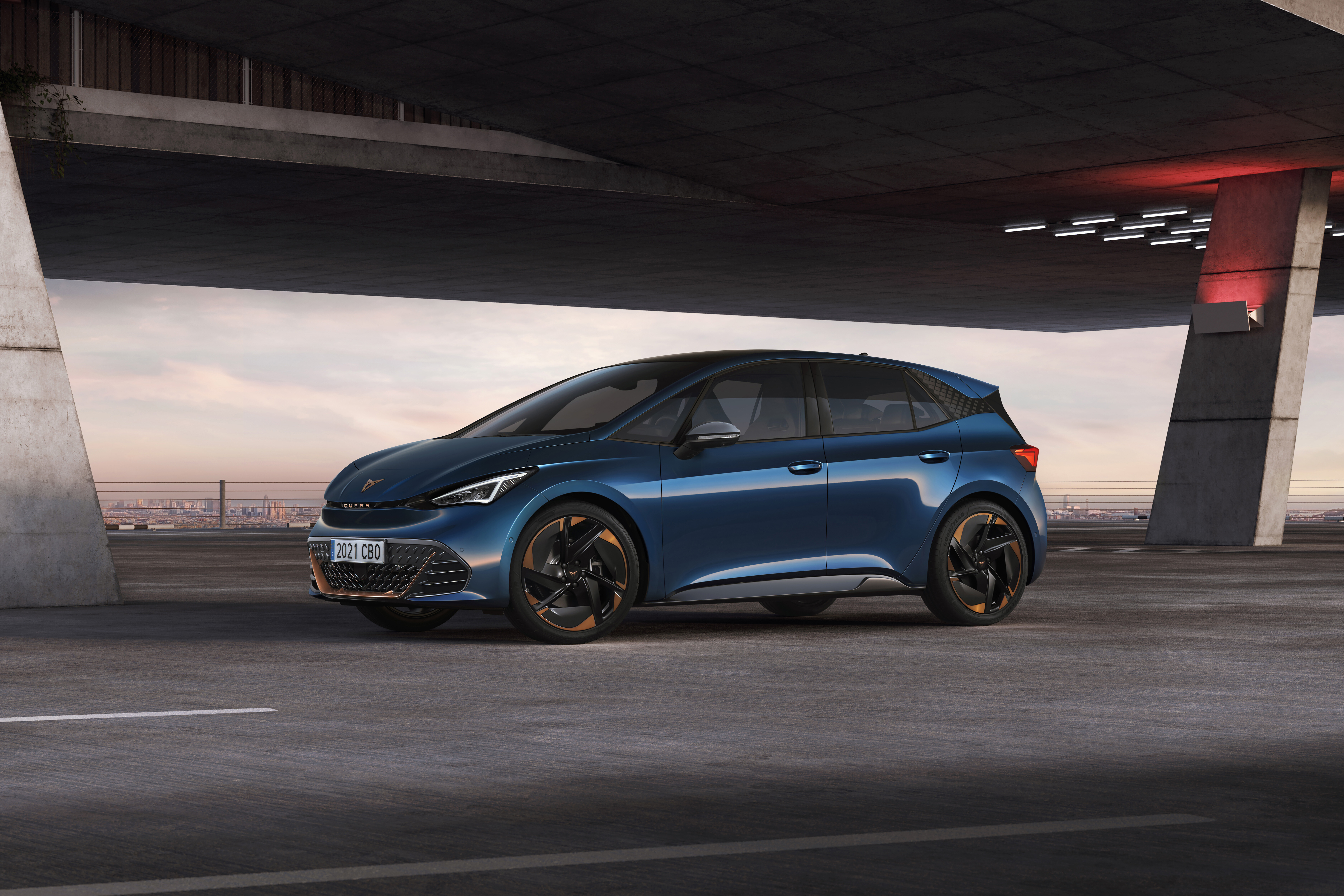
Arriving: Fourth quarter
Say hola to the first electric vehicle from Volkswagen Group Australia.
Courtesy of Spanish brand Cupra, which will arrive in Australia in the second quarter of 2022, the Born electric hatchback will spearhead an electric movement for the young marque.
As a revised version of the Volkswagen ID.3, the Born is similar in size to a Golf and offers four powertrain options in Europe.
The cheapest 45kWh version is unlikely for Australia, with local options anticipated to centre around two 58kWh versions.
The mid-spec option is the top-selling Born in Europe, with 150kW of power and 350Nm of torque and a 0-100km/h sprint in 7.3 seconds on tap, while an e-Boost performance pack extends power to 170kW/350Nm and brings the 0-100 figure down to 6.6 seconds.
A 77kWh version is also available, offering a WLTP-rated electric driving range of about 540 kilometres.
“Cupra wants to be the first European brand with an affordable EV,” VW Group spokesperson Paul Pottinger said to Wheels earlier this month.
“There’s potential for it to start at the price of the current Golf GTI. It will certainly be considerably less than the cheapest Tesla.”
The 2022 Cupra Born electric hatchback is expected to arrive in the fourth quarter of the year, with pricing and specification details to be announced closer to launch.
Cupra Leon
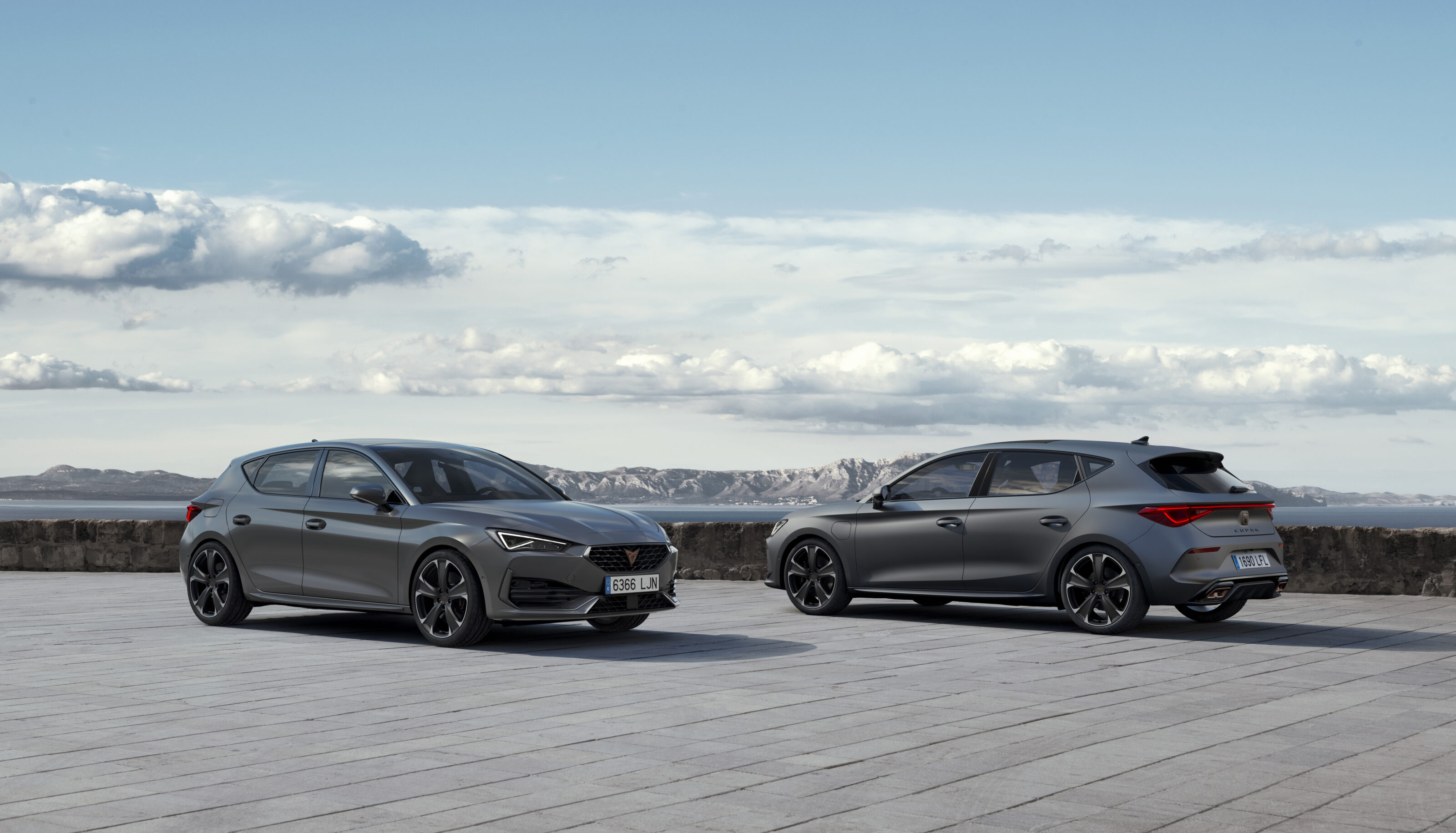
Arriving: Second quarter
Based on the same platform as the Volkswagen Golf, the Cupra Leon will start from around $40,000 in Australia.
There is less focus on performance for the Leon, with the entry-level model being a rebadged Seat featuring the same 140kW/320Nm 2.0-litre four-cylinder engine found in the Skoda Octavia.
The proper Cupra range begins with the mid-spec 180kW/370Nm version, which shares its engine with the Golf GTI – although it is expected to undercut the German, priced around the high-$40k bracket.
The flagship Leon carries the same 221kW/400Nm engine as the previous Golf R, but with front-wheel drive rather than all-wheel drive.
A plug-in hybrid (PHEV) drivetrain, offering 150kW/400Nm, will also be offered.
This variant combines a 1.4-litre turbo petrol engine with an 85kW electric motor and 13kWh battery, with a WLTP-rated electric driving range of up to 52 kilometres.
The interior is closely reminiscent of that found in the eighth-generation Golf, with a 10-inch infotainment system, 10.25-inch digital instrument cluster, ambient lighting and unique sports seats.
Local pricing and full specification details for the 2022 Cupra Leon VZ hatchback will be announced closer to the Spanish marque’s launch in the second quarter of 2022 – alongside the Ateca and Formentor crossovers.
The wagon variant will not be offered in Australia, at least initially.
Ford Fiesta ST
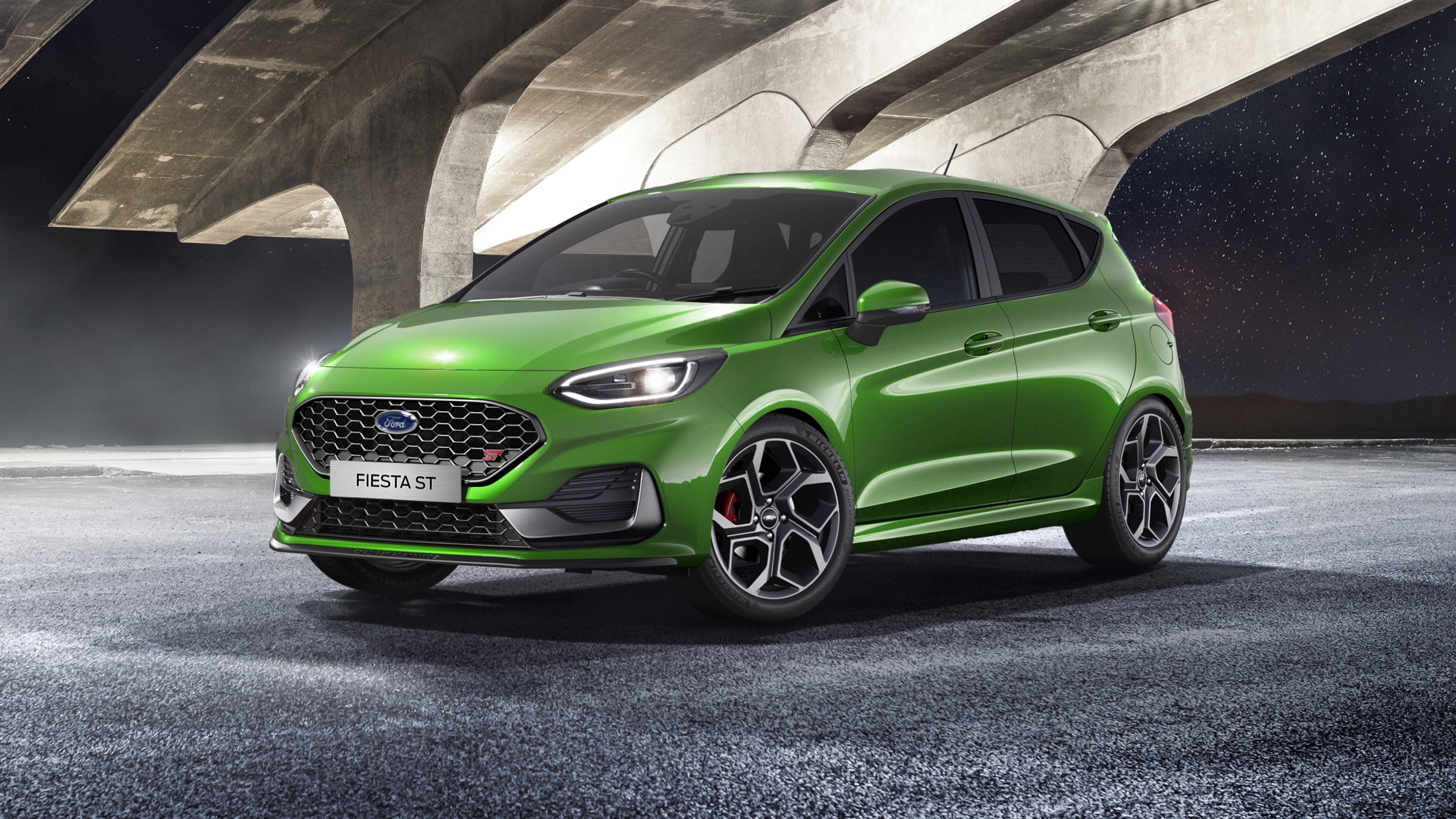
Arriving: First quarter
The Ford Fiesta ST has received a minor facelift and picked up new seats for 2022.
Ford’s hot hatch also gains additional torque, with the 1.5-litre turbocharged petrol three-cylinder engine seeing a healthy 10 per cent torque boost in the low- to mid-range. This pushes maximum outputs from 290Nm in the outgoing model to 320Nm.
Up front, there is a revised design with new matrix LED headlights, updated daytime-running lights, a larger honeycomb grille with Ford and ST badging, and a more aggressive front bumper with intake blades finished in chrystaline grey.
The tail-lights are now finished with black highlighting, while redesigned 18-inch alloy wheels and two new colour options – boundless blue and mean green – finalise exterior changes to the Fiesta ST.
Heated front seats with integrated headrests developed in-house will replace the outgoing Recaro seats, while technology is also improved, thanks to the addition of a 12.3-inch digital instrument cluster.
Australian pricing for the 2022 Ford Fiesta ST starts at $33,490 before on-road costs, with the hot hatch set to arrive in the first quarter of the year.
Ford Focus ST
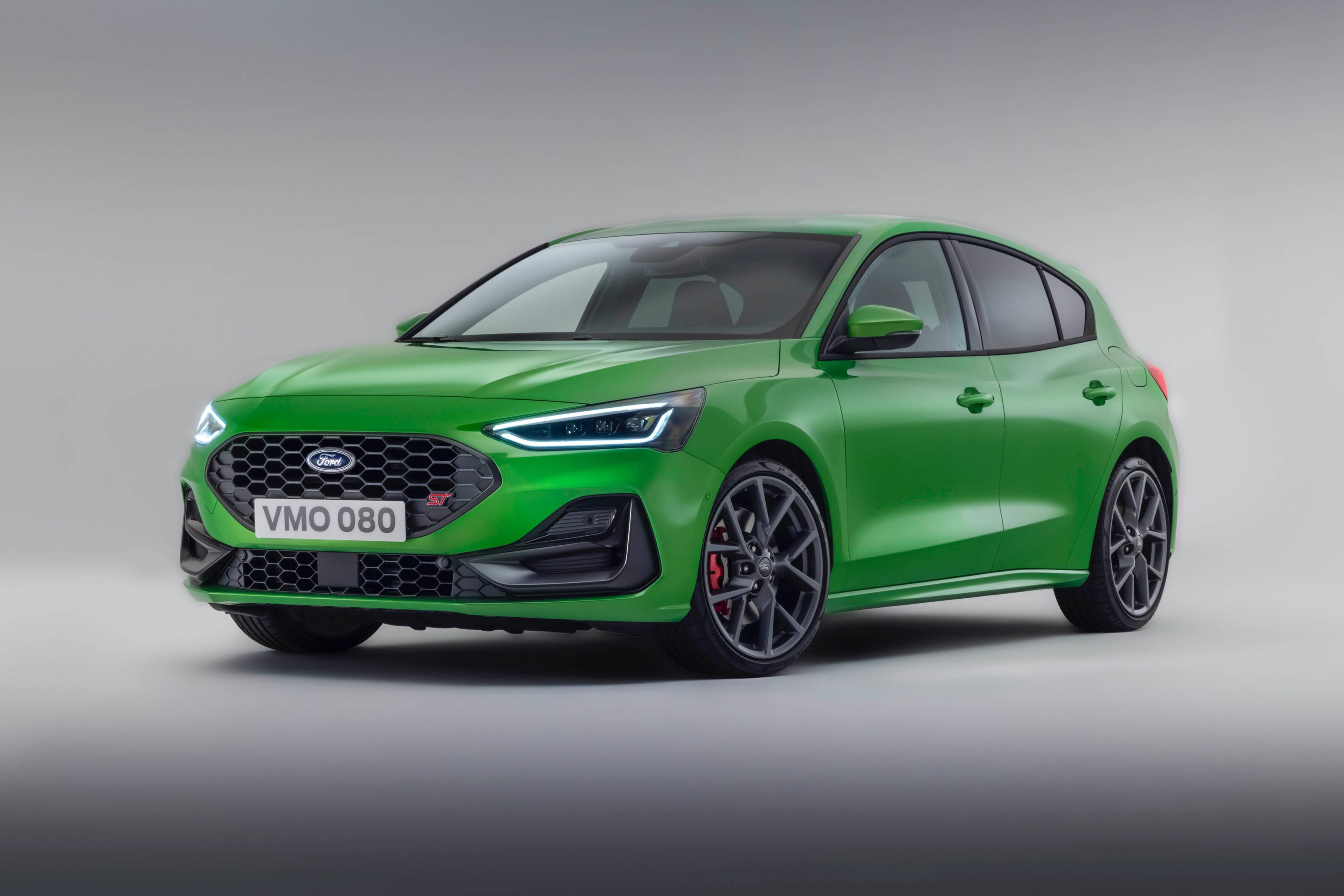
Arriving: Second quarter
Ford has dropped the three-cylinder ST-Line and Active models from the local Focus line-up, with access now limited to the sportier ST and a new premium ST X grade.
The move marks an end to traditional passenger cars being offered by the Blue Oval in Australia, with options now limited to performance models – the Fiesta ST, Focus ST and Mustang.
An array of design changes headline the Focus ST for 2022, with slimmer headlights, redesigned tail-lights, revised alloy wheel designs and a new mean green colour option.
Inside, there is a new 13.2-inch landscape touchscreen (up from eight inches), running Ford’s latest Sync 4 operating system.
The famed Recaro sports seats have also been swapped for a pair of heated Ford Performance sport seats, with 14-way power adjustment in the driver’s chair.
Ford has also updated the active safety systems in the Focus ST, adding; intersection autonomous emergency braking, rear occupant alert and an improved blind-spot assist system.
As before, the Focus ST is powered by a 2.3-litre turbocharged petrol four-cylinder engine, sending 206kW of power and 420Nm of torque to the front wheels through either a six-speed manual or seven-speed automatic.
The 2022 Ford Focus ST and ST X will arrive in Australia in the second quarter of next year, priced from $47,490 before on-road costs.
Peugeot 308
Arriving: Third quarter
Peugeot’s new 308 is bigger, safer, smarter, and more efficient.
The elegant design of the updated French hatch was penned with aerodynamics in mind, contributing to a slippery drag coefficient of just 0.28. This helps to improve efficiency, which is also assisted by a pair of plug-in hybrid (PHEV) options.
Each plug-in combines a 1.6-litre turbocharged petrol engine with a 12.4kWh lithium-ion battery pack, with entry-level versions producing 110kW and flagship models outputting 132kW.
A 97kW turbocharged three-cylinder petrol will likely feature as standard in Australia, with the plug-in hybrid variants currently unconfirmed.
Peugeot will begin offering the 508 and 3008 PHEV locally in early 2022, meaning the smaller 308 PHEV could make the trip to Australia.
Inside, the 308 includes a 10-inch infotainment system, a 10-inch digital instrument cluster, and a rocker-button-style gear selector similar to the Volkswagen Golf and Porsche 911.
The 2022 Peugeot 308 will also debut the Lion brand’s fresh new badging when it goes on sale in Australia in the third quarter of 2022. A load-lugging wagon – likely known as the 308 Touring – will arrive at the same time.
Skoda Fabia
Arriving: First quarter
The Skoda Fabia is now based on the same MQB A0 architecture as the Kamiq and Volkswagen Polo, allowing it to gain a slew of modern niceties.
Now in its fourth-generation, the design of the Fabia is inspired by the larger Scala and Octavia, with slim LED headlights, a larger front grille, and thin C-shaped tail-lights.
Boasting a greater profile than its predecessor across every dimension, the Fabia has a 2564 millimetre wheelbase and measures 4107mm long, 1780mm wide and 1460mm tall – with an extra 94mm in wheelbase, 110mm in length and 48mm in width (but 7mm less in height) over the outgoing Fabia.
Up-to-date goodies such as a 10.25-inch digital instrument cluster, free-standing infotainment display measuring up to 9.2 inches and a panoramic sunroof are available.
Other Fabia-first additions include; wireless phone charging, gesture control, ambient lighting, rear-seat air conditioning vents, a heated steering wheel and full-LED lighting.
A 1.0-litre turbocharged three-cylinder petrol, available in both 70kW and 81kW tunes, is expected across the Australian line-up – although a 110kW 1.5-litre turbo-petrol is also available in Europe.
The 2022 Skoda Fabia will arrive in Australia late in the first quarter – likely in March – with pricing and specification details to be announced closer to launch.
Volkswagen Polo
Arriving: April
The facelifted Volkswagen Polo is coming with a big price hike.
Volkswagen Australia has confirmed the updated runabout will no longer be offered under the $20,000 mark next year.
Currently priced from $19,290 before on-roads for the entry-level 70TSI manual, the Polo is expected to shift into the same pricing bracket as the Toyota Yaris – which opens at around $25,000.
The price increase is likely to be compensated by a number of additional standard features, including the full iQ Drive active safety suite – with technology such as adaptive cruise control and a semi-autonomous travel assist system.
Engine options will remain the same, consisting of 70TSI, 85TSI and GTI grades.
In a bid to move the entry-level Volkswagen closer to the Mk8 Golf visually, the Polo picks up a set of slimmer headlights with available matrix LED lighting technology, a revised grille, redesigned tail-lights and a new steering wheel design.
The updated 2022 Volkswagen Polo 70TSI and 85TSI will land in Australia in April, with the GTI flagship expected to follow the regular model within weeks.
The German brand will confirm pricing and specification details in the coming months.
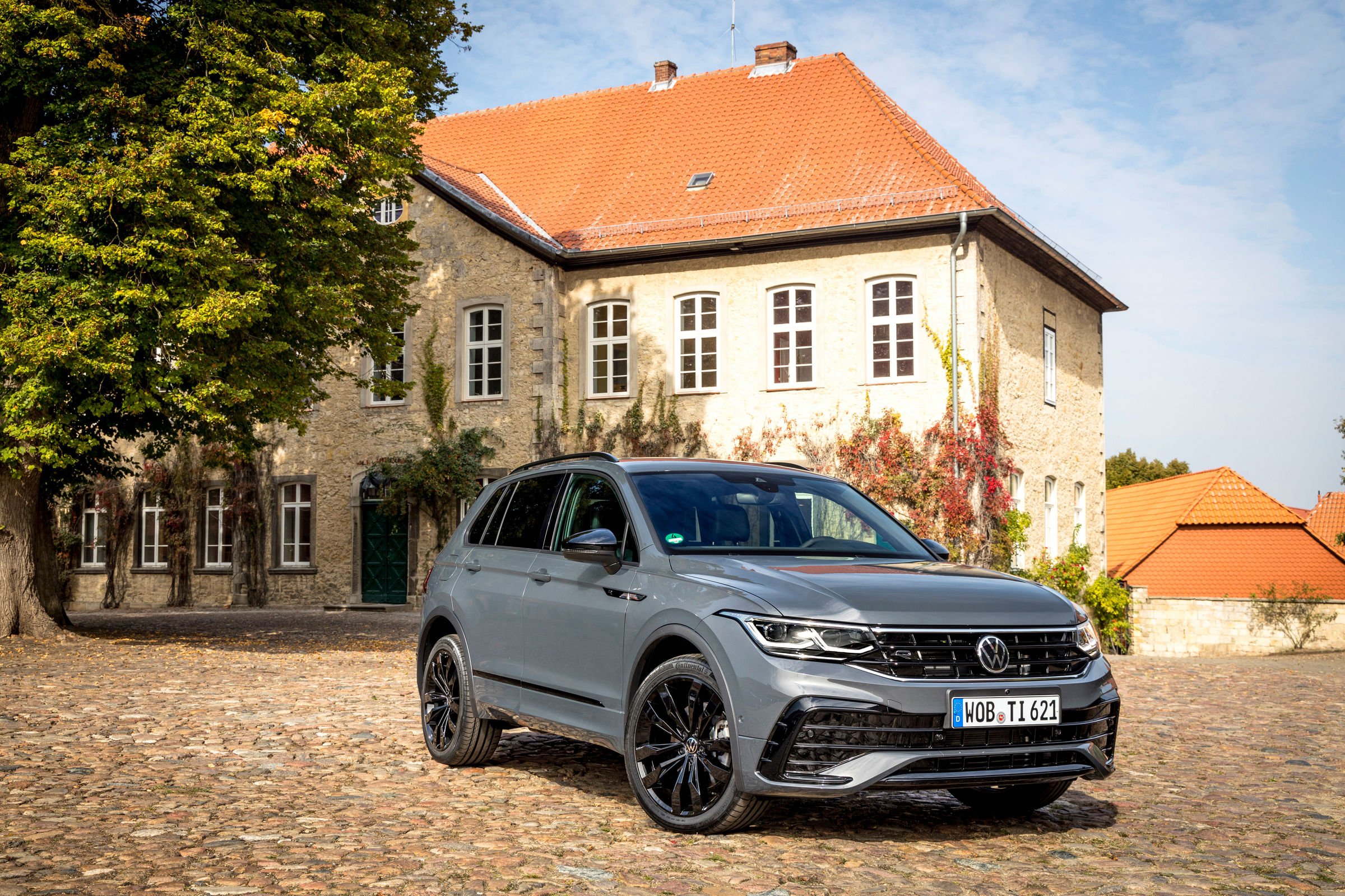
Volkswagen has revealed four-cylinder TDI vehicles delivered after June 2021 have the capability to run completely on next-generation diesel fuels.
The move ties in with the brand’s pledge to become completely carbon-neutral by 2050 and slash its European fleet emissions by 40 per cent by 2030 – which it says requires each vehicle over its lifecycle to emit 17 tonnes less of carbon dioxide.
Significant investment in EVs and infrastructure will underpin the push, but more sustainable fuels are being implemented to cut emissions on combustion engine models without the need for heavily re-engineering them.
Volkswagen is claiming “newly developed diesel fuels” – that its four-cylinder TDI models are now compliant with – not blended with regular diesel can slash carbon dioxide emissions between as much as 70 and 95 per cent.
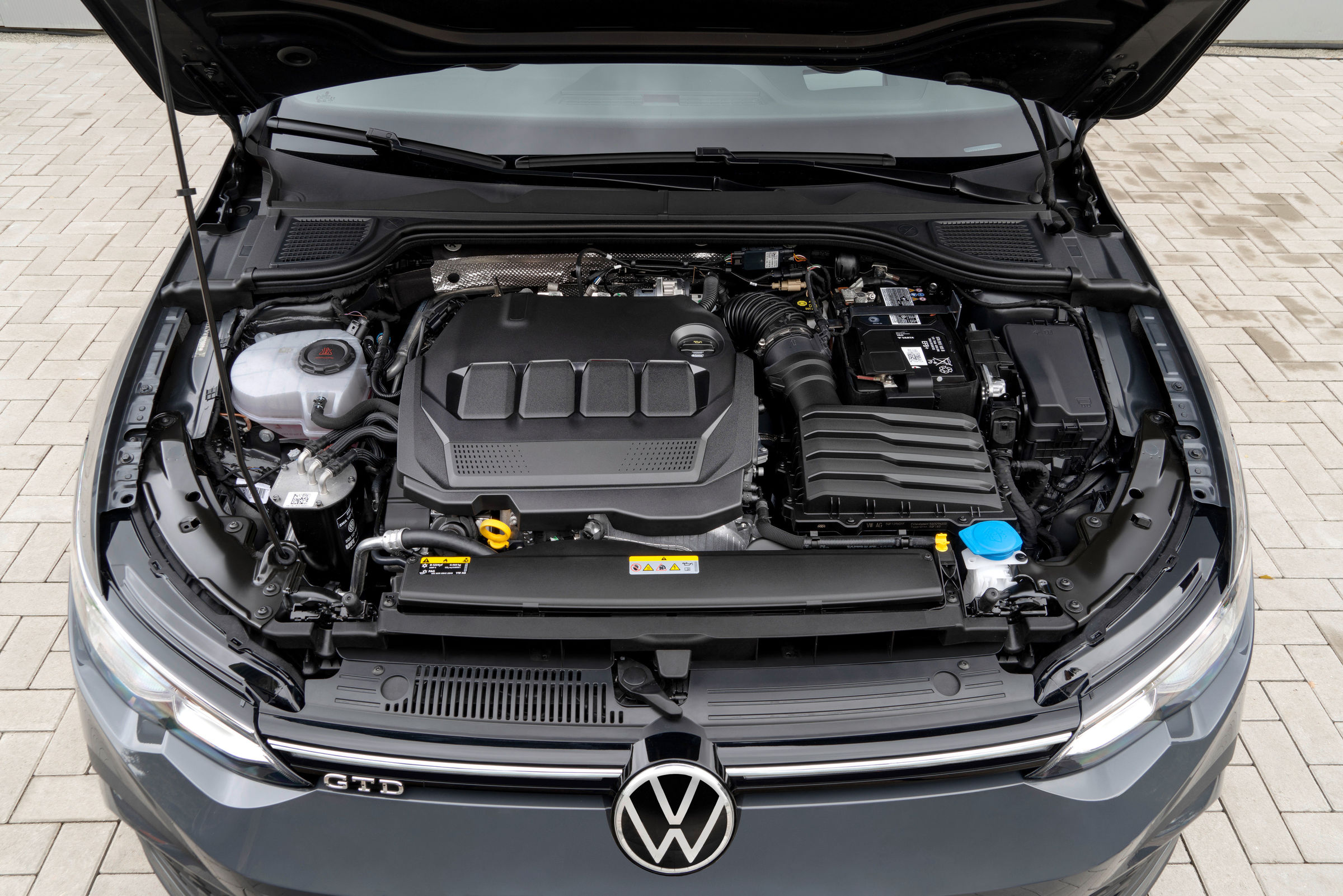
These are fuels developed to the 2016 European Standard EN15940, which specifies second-generation biofuels and e-diesels made from a Fischer-Tropsch process.
“Through the use of environmentally friendly fuels in the approved Volkswagen models,” Volkswagen’s head of fuels, professor Thomas Garbe, explained, “we are making it possible for customers throughout Europe to significantly reduce their CO2 emissions as soon as the fuel is locally available.
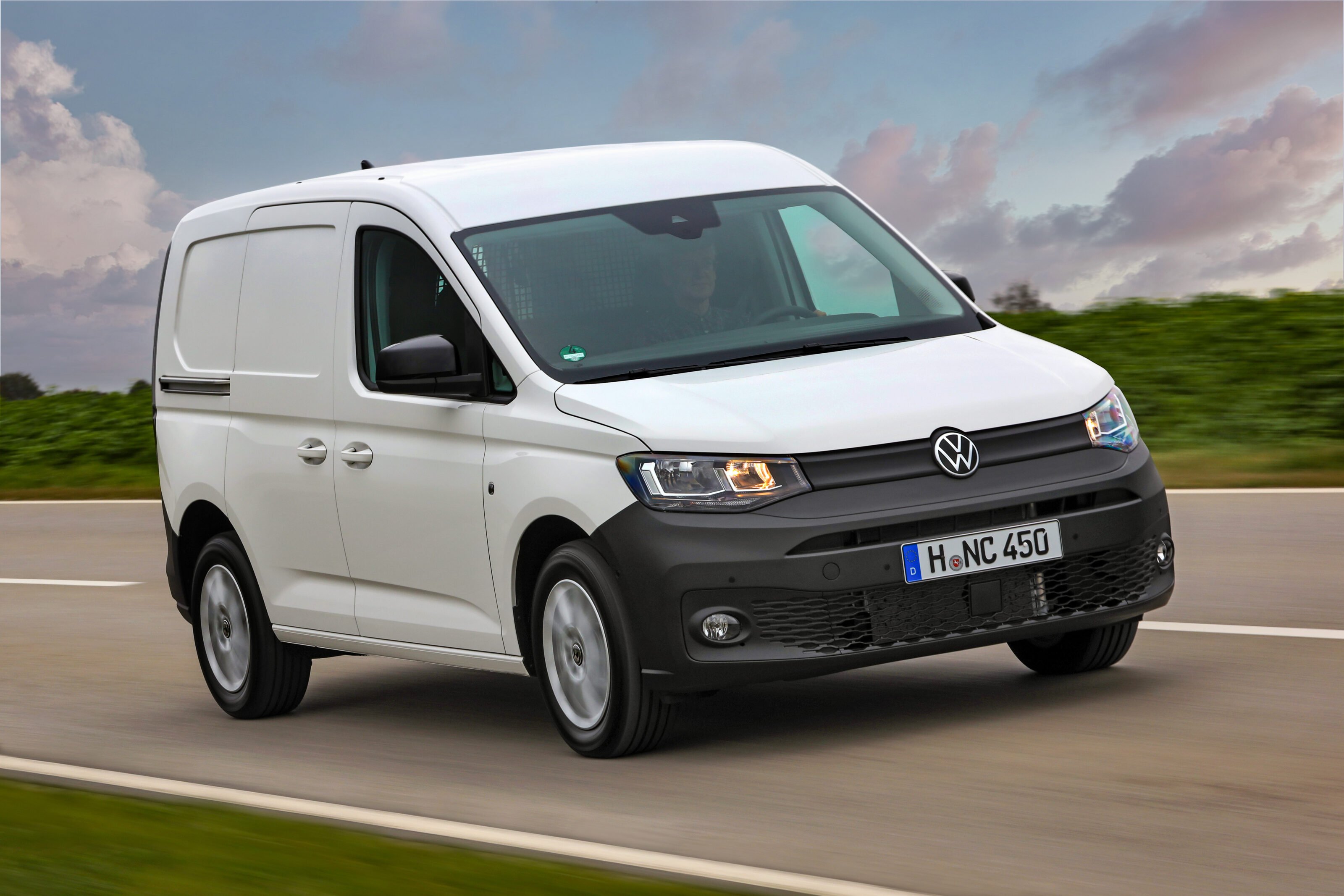
“For example, the use of paraffinic fuels is a sensible additional option, particularly for companies with a mixed fleet made up of models with electric and conventional drives.”
Of course, it’s one thing for VW’s cars to be capable of running these fuels, it’s another for owners to obtain them.
Currently, in Australia, biomass-derived diesel accounts for as much as five or 20 per cent of the biodiesel sold at bowsers. Meanwhile, Volkswagen sells diesel four-cylinder engines in only the Tiguan, Caddy, Transport and Amarok ranges here.
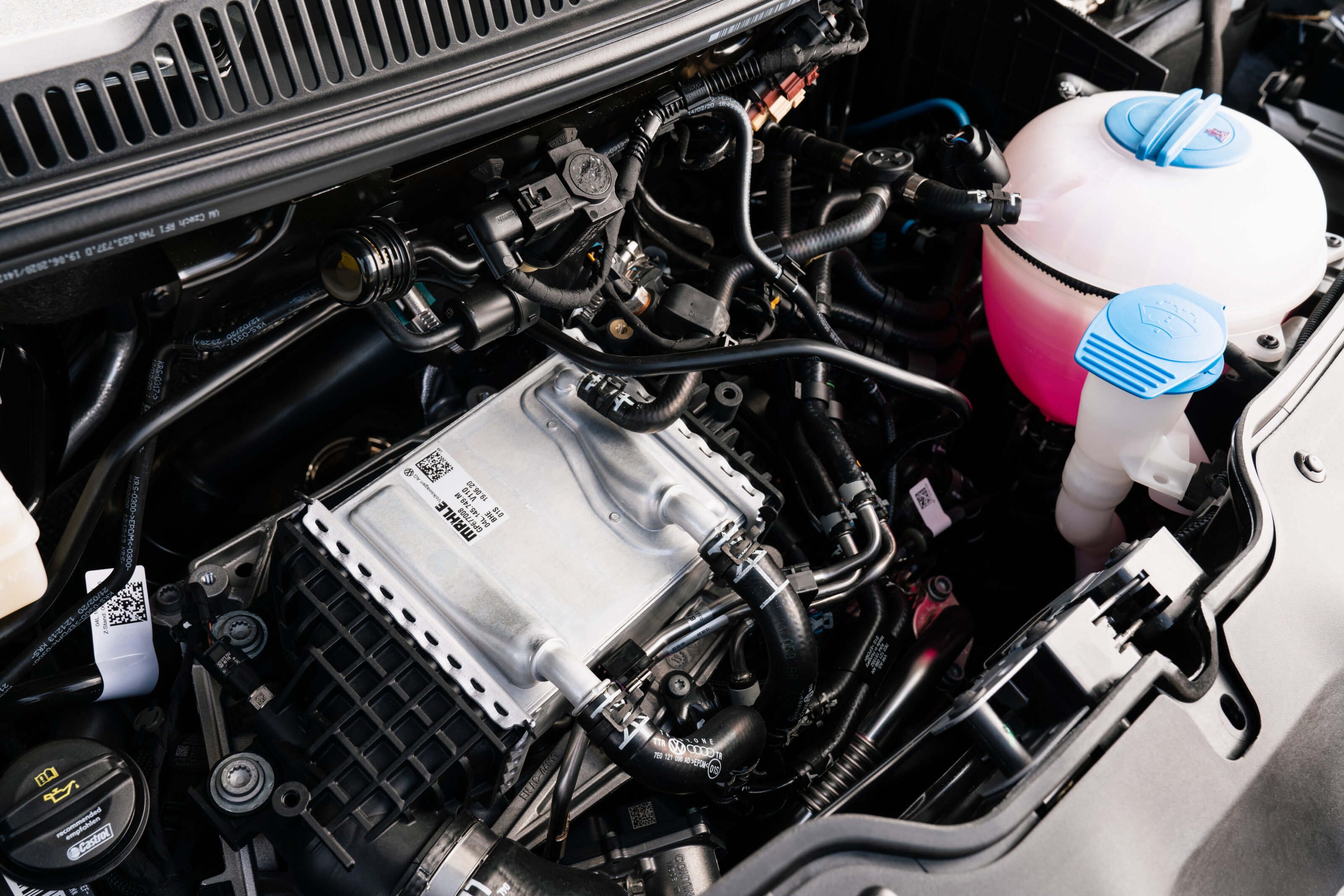
In the long-term, global Volkswagen executives have said the brand will stop sales of internal combustion engine vehicles in Europe by 2035, but it will continue with them in markets with softer emissions laws, such as America and China.
Australia could also expect to receive ICE VWs past 2035 as well, based on emissions laws that lag Europe and our slow uptake of electric vehicles and infrastructure.
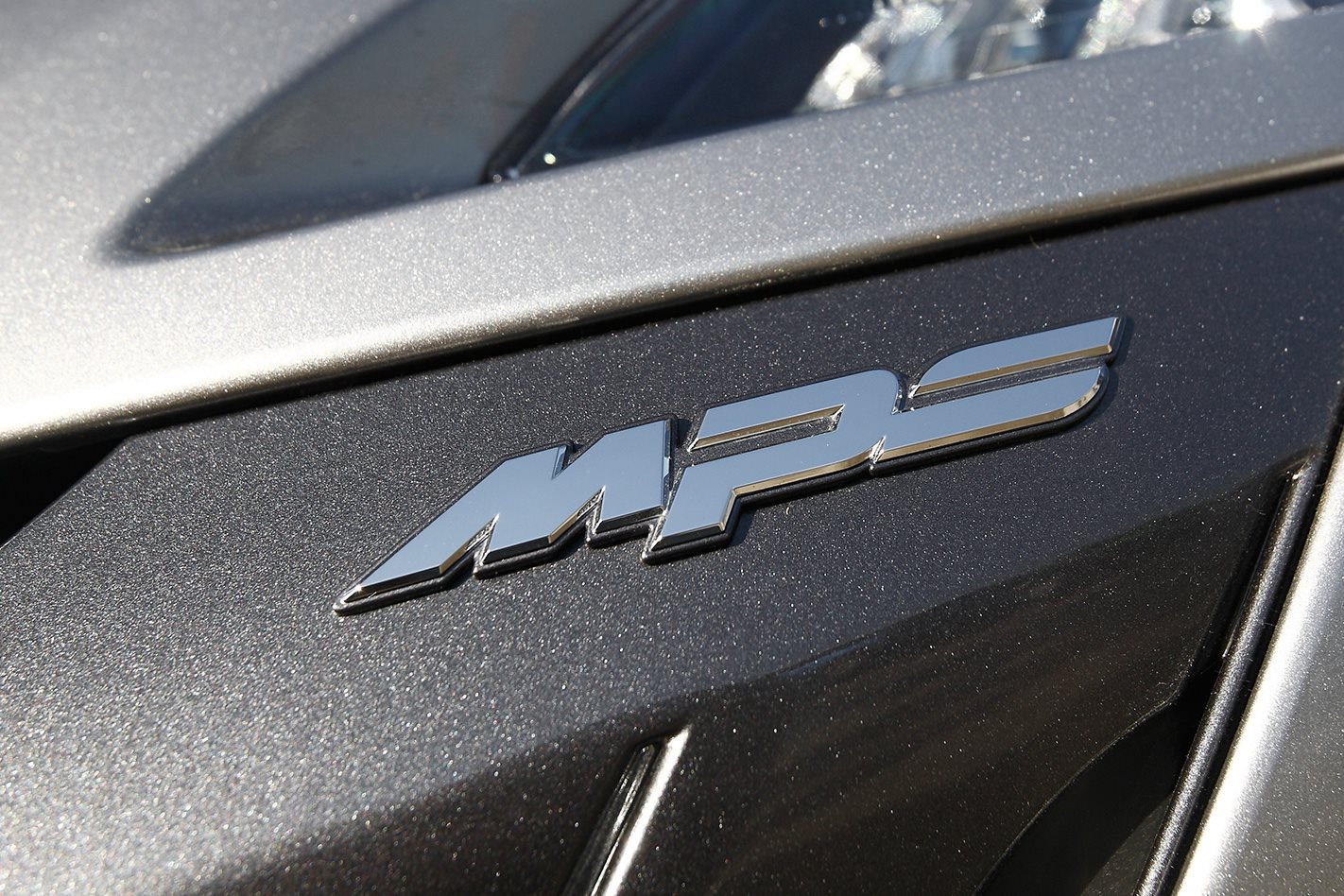
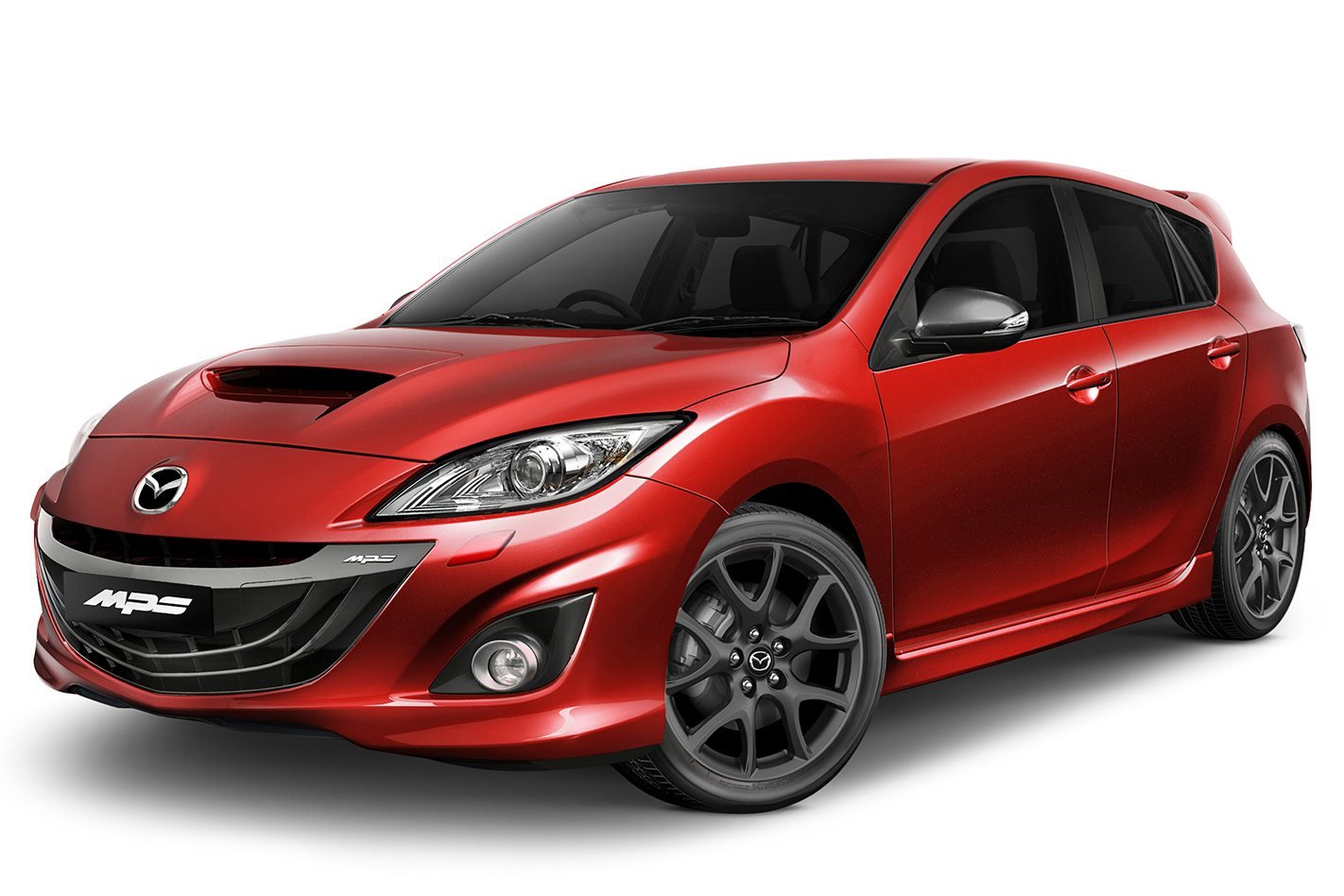
When driving enthusiasts ponder their favourite Mazda products, it’s invariably the brand’s coupes and roadsters that get the lion’s share of attention. But its worth remembering that the Japanese brand has a low-key back catalogue of hot hatches as well. Sure, the Mazda 3 MPS had its foibles, but there was no denying it was a joyful thing.
That joy, well, we don’t want to be too harsh, but it has gone missing from many of Hiroshima’s products of late – the MX-5 being an exception to the rule. The current generation Mazda 3 is a much more enjoyable car to drive compared to most of its fellow mass-market competitors and credit needs to go to Mazda for injecting some personality into its mainstream model, but there’s a lack of purpose (and fun!) in the range compared to halo models like the Hyundai i30 N.
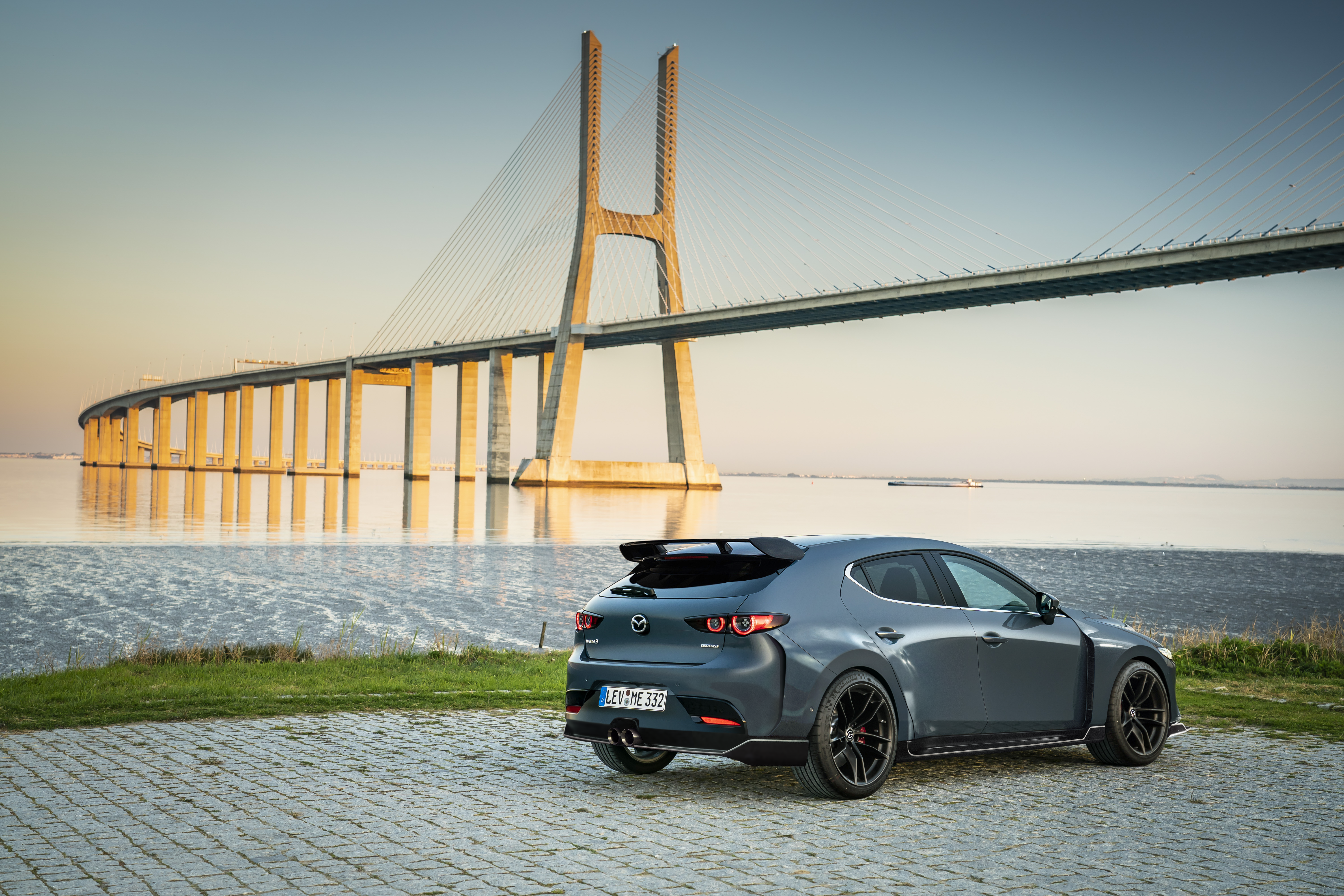
Unfortunately for us, Mazdaspeed is dead, and with it the MPS badge. But we’ve got a solution – the Mazda 3 X Turbo (we’ll explain the nomenclature in a bit). A bolt from the blue that would rekindle Mazda’s spirit as a company that builds products for people who enjoy driving above all else, showcasing the company’s newfound electric technology, and taking the fight to an icon like the Volkswagen Golf R in the process.
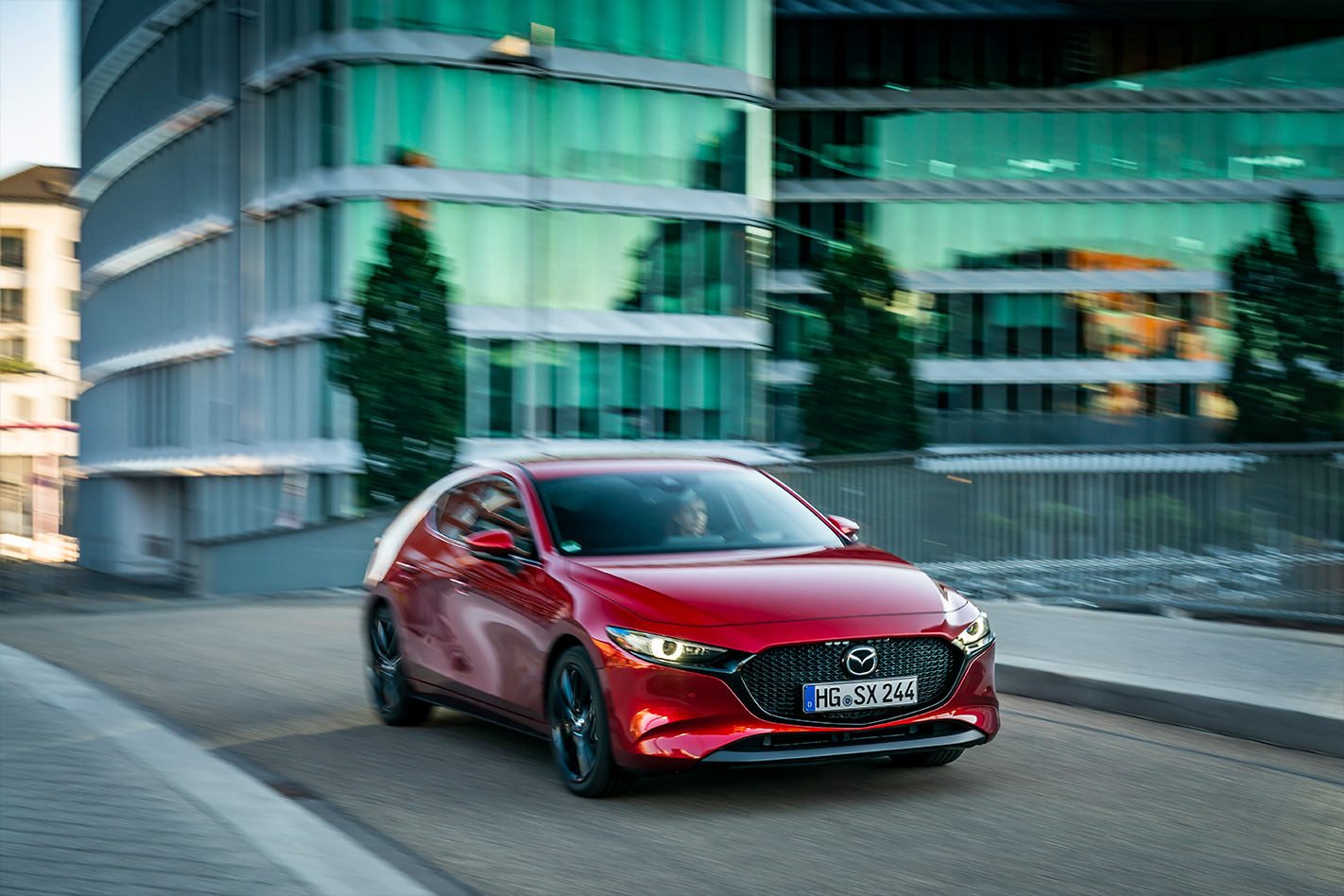
The starting point for the 3 X Turbo would be the all-wheel drive Turbo sold in North America, borrowing the 2.5-litre turbocharged four-cylinder from its CX-badged SUV siblings.
To make the X Turbo a worthy halo, it will need to move the game forward for Mazda and operate as both a performance and technical showcase. That means it’ll be a proper plug-in hybrid. On combustion power alone it’ll produce 220kW and 450Nm, with a 15kWh battery and electric motor on the rear axle boosting combined outputs to 270kW/500Nm.
Currently the Mazda 3 family’s electrification status only extends as far as a newly introduced mild hybrid. Making the jump to full PHEV status, the X Turbo will lean on the bones of the brand’s first full EV and plug-in, the MX-30 SUV. The MX-30 chassis is based on that used by the CX-30, which itself started life as the Mazda 3.
This self-fulfilling product pipeline will allow the X Turbo to use a chassis built to work with proper electrification, while still looking to the outside world like a traditional member of the Mazda 3 family. However, despite the familiar body panels, closer inspection would reveal substantially wider arches, with a larger footprint hinting at the heavily updated chassis.
Mazda has been creeping its way upmarket for years, and the 3 X Turbo would be a bold statement of intent, reinvigorating the brand for the modern era. If it wants to truly compete with the likes of the Golf, then it needs to win that war on all levels.
How we’d build it
Step 1: Big Block
By the nature of its extra swept capacity, the 2.5-litre wouldn’t need much pushing to make the required power. Electric shove down low will allow a larger diameter turbo to be added, with the battery taking care of early propulsion while the bigger snail gets on boost.
Step 2: What’s in a name?
The X in the badge is a reference to the origins of the MX family of vehicles – meaning Mazda eXperimental. Like the MX-30 it will share much of its underpinnings with, the hybrid hot hatch 3 will earn its X stripes by pushing Mazda into new bold new waters, while standing alongside the MX-5 to champion the enthusiast cause.
Step 3: Baby got back
You don’t think we’ve forgot about the Mazda 3 sedan do you? Of course a booted compatriot to the hatch would be in the pipeline. Cut-price Mercedes-AMG CLA 45? Sounds pretty enticing to us.
Step 4: Bit of shush
Being a plug-in hybrid the Mazda 3 X Turbo would be capable of silent rear-drive-only electric propulsion. The capacity of the battery means it’ll only be for 30km give or take depending on your driving style, but with the regular 3 having a wonderful high-quality cabin it’ll make the daily commute a hushed affair.
Step 5: Don’t say the D word
Torsen differentials front and rear will make the 3 X Turbo a weapon in the corners, with the electric motor making overall power delivery rear-biased in its sportiest drive modes. A cleverly tuned sports ESC will cater to those with a penchant for oversteer.
When Markus Duesmann left BMW in 2018 to join Audi, he faced a two-year competition exclusion clause. This gave the fast-climbing top manager plenty of time to map out a brighter future for his new employer.
Having masterminded, among other assignments, the engineering division of the BMW Sauber F1 team, the motorsport aficionado still has racing blood running in his veins. Not surprisingly, the VW group’s R&D chief was determined to put his personal stamp on the Audi Motorsport agenda.
First, he angered BMW by pulling out of the DTM touring car championship without giving notice, then he snubbed his own people by unexpectedly withdrawing from Formula E. To everyone’s surprise, Audi instead signed a three-year deal with the Dakar Rally early this year.
Why Dakar, you ask? Why indeed play an active part in destroying large areas of untouched nature with a bunch of inefficient purpose-built sand tanks? In a world where clean air has become a highly sought after commodity and at a point in history when everyone agrees that climate change needs to be curtailed, extreme off-roading is clearly the wrong mission and a message that may eventually turn against the brand.
According to those in the know, Duesmann wanted to honour a deal he had struck a couple of years ago with Sven Quandt, offspring of the major BMW stakeholder family, the man behind the Mini X-Raid venture and now also the founder of Q Motorsport, which is devoted to cross-country racing for the Audi nameplate.
Between Jan 2 and 14, 2022, three RS Q E-Trons prepared at the factory will take on similar machines fielded by Prodrive, Peugeot, X-Raid and Toyota‘s Gazoo Racing, to name only some of the biggest rivals. The logistics, backup and prep work are courtesy of Q Motorsport.
Why Dakar, you ask? According to those in the know, Duesman wanted to honour a deal he had struck with Sven Quandt, the man behind the Mini X-Raid venture.
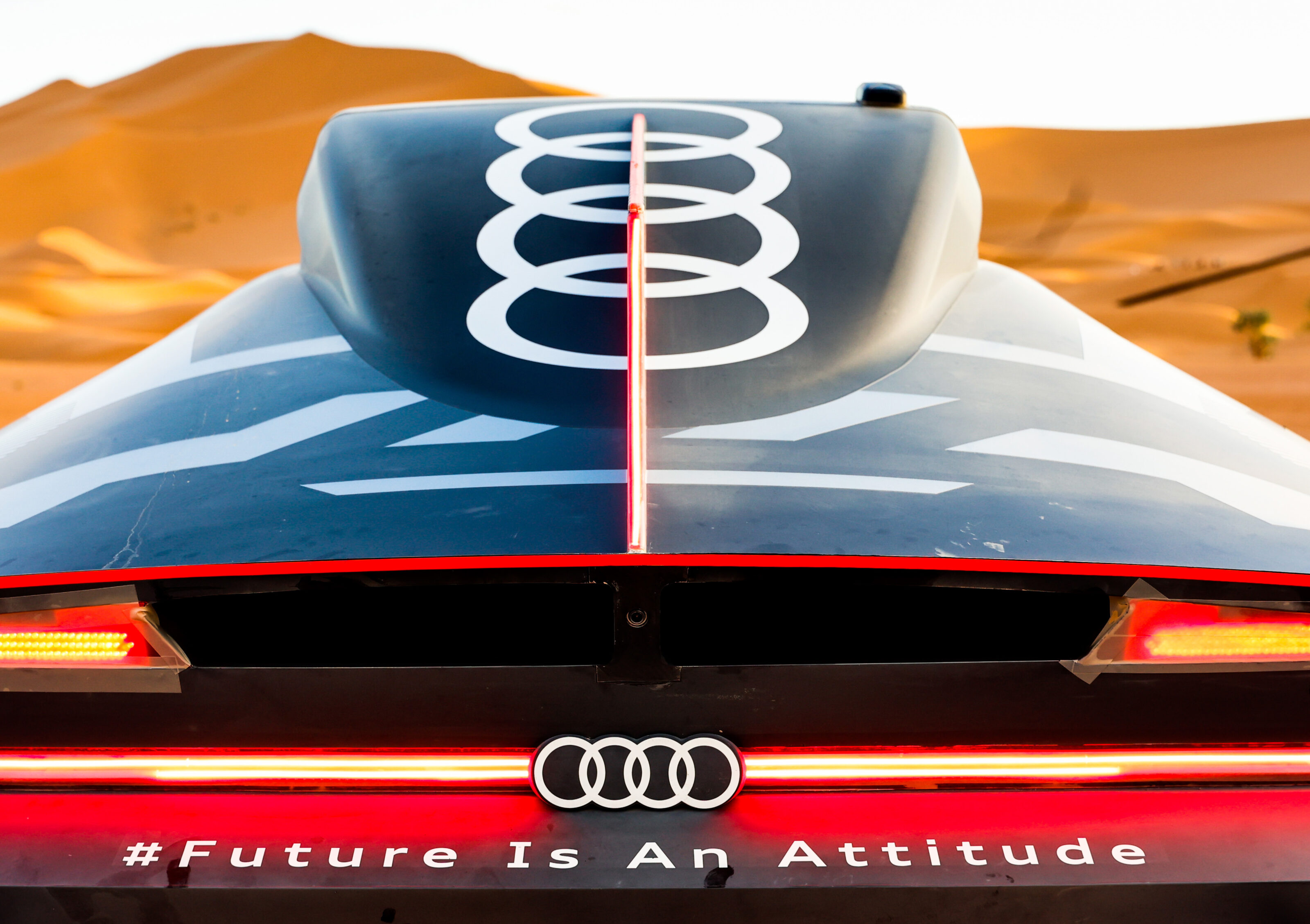
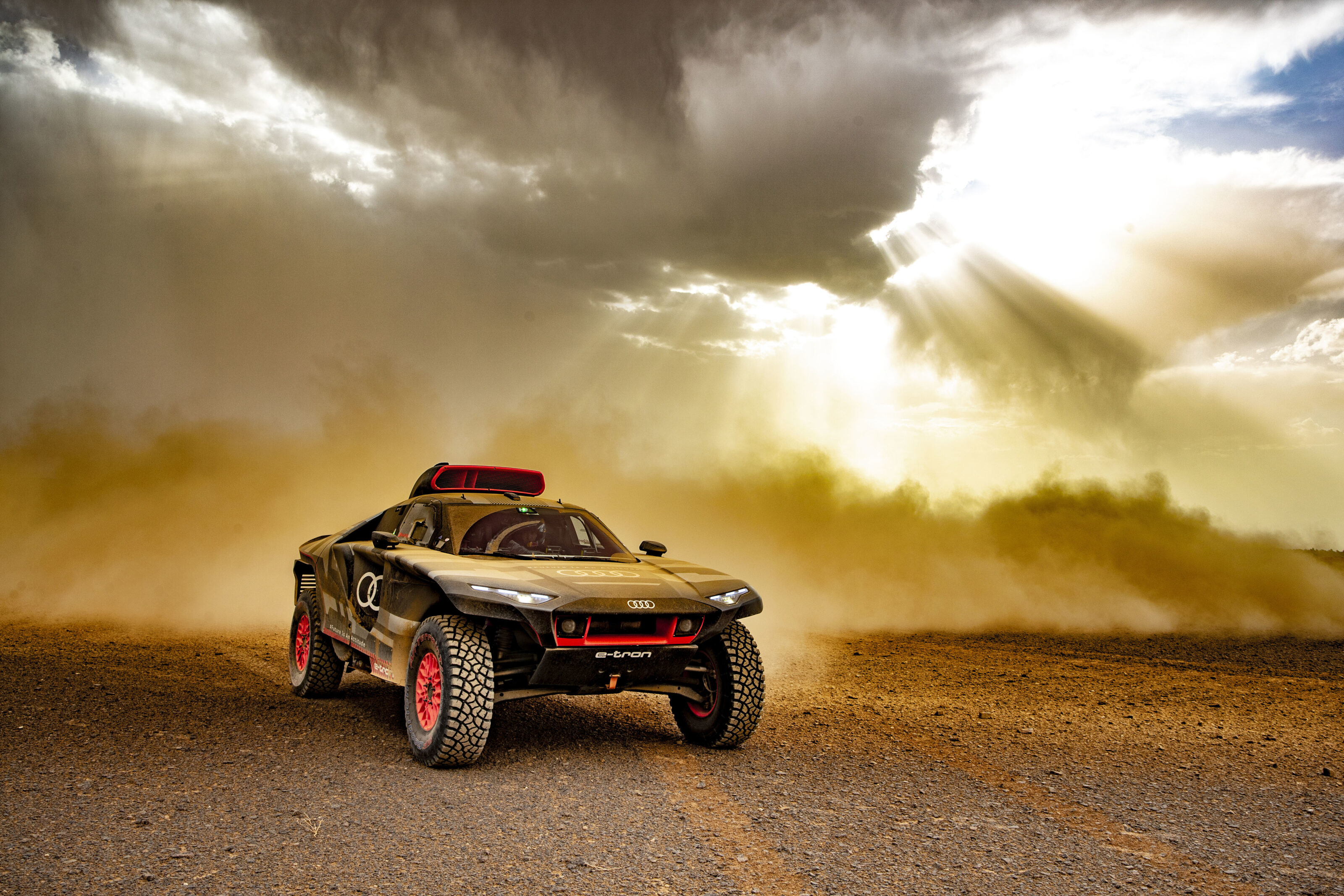
As indicated by the E-Tron moniker, the team from Neustadt/Danube, home of Audi Motorsport, is the sole entrant in the newly established TTE class created for vehicles with alternative drivetrains. Thanks to major revisions to the rulebook, the Bavarians conceived a unique type of high-performance hybrid that relies on a brawny petrol engine to charge the batteries on the move.
It’s an alternative layout for sure, but with a calculated fuel consumption of around 31.4 litres per 100 kilometres, the monster’s CO2 footprint is Yeti-size. Instead of calling a spade a spade, the 2.0-litre four is officially listed as an energy converter and directly drives the MGU FE57 generator adopted from Formula E. An evolution of the 433kW 2019/20 DTM engine, the so-called best-point unit has its sweet spot in the 4500-6000rpm range where between 142 and 224kW are on tap.
The same MGU FE57 motors redlined at 23,000rpm drive the front and rear wheels through a single-speed transmission with mechanical diff lock. The axle-to-axle torque split is masterminded by a virtual electronically controlled differential. The maximum charging power of the 52kWh high-voltage lithium-ion battery is 220kW. The combined peak output available for a limited period of time is 507kW, the continuous 24/7 rating is a more modest 298kW.
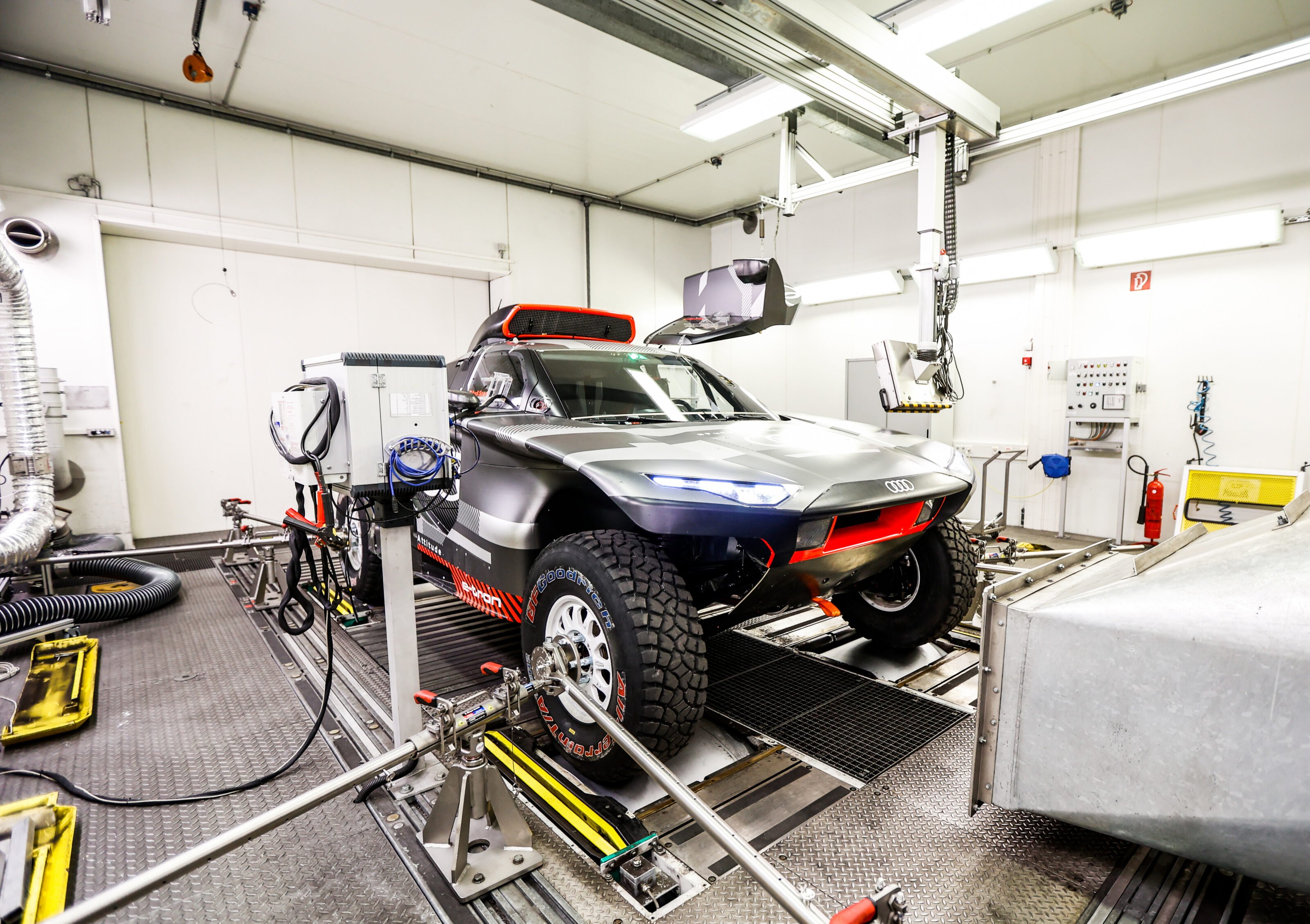
The 800-volt battery pack and the full 295-litre fuel tank each weigh a little over 300kg. Add 105kg for the e-motors and 100kg for the TFSI engine, and the 2000kg minimum weight target leaves less than 1200kilos for the carbonfibre body, tubular steel frame, aluminium double-wishbone suspension with KW dampers, six cooling circuits, Bosch power electronics and Brembo steel brakes with on-demand balance and energy regeneration.
Top speed is restricted by regulation to 170km/h, the quoted average 0-100km/h acceleration time on sand and loose gravel is 4.5sec. After 4800 test kilometres on Moroccon soil (including one 800km special stage driven at race pace), the battery remains the one big unknown.
Freshly put together to Audi specification by a bunch of specialised suppliers and controlled by a Bosch PDM32 black box, the scope of potential issues stretches from premature degradation to cell chemistry hiccups. While the petrol engine is cooled down by its own high-temperature water cycle, the 13 battery modules and the three motors are kept within a healthy operating window by a joint low-temperature loop. Although the 3458 pouch cells are packaged deep and low inside the vehicle’s belly, quick access is guaranteed in case one or more modules need replacing.
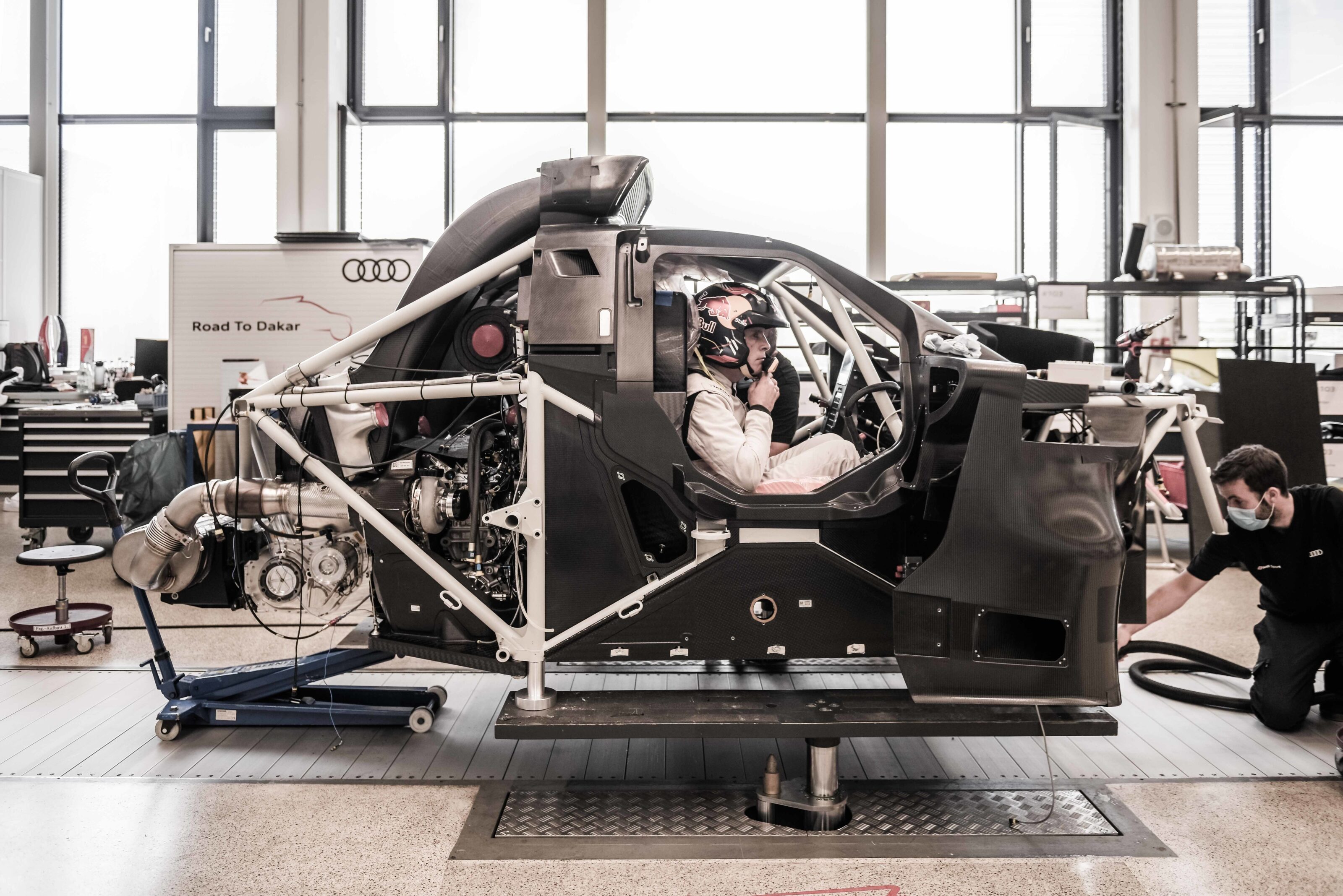
The sombre black cockpit relays the naked charm of an armoured scout vehicle ready to go on the prowl. Driver and passenger sit high up in narrow cubicles padded to measure. The windscreen is quite narrow yet reasonably tall but the side windows are more like rectangular upright periscopes, and the rear view is confined to a tiny reversing camera. The instrument panel itself is boxy, protruding and stuffed seemingly at random with different sorts of switches, buttons, displays and lights.
When you glance over the steering wheel onto the bonnet, the lower part of the frame is filled by half a black ping-pong table that only needs Eleanor the Flying Lady to pass for the Rolls-Royce Cullinan’s rough brother. From the outside, however, the eye-catching war livery includes a huge roof-mounted ram air intake device, bright red wheels shod with 17-inch BF Goodrich tyres and a wild concoction of slats, wings, aprons and protective panels.
The top speed is restricted by regulation to 170km/h, the quoted average 0-100km/h acceleration time on sand and loose gravel is 4.5sec.
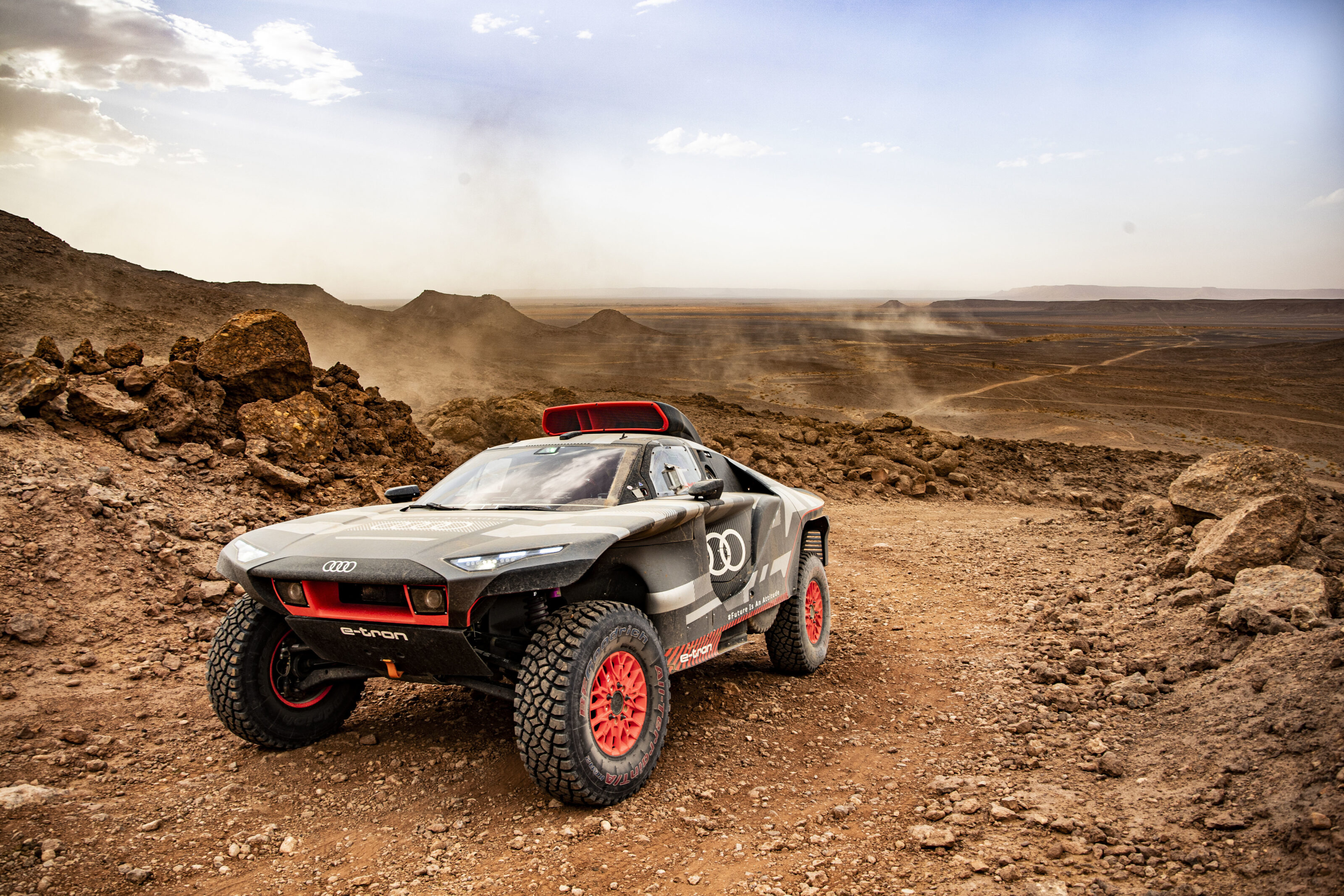
The cross-country rally car from Ingolstadt is as wide as a school bus (2300mm), almost as tall as a Mercedes G-class (1950mm) yet barely longer than the first 1980 Ur-Quattro coupé (4500mm). Matching these extreme dimensions is the yawning front ground clearance sized right for stray baby camels, the razor-blade lateral and underbody airflow wedges, the stacked multiple-vent triple-deck rear end and the almost cartoon-like elastic daddy long legs wheel travel.
While the gas-pressure shock absorbers are manually adjustable, the remaining chassis hardware and software is fixed. The same goes for the electro-hydraulic power steering. The brake balance and the torque split can be tweaked via toggles in the centre console.
The RS Q E-Tron may be an engineering masterpiece, it may win all three Dakar events it is destined to compete in and it may even embody certain forward-pointing elements that make it into volume production. But as a multi-million-dollar project signed off by a car-maker that has promised to turn the blue planet into a better place, this oddball vehicle is just another result of misdirected effort and money.
Around 20 years ago, to car enthusiasts in Australia, Red versus Blue didn’t just mean Holden and Ford. It also meant Mitsubishi versus Subaru and Tommi Mäkinen versus Colin McRae.
To many, the word ‘Evolution’ evokes airborne images of the four-time World Rally Champion in his 1999 Evo VI. If you’re a bit younger, perhaps it’s the Evo IX as the last Evo developed in tandem with Mitsubishi’s World Rally campaign, which seceded in 2005.
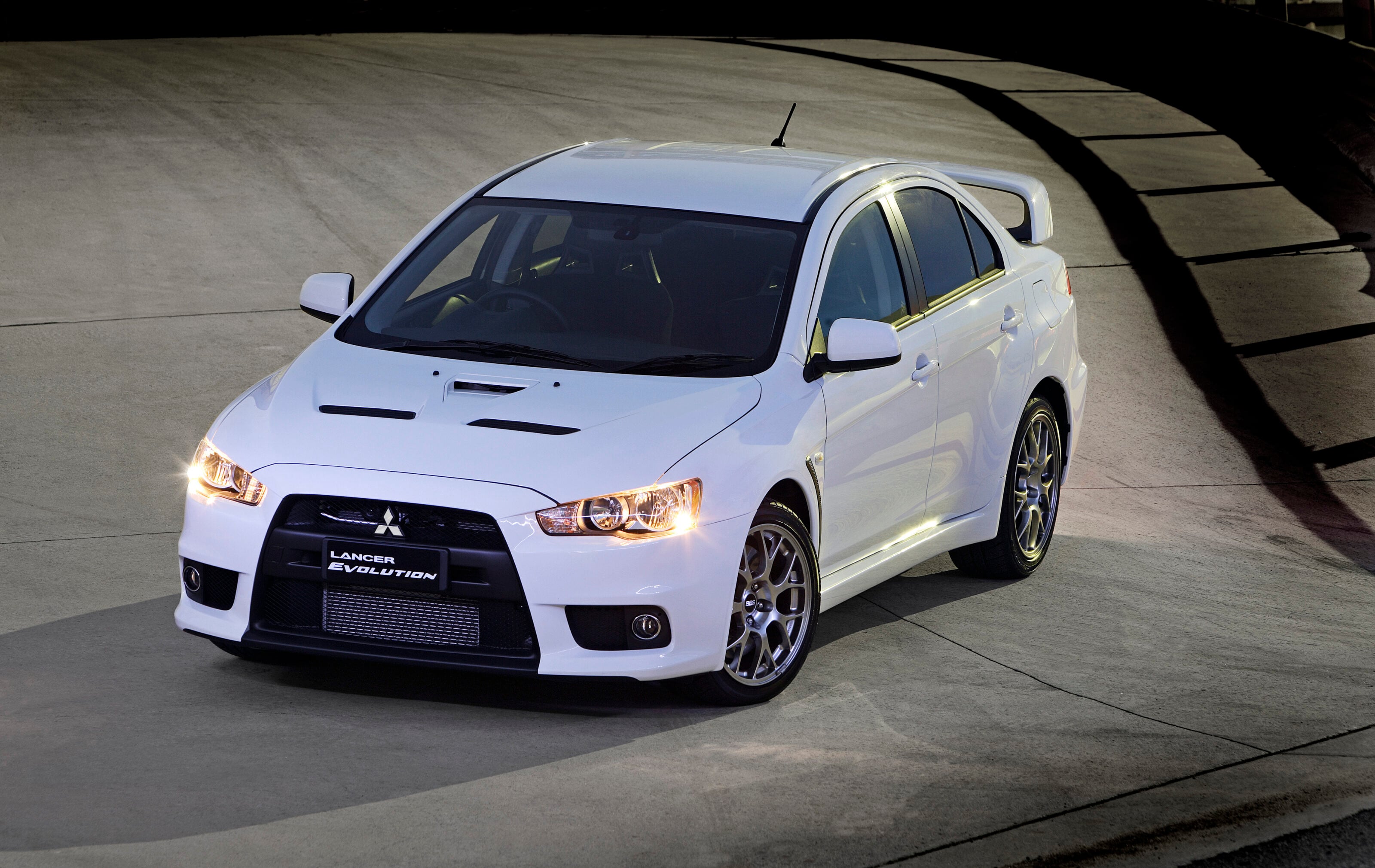
Surrounded by a booming nostalgia-fuelled secondary car market, the final Lancer Evolution X is rarely in that front-of-mind conversation, but in time that will change.
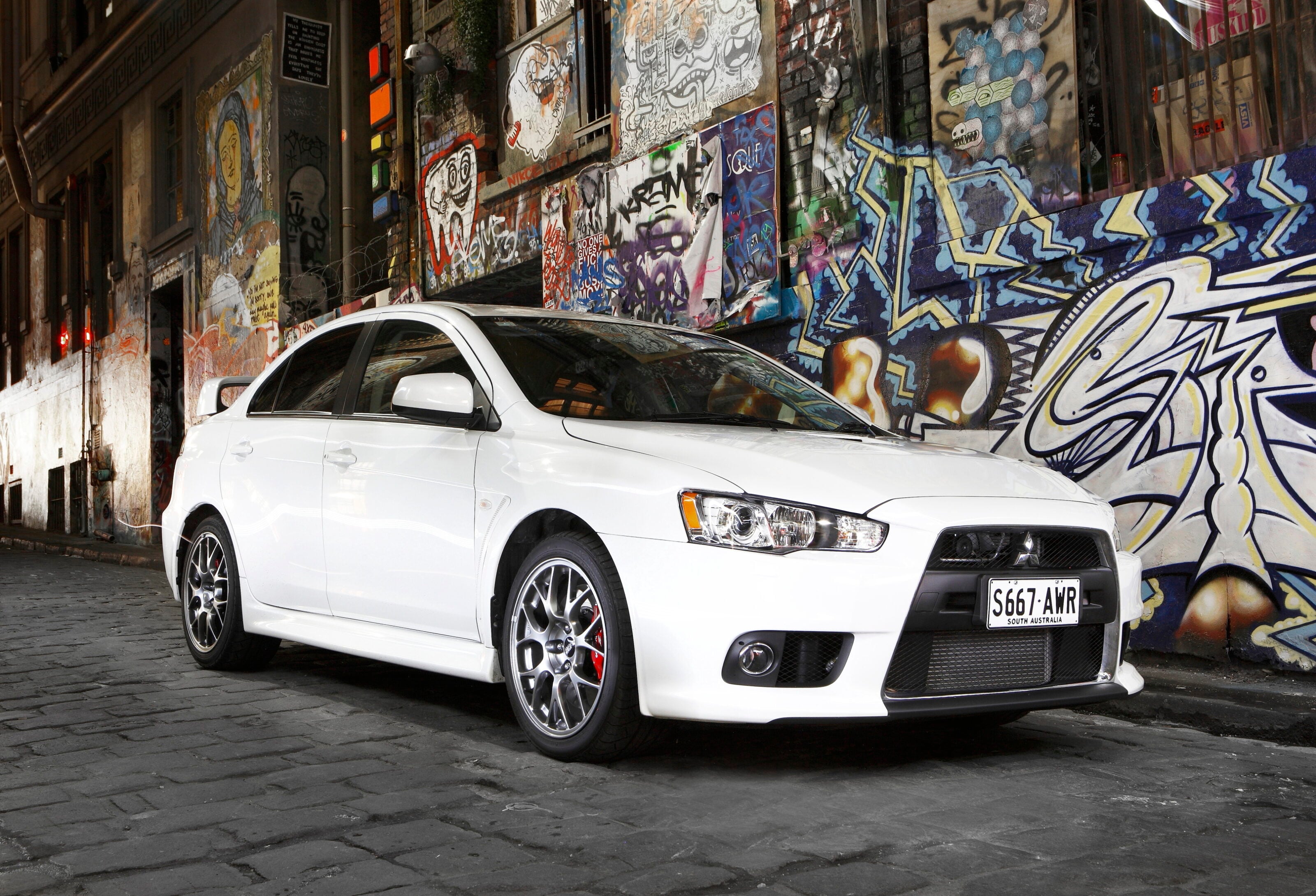
More than the mere swansong of an almost 25-year lineage, the tenth and final Evolution was the most radical and sophisticated iteration of the legendary Lancers and stands unique from its nine siblings in a number of ways.
For one, the long-serving 4G63 2.0-litre turbocharged inline-four, a powerplant whose basic architecture stretches back to the Galant VR4 of 1988, was finally retired and replaced with an all-new, all-alloy 4B11T 2.0-litre inline-four.
The last Lancer Evo is also uniquely underpinned by Mitsubishi’s GS platform, while Evos I to VI were based on Mirage platforms, and Evos VII to IX were based on Mitsubishi’s ‘Century Diamond’ Lancer platform.
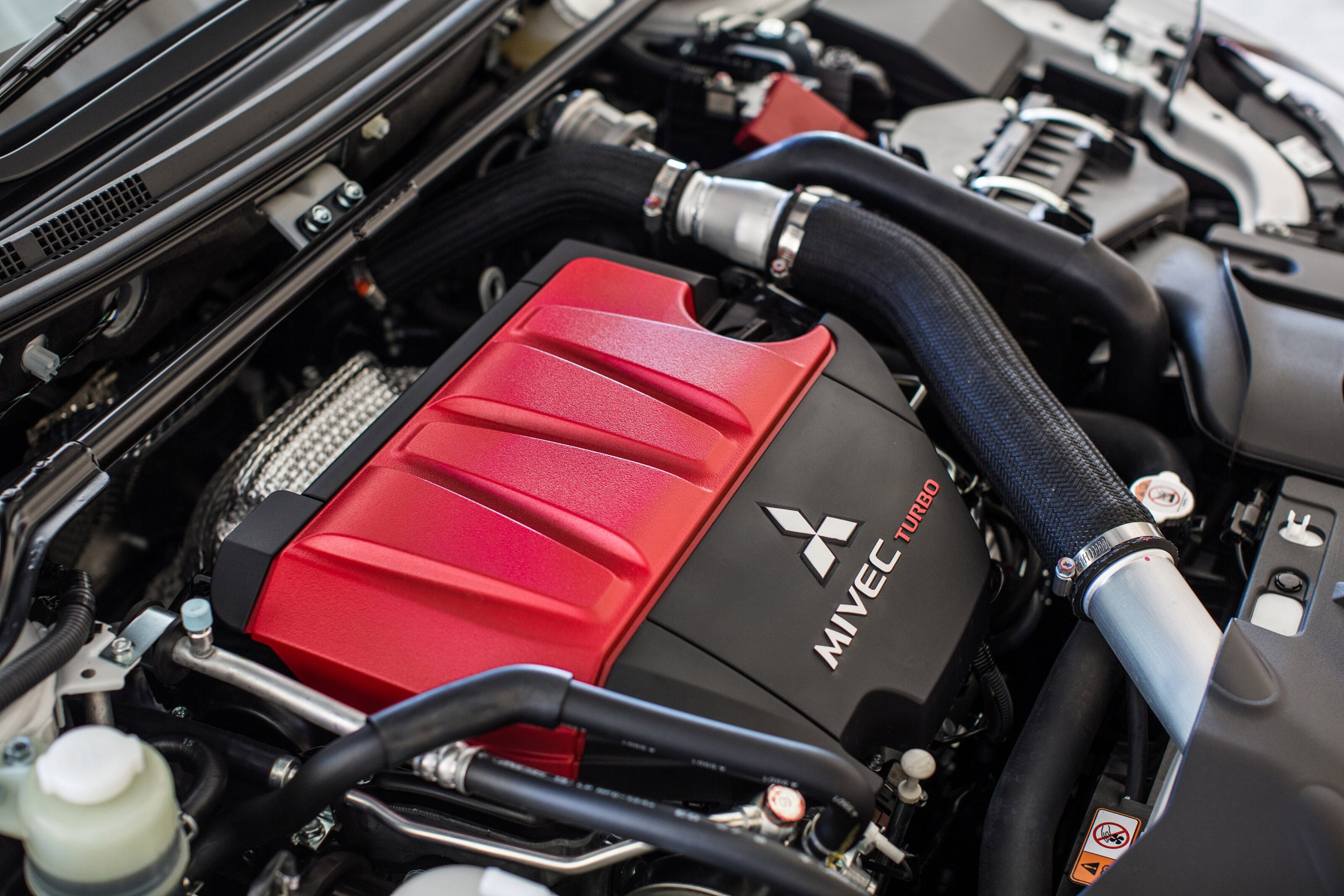
Larger and around 130kgs heavier than the preceding Evo IX, the tenth and final Evolution was traditionally regarded as a diluted and less focused machine than its predecessors. Today, however, the driving experience feels delightfully old-school, with real turbo lag delivering an unhurried take-off before a tidal wave of mid-range torque steps in. It’s still a devastatingly efficient tool to cover ground in.
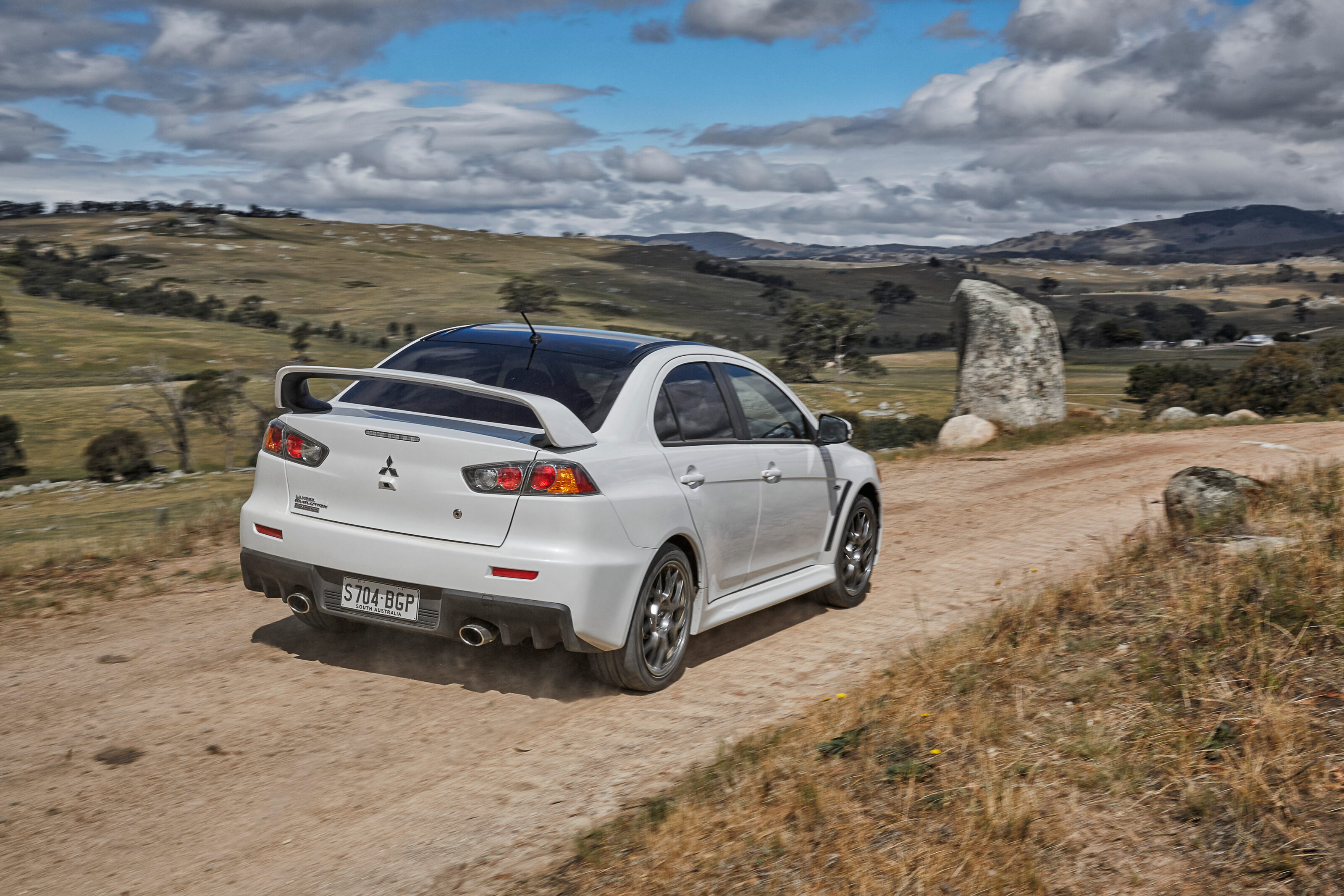
The X represented the Evo’s coming of age, but it never quite got the love it deserved. Like the R35 GT-R, it was unfamiliar and enthusiasts believed it had taken on too much weight and too much tech. Unlike the GT-R though, the Evo name was resigned to history as Mitsubishi ended production in early 2016.
Seen as too ‘digital’ to be a driver’s car in its day, the final Evo makes a compelling case in a contemporary context. Priced out of the old JDM market but want that analogue experience? As Cameron Kirby might say: “X gon’ give it to you”.
Essential Checks
In the Market
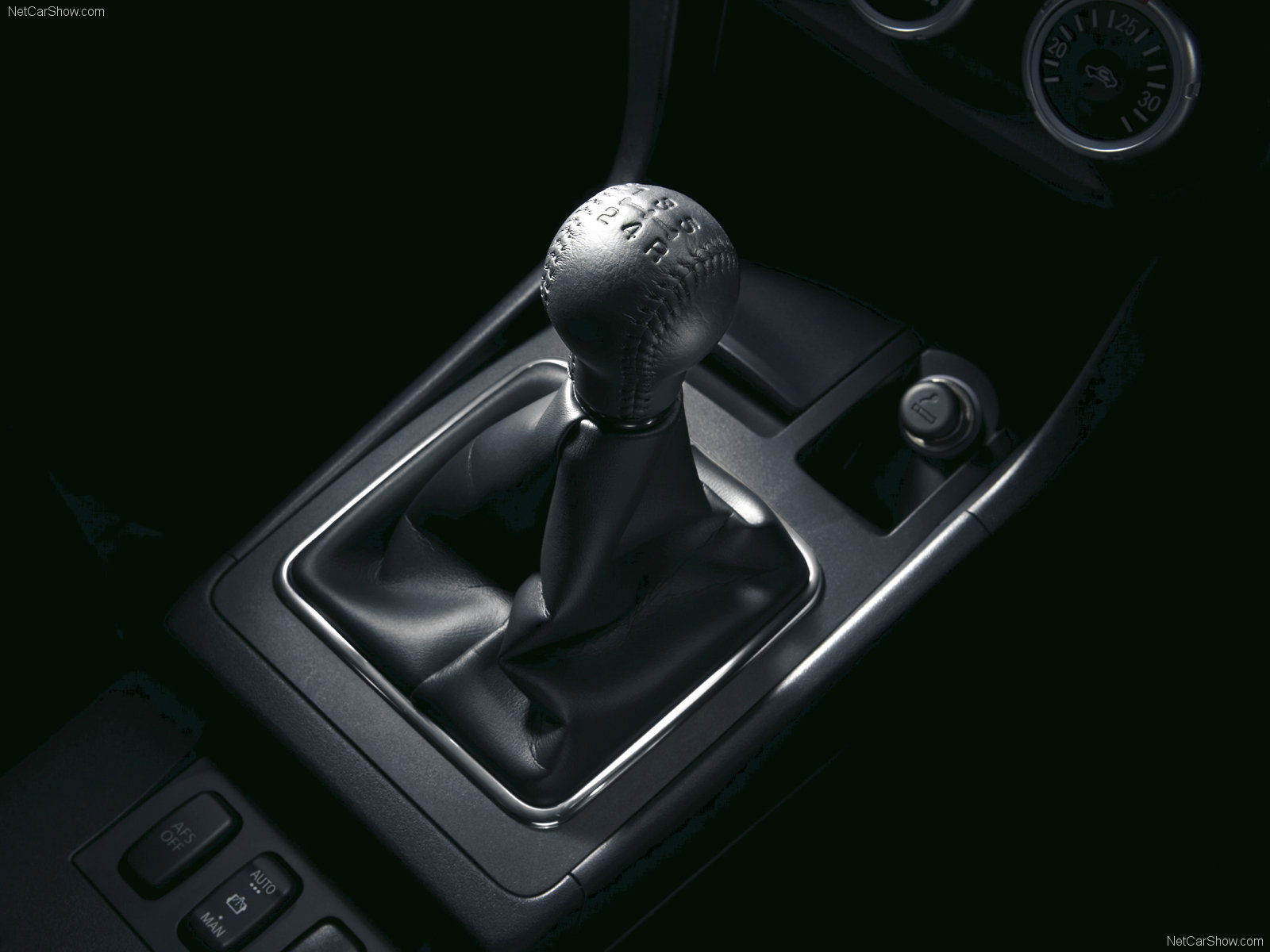
The Australian Evo X range comprised of a base car and a premium MR variant. ADM cars gained the same 217kW/366Nm tune as the USDM cars (upon release, JDM models were still hampered by Japan’s gentleman’s agreement on published 206kW outputs). The base car was fitted standard with a five-speed manual, with the cost option of Mitsubishi’s new six-speed TC-SST dual-clutch transmission.
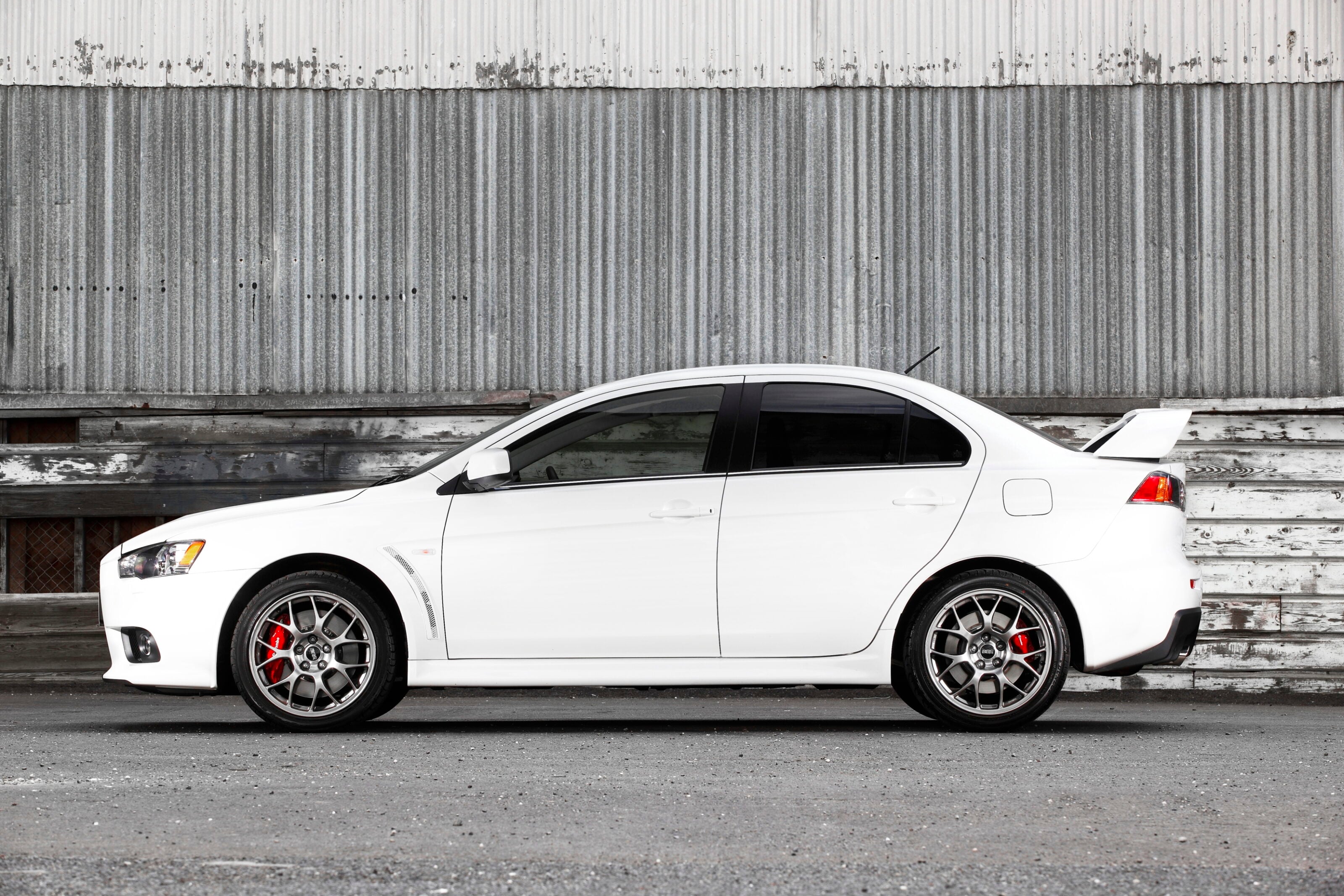
The MR was fitted with the dual-clutch gearbox as standard, also gaining two-piece floating Brembo brake rotors up front, Bilstein shocks and Eibach springs, forged 18-inch BBS wheels, heated leather trim, Rockford Fosgate sound system and central infotainment touchscreen with Bluetooth and Sat-Nav.
The ultimate enthusiast spec is a base manual Evo with the optional performance pack, which gains the MR’s go-fast bits including wheels, brakes and suspension.
Australia also received a unique run of 100 Bathurst Editions, upgraded by Ralliart Australia to 247kW/436Nm, representing the most powerful Evos ever offered in Australia.
Mitsubishi’s own Final Edition, a manual-only special limited to 150 units, couldn’t match Ralliart’s efforts, producing 226kW/414Nm.
Evo Xs were $30k cars not long ago, but the market now starts at $40k for cars approaching 100,000kms, up to about $60k for low-mileage factory examples.
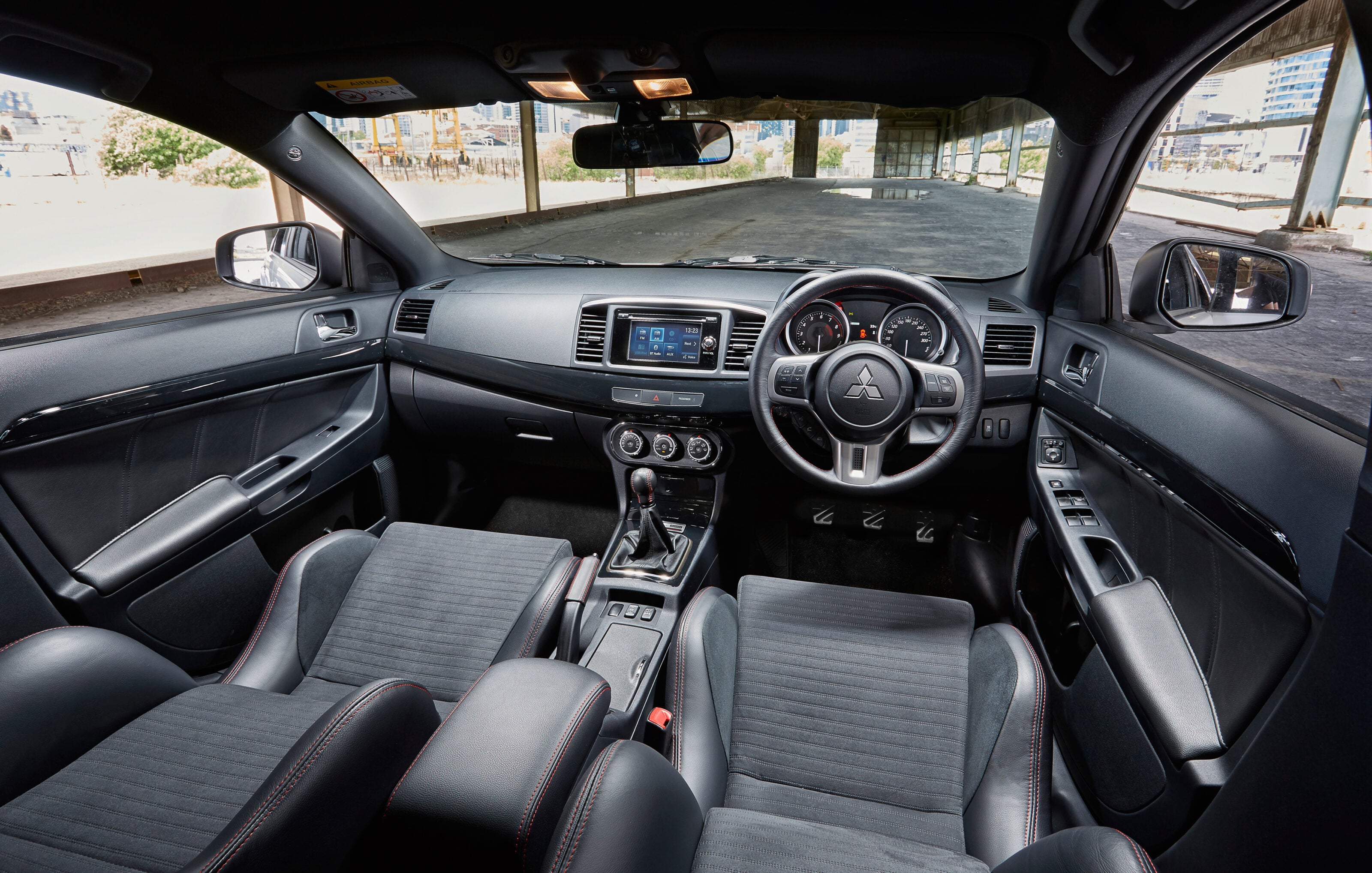
Body & Chassis
The bonnet and roof are made of aluminium, which is costly to repair so closely inspect for dents. Elsewhere, the flared rear guards are especially vulnerable to stone chips.
General accident inspection is advised when checking out used performance cars. Examine the boot and chassis legs for signs of deformation.
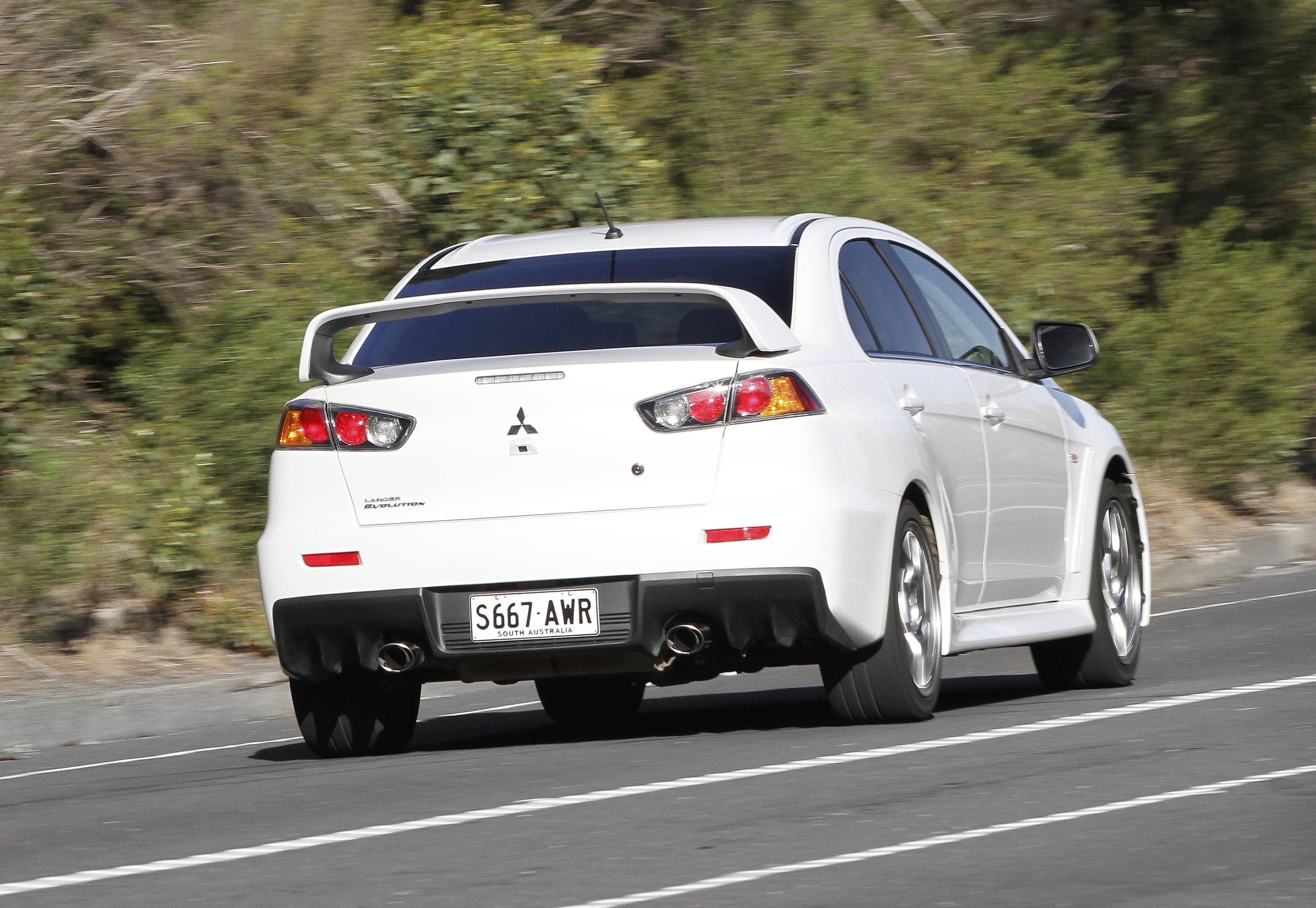
Engine & Transmission
The 4B11T likes a service every 7500kms (or six months), and is a reliable unit with a few known issues to note.
Timing chains on cars built before 2011 were prone to stretching, with upgraded components adopted later in production. Early factory fuel pump relays were also a known fault, and can cause the engine to run lean, but are a cheap and easy fix – if not already performed. OEM exhaust manifolds were also known to develop hairline cracks in rare cases.
SST dual-clutch transmissions were known to wear out clutches prematurely, especially on modified examples. Gearbox oil and external filter changes every 25,000kms does much to prolong life.
Suspension & Brakes
A flawed packaging decision saw the ACD/AYC pump located behind the rear driver’s side wheel, which made it vulnerable to corrosion and subsequent failing. Sourcing new-old stock replacements can be costly, although aftermarket units are available, and various relocation kits will eliminate any risk.
Knocks often occur at the front end, frequently caused by worn front damper bearings.
Interior & Electrics
Rattles seem to be a when, not if affair, often permeating around the A and B-pillar or glovebox. The Recaros sit quite high and there is no reach adjustment in the column, so check you fit.
Three other options you may consider
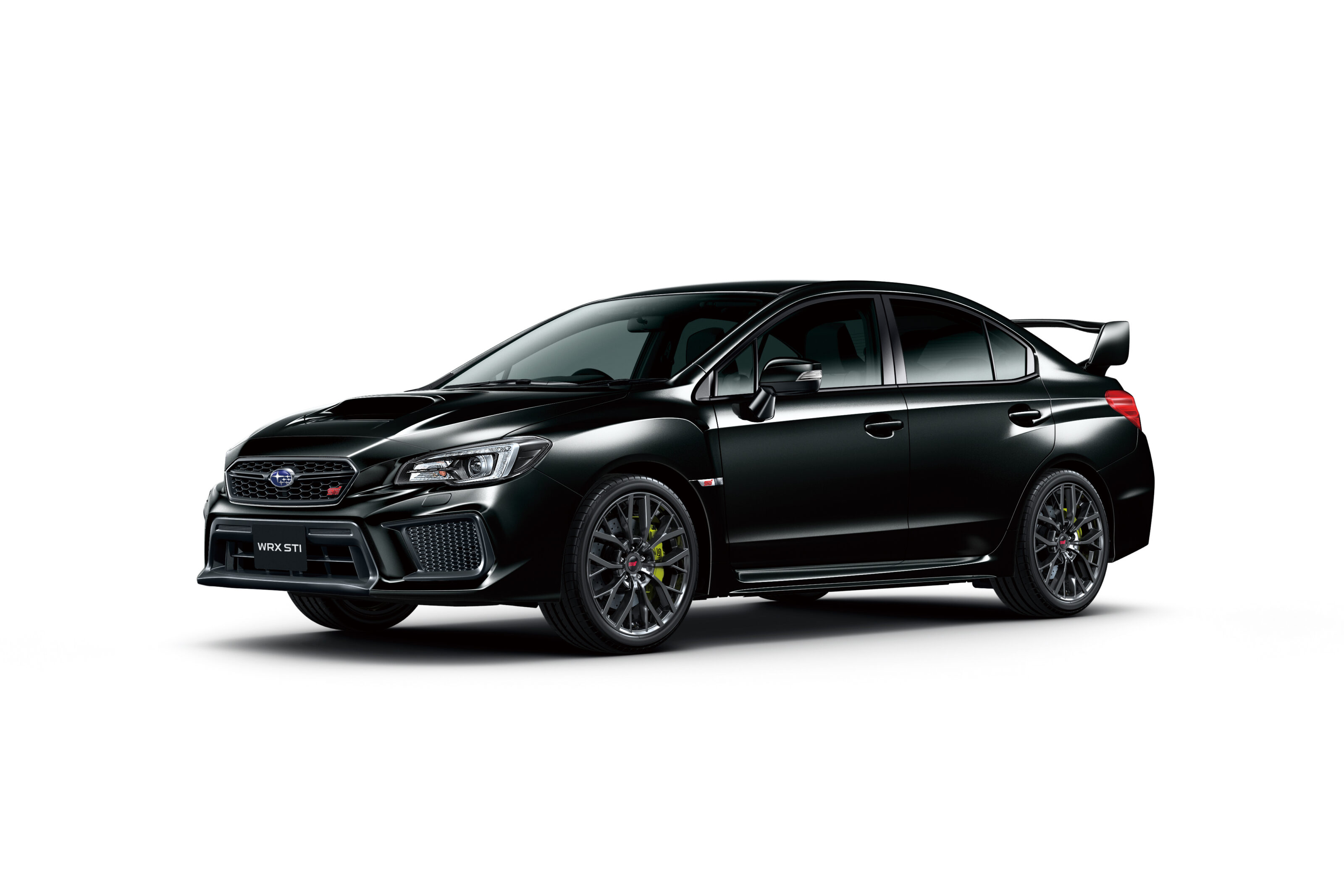
The obvious: Subaru VA WRX
Top-end Evo X prices (let’s not even mention Evo IX prices) would afford you a virtually new WRX demonstrator, or even a gently used flagship STi Spec R. If you like them older, $60k will also see you into a very used ‘Hawkeye’ STi.
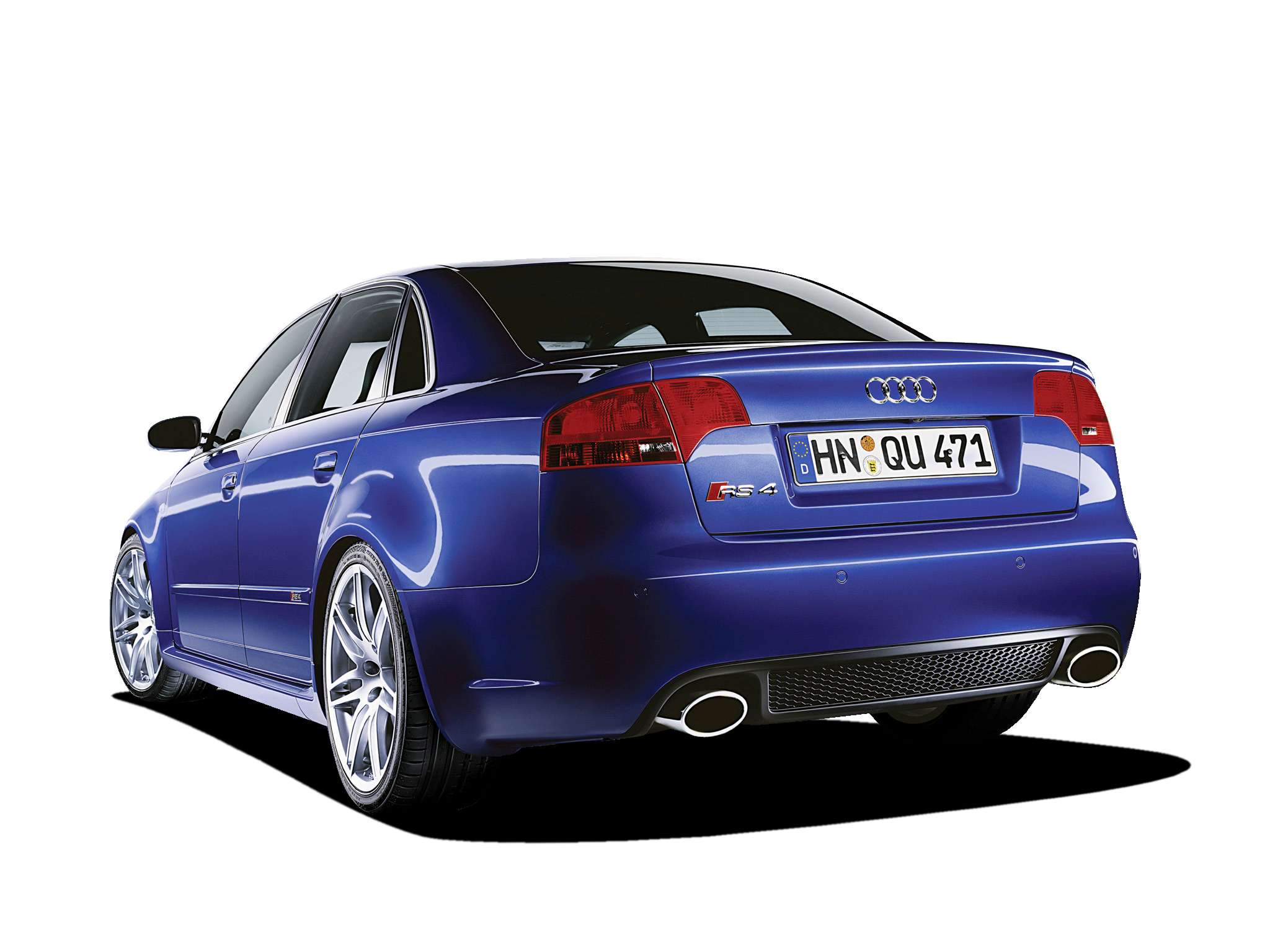
The unexpected: Audi B7 RS4
When buyers began shying away from Evos and WRXs, they went to European sports sedans like this. The B7 RS4 is held up as a highpoint within the lineage, and is available at a cheaper buy-in, yours for around $50k.
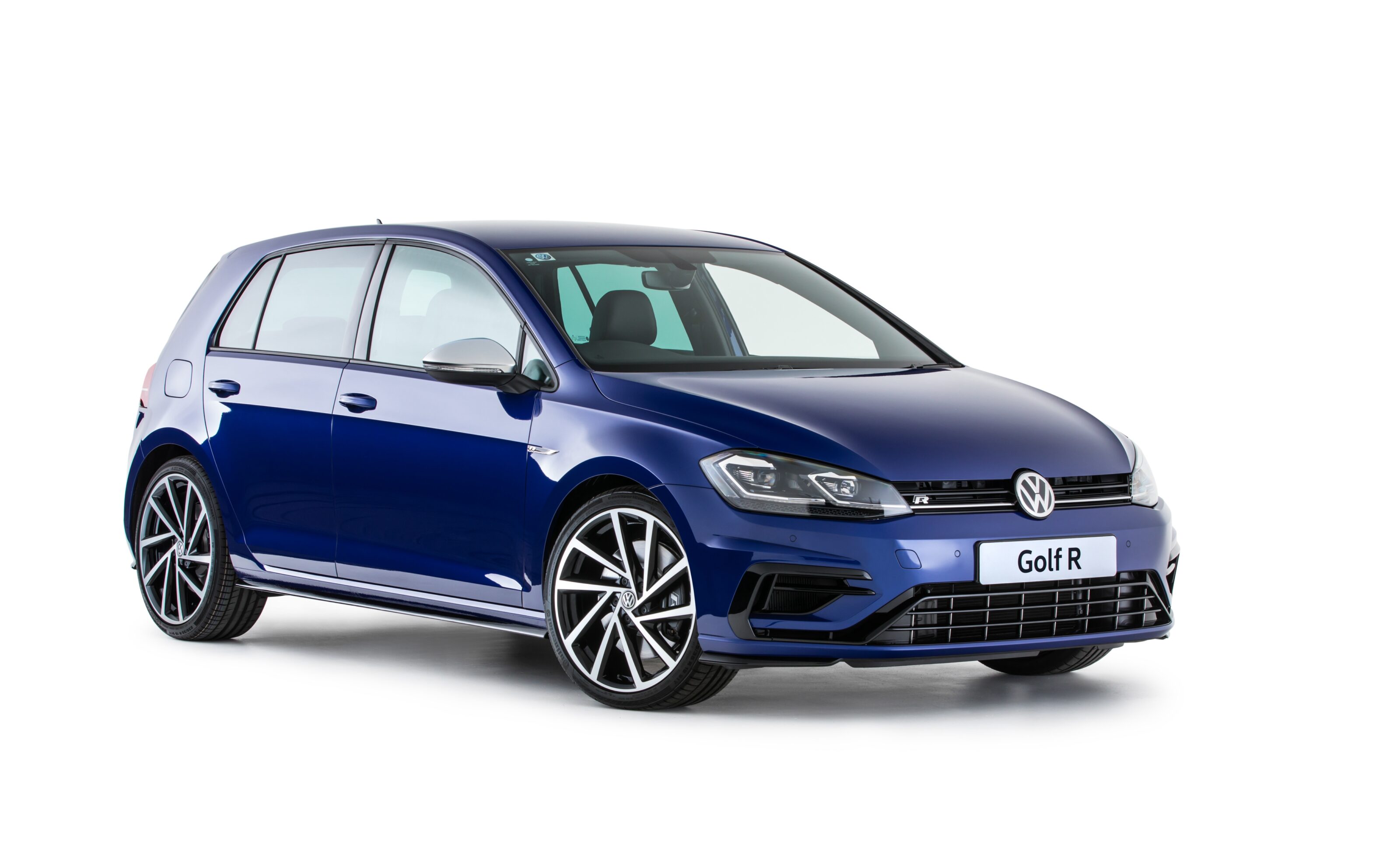
The oddball: Volkswagen Mk7/7.5 Golf R
To modern enthusiasts, the Golf R is arguably the truest spiritual champion of the days when Evos and WRXs ruled the road. All-wheel drive traction, a highly strung transverse turbo-four and endless tuneability. It’s easy to see why.
Mitsubishi Lancer Evolution X specs
| Body | 4-door, 5-seat sedan u00a0 |
| Engine | 1998cc inline-4, DOHC, 16v, turbou00a0 u00a0 |
| Power | 217kW @ 6500rpm u00a0 |
| Torque | 366Nm @ 3500rpm u00a0 |
| Transmission | 5-speed manual/ 6-speed dual-clutch u00a0 |
| Weight | 1560kg u00a0 |
| Used Range | $40,000-$60,000 |
As a child of the ’60s, I had a boyhood obsession with Italian sports cars and Australian muscle cars. An odd mix, some would say, but while the allure of European thoroughbreds is obvious,
I believe my contrasting fascination with home-grown workhorses is justifiable.
Our roads were once dominated by Holden, Ford and Chrysler, and this was a fabulous period for diverse styling, as each brand had a genetic code of their own. Their individual personas set the scene for fierce brand loyalty and dogmatic barbeque repartee. At the time, my father’s pride and joy was his Holden EH Special with a 179 Hydramatic. Perhaps it was this early indoctrination that sent me on a convoluted path to a career at Holden.
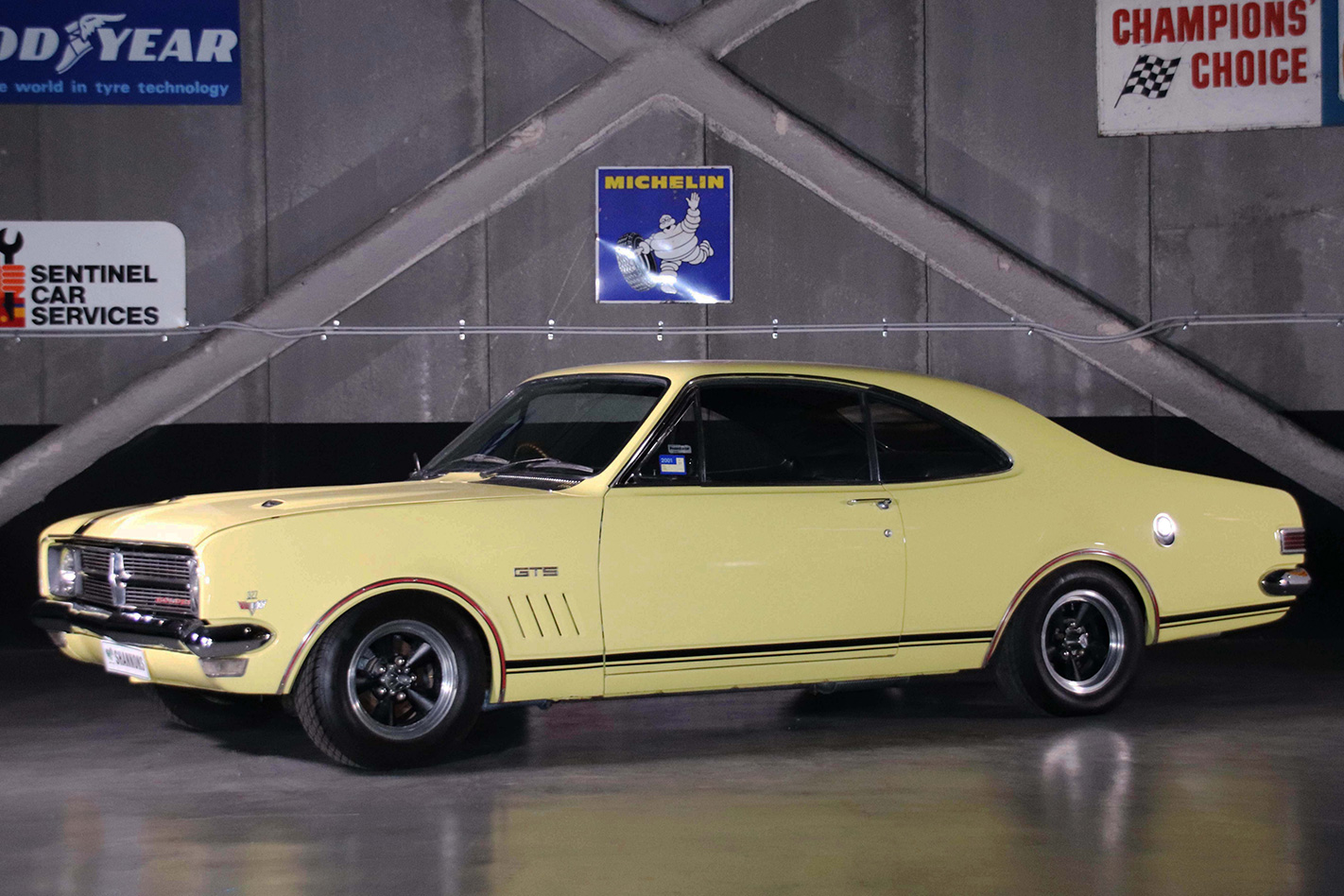
Without dismissing some of the significant earlier works, it’s fair to say that automotive design really got serious in Australia in the late 1960s. The big three had new design centres and under the tutelage of more experienced American design executives, the local talent helped create unique interpretations of our own. So, let’s set aside any myopic brand rivalries for a moment and salute a few of Australia’s great car designs of the past.
Although based on the American designed XR, the local Falcon XW-XY models were good-looking roosters. The XY in particular was a very well-resolved design with an imposing stance and excellent detailing. The butch proportions translated effortlessly into one of the world’s best-looking GT sedans. At the same time, Holden had launched the local HK architecture and it heralded the first-generation Monaro. Sleek and clean with a swoopy pillarless roofline, it gloriously captured the mood of the swinging ’60s.
Enter the 1970s and Australia is spoilt with three new Aussie launches; Holden HQ, Ford XA and Valiant VH. Three very different design languages, albeit influenced by their parent company ethos, but executed in a uniquely Australian manner. I would argue that the proportions of the Australian cars were often better than their oversized US cousins. And the best part was, all three brands offered locally designed coupe variants.
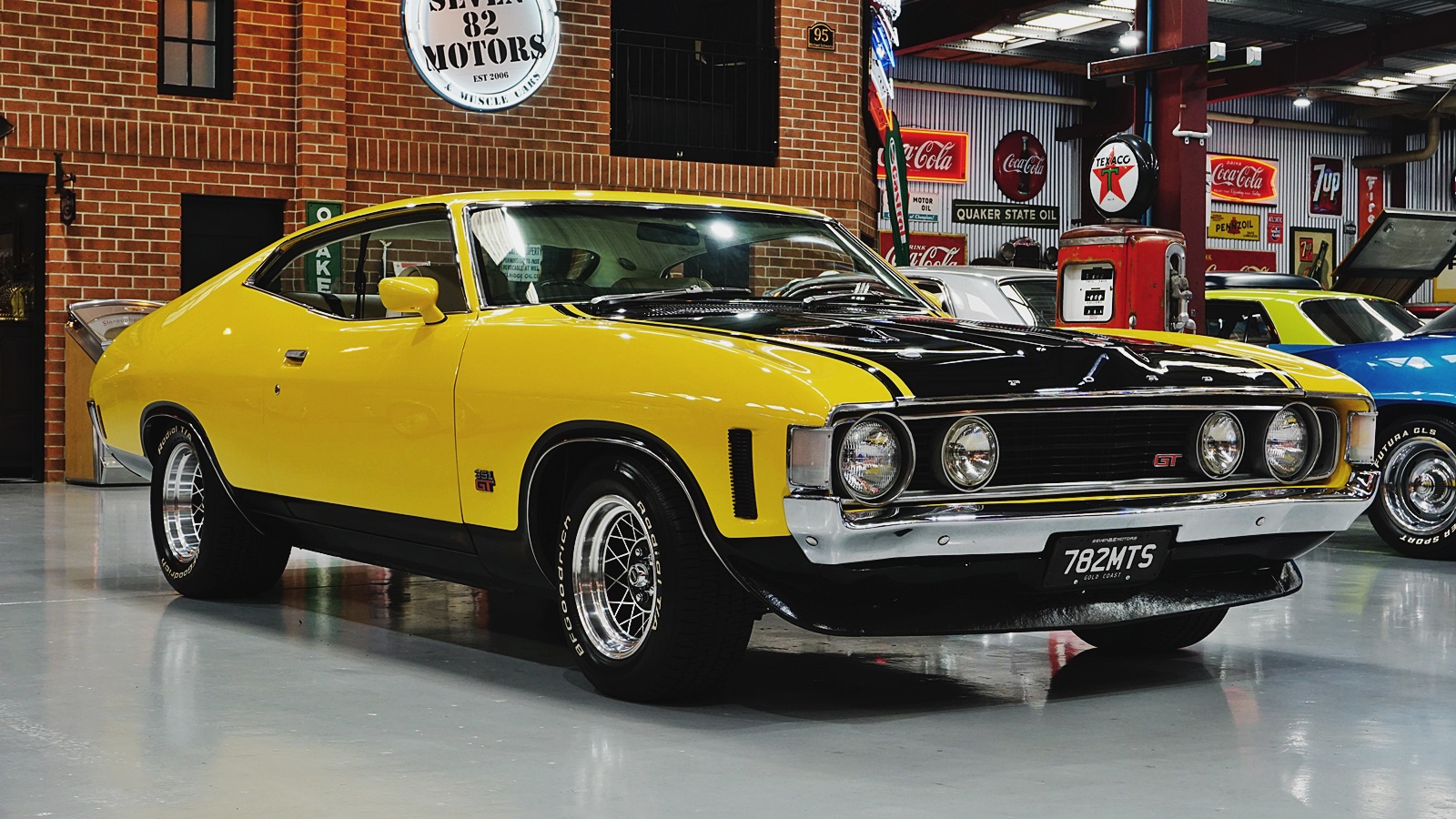
By any objective measure, the Monaro, Falcon Hardtop and Charger were great designs in their day and each of them flexed their muscle with an individual bravado. The Monaro was sculptural and elegant, with fluid surfacing and signature fender blisters. In bold contrast, the Falcon Hardtop was a beast with intimidating volume around the rear quarter, just begging for huge wheels to fill the arches. And the svelte Charger had a sharp and chiselled profile, complemented by the swept buttress pillars and distinctive ducktail.
All three of them were styling triumphs and exemplified the halcyon days of automotive design in this country, consolidating our car-culture and motorsport folklore. Sadly, after this peak period the automotive landscape changed, and corporate strategies shifted away from this genre.
Nonetheless, the industry battled on and a resurgence occurred in the late ’80s. In 1988, the VN Commodore and the EA Falcon were released. Once again, the two brands locked horns and the EA deserves a podium position for one of the best styled Falcons. It was crisp and bold, with a modern, product-design feel about it, despite the initial low-tech drivetrain.
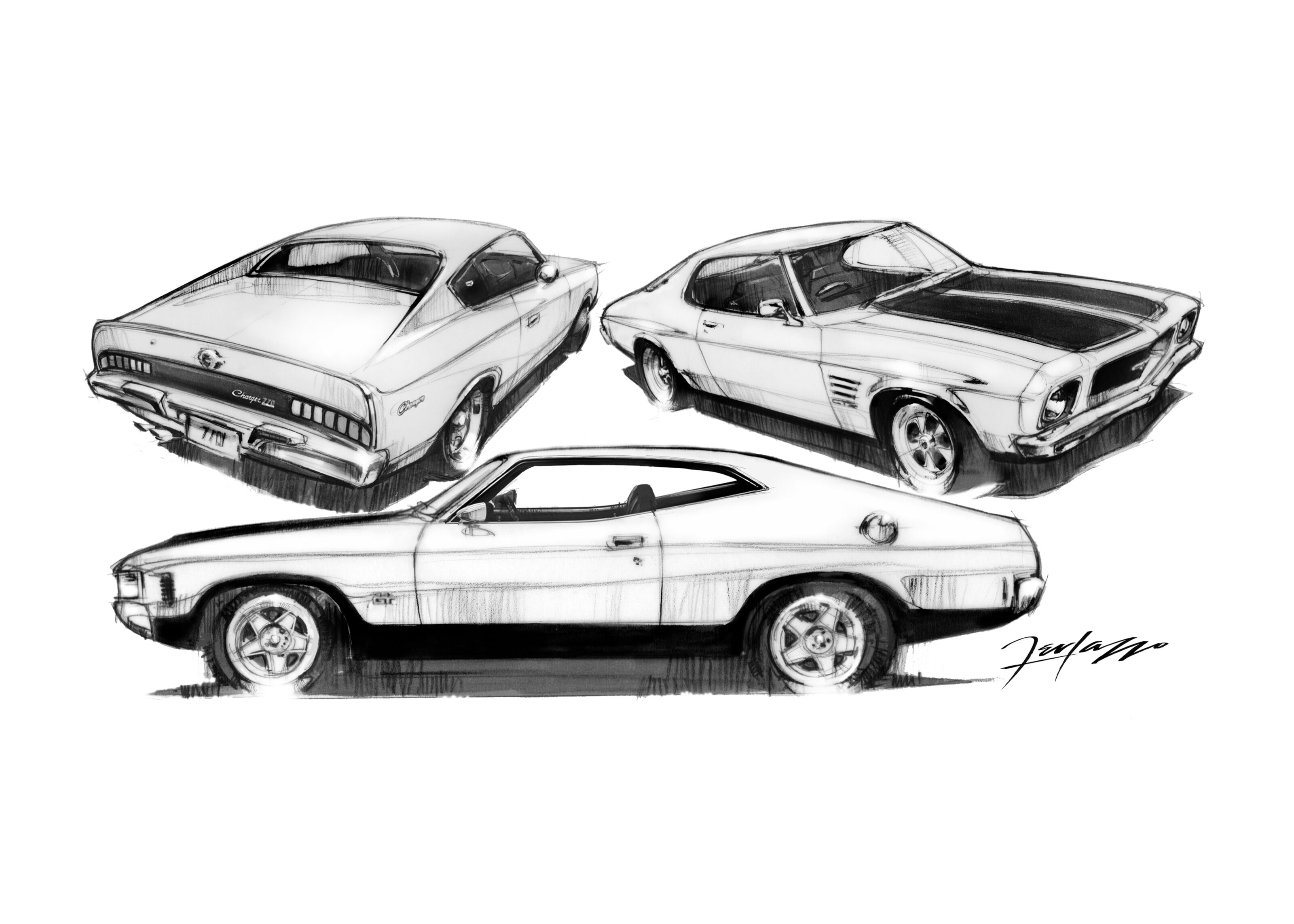
The true renaissance for Holden was the VT Commodore and its derivatives like the Statesman and the third-generation Monaro. Export markets opened up, making this the launchpad for the VE-VF architecture; the first ground-up, all-new architecture since the HQ and arguably the best-ever Australian-developed car for its respective period.
Whilst the recent record auction prices for historic Australian cars may be fuelled by nostalgic investment speculation, I’m inclined to believe that we’re also finally appreciating the significance of our great automotive history.
And so, it transpires that Aussie made cars have retained their re-sale value after all.
Richard Ferlazzo is the former GM Holden Design Director
Not to say there’s causation, but the world went a bit pear-shaped when the Toyota Tarago left us. The people mover of choice for tens of thousands of Aussies ended production in the final weeks of 2019, since replaced by the more luxo-bent Granvia. But this page of Wheels hasn’t paid homage to the trusty Tarago until now.
First introduced to Australia in 1983 as our own version of what was called the TownAce (and the unfortunately named MasterAce), the Toyota Tarago was effectively a passenger van body plonked onto the chassis of a commercial vehicle, though with slightly upgraded components for a more car-like drive. A note in Wheels February 1983 points out the “soon-for-release MasterAce Grand Saloon has coil-spring rear suspension and an aerodynamic nose”.
But it was in the 1990s that Tarago, named for a town in NSW, really found its footing. After making a name for itself badge-wise, the Tarago came close to winning our 1991 Car of the Year.
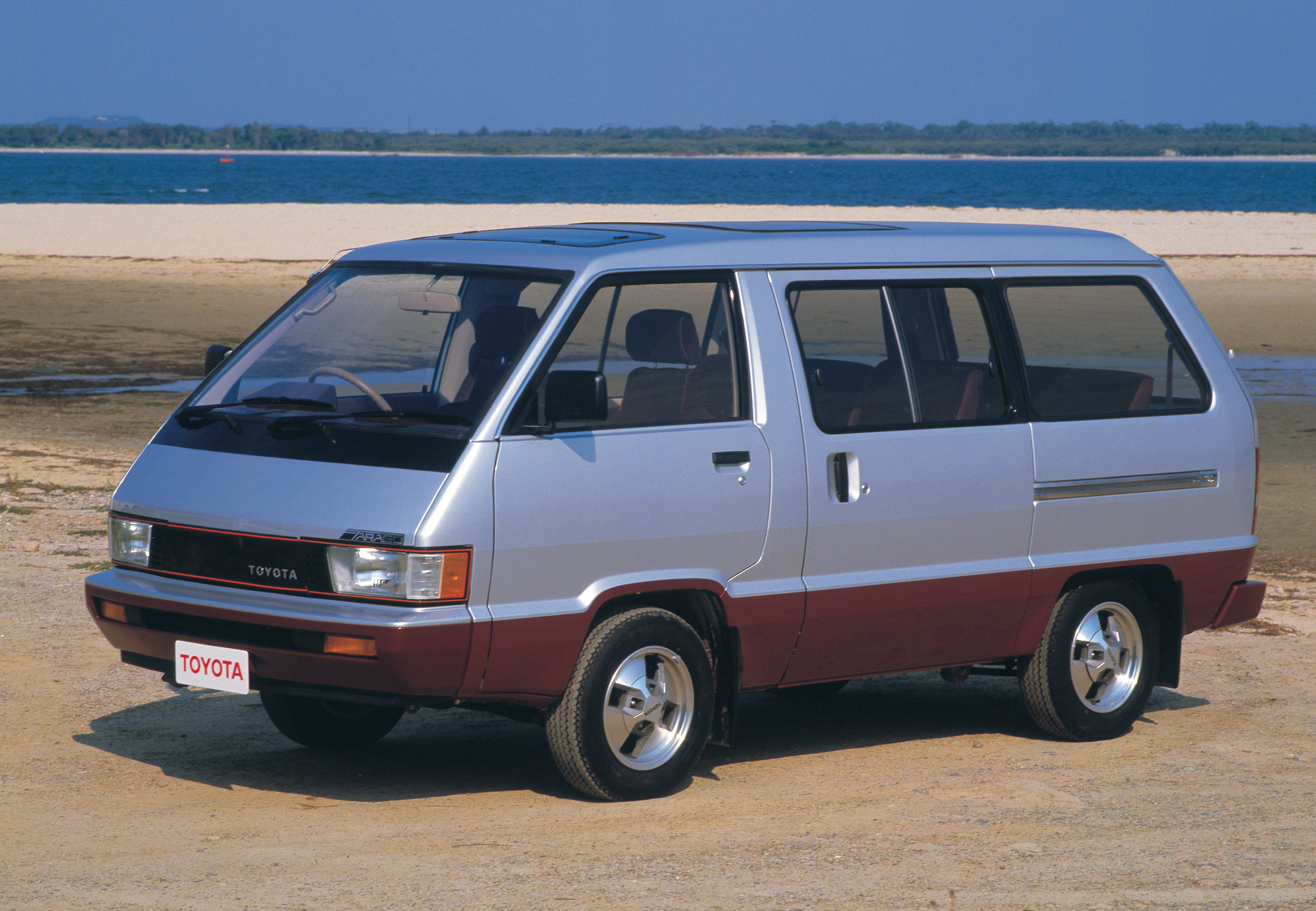
The second generation, called Previa in Japan, was all-new, with Toyota claiming nothing was carried over from the previous model. It was a far more modern “aerodynamic egg” design, as then-editor Phil Scott called it in December 1989, featuring a mid-mounted engine, strut front and multi-link rear suspension, and almost perfect weight distribution. All of which made the Tarago exceptional, at considerable expense to Toyota.
At Car of the Year in 1991, judge John Carey called it “the most significant piece of design this year”; Peter Robinson said it was a “quantum leap forward in people movers”. In the end, the Lexus LS400 won COTY, but the four judges who didn’t vote for it voted for one other car: Tarago. One of those judges was Colin Bond!
Up to the turn of the century, Toyota shifted more than 60,000 Taragos between its first two generations, before the arrival of the third generation in 2000. Once again, Toyota claimed there were no parts in common with the previous model, though this time the Tarago wasn’t entirely built as a unique vehicle. Tarago 3.0 shared its chassis and underpinnings with the Camry sedan, meaning the engine was now mounted in the front, and the floor and seats were now lower to the ground.
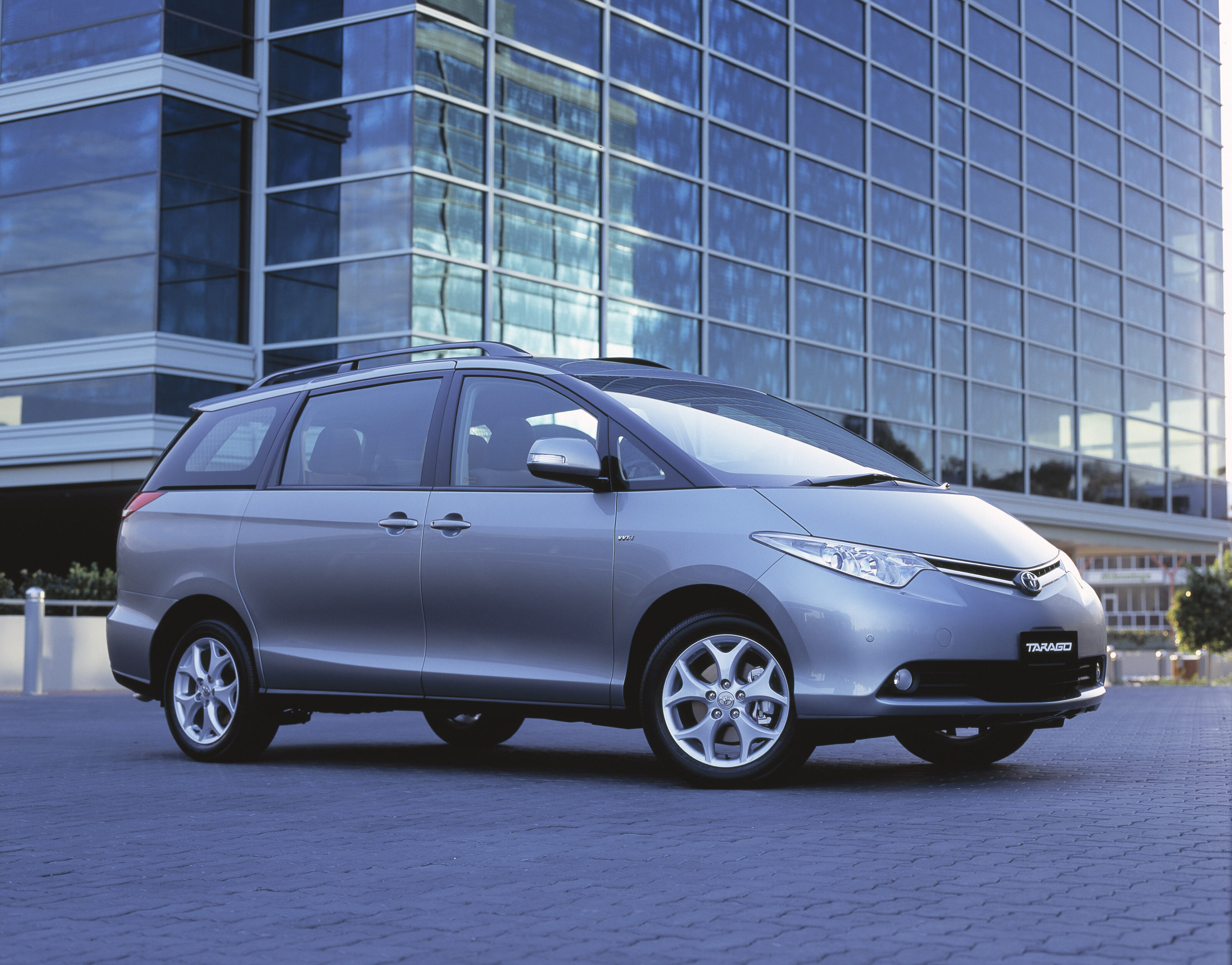
While perhaps not as revolutionary as the second version, the third Tarago sold 16,000 units across its six years, a number the fourth generation would take a decade to match after going on sale in 2006. That generation would be the last for the Tarago. In an ironic twist, the car-based van would give way to a new model with the same genesis as the original Tarago.
The Toyota Granvia, a larger, more luxury-focused van takes the place of Toyota’s people mover. Its basis? The new Toyota HiAce van. What’s clear is Toyota believes the new platform is more economical to produce, as well as driving well enough to have appeal as a passenger vehicle.
But not a patch on that second-generation Tarago in terms of revolutionising the segment.
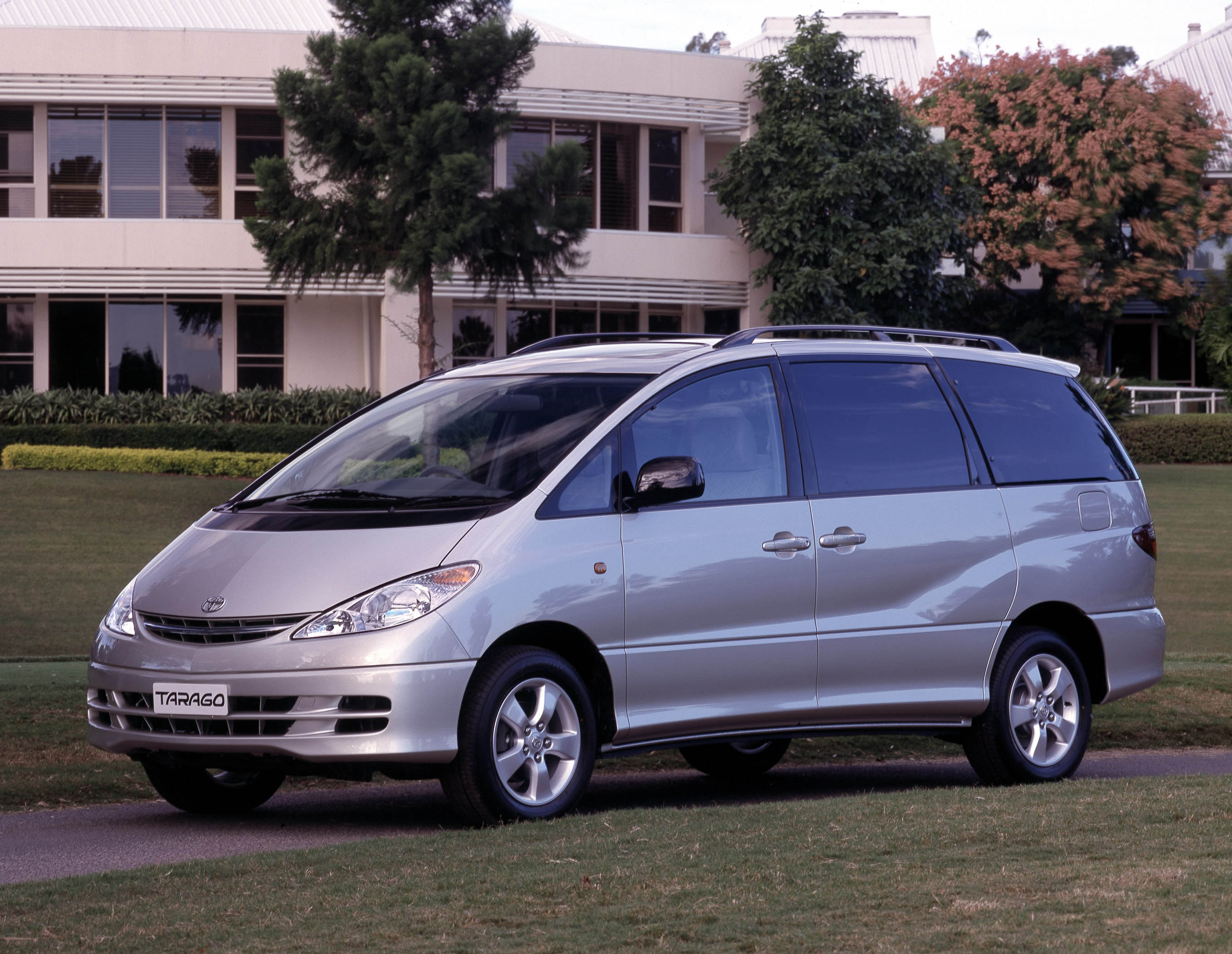
The people remain moved
The Tarago is a tough act to follow, but it seems the Granvia may be capable. Starting at $65K and reaching only into the mid-$70Ks, the single-drivetrain range (with a 2.8-litre turbo-diesel four from the Prado) features six- or eight-seater options across two variants, base or upper-spec VX. Multi-link coil-sprung rear suspension is still there, at least, to create a comfortable ride for passengers.
(Total data: 1983-2021)
Performance cars under $100,000 are set for a massive shake-up in 2022, with a number of all-new models likely to spur the interest of buyers keen on a more-affordable sporting addition.
More-powerful all-electric options are also making the trip to Australia at a rapid pace, with hot new EVs from Audi Sport and Mercedes-AMG – and even a Kia that can complete the 0-100km/h sprint in 3.5-seconds.
Timing issues caused by the global semiconductor chip shortage that plagued the automotive industry in 2021 are set to remain throughout 2022, meaning several vehicles on this list are either delayed beyond initial projections, or could be delayed.
NOTE: To see all the new cars coming to Australia this year, check out our 2022 New Car Calendar story right here.
New performance cars arriving in 2022
- Audi RS E-Tron GT
- Audi RS 3
- Chevrolet Corvette
- Honda Civic Type R
- Kia EV6 GT
- Mercedes-AMG EQS 53
- Mercedes-AMG SL
- Nissan Z
- Subaru WRX
- Volkswagen Golf R.
Audi RS E-Tron GT
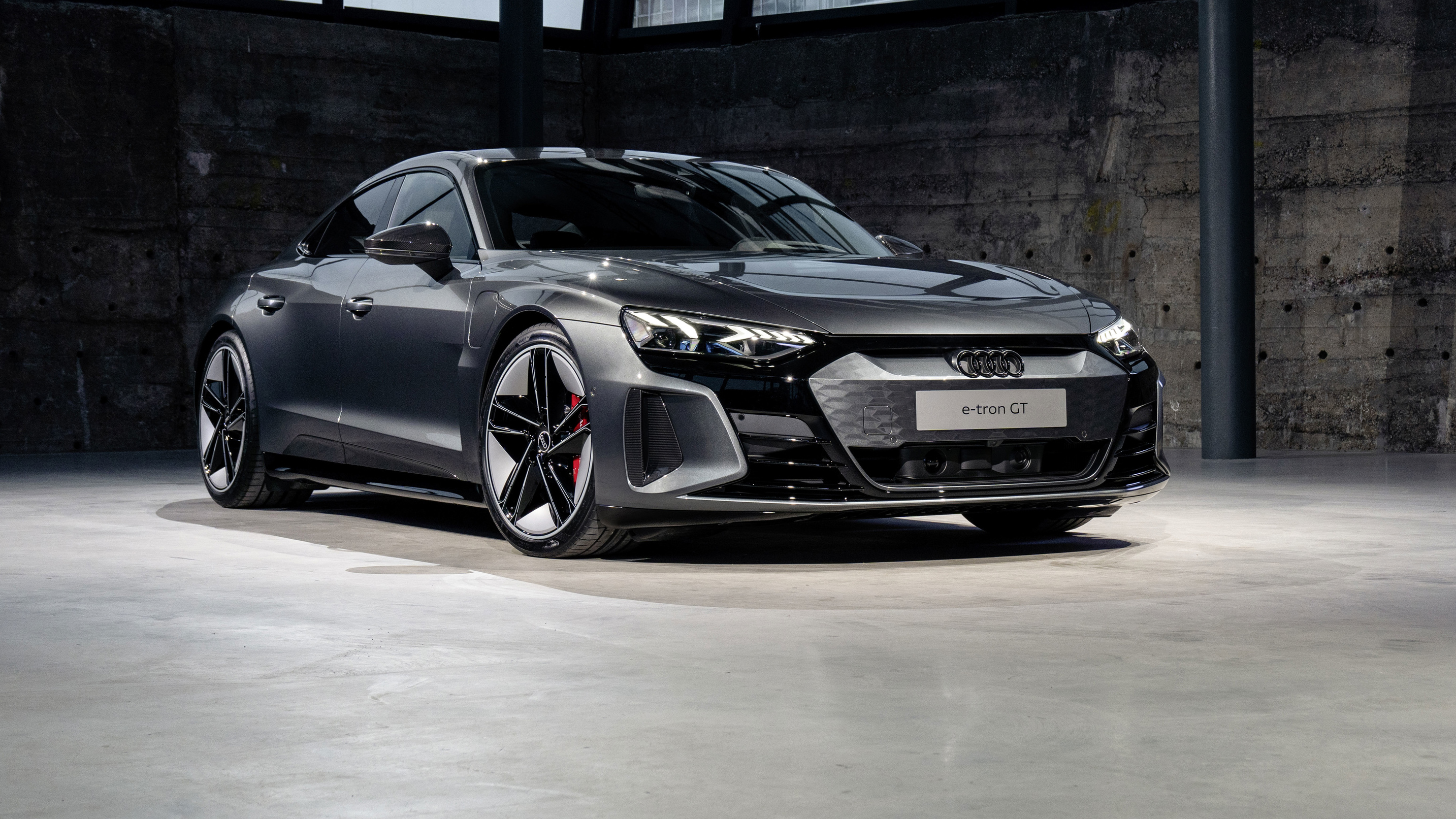
Arriving: Sometime in 2022
The all-wheel-drive Audi E-Tron GT is another addition to the brand’s electric line-up.
Sharing the VW Group’s bespoke ‘J1’ platform with the Porsche Taycan, this sporty Audi has 350kW of power and 630Nm of torque in standard guise.
In the hotter RS – which looks visually identical to the regular E-Tron GT – combined power outputs reach 440kW/830Nm.
This means the standard E-Tron GT is 0-100km/h can complete a 0-100km/h run in 4.1 seconds, 0-200km/h in 15.5 seconds and a 245km/h top speed.
Meanwhile, the RS completes the same sprints in 3.3- and 11.8 seconds respectively, before hitting a top speed of 250km/h.
With an 85.7kWh battery pack under the floor, both the standard and RS variants of the E-Tron GT have a driving range of more than 400km, while power and torque sits at a punchy 350kW/630Nm in the regular GT.
Interior items such as the 12.3-inch digital instrument cluster, 10.1-inch touchscreen and a D-shaped steering wheel carry over from other Audi models.
First locked in for the third quarter of 2021, the 2022 Audi E-Tron GT has been delayed until some point in 2022. The specific model line-up and pricing details are still to be confirmed.
Audi RS 3
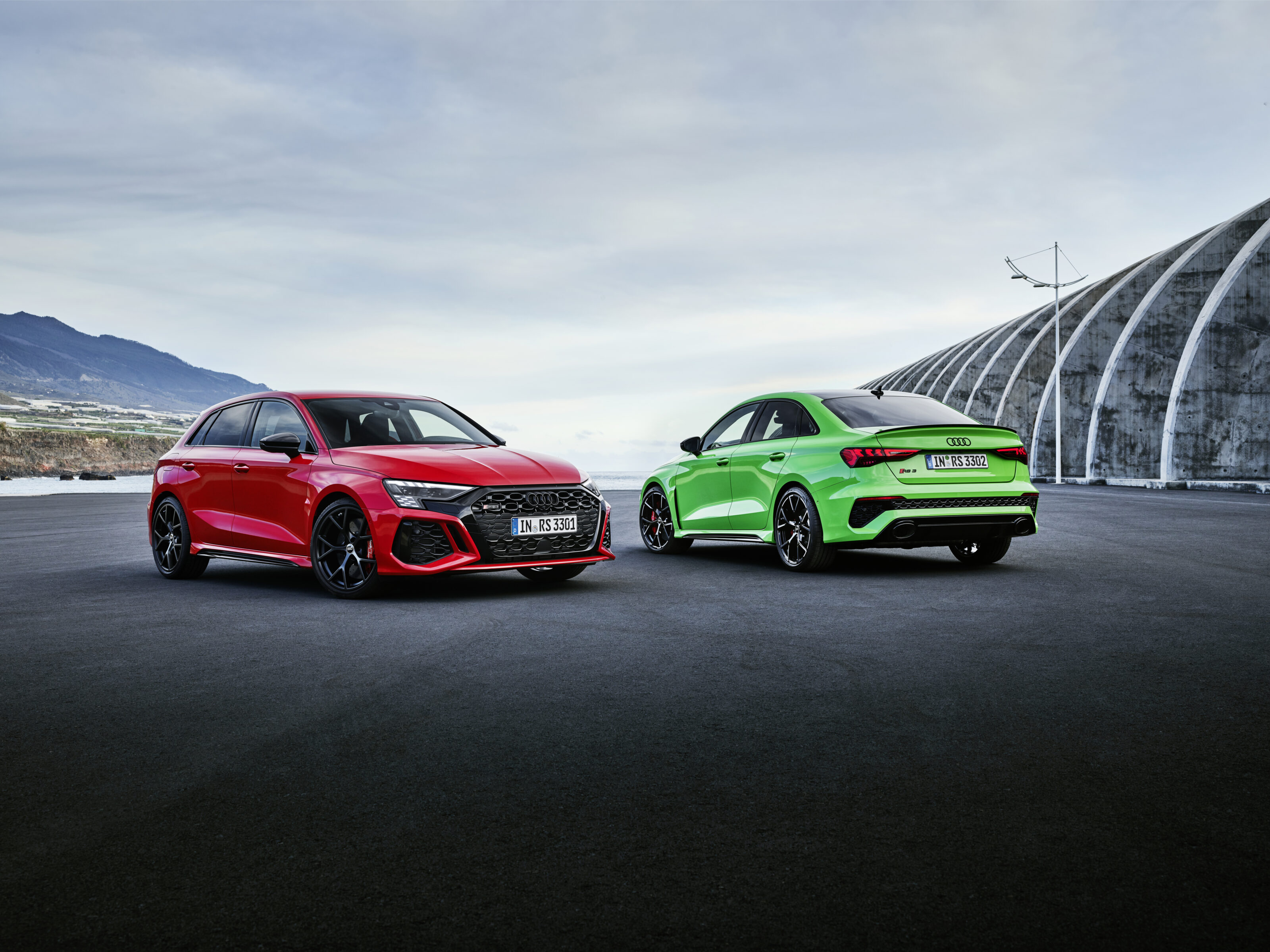
Arriving: Second quarter
The smallest RS-badged offering from Audi Sport packs even more grunt for 2022.
With a 2.5-litre turbocharged five-cylinder engine, the Audi RS 3 now sports 294kW of power and 500Nm of torque, with power sent to all four wheels through a seven-speed dual-clutch automatic transmission.
Improvements within the dual-clutch auto see the 0-100km/h time drop to a claimed 3.8-seconds – just 0.2 of a second slower than the flagship V8 RS 6 – on the way to a top speed of 250km/h.
An RS sports exhaust is fitted as standard, while the new torque splitter system electronically controls torque across the rear wheels, which helps to improve control during cornering and minimising understeer and oversteer.
Local pricing begins at $91,400 before on-road costs for the RS 3 Sportback, with the sedan body adding an additional $2000 to the listed price.
The 2022 Audi RS 3 will touch down in Australia during the second quarter of next year.
Chevrolet Corvette
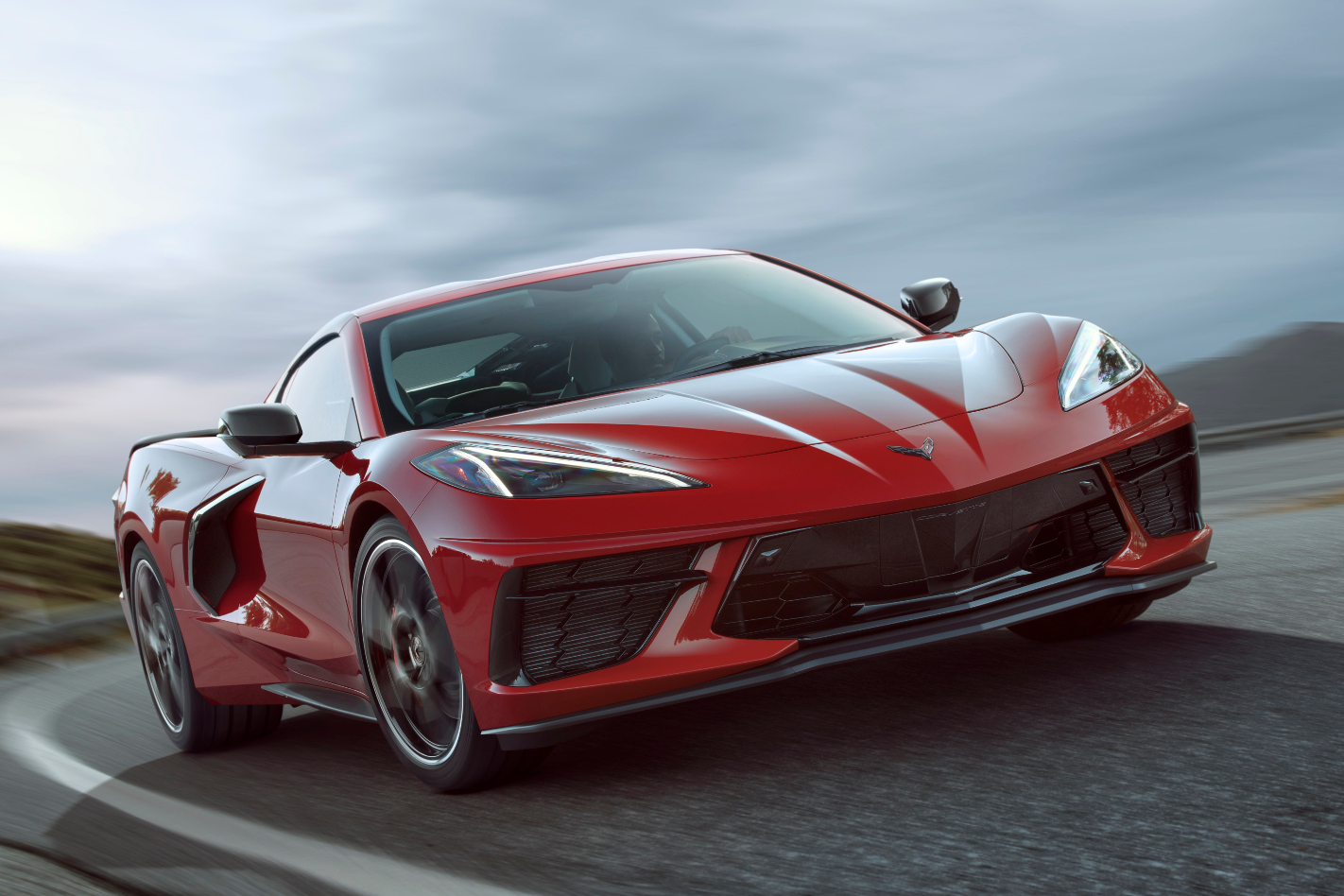
Arriving: Corvette – January; Corvette Z06 – not until 2023
In Australia, the Chevrolet C8 Corvette has been put through the wringer… and it hasn’t even launched yet.
First revealed in mid-2019, right-hand drive production of the C8 Corvette was confirmed, with local distribution and sales to be managed by Holden – but with Chevrolet badging remaining in place.
Fast forward just over six months, and Holden became a dead brand. Now, the Corvette will be imported into Australia through General Motors Speciality Vehicles (GMSV).
Set to arrive in January, the 2022 Chevrolet Corvette range will consist of the 2LT, 3LT and a range-topping Carbon Edition – which is a one-time special edition.
Pricing starts at $144,900 before on-road costs for the Stingray 2LT Coupe, rising to $160,500 for the 3LT and $189,990 for the Carbon Edition. Convertible versions, exclusive to the full-time 2LT and 3LT, cost another $15,000.
Honda Civic Type R

Arriving: Sometime in 2022
Honda has kicked off a teaser campaign for the 11th-generation Civic Type R hot hatch.
Expected to go on sale late next year, industry rumours suggest the outgoing 2.0-litre turbocharged petrol four-cylinder engine could see a return – albeit with the probable addition of a 48-volt mild-hybrid system to improve performance and reduce emissions.
As before, the Civic Type R will be offered exclusively – initially, at least – with a six-speed manual transmission.
Performance-orientated additions include a body kit with large air vents on the front spoiler, deep side skirts with louvres incorporated into the front wheel arches, and a large rear wing.
Three exhaust tips will also feature, in addition to Brembo high-performance brake callipers and a set of 20-inch lightweight alloy wheels wrapped in Michelin Pilot Sport 4S tyres.
The 2022 Honda Civic Type R is expected to be unveiled in the coming months, with the model likely to arrive in the second half of next year.
Kia EV6 GT
Arriving: Late 2022 or early 2023
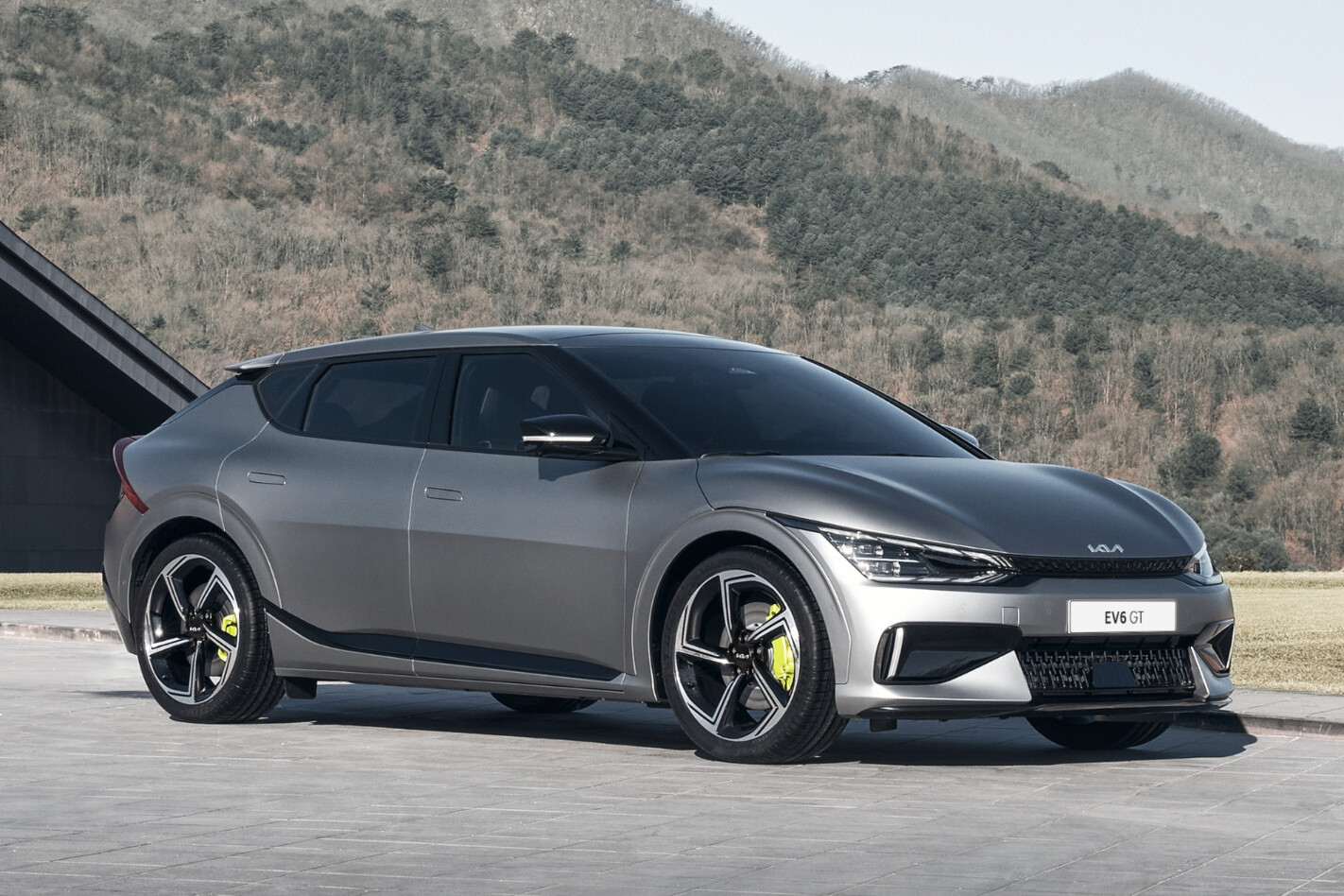
Kia has confirmed the local line-up for its first dedicated electric vehicle, the EV6, with the flagship GT set to fall close to $100,000.
The dual-motor, all-wheel-drive EV6 GT produces 430kW of power and 740Nm of torque.
It is also the fastest-accelerating Kia production car yet, with a 0-100km/h time of just 3.5 seconds, with a top speed of 260km/h.
To aid performance, the GT also features an electronically-controlled limited-slip differential, while yellow brake calipers combine with yellow accents found inside the cabin.
First deliveries of the 2022 Kia EV6 GT are expected to commence by the end of 2022, but Kia Australia says it cannot rule out a delay into early 2023.
The regular Kia EV6 range will touch down in February, offering a rear-wheel-drive base model, and the GT-Line with either rear-drive or all-wheel drive – all with less power than the performance-orientated GT, but still with a respectable 239kW in AWD guise.
Mercedes-AMG EQS 53
Arriving: First half
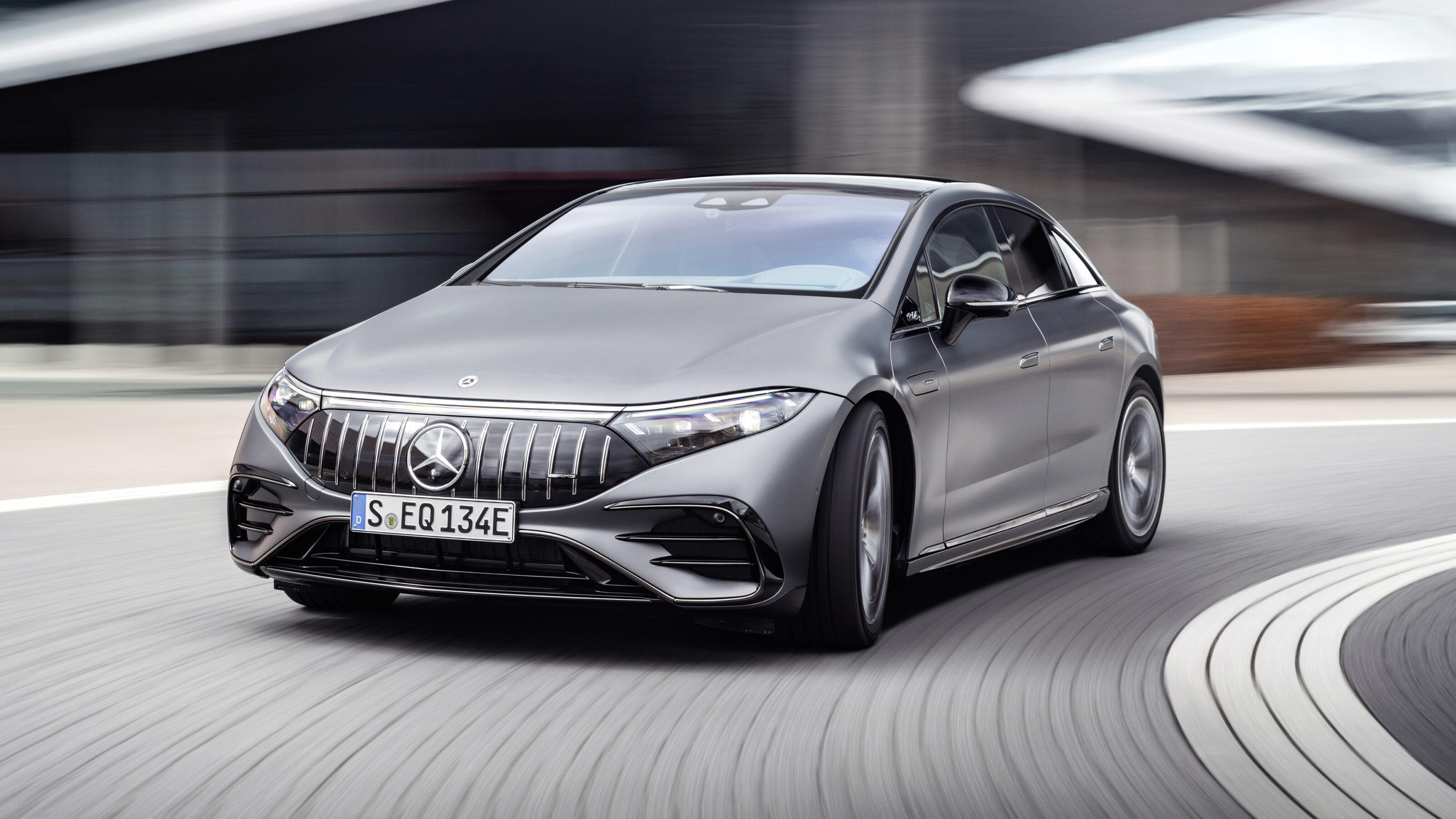
As the first in-house electric offering from Mercedes-AMG, the EQS 53 ups the performance ante of the regular EQS.
The performance version sports a pair of electric motors with two states of tune: 484kW/950Nm or 560kW/1020Nm in the AMG Dynamic Plus.
A sprint to 100km/h from a standstill takes just 3.4 seconds, with the regular EQS580 taking 4.3 seconds. However, compared to the claimed 770km driving range of the EQS580, the EQS 53 has a lower maximum stated range of 580km.
There are subtle changes from the regular EQS, with unique AMG front and rear bumpers, a faux Panamericana grille, a larger rear spoiler and 21- or 22-inch lightweight alloy wheels.
Mercedes-AMG will also offer red brake calipers, carbon trim, Nappa leather seats and a blacked-out design package as a part of its options list.
The 2022 Mercedes-AMG EQS 53 is expected to land in Australia at around $400,000 or higher when it arrives in the first half of 2022.
Mercedes-AMG SL
Arriving: Second half
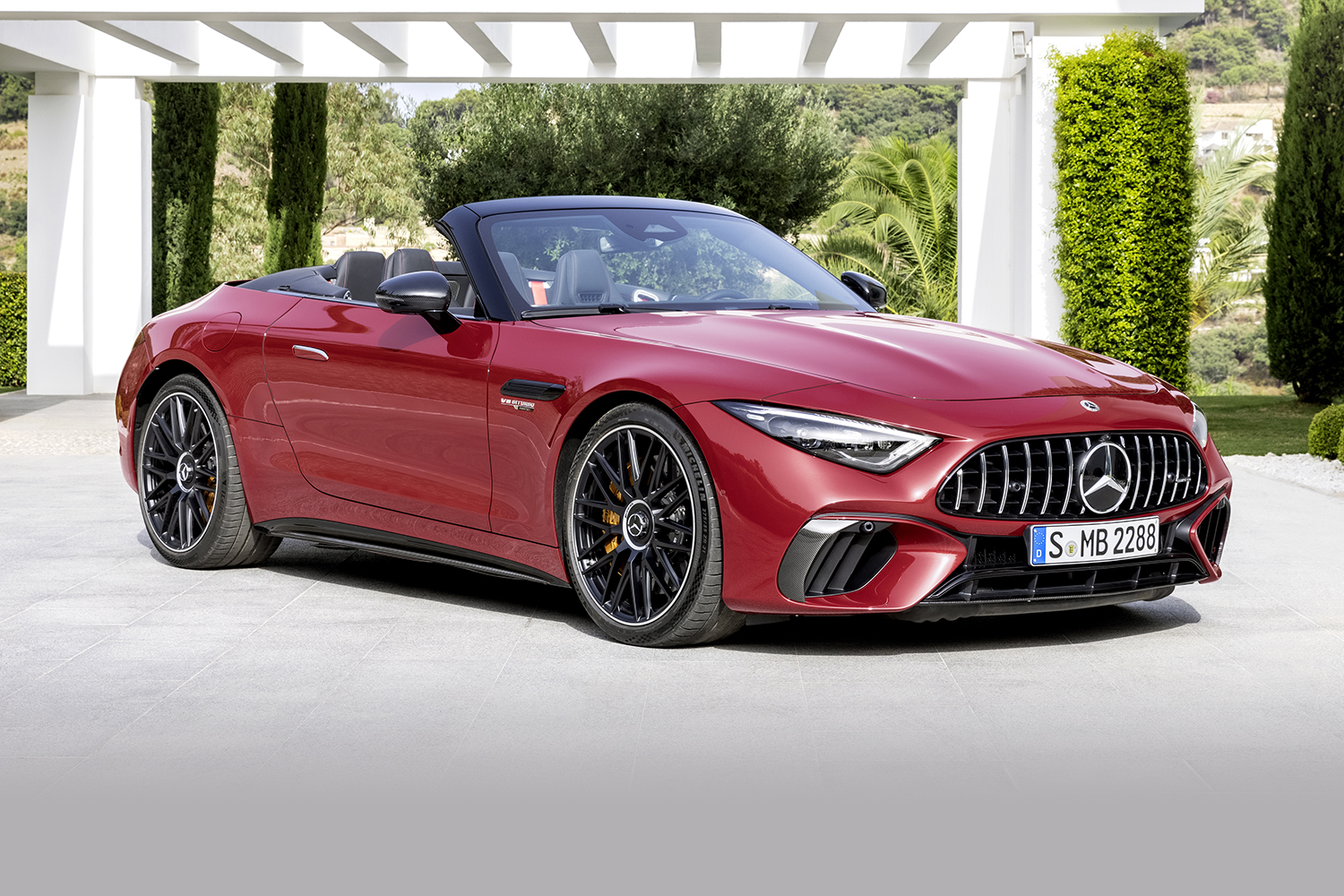
The next-generation version of Mercedes-Benz’s iconic SL roadster has been developed from the ground-up by the the firm’s high-performance division.
Two variants of the new SL will initially debut – the SL 55 4Matic+ and the SL 63 4Matic+ – with both offering separate power outputs from the same 4.0-litre twin-turbo V8. Each is matched with AMG’s multi-clutch nine-speed automatic transmission sending power to all four wheels.
The SL 55 produces 350kW of power and 700Nm of torque, allowing the vehicle to complete the 0-100km/h sprint in a claimed 3.9 seconds, with a maximum top speed of 295km/h.
Meanwhile, the flagship SL 63 ups power to 430kW/800Nm, dropping the 0-100km/h sprint time to a claimed 3.6 seconds, and pushing the highest-rated speed to 315km/h.
Inside, the SL features a 12.3-inch digital instrument cluster, integrated into an aviation-inspired dashboard with ambient lighting. There is also an 11.9-inch portrait-mounted touchscreen featuring the latest generation of the company’s MBUX infotainment system in the centre console.
The 2022 Mercedes-AMG SL is expected to arrive in Australia in the second half of next year. Australian pricing and specification details are yet to be released.
Nissan Z
Arriving: Mid-2022
The Z is set to become Nissan’s new flagship model in Australia, following the recent discontinuation of the GT-R.
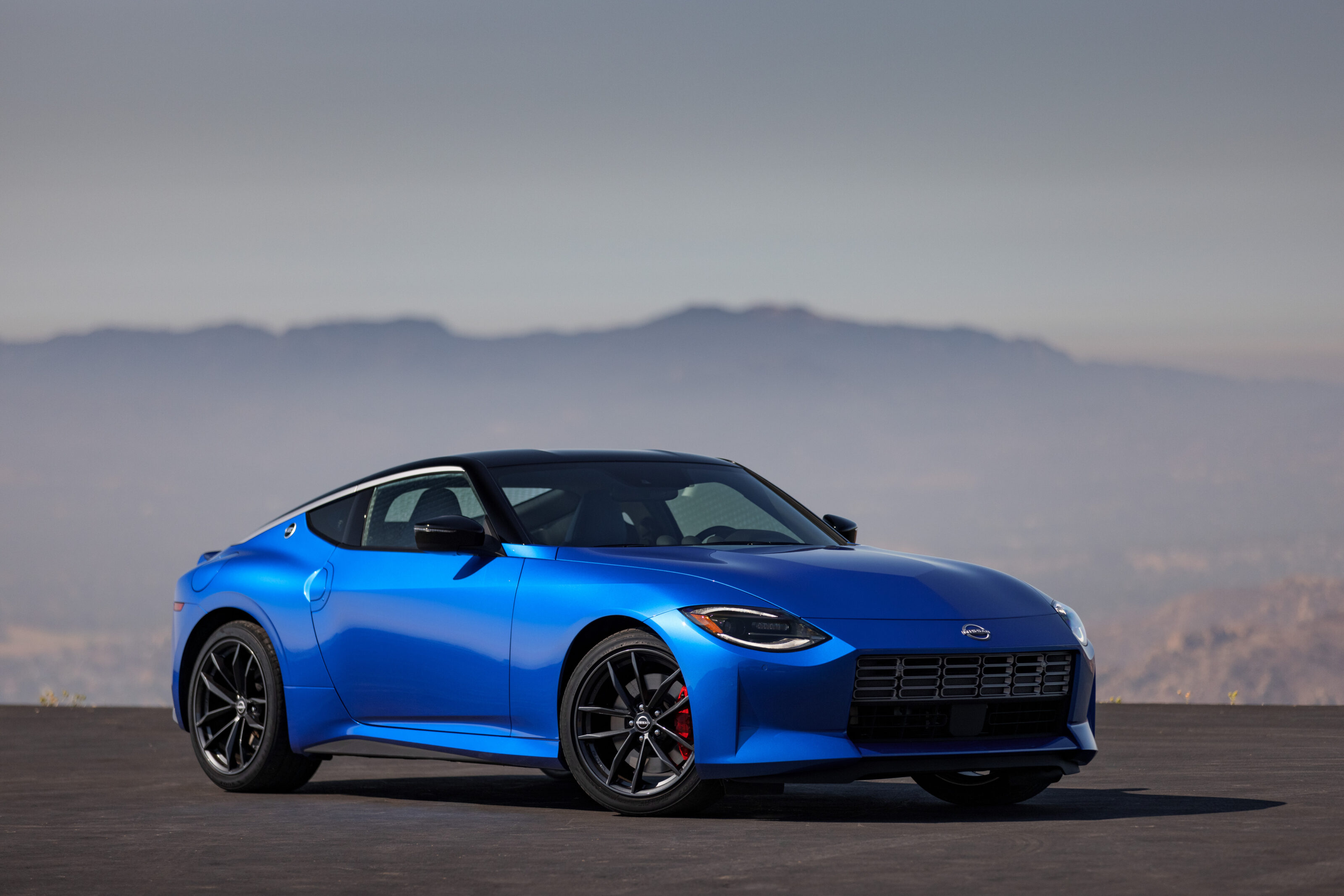
Underpinned by a revised version of the outgoing 370Z chassis, the new Z features a 3.0-litre twin-turbo V6 producing 298kW of power and 475Nm of torque, available with the choice of a six-speed manual or nine-speed automatic transmission.
The cabin is a drastic departure from the ageing 370Z, with a clean centre stack, three analogue gauges on the instrument binnacle and a larger touchscreen.
Leather-accented seats, a 12.3-inch digital instrument cluster, an 8.0-inch infotainment screen with Apple CarPlay and Android Auto, active cabin noise cancellation, reverse camera, front and rear parking sensors, radar cruise control, and launch control are all standard.
A limited-edition Z Proto Spec will be offered with a number of unique features, including; two-tone yellow paint with black roof, yellow brake callipers, yellow interior highlights, and 19-inch forged alloy wheels in bronze.
The 2022 Nissan Z will arrive in Australian dealerships during the middle of the year.
Subaru WRX and WRX STI
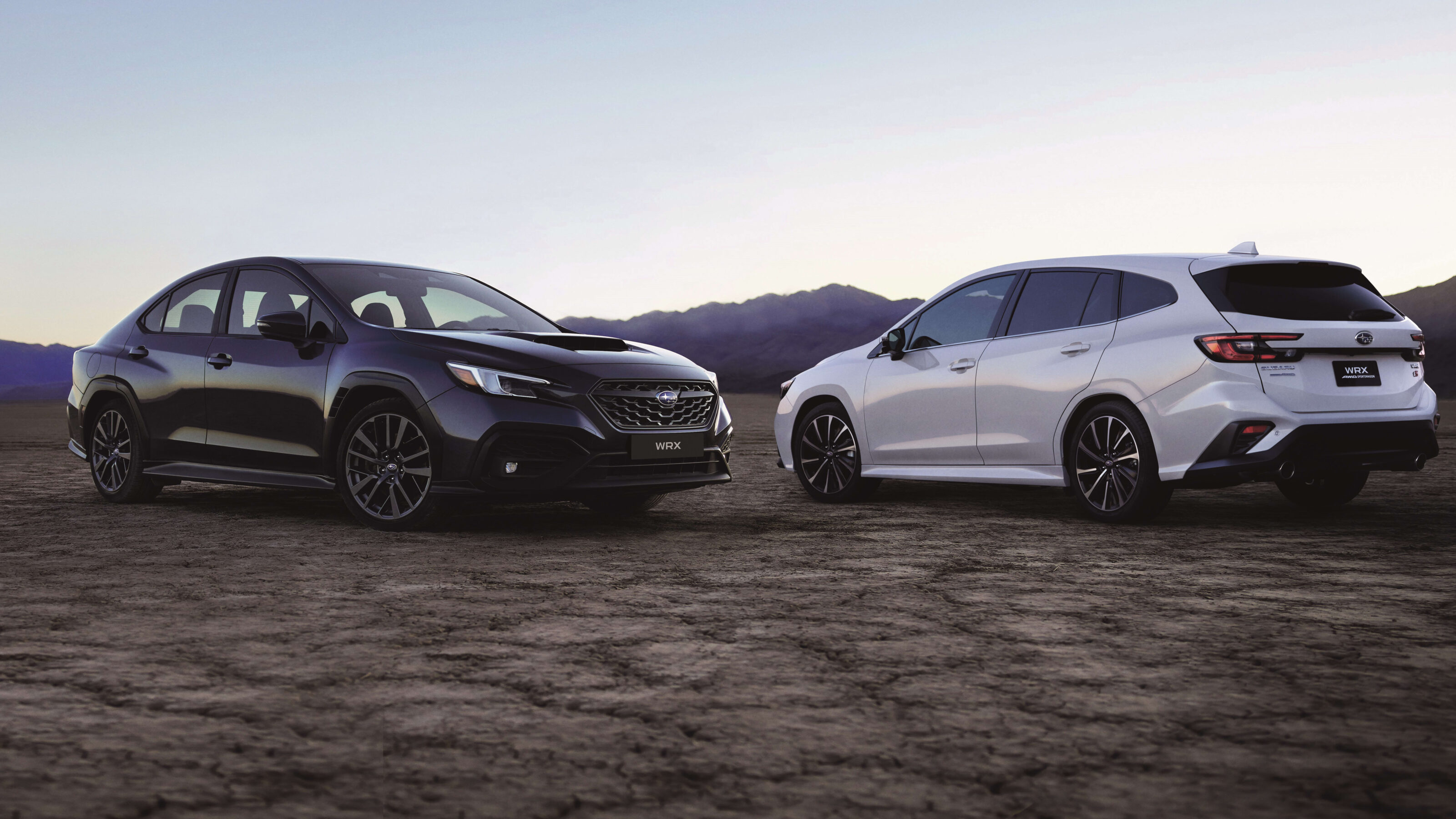
Arriving: WRX – second quarter; WRX STI – late 2022
A two-pronged attack to the Hyundai i30 N, Volkswagen Golf GTI, Ford Focus ST and Honda Civic Type R headlines the next-generation Subaru WRX.
Available in traditional sedan form and as a rebadged Levorg wagon – known as the Sportswagon – the WRX makes the switch to the brand’s 2.4-litre four-cylinder boxer turbo engine, producing 202kW and 350Nm.
A six-speed manual or a completely revised continuously variable transmission (CVT) automatic gearbox sends power to all four wheels, with a centre limited-slip differential on the manual.
Unlike the sedan, the only transmission available in the Sportswagon is the ‘eight-speed’ CVT.
Similarities between the WRX and WRX Sportswagon are mostly kept to the front design and Subaru Global Platform underpinnings, with each model offering a unique rear profile and subtle differences inside.
Equipment such as an 11.6-inch infotainment screen with Apple CarPlay and Android Auto, Recaro front seats and active safety features are expected to remain identical across both body types.
The 2022 Subaru WRX will arrive in Australia in the second quarter, with local pricing and specifications to be announced closer to launch.
Reveal timing for the hotter WRX STI is still to be confirmed, but the flagship variant is expected to land in Australia before the end of 2022. Stay tuned.
Volkswagen Golf R
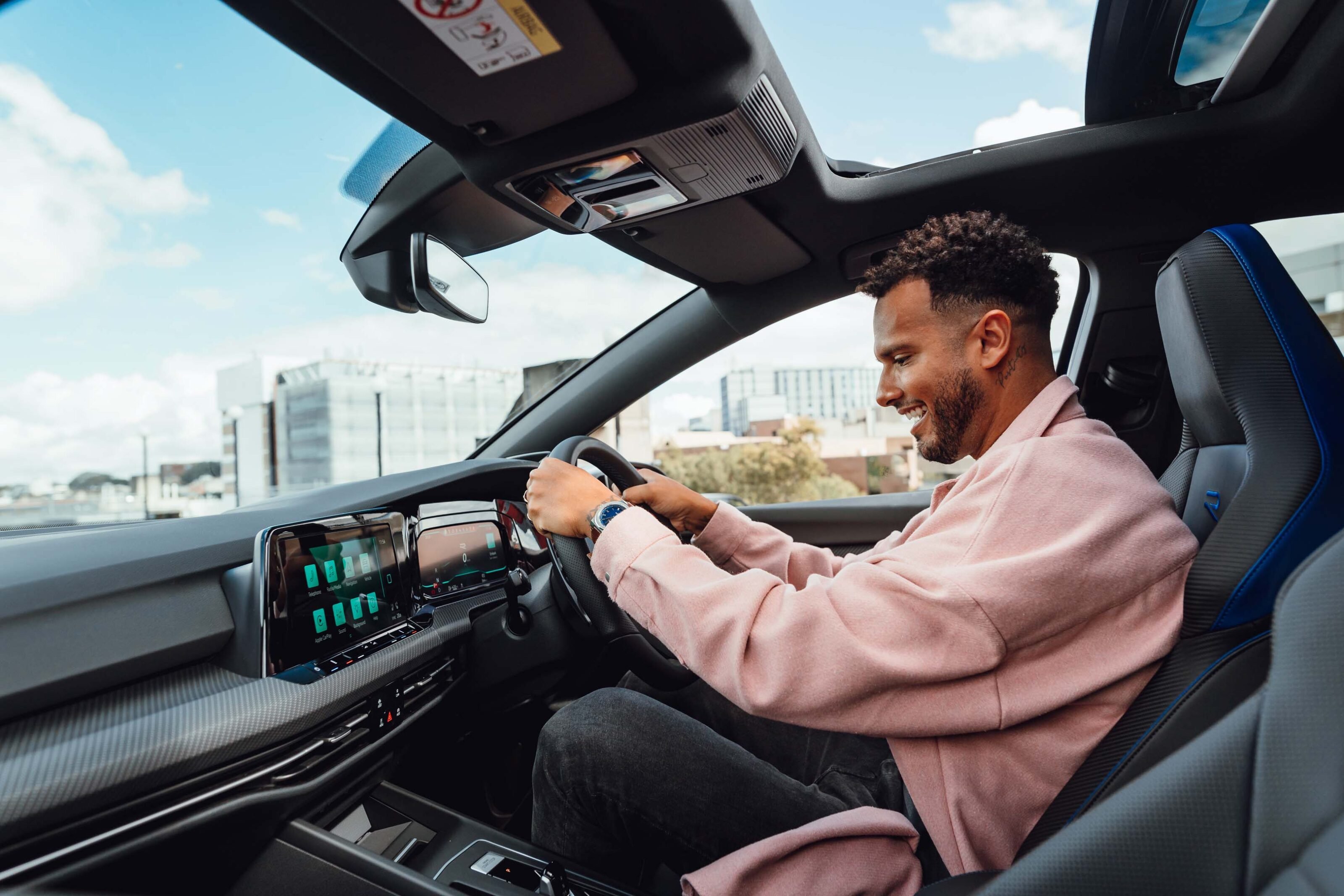
Arriving: R hatch – April; R wagon – mid-2022
Joining the hot new Tiguan R, the latest version of the Golf R will join the line-up early in the year to kickstart an onslaught of performance variants for Volkswagen in Australia.
Slightly detuned locally in comparison to Europe, the Golf R hatch will produce the same 235kW, but a lower 400Nm. This reduces its 0-100km/h time by a tenth to 4.8 seconds – the same time as the outgoing model.
The Golf R wagon will stick with the full-fat version of the 2.0-litre turbo-petrol, with 235kW and 420Nm – but with petrol particulate filter for cleaner emissions. Its 0-100km/h time is claimed to take 4.9 seconds.
A new all-wheel-drive system incorporates torque vectoring that enables power to be distributed between the rear wheels, not just the front and rear axles.
Standard equipment includes; matrix LED headlights, 19-inch alloy wheels, adaptive dampers, Nappa leather seats with front heating and ventilation, an electrically adjustable driver’s seat, three-zone climate control, and Harman Kardon speakers. The wagon adds an electric tailgate.
Volkswagen has confirmed pricing for the 2022 Golf R, with the hatch priced from $66,990 before on-road costs – an $11,000 hike over the outgoing model.
The wagon version is listed at $69,990, with a panoramic sunroof the sole option across both cars.
Set to initially arrive in April in hatch form, the delayed R wagon will join the range in mid-2022.
UPDATE: We have a more recent version of this story, which you can find here.
The below story may still be of value to you, however, so feel free to continue reading!
When it comes to buying the first car for your cherished offspring, safety is usually the number one priority for parents.
Certain brands like Volvo were always synonymous with safety, but most other brands have caught up and today, even some of the cheapest cars in showrooms come with key safety features that will help prevent or mitigate an accident or protect occupants if a crash can’t be avoided.
But before you get to that point of helping a teen driver choose a car, it’s important to establish what size and shape vehicle is going to be best.
A smaller car with a lower centre of gravity is going to be easier for an inexperienced driver to handle than say, a large SUV, and is less likely to trip them up.
In the past, small cars weren’t as safe in a crash as bigger ones, so people were more likely to teach their teens in a big family car than a hatchback. However, the modern small car is a technological wonder when it comes to safety, often achieving five-star ratings in crash tests. They are also far easier to park and manoeuvre.
The other important factor to consider is power. Giving your teen a vehicle with too much grunt is simply tempting fate, because many of them will be curious to find out just what their right foot can achieve.
So a small car with active safety features, a high rating and an engine that’s more about fuel economy than 0-100km/h performance times is the way to go.
Ideally these cars would be equipped with autonomous emergency braking, and lane-keeping assist or lane-departure warning that will have their back if they lose concentration.
Here are five of the best safe, but also affordable, cars – all of which come with autonomous emergency braking as standard. They also all have Android Auto and Apple CarPlay that will let younger drivers access navigation apps, hear text messages being read out and listen to music without having to touch their phone – some states do have restrictions on its use for P-platers so be sure to check.
HYUNDAI i30
From: $24,990
Just about the perfect Goldilocks size for a learner driver – not too big and not too small, just right – the Hyundai i30 offers a five-star ANCAP safety rating, thanks in part to its seven airbags (including full-length curtains, side or thorax airbags and driver’s knee).
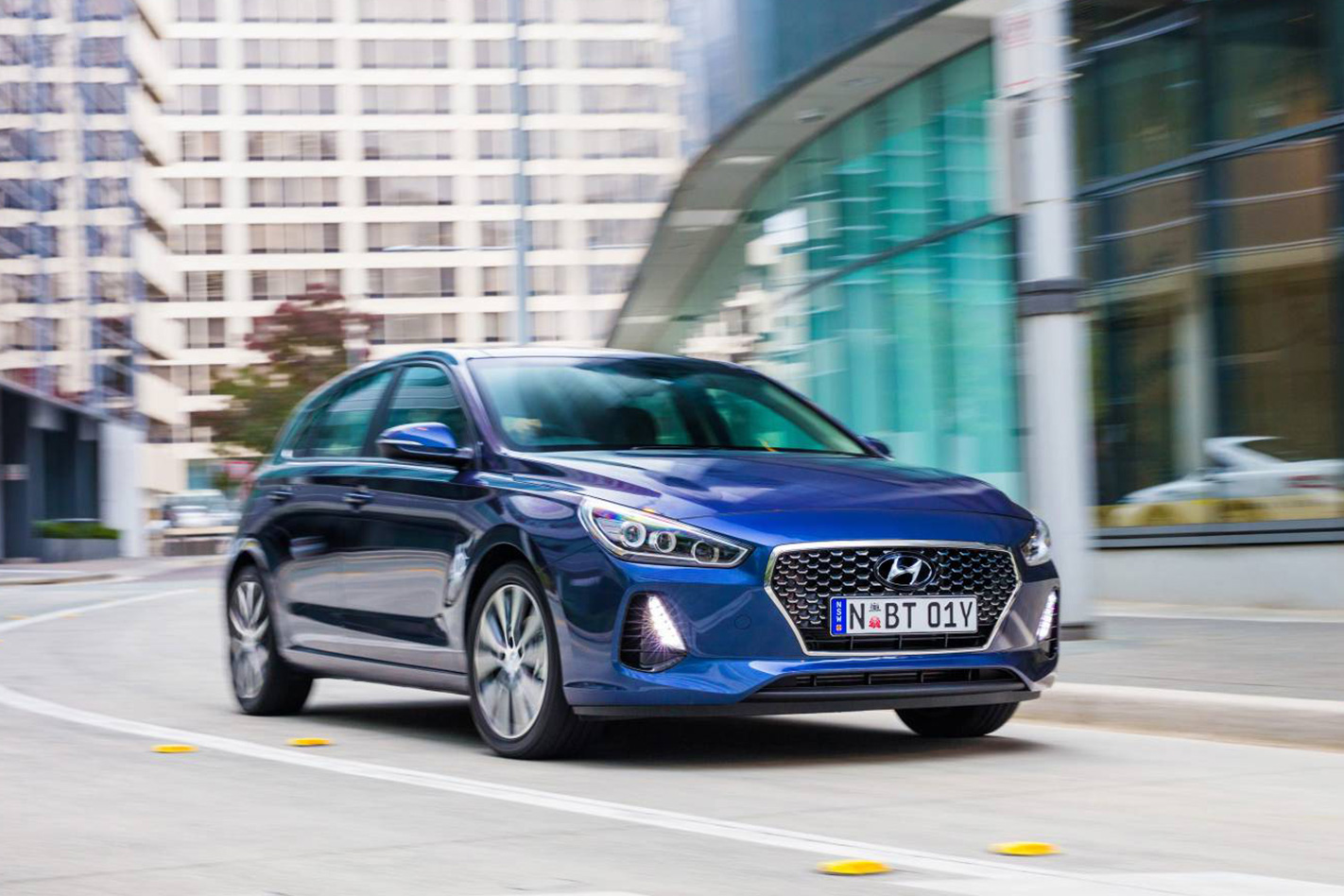
The i30 is also big on passive safety with Electronic Stability Control (ESC). This includes Traction Control System (TCS), Anti-lock Braking System (ABS), Electronic Brake-force Distribution (EBD), Brake Assist System (BAS) and Vehicle Stability Management (VSM).
The 2020 update saw all variants come standard with the active safety pack that brings adaptive cruise control, autonomous emergency braking, lane-keeping assistance, a driver-attention alert, blind-spot detection (with lane-change assist), and a rear cross-traffic alert.
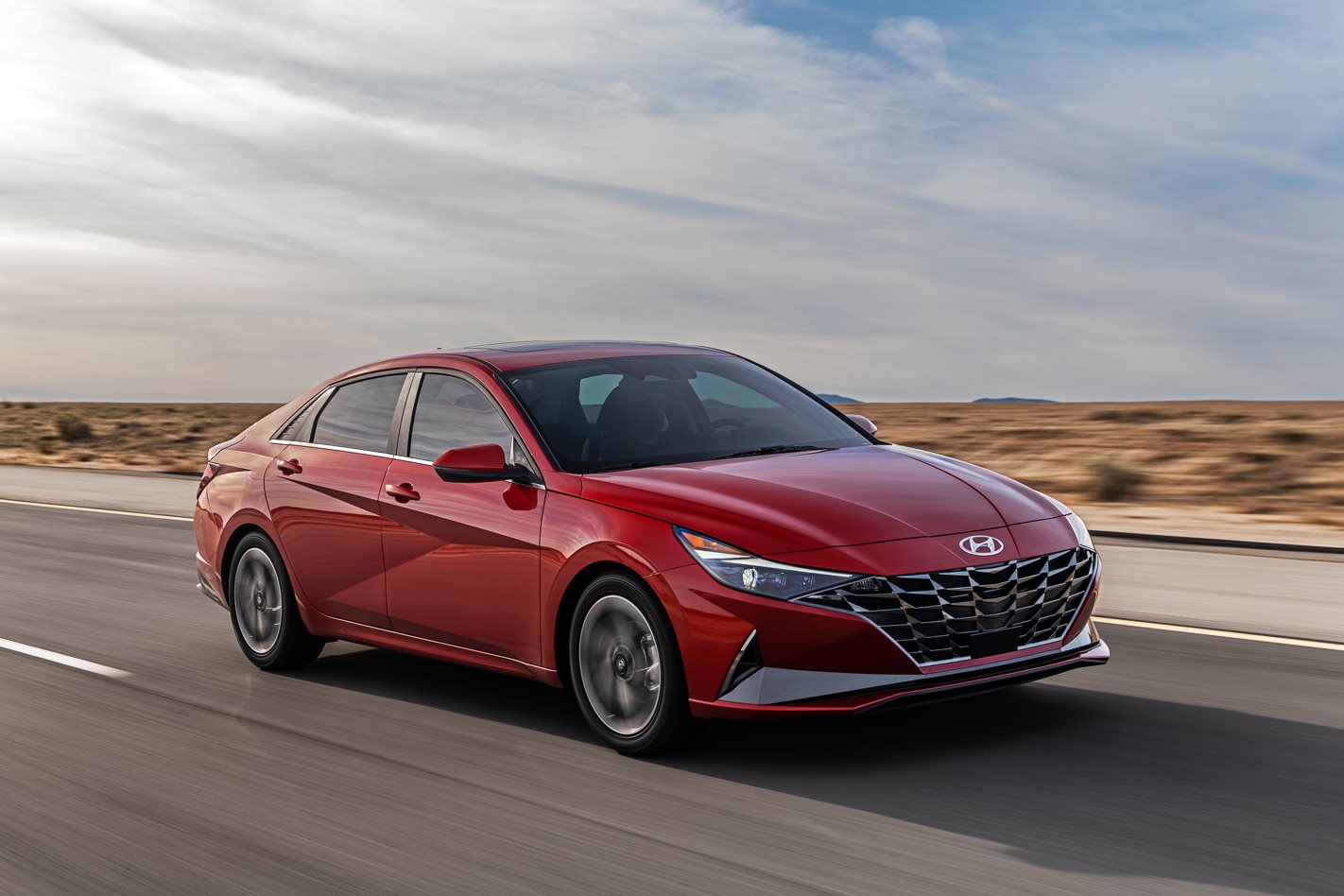
The standard 2.0-litre engine is capable enough and isn’t left huffing and puffing up hills quite like the Mazda 2 mentioned below, but it’s never going to frighten anyone either.
The third-generation Hyundai i30 hatchback received a five-star ANCAP rating in 2017. The sedan variant also received a five-star ANCAP rating in 2017 when it was known as the Hyundai Elantra.
Kia Seltos
From $26,790
If your kid is set on getting an SUV, you could do worse than the feature-packed Seltos, which is comfortable, quiet, and fun to drive thanks to its suspension that has been tuned to suit Australian conditions.
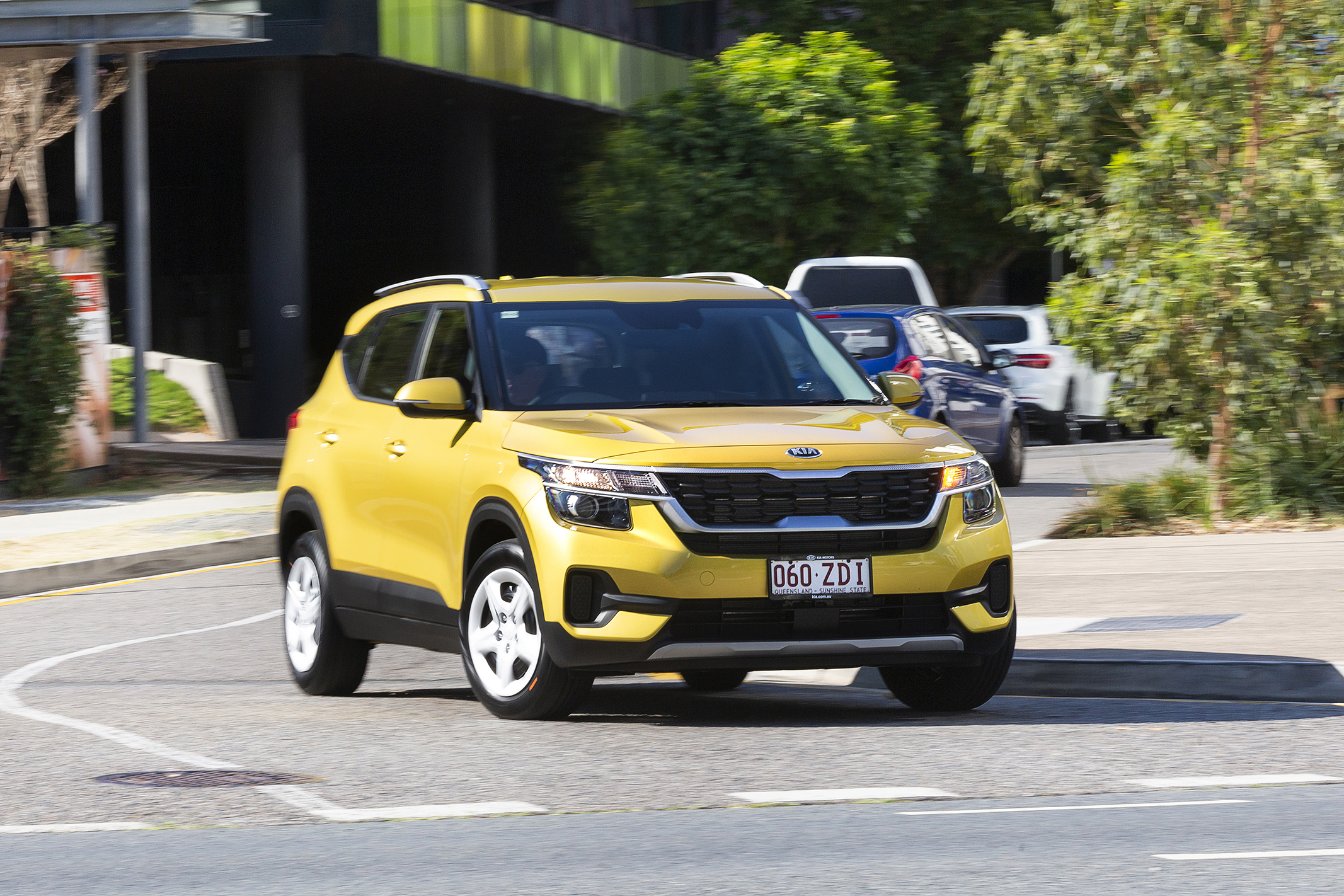
Autonomous emergency braking is standard across the range, and in the cheaper S and S+ variants can initiate a full emergency stop automatically from speeds up to about 80km/h.
For $1000 you can opt for a safety pack that adds a higher grade, radar and camera-based ‘Fusion II AEB’ with pedestrian and cyclist detection. This system is standard in the higher-spec Sport+ and GT Line and also includes advanced smart cruise control that slows to a stop in heavy traffic, an electronic parking brake, and 15-inch rear disc brakes.
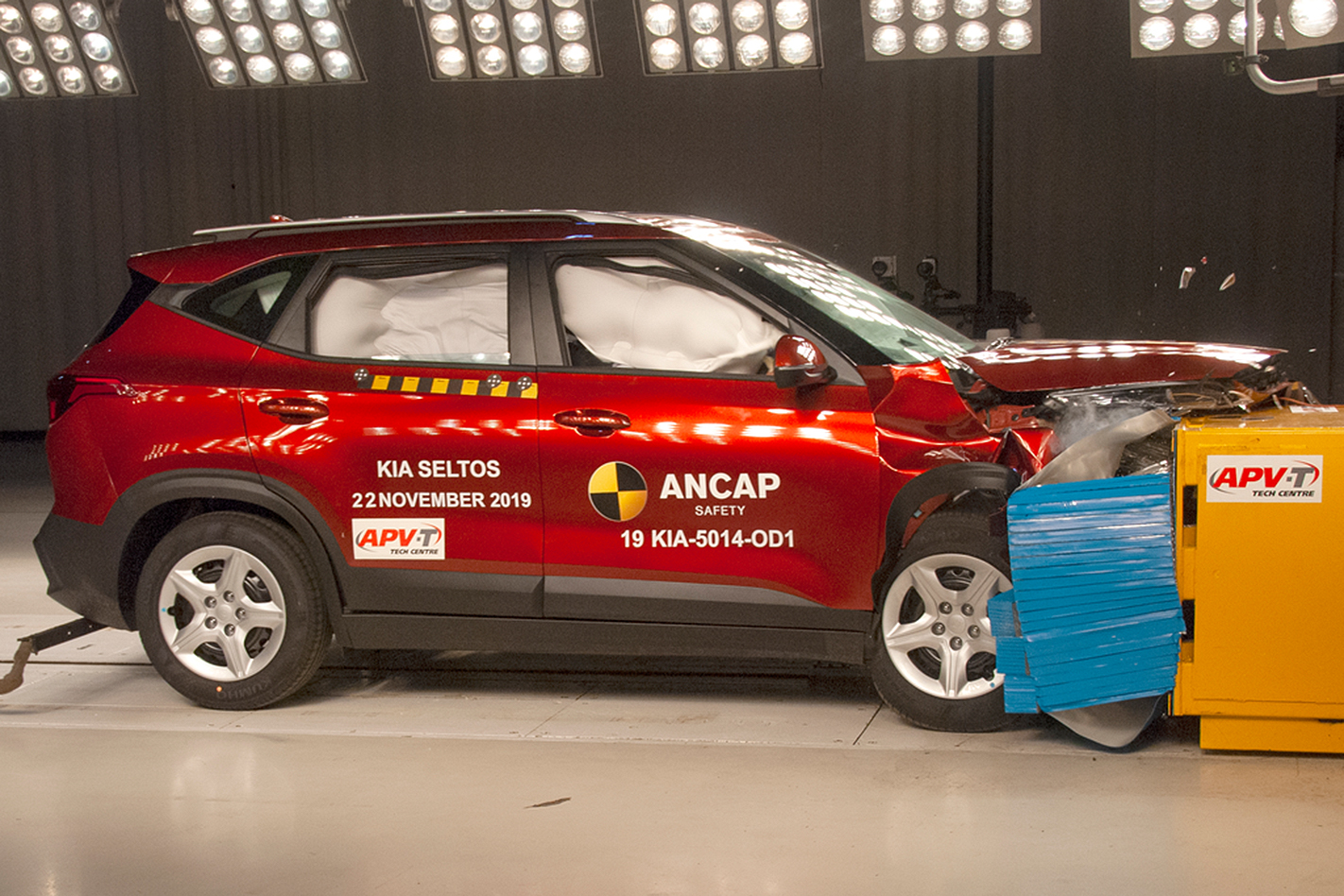
Covered by Kia’s seven-year warranty, the Seltos also comes with driver attention alert that detects and warns you if you’re driving a little erratically (a sign of fatigue), lane-keeping assist, six airbags, a reversing camera and a seatbelt warning for every seat.
The Seltos earned a five-star ANCAP rating in October 2019.
Mazda 2
From $23,190
The Mazda 2 looks good, feels nice inside, and is more fun to drive than most city cars. Its 1.5-litre engine is very easy on fuel and it’s available with a choice of attractive hatchback and sedan variants.
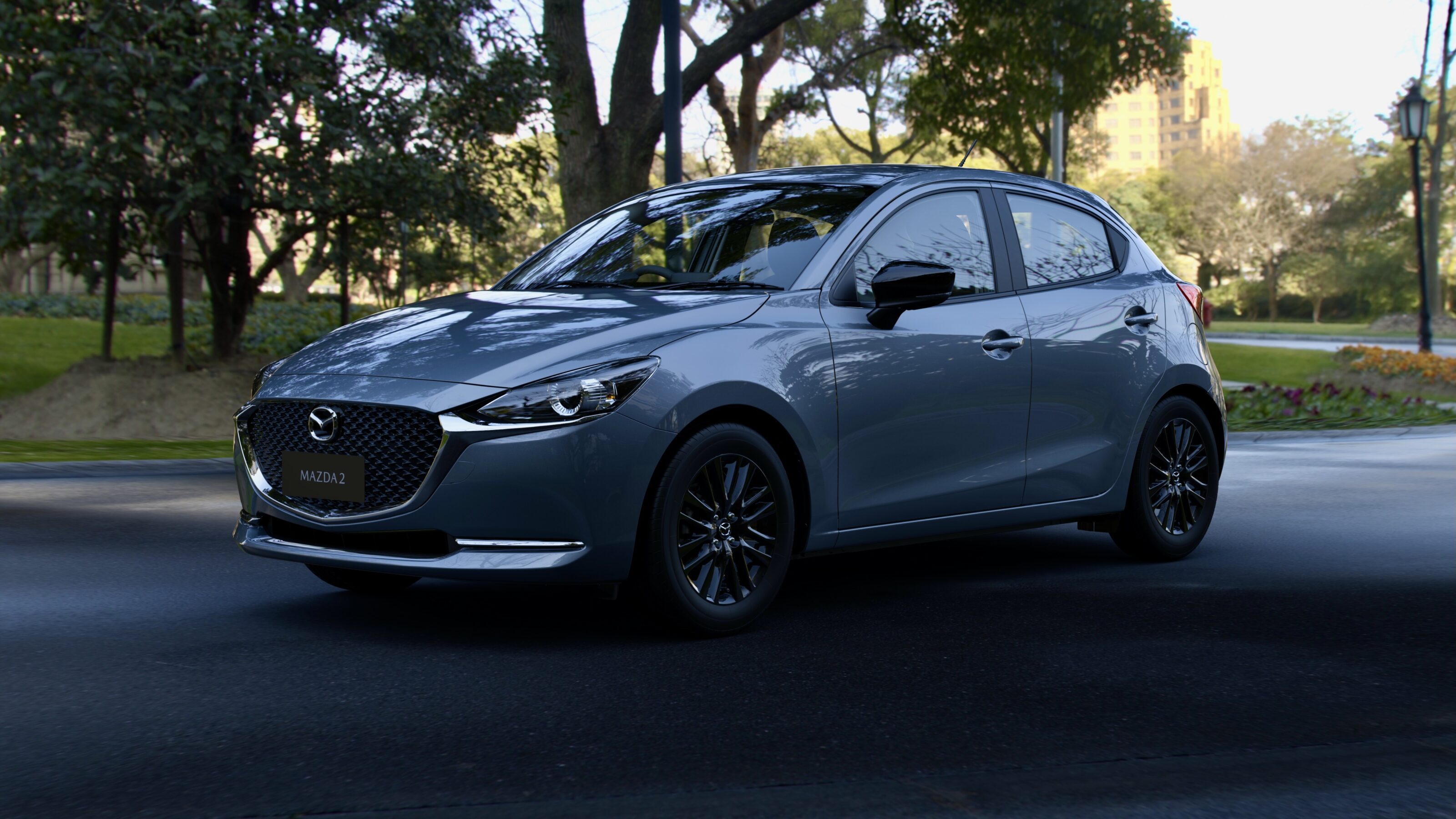
The 2022 Mazda 2 comes with autonomous emergency braking (AEB) with pedestrian detection, Mazda calls Smart City Brake Support.
It also has a host of standard safety features that put some considerably more expensive cars to shame, including blind-spot monitoring, rear-cross traffic alert, lane departure warning, lane-keeping assist and reverse-AEB to prevent parking mishaps.Other safety features include stability control that’s mandatory in all new cars, rear parking sensors, seatbelt reminders for all seats, six airbags – a broadly based safety package that stands out among cars of this size and price.
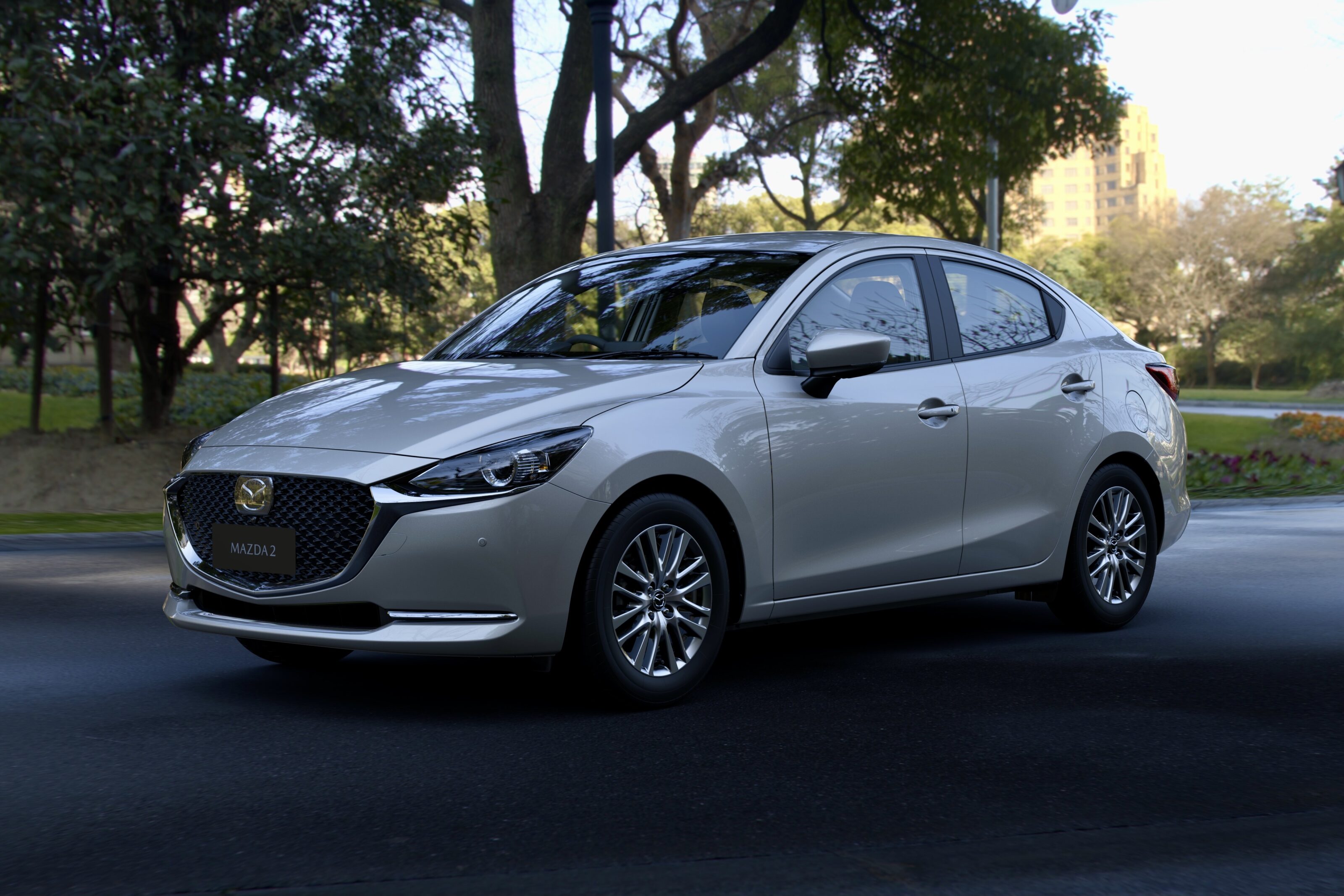
Needless to say, the Mazda 2 has a five-star ANCAP rating and while this was awarded back in 2015, Mazda has done well to keep adding new active safety kit with every update.
Suzuki Swift
From $24,990*
The reason for the asterisk is that you can pay just $21,490 for the entry-level Swift GL Navigator, which has a four-star ANCAP safety rating due to a lack of basic active safety features, including autonomous emergency braking – but that price is for the five-speed manual version, with the CVT auto costing an extra $1000.
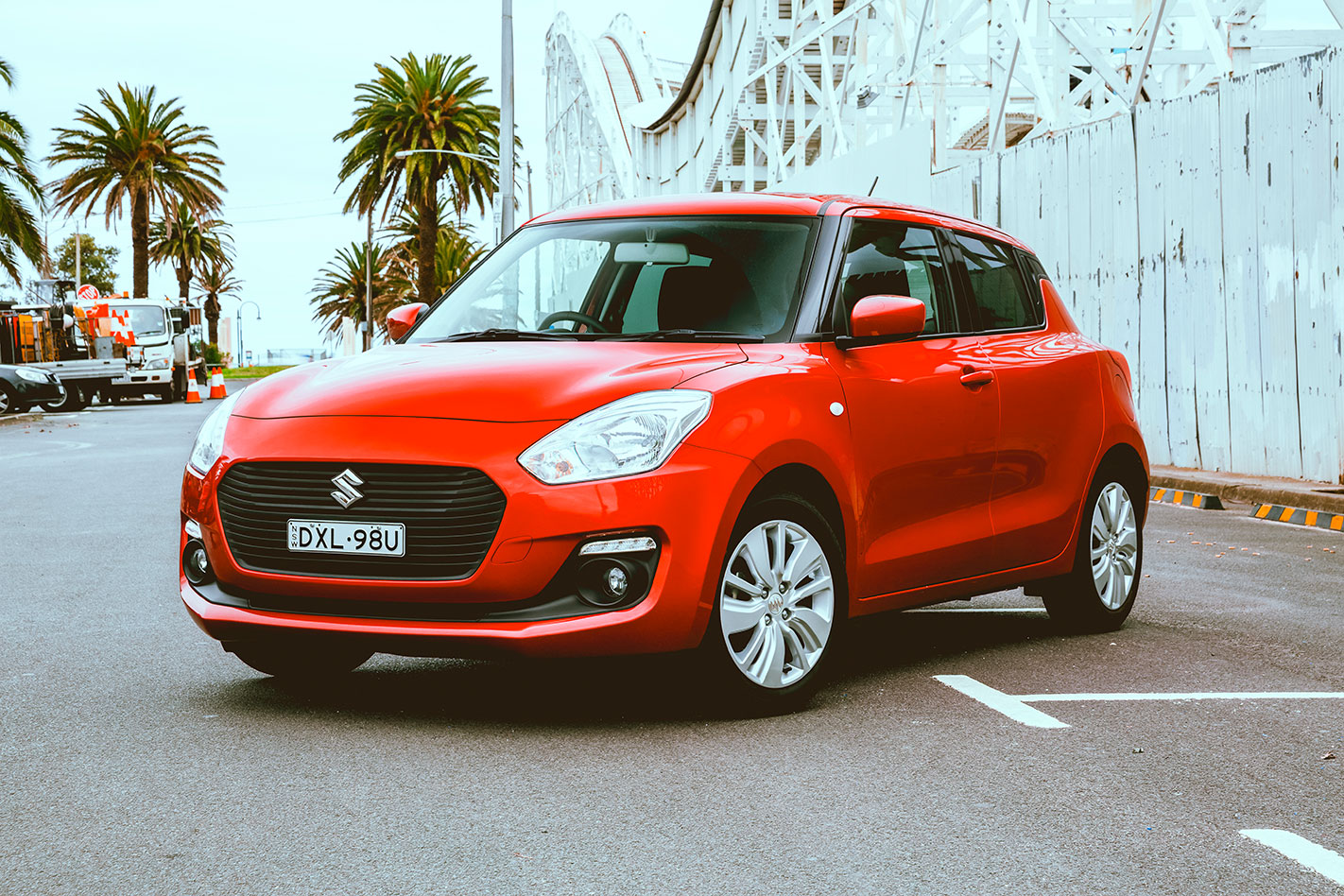
Paying $24,990 will net you the Swift GL Navigator Plus auto (there is no manual in this spec), which comes with a five-star ANCAP rating due to the inclusion of a safety pack that brings high and low-speed autonomous emergency braking, lane-departure warning, lane-keep assist, blind-spot monitoring and rear-cross traffic alert, which are also standard on the pricier GLX Turbo and Sport versions.
All Swifts have six airbags including front, side and curtain inflators.
Toyota Corolla
From $23,895
The 12th-generation Toyota Corolla brings all the necessary ingredients that have long made it the world’s most popular car, but in a stylish package that even teens will think is cool.
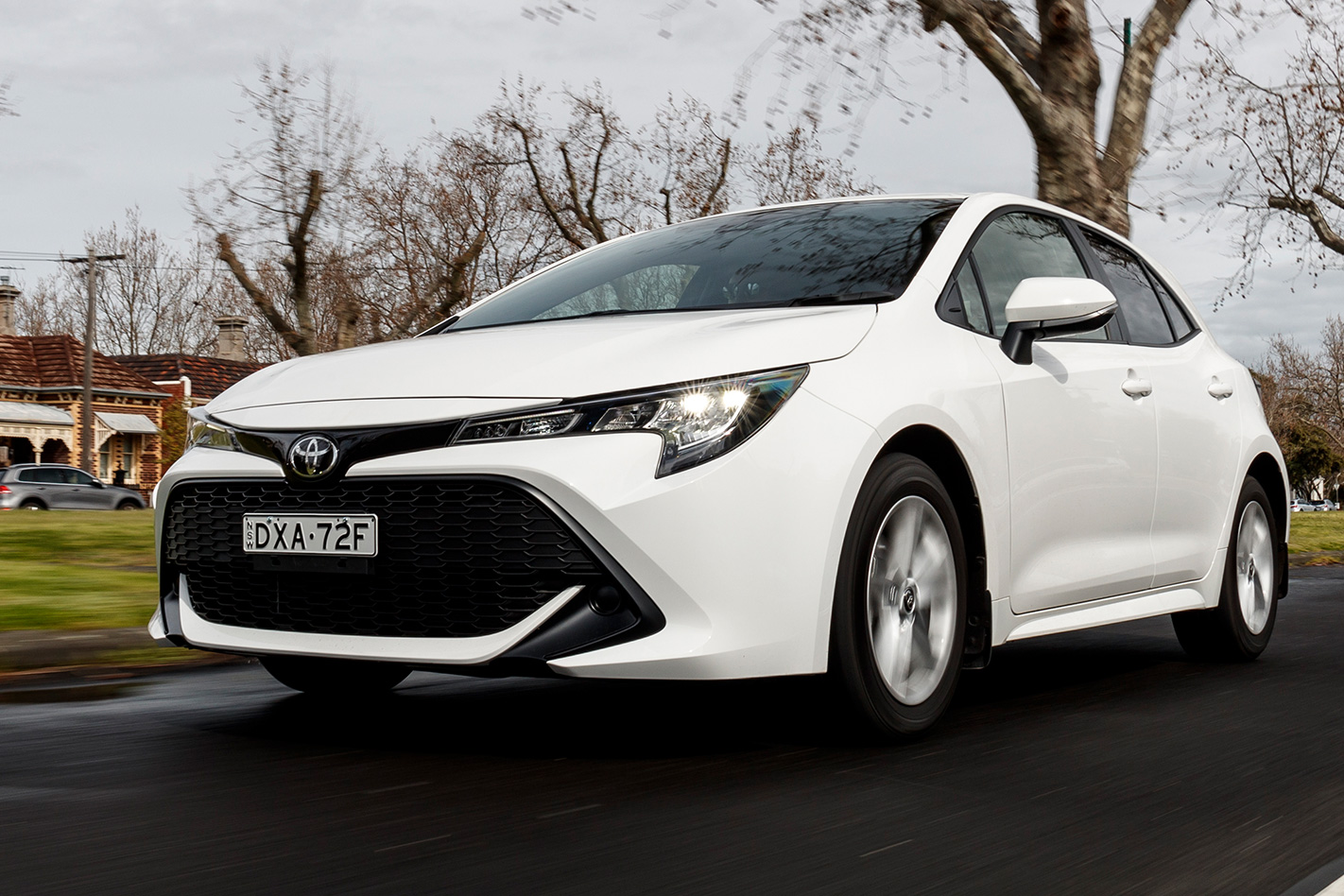
The Corolla has a five-star ANCAP safety rating and is equipped with seven airbags including side curtains, stability control, a reversing camera, and rear parking sensors. Even the cheapest version has autonomous emergency braking with pedestrian detection, and other advanced driver assistance tech including lane departure alert, lane-keeping assist, adaptive cruise control, and headlamps that dip automatically for oncoming drivers.
Available with a 2.0-litre petrol engine, or 1.8-litre hybrid powertrain, each Corolla version is fun to drive without being racy.
VOLKSWAGEN POLO
From $19,290*
The VW Polo is an excellent small car, has a five-star ANCAP rating, and is the cheapest way you can wrap genuine German engineering around your loved ones.
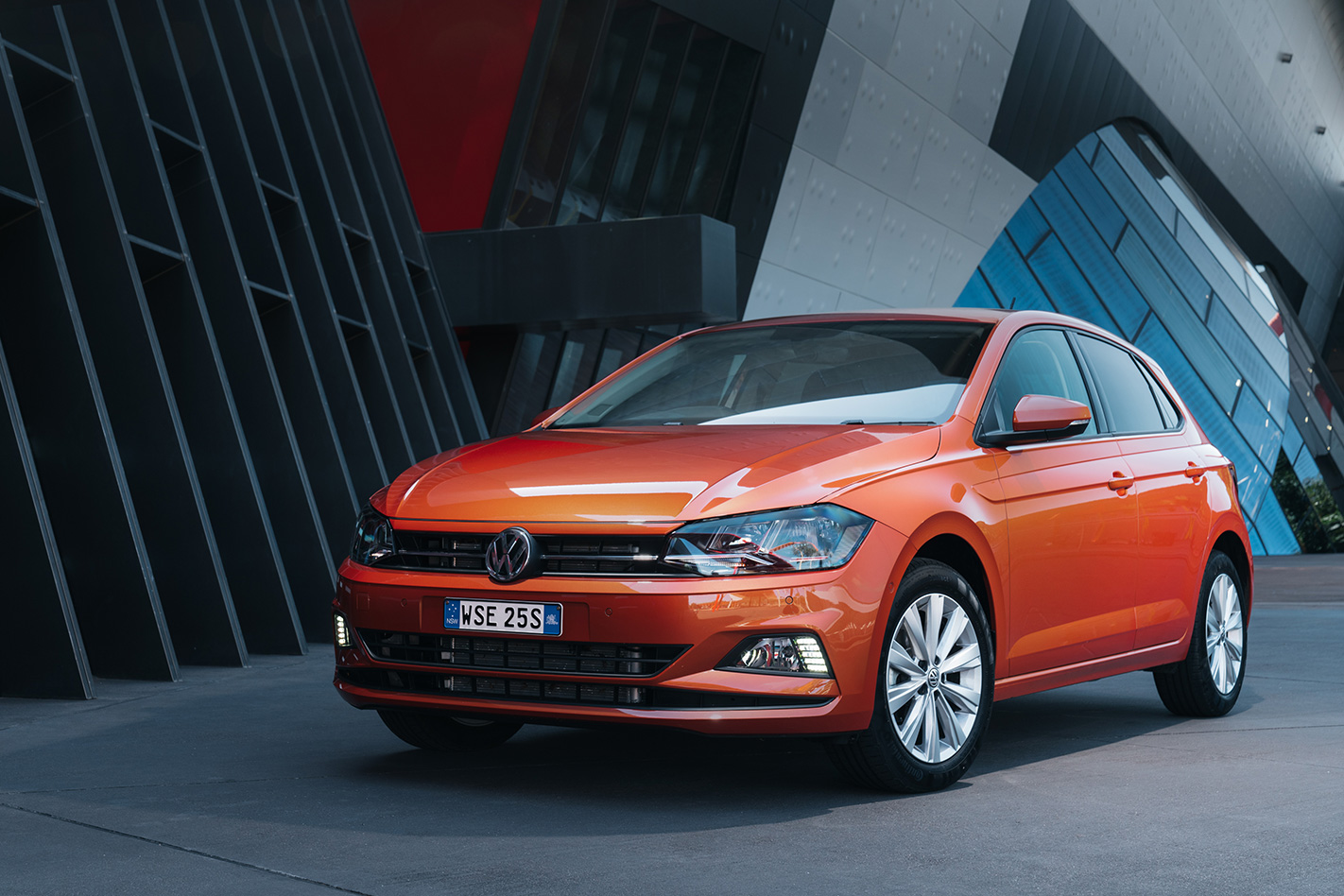
That means a full suite of safety systems (ESC, EBD, ABS) and an auto-braking system that works at city or highway speeds. It uses a radar-type sensor to scan the roadway ahead for obstacles and sounds an alarm if it senses an impending collision. If the driver ignores the warning it will initiate an emergency stop.
The Polo also has a driver fatigue monitor that assesses your use of the steering wheel over long journeys, prompting you to take a break if it concludes you might be falling asleep.
With its tiny 1.0-litre three-cylinder turbocharged petrol engine, the Polo will get to 100km/h when it’s good and ready, yet it still feels zippy enough to keep you awake thanks to the torque from the turbocharger.
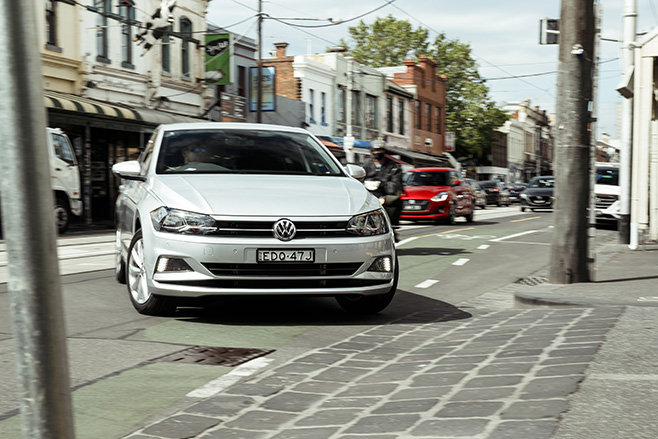
*The Polo’s base price will rise beyond $20,000 in early 2022 with an updated model bringing more safety features as standard, including VW’s iQ Drive driver-aid suite that’s found on other VWs – such as the Golf and Passat.
iQ Drive includes the partial autonomous-drive travel assist, which can control the steering as well as braking and acceleration when requested by the driver. The system ties in with adaptive cruise control that is currently part of an option pack for the Polo.
A camera-based speed-limit sign reading system and lane assist also form part of the iQ Drive system that is an option on the updated Polo already released in Europe.
