
Key Points
- Five-star rating given to all GWM Utes built post-August 1, 2021
- Initial deficiencies with September 2020 u2013 July 2021 models will be rectified
- Strong scores across adult and child occupant protection
The 2022 GWM Ute is the latest vehicle to receive a five-star ANCAP safety rating, with all units built post-August 1, 2021 subject to the rating.
After it was previously tested and found to have deficiencies with the design of the front head restraint and steering column components, GWM rectified the issue throughout production from August this year, with vehicles built between September 2020 and July 2021 set to benefit from the upgrades through servicing.
The Ute managed to score well in the occupant protection categories, having notched up a final result of 87 per cent for children, taking 43.03 of the 49 points available.
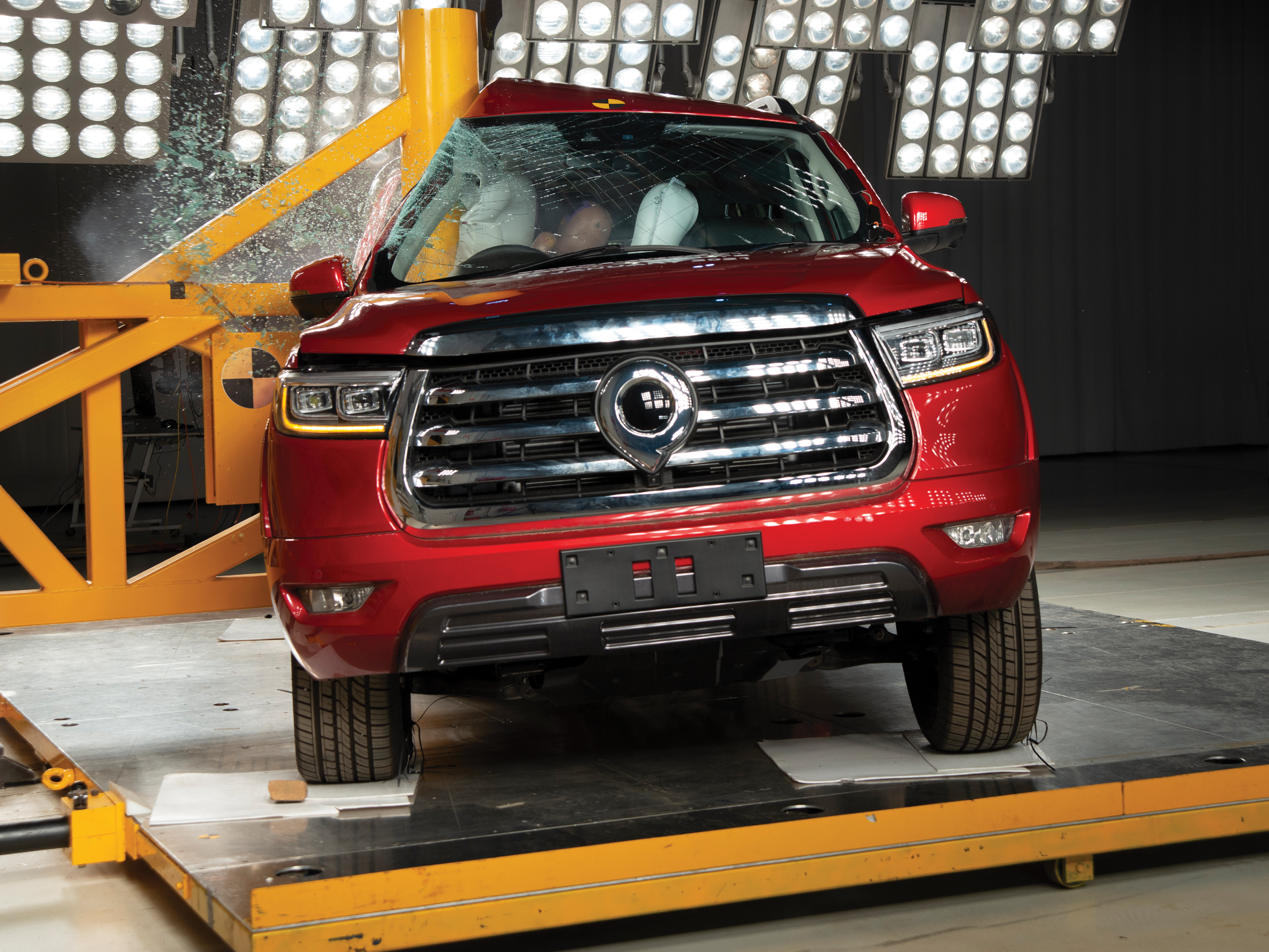
Full marks were given for its results in the front and side dynamic tests, losing just under one point for restraint installation, while its on-board safety features saw it drop five from the maximum available.
In the adult occupant protection category, the Ute still brought home a strong result with 86 per cent, thanks to its total score of 32.74 points out of 38.
In the side impact, far side impact, rescue and extraction tests, the Ute was given the maximum points on offer, while in all but one of the remaining categories – frontal offset, oblique pole and whiplash protection – it scored within a point of the top rating.
Letting it down in this category was its 5.48 points out of eight in the full width frontal test, still dropping just under three from the most on offer.
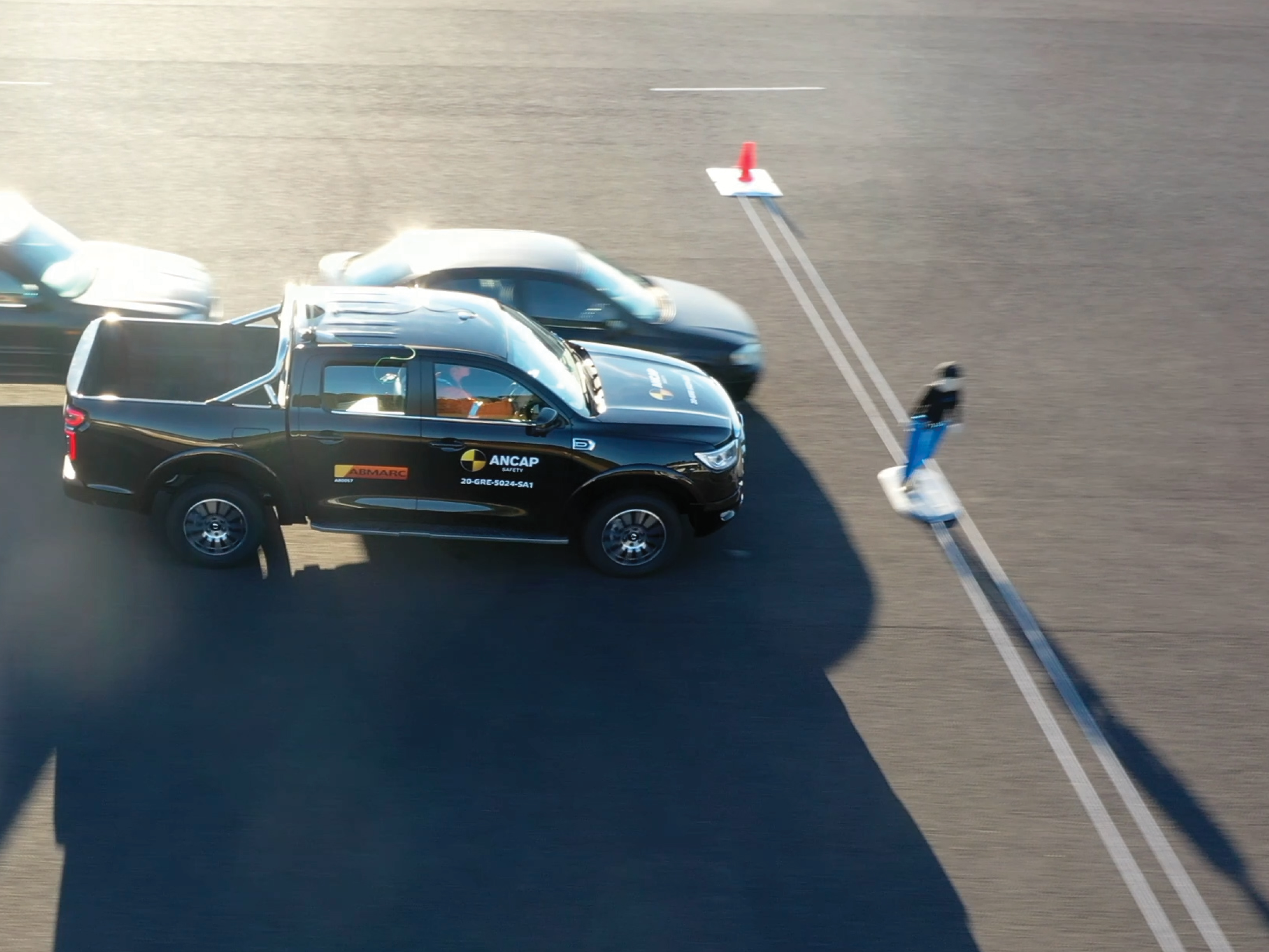
Moving on to its safety assistance systems, scoring 11.76 out of 16 possible points gave the Ute a 73 per cent result, as its seat belt reminders and lane support systems took full marks.
Missing out on any points for autonomous emergency braking (AEB) junction assist and driver monitoring due to a lack of the systems in the vehicle, its speed assistance systems and car-to-car AEB were able to score within a point of a perfect result.
Finally, the lowest rated category was its vulnerable road user protection, which still passed on 67 per cent with 36.48 from 54 points awarded.

Only the lower leg impact tests resulted in a perfect score, with most other aspects – head impacts, upper leg impacts and AEB pedestrian – taking more than half the points on offer.
A lack of AEB support in the backover test of pedestrians saw it given no points here, while its AEB system for cyclists posted a total of 3.57 points out of nine.
As previously mentioned, this five-star safety rating currently only applies to GWM Utes built post-August 1, 2021, with those produced between September 2020 and July 2021 set to be rectified by the manufacturer over the coming months.
US electric vehicle start-up Rivian has powered into a top-five position of the world’s most valuable car companies.
The carmaker debuted on the Nasdaq stock exchange this week with one of the largest initial public offerings on record – its shares surging in price as investors bought in frenzied numbers.
Rivian is now valued at US$120.5 billion (AU$165.2bn) by market capitalisation, ranking the company higher than Daimler (Mercedes-Benz), General Motors, Ford, Great Wall Motors, BMW, and Hyundai.
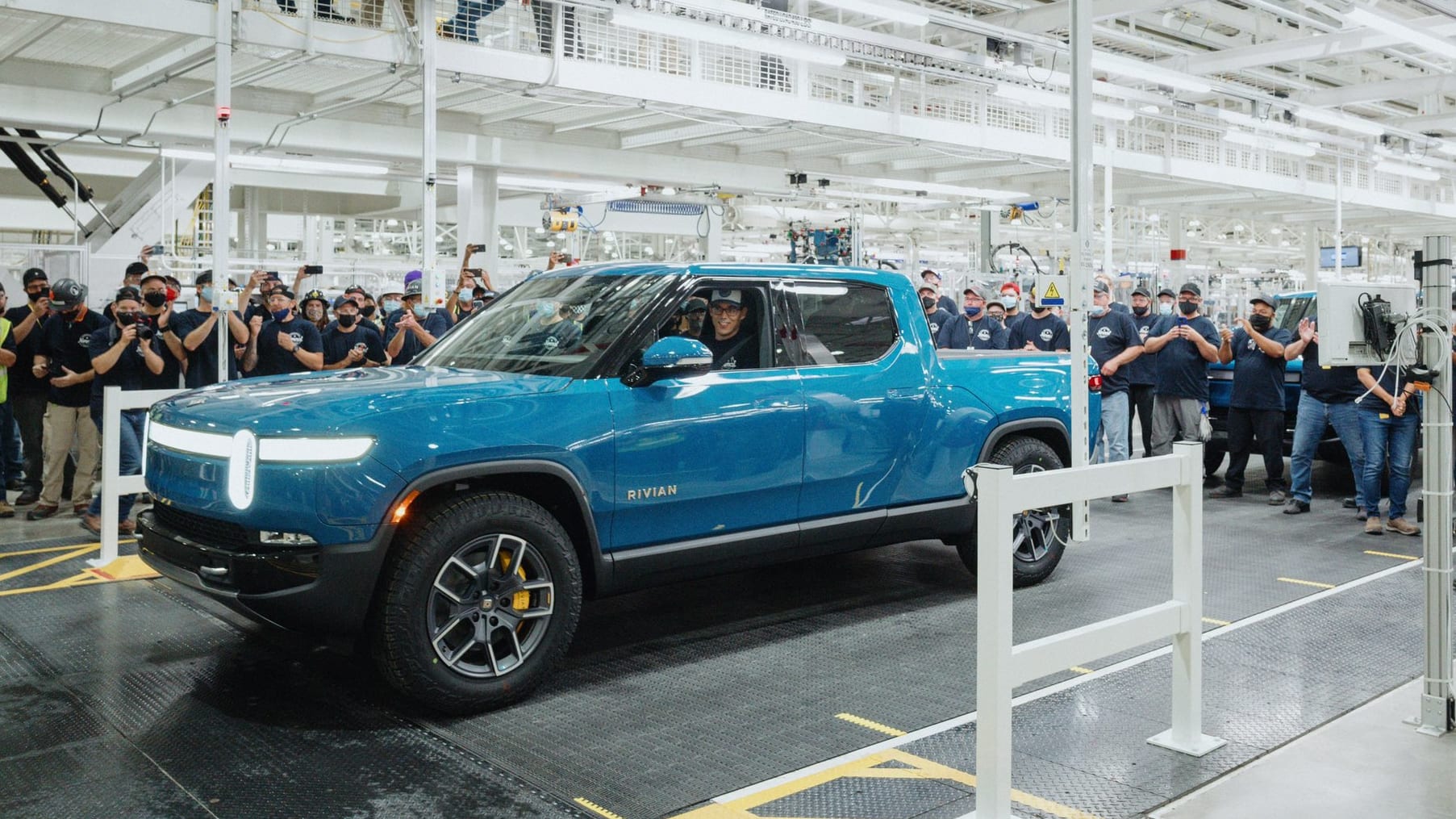
Ahead of Rivian on the list is BYD, Volkswagen Group, Toyota, and Tesla.
Despite the electric carmaker only just starting to deliver vehicles to its customers, Rivian is valued more than Hyundai, Subaru, Mazda, and Kia combined.
Over the past day, Rivian’s market cap has surged from US$100 billion (AU$136bn) to more than US$120 billion. A similar move could see it overtake Volkswagen Group – which owns brands including Audi, Porsche, Bentley, Lamborghini, Skoda, Seat, Ducati, and Volkswagen.
UPDATE, November 14, 2021: E-Tron S Australian launch delayed
More than a year since its global reveal, Audi’s Australian arm has confirmed the E-Tron S will not reach our shores until sometime in early 2022.
Speaking with Wheels, an Audi spokesperson said: “Originally it was only ever anticipated by the end of this year. There isn’t a specific reason for the delay. A small delay of a few months is not unusual, especially in the current environment of supply challenges.”
– Mike Stevens
The story to here
July 6, 2020: Global reveal
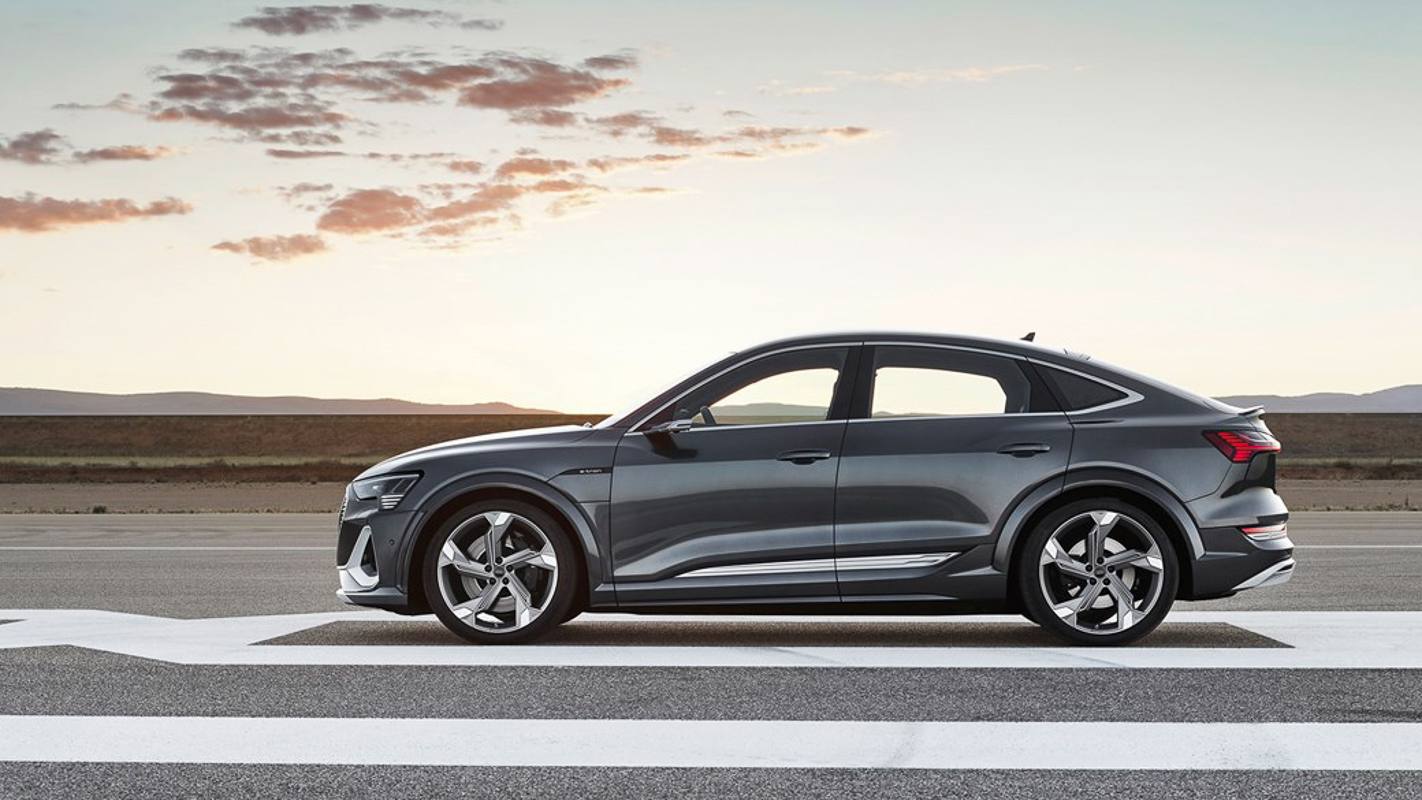
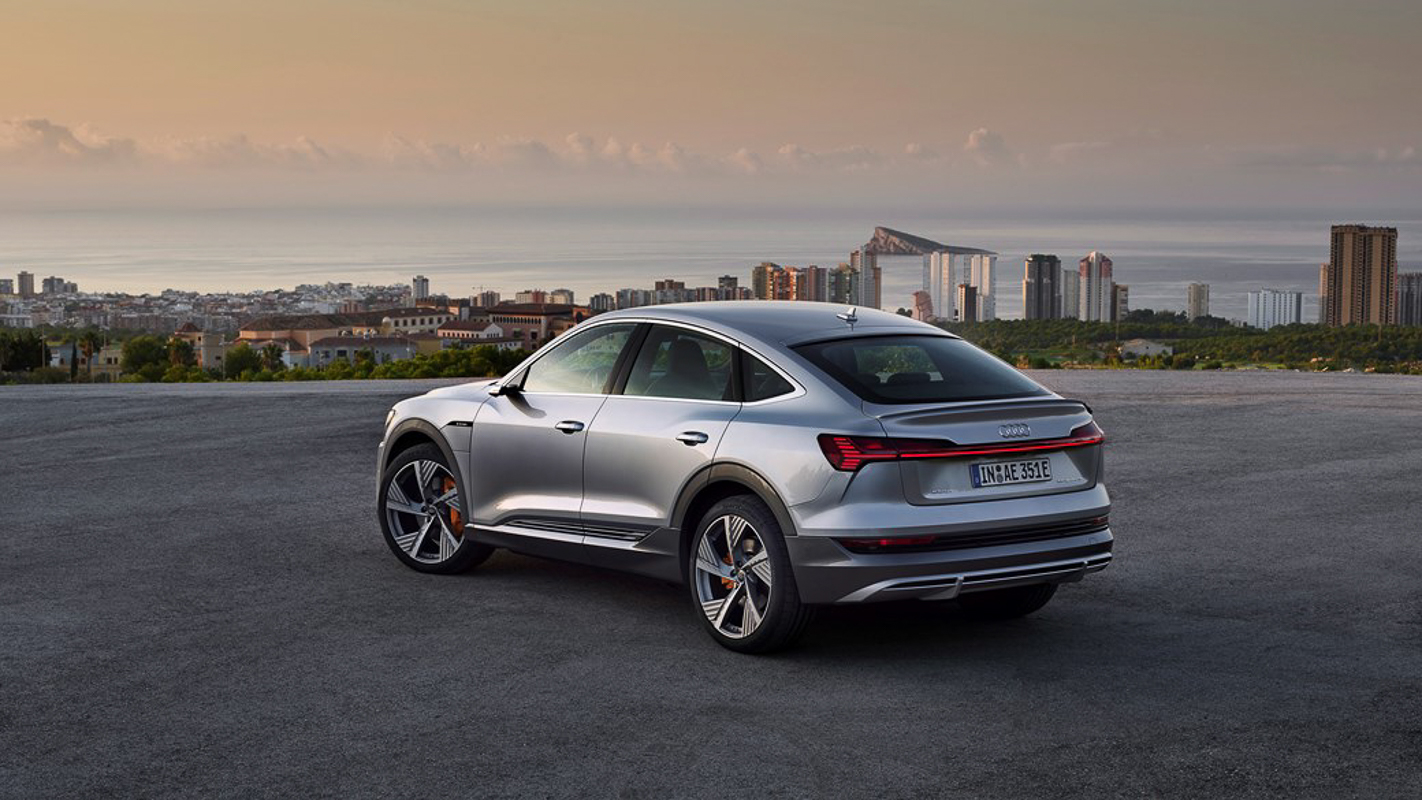
Audi has officially unveiled the e-Tron S model, shown here in Sportback format.
Little is different between this and the regular e-Tron electric SUV. That is to say, everything in terms of interior tech, design and drivetrain is carried over. However, like with other Audi cars in this mould, the e-tron Sportback features something of a firmer suspension set-up than the standard car. Keep reading for more intel on the e-Tron Sportback.
Audi e-Tron Sportback S details
As expected, Audi has introduced an S performance model for the e-Tron and its Sportback model. Power is rated at 369kW and a whopping 978Nm of torque – quite a difference over the highest-powered non-S variant, the 55 quattro. The 95kWh battery (in which Audi says 86kWh of it is usable to the driver) allows up to 363 kilometres of range.
Read: Audi e-tron SUV delayed again
The e-Tron S has a three-motor setup instead of the quattro’s regular two; one motor drives the front axle and two drive each rear wheel individually. In normal driving situations, only the rear motors are active, with the front stepping in when grip is lost. There is a sport setting for the ESC and, when coupled with dynamic mode on the drive select, Audi says this EV can drift. We proved that when we drove a prototype model.
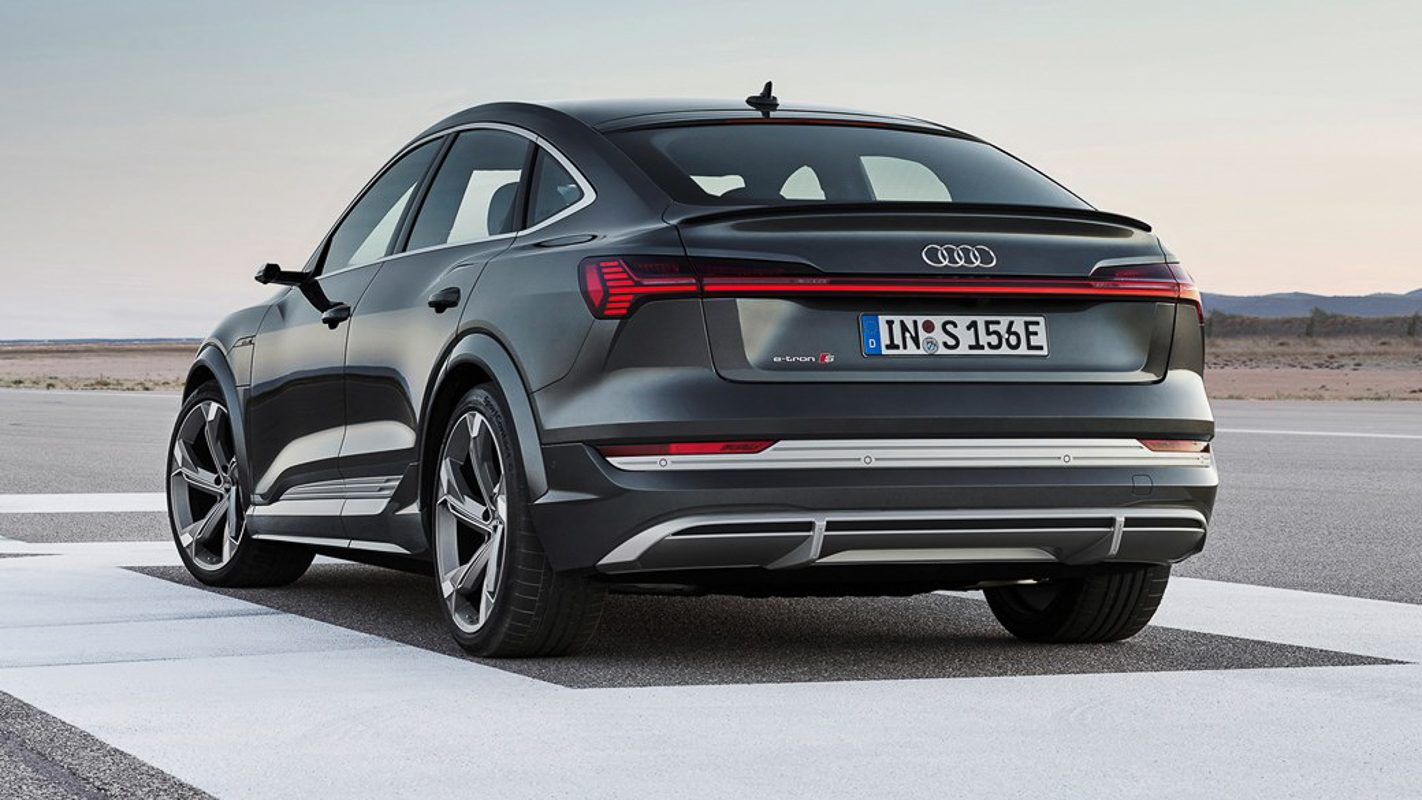
Elsewhere, the adaptive air suspension has been lowered and tweaked for the S model, while wheel arch inserts make the S models 23mm wider than a standard e-Tron.
Give me the regular e-Tron Sportback specs
So, just like the regular e-Tron SUV, there are two power variants for now: a 50 and a 55, as part of Audi’s usual power variant nomenclature. That translates to 229kW/539Nm and 264kW/560Nm respectively. with Audi claiming up to 445 kilometres of range from the lesser-powered variant.
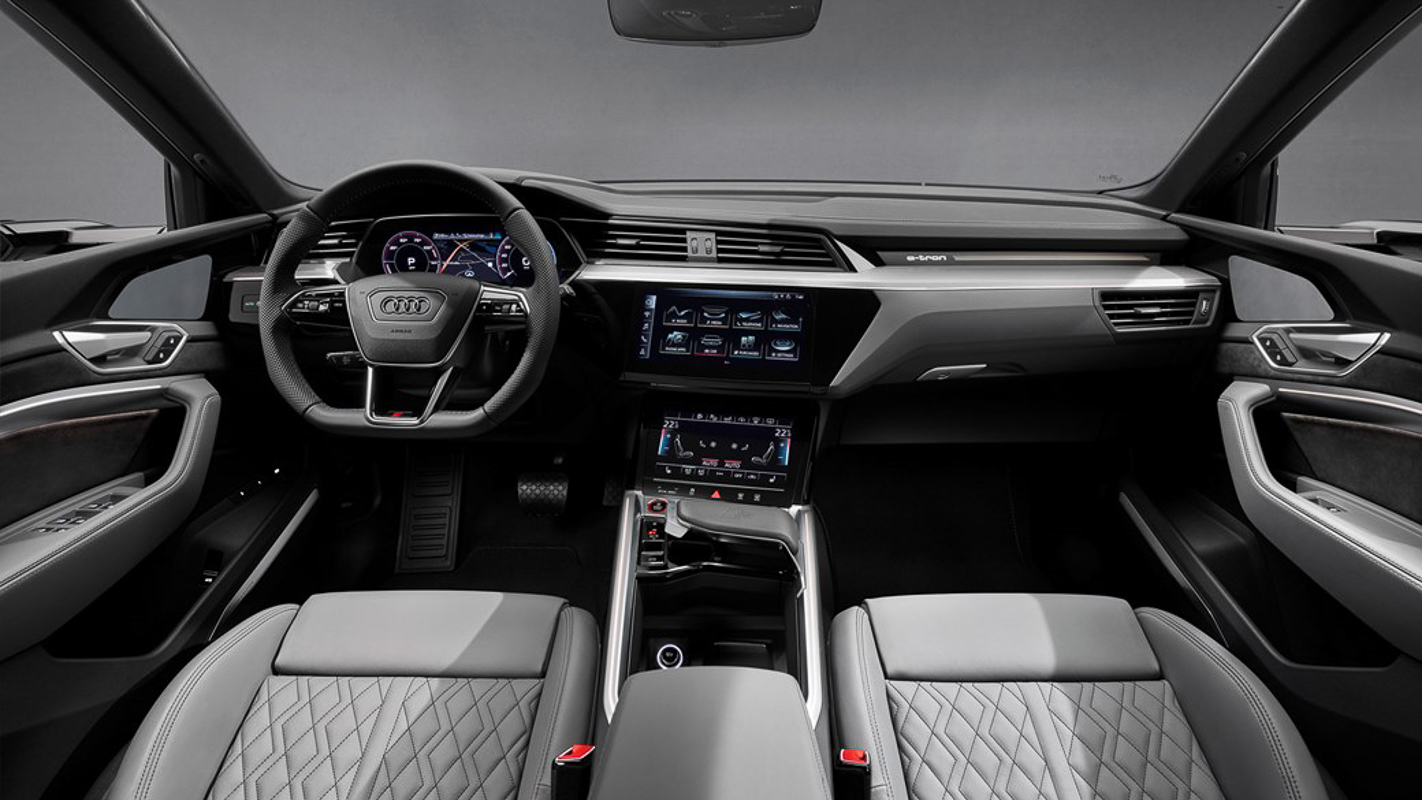
The 50 has a 71kWh battery, while the 55 has a larger capacity 95kWh – both have a motor on each axle for e-quattro all-wheel drive.
Elsewhere, we know that an e-Tron S variant is coming with three e-motors and more power.
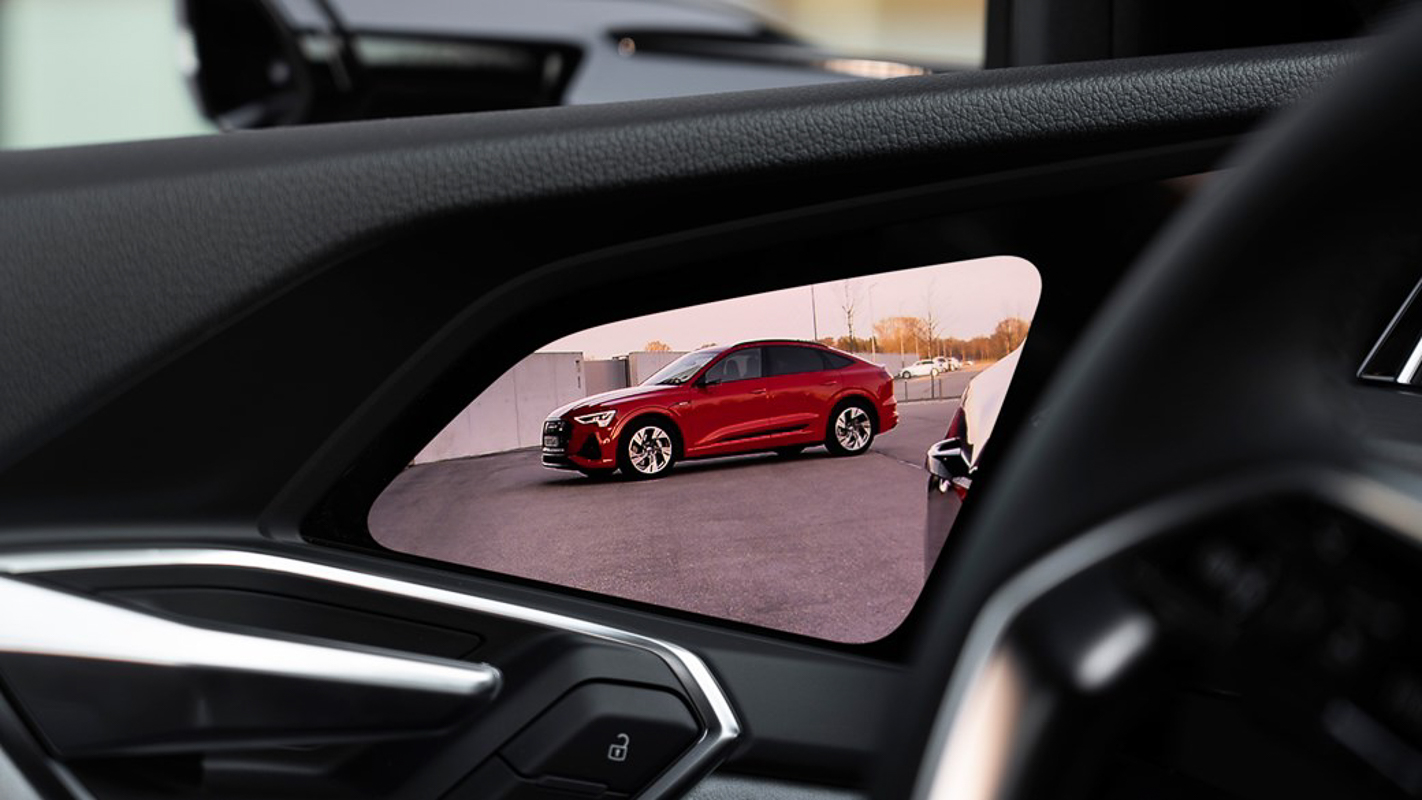
The Sportback variant is largely the same as the regular e-Tron SUV in terms of its interior, technology (including those odd Virtual mirrors). What is new, though, are Audi’s Digital Matrix lights…
Debut of Audi’s Digital Matrix Lights
Also new on the Sportback is the latest version of Ingolstadt’s adaptive headlights, called Digital Matrix Lights (DML). In terms of function they offer a more precise beam pattern to the existing Matrix LED system, with a few additional features.
Rather than banks of diodes lighting up the road the DML headlights use a reflective chip about the size of fingernail that contains 1.3 million microscopic mirrors, which can tilt up to 5000 times a second. It’s ostensibly the same tech as a cinema projector.
That allows light to be beamed exactly where it’s needed, enveloping other cars much more accurately than the previous system. It needs to be convincing better than that system though.
Its party trick is that it can illuminate a carpet of light onto the motorway lane in front of you, constrained by the white lines, and curving with the topography of the road. Onto this carpet two lines of chevrons show the exact width of the car including door mirrors – useful for sizing up gaps in traffic or goalposting between narrow roadworks.
We tried it in Los Angeles in nighttime conditions and it’s uncanny how it works; it’s real augmented reality in action (see below).
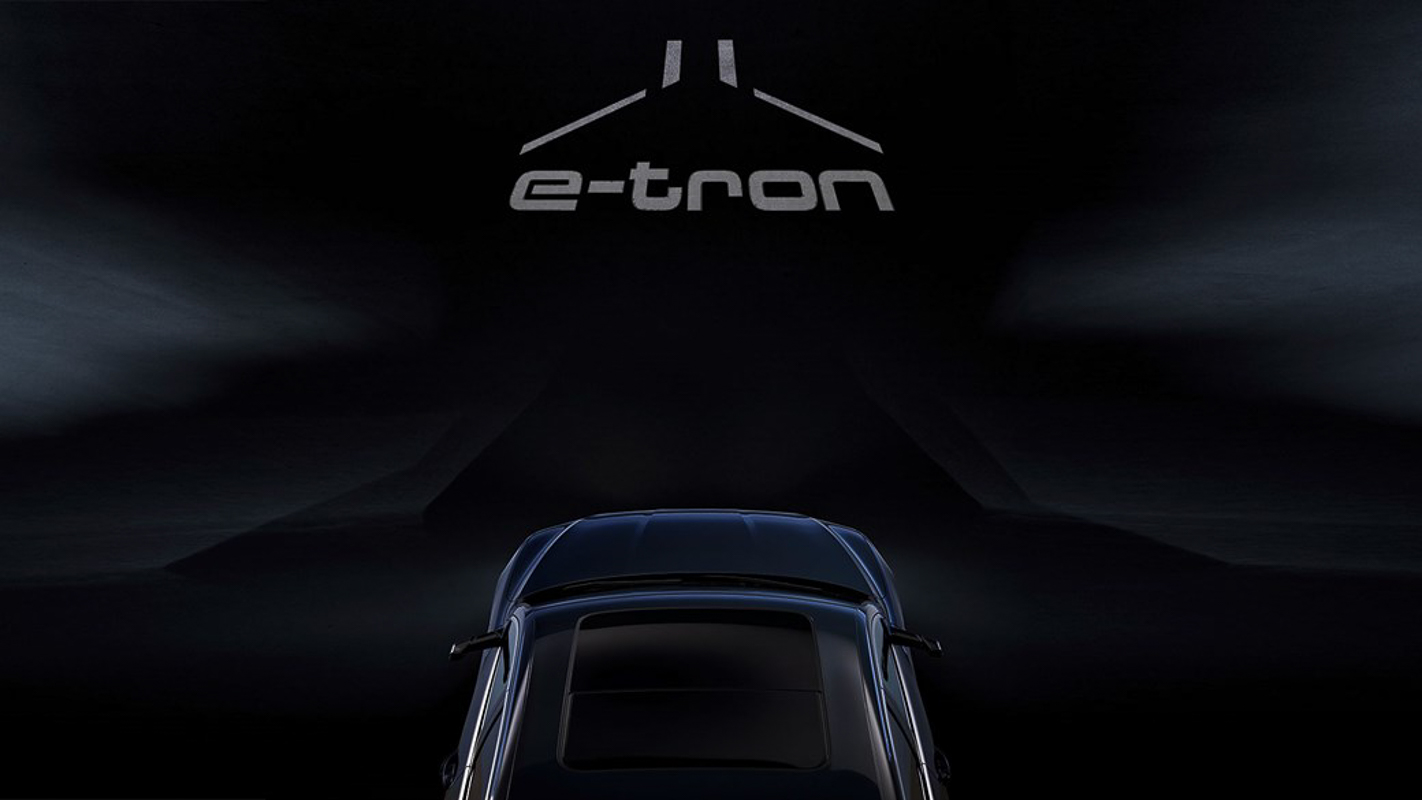
Then when it comes to parking up, one of five animations can be beamed onto your driveway or garage door for additional attention seeking flair.
Technologically it would be possible to actually project a film onto the side of your house using your car’s headlights, but don’t expect to see this feature homologated in the production Audi E-tron Sportback.
This article was originally published on carmagazine.co.uk.
For reasons you won’t need a vivid imagination to work out, I have left Australia for a while and find myself tapping away not at my kitchen bench in Melbourne looking out at a stalled nation in grim stasis, but in the UK.
It’s been years since I found myself on this isle, yet it hasn’t taken long to remember the frustrating things that were instrumental in my departure. However, the stuff England does so very well has also come to mind.
On the motorway, for example, drivers stay in the left lane unless overtaking – a concept so fabulously complex, it seems, that you rarely ever see it in practice in Australia. On the contrary, no matter how many lanes you have to choose from Down Under, traffic will be evenly distributed across all of them and dawdling along at 10km/h less than the speed limit.
The minutely tolerant part of my personality almost understands the desire to stay away from the speed limit with every police officer poised in bushes and wheelie bins waiting to pounce on drivers who break the limit by a few percent.
Perplexingly though, I have been blasting around the UK in a 2021 Audi S3 at 80mph (16km/h over the maximum permitted speed) and not once has a law enforcement officer paid me the slightest attention.
Even more amazingly, despite approximately half of the motorway traffic cruising at the same law-flouting speed, I have witnessed neither one massive fiery pileup nor any vigilante road-users shaking their fists and flashing their lights.
It’s the same at lower speeds, too. Pull over and allow oncoming traffic to pass in tight spots and an English driver will raise a hand in thanks, often accompanied by a smile. In any of Australia’s metropolises though, the most you can expect in return for the favour is a despondent glance away and entitled ignorance.
Car culture in England is very different but it certainly isn’t perfect. Fuel prices, for example, are monumental and influence the national car park. I initially thought the abounding sub-compact car numbers and diesel-engine prevalence was weird and, since I arrived, I’ve counted two Ford Mustangs. But then I pulled in to fill up the Audi and was basically mugged at the counter for three dollars per litre. That’s about $130 for a hatch.
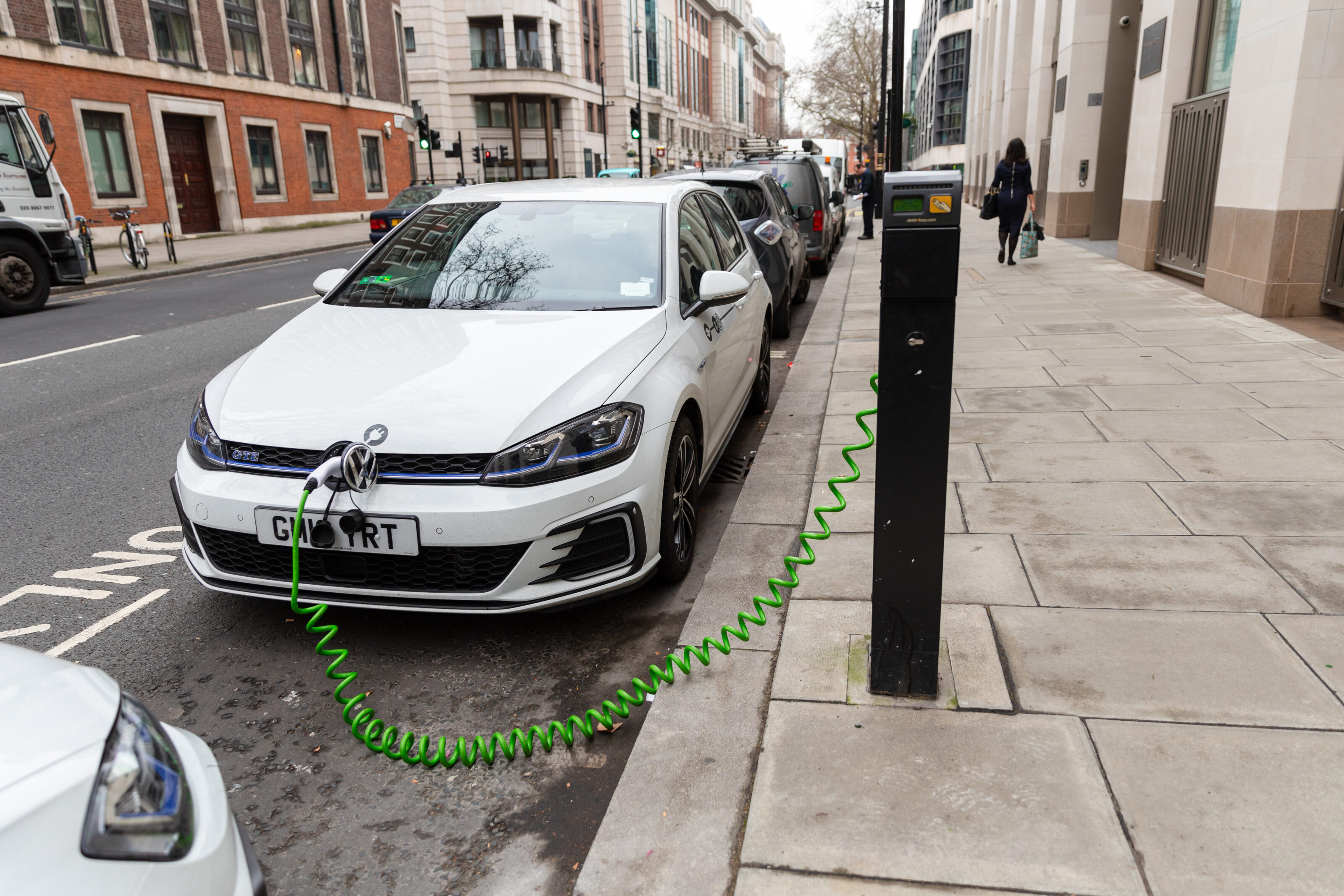
However, something else has come to light that I find even more shocking. While we often use other nations, including the UK, as examples of how electric cars can and do work, spending time here reveals an uncomfortable truth that’s quite the opposite. While EVs are more affordable, Britain is nowhere near providing the adequate infrastructure to enable easy running.
If you only ever drive within the range of your EV and can charge at home, electric cars make sense in the UK, just as they do in Australia. However, embark on a road trip and it becomes clear the public infrastructure is under-gunned.
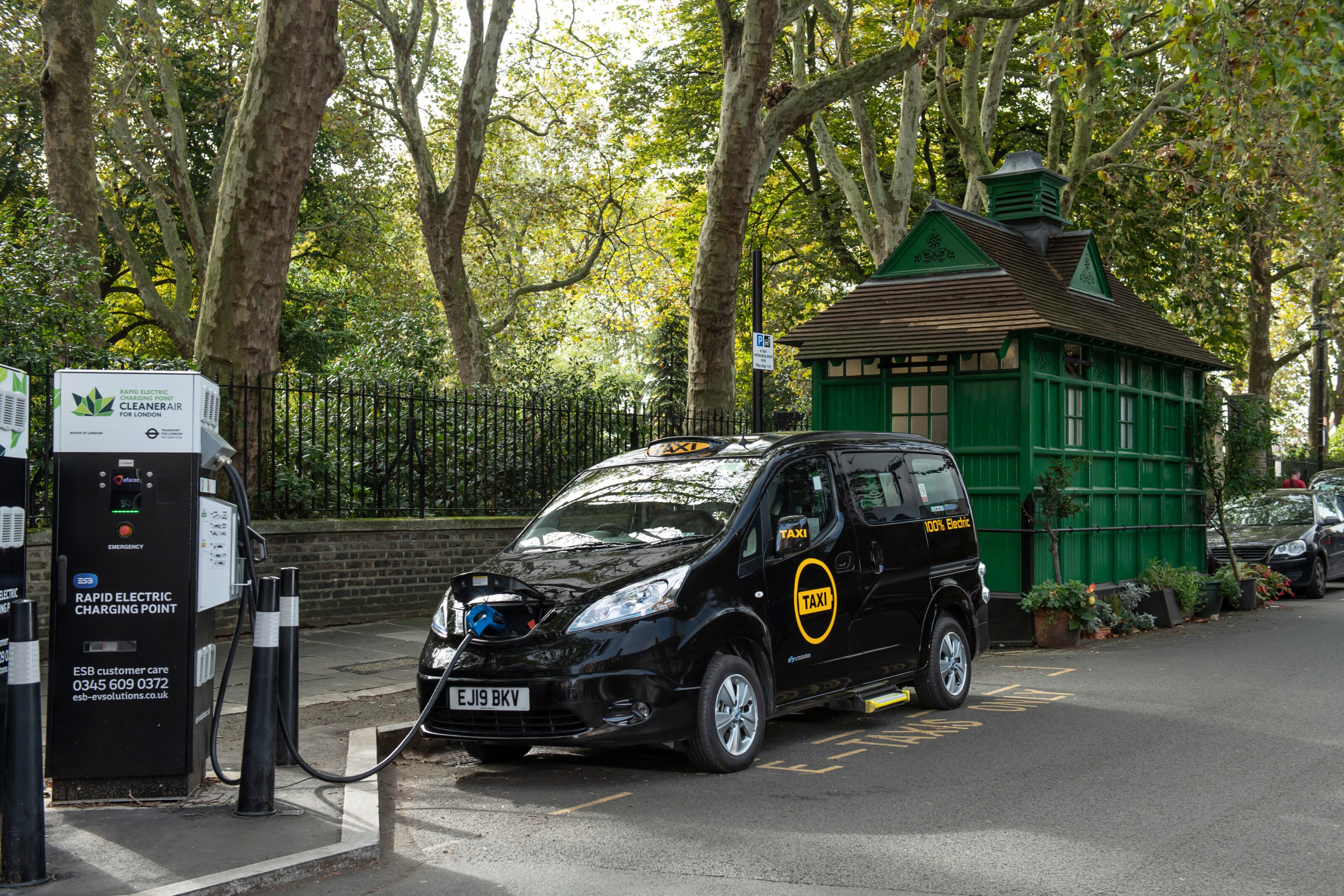
Chargers in London are effectively rendered useless by queues of black cabs, with all the capital’s iconic taxis on track to be electric by 2023. And with the number of EVs skyrocketing on UK roads, public charging stations are frequently occupied. Instead of the attractive 30-minute charge times advertised by many, the actual time is multiplied by the number of owners you queue behind.
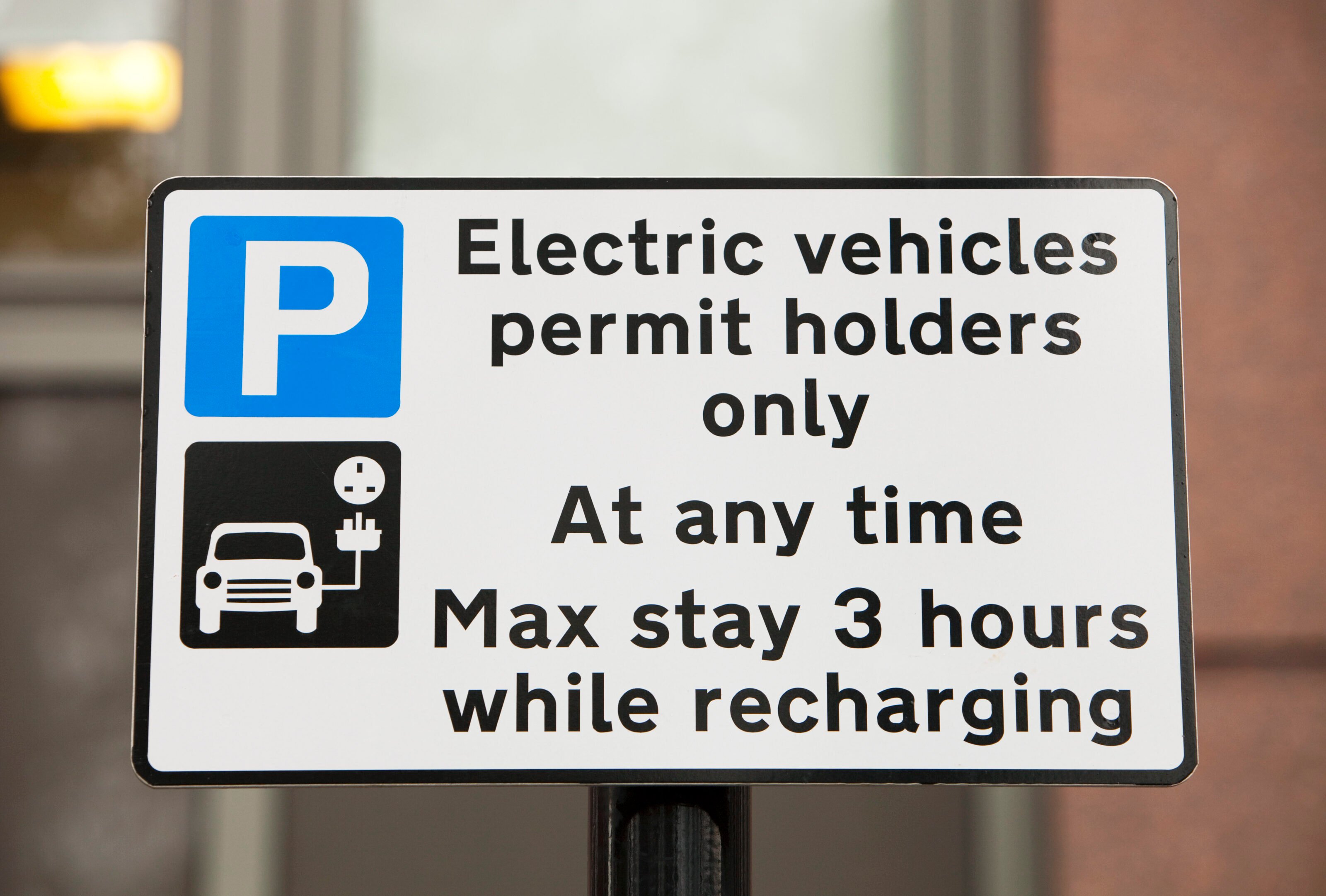
Many users report problematic charging applications, unreliable information regarding charger locations and many units out of order. Even when you can finally get the plug in, electricity is expensive compared with dinosaur juice.
The fastest public fill can cost up to the equivalent of $65. However, as most EVs have a range of roughly half the equivalent petrol or diesel it effectively means they are around twice as expensive to refuel at a public charger. With a staggering number of UK homes lacking garage or even driveway parking, the problem is very real.
One Porsche Taycan owner I noticed in Bath had routed a cable from their house, under the pavement and out of a service hatch via a makeshift repurposed plastic speed bump. It looked about as legal as cockfighting but this is a good illustration of the problem.
It pains me to report this because not only are electric cars fundamentally brilliant, they are also inevitable. And as long as relatively EV-friendly countries like the UK continue to struggle, Australia will remain even further behind the world with an even bigger mountain to climb.
Key Points
- Paul Sansom previously managed Audi Australia
- Took over VGA at start of 2022
- Announced his departure today
UPDATE: VW boss Paul Sansom steps down after short stint in top job
Volkswagen Group Australia boss Paul Sansom has departed his role after less than a year, it has been revealed today.
According to Drive, the news was told to Group employees on Thursday after Sansom took a “period of leave”
A statement issued to Wheels by VW Australia said Sansom was taking “a well-earned break before beginning the next exciting chapter of his career”.
“Volkswagen Group Australia (VGA) Managing Director Paul Sansom has resigned after two decades with the VW Group here and abroad,” it said.
“Mr Sansom became Managing Director of VGA on January 1, tasked with leading the newly unified national sales company of VGA (VW, Skoda and Cupra) and what was Audi Australia.
“He had led Audi in this country since 2017 having previously been managing director of Audi in South Africa. He joined the Volkswagen Group in his native UK in 2003.”
The company said Financial Director Gabriele de Neidels will replace Sansom as managing director, but did not say whether it was on a temporary or permanent basis.
Read our interview with Paul Sansom earlier this year on the link below.
The story to here
November 2021: Volkswagen Group Australia will appoint a new Managing Director at the start of 2022, with Paul Sansom set to take the head role of local operations.
Currently serving as MD of Audi Australia, as well as Chairman of the Audi Foundation, Sansom’s promotion to the role will also see VGA merge with Audi Australia – bringing Volkswagen, Audi, Skoda and Cupra under the same roof as is already the case in other markets.
Having led Audi Australia since 2017, Sansom will be taking the helm from Michael Bartsch who will return to Volkswagen of America after assuming the VW MD position in 2015.

Set to take over on January 1, 2022, Sansom’s first year as MD will include the official arrival of Cupra in Australia – something which he believes will make it the biggest year yet for VGA.
“Next year may prove to be the most important year in the history of Volkswagen Group Australia, and it is testament to Michael’s leadership that the company should be so well-positioned to play a leading role in shaping the future of mobility in this country,” said Sansom.
“The now five brands of Volkswagen Group Australia all have their own unique identity, and cater for their own distinct customer groups. The diversity of their expertise across the majority of market segments provides Volkswagen Group Australia with an unrivalled opportunity to appeal to more new and existing customers than any other competitor.”

During his time in Australia, Bartsch was a staunch opposer to the Federal Government’s lack of an electric vehicle policy, and previously labelled the Victorian road user tax as a disincentive – saying Australians are living in “an automotive third world” with the country “becoming a dumping ground for older and less efficient vehicles”.
Bartsch also led the group through the local fallout of Dieselgate.
“It has been a privilege to lead such an extraordinary team over the past six years,” said Bartsch.
“We have experienced our share of challenges and headwinds during that time, but we have never lost sight of the trust that our customers place in our brands.
“Our collective growth over that period is a mark of the significant progress our brands have made in Australia, and I am pleased to leave the next leg of their successful journey in Paul’s very capable hands.”
Ahead of the 2022 merger, VGA is set to go through a sizeable shake-up, not only at the very top, but also across its local brands – as Michael Szaniecki joins as Volkswagen Passenger Vehicles Director after holding the title of Poland’s Director of Seat and Cupra.
Ryan Davies will remain as the Director of Volkswagen Commercial Vehicles, Michael Irmer retains his role at the top of Skoda Australia and Ben Wilks is set to be Cupra’s inaugural Australian Director when it launches next year.
When a speed sign at the Lang Lang proving ground bumps the limit up to 120km/h, a thought pops into my mind. What happens to a wallaby when you hit one at highway speeds?
This place is full of them. Kilometres of security fencing that cage in hectares of undisturbed bushland have fostered a wildlife sanctuary for the wallabies. Now, mobs of them lurk by the roadside, threatening to jump out at the slightest spook. I proceed carefully.
Given the history of this place, I also wonder what the wallabies think of our BMW 530i and Mercedes-Benz E300. Our duo’s understated class might look out of place among the rugged and overgrown fields of Lang Lang – but their size and layout would be familiar.
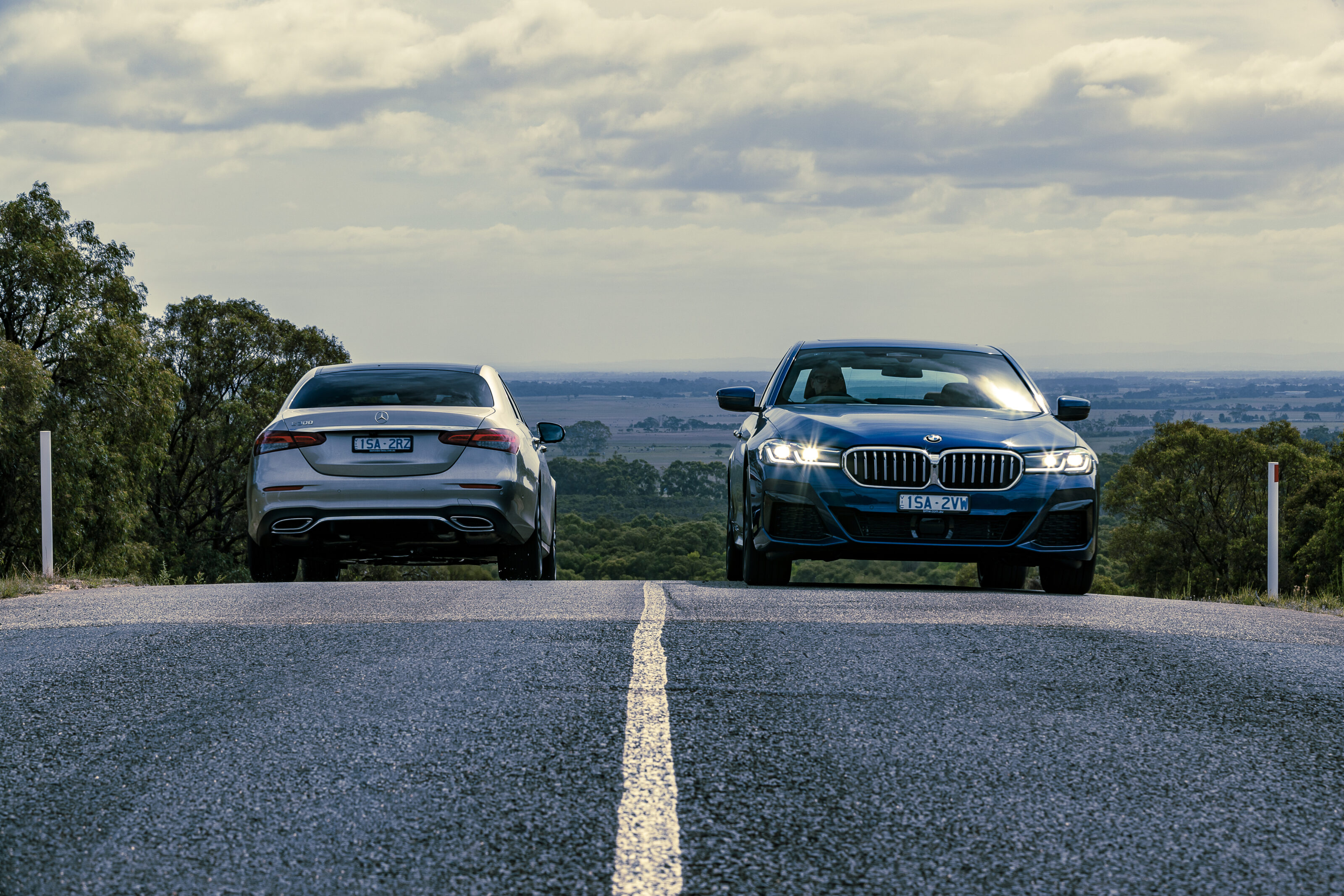
The irony of being here to test large rear-drive four-door sedans that are bitter rivals, only from another country, is not lost on me. But if there was any place to assess which of these two is better, it would be in the wheel tracks of the greats we once produced.
Holden spent decades crafting the Commodore here. Of course, the keys to these grounds now belong to Vinfast, who rented us the facility for an unrelated test. I’ve just brought these two along for a chance to wring their necks legally and in relative safety.
And while this might be a battle of the niche – large SUV sales now outstrip those of large sedans at about 24 to one – the 5 Series and E-Class are segment icons. They account for over half of large sedans sold for over $70K.
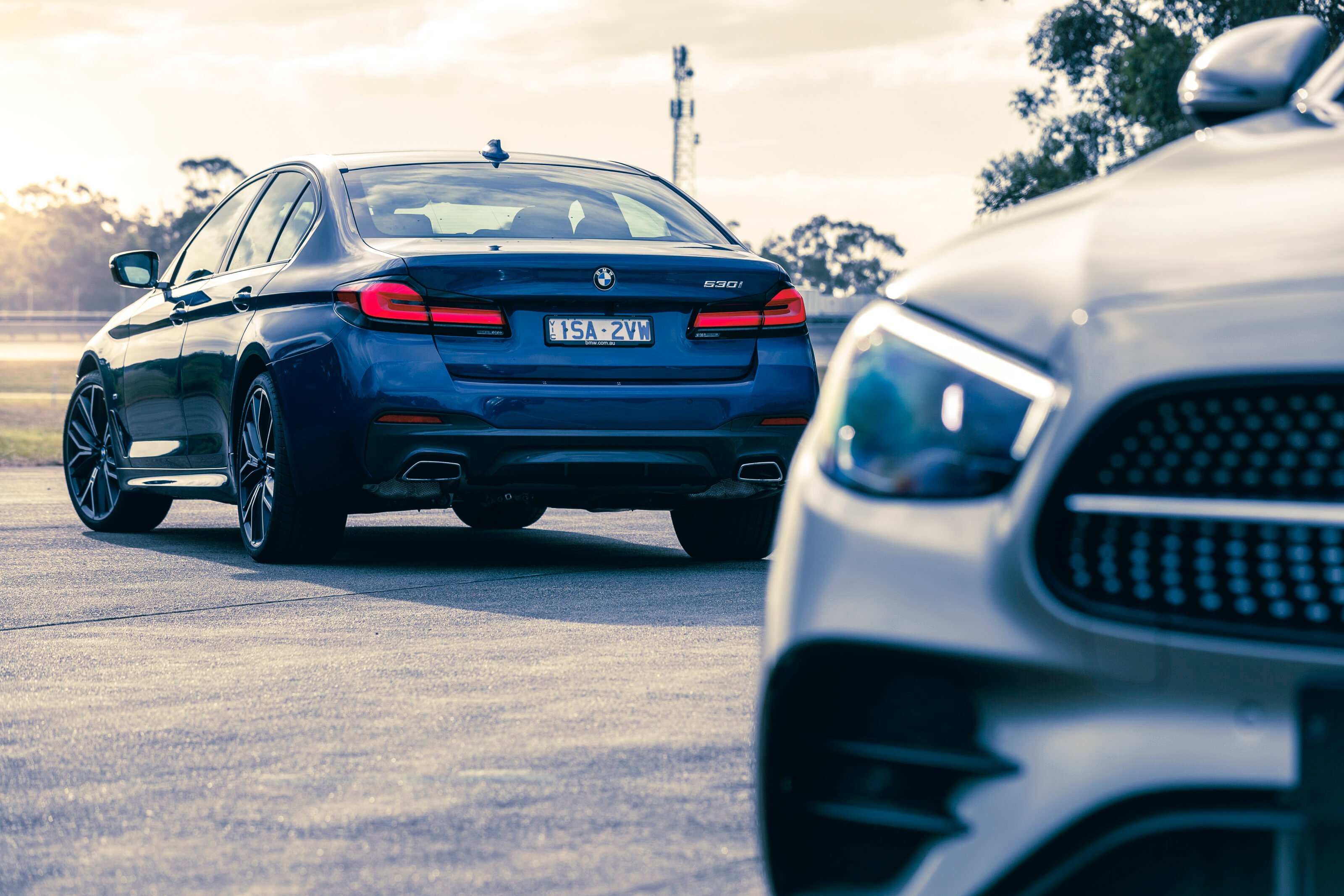
For decades the BMW 5 Series and Mercedes-Benz E-Class have infused sporting pedigree with stately comfort to plug the gap between the compact class and full-blown luxury, but recent facelifts for both set the stage for this showdown.
They have welcomed new technologies, freshly skinned front-ends and boosted specification with more kit. For instance, the E-Class kicks things off with new full-LED headlights that flank a new front bumper while the rear LED tail-lights are now split across the rear boot. E300s also score multi-beam LEDs as standard over a base E200, complete with adaptive functionality.
For decades the 5 Series and E-Class have infused sporting pedigree with stately comfort to plug the gap between the compact class and full-blown luxury
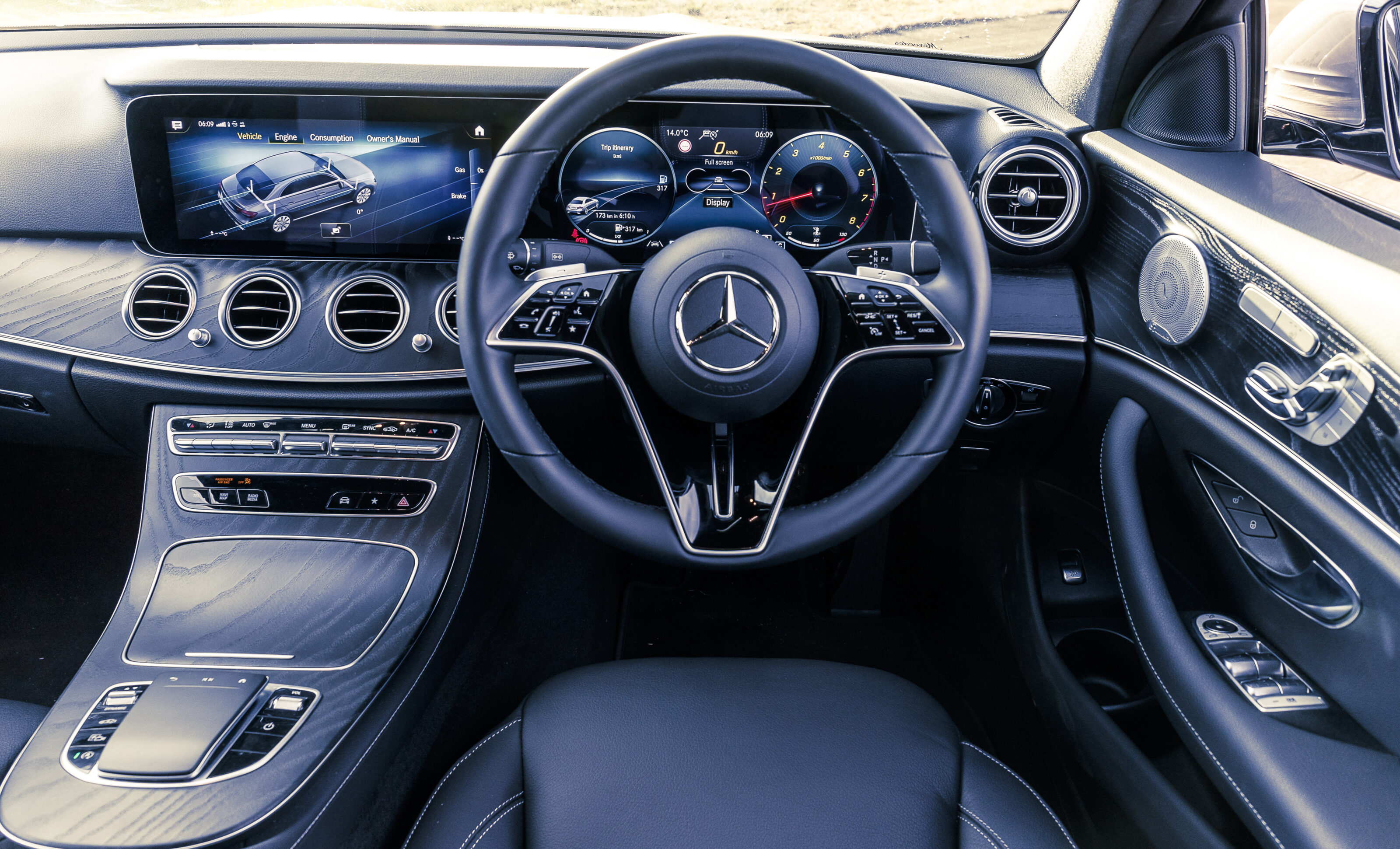
Inside, the E-Class interior continues to champion smooth, rounded surfaces. For example, the MBUX-capable infotainment flattens the centre console area by replacing the old bulky rotary dial with a sleeker trackpad. The pad improves the interface experience with the centre screen, but it can prove tricky to finesse at times.
The steering wheel is the same deal. For the E-Class, all steering wheels now use capacitive touchpads for functions like cruise control, media, phone calls and infotainment. While the steering wheel has its flaws, it helps the front workstation now feel and look high-tech when combined with the dual-widescreen cockpit.
The BMW 530i, by comparison, seems a little stale inside. In its defence, the digital instrument panel is relatively new, and the central display screen now measures 12.3 inches instead of 10.2. But most components, button pads, dials and controls are carried over. Still, if it isn’t broken – ergonomically, the BMW is still a benchmark.
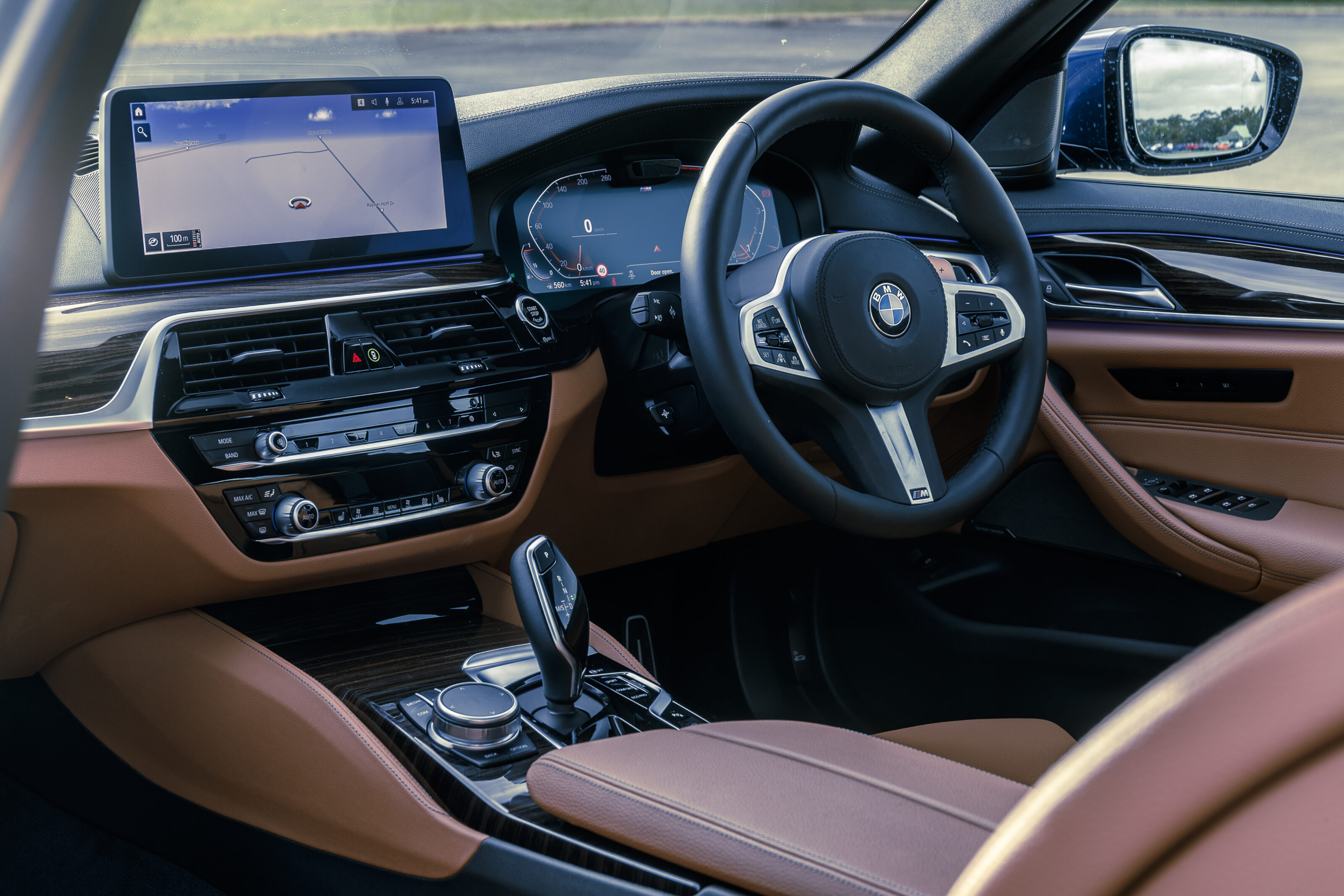
Both cars offer excellent heated front seats with driving positions that make the most of their rear-drive layout and longitudinal engine placement. In the back, the BMW wins on headroom but suffers for legroom, even though it has a longer wheelbase.
Otherwise, the BMW displays its facelift proudly. Thinner front headlights match a more aggressive front bumper. There are also more geometric-shaped front kidney grilles and L-shaped daytime running lights. The rear bumper, meanwhile, features a different coloured insert.
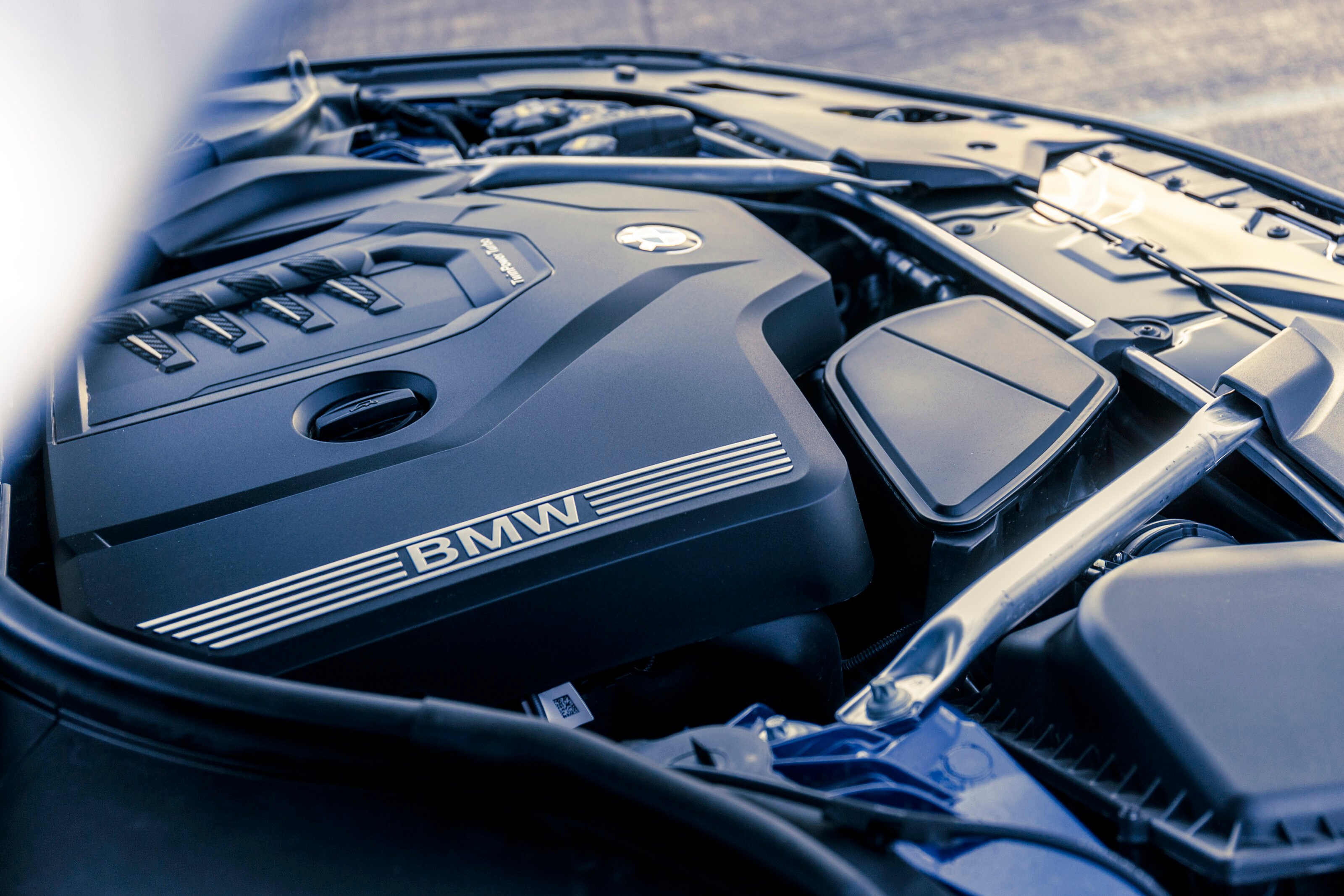
Further changes are also hidden away under the bonnet. Four-cylinder models have upgraded fuel pressures in their direct injection systems from 2900 to 5076psi to improve throttle response and fuel efficiency.
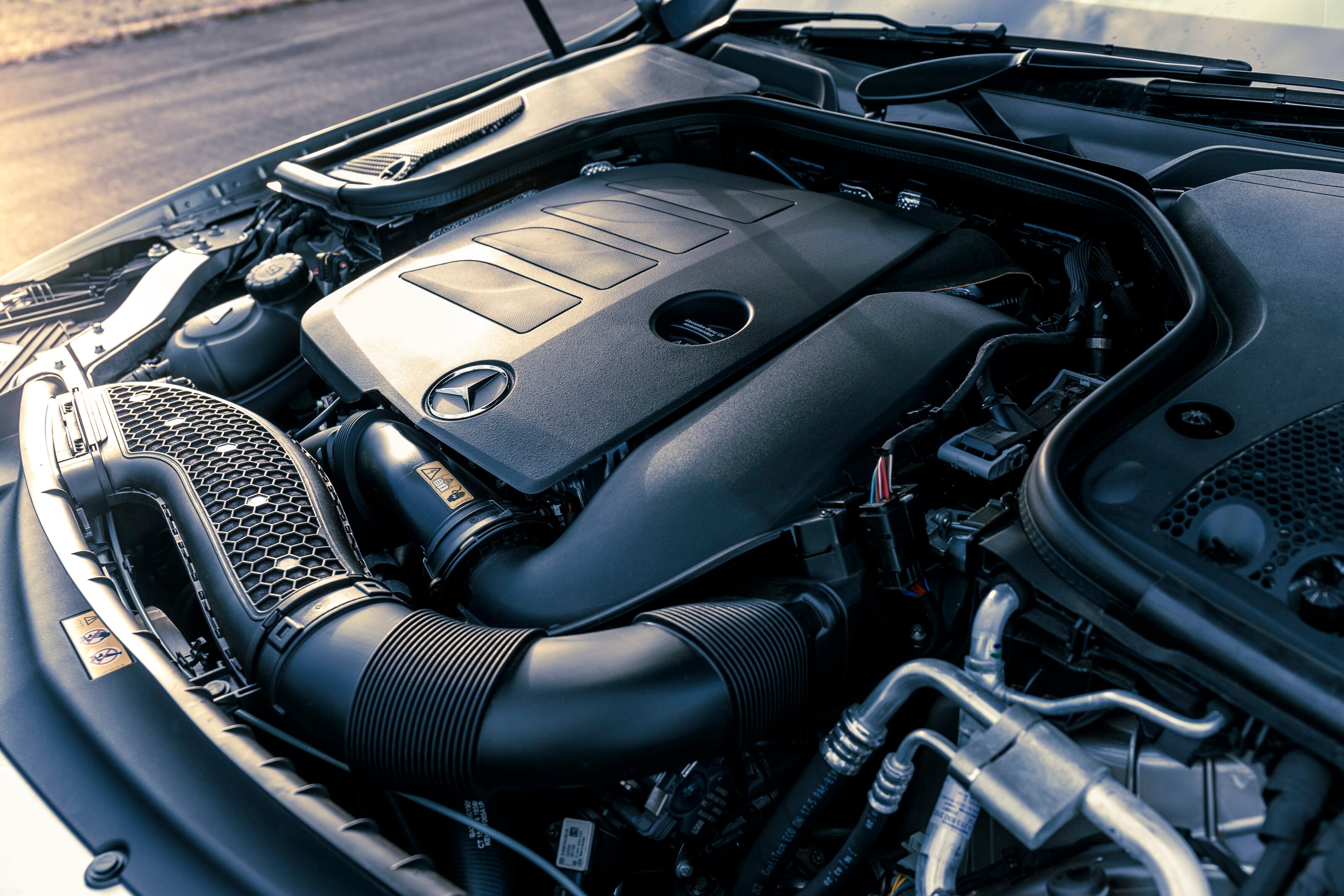
Both cars use a 2.0-litre in-line four-cylinder force-fed by a twin-scroll turbocharger making modest yet adequate power. The BMW feeds 185kW/350Nm to the rear wheels through an eight-speed ZF transmission, whereas the Mercedes-Benz ekes out 190kW/370Nm, with a nine-speed automatic transmission and rear drive.
Despite being down one gear and lacking 5kW and 20Nm on the Mercedes, the BMW boasts a higher power-to-weight ratio thanks to a 1625kg kerb figure. But winning the battle on paper is one thing.
Despite being down one gear and lacking 5kW and 20Nm on the Mercedes, the BMW boasts a higher power-to-weight ratio. But winning the battle on paper is one thing.
I start the BMW on a short makeshift drag strip, switch off ESC, engage Sport mode and dial up the torque converter to max stall. At 2500rpm, the rear 275mm-wide tyres have things under control. Once unleashed, the 530i launches without fuss, pulling hard in each gear all the way up to 6750rpm.
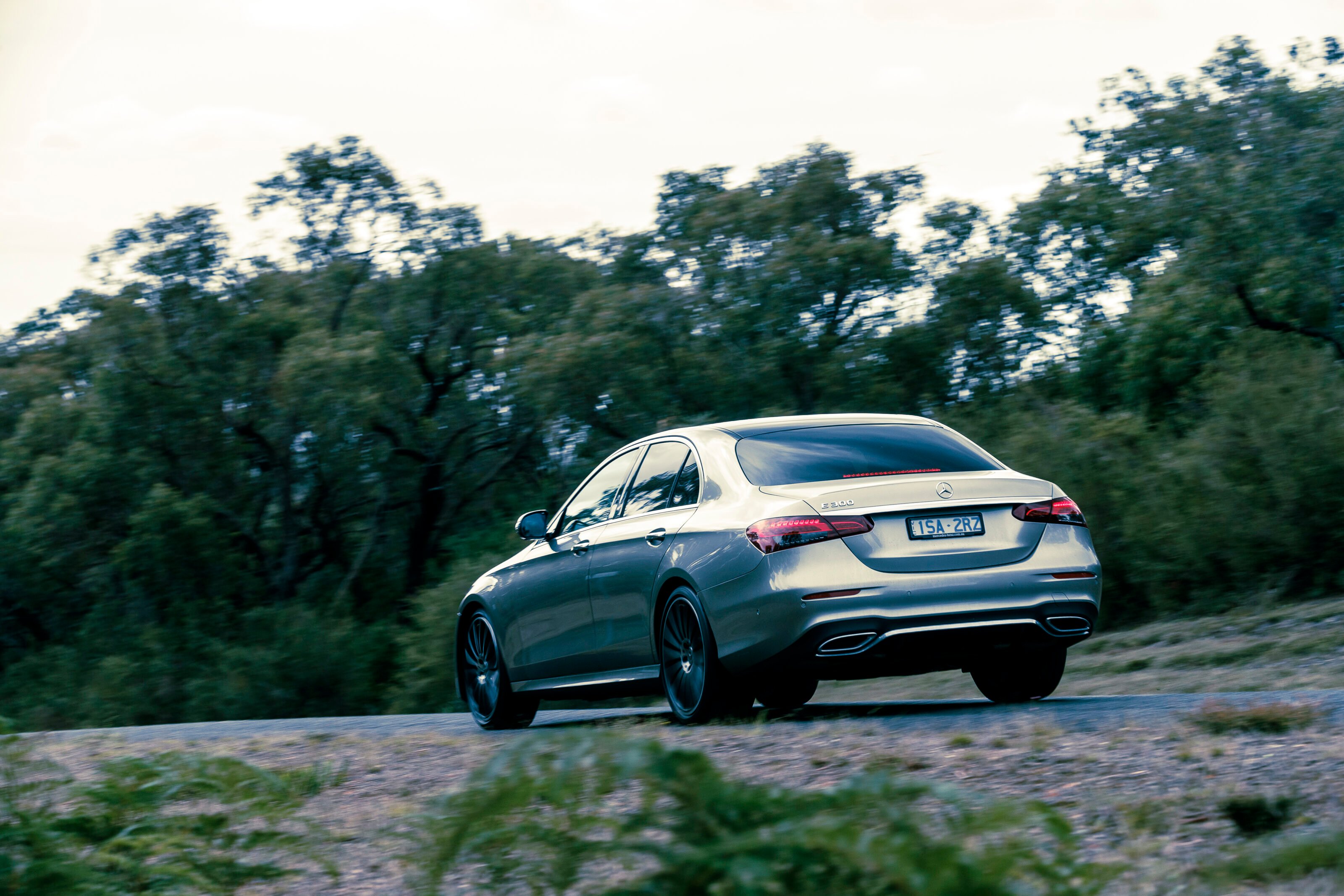
Next, I try the Mercedes. It requires a similar launch procedure to the BMW. The nine-speed automatic builds up to about 2500rpm and punches harder in the mid-range once away. And while the E300 runs out of puff towards its top-end, the transmission counteracts this with an early upshift at 6000rpm.
In the end, with more gears and higher outputs, the Mercedes registers a 6.2sec sprint to 100km/h from rest and matches its factory claim, besting the BMW by 0.2sec, which needs 6.4sec to complete the same feat and lags three tenths behind its own claimed time. Clearly, the Mercedes-Benz is a little punchier.
The tables turn when we test both cars’ braking distance from 100km/h. BMW has upgraded the 5 Series with red M Sport front brakes that look like performance calipers with a sliding design. On closer inspection, though, they have been hollowed out on either side of the fixed piston chambers to, presumably, save weight. But all that matters is they work.
Stomping on the left pedal from 100km/h pitches the BMW hard on to its nose, pressing its tyres into the tarmac for maximum bite. The Driftbox says it takes 36.4m to haul up. The Mercedes, meanwhile, needs an extra metre to arrest itself from the same speed, finishing at 37.5m.
Mercedes-Benz equips the E300 with fixed four-piston front calipers that use the Pirelli P Zero rubber wrapped around its 20-inch wheels to good effect. Its quoted weight of 1680kg is 55kg heavier than the BMW, which likely contributes.
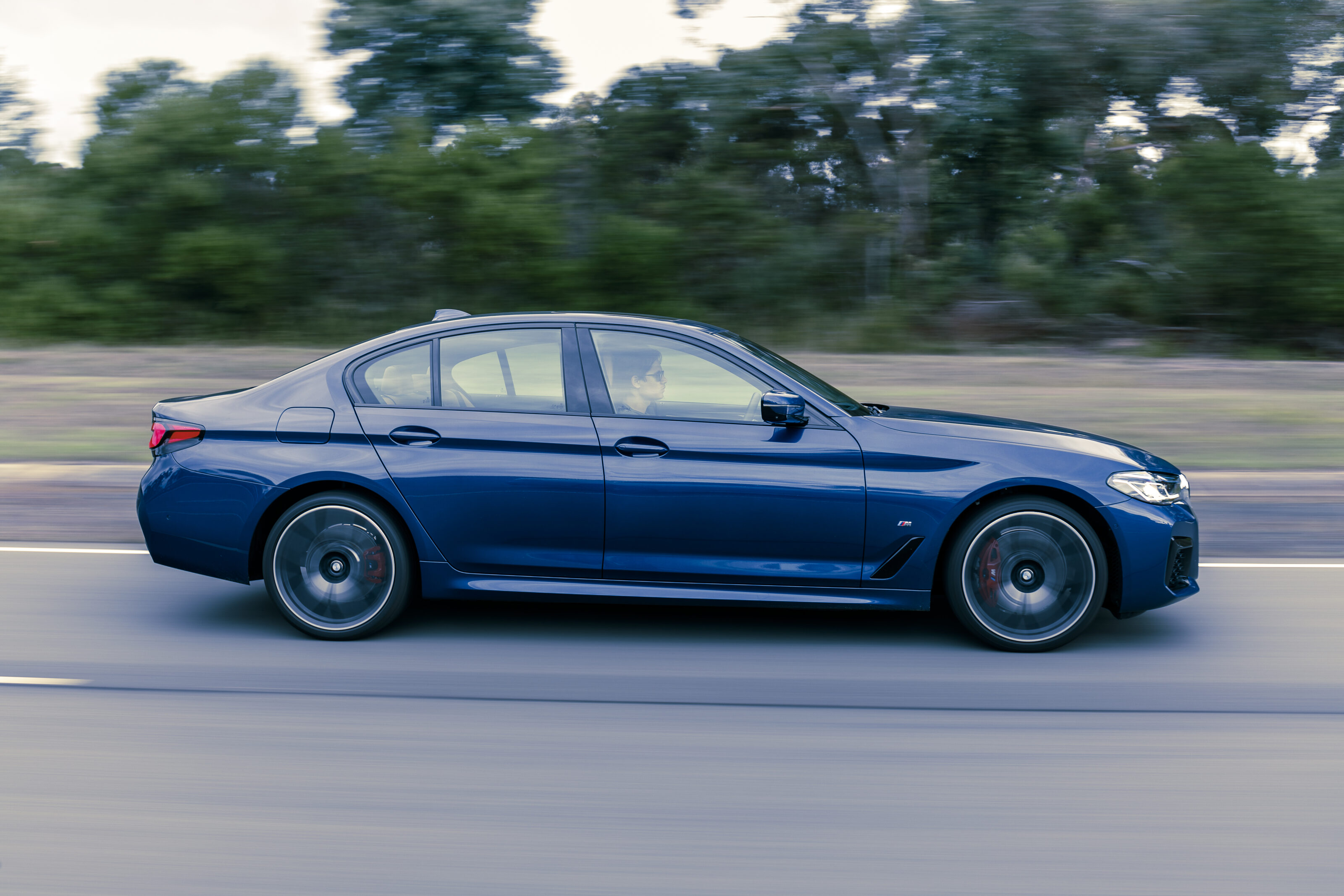
With straight-line performance testing wrapped, our pair head to the wallaby-infested handling circuit, where I suspect the extra weight of the Mercedes might again prove a hindrance. But the Mercedes is promising at first. Sharp, direct electric steering and a short front overhang give you tighter command over its initial direction into a corner.
The BMW, meanwhile, feels less tied down. The softer adaptive suspension damping and the taller roofline equal a touch more bodyroll when you tip in, while the steering feels typically vague.
But as I push on, raising the commitment, the composure behind the Mercedes starts to unravel. The air suspension not only floats over mid-corner bumps, but the longitudinal weight transfer is way too soft for the amount of roll stiffness. In the end, the Mercedes feels awkward when making a transition from braking to cornering when really pushed.
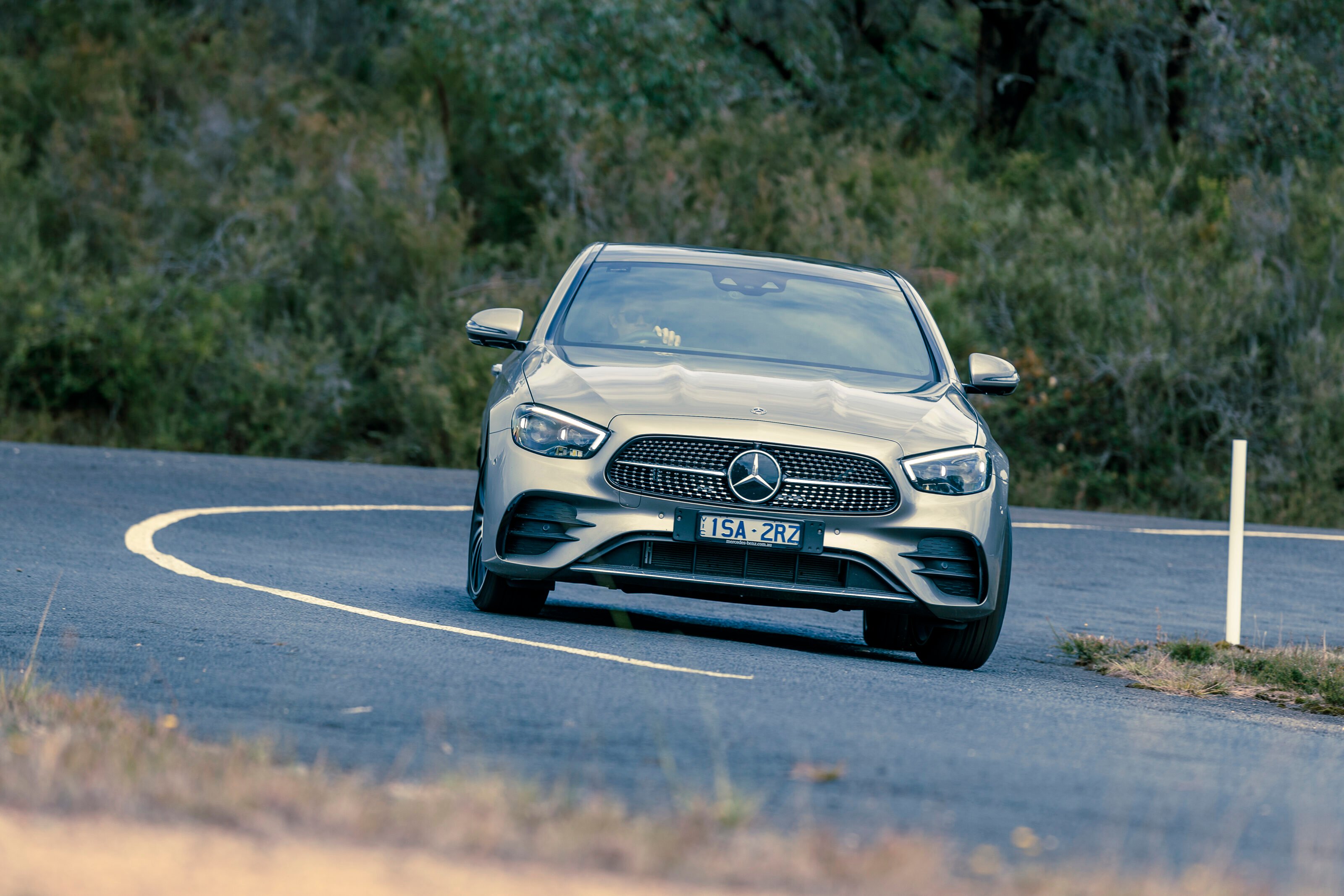
In contrast, the BMW gets better as you push through its initial vagueness and start to trust the excellent chassis balance on offer. Admittedly, its Goodyear rubber prevents cornering speeds from getting anywhere near the talent of its chassis, but you can commit much harder in the BMW and place it with confidence.
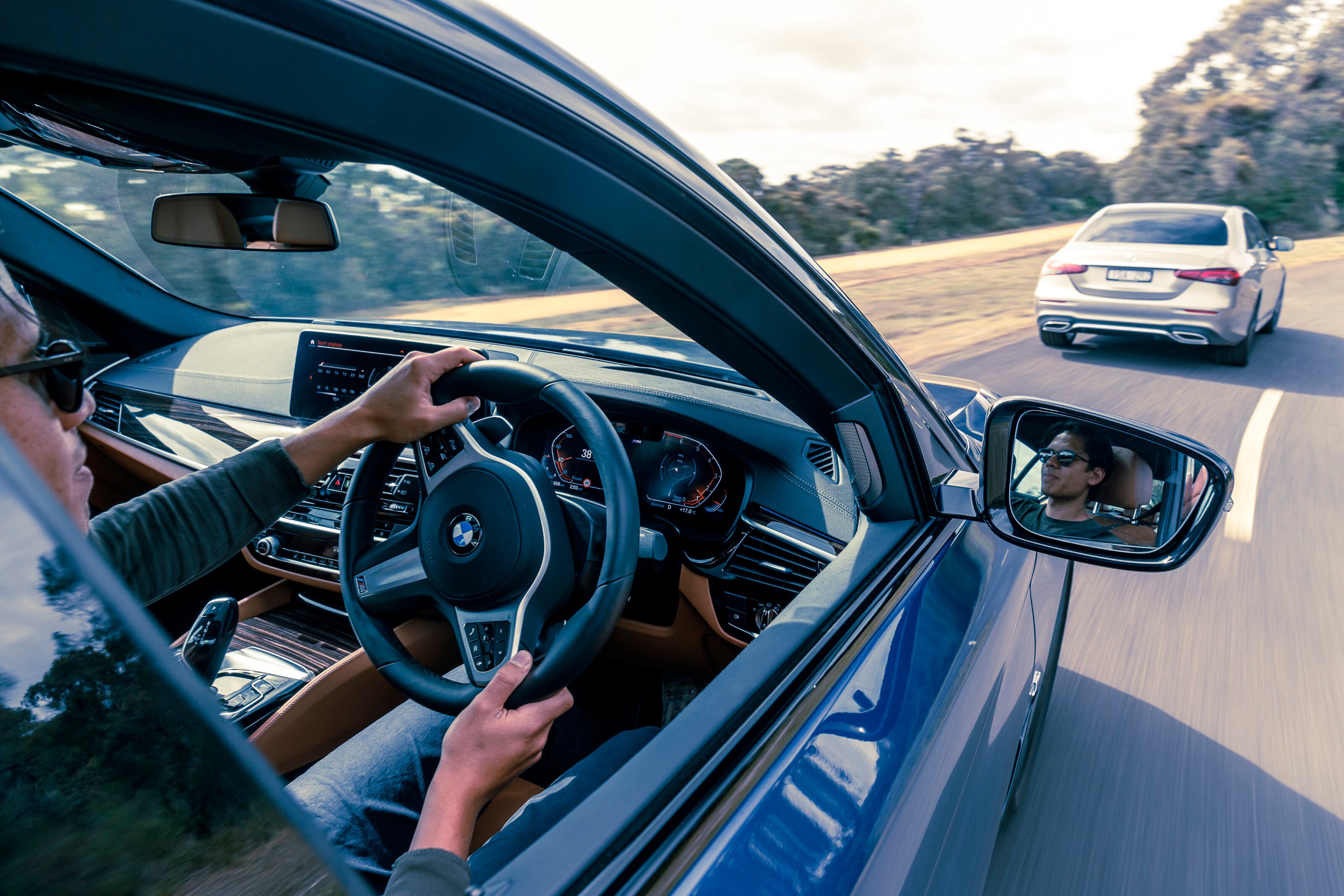
The BMW is a sweeter steer and not only because of its chassis. The ZF eight-speed transmission shifts smoothly and will accept commands across a broad range of situations. For instance, it drops into second gear on a steep decline, as the engine speed flares to 6000rpm, without any hesitation. Whereas the Mercedes’ nine-speed transmission will lurch ever so slightly during the same test.
However, when it comes to ride comfort, our pair is more evenly matched. The Mercedes does boast slightly softer primary damping. Both, however, pay the price for 20-inch wheels. Any harsh bumps or irregularities on the road are transferred into either cabin, with the run-flat tyres on both cars adding extra bite.
Run-flats are standard across the 5 Series range. Even our particular 530i has an Enhancement Package that fits them to one-inch larger 20-inch wheels. This pack also adds Phytonic Blue metallic paint, an electric glass sunroof and BMW laser technology headlights for $5900. With a remote engine start function (costing $690) and drive recorder ($390), our tester comes in at $126,880 before on-roads.
The Mercedes-Benz E300, meanwhile, comes with two equipment packages. The first is a Vision package that adds a panoramic sunroof, head-up display and a Burmester surround-sound system (for $6600). An Innovation Package (at $1300) also ticks the box for MBUX interior assistant and MBUX augmented reality for our E300, bringing the price to $125,800. The Mojave silver metallic paint and 20-inch wheels are standard.
When it comes to ride comfort, our pair is more evenly matched. The Mercedes does boast slightly softer primary damping. Both, however, pay the price for 20-inch wheels.
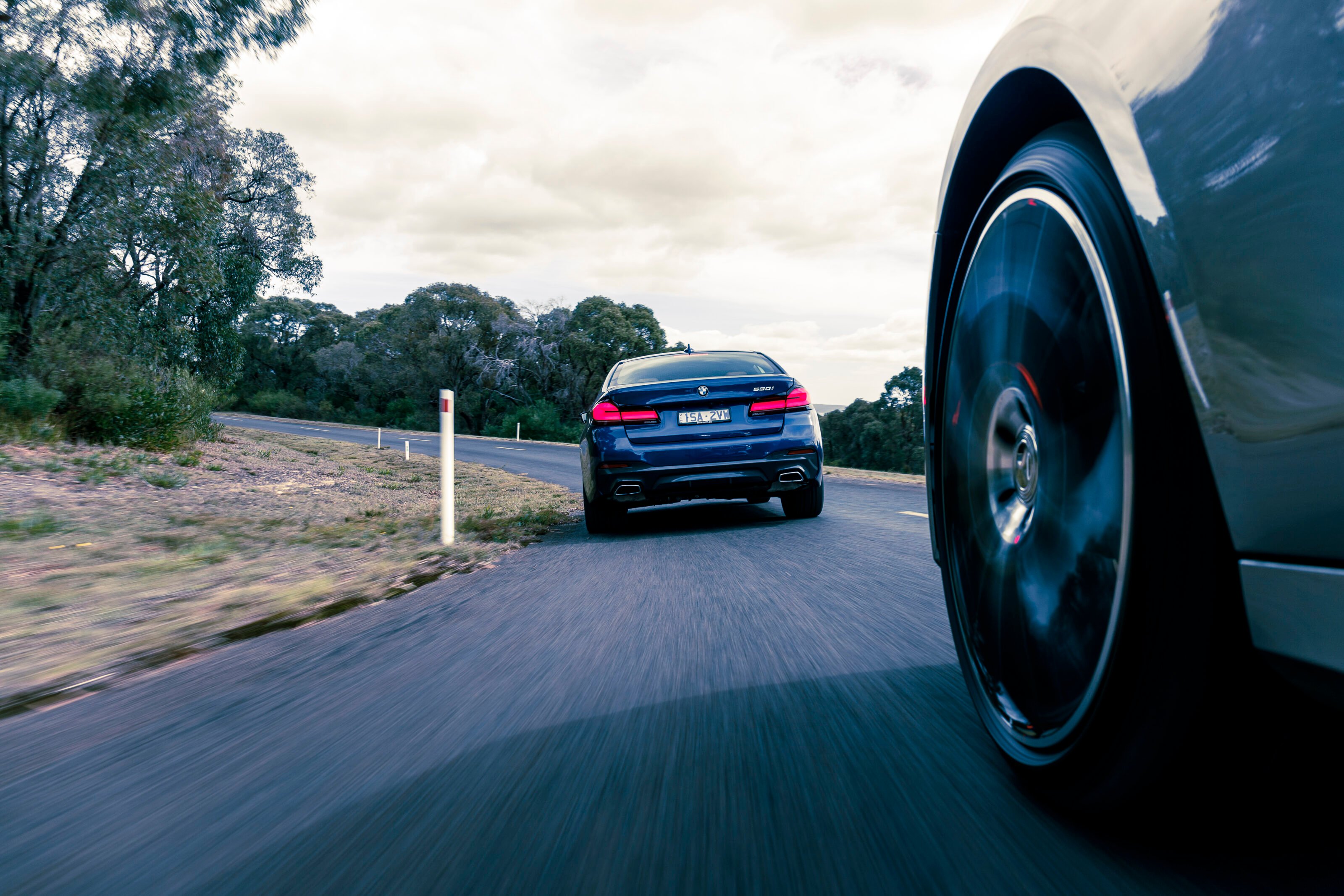
The onslaught of equipment continues in the safety realm. Both pack a full suite of active safety systems as standard, including adaptive cruise control, lane-keep assist and warning, blind-spot warning, stop and go assist, surround camera views and cross-traffic alert. And while the BMW features a head-up display as standard, the Mercedes packs nine airbags to trump the seven in the BMW.
And what about recurring costs? The 530i claims a handy on-paper fuel consumption advantage (6.2L/100km versus the Merc’s 8.2L/100km); in the real world the difference is likely to be less significant.
Servicing-wise, BMW offers a fixed-price plan on standard servicing over five years for $2800. The Mercedes-Benz equivalent costs $4800, but the BMW package covers distances travelled up to 80,000km, whereas Mercedes-Benz covers up to 125,000km.
When it comes time to sell, expect manufacturer warranty to influence residual values. And in that case, a transferable Mercedes-Benz five-year unlimited-kilometre warranty on the E300 will look more attractive to secondhand buyers in a handful of years, whereas the prospect of a BMW near the end of its three-year unlimited-kilometre warranty might seem less so.
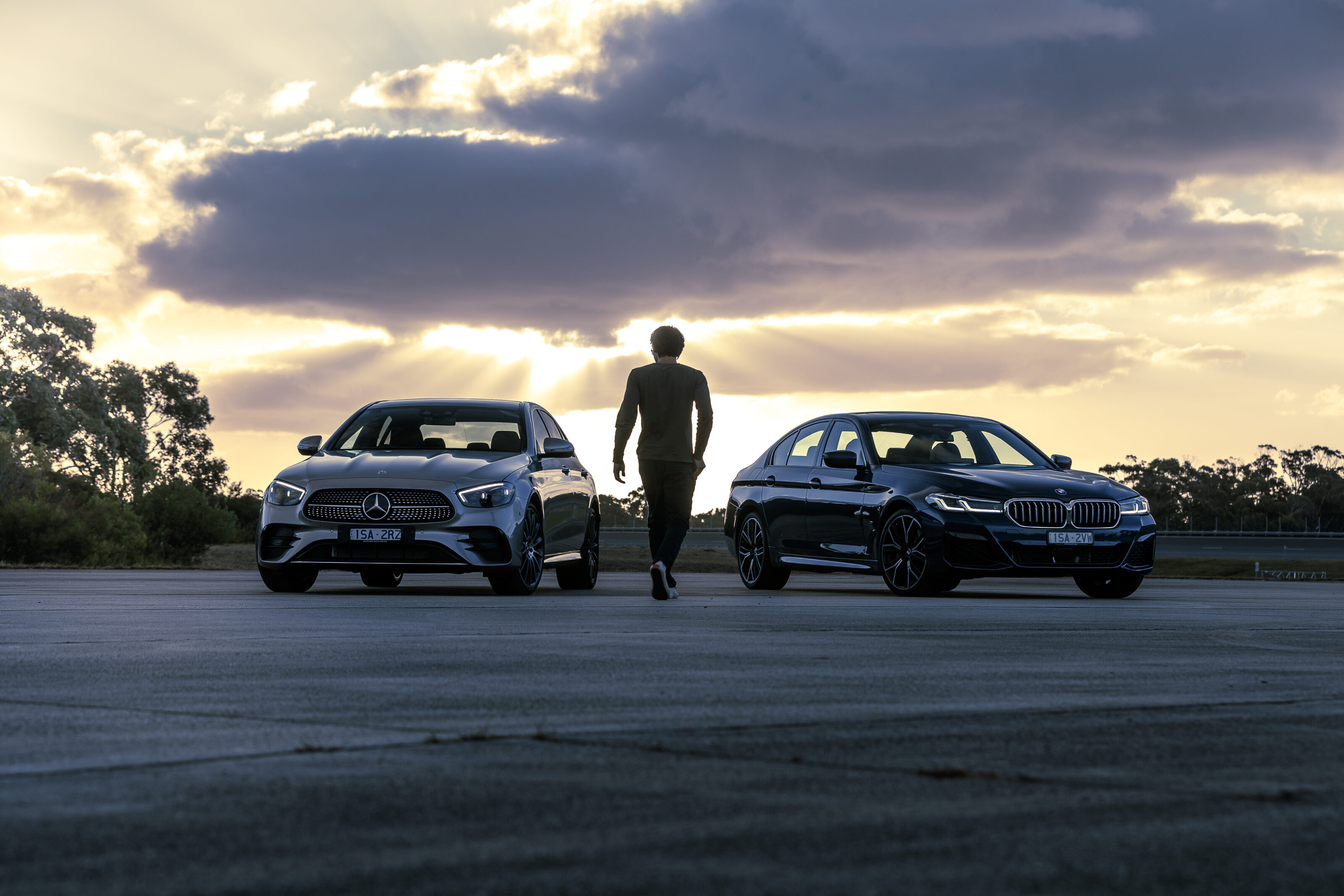
Yet, as for naming a winner, it’s perhaps no surprise to learn that it’s hard to pick one. Both manufacturers have kept a close eye on each other for such a long time that no matter which you choose, you’re getting quite similar machines – a thoroughly refined sedan with style, impressive engineering and leading technology.
But if you’re brand agnostic and need to boil it all down, you can see the Mercedes-Benz E300 offers strong performance, an attractive price and warranty package, loads of technology and a fresher cockpit. The BMW 530i, meanwhile, drives with an engagement and deftness that reflects its edgier overall character.
For these reasons, our equal ratings underscore how evenly this washes out. But if pushed, I’d say you buy the Mercedes-Benz with your head and the BMW with your heart. And given the wallabies of Lang Lang forced us to side with our heads already once today, it’s only fitting we live a little and side with the BMW. It wins, but only just.
Scores
BMW 530i
8.0/10
Mercedes-Benz E300
8.0/10
2021 BMW 530i vs Mercedes-Benz E300 specification comparison
| u00a0 | BMW 530i | Mercedes-Benz E300 |
|---|---|---|
| Body | 4-door, 5-seat sedan | |
| Engine | 4cyl, DOHC, 16v, turbo | |
| Layout | Front engine (north-south), rear drive | |
| Capacity | 1998cc | 1991cc |
| Power | 185kW @ 5300-6500rpm | 190kW @ 5800-6000rpm |
| Torque | 350Nm @ 1450-4800rpm | 370Nm @ 1800-4000rpm |
| Transmission | 8-speed automatic | 9-speed automatic |
| 0-100km/h | 6.4sec | 6.2sec |
| Braking (100-0km/h) | 36.4m | 37.5m |
| Fuel/tank | Petrol/78 litres | Petrol/80 litres |
| Fuel consumption(ADR combined cycle) | 6.2L/100km | 8.0L/100km |
| Weight | 1625kg | 1680kg |
| Front suspension | Double A-arms, adaptive dampers, anti-roll bar | |
| Rear suspension | Multi-links, adaptive dampers, anti-roll bar | |
| Steering | Electric rack-and-pinion | |
| L/W/h | 4963/1868/1479mm | 4955/1860/1455mm |
| Track (f/r) | 1605/1630mm | 1601/1595mm |
| Front brake | 355mm ventilated discs | 305mm ventilated discs |
| Rear brake | 345mm ventilated discs | 300mm ventilated discs |
| Tyres | Goodyear Eagle F1 | Pirelli P Zero |
| Tyre specs | 245/35 R20 (f); 275/30 R20 (r) | |
| Price | $119,900 /Tested $126,880*Includes Enhancement Package | $117,900/Tested $125,800*Includes Vision package |
| Rating | 8.0/10 | 8.0/10 |
Key Points
- Systems to prevent drink-driving could be rolled out from 2026
- Around 10,000 American road users are killed a year due to the problem
- Changes are a part of a wider US$1 trillion infrastructure package
The United States Congress has announced a controversial mandate for new cars to be fitted with anti-drink-driving technology, potentially for all road users.
Set to be introduced from 2026, the mandate is a part of a US$1 trillion (AU$1.37tn) infrastructure package from the Biden Administration, targeting a reduction in traffic fatalities and making the roads safer.
According to US News, the legislation will require automotive manufacturers to implement technology in their vehicles to reduce the likelihood of intoxicated drivers getting on the road, or at least minimise the risk when they do.

It’s unclear as to how such a technology will be implemented or enforced, whether it will simply be the addition of ignition lock breathalysers in the vehicle or through the use of driver-monitoring tech – the latter of which already exists to monitor a driver’s alertness in most level two driver assist systems.
The United States National Highway Traffic Safety Administration (NHTSA) has said roughly 20,160 people have died in traffic incidents throughout the first six months of 2021, the highest six-month total since 2006.
In the US alone, around 30 per cent of all road fatalities are due to drink-driving-related traffic incidents, with roughly 10,000 people killed annually – a number which rose by nine per cent last year.
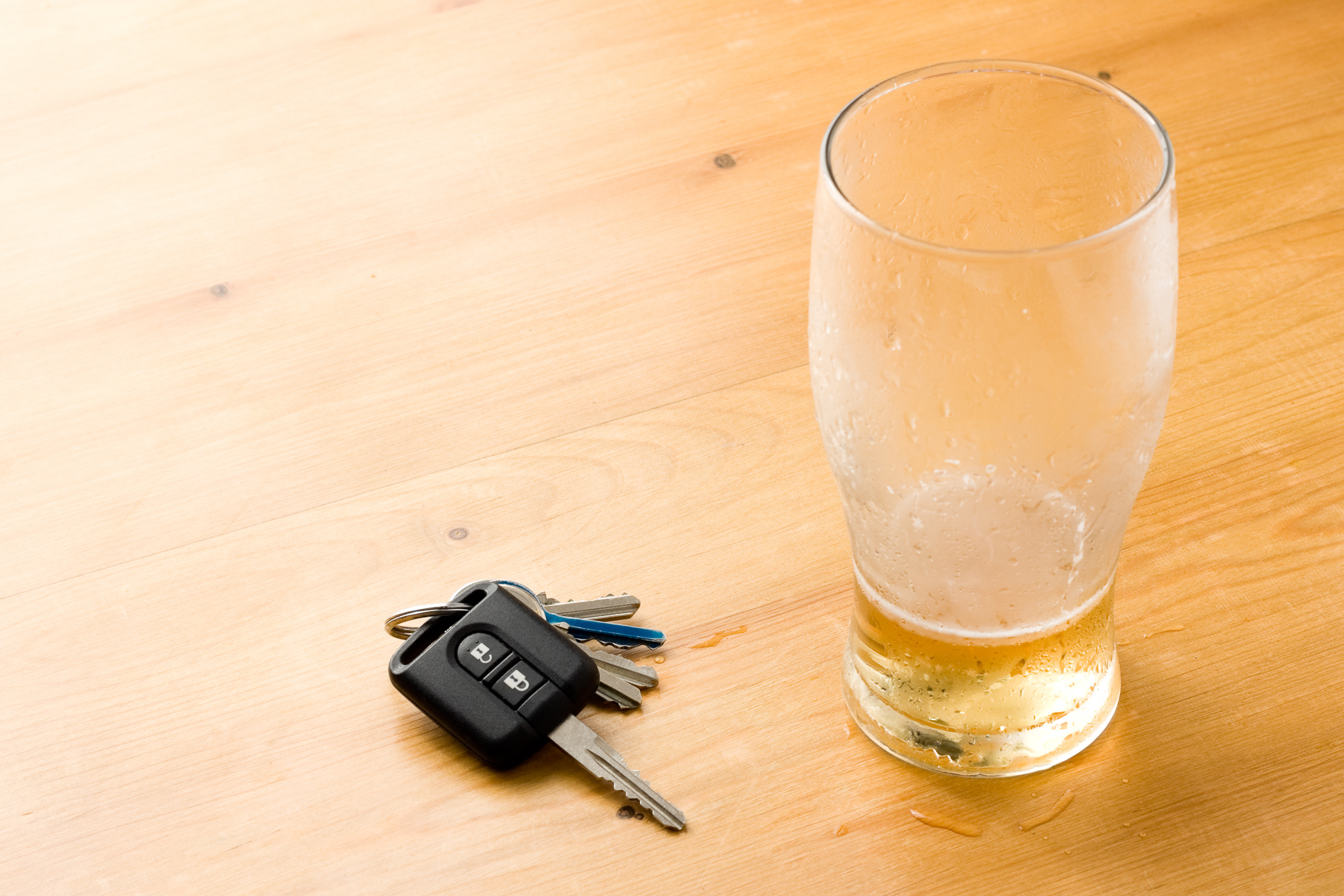
Volvo has previously suggested its future models could be fitted with cameras and sensors to detect whether the person behind the wheel is intoxicated, potentially bringing the car to a stop if need be.
While no blanket blood alcohol concentration (BAC) law exists in the US, a majority of states have a maximum BAC limit of 0.08 per cent, a 0.03 increase on the highest legal BAC in Australia.
Locally, fully licensed drivers must have a BAC below 0.05 per cent, but provisional and learner licence holders need to be totally sober – an approach which has been argued for all drivers over the years.
It’s estimated drink-driving accounts for anywhere between 15 to 25 per cent of Australian traffic fatalities each year, although drug-driving has recently overtaken it for offences on the road.
Staring at the 2022 Kia Sportage’s exaggerated styling – headlined by striking, boomerang-shaped LED daytime running lights – it’s most definitely an understatement to say Kia has come a long way as a brand since the original SUV debuted locally nearly 25 years ago.
Beyond an ever-increasing confidence in its approach to vehicle design, Kia’s Australian sales in 2021 have at times threatened to overtake those of affiliate Hyundai.
The fifth-generation version of its mid-sized SUV now gives it a completely fresh challenger to compete against the latest version of its Hyundai twin, the Tucson, released earlier in 2021.
Editor’s note: In this story, the GT-Line is the green car, and the S is the blue.

Hyundai’s Tucson is far from being the only key rival in a densely packed segment that includes sales giants such as the Mazda CX-5, Mitsubishi Outlander, Nissan X-Trail and Subaru Forester. The prime target, though, is the category’s runaway sales leader – the Toyota RAV4.
The Sportage is missing a key weapon for now, however, launching without the new hybrid variant that would directly challenge the RAV4’s dominant petrol-electric version.
Expect it sometime in 2022. In the meantime, the Kia now matches the Toyota for size – sharing the Tucson’s new platform to grow about 17cm in length to 4.66 metres. Width and height nudge up slightly and the wheelbase extends by 8.5cm over the old Sportage.

Pricing and features
Pricing has increased by up to $2410, with the entry-level Sportage S starting from $32,445 before on-roads, or $34,690 driveaway. The range spans $20,000, topped by a GT-Line diesel that nudges the RRP of a Sportage model past $50,000 for the first time.
Yet you’re not only getting a bigger SUV for your money. Every trim grade is loaded up with extra equipment over their predecessors.
Adaptive cruise control, blind-spot monitoring and rear cross-traffic alert, for example, are standard from the S upwards where previously exclusive to the GT-Line.
Unsurprisingly, the GT-Line cabin puts the Sportage’s best foot forward when trying to establish a more upmarket vibe.


The S also gains LED headlights and taillights, speed-limit notification and an 8.0-inch infotainment touchscreen, as well as the front centre airbag from the larger Sorento SUV that can protect the heads of front occupants in a side impact.
Opting for the SX bumps the infotainment display up to 12.3 inches and gains integrated navigation but swaps wireless Apple CarPlay and Android Auto for wired connection (a seemingly long story involving mapping complications). Other key additions are 18-inch alloy wheels, dual-zone climate control, and rain-sensing wipers.
SX+ buyers are treated to tempting niceties such as 19-inch wheels, electric driver’s seat, heated front seats, keyless entry, auto tailgate with proximity sensor, and a Harman Kardon audio system.

The all-you-can-eat-buffet GT-Line has a comprehensive list of features including a curved dash display that combines dual 12.3-inch infotainment and driver screens, full LED headlights, LED striped indicators, panoramic sunroof, surround-view camera, blind-spot video feed, wireless smartphone charging, ventilated front seats, and leather-appointed upholstery with seatbacks topped in fake suede.
Kia Australia is predicting the two petrol engine options to account for 80 per cent of sales, with the sole diesel taking about 20 per cent.
The diesel is available for all trim grades for a premium over either the 2.0L petrol or 1.6L turbo-petrol. The latter is available only on higher-spec models.
SX and SX+ variants are delayed until early 2022, so we are reviewing the models at opposing ends of the Sportage range.

Comfort and Space
Unsurprisingly, the GT-Line cabin puts the Sportage’s best foot forward when trying to establish a more upmarket vibe.
That curved dual digital display – spanning nearly 25 inches across the dash – lends a high-tech look, and the flagship’s centre console looks smarter by swapping the regular gear selector of other models for a shift-by-wire rotary dial.
Soft-touch materials are in all the regular touchpoint areas, and glossy black plastic is quite extensive (which is good or bad depending on your preference).

Kia still isn’t quite as good at disguising cheaper plastics as rival carmakers such as Mazda, Peugeot and Volkswagen, however, and there’s obvious cost-cutting where the rear door cards have been switched to hard plastic. Auto windows are limited to the front doors (or not at all in the case of the base model).
There’s still quite a gulf in the perception of quality between the GT-Line and base Sportage, where hard plastics seem universal.
Regardless of trim grade, you can have any interior colour you like. As long as it’s black. Kia Australia says it is looking to introduce alternative cabin hues.

The design and tactility of the GT-Line’s seats doesn’t make them feel anything special over the cloth seats in the S. In both cases, the cushion feels shorter than ideal and the electric or manual adjustment doesn’t allow the seats to go as lower as some occupants might like.
Kia’s Dual Control Panel, standard on all but the S, is clever. Press a button and the dials change from temperature adjusters to volume and radio-tuning controls, while touch buttons switch from functions such as fan speed and recirculation to shortcuts for the infotainment display.
The Dual Control Panel is clever. Press a button and the dials change from temperature to volume controls, while touch buttons switch from fan speed to shortcuts for the infotainment.

Front-cabin storage is average. The best feature is the centre console’s open area that has VW-style cupholder grips that pop out with the press of a button.
The door compartments and glovebox could be bigger, while the smartphone trays only feature wireless charging in the GT-Line (Hyundai replicates this disappointment with the Tucson).
No shocks that a longer Sportage, with a longer wheelbase, delivers more interior space. Welcome it is, too, because Kia’s SUV now lifts its rear-seat room and luggage capacity out of the ‘average’ zone and into the pointy end of the segment.

The back seat now offers a significant amount of knee room, as well as generous foot space and headroom (including in the sunroofed GT-Line). The bench’s cushioning is better than that of the front seats, with good under-thigh support.
A trio of adults could just about squeeze across if truly necessary. ISOFIX anchors are in the outboard positions for child seats.
All trim grades come with rear vents, a centre armrest with cup holders and USB-C ports in the sides of the front seatbacks. The rear door bins fit larger drinks bottles than their counterparts in the front.
SX+ and GT-Line models add bag hooks and coat hangers (which look like tablet holders) on the seatbacks.

These grades also provide an auto tailgate described as having ‘gesture’ operation but is more accurately a hands-free proximity set-up where you stand at the rear of the car for a few seconds (with the key fob on your person) to open the hatch.
Boot space increases by nearly 100 litres to 543L – while retaining a full-size spare wheel. It’s a noticeably larger area for luggage, and all models come with a 12-volt socket and cargo blind. The GT-Line adds a luggage net.
All but the base grade provide release levers in the boot to fold the 60:40 rear seatbacks, which collapse to create a fully flat cargo area quoted at 1829 litres.
Infotainment
Private buyers will focus on higher-spec models, so the base S’s smaller touchscreen isn’t necessarily a big issue.
The 12.3-inch display that is standard-fit elsewhere is certainly desirable for its sophisticated-looking interface and larger nav map.
The infotainment interface is one of the best in the segment, and significantly better than the one offered by Toyota in the RAV4. There are mature graphics and blissfully simple functionality.


In the GT-Line, the digital driver‘s display lacks the customisable layouts of the Virtual Cockpit available in VW’s Tiguan – including the ability to feature a map so the infotainment screen can be used for other functions.
There are basic route directions, though the digital speedo is lost if this or other information is selected for the display’s centre section.
Other grades also feature a digital display with a central TFT info panel, though the quality of the graphics left us wondering whether a nice pair of analogue dials would have looked classier.

SX+ and GT-Line owners enjoy excellent sound quality from the eight-speaker Harman Kardon audio system.
At some later point, Kia Australia is hoping to introduce the company’s Uvo app functionality, where the owner’s smartphone (or smartwatch) can be used for some remote features.
The infotainment interface is one of the best in the segment. There are mature graphics and blissfully simple functionality.
On the Road

With no hybrid drivetrain at launch, the first-ever turbocharged petrol engine for a Sportage is the drivetrain of note.
It comes in the hope of offering a better petrol option than either the 2.0-litre (which carries over for cheaper grades) or the 2.4-litre it replaces. There’s a reason private buyers opted mostly for the 2.0-litre turbo-diesel in the previous Sportage (and which also continues as an option for all grades).
The 132kW/265Nm 1.6-litre turbo four-cylinder, familiar from various Kia and Hyundai models including the Tucson, is available on the SX+ and GT-Line.
It’s paired with a seven-speed dual-clutch auto and all-wheel drive.

While the engine succeeds in offering extra performance over the 115kW/192Nm non-turbo 2.0L – and the 2.4L it replaces – the dual-clutch struggles in a mid-sized SUV that touches 1.8 tonnes in GT-Line spec.
While fine on part-throttle, the twin-clutch transmission’s responses are about as sharp as this writer’s brain before its first hit of caffeine in the morning.
There’s a noticeable delay before the auto hooks up from a standing start or decides to downshift when there’s already momentum.
Ask for urgent acceleration and the Sportage lurches forward with a flare of undignified revs.

Driving modes are available on automatic transmission models. Smart is said to adapt to driving style, though we found Sport – which lifts revs over the default Normal – to partly help but driveability remains far from effortless.
There are paddleshifters, though the 1.6L is not an engine to enjoy in a sporty manner.
Better all-round turbo petrol experiences can be found in several rivals, notably the Mazda CX-5, Peugeot 3008, Skoda Karoq and VW Tiguan.
As is common with turbo-petrol engines, real-world fuel consumption tends to be a fair bit higher than the figures promised by ADRs.
We spent the most time in a GT-Line 1.6T and the closest we got to its official 7.2L/100km was 7.7L/100km but also had a cross-city trip where the indicated average was 14.2L/100km.

We also drove 2.0L Sportage S models – both petrol and diesel.
The 115kW/192Nm 2.0L petrol engine felt underpowered in the last Sportage, so it’s no surprise it also struggles to deliver strong acceleration in the larger new-generation model. The six-speed auto at least assists rolling momentum by downshifting quickly.
Properly effortless motoring, however, is delivered only by the more expensive 137kW/416Nm 2.0L diesel, which is teamed with an eight-speed auto that is well-calibrated to capitalise on the generous maximum torque.
The diesel (or the 2.0L petrol manual) is also the choice for towing, with a 1900kg braked capacity. This reduces to 1650kg with the 2.0L auto and 1.6L DCT. The towball download rating is 100kg on all models.

The petrol-electric Sportage has the potential to rival the diesel for efficiency – and of course the RAV4 Hybrid.
If the new Sportage’s powertrain range remains patchy for now, there are consistent positives to the rest of the driving experience.
Even on the bigger 19-inch wheels of the GT-Line model, the Sportage makes a case for being the best-riding Kia in its showroom.
Kia Australia’s local engineering team, led by the experienced Graham Gambold, should take a bow as the FWD Sportage S is surprisingly enjoyable to punt along a scenic route.

Softly suspended without ever becoming bouncy, the Sportage is a paragon of bump-absorbing comfort. The S’s 17-inch wheels with fat-sidewalled 235/65 tyres add an extra layer of cushioning.
Kia Australia’s local engineering team, led by the experienced Graham Gambold, should take a bow.
While vigorously tackling a set of corners isn’t an essential talent for a family-oriented SUV, the lighter-weight, front-wheel drive Sportage S petrol is surprisingly enjoyable to punt along a scenic tourist route.

The S diesel and GT-Line 1.6T aren’t as sprightly during directional changes but feel thoroughly planted and predictable.
While the Sportage’s steering missed out on local tuning owing to pandemic complications, there’s much to appreciate about its smoothness and ease of turning.
Its main vice, as with too many Kias and Hyundais, is a Lane Keep Assist system that, when operational above 60km/h, can interfere unnecessarily. A steering wheel button can be pressed to switch it off, though its default setting is on.
Ownership
Kia Australia’s industry-leading seven-year warranty continues to be a massive bonus for owners.
The company has so far provided capped-price servicing costs for the entire warranty period: 2.0L petrol $3479; 1.6T $3988; 2.0D $3624.
Roadside assistance is renewed annually with approved servicing.

VERDICT
More space, more safety, and more technology. There’s plenty of compensation for the inevitable hike in pricing for the latest Kia Sportage.
There’s also a greater maturity to the way it looks inside and the way it drives.
If only there was a brilliant petrol drivetrain offered for buyers who either don’t want or can’t afford the diesel option.
The importance of bringing that hybrid Sportage can’t be overstated.
2022 Kia Sportage GT-Line 1.6T specifications
The 2025 Lexus LFA is on its way, according to a fresh rumour out of Japan.
Magazine BestCar is reporting Lexus will resurrect the LFA supercar using a high-performance plug-in hybrid version of the much-rumoured 4.0-litre twin-turbo V8 engine.
Thanks to assistance from its electric motor, the V8 powertrain is said to produce as much as 700kW.
It was believed Lexus was at some stage working on an LC F model – also to be powered by the new V8 – but Japanese publication CarSensor claimed the program was shuttered in June 2020, citing the pandemic as the reason for the decision.
However, in February, BestCar published information suggesting new IS F, LS F, and LC F models were under development – possibly using the twin-turbo V8, quoting as much as 500kW of power.
Adding an electric motor to the mix could plausibly see the powertrain boosted to 700kW.
But while the LC F was rumoured to be all-wheel drive, the latest report says the future LFA will be rear-wheel drive.
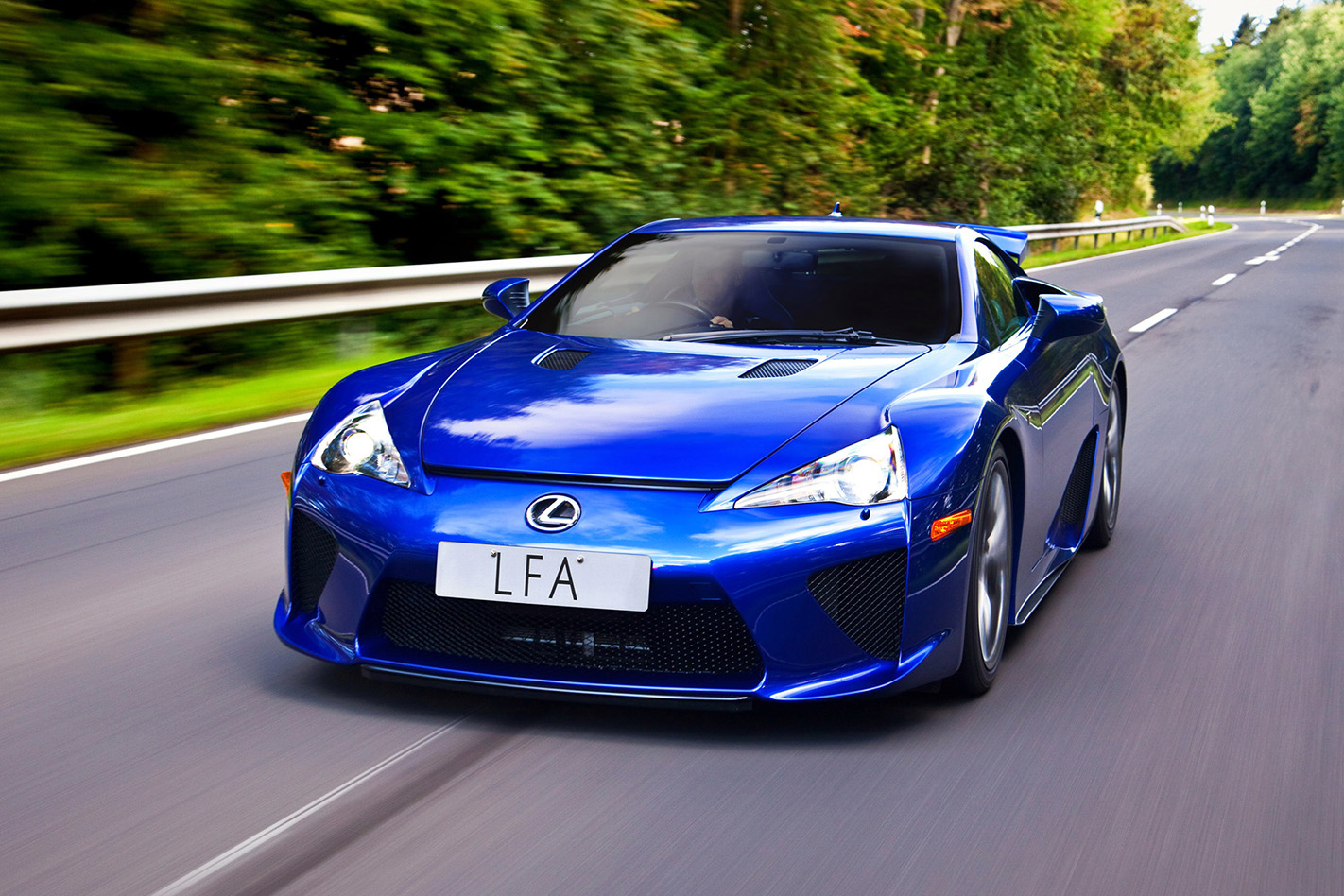
Despite the model finishing production in 2012, Lexus has been spotted testing a mysterious wide-body LFA at the Nürburgring as recently as 2019.
A video posted to YouTube by Automotive Mike shows the supercar with camouflage around the wheel arches – but being powered by its original Yamaha-developed 4.8-litre V10 engine.
This isn’t the first time we’ve heard about a second-generation LFA. In 2011 – before the original model had even finished its run – BestCar was reporting an ‘LFA II’ was in the works.
Exactly which rumours prove to be true will be known in the coming years, but it’s possible Lexus could target the LC F at the recently-unveiled Mercedes-AMG SL, while the LFA could offer an alternative to the likes of the V6-powered AMG One hypercar.
The 2023 Kia EV9 has been teased in concept form, ahead of the vehicle’s public debut later this month.
While Kia offered few details about the large SUV, the concept provides a glimpse of what we can expect when the production car eventually arrives – including an “adaptive and smart lounge space” for occupants.
On the outside, the upright boxy profile increases interior space. Matrix LED light patterns are bordered by Z-shaped daytime-running lights.
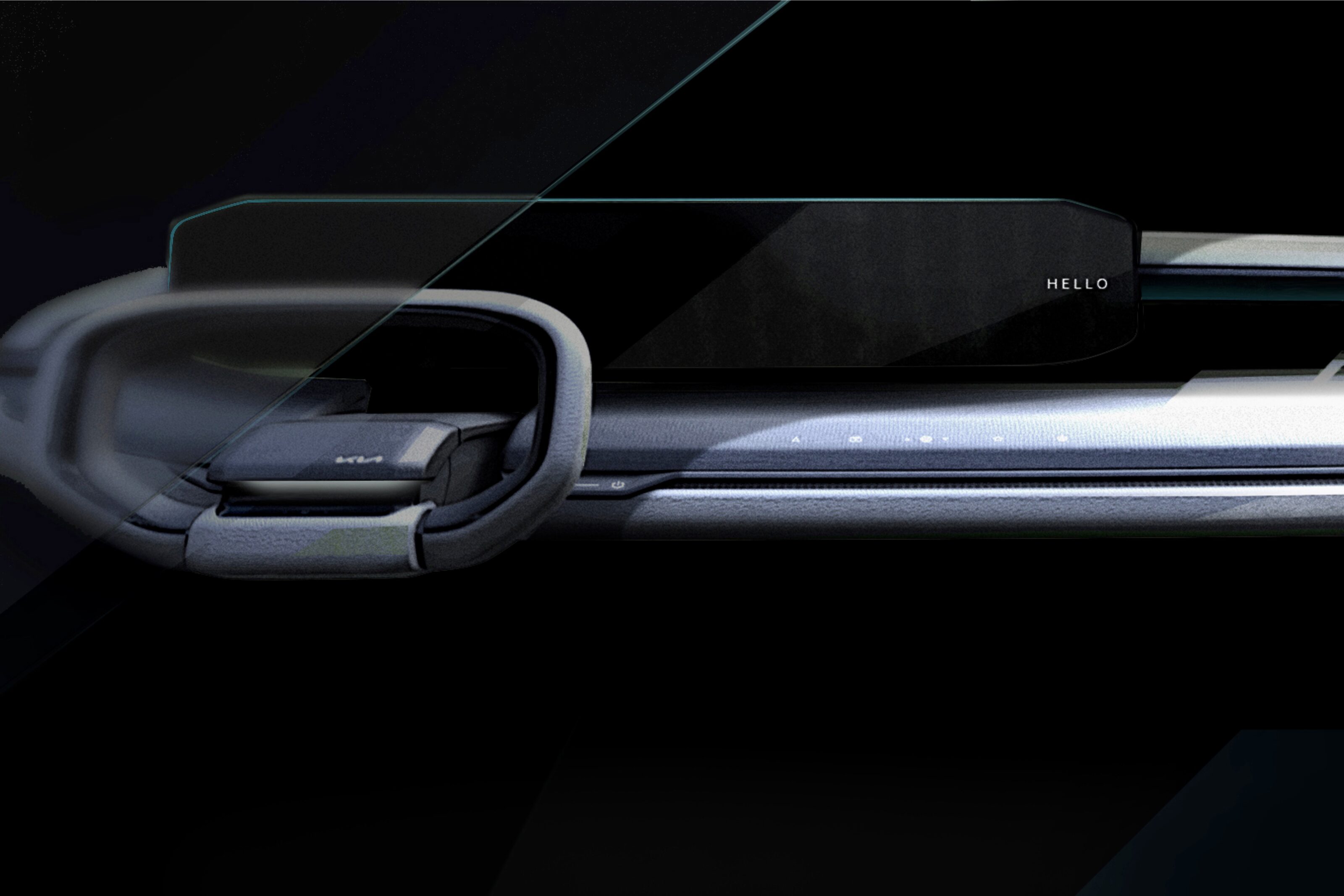
Inside, the renderings reveal an ultra-wide infotainment and integrated digital instrument display, with the traditional steering wheel replaced with an oval-shaped item. All materials inside the EV9 are from either recycled materials, or are sustainably sourced.
Further details will be revealed when the vehicle appears at the LA Motor Show on November 18, but it’s expected the EV9 will be based on the E-GMP platform shared with the Hyundai Ioniq 7.
Hyundai recently revealed its large electric SUV will eventually be available in either rear- or all-wheel drive, with a 1000kWh lithium-ion battery pack delivering a driving range of up to 500 kilometres.
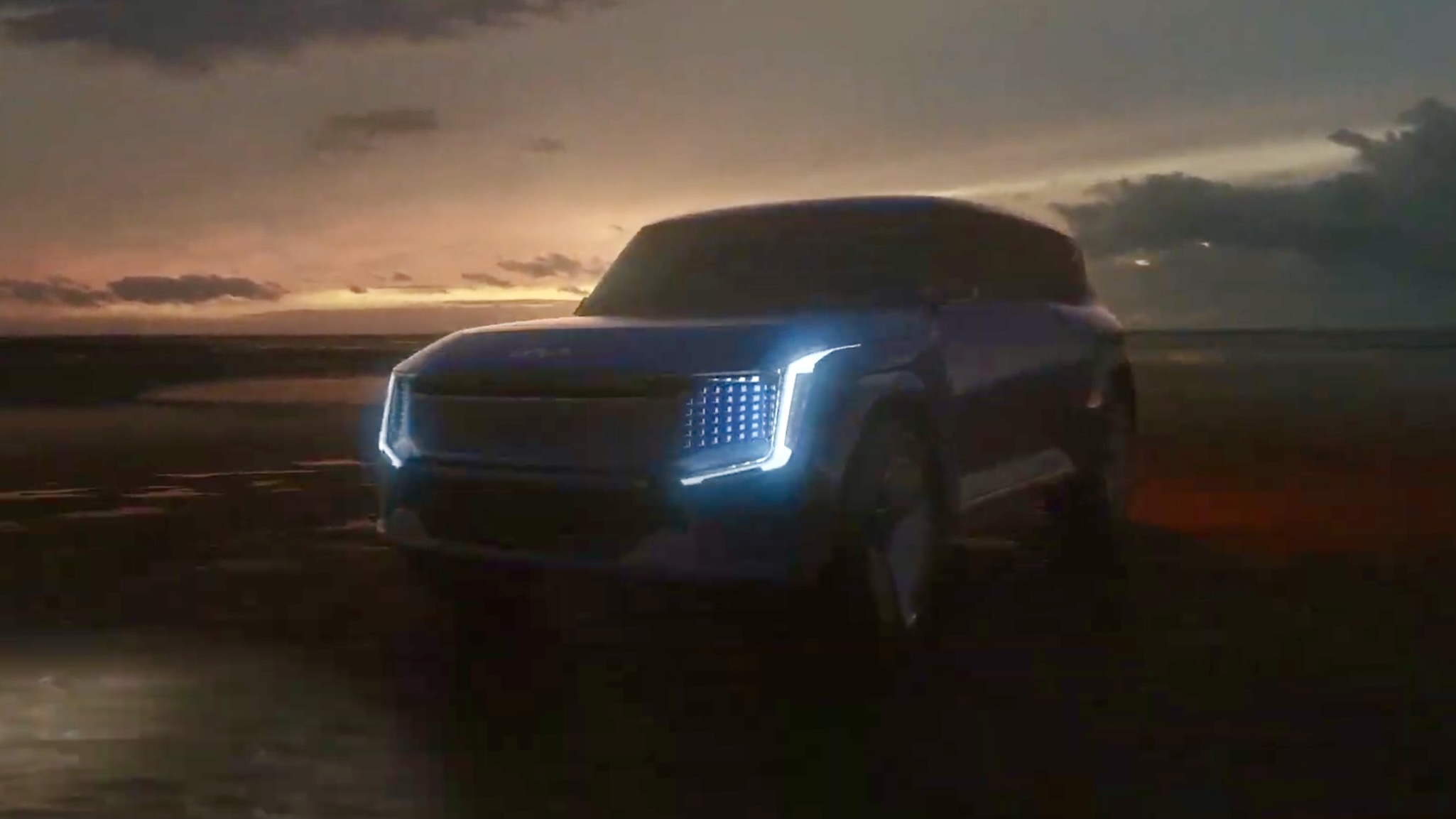
As with the Kia EV6 and its twin-under-the-skin Hyundai Ioniq 5, expect some specification differences between the EV9 and the Ioniq 7 – but the bones should be nearly identical.
Reports out of Korea suggest the production EV9 will be unveiled in 2022, ahead of its launch in 2023.
Be sure to follow Wheels on Facebook and Instagram to get the latest news as it happens.
