
SUVs and LCVs currently account for three quarters of Australia’s new-car market, with ever-sliding passenger cars down to nearly one in every five purchases.
No-one will be surprised then that either an SUV or a ute is the best-selling vehicle style for the vast majority of car brands.
Yet there are eight passenger cars defying buying trends to still rule their showrooms.
Passenger car champions
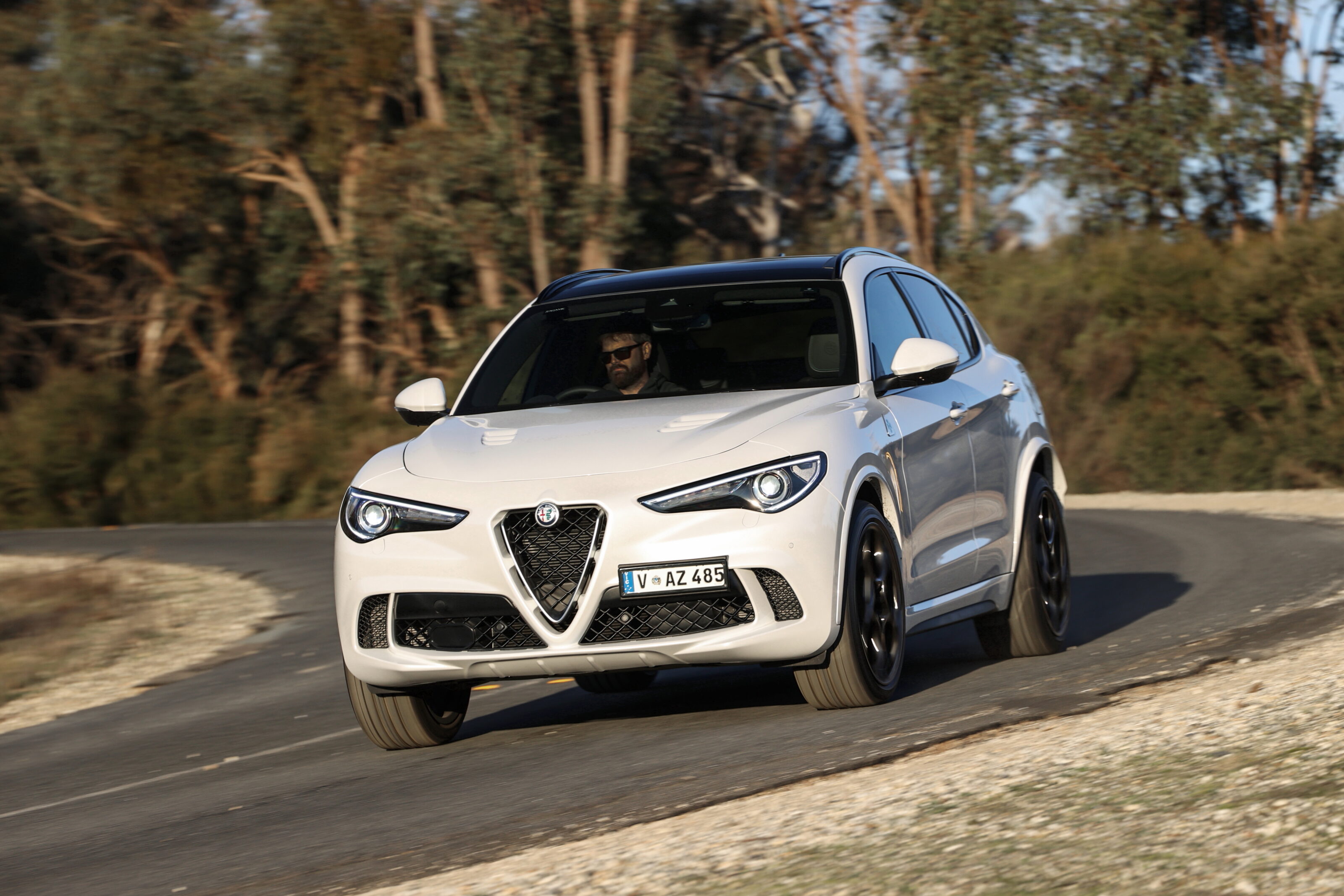
Alfa Romeo Giulia
Italy’s perennially struggling brand Alfa Romeo needed its first SUV, the Stelvio, to make a sales impression. And it was indeed the marque’s top model in 2020, but to August this year it has slipped 64 per cent – allowing the Giulia mid-sized sedan, up 118 per cent with help from an updated line-up, to lead it by 218 to 104 units.
Bentley Continental GT
The new-generation GT coupe and convertible pairing continues to outperform the British luxury brand’s Bentayga SUV, as it did in 2020. However, the gap is just 11 units to August and the Bentayga’s year-to-date growth is significantly higher, so there’s still potential for a position swap before the end of 2021.
Citroen C3
That Citroen’s city car is its best-seller with just 57 sales tells you everything about the French brand’s precarious position in Australia. The C3 Aircross small SUV has already been axed owing to poor sales, leaving the C5 Aircross SUV as the only other model in the showroom.
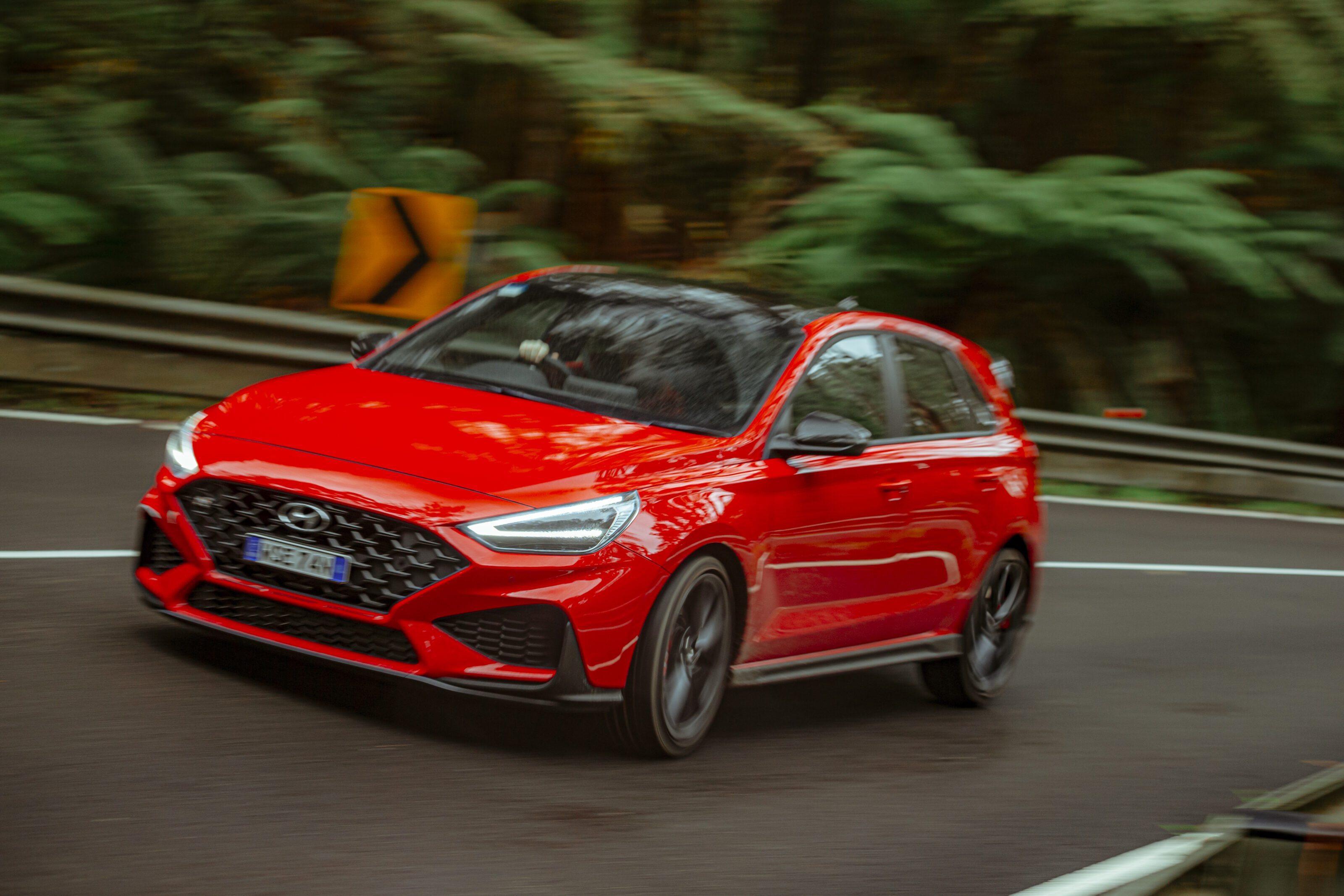
Hyundai i30
Australia’s love affair with the i30 goes back to the original 2007 model and nothing has changed after 14 years. Although sales have been boosted in recent times with the Elantra’s transition to i30 sedan, 17,100 units so far this year is impressive. No other Hyundai has reached five figures, with the Kona compact SUV closest with almost 9500 sales.
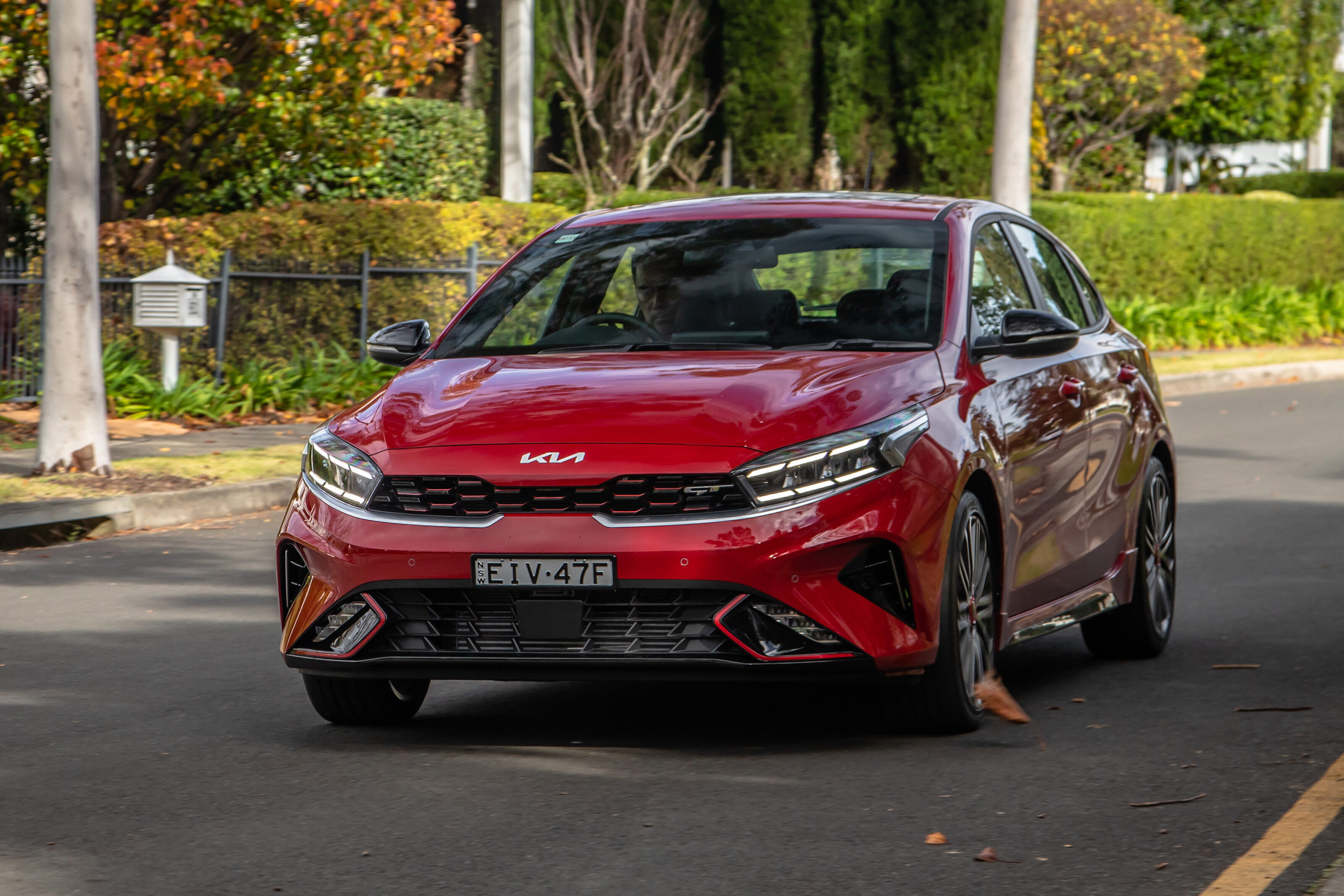
Kia Cerato
The i30 story is replicated over at affiliate company Kia, where the Cerato small car twin continues to be untouchable as the brand’s number one. With year-to-date sales up almost 20 per cent, the Cerato (13,485 units) outsells the combined total of Kia’s second and third most popular vehicles, the Seltos and Sportage SUVs (6323 and 5497 units).
Mercedes-Benz A-Class
Mercedes’ smallest car has been a sales phenomenon locally ever since it switched from an MPV style to conventional hatch for the third generation in 2013. Sales are down by a third at the three-quarter mark of 2021, yet the A-Class continues to lead the way for the German brand – ahead of the GLB seven-seater SUV (2615 units) which has surprisingly snuck ahead of the C-Class (2547).
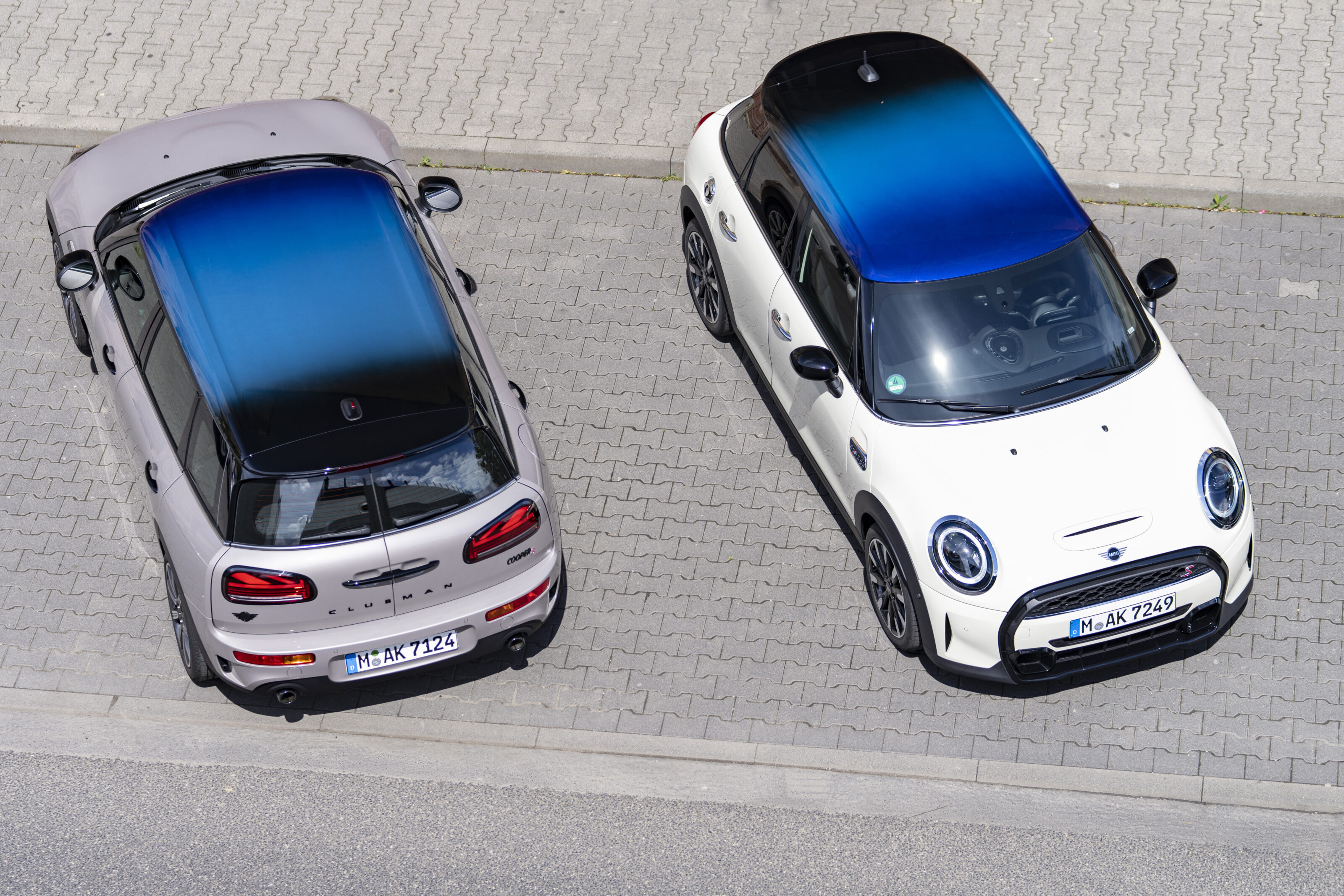
Mini hatch
What is the Mini brand without the hatchback that started a retro-inspired, premium-priced revival in 2001? Buyers clearly agree, and the three- and five-door models are comfortably preferred over the Countryman SUV – 1337 to 932 units.
Suzuki Swift
Sales are spread reasonably evenly throughout the Japanese brand’s range, though the Swift city car remains Australia’s favourite Suzuki. Sales are up 14 per cent so far this year, and it’s the only Suzuki so far to exceed 3000 units (3198 sales). Next up is the Vitara SUV, with 2579 sales.
Almost there
Aston Martin
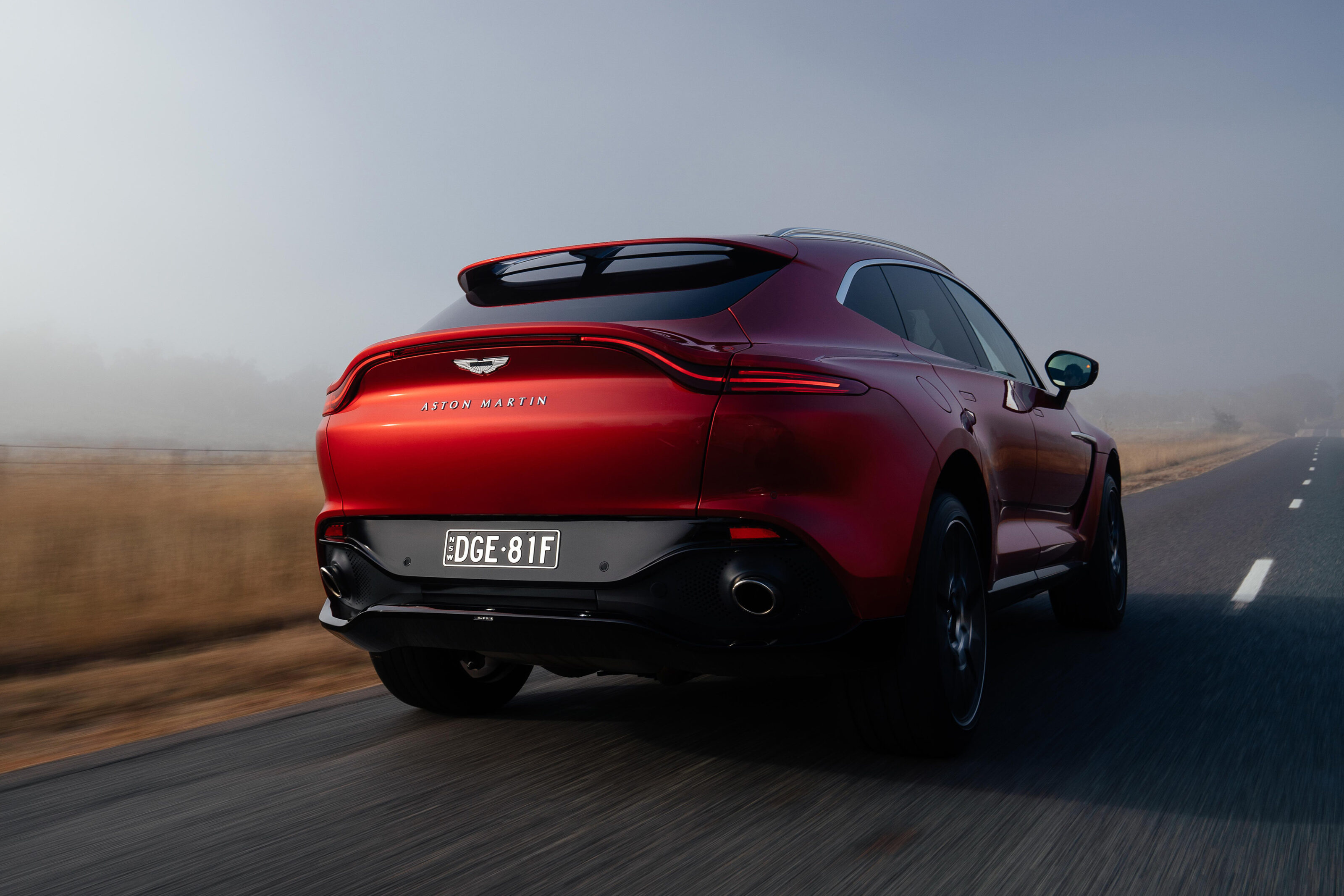
Aston’s first ever SUV, the DBX, is outsold by a ‘Coupe/Convertible’ according to VFACTS industry data, but this label covers both the Vantage and DB11 sports cars.
BMW 3 Series
The X3 mid-sized SUV was the best-selling Bimmer in 2020 and it heads the Bavarian pack so far in 2021. However, sales of BMW’s signature model, the 3 Series, are up nearly 30 per cent and closing fast – 2747 units trailing the X3’s 2828 sales. An updated X3 is due towards the end of the year, however.
Rolls-Royce Wraith/Dawn
Multi-millionaires and billionaires with about $650-$800K to spend on some of the world’s finest motor vehicles are so far split evenly between Rolls’s Wraith coupe and Dawn convertible and the company’s first ever SUV, the Cullinan. Rolls-Royce is adamant the Dawn is more than a mere Wraith Drophead, though, so the Cullinan is still on track to become the posh Brit brand’s number one vehicle for the second consecutive year.
Long reign over
Skoda Octavia
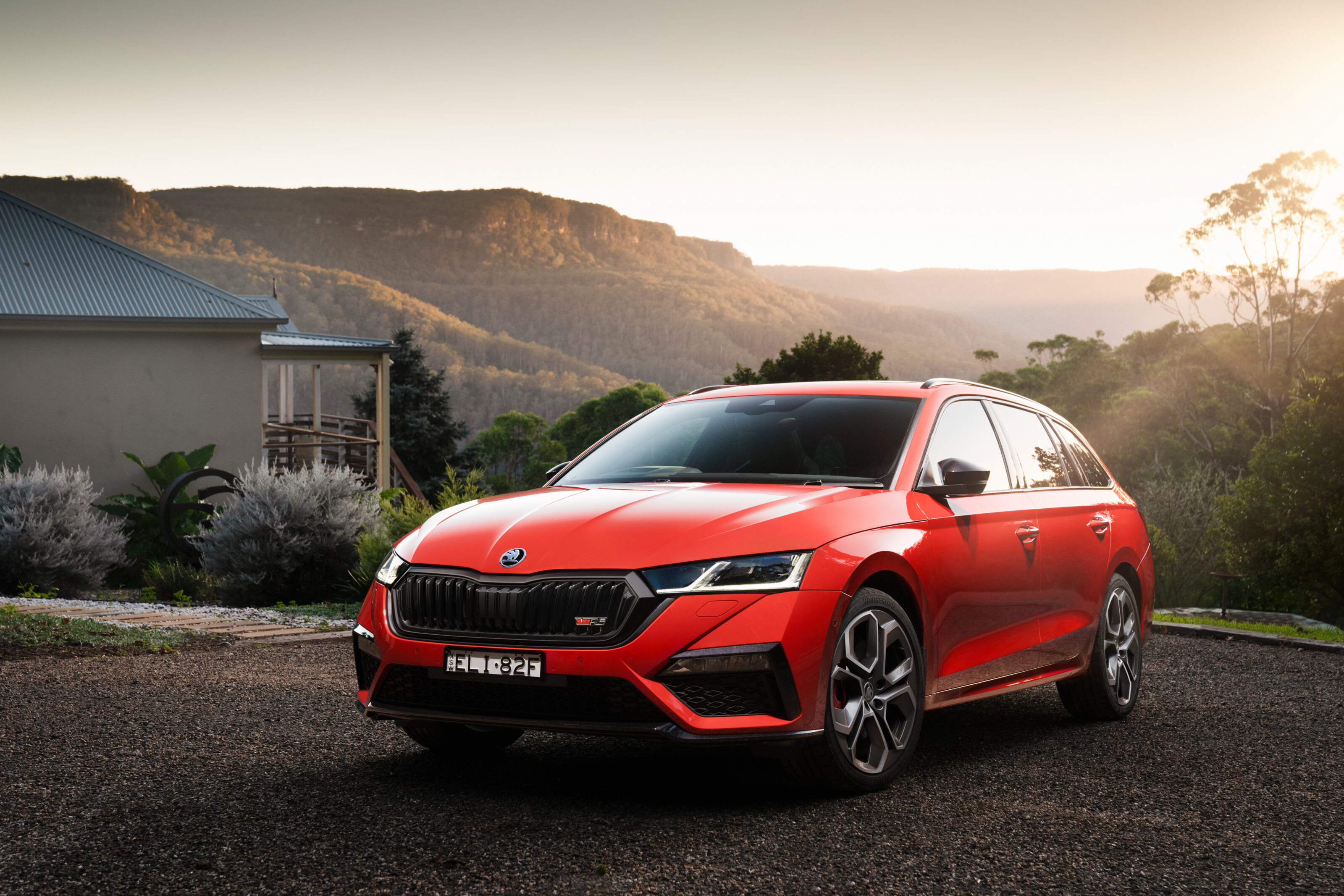
The mid-sized, Golf-based Octavia has traditionally been the best-selling Skoda in Australia ever since the Czech brand returned in 2007 – and it was again in 2020.
But the combination of a transition from outgoing to new-generation model in early 2021 and the rise of the SUVs in Skoda’s showrooms has seen the Octavia displaced, and unlikely to turn things around by the end of the year.
The top three Skodas are all SUVs, with the compact Kamiq (1612 sales) leading the seven-seater Kodiaq (1482 units) and mid-sized Karoq (1200 units). With 932 sold up to the end of August, Octavia sales are down nearly 20 per cent.
A push by Toyota towards hydrogen fuel-cell vehicles is set to include its most iconic green model, with the Prius eventually ditching the combustion engine altogether.
Creative Trend reports the Prius will adopt hydrogen as its fuel source in the vehicle’s fifth-generation, entering the Prius variant line-up alongside the 1.8-litre ICE and nickel-metal hydride setup – which is currently used in the fourth-gen XW50.
If the new Prius is moved to the TNGA-L platform rather than its existing TNGA-C base, it would be ready to accommodate a hydrogen fuel-cell battery – given the Mirai utilises the former platform as the only FCEV in Toyota’s range.
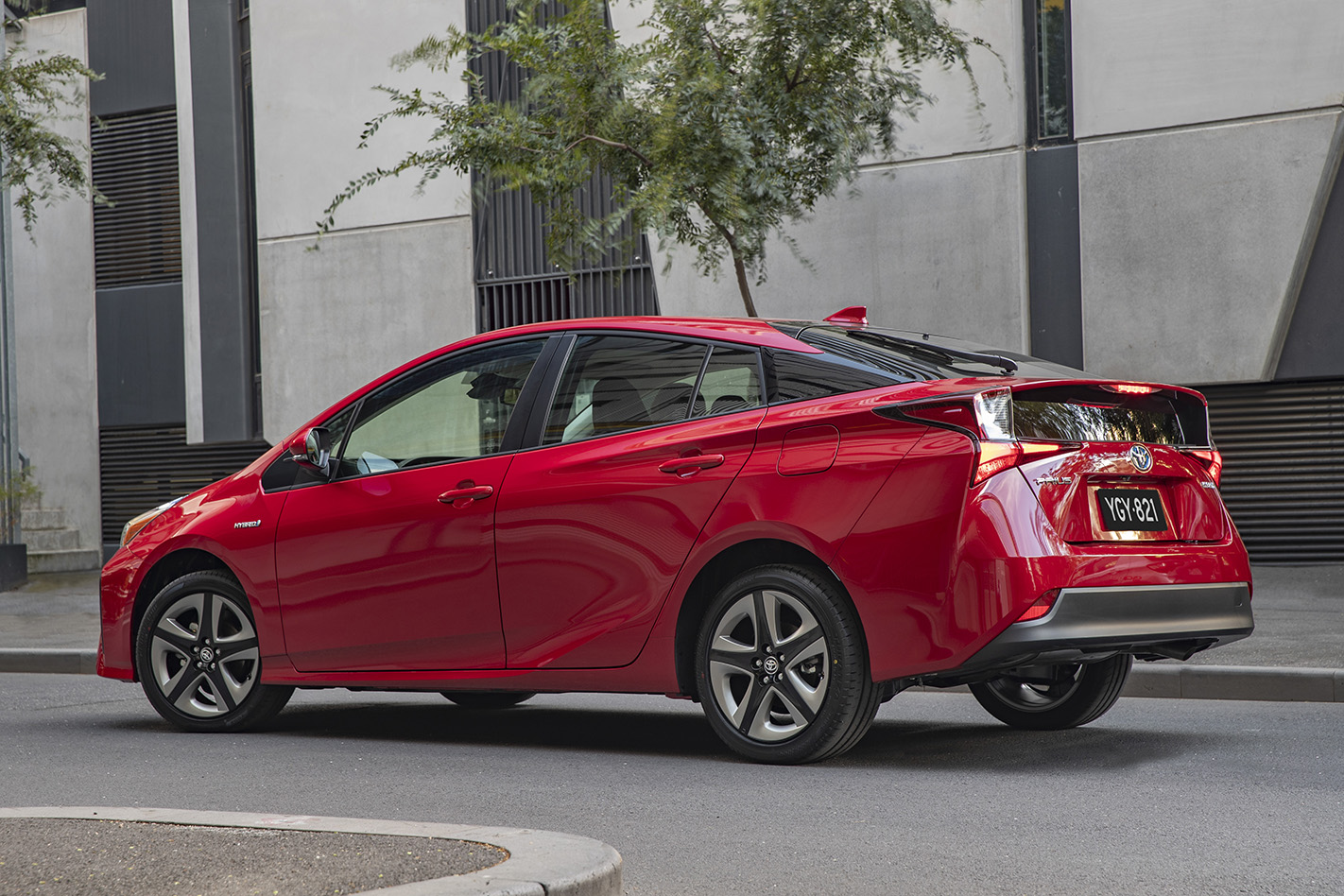
The Japanese firm’s hybrid journey began with the Prius and recently surpassed 200,000 sales for all hybrid models in Australia, although the model has been fading in sales of late – with the spin-off Prius C and Prius V canned locally due to poor performance.
Despite the manufacturer being an early adopter of hybrid technology, it has kept an arm’s distance from moving to full-EVs, saying the former technology is not a stepping stone towards the latter – while also throwing its weight behind hydrogen fuel-cell vehicles.
In June this year, Toyota France was able to beat the existing distance record for a hydrogen vehicle, travelling for more than 1000km in a second-generation Mirai – the first hydrogen offering from Toyota currently available to be leased only through the manufacturer.
BMW and Daimler/Mercedes-Benz are being taken to court in Germany over emissions targets.
As reported by Reuters, environmental and consumer protection association Deutsche Umwelthilfe has sued the pair for refusing to tighten up their carbon emissions targets before 2030, despite no government regulation enforcing the manufacturers to take action.
It’s alleged letters were sent to BMW and Mercedes-Benz with a deadline of September 20 to agree to the organisation’s demands – however this deadline has passed, triggering the legal action.
While Deutsche Umwelthilfe wants manufacturers to end internal combustion engine production by 2030, the European Union has already tabled a proposal to end ICE manufacturing from 2035, a target which a majority of manufacturers are already on track to meet independently.
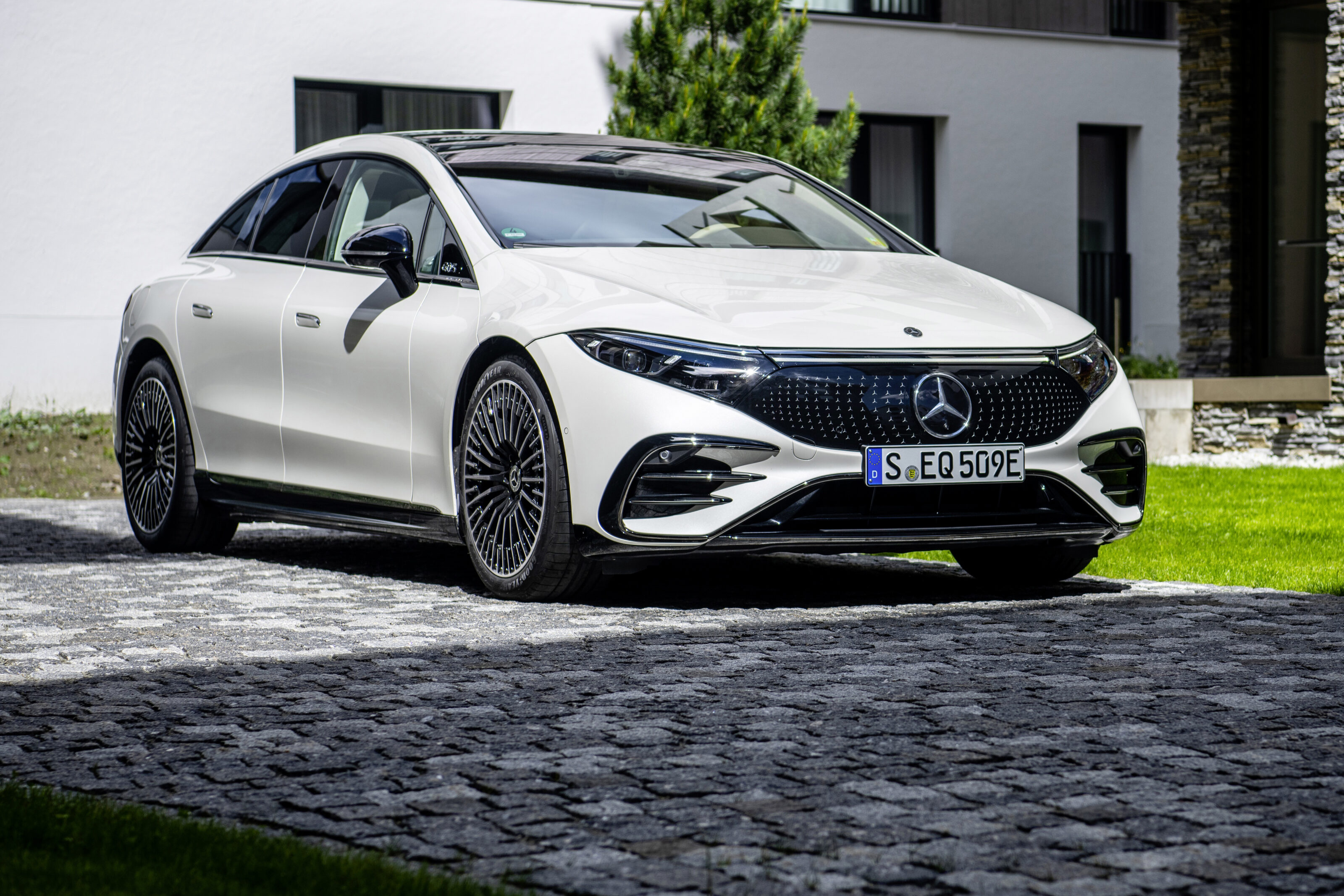
Mercedes-Benz has previously stated its intentions to end production of ICEs for the European market by 2030, adding it will only release EVs as new models from 2025, although it hasn’t ruled out continuing to produce ICE vehicles for foreign markets.
BMW is also pushing for greater electrification across its range, promising 50 per cent of its vehicles and those from sub-brand Mini would be electric by 2030, as well as setting its sights firmly on the Chinese market – with at least 12 fully-electric vehicles planned to be on sale in the country by 2023.
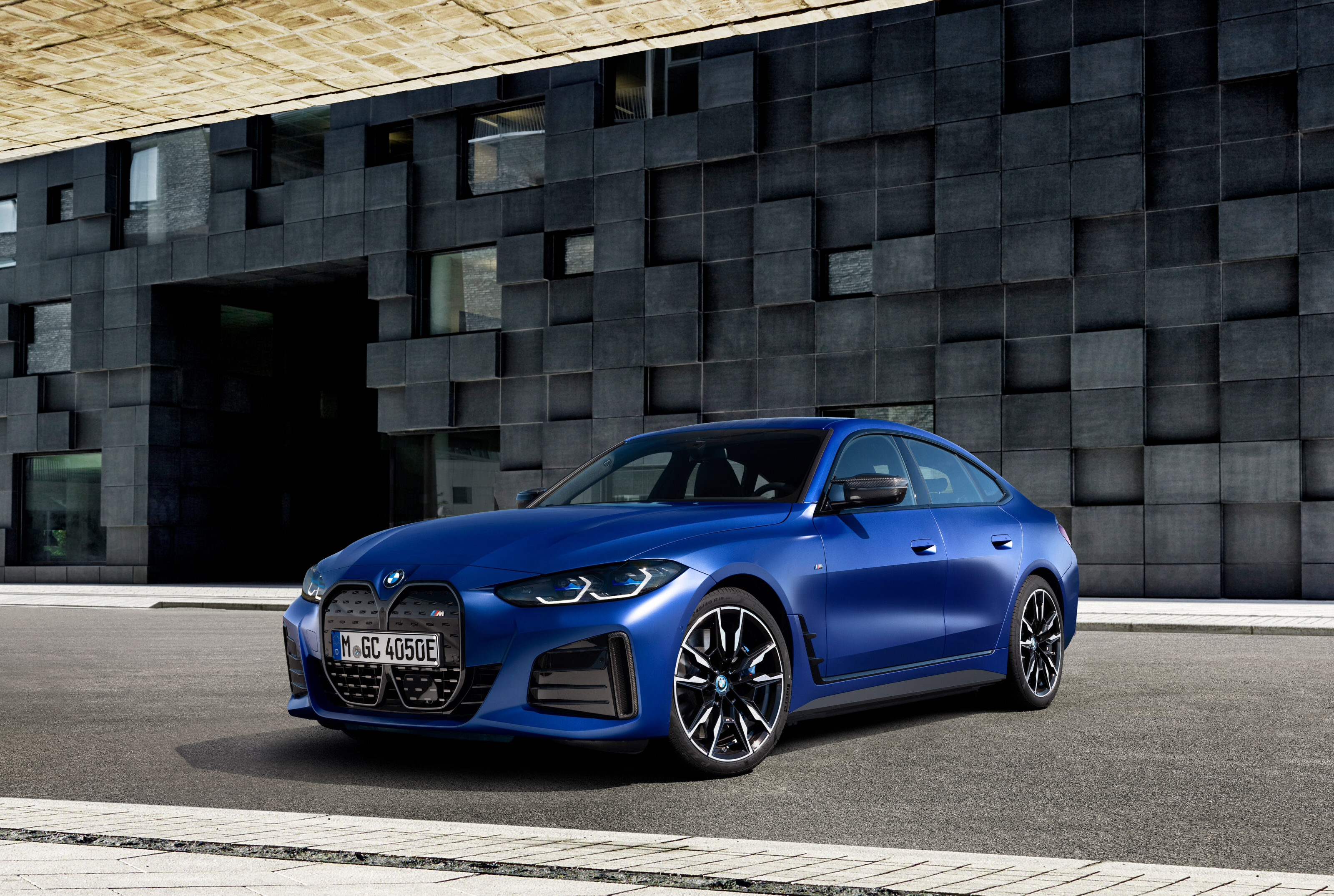
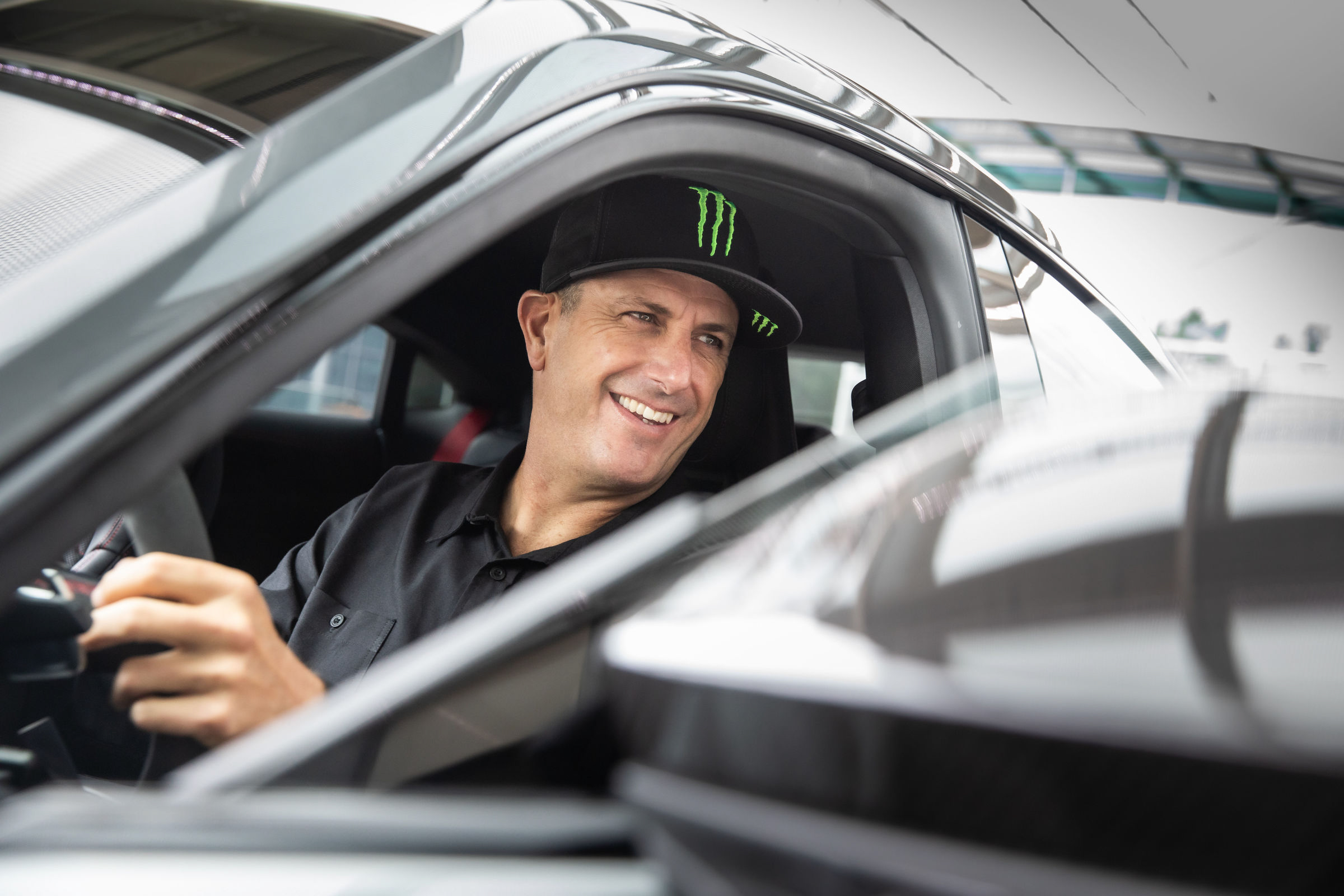
Internet sensation Ken Block is to become a key part of Audi’s push towards electrification in motorsport – having announced he’s signed up with the automaker to develop its next-generation racing cars.
Founder of DC Shoes, Hoonigan and star of the popular Gymkhana videos on YouTube, 53-year-old Block is set to join Ingolstadt’s electric vehicle team.
“I love anything that makes me go faster. Electric cars can do that,” Block said.
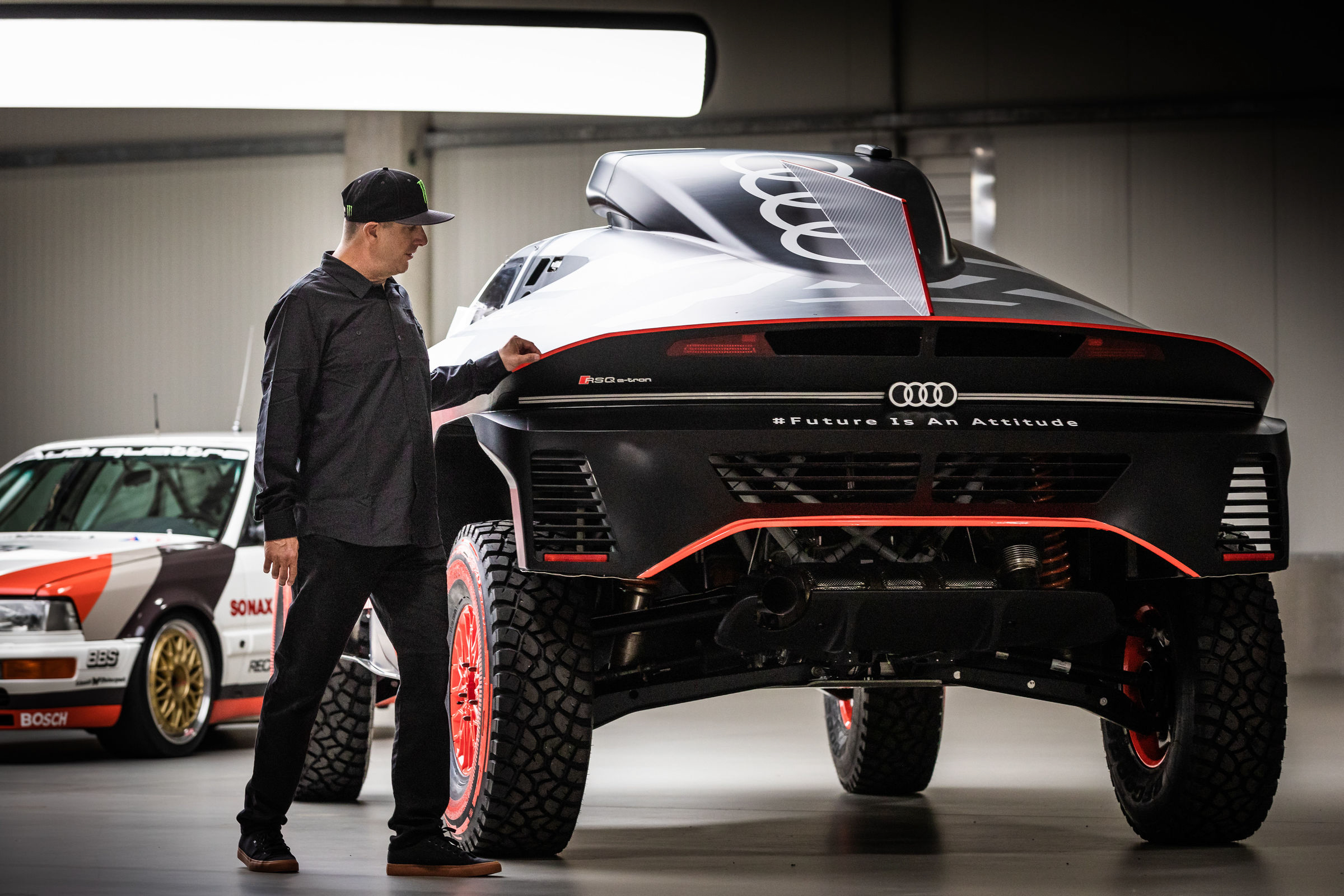
While Audi has a storied history in rallying and motorsport in general, its next target is to compete in the famous Dakar Rally in 2022 with a hybrid electric vehicle, showing off its RS Q E-Tron challenger earlier this year.
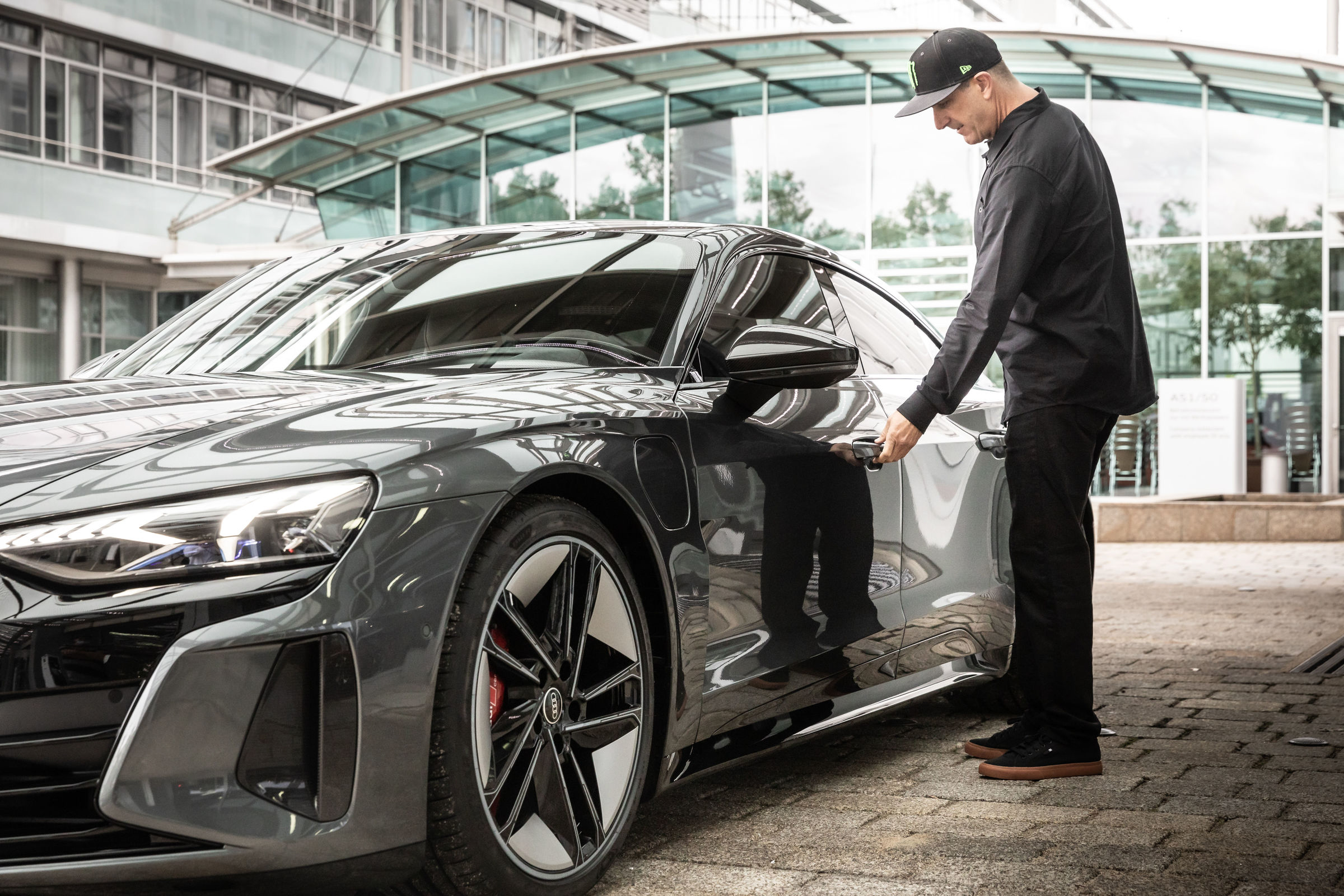
Although it’s unclear as to what his exact role at Audi will be, the American said a move towards electrification is inevitable and won’t come at the cost of performance.
“Electric mobility is the future”, said Block.
“I see the electric car as a leap forward for us as a society in order to create something which can not only reduce emissions and hopefully make the planet a better place, but it’s also about performance.
“And as far as sound goes, I have kids who don’t care about that. They think the sound of [an] electric car is just as cool as the sound of internal combustion engines.”
Having first been associated with Subaru, Block was partnered with Ford for more than a decade from 2010 to 2021 until the two went their separate ways earlier this year – which saw the former World Rally Championship and World RX driver rejoin Subaru for the American Rally Association season.
Block’s popularity will be key for Audi as it remerges into top-flight motorsport, with the Gymkhana film series amassing more than half a billion views on YouTube and Block enjoying nearly 14 million followers across his social media platforms.
Only time will tell whether Block can replicate Walter Rohrl’s 1987 Pikes Peak win or take Audi to victory at Dakar.
Snapshot
- 2022 Mazda 2 specifications announced
- New SP variant offered with black exterior trim
- Pricing to be announced in the coming months
The 2022 Mazda 2 has been updated for the new year, with the small model gaining additional safety equipment and a new sporty variant.
Mazda has added the G15 Pure SP to the Mazda 2 range, building on the G15 Pure with black exterior highlights, 16-inch alloy wheels, and contrasted with red in the interior.
All variants now have seat-belt reminders, alerting the driver to potential occupants in the back row.
Buyers have the option of eight paint colours, with a new metallic platinum quartz being added. While sedan buyers can also choose a metallic polymetal grey for an additional $495, which was previously only available on the hatch.
The 2022 Mazda 2 will go on sale in late 2021, with pricing set to be announced in the coming months.
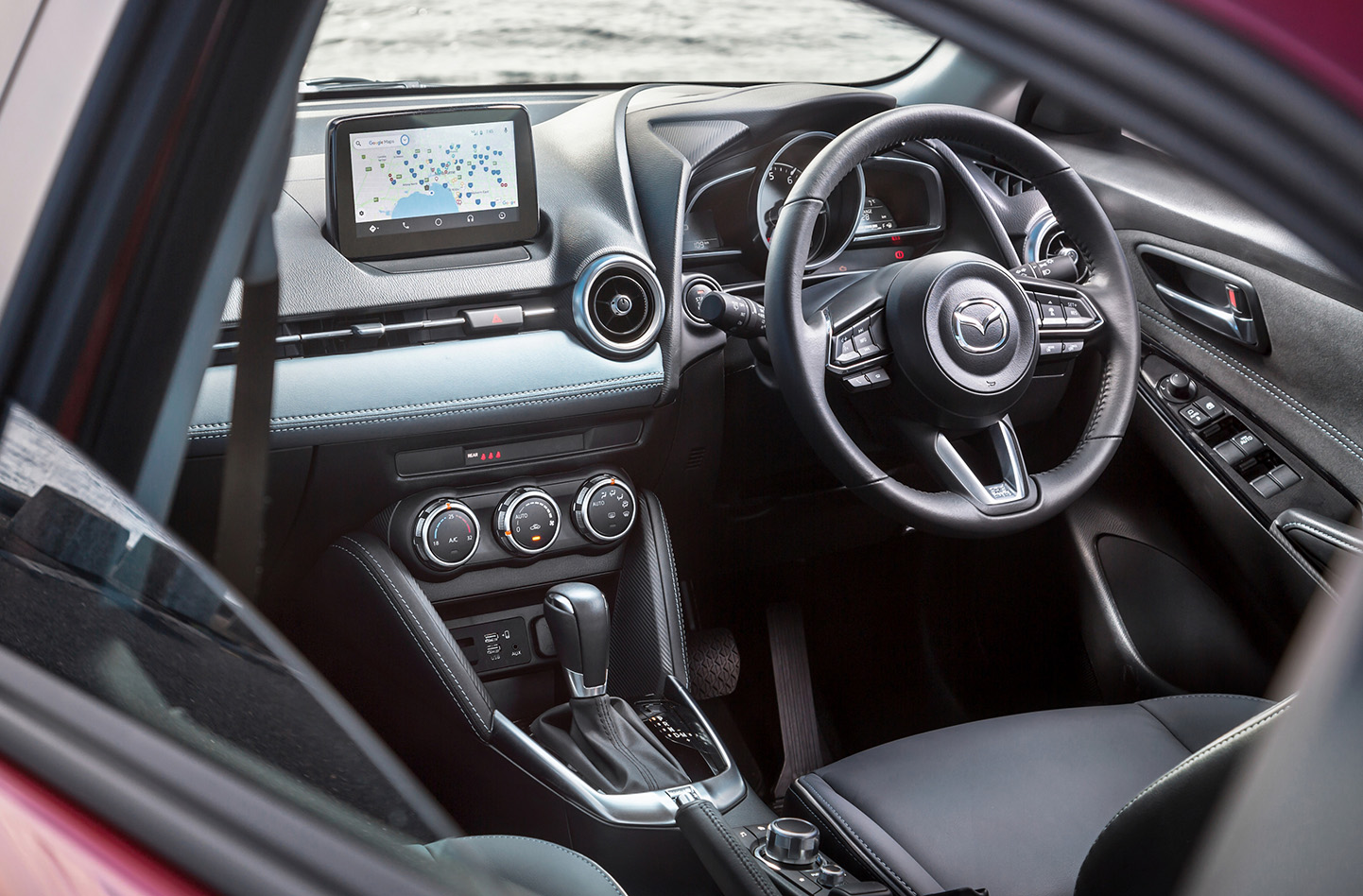
Features
Mazda 2 G15 Pure
| LED headlights |
| Power folding mirrors |
| Cruise control |
| Leather steering wheel and gear-shifter |
| Power windows |
| 7.0-inch infotainment touch screen with bluetooth, DAB+ digital radio, Apple CarPlay and Android Auto |
| Reverse camera |
| Keyless push-button engine start |
| Rear parking sensors |
| 15-inch alloy wheels. |
Mazda 2 G15 Pure SP (in addition to G15 Pure)
| Six-speed automatic transmission |
| Black exterior mirrors |
| Black painted grille |
| Chrome exhaust tip |
| Black cloth upholstery with red trim |
| Black 16-inch alloy wheels. |
Mazda 2 G15 Evolve Hatch (in addition to G15 Pure SP)
| LED daytime-running lights |
| Automatic headlights |
| Auto-folding exterior mirrors |
| Chrome exhaust tip |
| Navy blue/black cloth trim |
| Single-zone auto climate control |
| Satellite navigation |
| Automatic front wipers |
| 16-inch alloy wheels. |
Mazda 2 G15 GT Hatch (in addition to G15 Evolve)
| Blue-grey leather with grey synthetic suede |
| 360-degree cameras |
| Keyless entry |
| Radar cruise control |
| Front parking sensors. |
Mazda 2 GT Sedan (in addition to G15 Pure)
| LED daytime-running lights |
| Automatic headlights |
| Auto-folding exterior mirrors |
| Chrome exhaust tip |
| Blue-grey leather with grey synthetic suede |
| Auto climate control |
| Satellite navigation |
| Automatic front wipers |
| 360-degree cameras |
| Front parking sensors |
| Keyless entry |
| Radar cruise control |
| 16-inch alloy wheels. |
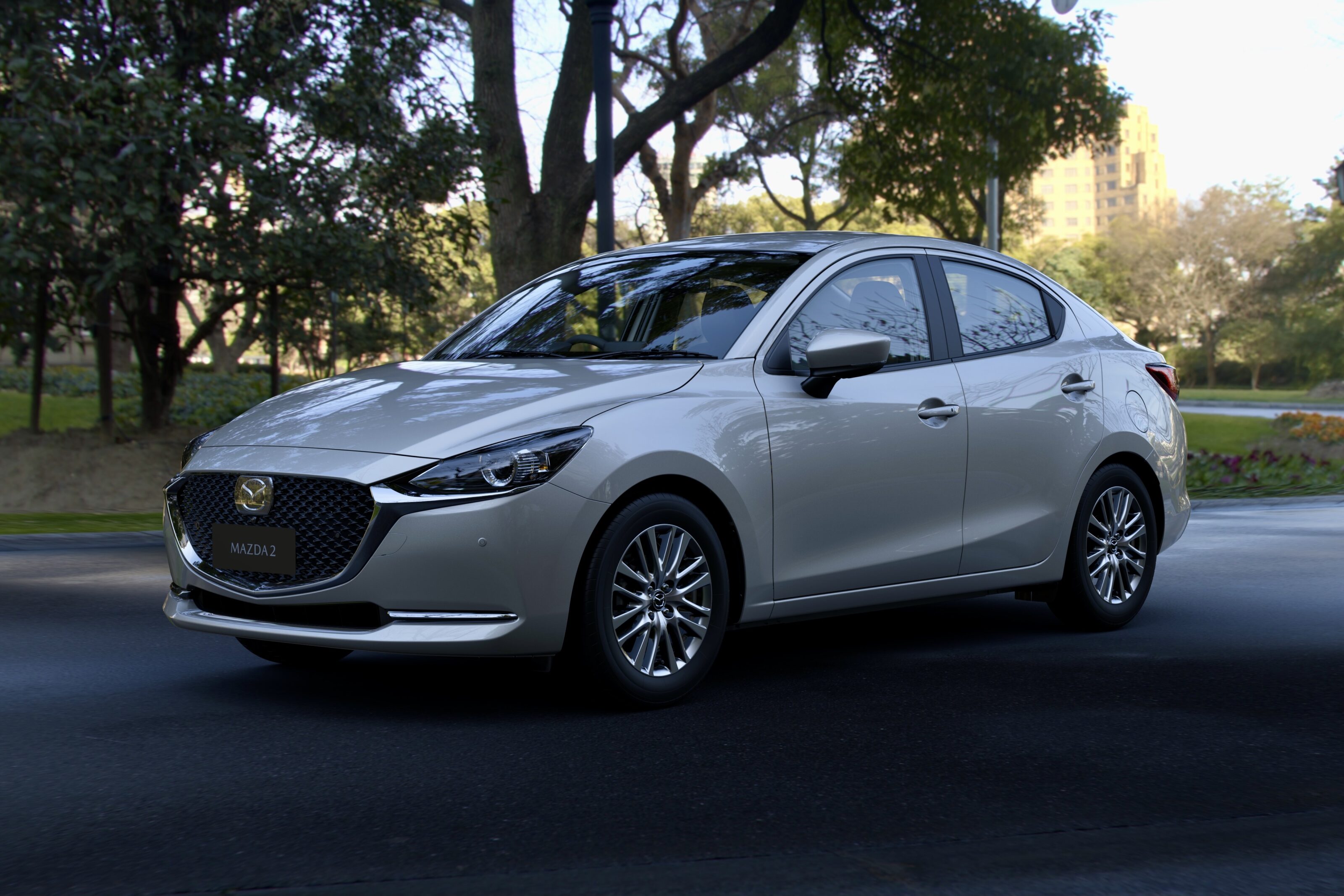
Engine, drivetrain and fuel economy
The 2022 Mazda 2 range is powered by a 1.5-litre non-turbo petrol four-cylinder engine, producing 82kW and 144Nm.
Power is sent to the front wheels through either a six-speed manual or six-speed automatic transmission, with claimed fuel consumption of 5.4L/100km and 5.3L/100km respectively.
Dimensions
As a 1050kg hatchback, the Mazda 2 measures in at 4065mm long and 1495mm tall, while the 1060kg sedan is 4340mm long and 14700 tall. Both are 1695mm wide.
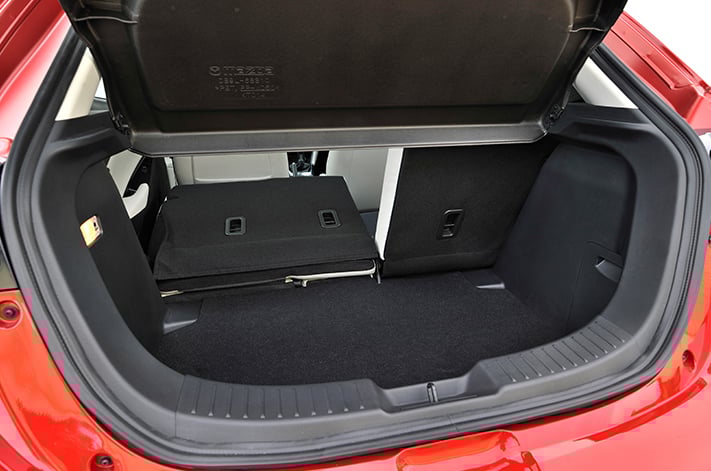
Mazda 2 hatchback owners get 250 litres of luggage space, with the sedan offering 440 litres.
Safety
The 2022 Mazda 2 comes standard with six airbags (front, side, and curtain), and has a five-star ANCAP safety rating from 2015. Also standard are the following safety features:
| Blind-spot monitoring |
| Lane-departure warning |
| Lane-keep assist |
| Hill start assist |
| Rear cross-traffic alert |
| Autonomous emergency braking with pedestrian detection |
| Reverse autonomous emergency braking. |
Warranty and servicing
Servicing intervals for the 2022 Mazda 2 are every 12 months or 10,000km – whichever comes first. Services cost between $315 and $345 for the first five intervals.
Mazda offers a five-year/unlimited-kilometre warranty.
Availability
The 2021 Mazda 2 will go on sale towards the end of 2021.
Subaru is a brand loved by performance enthusiasts all over the globe and, while the Gunma firm achieved some impressive feats with its earlier Legacy, it’s the original GC8 generation of WRX that most enthusiasts will regard as the ultimate.
You already know the story: winning mechanicals from the Legacy RS wrapped in a new, smaller and agile body and, three consecutive World Rally Constructor titles later, the results spoke for themselves.
There were myriad special editions too, which has only fuelled reverence following the rise of JDM collector culture. Which brings us to this GC8 Subaru Impreza WRX STI Type R Version 6 Limited that we spotted for auction locally.
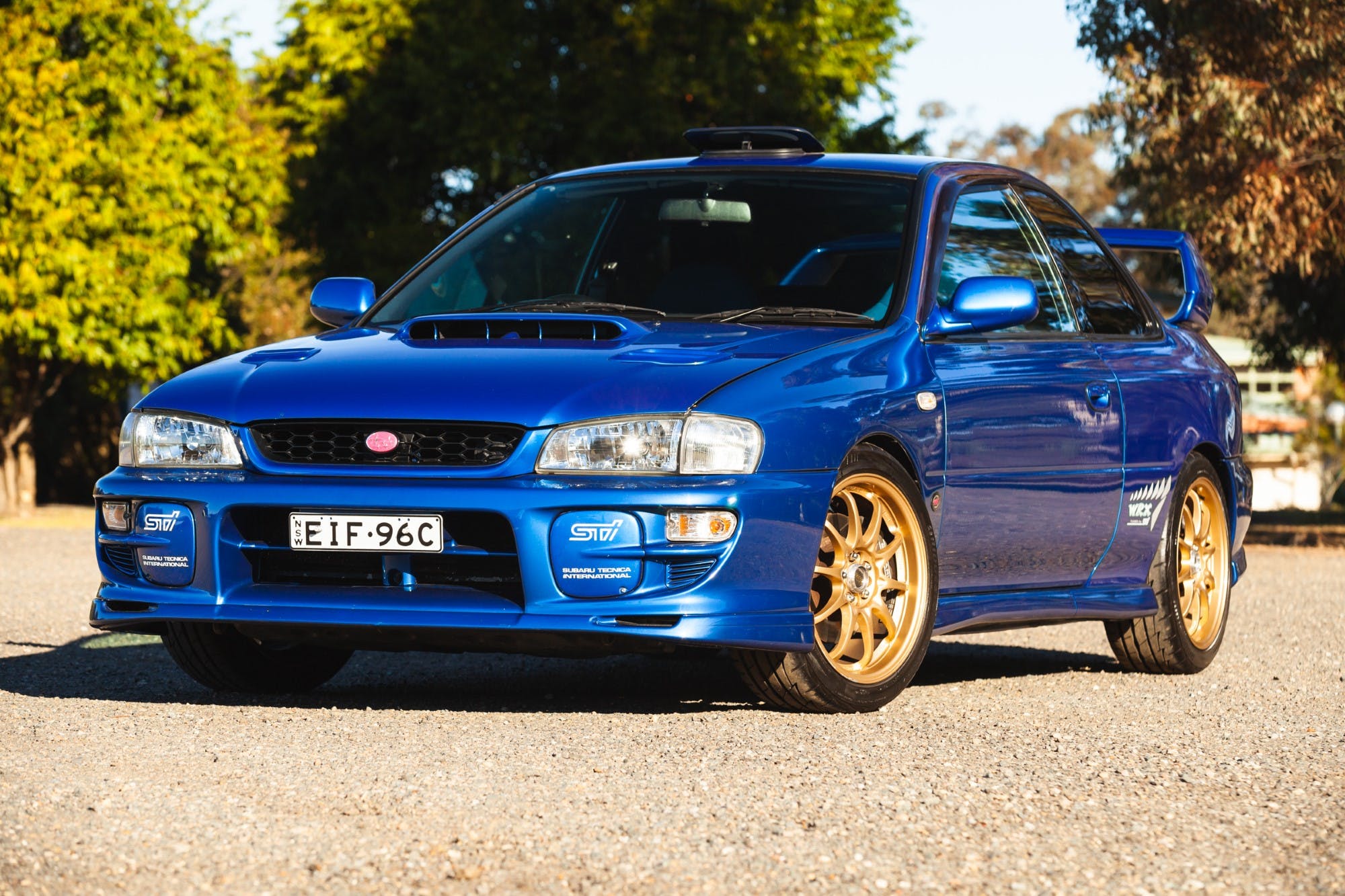
Eagle-eyed MOTOR readers may recognise this very car from our collector’s edition issue celebrating 30 years of Subaru Technica International. The car also later reappeared in our sister-title Unique Cars’ Modern Classics special issue.
Outside of the iconic 22B, this souped-up Subie represents the zenith of collectible STI-fettled GC8s.
Subaru initially intended to produce 1000 examples, as per the interior build plaque, for the Japanese market only. It’s widely understood by Subaru experts, however, that just 578 units were ultimately produced.
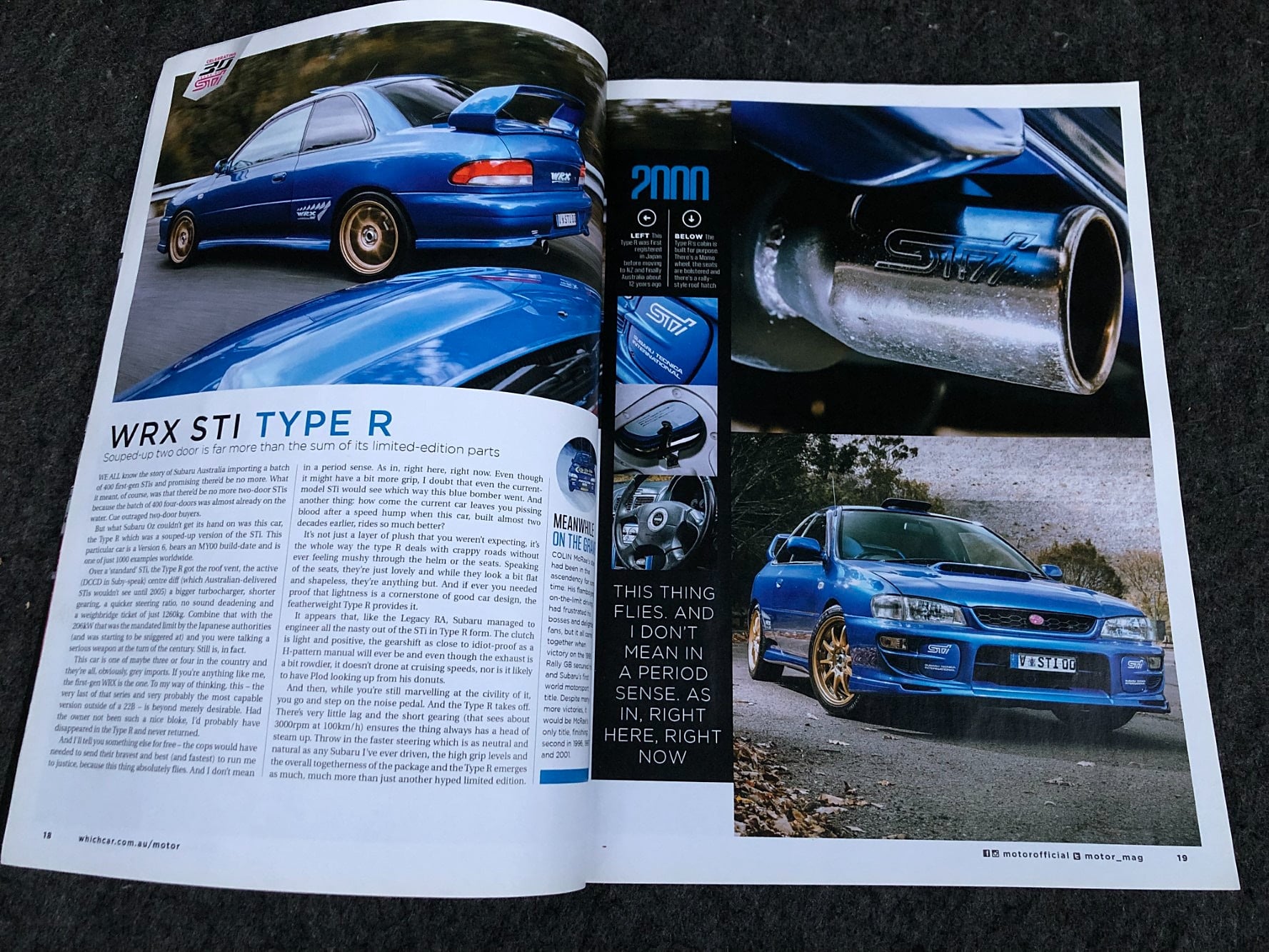
Setting it aside from a standard STI coupe is the redesigned and stronger ‘Phase II’ EJ20 introduced with the MY99 STIs, variable ‘DCCD’ centre differential, bigger turbo, intercooler spray, shortened gearing, quicker steering ratio, WRC-style roof vent, no sound deadening, blue interior trim and many other bespoke touches.
That was a lot of go-fast gear for a car that tipped the scales at a lithe 1260kg. Combine that with the claimed 206kW, as per the era’s ‘gentleman’s agreement’, which Japanese manufacturers were notoriously playing fast and loose with, and you’ve got a serious all-weather performance missile on your hands.
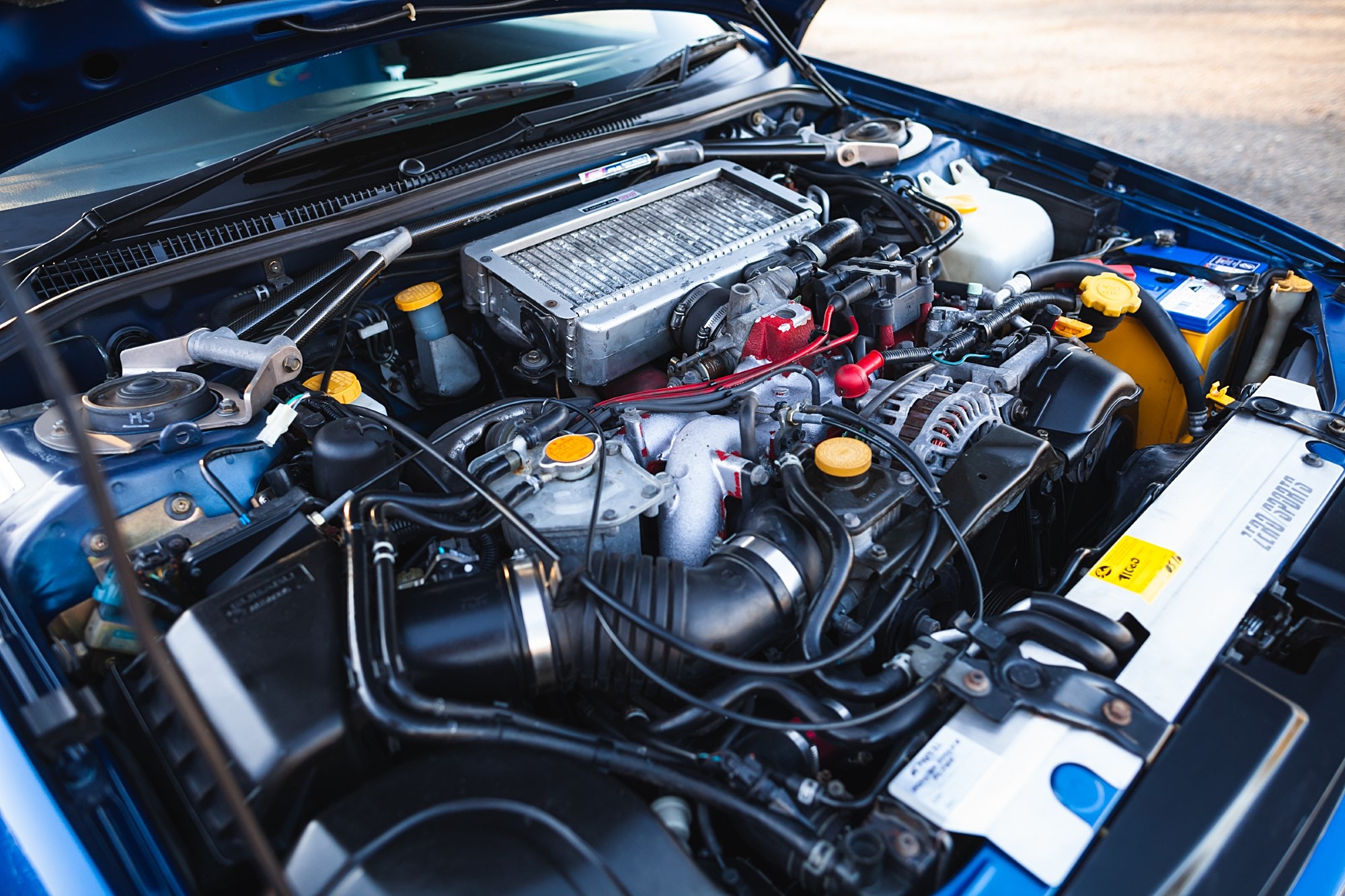
The rare Rex has covered a sympathetic 77,152kms in its life and is supported by decent documentation and service history from new. There are no known mechanical or electrical faults to report.
Recent works include a minor service and annual roadworthy inspection (which it passed) in August 2021. Prior to that, a major service with new timing belt, pulleys, clutch and fluids was performed in May 2016. In March of 2016, the STI coupe’s transmission and central differential were rebuilt by Victorian Subie specialists All Drive Subaroo.
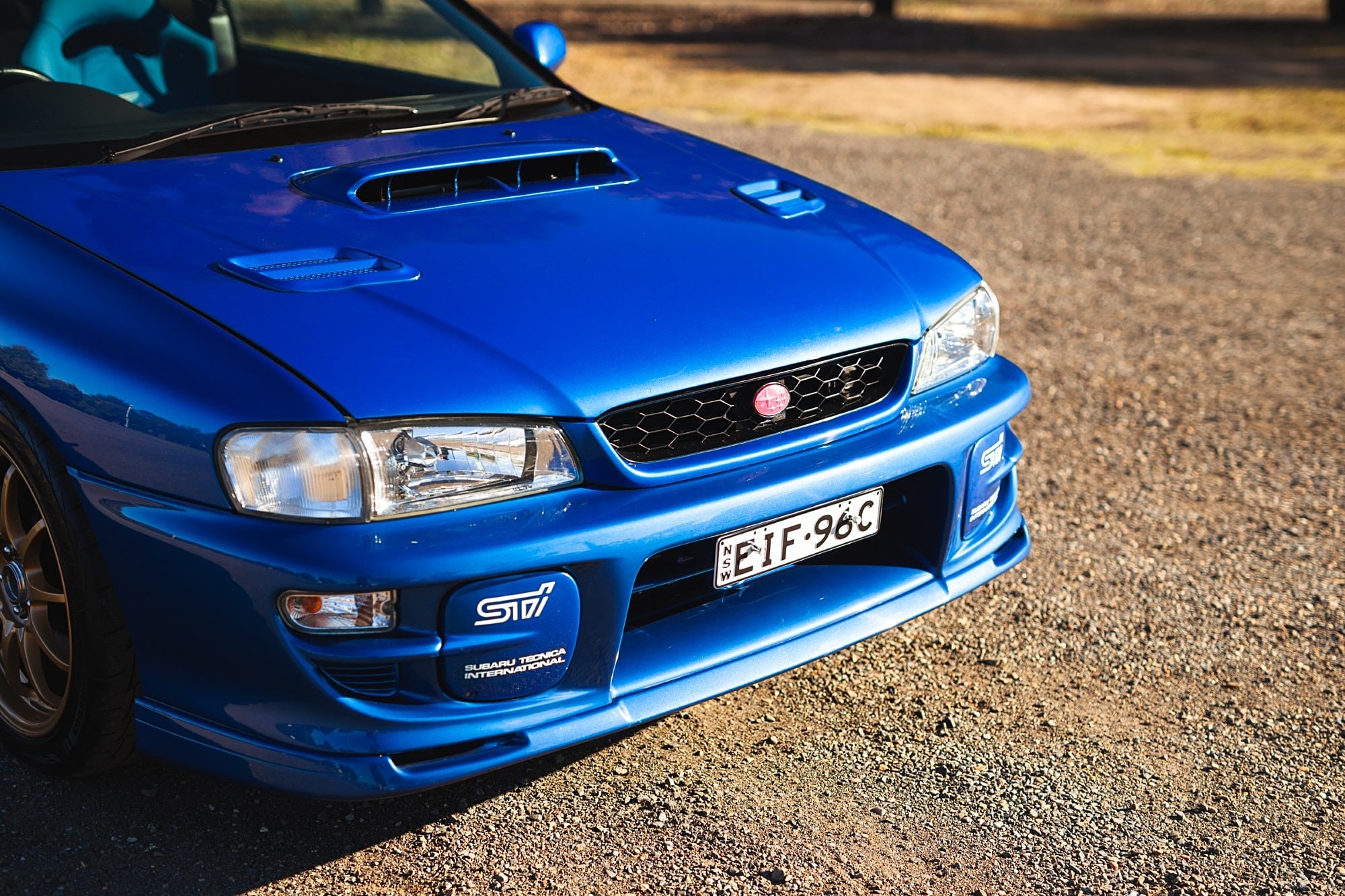
To the best of the seller’s knowledge, the car still wears its original paint with a single stone chip on the bonnet reportedly representing the only imperfection. With its original numbers-correct engine and gearbox in place, the Version 6 Limited coupe presents in highly original surviving condition.
Non-original upgrades include a modern alarm and GPS tracking system, cruise control system, turbo timer, aftermarket forged alloy Volk CE28n wheels and exterior vents. The seller states that the original alloy wheels and vents are still in possession and can be fitted upon sale.
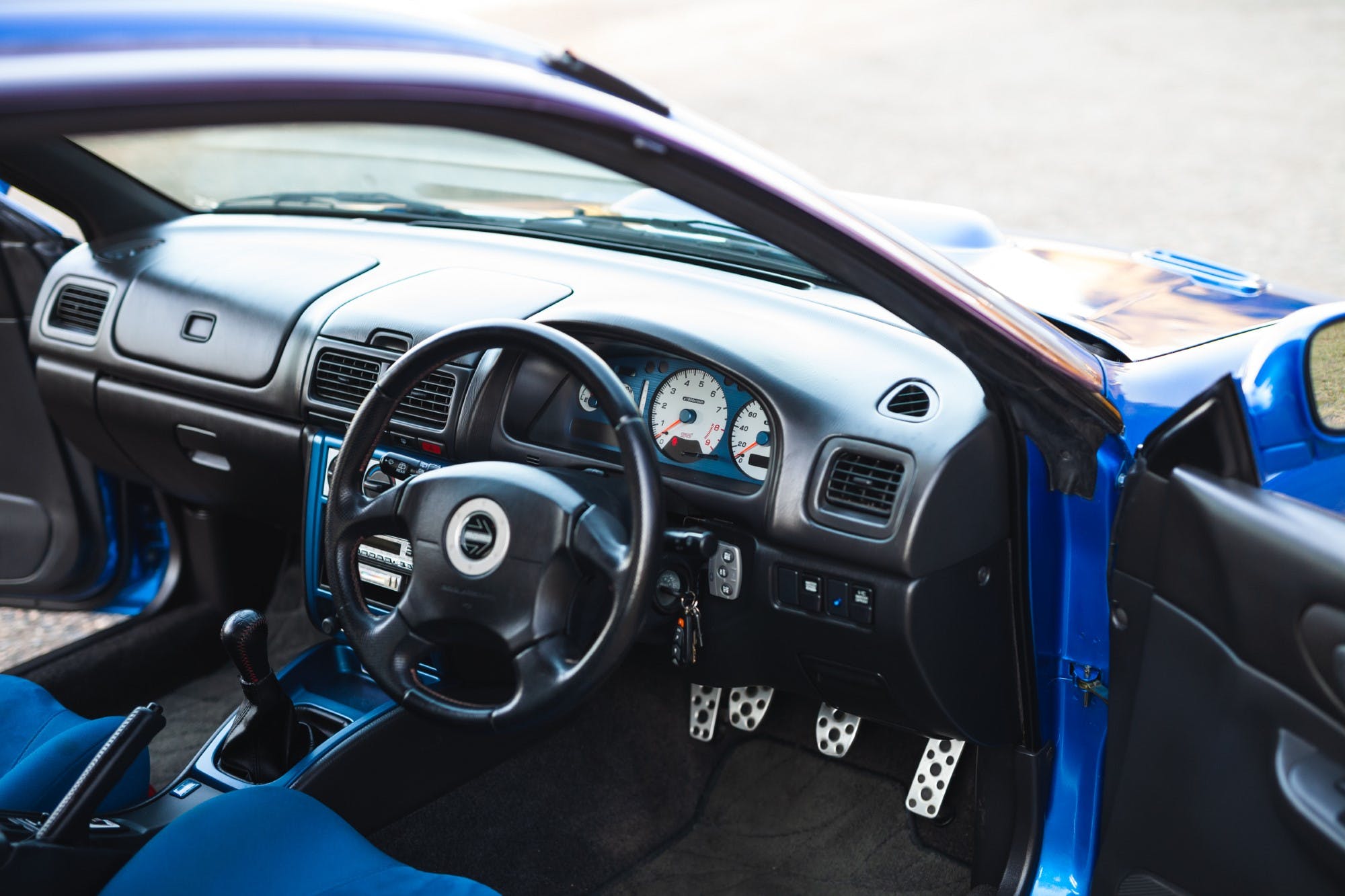
The car presents very well in photos, with no discernible wear and tear to high frequency interior touchpoints such as the steering wheel, shift knob and handbrake. The original blue cloth seats, and black Alcantara rear seats, also present very well for their age with minimal fading and creasing.
The high bid currently stands at $85,555, at the time of writing, with a little under two days to go.
In September 2020, a Grade 4.5 Impreza STI Version 6 Type R (non-Limited) with just 8785kms on the clock sold through Japanese auctions to the tune of AU$136,000 – believed to be a world record for that particular variant. This lot may prove an interesting litmus test on the strength of the local collectible Rex market.
Whether you’re an interested bidder, or just a window shopping, you can view the current auction lot in full at collectingcars.com
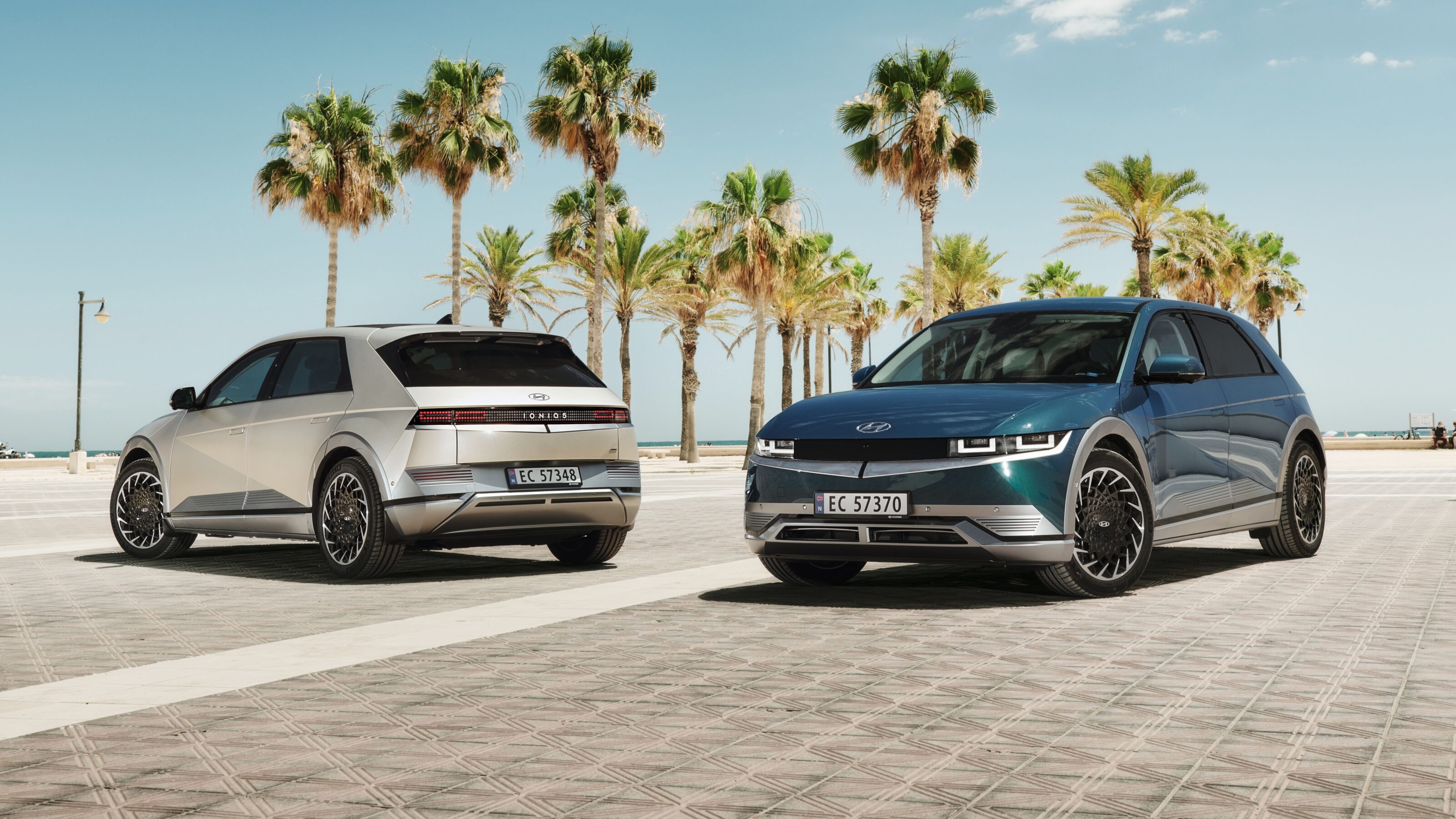
Hyundai Australia has let loose with pricing and trim levels for the highly anticipated Ioniq 5, but how does it compare to the current top-selling electric vehicle – the Tesla Model 3?
While we work to bring you a full assessment of how these two compare on the road, here’s how they line up ‘on paper’.
Performance
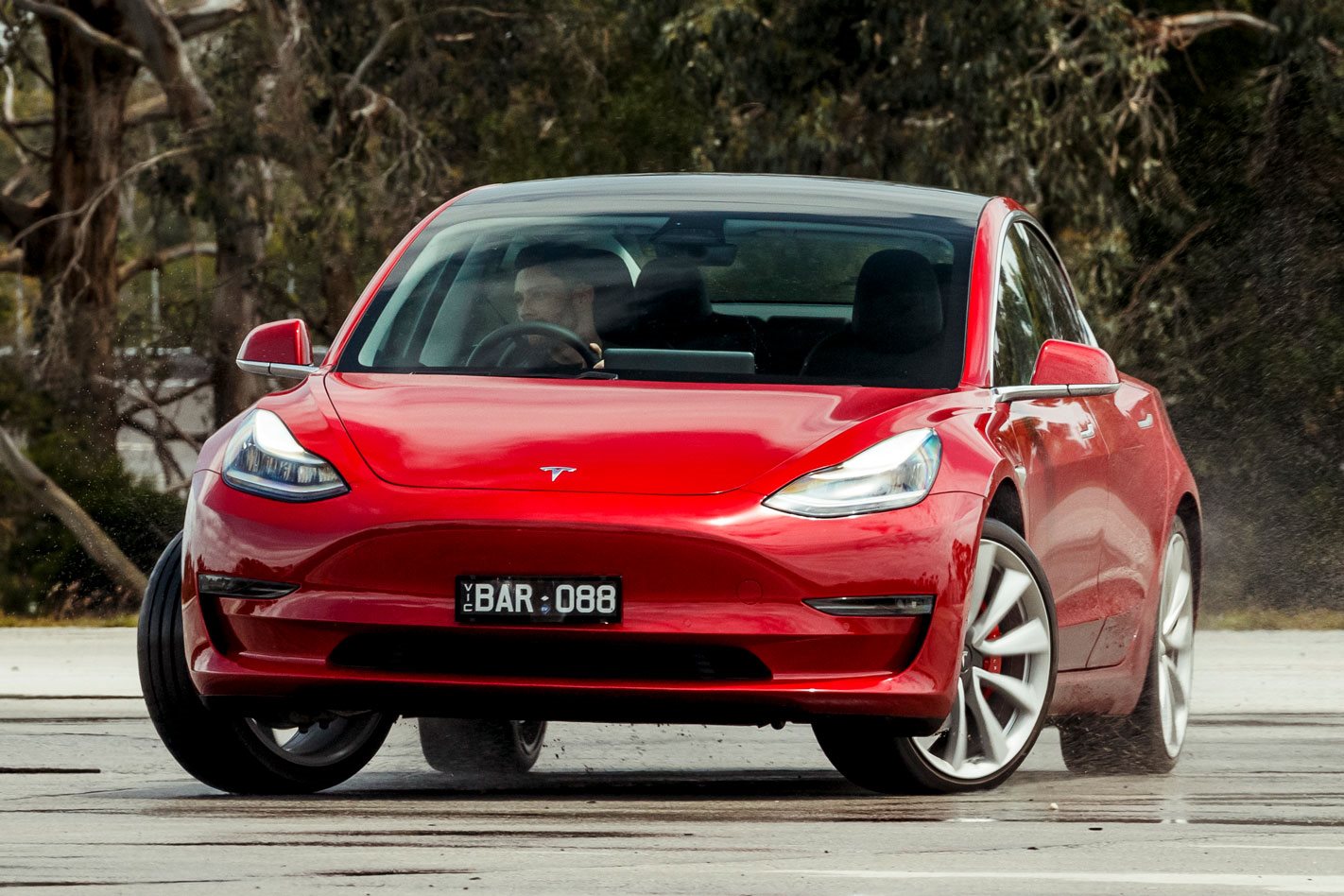
The Ioniq 5 is no slouch, with the AWD variant achieving a claimed 0-100km/h in 5.2s and 7.4s for the RWD drivetrain, but the Model 3 is undeniably quicker.
A similarly priced Model 3 Long Range clocks 4.4s doing 0-100km/h, but even the Standard Range Plus (0-100km/h in 5.6s) gets close to the fastest Ioniq.
Now… let’s not make too big a point of the Model 3 Performance and the 3.3s it takes to go from 0 to 100km/h – it tends to embarrass everyone on the affordable side of $100,000.
Range
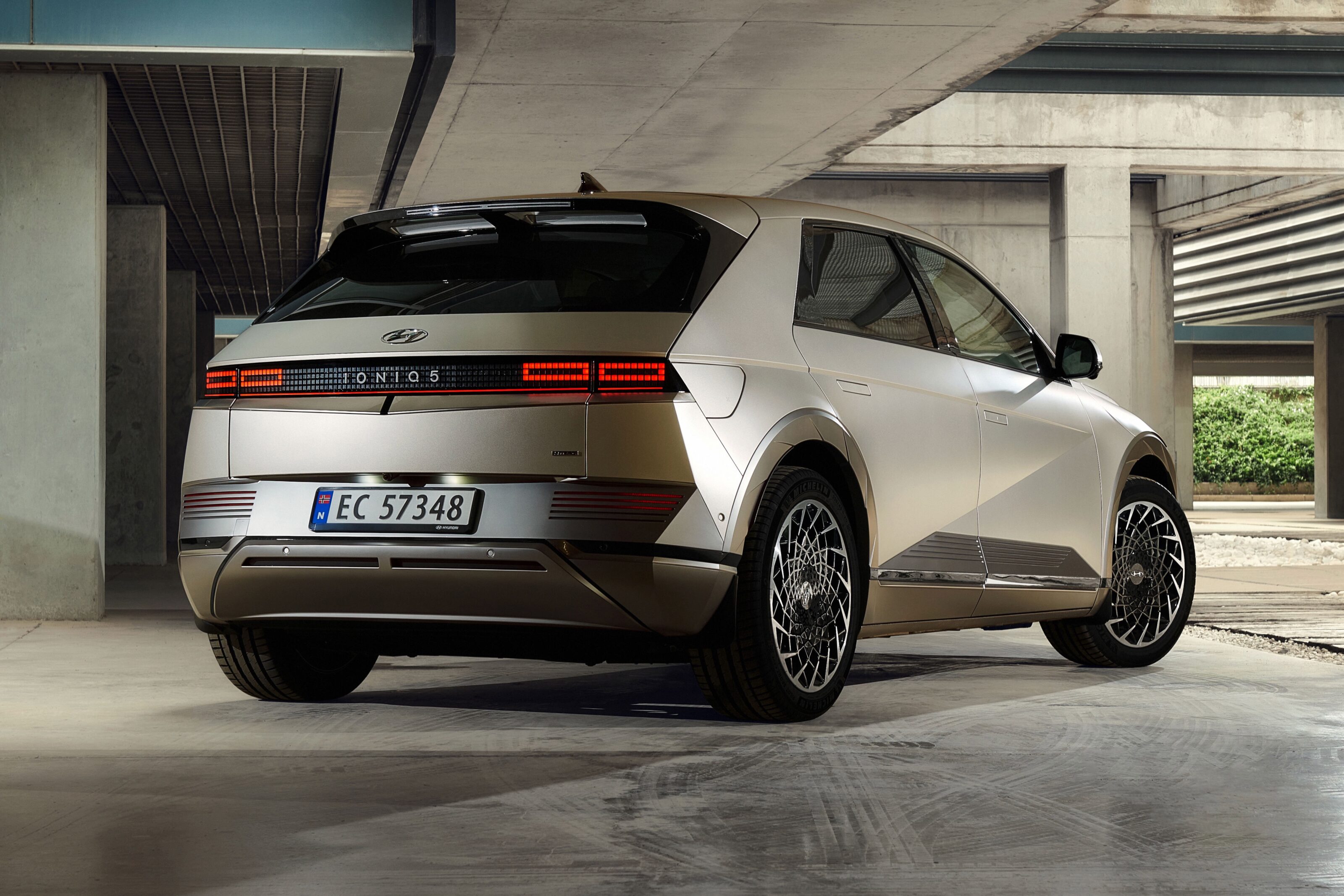
Hyundai is stating 451km (RWD) and 430km (AWD) of driving distance for the Ioniq 5, while Tesla claims the Model 3 will do 448km (Standard Range Plus), 580km (Long Range) or 567km (Performance) before the battery runs out of juice.
Considering the Ioniq 5’s body shape, it’s natural to expect a lower driving range and anything north of 400km is more than enough for the majority of people, but the Model 3 Long Range wins this round if you suffer from severe range anxiety.
Charging speed
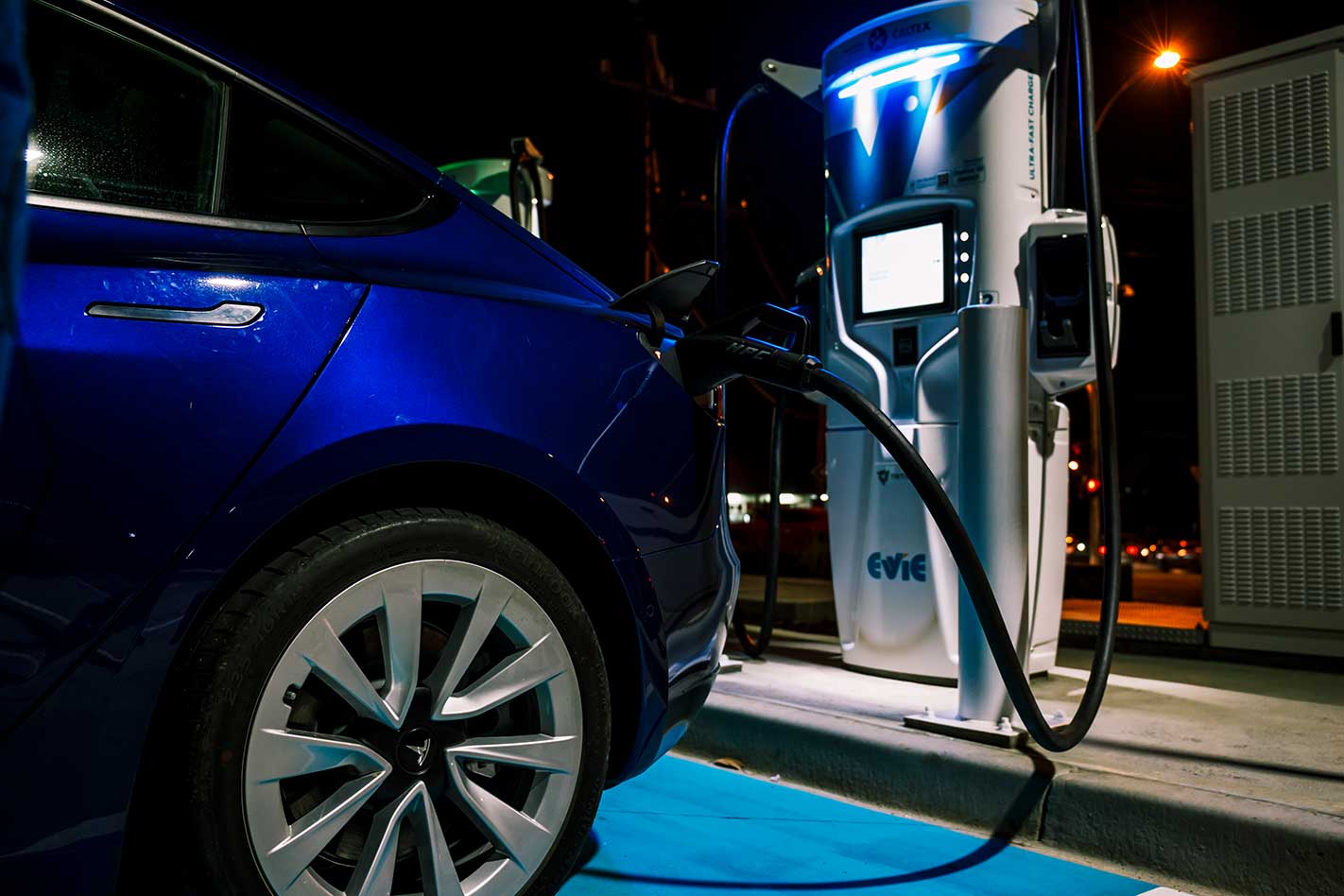
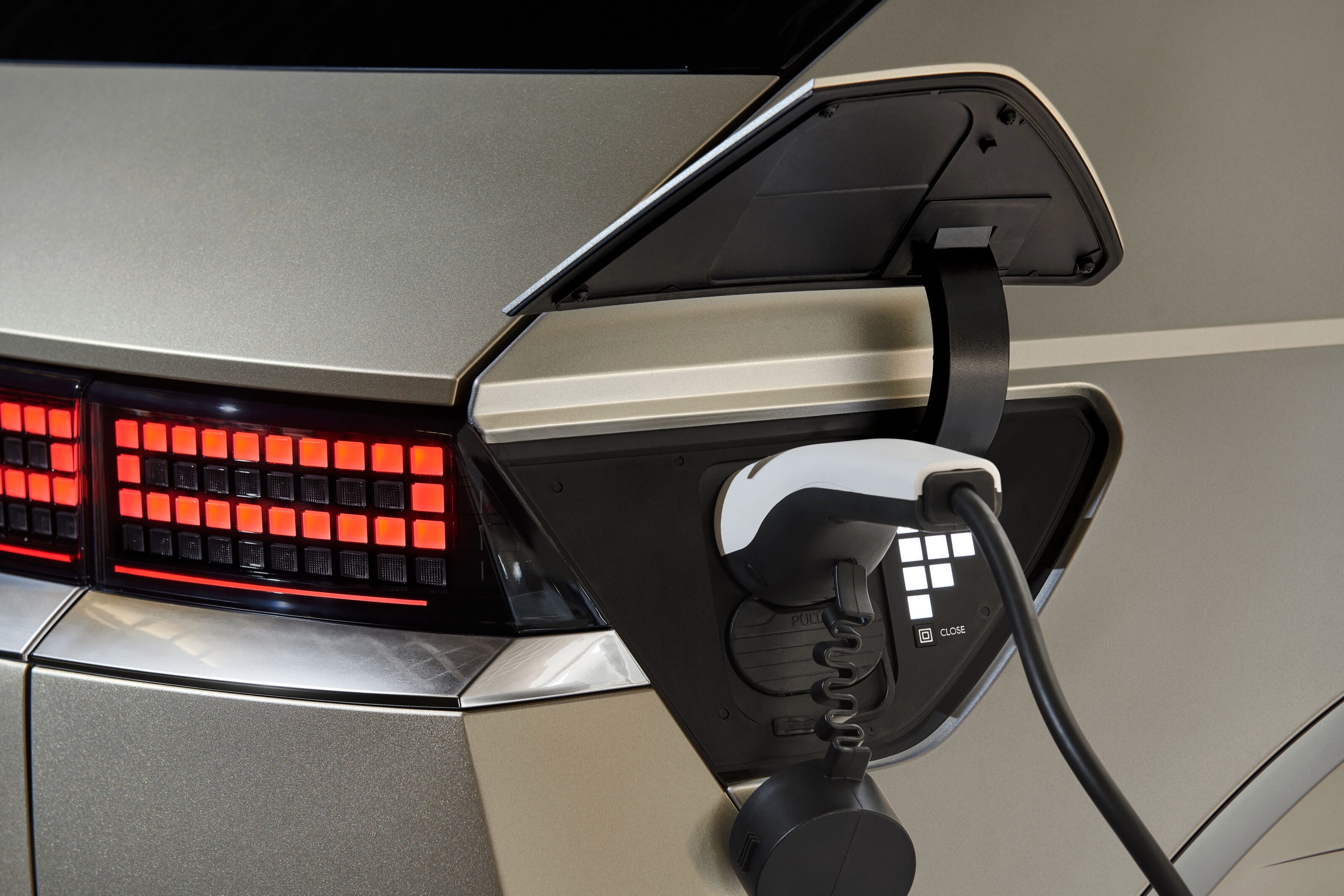
Both vehicles have similar AC charging capabilities (10.5kW for the Ioniq 5, 11kW for the Model 3), but one thing Hyundai has over Tesla is 800V charging capability.
On the right type of ultra-rapid charger (e.g. Tritium’s Australian made PK350 350kW unit), the Ioniq 5 will charge from 10 per cent to 80 per cent in just 17 minutes.
Charging the Model 3 from 10 per cent to 80 per cent would take approximately 25 minutes on Telsa’s latest V3 Superchargers.
Charging network
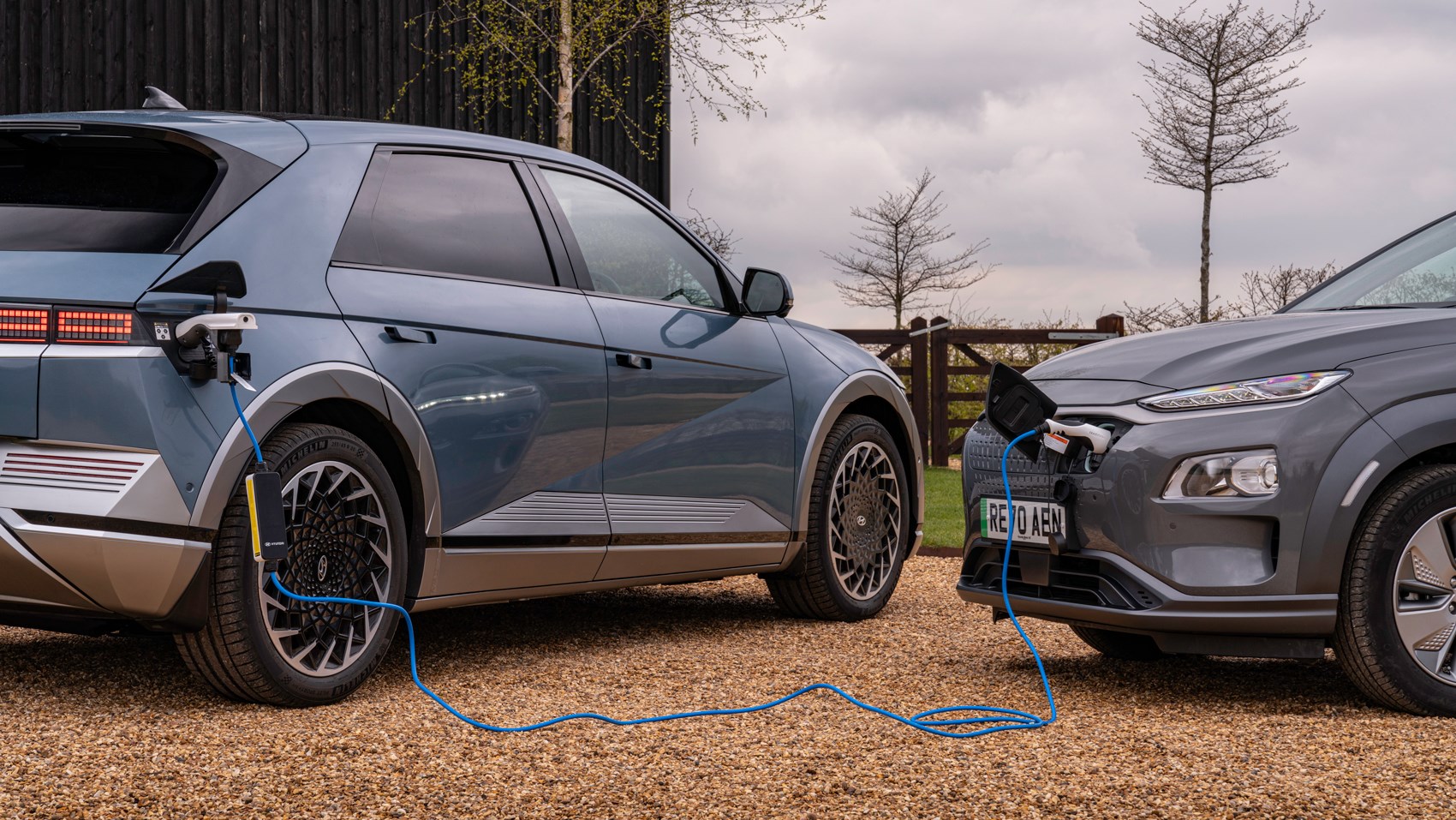
Tesla has an advantage with its Supercharger network, as not only can the Model 3 charge at its own numerous sites – it can also use the same chargers as the Ioniq 5 ( Chargefox, Evie, NRMA, Queensland Electric Highway, et cetera). The Ioniq 5 however, cannot use Tesla’s Superchargers.
Tesla has hinted at opening up the Supercharger network to other manufacturers, but has yet to do so. For now there’s more places to charge a Model 3 out in the wild than there is an Ioniq 5.
Safety features
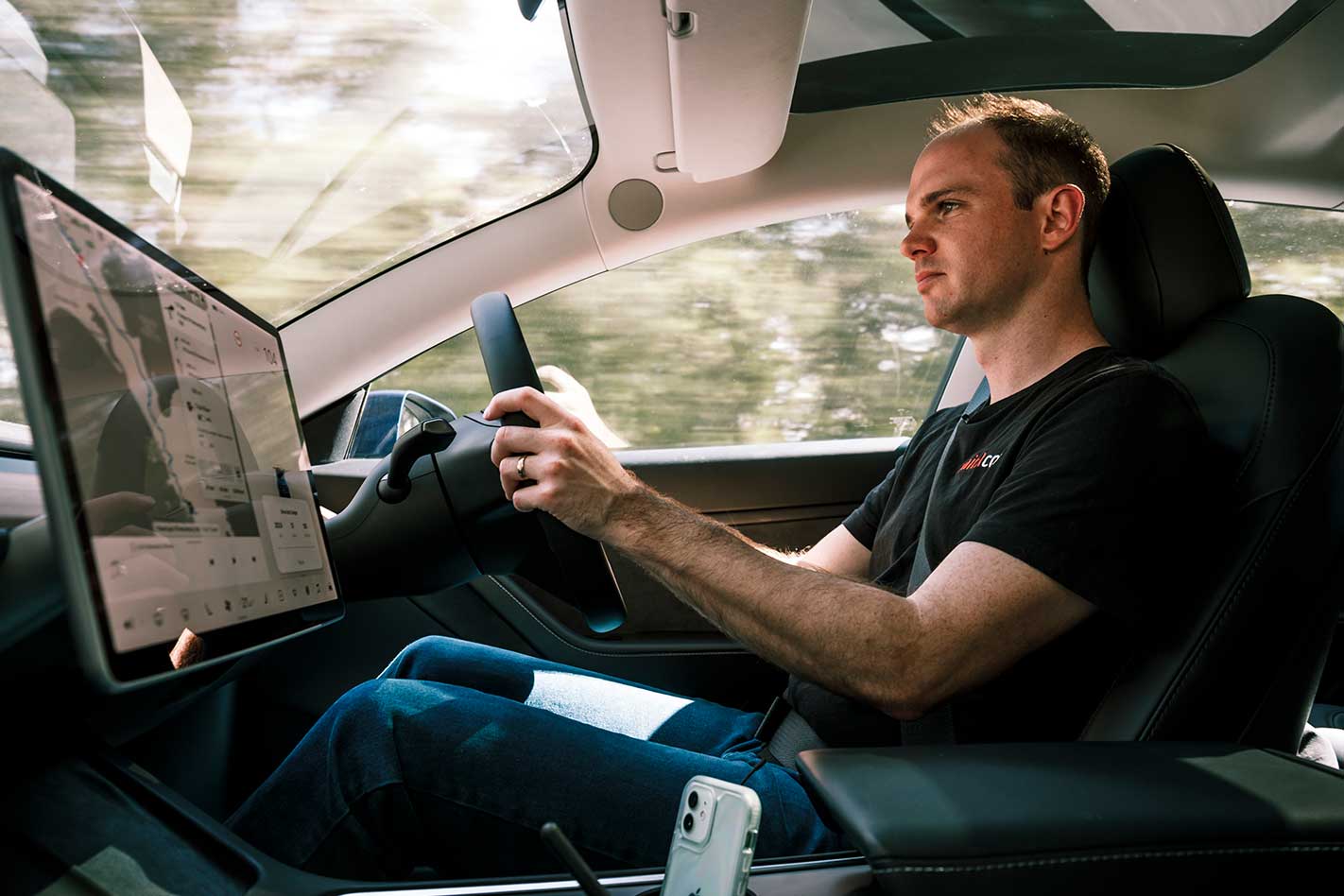
Hyundai has one-upped Tesla in regards to safety features, as the the Model 3 does not have the Ioniq 5’s 3D surround view monitor, rear cross-traffic collision-avoidance or a blind-spot view monitor.
The Ioniq 5 also has remote smart parking assist (RSPA) and smart parking assist (SPA) included in the price, whereas Tesla wants an extra $10,100 for “Full Self-Driving” capability to get those features – which, if you’ve seen demo videos on YouTube, can be very hit or miss.
Tech features
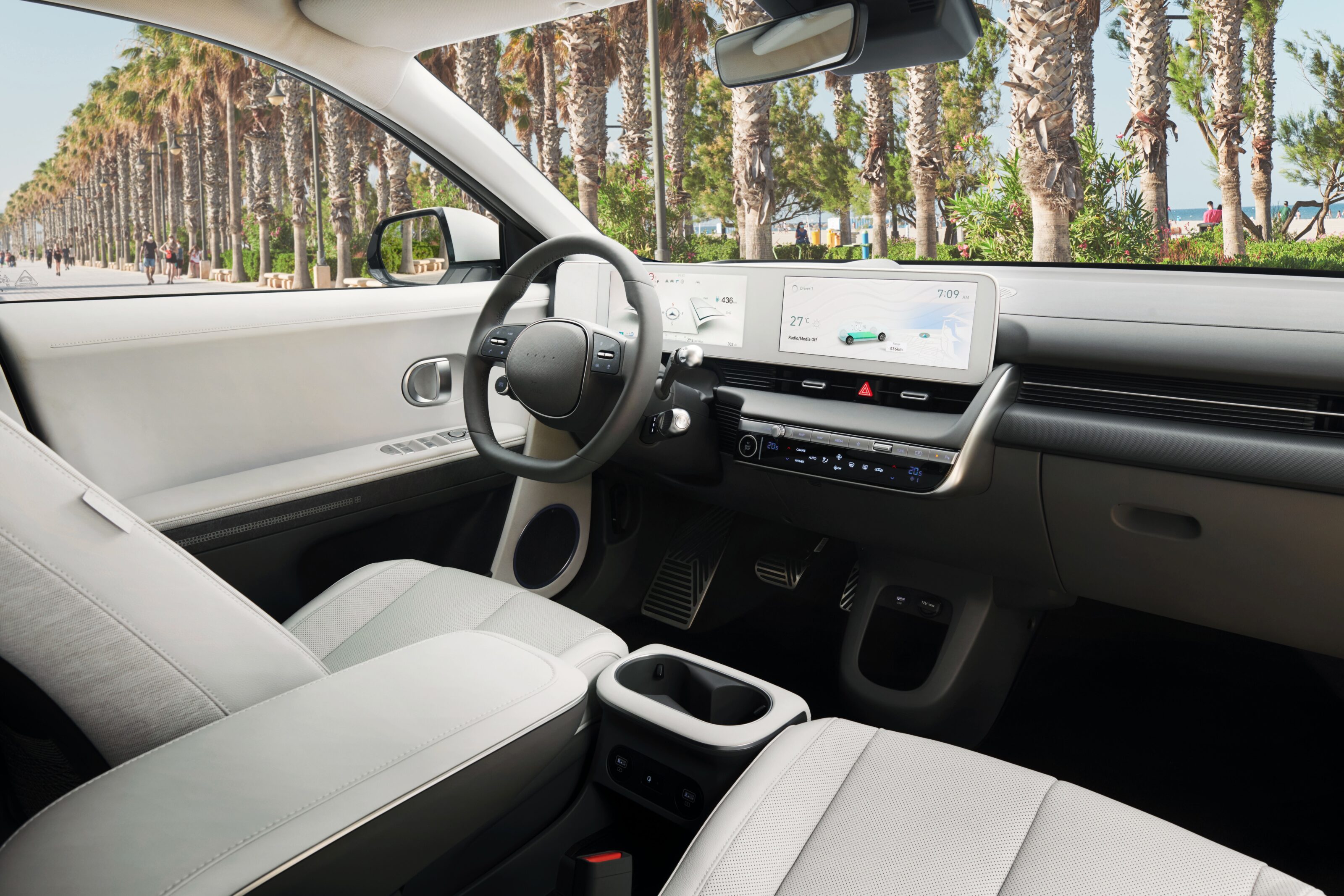
What the Ioniq 5 has over the Model 3:
And vice versa:
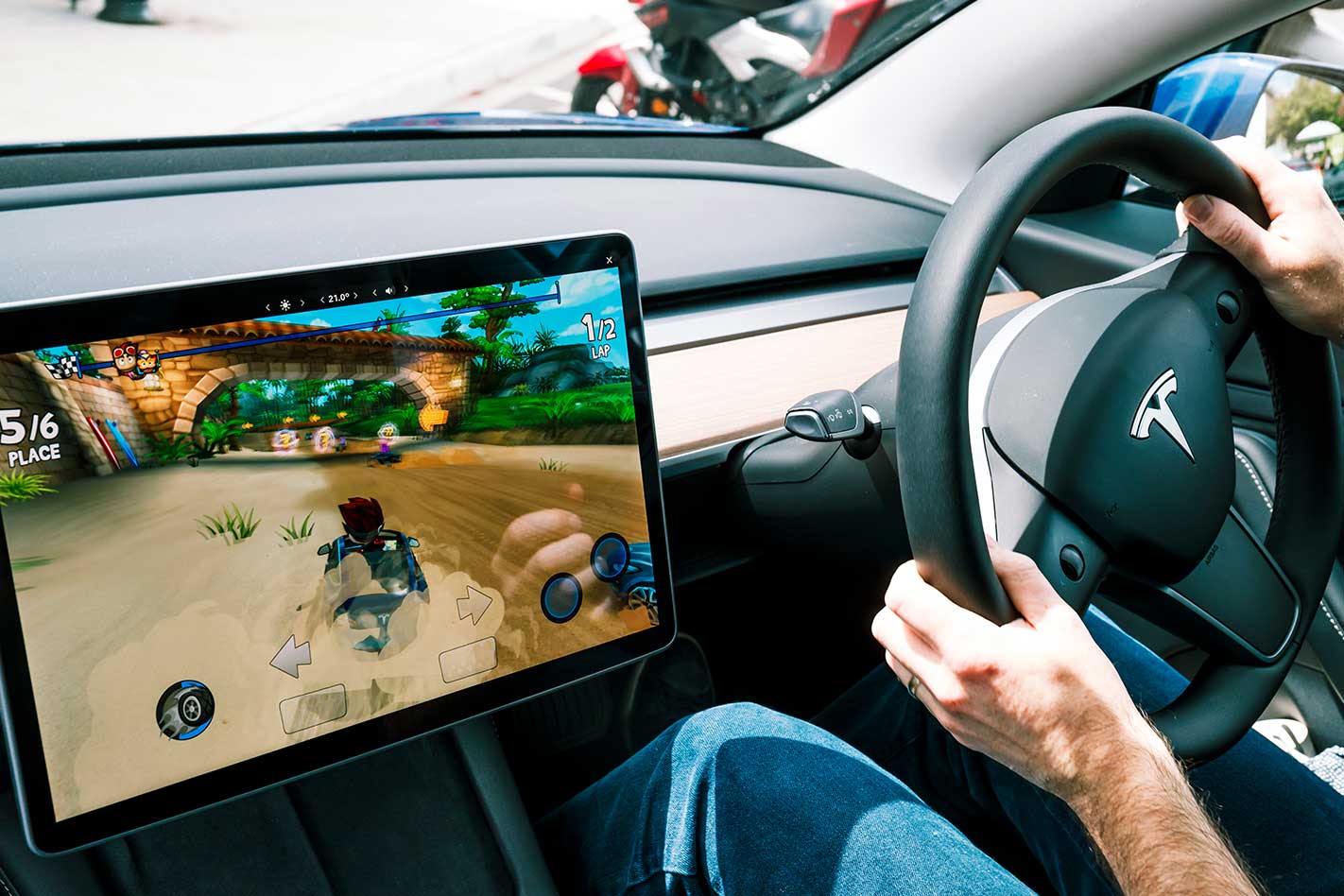
| Built-in dashcam and security camera |
| Smartphone app to monitor charging and control car |
| Regular over-the-air updates |
| Built-in collection of video games, YouTube, Netflix and web browser |
| Optional u201cFull Self Drivingu201d beta software which allows autonomous driving in specific scenarios. |
Cargo space
Externally, the Model 3 and Ioniq 5 are within centimetres of each other. But internally, the Ioniq 5 has more room for cargo.
The hatch design of the Ioniq 5 gives it 531 litres of space compared to the Model 3’s 340 litres. Roomy for a sedan, but the hatch can’t be beat if you’ve got heaps of stuff to haul.
However, the Model 3’s “frunk” is more spacious than the Ioniq 5’s cubbyhole under the bonnet, and easier to access too.
Price
From launch, the Ioniq 5 is available in a single trim level, with rear- or all-wheel drivetrains, for $71,900 and $75,900 respectively – excluding on-road costs.
Tesla has three variants of the Model 3: RWD Standard Range Plus for $59,990, AWD Long Range for $73,400 and AWD Performance for $84,900 – also all before ORCs.
Unlike the Ioniq 5, Tesla’s Model 3 Standard Range Plus just sneaks in for a $3000 subsidy from the Victorian and New South Wales governments – bringing the price down even further.
After sales support
Tesla’s four-year/80,000km offering isn’t as good as Hyundai’s five-year/unlimited kilometre warranty, but both come with the same battery deal of eight years/160,000km, whichever comes first.
It’ll be easier to get servicing on the Ioniq 5, particularly for non-capital city dwellers, as there’s 32 Hyundai ‘Blue Drive’ EV specialist dealerships across the country, compared to Tesla’s 10.
Hyundai has copied Tesla’s sales process however, as the Ioniq 5 will only be available to purchase online.
So, then…
If you need to carry heaps of cargo or people, the much roomier Ioniq 5 is a no-brainer (at least until Tesla’s Model Y eventually goes on sale in Australia) and Hyundai’s unique ‘Vehicle to Load’ ability is a dream come true for anyone wanting to ditch a noisy petrol generator.
That said, Tesla’s Model 3 Standard Range Plus is great value for an electric car, clocking in with a drive-away price at almost $15,000 less than the cheapest Ioniq 5 at the moment in Victoria and NSW, thanks to government incentives the Ioniq 5 misses out on.
For those who want the most driving range and places to charge, the Model 3 Long Range is around the same price as the Ioniq 5 and will be more road-trip friendly thanks to the bigger battery, better efficiency and access to Tesla’s Supercharger network in addition to the growing number of non-Tesla chargers.
Stay tuned for our full driving comparison of the popular Model 3 and compelling Ioniq 5
You’d be forgiven for thinking that with its comfortable and confident stance, the 2022 Porsche 911 GTS could do no wrong, but it carries an invisible but significant burden on its wide muscular shoulders. In fact, all variants in the 992 family do.
That’s because each new generation of the iconic sportscar must advance the game enough to justify the evolution of the bloodline, but when you are following in the tyre tracks of machinery that is fairly close to perfection, even incremental improvement becomes vastly challenging.

While the Turbos distance themselves from the entry Carrera with massive power advantages, the GTs represent atmo power for the Porsche purists and the RS family takes a quantum leap into hardcore racing territory, the GTS occupies a much tighter spot in the 911 family. But Porsche’s approach to the next 911 GTS is a gentle and deft application of the recipe that works beautifully.
For a start, power from the turbocharged 3.0-litre flat-six is up just 22kW and 20Nm from the 991 GTS. That’s the same power advantage over the current 911 Carrera S but an extra 40Nm. It’s enough to cut the zero-to-100km/h dash to as low as 3.3 seconds, in the case of the coupe GTS with all-wheel drive and the eight-speed PDK dual-clutch auto.
Porsche’s approach to the next 911 GTS is a gentle and deft application of the recipe that works beautifully.

Choose any of the other rear-drive, manual, cabriolet and Targa GTS combinations and you’ll be at a small performance and economy disadvantage. And that’s particularly so in the style-driven Targa that doesn’t get the new 10mm lower suspension and helper springs on the rear axle but does share the elegant touches common to the entire GTS range including blacked-out interior and exterior touches, GT sports steering wheel, synthetic suede upholstery with GTS branding and wheels that measure 21 inches on the rear axle and 20 up front. Oh, and there’s now version 6.0 of the PCM infotainment that now includes Android Auto.
With its subtle enhancements that don’t extend to ostentatious wings, spoilers and air dams, the GTS design is the purest interpretation of the 911 shape and the most knee-weakening, disarming and elegant. Its relatively subtle exterior hides a serious performance surprise, however.

On public roads, the GTS offers all of the tractability you might expect from the 911. The ride is almost impossibly pliable with excellent bump absorption and comfort, notable road noise is weirdly absent and its second row of ‘seating’ might only be okay for amputees, but swallowed a large suitcase no problem.
Perhaps the best illustration of the GTS’ relaxing nature, however, came from my heart rate monitor which, after a more sedate cruise through winding Italian roads, read just 41bpm. In other words, I am slightly less stressed in the driver’s seat of the new 911 GTS than I am when asleep in my own bed.
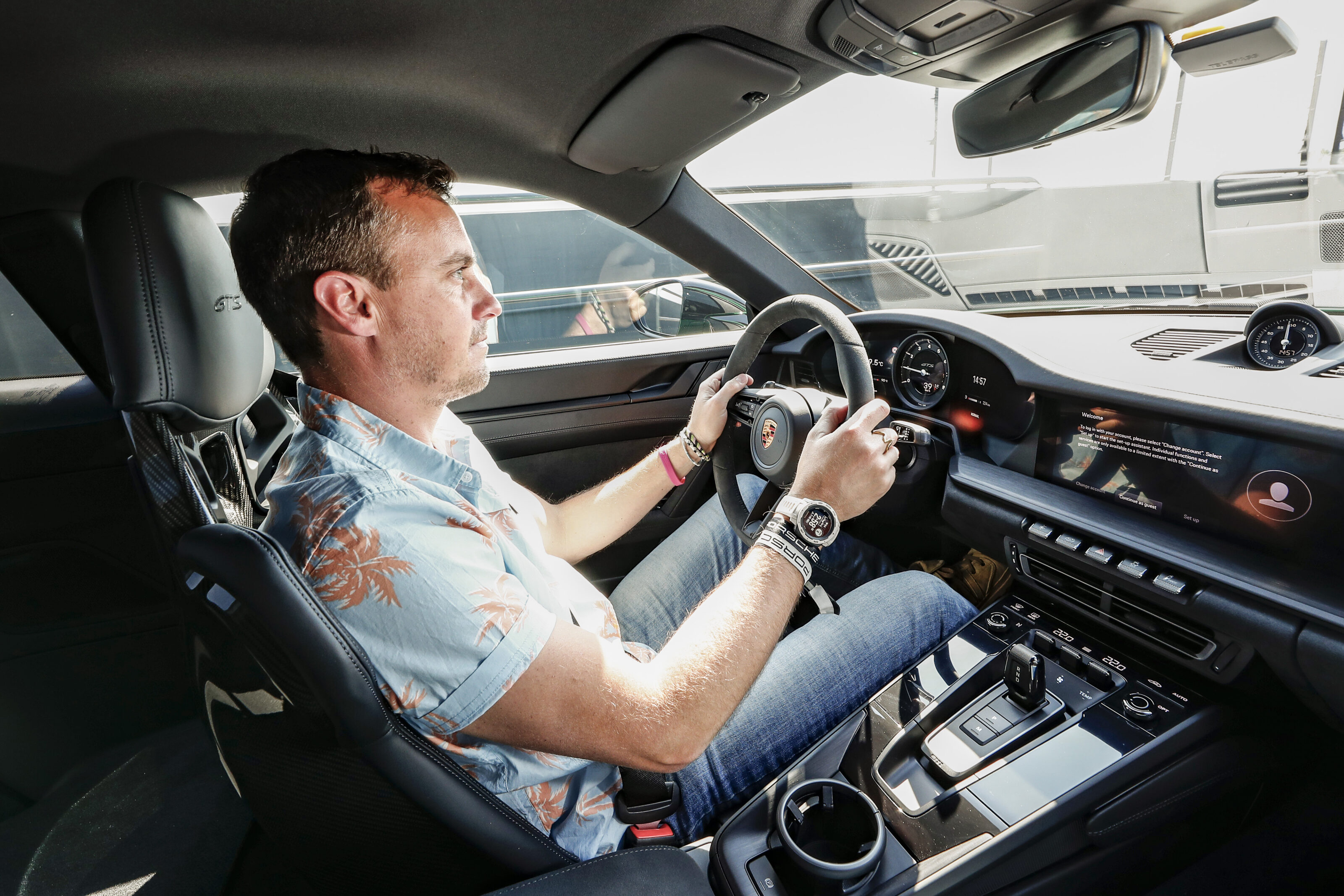
Impressively though, there is a whole other side to its personality which emerges when it cops a sniff of some fresh circuit asphalt. Away from the confines of public road driving, the newest 911 variant is immensely well balanced and hugely rewarding.
From the first contact with the rumble strips, the GTS exhibits steering that is delicate but surgically precise and enables laser-guided positioning on the track. It’s remarkably easy to drive smoothly from exit to apex but still has enough mongrel to make you work for the most rewarding laps. As this version is the all-wheel-drive 4, the potential for understeer in heavy hands is ever-present but with the correct line, the 911 carries immense speed through corners.
Away from the confines of public road driving, the newest 911 variant is immensely well balanced and hugely rewarding.

There’s huge confidence to trail-brake deep into bends with a typically firm and progressive Porsche pedal feel, and accelerating on straights is glorious thanks to an exhaust note in Sport mode and above that is almost offensively loud – but glorious. It’s also accompanied by brilliant whistles and hissing from the complex turbo system as the dump valves and impellers breathe noisily in your ears.
Power delivery from the turbo six is remarkably un-turbo like, with immediate torque whenever it’s required and its pairing with the DCT is a match made in heaven. Sadly, the manual-style shifter of the 991 GTS that allowed gear changes in tight corners is gone in favour of a little toggle – the only thing that left a yearning for the optional manual.
But when the laps were over, the GTS returned to the regroup with perfect composure. No brake fade, no warning lights, engine temp normal and a smiling driver.

If you love what the base 911 Carrera represents then you’ll adore the GTS. It’s not that it is substantially better than the most affordable 911 because trying to define the ‘best’ 911 is to approach the range in the wrong way.
The GTS simply offers more of what makes the 911 so good. It’s just a little faster and louder without spoiling the power delivery, it’s that little bit sharper on the road without compromising comfort, and it adds small luxury touches without becoming vulgar.
Think of the 992 family like choosing popcorn at the cinema. If you love it, just get more.
2021 Porsche 911 Carrera 4 GTS specifications
| Engine | 2981cc flat six, dohc, 24v, twin-turbo |
|---|---|
| Max power | 353kW @ 6500rpm |
| Max torque | 570Nm @ 2300-5000rpm |
| Transmission | 8-speed dual-clutch |
| Weight | 1595kg (unladen) |
| 0-100km/h | 3.3sec |
| Fuel Economy | 9.7L/100km |
| Price | TBC |
Is there anything more tedious, in the entire automotive firmament, than a manual gearbox fundamentalist? These absolutists are up there with swivel-eyed Elon Musk jocksniffers and pedants who can only find true happiness in informing you that you’re cleaning your car incorrectly.
A true manual gearbox fundamentalist will never accept that there are times when an automatic transmission makes more sense because a manual is just better, obviously. End of.
Blissfully unencumbered by the shackles of nuance yet armed with an encyclopaedic repertoire of 20-year-old Clarkson rejoinders, they’d hate the two cars lined up before us. Because, they’d know that of all the genres of cars that need manual gearboxes, hot hatches are right at the top of that pile, nosing just ahead of Everything Else. And, for a while, all was good with the Hyundai i30 N.
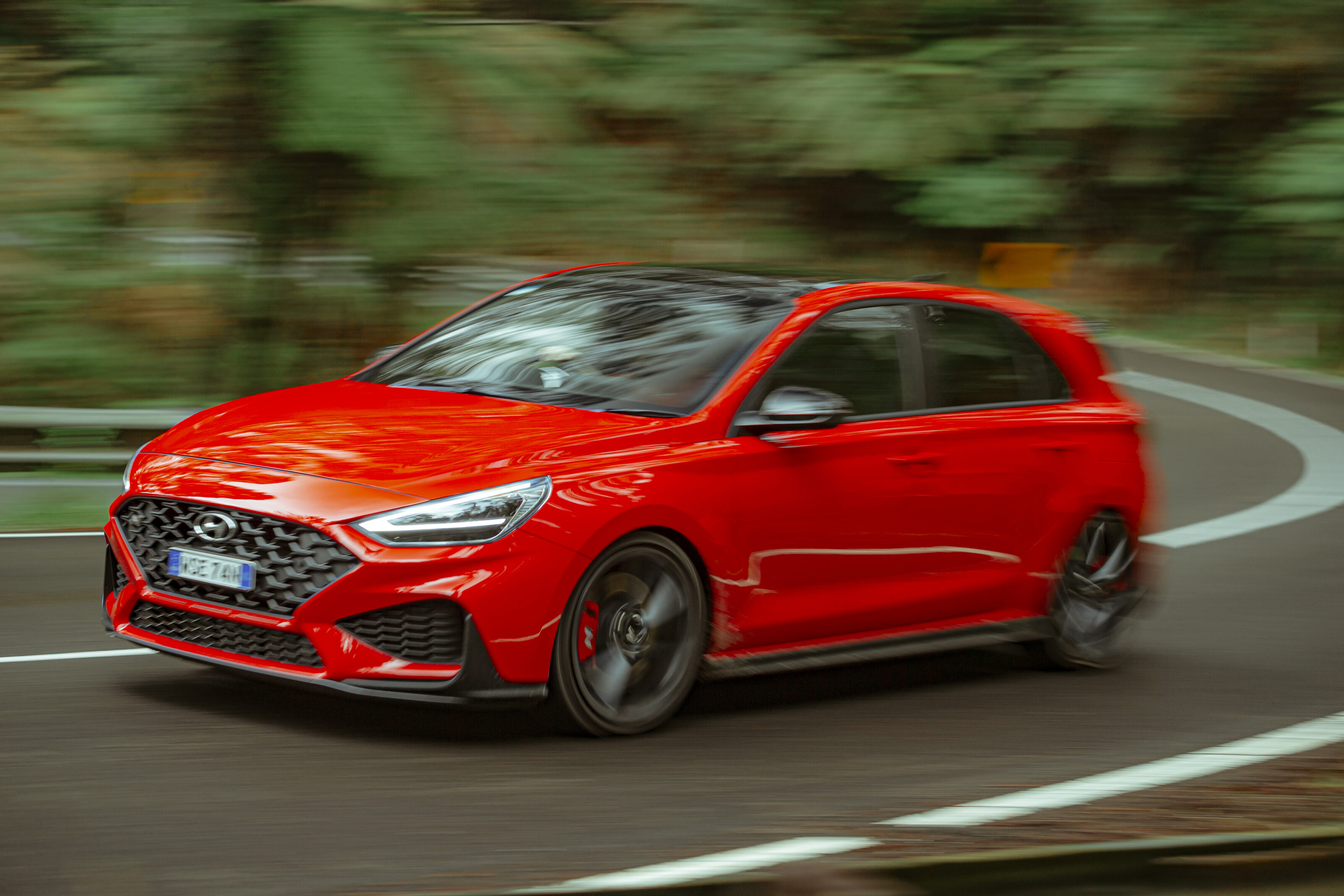
When the Koreans launched the original version back in 2017, a six-speed manual was the sole transmission choice. It was a good ‘un too, slick and wristy with an auto-blip function if your heel-and-toe downchanges needed some polishing.
We’ve all seen the stats though. Only around 3 per cent of Australian cars are sold with manual gearboxes, so if Hyundai wanted to broaden the appeal of the i30 N, something clearly needed to be done.
Just not very quickly. Fast forward four years and we now have the eight-speed dual-clutch version of the i30 N. That would be worthy of note if that was all that had happened to the i30 N, but it isn’t.
On the sly, Hyundai has been through the car, effecting some fairly fundamental changes. Most obviously, the car has been treated to a bit of Botox, with updated LED lights and a revised grille.
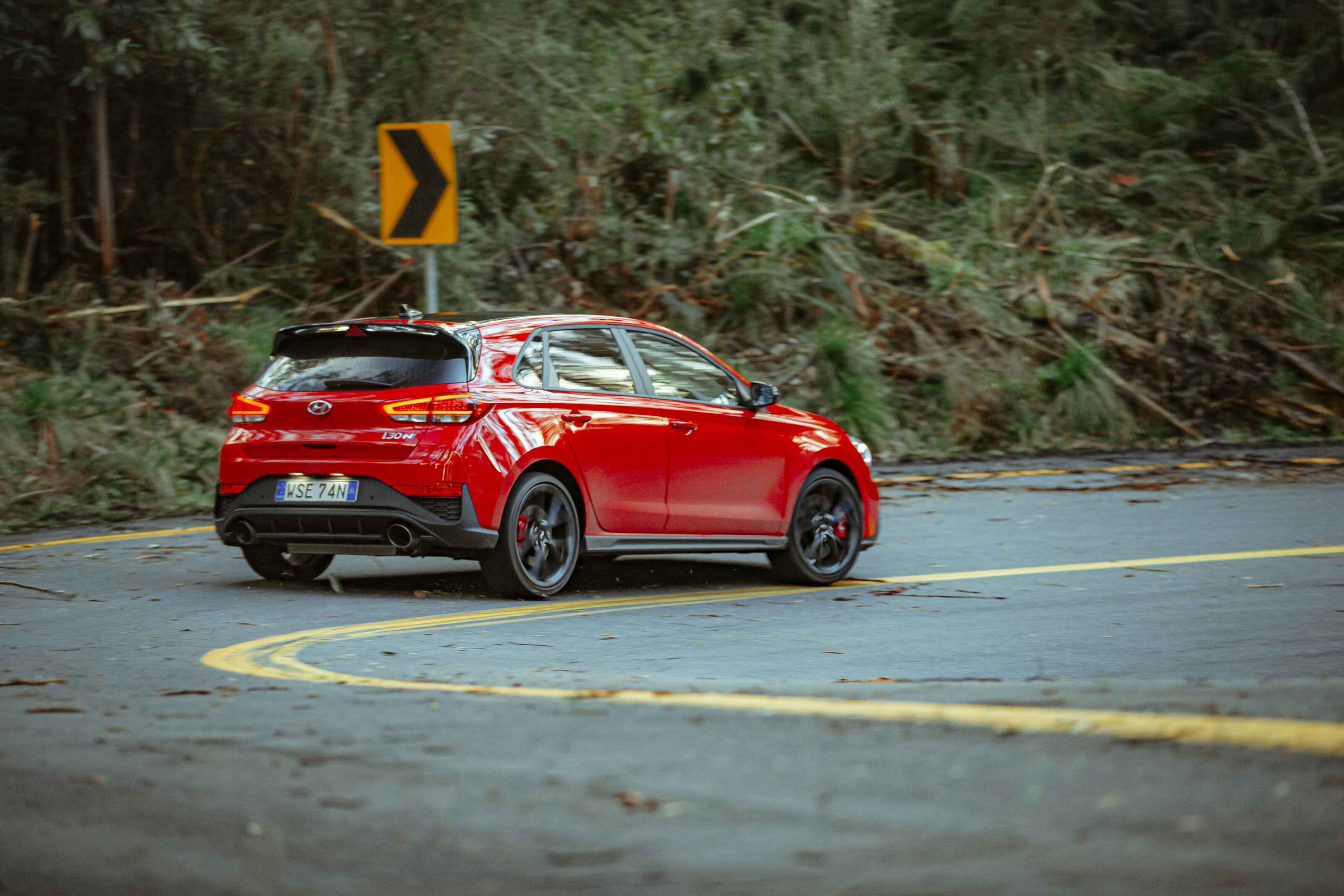
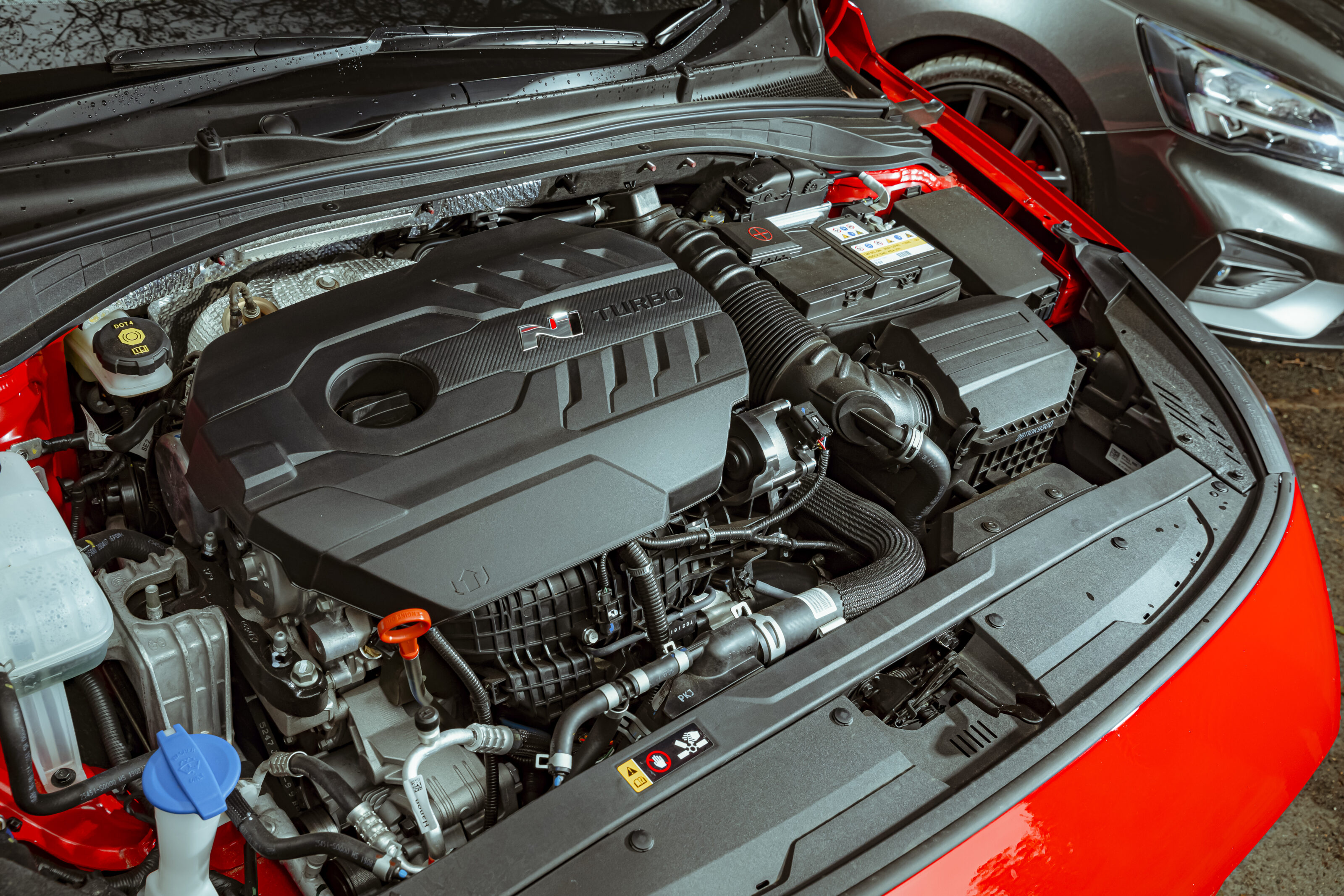
More significantly, the 2.0-litre T-GDi four-cylinder engine has been given a massage, releasing an additional 4kW for a total of 206kW and a hefty torque bump of 39Nm to 392Nm. The updated engine mapping promises a ‘flat power’ philosophy, but the old motor made its 353Nm peak torque figure from just 1450rpm, both tailing off at 4700rpm.
Thanks to its launch control and almost instant upshifts, the DCT version is markedly quicker from a standing start than the manual, shaving half a second of the three-pedal car’s 0-100km/h time, recording a crisp 5.4 seconds.
Rather than merely plug a laptop and the cleverest kid the N Division could find into the i30 N DCT, Hyundai has applied itself a little more diligently. The engine block has been strengthened courtesy of smarter machining techniques, the 6.5-litre intercooler is swapped out for a high-flow 6.8-litre item and a larger turbocharger debuts, drawing on development work from Hyundai’s own World Time Attack racer.
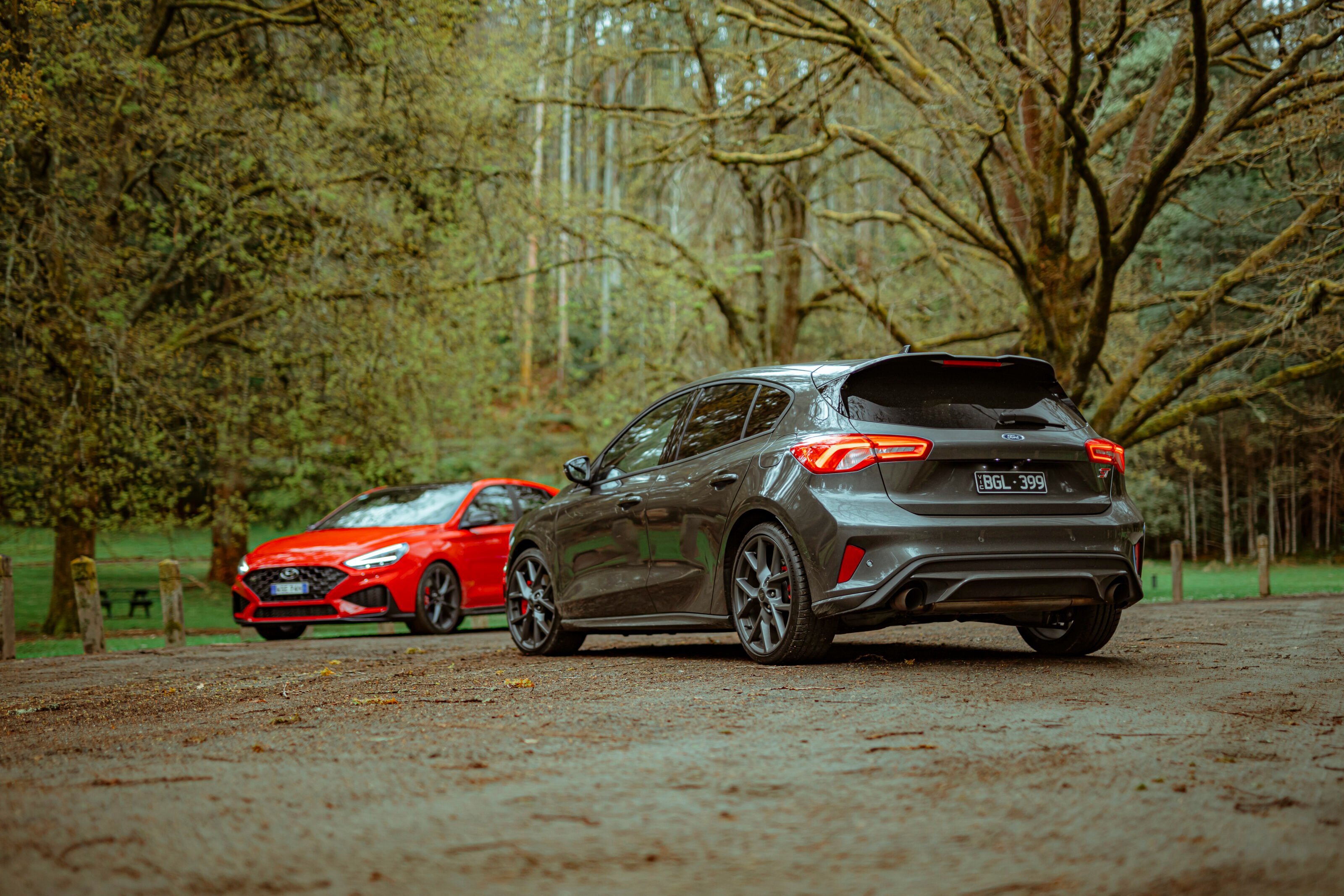
There’s more. We’ll come to that later, because Scott Newman has just arrived in a Ford Focus ST automatic. I ask how he likes it. He blows his cheeks out, raises his eyebrows and notes that on the wet roads en route to our Yarra Ranges rendezvous point it’s all been a bit lively. That’s certainly one way to wake up.
There’s none of the delayed gratification about the auto version of the ST. It was launched at exactly the same time as the manual version and accounts for around 25 per cent of all Focus ST orders. Whereas the i30 N ladles another $3000 on for the privilege of the DCT’s smarts, both manual and automatic Focus STs are priced identically at $44,690.
You be the judge of whether Ford are coining it from the 75 per cent of buyers who choose three pedals. While we tend to mentally pigeonhole the i30 N as a $40k car, this version, the Premium with sunroof wears a $52,000 price tag. Advantage Ford.
At this point, we need to talk weight. The Hyundai i30 N DCT weighs in at 1466kg, with the DCT accounting for 33kg extra over a manual. The Ford tips the scales at 1487kg, of which the torque-converter auto adds 26kg versus the three-pedal version. Hyundai makes great play of taking weight out of the latest i30 N. This Premium model comes with manually adjustable bucket seats that are 2.2kg lighter than the standard seats.
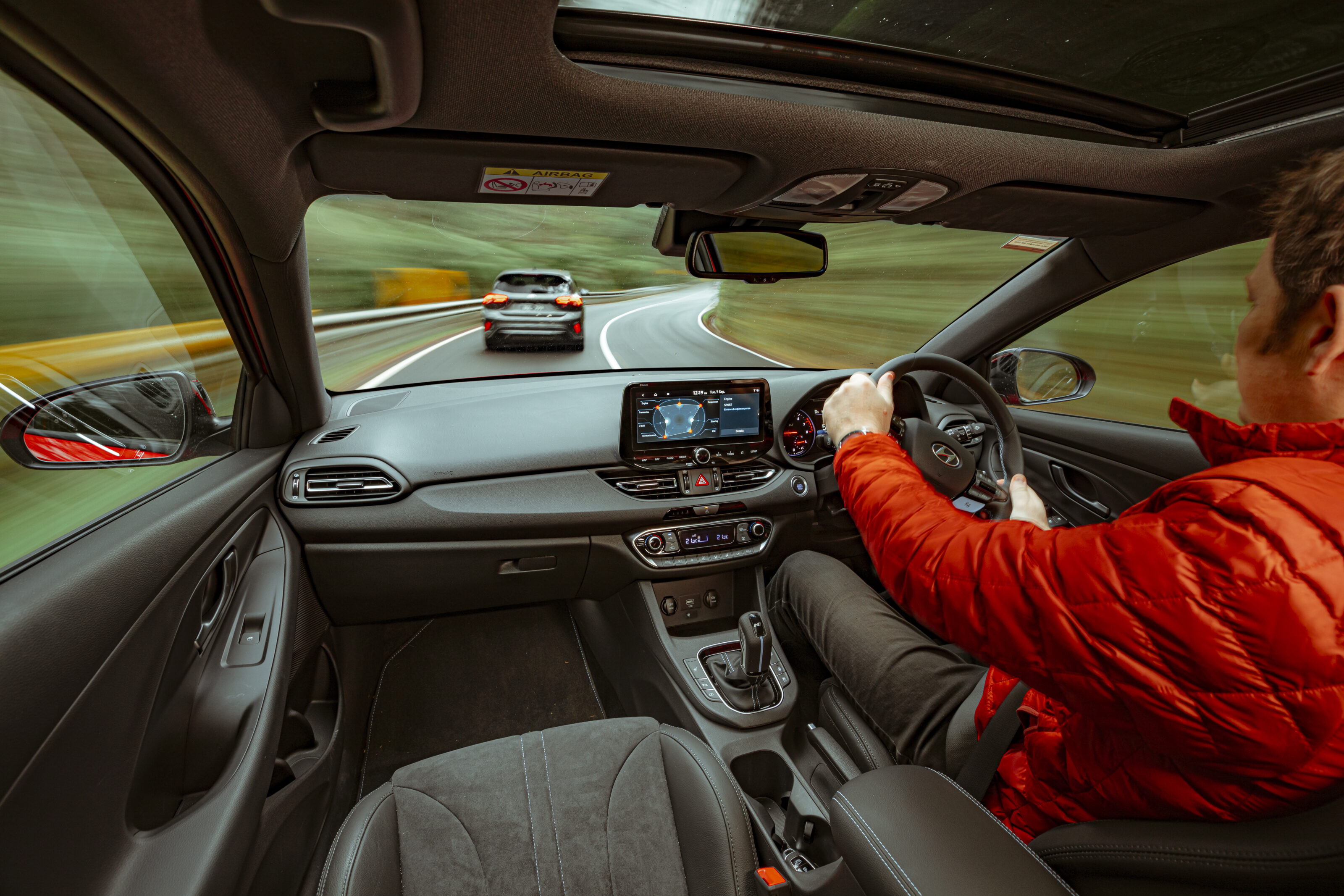
It also gets a new design of forged rather than cast alloy wheels that shaves 3.6kg of unsprung mass from each corner. It’s a shame that this car ruins that good work by sitting a huge pane of glass and a bunch of electric motors above your head, in precisely the worst place from a dynamics perspective. What’s more, it compromises headroom, forcing taller drivers to rake the seat back to fit. Do yourself a favour when choosing an i30 N. Leave the panoramic roof to those buying a Staria.
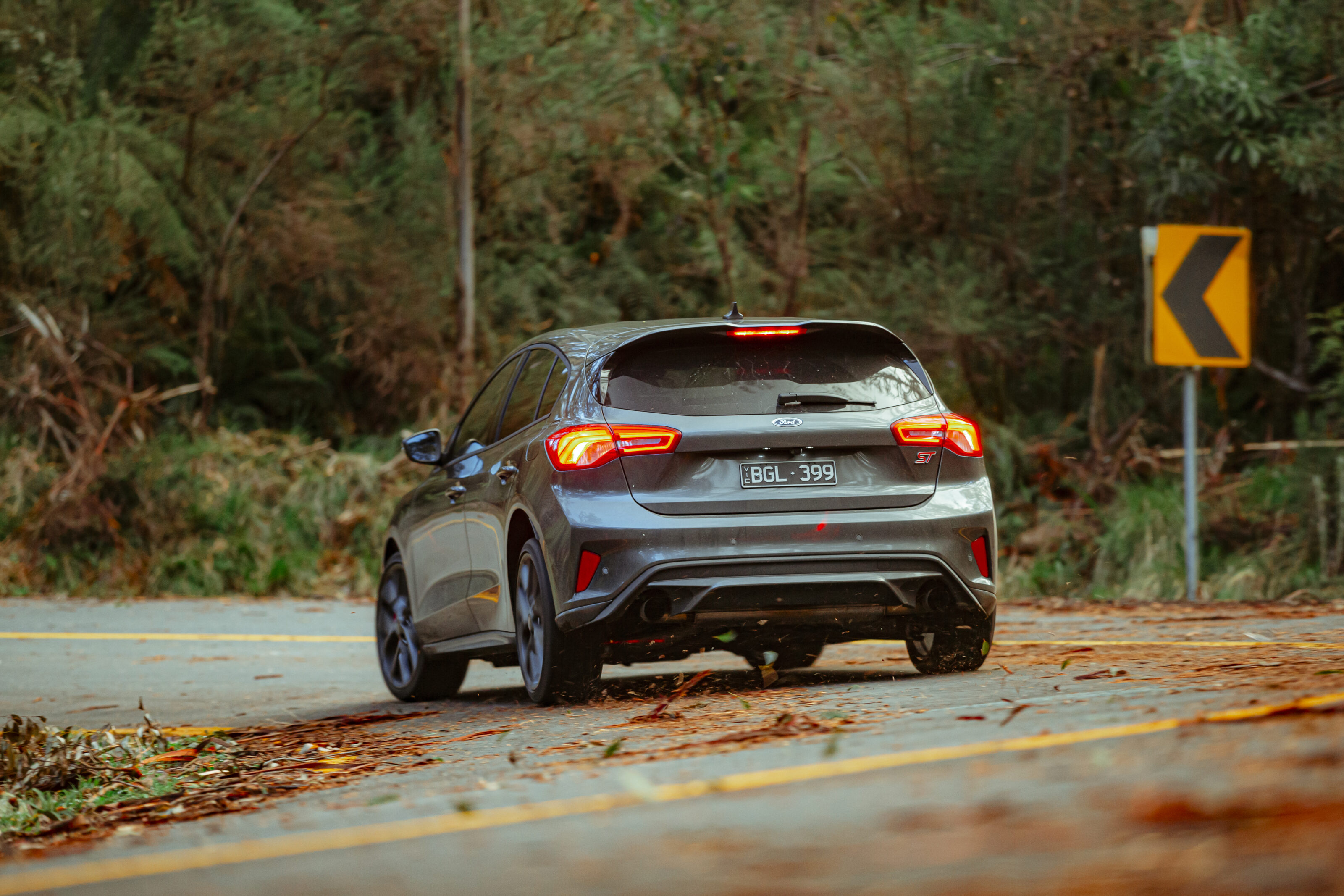
It’s been raining on and off today. It’s the sort of rain that lingers on the road beneath overhanging trees, fine misting your screen to the point where automatic wipers just become an annoyance.
You’ll forget that it’s been raining at times, only to step from the car into a sucking gloop of mud. That sort of rain. Normally that would mean a day spent trying to wear out the traction control light in powerful hatches like these, but both the Focus and the i30 are relishing these ever-changing high country conditions.
The Focus feels more explicitly front-driven. I’m trying to imagine the coding for the electrically adjustable power steering software that feeds back wheel fight under torque steer, a long list of conditions based on disturbance magnitude and direction.
The chubby wheel bucks in your hands as the 235mm-wide front Pilot Sport 4S tyres try gamefully to apportion torque evenly. There’s a slightly gluey feeling just off-centre, a rubbery and strong return to the Focus’ steering that I don’t remember when driving the manual, a car that isn’t fitted with a lane-keep assist system.
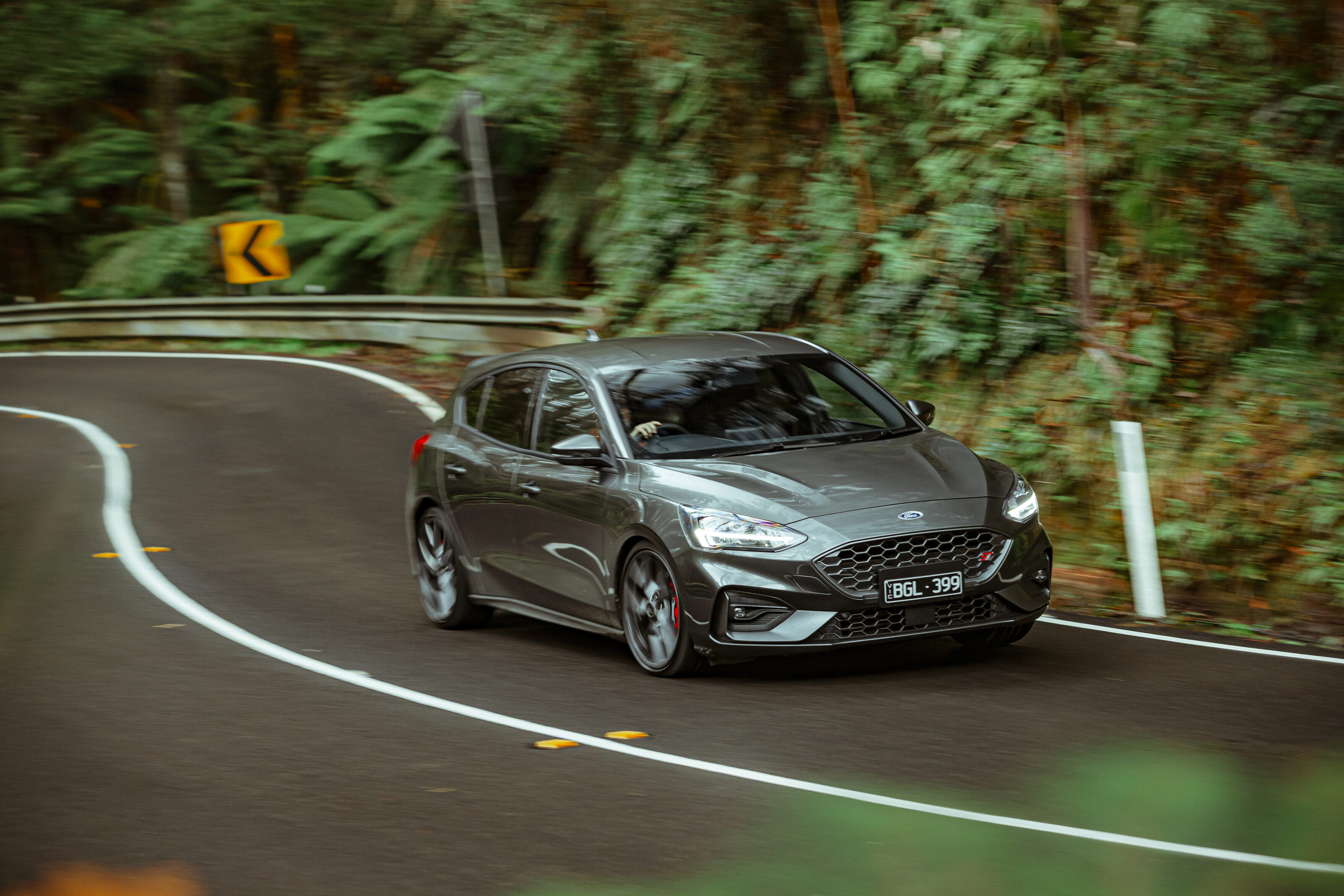
An electronically actuated mechanical limited-slip differential is fitted. This utilises an electronically locking clutch that can vary its level of lock in order to sniff out traction.
Make no mistake, in real world conditions, the automatic version of the Focus ST will step off the line quicker than the manual car, despite the fact that Ford has inexplicably not fitted it with a launch control function. It feels brawnier than the Hyundai punching out of corners too, thanks to its objective torque advantage and the subjective wheel fight and gutsy acoustics.
The Hyundai feels a little reedier, the soundtrack a little more synthetic, the steering lighter. There’s not that muscularity or heft to it that the Focus has in spades, but it’s no less effective. The steering, at an identical 2.1 turns lock-to-lock, is more accurate than the Ford’s, allowing you to position the car more confidently.
There’s not much to choose between the two in terms of braking power, but the i30’s left hand pedal is easier to modulate, the ST’s servo assist meaning that it does most of its best work in a short swing of the pedal’s arc. It’s also worth mentioning that if you’re a habitual left-foot braker, the pedal box of the i30 N is preferable as the Ford offsets the two pedals further to the right.
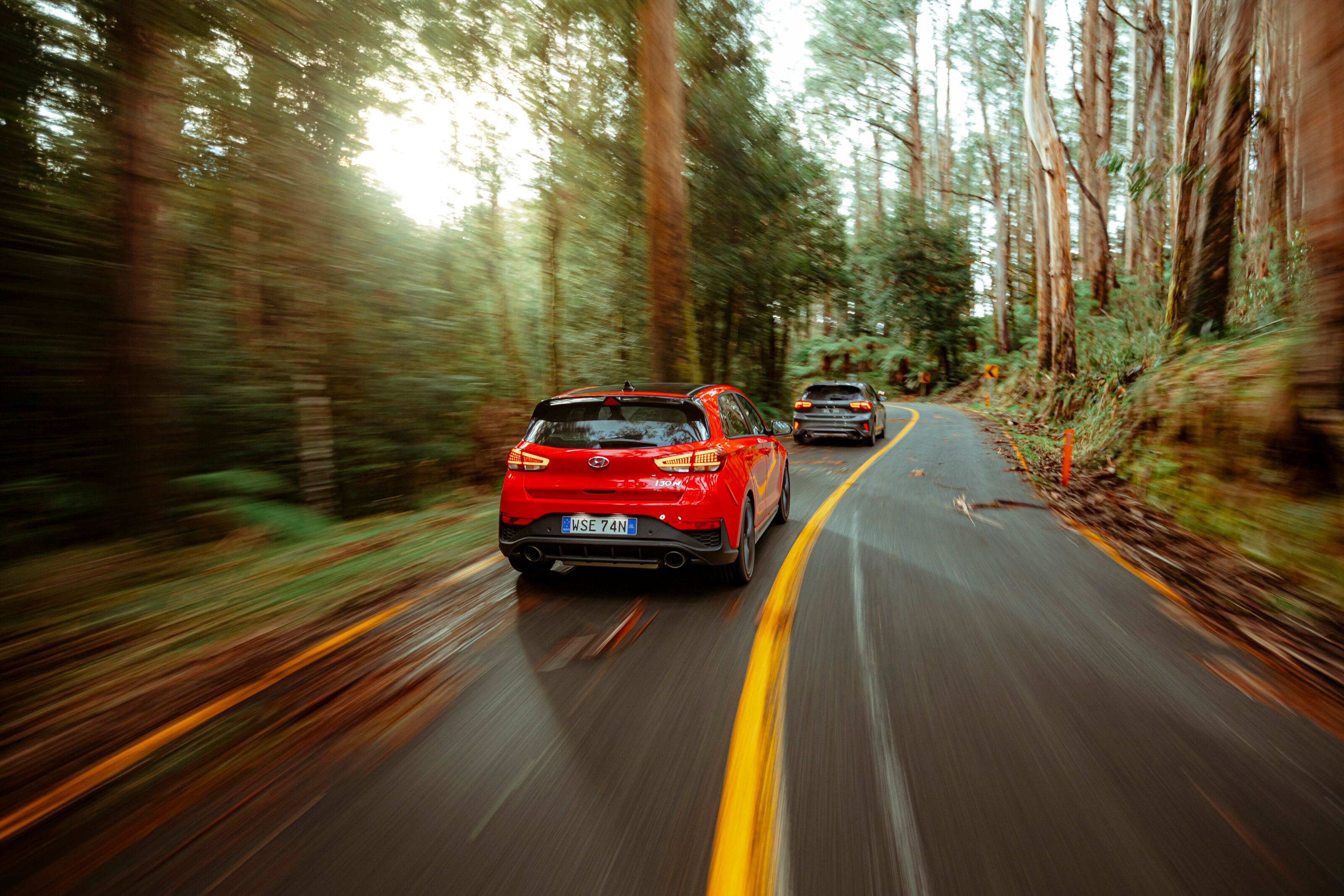
Which of these two very different transmissions works best though? As with most things, the answer is ‘it depends’. Were you to buy the Focus ST to warble about on its bow wave of low-end torque, a trad automatic makes all kinds of sense. And it’s a good installation for that. I’m not anything like as offended by the Focus ST’s rotary gear shifter as I am by one in a Jaguar and it slurs through gears beautifully. Up the ante, however, and a few caveats occur to you.
The drive logic, even when wicked up into Sport mode is a little lazy. Dive into an apex, gather everything up and pin the throttle and you’ll often find yourself in a gear lower than you want.
The acoustics and the ambition don’t match. So you take over the wheel-mounted paddles yourself, flicking the stunted plastic nubs up and down into and out of corners and you come to the conclusion that you’re having a whale of a time, but doing so despite and not because of the transmission.
Would a manual car be more fun? Yes, undeniably. Fizzier, more involving and to heck with it if it’s not quite as sharp as the i30 N.
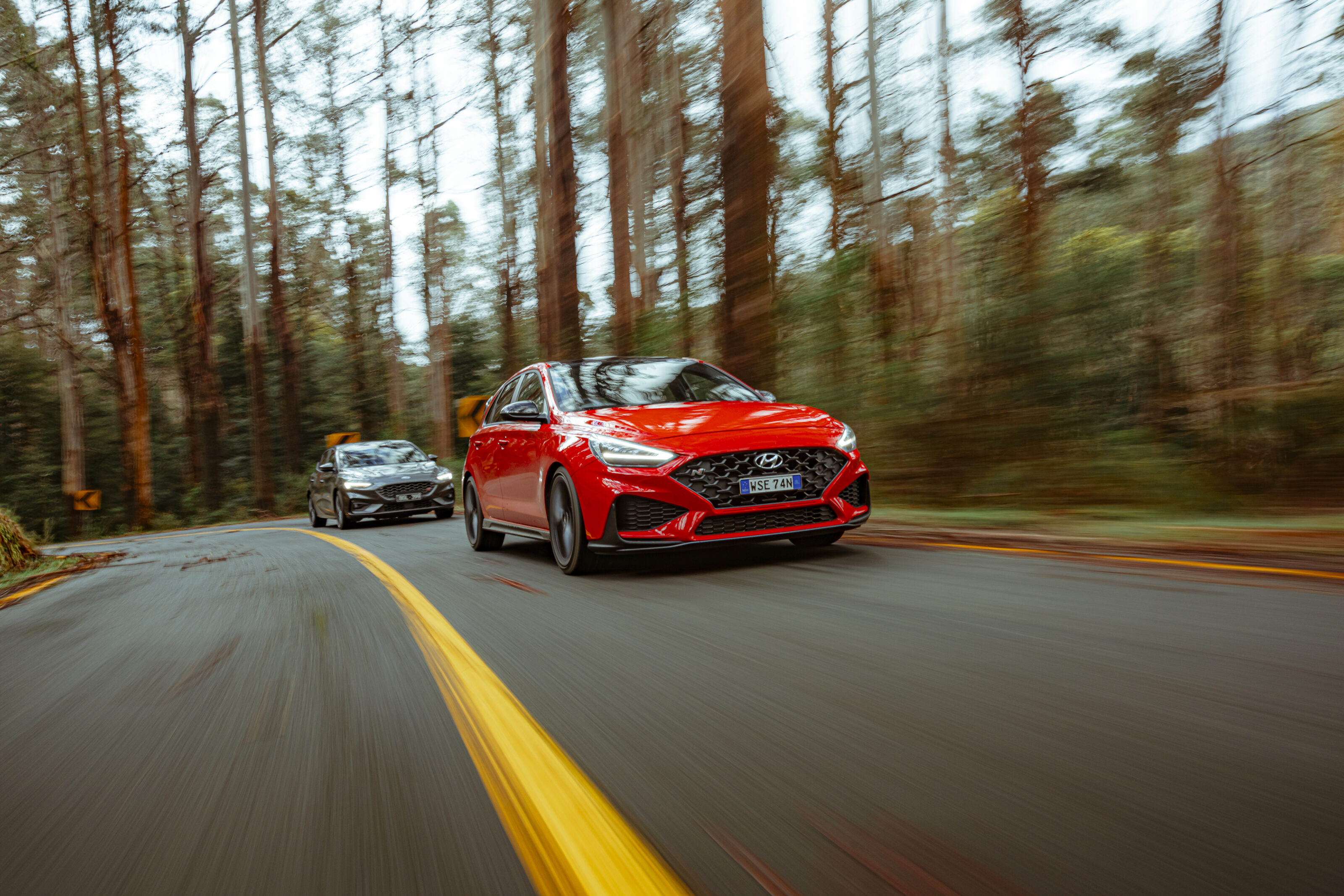
The Hyundai, on the other hand, doesn’t suffer as a result of its ’box. The DCT is whip smart, delivering manual downchanges right up to the redline, where the Focus will build in a safety-first buffer of denial. The Korean car also feels leagues ahead in terms of user choice.
Where the Focus offers Normal, Slippery, Sport and Race drive modes, the Hyundai allows a custom version of its N Mode which is completely user assigned. You can even adjust things on the fly via a ‘spider map’ on the central display. What’s more, the breadth of difference between the i30 N’s most comfortable and most racy modes is so vast that it feels like you’re almost getting two cars for the price of one.
Both of these hatches run on adaptive suspension and, yes, in their most focused mode they can feel a little too firm for poorly surfaced Aussie B-roads. Where the Ford is particularly good, is that the compliance of both the Normal mode and the Sport setting are supple enough to breathe with our roads. There’s real talent in the way the car has enough roll, pitch and dive built in to allow the skilled driver to work weight transfers smartly.
Should you feel so inclined, you can get the ST to lift-off oversteer sharply on the way into corners. Sounds obvious but unlike a wiggle of power oversteer on the way out of a corner, getting out of shape on the way in leaves you a corner to then negotiate and not a straight. Treat the stability control button with the respect it deserves.
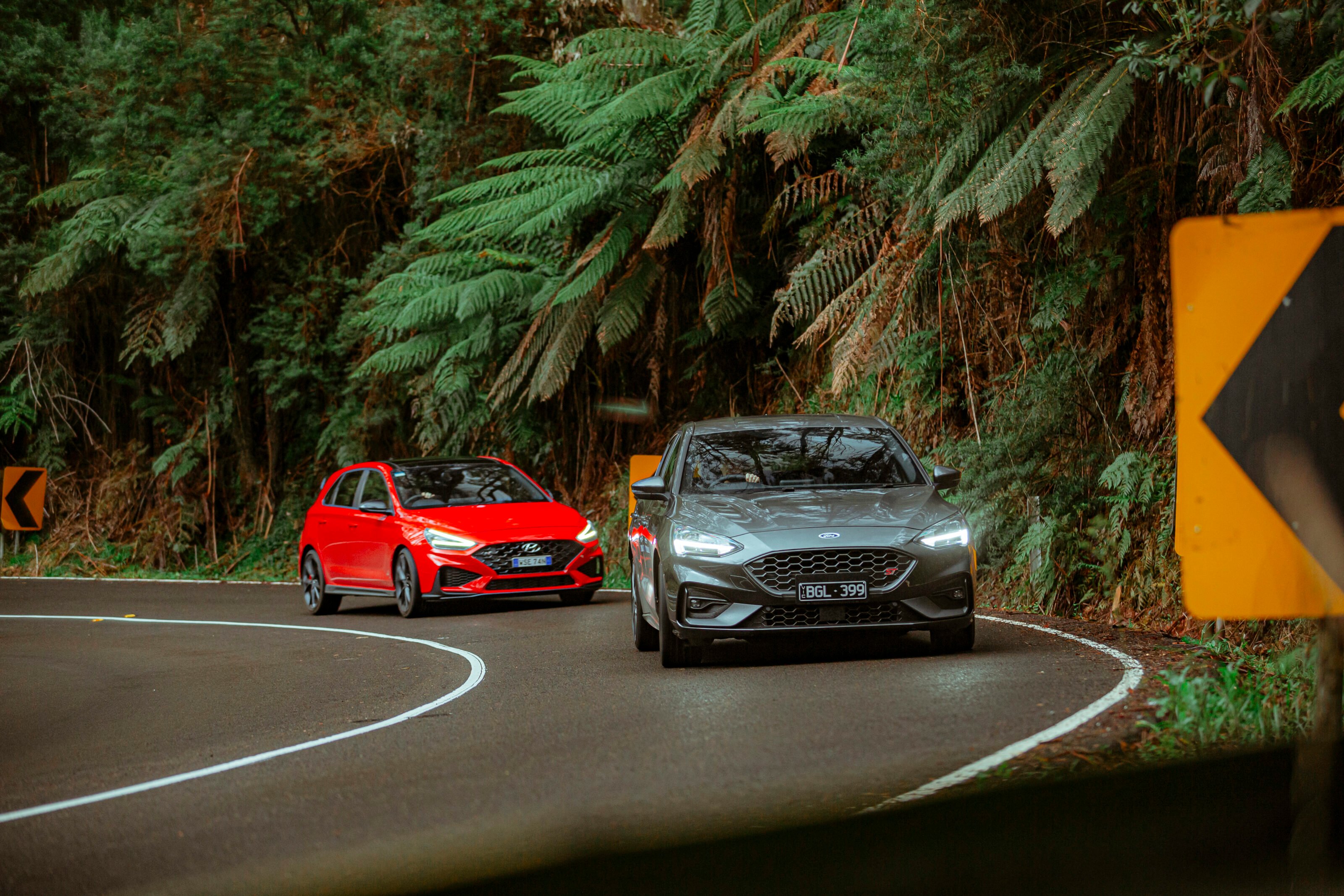
By contrast, the Hyundai i30 N feels flatter and harder in its base setup. You feel as if you can take outrageous liberties with it and in N Mode, the stability control will allow a measure of off-throttle yaw before it decides that perhaps you need saving from yourself.
It would be enormous fun on track though, and Hyundai’s track-ready warranty means that it’s a bit of a no-brainer if you’re trying to choose between these two for weekend circuit excursions.
On road, the Hyundai feels more nimble, the slightly weighty feeling of the old i30 N being massaged away courtesy of a suite of suspension changes that make it feel more sprightly.
N Division has gifted the latest car spring rates that are 5.7 per cent stiffer up front and 4.2 per cent beefier at the rear, revalved dampers, revised rear toe-arms, new bump stops plus redesigned front knuckles and lower control arms that result in additional negative camber at the front.
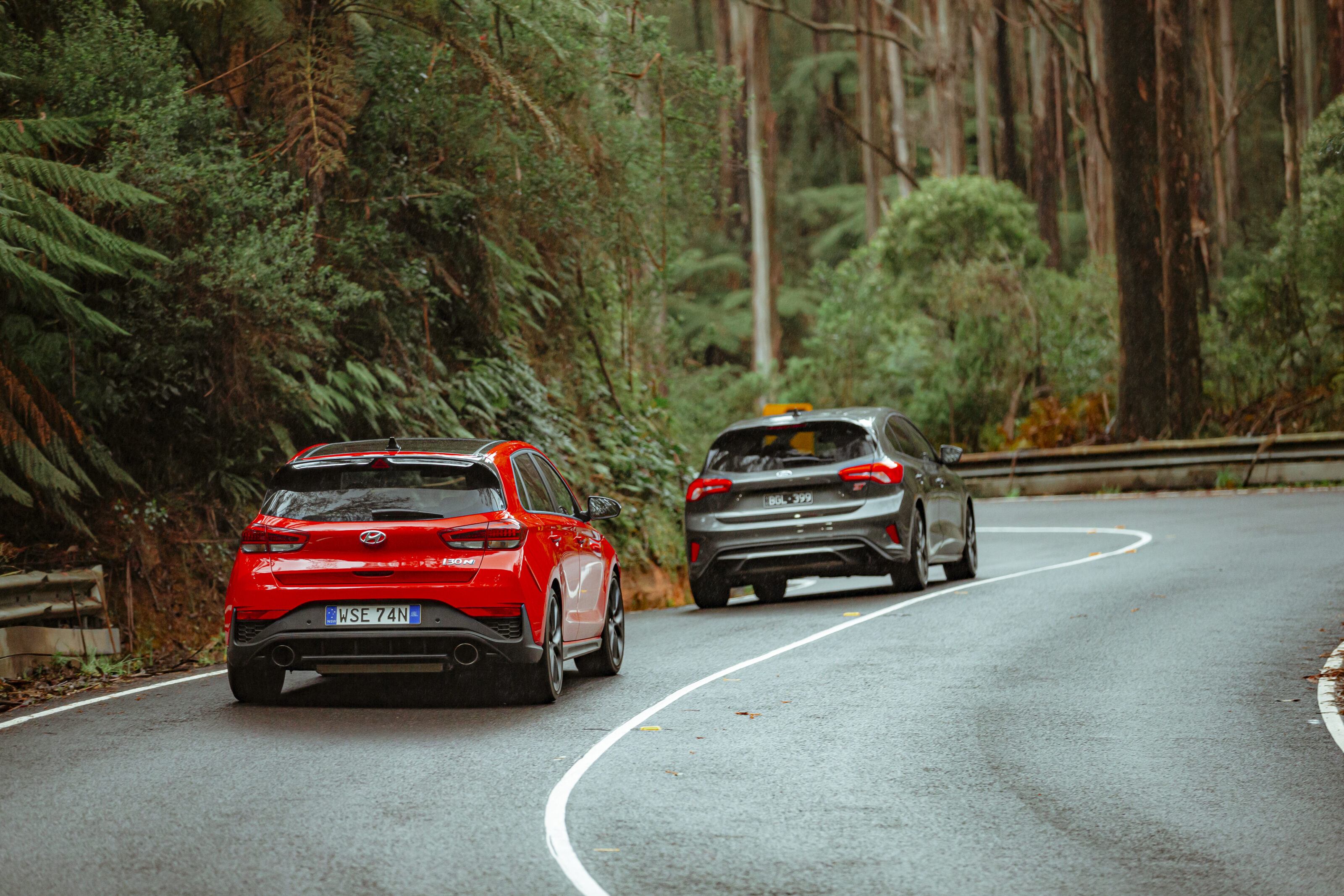
The volume of the exhaust is something to behold, the fusillade of bangs and crackles on overrun being a signature aspect of the original i30 N. That continues with this model. On a mountain road, an approaching i30 N still sounds like Dani Sordo at maximum attack on a special stage.
The N is one of those rare cars which seems to feel better and happier the harder you drive it. You can forgive its low speed truculence and its woeful turning circle just for the moments when you’re able to really extend it. Then you see where Albert Biermann and his team spent the budget.
The new N functions fitted to this are worthy of note. N Power Shift detects when an upshift is asked for when more than 90 per cent of throttle is applied and does its best to imitate the smack of a Lambo’s Corsa upshifts. N Track Sense Shift recognises when you’re driving on track and selects the most aggressive gearshifting map available.
Finally, the execrably titled N Grin Shift, operated via the NGS button on the wheel, gives you a slightly cheesy 20 second countdown with the car dialled into its angriest setting and is designed for executing safe overtaking manoeuvres.
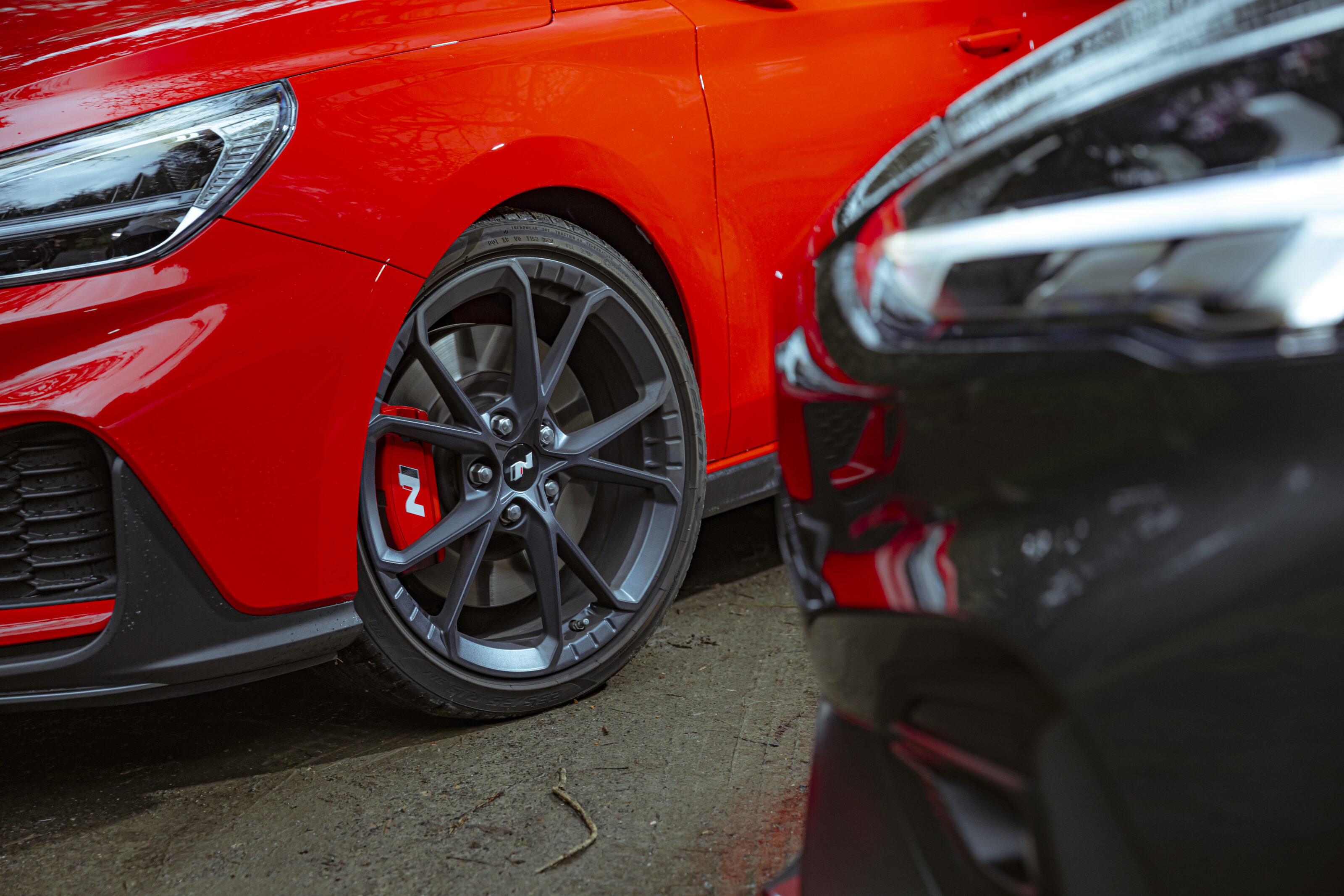
By now you’ll have probably keyed into the fact that the Hyundai i30 N DCT does enough to edge the win here. It’s the more talented car for really keen drivers.
Should you test one and feel that Hyundai’s needle has swung a little too far into the rabid zone, the Focus ST makes a compelling Plan B. That ignores the fact that the i30 N is enhanced by the DCT ’box and the Focus ST loses a little of its magic when shorn of a pedal.
Given the price advantage of the Ford, it pushes the Hyundai close, but Namyang has moved the game on here. Manual gearbox fundamentalists can address the poison pen letters to the usual address.
Clutch move
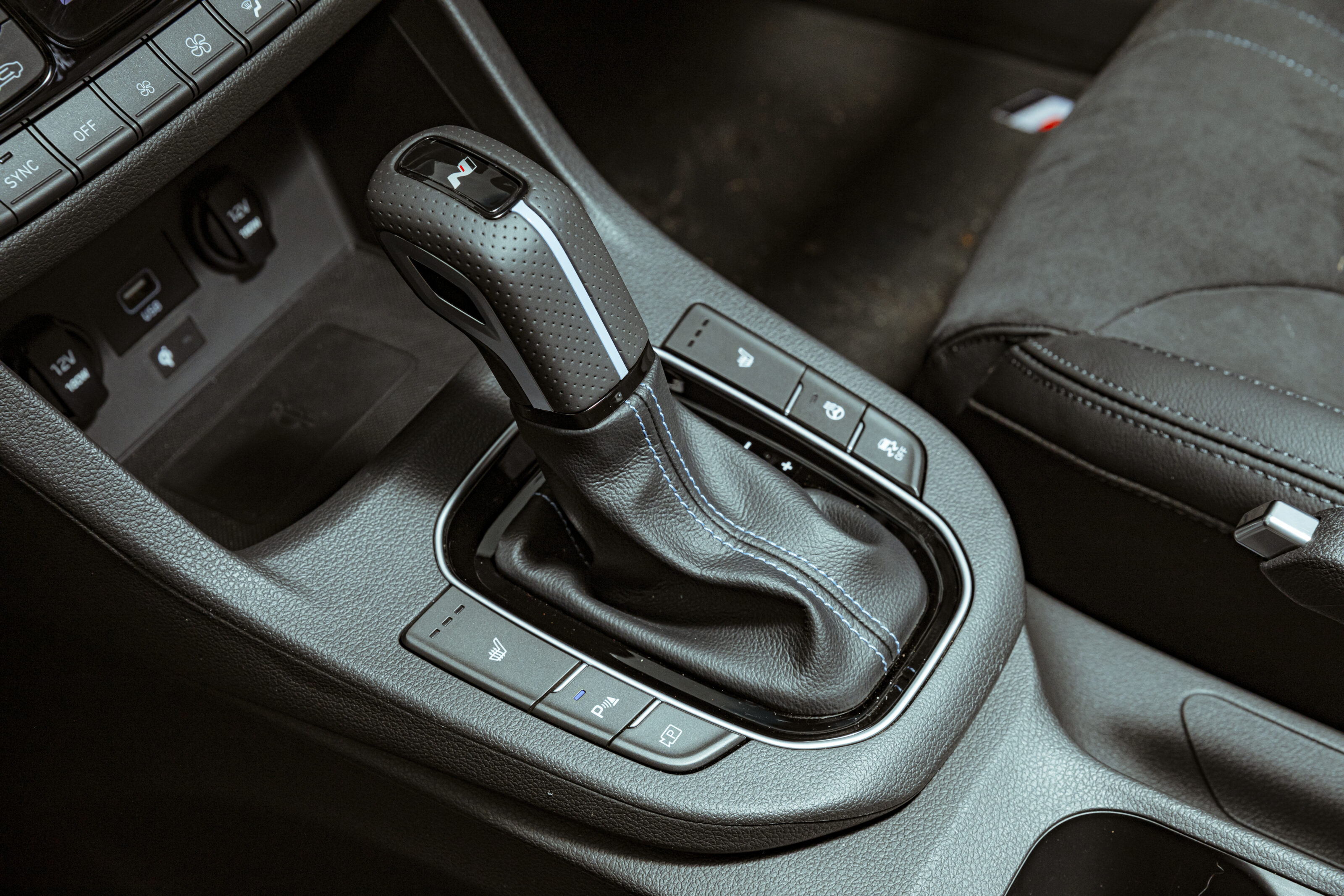
Hyundai has engineered a wet clutch system for its DCT installation on the i30 N. While dry clutch systems are typically used for lower torque applications, the lubricated components of a wet clutch DCT help reduce friction and dissipate heat. Therefore this technical solution is increasingly favoured in any application where thermal robustness and durable shift quality is prioritised.
Wet clutch DCTs can then be divided into those systems that feature a single sump to lubricate both the gears and the clutch and those with a dedicated oil supply to each component. Single sump wet clutch installations require a fluid that combines the gear protection of manual transmission fluid with the clutch friction performance of automatic transmission fluid, balancing torque capacity and shudder durability.
Boxing clever
The Focus ST’s seven-speed auto shares virtually everything with Ford’s pre-existing eight-speed unit, as seen in products such as the Ford Edge. In effect, Ford has installed a software parameter that forces the ST to overlook the eight-speed’s second gear.
Surely more gears mean more performance? Not so, says Ford of Europe’s communications manager Finn Thomasen. “The enhanced power and torque of the 2.3-litre EcoBoost engine makes the standard second gear ratio redundant, therefore it is removed for the Focus ST to optimise gear differentiation for performance.”
SCORING
i30 N DCT: 9/10
Focus ST auto: 8/10
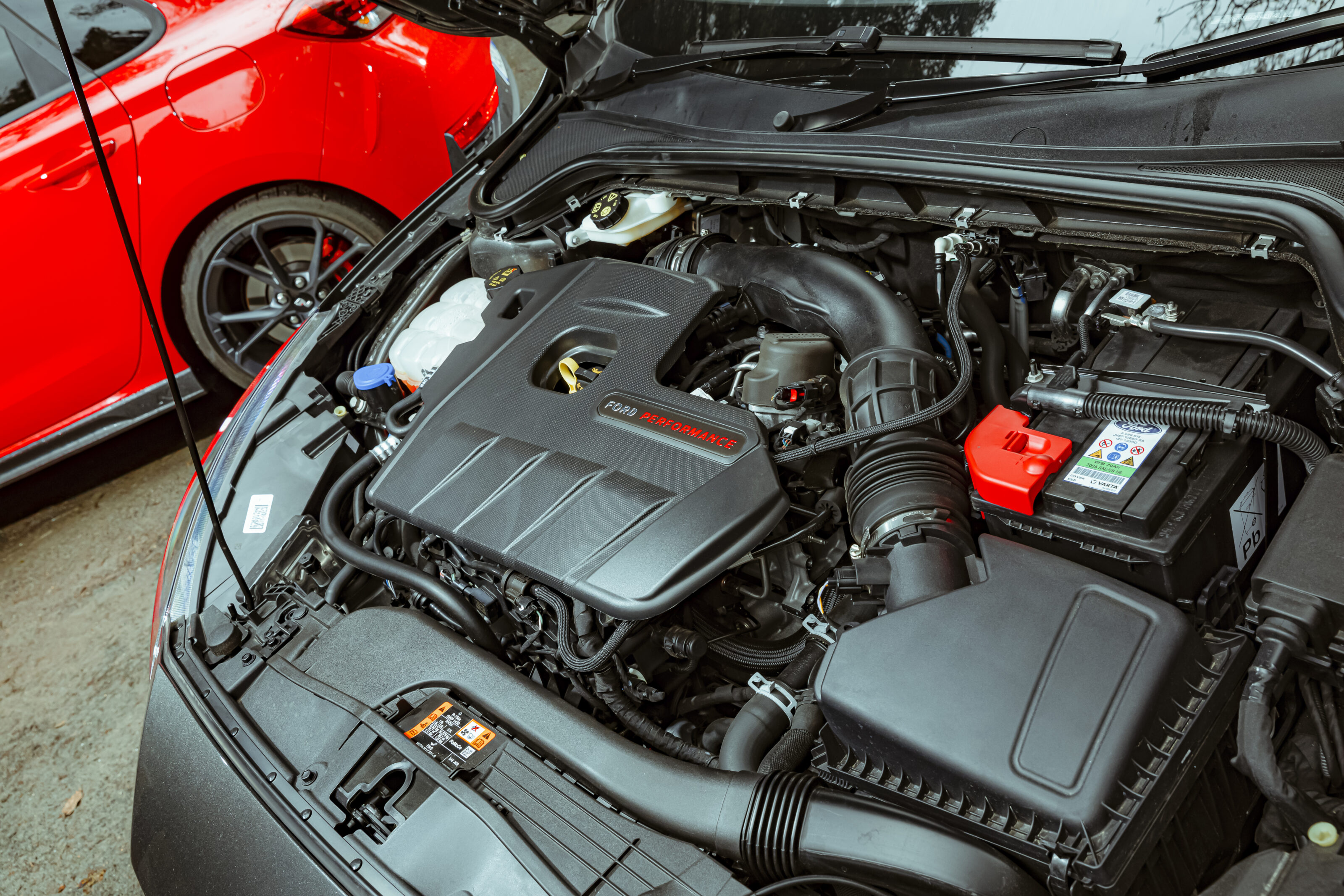
2022 Hyundai i30 N DCT specs
| Body: | 5-door, 5-seat hatch |
|---|---|
| Drive: | front-wheel |
| Engine: | 1998cc inline-4, DOHC, 16v, turbo |
| Bore/stroke: | 86.0 x 86.0mm |
| Compression: | 9.5:1 |
| Power: | 206kW @ 6000rpm |
| Torque: | 392Nm @ 2100-4700rpm |
| Power/Weight: | 141kW/tonne |
| 0-100km/h: | 5.4sec (claimed) |
| Weight: | 1466kg |
| Transmission: | 8-speed dual-clutch auto |
| Suspension: | struts, coil springs, adaptive dampers, anti-roll bar (f) multi-link, coil springs, adaptive dampers, anti-roll bar (r) |
| L/W/H: | 4455/1795/1419mm |
| Wheelbase: | 2650mm |
| Tracks: | 1573/1564mm |
| Steering: | electrically assisted rack-and-pinion |
| Brakes: | 360mm ventilated discs, 4-piston calipers (f); 314mm solid discs, single-piston caliper (r) |
| Wheels: | 19 x 8.0-inch (f/r) |
| Tyres: | 235/35 R19 91Y (f/r) Pirelli P Zero HN |
| Pros: | Sharp dynamics; quicksilver DCT; clever drive modes |
| Cons: | Firm ride; getting expensive; pop-bang map can be divisive |
| Price: | $52,000RRP (Premium with sunroof) |
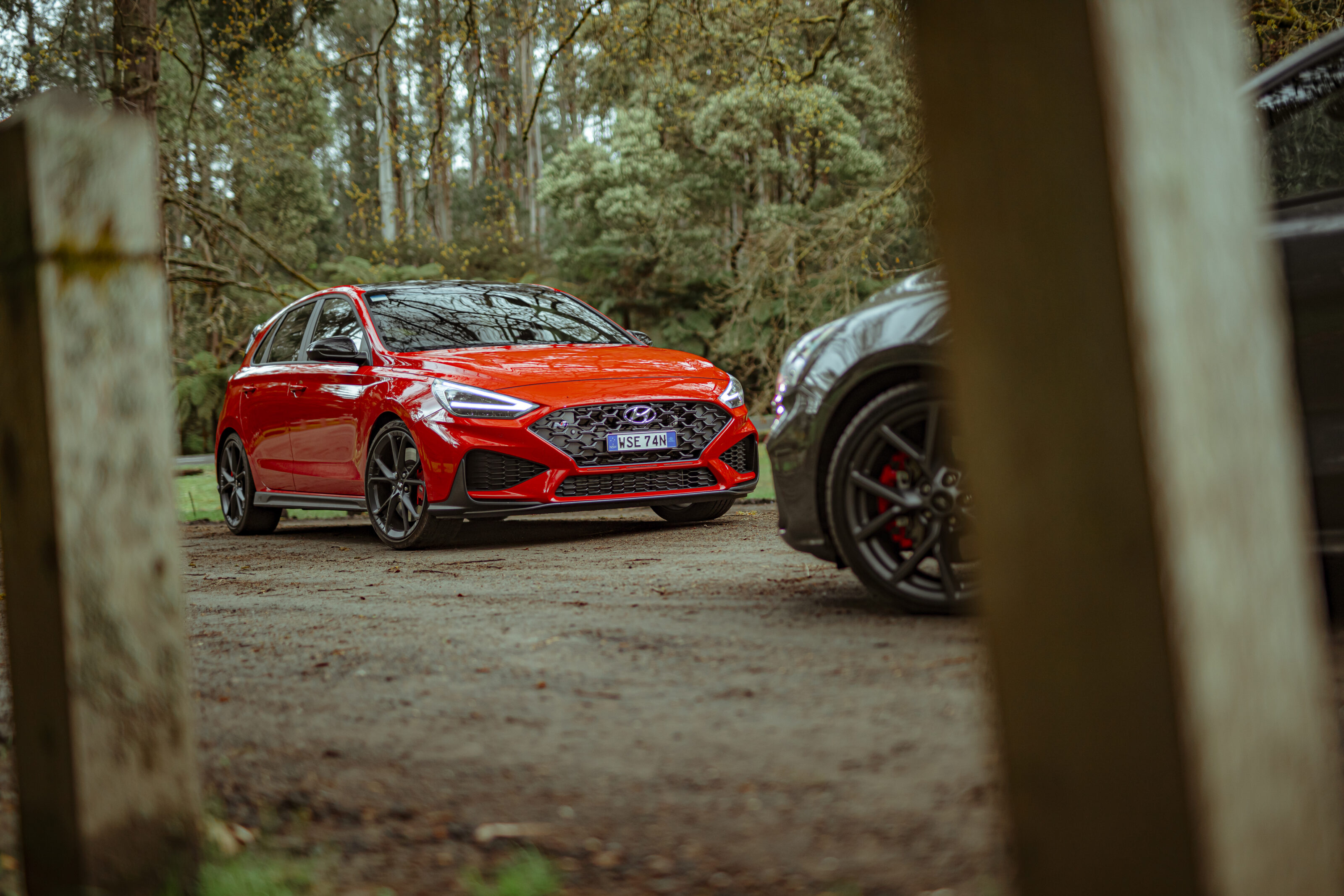
2022 Ford Focus ST Auto specs
| Body: | 5-door, 5-seat hatch |
|---|---|
| Drive: | front-wheel |
| Engine: | 2261cc inline-4, DOHC, 16v, turbo |
| Bore/stroke: | 87.5 x 94.0mm |
| Compression: | 9.7:1 |
| Power: | 206kW @ 5500rpm |
| Torque: | 420Nm @ 3000-4000rpm |
| Power/Weight: | 139kW/tonne |
| 0-100km/h: | 5.9sec (claimed) |
| Weight: | 1487kg |
| Transmission: | 7-speed auto |
| Suspension: | struts, coil springs, adaptive dampers, anti-roll bar (f) multi-links, coil springs, adaptive dampers, anti-roll bar (r) |
| L/W/H: | L/W/H: 4388/1825/1458mm |
| Wheelbase: | 2700mm |
| Tracks: | 1561/1566mm |
| Steering: | electrically assisted rack-and-pinion |
| Brakes: | 330mm ventilated discs, 4-piston calipers (f); 302mm ventilated discs, single-piston caliper (r) |
| Wheels: | 19 x 8.0-inch (f/r) |
| Tyres: | 235/35 ZR19 91Y (f/r) Michelin Pilot Sport 4S |
| Pros: | Gutsy engine; great ride; mid-corner adjustability; pricing |
| Cons: | Auto drive logic; cabin refinement; manual feels smarter |
| Price: | $44,690 RRP |
Snapshot
- Only 2020 build models affected
- 17 units under recall
- Airbags may be delayed in deploying
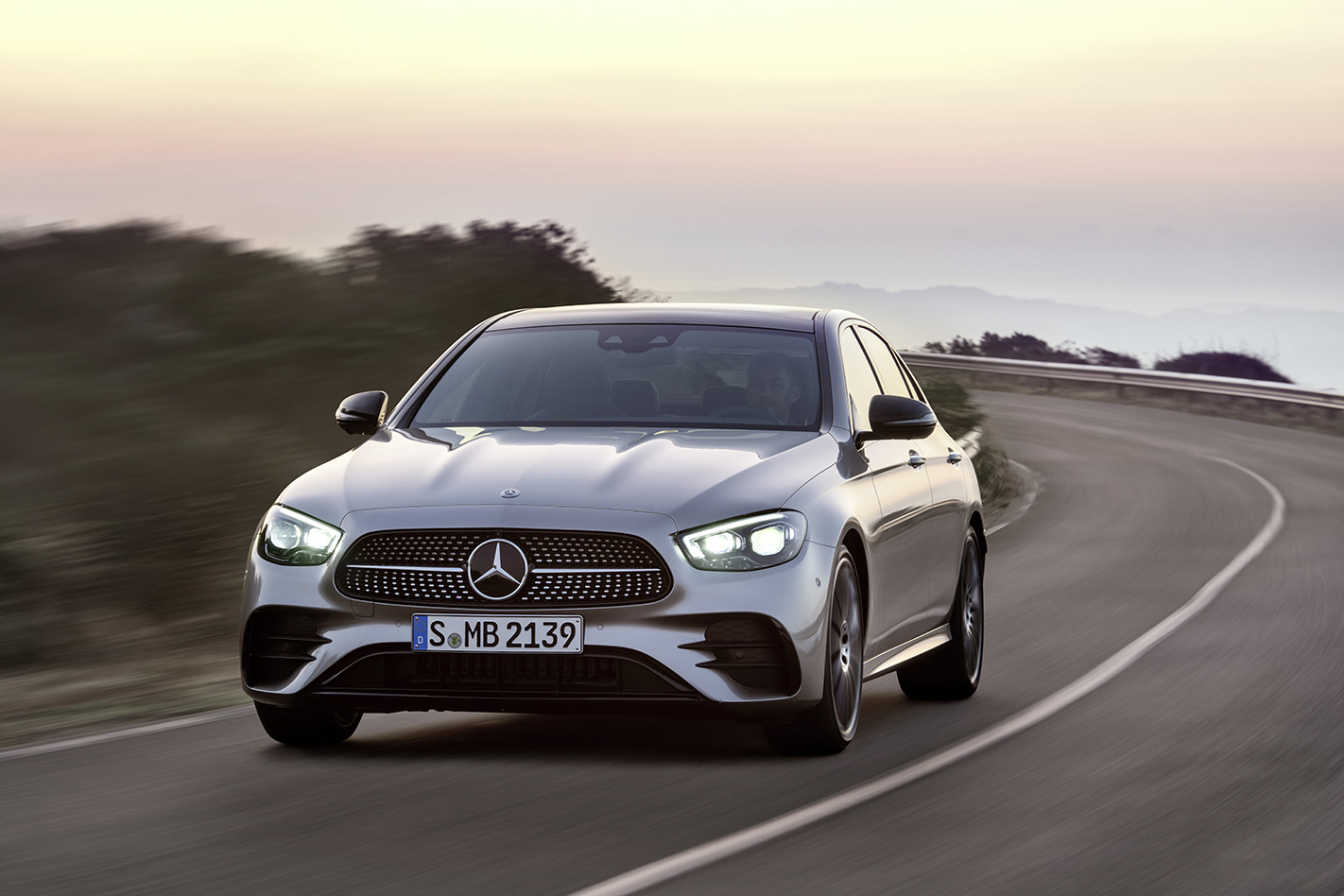
Mercedes-Benz has issued a recall for three of its models, affecting 2020-build GLC, E-Class and EQC vehicles.
A total of 17 units have been placed under notice due to electrical connectors on the side crash sensors potentially not meeting manufacturing specifications, leading to a possible delay in the deployment of the vehicle’s airbags.
If the sensors fail to trigger the airbags in time, this could lead to an increased chance of injury in the event of an accident.
Mercedes-Benz is currently working with owners of affected vehicles to rectify the issue free of charge, also encouraging anyone who is unsure about whether their vehicle is under recall to contact their nearest dealer.
Alternatively, owners can contact the Mercedes-Benz customer assistance centre on 1300 300 896 or [email protected] for further clarification.
A list of VINs for affected vehicles can be found here.
