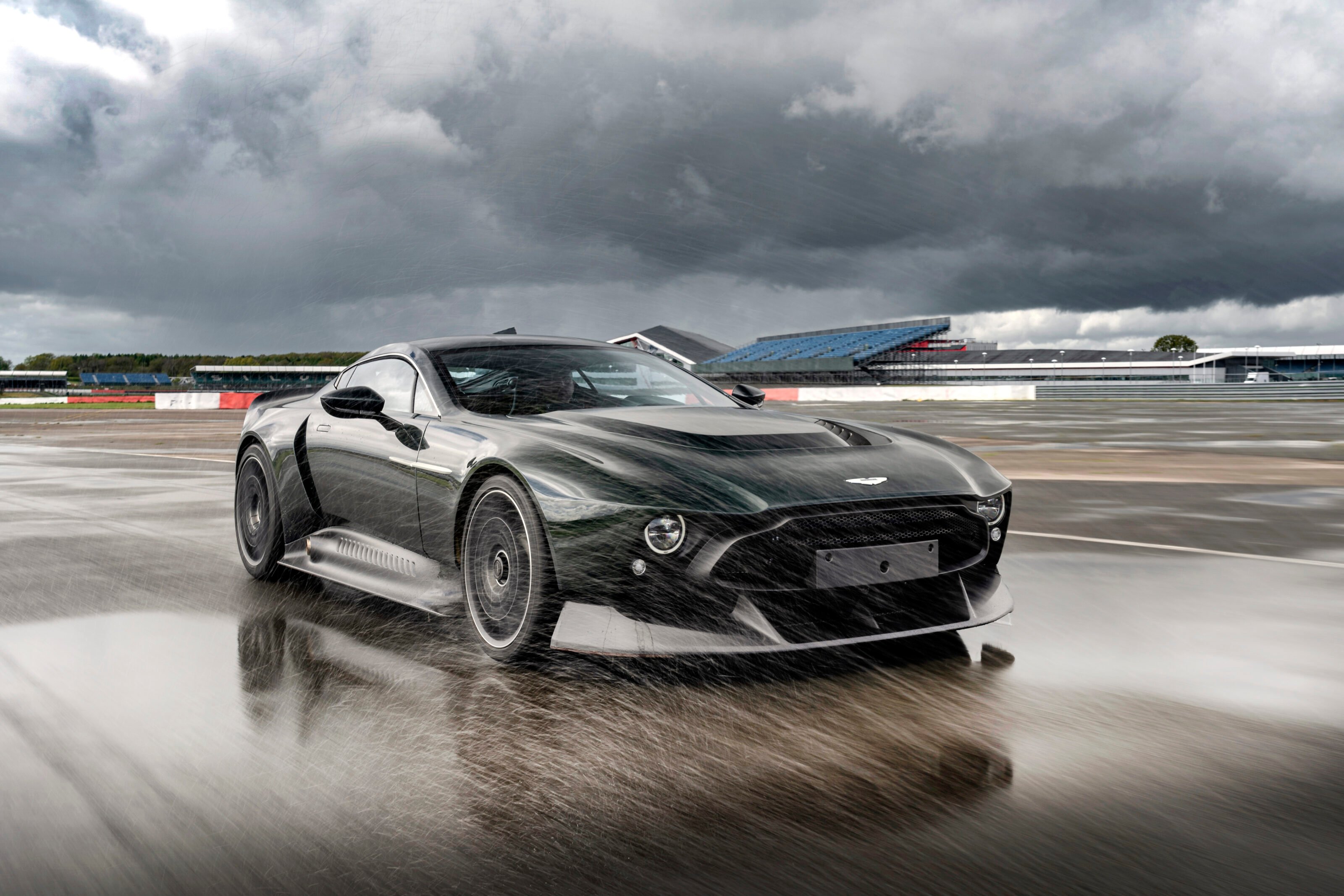
I’m a passenger. The Michelin Pilot Sport Cup 2s have done their best, but there’s only so much water they can shift and currently it’s just not enough. Time slows and I sit it out, pondering the aquaplaning predicament, fortunate enough that I’m on a wide track and there’s nothing around me to hit.
My biggest concern is that this is about as much driving as I’ll be doing today. I’d had three slow sighting laps around Aston Martin’s Silverstone Stowe circuit to get some heat into the car’s engine and brakes and learning where the circuit goes, before the rainfall became biblical.
I’m not sure I’d be so happy to let anyone drive this car in these conditions, but Aston Martin’s people are remarkably relaxed. Arriving at the first corner is where those Michelins give up, the track is no longer there.
Instead, it’s fully submerged, while the vagaries of the weather mean the sunlight to the side of the dark cloud that’s just deposited all that water sees the circuit turn into what can only be described as a huge mirror. Fine in a series production Aston Martin, but the car I’m is unique.
A one-off plaything for an extremely lucky owner, likely to be secreted away in a collection and never seen again? Not so. Its owner has one of the keys for it back home in Belgium, but the car’s still in the UK and the spare key is currently residing in the slot in the centre of the dash.
You’ll need to know your Aston Martin history to get the name. It refers to Victor Gauntlett, Aston Martin’s Executive Chairman, who presided over the company during the ’70s and ’80s, when the iconic V8 Vantage was the company’s core model.
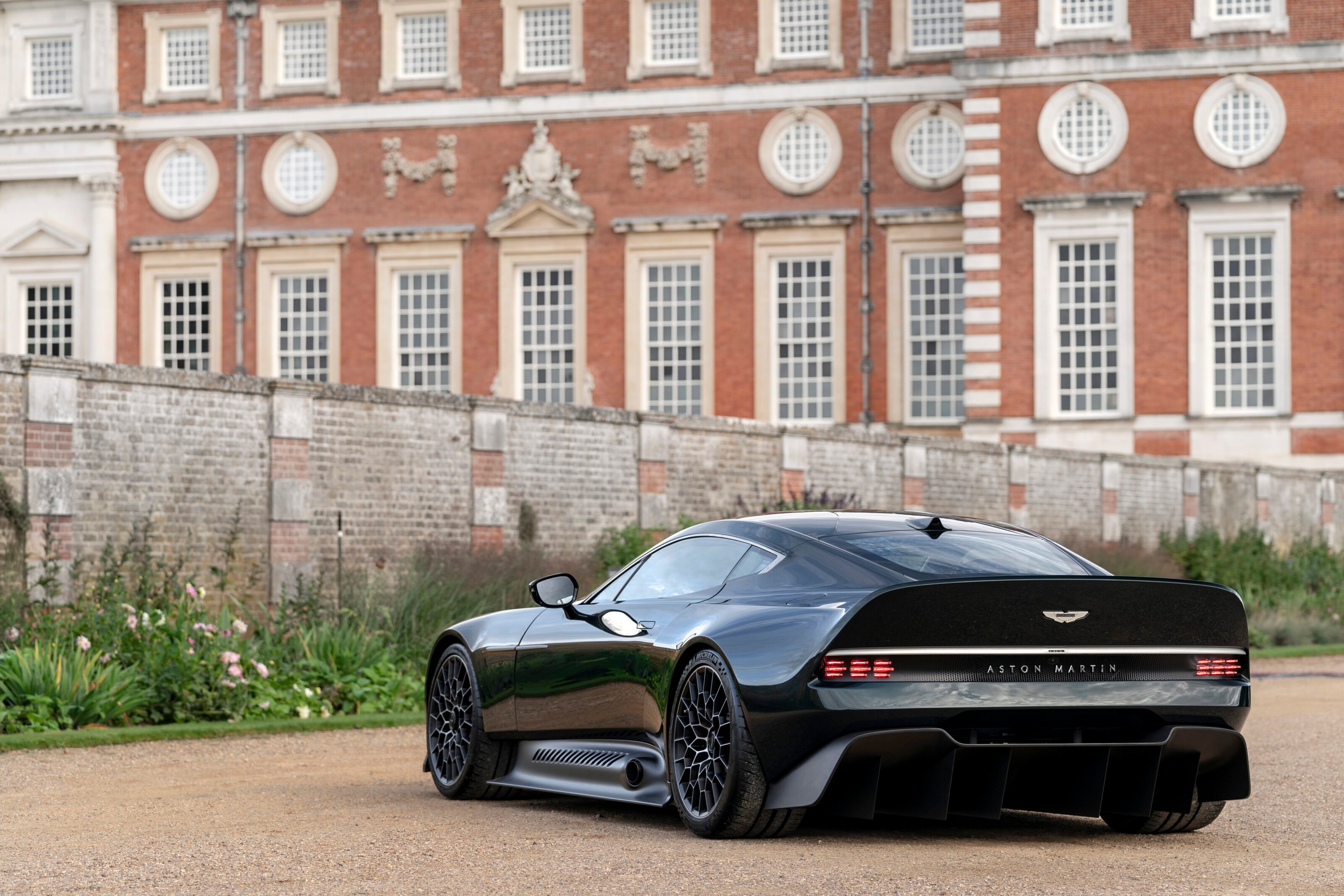
The Victor’s styling makes an unashamedly retrospective nod to those cars, though instead of having a V8 nestled under its bonnet there’s a V12. Specifically, a 7.3-litre naturally aspirated V12 engine that previously powered a One-77 prototype car, which also lends its carbonfibre chassis.
“We’re always looking for cool things to do and we had a low use One-77 prototype in storage that we couldn’t sell and we thought it would be good to do something with it,” admits Simon Lane, Director of Q and Special Project Sales at Aston Martin Lagonda. The decision was made to make something celebrating the V8 Vantage as well as the ’70s DBS V8 that was developed to race at the Le Mans 24 hours as the RHAM/1.
Some initial design work was done, Miles Nurnberger, Director of Design saying: “we don’t usually do retrospective design at Aston Martin, but it’s good to exercise designers’ minds and this was a fun project.” That Le Mans car, built by Robin Hamilton back in the ’70s with factory support from Aston Martin, was nicknamed ‘The Muncher’ because of its appetite for brakes, Nurnberger laughing that it also applied to transmissions, tyres and everything else.
The idea, as well as some early CAD design work and engineering feasibility studies were completed before Aston Martin started approaching its most loyal customers asking if they might be interested in such a car. One was, a Belgian gentleman, who’s got a collection of all the modern and limited-edition Aston Martins.
And he’s happy for a handful of people to drive it, which explains why earlier I found myself sliding over the broad sill with a brushed aluminium treadplate with Aston Martin 1 of 1 engraved within it. The interior, like the rest of the Victor, is unique but there’s little initial opportunity to really revel in all the beautiful detailing, with track time limited and the ominous clouds.
“The Aston Martin Victor feels every bit a properly involving driver’s car”
Pushing the key into its slot low in the centre console, before I’ve fully tightened the Schroth Racing four-point seatbelts, and pressing the starter button on the wheel, the V12’s starter motor whirs, before firing and settling into a surprisingly cultured idle. Cosworth, Aston Martin’s engine partner for the Valkyrie, was tasked with fettling the 7.3-litre V12, stripping it down to its block, before completely rebuilding and tuning it.
Its efforts see the power increase to 623kW and 821Nm. Like the engine, that prototype One-77 chassis was sent back to its original supplier, Multimatic, Lane admits, essentially rebuilding it as new.
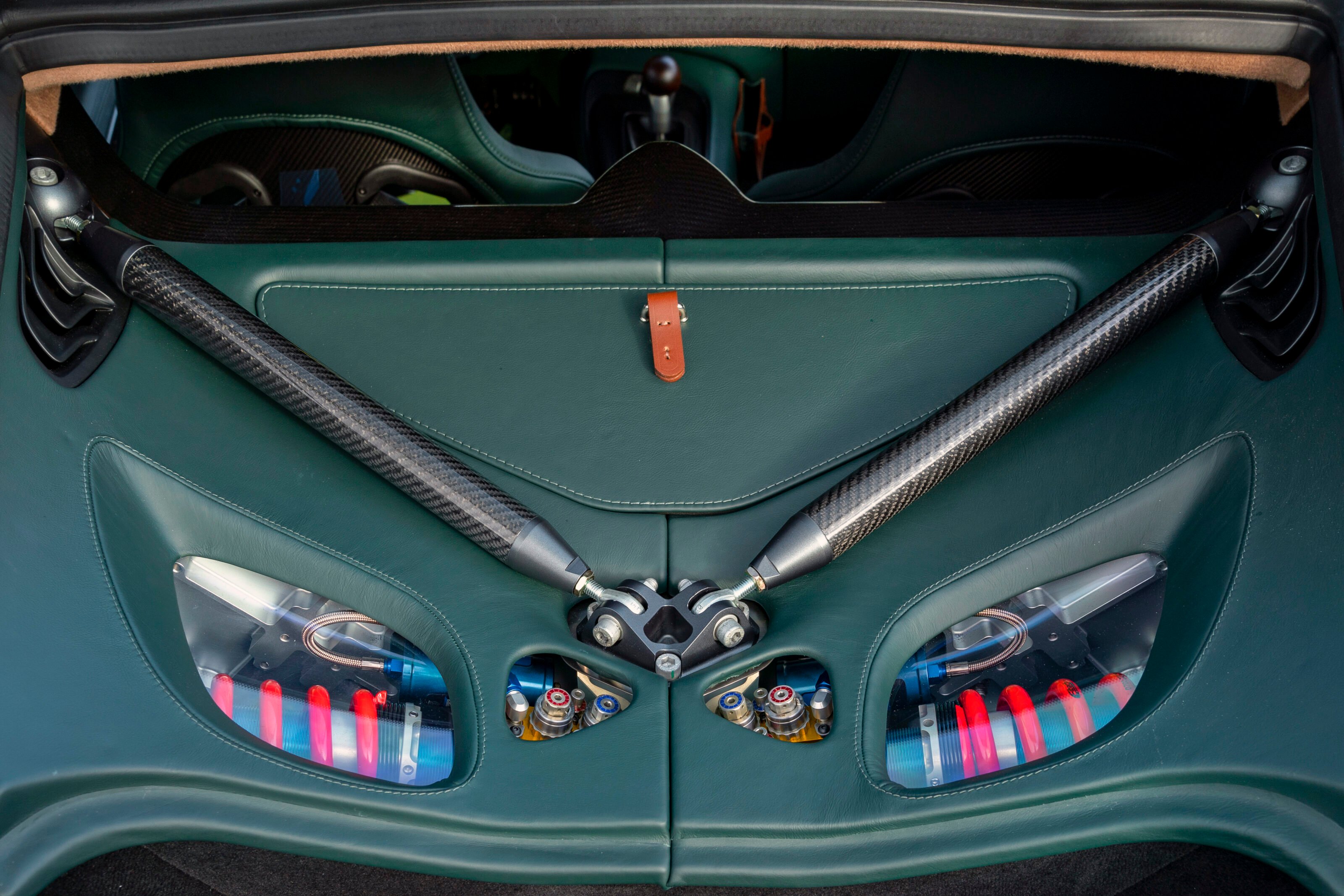
Elements of Aston Martin’s Vulcan track-only car were utilised, it donating its inboard springs and dampers, visible through the rear window and there’s six stage settings, Aston’s chassis engineers having set it up to work on the road.
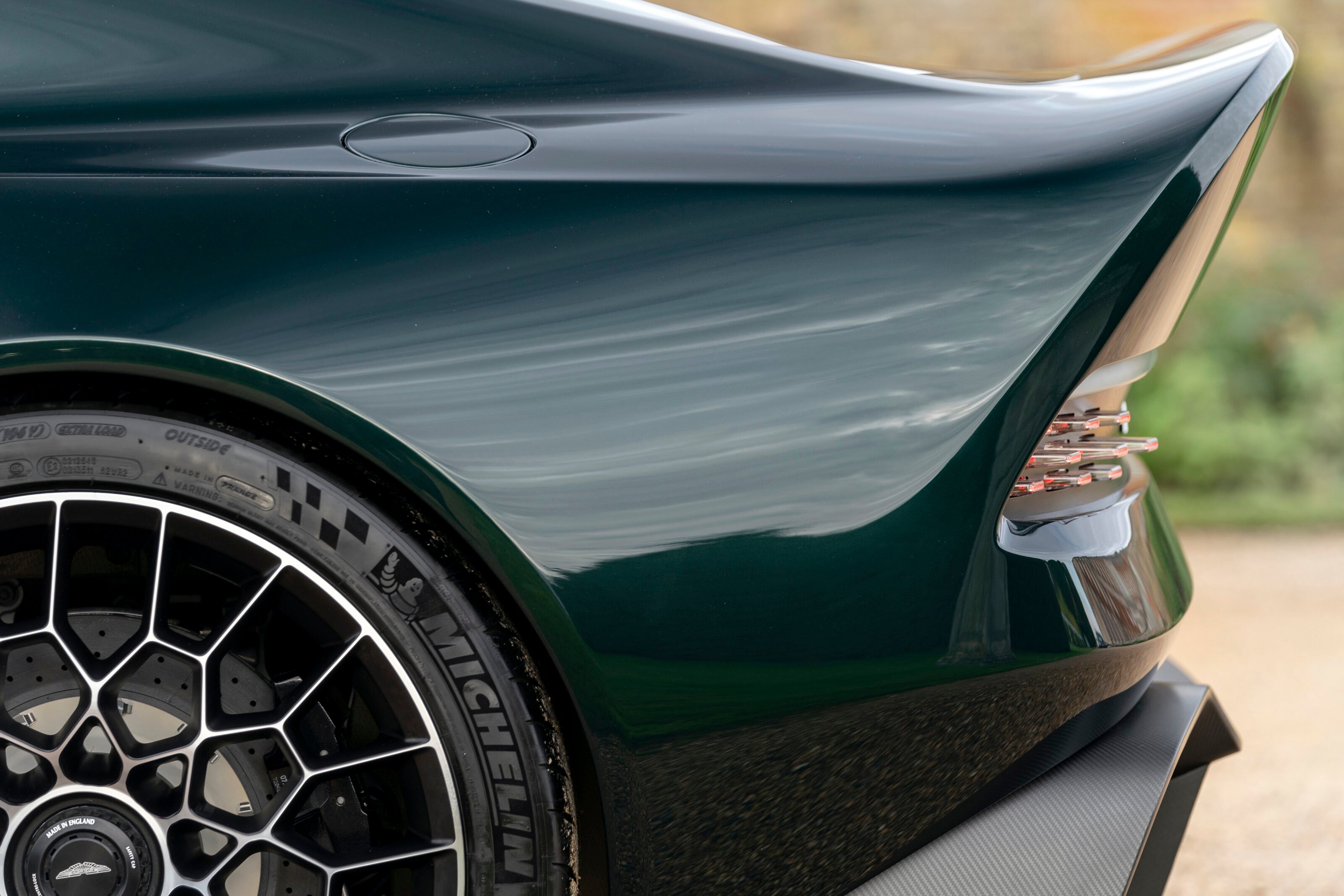
The centre-lock wheels are stunning lattice alloys of 20-inches, with 285/30 ZR20 front and 325/30 ZR20 rear tyres, behind which sit 380mm front and 360mm rear Brembo CCM-R carbon-ceramic discs grasped by six-piston calipers. Those brakes promise GT3 race car levels of retardation.
Indeed, despite the intended, eventual, road use that reference to race car braking potential isn’t the only one Aston Martin quotes, it stating too that computational fluid dynamic testing reveals the Victor’s unique body develops 60 per cent more downforce at 160km/h compared to one of its Vantage GT4 race cars.
Perhaps I need to be travelling faster to push those Michelins through all that water then. Aquaplaning moment over, the spot noted for the next lap, there’s the opportunity to stretch that V12 down the long central straight. There’s plenty of requirement for quick corrections with the steering, as puddles have the rear tyres losing purchase momentarily before the traction control does its best to gather things up.
It’s not intrusive, aiding progress rather than preventing it, the Victor proving surprisingly easy to drive, even in horrendous conditions.
The traction control, as well as the ABS, is variable via knobs on the steering wheel, the cut-top ‘wheel’, unsurprisingly looks like it’s been lifted entirely from a Vulcan, but with the buttons more tastefully bezelled with grey and the hand grips finished in green leather. There are no paddles behind it though, because unlike both the Vulcan and One-77, there’s a third pedal, and a walnut-topped manual gearstick situated in the transmission tunnel.
It’s that manual transmission that differentiates the Victor from any number of super and hypercars these days, it, admits Lane, being included from the start because it made the project a bit easier. More special, too, the gearbox itself being a Graziano six-speed item, which is mated to a racing clutch.
Aston Martin’s engineers have fiddled with the materials to make it work at road speeds. The pedal isn’t light, but neither is it so heavy to be obstructive, the sizeable gearknob travelling through its movement with precision and ease, with its mechanicals open to view down the open carbonfibre gullet that surrounds it.
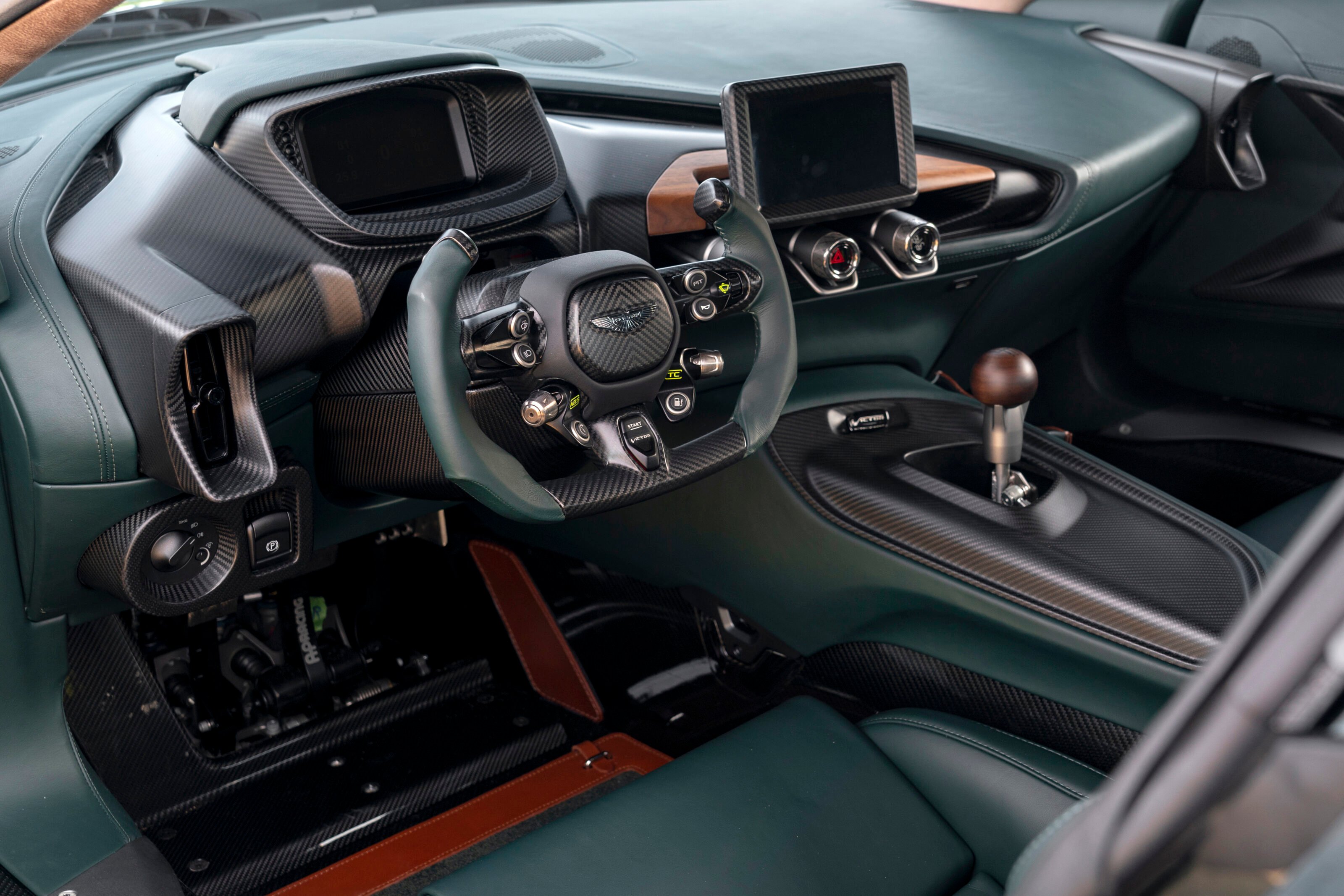
Grabbing it as the V12 devours another gear as it accelerates down the straight is an absolute joy, but it’s when you’re standing on the middle pedal and roll your foot off to blip the V12 to rev match for downshifts that the gearbox is so engaging. Such old-school thrills feel entirely right in a car with such a retro nod to its looks.
Fitting a paddle-shifted transmission would have been wrong, and would have completely changed the Victor’s character. And it’s brimming with it, from the incredible soundtrack of its naturally aspirated 7.3-litre V12, whose exhaust pipes exit to the side of where my backside’s situated, just in front of the rear wheels, and the gearbox that helps orchestrate it, to the playful nature of the chassis.
The driving position is low and focused, embraced by the hold of a beautifully upholstered lightweight carbonfibre seat, with those race harnesses securing me tightly, the pedal spacing is perfect and the gearstick high and near the steering wheel to minimise time with your hand off the wheel.
That’s proving useful with all the tiny, and sometimes sizeable, corrections required today, as the track dries and the speeds increase. The steering is light, it’s quick and accurate, though there’s not a great deal of lock should the rear axle try to overtake the front.
What’s quickly apparent is how immersive and hugely entertaining it all is, the combination of its mighty, immediate power from that glorious V12, the strength of the brakes and the pedal’s ample feel – and the racer’s squealing that accompanies their use – you really revel in the drive.
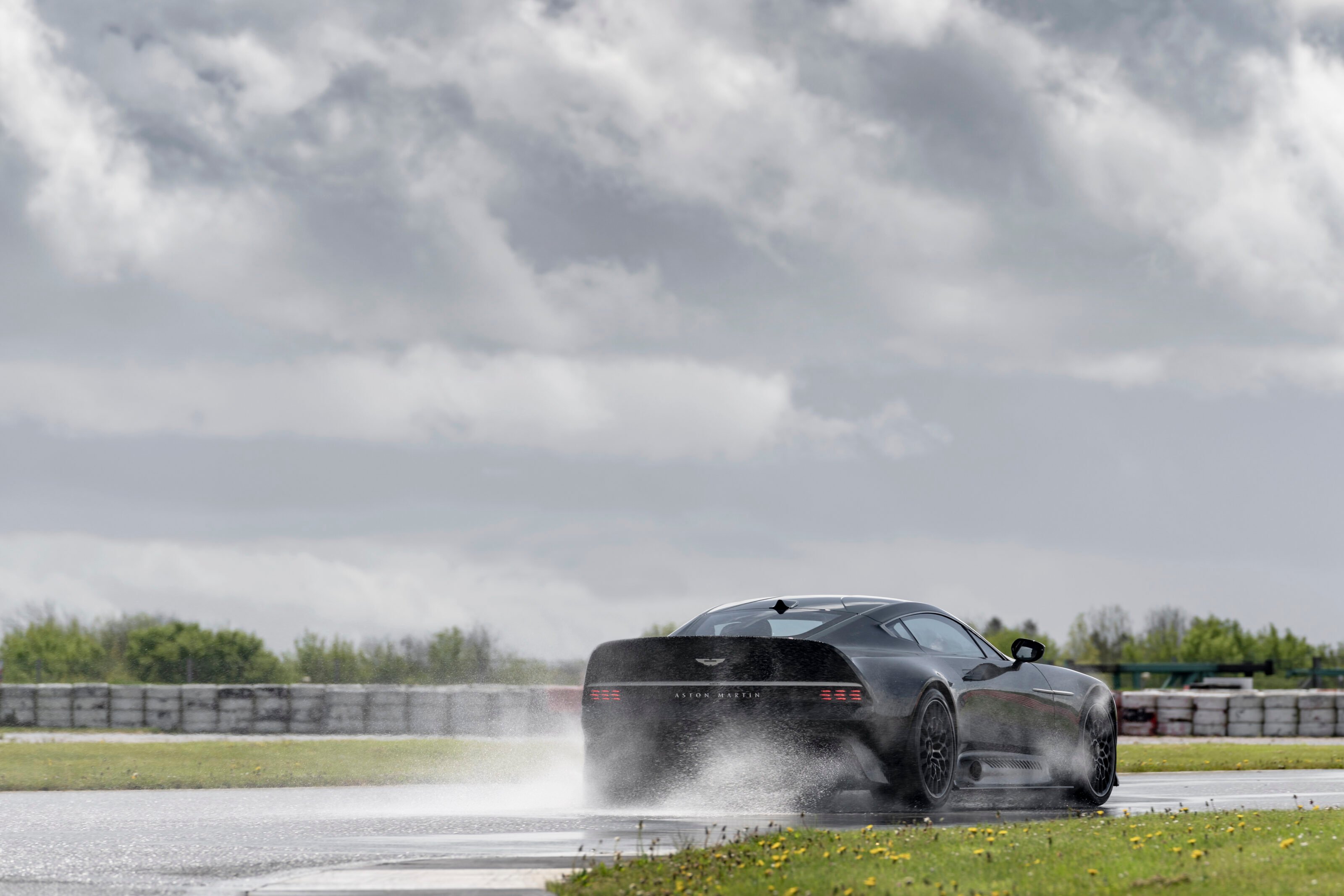
It’s adjustable, too, ridiculous as that might sound when applied to something so potent, but within a few laps the Victor reveals a playfulness, starting to move around me, doing so predictably, transitioning from grip to slip with ease. Entering a corner you need to be patient, some slight initial understeer neutralising before the rear can be coaxed out into a slide.
It’s not spiky or difficult doing so, quickly feeling entirely natural to exit each corner with the rears wheels doing some steering under power. All that makes exiting bends as entertaining as working your way down that six-speeder when arriving at them. Through the faster corners it feels planted and secure, despite the track never really properly drying out over the 20 or so laps we had around it.
It’s huge fun around a circuit. Whether that would translate to an enjoyable road car will be something only its owner will ascertain, but, at this juncture, it’s worth mentioning the caveats inherent in relation to the sheer length of the bonnet, as well as the extremities of its lower front bodywork, which skim close to saw-toothed kerbs.
There’s no recalcitrance from the transmission, the clutch being easy to use, likewise the gearbox. The engine’s mighty output is produced in such a linear fashion there are no concerns there either, with only the brakes squeal being something that might prove tiresome with road use.
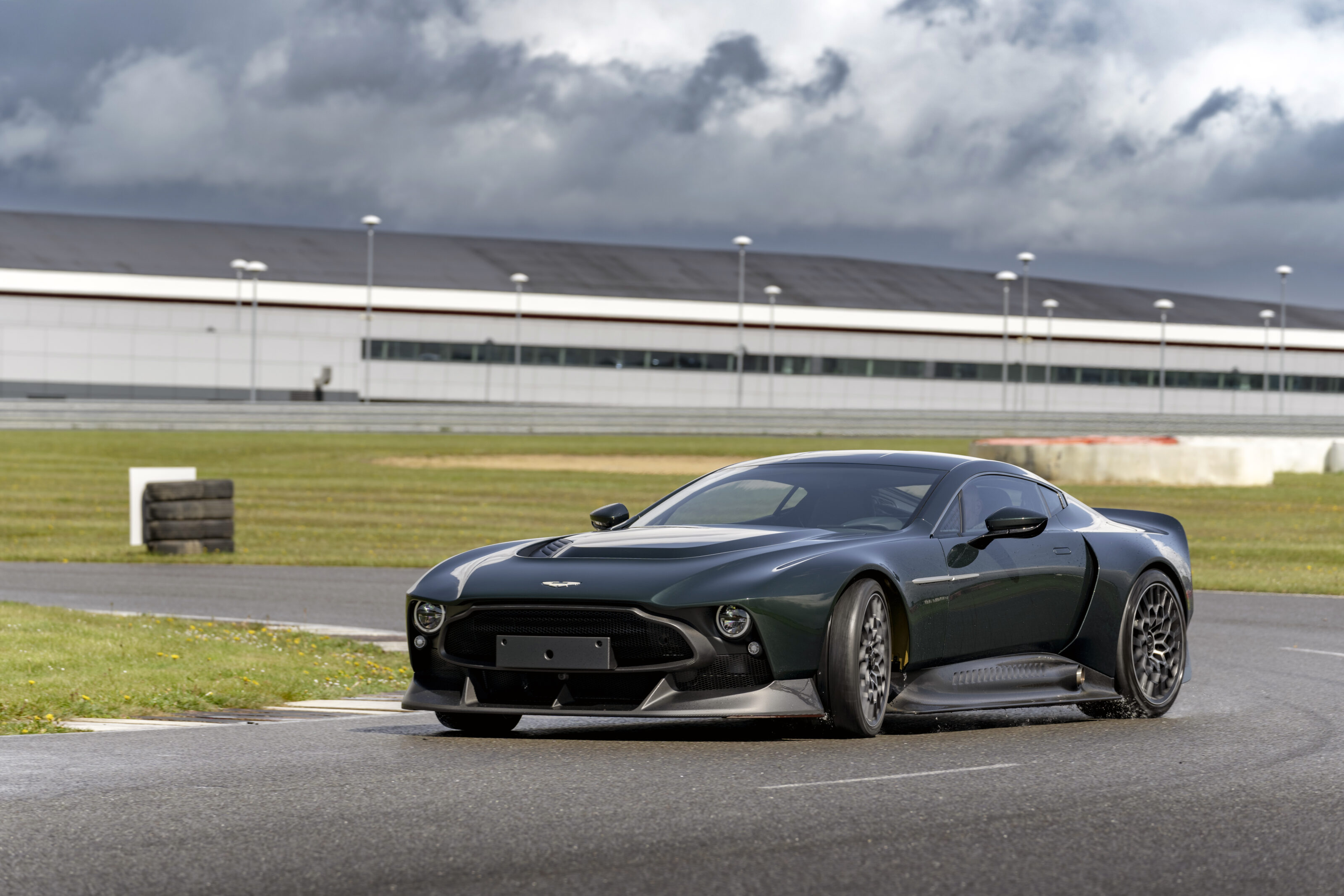
It feels every bit a properly involving driver’s car, and despite the huge numbers associated with it, remarkably civilised, too. It’s a car which, I’d guess, the owner will enjoy more than any of their other limited and special edition Astons, primarily because the driving experience is so immersive and enjoyable.
A huge portion of that down to the fitment of its manual transmission. The owner could, justifiably, also just park it up and gawp at it, because it’s utterly captivating to look at, with the Muncher and V8 Vantage references mixed up perfectly in its bespoke Pentland Green and satin carbonfibre bodywork. Pictures don’t do the Victor’s beauty and proportions justice. This a car that needs to be seen in the metal to be really appreciated.
The same is true inside. Although the Victor a one-off, it’s been built to production car standards. It gets a sensational blend of traditional materials like solid walnut for the gearknob and dash insert, green leather and cashmere headlining with more technical surfaces in satin carbonfibre, anodised aluminium and polished titanium.
It proves to be an exquisitely detailed mix, with the overall result being absolutely stunning, though a conventional instrument cluster, instead of the configurable TFT screen would perhaps sit more suitably with the overall theme.
It’s a project that Aston Martin says is unlikely ever to be repeated, not least because it no longer has any spare One-77 chassis lying around. The Victor’s owner gets not just a unique car, but a genuinely incredible one.
Aston Martin Victor specs
Engine: 7312cc V12, DOHC, 48v Power: 623kW Torque: 821Nm 0-100km/h: 3.0sec (estimated) Weight: 1630kg Price: N/A
Snapshot
- Aussie households spending almost $400 per week on transport
- Biggest quarterly jump since the AAA Transport Affordability Index was established in 2016
A new report by the Australian Automobile Association (AAA) has found Aussie households have spent more money on transportation in the first three months of 2021 than any other time in the past five years.
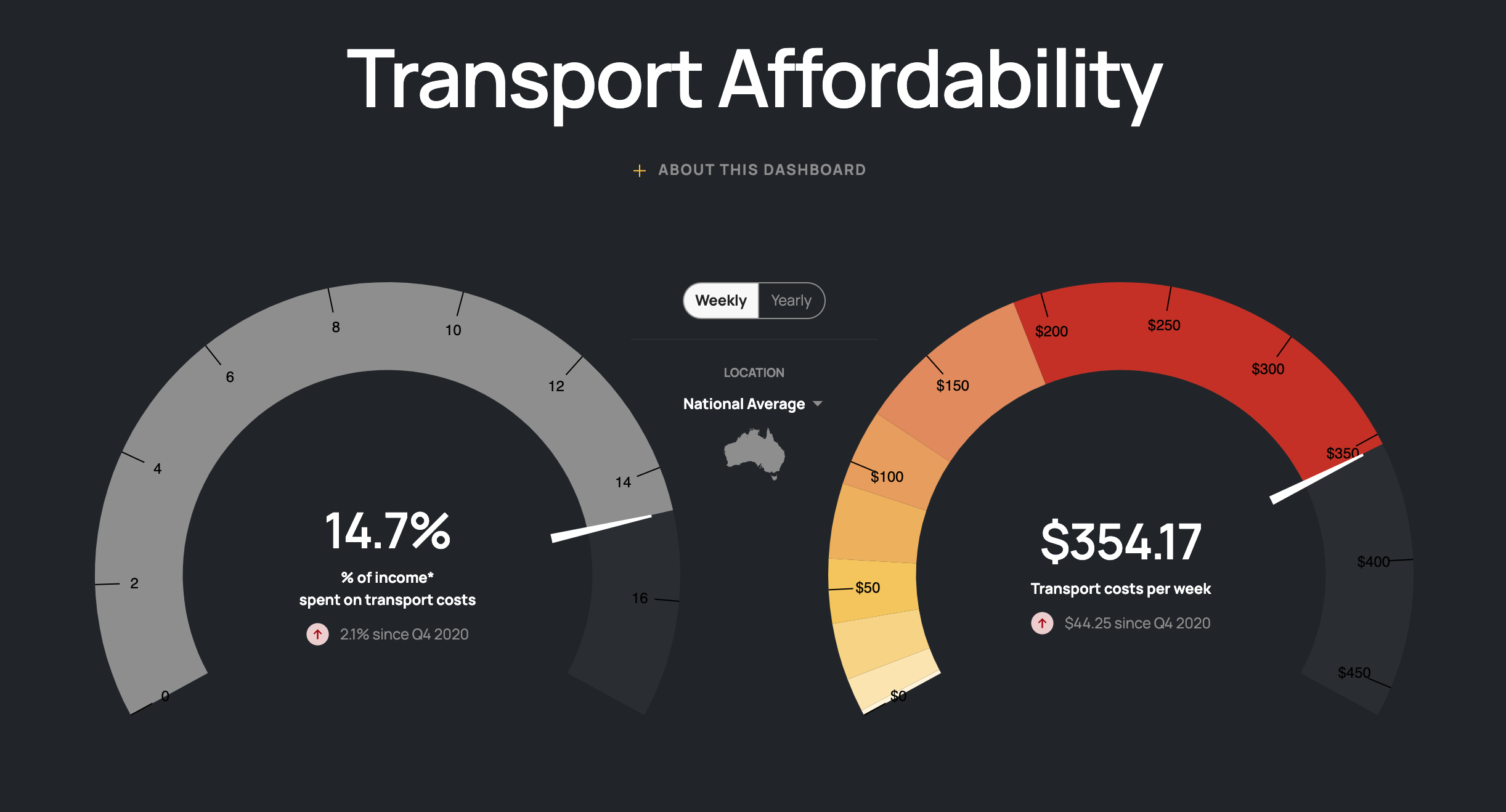
Data from the AAA’s latest Transport Affordability Index shows no less than 14.6 per cent ($354 per week) of an average household’s income is going towards its automobiles.
This represents a 14.3 per cent ($44 per week) increase compared to the last three months of 2020. It’s also the biggest quarterly jump since the index was first established in 2016.
Michael Bradley, managing director of the AAA, said: “This sharp rise in transport costs needs to be monitored by governments, which need to avoid policies and decisions that impact cost of living.
“Transport affordability needs to remain a priority for government, as Australia has not only just recorded the largest jump in transport costs since the affordability index commenced, but households are now paying the highest proportion of their income toward those costs.”

The news is hardly surprising, considering the overly inflated prices of used vehicles at the moment, and multiple manufacturers hiking up prices of their products several times over the past 12 months.
What do you think? Have you been spending more on transportation lately? Let us know in the comments below.
Snapshot
- Lamborghini Countach was first unveiled in 1971
- Designed by Marcello Gandini
- Countach’s styling cues have been borrowed by every subsequent Lamborghini since, according to the Sant’Agata firm
The Lamborghini Countach, arguably the first ‘supercar’ ever made, is celebrating its 50th birthday in 2021.
To mark the momentous occasion, Lamborghini has credited the fabled moniker as shaping “the design of all subsequent Lamborghinis”, except for perhaps the LM002, which looks nothing like the supercar. However, it does share the same engine as the swansong Countach LP5000 Quattrovalvole.
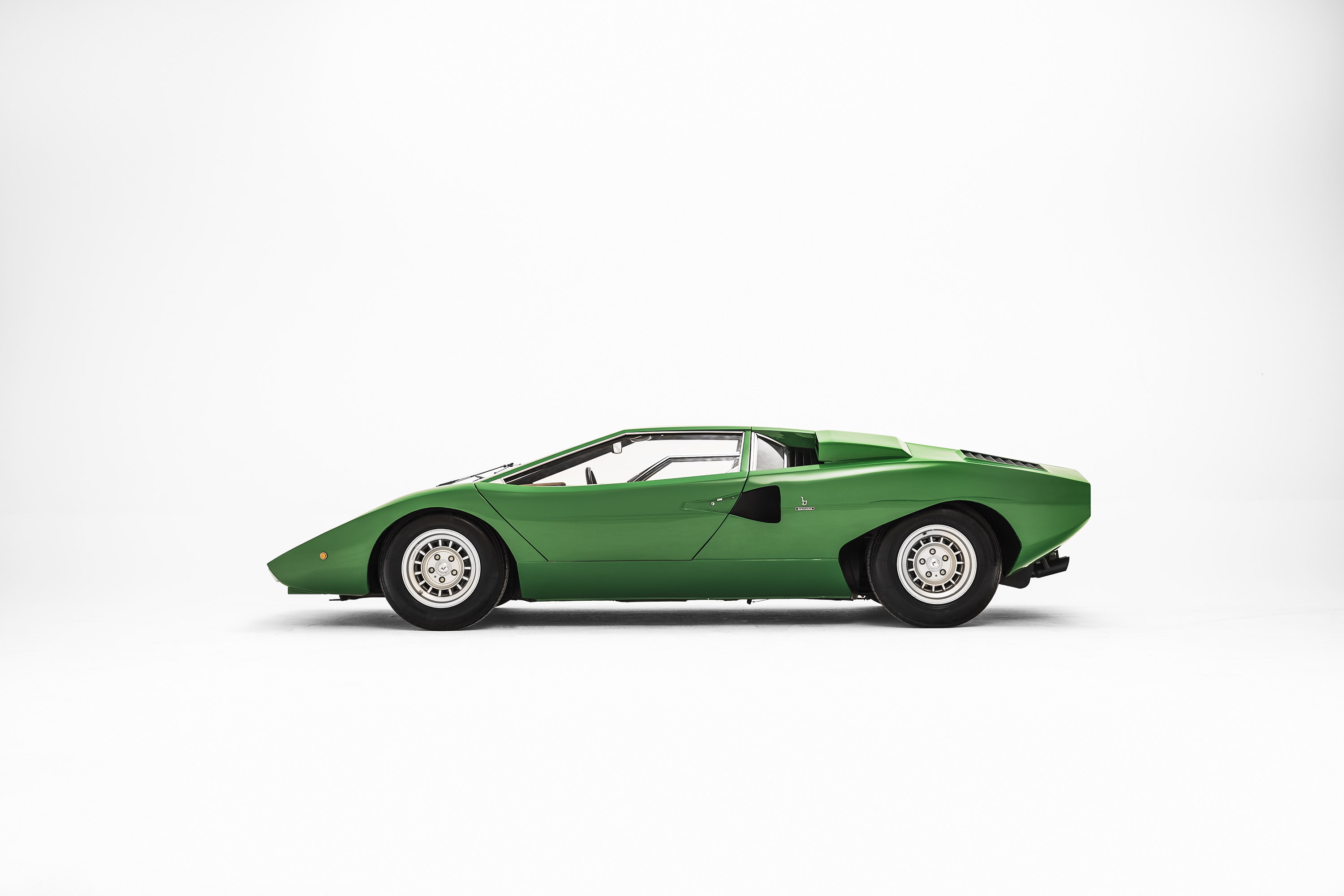
Unveiled in 1971 at the Geneva Motor Show, the Countach was the brainchild of one of the greatest automotive designers of all time – Marcello Gandini.
Gandini is responsible for penning virtually every Lamborghini ever made right up to the Diablo. He’s also the genius that thought up scissor doors – now a staple of Lamborghini’s flagship V12 models.
To say the Countach was a groundbreaking piece of automotive creativity is perhaps an understatement.
Its breathtaking looks were almost alien when it was released, and it instantly became what is still the ultimate poster car.
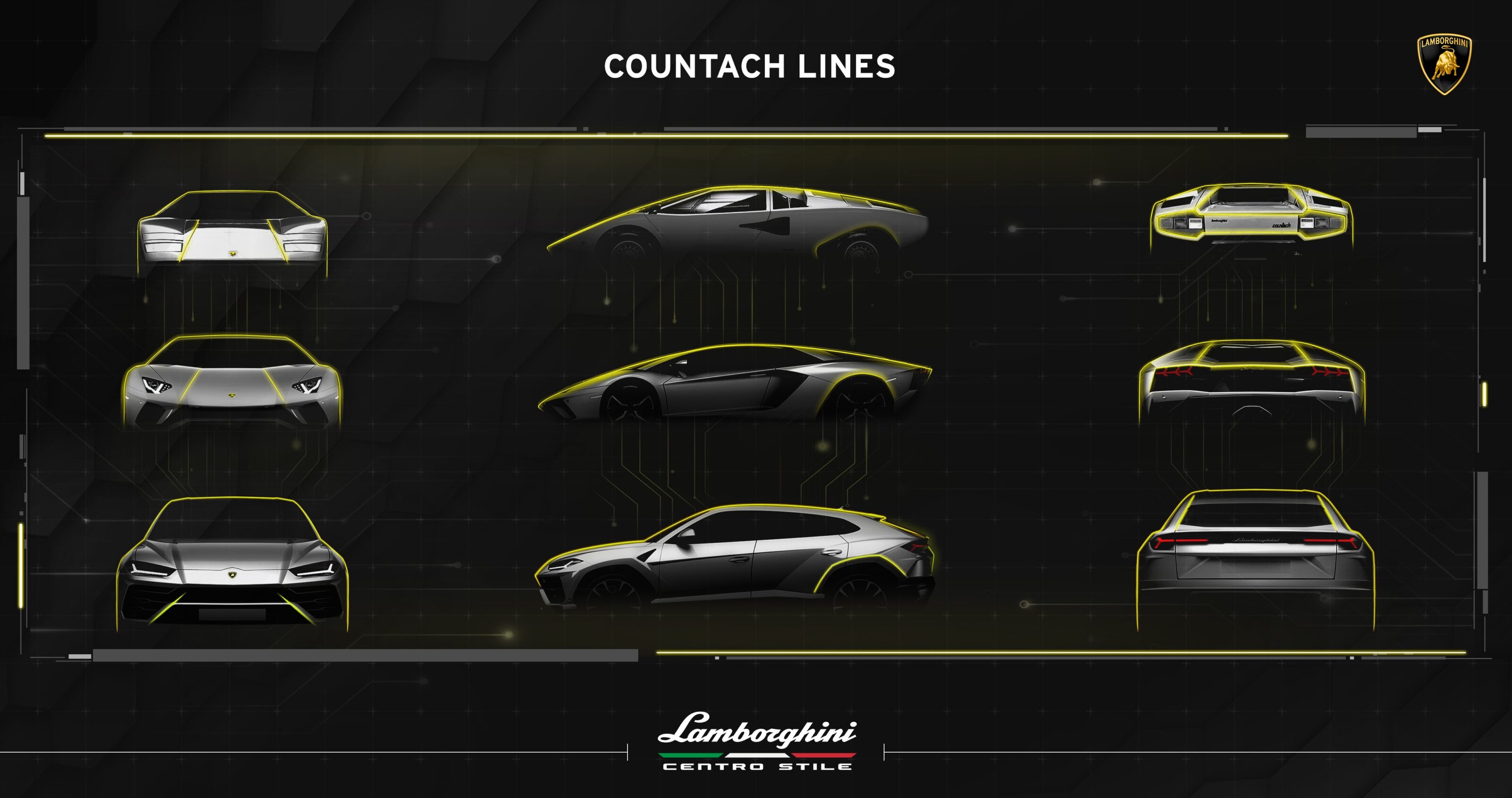
To its credit, Lamborghini isn’t talking complete marketing nonsense when it says the Countach influenced the look of almost all Sant’Agata raging bulls since.
The low, swooping side profile of the car, in particular, has been retained and flaunted in the DNA of subsequent models like the Diablo, Aventador, Gallardo, and Huracan.
As for Lamborghini attributing the Countach’s looks to the Urus SUV, which is based on VW’s MLB Evo platform and shared with the Audi Q8, Bentley Bentayga, Porsche Cayenne, and Volkswagen Touareg, to name just a few, well, we’ll let you be the judge of that.
Snapshot
- LCT set at $79,659 for fuel-efficient cars and $69,152 for other vehicles
- Change benefits hybrids and EVs
- Asset write-off scheme car limit also increased to $60,733
The Luxury Car Tax threshold has risen by more than $2000 for fuel-efficient vehicles for the coming financial year, making hybrids and electric vehicles the big winners once more.
Today the Australian Taxation Office raised the Luxury Car Tax (LCT) threshold for fuel-efficient cars in 2021/22 to $79,659 compared to $77,565 previously.
The limit before the LCT kicks in for gas-guzzling motors, which are dubbed ‘other vehicles’ by the ATO because they consume above 7.0L/100km, has also gone up, rising from $68,740 to $69,152 for 2021/22.
All changes take effect as of July 1.
A spokesman for the Australian Taxation Office (ATO) told WhichCar the increases were simply annual updates based on a rise in the Consumer Price Index (CPI).
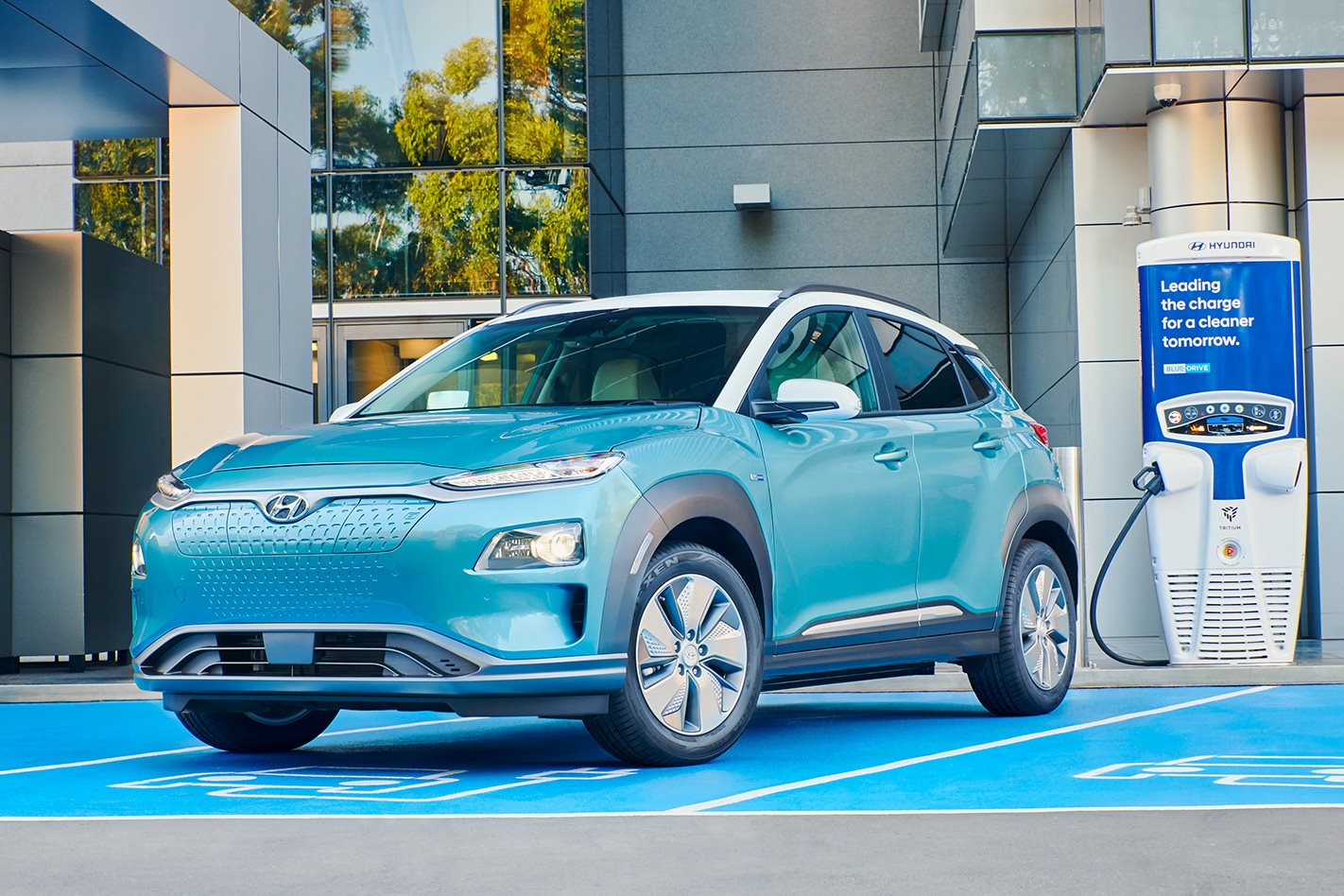
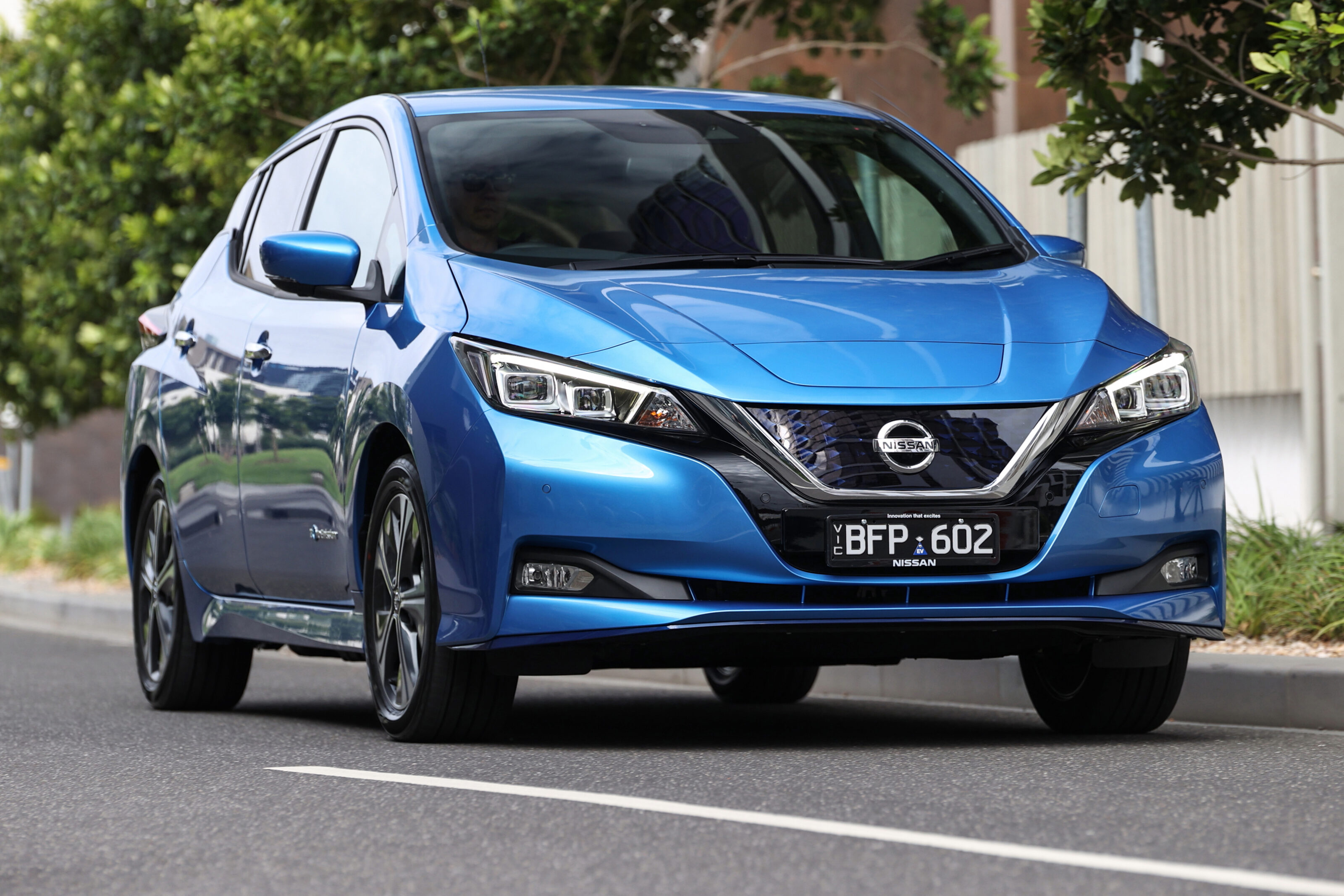
That announcement means the Tesla Model 3 Standard Range Plus, Hyundai Kona Electric, Kia Niro, Nissan Leaf and Leaf e-Plus, and Hyundai Ioniq are all currently below the threshold.
The rise marks the second time the LCT has gone up in recent years, after remaining static between 2010 and 2016 at $75,375 and then settling again between 2016 and 2020 when it was set at $75,526.
Other changes announced today include a slight increase to the car limit under the asset write-off scheme.
The yearly car limit has been raised for the 2021/22 financial year to $60,733, up from $59,136 for 2020/21, which includes stamp duty and other on-road costs. Warranted it’s not a huge jump, but might just be enough for someone to nab something a bit pricier.
The rise follows the news earlier this month that businesses with a turnover of up to $5billion will be able to deduct the full value of any new work vehicle under two years-old purchased since last October, after the Federal Government announced it was extending its instant asset write-off scheme for another year.
As part of the 2021 Federal Budget, the Government said there would be a 12-month extension to the ‘temporary full expensing measures’ until June 30, 2023.
The scheme, initially announced as part of the 2020 pandemic-hit budget last year, provides eligible businesses with a turnover of up to $5billion to claim big ticket items such as new vehicles as an expense in one financial year rather than the usual five. The changes announced earlier in May also removed the $150,000 per asset limit in response to the impact of the pandemic.
Under the current law, such businesses are entitled to write-off the value of an asset, such as a new work vehicle, purchased after 7.30pm AEDT on October 6, 2020, and first used or installed ready for use by June 30, 2022.
It means eligible buyers who are worried about taking delivery of a new work vehicle before the end of this financial year due to stock shortages now have an extra 12 months to get them on the road.
The extension also means any losses incurred up to June 2023 can be offset against prior profits made going back to the 2018-19 financial year.
Essentially the changes to the scheme allow businesses to realise the tax benefits of off-setting the cost of a vehicle against their income pool faster than they normally would, because the timeline during which an asset depreciates has been shortened.
The tax break is expected to reduce tax revenue by $17.9 billion over the forward estimates and $3.4 billion over the medium term as the measure brings forward deductions that would have been made in future years, according to News.com.au.
Got a story? Get in touch: [email protected]
Snapshot
- Hypercar can now be had with conventional windscreen or Active Air Management System (AAMS)
- Production numbers drop to 149 examples
- Customer deliveries expected before the end of 2021
In a surprising about-face, McLaren has decided to offer its crazy, limited-edition Elva hypercar with a conventional windscreen option.
And if that weren’t shocking enough, the British marque has announced yet another reduction of the Elva’s total production numbers.
When it was initially unveiled back in November 2019, McLaren said it would build 399 examples of the AU$2.7 million hypercar.
Then, in April 2020, the British marque said it was reducing the total number of Elvas to just 249 examples under the pretext of making the roofless hypercar “more exclusive”.
Now, McLaren has lopped another hundred examples from the total production tally, saying just 149 examples will be produced.
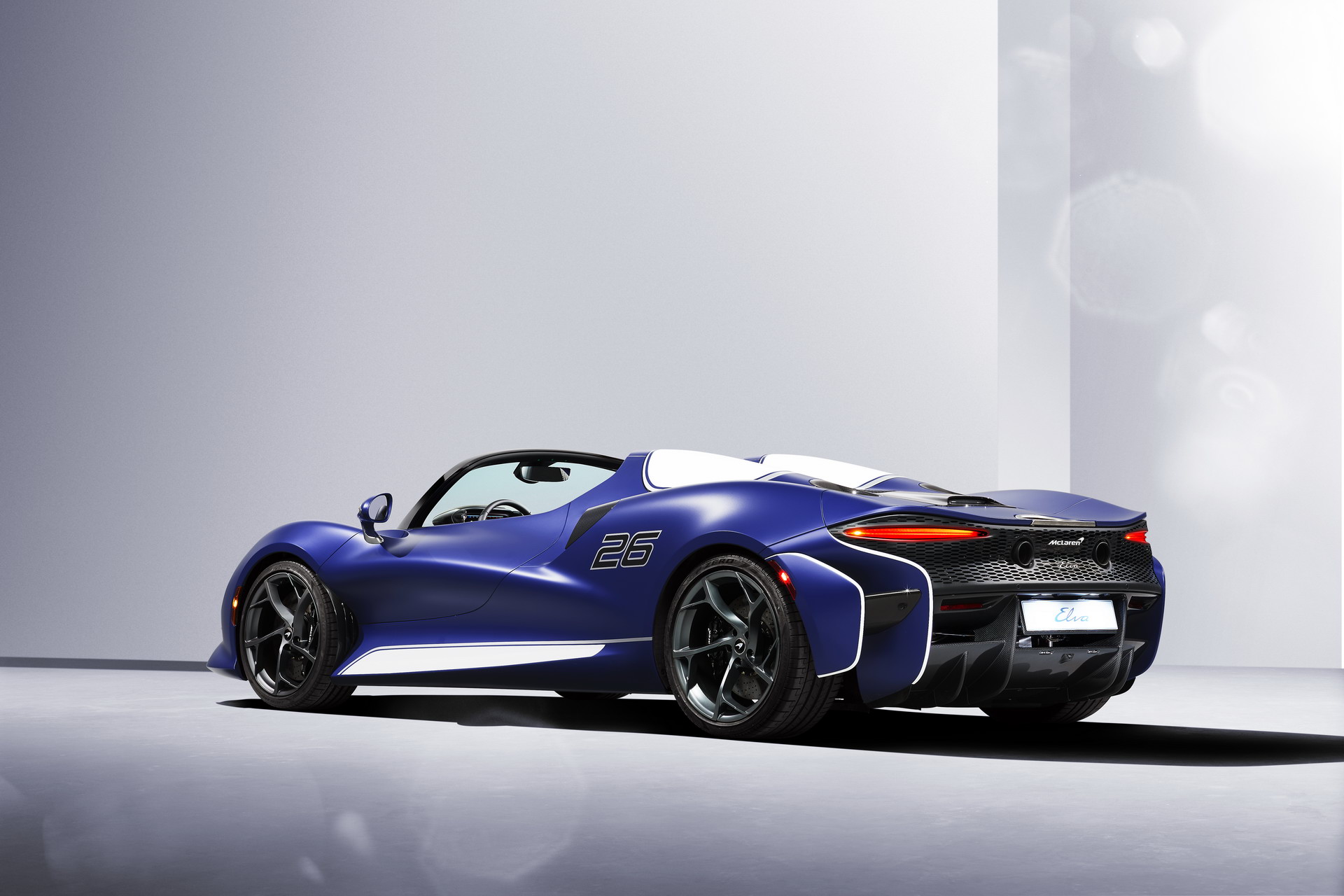
The combination of adding a windscreen and more than halving initial production numbers, unfortunately, reeks of a car that just won’t sell.
The formula for making a limited-edition super/hypercar desirable is a complicated one, but it’s a trick McLaren is still yet to master, with the Woking firm continually criticised for a seemingly unintelligible product line-up and hit-and-miss resale values.
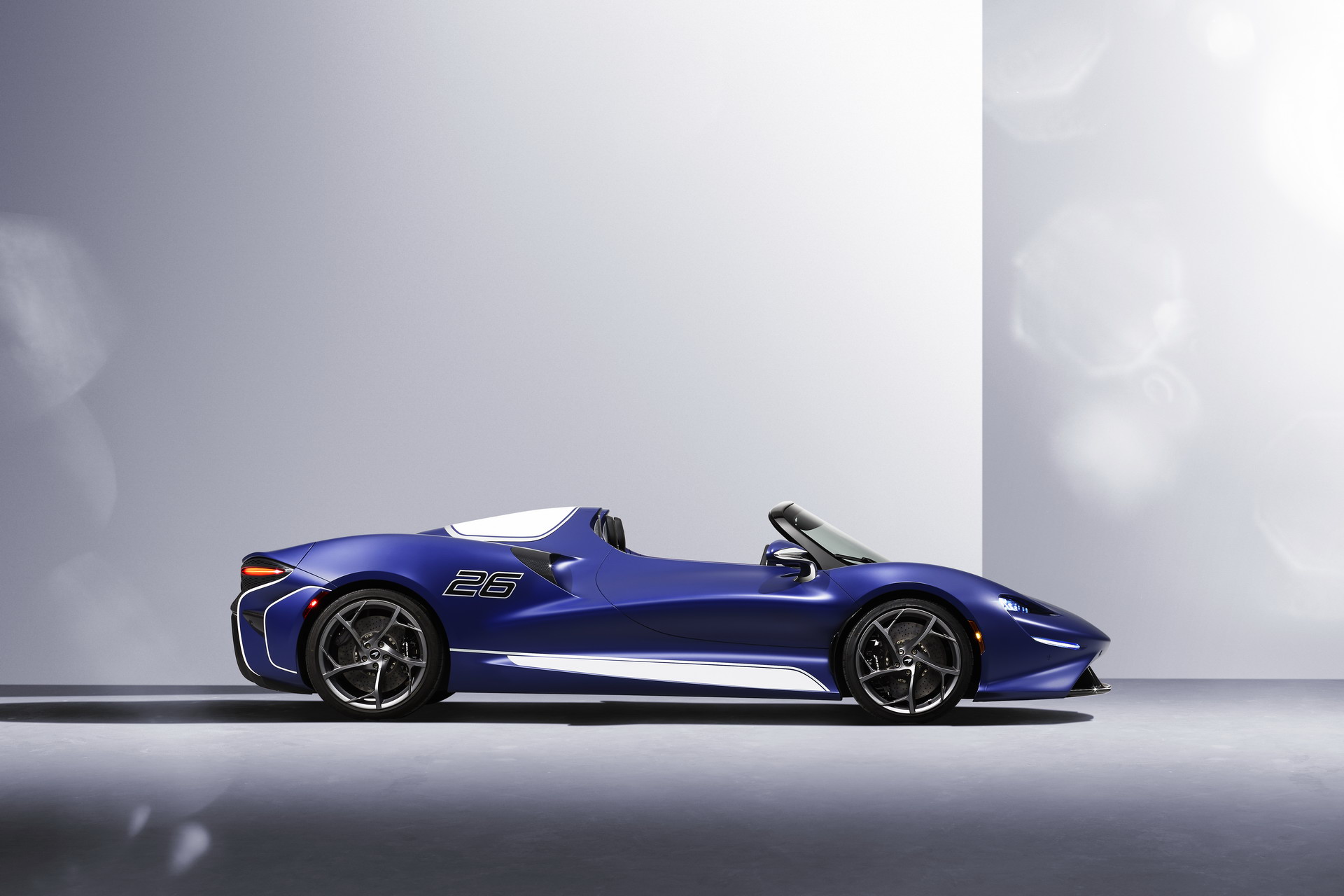
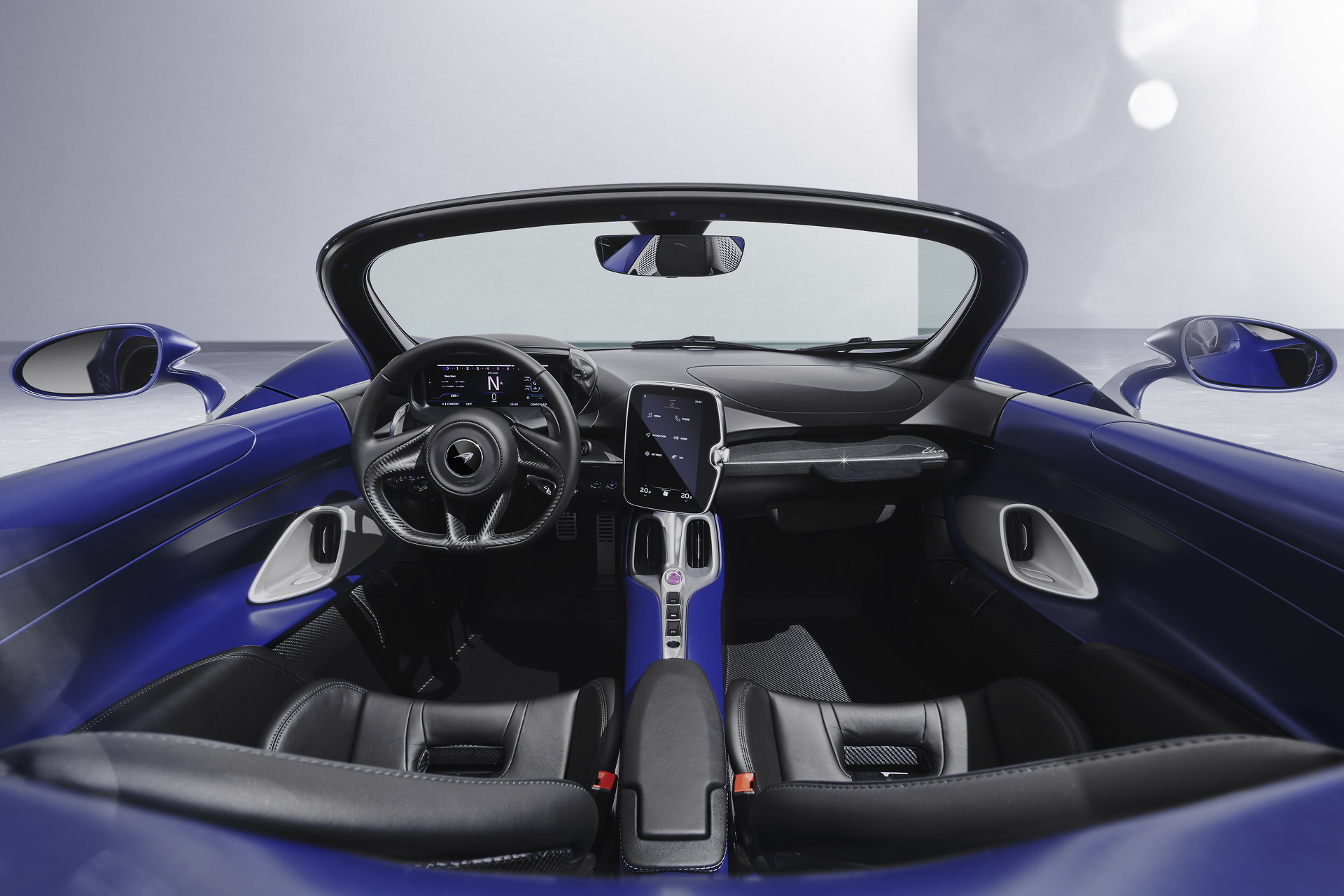
Regardless of this recent news, though, in classic McLaren fashion, the windscreen that’s been affixed to Elva’s new cowl is a very clever one.
With its carbon-fibre surround, the heated glass windscreen, which also scores automatic rain-sensing wipers, washer jets, and sun visors, has only added an extra 20 kilograms to the Elva’s 1300kg dry kerb weight.
Obviously, the ingenious but ugly looking Active Air Management System (AAMS) has been removed as well, which would’ve shed a few kilograms.
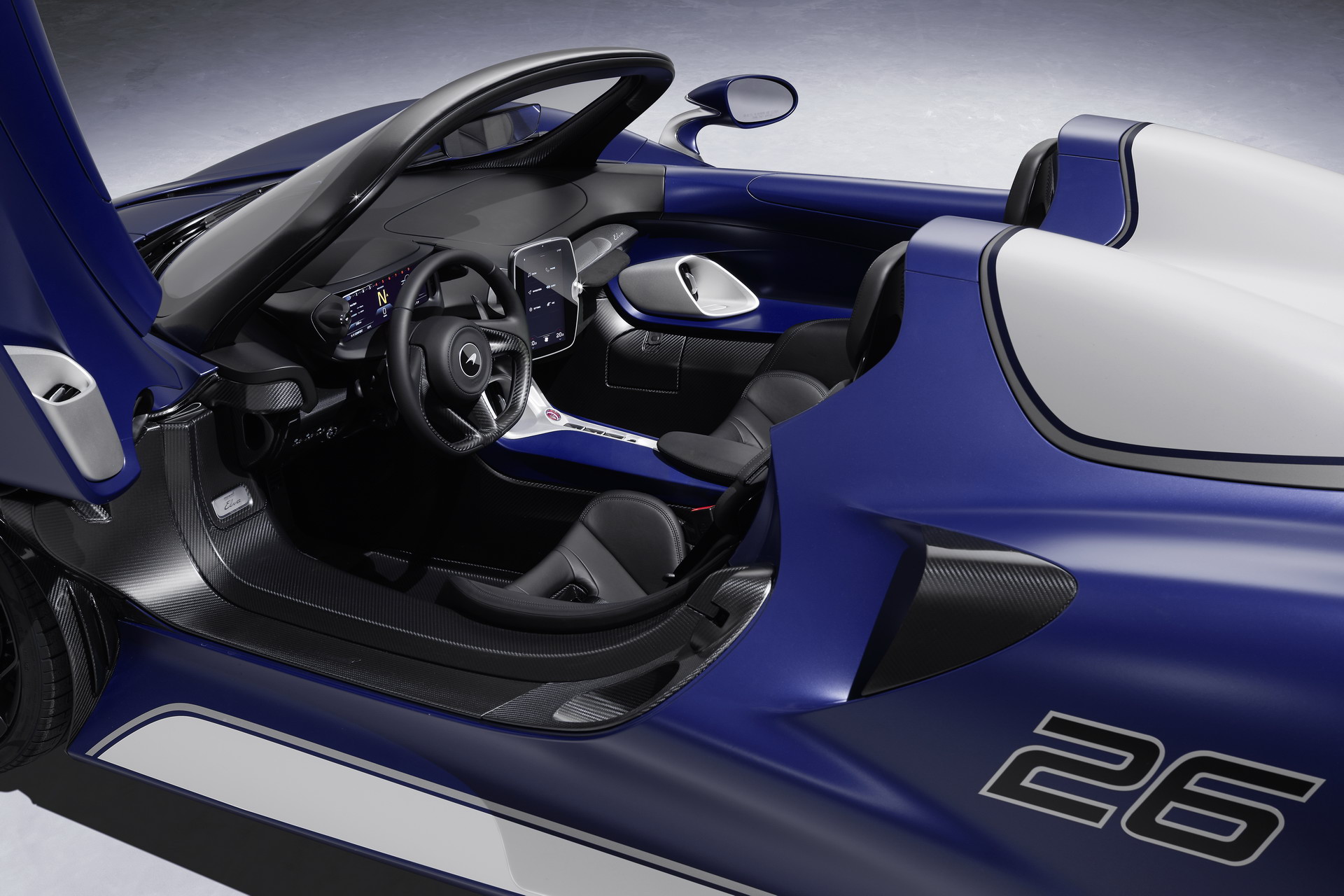
The McLaren Elva is an incredibly potent automobile with or without a windscreen, with its Ricardo-built twin-turbo 4.0-litre flat-plane crank V8 producing more power than its track-ready McLaren Senna sibling – 600kW and 800Nm.
Combining that amount of oomph with a kerb weight roughly the same as Ford’s Fiesta ST equates to some pretty absurd performance figures.
0-100km/h takes less than three seconds, 0-200km/h is dealt with in 6.7 seconds, and in the 1/4 mile sprint, one YouTuber found out the Elva will go well under 10 seconds, although controversy ensued.
These numbers mean the McLaren comfortably outguns its other limited-edition, windscreen-less hypercars like the Ferrari Monza SP1 and SP2 and Aston Martin V12 Speedster.
The British hypercar is due to go into production shortly, with customer deliveries expected to begin before the end of 2021.
Just how many Elvas will actually be sold remains a mystery.
Snapshot
- Leboine designed several cars for Renault
- Graduate of Londonu2019s Royal College of Art
- Comes at a time when Fiat and Abarth are in desperate need of a new design language
Dutch multinational carmaker Stellantis has appointed François Leboine as the new head of design for Fiat and Abarth.
Reporting directly to Jean-Pierre Ploué, Stellantis’s chief design officer, Leboine will be responsible for ushering in a new aesthetic era for the celebrated Italian marques.
The Frenchman may only be 46 years old, but he’s already accomplished a lot in the world of automotive design.
A graduate of London’s Royal College of Art, Leboine previously headed up Renault Advanced Design and is responsible for cars like the Renault Megane III and Renault Clio IV.

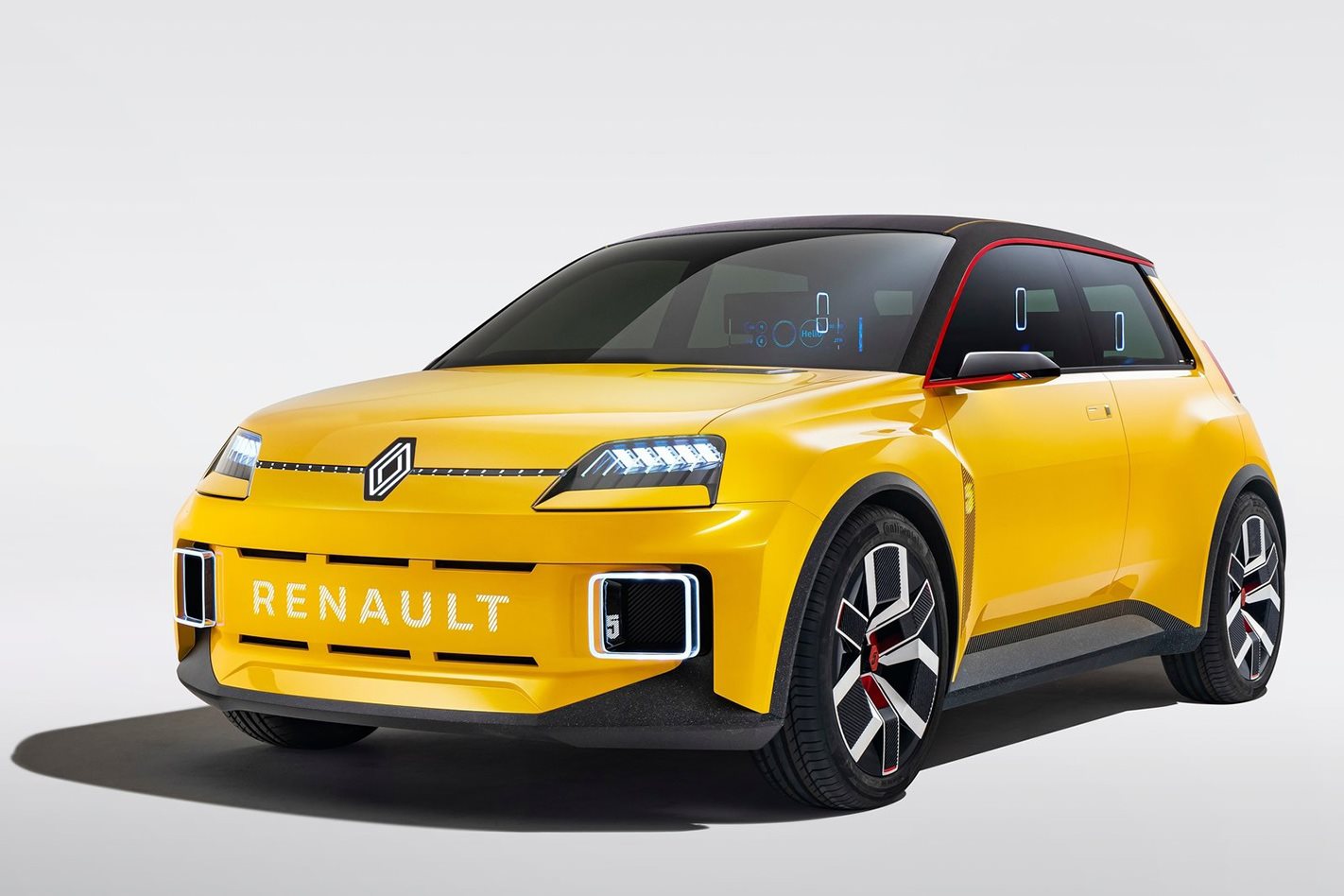
Leboine is also the man responsible for the brilliant-looking Renault 5 EV Concept we saw at the start of 2021.
And if that weren’t enough of a CV, Leboine designed the latest iteration of the one-and-only Dacia Sandero – a car popularised by James May of Top Gear.
It’s hoped that Leboine will turn Fiat’s financial fortunes around, with the Italian carmaker witnessing one of the biggest sales decreases of any carmaker in the last decade.
Olivier Francois, Fiat and Abarth CEO, said it was encouraging to see the Frenchman on board and the design of the Italian brands’ new cars would play a pivotal role in its sales success.
“I am really excited to welcome François Leboine to the world of Fiat in a moment that is so full of opportunities with the power and scale of the new Group,” the CEO said.
“Designing new Fiat and Abarth cars is key to expressing our full potential for customers around the world.’’
Snapshot
- New tech allows Bugatti to create ultra-thin, uber-stiff components without a brittle nature
- 3D-printed titanium brake calipers and suspension components can be put into production
- Mixed ceramic and titanium composite material also being developed
The Bugatti Bolide is what happens when the engineers behind the Chiron hypercar look at their own creation and think “that’s a bit too slow for us”. Looking like an LMP1 car that spent too much time hanging out with Arnold Schwarzenegger, the Bolide was a no-holds-barred ‘what if’ concept that allowed Bugatti to push its engineering process to the limit.
We aren’t here to talk about the Bolide in totality though, it’s several, very small, components underneath the dramatic skin that have us at MOTOR HQ geeking out.
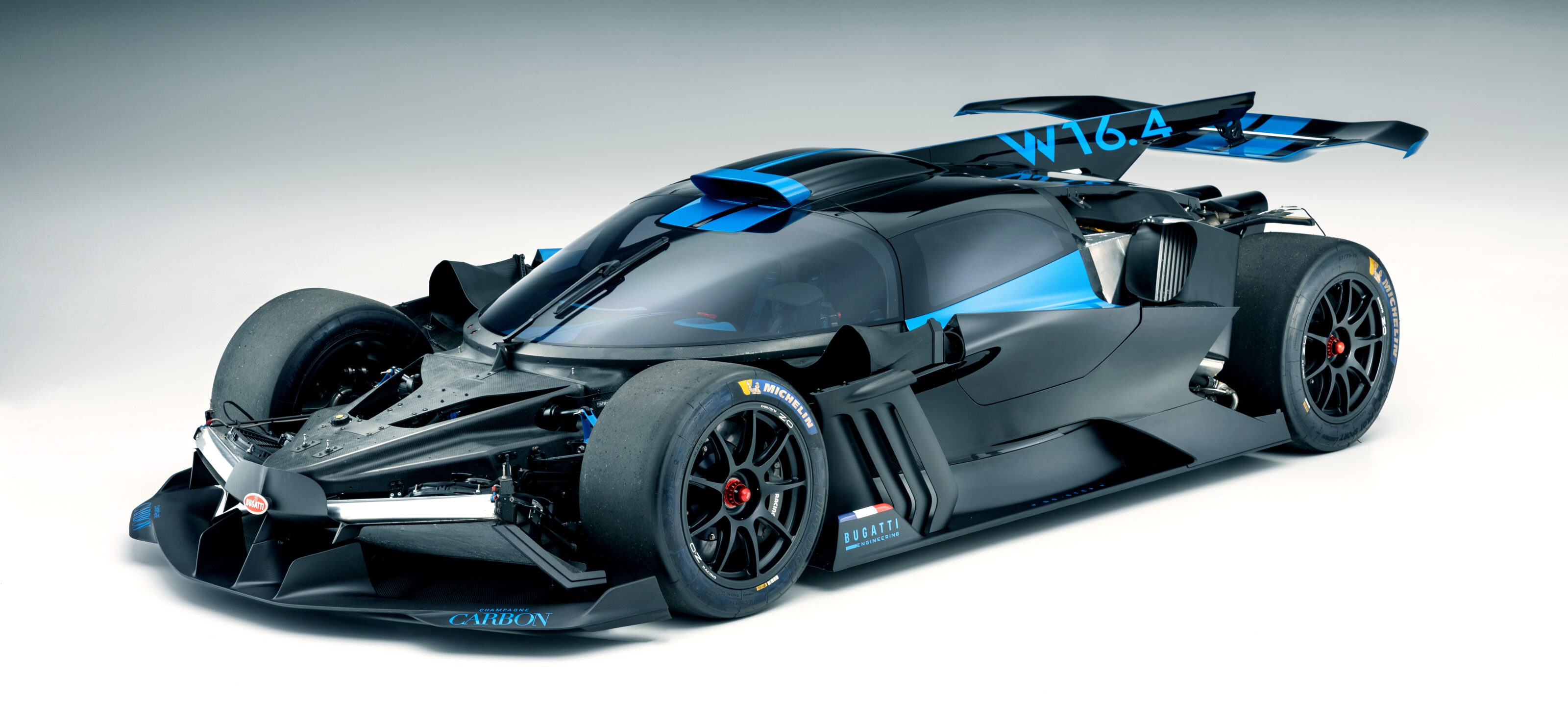
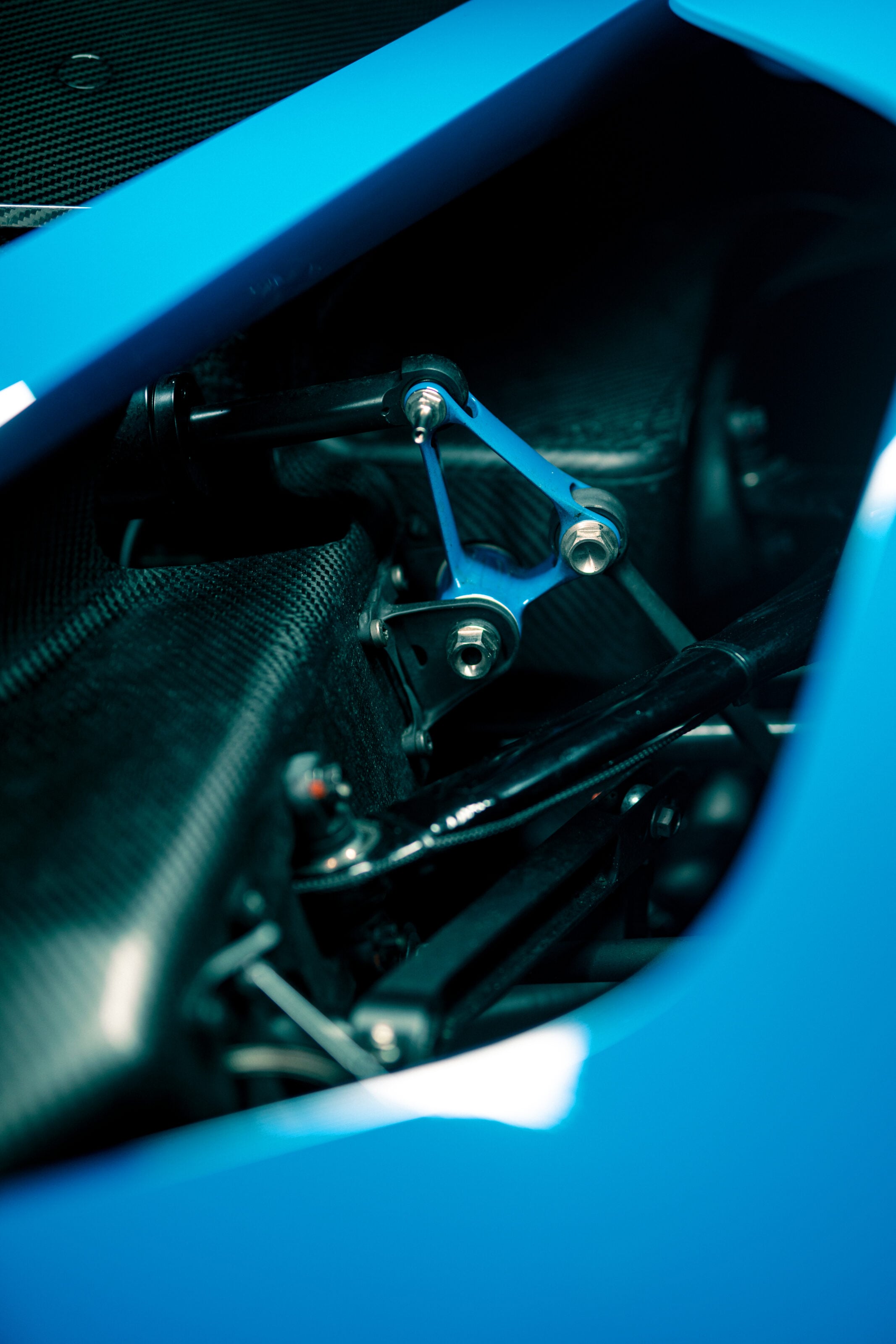
Begin peeling away the exterior panels and very quickly you’ll discover several core pieces of the Bolide’s race-spec pushrod-design suspension – including the brackets and springs – are constructed not from aluminium, but of 3D-printed titanium. However, it is the pushrods themselves that are most impressive. Bugatti is so proud of its design that it has patented the internal structure. Put one on a scale and it’d register just 100 grams, but it is capable of taking 3.5 tonnes of punishment thanks to a construction process known as selective laser sintering.
Each pushrod starts its life as a pile of Ti6AI4V titanium powder, with the printing process, which engineers would prefer you call additive manufacturing, being incredibly time consuming. While the 3D printer your geeky cousin uses lays down a single solid stream of liquid material that then solidifies into the final product, Bugatti uses the method called selective laser sintering. Thousands of layers of the powder are put down progressively, each being melted by a laser, essentially welding the final product into a single piece like a reverse-billet. After being ‘printed’ each part is then furnace-treated at 700 degrees Celsius, before being ‘cooled’ to 100 degrees Celsius to boost the dimensional stability and remove residual stress.
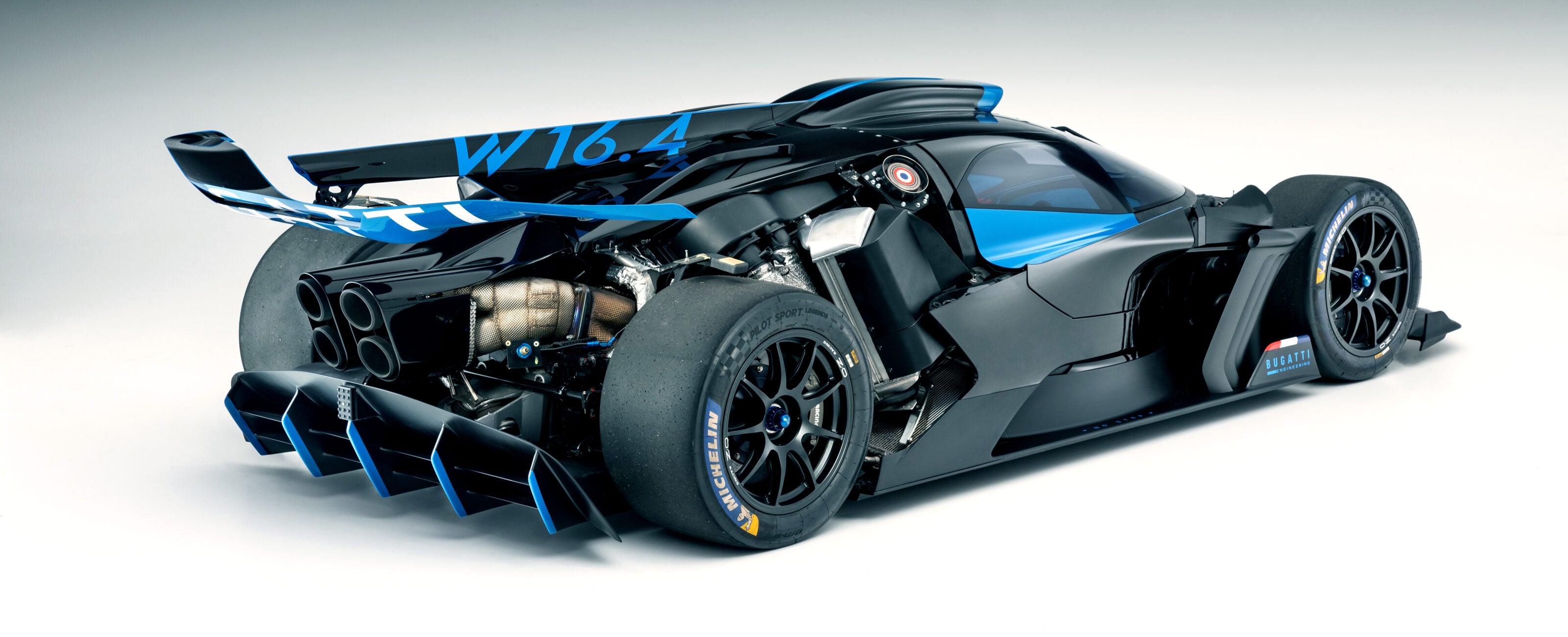
Using selective laser sintering, Bugatti is able to print titanium with an accuracy of 0.1mm – or about the same thickness as the paper this story is printed on. The suspension components have a hollow interior, and incredibly thin walls (down to 0.4mm in some places), while also remaining incredibly strong. This is thanks to the organic, bone-like design of the components. Taking inspiration from organic structures, Bugatti was able to strike a balance between weight and strength.
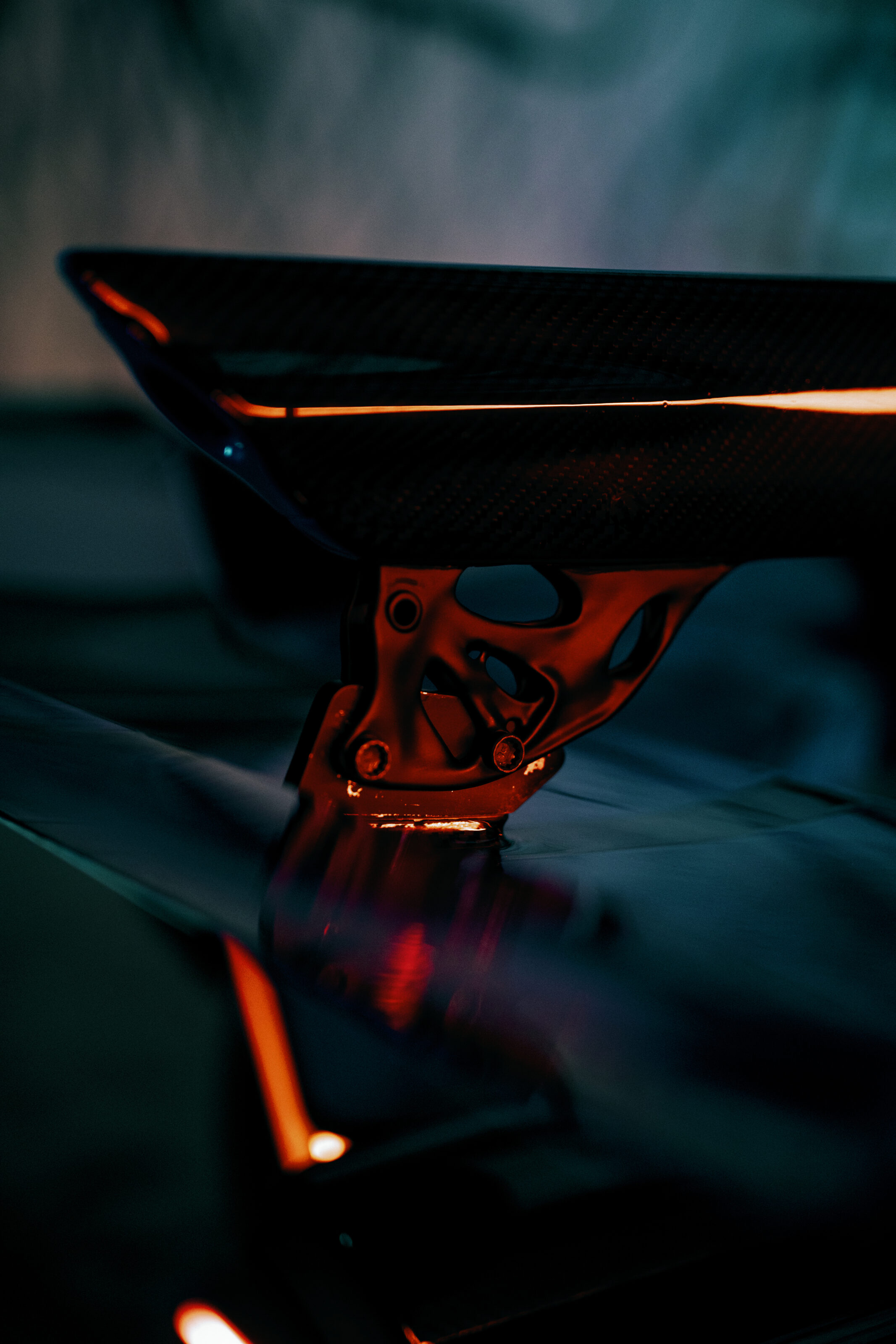
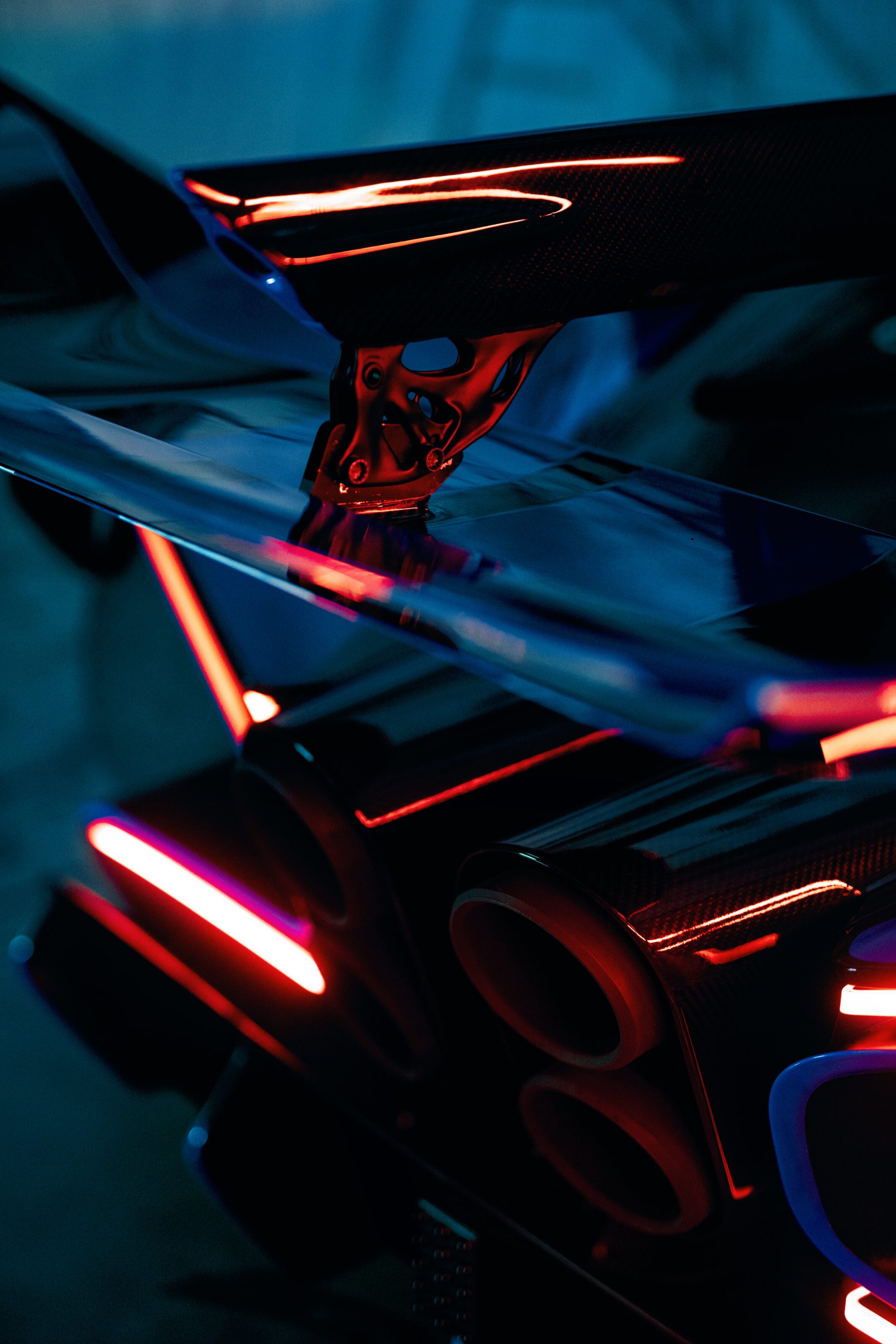
Bugatti didn’t stop at the suspension. The mounting bracket for the Bolide’s steering column includes an integrated dashboard support and is 3D printed, along with the steering column’s support collar and the interior air vents – all with a uniform wall thickness of 0.5 mm. Other printed components include the turbo-fan wheel covers, plus front- and rear-wing mounts. For the front splitter, a bracket was created with a wall thickness of 0.7mm that allows it to be adjustable with three different height settings, while also being rated for 800kg of downforce and weighing just half a kilo.
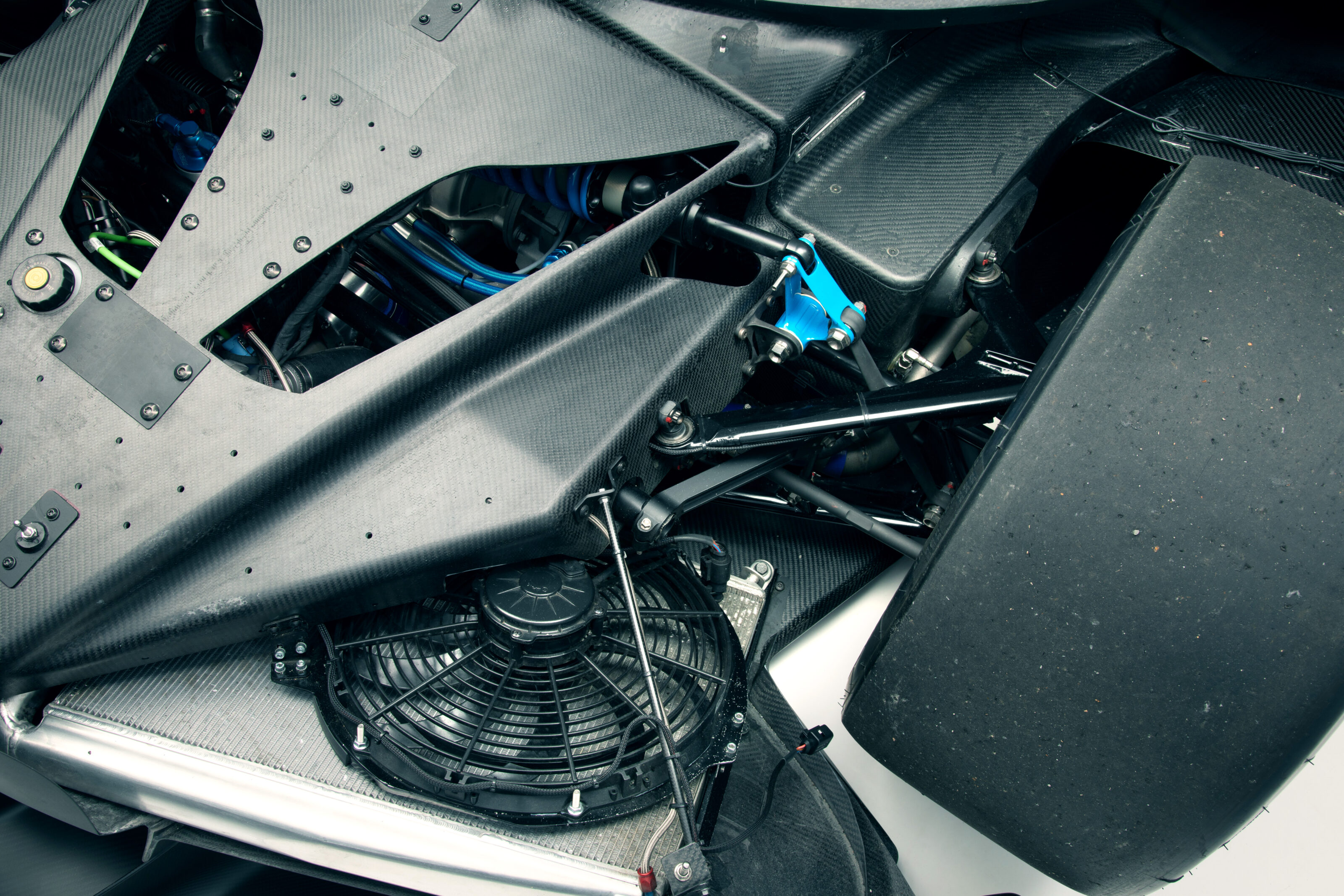
While still relatively new, 3D printing processes have been undergoing intense scrutiny by multiple car companies for several years, with an aim to improving the vehicle manufacturing process (and boosting performance along the way). Fiat-Chrysler announced a partnership last year with Fraunhofer, resulting in an experimental component that integrated parts of the wheel hub with the brake calliper. The resulting single-piece prototype does a job previously completed by 12 individual parts, while weighing 36 per cent less. Meanwhile, Porsche has used the technology to produce power-boosting pistons for the GT2 RS, while Bugatti developed a powerful new brake calliper design for its warp-speed hypercars (see breakouts, right).
Head of new technologies at Bugatti, Frank Götzke, says the 3D printed titanium components have a tensile strength of 1250 N/mm2, with the heat treatment process resulting in a high fracture strain of at least 19 per cent. Don’t speak fluent engineer? The layman’s translation is Bugatti has created ultra-thin, uber-stiff components without a brittle nature.
While Bugatti’s design is currently at the bleeding edge of printing technology around the world, it’s thought that continued development will result in savings for car companies.
“The overall focus is on the reduction of manufacturing costs, for example, by significantly increasing production speed,” explains Ruben Meuth, Head of Business Development at experimental parts manufacturer Fraunhofer IAPT
Your regular vehicle manufacturer can’t match the bottomless pockets of a hypercar company like Bugatti, but expect these science-fiction technologies to become more democratised and commonplace sooner, rather than later. This will result in less unsprung mass, increased dynamic capability, and more enjoyable drivers’ cars all round.
THE MAN BEHIND THE PRINTER
Bugatti’s edge in this area is thanks to Henrik Hoppe, who leads the manufacturer’s selective laser melting projects. As a doctoral student, Hoppe wrote his master’s thesis on a calculation methodology for creating 3D printed titanium brake calipers. Expect any hypothetical head-hunting from rival manufacturers to be headline news.
BIGGER AND BETTER
Bugatti already had the most powerful braking system ever fitted to a road car when it released the Chiron, but in 2018 the firm went ever bigger by developing a monobloc caliper design produced using additive manufacturing. The French manufacturer claims the eight-piston caliper it created in was the largest functional car part ever 3D printed with titanium. Measuring in at 41cm long, 21cm wide, and 13.6cm high, the titanium unit weighed 2.9kg, compared to the then-aluminium production equivalents 4.9kg.
PRINTING POWER
A Porsche technical study in 2020 resulted in the company 3D printing a set of pistons for the 911 GT2 RS, boosting power from 515kW to 537kW. The pistons are 10 per cent lighter than a conventional equivalent, while incorporating a new cooling channel to lower ring zone temperatures by up to 20 degrees Celsius. Along with the 4 per cent power bump, the units underwent a 200-hour endurance run on an engine dynameter. Porsche’s engineers teamed up with three separate companies to help tackle the engineering challenge.
MIXING CERAMICS
Bugatti has created a mixed ceramic and titanium material that is capable of being 3D printed, using it on exhaust systems. It claims the hybrid product is a “significantly less effective heat conductor than titanium” allowing it to be used in the construction of thermal shields.
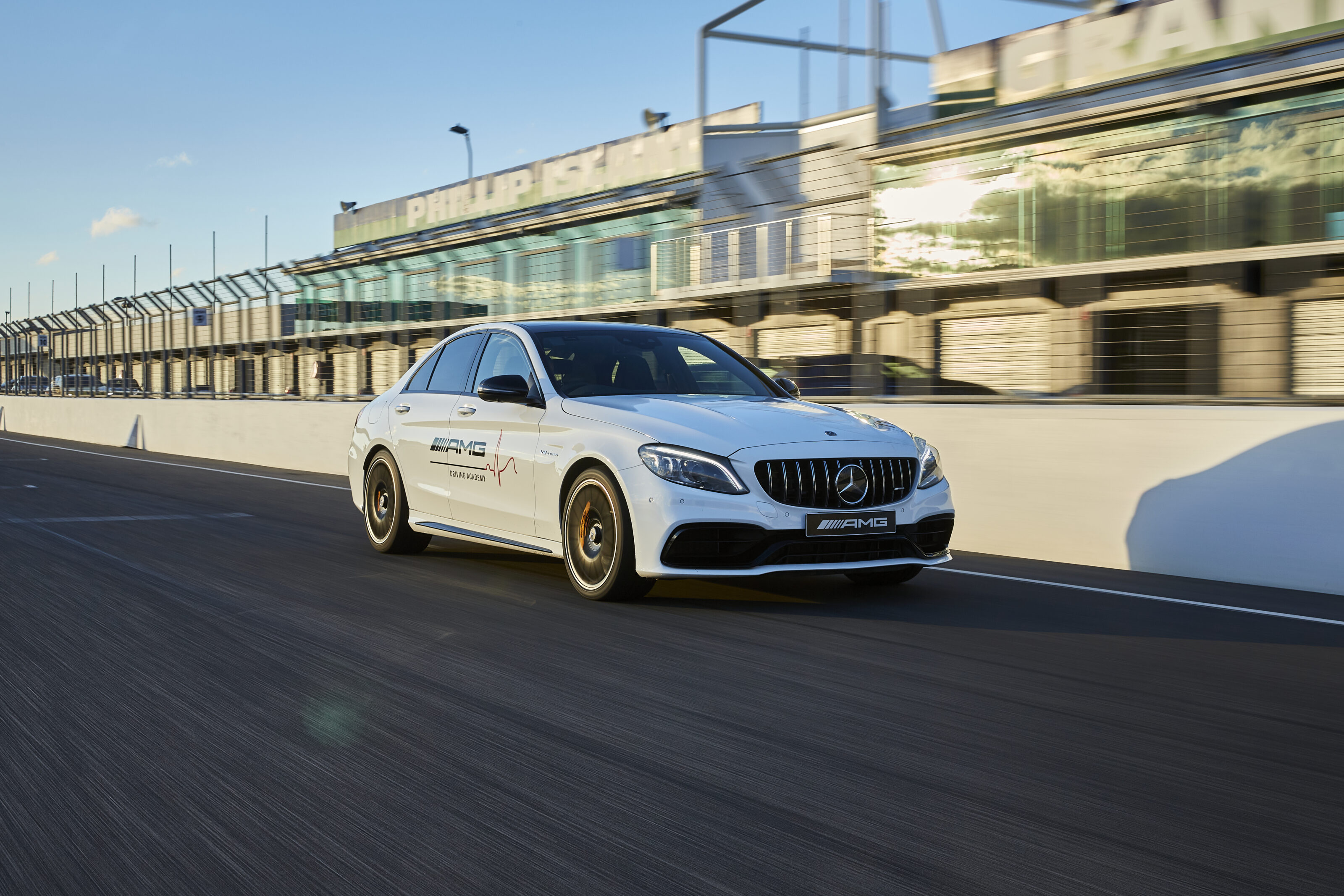
This ought to be a simple exercise. Plonk pro drivers in the right-hand seats, time each of the three AMG cars around a lap of Phillip Island and then set them off at a stagger so that they all cross the finish line at the same time.
You’ve probably seen a similar exercise at the Australian Grand Prix.
It turns out that getting this right is a good deal harder than you’d think.

Some backstory first. Every now and then, AMG will hold one of its Driving Academy events.
If you’re an owner, you should get onto one. They’re excellent.
This year we’re at the Island and Monday is bump-in day, when the instructors arrive and are briefed, the cars are fettled and all of the hospitality teams get to work ahead of the event.
It’s also a day when the track is quiet for a few hours, and we took advantage of that by rounding up three of AMG’s hotshoe circuit instructors and three of the cars customers get to take out and drive on track.
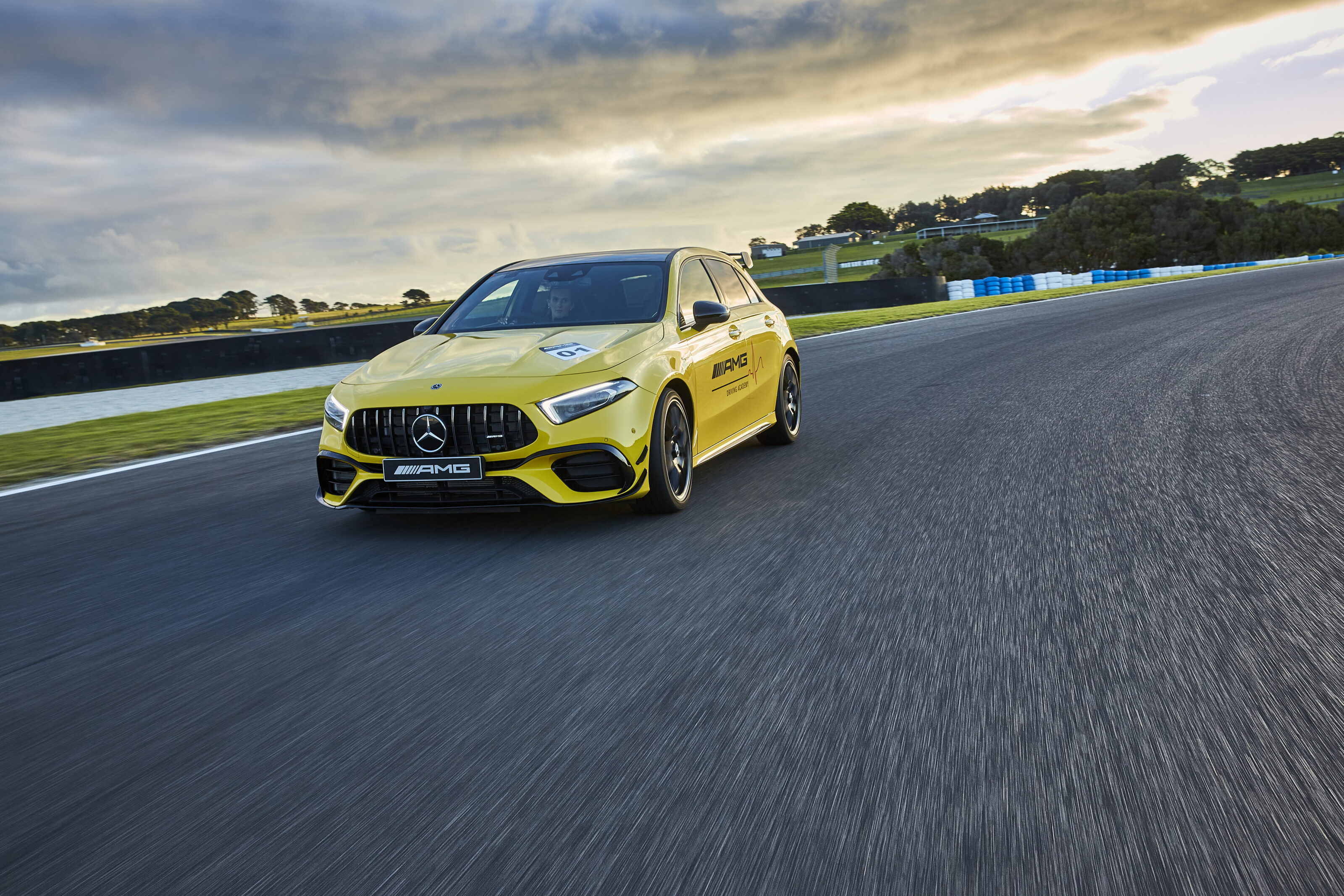
We put Carrera Cup racer Sam Brabham into the world’s fiercest hot hatch, the 310kW AMG A45 S. Yep, he’s the grandson of Sir Jack, the three time F1 world champ, and he’s certainly not slow.
Jumping into the 375kW C63 S is Nathan Pretty, a former winner of the Bathurst 24 Hour and a man with no fewer than six top-10 finishes at the Bathurst 1000 on his resume.
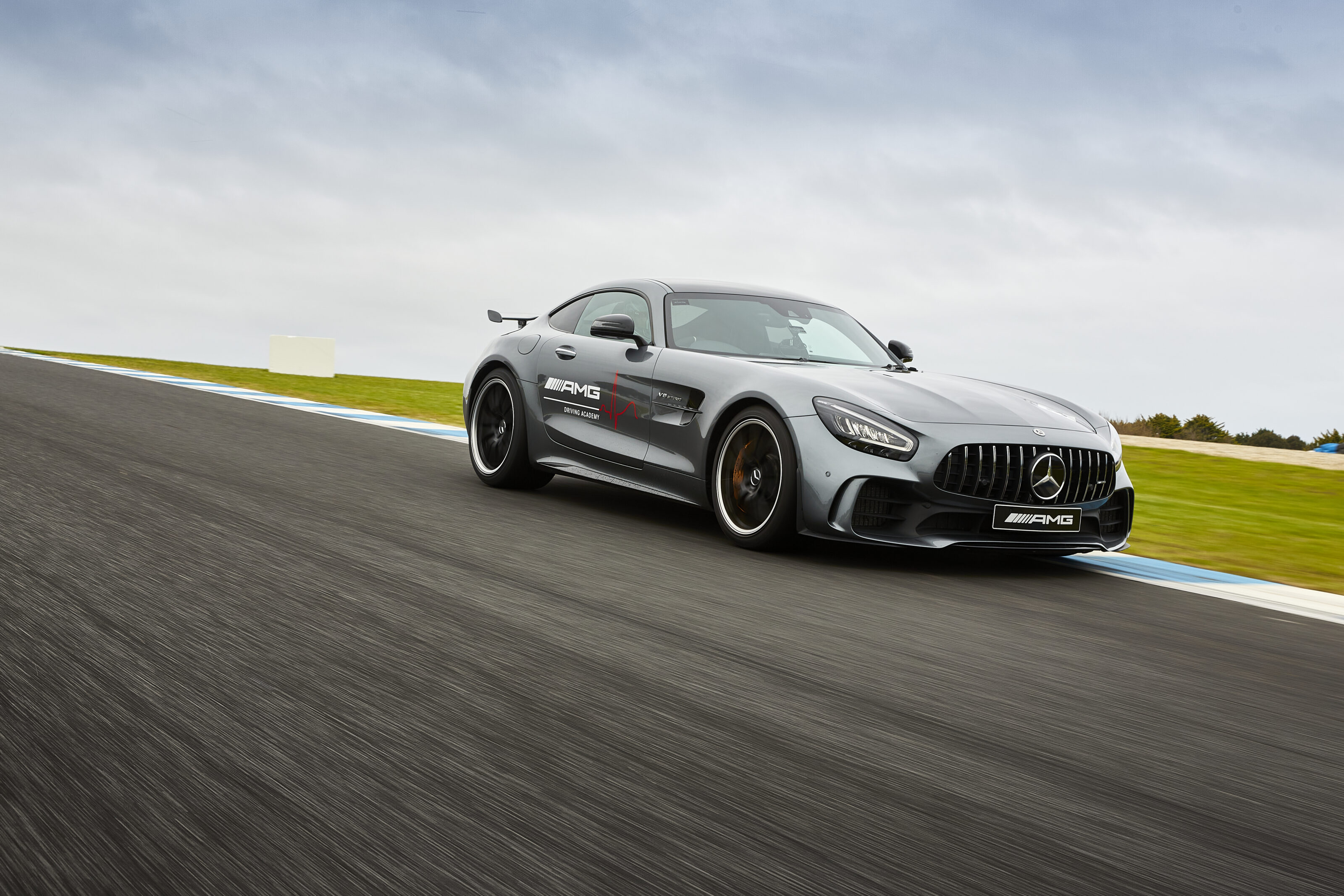
In the driver’s seat of the 430kW AMG GT R coupe is Tim Macrow, a double Australian F3 champion.
First order is to establish a benchmark timed lap. After a couple of laps, we conclude the C63 should set off four seconds behind the A45, with the GT R another four astern.
When we run the laps with that stagger, it turns out that the C63 can’t get close to the A45 and the GT R is crawling all over the back of the sedan by the time we exit MG, three-quarters of the way round the circuit. Time to think again.
It seems that Brabham is doing an annoying thing. He’s learning and getting faster.
With that in mind, we slim the stagger down to a couple of seconds and Nathan Pretty – with me as ballast – sets off after him and his passenger Scott Newman, leaving another six seconds for Macrow, with Alex Inwood in the jump seat, to haul back.
I have to admit, it’s about the best fun day I’ve had at a race track where I didn’t drive one metre.
The A45 S is devilishly hard to peg back, even with the advantage of stickier tyres on the C63 S.
One look at their respective power-to-weight ratios gives an indication why. The A45 S packs 200kW/tonne and the C63 S? Well that depends on whether you believe that it weighs its quoted 1680kg.
We don’t and think that the respective PWR figures aren’t too far from lineball, especially given the fact that me and Nathan Pretty are a couple of bigger blokes than Brabham and Newman.
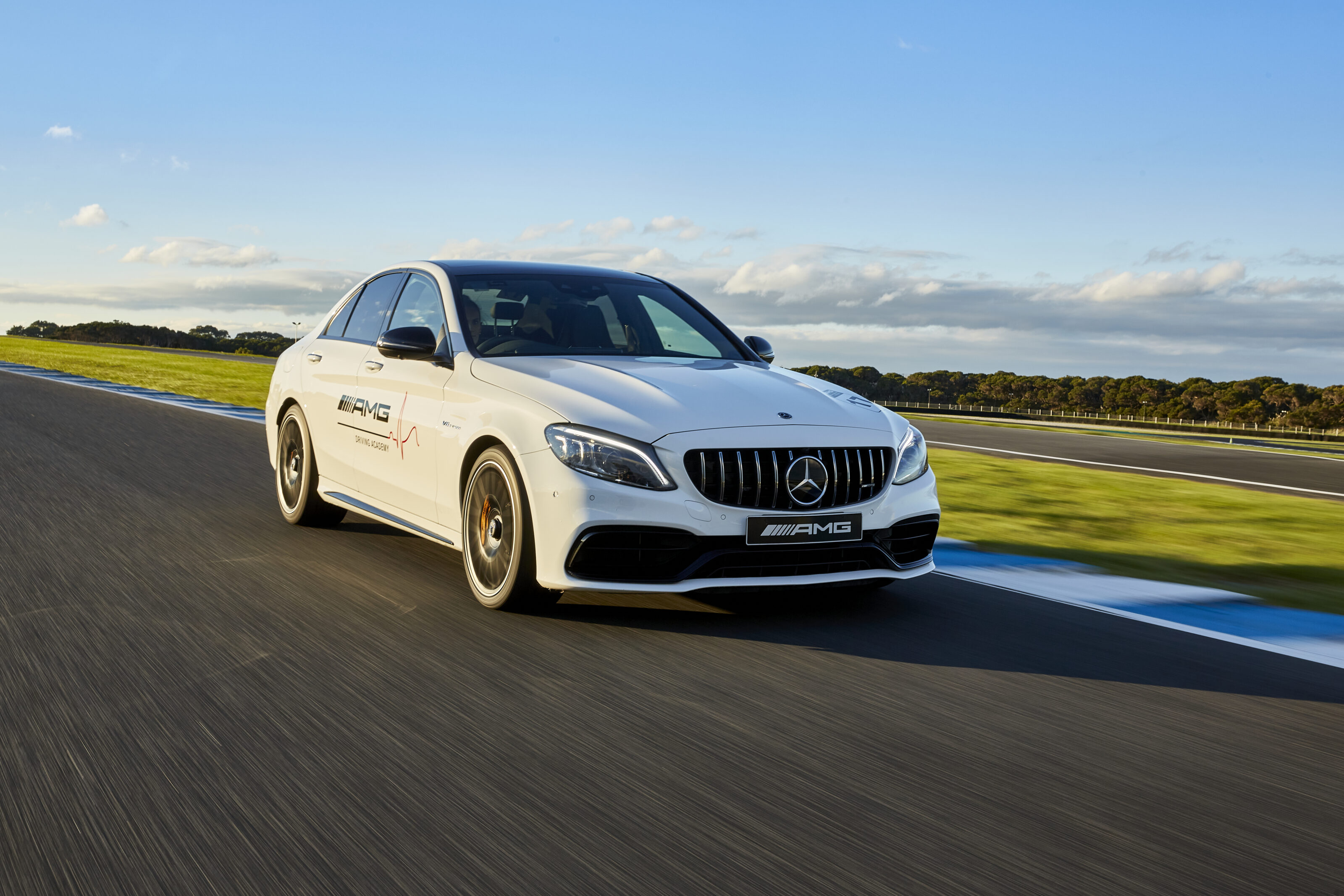
This means that the A45 S realises an advantage off the line and powering down out of slow corners due to its all-wheel drive, but the big C63’s stability and lateral grip from its stickier rubber claws back that advantage and more in Phillip Island’s faster sweepers.
While the A45 and C63 enjoy their cut and thrust up front, the GT R demolishes the fast corners.
Its body control allows its aero to really get to work, generating confidence through the really ballsy stuff at PI like the Hayshed corner and the tip into Lukey Heights.
It’s not quite as tied down as our current PCOTY champ, the GT R Pro, but it’s still quite something to see its lights gaining on the C63 corner by corner.
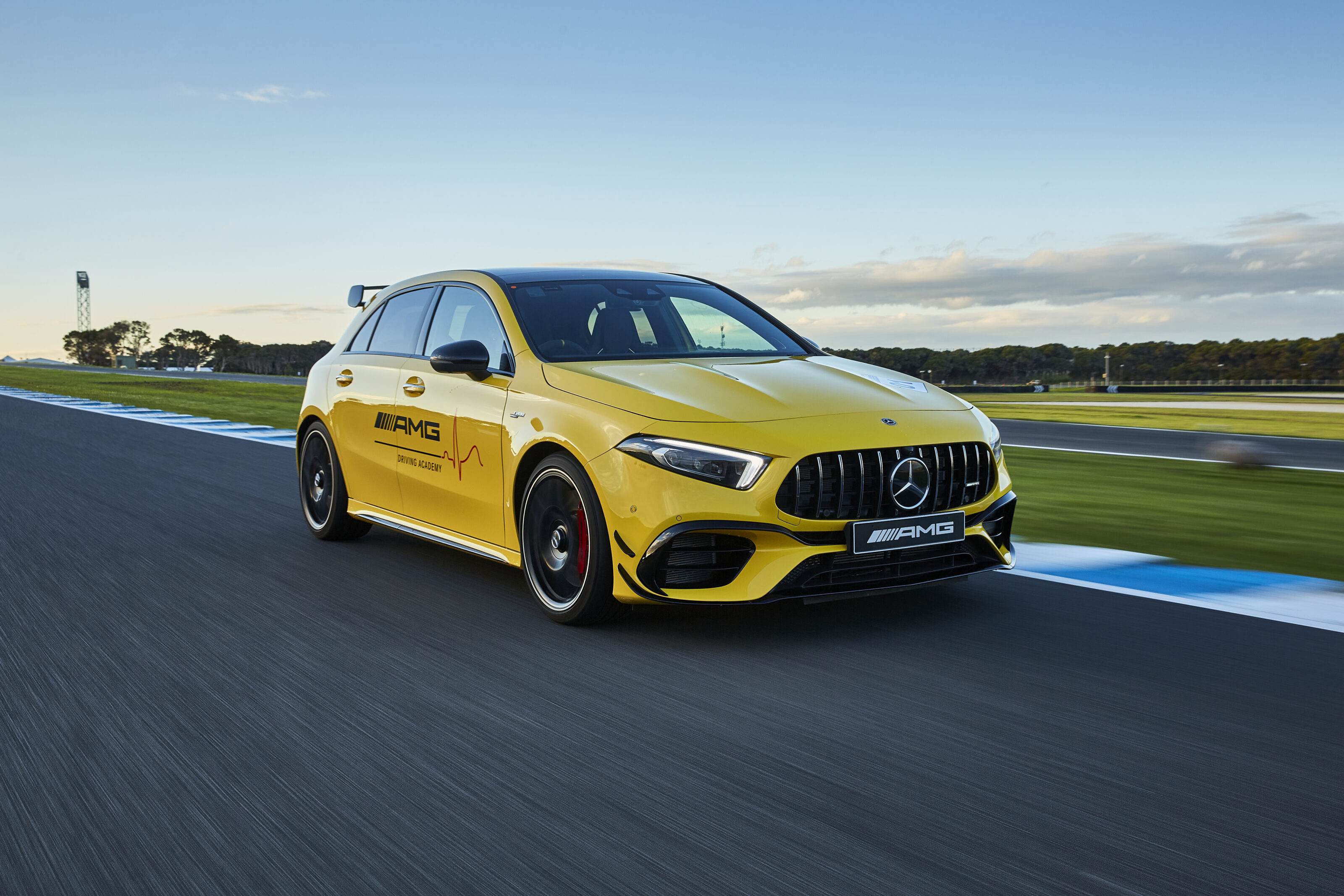
Anyway, I’m not going to spoil the surprise and tell you which crossed the line first. You’ll just have to watch the video (above) for that.
Suffice to say that when we downloaded the data to our phones using the AMG Track Pace app, it was clear where each of the cars was making time on the other.
It was great to see race drivers be race drivers. Professional pride was at stake here, so every trick in the book came out to guarantee bragging rights.
It’s genuinely eye-opening and it’s so close at the end that I’ve had to watch the video myself a couple of times to establish a finishing order.
Give it a go and let us know what you think.
Subscribe to the MOTOR YouTube channel for more awesome performance car content!
Snapshot
- Concept drawings by Instagram artist Theottle
- Inspired by top-model Giulia Quadrifoglio GTAm
- Not likely to ever see production
A series of concept drawings have offered a glimpse into what a wagon version of Alfa Romeo’s popular Giulia may look like.
The renders were created by Theottle, an Instagram-based artist responsible for a variety of photorealistic edits. Much of his work involves transforming sedans into wagons and vice-versa. He’s also offered some attractive front-end tweaks, including a ‘nose job’ on the BMW I8’s controversial grille treatment.
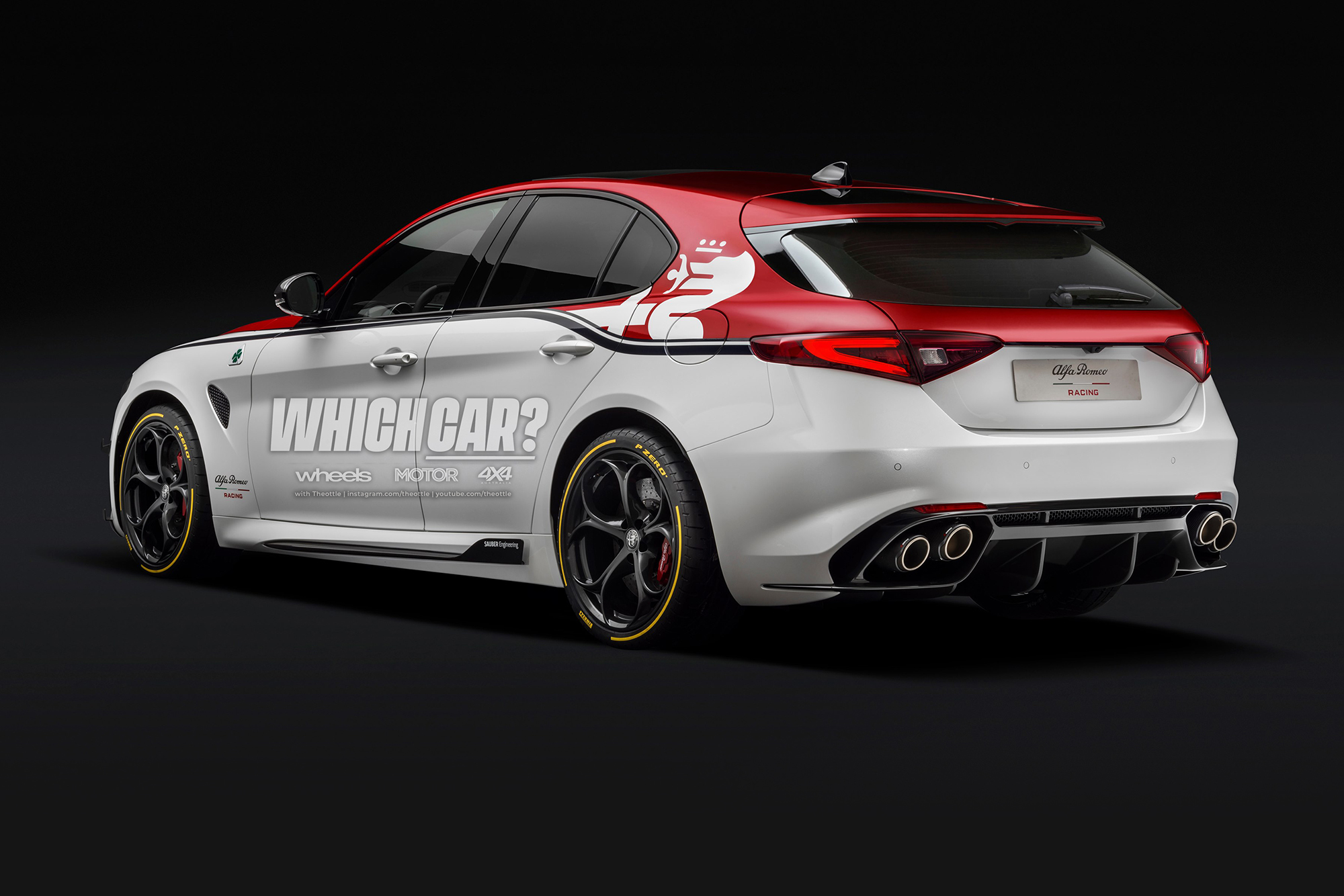
Theottle’s designs aren’t the first time a shooting brake incarnation of the Giulia has been envisioned, with several artists offering their own rooflines and window styles.
Launched in 2016, the Giulia was the first Alfa Romeo saloon since production of the 159 wrapped up in 2011. With the range came the high-performance Quadrifoglio, named in deference to the company’s historic four-leaf clover motif. The top-of-the-range car features a 2.9-litre twin-turbo V6 producing 375kW through an eight-speed auto.
Alfa Romeo has since upped the ante with a limited-edition, track-focused ‘GTAm’ variant. Power was upped to 398kW and extensive lightening work was performed. Front and rear track was increased by 25mm and 50mm respectively.
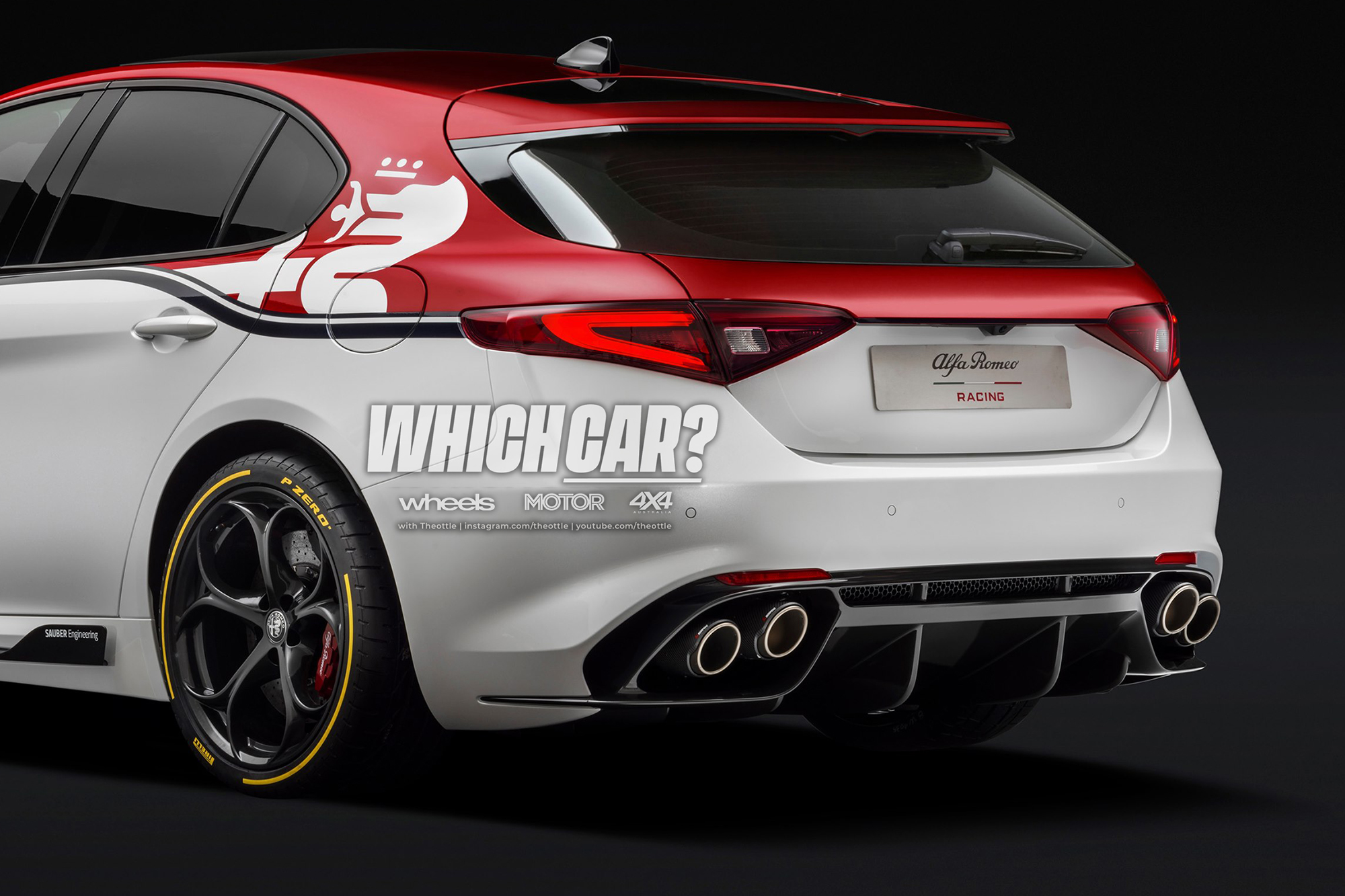
Theottle’s race-inspired renders draw inspiration from the GTAm, particularly in the Sauber Engineering-adorned carbon fiber sideskirts.
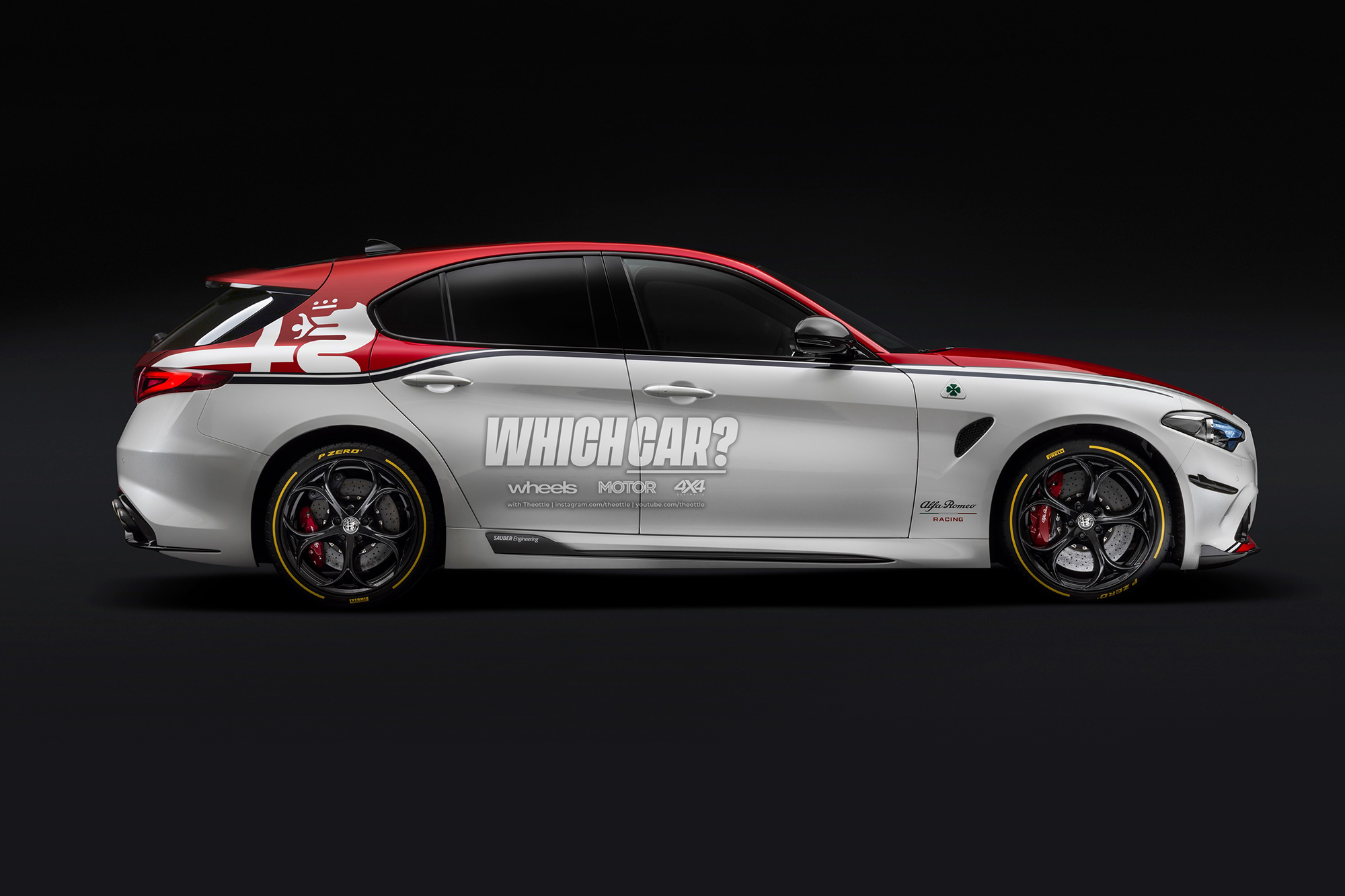
Hopes for a real-world Giulia wagon were dashed in 2017 however, when head of manufacturing Alfredo Altavilla stated that the company would not pursue the body style. According to Altavilla, it’s a niche already capably filled by the Stelvio crossover, which is built on the same ‘Giorgio’ platform.
With the Quadrifoglio-spec Stelvio pumping out the same 375kW as its Giulia counterpart, it’s difficult to make a case for a Giulia shooting brake on performance grounds. Therefore, unless Alfa Romeo changes its mind, the digital imagining seems as close as we’ll get to a big-boot Giulia.
Snapshot
- Test lab to real world economy difference can be over 50 per cent
- ADR testing standards have remained unchanged since 2001
- Manufacturers complying with regulations despite large gap
If you’ve purchased a new car, you may have seen the label in the corner of the windscreen, showing the vehicle’s fuel consumption and Carbon Dioxide (CO2) emissions, both of which are designed to help inform prospective buyers about the car’s overall efficiency.
To find out what a new vehicle’s fuel-consumption is before it hits showrooms, Australia uses the Australian Design Rules (ADR) 81/02 test which is based on the New European Driving Cycle (NEDC) introduced in the 1980s and, until recently, was used as a standard across most of the world to test consumption and emissions.
The ADR standardised tests are conducted in a cell which is air conditioned between 20 to 25 degrees, with the car set up on rollers and force-fed air into the radiators so it doesn’t overheat. Resistance on the rollers is set to mimic the weight of the car and the 11-kilometre, 20-minute test begins, starting with an ‘urban’ cycle (replicating stop-start traffic) followed by a shorter ‘extra urban’ cycle.
The results of the two parts are weighed against each other to calculate the average fuel economy which is shown on the top part of the label with the two separate results underneath, the CO2 results also being shown on the right side of the label.
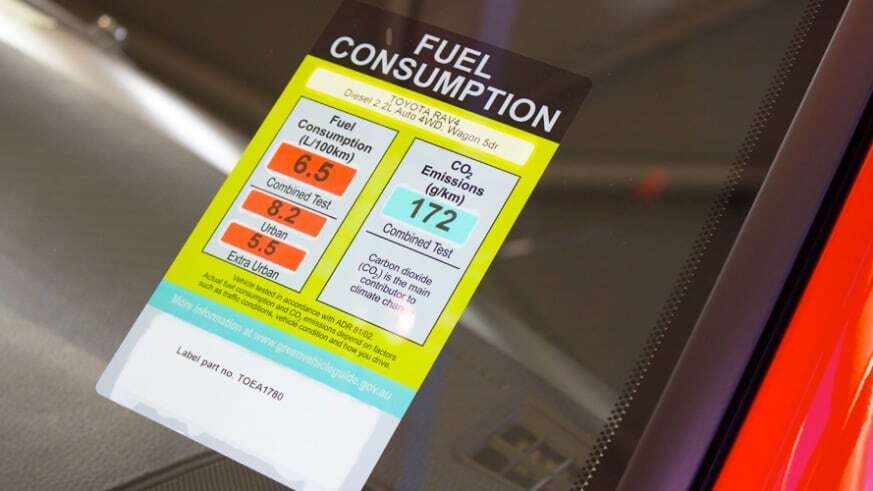
The ADR standard of testing was designed for typically lower speed environments, the urban test has an average speed of just 19km/h over a 4km distance while the extra urban cycle runs for 7km, running at an average of 63km/h with peak speeds of up to 120km/h.
Though it is still a problem in Europe, Australians have seen a far larger difference between the advertised and real world fuel economy of their cars due to different conditions here compared to abroad, both in terms of the lengths we drive and the average speeds we drive at.
Testing in the United States is conducted by the Environmental Protection Agency and takes place both in a lab and on the real road, giving more accurate results though at an arguably higher cost to the taxpayer.
Meanwhile, European testing was overhauled in the wake of the Volkswagen Dieselgate scandal in 2015 in which certain VW models were found to have been pre-programmed to recognise when they were in a testing lab, producing significantly lower emissions than what were achievable in real life.
In 2017, the European automotive industry changed from testing emissions and consumption through the NEDC platform to the newer Worldwide Harmonised Light Vehicle Test Procedure (WLTP) platform, performed over a longer distance of 23km as well as having a wider range of speeds and simulated gradients, better reflecting real world driving in the aim of bridging the gap between advertised fuel economy and the results customers will see on the road.
Speaking to WhichCar, Hyundai Australia said while the ADR testing allows consumers to compare different cars against the same metric, the South Korean automaker would welcome a move to the WLTP testing platform.
“The current laboratory-based test procedure for ADR 81/02 gives consumers the ability to compare fuel efficiency of different vehicles using a common, repeatable method,” said a spokesman.
“However, we could see the benefit in Australia adopting WLTP as it better reflects efficiency achieved in real-world conditions. Ultimately, though, we comply with whatever regulation is set by government.”
Calls within the Australian motor industry for Fuel Consumption Labels to be changed or scrapped completely have grown louder after the Victorian Supreme Court ruled in favour of a Mitsubishi Triton owner who claimed the label on his Triton was misleading compared to the car’s actual consumption.
The case between Zelko Begovic and Mitsubishi Australia came from Mr Begovic keeping records of his 2016 Triton’s fuel consumption which, despite being shown on the Fuel Consumption Label as having better economy than his previous 2008 model, consumed more fuel than the car before it.
The Supreme Court found neither a Mitsubishi technician or an independent tester could replicate the results given on the fuel label, placing blame on the testing process rather than Mitsubishi, saying the Japanese manufacturer had done nothing illegal and the vehicle was not defective.
Futhermore, Judge Tim Ginanne said the fuel-labelling system was “misleading and deceptive”, adding: “The label contained no representation about the Triton’s actual fuel consumption but, I consider that a reasonable consumer reading the label would consider it indicated information about the vehicle’s fuel consumption.”
A spokeswoman for Mitsubishi said the company “[was] pleased to see that there is no suggestion that Mitsubishi Motors did anything other than to comply with the law when conducting the Government mandated fuel consumption tests.”