
What stands out?
The Holden Astra hatchback ranks among the most entertaining and satisfying to drive of popular small cars. The German-designed, Polish made import is nicely finished, handles very well, and offers a choice from two strong turbocharged engines and manual and automatic gearboxes. The Astra, which is being discontinued from sale, comes with a five-year warranty, and autonomous emergency braking is available.
What might bug me?
In the more powerful, 1.6-litre, Astras, paying more for fuel. Holden recommends you fill with premium petrol (95 RON), which costs more than regular petrol or E10 (a mixture of petrol and ethanol).Driving under 80km/h on the space-saver spare tyre until you can fix your full-sized flat.That Holden parent General Motors has sold German company Opel, which makes the Astra, to French company PSA Group, which owns Peugeot and Citroen. The change of ownership won’t stop Opel making the car, which is popular overseas and was named European Car of the Year when launched there in 2016. You can expect that Holden will continue to sell the Astra over the life of the model, and will maintain a supply of replacement parts.
What body styles are there?
Five-door hatchback, four-door sedan and wagon.This review covers only the European-built hatchback directly. Click here for a separate review of the Korean-built Astra Sedan.The Astra drives its front wheels, and it is classed as a small car, lower priced.
What features do all Astra hatchbacks have?
Cruise control with a speed-limiter (which ensures you do not exceed the set speed and so helps you avoid fines). A reversing camera, and rear parking sensors (which help you judge how far the rear bumper is from obstacles).An MP3 compatible sound system with (outstandingly reliable) DAB+ digital radio reception, Aux and USB inputs, Bluetooth connectivity for audio streaming, voice control, and six speakers.A colour touchscreen (7.0-inch on the less costly Astras) for controlling cabin functions. Support for Apple CarPlay and Android Auto, which lets you plug in a compatible smartphone and display on the touchscreen some of its apps (including mapping). You can then operate the apps from the touchscreen (or by voice).Controls on the steering wheel for the cruise control, the audio system, and your phone.Headlamps that switch on automatically when it’s getting dark.Aluminium alloy wheels (which look nicer than steel wheels with plastic hubcaps), and a speed-limited space-saver spare wheel.A Sports Mode button, which allows you to adjust how directly the Astra responds to your use of the steering wheel and accelerator pedal.Hill-start assist, which makes it easier to take off on an uphill slope (by controlling the brakes automatically). Traction control, which prevents you from spinning a front wheel if you try to accelerate hard where it’s slippery.Electronic stability control, which can help you control a skidding car. All new cars must have this feature.Six airbags. (For the placement of airbags, and more on Astra safety systems, please open the Safety section below.)Every Holden Astra carries a five-year, unlimited-kilometre warranty.
Which engine uses least fuel, and why wouldn’t I choose it?
Two engines are available in an Astra, both turbocharged four-cylinder petrols. The more fuel-efficient is the smaller and less powerful 1.4-litre supplied with the least costly Astras, the Astra R and R Plus, which consumes 5.8 litres/100km on the official test (city and country combined).In real-world driving you can expect to average about 8.5 litres/100km from a 1.4-litre Astra. This is a smooth, strong engine, and very effective in propelling the car effortlessly.The main reason you might not choose the 1.4 is that you like the idea of having more power than you need. Another is that you want some or all of the features attached to the more expensive Astras, the Astra RS and RS-V, both of which come only with a bigger, 1.6-litre, engine. The 1.6-litre feels more responsive than the 1.4, and develops about 25 per cent more thrust if you ask for all it can give. It too is smooth, and it is unusually strong for a popular small-car engine. It uses about 10 per cent more fuel on the official test.To a greater extent than in many small cars, fuel economy in an Astra depends on how heavily you depress your right foot. The strength of the 1.6 engine means you have less opportunity to work it hard, and in conditions that encourage you to exploit a car’s performance it may use less fuel than the 1.4. In contrast, if you make use of the strong pull available as soon as you press the accelerator in either Astra, caressing the throttle rather than prodding it, you will be rewarded with much lower fuel use and the 1.4 will be significantly the more thrifty engine.Expect about 9.0 litres/100km from a 1.6-litre Astra in real-world driving, on average.The Astra R and RS-V come standard with a six-speed manual transmission, with a six-speed auto (that’s standard on the R+ and RS) an extra-cost option. The auto is a conventional torque-converter type, which offers smooth take-offs around town and satisfyingly swift responses to your demands on the open road.Auto Astras (only) have a stop-start feature that saves fuel (and emissions) in the city. It turns off the engine automatically when you stop, and starts it again when you take your foot off the brake pedal to drive away – and in the Astra the starting is almost imperceptibly smooth and instant.
What key features do I get if I spend more?
The least costly Astra, the Astra R, comes with the 1.4-litre engine, 17-inch wheels, cloth seats, manual air-conditioning, and the features supplied with all Astras.For another $2200 or so, you can have an R+ – which is an R with a Driver Assist option pack and automatic transmission as standard. The main thing that buys you is a suite of active safety aids that look out for you in case your attention strays. It comprises a forward collision warning, autonomous emergency braking, and lane-keeping assistance. You also get leather wrap on the steering wheel, and windscreen wipers that operate automatically when it rains. (For more on Astra safety systems, please open the Safety section below.)Spend more for an Astra RS and you get the R+ additions and the more powerful, 1.6-litre, engine with the automatic transmission. You can unlock an Astra RS and drive away without removing its smart key from your bag or pocket. Front parking sensors augment those at the rear, and Park assist can steer you automatically into a parking spot. The exterior mirrors can be power-folded against the body (to keep them out of harm’s way when parked). Finally, a blind-spot alert warns you if there is a car near your rear corner that might not show in the mirror.Spending more again for an Astra RS-V brings you more luxury, a sportier look, and the opportunity to add yet more features at extra cost. An RS-V comes with leather on the seats, and dual-zone climate control (which lets driver and passenger choose different ventilation temperatures). There is powered adjustment for lumbar (lower back) support from the front seats, and the seats and steering wheel can be heated. An 8.0-inch touchscreen displays built-in satellite navigation. Taillights use very long-lived LEDs. The wheels grow an inch to 18 inches, and are wrapped in lower profile tyres for marginally sharper steering and a sportier look.At extra cost, you can equip your Astra RS-V (only) with a Touring pack, comprising a powered sunroof and Adaptive cruise control (which will slow you to the speed of a car ahead until you can overtake). Alternatively, you could spend more on an Innovations pack, which adds Adaptive LED headlamps to the Touring pack’s sunroof and active cruise. The very powerful and long-lived headlamps dip automatically only that part of their high beams that would dazzle other drivers, retaining full illumination to either side. The RS-V comes standard with the manual gearbox, with the auto costing an additional $1000.
Does any upgrade have a down side?
The bigger, 18-inch, tyres on the Astra RS-V may cost more to replace, and will feel a bit bumper to drive on than the taller-profile tyres on other Astras (because their shallower sidewalls leave less air and rubber between you and the road). As well, on coarse-chip road surfaces this wheel and tyre package generates more noise in the Astra’s cabin.The more expensive Astras require premium petrol.You can have white or red paint as standard. The other six available colours cost extra.
How comfortable is the Astra?
The Astra is built by German carmaker Opel, which has been producing front-wheel drive small cars since the late 1970s. Its experience shows on many fronts.Take the packaging. The doors open wide, allowing easy entry to a cabin with more than ample room for four adults – or at a squeeze, five. The seats might seem a little flat to begin with, but in both rows they have a firmness of structure that provides decent support over long distances.Clearly Opel created the driving position to accommodate tall people, building in a huge amount of adjustment for the steering column and front seats. Further, the backrest angle follows the European norm in allowing very fine adjustment from a wheel rather than relying on pre-set slots and a lever, allowing you to make tiny changes until you are in just the right spot. Small but important details here.Simple, flowing horizontal themes define the Astra’s contemporary and well-presented dashboard. Easy to figure out and operate, the handsomely designed analogue dials are divided by a handy LCD screen that offers array of useful trip and vehicle-operation details, including a secondary, digital, speedometer. Useful for keeping beneath the limit with speed cameras about.Build quality also seems to be on the money, even though some of the lower-sited plastics are harder and coarser than you might expect in a German-engineered vehicle put together in Europe. There’s also storage aplenty, backed up by three lidded compartments (finding the third might take a while – it’s below the headlights switch).Vision is generally good, especially looking forward between the thin pillars and over a low-set dash. Thick back-door posts (C-pillars) and a relatively shallow back window do curtail rear vision. Standard rear sensors and a reverse camera are welcome, but there is nothing like being able to see out for yourself.The Astra’s sporty chassis tuning means the suspension isn’t quite as soft or supple as it is in many popular small cars (including the Volkswagen Golf, Peugeot 308 and Ford Focus). The ride quality is undermined by firmness in all models, with the larger-wheeled Astra RS-V also suffering from tyre-noise intrusion. Not to deal-breaking levels, but certainly noticeable over some coarse surfaces.
What about safety in a Holden Astra?
Every Astra comes with six airbags: one each ahead of the driver and front passenger; an airbag outside each front occupant at chest level to protect from side impacts; and side-curtain airbags extending past both seat rows at head level.All Astras also have the mandatory stability control (which is tuned particularly well), seatbelt pre-tensioners for front and rear passengers, a reversing camera, and rear parking sensors. LED daytime running lamps help other drivers see you, and auto-on headlights make you visible more reliably at dusk.The Astra R Plus, RS and RS-V add autonomous emergency braking as part of a camera-based active safety suite that also brings you a forward collision alert, lane-departure warning and lane-keeping assistance.The camera scans the road ahead for obstacles, and if it concludes a crash is likely it alerts you audibly and with a head-up visual warning projected onto the windscreen in your line of sight. If you brake but only gently, the Astra will add brake pressure if necessary. If you ignore the warning altogether, at speeds under 60km/h it will apply the brakes automatically with the aim of minimising your impact speed – or avoiding the crash.The camera also monitors road markings, and triggers an alert if you have begun to drift wide of your lane – perhaps through distraction or fatigue. It can apply a light steering correction, to wake you up and help bring the car back.The Astra RS and RS-V in addition supply a blind-spot monitor and lane-change alert. Displays on your external mirrors light up on the relevant side when another vehicle is out of view near your rear corner. If you indicate to change lanes to that side, the display will flash.The Australasian New Car Assessment Program (ANCAP) awarded the Astra R Plus, RS and RS-V a five-star rating for safety, its maximum, in November 2016. (The less costly Astra R has not been rated, but only because it does not come with auto braking and the other active safety features of the more expensive models submitted for testing, and therefore is not strictly equivalent to the tested cars.)
I like driving – will I enjoy this car?
Keen drivers take note: Holden says it tuned the Astra’s engine response, steering and suspension especially to suit Australian buyers’ tastes, at its Lang Lang proving ground just outside Melbourne.The result certainly shows. Whether it’s a 1.4 or a 1.6, the Astra has that instant off-the-line response that people seem to like, backed up by a ready well of power that the engine seems to supply without effort.The 1.6-litre Astras feel especially gutsy at high speeds, with ample power in reserve for fast and safe overtaking.Credit must also go to the six-speed automatic transmission, which shifts gears quickly and readily and has no problem at all keeping the turbo engine on the boil. The auto has a manual mode, activated by flicking the gear lever over to one side. Pushing forward is for upshifts, while pulling back activates a downshift.The Astra’s steering feels connected and weighty, for solid and surefooted handling, so that you have a sense of commanding the road. Yet the helm is also light enough at slower and parking speeds for easy manoeuvring. Job well done, Holden.However, while keen drivers may revel in the Astra’s ability to carve through corners without breaking a sweat, the trade-off is a firmer-than-expected ride, meaning that the suspension feels a bit too fidgety over bumps. It isn’t harsh or uncomfortable on a bumpy road, but you’re often aware of it.
How is life in the rear seats?
The fundamentals in the back are correct, and for space here the Astra is impressive. A well-angled backrest and supportive cushion help with comfort. Two adults should find it no problem back here, and even a third will fit at a squeeze. In Europe this is classed as a family car.However, the rising side-windows make the rear compartment feel a bit confined and dark, and there are no rear vents for the heating and cooling. Nor does any Astra offer a folding centre rear armrest.Everything else is present – map pockets, overhead grab handles and sizeable receptacles for cups, bottles and phones.Note that while the suspension operates quietly, it can feel bumpy in the back of an Astra over rough roads – and in an Astra RS-V it might also be a bit noisy.
How is it for carrying stuff?
The Astra’s interior is well thought out and eminently practical.A large glovebox, deep lidded bin (and armrest) between the front seats, and a host of smaller slots and cupholders look after all manner of items in the passenger compartment, while the boot has a wide and tall aperture, low loading lip, and flat floor.With the seats up the boot can accommodate 360 litres – quite good for a car of this sort – while folding the rear backrests increases that to 1210 litres.
Where does Holden make the Astra?
The Holden Astra is made in Gliwice, Poland. This city has been producing Opels for decades (and was the source of the TS Astra Classic in Australia from 2004 to 2005).
What might I miss that similar cars have?
Perhaps the superior stability on greasy roads of all-wheel drive, which is standard on a Subaru Impreza.Heating and cooling vents for rear passengers. The Volkswagen Golf supplies these, for example.The ability to open and close all the windows via the remote-control key-fob. The Golf, Ford Focus and Skoda Octavia have this handy function.Possibly a CD player, which you can still get on an Impreza, and some other small cars.The Octavia, Honda Civic, Renault Megane, and Hyundai Elantra and i30 offer five-year warranties, and the Kia Cerato is warrantied for seven years.Among several other small hatches worth considering are the Toyota Corolla, Mazda3, Peugeot 308, Honda Civic, Renault Megane, Hyundai i30 and Kia Cerato.
I like this car, but I can’t choose which version. Can you help?
The Astra R Plus (An Astra R with the Driver Assist pack) presents extraordinary value.All the Astra you will need, it brings sweet and strong performance, potentially excellent fuel economy (as long as you don’t drive it too hard), and a slightly softer ride than on the 18-inch wheeled Astra RS-V.Do be sure to budget for the R+, which gives you the automatic transmission as standard, a nicer-to-touch leather-wrapped steering wheel and auto windscreen wipers, as well as auto braking, lane-keeping assistance, and other helpful driver aids.
Are there plans to update the Astra soon?
The Astra Hatch arrived in December 2016 as an all-new model. An Astra Sedan arrived about the middle of June 2017, and the Astra Sportwagon in October 2017.Holden increased its three-year warranty to five years, for Astra and all other models, on July 1, 2018.In November 2018 Holden quietly deleted the manual versions of the R+ and RS from the Astra range and in December 2019 announced it would stop selling all Astra variants, along with the Commodore, to focus on selling SUVs and utes. It will continue to sell the MY19 model until stocks run out, which is expected to be several months into 2020.
IT’S OFFICIAL: The Holden Commodore is no more. Holden has today confirmed that its most iconic nameplate – a car intrinsic to Australian culture since its introduction in 1978 – will be retired at the of the year.
The news comes as Holden revealed its 2020 portfolio will focus exclusively on SUVs and light commercial vehicles. That means the Holden Astra, another long-standing nameplate on Aussie roads, will also be axed.
“The company has elected to retire the ZB Commodore and the BK Astra in 2020”, read an official Holden statement.
Both the Commodore and Astra will continue to be sold throughout 2020 until existing stock is depleted.
The news caps off a turbulent time for Holden. After months of worsening sales results – November was the lowest in the company’s 70 year history and saw its entire model range outsold by the Toyota Hilux and Ford Ranger – the embattled brand is also currently searching for a new chairman and managing director following David Buttner’s recent decision to resign.
“The decision to retire the Commodore nameplate has not been taken lightly by those who understand and acknowledge its proud heritage,” said Holden interim chairman and managing director Kristian Aquilina.
“The large sedan was the cornerstone of Australian and New Zealand roads for decades. But now with more choice than ever before, customers are displaying a strong preference for the high driving position, functionality and versatility or SUVs and utes.”
Holden first launched the Commodore in October 1978 and has sold more than three million units since. In total, there have been 16 generations over the past 42 years: VB, VC, VH, VK, VL, VN, VP, VR, VS, VT, VX, VY, VZ, VE, VF and the ZB.
It holds a special place in Wheels history too, being the old model to win our esteemed Car of the Year trophy five times (1978, ’88, ’93, ’97, ’06).
Once Australia’s most popular car for 15 straight years (1996-2010), the Commodore has since suffered a spectacular fall from grace. Last month saw the Lion Brand sell only 309 units, a shadow of what it moved in its heyday when its monthly tally could get close to 10,000.
The numbers also show how far Australia’s love of big sedans has tumbled. In 1998, the large car segment accounted for 217,882 sales. This year, Holden predicts it will manage a meagre 8700 units.
“Holden is taking this decisive action to ensure a sharp focus on the largest and most buoyant market segments,” added Aquilina. “So far this year SUVs and utes have increased to 76 percent of Holden sales, a trend we only see continuing.”
PSSSST! Want to know what the future looks like? Well, we’ve driven it, in the form of Mercedes’ stunning Vision EQS Concept EV.
Yep, we blagged our way into the driver’s seat of Stuttgart’s multimillion dollar dream machine for a first-hand glimpse of what lies ahead. And it’s a future that may not be as far off as you’d imagine, with Holger Hutzenlaub, of Benz’s advanced design team, revealing: “We wanted to focus on what a future electric S-Class could look like.”

Andrew Chesterton’s unique cover story is just one of the many fascinating features, drives and columns we’ve crammed into the Wheels Future Issue, which is out now, as we hurtle towards 2020.
But don’t go thinking petrol power has disappeared in a puff of smoke. We hit the streets in the fearsome new mid-engined Corvette C8. It’s just one of the drives we’ve lined up for you this month, including the Mercedes-Benz GLC, Audi’s sparkling A1, the BMW X6 M50i, Hyundai’s three Ioniq electrics and the updated Japanese stayer, the Mitsubishi ASX.

Would you like some tyre frying with that? Try BMW’s M2 CS, Bavaria’s barnstorming swan song to the F22 2 Series Coupe that promises to beat a Porsche Cayman GT4 in the 0-100km/h sprint.
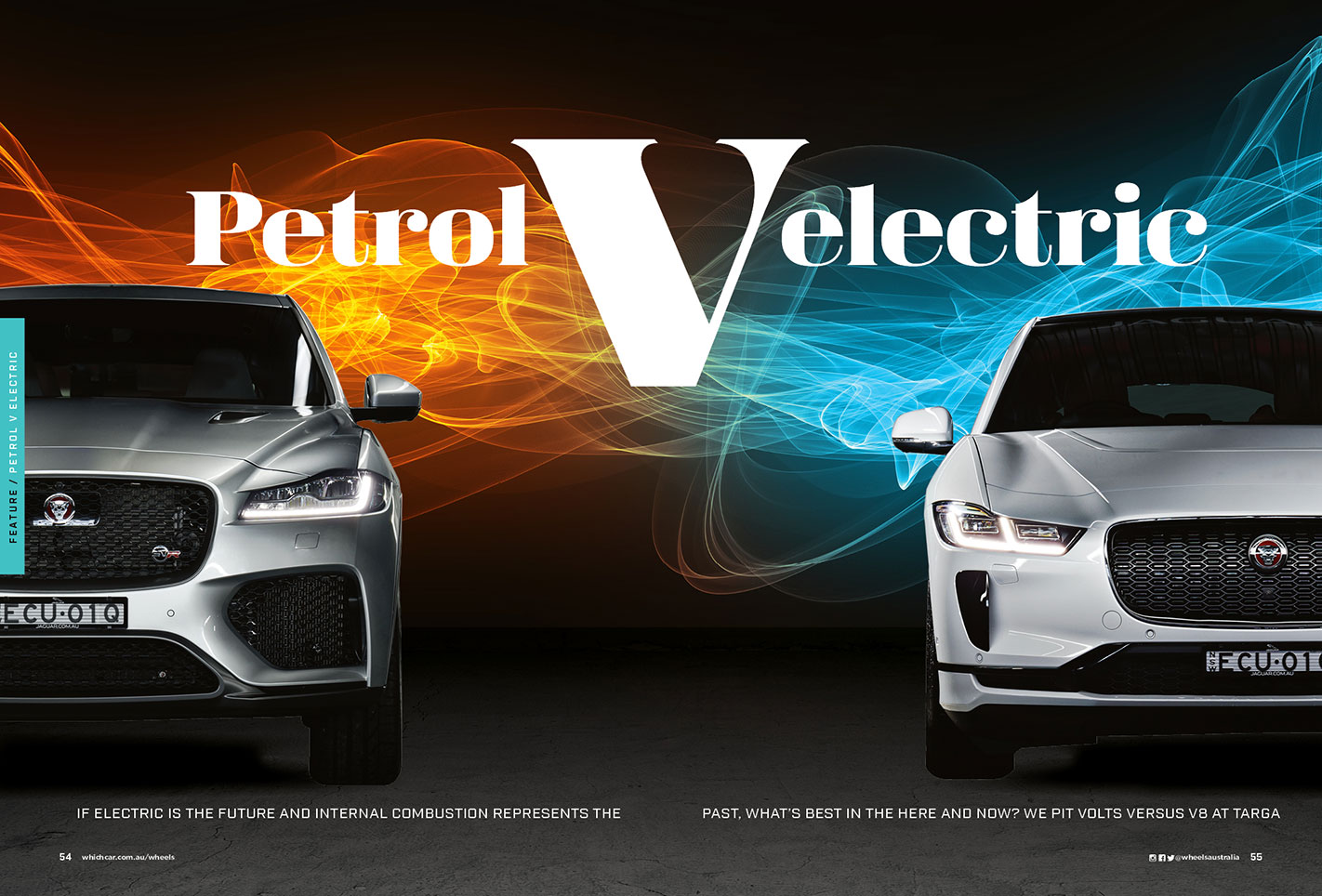
But if petrol truly represents the past and electric’s the future, what’s best right now? We pack Deputy Editor Andy Enright off to Targa High Country with a pair of squabbling cats – Jaguar’s fossil-burning F-Type SVR V8 and its battery-powered sibling,the I-Pace. We told him not to come back without an answer, and he didn’t disappoint.
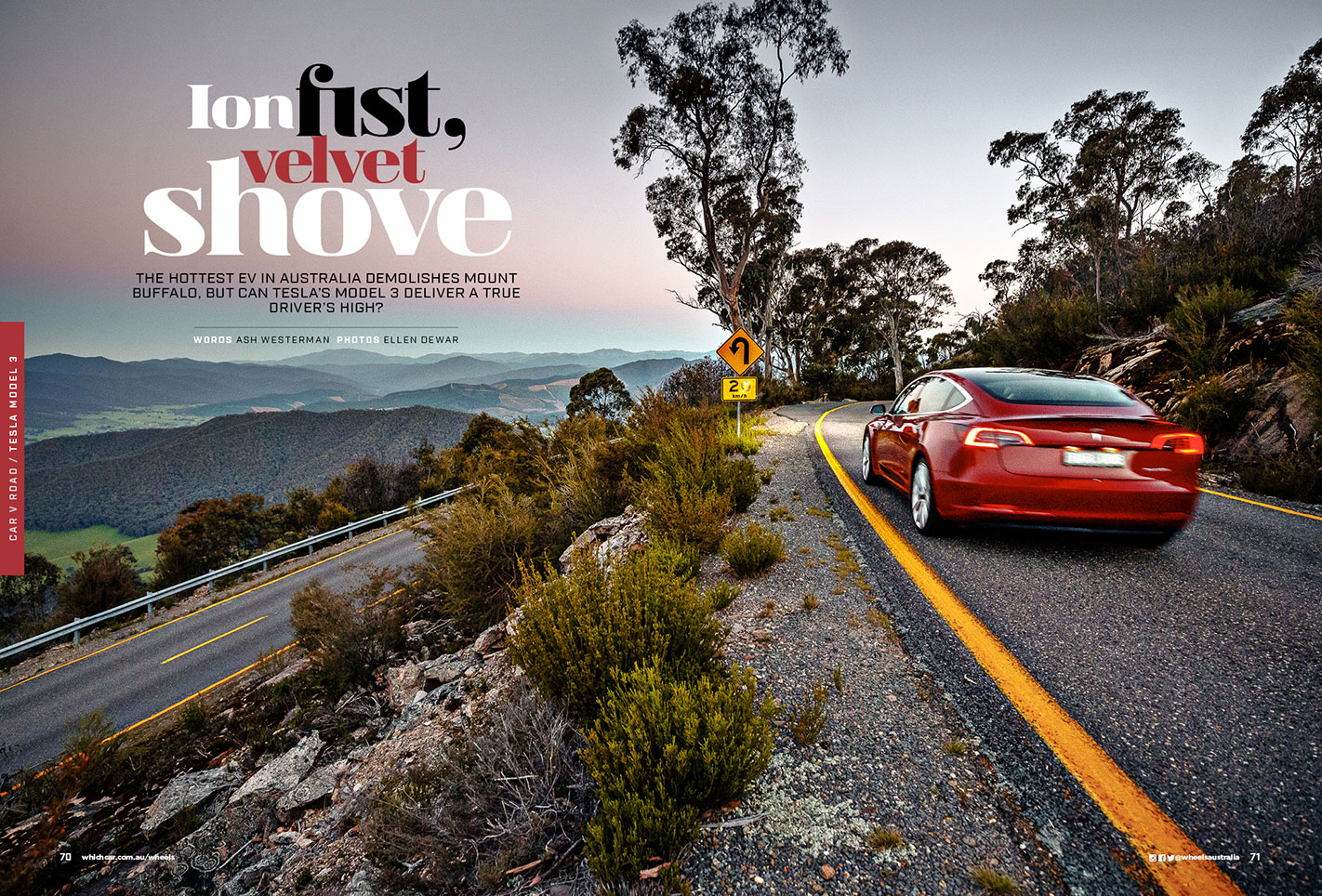
Does it need to be noisy to be fun? We take Tesla’s Model 3 for a fair old fang to see just how we feel about that.
Enright also rates progress on five core technologies the soothsayers swore would be just part of the furniture by 2020, and our resident racing tragic Cameron Kirby brings you the lowdown on motorsport heading into the new decade.
We go behind closed doors at Rimac’s Croatian HQ and find there’s a lot more to this EV outlier than just its awesome hypercars.
Check out Porsche’s plans for a hybrid successor to its fabled 918 Spyder – with a V6 from the car maker’s aborted F1 engine program tipped to power the mean machine.
Electric SUVs are also on the move – we take a look at some of the latest ones revealed, including Ford’s first full EV, the Mustang Mach-E.
We go along for the ride as Citroen CEO Linda Jackson spruiks the maker’s credentials down under, and there’s another French connection as Peugeot’s 508 liftback takes on the Volvo S60 and the Kia Stinger in our latest comparo.

Not quite ready for the future? Look back at the past with our Modern Classic, Subaru’s venerable WRC slayer the WRX 22B, and our Retro car, the 1959 Austin-Healey 3000. And see what cars Alpina boss Andreas Bovensiepen fancies for his dream garage – and not one of them an Alpina.
Get it while it’s hot – on sale now!
McLaren’s unshackled its 570S GT4 racer from motorsport regulations to create the McLaren 620R, a ludicrous limited-edition racer for the road.
It’ll build 350 units in total, all with a GT4-spec 3.8-litre twin-turbo V8 derestricted to push 456kW and 620Nm through its seven-speed dual clutch gearbox.
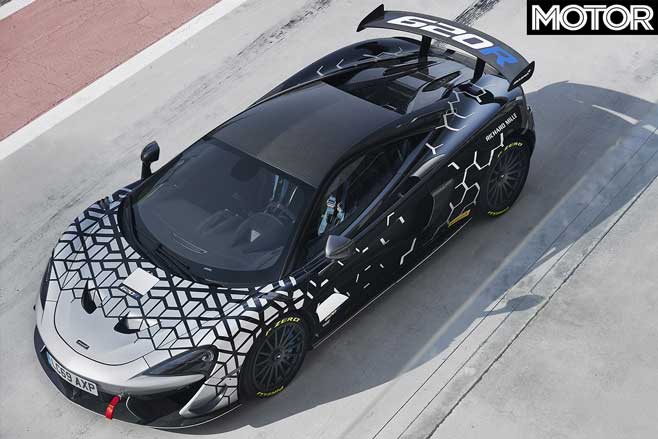
That’s more than any other McLaren in the Sport Series range, 600LT included, so the claimed performance is just as impressive.
From rest the rear-drive coupe will hit 100km/h in 2.9 seconds, 200km/h in 8.1 seconds and cross the quarter mile in 10.4 seconds.
McLaren has also upgraded its grip as well as its grunt. Lighter, two-way dampers feature at each corner, while some rubber mounts are replaced with stainless steel items for a more direct steering feel.
It also scores GT4-spec springs and roll bars. But they’re only the start of a motorsport makeover that adds massive carbon ceramic brakes and centre-locking wheels you can order with slicks for track work. Pirelli P Zero Trofeo R rubber is standard.
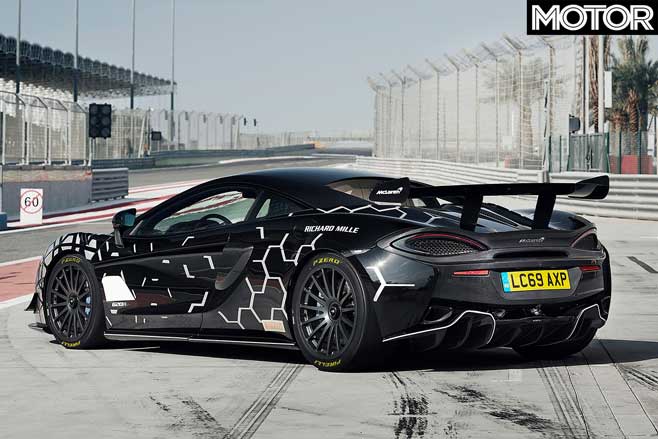
Then inside it’s goodbye to the carpet, glovebox, air-con, sat-nav and an audio system. Lightweight carbon fibre buckets also hold driver and passenger within the car’s Monocell II carbon fibre tub.
There’s also an adjustable carbon fibre wing along with the GT4-spec front splitter, bumper and bonnet that all have been tweaked to pass road regulations. You can even add a roof scoop to cool you down.
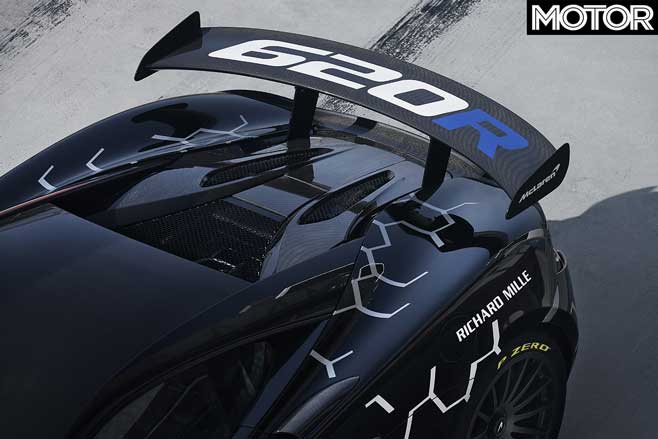
Other options include a lightweight Bowers and Wilkins audio system. But if you’re the type who likes to stand out, you can hand your 620R to McLaren’s Special Operations outfit to really go nuts.
They can replace the standard stainless steel exhaust with a titanium unit in Nano Black exhaust finisher or specify a specific colour for your race harness. You can also deviate from the standard McLaren Orange, Silica White or Onyx Black finishes.
Otherwise you can take one as it is for £250,000, which blows out to AU$481,000 against Australia’s weak dollar, and get a free trackday with an instructor thrown in if you’re based in the US or Europe.
OCTOBER MARKED two years since Honda’s current Civic Type R launched in Australia. We’ve fawned over it since it arrived in 2017, giving it a Performance Car of the Year award and witnessing it nab two consecutive Bang For Your Bucks gongs.
But while we’re more than familiar with how it compares with its competition on road, we thought we’d investigate how sales are tracking at the two-year mark.
VFACTS sales data revealed 274 units have sold to the end of this year’s third quarter, which leaves a big gap to the 475 it sold for the full year last year on the back of a strong award season. Despite the decline, the figure compares well against its main rival.
Renault sold only 279 RS Meganes in the same period this year. While that narrowly beats the Type R, it is significantly less than what it did in 2015 during the previous generation’s last year on sale here. And that’s with a range that includes availability of both manual and automatic transmissions, along with two chassis options. Maybe Renault’s imminent RS Megane Trophy will change that.
Perhaps simplicity is what Australians prefer from their hot hatches. Hyundai this year sold 692 hatch-based i30 Ns, despite the car still awaiting an automatic option from Seoul. Even the Fastback N has outsold both the Megane RS and Civic Type R during its first year on sale since February, with a total of 283 units finding homes.
And clearly a pricier tag doesn’t deter Aussies if the juice is worth the squeeze. The simplified Mk 7.5 Volkswagen Golf GTI dominates sales even into its twilight years, with 1118 sold to the end of the third quarter.
In other news
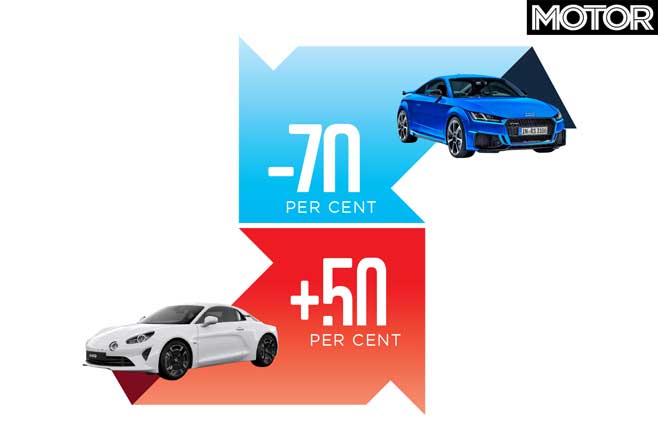
Too Hot – Alpine A110 In a market plagued with declining year-on-year sales, the Alpine’s 50 per cent increase on October 2018’s YTD figure is a small success story. However, its 18 sales in 2019 still trail Alfa Romeo’s 4C (24) and Porsche’s popular Cayman (218).
Too Cool – Audi TT While both the 4C and Alpine A110 enjoy year-on-year increases in the world of small two-door coupes, Audi’s TT struggles. The 50 sold this year is 70 per cent fewer than in 2018. A model update earlier this year should help close the gap somewhat as the year comes to a close.
The wait for a legion of impatient online Supercars racers is over, with iRacing releasing a pair of new V8-powered machines in the new year.
The Holden Commodore ZB Supercar has been rolled out to users as a free upgrade, while the Ford Mustang ZB can be purchased in the game.
And the iRacing community has already grabbed the opportunity to reproduce their favourite paintjobs onto the two platforms, including a host of classic liveries from throughout Supercars history.
iRacing users can access these paint skins via various services and use them as their own within the game. Check our gallery above for a selection of some of the best.
An Instagram post from the service previewed both the Holden Commodore ZB and the Ford Mustang in Supercars guise, with the roll-out brought forward to December.
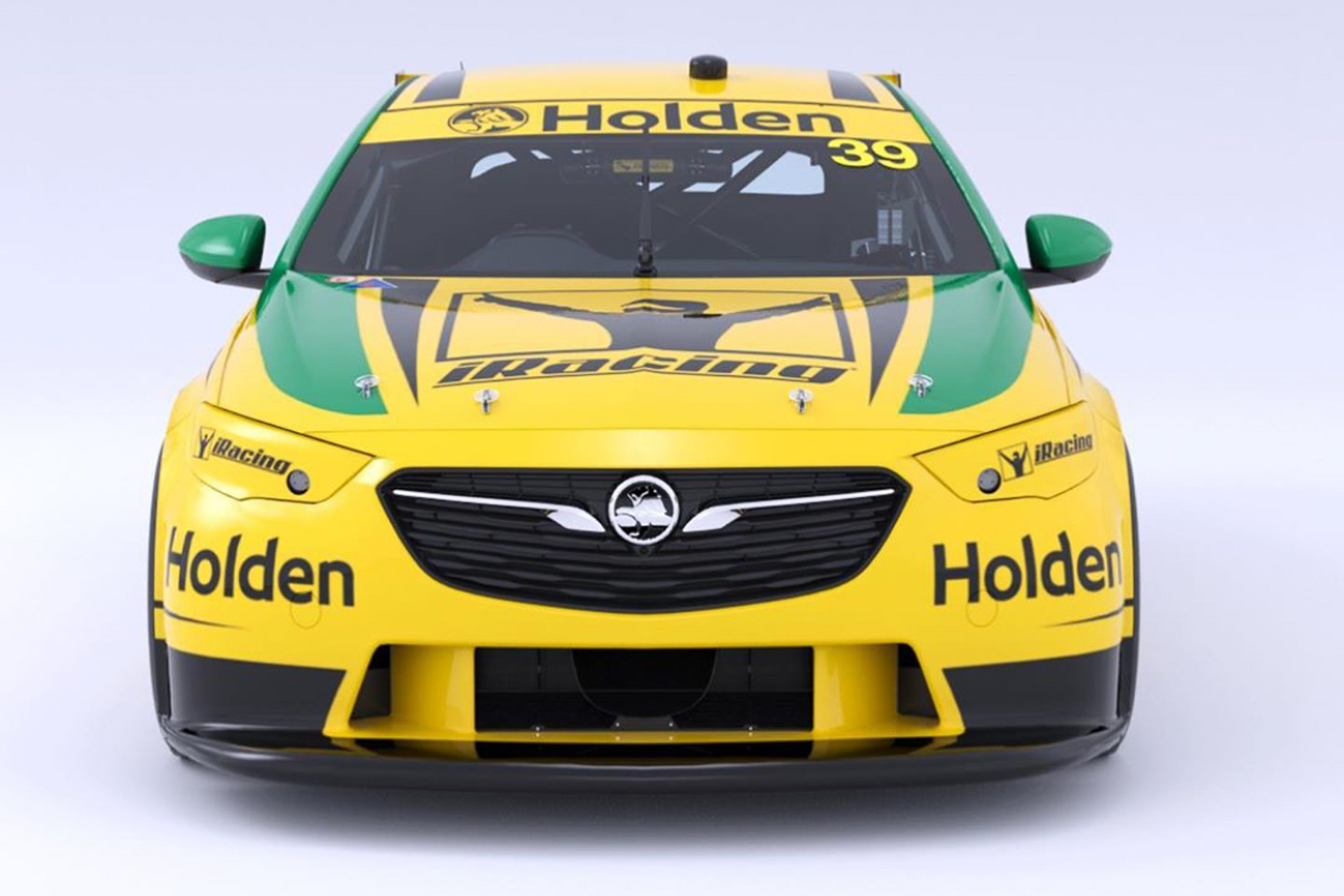
The cars were announced earlier in the year, with a debut expected early next year as part of a new online racing series held in conjunction with Supercars.
https://www.instagram.com/p/B5IxsixAzHg/?utm_source=ig_embed&utm_campaign=loading
“Australian iRacers are some of the most passionate and talented simracers we’ve ever seen,” said iRacing.com motorsport simulations executive producer Steve Myers. “We’re always happy to support our community Down Under, and adding the current generation of Supercars was a no-brainer.”
“iRacing is the ideal partner for Supercars in further developing the Gfinity Supercars Eseries,” said Mitch Kane, the partnerships manager at Supercars.
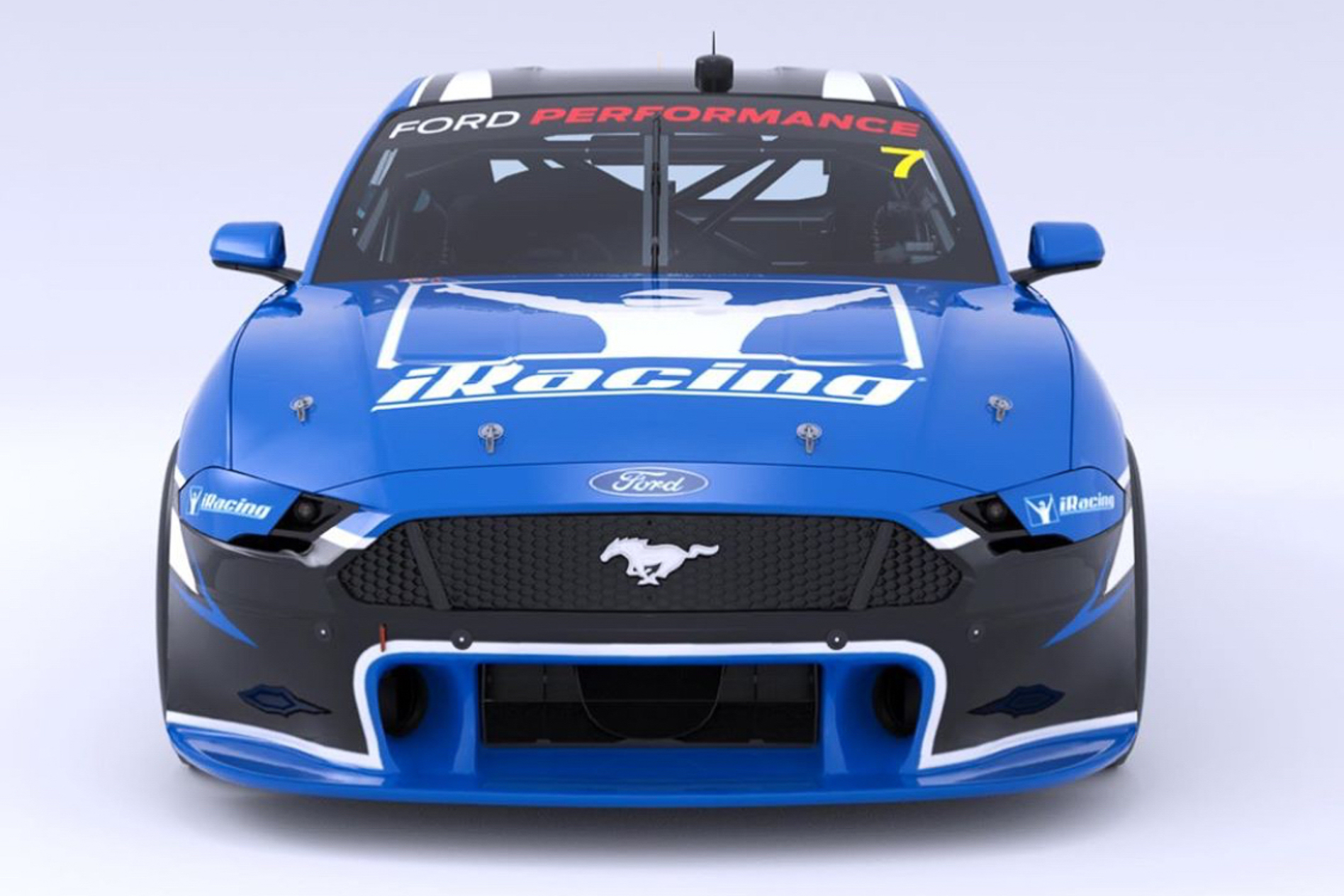
“The addition of the new Ford Mustang and Holden Commodore ZB and iRacing’s ultra-realistic simracing platform are a perfect marriage as we look to grow our involvement in eSports through our own world championship series.”
The two machines join the current stable of Supercars that include the VZ and VF Commodores (above) and the Ford Falcon BA and FG.
Local tracks include Mt Panorama and Phillip Island, as well as the defunct Oran Park layout in Western Sydney, while Supercars races are held at circuits like Spa in Belgium and the Circuit of the Americas.
Driving the new iRacing 2019 Supercars
A quick test around the Phillip Island circuit in both machines reveals similar characteristics between the two cars, but a marked increase in grip levels and drivability over the older-model Supercars.
However, they are still an incredibly tough car to master, with many forum users calling them the most difficult car in the sim to use.
The two big struggles when trying to tame the Supercar is a lack of turn and a lack of grip feel. The real-life car offers around 430kW and more than 800NM of torque, which is fed through relatively small tyres under a heavy vehicle.
While the new iteration of the Supercar has more grip than its predecessor, it takes a patient hand – and throttle foot! – to get then around a track.
Soon after launch, iRacing revised the tyre modelling on the car, reducing the grip levels and increasing the degradation level (the rate at which the tyres wear out) in response to feedback from sim racers.
Supercars star Shane van Gisbergen is a regular iRacer, while former Supercars champion and NASCAR racer Marcos Ambrose is also a big fan of the challenging and complex sim, which has more than 70,000 active users around the world.
Other notable iRacers include current F1 stars Max Verstappen and Lando Norris.
Are you keen on the new Supercars? What’s your favourite iRacing machine? Let us know below!
The idea of a hairdresser’s car as a joke for anything slightly feminine is a little overdone, and perhaps even a tad problematic. But I reckon, if hairdressers are actually getting around in cars like MX-5s, S2000s, and Audi TTs, they could actually be on our side.
The three I’ve already mentioned are the classic examples of cars that cop the accusation, perhaps the NA MX-5 more than any, but there are plenty of others I’ve heard the comment aimed at. A more recent example is the Toybaru 86BRZ.
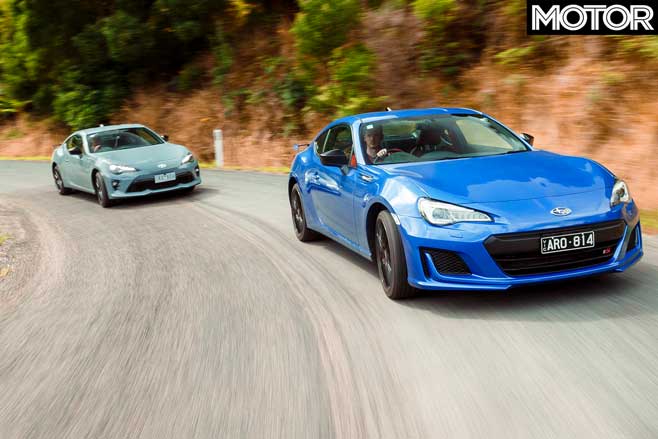
But for all the rounded styling, relatively low power (for sports cars, anyway), and ability to drop the top, these cars are very good steers. Better than the 3.8-powered VS Commodore from which the hairdresser allegations typically originate, at least.
A recent encounter with a late model TT S reminded me (even though it’s got a little more grunt than the likes of the Toybaru) how capable it is as a sports car, and that you’d have to be silly to limit yourself to driving it between home, the shops, and the hair studio.
What I’m saying is drive an MX-5, an 86, or a TT, and you’ll be surprised there aren’t more street racing barbers. The chassis movement and playful nature of the MX-5 is probably it’s become one of the most respected sports cars of the last few decades, and the steering quality of the 86/BRZ puts far more expensive rigs to shame.
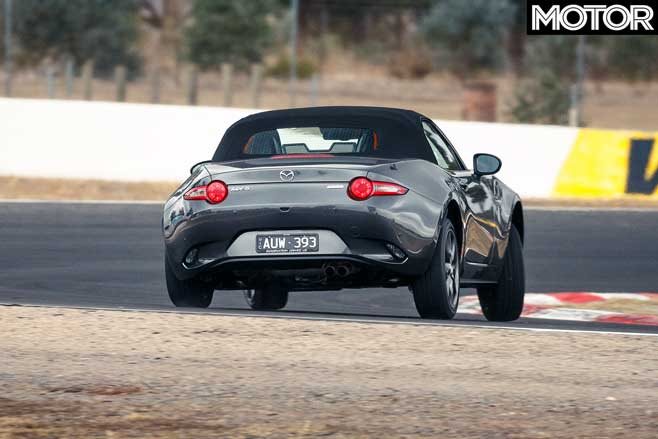
The fact these cars are so engaging is why they need to be experienced before being dismissed as statements of fashion over form. If they’re hairdresser’s cars, then the person who cuts your hair is going to have more fun on their way home than you will.
Pretty much every staff member at MOTOR would happily own a Toyota 86, and our dear leader isn’t exactly growing golden locks. Not that you need to have an excess of hair to cut it, I suppose.
Hell, even our long-time contributor Morley owns an NA MX-5, and we don’t reckon a pair of scissors has been anywhere near him for years. I own one too, but I’ve had a haircut this century.
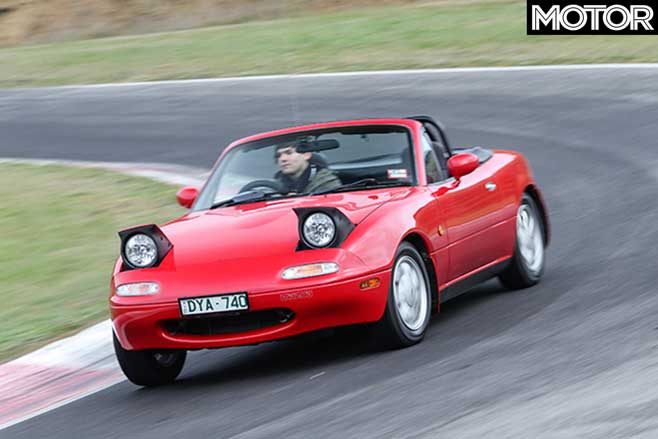
Okay, so maybe now this just looks like an attempt to use the fact I work for a car magazine and am able to publish an opinion piece to defend my car ownership choices. But I promise it’s not.
Hairdressers and barbers, if you’re reading this, I salute you and your stereotypical vehicles of choice. Unless you own a New Beetle.
Anyway, I’m starting to ramble, and this column is getting a little long. Perhaps I’ll just trim it down… maybe a little off the top?
Usually when it comes to engine options for plug-in hybrids, manufacturers would opt for the smallest capacity engine to keep fuel consumption figures low and emissions clean, but Mitsubishi has gone against the grain with the introduction of a bigger 94kW/211Nm 2.4-litre engine for the 2020MY update of its Outlander PHEV plug-in hybrid SUV.
The 2.4-litre naturally-aspirated inline-four engine is similar to the one used in the standard Outlander and the refreshed ASX range, though modified to operate on the leaner-burning ‘Atkinson cycle’, which is why it is far from matching the ASX’s 123kW/222Nm power and torque figures.
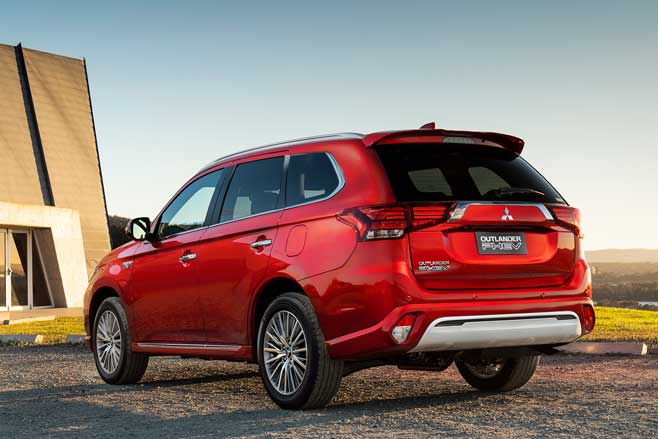
On top of that, due to Mitsubishi Australia’s insistence on enabling its engines to run on Australia’s RON91 base petrol, the engine has been further detuned from the European Outlander PHEV’s spec of 99kW to 94kW.
With the Outlander PHEV being a predominantly electric vehicle, engine power output plays a minor role in day-to-day driving. In fact, the engine can’t send any power to the front wheels at speeds under 65km/h and the electric motors don’t run out of steam until a license-shredding 135km/h, so why equip a bigger engine?
According to Mitsubishi, the key reason for the change is that the bigger displacement unit has a fatter torque curve with more torque available from lower rpm. Owen Thomson, senior product strategy manager of Mitsubishi Motors Australia, says the bigger engine is more relaxed and refined in its operation especially at lower engine speeds as compared to the 87kW/186Nm 2.0-litre unit. However a bigger displacement does mean fuel consumption has gone up from a previously quoted 1.7L/100km to 1.9L/100km on the official ADR combined fuel consumption figures, so there is a sacrifice for that smoother engine.
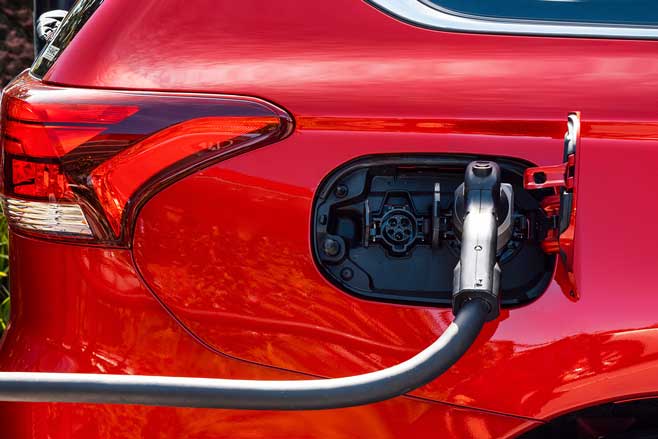
So why didn’t Mitsubishi follow the downsizing trend and opt to use its 1.5-litre direct-injection turbocharged inline-four that is used in the Eclipse Cross? According to Thomson, the 2.4-litre engine was a more suitable fit to pair with the electrical half of the Outlander PHEV.
“Given the nature of the 2.4-litre engine, it has good efficiency for use in a plug-in hybrid without adding too much complexity,” Thomson reasoned.
With a higher power generation output of 80kW, up from 70kW, the Outlander PHEV is complemented with an improved battery pack, with a raised capacity of 13.8kWh, up from 12kWh. That being said, Mitsubishi’s claims of the Outlander PHEV’s all-electric range remains unchanged at 54km, though the larger capacity battery has allowed Mitsubishi to fit in a more powerful 70kWh rear electric motor, up from 60kW.
Whether that extra oomph and bigger battery actually translate into a meaningful difference in day-to-day driving has yet to become apparent – we’ll be subjecting the Outlander PHEV to a longer test drive in due course – but you can at least expect a more refined experience when that combustion engine fires up. Is it worth the extra fuel burn though?
BMW has released the first teaser image of its upcoming M4 GT3 race car, and while it is only a design sketch, it reveals the outline of a kidney grille that seems to expand and go on and on.
If the real deal is going to be anything similar to the sketch, it is clear that the M4 GT3 will be adopting the Concept 4’s controversial grille, and is very similar to MOTOR magazine’s exclusive render of the upcoming M3/M4 that is featured on the cover of the December 2019 issue.

While we’re now aware the M3 is to sport a relatively standard kidney, the larger and more controversial grille is believed to be destined for the road-going M4.
Even BMW Group Motorsport Director Jens Marquardt describes the race car as “a real highlight in terms of optics and technology”.
Though a race car, BMW says the M4 GT3 will be based on the production M4, and if BMW’s move to preview the production M8’s design through the M8 GTE racer is any precedence, that big grille is likely going to be part of the production car’s looks.
BMW confirms that the M4 will be powered by the inline-six turbocharged S58 engine that is currently used in the X3 M and X4 M SUV siblings, and will have “more than 500hp (372kW)”.
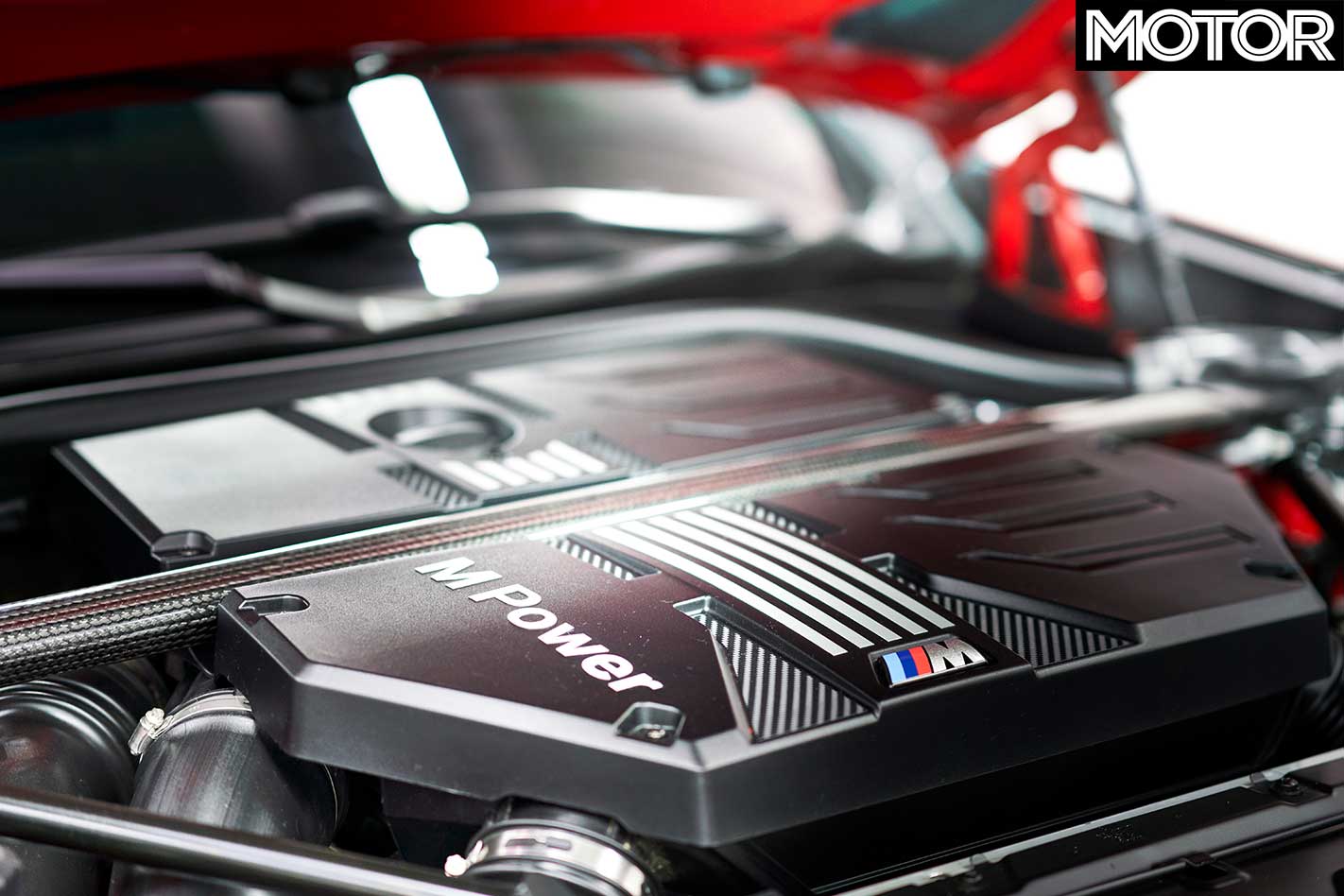
The M4 GT3 will be replacing BMW M Motorsports’ M6 GT3 racer, which has been used by privateer race teams in international GT racing since 2016, and will becoming the flagship for customer racing.
BMW Motorsports will be developing and testing the M4 GT3 throughout the 2020 season, with regular tests in race conditions planned for 2021, and expected to be ready for customers for the 2022 season.
This is the last week to grab a copy of MOTOR December 2019, with our scoop on all the juicy details of the production M3 and M4.
Victoria’s state government has supported a move by councils to reduce speed limits by up to 20km/h in an effort to curb a drastically rising road toll.
The first council to slash speed limits is the Mornington Peninsula Shire Council, with 38 roads that are marked as 100km/h or 90km/h zones being reduced to 80km/h as part of a two-year trial.
The shire leads the Victorian road toll, according to The Age, with 14 deaths so far this year. The trial will only apply to what the council has deemed “high-risk sealed rural road”, not main arterial roads.
Victoria’s road toll is skyrocketing, with 250 deaths so far this year, compared with 198 for the same period last year – an increase of 26.3 percent.
Of the 265 deaths on Victorian roads that have occurred in the past 12 months, 144 have been in rural areas and 121 in Melbourne.
The most common crash type is described as ‘run off a straight road’, accounting for 60 deaths in the past 12 months. The TAC does not provide statistics for whether speed is a factor.
Victoria’s state road minister, Jaala Pulford, told The Age that the Government would consider similar proposals to reduce speed limits from other councils.
“Our view is that these things need to be looked at on a case-by-case basis and the Mornington Peninsula case that they put to us was very powerful,” she said.
“If other councils similarly want to put a case about what they think is best for their community, then we will take them seriously. We will look at them carefully.”
The policy has been labelled by some as lazy, with the opposition rural roads spokeswoman Roma Britnell telling The Age that the focus should be on investing in road maintenance rather than lowering speed limits.
“They’ve made the wrong decision with the Mornington Peninsula,” Ms Britnell said. “This lowering of speed limits is lazy policy.”
The RACV has strongly supported the trial but qualified any ongoing changes, with a spokesperson saying: “Any speed reduction needs to be on a case-by-case basis and show the value of making this change in terms of road safety.”
The City of Greater Geelong has reportedly submitted a list of more than 20 roads for VicRoads to consider for speed limits reductions. Eleven people have died on Greater Geelong roads this year.
The City of Greater Bendigo has applied to have the speed limit on one road reduced.
