
MOTOR review
“In a few years, we will replace the TT with a new emotive model… with an electric car.” Those are the words of Audi’s management board chair, Bram Schot, this year that sealed the fate of the TT sports coupe. And that’s a shame, because a re-acquaintance with the Audi TT S has reminded us that it’s a very capable car.
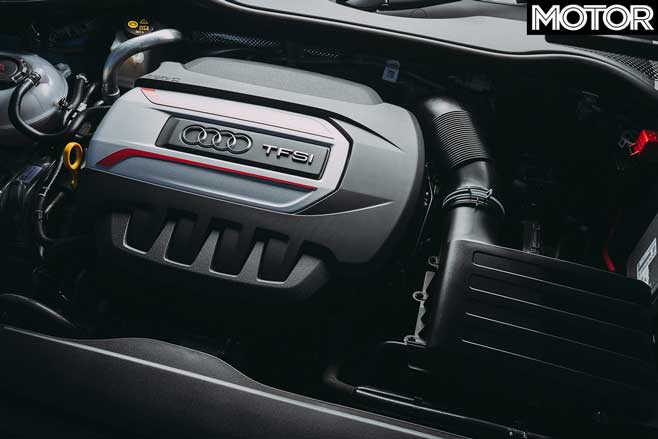
For a start, it feels faster than its claimed 4.7sec 0-100km/h run would suggest, with 210kW and 380Nm at the ready for all four wheels to take advantage of thanks to Audi’s quattro permanent all-wheel drive system.
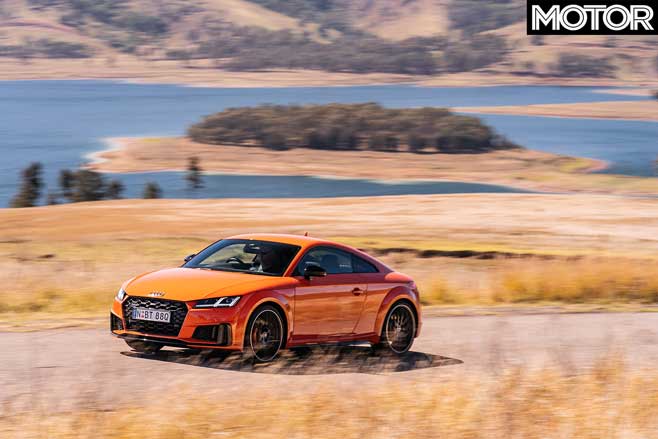
That feeling of speed carries through to its cornering, as long as you approach a corner humanely. Hit the apex and you can hammer the fast pedal to shoot out onto the post-corner road and find yourself travelling at the speed limit rather quickly.
Once you find the right balance between lock and throttle it’s incredibly fast, it just needs to be driven with the right approach. It corners flat when suspension is set to Sport, with little body roll but enough feedback to let you know where the traction limit is.
If you’re understeering in this car, you’re just not driving it properly. In fact, even wet roads don’t hold back its traction and brutal speed, though traction control comes on to stamp out any wildness if you’re shifting weight too quickly in tight corners.
The S-Tronic DCT gearbox isn’t the brightest if left to its own devices, but paddles will allow you to keep the revs where they need to be – often in 3rd gear at around 5000rpm. It only has six gears, and that’s all it needs.
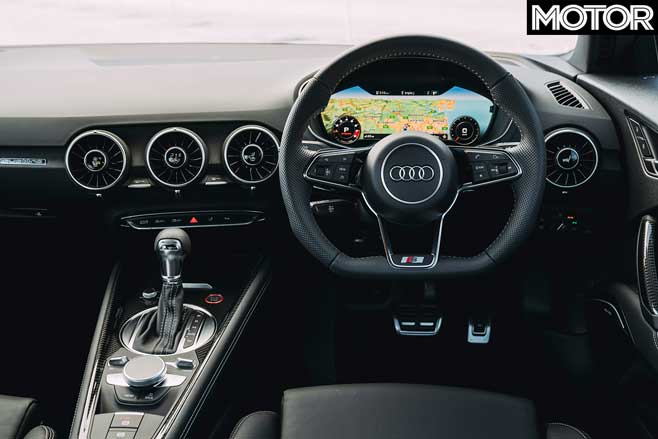
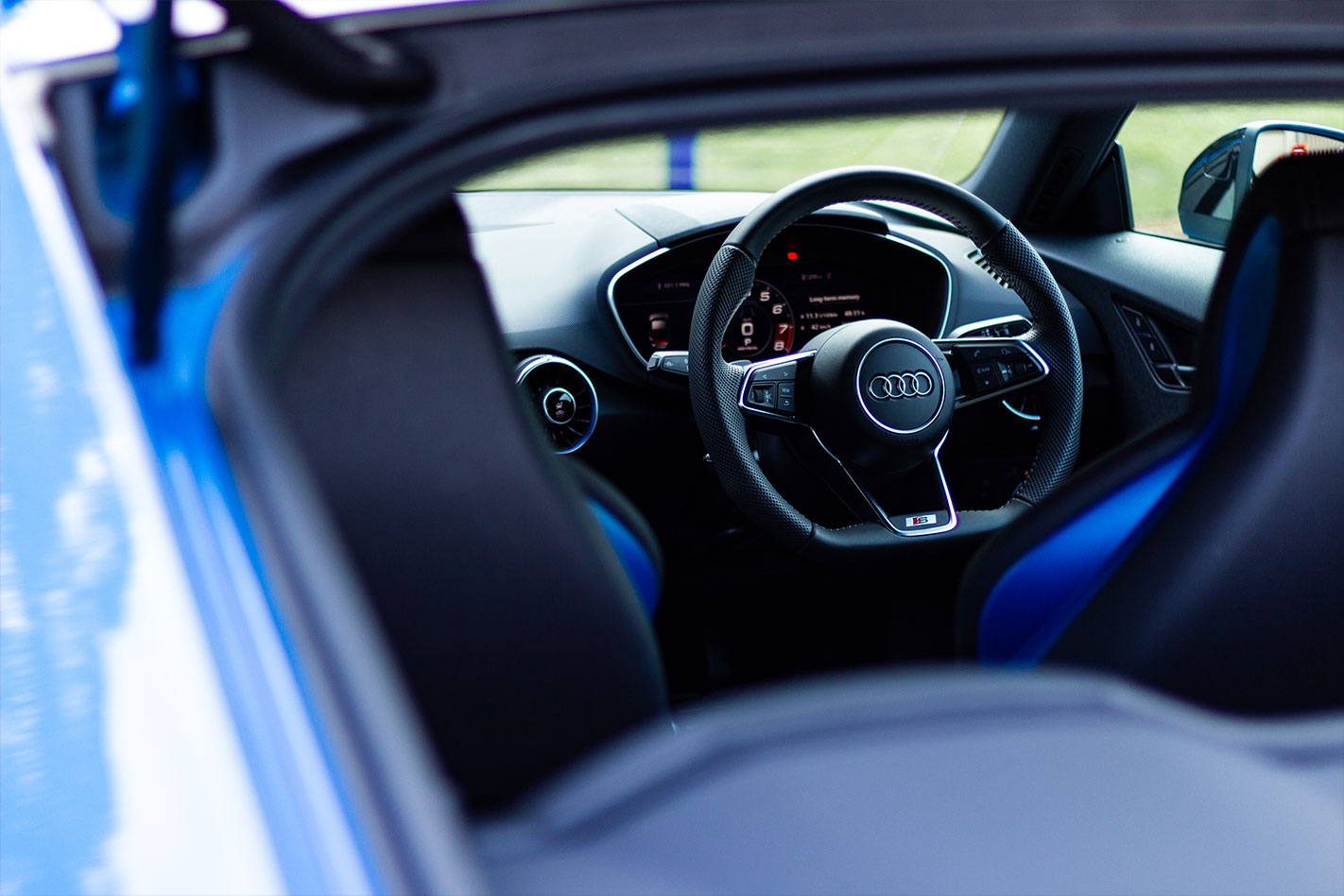
Then there’s the interior, which is incredibly elegant and sensible for a car at the $100K mark.
Heated front seats, Nappa leather and a 12-speaker Bang & Olufsen sound system (which comes in handy, but we’ll get to that) are some additions to the TT S, which Audi says has “more than $8500” in extra kit over its predecessor. It certainly feels premium enough inside to justify the pricetag, especially compared to other cars in its price bracket (bar maybe the slightly pricier Porsche Cayman).
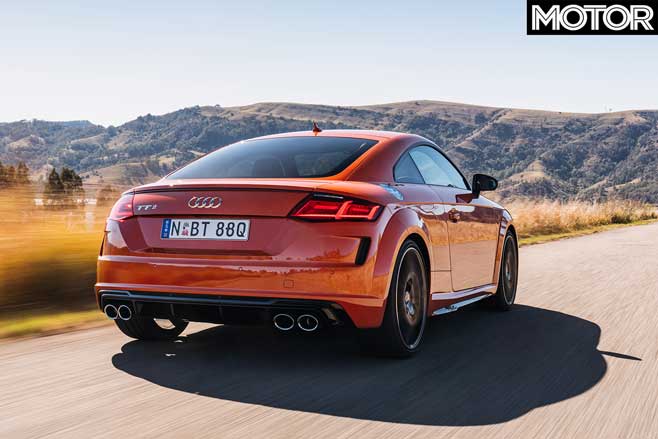
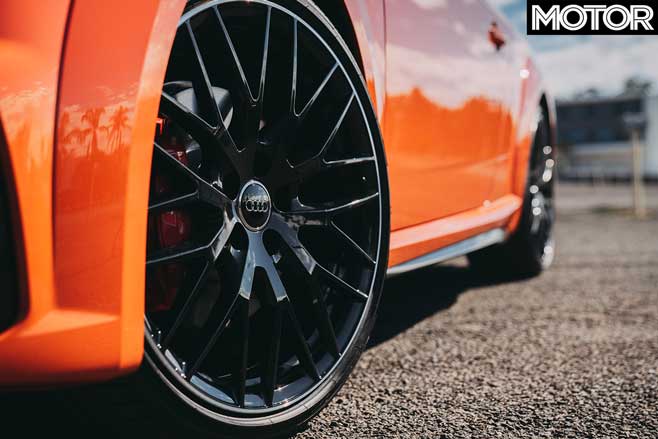
Even on the outside, the Audi TT straddles a line between sleek sports car and stylish city dweller that draws admiration from all sorts. We lost count of how many compliments our orange test car received.
Unfortunately, as with all things, the TT S isn’t perfect. The way it looks inside and out isn’t quite as elegant as its engine note. It’s not a bad sound, but it’s not incredibly inspiring. There is, however, a certain level of aggro (albeit seemingly manufactured) to its sound once you bump the selector into Sport mode.
Once you’re in Sport mode, you’ll probably notice the ride becomes rather harsh, and a lack of adequate damping between the suspension and cabin means both jitters and road noise make their way to your backside and your ears (which is where the sound system comes in handy).
Comfort settings go some way to lowering the ride discomfort, but doesn’t go quite far enough. It does, however, make for some exciting body movement at full attack.
If you want the thrum of the engine (and its power) at their best without the stiff ride and heavier steering, there’s an Individual mode for custom arrangements. Having said that, the TTS is one of few cars that seem to be better to steer with Sport mode on once you’re getting enthusiastic, as Comfort isn’t quite precise enough for hard cornering. If you want a challenge, set everything to Sport except steering and suspension, which should be in Comfort, and hit a twisty road.
It’s tempting to compare the TT S to the VW Golf R with which it’s closely related, but the two clearly target different people. Sure, if you want the speed and don’t care too much about the ‘sports car’ factor or styling, you would take the Golf R, but if you want the eye-catching nature of the TT, a hatch won’t cut it.
Is that worth the extra $45,000? That’s subjective, but the world of designer goods says people are willing to pay more for something that suits their style. It’s just that maybe there aren’t enough people paying for the TT S’s style, and that’s why this might be one of our last encounters.
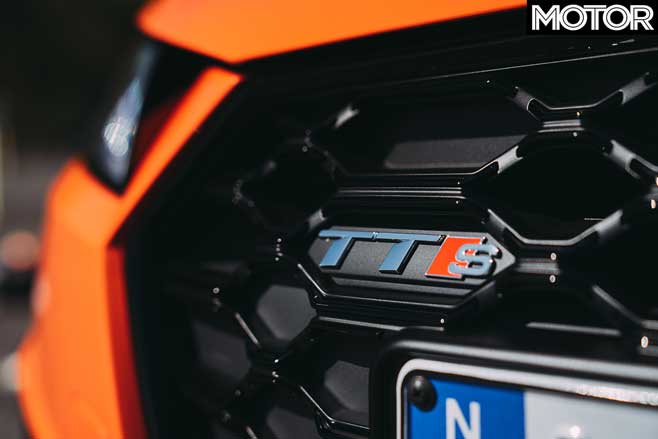
AUDI TT S COUPE SPECS
- Engine: 1984cc inline-4, DOHC, 16v, turbo
- Power: 210kW @ 6200rpm
- Torque: 380Nm @ 1800rpm
- Weight: 1405kg
- 0-100km/h: 4.7sec (claimed)
- Price: $99,900
Rating: 3.5 out of 5 stars
Second opinion: Wheels first drive review

Wheels has been at the forefront of Australian motoring media since 1953, creating quality, credible content that consumers trust, and taking readers behind the scenes of the automotive industry.
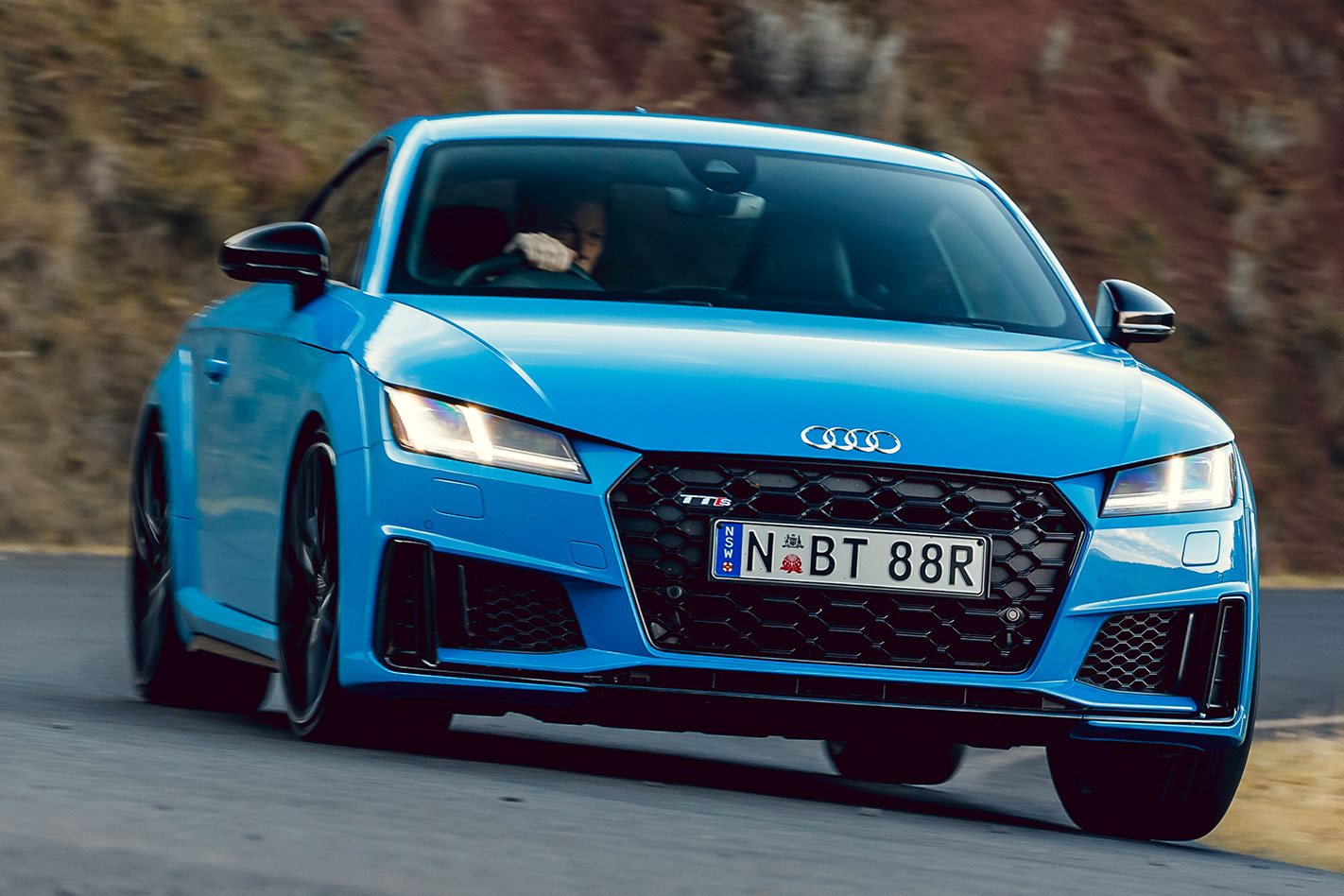
Updated all-wheel-drive coupe now offers better value and more liveability By: Andy Enright
Overall Rating

5 0 5
Plus & Minus
Plus: All-weather ability; acoustics; interior finish
Minus: Firm ride; no rear-biased drive system; four-cylinder engine lacks charisma of a six
The Wheels Verdict: We’re not afraid of an unpopular verdict at Wheels and the Audi TT S is one of those sports coupes that ‘real drivers’ find unfashionable. Drive the latest car back to back with its key rivals and you’ll discover that most of the time it’s quicker, just as capable, nearly as much fun and a whole lot better inside. If you’re not afraid of thinking a little outside your lane, there’s a lot to like here.
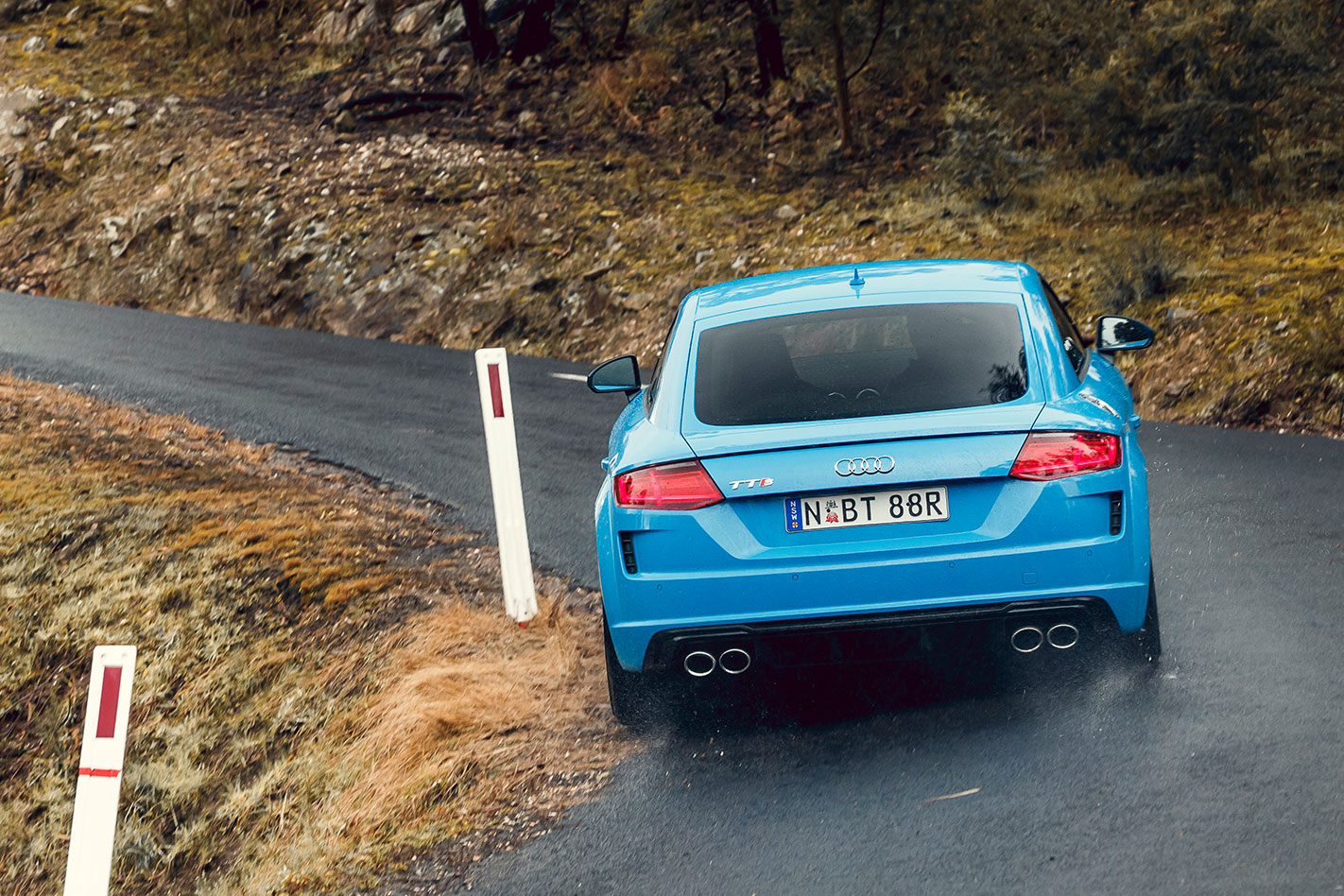
Put simply, the Audi TT S quattro coupe could well be the most convincing sports car Audi makes with an engine at the front. Pitching into the market at a squeak below $100K, the TT S coupe significantly undercuts the Porsche 718 Cayman but is quicker and better finished. So why doesn’t it sell like hot cakes? Read on.
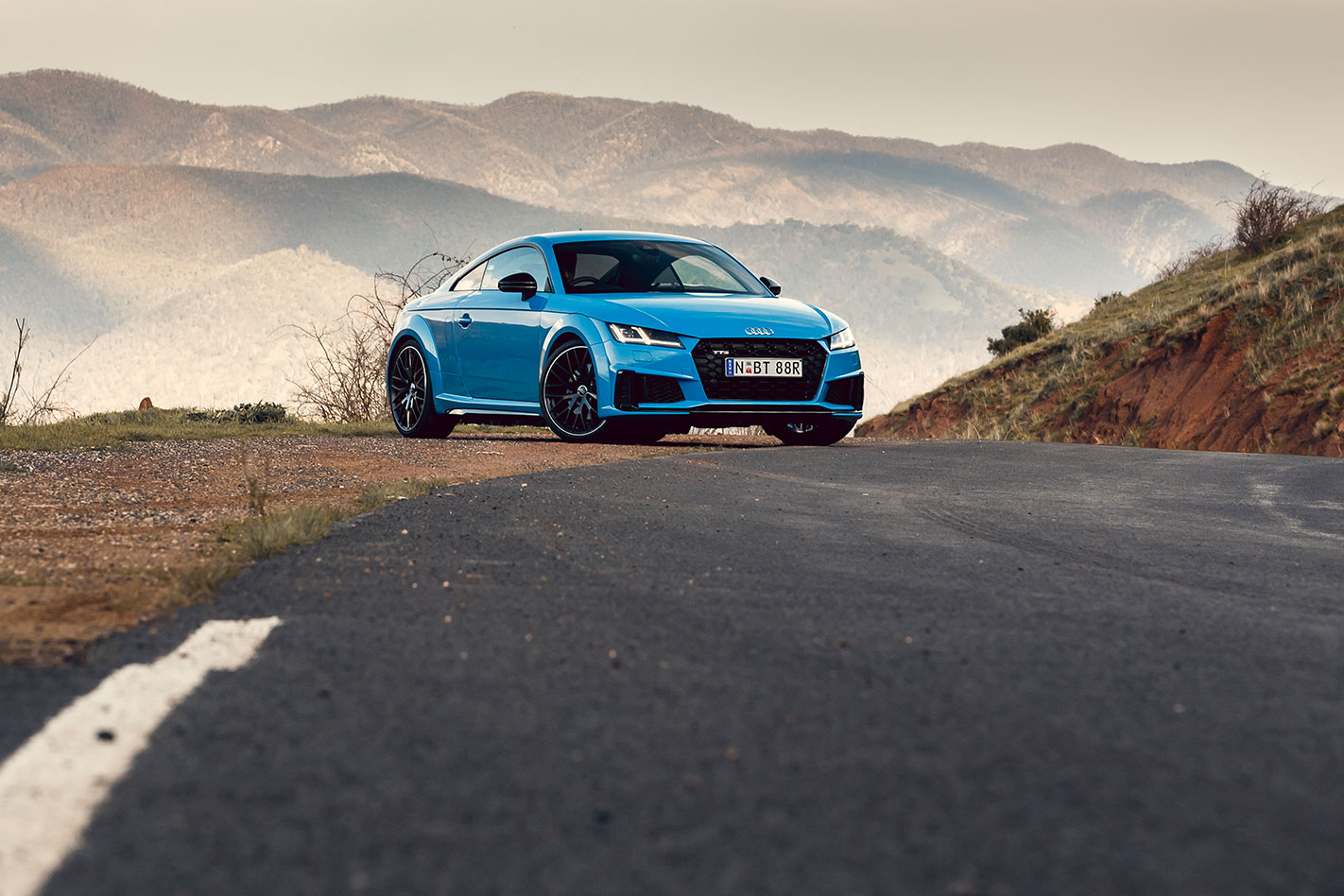
Audi has refreshed the TT S for the 2020 model year, and we managed to grab the very first one in the country. We drove it on some of Victoria’s finest mountain roads and flogged it down a drag strip to bring you the definitive news on the hottest four-pot TT.
THE WHEELS REVIEW
It’s easy to get a little conflicted about the Audi TT S quattro coupe. Part of you figures that it shares its underpinnings with a VW Golf R, a well-regarded driver’s car, so why does the TT get saddled with the image of a coupe for people who just don’t get it? Then, convinced that Audi has been done a disservice, you begin to wonder why the ‘coupe version of a Golf R’ should cost almost double the price. This was never going to be straightforward.
The TT S is a nameplate that first appeared on the second-generation TT back in 2008. It became familiar over time as playing second fiddle to the slightly deranged TT RS sports flagship, always powered by a 2.0-litre four-cylinder engine with all-wheel drive. The third and final-generation TT debuted in 2014, with the TT S powered by a 210kW turbo four.
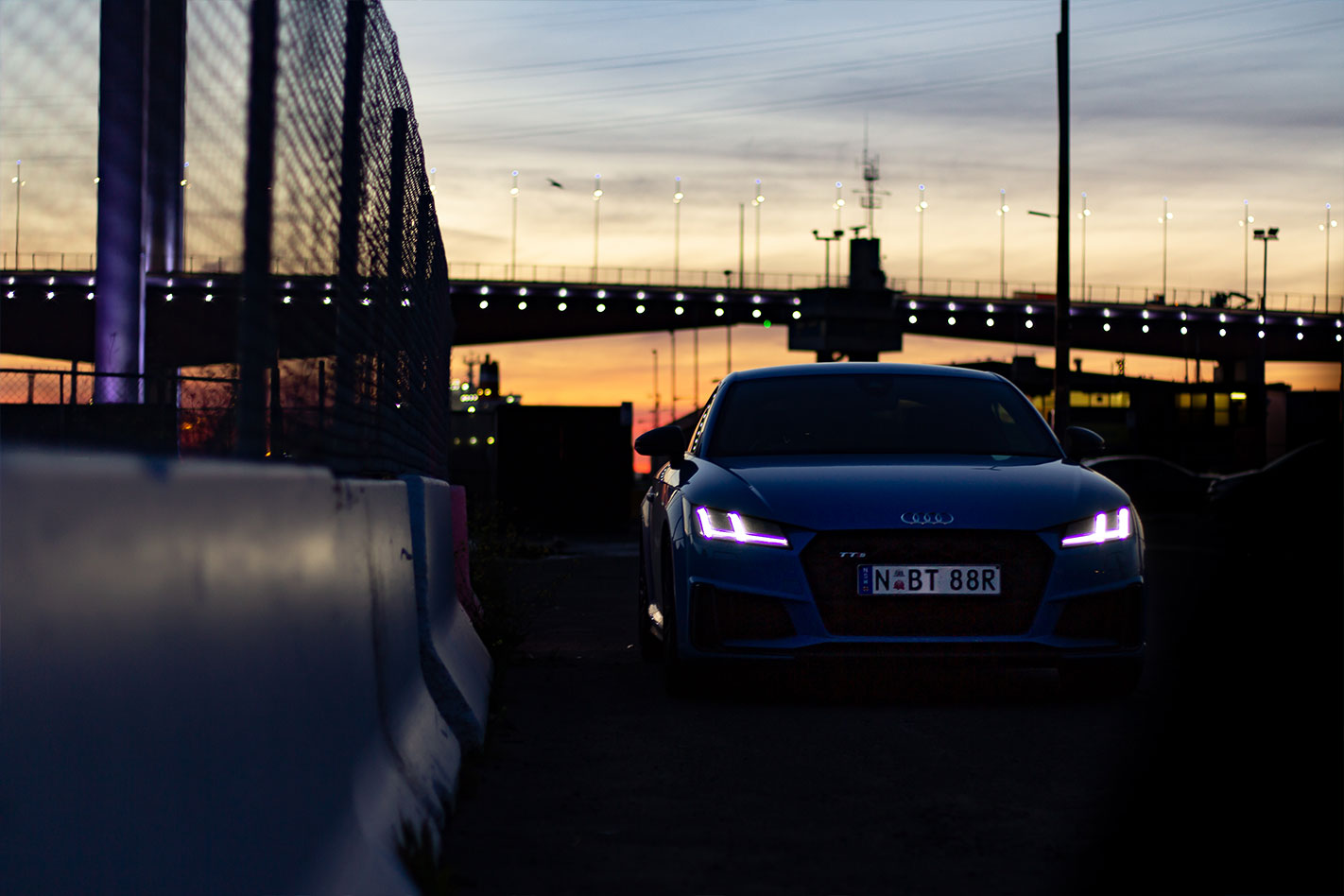
That hasn’t changed with this updated model. So what has? The front end looks a bit sharper, with a three-dimensional single-frame grille, and Audi has ladled on a stack of extra equipment to sweeten the deal. It claims that $8500 worth of gear that previously resided on the options list are now standard fare, including metallic paint, red brake calipers, heated front seats, Nappa upholstery and a punchy 680W 12-speaker Bang & Olufsen stereo.
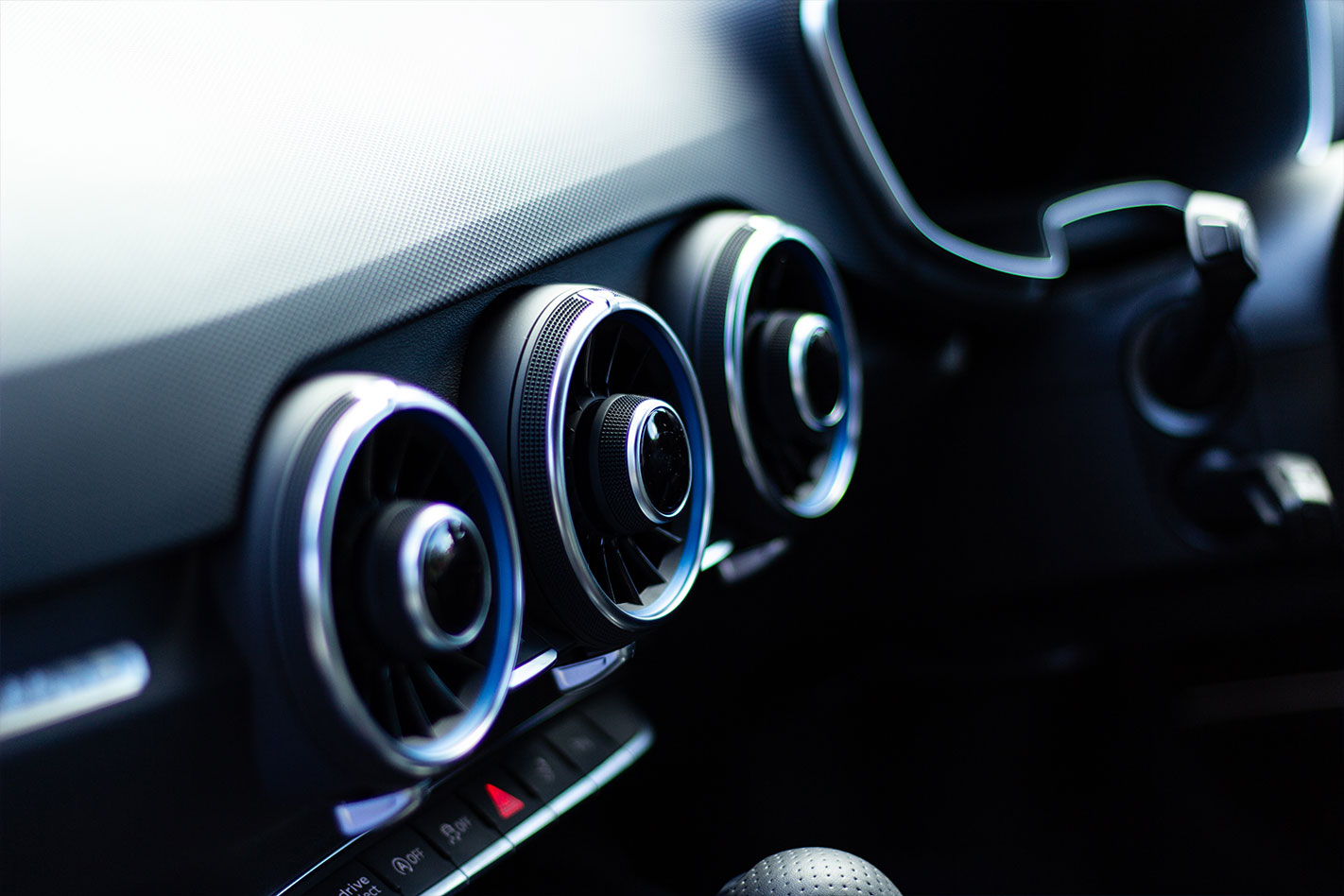
First impressions of our test car are of beautiful paint and questionable wheels. Both are options. The Turbo Blue paint finish will set you back another $550 and the 20-inch Audi Sport 10Y alloys are part of the $4900 S Performance package, which also includes matrix LED headlights, black high-gloss exterior bits, carbon twill seat inlays and interior elements in satin-finished body colour. Opinion was divided among the test team on whether the latter inlays looked great or dreadful. The rest of the cabin is beautifully finished, with some of the prettiest HVAC controls around and, unusually for a modern car, no centre screen. All of the digital displays are incorporated into the fully virtual 12.3-inch dash, and while it rewards some familiarity in order to seamlessly flick from music controls to nav and then car functions, a programmable hot key on the steering wheel helps speed things up.
Thumb the starter button and the engine fires up into an inoffensive thrum. Click the Drive Select switch over into Dynamic mode and it transforms into an eerily convincing facsimile of the five-cylinder 2.5-litre lump found in the TT RS. It’s uncanny. It’s also seriously quick out of the blocks. At Heathcote Park, we timed the TT S from 0-100km/h and the 4.5 second figure was 0.2sec better than Audi’s claim. In other words, if you’ve just splashed out for a 250kW Toyota Supra GTS and find a TT S next to you at the lights, we’d advise you not to bother getting all Dominic Toretto.
The TT has often raised more questions than answers when pointed at a seriously challenging stretch of bitumen though. We found the perfect hill route to put the TT S through its paces and came away broadly impressed. The ride quality has come in for some criticism but there’s an individual mode in the Drive Select system which allows you to set the adaptive dampers into their more comfortable setting and wick up the rest of the car’s responses.
It corners flat and hard, the big 255/30 ZR20 Pirelli P Zeros finding plenty of purchase in the dry. The steering at first feels disappointingly light, but get used to the weighting and it’s a very high-quality electrically assisted set-up. Too many such systems attempt to artificially inject weight and fake feedback. The Audi’s steering feels clean, despite the front wheels always being driven, and allows you to concentrate on the important job of positioning the front end. When you do overcook it and push the front into understeer, there’s enough early warning coming through the wheel rim to prompt you to trim the line a little.
The front end of the TT S turns in sharply, the four-cylinder engine making the nose latch onto a line far more adroitly than the weighty five-pot in the TT RS. In the wet, it’s an absolute weapon. Brake late, ride the split second of scrub and then just give the throttle the treatment as you sight the corner apex. We ran the TT S against a Supra and a BMW M2 Competition for a forthcoming Wheels feature and, without issuing too much in the way of spoilers, it utterly demolished the pair of them when the heavens opened.
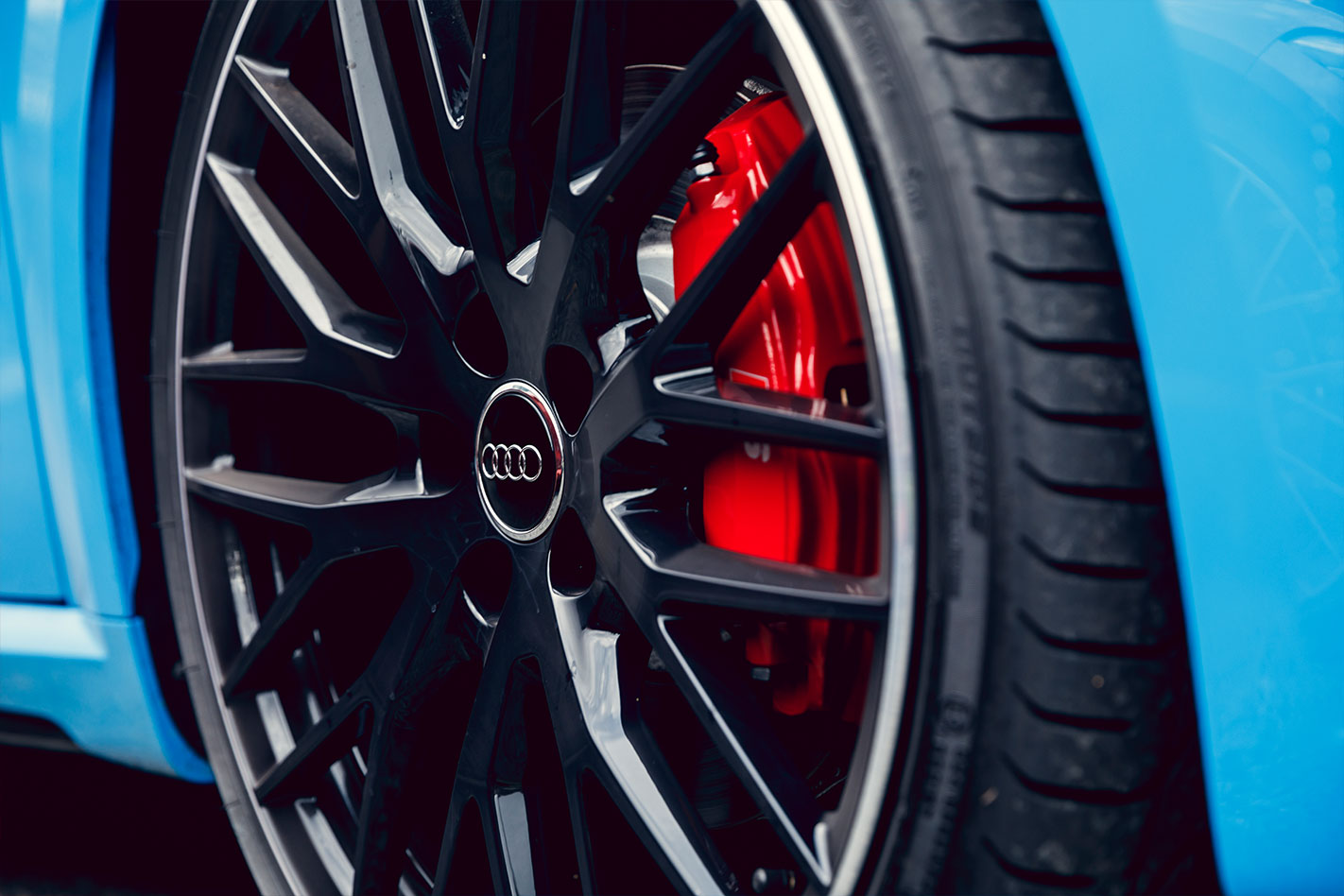
Unlike certain rear-biased coupes, the TT S isn’t about managing traction on the way out of a corner. Instead, you need to monitor the available grip on the way in. Get it right and you can pivot the rear end neatly on the brakes, pointing the nose exactly where you want to go. One complaint was that the 338mm front brake discs lacked the cooling required to stand up to some serious abuse. After one run down the hill into our test venue, the smoking brakes were registering over 300 degrees on an infra-red thermometer.
The six-speed DSG transmission of the test car shifted as crisply as you’d expect, although the drive logic, even in Dynamic mode, was a little off. You’ll want to take control of the paddles yourself on a truly challenging route. And that ride quality? You tend to notice it when you’re not actively driving the car, but attack a challenging road and it settles into a flow. Leave the dampers in their comfort mode and the TT S will brake cleanly into a corner without the front end bucking noticeably.
So are we convinced by the TT S as a genuine sports coupe. Almost. There are still a couple of issues, such as the transmission calibration and the underspecified brakes that still betray a hint of Audi not quite understanding what demanding drivers want from a sports coupe. It’s hard to argue with the TT S’s speed and poise on a challenging road. Anyone who feels that this car lacks involvement probably thinks that ‘involvement’ and ‘doing powerslides’ are Venn circles that totally overlap. Real world? Thanks to all-wheel drive, it’s quicker than its similarly priced rivals.
The longer we spent with the TT S the more we appreciated its other charms too. The interior is beautiful, and easy to live with on a daily basis. It has (small) rear seats for bags and jackets. There’s decent headroom inside and even a useful 316-litre boot. If you buy a sports coupe for what it can do for you rather than what it can do for a road tester on a closed circuit, the TT S merits serious consideration.
RIVALS
Alpine A110; BMW M2 Competition Pure; Ford Mustang GT; HSV Camaro 2SS; Nissan 370Z Nismo; Porsche 718 Cayman; Toyota Supra
PRICE AND SPECS
- Model: Audi TT S quattro coupe
- Engine: 1984cc 4cyl, dohc, 16v, turbocharged petrol
- Max power: 210kW @ 5300-6200rpm
- Max torque: 380Nm @ 1800-5200rpm
- Transmission: 6-speed twin-clutch auto
- Weight: 1460kg
- 0-100km/h: 4.5sec (as tested)
- Economy: 7.0L/100km/h (claimed)
- Price: $99,900
- On sale: Now
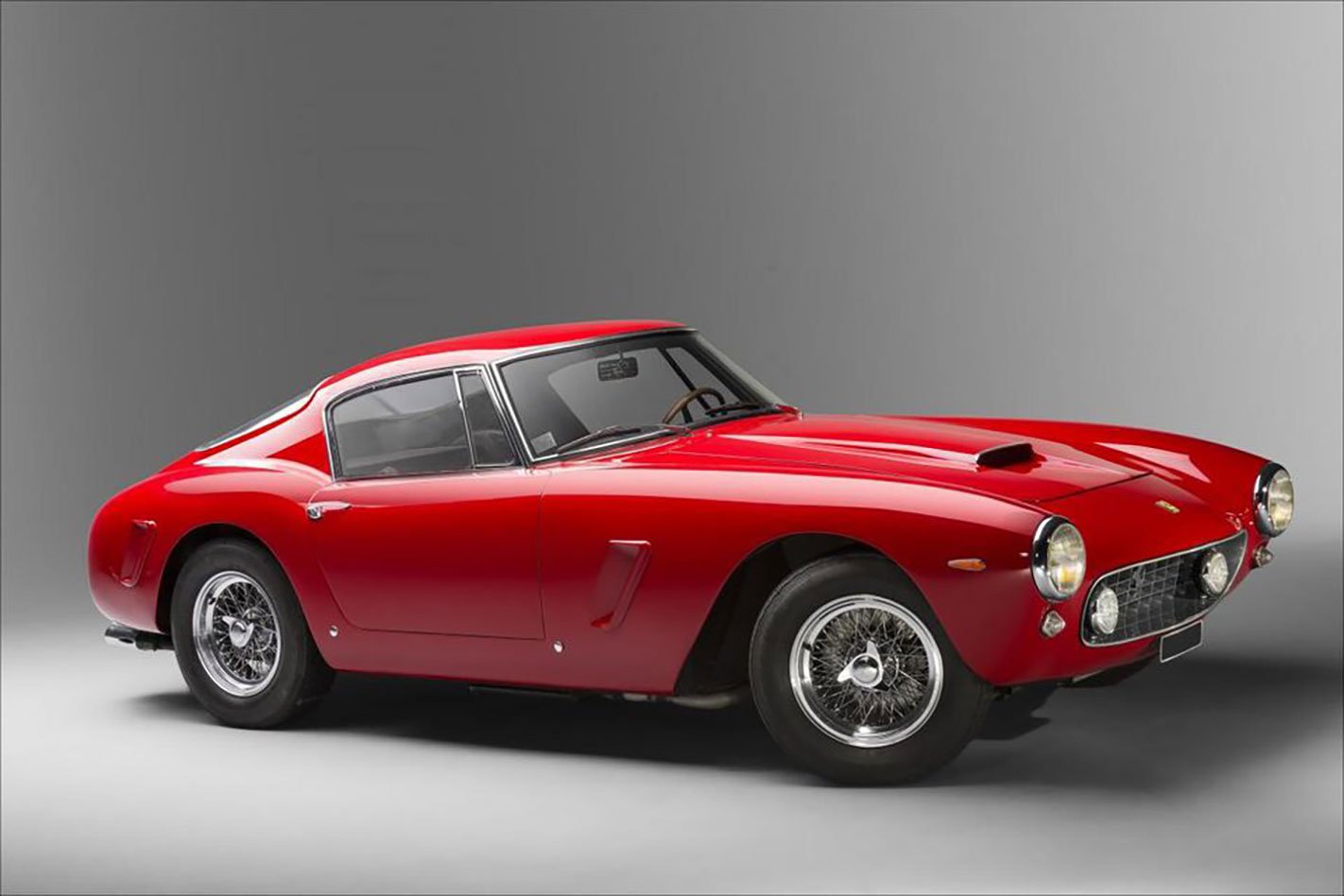
FERRARI 250 GT SWB
I’ve always loved the dynamic visual quality of this car. It’s so expressive, full of visual energy and its proportions are perfect. It’s not the most beautiful car in the world, but it is the most spontaneous – as if it’s simply been drawn and there’s been no loss of its purity through the engineering process. It looks like it’s about to leap at you.
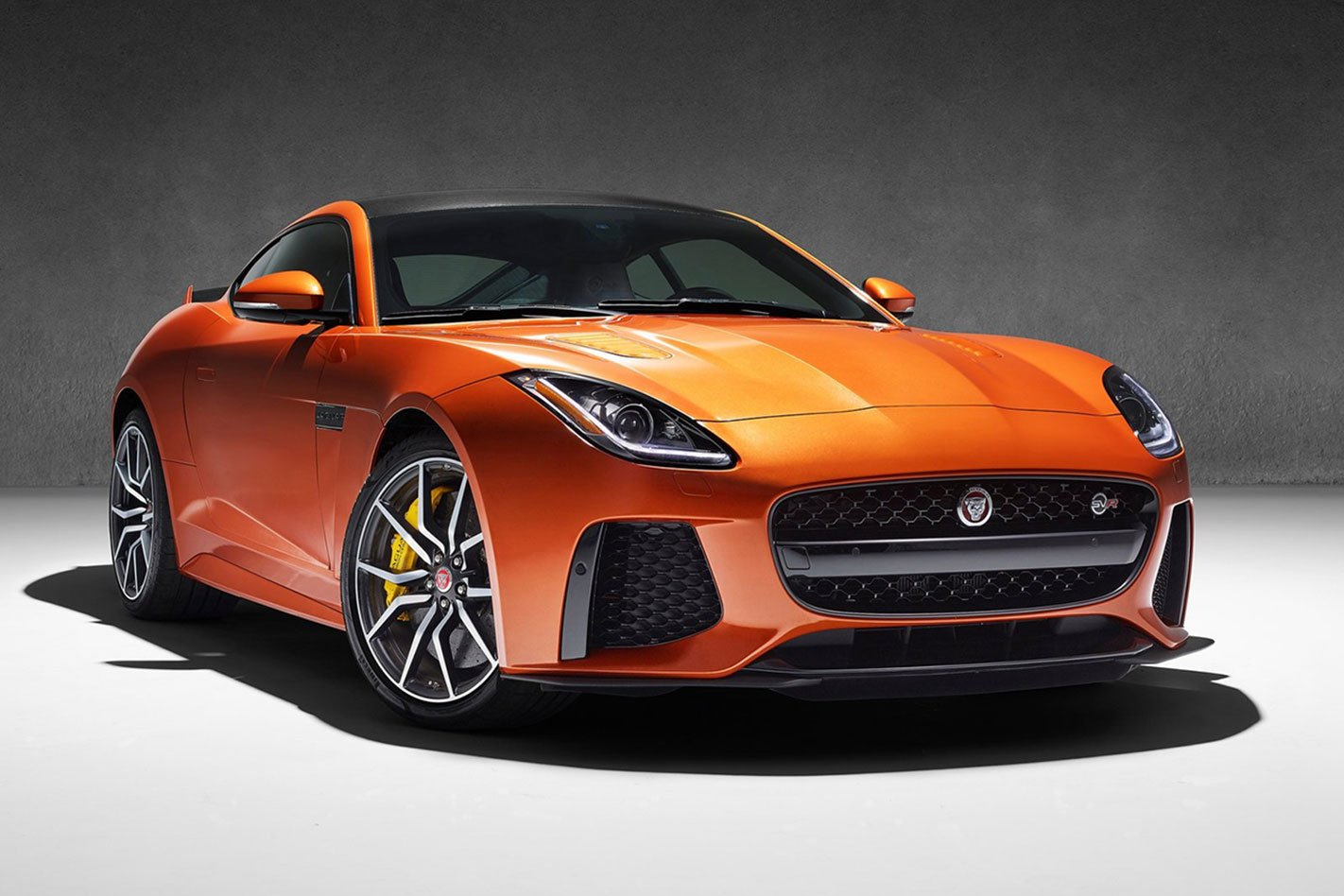
JAGUAR F-TYPE
We worked hard to create a worthy successor to the E-Type. It captures the confident stance of a modern Jaguar while giving a nod to Jag’s exotic past. Sports cars are about wrapping the sheet metal as tight to the mechanicals as is physically possible, and the F-Type does just that. Its plan view changes dramatically as you walk around it.
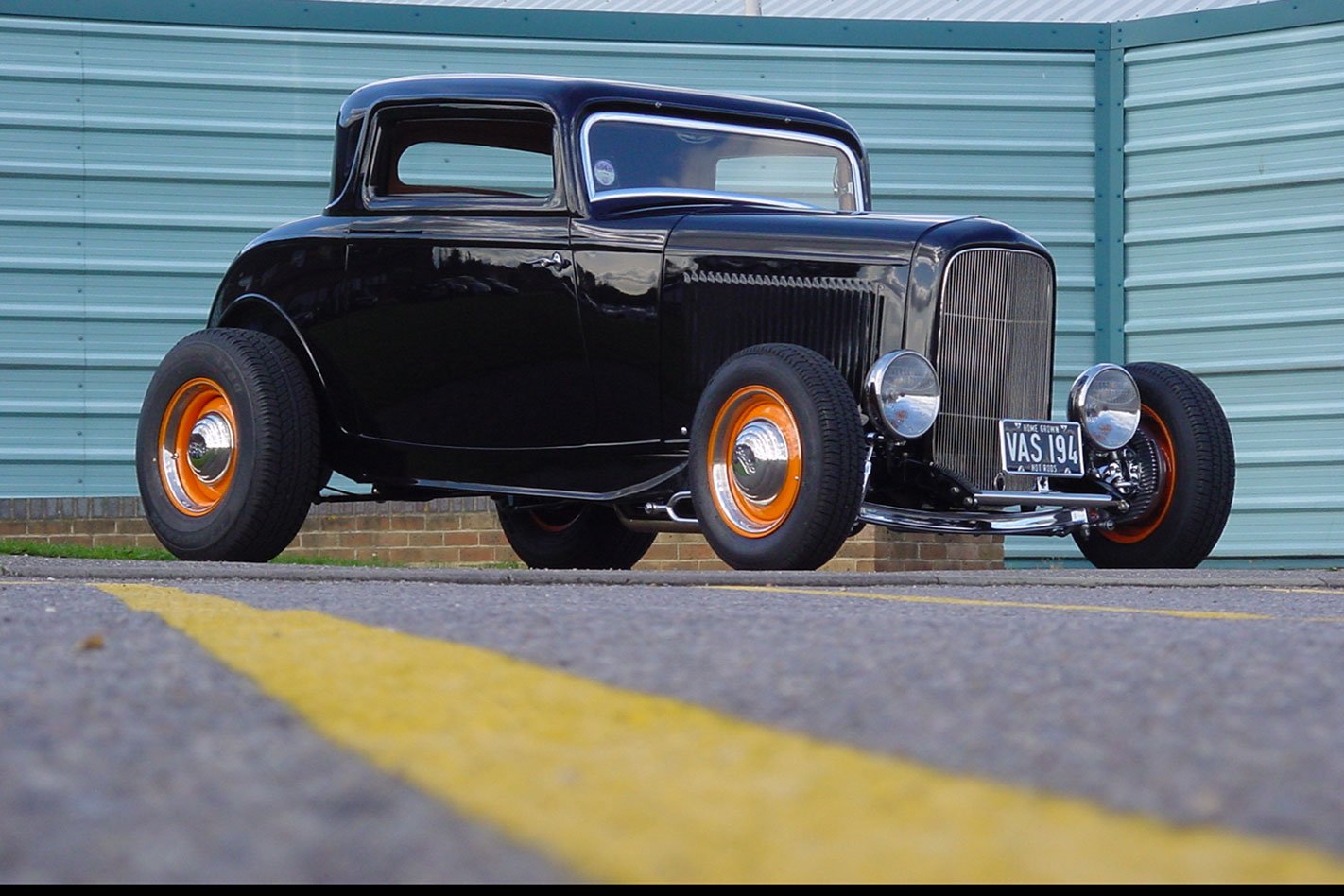
Ford MODEL B COUPE
I fell in love with hot rods as a kid, especially the Model B. They were rebellious, fast, simple and exciting. A chopped Ford ’32 is one of the most exaggerated but handsome silhouettes on wheels. Its stance is perfect. The cabin tapers at the bottom to mould around two occupants. Side on, the grille’s vertical line almost runs straight through the wheel centres.
The slap on the wrist this week for a Victorian driver who crashed into and killed a budding pro cyclist brought home to me once again how futile this whole ‘drivers v cyclists’ really is.
A judge decided that a moment of inattention from driver Billie Rodda caused the crash that claimed the life of cyclist James Lowndes in December 2017, but the sentence of 200 hours of community service and a $2000 fine has left many people shocked.
But it’s not a surprise, sadly. Viewed dispassionately, the evidence suggested that Rodda simply looked away for a moment, and struck Lowndes around a blind curve.
Of course, there is so much more to the story, but that’s not why I’m here today.
I’ve been a cyclist, both off-road and on, for the better part of 30 years, and it’s a pastime – okay, it’s a passion that, at times, clashes with my day job as a motoring journo, and I’ve experienced first hand the lack of care and attention – mostly intended – of drivers. And it’s got to stop. And it can stop.
I started road cycling later in life, after a career as a mountain bike journo came to an end. I’d moved out of Sydney – one of the most cycling-unfriendly places in the world, according to former Tour de France winning Aussie, Cadel Evans – so it was an easier decision to make.
After 15 years of tarmac riding, though, I’ve actually recently called it a day, sold the road bikes and returned to the dirt. One too many close calls out on the road simply overwhelmed the joy I once got from pushing myself to cover a fair distance in a reasonable time all by myself.
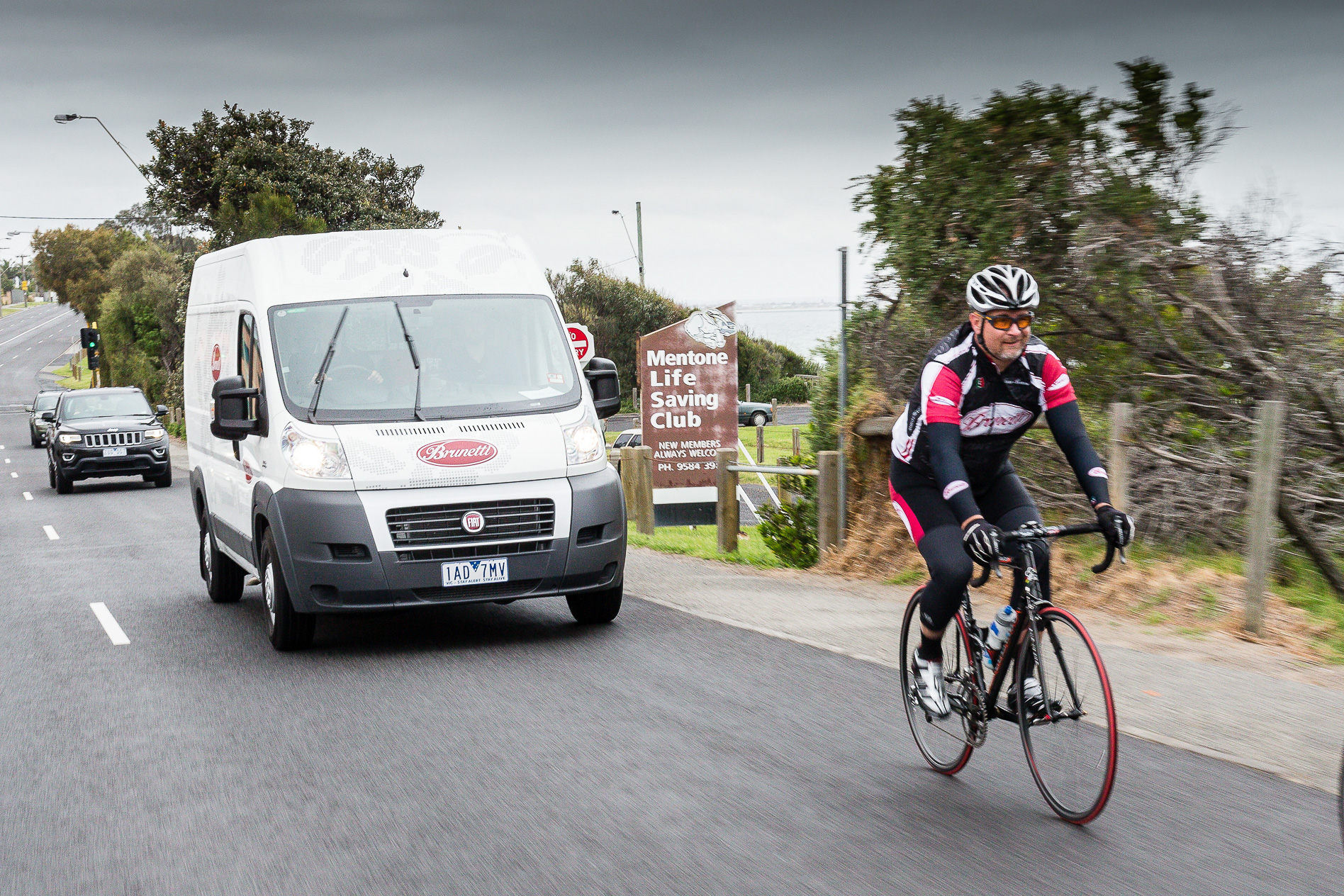
The author on a charity ride in Melbourne
As a result of my career and (former) hobby colliding on more than one occasion, though, I reckon I’m within rights to highlight some habits that both drivers and riders of all persuasions could change when it comes to using the road. Here’s five of my most noteworthy.
MORE PATIENCE
Sure, we (seemingly) all have fewer hours in a day to get more done – and those days frequently now push into the weekend, as the demands of family and social lives force us into commutes on a Saturday or Sunday.
Honestly, though, waiting just two or three more seconds as you wait for a biker to clear a narrow section of road – or even a minute – will not affect your world in the least. It won’t.
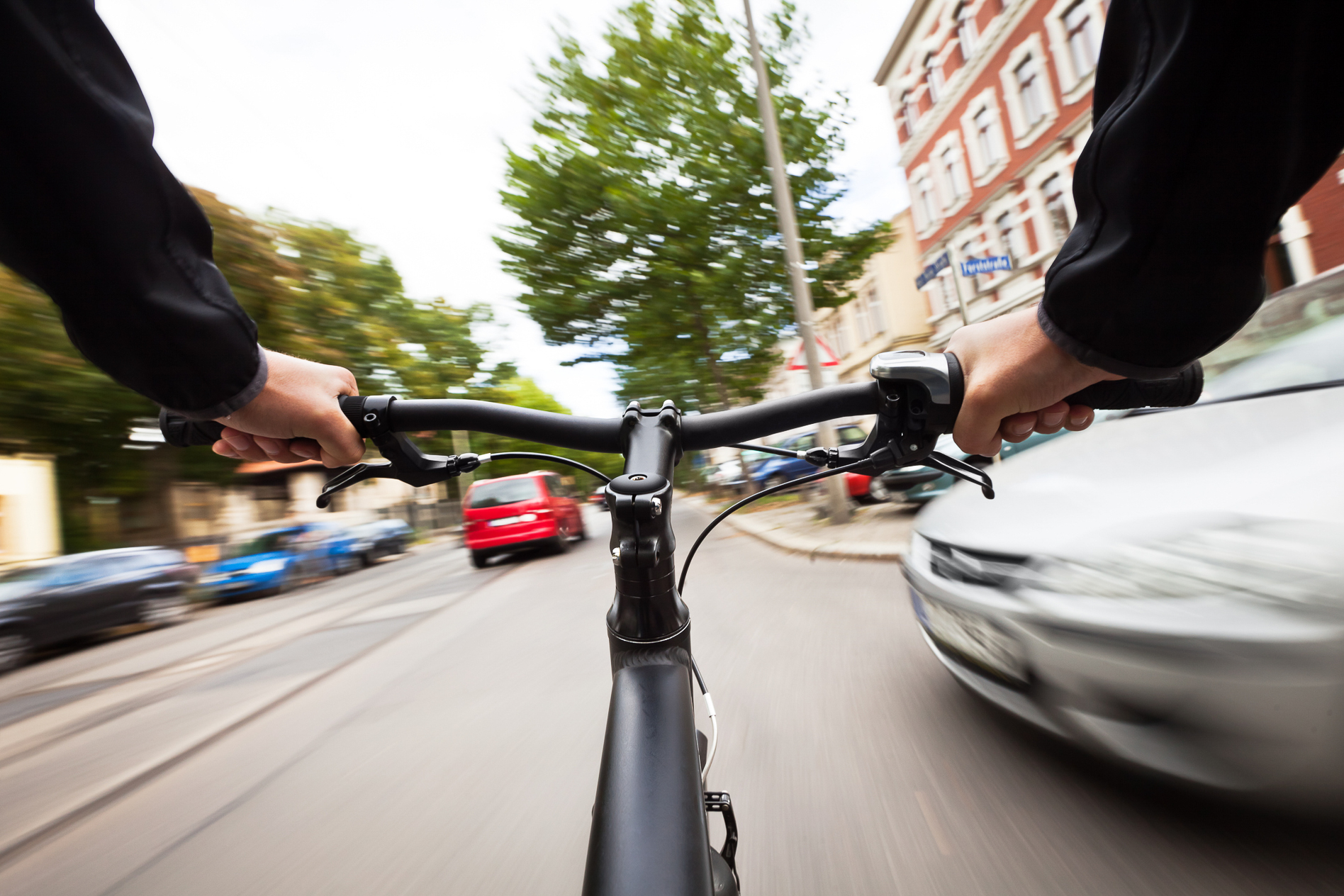
A moment of misjudgement on your part trying to brush past, however, could have life-changing consequences to the rider if they’re knocked off.
Whether you agree with it or not, cyclists are part of the traffic flow. Do we all do silly things on occasion? Absolutely. Is your driving perfect? Mine sure isn’t, and I’ve tested more than 1000 cars in my career.
Take a breath, count to ten, breathe again and you’ll get past. Trust me. Cyclists are not slowing you down on purpose.
INATTENTION
Part and parcel of my road ride must-dos included eyeballing parked cars for a couple of things; drivers getting ready to hop out without looking over their shoulder, and pedestrians hustling out between the parked vehicles.
I once came within millimetres of cleaning up a harried mum who, clutching her crying baby, charged out from between two cars without looking and directly into my path. Thankfully, I’d washed off a lot of speed and avoided her, but it was way too close.
Driving a car is relatively simple, so checking phones and supervising kids comes all too easily. The onus is on all of us to look out for each other – and if that means taking an extra second to hang up from a call before flinging open your driver’s door, or walking 20 metres to cross at traffic lights, we owe it to each other to stay in the moment when we’re around traffic.
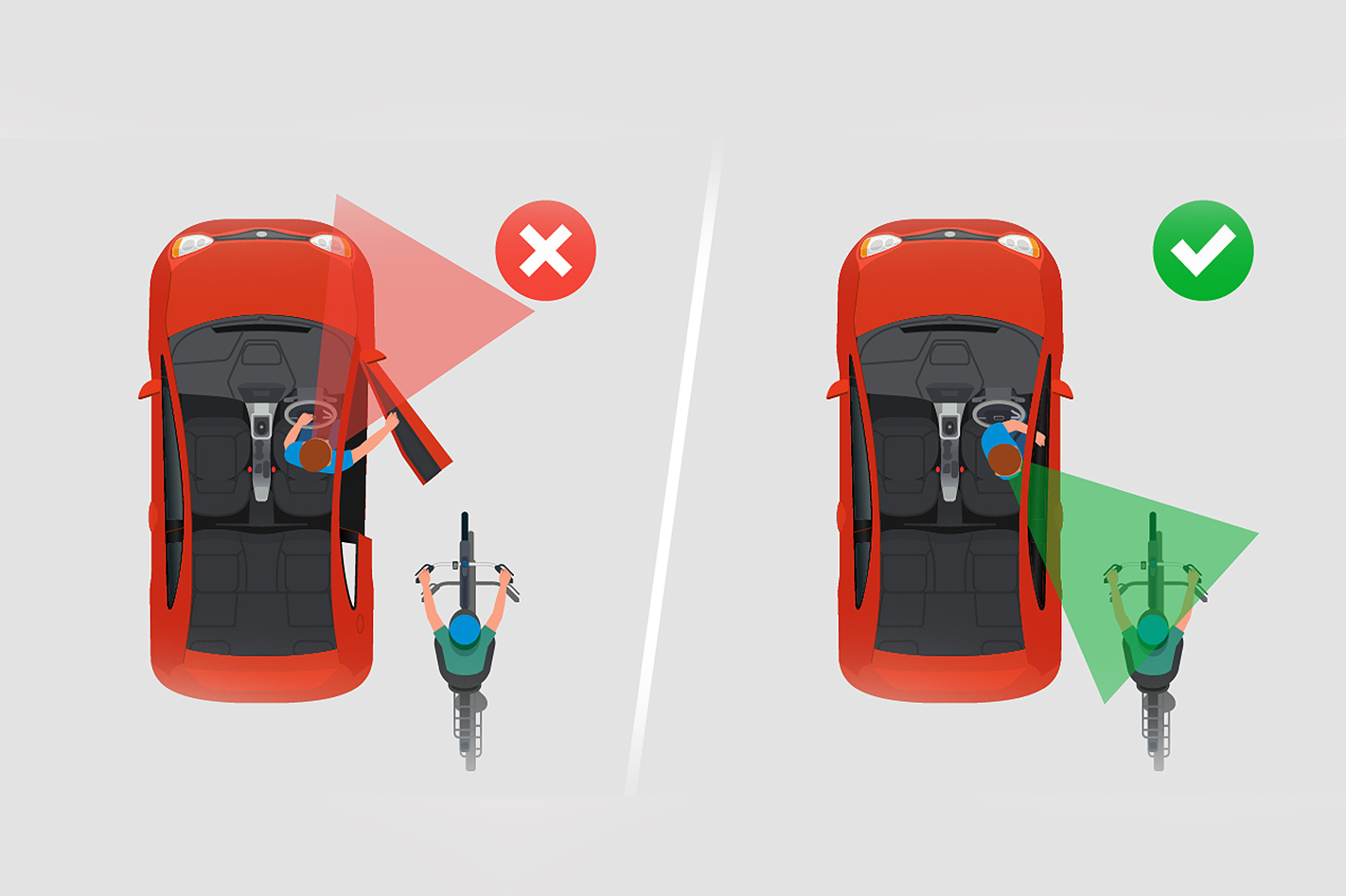
The Dutch Reach requires a driver to open their door with their left hand, which twists the head around naturally and could help to spot a cyclist before ‘dooring’ them
Oh, and we can all see you talking on your mobile, especially when your chin is on your chest as you send that unimportant message to your other half about that loaf of sourdough you forgot. Stop it.
RUSHING TO MAKE LEFT TURNS
Judging the speed of other vehicles can be tricky, and it’s even more difficult with cyclists. The smaller size of a bike and rider makes judging distances harder, and speeds, too, are tougher to call.
I cannot count the number of times a car brushed past me at pace, only to brake hard, indicate late and dive into the street on my left, leaving me with just (hopefully) enough pavement to follow them around the turn – otherwise, I’d smash into their left rear door. It’s not fun.
Deciding whether to turn left in front of or behind a cyclist is no different to judging an overtaking manoeuvre; if in doubt, just wait. Don’t commit to a move that could end in disaster for another road user.
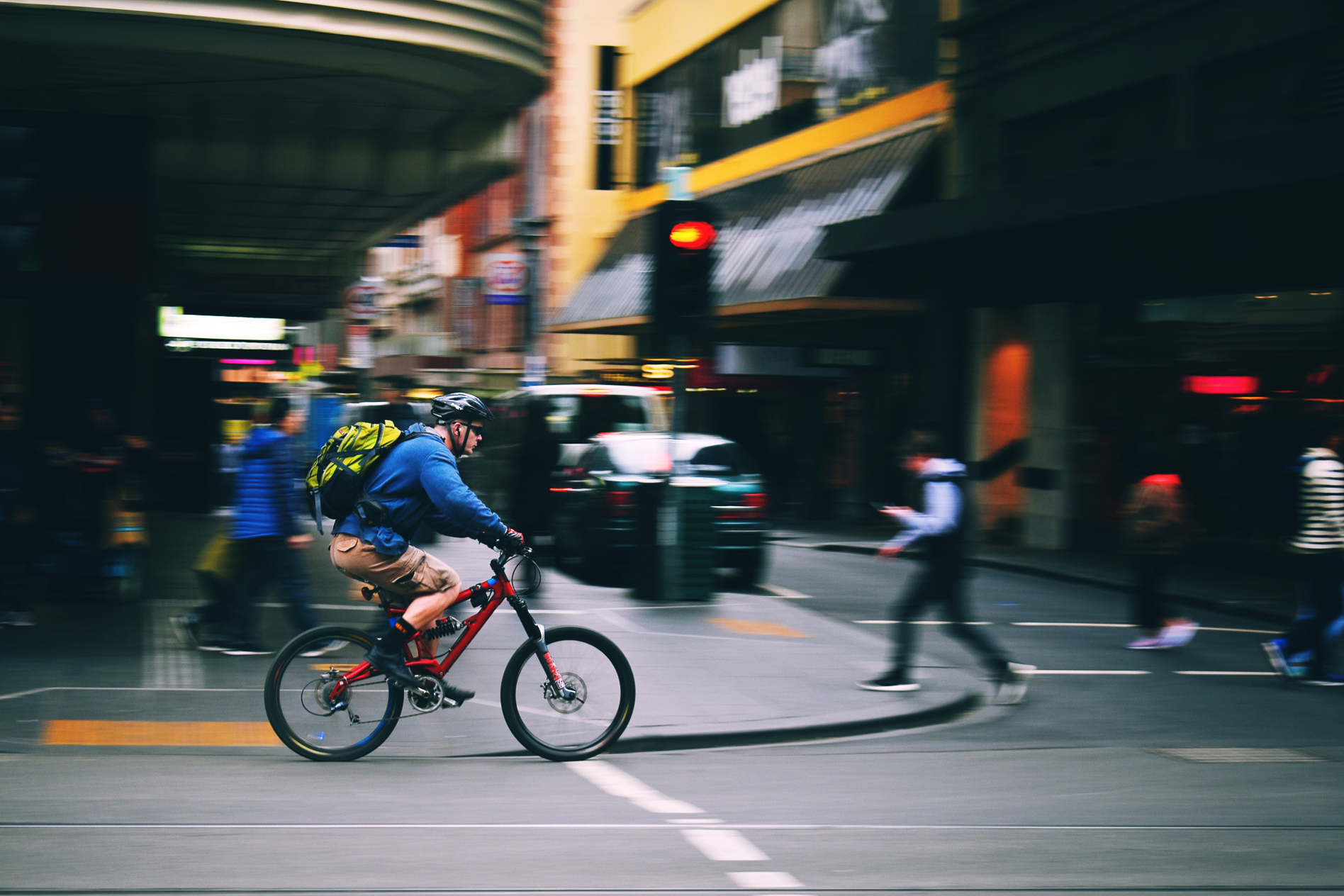
Here’s a free tip, too; look an oncoming cyclist in the eyes before committing to a right turn in front of them. Most will give you a clear ‘NO’ signal if the gap is too tight.
BEING OVERLY COURTEOUS
It sounds odd to complain about a driver being too well-behaved, but sometimes an overt act of kindness puts the driver or rider in harm’s way when the opposite is the intention.
The laws requiring drivers to give space to cyclists – a metre under 60km/h and 1.5m over 60 – are nearly two years old now, and while most drivers are comfortable with them, it’s still a bone of contention for many.
As a rider, I definitely noted that the majority of drivers heeded the rule changes – but some heeded them too much, veering over double lines into oncoming traffic in an attempt to obey the law, putting themselves in real danger.
While it’s legal to cross double lines to pass a rider after indicating, it needs to be done safely. If you can’t pass a cyclist safely, just sit back and wait until you can. You wouldn’t pass a bus or truck over double lines without leaving adequate space, would you?
WALKING IN CYCLING SHOES
Possibly the most disappointing habit of a small percentage of drivers is looking at the cyclist as someone… more accurately as something less than human.
I’ve never, ever had someone skim past me with millimetres to spare while I’m walking on the footpath, call me a ‘stupid c%%’ and throw a glass bottle of soft drink at me.
None of us is perfect, but we are all important to someone else. The day that I wondered if I would actually get home in one piece was the day that I decided to give the sport away.
If you’re getting cranky with a cyclist, please, think for a second before acting out. A bingle in a car is an exercise for insurance companies to make money. Bumping a cyclist, accidentally or otherwise, can land you in jail, and the rider – someone’s mum or dad, wife, boyfriend, brother or sister or best friend – in hospital… or in the morgue.
Finally, if you like to get onto social media to lambast ‘cyclists not paying rego and they need number plates because they run red lights’, please, just give up on that lazy trope.
Licencing of cyclists is never going to happen, nor is registration. Vehicle registration doesn’t build roads, either, so claiming that your rego gives you more rights than others is not only stupid, it’s wrong.
Bicycles form part of the Australian road network and are protected by law, and that’s all there is to it.
No matter what tired barbs are thrown out there, none of it is going to change the fact that bikes are allowed on Australian roads, and the change that needs to happen is within ourselves. Cyclists who break the laws can be fined and convicted, just like car drivers.
I also challenge you to replace the word ‘cyclist’ with another reference, just to hear how it sounds. It’s no fun being threatened with harm and death just because you happen to ride a bicycle.
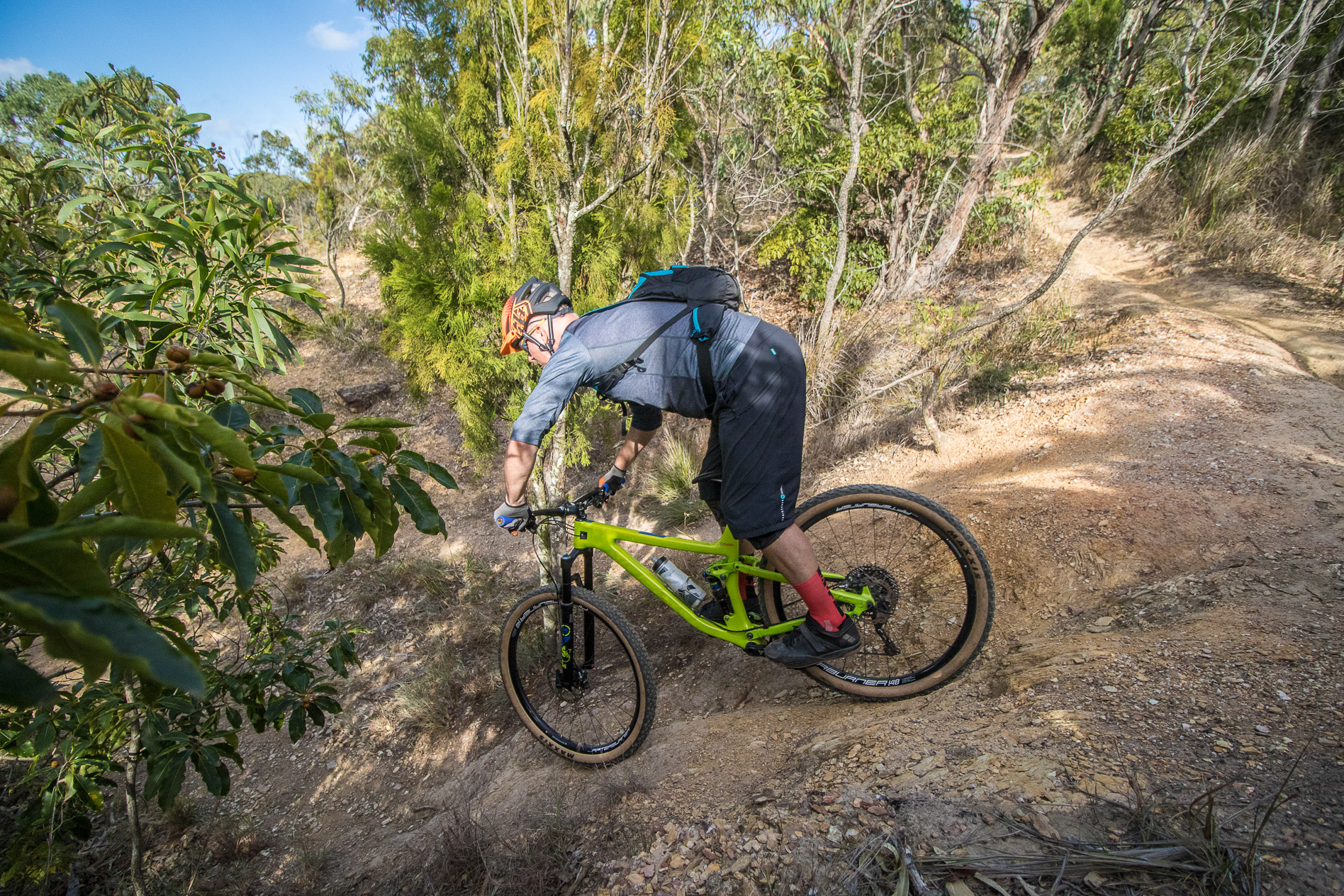
It’s much quieter out here!
We’d love to hear your thoughts on this issue in the comments below – please note, though, that the discussion will be moderated.
Do you ever wonder if maybe some people should just never drive or leave their homes? Do you sometimes see them doing stuff that makes you wonder how anybody could be so obviously brain-dead and yet still operate complex machinery? Like a spoon? Lord, I do. All the time.
And I wondered about it this very morning as I walked back to the Melbourne Bloke Centre from the coffee shop (okay, the closest servo, but hey, at a buck a cup we can’t all be rocking a short-back-and-sides and riding a fixie, can we?). Anyways, I like to play Guess That Engine as cars zoom up behind me, and I’m getting pretty good at it. An old Magna can be heard rattling its timing chain from three blocks away.
A Toyota V8 diesel through an aftermarket pipe is a common one around the MBC. A fart played backwards? That’ll be a WRX. And a Holden 253 thong-slapper, well, the name tells you all you need to know.
But today, I heard what sounded like Rolf Harris heading my way. No, not the lock-’em-up bang of a gavel falling, more like a wobbleboard at redline. And as the car in question, a late-ish model Mitsu Lancer (I can’t be more year-specific since they’ve been making the same car for about the last 40 years), passed me I could plainly see what was causing the whoop-whoop-whoop racket: the right-rear tyre was flat.
Not low-on-air flat. Not flat-on-the-bottom flat. This was flatter than a shitcarter’s hat. The rubber was smoking and flopping all over the place, the whole car was shaking like a wet dog and the racket was something else. The only thing holding the ex-tyre on to the Lancer’s rim was the vacuum inside it, I reckon.
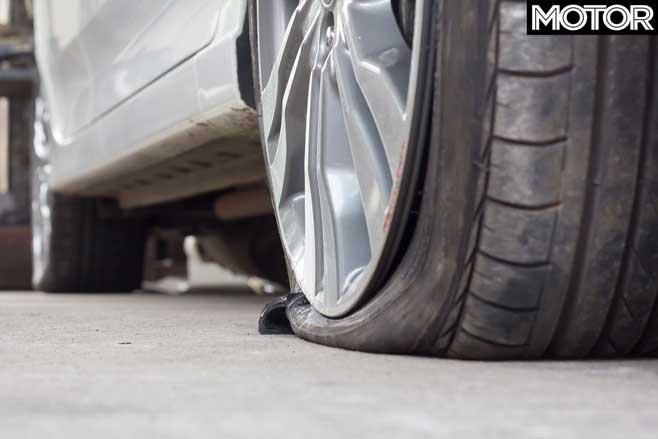
And I wondered to myself, ‘That must be steering and handling like a rudderless turd.’ Followed by, ‘How on Earth does the muppet at the helm not know that something is wrong with this picture? Nah, surely they know they’ve got a bit of an issue. Don’t they?’
Apparently not because, instead of moving towards the shoulder to pull up, the Lancer continued on its sozzled way at a constant 70 kays (in the fast lane of an 80km/h road, of course). Intrigued, I watched it continue continuing and when I lost sight of it, about a klik up the road, it was still hogging the right lane and still clinging grimly to 70km/h while one very second-hand Bob Jane Aussie All-Rounder did the same to its rim.
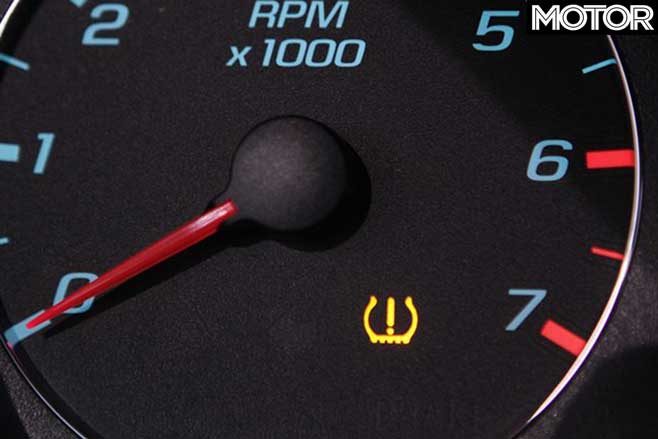
Now, I don’t know about you, but I’m of the belief that if you can’t feel a totally flat tyre on your car at speed, there are only two possible conclusions to be drawn. One, that you’re occupied doing something other than driving. Or two, that your mama smoked a lot of ice and drank a lot of cask wine when she was pregnant with you. Either way, you probably ought to get the hell off the road.
I don’t know, maybe the driver of this car was fed off lead plates. Maybe they were the local gynaecologist’s first ever crack at a forceps delivery. But I’ll put them in the same category as the geniuses who sit on a single-lane stretch of 100-kay road at 90 and then subconsciously speed up to 120 the instant they get to an overtaking lane. With me behind them.
I’ve been thinking of ways to equip my ute with a gun that fires deer slugs for the purpose of shooting their tyres out. But based on today’s episode, it wouldn’t make any difference.
The global demand for fatter, heavier, faster SUVs is showing no signs of slowing and the various manufacturers are responding with lots more choice. This week alone, Mercedes revealed not one but three high-performance SUVs, along with Aston Martin’s foray into the segment and one from Audi.
But everyone seems to be ignoring the looming corporate average fuel economy standards and carbon emissions standards that will soon shrink to just 100g per kilometre. The WhichCar Weekly team discuss what has to give.
Making his WCW debut this week, Simon ‘Telfo’ Telford is inducted into the fellowship of the podcast to review Drag Challenge 2019, and reveal exactly how Dan didn’t die at the wheel of his supercharged Camaro.
By road-car standards, the ZL1 is a monstrous machine but it was not in the company of regular road cars as we know them. Telf explains all the details from the most challenging drag competition in Australia.
Rounding out the show this week, the subject turns from excess to frugality without compromise. Dan and Scott have spent some time in Honda’s game-changing NSX and it’s time to chat about its role – both in Honda’s ranks as well as in the broader automotive landscape.
If you’re on the go, you can find WhichCar Weekly on all manner of podcast apps including iTunes and Podbean. Please rate, subscribe and leave a review! You can also follow the day-to-day happenings of the WhichCar team on Facebook, Twitter and Instagram @whichcarau.
Listened to the show? Help us out:
- Leave a note in the comment section below.
- Leave a review on Apple Podcasts/iTunes
- Subscribe to our podcast
THE LEGEND surrounding Subaru’s Impreza WRX STI 22B is so big it’s easy to forget the brand made anything else as great. But the 2007 Impreza WRX STI Spec C RA-R stressed its importance almost in the length of its name alone.
While RA-R stood for ‘Record Attempt – Radical’, Subaru created its ultimate track car without the headline-grabbing Nurburgring Nordschleife lap time that now feels customary.
This model began with an STI Spec C (which stood for ‘Competition’) that already came with lighter glass, a thinner roof, a water-spray system for the intercooler, no sound deadening and a hatch in the roof for when the air conditioning was off. The radio was ditched as well.
The RA-R then used the Japanese-market’s special STI-tuned 2.0-litre EJ20 turbocharged boxer engine, fitted with a ball-bearing twin-scroll IHI turbo that helped it deliver 235kW at 6400rpm and 431Nm at 4400rpm. A new ECU set the redline at 8000rpm, and it howled through a titanium exhaust. You also shifted through the six-speed manual transmission with a unique gear knob.
Thanks to a relatively light 1390kg kerb weight, which was 105kg lighter than the 2.5-litre Australian WRX STI of the time, acceleration was reportedly rapid, but what the all-paw RA-R craved were roads more winding.
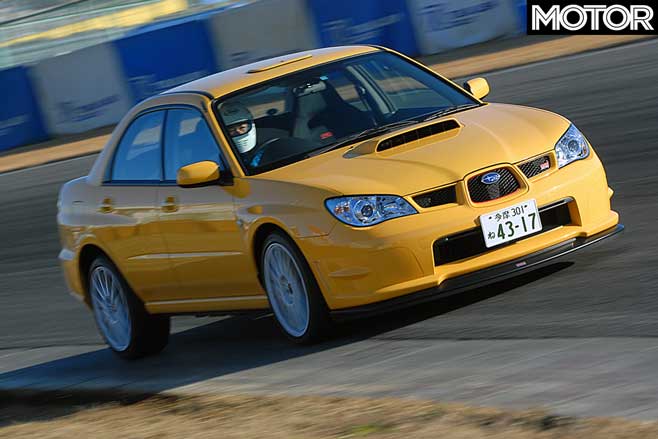
Its suspension was 15mm lower than the already capable Spec C’s and fitted with every STI option available, including multiple braces and pillow-ball links. Its dampers and springs were upgraded too, while the front brakes were full-blown six-piston Brembos that clamped two-piece grooved discs. Bridgestone supplied 235mm-wide RE070 rubber that wrapped around 18-inch Enkei wheels.
Pink detailing around the centre grille and a special front lip helped identify the model, but unfortunately few were treated that chance. Subaru made 300 only for the Japanese market, in yellow, blue and white.
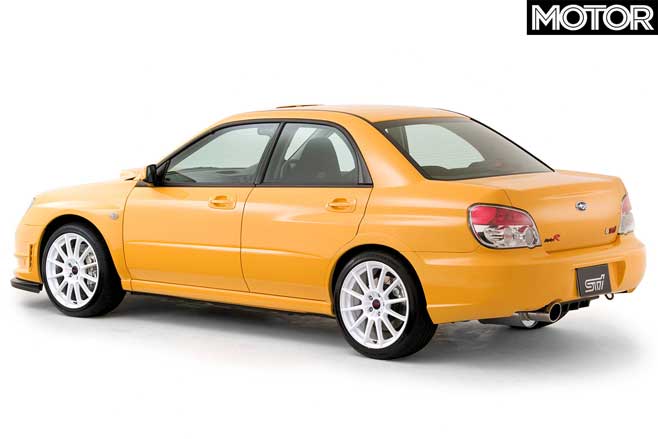
2007 SUBARU IMPREZA WRX STI SPEC C RA-R SPECS Engine: 2.0-litre boxer-4, DOHC, 16v, turbo Power: 235kW @ 6400rpm Torque: 431Nm @ 4400rpm 0-100km/h: 4.9sec (est) Price: AUD$80,000 (est)
Wheels first drive review
Overall Rating
5 0 5
Plus & Minus
WHAT IS THE JEEP JL WRANGLER RUBICON?
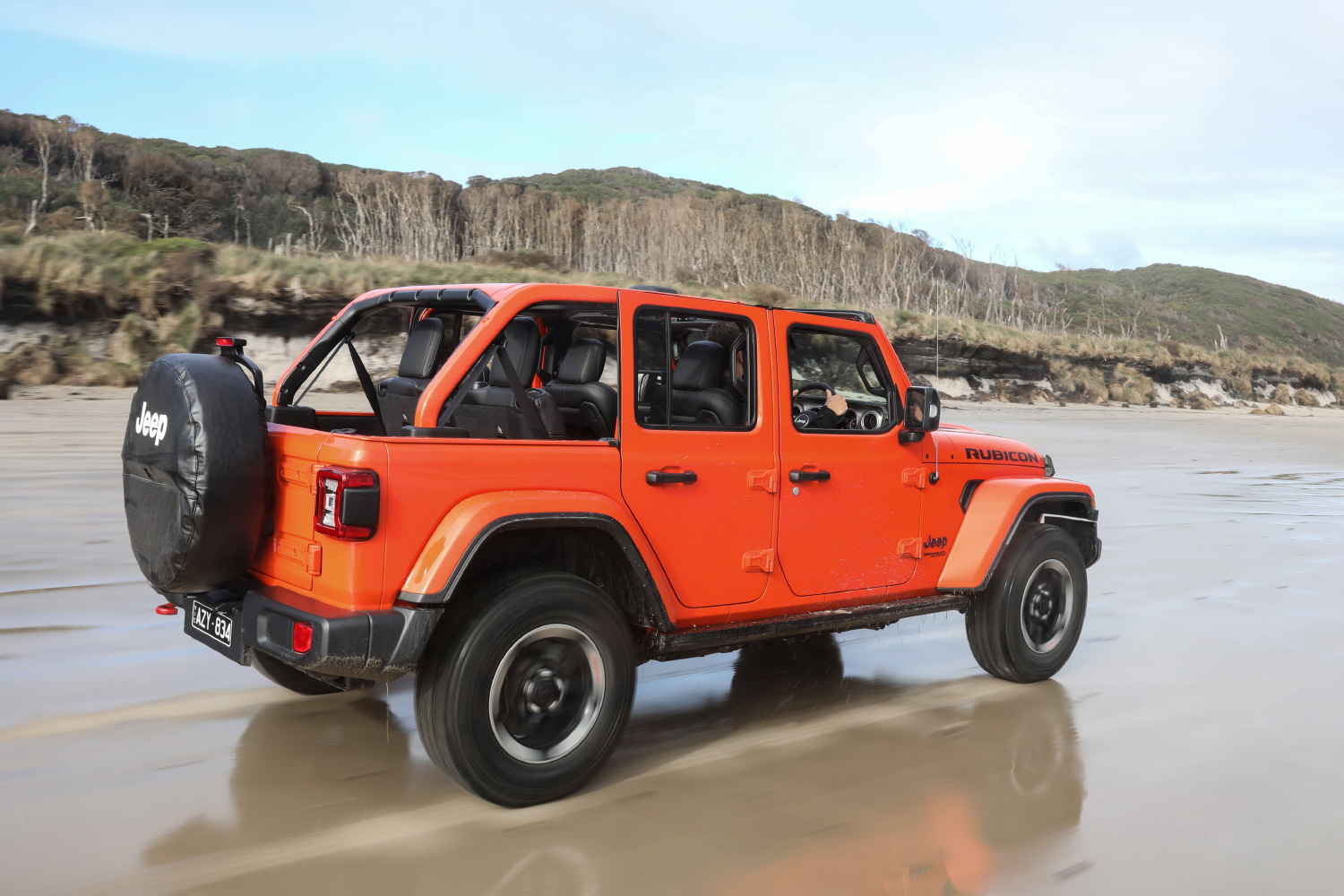
Key to the Rubicon’s ability are its mud terrain tyres, low gearing and locking differentials; features that no other vehicle manufacturer is prepared to include in a production car. They are just part of the Rubicon’s off-road arsenal, which also includes a disconnecting front sway bar to allow more suspension travel and high ground clearance.
WHY WE’RE TESTING IT
The JL is the fourth generation of the Jeep Wrangler since the nameplate debuted in 1986, but it draws its DNA from the WW2 Jeep from 1948. The JL has just arrived in Australia after being available in the USA for more than a year and it’s here to defend its title as the most off-road capable four-wheel drive vehicle available.
JEEP JL WRANGLER RUBICON REVIEW
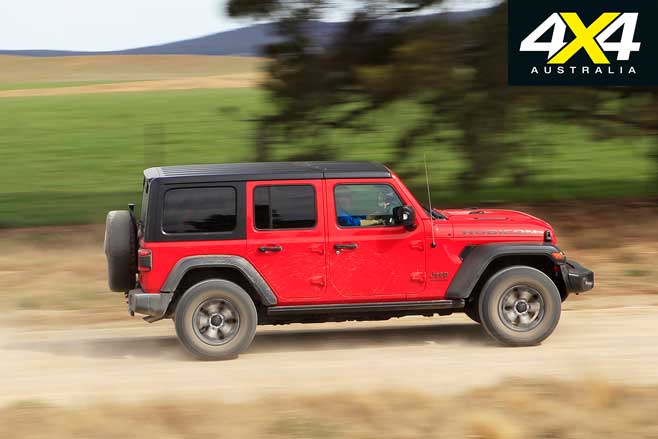
The Jeep Wrangler is not everyone’s cup of tea, but it has a unique style that honours its long heritage and appeals to many buyers wanting to at least look like they are ready to take on the world’s toughest off-road trails. They’d be giving themselves the best chance of conquering those trails if they took them on in the 2019 Wrangler Rubicon.
The name Rubicon itself, is taken from the legendary trail in Northern California where Jeep puts its 4×4 vehicles to the test on the boulders and slopes. The moniker is applied to the top-of-the-range Jeep Wrangler; the one with the most off-road features and ability.
But the Wrangler is not all about off-road driving. In fact Jeep Australia admits that its own research tells them that only 12-per cent of buyers choose Wrangler for its off-road ability while more than 25-per cent buy it on its style. The company has stayed true to its design heritage in the evolution of the model, comparing the Wrangler to Porsche’s 911 sports car, which also has more than 70 years of tradition, yet is instantly recognisable regardless of the era each one came from.
One thing buyers won’t be drawn to the Wrangler for its safety rating, as it has been awarded a poor 1-star ANCAP score based on its Euro NCAP tests. That’s not totally fair on the Jeep as the European test was on a 2018 model car that was not fitted with electronic safety tech such as Autonomous Emergency Braking (AEB), blind spot monitoring and rear cross traffic alerts in addition to the ABS, ESC, airbags and electronic roll mitigations systems. While these electronic systems will aid accident avoidance, they fail to address the poor occupant protection noted in the Euro NCAP testing where deformation of the A-pillar and driver-side (LHD) footwell were criticised. A 2019 model car with the full suite of electronics is yet to be crash tested and rated.
For the remainder of 2019, only the mid-spec Wrangler Overland and top-spec Rubicon variants come with the full gamut of safety electronics. The entry level Sport S models will have to wait until 2020 to join them with life-saving tech such as AEB and rear cross traffic alerts.
If you can ignore the safety rating and put yourself behind the wheel of a Wrangler Rubicon you will be rewarded with a more refined driving experience that any Wrangler before it. Yes those mud terrain tyres which are exclusive to the Rubicon variant, rumble and holler on the highway and the lofty suspension leans heavily through corners. However, these are compromises that enthusiasts are prepared to accept to get the superior off-road performance.
The Wrangler steers and handles better than in the past and the new diesel engine and eight-speed auto combination provides swift if not fast performance. The engine delivers its 450Nm of torque from low revs, and is smooth and relatively quiet for a diesel. This in a new 2.2-litre engine that shares nothing with the old 2.8 from the previous Wrangler where is wasn’t offered in the Rubicon spec. It has been seen previously in the Jeep Cherokee and Alfa Romeo passenger cars.
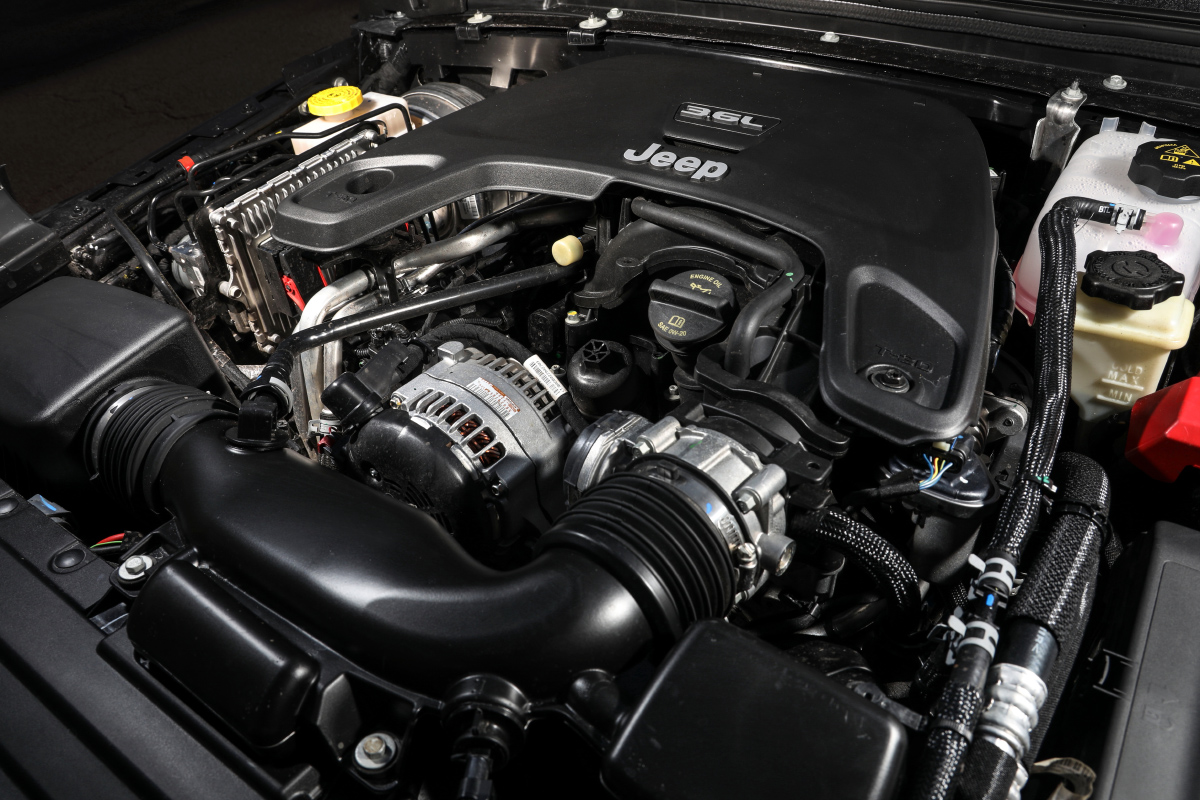
This engine works well both on- and off-road, with the new eight-speed ZF auto to keep the engine in its happy place and deliver drive to the wheels in technical terrain. The auto is also the transmission offered behind the petrol engine – a 3.6-liter V6 carried over from the previous model.
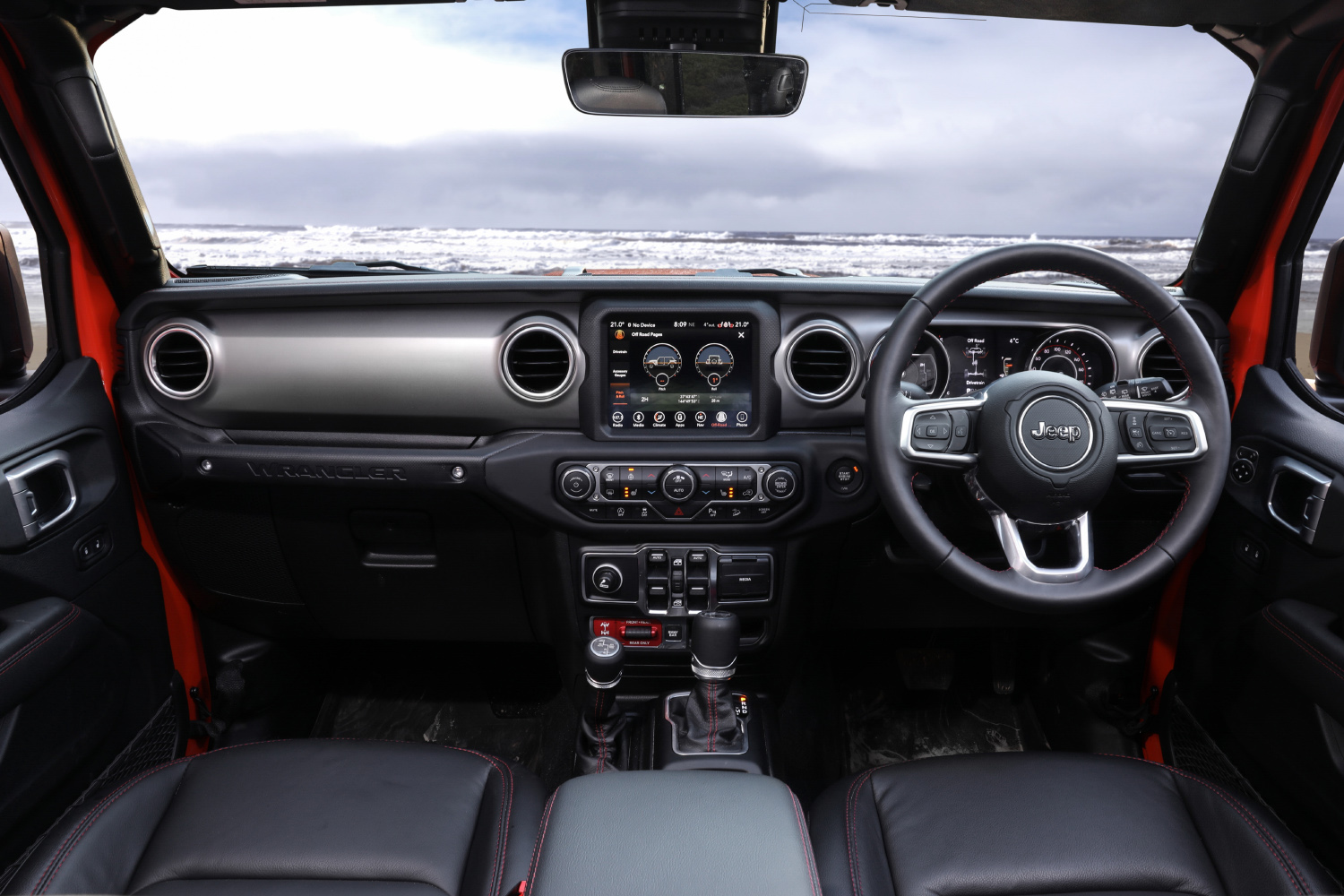
The cabin of the 2019 Rubicon is also more appealing than in the past. More use of soft-touch surfaces, stitched dash coverings, rubberised dials on HVAC and audio controls give the interior a more upscale feel, especially when equipped with the optional (in Rubicon) leather seats.
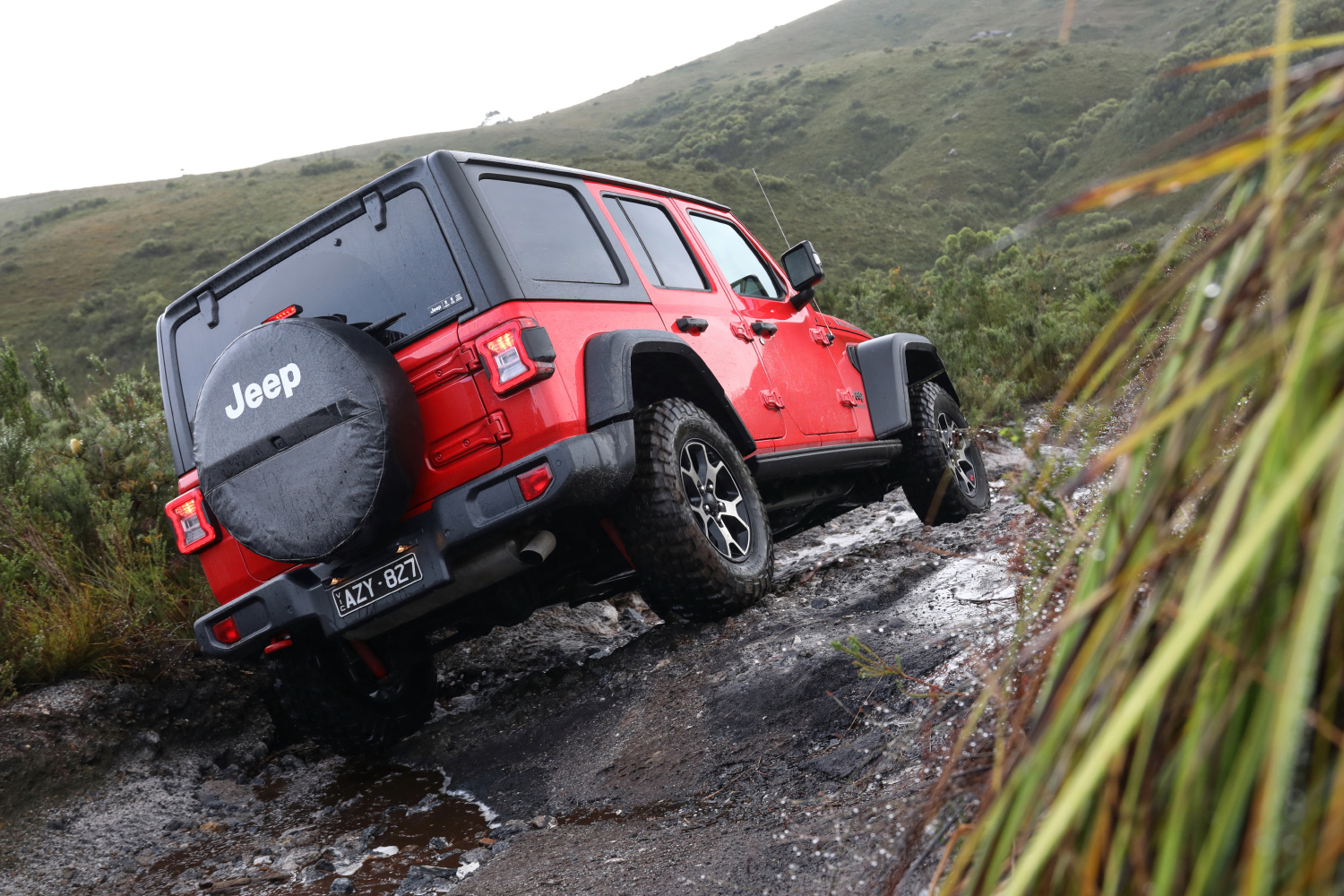
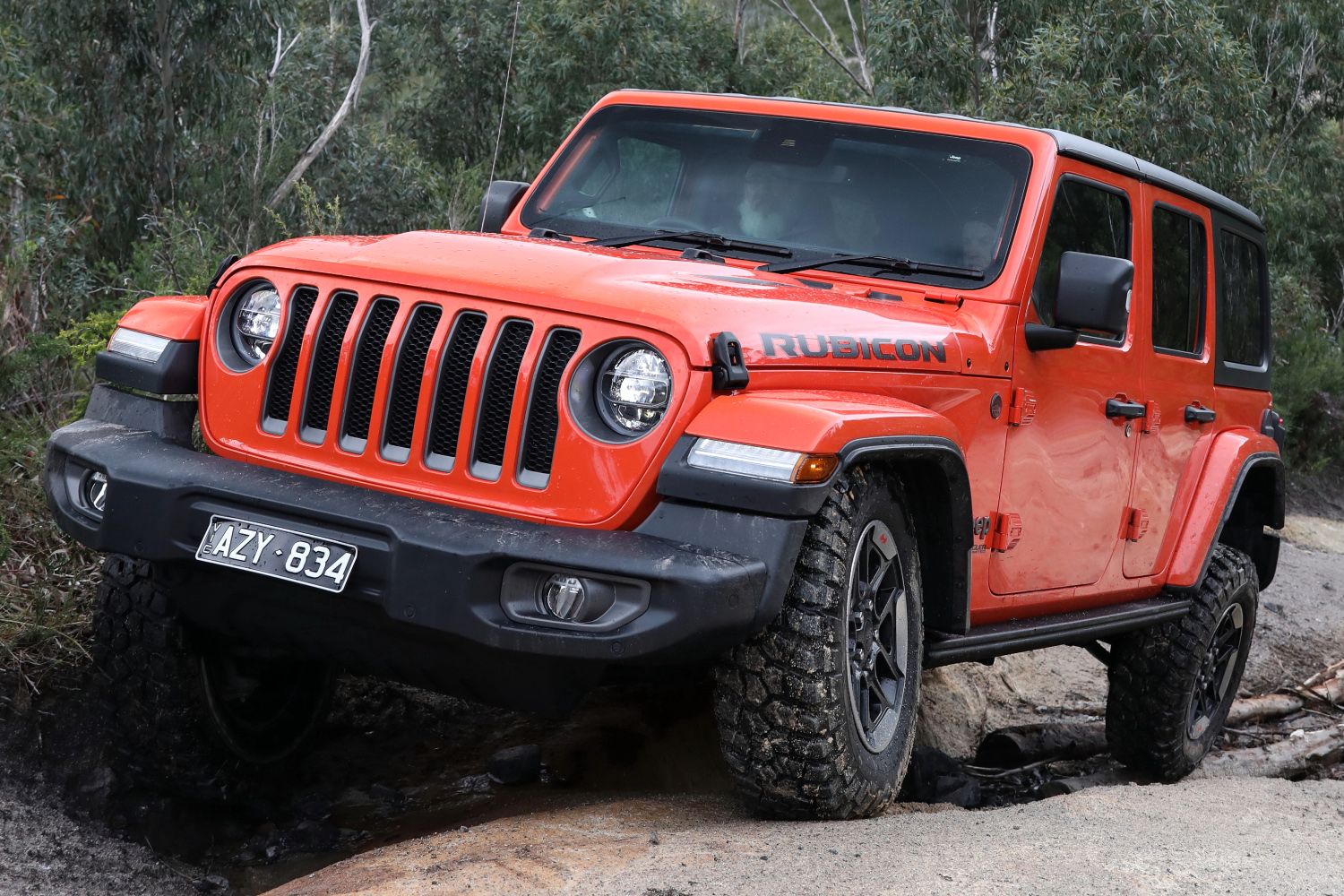
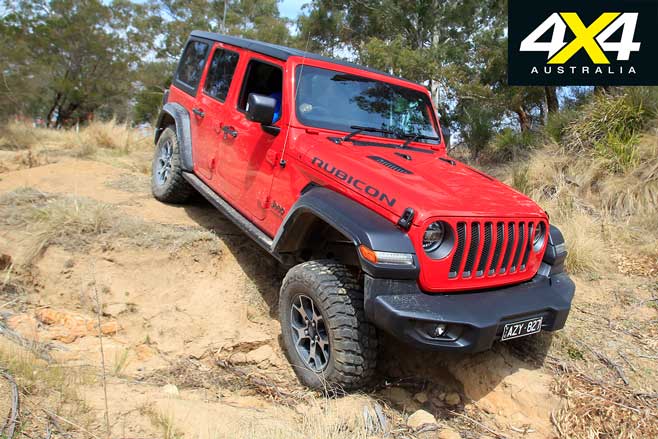
Jeep’s launch program on Tasmania’s wild west coast took us over an off-road track that no other production 4×4 vehicle would conquer without risk of serious damage or getting stuck. Even the mighty Rubicons needed recovering a couple of time to get through.
With front swaybars disconnected the convoy of Jeeps crawled their way through the ruts and holes where lesser 4×4 would have been lifting wheels and losing traction. When the track got slipperier, front- and rear-locking differentials were employed to ease the way forward, but leaving the diffs open and allowing the electronic traction control to do its thing, equally impressed. Jeep has obviously done a lot of work on the calibration of its ETC and it is now faster reacting and more capable of driving the vehicle forward without resorting to the lockers.
Ground clearance was tested on the long wheelbase Jeeps with the underside often scraping over rocks and ruts. Luckily it is well protected with metal underbody plates so drivers could feel confident of not doing damage.
While we’re yet to drive the Sport S and Overland variants of the new Wrangler, this drive was enough to convince us that the Rubicon is still the off road king. Add in the improved refinement and extra features and the JL is a better vehicle than its predecessor but whether that’s enough to have buyers look past the safety rating and the price hike remains to be seen.
JEEP JL WRANGLER RUBICON VS RIVALS
The Jeep Wrangler Rubicon really has no direct rivals as there is nothing like it available today. The two vehicles closest to it are the Toyota Land Cruiser 76 Series and the Suzuki Jimny as they are body-on frame, off road vehicles, yet both of them are very different to the Jeep.
The Land Cruiser is more of an outback workhorse than the relatively plush Wrangler. It has a basic interior, leaf spring rear suspension and available withV8 diesel engine a 5-speed manual gearbox only. Priced from $63,740 to $ 67,740 it is close to the Rubicon.
The $23,990 Suzuki Jimny on the other hand is a two-door compact 4×4 wagon that comes with a four-cylinder petrol engine and a choice of manual or auto transmissions. It’s more of an urban adventure vehicle yet one that can hold its own when the going gets rough.
JEEP JL WRANGLER RUBICON PRICE AND SPECS AUSTRALIA
Model: Jeep JL Wrangler Rubicon diesel
Engine: 2.2L I4 turbodiesel
Max power: 147kW @ 3,500rpm
Max torque: 450NM @ 2,000rpm
Transmission: 8-speed automatic
Weight: 2160kg
0-100km/h: 9.6 sec (claimed)
Economy: 7.5L/100km combined
Price: $68,950 +ORC
On sale: Now
4×4 Australia off-road review
4X4: Australia’s guide to the off-road adventure lifestyle. Mixing in-depth vehicle reviews with off-the-beaten-track adventures and gear tests, 4X4 is all about enjoying Australia’s great outdoors.
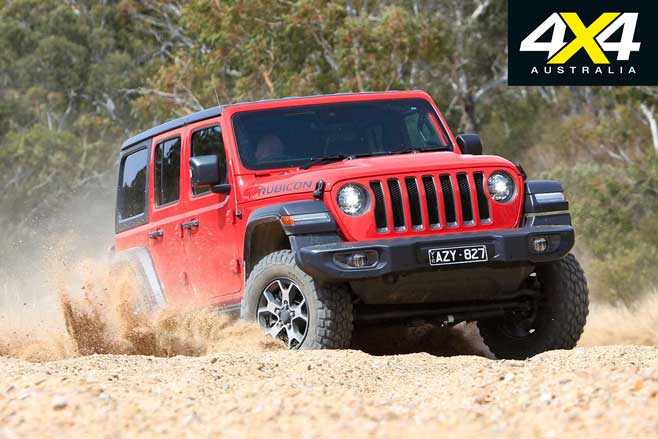
More power and a lower sticker price make the case for the petrol ‘six’ over the turbo-diesel ‘four’ in the Rubicon. By: Fraser Stronach Photos: Phil Cooper
The Rubicon is the off-road hero of the new Jeep JL Wrangler range, and for the first time ever a Rubicon is offered with turbo-diesel power thanks to a brand-spanking-new Fiat-sourced 2.2-litre four.
However, the little Italian oiler isn’t the only engine in the game. For $5500 less initial outlay, and with lower ongoing service costs thanks to its relative simplicity, there’s the familiar 3.6-litre petrol V6, which also happens to offer more than 40 per cent more power and a fair bit more maximum performance.
Powertrain and Performance
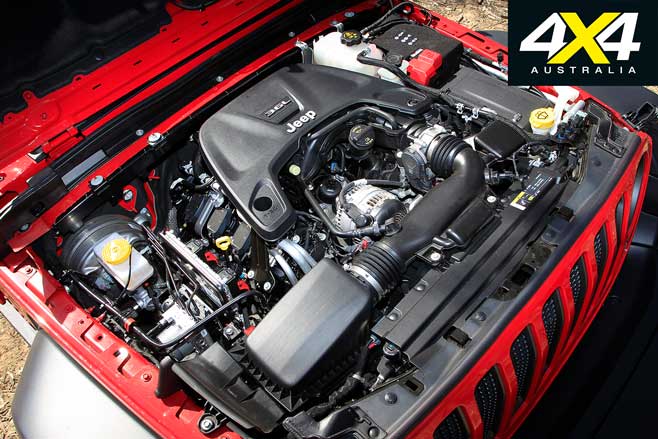
The Pentastar V6 was state-of-the-art when it debuted 10 years ago at the New York Auto Show. All alloy, short stroke, quad cam, 24-valve, variable timing on both inlet and exhaust, sequential multi-point fuel injection … it had all the tricks of the time for a naturally aspirated petrol engine. For the next three years it featured in the prestigious Wards Ten Best Engines and, on arrival in Australia in 2010, in the then all-new Grand Cherokee, it won our 4X4 Of The Year award.
But that was 10 years ago and engine design has moved on, and nowhere is that more telling than in the engine speeds that this V6 needs to get the job done. To give its all it needs to rev all the way to a dizzy 6400rpm.
Thankfully it doesn’t need to give its all, or anywhere near that, to handle most driving where 2000 to 3000rpm is all you’ll see. At lower engine speeds and lighter throttle loads it’s generally quieter than the diesel alternative, and it goes about its work in a relaxed and pleasant enough manner.
However, put more demand on the engine – on the highway and especially on hills – and the eight-speed automatic is quickly looking for a lower gear, or three, due in part to the very tall overall gearing, despite the V6 using a lower axle ratio than the diesel.
At 110km/h in top gear the engine’s only doing 2000rpm, so it’s a long way from where it reaches maximum torque (4100rpm) and even more of a stretch to where it makes maximum power at 6400rpm. If the Rubicon V6 could reach redline in top it would be doing close to 360km/h, so it’s effectively geared nearly twice as tall as it needs to be. All done in the interests of fuel economy and refinement, of course.
Still, even when singing along on the high side of 4000rpm, which can be common enough on hilly country roads even without a particularly heavy right foot, the V6 is more than willing and happy enough, even if it starts to get a bit noisy.
The positive with all these revs is that the V6 goes a fair bit harder than the diesel when both are asked to give their all. Jeep’s own figures put the V6 nearly two seconds quicker than the diesel to 100km/h and, while you may not see drag racing as part of your Rubicon’s driving regime, the extra highway overtaking get-up-and-go is definitely more than welcome.
The V6 couldn’t do what it does best, though, without help from the new eight-speed automatic gearbox. This widely used gearbox is from German transmission specialist ZF and is about as good as it gets in terms of shift quality, which is often seamless, or shift timing, which always seems perfect (or close to).
Of course, this is also an adaptive gearbox that tailors the shift protocols for your driving style, which makes it even better; and it’s a big jump forward from the previous Mercedes-Benz-sourced five-speed automatic, which in itself was a good gearbox. If you want a manual gearbox you’re unfortunately out of luck, as the eight-speed auto is the only gearbox on offer with both the V6 and the diesel.
The elephant in the room with the V6 is, of course, fuel economy, as all those high engine speeds and wider throttle openings don’t come for free. On this test the V6 averaged 14.7 litres/100km, while under similar driving conditions a recently tested diesel averaged 11.5 litres/100km – a not unexpected outcome on both counts given the blunt aerodynamics and extra rolling resistance of the Rubicon’s mud tyres.
The extra fuel cost of the V6 may or may not be of concern to you, but the V6’s shorter range is an inescapable disadvantage unless you can fit a long-range tank. The standard 81 litres makes for a reasonable but not great range with the diesel, but things aren’t so good with the V6 as the range is down to around 500km, or less if you’re doing extended low-range driving.
On Road Ride and Handling
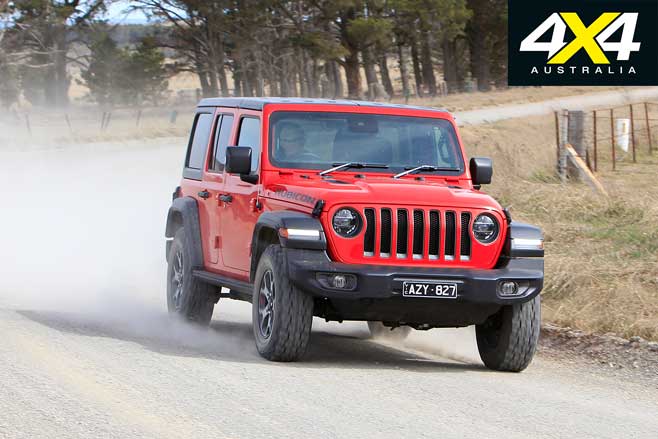
In a significant change from the previous generation Rubicon – indeed, all previous Wrangler models – the JL offers full-time 4×4 via its ‘4H Auto’ mode, which can be used on any road surface, sealed or unsealed, wet or dry, and gives better drive and steering stability especially on wet bitumen and gravel.
Given the extra power of the V6, the full-time 4×4 is even more welcome than it is with the tamer diesel, as you can get more power to the ground on slippery roads without the risk of wheelspin and subsequent loss of engine power as the electronic traction control intervenes. The transfer case still has a two-wheel-drive mode, so it should keep everyone happy!
The Rubicon V6 – or diesel, for that matter – still isn’t a particularly dynamic on-road drive. The steering is light and doesn’t offer a good deal of feel or precision. There’s also some bump steer from both front and rear axles on rough roads, especially at higher speeds.
The BFGoodrich Mud-Terrains aren’t the last word in on-road grip, either, and are generally noisy; although, this varies with the road surface. Depending on your driving regime, all-terrain tyres, such as the excellent BFGoodrich KO2 All Terrains, might be a better bet.
Off Road
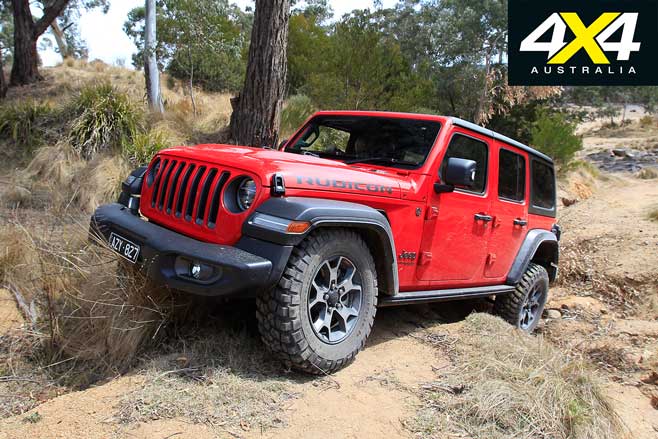
What the diesel Rubicon can do off-road, the V6 can do too; although, with some differences. The V6’s immediate off-idle response is more linear and progressive than that of the diesel, but from then on it takes more throttle and more revs to give the same drive as the diesel, as the diesel makes far more torque at much lower revs than the V6.
Where the diesel can muster 450Nm at just 2000rpm the V6 needs more than twice that engine speed to reach its peak torque, and it still falls 100Nm short, give or take, of what the diesel can offer. Still, much of this is masked off-road by the excellent eight-speed automatic.
With either engine, the Rubicon is as good as it gets in terms of showroom stock off-road ability, as it’s effectively ‘pre-customised’ for off-road use compared to the other already off-road-capable Wrangler models.
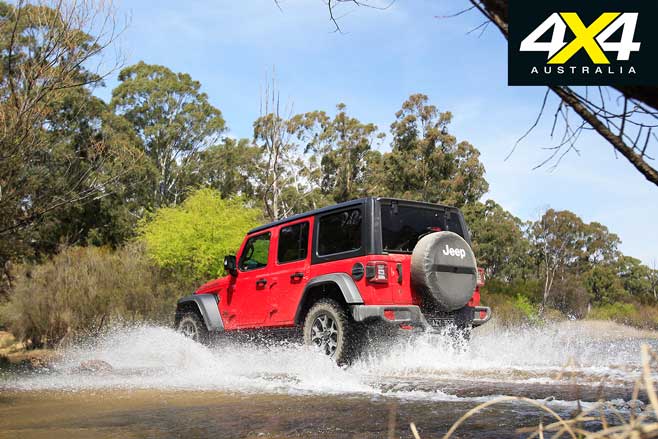
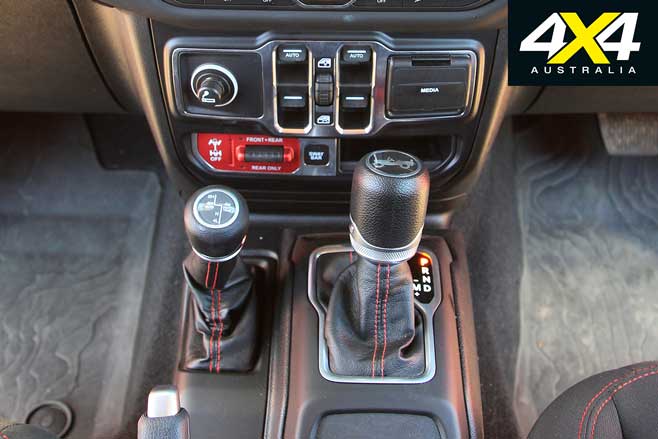
Rubicon-specific kit runs to front and rear driver-switched diff locks, a front swaybar release which, when activated, adds to the already impressive front wheel travel, and the Rock-Trac transfer case with its 4.0:1 low-range reduction ratio. The Rock-Trac transfer case helps give the V6 an off-the-chart 77.2:1 crawl ratio. Even the Rubicon diesel, with its taller axle than the Rubicon V6, has a 70.3:1 crawl ratio. The 255/75R17 (32-inch) Mud Terrains are also unique to the Rubicon.
If there’s a weak-link in the Rubicon’s off-road armoury, it’s ground clearance, in particular the ramp-over clearance; although, it’s well protected underneath for when you do belly out. The two-door Rubicon has a far superior ramp-over angle, but unfortunately it isn’t offered here in Australia.
Bigger tyres – even one size up to a 285/70R17 (33-inch) – will help and will be the likely first-up upgrade for owners, while a snorkel might not be far behind.
Beef Up
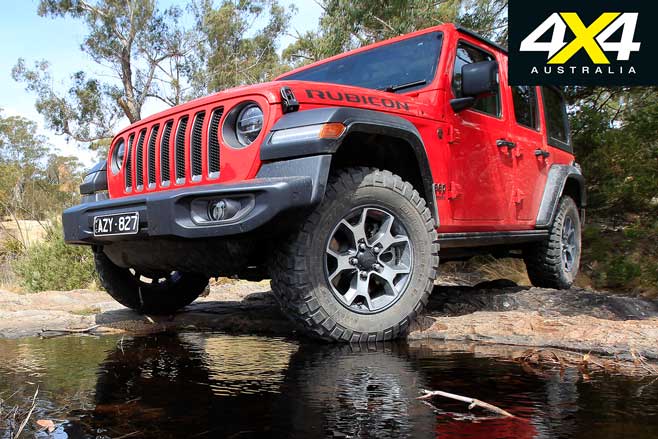
US model Rubicons get wider and taller 285/70R17 (nominally 33-inch) BFGoodrich Mud-Terrain tyres rather than the 255/75R17 (nominally 32-inch) tyres fitted to Australian Rubicon which, apart from making the rig look a bit tougher, give a little more ground clearance.
Apparently the axle joints (universal versus CV) used in conjunction with the part-time-only transfer case of the US models are stronger, so can happily wear the bigger tyres. While fitting these tyres to an Australian-spec Rubicon shouldn’t be a problem, fitting notably bigger tyres (35-inch, etc.) without some aftermarket re-engineering may be.
Cabin, Accommodation & Safety
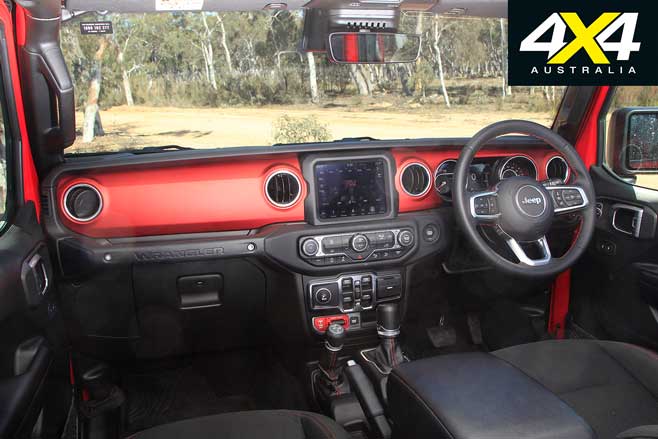
Jump in the Rubicon and it immediately feels like an old-school 4×4 in terms of the ‘square’ cabin, upright seating position and flattish dash and windscreen. At the same time the Rubicon has a busy and modern feel, with big touchscreen and all.
Tilt-and-reach steering wheel adjustment and plenty of height adjustment on the seat are positives, but the driver’s footwell is narrow and can feel a bit cramped. The upright cabin also provides plenty of headroom in a rear seat that can take three adults at a squeeze but is happier with two adults and a child in the centre, or three children. The cargo area isn’t huge, but it does have adjustable tie-down points.
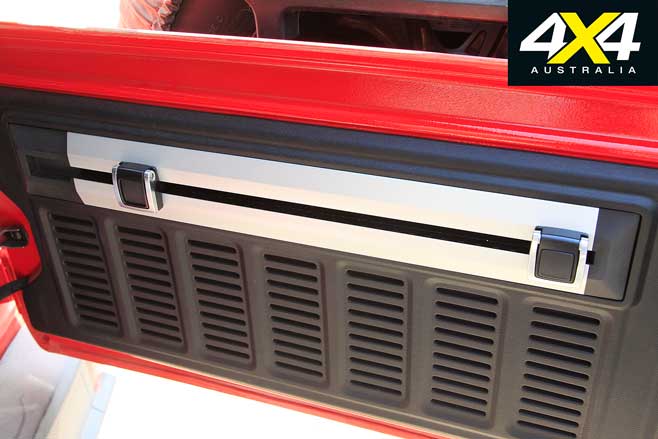
If the Rubicon’s cabin feels a bit closed in, which it can do, the panels above the driver and passenger can be easily removed to give a largely open-air driving experience. And if you want the full ‘beach buggy’ experience, the entire roof can be removed; although, this is a far more complex operation that requires at least two people to perform.
When initially accessed, this generation Wrangler (Rubicon included) somewhat controversially only gained a one-star ANCAP safety rating, but it has since been fitted with new safety systems such as automatic emergency braking.
Practicalities
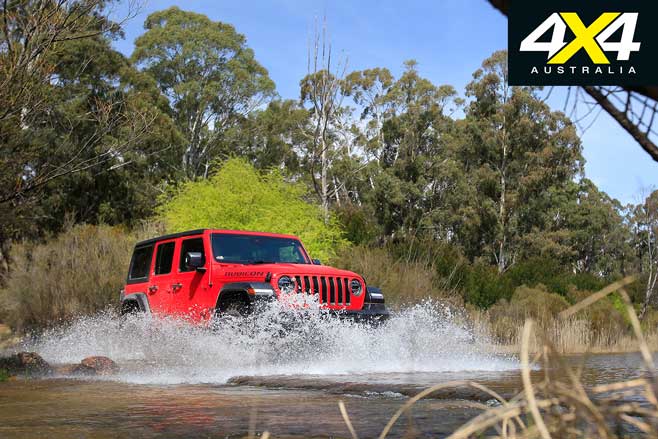
The V6 has an extra 100kg payload over the diesel, which still isn’t much at 500kg. The V6 also matches the diesel’s relatively low towing capacity, which is just shy of 2500kg. Useful enough for a camper trailer but neither Rubicon is a heavy-duty tow rig.
Fixed-price service costs for the first five years are $299 per year for the petrol as against $499 for the diesel. Both have one-year service intervals, but if you’re doing lots of kilometres the V6 needs servicing at least every 12,000km while the diesel can stretch to 20,000km, which will affect the service-cost difference if you do more than 12,000km a year.
What You Get
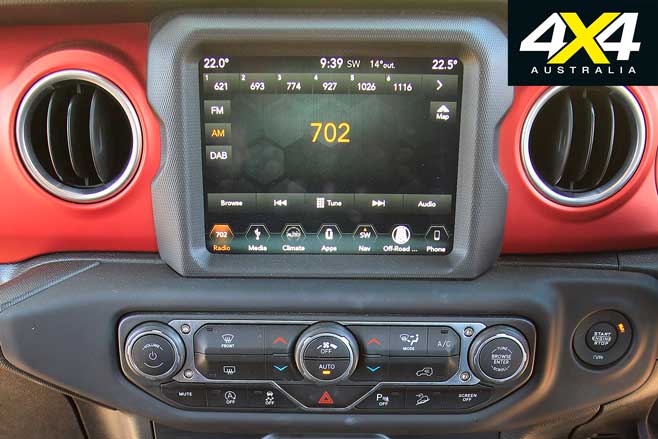
Standard equipment runs to smart-key entry and push-button start, tilt-and-reach steering wheel adjustment, an 8.4-inch touchscreen, embedded sat-nav, dual-zone climate, Apple CarPlay and Android Auto, automatic headlights, a rear-view camera, and a nine-speaker Alpine premium audio system with a massive subwoofer in the rear cargo area.
Autonomous emergency braking, blindspot monitoring, rear cross-traffic alert and adaptive cruise control headline the safety kit; although, only four airbags – two front and two side – are fitted. USB ports are fitted front and rear, and there’s a 230V/150W outlet in the rear seat area. The cargo area gets a 12V outlet and adjustable (sliding) cargo tie-downs. Options run to leather, heated seats up front, a heavy-duty battery/alternator and some cosmetic kit.
Sum Up
So does the V6 make a good case for itself compared to the diesel? Initial back-to-back impressions of the two would suggest not, as the diesel is notably more responsive in give-and-take driving and far more relaxed as it doesn’t need to shuffle up and down the gears as much to do the same job, even if the slick eight-speed auto does this with little fuss with the V6. Countering this, the V6 has pedal-to-the-metal performance the diesel can’t match.
The V6 loses on fuel consumption, which has a negative effect on range and filling frequency, not to mention the fact you’re always forking out more money on fuel (around 30 per cent with diesel-petrol price parity).
However, if you factor in the $5500 initial sticker-price savings and the potential $1000 service-cost savings over five years, you should be able to drive 137,000km before you spend your ‘savings’, assuming that both petrol and diesel are $1.50 a litre.
Ownership beyond the fixed-price servicing and warranty period also looks better for the V6. Unlike the diesel, there’s no turbo, no DPF and no AdBlue to ruin your day.
JEEP WRANGLER RUBICON V6 SPECS Engine: 3.6-litre V6 petrol Max Power: 209kW @ 6400rpm Max Torque: 347Nm @ 4100rpm Gearbox: 8-speed auto 4×4 System: Dual-range/full-time (+2wd) Crawl Ratio: 77.2:1 Construction: Separate chassis Front suspension: Live-axle/coil springs Rear suspension: Live-axle/coil springs Kerb Weight: 2053kg Payload: 509kg GVM: 2562kg Towing Capacity: 2495kg GCM: 4808kg Departure angle: 31.9° Rampover angle: 21.2° Approach angle: 41.7° Wading depth: 760mm Ground clearance: 252mm Fuel tank capacity: 81L ADR fuel consumption: 10.3L/100km On-test fuel consumption: 14.7L/100km Test fuel range: 501km
JEEP WRANGLER PRICING* Sport 2dr V6: $48,950 Sport 4dr V6: $53,450 Overland 2dr V6: $59,450 Overland 4dr V6: $63,950 Rubicon V6: $65,450 Rubicon Diesel: $70,950
THE FIVE cars move quickly across country, chasing the setting sun. The convoy stretches and compacts like a slinky spring as the road contours eastwards, climbing out of river drainages and over the rolling crests of Mount Pleasant. It doubles back and gets even twistier, the sky now imperceptibly graded shades of umber, dust filtering through the ironbarks, the cars ahead just silhouettes; cryptic outlines phasing in and out of the dazzle.
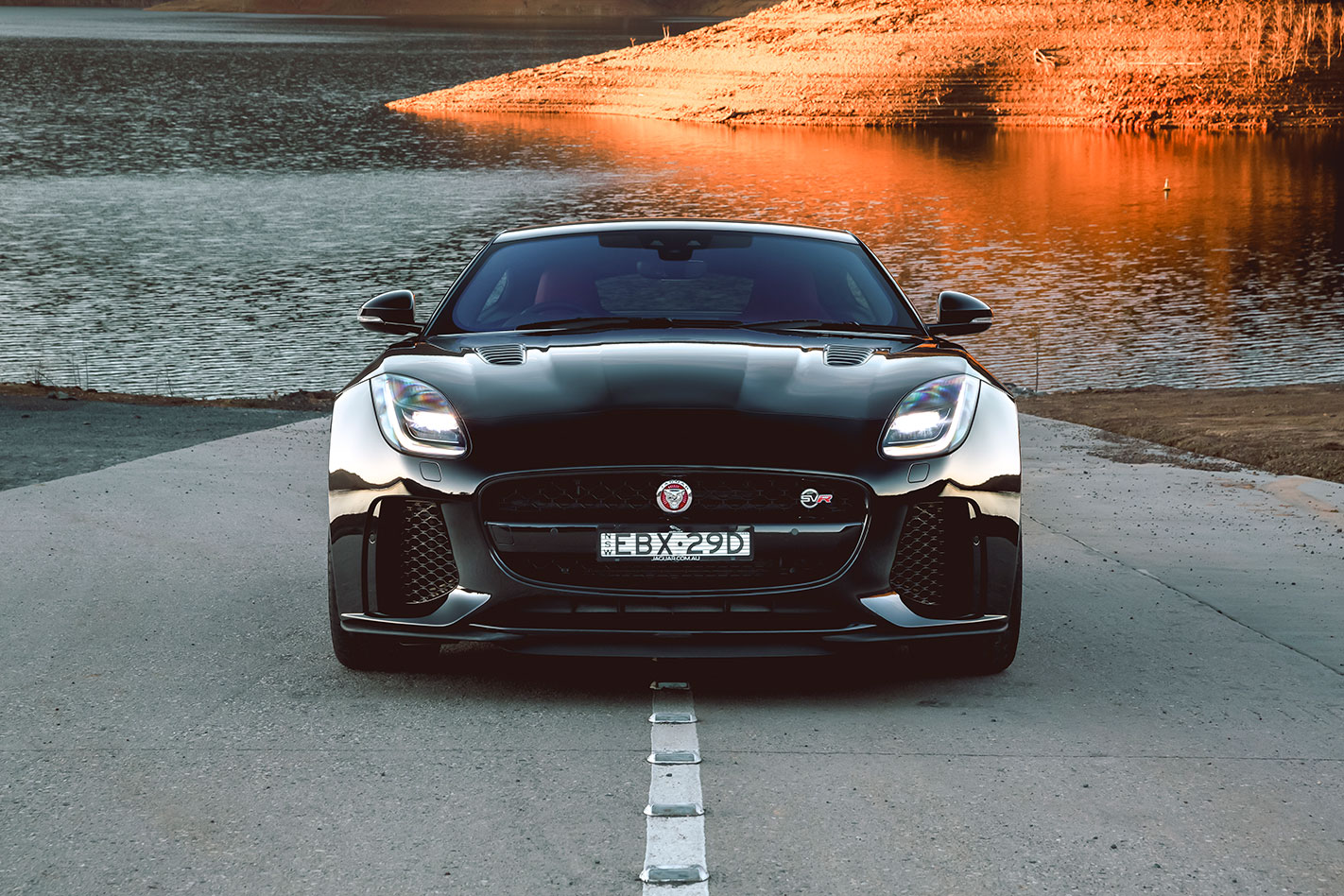
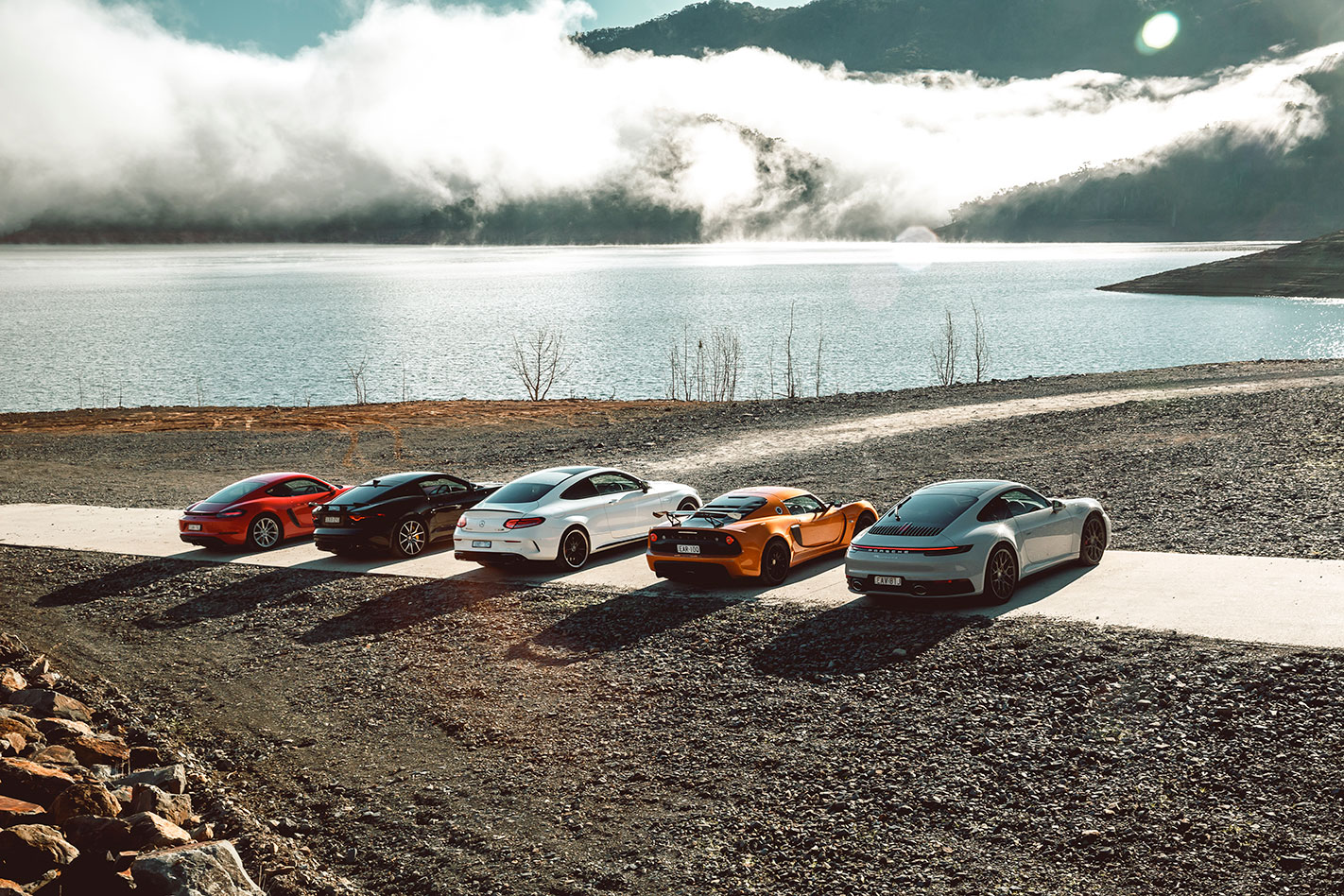
Up front is the unblinking tail-light bar of the new Porsche 911, the bunched-up bottle-rocket shape of the Jaguar F-Type SVR and there, most incongruous of all is the low and long Lotus Exige Sport 410, its high-mounted wing, extruded door mirrors and fat rear tyres looking like something from the GTE grid at Le Mans, landed here in country Australia, dodging echidnas.
I’m in a Porsche 718 Cayman, while squinting through the cloud behind is a Mercedes-AMG C63 S, its toothy grille looming out of the dust vortices like Hannibal Lecter on a gurney. We’re tired, dirty, windburnt and happy, after two days in these five coupes. While they may appear a disparate bunch, there’s a very pragmatic reason for them being here.
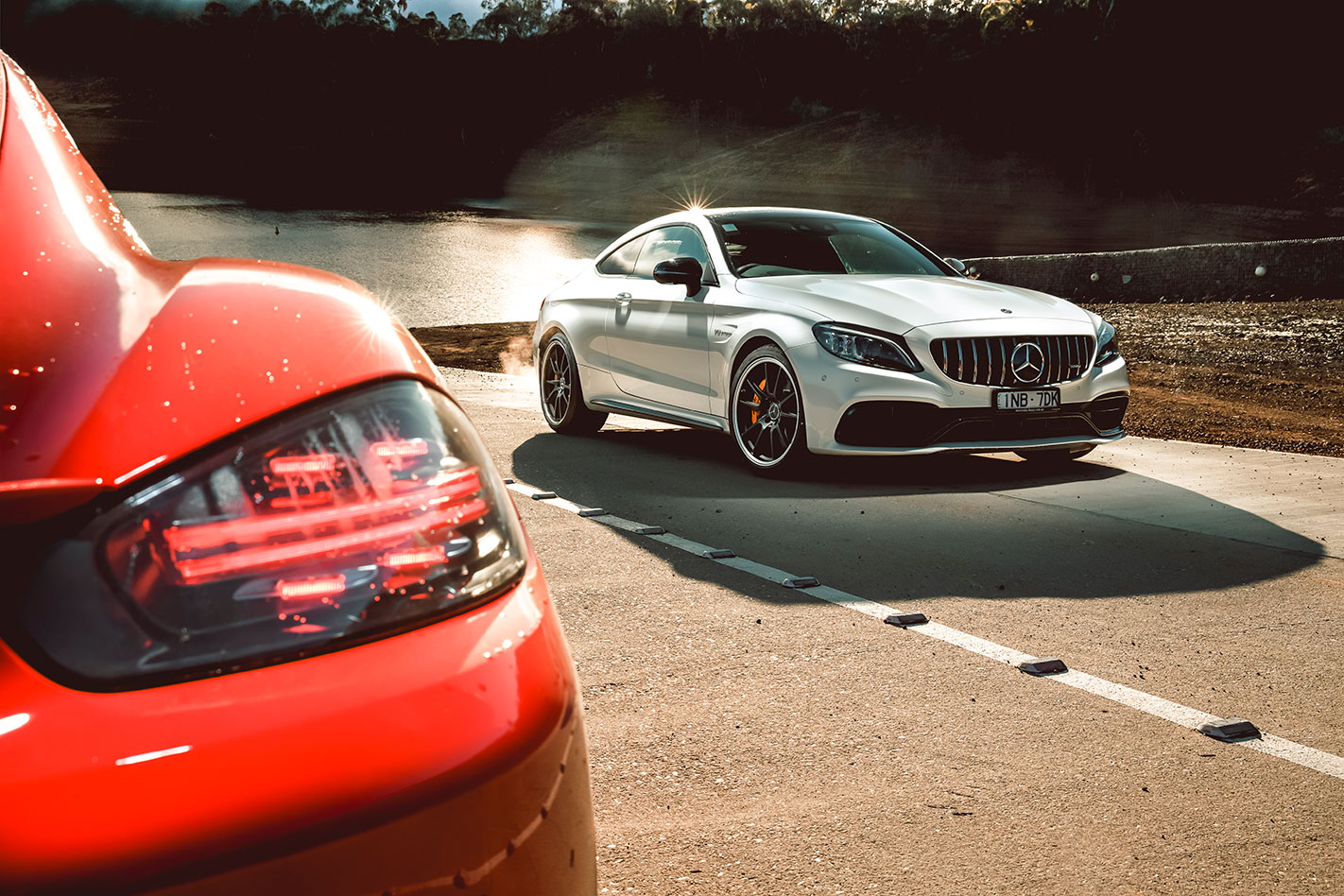
Having driven Porsche’s new 992 on Aussie soil, we’d come to the realisation that nothing would beat it head on, so we didn’t want to waste your time with that. Instead, we wondered how convincing were the alternatives if you wanted a coupe more hardcore than the 911 Carrera; or more liveable; or more affordable; or more extrovert. So that’s why we’re here, bumping along a narrow mountain road trying to cross the Black Spur before nightfall.
According to our VBOX data logger, it takes the 911 Carrera 4S just 3.4 seconds to reach 100km/h. That’s quicker than a 997 GT2 RS. It demolishes the quarter mile in 11.6s and does so with no histrionics. Switch it into Sport Plus, flex onto the brake, jab the throttle pedal to the floor and sidestep the stoppers. The Sport Chrono-equipped Porsche hooks up cleanly, sending drive to all four tyres, the eight-speed PDK transmission blat-blat-blatting up through the gears. Job done. The Cayman is similarly undramatic, beating its published 4.9sec to 100km/h by a couple of tenths. The Jaguar delivers a whole lot more drama. Foot on the brake, load up the torque converter and let it go. The combo of all-wheel drive, bellowing V8, keening supercharger and a wriggling wheel make the 3.7s to 100km/h seem even quicker. It weaves under braking from 220km/h, its more softly reined 1705kg clearly apparent.
The Lotus and Mercedes require a bit more work to launch cleanly. The AMG C63 S has a sophisticated nine-stage traction control system and a Race mode. None of it helps significantly to get the car off the line, the 4.0-litre twin-turbo V8 and launch control combo flipping a coin and landing you with either unproductive wheelspin, or stabbing traction-control interventions. Try to drive it away rather than rely on the launch control and it’s just not that quick. A best of 4.4 seconds comes after multiple attempts. The least powerful car here, the 220kW Porsche 718 Cayman, would monster this 375kW Mercedes nine times out of ten away from the traffic lights.
The Exige Sport 410 is a milestone vehicle. It’s the first manual car Wheels has strapped timing gear to in our 66-year history that has ever dipped into the threes to 100km/h. In an age when we’re getting a bit blasé about the ludicrous acceleration figures of electric sports cars, that’s still a mighty achievement, especially on a day when the strip wasn’t at its grippiest. And who would have ever imagined that a Camry V6 would make the Lotus the best-sounding thing here?
Round one to the 911 then. At $281,100 before options and on-roads, the Carrera 4S is the most expensive car on this test, so it does carry a certain level of expectation. But then we have always had a certain expectation of the 911 and, aside from a blip in 2008 when the 309kW Audi R8 and the 357kW Nissan R35 GTR made the 265kW 997 Carrera S look a bit passé, it’s lived up to the billing. But where the 997 was an evolution of the 996, which first launched more than a decade earlier, the 992 is box-fresh.
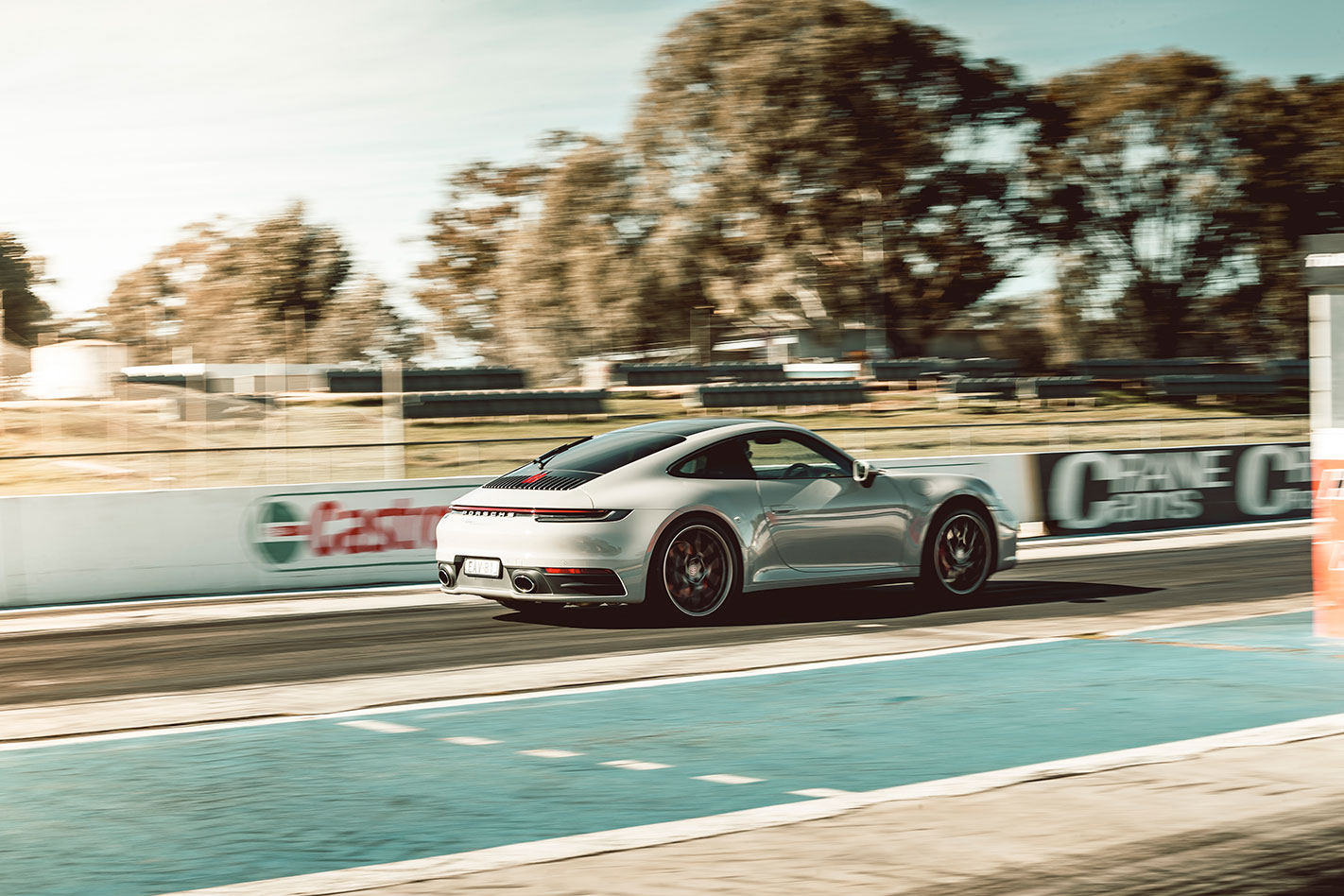
Finished in optional Crayon grey with optional RS Spyder Design alloys, it packs real visual punch. The widebody 992’s stance and detailing is a good deal more, shall we say, aesthetically considered than the soapbar 911 Carrera. An old boy stands next to it in Eildon. We make eye contact and he just smiles and shrugs, a wordless compact between us that its beauty has overmatched his vocabulary. The interior design language is similarly slick, with metal finishes, piano black and cool, understated lines. Its technology and materials are a big step on from the outgoing generation, but some testers felt the 992’s ambiance lacks warmth and soul.
There are a couple of ergonomic glitches that have been wrought in the name of understatement. The outer pair of the classic five-dial Porsche instrument pack are obscured behind the wheel, and the manettino switch no longer indicates at a glance which drive mode you’re in.
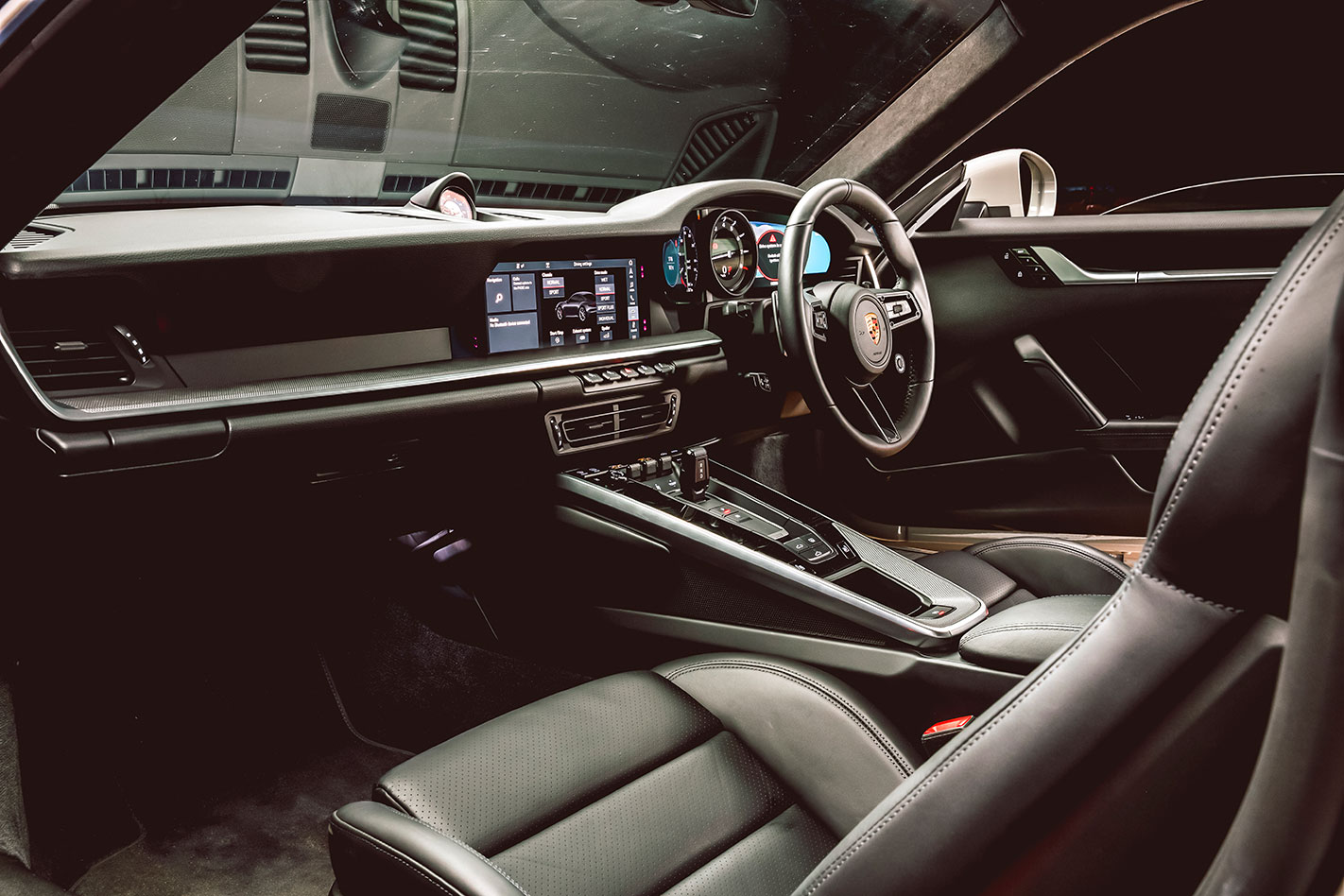
It’s phenomenally composed on a testing road, though; almost too competent at broadly legal speeds. Both engine and body control impress in equal measure. The turbocharged 3.0-litre powerplant feels like a baby GT2 motor, gutsy from 2000rpm, drenching the cabin with a barrel-chested bass note at four thousand and really starting to sing from five. Step off the gas sharply and there’s the faint twitter of wastegate chatter but the overriding impression of this engine is strength. It ladles relentless slabs of torque at its fat Eagle F1s and, in Sport Plus mode, the PDK transmission’s logic is never caught on the hop. Zuffenhausen’s robot is smarter than you.
Then there’s the car’s composure. On roads that are tight, bumpy, cold and, at times, covered in a mutinous film of something biological, the 911 not only finds traction but remains implacably planted. Most cars with this zero-hysteresis body movement feel inert and aloof, yet the 911 communicates its intentions clearly, although your meter needs to tune into its millimetric frequencies.
We’re driving on the Fraser Park Road which peters out to dirt track somewhere on Lake Eildon’s western littoral. The F-Type SVR requires considerably more user-intervention than the Porsche. The ride, which jostles and niggles on the freeway route out here, suddenly seems too soft for this tortuous route. Take a moment to reset after the 911 and it starts making sense. You need to allow a little time for the Jaguar to lean into a corner, to settle onto its springs and then it communicates clearly.
The chassis lets you feed power early, the hammering report of the 5.0-litre V8 cracking in pre-apex. It’s best to drive on the paddles as the transmission will often kick down too aggressively, but it’s a hugely rewarding process. Grip out of corners is strong and the brake pedal offers long-travel modulation, but after the 911, the steering lacks that instant sense of connection. The F-Type SVR is a fascinating thing. Brutally quick cross country, it’s exciting and effective in equal measure. It’s the most pleasant surprise of all the cars here, and it’s the perfect antidote if you find the 911 a little sterile.
The Mercedes-AMG C63 S coupe is, at 1800kg, the heaviest car here and it can never quite overcome the impost of those kegs. Its rear seats are more useable than those in the Porsche, so it earns a hall pass in some regards, but it always feels exactly what it is in the company of these specialists; namely the coupe version of a mainstream sedan. We’re huge fans of the C63, but in this extreme company, its steering is more remote, its transmission tardier, the sharp edges seemingly chamfered off its dynamic responses. Yet these ostensible criticisms morph into assets if what you’re looking for is a vehicle that’s more liveable and not as challenging as the 911. And we don’t mean challenging as the modern mealy-mouthed euphemism for difficult, but challenging as in delivering an expectation that you raise your game. The 911 goads you like that. Its steepling talents can leave you feeling a little unworthy. The Mercedes-AMG, by contrast, just wants you to have fun, however hamfisted you may be.
The driving position is a smidge too high and you look out across an expensive wheel festooned with buttons, touch pads, rotary dials and tiny digital screens dangling from the spokes. The half carbon and half Alcantara rim is fat with big, metal shift paddles tucked behind. The cabin is glitzy but never less than an event, the latter also applying to how the Mercedes-AMG tackles a challenging road.
With 700Nm under foot and a torque curve that looks like the flight deck of the USS Nimitz, it’s easy to conclude that the mighty twin-turbo V8 is going to be the dominant element. And you’d be mostly right. Despite the monster 20-inch Pilot Super Sports at the back, the C63 S struggles to marshal all that prodigious torque, the traction-control light blinking its way into three figures. Quite why AMG decided that the 520Nm C43 would be improved with all-wheel drive but not the hirsute C63 is an interesting decision. However, the need for you to be the master of how that massive firepower is deployed is also key to the C63’s engagement, and central to how it provides options of angles. Keep it tidy, quick and progressive, or chase the throttle early and feel it light up and storm out. All-wheel drive would make it faster, but almost certainly less of an event.
Traction is rarely an issue for the 718 Cayman. True, its 380Nm is almost on par with an original 911 GT3 RS but there’s a quiet authority to the way its gravelly 2.0-litre flat-four deploys those Newton metres. Compared to the histrionics of the AMG, it just digs in and powers out. The engine possesses no musicality and the sports exhaust introduces an atonal throb at idle, but it’s certainly game. While the four-pot turbo has some vocal detractors, I’ll nail my colours on now. This is a better engine than the six-cylinder 2.7 in the 981 Cayman. Faster, cleaner and more malleable in its responses, it may lack the six’s breathy overlay, but it’s long on substance. Whisper it, but it might just be a more satisfying thing than the 2.5-litre in the Cayman S.
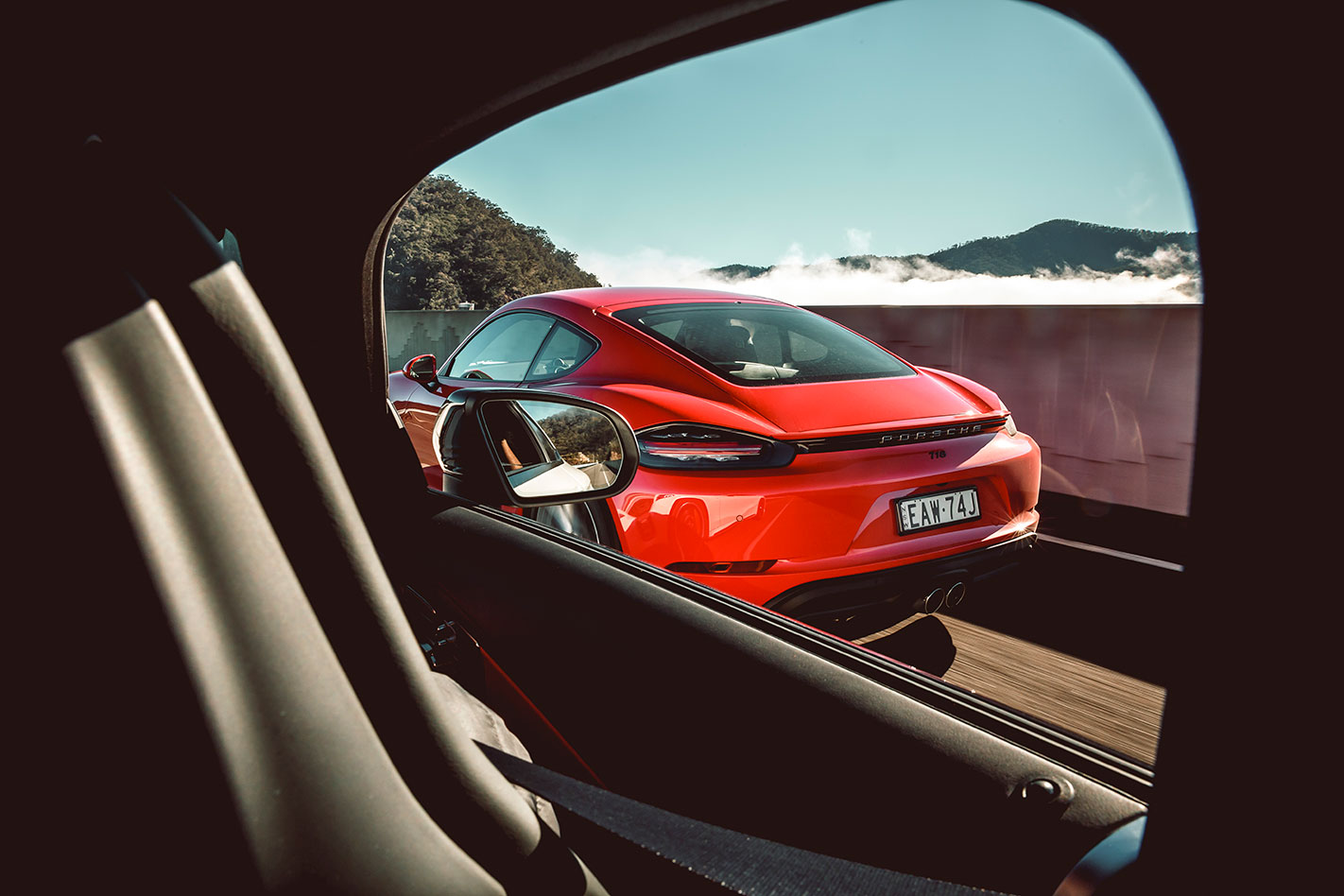
A manual gearbox would only exacerbate the aural shortcomings of the 718, but the PDK suits it perfectly. The transmission rarely tries to wring non-existent top notes from the upper registers and instead mines the rich seam of torque from 2000rpm. The PDK-equipped 718 makes peak torque slightly earlier than the manual model and with the Sport Chrono box also ticked, it’s much quicker. While numbers aren’t everything, 100km/h appears eight percent quicker in this car than in the stick-equipped version. Compared to the 911, the 718’s cabin feels – and is – from a prior generation; button-heavy and lacking the commitment to materials quality. Nevertheless, it’s a wonderfully easy thing to tune into and feel as if you’re doing a serviceable job of exploiting.
It’s difficult to tell quite how effectively you’re exploiting the Lotus Exige 410 Sport. That’s largely because you’re cackling like a loon after the first corner, just waiting for that 4500rpm threshold when the supercharged V6 erupts into an ear-splitting crescendo. Of course, this payoff comes at a price and that is posting yourself through a mailbox to get in and out of the car, being alternately frozen or roasted (there seems to be no in between) and putting up with more twitters and chirps than the merch queue at a K-pop concert.
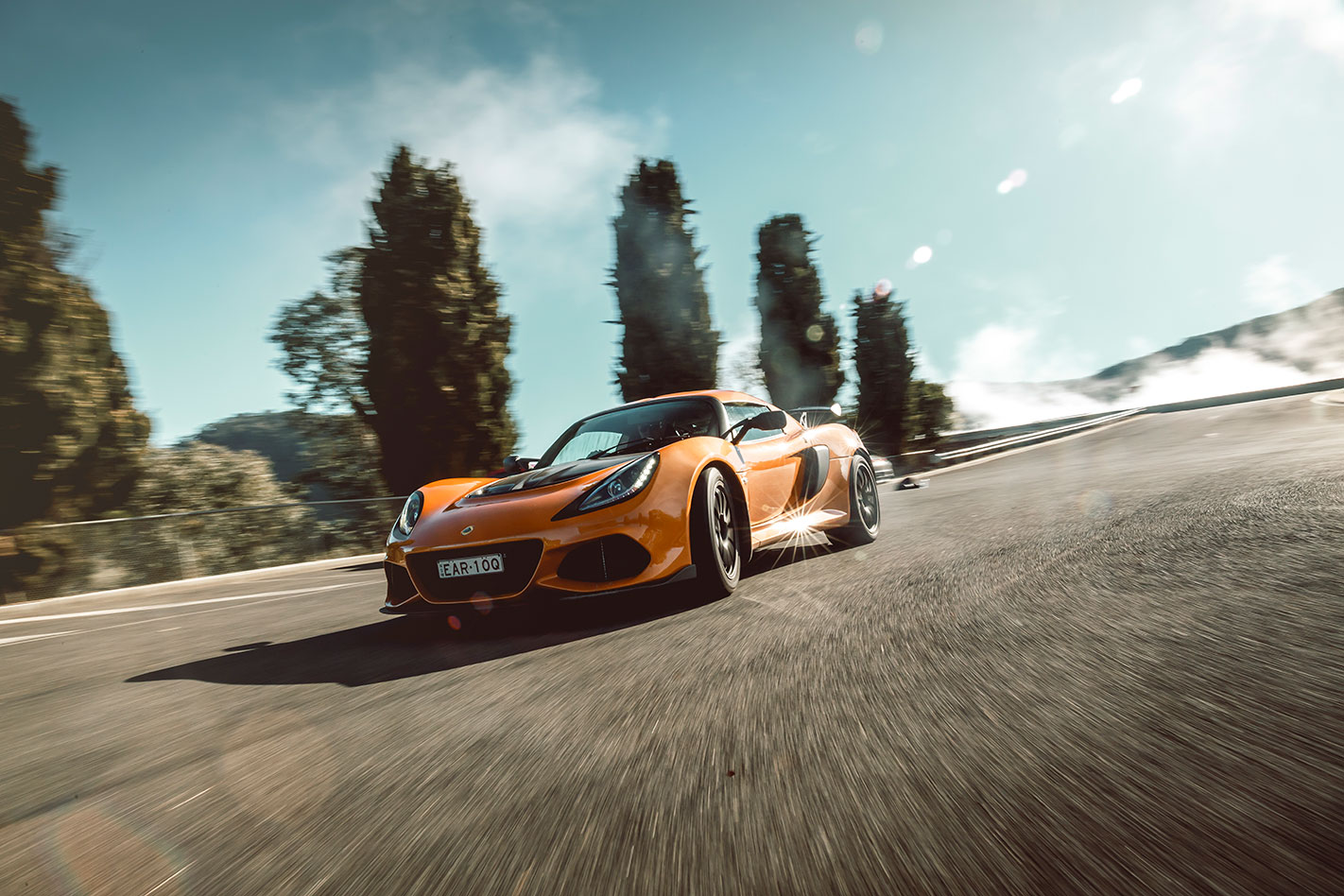
While the feral powerplant is something others can replicate, the way the unassisted steering guides you seamlessly down the first sniff of a camber, setting you perfectly into the first phase of corner entry, is the result of more than seven decades of Lotus expertise. There’s really nothing like it and it’s this polished transition into a corner that sets the tone as you pick up the throttle and drive out. The Nitron springs, three-way manually adjustable dampers, plus Eibach anti-roll bars, all add a veneer of compliance missing from the angrier Cup 430, but switching the car into Sport mode lets you realise just how much the traction control system is tapering away the excesses of your right clog. On the dragstrip it was like elevating the Exige onto four office chair castors.
With 420Nm to call upon between 3000 and 7000rpm, the Sport 410 has the flattest torque curve of any Exige. Essentially a slightly detuned version of the Cup 430, it gets a revised engine map, a new water-to-air chargecooler, an extra front radiator and a water-to-oil oil cooler in the engine bay. You get a fairly good view of that lump from the driver’s seat, too. Or at least of the supercharger and throttle cable. Reverse parking is an experience best avoided.
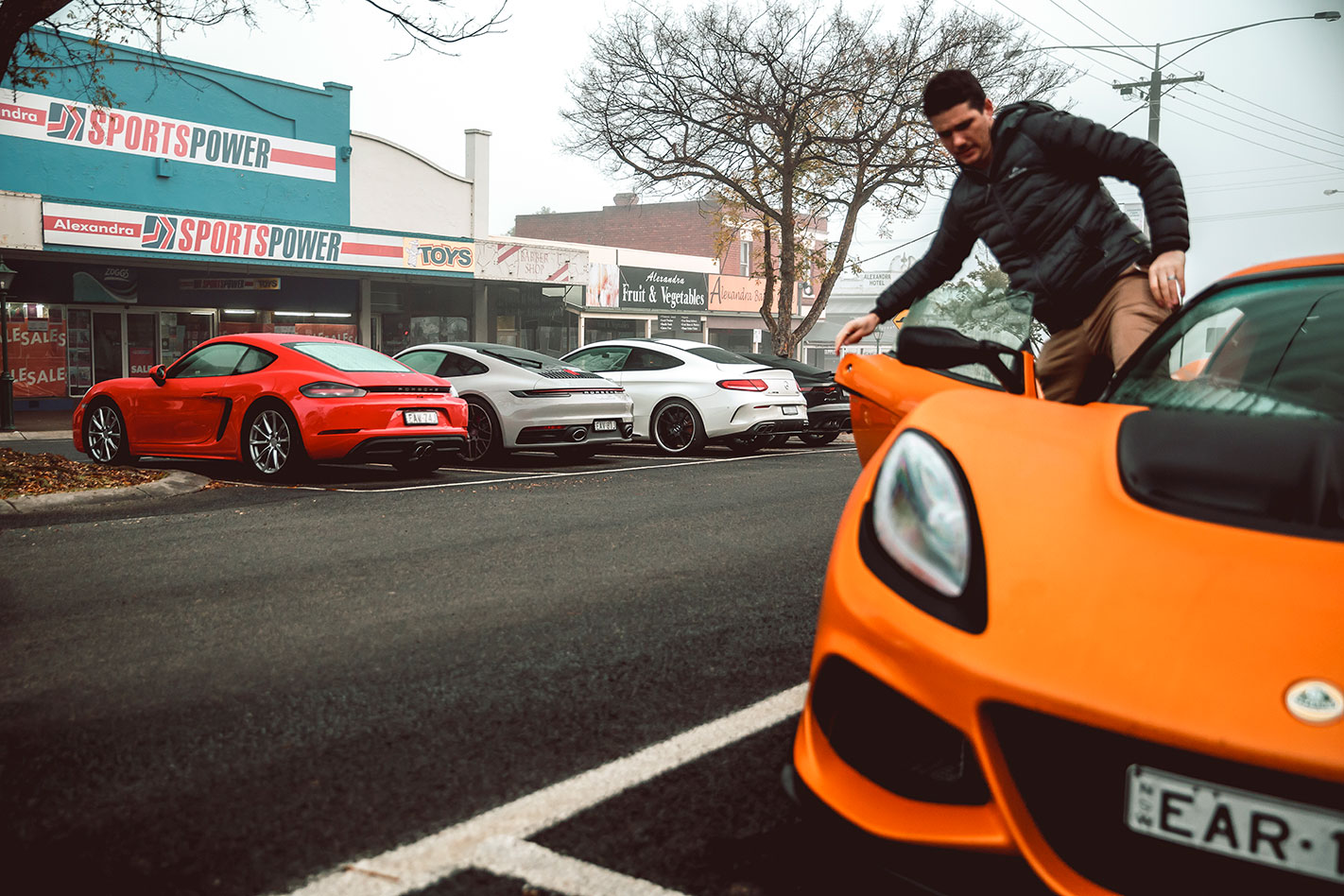
None of these four cars are unconvincing in their respective roles, each offering something different to the 911 Carrera’s excellence. The Jaguar is the more extrovert thing, and I don’t think it’s any slur to say that it feels like an extrapolation of a ’90s TVR trajectory. Loud, brutish, beautiful and unexpectedly talented once you mould to its demands, a typical SVR owner would doubtless find the 911 somewhat soulless.
The Lotus is the most exciting thing here by a massive margin and is the only car on test that possesses dynamic elements beyond the Carrera. At $159,990, it’s a significant investment for such a pared-back thing, but it doesn’t pretend to be any decathlete. Its focus is its beauty and we should celebrate the fact that such analogue cars still exist.
The Mercedes-AMG represents a genuine alternative to a 911, if you need a little more practicality and something that can be an undemanding daily driver when you need it to be. It retains an element of extremity expressed by a power delivery that can feel genuinely unhinged and a cabin that dials sense of occasion up to the max.
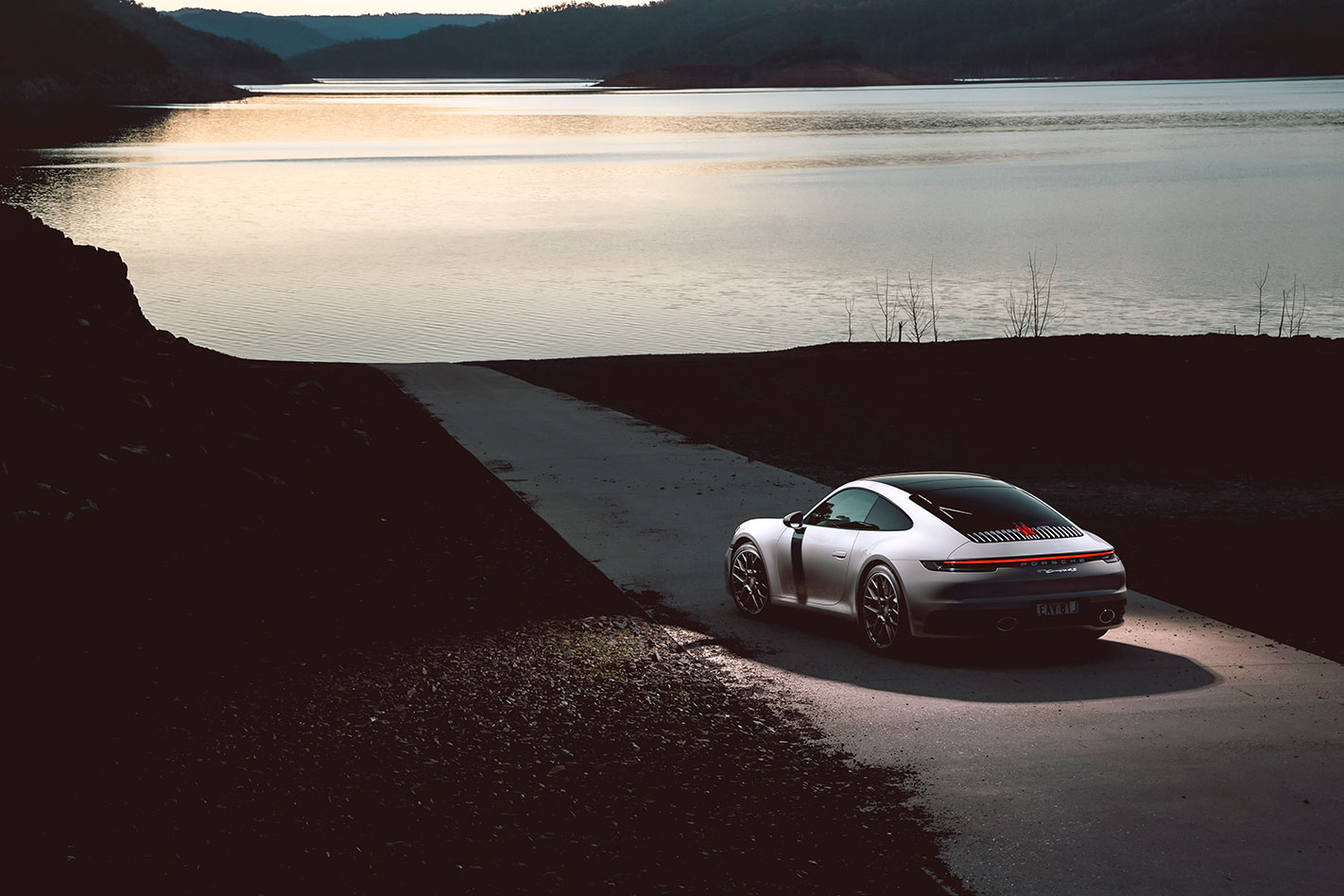
The opposite is true of the 718 Cayman. At times certain elements of its makeup can feel slightly dour. The cabin isn’t showy and the engine’s soundtrack won’t have people flocking to the pitwall at a trackday. But if you can’t run to a 911 Carrera, it makes all kinds of sense as a half-price hero. It’s purposeful, rewarding, dynamically excellent and gets us genuinely juiced about the forthcoming GT4 version.
The 911 swats everything aside with an imperious ease that is genuinely shocking. If you want the best sub-supercar, it’s so far ahead of the chasing pack that any direct comparison would be churlish. But such is its sheer insouciance, some may not warm to it. The Achilles heel of the 992 might be a certain narcissistic self-regard. Should you demand a divergent attraction with some flintier edges, we can think of four excellent claims on your attention.
When you review some of the cars that were revealed this week, you would be forgiven for thinking that the automotive world is not, in fact, locked-on to a course of planet-saving electrified, downsized vehicles that tread lightly with a tiny carbon footprint.
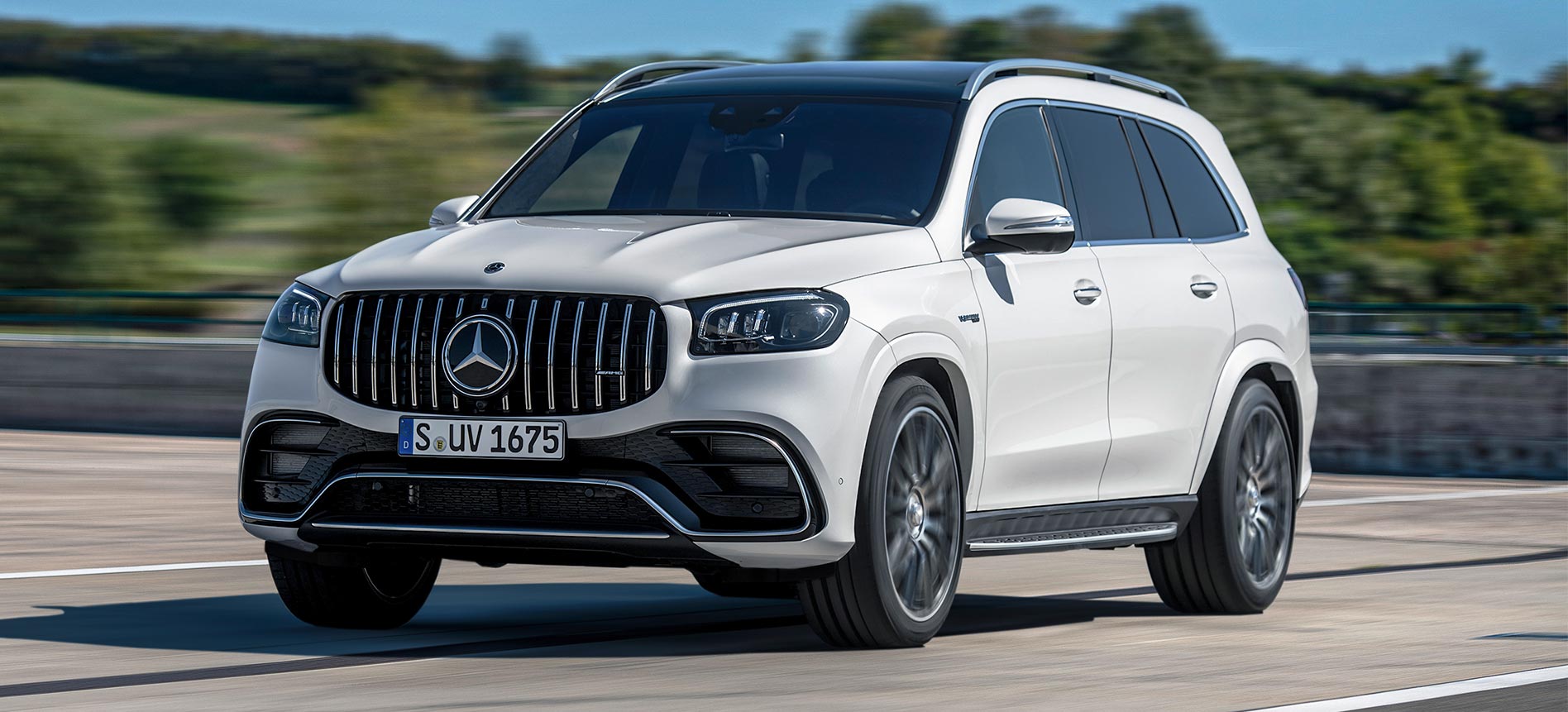
Instead, Mercedes-Benz unveiled not one, but three monstrous SUVs that run not on electrons, or wind, or gravity, but large turbocharged petrol engines. Its performance branch AMG pulled the covers from the GLE 63 and GLS 63 pair at the Los Angeles motor show, showcasing another application for the company’s accomplished 4.0-litre turbo V8 engine.
But Maybach made the pair look like a Prius by comparison with its mighty twin-turbo GLS 600 that rolled out to the same audience.
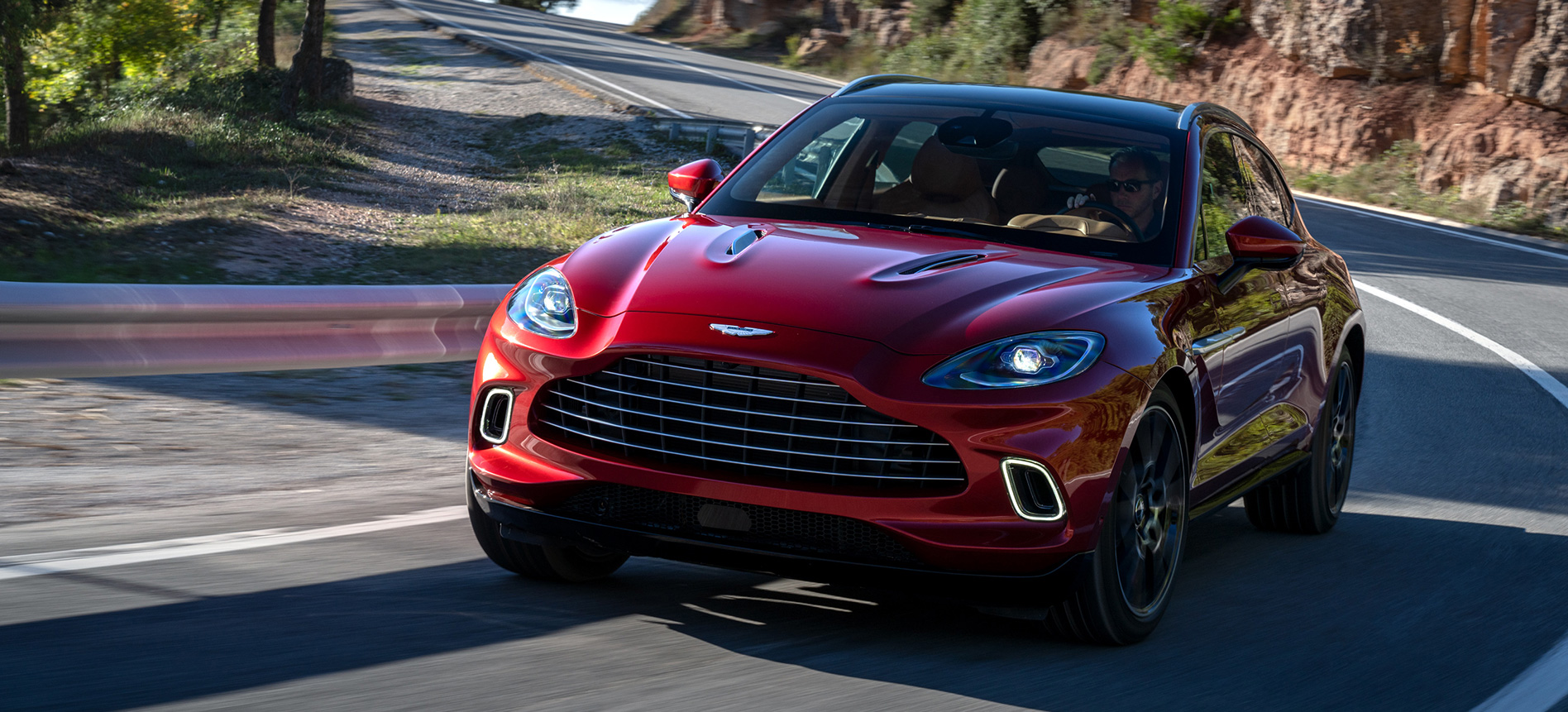
Not wanting to miss out on the action, Audi revealed its own twin-turbo V8-powered SUV and the RSQ8, which shares much in common with the Lamborghini Urus. Coincidentally, Aston Martin chose the same week for its own SUV to make its debut. Say Hello to the long-awaited and much teased DBX.
The week wasn’t exclusively about oil-depleting, carbon-belching behemoths though. Amazingly, Ford revealed a vehicle it calls a ‘Mustang’ but appears to have about as much in common with the revered coupe of the same name as chalk and chevaps.
The Mustang Mach-E is the Blue Oval’s foray into electric vehicles, but whether its followers accept something that burns no petrol and wears the coveted stallion badge remains to be seen.
BMW threw another morsel out there regarding its electrified vision, divulging that its first pure electric sedan – the i4 – will pack a AMG/Tesla-embarrassing punch. We can’t wait to see that knockout. And if you’re one of the many Australian drivers mulling the switch to electric transport, make sure you read our comprehensive feasibility summary here.
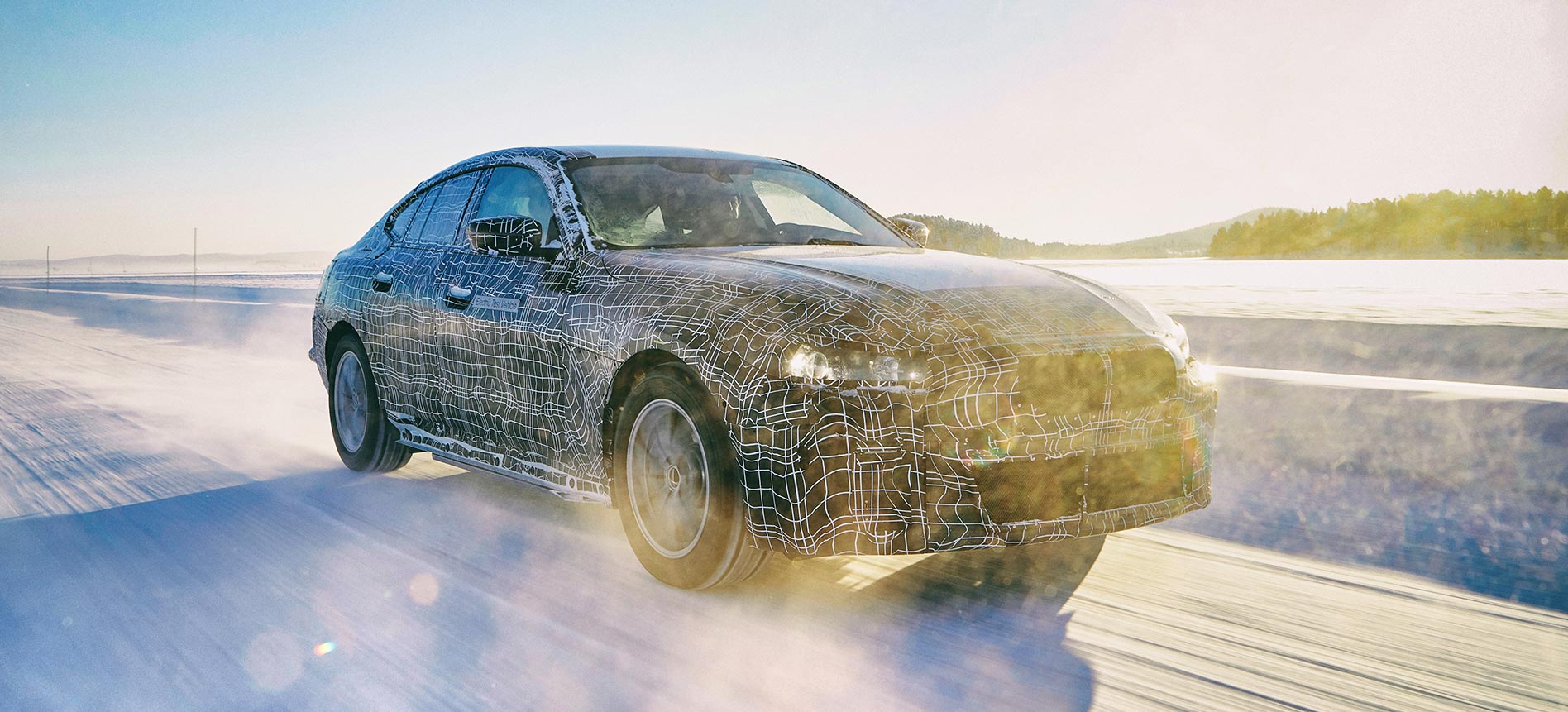
If all that sounds like too much environmental responsibility don’t worry, the gang at Street Machine have closed out another year of Drag Challenge and the results were spectacular. You can catch all the details here, just don’t ask about the fuel and tyre bill.
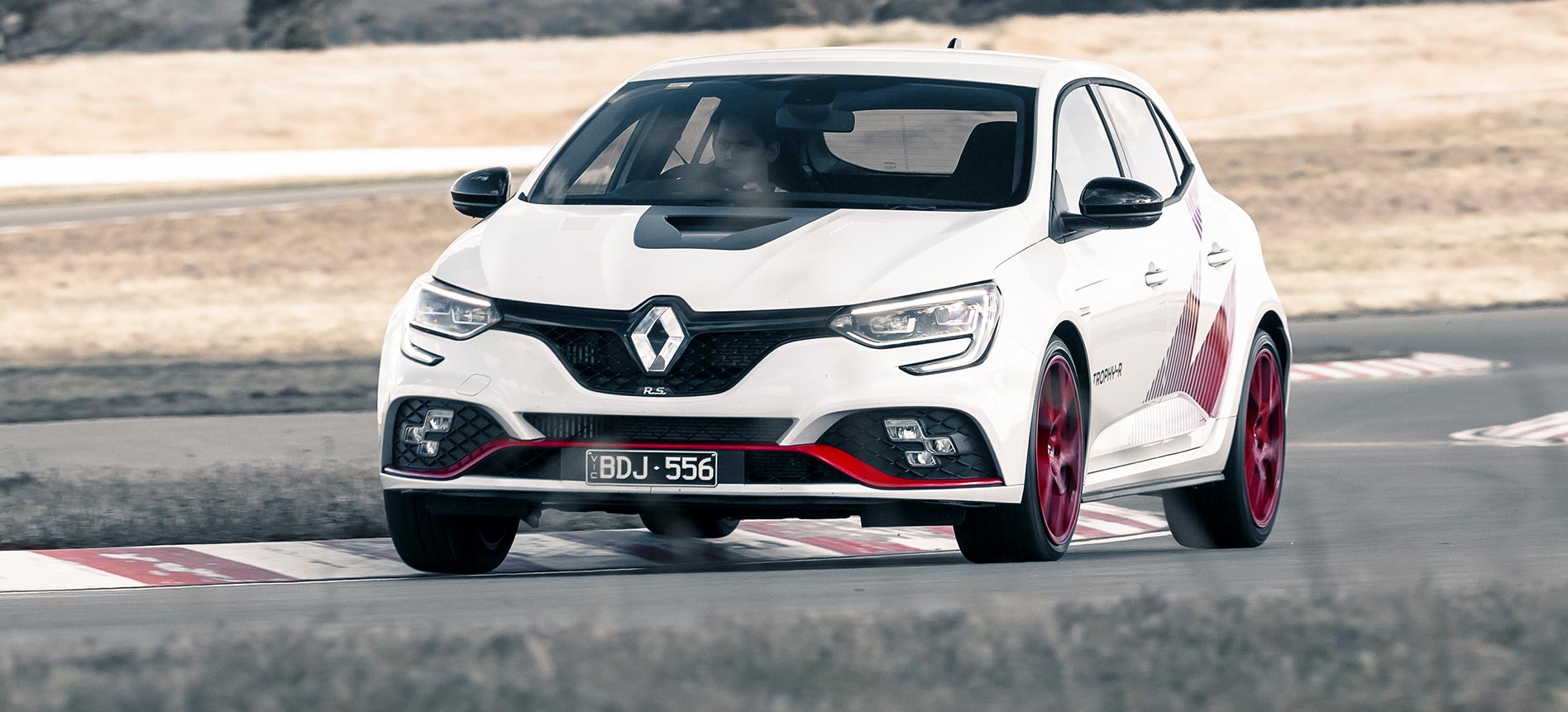
In other parts of the country, the MOTOR team was making its own mark on the asphalt with the game-changing Renault Megane RS Trophy. Not only does it take one enviable title during official testing, it also produced some impressive figures during its time with the team.
There was potentially big news for Australia’s lucrative ute market, with Hyundai confirming the ridiculously cool-looking Santa Cruz pick up will transition from fanciful concept to production model. Keep everything crossed it comes here.
And if you need some suggestions where to take it, 4×4 Australia has released its definitive guide to exploring the country in 2020. Check it out here.
If you’re tired of staring at a screen, fill in any gaps in your automotive week with a listen to the latest WhichCar Weekly podcast or, pick up a copy of one of our great magazines, put the phone on silent and just relax.
Some people just idealise proper, mid-engine cars in a way they don’t those of any other configuration.
No big deal – it’s okay to know a bit more about the Lotus Espirit or Fiat X1/9 than one probably should; or to never miss an opportunity to rue WRC’s stillborn Group S. Maybe, for this person, there’s a Toyota MR2 in their past, the old one that looked like it could split logs if hit with a really big hammer.
While these loveable folks might not be able to afford the cars of their mid-engine fantasies, they secretly aspire to one day get into a Lotus Elise. Or a Porsche Cayman. At least that was the case about 10 years ago, because now they’re a bit more spoilt.
There’s the Alfa Romeo 4C with all the ’tude of a baby Ferrari; and newer still, the Alpine A110, championing not just Gallic vibes but classic mid-engine dynamics and lower weight with its trick all-aluminium chassis.
Yes, this proliferation of small, two-seat mid-engine sports cars simultaneously excites and overwhelms those who just want to hear an induction grumble, or turbo hiss, aft of their ears instead of fore. So in the interests of science, we’re taking the best circa-$100K mid-engine sports cars for a spin – not on the brakes into a corner, let’s hope – in order to name the best.
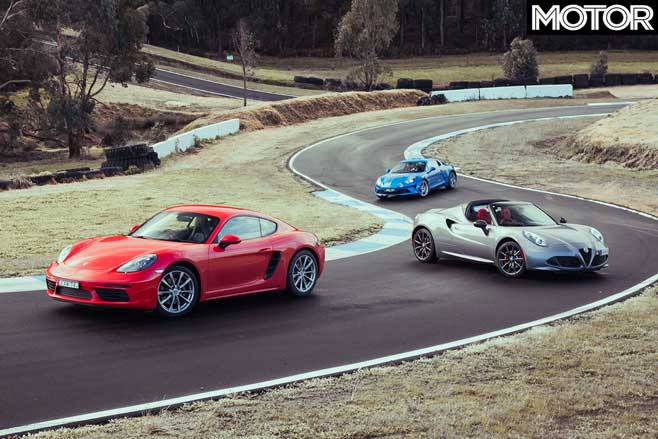
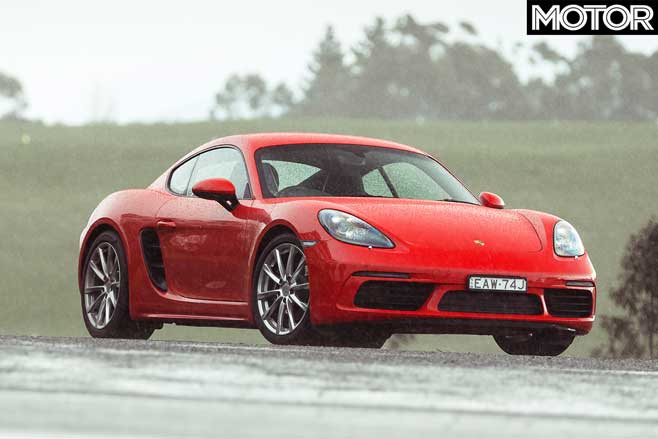
Of course, the staple of this here comparison has to be the Porsche 718 Cayman. In its base form, our test car is equipped with the brilliant seven-speed dual-clutch Doppelkupplung (PDK) automatic so as to achieve transmission parity with our other contenders.
The big news with the 718 is of course the engine. It’s out with the singing, supposedly gas-guzzling free-breathing 2.7-litre flat-six; in with a thrummy turbocharged 2.0-litre flat-four which promises to imbue the compact Porsche with 911 Turbo performance from just a decade or two ago.
Meaty outputs of 220kW/380Nm reach the rear wheels via an old-school standard mechanical limited slip diff. And of course the 718 knows all the tricks to use as little petrol as possible, be that coasting, start-stop and lord knows what else.
At $137,840 as-tested, this 718 is the most expensive car here, the new Alpine A110 a considerable $34K cheaper. But then it is quite a different car. Alpine pilfered Renault Sport for its best hot hatch engineers (coincidence then that the new generation Clio RS and Megane RS lost their mojo?) to resurrect the famed Alpine brand from the 1960s and ’70s.
It’s got that all-aluminium chassis helping to bring weight to just 1103kg (versus the 718’s 1335kg) with a Megane RS’s 1.8-litre turbocharged inline-4 amidships, paired with a compact seven-speed dual-clutch sending a perky 185kW/320Nm through an open diff to two double-wishbone-located rear wheels.

Next up is a car that looks like it took the Spider memo a bit too literally. With its compact but slightly gangly proportions the Alfa Romeo 4C Spider is actually quite a gorgeous thing the more you look at it.
Wide and low, and true to Italian car design, the 4C oozes sex appeal. Open the door and the seduction continues; there are wide sills of exposed, glossy carbon-fibre weave reminding you this is the cheapest new car you can buy with a carbon tub.
Bolted between the two rear strut towers is basically the same 1.8-litre turbo inline-4 you’d find in the front of a Giulietta QV hot hatch. A six-speed dual-clutch transmission manages 177kW/320Nm to the rear wheels only.

It’s the Alfa that’s first to line up Heathcote Park Raceway through its windscreen on a cold, dry, sunny morning. Having ducked your head to get under the low, removable cloth roof, while simultaneously folding yourself in order to get over the very wide carbon sills, you feel like you’re sitting in something special in the 4C.
The cabin is cosy without much space between occupants and punctuating all the cheap, hard, scratchy plastic are curious splashes of expensive leather. There’s also no avoiding the single-DIN head unit in the middle of the whole shebang, looking as if it’s come straight from Supercheap Auto. Bits of wiring loom dangle from under the dash and there is barely anywhere to put a phone or wallet but hey, it looks cool and for an Alfa that’s what matters most.
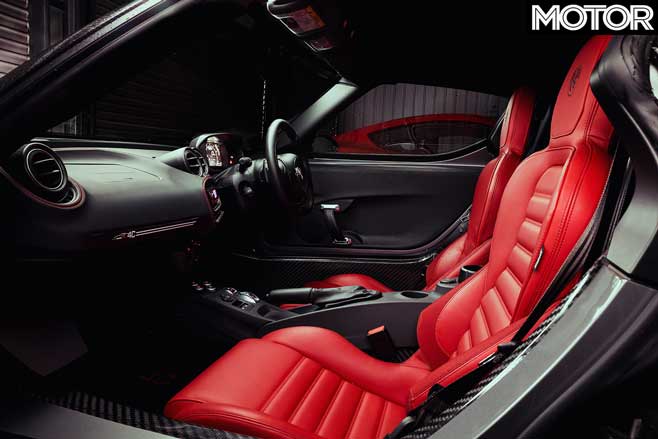
Turning the key summons a loud, unfiltered exhaust burble, and then launch control is engaged by activating Race mode with the ‘DNA’ centre console drive mode switch. Left foot on the brake, right foot flat, the revs build to 3500rpm, off the brake and you’re pushed back into the seat in a frenzy of chattering traction, loud turbo hissing and twin-clutch upchange braps.
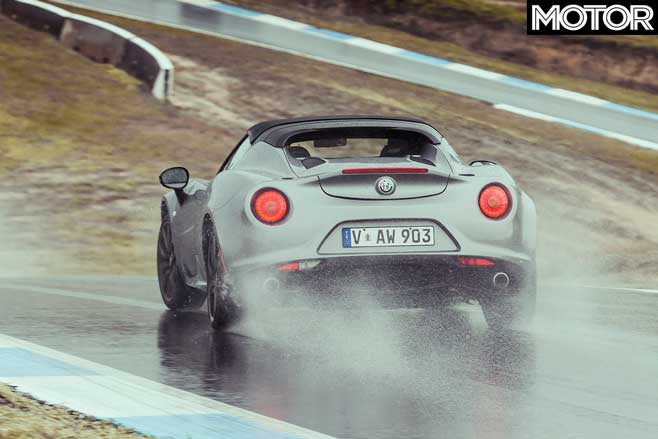
It’s exciting. It’s an event. And, if we’re honest, it’s a bit easy. The 4C pips its claimed 0-100km/h time of 4.5sec with a 4.44sec best effort, 400m meanwhile taking 12.76sec at 174.24km/h. It’s a slight relief easing off after the 400m mark as things start to feel a bit wild in the ol’ 4C the faster you go, especially if there are some bumps on your chosen drag strip.
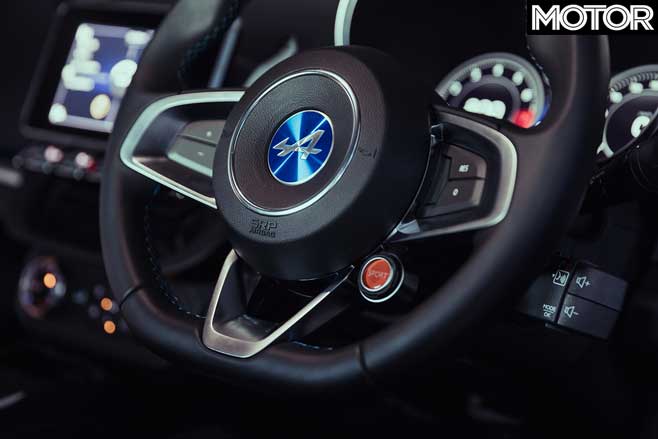
The other two are pillars of high speed stability in comparison, but thanks to their own launch control programs, equals in terms of skill required. Compared to the 4C the Alpine A110 requires no special contortionism to get into, its light, small aluminium door revealing what is basically a tarted-up Renault interior. But tarted up in a very nice way, everything you touch feeling premium enough, including the outstanding fixed-back bucket seats. Visibility is excellent and Alpine has done well to create a spacious interior for such a small car.
Thumbing the red starter button – the keyfob is like a chunky credit card – reveals a grumbly exhaust note much like that of a Clio RS. To vanish down a drag strip, select the launch control, mash the brake and accelerator with left and right feet and lift off the former after the revs have reached the pre-programmed 2700rpm.
The Alpine very noticeably squats into soft rear suspension, wheelspin minimal, intake grumble, turbo whoosh and angry exhaust all mixing together to create a loud and memorable note. Loud beeps indicate time for a new gear, 0-100km/h taking 4.56sec (the claim is 4.5) and the quarter 12.71sec at 178.57km/h. It could have been faster too if you could manually adjust the launch revs, our grippy surface possibly accepting more than the 2700rpm given. But for a little car, the A110 has big acceleration.
Next up, the Porsche. As you get inside the 718, demure, professional, mature are words that come to mind; function clearly got an equal say as form when it came to designing the interior. In that sense the Cayman interior has the least amount of exciting details to discover and is most interested in supplying an effective workspace for the job of driving.
Turn the keyfob and a blindfolded person might guess you just started a Subaru WRX but getting over that, for the cheapest Porsche sports car you can buy, the Cayman is eager to surprise a few cars when it comes to acceleration.
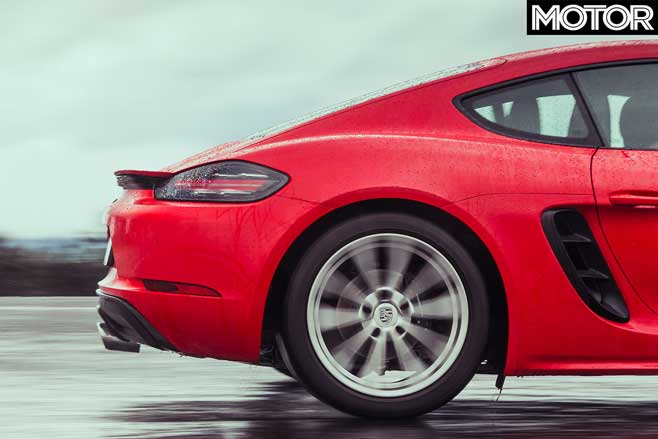
It’s the 718 that makes you wonder if the starting end of Porsche’s own dragstrip is subsiding into the earth without it realising. Launch control brings up a very high 6100rpm (redline is 7200rpm) hinting at some serious traction. Lift off the brake and the computer expertly slips clutch and rubber for a relatively fuss-free but awesomely punchy 4.38sec to 100km/h and 0-400m in 12.65sec. Porsche claims 4.7 seconds to 100km/h for this car…
And it does exactly the same time again, and again, and again, with so much less fuss and more stability than the 4C especially. And while, after testing the A110, the Cayman’s brake pedal feels startlingly long and soft upon the first hit from 100km/h to zero, the Porsche pulls up in a full-ABS stop in just 31.95m – a good four metres less than the 4C which has so much ABS intervention the front tyres could be hard plastic.
Round two takes place at a half wet, half dry Haunted Hills track approximately two hours south east of Melbourne, and it’s on this tight, twisty, undulating and unforgiving hillclimb circuit that our triplet become significantly easier to split.
Driving the Alfa, you first find that fantasies of lovely, old school manual unassisted steering are totally out of whack with the 4C’s reality. Low-speed heaviness does not equate to on-the-move bliss in terms of rack speed, weighting and feel.
It’s just permanently too heavy, a little bit too slow and with a surprising lack of feel. We’re sorry to say a bad electric power steering system would probably be preferable to the 4C’s unassisted set-up – at least it would be lighter.
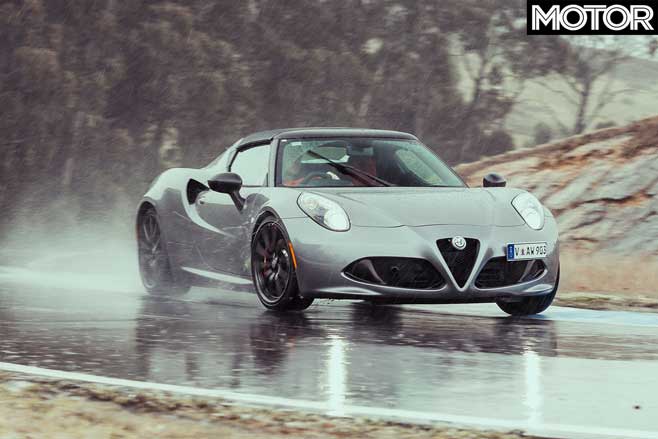
On the track the 4C flits between being a handful and a challenge. Understeer is everywhere, like the front tyres are half the width of the rears, and it’s difficult to drive around it as the grippy rear feels to let go in sudden, 15-degree increments. Power can arrive all at once as the turbo comes on which can translate into more understeer. Power oversteer is wild and tricky to catch with the slow, heavy steering. The first lap or two the 4C feels a bit like a fun riddle to solve, as you try to figure out how it wants to be driven. A few laps later you’re out of ideas and ready to park it.
The reverse is true in the brilliant Alpine A110. It’s a total breath of fresh air – and completely different to drive. The steering is beautifully light and deft. The suspension is soft to the point of being a novelty, the chassis reacting to even the slightest input. You’d think this would make it a bit of a handful but ‘tune in’ to what it’s doing and you will not want to get out of the Alpine on a track. And not just because it has a mad predilection for oversteer of every variety, which it does, like something’s broken in the rear suspension.

A tiny invitation on the brakes into a corner? Oversteer. A carefully timed lift mid-corner? Oversteer. Boot it at the start of a corner in second gear with the ESC off? Open diff be damned, sideways you go… The lack of weight equates to an increased feeling of control as there’s simply less of the A110 moving around. Get comfortable with the grippy, pointy front end and progressively wayward rear and the A110 is, honestly, one of the most fun cars I’ve ever driven on a racetrack. The punchy engine and quick-shifting twin-clutch feel great here, too; as do the brakes.
The Cayman feels serious in comparison, cornering a lot flatter on lower, stiffer springs, with a lot more grip. It’s much less interested in being silly. There is a heaviness about it compared to the other cars – the way it sits on its springs, its control weights. It would likely be the fastest car here, with its borderline-perfect, precise steering; incredibly well-judged feel through the controls including brake and throttle. Its torque-rich turbocharged engine pulling through the slick-shifting PDK. The rapid Cayman doesn’t do much wrong.
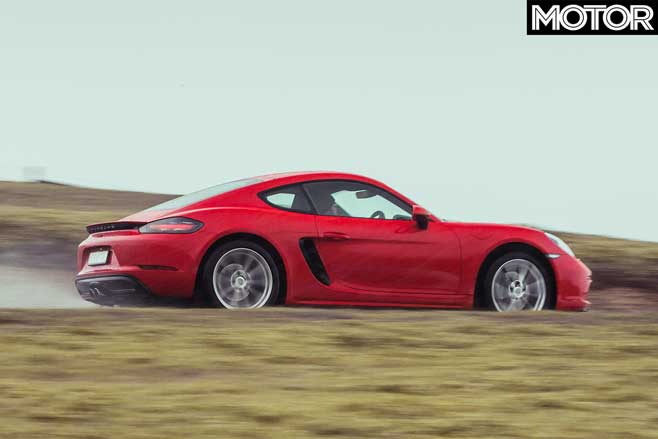
Except the Porsche Stability Management (PSM) doesn’t go all the way off. It says it is, but it’s still on in the background – if you want to back it into corners on the brake and attempt to hold long, lurid powerslides, you might run into trouble.
Overcoming its relatively high grip is tricky at the compact Haunted Hills track, but Associate Editor Newman is keen to give it a go. And as such, draws the PSM’s ire. Me? There feels to be parameters within ‘PSM Off’ I am personally able to have enough fun within, including easily as much corrective lock as one desires driving out of a second-gear corner in the wet.
It’s possible this would be a big deal if you intended to take your 718 to bigger tracks and try to really explore its outstanding chassis – the last thing you want is an ESP intervention and a flashing light when you thought it was off. Philosophically for a Porsche sports car, it somewhat goes against the grain.
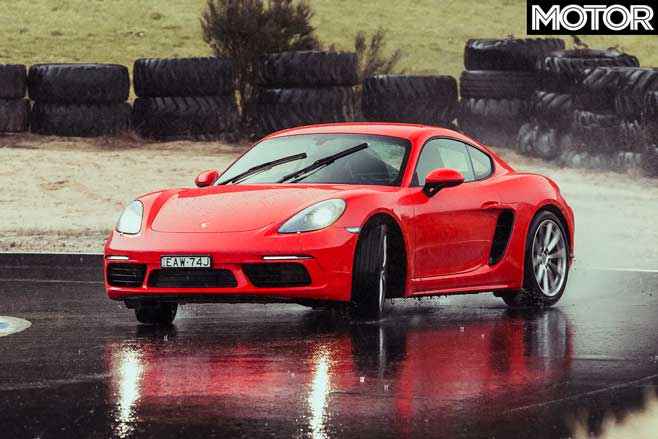
It’s less trouble on the road where the sheer speed, stability and seriousness of the 718 mark it against the others. It is by far the best driver’s car here if a twisty back road is more your habitat than a track day. With its precise front end it’s incredibly easy to place, rabidly fast for the ‘cheap Porsche’ and any rear end attitude is entirely yours to create out of first and second gear corners with the throttle. It’s one of those cars that gives more and more, the deeper you dig and the harder you drive.
For the driver addicted to a bit of tyre slip, confidence is harder to cultivate in the A110 simply because the crazed oversteer that is such a laugh on a track, makes it a bit of a nervous affair on the road unless you know the stretch of blacktop back-to-front. There is no real way of driving the A110 on the road that isn’t just below its limit, enjoying instead the manic acceleration, the pitch and yaw, the way the A110 breathes with the road. It’s hard to drive the A110 in anything but a fast touring manner, which might not be what a lot of people are expecting, or want.
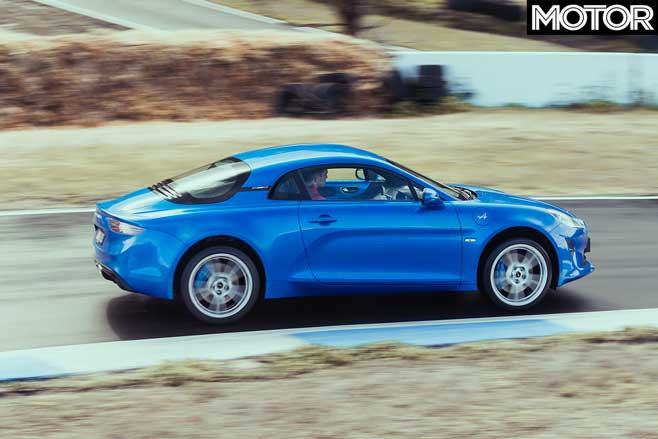
Curiously there is a lot more fun to be had in the 4C on the road than track. Enjoyment in the 4C is basically blats of mad acceleration, the turbo very loud behind your head, blow-off-valve flutter on quickly-shut throttles and crisp twin-clutch upchanges. Corners just become rest periods before the next opportunity to give it hell.
But this is a discovery you make of the 4C long after you’ve basically written it off. As a sports car, it’s a carbon tub – and a pretty decent powertrain – wondering what went wrong with its suspension and steering. You buy a 4C for the way it looks, the way it accelerates, the sounds, the way it makes you feel. And if you don’t give a rats about track days or handling, the 4C makes you feel pretty damn good.
The Alpine A110 lives up to the hype. On a tighter track like the one we used for our testing, we honestly struggle to think of cars that are more fun. That you don’t want to get out of, lap after lap after lap.
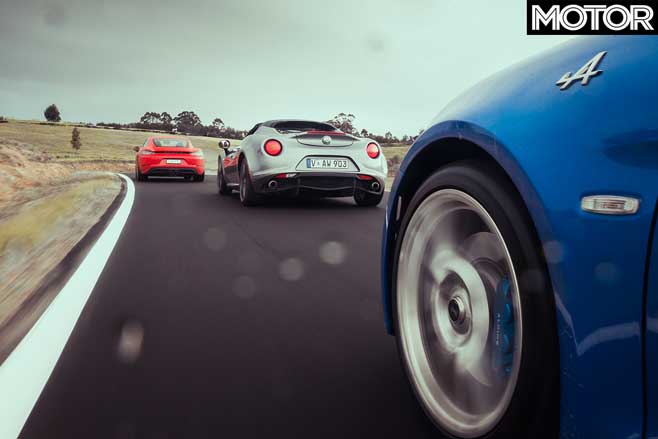
It’s a total bag of laughs. It has a tonne of acceleration, it sounds good, looks funky, it’s a bit different, the interior is pretty good despite some impracticalities. The soft, beautifully judged passive suspension is not just a novelty but a bit of a revelation. But short of flicking the ESC off and putting the brain in the glovebox, it forces us into a driving style on a twisty road that we’re not interested in.
And so, on balance, the 718 wins. Did you think it wouldn’t? Yeah, this as-tested car might be $137K but unoptioned, $118K buys you essentially the same car. That’s still nearly 20 large over a 4C or A110 and that’s got to be taken into consideration. But it’s worth the extra. On balance, it’s not just probably the fastest but it’s the best ‘car’ here. Whatever was lost in the switch from flat-six to turbo boxer-four has been compensated with incredible performance. It’s seriously fast, but beyond that, it’s seriously good. The stuff of mid-engine fantasies.
Fast Facts
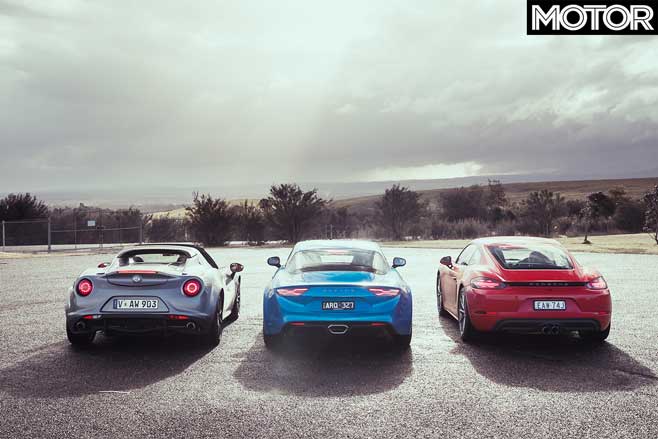
| u00a0 | Alfa Romeo 4C Spider | Alpine A110 | Porsche 718 Cayman |
| Body | 2-door, 2-seat convertible | 2-door, 2-seat coupe | |
| Drive | rear-wheel | ||
| Engine | 1742cc inline-4, DOHC, 16v, turbo | 1798cc inline-4, DOHC, 16v, turbo | 1988cc flat-4, DOHC, 16v, turbo |
| Bore x Stroke | 83.0 x 80.5mm | 79.7 x 90.1mm | 102 x 76.4mm |
| Compression | 9.3:1 | 9.0:1 | 9.5:1 |
| Power | 177kW @ 6000rpm | 185kW @ 6000rpm | 220kW @ 6500rpm |
| Torque | 320Nm @ 2200-4250rpm | 320Nm @ 2000rpm | 380Nm @ 2050-4500rpm |
| Power/Weight | 171kW/tonne (tare) | 168kW/tonne | 165kW/tonne |
| Transmission | 6-speed dual-clutch | 7-speed dual-clutch | |
| Weight | 1035kg (tare) | 1103kg | 1335kg |
| Suspension | A-arms, coil springs, anti-roll bar (f); struts, coil springs (r) | multi-links, coil springs, anti-roll bar (f/r) | struts, adaptive dampers, anti-roll bar (f/r) |
| L/W/h | 3990/1868/1189mm | 4180/1798/1248mm | 4379/1801/1295mm |
| Wheelbase | 2380mm | 2420mm | 2475mm |
| Tracks | 1639/1606mm (f/r) | 1556/1553mm (f/r) | 1515/1531mm (f/r) |
| Steering | rack-and-pinion | electrically assisted rack-and-pinion | |
| Brakes (f) | 305mm ventilated discs, 4-piston calipers | 320mm ventilated discs, 4-piston calipers | 330mm ventilated discs, 4-piston calipers |
| Brakes (r) | 292mm ventilated discs, single-piston floating calipers | 320mm ventilated discs, single-piston floating calipers | 299mm ventilated discs, single-piston calipers |
| Wheels | 17.0 x 7.0-inch (f); 18.0 x 8.0-inch (r) | 18.0 x 7.0-inch (f); 18.0 x 8.0-inch (r) | 19 x 8.0-inch (f); 19 x 10.0-inch (r) |
| Tyre Sizes | 205/45 R17 (f); 235/40 R18 (r) | 205/40 R18 (f); 235/40 ZR18 (r) | 235/40 ZR 19 (f); 265/40 ZR 19 98Y (r) |
| Tyres | Pirelli P Zero | Michelin Pilot Sport 4 | Pirelli P Zero |
| Price | $99,000 ($118,000 as tested) | $103,500 | $118,690 ($137,840 as tested) |
| Pros | Exotic vibes; fun in its own way; acceleration | Insane fun on a track; funky styling; fast; ride quality | Depth of ability; most practical; addictive on-road |
| Cons | Corners are plain hard work; fairly impractical | Interior not quite $100K; too loose for the road? | Serious personality; PSM doesn’t go off; pricey |
| Rating | 3 out of 5 stars | 4.5 out of 5 stars | 4.5 out of 5 stars |
The Strip
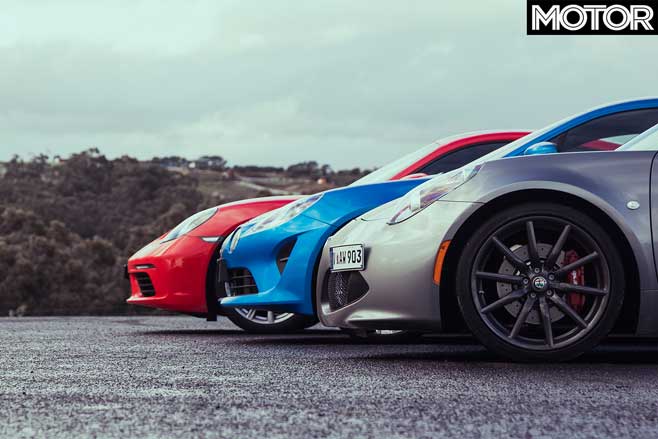
| u00a0 | Porsche 718 Cayman | Alpine A110 | Alfa Romeo 4C Spider |
| 0-10km/h | 0.31sec | 0.22sec | 0.28sec |
| 0-20km/h | 0.66sec | 0.62sec | 0.72sec |
| 0-30km/h | 0.97sec | 1.02sec | 1.06sec |
| 0-40km/h | 1.29sec | 1.40sec | 1.43sec |
| 0-50km/h | 1.68sec | 1.79sec | 1.81sec |
| 0-60km/h | 2.10sec | 2.29sec | 2.24sec |
| 0-70km/h | 2.61sec | 2.76sec | 2.71sec |
| 0-80km/h | 3.13sec | 3.27sec | 3.21sec |
| 0-90km/h | 3.75sec | 3.91sec | 3.78sec |
| 0-100km/h | 4.38sec | 4.56sec | 4.44sec |
| 0-110km/h | 5.17sec | 5.25sec | 5.13sec |
| 0-120km/h | 5.97sec | 6.03sec | 5.94sec |
| 0-130km/h | 6.86sec | 6.95sec | 6.90sec |
| 0-140km/h | 7.81sec | 7.90sec | 8.00sec |
| 0-150km/h | 8.96sec | 8.91sec | 9.20sec |
| 0-160km/h | 10.18sec | 10.13sec | 10.52sec |
| 0-170km/h | 11.49sec | 11.54sec | 11.99sec |
| 0-180km/h | 12.96sec | 12.94sec | N/A |
| 0-400m | 12.65sec @ 177.86km/h | 12.71sec @ 178.57km/h | 12.67sec @ 174.24km/h |
| 80-120km/h (Drive) | 2.8sec | 2.7sec | 2.8sec |
| 100-0km/h | 31.95m | 34.43m | 36.03m |
| Speed in Gears | |||
| 1st | 69km/h @ 7500rpm | 58km/h @ 6750rpm | 46km/h @ 6500rpm |
| 2nd | 118km/h @ 7500rpm | 89km/h @u00a06750rpm | 85km/h @ 6500rpm |
| 3rd | 164km/h @ 7500rpm | 124km/h @u00a06750rpm | 133km/h @ 6500rpm |
| 4th | 209km/h @ 7500rpm | 163km/h @ 6750rpm | 196km/h @ 6500rpm |
| 5th | 251km/h @ 7500rpm | 203km/h @u00a06750rpm | 252km/h @ 6500rpm |
| 6th | 275km/h @ 6700rpm* | 249km/h @u00a06750rpm | 257km/h @ 5400rpm* |
| 7th | 275km/h @ 4710rpm* | 250km/h @u00a05680rpm* | N/A |
Heathcote Raceway, 13˚C, dry. Driver: Dylan Campbell *Manufacturer’s claim Official timing supplier: www.vboxaustralia.com.au
Where is the Supra?
THE NEW Toyota Supra hadn’t been released when we did this comparo, but it has no real place in it anyway. It’s the wrong shape, the engine is in the wrong place and it has too many cylinders.
Except, the new Supra is chasing exactly the same buyers as our mid-engined trio. Chief engineer Tetsuya Tada has said publicly that if the Supra has a rival, it’s the Cayman.
Against the clock it would’ve been close, but in the real world the flexibility of the Toyota’s turbo six gives it an edge. It mightn’t have the purity of a midship layout but the Supra is still a very serious sports car that doesn’t necessarily care much for the Alpine’s antics.
It’s hard to be definitive without driving them all back-to-back, but factor in the Toyota’s price advantage and it’s right in the mix.
