
Did you never warm to the unusual “leaking eyeball” look of the current-generation Prius? You weren’t alone, and it appears Toyota itself wasn’t all that enamoured with it either.
Enter the freshly facelifted 2019 Toyota Prius, which receives a front-and-rear makeover with more conventional looks to imbue the company’s hybrid hero with more broadly-appealing aesthetics.
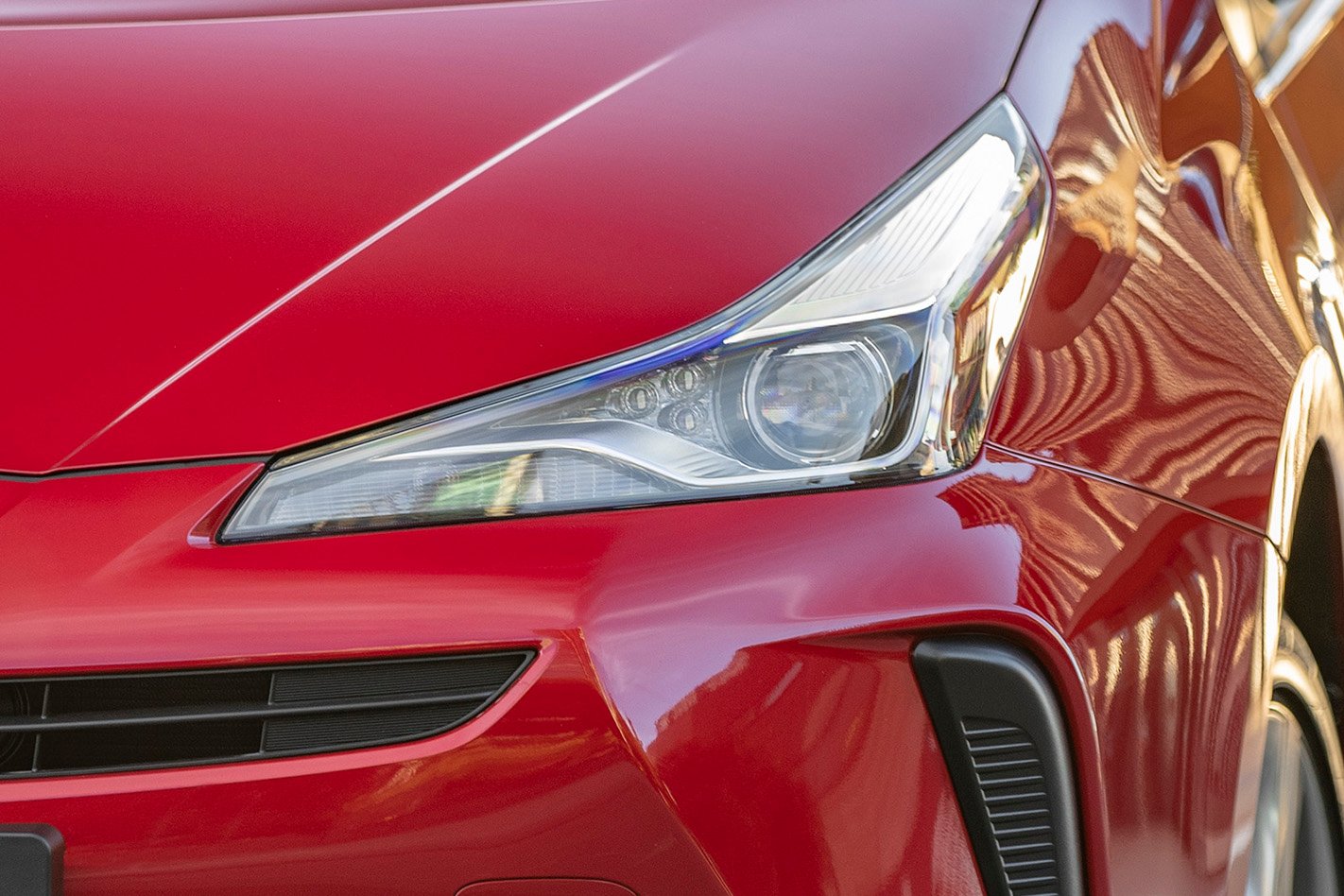
The external differences are obvious enough. New headlight clusters, tail lamps, front and rear bumper plastics, new 15-inch and 17-inch alloy wheels and a slight 35mm stretch to its overall length mark it out straight away as being distinct from the pre-update fourth-generation Toyota Prius.
Inside, Toyota has gifted the updated Prius hatch with new cloth upholstery for the base model (the flagship Prius i-Tech retains its black perforated leather) and a lightly revised centre console that now houses the seat heater switches and comes in a more pleasing piano black finish, rather than the outgoing model’s ‘bathroom white’ look.
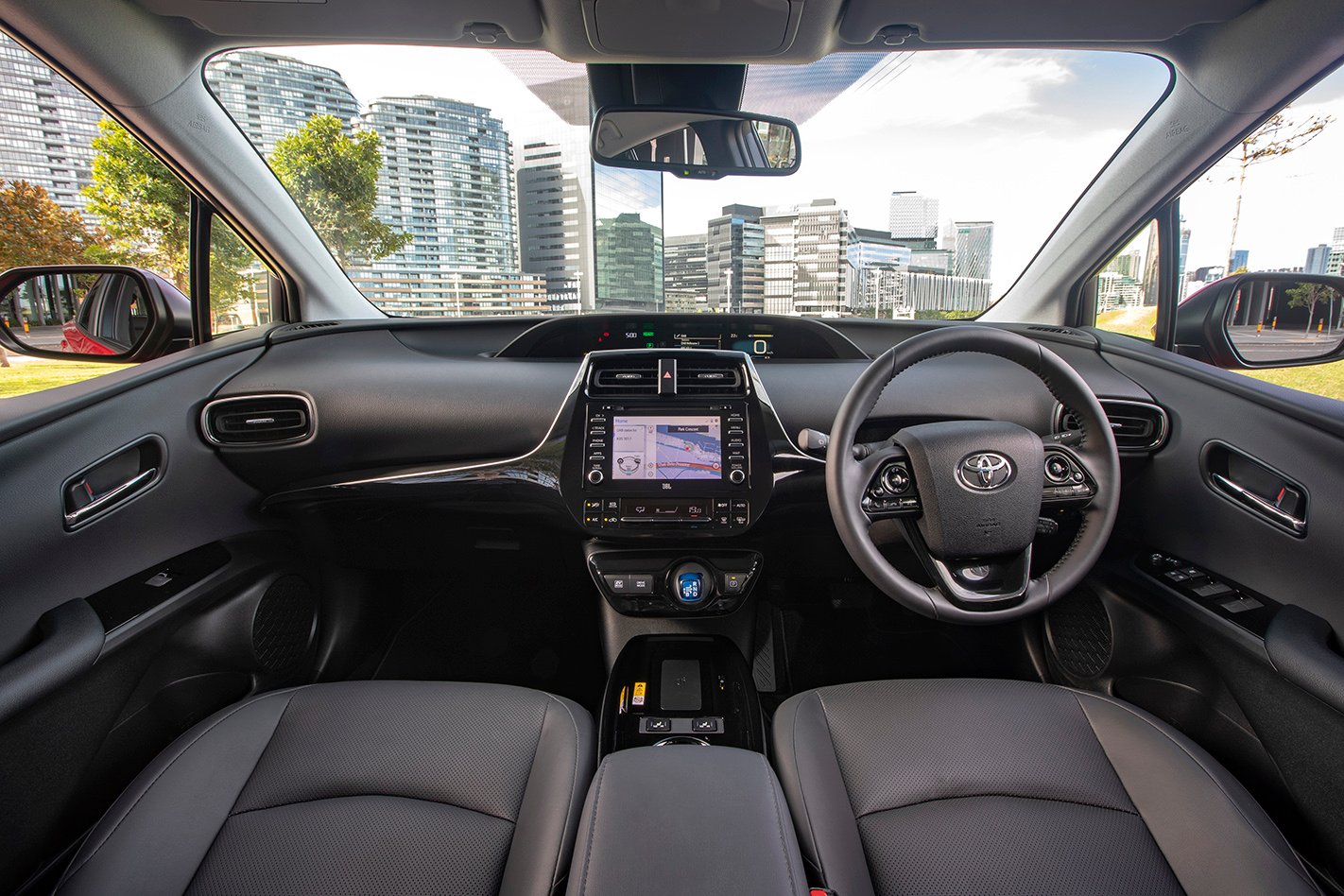
Accompanying those changes is an updated infotainment system, which sees a return to physical volume/tuning knobs and traditional push-buttons along the sides of the screen. Not only that, but the system introduces pinch-to-zoom functionality for its standard sat-nav, along with a 10-speaker audio, Siri voice assistant for iPhone users, and Miracast smartphone mirroring.
Android Auto and Apple CarPlay still aren’t supported, but it’s a step in the right direction.
The rest of the feature set carries over with few changes, with the standard Prius offering the satellite navigation, climate control, a head-up display, 15-inch alloys, keyless entry and wireless phone charging as standard.
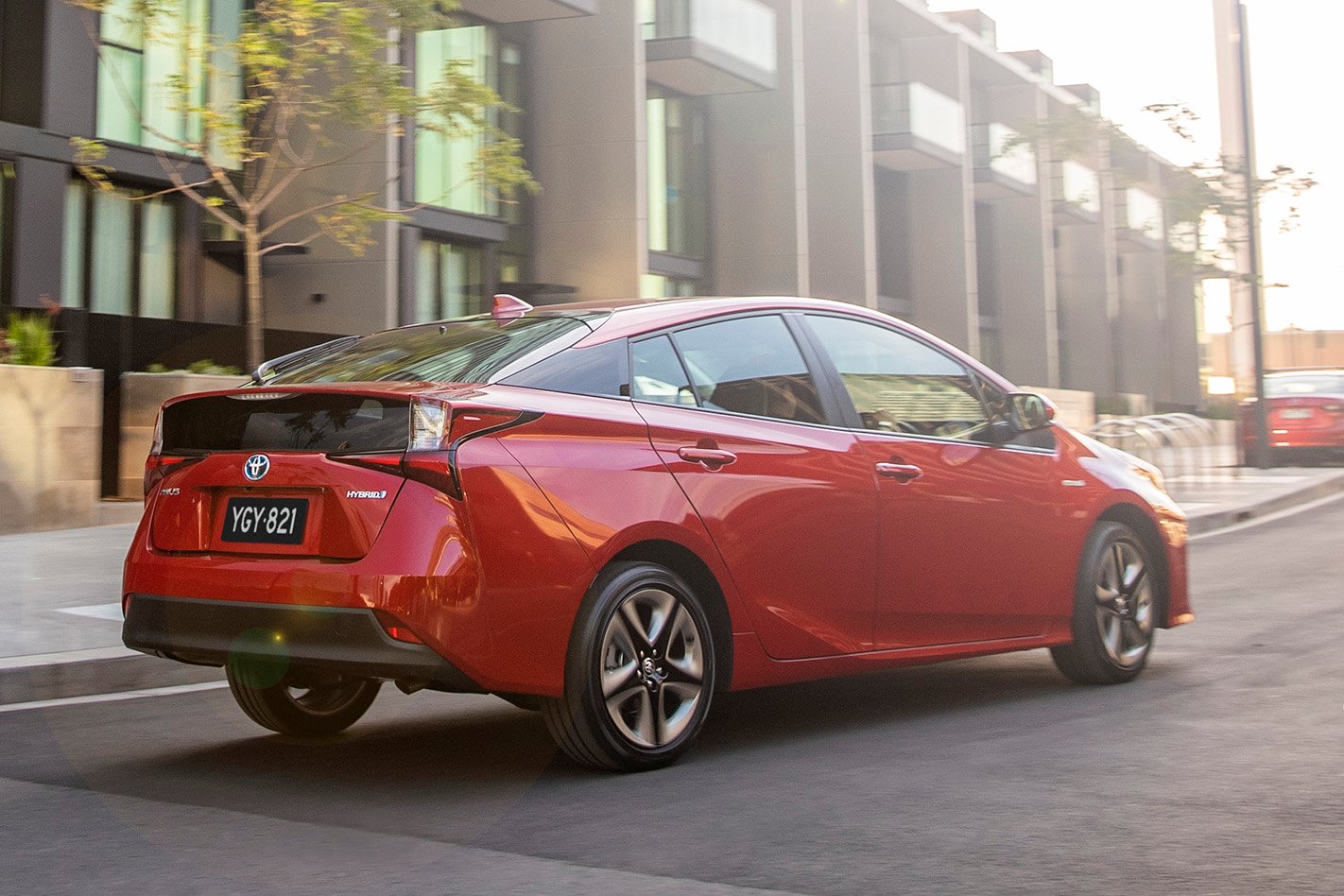
Move up to the Prius i-Tech, and you gain heated front seats, blind spot monitoring, rear cross traffic alert, leather upholstery, 17-inch alloys and more. Both models are powered by a 1.8-litre petrol engine and electric motor, developing a combined 90kW and 142Nm and returning an average fuel economy of 3.4 L/100km.
PRICING
Price rises are very modest for the 2019 Prius range, amounting to $150 for both the base Prius and Prius i-Tech. The 2019 Prius is available for ordering now.
- Toyota Prius hatch – $36,590
- Toyota Prius i-Tech hatch – $44,050
Hyundai Australia has made a name for itself for retuning the suspension set-ups of virtually every Hyundai emerging from head office, and the new i30 Fastback N is no different.
In fact, the new fastback turned into something of a test bed for the i30N hatchback, which will be facelifted during 2019 to reflect the updates baked into the fastback’s suspension set-up.
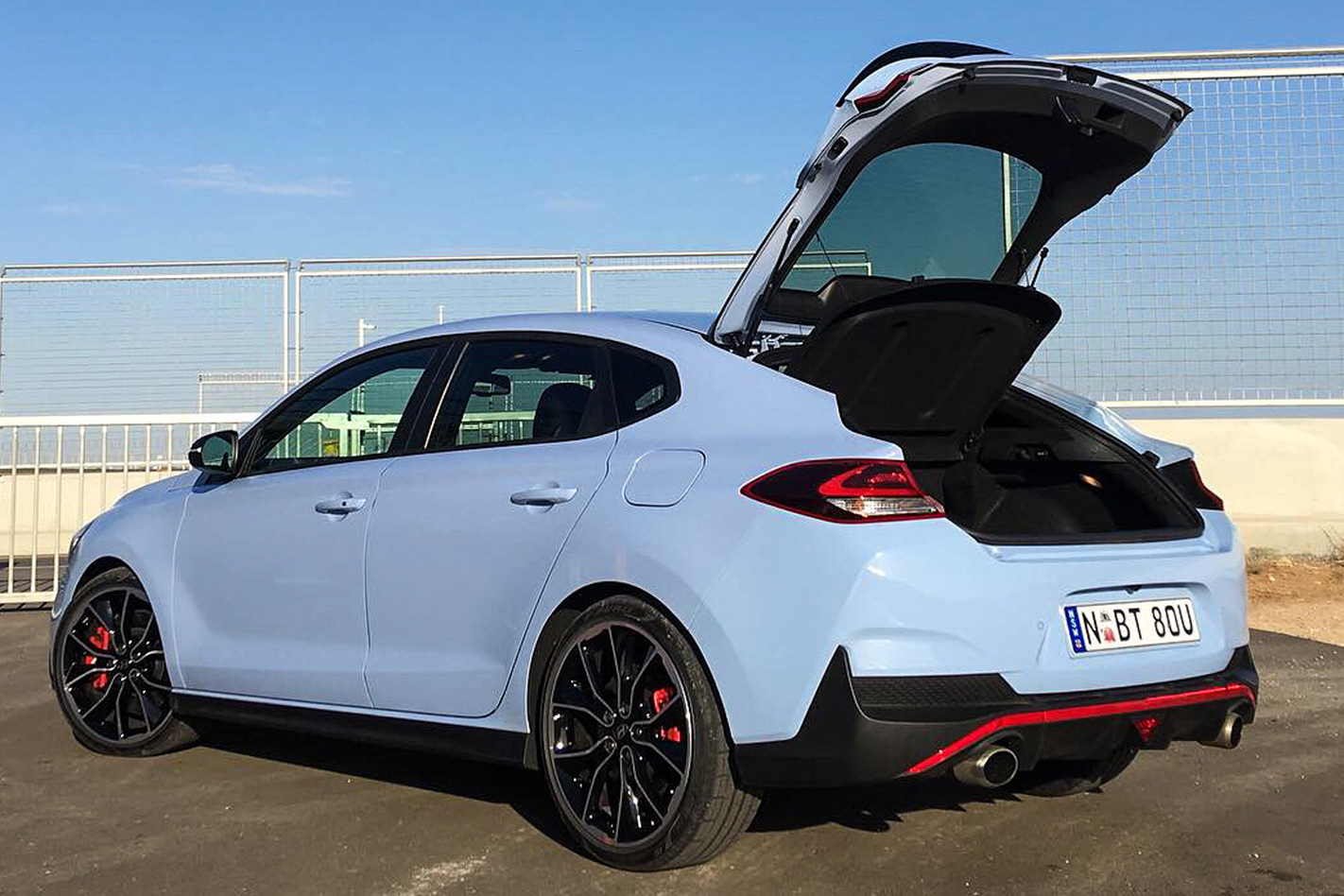
The basics of the two cars are essentially the same; front and rear track widths and the wheelbase figures are the same, though the centre of gravity of the fastback is lower, it’s 12kg heavier and 120mm longer from the rear wheel to the rear bumper.
Hyundai Australia’s senior product manager Andrew Tuitahi told WhichCar that while he and his team, which includes renowned suspension expert David Potter, managed to convince head office – and Hyundai N supremo Albert Biermann – that a softer front set-up would work better for Australian conditions when compared to the European tune, they’ve taken it a step further with the Fastback N.
“You will feel a difference,” he said. “I think the fastback will give you a slightly broader comfort window so it will be a little bit more comfortable on the road, a little more pliant. It has to do with the front hardware change.
“The hatch will feel a little bit more immediate. It’ll definitely feel a little more playful up front, but I think once you transition through the [drive] modes on the fastback, when you get to N [mode], the two cars will feel pretty similar in terms of their character. The fastback might give you a little bit more lift off oversteer and playfulness on the track. The Australian-tuned hatchback to fastback is an evolution, but they’re related.”
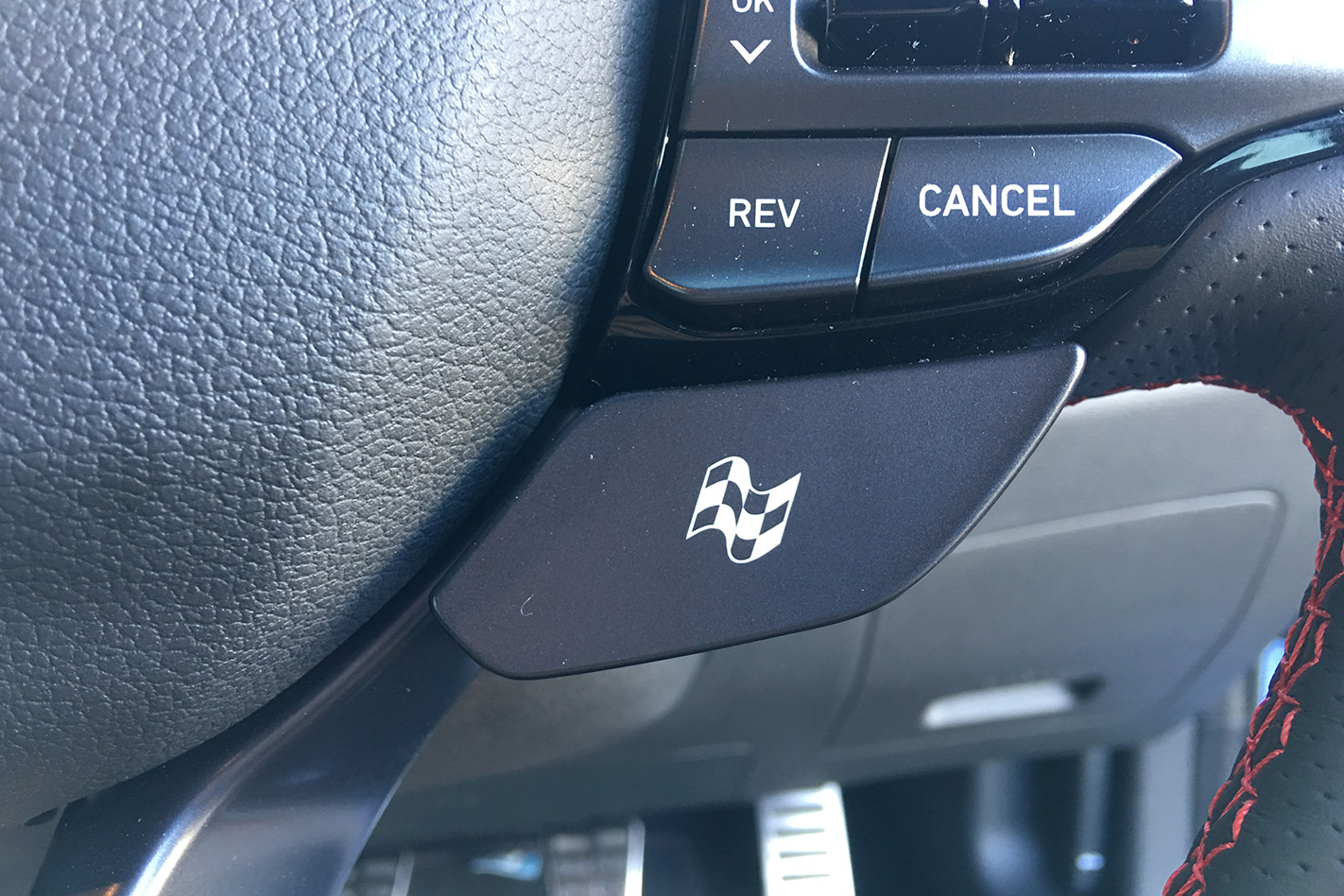
Mechanical updates to the MacPherson strut front/multilink rear end are minor but meaningful, according to Tuitahi.
“There are a couple of slight differences,” he said. “There’s a softer front [roll] bar, and a lower front spring rate. The bushes in part of the shock absorber and in some of the mounts have been sleeved a little bit different, as well, for extra rigidity.”
Tuitahi explained that Hyundai has also added a second pair of springs to the tops of the front MacPherson strut assemblies. Known as helper springs, they’re partly designed to soften the ‘top-out’ of the shock shaft when it reached full extension.
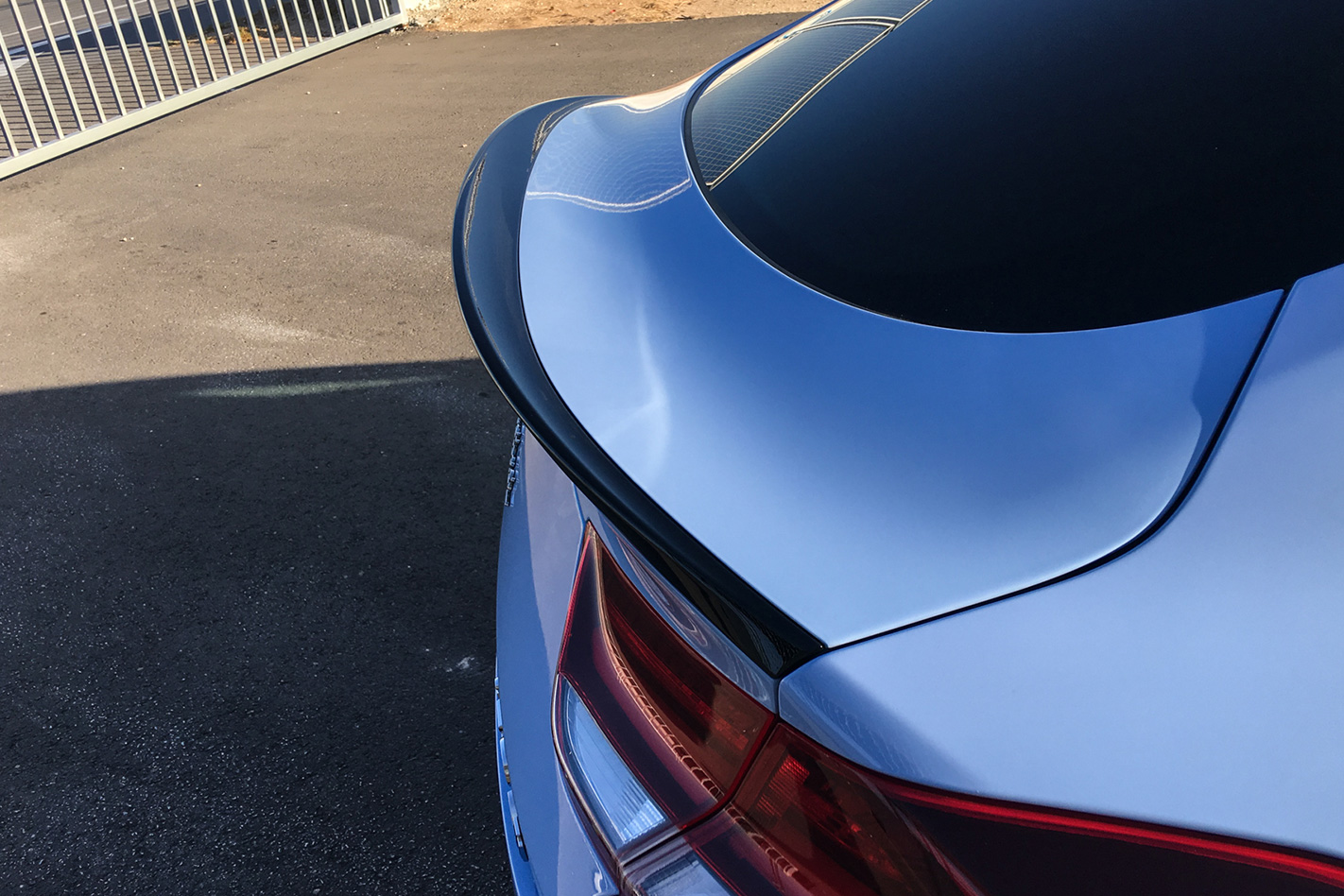
“The spring is only this big [holds thumb and forefinger 25mm apart],” he said. “The effect that it has in the car in terms of response is noticeable because the rebound stroke is immediately leaning on that spring. It’s a big difference in feel. It also helps with top out; it comes a little softer into contact with the bump stop.”
When it comes to the difference between a good and great chassis set-up, the role of the damper, or shock absorber, can’t be underestimated. Tuitahi reckons there are 30 or 40 sets of dampers on the shelves of Hyundai’s head office in ride that are all essentially identical in construction but different in ride feel.
The use of new spring rates and the new front anti-roll bar meant that the adaptive dampers – which firm up when subjected to an electrical pulse, thanks to iron filings in the damping fluid – also needed to be tweaked.
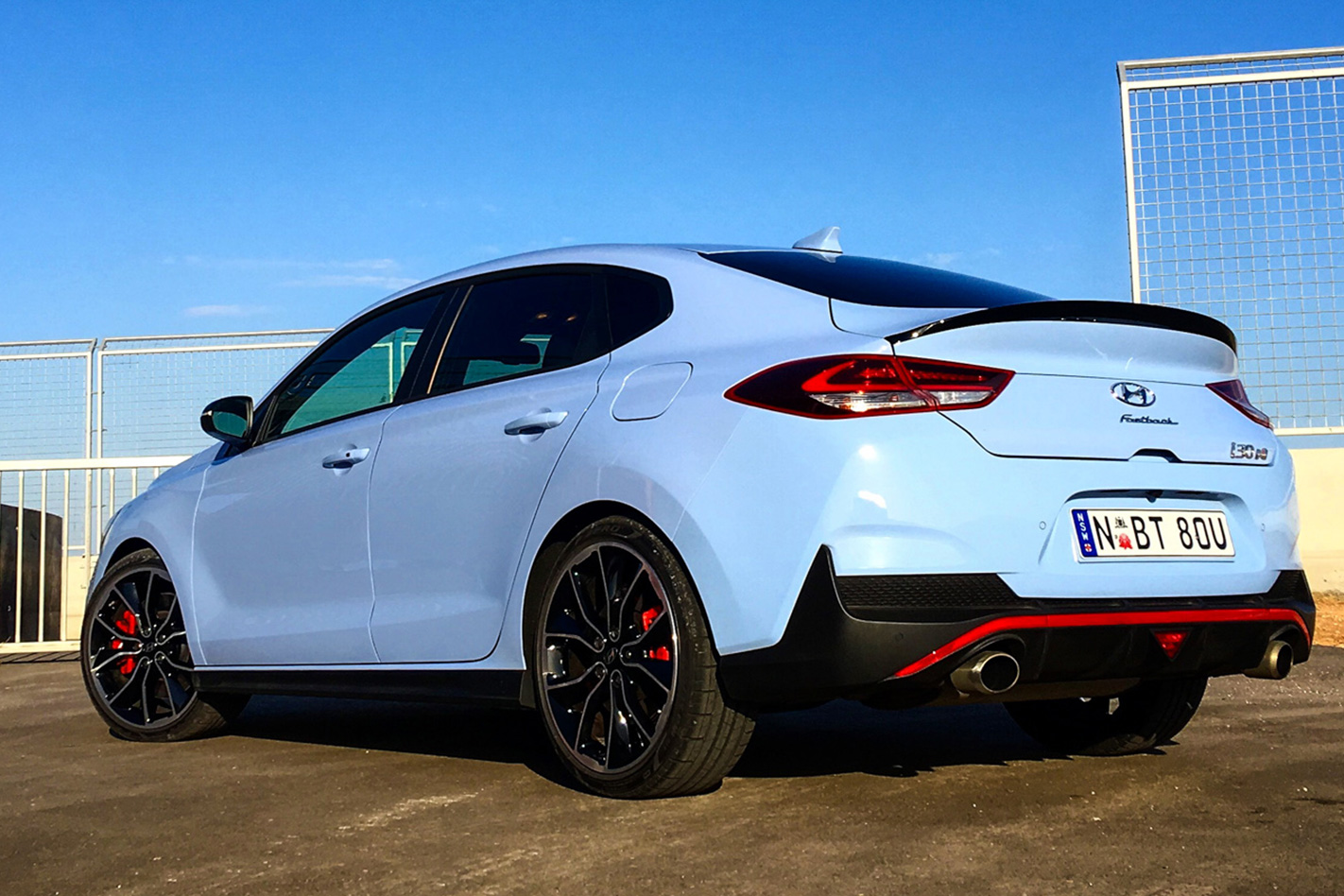
“Not [only] are we redoing the shock’s body, valve and piston, but we’ve also got a solenoid,” he said. “We can also control the damper’s curve [the speed at which the shock shaft moves, essentially] using the solenoid, and then by using electronics we’ll vary how much flows through the solenoid, and how much bypasses it.”
Tuitahi says there is no shortcuts to creating the perfect damper tune either, despite the presence of electronics.
“It makes it so much more complex because you’re not only tuning a conventional damper, you’re also tuning an additional damper [in the solenoid], trying to consider what it will feel like as the software transitions between the two,” he said. “Then you’ve got to go out and actually do some software tuning, come back, revisit all the hardware again.”
When asked what he and the team were trying to achieve with the build, Tuitahi highlighted the fact that the fastback’s front end will react a little more quickly than the hatchback’s.
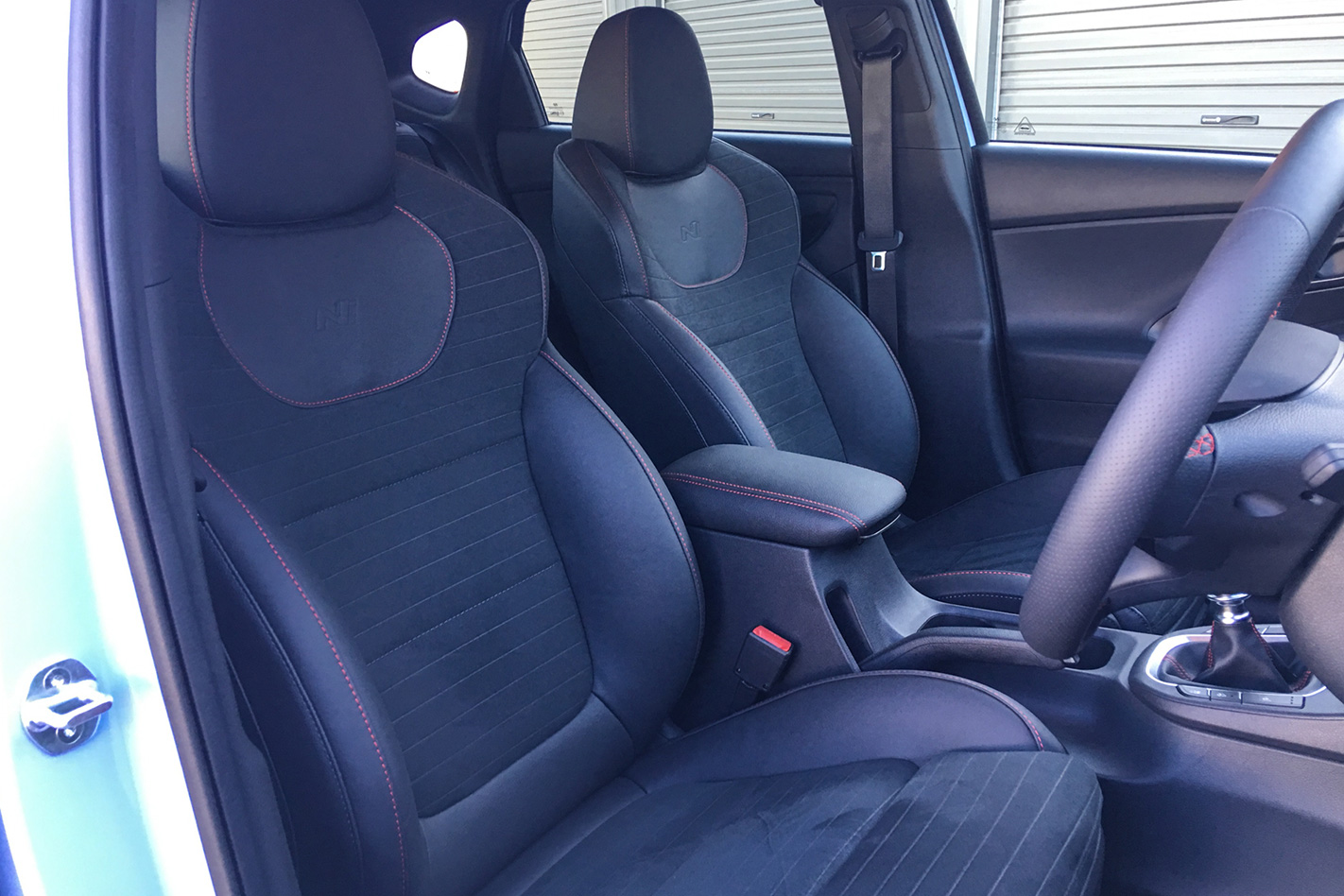
“Just gives you a little bit more initial bite,” he confirms. “A little bit more adjustability mid-corner and then we can use roll control in the software and I think you’ll probably see a bigger difference between the three modes in terms of cornering behaviour now, so normal, sport, and N now will be much more playful and we’ve been able to do that because of the front is a little bit softer.”
He added that the rear end is largely the same, though a pair of new toe links have been added as a running change, while rear damping has been firmed up slightly while leaving the spring rates as they were.
The i30 Fastback N’s steering also came in for some adjustments. “The steering has been re-tuned because of the difference in feel,” confirmed Tautahi. “The stabilising bar, especially, makes a big difference to how the steering feels, so it’s been re-tuned just to suit the new hardware.”
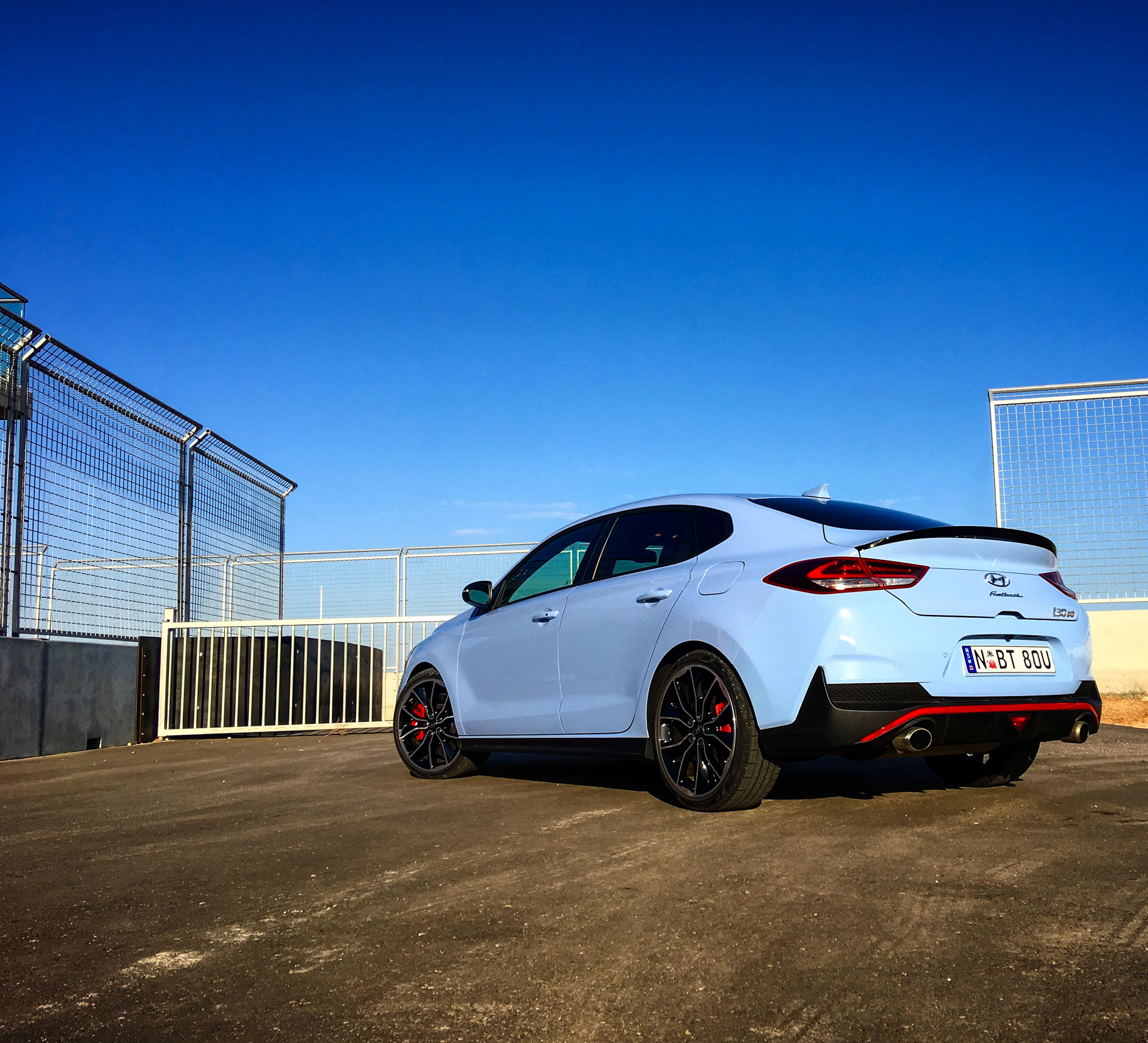
The fastback is slightly heavier than the hatch, but Tuatahi says it doesn’t come into play between the hatch and the fastback. “Those 12 kilos, as I was joking before, that’s like lunch,” he laughs. “To be completely honest, there were times depending on the prototype availability where we used the two bodies interchangeably during the suspension tuning, and we didn’t really focus in on trying to nail it for the fastback until really that last tune that we did in Germany with the whole team.”
All the fastback mods will transfer over to the hatch later in 2019 as well, confirmed Tuatahi.
The boss of Jeep has confirmed that the iconic American automaker is preparing to add a seven-seat companion for the Grand Cherokee to its showrooms – and we should get our first look at it before year’s end.
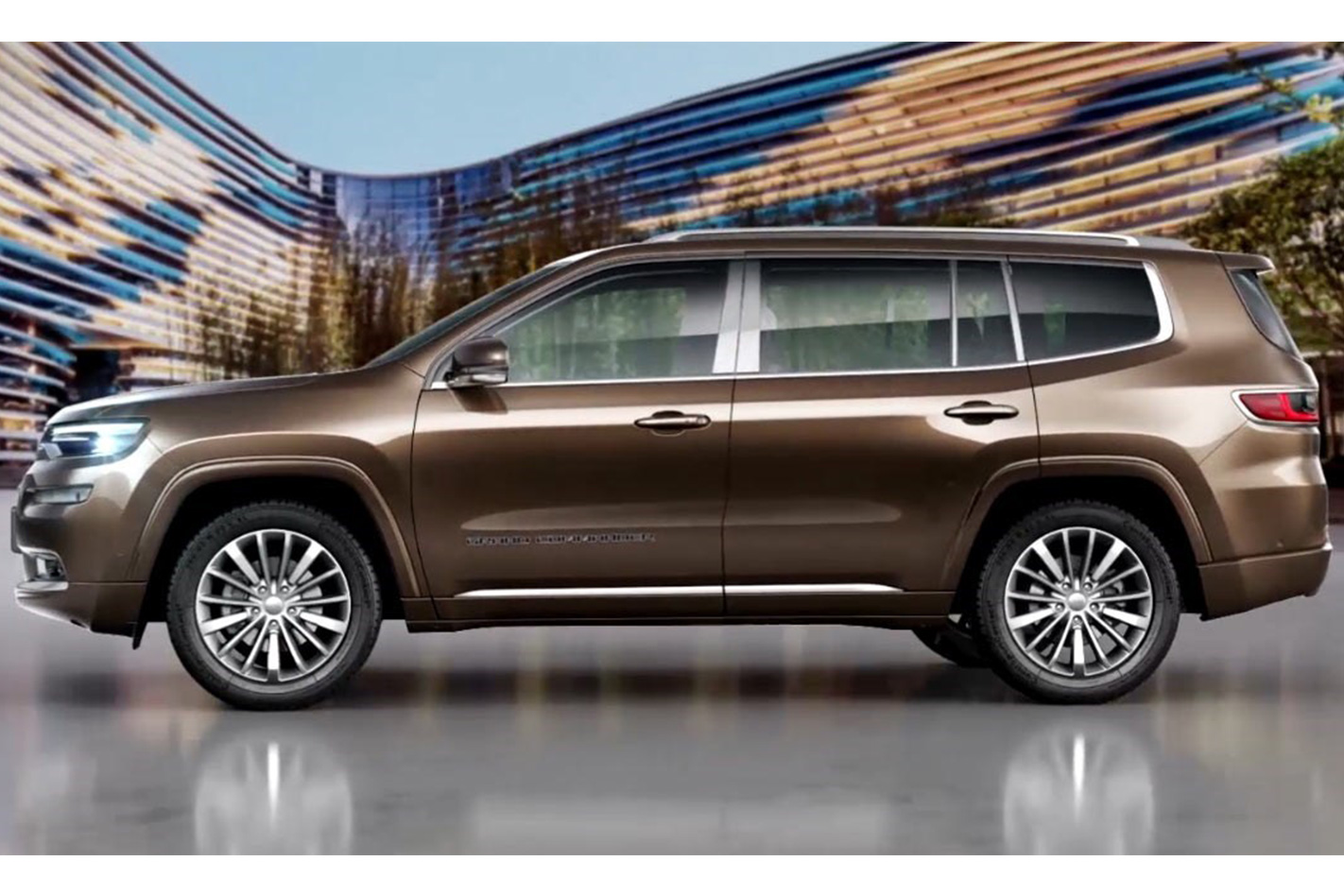
Speaking to Auto Express, Jeep head (and chief of FCA) Mike Manley said while plans for the upper-large (and reportedly quasi-luxurious) Jeep Wagoneer are moving ahead as expected, the Jeep brand firmly intends to slot a three-row large SUV between it and the Grand Cherokee.
According to Manley, the three-row sub-Wagoneer Jeep “will technically play in the same segment as Grand Cherokee.”
“Roughly 60 percent of that segment is [for] three-row,” he continued “so Grand Cherokee has really only played in 40 percent. That will open up that part of the [large SUV] segment for us.”
Of the Grand Cherokee’s primary rivals, which include vehicles like the Toyota Landcruiser Prado, Land Rover Discovery and Mazda CX-9, the Jeep stands out for not having a seven-seat capability. For owners who may have a large family or merely need to occasionally carry extra passengers like in-laws or children’s friends, the additional utility of a third row is invaluable.
With question marks still hovering over the hulking Wagoneer’s suitability for the Australian market it appears that the as-yet-unnamed three-row SUV stands a stronger chance of coming here as Jeep Australia’s flagship model. However, it appears unlikely that it will be marketed as a Grand Cherokee variant, with Manley conscious of the need to preserve the Grand Cherokee as an appealingly-proportioned five-seat SUV – not a big-bummed personnel carrier.
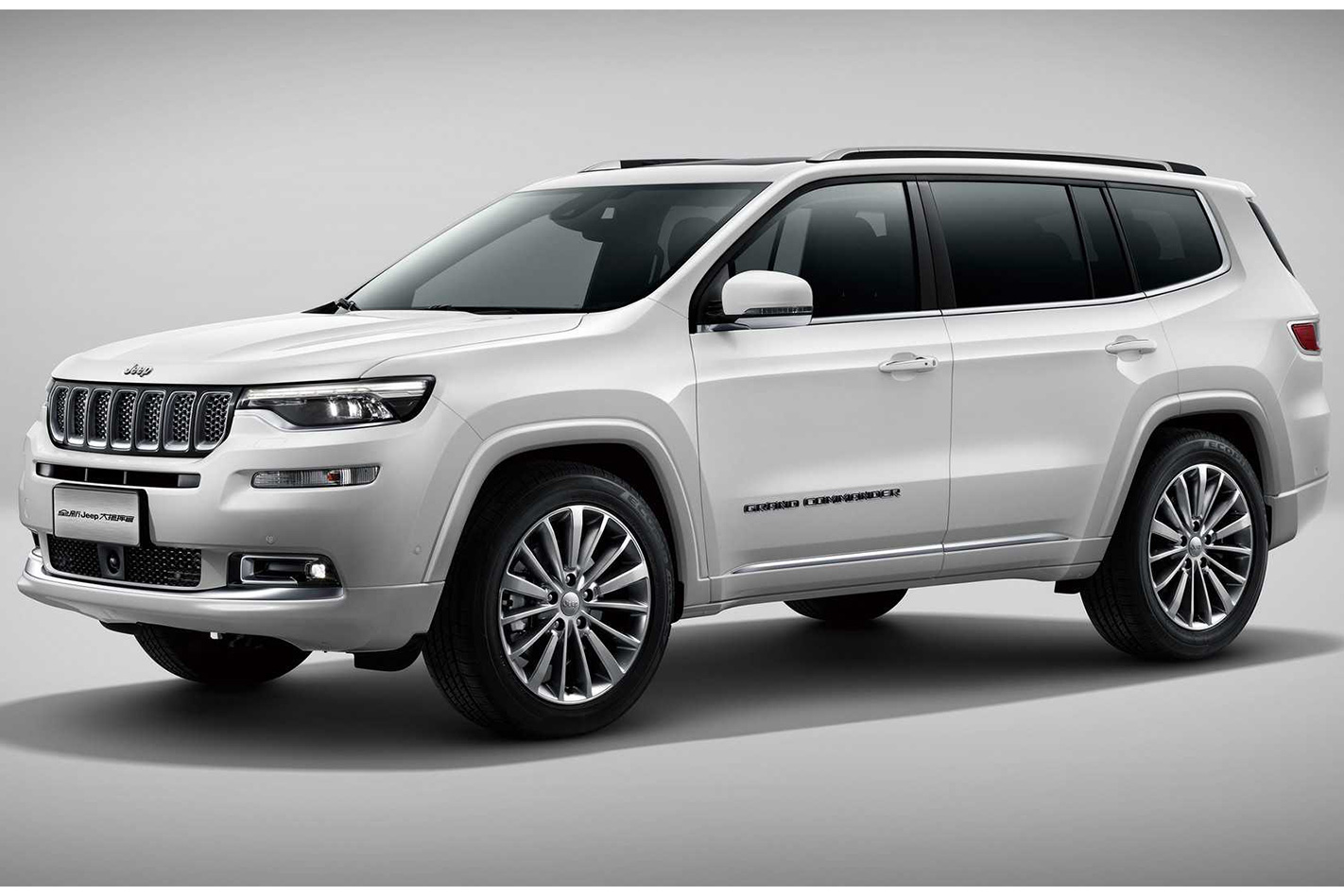
It’s also apparent that it will be an all-new model rather than a rehash of the only seven-seat Jeep currently in production – the Chinese-market Jeep Grand Commander. While fractionally longer than the Grand Cherokee, the Grand Commander is both narrower and lower and likely wouldn’t offer the cabin space desired by Western markets – though the power and torque outputs of its 2.0-litre turbo petrol (201kW and 400Nm respectively) are quite healthy.
What will we get instead? That’s still a closely-guarded secret, and besides Manley’s admission that something is indeed coming, the details are still scant. That said, expect to see Jeep’s mass-market three-row SUV debut later this year, possibly as a ‘concept’, along with a new-generation Grand Cherokee and the eagerly-anticipated Wagoneer.
If you’ve ever wondered what a 2019 Porsche 917 race car would look like, wonder no more.
To celebrate 50 years of the Porsche 917, the Stuttgart marque has not only restored its first 917 (chassis 917-001) but has also reimagined the car as a one-off design study.
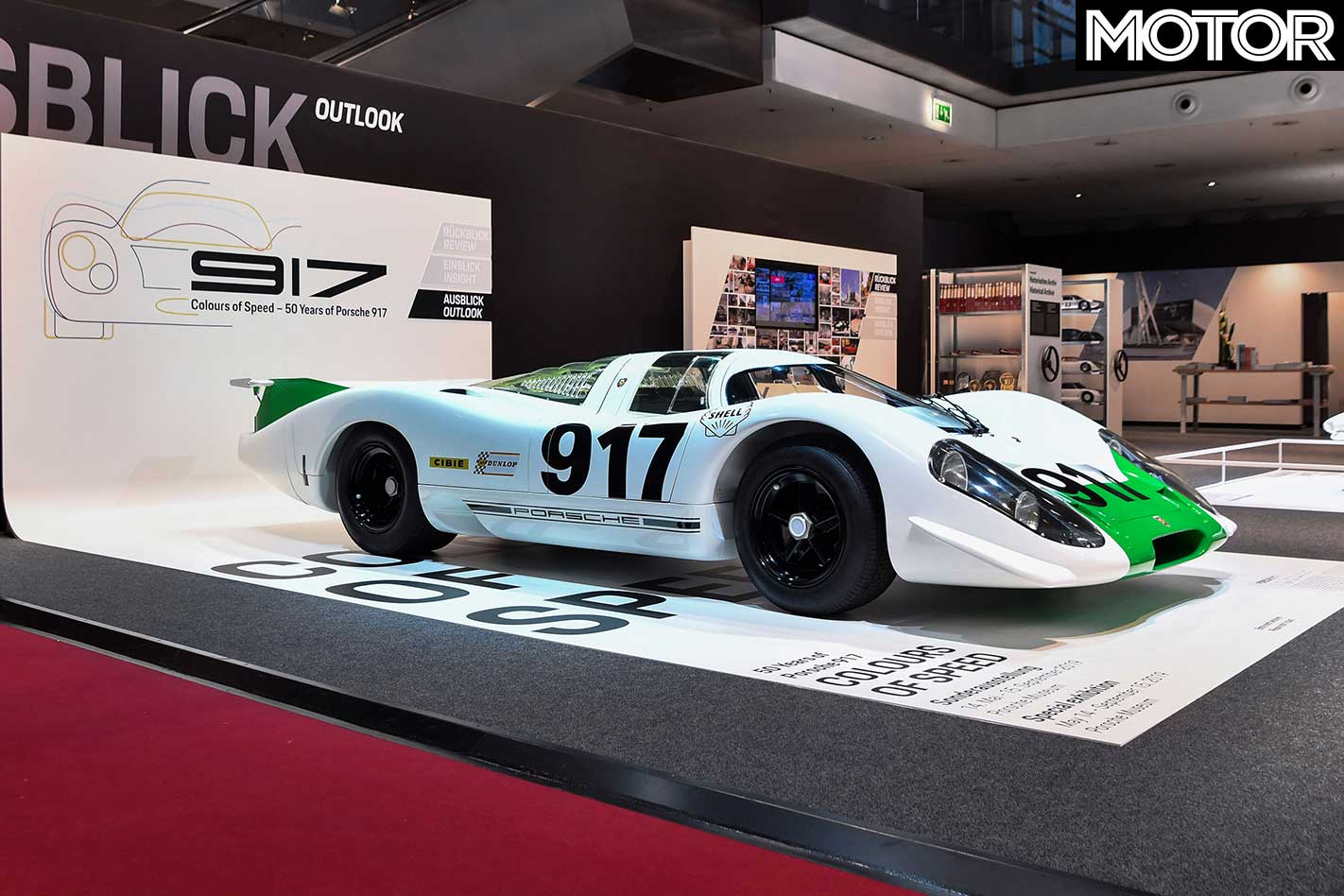
Created by a small team of designers and engineers, the red and white concept will be one of 14 cars displayed at the Porsche Museum between May 14 and September 15.
Porsche says the concept, an homage to its first Le Mans victory in 1970, will remain a study, as the brand already has an LMP1 category entry in the WEC. It’s not clear how this prevents it from becoming a limited-run special edition.
Chassis 917-001 will also be on display after having undergone a painstaking restoration for more than a year. The first 917 ever built has been returned to its original condition, as it was when it was shown at the Geneva Motor Show in March 1969, in white and green. Porsche says this changed several times through 917-001’s life.
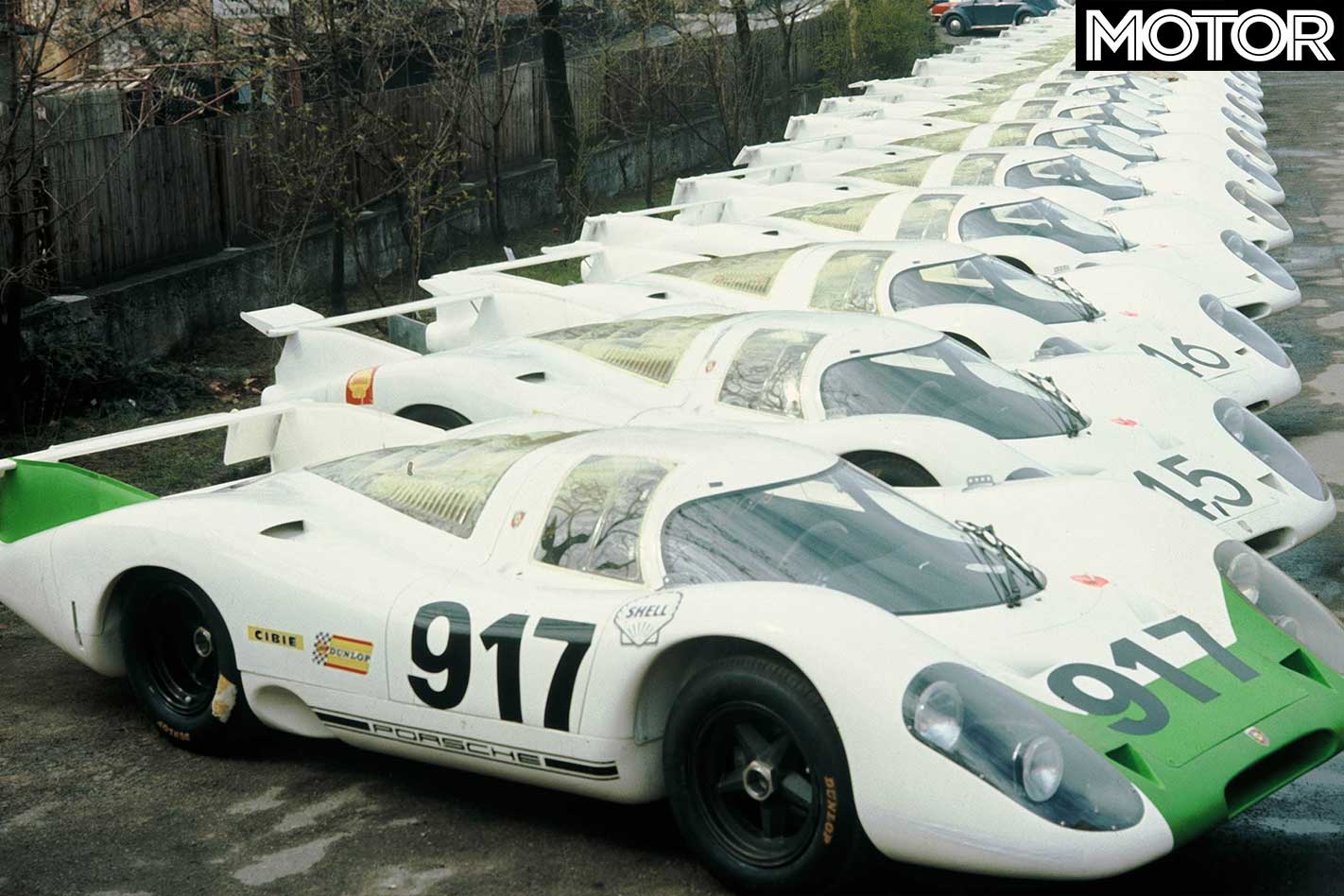
“It had a new look for its appearance at the International Motor Show in Frankfurt the same year, for which the car was repainted in white and orange.
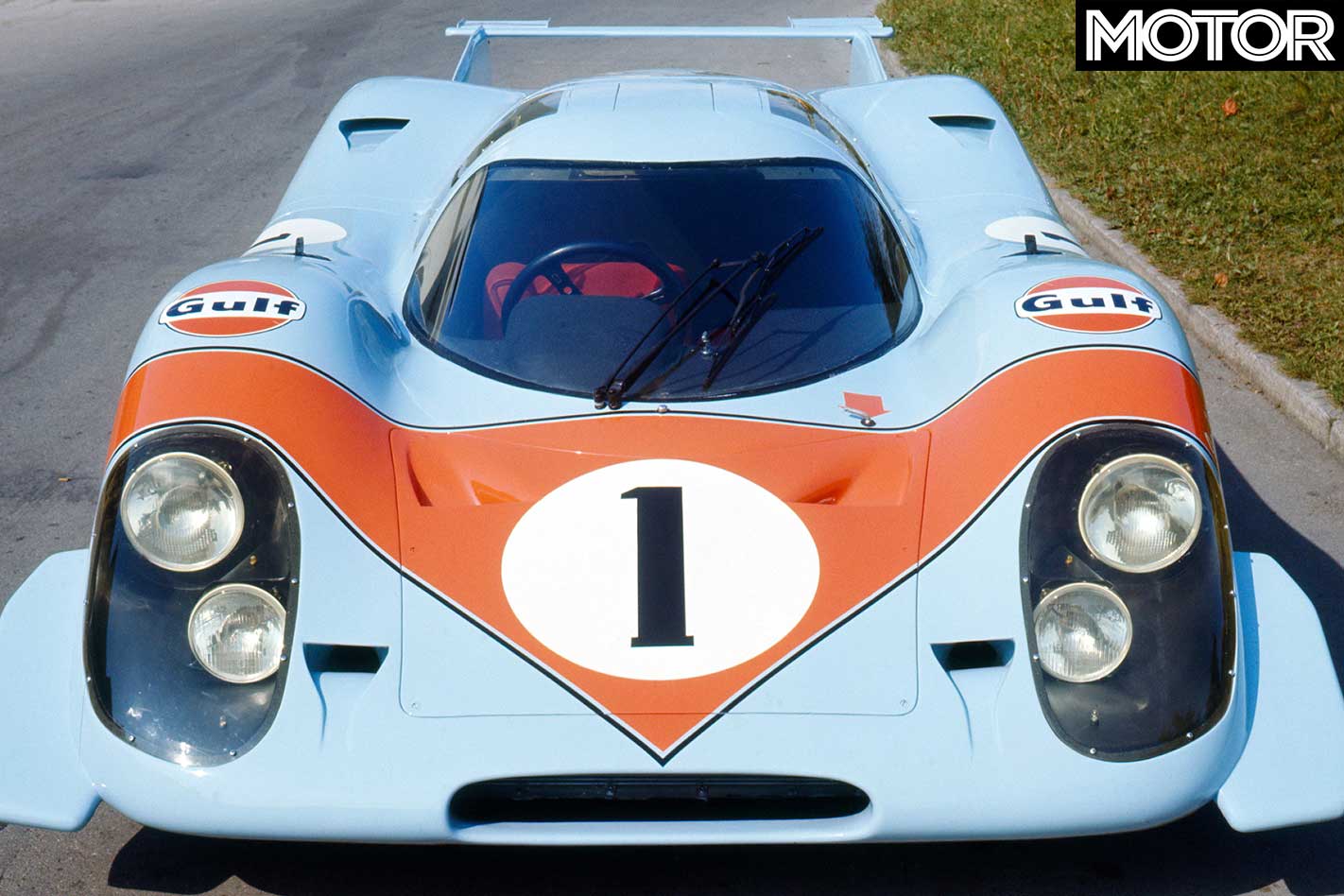
“When Porsche later announced the transfer of its racing activities to the J.W. Automotive Engineering team, headed by Briton John Wyer, the 917-001 was once again used as a presentation vehicle and refinished in the brand colours of US oil company and sponsor, Gulf: light blue and orange.
“When the 917-001 was handed over to Porsche Salzburg in October 1970, it was in the colours [red and white] of the car that won the Le Mans race and was emblazoned with starting number 23.”
It makes sense, then, that the modernised 917 should bear the number of the first 917 to win Le Mans.
What is it with Japanese businessmen and never-ending job titles?
Mazda’s Ichiro Hirose hands me his card. He’s the Managing Executive Officer In charge of Powertrain Development, Vehicle Development, Product Planning and Cost Innovation.
In other words he’s the guy that needs to grant assent to virtually every one of Mazda’s significant major automotive decisions. Small wonder that he feels at liberty to talk.
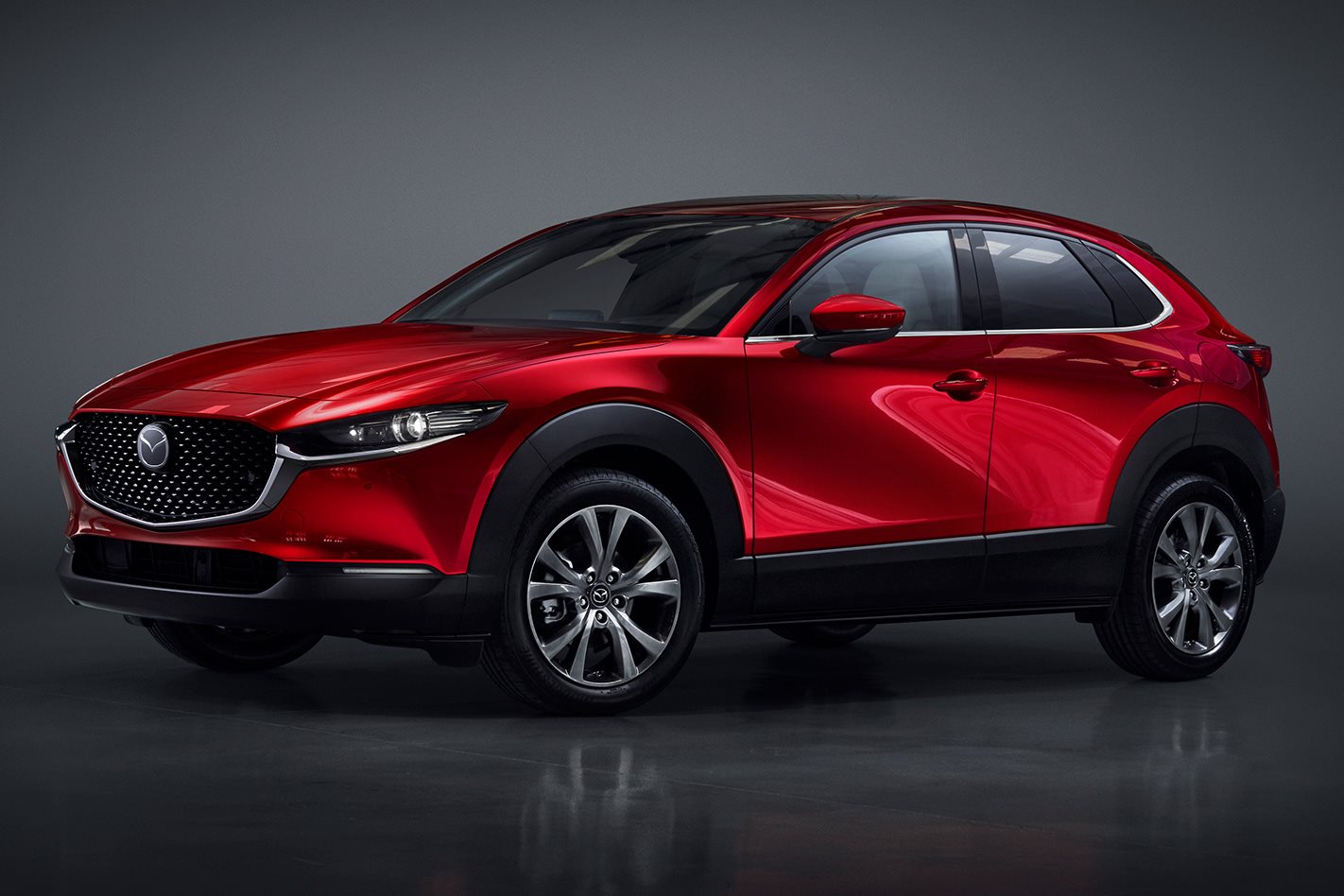
We’re at the Geneva Show, chatting to Mazda executives and, to be honest, it’s been a bit frustrating, none of the prior suits willing to step outside their narrowly defined wheelhouses.
Hirose is different. Different but requiring a little bit of time to tune into. I ask him how close the long-awaited SkyActiv-X compression ignition engine is to production.
He closes his eyes and his head bows. “Mmmmmmmmmmmm.” I’ve edited this for brevity.
It went on a lot longer. His translator’s eyes flick nervously. I wonder if he’s doing the intro to Elvis’ American Trilogy.
Then comes slow Japanese, each word carefully considered. Finally the translation.
“I would say almost all of the development work that needs to be done on SkyActiv-X is now complete and so we’re now just preparing for the final final check before it’s released. We’re making really stringent conditions so that we can be sure of this engine. It’s my really, really beautiful and precious baby,” he says.
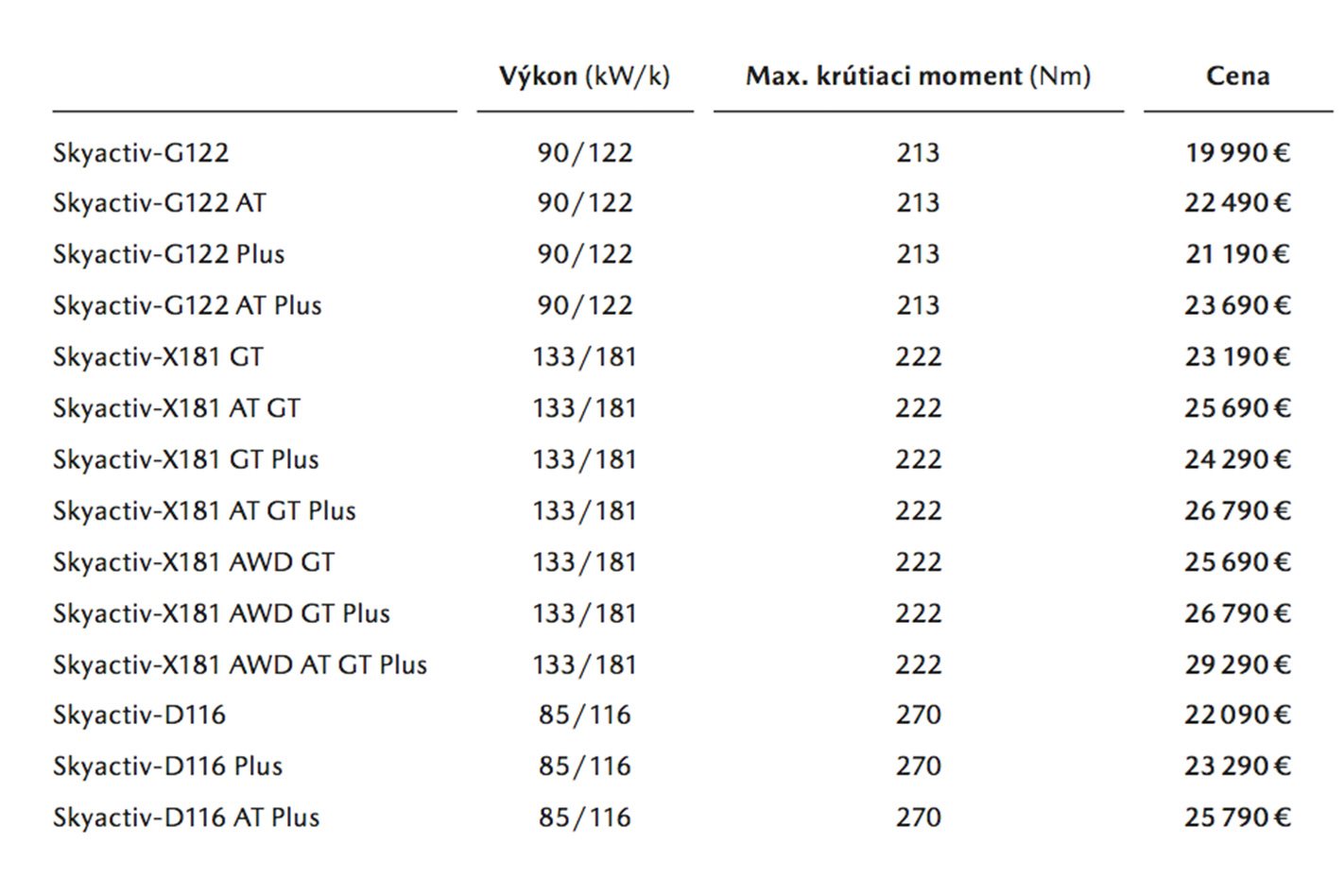
“Yes, it’s met all the initial design criteria. All the targets that we had declared, we are satisfied that we have done so. Not only that, but we have also been able to achieve the targets in terms of reliability that we set ourselves, so that means it really is nearly mass-production ready as a product,” he continues. Then comes a tell.
“Previously we had said this: this is a new engine that takes the best of both worlds from the diesel and the gasoline engine. What I mean by best of both worlds is that it has the benefits of the diesel engine in terms of injection that is used to control the driving power, in that it has very good response like a diesel engine and it has the benefits of an effortless high-revving feel that you can feel in a petrol engine,” he confirms.
The thing is, the last time I spoke to Hirose (back in 2017 when a prototype Mazda3 with a SkyActiv-X was made available for us to drive in Germany), he’d said something subtly but tellingly different.
He’d stressed the 20 percent improvement in fuel economy over Skyactiv-G, claiming the best economy from a petrol engine in the world. He’d even said that the raison d’etre of this engine was improving performance without affecting economy. Now there’s no mention of economy and emissions, which strikes me as odd.
And don’t hold your breath that this engine will find its way beneath the bonnet of an MX-5 either.
“We intend to introduce SkyActiv-X in a step-wise fashion for all the new-generation products in a successive manner. I wouldn’t deny the potential [of SkyActiv X in MX-5] but the MX-5 has its own thing that we need to think about in terms of what its character is. We’re pursuing rigorous lightweighting of the MX-5, so what we’re trying to do is lower the burden on the engine by doing so, and it’s all in the pursuit of getting the oneness between the car and the driver.”
He admits that the exotic SkyActiv-X is a weightier lump than the more prosaic SkyActiv-G.
“Simply the extra air supply system is going to add weight so SkyActiv-X is inherently a heavier than the SkyActiv-G. We will reveal how much heavier soon,” he nods.
So the compression ignition engine seems to run counter to Mazda’s engine strategy for the roadster.
“Lightweighting of the engine in MX-5 we will definitely be pursuing,” he confirms.
In the shorter term, there is good news for those looking for improvements to the iconic drop-top.
“The 1.5-litre is the little brother hiding behind the back of the 2.0-litre but that’s not to say development isn’t being done. It is and the combustion of the 1.5-litre is also being developed and improved,” he smiles.
That’s great news. The improvements to the 2.0-litre last year transformed that engine for the better and making the 1.5 breathe better and rev more sweetly can’t happen quickly enough.
The only time Hirose seems to be deliberately cagey, listening with intent to the translation and glancing at the notes, is when he’s asked whether the SkyActiv-X four-cylinder engine could become a modular concept straight-six, for example.
“I wouldn’t go so far as to call it modular,” he says by way of clarification, “but our combustion development is based on a single cylinder development so technically because we’re basing all our combustion development on a single cylinder, we can chop and change displacement by increasing or decreasing the number of cylinders,” he says before lightening the moment with a piece of pure fantasy.
“I’m dreaming about the day that there is huge demand for a V12 that allows us to make it into our product line-up,” he laughs.
The tone changes when he’s asked whether the diesel downturn has affected Mazda’s plans around development of the SkyActiv-D diesel engine.
“We have not slackened our reins in terms of the development of the diesel engine. In the short term, because of the European OEMs cheating scandal there has been lots of discussion about ‘diesel-bashing’ and that has mainly been driven from an emotional point of view but we believe there is a way to make the cars that leverages the full benefits of diesel. We know there are customers out there who would like us to have this diesel, so there is a customer base and as testament to that, if you have a look at the R&D activities of our European manufacturer friends they have not slackened their development of the diesel,” he says, eyes flashing. He then jabs his pen with each syllable of the next statement. “We cannot lose to them.
He then outlines his logic. I don’t want to edit his words in any way because this is important and merits the requisite long-form consideration.
“What’s important and why we try to improve our fuel efficiency is that the main goal has to be suppressing global warming and lowering CO2 emissions. That’s the reason why we have kept introducing the diesel engines but because of the recent discussions we see that the take rate of the diesel engine has declined, but what’s interesting is that the CO2 emissions have gone on an inverse proportion. We’re seeing for the first time an increase in CO2 emissions in Europe.
“If we have a more strict point of view of what’s really happening, we believe that the real CO2 suppression comes from the well to wheel thinking if we’re trying to benefit the whole world. Let’s take oil refineries for example. When you refine oil, you get a certain amount of petrol and you’re always going to get a constant ratio of diesel that comes out of this process. So without adding any extra energy in refining, you will always have a surplus of diesel. Now let’s imagine that the diesel take rate has gone down, which means that there’s even more of a surplus of diesel. To meet the extra demand for petrol, the oil companies are converting the diesel by using more energy and expending more CO2. That cannot be the most rational way to lower CO2,” he says, visibly frustrated.
“As long as there are oil refineries and as long as there’s always going to be a constant ratio of diesel to gasoline being produced, it’s more rational to have a coexistence of petrol and diesel for the lowering of CO2 from an overall standpoint. What I’m trying to say is that there’s not only one way but we all need to be involved in the wider scope of the discussions to really lower CO2,” he says.
Understand the reasoning here and you understand Mazda. The company is based on reasoned pragmatism, sometimes to the detriment of sales. It never embraced downsized turbo petrol engines because they never made the numbers in the real world.
So while other manufacturers made hay in the short term, based on entirely fictitious economy and emissions figures, Mazda stuck to its guns, losing sales but occupying the moral high ground. Now it finds itself in a similar position, its pragmatism being drowned in a market that’s big on virtue signalling.
The same goes for Mazda’s long overdue venture into electrification. Toyota has sold petrol-electric hybrids for better than two decades. Nissan has sold a full EV for almost ten years. Mazda? Nothing.
Isn’t Hirose afraid of being a victim in a market that’s due for disruptive change? Again he’s animated because by he’s surely been asked this question many times and the answers haven’t always satisfied a demand for rapid progress.
“We think about permeation of EVs into the market. At the moment it’s an issue of driving range. Driving range has been questioned and one way of addressing that is putting more battery onto it. I’d always have to refer back to the lifecycle assessment meaning that overall CO2 emissions: what is supposedly a CO2 emission-free EV, the more battery you put on it – and this is the paradox – the more CO2 you are emitting because of the processes involved in getting the battery onto the car and the cycle after its life,” he muses.
“If you want increased driving range, let’s put more battery onto the car, which means that the more battery capacity you have, the charging time is going to get longer and longer. If you are thinking of really permeating the market, which in turn means you need to have massive scale to do that, you have to consider the customers who will purchase EVs for their one and only car in the household. If that’s not the case, then during the time that they’re charging their car to get the full driving range that they want, then they would need a second car. The infrastructure’s still not there to meet those demands. It’s fragile,” he says.
“What we at Mazda are looking to do is based on really lowering CO2, and that’s based on our well to wheel thinking and that considers many different factors as to how in earnest to contribute to this target. We went through many different iterations of our concepts for our EV. Having considered all these different areas, we will be able to make an announcement of the EV concept that Mazda has come up with in the latter half of this year. As our president mentioned yesterday in the press conference, we will be introducing an EV model in calendar year 2020.”
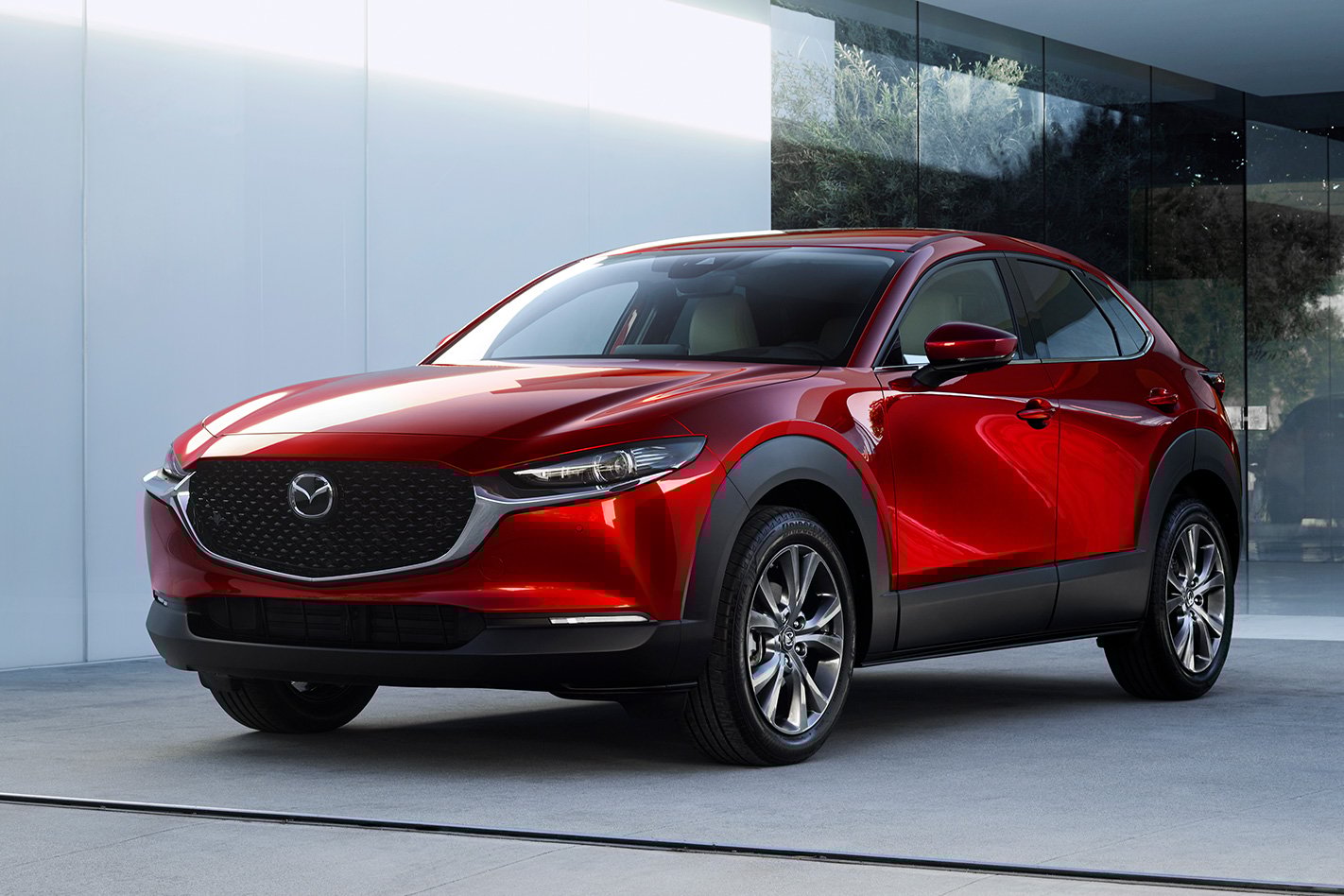
So, better late than never. Mazda’s finally taking a tentative step into a brave new world. But if you’re not prepared to give up fossil fuels just yet, the company has a lot that will appeal. The revolutionary SkyActiv-X and a refreshed 1.5-litre for the MX-5, a philosophy of lightweighting new powerplants and ongoing development of the mass-market SkyActiv-D and –G engines represent a solid base to work from.
Ichiro Hirose is banking on a customer base that respects engineering and practicality over marketing sleight of hand or gesture politics. Such conservatism now seems a bold outlier but when your job title encompasses virtually everything, one can’t help but take a more expansive view.
Only 75 units of the extreme McLaren Senna GTR will be built, and already each has been sold.
But for more than £1.1 million (AUD$2.6 million) plus taxes, what can buyers of this track-only beast expect?

For a start, a 607kW/800Nm version of the twin-turbocharged 4.0-litre V8 favoured by the Woking outfit, this tune being its most potent.
On top of that, McLaren claims a power-to-weight ratio (with a dry weight of 1188kg, so the ratio is realistically unachievable) of 510kW-per-tonne. You’ll struggle to find anything available to buy locally which tops that.
Keeping that weight low is McLaren’s clever Monocage III-R carbon fibre shell. The primary structure of the car is light and strong, with aluminium subframe and engine frame working alongside.
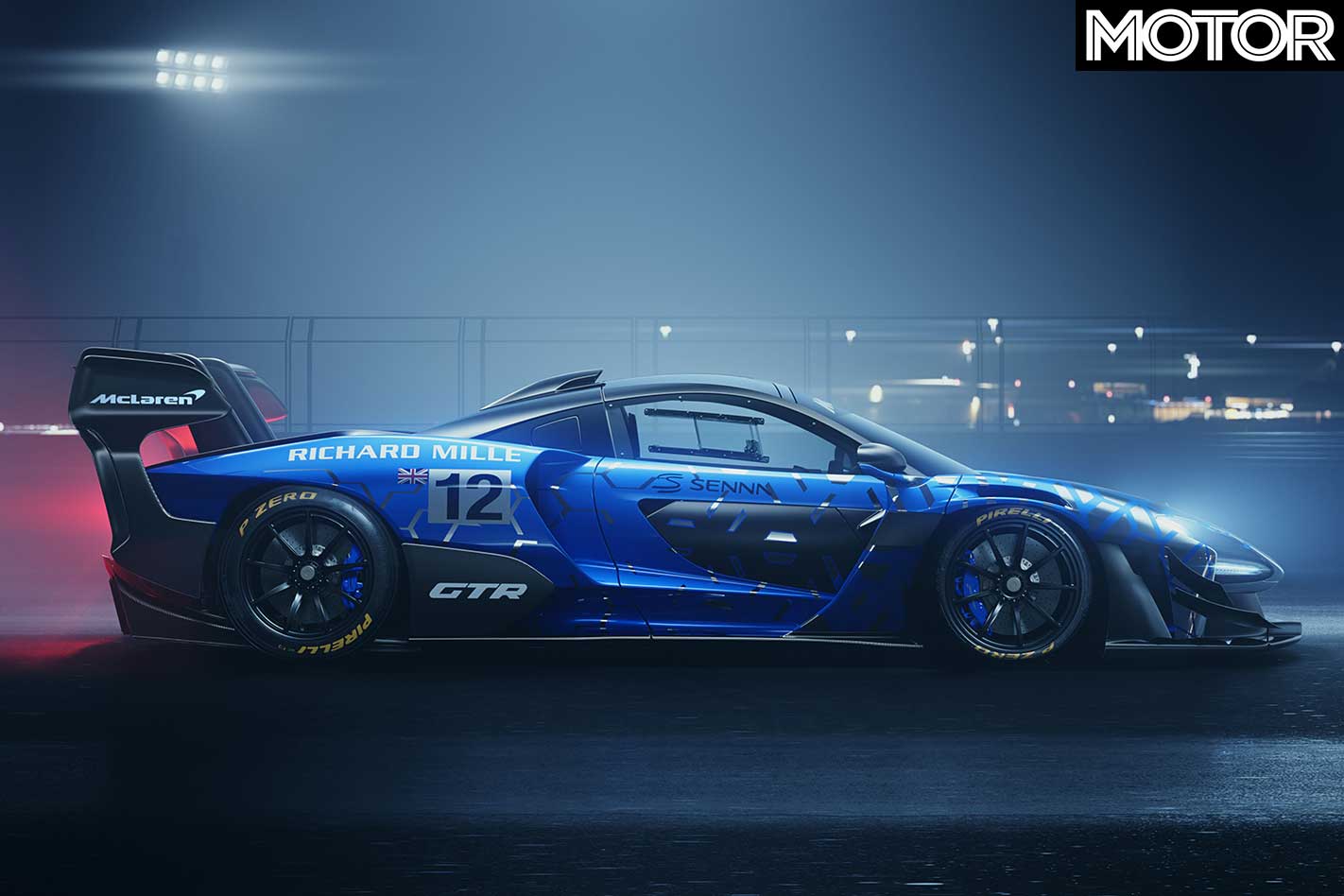
The Senna GTR is 10kg lighter than the road-going car thanks to the deletion of elements like the infotainment touch screen and the audio system, though comfort features like air-conditioning remain.
On the topic of tonnes, McLaren also says the Senna GTR generates more than 1000kg of downforce at 250km/h, where the standard Senna only makes 800kg.
McLaren CEO Mike Flewitt says building the Senna GTR free from road car regulations allowed the Woking engineers to create an unhinged version of its ultimate track car.

“The McLaren Senna GTR is a perfect example of our determination to bring our customers the Ultimate expression of track driving performance and excitement,” Flewitt says.
“The McLaren Senna was designed from the outset to be an extreme track car, but the 2018 McLaren Senna GTR Concept suggested how much more further we could go and now, free from the constraints of road car legislation and motorsport competition rules, we have pushed the limits of what is technically possible to advance circuit driving capability to another level entirely.”
McLaren says deliveries of the Senna GTR will start late this year.
Toyota has developed a fragrance system for its vehicles that, instead of providing a pleasant smelling ambience for occupants, can do the complete opposite.
While conventional in-car fragrance systems have been around for some time, a car manufacturer has never thought to use the system in such a sinister way. That is, until Toyota filed a patent that can determine “illegitimate engine starts”, like those when a car is stolen, and subsequently release a tear gas component inside the vehicle to fend off would-be car thieves.
Toyota describes the patent itself rather innocently: “a vehicle fragrance dispenser that may identify an occupant and releasing a fragrance associated with the occupant.”
As you can see in the patent diagram, it includes an immobiliser, transceiver device, fragrance controller and fragrance generator. A little more high tech than the traditional tree-shaped, pine-smelling rear-view mirror hanger, then.
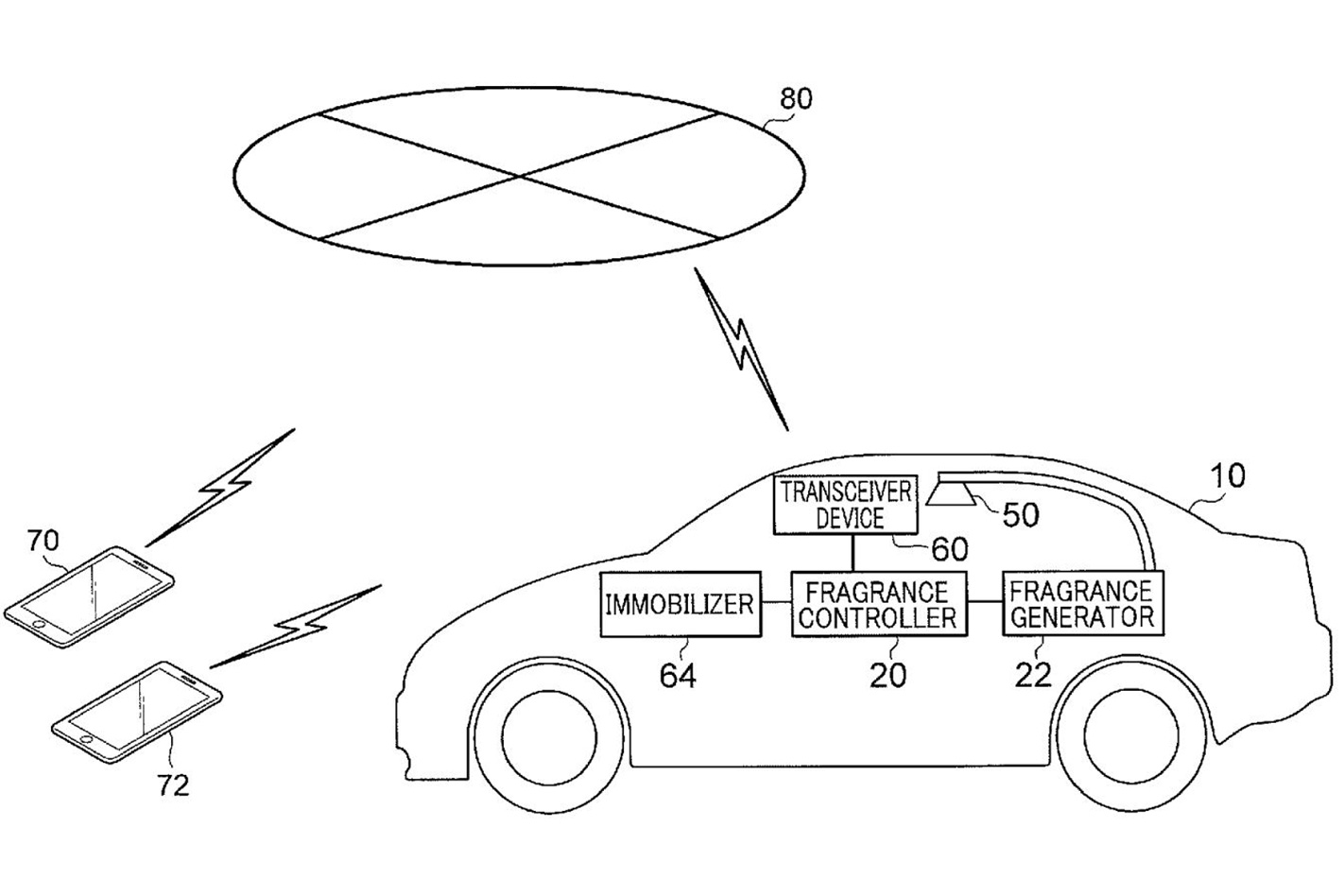
The patent also includes claims that the fragrance dispenser can also distribute a number of other different perfumes, dependent on pre-selected vehicle occupant preferences. The system does this by communicating with your phone’s mobile signals and recognising a specific smell paired to that phone and then dispensing it throughout the vehicle. This can be done in advance of a driver jumping into the car too, so you’ve got a nice smell to greet you.
The fragrance generator also includes a deodoriser which can rid the car of certain smells, or to deactivate the last fragrance remaining in the car. Could be particularly handy for that post-beach “wet dog” smell too.
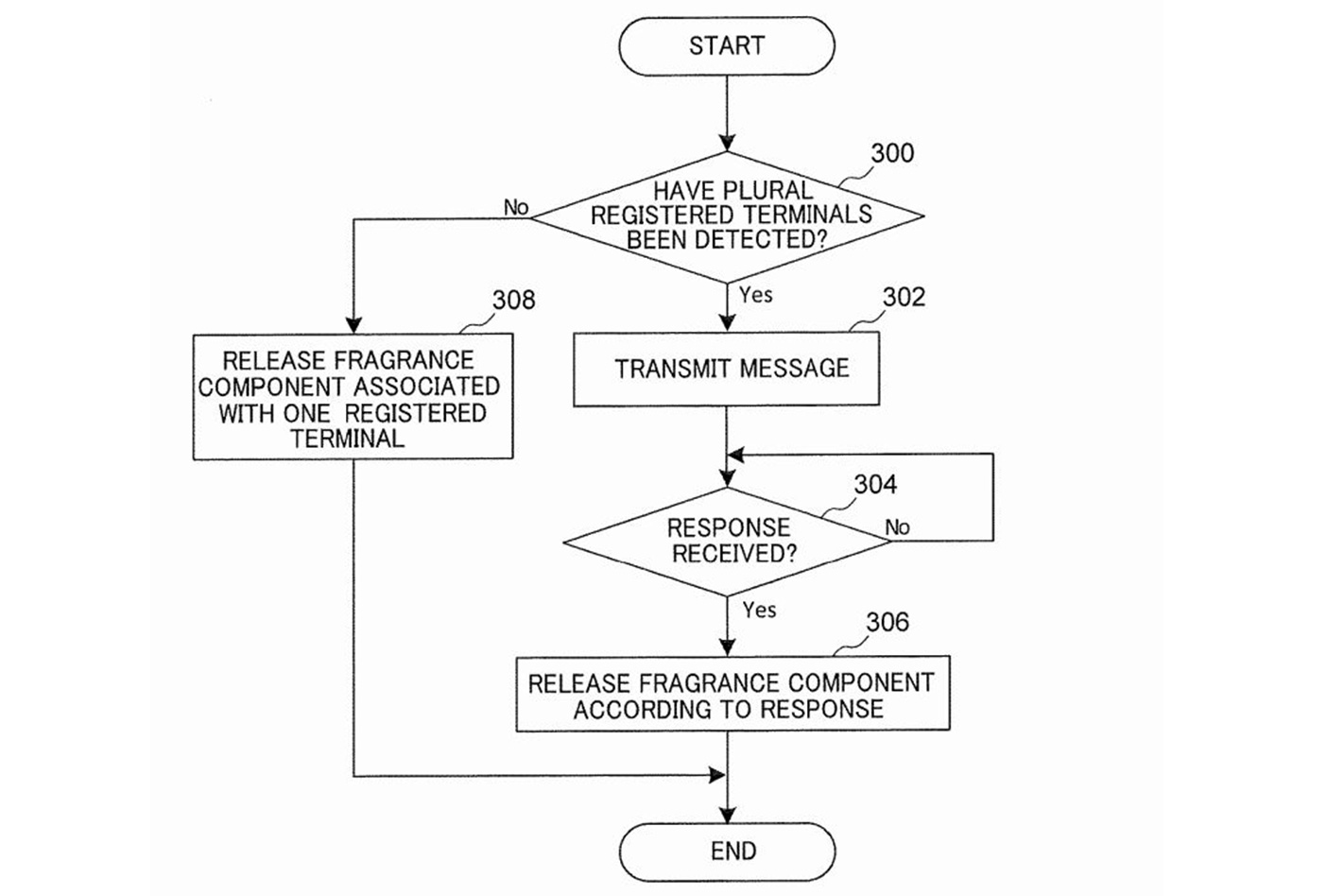
There’s no word as yet whether Toyota will actually include this fragrance system in its cars, but at least they’re thinking of innovative ways to combat car thieves.
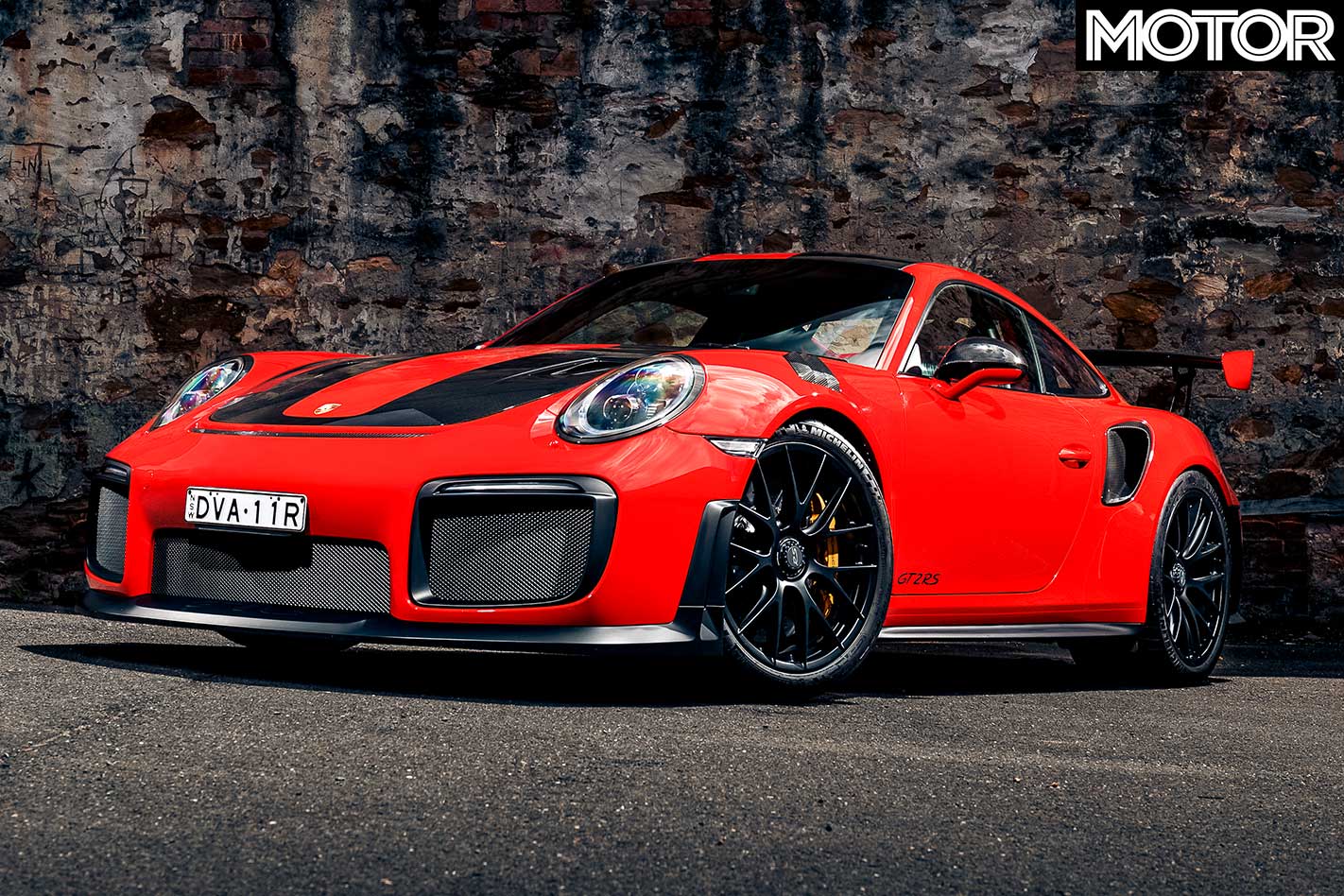
The 2019 Porsche 911 GT2 RS is MOTOR’s 2019 Performance Car of the Year. It’s so fast, so potent and so powerful that it not only beat 10 of the finest performance cars on-sale today, it beat democracy itself.
As you might have deduced, three of the five judges put the BMW M2 Competition atop their lists, but the Porsche scored highest overall. Cue much head scratching. In the end, the Porsche got the nod as the overall winner because it was no lower than second on any judge’s ballot, whereas the M2 scored three firsts, a second and a fifth. That means across five judges the GT2 RS had an average score of 1.6, whereas the M2’s average was 2. Porsche wins.
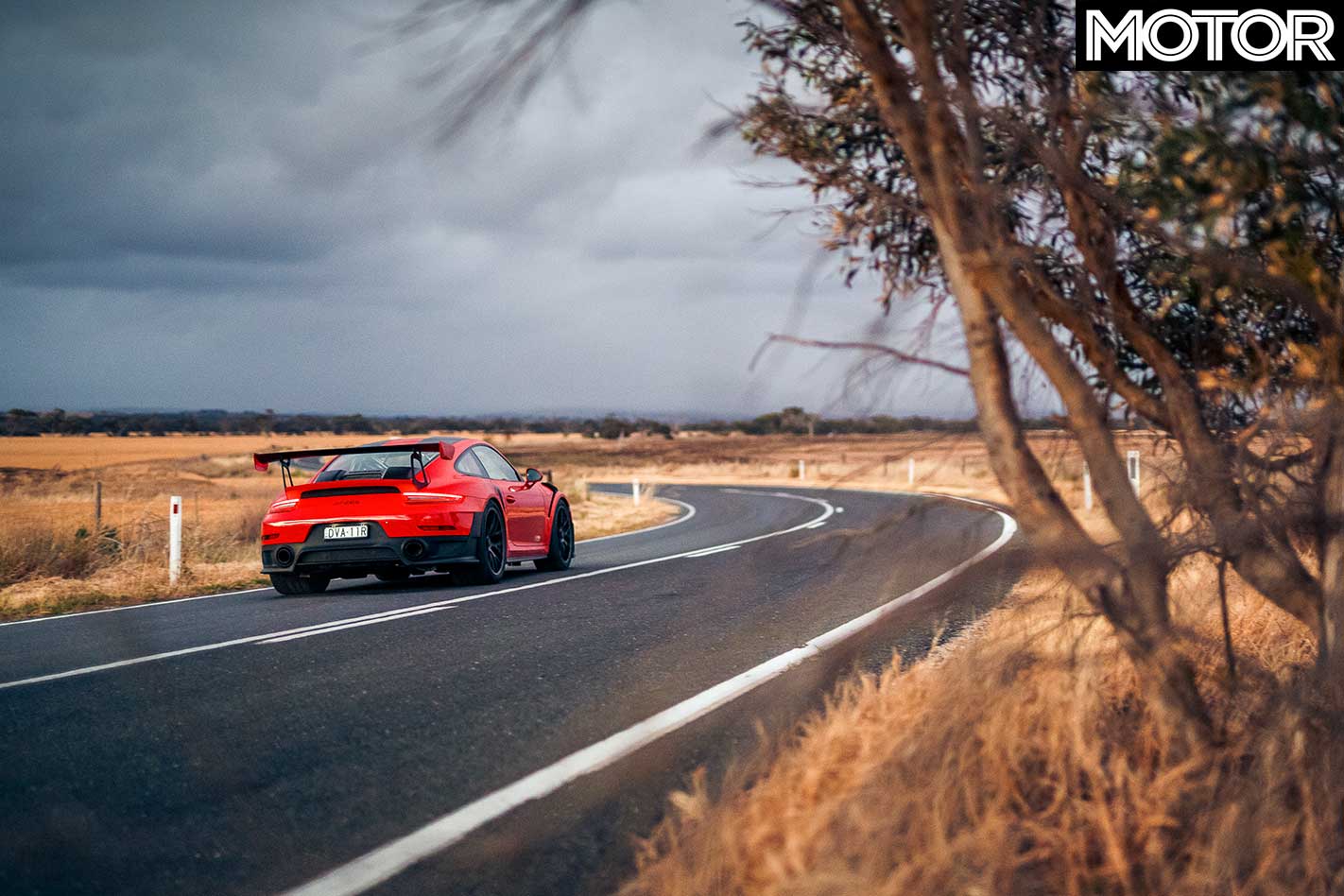
Though I did not personally vote for the Porsche, it takes only a glance at the numbers to know that it’s a worthy winner. Simply put, PCOTY has never seen anything like the GT2 RS. Neither have the judges.
Rick Kelly put it best: “It’s the only time I have felt acceleration that’s better than my Supercar.” Then again, that shouldn’t be a surprise, as this ultimate 911 has an almost identical power-to-weight ratio to Rick’s Nissan Altima with even more torque.
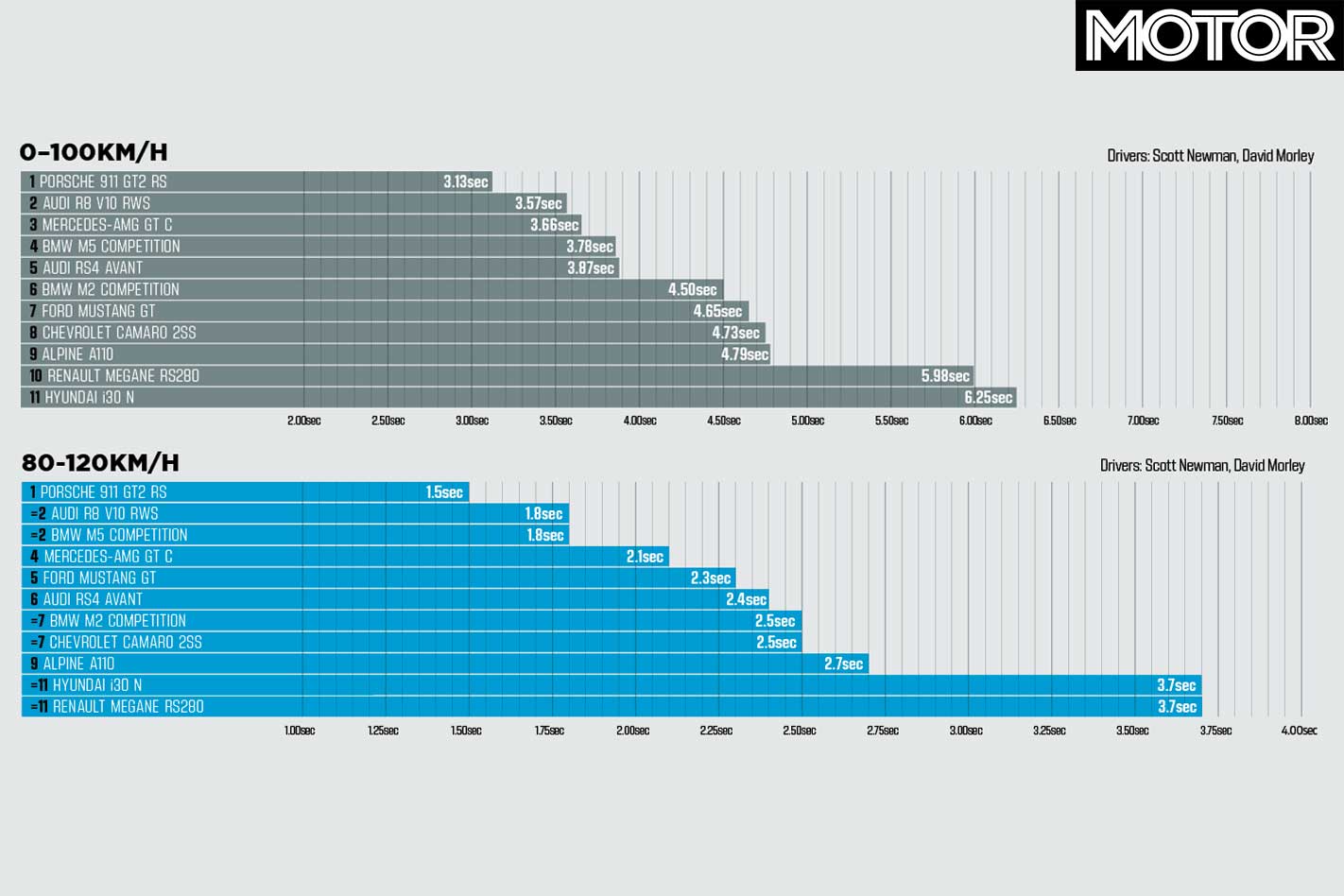
In terms of outright performance, the GT2 RS blew the other contenders to smithereens. It was 0.44sec quicker to 100km/h than the second-placed R8 RWS, yet was merely warming up. Once rolling, the Porsche was gone.
Its 10.63sec quarter mile is the lowest number we’ve ever recorded, while its 220.85km/h trap speed is the highest. Its 1.5sec 80-120km/h effort is essentially time travel, while no production car we’ve experienced stops better, the GT2 RS pulling up from 100km/h in 30.12m. The scary part? It could’ve gone even quicker. With more grip the 2.8sec 0-100km/h claim is surely achievable while a number of runs resulted in 225-226km/h trap speeds.
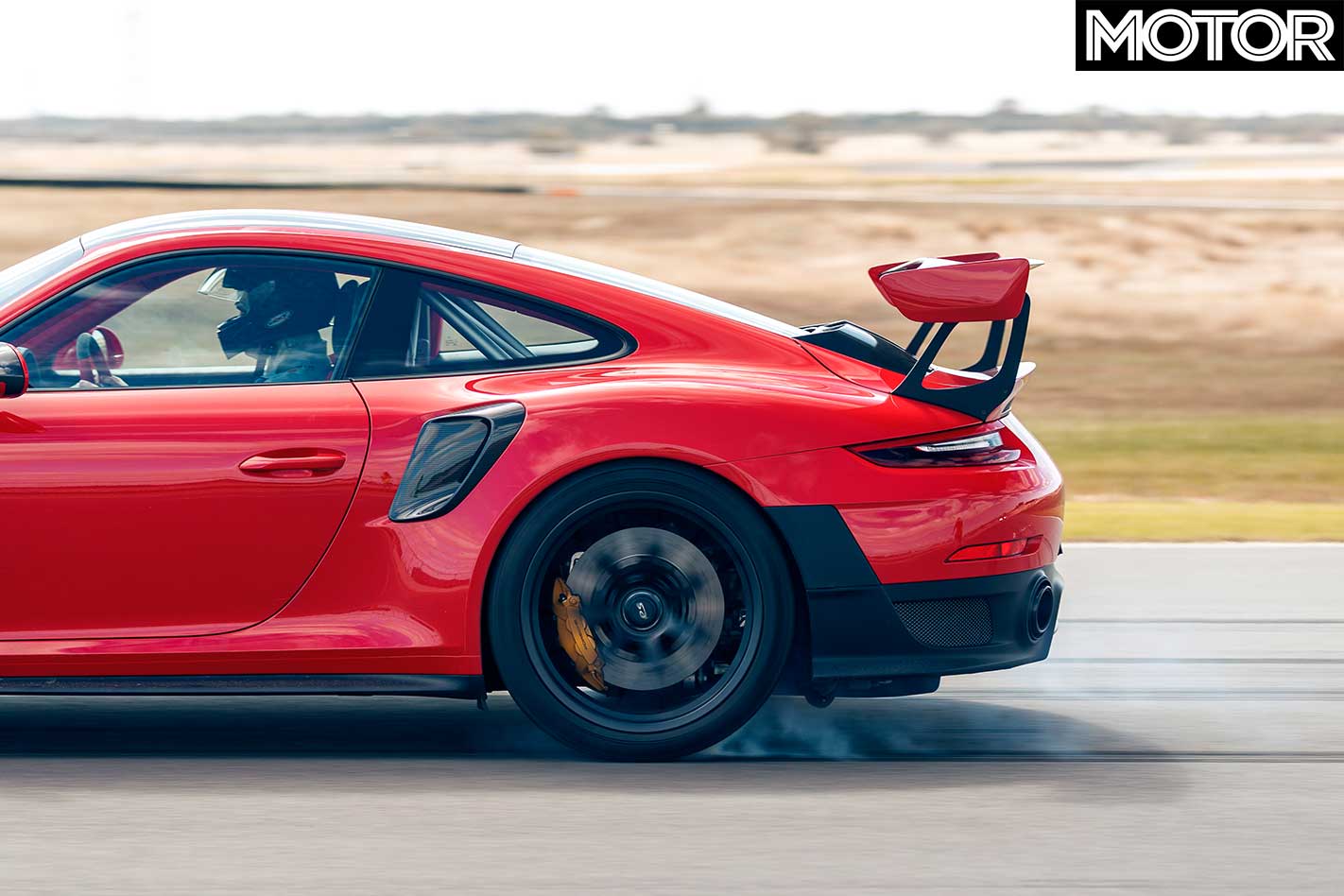
But the GT2 RS isn’t a Dodge Demon, it’s more concerned with corners than the straight bits in between. In a mere 3.41km the Porsche pulled 3.3sec on the second-best AMG GT C, itself an outstanding circuit performer. A Hyundai i30 N is no slouch – by most standards it’s a reasonably quick car – yet the GT2 RS was 13.3 seconds quicker around The Bend’s West Circuit.
Yet PCOTY never has and never will be about pure numbers. If it was we could simply select the winner from a spec sheet and save a lot of time and money. A PCOTY winner has to set the performance benchmarks in its segment, yet also be useable and enjoyable as a road car.
The most remarkable aspect of the 911 GT2 RS is its friendliness. It has that uncanny Porsche knack of enough initial compliance to absorb the majority of bumps while retaining ruthless body control on gnarlier roads.
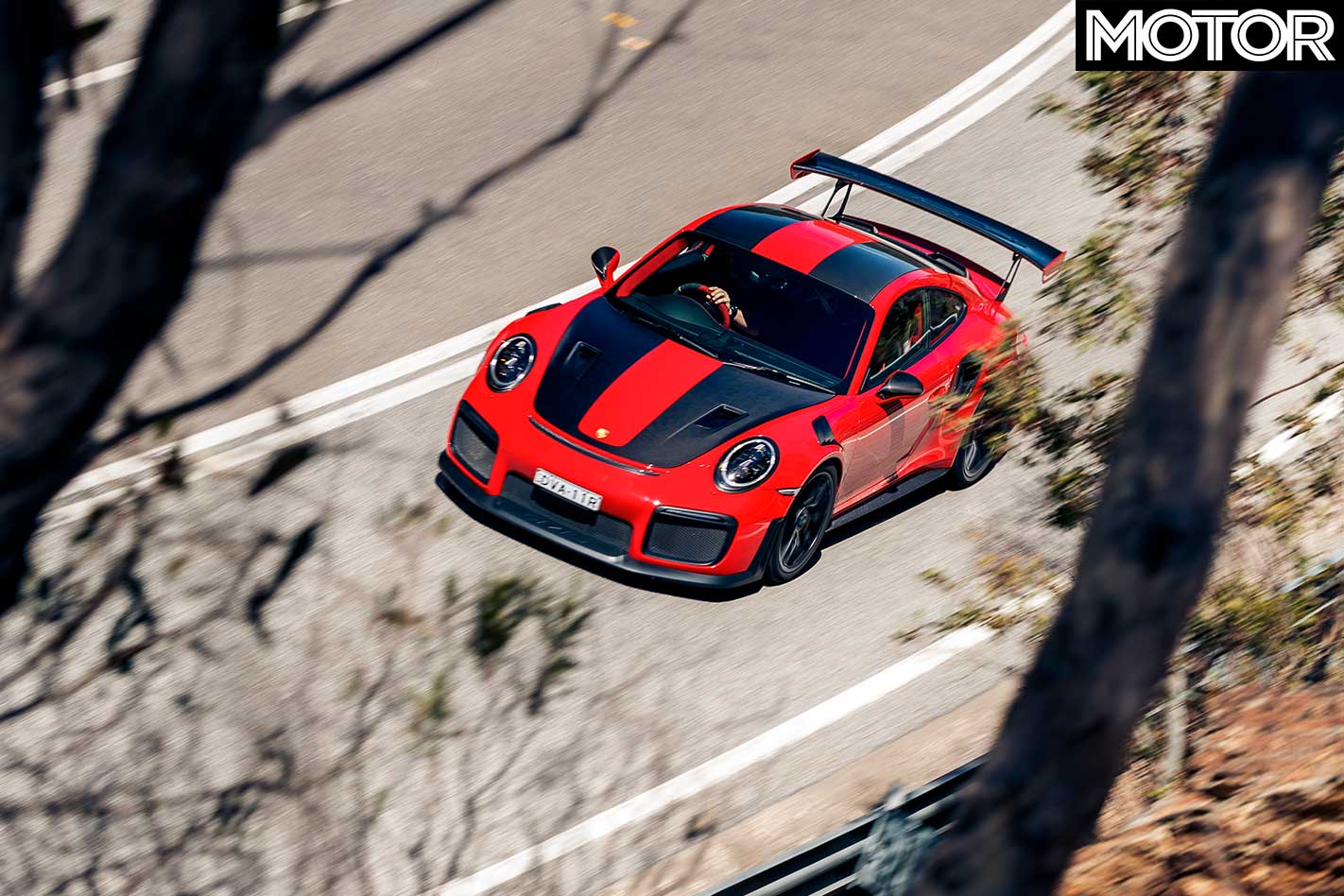
On very bumpy tarmac it struggles, hopping and skipping and triggering the unusually conservative traction control. Porsche’s motorsport models haven’t adopted the standard cars’ ‘Sport ESP’ setting and while it’s not a huge issue in the GT3, the enormous torque of the GT2 RS results in almost constant electronic intervention with the aids engaged, yet deactivating them on the public road is potentially brave or foolhardy in a car this fast and expensive. Owners might aspire to being Walter Rohrl, but are unlikely to possess the same level of driving talent.
You don’t need to be driving a GT2 RS quickly for it to be an event. The theatre starts from the moment you turn the key, the 515kW/750Nm 3.8-litre twin-turbo flat-six erupting with a bassy explosion unlike any boosted Porsche engine that hasn’t been strapped into the back of a Le Mans car.
The dual-clutch ’box and light steering make it undemanding to drive, but it’s also the noisiest car any of the PCOTY judges have ever experienced.
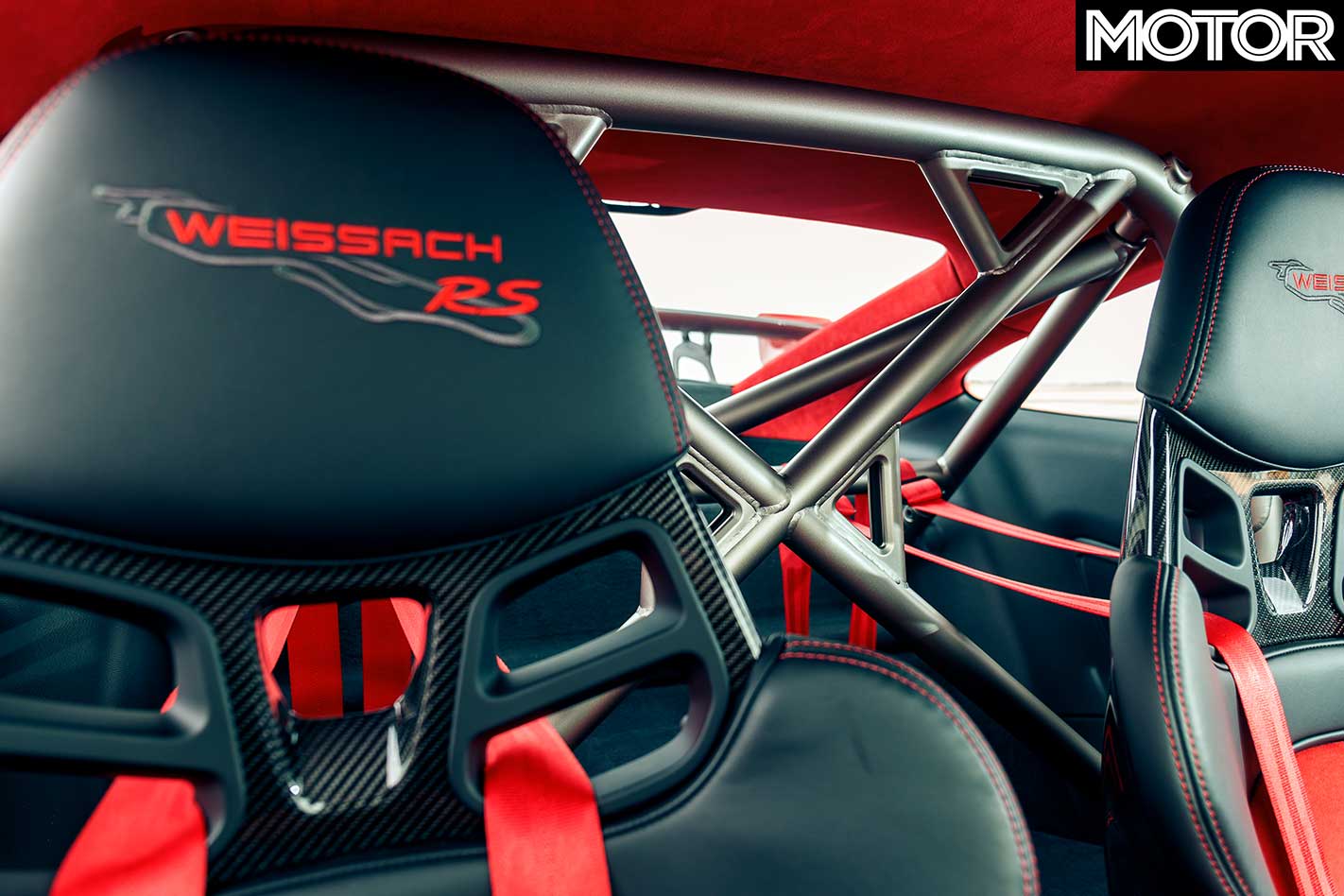
Road noise is an issue in most 911s, but the enormous Michelin Cup tyres on the GT2 RS thrum so loudly at speed that conversation is a challenge. There’s so little sound deadening that you can clearly hear the turbos exhaling, the brake pads gripping the discs and the gearbox swapping cogs.
This sonic symphony, as well as the way the steering gently dances in your hands over bumps, means you don’t have to be driving a million miles an hour to be entertained in a GT2 RS, though Morley is convinced the novelty would soon wear off. Whatever you do, don’t touch the exhaust button on the open road, the resulting din is enough to give you a headache in a matter of moments.
But a matter of moments is also all it takes for the GT2 RS to comprehensively blow your mind. The expectations are so high that you don’t want to spoil it by immediately flattening the throttle, like holding off opening all your Christmas presents at once.
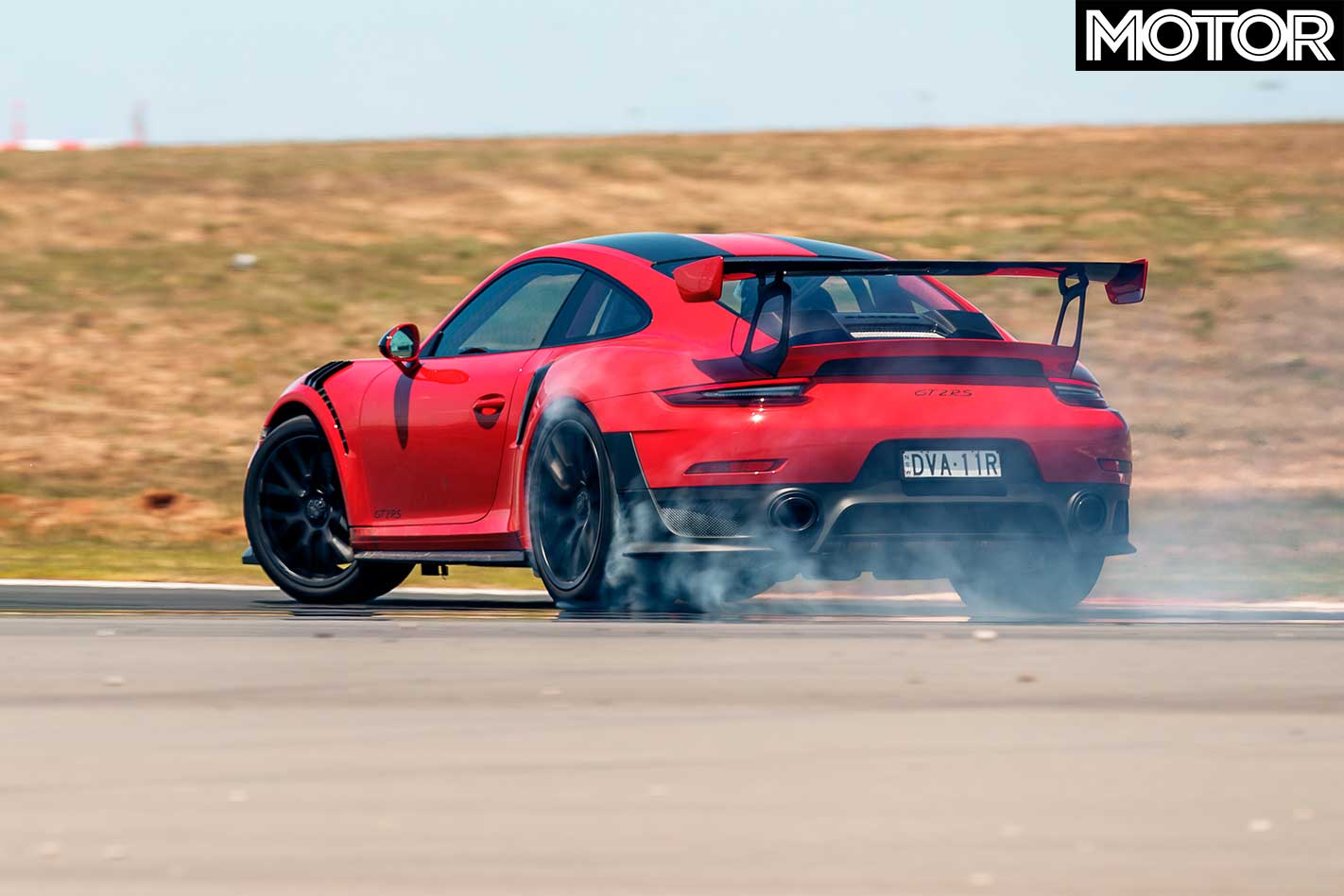
However, like that one day in December, the concept of delayed gratification is quickly thrown in the bin and the accelerator is pressed to the floor. You can catch a GT2 RS off-boost, but it almost has to be deliberate; more often than not Frankenstein’s 911 hesitates for a fraction of a second before rearranging your internal organs.
It’s not quite as violently accelerative as a McLaren 720S, but that’s like saying it’s slightly less painful getting kicked in the face by Jackie Chan than Jet Li. You’re almost guaranteed to blurt out a four-letter word as the tacho rips around to 7000rpm, and another one as the rate of acceleration refuses to slow.
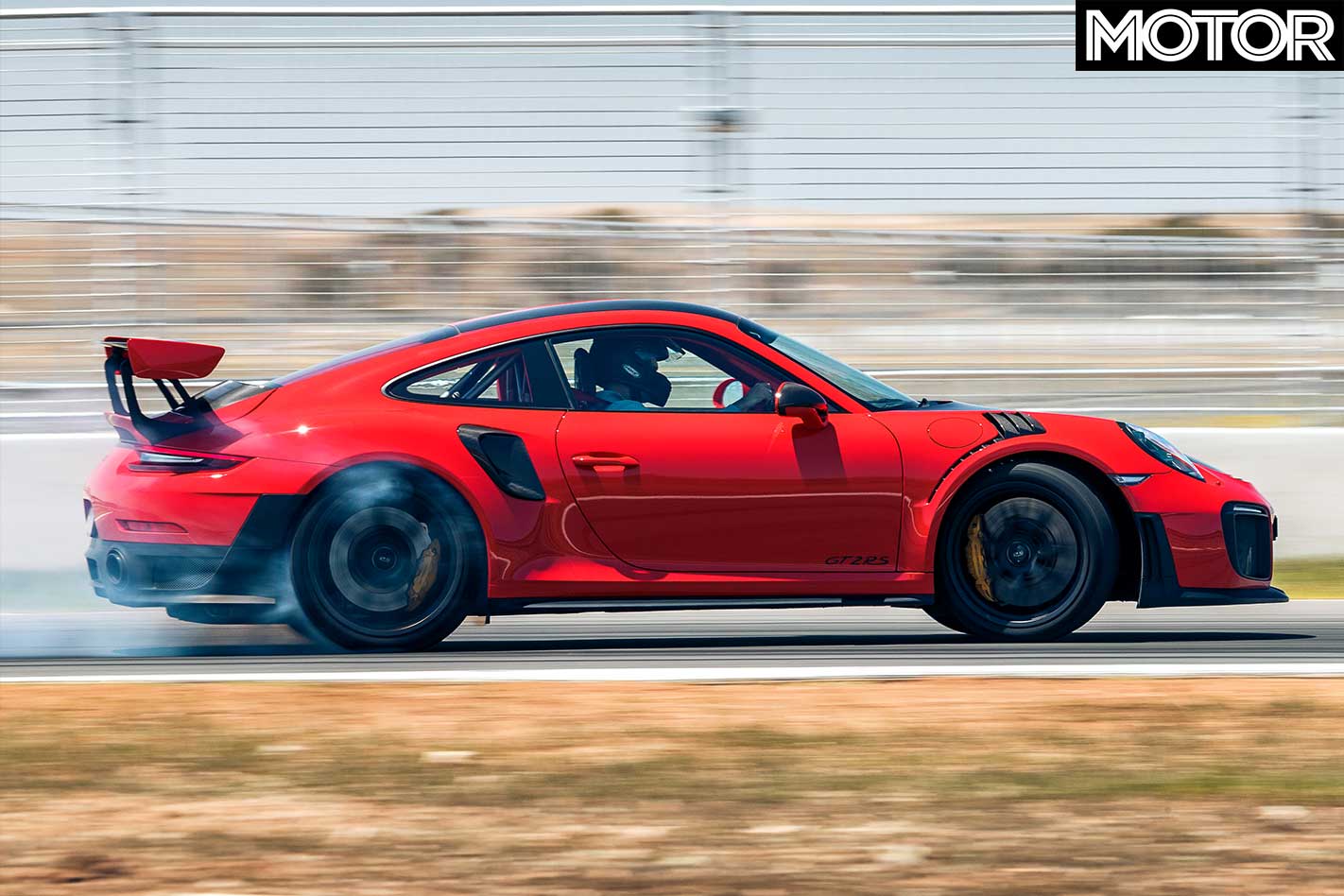
Down The Bend’s long main straight the GT2 clocked 270km/h and was still pulling hard. The engine has masses of power everywhere, sounds evil and is made even more potent by very short gearing – Porsche, please put this gearset in the GT3!
Anyone familiar with traditional 911 dynamics will find the GT2 RS quite shocking. The front-end bite is simply incredible and there’s so much power that even the inherent traction advantage provided by the rear-engine layout can’t stop the rear tyres being overwhelmed at will.
On the road this makes it more engaging than its naturally aspirated flat-six siblings; for all the excitement of its screaming 9000rpm redline, a GT3 needs to be driven with total commitment to truly come alive.
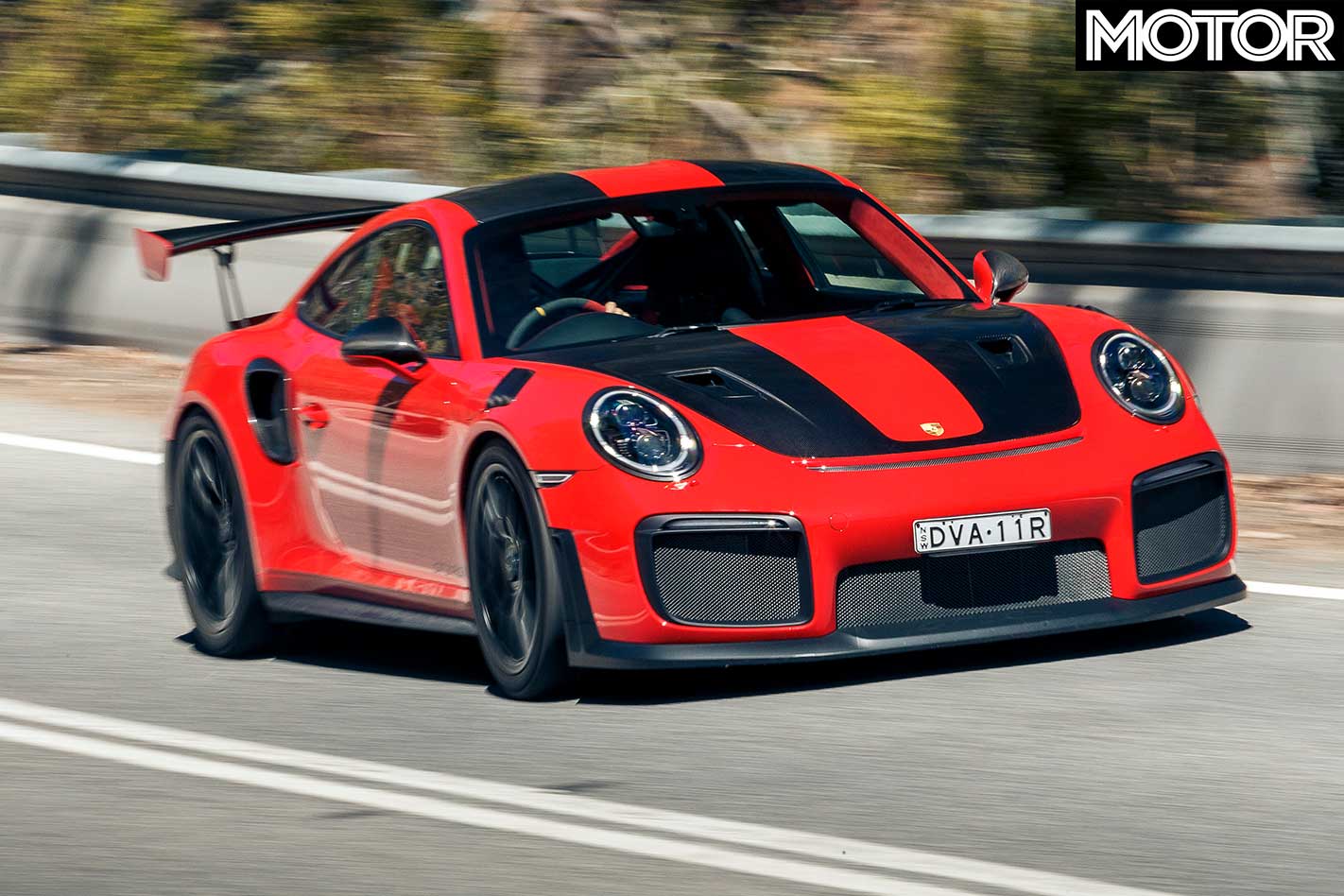
On track the Porsche has no equal – Rick’s biggest complaint was that it needed slicks! It refused to wear out its tyres or brakes, though the water injection did need a fill up at one stage. It also completely refutes the GT2’s widowmaker reputation.
A car this fast and powerful needs respect, but loosen the rear with the brakes, pick up the throttle with confidence and this 515kW 911 will happily sit sideways and bonfire its enormous rear tyres. Regardless of whether you’re driving to be fast or have fun, the GT2 is utterly exhilarating.
The only real problem is the price. It’s a relatively weak argument as Porsche opened the production floodgates and is still selling every GT2 RS it can build, but $645,000 (almost $800K as-tested on-road) is a crazy amount of money for a 911. As DC put it: “Porsche is charging limited-edition money for what is no longer a limited-edition car”.
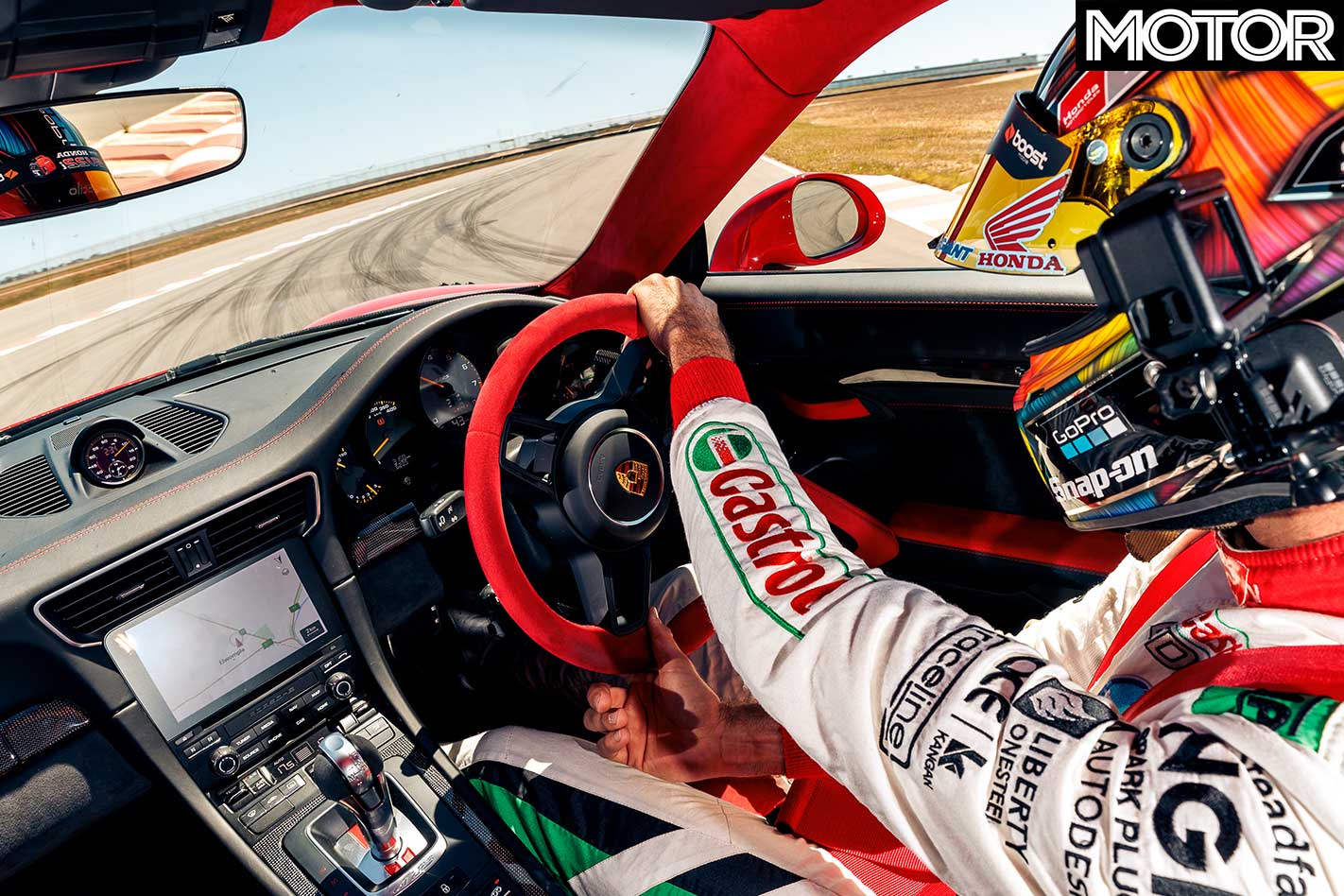
Personally, as incredible as the GT2 RS is, the Turbo S that won PCOTY two years back was very nearly as capable, much more liveable and almost $250K (!) cheaper. However, almost 700bhp has a way of rendering mundane criteria like value quite redundant. If you want the ultimate performance car, this is it.
The Numbers
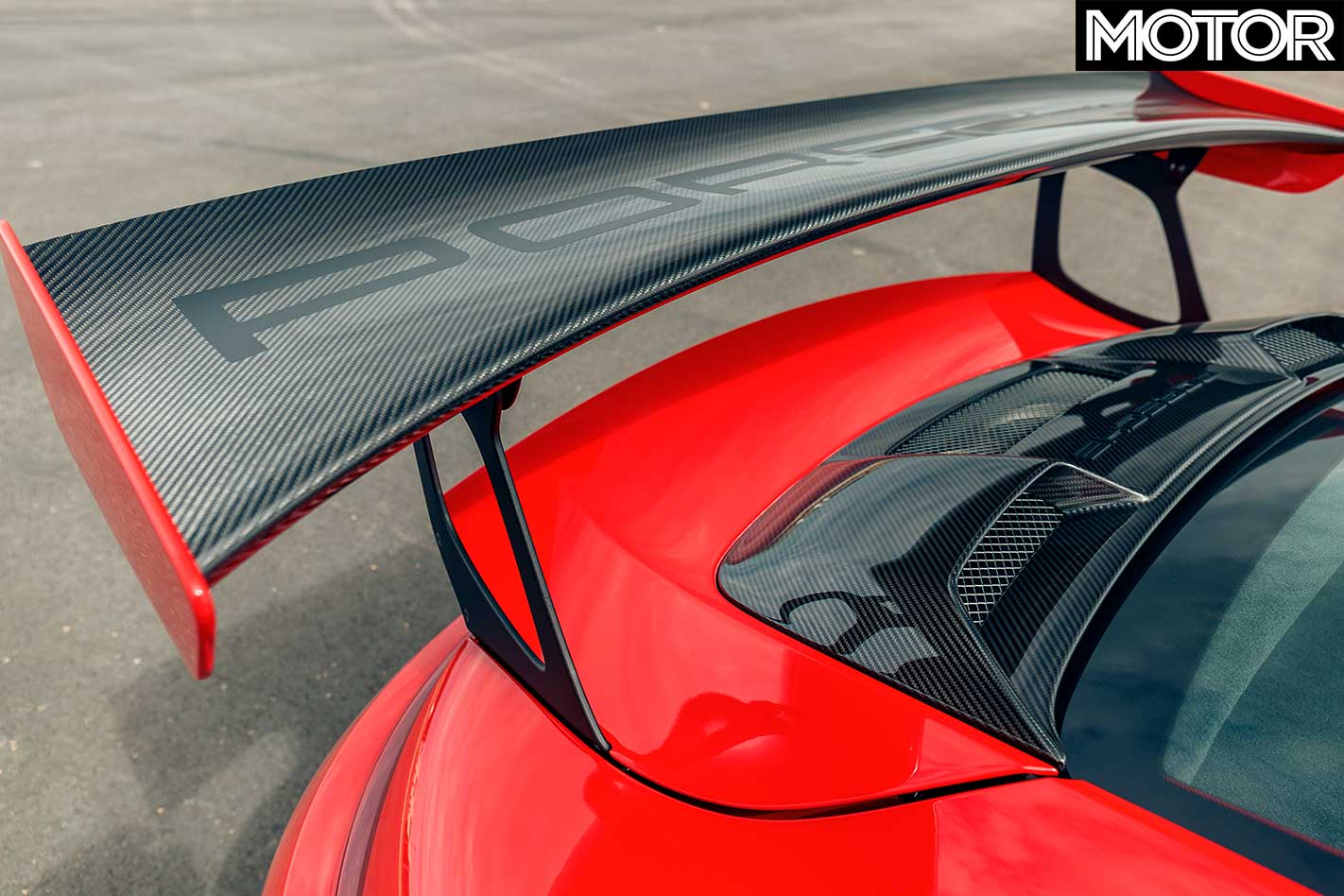
2019 PORSCHE 911 GT2 RS SPECS: Engine: 3800cc flat-six, DOHC, 24v, twin-turbocharged Power: 515kW @ 7000rpm Torque: 750Nm @ 2500-4500rpm Weight: 1470kg 0-100km/h: 3.13sec 0-400m: 10.63sec @ 220.85km/h The Bend lap time: 1min 24.0sec Price: $729,930
Judge’s Rank
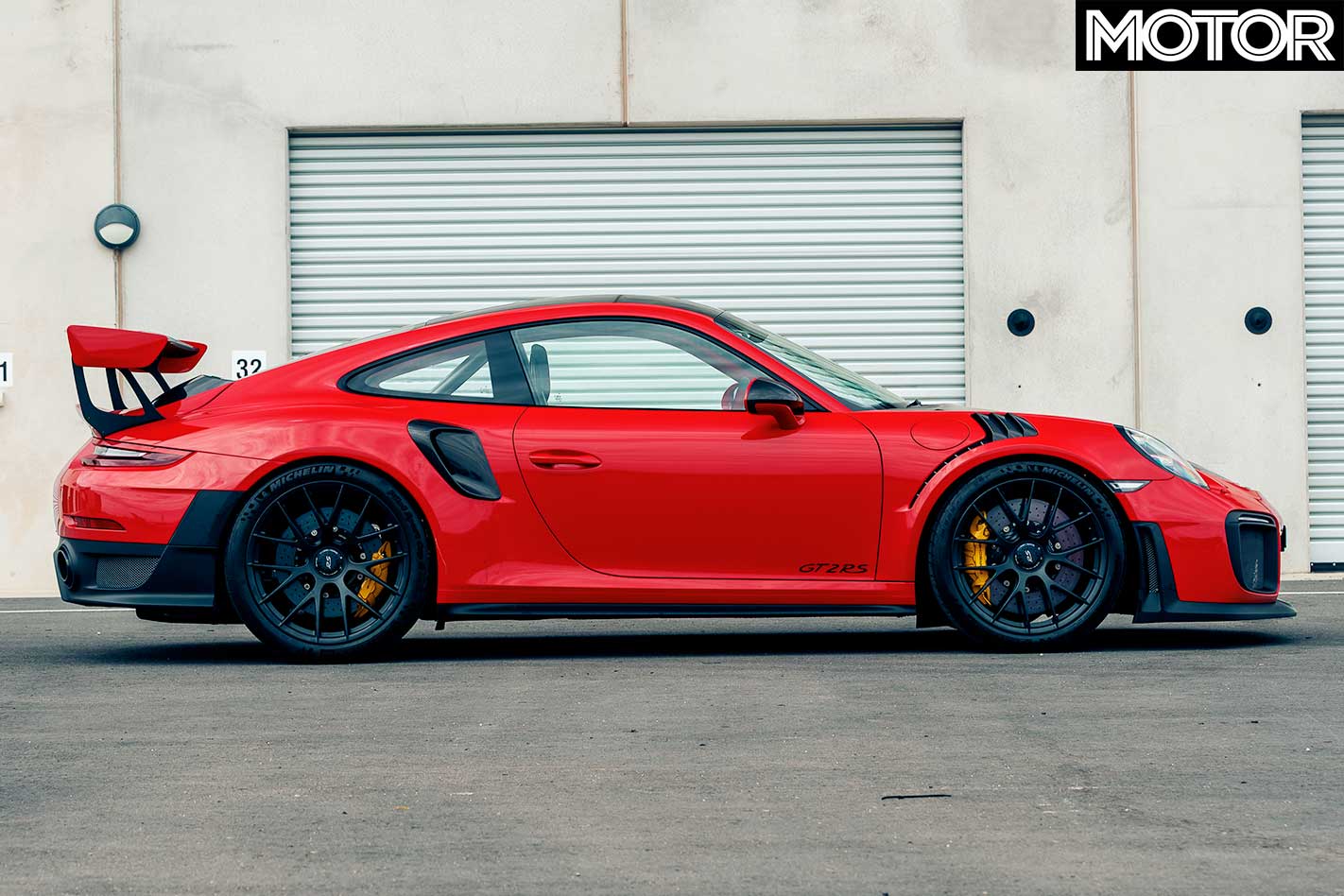
Dylan Campbell – 2nd “It’s so good I could weep. But man, $750K…”
Louis Cordony – 1st “It’s better and faster than you and always will be.”
David Morley – 2nd “Where on earth is this all going to end?”
Scott Newman – 2nd “Nuclear performance, yet so accessible. Amazing, but $200K more than a Turbo S?”
Rick Kelly – 1st “I love this car. It’s expensive, but I’ll never forget driving it. “
PCOTY 2019 Scoring
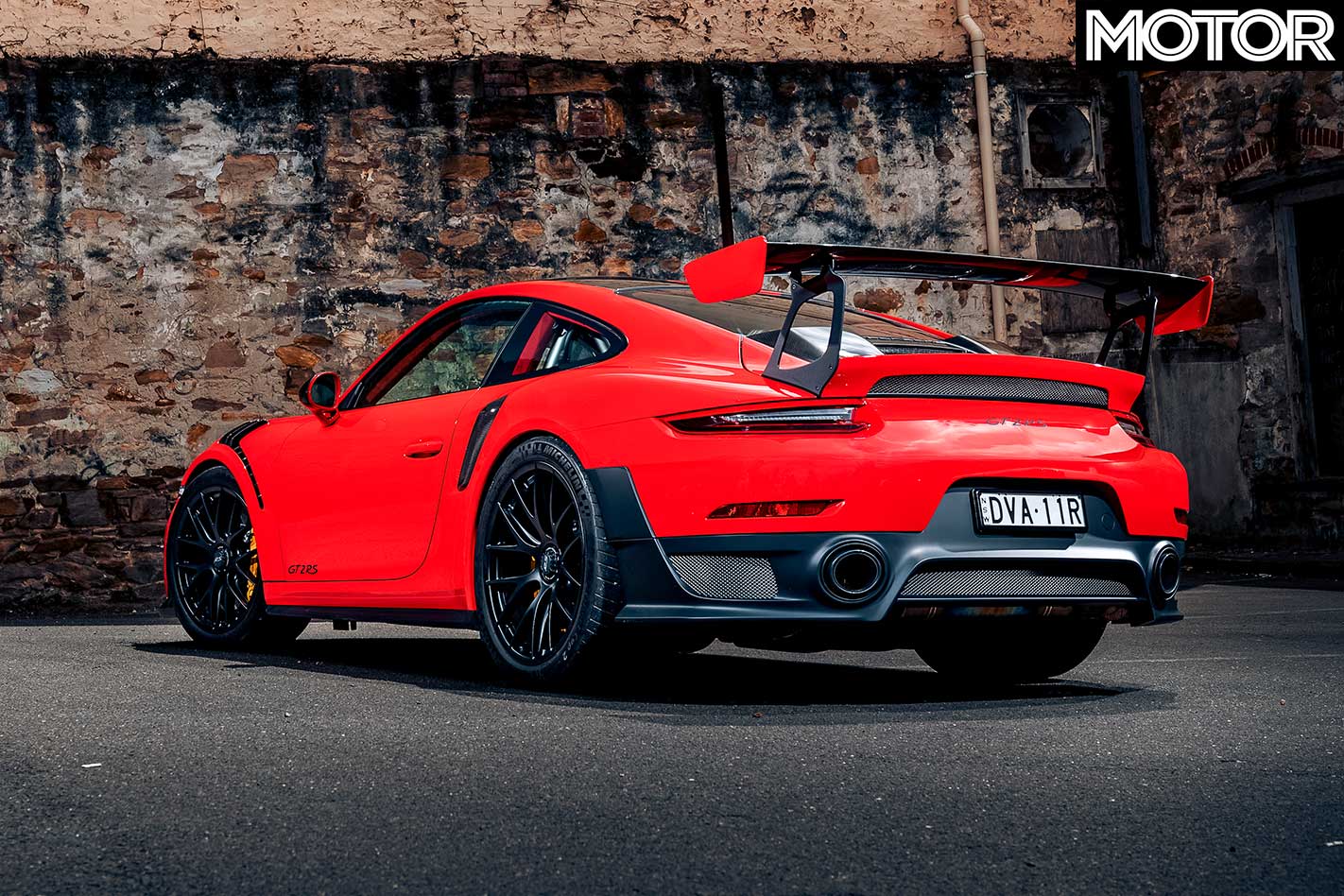
| Judges | DC | LC | RK | DM | SN | Total |
| Performance | 20 | 18 | 20 | 20 | 19 | 97 |
| Dynamics | 20 | 16.5 | 18 | 19 | 19 | 92.5 |
| Accessibility | 9.5 | 7.5 | 9 | 9 | 8 | 42 |
| Liveability | 6.5 | 7 | 5 | 5 | 7.5 | 31 |
| Value | 4.5 | 5 | 5 | 2 | 5 | 21.5 |
| X Factor | 10 | 7.5 | 10 | 10 | 9.5 | 47 |
| Total | 69.5 | 61.5 | 67 | 65 | 68 | 331 |
The Data
PCOTY Hall of Fame
1996 – Porsche 911 993 Turbo 1997 – BMW E36 M3 1998 – Porsche Boxster 1999 – Porsche 911 996 Carrera 2000 – Porsche Boxster S 2001 – Nissan S15 200SX 2002 – BMW E46 M3 2003 – Porsche Boxster S 2004 – Lamborghini Gallardo 2005 – Porsche 911 997 Carrera S 2006 – Audi B7 RS4 2007 – Porsche 911 997 GT3 2008 – Porsche 911 997 GT2 2009 – Audi R8 V10/Nissan GT-R 2010 – Porsche 911 997.2 GT3 RS 2011 – Nissan GT-R 2012 – Porsche 911 991 Carrera S 2013 – Audi R8 V10 Plus 2014 – Porsche 911 991 Turbo 2015 – Porsche 911 991 GT3 2017 – Porsche 911 991.2 Turbo S 2018 – Honda Civic Type R 2019 – Porsche 911 991.2 GT2 RS
Hi guys,
Not too sure if it’s something you can help with but here goes…
I have three kids and I need a new (well, almost new) car.I’m tossing between the Holden ZB Commodore (in either Calais or VXR spec), the Holden Equinox (in LTZ-V spec) and the Skoda Superb. What do you think would serve best? All around the $30,000 mark, a year old and around the 10,000-20,000km mark.
Not too fussed about fuel economy, but want safety, good power, and lots of rear seat (especially leg) room.
Johnny
Hey Johnny,
Three pretty good choices there! Nice to see you’ve favoured a couple of wagons over SUVs because there are some amazing buys out there for the money on cars with lower ride heights…
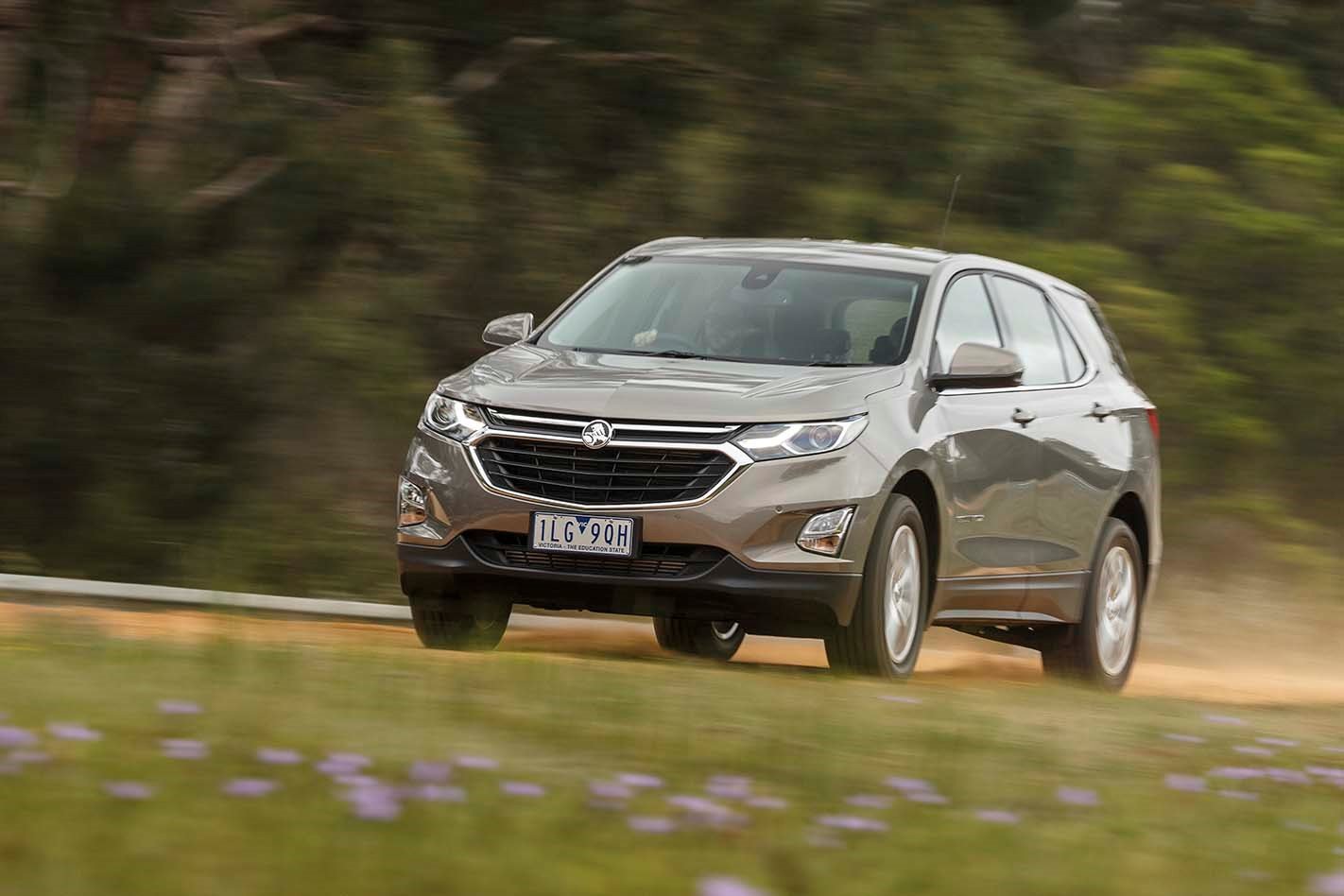
The Equinox hasn’t sold well for Holden – and for mine, it already feels a bit dated. Plenty of safety kit, though rear seat room is nothing like what you’ll get in the other cars.
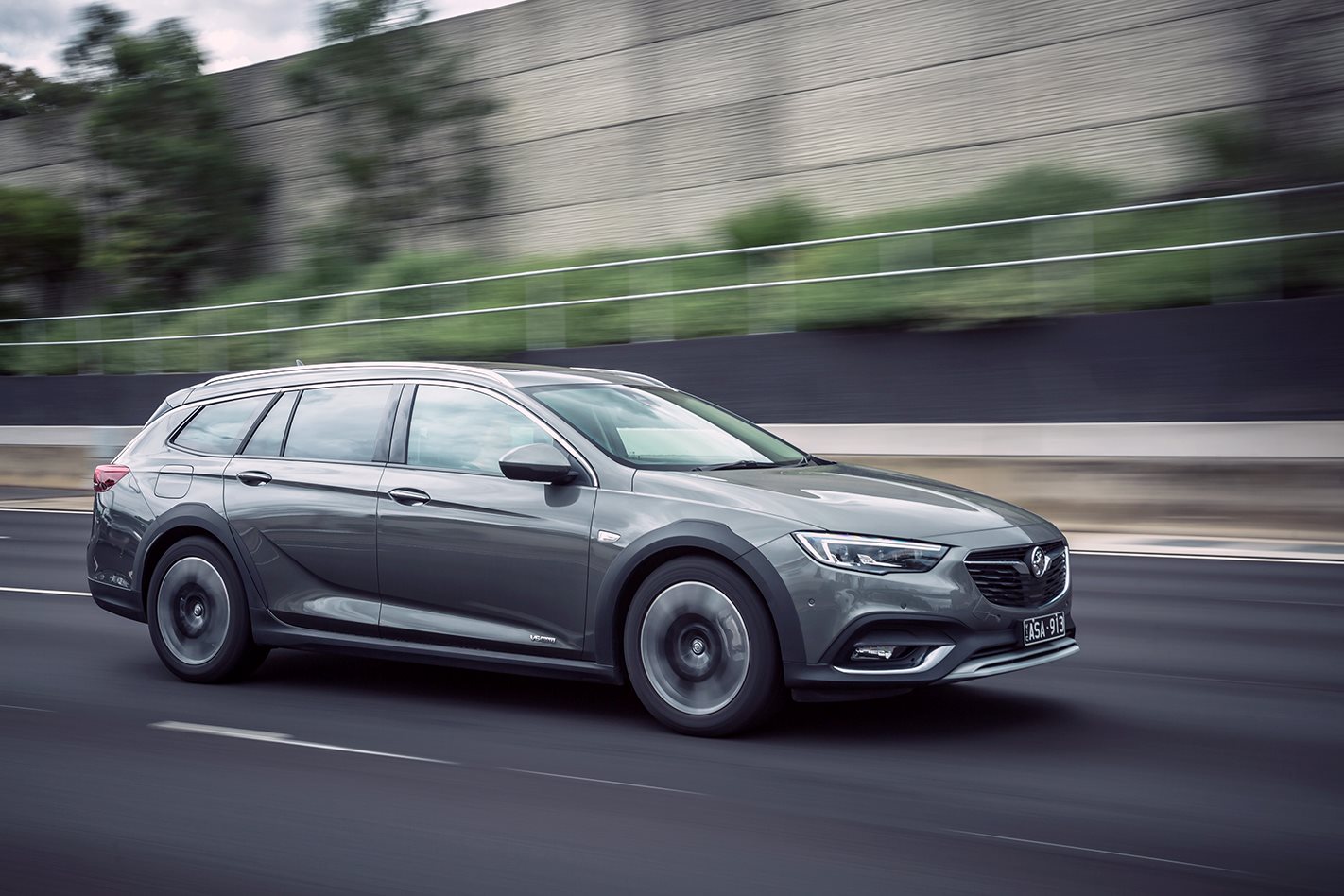
The Commodore wagon is a reasonable choice, too, and buying second-hand takes the sting out of the initial high pricing. However, there wouldn’t be too many around to choose from given the lack of sales volume, so you may pay a premium to find the one you want. The Calais will ride more comfortably, and the VXR is probably the better looking of the two.
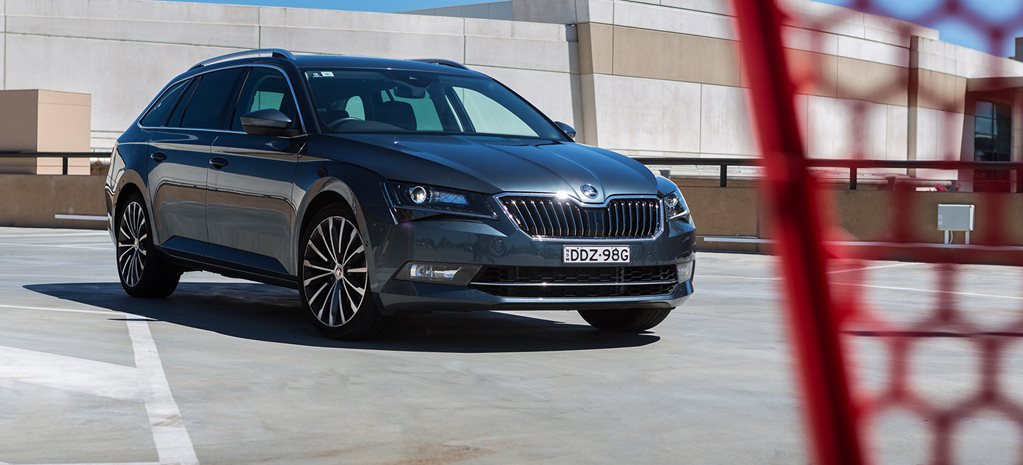
My money is on your third pick, though. The Superb wagon is absolutely enormous in the second row, and still has plenty of cargo space.
The 162 TSI version really gets along as well. Again, not a heap of cars to choose from, but I’d hunt far and wide for a low km example in the spec you want. It’s a handsome rig that handles and goes just fine.
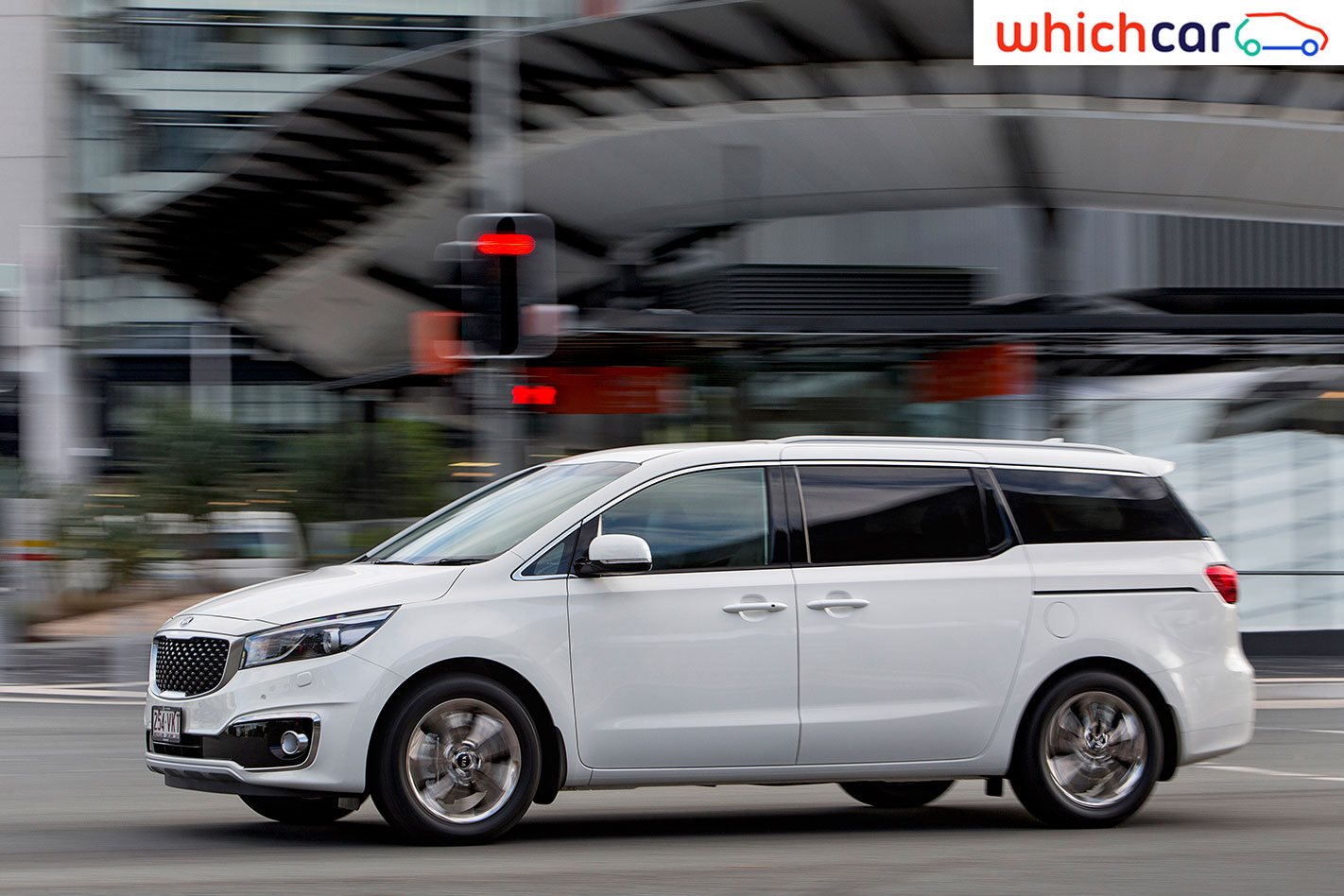
As a wildcard, have you considered the Kia Carnival? Don’t laugh – it’s a great family rig with a tonne of room, it looks pretty damn good and you get a lot of gear in the higher spec versions.
You also asked about extended warranties – none of the cars was subject to major recalls in the period you mention, and you still have a good year left under the original warranty.
You should also be getting a warranty if you’re buying from a dealer second-hand.
From a distance, the Stradale looks vaguely like a vintage Le Mans racecar – low and wide. This is as hardcore as they come; nothing less would be expected of Dallara, a company that builds racecars. However, this road legal, 155,000 Euro (AUD$250,000 estimate) racer has number plates and demands to be taken seriously on-road.
Hopping into the Dallara – and yes, you hop because there are no doors or roof – you immediately realise you’re in something serious. While the pedal box and steering column are adjustable in reach, the one-size-fits-all seat is fixed. This is a serious bit of kit with no advanced safety systems or modern luxuries. However, you’re still probably wondering what it is.
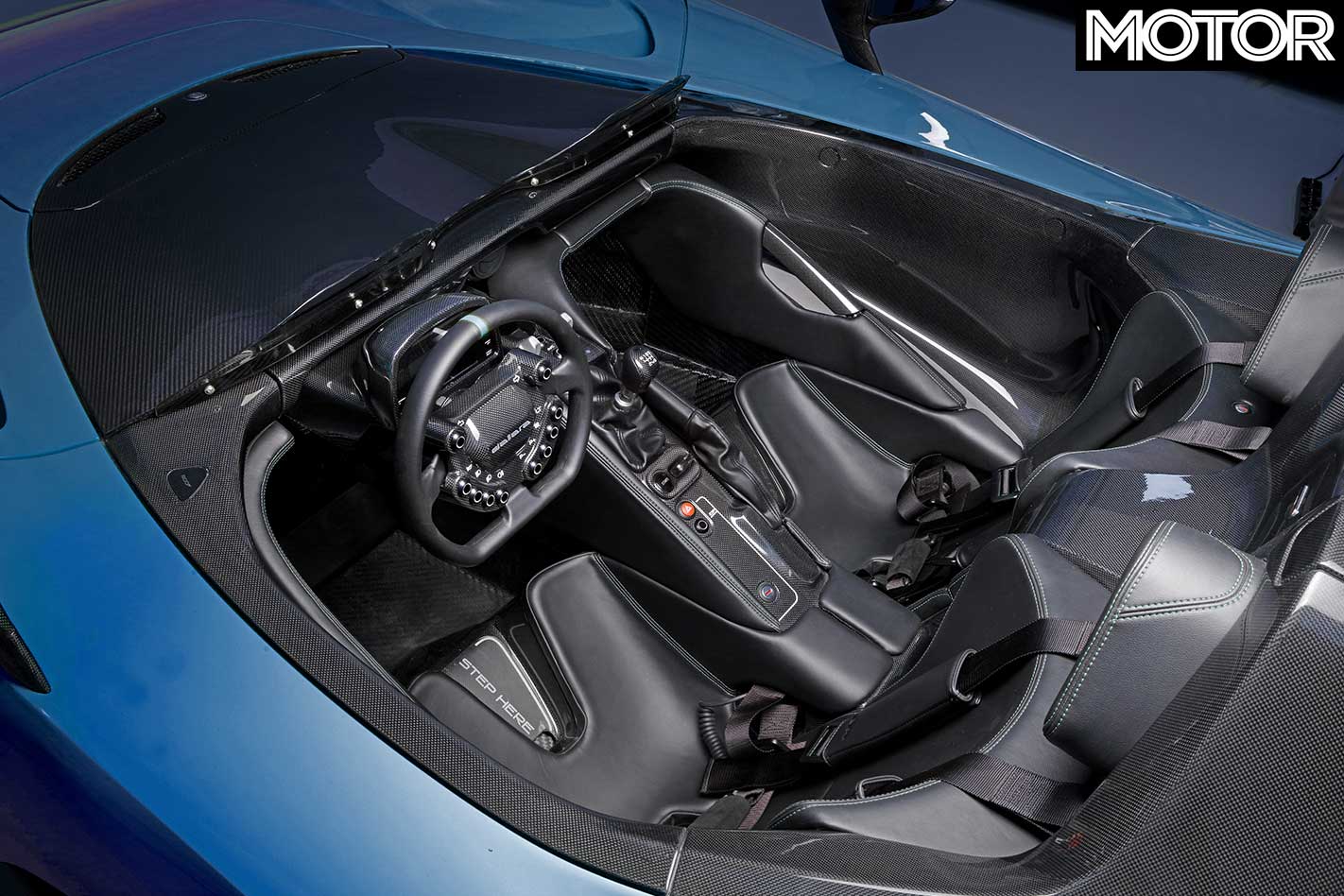
For decades Dallara has been processing carbon fibre like other makers have shaped steel or aluminium. So, this track-tested, lightweight construction technique results in an 855kg kerb weight. That becomes more significant when you realise the Stradale isn’t short on power from its Ford-sourced EcoBoost 2.3-litre four pot. Rated at 295kW, it’s no slouch and ties in well with either a six-speed manual or an automated six-speeder, which adds 40kg to the tally.
Want more numbers? The dash to 100km/h passes in 3.25 seconds, while in-gear acceleration is strong with 80-120km/h (fifth gear) taking 3.49sec and 100 to 200km/h 8.5sec.
It’ll go on to reach a top speed of 282km/h and can stop from 100km/h in just 31 metres. Get on track for some hard cornering and you’ll be pulling in excess of 2.0g – better toughen up those neck muscles. Again, this is a racer for the road. But unlike the Ariel Atom, you can option in a T-top glass canopy, single-arm wiper and air-conditioning for a cost.
Delivering peak power at 6200rpm, the boosted, mid-mounted 16-valver’s throttle response is brisk, but not Ferrari-like instant. The soundtrack can be felt as an almost physical swoosh, like a bullet piercing the perimeter of a wind tunnel.
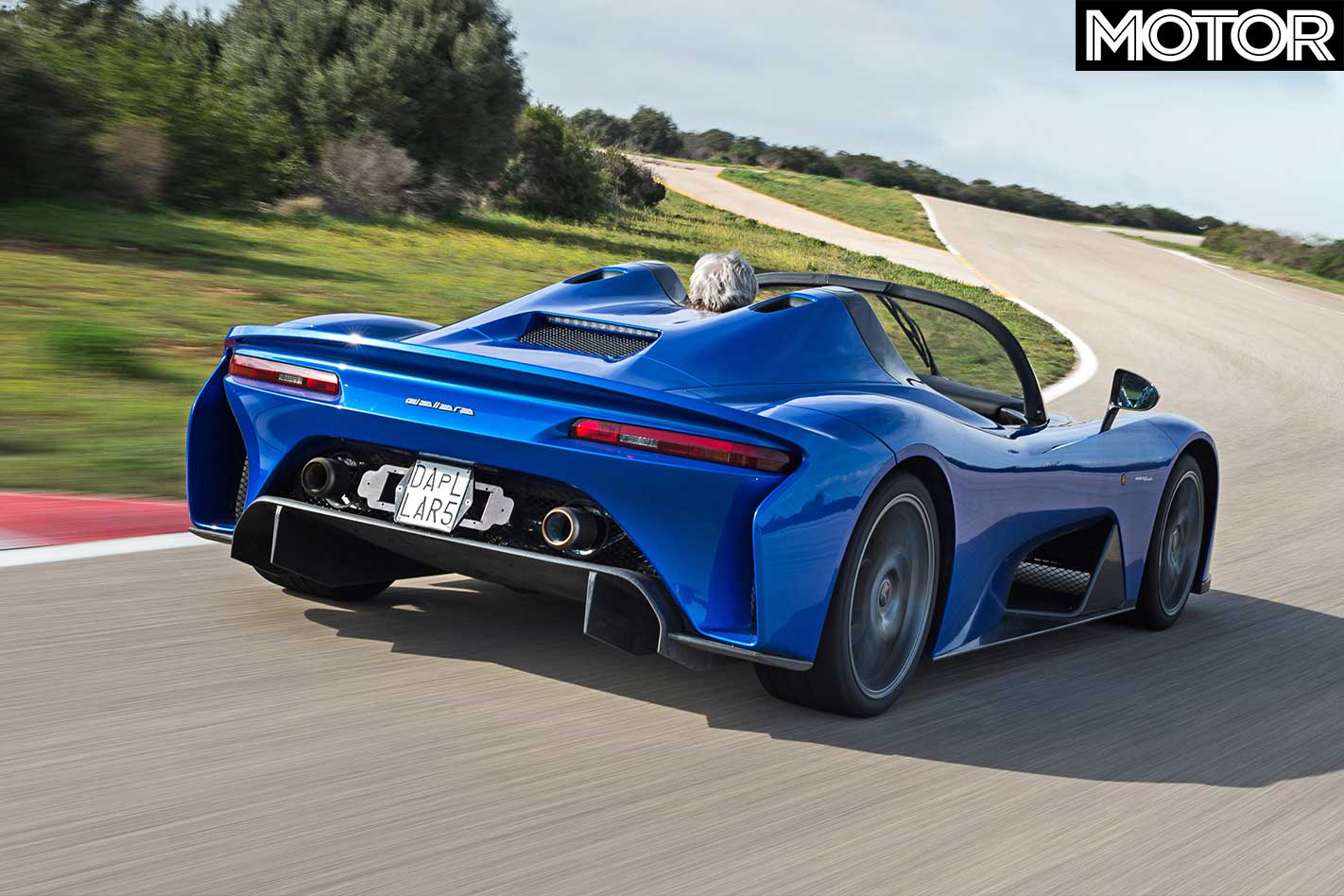
Turbo lag can be an issue when low revs encounter a tall gear and its general willingness to rev seems to be left wanting. The engine spreads a useful 500Nm from 3000-5000rpm, thereby affording an unexpectedly relaxed personality. However, as the aforementioned numbers suggest, the Stradale is no slouch in a straight line – or in corners.
Shod with sticky Pirelli Trofeo R semi-slicks (235/40 R18 front and 255/30 R19 rear), the road-biased Dallara has the tyre grip to match the aerodynamics. There is a massive amount of lateral grip and directional stability, the latter down to the wizardry needed to channel air under, over and alongside the car.
It also travels through it via a pair of nasal scoops and tubular ducts incorporating inverted gurney flaps. And when optioned with the full-size rear spoiler, the Stradale creates an amazing 820kg of negative lift near its 282km/h top speed.
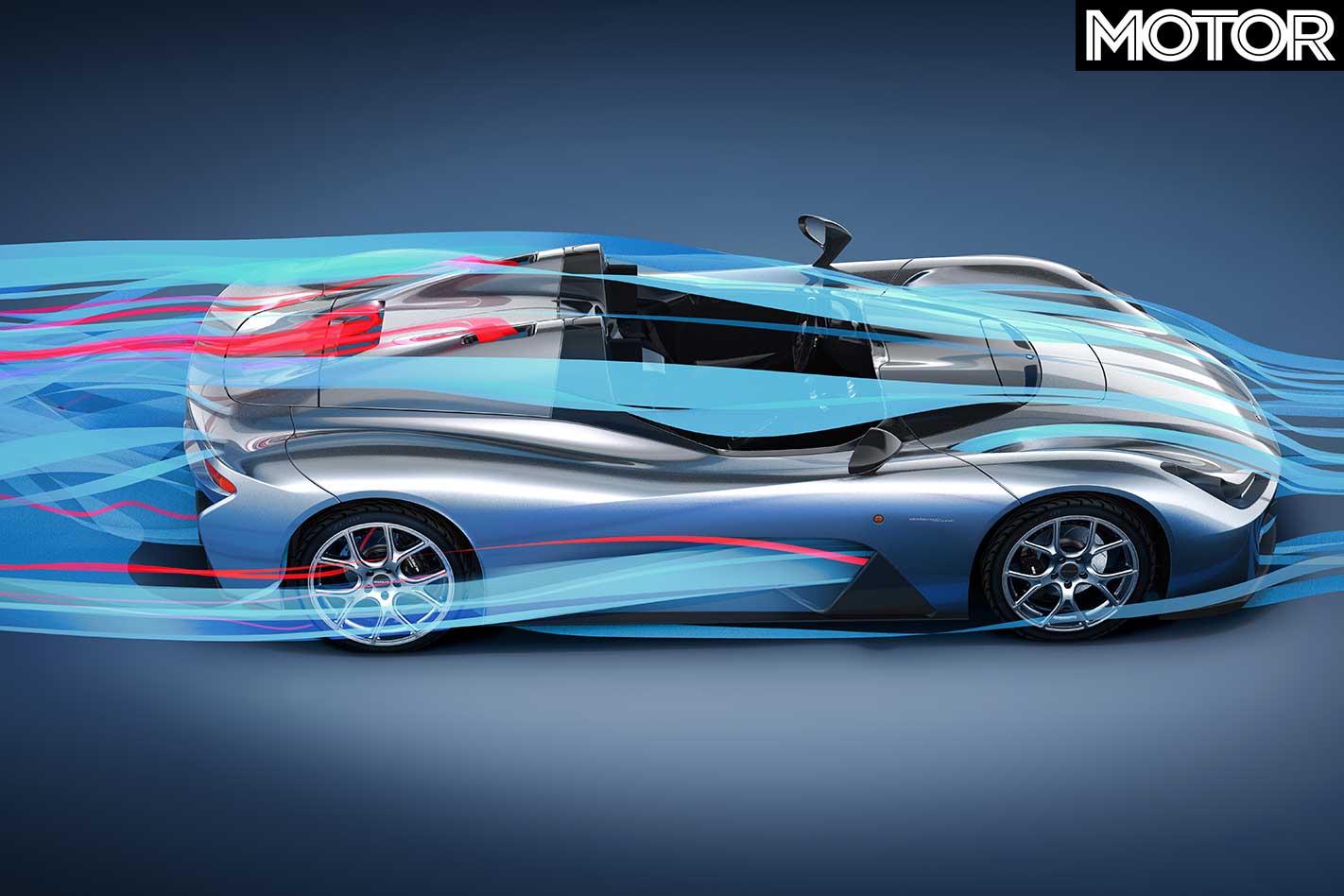
Before I go out on track, the drive-mode selector is put into Sport for maximum grunt, ultra-fast gear shifts, the firmest damper setting and minimum ESP interference. With a mighty torque wedge resting under my right hoof, the Stradale creates massive forward motion effortlessly.
Thanks to the super-glue roadholding, you can even entertain a full-throttle mid-corner upshift. It’s predictable, and due to the light weight, you don’t need to hug apexes and clip kerbs to get the best out of it. With ample grip, the Dallara fires out of apexes as tenaciously as it enters them – it’s an addictive rush where you don’t need to go all out to get the most reward.
One area where the Stradale nails it is the sublime steering. It goes without power assistance, variable-rate calibration and artificial add-ons to be back-to-basics perfection. It’s precise, quick, and communicative, relaying the exact amount of feedback needed. This steering beats anything else out there. It fits Dallara’s philosophy which waives carbon-ceramic brakes, active anti-roll bars and dynamic drivetrain mounts.
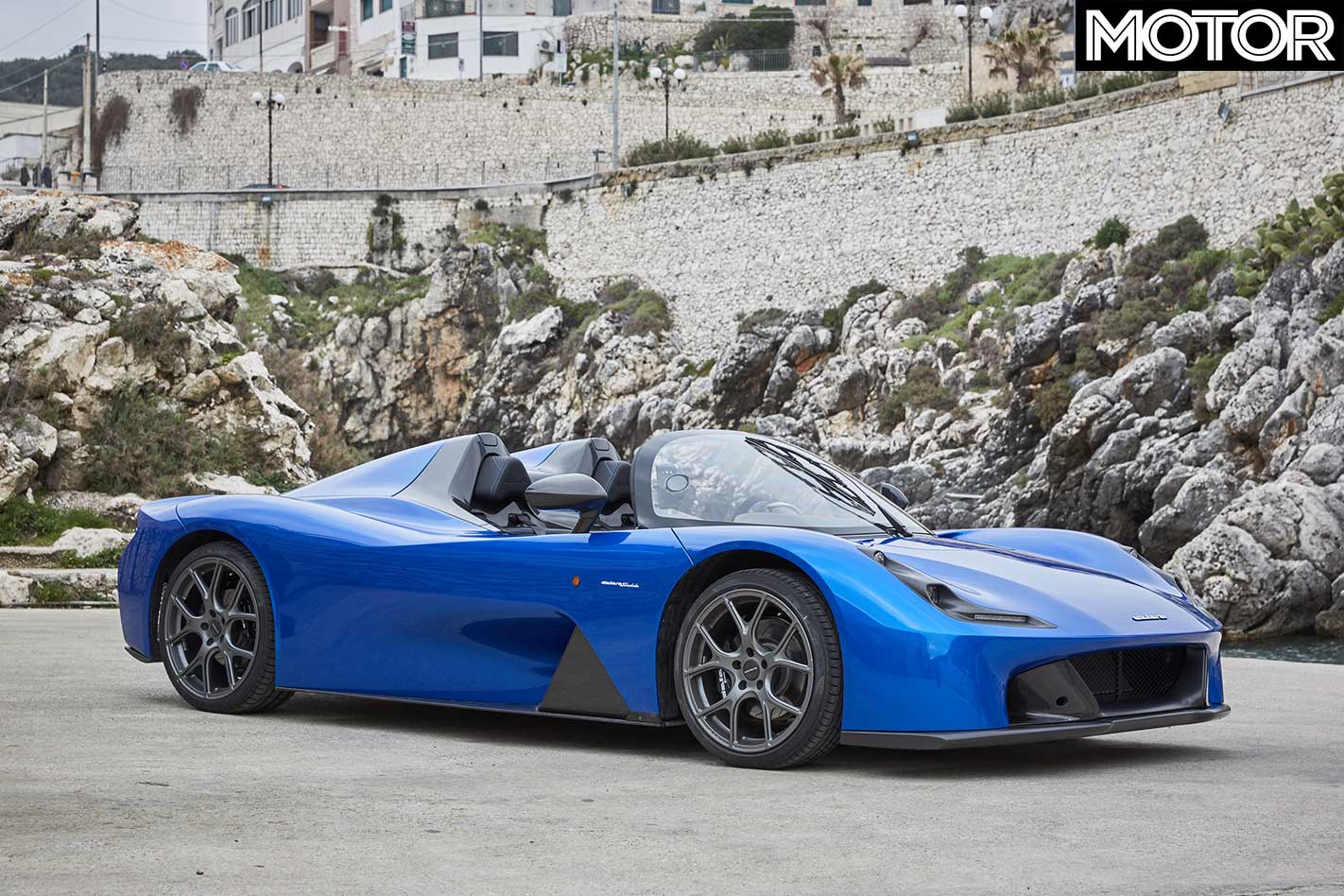
Dallara plans to build 650 cars within a five-year period. There’s already a waiting list. The Stradale might be a niche within a niche, but there is a market for this open-air machine from Northern Italy. It’s a nonconformist, emotional and devastatingly rapid purchase that, when viewed as a road-registered toy, won’t disappoint.
2019 DALLARA STRADALE SPECS Engine: 2261cc inline-4, DOHC, 16v, turbo Power: 295kW @ 6200rpm Torque: 500Nm @ 3000-5000rpm Weight: 855kg (dry) 0-100km/h: 3.25sec (claimed) Price: $250,000 (est)
Like: Road-registered toy; sublime steering weight and feel; you can get a roof for it Dislike: There’s already a waiting list; getting one in Oz will be expensive; slight turbo lag
Rating: 4 out of 5 stars
