
Frenchman Sebastien Ogier has cemented his place in rallying folklore by claiming his sixth consecutive World Rally Championship title, after a stunning last-gasp comeback at the WRC season-ending Rally Australia in Coffs Harbour.
He, alongside co-driver Julien Ingrassia, finished a safe sixth on the event, after his closest rivals all fell by the wayside in a sensational swing of fortunes over the event’s last handful of stages.
Ogier, driving a Ford Fiesta WRC for the underfunded M-Sport team, came into the last round of the season just a handful of points behind of powerhouse squad Hyundai’s Thierry Neuville, who squandered a strong mid-season points leading ahead of the Australian finale.
Despite the disadvantage of running first on the gravel shire roads around the northern NSW beachside town on day one and falling as low as 10th, Ogier played a steady hand throughout, leaching the pressure back onto an increasingly flustered Neuville.
The Belgian driver stumbled early, belting a hay bale then puncturing a tyre on day one, pushing him down the order.

View the full picture gallery at the top of the page
Ogier then simply drove his own race, holding station as his rivals fell away. Neuville struggled to stay within two places of the defending champ all weekend, before finally binning his i20 WRC with just three stages left to run and retiring on the spot.
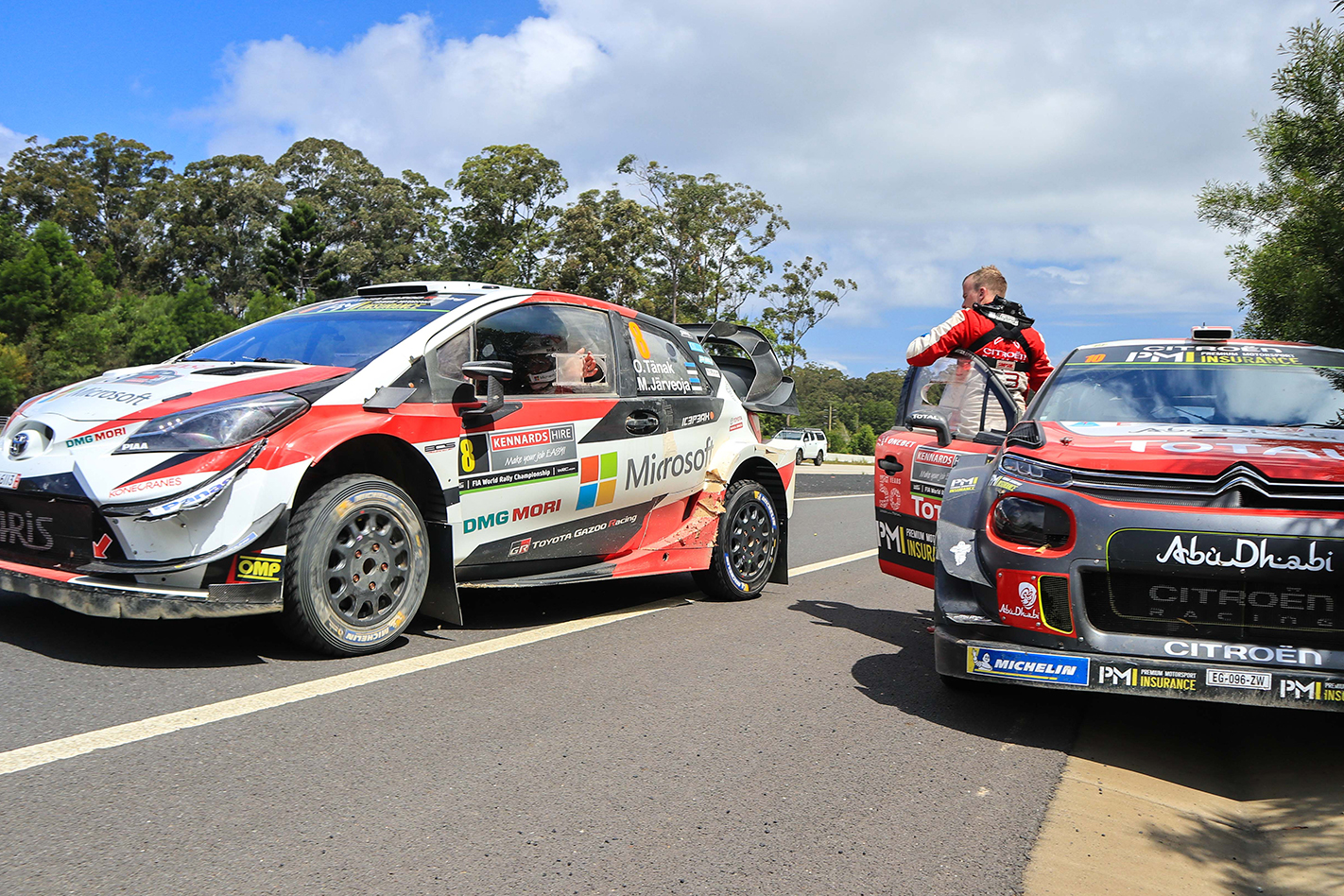
The only other driver with a mathematical chance of wresting the title away from Ogier, Toyota’s Ott Tanak, also crashed out late on Sunday, but his DNF didn’t affect Toyota claiming its first manufacturer’s crown since 1999. Lead driver Jarri-Matti Latvala’s win, meanwhile, was simply icing on the cake.
Ogier, who switches to the Citroen squad in 2019, embraced team principal Malcolm Wilson after the event, both men clearly emotional after two successful seasons together.
“It is a mixed feeling at this moment,” said Ogier. “I’m proud of what I have achieved and my team, they are the best.
“It has been an amazing journey together and now I just enjoyed the last push in this car. I hope I will not miss it.”
New Zealand driver Hayden Paddon finished second in the rally, rounding off a fine season of part-time performances for Hyundai, while Citroen’s Mads Ostberg claimed a spirited third.
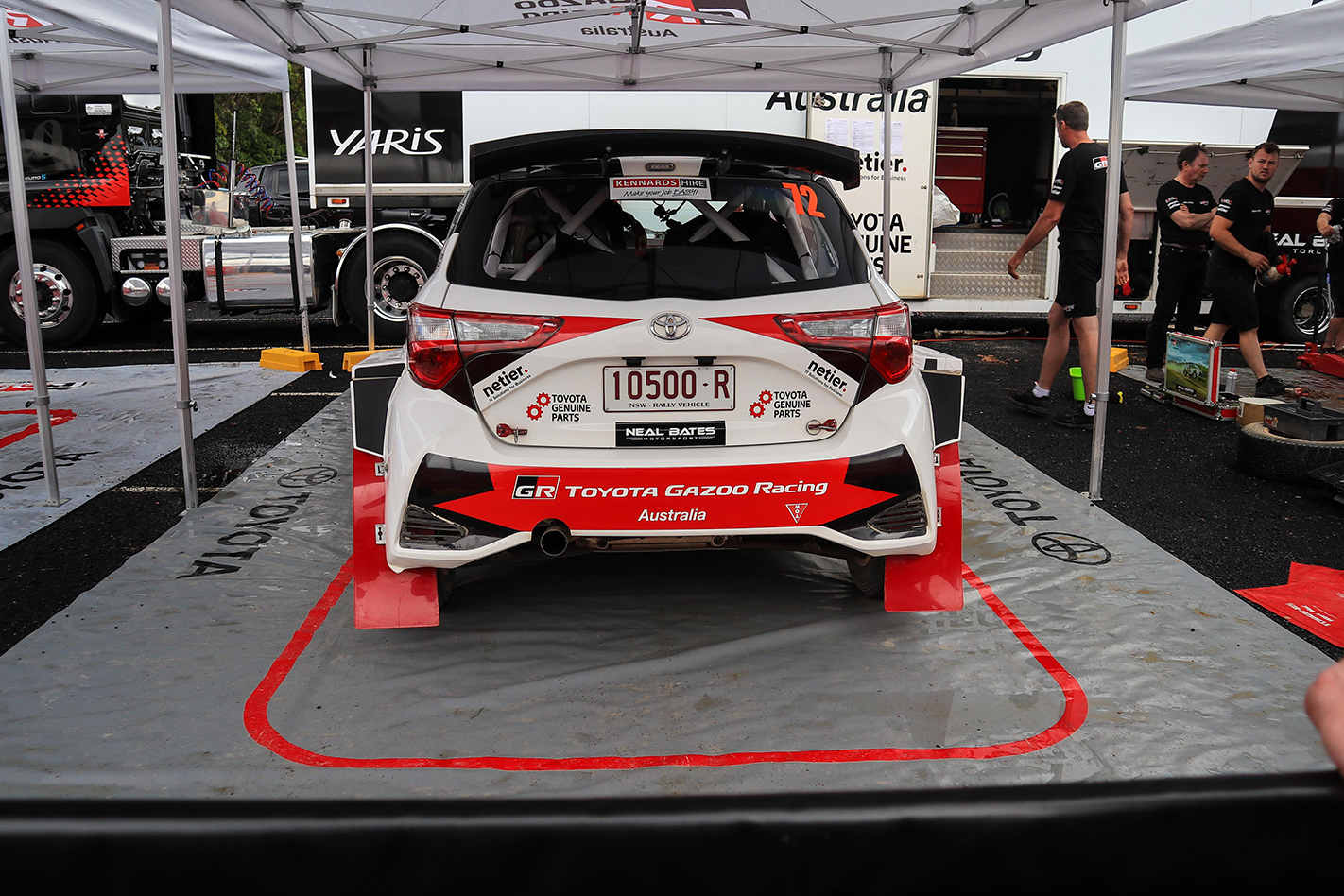
Meanwhile, Victoria’s Eli Evans won his fourth Australian Rally Championship overall title after finishing fifth on the ARC event within Rally Australia, after both of his title rivals fell away over the course of the weekend.
Subaru’s Molly Taylor crashed out in spectacular style on day one, while Toyota’s Harry Bates suffered an engine malady on day two. Steve Glenney won the ARC round, finishing ninth overall on the rally.
TOYOTA’s 12th-generation Corolla hatchback is the big T’s most compelling small car in years, and now its sedan counterpart is preparing to launch in Oz. We’ve got high hopes for it, and spent a few moments getting acquainted with a left-hand-drive version during a sneak peek in California, around the time of its reveal at the Guangzhou Auto Show in China.
Click the image above to see a gallery of images showing the all-new Corolla sedan in detail.
Some of the hatchback’s striking design features carry over, including its sharp headlights and broad stance with its lowered roofline, but Toyota has worked hard to distinguish the booted three-box sedan overall from its trendsetting sibling.
In profile the Corolla sedan has attractive proportions and fresh surfaces with a single rising shoulder line on either side extending from the front wheel-arch to the taillight. A huge grille dominates the front end of the car in these pictures, though a second nose treatment is to be made available in the United States, and may also make its way here.
More information about drivetrains and trim specifications will be made available closer to the Corolla sedan’s local launch, which is slated for this time next year.
MORE: Toyota Corolla Range Review MORE: Toyota Corolla Specs, Range & Price
Australia is no stranger to open-wheel racing, but a new category called S5000 hopes to rejuvenate the nation’s interest in the format.
S5000 launched today at Sydney Motorsport Park ahead of its public debut, with a calendar already set for 2019.
Discussion about the new series has gone on for years, with various forms and names having come and gone. But S5000 is now confirmed, and punters will get a chance to see the 5.0-litre Coyote V8-powered car in action at the Newcastle Supercars round.
The cars will produce approximately 418kW, and will feature halo protective elements as introduced in F1 this year as mandated by the FIA.
Matt Braid, director of Australian Racing Group (the same outfit that will manage Australian TCR), says it’s a relief to see the years of planning pay off.
“This is the motorsport category that is going to shake up the industry,” he says.
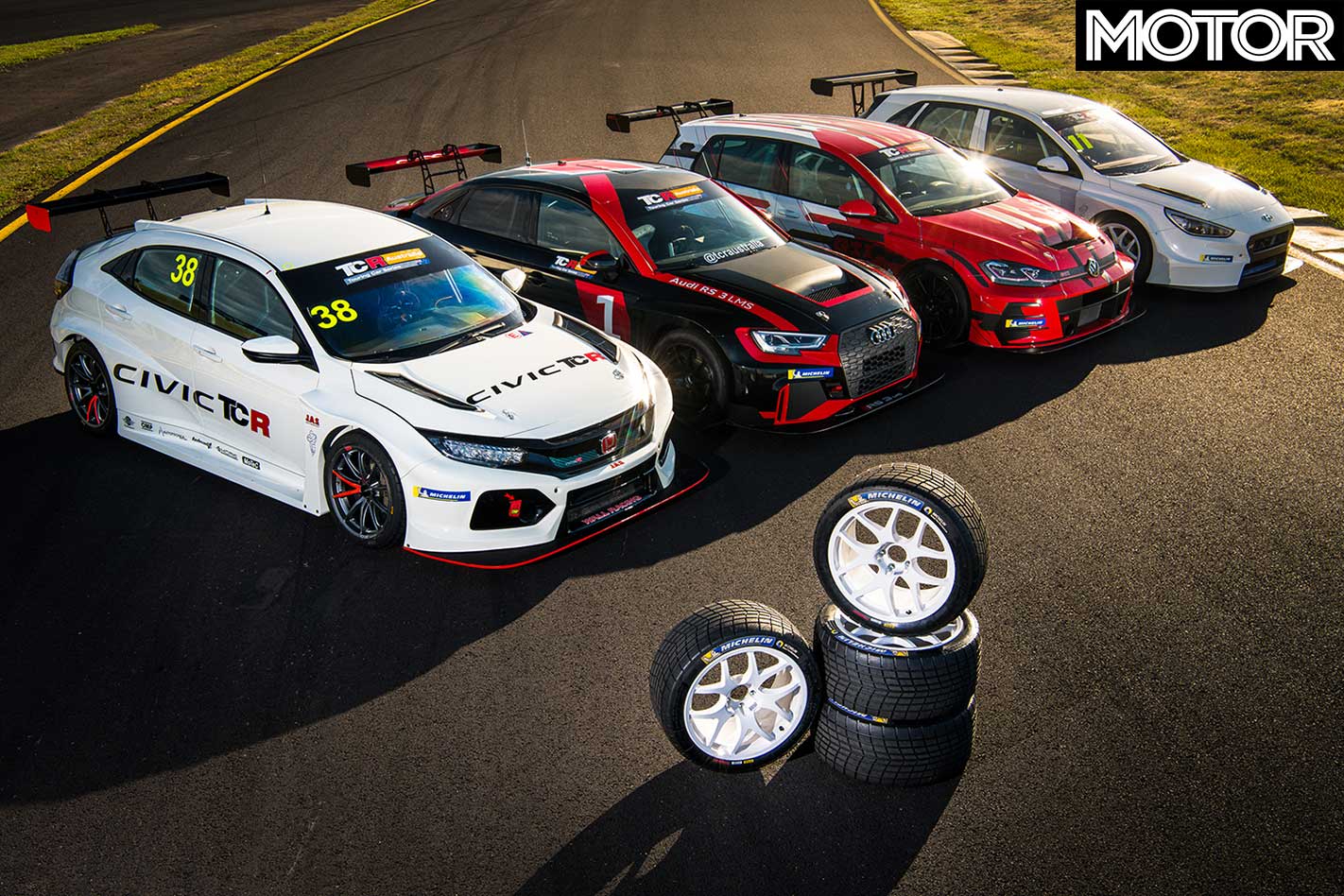
“For many years, we’ve been yearning for a local, cost-effective, premier open wheel motorsport category, and we have no doubt that the S5000 package is the car to deliver what is needed.
“They will be fast, loud and entertaining, and since revealing the car three months ago, we anticipate that the best drivers and teams from around Australia and abroad will be part of this history-making category.”
Those running the series expect the S5000 racers to break lap records at each track they visit,with five on the calendar for 2019.
First, in mid-May, S5000 heads to Sydney Motorsport Park, before a round at Phillip Island in June, then The Bend Motorsport Park in July.
Winton gets a spot on the calendar over the August-September weekend, before the series heads to Sandown later in September, and wraps up with another visit to The Bend in November.
The S5000 series is the result of two formerly competing open-wheeler propositions – Formula Thunder 5000 and Super 5000 – which joined forces to get the idea off the ground.
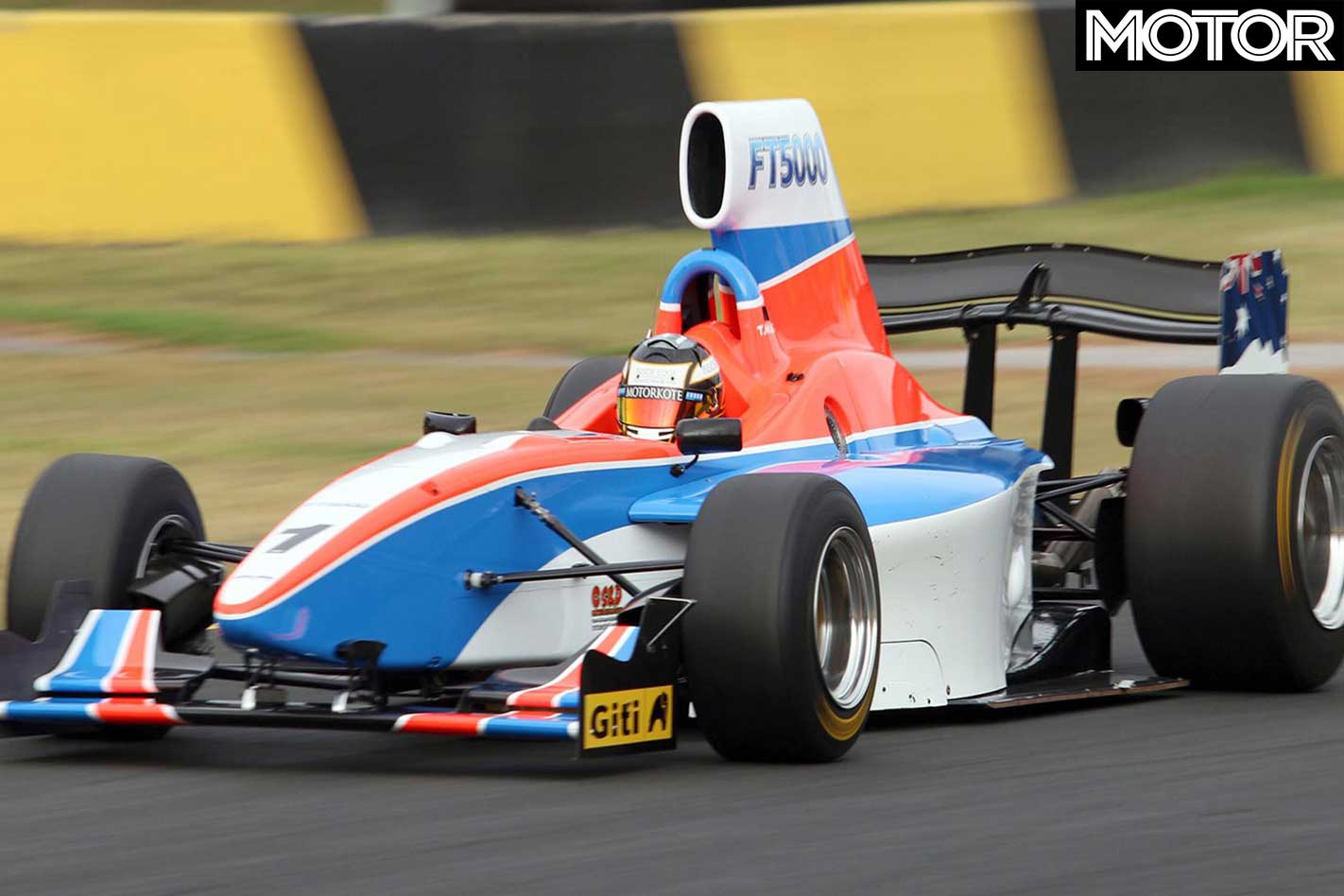
If all goes as is hoped by the series runners, S5000 will mark the return of open-wheel racing after essentially a decade of it absence since Formula Holden called stumps.
Lamborghini Squadra Corse has revealed its first one-off customer car – a modified Lamborghini Aventador SVJ built for the track.
It’s road-legal, but the alterations made by Squadra Corse are based on its Huracán GT3 EVO and Super Trofeo EVO.
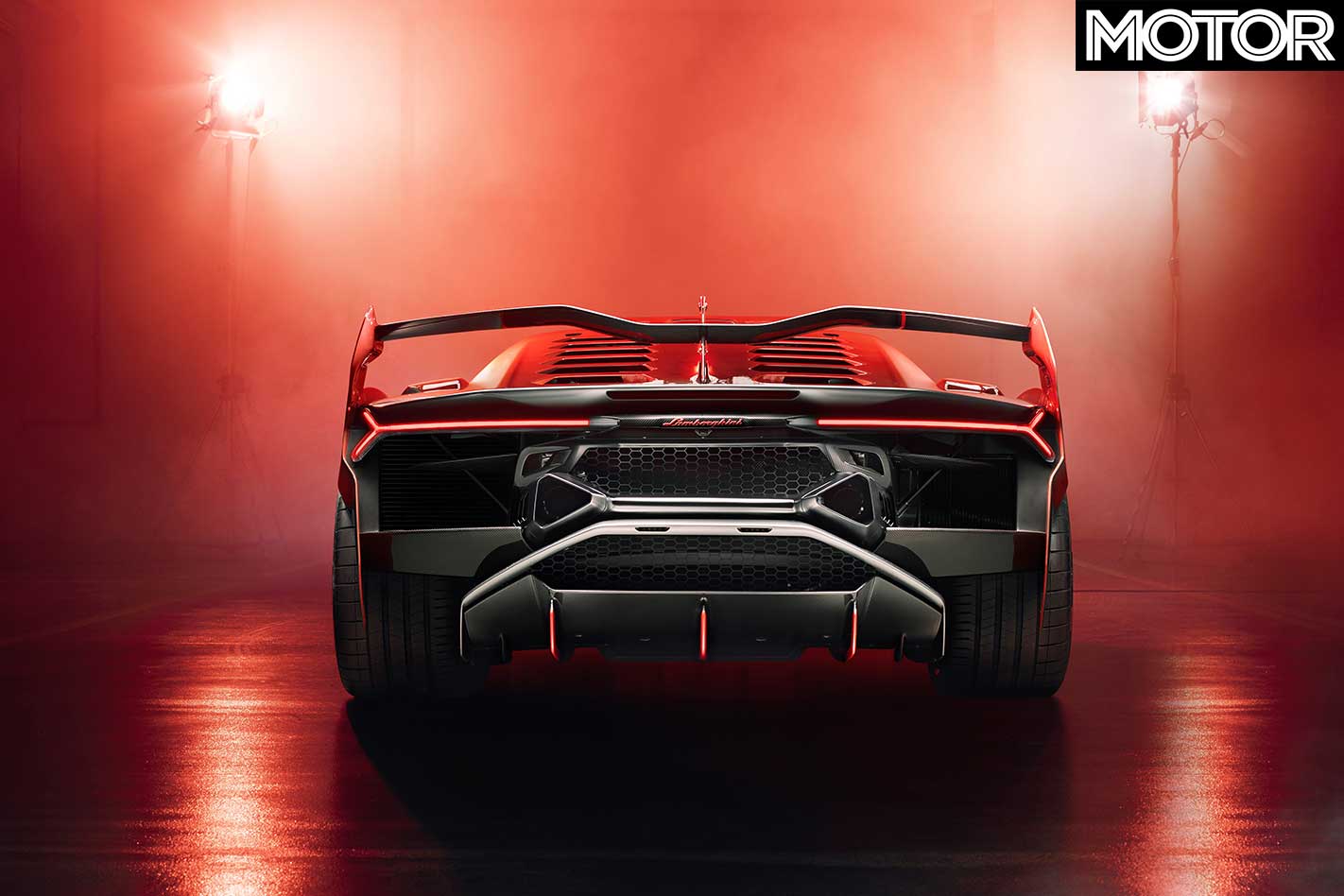
The naturally-aspirated 6.5-litre V12’s outputs remain unchanged at 566kW and 720Nm, but external factors such as improved cooling should (Lamborghini says) make for a more effective track weapon.
In addition, weight is reduced (though by how much isn’t specified), and the aerodynamics of the car are improved over a production model. Most notable is the large carbon wing at the rear, which features three mechanical adjustments “able to generate the optimal downforce on any circuit.”
Cooling is strengthened by a set of 12 intakes on the rear ‘bonnet’, a technique Lamborgini Squadra Corse has already implemented and tested in endurance racing.
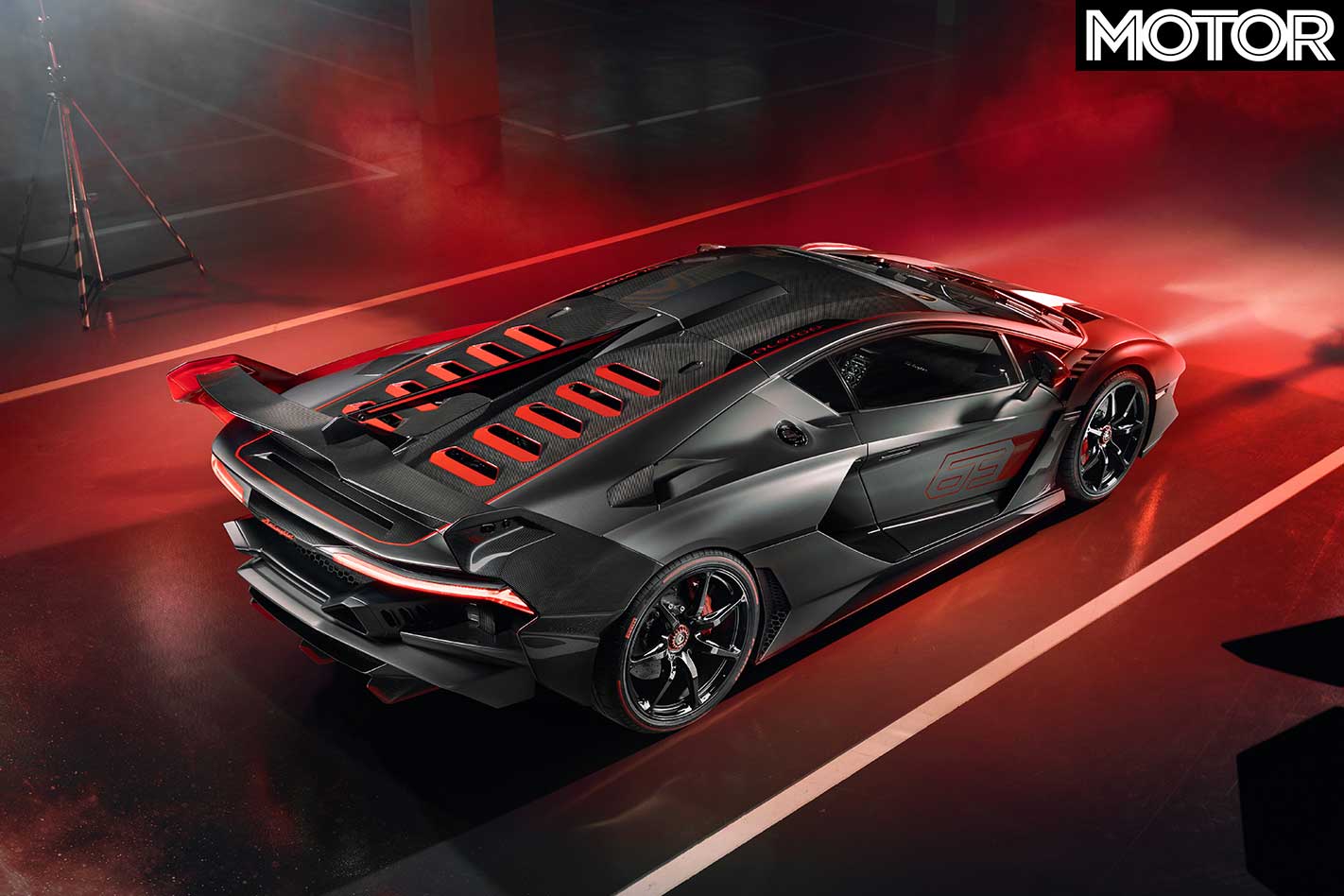
Styling was approached by Centro Stile Lamborghini with direction from the customer to produce a dramatic Grigio Daytona carbon fibre body that looks unique to Lamborghini’s regular Aventador.
The interior follows the theme, with black and red Alcantara and stitching, and two carbon fibre bucket seats.
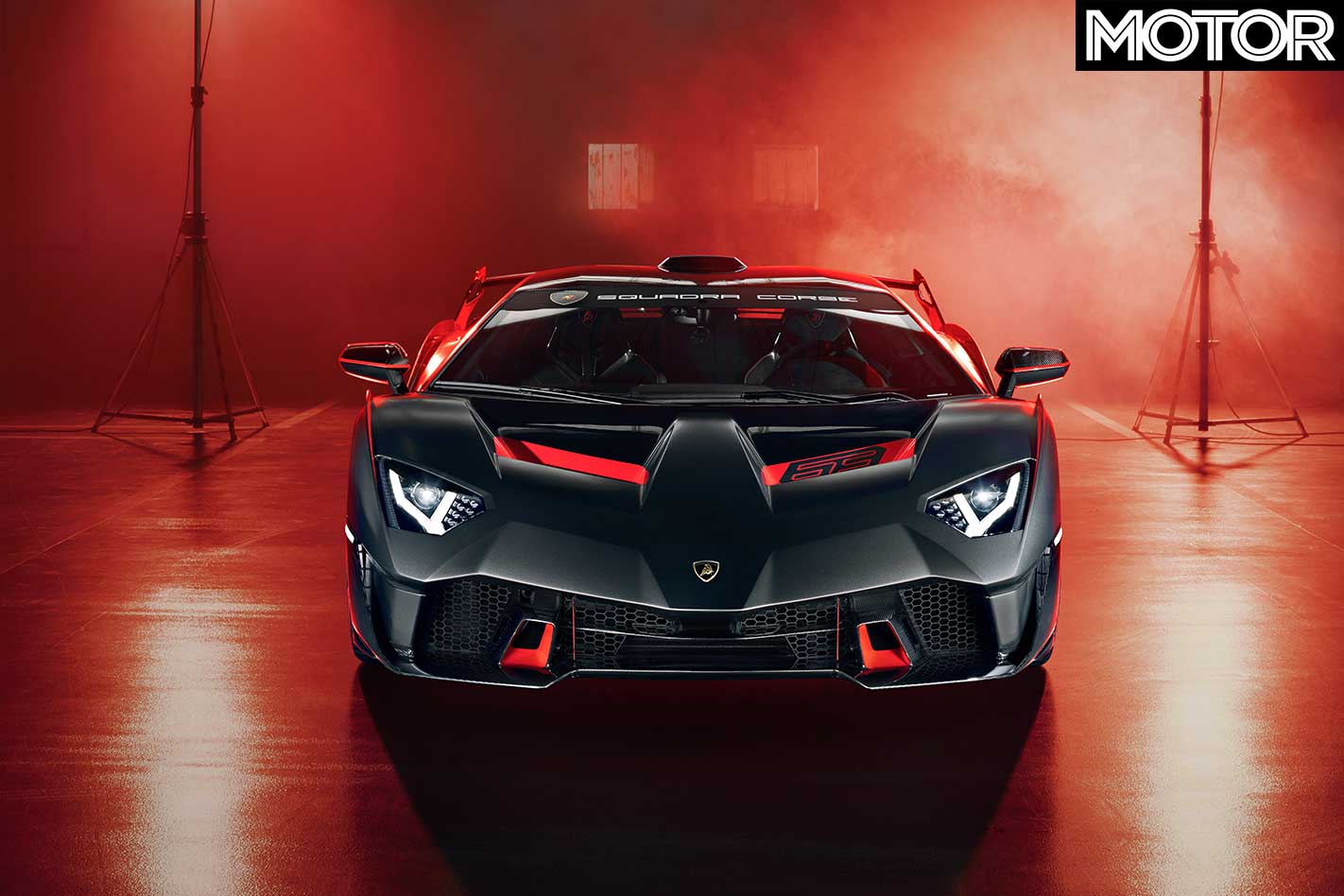
While this SC18 is a one-off, Lamborghini says the car’s unveiling also marks a new beginning for its motorsport brand, with the SC18 “paving the way to further personalized development projects for motorsport customers.”
Lamborghini announced the SC18 shortly after it revealed a concept for a Urus SUV racer, with hopes to develop a one-make championship to begin in 2020.
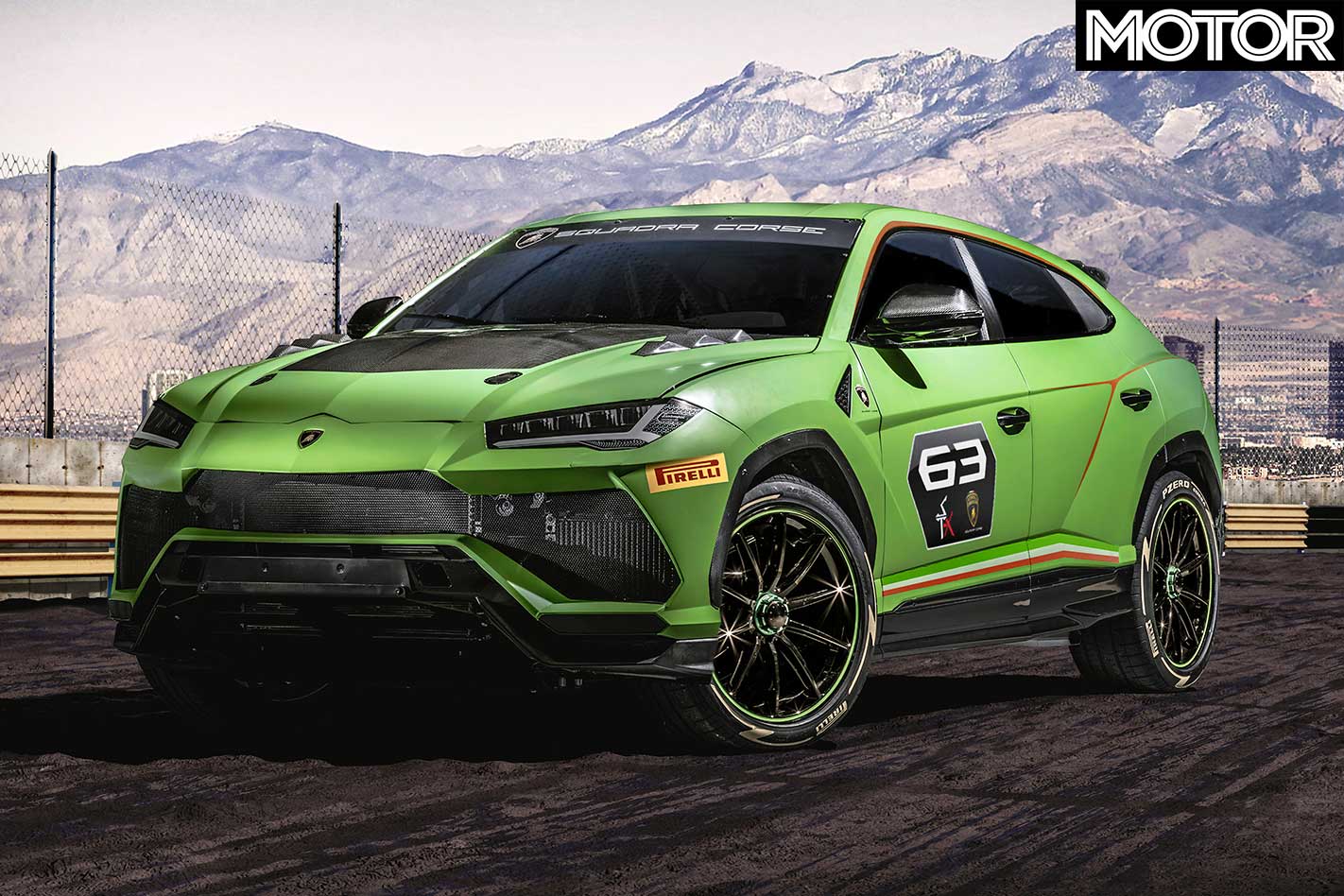
The Urus ST-X Concept appears much the same as the production model, though it’s claimed to be 25 per cent lighter while retaining the same 478kW/850Nm outputs from its twin-turbo V8.
According to some research I just saw (and no, I didn’t make it up), when it comes to buying a used car, 55.8 percent of Australians go looking for a Toyota.
This feature was originally published in MOTOR’s January 2004 issue
Disturbing though this may be, it does help explain why we must suffer a conservative government, why motorcycles are still considered anti-social and why our televisions are full of lifestyle shows explaining how to artificially inseminate a budgie while whipping up a cracking cheesecake. At home.
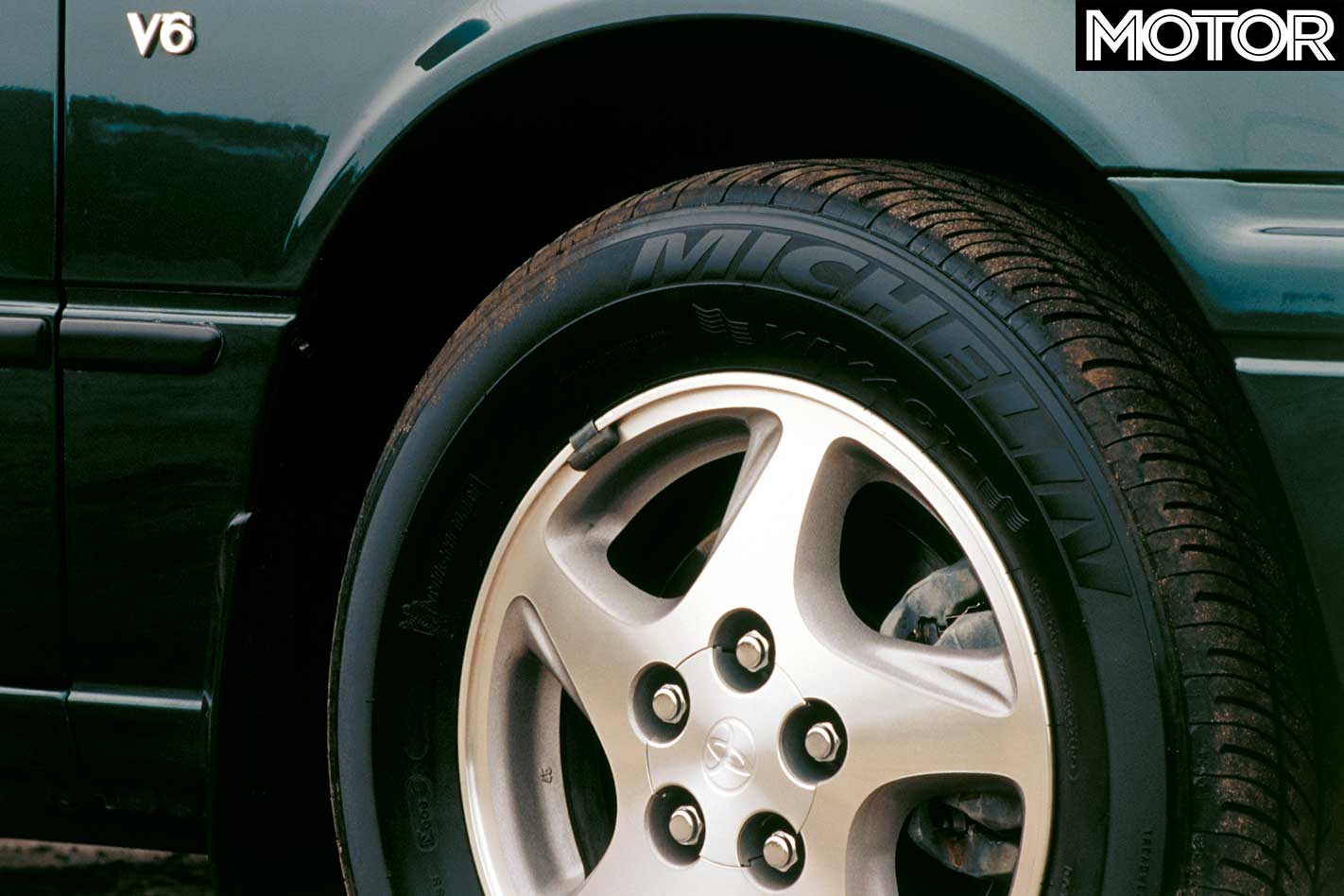
When it comes to shelling out on a used car, most people understand that the purchase of a Toyota is the safest path to not getting burnt. Yes, a used Lamborghini will be more fun, but 12 litres of full synthetic oil (don’t forget the filter) every 5000 klicks is just too confronting for a lot of folks.
The tragedy is that in the case of a lot of secondhand Toyotas, you’re buying some of the most conservative, uninspiring engineering ever foisted upon an unsuspecting general public. But there is the odd angry Toyota – the sort of equipment that has something to offer the keener driver.
Over the years, we’ve seen the rare (well, one, actually) good Celica, the locally developed Corolla Twin-Cam of the mid-1980s and the Supra Turbo, which was fast but a bit boofy for some. But would you believe there’s also a Camry that makes the cut?
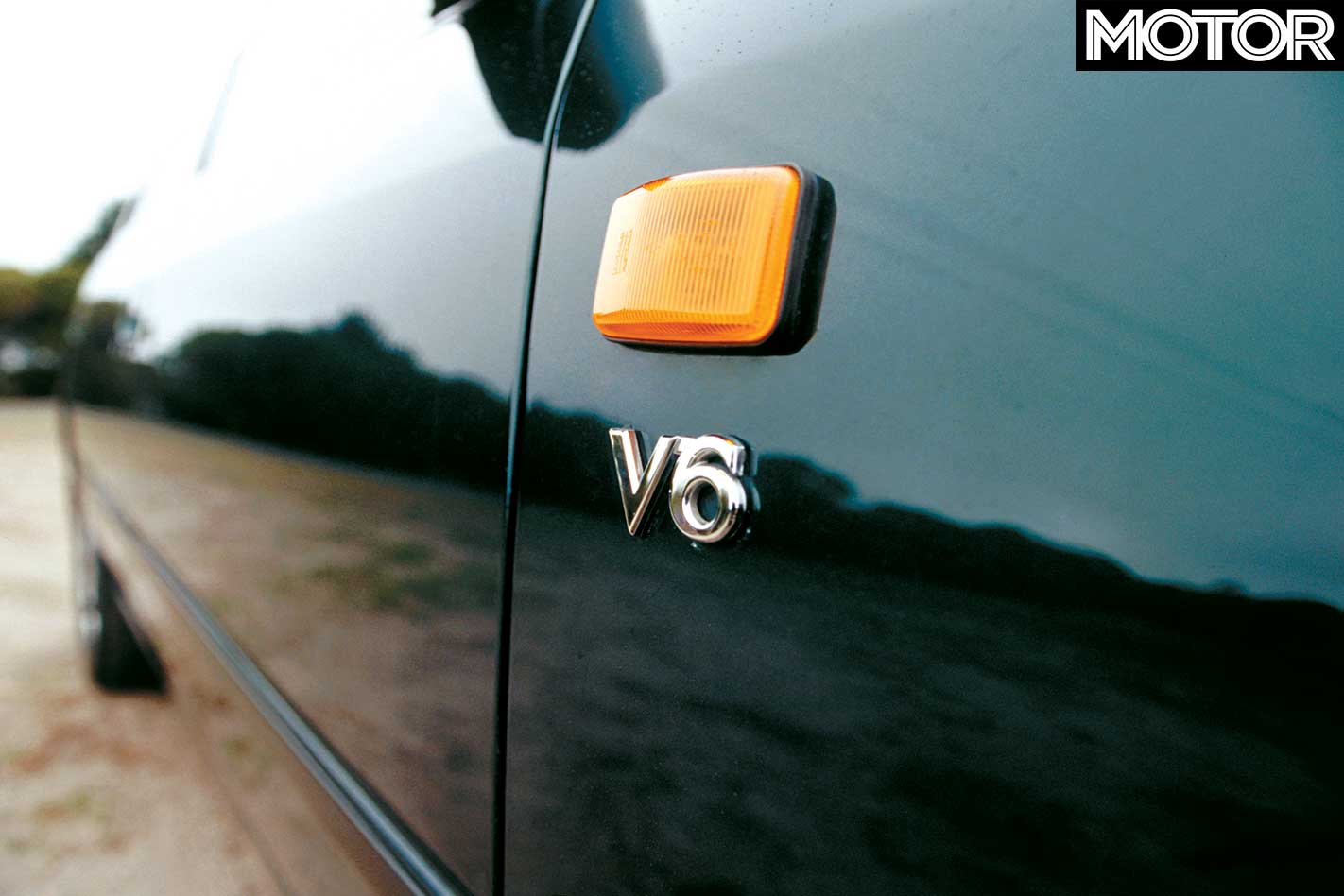
No? Us either at first, but if you look beyond the blancmange styling and actually drive a Camry V6, you might even end up agreeing with us.
Now, we’ll admit that the idea of an enthusiast’s Camry is about as likely as smoked cod ice cream, and in the case of the first Camry to bear a V6 engine in this country, fish-flavoured ice confectionery would have sold better.
The first Camry V6 used the first locally made bodyshell fitted with a 2.5-litre V6. On paper it looked terrific: quad cams, 24 valves (and remember that a V6 was still a bit exotic back in the ’80s; the VN Commodore fixed all that) but in reality it was a serious pile of shit.
The double overhead camshafts used Toyota’s old favourite of driving one cam from the belt and the second one off the first, via a pair of scissor gears. It allegedly made 117kW and 215Nm, but the torque figure, in particular, has to be questioned.
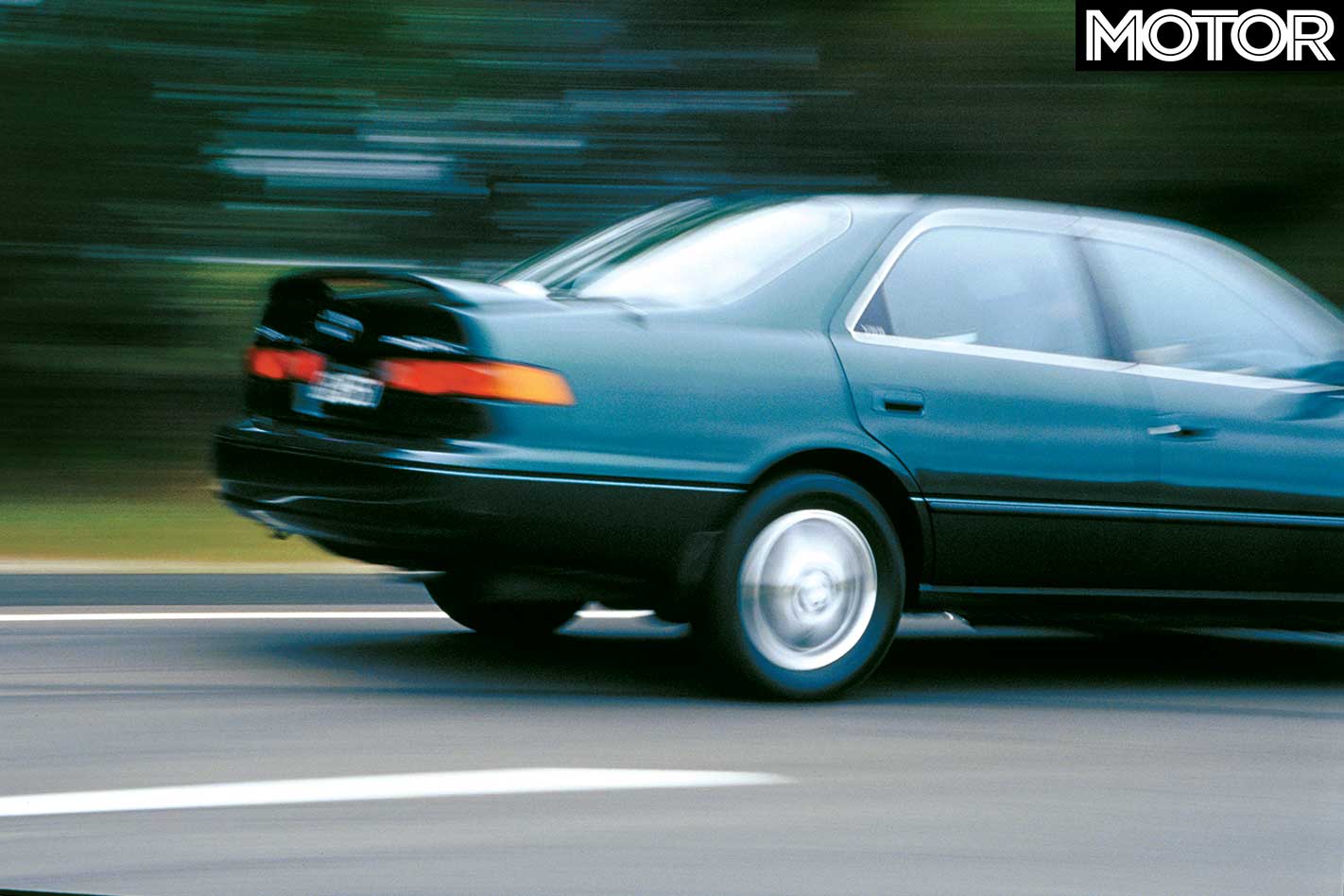
Unless you revved the absolute ring out of the thing, the little V6 wasn’t actually any quicker than the standard, much cheaper four-cylinder Camry that Toyota was flogging hand over fist to lunkheads in Hawaiian shirts.
But it got worse. Thanks to a range of engineering considerations (and the realisation that a V6 did not a sports car make), Toyota only ever equipped the thing with a four-speed auto, complete with a too-tall fourth gear. Seriously, the thing couldn’t get out of its own way and was a frustrating drive even when you weren’t in a hurry.
It didn’t even sound horny and a higher level of refinement and smoothness over the four-banger was its only real scoring punch. Irrelevant, pointless, loathsome. You don’t want one. The V6 Camrys of any real interest started to happen when the second-generation locally made car arrived in a form that Toyota imaginatively called the wide-body Camry.
Obviously, attempting to steal a little family car market share from the likes of Ford and Holden was going to require something more impressive than a 2.2-litre four, so the new car was engineered to accept a 3.0-litre version of Toyota’s generic DOHC V6.
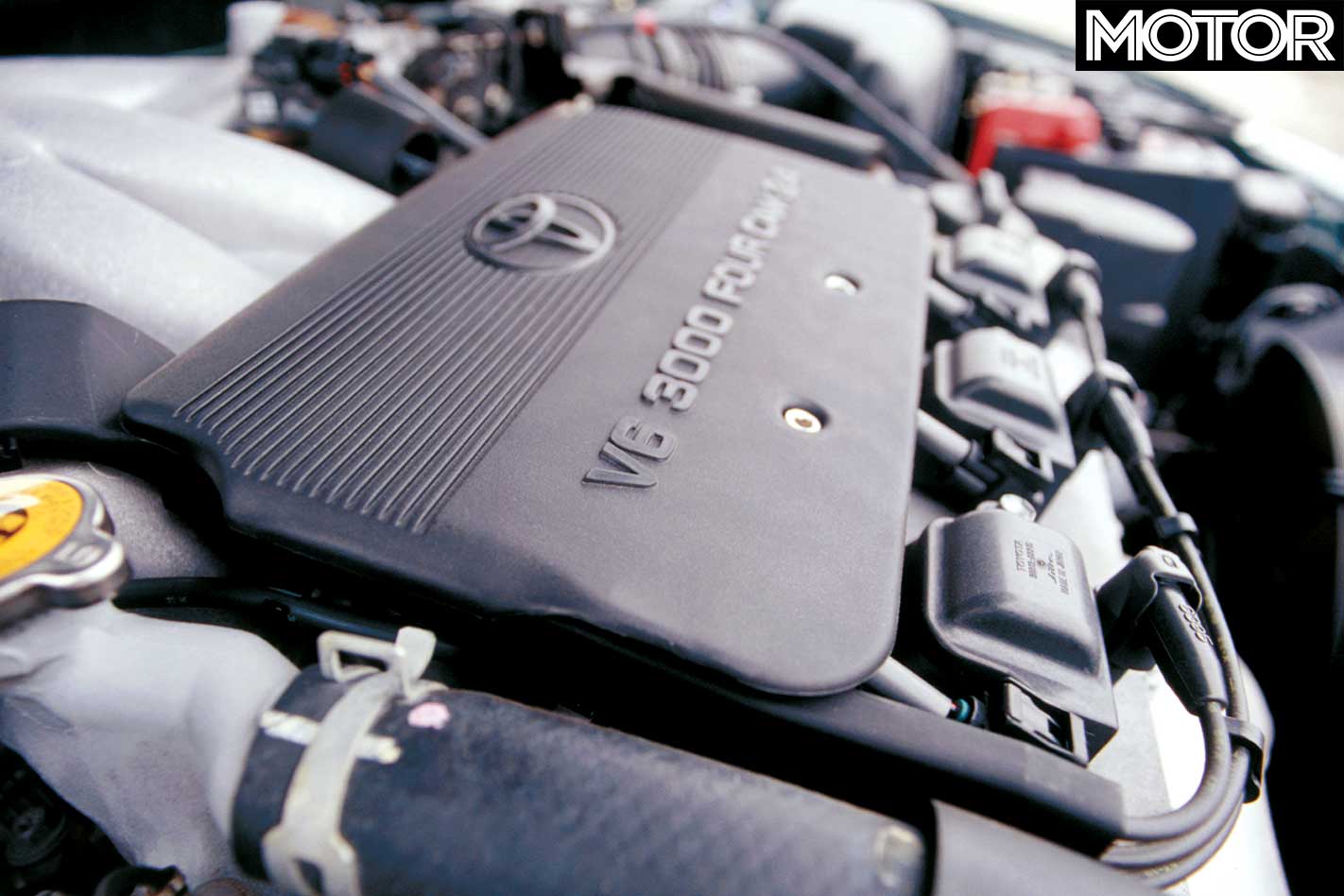
And all of a sudden it was on to something. Now, don’t get us wrong: with its Camry suspension, Camry styling and Camry interior, the wide-body job was still fairly unlikely to get the wrinkles out. Ignore all that and just enjoy the driveline; there was definitely something in it.
The V6’s big claim to fame was a better than average dose of mid-range torque that made most other V6s of similar capacity seem pretty lame. While your average Japanese V6 needed to be wrung out to start making proper power, the Camry’s Vee got cracking much earlier and combined the V6’s traditional ripping top end with some sterling urge around the 2500-4000rpm range.
It was reasonably smooth, made a half-decent noise and, in the bigger, heavier body, made the four-cylinder version seem like an even bigger sook.
The V6’s torque made it a better bet as an auto than it might have been, but it’s even better again as a five-speed manual. The shift itself is typically Toyota notchy and a bit clunky, but the ratios are okay and if you’re even half handy with a clutch pedal, it’s the way to go.
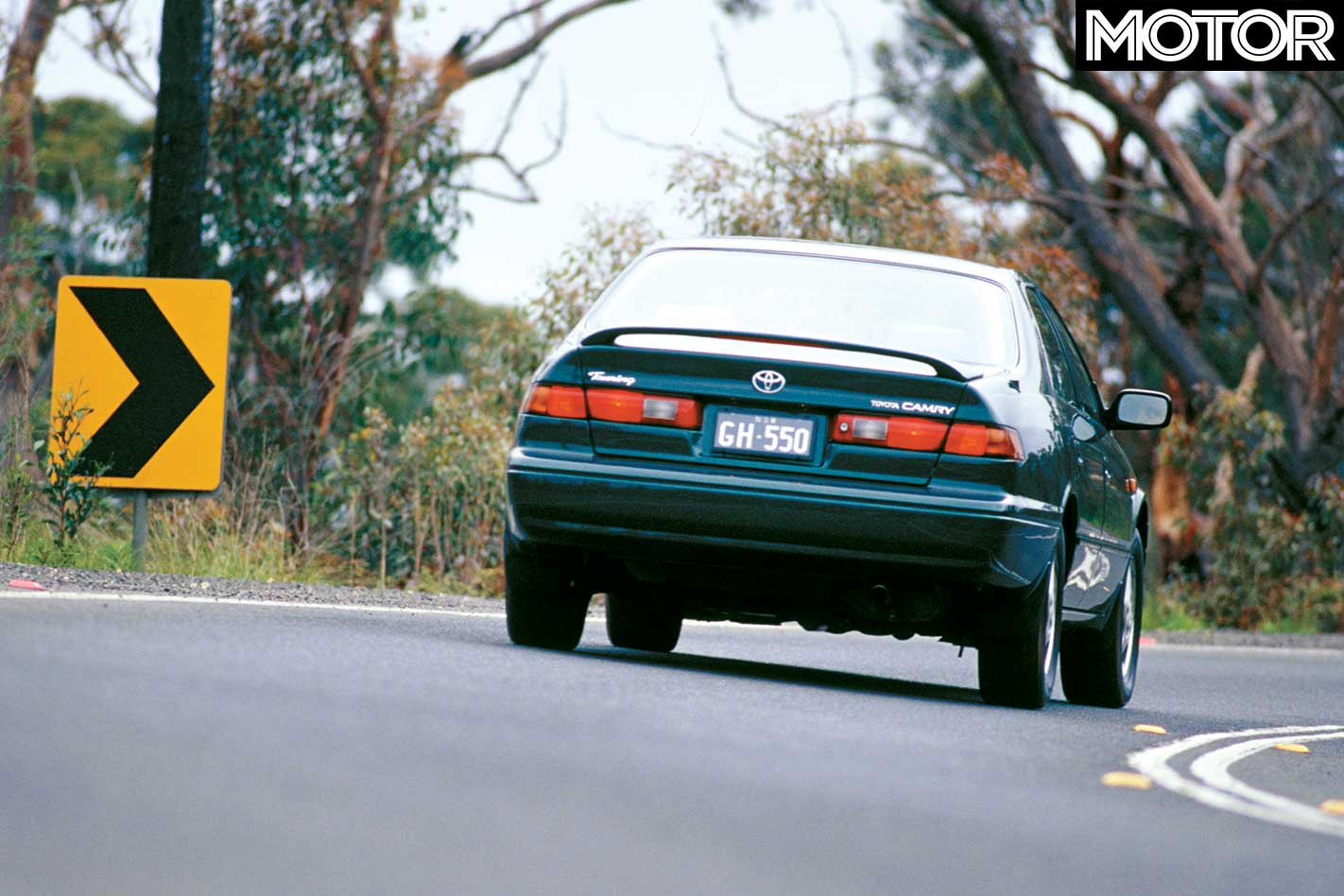
The next model was the even more visually forgettable SXV20 bodyshell, which Toyota attempted to spice up with names like ‘Touring’ (no kidding), although at least the ‘Vienta’ (Toyota’s name for the V6 version in the previous model) nonsense was a thing of the past.
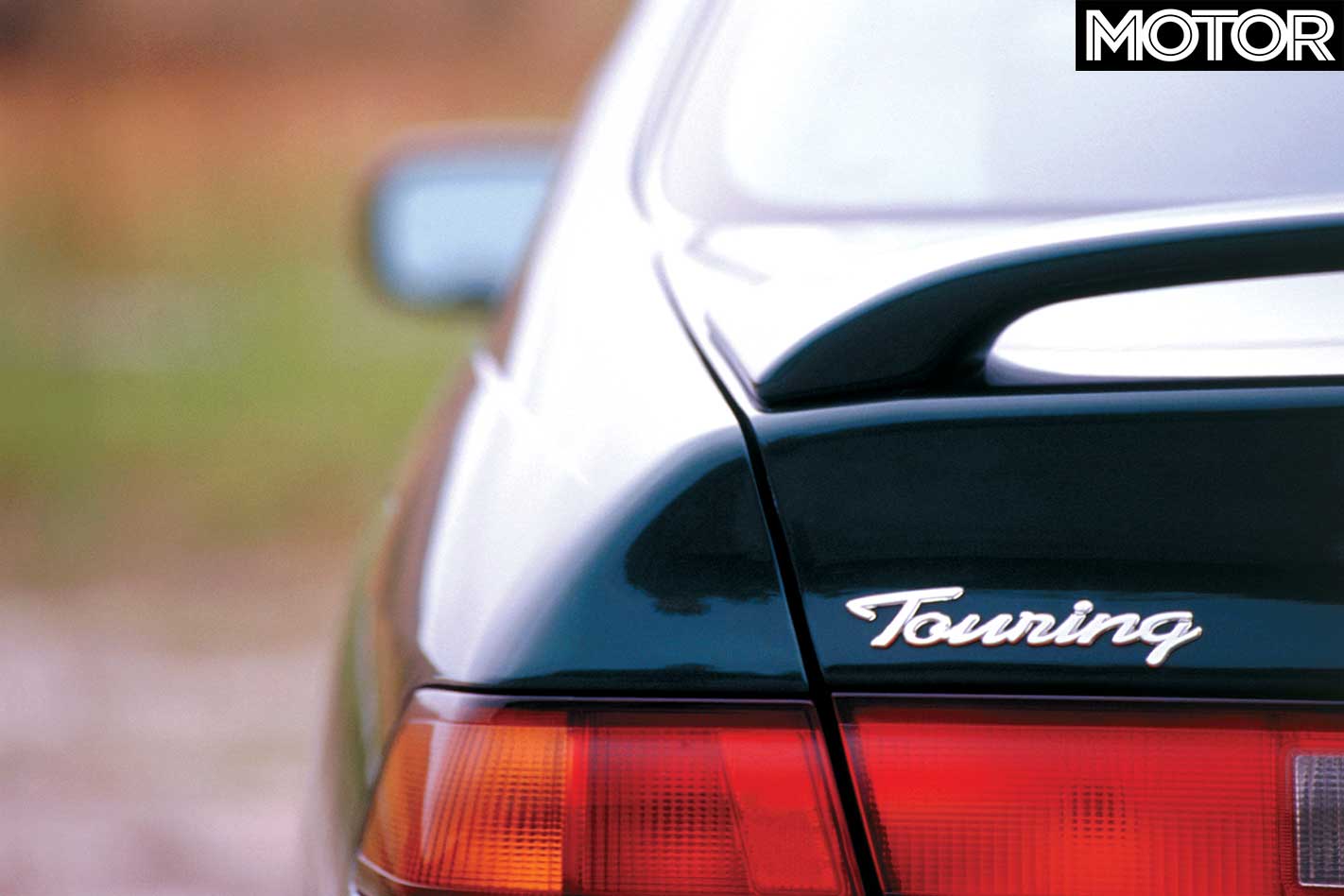
But believe it or not, the Touring was one of the best Camry packages around, with a decent spec list and the V6 and optional five-speeder still in there punching. This time around you’re talking 141kW and 279Nm (slightly up from the first wide-body version).
These really are the plum buys right now because the all-new, much swoopier (but still boring) current-model Camry has taken the heat out of resale values of the superseded model. They’ve generally covered fewer kays, too, and while a lot of them were used by rent-a-racer mobs and fleets as general go-getter hacks, a good many of them were bought by old duffers in Kmart slippers who kept them chained to a cement block in a garage, under a dust cover.
The handling is okay if you don’t mind a bit of torque steer under full welly, and there’s some pretty annoying steering kickback if you apply the clog halfway through a bumpy or rippled corner
The ride is okay and the overall handling is pretty neutral, bearing in mind that it’ll eventually degenerate into that Bridgestone-howling, tread-scrubbing, apex-missing understeer that all good, idiot-proof cars ultimately possess.
Nope, you’re much better to leave the corners to the kiddies in their WRXs and instead make the most of the meaty torque and could’ve-been-a-fluke gear ratios.
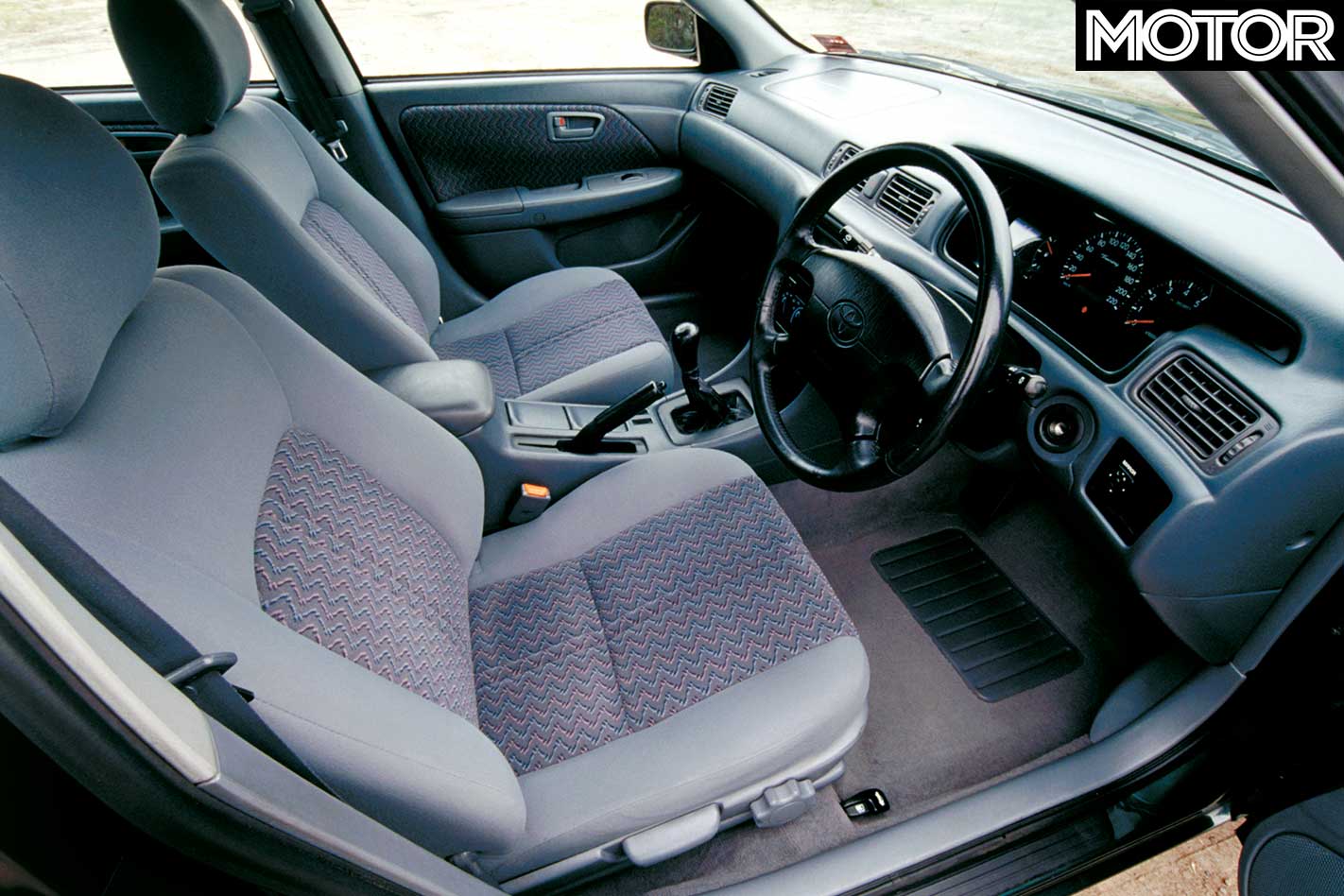
The interior will leave you colder than a mother-in-law’s kiss and the rear seat is a bit thin on legroom, although it’s fine for smaller kids.
There was also a wagon version which, in its original wide-body form, was about as ugly as metal, plastic and glass could ever be. The D-pillar was all wrong (it looked like it sloped the wrong way) and the twin rear wipers were just too comical for words.
Thankfully, the next generation was better, although it’s better because it’s blander. If anything, it’s even more anonymous than the sedan.
A Touring sedan from, say, 1999, will get you twin front airbags, ABS brakes, air-con, alloy wheels, cruise, a full power pack and even a leather-clad steering wheel. That model also got slightly firmer suspension, which is why it’s the pick of the lot.
In general V6 Camrys are well built, utterly reliable (we couldn’t find anyone with a bad thing to say) easy to service and maintain and good value. Assuming (and it’s a big assumption, of course) that you can be bothered in the first place. Your call.
They said it
“The engine is a gem, easily the best point of the car. Unfortunately it’s a company car with an engine that deserves to be in something better.” – Cameron McConville, October 2001
“It feels like a typical front-wheel-drive car – it does get lift-off oversteer when you get off the accelerator and turn into the corner and it starts to steer from the back. The brakes are good but the gearshift has a long throw and is a bit notchy.” – Cameron McConville, September 1999
FAST FACTS 1999 Toyota Camry V6
BODY: 4-door sedan DRIVE: front-wheel ENGINE: 3.0-litre V6, DOHC 24-valve POWER: 141kW @ 5200rpm TORQUE: 279Nm @ 4400rpm COMPRESSION: 10.5:1 BORE/STROKE: 87.5mm x 83.0mm WEIGHT: 1460kg POWER-TO-WEIGHT: 97kW/tonne TRANSMISSION: five-speed manual SUSPENSION: MacPherson struts, coil springs, anti-roll bar (f); struts, coil springs, anti-roll bar (r) L/W/h: 4755/1785/1420mm WHEELBASE: 2720mm TRACK: 1535mm (f), 1510mm (r) BRAKES: ventilated discs, twin-piston calipers (f); solid discs, single-piston calipers (r), ABS WHEELS: 15 x 6.0-inch (f & r), alloy TYRES: Bridgestone RE92, 205/65 R16 (f & r) FUEL: 70 litres, ULP PRICE: $34,930 (in 1999)
Pagani Zonda. The stuff of dreams. But today is a special day – we’ve been given just 30 minutes in a $1.2 million supercar.
This feature was originally published in MOTOR’s December 2004 issue
Beyond the specs, we soon discover a curious speed warning device that isn’t in the brochure. Nail the throttle in second gear and a high-pitched roar erupts from behind, as a 414kW V12 turns scenery into streaks and makes far very near.
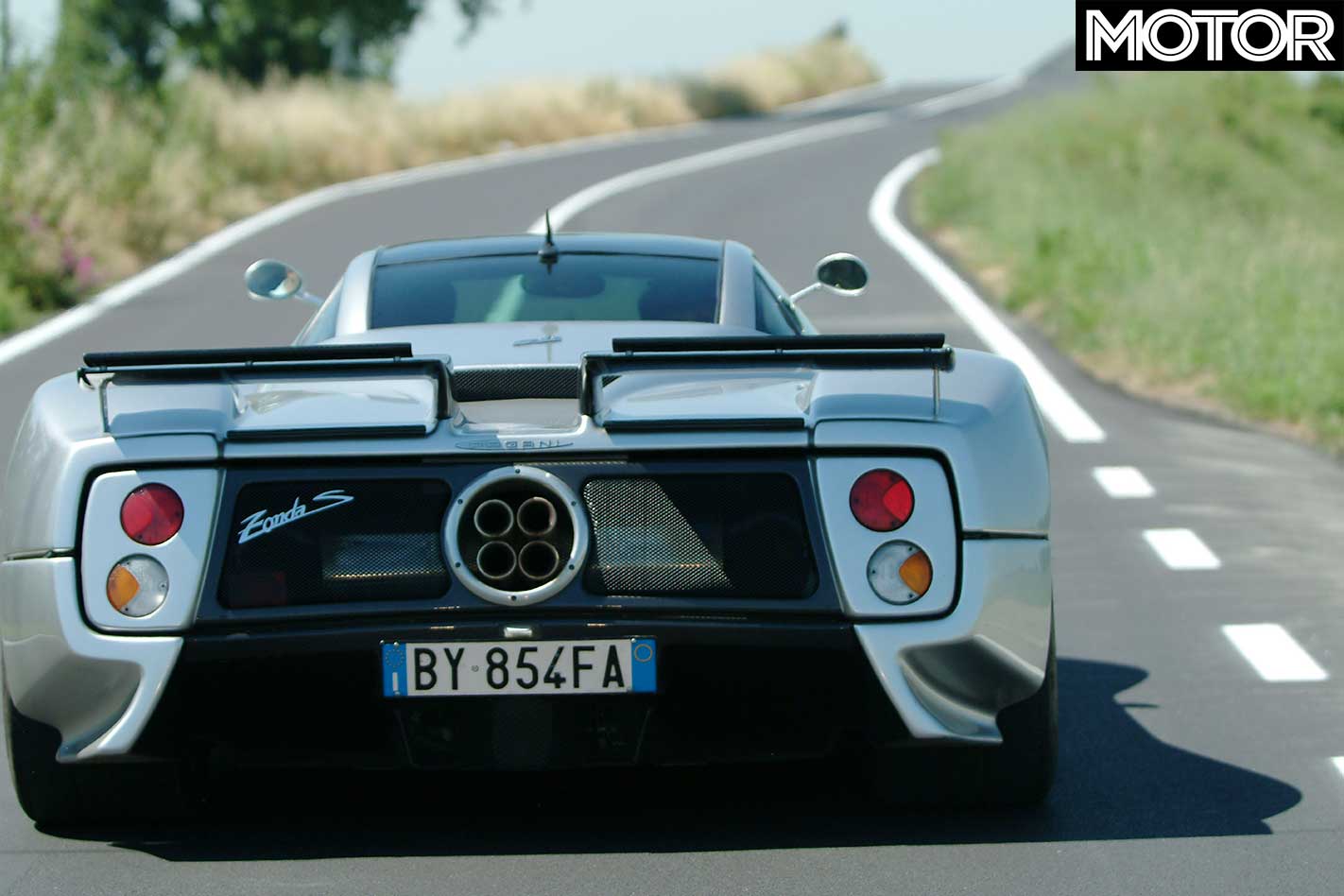
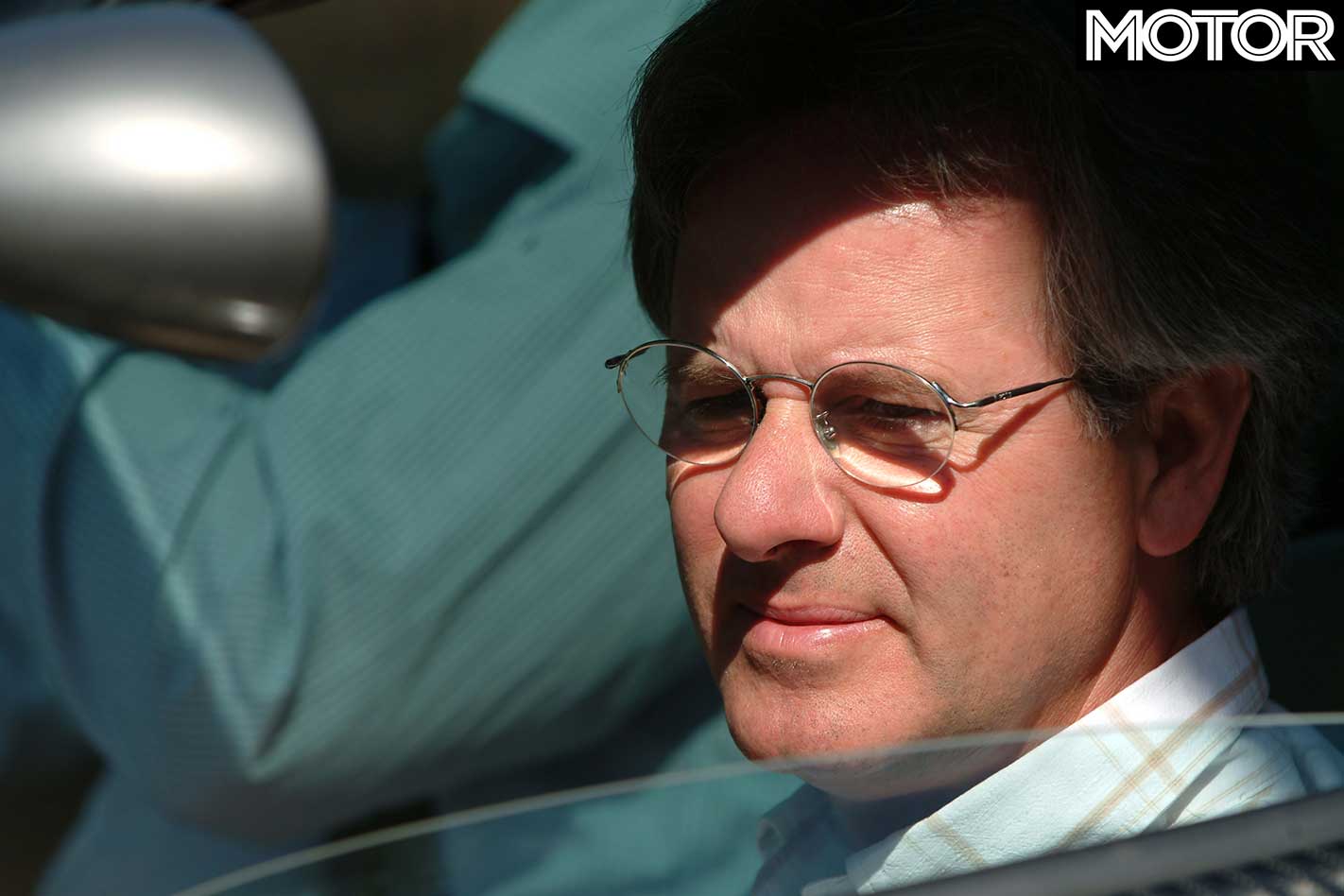
A scan of the road ahead reveals nothing but sunshine, a clear road and not another soul… he notices my inquisitory sideways glance, grimaces, and half apologises: “Sorry, I am a nervous passenger. This is my baby, and I get very nervous.” Quite understandable.
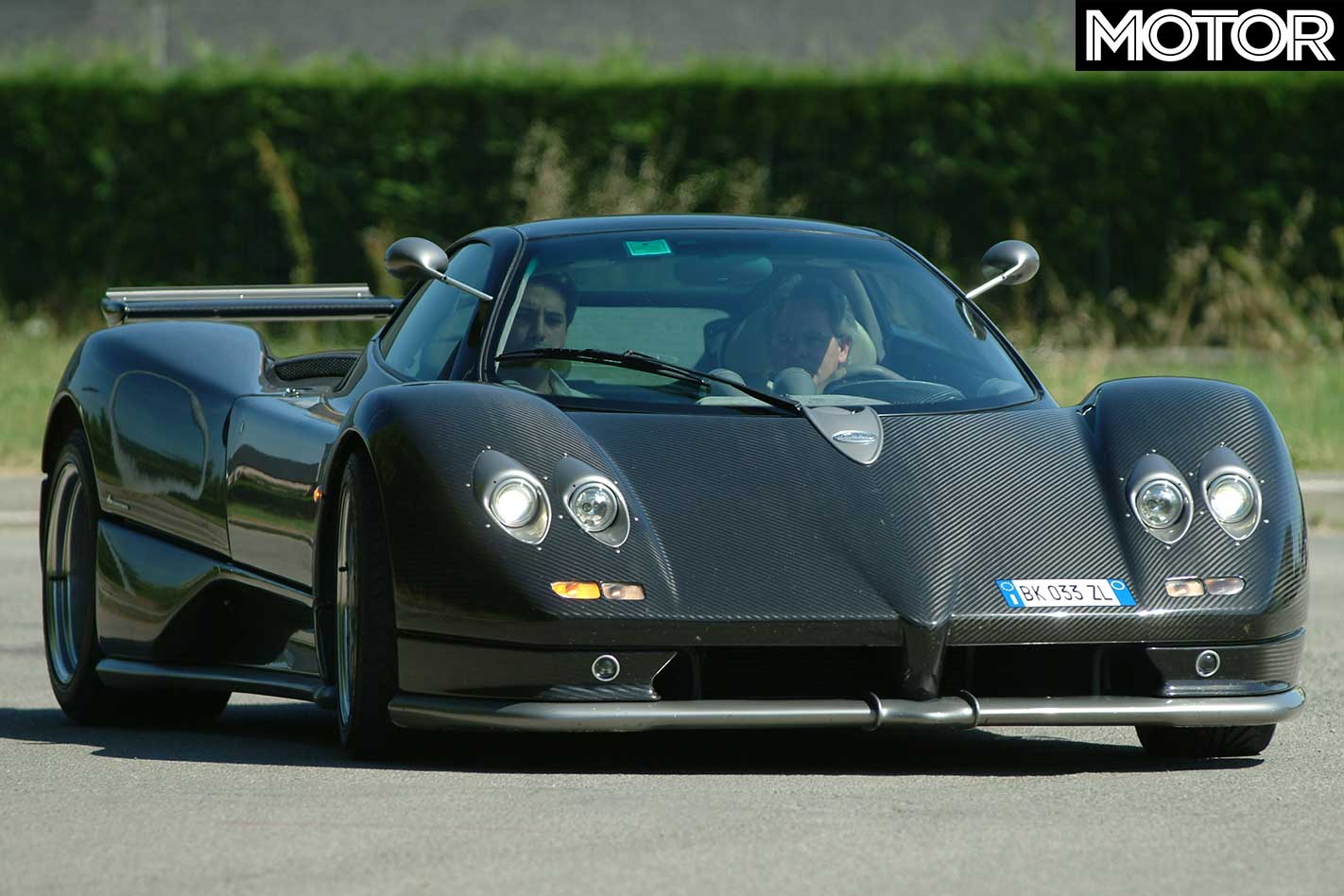
Pagani’s Zonda C12 S is, after all, a rare species. One-point-two million dollars. Say it fast and it’s easy to dismiss, but after a day touring the factory, watching the handful of Italian women carefully cut and brush the resin into the carbon fibre weave before baking it in the on-site autoclave, there is some weird sense of value in that figure. This is truly one of the world’s finest, fastest, fantastic supercars.
The Zonda runs a V12, like a Murciélago, but at 7.3-litres it’s more than a full litre larger. Its 414kW may be 12kW down on the Lambo, but its 750Nm is 100Nm more than both the Lambo and a V12 Ferrari Enzo. And the Zonda weighs the same as an Astra SRi Turbo, with a power-to-weight ratio tiny enough to make a Gallardo owner go gaga.
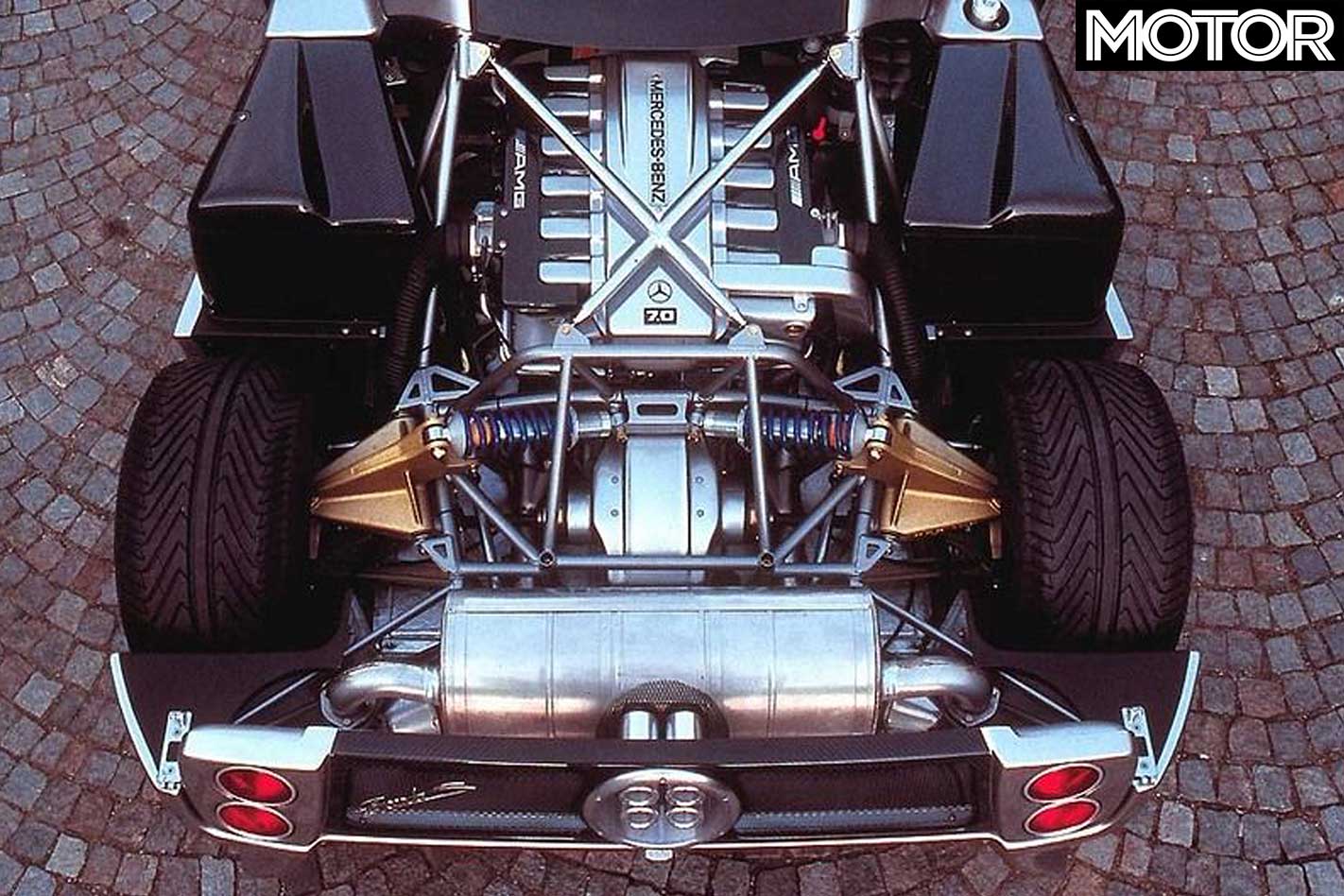
Named after the slight, jockey-like founder, Horacio Pagani, the Zonda was called the Fangio in design stages, after Pagani’s idol and friend Juan Manuel Fangio. But following Fangio’s death in 1995, out of respect, Pagani changed the car’s name to Zonda, after an Argentinean Andean wind.
In this small factory in Italy, not far from Ferrari, is Modena Design, where the 3200 individual, mostly specifically made parts come together: like the 130 parts of carbon fibre – including the 70kg bare, flat-bottom monocoque chassis – to the doors, console, roll-cage incorporating frame, engine cradle and wiper cover, every line of carbon fibre weave is matched and aligned over the panel gaps to form a V down the middle and across the entire car. It’s simply the most perfect carbon fibre this side of an F1 car.
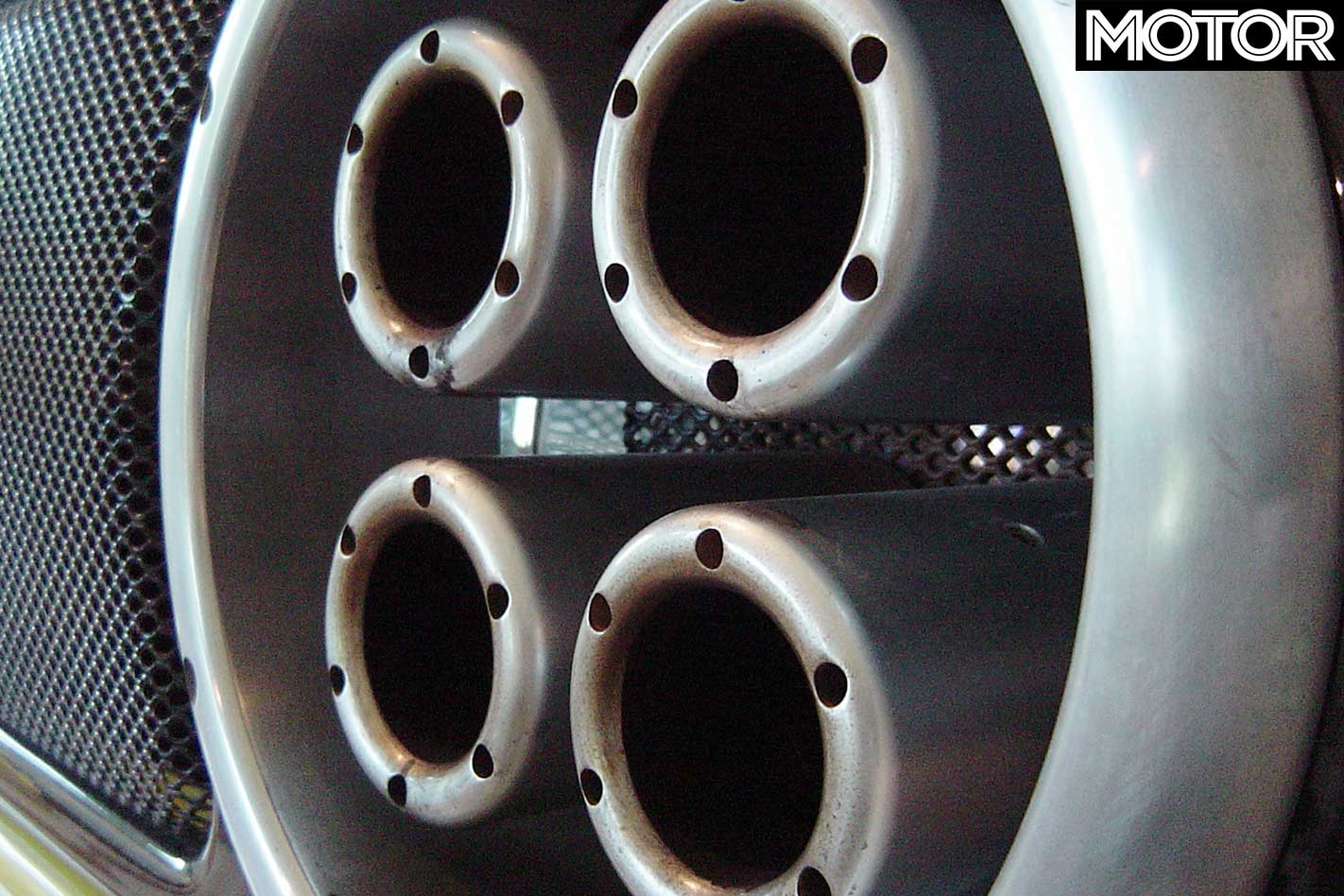
The engine, one of 100 built specifically for Pagani by Mercedes-Benz AMG – a 7.3-litre V12 – is then slotted into the mid-rear engine bay, jutting out through those signature fighter-plane quad-tips. Each Zonda is made to order, after a 30 percent deposit, and owners are invited to tour the factory and choose their paint, choice of seat trim, padding and colour. Want Antarctican Valley Yak Testicle Tan?
Then Pagani will do it, assuming you can provide a sample. Delete paint, also an option, and save yourself both the hassle of choice and 17kg. Weight is saved everywhere: where there isn’t carbon fibre, there’s aircraft aluminium – there’s even about one-fifth of the regular amount of sound deadening, just 5kg, used only in the most crucial areas.
Buyers also get matching luggage, a construction/owner’s folder that lists any manufacturing defects (notably blank in the cars we viewed) and even made-to-measure shoes by the cobbler who also soles the Pope, adding an air of holiness to the Pagani.
Inside, the cockpit is hot and light, the view is like being in an FA-18, a feeling not discouraged by the circular exhaust tips. The factory air-conditioning, ducted through the carbon fibre ‘sprouts’, offsets the biting heat. It’s cramped, but comfortable – and would be even more so if it were ‘my’ bum grooves it had been padded for.
Most controls are solid and well weighted, like a Boxster. Not so the steering, which is a touch vague off centre. But it’s not as bad as the rear vision through its high, tiny mirrors.

A 390km/h speedo and custom made gauges combining analogue needles with digital temp and odo are clear and reveal something absolutely remarkable: 112,511km. This silver demonstrator, one of Pagani’s first Zondas, has endured countless magazine tests, potential customer test drives and such is the quality of build, it still feels and sounds as tight as a new one.
The interior is simple but elegant; there are flaws – creased rubber, imperfect stitching – signs of humanity rather than faults.
Time for fun. The starter motor whines for a second, until the big V12 fires into life at 3000rpm, before settling at a smooth 1000rpm. The shifter is pure and simple: six forward speeds and a clutch that pops progressively to reveal a mountain of torque. Pick any gear, and from 500rpm – lower than idle – the Zonda will pull cleanly.
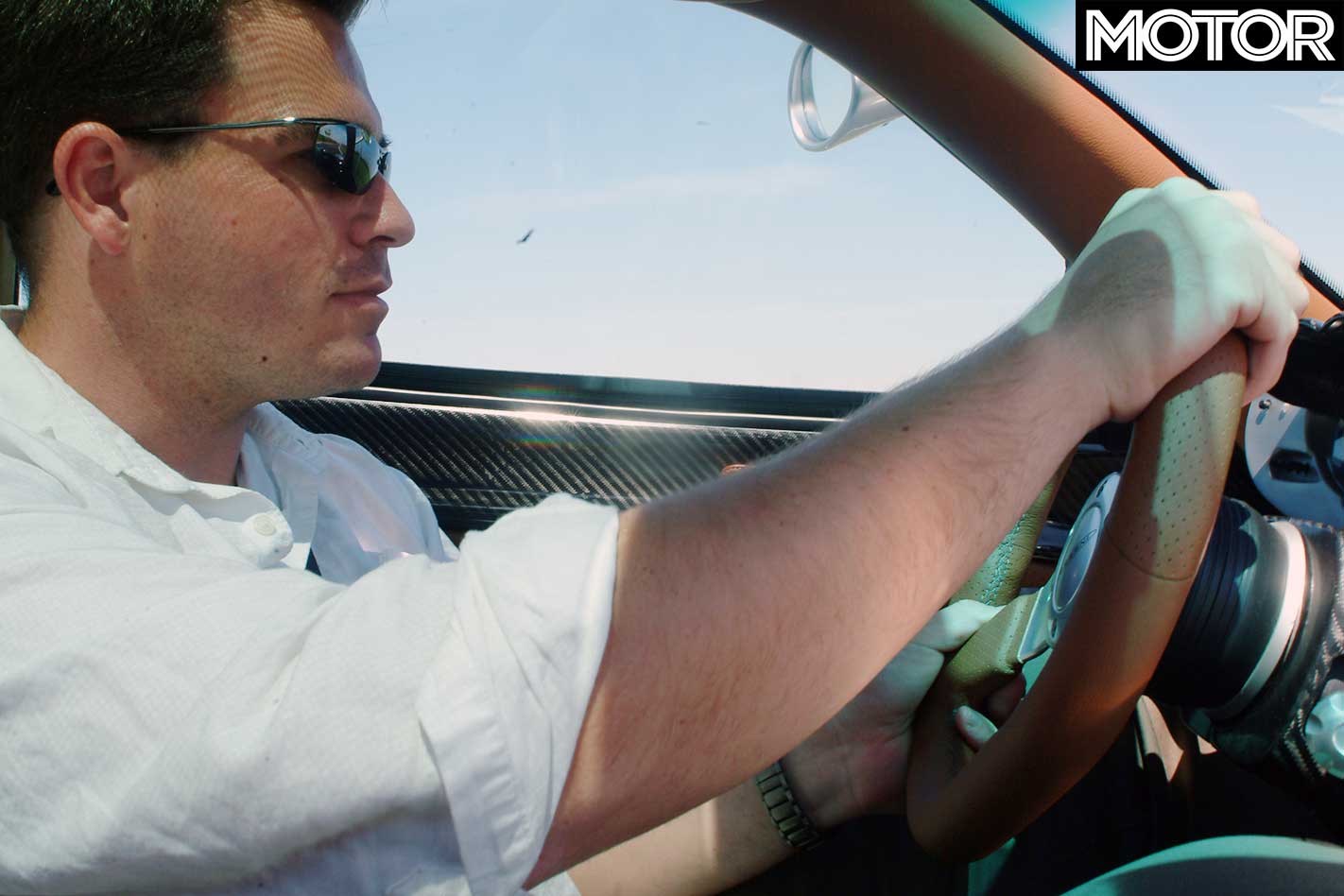
The engine is a dream, with a smooth, thrumming, urgency, like a mix-master stirring a thickshake. Plant it and all hell may as well break loose because the rear tyres certainly don’t. Massive Michelins grab the road and propel the Zonda into light speed; first to second gear is an instinctive reaction to pass 100km/h in 3.7 seconds, Pagani claims. There will be no testing today. Only official test drivers are allowed.
So the V12 bellows and shrieks through to the 7300rpm limiter in second gear. Only in third do you have time to regather and find out what the hell is happening. At three grand, it bulges torque, and picks up the pace at four, then again at five, where it hammers like a sports bike on some mission to outrun the speed of light – and all so seamlessly.
The shifter is light and clicky, like a Honda Civic, and the steering sharpens around Modena’s set-square angled hard lefts and rights. Lift and slam, and the engine belts out the kind of power and speed that only Lamborghinis, Ferraris and Porsches can rival. But none have the agility through the corners of the super-light, agile Zonda. Pagani proved the Zonda’s speed back in June 2002, when it lapped the Nürburgring in seven minutes and 44 seconds, in the wet.
And here’s the good news, after five years on sale, Pagani is coming to Australia, in right-hand drive. Motor Group Australia has secured the local distribution and the Zonda, in both Coupe and ($1.4m) Roadster, will be officially available just before Christmas.
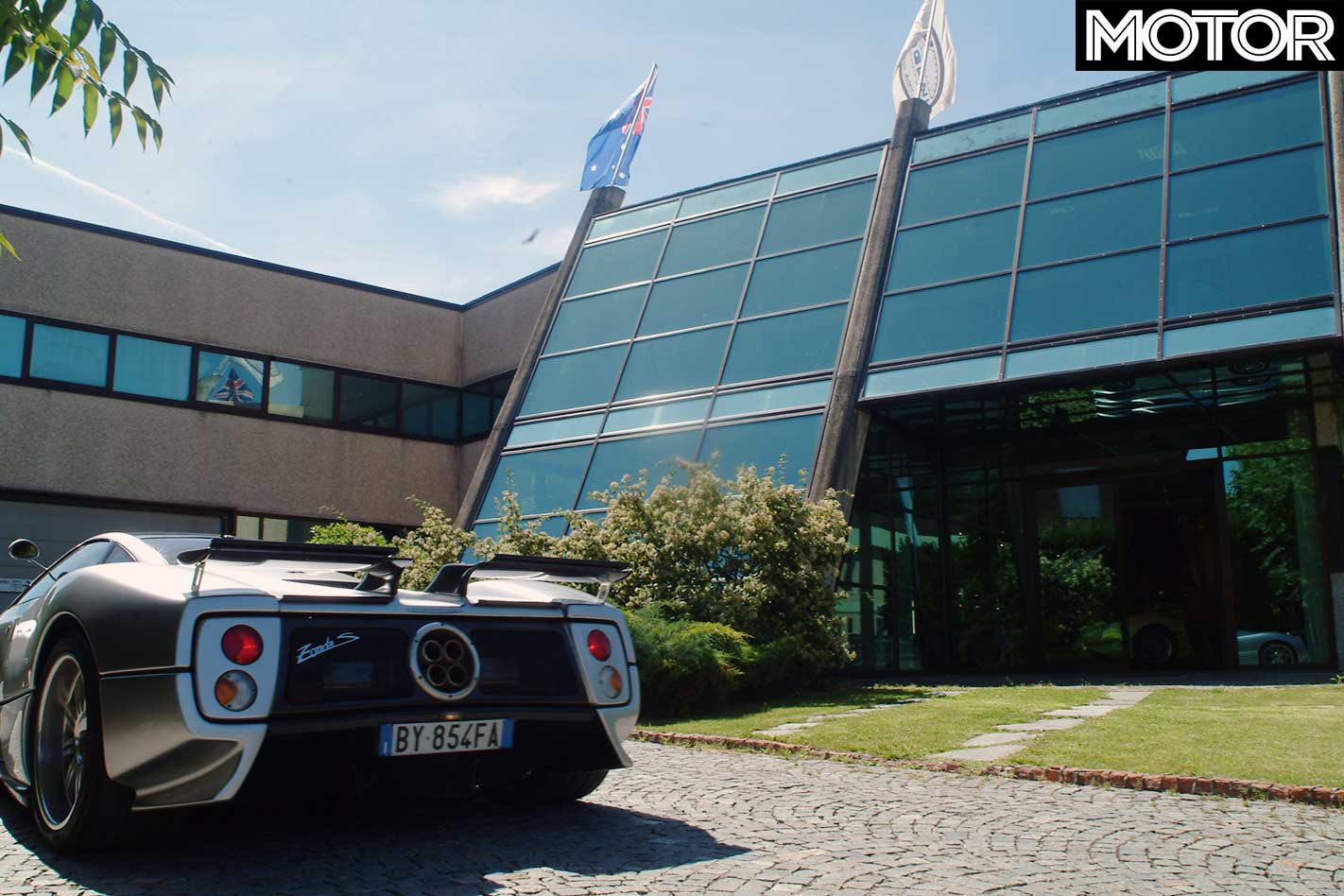
The Zonda isn’t as much a car as it is a work of beautiful art. It is the Gucci, the Tag Heuer, and the Rodeo Drive of cars. Its build and craftsmanship is so perfect, the drama and occasion and perfection often outweighs the fact it’s an insanely fast supercar. Park it in the living room, gaze at it, admire – we won’t mind.
Sure, the million-dollar price tag puts it in fantasy land, but at least put a Zonda on the dream car list for when the million dollar lottery numbers come up. Twice.

FAST FACTS 2004 Pagani Zonda C12 S
BODY: 2-door coupe DRIVE: rear-wheel ENGINE: 7.3-litre, DOHC, 48v, V12 POWER: 414kW @ 5900rpm TORQUE: 750Nm @ 4050rpm BORE/STROKE: 91.5mm x 92.4mm WEIGHT: 1280kg POWER-TO-WEIGHT: 323kW/tonne TRANSMISSION: six-speed manual SUSPENSION: double wishbone with pullrod and coil-over springs, anti-roll bar (f & r) L/W/h: 4395/2055/1151mm WHEELBASE: 2730mm BRAKES: 355mm cross-drilled & ventilated discs, four-piston calipers (f); 335mm cross-drilled & ventilated discs, four-piston calipers (r), ABS WHEELS: 18 x 10-inch (f); 18 x 12-inch (r) TYRES: Michelin Pilot Sport, 255/40ZR18 (f); 345/35ZR18 (r) PRICE: $1.2 million
PERFORMANCE: 0-100km/h: 3.7sec 0-400m: 11.8sec (claimed) Top speed: 336km/h (claimed)
THE tangle of thoughts and emotions are separated by nearly 37 years; well beyond the span of boy to man. Yet they all riff on the same theme: wide-eyed lust and wonder, a frisson of excitement, a jangle of nervy anticipation. They go a fair way to proving the old adage often touted by women: as blokes, we really are 15 until we die.
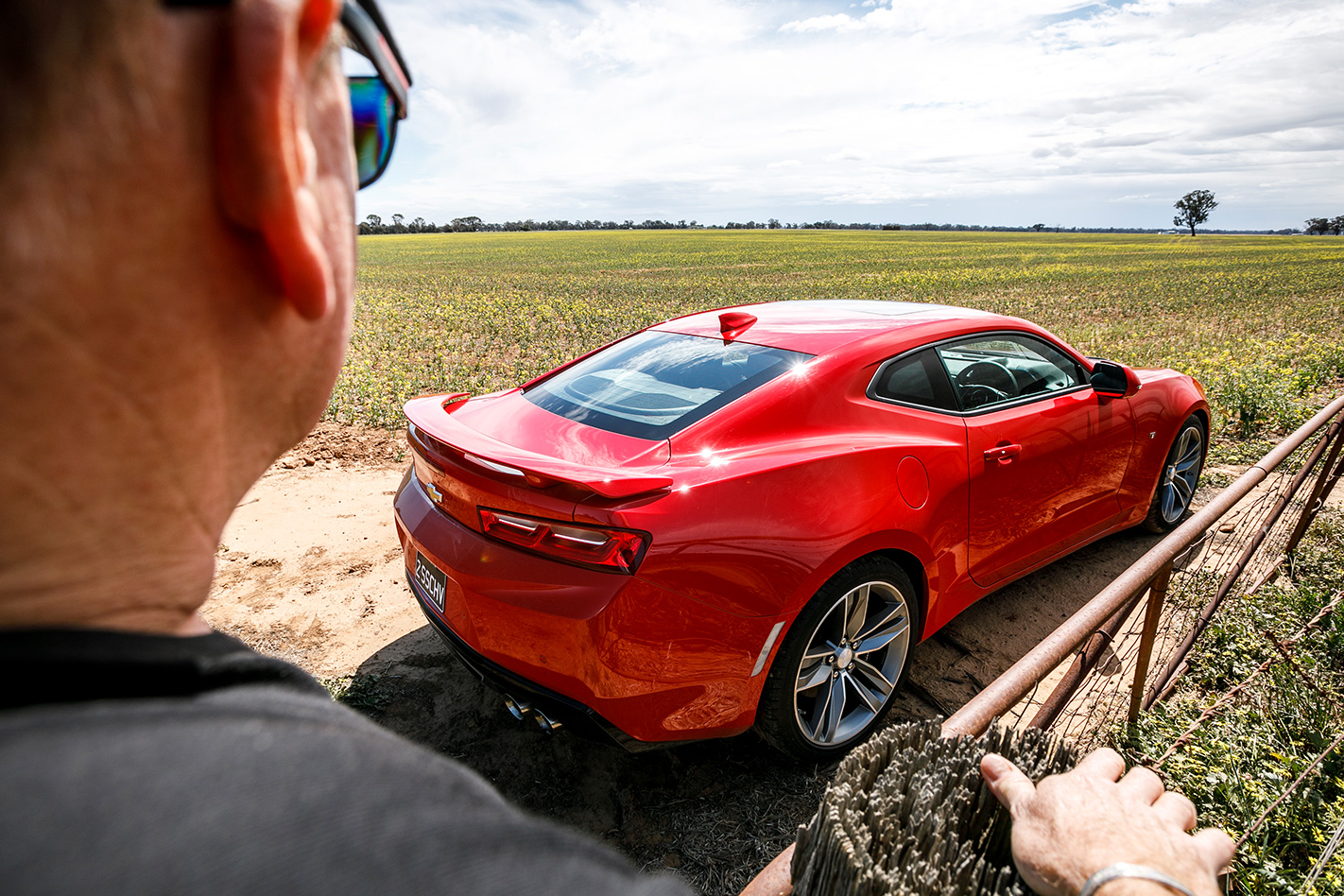
Actually, I was 16 when I first saw the Group C Z28 Camaro driven by Kevin Bartlett and Colin Bond at Bathurst in 1982. It was my first trip to the Mountain and I was in pimply, teenage awe of the Camaro’s bulging haunches and head-kicker stance. To me, it looked a size bigger and serious lash tougher than the Aussie touring cars of the period. Standing at the wall at Reid Park, watching Bartlett belting it over the top of the mountain, the car heaving on its springs and flooding the camping area with Chevy V8 thunder, my heart pulled what felt like 7500bpm in my chest.
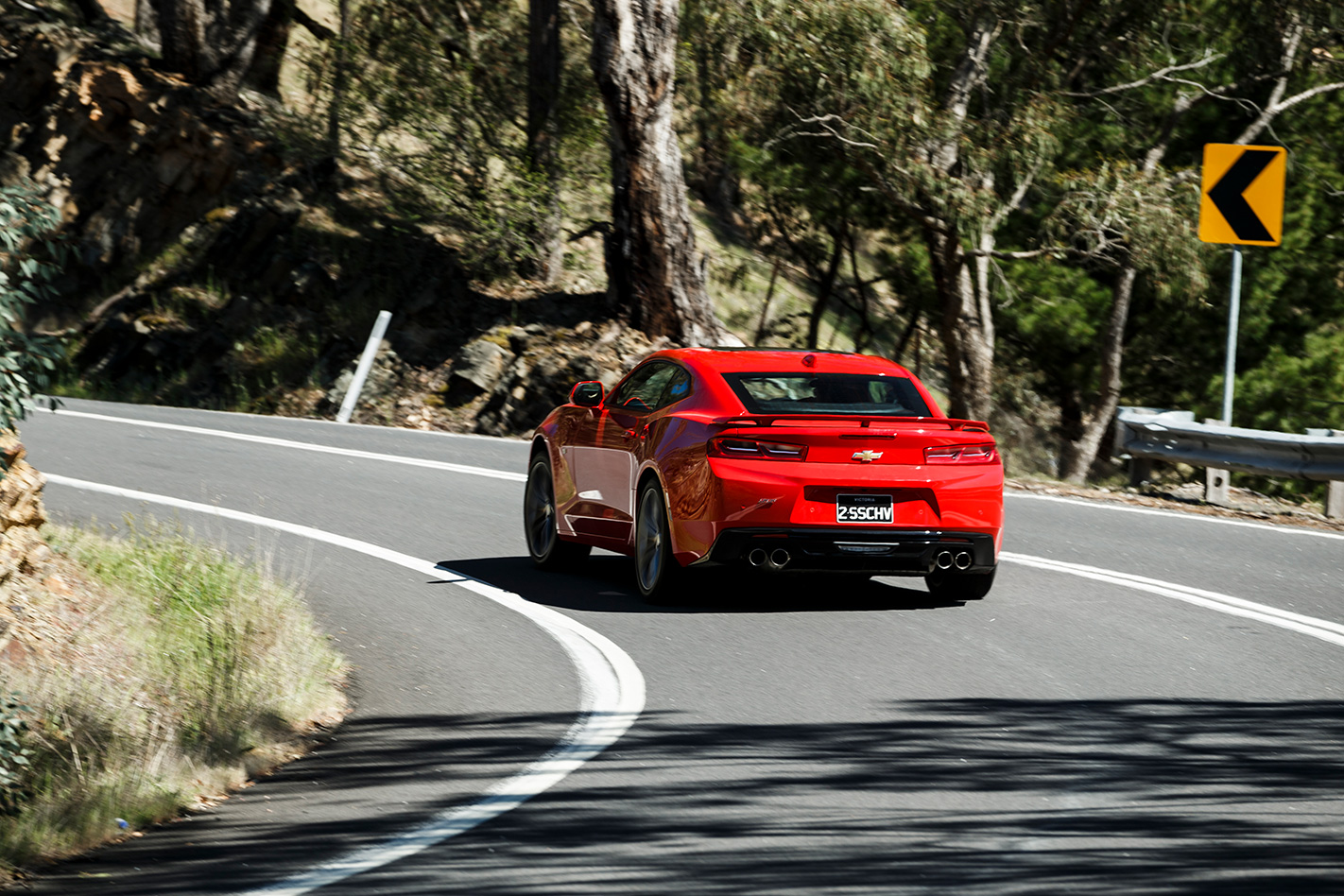
And now here I am, a half-century on the Westerman odo, and a very different, but still completely identifiable Camaro is generating similar feelings. This one has arguably a tougher role to fill than towelling up VH Commodores and XE Falcons while shooting for a Bathurst win. This HSV-converted import has to generate some tribal loyalism for the Chev bow-tie and make Aussie Holden fans want to pin it to their collective chest. At the very least, it needs to provide a visual lure into the newly branded Chevrolet section in Holden showrooms where kids, in tow with mum and dad, can stare and dream.
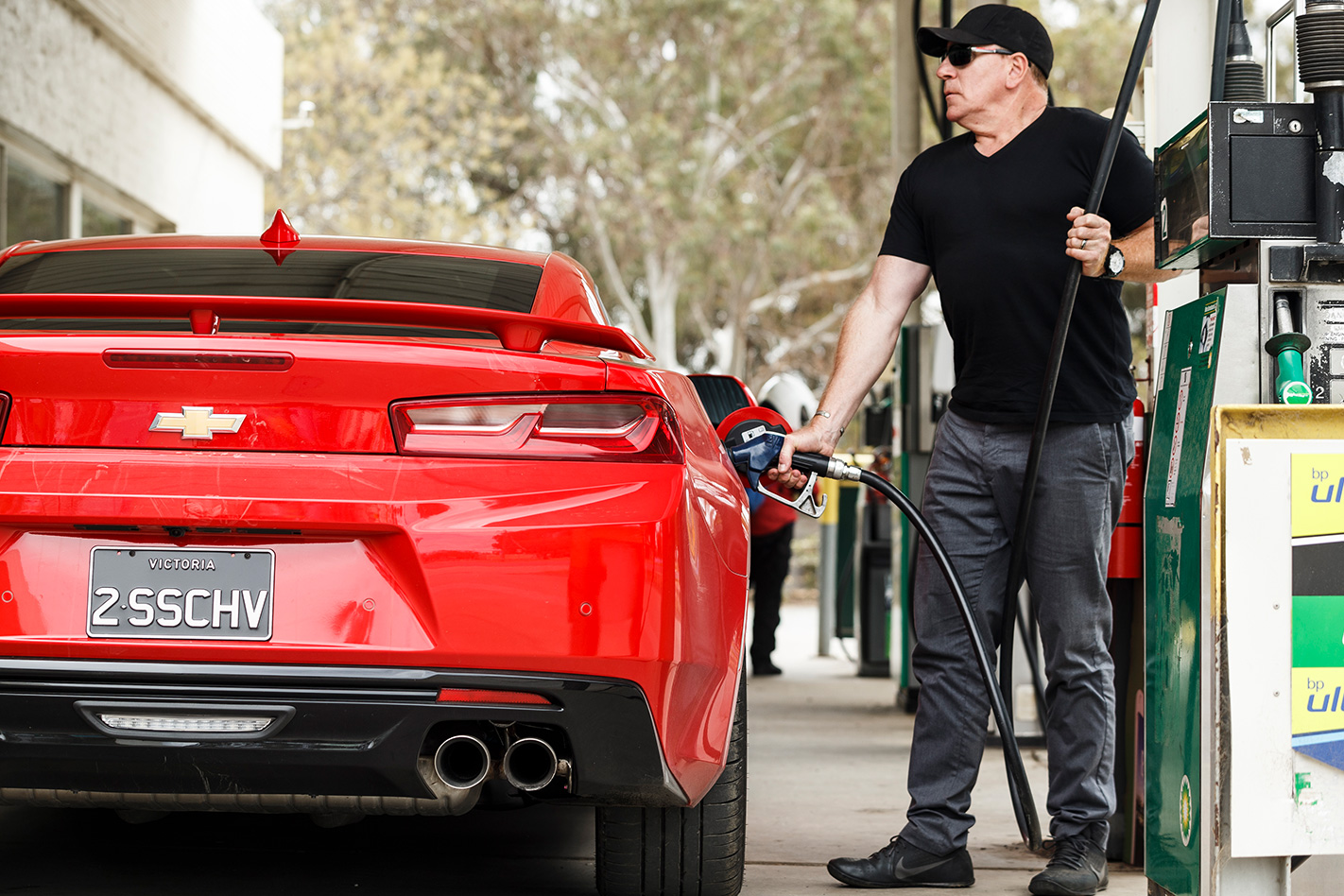
No question it has the styling firepower. For me, there’s a level of visual menace that tops even the mightily annoyed-looking Mustang. The front end reminds me of a law-evading gang-banger with baller cap pulled down low over its brow; bandana pulled up to hide its nose and mouth, leaving just those slitty, threatening eyes. You don’t know if it wants to mug you or challenge you to a rap battle.
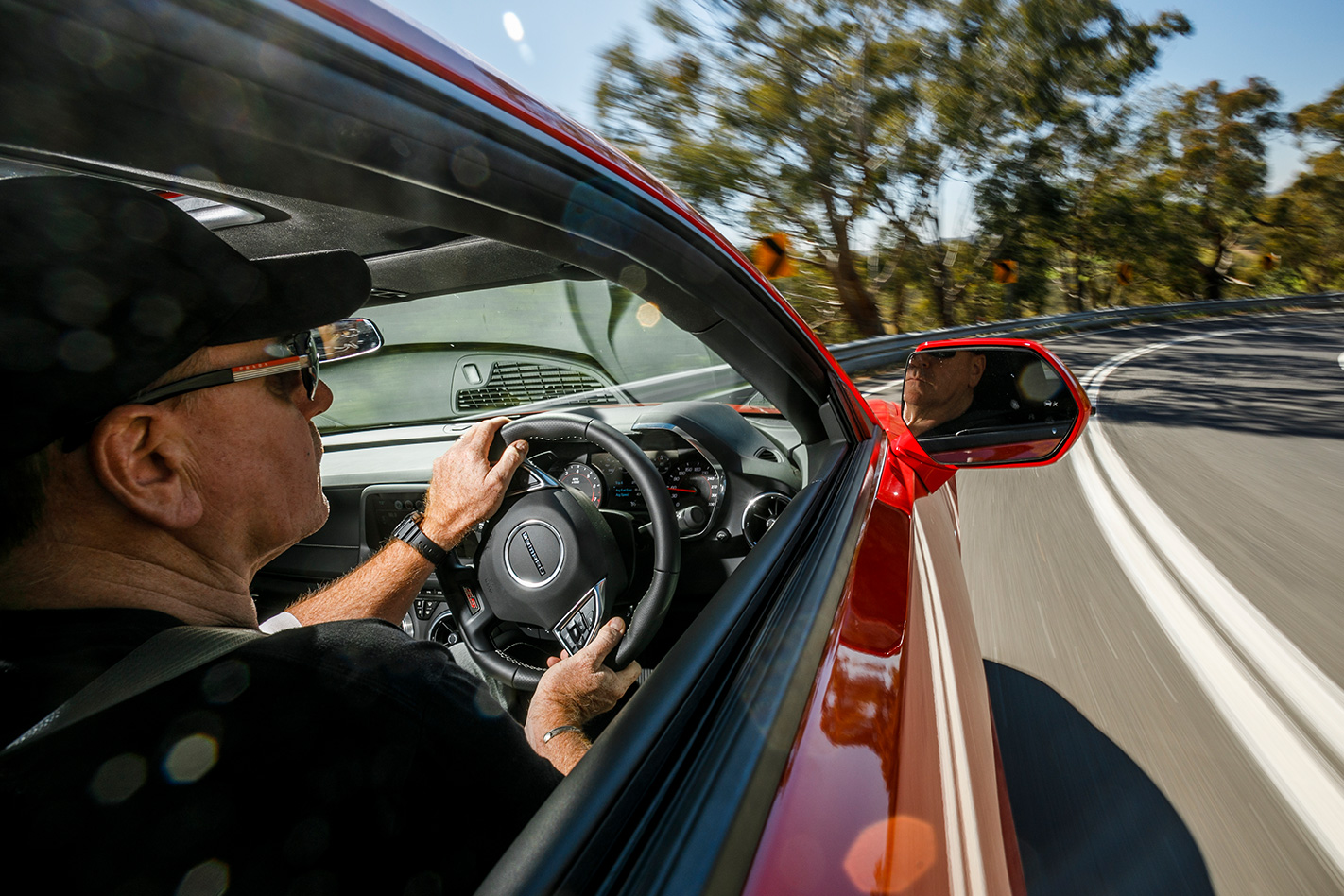
As snapper Jacobs and I pull away from the kerb, I realise I was right the first time: it does want to mug you. At least, the suspension tune wants to let you know who’s boss. It’s abrupt over small stuff, and has a serious aversion to ruts and sharp edges. The whopper Goodyear F1 tyres are run-flats; could they be contributors to the lack of low-speed bump absorption? And what’s with the steering weight?We’re in the most relaxed of the drive modes, ‘Touring’, yet the steering feels unnecessarily chunky, and the self-centring action feels kinda glutinous and not particularly natural.
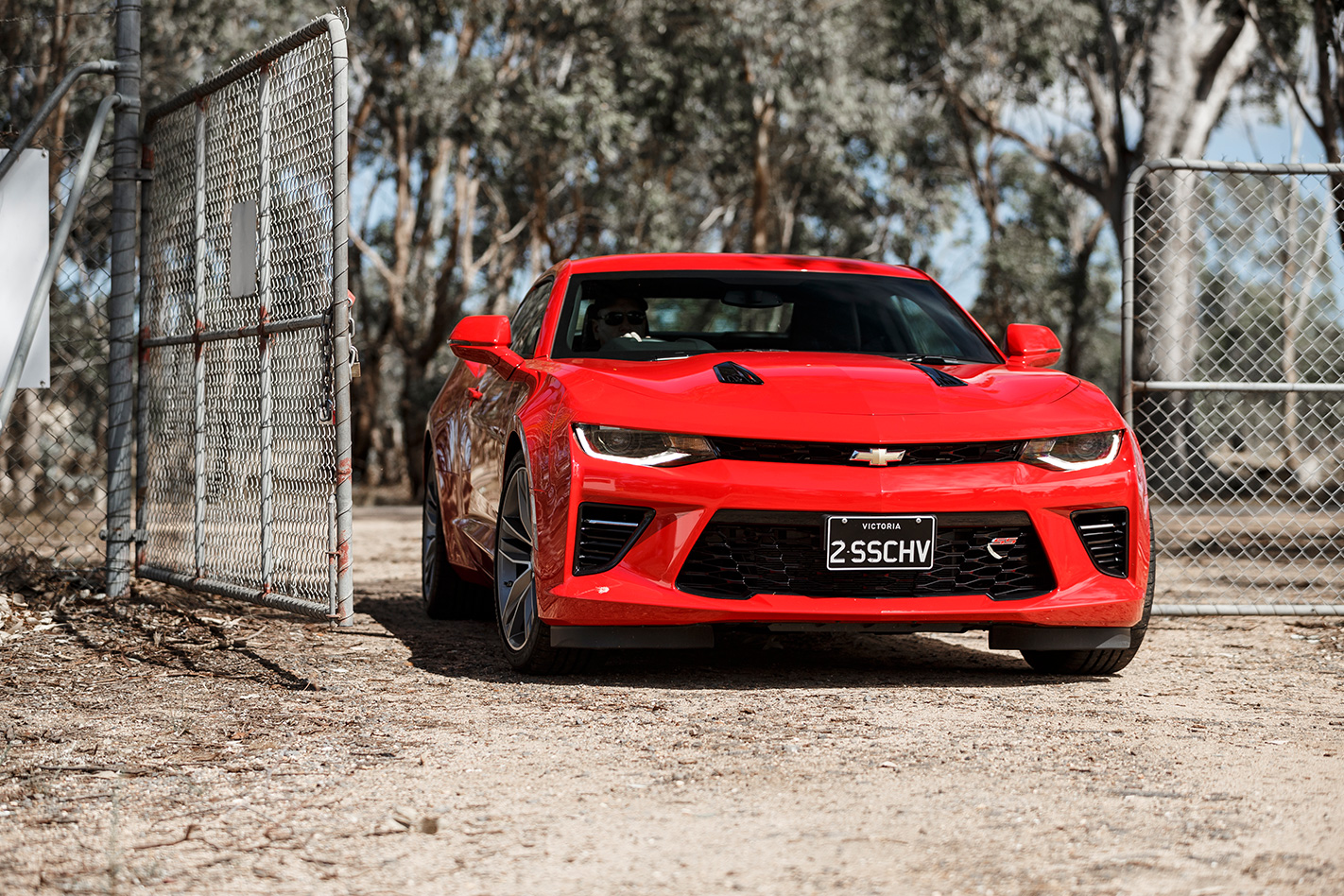
As we ease onto the highway and head towards the Heathcote dragstrip, there’s a chance to appreciate the crisp response of the new-for-Oz LT1 V8 (see sidebar p75), and revel in the baritone sonics of engine and exhaust. The eight-speed auto feels properly in tune with your right foot and intentions in easy driving. As we settle into a cruise, and the revs drop to just 1500rpm at the 110km/h limit, the exhaust note becomes a distant, almost hypnotic rhythm, and tyre noise on coarse-chip becomes the dominate sound in the cabin. At times it feels like someone’s pulled the antenna out of an old analogue television, and turned up the sound of the white-noise static. When it abates for brief periods on hot mix, there’s the sound of chipmunk chatter from the dash section above the instrument panel. Maybe it’s time to start revising my expectations, or just crank up the Bose audio.
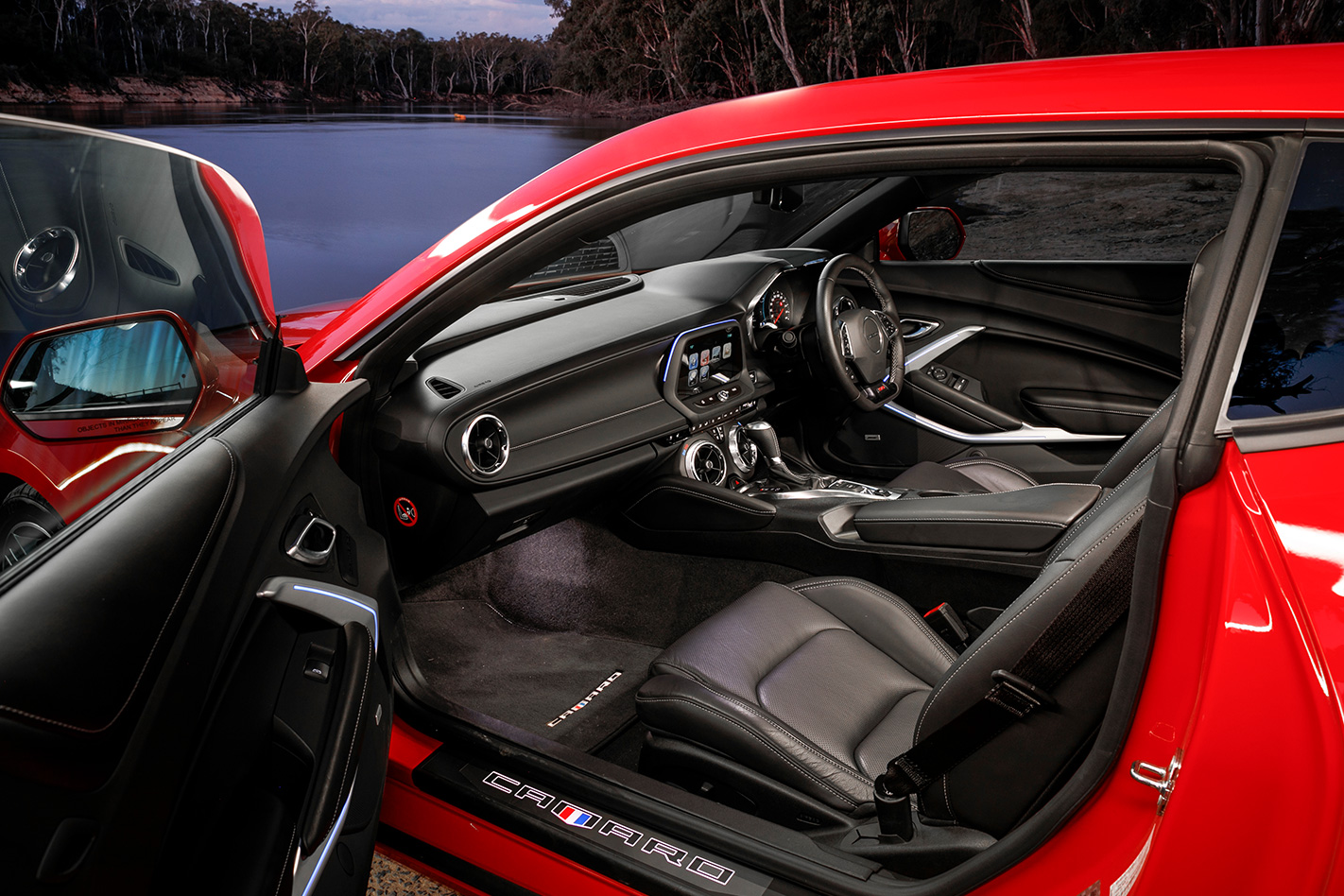
As a distraction, I mentally play the ‘spot the RHD conversion’ game. The overall execution seems excellent; the only giveaways are those bits that could not be feasibly swapped around, so the letters next to the gear selector are mostly obscured by the lever, and a small blanking plate embossed with CAMARO hides the spot on the passenger door where the memory buttons for the driver’s electric seat once resided. But these are details customers won’t care about. More relevant is the fact it’s loaded as standard with gear like heated and cooled seats, heated steering wheel, Bose audio, and pages of scrollable dash info, like G-meter and engine hours. But no head-up display, and, more importantly for its ANCAP rating, no AEB.
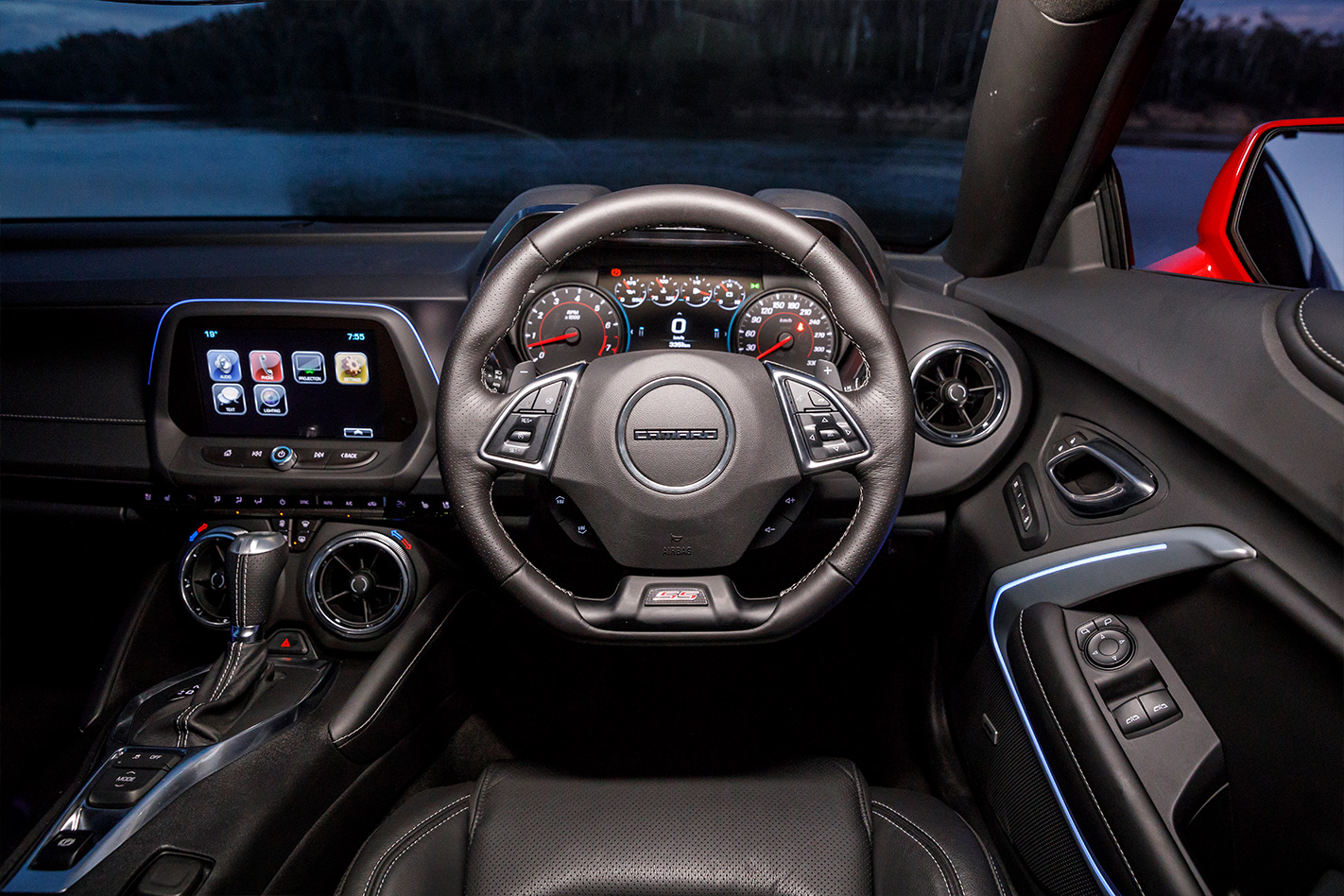
It tops a Mustang GT in terms of offering full power adjustment for both front seats, and standard 20-inch wheels, but nothing that makes any real case for the unfortunate $20K price gulf that separates it from the rival Ford. Let’s move on, because I can’t shake the question marks about the chassis tune. On longer amplitude stuff it shows a reasonable level of damping finesse, but at a cruise on lumpy backroads it can quickly turn choppy and reactive. The fixed-damper tune is a result of Australian cars being sourced from Argentina, where magnetic dampers aren’t offered. Any potential Camaro buyers used to the greater breadth of damping range provided by the likes of HSV’s three-mode GTS will have to accept Camaro’s more singular focus.A COLD wind scuds across the strip at Heathcote, and the clouds out to the west over the ranges look heavy with rain. But the surface is dry, and the cool air temp will help the LT1, even if the three-quarter-filled tank and my 105kg won’t.
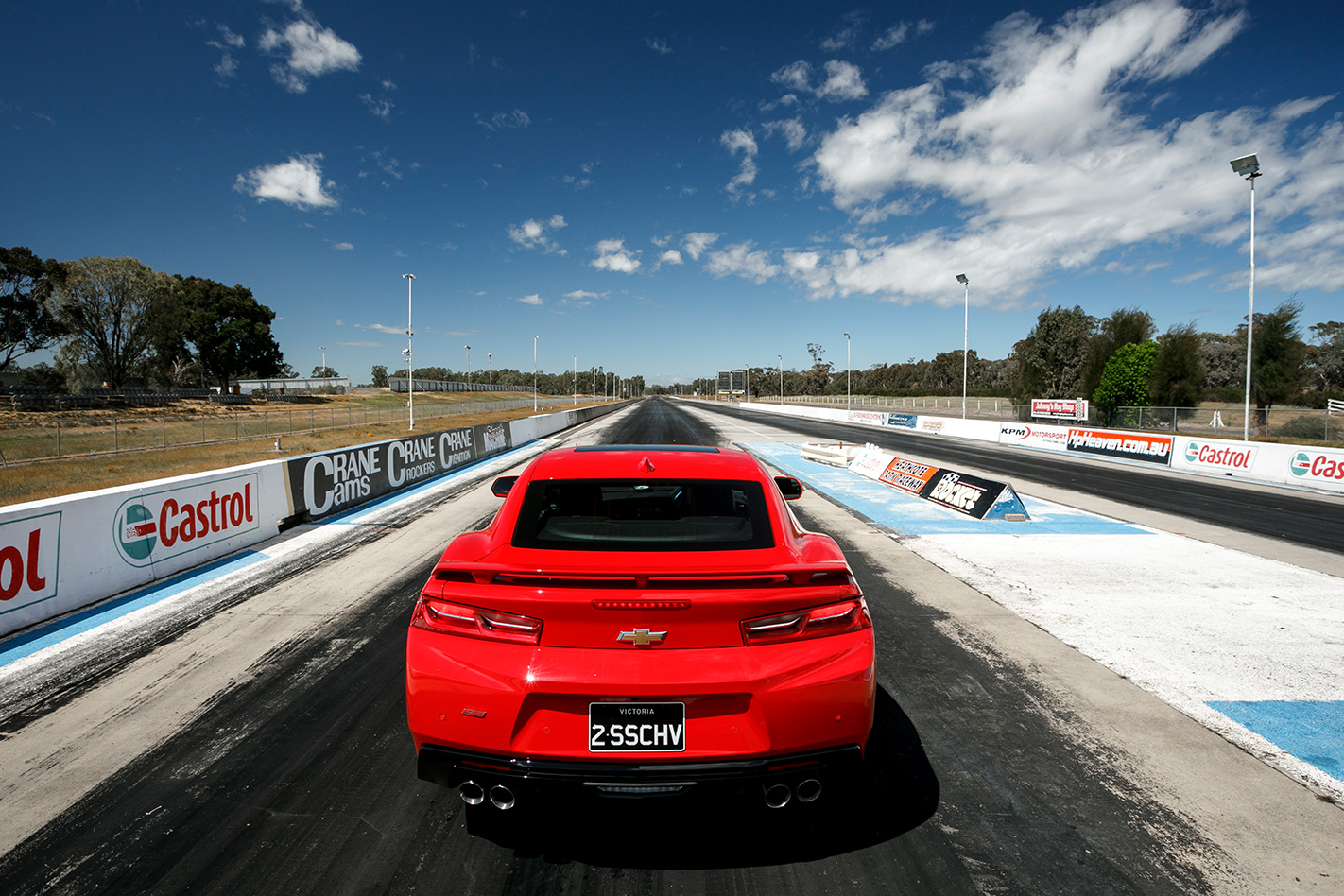
First launch, with ESC on, sees it step away, then bog momentarily as the electronics take over, before the engine comes bellowing back on song, and roars through the mid-range, hitting its real on-cam sweet spot at a bit over 4000rpm. It’s ferocious and rev-hungry as it lunges past 6000rpm, sounding even more crisp and harder than I remember the 340kW LS3 version of this engine architecture. Each upshift comes with a spit of expelled exhaust pressure, like a gunslinger hawking out a wad of chewing tobacco. It’s a thrilling V8, capable of raising the hairs on your neck, not just on the emotive level for what it represents for Team Red, but for the way it hollers as it hurls you down the road.
The first sprint number seems a bit unremarkable at 5.1sec – the claim is 4.4 – but experimenting with launch techniques with the ESC off and balancing the wheelspin manages to shave off a few tenths to pull the number down to 4.9sec, with 12.9sec for 0-400m. For context, we recorded a 5.0sec/13.2s from the 306kW, pre-facelift Mustang, so expect the updated Ford’s additional 33kW to pull the pair of Ameri-straya coupes super close.
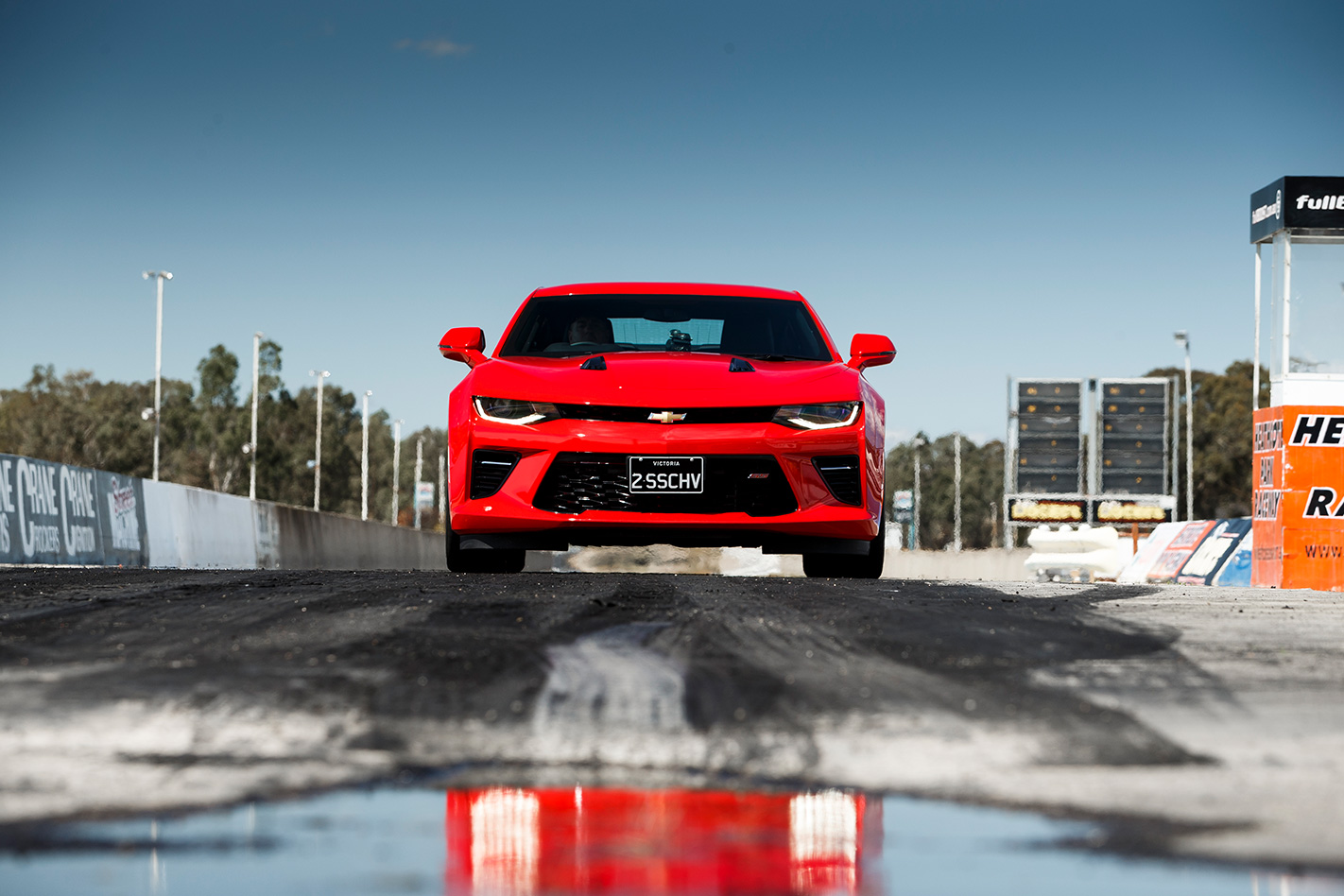
Camaro’s engine edge, if one exists, is likely to come in its torque delivery thanks to the capacity advantage (6.3L v 5.0). Its lazy, lopey character is like relaxing in a hammock when you’re on the schelp, with that brilliant ability to launch straight back into the real meat of the torque curve and pin its ears back when you want to blast past comatose traffic.
The brakes feel powerful, with a strong, progressive bite, hauling the 1710kg car down from around 200km/h at the end of the strip, and the measured number of 100km/h-0 in 36.7m is not bad. But after the stomp test, I’m not inclined to really wail on them; the front rotors, at 345mm, are 22mm smaller than those fitted as standard on the last of the HSV R8 Clubsports.
Our plan is to head to Echuca, a historic trading town on the banks of the Murray and home to the National Holden Motor Museum, where we want to introduce Camaro to some of its illustrious family forebears, and also gauge a reaction from visiting Holden fans. In this warped new world of German Commodores, can they really take to Camaro like it’s part of the Lion pride?
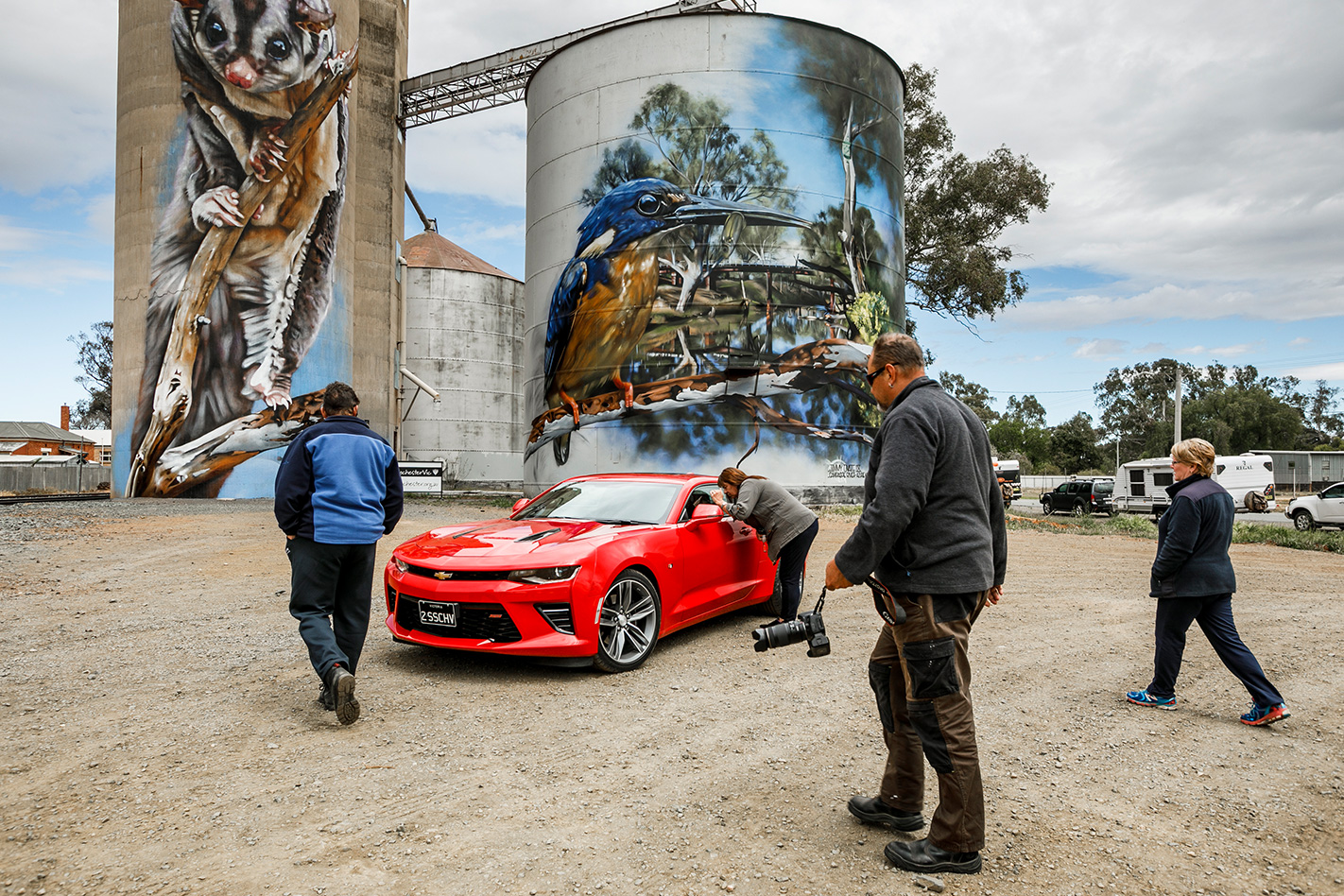
Our first indicator comes in the wheat town of Rochester, 180km north of Melbourne. This place was on the decline until recently, when it became part of the Silo Art Trail. Two massive GrainCorp silos provide the canvas for a pair of stunning murals of a squirrel glider and kingfisher by artist Jimmy Dvate, and as we roll in, there’s a gaggle of tourists snapping photos.
Yet the soaring artwork is no match for a blazing red Camaro and its chest-thumping V8. Instantly the questions start flying: “How much? How fast? Can I sit in it?” As Jacobs composes a shot, a couple of the more selfless ladies tell us they’d be happy to get their tops off and drape themselves over the bonnet – all in the name of art, of course. I gently explain that’s my job, but it’s a very kind offer.
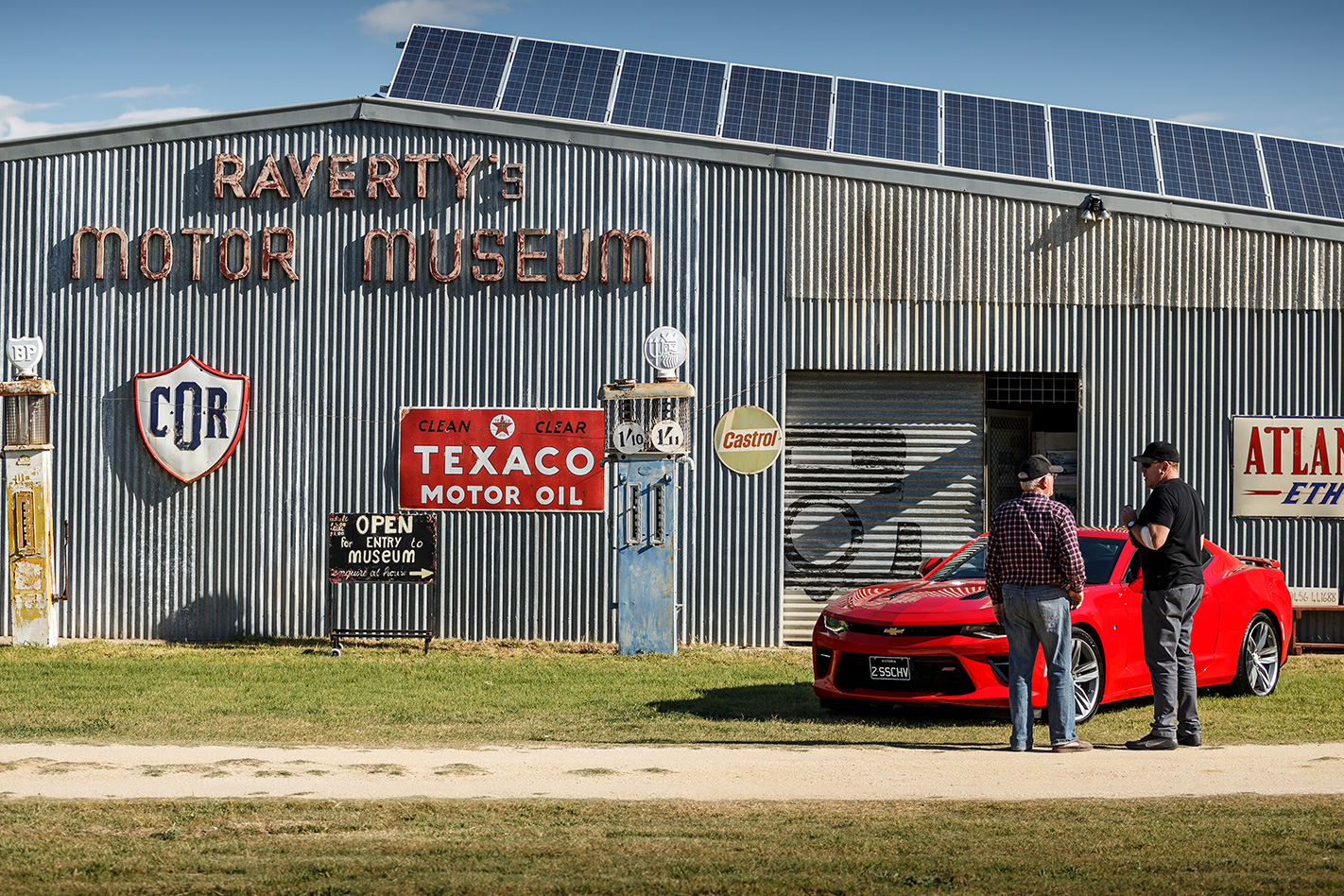
Echuca has a charming and well-preserved historic-town section by the riverbank, but we don’t spend long there. As we pull up to the National Holden Motor Museum, co-owner Mark Galea prowls suspiciously around the Camaro, like a territorial dog deciding if he’ll let the muscular new mutt take a slash on his lawn.
The collection over which Galea presides is properly impressive, with pretty much every significant locally made Holden represented. So could the museum ever create a guest-spot for the likes of Camaro, given that there’s no other way to contemporaneously expand the collection?
“Um, well … but it’s not a Holden,” Galea says glumly. Maybe a quick steer of the Chevy-badged interloper could cheer him up? By the time he’s given it large down a few quiet roads outside of town, he’s definitely thawing. But more importantly, when we return, the junior visitors to the museum are all over the Camaro like picnic ants, ignoring heavyweight drawcards like the HSV W427. Instead, they paw at the American coupe, eager to see its engine, crawl around its interior (while tripping on the ridiculous seatbelt design that impedes them getting in the back) and drink in its Yank uniqueness.
Great, but frankly I’m getting an itchy throttle foot, and enough of this “feelings” stuff on the automotive shrink’s couch. It’s time to find somewhere quiet to give Camaro a proper pasting, and go in search of the athleticism lurking under the sheetmetal.
The wickedly winding section of the Murchison Spur road near Broadford is just the job. Instantly the steering starts to make more sense, at least in its ‘lightest’ setting, which can be separated from the four drive modes by digging into the on-screen menu. (Not sure why this, and the exhaust mode, are located here, rather than bundled with the drive modes on the centre-console.) I’d still prefer even less weight and a bit more nuance, but colleagues tell me they were fine with it, so put it down to personal preference. What’s inarguable is the level of front-end purchase, and how the chassis just seems to get more resolved and feelsome the harder you drive it. “It’s the opposite of the Mustang,” dep-ed Enright tells me later. “The Ford starts to wilt when you’re really into it, whereas the Camaro laps it up.”
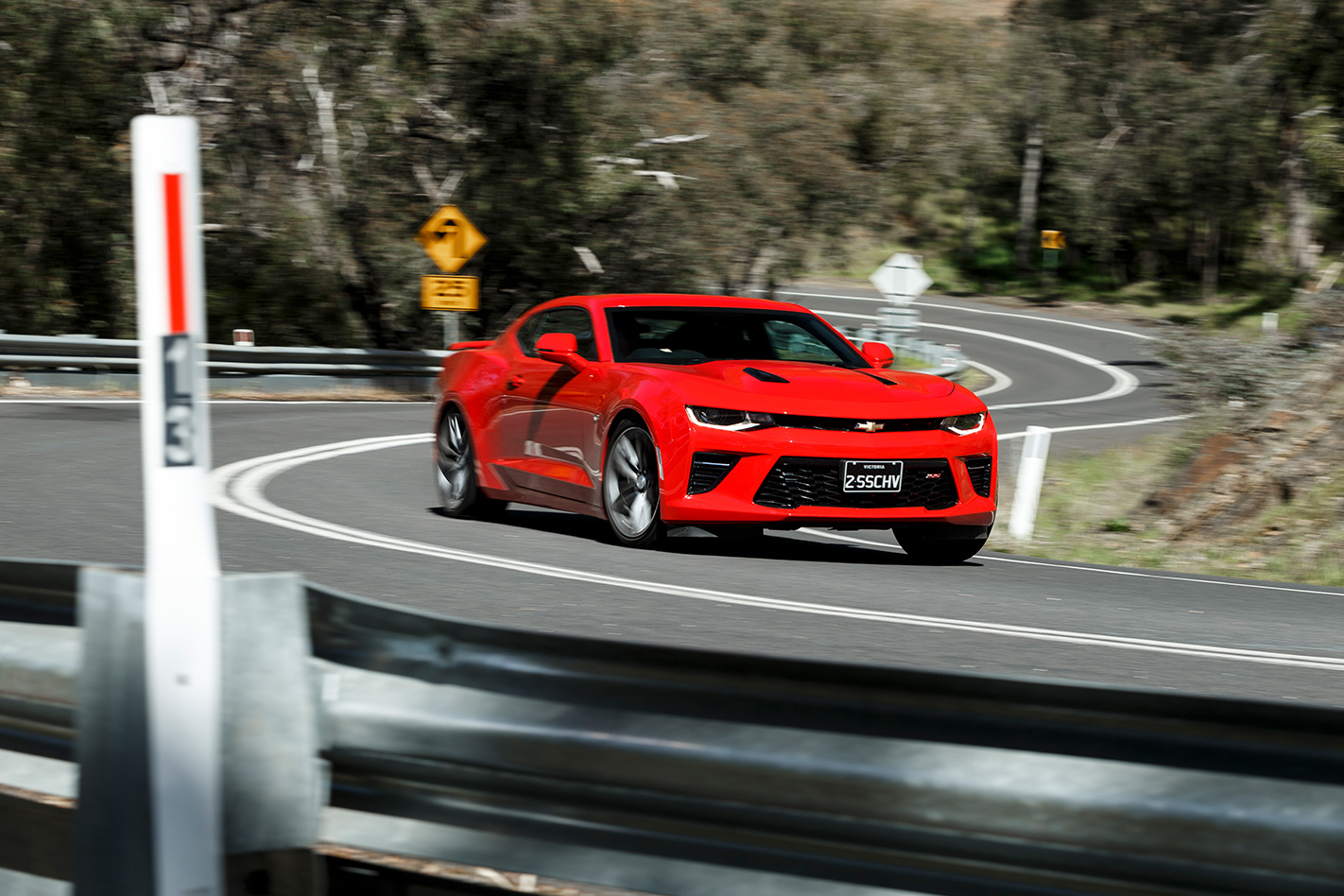
In Track mode, the ESC allows the rear to slide agreeably, and the throttle response is so precise past 4000rpm, you can neatly and easily walk along the tightrope between grip and slip as you pour on the power. Into one fast left-hander near the bottom of the climb, there’s room to pitch it in early, gas hard, and marvel at the resolute body control and beautifully telegraphed yaw from the rear. The sound of that V8 crackles and booms through the green valley, making it worth opening the sunroof. In this moment, it’s easy to fall for Camaro’s powers of seduction. Eventually the stoppers go soft, although not before we’ve had our fill on what is a brilliant but brake-punishing bit of road.
IT’S OBVIOUS the Camaro has real star power, and an almost exotic desirability that make plenty of Holden fans ready to pull it into a tight embrace. What’s the line from that song? “If you can’t be with the one you love, love the one you’re with.” The engine performance and hard-driven dynamics will have owners prepared to park their HSV Commodore memories; even better, for some, it’s not a Mustang.
Yet there’s no escaping the flaws that temper its daily usability, like the abysmal rear-three-quarter vision, crap cabin storage and kids-only rear seats. I’m also adamant that it could be an even more complete car with a bit of HSV wand-waving over the damping and EPAS calibration.
So don’t expect the all-round dynamic polish delivered by the final run of VF Holdens: both the cars that came via Clayton, and the ones that didn’t. We always knew what we had was pretty special, and Camaro is taciturn proof. Maybe we need to accept that to move forward, sometimes you have to take a half-step back, and it’s time to just give a grateful nod of respect to the bow-tied gangsta that now lords over the red end of town.
Making anything work for you for three decades is never going to be easy (ask Mrs M). And the motor industry is no different.
Oh sure, you could crank out four-wheeled cannon-fodder for the same period of time without much trouble, but to actually stay right at the front of the development and engineering curve for that length of time is a major win.
Thanks to multiple WRC victories, a handful of world championships and even record-breaking runs, we tend to think of STi as the birthplace of Subaru’s competition aspirations.
Actually, it wasn’t and the first time a works-backed Suby turned a wheel in timed anger was, in fact, right here in Australia when the factory entered a Leone (remember them?) in the 1972 Southern Cross Rally. But Subaru could see the sense in having a dedicated race shop which could be used to spin off exciting, profitable road cars for the masses, so in 1988, STi was established.
This concept, in itself, was not exactly rocket science; Subaru would have been watching the activities of other performance divisions including AMG and BMW’s M (and maybe even HSV) and could see that a stand-alone operation was a beaut way to build a brand image and some street cred.
These days, anybody with any hope of separating punters from a little bit more of their hard-earned money has a performance arm, but back in 1988 it was still a big leap for a conservative Japanese operation.
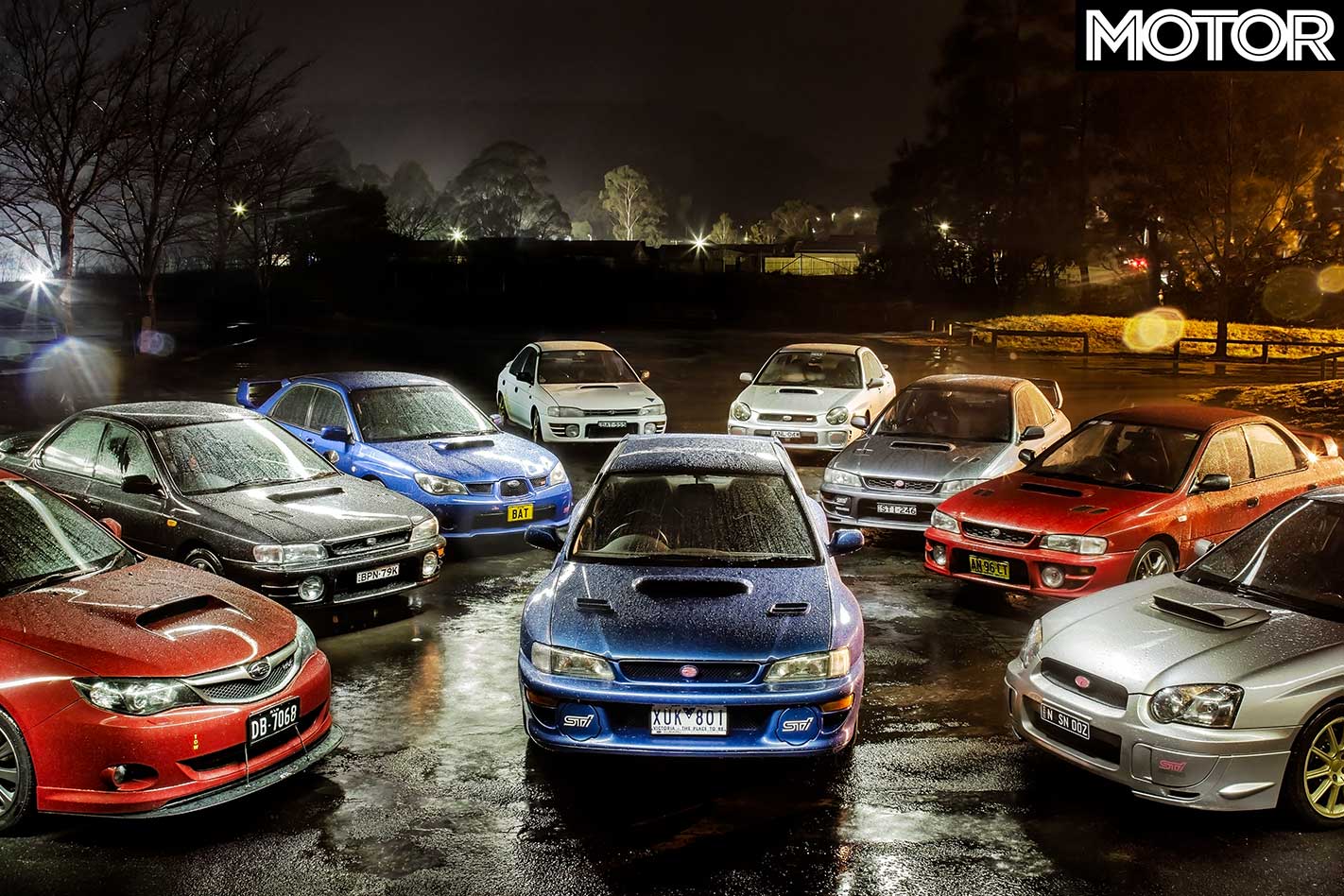
Which is not to say the other major Japanese factories hadn’t worked out the same for themselves, and by the time STi hit the headlines, Toyota had been operating its TRD outfit since 1976, Mitsubishi established Ralliart in 1983 and Nismo had been a force in motorsport since its establishment in 1984. But even though it was a while coming, it’s probably the STi franchise that has had the best cut-through in Australia.
That’s largely because Subaru has been good enough to give we antipodeans a fair suck of the sauce bottle. While the best and brightest models from the other Japanese car-makers often didn’t make it down here (you don’t think Peter Williamson’s class-winning 1981 Bathurst Celica was the fastest thing across the mountain with the Corona engine from Aussie-spec Celicas, do you?) Subaru has tried its best to give us lot and not just a small taste of a rich crop.
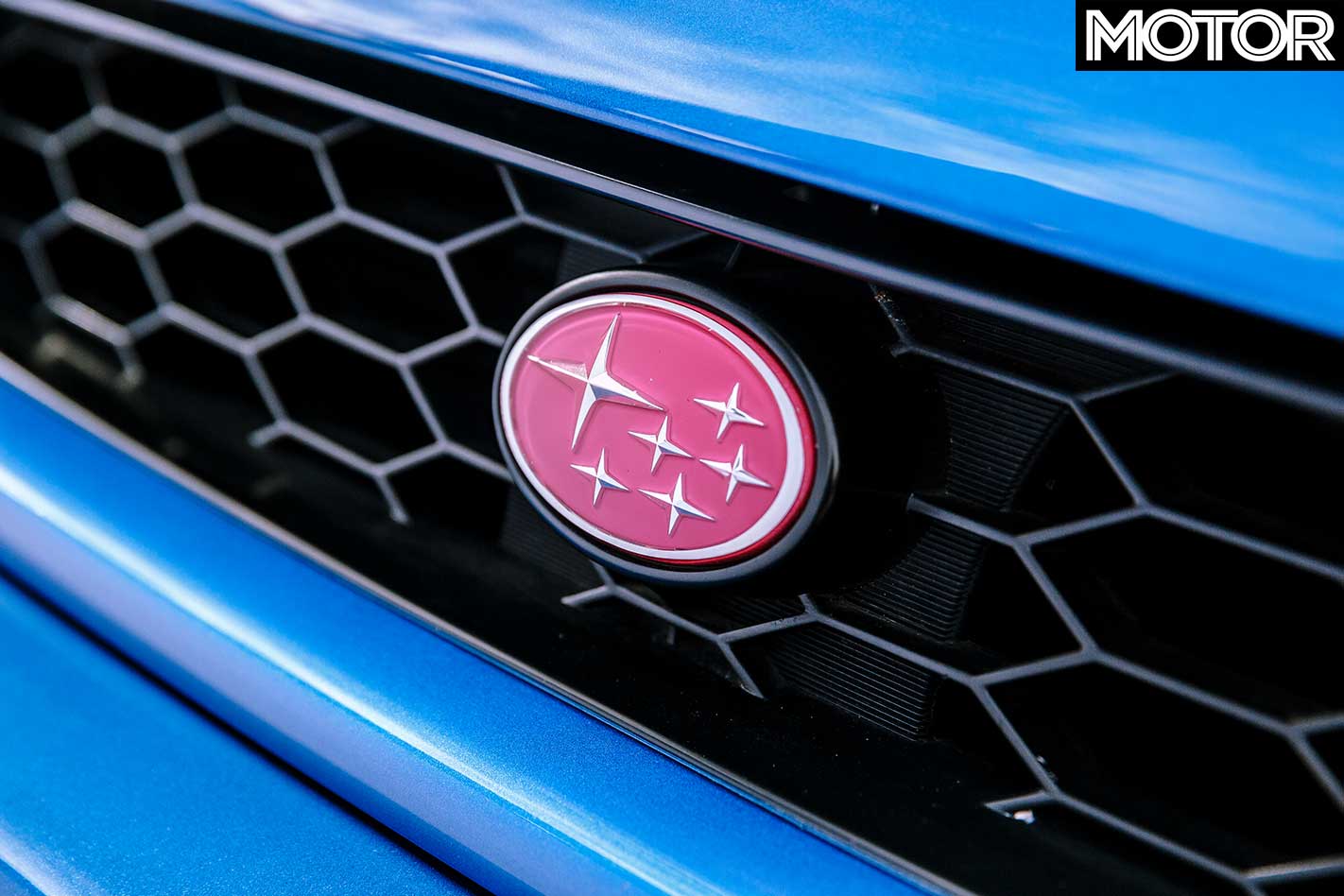
No, we haven’t been privy to all of STi’s hits, but by the same token, there isn’t a rev-head kid who doesn’t know what a WRX STi represents.
So for us at MOTOR, the idea of celebrating three decades of tear-arse Subies was a no-brainer. And the trio we’ve picked out to sample are absolutely representative of the type of lateral thinking that is a central part of the magic of any performance car. Oh, and we got to drive them.
1990 Subaru Legacy RS RA The genesis for forest-fighting, go-fast Subarus
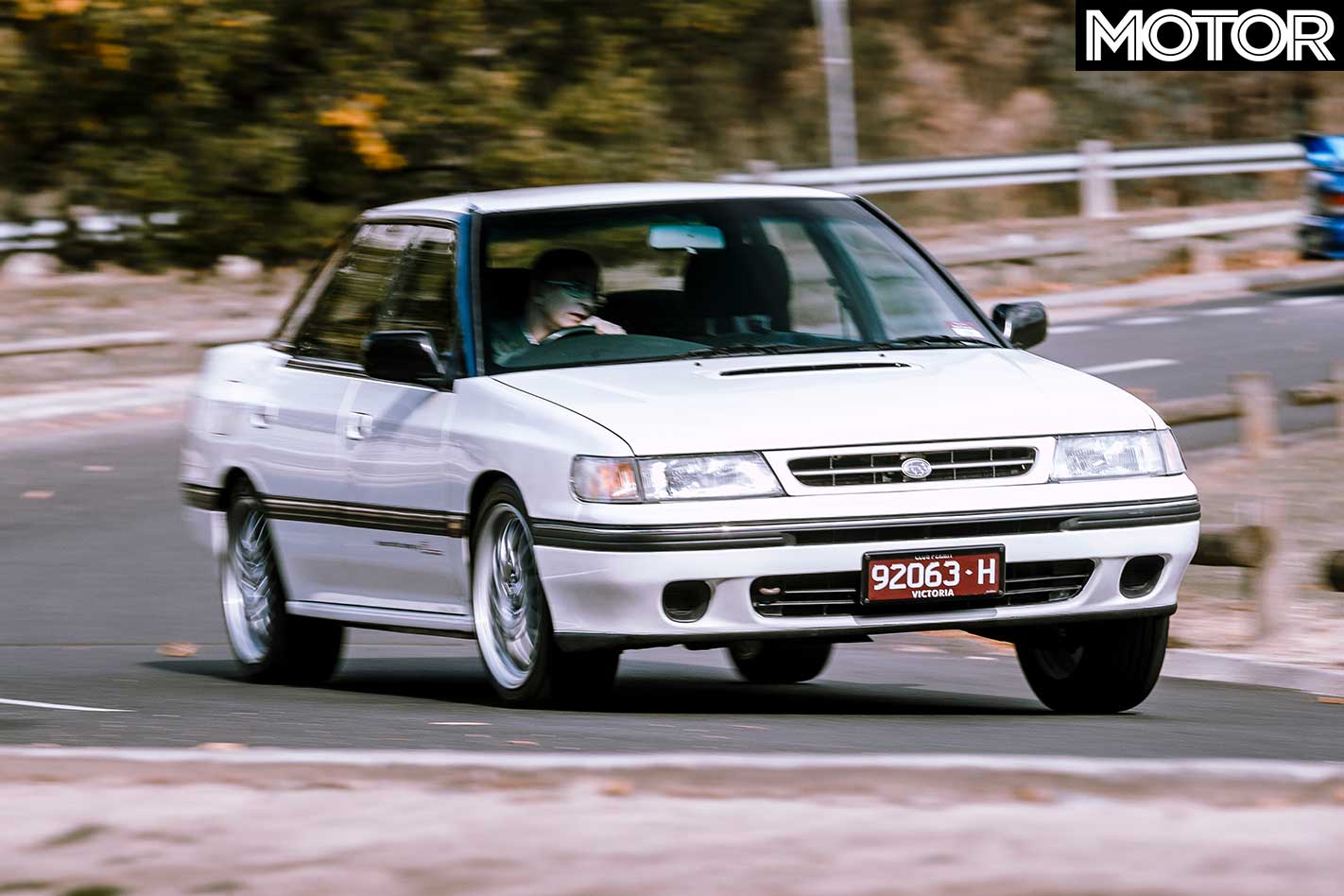
Just as a Walkinshaw VL will always be the seminal HSV and that crazy, 6.8-litre 300 SEL racecar is revered as the first AMG, so too does the Legacy RS RA represent a line in the sand. As STi’s first full model, the RA is the grand-daddy of them all.
While the Legacy (and Liberty out here) RS was a cult hit back in the day, the real wonder was reserved for the RA model. But the way the model came about is a bit left field. See, while STi was founded to create halo cars for the Subaru brand and to homologate cars that could win rallies at the highest level, the RA was kind of a celebration of a publicity stunt conducted by STi in the very early days.
Back in 1989, STi took four specially prepared Legacies and, with the FIA watching, ran them on an oval track in Arizona for 18 long days, racking up 100,000km in the process and topping out at almost 225km/h. In the process, the cars set a new world speed endurance record and STi was on the map. And this car, the RA (which stands for Record Attempt) was the production-based fruit of all that.
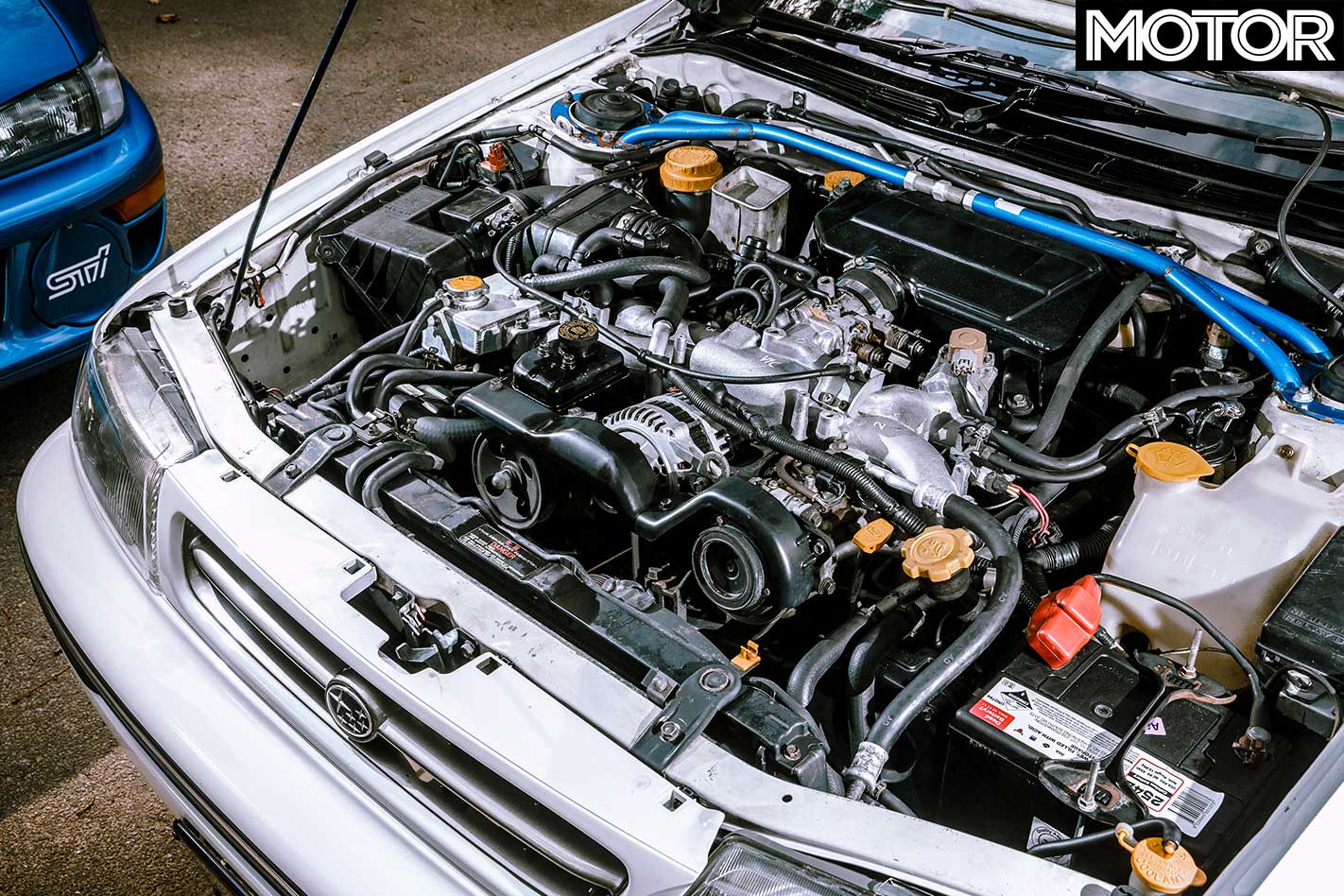
But don’t go thinking it’s an RS with an STi decal. Oh no. As well as putting the Legacy on a diet with less sound-deadening, thinner glass and a sunroof-delete deal, the RA also got a much tougher engine and driveline. That started with forged pistons, hand-ported cylinder heads, stronger rods and a full balance of all the reciprocating bits.
Power was the same claimed 161kW (or 162, depending on who you talk to) and, combined with a 1290kg kerb weight, the RA was a proper statement back in 1990 when it hit showrooms.
STi continued to fiddle with the concept for the next few years adding, among other things, a close-ratio five-speed gearbox. However, the aim always was to keep the RA a low-volume model. Which is why it only built 100 cars in 1990, 286 in ’91, 217 in ’92 and just ’93 in 1993. And this white car is one of that last batch.
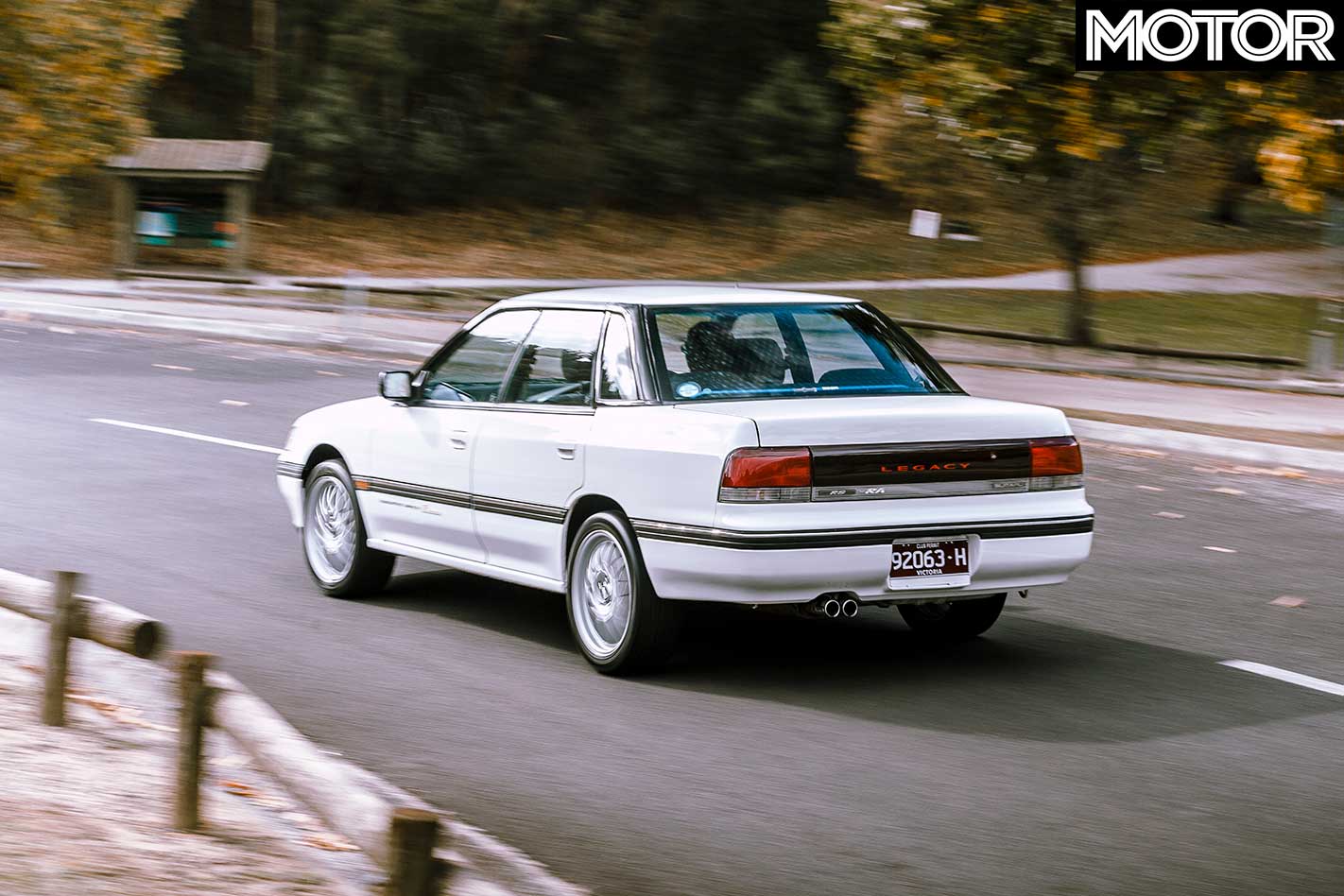
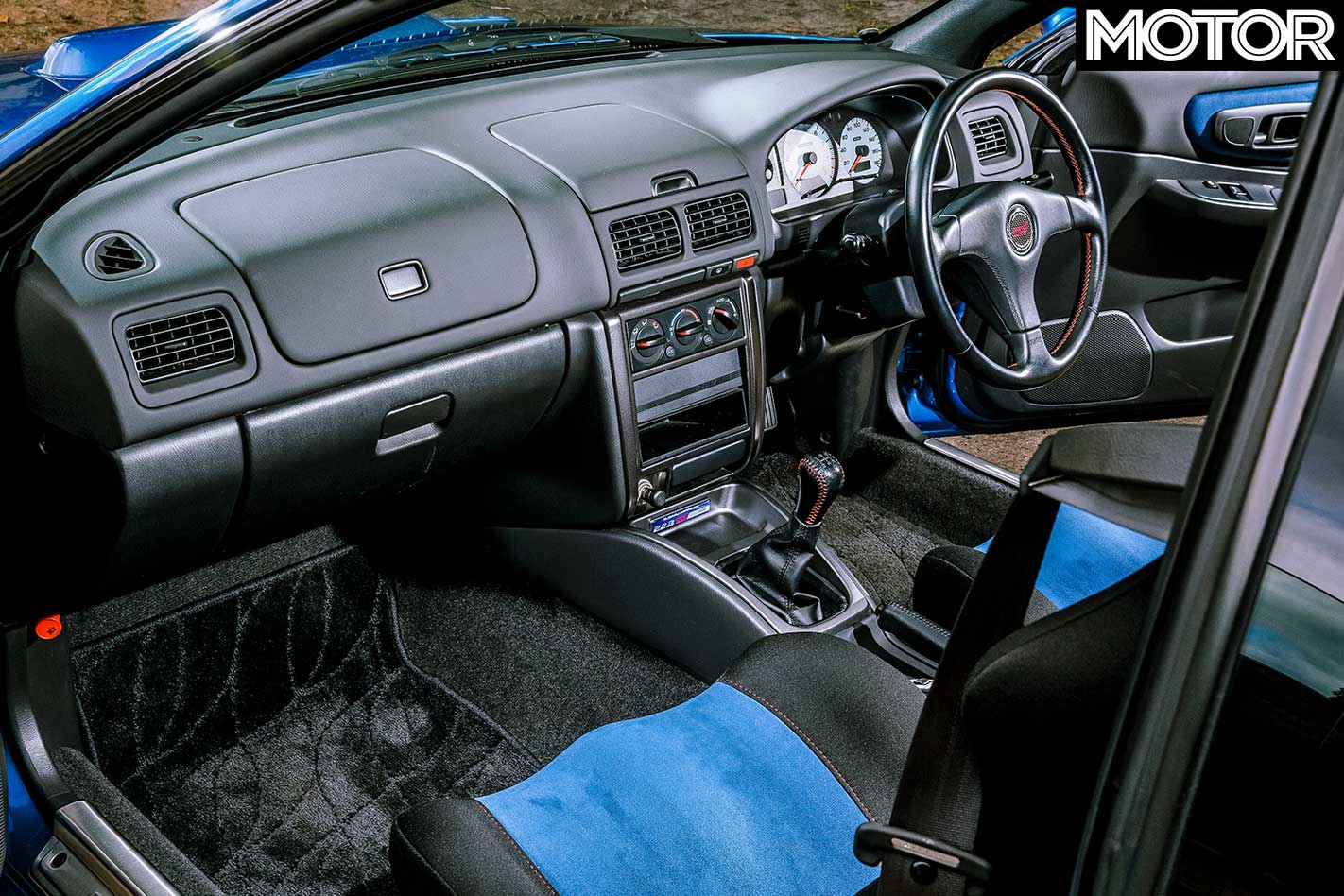
Once a rampaging, high-tech special, the RA these days seems a bit milder. Then again, the visual approach taken by STi back in the day was pretty subtle. But the truth is that it’s more of a cruiser these days than a red-hot poker. But, lord, does it take me back. That skinny Momo wheels is absolutely gorgeous and the way the whole interior looks, feels and smells propels me straight back to the late ’80s.
The balanced bottom end makes itself felt right from the off, too, and there’s a lot less of that Subaru thrumminess through the gears than I recall. It gets along, too, and while there’s no doubt it’ll spin hard, it’s also torquey and flexible enough to be short-shifted and still provide enough clarity of shunt to be effective.
The close-ratio ’box has a straight-cut first and second, the former of which, in particular, makes a racket and tends to try to trip you up if you start shifting back to first before the car has stopped.
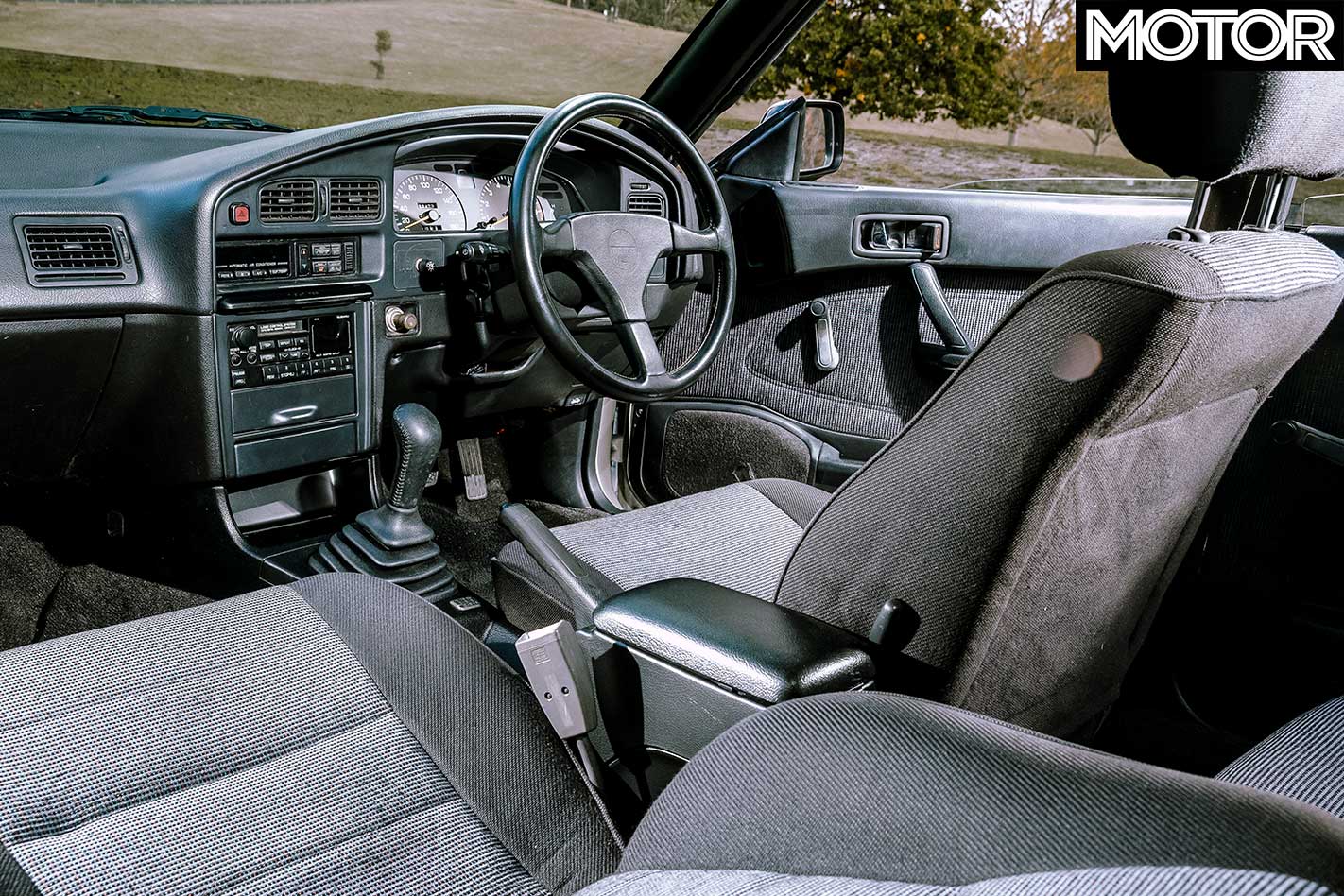
There’s a real fluidity to the way the RA gets down the road that I don’t recall in bread-and-butter Liberties and, despite some pretty munted dampers on this car, the RA feels light on its feet and a pretty vice-free platform. Okay, the performance probably wouldn’t trouble a modern Ford Fiesta ST but, just like a Walkinshaw or Red Sow, that’s hardly the point any more.
So why haven’t you seen more of them? Because they’re a dead-set Tassie Tiger. There’s reckoned to be two doing the rounds as rally cars and one road car. This one.
Meanwhile in the forest…
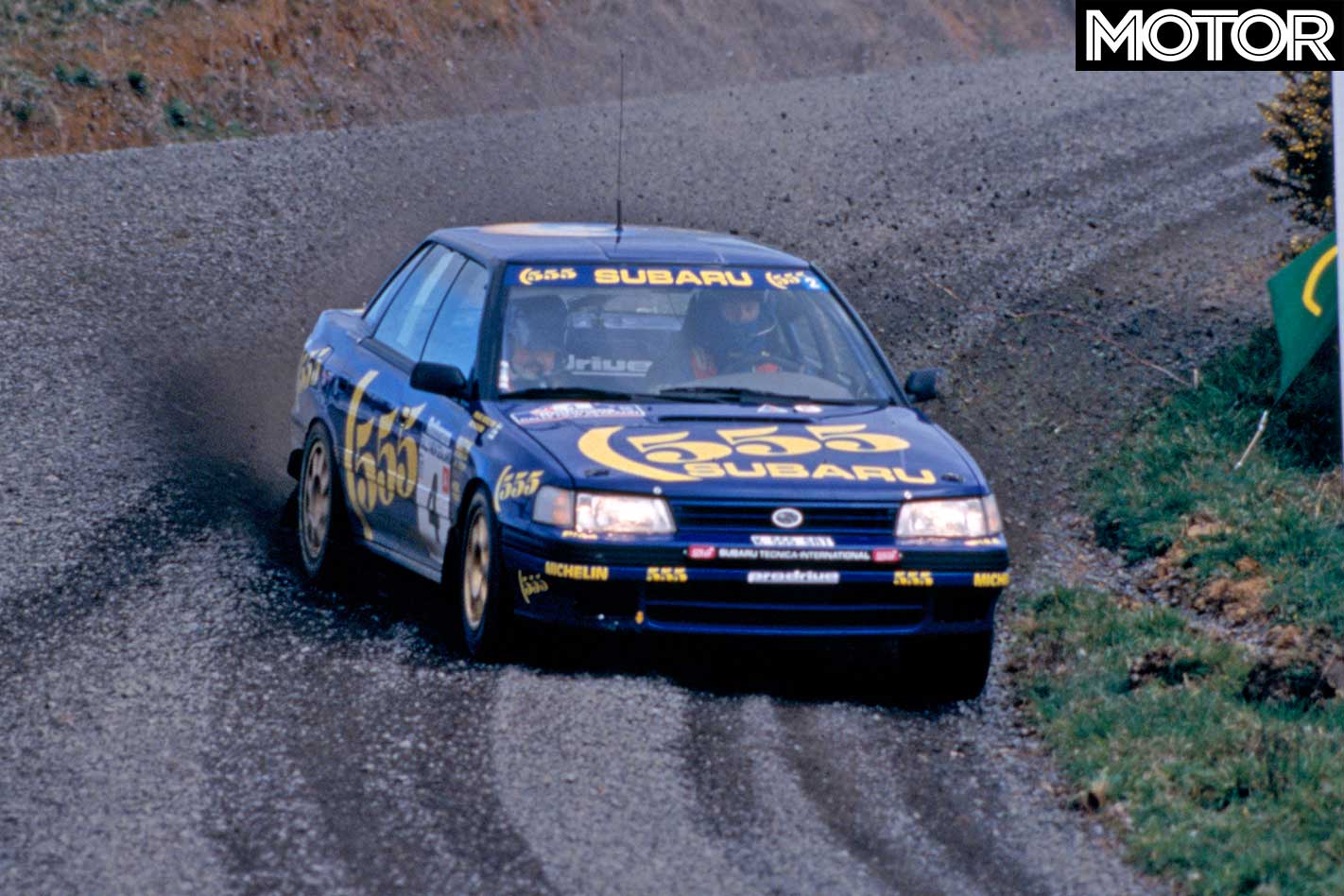
TIME was running out. Subaru was keen to introduce its new Impreza Group A car to the WRC, but not until the outgoing Legacy secured a win. Fittingly, its young Scottish charger, Colin McRae, delivered the goods.
Victory in New Zealand allowed the Legacy to bow out on top and the Impreza to make its planned debut in Finland, where it secured a fine second place.
FAST FACTS 1990 Subaru Legacy RS RA
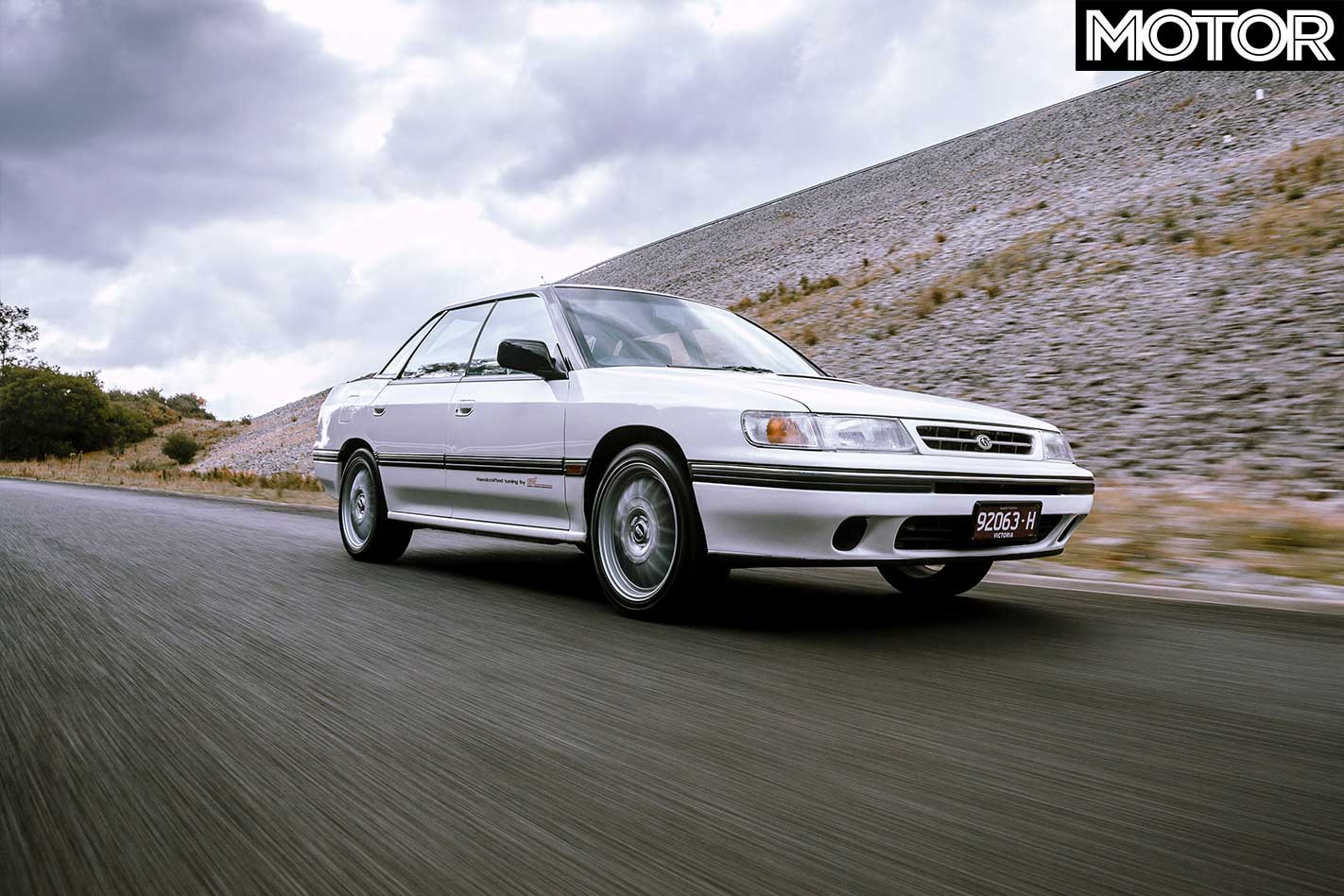
BODY: 4-door, 5-seat sedan DRIVE: all-wheel ENGINE: 1994cc flat-4, DOHC, 16v, turbo BORE/STROKE: 92.0mm x 75.0mm COMPRESSION: 8.5:1 POWER: 162kW @ 6400rpm TORQUE: 270Nm @ 4000rpm WEIGHT: 1290kg POWER-TO-WEIGHT: 126kW/tonne TRANSMISSION: 5-speed manual SUSPENSION: struts, coil springs, anti-roll bar (f); struts, coil springs, anti-roll bar (r) L/W/h: 4510/1690/1395mm WHEELBASE: 2580mm TRACKS: 1465/1455mm (f/r) STEERING: hydraulically-assisted rack-and-pinion BRAKES: ventilated discs (f); solid discs (r) WHEELS: 15.0 x 6.0-inch (f/r) TYRES: Yokohama; 255/60 R15 (f/r) PRICE: grey import only
2000 Subaru Impreza WRX STi Type R Souped-up two door is far more than the sum of its limited-edition parts
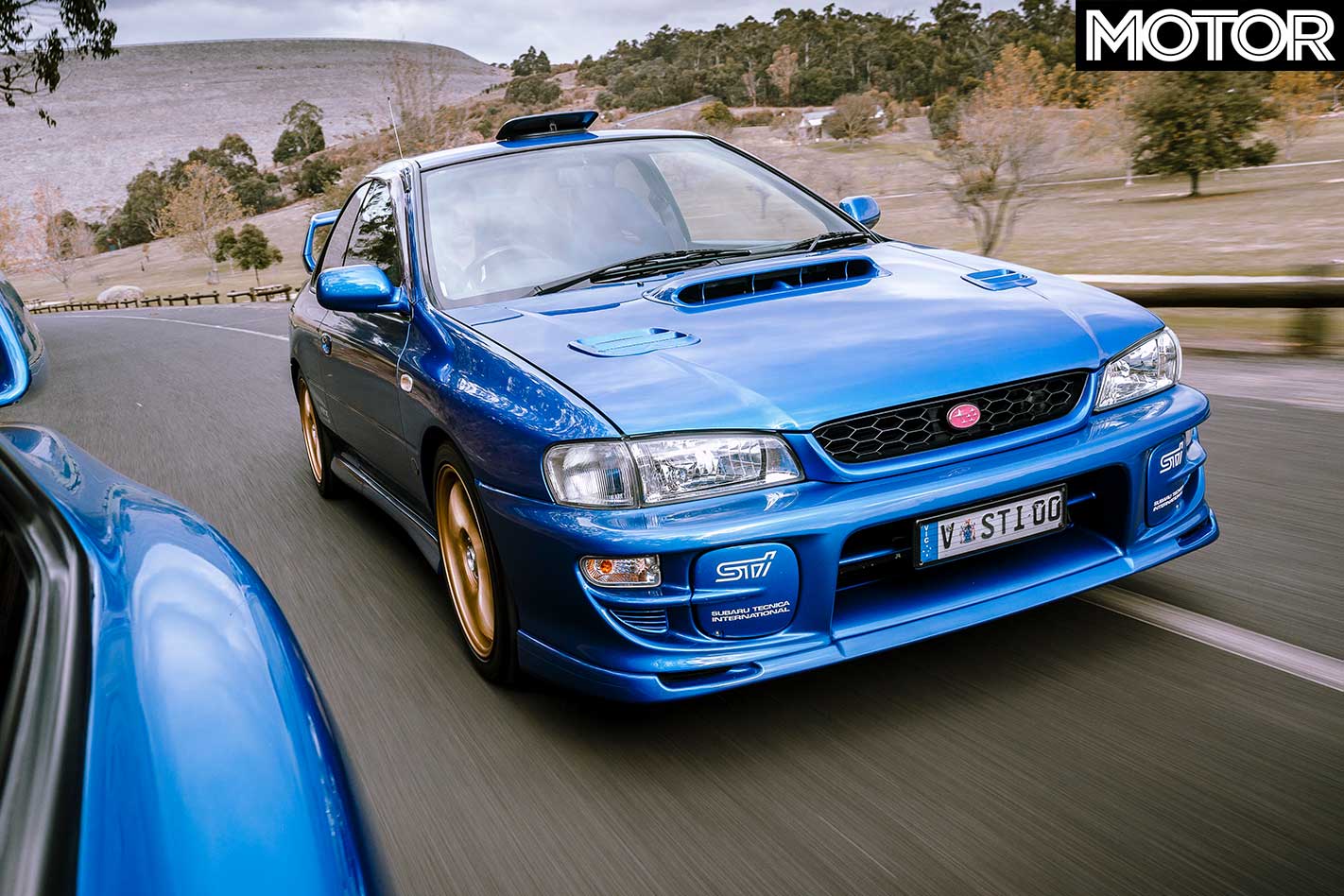
We all know the story of Subaru Australia importing a batch of 400 first-gen STis and promising there’d be no more. What it meant, of course, was that there’d be no more two-door STis because the batch of 400 four-doors was almost already on the water. Cue outraged two-door buyers.
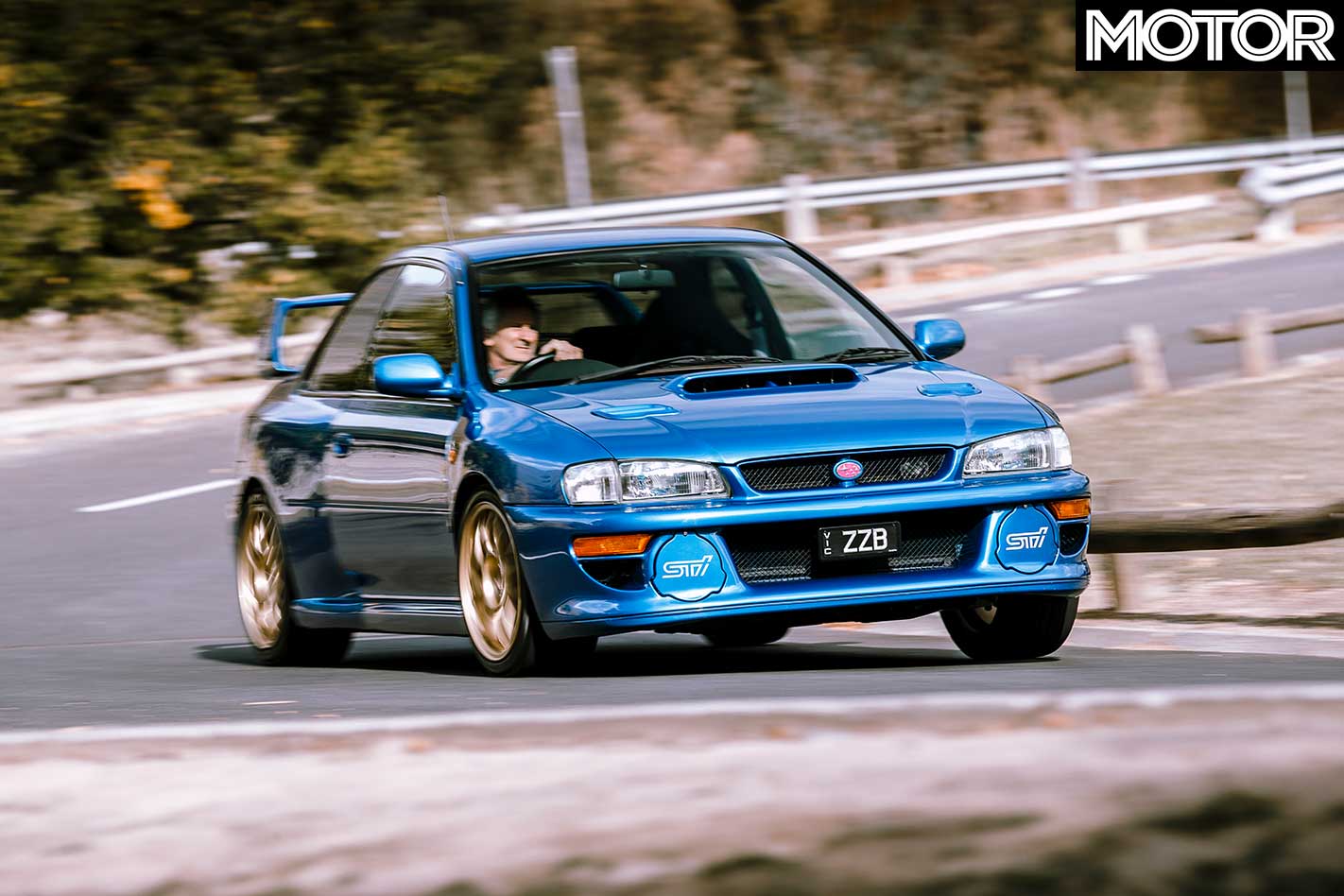
But what Subaru Oz couldn’t get its hand on was this car, the Type R which was a souped-up version of the STi. This particular car is a Version 6, bears an MY00 build-date and is one of just 1000 examples worldwide.
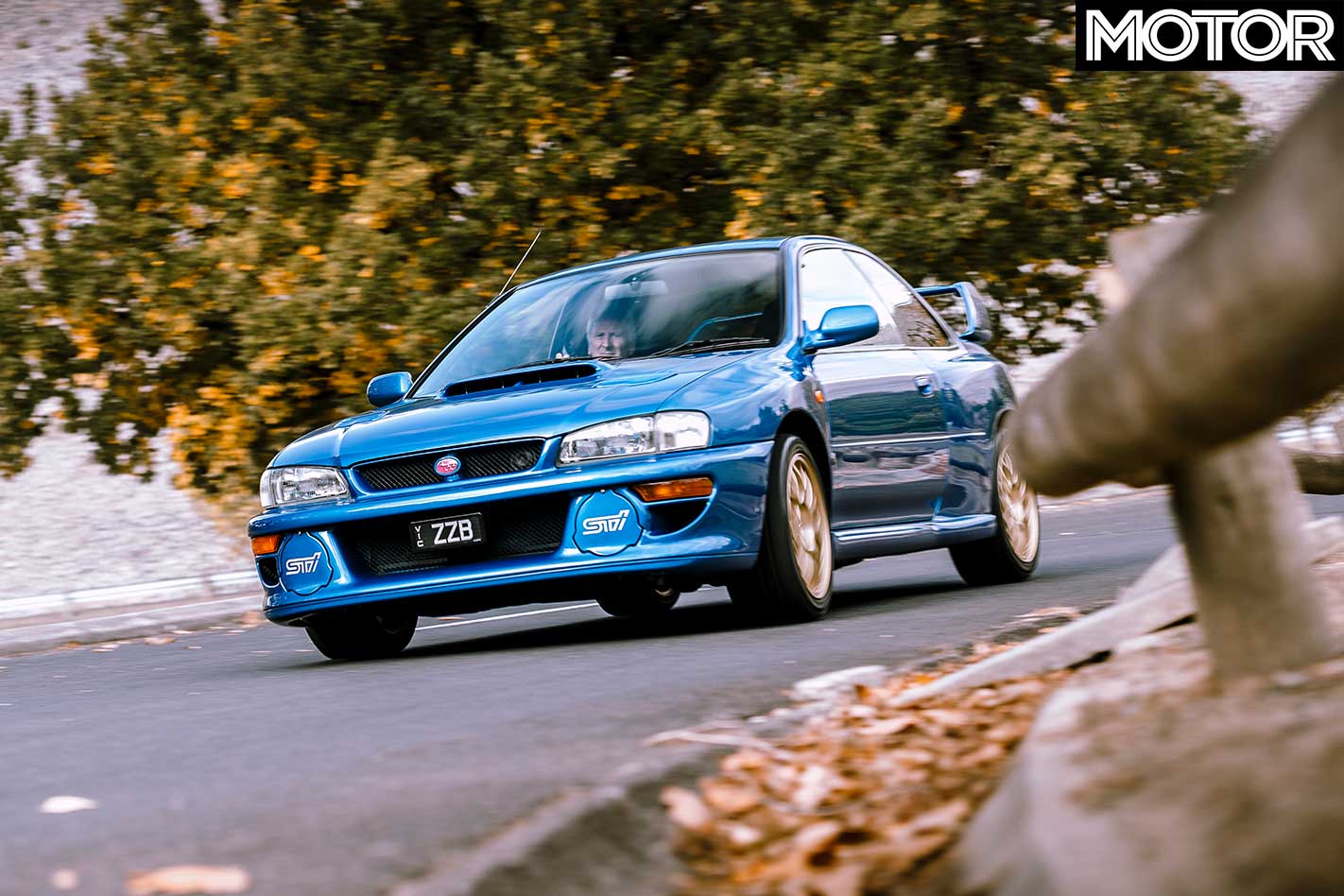
Over a ‘standard’ STi, the Type R got the roof vent, the active (DCCD in Suby-speak) centre diff (which Australian-delivered STis wouldn’t see until 2005) a bigger turbocharger, shorter gearing, a quicker steering ratio, no sound deadening and a weighbridge ticket of just 1260kg. Combine that with the 206kW that was the mandated limit by the Japanese authorities (and was starting to be sniggered at) and you were talking a serious weapon at the turn of the century. Still is, in fact.
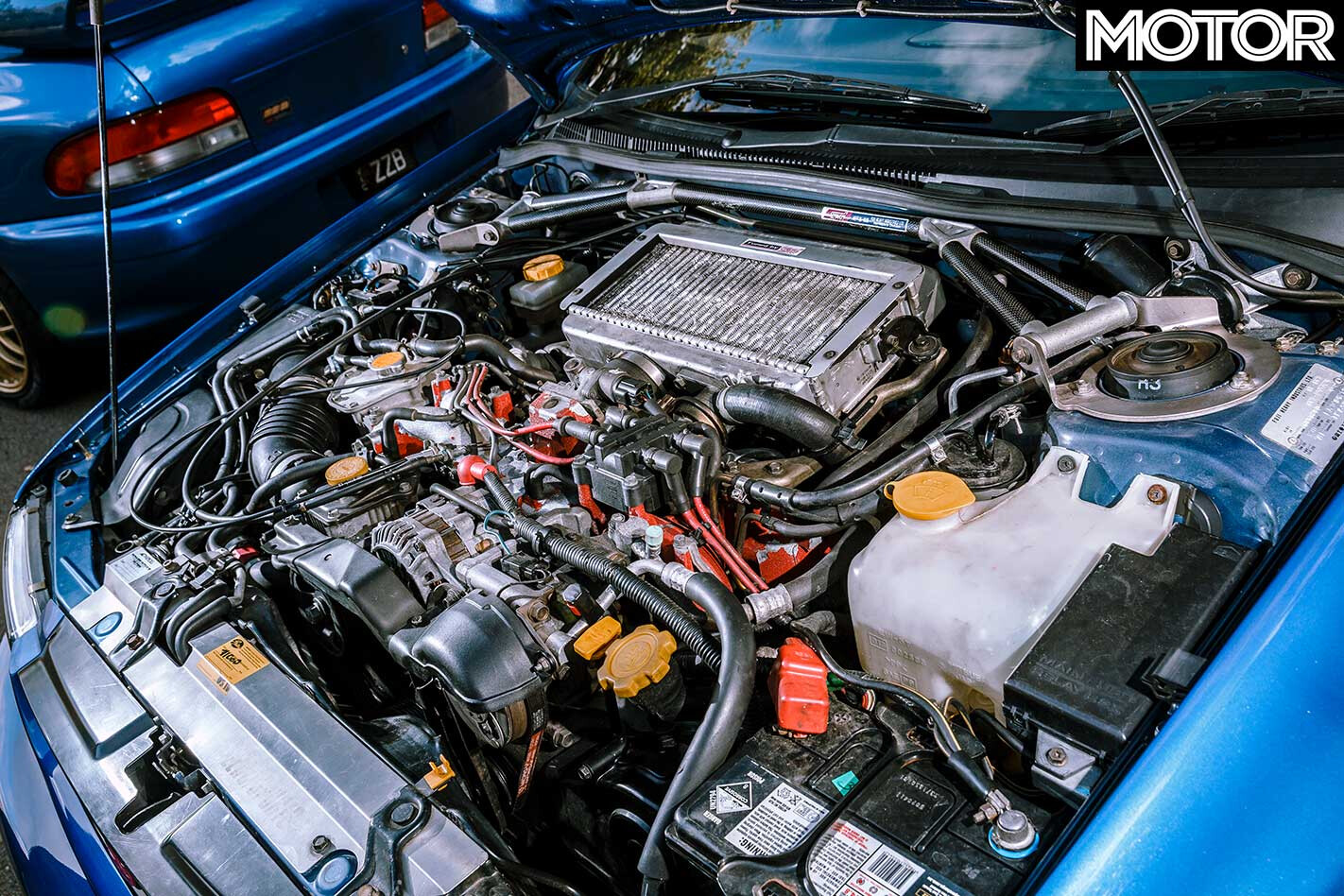
This car is one of maybe three or four in the country and they’re all, obviously, grey imports. If you’re anything like me, the first-gen WRX is the one. To my way of thinking, this – the very last of that series and very probably the most capable version outside of a 22B – is beyond merely desirable. Had the owner not been such a nice bloke, I’d probably have disappeared in the Type R and never returned.
And I’ll tell you something else for free – the cops would have needed to send their bravest and best (and fastest) to run me to justice, because this thing absolutely flies. And I don’t mean in a period sense. As in, right here, right now.
Even though it might have a bit more grip, I doubt that even the current-model STi would see which way this blue bomber went. And another thing: how come the current car leaves you pissing blood after a speed hump when this car, built almost two decades earlier, rides so much better?
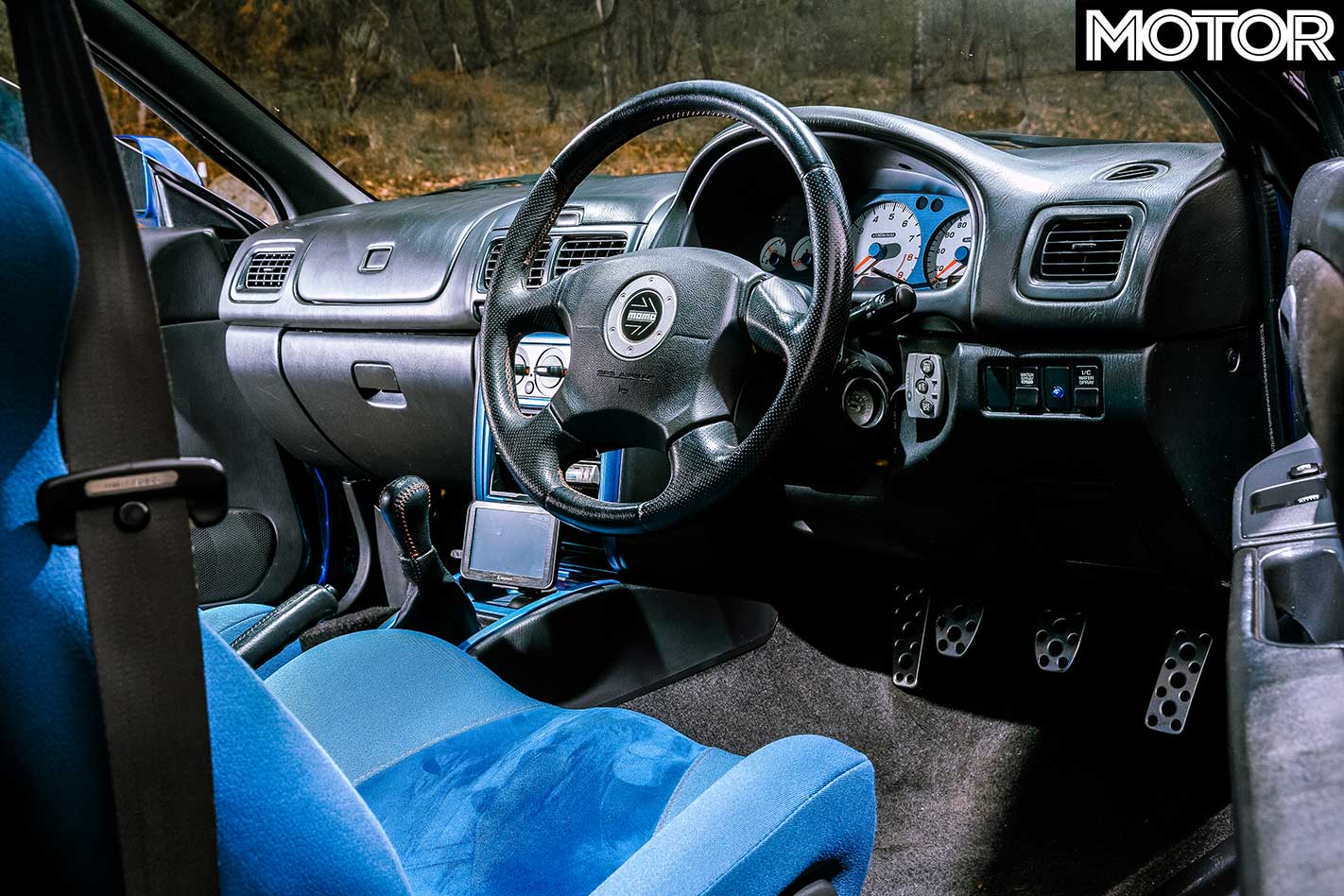
It’s not just a layer of plush that you weren’t expecting, it’s the whole way the type R deals with crappy roads without ever feeling mushy through the helm or the seats. Speaking of the seats, they’re just lovely and while they look a bit flat and shapeless, they’re anything but. And if ever you needed proof that lightness is a cornerstone of good car design, the featherweight Type R provides it.
It appears that, like the Legacy RA, Subaru managed to engineer all the nasty out of the STi in Type R form. The clutch is light and positive, the gearshift as close to idiot-proof as a H-patternmanual will ever be and even though the exhaust is a bit rowdier, it doesn’t drone at cruising speeds, nor is it likely to have Plod looking up from his donuts.
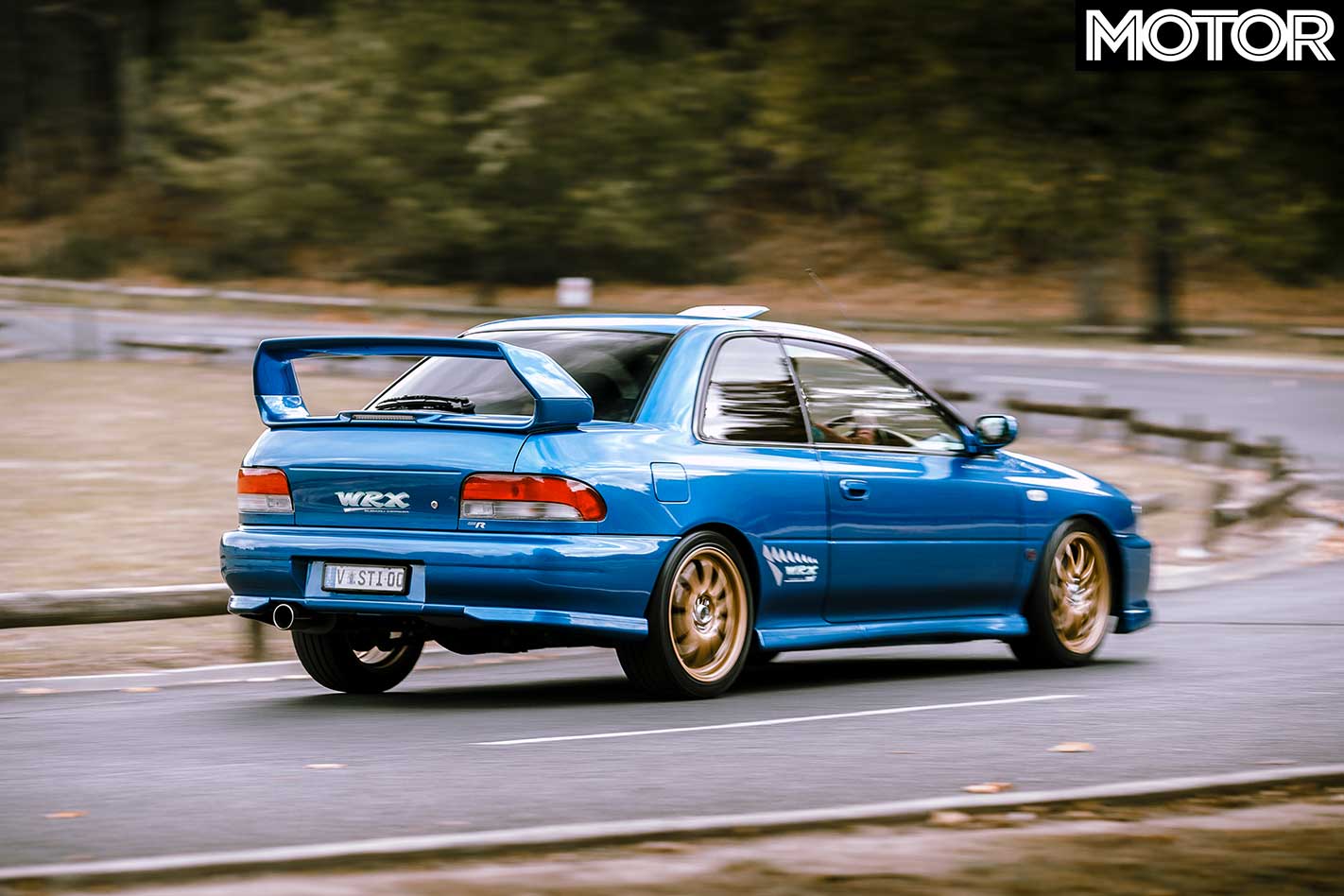
And then, while you’re still marvelling at the civility of it, you go and step on the noise pedal. And the Type R takes off. There’s very little lag and the short gearing (that sees about 3000rpm at 100km/h) ensures the thing always has a head of steam up.
Throw in the faster steering which is as neutral and natural as any Subaru I’ve ever driven, the high grip levels and the overall togetherness of the package and the Type R emerges as much, much more than just another hyped limited edition.
Meanwhile on the gravel…
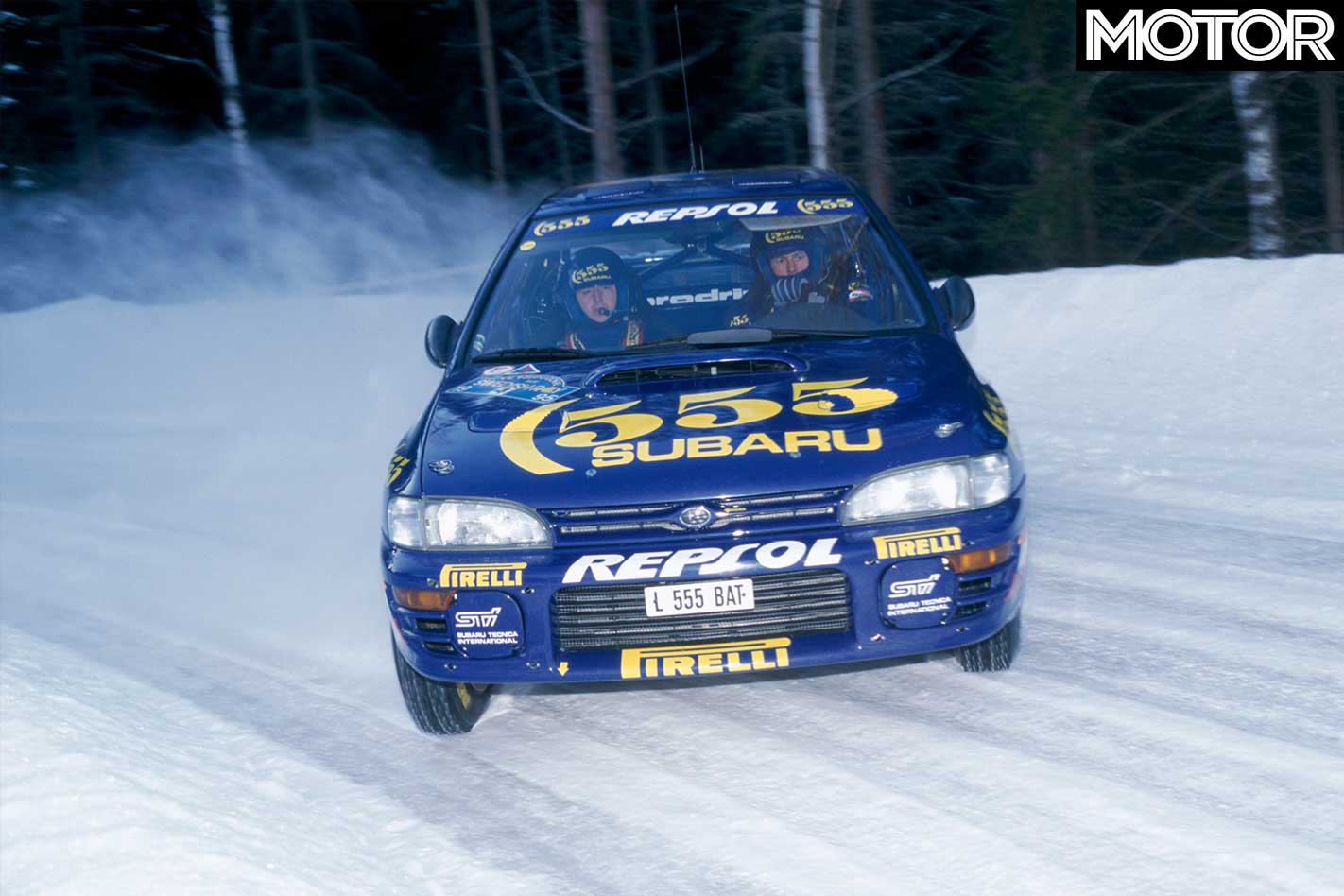
COLIN McRae’s star had been in the ascendency for some time. His flamboyant, on-the-limit driving had frustrated his bosses and delighted fans, but it all came together when victory on the 1995 Rally GB secured his and Subaru’s first world motorsport title.
Despite many more victories, it would be McRae’s only title, finishing second in 1996, 1997 and 2001.
FAST FACTS 2000 Subaru Impreza WRX STi Type R
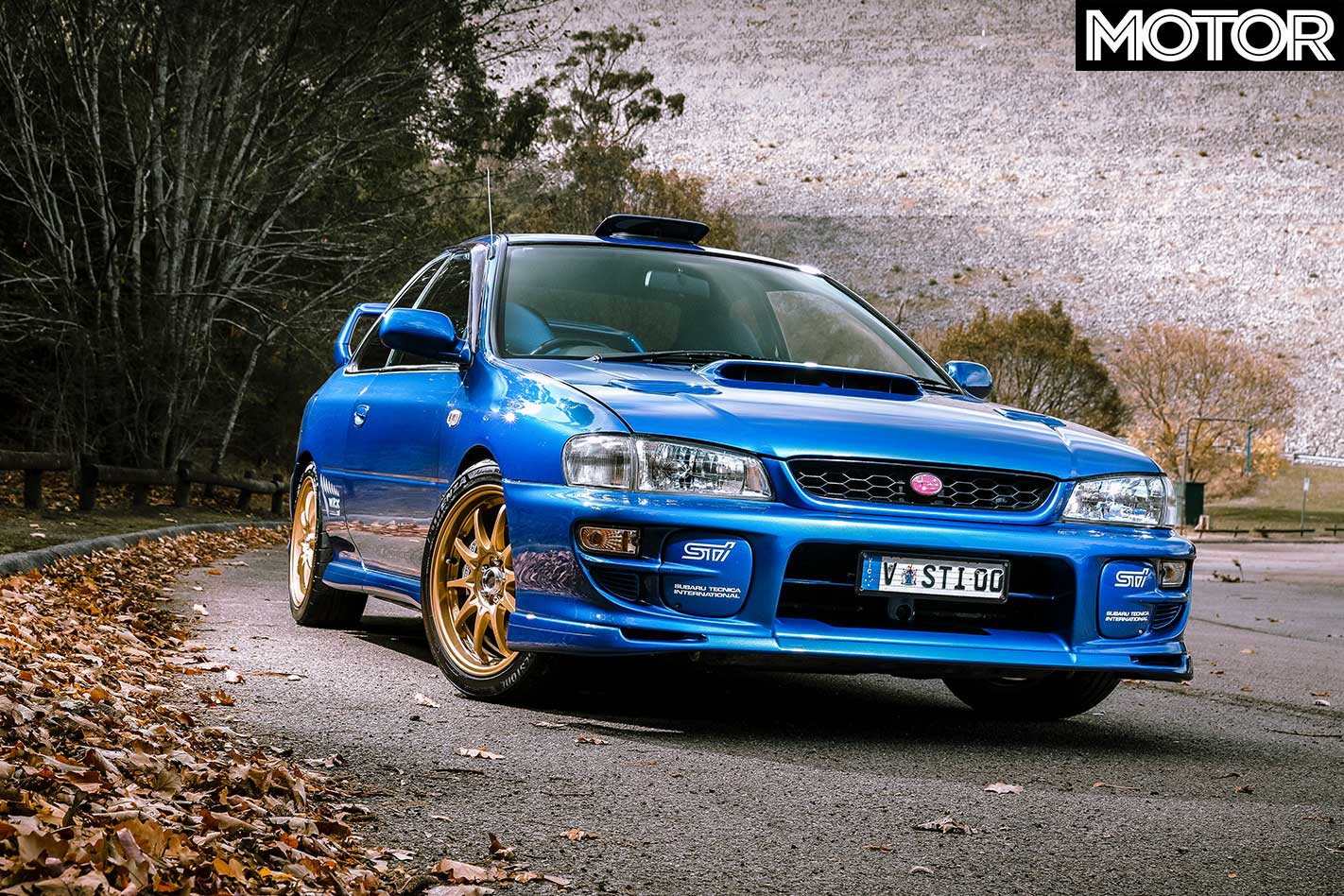
BODY: 2-door, 5-seat coupe DRIVE: all-wheel ENGINE: 1994cc flat-4, DOHC, 16v, turbo BORE/STROKE: 92.0mm x 75.0mm COMPRESSION: 8.0:1 POWER: 206kW @ 6500rpm TORQUE: 353Nm @ 4000rpm WEIGHT: 1240kg POWER-TO-WEIGHT: 166kW/tonne TRANSMISSION: 5-speed manual SUSPENSION: struts, coil springs, anti-roll bar (f); struts, coil springs, anti-roll bar (r) L/W/h: 4350/1690/1405mm WHEELBASE: 2520mm TRACKS: 1470/1460mm (f/r) STEERING: hydraulically-assisted rack-and-pinion BRAKES: 320mm ventilated discs (f); 266mm ventilated discs (r) WHEELS: 16 x 7.0-inch (f/r) TYRES: Yokohama; 205/50 R16 (f/r) PRICE: grey import only
1998 Subaru Impreza WRX STi 22B The ultimate STi – a performance watermark so high that modern Subarus are still yet to surpass it
They had me at ‘22B’. Seriously, as a bloke who road-tested the very first WRXs and then STis in the day, the thought of coming face to face with an honest-to-god 22B was giving me the metaphorical dribbles.
While the 22B was a proper kitchen-sink effort, it wasn’t built to satisfy any arcane homologation requirements. Nope, it was a celebration car – making note of the fact that, in 1998, Subaru had just won three world championships on the trot.
To mark that occasion, STi took a two-door Rex and grafted on big, fat boxed guards front and rear. With some carefully considered offset on the 17-inch alloys, it stretched the front track by 60mm and the rear by 100mm. To say this thing looks tough is an understatement and, particularly from the rear, it’s all muscle and a warning to others.
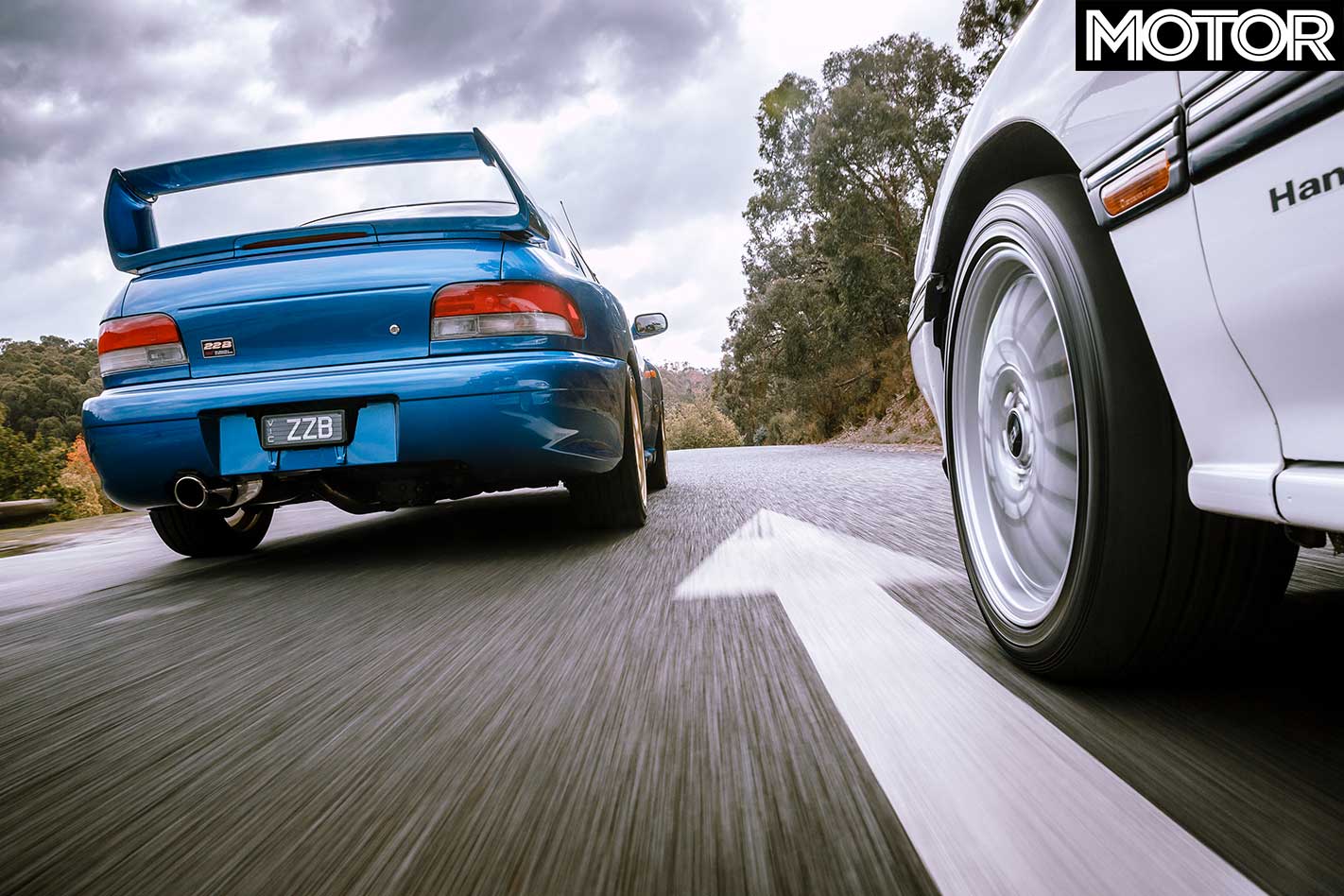
The 2.0-litre engine was hogged out to 2.2 (hence 22B), but there’s a lot more to it than that. In fact, the block itself is different with a closed-deck design for rigidity. With more careful matching of port sizes, camshafts, compression ratio and turbocharger, the EJ22 makes the same nominal (and under reported) 206kW, yet it manages an 8000rpm redline.
Although similar in spec to a Version 4 STi including the active centre-diff, the 22 also featured a seam-welded bodyshell as proof of how serious STi was. Chuck in an adjustable rear wing, a water spray for the top-mount intercooler and pull a bunch of weight out of it with a ban on sound deadening (and even deleting the spotlights) and you had a 22B.
Take it as read that this grey import drives like a new 22B. But even that doesn’t convey how remarkable this thing really is. Before you’re even out of the car park, it’s obvious that despite the stiff body, the 22B isn’t going to rattle your brains.
In fact, the ride is crazy good and, again, makes us question the current STi’s concrete-mattress impersonation. But the steering is equally friendly and the whole show is ballerina-light on its toes, but never feels nervous. Like the Type R, the 22B is a stark reminder of just how devastating excess weight is to dynamics and balance.
Then there’s the engine. Now, I know modern turbocharged engines are good, but I’ll put it out there and say that none of them are any better than this one, and most of them aren’t as good.
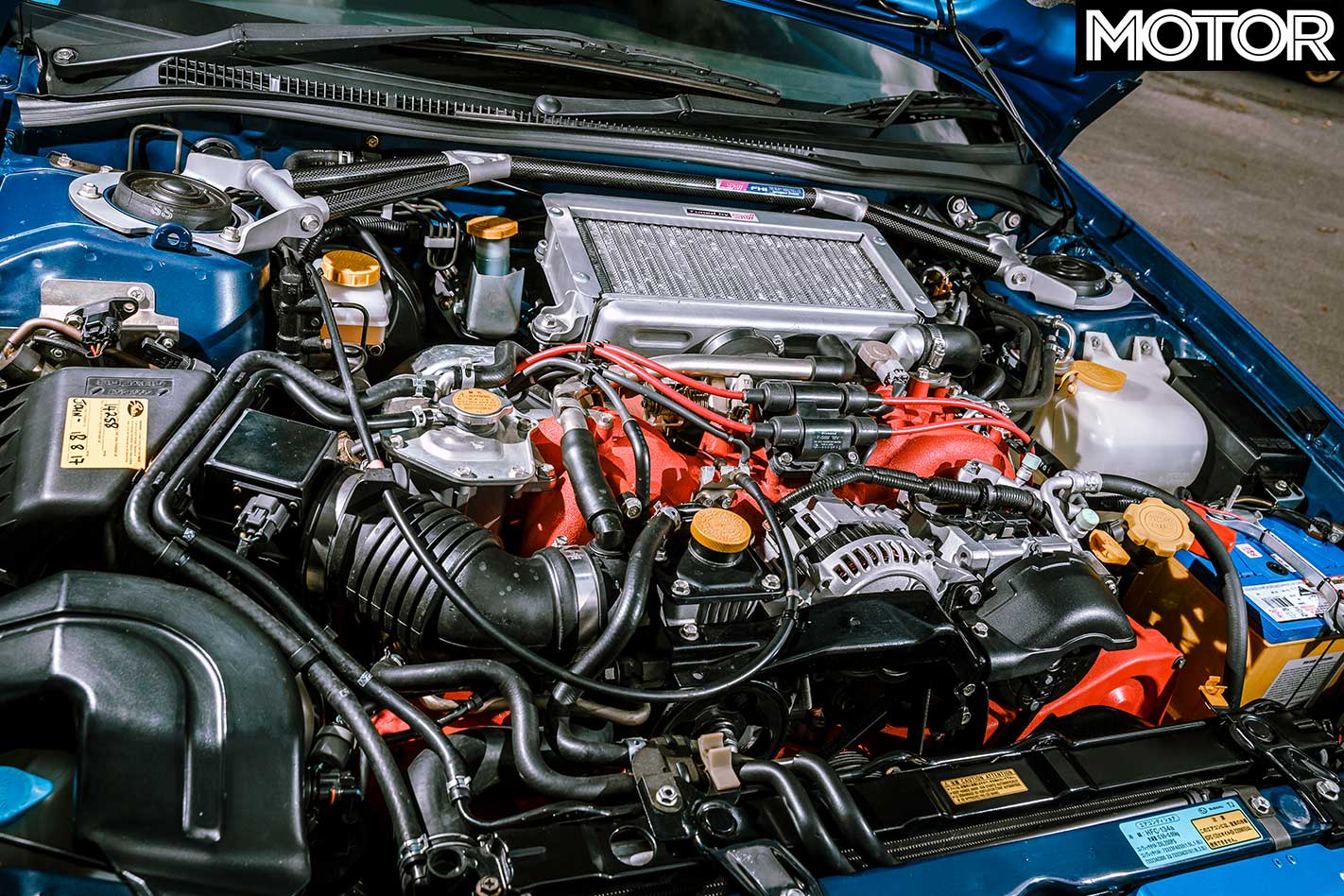
The mid-range is enormous, the low kerb mass and short gearing disguises any lag (if, indeed, there is any) and there’s a fabulous exhaust note that is a million miles removed from the chaff-cutter persona of a normal Rex with a drainpipe zorst. The pedal placement is perfect, the Momo is a scalpel and only a slight buzz from the gearshift tells you the car has done any kilometres at all.
When Subaru announced the 22B in 1998, the 424 cars slated for production sold out in 12 hours. Despite a sticker of $132,000 in Australia, four or five cars did actually make it here while 400 were for Japan and the rest went to the UK. Two of which wound up in the hands of none other than Colin McRae and his co-driver Nicky Grist as a thank you. Nice.
Meanwhile out on stage…
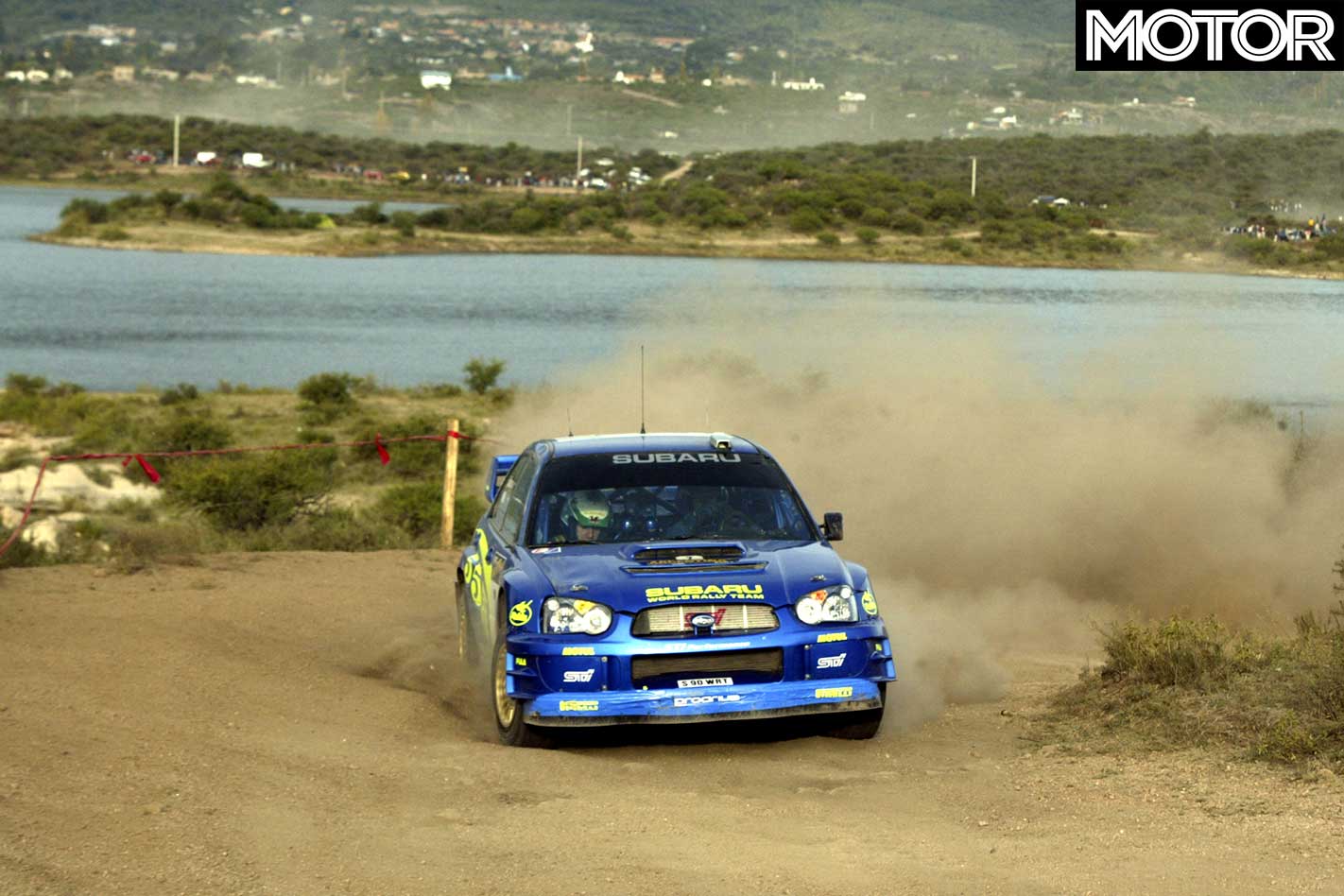
THE late-1990s and early-2000s was a golden period for Subaru. Between 1994-2004 it was by far the WRC’s most successful manufacturer with 43 wins, three manufacturers’ titles and three drivers’ titles for McRae (’95), Richard Burns (’01) and Petter Solberg (’03). Indeed, Subaru only recorded four WRC wins outside this period, pulling out of the sport at the end of 2008.
FAST FACTS 1998 Subaru Impreza WRX STi 22B
BODY: 2-door, 5-seat coupe DRIVE: all-wheel ENGINE: 2212cc flat-4, DOHC, 16v, turbo BORE/STROKE: 96.0mm x 75.0mm COMPRESSION: 8.0:1 POWER: 206kW @ 6500rpm TORQUE: 363Nm @ 3200rpm WEIGHT: 1270kg POWER-TO-WEIGHT: 162kW/tonne TRANSMISSION: 5-speed manual SUSPENSION: struts, coil springs, anti-roll bar (f); struts, coil springs, anti-roll bar (r) L/W/h: 4365/1770/1405mm WHEELBASE: 2520mm TRACKS: 1480/1500mm (f/r) STEERING: hydraulically-assisted rack-and-pinion BRAKES: 320mm ventilated discs (f); 266mm ventilated discs (r) WHEELS: 17.0 x 8.5-inch (f/r) TYRES: Yokohama; 235/40 ZR17 (f/r) PRICE: $132,000 (new)
Conclusion
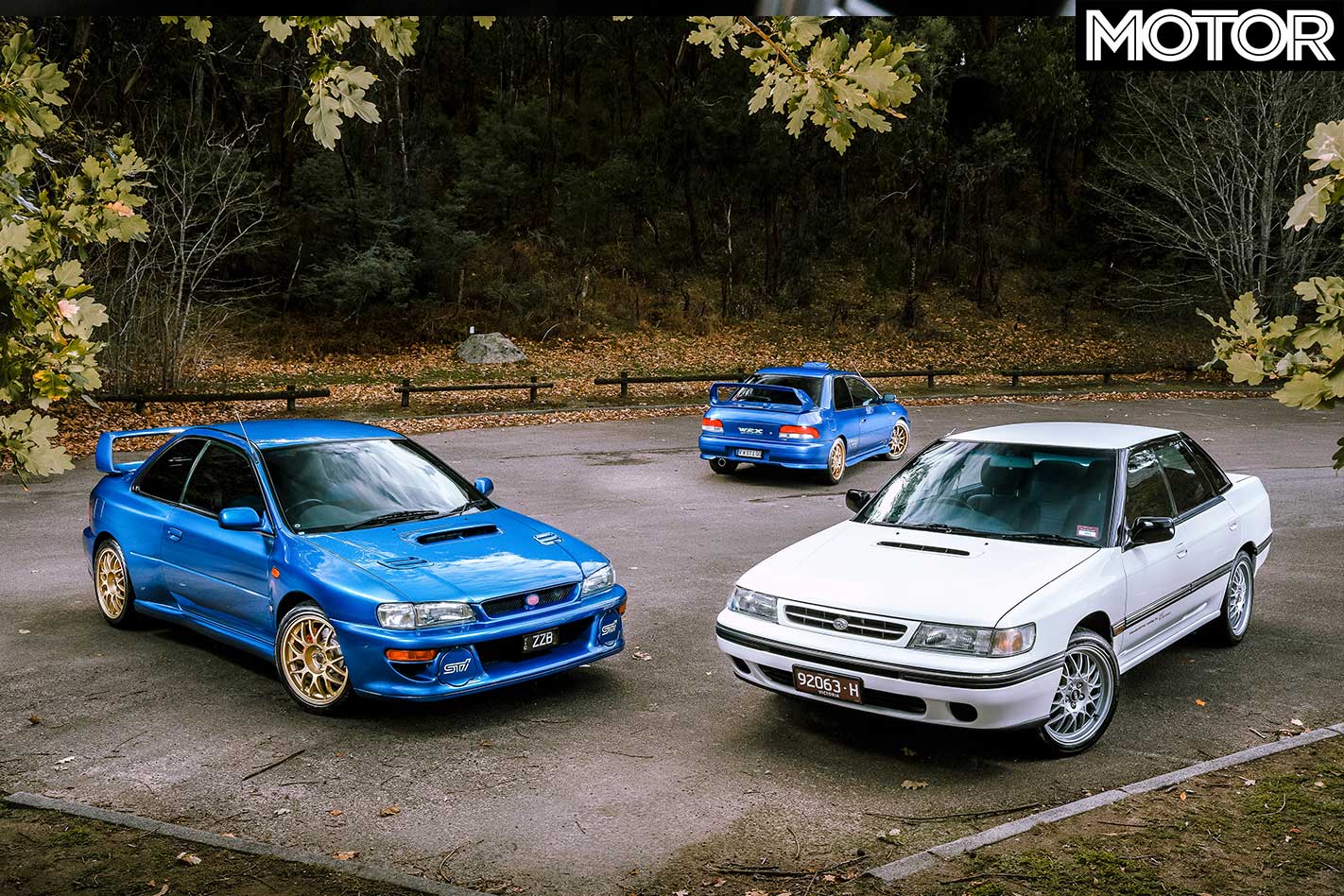
This is not a comparison test, no car wins. But after a day spent in throwback interiors with their distinctive hard plastics, thin A-pillars and a certain smell, one ponders the current situation of Subaru Tecnica International and perhaps the next 30 years for the brand.
It’s fair to say that STi’s best years are either behind it or ahead of it. The current WRX STi drives like it did 10 years ago while the turbocharged four-cylinder, all-wheel drive performance segment it helped popularise, is dominated by the Euros. And a car like the Ford Focus RS, itself having just entered retirement from old age, makes an STi feel very old school, analogue and antiquated indeed. A proper turbocharged STi BRZ, despite all the excuses for why it hasn’t happened, remains in our books a missed opportunity.
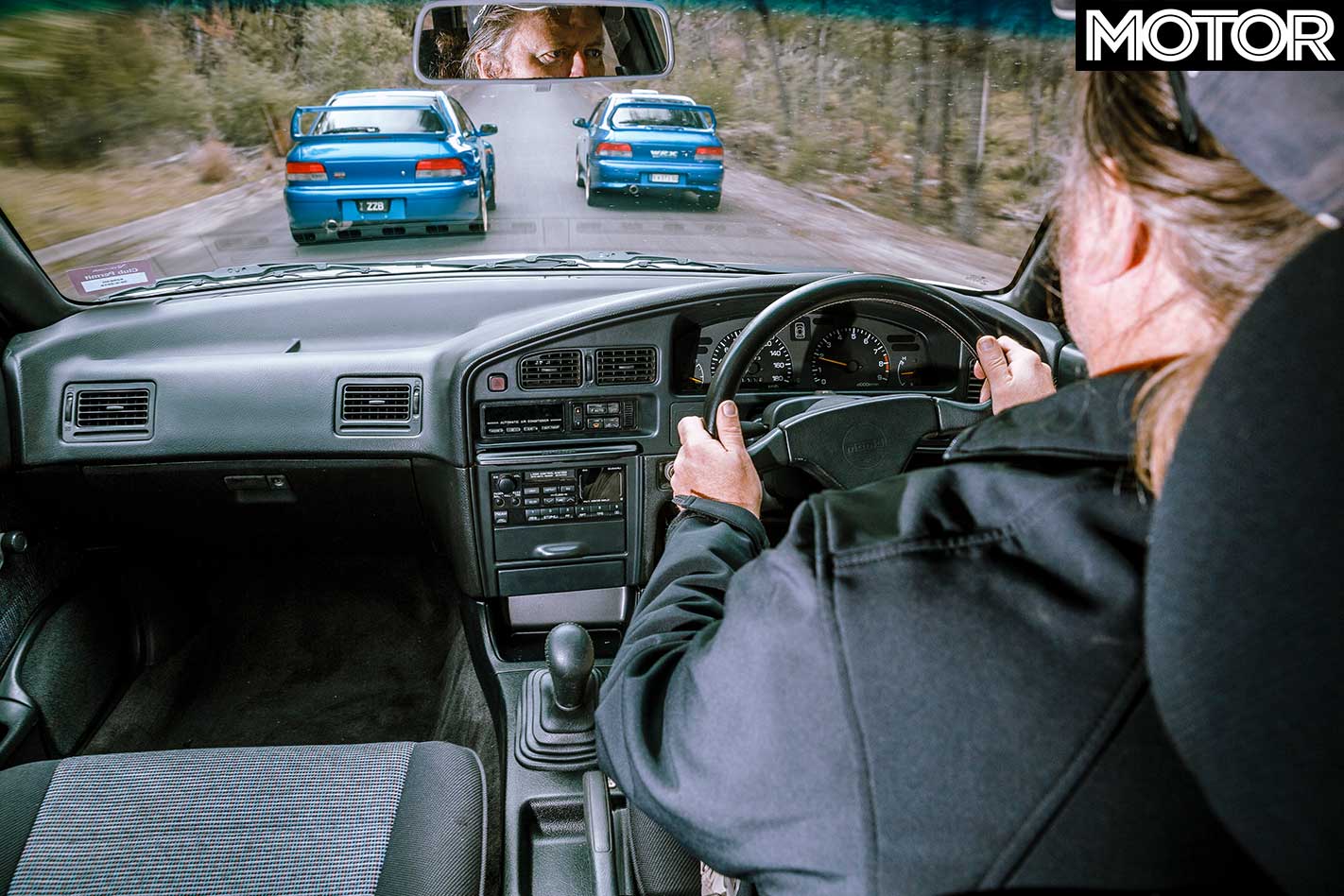
STi is still very active in motorsport, producing a popular production rally car but also in an official capacity in circuit racing like in Super GT and at the Nürburgring 24 Hour. Of course, it retains a factory presence in the Australian Rally Championship with Molly Taylor, who won the 2016 title in her production-spec rally car. But on the global stage, Subaru’s motorsport campaign continues in the long shadow of its World Rally Championship success.
While economic natural selection in a sluggish Japan killed the Mitsubishi Lancer Evolution, it appears STi is picking itself back up and readying to give smug Euros like the Mercedes-AMG A45, Audi RS3 and VW Golf R a very bloody nose indeed.
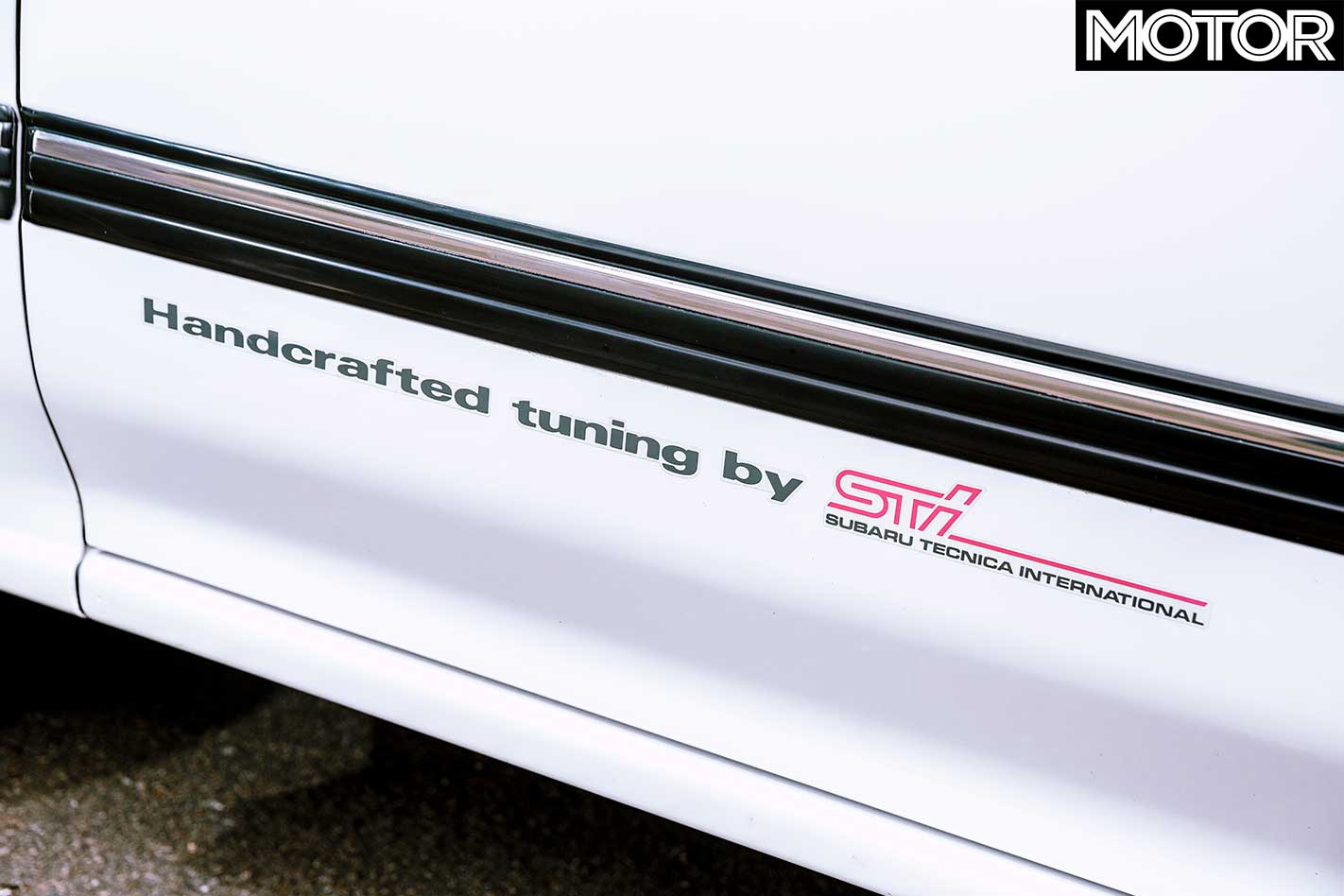
Subaru’s VIZIV Concept, unveiled at the 2017 Tokyo Motor Show, represents the beginning of probably a long teaser period for the next WRX STI, due around 2020. Details are scarce, but Subaru says it has all-wheel drive and a boxer engine – presumably four cylinders and turbocharged. Subaru has also said the WRX and STi cannot continue as petrol-only propositions, so on the basis of the VIZIV retaining a petrol engine, expect the next STi to sport a hybrid drivetrain.
Honda catapulted the Civic Type R to the top of the hot hatch pecking order in one go. Perhaps the Japanese engineers at STi can do the same with its next performance hero. Certainly, it has the runs on the board to suggest so.
This article was first published on D’Marge
Ah, the good ole fashioned road trip. It’s the stuff of legends, immortalised in countless films and song lyrics eulogising the virtues of the open road. It’s the ultimate freedom: sky above, asphalt below and nothing holding you back but your sense of direction.
What you need is quality time with your car and a tale to tell when you come back – something that’s a little more feel-good buddy flick and a little less National Lampoon. We gave you the scoop on America and Europe already, so today let’s tackle the home turf. Here’s a rundown of the best driving roads in Australia.
Lasseter Highway, Northern Territory
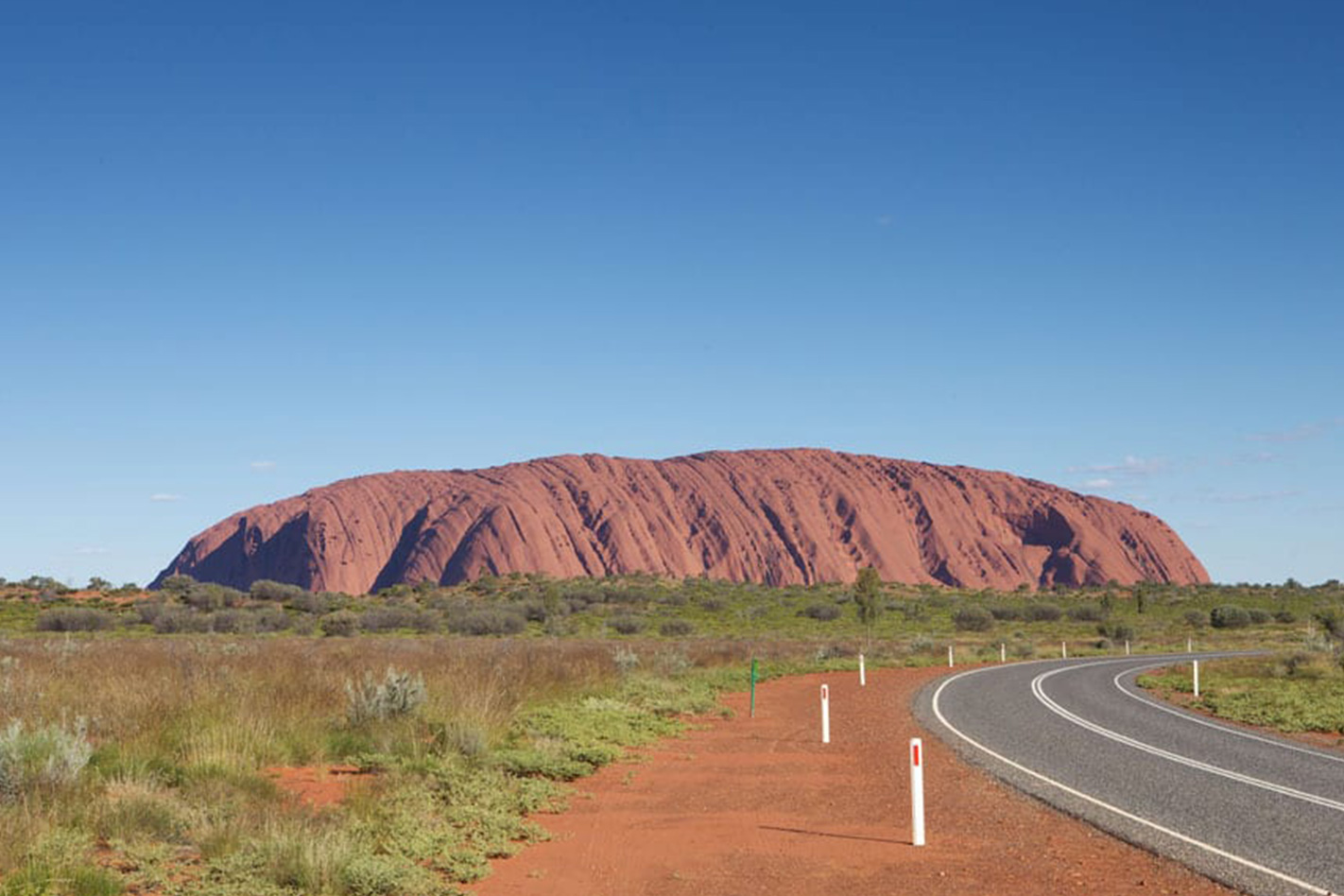
With striking 360-degree views of uninterrupted horizon, this is road tripping at its finest. The 244km Lasseter Highway connects Uluru east to the Stuart Highway through some of Australia’s most awe-inspiring landscapes and famous sights, including Uluru and Kata Tjuta. Roll down your windows, slip on your aviators, turn the tunes up and cruise the Northern Territory’s rugged natural beauty like you don’t have a care in the world.
Gormanston Road (99 Bends), Tasmania
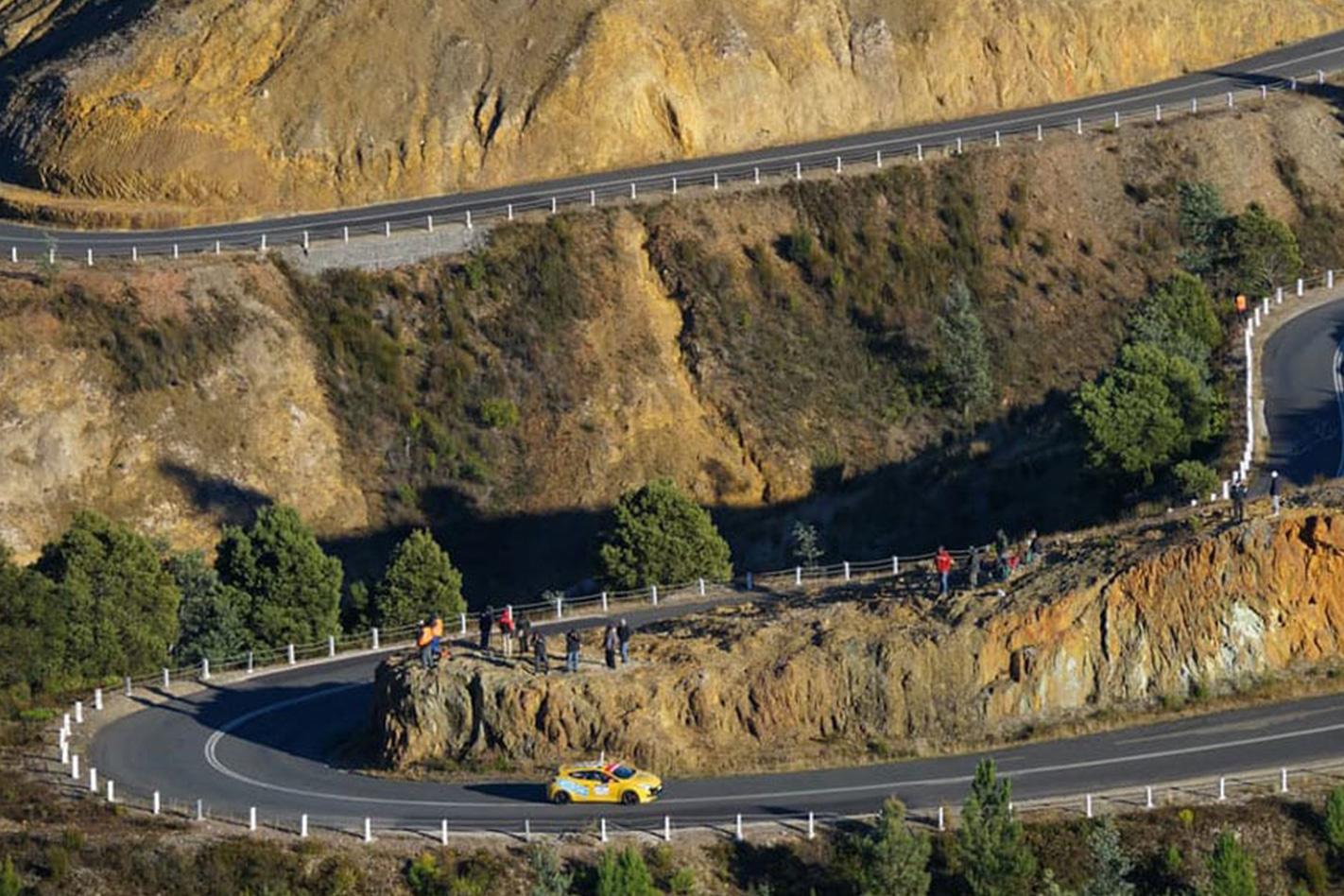
The winding road out of Queenstown is so famous for its twists and turns that it’s unofficially known as the 99 Bends. Formally called Gormanston Road, it’s by far the most fun and frightening stretch of black-top you’ll encounter on Tasmania’s West Coast. The curvaceous route over a mountain range is great if you want to put your car through its paces and pretend you’re a pro. Targa Tasmania’s talented rally racers can drive its 6km in a touch over four minutes.
Lake Mountain Road, Victoria
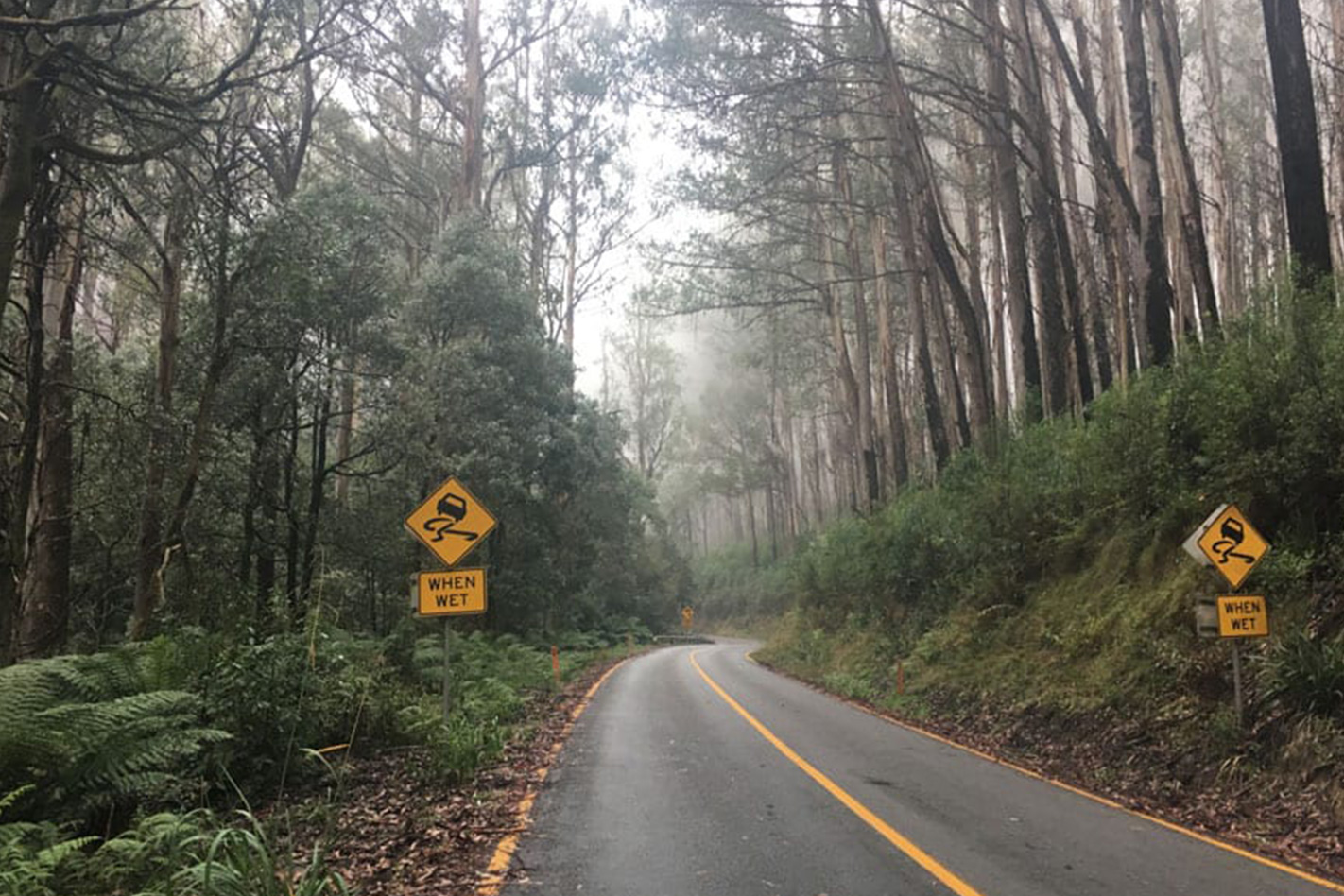
Lake Mountain is a popular destination for skiers looking to enjoy its family-friendly resort, but the road to and from is also favoured pavement for gearheads. Top Gear Australia named Lake Mountain one of Australia’s best driving roads for a reason. It’s not the most difficult drive, but it’s a stunner. Its calm ascent through the Yarra Ranges National Park gives you plenty of time to relax and enjoy the unique scenery left behind by the Black Saturday bushfires.
Great Ocean Road, Victoria
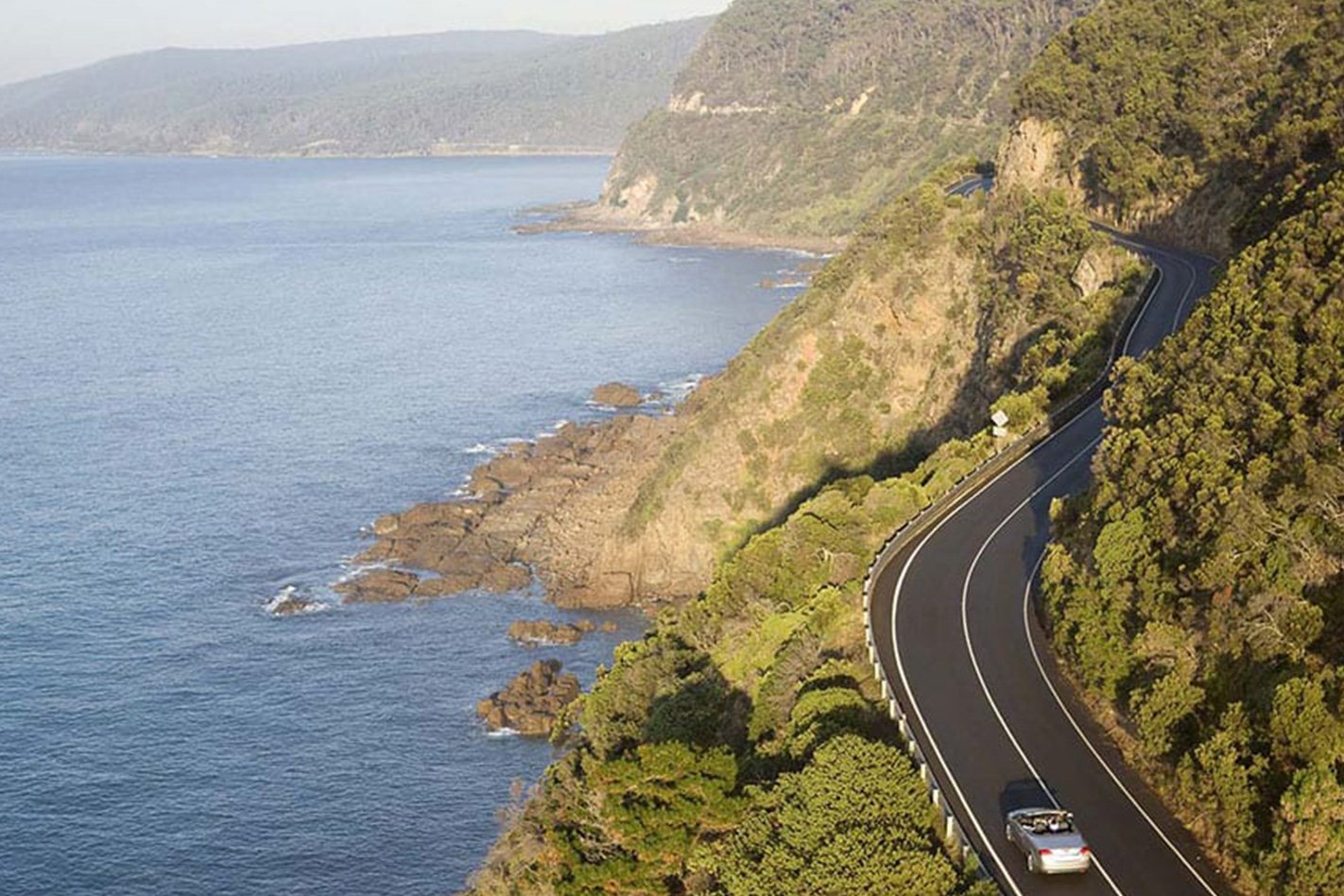
The Great Ocean Road’s National Heritage-listed, 243km stretch was built in honour of soldiers killed during WWI. It is one of the best driving roads in Australia as it’s a beloved tourist destination that takes travellers by world-class surfing breaks, through pockets of rainforest, over sheer limestone cliffs, past picturesque seaside towns and under koala-laden tree canopies. If you’re willing to stop, pay a visit to the wineries and fine dining options along the way.
Macquarie Pass, New South Wales
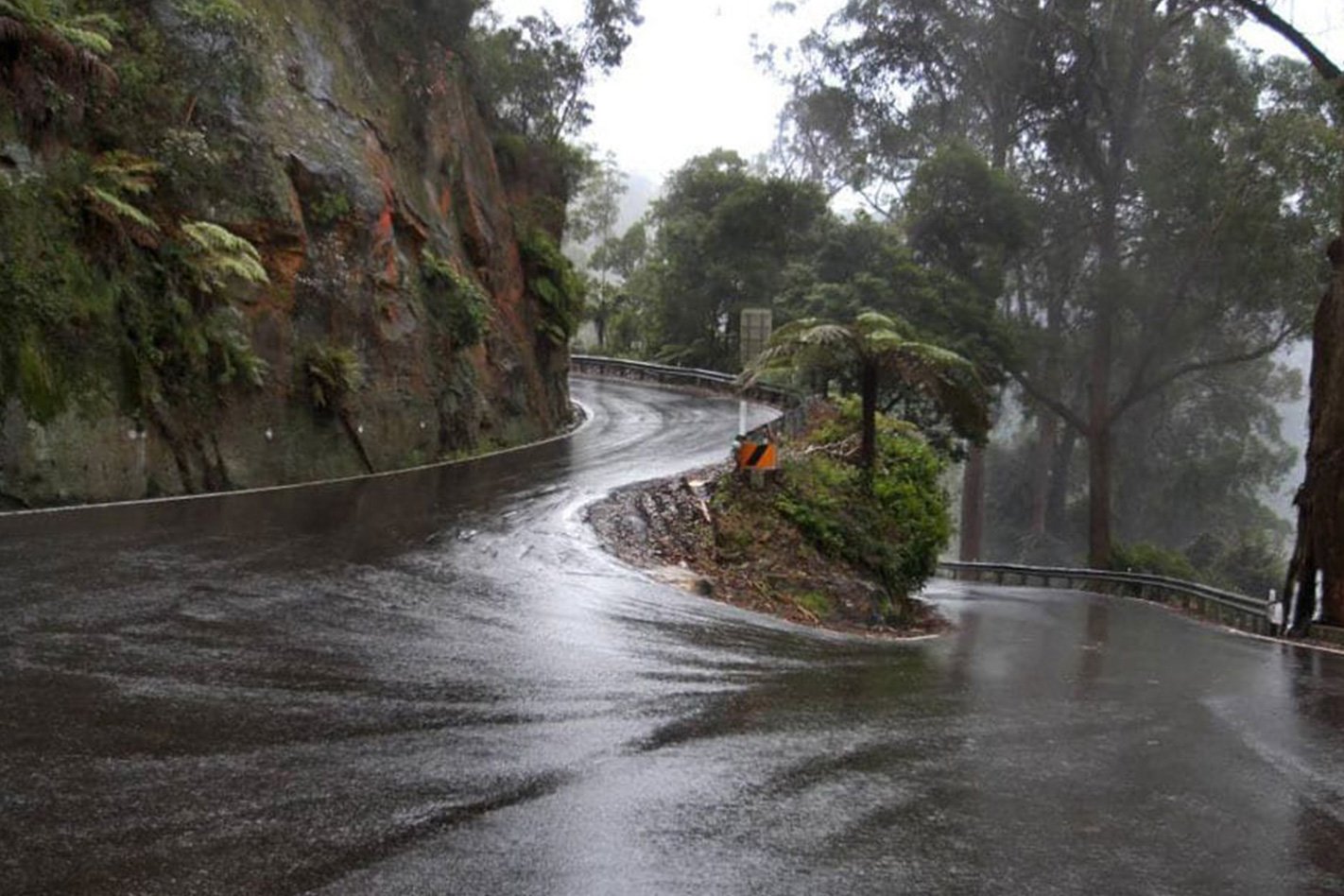
If drivers had playgrounds, this would be it. Macquarie Pass is a treasure trove of features that make car lovers go weak in the knees. Narrow roads? Check. No centre-line? Check. Limited visibility? Check. Dangerous drop-offs? Check. Hairpin bends and steep roadways? Check and check. All that adds up to a reputation for serious accidents that may deter more timid drivers, but thrillseekers can’t miss it.
Black Spur Drive, Victoria
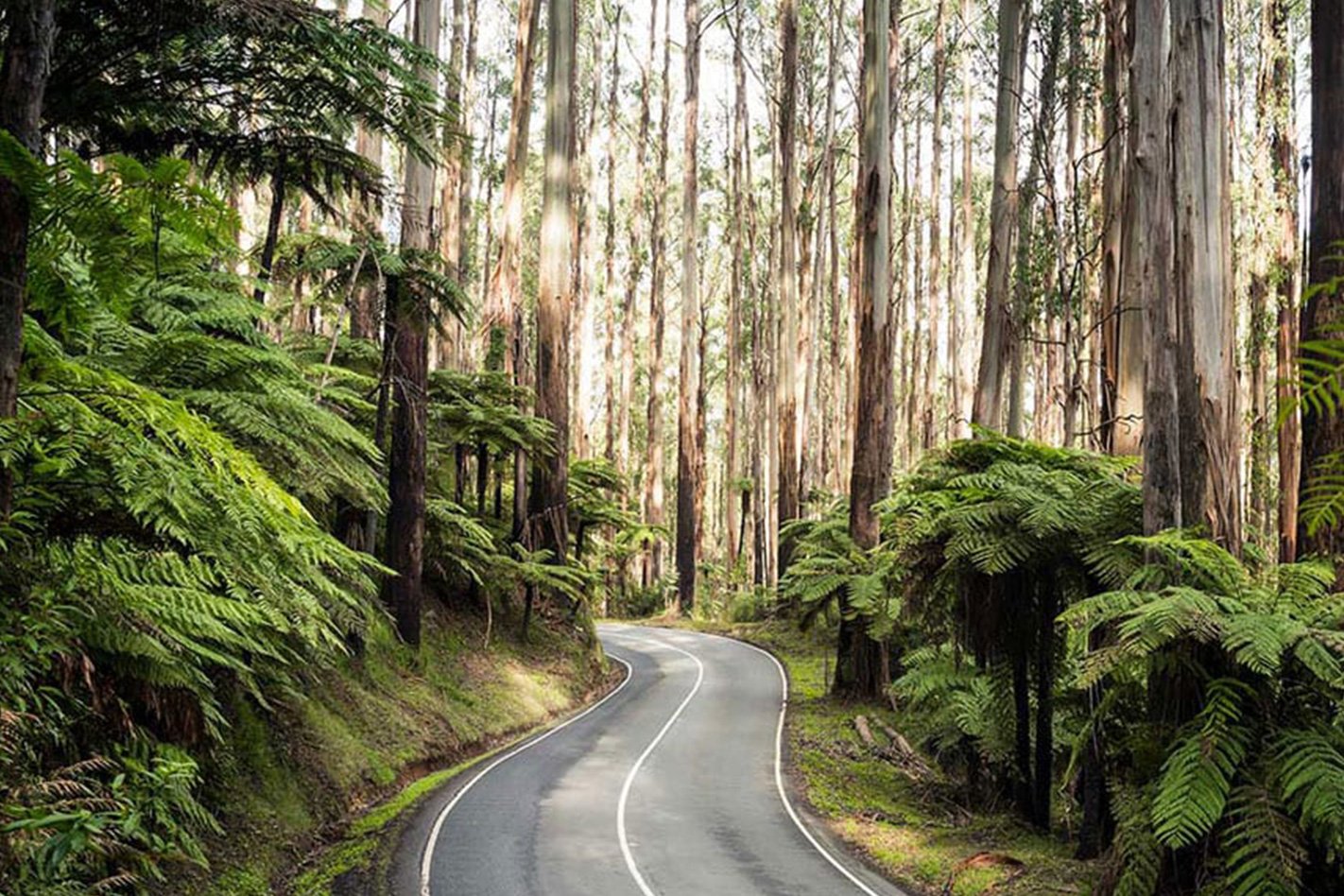
There are two options when you travel the Black Spur. The first is to pretend you’re starring in Speed Racer (the anime version, not the live-action disaster) and let adrenaline take charge. The second is to take a more leisurely cruise down its 30km path between Healesville and Narbethong, so you can enjoy the spectacular surroundings. If you want a relatively clear run, tackle it on a weekday. Weekends are notoriously busy.
Mount Panorama, New South Wales
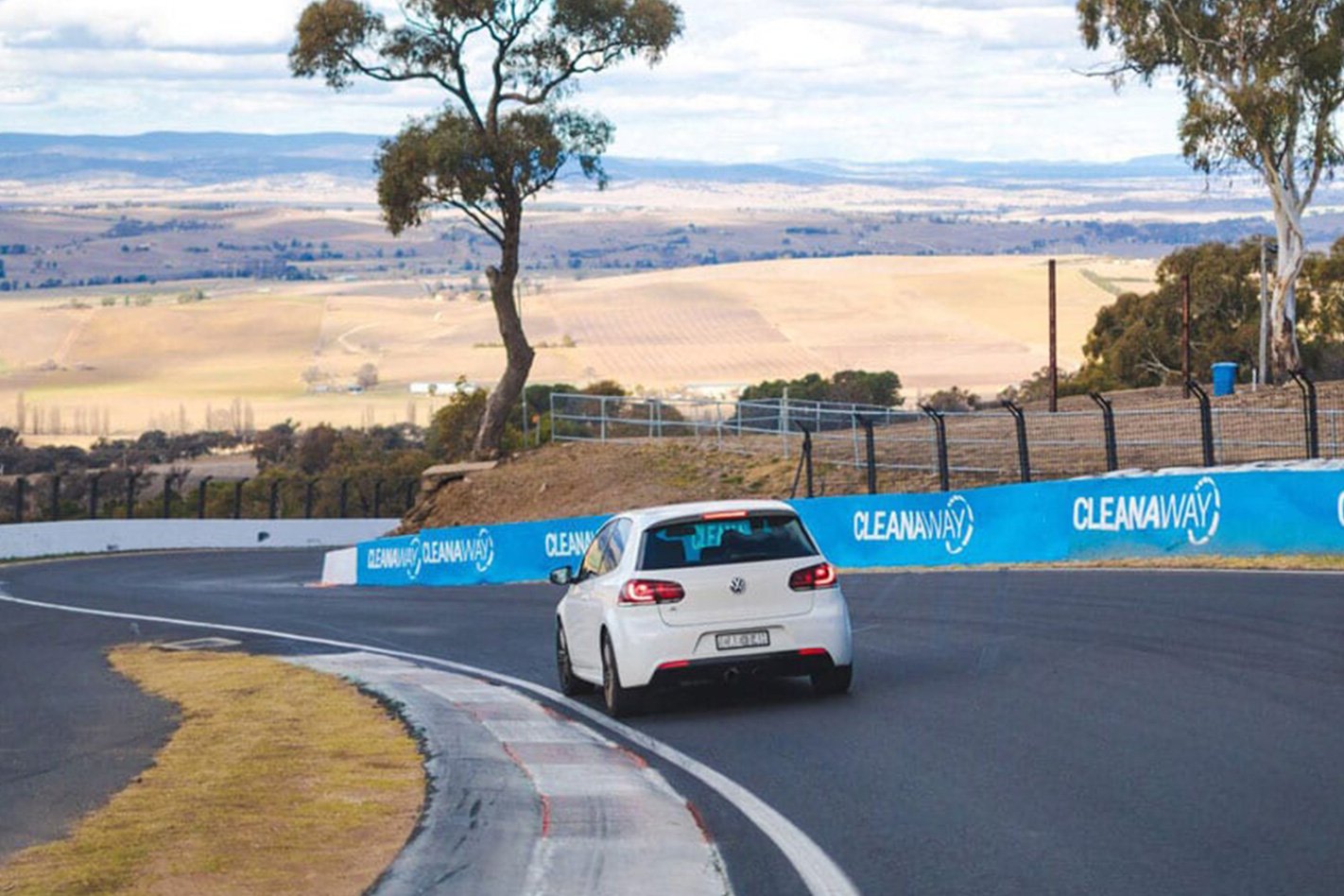
Despite its reputation as a famous Aussie racing track, Mount Panorama is actually a public road with an unusual 174m vertical difference between its highest and lowest points, and grades as steep as 1:6. On non-race days, cars are welcome to drive in both directions around the circuit at no charge. However, lest you be tempted to pretend it is a race day, a strict speed limit of 60km/h is enforced and police regularly patrol the area.
Great Alpine Road, Victoria
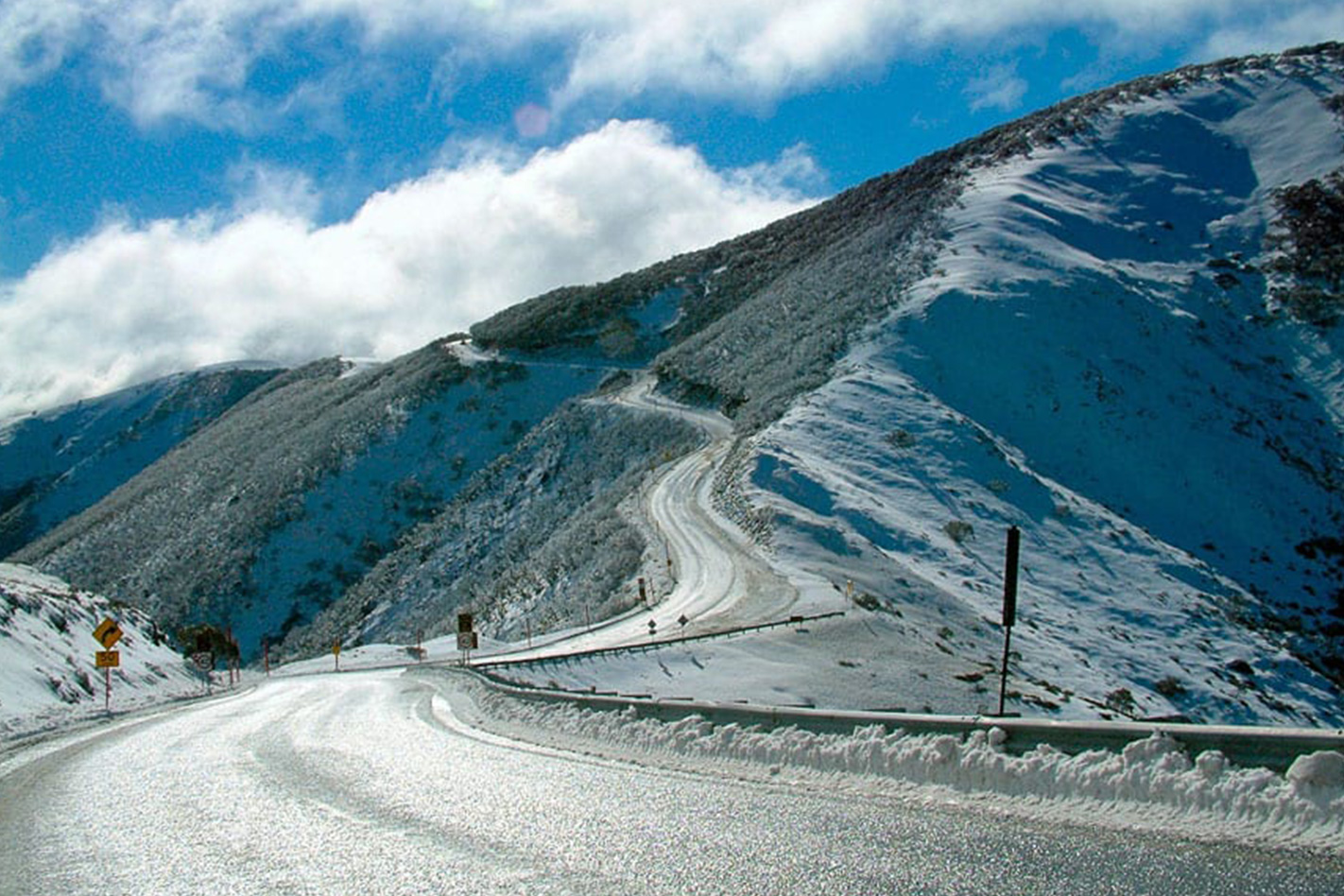
If you noticed a similarity in name to the Great Ocean Road, you’re on the right track. The Great Alpine Road is one of the best driving roads in Australia because it’s considered the mountain equivalent to Victoria’s famous oceanside route. Take this one slowly, piece by piece, to make the most of the towns, wineries, restaurants, fishing spots and scenic stops you’ll find along the way. The Alpine National Park is particularly worth a visit if you’re into Instagram-worthy flora and fauna.
Gold Coast 600 Street Circuit, Queensland
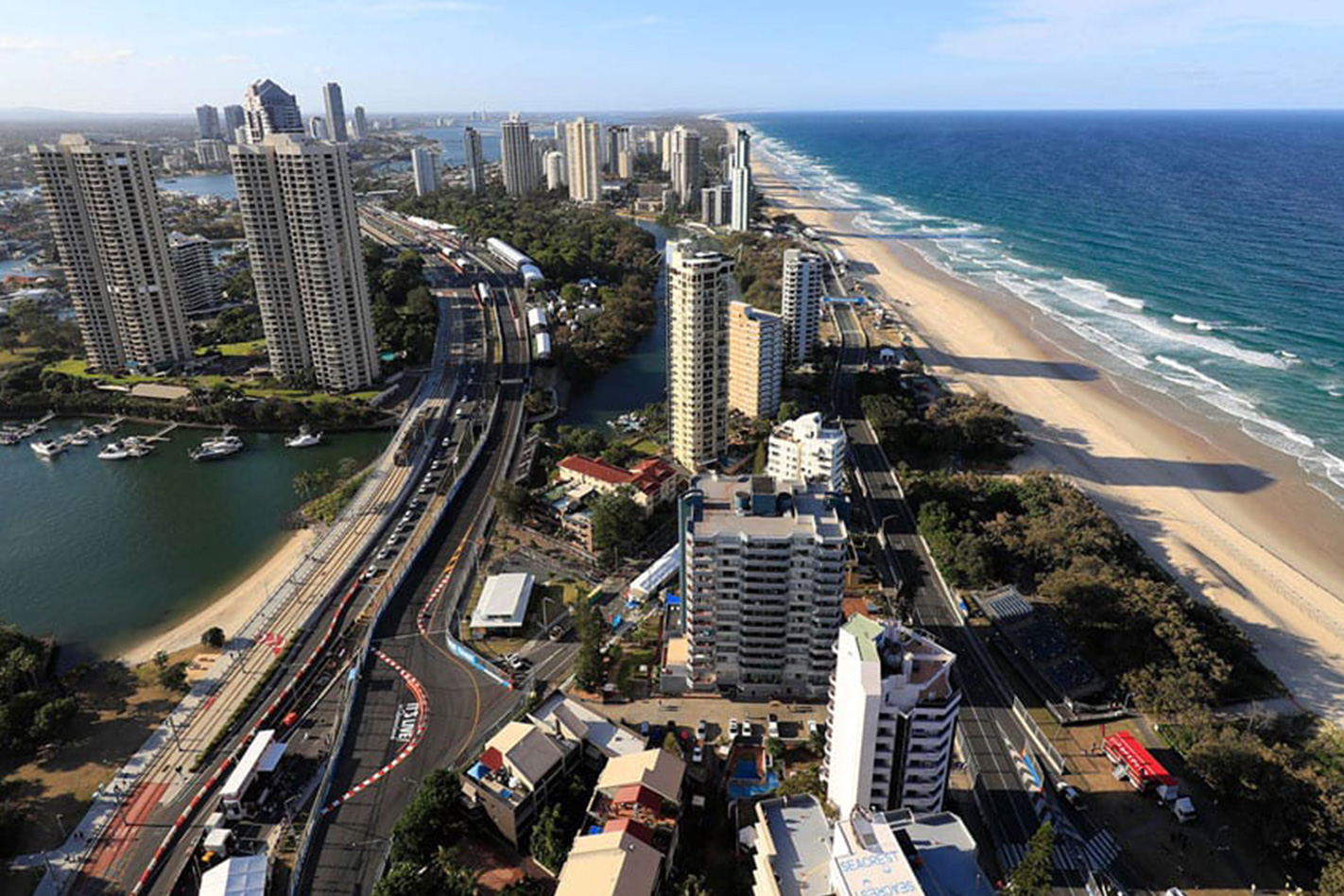
Head to Queensland for another opportunity to drive like a pro. The Gold Coast 600 Street Circuit is a temporary track at Surfers Paradise, the third of three major racing circuits that have existed in the area. The main event is a week of show stopping celebrations and three action-packed days of V8 Supercar street racing, but during the rest of the year the circuit is regular city streets on which anyone is free to take a spin.
Adelaide Hills, South Australia
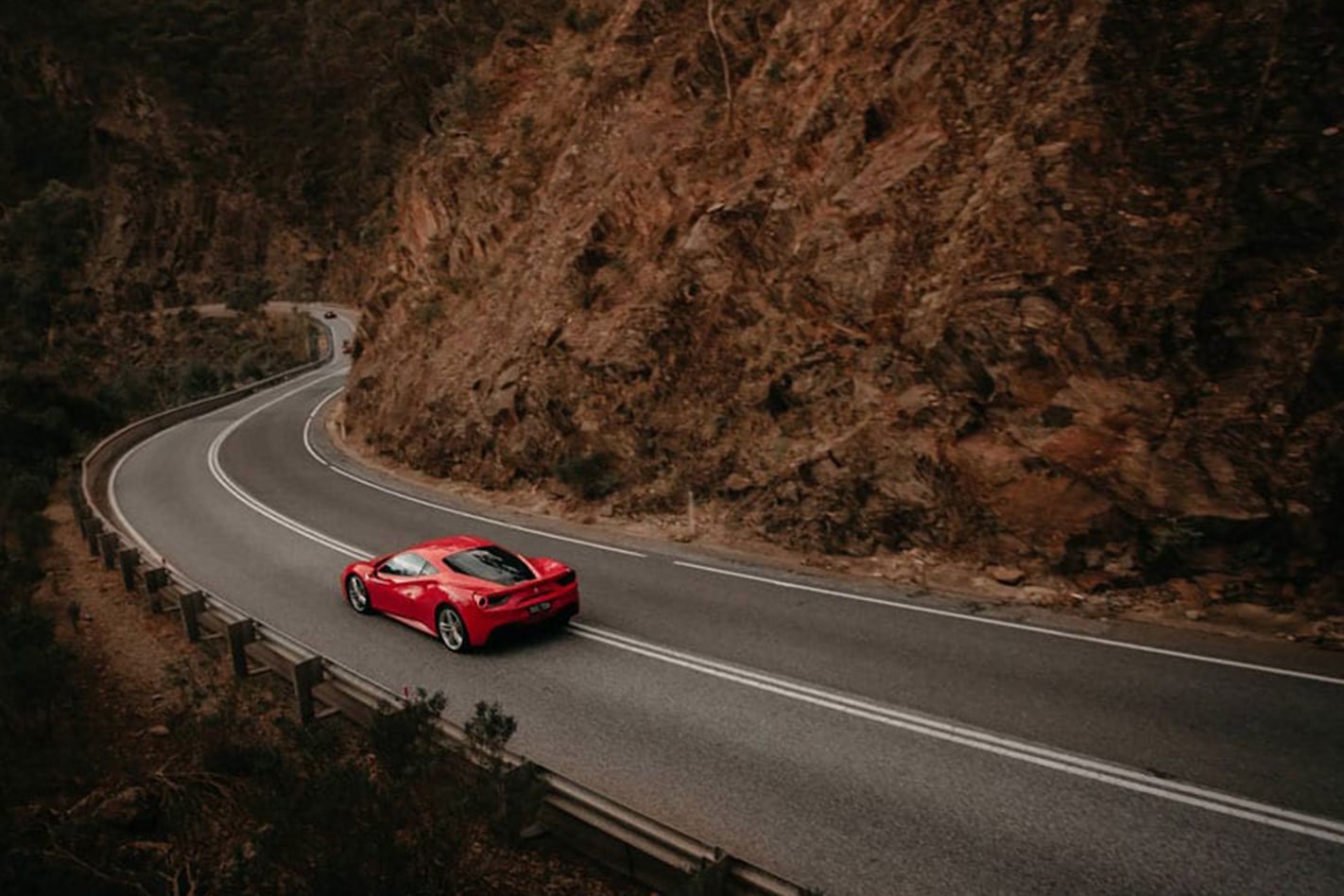
The Adelaide Hills have been made famous by Targa and Classic Adelaide tarmac rallies, and the annual Tour Down Under race for cyclists, not to mention the hundreds of enthusiasts who hit them each weekend. Their network of winding roads will leave you feeling spoilt for choice, but you won’t go wrong with any option. Rolling gradients, sinuous bends and a beautiful backdrop make for a pure driving experience to please any keen car fan.
D’Marge – The Playbook For The Modern Australian Man Sign up for D’Marge free weekly newsletter on happenings in the world of men.
THE VIEW from the staff canteen at HSV’s Clayton plant is enough to put a little lump in your throat.
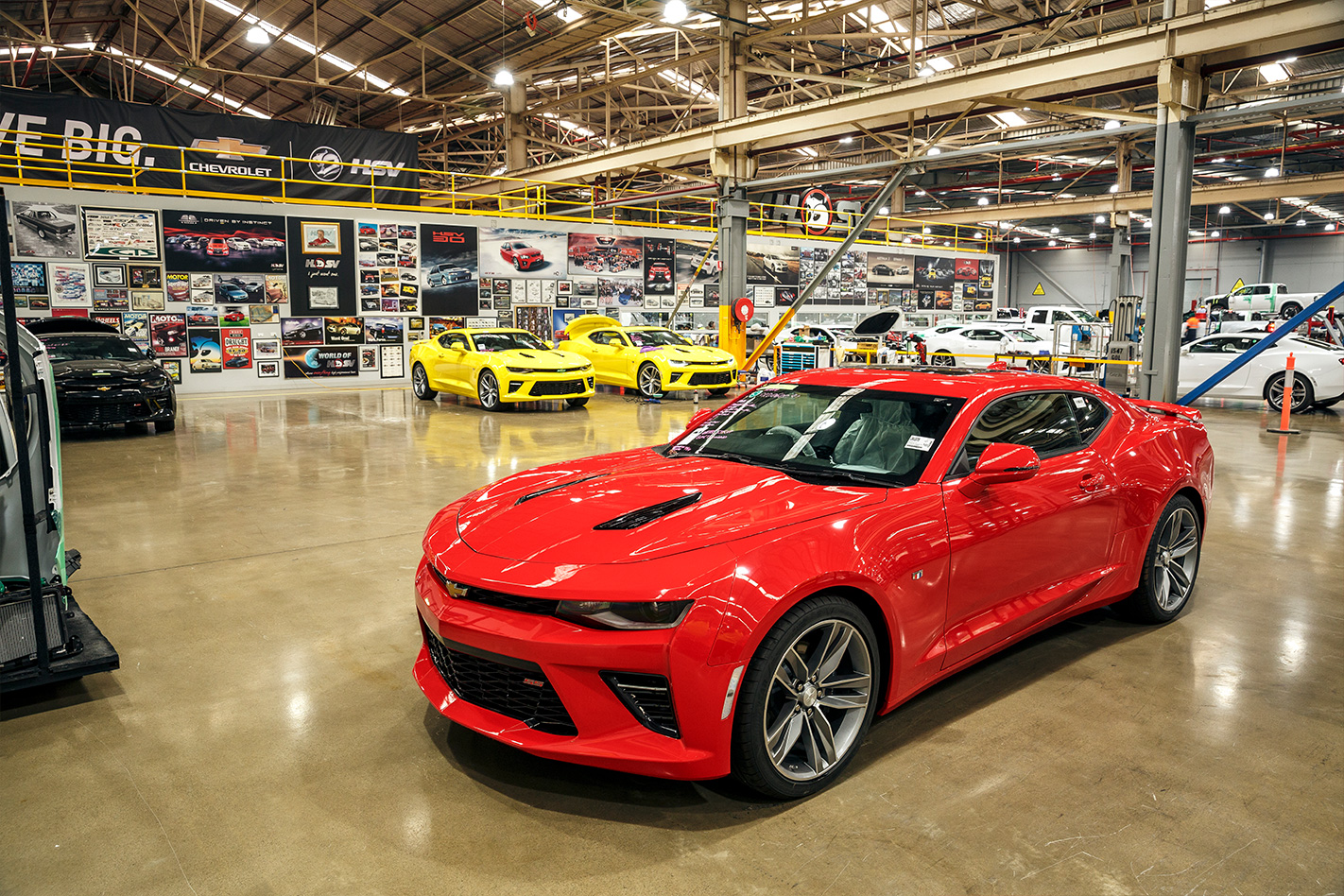
The death of Australian car manufacture has been the bad news story that’s rarely stopped giving over the past few years, but the sight of Aussies turning out new cars – and rear-drive V8 coupes at that – is more than enough to tug at the heart strings. Agreed, this is a long stretch from dinky-di football, meat pies, kangaroos and Holden cars but the right-hand-drive re-engineering work on Chevrolet’s Camaro is as close as we get at the moment.
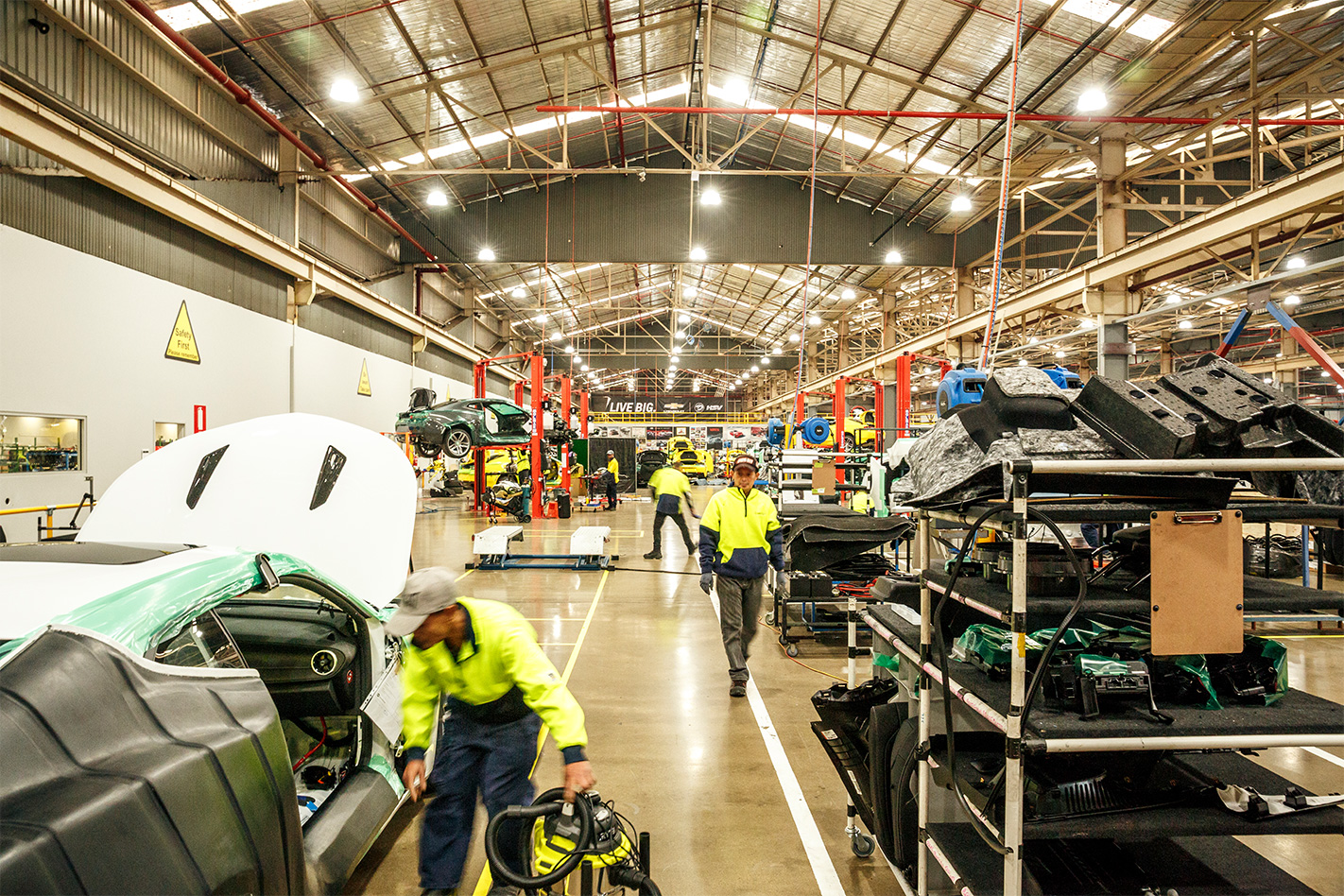
HSV’s managing director Tim Jackson winces visibly if you call it conversion and, after appreciating the work that goes into switching the wheel from left to right, it’s easy to see why. The cars are stripped back to their barest essentials, with only front and rear glass, rear suspension assembly, differential and fuel tank left in place. Out comes the car’s harness, running along its backbone like a multiplexed spinal cord, employees clambering over the shell, carefully laying out the car’s vital organs on gurney-like trolleys. We’re under strict instructions not to disturb their work, as HSV is currently polishing its process analysis in a bid to reduce the 130 man hours per unit down to around 60 or 70, doubling production throughput from six to 12 cars per day.
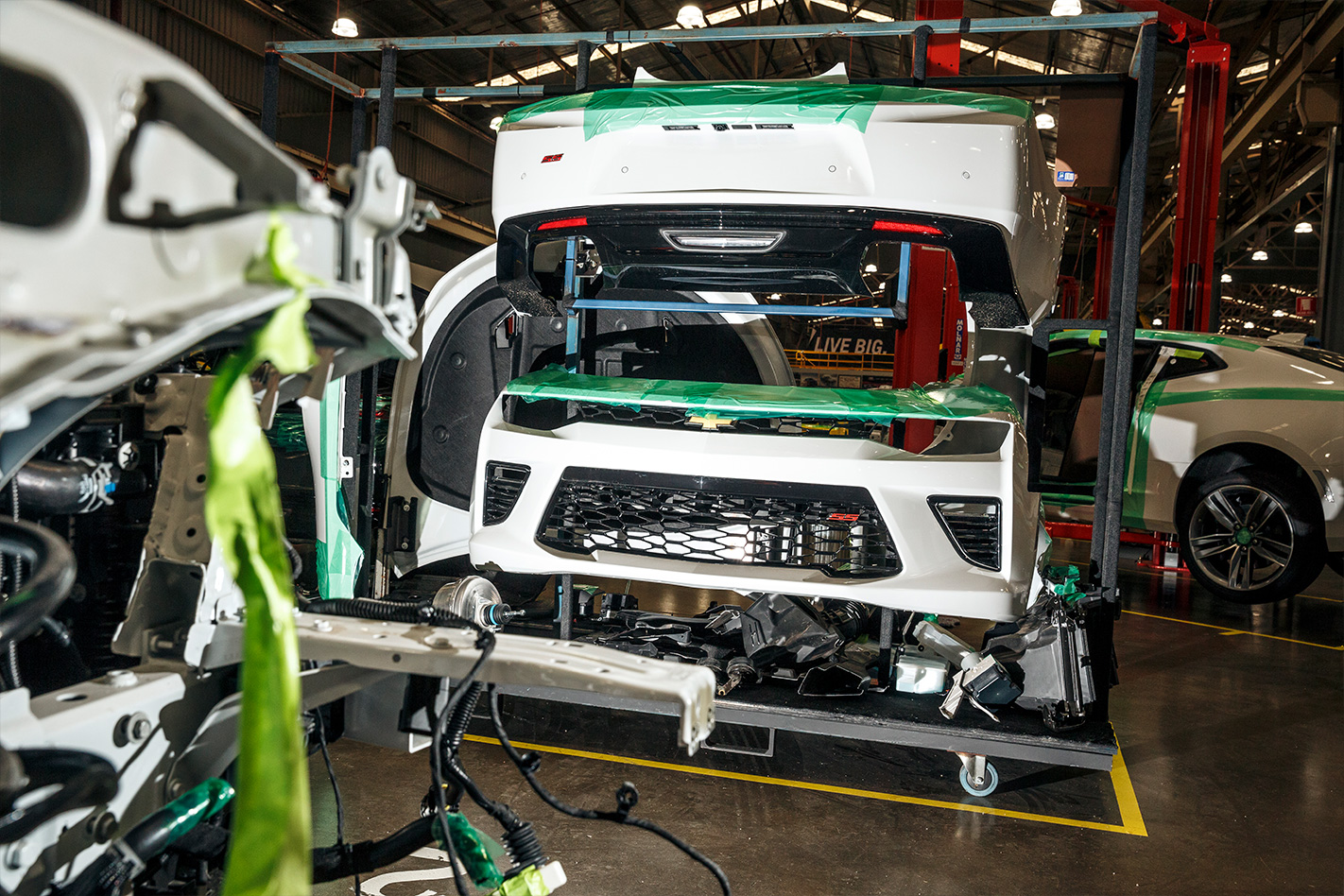
Engineering director Joel Stoddart talks us through the genesis of the project. “It was April 2016 when we got the approval for study from our organisation so we dedicated some money to purchase a car to do a study on it,” he explains. “A blue car arrived in August 2016 and we started some of our engineering work, pulling it apart and getting an understanding of what would be involved converting this car. That was when we started what we call the back-of-the-envelope business cases.”
Until that point much of the analysis was best guess. “By March 2017 we were issued math – or CAD – data, and that’s when the engineering can really get started. A huge engineering resource was started, and 357 new components are designed, developed and sourced for this program,” he says.
Look carefully at the ducting atop the Camaro’s 6.2-litre lump and it’s all HSV branded stuff. “A really important milestone for the program was September last year. We sent over six or seven engineers to the US to meet with the Camaro team. The Chief Engineer, his subject matter experts, his design-responsible engineers and his specialist engineers were all in a room to meet with us and see how our program was progressing. Just before that we sent over all our CAD data and all our questions we had for them.GM’s a huge organisation so you can’t just fire off a question at one person and think it’s going to get answered.” Cue the wry smile, obviously born from experience.
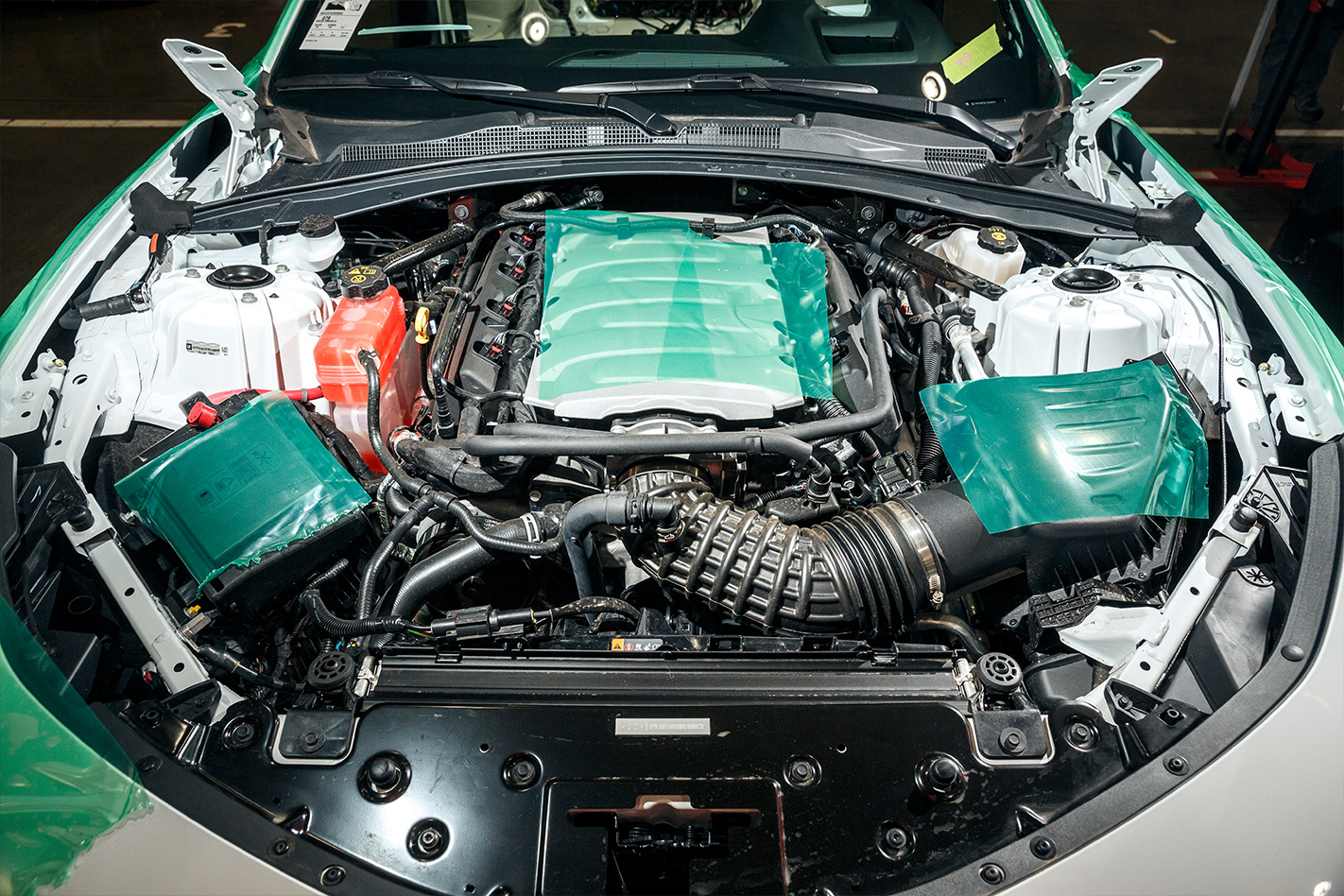
“It was pretty daunting. We had one steering engineer; they had four or five. We had one software engineer; they had lots. It was from then that we realised the program had a lot of support and momentum and we were heading in the right direction.
“Fast forward to June of this year and our ‘offline pilot’ vehicles started coming out of our workshops – you might have seen or heard of them on rumour files,” he smiles. “Those four cars are making their way around Australia on a big lap. We’ve got engineers and employees flying around the country catching up with these [durability test] cars.
“In June/July of this year, we sent four cars to a lab to be crashed; they were built on the line and just about 100 percent representative of what’s going to go out in the market. It was pretty heartbreaking.

The program manager was there and he had some restless nights leading up to that. We just gained certification this week. We’re trying to start production in September and get cars out to the public so that’s a fairly important milestone. If we’d missed that, it throws the whole program out of whack. It’s the first time we’ve done a full crash program for a car that we’ve submitted for ADRs. We’ve done it in the past maybe for verification. We do all the predictive analysis; maybe crash one car to verify that it’s okay. With this car we had to do all four crashes and we submit that to the government, so we’re proud of what we’ve achieved.”
HSV has every right to be proud. Under the stewardship of the Walkinshaw Group, the business is in transformation, moving earlier this year from its slightly dog-eared old Nissan plant to a shiny 28,000m facility around the corner that can easily house the Camaro line alongside those for Silverado, SportsCat and RAM trucks. Some 51 staff work on the Camaro line and more are set to be recruited. Wander around the staff car park and you’ll understand why HSV has such a motivated workforce. You only have to see what they drive to know they’re people like us. And they’ll need to be engaged. The old product cycle of HSV products being planned around the relatively leisurely cadence of Commodore iterations has been transformed into one new vehicle every seven to eight months. Jackson makes no bones that this project is, in many regards, a proof-of-capability exercise to GM that could well see other Camaro variants proliferate.
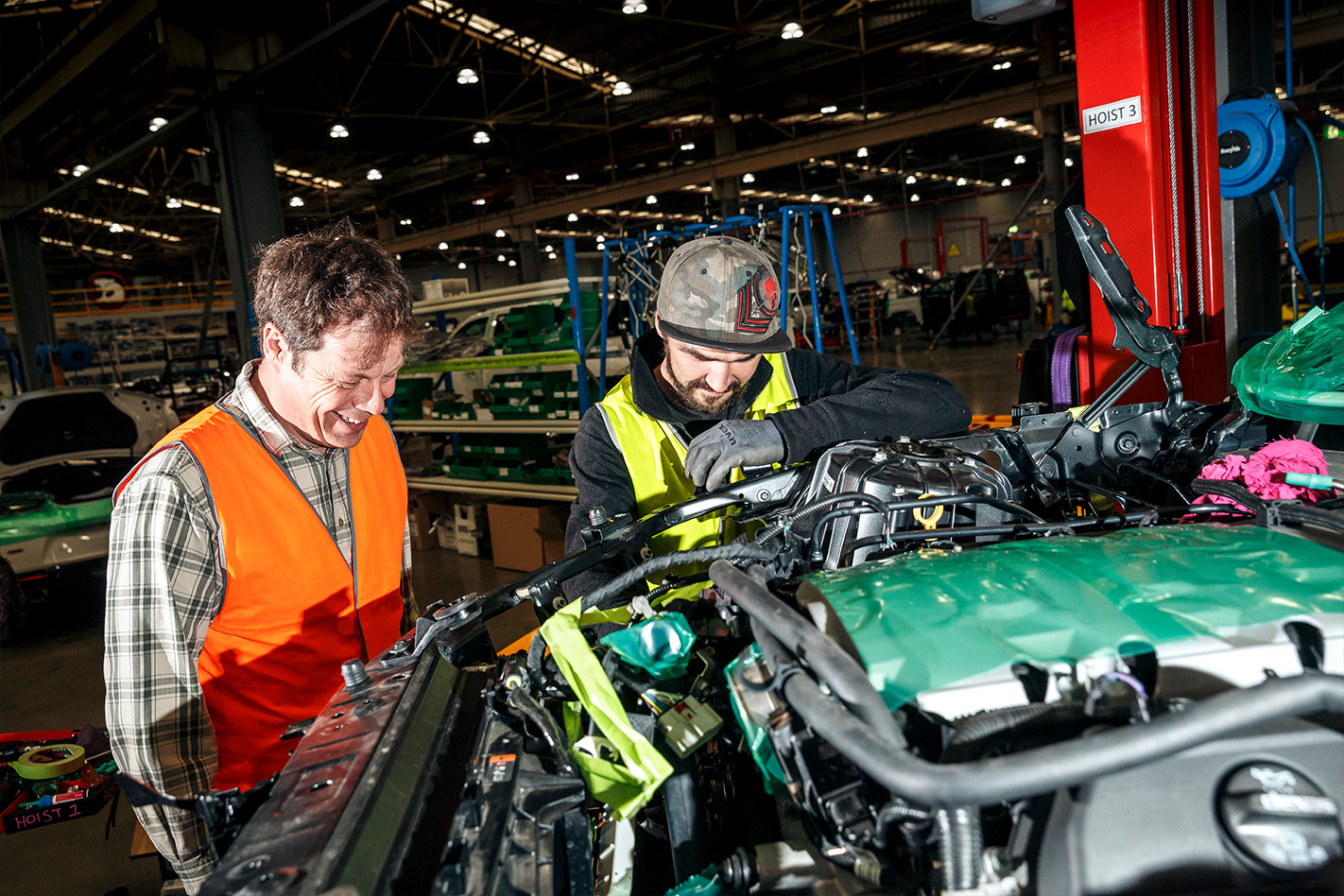
Stoddart highlights another recent acquisition; an F1-standard seven-post hydraulic shaker rig. Some serious investment has gone into this program and some basic maths suggests that it’s not about to be recouped on this model’s run. Tim Jackson admits that margins on the Camaro are thin, even at the $85,990 price point. “The margin on this car for us is not great, but if I look at it as a system between Holden, ourselves and our dealer network, there’s a willingness and desire for the car to be in the market and for customers to experience it.
“Not including the testing equipment that we’ve brought on board, as a stand-alone program, the Camaro is at least $10m worth of work across joint development, engineering time, crashing cars and so on. We can find ways to make niche solutions come to life,” he says.
Warming to the theme, Jackson highlights a tantalising next step, namely that low-volume models like the supercharged Camaro ZL1 are certainly on the table. “One of the things about our business model is that we can bring something like that to market. It might only be 300 or 400 vehicles per year but we can make that work. The buyer for this is the HSV and the GM faithful.”

Is the Camaro project that perfect blend of science and faith? We’re not sure yet but the swollen order books suggest that Australia’s clasping this one to her bosom as if it’s one of her own. Now it’s time to see if the product lives up to the billing.
