
Rushing in peak-hour traffic is futile – especially when time is of the essence. My body’s natural coping mechanisms aren’t helping allay an anxious mind.
My eyes glance at the clock repeatedly as if to somehow, by magic, make the digits regress and my thumbs tap the steering wheel in a rhythm akin to a sporadic nervous twitch. It’s a manic dance performed daily and, on this occasion at least, Melbourne’s hustle and bustle has defeated me. I’m hopelessly late.
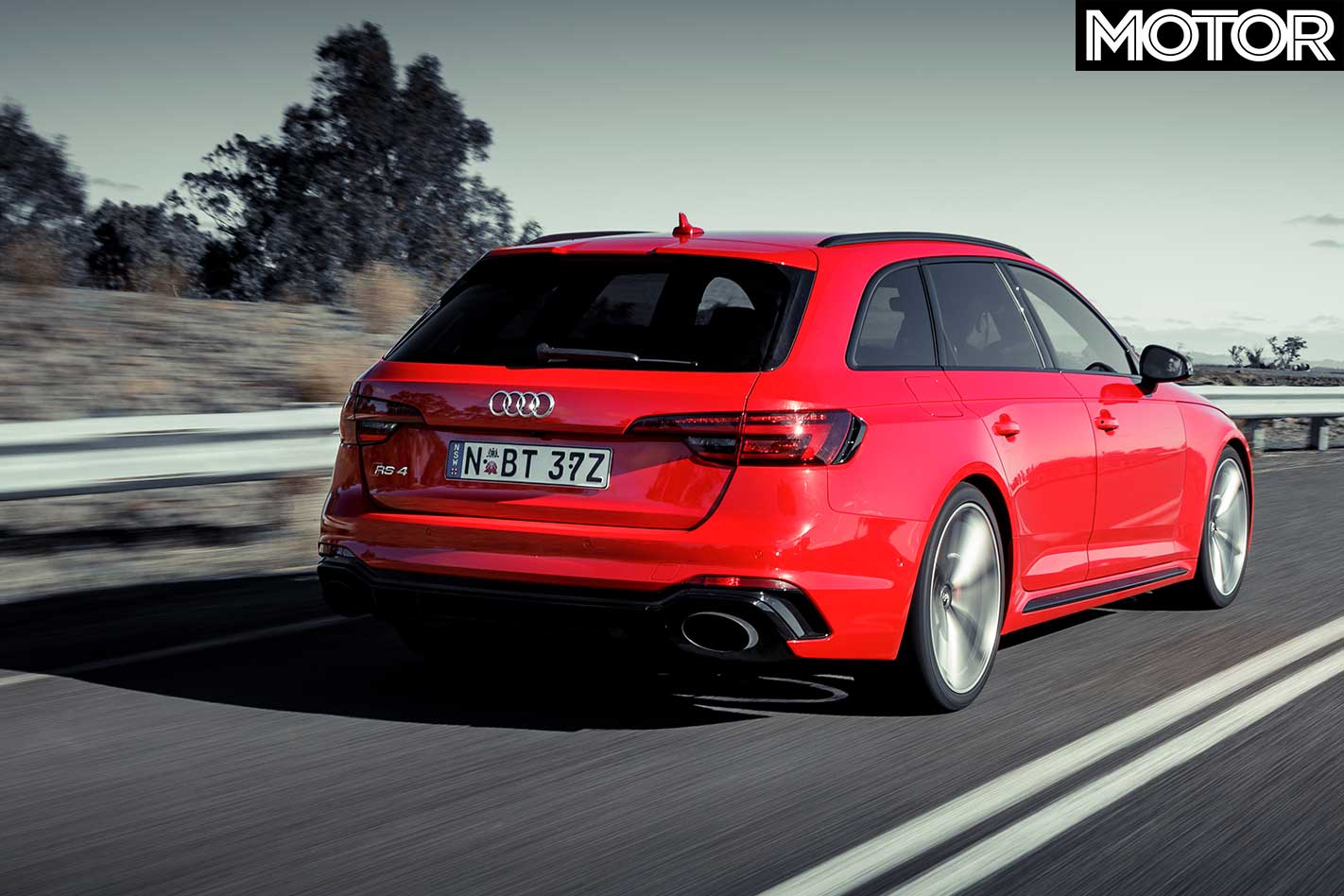
“Did you pick up the RS4 on your way to work, Trent?” asks associate editor, Scott Newman. I pause – it’s the kind of fleeting moment where you teeter between fact and fiction – before admitting that I didn’t have the keys to a B9 Audi RS4 Avant in my possession. Despite the myriad expletives running through my head, the overarching thought stuck in my brain is, “how did I ‘forget’ about an Audi RS4?”
History uncovers the answer; ancestry doesn’t come much more revered. The previous-gen B8 RS4 is an aural watermark in terms of atmo V8 delights. It wasn’t without fault, but a screaming 8250rpm redline certainly made it memorable. Even the RS2 – a co-development with Porsche which started the RS line – and the original twin-turbo V6 B5 RS4 seem to carry more lustre.
So, without even setting eyes on its pragmatic, yet purposeful silhouette, the new 2.9-litre TFSI twin-turbo V6 Avant already has preconceptions to overcome. It’s been shrouded in controversy amongst fans and claims of it losing its emotive appeal are rife. Buying into that narrative seems like the easy option. However, after finally making the trip to Audi, a Misano red RS4 sits before me, ready to disprove all the haters.
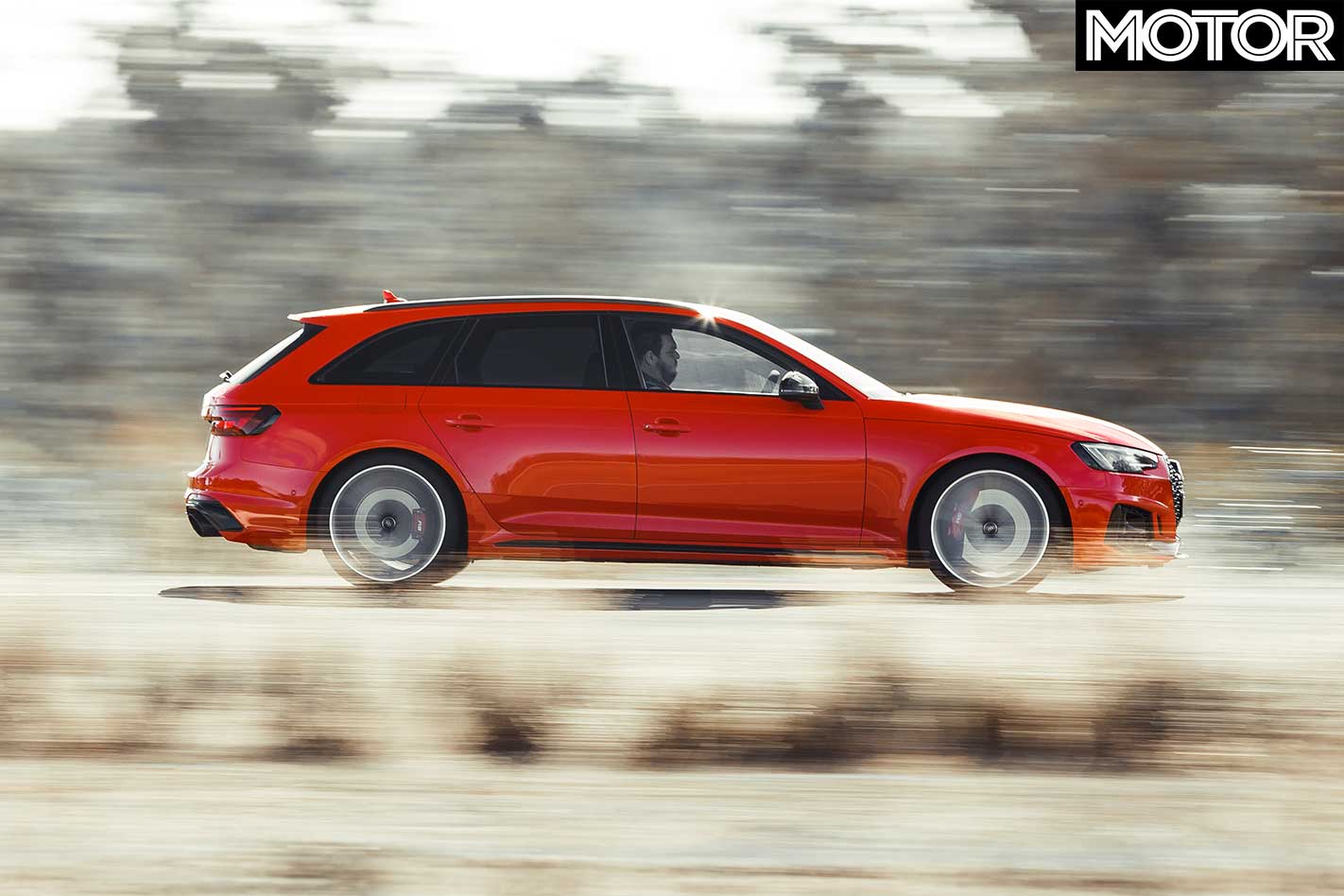
The weather reflects the controversies with storm clouds fast approaching, threatening to ruin a drive along The Great Ocean Road. The commute out of Melbourne offers a chance to assess exactly what this $152,900 uber wagon offers.
Despite the cylinder-count cull, the ‘hot-vee’ six houses two turbos within its banks, resulting in an unchanged 331kW. Torque is boosted to 600Nm, all of which comes on board at a useable 1900-5000rpm, and is sent to ground via Audi’s quattro permanent all-wheel drive.
Gone is the seven-speed dual-clutch, in its place is an eight-speed torque converter auto, and overall dimensions (on the MLBevo platform) have grown. Dynamic Ride Control (DRC), sports exhaust and Audi’s electronically controlled, torque-vectoring rear sport differential is standard. Audi drive select (Auto, Comfort, Dynamic and Individual modes) allows you to tailor certain mechanical parameters.
With the dense city gridlock an ever-fading sight, the lure of a roadhouse is hard to ignore. It also offers a chance to take in the design, one that at first glance seems a little too understated for a RennSport (RS) Audi, but unfurls its menace on closer inspection.
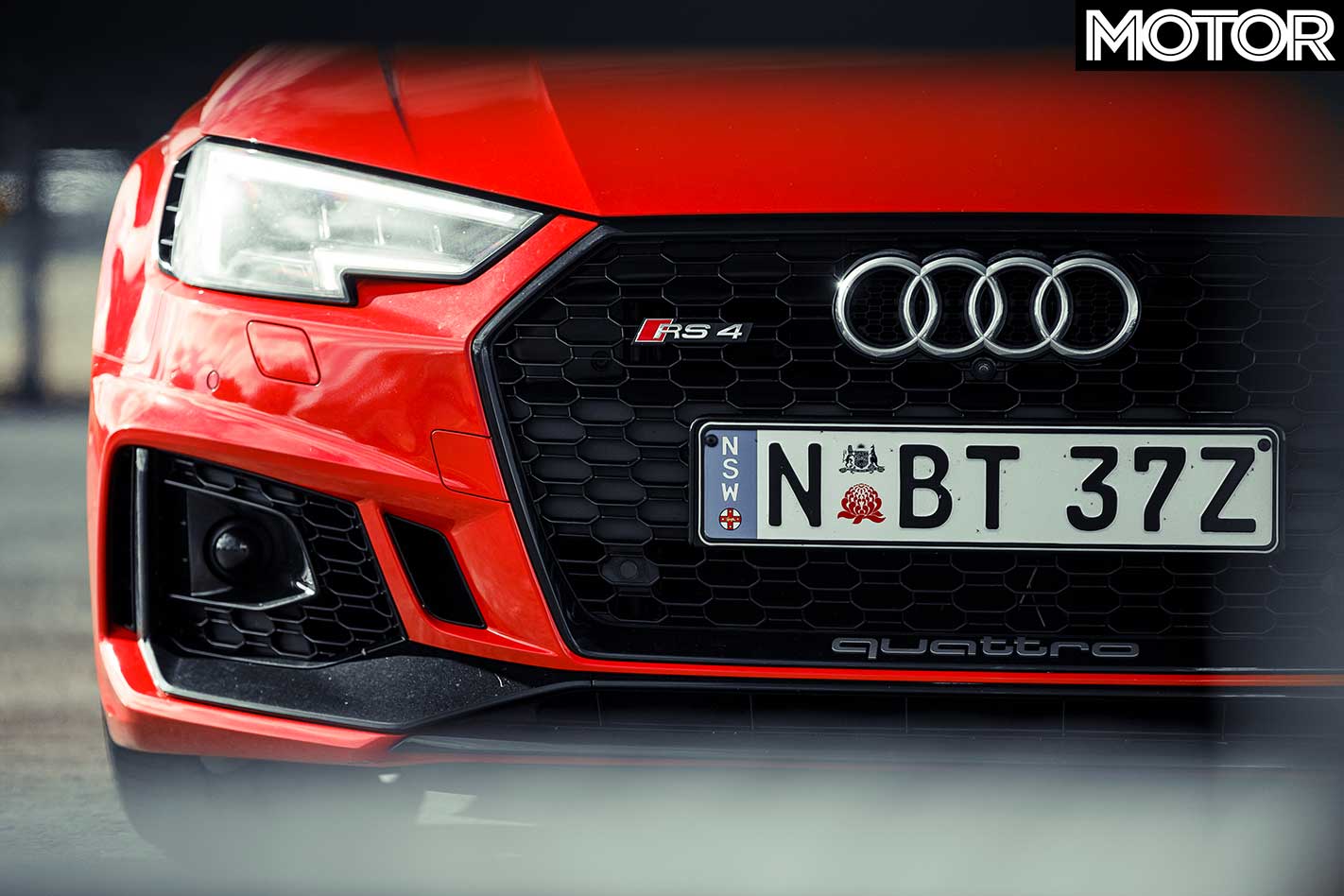
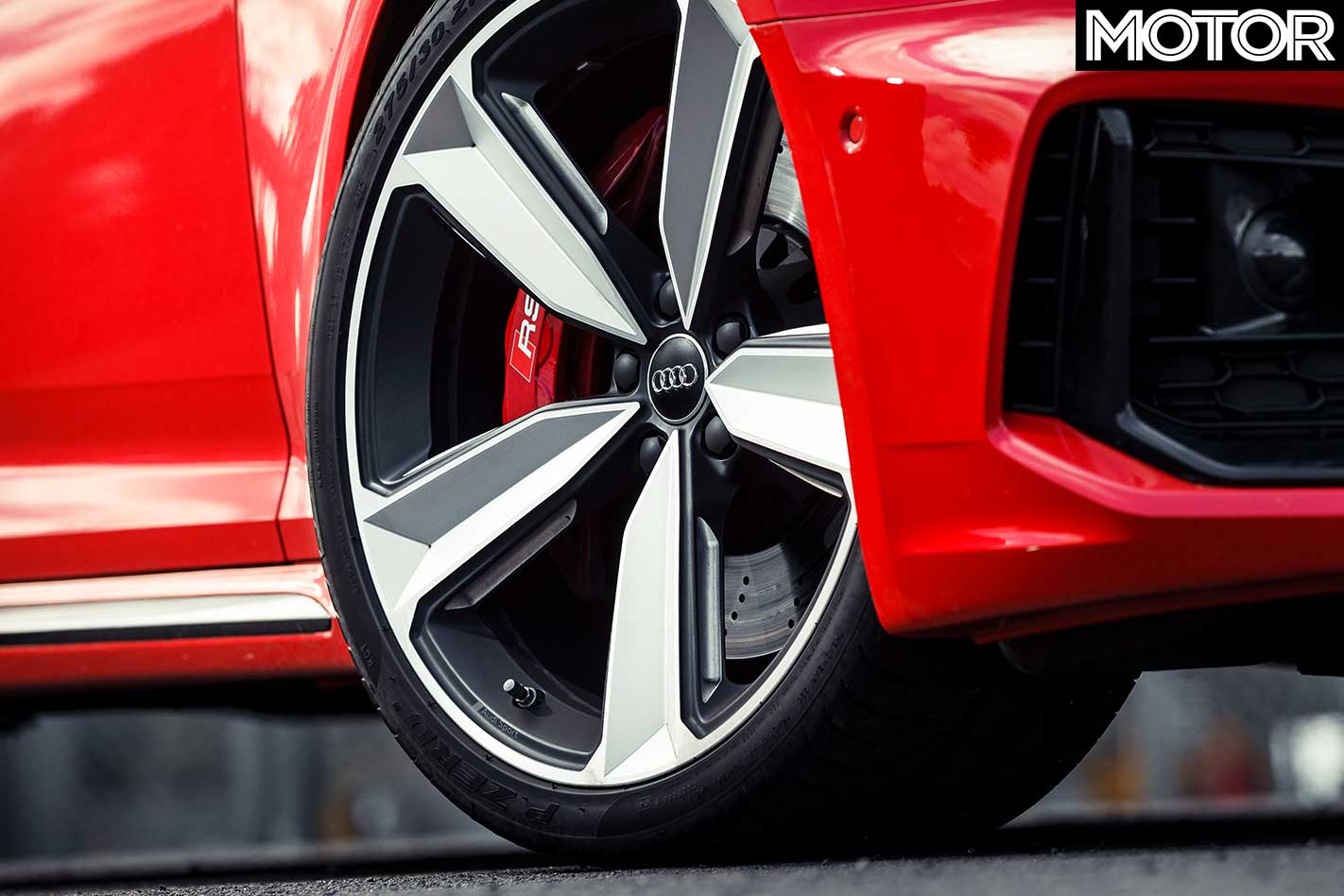
Said to be inspired by the iconic Audi 90 quattro IMSA GTO, the pronounced quattro blisters sit 30mm wider than the S4 and give the hyper sibling an unmistakable stance. Milled 20-inch alloys fill the guards while large, oval exhaust tips sit purposefully within the rear diffuser. It’s the Red Light District for all the lovers of a fast wagon – ahem, I mean Avant.
Disappointingly, my luck with the weather has come to an end. Just past Geelong, the heavens open. As far as a cocoon away from the elements goes, the RS4 provides a sumptuous environment. The attention to detail impresses, from the proximity sensitive climate controls to the knurling of the dials, it makes you feel special.
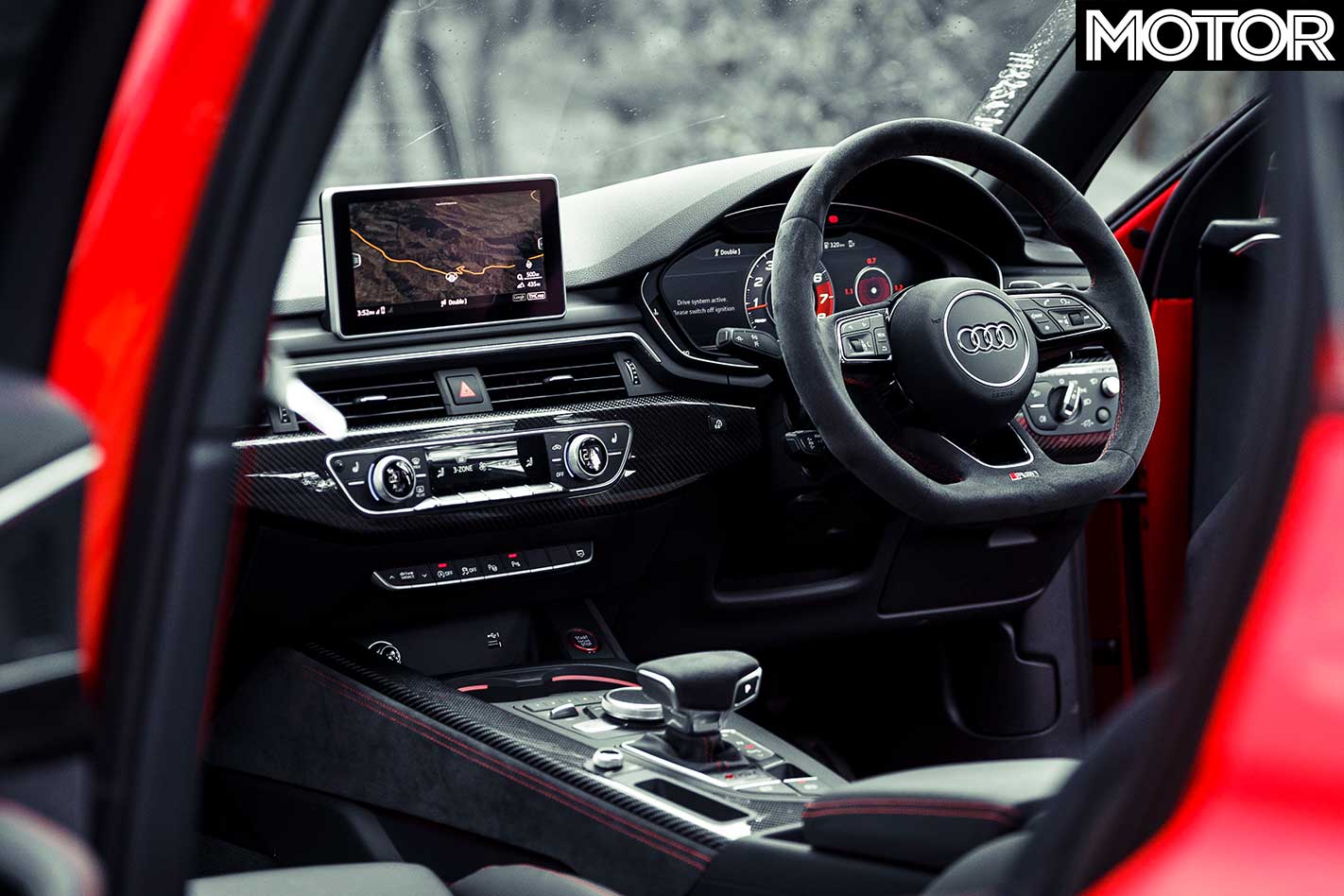
While it might not be overtly bespoke compared to the S4, it’s a cabin for those who revel in the finer touches, the intricate nuances and the overall tactility of it all.
The on-ramp out of the service centre is the first real opportunity to experience the new powertrain. To say the RS4 has a newfound turn of speed is an understatement. It’s bloody quick – almost verging on supercar pace.
With 3mm of stroke taken out (now 86mm) and two turbos generating up to 21.8psi of boost, the reality is that the 2.9-litre six (shared with Porsche) is anything but a destroked, ramped-up S4 engine. It pulls hard from low revs, continuing all the way to 6750rpm. You can gather licence-losing speeds with a flex of your right ankle.

Even with the rain-soaked tarmac, suspicions are already gathering that the claimed 0-100km/h time of 4.1sec might be a tad understated. The highway squirt also uncovers the new V6 growl, which is unexpectedly enticing and far more cultured than you’d expect from a bent six.
Yet, as night falls, the Matrix LED headlights strike through the mist and fog. Persistent precipitation means the road speed shown on the (optional) head-up display scarcely climbs to anywhere near the posted limit. Parked up in Apollo Bay, the dynamic indicators do their thing as the RS4 is locked away for the night.
Daybreak provides another bleak outlook. However, the upside is winding roads free of tourist traffic. This is quattro territory. If the RS4 is ever going to shine, it’s on the soaked ribbons of tarmac that hug Victoria’s southern coastline. And the B9 doesn’t disappoint.
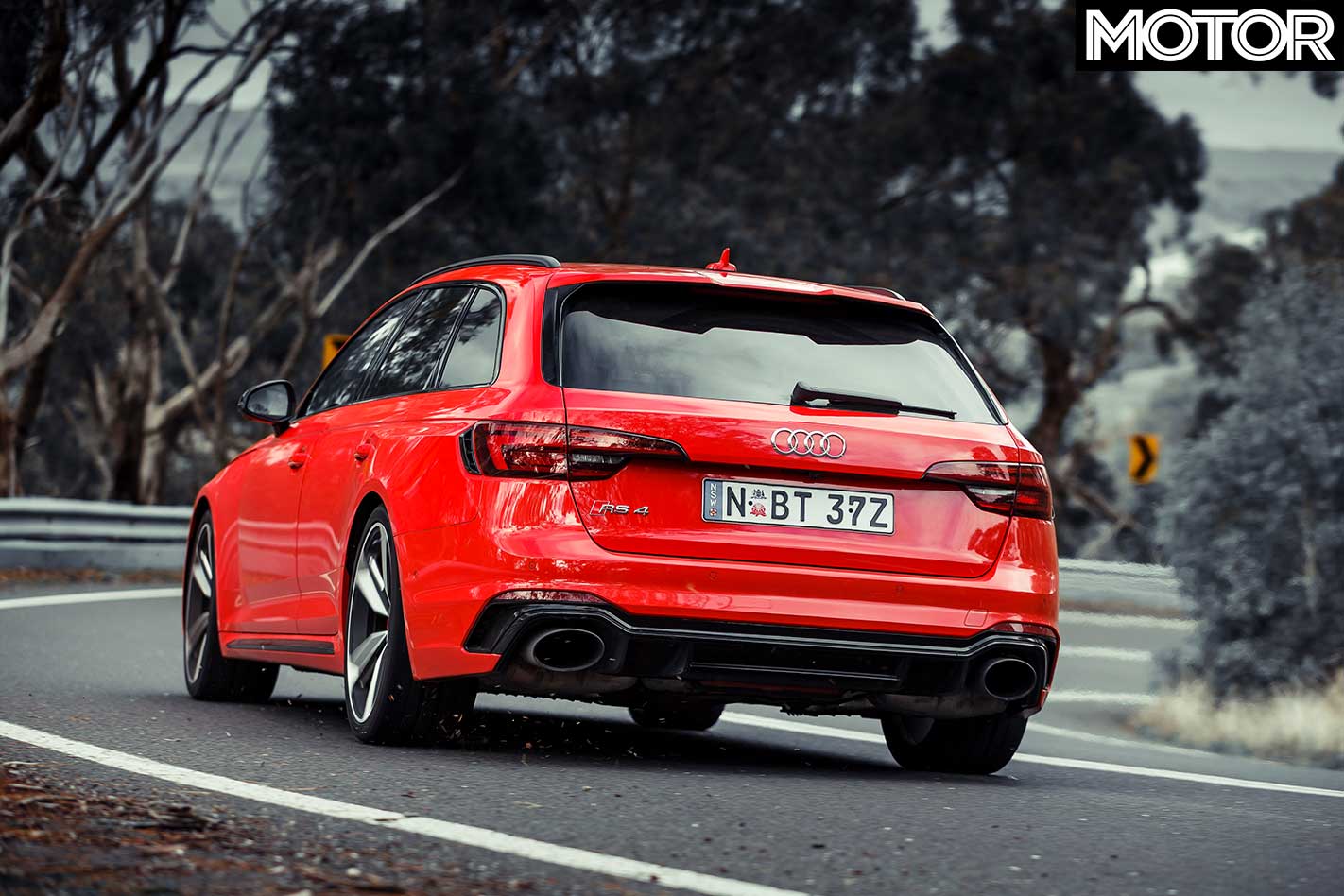
With the adaptive dampers set to Comfort and the outright road speed curtailed by the conditions, the suspension soaks up the lumps and bumps with aplomb. At these speeds the extra travel inspires confidence without adding excessive roll, while the 275-section Pirelli P Zeros impeccably disperse rivers.
It’s a fight between car and mind; the car goads me to go faster and exploit its grip, yet my mind, seeing the conditions, forces me to check out. Despite the obvious dynamic talent, caution proves the better part of valour.
Still, it’s hard to imagine a BMW M3 Competition or C63 AMG staying within earshot of the tied-down RS4 with this level of standing water. Just how it finds purchase on seemingly ice-like roads beggars belief. What’s more, the sound emanating from under the bonnet and out the exhaust is intoxicating. Muscular reverberations and matured histrionics continue long after the auto ’box has rev-matched on down shifts.

However, there are some caveats. The adaptive dampers, combined with the new five-link suspension setup front to rear, aren’t always happy in Dynamic or Comfort modes. The former is harsh, and with abundant moisture, it makes the RS4 lose most of its composure.
The ride quality becomes skittish and erodes confidence. Therefore the latter is certainly the default inclement DRC setting. Auto mode is supposed to be a halfway house in which the car determines the stiffness, but it doesn’t really work, either.
Mercifully, as the weekend comes to a close, the storm clouds dissipate. It’s time to see just how fast the force-fed six can get the 1715kg (the B9 is 80kg lighter overall) wagon down Heathcote’s drag strip.
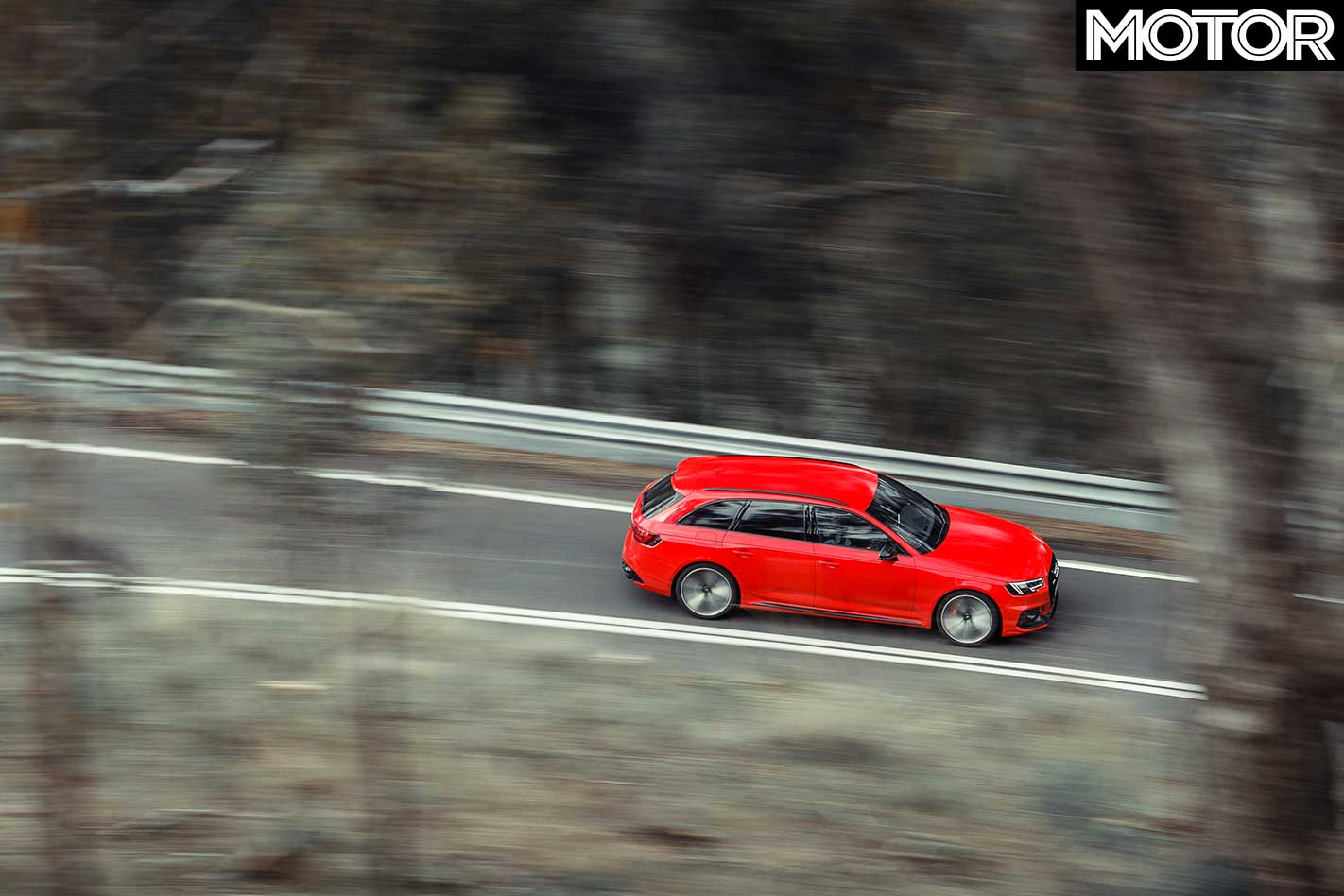
The RS4 bests its quoted 0-100km/h time by more than two tenths at 3.86sec. The quarter mile is covered in 12.03sec with a terminal speed of 186.24km/h, while 80-120km/h is achieved in 2.41sec. And yet, the crazy part about it is that it feels as though it’d do that on any surface – even with your grandmother driving.
Simply activate the dynamic start and the rear squats, the front lifts and all fours savage the tarmac like a dog with a bone. The eight-speed auto shifts through the gears with dual-clutch-esque swiftness.
Away from the straight lines of Heathcote to the mountain ranges outside Melbourne, the dry-weather ability of the RS4 is revealed. The new V6 relieves 31kg from the front axle compared to the V8.
Overall weight distribution is improved; hence the go-fast wagon is far from an understeering pig or solely a point-and-shoot proposition. You can really feel the quattro sport diff apportioning torque across the rear axles – up to 85 per cent of torque can be sent to the rear wheels. The RS4 also deals with changes of direction with deft responses.
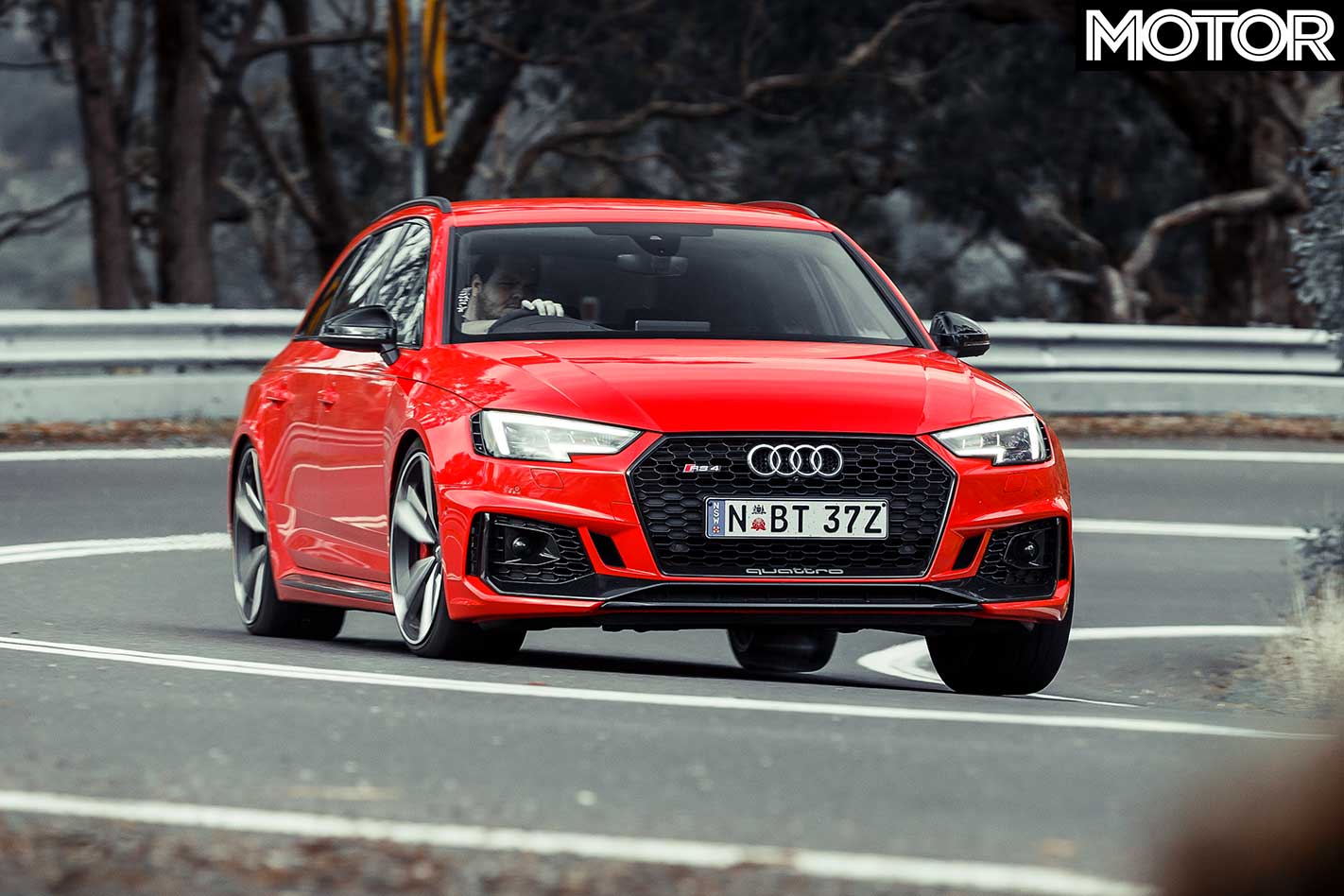
Okay, it’s not going to perform lurid skids on corner exit, but set up for a corner correctly and the rear will rotate on entry in a progressive and satisfying way. The RS4 is so much more lively and fun on the limit than you expect, with the P Zeros offering just enough slip to feel the car moving underneath you.
Sadly, the variable-ratio dynamic steering doesn’t divulge feedback as keenly (surprisingly, Auto is the best mode) and the brakes leave the party early if you go too hard on them too often.
On these smooth roads, Dynamic mode offers just enough compliance without the pitch and body roll Comfort induces. And there’s the rub. You won’t find a Goldilocks damper setting for every occasion.
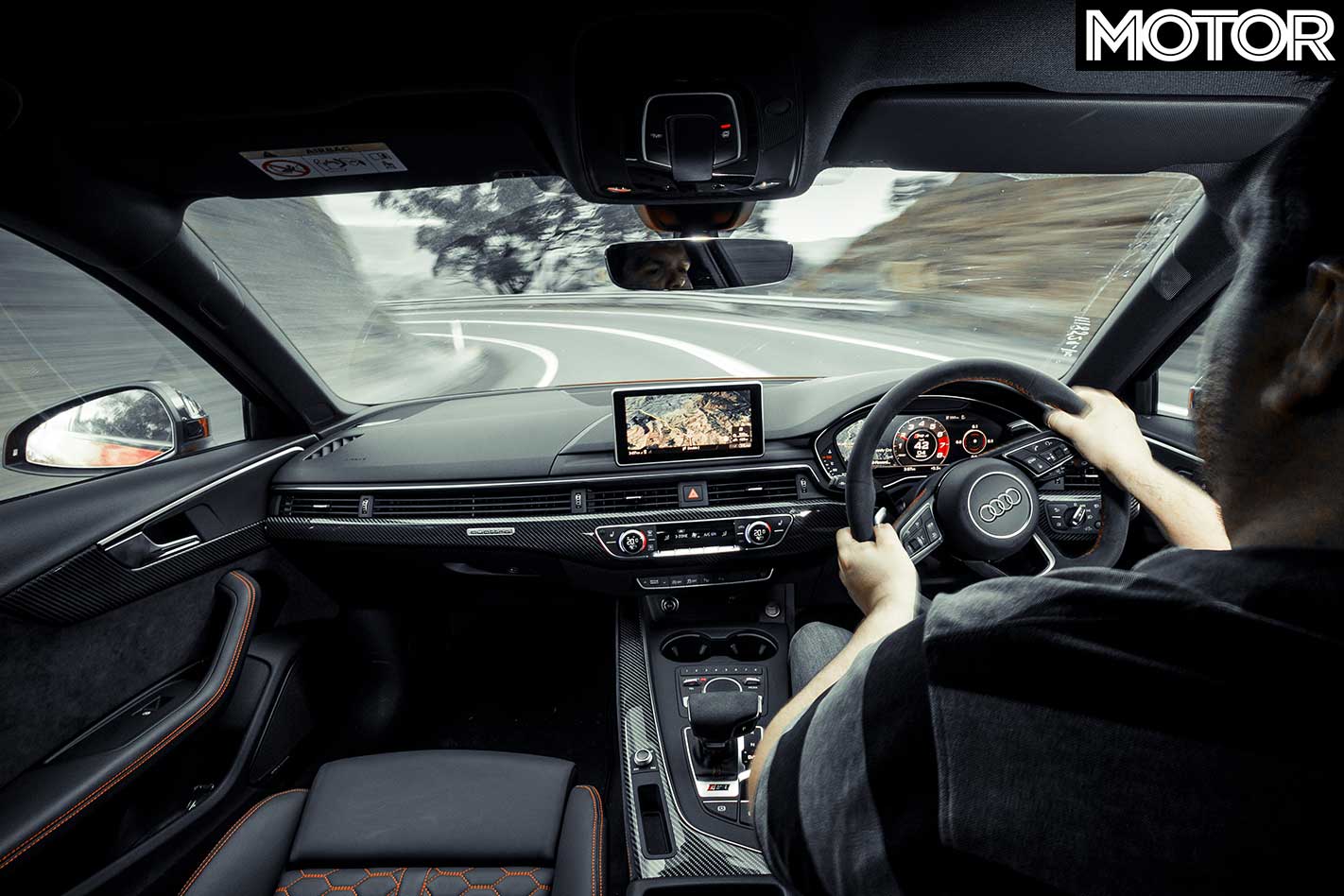
While Comfort offers new levels of suppleness over the harshest of city streets or broken bitumen and suits the luxe part of the Audi equation, it’s not perfect. Rebound, especially on vertical movements, isn’t controlled well enough and if you encounter a mid-corner undulation at speed the RS4 will leap out of it, sending you off line.
Conversely, Dynamic can be that bit too stiff and unforgiving – unless you find unblemished blacktop. However, there’s just enough leeway to find the magic. And when you’re on the right road and in the right mode, it does feel ‘just right’.
The fourth-gen RS4 was at risk of being sterile. However, in reality, it’s anything but. Preconceptions confine it to a performance car that goes about its business without tact – a ruthlessly effective equation that’s hellbent on providing only the answer. And yet, here I am, sitting in morning rush hour once again, being cosseted by a massaging seat and thinking that the twin-turbo V6 wagon is anything but an emotionless calculation.
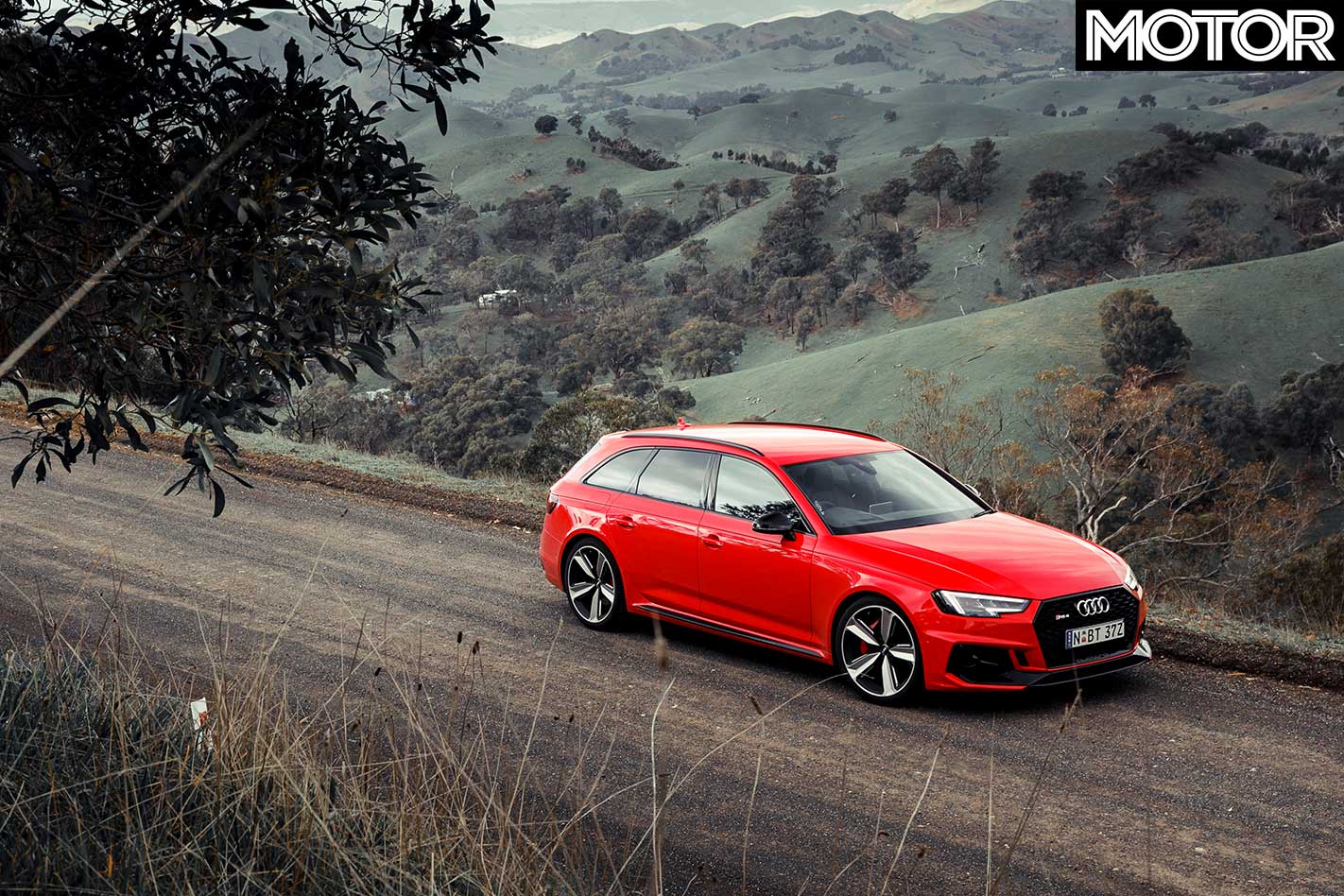
Every condition has been thrown at the RS4 and it has passed largely unscathed. It lives up to the performance-wagon genre and really could be the only car you’ll ever need.
While the cylinder count and induction type is different, surprisingly, the B9 has a soul that honours the past and the future. There’s an innate and endearing nature that makes you want to live with it.
Unlike its forebear, the B8, it isn’t a car you’ll fall for straight away. But spend some time with it and Audi’s RS Avant creates a new theatre that’s every bit as engaging. It turns out the RS4 is anything but forgettable.

FAST FACTS 2018 Audi RS4 Avant
BODY: 5-door, 5-seat wagon DRIVE: all-wheel ENGINE: 2894cc V6, DOHC, 24v, twin-turbo POWER: 331kW @ 5700-6700rpm TORQUE: 600Nm @ 1900-5000rpm BORE/STROKE: 84.5mm x 86.0mm COMPRESSION RATIO: 10.0:1 WEIGHT: 1715kg POWER-TO-WEIGHT: 193kW/tonne TRANSMISSION: 8-speed automatic SUSPENSION: multi-links, coil springs, adaptive dampers, anti-roll bar (f); multi-links, coil springs, adaptive dampers, anti-roll bar (r) L/W/H: 4781/1866/1404mm WHEELBASE: 2826mm TRACKS: 1580mm (f); 1575mm (r) STEERING: electrically assisted rack-and-pinion BRAKES: 375mm ventilated discs, 6-piston calipers (f); 330mm ventilated discs, single-piston calipers (r) WHEELS: 20.0 x 9.0-inch (f/r) TYRES: Pirelli P Zero, 275/30 R20 97Y (f/r) PRICE: $165,546 (as tested)
PROS: All-weather grip; rapid straight-line pace; practical CONS: Polarising soundtrack; indifferent damping; brakes RATING: 4 out of 5 stars
THE STRIP
0-10km/h: 0.28sec 0-20km/h: 0.56sec 0-30km/h: 0.83sec 0-40km/h: 1.14sec 0-50km/h: 1.49sec 0-60km/h: 1.88sec 0-70km/h: 2.28sec 0-80km/h: 2.78sec 0-90km/h: 3.27sec 0-100km/h: 3.86sec 0-110km/h: 4.51sec 0-120km/h: 5.22sec 0-130km/h: 5.96sec 0-140km/h: 6.81sec 0-150km/h: 7.75sec 0-160km/h: 8.85sec 0-170km/h: 9.93sec 0-180km/h: 11.15sec
0-400m: 12.03sec @ 186.24km/h 80-120km/h (Drive): 2.41sec 100-0km/h: 37.80m
Speed in Gears 1st: 53km/h @ 6750rpm 2nd: 84km/h @ 6750rpm 3rd: 125km/h @ 6750rpm 4th: 155km/h @ 6750rpm 5th: 204km/h @ 6750rpm 6th: 250km/h @ 6325rpm* 7th: 250km/h @ 5200rpm* 8th: 250km/h @ 4040rpm* *Manufacturer’s claim
Heathcote Dragway, 11˚C, dry. Driver: Trent Giunco
Three Special RS4 Forebearers
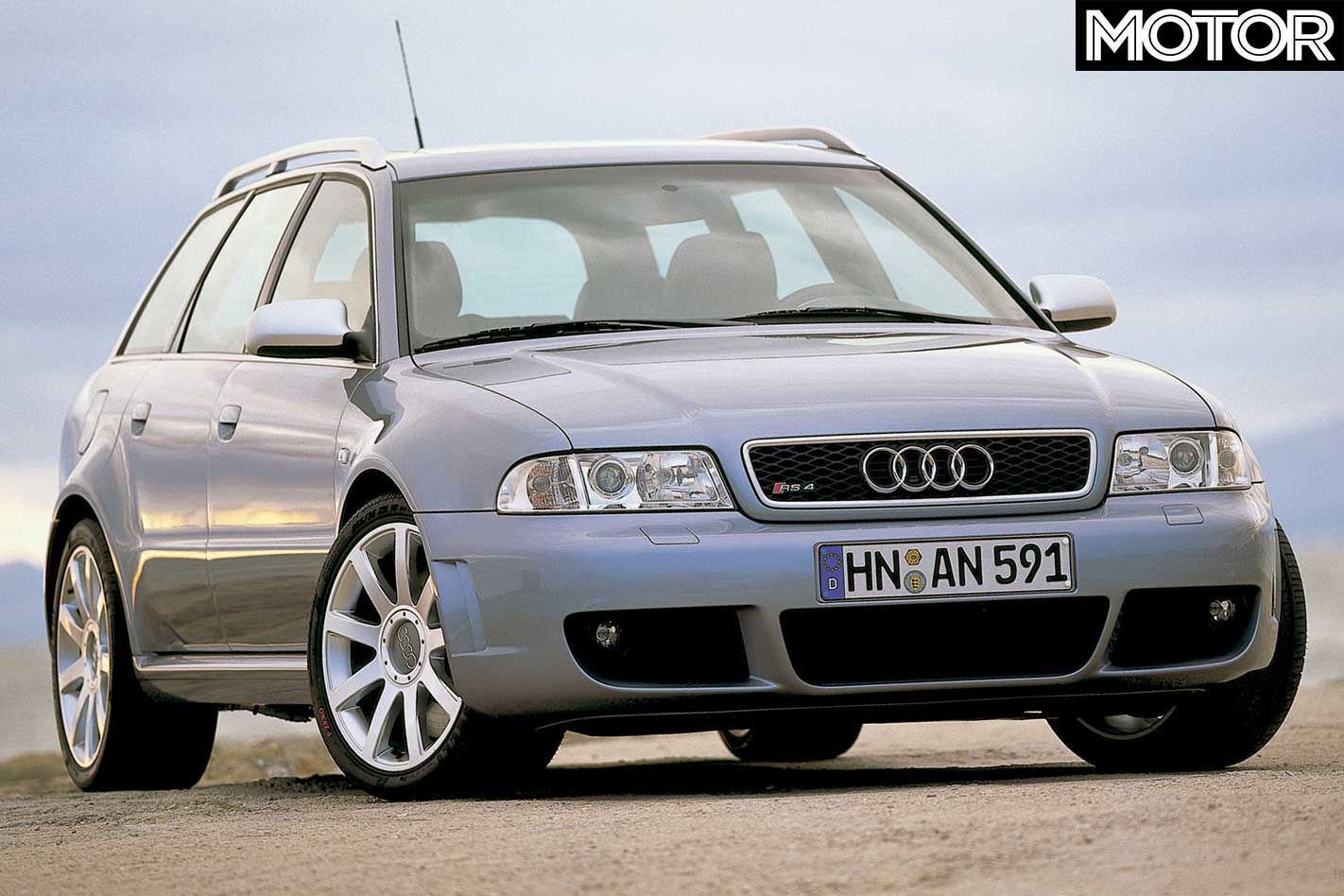
B5 Audi RS4 Avant (1999-2001) While the RS2 might be genesis for bonkers Audi Avants, the original RS4 utilised a twin-turbo V6. The 2.7-litre unit, co-developed with Cosworth, produced a healthy 279kW and could hit 100km/h in 4.9sec. Demand was double Audi’s expectations.
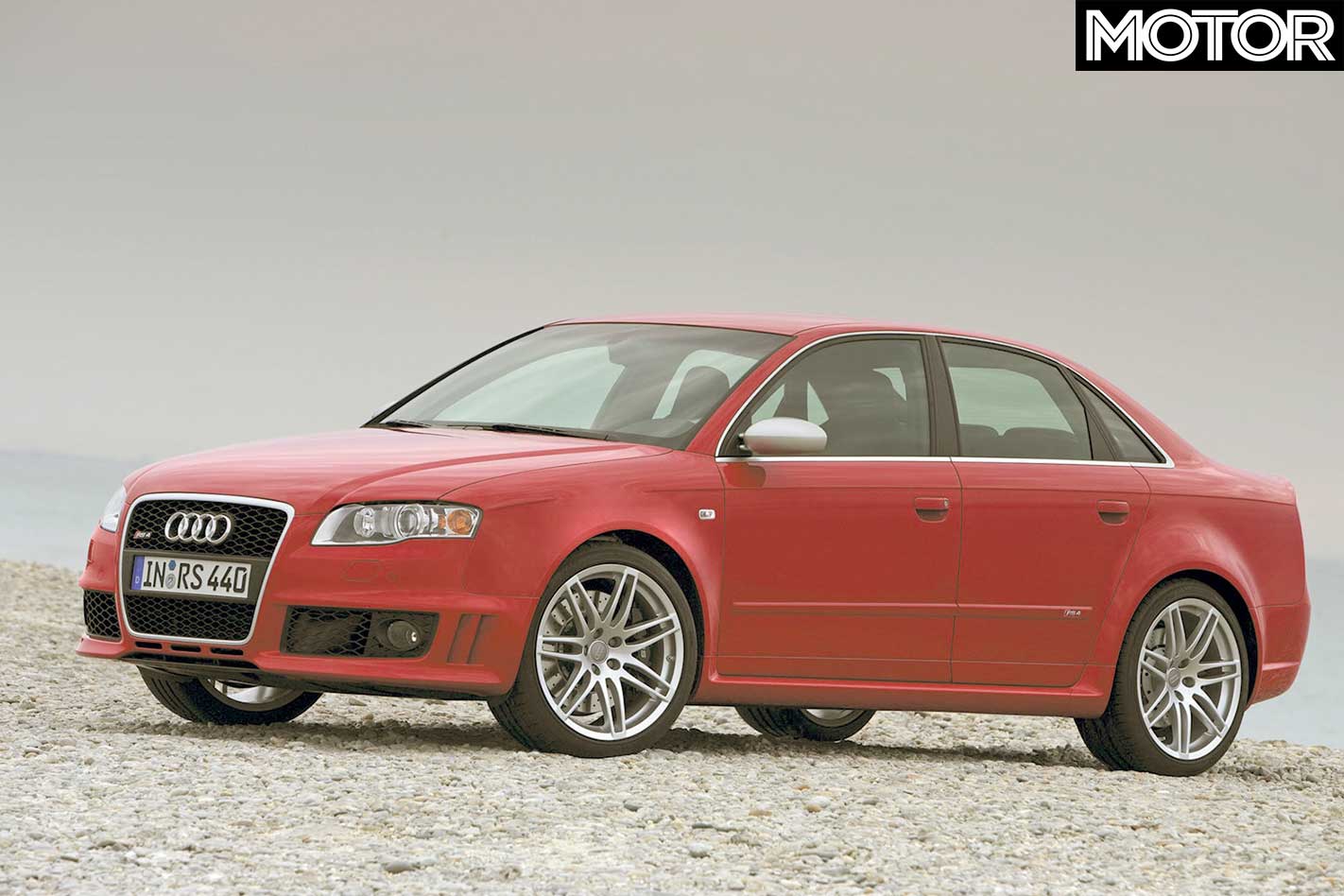
B7 Audi RS4 (2006-2008) The only generation to spawn a sedan and drop-top variant, the B7 RS4 also introduced the soulful direct-injection, naturally aspirated V8 – you could also have a manual ’box. The 4.2-litre eight produced 309kW and a 4.8sec 0-100km/h time.
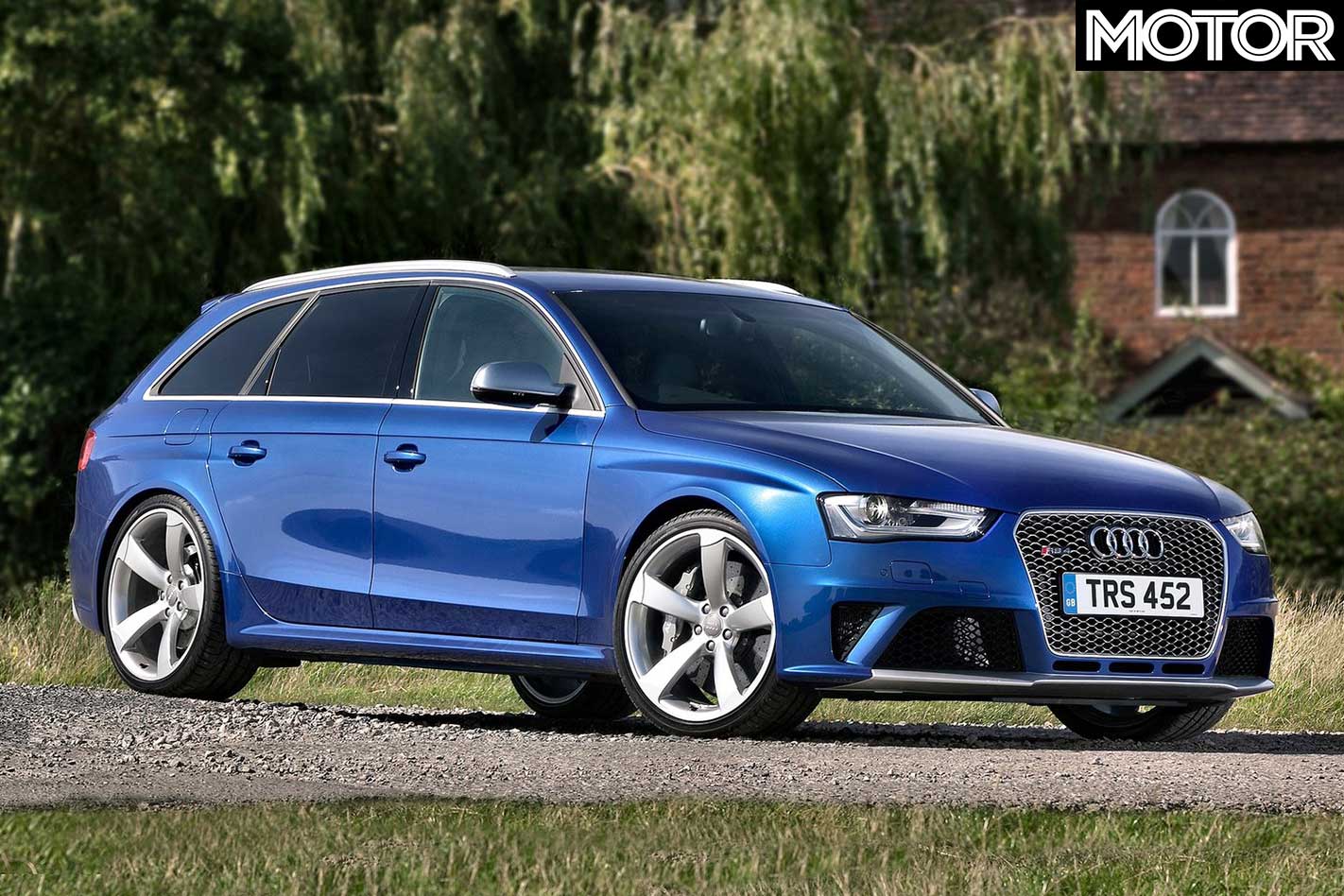
B8 Audi RS4 Avant (2012-2015) Returning to an Avant exclusively (the RS5 coupe and convertible shared the same drivetrain), the B8 carried over the vocal V8, but upped the power to 331kW. The hard-launching S tronic dual-clutch afforded a 0-100km/h time of 4.7sec.
ONE OF the most arousing concepts for futurists, and the philosophical bedrock of game-changers like Uber and Tesla, is the whole ‘disruptor’ phenomenon – an innovator who challenges the status quo, or shakes up an existing market. But is this ‘disruptive’ ideology something you’d associate with Jaguar-Land Rover? Nick Rogers is certain of it.
The Executive Director for Product Engineering at the long-established, upper-crust British firm is the chap responsible for guiding JLR’s future, and he’s excited. “There’s always that challenge of if somebody says ‘you shouldn’t be doing that’, that rebellious bit comes out and we go do it.” Think radically styled, all-electric Jaguar I-Pace and the forthcoming 2019 Land Rover Defender range – a very strong chance for EV and plug-in-hybrid propulsion, especially if Rogers’ ‘disruptive’ thinking truly has legs. Or four wheels.
This is a dramatically different mindset from 20 years ago, when Jaguar launched the retro-laden S-Type sedan (and Rover the similarly heritage-inspired 75) at the 1998 Geneva Motor Show. In 2018, the Leaping Cat’s legacy at Geneva was the production version of its all-electric I-Pace, virtually unchanged from the concept car of a year earlier. Instantly, the paradigm shifted. What would the pipe-and-slippers brigade (if any of them still exist) think of a modern Jaguar as radical as the I-Pace?
Viewed from a full-circle context, Rogers says it’s familiar territory. “In ’46, William Lyons sat there, straight out of the war in the UK – the country was just horrendous, most of the infrastructure flattened – so imagine him sitting there saying, ‘I’ve got an idea – let’s do an aluminium car [the Jaguar XK] that will do 120mph; we’ll export them around the world.’ The courage to do that…”
Discussion turns to the unconventional shape of the I-Pace (as long and as wide as a Porsche Macan or Mercedes GLC, but rejecting their long-bonnet proportions); I ask Rogers if there’s room for the brand beneath the smallest-ever modern Jaguar (the E-Pace) – how small can a Jaguar or Land Rover go?
“I think there’s opportunity for them. When we did the Evoque, people were like ‘Oh my God, a little Range Rover, what’s that gonna do?’ And it’s been awesome. It’s created a completely different segment and mindset for the brand. The same [happened] when we launched Freelander [in 1997; it was the first premium SUV of its size in Europe, and the first monocoque] … that was the number-one seller for ages. But again the palpitations – ‘oh my God, you’re gonna do a Land Rover without a chassis?’”
When Rogers started work as a body engineer in 1984, the beleaguered British Leyland had transitioned into the Austin-Rover Group, and the word “disruptive” had a very different meaning from the “just go for it” spirit of JLR’s current ambitions.
“You had this clave of British Leyland, which was always a major battle of sorts to get through. There was lots of infighting between the brands, [with] everybody vying for their position.” Thirty-four years later, the cultural landscape at JLR’s main outpost in Gaydon is vastly different. Engineering has grown from 2500 staff in ’08 to 12,500 (“we’ve pulled in people from all over the world … lots of bright young grads and apprentices; it’s actually the perfect mix to be disruptive”) and the building has expanded to such an extent that “from the windows of ‘G-deck’ [Gaydon Design and Engineering Centre], you look straight into the [British Motor] Museum” – one of the largest collections of historic British cars in the world.
“You’ve got to understand your heritage and respect it, and use it as inspiration,” says Rogers, “[but] you can’t just wallow in the history and hope something will happen; you’ve actually got to get under the psyche of it, understand the spirit and use that to stimulate doing something else.”
Which brings us to the topic of the next-generation Defender. It’s a personal obsession for Rogers. His heart lies with Land Rover – in particular, his love of the 1948-’58 Series I (“it’s quite a bad disease,” he says) – after learning to drive at the age of 10 on his family’s small farm outside Oxford, at the wheel of his father’s Series II. He knows as well as anybody that 2019’s reimagined take on this beloved British icon needs to revive the original Landie’s pioneering, creative spirit.
“To do the unthinkable – to just go for it – is definitely where we are now.” Instantly, an all-electric Land Rover Defender springs to mind, so I put the question to Rogers: If the I-Pace is the poster child for Jaguar being disruptive, is the new Defender going to be the same for Land Rover?
“I think it’s going to be pretty cool. I can’t talk too much about it but it’s gonna be different; exciting … it’s in my heart, trust me.”
t’s all very well for the likes of Peugeot to say that the requirements for a hot hatch have changed compared with the good old days of the 205 and 306 GTis, but there’s also such a thing as being too timid.
This feature was originally published in MOTOR’s March 2004 issue
By all means, give us the safety features, the refinement and the fruit, but not at the expense of that trace of hoon-mobile that used to make them so much fun. It was starting to look as if Peugeot had wimped out on us completely.
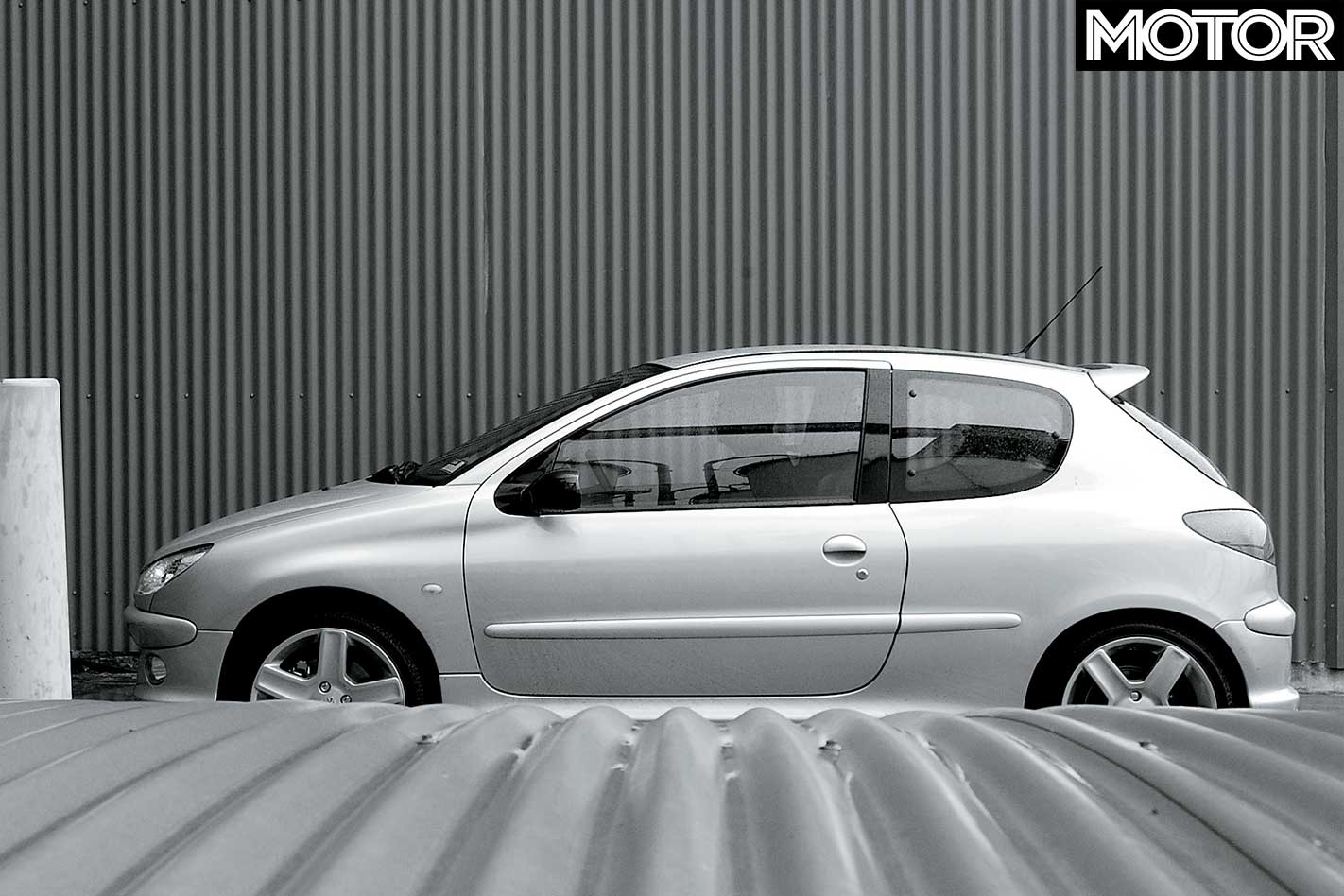
The chassis is crying out for more power to do it justice and much of its potential sparkle and fluency seems to have been smothered under layers of cotton wool. A pleasant enough car, then, but are we going to be talking about it fondly in 20 years’ time, like we still do with the 205 GTi 1.9? Doubtful.
If the regular 206 GTi was a stopgap measure, the new GTi 180 is the real deal. Responding to the call for more power is one thing, but what’s interesting to note is the subtly different character that’s bubbled its way to the surface now that some of the cotton wool has been ripped away. The GTi 180 is a brawny little thing that’s not to be tarred with the same brush as the soft-focus GTi.
On the face of it, the GTi 180’s closest rival is the Renault Clio Sport, which, after all, hails from the same rather oddball country and is tantalisingly close on price, performance and even character.
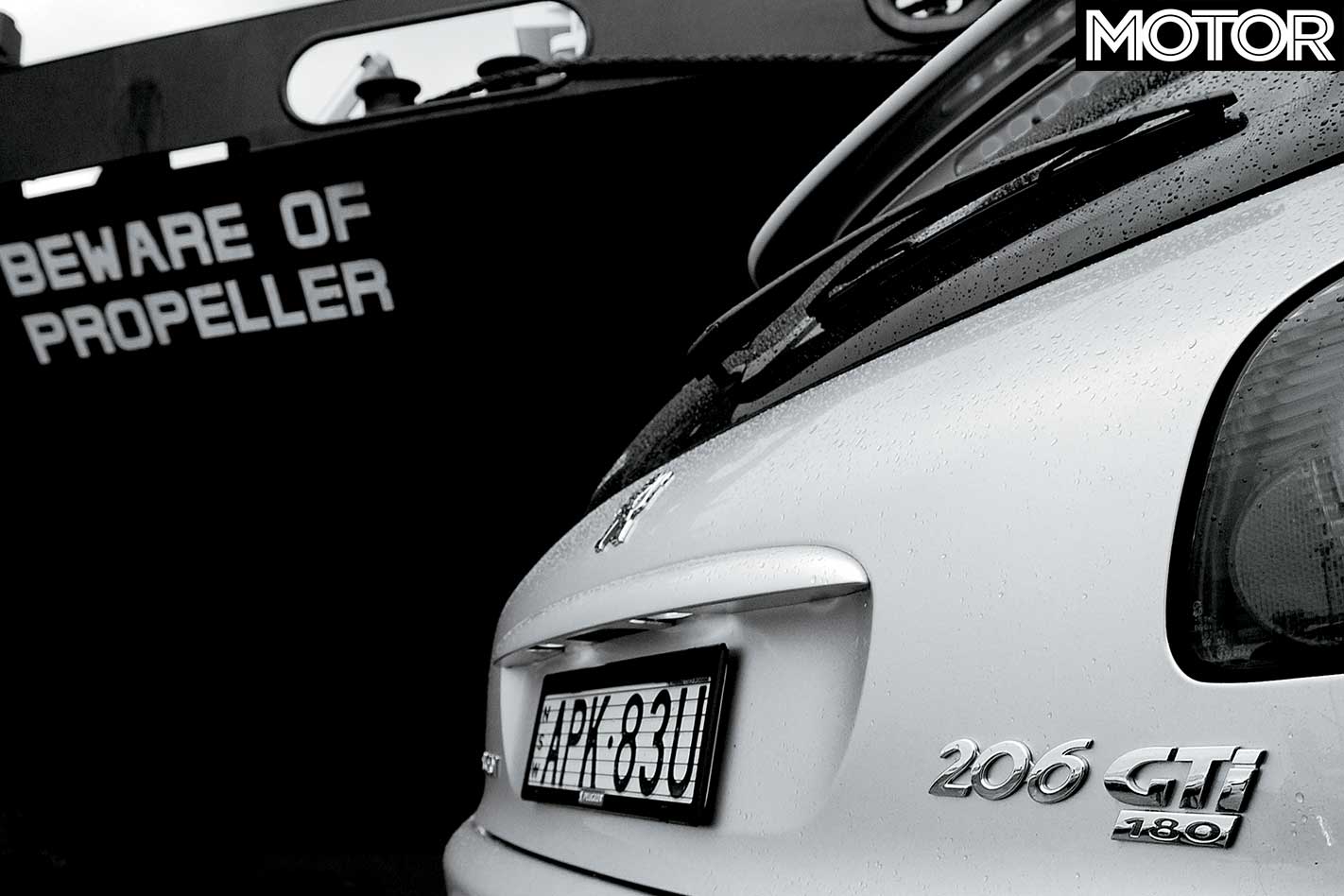
But we’ve already established that the Clio is not the one to beat in this class. That honour belongs to the Holden Astra SRi Turbo – the very same car that convincingly (if controversially) won the 2003 Bang For Your Bucks title (October 2003 issue), and an undeniably rapid and effective package for just $37,000.
The Astra also had little difficulty in seeing off the MINI Cooper S, Toyota Corolla Sportivo and Ford Focus ST170 in the last hot hatch comparo we did (August 2003 issue).
You could argue that the competition wasn’t all that strong on that occasion (although the MINI had its moments), but boy oh boy has the situation changed now that the hot 206 has lobbed in this country.
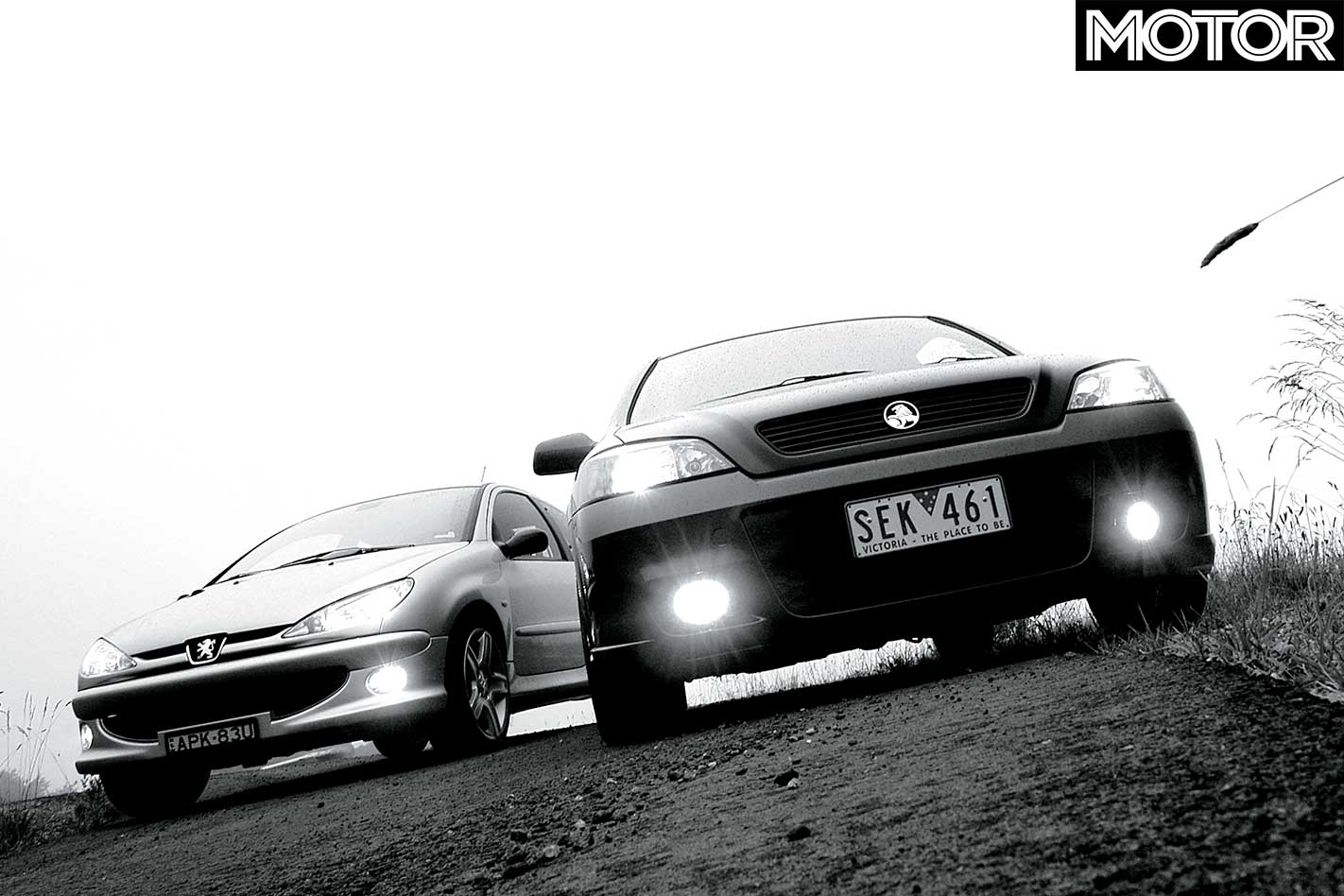
It’s a pretty little thing, the GTi 180, taking a step closer to the image of the soon-to-be-replaced WRC car with its deck spoiler on top of the tailgate and 17-inch alloys, their almost oversized proportions serving to emphasise how short the 206 seems. The GTi 180 also gets a pair of discreet exhaust outlets to further distinguish it from the boggo GTi.
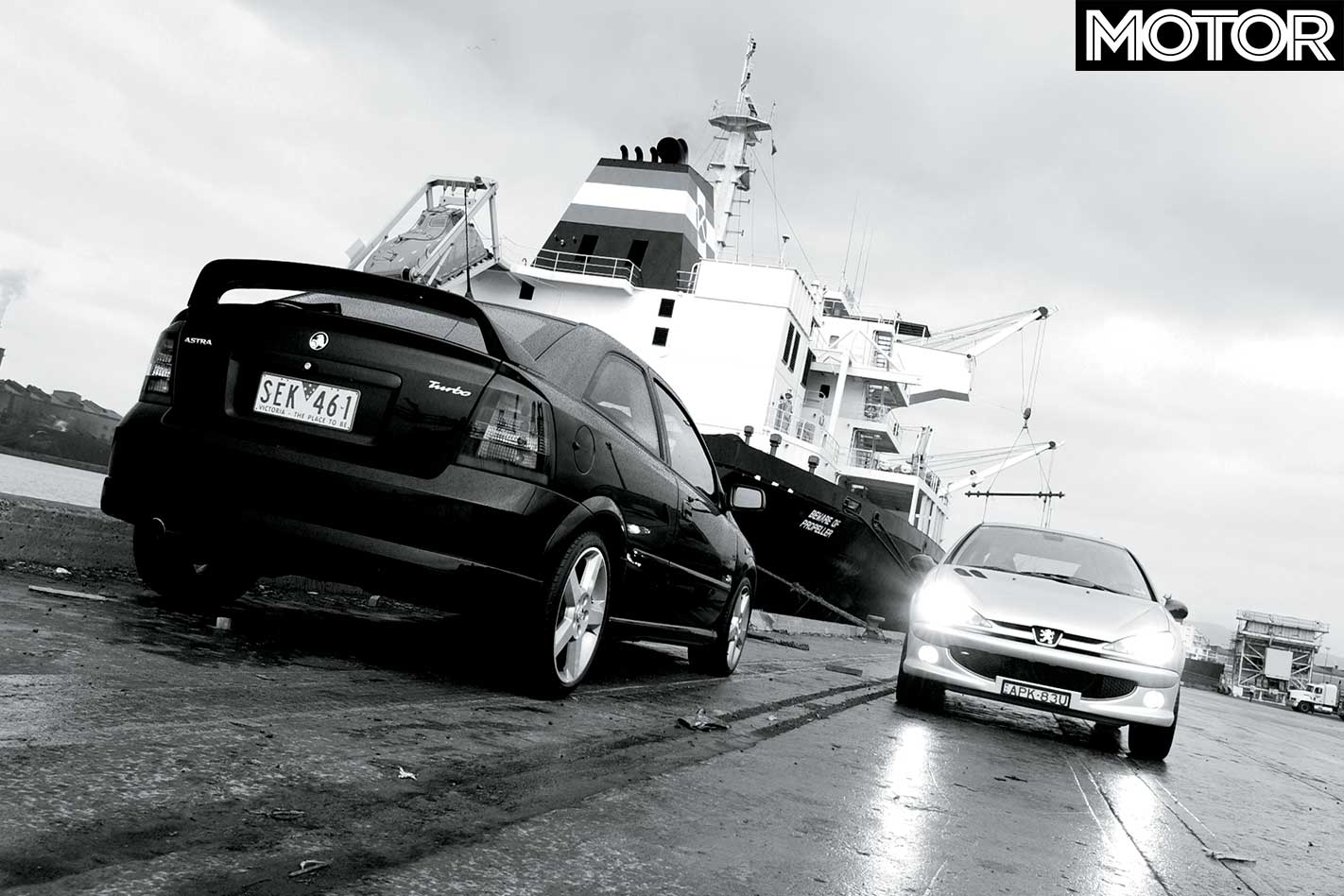
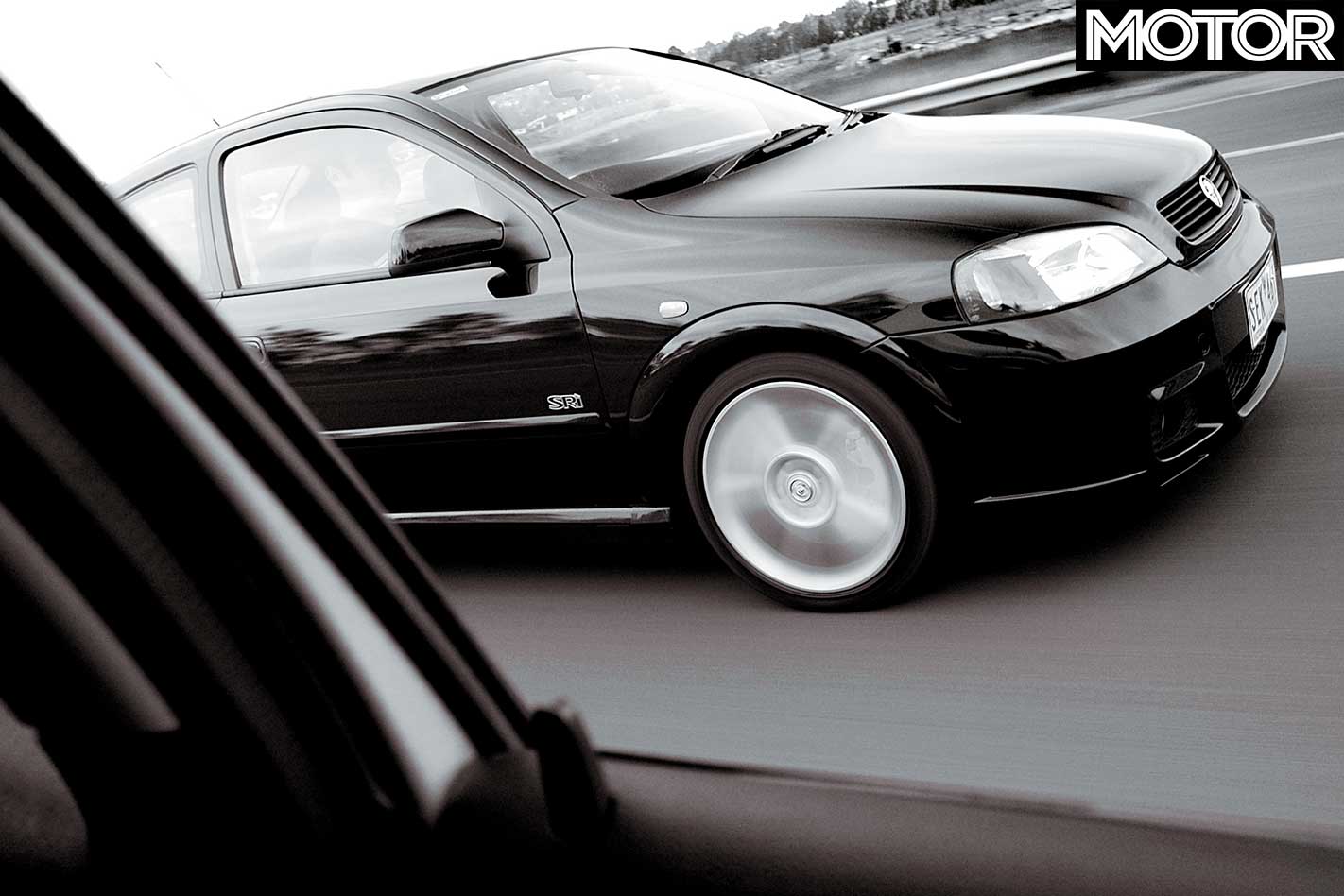
Next to the Astra, though, the 206’s styling could almost be described as fussy. Simple of line and chunky of panel, the Astra is an undeniably handsome car, in a very Germanic sort of way, helped out by its 206-matching 17-inch alloys and a beefy wing that sprouts from the hatch’s short rear deck (neatly blocking the driver’s rearward vision, but worth it). Neither one has to resort to further obvious body add-ons in an attempt to make it look vaguely sporty.
The ‘180’ on the end of the 206’s name refers, of course, to its power output in PS (weird Japanese and French measurement), which translates as 130kW – up exactly 30kW on the regular 206 GTi.
It’s fundamentally the same 2.0-litre engine in both versions, but bolting on a specially machined head with a dual-mode intake manifold and variable valve timing not only does what’s necessary to lift power to a respectable level but also has quite an effect on the engine’s character.
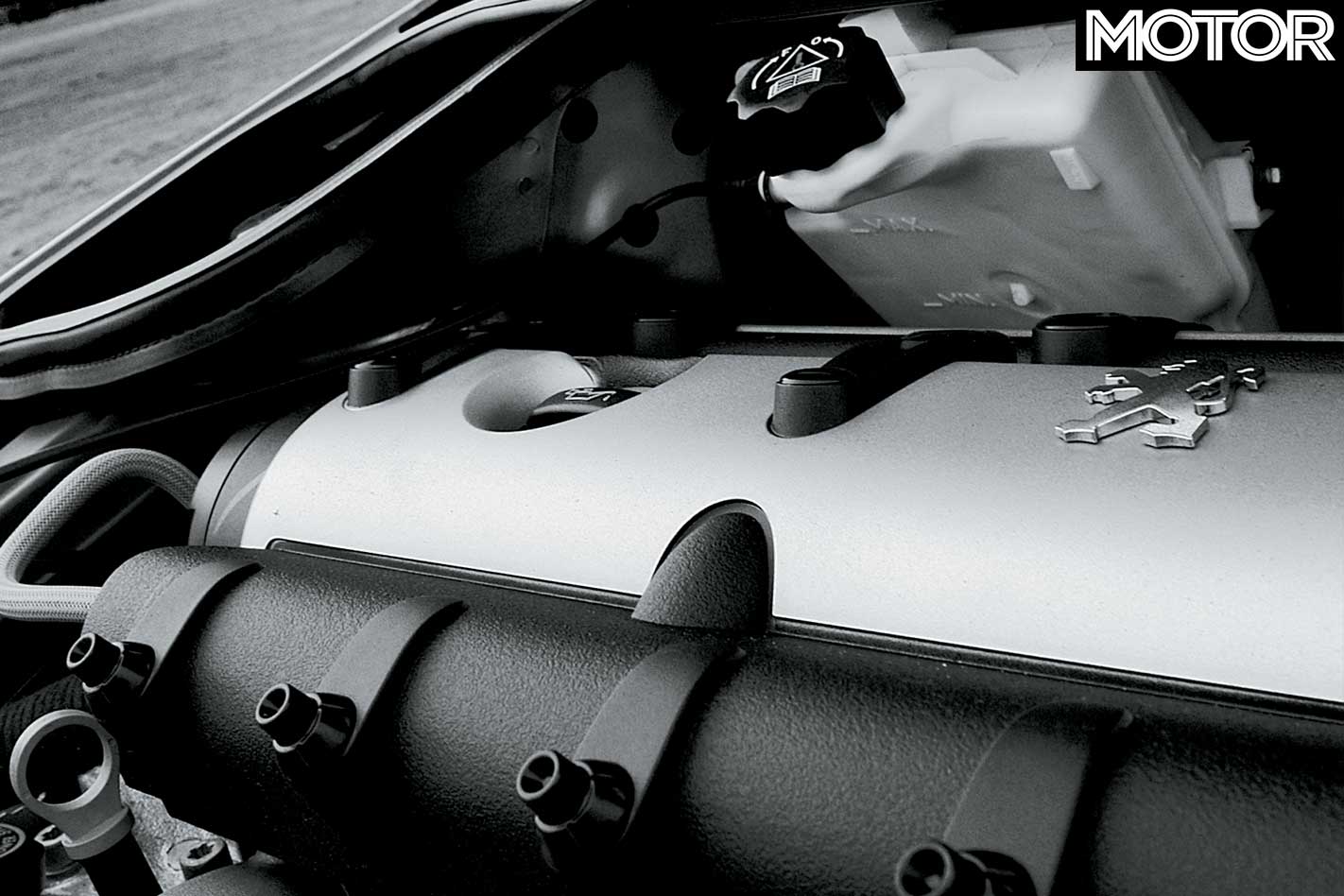
In typical Peugeot fashion, there’s plenty of torque to go around, too; even the lesser GTi’s got a handy 190Nm at 4100rpm, but the GTi 180 goes a step better with 202Nm at 4750.
It’s a feisty little engine, it really is, especially in the upper half of the rev range. Beyond 3000rpm it jumps like a startled gazelle at each prod of the throttle, building up to a lusty, vocal top end that all but dares you to take a bead on the 7300rpm redline.
Where the Astra has a typical turbo’s soft throttle response and does its best to isolate its driver from the power-delivery process, the Peugeot is just the opposite: urgent as a trip to the dunny after a vindaloo and connected like George Dubya and the American oil companies.
The Astra’s 2.0-litre turbocharged engine might not be as much of a rowdy showman as that of the 206, but its softly-softly approach is even more effective. Not only does it have a useful power advantage with its 147kW tally, but it makes peak torque of 250Nm at just 1950rpm, which means that it kicks hard from very low down in the rev range and is never far from a big, fat seam of torque.
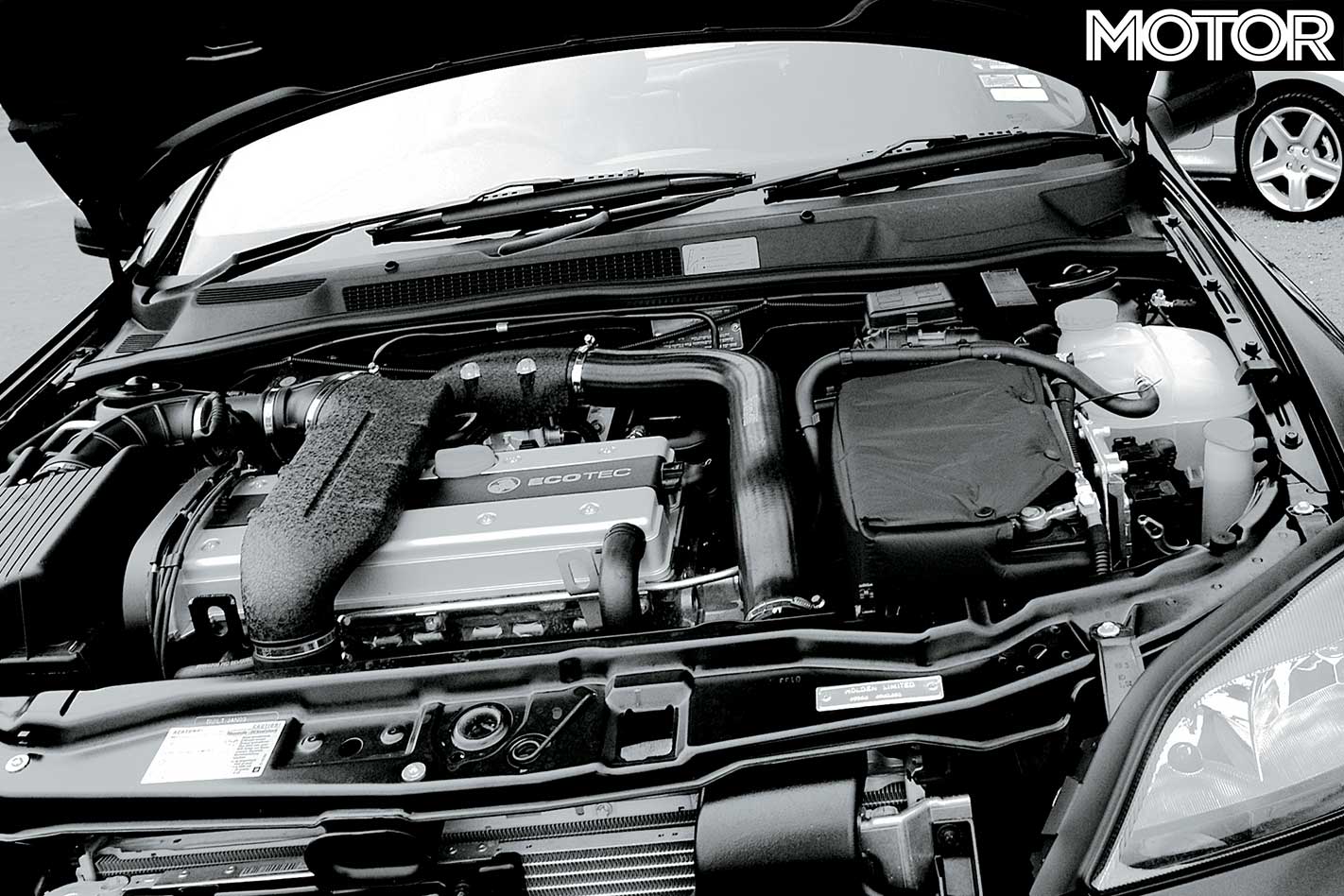
Its rev range is more limited than the 206’s and it can seem a bit flat as there’s no additional kick at the top end, but it doesn’t need it, so substantial is its mid-range performance.
Against the clock, the Astra uses that extra muscle to good effect, pipping the lighter 206 by half a second in the sprint from rest to 100km/h (7.2sec versus 7.7). The gap closes up by a single tenth over the standing 400 metres, the Astra requiring 15.2sec and the Peugeot 15.6sec.
In reality there’s not a whole lot in it; the difference is that the Astra makes it all seem completely effortless (apart from suffering more torque steer), whereas it’s more of a drama in the 206.
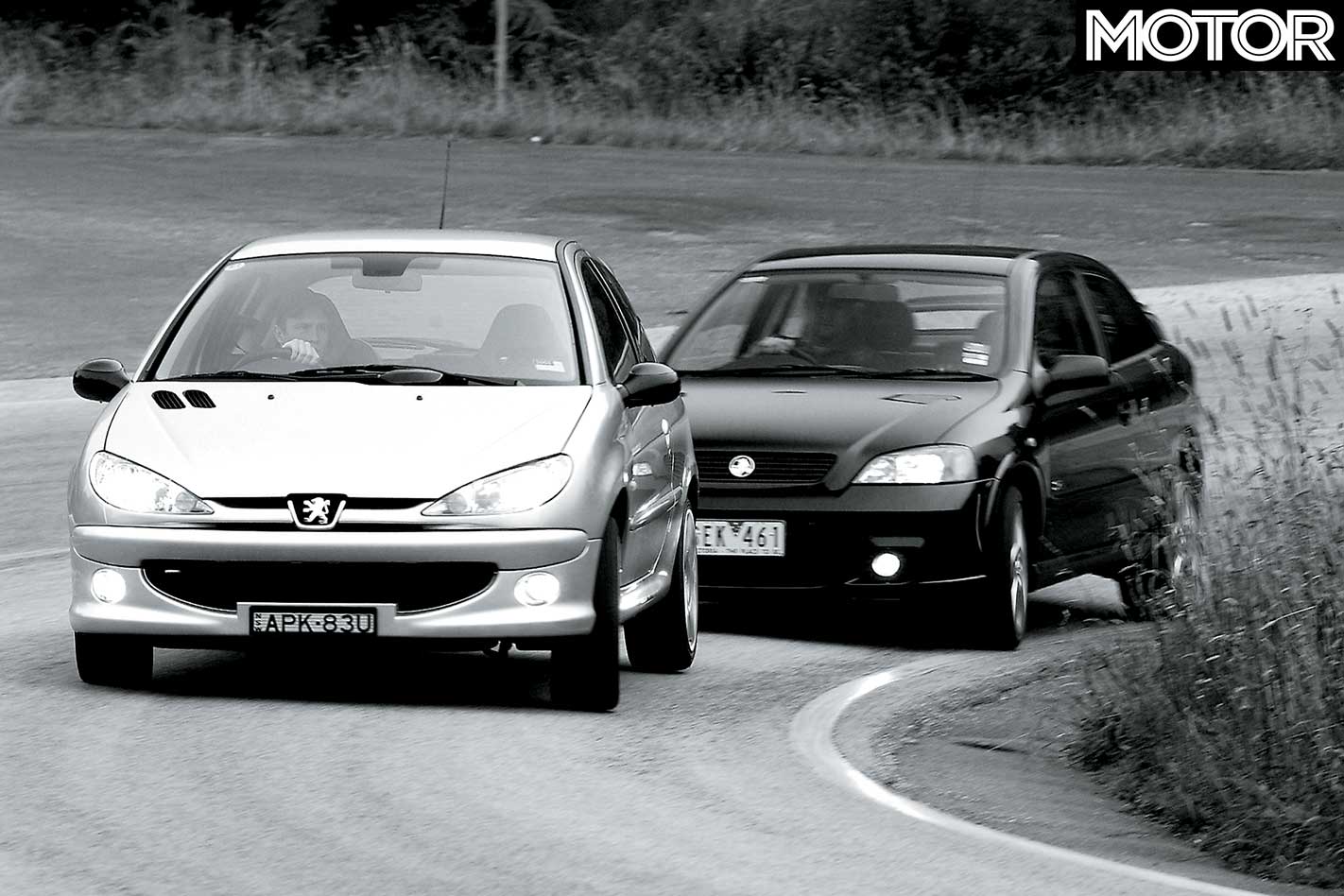
The Peugeot might have to work slightly harder to keep up with the force-fed Astra on the flat, but the shoe’s on the other foot when this pair find themselves on a twisty road. While the regular GTi is prone to that favourite French handling trait, lift-off oversteer, the GTi 180 runs stiffer front springs and gains a pair of tie rods at the rear in a bid to improve axle stability, and it’s got ESP to lend a hand.
The result is a car that’s much less likely to scare the crap out of you in the middle of a tightening corner. Mid-corner grip and powerdown (thanks to unobtrusive traction control) are really quite top-drawer, considering that there’s no trick front diff, and it only starts to skip and hop a little right on the ragged edge. Otherwise its composure is first class.
There’s still a trace of lift-off oversteer when the ESP is deactivated, just enough to give some adjustment options in corners and ramp up the fun factor, and it’s one of those cars that gets better the harder you push it. That might be because you’re too busy to think about the GTi 180’s biggest dynamic flaw: its steering.
Meaty is one thing, but this is ridiculous. Although there’s decent feel, the engine-speed-sensitive helm is needlessly heavy and tight at any speed, which means you feel like you have to wrestle the car into corners and it then keeps trying to centre itself.
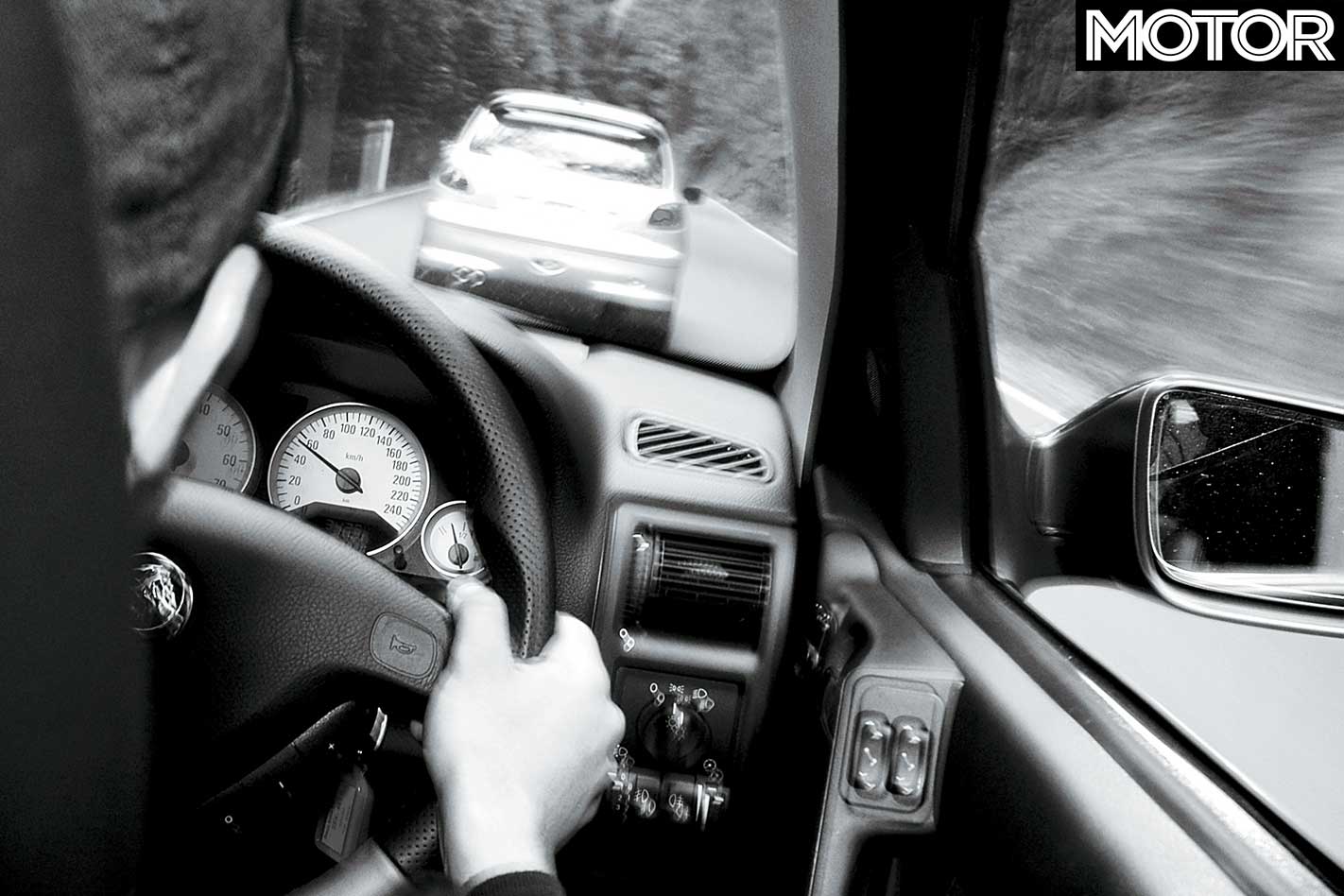
To a certain extent you get used to it after a while, but it’s a pain at low speeds and you have to keep shuffling and repositioning your hands in corners (not helped by a poor driving position), rather than just rolling your wrists. As is so often the case with French cars, this is nowhere near as much of an issue in left-hand-drive versions.
While the Astra is more serene than the 206 on fast, flowing roads, in the twisties it’s outclassed, understeering more and more until the driver is forced to back off and starting to bounce and lurch and scrabble for grip when it’s pushed hard.
Prior to that point it’s all very safe and an easy car to punt moderately quickly, but the 206 really makes the Astra feel as floppy as a just-caught barramundi on the deck of a fishing boat. At least the Astra’s more obviously assisted steering doesn’t try to pick a fight on turn-in and it’s certainly a more comfortable cruiser than the 206, which, unusually for a Peugeot, is actually pretty hard riding and jiggly, especially at low speeds.
The GTi 180’s sporting credentials are backed up in the cabin by a pair of terrific alcantara-faced front seats that are unusually big and firm for a French car, with substantial side bolsters that come in handy, given the amount of lateral grip this car can generate.
However, the 206 puts itself at an immediate disadvantage with a driving position that is fundamentally flawed – pedals too close and steering wheel too far away. It simply never feels right to me. And it’s disappointing to find that quality hasn’t improved any – the switchgear is all pretty cheap and nasty, while the driver’s door release surround on our test car was falling out and a piece of trim on the tailgate came away in our hands when we grabbed it instead of the hatch release.
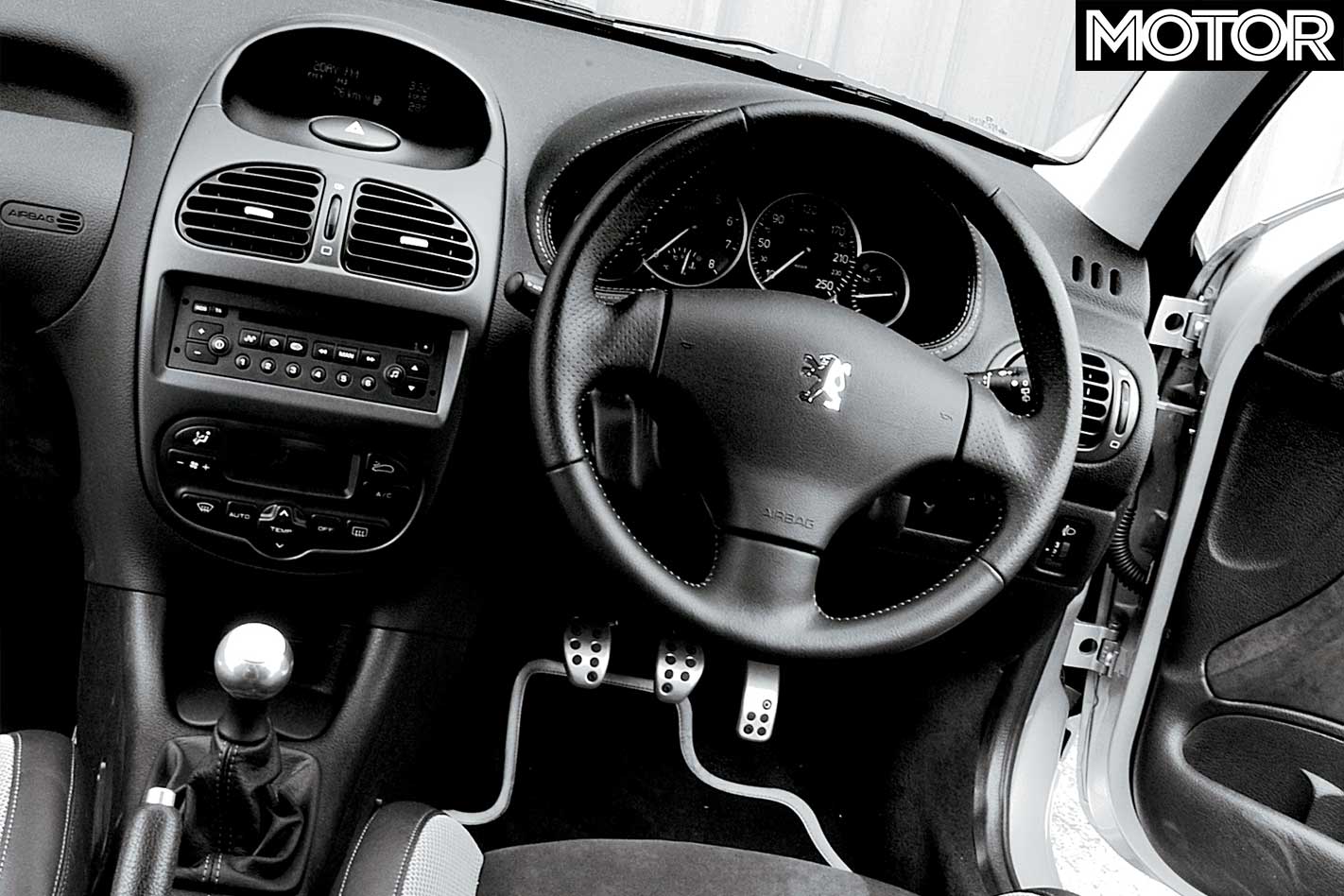
Oh yes, and why the hell can’t Peugeot turn the wiper blades around for right-hand drive, so they clear the driver’s side properly? And don’t even get me started on the automatic wiper function…
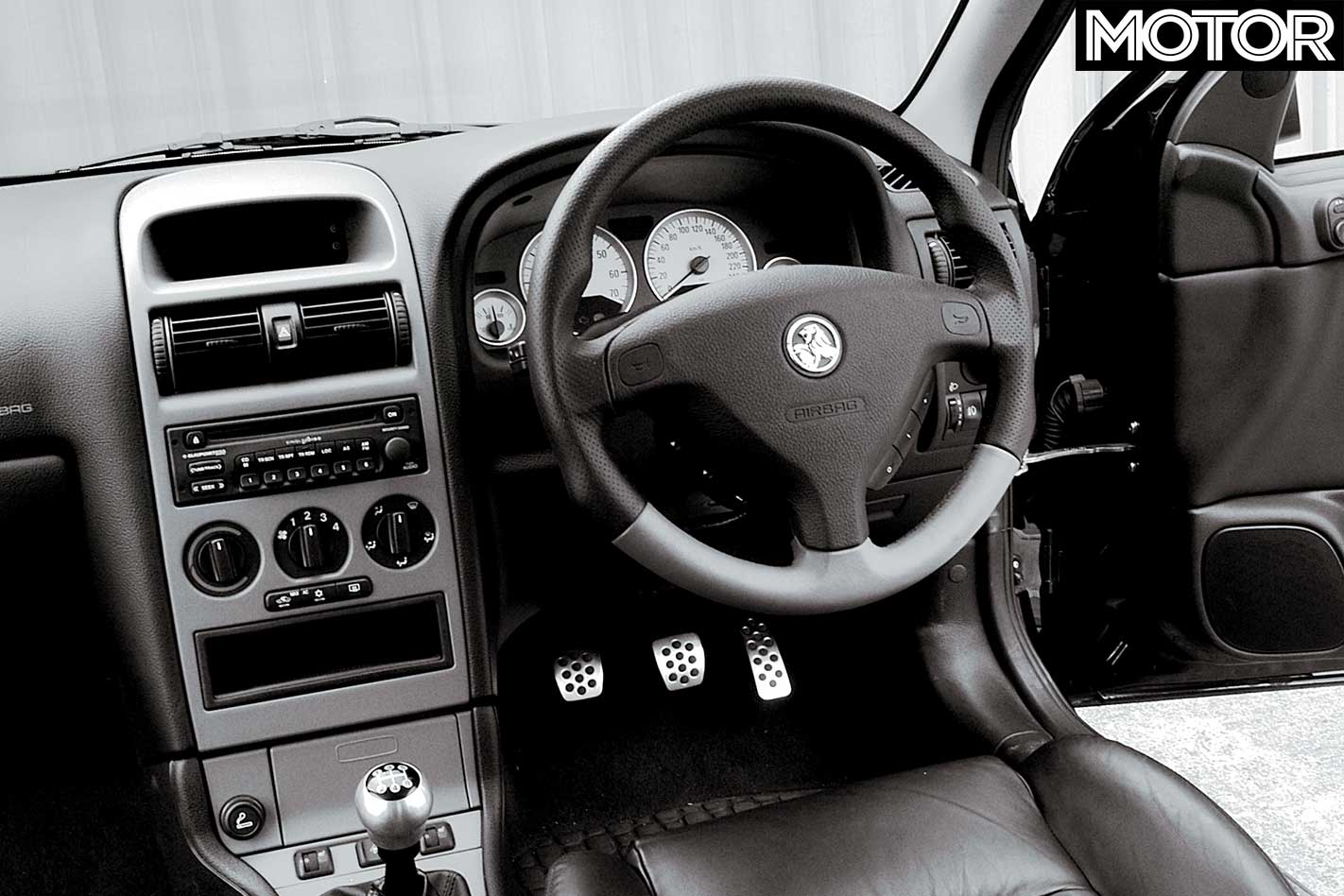
The Astra might be a little dour inside compared with the 206, but its full leather-covered seats are no less supportive than the Peugeot’s racy-looking jobs and probably more comfortable over long distances, while its more natural driving position and greater seat/wheel adjustability earn it major brownie points in my book.
Unless you happen to be of French persuasion, the Astra is going to be a far nicer car to live with day to day, because its rear seats are more usable than the 206’s sculpted-for-two affair and its boot is usefully bigger. The fact that it’s noticeably better screwed together doesn’t do its cause any harm, either, even though its switchgear looks and feels as if it came straight out of a 1980s-vintage Cavalier.
Being the bunch of revheads that we are, it’s tempting to give the nod to the 206 in this comparo for its feistiness and its bordering-on-brilliant handling. After the lukewarm effort of the 100kW GTi, the GTi 180 comes a lot closer to meeting our expectations of a Peugeot hot hatch, and it’s a better sorted car than the Clio Sport (the suspension tune of which isn’t exactly pintpoint).
On top of all that, it represents undeniably good value at $34,990 – just five large more than the regular GTi and a couple of grand less than the $36,990 Astra Turbo.
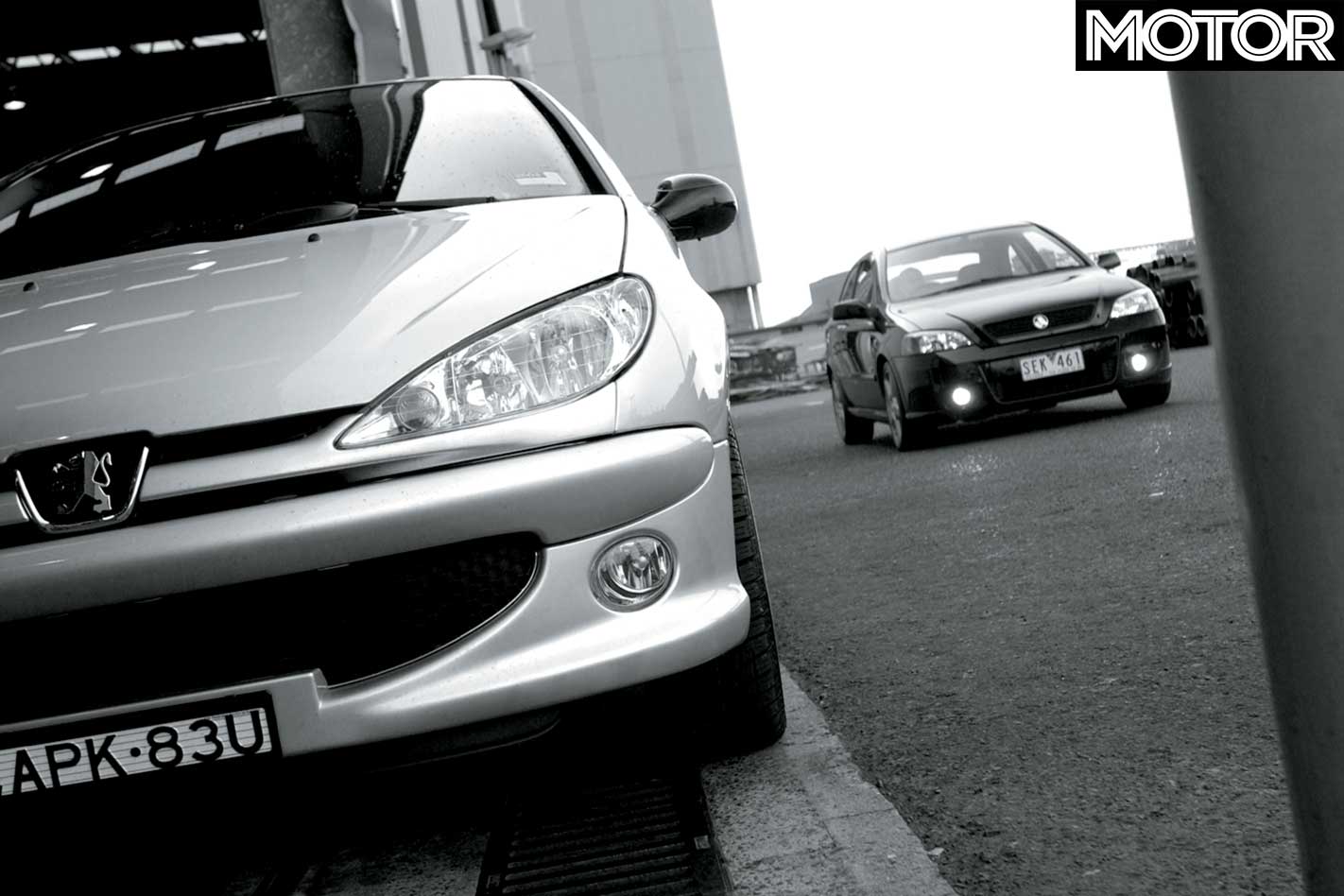
But we have to admit that the Pug is still frustratingly riddled with flaws. Yes, on the right road there’s more entertainment to be found here than in the Holden – but the turbocharged Astra is still the prudent choice, the complete package.
Not quite as stimulating, perhaps, but massively competent across the board and not in any danger of pissing you off half the time, like the Peugeot does. Not for nothing is the Astra our Bang For Your Bucks champ. Even against its hottest competition yet, the Astra Turbo is still the small car to beat.
Fast Facts
| u00a0 | 2004 Peugeot 206 GTi 180 | 2004 Holden Astra SRi Turbo |
| BODY | three-door hatchback | three-door hatchback |
| DRIVE | front-wheel | front-wheel |
| ENGINE | front-mounted 2.0-litre DOHC 16-valve four | front-mounted 2.0-litre DOHC 16-valve turbo four |
| BORE/STROKE | 85.0mm x 88.0mm | u00a086.0mm x 86.0mm |
| COMPRESSION | 11.0:1 | u00a08.8:1 |
| POWER | 130kW @ 7000rpm | 147kW @ 5600rpm |
| TORQUE | 202Nm @ 4750rpm | u00a0250Nm @ 1950-5600rpm |
| WEIGHT | 1100kg | 1282kgu00a0 |
| POWER/WEIGHT | 118kW/tonne | 115kW/tonneu00a0 |
| TRANSMISSION | five-speed manual | five-speed manual |
| SUSPENSION (f) | MacPherson struts, coil springs, anti-roll bar | MacPherson struts, coil springs, anti-roll bar |
| SUSPENSION (r) | trailing arms/torsion bars, coil springs, anti-roll bar | torsion beam, coil springs, anti-roll bar |
| L/W/h | 3835/1673/1430mm | u00a04110/1709/1425mm |
| WHEELBASE | 2442mm | 2606mm |
| TRACK | 1437mm (f); 1428mm (r) | 1467mm (f); 1456mm (r) |
| BRAKES (f) | 283mm ventilated discs,u00a0single-piston calipers | 308mm ventilated discs,u00a0single-piston calipers |
| BRAKES (r) | 247mm solid discs,u00a0single-piston calipers | 264mm solid discs,u00a0single-piston calipers |
| WHEELS | 17 x 7.0-inch (f & r), alloy | 17 x 7.5-inch (f & r), alloy |
| TYRES | Pirelli P7000, 205/40 ZR17 (f & r) | Dunlop SP Sport 8000E, 215/40 ZR17 (f & r) |
| FUEL | 50 litres, PULP | 52 litres, PULP |
| PRICE | $34,990 | $36,990 |
Speedster Kills
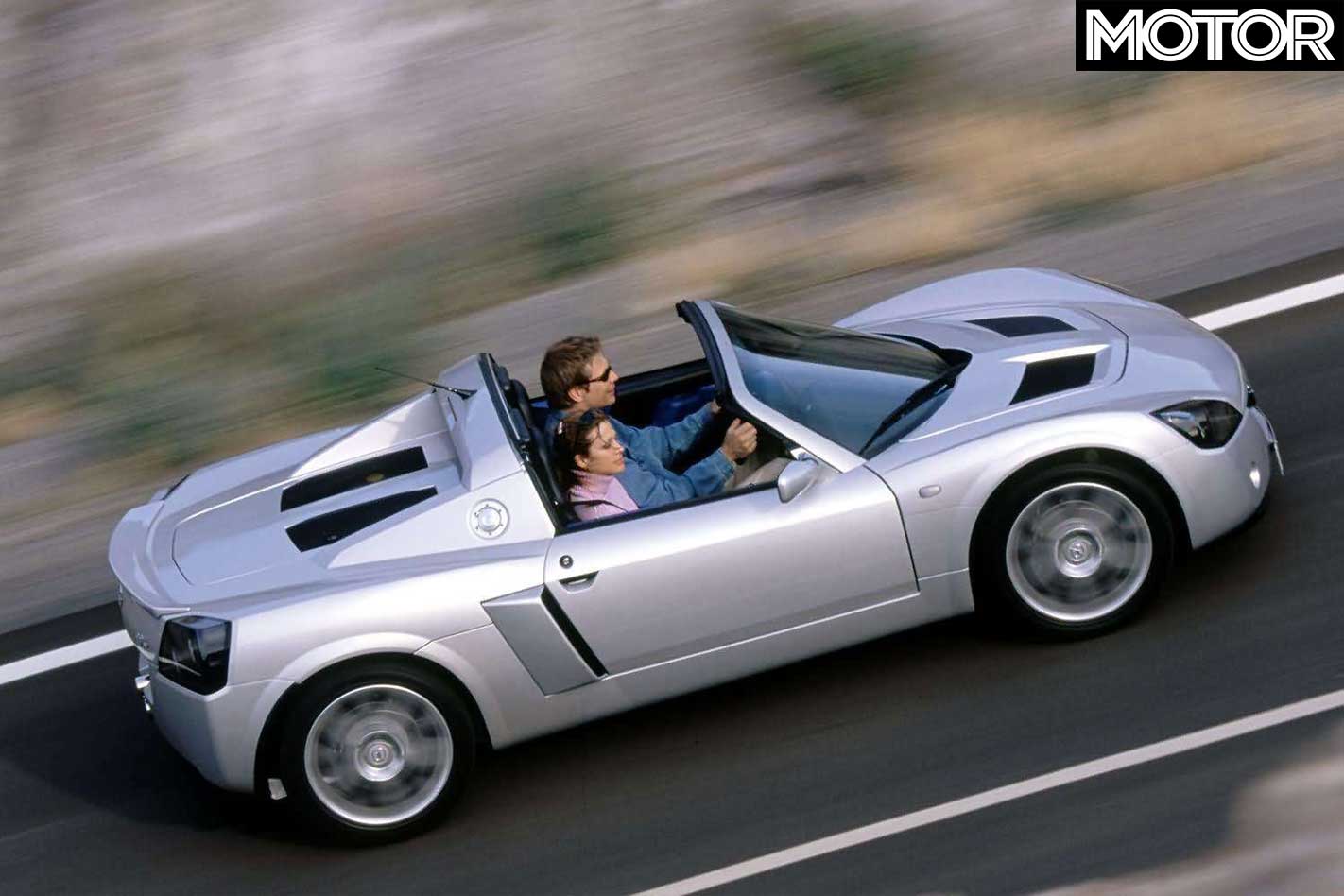
That GM 2.0-litre turbo motor has been used to stunning effect in a number of Vauxhall/Opel models overseas, even turning the Zafira MPV into a hotrod, but nowhere is its presence more keenly felt than in the Opel Speedster.
This is the car, remember, that is nothing less than a Lotus Elise in a sharp new set of clothes, so it doesn’t take a genius to work out that it’s going to be a rocketship with the Astra’s 147kW/250Nm powerpack mounted amidships in the lightweight aluminium chassis. A 0-100km/h time of 4.5sec is impressive enough, but it’s the fact that you can surge along on a wave of torque that makes the Speedster so different in nature from the thrashy Elise.
Given its supercar performance, a relatively modest price of around $70,000 (in Europe) means that, in terms of bang for your buck, the Speedster Turbo is possibly even more of a star than the Astra. Only problem is the Euros can’t get their heads around an Opel being so damned fast…
Fast Figures
| u00a0 | u00a0Peugeot 206 GTi 180 | Holden Astra SRi Turbo |
| 0-50km/h | 2.99sec | 2.66sec |
| 0-100km/h | 7.67sec | 7.23sec |
| 0-130km/h | 11.67sec | 11.33sec |
| 0-400m | 15.61sec @ 147.0km/h | 15.22sec @ 150.3km/h |
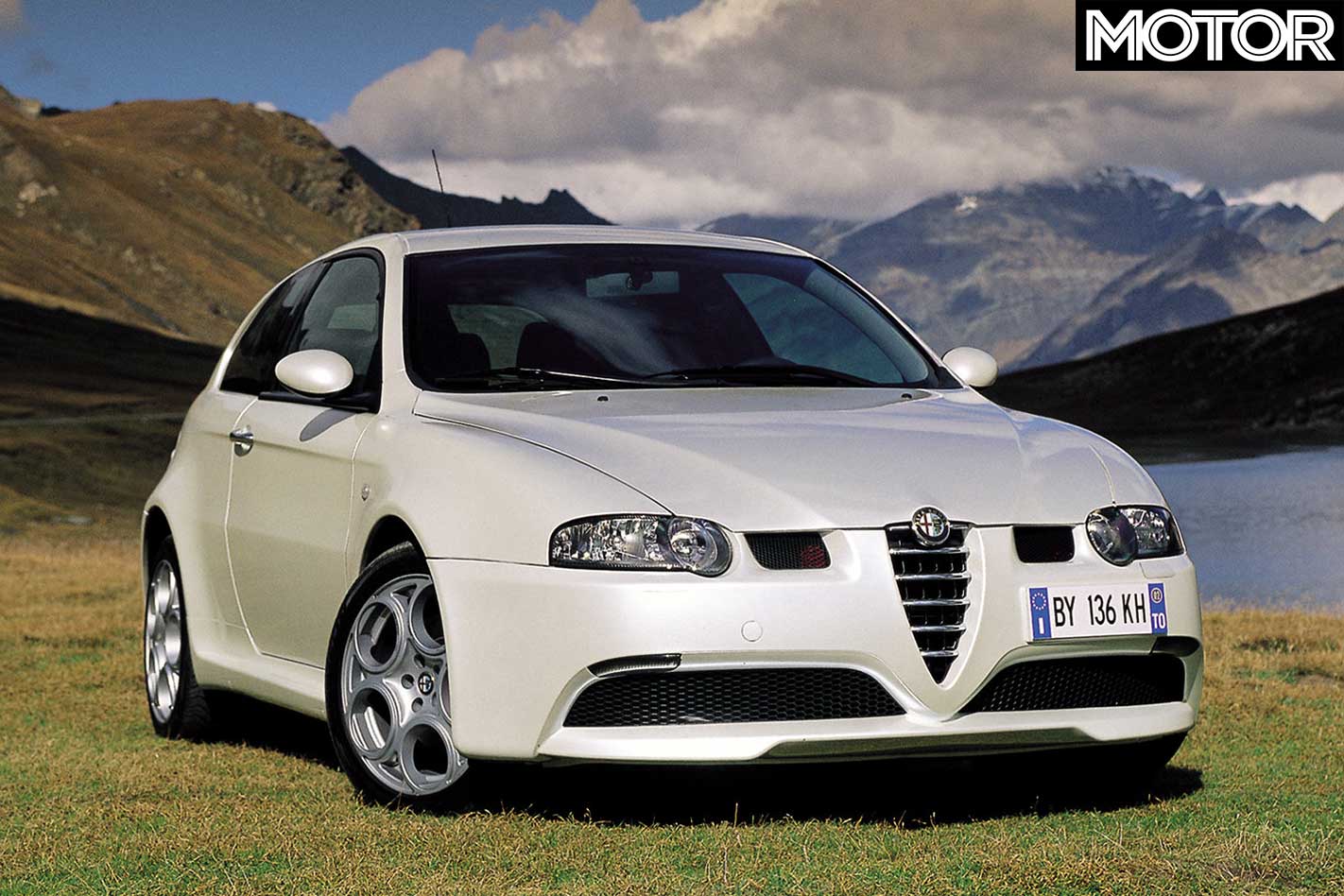
Five other power-packed pocket rockets – Alfa Romeo 147 GTA – 184kW V6 stuffed into pretty 147. Nice one – Renault Megane Sport – 2.0-litre turbo promises 168kW – VW Golf R32 – last of the Mk IVs, with 177kW 3.2-litre V6 – MINI Cooper S Works – officially tuned to 147kW – Audi S3 – 165kW as it stands, and next one’s a V6…
Heart Transplant

Back in the November 2003 issue we ran a news item saying that BMW is planning to use Peugeot engines to power the MINI. Now that we’ve driven the 206 GTi 180 on home turf, we’d have to say that the prospect of this engine in the sweet-handling MINI is mouth-watering.
The MINI’s currently lumbered with wheezy, rev-shy 1.6-litre engines designed by Chrysler and built in Mexico. Ditching these in favour of the 100kW and 130kW 2.0-litre Pug GTi engines for the Cooper and Cooper S would bring a significant step up in both performance and driveability.
At a single stroke, the move would solve the MINI’s main deficiency and turn it into a little hotrod. Then all BMW would have to do is soften the rear suspension a tad to make it work on Australian roads and we’d be happy.
Although the Peugeot tie-up is at least a year away from bearing fruit, it also opens the MINI up to the possibility of receiving one of the best small diesels in the world.
1. McLaren 720S – 537kW
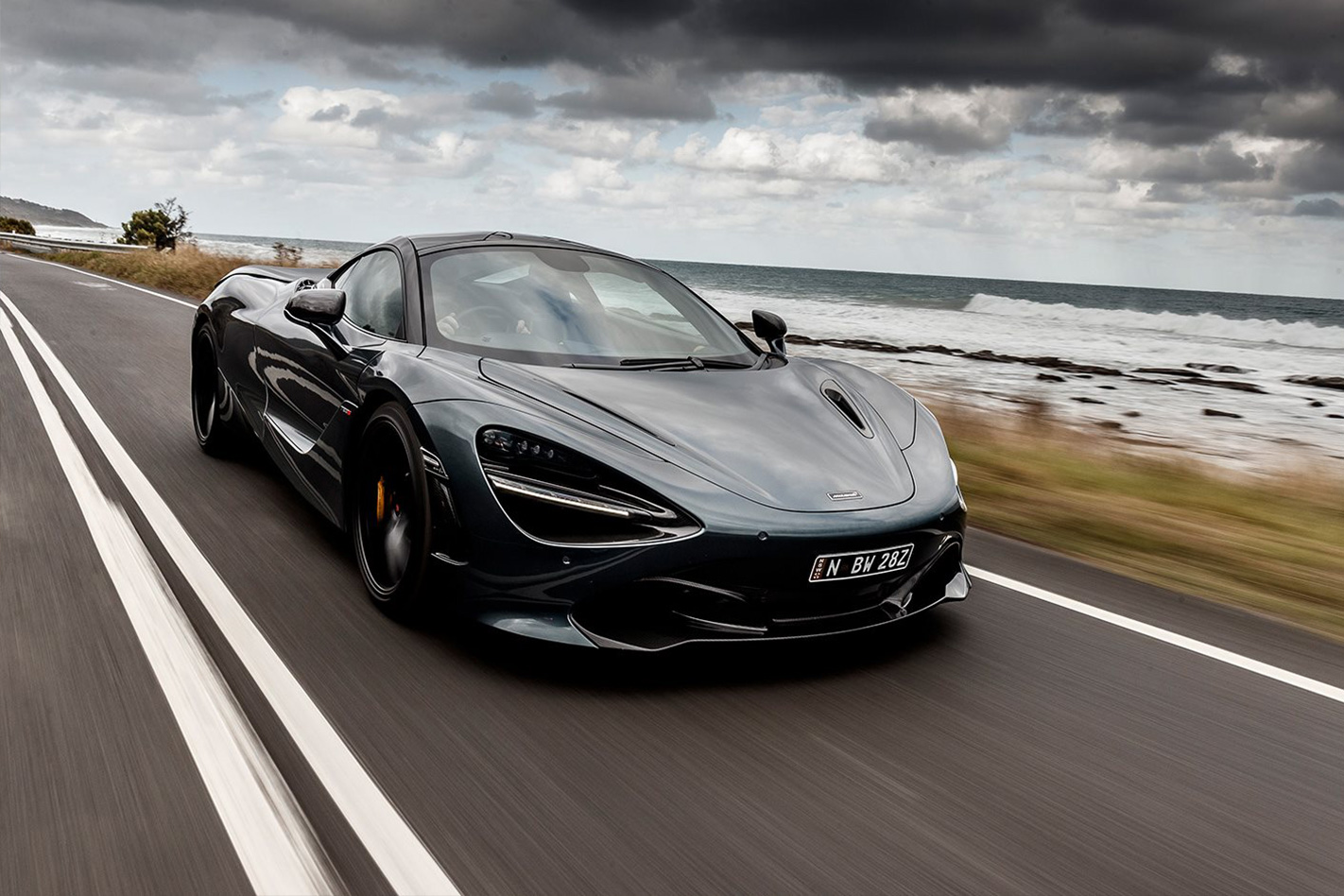
537kW Macca’s monstrous twin-turbo is the most powerful V8 money can buy in Australia right now, and produces that tyre-tearing figure from just 4.0 litres.
2. Jeep Grand Cherokee Trackhawk – 522kW

522kW Jeep’s unapologetically bonkers Grand Cherokee Trackhawk claims second spot by starting with 6.2 litres of displacement then adding a supercharger.
3. Porsche Panamera Turbo S E-Hybrid – 500kW

500kW Proving frugal doesn’t have to be dull, the Panamera flagship uses petrol and electric in unison for huge performance but average fuel consumption of just 2.9 litres per 100km.
4. Ferrari 488 GTB – 492kW
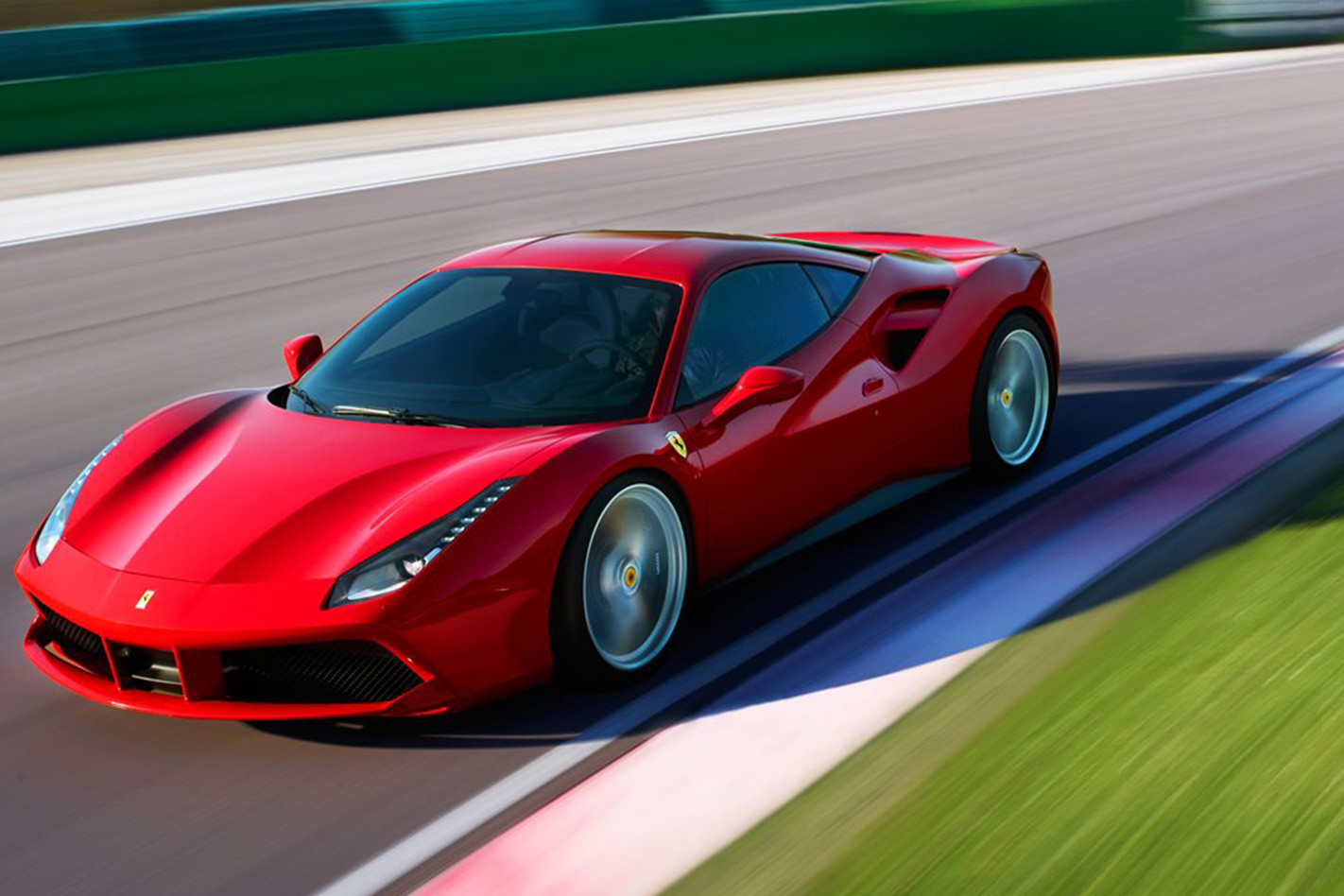
492kW From just 3.9 litres, the Ferrari punches out 126kW per litre. Clever torque-limiting software in the lower gears makes the 488 feel as if it’ll never stop accelerating.
5. BMW M5 Competition – 460kW
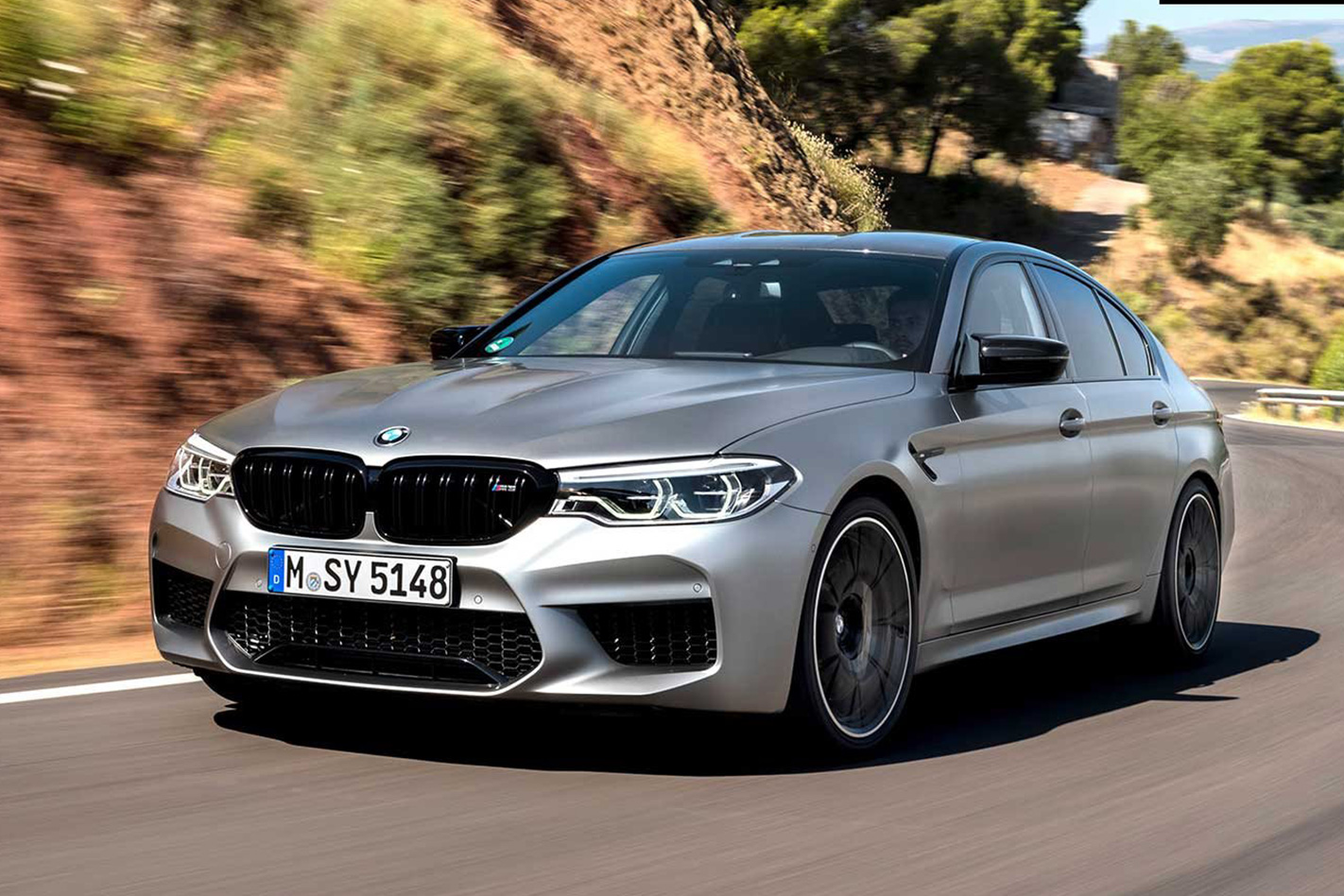
460kW With an extra 19kW over the standard M5, the Competition version has BMW’s most powerful road-going V8 ever – enough to deliver 0-100km/h in just 3.3sec.
Fitzgerald got plenty of other things wrong, too, which I’ve been musing on since attending a Sydney Harbour cruise a couple of months ago for an exclusive group of luxury and supercar customers. And me.
I’ve found that when it comes to cars and most other topics besides, the very rich aren’t very different at all. Except that, as Ernest Hemingway later pointed out, “they have more money” – and they’re usually smarter than us in the way they spend it.
One of the people I was chatting with on this cruise was Theo Onisforou, lawyer, property developer and former chief investment manager for Kerry Packer. He was telling me about how he’d not long ago decided to buy a Ferrari … but ended up buying four instead.
“I’ve had some financial success in my working life, and I decided I finally deserved a Ferrari,” Onisforou told me as the sun sank low over the harbour. He set himself a budget of around $700,000. “I’m a shallow sort of guy; I wanted a car that was pleasing to my eye,” he said. “I like a car with plenty of ‘growl’, but I’m not a talented driver.
“I wanted a Spider, because I like having the wind in my hair – and there’s no guarantee how long my hair will be around,” he joked. “The smaller and more kart-like the car, the better. And because I’m a control freak, I wanted a proper gearstick manual.”
So the checklist read: good-looking, Spider, stick-shift … and inevitably, an eye on the investment aspect. “My new-car options were, sadly, zero,” he said. “Ferrari doesn’t make a manual any more.” Ahh, but they used to. He looked at the last such Spider model, the F430. And the earlier, game-changing F355 – produced in both a Spider and a GTS (with removable hardtop panel). It, of course, had replaced the 348, on which history has looked somewhat unkindly.
Onisforou faced “much anguish”, he said. He bought a yellow F355 Spider with 40,000km on the clock, for $145,000 – the very car that had been delivered new in 1995 to Sydney stockbroker (and a fellow Packer advisor), Rene Rivkin. “In my shallow opinion, [the F355 is] the most beautiful model.”
He’d also looked at a mint-condition, silver F355 GTS, owned by a state Ferrari Club president. For another $155,000 – still less than half his original budget – Onisforou had both open-top F355 options. So, y’know, who would then hold back on a black-over-red F430 Spider, just 30,000km old, at $248,000?
Like the other two, this car was Australian-delivered and, of course, a manual. But something still seemed to be missing… So he added a red 348 Spider, with just 19,000km, for $149,000.
For a total of $697,000, Onisforou had a quartet of gorgeous Ferraris that are, to him, more enjoyable to drive than the latest turbocharged crotch-rockets.
“Interestingly, I can insure all four of them for less than the cost of insuring a new 488,” he said. “My three children and I can take one each when we go for drives in the country. And looking at the way Spiders are appreciating, I’m extremely confident that my four cars will add up to be worth substantially more than one 488 Spider.”
I’ve just spoken with him again, to tell him about this column. “I find myself addicted,” he said, confessing that he’s just added a 328.
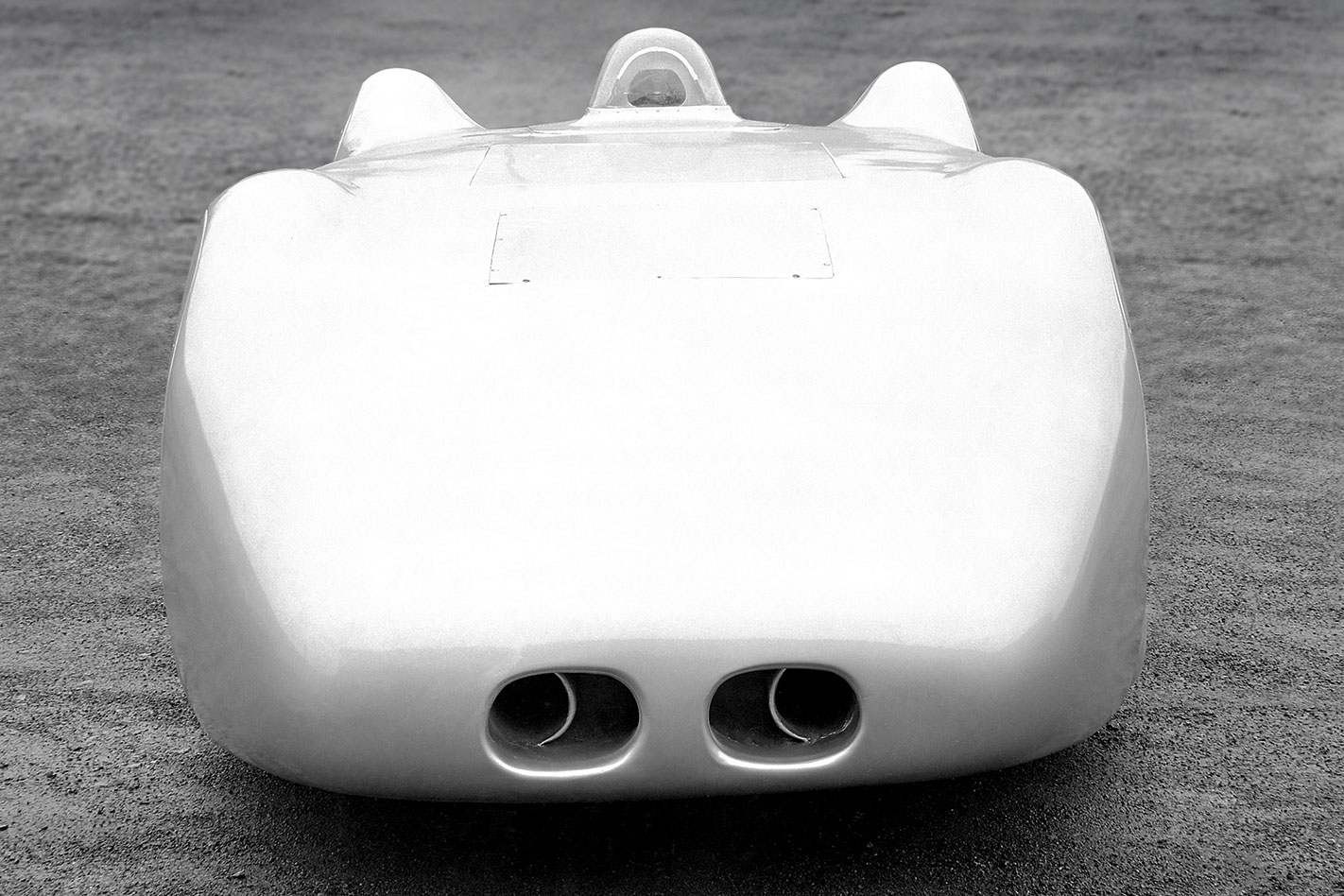
NAMES from Mercedes-Benz’s history don’t come much more illustrious than the two Rudolfs – Uhlenhaut and Caracciola. The pair of them respectively designed the W125 race car and then won the 1937 European Championship in it. What’s more Caracciola achieved an average speed of 432.7 km/h on the A5 autobahn between Frankfurt and Darmstadt in a streamliner version, a speed record on public roads that stood until late last year. This car has provided the inspiration for a quite stunning show car unveiled at Pebble Beach.
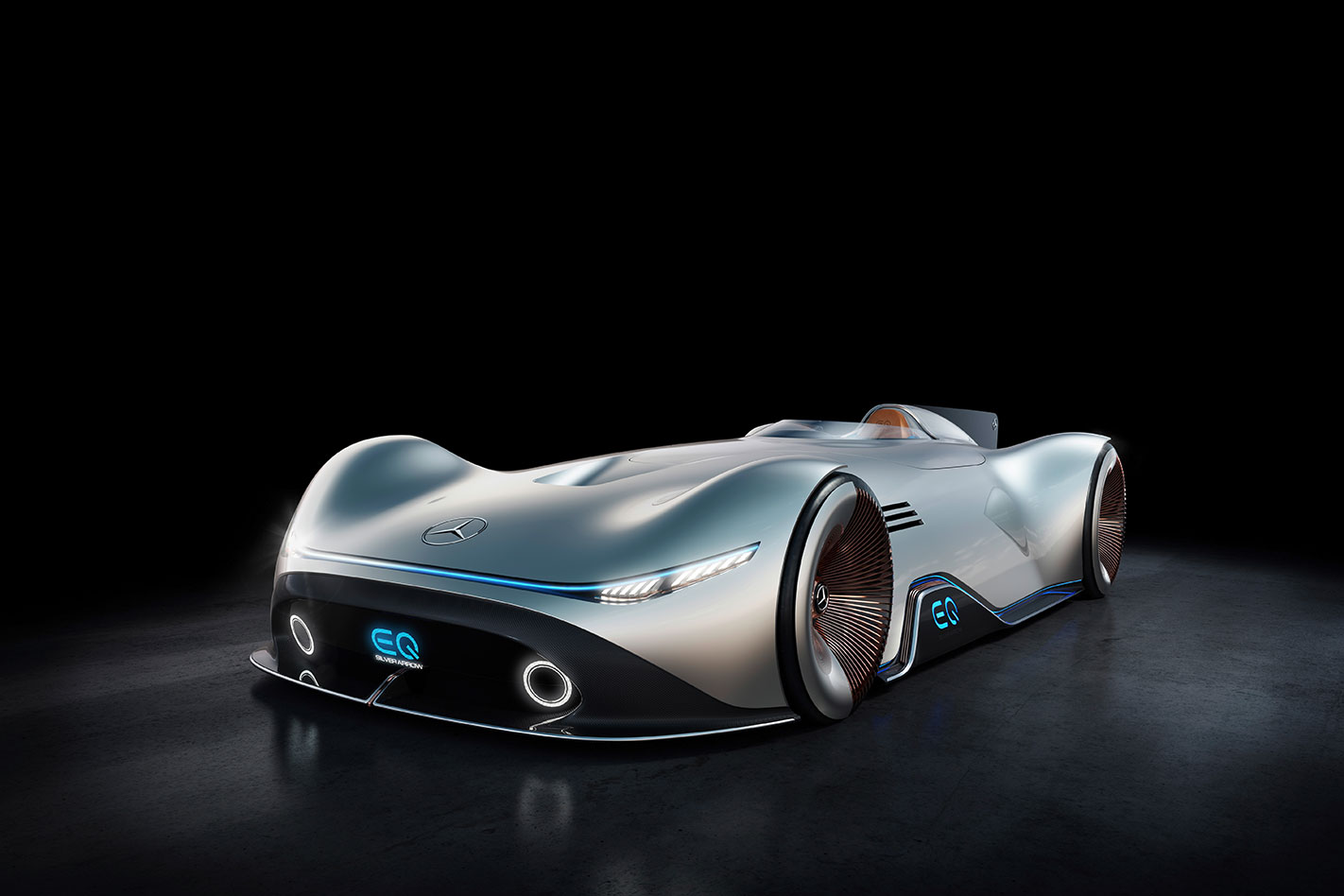
The EQ Silver Arrow Concept show car takes the elegant form of the W125 and teases and morphs it artfully, translating that design language from eight decades ago into something that’s modern but with a playful hint of steampunk about it.
The striking alubeam silver paintwork is reminiscent of the historic Silver Arrows racers which pared back weight by stripping off the traditional white paint layer. The cabin is finished in traditional materials like leather, brushed aluminium and solid walnut, but incorporates a fully digital dial pack comprising a curved panoramic screen with back projection, as well as a touchscreen integrated into the steering wheel.
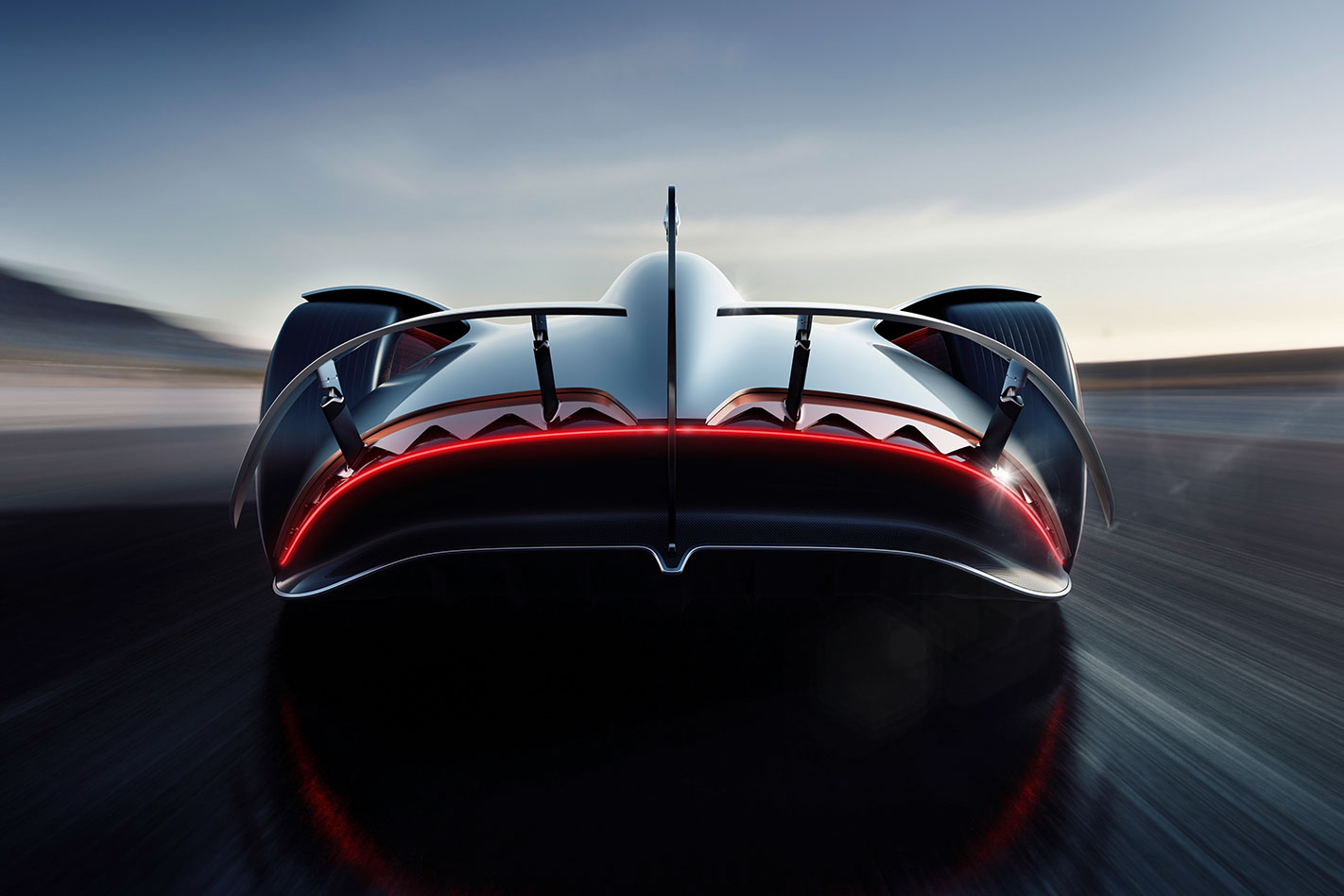
“Over 80 years ago, the historic Silver Arrows demonstrated that Mercedes-Benz was a pioneer when it came to speed thanks, among other things, to their streamlined shape,” says Gorden Wagener, chief design officer at Daimler AG. “The EQ Silver Arrow show car draws on that legacy. Intended for acceleration and driving pleasure, it embodies progressive luxury and provides an insight into the future of our design. As a result, the show car drives the design idiom of our new EQ product and technology brand to the top.”
Were you to strip back the alubeam paint from the EQ, you’d find a carbonfibre weave beneath. The partially free-standing (and enormous) wheels are an intriguing design touch, and feature non-rotating hub caps and 168 rose-gold-painted aluminium spokes per wheel. The Pirelli tyres also incorporate a star pattern on the tread, in 26-inch diameter at the rear and 24-inches up front.
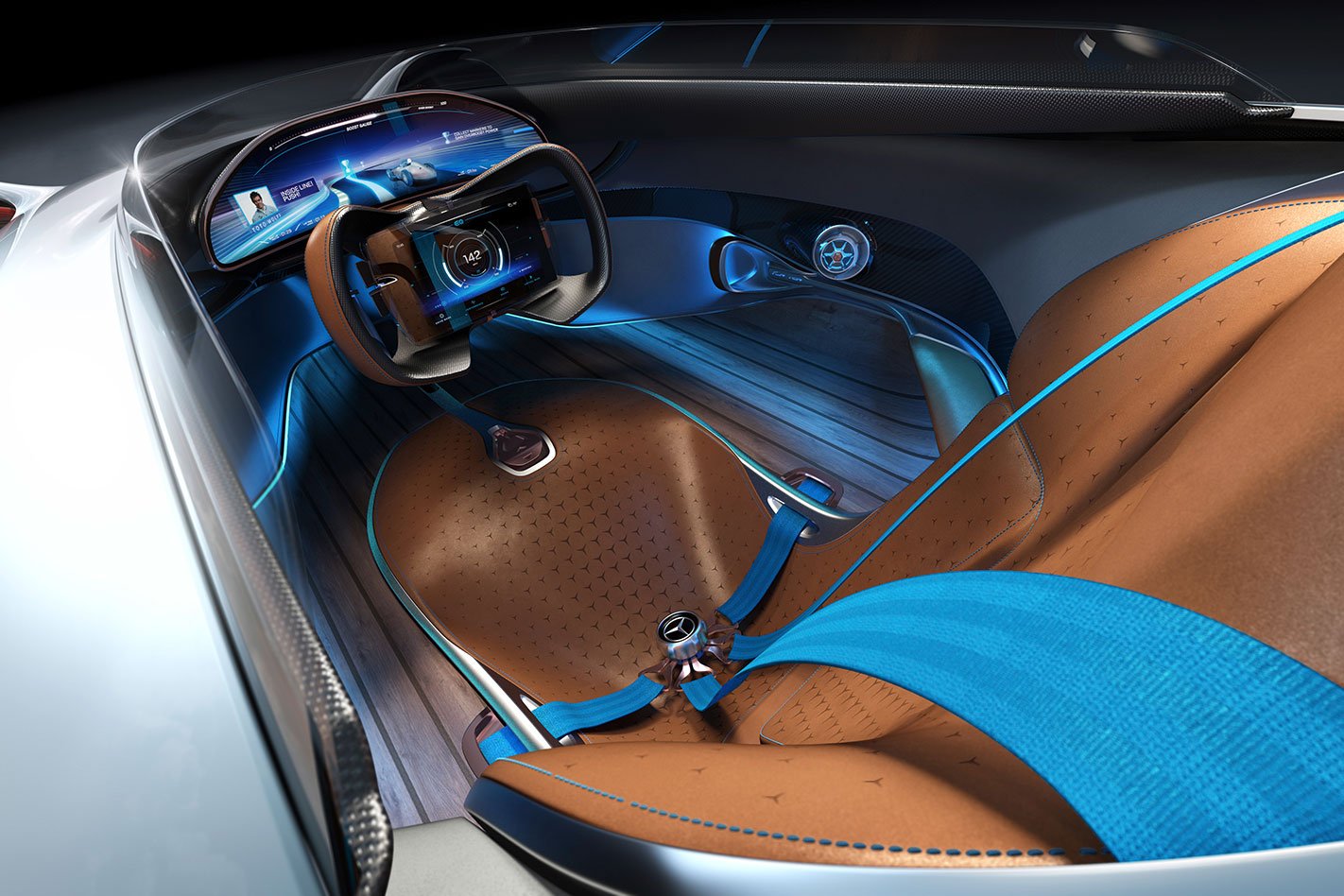
Power comes courtesy of a 550kW electric drivetrain. The underbody houses a thin 80kWh battery pack, endowing the EQ Silver Arrow with a range of over 400km according to the WLTP. Although not slated for any sort of production, the EQ Silver Arrow represents a showcase for Mercedes’ EQ family of electric vehicles, which has thus far comprised the Concept EQ coupe-styled SUV, unveiled at the 2016 Paris Motor Show, which will come to market next year as the Mercedes-Benz EQC.
This was followed by the Concept EQA compact car from the 2017 Frankfurt Motor Show. Also featured at that show was the Smart vision EQ fortwo – an electric and autonomous urban scoot with no steering wheel or pedals. Figure on a three year showfloor to showroom gestation and it’s clear that we won’t have to wait too long for Mercedes’ next generation of EVs. Even if you are rich and devoid of friends, don’t bank on landing an EQ Silver Arrow anytime soon though.
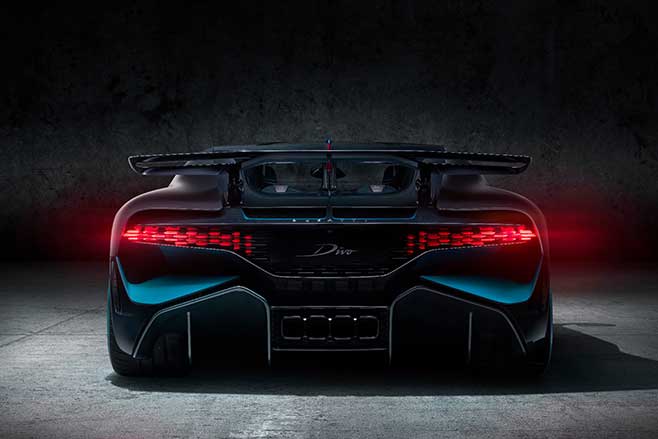
After much teasing, Bugatti has finally revealed its newest model, the Bugatti Divo, to the world.
The Divo is to be a more corner-focused car than Bugatti’s previous vehicles, which have been primarily known for breaking top speed records.
Chiron hits 400km/h in 32.6 seconds
With the top speed of the Divo limited to 380km/h, the Divo will rely on its improved downforce and handling characteristics to impress.
Bugatti claims the Divo is 35kg lighter than the 1995kg Chiron. But with 90kg more downforce, increased camber, the ability to cop 1.6g of lateral acceleration, and over 1100kW, the Divo is a more dynamic machine than the Chiron.
Bugatti says the lap time difference between the two at the 12.5km Nardò circuit in Italy is eight seconds in the Divo’s favour.
Bugatti president Stephan Winkelmann says it was clear customers needed something with ‘significantly higher performance in terms of lateral acceleration, agility and cornering.’
“When I took up my position at Bugatti at the beginning of the year, I soon learnt that our customers and fans were waiting for a special vehicle which would tell a further story for the brand in addition to the Chiron. The Bugatti team was also very eager to implement a project like this.”
Named for Albert Divo, a driver who won the treacherous Targa Florio for Bugatti in 1928 and 1929, the Divo has had its aerodynamics, chassis, and suspension redesigned to suit a different, less linear, style of driving.
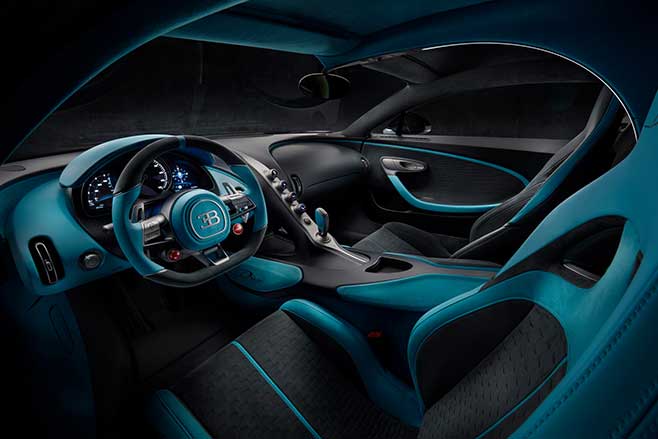
“To date, a modern Bugatti has represented a perfect balance between high performance, straight-line dynamics and luxurious comfort,” Winkelmann says.
We drive the ballistic Bugatti Chiron
“Within our possibilities, we have shifted the balance in the case of the Divo further towards lateral acceleration, agility and cornering. The Divo is made for bends.
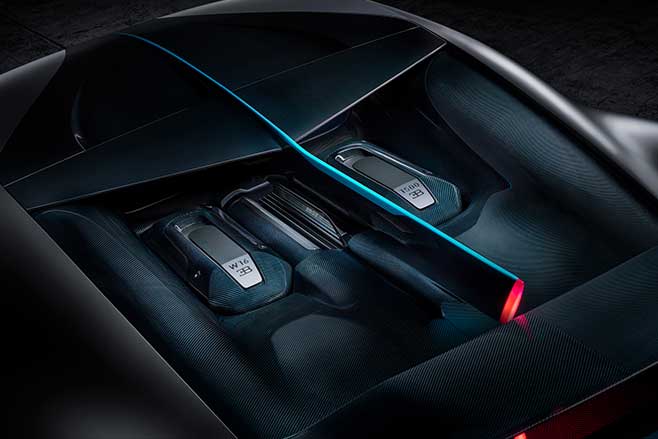
“The feedback from our customers was overwhelming. We showed the Divo to a small group of selected Chiron customers. All 40 cars were sold immediately.”
Bugatti says the Divo was priced at €5 million per unit, though we doubt anyone paid the base price for such a limited-edition vehicle. Sorry if you wanted one.
Few events are as capable of working me into a green lather of envy as the Goodwood Festival of Speed. I’m yet to attend Lord March’s driveway orgy of rollicking metal, but from afar it’s a petrolhead’s nirvana; a heady gathering of machinery that doesn’t just sit still and glint in the sun, but roars up the narrow course in a flurry of tortured rubber and fumes. fumes.
Missing this year’s event had a particular sting. Not only had Wheels negotiated its way into the passenger seat of the Brabham BT62, which was making its global dynamic debut (Ben Oliver, lucky bugger, took my spot), but the scuttlebutt was Goodwood would finally deliver our first proper look at the fifth-gen Toyota Supra; a car that, along with the all-new Corolla, shows Australia’s largest car brand is committed to dialling up the excitement, and driver appeal, throughout its model range.

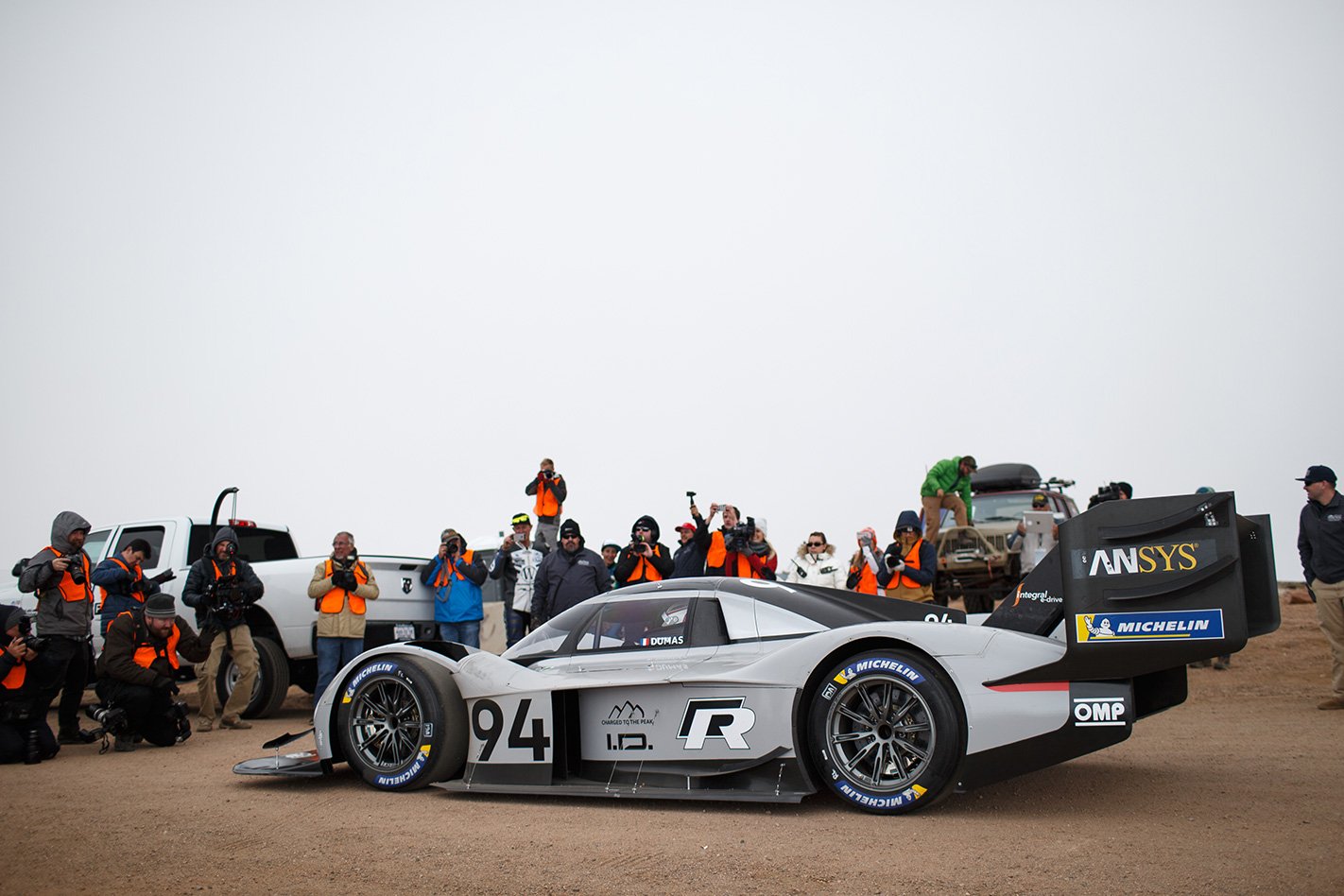
Then there was the intrigue of Volkswagen’s ID R prototype; the bewinged and fiendishly complicated electric racer that arrived at Goodwood hoping to obliterate the record for the fastest run up the hill, just as it had done at Pikes Peak a few weeks earlier.
Those familiar with this column will know I’m open-minded about embracing the performance potential of our rapidly approaching EV overlords, which is what made watching the ID R’s run all the more confusing. It looked fantastic (like a Le Mans car, with more wing), and was devastatingly fast, but set against the cacophony of Goodwood’s star-studded, petrol-gurgling field, it felt a little… flat.
The most exciting moment was delivered in one of its early runs when driver Romain Dumas caught a nasty snap of oversteer and flew onto the grass at high speed. But even inches from disaster, the VW lacked the drama and theatre of a Brabham or McLaren Senna.
It seems so obvious now that the missing ingredient was sound, but it didn’t fully twig until I watched another piece of on-board footage, this time from Porsche’s stunning record run at the Nurburgring in the 919 EVO.
If you haven’t seen it yet, head to YouTube now. It’s truly captivating, not only for its mind-bending display of grip and speed, but for the bravery, commitment and skill of Porsche factory driver Timo Bernhard.
Would the 919’s run be as enthralling and as spectacular without the howl of its (electrically assisted) 535kW 2.0-litre V4? Re-watching the VW’s near-silent runs at Pikes Peak and Goodwood suggest that no, it wouldn’t.
None of this belittles the achievements or the engineering prowess of the ID R. As a glimpse into the future, and into the potential of EV powertrains, it’s exciting. But to have the pitfalls of zero engine noise in a performance car hammered home with such clarity was confronting.
This isn’t a new issue, of course. Wheels has been asking car company execs about overcoming the lack of an engaging soundtrack in performance EVs for years, but until now, it’s largely been a hypothetical.
Yes we have Teslas, and more eco-focused EVs, but excluding a few low-volume curiosities, we’re yet to see a fully electric car where driver engagement and enjoyment are the top priorities. Porsche’s Taycan (formerly the Mission E) is likely to be one of the first and Mark Webber, who has helped develop it, has some words of reassurance.
“People are going to be absolutely blown away by that car,” he told me, before adding that it feels like a “proper Porsche”. It just won’t sound like one.
Seven hundred horsepower – if it were an entry requirement for a nightclub, it’d fill with only the most exclusive, exotic, or exciting cars.
Inside you’d find scenes like a Lamborghini Aventador SV screaming Italian into the ear of a Porsche 911 GT2 RS. You’d see a Tesla Model S P100D scrambling for a spare charge cord behind the bar or Ferrari’s 488 Pista would strut over from the dance floor, with melted tyre flicked around its wheel guards. Then a Jeep Grand Cherokee walks in. Suddenly, the music cuts and everybody stares.
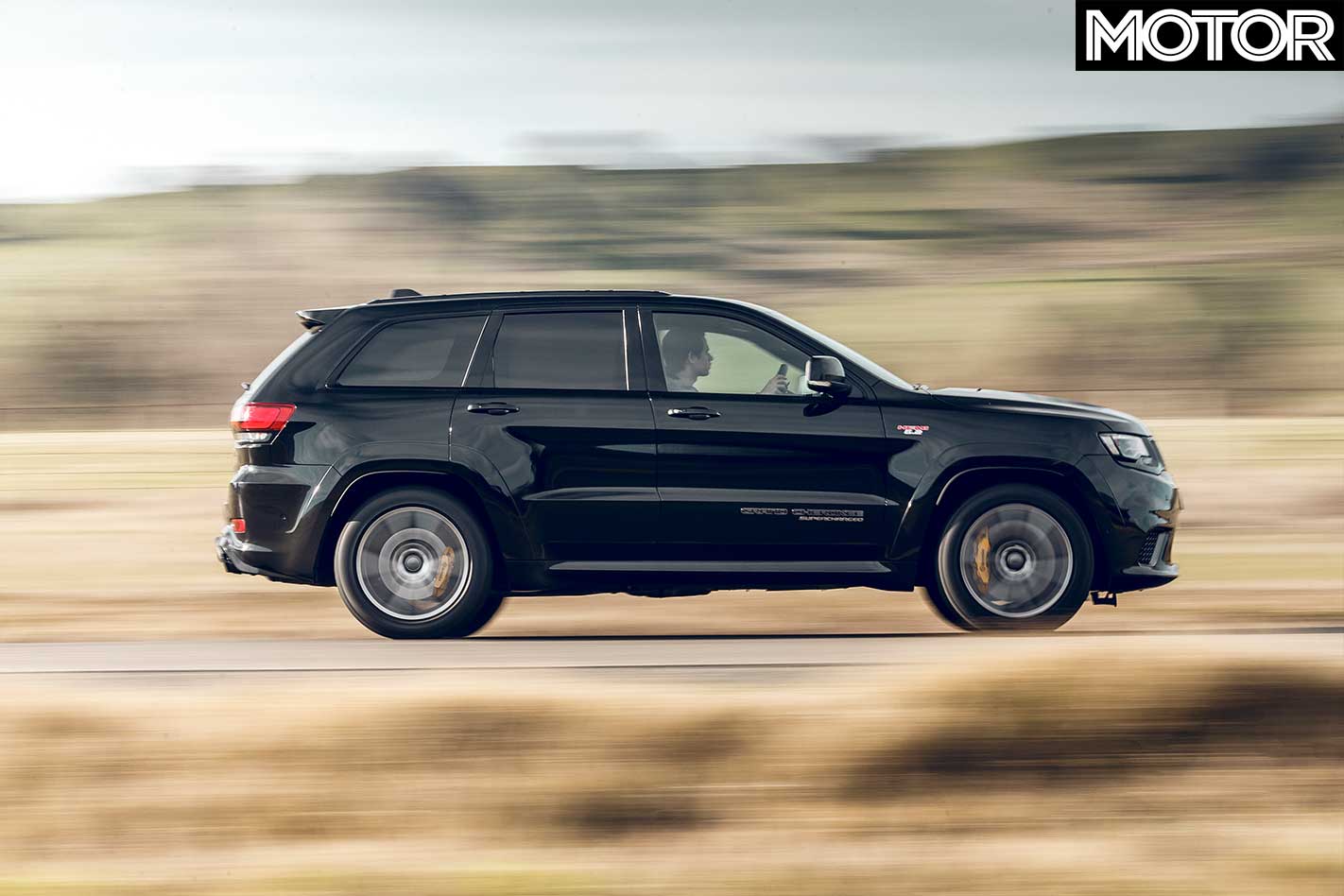
A Jeep with 522kW. It’s a ridiculous idea, isn’t it? Anyone with a sane grasp of physics would lose their mind about injecting that much power into something with a roll-centre higher than a labrador. Yet that’s the brief for the Jeep Grand Cherokee Trackhawk. And we’ve been awaiting its arrival Down Under.
Its bulbous nose shelters one of the world’s most unhinged engines. Created originally for the Challenger Hellcat, Dodge and Jeep’s SRT engineers took a Grand Cherokee SRT’s 6.4-litre Hemi V8 – itself bristling with 624Nm – and redesigned it from the oil-pan up. A forged steel crank was used to cut stroke measurements and displacement, then a 2.4-litre twin-screw blower was lowered into its vee.
Naturally, supercharging a V8 is going to unlock a lot of power. But 522kW and 868Nm? You can find Bentleys with more torque, or Ferraris with more power, but nothing currently on sale trumps the Trackhawk on both outputs.
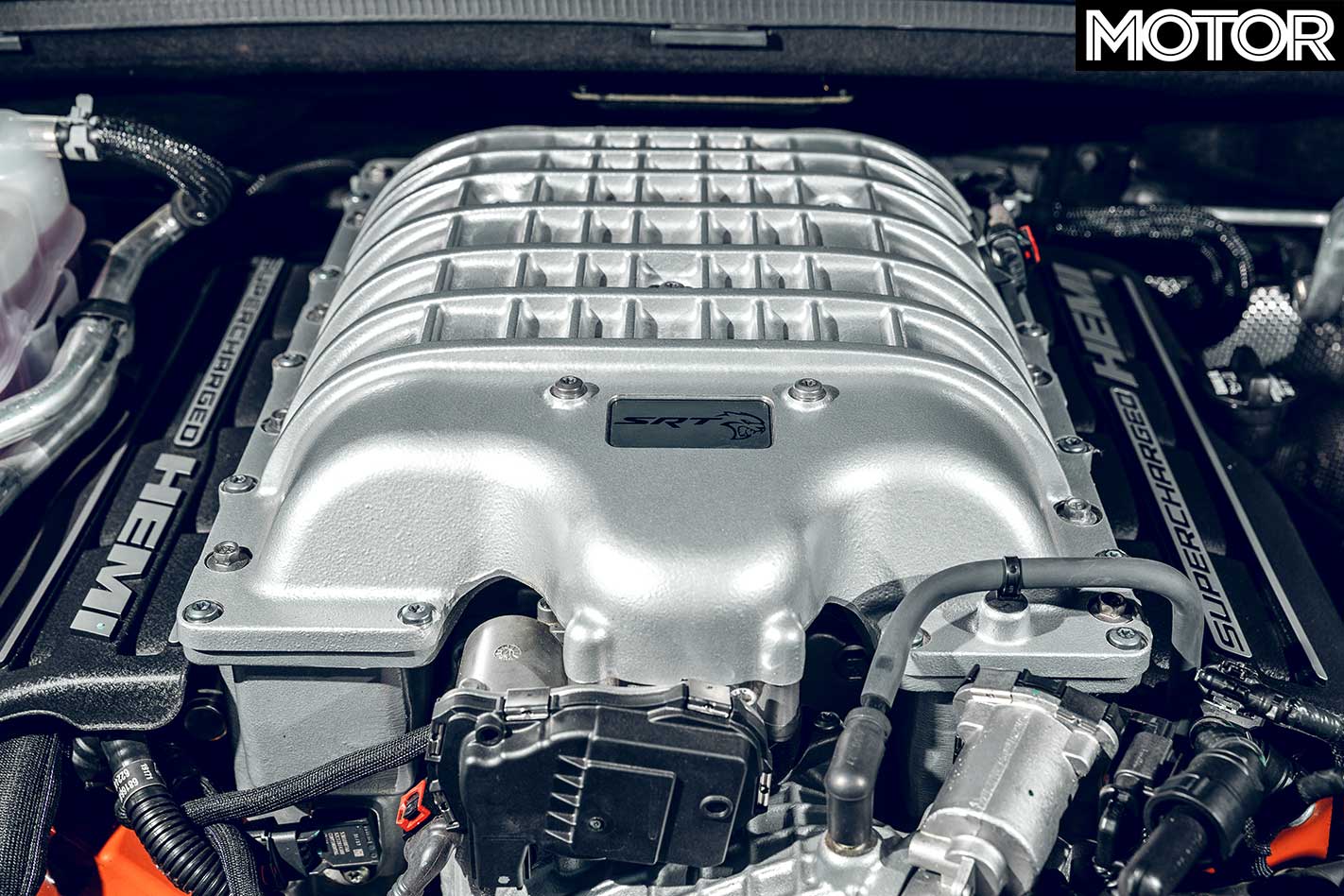
On top of being 48kW and 53Nm more than HSV or GM could wring from a LS9 in the GTSR W1, its brawn costs $135K, putting dictator levels of power in relative reach of the masses. And, hallelujah, it’s all blessed by Jeep with a factory warranty.
We’ve planned a blat into rural Victoria to feel the brunt of the Trackhawk’s power. Thumbing the start button, eight pistons fire into life with a gravelly snarl, like a lion that’s trod on a tack. Not much else gives away what lurks underneath. Except as the Hemi throbs at traffic lights, gently rocking in its cradle, you’re quickly seduced into scanning traffic for gaps into which you can unleash hell.
You will always remember the first time you unshackle the Trackhawk’s 700 horses. Instead of apocalyptic wheel spin, the Trackhawk squats on its rear haunches like a startled grizzly, hauling forward as it begins to blur the scenery. The engine emits a deep burp as it consumes another gear and involuntary cackling erupts from anyone on board.
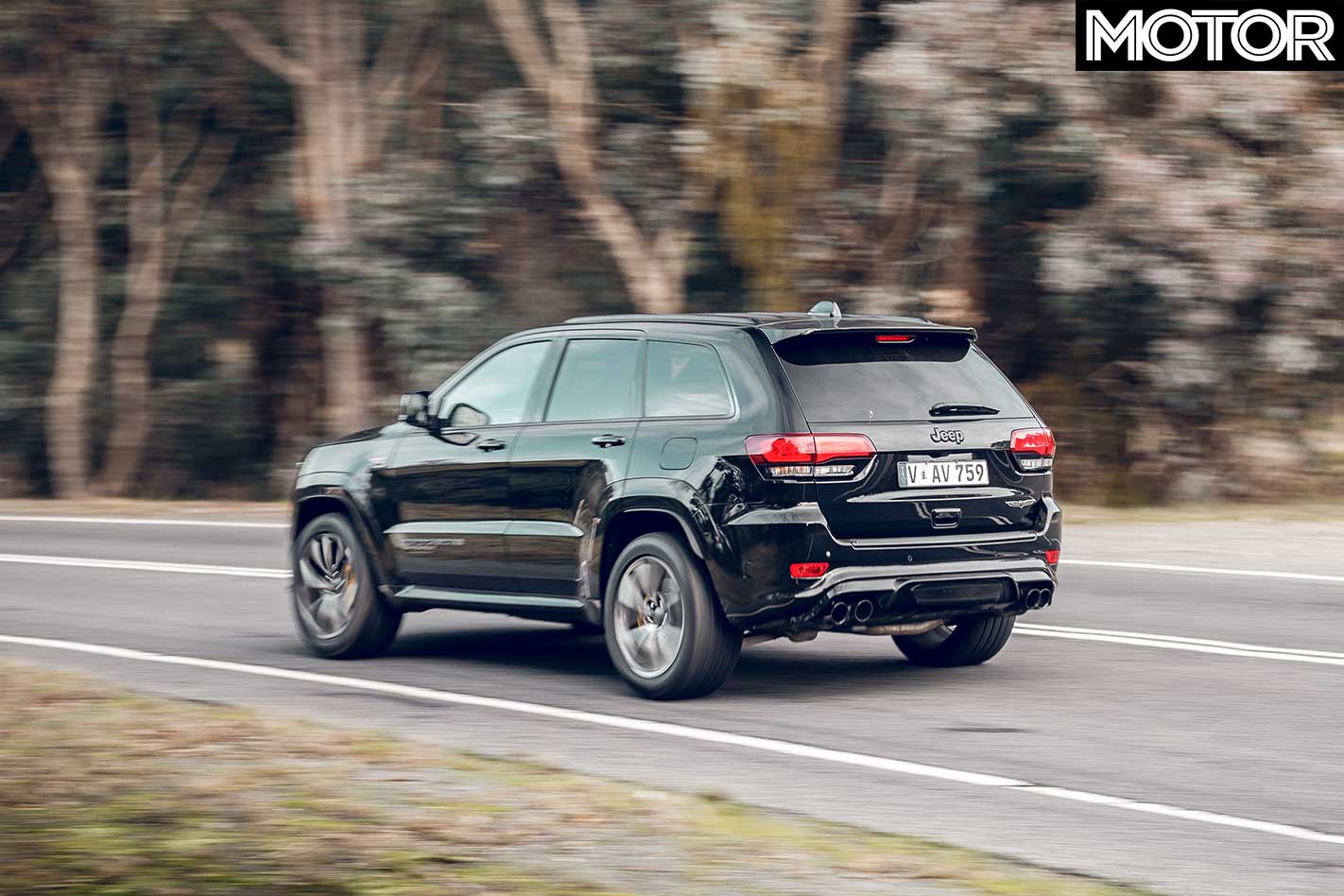
Accompanying its phenomenal acceleration is a demonic, anti-social noise. The rear pipes blast a throbbing blare under load and the supercharger’s high-pitched whine mixes in nicely. It might never reach the harmonies of eight cylinders with overhead cams, instead stirring on a menacing lower octave almost like a Merlin Spitfire engine.
It’s difficult to use full throttle on the road, and our VBOX data from a drag strip reveals why. Acceleration is, frankly, ridiculous. Jeep claims it generates more G-force during launch than most sports cars do in corners, which is not so far-fetched when you consider the Trackhawk squeezes 868Nm through one very strong all-wheel drive system.
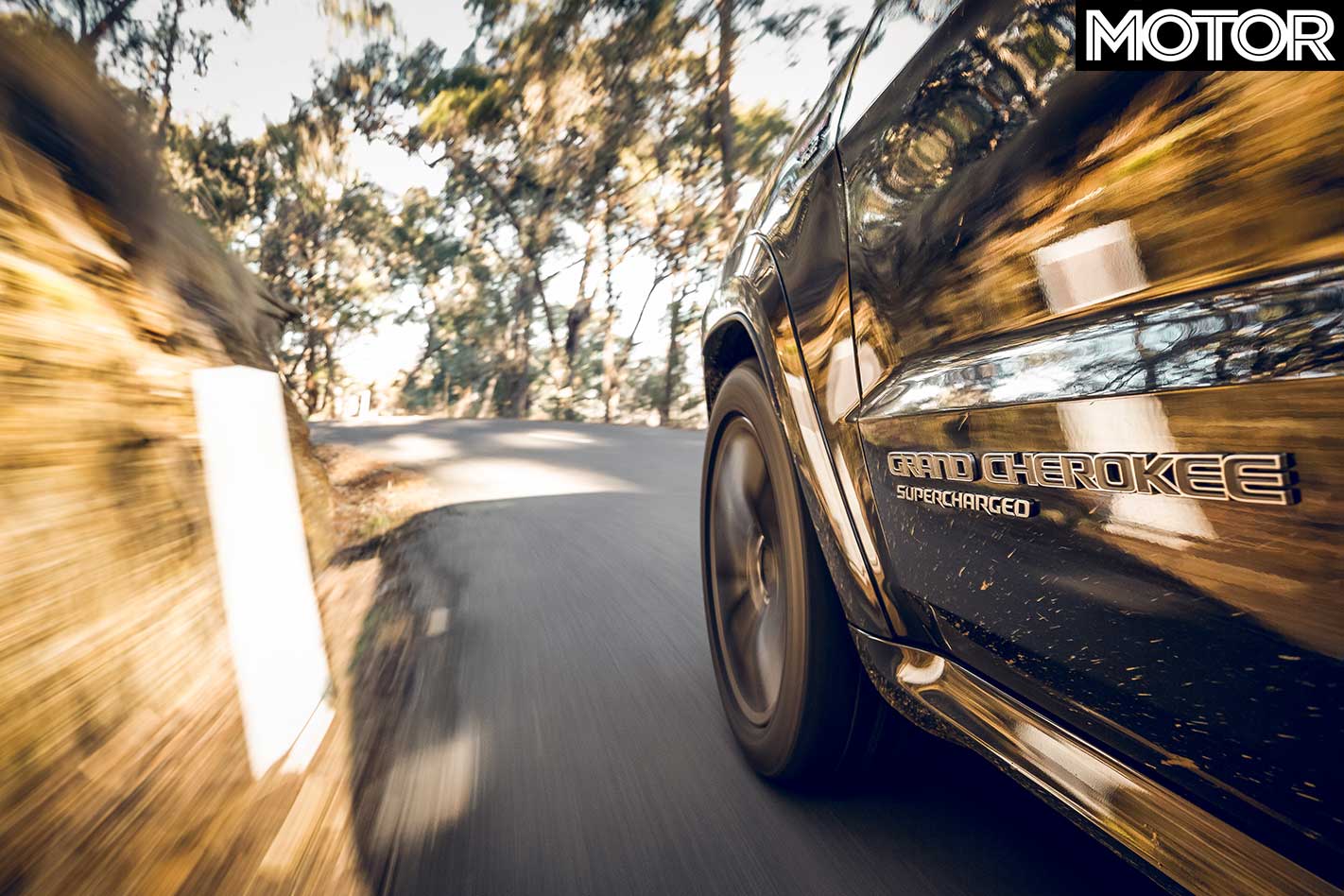
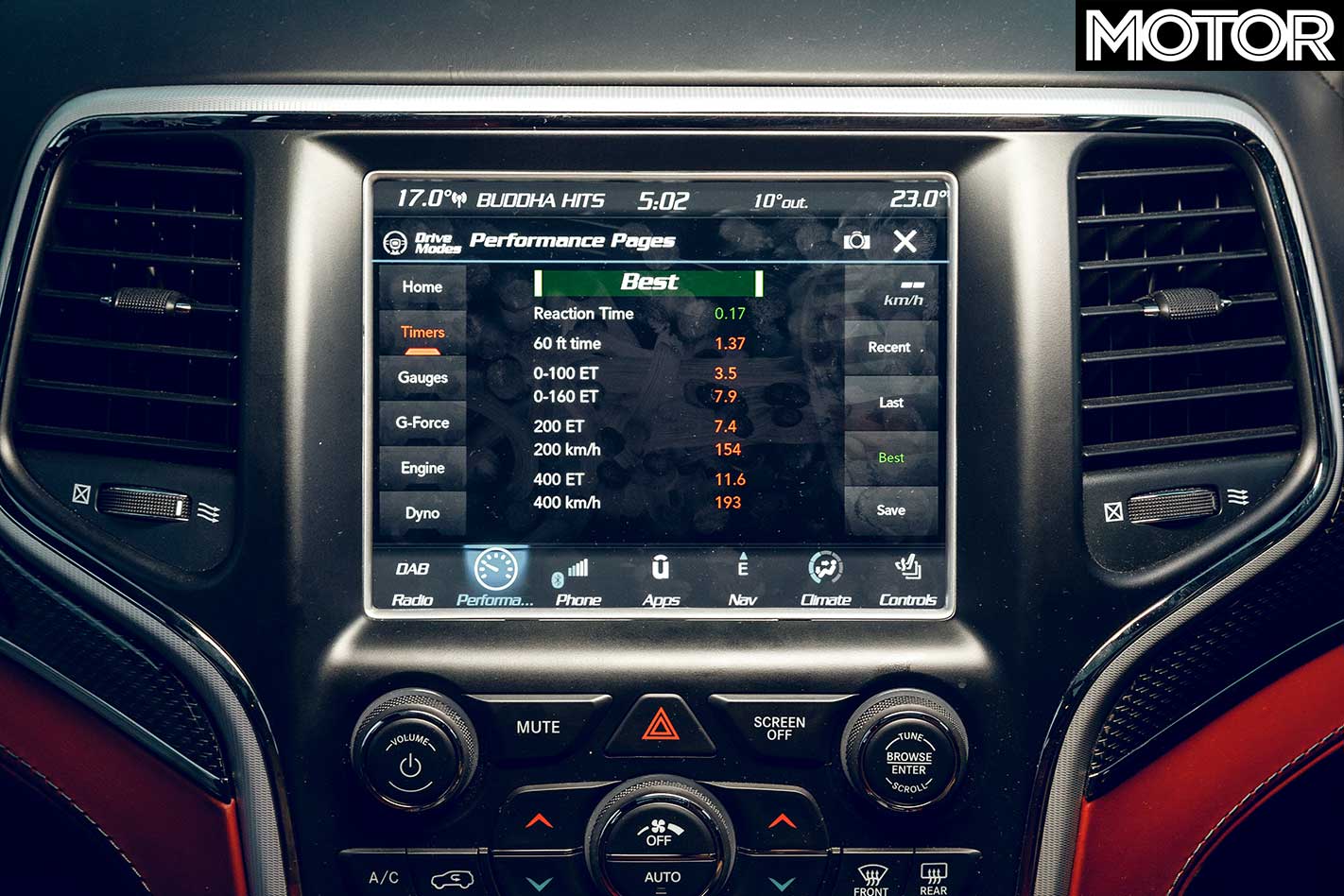
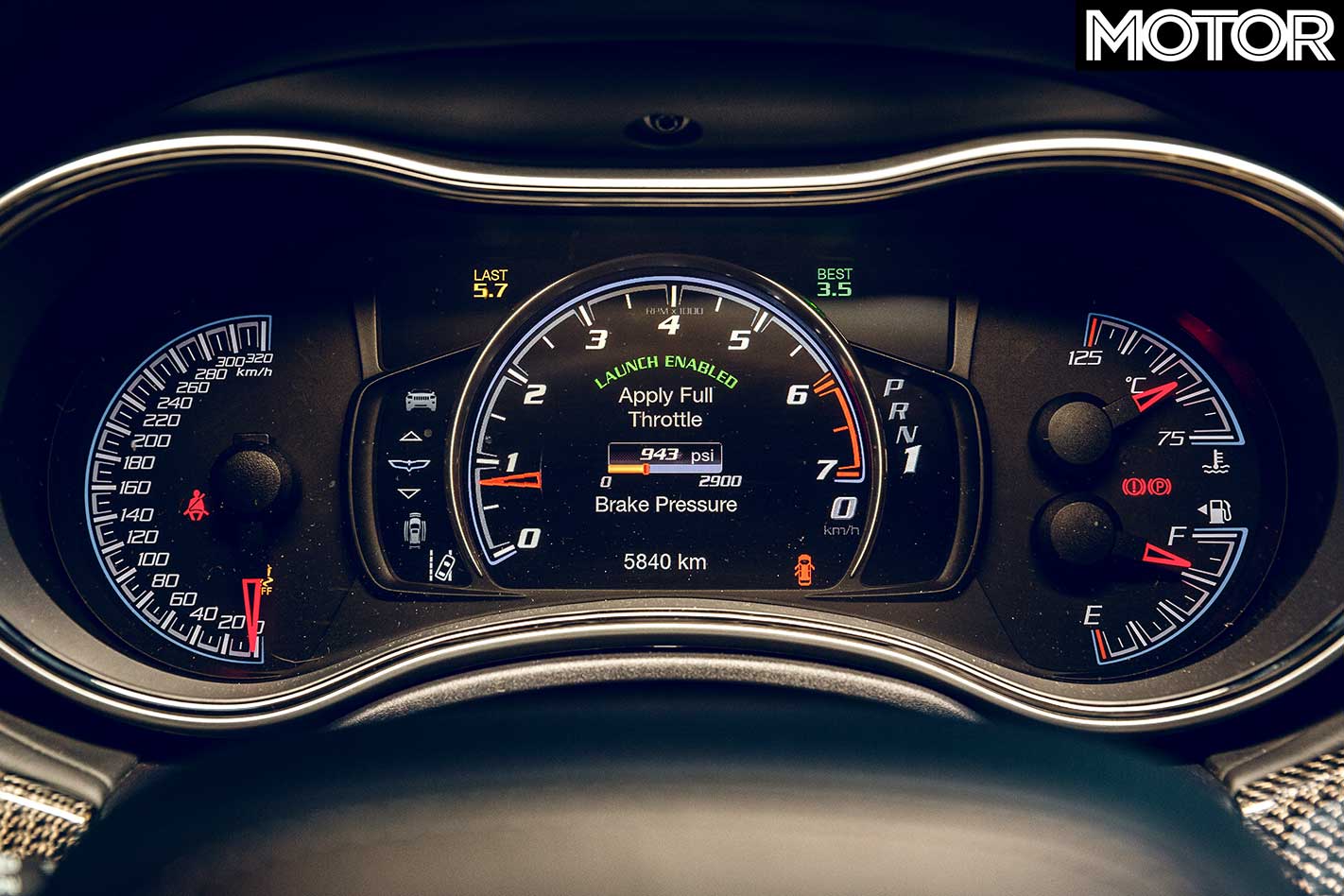
The Trackhawk hits 100km/h in a claimed 3.7 seconds and you’ll need launch control to extract those brutal figures. It’s easy to use – provided you have the legs to stall the meaty torque converter with enough brake pressure – and when you let go, brace yourself. Our data says the Trackhawk can lunge forward with 1.2 times the force of gravity, gobbling up 60km/h in 1.65sec and 100km/h in 3.70sec.
You’d swear that SRT engineers built the drivetrain to withstand mine blasts, too, in how it can cop launch after launch, let alone a single one. With 2.43 tonnes being catapulted at the horizon, Jeep beefed up almost everything in the way of the Hellcat engine’s fury. From the transfer case back, things are bigger, uprated, or stronger.
Considering the Trackhawk is making 168Nm more than the base SRT’s transmission can handle, Jeep bolted in a new eight-speed torque converter with a 950Nm torque rating. It houses the same ratios as a V6 Grand Cherokee, but that’s no bad thing. The shortly stacked gears keep the engine breathing between its 4800rpm torque and 6000rpm power peaks.
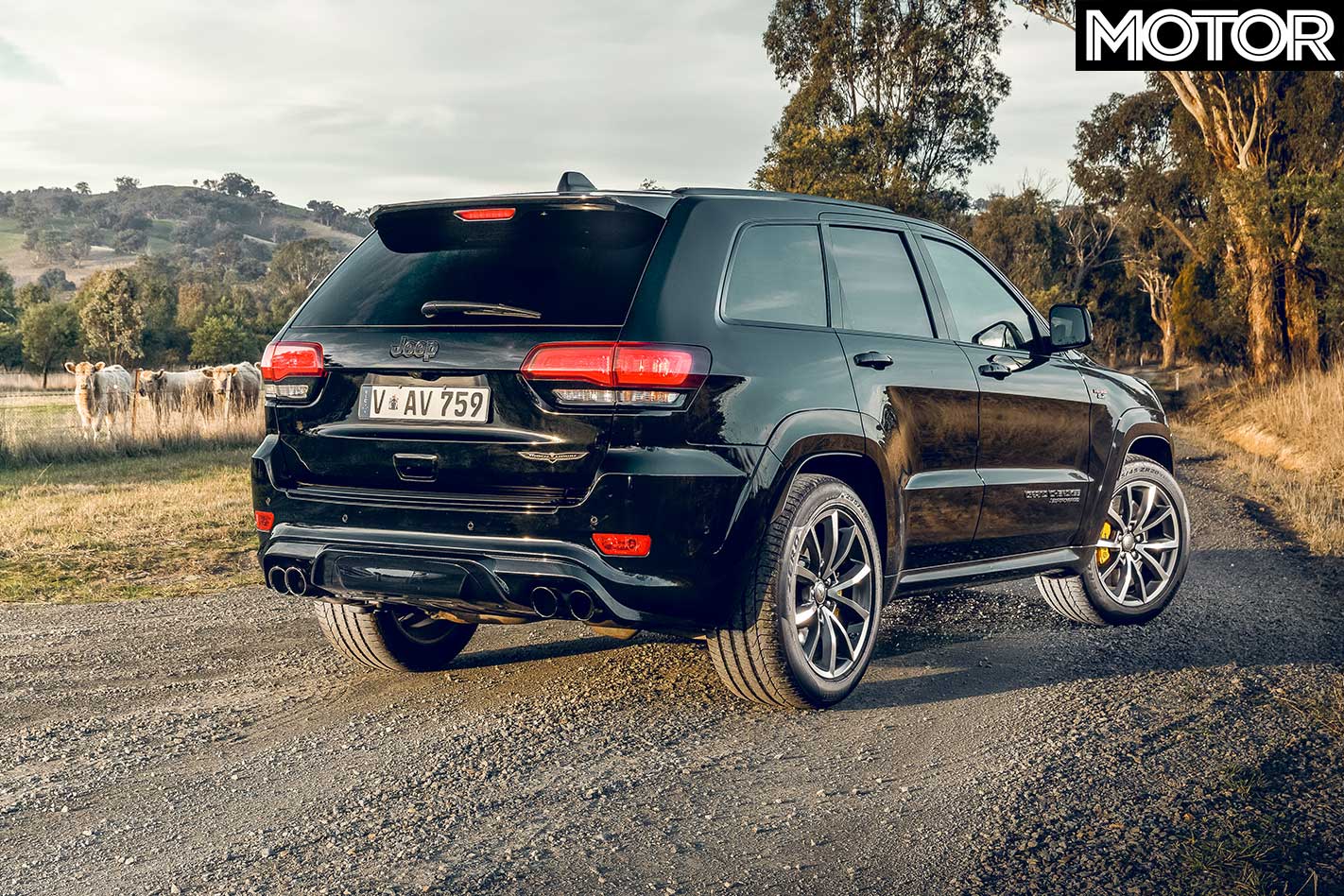
As a result, the Trackhawk shifts into sixth gear just before 400m. By then it’s bludgeoning through the air at 188.14km/h and trips the beam in 11.8 seconds. That might seem unimpressive for something as powerful as a McLaren 720S, which can run low 10s, but any doubt surrounding the Jeep fades quickly in comparison to its rivals – it’s the quickest full-size performance SUV we’ve tested by half a second.
On a roll the grunt still hits as hard as Thor’s flying hammer, blitzing the 80-120km/h test in 2.29 seconds. For reference, that’s faster than the original Jaguar F-Type V8 S. But this type of stuff is expected. After all, this is what Jeep calls a Trackhawk. And while it excels on ‘track’ (which Americans more often use to mean a ‘drag strip’) we’re more interested in finding out how the brand came up with the word ‘hawk’.
Something this big doesn’t remind anyone of a small, swift bird. Especially when the supercharger and extra cooling circuits add 100kg of flab. However, because Jeep demanded the Trackhawk survive sustained circuit laps in searing heat before signing off the project, it knew more than an impressive bench press was needed to pass track and field.
As a result it stiffened the springs coiled around newly tuned adaptive dampers and fitted reinforced Pirelli P Zeros. The brakes are also uprated to the size of flywheels. Bigger 400mm discs slice six-piston calipers up front and its electronic stability systems have been retuned. Amusingly, you can put your Trackhawk on a small diet, too, with optional 20-inch forged wheels that drop 5.5kg per corner.
Driving the Trackhawk through small, winding passages is like trying to ride a buffalo through a grass hedge maze. It feels claustrophobic, like its huge wheel tracks are spilling over road lines.
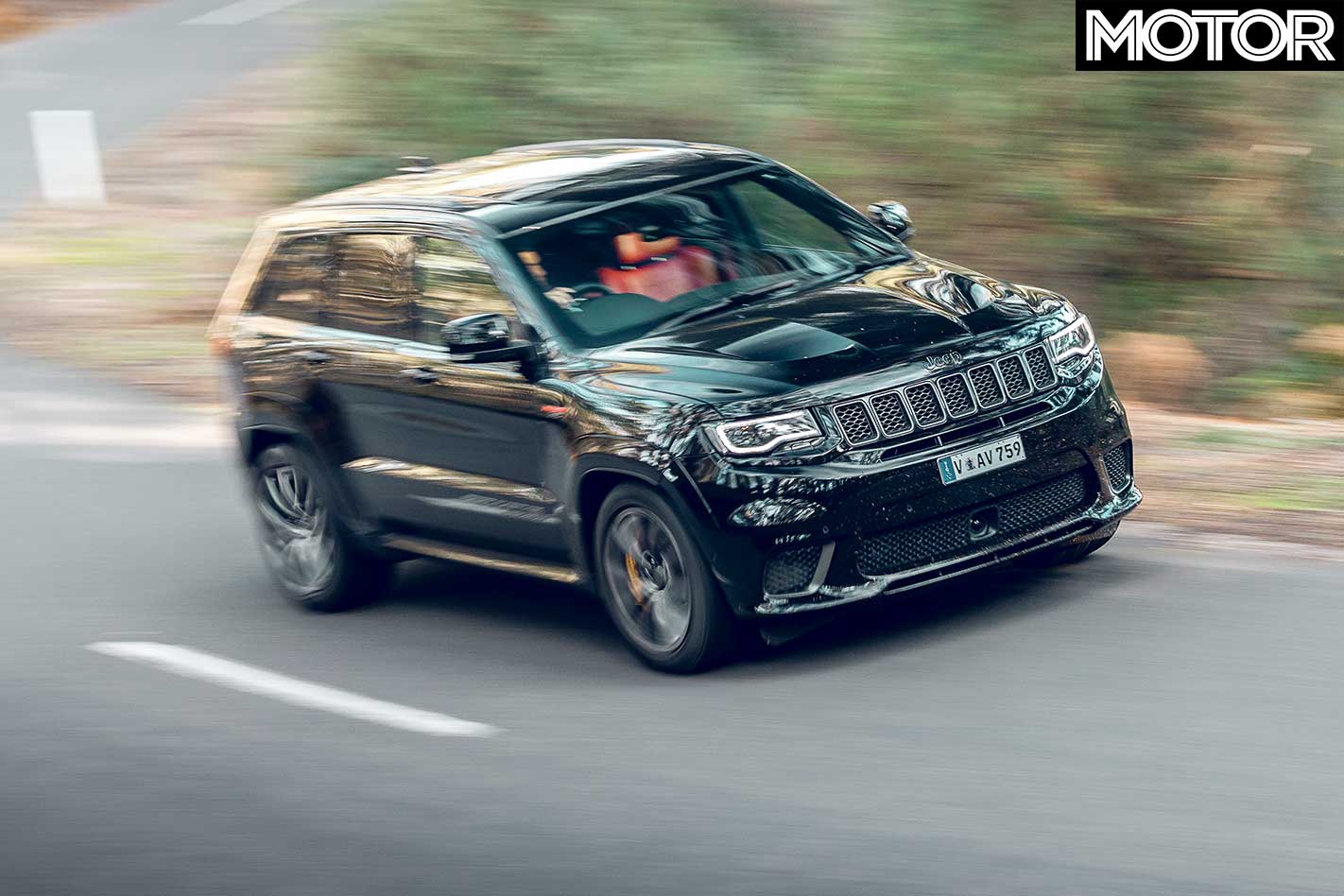
Straights don’t allow more than short bursts of light throttle, and with so much power pushing its mass you know a mistake could carry seismic consequences. Progress becomes a game of managing its temper rather than poking its limits.
On wider, more flowing tarmac you can raise commitment, though patience is key. Keep things smooth, controlled, and its eagerness to hunker down on its huge 295mm wide tyres is surprising. Nail your trail braking and you won’t need bulging biceps to turn its nose. You might even feel its three metre long wheelbase pivot around an apex.
The faster you go, the more vision you’ll need. With its centre of gravity so high, braking earlier helps settle its weight. The rear will jump around if you brake too late. And you’ll be thankful Jeep didn’t skimp on anything but Brembo’s biggest hardware. Our data shows the Trackhawk reels itself in from 100km/h in 37.9 metres.
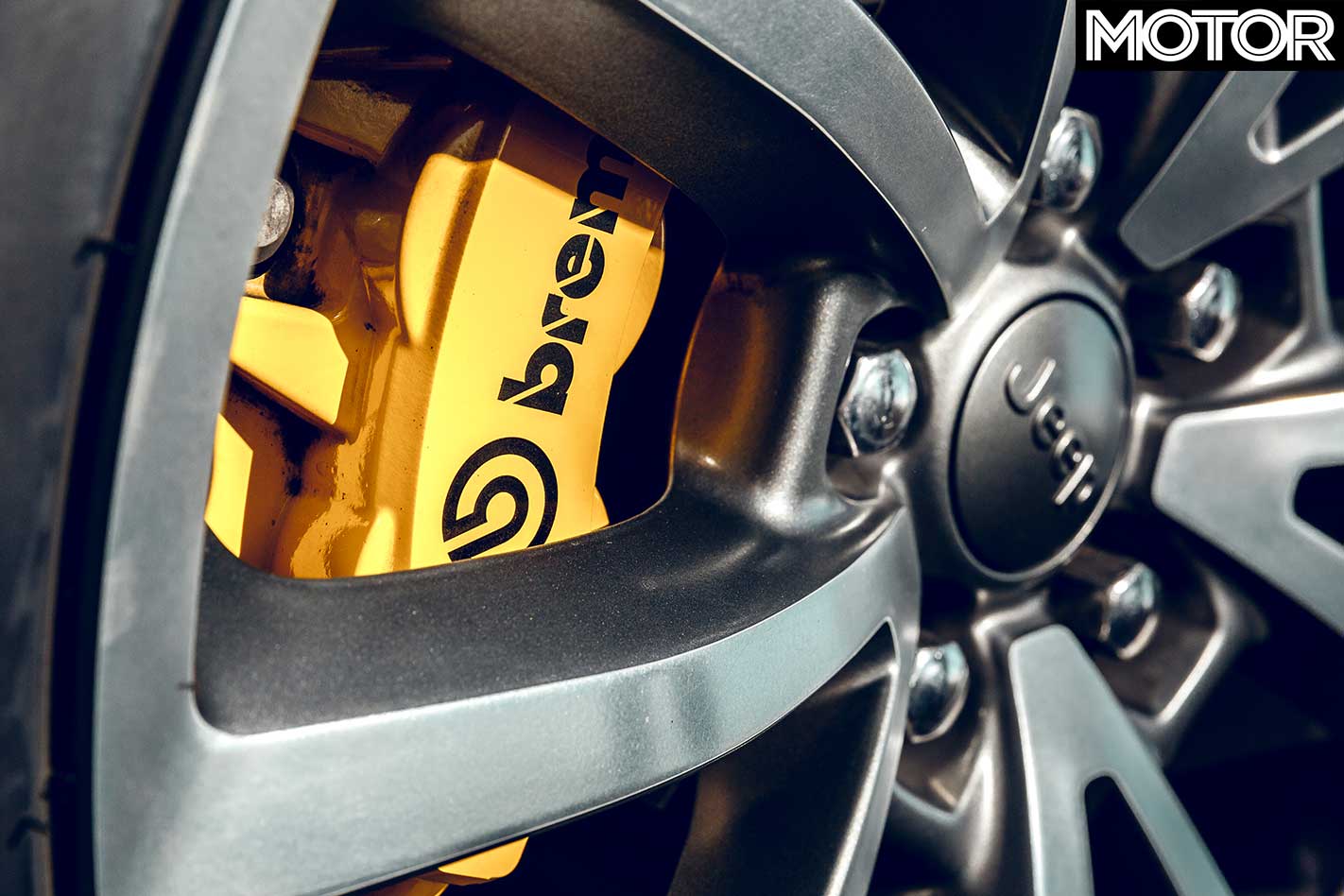
Of course, being as aerodynamic as a parachute helps slow things down. Credit where it’s due, though, we’ve seen cars half its weight sail past that distance. We only wish Jeep firmed up the Trackhawk’s brake pedal and shortened its travel a little. With so much mass to hustle, you’d appreciate more control.
It’s the same story on the way out of a corner. You’ll need to feed in power slowly to keep the Trackhawk from lunging wide. The transfer case drills anywhere between 40 and 70 per cent to the rear depending which drive mode you’re in and the ZF-built electrically locking differential does a good job of pasting grunt to the ground.
Only in tight corners on full throttle might you feel the rear axle wiggle. Perhaps wisely, the undefeatable ESP shuts down wheelspin straight away. Lurid four-wheel power oversteer? Not here.
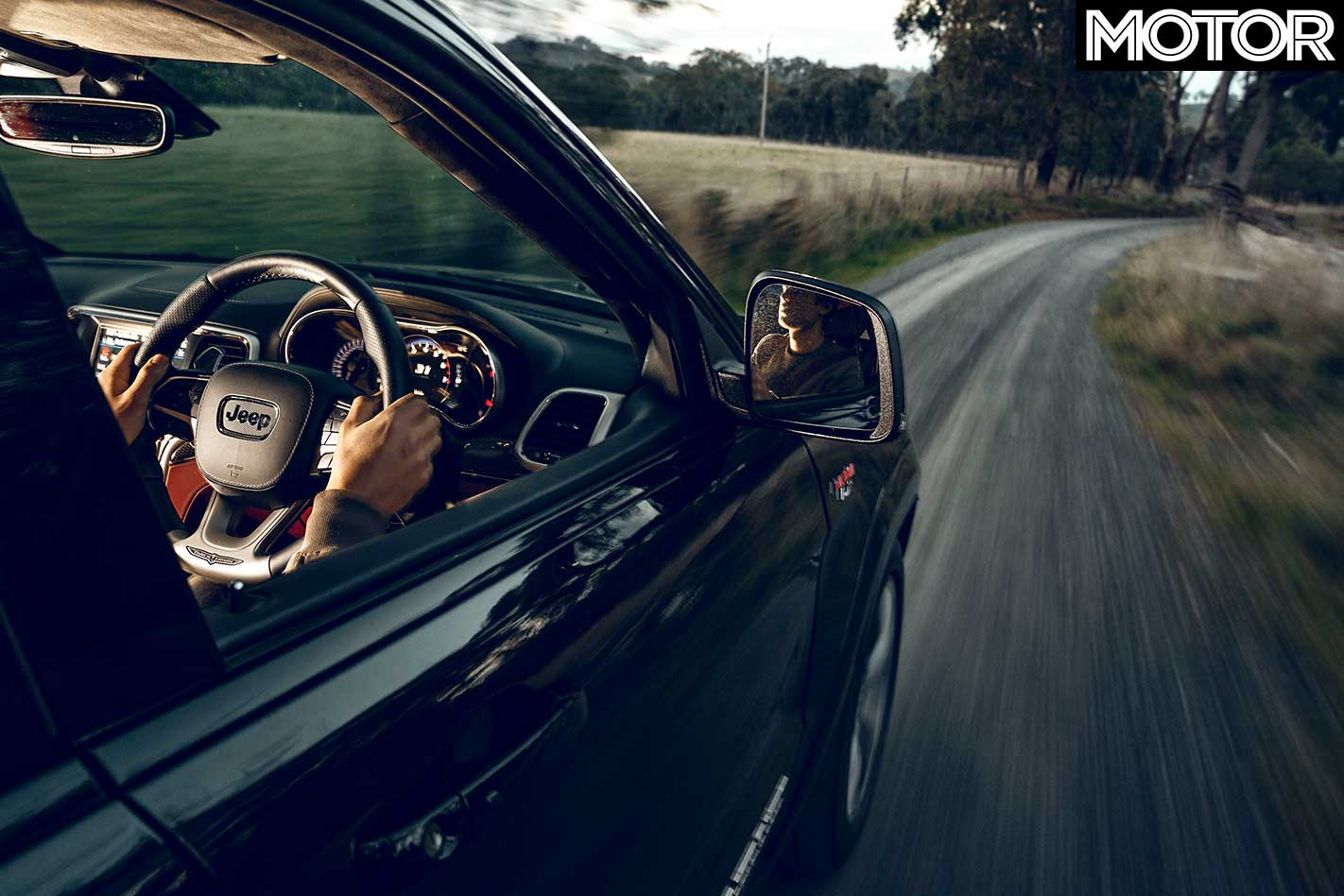
Jeep’s HP95 transmission plays a fantastic partner to the Hellcat engine. Upshifts happen quick and crisp, even if they take longer than a sorted dual-clutch transmission’s, and it’ll gear down without fuss while cruising. It’s super intuitive in Drive, with mapping that some of the German brands wouldn’t turn a nose up at.
We’d take the Trackhawk to a circuit just to hear it cycled through gears. The noise while downshifting into a corner, as the supercharger vents a slither of boost and yelps into higher rpm, is magic.
Realistically, most owners will uncork that monstrous V8 only in short bursts for a few giggles, then lazily cruise to their destination. During calmer driving, those adaptive Bilsteins and chunky tyres smooth out roads, even if the ride’s on the firm side.
The interior’s insulated enough to drown out the engine’s war cry with the windows up, while its plethora of creature comforts and adjustable driving position will pacify most fussy drivers.
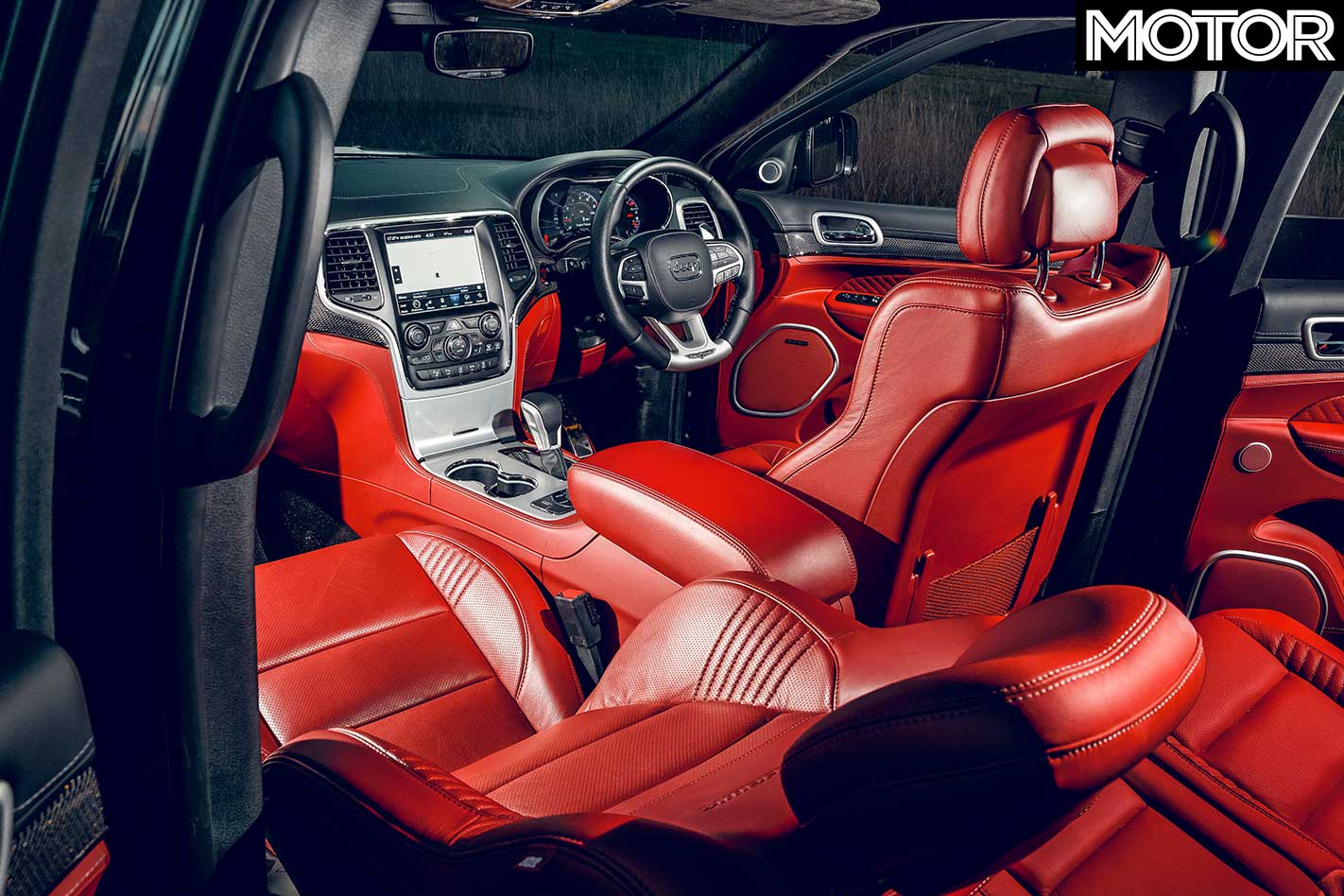
Marking it down are those front pillars that seem thicker than bridge beams, they’re a hazard and often hide pedestrians. The foot brake can trap your left clog and Jeep should have further specialised the Trackhawk’s exterior. We’re not fans of its infotainment system, either. And the steering follows road cambers with a vagueness just off centre at highway speeds.
But rationality was never written into the Trackhawk’s script. It is, after all, an off-road SUV that thinks it’s a sports car, which compromises it being excellent at either. Meanwhile its exceptional weight and grunt means it drinks a small nation’s worth of fuel, too.
Our most behaved driving cycle yielded 470km from a 93 litre tank, at 19.7L per 100km, 80km short of Jeep’s quoted range for a combined cycle. And when you’re up it? Absolutely terrifying.
In its defence, to focus on what the Trackhawk isn’t would entirely miss the point. It’s not the most refined SUV, but why should it be? At $134,900 it’s $60K cheaper than its European rivals and it’ll flog almost every one of them in a straight line. And there’s something about doing that in a Jeep that would feel so inherently right. Plus, we reckon the car’s powertrain would outlast civilisation at the Friday Night Drags.
But what’s most charming about the Trackhawk is it sidesteps monotony in a different way, by being excessive, brooding and intimidating. Sure, it would look out of place among sexy metal in our imaginary nightclub.
However, it’s more like the big bouncer that welcomes you with a smile and could throw you out in an instant under one arm. Now we just need Jeep to convince Chrysler to cook up a 300 with a Hellcat engine to join the Trackhawk on the door.
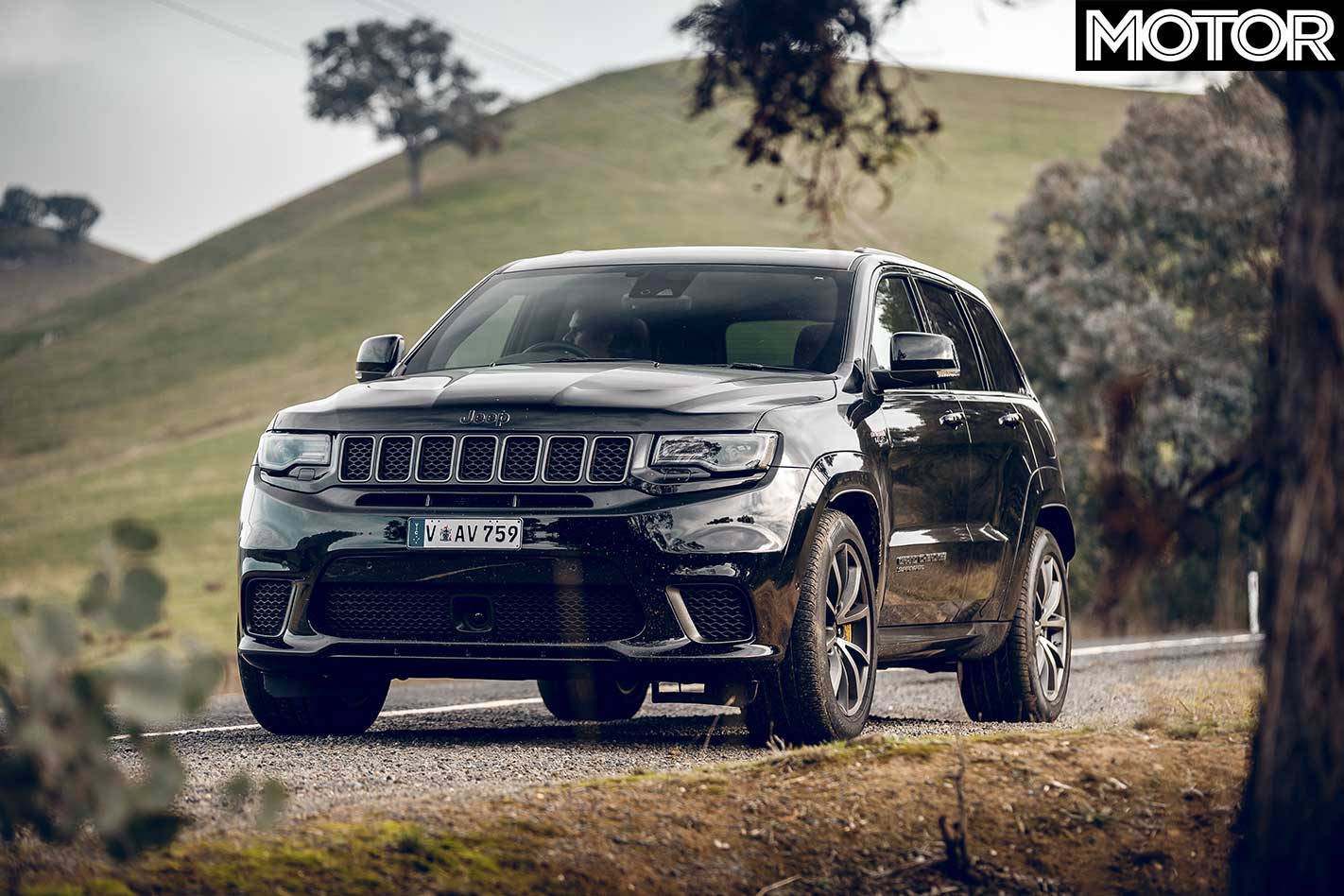
FAST FACTS 2018 Jeep Grand Cherokee Trackhawk
BODY: 5-door, 5-seat wagon DRIVE: all-wheel ENGINE: 6168cc V8, OHV, 16v, supercharger POWER: 522kW @ 6000rpm TORQUE: 868Nm @ 4800rpm BORE/STROKE: 103.9mm x 90.0mm COMPRESSION RATIO: 9.5:1 WEIGHT: 2433kg POWER-TO-WEIGHT: 219kW/tonne TRANSMISSION: 8-speed automatic SUSPENSION: A-arms, adaptive dampers, anti-roll bar (f); multi-links, adaptive dampers, anti-roll bar (r) L/W/H: 4846/1954/1749mm WHEELBASE: 2915mm TRACKS: 1640mm (f); 1646mm (r) STEERING: electrically assisted rack-and-pinion BRAKES: 400mm ventilated and slotted discs, 6-piston calipers (f); 350mm ventilated discs, four-piston calipers (r) WHEELS: 20.0 x 10.0-inch (f/r) TYRES: Pirelli P Zero run flats, 295/45 R20 110Y (f/r) PRICE: $134,900
PROS: Powertrain; menacing sound; grip; brutal speed; relative bargain CONS: Hellish thirst; interior foibles; not much left of the ol’ Jeep off-roading ability RATING: 4 out of 5 stars
Power Play
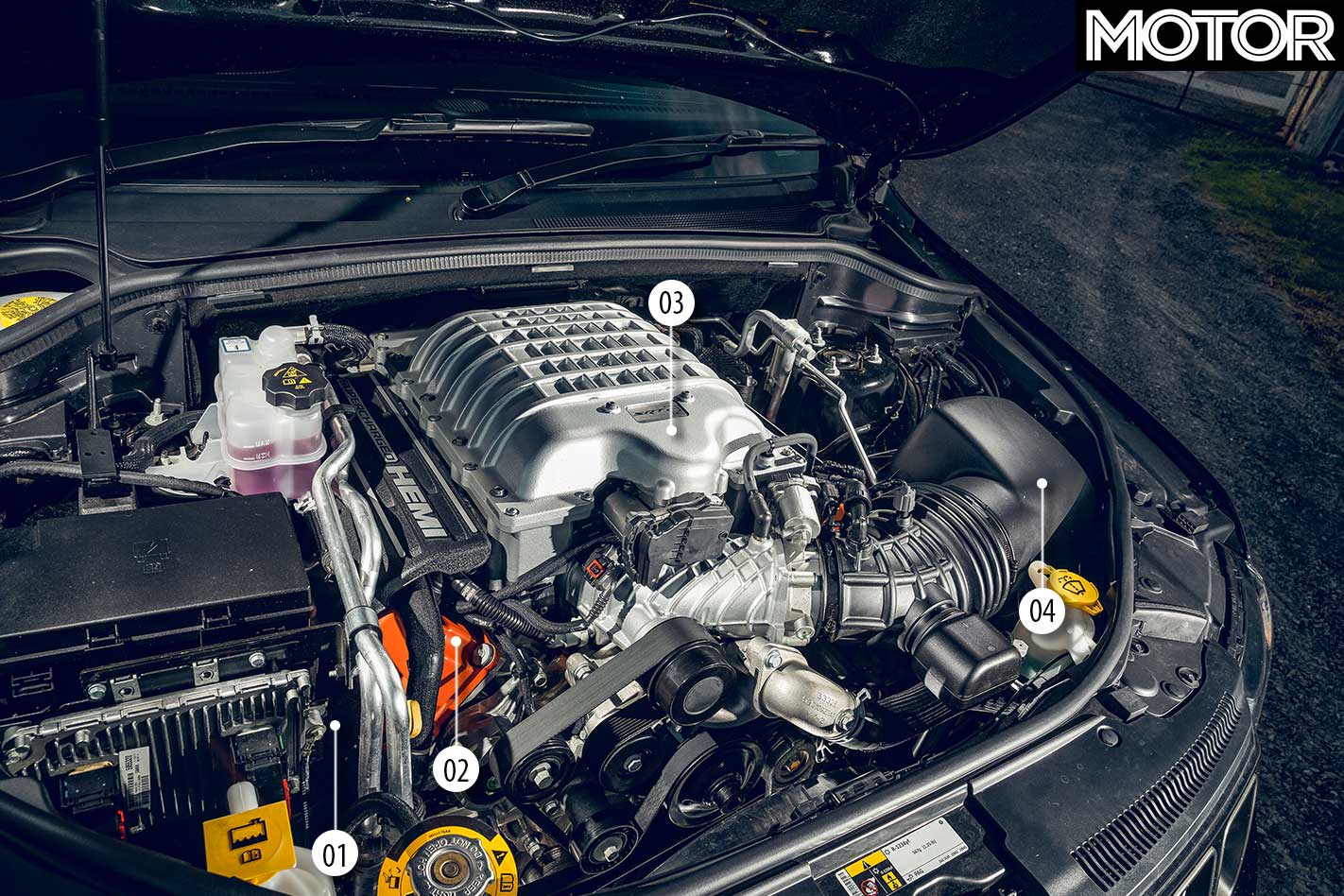
01 – We were told the right-hand drive conversion required little more than a modified steering shaft and new oil pan for the Trackhawk 02 – In old-school hot-rod fashion, the Hellcat’s iron block uses oil squirters in the cylinders, forged steel rods, and deeper water channels 03 – New 6.2-litre is taller than the 6.4-litre, but easily clears the GC’s bonnet. Tighter exhaust manifolds penalise it by 13Nm 04 – That IHI blower pumps 11.6psi into the Hemi’s chambers and is fed by the bumper’s lower right vent. Its charge air is water cooled
THE STRIP
0-10km/h: 0.22sec 0-20km/h: 0.49sec 0-30km/h: 0.74sec 0-40km/h: 1.03sec 0-50km/h: 1.38sec 0-60km/h: 1.65sec 0-70km/h: 2.08sec 0-80km/h: 2.61sec 0-90km/h: 3.14sec 0-100km/h: 3.70sec 0-110km/h: 4.27sec 0-120km/h: 4.90sec 0-130km/h: 5.62sec 0-140km/h: 6.39sec 0-150km/h: 7.47sec 0-160km/h: 8.48sec 0-170km/h: 9.50sec 0-180km/h: 10.56sec
0-400m: 11.80sec @ 188.14km/h 80-120km/h (Drive): 2.29sec 100-0km/h: 37.90m
Speed in Gears 1st: 50km/h @ 6000rpm 2nd: 75km/h @ 6000rpm 3rd: 112km/h @ 6000rpm 4th: 141km/h @ 6000rpm 5th: 183km/h @ 6000rpm 6th: 236km/h @ 6000rpm* 7th: 281km/h @ 6000rpm* 8th: 289km/h @ 4910rpm* *Manufacturer’s claim
Winton Raceway, 14˚C, dry. Driver: Louis Cordony
In South Australia, you can walk where Jack Brabham once raced, swatting away flies and wondering where the hell you’ve just driven yourself to.
A paddock near Port Wakefield, 100km north-west of Adelaide, could be any other as you drive past on the adjacent dirt road, the landscape flat, featureless and so dull, even grass struggles to take up permanent residence. Yet through the low saltbush in this expansive place with its big blue sky and distant horizons, the remnants of Australia’s first bitumen purpose-built car racing circuit can be found.
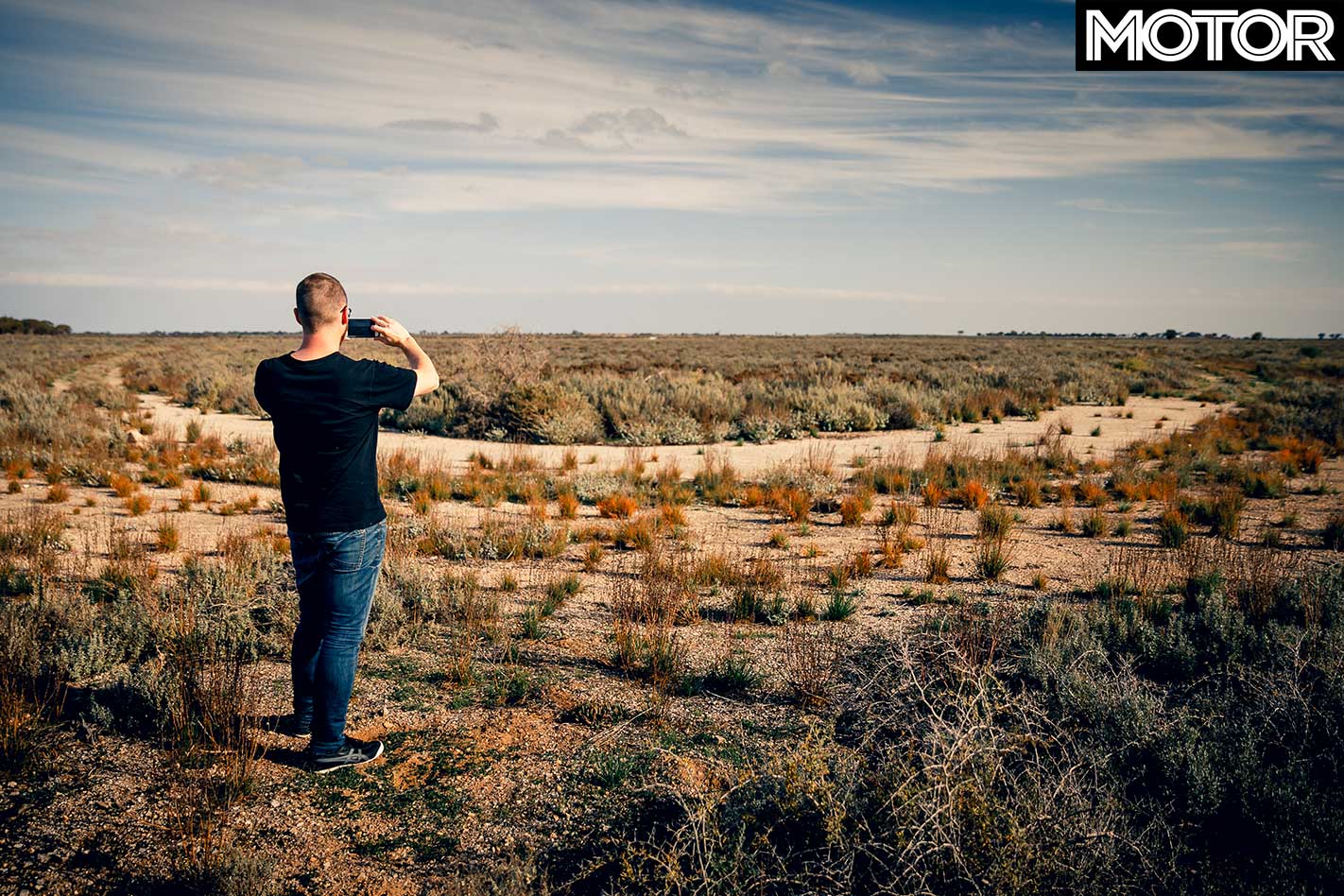
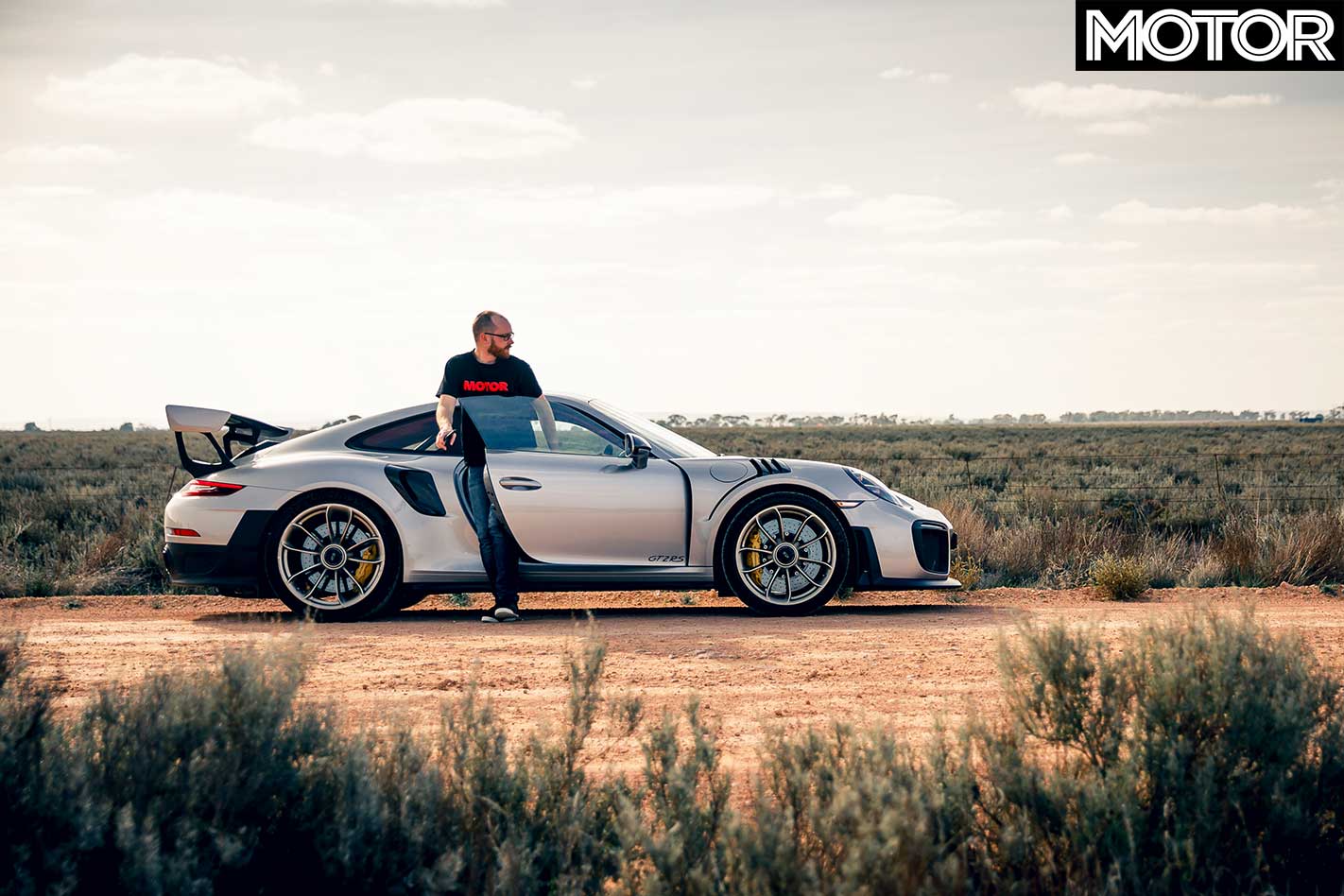
Having stepped over the low fence and walked into the paddock looking for the old 2km-long Port Wakefield grand prix circuit – trespassing, technically, given it’s private property – we find surviving portions of bitumen, slowly receding back into the earth.
In the distance, the road on which we arrived is no longer visible, hidden below the knee-high arid scrub. But poking above it is the distinctive roofline of a 991 Porsche 911, in mercury silver, raking backwards to the most enormous rear wing you’ll ever see on a road car.
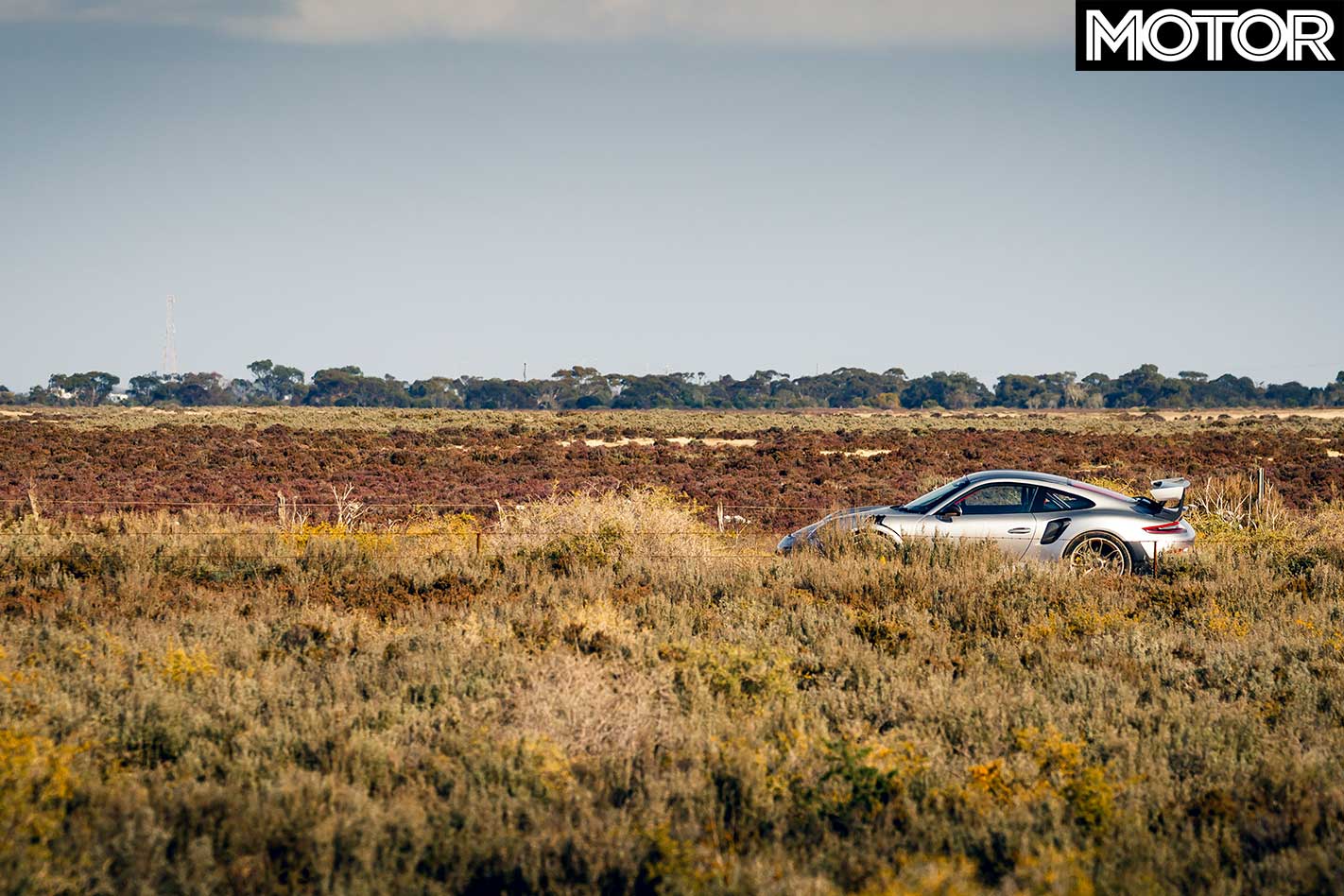
It’s a 911 GT2 RS, and without being able to see the road it’s parked on, it looks like it’s just landed in the middle of the paddock from the sky itself. You couldn’t imagine a stranger place to see the fastest production car in the world, according to Nürburgring lap times anyway.
We’ve driven it here to pay homage to the Australian chapter of Porsche’s history, as we celebrate 70 years since “No 1” hit the public road in Germany. It was in Port Wakefield, in 1952, that Porsche celebrated its first motorsport victory on Australian soil – two 356s finishing one-two in class for the Standing Start Quarter Mile, at the Port Wakefield Speed Trials, held down the road (sort of) at the old military proofing range.
In the hands of Ken Harper and Ken McConville, member and president respectively of the Australian Motor Sports Club, the 356s recorded quarter mile times of 20.9 and 21.0 respectively to take top honours. Of course, very few people had heard of Porsche at the time, and nobody knew that these would be the first of many Australian motorsport victories, including very nearly an Australian Touring Car Championship in 1969.
It was Alan Hamilton, driving a trick 911T/R, that missed out on the ’69 ATCC crown by a single point to ‘Pete’ Geoghegan in his Ford Mustang. It was Alan’s father, Norman Hamilton, that first recognised the potential of the then-unknown Porsche brand (you can read the famous and amusing origin story of Porsche in Australia in MOTOR August 2018).
As well as being only the second official Porsche agent outside Germany, Hamilton convinced Ferry Porsche to build the first two right-hand drive models, which became the first two Porsches to arrive in Australia, a Fish Silver 356 Cabriolet and a Maroon 356 Coupe. Unveiled at a cocktail party at Albert Park on November 1, 1951, it was these two cars that Harper and McConville raced at Port Wakefield in 1952.
To find these old, happy hunting grounds, we set off from Australia’s newest racing circuit, The Bend Motorsport Park. Last month you would have read how the 911 GT2 RS set a scorching first production car lap record (3:24.079) on The Bend’s epic, 35-corner, 7.77km configuration.
It won’t be setting any records on its way north to Port Wakefield today, other than perhaps Most Smartphone Photos Taken Of One Car in 24 Hours, as we discover, this being the first GT2 RS in South Australia and causing quite a stir.
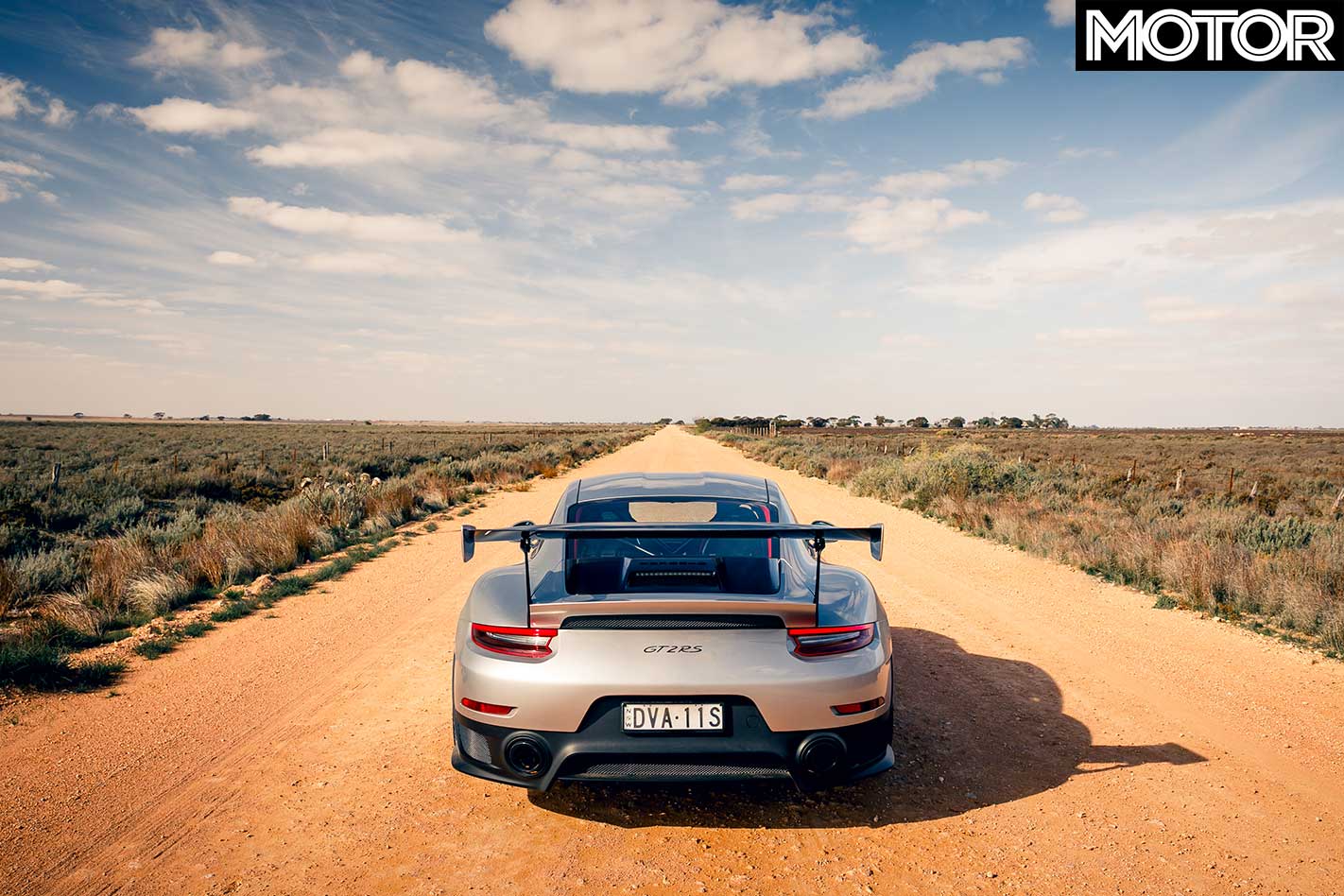
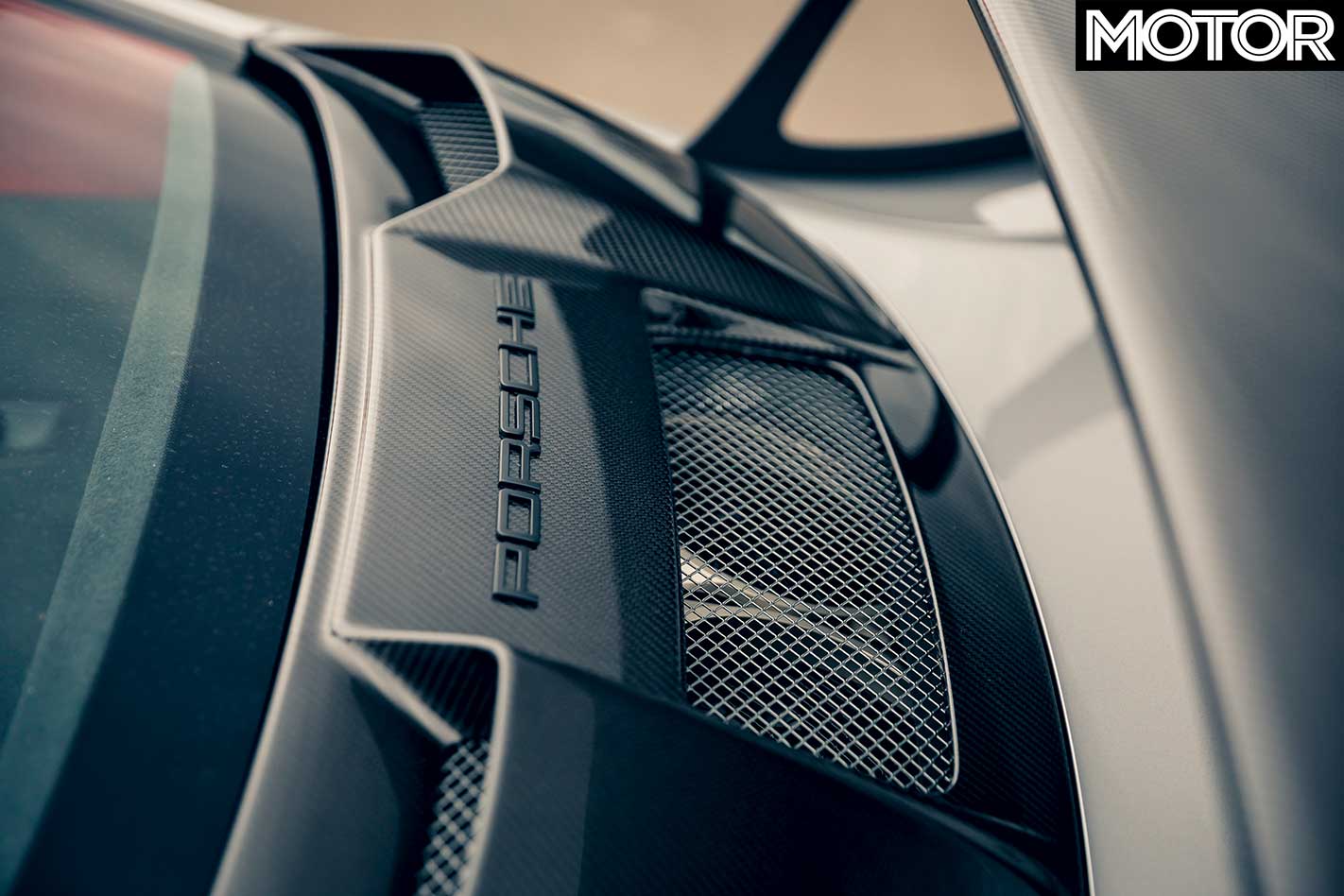
Even in this silver, the GT2 RS is hardly subtle. Wide hips conceal enormous 325mm rear tyres wrapped around low-offset 21-inch wheels, that enormous rear wing towers as if stolen off a 911 RSR racer, the front lip juts aggressively outwards, while gill-like carbon-fibre vents on the front guards and NACA ducts on the bonnet hit the GT2 RS’s intent home.
Peeking inside reveals a wicked interior, red Alcantara stretching up the inside of the A-pillars to the ceiling as if specced by Lucifer himself.
The GT2 RS interior is otherwise standard 991 fare, red and black Alcantara thrown around with diabolical abandon. There’s a more road-friendly seat belt harness (compared to the race-ready, FIA-tagged offering of a GT3), yet an extinguisher still takes up residence in the passenger footwell, a cage scaffolds itself through where the rear ‘seats’ would normally be, the rear wing visible in the rear vision mirror over the top of the cage’s central ‘X’-brace. The speedometer reads to 400km/h. Just sitting in the GT2 RS is something special.
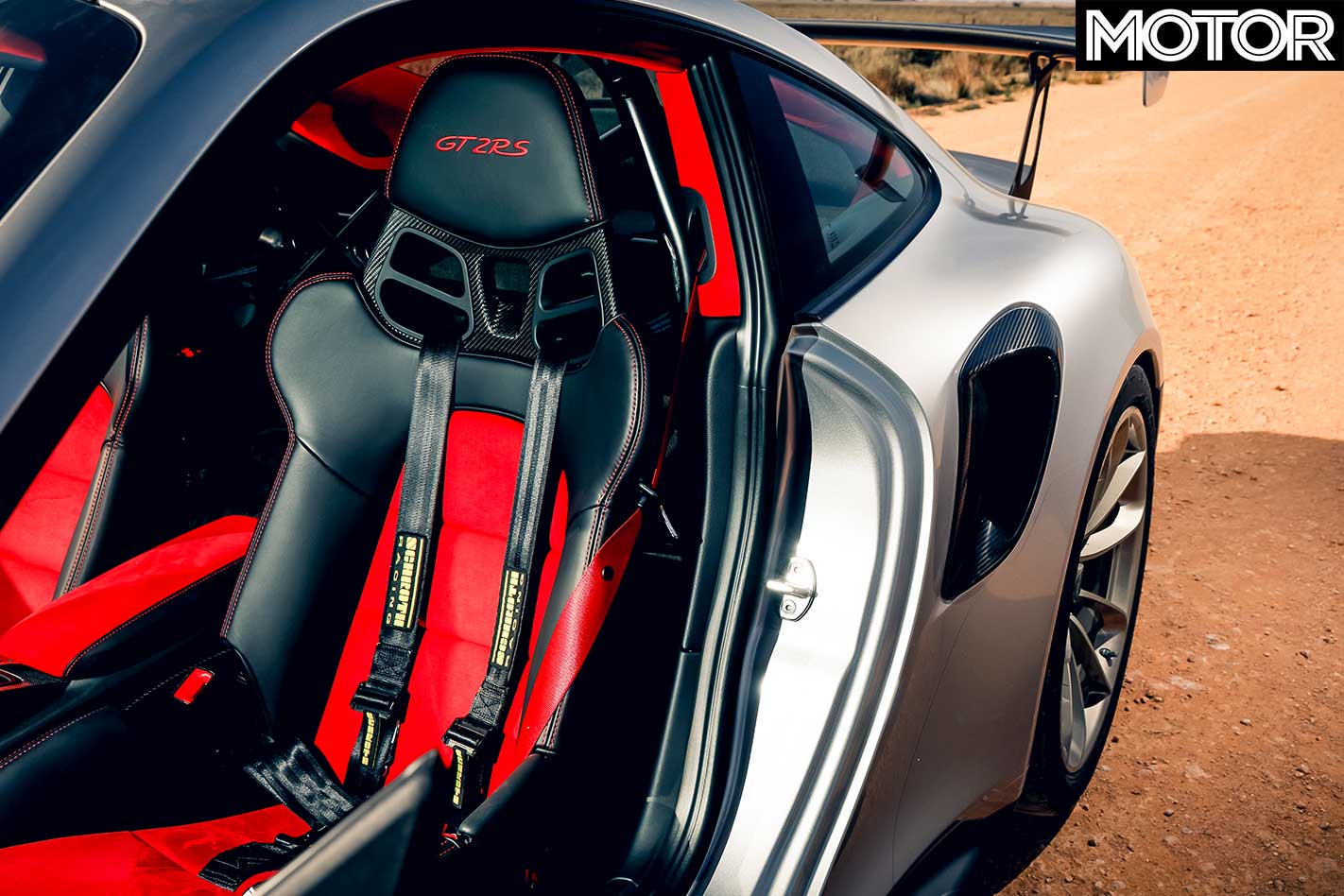
Having inserted the chunky keyfob and turned it, like a key, the GT2 RS idles, impatiently, in a way that might remind some of heavily modified RB26-powered GT-Rs or 2JZ Supras. Very loud, deep and with the occasional miss in the idle, it’s distinct.
With the intercooler spray tank empty from a Mr W. Luff’s exploits the day before, Supercheap Auto is our first destination to find some distilled water. It’s impossible, it turns out, yet we are papped by yet another smartphone by Tim, digitally distributing his spy shot, like a Stasi agent, to the tight-knit community of South Australian car nuts.
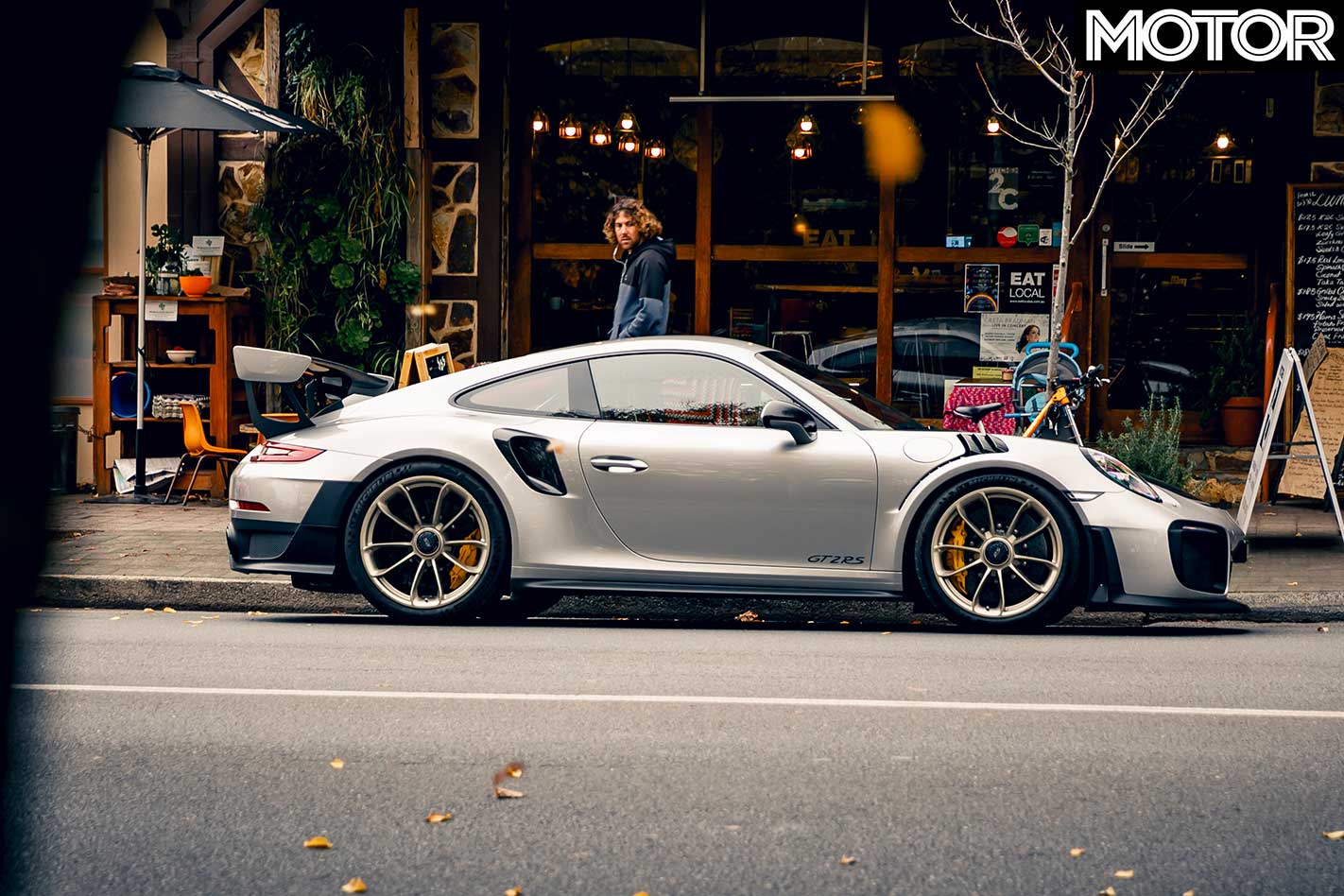
Just like that, we feel like we’re being watched. And it turns out Tim can recommend us a few roads – Gorge, Chain of Ponds and North East, in fact. Detour to Port Wakefield? Of course.
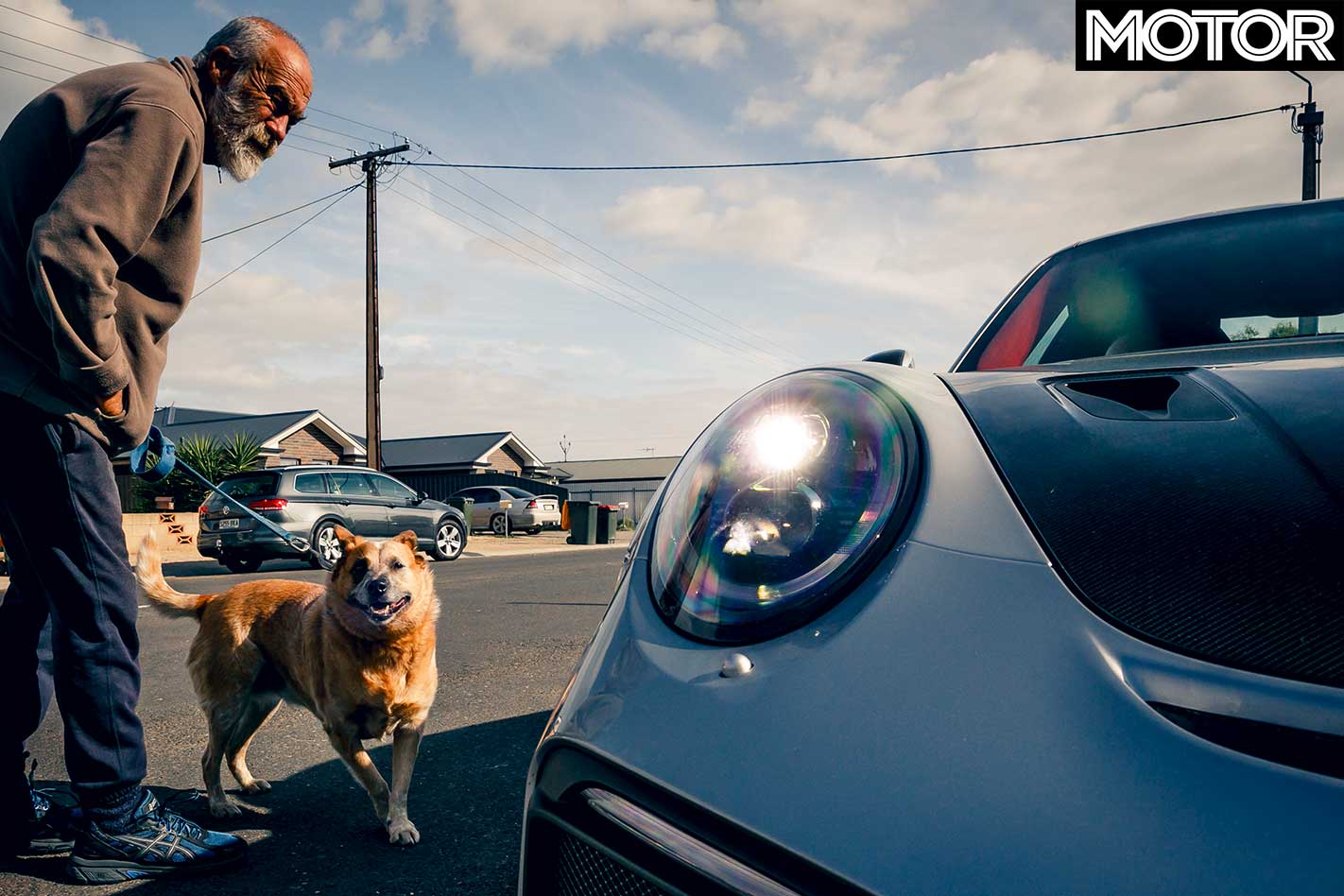
Having passed through the charmingly Germanic Hahndorf in our Teutonic Terroriser, a small moustachioed old man approaches. “How much?” Seems to be the most common bystander question of the day. We tell him the figure. He is quiet; his eyebrows raise. And just when we thought this bloke was normal, he goes full South Australian on us.
“It’s horny,” he grins, eyes wide. I grab the photographer and almost launch-control out of there.
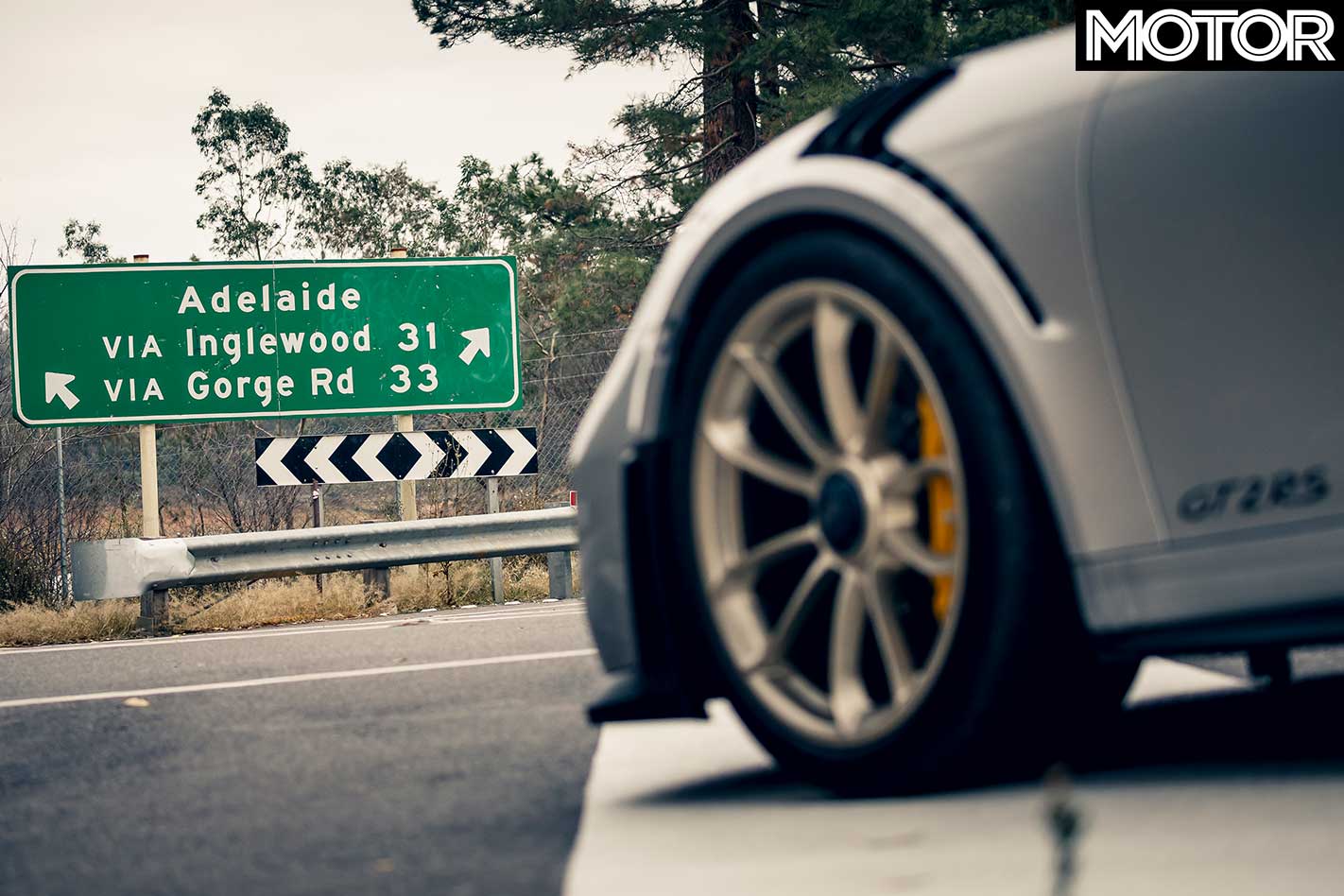
The twisty roads beckon. As we find ourselves in the Adelaide Hills in Porsche’s bellowing, loud, technical-sounding 515kW beast, we begin to explore the GT2 RS itself. First lesson – warm the tyres and the brakes because when cold, the GT2 RS feels to be at a quarter of its ability, the cold front tyres chattering as the front pushes easily, the enormous carbon-ceramic brakes feeling wooden, about a quarter throttle all that’s usable as those big, grumpy rear Michelin Pilot Sport Cup 2s slip and slide around. But already we’ve noticed one thing: the power.
Even warming up on part throttle, the GT2 RS is charging at an enormous clip. There’s a foreboding sense that all the power in the world is about to be unleashed.
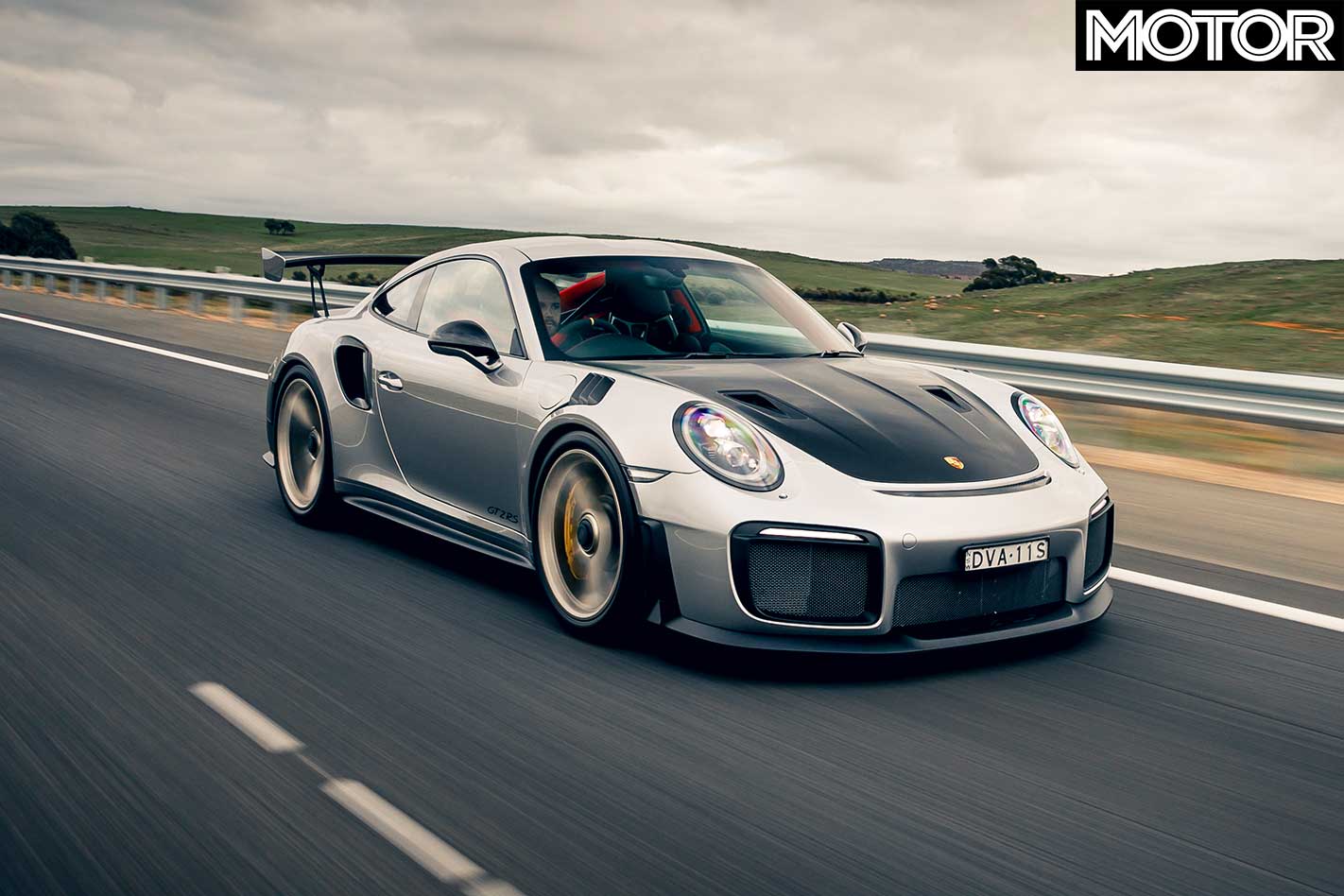
Full throttle in the GT2 RS is something that will never leave you, and not just because you feel like you’re getting about 100kW more than you thought to brace yourself for. It picks you up from low in the revs and hurls you forward with a turbocharged wallop of low-down torque, into a rushing, scenery warping, power-rich top-end as potent as any narcotic.
I’ve never felt a car accelerate harder from 2000rpm. Even in the driver’s seat, you feel 10 per cent passenger the first few times you experience the full accelerative might of the GT2 RS.
But just as remarkable as the power is how in control you always feel. The way you can mete out what feel like individual kilowatts via the throttle pedal is astonishing, particularly for such a heavily turbocharged engine. And really hits home that the difference between scary power and fun power is control.
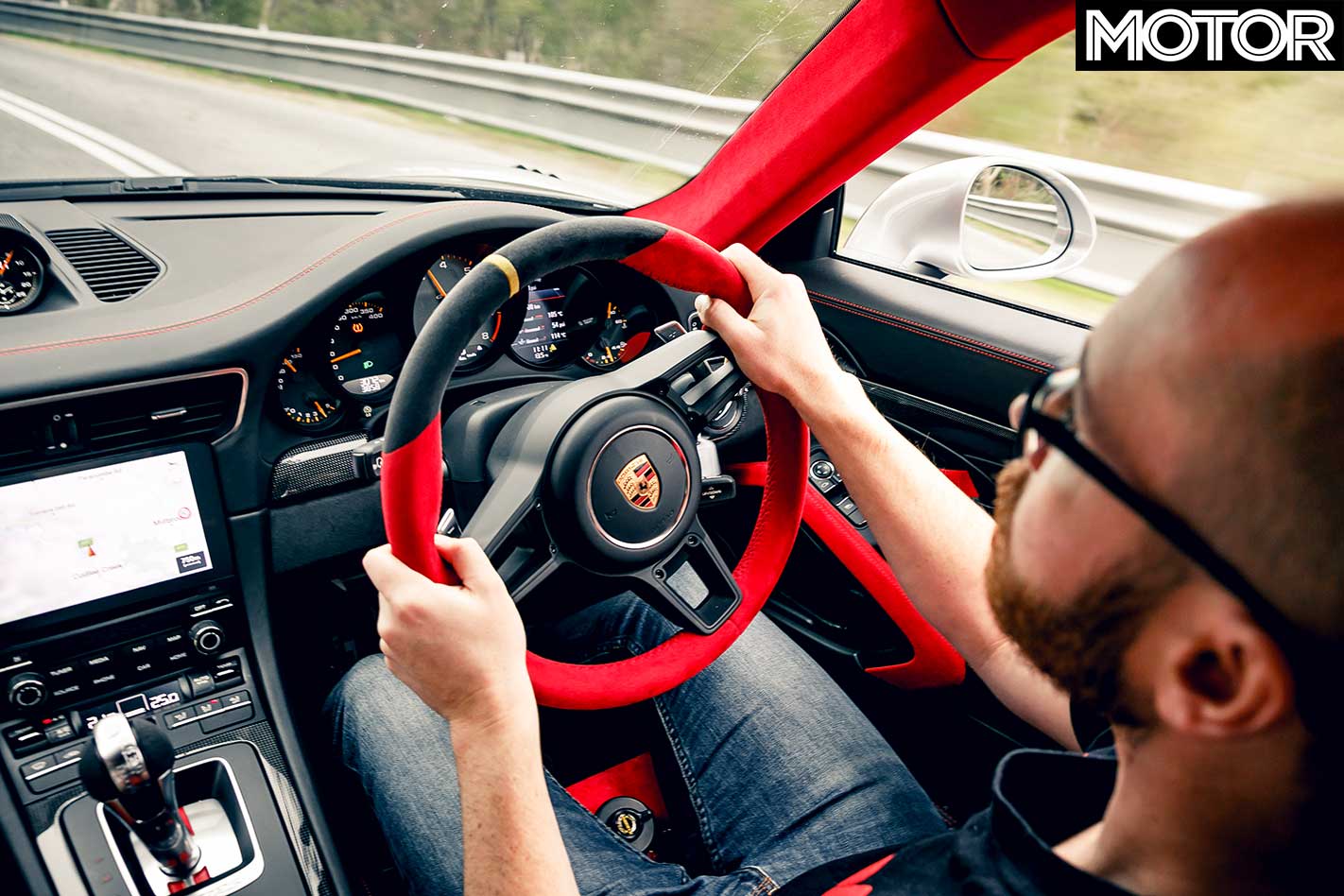
At any given moment, you feel intimately across how much traction you’re using of those rear tyres. And of traction, there is a surprising amount, with the sensation of it increasing as the car squats hard, owing to the physics of its rear-engine layout.
Yet even the inherently strong 911 purchase stands no chance against 515kW and your right foot. Squeeze in just a little bit too much throttle and the GT2 RS squirrels with wheelspin as it charges like a scalded dog down the road.
The limit of traction is so disproportionately accessible compared to the other limits of the GT2 RS. Maximum lateral grip, once the tyres are warm, is track-only stuff, unless you take your brain out.
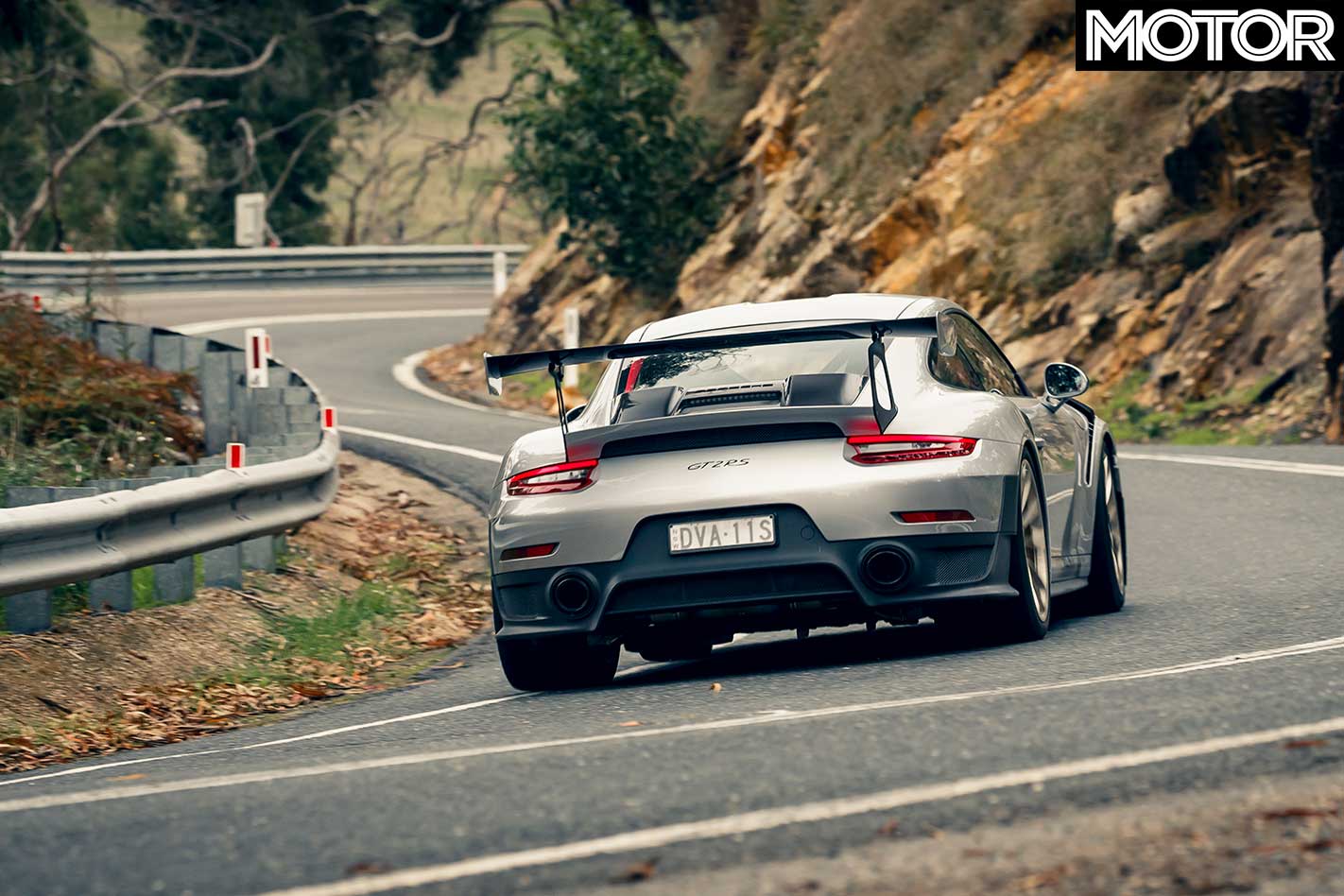
The brakes are seemingly as powerful as the engine; your physical ability to withstand G-forces becomes as limiting a factor as grip itself. This is a car that shrinks around you, like all other 991 911s, yet you are going so much faster, it demands maximum concentration.
While the power is the most remarkable thing about the GT2 RS, it distracts from the brilliance everywhere else in the car. The handling is sublime, the PDK ultra responsive and making the old manual of the 997 GT2 RS nothing but a memory. Unlike the GT3, a manual wouldn’t work in the 991.2 GT2 RS. It’s just way too fast.
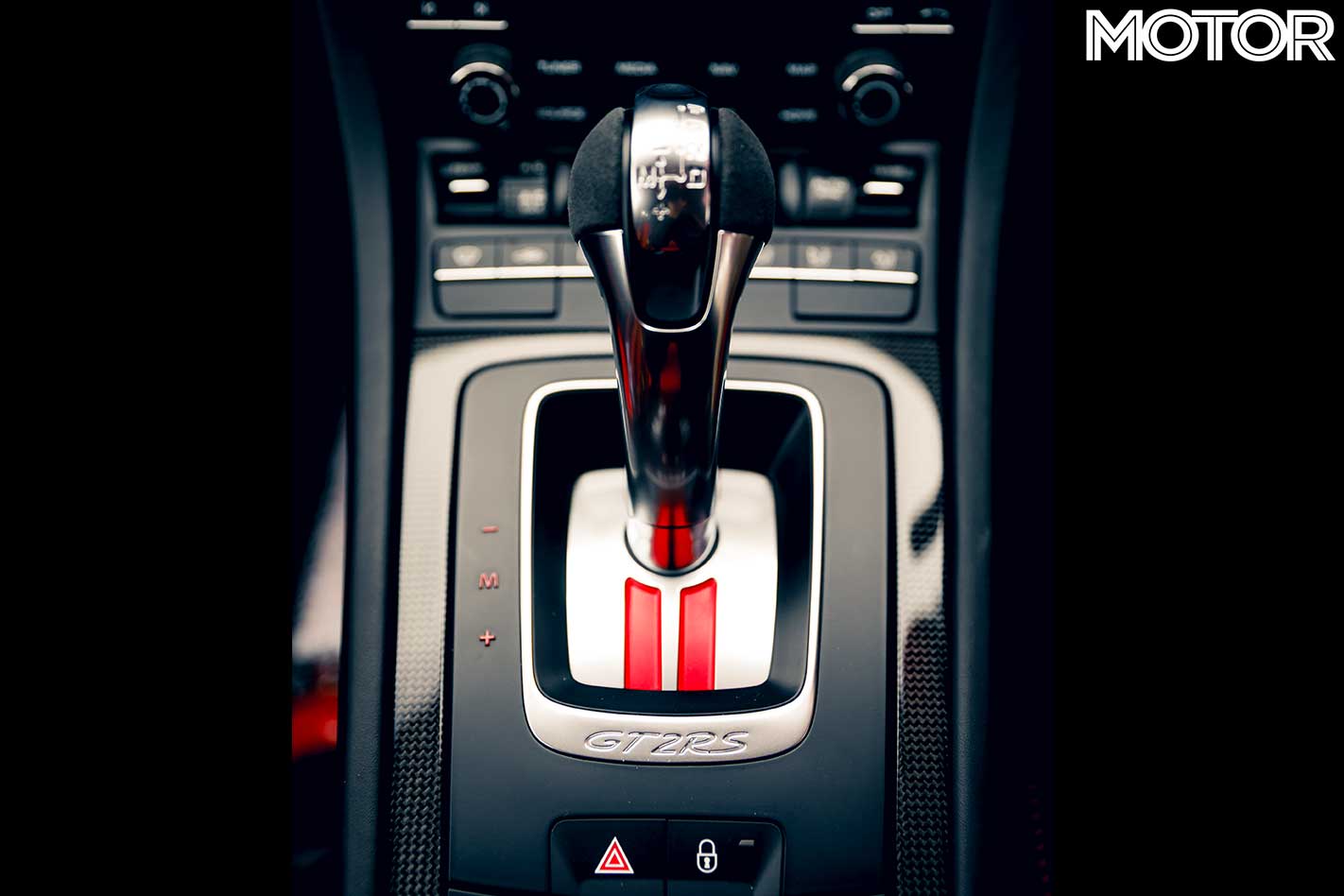
This would also be a terrifying car with the electronics off. It would be here you’d find the old “widow maker” DNA. In the PSM Sport setting, enough power oversteer is permitted on corner exit, with so little throttle, even with the tyres up to temperature, that you would think at least four times about deactivating the ESP or traction control. And even then, you wouldn’t blame Porsche for programming in a “are you sure?” prompt as a final step.
Predictably, you do find yourself questioning the wisdom of Porsche removing the all-wheel drive system, yet while the GT2 RS would be undoubtedly even faster, it would be less exciting and possibly less appealing. Danger and fear, it seems, is part of the GT2 RS allure.
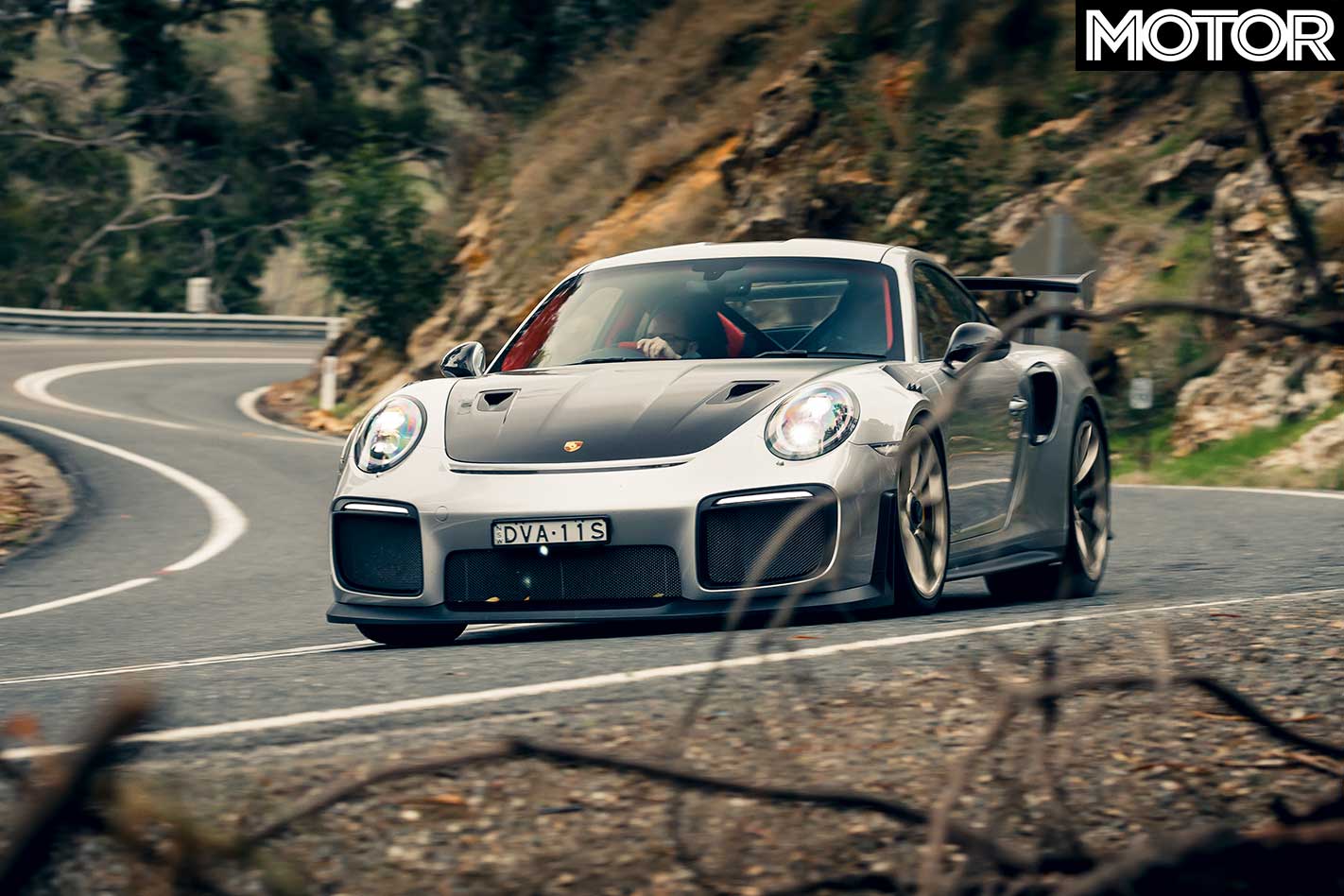
After unboxing the GT2 RS on the roads in Adelaide’s Hills, as much as I dared anyway, and coming down from the drug that is its power, I noticed I had no clue what the GT2 RS is like at its highest engine speeds.
In complete contrast to a GT3, there is so much performance available below 5000rpm that you never really feel robbed of revs like you might in, say, a Ferrari 488. Not even for the noise, either – the GT2 RS sounds awesome at all engine speeds, a thrummy, brooding, almost warbly, bassy blare.
There’s burbling on the overrun and a little bit of blow-off valve if you go looking for it, although interestingly it’s devoid of the excessive under-load turbo hissing of a 720S or a 488.
As we drudge up the Princes Highway towards Port Wakefield, the GT2 RS, at normal speeds, stuns again at how easy it is to drive. Visibility is good, the ride is okay, the tyres are noisy but tolerable.
Curiously, even at 110km/h in 19 degrees ambient, the water temp sits at 114 degrees (well within its normal range). Explains somewhat the huge apertures of the front bar, which push the aesthetic limits, required to feed the enormous radiators dispelling probably another thousand kilowatts of energy.
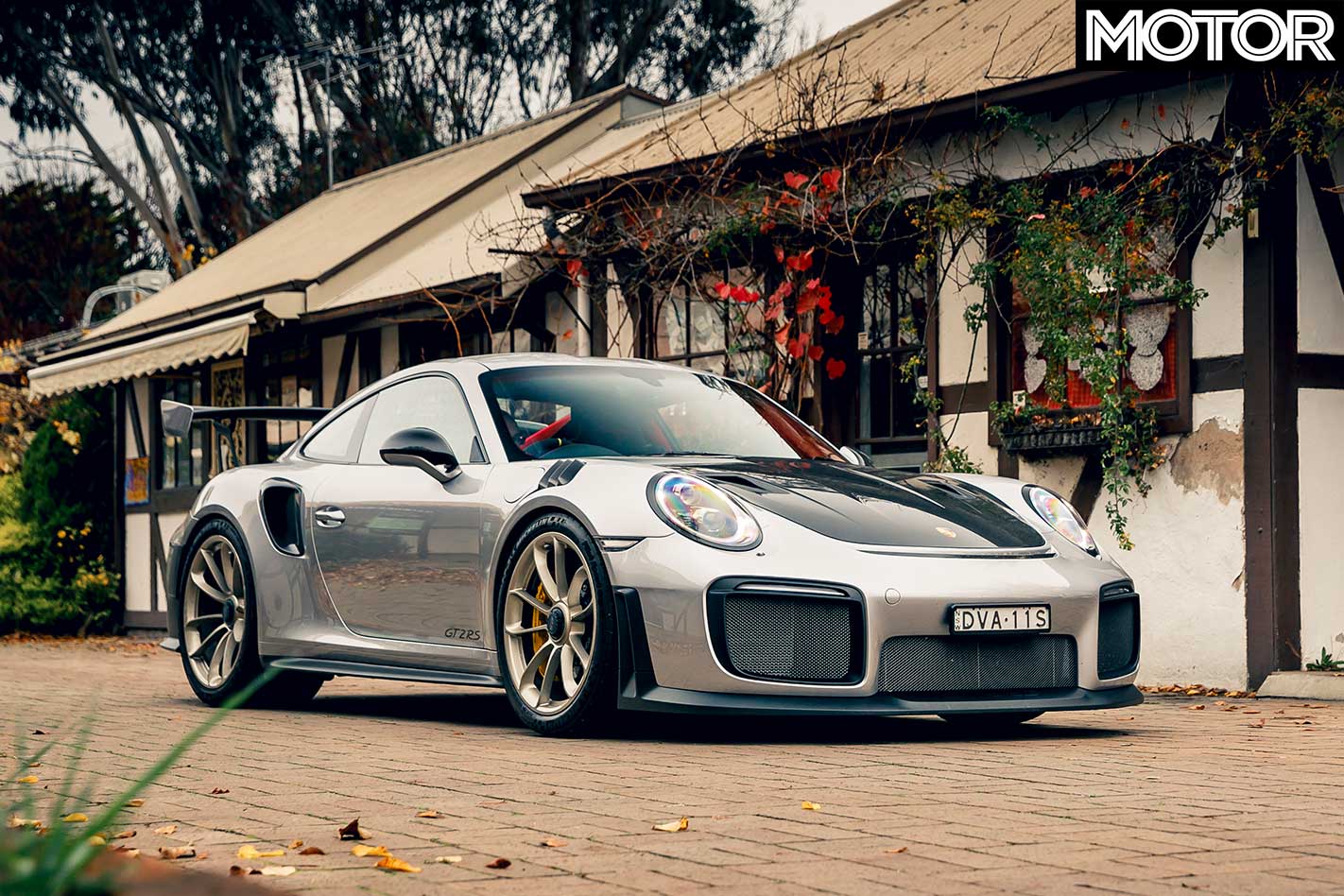
It turns out the GT2 RS is not merely a rear-drive 911 Turbo with a big wing, sticky tyres and the boost turned up. Its engine represents a new level of turbocharged performance. Unlike other new-age turbo supercars that seem engineered to imitate the linear power delivery of a naturally aspirated engine, the GT2 RS owns its turbocharged-ness with truly breathtaking mid-range punch and a level of response and throttle precision we’ve never felt from a turbo engine before.
We roll into dusty Port Wakefield, amongst the road trains, wondering what it must have felt like arriving here 66 years ago in a 356. As we turn off in search of the old Port Wakefield circuit, people stare at the GT2 RS with the most confused looks on their faces – and we needn’t wonder a moment longer.
FAST FACTS 2018 Porsche 991.2 911 GT2 RS
BODY: 2-door, 2-seat coupe DRIVE: rear-wheel ENGINE: 3800cc flat-six, DOHC, 24v, twin-turbocharged POWER: 515kW @ 7000rpm TORQUE: 750Nm @ 2500-4500rpm BORE/STROKE: 102.0mm x 77.5mm COMPRESSION RATIO: 9.0:1 WEIGHT: 1470kg POWER-TO-WEIGHT: 350kW/tonne TRANSMISSION: 7-speed dual-clutch automatic SUSPENSION: MacPherson struts, coil springs, adaptive dampers, anti-roll bar (f); multi-links, coil springs, adaptive dampers, anti-roll bar (r) L/W/H: 4549/1978/1297mm WHEELBASE: 2453mm TRACKS: 1588mm (f); 1557mm (r) STEERING: electrically-assisted rack-and-pinion BRAKES: 410mm carbon cermic discs, 6-piston calipers (f); 390mm carbon ceramic discs, 4-piston calipers (r) WHEELS: 20.0 x 9.5-inch (f); 21.0 x 12.5-inch (r) TYRES: Michelin Pilot Sport Cup 2, 265/35 ZR20 (f); 325/30 ZR21 (r) PRICE: $670,970 (as-tested)
PROS: Epic potency, yet very controllable; noise; everything CONS: Silly price for a track day toy, buy a Cup car RATING: 5 out of 5 stars
Port Wakefield Circuit Timeline
1951 – Road Racing Banned in SA String of fatalities & incidents puts stop to traditional road racing; circuit needed
1953 – Track Opens January 1 Australia’s first purpose-built bitumen car racing track opens its gates, 6 turns/2.0km
1955 – Australian Grand Prix Oct 10, Jack Brabham wins 80-lapper in his Cooper T40 Bristol. Car still races today
1961 – Dumped April 3, deemed inadequate for 1961 AGP; infrastructure pinched to hastily build Mallala
1961 – Last-Ever Races May 14, historic final meeting organised by Austin 7 Club of South Australia
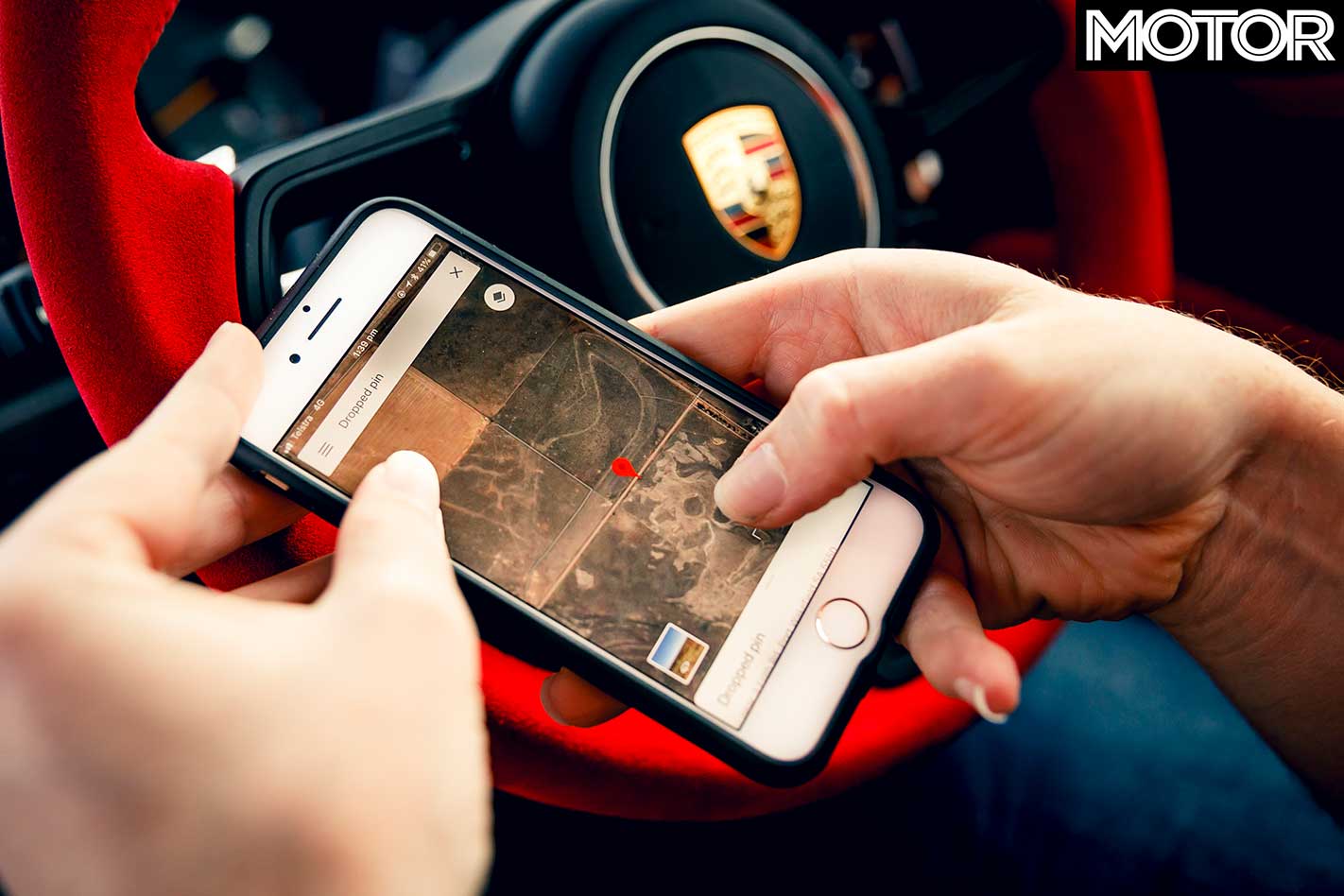
2018 – What’s Left Just a few patches of original bitumen, although outline still visible on Google Maps
Must Drive: Gorge Road, SA
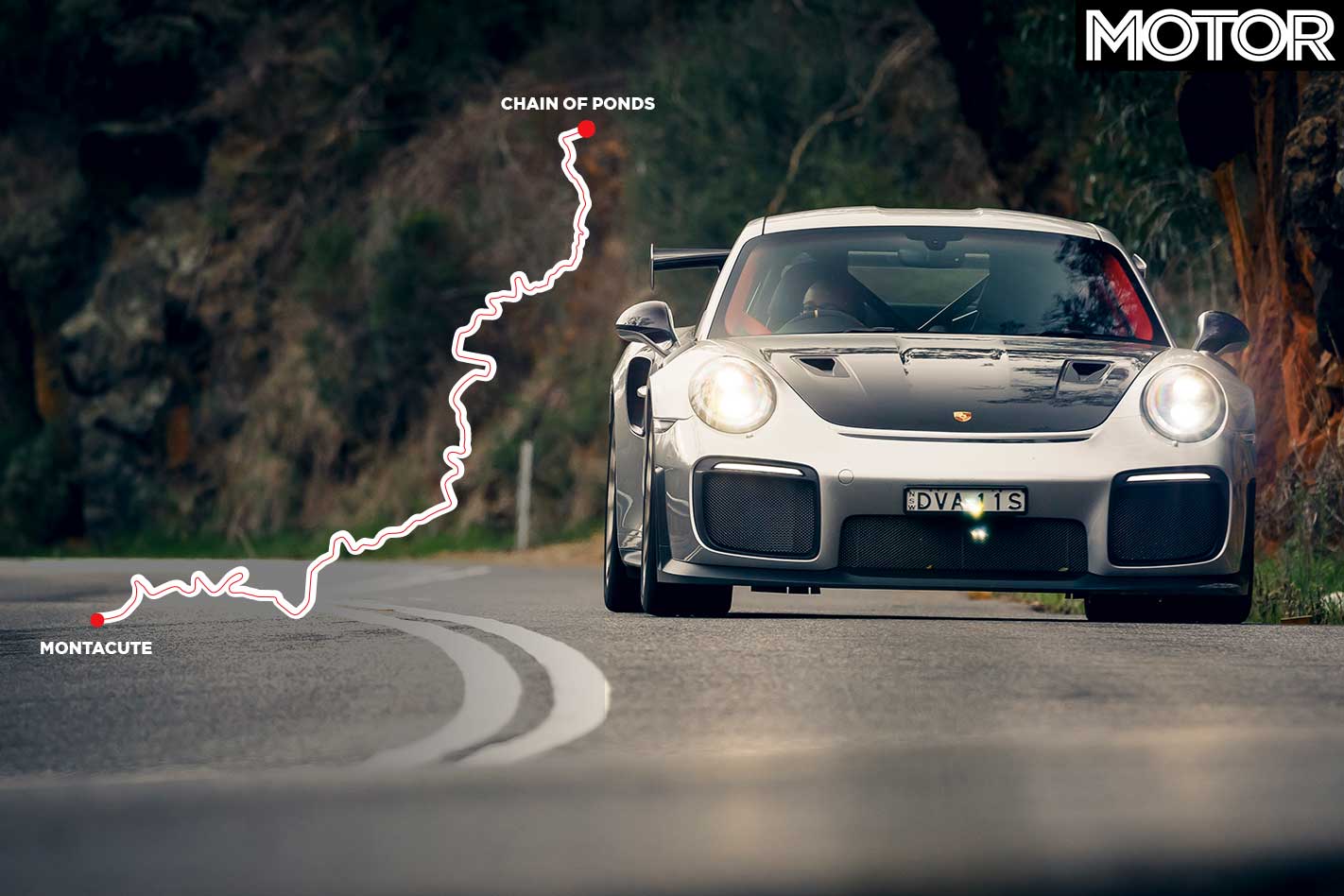
Some of the best driving roads in Australia are in the Adelaide Hills, starting just 20 minutes from the City of Churches CBD, and having played host to some epic tarmac rally stoushes over the years as the battleground of Classic Adelaide, now the Adelaide Rally. To explore the Adelaide Hills in a fast car is bliss, the area dotted with charming old towns and, of course, fantastic roads.
One of them is this one, Gorge Road, 17.7km of sometimes tight, narrow yet grippy bitumen, flanked by the occasional rockface and with some pretty unique scenery. At 80km/h and heavily policed, especially on weekends, take it easy. Beware the blind crests if coming from Chain of Ponds.
