
Engineers at Subaru’s secretive tuning arm, STi, have a new mission in life.
This review was first published in MOTOR magazine’s April 2006 issue.
No longer satisfied with merely producing high-performance Imprezas for the boy racer and rally set, the group has declared its unabashed intentions of making STi as synonymous with Subaru performance as AMG is to Mercedes-Benz, or the M Haus is to BMW.
The news was delivered at the launch of the latest addition to STi’s growing stable, the stove-hot S204. Only 600 sedans will be built, and it’s only likely to be seen in Oz as a private import.
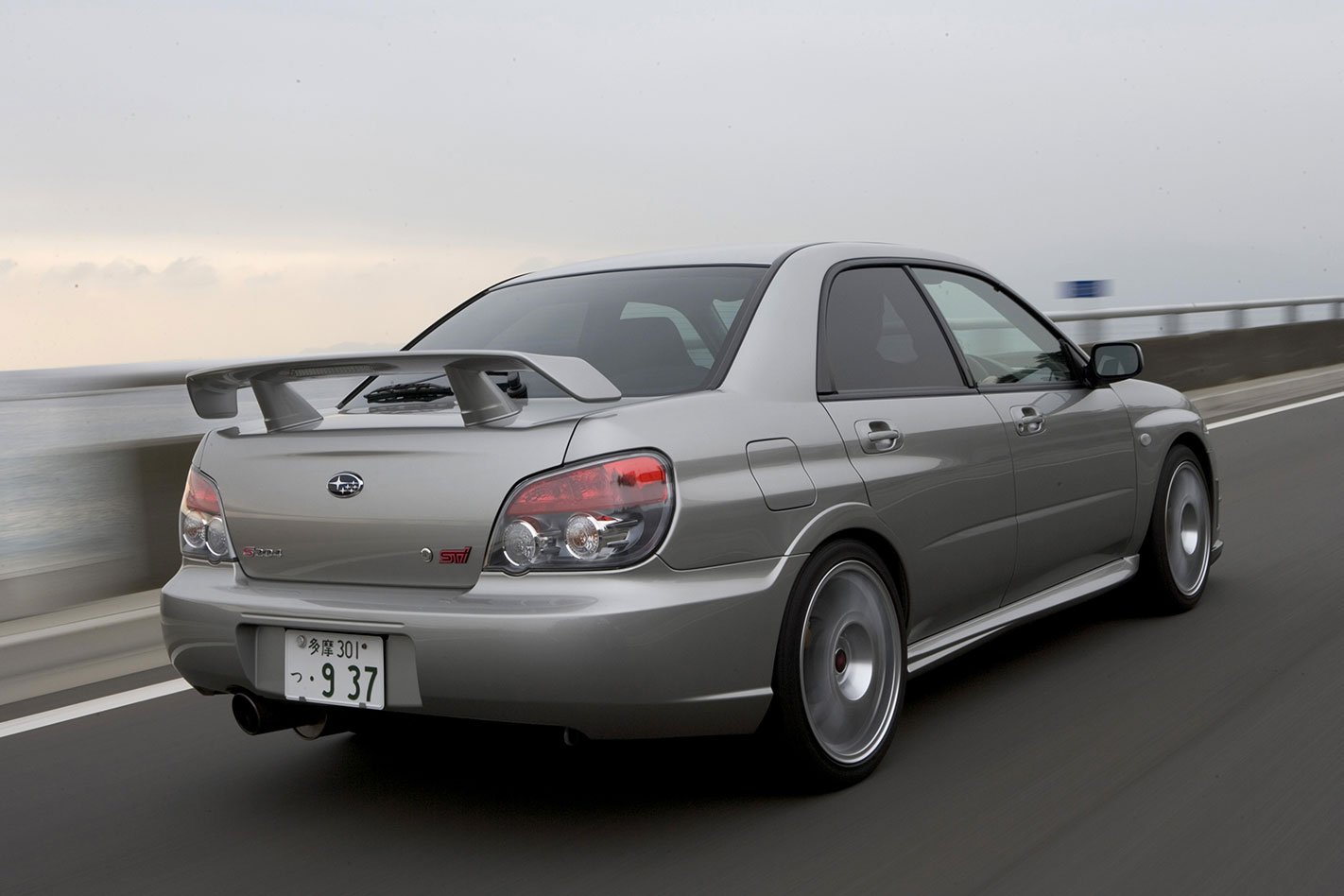
The 0-100km/h sprint is expected to take around 4.5 seconds, and its top speed is given as 250km/h.
From 3000rpm, heartier, heftier mid-range torque means the driver can make far better use of third gear, particularly in long corners, and still have plenty on tap for lightning-fast exits. Push it beyond 6000rpm, and the retuned exhaust note invades the cabin as it takes on a primeval howl. The solid six-speed gearbox has short, responsive throws that reward a smooth hand.
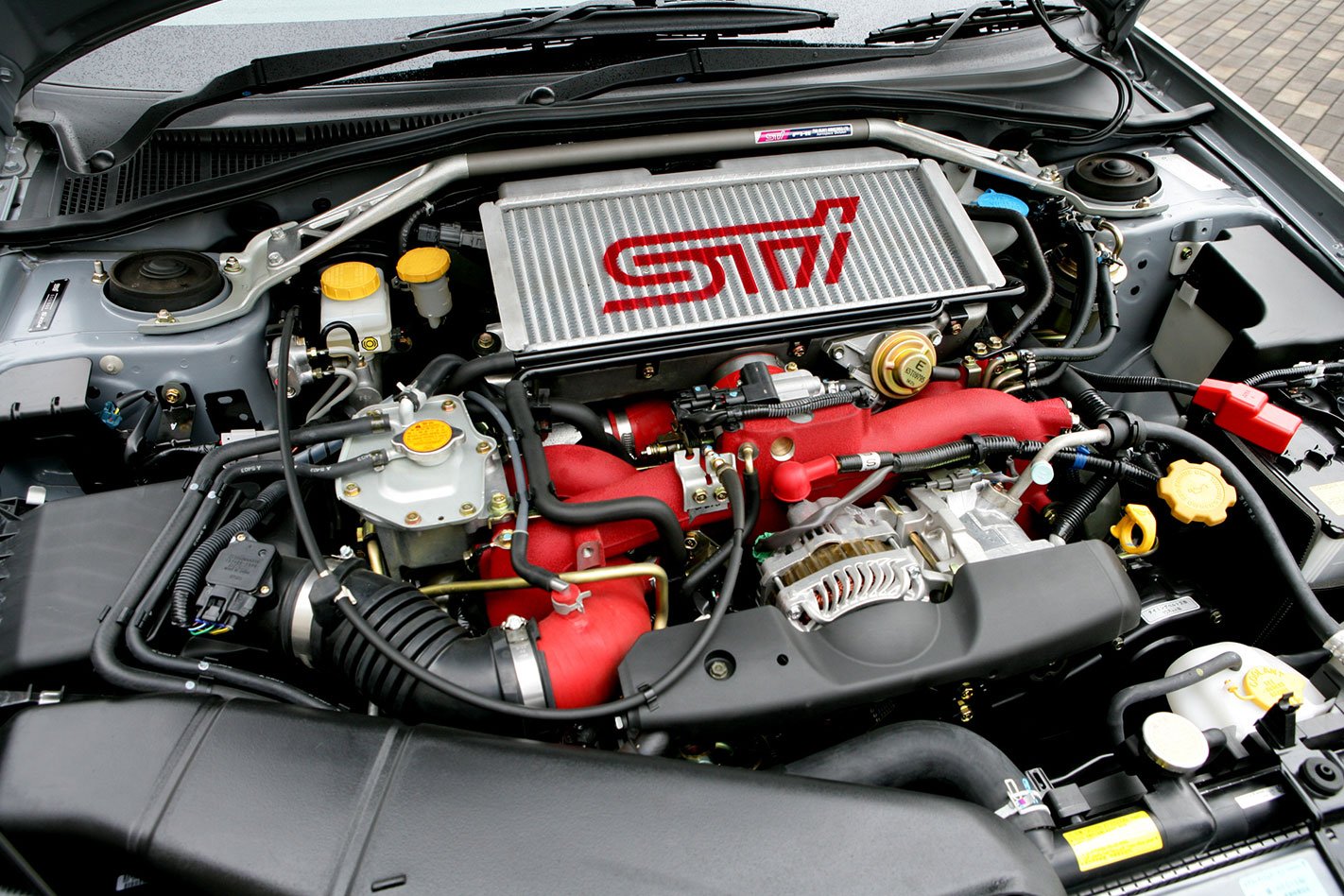
However, there are absolutely no complaints at all about the handling. The newcomer scores a stronger chassis, vastly improved roll rigidity and revised suspension. But it’s the innovative step of fitting what STi calls ‘performance dampers’ to the body structure between the rear strut towers, and between the rearward bushings on the lower control arms at the front, that makes the difference.
Looking for all the world like a regulation rear strut tower brace, a closer look reveals a small hydraulic damper built into the central brace. While a stiffened chassis pays dividends when it comes to making your trick dampers and springs work to the best of their abilities, too much body stiffness can be a bad thing, especially right at the limit.
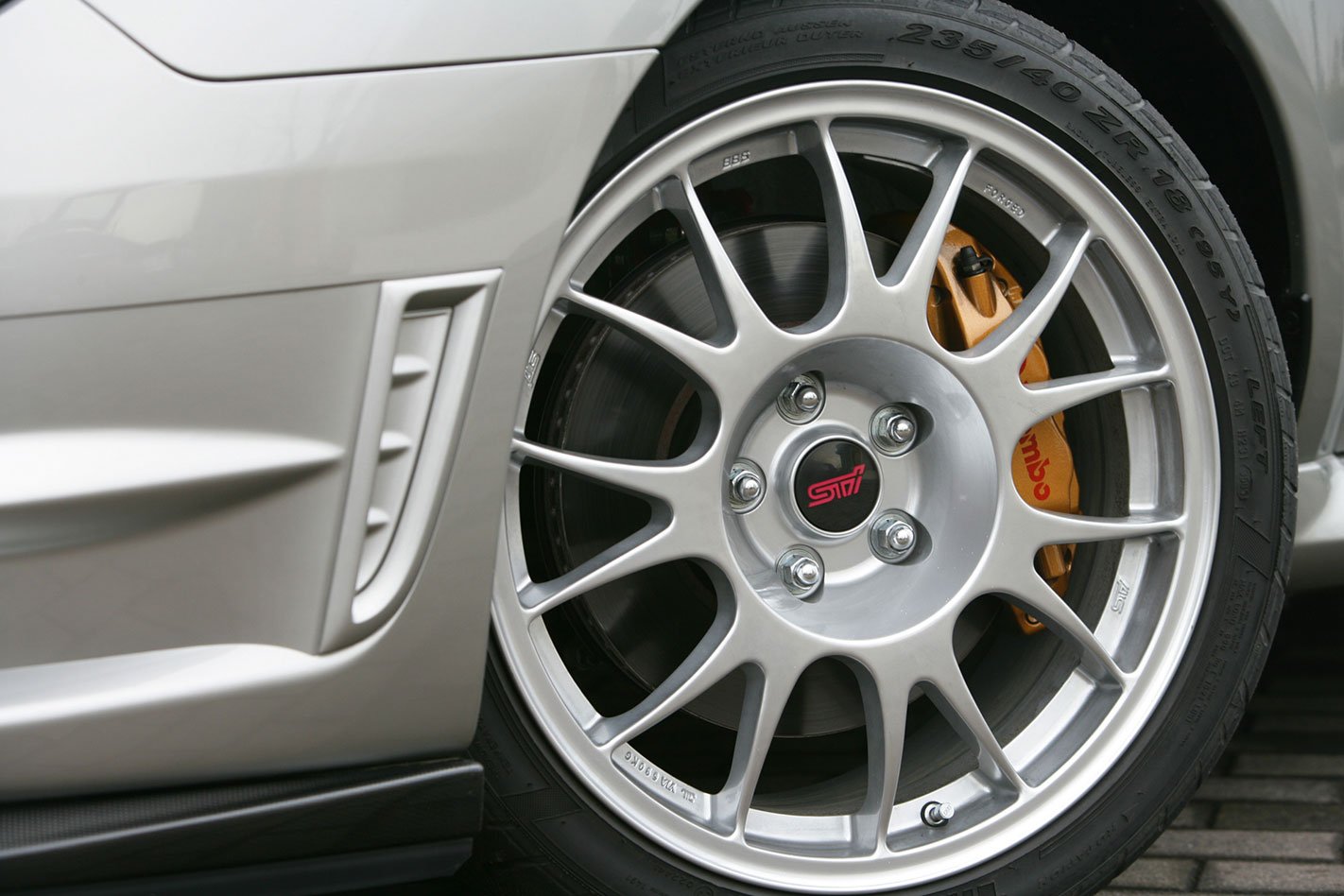
The dampers are more than a one-trick pony; how can a flexible strut brace aid ride AND handling AND dial out understeer? It’s without doubt the best-handling STi so far, helped partly by the grippy tyres, which combine effortlessly with chunky four-piston Brembo brake calipers up front and two-potters out back. But before you leap onto the internet to Google up a pair of Performance Damper braces for your new Rex, you’re out of luck; it’s a S204-specific item only for the foreseeable future. But these parts usually make their way into the STi Sports Parts catalogue.
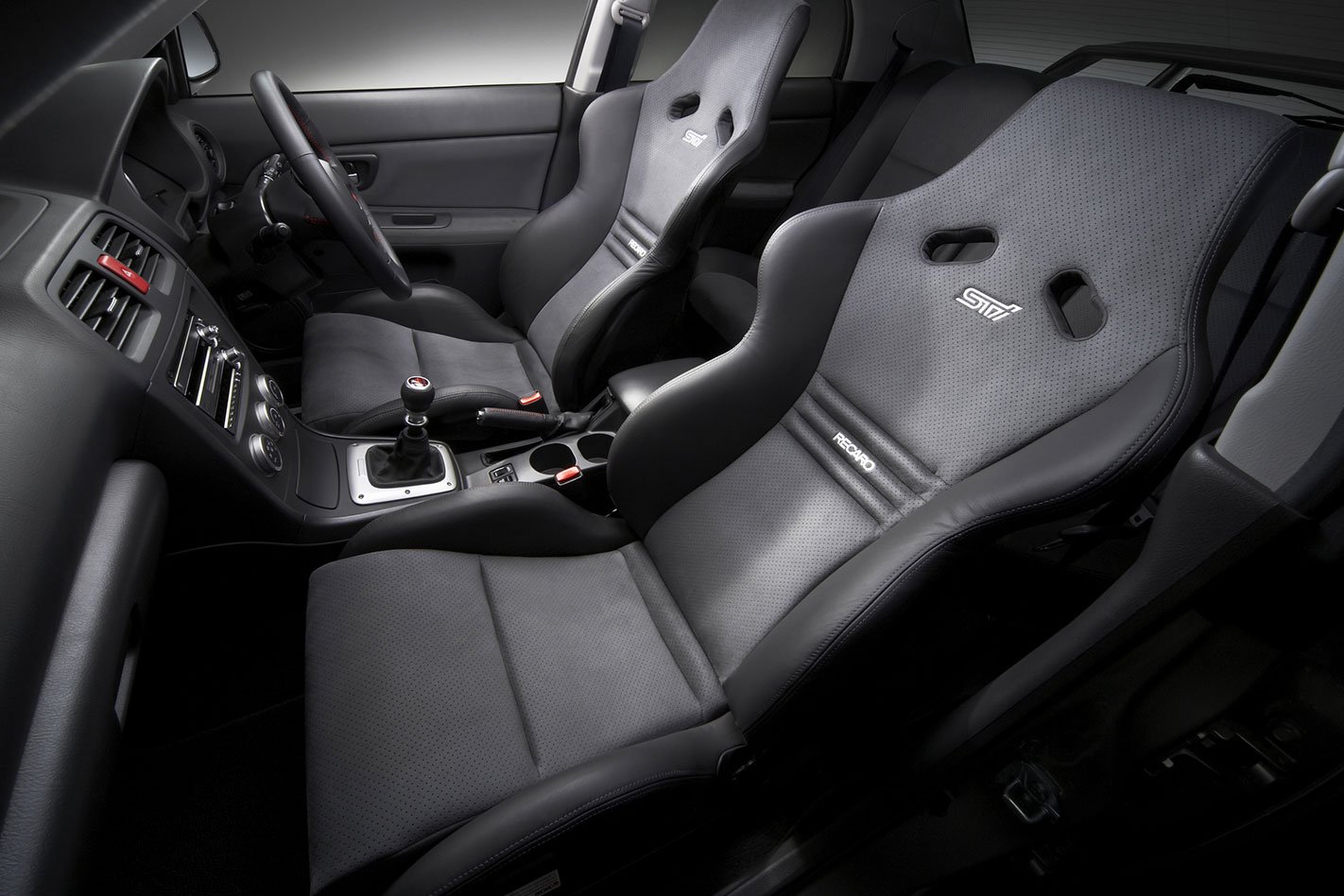
As for the exterior, lose the rear wing, S204 badge and the very hot 18-inch BBS alloys, and its secret STi base identity would be revealed for all to see. Yet while work is needed on the aesthetics, nothing comes close, at this price, for sheer performance and cornering potential.
Has STi built a car worthy of tackling the Germans head on? No – but damn, it’s close.
Fast Facts – 2006 Subaru Impreza WRX S204 STi
ENGINE: 2.0-litre, DOHC 16-valve turbocharged flat-four POWER/WEIGHT: 240kW/1475kg DRIVE: all-wheel ON SALE: now (Japan only) PRICE: $54,000
Each year, we have to test so many cars that it’s sometimes better to kill two birds with one stone.
Our back-to-back drives help us pick the winner from a set of direct competitors, so we’ve picked the ten best comparisons for the year, in no particular order.
1. Kia Stinger vs Holden Commodore SS-V Redline – December 2017
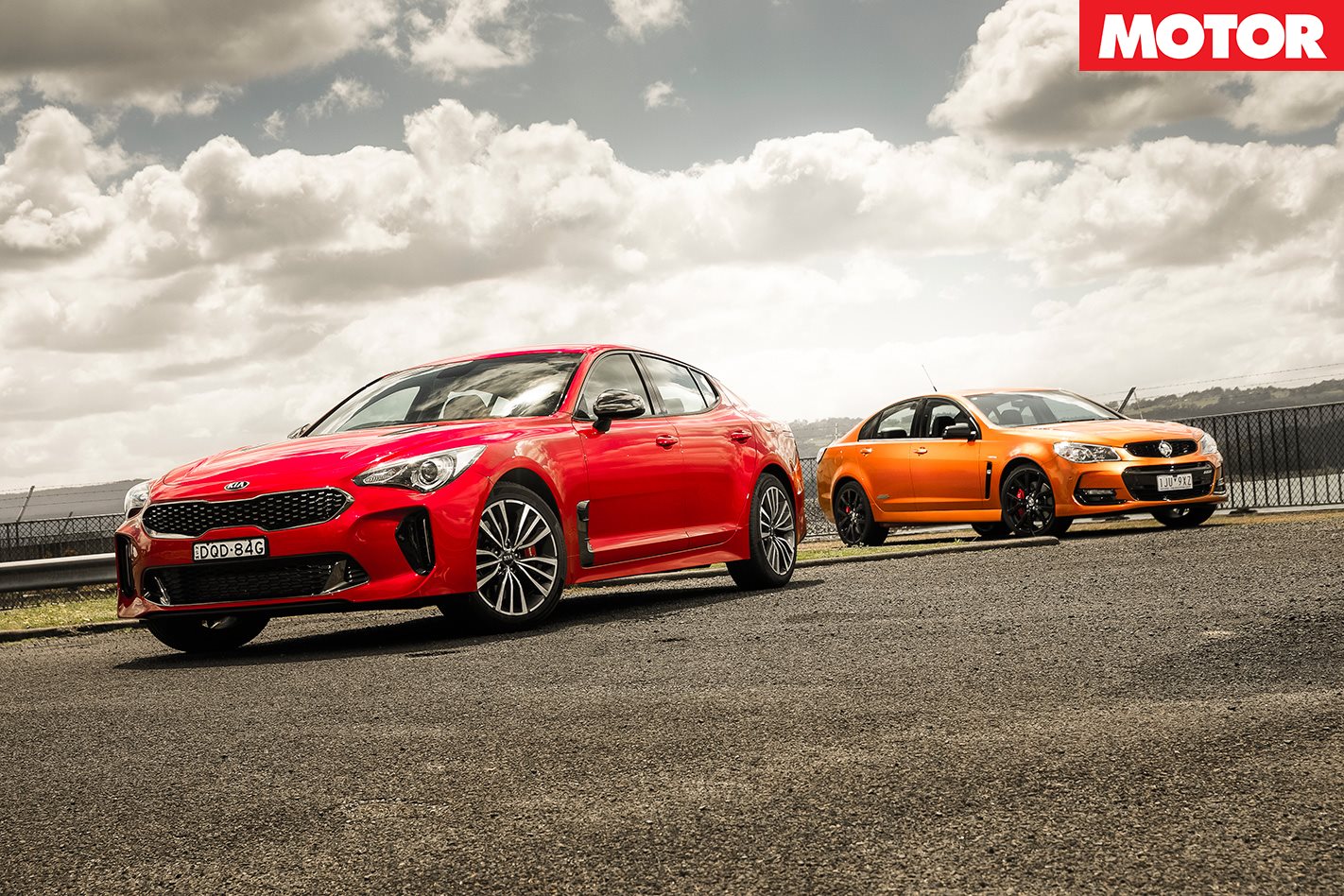
Though an XR6 Turbo might have been a closer comparison, the Kia Stinger appeared just as the Commodore left us, making it the perfect timing for a look back, and a look forwards.
2. NISMO GT-R vs BMW M4 GTS – August 2017
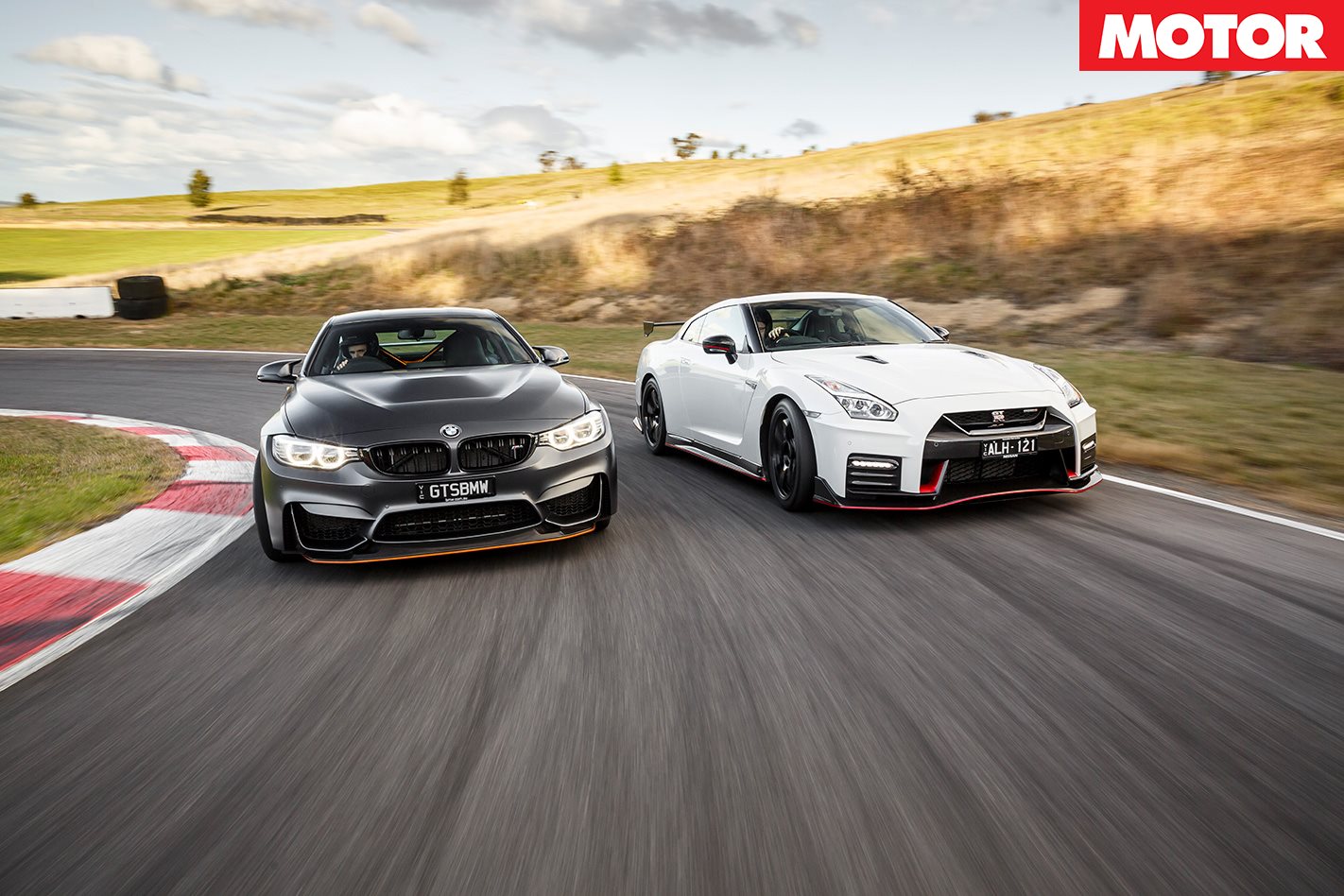
At the Haunted Hills Hillclimb, Japan’s almost robot-like GT-R takes on the wildest BMW M4 yet.
3. VW Golf GTI Performance vs Honda Civic Type R – December 2017
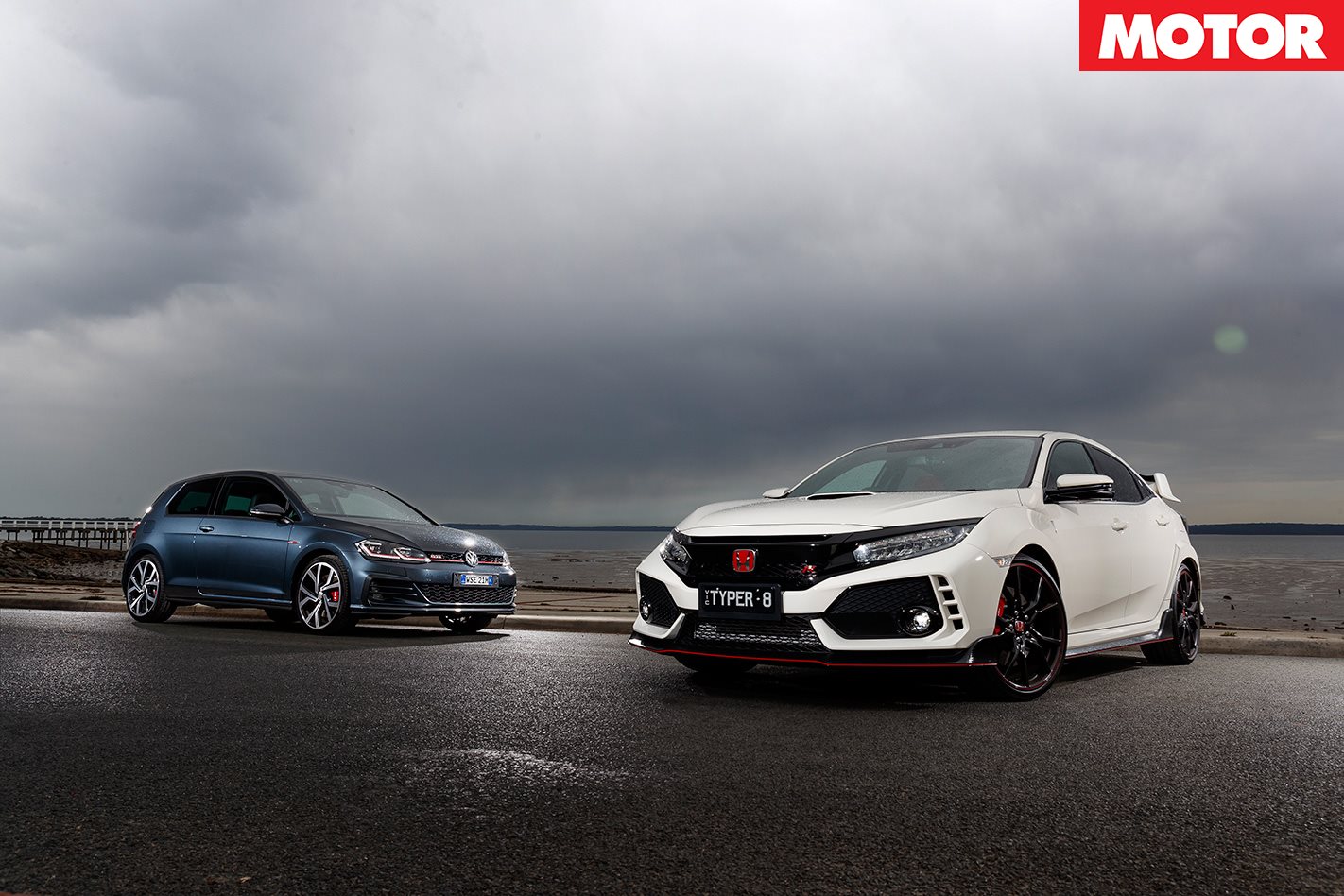
But when put up against the ultimate do-it-all hot hatch, the Golf GTI, the Honda proved it was more than just a playful-looking wannabe.
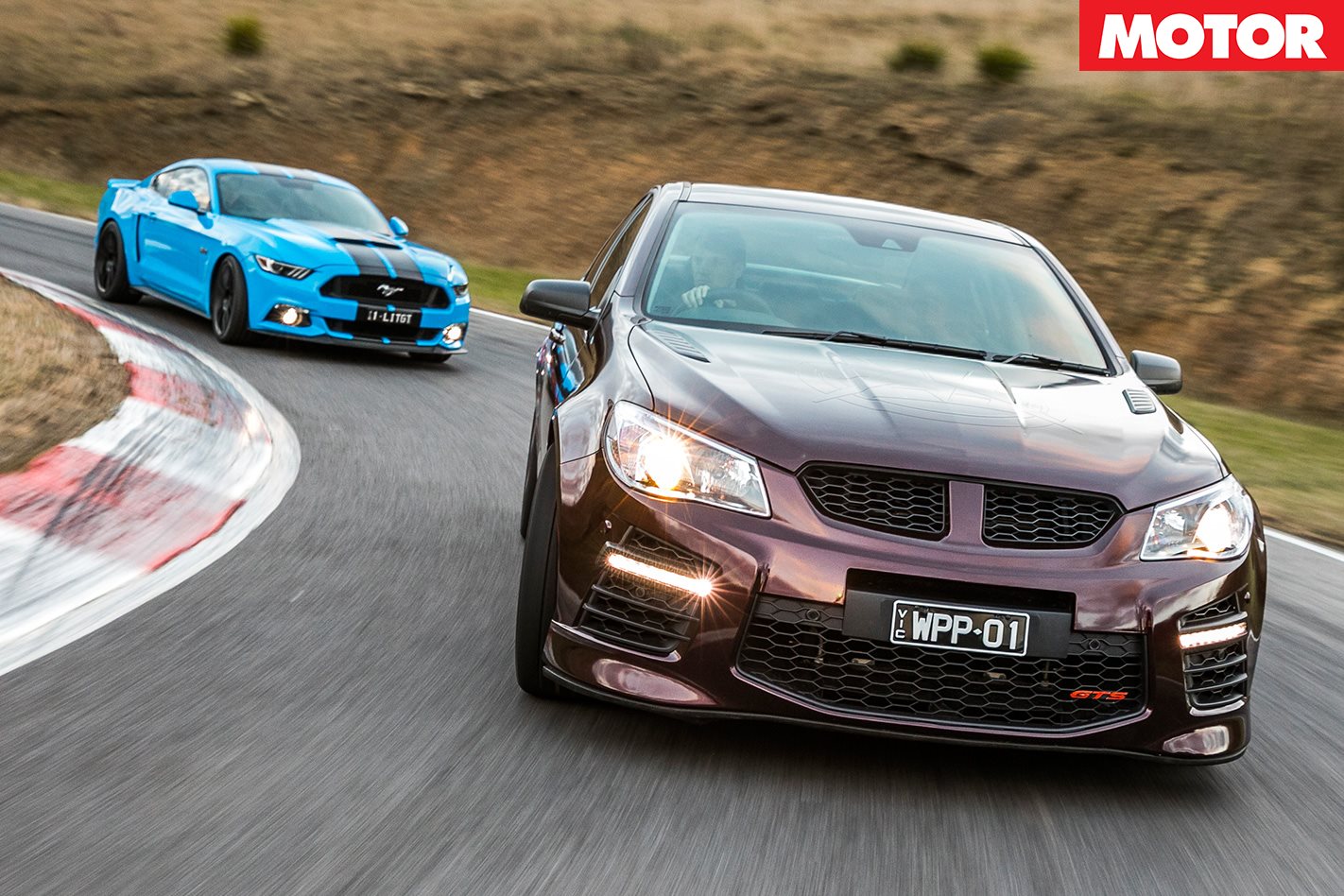
4. Walkinshaw W557 vs Herrod Mustang GT – September 2017
5. Alfa Romeo Giulia QV vs Mercedes-AMG C63 S vs BMW M3 Competiton – September 2017
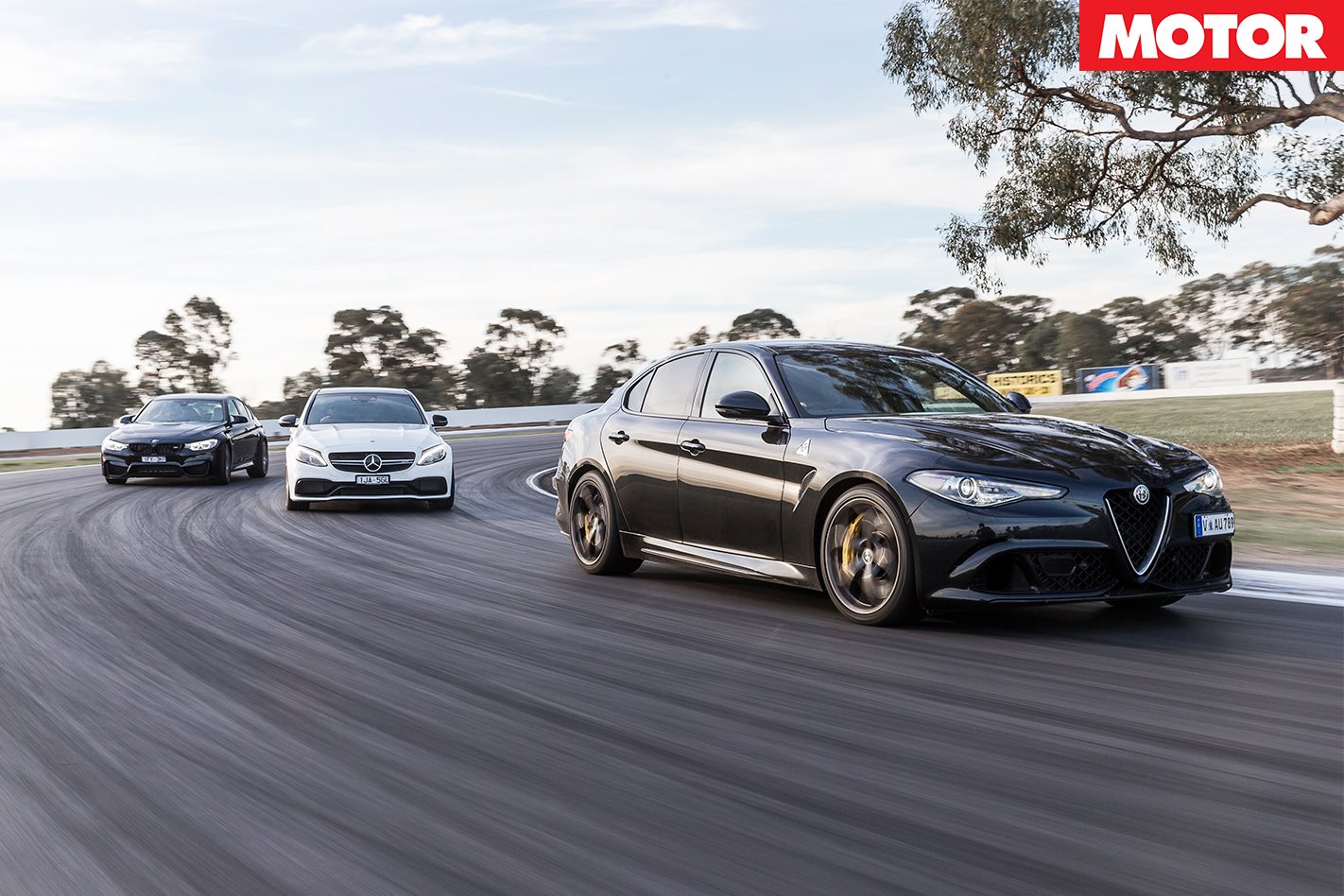
The QV has proven itself capable, but is it a better track weapon than a top-spec M3 or C63?
6. Mercedes-AMG GT R vs Porsche 911 GT3 – June 2017
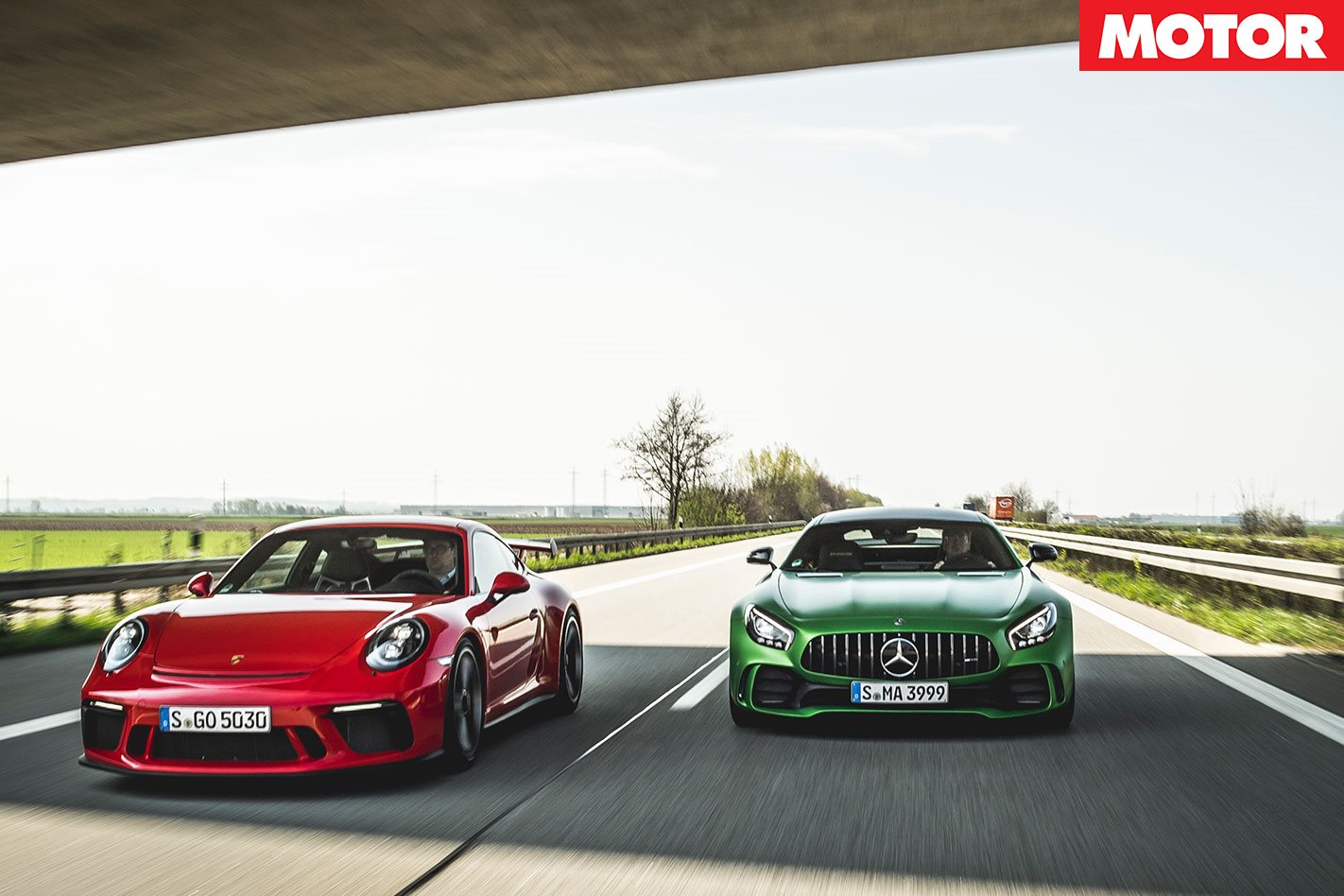
This was more than just an excuse to test the new GT3, this was a battle for coupe supremacy.
7. Ford Mustang vs Nissan 370Z NISMO – The Annual 2017 issue

And what better car to face a new sports coupe than the sports coupe that had proven the most popular in Oz.
8. Mazda MX-5 vs Abarth 124 Spider vs Subaru BRZ – April 2017
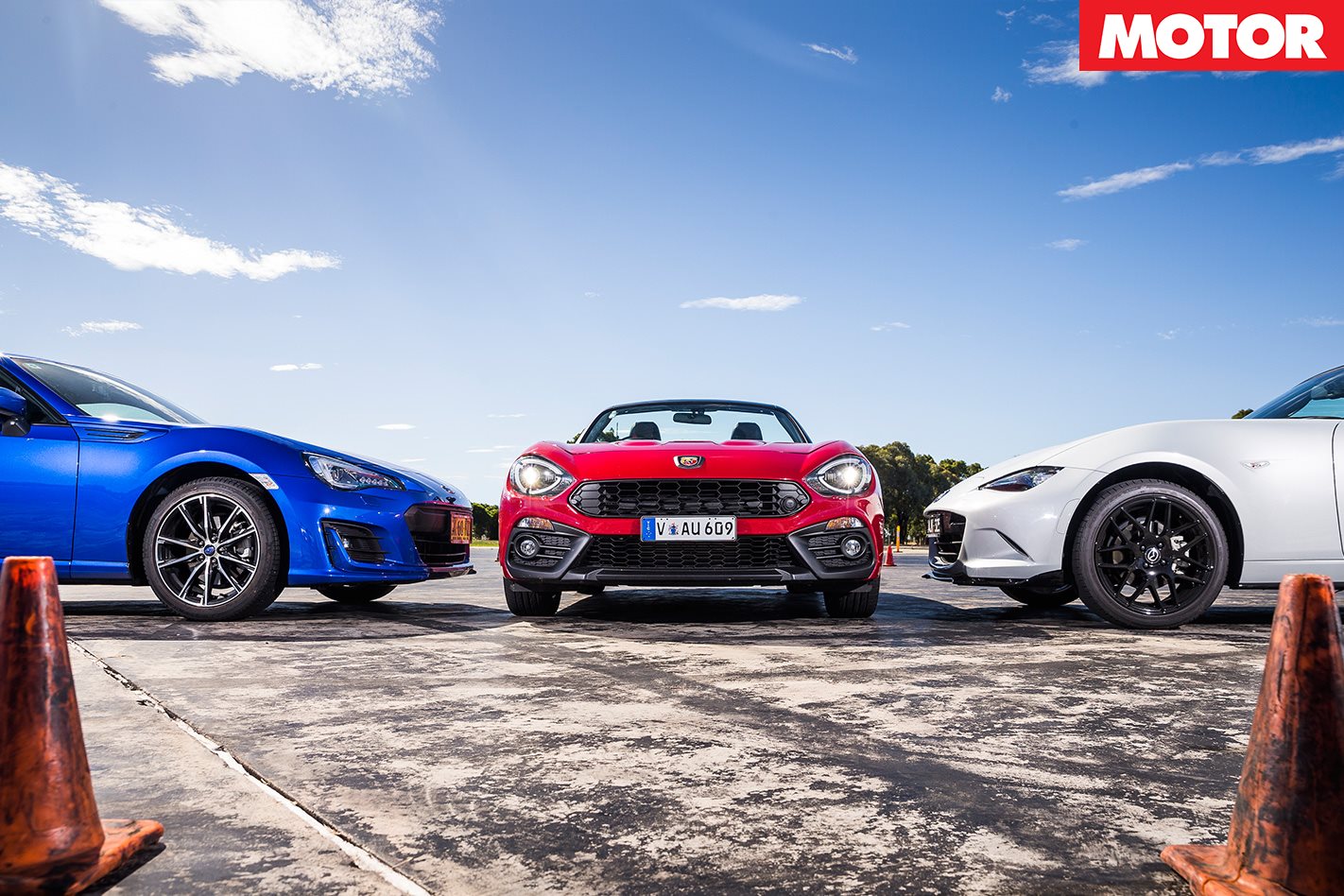
Japan takes on Japan, and Japan takes on Italy’s take on Japan in this far-less-confusing than it sounds battle of the featherweights.
9. Mercedes-AMG C43 vs BMW 340i vs Jaguar XE S vs Audi S4 – June 2017
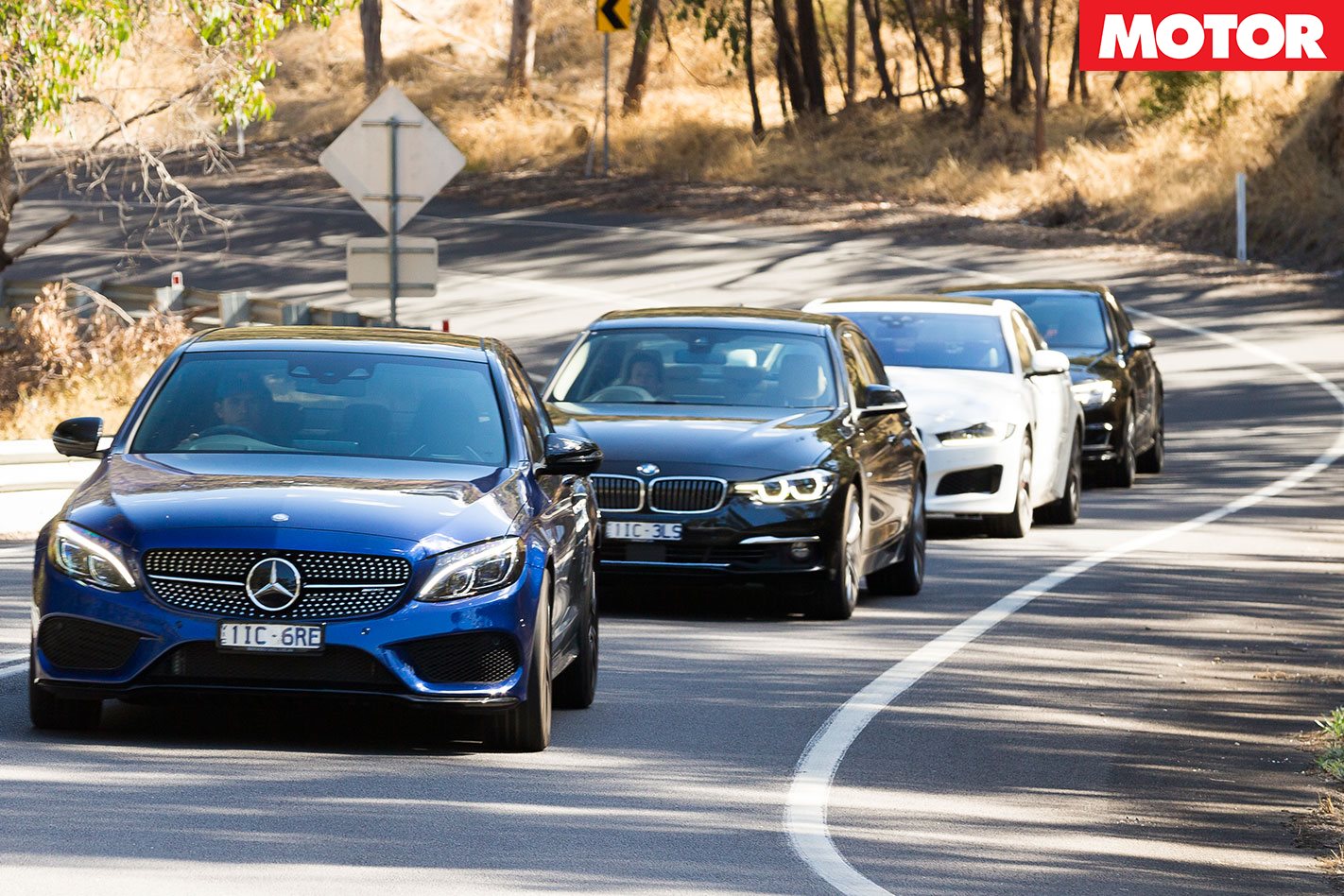
Four cars that are similar on the surface become very apparently different once you get behind the wheel – which is what made this comparo so interesting.
10. PCOTY! – February 2017
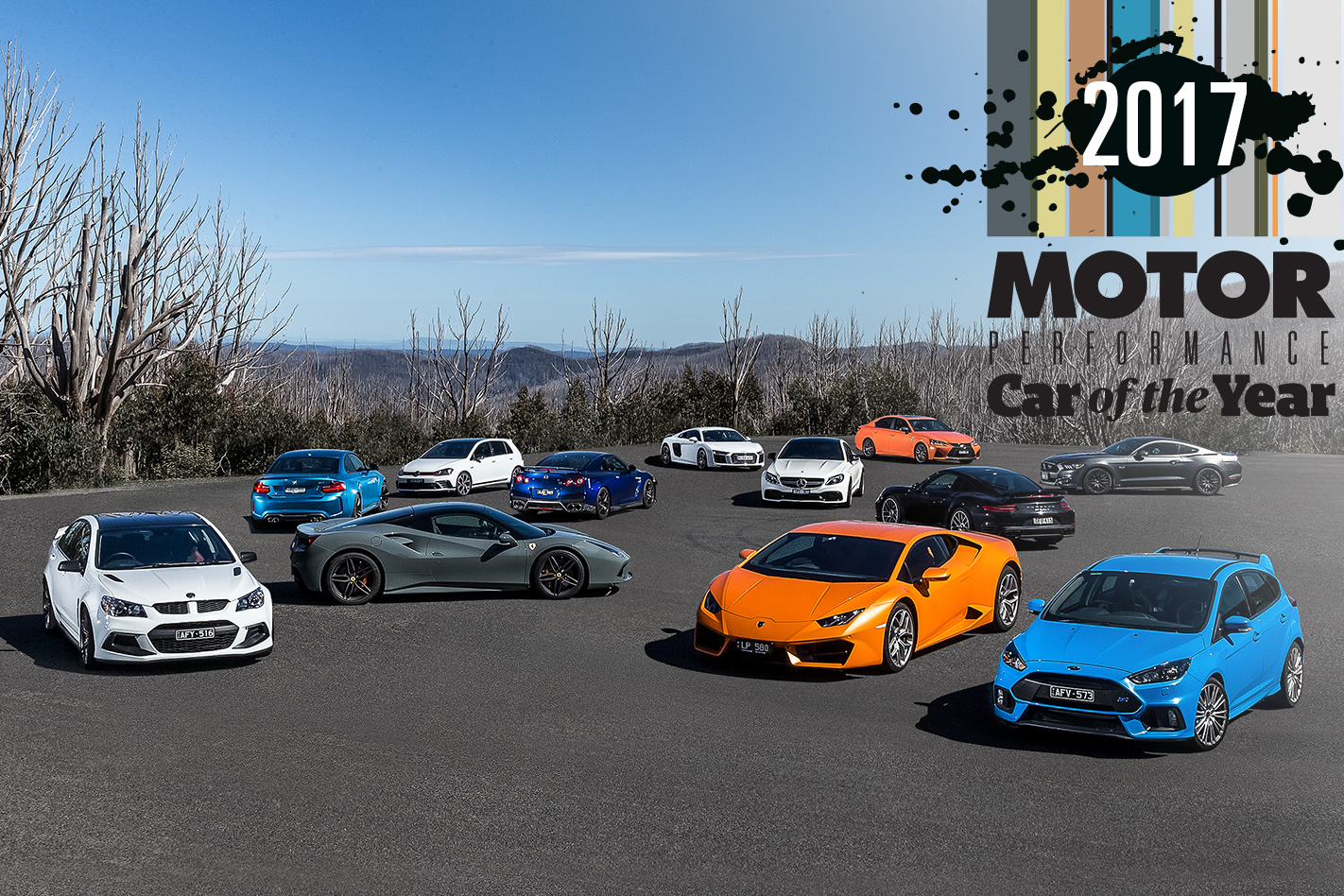
While we work on bringing you the next Performance Car of the Year, take a look at what went down this year at MOTOR’s biggest calendar event.
These are the moments which stand out after a season of racing in Formula 1.
Kevin Magnussen’s brutal (and ballsy) comeback
It was an interaction that left us saying, “Did he really just…. Yup! He really just said that” to our televisions. Following a coming together on track, Kevin Magnussen and Nico Hulkenberg came face-to-face in the media pen after the race. Hulkenberg called Magnussen the most unsporting driver in the field, with the Danish driver returning serve with the simple but brutal “Suck my balls, honey”. It’ll be a quote we won’t forget quickly
Watch the ballsy exchange here
Teammates at war
It was a rivalry that kept the carbonfibre layup department at Force India busy during the season – Sergio Perez vs Esteban Ocon. Perez is a veteran of the F1 field, while Ocon was in just his first full-time season. After a number on disastrous on-track clashes Force India implemented a sort of team restraining order preventing the pair from getting too intimate on track. Judging from the radio messages, the duo won’t be exchanging Christmas presents this year.
Watch the season’s warfare here
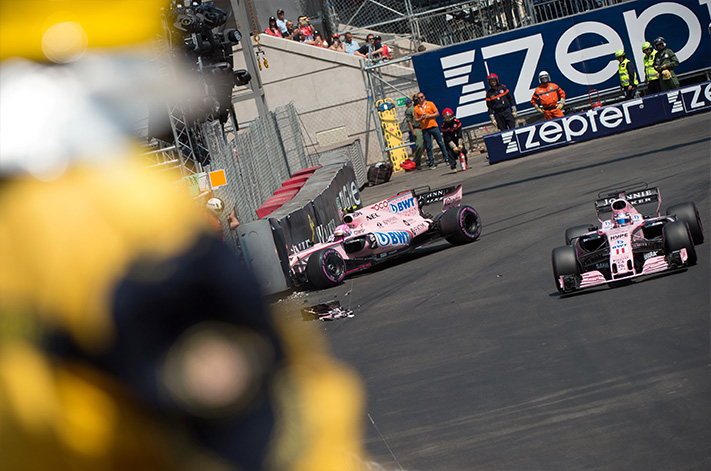
The Azerbaijan Grand Prix was a wild affair. From Daniel Ricciardo’s mega three-car pass, to Sebastian Vettel’s complete brain failure (more on that later), it was a classic from start to finish. One of the stranger moments from the race was at the end of the red flag period, when Ferrari was pushing Kimi Raikkonen’s car down the grid, with the Finnish driver begging to be handed his steering wheel. It was a wonderfully oddball scene.
Ricciardo bird spotting in Hungary and Abu Dhabi
The ol’ one-fingered salute is a rare sight these days in Formula 1, but Ricciardo dished a pair of them out this year.
First was for his teammate Max Verstappen after they came to blows in Hungary at the start of the race. The Honey Badger then offered a sustained middle finger to the consistently ire-inducing Romain Grosjean for blocking him during practice at the final round in Abu Dhabi.
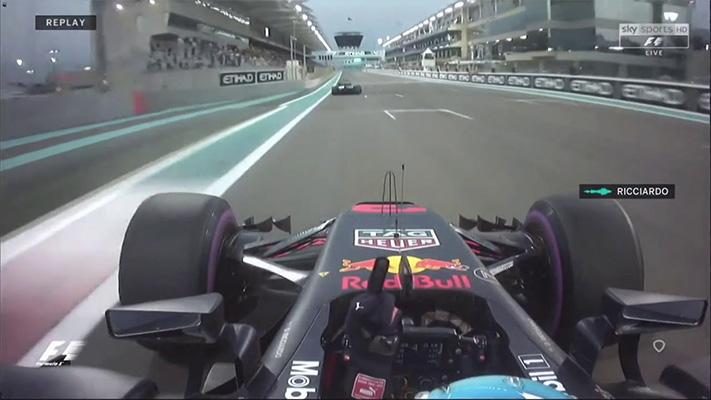
Half of the battle in Formula 1 is a mental game, and well, Sebastian Vettel completely lost it in Azerbaijan. The Ferrari driver made contact with the rear of Lewis Hamilton’s car under safety car conditions, then thinking the Mercedes driver had brake checked him, pulled alongside, and rammed the Brit while gesticulating with his hand.
View the almighty temper tantrum here, which showed Hamilton had decisively gained the upper hand in the pair’s mind games.
Carnage in Singapore
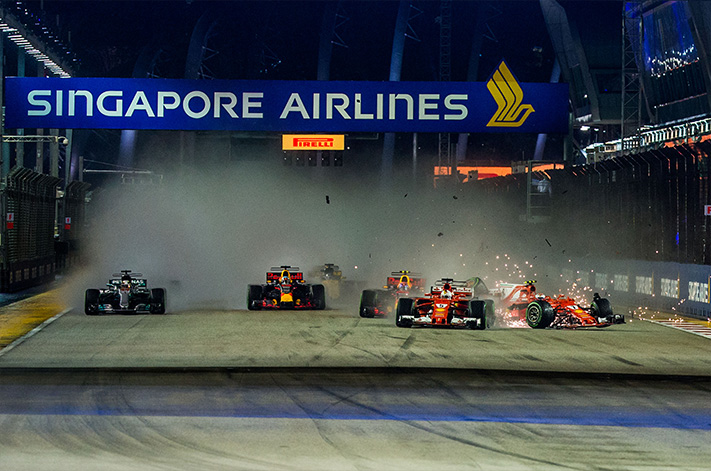
Watching it back, you can almost pinpoint the moment Ferrari fans around the world burst into tears in unison. Vettel, Raikkonen, and Verstappen collided at the start of the Singapore Grand Prix, forcing all three to retire, and driving another nail into Maranello’s hopes of winning an F1 championship in 2017.
During the 2017 season, Lewis Hamilton put in some stellar driving performances, but this pole lap from a sodden Monza is among his best. In torrid conditions, Hamilton was searingly quick, using classic karting lines to dominate the field by over a second. The onboard footage is a masterclass in wet-weather driving.

Once-McLaren teammates battling for supremacy, these two legends found themselves battling for the same piece of track at the Mexican Grand Prix. Traditionally kept at opposite ends of the grid thanks to huge differences in power from their engines, the McLaren and Mercedes duo duked it out in spectacular fashion. Ultimately Hamilton was the victor in their tussle, but seeing the two world champions battle once more was a sight for sore eyes
The cutest F1 fan in the world
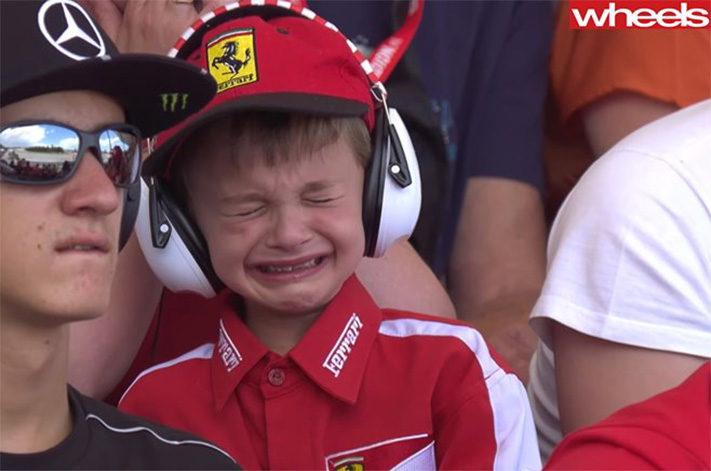
This moment from the Spanish Grand Prix warmed our cold dead hearts. A small boy was spotted in tears, decked out head to toe in Ferrari gear, after Kimi Raikkonen crashed out in the opening laps of the race. To help cheer the child up, Ferrari brought him to its hospitality suite, where he spent the rest of the race hanging out with The Iceman himself.
The Abu Dhabi Grand Prix wasn’t the most memorable race of the season but it was enlivened by this moment of pure Kimi sang froid. Clearly feeling that his tyres were warm enough, Raikkonen decided that lateral-G is for losers.
- Part Two: A death in the family sees the Megane doing more than it was born for
- Part Three: Renaultsport mastery and rear steering help push GT wagon to the pointy end
- Part Four: The product shines but does the aftersales experience?
- Part Five: Who’d have thought four-wheel steering would work so well on gravel?
- Part Six: A memorable six-month affair with Renault’s Megane GT wagon comes to an end
For starters, it’s a Renault, and therefore a descendant of the seminal 16 – you know, the world’s first front-drive hatchback, launched in the mid ’60s. That thing actually changed the car, while the hotshot TS ushered in the GTI era. Overachiever much?
Secondly, we’re talking about a French wagon here, so whether you’ve experienced one as a ‘Familiale’, ‘Break’, ‘Estate’ or ‘Safari’, it’s sure to be effective. As thousands of African taxis can attest.
Lastly, being a GT, this Megane has mechanical four-wheel steering – just like the third-generation Honda Prelude, the world’s first production car with the tech, and Wheels’ 1987 COTY. That this particular variant’s chassis was devised under the canny eye of the Renault Sport (RS) division boffins is just icing on the cake.
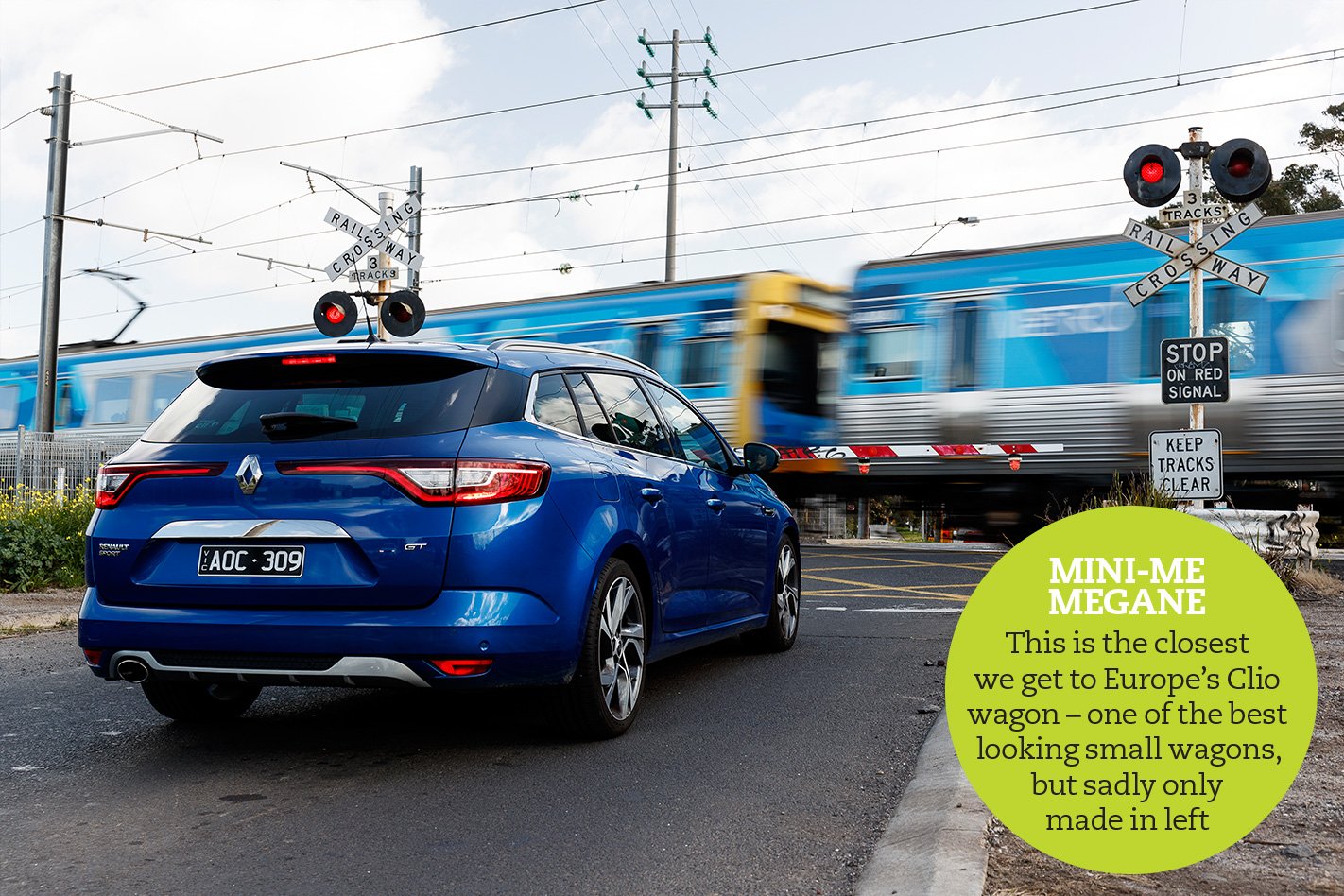
Yes, the Megane GT TCe205 EDC 4Control Break, with its 151kW/280Nm 1.6-litre turbo and seven-speed EDC dual-clutch transmission, is like the mutant marriage of what I’d want in my fantasy family car. More or less.
But there’s also another reason why it’s here. Regular current-gen Meganes have so far left us underwhelmed. Though competent, they feel too … ordinary, with little character and not much flair. Something, by the way, that baby-brother Clio oozes. We’re hoping the GT’s RS-ification restores our faith in the series.
Packaging-wise, it’s on the money. Handsomely presented, the wagon offers extra rear-seat legroom compared to the hatch, courtesy of a 42mm wheelbase stretch, as well as a long, flat and wide cargo area. We’re talking about a family-friendly, driver-focused alternative to an SUV here.
Our GT heaves with standard kit like autonomous emergency braking, lane departure warning, automatic high beam, blind-spot warning, adaptive cruise control, sat-nav, a reversing camera, parking sensors all ’round, auto on/off lights and wipers, automatic parking, paddle shifters, Alcantara upholstery, heated sports front seats, sunroof, ambient cabin lighting, privacy glass, obligatory body kit and 18-inch alloys. And that’s on top of the 4WS and RS chassis tune.
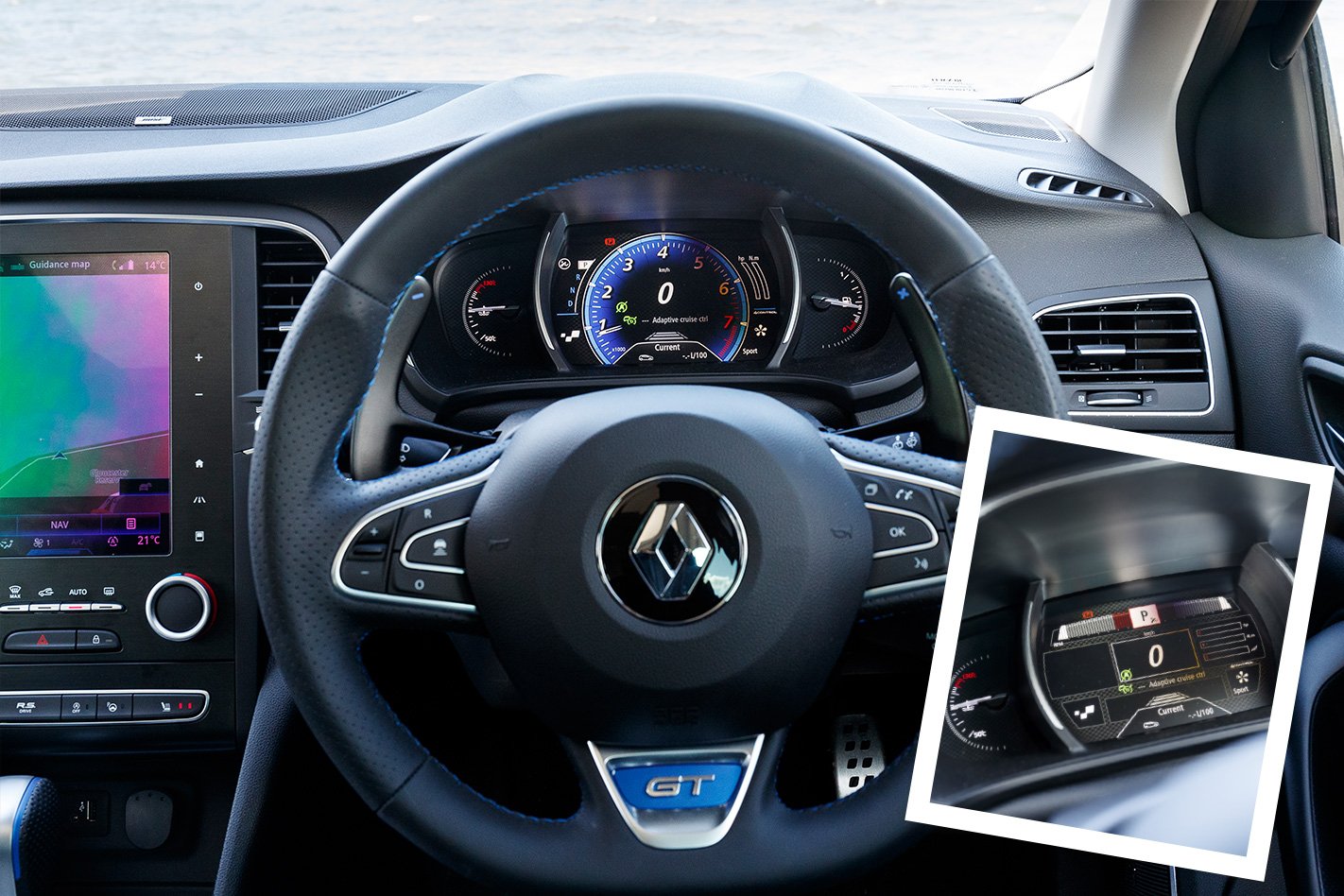
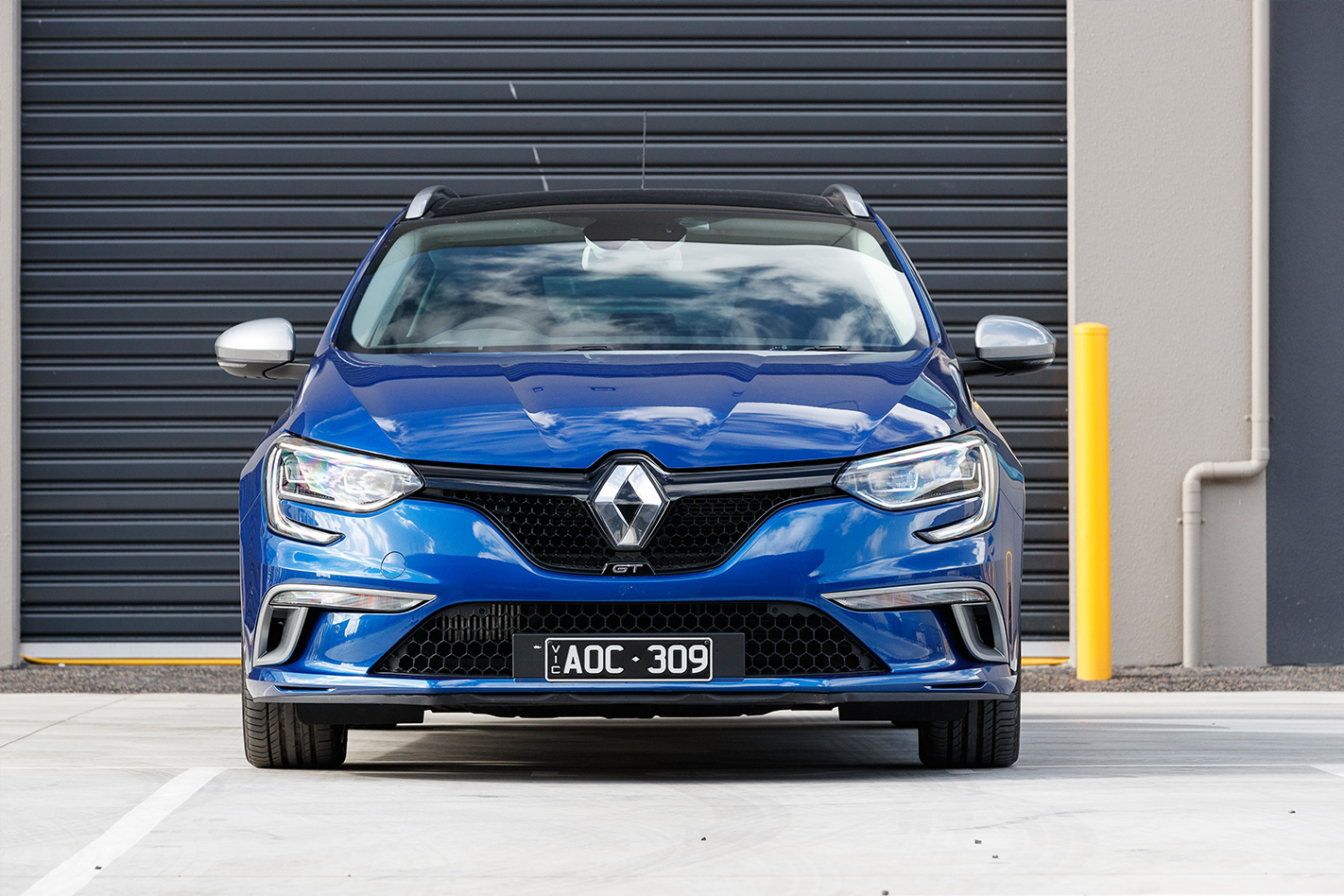
Starting from $39,490, AOC-309 also includes a $1490 Premium Pack (all-LED headlights and a Bose audio upgrade that deletes the space-saver spare for a puncture inflation kit) and $600 metallic paint. Total outlay: $41,580 plus on-roads.
Almost immediately after getting our hands on it, the GT went on multiple country trips, criss-crossing Victoria like a pub band with big dreams, all interspersed with heavy urban commuting. Which makes our 7.7L/100km on 98 RON impressive.
There is a sort of Jekyll and Hyde character to how the Renault drives, however. For docile schlepping, Comfort or Neutral is all you need, with strong off-the-line acceleration and ample torque for the transmission to quietly settle into a higher gear. Easy.
Conversely, selecting Sport around town is infuriating because the EDC maxes out the revs in each ratio, forcing manual upshifts to quell the engine howling and rabid-terrier forward lunge. Yet, given a stretch of open road, in this mode the Megane provides rapid, punchy and effortless oomph, doing more than enough to earn its GT credentials.
As with the Prelude 4WS, the 4Control bites into a corner sharply at first, for instant and unexpected turn-in, but on the other hand, at speed, it feels utterly planted and unflappable, with a welcome amount of feedback and feel, so the tech works. And, initially at least, we’re pleased with the absorbent ride from the quality Continental ContiSportContact 225/40R18 rubber. It’s certainly better than that of most equivalently priced SUVs.
Which is what we want to ascertain over the next few months. With its added dollop of style, space, spec and speed, is the Megane GT wagon a smarter alternative?
Part Two: A death in the family sees the Megane doing more than it was born for
CARS, of course, are much more than transport.
Unexpectedly, during month two, our Renault Megane GT also became an instrument of change, reflection and even solace.
Up until then, the French wagon’s combination of performance, handling and sophistication had surprised and delighted. Still does. A happy and charming addition to family life. It still is.
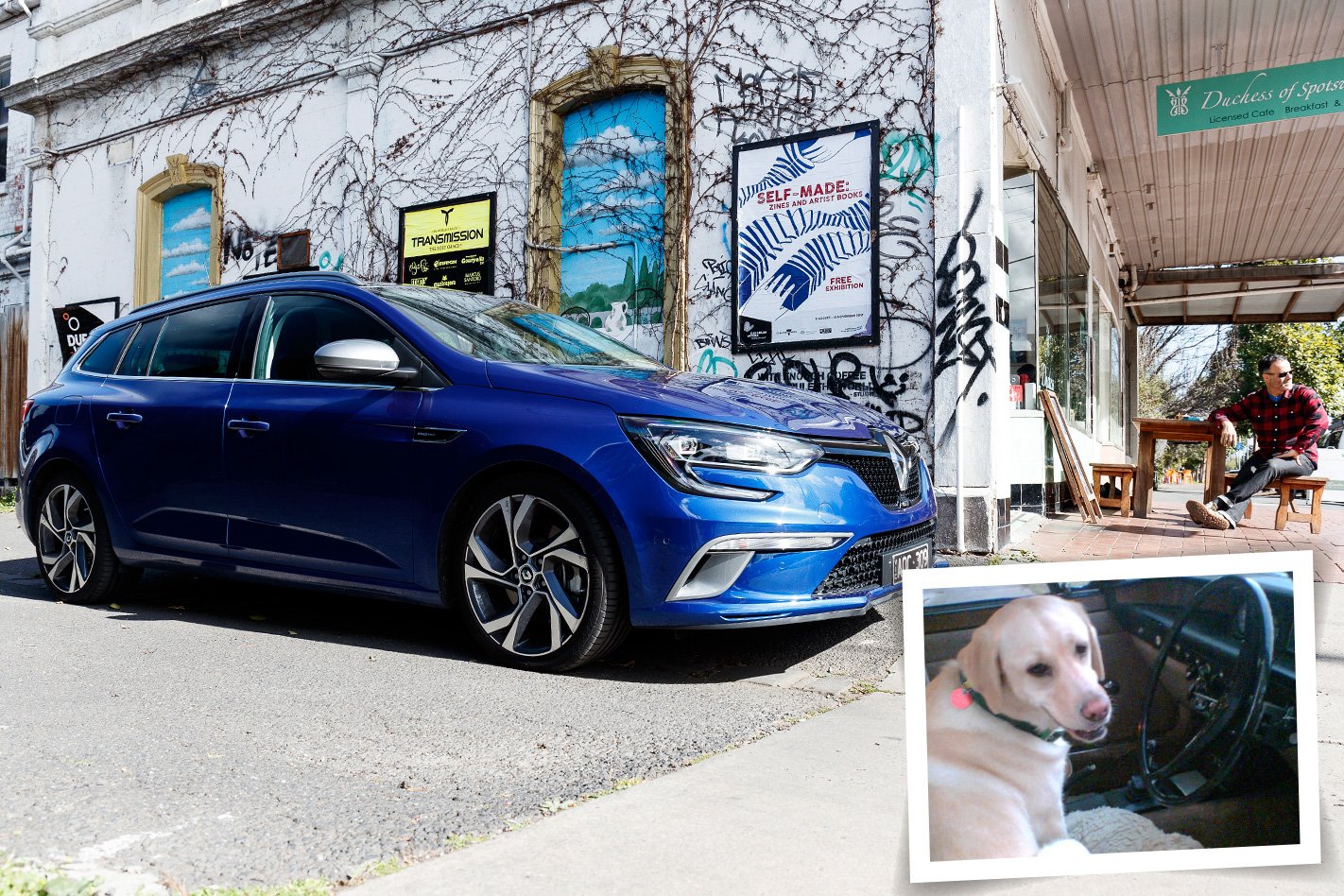
Sadly, however, our beloved Labrador Retriever Romy died early one September morning, in my partner’s arms from age-related illness. She was 13. I was in Europe on a work assignment when I received the dreaded Skype call. Her tail wagged feebly in acknowledgement as distraught words sobbed out of my mouth from across the world. And then, in an instant, she slipped away. Our sense of loss is profound.
Qantas ensured I was home as soon as possible, and the following weeks were a blur of tears and heartache. I don’t know how we would have managed but for the love and support of family and friends. That’s life I guess.
We eventually decided to clear a lifetime’s worth of Romy’s gear, which led to a spring clean that was a decade in the making. Nothing like starting afresh.
As this is a long-term car report and not a therapist’s couch, I should report here the Megane GT shone as a wagon, carting loads of clothing, small furniture, kitchenware, books and other items like it was designed to.
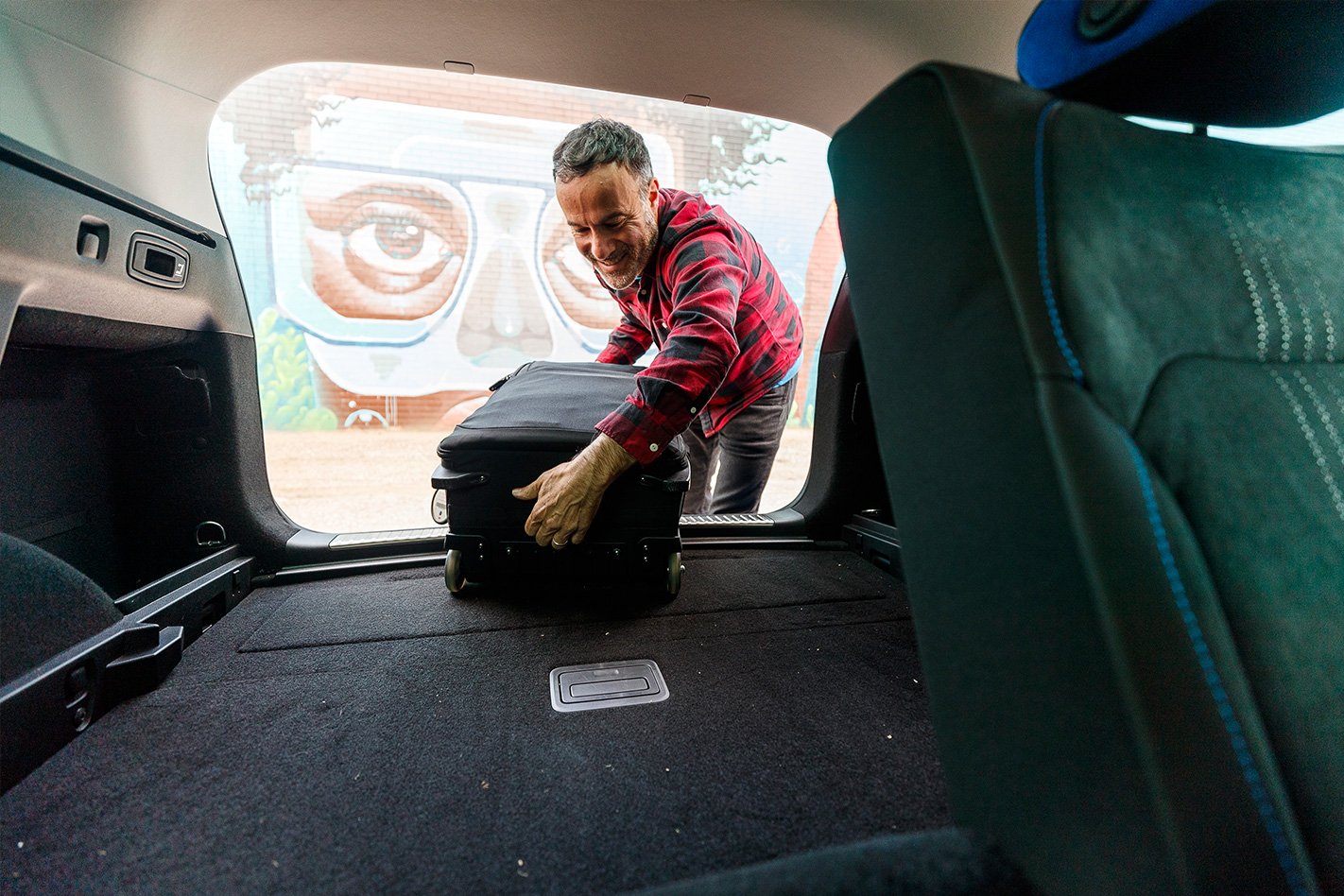
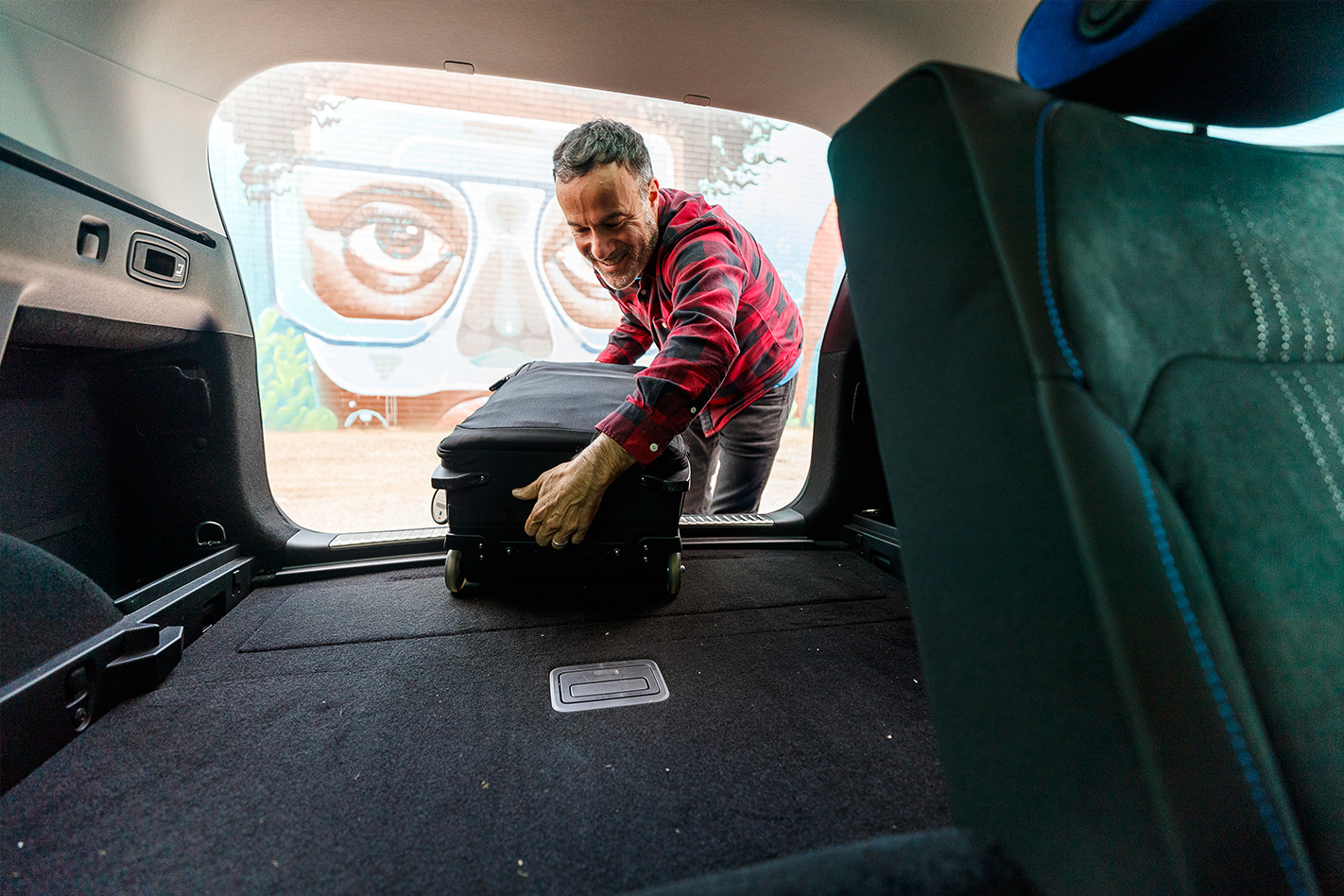
A wide aperture, low flat floor with the rear seats folded (via a handy quick-release lever) and an uncomplicated luggage cover helped. We thought a van would be necessary for the many trips to the Pet Rescue op shop or tip, but only a pair of drawers wouldn’t fit.
The Renault also stepped up in another way, when being at home alone during the daytime (as a freelancer) proved too sad. Feeling snugly located in the heavily bolstered driver’s seat and with the volume turned up, I welcomed the Megane GT’s kick-ass sound system with its simple song selection set-up, finding random, lovely, wistful comfort in tunes from Luluc, Arcade Fire, Alex the Astronaut and LCD Soundsystem.
It was a soothing, cocooning world in which to grieve, and provided a fresh appreciation for my sporty Euro wagon. And more importantly a reminder of what really matters.
RIP, our little hairy daughter.
Part Three: Renaultsport mastery and rear steering help push GT wagon to the pointy end
THE DEVIL, they say, finds work for idle hands. So with much of the month off, I found time to truly explore the GT side of my Renault Megane wagon.
Colleague Nathan Ponchard had already used AOC-309 as an effective tool to scout for a fresh road loop for Car of the Year. After his first stint behind the lovely wheel of the Spanish-built wagon, our road-test veteran was impressed with its combination of character, agility and comfort. Quite the step up from the bread-and-butter versions, he declared.
Appetite suitably whetted, I too undertook an intrastate blast through south-eastern and central Victoria’s more alluring roads. And as the clicks accumulated, likewise something clicked in me. Namely how masterfully Renaultsport’s chassis magicians have transformed the chassis. Yes, the regular Megane’s core is fundamentally sound, but the GT-specific componentry and tune, combined with active four-wheel steering, infuse true hot-hatch interactivity.
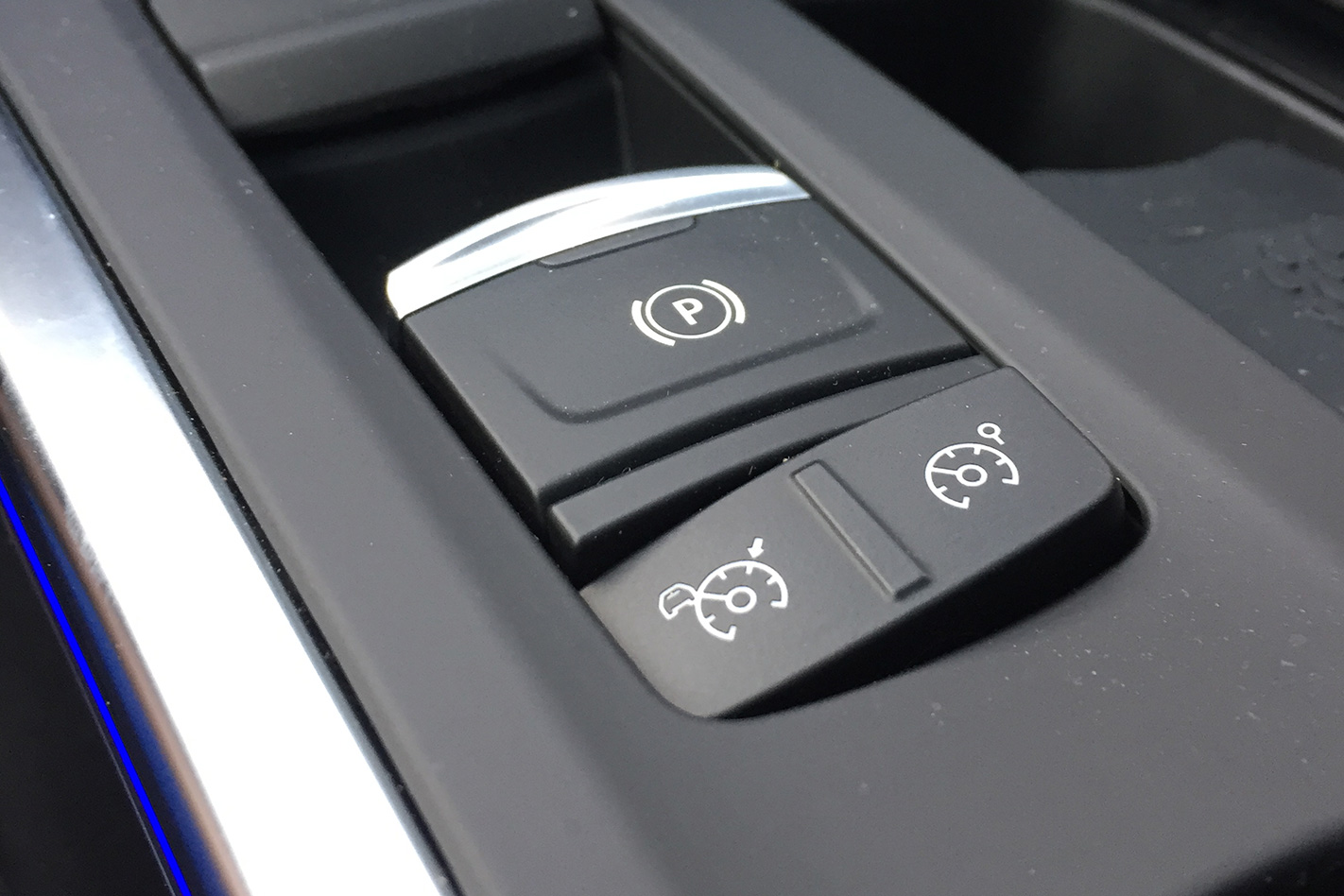
Docile but never dull in Comfort or Neutral modes, pressing the ‘R.S. Drive’ button (that looks like an air purifier symbol) ahead of the electric park brake to select Sport ushers in a number of engine, transmission and steering tweaks that are the automotive equivalent of growing a set of satanic horns.
That additional low-rev turbo shove (plus racier instrument choices, as well as a synthesised baritone exhaust note that I actually enjoy) when booting the 151kW/280Nm 1.6-litre GT hard through corners reveals just how reactive its Sport-primed steering is, especially when turning in, and how controlled the rear end is carving back out again.
The handling feels super alive, ultra-planted and utterly non-corruptible, with that devilish RS DNA and darty four-wheel steering endlessly egging you on – just like a GTI ought to. Tight and tricky turns are easily tamed, aided by bolstered seats, big paddles and slick dual-clutch responses. I could live with this thing in perma-Sport mode.
I’ve enjoyed the comfort and versatility that this expressive estate offers but I never really appreciated how athletic the Megane GT is for a 4.6-metre, 1430kg wagon with a 580- to 1504-litre rear hangar. That badge is closer to an RS than I had expected.
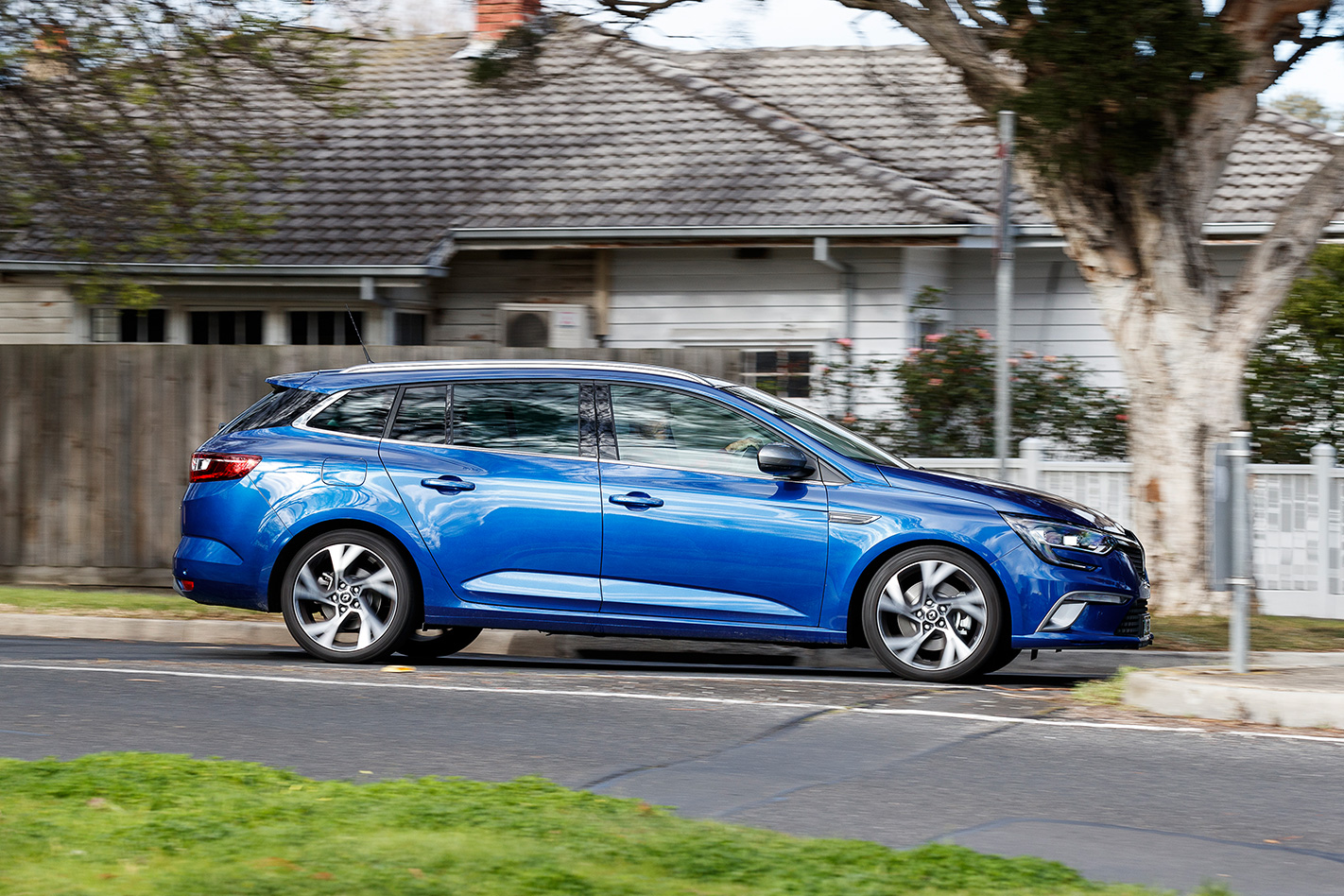
Room for improvement? Inevitable tyre drone over coarse highway surfaces; the otherwise dependable adaptive cruise control disengages below 30km/h so it cannot crawl along in traffic jams like the best systems do; and why doesn’t the nearside mirror dip when reverse parking? That ought to be standard at $42K.
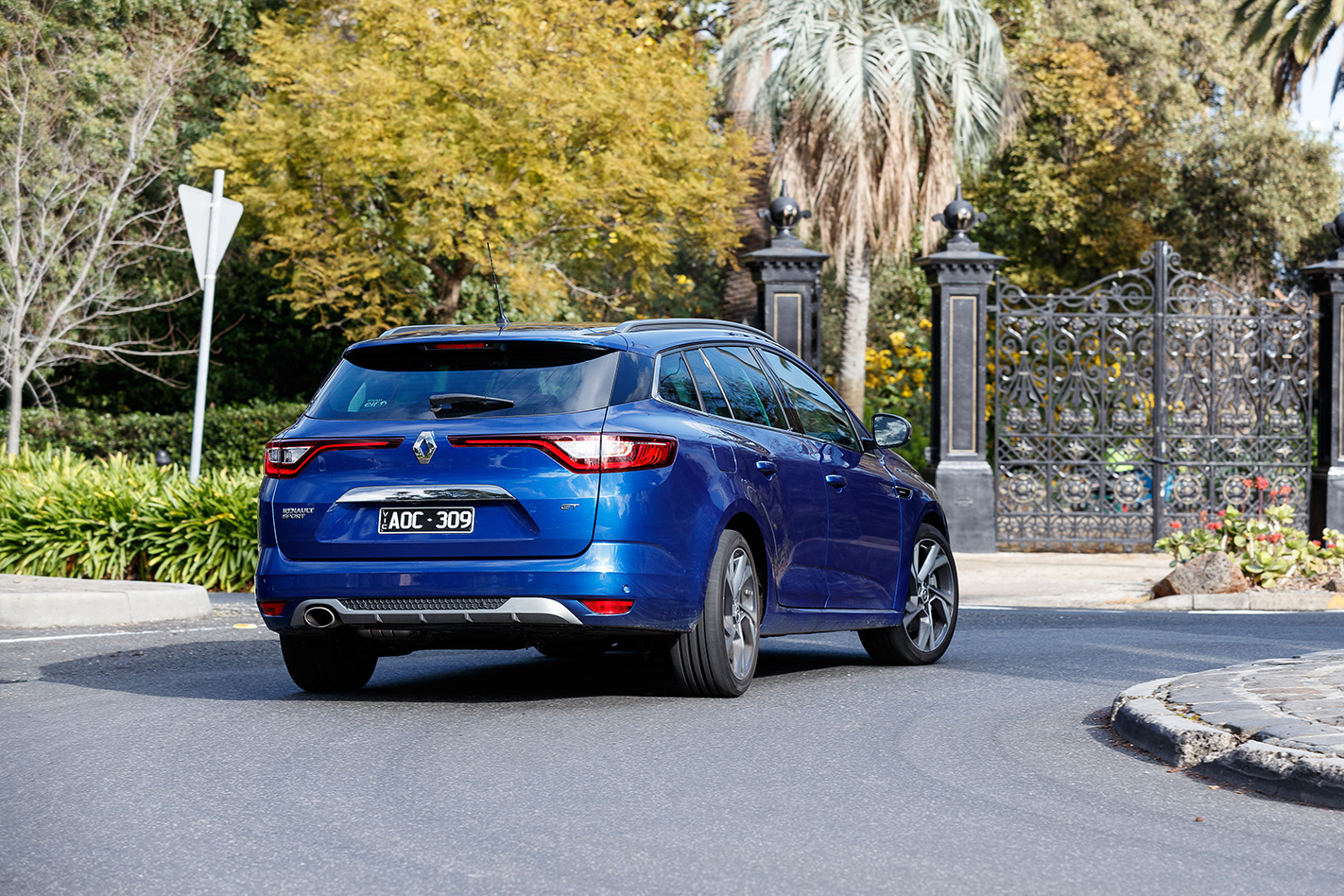
Otherwise, in a world now awash with SUVs, the Megane GT wagon stands unique, dealing diligently, and proudly, with everyday mundanity yet with enough chassis dynamism to tempt devilish drivers.
Now screening
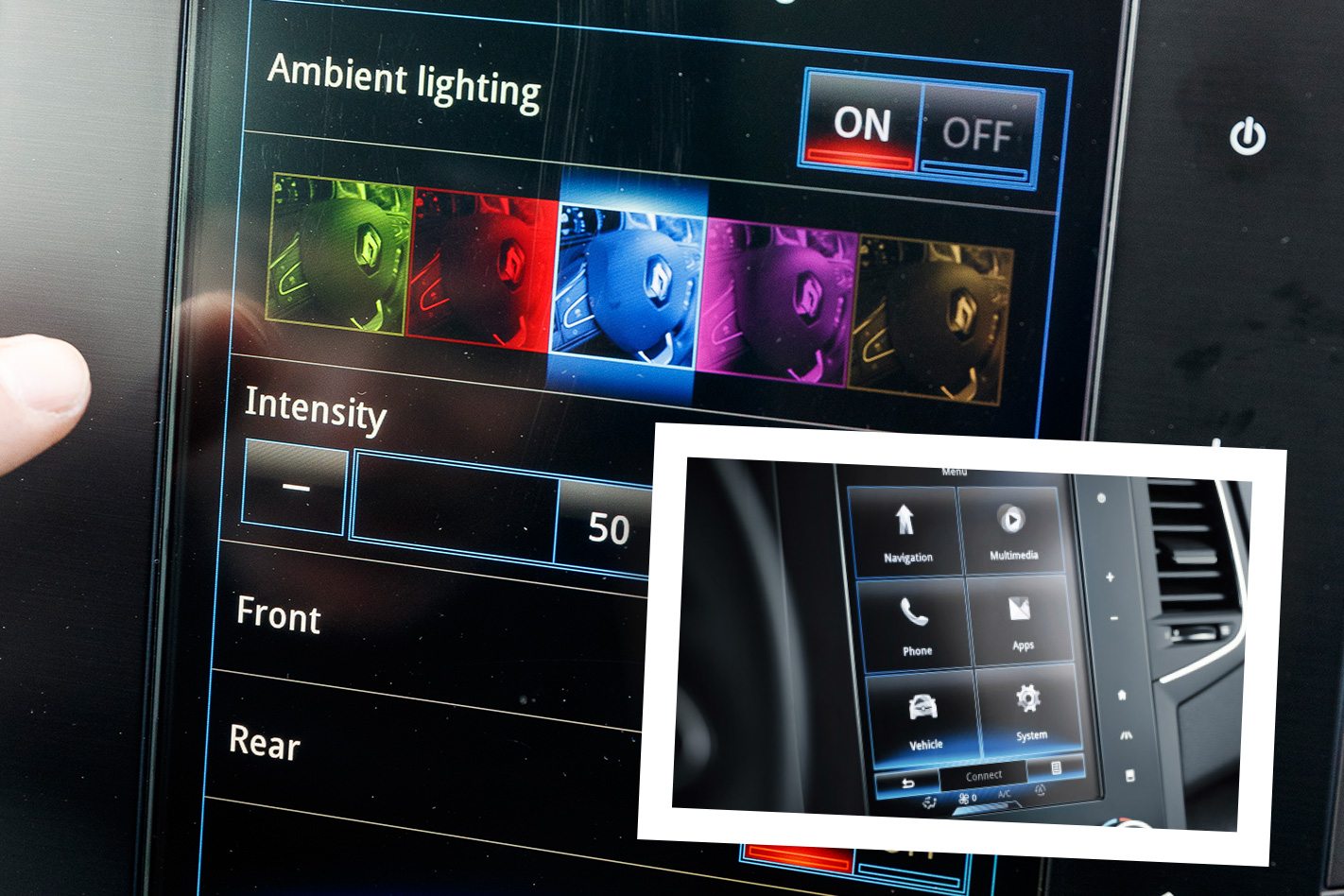
Though the Megane’s large touchscreen does require familiarisation, all the fundamentals are there, from the rear camera and effective climate-control systems to the beaut DAB+ digital radio and superb (optional) Bose audio sound. There are plenty of personalisation options too.
But switching between the different screens, while easy to work out, is fiddly in operation on the move, and the graphics are not especially attractive.
Part Four: The product shines but does the aftersales experience?
AFTER many weeks of flawless reliability, I was beginning to wonder whether anything would break or fail in my Renault Megane GT. Just like the Peugeot 308 Active I ran for nearly 17,000km a few years back, here was another French car stubbornly refusing to misbehave.
Then a large crack appeared like an earthquake fault line across the lower windscreen, just like that.
Unprovoked.
There’s no blaming flying stones from speeding semis coming the other way. Nor any errant deep potholes – certainly the unmarked tyres and 18-inch alloys would attest otherwise.
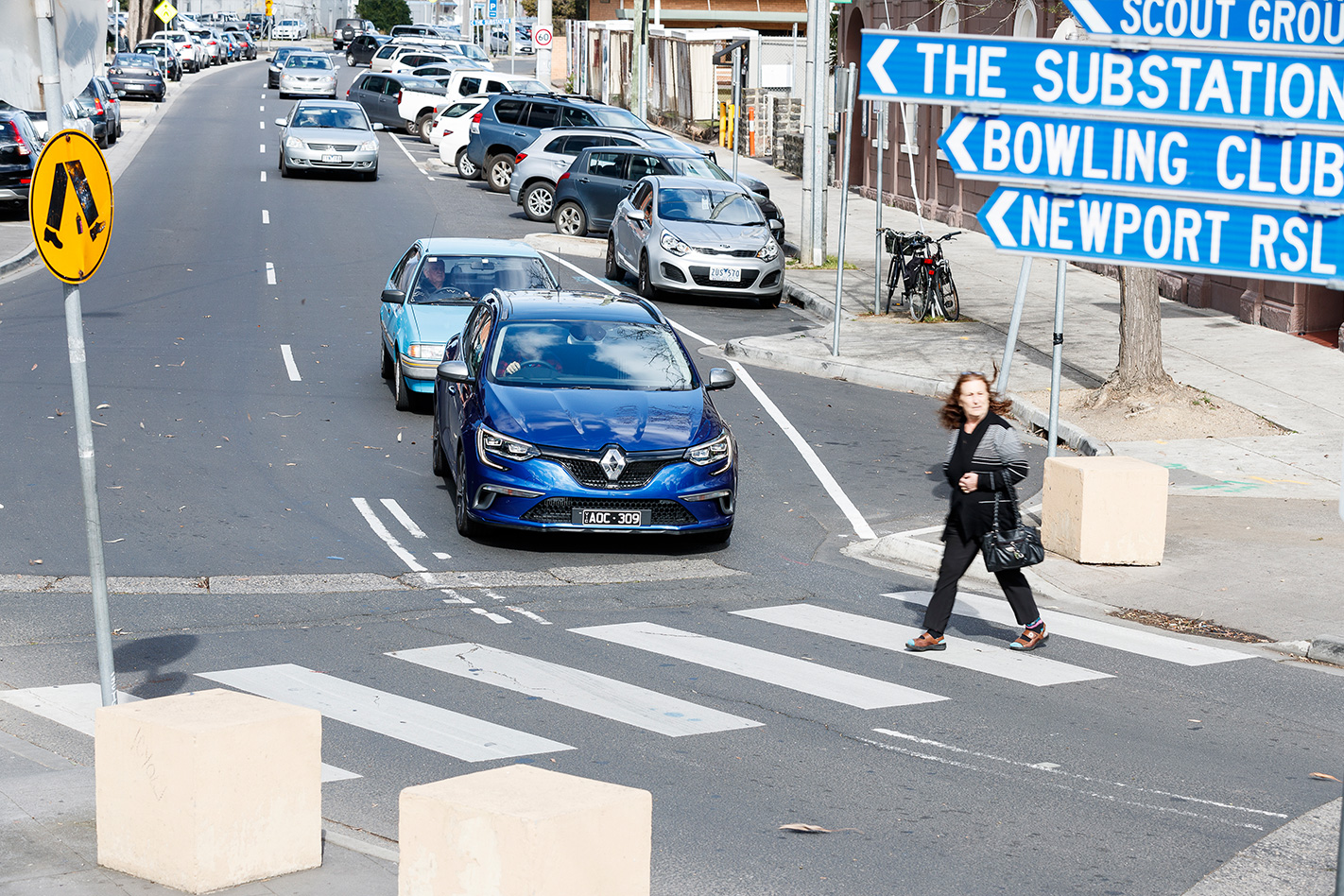
A phone call to Renault had the car quickly booked in for a replacement. I was informed that sudden windscreen cracking is a known problem with the fourth-gen Megane, and that as a result parts are in short supply.
Maybe it’s a body flex issue? I hear occasional creaking from around the sunroof. Anyway, the dealer organised a replacement GT wagon (a lovely grey example) for the week or so it would take to rectify. I’d be contacted when it was complete.
However, some days later a call from the friendly and helpful service desk revealed that the wrong type of windscreen was delivered from France and that another one was already on its way post-haste.
Amusingly, the ordered item turned out to be for a Renault Scenic people mover not even sold in Australia. Such unexpected frankness from the remorseful dealer came as a surprise, but was truly appreciated, because any BS could have been spun.
Anyway, two weeks later I was back in my striking blue GT with a clean and crack-free screen, and that would have been that.
I would’ve forgotten all about the ordeal but for one related consequence: not only had the dealership failed to refill the washer reservoir (it was completely empty), the spray jets had been misaligned, shooting up towards the sky like a gun-slinging B-movie cowboy.
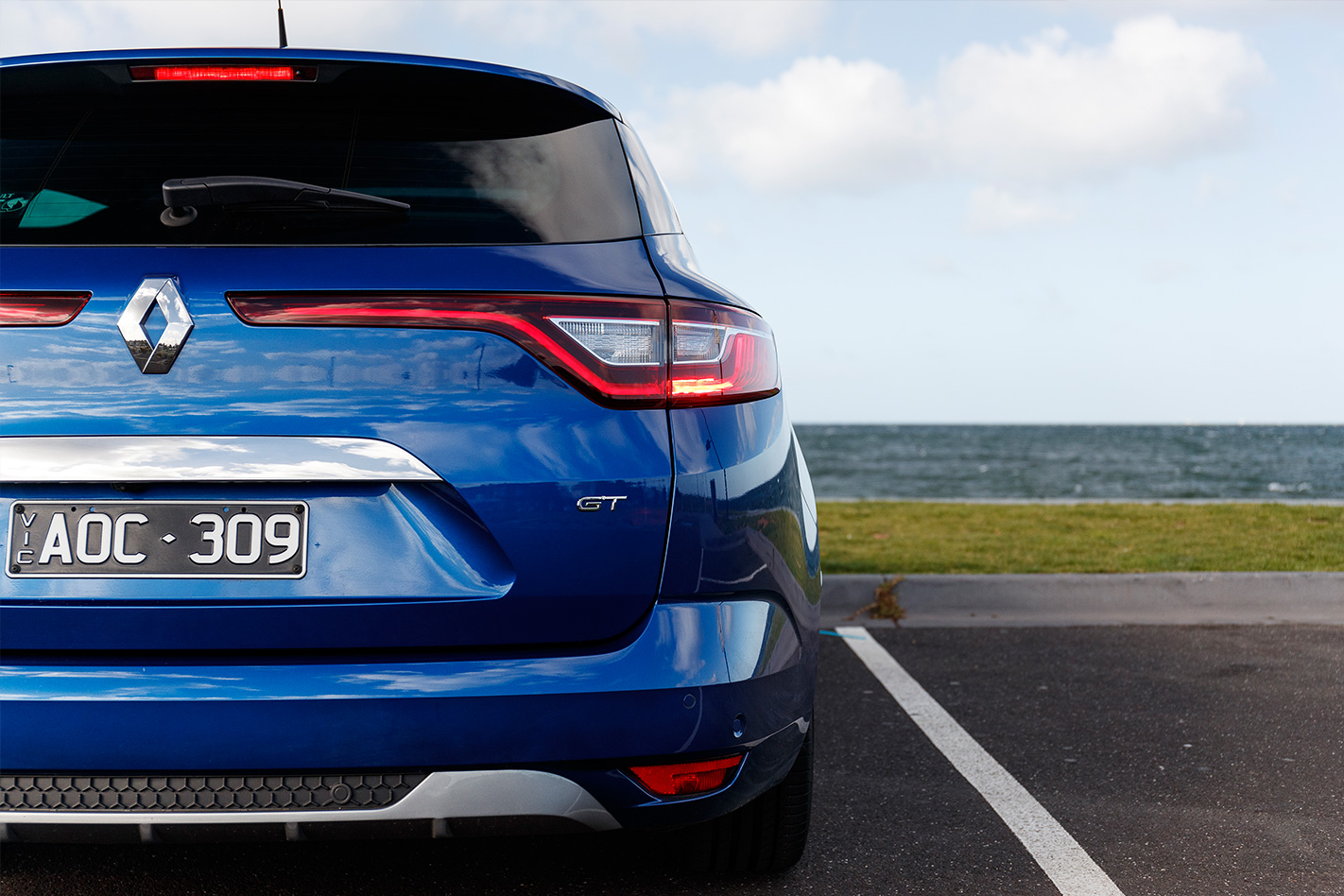
I discovered both at 6am rushing towards the airport after a night of drenching rain. Not just the windscreen was smeared.
The bottom line is, no matter how good the product is – and the Megane GT wagon has truly exceeded my expectations so far, both as an involving semi-sporty hot-hatch-style runabout and a comfortable, spacious and practical carry-all – if the after-sales service is not up to par then the whole brand experience is soured.
Like its cars, Renault has to ensure its dealers step up too.
Part Five: Who’d have thought four-wheel steering would work so well on gravel?
SINCE the middle of last century, French manufacturers have enjoyed a reputation for producing cars of exceptional softness when it comes to dealing with lumpy road conditions. Anybody who has ever driven a Citroen DS would understand. Its hydropneumatic suspension technology – which uses interconnected oil-filled spheres rather than primitive springs – set a template that saw Gallic marques blessed with the reputation of offering the cushiest of rides.
And burdened, too, as many more recent models from the country of fromage and escargot have delivered anything but comfort. While history might smile at the thought of wonderfully supple grand tourers like the Renault 16 and Peugeot 504, a Peugeot 407 on big wheels will punish any posterior it encounters. Aie!
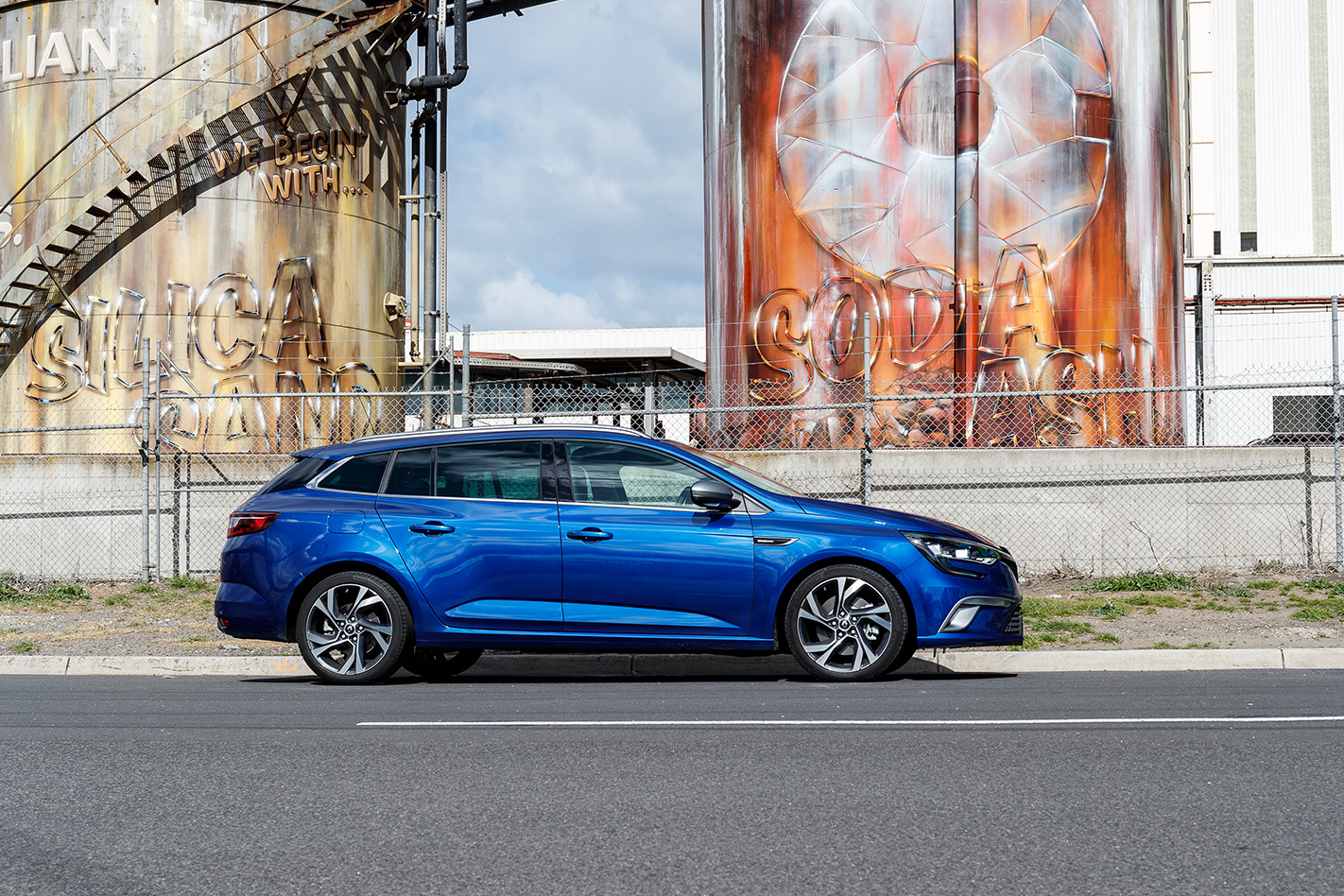
Our long-termer Megane GT wagon, however, is certainly a traditionalist of sorts. In the five months under our stewardship, it has ably straddled that fine line between chassis agility and welcome absorbency, delivering a rare combination of cosseting thrills. No doubt the tasty Continental ContiSportContact 225/40R18 tyres help. And all without fancy adaptive dampers. Just Renaultsport engineering excellence.
Such thoughts were front of mind when faced with several lengthy journeys over gravel over a series of weekends. I was afraid that the loose dry surfaces and ever-present potholes would make for unpleasantly jarring progress. However, after a few kilometres of cautiously slow manoeuvring, it became clear that the multi-link ended Megane GT could not only handle the ridges, ruts and cuts strewn all along the forward path, but also soak these and more up, without making me wince and grimace at the sound of crashing components underneath.
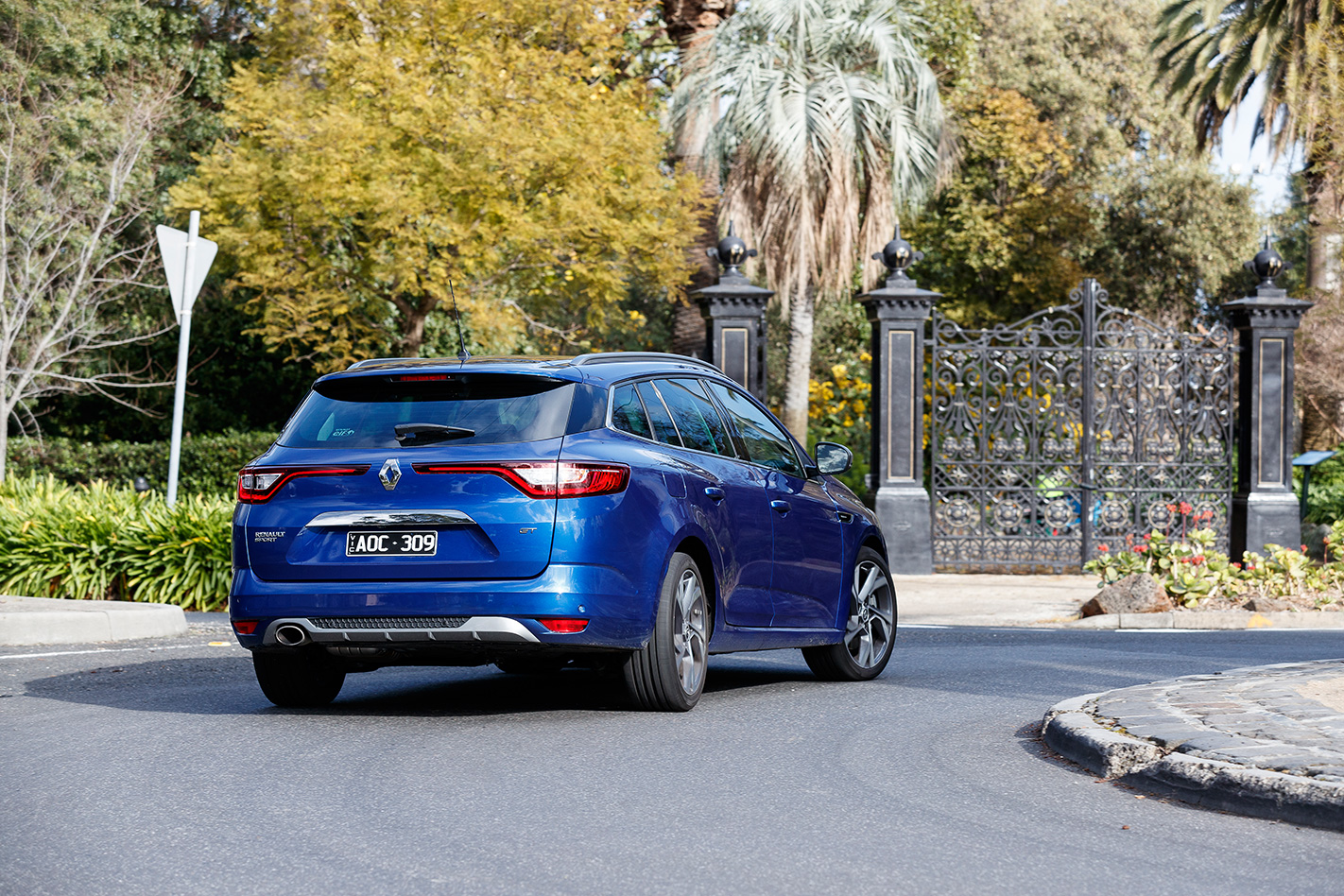
But what really surprised and delighted me was just how much fun the Renault is driven with vigour, revelling tight corners. The French boffins have tuned the suspension and calibrated the electronic stability and traction tech to allow for plenty of sideways fun, while only interfering – gently – when the sliding starts to turn into oversteer. At around 100km/h, the wagon would track with surety, heading wherever it was pointed with Olympic skater-like insouciance and control.
No doubt the four-wheel steering aided such athletic antics. Anyway, the moral here is firstly, French cars can still ride brilliantly, and secondly, the dynamic Megane GT wagon with 4WS is a marvel on the gravel. Brilliant stuff!
Part Six: A memorable six-month affair with Renault’s Megane GT wagon comes to an end
AT THE beginning of my half-year with the (breathe in) Megane GT TCe205 EDC 4Control Break, I pondered whether it might be all the car I would ever need.
Wagon practicality meets Renaultsport verve, in an attractive and spacious yet compact package. That it was French and featured four-wheel steering had me hoping for some sort of R16/Honda Prelude mash-up. What I ended up with instead was something rather more substantial.
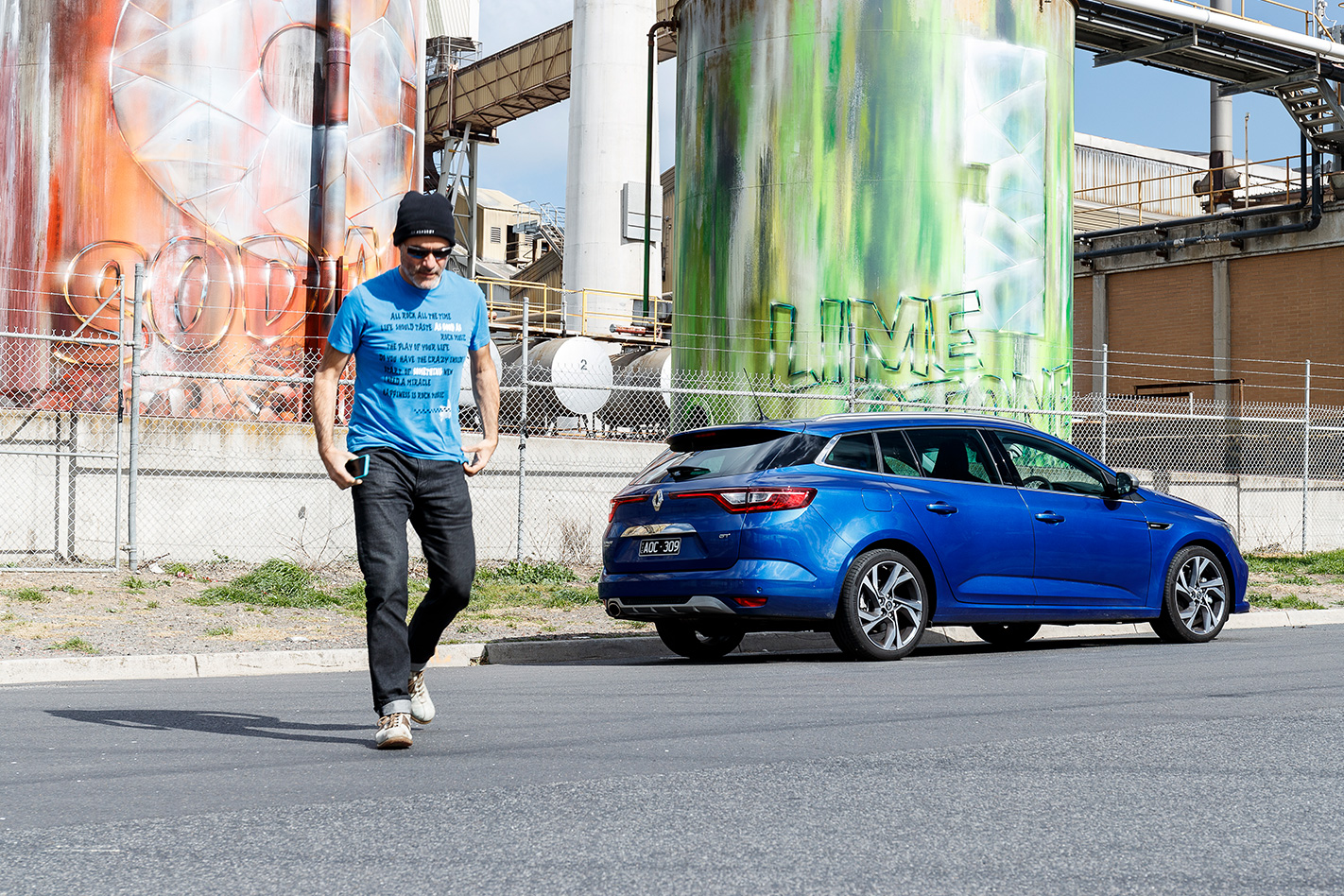
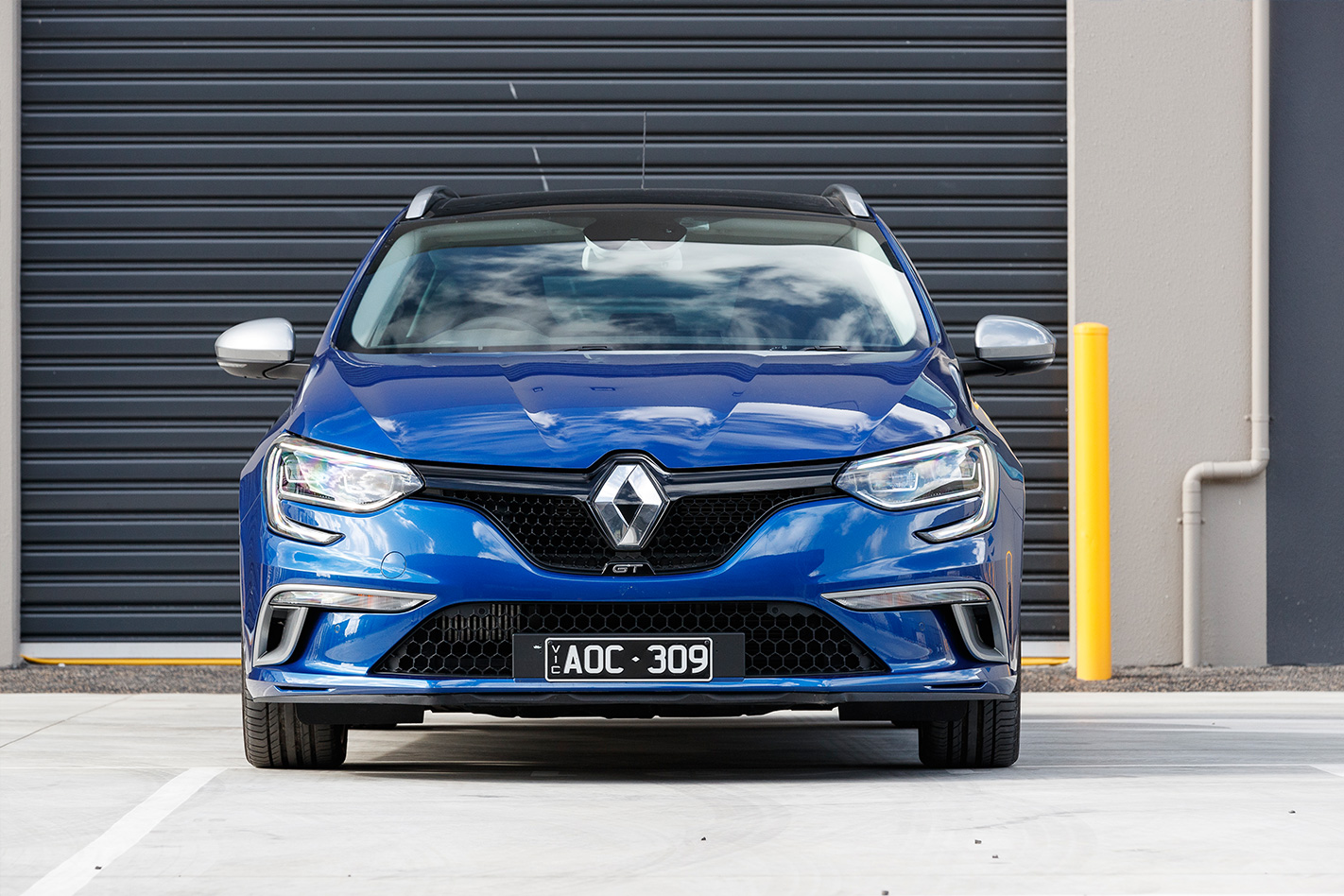
AOC-309 certainly stood out from the sea of medium-SUV alternatives, with its elegant, low-slung styling, big alloys filling up the wheel arches and smart LED lighting.
Which makes the Megane’s slabby dash seem profoundly mundane in view of such visual boldness elsewhere. Lacking flair, it is the antithesis of the stunning fascia Peugeot is currently serving up. It’s as if Nissan rather than Renault took charge in there.
However, that may explain why nothing squeaked, rattled or broke off, so at least the Spanish factory is putting them together properly. And the trim and materials deployed are generally high quality. There’s decent space for four adults – five if going cosy is okay – and all their luggage. The air-con copes well with heat and humidity, the Bluetooth multimedia streaming barely skips a beat and the actual job of conveying info to the driver is impressively imparted via detailed instrumentation.
Furthermore, the Renaultsport bits really do lift the GT’s ambience. Though not everybody will enjoy clambering over the high side bolsters, the sports seats are pitch-perfect for their supporting role; the chunky three-spoke wheel is terrifically tactile; while initially fiddly to navigate, the ugly touchscreen’s wide range of personalisation provides plentiful colour and distraction – I particularly liked the varying dial designs; and the keyless unlocking and walk-away locking is an incredible boon. Much to like and little to loathe.
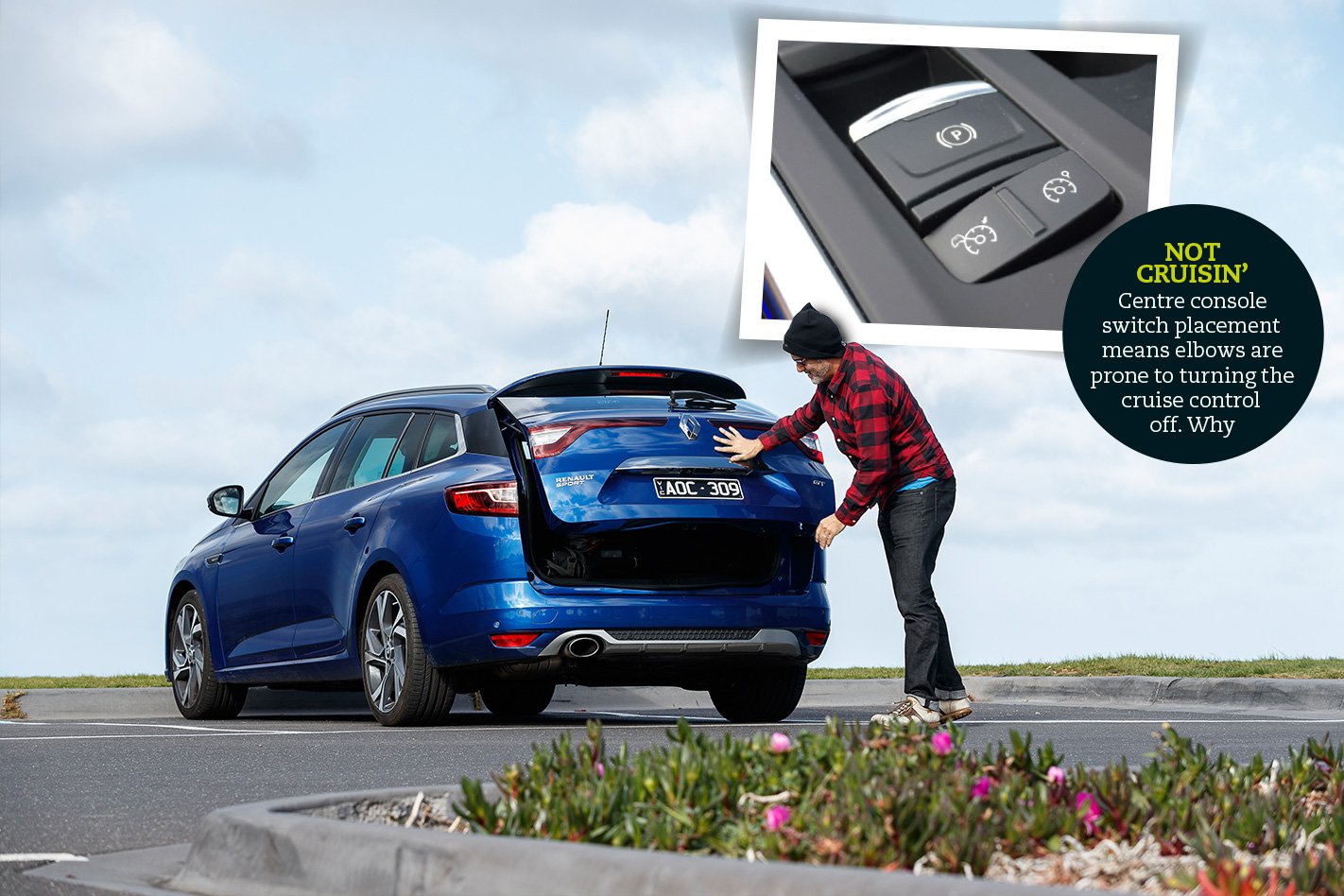
On the other hand, annoyances included a cruise control on/off switch that’s too-easily knocked by elbows due to its silly lower-console positioning. And once in operation downward inclines allow the speed to run away. Oh, and the sunroof blind lets too much sunlight in.
Wagons have been Renault’s Domaine (pardon the pun) for over 60 years, and the Megane’s packaging really reflects such experience. The tailgate opens high, the aperture is wide, the floor flat and long, and there are handy details like remote-release rear-seat backrests. For these benefits alone families ought to be cross-shopping SUVs with wagons. And that’s before pushing the GT’s start button.
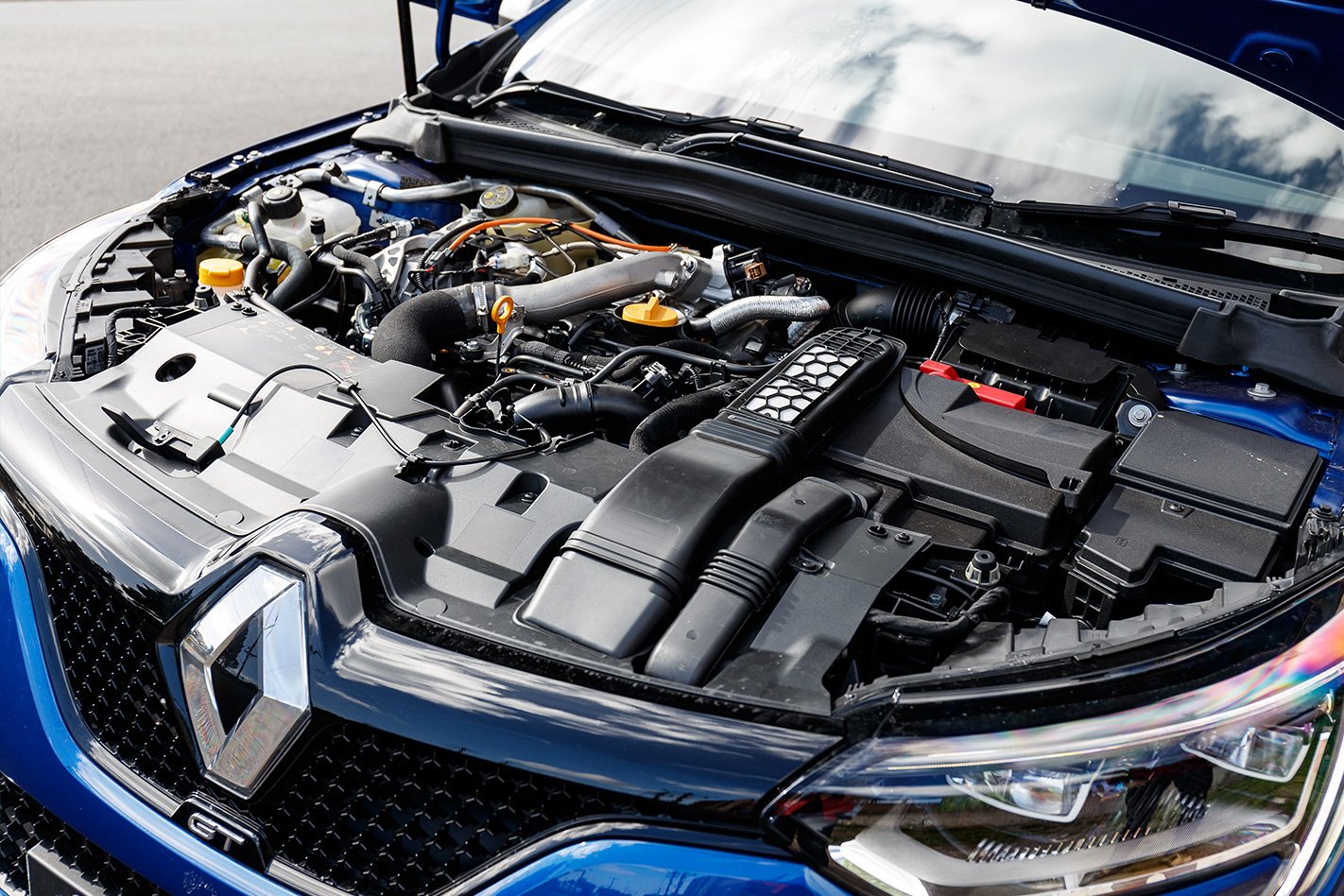
A tad unremarkable on paper, the Clio RS-based 151kW/280Nm 1.6-litre four-pot turbo and seven-speed dual-clutch transmission combo transcends the 1430kg wagon’s mass, and the forced-induction lag and hesitation associated with such gearboxes. Instead, it responds eagerly to throttle inputs and then with rousing exuberance as the revs rise. This is a deliciously free-breathing belter of a powertrain regardless of driving mode, made all the more special by consistently low fuel consumption (averaging 7.7L/100km all-up).
It certainly lived up to the GT badge. Much of our driving was either inner-urban jungle or rural backroad blasting, where the 4WS chassis displayed its broad bandwidth of abilities best: unexpectedly sharp steering at lower speeds imparted a unique acrobatic lightness to this 4626mm wagon, before transitioning seamlessly to a vice-like grip at higher speeds, backed up by brilliant braking performance.
Plus, though firm, an underlying suppleness defined the RS spring and damper set-up. Bumps are duly dispensed with, making for pleasingly relaxed travel, despite the car riding on (Continental ContiSportContact) 225/40R18 rubber. Our Megane’s dynamics are a real highlight, while the only slight NVH demerit is occasional coarse-surface tyre drone.
So, if you seek strong performance, revel in tenacious handling, appreciate a comfy ride and want to stand out from the pack, don’t buy an up-spec medium SUV until you test drive the GT. And I mean really flog it, hard. Such an excellent all-rounder for around $40,000. I’m already really missing it.
MORE: Renault Megane Range Review MORE: Renault Megane Specs, Range & Price
Features are our bread and butter here at Wheels, and we take great pride in bringing you high-quality stories that go a step further than your typical news-and-reviews website.
Here are five of the most popular features that we’ve produced in 2017 – clearly you all enjoyed reading them just as much as we enjoyed creating them.
BERLIN AIRLIFT COMMODORE
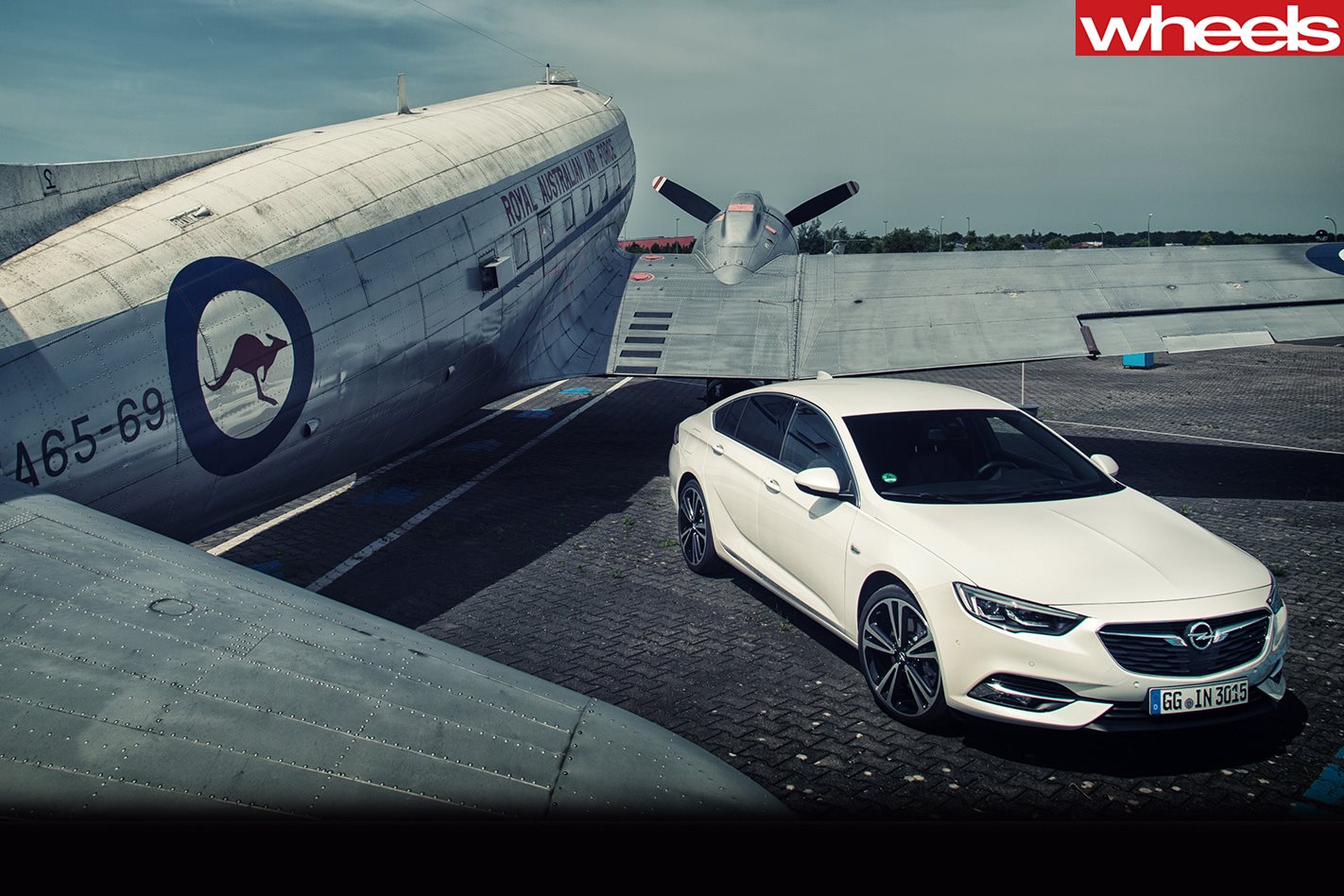
We gave a tearful farewell to the Australian-made Commodore this year, but while Australian car manufacturing is no longer the Commodore will indeed live on as a rebadged Opel.
To get acquainted with the VF Commo’s replacement, we took a factory-fresh Opel Commodore on a roadtrip through Germany to discover a German-Australian partnership of a different sort: the vital role the Royal Australian Air Force played during the Berlin Airlift.
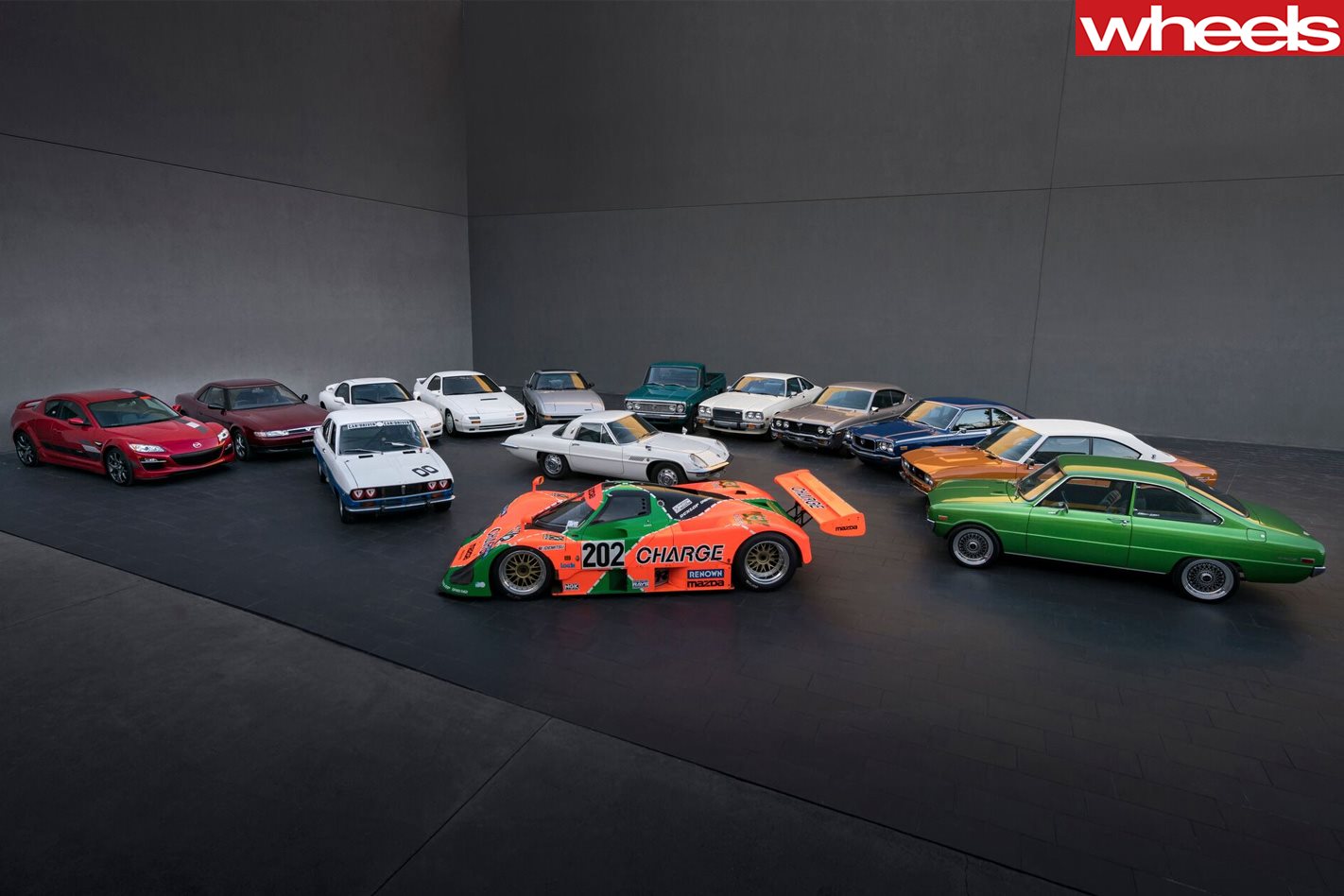
2017 marked the 50th brithday of Mazda’s rotary engine, which first made its production debut half a century ago in the sleek and dainty Cosmo coupe. Its had a tumultuous history since then, surviving the oil crisis of the 1970s, steadily-tightening emissions laws and declining demand for sports cars – especially those powered by oddball powertrains.
Only one manufacturer has persisted with rotary-engined production cars: Mazda. To celebrate the rotary blowing out fifty candles, we travelled to Mazda’s home town of Hiroshima to sample the gamut of Mazda rotaries – and ponder on what the future may hold for Mazda’s unique spinning triangles.
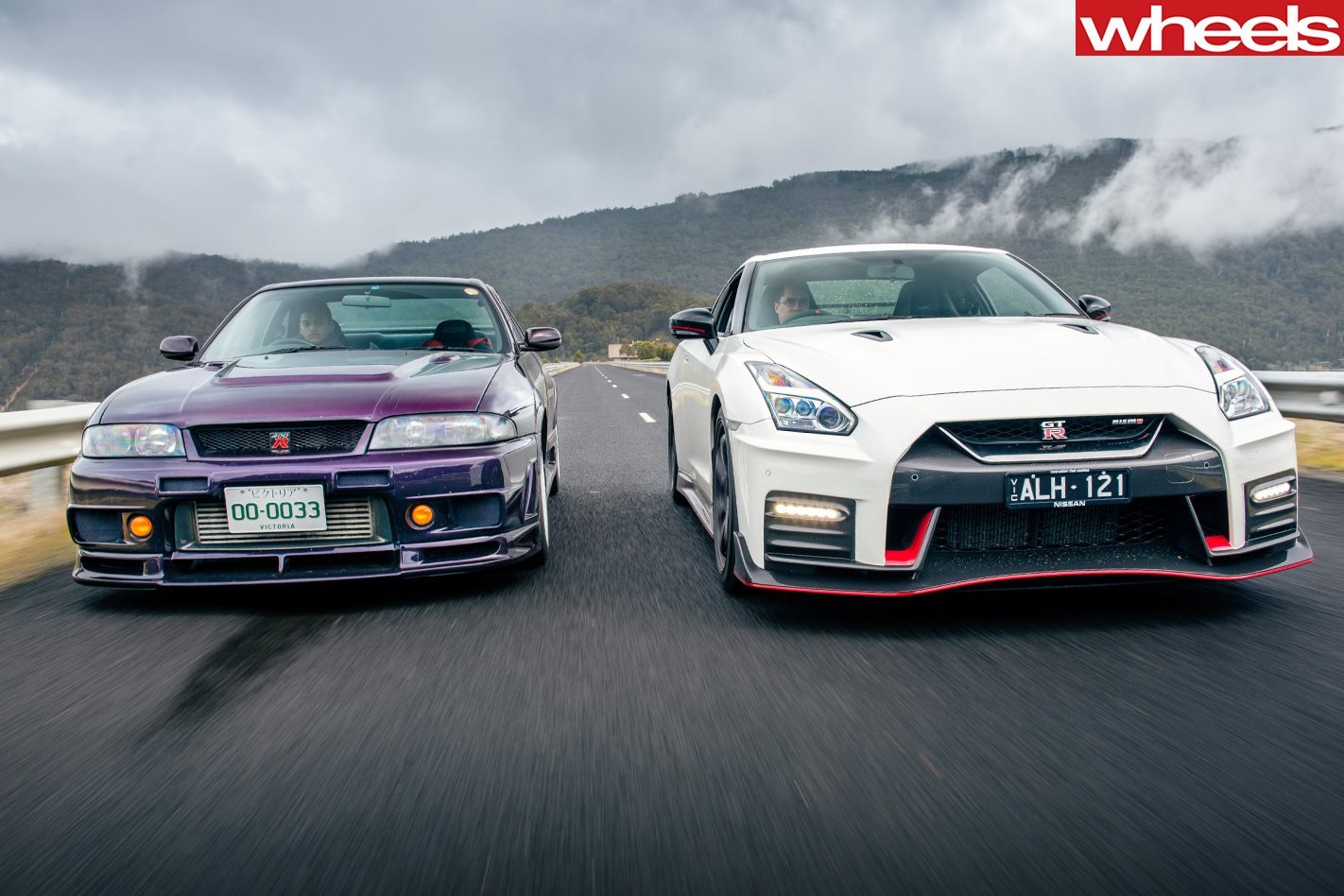
Two cars separated by two decades, but bonded not just in name but in their spirit as well – this is what we discovered when we took Nissan’s head-stomping R35 GT-R Nismo and reunited it with its granddad: the R33 Skyline-based Nismo 400R.
Both are rare (only 20 GT-R Nismos will be sold in Australia per year; only 44 400Rs were ever built), both are ludicrously fast, and both are worth a significant amount of money. As the most extreme examples of Nissan performance cars of their eras, the 400R and GT-R Nismo share plenty of DNA.
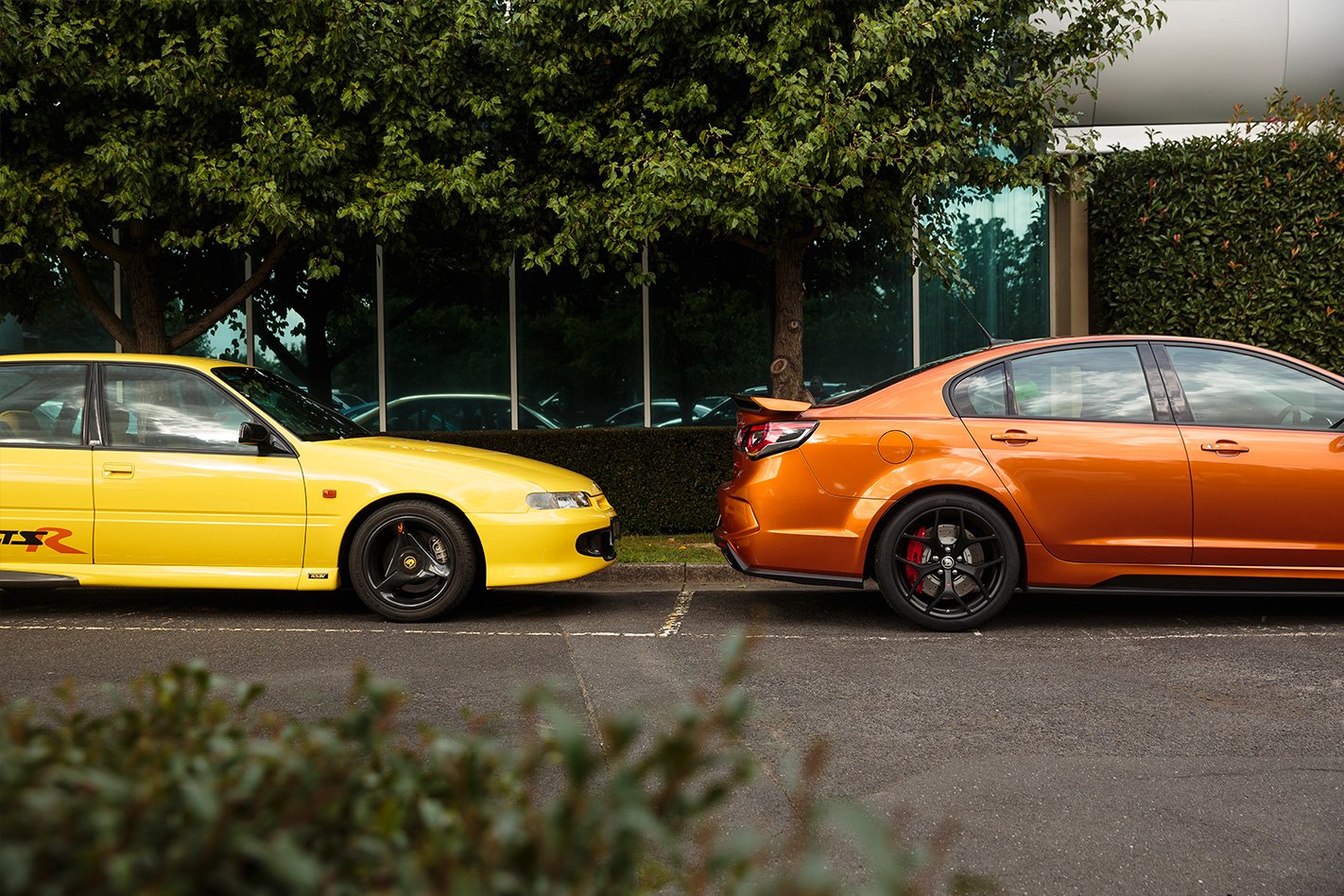
Holden Special Vehicles resurrected the GTS-R badge this year as a last-hurrah supercharged swansong special. With a 6.2-litre supercharged bent-eight thumping away under its vented bonnet it’s undoubtedly a beast, but how does it compare to its ancestor, the original HSV GTS-R?
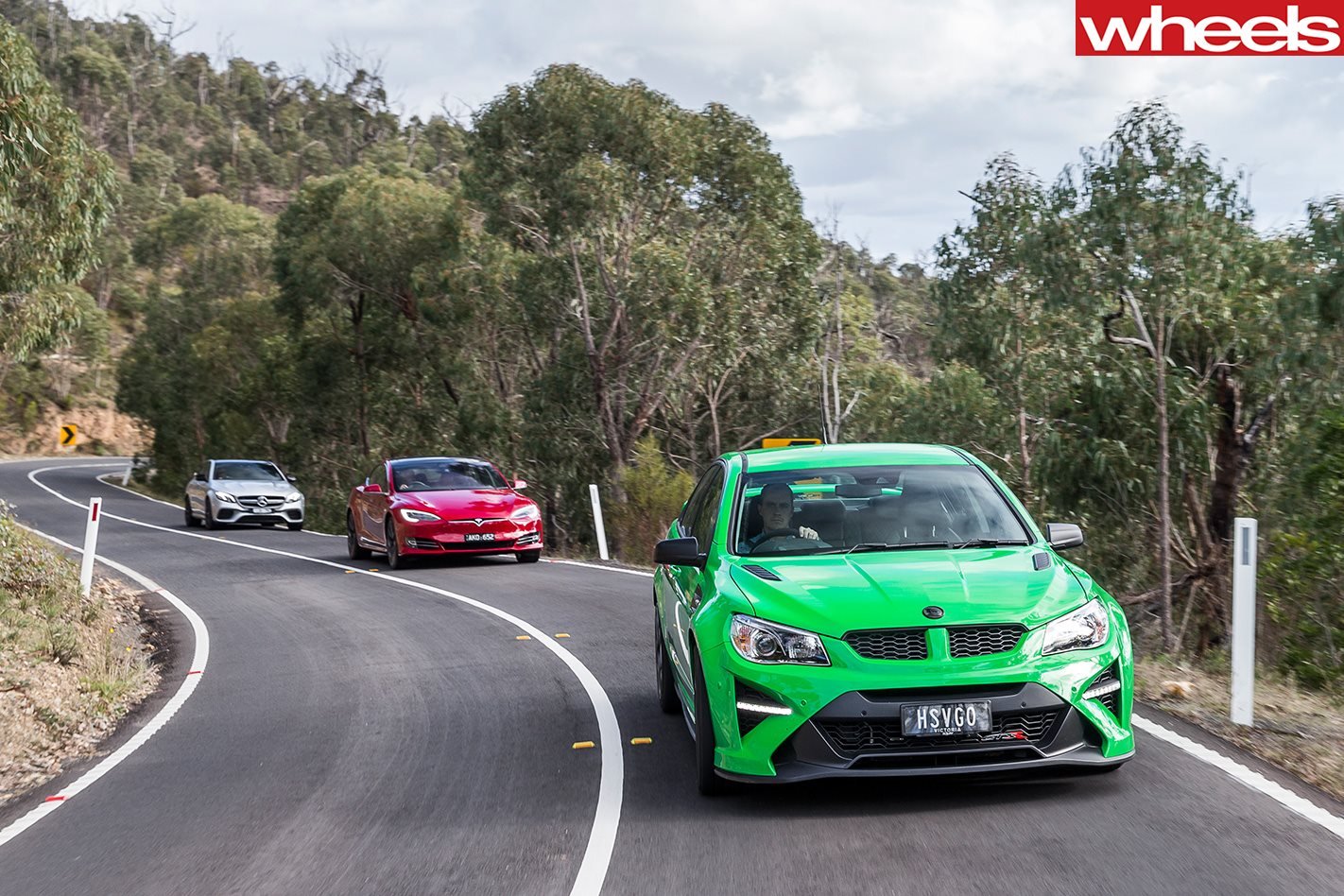
Each of these cars are high-performance monsters in their own right, but what happens when you line them up against each other on a dragstrip? Data doesn’t lie, and our findings on which approach – all-electric torque and all-wheel drive; twin-turbo petrol V8 and all-wheel drive; supercharged V8 and rear-wheel drive – makes for the best sprinter makes for interesting viewing.
It’s easy, in 2017, to think of ourselves as a V8 nation.
V8s in local performance cars were once everywhere. Still are (but you’re shopping second-hand now). They won Bathurst. They created brands like HDT, HSV and FPV. There couldn’t be a single lover of home-grown performance cars that doesn’t love the V8.
However, here’s the rub. If you look back far enough, we’re also a six-cylinder tribe. Six bangers also won Bathurst – they provided Peter Brock with his first Mount Panorama victory. A six-pot (the EH S4) was the first Bathurst homologation special. The VL Commodore Turbo was the first local car to put ‘unleaded petrol’ and ‘performance’ into the same sentence.
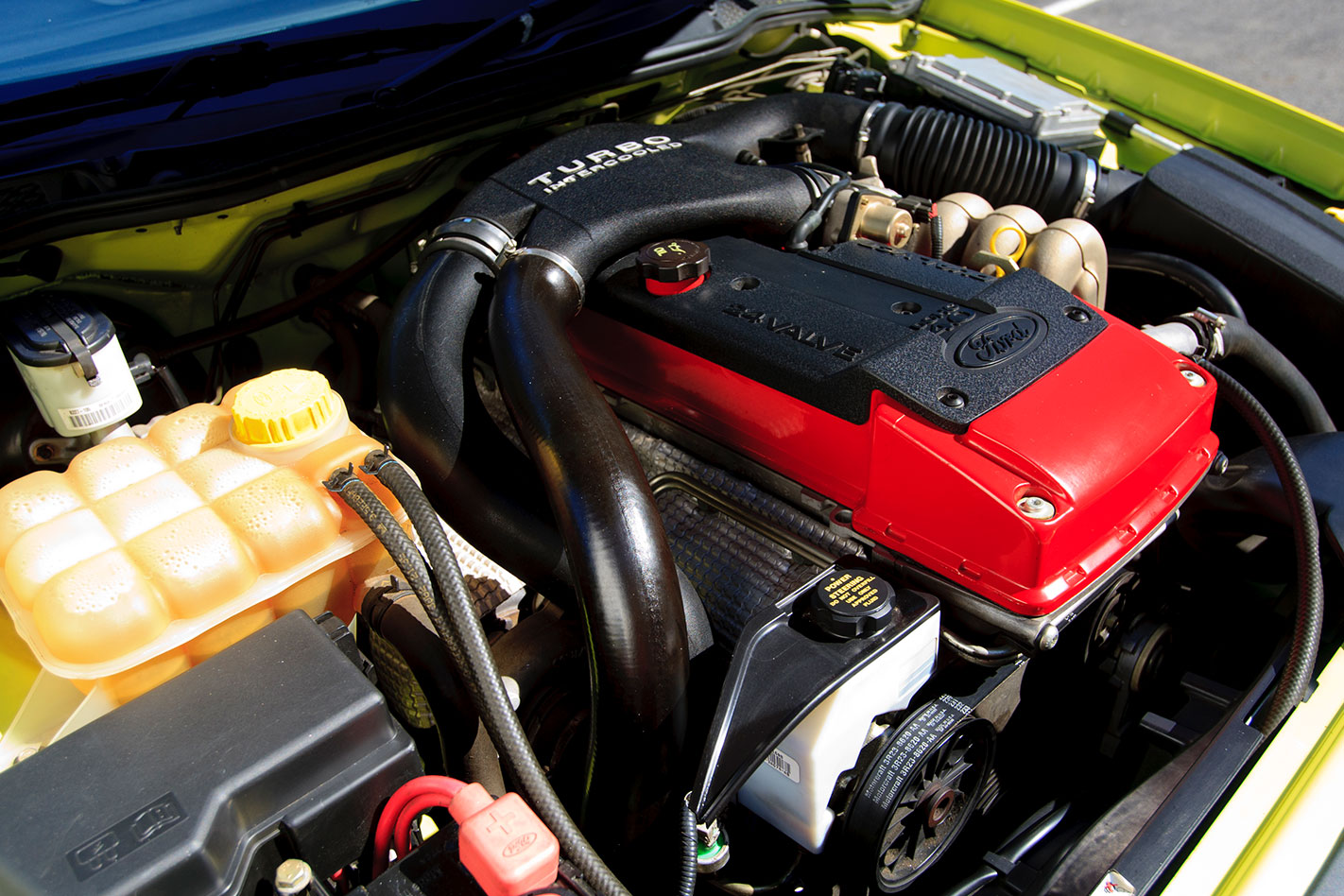
Cars like the XR6T don’t come along every day. They couldn’t possibly, not when you talk to the people who were there and you begin to understand how it all happened. But, like most brilliant achievements, the XR6T was the brainchild not of a committee or industry think-tank, but of a handful of enthusiasts. And leading that very small handful was a bloke called Gordon Barfield.
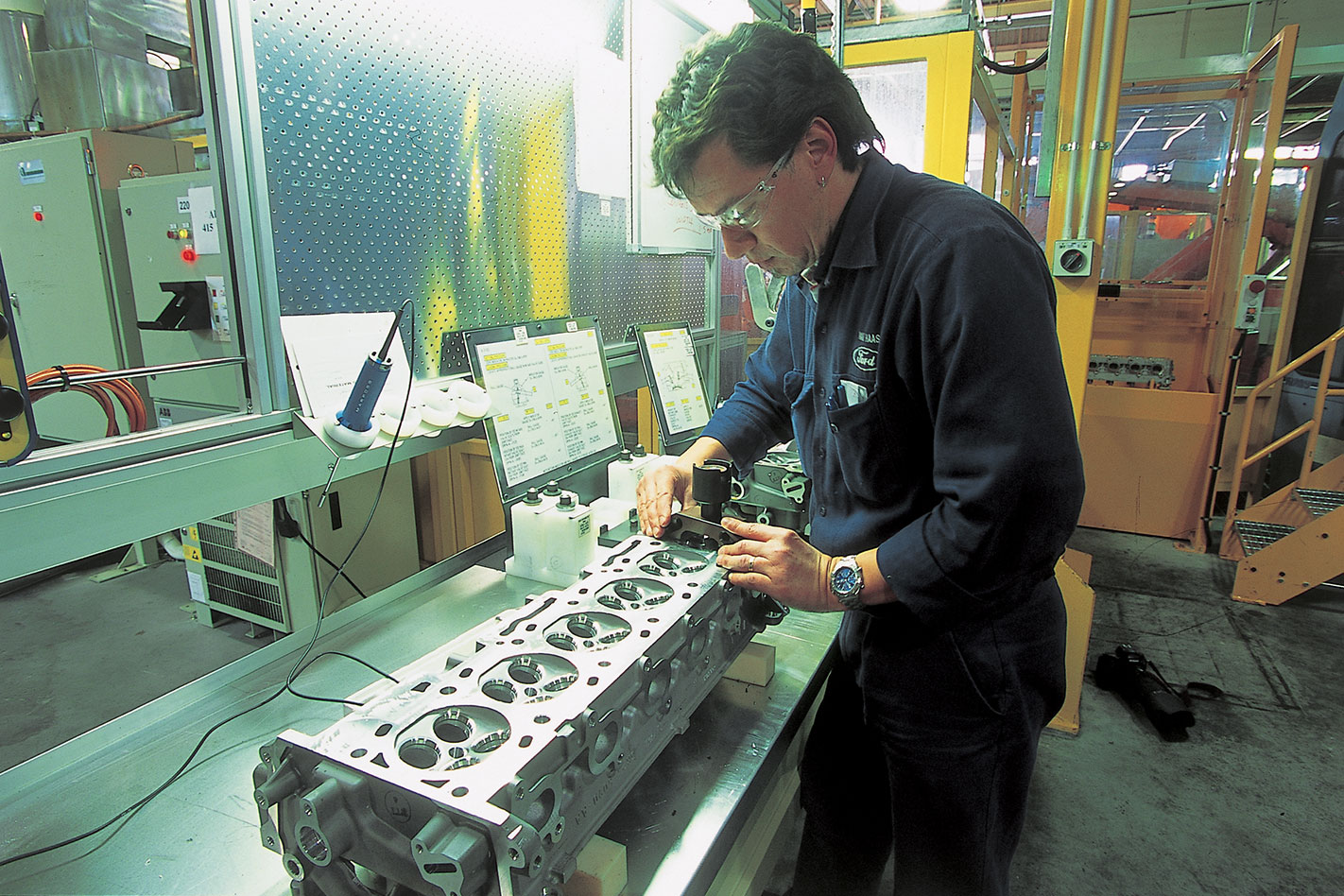
“Yes, the XR6 Turbo’ was my baby,” he admits, with no small hint of pride in his voice. “During the development of the four-valve six-cylinder, we (at Tickford) were saying, What are we going to do with this thing? How do we go forward? We could modify the engine and we might have got five kilowatts, but that wasn’t going to do it.”
As Tickford grew into FPV, the late, great Howard Marsden joined the planning team, and Howard’s instincts told him that a supercharged version of the Barra six would be a good thing. The problem was that the Barra project was already too far down the development track to be adapted to a supercharged application, and Barfield knew it.
“We couldn’t upset the existing architecture, the front-end drive (the belts and pulleys and such) so a supercharger was out. In fact, a supercharger would have put the development program back months. Howard had his eye on a Sprintex supercharger, but I said to him, ‘No, that isn’t going to work’.”
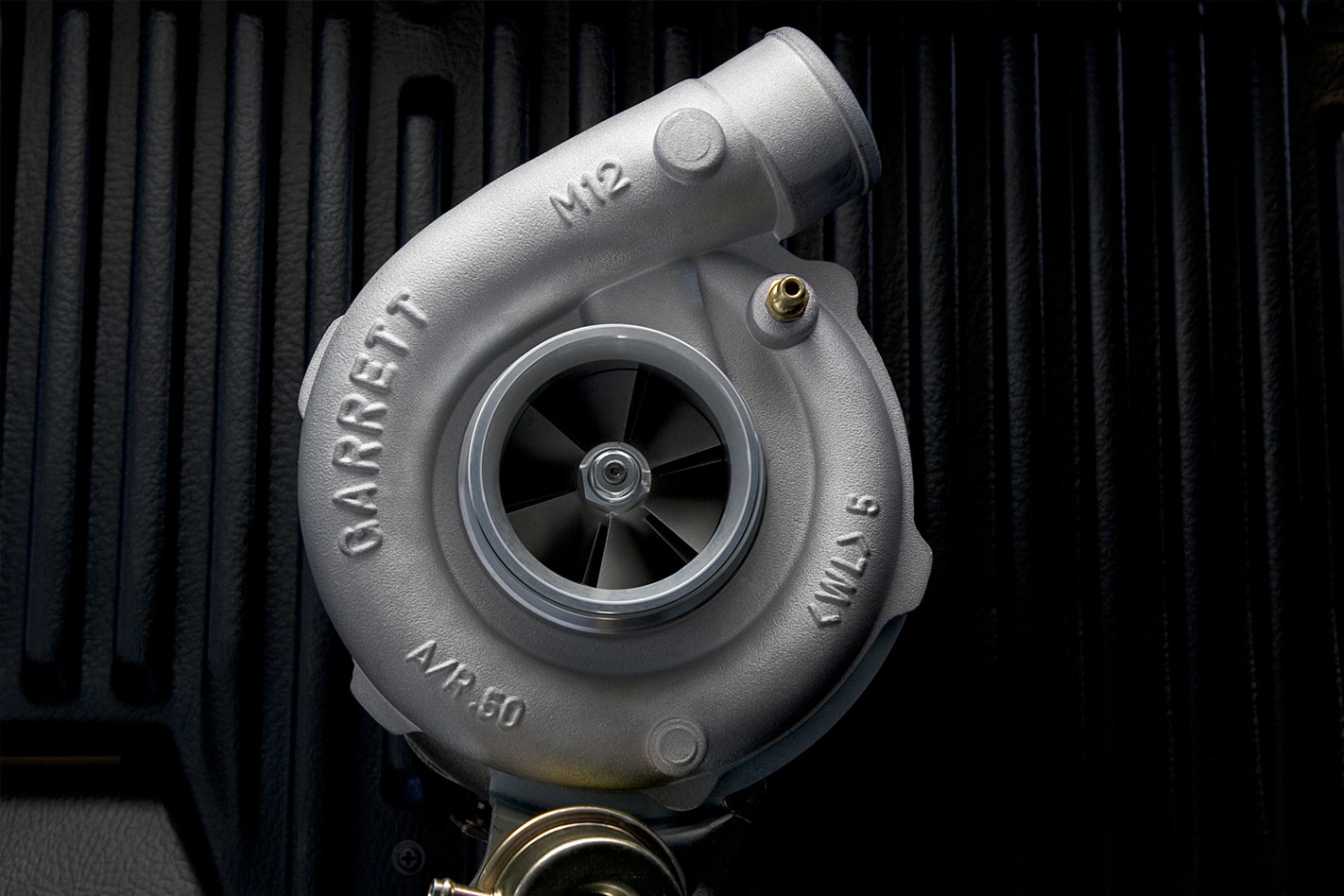
“Also, nobody (from the engineering department) was really making a grab for the real estate around the exhaust manifold – it’s too hot, obviously – so getting a turbocharger to fit wasn’t a huge problem. No, the problem was getting an intercooler to fit into the existing packaging. Luckily, our design principle was for a low-boost turbo on an engine that was already a high-torque unit, so we could get away with a smaller intercooler; one that fitted down low and out of the way.” The engineering, though, was the easy bit.
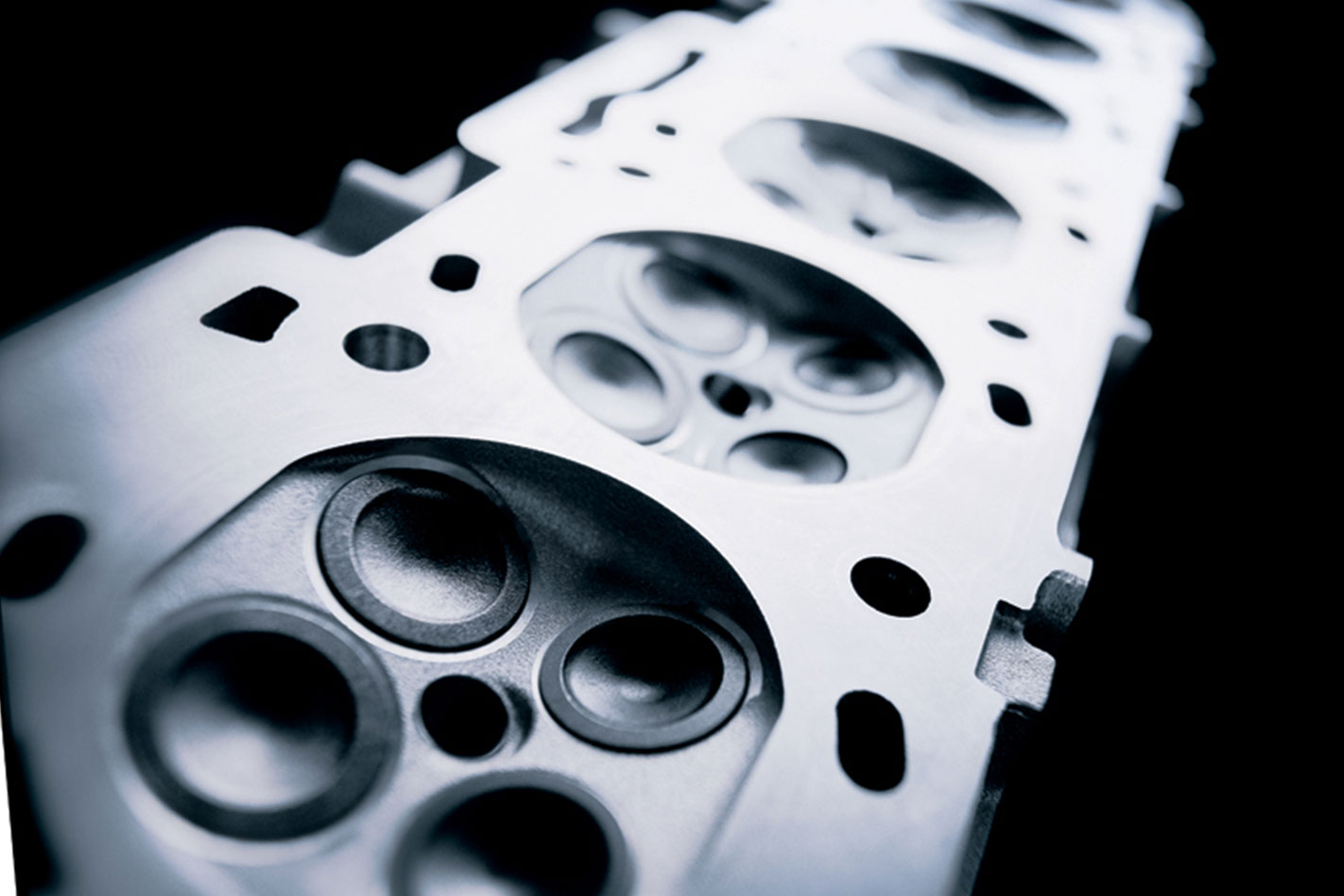
Ultimately, though, the XR6 Turbo project gained the support of Ford president at the time, Geoff Polites, and, crucially, engineering chief Trevor Worthington.
“I spoke to Trevor and he was really supportive. He could see the need for a model like this and also that there was nowhere else to go for a performance six.” Marketing was next and while plenty of punters could see everything that was right about the XR6T, that’s never enough at boardroom level. Eventually, though, the project was green-lighted, partly on the basis that with the low-boost nature of the thing, there was headroom for FPV to do more with the engine (and ultimately create the F6) as time passed and really build it into a performance dynasty. Which is exactly what happened (check the XR6T timeline). Let’s see how it all happened.
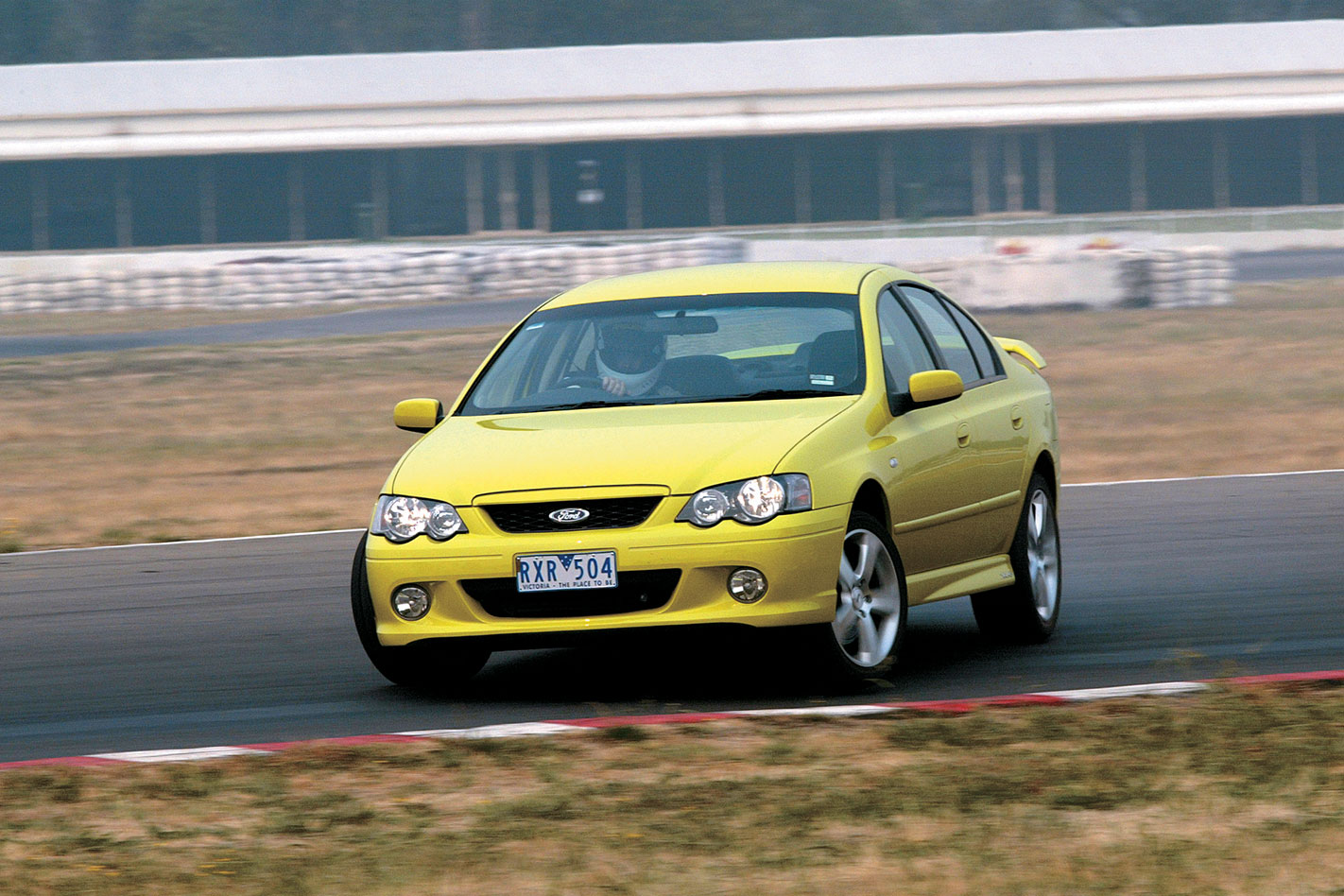
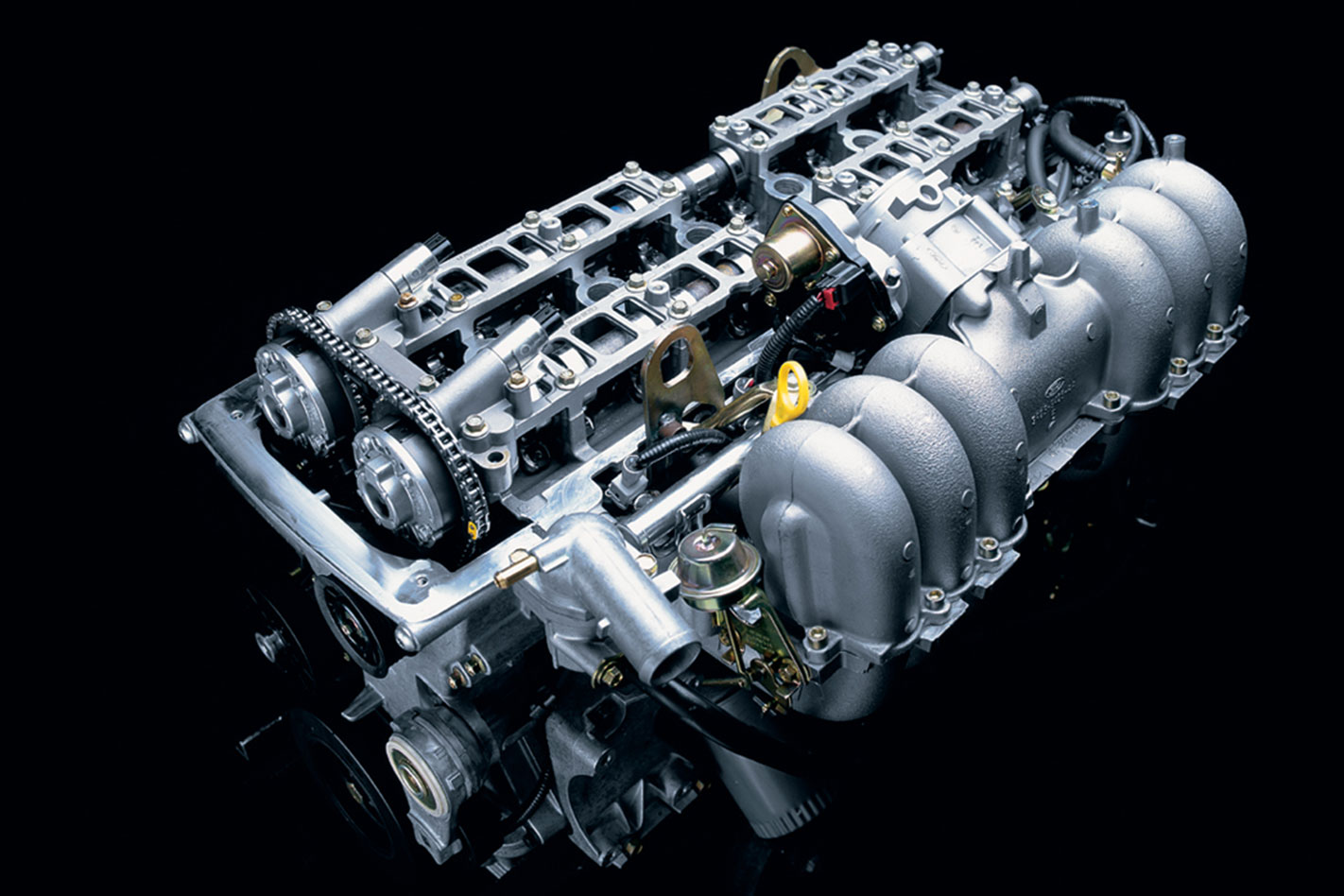
A large part of that rightness was an all-new DOHC, four-valve version of the Falcon 4.0-litre six. And by the time the Broady brains trust had got done with it, it was sporting a Garrett GT33/40R snail, bigger injectors and a lower, 8.7:1 compression ratio thanks to different pistons. Power leapt from the N/A Barra’s 182kW to 240kW and torque now maxxed out at 450Nm. And if you cross-reference those numbers with the Ford three and four-valve V8s offered at the same time, you’ll see that the blown Barra gave the three-valve a power (if not torque) hiding and the four-valve XR8 motor a big scare. Makes you wonder if Ford wasn’t pulling a few punches on the power output front to avoid any nasty comparisons, too.
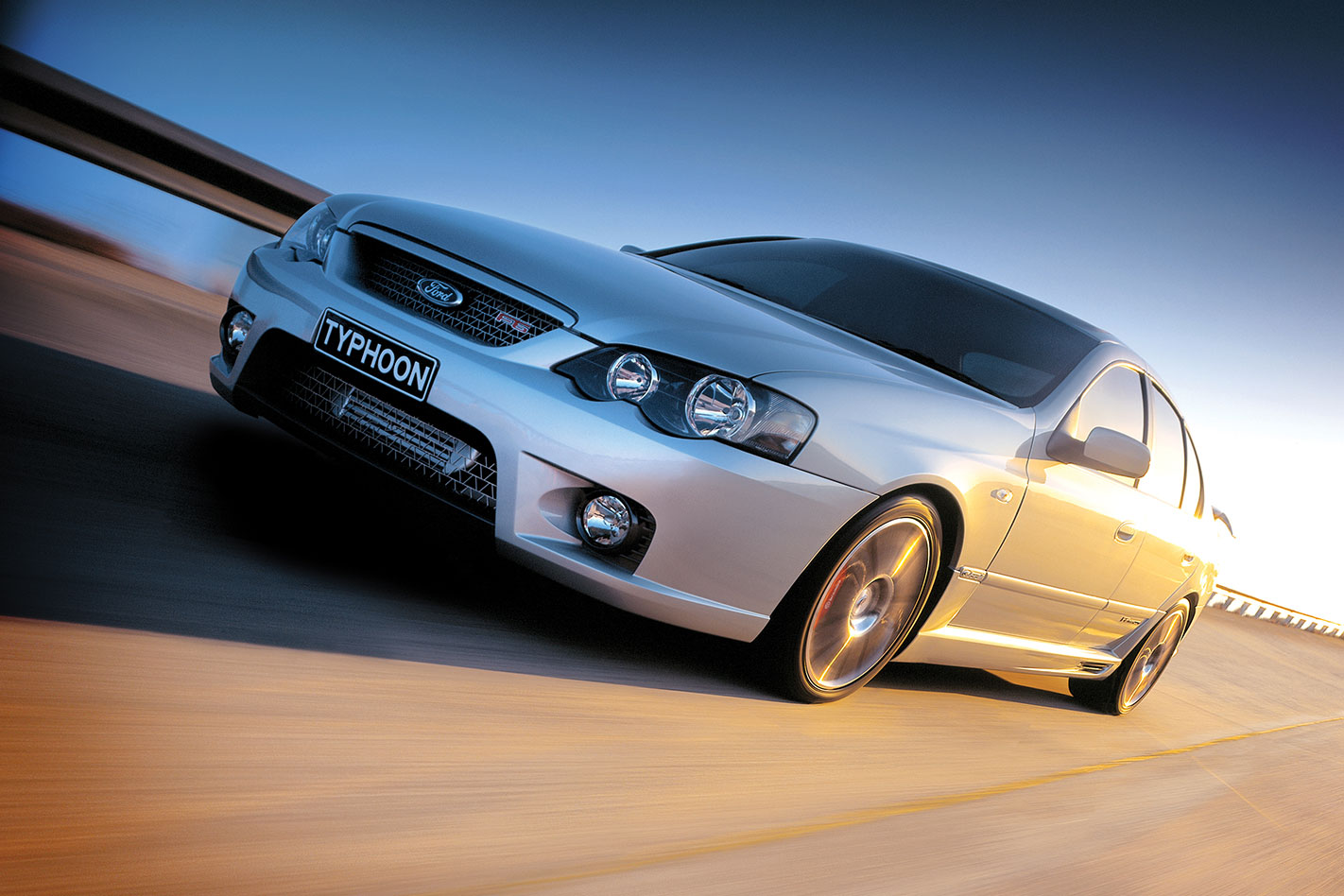
The auto was the nicer car, but either way, the XR6T had, from the moment showroom doors opened on the first morning, rewritten the book on six-pot poke.
From that point, the Turbo’s progress was one of refinement and improvement and the fact that it remained a strong seller right up until Ford Oz pulled the plug on local manufacturing back in late 2016, proves just what a star it was. The first of those improvements came with the BA Series II in 2004 when the XR6T got a six-speed manual to replace the old T5, but it wasn’t until the BF model in 2005 that the four-speed auto was replaced by a new six-speed ZF unit. Power also got a kick up the bum at this point to 245kW and torque was now 480Nm. But the improved gearing meant that even though performance was up, so was fuel economy. Win-win.
If that was the bottom end the car had always been crying out for, in 2008 with the launch of the FG Falcon, the XR6T also got the snail it had been waiting for. While the early design used a big turbo to keep boost happening at high revs, that also made it a bit laggy. The smaller unit fitted to the FG version reduced that lag while better engine management kept it boosting longer. Power was now 270kW and torque was a much beefier 533Nm.
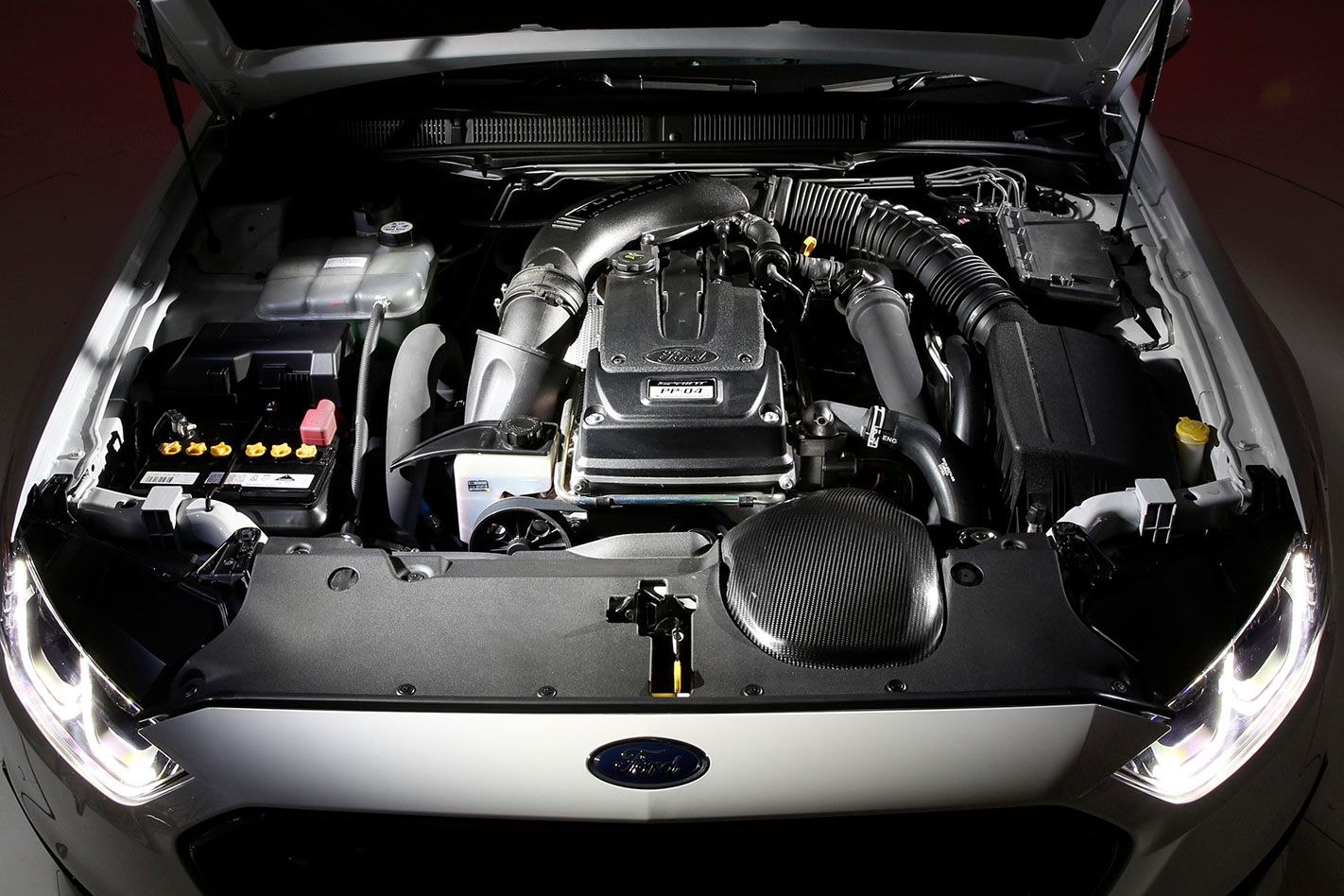
As a thank you note to those of us who had fallen in love with the blown Barra all those years ago, Ford used the very last Falcon, the FG X, to present us with the best XR6T ever. Dubbed the Sprint (there was an XR8 Sprint, too) the final iteration of the whole concept combined the best bits for a whopping 325kW and 576Nm.
Talk about saving the best till last.
Key Points to Look for When Buying a Barra
Right, about now, you’re probably thinking: yep, I need me an XR6 Turbo. Catch is, of course, that you’ll be buying a car that somebody else has thrashed before you. That said, they’re pretty damn tough, and there’s a wealth of knowledge out there that can predict what’s going to go bang.
All XR6Ts are hard on their diff bushes, too, so check them for play and check the service book. Ideally, the previous head-banger has changed the oil and filter at 10,000km intervals, not the 15,000 ones listed in the handbook. Sludgy oil can eventually block the oil feed to the turbocharger which then starves and fails.
Early XR6Ts experienced the odd piston failure, but it was rare and running changes fixed it. Valve springs were also a bit underdone in those early cars and intake gaskets could fail. A lot of cars were left with no go when the cam-angle sensor wire in behind the cylinder head got cooked over time, became brittle and snapped. It’s a common fault. Stock brakes on the XR6T were seriously underdone and would warp on a warm day. Aftermarket replacements are needed.
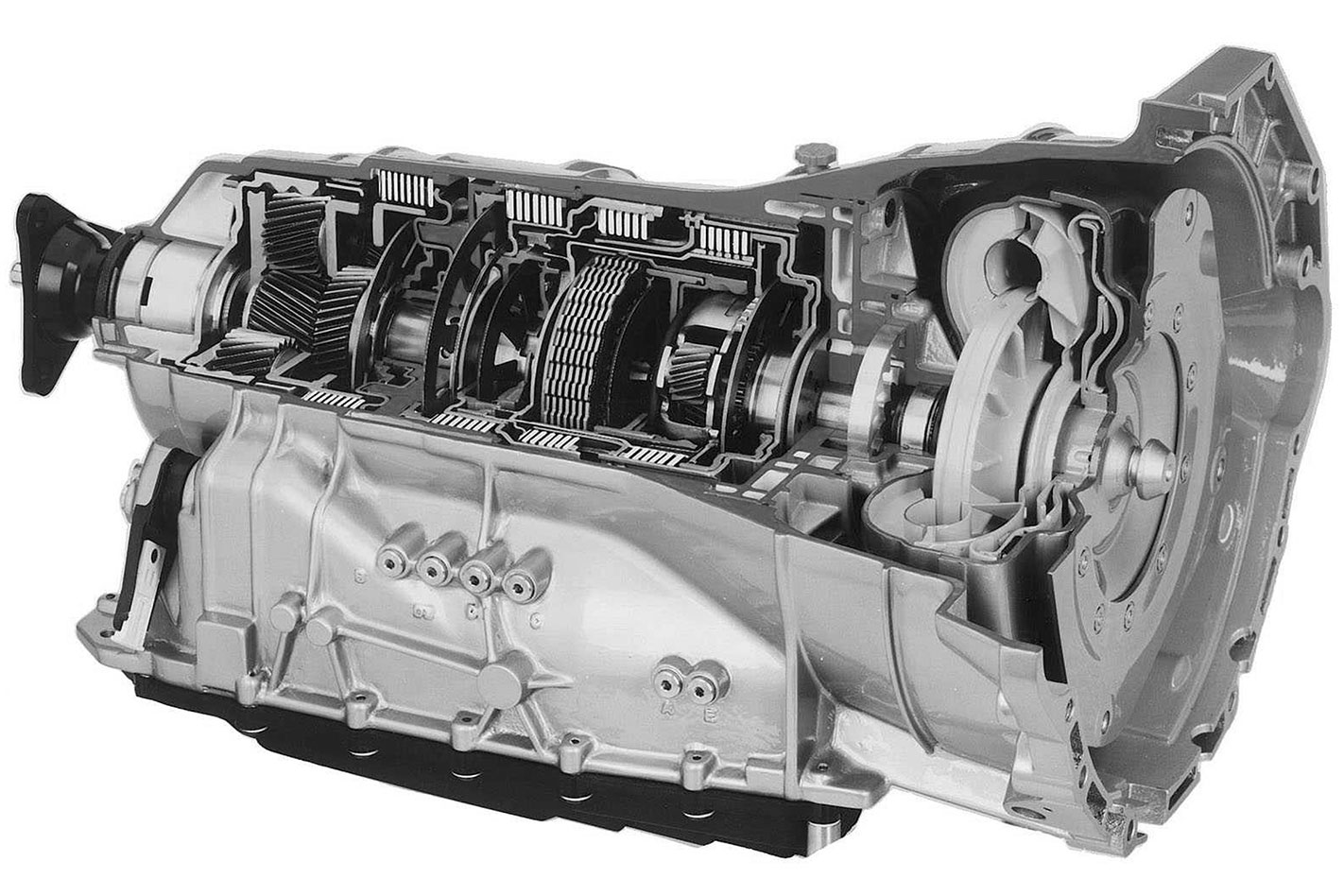
Centre-bearings in the tail-shaft were always a bit of a problem, too, but the fusion-welded tail-shaft that came in with the FG model is also a bit prone to twisting. A conventionally welded replacement tail-shaft from an earlier model is the go. The FG’s turbo pipe was also notoriously thin in places (due to core-shift in the casting process). The world is full of viable replacements.
It started out as a fairly simple concept: build a batch of race-cars for a one-make series, but it’s precipitated the biggest restructure in HSV’s corporate history.
This was first published in MOTOR’s April 2006 issue.
The contract to build and supply 20 Commodore-based race cars to the Bahrain Grand Prix Corporation has become such a Big Deal that the Clayton-based operation has sprouted a whole new arm. Dubbed Walkinshaw Racing Options, it’s obviously a very nice fit with HSV’s road-car business and the Holden Racing Team operation.
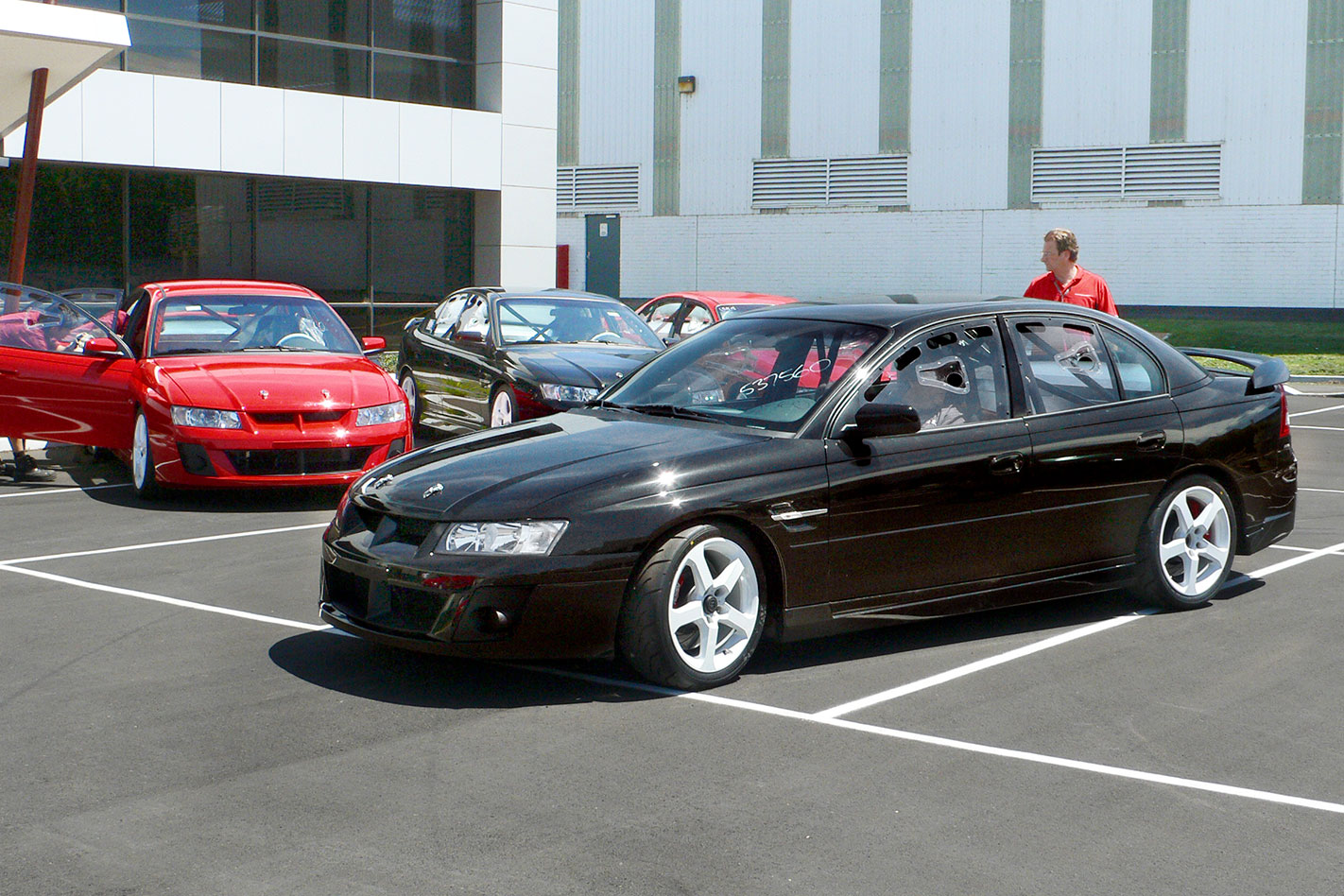
Six-piston brake kits and short-shifters are at one end of the Walkinshaw Racing Options catalogue. Complete race-cars, like the ones that are Bahrain-bound at the other.
Heck, there are even plans for a line of fitting and tuning shops (probably operated by HSV dealers) which would use the `Walkinshaw Performance’ shingle. The business case for that lot is still being nutted out at Clayton, but rest assured, HSV is thinking big.
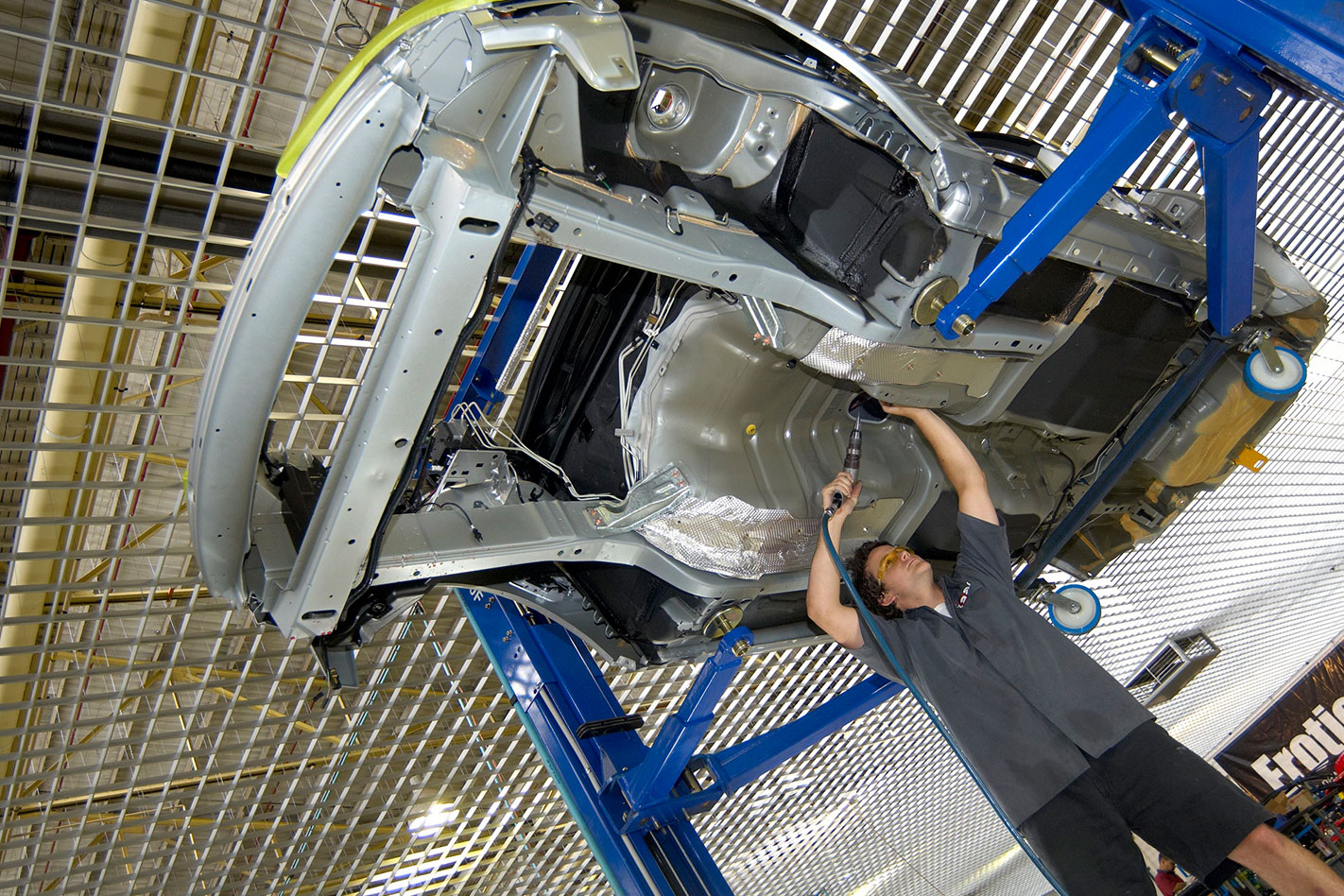
Of course, it’s the Bahrain contract that has kicked off all this activity, and when you understand the depth of modification that goes into the cars, you can see how a chain of race shops no longer seems beyond the realms of possibility.
I’m not saying I now know how Glenn Seton felt that year his engine expired at Bathurst while he was in the lead (on the way to his first win on The Mountain) with about seven laps to run, but I do have a certain sense of how race cars can tear your heart out.
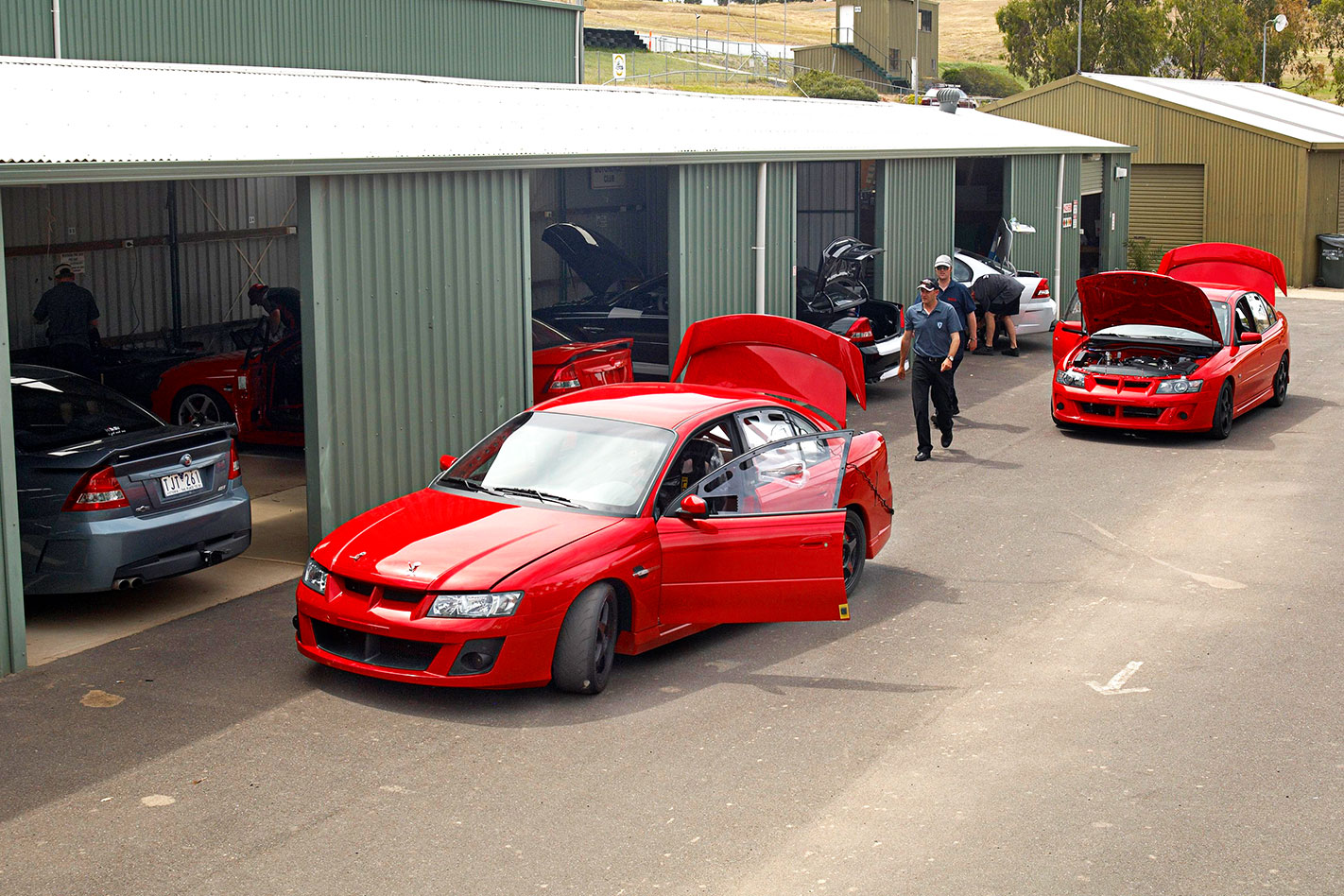
Naturally enough, the TV yobs pushed their way to the front of the queue and Our Jen (who, it must be said, looked pretty good in a race-suit) strapped in, did a quick piece to camera and then proceeded to torch the clutch before she’d traveled 20 metres down pit lane. Spare car? Nup. Game over. Sorry, boys. Bugger.
And then a week or two ago, I got the call up to come and have a test drive of the Bahrain-spec Clubsport-R (badged as a Cheverolet Lumina SS R for the Middle East) at Sandown. This time, I managed to elbow my own way towards to top of the waiting list with only a couple of punters ahead of me who defied the trend by not trashing a single component of the car.
But wouldn’t you know it: the absolute millisecond the straps were cinched up, the door was slammed shut and I started to roll down pit-lane, the heavens opened.
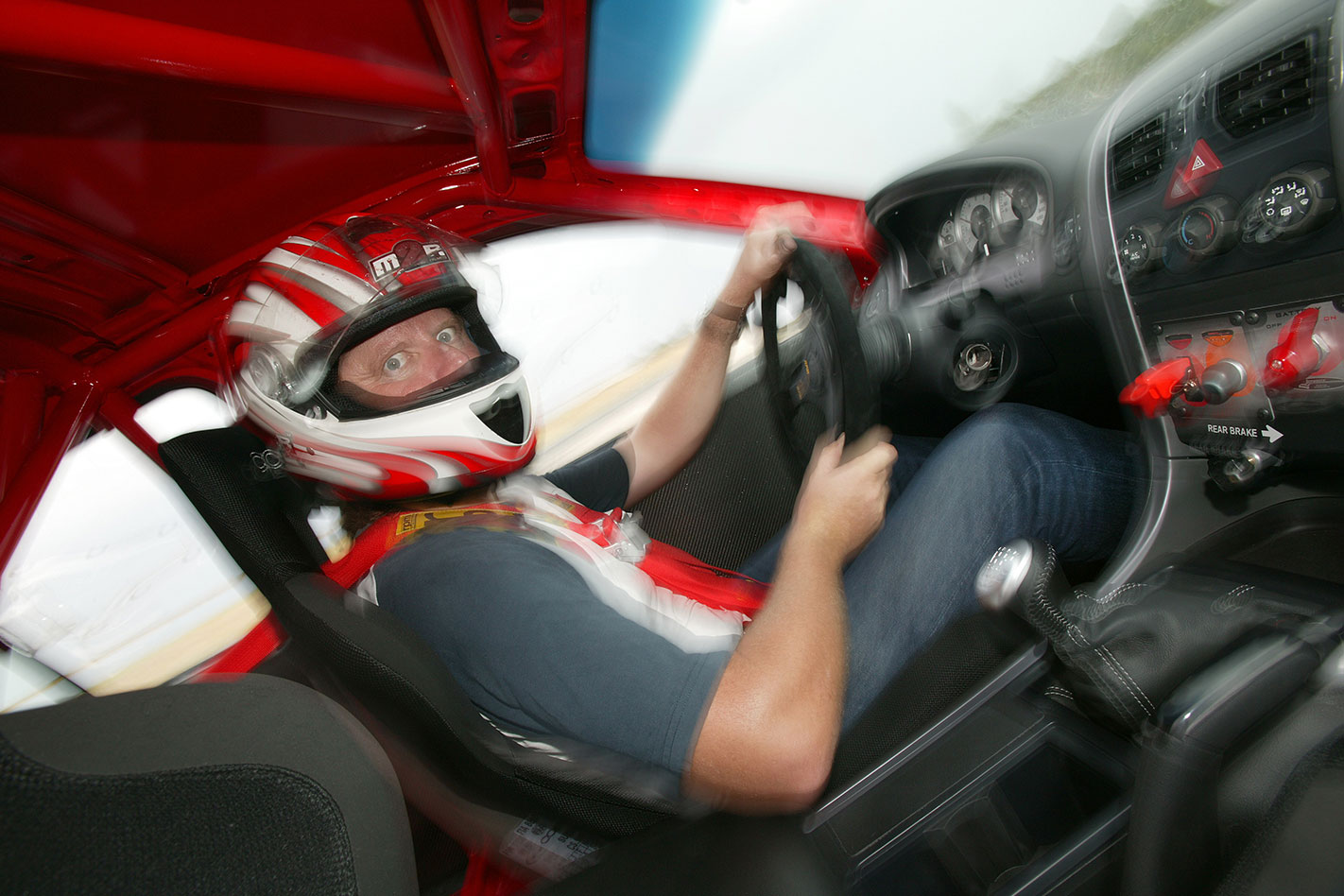
Of course, that’s when the problems really started, because the violence of the downpour was leaving big, deep puddles all over the Sandown surface. Throw in the feisty engine (thanks to its lightened flywheel), the Yokohamas that amount to little more than cut slicks (definitely not wets), and a shortened diff ratio and I was getting up to all sorts of big elbow action. To be fair, you’d need flood tyres, not just wets, to get anywhere in this mess.
Scramble through the esses and up to Causeway corner in second, line up the back straight and squeeze on the gas. And the rears go up in steam. Drat.
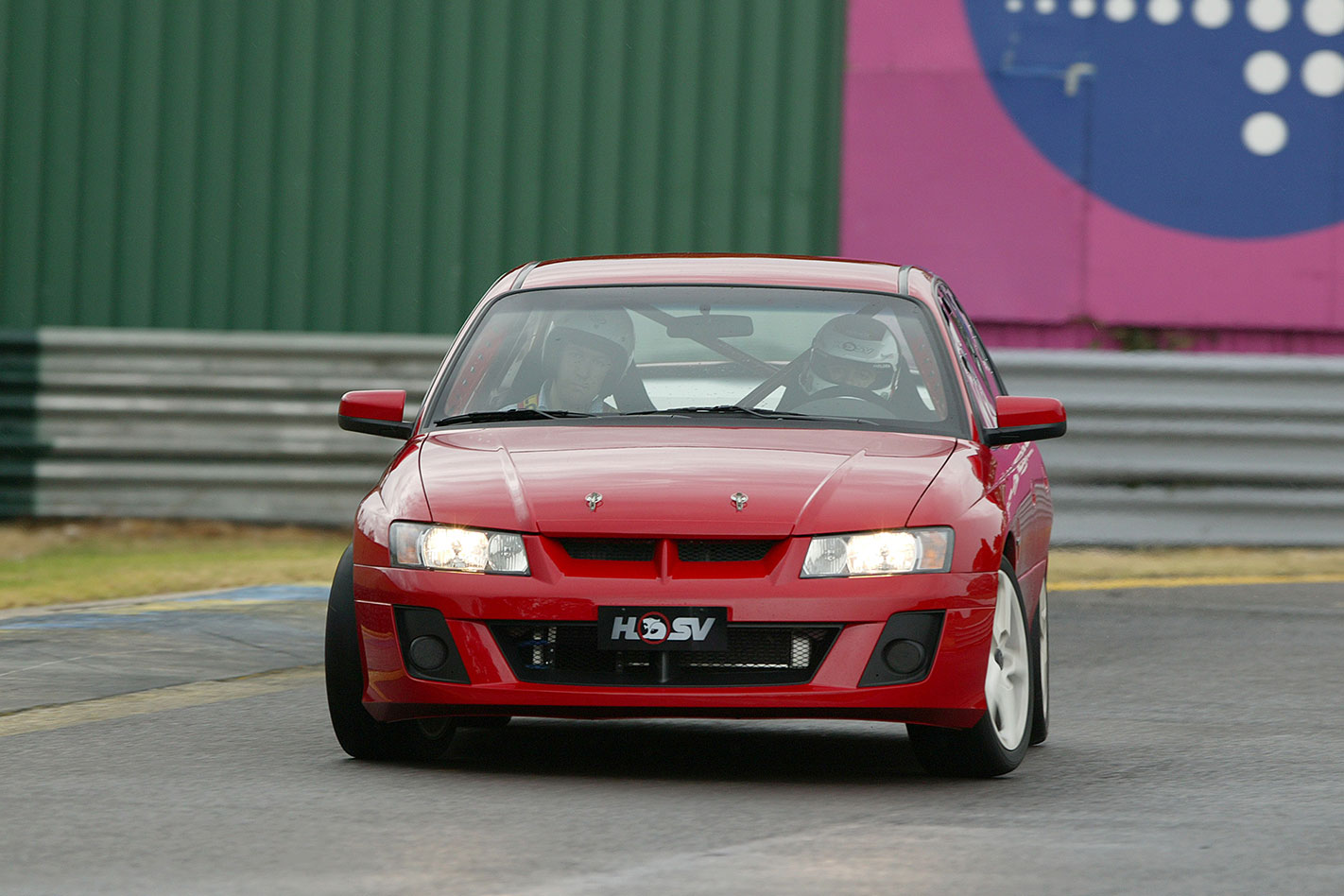
I make the decision to forget about the whole thing and head back to the pits, but then it goes really pear-shaped. Heading under the bridge before the left-right on to the front straight, the steering goes all light and the car heads for the boondocks. Yep, the dreaded aquaplane.
Being a race-car, I’ve got no ABS (staying off the brakes in an aquaplane is the best idea, anyway) and no air-bags, so I’m starting to feel a bit deflated about now. Not to mention what Clark will do to me. But just before I run out of track, I finally find some grip and lurch off at walking pace to burble up the pit entrance and park next to the second car, which has just been abandoned through lack of grip by reigning Bathurst champ Todd Kelly. Wimping out was probably the right call, then. Clarkie thinks so.
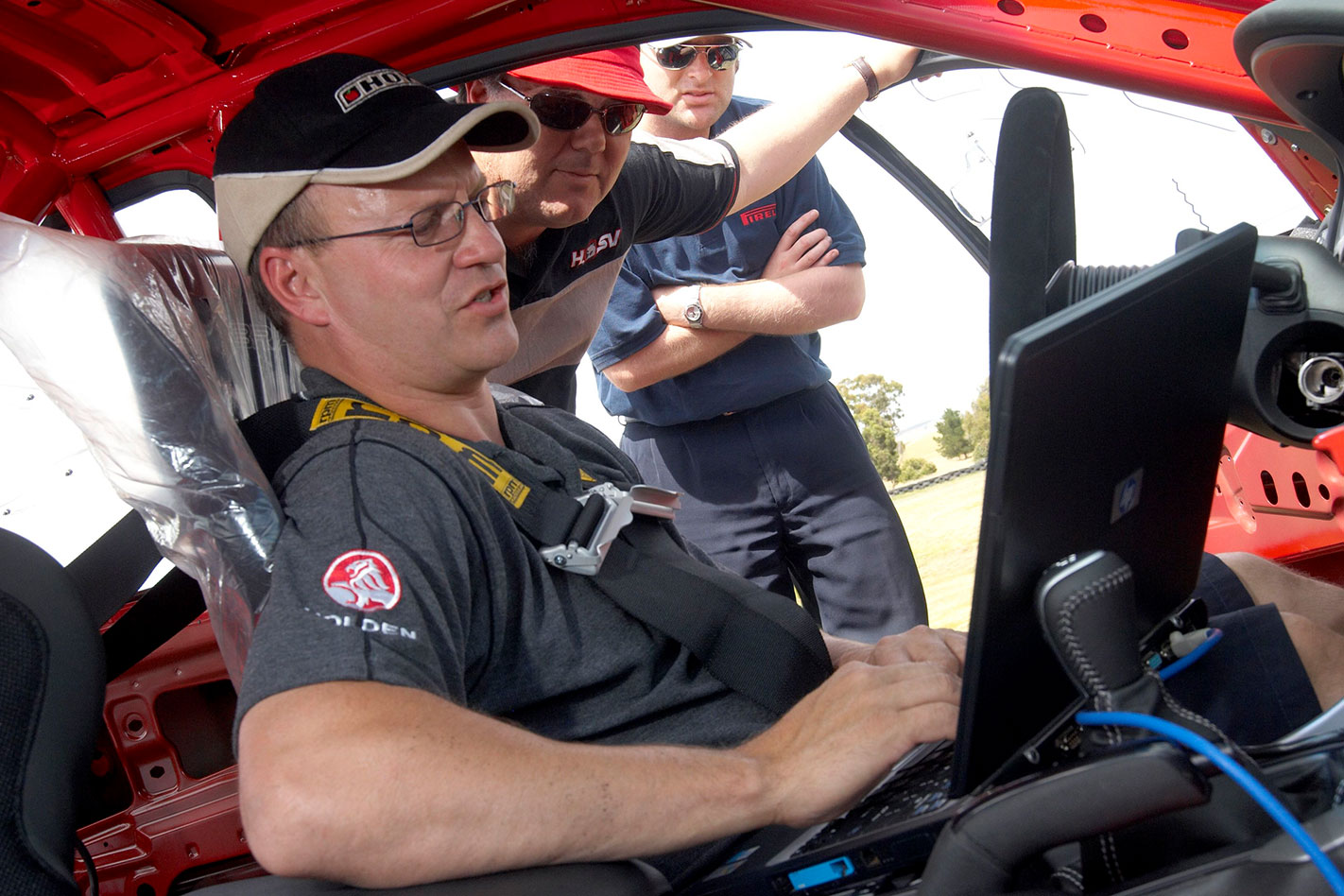
The lighter flywheel and shorter diff has really improved the LS1’s perkiness. The short shifter is more accurate than a road car by a factor of about 2000 and even though it’s a lefty, the shifts are vastly more positive.
The paddle clutch has a savage bastard of a take-up and the five-plate slippery diff can be a bit clunky at low speeds. I could live with it, though.
The other thing I know for sure is that the Commodore is a whole lot fitter for losing those 200kg, and if the road-going version could be pared back to the 1430kg of the Clubsport-R, it’d be a much different story.
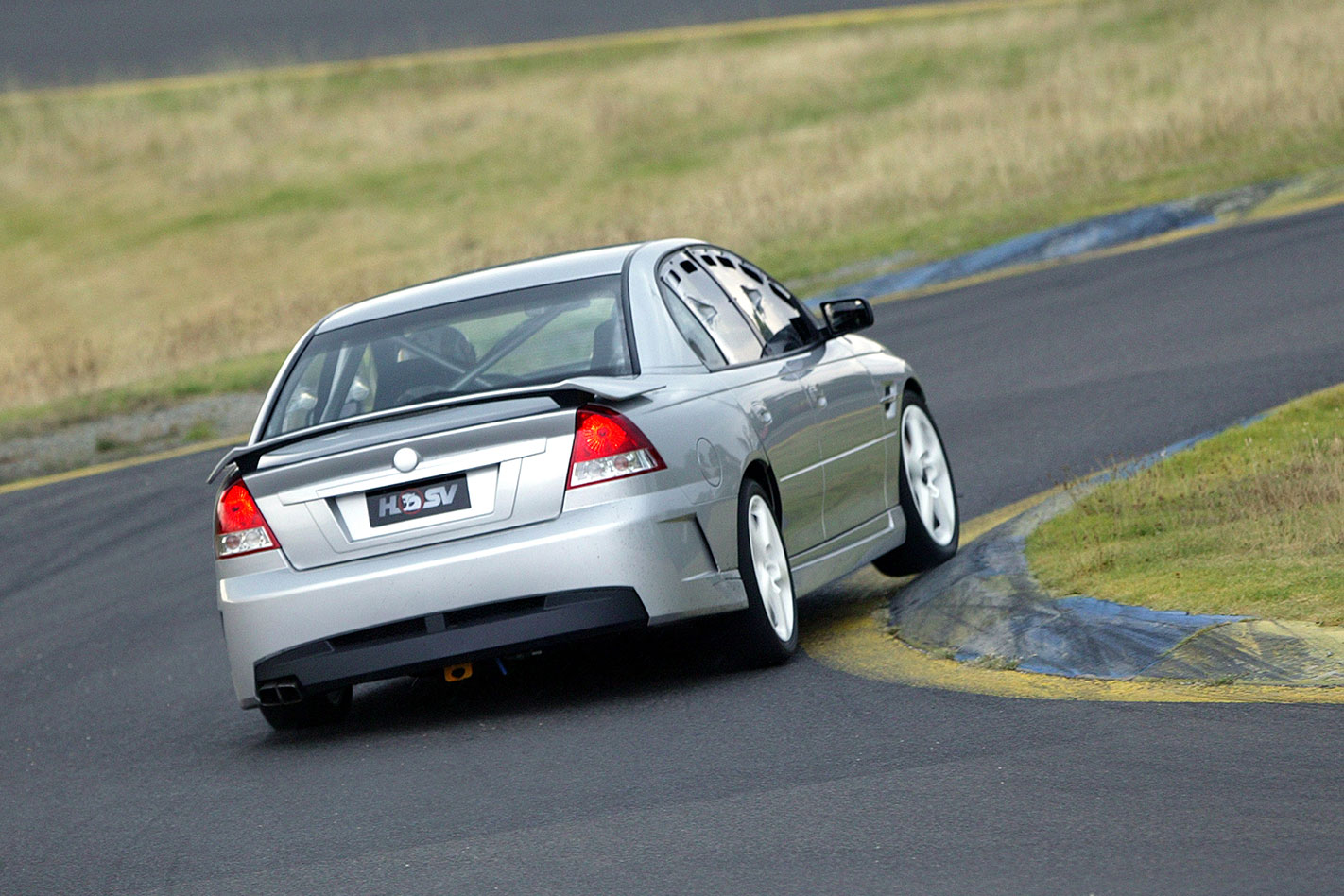
That’s about it, really, if you don’t count the trillion little things like bonnet pins and tow-hooks and such. The good news is that a Bahrain-spec racer can be yours in right-hand-drive form for the (literally) princely sum of $120,000 or so, depending on spec. The queue forms here.
Summer is upon us, and that means – particularly for our friends in Queensland – an increase in storms.
While watching a storm cell roll in can be mesmerising, spare a thought for all the cars on the road which run the risk of being damaged, especially if hail is involved.
The phenomena where large chunks of ice fall from the sky is notorious for damaging the glass and bodywork of cars, sometimes enough to write the car off completely.
With storm season approaching, let’s look at what can be done to prevent and minimise damage from hail, and answer the question of should you buy a car damaged during a storm?
Get undercover ASAP
This goes without saying, but if you are on the road, try and pull over and stop when safe. If you have some warning, attempt to find somewhere to park undercover. Shopping centres are a good option for their vast undercover parking, along with dedicated parking buildings.
Driving during a hailstorm increases the risk of your car and windscreen being damaged. If you are stranded in the open when hail begins to hit, pull over and wait it out, remaining inside the car.
Use blankets
If you can’t get some cover, cover your car in blankets and towels to help minimise or prevent damage. Some companies sell covers for cars specifically designed to protect a vehicle during a hail storm.
It goes without saying to try and avoid parking under trees when there are threats of storms. Strong winds can break off branches, or topple trees completely, doing serious damage to your car if hit. Then there’s the lightning risk.
Check for possible flooding
Hail is often accompanied by a heavy deluge of rain. During these downpours flash flooding can occur. Try and avoid areas which will leave yourself or your car vulnerable to flooding.
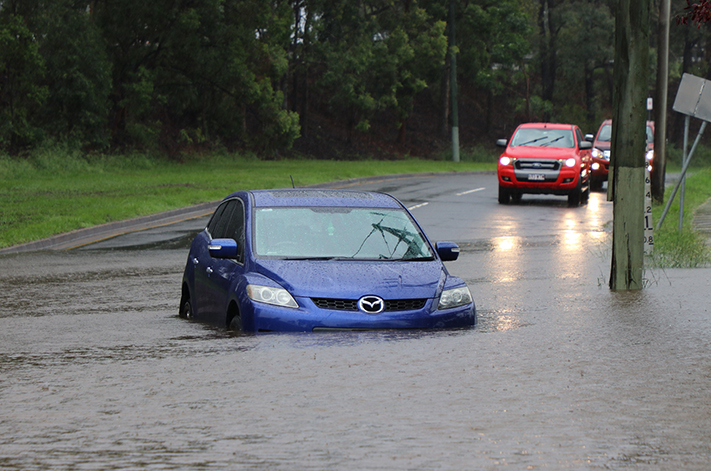
Should you buy a car that has been hail damaged?
Cars that have been damaged by hail may come up for sale for a significant discount. But don’t be fooled by what appears to be a bargain. While hail damage may look inconsequential, the small dents can be costly to repair, driving up the cost of your new purchase significantly.
It is also generally accepted that insurance companies will not provide full cover for a car damaged by hail, and there could be further issues underneath the skin of the vehicle, in particular the electronics which can develop issues from the heavy deluge of water.
AH, CHRISTMAS.
It’s that fun time of year where last-minute late night shopping trips are born, beer reserves run worryingly low by the close of every single day and relatives force themselves to be nice to each other. Most of the time.
But it’s also spawned another growing tradition; the suburban Christmas lights cruise. People you don’t know who adorn their houses in sound and light shows, dioramas of red-nosed reindeer and 25 cents-per-kilowatt-hour electricity bills. The extravagance, thankfully coming at someone else’s cost, is a sure crowd-pleaser for kids.
But what if we want the perfect car for a boulevarde cruise to see the lights, sights and sounds of suburbia without leaving the air-conditioned comfort of our metal and glass cocoon? Some cars are much better for all-around vision than others. What, then, makes for the best Christmas lights present for drivers and passengers alike?
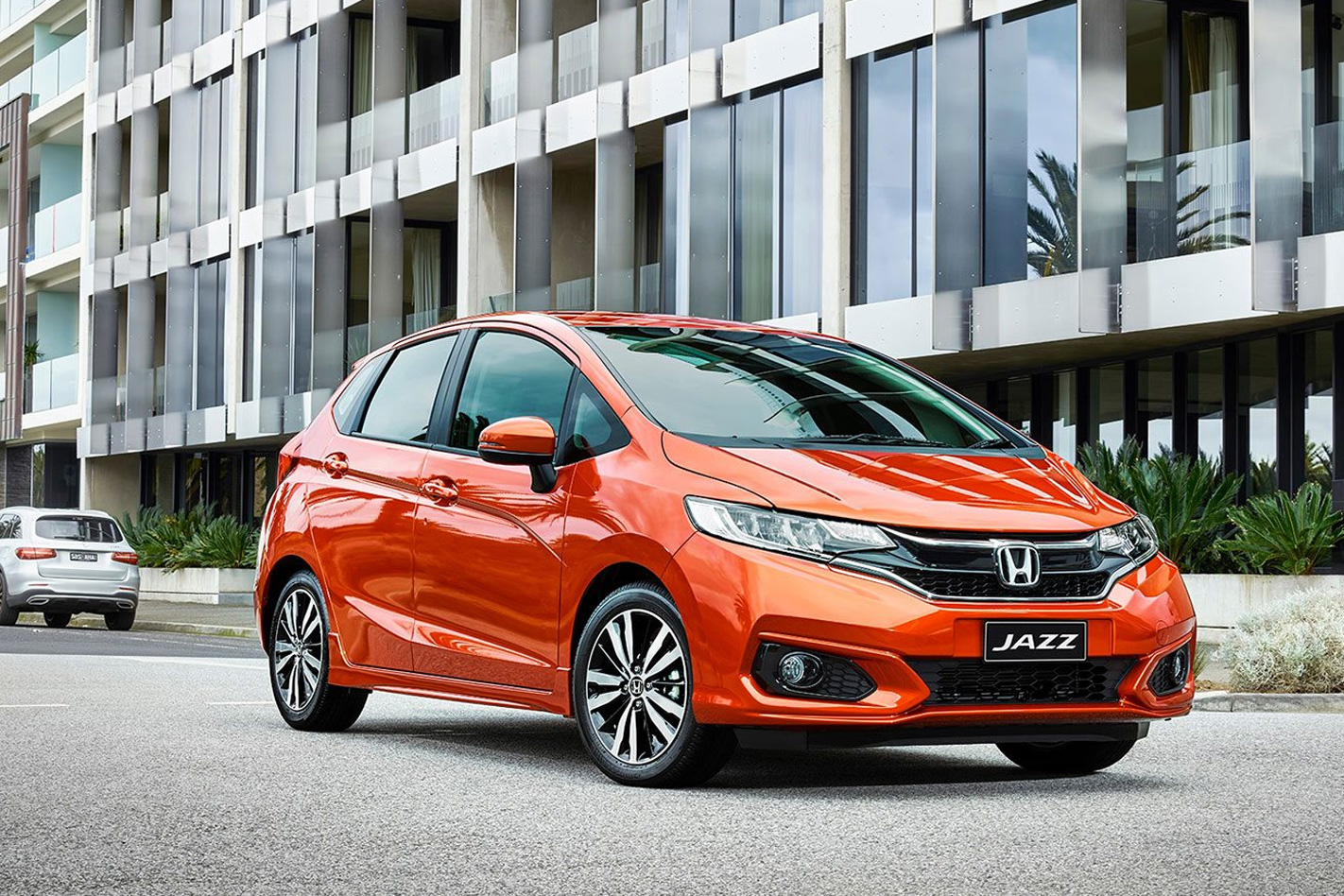
Cheap and cheerful: Honda Jazz
This cheap, tiny little hatchback is a lot roomier inside than you’d expect, and outward visibility is also quite good. Look around the current crop of small cars and it’s all rising shoulder lines and pinched glasshouses. Not so with the Jazz, where everyone but the rear middle seat passenger can gaze out into the LED-lit glare in uninterrupted awe.
The Jazz also has the advantage of having one of the most versatile small-car interiors on the market.
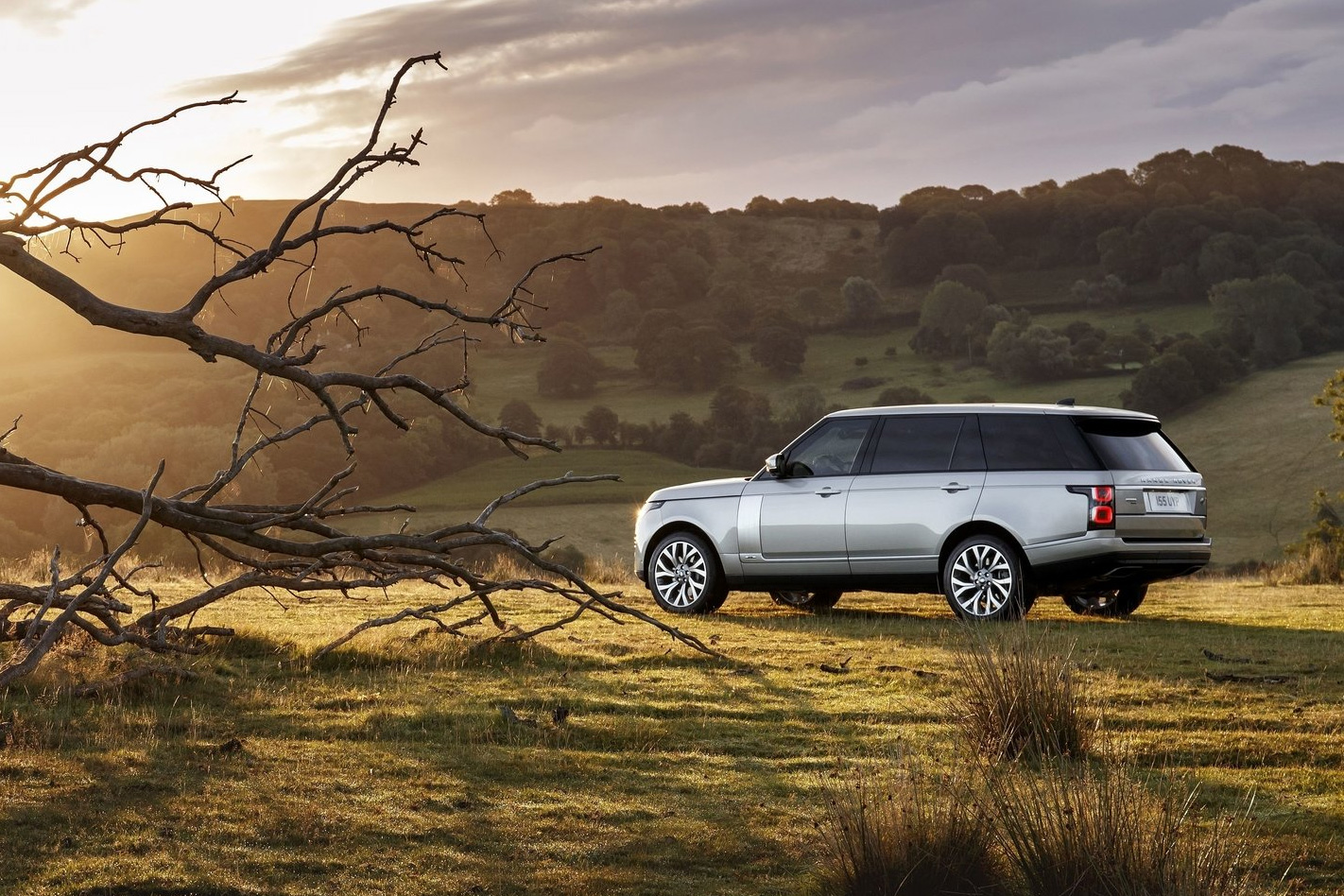
Right from one of the cheapest cars on the market to one of the most expensive. The most opulently appointed Range Rover in the Range Rover range to have ever ranged suburbia is wonderfully high off the ground, glides over back-street imperfections on its adjustable air suspension, and has windows deeper than the financial hole dug by a teenager maxxing out their first credit card.
If there’s only four of you, the centre rear seat can be replaced by an optional fridge.
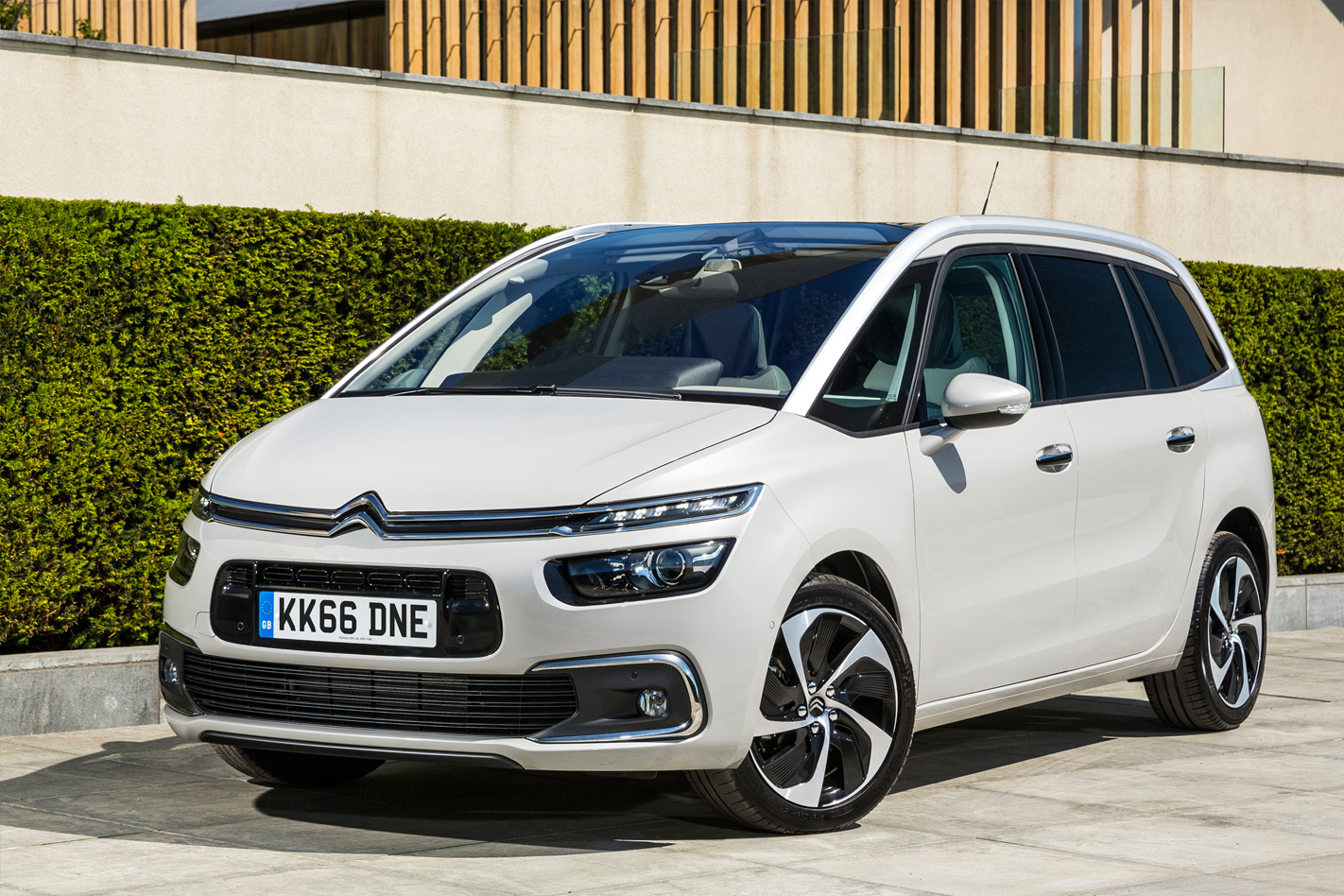
It’s a seven-seat people mover like no other. It features a sliding second row that can rob or add space to the third row to maximise use and a windscreen that wraps back over the front seats, aiding visibility. In the second row, there’s a couple of folding tables built into the backs of the front seats that yield space for colouring books, or whatever else appeals to young children once the lights go out.
It’s also available with either a petrol or diesel engine.
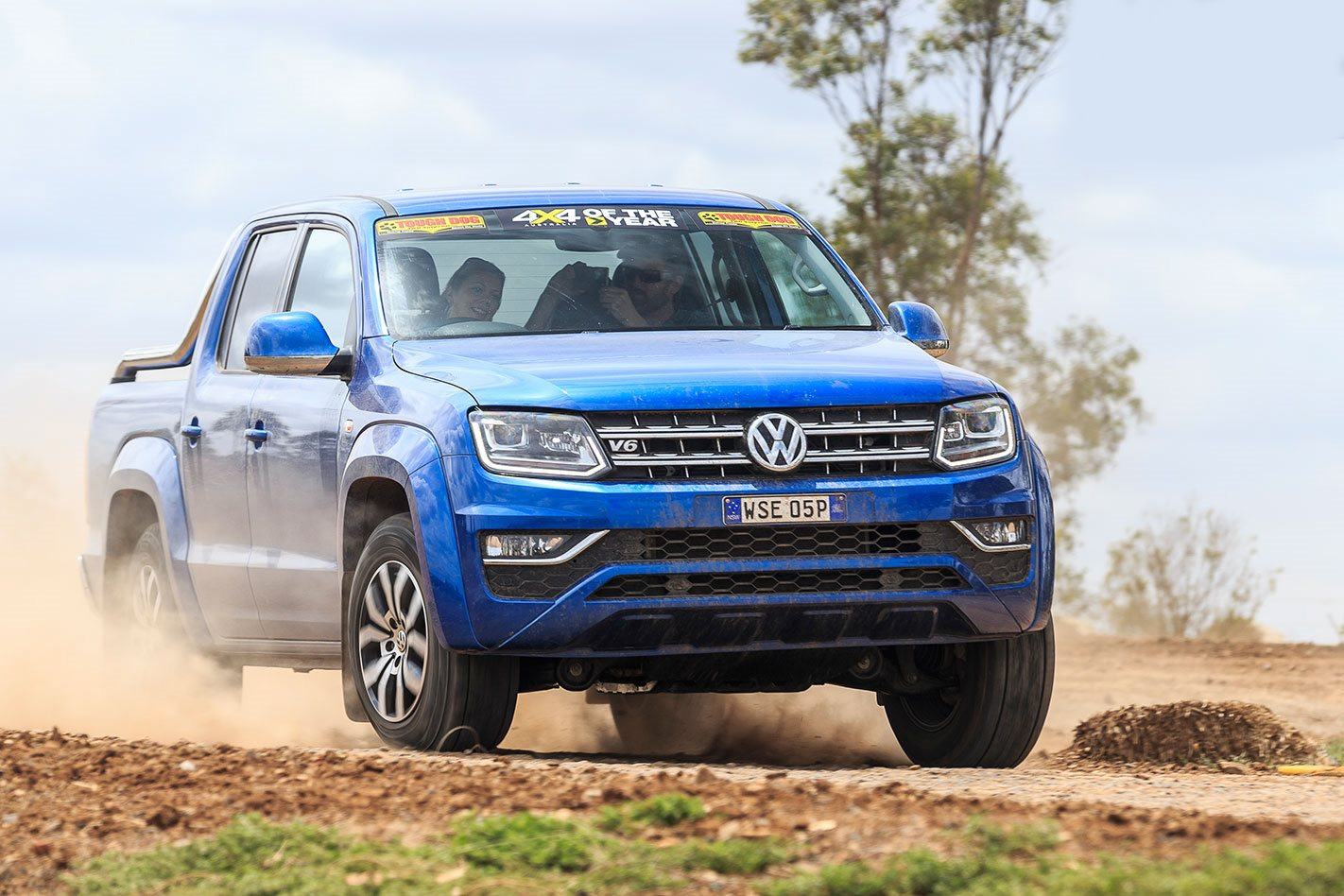
Trade utes now account for around one in every five new vehicles sold in Australia, so to exclude them from this assessment would be doing a disservice to cashed-up tradies – and all the mum and dad drivers who like the worksite-on-weekdays, family-fun-on-weekend lifestyle they offer. Of the dual-cab utes, we reckon the Volkswagen Amarok is the best-driving of the lot. Lots of glass and a light, airy cabin high up off the ground offer much better visibility than an SUV or traditional passenger car.
One thing the Amarok lacks, though, relative to its showroom rivals including the Toyota Hilux and Ford Ranger, is that it doesn’t have anywhere near the same level of driver assistance features its rivals offer.
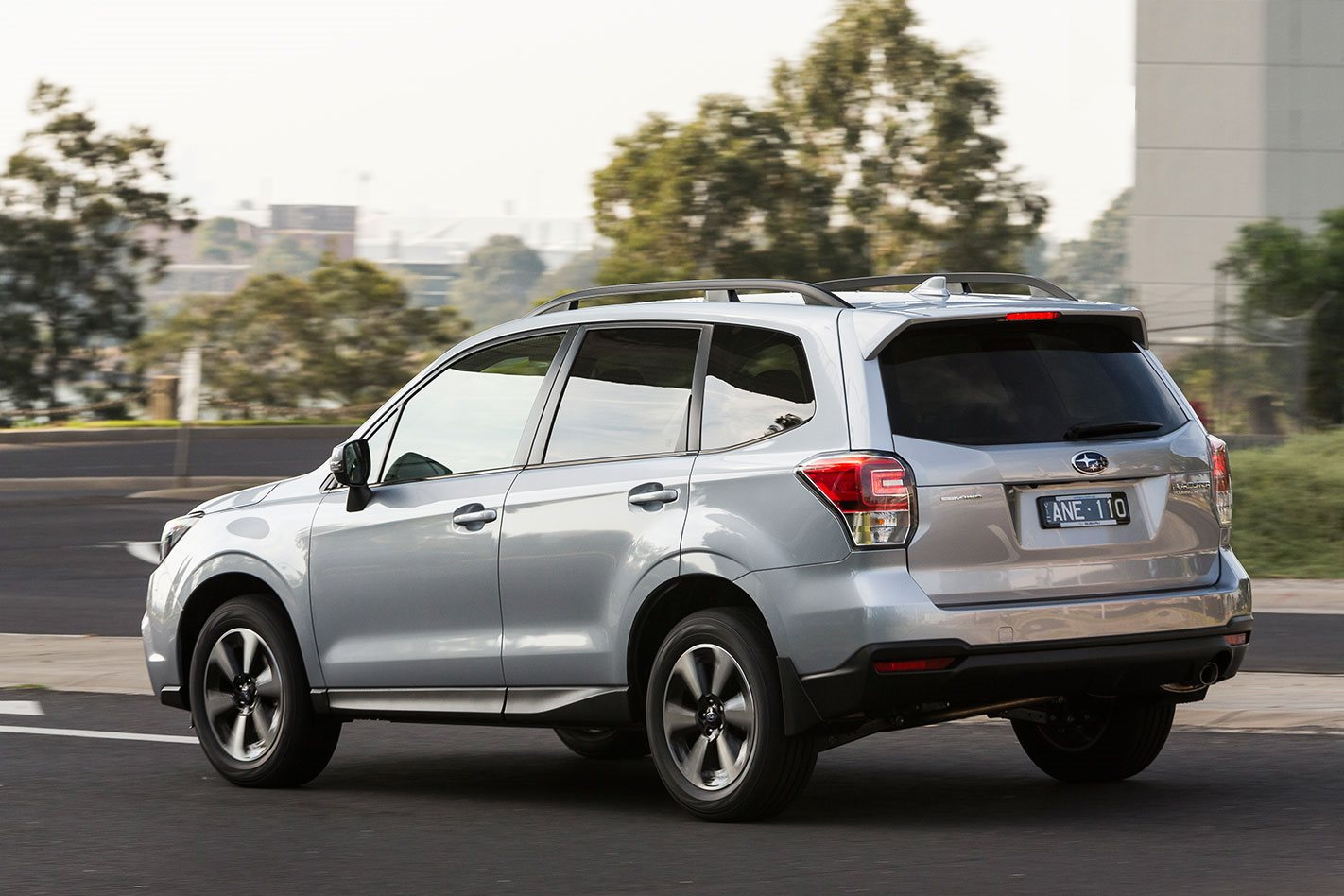
Yep, there’s one car that rules over the lot of them: the Subaru Forester. First of all, it’s an SUV, so you have an instant height advantage over more pedestrian vehicles. But unlike other design-driven trends that factor in raked shoulders with receding windows, the Forester is like a car of old, offering as much deep window space in the rear as it does in the front.
What’s also helping the Forester is that it recently won a Wheels comparison of mid-size SUVs – one of the strongest-selling segments of Australia’s new-car market. What impressed the most was the way the Forester soaked up all the lumps and bumps, no matter if it was a country road or inner-suburban street.
As a Christmas lights cruiser, the Subaru Forester takes the cake. With brandy and custard on the side.
Price & Equipment – Winner: Mazda 3 SP25 GT
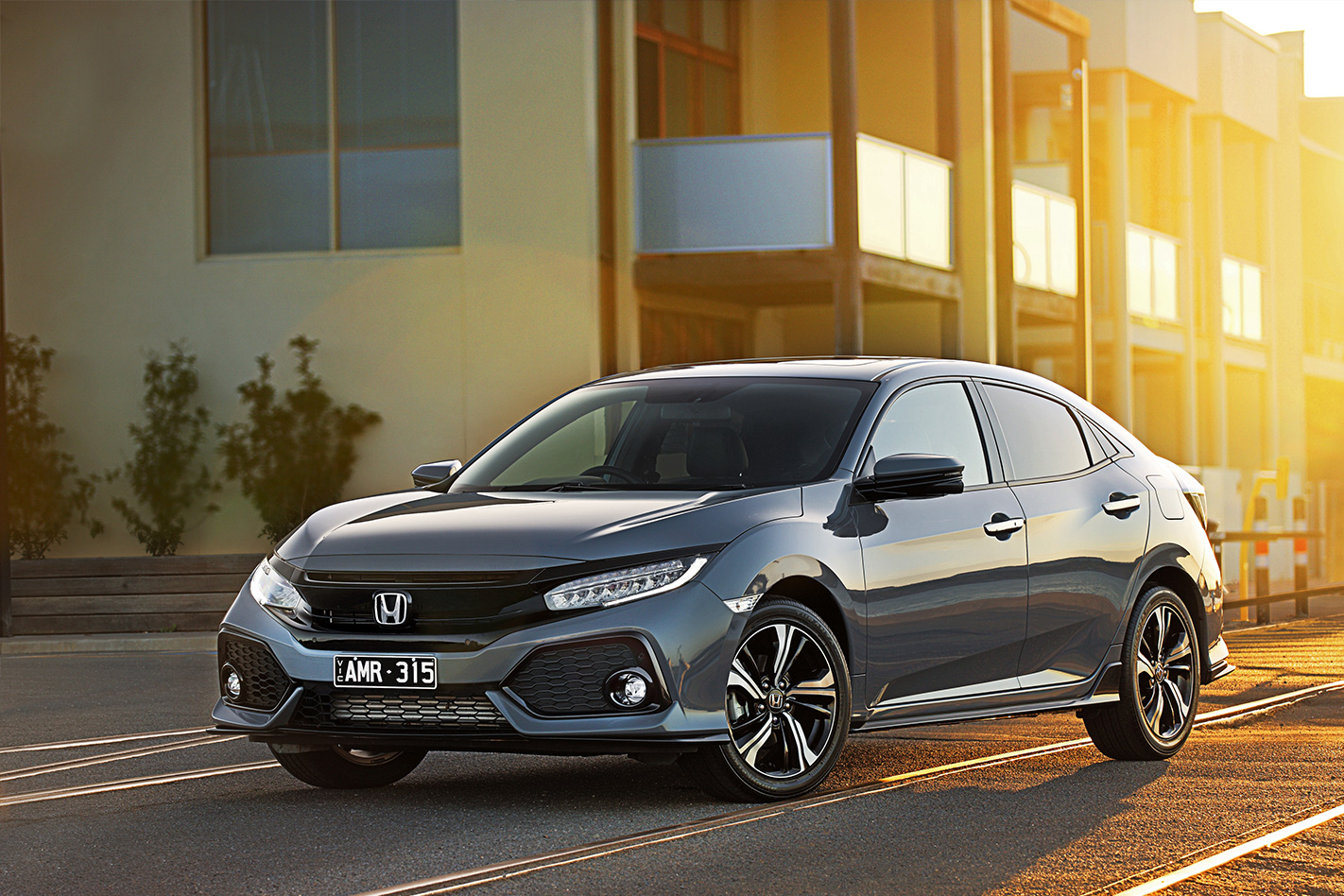
The $32K Honda Civic RS sits a rung below the flagship VTi-LX and gets smart key entry/keyless start, a reversing camera, front and rear parking sensors, a DAB radio tuner, rain- sensing wipers and dusk-sensing headlights, a tyre pressure monitor, speed-limiter cruise, LED headlights, daytime running lights, foglights and a powered sunroof.
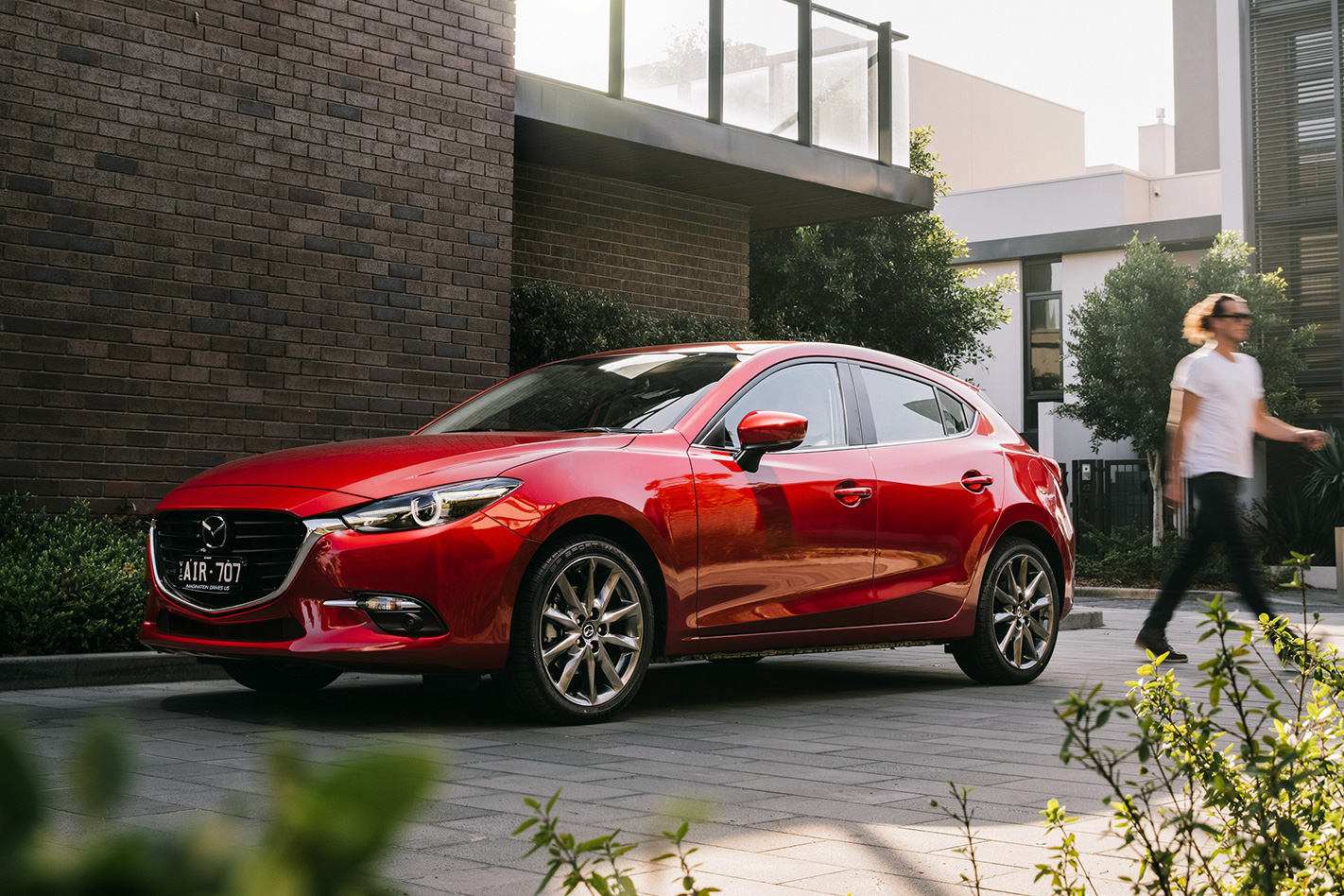
The Mazda 3 SP25 GT shares much with the Honda, including its price, however you get a six- rather than eight-way drivers seat and normal cruise control. You get sat-nav here, which the Civic misses, but not front parking sensors. A blind-spot monitor, driver attention alert, rear cross-traffic alert and smart city brake support are all pluses.
Interior & Versatility – Winner: Honda Civic RS
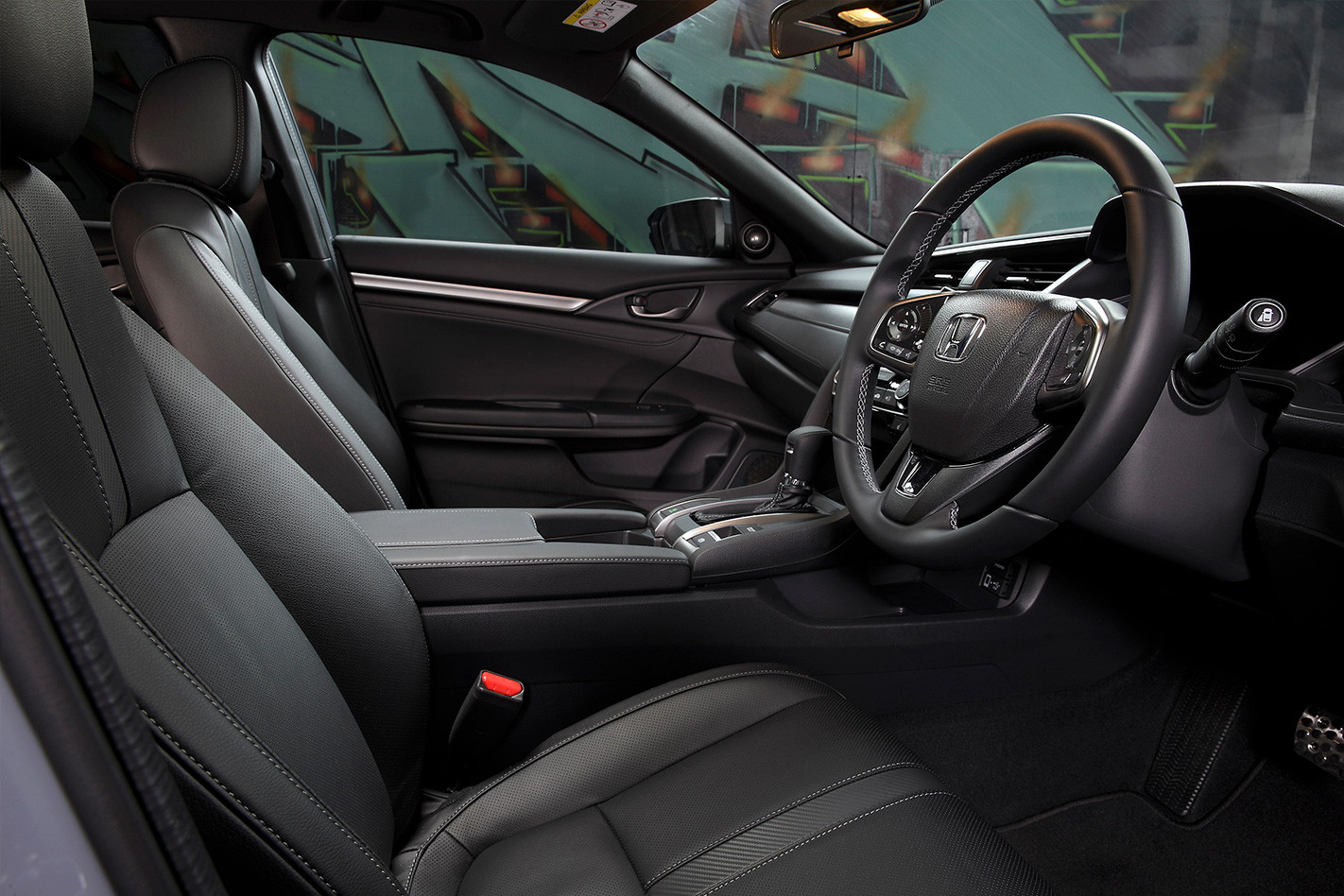
The Civic shares its 2700mm wheelbase with the Mazda and at 1799mm is just 4mm wider than its rival. The dash is busy rather than elegant – at least it’s not boring – and the materials quality and finish satisfy. Heated leather front seats are comfy and the back is spacious. The 330-litre boot is well shaped and usefully bigger than the Mazda’s.
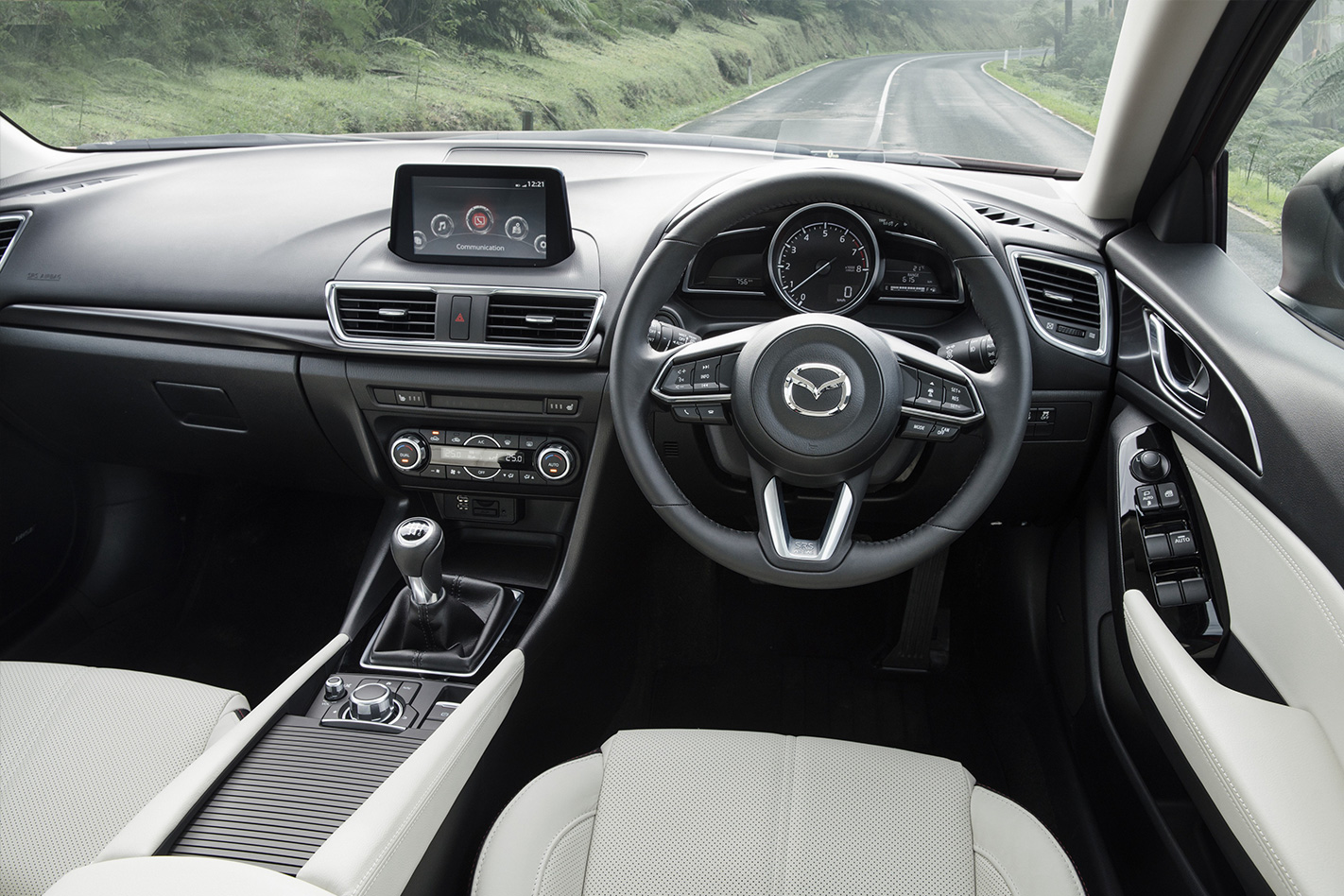
The Mazda’s dash is plainer and might please conventionalists more than the Honda’s. Sculpted wheel feels good and leather-trimmed front seats offer a bit more side support than the Civic’s. It’s easy to get comfy up front and in the back, but there’s not quite as much room for lugging stuff in the 308-litre cargo bay.
Performance & Economy – Winner: Mazda 3 SP25 GT
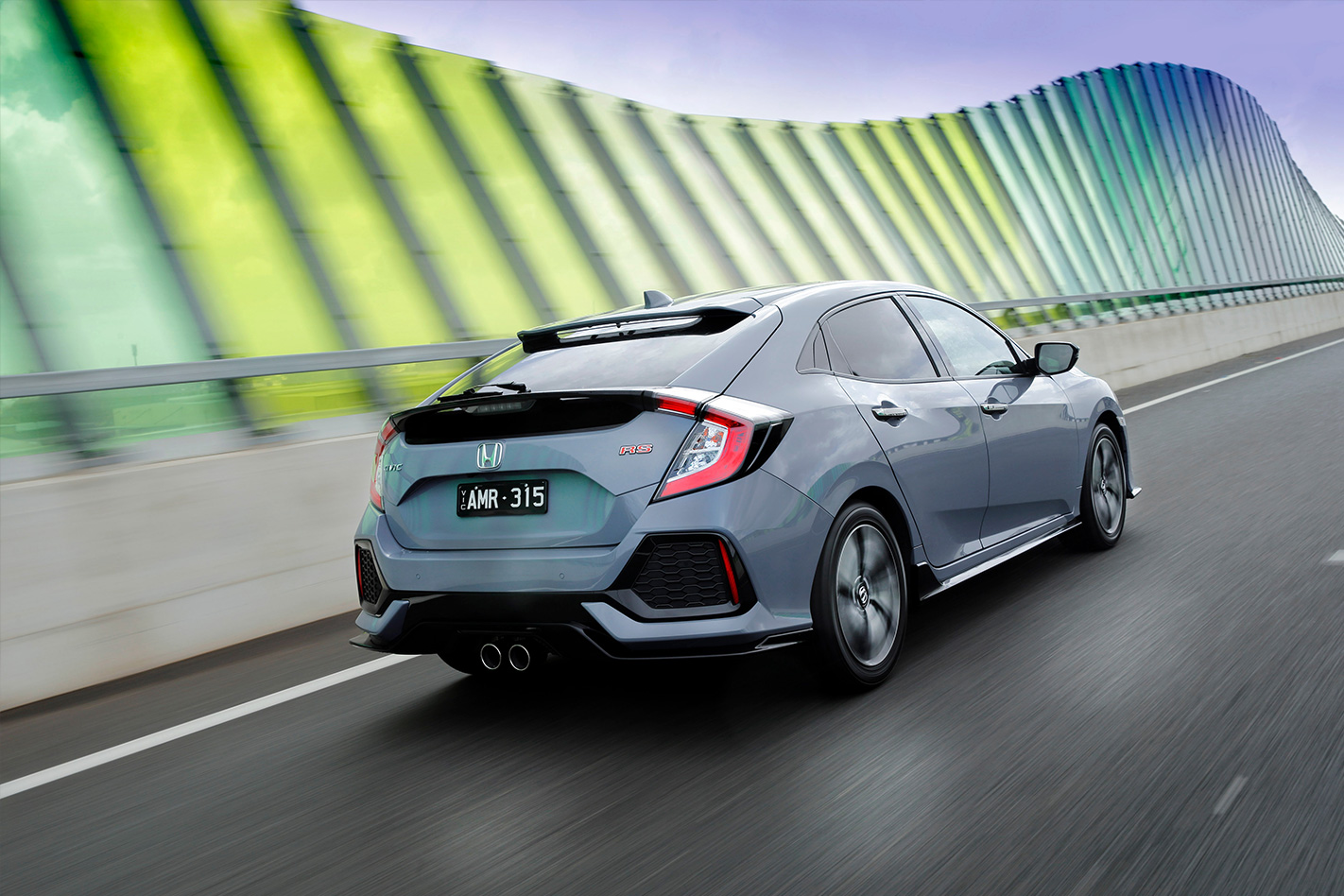
The ‘RS’ badge oversells the Honda’s straight-line performance but the brand’s first mass-produced snail- assisted mill in three decades is a smooth, likeable engine. The 127kW/220Nm unit is economical, claiming 6.1L/100km, but the rubbery CVT auto is a weak link that detracts from the overall appeal of the drivetrain.
The 3’s 138kW, 250Nm atmo four and six speed conventional auto make a good team. The Mazda deftly avoids the small displacement turbo path yet delivers economy to match its rival thanks to measures including a high 13:1 compression ratio and direct injection. Yet, like the Honda, it’s happy on 91RON.
Ride & Refinement – Winner:Honda Civic RS
The Honda’s highway demeanour is matched perfectly with the torquey turbo engine – a decent conventional auto would seal the deal. The Civic, despite the sports badge and poised handling responses, is supple and absorbent over bad roads over a range of speeds. It’s hushed too, especially alongside the Mazda.
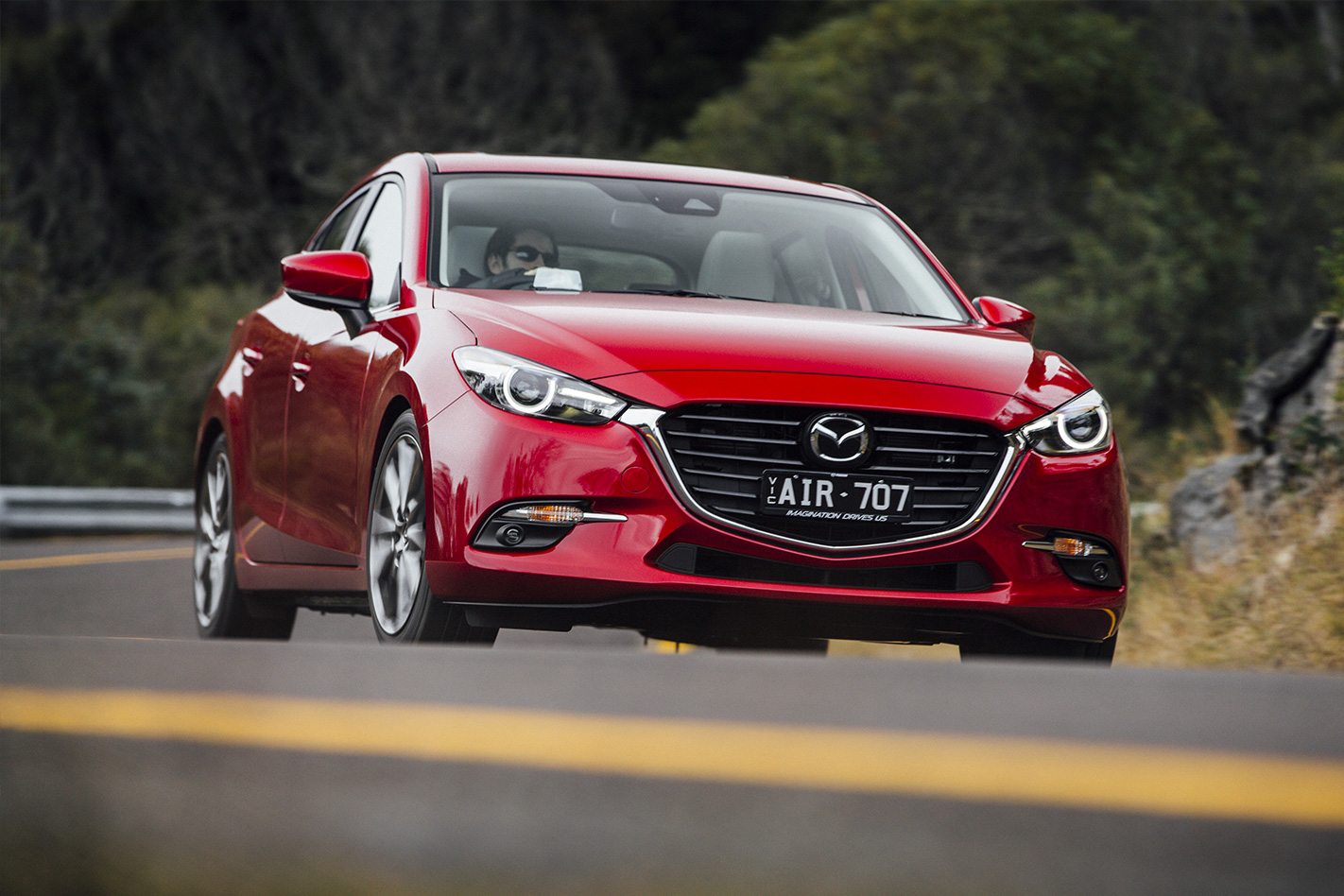
Mazda has a history with road/tyre noise and the third-gen 3, in part because it’s getting on a bit, is not as refined as the Honda. With no help from the 215/45R18 tyres, the SP25 GT is not especially smooth over the small amplitude bumps that are everywhere in cities, though its handling of larger undulations tells of a well-judged primary ride.
Steering & Handling – Winner: Honda Civic RS
Quick steering and a responsive chassis give the Civic RS a sporty flavour and if you push the strut front/multi-link rear chassis (a basic layout it shares with the Mazda), the rear end can be provoked to adjust the angle of attack. It’s a pity the steering ultimately lacks feel, and a far greater shame the CVT won’t let you take the Civic by the scruff.
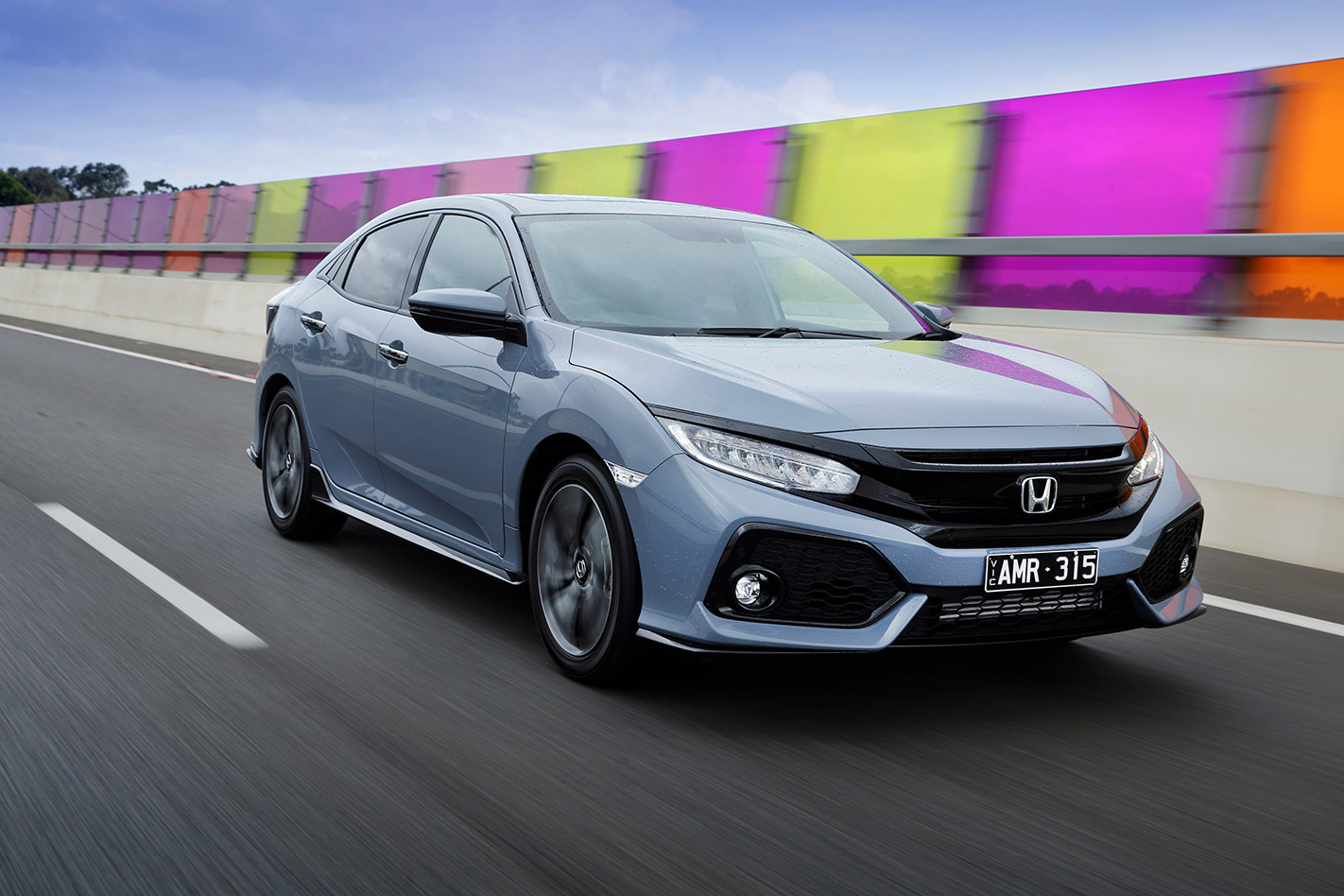
Some of the millennial zoom-zoom has dissipated in even the sportiest of the current 3s which isn’t all bad – some of the responses of the first-gens were over-eager. The Mazda’s steering is more measured than the Honda’s. Here, you have to go looking for the sportiness. But press on a bit and you’ll find the inherent balance and playfulness.
Verdict – Winner: Mazda 3 SP25 GT
The scores reflect the closeness of this pair in an overall sense, yet taking these warm hatches category-by-category it’s apparent they’re not quite as close as they might seem.
If you’re looking for generous standard active safety and other niceties, you’ll find them in the Mazda. Cabin appeal might be a matter of taste but the fact the Honda rides well and is quiet, while the Mazda is busier and noisier is black and white.
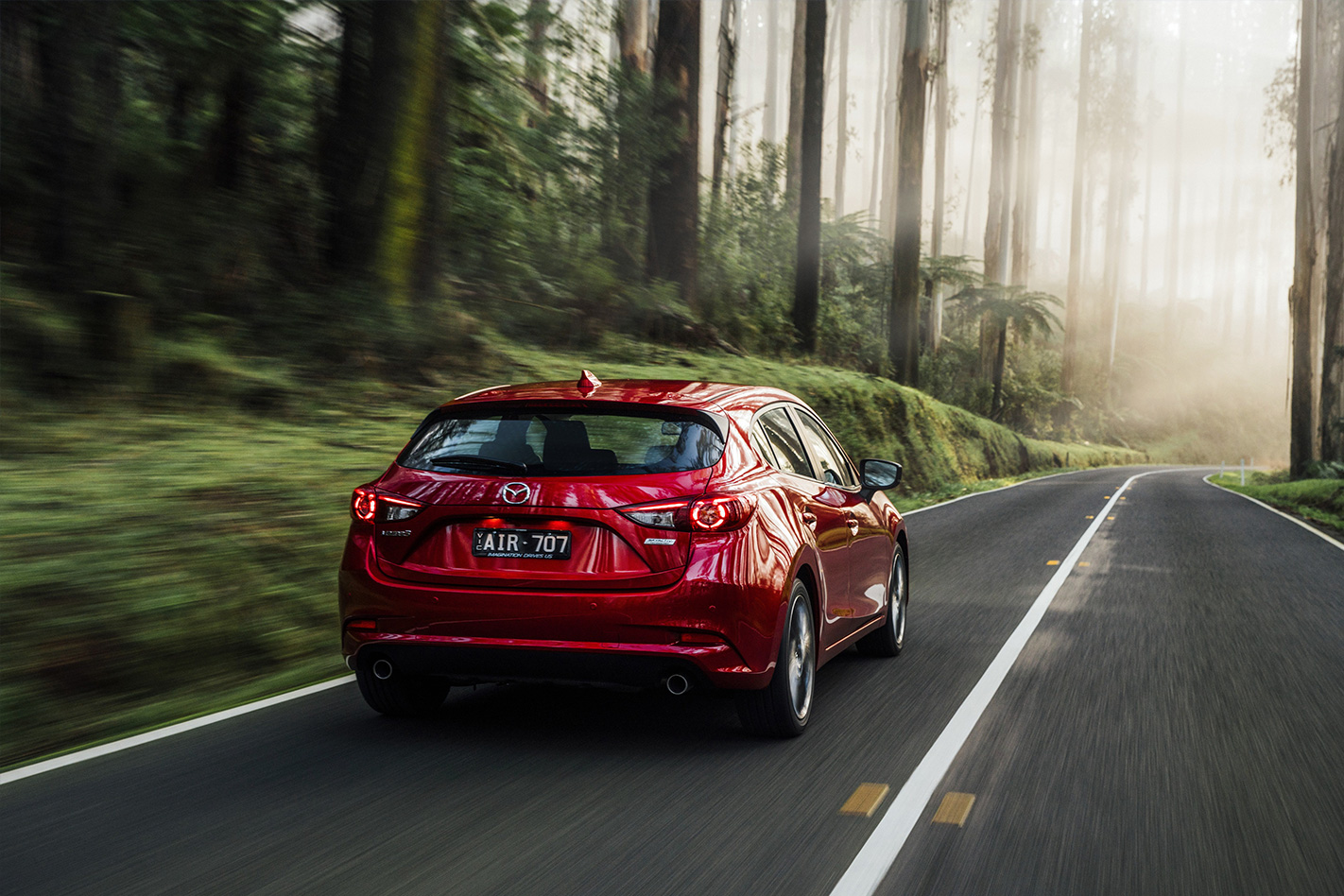
We’d wager that Honda’s little turbo four would use a bit more juice than Mazda’s big atmo one in the real world, but officially they both use the same amount of fuel. But the Civic’s CVT isn’t anywhere near as good as the 3’s auto. The Honda better blends sportiness with comfort – it’s got more of both.
But the Civic’s advantage is lost in the transmission.
