
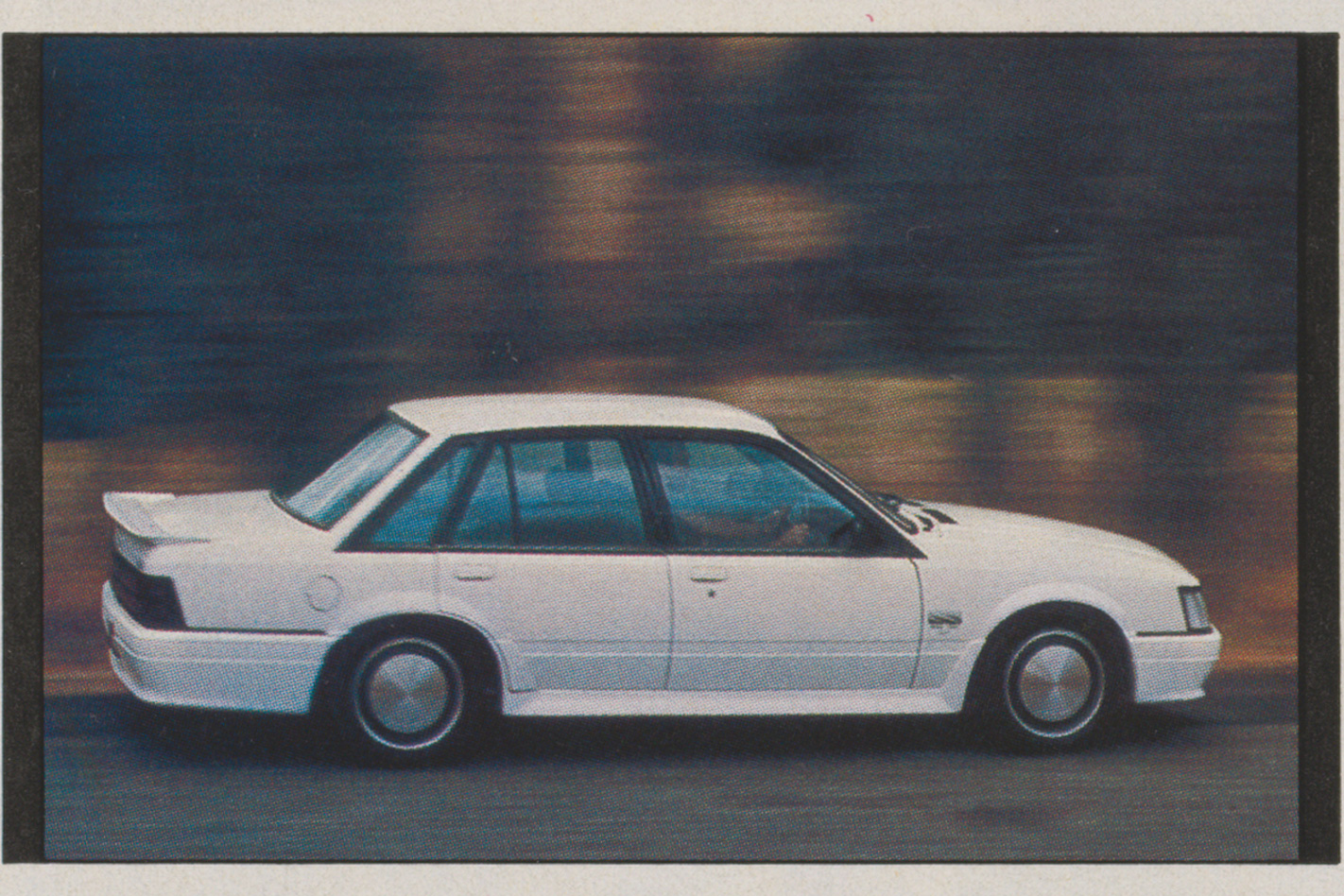
IF YOU were to survey the covers of WHEELS and Australia’s other motoring magazines over the past two years you would find that Peter Brock’s HDT Commodores captured more covers than any other single car maker.
The interest in the cars and operations of what has been called Australia’s sixth largest car maker have become legendary in their ability to attract readers, and the Group Three Brockmobile has been the subject of more lyrical drive stories than any Ferrari.
Yet there is a lingering doubt that suggests the car might not be quite as right and proper as these solo tests would make out. The sceptics among you have been asking us to compare the Group Three with the latest breed of hot-shoe European sedans to satisfy their curiosity and even save them big dollars. Can the Brock car really be an adequate, and cheaper, substitute for a BMW?
This comparison set out to prove the point one way or the other and, in so doing, to discover the truth about the ultimate Commodore on the blacktop of Australia. Ranged against Australia’s Own muscle car we gathered the BMW 528i Motor Sport, the Saab Turbo 16S and the Volvo 760 Turbo. A thoroughly representative collection of the fastest sedans Europe has to offer.
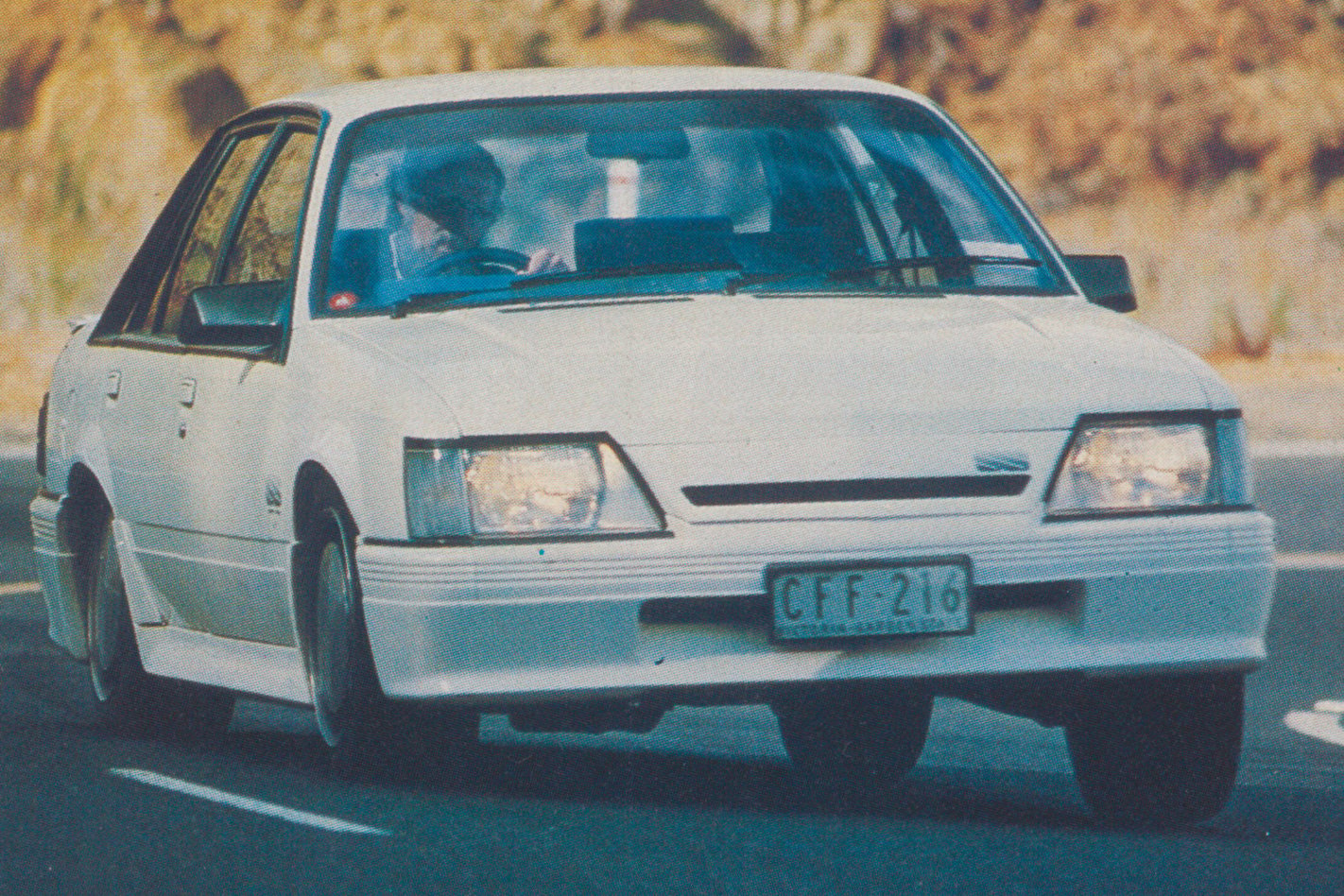
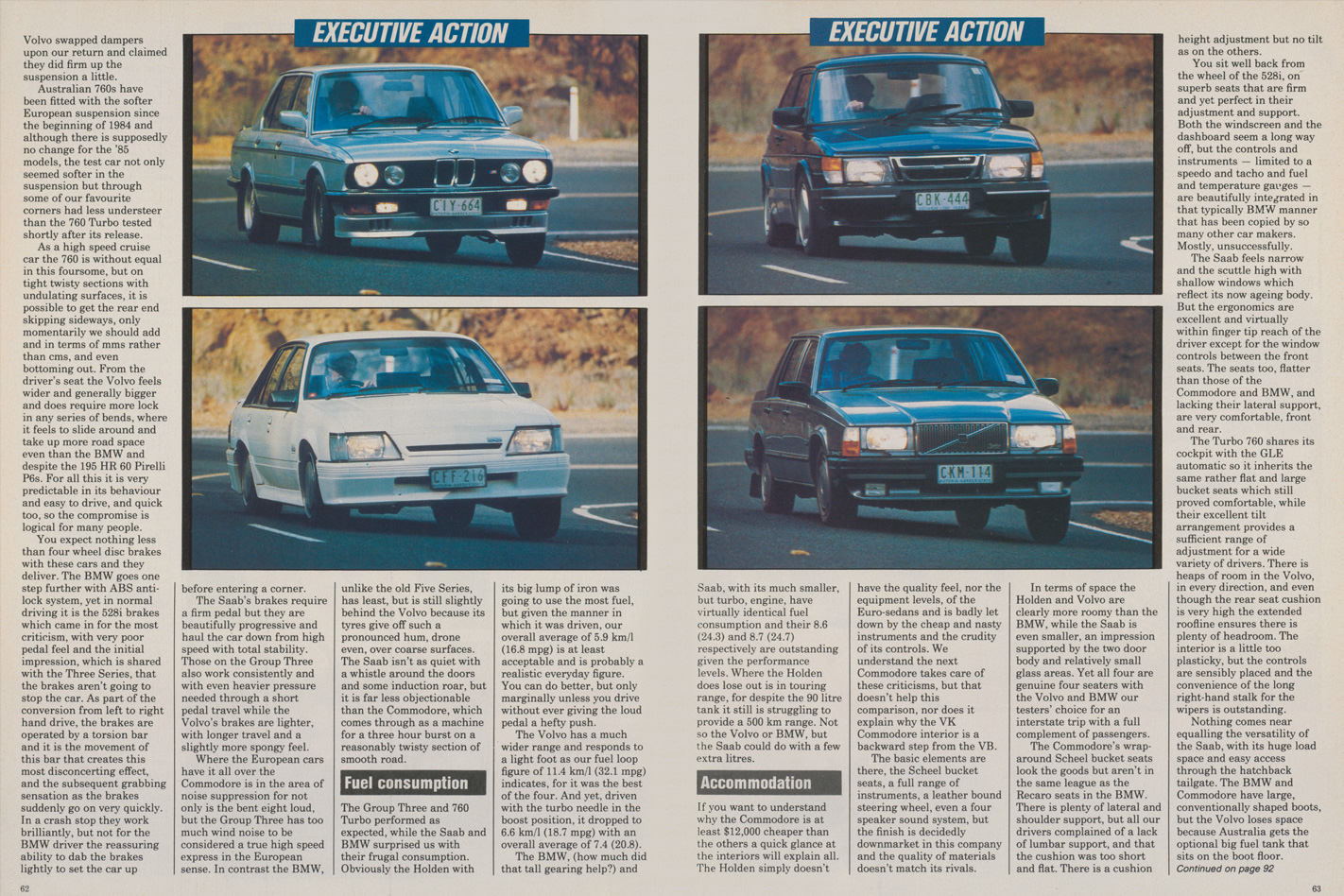
Holden’s decision to extend the life of the V8 engine ensures that we will see Brockmobiles until the end of the ’80s while the soon to be revealed 4.9 litre version allows the car to compete in International Group A racing. In its present form the BMW Five-series has been around since late ’81, although it clearly owes its heritage to the less refined, and yet seemingly identical looking, 525/528 models from the middle ’70s. As the middle model in BMW’s vast line-up, the 528i has been overshadowed in recent times by the Three-series, however the marque’s higher profile on the local scene has meant that general awareness of BMW has never been greater.
The Motor Sport version – the conversion takes place at Frank Gardner’s JPS operation – is mechanically identical to the five speed sedan but it has the apparently mandatory bolt-on cosmetics of spoilers front and rear, stripes and Mahle alloy wheels, while the factory options of three spoke steering wheel, heavily bucketed Recaro front seats, ABS braking, limited slip diff, firmer springs and gas dampers are standard.
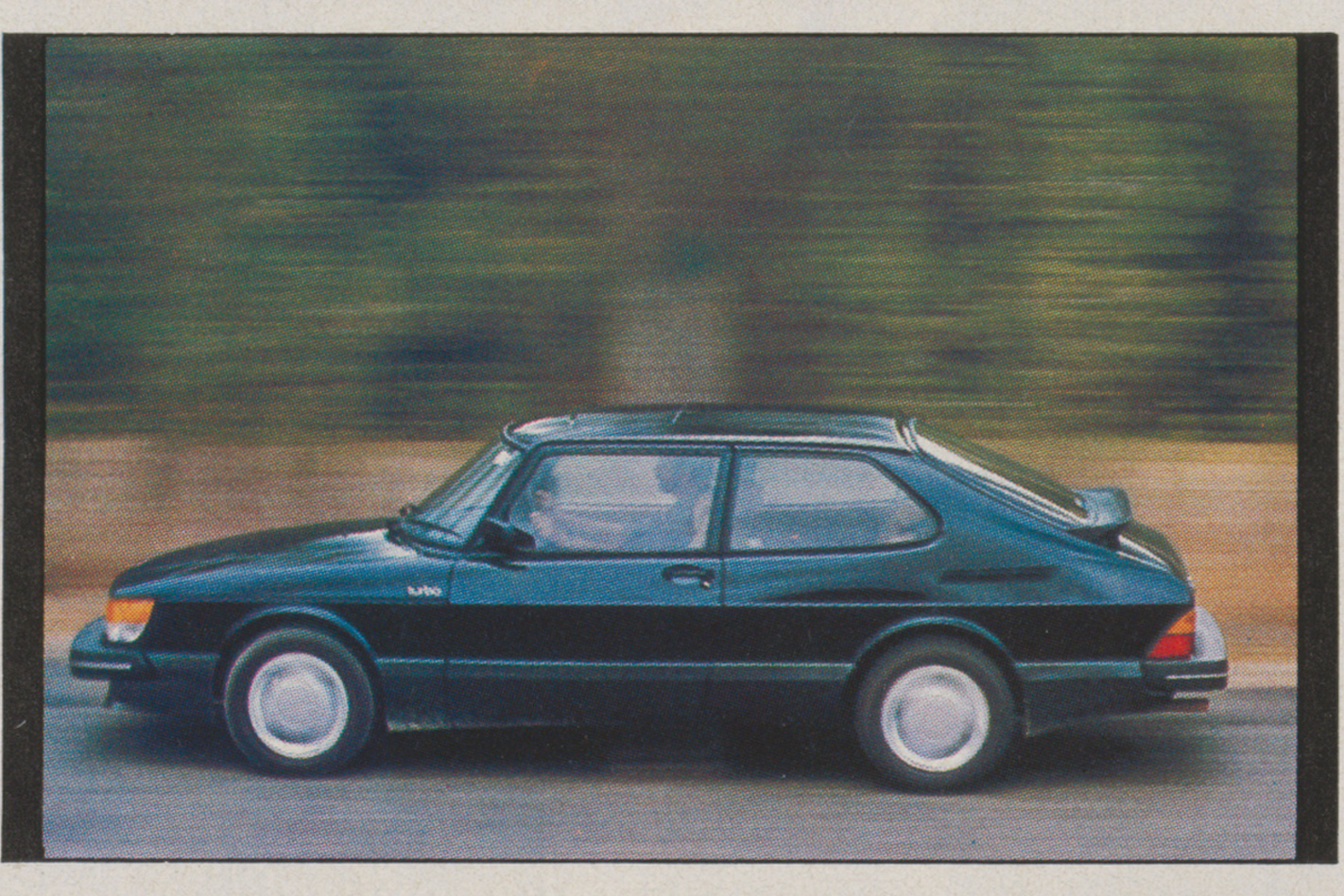
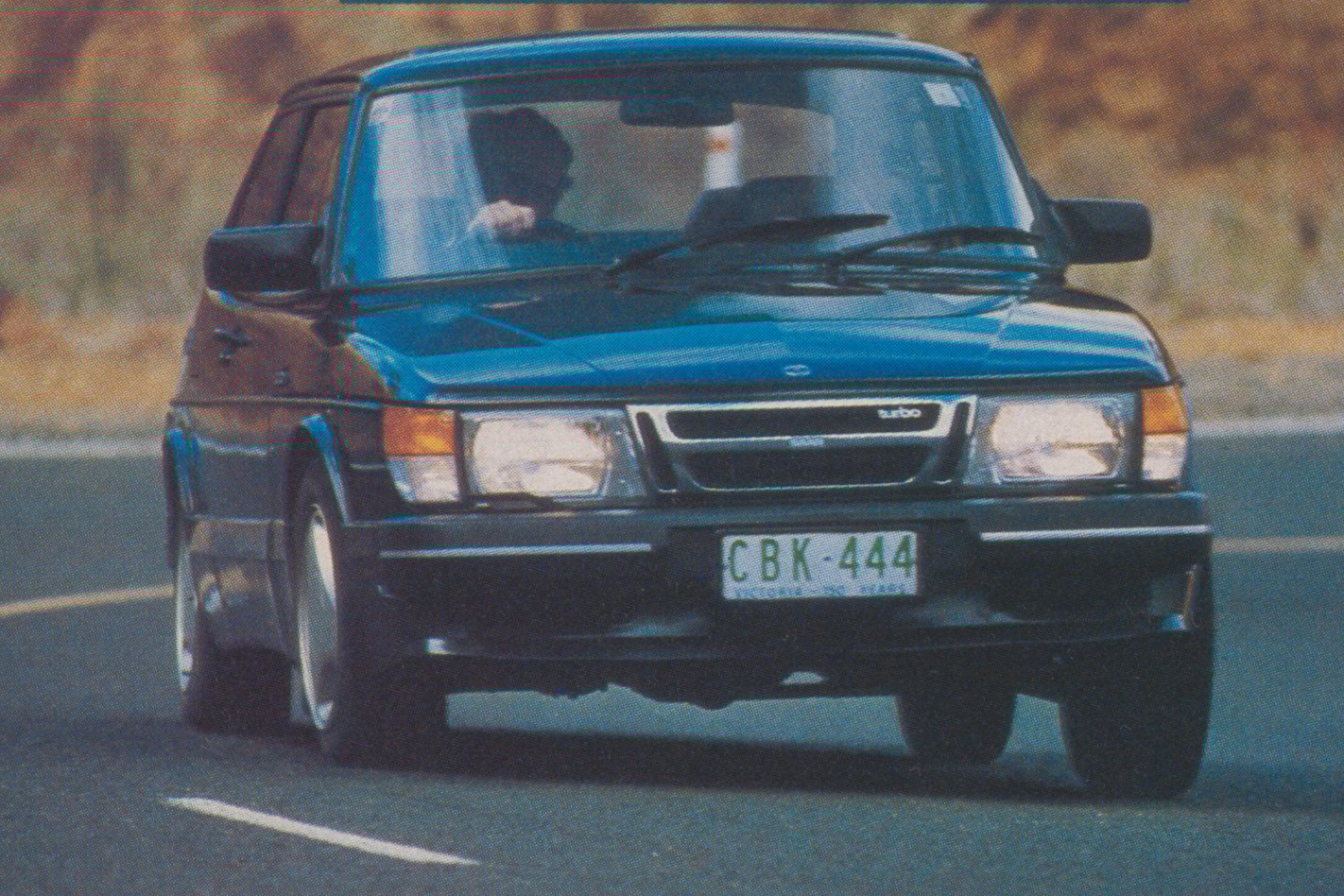
Saab’s Turbo 16S is an aero by any other name and as the third generation in Saab’ s long-time affair with the turbo guarantees prodigious performance in a package that dates back to the late ’60s, although it has been subjected to more nose and tail lifts than any car we can think of. The only one of our quartet with front-drive, the 16S was also the only car with two doors and a hatchback body, so even in these basic areas of specification its strong character shone through. This is not a car for the conformist.
Prices, equipment
The made in Australia tag really means something in this territory, for the Holden, high priced though it is by Commodore standards, is little more than half the price of the imports, which suffer the penalty of a 57.5 percent import duty.
You can buy a Commodore SS for $18,865, but that is a basic SL with manual gearbox and five-litre engine. The go-faster bits and Group Three modifications are another $5770. For that money you get Bilstein strut inserts and dampers, heavy duty anti-roll bars front and rear, the Pirelli P7 225/60 16 tyres, a special exhaust and 90 litre fuel tank. The cosmetic changes include the front air dam, revised grille, skirts, rear spoiler and decals. Inside there is an improved quality carpet, a burglar alarm system and Momo wheel.
Automatic versions are offered in something called the Calais Director, which is essentially a Calais with the high performance engine and suspension kit, and at $5355 is more refined and quieter than the manual Group Three. The point with the HDT organisation is that it can (and will) build a Commodore to individual specification.
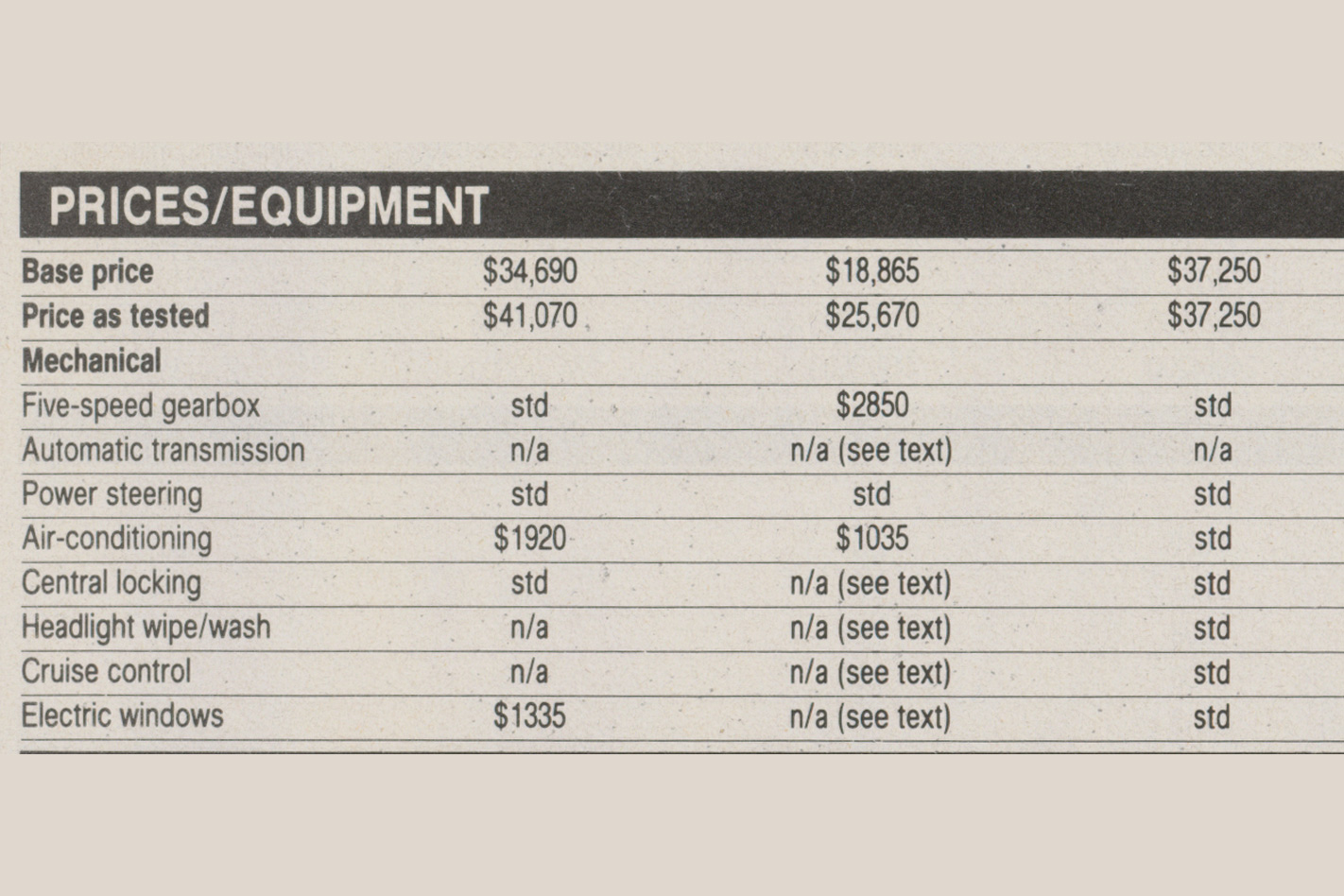
Going by base price the 528i is the next most expensive at $34,690 but the Motor Sport Kit takes it to $39,150, air conditioning is another $1035, for a total of $41,070 on the test car and a higher price than either the Saab’s $37,250 or the Volvo’s $38,540. Neither Swede came with options; none, really, were needed, so complete are their standard fittings.
So, for the Euro-sedans, the prices are close enough that they are not going to make any difference to one’s decision, while the Holden is far cheaper but doesn’t, of course, carry the prestige or the image except among the street machine crowd who know it for the fastest accelerating four door sedan any new car buyer can find.
Performance
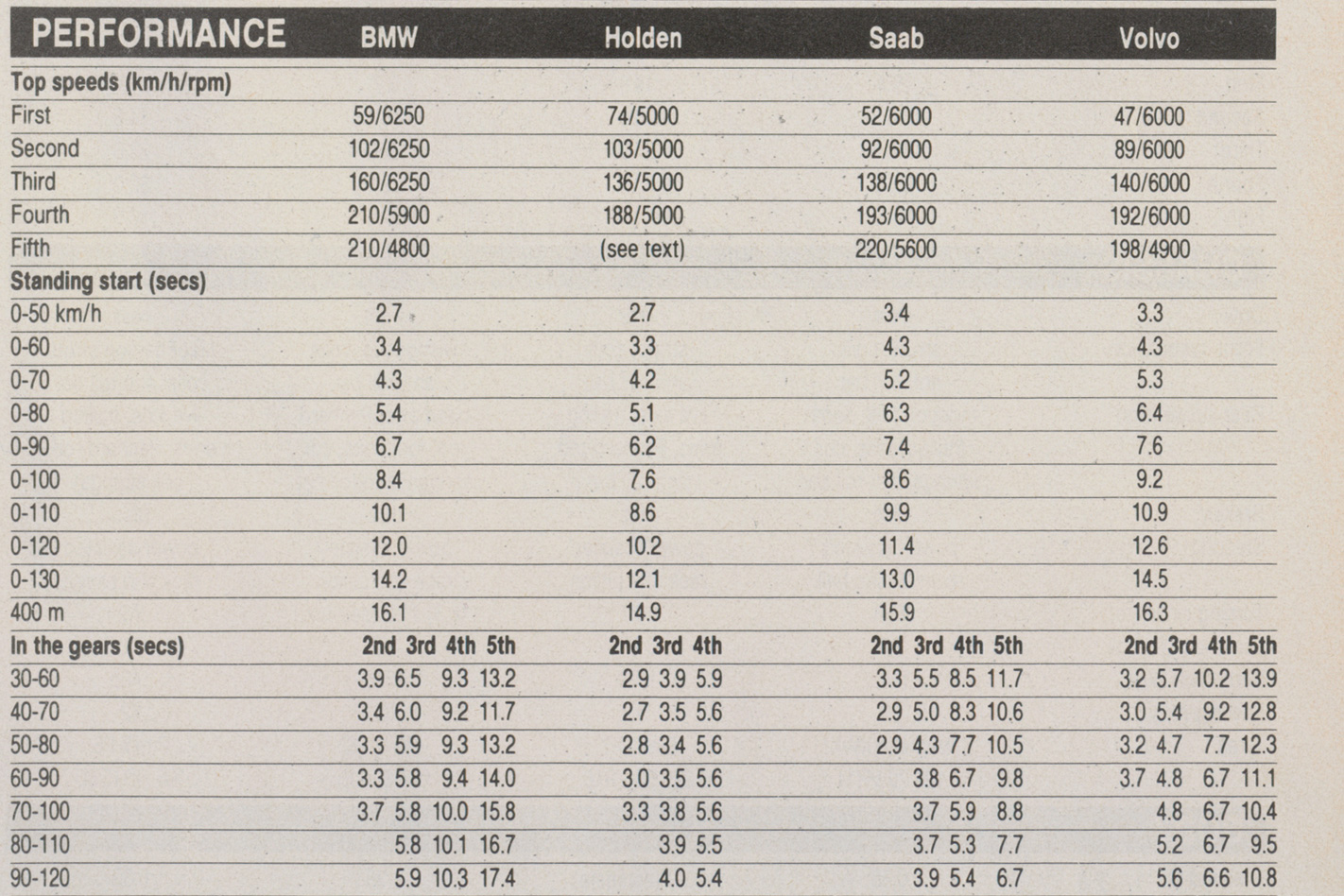
Can European sophistication outgun sheer cubic inches? On paper there is no contest, the grunt of the five-litre bent eight has it all over the others as the standing 400 m times prove. The Brockmobile puts down 14.9 second times first time out, then the clutch begins to slip and the driver finds it impossible to duplicate this time, settling back to consistent 15.2/15.3 second runs. The Saab is one of those cars in which the performance figures fail to establish just how quick it is, especially at the top end, so its 400 m time of 15.9 sec says little of this car’s enormous potential in those speed ranges which are illegal in all states except the Northern Territory.
Not that the BMW or the Volvo could ever be regarded as slouches. The 528i takes just 16.1 sec and the 760Turbo 16.3 sec for the 400 m and both, especially the BeeMmm, are easier off the line than the others.
There is nothing sophisticated about the Holden’s power delivery: it relies on capacity for its staggering performance and is neither quiet nor smooth.
Fan and rocker gear noise are always present and the deep bellow that is so beautifully apparent from outside the car barely intrudes over the engine’s clatter and whine inside.
More disappointing is a mild drive train vibration under hard acceleration. These aside; however, there is no denying the Group Three has power in every situation, and can be ambled around in fourth gear down to less than 1500 rpm and still pull as strongly as its rivals do in third gear. First gear in the Holden is high and yet fourth (top gear remember) is surprisingly low, certainly by the standards of the other three cars which all feature overdrive fifth gears. The 5000 rpm redline can be ignored for there is another 500 rpm in hand if required, as it must be if the Group Three is to have a competitive top speed. At 5000 it is doing 188 km/h.
Once the Saab is off the line and running it is a superbly responsive car from 2000 rpm to the 6000 rpm redline. The 16-valve twin cam engine is far superior to the old eight-valve turbo unit at low speeds and while there is some turbo lag below’2000 rpm the feeling is exaggerated by the enormous power once the turbo begins to function. The Volvo, too, needs two grand on the tacho before it begins to pull strongly, but it never feels as agile to the throttle as the Saab, partly because it has a very long accelerator travel and also because the Saab has a superior power to weight ratio. This is in ultimate terms of course, for the Volvo is responsive and eager and really performs from 3000 rpm in the electrically operated fifth gear (it was called overdrive on the ’84 models) that is controlled by a button on top of the gear lever. Second gear is on low side and the gap to third rather wide, yet the other ratios are ideal.
The Volvo four, despite the years of development, is not as smooth as the Saab and becomes a little harsh from 5500 to the 6000 rpm redline. Even so, this is one of those cars that never feels as quick as the figures indicate, if only because it lacks the turbo urgency of the Saab.
For sheer smoothness, however, it is the 2.8 litre BMW six that sets the standard. Not that it is an engine that enjoys ambling along at low revs. No, like most German cars this Munich machine wants to spin fast and cruise at over 200 km/h on the autobahn. There is very little power below 2000 rpm and you really need all of 3500 before it starts to deliver the goods.
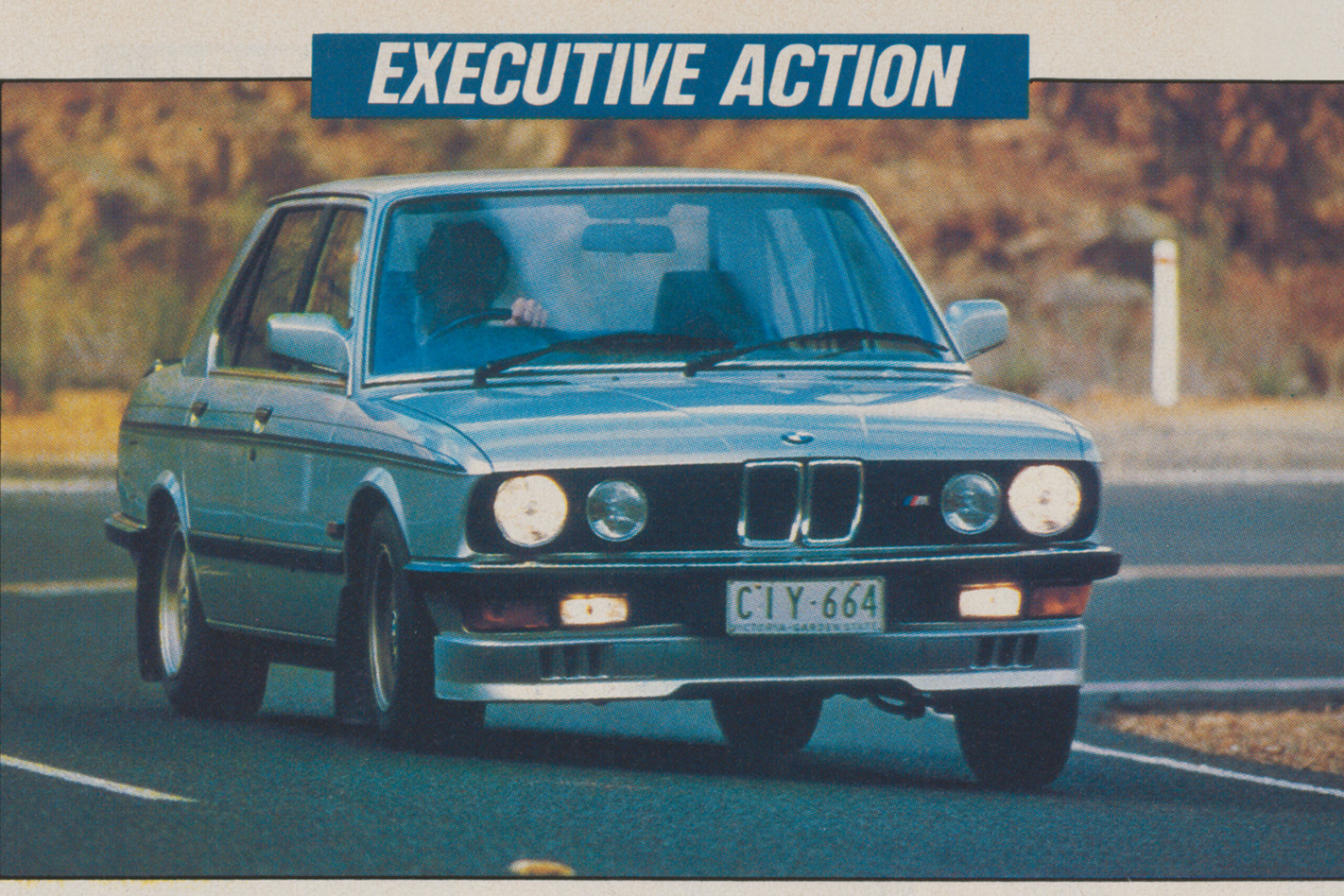
After driving the cars and completing our specification charts we realised something didn’t quite add up when cross referencing gear speeds on the road and the theoretical maximums. Upon investigation we discovered that late last year the 528i’s final drive ratio was changed from 3.25 to 3.45 and that our test car was fitted with the old ratio that gave 44.0 km/h per 1000 rpm in fifth, compared to the current car’s 41.4 km/h. The difference is not great – at 110 km/h in the test car the engine was pulling 2500 rpm while the ’85 model would be doing almost 2700 rpm – but would certainly improve general flexibility. Even so that’s still so far down the engine’s rev range that fifth gear would remain a motorway gear, and far too high for regular use in commuter conditions. Certainly, on the test car, overtaking required dropping down at least two ratios from fifth, and occasionally even to second gear, which has a maximum speed of over 100 km/h.
Understand that the 528i requires frequent gear changing and it is a delightful engine. On the road the differences in performance are far less marked than they are on paper. These are all quick machines across the ground and it would take a skilled driver in arty of them to run away and hide from the other three cars.
On an unrestricted open road the Saab will reach a higher speed than the others, for it pulls all the way to 5600 rpm in fifth – that’s 220 km/h or 137 mph in the old language. Not bad for just two litres. So tall is the gearing on the 528i that it will reach 210 km/h in both fourth and fifth although it takes much longer than the 16S to reach those sorts of speed.
The Holden is next, if you cheat and go into the red. Five-five is 207 km/h and it will go faster still if you’re brave enough. John Harvey says 6000 should be okay in fourth for short periods … that’s 226 km/h. However there’s no doubt the Group Three would be a much more pleasant car with a tall fifth gear.
The Volvo is the slowest of the quartet, if 198 km/h could ever be called slow and in the overdrive fifth that’s just 4900 rpm. None of the four has a perfect gearbox. The shift quality of the BMW is probably closest, but like the others it still has a heavy clutch, and the slightly notchy gear shift is too far forward for tall drivers who, by necessity, have the seat well back. The Volvo’s change is more notchy, with a whine from the clutch when it is depressed. Under acceleration the change up to fifth via the small button atop the gear lever is smooth, but on a trailing throttle and no clutch it can be slightly jerky. Better, surely, to have a conventional fifth gear.
Not that the Commodore is any better, for it too is notchy and, on this hard-used example, the second gear synchromesh had all but disappeared and the shift was stiff and never a pleasureable aspect of driving the car.
Dynamics
We all knew the Holden would be quicker than the others, didn’t we? But Europe’s great talent has always been dynamics. Could the Group Three cut it with the Euro-sedans? The answer, and it is not simple, is yes but … In terms of outright roadholding the Commodore has more grip than the others and this gives it the edge, but of course at speeds that normal mortals would never approach on the road.
In real life it is not as clear cut. What the Holden lacks is a suppleness of ride. Those high lateral G-forces have been achieved at the expense of a ride that is firm, very firm (if never actually harsh) while the wide, low profile P7 tyres that must also contribute so effectively in this area produce a sensitivity at the wheel that is never less than annoying and in some conditions makes the car tramline badly, and twitch, to the point where you would gladly give up the wheel for one of the other three.
On smooth roads there is no disputing the Group’s exemplary behaviour, but most Australian roads aren’t in the bowling green class. The steering is firm rather than heavy and very direct with just 3.25 turns lock to lock, so it turns into corners with little more than a hint of movement on the wheel. Ultimately it will oversteer in tight corners taken at full blood in second gear, but it is virtually neutral in all other conditions. The tail out attitude is predictable and easily controlled and for the right kind of driver epitomises the character of this macho-hotrod sedan.
The Saab, too, has very high limits of adhesion and comes closest to the Brockmobile in absolute roadholding terms. But in this company and despite being on 60 aspect ratio P6s, it doesn’t turn in as accurately as the BMW, and those tyres which give it the roadholding require a large slice of initial wheel movement of the superbly, and consistently, weighted rack and pinion steering. It is lighter than the Volvo, and requires more lock through any given corner than the others, but once into a bend the steering is sensitive and accurate though it is never quite as easy to place down to the last mm as the BMW, with a mild but ever increasing tendency to understeer. In the ultimate, though, this car has such stability that it simply goes exactly where it is pointed, while the addition of anti-roll bars to the suspension reduces body movement so that it stays flatter, though there is still more body roll than on either the BMW or Commodore at the point of timing into a bend.
The 528i is somewhere between the Saab and the Commodore in its road behaviour. It is far firmer in its suspension than the Saab, at least so far as the ride is concerned, but appears to have more suspension travel than either. You could never call it supple, it is simply too firm for that, but it still has an ability to absorb bumps and keep them from the occupants. Initially the steering seems lower geared even than the Saab, however the driver soon discovers that the handling is so neutral that except in very tight conditions only relatively small wheel movements are required.
Like all BMWs the 528i, even with the stiff sports suspension and the LSD, will oversteer and wet roads need to be treated with respect. It is not a violent movement, as it was with the old car, for there is far too much inherent balance for that and the car is so easy to place on the road, and accurate, that even lifting off in the apex of a corner taken very quickly only tightens up the bend.
The Volvo’s dynamics are in many ways out of step with the others in this comparison. The engineers from Gothenburg had their priorities firmly planted in the ride department when it came to the 760 Turbo, for it is far softer than the others. Too soft, in fact, for many of the test team, who felt a sporting sedan shouldn’t display the body roll and lurchiness that comes naturally on the Volvo. Of course the ride is more comfortable and those people who want limousine qualities with turbo performance need look no further. In the extremes it lacks the precision and sensitivity of the others, though that won’t be considered a criticism by many who will discover the 760 is very easy to drive quickly and way beyond the point at which most Australians will long since have given up the chase. In the language of racing drivers, to about eight-and-a-half tenths.
It is in those last one and a half tenths that it begins to disappoint the true enthusiast. Change directions quickly in the Volvo and the body wallows, as if it is unable to keep up with the chassis. And the softness of the rear dampers leads us to the conclusion that this car was below par.
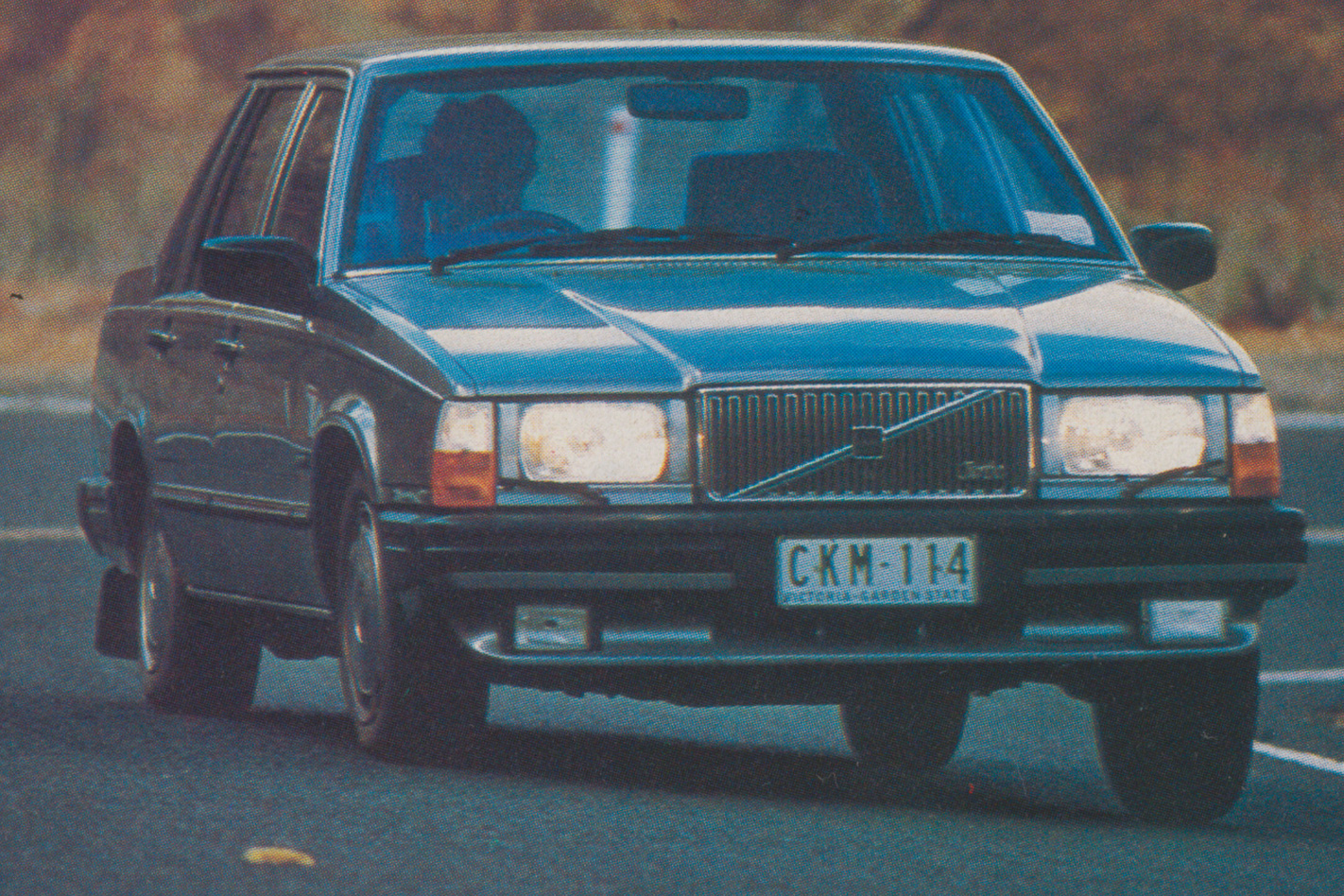
As a high speed cruise car the 760 is without equal in this foursome, but on tight twisty sections with undulating surfaces, it is possible to get the rear end skipping sideways, only momentarily we should add and in terms of mms rather than ems, and even bottoming out. From the driver’s seat the Volvo feels wider and generally bigger and does require more lock in any series of bends, where it feels to slide around and take up more road space even than the BMW and despite the 195 HR 60 Pirelli P6s. For all this it is very predictable in its behaviour and easy to drive, and quick too, so the compromise is logical for many people.
You expect nothing less than four wheel disc brakes with these cars and they deliver. The BMW goes one step further with ABS antilock system, yet in normal driving it is the 528i brakes which came in for the most criticism, with very poor pedal feel and the initial impression, which is shared with the Three Series, that the brakes aren’t going to stop the car. As part of the conversion from left to right hand drive, the brakes are operated by a torsion bar and it is the movement of this bar that creates this most disconcerting effect, and the subsequent grabbing sensation as the brakes suddenly go on very quickly. In a crash stop they work brilliantly, but not for the BMW driver the reassuring ability to dab the brakes lightly to set the car up before entering a corner.
The Saab’s brakes require a firm pedal but they are beautifully progressive and haul the car down from high speed with total stability. Those on the Group Three also work consistently and with even heavier pressure needed through a short pedal travel while the Volvo’s brakes are lighter, with longer travel and a slightly more spongy feel.
Where the European cars have it all over the Commodore is in the area of noise suppression for not only is the bent eight loud, but the Group Three has too much wind noise to be considered a true high-speed express in the European sense. In contrast the BMW, unlike the old Five Series, has least, but is still slightly behind the Volvo because its tyres give off such a pronounced hum, drone even, over coarse surfaces. The Saab isn’t as quiet with a whistle around the doors and some induction roar, but it is far less objectionable than the Commodore, which comes through as a machine for a three hour burst on a reasonably twisty section of smooth road.
Fuel consumption
The Group Three and 760 Turbo performed as expected, while the Saab and BMW surprised us with their frugal consumption. Obviously the Holden with its big lump of iron was going to use the most fuel, but given the manner in which it was driven, our overall average of 5.9 km/l (16.8 mpg) is at least acceptable and is probably a realistic everyday figure.
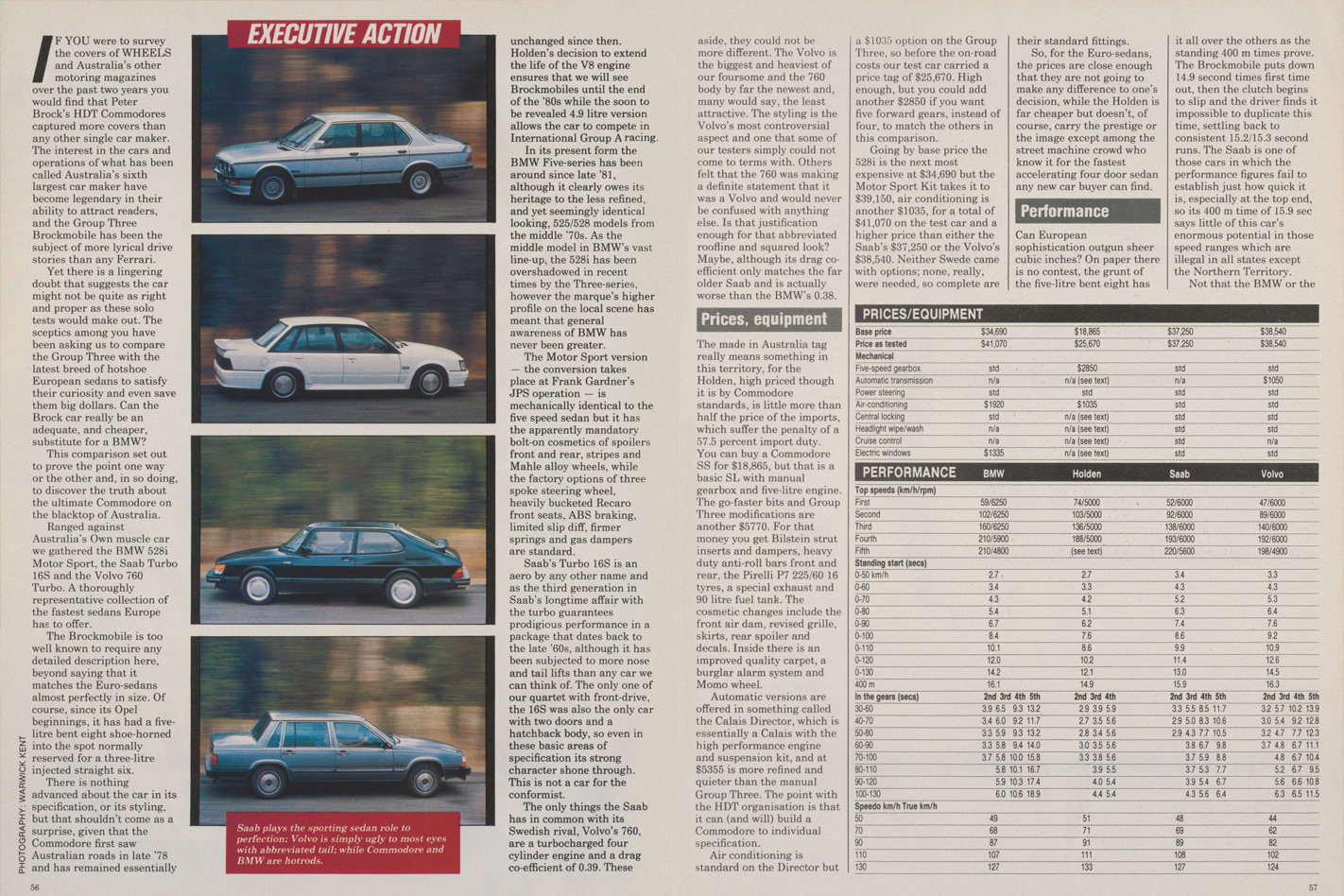
The BMW, (how much did that tall gearing help?) and Saab, with its much smaller, but turbo, engine, have virtually identical fuel consumption and their 8.6 (24.3) and 8.7 (24.7) respectively are outstanding given the performance levels. Where the Holden does lose out is in touring range, for despite the 90 litre tank it still is struggling to provide a 500 km range. Not so the Volvo or BMW, but the Saab could do with a few extra litres.
Accommodation
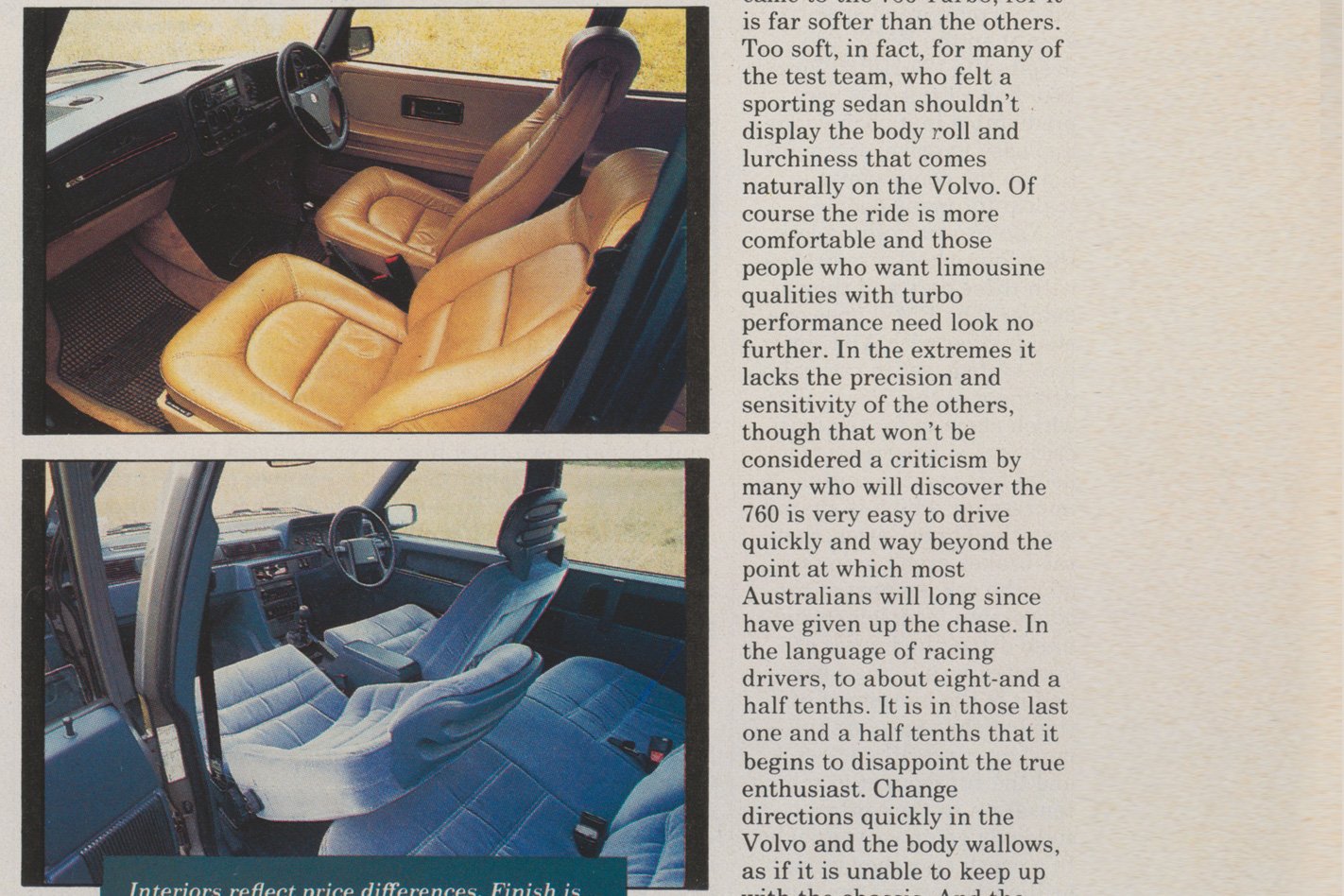
If you want to understand why the Commodore is at least $12,000 cheaper than the others a quick glance at the interiors will explain all. The Holden simply doesn’t have the quality feel, nor the equipment levels, of the Euro-sedans and is badly let down by the cheap and nasty instruments and the crudity of its controls. We understand the next Commodore takes care of these criticisms, but that doesn’t help this comparison, nor does it explain why the VK Commodore interior is a backward step from the VB.
The basic elements are there, the Scheel bucket seats, a full range of instruments, a leather bound steering wheel, even a four speaker sound system, but the finish is decidedly downmarket in this company and the quality of materials doesn’t match its rivals. In terms of space the Holden and Volvo are clearly more roomy than the BMW, while the Saab is even smaller, an impression supported by the two door body and relatively small glass areas. Yet all four are genuine four seaters with the Volvo and BMW our testers’ choice for an interstate trip with a full complement of passengers.
The Commodore’s wraparound Scheel bucket seats look the goods but aren’t in the same league as the Recaro seats in the BMW. There is plenty of lateral and shoulder support, but all our drivers complained of a lack of lumbar support, and that the cushion was too short and flat. There is a cushion height adjustment but no tilt as on the others.
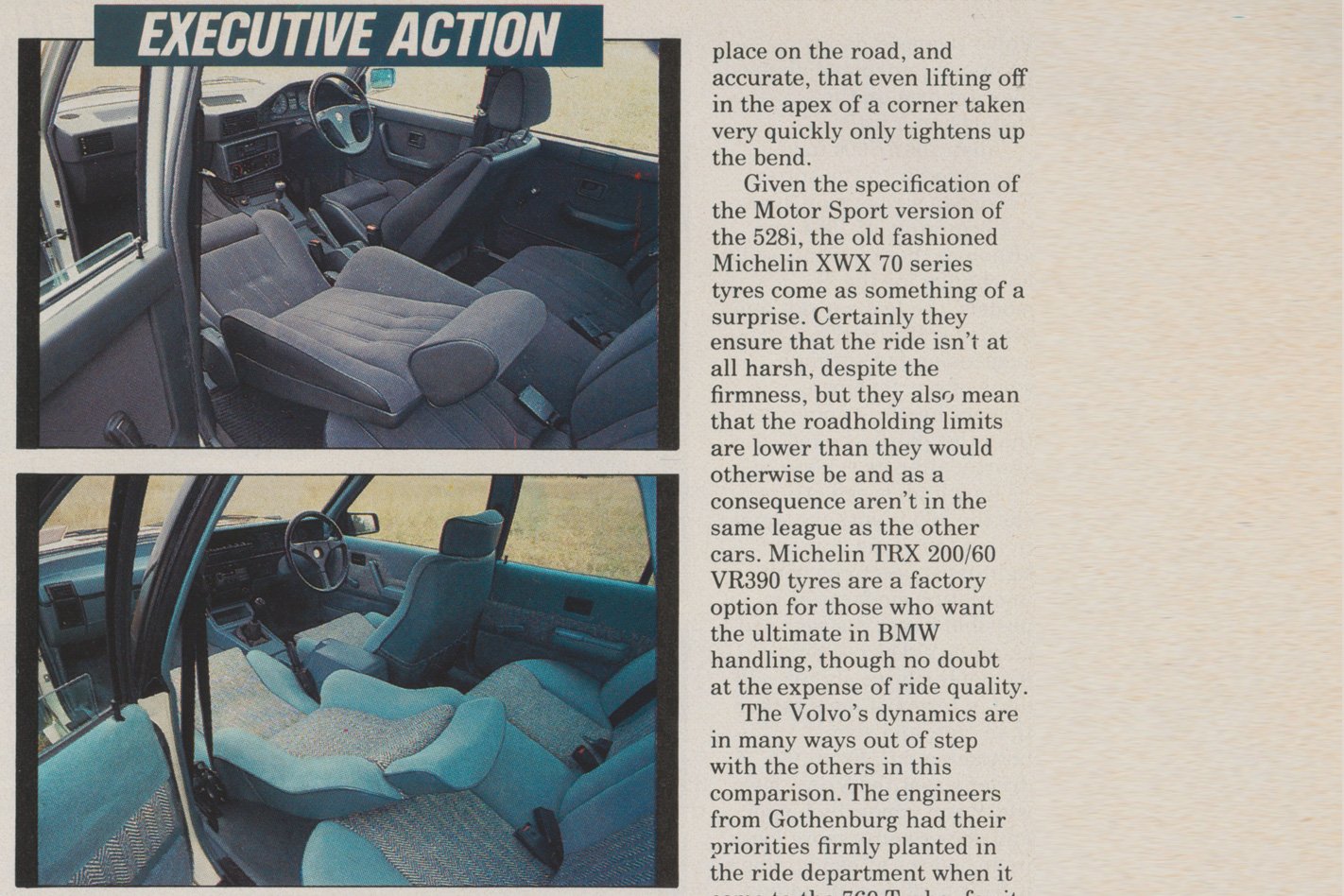
The Saab feels narrow and the scuttle high with shallow windows which reflect its now ageing body. But the ergonomics are excellent and virtually within finger tip reach of the driver except for the window controls between the front seats. The seats too, flatter than those of the Commodore and BMW, and lacking their lateral support, are very comfortable, front and rear.
The Turbo 760 shares its cockpit with the GLE automatic so it inherits the same rather flat and large bucket seats which still proved comfortable, while their excellent tilt arrangement provides a sufficient range of adjustment for a wide variety of drivers. There is heaps of room in the Volvo, in every direction, and even though the rear seat cushion is very high the extended roofline ensures there is plenty of headroom. The interior is a little too plasticky, but the controls are sensibly placed and the convenience of the long right-hand stalk for the wipers is outstanding.
Nothing comes near equalling the versatility of the Saab, with its huge load space and easy access through the hatchback tailgate. The BMW and Commodore have large, conventionally shaped boots, but the Volvo loses space because Australia gets the optional big fuel tank that sits on the boot floor.
How difficult and how ironic that all four cars should have significant failings. The Commodore is simply too noisy, too low geared and not in the same class when it comes to equipment levels and finish, and the ride, superbly controlled though it may be, is too firm for most drivers. Yet at full song, the stirring bent eight roar and the sheer, gutsy performance makes it a marvellous hotrod. Refined in a European sense it is not.
But we’re here to talk about sporting sedans and that leaves the BMW and Saab. The lack of bottom end torque and the general firmness of its controls and, of course, that absurdly tall gearing, count against the 528i on our roads, but given the lower gearing of the current car, and the precision, the seats, the finely balanced handling and the lovely six cylinder engine on song, would make us look very seriously at the BMW.
But we haven’t tested the new model and until then it is the Saab by a whisker in this fightout, even knowing that we would have to drive around bumps to avoid the groans from the body and accepting that the 16S does have a better gearchange. But the visual appeal of the Saab – it looks the part more effectively and yet with greater subtlety than the others – that staggering engine and roadholding and the body’s versatility would make it easy to live with, even if the occasional stumble at town speeds becomes annoying.
ONES AND ZEROES strung together in the right order is at least partly why the Ford Focus RS won the $50K-$100K class, the calibration of its brilliant all-wheel drive system helping it cross the line in a blistering 1:38.4sec – just 0.1sec off the Mercedes-AMG A45, itself a car almost made for the track.
And, it must be said, a car more than $27,000 more expensive than Ford’s all-wheel drive hero, meaning for the price of an A45, hardcore Blue Oval hot hatch fans would need a double garage for both their Focus RS and their Fiesta ST.
Really. In the final reckoning, it was this combination of laptime talent, and being the cheapest car of the $50K-$100K crop, that hoisted the 257kW, 2.3-litre twin-scroll turbocharged four-cylinder Focus RS to the top step of the class podium. And what’s more, it could have been even faster.
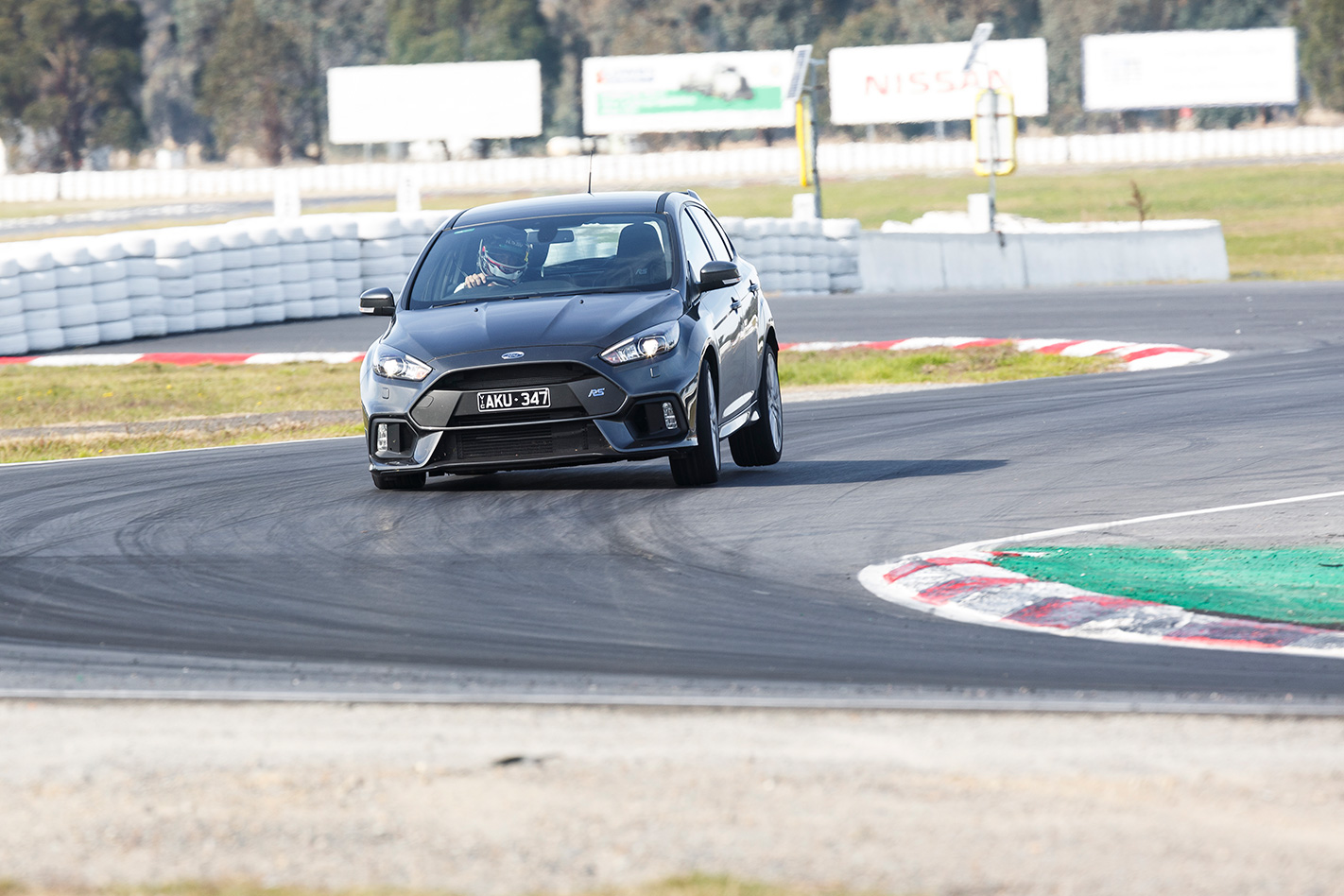
And so, in a drag race across the quarter mile of all our $50K-$100K competitors, the Focus RS would end up an unremarkable fifth. Still, its 13.31sec quarter at 171.04km/h will hardly have you checking your watch. In perfect circumstances, this is a 12-second car.
Fifth is also where the Focus RS finished in the power competitions such as 0-400m and lap V-max, but with a 34.22m effort 100-0km/h it clawed back time under brakes – thanks to those huge 350mm front four-pot monoblock Brembos – and mid-corner speed.
A lot of mid-corner speed. It’s just as well the Focus RS comes with cossetting Recaro sports seats because this is one car that absolutely wouldn’t work with a bench. Its turn four apex speed of 96.29km/h smoked the $50K-$100K all-comers, as did its 73.94km/h apex speed through the slower turn 10.
And our Magnetic grey test car wasn’t even fitted with Ford’s optional Performance Wheel Pack, which comes with the Tarzan Grip-spec Michelin Pilot Sport Cup 2 tyres. The Focus RS owes a lot to its tricky all-wheel drive system, which can send up to 70 per cent of torque to the rear axle, and then 100 per cent of that to either left or right wheel.
In slower corners, the computer sends grunt to the outside rear wheel to more quickly pivot the RS and “virtually eliminate understeer”, says Ford. On track, you’re able to pick up the throttle earlier and earlier, the Focus RS just tightening its line as it greedily gathers speed.
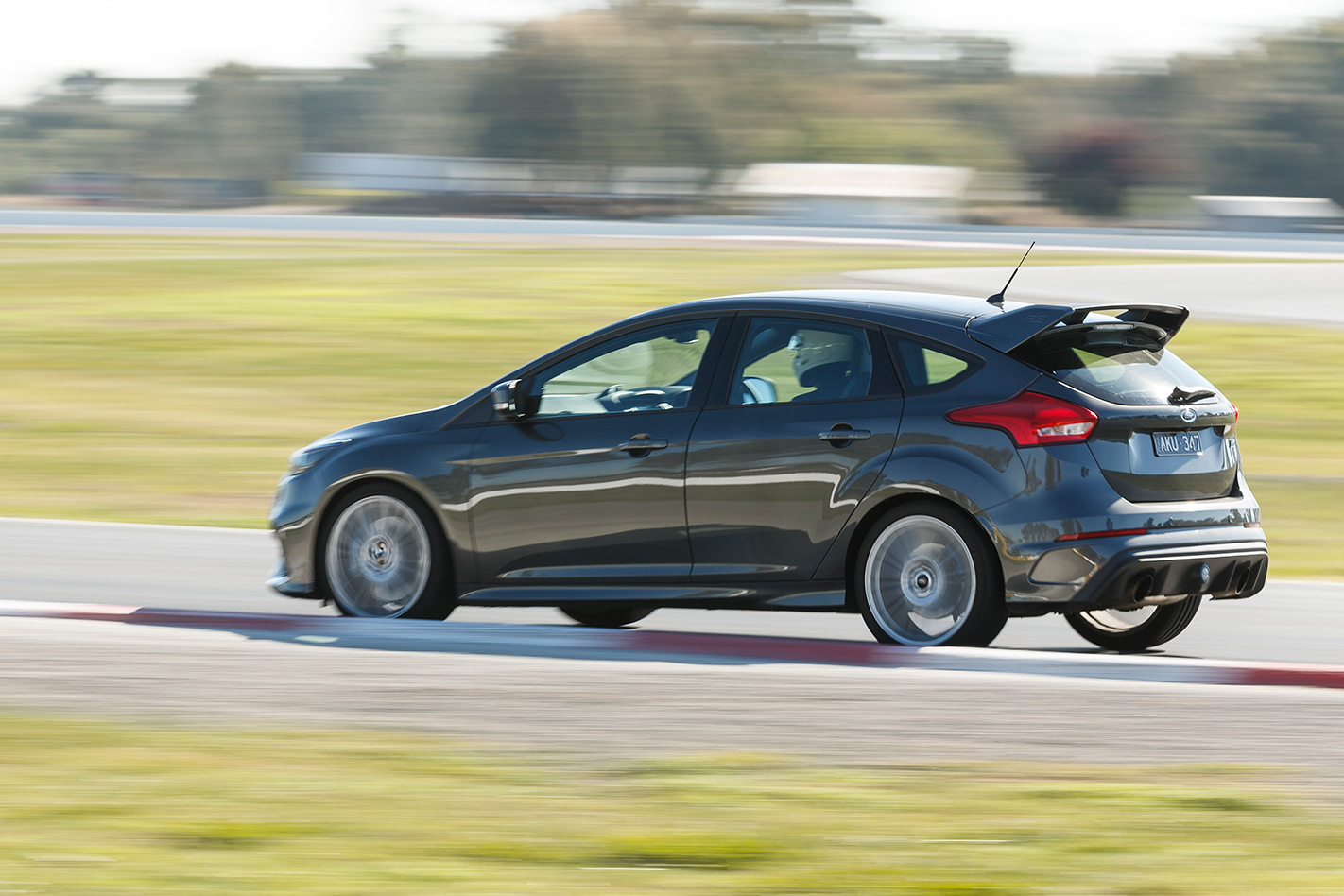
As you may have noticed, the opposite is true. This is a fun car on a racetrack. It gives you what you want; lots of grip, direct and fast steering, strong and resilient brakes, good power and actual cornering ability and talent.
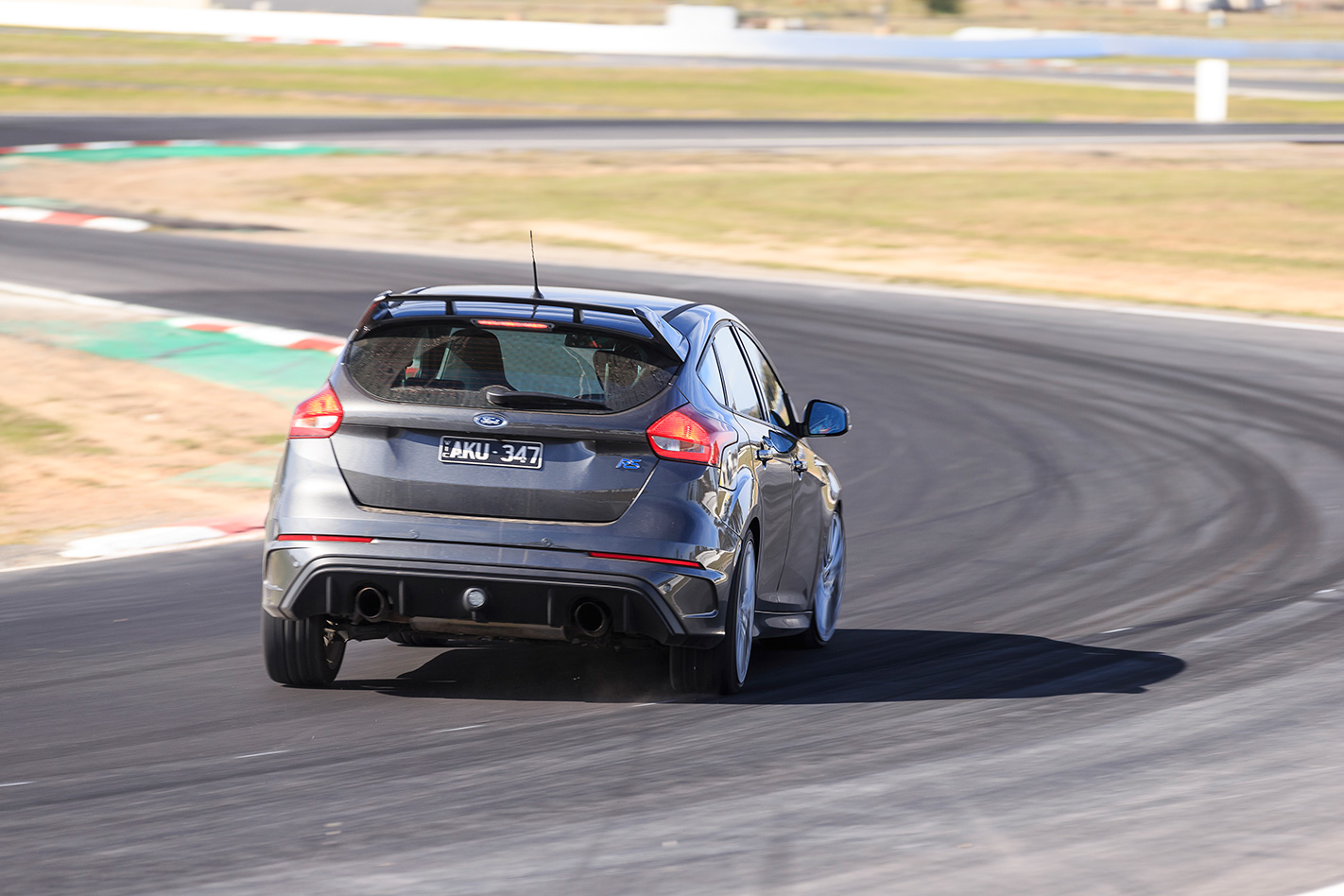
The Focus RS feels to be very pleased to find itself on a race circuit. And it very much passes this on to the nut holding the wheel. The Focus RS even provides value in ways that we’ve not measured. This is not a one-dimensional handling car; it can be a different car for you at many track days if you so wish.
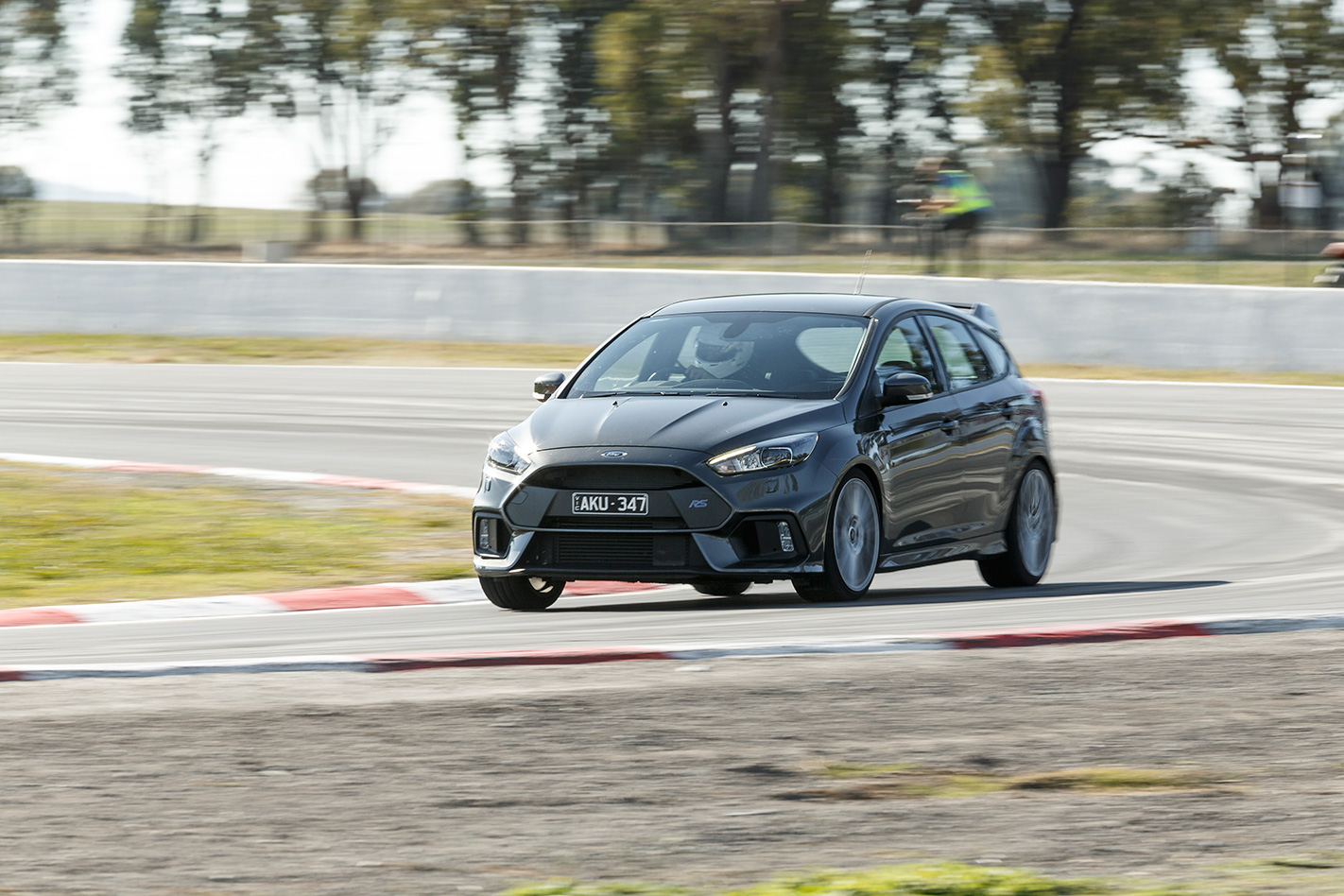
Power oversteering? Okay, so you won’t want to enter it at the local drift competition – even with the largely gimmicky Drift Mode – but you can hang the tail out on the throttle out of corners.
We’ll find out soon enough.
Specs: Engine: 2261cc inline-4, DOHC, 16v, turbo Power: 257kW @ 6000rpm Torque: 440Nm @ 2000-4500rpm Weight: 1575kg
Times 0-100km/h: 5.06sec (5th) 0-400m: 13.31sec @ 171.04km/h (5th) Lap Time: 1:38.4sec (4th)
Scores Price: $50,990 Bang Index: 135.2 Bucks Index: 132.8 BFYB Index: 134.2
Warren Luff says “It really lives up to expectation. It’s a car that you can have a lot of fun with; you can really point the back of the car and get the nose of it into an apex. The RS does everything you want. On a fun-factor scale it’s 10 out of 10. The brakes are good, but if you do multiple laps you can see some fade. The engine and gearing, etc, just works. For me personally, maybe the seating position is probably not quite to my liking, but it really does tick the boxes in so many aspects and it’s so much fun at Winton.”
Judges notes David Morley – 1st: “A cult car from the moment it was announced. Deservedly so” Dylan Campbell – 1st: “I could do a dozen track days in this car without getting bored” Louis Cordony – 1st: “Grip, grunt, and razor-sharp chassis mean no apex is safe” Tim Robson – 1st: “Clinically, brutally fast… but boy, do you need to be in the mood”
Judges’ Picks
PUTTING all the data aside, of the eight $50K-$100K cars, if we, the judges, were forced to grab one car to do 10 laps and that was it – in a car, on a track, for the rest of our lives – we’d take the Focus RS.
Admittedly, this breakout is somewhat redundant. Its purpose is to give a big-ups to the car that perhaps didn’t set the strip or track on fire, and so finished in a lowly position as a result, but put a big fat grin on our faces regardless.
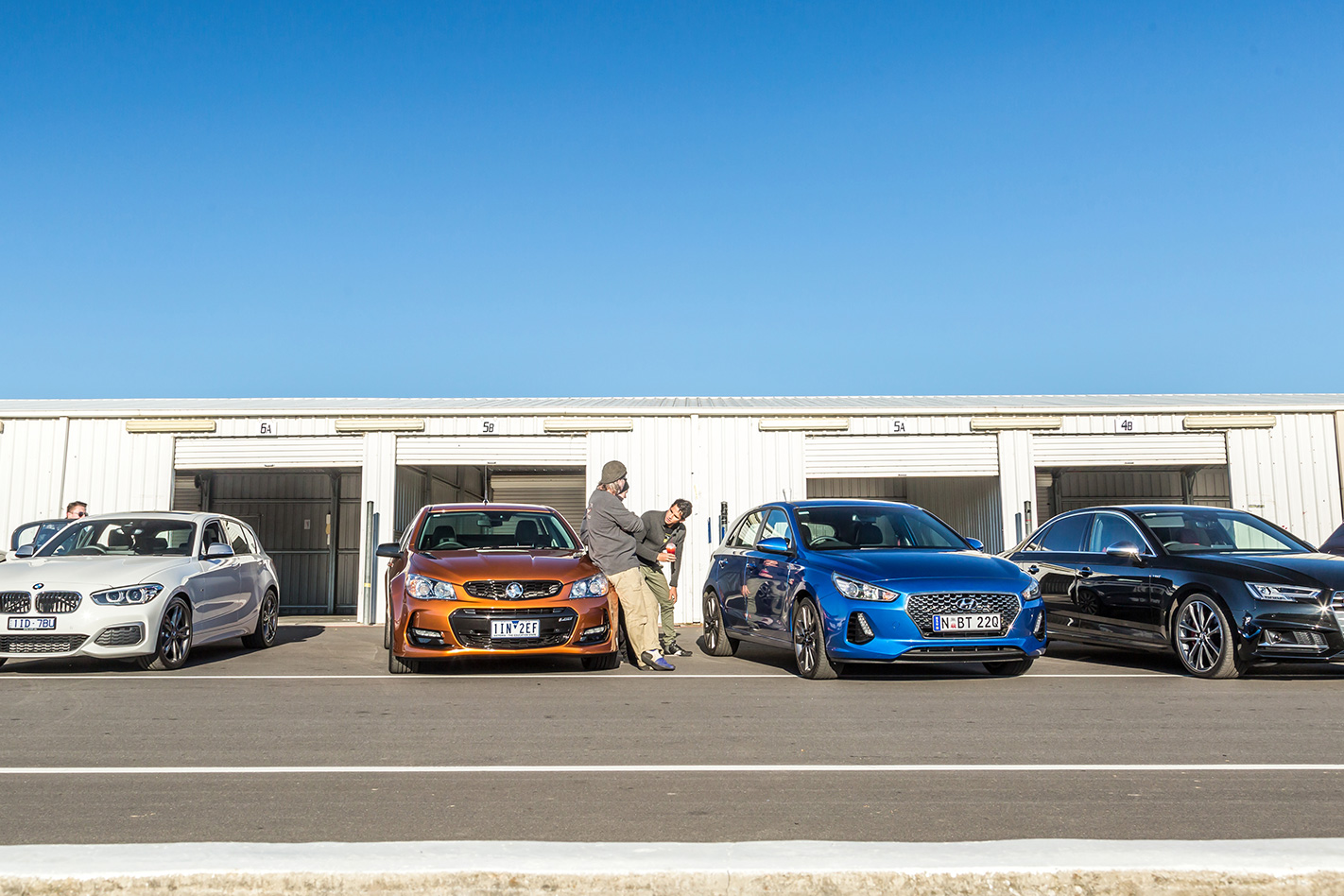
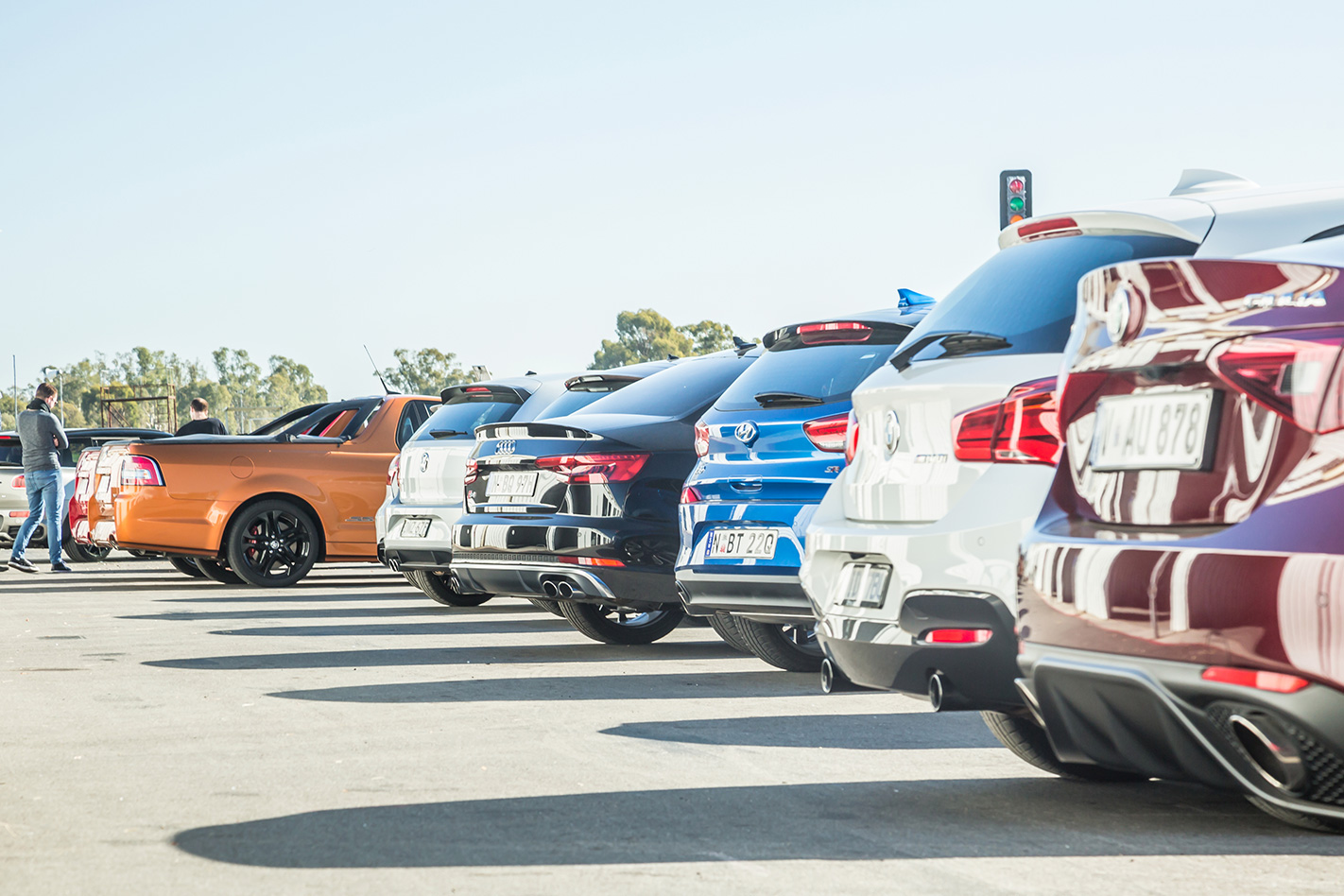
The poor Caterham was our least favourite $50K-$100K car, even pipped by the Mini…
| BFYB ENTRANT | BANG INDEX | BUCK INDEX | BFYB SCORE |
| 1. Ford Focus RS | 135.2 | 132.8 | 134.2 |
| 2. SS-V Redline | 122.4u00a0 | 123.8 | 123.0 |
| 3. BMW M140i | 128.5 | 104.3 | 118.8 |
| 4. Merc-AMG A45 | 139.1 | 86.5 | 118.1 |
| 5. Audi A4 | 125.1 | 65.8 | 101.4 |
| 6. Alfa Giulia Veloce | 76.3 | 94.1 | 83.4 |
| 7. JCW Clubman | 50.4 | 125.6 | 80.5 |
| 8. Caterham 275 | 22.9 | 105.8 | 56.0 |
THE championship-defining Singapore Grand Prix was a race that Ferrari’s Sebastian Vettel was in the box seat to win, and that Red Bull drivers Daniel Ricciardo and Max Verstappen believed they could win.
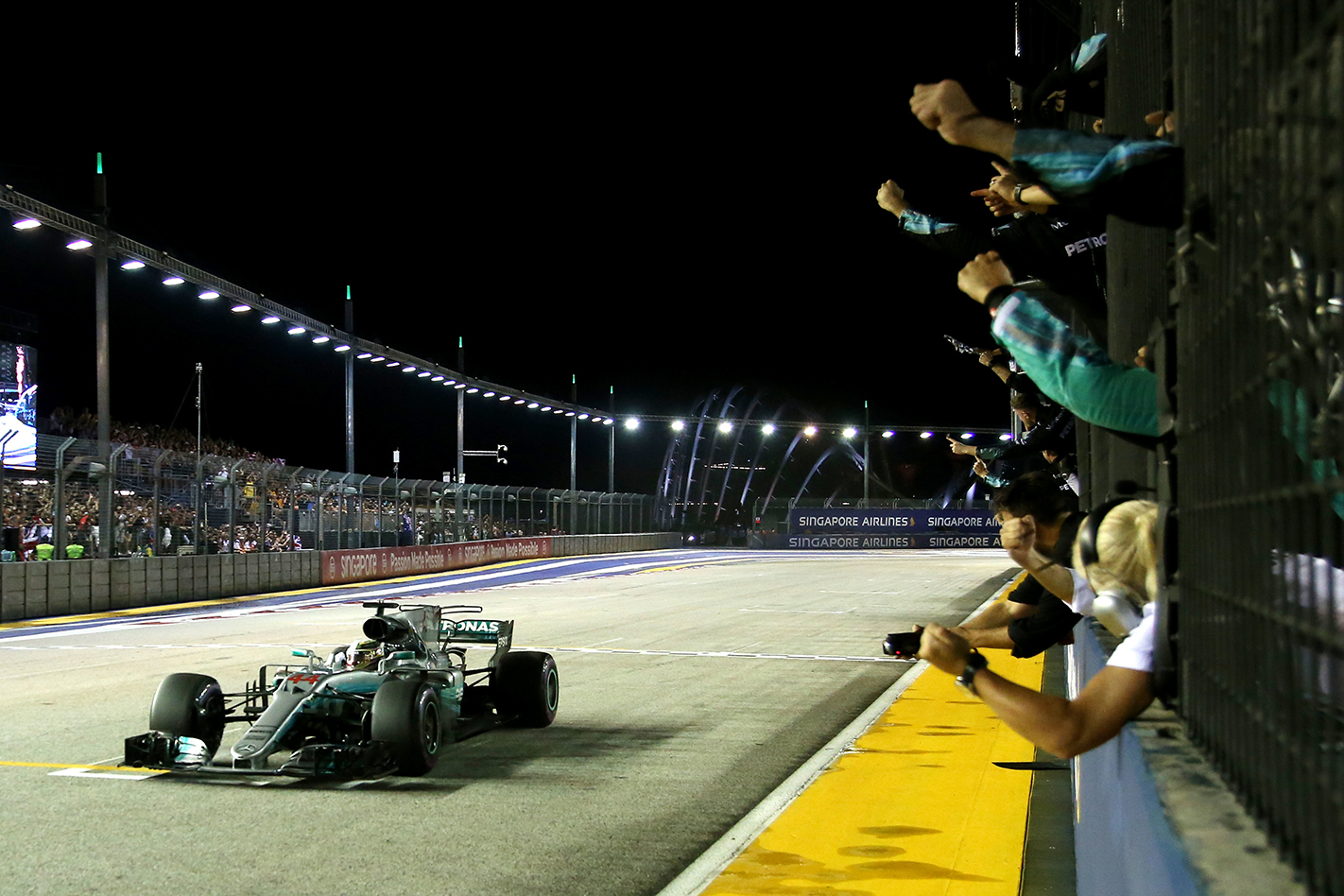
And after a wild opening few seconds and melee which eliminated both Ferraris along with of innocent parties Verstappen and a fast-starting Fernando Alonso, there was disbelief in many quarters as Lewis Hamilton surged to the front, setting up a remarkable victory.
Hamilton’s Singapore slingshot to victory has put him 28 points up on Vettel and given him a great chance of securing a fourth drivers’ title.
Vettel stunningly qualified on pole ahead of the Verstappen and Ricciardo, with his prime championship rival Hamilton in fifth on the grid behind the second Ferrari of Kimi Raikkonen.
It appeared as though Ferrari, and Vettel in particular, had not only recovered from the travails of Monza but were well positioned to bag a swag of championship points, with the quick Red Bull drivers also relishing their prospects. Singapore has generally been a happy hunting ground for Vettel, while Ricciardo boldly predicted he could win the GP, a race that gave him second places in the previous two years.
Rain – the first to fall on Formula One’s only race under floodlights in its 10-year history – did little to subjugate the optimism of the drivers starting on the first two rows.
Then the red lights went out…
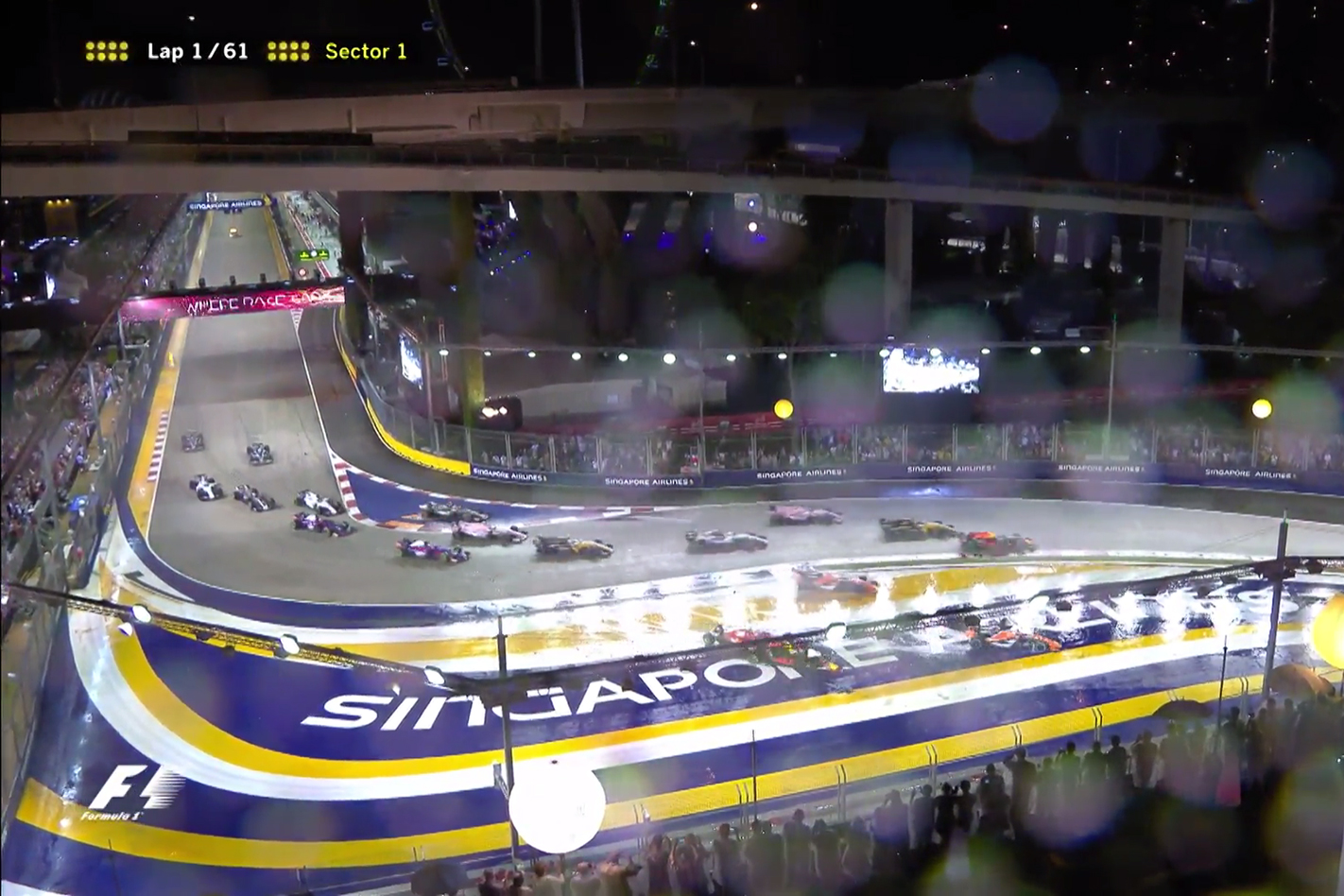
Vettel should have been more circumspect, but looked to be moving across the track to discourage Verstappen. The Red Bull was being squeezed by Vettel on his right and Raikkonen on his left. Failing comprehensively to disappear from the red-car wedge, Verstappen made contact with Raikkonen who spun across his nose into his teammate, also slamming into the Red Bull and Alonso’s McLaren. Vettel continued to hold the lead but his car had significant damage, leaking coolant from a broken radiator, and crashed out moments later.
In a couple of crazy moment, three leading cars were sidelined along with Alonso’s McLaren.
TV pundit and ex driver Martin Brundle pointed the finger of blame on Vettel, as did the bitterly disappointed Verstappen after yet another non-finish.
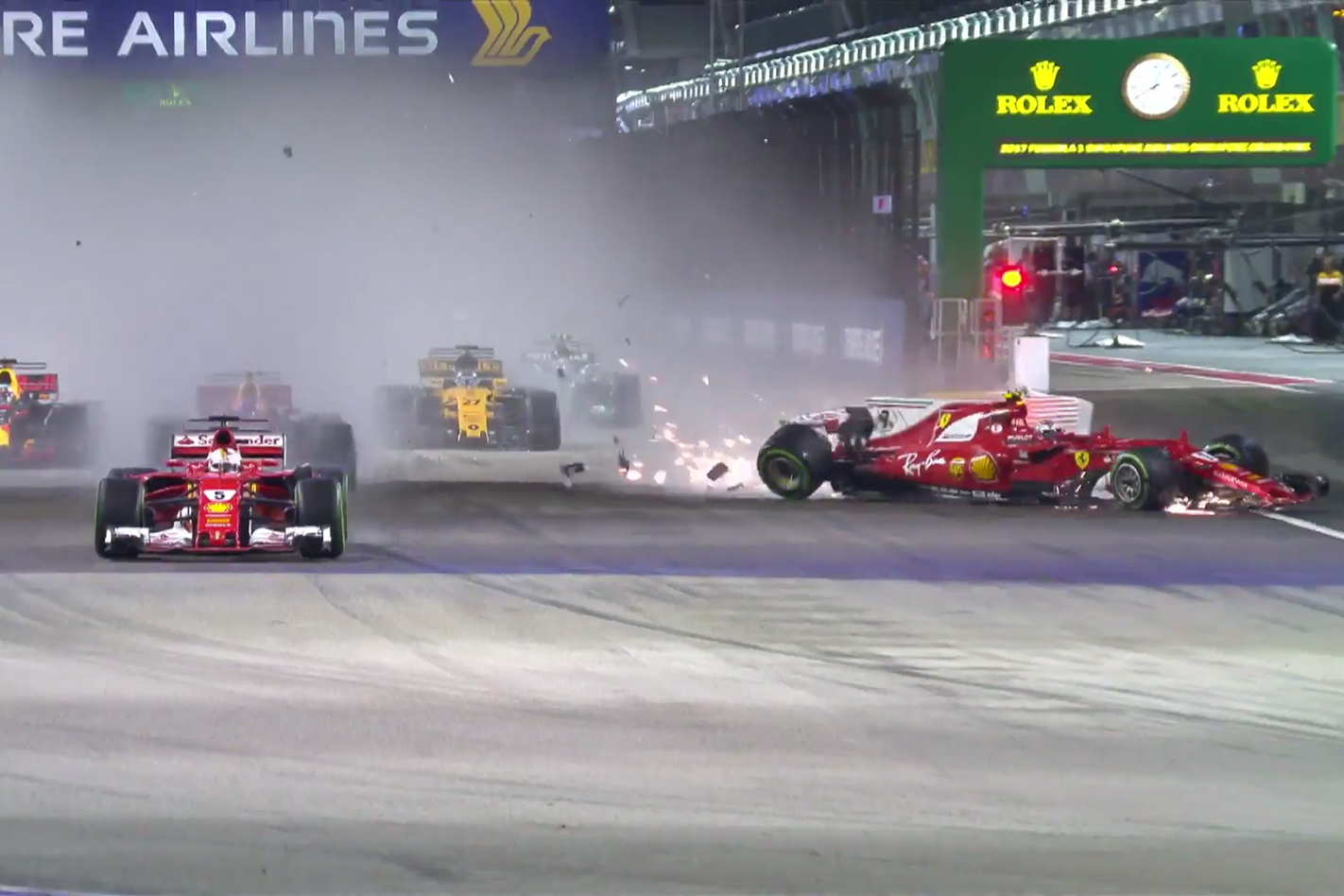
“I think it wasn’t the smartest move and you can’t make excuses for it when you are fighting for a world championship. Kimi had a great start and was alongside me very quickly, I didn’t try and defend that as I knew it would be a long race. He then started to squeeze me also, at which point there wasn’t a lot I could do.”
Vettel’s take on the melee was overly candid. “I saw Max and then next thing I see is Kimi hitting the side of me and Max somewhere there. I’m sure there will be more opportunities.” That was the one that got away though.
A controversial Ferrari tweet blamed Verstappen and social media lit up with many and varied opinions, many of them ill-informed.
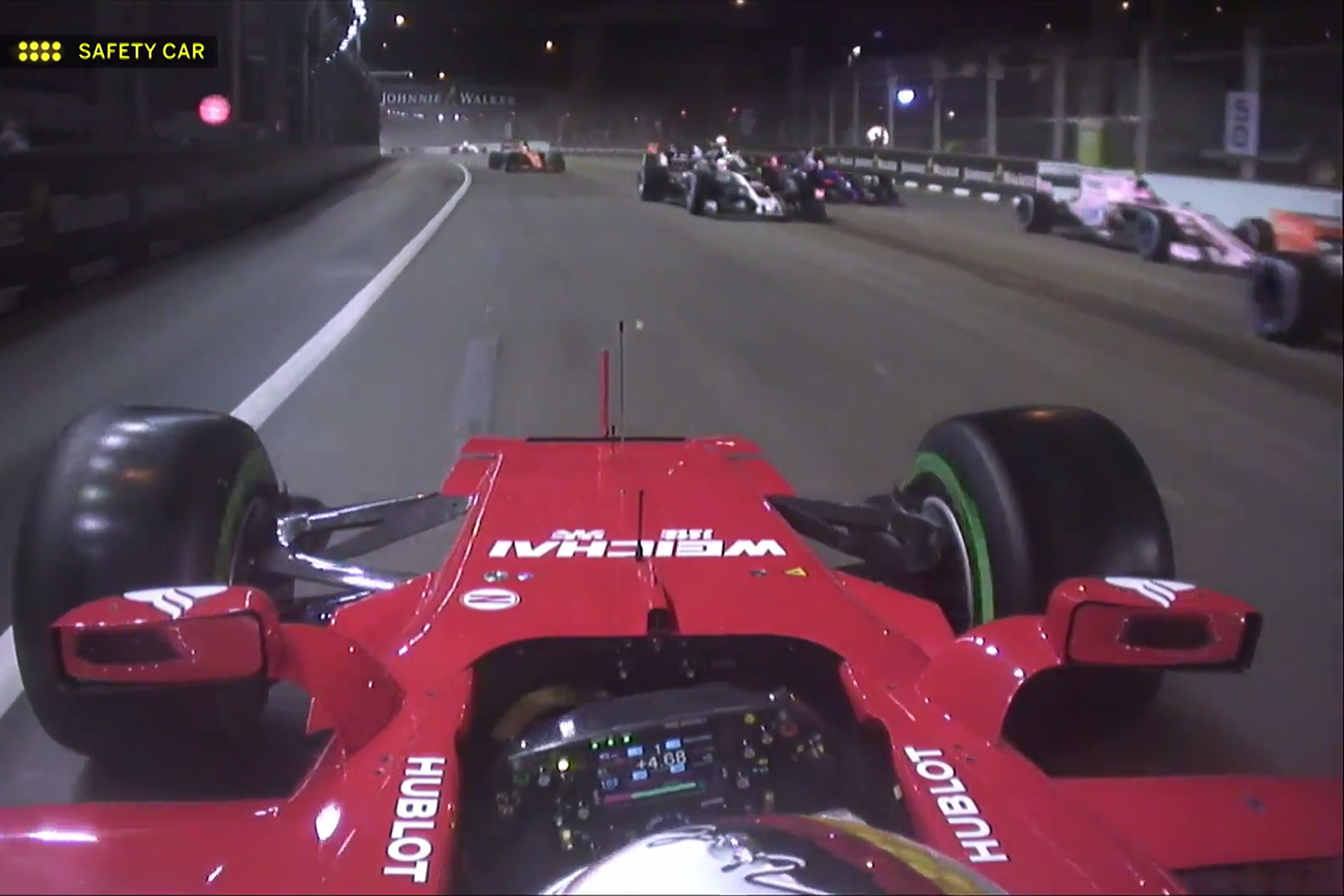
The safety car immediately made the first of three appearances as officials cleaned up a rubbish tip of carbonfibre and wrecked cars.
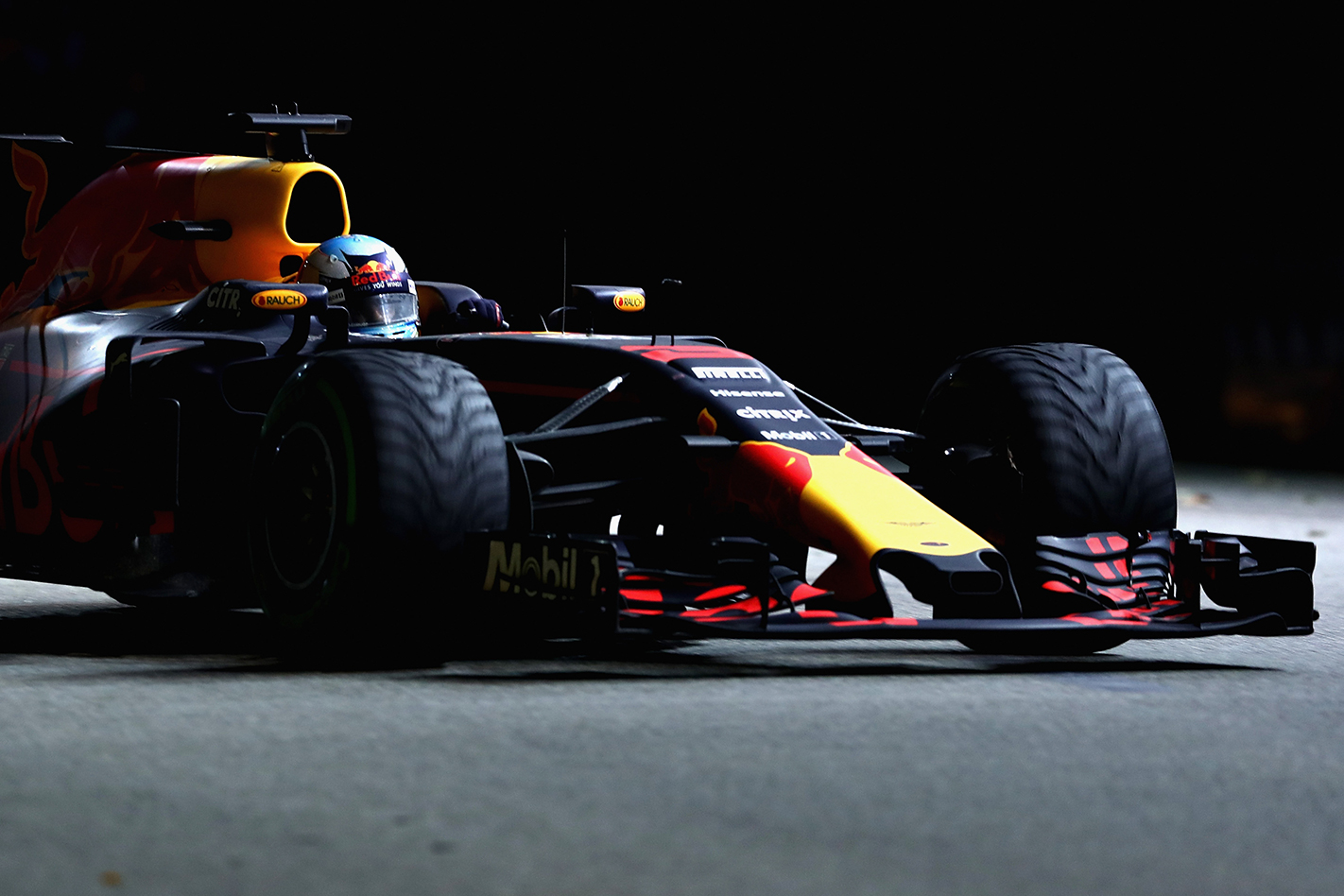
When the rain eased and the teams switched to slicks on the slow drying track, surely the Red Bull’s stunning Friday and Saturday supremacy over Mercedes would materialise again? Surely?
But no. After the final safety car and subsequent restart, Hamilton quickly skipped away again, while Bottas had Ricciardo in a Silver Arrows sandwich.
What is going on with Daniel, we asked.
The answer wasn’t forthcoming until after the race when Red Bull boss Christian Horner revealed Ricciardo was managing an ailing gearbox issue that flared up early, and that there were real fears he wouldn’t finish the GP.
“We could see losing an awful lot of oil pressure in the gearbox,” said Horner. “So Daniel had instructions to start managing that and he had to sacrifice lap time. He did incredibly well and managed to nurse the car home for another hour and a half.”
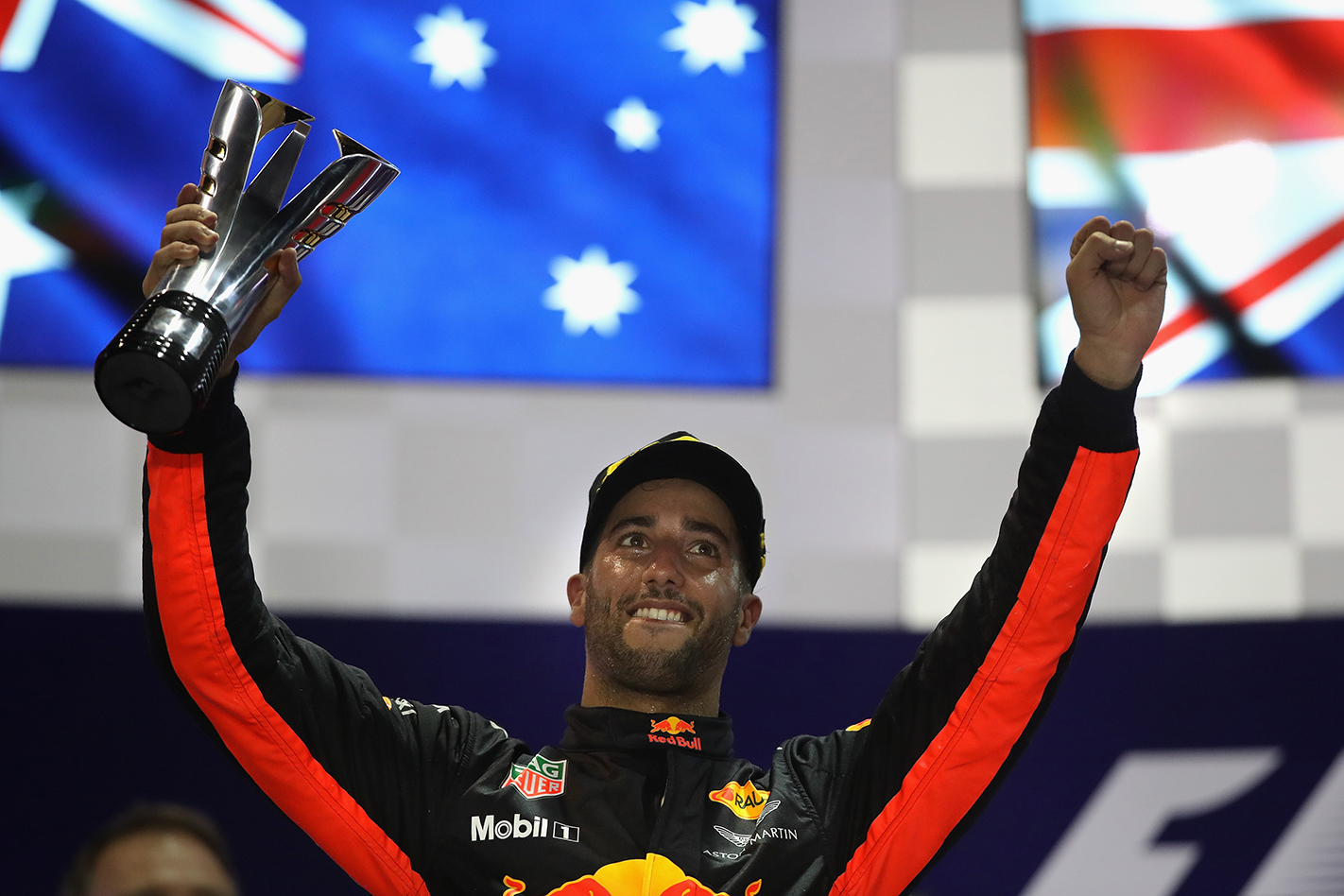
Ricciardo refused to use the gearbox trouble for his failure to challenge Hamilton. “Even when we pitted and had fresher tyres, we couldn’t really make an impact on Lewis.
“The team was asking me to manage the gears through the race and after I learned we had a leak and were losing oil pressure in the gearbox from early on. Of course, I came here to win and really wanted it, but second place is great and I’m not going to complain about it.”
In terms of entertainment and excitement, this GP wasn’t a great advertisement for F1.
Still, behind the podium men Hamilton, Ricciardo and Bottas were some fine performances. Carlos Sainz Jr took fourth, his best result in F1. Perez came through to fifth, while Palmer answered his critics and his team with a strong sixth in the changing conditions.
Stoffel Vandoorne’s seventh was his best finish for McLaren Honda.
But by any measure this was Hamilton’s night due in no small part to Vettel’s recklessness.
Supercars: Waters and Stanaway take open Pirtek Enduro honours at Sandown
Cameron Waters and Richie Stanaway, A couple of young guns, have landed breakthrough Australian Supercars wins in one of the nation’s major races, the Sandown 500. Er, make that the Sandown 387.5…
The race became more of a sprint and less of an enduro after an early crash that inflicted serious damage to a barrier and caused the track action to be suspended for an hour while it was repaired. Officials had no choice but to reduce the contest to a time-certain 4.48pm, which worked out at 125 laps rather than the original 161.
This takes nothing away from Waters, 23, and Stanaway 25, who while going in as outsiders collectively controlled much of the race from pole position, withstanding sturdy pressure from more fancied combos until the chequer.
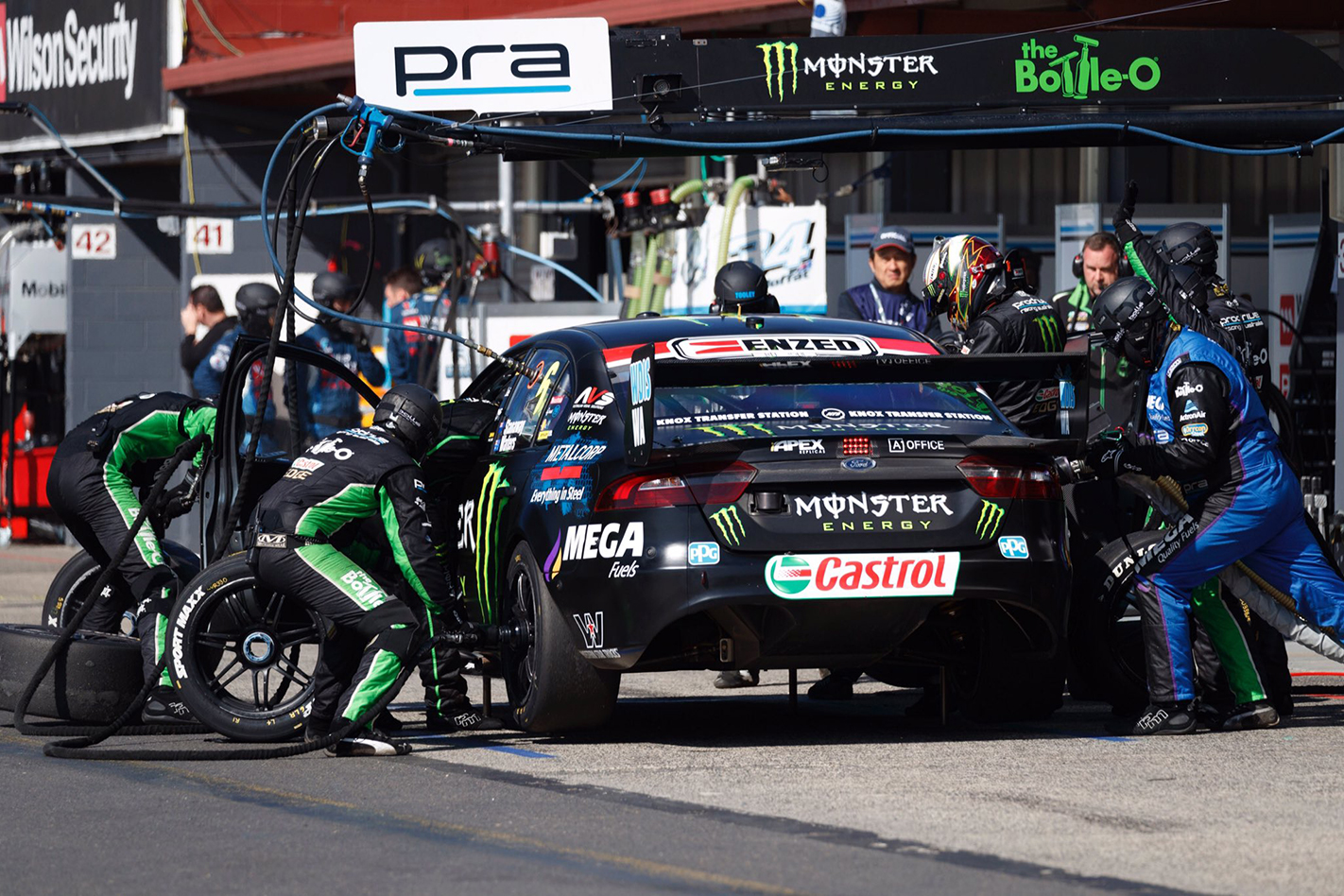
On the last lap, Garth Tander (last year’s Sandown 500 winner sharing his GRM Holden with James Goulding) nipped past the struggling Shell Falcon of Fabian Coulthard (driving with Tony d’Alberto) to claim fourth.
No one could catch Walters, who is in just his second season full-time in Supercars. After he said he couldn’t believe he was able to hold off a fast-finishing DJR-Penske’s McLaughlin.
“I don’t know what to say, I’m so pumped,” Walters said. “I didn’t think I was going to keep him off. Scotty, I don’t know if he used his tyre up in that last stint a bit, but managed to hold the gap and we won.”
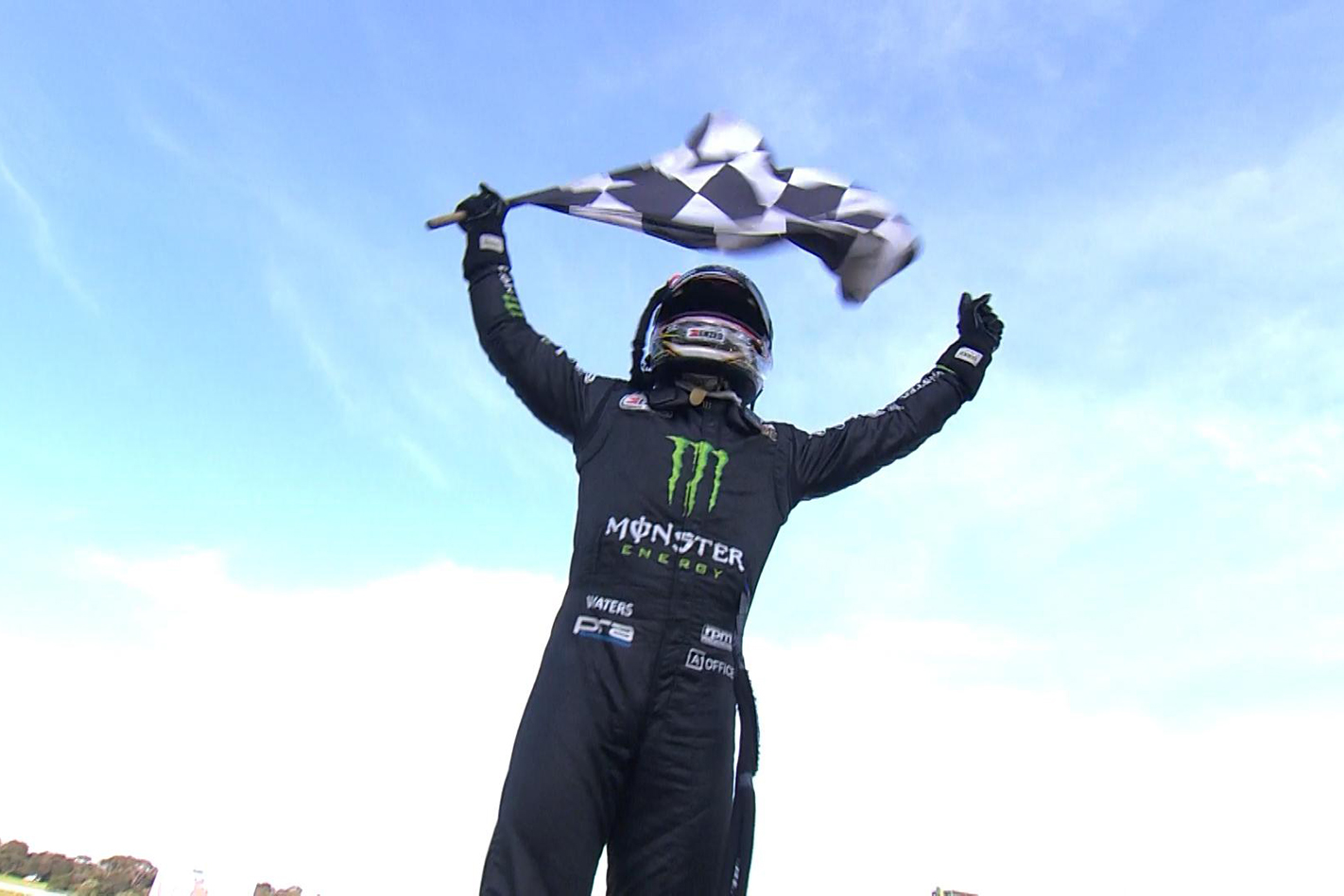
Waters has shown growing all-round speed and maturity this year, and the pairing with Stanaway, very experienced internationally in other forms of motorsport but close to a novice in Supercars, proved to be an inspired choice.
Stanaway, twice a winner in GP2 and a factory sports car driver for Aston Martin, has made no secret of his desire for a full-time steer in Supercars next season. Surely he couldn’t have auditioned more impressively. He is further evidence that New Zealand seems to have a bottomless pit of hugely talented young racers.
There was a time when the stand-alone Sandown 500 was the pipe opener to the Bathurst 1000, and a vital hit-out from teams who traditionally gave newly homologated Holdens and Fords their first real trial. It was a race to eliminate potential weakness and sharpen up pit work.
In modern times, the Sandown 500 had become a key fight in the championship, with double points on offer, and co-drivers wearing great responsibility.
As well, these days, the cars are more bulletproof and well proven. Now the aim of the Sandown enduro – the opening race of the long-distance series – is to score points for the permanent drivers. Co-drivers are under the pump. Go fast is the message, and don’t stuff up.
The race start was marked by some silliness towards the back. There were a few hits, and Mark Winterbottom’s co-driver Dean Canto spun off the track along with Ash Walsh in the Tim Slade Freightliner Commodore.
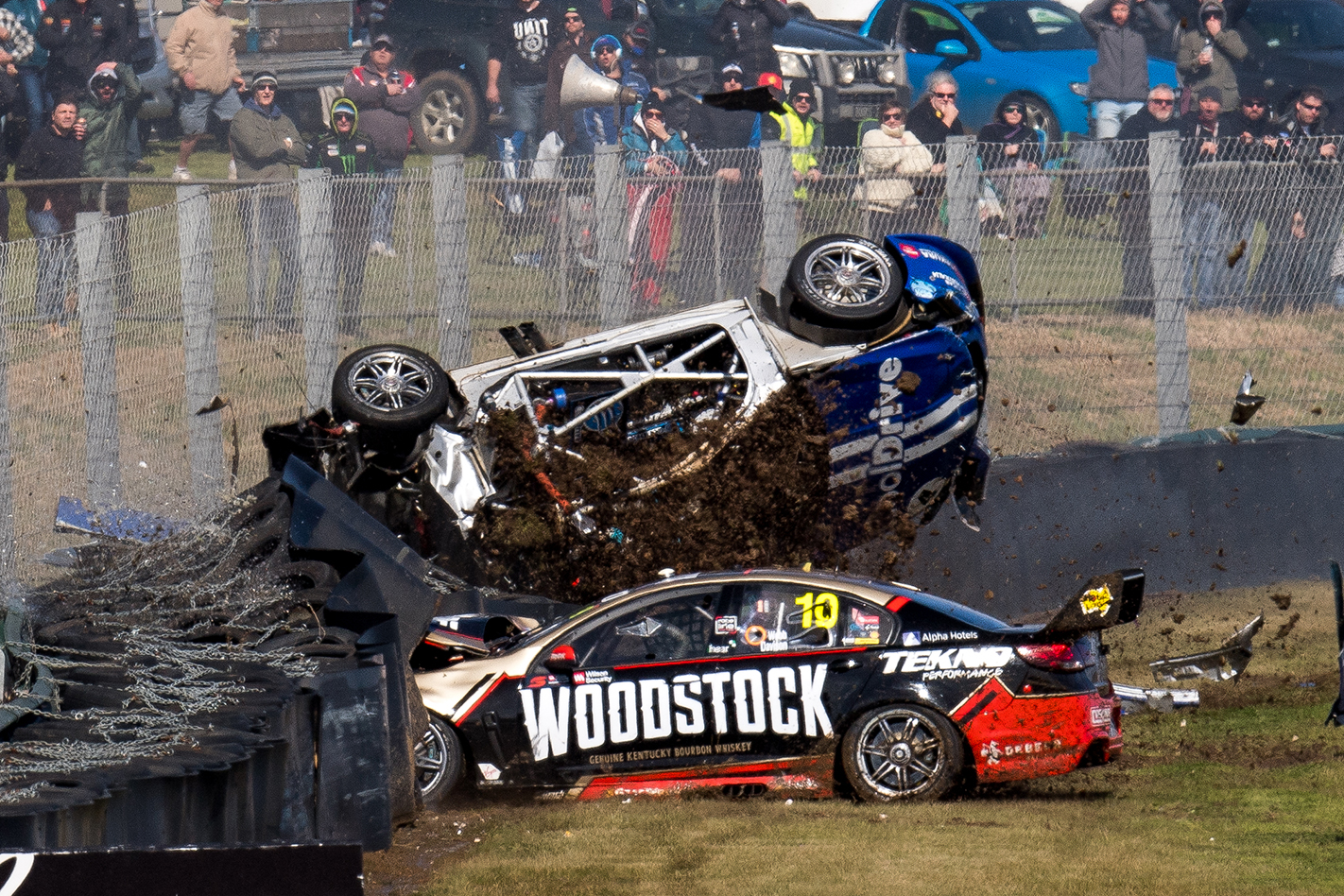
The Douglas shunt triggered a red flag and almost 60-minute delay as the safety wall was rebuilt.
There were the usual hard-luck tales, none bigger than that of the Red Bull Holden #88. Jamie Whincup went to Sandown just 12 points down on championship leader McLaughlan. His co-driver Paul Dumbrell had fought his way to the lead ahead of Stanaway when the car blew a right rear, and lost many positions. Whincup then drove like every lap was a qualifying one to get back up to sixth at the finish, damage minimisation that kept his points disadvantage to 84 points going to Mount Panorama.
The other Red Bull Holden Racing Team Commodore of Shane van Gisbergen and his brilliant young co-driver Matt Campbell also had tyre failure after charging from 21st to third. The pair finished 16th.
David Reynolds/Luke Youlden were also brought undone by tyre failure after a bold early showing from third on the grid in the Erebus Penrite Holden. Seventeenth was a poor reward.
Praise though to James Moffat and Richard Muscat, who came from back in the field in their Wilson Security Racing GRM Commodore to claim seventh ahead of other forward movers Lee Holdsworth/Karl Reindler (Preston Hire Racing Commodore) in eighth.
McLaughlin (2334 points) leads the driver standings ahead of Whincup (2250) and Coulthard (2173).
WEC: Porsche nails a third straight 1-2 at Circuit of the Americas
Porsche is determined to walk away from the World Endurance Championship with a crushing final season. The factory sports car prototype team continued its winning form at the 6 Hours of COTA in Austin at the sixth round of the 2017 FIA WEC.
Earl Bamber, in the #2 Porsche 919 Hybrid, crossed the finish line just 0.27sec ahead of Nick Tandy in the sister #1 car to claim a fourth consecutive victory for he and teammates Timo Bernhard and Brendon Hartley.
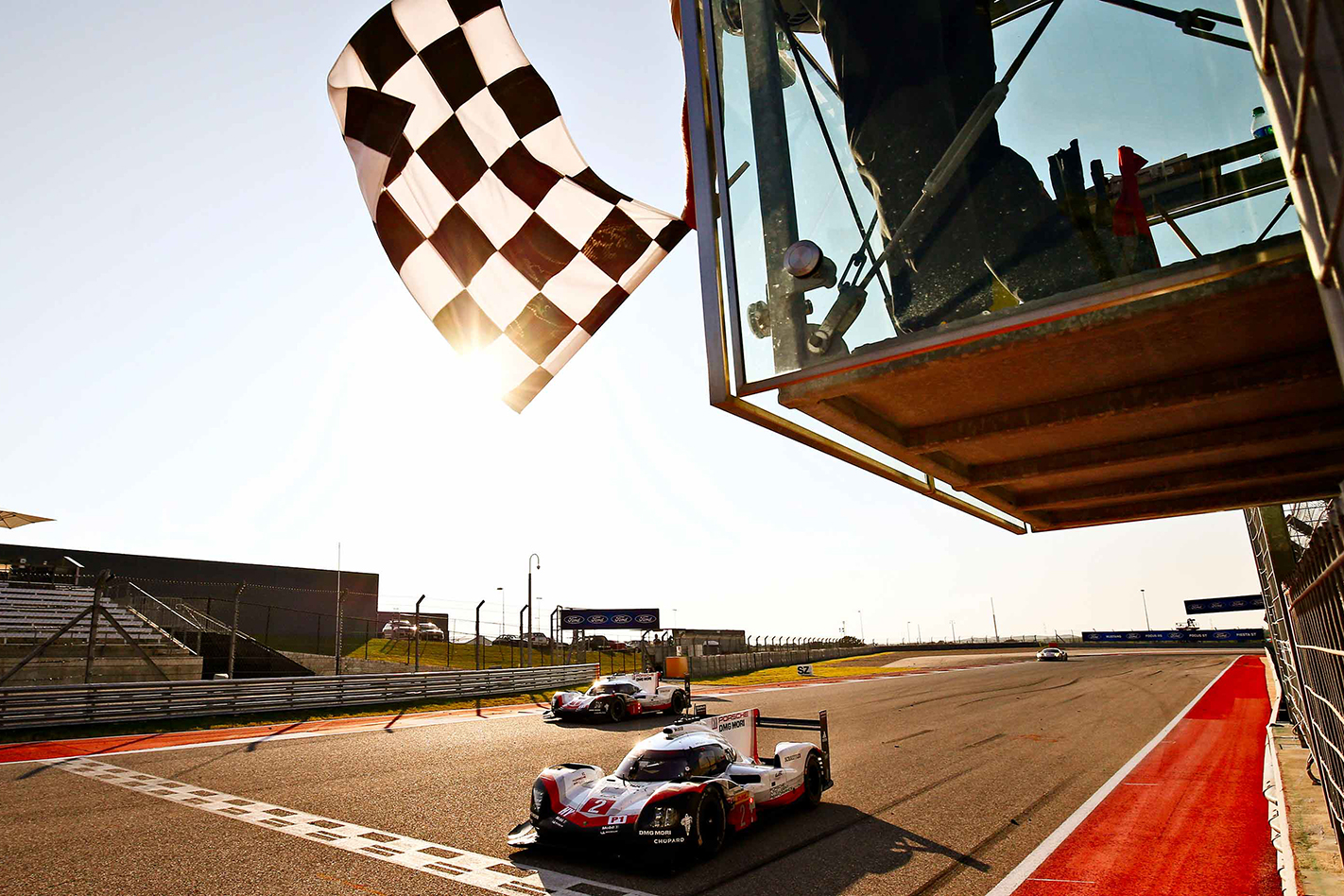
Held in challenging hot and humid conditions, the race was an epic strategic contest that saw the rhythm of the race swing between the two LMP1 Porsches. The 2017 rule change, which brought down the allocation of six sets of tyres to four for qualifying and the race, saw the teams challenged with choosing when to double-stint their Michelin tyres in the searing temperatures.
The #8 Toyota of Sébastien Buemi, Stéphane Sarrazin and Kazuki Nakajima finished third, 21.6sec behind the winning Porsche after 1058km of racing.
Toyota has also declared it is open to Fernando Alonso driving with the squad in the 24 Hours of Le Mans next year.
McLaren has said it will allow Alonso to race at Le Mans if he commits to the F1 team again next year. Alonso has said he would love to chase the Triple Crown – F1 world champion, Indy 500 winner, and winner of Le Mans.
Australian Rally Championship: Bates strikes trouble at Rally SA
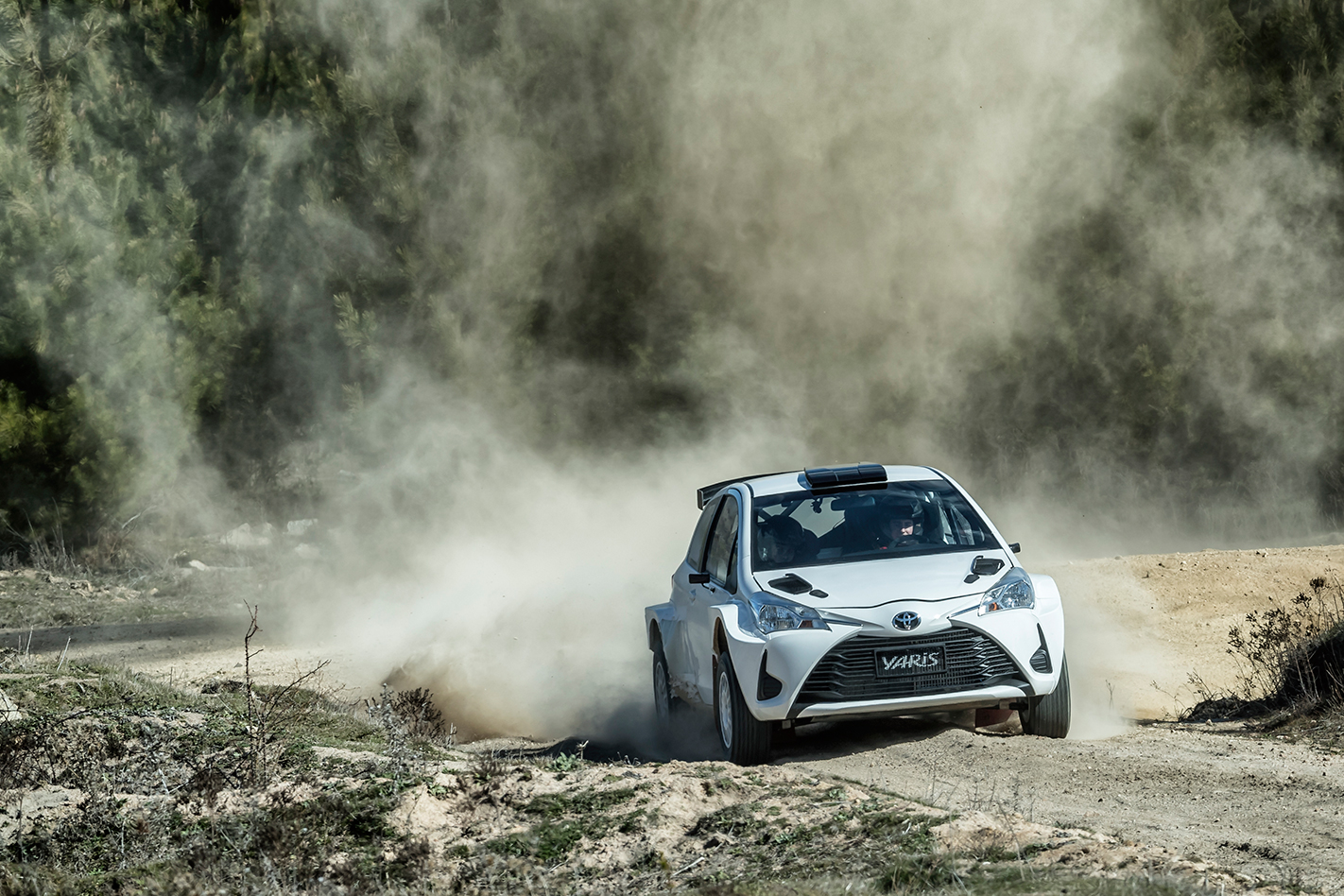
Harry Bates and his new Toyota Yaris AP4 went into Rally SA as a three-point leader of the CAMS Australian Rally Championship.
But the young Canberra driver struck teething problems with his just-finished machine which left him pointless and frustrated, after he failed to complete the two legs held around Adelaide.
With Bates a reluctant spectator for much of the action, the rally became a two-car tussle between Taylor’s WRX STI and the Mitsubishi Lancer EVO IX of Nathan Quinn, who went on to secure wins in both heats.
“I’m stoked. I said that we had to come here and win and it worked out pretty well for us,” Quinn said.
“I’m very happy to finally get a win for the team after rallying for 10 years.”
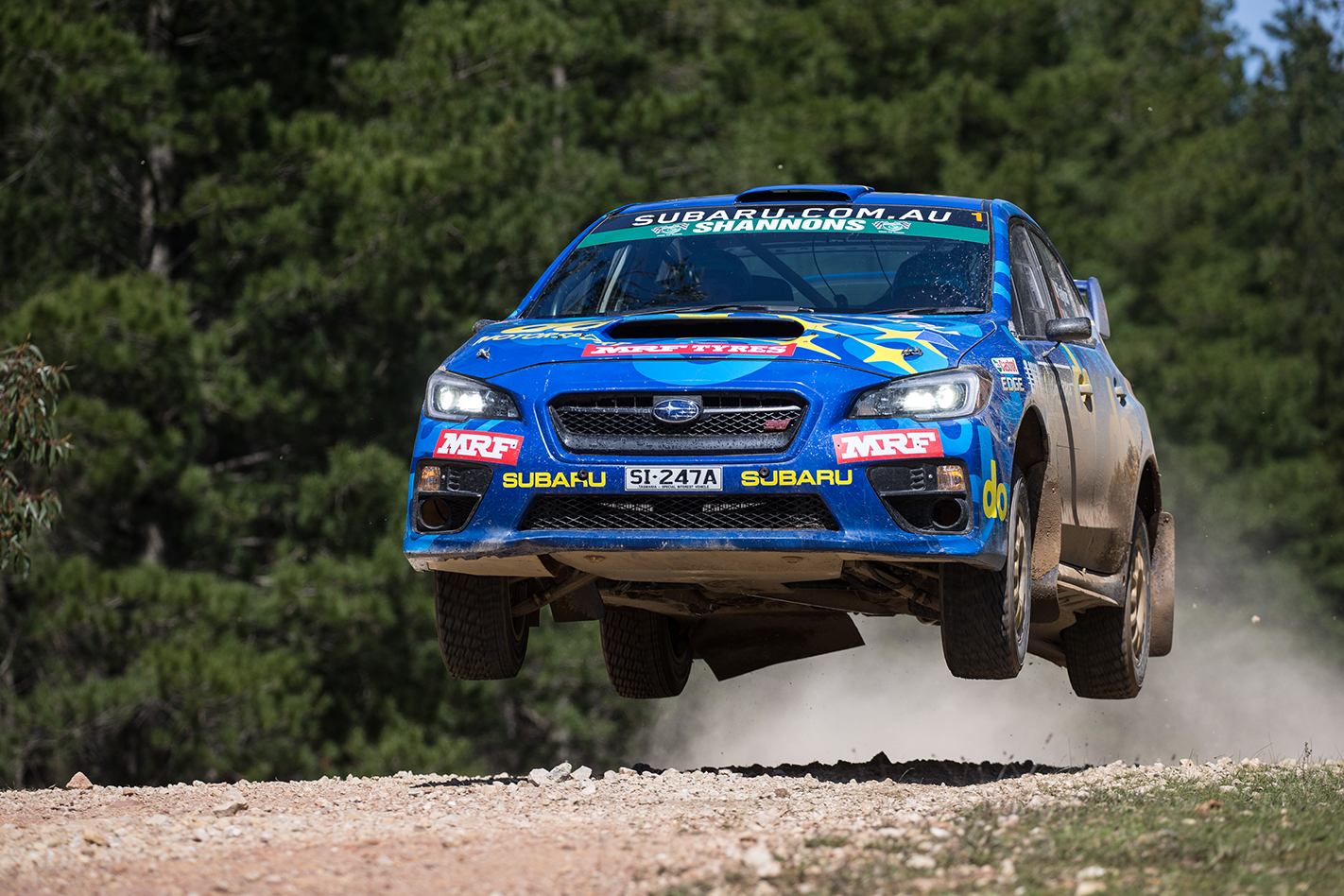
Subaru do Motorsport’s Molly Taylor was the only one to steal stage successes from Quinn, taking two wins on day one. Taylor and co-driver Bill Hayes finished a solid second both days in their Production Rally Car (PRC) class all-wheel-drive Subaru WRX STI.
This hands the pair a 30-point lead in the CAMS Australian Rally Championship with one round to go; Quinn moves into second, 35 points clear of Bates.
“It’s all come together so well and now we need to maintain that going into the final round in Coffs Harbour.”
Craig Brooks and Steve Glenney claimed third outright, Brook’s’ first ARC podium.
In the ARC two-wheel-drive class, Adam Kaplan and Aleshia Penny posted another solid result to take out the class win and now take an unassailable lead in the class championship.
Rally Australia, the final round of the CAMS ARC and the World Rally Championship, will take place on November 16-19.
THE Nissan Renault Mitsubishi Alliance will build nine million vehicles off just four platforms by 2022, the company aiming to be the world’s third largest car maker says.
The car maker has also flagged the war chest needed to add even more brands to the alliance is not yet empty.
“We intend to deliver on growing synergies, with three autonomous companies co-operating with the efficiency of one,” alliance chairman and chief executive Carlos said. “The alliance has grown and performed with two members since 1999. With Alliance 2022, we will prove that we will grow and perform with three companies or more.”
The recently formed conglomerate – Mitsubishi became a takeover target after its share price was hammered in the wake of Nissan Renault Alliance accusations that it had had cheated on emissions tests – also plans to use common engines across three-quarters of its cars globally, up from today’s one-third.
The six-year plan revealed late last week says the alliance will have 12 electric vehicles on the market by 2022. It will also have 40 vehicles it claims will be capable of driving autonomously, and would move into what it called the “robo-vehicle ride hailing services”.
In all, Ghosn said the plan would save the three brands a combined €10 billion, or the equivalent of $A15 billion.
“To achieve this target, on one side Renault, Nissan and Mitsubishi Motors will accelerate collaboration on common platforms, powertrains and next-generation electric, autonomous and connected technologies,” Ghosn said. “From the other side, synergies will be enhanced by our growing scale. Our total annual sales are forecast to exceed 14 million units, generating revenues expected at $US240 billion ($A300 billion) by the end of the plan.”
That 14 million target would potentially make the Nissan Renault Mitsubishi Alliance the world’s largest car maker. In contrast, last year Volkswagen built 10.3 million cars to take the current car-making crown from Toyota, which only built 10.2 million. This year, the alliance aims to build 10.5 million vehicles, and in the first six months of this year had pegged more sales than any of its rivals.
“Twelve new zero-emission electric vehicles will be launched by 2022, utilising new common electric vehicle platforms and components for multiple segments,” the alliance said in a statement. “Over the same period, 40 vehicles will be introduced with different levels of autonomy, all the way to fully autonomous capability. Becoming an operator of robo-vehicle ride-hailing services is a major part of the new mobility services strategy.”
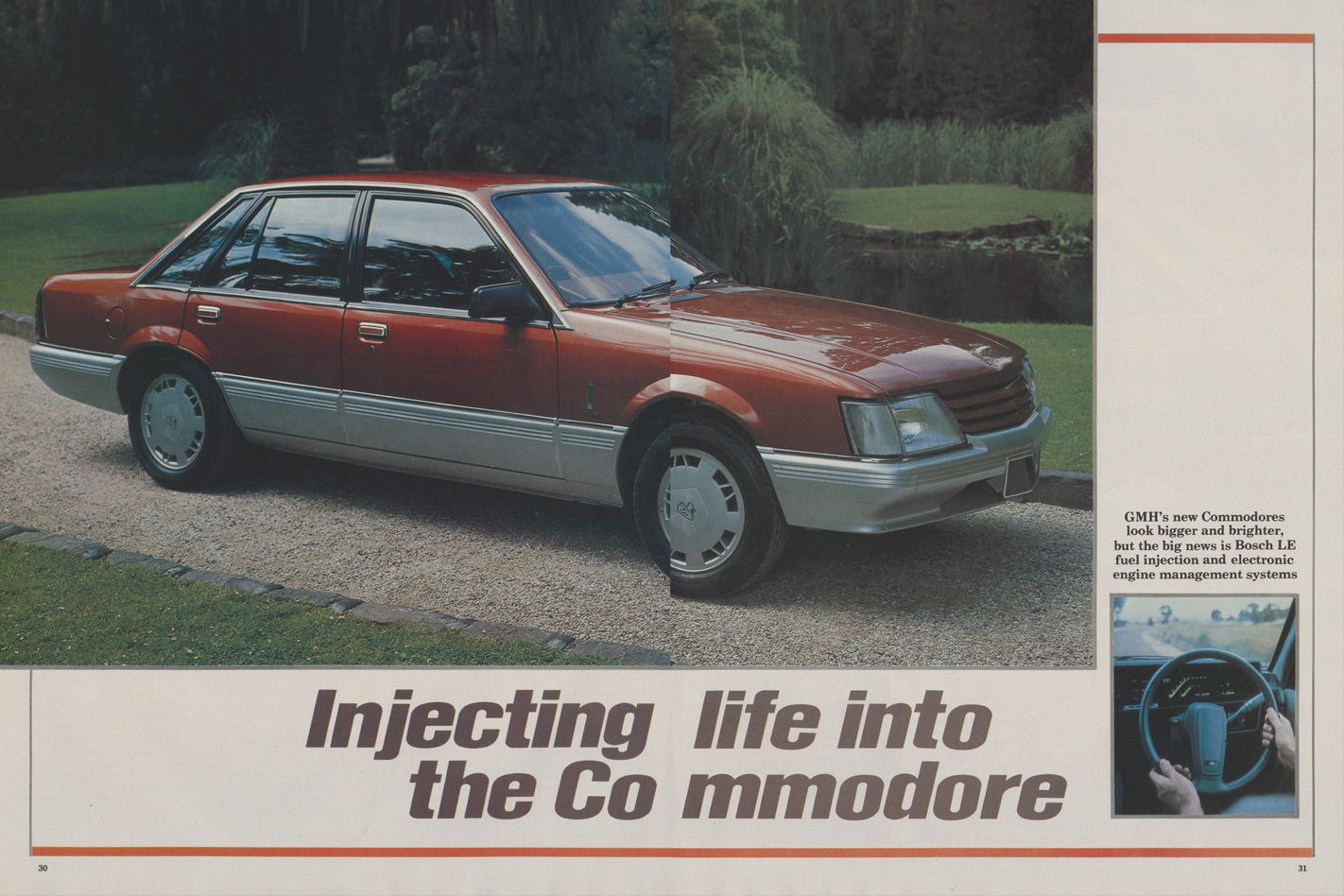
How the pendulum has swung. There was a time, in 1980, when pundits were predicting the Commodore Four would become the best-selling model in the range and the General talked optimistically of the engine taking 30 percent of production.
They were words spoken glibly at the height of the second energy crisis … Today, of course, the Commodore Four exists only for a few export markets (mostly New Zealand).
Of course it will take more than just performance to bring the Commodore back to its position as the top selling car in Australia, a title held for three years – 1979, ’80, ’81 – until it was submerged by Ford’s Falcon. But that’s the target Holden has set for itself in ’84 and nothing short of a Commodore sales rise of 40 percent will satisfy GMH.
Managing director, Chuck Chapman, lays much of the blame of the sales slump on the lack of visible change and it’s true that a VH looks like a VC, which was little changed compared to the original VB. The VK sets out to correct the pattern without making drastic and expensive sheet metal changes. You could say it’s an attempt to extract the greatest obvious difference for the least money.
The final prong in the Commodore’s three-way attack on the Falcon concerns price. No, we don’t know how much the VK will cost, but two months before its release we were assured that it would be “highly competitive” and based between the Sigma and the Falcon, which suggests a little more than $11,000 for the SL.
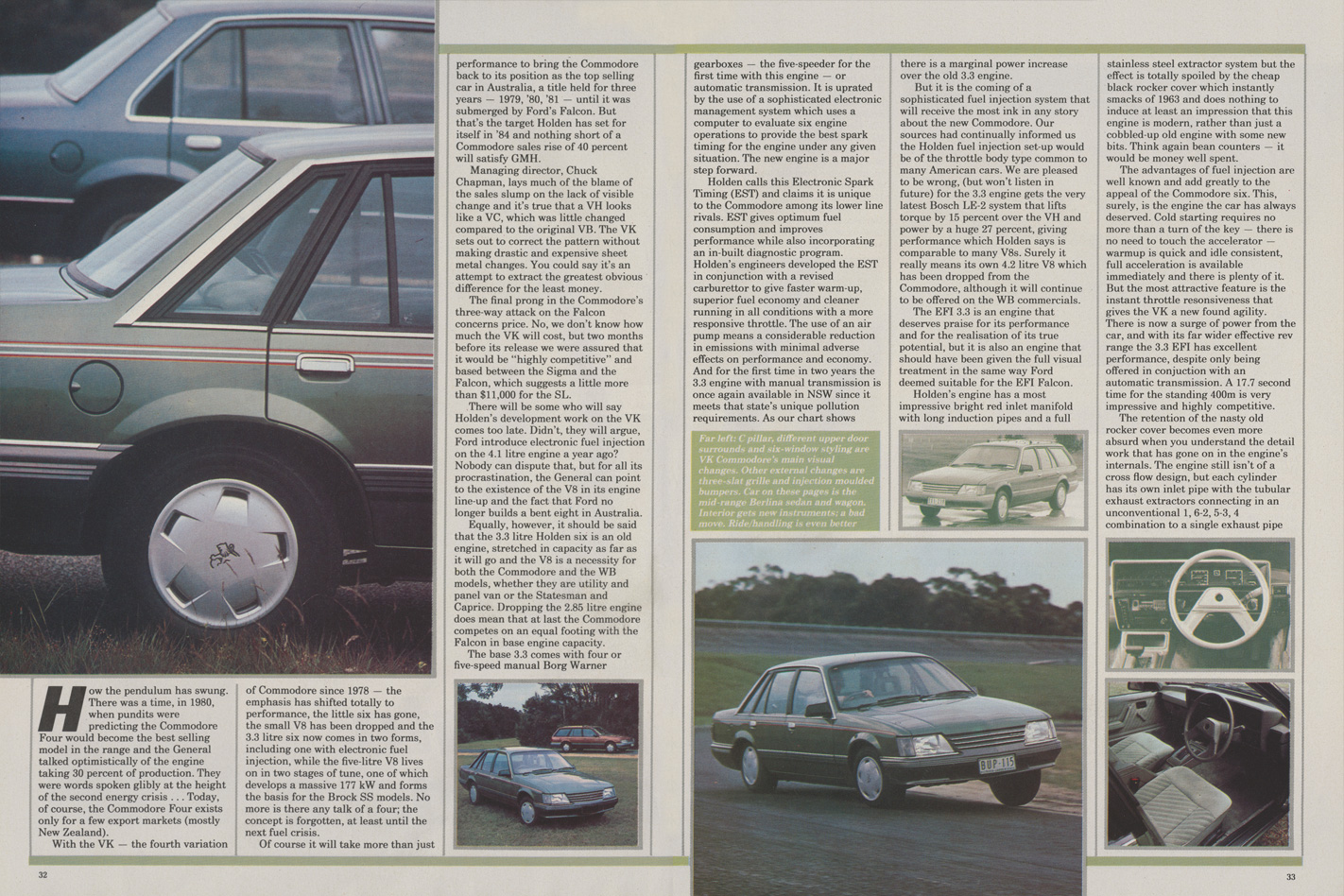
Nobody can dispute that, but for all its procrastination, the General can point to the existence of the V8 in its engine line-up and the fact that Ford no longer builds a bent eight in Australia.
Equally, however, it should be said that the 3.3 litre Holden six is an old engine, stretched in capacity as far as it will go and the V8 is a necessity for both the Commodore and the WB models, whether they are utility and panel van or the Statesman and Caprice. Dropping the 2.85 litre engine does mean that at last the Commodore competes on an equal footing with the Falcon in base engine capacity.
The base 3.3 comes with four or five-speed manual Borg Warner gearboxes – the five-speeder for the first time with this engine – or automatic transmission. It is uprated by the use of a sophisticated electronic management system which uses a computer to evaluate six engine operations to provide the best spark timing for the engine under any given situation. The new engine is a major step forward.
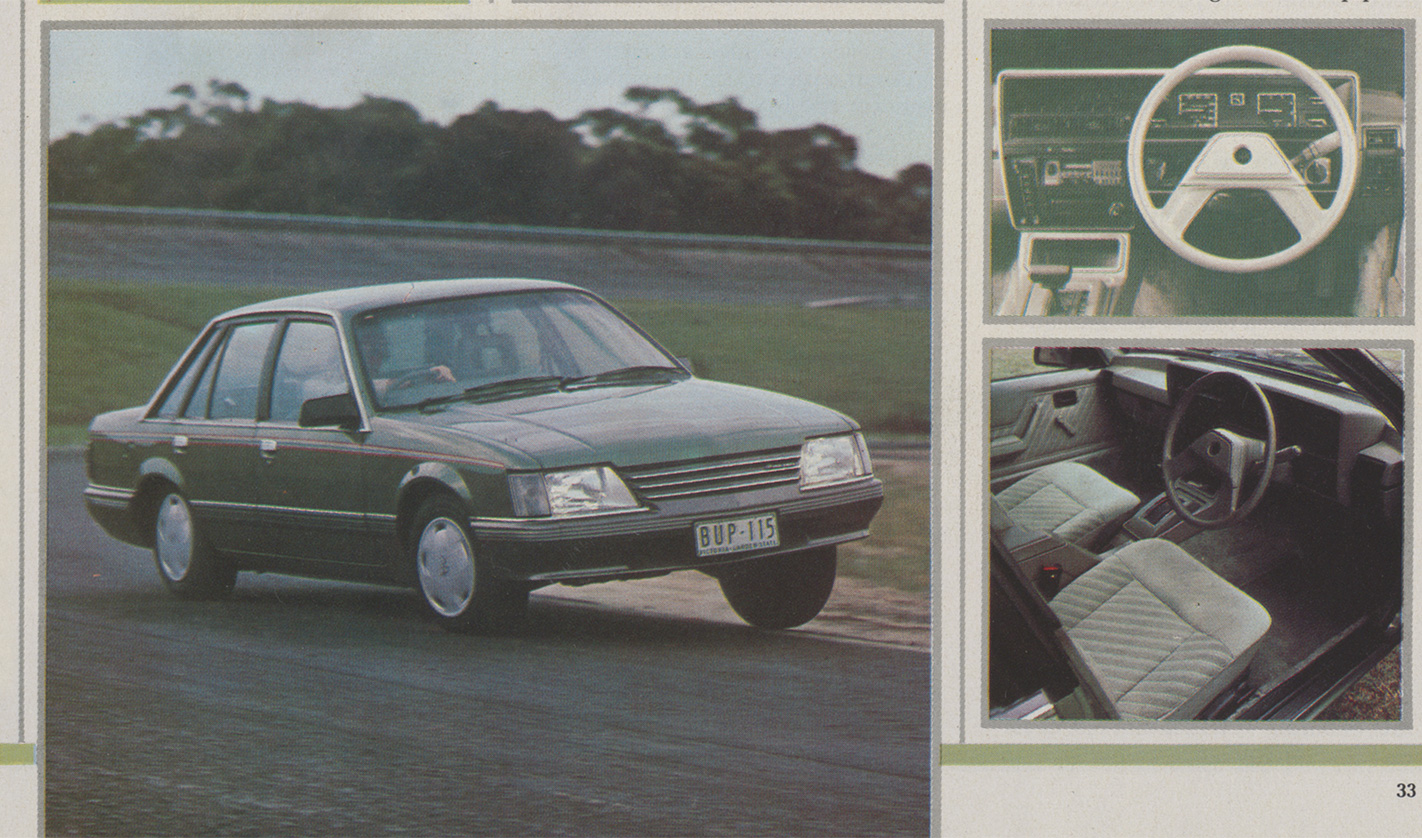
Holden’s engineers developed the EST in conjunction with a revised carburettor to give faster warm-up, superior fuel economy and cleaner running in all conditions with a more responsive throttle. The use of an air pump means a considerable reduction in emissions with minimal adverse effects on performance and economy.
And for the first time in two years the 3.3 engine with manual transmission is once again available in NSW since it meets that state’s unique pollution requirements. As our chart shows there is a marginal power increase over the old 3.3 engine.
But it is the coming of a sophisticated fuel injection system that will receive the most ink in any story about the new Commodore. Our sources had continually informed us the Holden fuel injection set-up would be of the throttle body type common to many American cars. We are pleased to be wrong, (but won’t listen in future) for the 3.3 engine gets the very latest Bosch LE-2 system that lifts torque by 15 percent over the VH and power by a huge 27 percent, giving performance which Holden says is comparable to many V8s. Surely it really means its own 4.2 litre V8 which has been dropped from the Commodore, although it will continue to be offered on the WB commercials.
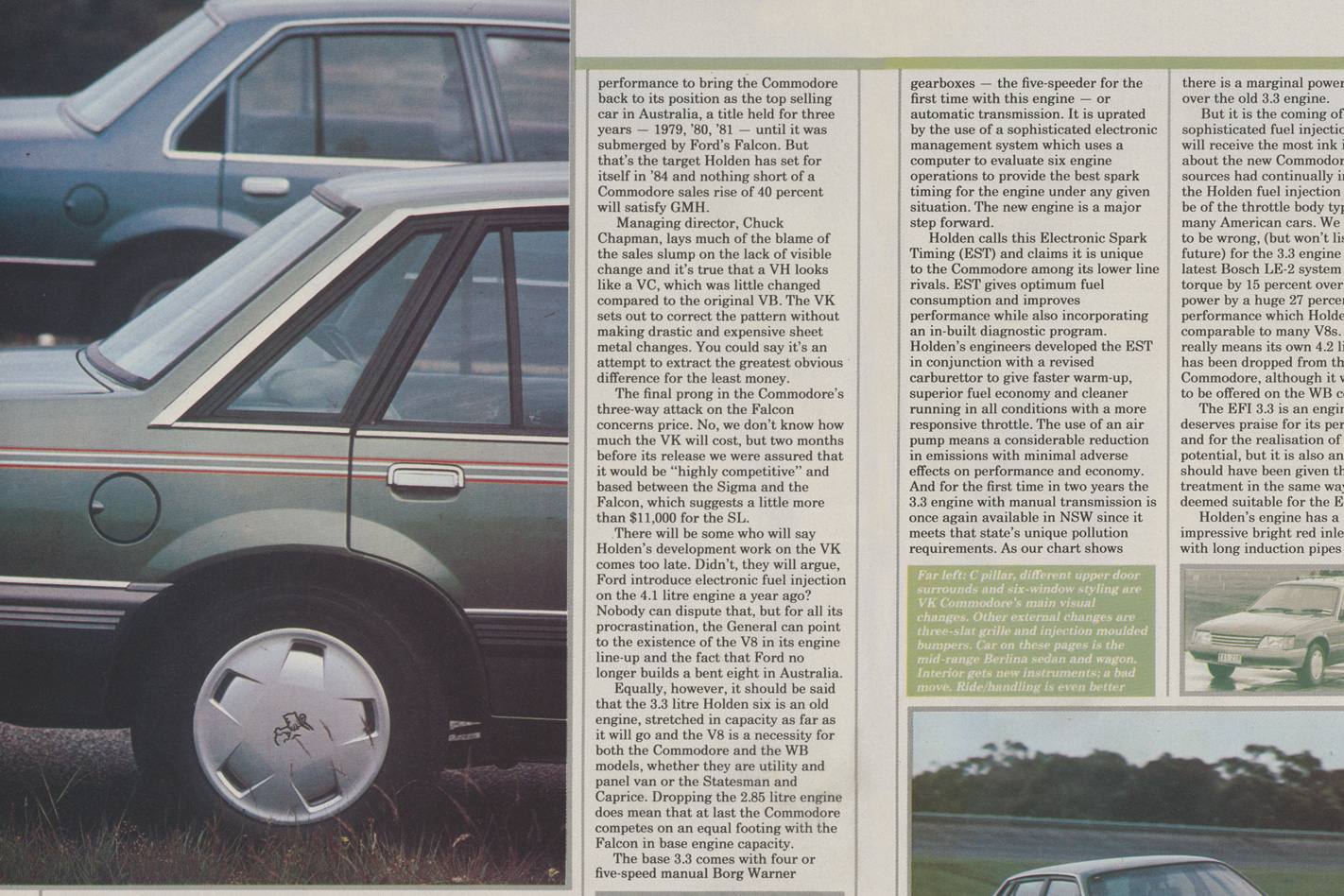
The advantages of fuel injection are well known and add greatly to the appeal of the Commodore six. This, surely, is the engine the car has always deserved. Cold starting requires no more than a turn of the key – there is no need to touch the accelerator – warm-up is quick and idle consistent, full acceleration is available immediately and there is plenty of it.
But the most attractive feature is the instant throttle responsiveness that gives the VK a new found agility. There is now a surge of power from the car, and with its far wider effective rev range the 3.3 EFI has excellent performance, despite only being offered in conjunction with an automatic transmission. A 17.7 second time for the standing 400m is very impressive and highly competitive.
The retention of the nasty old rocker cover becomes even more absurd when you understand the detail work that has gone on in the engine’s internals. The engine still isn’t of a cross flow design, but each cylinder has its own inlet pipe with the tubular exhaust extractors connecting in an unconventional 1, 6-2, 5-3, 4 combination to a single exhaust pipe after a full engine stimulation program established that this set-up provided the most power.
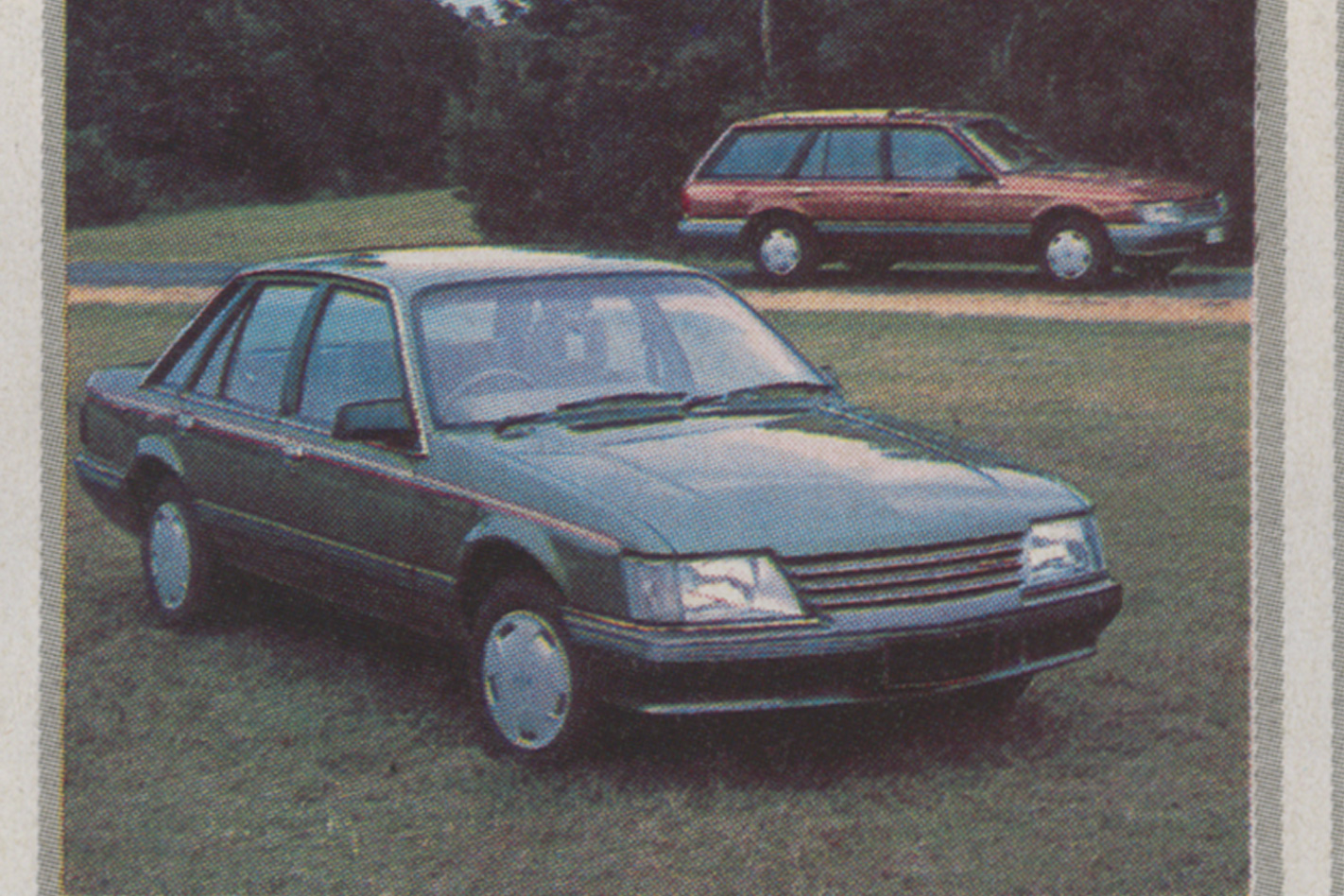
Holden began development of the fuel injection system way back in November 1980, when former assistant chief engineer and now head of the new Opel T-car program in Germany, Peter Hanenberger, initiated research on a 2.85 litre six, very much in secret at the time. In February 1981 the program gained official recognition under engine man Warwick Bryce and has steadily progressed to reach production form as a third generation fuel injection engine.
Holden’s once laughable 5500 rpm redline can now be taken seriously with the EFI engine for it spins cleanly and smoothly from idle to the red. It’s a great shame you can’t buy the engine tied to a manual gearbox. Ford offers the 4.1 EFI with a four-speed, why doesn’t Holden?
The Commodore has always set the standard among Australian cars in ride/handling – a fact that one of its major rivals, Nissan, publicly acknowledged recently – but there has been subtle modification to give a flatter ride, better ride control and to further improve impact harshness. The changes are minor and only apparent under close scrutiny in a back-to-back comparison, when they can be fully appreciated, but they clearly make the VK an even more pleasant mode of transport with a touch more final oversteer and less body roll.
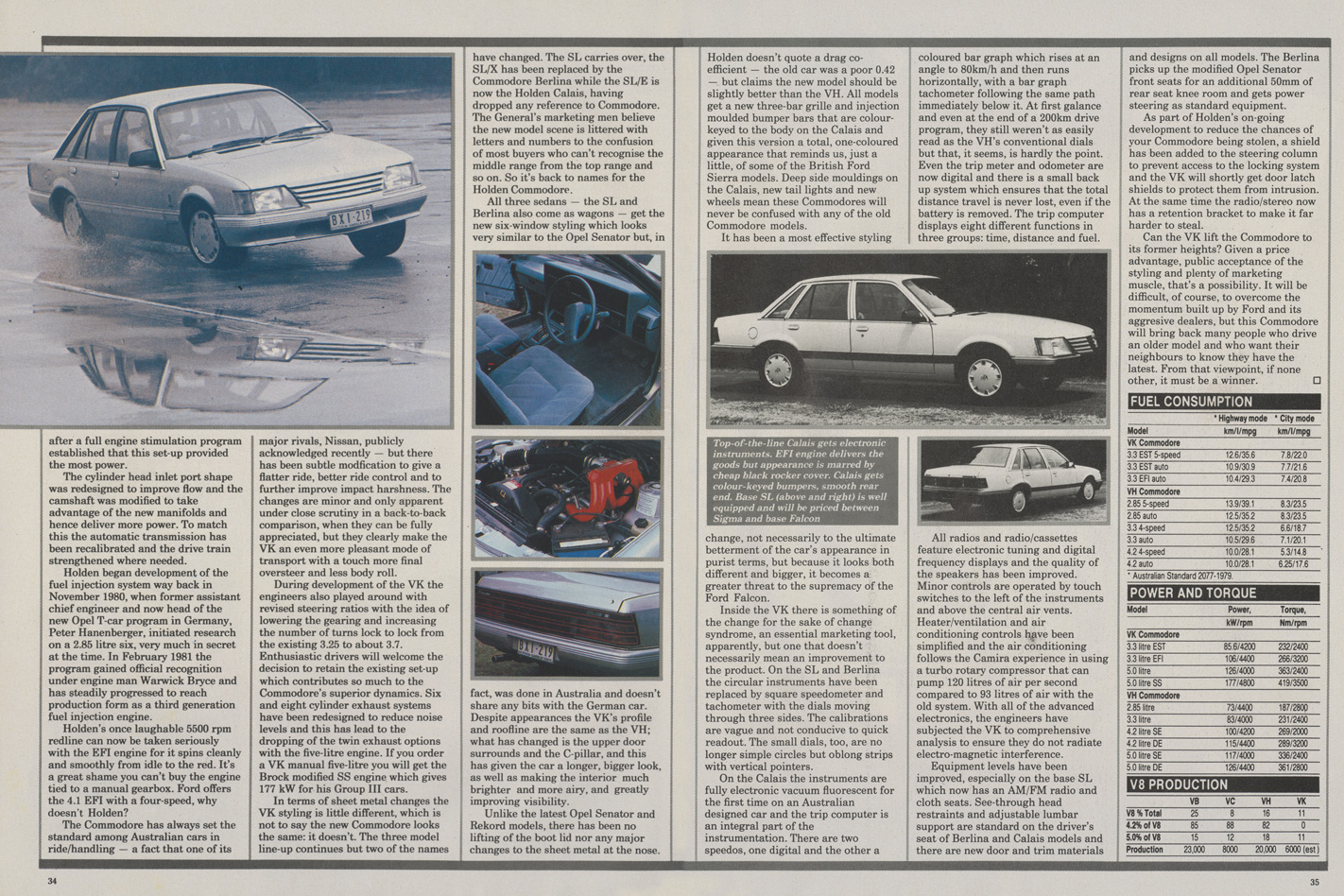
Six and eight cylinder exhaust systems have been redesigned to reduce noise levels and this has led to the dropping of the twin exhaust options with the five-litre engine. If you order a VK manual five-litre you will get the Brock modified SS engine which gives 177 kW for his Group III cars.
In terms of sheet metal changes the VK styling is little different, which is not to say the new Commodore looks the same: it doesn’t. The three model line-up continues but two of the names have changed. The SL carries over, the SL/X has been replaced by the Commodore Berlina while the SL/E is now the Holden Calais, having dropped any reference to Commodore.
The General’s marketing men believe the new model scene is littered with letters and numbers to the confusion of most buyers who can’t recognise the middle range from the top range and so on. So it’s back to names for the Holden Commodore.
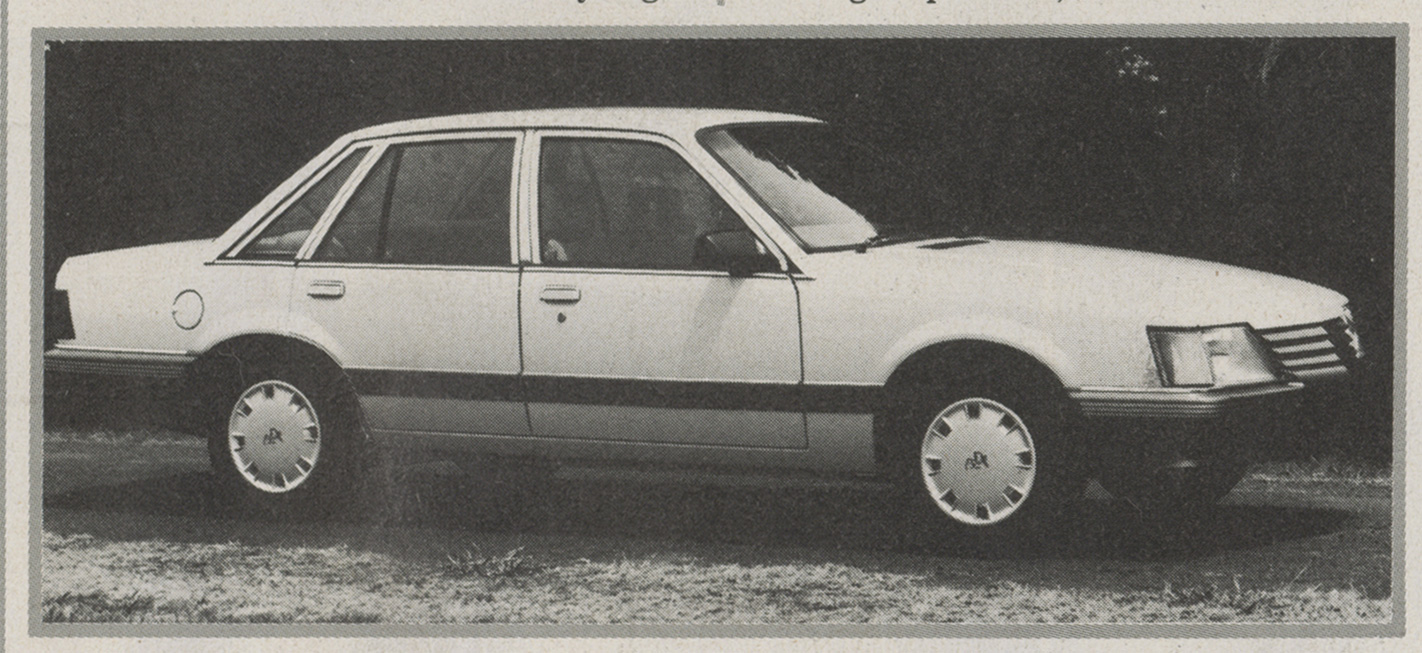
Despite appearances the VK’s profile and roofline are the same as the VH; what has changed is the upper door surrounds and the C-pillar, and this has given the car a longer, bigger look, as well as making the interior much brighter and more airy, and greatly improving visibility.
Unlike the latest Opel Senator and Rekord models, there has been no lifting of the boot lid nor any major changes to the sheet metal at the nose. Holden doesn’t quote a drag coefficient – the old car was a poor 0.42 – but claims the new model should be slightly better than the VH. All models get a new three-bar grille and injection moulded bumper bars that are colour-keyed to the body on the Calais and given this version a total, one-coloured appearance that reminds us, just a little, of some of the British Ford Sierra models. Deep side mouldings on the Calais, new tail lights and new wheels mean these Commodores will never be confused with any of the old Commodore models.
It has been a most effective styling change, not necessarily to the ultimate betterment of the car’s appearance in purist terms, but because it looks both different and bigger, it becomes a greater threat to the supremacy of the Ford Falcon.
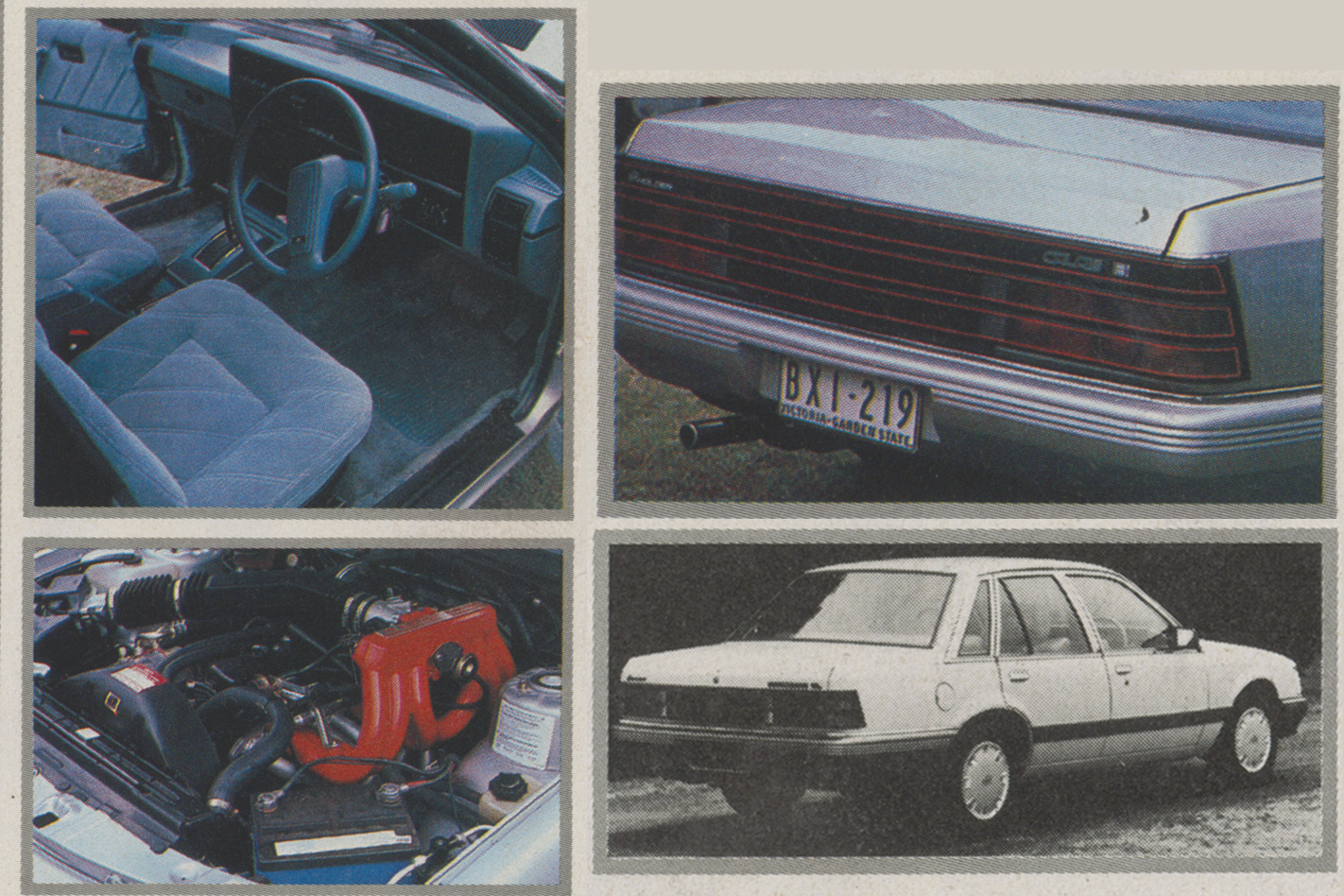
On the Calais the instruments are fully electronic vacuum fluorescent for the first time on an Australian designed car and the trip computer is an integral part of the instrumentation. There are two speedos, one digital and the other a coloured bar graph which rises at an angle to 80km/h and then runs horizontally, with a bar graph tachometer following the same path immediately below it. At first glance and even at the end of a 200km drive program, they still weren’t as easily read as the VH’s conventional dials but that, it seems, is hardly the point.
Even the trip meter and odometer are now digital and there is a small back up system which ensures that the total distance travel is never lost, even if the battery is removed. The trip computer displays eight different functions in three groups: time, distance and fuel. All radios and radio/cassettes feature electronic tuning and digital frequency displays and the quality of the speakers has been improved.
Minor controls are operated by touch switches to the left of the instruments and above the central air vents. Heater/ventilation and air conditioning controls have been simplified and the air conditioning follows the Camira experience in using a turbo rotary compressor that can pump 120 litres of air per second compared to 93 litres of air with the old system. With all of the advanced electronics, the engineers have subjected the VK to comprehensive analysis to ensure they do not radiate electro-magnetic interference.
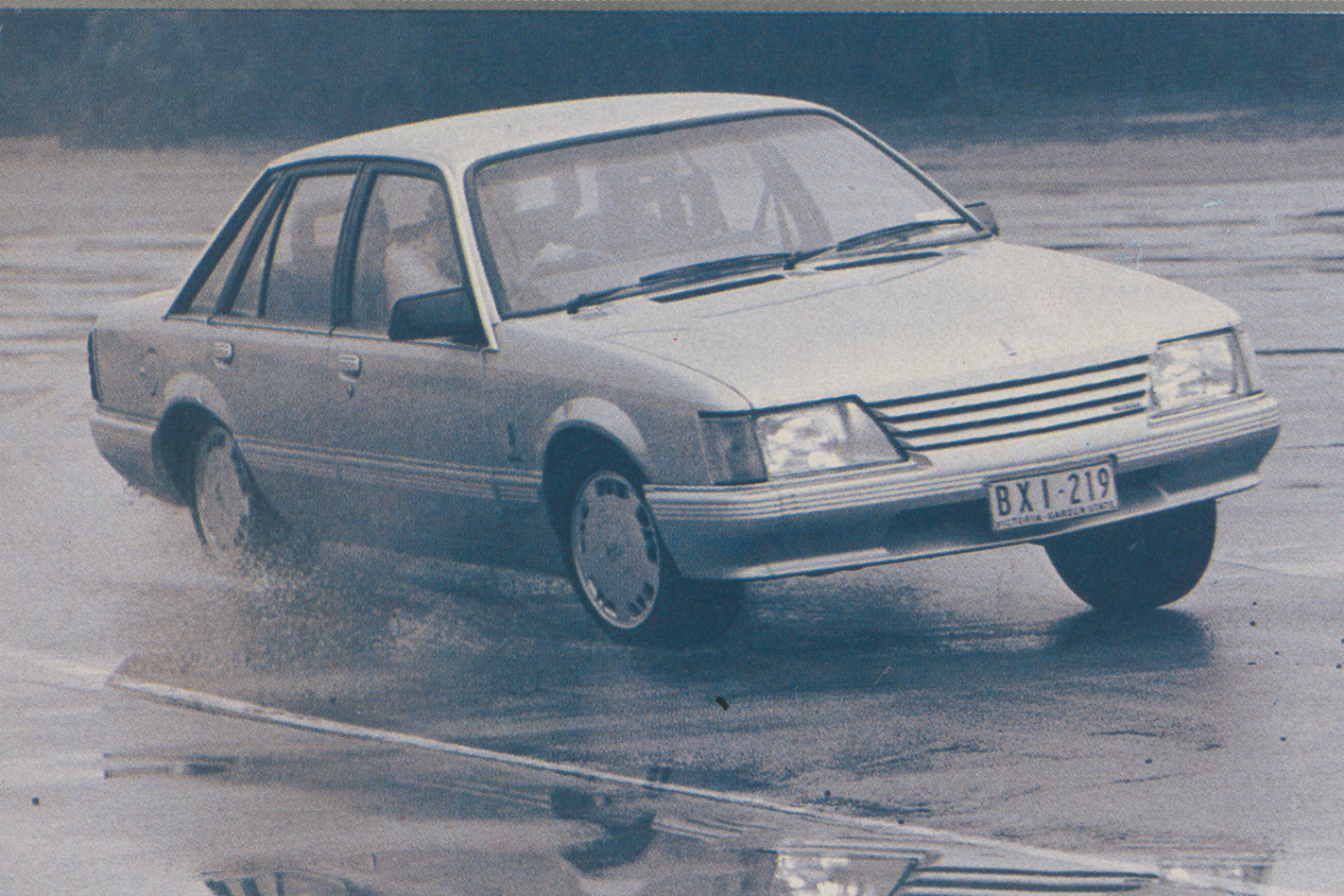
As part of Holden’s on-going development to reduce the chances of your Commodore being stolen, a shield has been added to the steering column to prevent access to the locking system and the VK will shortly get door latch shields to protect them from intrusion.
At the same time the radio/stereo now has a retention bracket to make it far harder to steal.
Can the VK lift the Commodore to its former heights? Given a price advantage, public acceptance of the styling and plenty of marketing muscle, that’s a possibility. It will be difficult, of course, to overcome the momentum built up by Ford and its aggressive dealers, but this Commodore will bring back many people who drive an older model and who want their neighbours to know they have the latest. From that viewpoint, if none other, it must be a winner.
Porsche Panamera Sport Turismo
With a new ‘shooting brake’ rear end, Porsche’s Panamera has gone from being one of its most polarising to one of its most stunning. Not due here until next year, but demanding of mention.

The most un-Ferrari ever to wear the prancing horse badge is still a true Ferrari with a choice of V8 turbo or atmo V12, blistering performance, room for four adults, and a 800L boot when rear seats are folded.
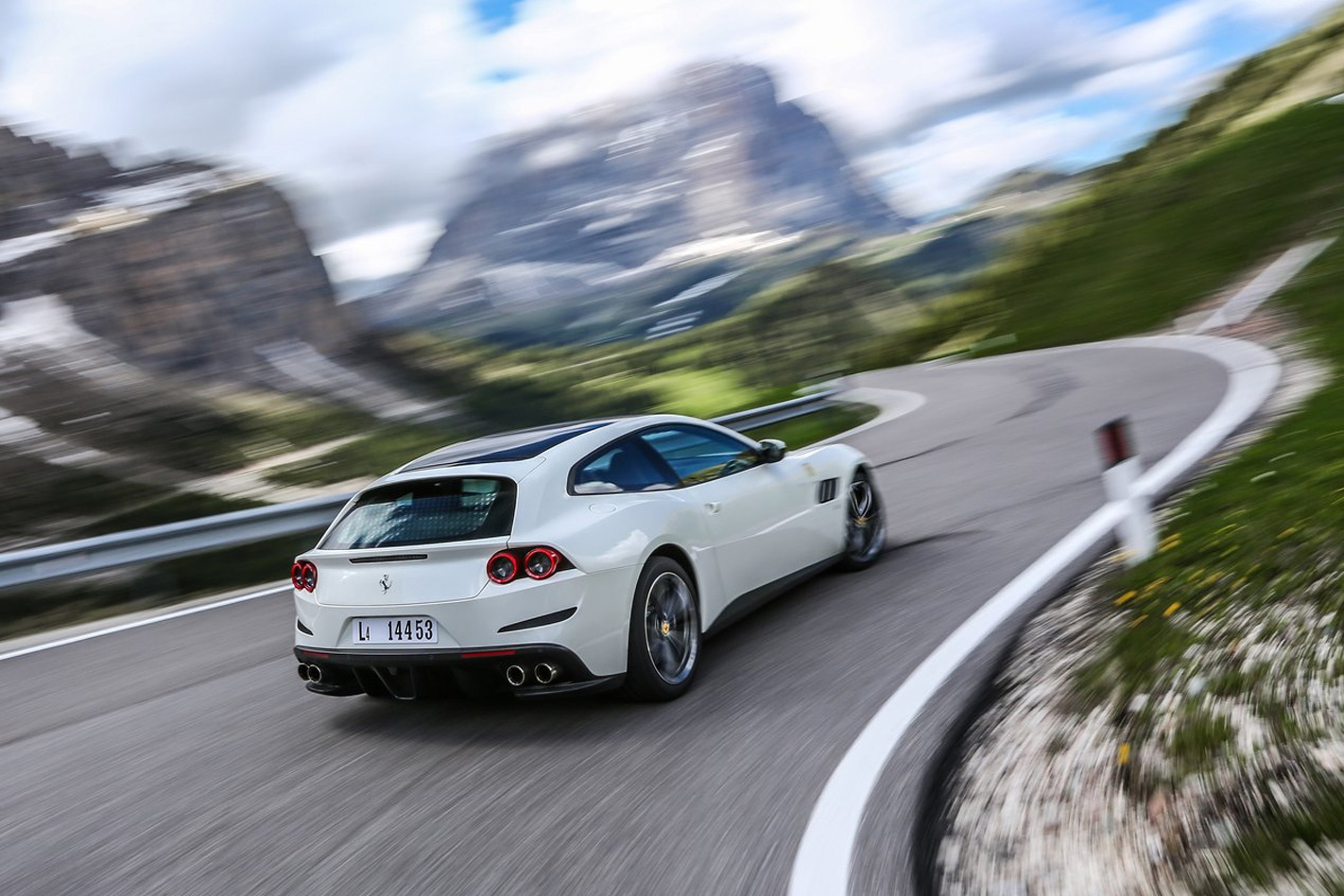
The epitome of hyper wagons. Take a 4.0-litre twin-turbo V8, send its 445kW to the road through all four wheels and give it 565 litres of load space, and you have one of the most supercar-crushing everyday drivers money can buy.
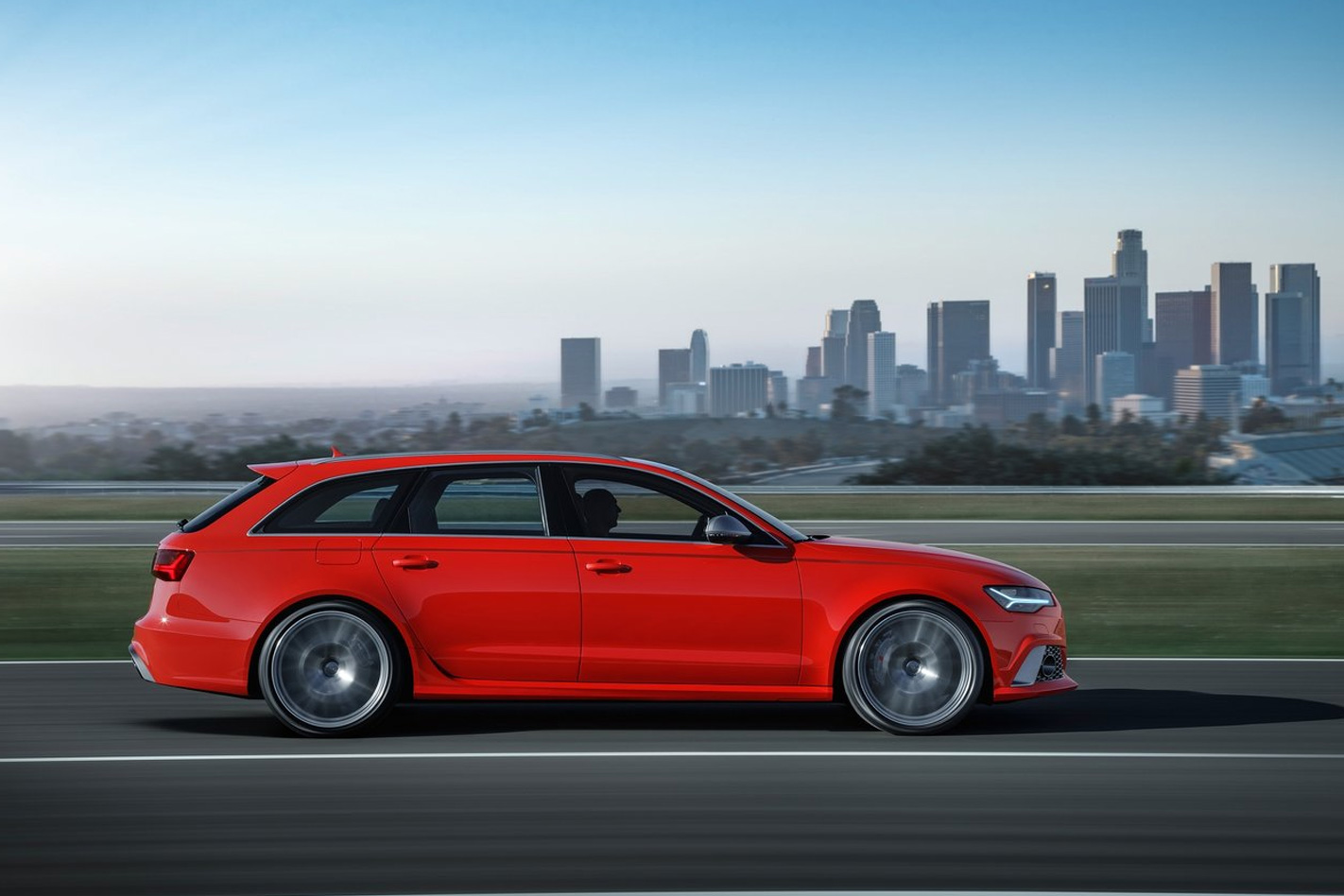
HSV’s Clubbie wagon is built around an irresistible combination of supercharged LSA V8 power, rear-wheel drive, and one of the best ESC calibrations on sale. Grab one while you still can.

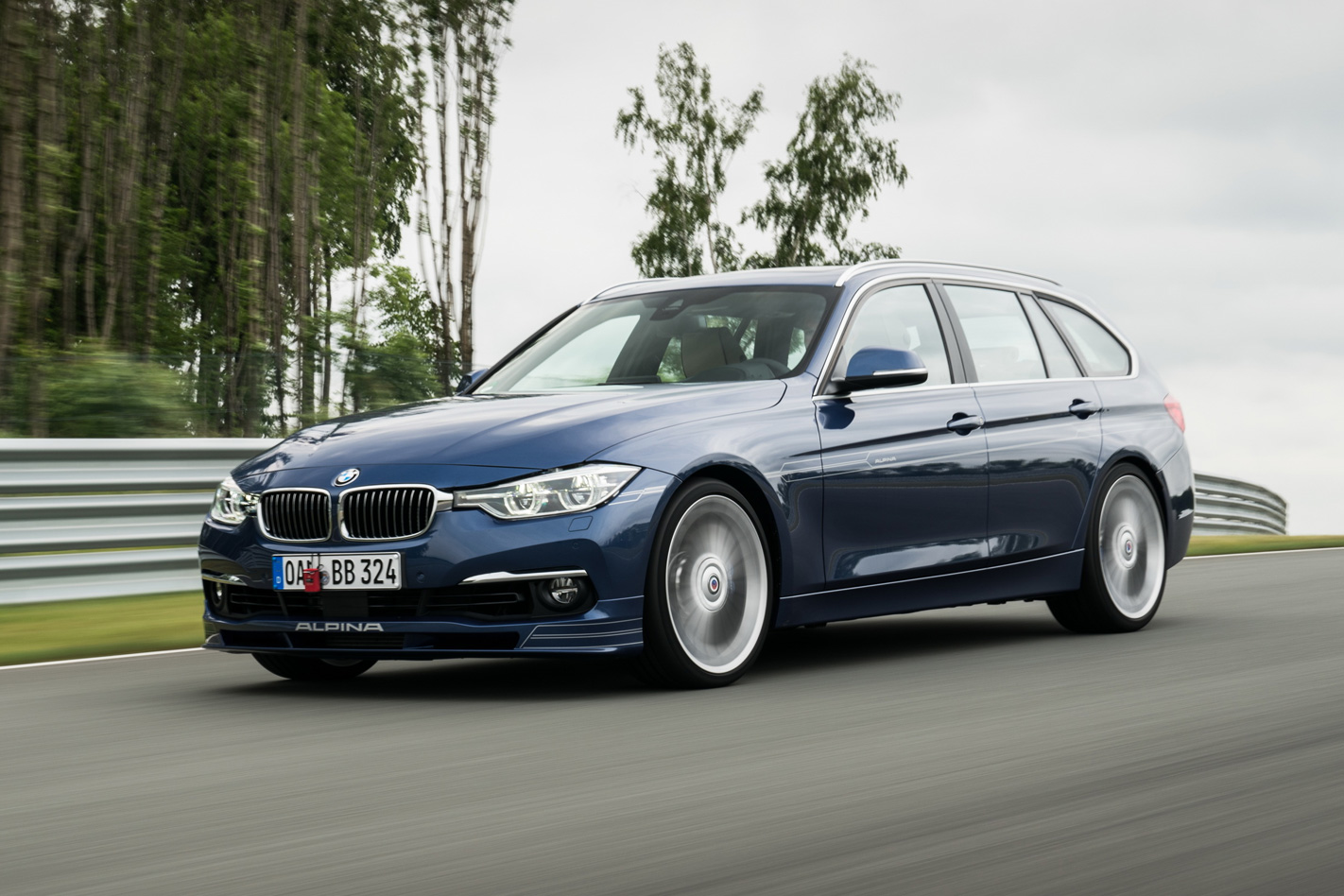
Thanks to the arrival of the Alpina brand here, you can now have a BMW 3 Series with M-car power and pace coupled with wagon practicality. Looks exclusive with 20-spoke wheels and Alpina stripes.
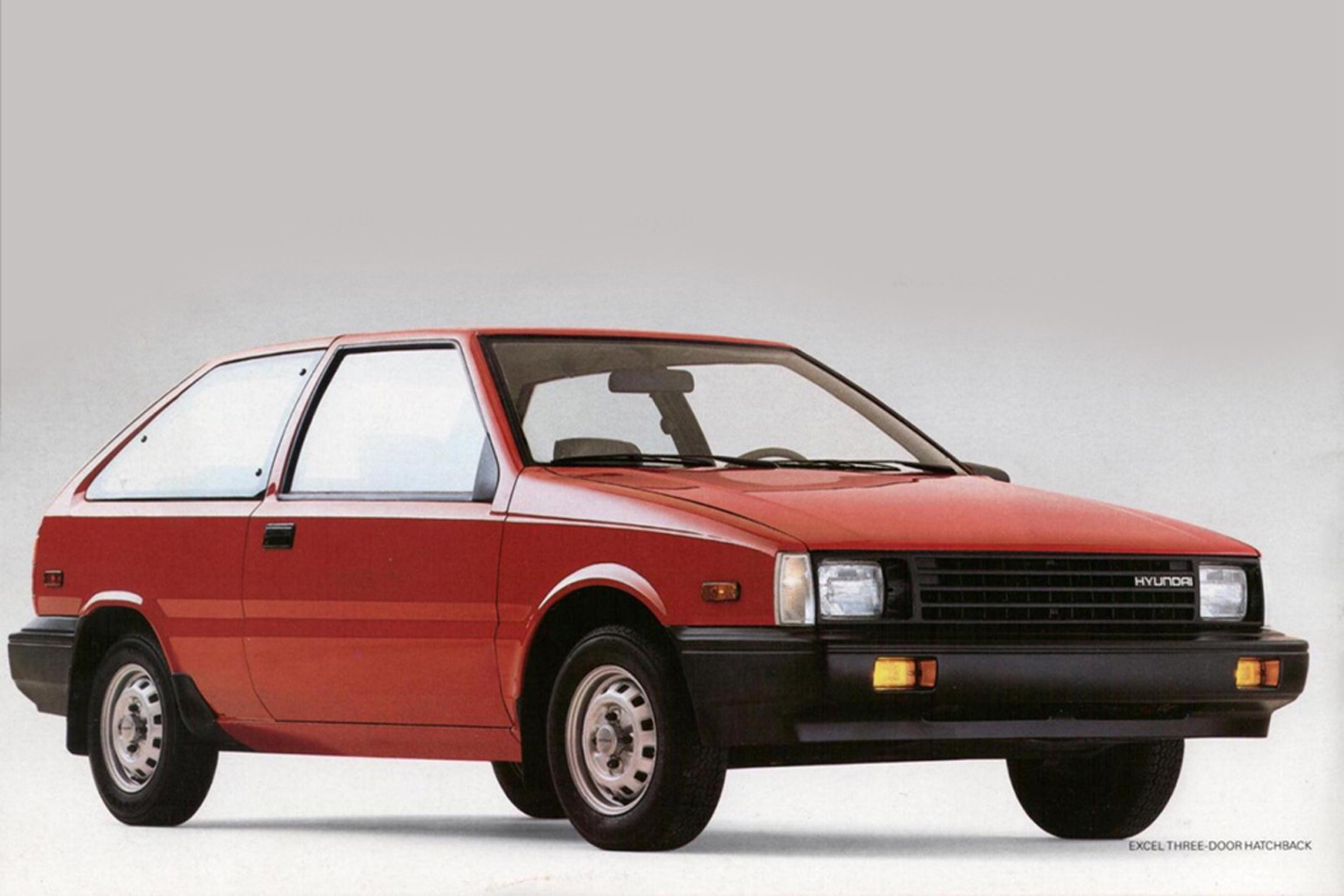
COULD anyone who bought a Hyundai Excel in 1986 – the first year a model from the Korean brand was offered in Australia – have possibly envisioned the trajectory this automotive juggernaut would be on in 2017?
Fact was, the X1-gen Excel was a fairly lamentable offering, yet still a significant achievement for a car company that had really only been building cars for export since the Pony of 1976.
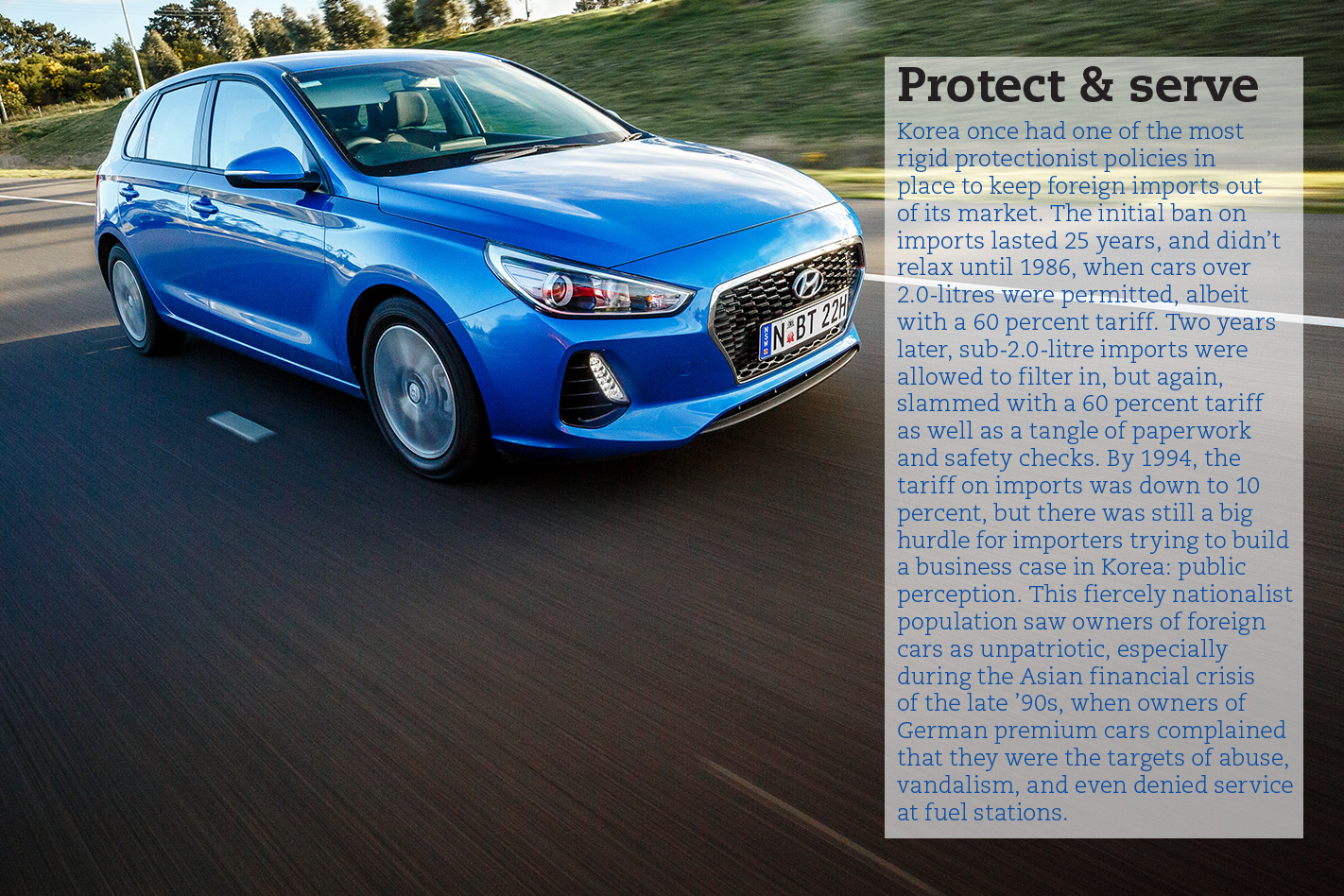
Major General Park Chung-hee (1917-1979) came to power via a military coup in 1961 and is the leader credited as a pivotal figure for the Korean automotive industry. That was thanks, in part, to a five-year development plan that was to effectively light a fire under the then-fledgling car-building business.
The immediate banning of imported cars (see below) would instantly make locally assembled vehicles the default choice for Koreans, while the dropping of import taxes on incoming automotive components gave a clear incentive to Korean companies to become assemblers of semi- and completely knocked-down kits (CKD).
Generous government subsidies were available for companies entering into joint ventures with international partners in order to acquire technological expertise. Kia – originally a manufacturer of bicycle parts founded in 1944 – jumped into the cot with Honda, although Kia’s first passenger car was the Mazda Familia-based Brisa of 1974.
The foundation stone of Korea the Car Builder had been set.
But it was the heady, turbulent ’80s before Australians were urged via an ad campaign to “say hi to Hyundai”. The brand’s local presence had its beginnings in Western Australia, thanks to Perth motor body builder, Danny Fisher, who saw potential in affordable, well-marketed Korean cars for Aussies.
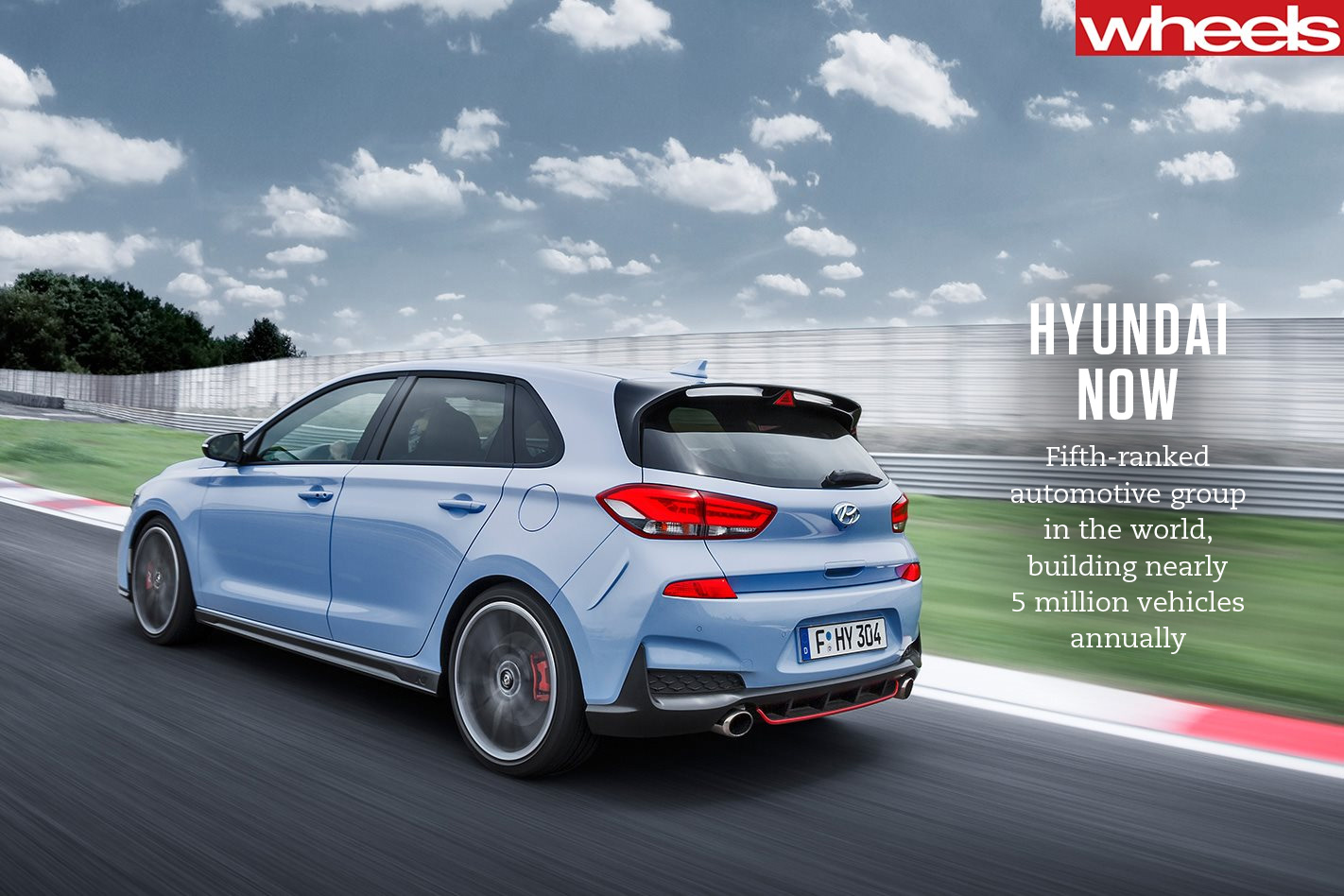
By 1995, the third-gen X3 Excel had become Australia’s favourite light car, wooing customers with its then-revolutionary ‘drive-away’ pricing and generous warranty, rather than any dynamic genius.
It wasn’t until 2003 that Australia saw the arrival of a full factory operation, which would see initial annual sales of around 34,000 accelerate to 87,000 by 2011, and pass 100,000 in 2014.
It hasn’t been one big upswing, of course. Kia was on solid ground in the late ’70s assembling, among other things, the 604 for Peugeot and Fiat’s 132 sedan. But by 1981 the Korean Government had introduced ‘rationalisation measures’ which assigned specific vehicle types to individual companies. The outcome of this, followed much later by the Asian economic crisis, would see Kia on its knees in bankruptcy by 1998. In came Hyundai to the rescue, taking a majority stake.
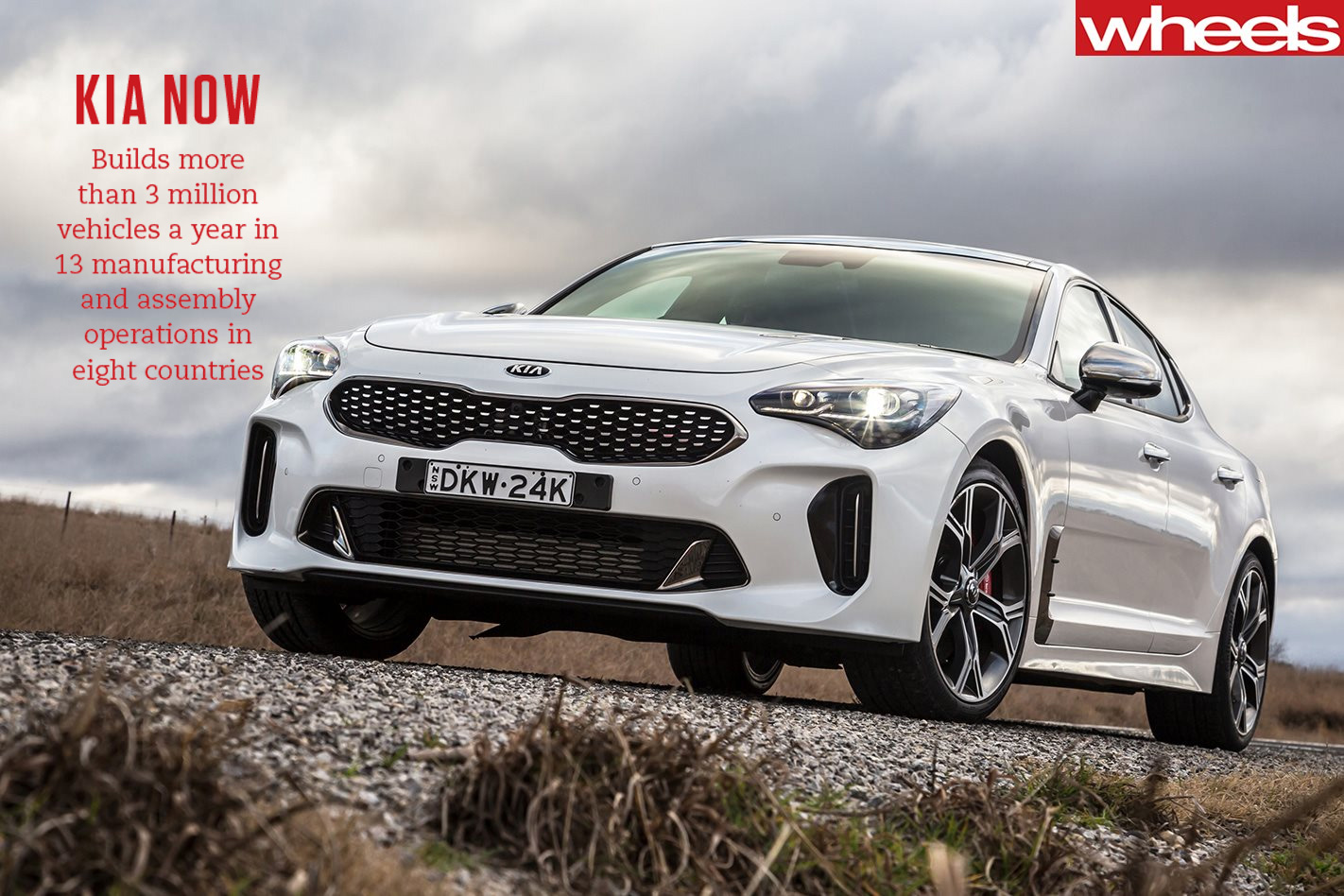
But it hasn’t just been about the product. Skilful marketing has also played a key part. In the USA, for example, Hyundai’s high-concept incentives – like buying back your car if you lost your job – drew buyers in without costing a fortune. Kia’s marketing in the US has been both perplexing and, to many, annoying (YouTube the brilliant rapping hamsters TV ad for the Soul), but it’s done a great job at getting Kia noticed.
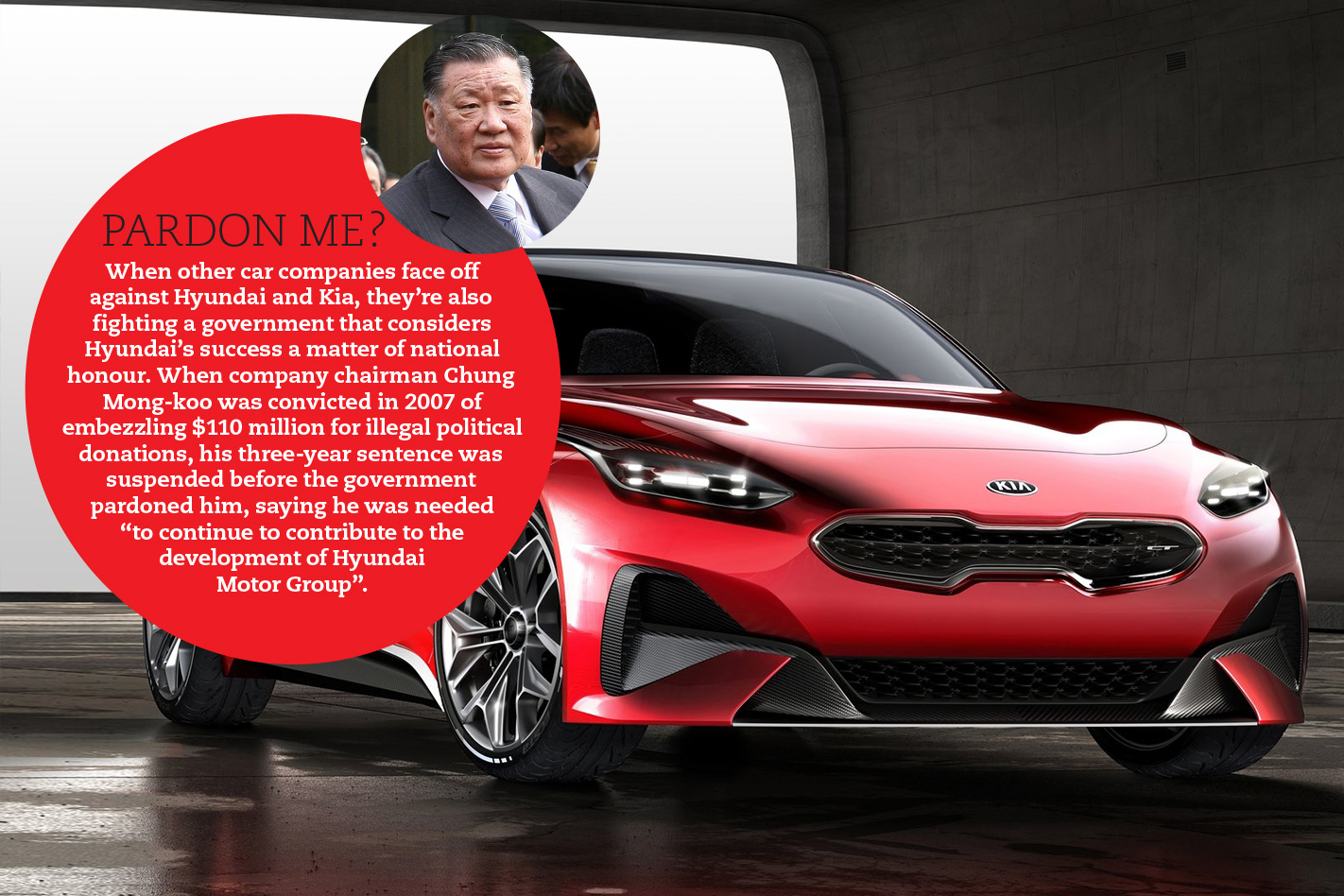
Veteran auto executive heavyweight Bob Lutz had this to say: “Japanese executives, in my experience, often get tangled up in history, tradition, and the supposed superiority of their culture, but I’ve found Korean leaders to be bold, tough, gregarious, and open to new ideas. This is in stark contrast to the rows of stone-faced Japanese execs at intercompany meetings, where little was ever said or accomplished. The Koreans are not hung up on their culture: They hire the best, Korean or not. It’s their strength. They accept risk.”
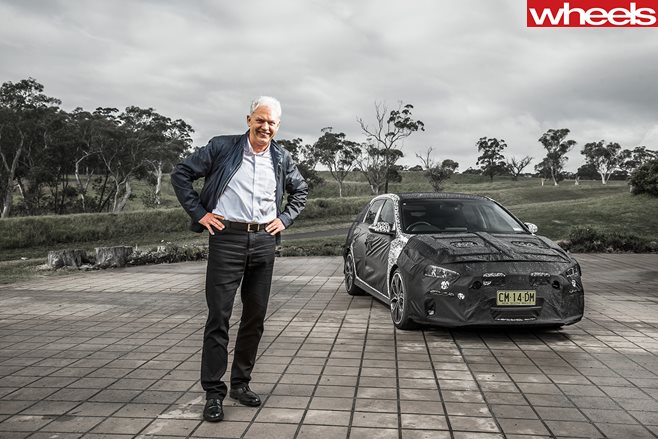
As for Hyundai’s ambition, well, that’s encapsulated in one word: Genesis. Launching a luxury brand at this turbulent stage of the automotive timeline, as alternative power sources, autonomy, and disruptors like Google and Uber reshape the business entirely, takes massive commitment. Can the Koreans do it? Is the Genesis line-up – with no premium SUV in sight until 2019 – strong enough? Is there enough time before the automotive business as we know it is no longer recognisable?
It’s a huge call, but don’t bet against the Koreans. Their pockets are as deep as their determination.
Let’s kick this off by saying that even though we love them here at MOTOR, Commodore Utes haven’t always covered themselves with glory at events like BFYB.
Then again, the fact that you take a Commodore sedan and swap the back seat and boot for a simple, metal tub kind of makes the thing a bit irresistible from the Bucks end of things, because at $54,690, it undercuts the SS-V Redline sedan by at least a couple of grand, which is good news in any bang-for-buck equation.
And let’s not forget how well the basic SS ute performed in the sub-$50K division last issue – ie, it won. But like I said, we’ve been here before – all breathless anticipation – only to have the Holden tray-back fall on its tailgate when the tough question were being asked. But not this time.
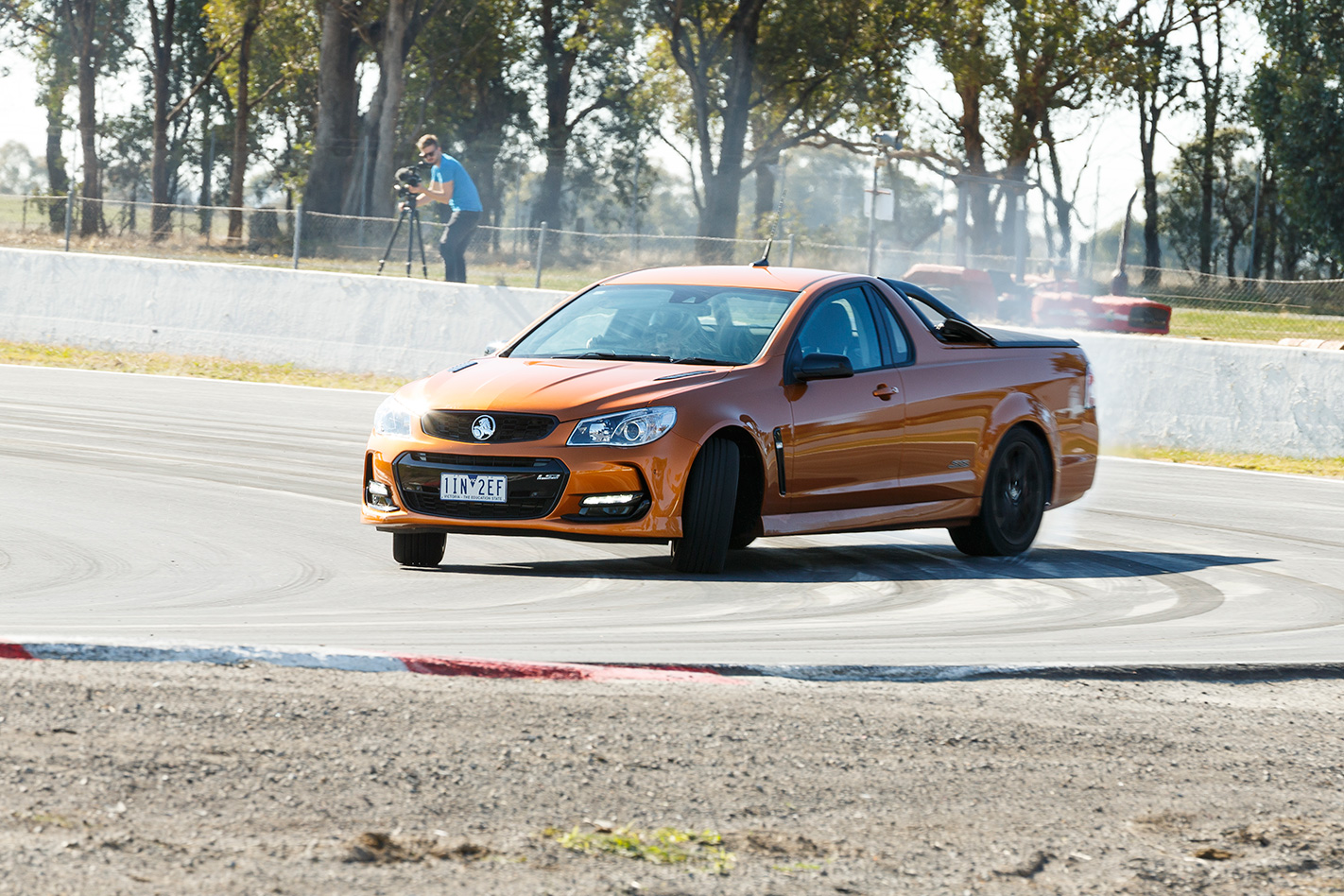
Secondly, the bits that take one of these from an SS Ute to an SS-V Redline Ute (most notably those monster Brembo brakes) are worth every penny of the extra gold you need to find to own one. But perhaps most tellingly, the basic package is just right for this type of action.
We said it last year when the Redline sedan wowed us at BFYB, and the statement stands up to the pub test even a full 12 months later: This is the first full-sized Holden that is track-ready from the dealership. The LS3 in 304kW tune is nothing short of wonderful.
It pops and blapps, it trucks on like a trooper regardless of what gear you find yourself in, and anything that can get to 100 in five-dead and across 400m in a tick over 13 cannot be dismissed as anything but a properly fast car.
While the automatic gearbox might seem like an odd choice for a track-day weapon, in this case it doesn’t seem to detract from the experience one bit. The ratios are long, but suit the way the big bent-eight winds up and the box seems happy to do exactly as you tell it, even in the heat of the moment.
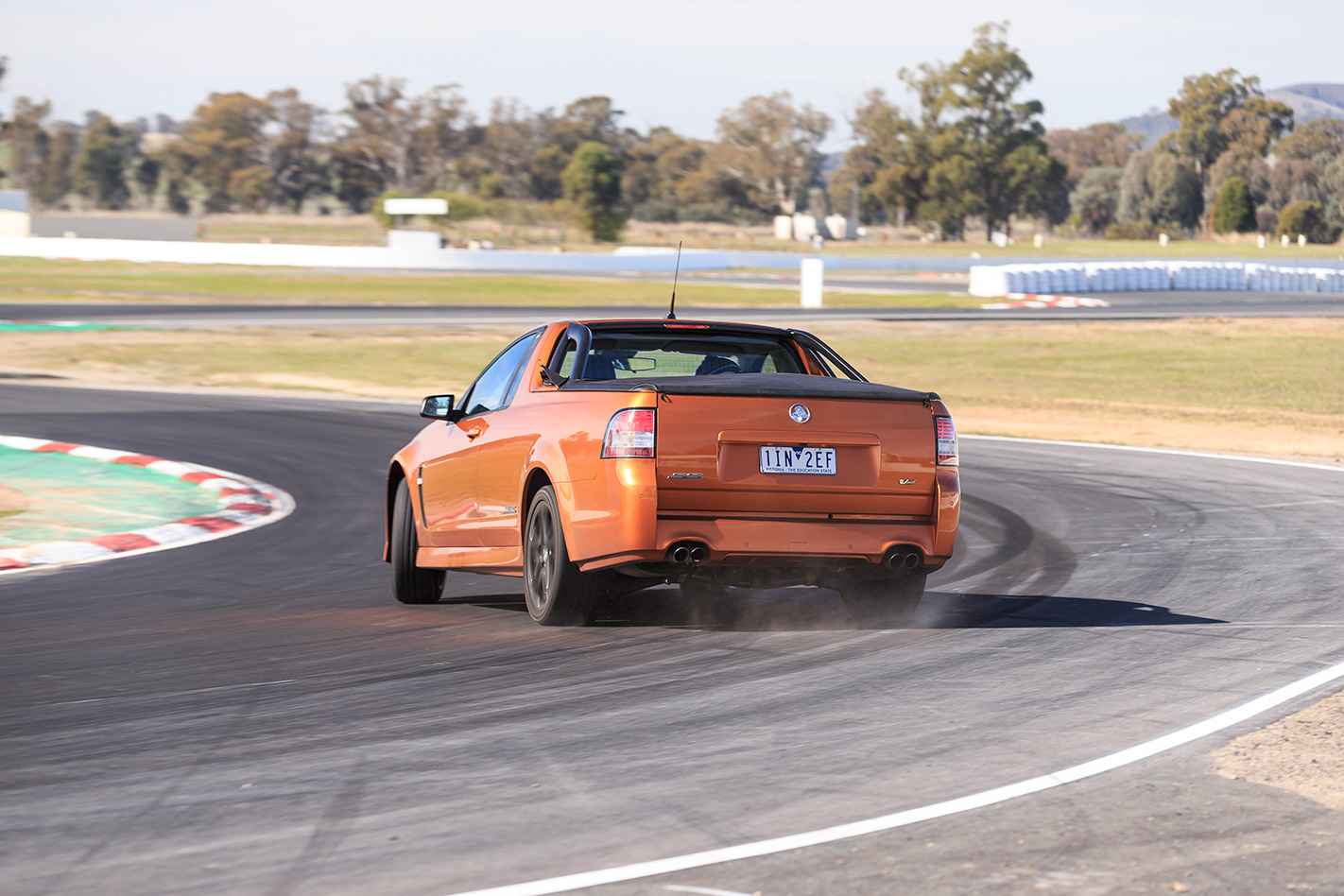
And maybe it was just a ‘good’ car, but there was a feeling that the whole plot in SS-V Redline form was a stiffer, more together thing. It’s hard to imagine Holden devoting a bit more production-line love to a Redline over an SS, but that’s just how it felt when driving the two Holden haulers back-to-back.
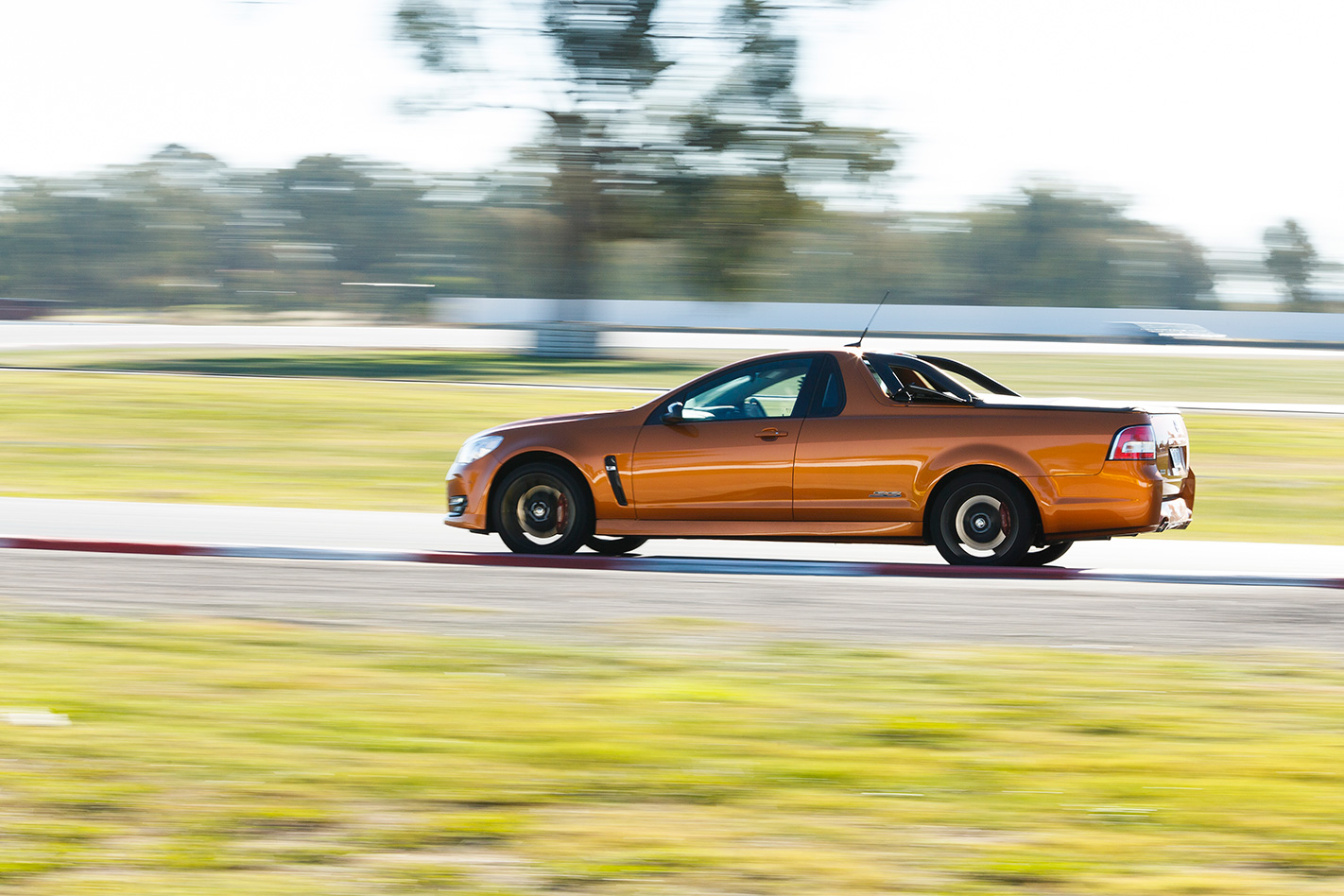
Specs: Engine: 6162cc V8, OHV, 16v Power: 304kW @ 6000rpm Torque: 570Nm @ 4400rpm Weight: 1753kg
Times 0-100km/h: 5.01sec (4th) 0-400m: 13.10sec @ 177.65km/h (3rd) Lap Time: 1:38.6sec (5th)
Scores Price: $54,690 Bang Index: 122.4 Bucks Index: 123.8 BFYB Index: 123.0
Warren Luff says “This car is so much fun at Winton. It’s sad to think that this time next year when we’re back here that we won’t have any Commodore. As a send off to the brand, they’ve done a fantastic job. This is not a circuit that should suit such a big, heavy car – dynamically it’s probably not as good as some of the other cars and obviously there’s not a lot of weight in the rear – but how well it gets up through the sweeper and all the tight stuff, it really is a great car out there. So sad it won’t be here next year.”
Judges notes David Morley – 4th: “What an all-rounder. If you could only own one car…” Dylan Campbell – 3rd: “The greatest performance ute Holden has ever made.” Louis Cordony – 3rd: “The tradie’s ultimate ‘sports car’. Lovely with a manual.” Tim Robson – 4th: “Almost as much fun as the SS, but auto and extra heft doesn’t help.”
THE NISSAN GT-R is ageing gracefully, but with no replacement for the 370Z on the horizon there’s precious little for Nissan’s enthusiastic performance fan base to get excited about in the near (or even distant) future.
This needs to change, lest this iconic sporting brand be relegated to nothing more than an SUV company – it might be where the money lives, but it’s not where the excitement is. And sorry, we’re sure the Juke NISMO is not without its charms, but we’re talking serious performance here.
Thankfully, Nissan has no shortage of hits in its back catalogue to revive. Yes, we’d all really like another 200SX, but bespoke platform blah blah, too expensive blah blah, so why not dive head first into one of the popular modern performance segments – hot hatches?
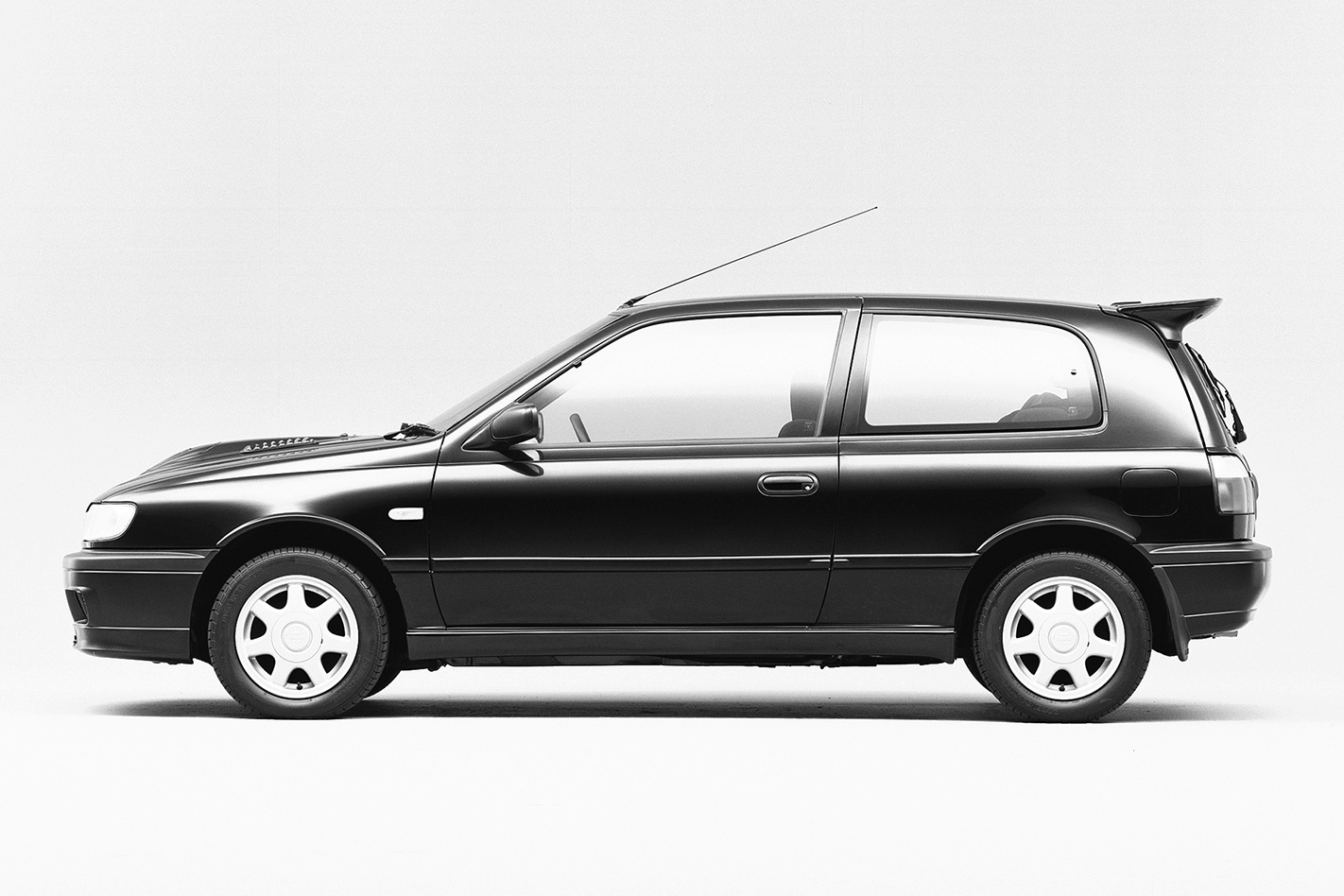
Here’s how we’d do it:
Heart Transplant
There’s no current engine in the Nissan family capable of hot hatch performance, however, thankfully Nissan’s sister company Renault has the perfect option sitting under the bonnet of its forthcoming Megane RS. Whether it’ll be a 1.6 or 2.0-litre turbo four is currently unclear, but around 200kW/350Nm should be plenty for our needs.
’Box, ’Box, ’box
As the new Megane RS will come in both manual and dual-clutch guises, so will our hot Pulsar, as the only other self-shifting alternative is to use a tweaked version of Nissan’s CVT – no thanks.
Want it all
Anyone who’s driven the current Pulsar SSS will be aware of how much work would be ahead of Nissan to turn the GTI-R into a benchmark hot hatch. A rear-biased Twinster-style all-wheel drive system would be a good start, but injecting some feel and accuracy into the dynamics should be priority number one. We want the grip of a WRX, the adjustability of a Megane RS and the ease of use of a Golf GTI – not asking too much, is it?
Price is right
Lobbing the GTI-R in at a low-$40K price point should throw the cat amongst the pigeons, offering 0-100km/h in 5.6sec and 240km/h flat out to give a performance uppercut to established players like the WRX and Focus ST and go toe-to-toe with the new Hyundai i30 N.
Let’s go racing
A return to the WRC would be great, but Nissan would be better off following the money, eyeballs and its competitors (Subaru, Honda, VW) into the Global Rallycross Championship with a factory-backed effort from NISMO. It would also provide Nissan with the perfect opportunity to launch an off-road version of its GT Academy.
Want to see more Sweet Dream creations?
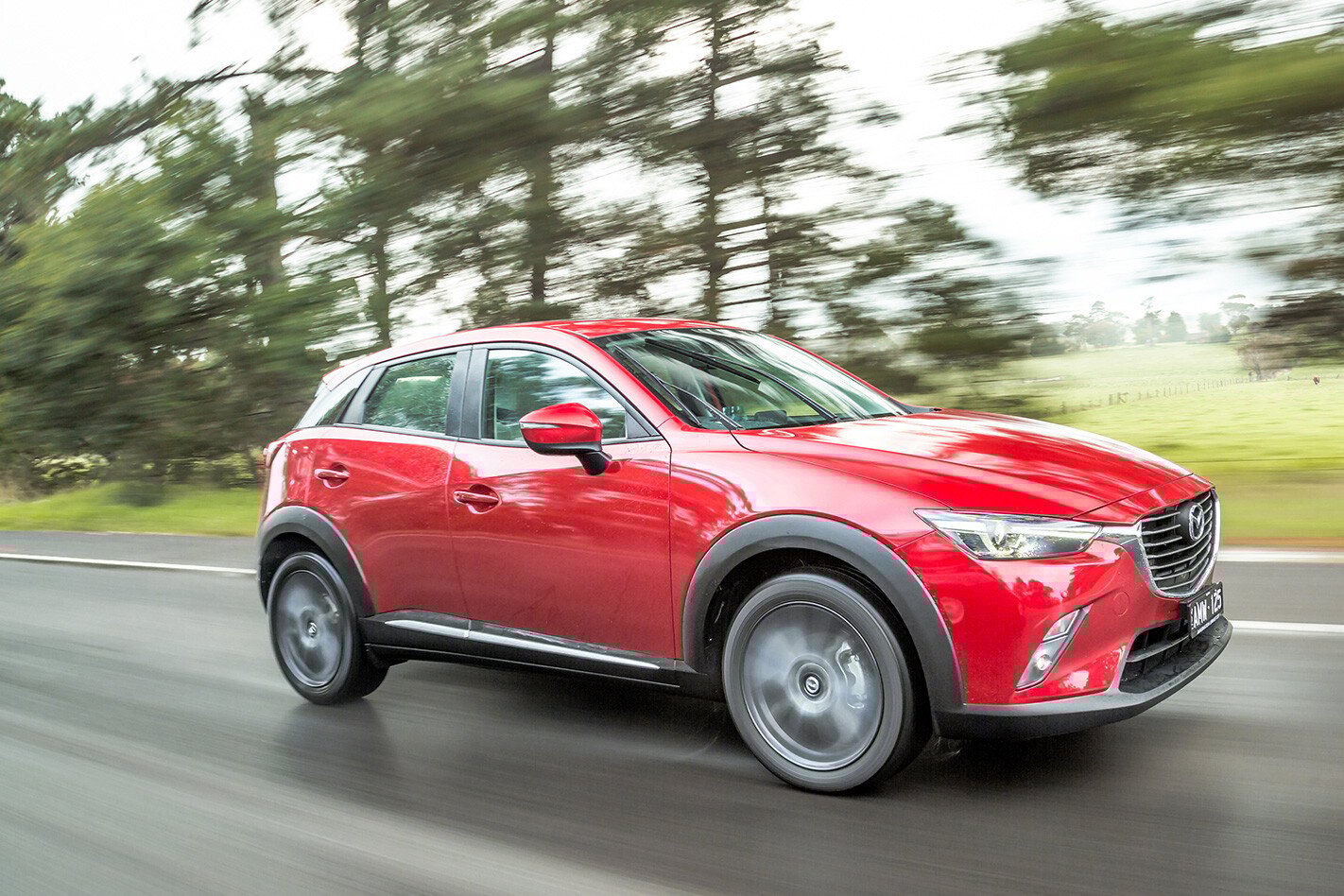
The Mazda CX-3 is one of the best-selling small SUVs in the country thanks to its sporty styling, car-like handling, and sharp entry-level pricing. A recent update addressed some of its few shortfalls including noise levels and ride refinement, while adding automatic emergency braking as standard across the range.
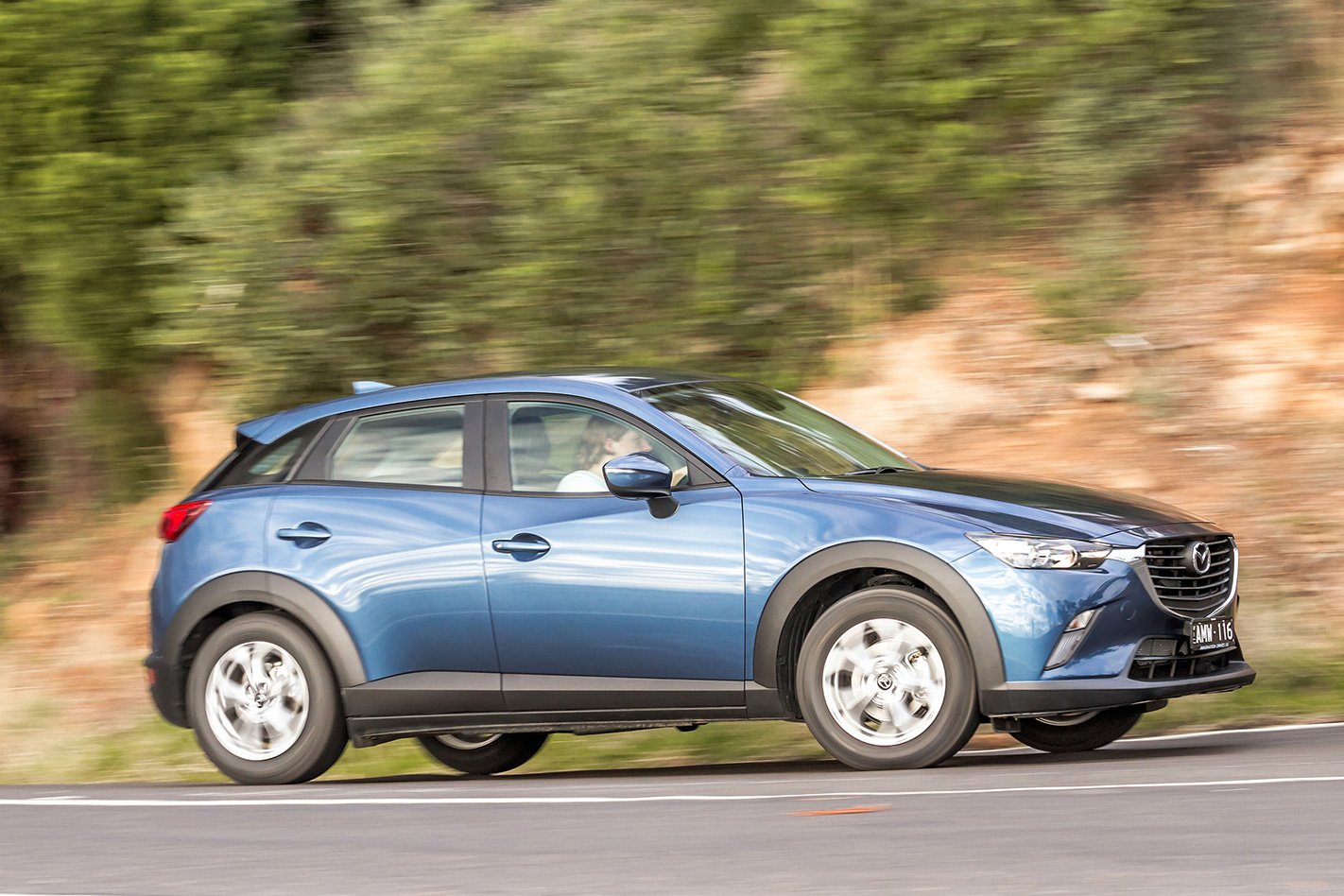
VARIANTS
Like the Mazda 2 hatch on which it’s based, the CX-3 has four main specification levels starting with the entry-level Neo which kicks off the range at $20,490 for the six-speed manual version. A six-speed automatic is also available for an extra $2000 with that premium in place across all variants with both FWD and AWD drivetrains.
Priced to draw people into Mazda showrooms, the front-wheel drive CX-3 Neo (below) is sparsely equipped by today’s standards but does come with automatic emergency city braking, cruise control, hill-launch assist cloth seats, and 16-inch steel wheels with hubcaps.
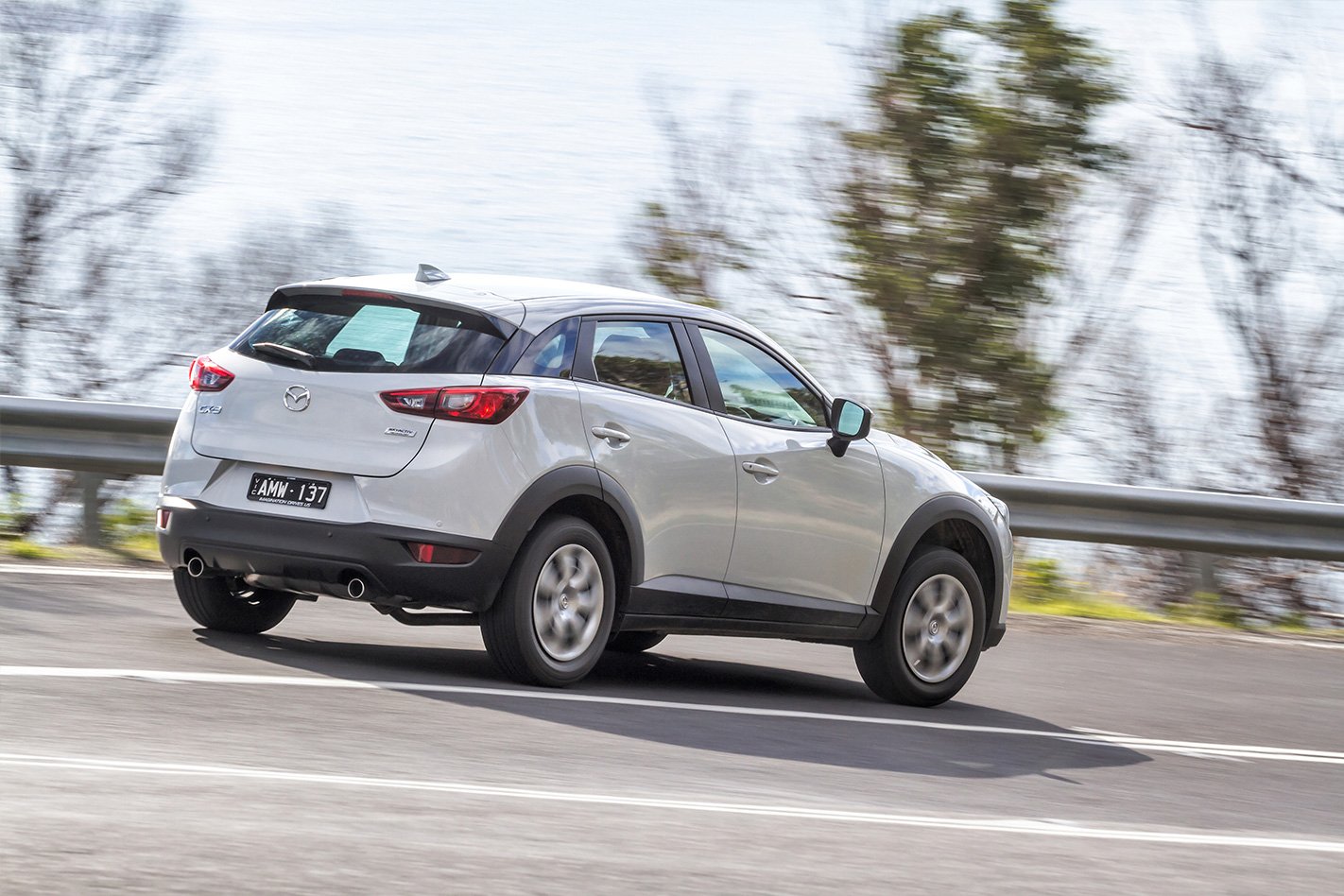
Entertainment is rudimentary with no touch screen infotainment system, but you do get auxillary and USB inputs and Bluetooth connectivity should you tire of AM/FM radio. Having no centre screen means there’s no reversing camera but it does have rear parking sensors to help you into tight spots.
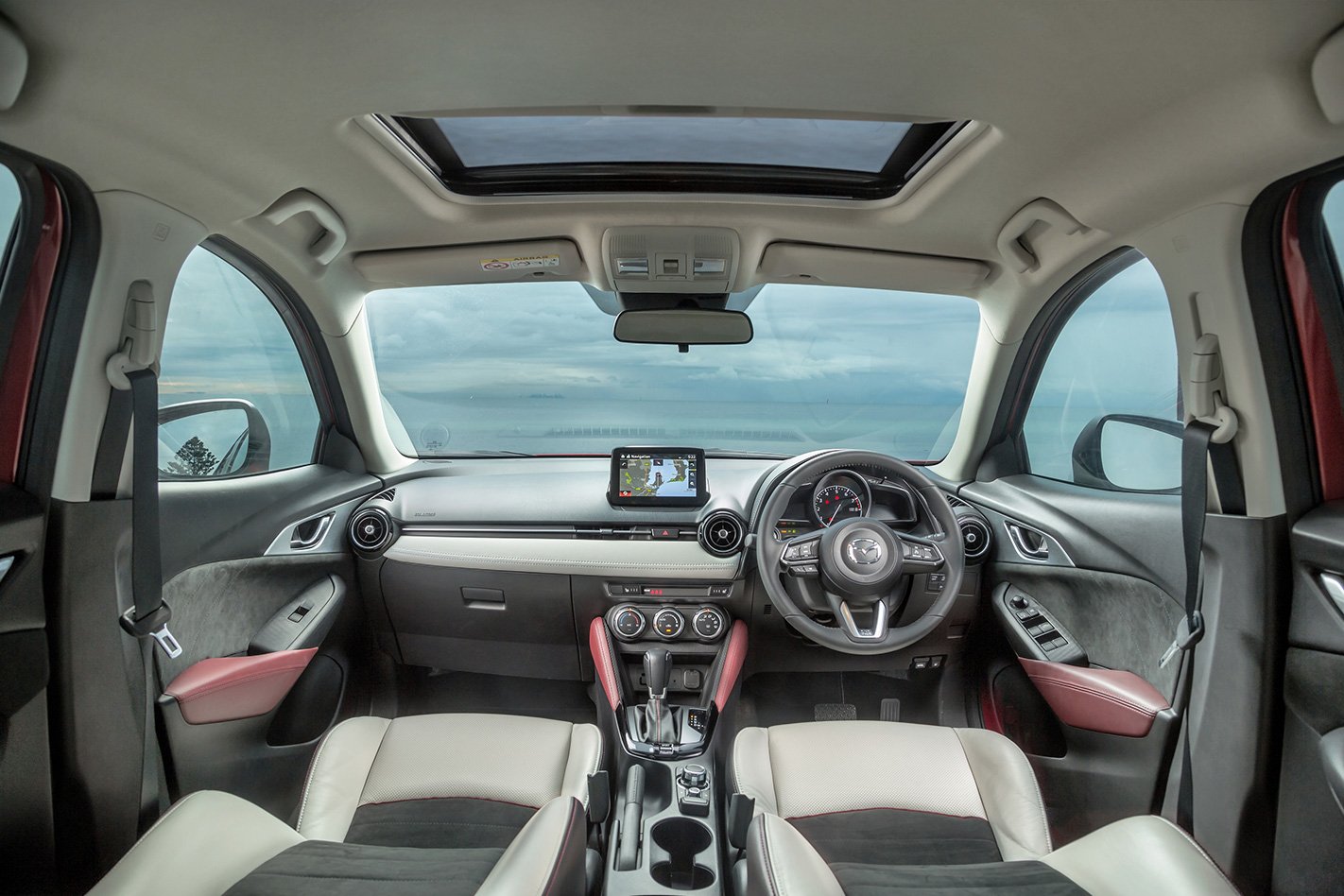
Next up is the CX-3 Maxx (interior below) which adds some decent kit for an extra $2400. The extras include a 7.0 touchscreen with rotary controller, Mazda’s MZD Connect entertainment system with digital radio, satellite navigation, reversing camera, and better sound via two extra speakers. The Maxx also has 16-inch alloy wheels, leather-wrapped steering wheel, blind-spot monitor, and rear-cross traffic alert.
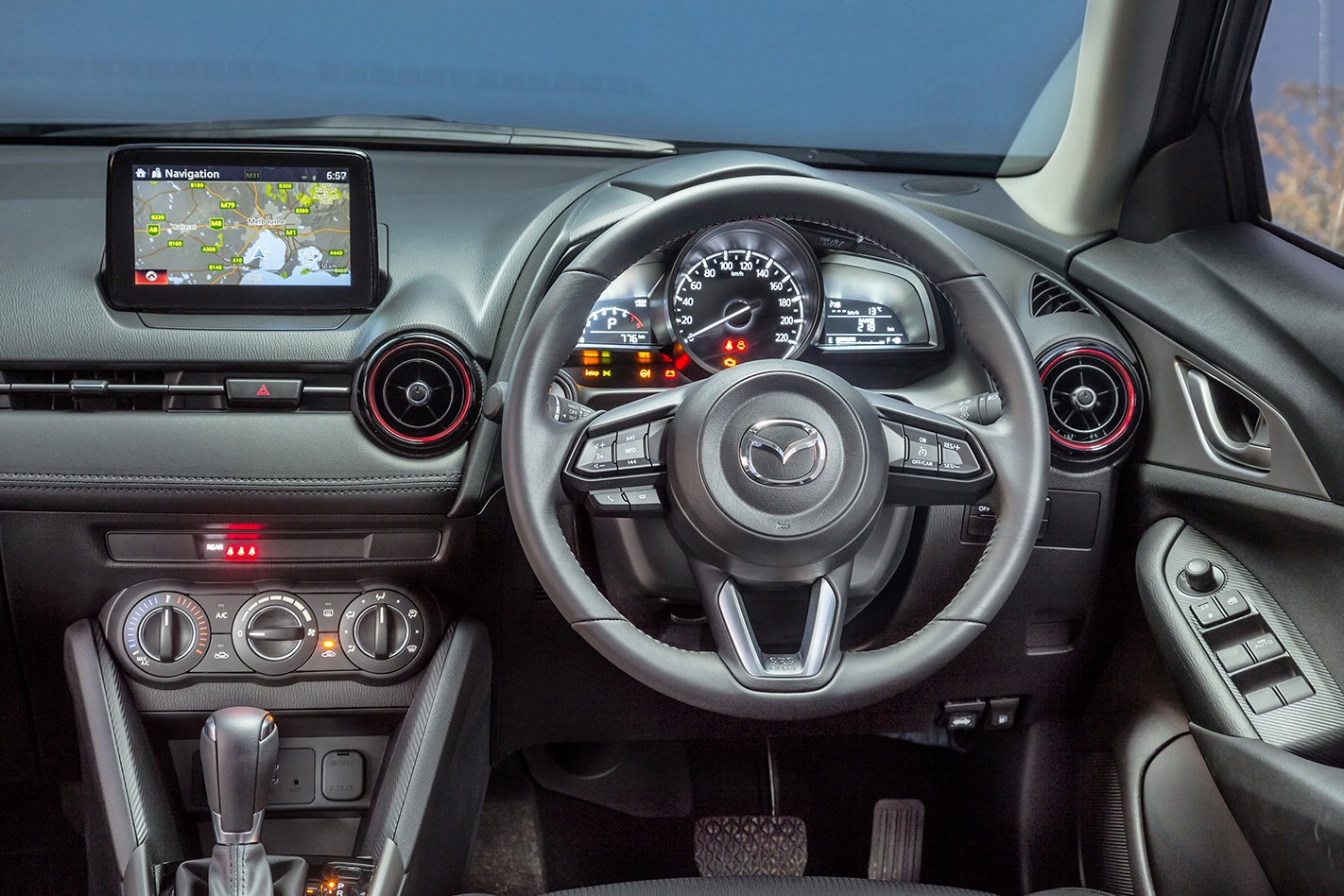
The Maxx specification is also available with AWD auto or with a 1.7-litre turbo diesel engine with FWD.
Next up is the sTouring, which adds 18-inch alloy wheels with sporty low-profile tyres, LED headlights and daytime running lights, fog lights, head-up display with speed sign recognition, keyless start, auto wipers, climate-control air-conditioning, and a choice of cloth or faux leather trim.
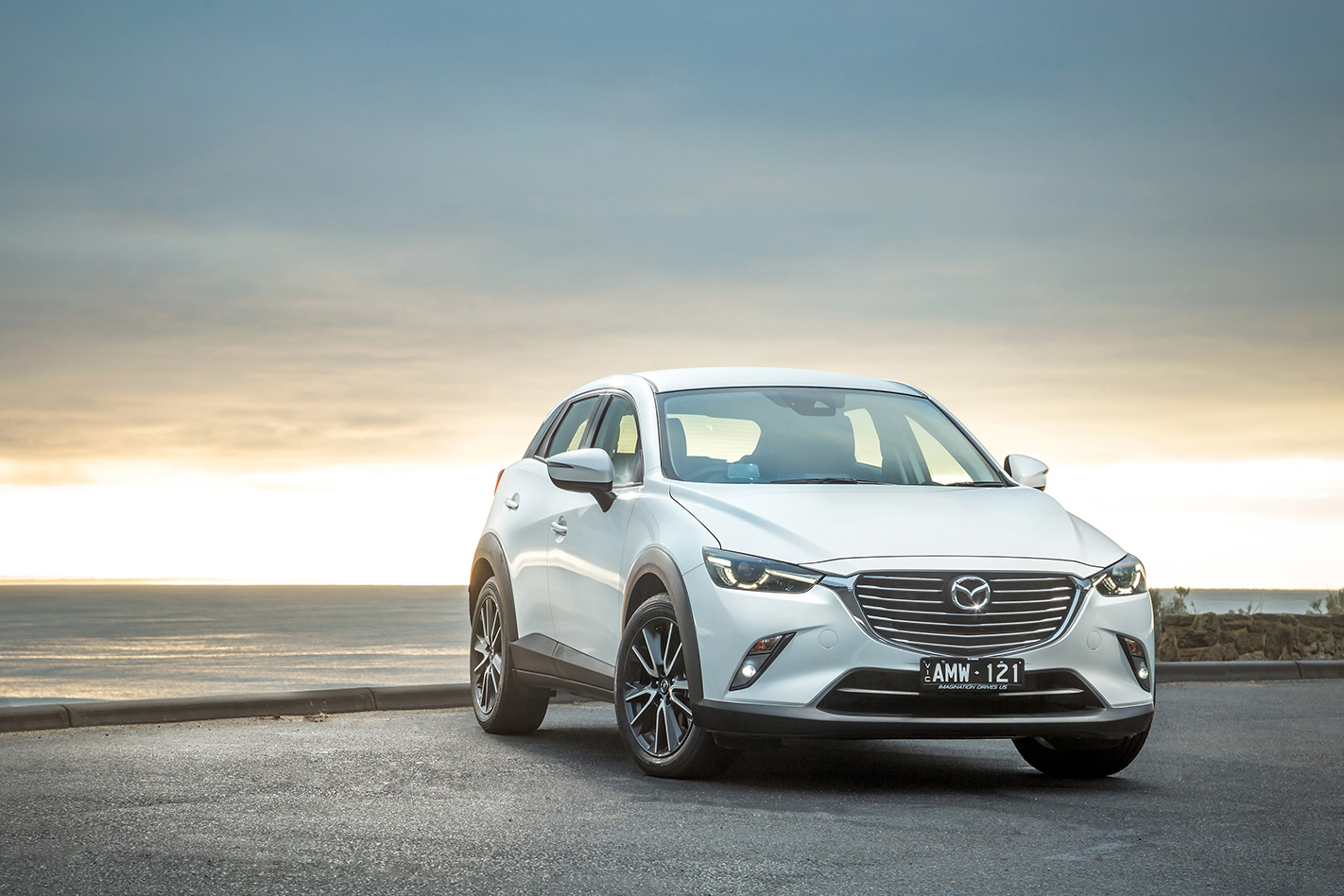
The CX-3 sTouring (above) has the same petrol and diesel choices as the Maxx though the diesel is AWD. There’s also a petrol AWD option.
The range-topping CX-3 Akari (interior below) has the same engine and drivetrain options as the sTouring plus more luxury features including black or white leather upholstery, heated front seats, power adjustable driver’s seat with two memory settings, and a sunroof.
Additional safety measures include adaptive headlamps and lane departure warning.
- CX-3 Neo manual – $20,490
- CX-3 Neo auto – $22,490
- CX-3 Maxx manual – $22,890
- CX-3 Maxx auto – $24,890
- CX-3 Maxx AWD auto – $26,890
- CX-3 Maxx diesel auto – $27,290
- CX-3 sTouring manual – $26,990
- CX-3 sTouring auto – $28,990
- CX-3 sTouring AWD auto – $30,990
- CX-3 sTouring AWD diesel auto – $33,390
- CX-3 Akari manual – $31,490
- CX-3 Akari auto – $33,490
- CX-3 Akari AWD auto – $35,490
- CX-3 Akari AWD diesel auto – $37,890
OUR PICK
The Maxx is a great little car for the money if you’re on a budget. However, the sTouring and Akari AWD petrols bring plenty of great features for the price as well as a dynamically engaging ride.
AVAILABLE OPTIONS
Soul Red metallic paint – $300
