If you’re someone who laments that four-wheel-drive vehicles have got a bit soft, you’d be pleased to know Mercedes-Benz has the wagon that’s so off-road focused, its six-figure price tag doesn’t even include a radio.
The Mercedes-Benz G300 CDI Professional wagon is a military spec go-anywhere four-wheel-drive that’s not to be confused with the upmarket G350 and Mercedes-AMG G63 G-Classes that populate the Kardashian’s Instagram accounts.
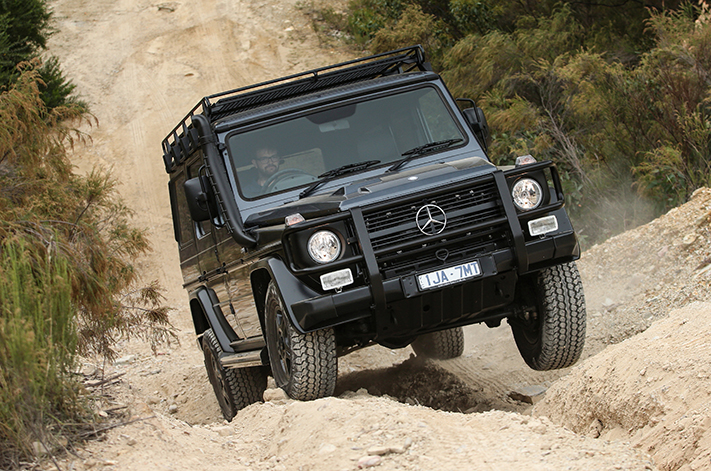
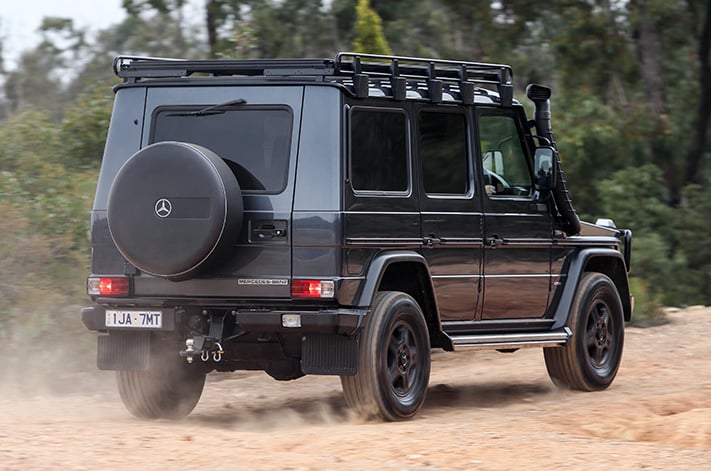
Mercedes-Benz has confirmed it is now available Australia, joining the G 300 cab-chassis ute (below), which arrived here last year. Both serve in the armed forces of more than 40 countries, including the Australian Army, yet it’s only here that both are available for civilians to buy.
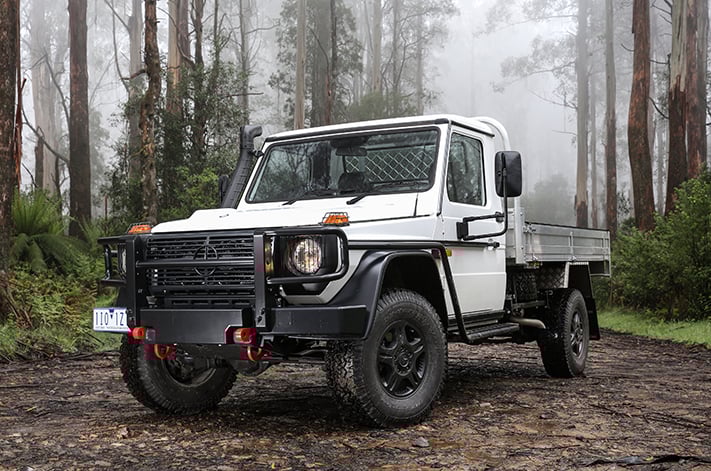
These ultimate off-roaders are powered by a 135kW/400Nm 3.0-litre V6 turbo diesel coupled to a five-speed automatic and permanent all-wheel-drive system with a 50:50 split.
They’re equipped with three differential locks that are selectable on the move, a bull bar, snorkel and 16-inch black alloy wheels.
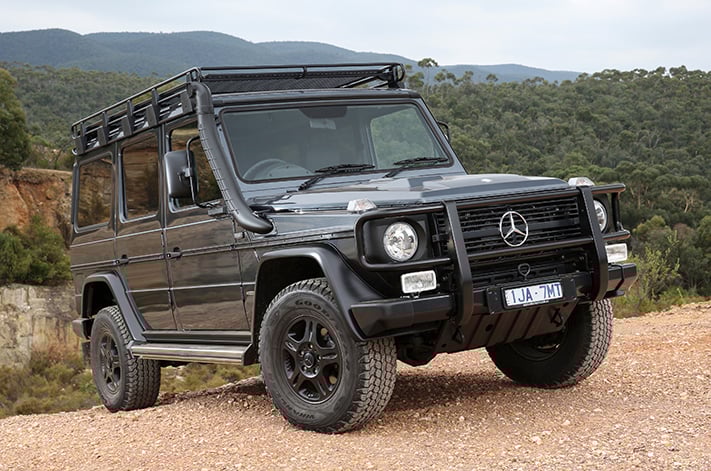
Other key features include a water drain plug in the floor for when off-roading gets serious, a 96-litre fuel tank, two 12-volt batteries, a tyre pressure warning system, dirty air filter warning, brake pad wear indicator for the front axle’s brakes, headlight and indicator stone guards, and radiator and oil sump shields.
The wagon seats four with walk-through access to the luggage compartment. The cab-chassis ute has two seats.
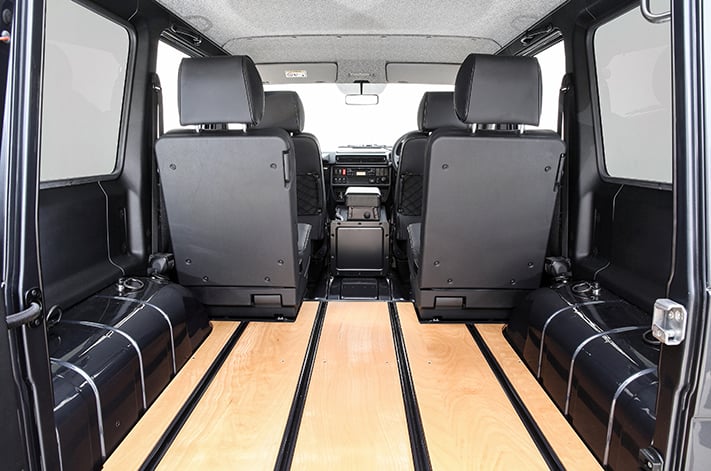
Despite its spartan appointments, which don’t even include a radio as standard, the G300 CDI Professional wagon retails for $109,900, $10,000 less than the cab-chassis version.
A range of options are available to make the wagon a little less soldierly, including a $9000 Edition PUR package that brings a radio and CD player, walk-on bonnet, electric door mirrors, roof rack, heat-insulated tinted rear glass, running boards, towbar, headlamp cleaning system and heated leather seats.
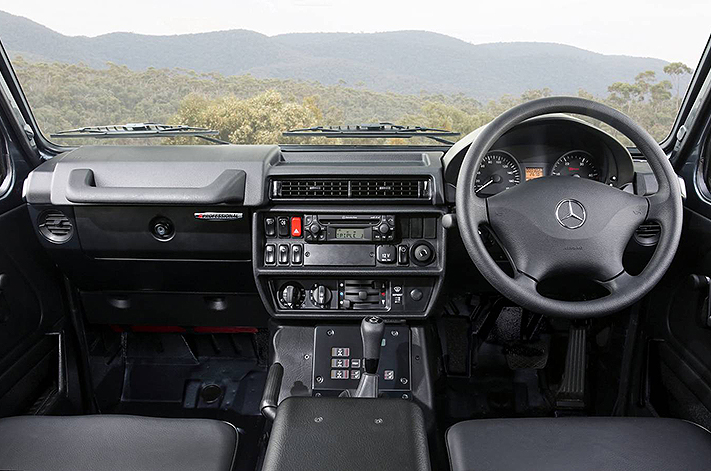
Some of these options can be bought separately, including the walk-on bonnet ($1900), heated seats ($900), tinted rear windows ($700) and a wire mesh partition behind the rear seats ($1200).
Mercedes-Benz G-Class pricing
- G300 CDI Professional wagon – $109,900
- G300 CDI Professional cab-chassis – $119,900
- G350 BluTEC – $163,6I5
- AMG G63 – $233,615
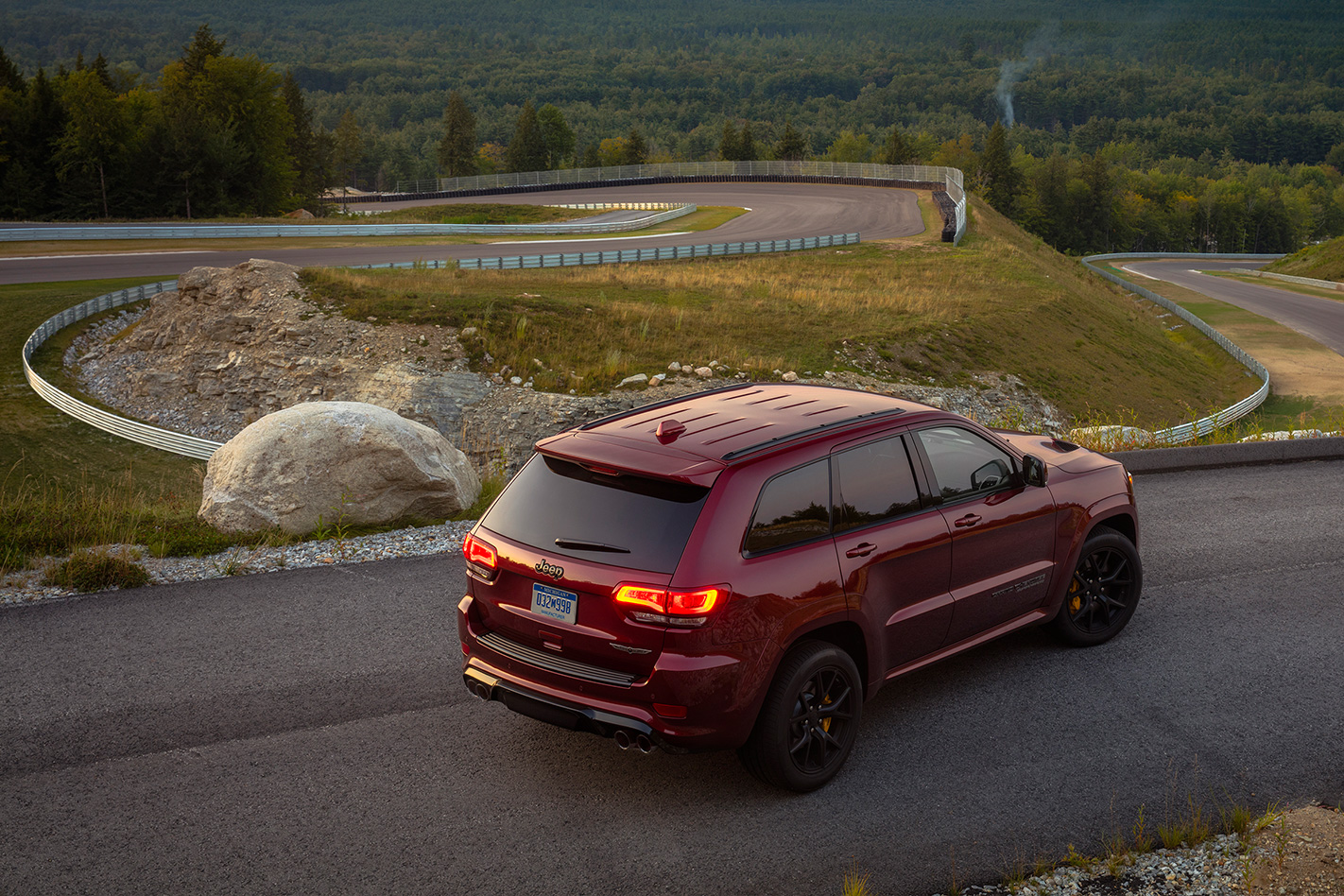
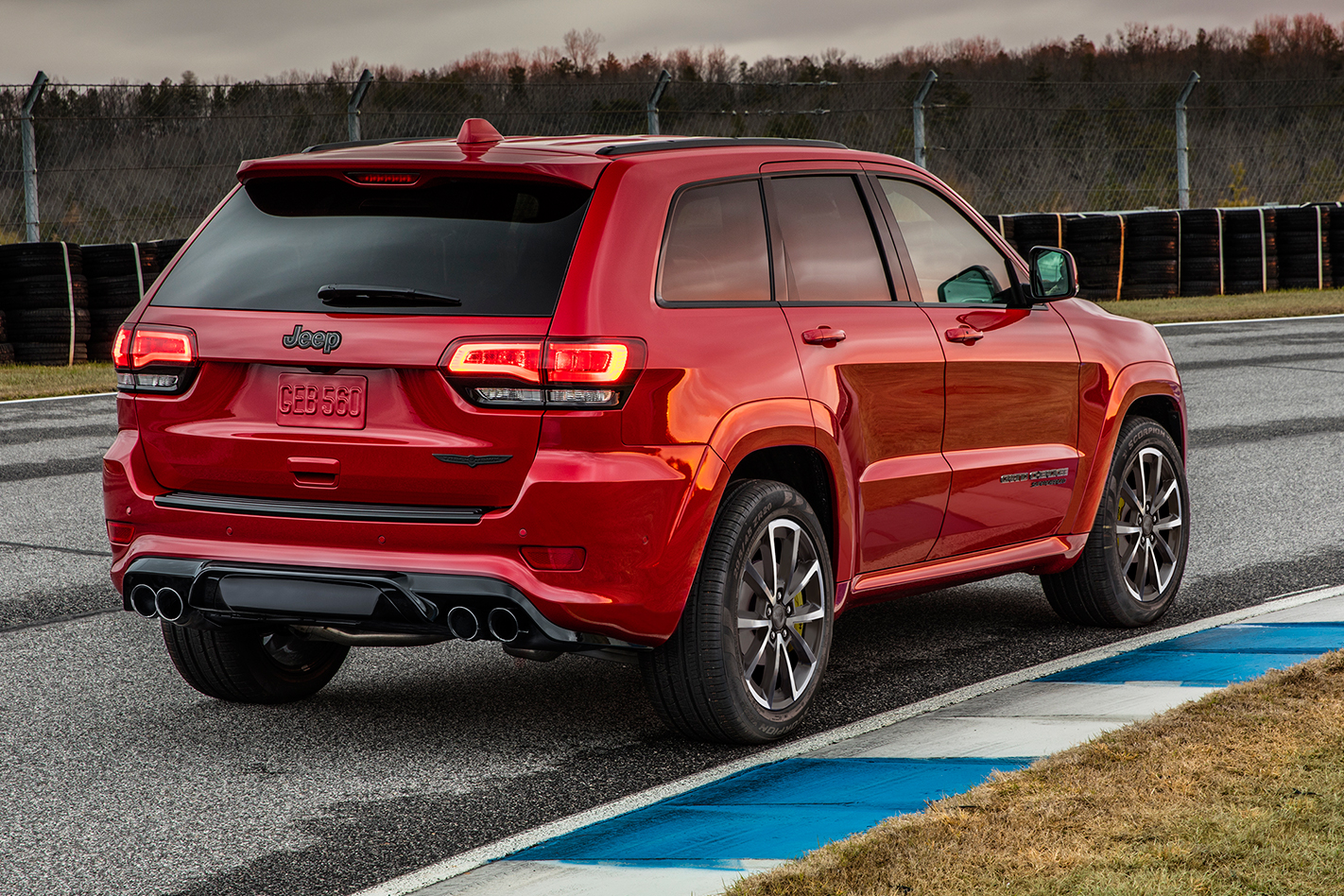
THE 2018 Jeep Grand Cherokee Trackhawk doesn’t appear to be content to scalp its hi-po German SUV rivals on monstered performance alone when it arrives here late this year.
That’s because the 527kW/874Nm Trackhawk – the most potent, butumen-only version of the big off-roader yet – is also likely to take the fight up to the Porsche Cayenne Turbo, BMW X5 M and Mercedes AMG GLE63 in terms of how richly equipped it will be.
Wheels has just driven the Trackhawk on both road and track in the US , but a Jeep-stipulated embargo means you’ll have to wait until Thursday for our verdict. About all we can say at this point that certain words not were not uttered at the launch event; some of these included “hmm, it needs more grunt”, and “shame it’s not louder”.
As for the Trackhawk’s pricing? Jeep Australia is still yet to confirm, but we do know there will be a Launch Edition, limited to 62 units, (paying homage to the 6.2-litre engine) tipped to be priced from $160,000. That means it’s safe to speculate that the regular Trackhawk will be around $140,000.
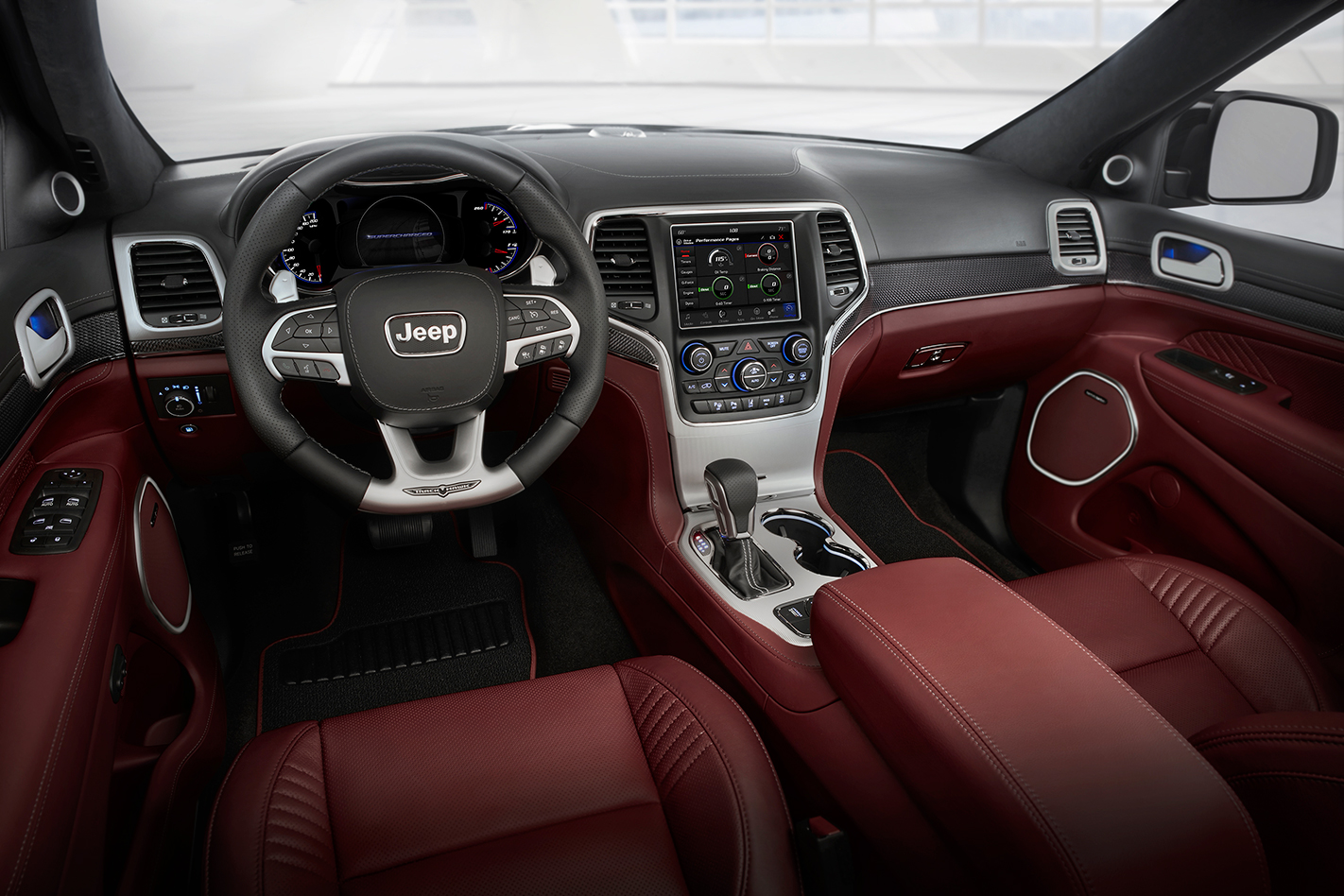
The Australian sales slump of Jeep – numbers last year were down almost 60 percent from a high of more than 30,000 sales in 2014 – sits in direct contrast to success of the brand globally; Jeep’s volume has grown from circa 300,000 units in 2009 to 1.4 million vehicles sold in 2016.
Contributing to this is Jeep’s shift from a North American brand to a proper global player, with manufacturing in all key regions of the world, and a market presence everywhere that counts.
What’s this, then?
It’s Nismo’s spin on the 370Z. Before you say ‘Nis-what?’, the go-faster arm has been modding regular Nissans for years while running the company’s motorsports program.
But while early examples were limited-runs, think Skyline GT-R 400R, the outfit began making cars full-time in the late noughties, offering tasty top-of-the-line R35 GT-Rs and 370Zs since their births.
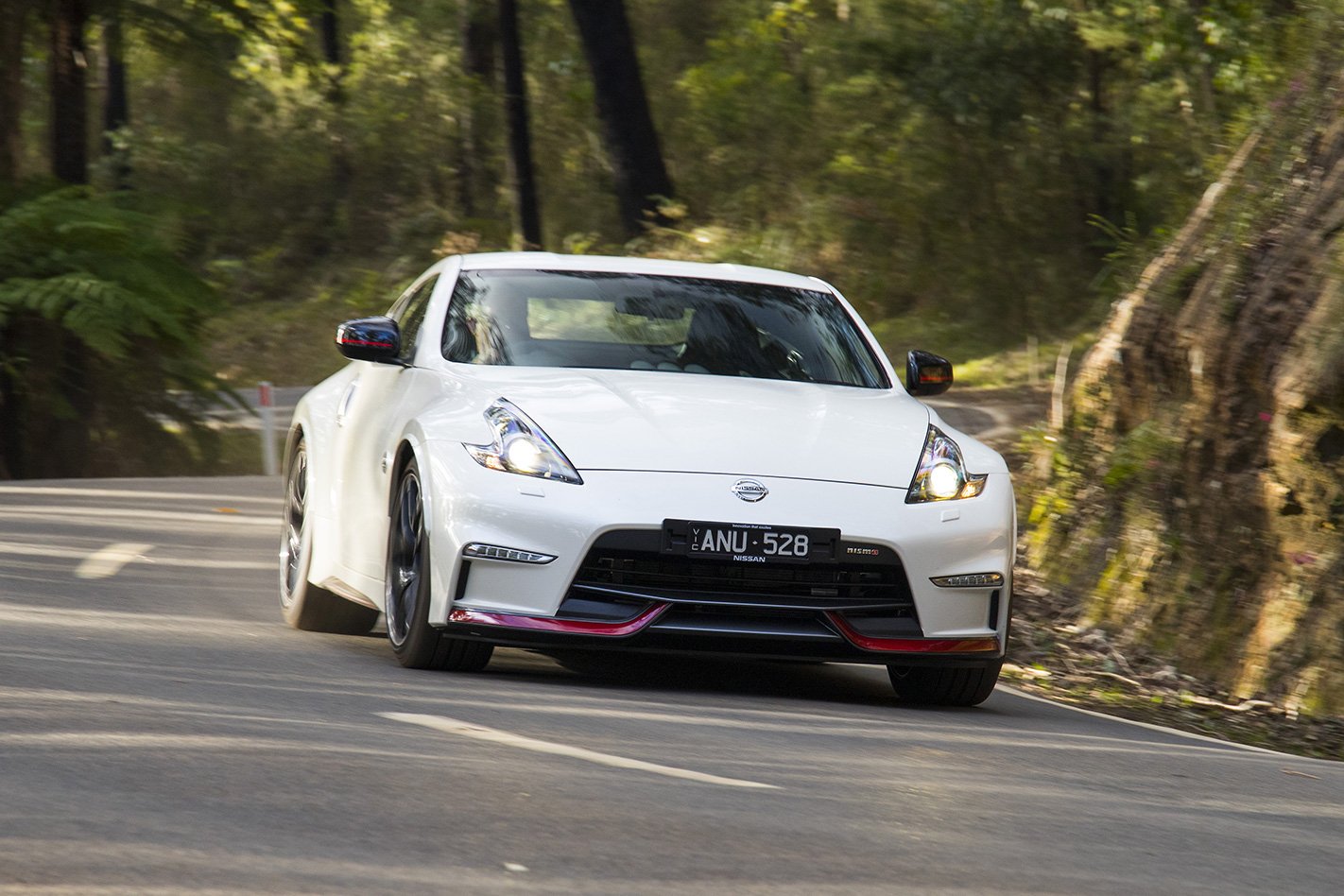
That’s because we’ve been watching the rest of the world enjoy its fruits for almost a decade. We’ve missed out because of “ADRs, timing, and capacity”, Richard Emery, the brand’s local CEO, told us last year.
But it seems someone’s made the right noises and convinced Japan to greenlight Nismo models for Aussie tarmac, with the 370Z Nismo the latest addition.
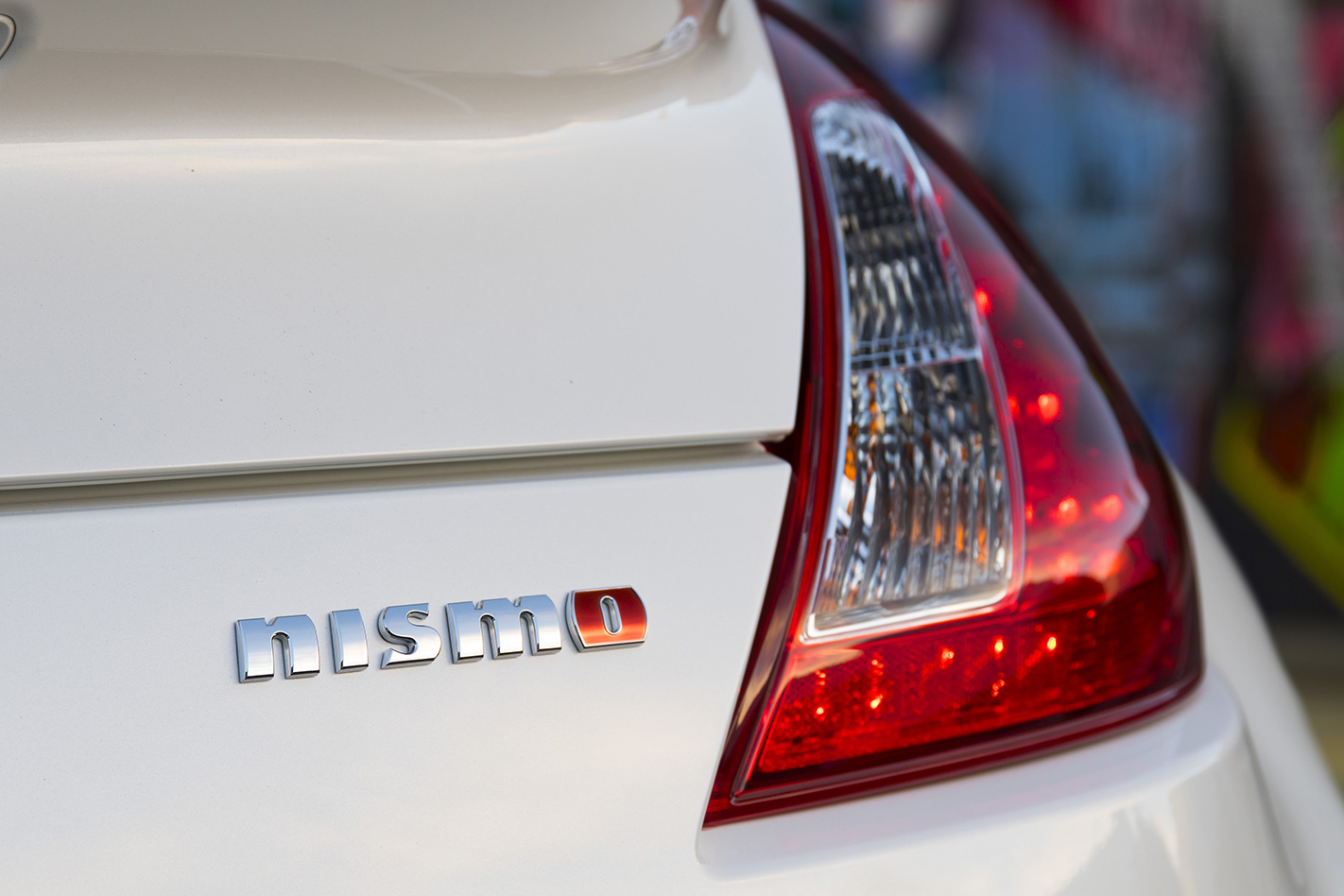
Thankfully, Nismo’s done better than paste the 370Z with a sticker-pack and tweaked it like you would with five-minutes on Forza Motorsport.
Outside it wears GT-R inspired front and rear bumpers, while side sills and lip spoiler round out the bodykit. Oh, and the door mirrors are Nismo-fied in black.
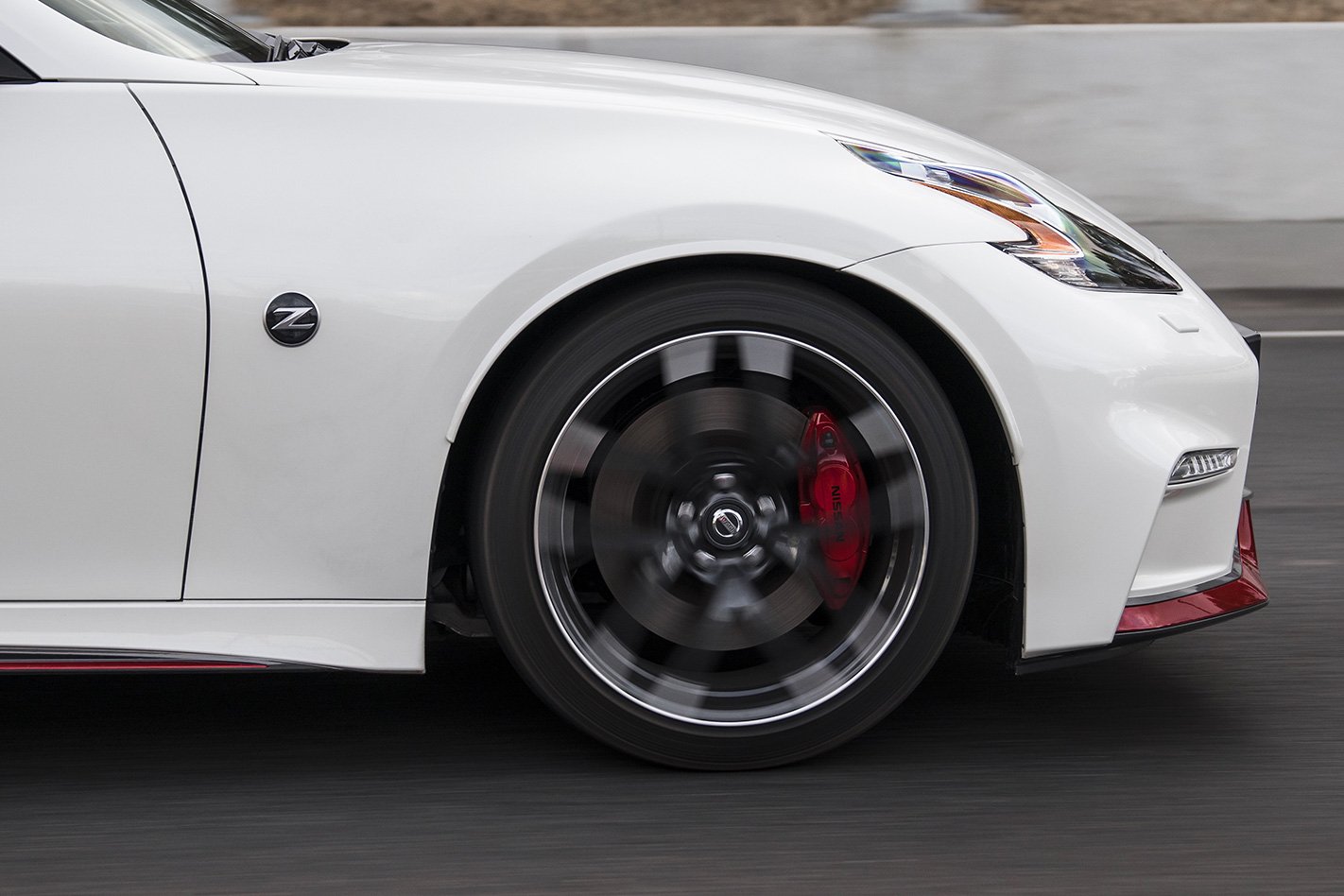
Special dampers, uprated springs, and stiffer rollbars will put the staggered rubber to work, while special brake hoses and fluid bolster its brakes.
And the donk?
Engineers have fiddled with the 3.7-litre V6’s spark and timing. While a new exhaust system bolts on from the cat-converter backwards. It’s enough for an 8kW and 8Nm uptick.
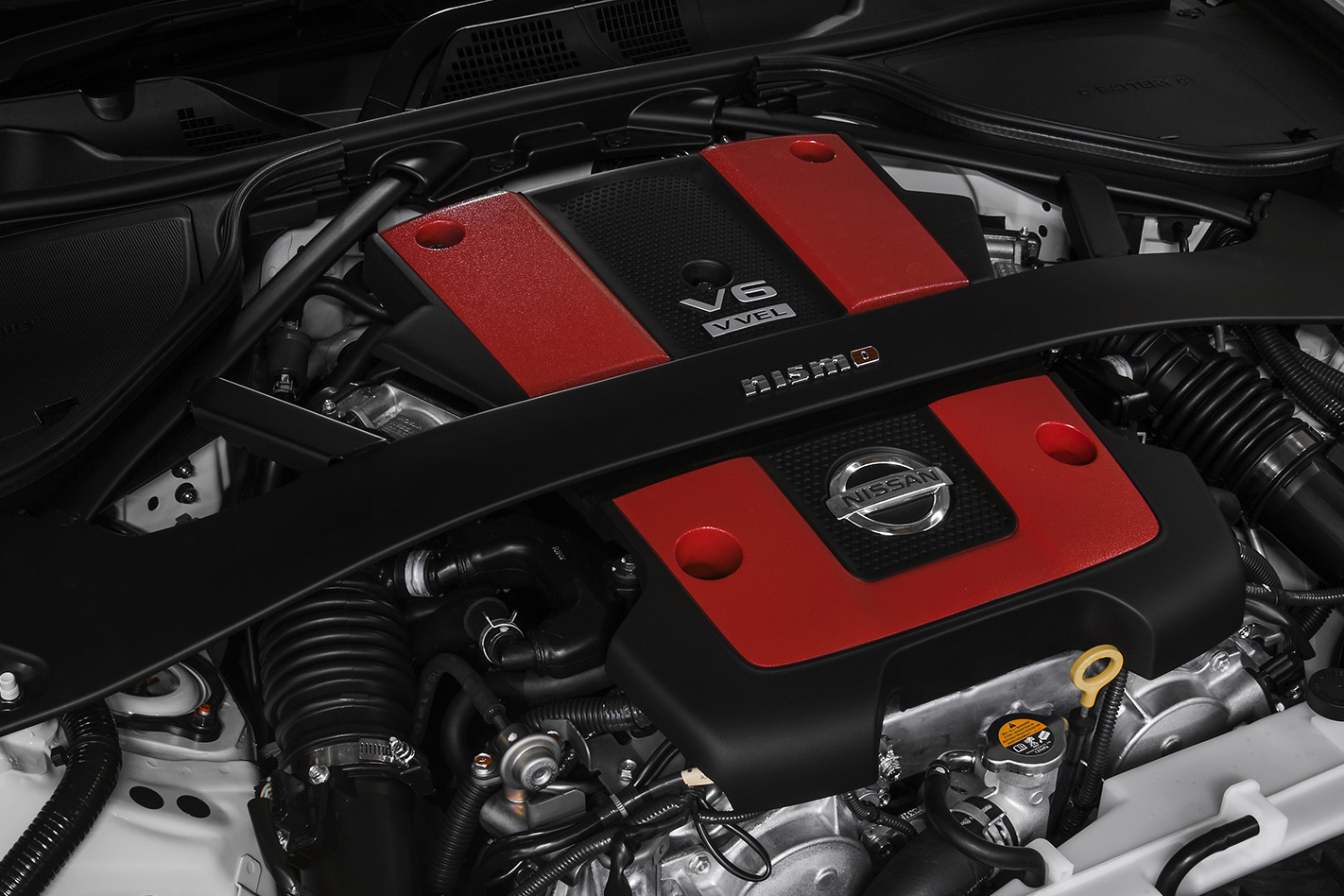
Not loads of poke these days, but enough for an atmo six rear-driver weighing under 1500kg. And we’re talking about an eight-year old engine.
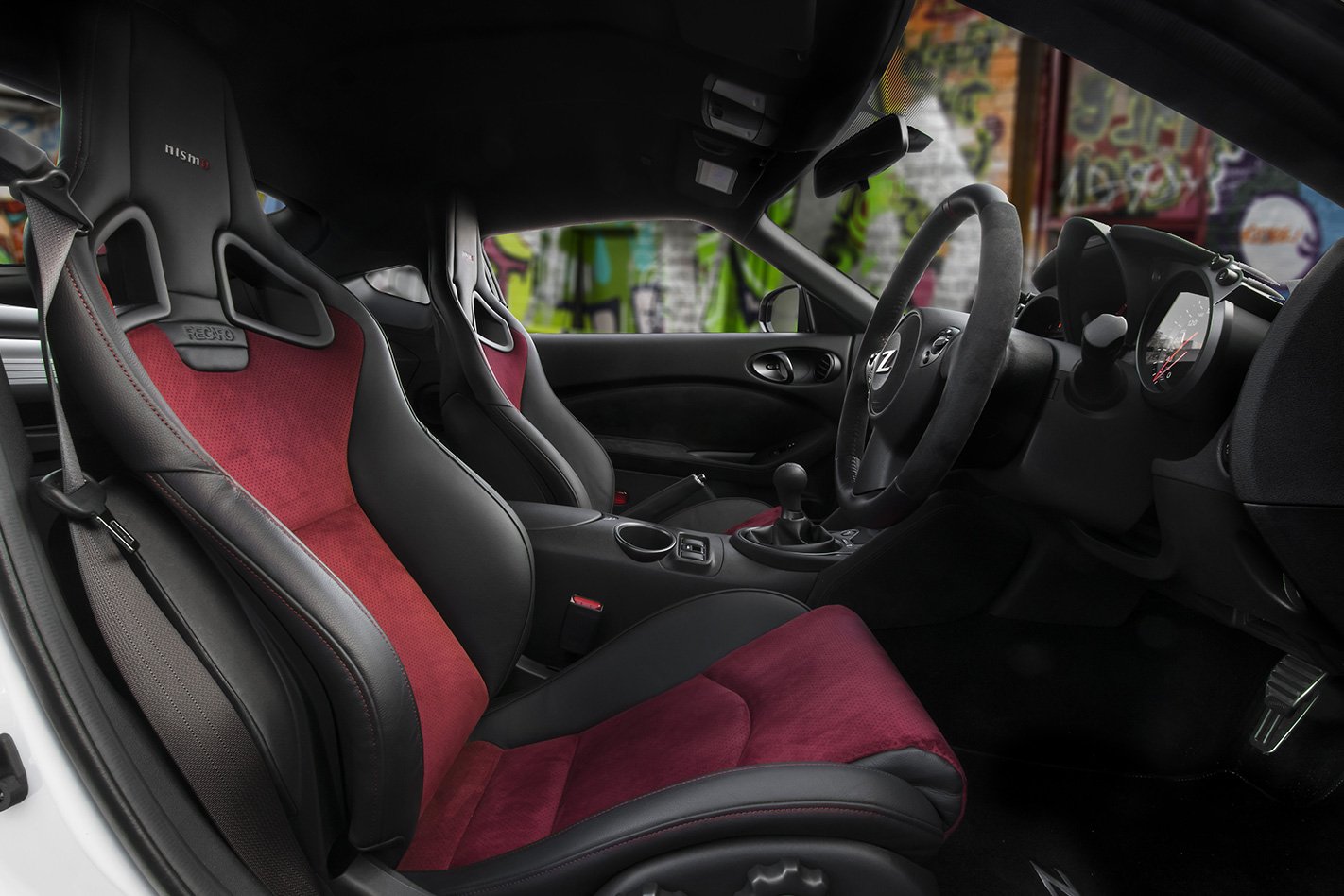
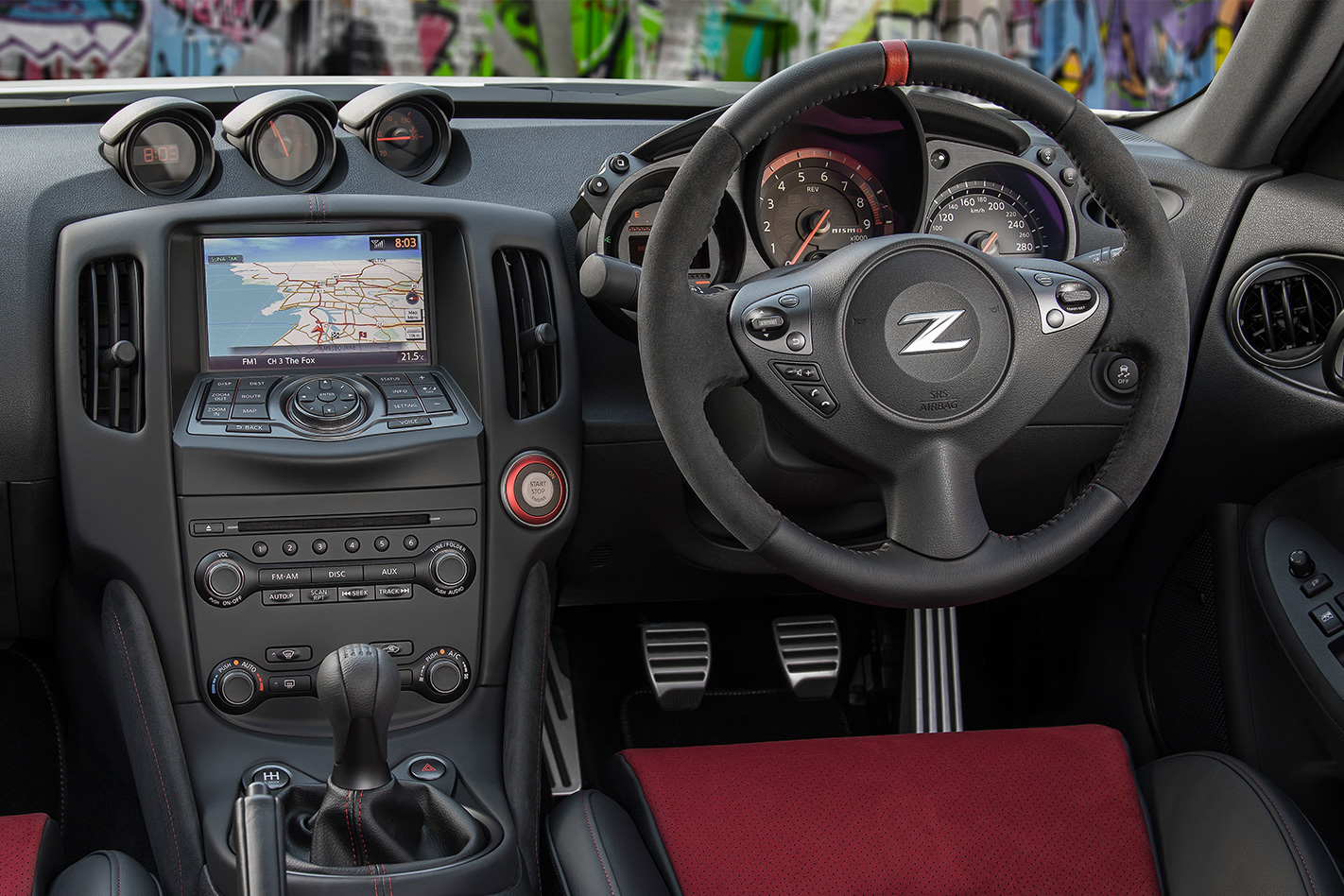
The Zed might be due for pension but its cabin has aged well. It’s very useable, the buttons are tactile, and the material mix feels premium – thanks to the scattered Nismo alcantara and leather.
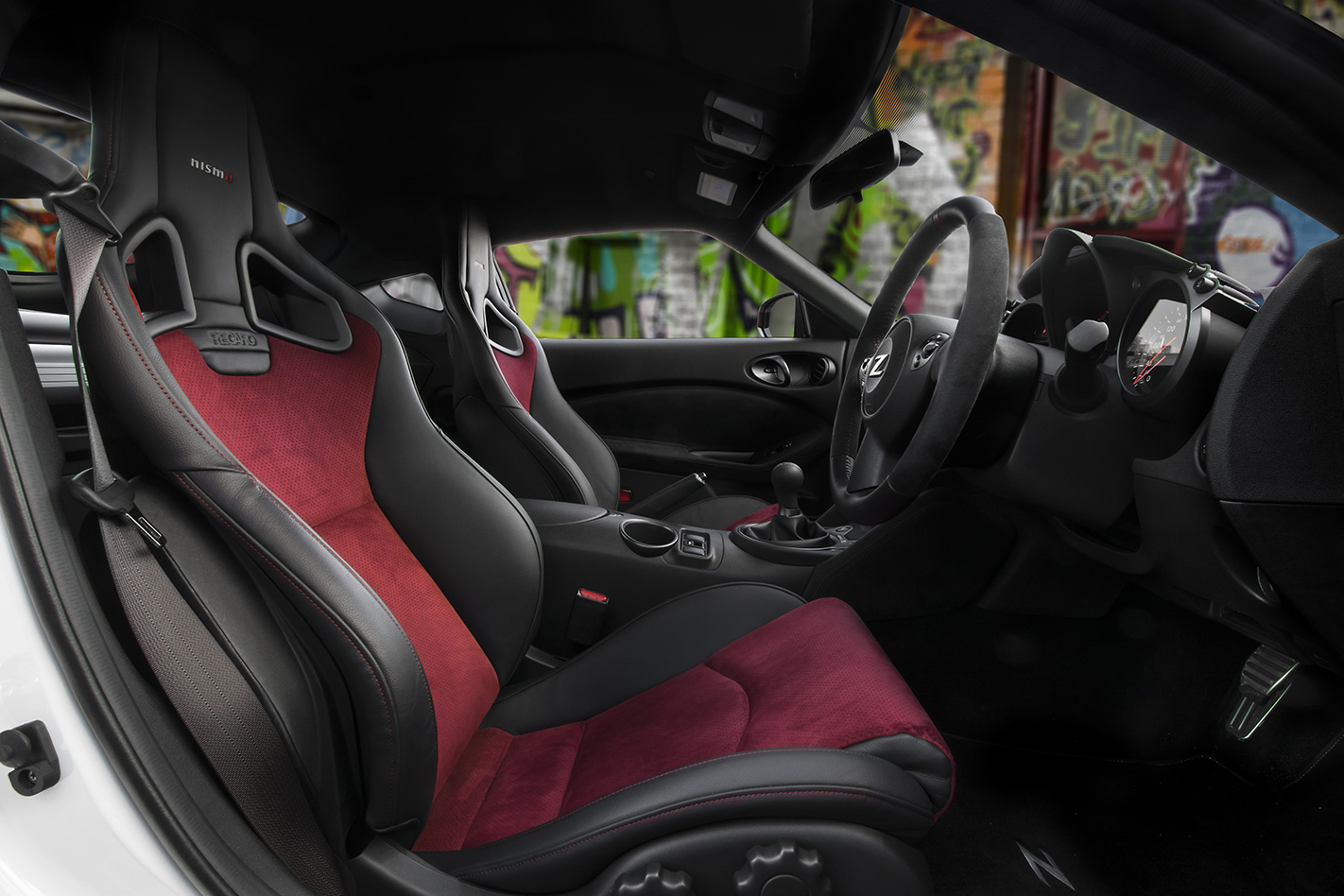
Recaro seats, too, cradle you nicely and cabin is raked like a proper muscle coupe. But dual-zone climate control, and quick-fold backrests, are sorely needed.
Okay, so what’s it like to drive?
A lot like it looks. Planted, grippy, and hunkered down. As far as sub-$75K coupes go, turn-in is more immediate than a Ford Mustang GT. And it’s more tractive than a BMW 2 Series.
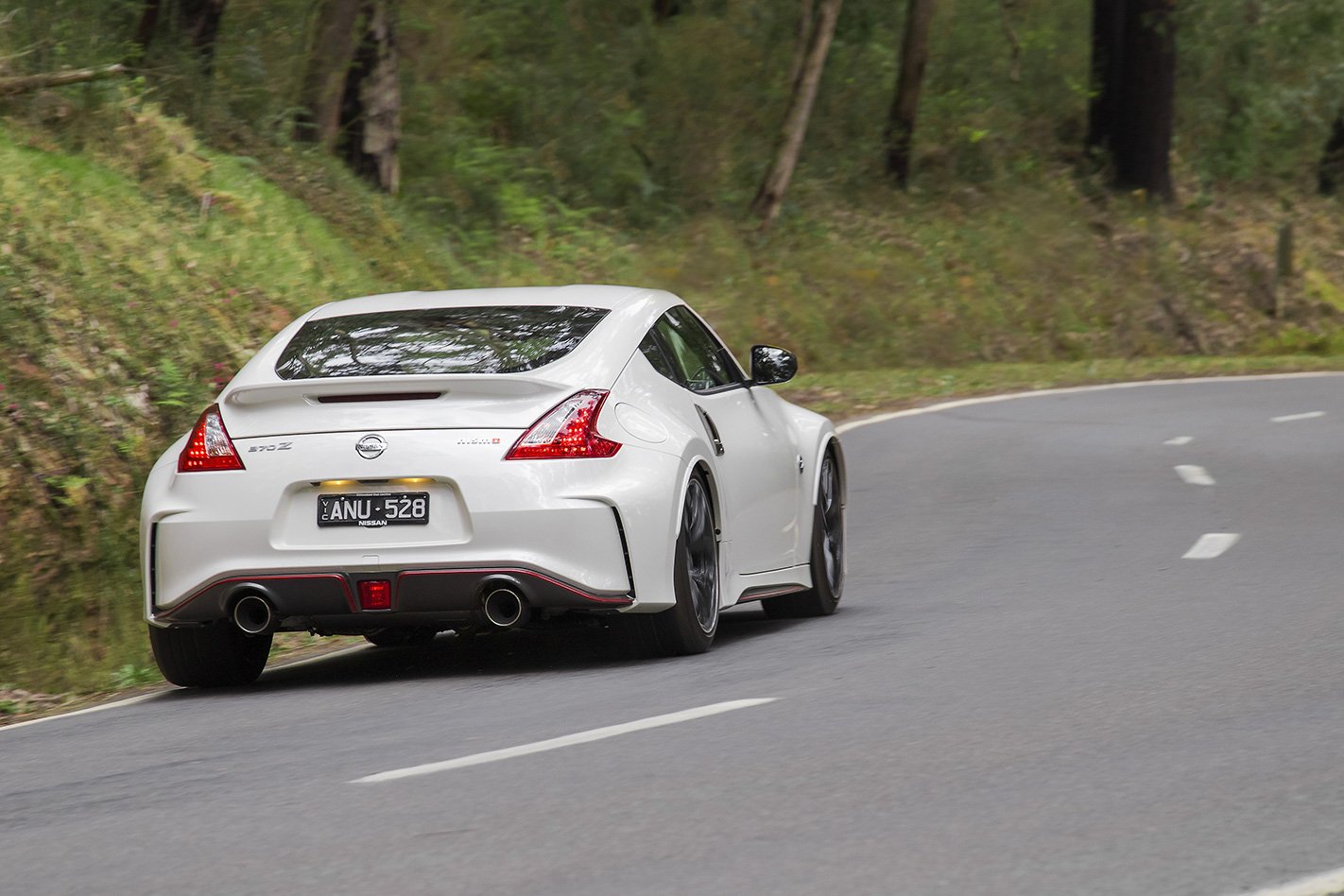
There’s also a macho feel to the way it operates. Each gear arrives with a solid clunk and the clutch errs on the heavy side. We can’t speak for the auto, as we didn’t drive one, but the Zed feels burly.
If only it sounded more like it. The new pipes have unleashed a noise, but it’s a bit strained and whiney, failing to impersonate an atmo GT-R as you might hope.
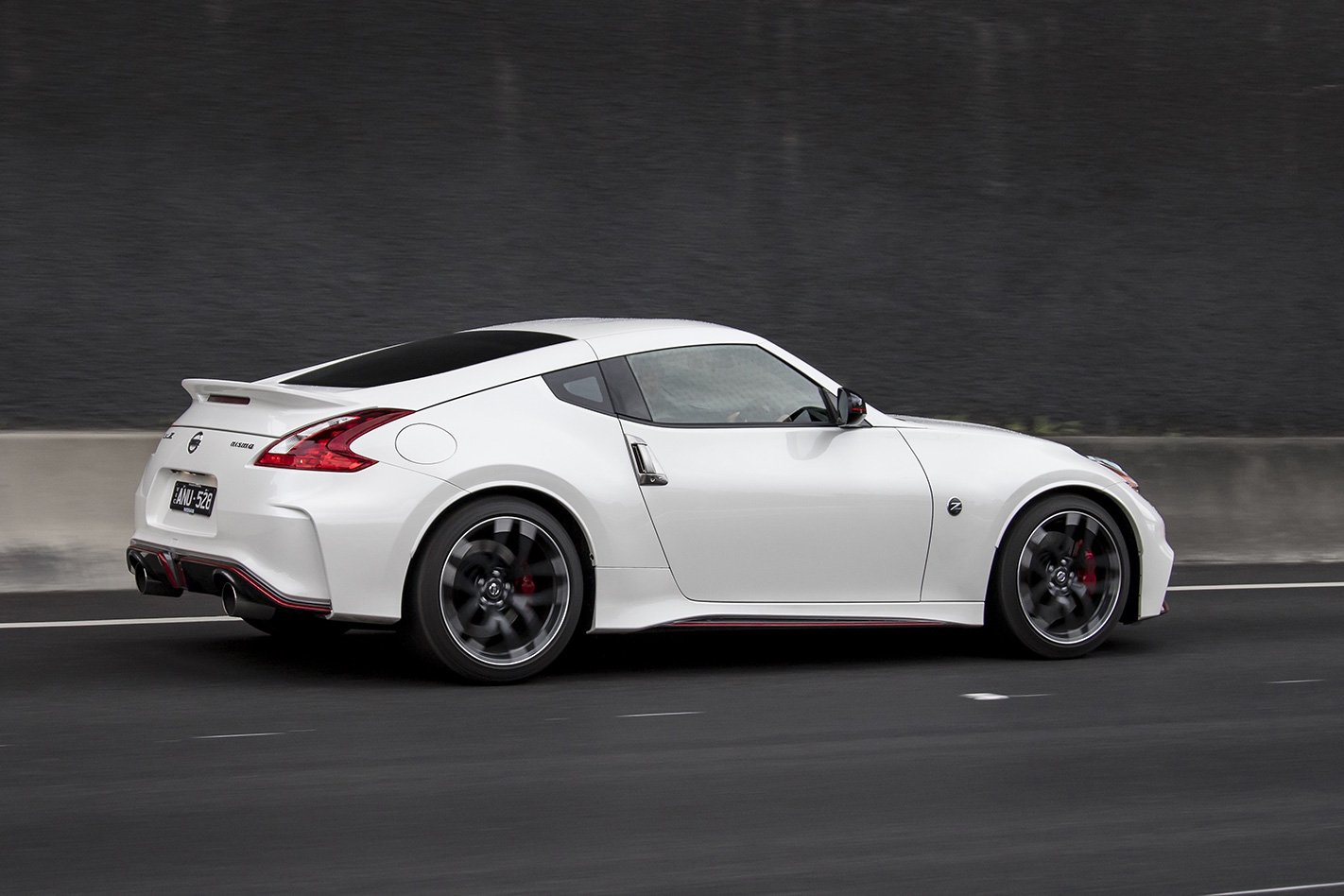
Find flowing, smooth roads, though, and the Zed eggs you on with a beautiful handling balance and long-legged V6, which feels most potent lingering around its 7500rpm redline
And the damage?
With the Nismo’s arrival pushing down the base car’s price to $49,990 there are about 11,000 reasons to dodge the range topping Zed, which asks $61,490 with a manual. An auto wants $2500 extra.
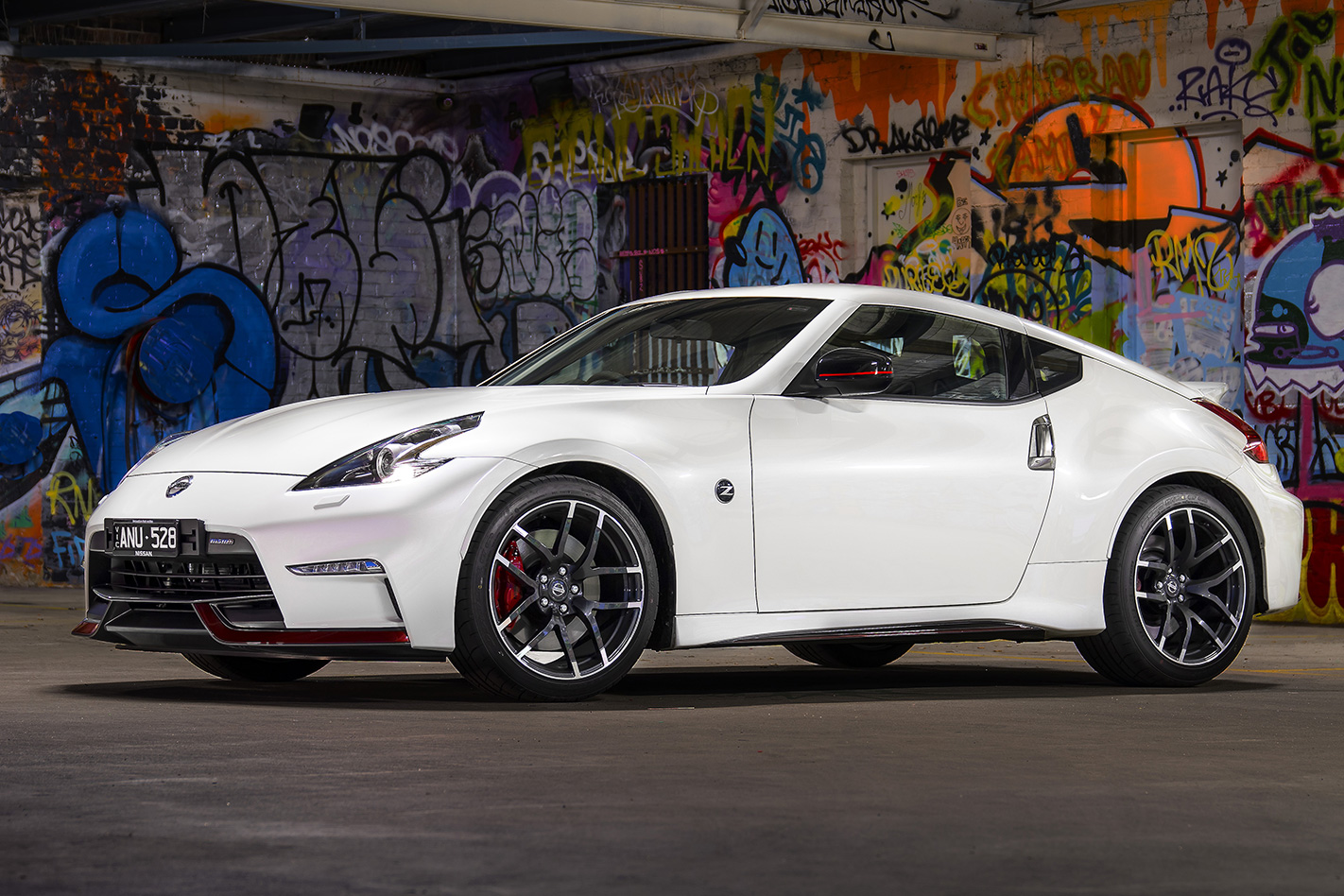
The exhaust has finally given the big-capacity six some proper pipes, even if it doesn’t sound overly organic, and the sharpened, communicative handling is what exactly what you’d expect of a true two-seat sportster.
Although it has no real rivals at this price, there is a genuine case against a Mustang V8 here. And it still looks like it’s coming out next year. Just as well, because the 370Z Nismo’s been worth the wait.
2018 Nissan 370Z Nismo specifications Engine: 3696cc V6, DOHC, 24v Power: 253kW @ 7400rpm Torque: 371 @ 5200rpm Weight: 1490kg Transmission: six-speed manual; seven-speed automatic 0-100km/h: N/A Price: $61,990 Star Rating: 4.0 stars out of five
Nismo takes the 370Z to the gym, transforming it from swift coupe to track star.
WHAT IS IT?
A late-life testosterone injection for Nissan’s eight year-old sports car, with plenty of input from Nissan’s motorsport arm, Nismo.
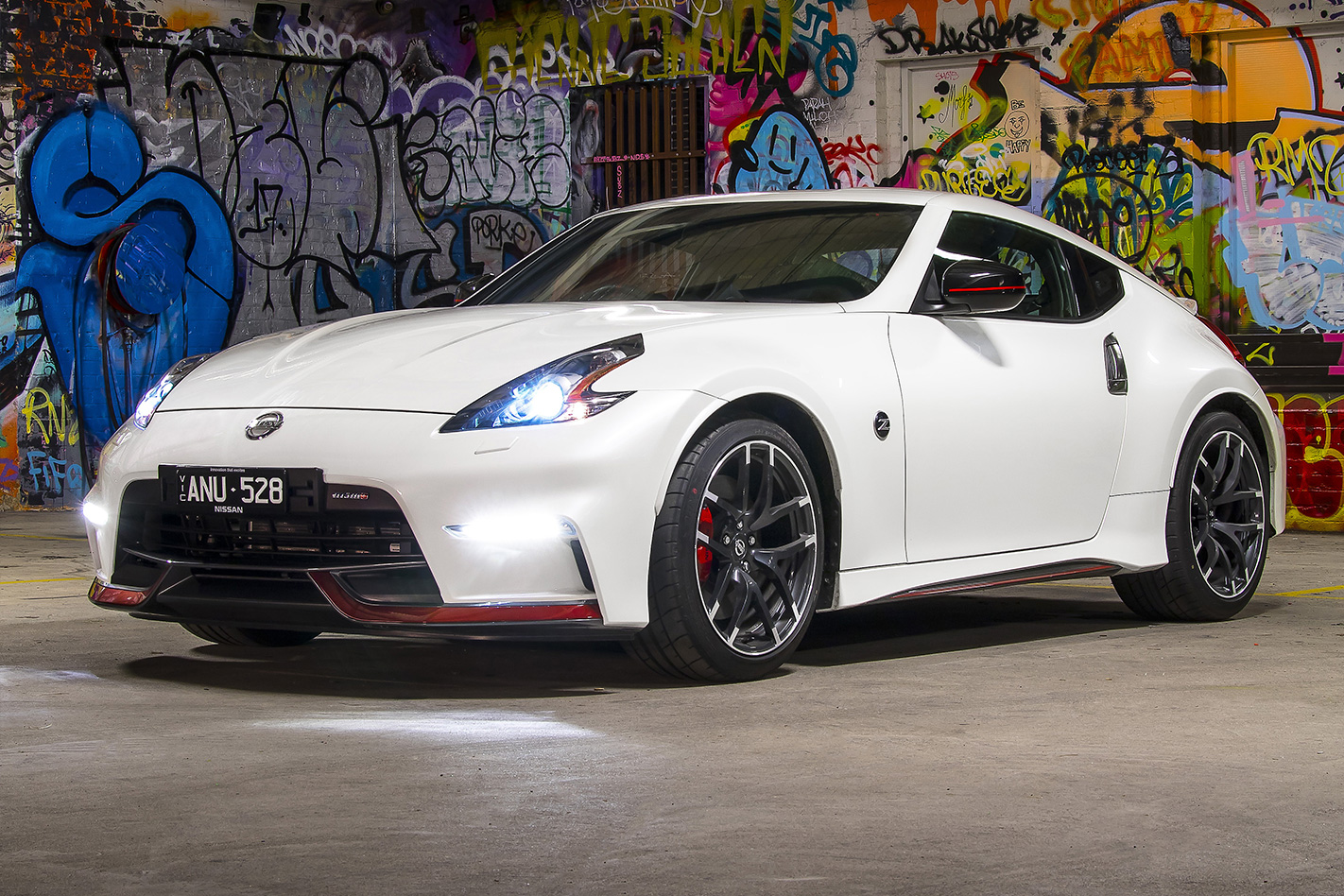
The 370Z is an old nameplate by now, having arrived locally in 2009 and undergoing only minor updates since. The arrival of the 370Z Nismo flagship is the biggest change to Nissan’s classic sports car yet, but does it go far enough to boost the Zed’s appeal?
MAIN RIVALS
The 370Z Nismo retails at $61,490, which places it $4000 above a V8-engined Ford Mustang GT Coupe, but well below a $74,900 BMW M240i – a car which is closer to the Nismo in terms of power and size than the Mustang, but comes at a significant premium.
THE WHEELS VERDICT
Nismo’s power increases may be modest, but the real story is in how Nissan’s in-house high-performance division has managed to tighten the screws on the 370Z’s already sharp-handling platform.
It’s a bit of a handful on patchy backroads, but when the windscreen is filled with smooth and tight bends the 370Z Nismo comes into its own. Too focused for some, probably, but the upshot is that there’s still the standard 370Z for the less hardcore drivers out there while real Nissan performance zealots can finally park a bona-fide Nismo sports car in their garage without having to spring for the $299k GT-R Nismo.
MINUS: Deafening road noise; synthetic exhaust note; brittle ride; no reach adjustment to steering
THE WHEELS REVIEW
THE 370Z notched up eight years in the Australian market in April, a birthday which, in car terms, truly qualifies the Zed for a seniors card – if not a letter from the Queen.
It’s old, we know that, but in its eighth year two major developments have occurred – the standard 370Z received a price adjustment in August that saw the manual-equipped coupe dip below the $50k mark for the first time, while the sharper 370Z Nismo that’s been on sale overseas for two years has finally arrived on Australian soil.
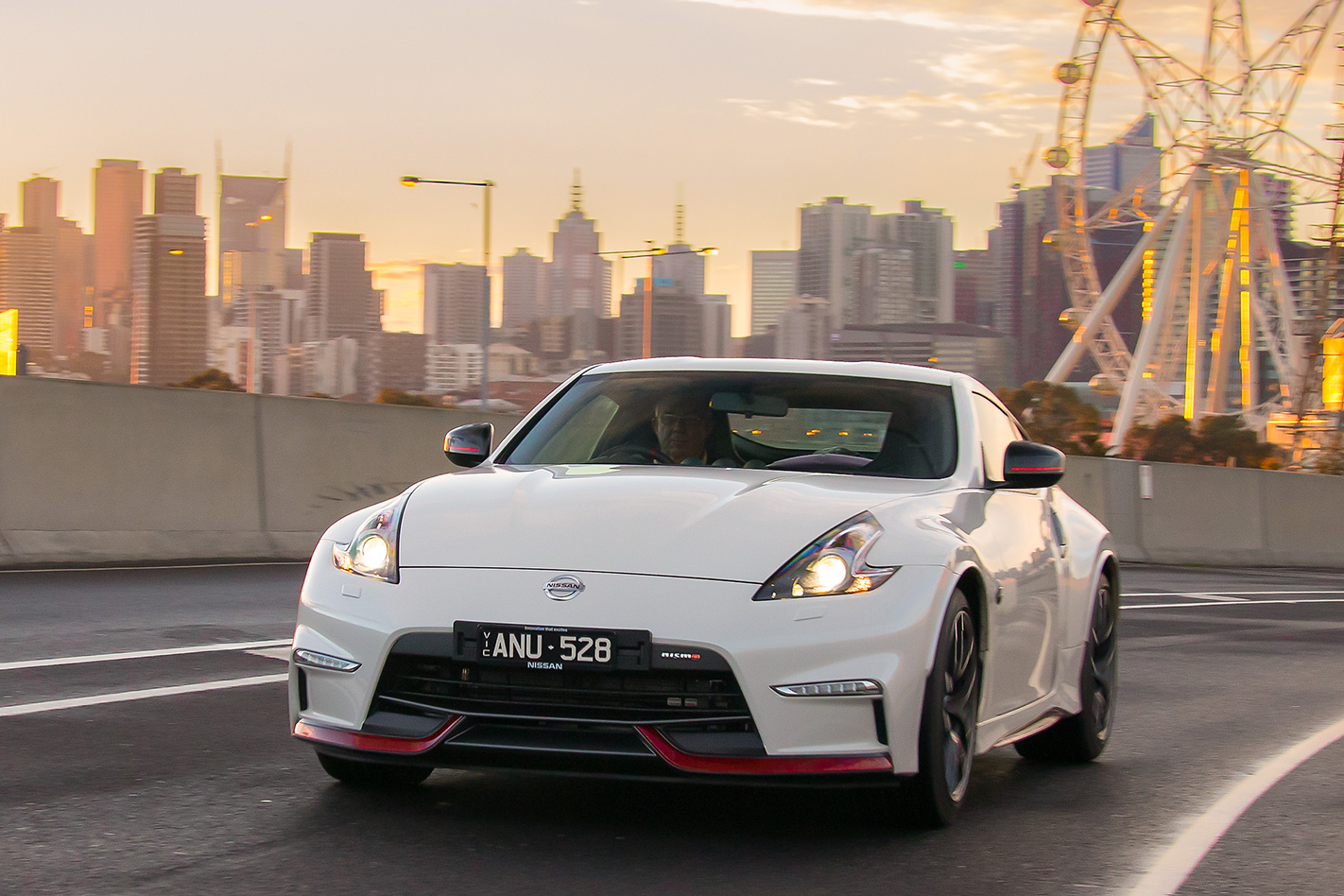
Not that the basic package was especially lacking, mind you. There’s been little in the way of mechanical updates for the 370Z over the past eight years, but the 3.7-litre naturally-aspirated VQ37VHR V6 has always been a linear and torque-rich motor, with a fat mid-range courtesy of trick variable valve timing and variable valve lift hardware.
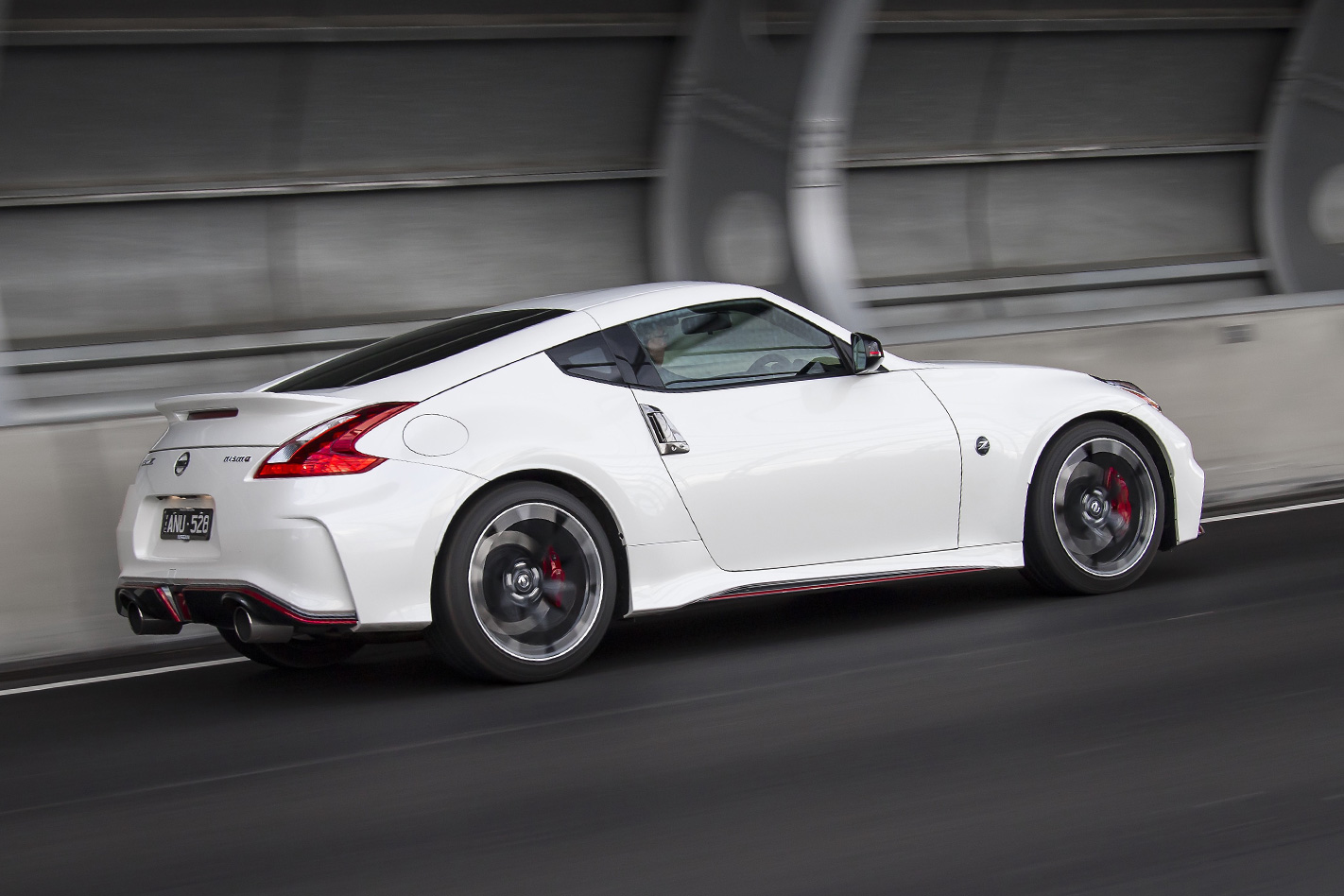
Yet, with only 8kW more peak power and 13kg more weight to lug, the 370Z Nismo doesn’t feel that much swifter than the boggo Zed in a drag race. Instead it is corners that the Nismo is designed to assault, not the quarter mile.
Firmer springs and dampers are exclusive to the Nismo, but the ultra-stiff suspension overstays its welcome on choppy backroads. The front tyres skip over nastier pockmarks and there isn’t the compliance necessary to keep traction over rough surfaces.
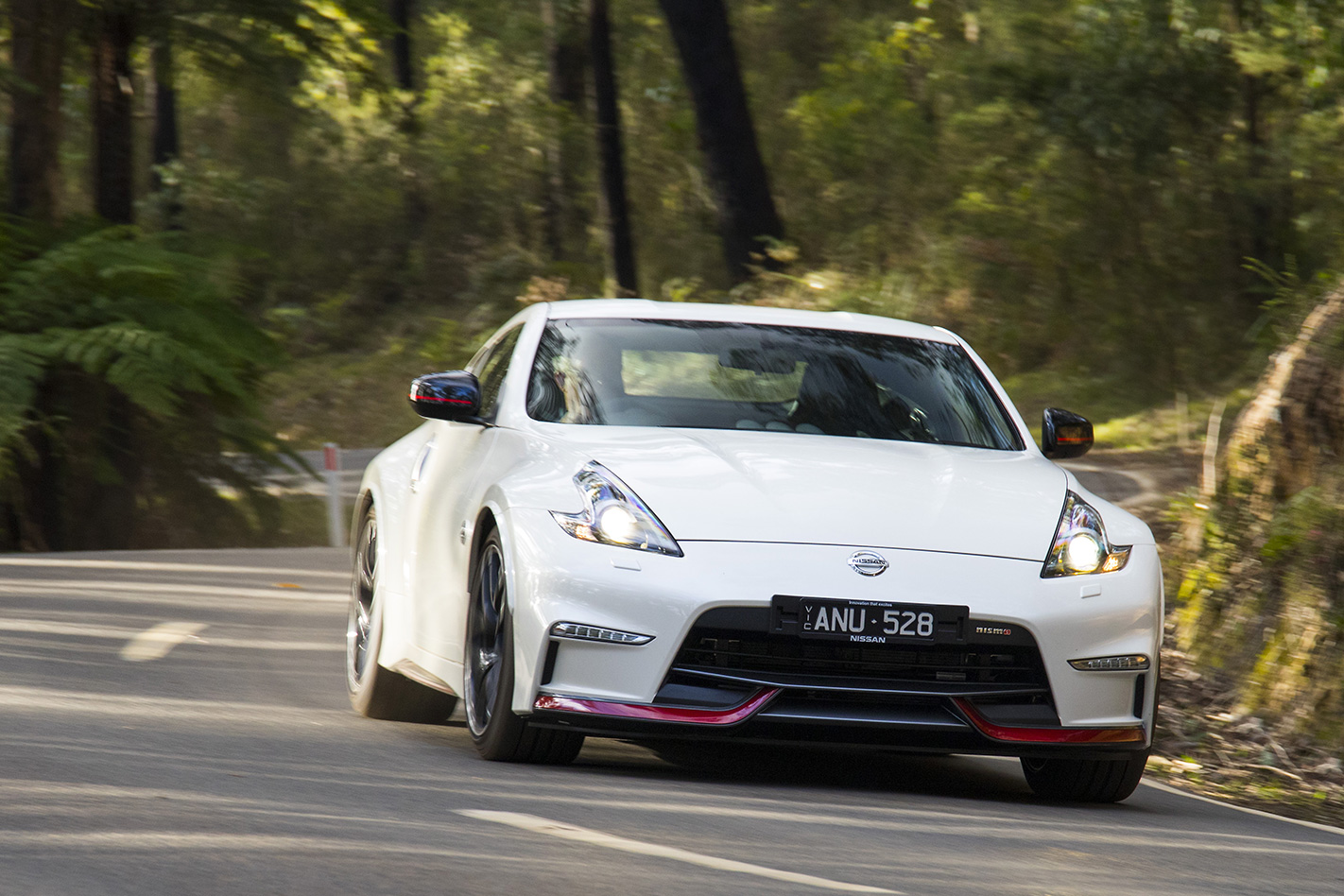
Meanwhile, the Zed’s old-school hydraulic steering is a tactile, fast-ratio delight, and meshes well with its responsive double-wishbone front suspension. Driven hard, there’s the sense that the taut Nismo-tuned undercarriage would work wonders on a racetrack.
So too would its aero-optimised bodykit, which improves airflow to heat exchangers and reduces lift at high speed, while Nismo-specific bolt-on chassis braces and vibration dampeners also stiffen the 370Z’s structure to improve handling. The Nismo-branded Recaro seats are another useful feature for track junkies, offering vastly better lateral and under-thigh support than the standard 370Z seats and featuring pass-throughs for a racing harness too.
Gearbox whine is also prominent, but is at least in keeping with the Nismo’s posture as a motorsports-inspired road car. Mechanical noises like that are just cool sometimes, and refinement is overrated in sports cars anyway. That said, road noise on coarse-chip is properly deafening – pack earplugs if you’re planning a road trip.
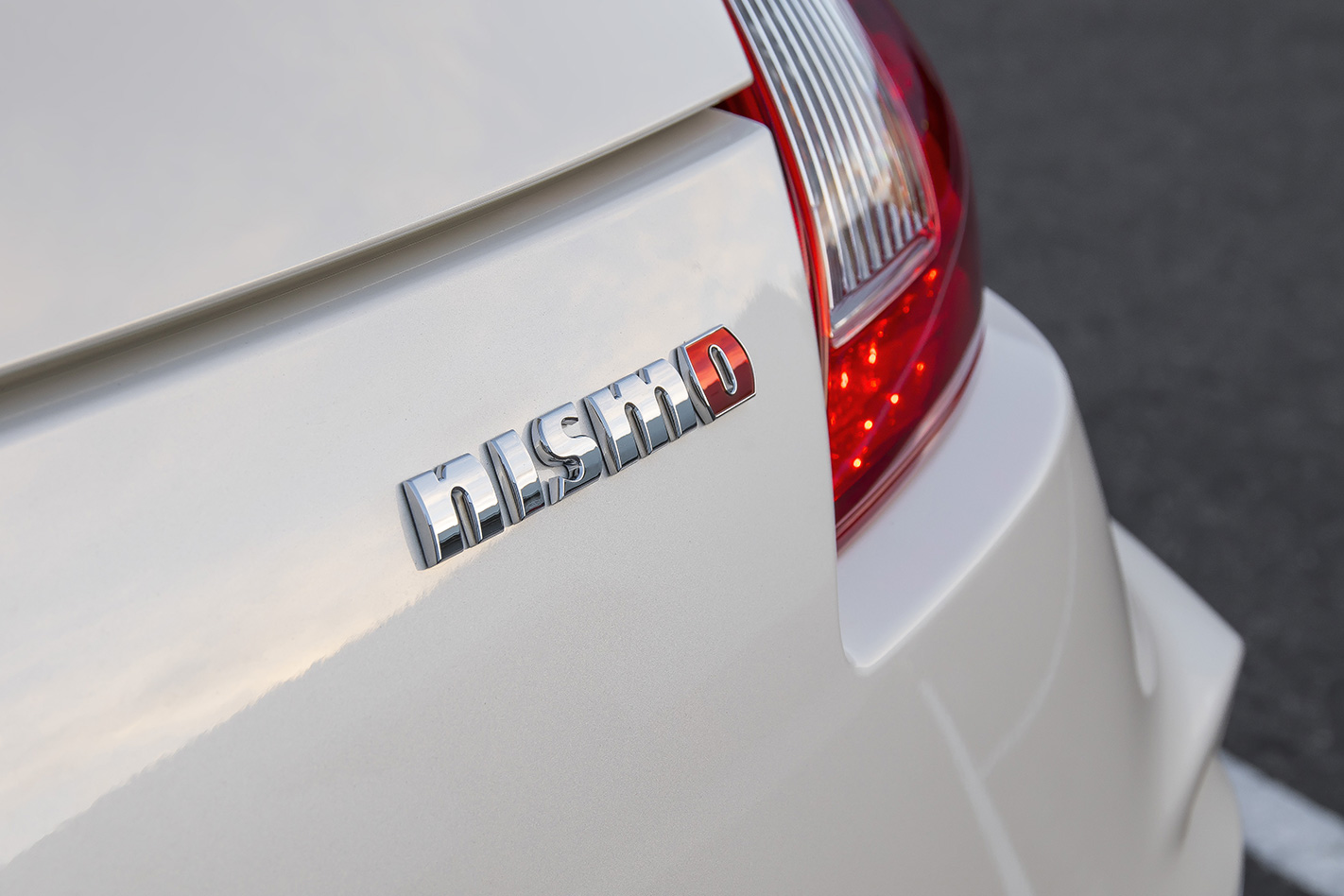
The only major additions to the 370Z’s cosy cabin are the aforementioned Recaro seats, an Alcantara-wrapped steering wheel, and a sprinkling of Nismo badges and crimson highlights. The interior fit-out is where the 370Z shows its age the most though, and while the GT-R recently scored a comprehensive interior update, its baby brother soldiers on with dated interior décor. Build quality, at least, is hard to fault.
And you’ll want to feel comfortable in the pilot’s seat, because the 370Z Nismo expresses a lot of old-school sports car values in the way it drives, and many of them are traits that are fast becoming extinct. Things like feelsome hydraulically assisted steering, a balanced front-engine, rear-drive chassis, and a zingy naturally aspirated engine – turbocharged hot hatches are thick on the ground these days, while sports cars like the 370Z are not.
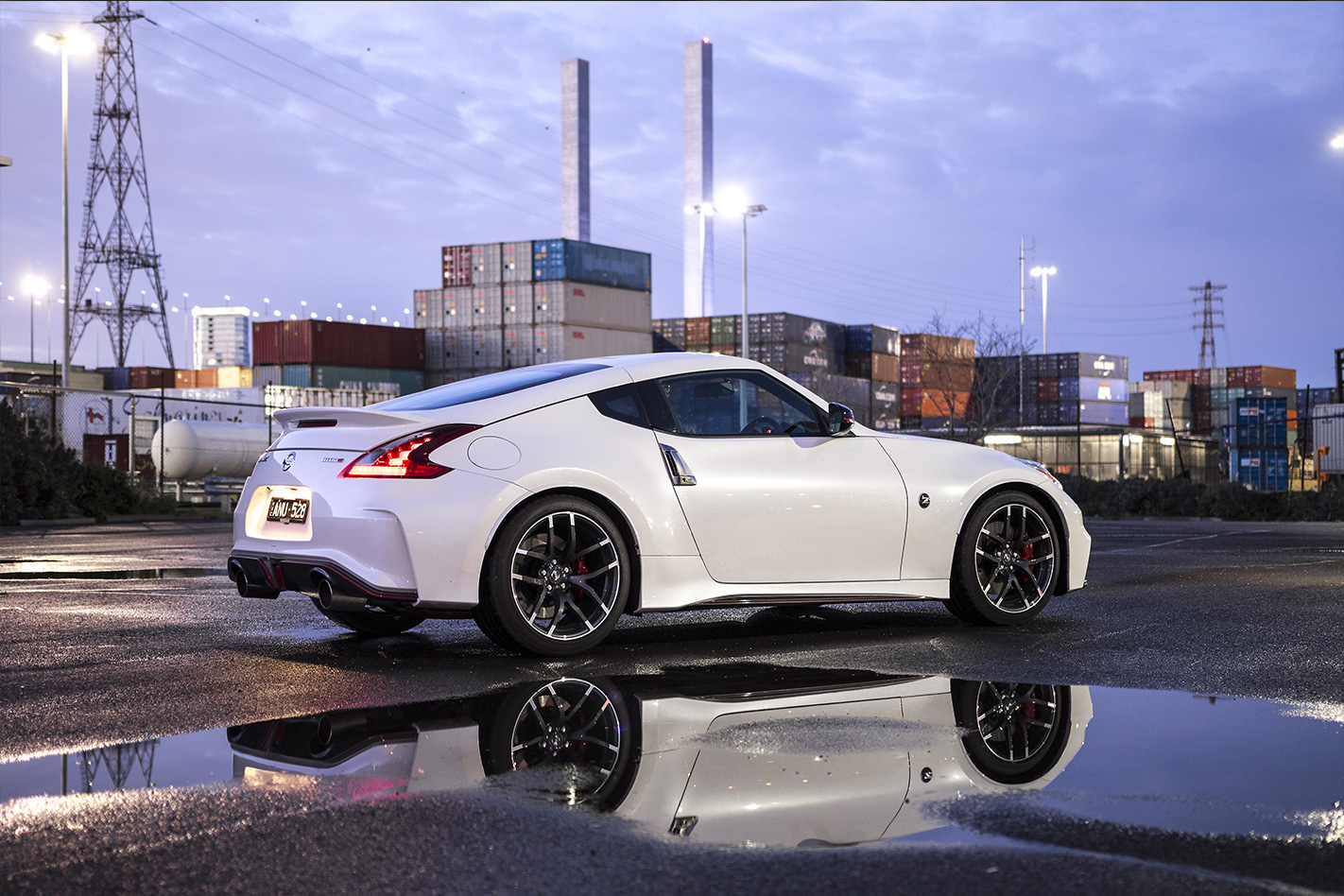
SPECS
Model: Nissan 370Z Nismo manual Engine: 3696cc 6cyl, dohc, 24v Max power: 253kW @ 7400rpm Max torque: 371Nm @ 5200rpm Transmission: 6-speed manual Kerb weight: 1480kg Fuel economy: 10.6 L/100km Price: $61,490 (estimated) On sale: Now
What stands out?
The Subaru Levorg is a smart looking and quite quick alternative to a high-riding SUV wagon. It’s a reward-yourself car, offering a choice from two turbocharged engines – one of them borrowed from the sports-focused Subaru WRX – and wrapping them in a safe five-seat package that’s friendly to dogs, families and weekend getaways. An auto transmission is standard, as is auto-braking.
What might bug me?
Talking over the tyre roar. Engineers wanted owners to tap that gutsy WRX engine, so they specified Dunlop tyres that prioritised grip over everything else – including a hushed cabin.Possibly the bumpy ride around town. Like that on the WRX, the suspension on the Levorg prioritises stable handling when the car is driven hard. Subaru says Levorgs introduced in August 2017 for the 2018 model year ride more comfortably, however.Admitting to front passengers that adjustment for their seat is manual – even on the more expensive 1.6 GT Premium, 2.0 GT-S and 2.0 STI Sport Levorgs, which give the driver a power-adjustable seat with a memory.Driving at 80km/h on your space-saver spare until you can fix your full-size flat tyre.
What body styles are there?
Five-door wagon only.Every Levorg drives all four wheels, at all times.The Levorg is classed as a medium car, lower priced.
What features do all Levorgs have?
Dual-zone climate control, which lets the driver and front passenger set temperatures independently. A reversing camera.Proximity-key entry and start, which lets you unlock the car and drive away without removing the key from your pocket or bag.Active cruise control, which can automatically maintain a safe distance from vehicles in front on the highway.Self-levelling headlights, with very bright and long-lived LED beams. The headlights also switch on automatically when it’s dark, and shine into corners when you turn the wheel. Windscreen wipers that work by themselves when it rains.A colour touchscreen, from which you can control the sound system and other cabin functions. Sound sources include an AM/FM radio, a CD player, aux and USB inputs, and Bluetooth connectivity for phone calls and audio streaming.Height and reach adjustment for the steering wheel, which carries controls for the audio system. Height adjustment for the driver’s seat.Two USB charging ports up front, and another two for those riding in the rear. A 12-volt power outlet in the boot space, which is handy if you want to use a car fridge.Folding mirrors that tuck themselves into the body when you turn off the car, which is handy in tight garages.Wheels made from aluminium alloy, which are usually lighter and better looking than steel wheels with plastic covers. A speed limited, narrower, space-saver spare wheel that’s only meant to get you to the nearest tyre shop.All-wheel-drive. The Levorg sends drive from the engine to all four wheels at all times, improving traction in slippery conditions.Subaru’s third-generation EyeSight active safety suite. It includes automatic emergency braking that works at city and highway speeds, and an alert that warns if you are drifting out of your lane.Seven airbags. Electronic stability control, which can help you recover from a skid. (For the placement of airbags, and more on EyeSight, please open the Safety section below.)Eight exterior colours are available on a Levorg, and unlike many makers Subaru does not demand you pay extra for any of them.Every Subaru Levorg carries a three-year, unlimited kilometre warranty.
Which engine uses least fuel, and why wouldn’t I choose it?
Two engines are available in a Levorg, both turbocharged four-cylinder petrols. The more fuel-efficient is the smaller, a 1.6-litre, which uses 7.4 litres/100km on the official test (city and country combined).Subaru introduced this engine when it extended the Levorg range in August 2017.WhichCar reviewers are yet to drive a 1.6-Litre Levorg. However, supplied details suggest it will feel stronger than most popular small cars, such as Subaru’s own Impreza or a Volkswagen Golf, but won’t match hot hatches such as the Volkswagen Golf GTI.Which means the main reason you wouldn’t choose a Levorg 1.6 is that you want the full-fat sports-wagon experience. That comes with the other engine available, a 2.0-litre borrowed from the Subaru WRX.Levorgs with the 2.0-litre engine offer hot-hatch performance and more, while consuming 8.7 litres/100km on the test.The cylinders in both Levorg engines are laid flat in what’s called a boxer configuration (the pistons move in the same way as two boxers standing back-to-back throw punches). That is an exceptionally smooth-running layout, and it helps keep weight low in the car (for better handling).Every Levorg has a continuously variable transmission (CVT). Unlike a conventional auto, which drives through fixed gear ratios, a CVT can match the engine speed seamlessly to the driving conditions, improving response and efficiency. However, artificial ratio-steps allow the Levorg CVT to mimic six-speed or (on 2.0-litre cars) eight-speed conventional automatics when desired.
What key features do I get if I spend more?
The least costly Levorg is the 1.6 GT, which comes with cloth-covered seats, a 6.2-inch central touchscreen, 17-inch wheels, the less powerful engine, and the equipment in all Levorgs.Spending more gets you a Levorg 1.6 GT Premium, which has the same engine but brings you suspension from specialist Bilstein, 18-inch wheels with wider tyres (for more grip), and more luxury and driver assistance.The 1.6 GT Premium comes with leather trim on the seats, heating for both front seats, and powered adjustment, with a memory, for the driver’s seat. The central touchscreen is bigger at 7.0-inches, and it displays satellite navigation. There is a power-opening sunroof. Headlights dip automatically for oncoming drivers. And you get an additional suite of sensory driver aids that Subaru calls Vision Assist, comprising lane-change assist, blind-spot monitor, rear cross-traffic alert, side-view monitor, and front-view monitor.Spending more again on a Levorg 2.0 GT-S brings you the Bilstein suspension, bigger wheels, and other equipment from the 1.6 GT Premium but swaps the smaller engine for the much stronger 2.0-litre unit.Finally, spending as much as possible on a Levorg will get you a 2.0 STI Sport, which trims the seats in maroon leather and adds a range of race-themed aesthetic touches from Subaru’s race department, Subaru Tecnica International (STI). The 2.0 STI Sport also runs a different suspension tune: Subaru points to pink-coloured springs from STI, and suggests damping and mounts have been firmed up to match.
Does any upgrade have a down side?
Adding a sunroof robs the interior of headroom. If you’re a tall driver it’s worth checking you can comfortably sit in a Levorg with a sunroof fitted (that’s all of them, except for the Levorg 1.6 GT).
How comfortable is the Levorg?
Not as comfortable as you might assume, and especially when driving around town. That was our verdict after driving the original Levorgs at Subaru’s launch event.Low-speed ride was described as fussy, with every lump and bump on the road making its way into the cabin.Things improved a lot if you built up to freeway speed, when the Levorg rode with aplomb most of the time. But it would still give a big thump if you were on a particularly rough bit of road and hit a sharp bump.It looks like someone influential at Subaru reached similar conclusions. And so cars arriving from August 2017, when the range expanded to four, have two significant revisions aimed at improving the ride.First, the Levorg 1.6 GT, the least costly Levorg, comes with smaller diameter wheel rims, and narrower tyres with a slightly deeper profile. They should absorb suburban bumps at least a little bit better than the shallower tyres on the original Levorg 2.0 GT.Second, Subaru says it has got into the Bilstein suspension that comes with the other cars and adjusted the spring stiffness and damper tune, among other aspects, with the aim of improving comfort.Unfortunately we can’t tell how successful the engineers have been, because Subaru has not been able to get us a car. You’ll know soon after we do – we’ll update this article.Our other criticism from the Levorg’s launch highlighted the tyre roar. The Levorg’s handing – and it does go around corners very well – was built around the tyres, which were chosen more for grip than anything else. They grip, but over coarse-chip roads, which cover most of Australia’s road network, they make a lot of noise. How much? It’s a bit like sitting in a plane as it is taking off. And that is not likely to change.In other respects the Levorg shows itself as a good long-distance tourer. The front seats are comfortable and supportive, and the 2.0-litre engine is happy to tool along at low revs on the highway.
What about safety in a Subaru Levorg?
The Levorg’s standout standard safety package builds on seven airbags, a reversing camera, anti-lock brakes and the mandatory stability control, adding to this auto-on LED headlights and wipers, active cruise control, and other features of Subaru’s third-generation EyeSight active safety suite.In any Levorg there are knee and head airbags directly in front of the driver; a head airbag in front of the front passenger; an airbag alongside each front occupant at chest level; and a curtain airbag down each side protecting the heads of front and rear occupants from side impacts.EyeSight is based on a pair of forward-looking cameras that – just like a pair of human eyes – can judge the distance to objects in front (with the help of an electronic brain). The Levorg uses them to watch that you’re not about to rear-end the car in front, or to collide with a pedestrian, and it can automatically jump on the brakes to avoid a collision. This autonomous emergency braking system works not only in the city but also at highway speeds.EyeSight also focuses on where you are in relation to lane markings, and alerts you if you have begun to drift distractedly – and perhaps very dangerously – into another lane. And it can let you know that a car ahead of you in a queue has moved off.Paying more for a Levorg 1.6 GT Premium, 2.0 GT-S or 2.0 STI Sport brings you additional driver aids under the description Vision Assist. These guardian angels warn you if there is a car alongside to the rear that you can’t see in your mirrors, or if you are about to change lanes into the path of a car roaring up from behind. They will also tell you if you’re about to reverse into oncoming traffic, an aid aimed at saving you from carpark and driveway crashes.From August 2017 the Vision Assist cars also have Side view and Front view monitors. The former helps you see how close your wheels are to the gutter when parallel parking. The latter places a camera at the very front of the bonnet, giving you a chance to see past vehicles that may have pulled up alongside – when you are waiting to make a turn, for example.The Australasian New Car Assessment Program (ANCAP) rated the Levorg at five stars for safety, in June 2016.
I like driving – will I enjoy this car?
You should. The Levorgs are targeted at families, and because you might need to share one around the family – including teaching the kids how to drive – Subaru has fitted the cars with only a continuously variable transmission (CVT), a version of an automatic gearbox that is able to always keep an engine in its most fuel-efficient, or powerful, spot.The CVT takes a bit of getting used to, as at times it sounds as though the clutch is slipping and the engine seems to just drone away under the bonnet.However, there is a manual mode in which it acts more like a conventional six-speed automatic, allowing you to use a pair of paddle shifters mounted on the steering wheel to pick a gear ratio.There is also a button on the steering wheel that lets you switch between normal, Sport, and on 2.0-litre cars Sport# (pronounced sport-sharp) modes. Sport and Sport# change the way the engine and gearbox respond to the accelerator pedal, making the car jump more smartly as you squeeze with your right foot. And Sport# adds two more steps for the CVT, so that it feels something like a conventional eight-speeder.In 2.0-litre form, the Levorg is quick, with a 6.6-second 0-100km/h sprint – meaning you will have a fair chance of winning the traffic-light drag race, if that’s your thing. It also makes very light work of overtaking on the highway.We’ll let you know about the 1.6 Levorgs after Subaru hands one over.The best bit of the Levorg from a driver’s point of view is grip. The Dunlop tyres hang on like limpets, meaning you can push harder through corners than in very many other cars.
How is life in the rear seats?
Not bad, apart from the tyre roar that fills the cabin. All three seats across the rear are nicely bolstered and comfortable, with adequate headroom, assuming you don’t want a sunroof. The front seatbacks have scallops in them to give knee room to rear-seat passengers, and there’s enough space under the front seats to tuck toes in comfortably.There’s a fair bit of body roll, so expect rear-seat passengers to slosh around from side to side on a twisty road.The electronic-device-friendly USB ports on the back of the front-seat armrest will keep connected kids powered up and happy – as long as there are only two of them.
How is it for carrying stuff?
Quite good. The Levorg is the sort of family car we used to buy before high-riding SUVs became the new darlings of the car world. There’s more than enough room on the centre console to stash a purse, wallet and mobile phone, and front door bins with generous-sized drink holders make up for a relatively small glovebox. The rear door bins are smaller, but still useful.Where the Levorg shines over a hatchback is boot space. With the rear seats up, you have 522 litres of packing space, or about the same as similar wagons with swept rooflines. Fold the rear seats down and you get 1446 litres of space (which is 100 litres less than the much boxier looking Skoda Octavia).One distinction from medium SUV alternatives arises in the towing capacity: on a Levorg, the legal limit for a braked trailer is only 800kg, with a maximum towball download of 80kg.Subaru expects people may want to tow a jet ski or very light camper trailer. The electronic stability control was tuned by engineers in Australia to take the trailer weight into account.
Where does Subaru make the Levorg?
The Subaru Levorg is made in Japan.
What might I miss that similar cars have?
Perhaps support for Apple CarPlay and Android Auto, which would allow you to display some smartphone apps on the car’s central touchscreen and to control them from there (or by voice). The front-wheel drive Skoda Octavia RS 169 TSI and Volkswagen Passat wagons offer this, for example. Subaru’s own Impreza and XV, while less powerful, also offer this feature.Otherwise not much. The Levorg is very well specified. In 2.0-litre form, its 197kW performance and all-wheel drive are hard to match in a medium wagon for similar money.
I like this car, but I can’t choose which version. Can you help?
This is one instance where shopping down the model range isn’t going to hurt you. A Levorg 2.0GT has the same engine as the more expensive models, so you miss no performance. The cloth seats are just as well bolstered as the leather ones in the more expensive cars (which, on reflection, are a bit slippery when you drive the Levorg with enthusiasm, so cloth is better), and the sunroof in the two costlier models robs the interior of valuable headroom. There is no badge telling people you’ve bought the cheap one, so it’s up to the trainspotters to pick that you’ve gone for it.
Are there plans to update the Levorg soon?
The Levorg was launched in Australia in June 2016, in 2.0-litre form only.In August 2017 Subaru extended the Levorg range, introducing a second (1.6-litre) engine with less power, and a cosmetically enhanced Levorg STI Sport (with the 2.0-litre engine). Cars fitted with Bilstein dampers received modified suspension components, and among other changes all Levorgs gained steering-responsive headlights.The Levorg is based on the fourth-generation Subaru Impreza small sedan and hatchback, and gets its 2.0-litre engine from the performance oriented Subaru WRX. The Impreza was replaced in December 2016 by a fifth-generation car, but a new-generation WRX is not expected before 2019. Don’t expect a major update for the Levorg any sooner.
The full (or almost full) list of cars featured in Forza Motorsport 7 has been revealed by Turn 10 Studios.
A total of 723 cars are said to be in the mix for the upcoming game, though around 50 of those are still unknown if the ‘complete’ list is anything to go by.
The only assumption we can make is that there are still more to come… even if they’re secret.
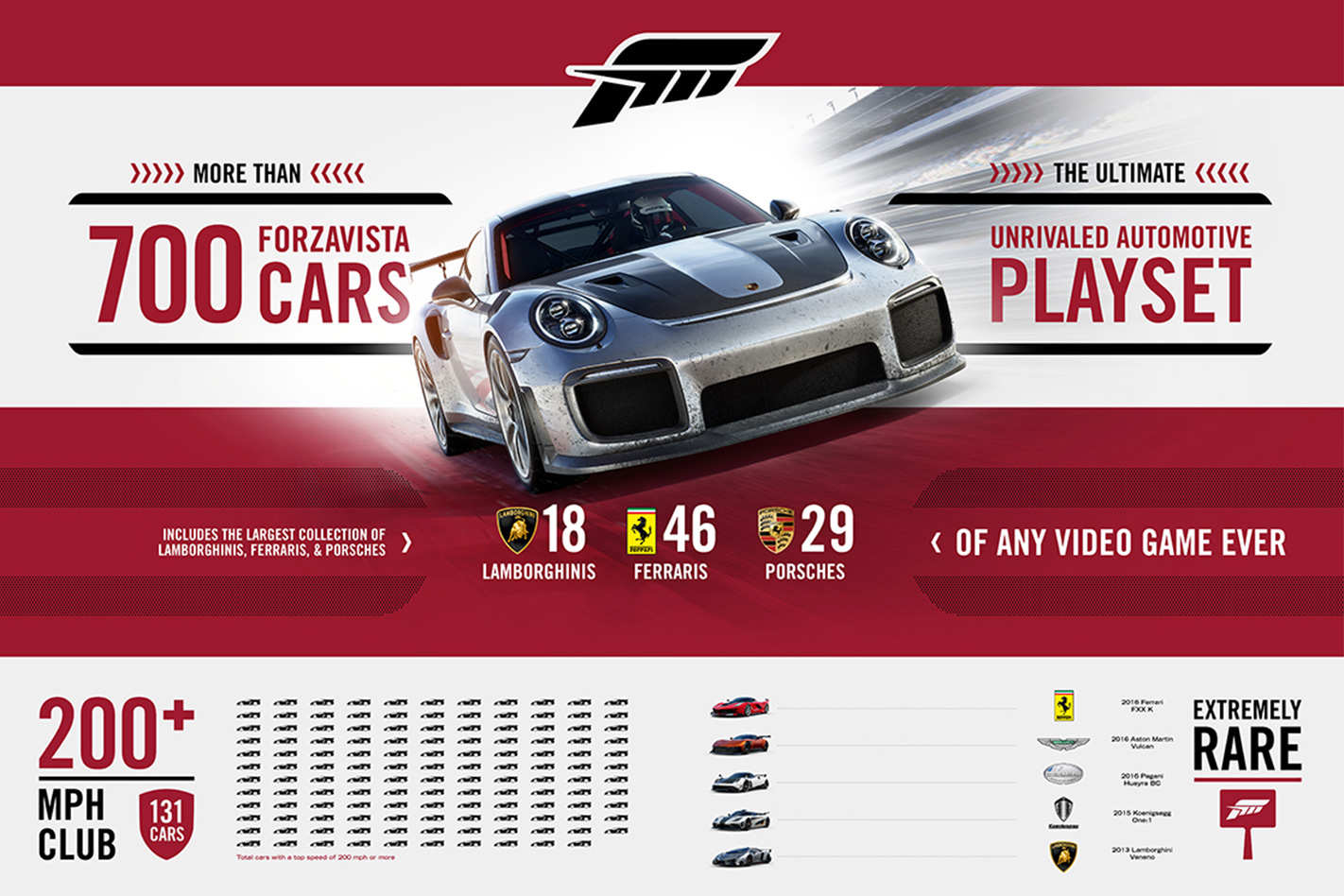
This covers everything from a ’67 XR Falcon GT, to the Walkinshaw Performance VF Commodore V8 Supercar.
Turn 10 also released a few neat infographics which reveal stats of the many cars involved, such as how many cars are from each country (a whopping 199 from the good ole’ US of A), and the lightest (1957 BMW Isetta 300 Export) or heaviest (2015 Mercedes-Benz #24 Tankpool24 Racing Truck).
We’ve pulled the full list of Aussie cars from the game for you here:
1972 Chrysler VH Valiant Charger R/T E49 1967 Ford Falcon XR GT 1971 Ford Falcon XY GTHO Phase II 1972 Ford Falcon XA GT-HO 1973 Ford XB Falcon GT 1992 Ford Falcon GT 2014 Ford FPV Limited Edition Pursuit Ute 2015 Ford Falcon GT F 351 2015 Ford Falcon XR8 2015 Ford #17 Xbox Racing Ford Falcon FG X 2015 Ford #5 Pepsi Max Crew PRA Falcon FG X 2016 Ford #55 Supercheap Falcon FG X 2017 #17 Shell V-Power Racing Team Falcon FG X 1985 HDT VK Commodore Group A 1996 HSV GTSR 2011 HSV GTS 2014 HSV GEN-F GTS 2014 HSV Limited Edition GEN-F GTS Maloo 1951 Holden 50-2106 FX Ute 1973 Holden HQ Monaro GTS 350 1974 Holden Sandman HQ panel van 1977 Holden Torana A9X 1988 Holden VL Commodore Group A SV 2009 Holden HSV W427 2015 Holden #14 Freightliner Racing VF Commodore 2015 Holden #22 Holden Racing Team VF Commodore 2016 Holden #22 HRT Sharkbite VF Commodore 2015 Holden #97 Tekno Autosports VF Commodore 2017 Holden #22 Walkinshaw Performance VF Commodore
…but you can find the entire list on the Turn 10/ Forza website.
Toyota and Mazda have joined forces to develop a common next-generation infotainment platform for future models.
Japanese news agency Nikkei reports Toyota did the grunt work on the new infotainment system before bringing in Mazda to help streamline the platform.
It is believed the jointly developed system will debut in the next-gen 2018 Toyota Camry, due to arrive in Australia next year, followed by all-new Mazda 3 later in the year.
While the system was developed in conjunction by Toyota and Mazda, the physical infotainment units will appear different in their respective vehicles, with room for individual features and apps.
However, cars from both companies will be able to take advantage of system’s Wi-Fi hotspot feature, which allows for over the air updates for the car, and a wide-array of apps.
The yet to be named system will take charge of in car navigations, music and video, with Toyota planning to make it standard on all cars sold in the US and China by 2020.
A slight hitch, is the fact the new system doesn’t support Android Auto or Apple CarPlay – at least not yet, though this could change as development continues.
The co-developed system is Linux-based – a type of computer operating system which is open-source, and originally intended for desktop computers. It is now utilised in a number of different computing situations.
Japanese mobile phone carrier KDDI is also involved in the project, maintaining the network for the in car Wi-Fi system.
Fiat’s ubiquitous 500 turns 60 this year and is still going strong with a wide range of variants ranging from affordable city cars to Abarth-badged hot hatches.
VARIANTS
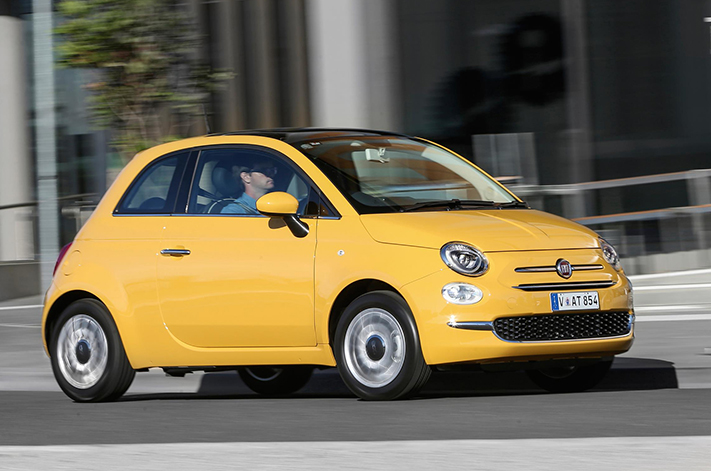
The Fiat 500 is the standard three door model, while the 500 C is a cabriolet version offering relatively cheap topless thrills. Both come with two main standard-model variants, Pop and Lounge, which sit below three Abarth models including 595/595 C, Turismo, and Competizione. The 595 C is the only Abarth covertible.
Fiat 500/500 C Pop
The Fiat 500 and 500 C Pop are essentially the same, apart from its roof, and are powered by a 51kW/102Nm 1.2-litre four-cylinder petrol engine and five-speed manual transmission, or an optional five-speed dual-clutch automatic.
The Pop spec includes a good range of standard features for its segment including a 5-inch touchscreen with Fiat Chrysler’s excellent U-Connect infotainment system with voice command, digital radio, leather steering wheel, heated power-adjustable side mirrors, tyre pressure monitoring, and 15-inch alloy wheels.
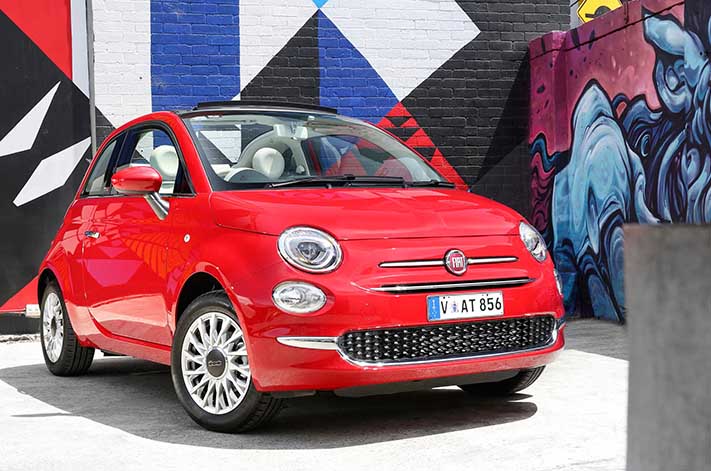
Fiat 500/500 C Lounge
Step up to the Lounge and you get a more powerful 74kW/131Nm 1.4-litre engine coupled with a six-speed manual gearbox or the five-speed dual-clutch auto. Extra features over the Pop include Satellite navigation, 7-inch TFT instrument cluster display, rear parking sensors, chrome exterior detailing, premium seat upholstery with a check design, brighter poly-elliptic headlights, and fixed glass sunroof (hatch only).
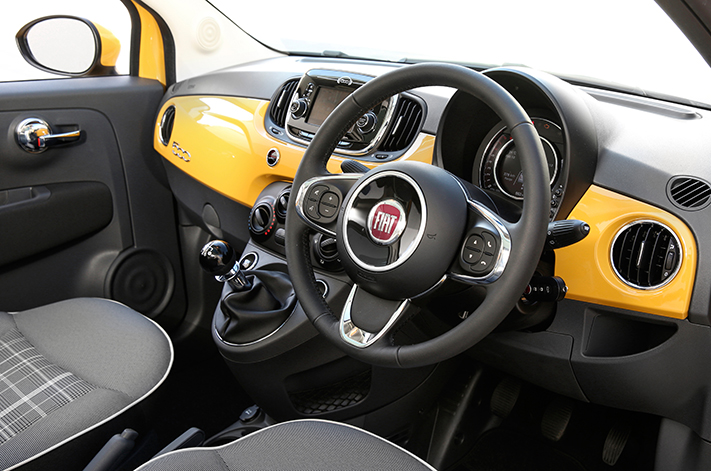
Abarth 595/595 C
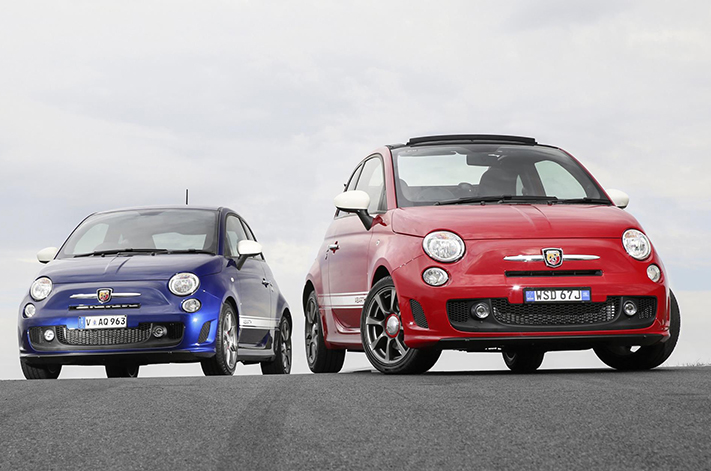
The Abarth range starts with the 595, which is the only high-performance variant to feature a soft top version (595 C). It has a significantly more powerful 103kW/206Nm 1.4-litre turbocharged petrol four with a five-speed manual transmission or a five-speed auto.
Additional features over the 500 Lounge includes 16-inch alloy wheels, red brake calipers, sports driving mode, sports pedals, front fog lights plus Abarth branded chromed steel rear twin exhaust, floor mats, side stripe, mirror covers, sports seats, and stainless steel sill plate.
Abarth 595 Turismo
The hatch-only Turismo’s 1.4-litre turbocharged engine has been tweaked to produce 118kW/230Nm and comes with extra features over the 595 including 17-inch alloy wheels, Abarth leather seats, Alutex mesh shift knob, pedals and sill plate, drilled and ventilated front disc brakes, drilled rear disc brakes, auto dimming rear view mirror, and adaptive suspension.
595 Competizione
The range-topping 595 Competizionesqueezes even more power (132kW/250Nm) out of the 1.4-litre turbo. Extra features over the 595 Turismo include 17-inch titanium finish alloy wheels, Abarth dual-mode Record Monza exhaust with quad exhaust tips, aluminium sports pedals, climate control, front Brembo brake calipers, leather steering wheel with Tricolore on-center band, Sabelt sports bucket seats, and xenon headlights.
- Fiat 500 Pop manual – $17,990
- Fiat 500 Pop auto – $19,490
- Fiat 500 C Pop manual – $21,990
- Fiat 500 C Pop auto – 23,490
- Fiat 500 Lounge manual – $21,000
- Fiat 500 Lounge auto – $22,500
- Fiat 500 C Lounge manual – $25,000
- Fiat 500 C Lounge auto – $26,500
- Abarth 595 manual – $28,000
- Abarth 595 auto – $29,500
- Abarth 595 C manual – $32,000
- Abarth 595 C auto – $33,500
- Abarth 595 Turismo manual – $34,000
- Abarth 595 Turismo auto – $35,500
- Abarth 595 Competizione manual – $40,000
- Abarth 595 Competizione auto – $41,500
OUR PICK
The Pop and Lounge models are stylish and fun to drive, though the Lounge has a definite edge on both counts thanks to its bigger engine and premium checked-pattern upholstery. This six-speed manual makes for a surprisingly sporty ride. While the cabriolet conjures pleasant images of sun soaked drives along the Amalfi Coast, its roll-back roof comes with a $4000 premium and results in some body flex, making the hatch a far more sensible choice.
If the 500 Lounge isn’t sporty enough, stick with the 595 manual for that sweet spot of Italian style and driveability at a reasonable price.
Available options
- Perfezionare pack with leather upholstery, 16-inch alloy wheels, xenon headlights (500/500 C Lounge) – $941
- Premium Pack with sunroof, sunblind, xenon headlamps, and headlamp washers (595) – $630
- Xenon headlamps and headlamp washers (595 C and 595 Turismo) – $230
- Opening Sunroof (500 Lounge) – $400
- Sunroof with sunblind (595 Turismo) – $400
- Rear parking sensors (595 Turismo) – $508
- Tri-colour paint (500/500 C Pop and Lounge) – $227
Godzilla R32 restorers should brace for good news.
Speaking to Steven Dunn, Nissan Australia’s product and technical training manager, MOTOR has learned Nissan Australia will announce Nismo’s heritage parts program before this year’s end.
“We’re going to launch a parts program to help people restoring older cars. As we know parts are becoming harder and harder to get over here,” he revealed at Nissan’s 370Z Nismo launch.
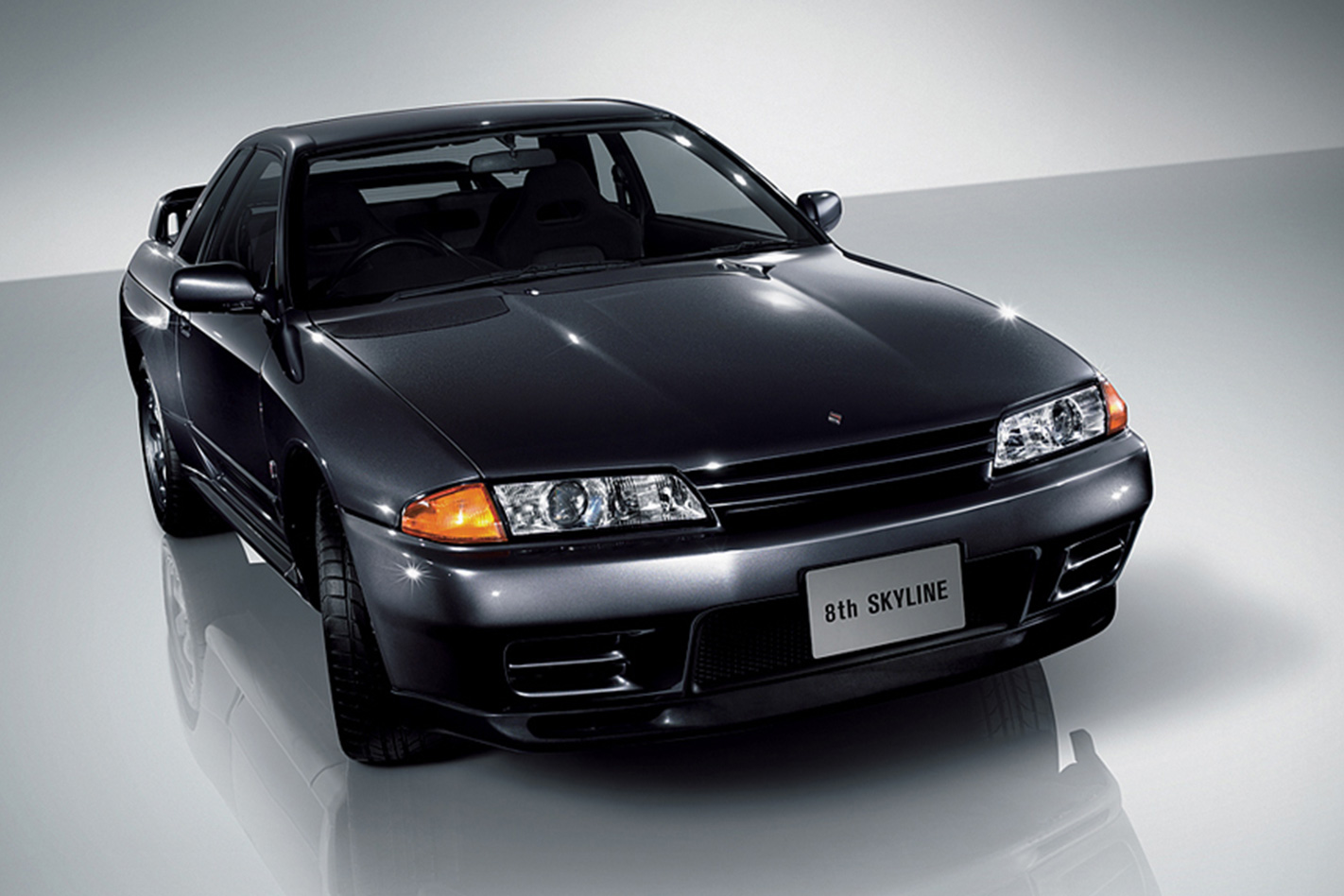
It was outlined during the webcast the Skyline R32 GT-R would be the program’s first focus with other models being considered based on its initial success.
“Because unfortunately people crash their cars, and aluminium bonnets and guards are hard to source these days,” Steve adds.
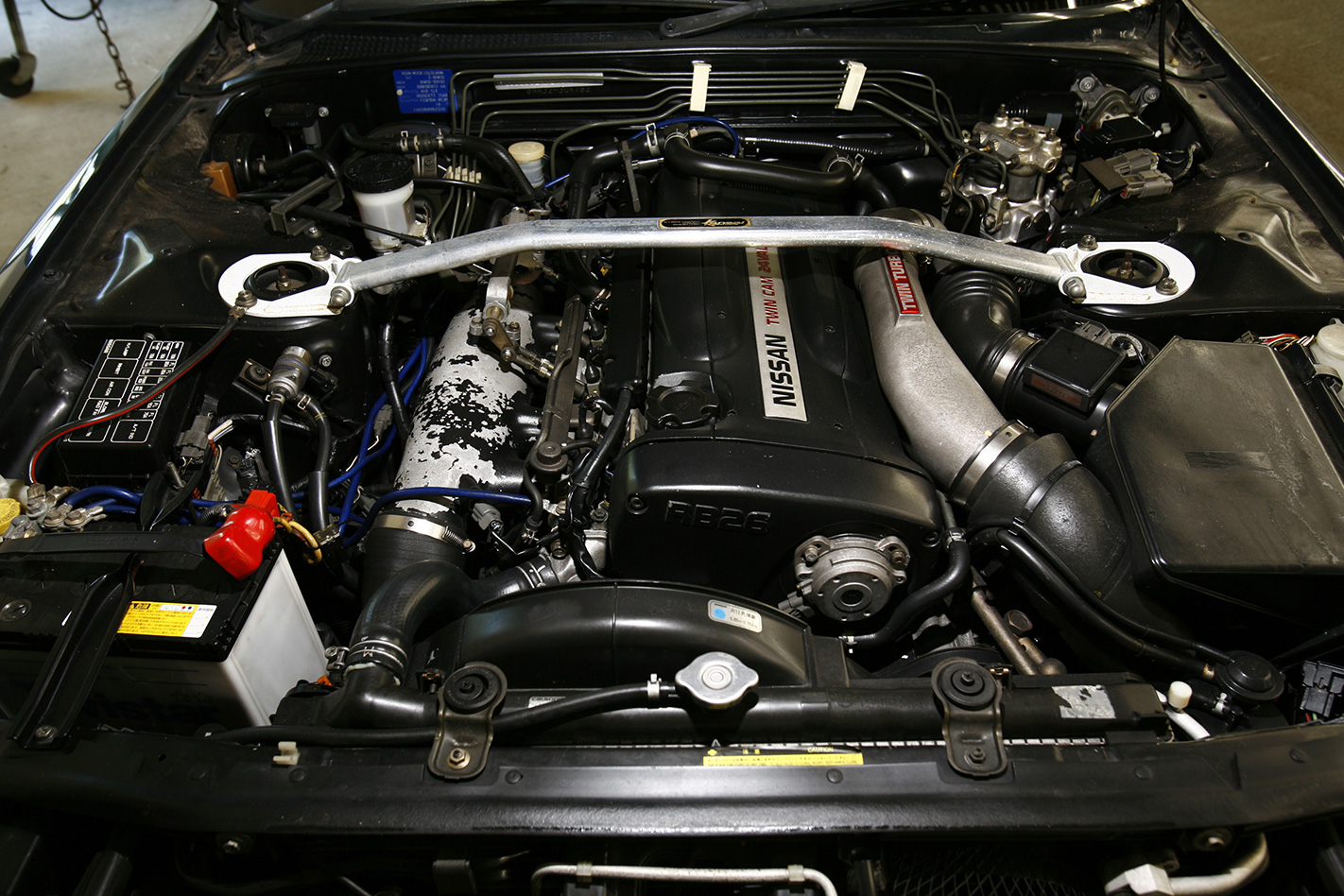
These will include engine parts and hopefully consider the 100-or-so items changed on AUDM Godzillas for local homologation.
“I’m happy to put my five cents over and say these are the parts we need over here,” he says.
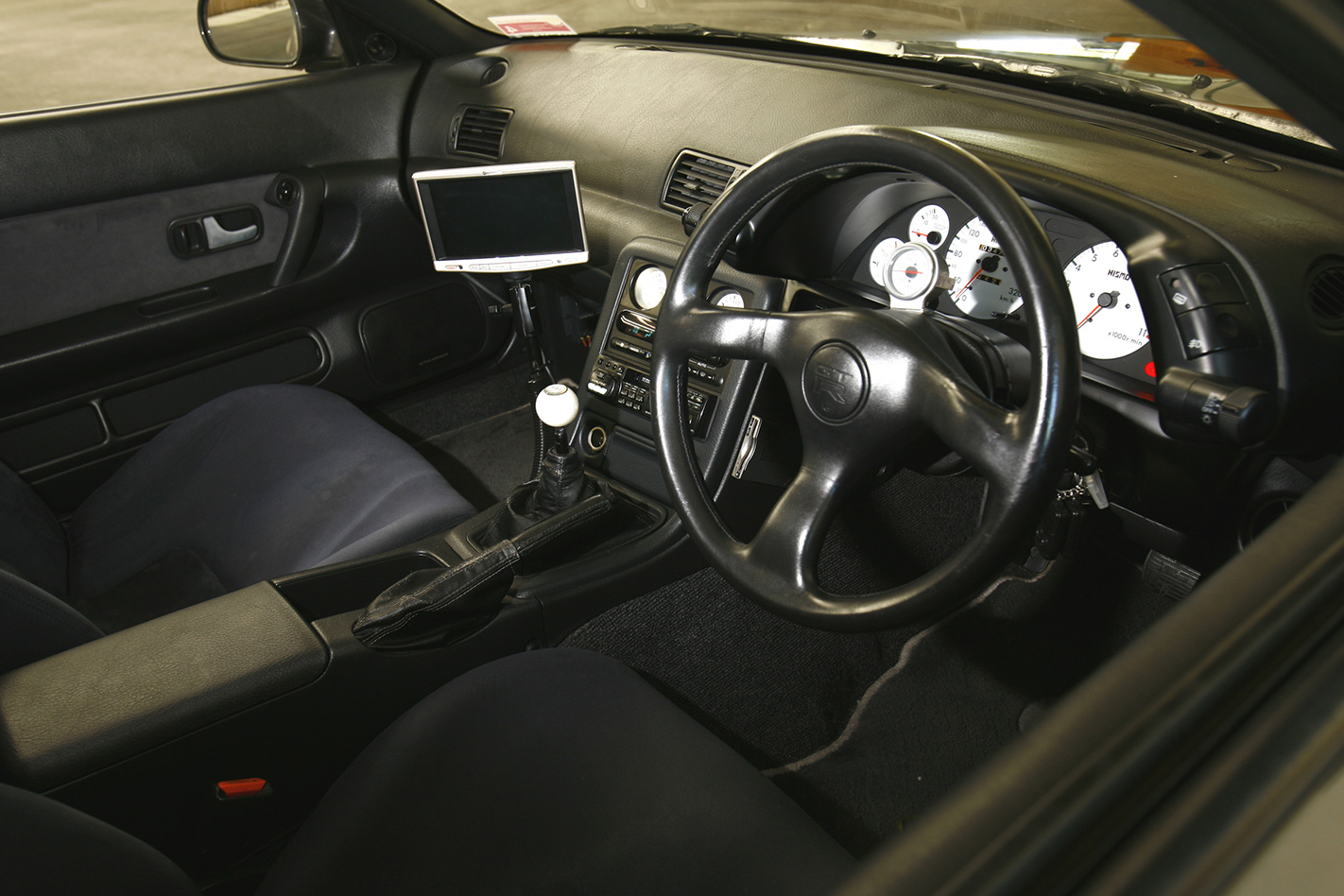
“These are the parts that are out there that are really rare. So the prices are doing that [climbing gesture] and the need overseas is becoming quite big, especially in America.”
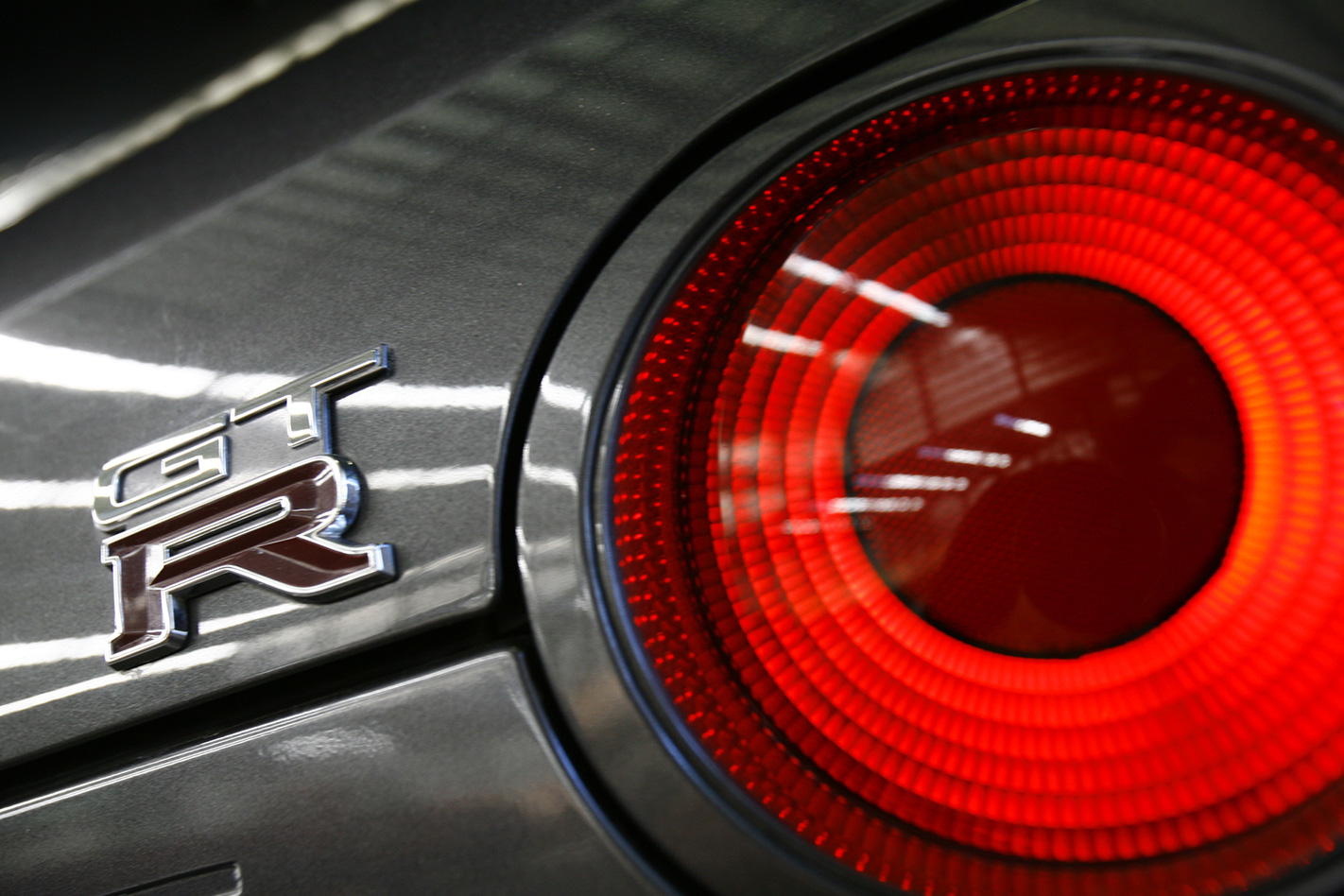
The move has driven demand on original parts, with anecdotal stories of OEM steering wheels commanding thousands of dollars.
Here’s to hoping Nismo successfully pops the looming bits bubble.
BY THE numbers, the Jeep Grand Cherokee SRT Trackhawk is one of the most staggering cars to be put on sale in Australia in recent years.
Wheels is currently in the good ol’ US of A putting the muscle SUV to the test. But before the review is released, we thought we’d get you primed for the sheer scale of this beast with a quick rundown of its impressive stats and figures.
First, the headline act. The 6.2-litre supercharged ‘Hellcat’ V8 produces 527kW and 874Nm.
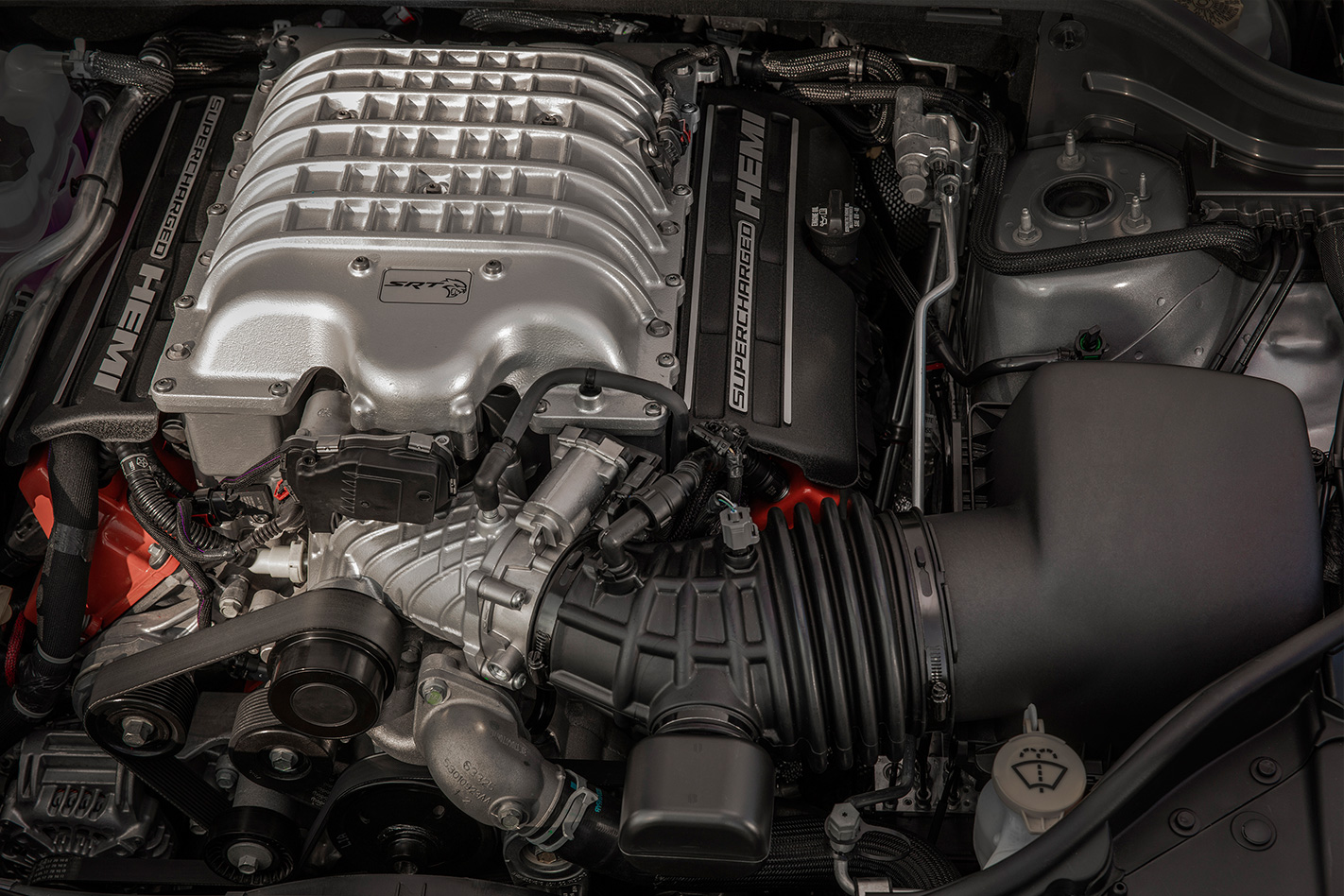
Now, pricing for Australia is yet to be revealed, however even if our $140,000-plus estimate is conservative, that is one of the most impressive performance bargains out there. There is nothing in the sub-$200,000 bracket that comes close to dealing out those sorts of figures.
Next is acceleration. 0-100km/h is knocked over in a claimed 3.6 seconds. Be assured we will be conducting independent performance testing once we get our hands on the Trackhawk in Australia. The laws of physics will have a hell of a case to answer if that figure is true.
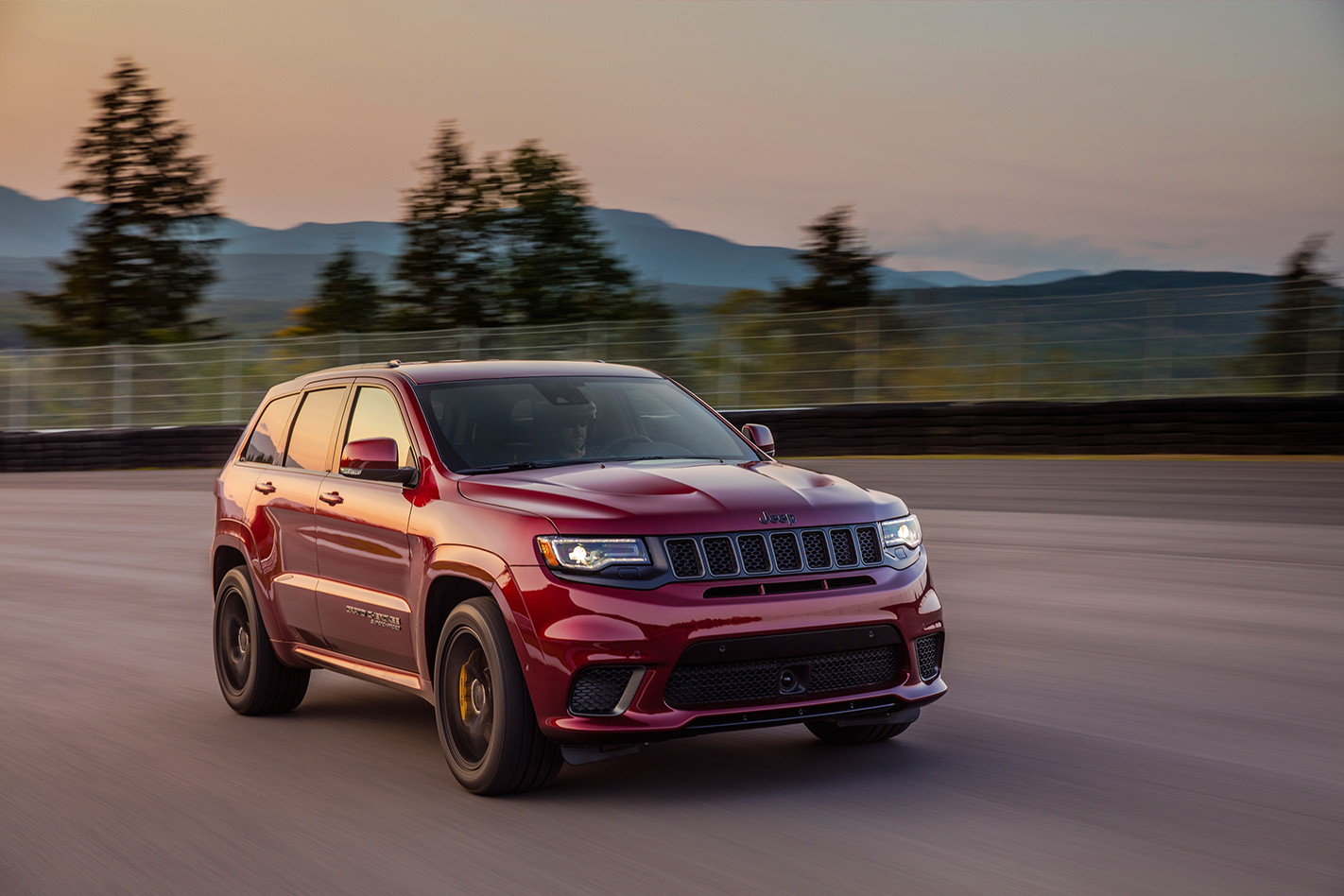
Beyond 100km/h though, it still puts up impressive numbers. The quarter mile will be crushed in a claimed 11.6 seconds, crossing the finish line at 116mph (186km/h). The HSV GTSR W1 ran a 12.3 second ET at 195.5km/h when we tested it earlier this year.
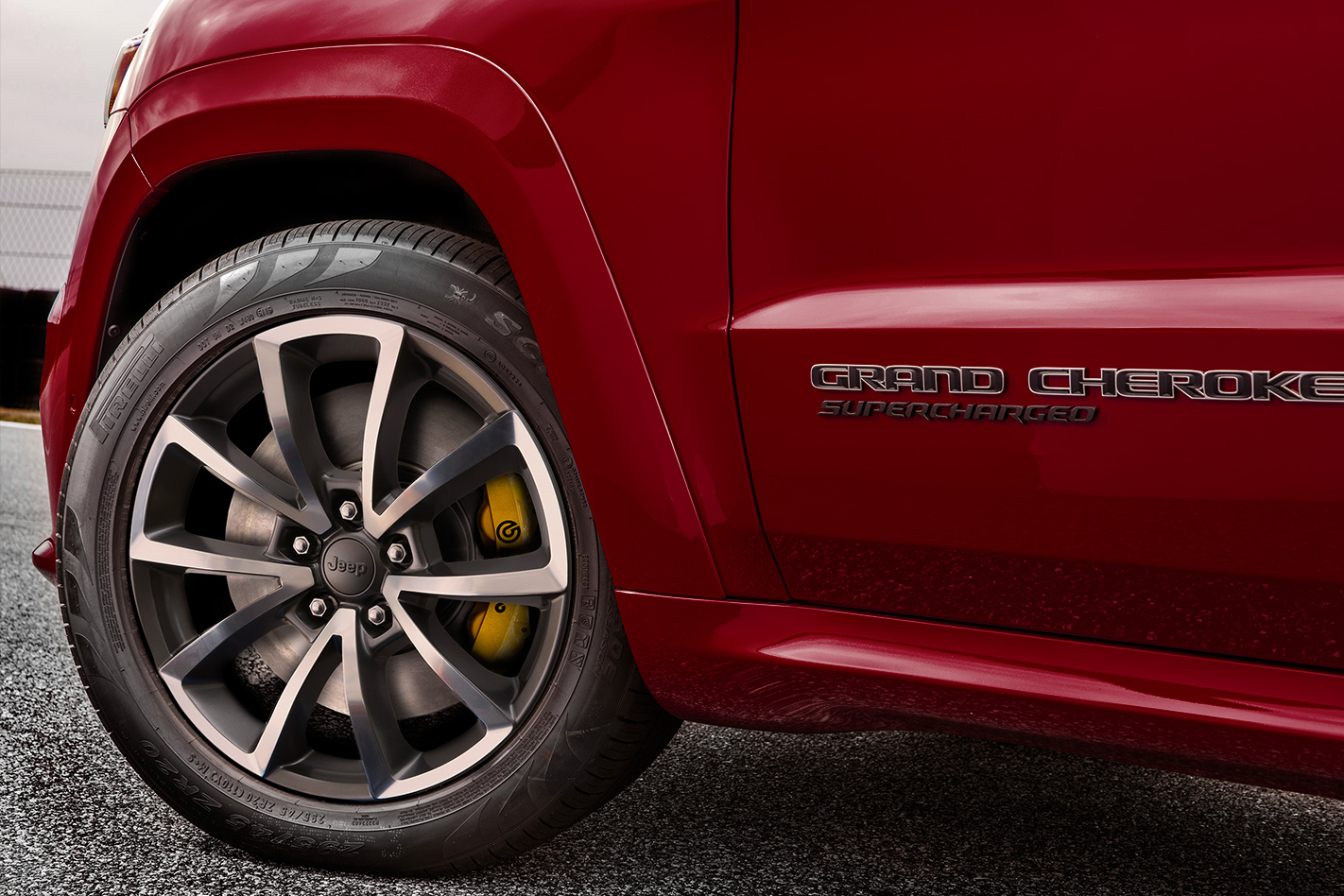
It’s not just about performance though. The Trackhawk has the largest front brakes ever fitted to a Jeep, measuring in at a whopping 400mm. These are grabbed by six-piston Brembo calipers, and can haul the Trackhawk’s considerable heft to a standstill from 100km/h in just 36 metres. That’s like a stampeding rhino stopping on a dime.
Inside the beating heart of the Trackhawk is a crankshaft built to withstand a firing pressure of nearly 1600psi, which has been burst tested to 13,000rpm.
A 2,380cc per revolution twin-screw supercharger sits atop the Hemi engine, capable of pumping 30,000 litres of air into the compression chambers a minute. Boost is regulated to a maximum of 11.6psi. All of that, before you even start the beast.