
It’s no great surprise to learn that Audi has called time on its 18-year involvement in the 24 Hours of Le Mans while also withdrawing, effective at the end of the current season, from the World Endurance Championship.
Though Audi has been THE stalwart of prototype endurance racing in the 21st century, no factory participation is forever in the world of motor sport, where a myriad of factors influence such decisions to stay or go.
The shock perhaps is that Audi is departing in just two WEC race’s time. It has (at least for the foreseeable future) contested its last Le Mans enduro in the prototype LMP1 category. There had been a belief it would depart at the end of 2017.
The sudden finish to the Ingolstadt car maker’s wildly successful LMP1 programme, which yielded 13 Le Mans victories and the WEC drivers’ and manufacturers’ titles in 2012-13, comes after a strategic realignment of Audi’s motor sporting focus, and a significant economic tsunami in the form of the emissions cheating scandal.
Audi had earlier announced it was to take a more serious crack at the all-electric Formula E Championship with the Abt-Schaeffler squad.
This change of emphasis was confirmed with Audi chairman Rupert Stadler saying: “As our production cars are becoming increasingly electric, our motorsport cars, as Audi’s technological spearheads, have to even more so.
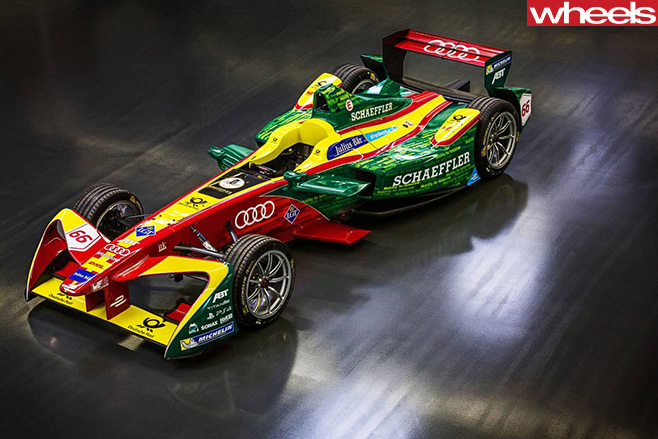
Deaf folks are the only fans seemingly happy by the move to the electric-power competition.
The announcement has been greeted with diluted enthusiasm (at best) by hard-core race fans who’ve long lauded Audi’s loyalty to sports car racing and its always innovative technological response to the challenging regulations of the WEC and Le Mans.
Still, Audi’s deeper commitment to Formula E will surely shake up the technology-driven series which recently attracted Jaguar.
The Formula E programme is clearly aimed at promoting Audi’s all-electric production vehicles which will bow at the start of the 2018 model year.
“We intend to evolve into one of the leading premium car manufacturers in this field,“ said Dr Stefan Knirsch, a board member with technical development responsibilities.
The world is set to become way quieter, along with some forms of motor sport following suit.
“By 2025, every fourth Audi should be an electric vehicle,” added Dr Knirsch.
The latest developments at Audi will finally dispatch any lingering rumours that the premium car brand is contemplating an involvement in Formula One.
In fact, the Audi announcement of its cessation of prototype sports car racing included an oblique suggestion that the company was aiming to reduce its motor sport budget. The decision, said Audi, needed to be understood “in the context of the current burdens of the brand”, an acknowledgement of the considerable financial impact flowing from last year’s global ‘dieselgate’ shame.
A further factor in the change of direction for Audi Sport is the post-dieselgate decline in sales of turbodiesels, the technology Audi has been employing in the WEC.
Audi intends to retain all employees involved in the motor racing program but indicated some within Audi Sport will be diverted into the development of production vehicles.
It is believed the Audi decision will not impact on fellow Volkswagen Group brand Porsche’s ongoing participation in the WEC.
In fact, the announcement doesn’t leave the sibling brands fighting each other in LMP1, although Audi Sport will continue with its customer racing (R8 LMS GT3 and TT Cup). A successful, profitable business within Audi Sport, it recently unveiled a new product, the RS 3 LMS touring car.
But its primary focus is Formula E. It has thrust more technical resources and budget towards the Abt Schaeffer team’s Formula E programme for the 2016/17 season. It’s now a full-on factory attack. Hear the roar of…the tyres squealing.
Okay not everyone will be thrilled. But the logic is unassailable.
The boss of Audi Motorsport Dr. Wolfgang Ullrich makes the point that Audi has consistently been using motor sport to test and develop new technologies for subsequent use in production.
He takes pride in Audi using quattro drive to revolutionise rallying and subsequently set standards in circuit racing as well.
However, Formula E uses both a control chassis and battery pack, with manufacturers limited in their development for the category.
In the 24 Hours of Le Mans, Audi was the first manufacturer to take victories with a TFSI engine, a TDI and a hybrid race car.
“Now we intend to repeat this in fully electric racing,“ Dr Ullrich declared.
That’s why the withdrawal of one of those manufacturers – and the one currently enjoying the longest run in the prototype ranks – is a major loss.
Losing one of the three manufacturers from the LMP1 category of WEC is a blow, and leaves the series vulnerable if another marque heads for the exit. But history shows that just two brands can stage an almighty contest.
Porsche and Toyota have won rounds this year. Let’s hope they stick for the long haul (Toyota is getting into world rallying next season).
But the Porsche versus Toyota fight will continue after the WEC waves an emotional farewell to Audi in Bahrain.
Is the turbo V6 Mercedes-Benz C-Class an AMG-lite, or is it a deserving member of the Mercedes performance clique?
WHAT IS IT? This is AMG’s mid-strength coupe, a V6-engined sibling to the powerful V8 C63 that is priced at a (relatively) affordable $105,615. In terms of both performance and price, the C43 bridges the yawning chasm between the C250 and the C63 flagship.
WHY ARE WE TESTING IT? This is the most affordable two-door AMG available. Though its straight-line performance pales in comparison to its cheaper four-cylinder siblings – the A45 and CLA45 – the C43 coupe still makes a case for itself on the basis of its more desirable bodystyle.
With a grunty 270kW/550Nm twin-turbo V6 under the bonnet, the C43 has the right numbers to challenge its main rival, the BMW 440i. But is it a true AMG?
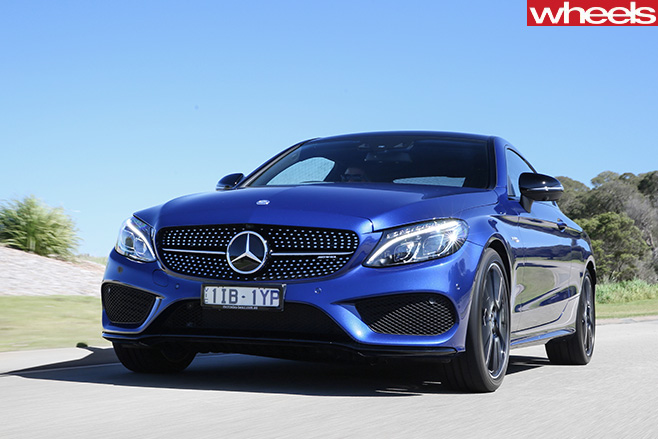
THE WHEELS VERDICT Find the C63’s monstrous bent-eight a tad intimidating? Can’t stretch the budget that far anyway? The C43 Coupe will supply roughly 70 percent of the thrills while simultaneously keeping you safer thanks to its grippy AWD driveline.
It may not be quite as exciting as its V8-powered stablemate, but the C43’s more civilised nature is actually its biggest asset. It won’t wear you out like a C63 might, and that means you’ll be inclined to spend more time behind the wheel – a good thing.
PLUS: Accessible pricetag, stellar grip, driveability MINUS: Tyre noise, not as dynamically entertaining as a C63
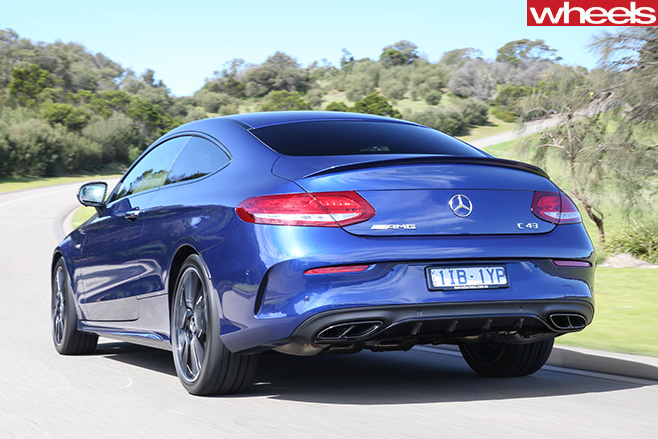
Even Mercedes wrestled with the question, and initially marketed it overseas as the C450 AMG Sport before giving it proper Mercedes-AMG status.
But while the fire-spitting C63’s 4.0-litre twin-turbo V8 is hand-assembled by a single master engine builder, the C43’s 3.0-litre turbo V6 is built by robots on a production line. That engine is also hooked up to a conventional torque convertor automatic rather than the dual-clutch seven-speeders used by -45 and -63 AMGs, and power goes to all four wheels.
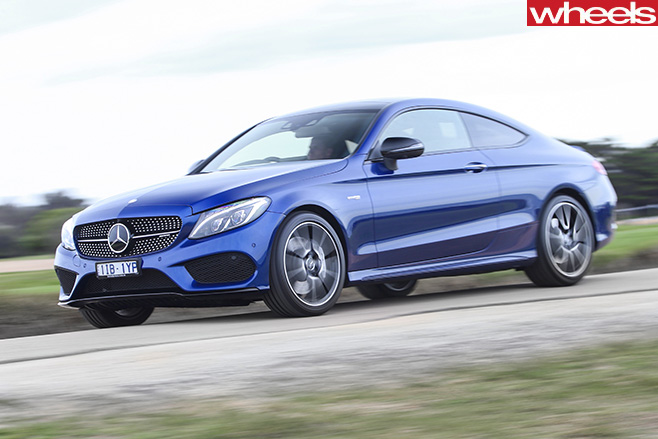
Judge it in isolation, and it does. The note of the turbo six isn’t as appealing as the thunderous V8 that sits above it in the AMG hierarchy, but spec the Performance Ergonomics Pack and its sports exhaust emits gunshot sound effects on upchanges and rapid-fire crackles on the overrun to lend it some aural appeal.
On the other hand there’s a fair bit of V6 rasp, and while it sounds great when you’re delving deep into the engine’s power reserves, it’s flat and ordinary – or simply too quiet – at other times.

Speaking of, the huggy AMG performance seats that come with the Performance Pack are well worth the extra $4990 spend, as is the racy Alcantara-trimmed flat-bottomed steering wheel.
Though it resembles its bigger bro on the inside and out, the C43’s drivetrain feels remarkably different. While the C63 is a rear-driven smoke machine, the C43’s all-paw grip neuters any attempt to light up the rear bags. It grips like a cat on carpet and never threatens to spit you into the weeds, but that’s not as exciting to some.
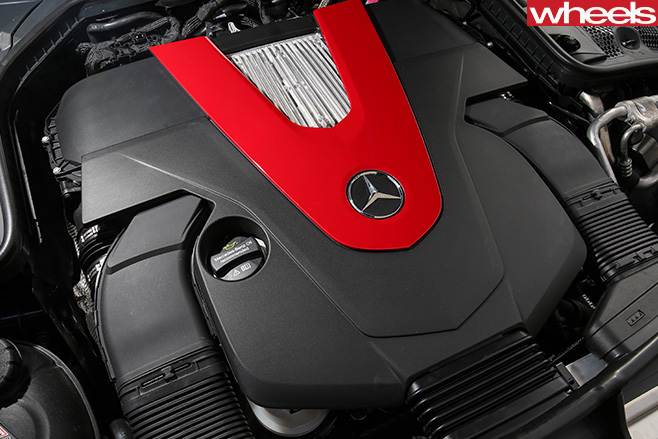
SPECS Model: Mercedes-AMG C43 AMG Engine: 2986cc V6 (90 degree), dohc, 24v Max power: 270kW @ 5500-6000rpm Max torque: 520Nm @ 2000-4200rpm Transmission: Nine-speed automatic Weight: 1735kg 0-100km/h: 4.7 seconds Fuel economy: 8.2 l/100km Price: $105,615 On sale: Now
THE next-generation Holden Commodore could have a virtual buddy sitting in the car beside you that knows your every need. However, before you get too excited, it’s shaping up to be more of a marketing tool for the carmaker’s business partners than a helping hand.
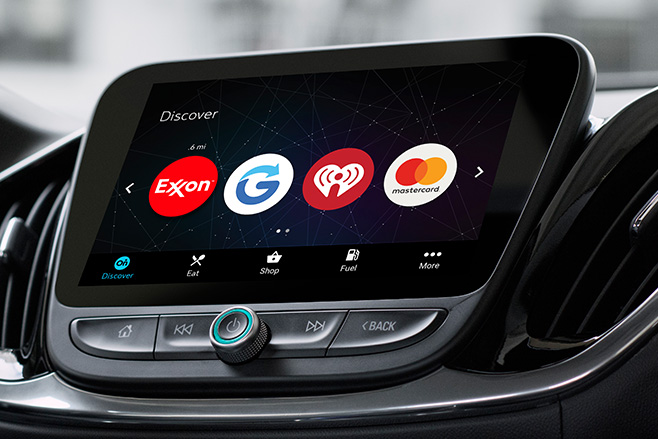
General Motors, Holden’s US parent company, has announced it will soon start integrating Watson, the name given to a self-learning, internet-based help desk developed by computing giant IBM, into its cars.
Watson is good at linking bits of information together and presenting helpful answers. For instance, if your car is low on fuel, you don’t want to be stuck in traffic wasting it while you head to the nearest petrol station. Watson will be able to recognise this, look at the best possible route, map it out for you, and pre-pay for a splash-and-dash.
Likewise, if you always stop for a take-away coffee at a certain time each day, Watson will be smart enough to realise you’re a creature of habit and pre-order one for you.
Due in the US next year, the system will be linked to GM’s OnStar service that already provides in-car help for owners. Holden has previously tried an Aussie version of OnStar, called Holden Assist, but shelved it due to a low customer take-up.
“On average, people in the US spend more than 46 minutes per day in their car and are looking for ways to optimise their time,” Phil Abram, the executive director of GM Connected Products and Strategy said.
“By leveraging OnStar’s connectivity and combining it with the power of Watson, we’re looking to provide safer, simpler and better solutions to make our customers’ mobility experience more valuable and productive.”
However, GM has flagged the system will also be something of a door-to-door salesman.
“With the customer’s consent, Watson will learn the driver’s preferences, apply machine learning and sift through data to recognise patterns in their decisions and habits,” GM said.
“This information will allow brand and marketing professionals working with IBM and OnStar to deliver individualised location-based interactions that directly impact their target audiences.
“Companies in retail, fuel, hospitality, media and entertainment, restaurants and travel and transportation and more can use OnStar Go to build individualised mobile, in-vehicle experiences for a growing population of connected drivers that opt in.”
That means your car could interrupt you to suggest you stop at a certain restaurant, or suggest you call into a supermarket to pick up a packet of nappies if you haven’t bought any for a while.
GM has said Watson would be an opt-in feature – a nod to privacy and data security concerns raised by customers worried about what could happen with the data GM collects on them.
Can’t get enough? Now read about how smartphone technology is changing the way we drive.
Hot on the heels of Mercedes-Benz’s announcement of its new luxury X-Class twin-cab ute, Volkswagen has responded with news that its new Amarok V6 twin-cab will come with a turbo over-boost function on its 3.0-litre diesel engine.
While Mercedes is yet to confirm power and torque figures for either the six-cylinder or twin-turbo 2.3-litre Renault four that will power X-Class models (due in late-2017), Volkswagen is upping the power ante on its popular workhorse, which is currently the most powerful vehicle in its class.
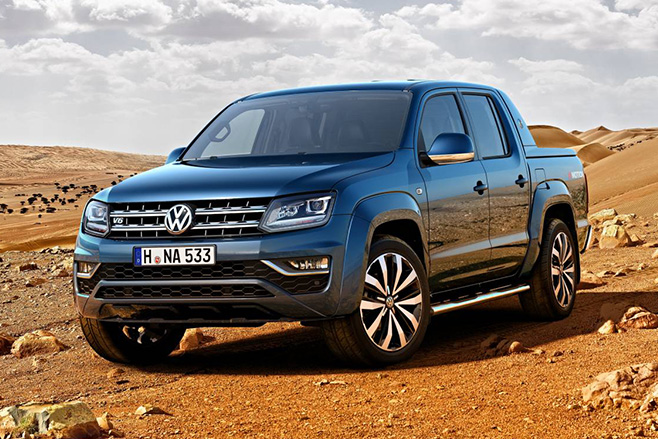
Over-boost kicks in at 70 percent of full throttle in third and fourth gears from 50km/h for 10 seconds, and the extra turbo puff pumps up power from 165 to 180kW and torque from 550 to 580Nm.
The good thing is that after five-seconds, over-boost is available again under your right foot and Volkswagen is claiming a 0-100km/h time of 7.9 seconds and 80-120km/h overtaking time of 5.5sec.
Long regarded as the most ‘car-like’ twin-cab commercial – the four-cylinder Amarok won Wheels recent dual-cab 4×4 ute comparison– Volkswagen (perhaps mindful of how luxurious the Mercedes-Benz X-Class will be) has also turned its attention to the styling and interior fit-out of the new V6 Amarok.
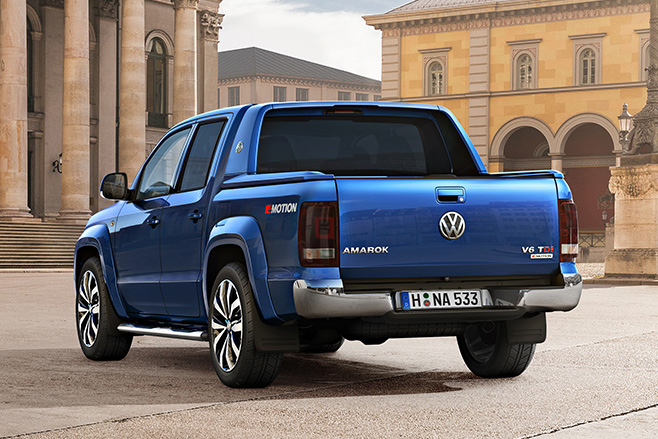
Headlining VW’s luxo push will be the limited-edition Volkswagen Amarok V6 Aventura, which will come in above a V6 Highline-spec model. Currently, two out of every five Amarok sales are the more upmarket four-pot Highline models, so there are buyers willing to shell out for more refinement and mod-cons to go with load-carrying ability.
As part of a mid-life makeover, the Aventura will get 20-inch alloys, bigger front disc brakes and rear discs for the first time on an Amarok. Inside, delicate tradie derrieres will welcome the addition of snugly-bolstered Volkswagen Passat seats with 14-way adjustment.
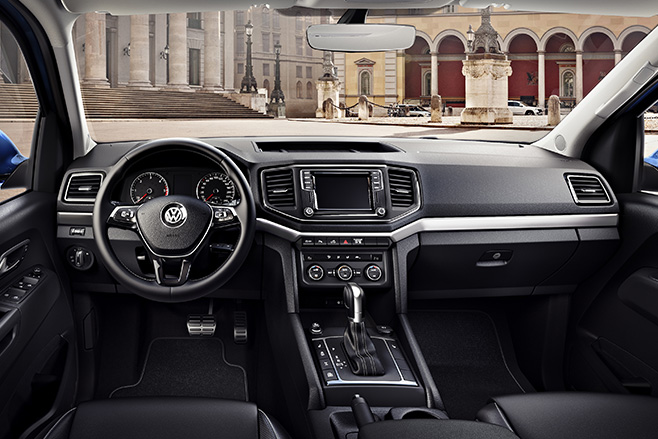
Volkswagen is bullish about its new twin-cab 4×4’s prospects.
“The Amarok V6 is not an over-hyped concept or a badge engineering exercise,” said Volkswagen Commercial Vehicles Director, Carlos Santos. “It’s real, it’s almost here, and it brings the world’s best V6 turbo diesel, the same unit used by Porsche and Audi in luxury SUVs.”
The Amarok V6 will be on sale from November 24 and Volkswagen claims it has already received more than 6000 inquiries from interested customers.
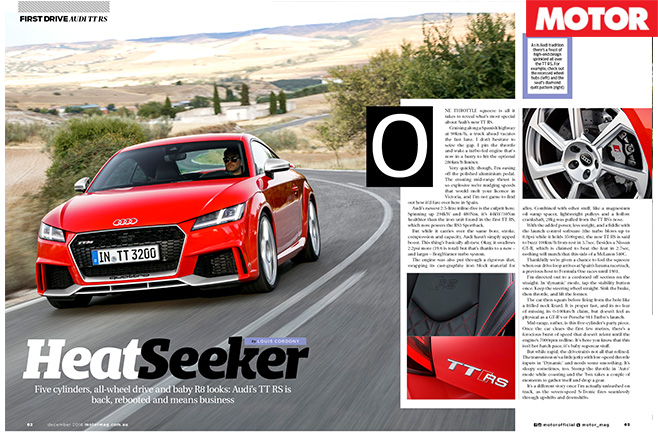
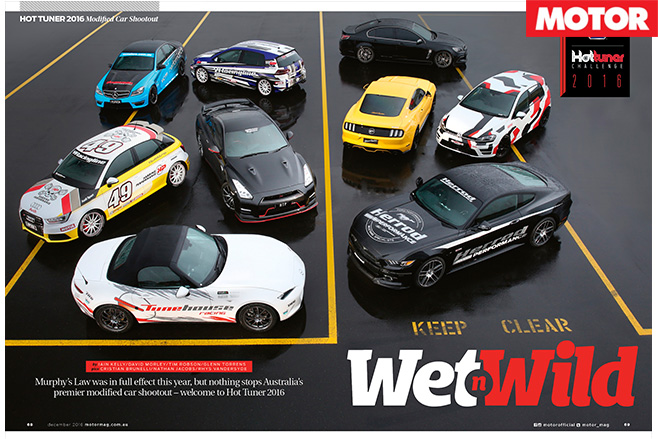
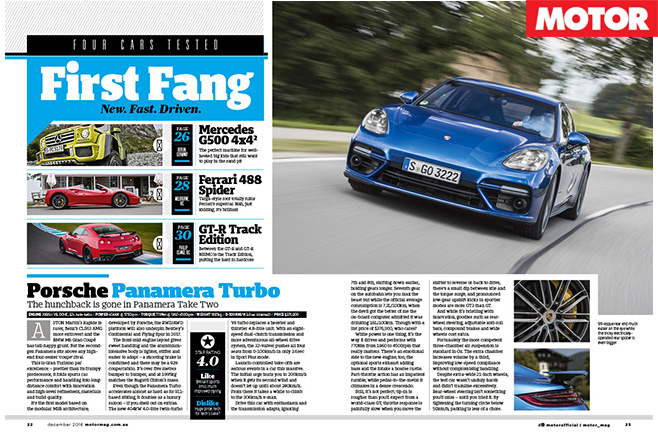
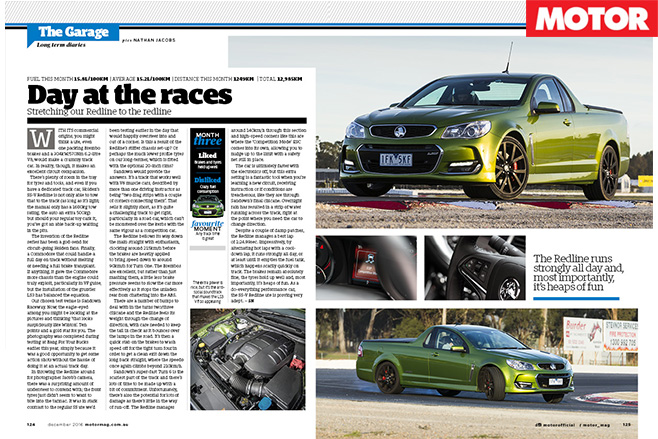
Here’s an exclusive rundown of what’s hiding in MOTOR’s latest December issue, now available on stands and on iPads or Zinio.
Sprawled across our cover is the latest super hatch match. Ford’s new Focus RS has taken swing at the Mercedes-AMG A45 and VW Golf GTI, and we call the fight.
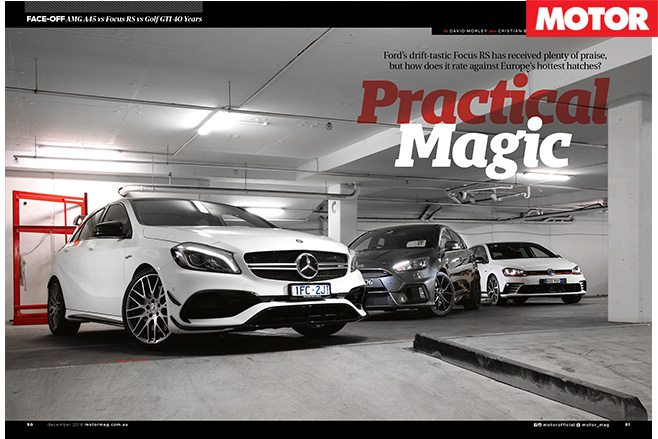
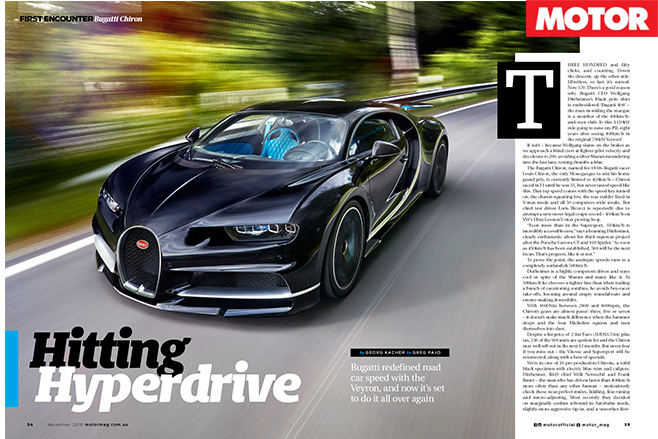
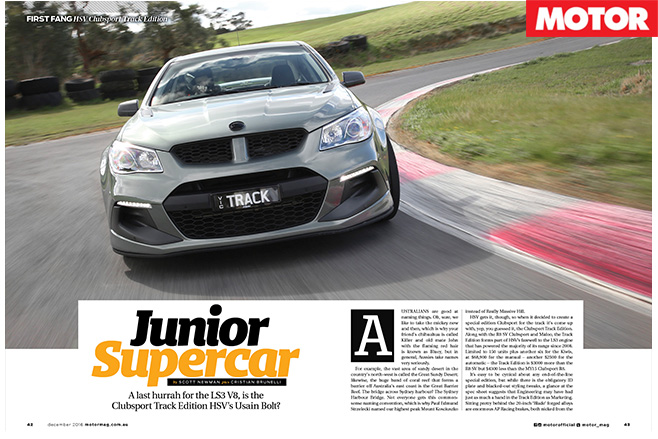
Buying a car could soon be a very different experience, involving everything from a movie or meal to a blast around a race track.
Different car dealership models that push the customer relations envelope are being explored by manufacturers keen to take advantage of changing urban landscapes and customer expectations.
To start with, there’s the rising trend of manufacturers selling cars in shopping centres.
Tesla often targets high-traffic retail areas not associated with car dealerships, such as Martin Place in Sydney and the Chadstone shopping centre complex in Melbourne.
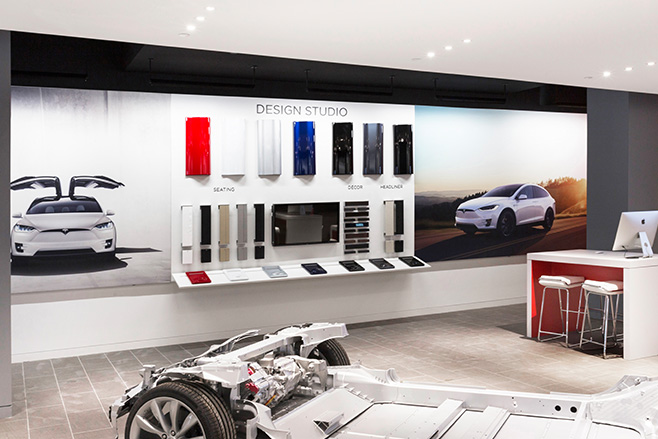
That’s something that interests Mercedes-Benz, which early next year will open the world’s eighth “Mercedes me” store in the Rialto building in Melbourne. It will include a high-end restaurant, boardroom, theatrette and an area to display hero cars.
Like similar Mercedes-Benz themed stores in Milan, Munich and Hong Kong, it’s more about lifestyle and branding than making sales.
Infiniti is also getting in on the action, opening a dealership in the Gold Coast’s Pacific Fair shopping centre.
Located amidst high-end retailers, the store is designed to capture consumers in new ways, and has space for three cars inside the shopfront, and six dedicated parking spots for test cars.
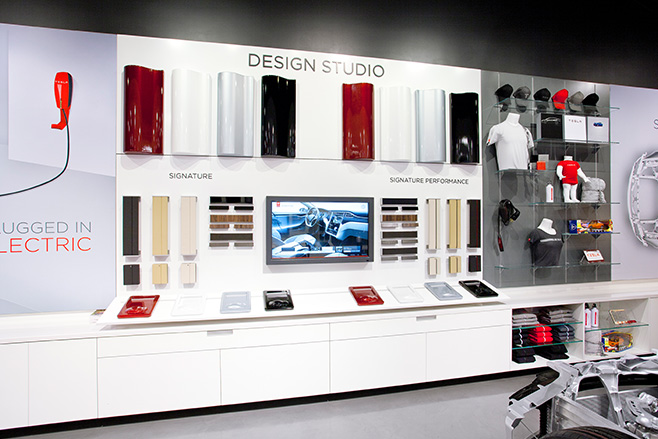
Renault is the latest manufacturer to join in, launching a “Brand Concept Store” at Westfield in Sydney’s northern suburb, Hornsby.
Renault Australia considers the store as more a marketing exercise than for selling cars, with shopping centres drawing high amounts of foot traffic.
“Renault believes that purchasing behaviour is changing and the automotive sector needs to keep pace with this change,” Renault Australia managing director Justin Hocevar said.
“People want to engage with brands on their terms and shop as and when they choose, and Renault aims to be at the forefront of these changing trends.
“The Renault Concept Store provides the opportunity for people to check out our range in a relaxed environment.”
With shopping centre storefronts becoming increasingly popular, the way you buy a car in five to 10 years’ time may not involve a traditional dealership at all.
Serious safety questions have been raised about the Toyota Hilux after the trade ute almost turned turtle while performing a low-speed swerve test – almost a decade after the previous-generation model came even closer to doing the same thing.
Swedish magazine Teknikens Varld questioned the Hilux’s safety record after posting video of the trade ute – carrying weights in the tray and five passengers that brought it close to its maximum payload – tipping up on to two wheels and almost high-siding while being driven through a moose swerve test at 57km/h; a defensive driving manoeuvre designed to simulate driving around an animal that has wandered onto the road.
The dramatic result was attributed in part to the tyres fitted to the 18-inch alloys – the brand of tyre fitted to the Swedish test cars isn’t mentioned – with a re-test on 17-inch rims showing slightly more stability, although again the ute comes close to rolling before the driver countersteers out.
The Hilux should have performed like the other heavily loaded utes on test (pictured below), the magazine’s driver who uncovered the stability issue, Ruben Börjesson, said.
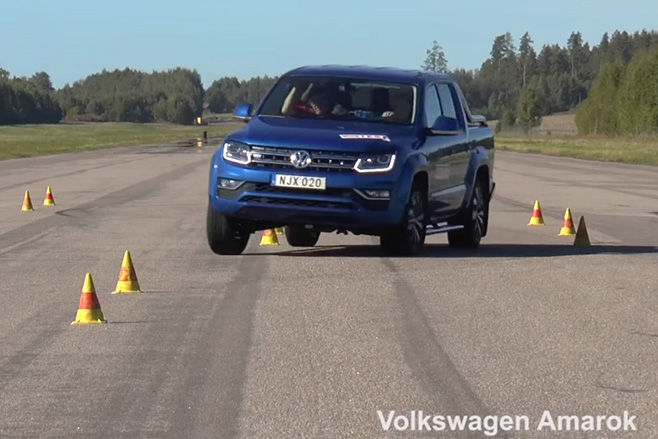
“If that would be the case the suspension should have bottomed out but it didn’t,” Börjesson said. “Instead I think the problem lies in the absence of anti-rollover systems and the grip of the tires.”
The test on the Hilux was in stark contrast to five other dual-cab trade utes run through the same manoeuvre, including the Ford Ranger, Mitsubishi Triton and Volkswagen Amarok.
“When the limit of grip is reached the [other] pick-ups just understeer straight ahead. But not when the test team enters the new Hilux Toyota,” Teknikens Varld said.
“Something is seriously wrong with Toyota’s dynamic safety system, and the result is dependent on the tires the car is equipped with,” it concluded. However, it does not mention the brand of the tyres fitted to the test cars.
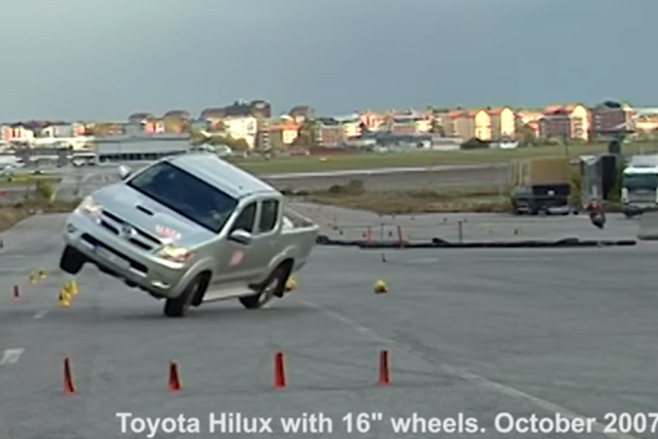
The unexpected result is almost as spectacular as a similar test with the previous-generation Hilux held in 2007. In the earlier test, the Hilux gets to an even more extreme angle before the driver countersteers out of trouble.
The Toyota Hilux has earned a top five-star safety rating in Australia, although in a test designed to see how it performs in a crash, not how it performs dynamically. The Australasian New Car Assessment Program that assesses the crashworthiness of vehicles has been contacted for comment.
Toyota Australia has also been asked for comment. Toyota Sweden responded to the results of the test by saying it was “confident that the Toyota Hilux is a safe vehicle”.
“We were surprised by the test result, and we will take your evaluation very seriously, in the same serious way we do with the capacity for evasive maneuvers in the development of our vehicles,” it said in a statement sent to the magazine.
“Hilux has been repeatedly tested according to the ISO 3888 standard for evasive maneuver tests during the development of the model and then it passed the tests successfully.”
Toyota Australia said the carmaker was in talks with the magazine to “find out additional details about the test”.
The ISO severe lane change manoeuvre is a standardised test designed to push vehicle dynamics and road-holding ability to the limit. It is applied to all passenger cars, as well as commercial vehicles weighing up to 3.5 tonnes.
To date, the only way for new-car buyers to identify the dynamic flaws of cars is via independent tests such as Wheels Car of the Year.
IT WOULD seem, at first glance, to be a venture fuelled by little more than blind optimism and naivety. Actually, even at second glance, it still looks a bit that way.
The mission is for British brand MG, now owned by China’s automotive titan SAIC, to enter the Australian market with two models, in the B- (light car) and C-segments, and establish a beachhead here that the company can build upon with small SUVs and subsequent models.
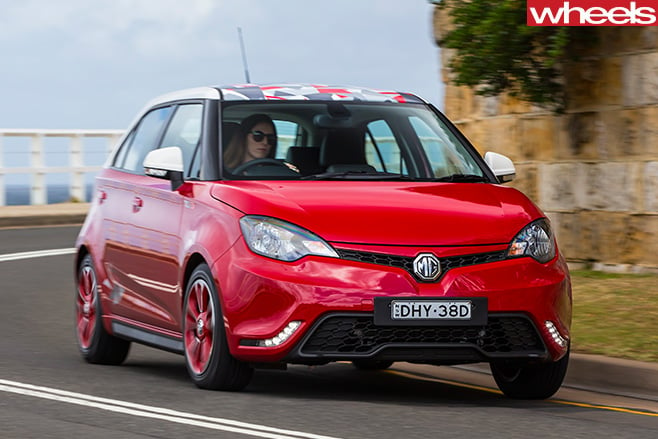
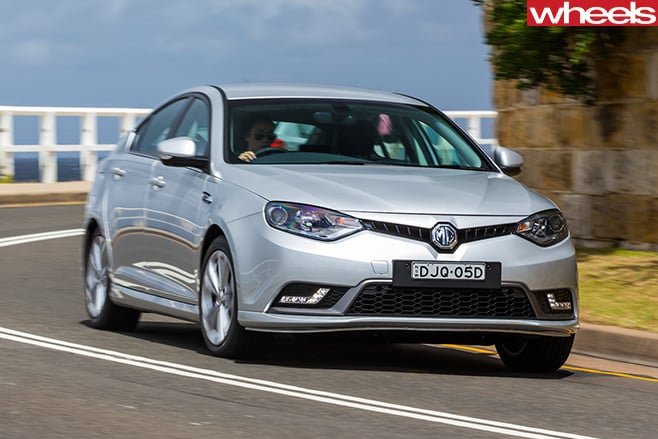
On the upside, the two models kicking things off – the MG3 and MG6 Plus – are aimed at the high-volume end of the market. Competitors for the MG6 Plus are Toyota Corolla, Mazda 3, and Hyundai i30, which, collectively, are never outside the top 10 sellers in the country. The dominant light car, which the MG3 goes up against, is the Mazda 2, which normally sits within the list of top 20 sellers. So there’s ample activity in the targeted segments. That’s the good news. The flip side is that this is the narrow-margin end of the market, where companies need sales volume to make money, because the profit on each car is small. MG won’t talk numbers, but with a dealer network of just 10, we’d tip that the calendar will be well into 2017 before sales tick over into four figures.
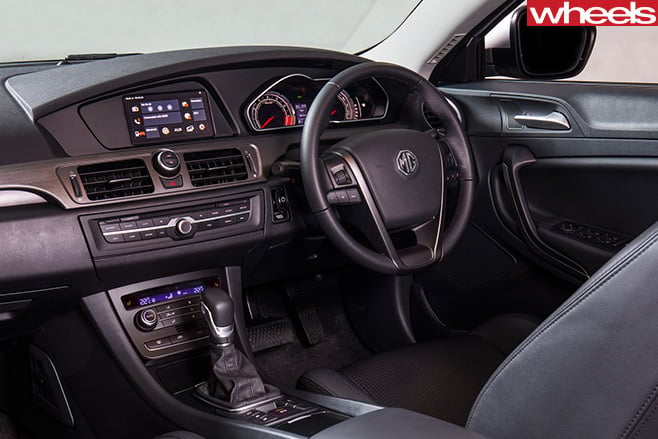
The big hurdle for the MG3 is that it’s a manual-only vehicle in an automatic world. MG won’t say if or when an automatic transmission will be offered. The less than 30 percent of buyers in the light class who do opt for a manual do it largely for cost reasons, buying the cheapest entry-level model. If this follows with the MG3, the company can expect even skinnier margins as it shifts the base Core model at $13,990, while buyers with more to spend buy an automatic elsewhere.
We’ll reserve judgement until we drive the cars in the coming weeks, but clearly MG in Australia has a monumental challenge on its hands.
WHY MG may succeed in Australia:
- It has the might of China’s largest automotive company behind it
- The cars’ pricing, specification and warranty look attractive
- The MG3 is pertly styled and is offered with customising options
WHY it won’t:
- Intense competition and narrow margins
- Lack of dealer network
- Lack of solid brand association
- Lack of automatic transmission in MG3
- MG6 Plus looks dumpy and bland
Mazda MX-5 Speedster update and first RF concept will be revealed in Las Vegas next week.
‘If it ain’t broke don’t fix it’ can certainly be applied to the Mazda MX-5, but there’s nothing in the old adage about teasing us with awesome concepts.
The 2016 Wheels Car of the Year is the perfect little platform for modified show cars and two examples have already stirred excitement ahead of their appearance at the huge 2016 SEMA aftermarket show in Las Vegas next week.
One is based on the yet-to-be-released-here RF model while the other is an update of last year’s sleek open-top Speedster concept, both products of Mazda’s Irvine, California, design studio.
The Speedster Evolution is 45kg lighter than last year’s version, making it 160kg lighter than the production MX-5, with the windscreen and retractable roof removed and interior simplified.
Finished in White Ether it’s a little more subtle looking than last’s year’s alluring Blue Ether scheme, which featured a bit more racing bling.
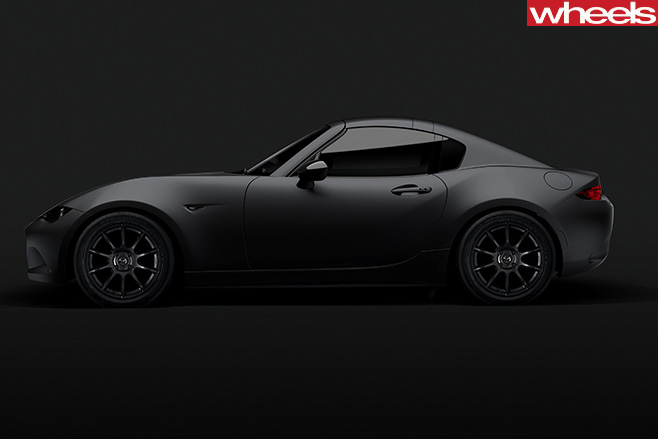
The Speedster Evolution is joined by its polar opposite the RF Kuro, which is the first concept based on the new retractable fastback MX-5. Kuro is the Japanese word for charcoal, which is expressed by the sultry matt, dark-grey paint job with matching 17-inch RAYS forged wheels inside BFGoodrich g-Force Rival tyres.
There are no changes under the bonnet, but it is kitted out with Mazda MX-5 Cup adjustable suspension which should make it feel like it running on rails.
We can’t wait to see more images after their reveal at the Las Vegas Convention Centre next week.
Haute Couture and Rolls-Royce embody the same philosophy – they’re both luxury items that very few can afford, but almost every admires.
So it comes as no surprise that a team of designers at Rolls-Royce has drawn inspiration from the 2017 Spring/Summer catwalks to create the special edition of Rolls-Royce Dawn convertible, insipidly named Inspired by Fashion.
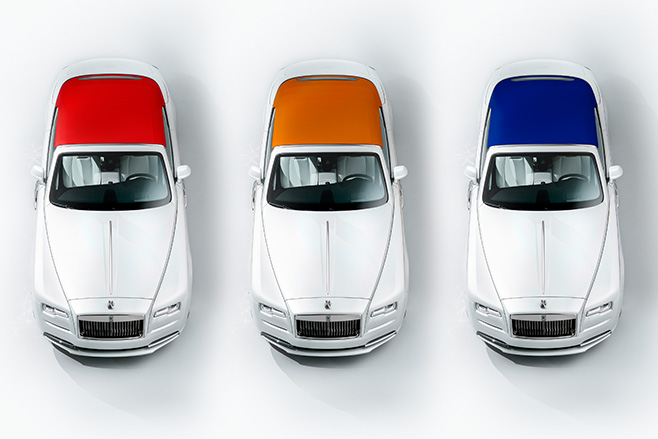
Rolls-Royce Design Director, Giles Taylor, gathered a team of fashion, fine textile and luxury accessory designers who decided on a white canvas, adorned with three vibrant colours from the 2017 Spring/Summer collection: Mugello Red, Cobalto Blue and Mandarin.
The car’s exterior is white, contrasted by the block red, blue or orange used on the Ghost-based convertible’s fabric roof.
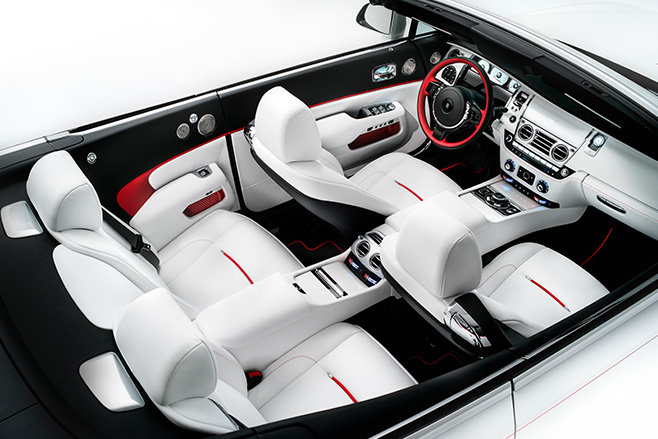
While white and black dominate the interior, the three colours were used as accents throughout the Dawn on the embroidered headrests, stitching and piping of the seats, and the ‘seamless stitching’ of the leather-wrapped steering wheel which, according to Rolls-Royce, is “a highly-complex craft technique from the world of fine tailoring”.

Piano White adorns that dashboard with aluminium particles giving it a silk-like appearance – a process that requires nine days of a meticulous lacquering process.
“Our clients are the very arbiters of fashion, tastemakers who sit in the front row of the Couture shows, themselves influencing evolving trends,” said Taylor.
“To them, the commissioning of fine luxury objects represents a deeply-involving curatorial process …”
The Rolls-Royce Dawn is available in Australia for $749,000. The British car-maker has given no indication of the price of the Dawn – Inspired by Fashion edition, stating only: “Clients are invited to commission their personal style statement from this November to ensure they appear wrapped in the latest couture offering from the world’s leading luxury goods house for the new seasons next year”.
We’re predicting this runway-inspiration isn’t going to come cheap.
